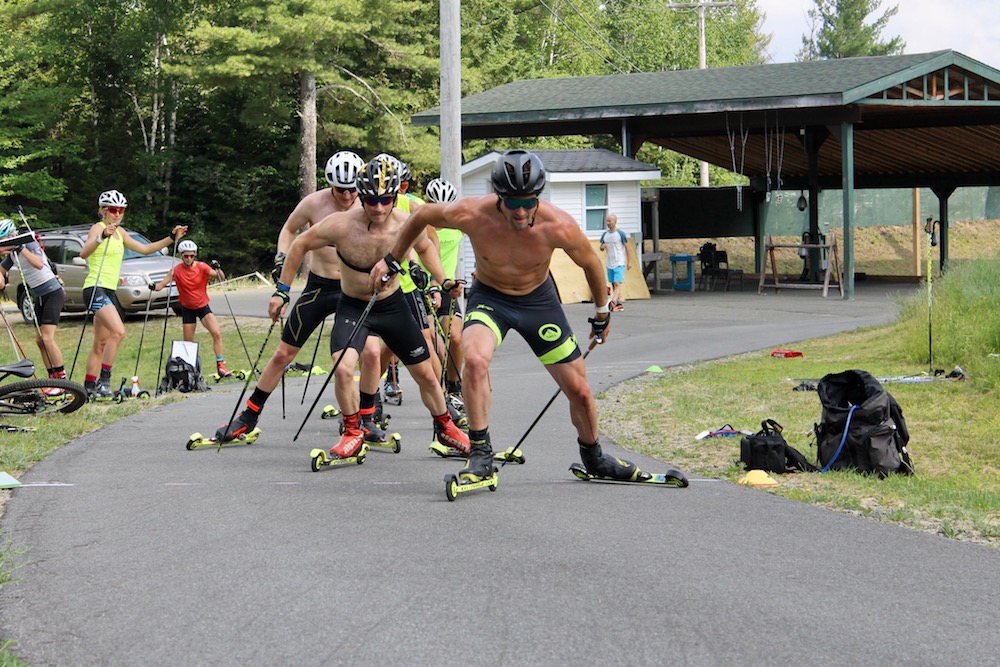
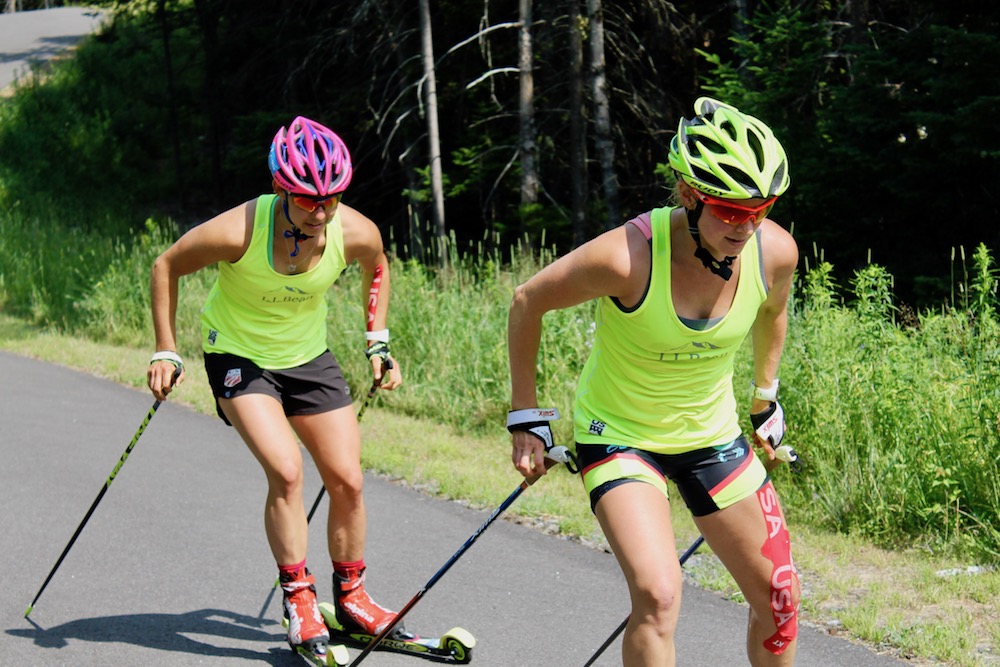
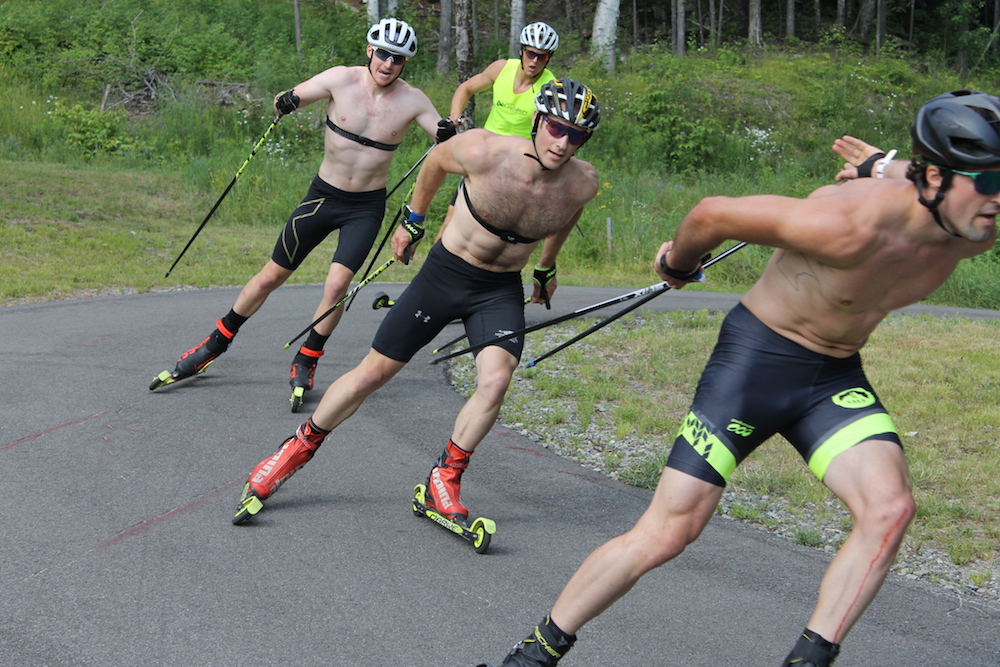
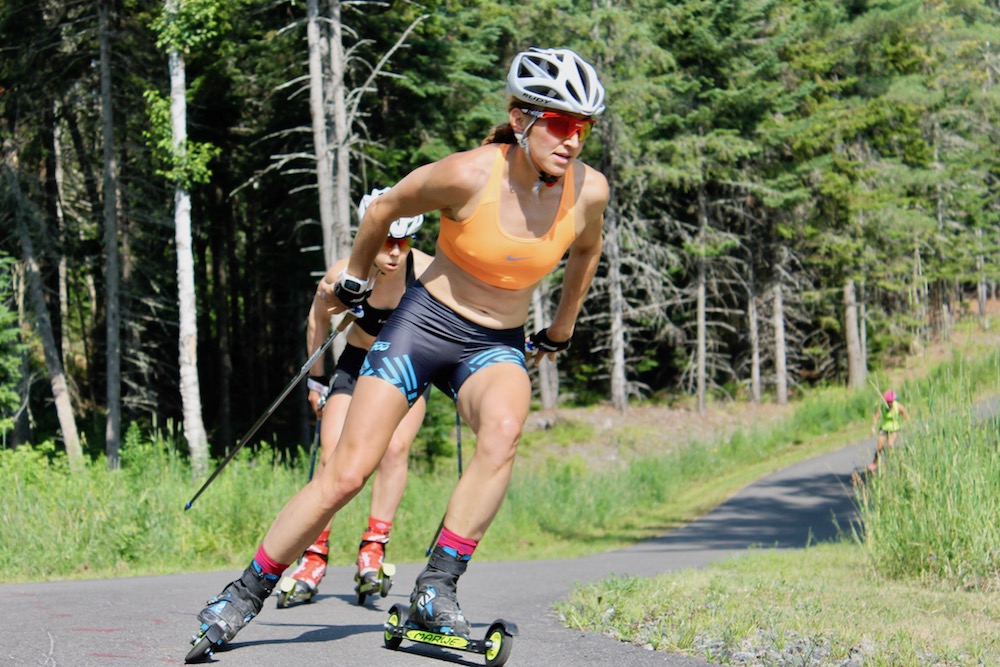
From the FasterSkier archive — posts syndicated from athletes’ and coaches’ own blogs between 2004 and 2012, kept online as published. Current coverage is at fasterskier.com.
Category: Camps
Reports from local, regional, national and international camps used to prepare for Nordic ski racing.
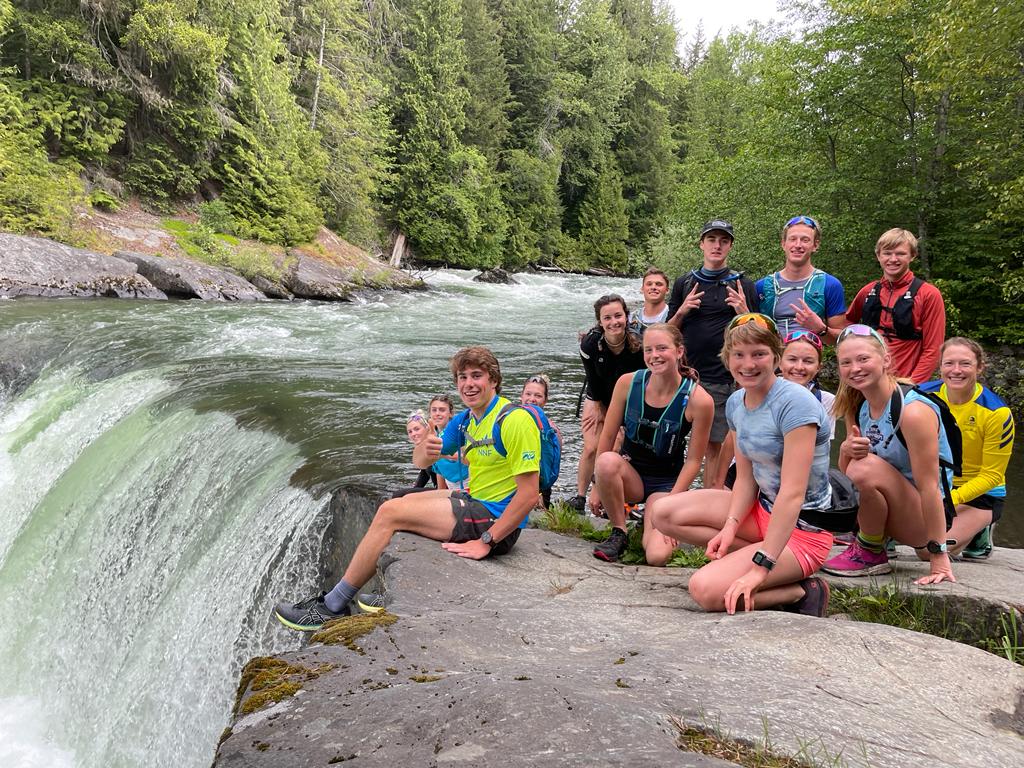
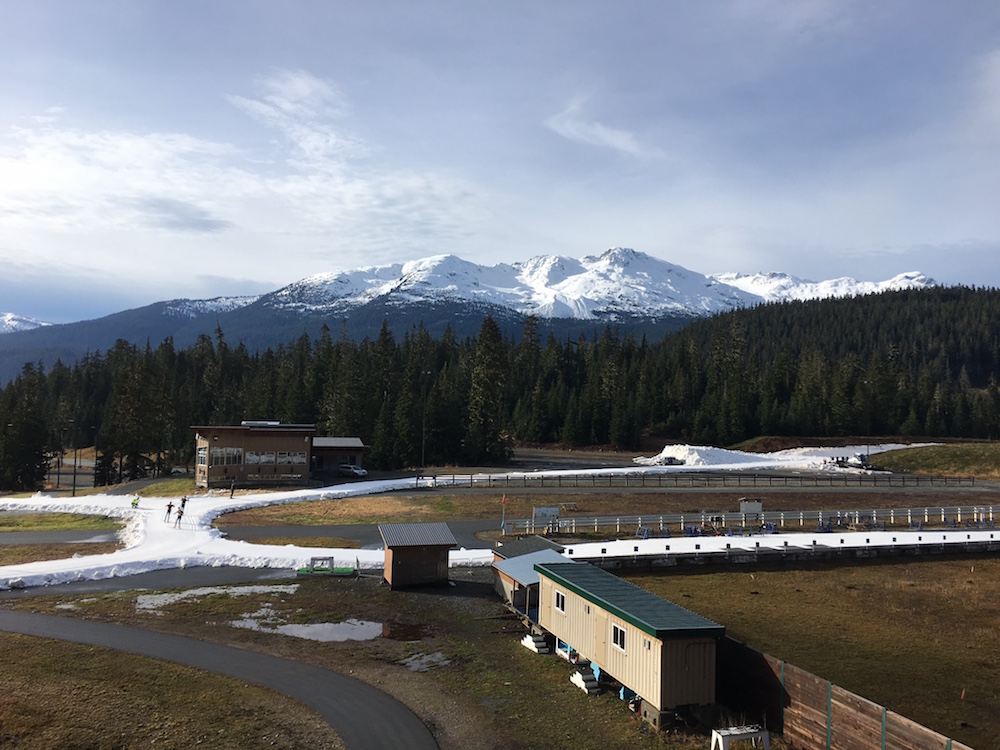
After an untold number of bear sightings and many hours of quality training, the U18 National Training Group (NTG) camp wrapped up in Whistler, B.C. the third week of June. The first of the National Nordic Foundations (NNF) Summer Series, the goals of the camp were twofold: the first was to give these athletes a chance to meet and train together, particularly since the annual U18 Nordic Nations Cup trip was canceled in January due to high COVID-19 cases in Norway; the second was to familiarize the athletes with the venue and living environment in Whistler, as it will be the site of the upcoming 2023 Junior/U23 World Ski Championships in January.
The camp’s attendees earned a spot on this trip after selection by the U.S. Ski & Snowboard (USSS) based on their performances at last year’s Senior Nationals in Soldier Hollow, UT and/or other USSS sanctioned races. Hailing from all over the country, 13 athletes made their way to Canada for a week of training and exploration.
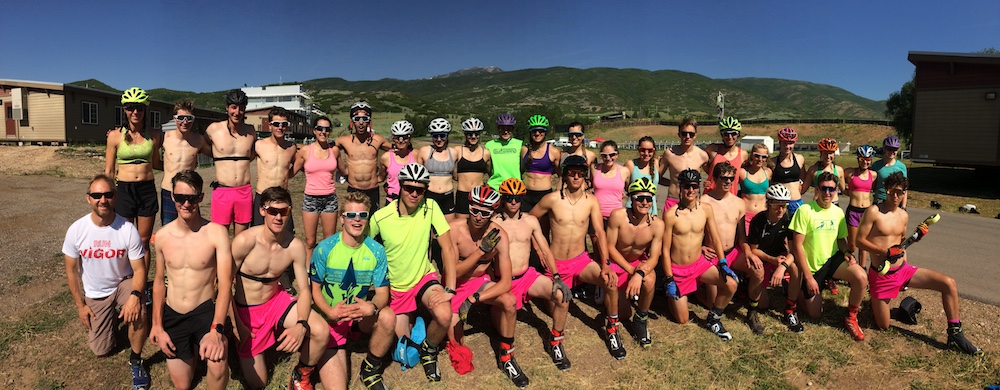
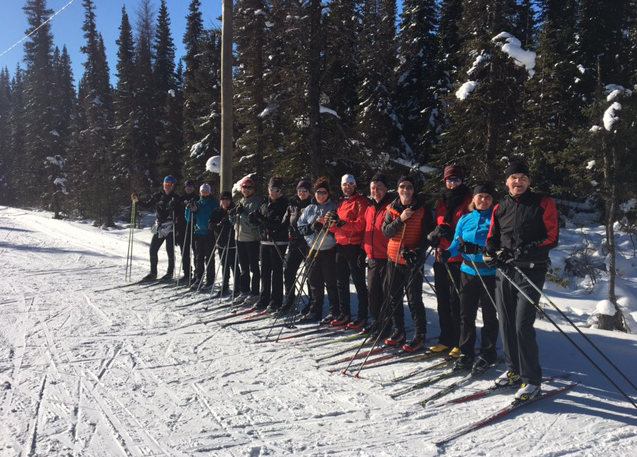
Group shot of the 13 athletes from around the US who participated in the U18 NTG camp in Whistler, BC (Photo: Bryan Fish)
U.S. Ski & Snowboard Cross-Country Sport Development Manager Bryan Fish, explained in an email what this might mean for the American juniors. “Our teams have become very good at traveling well and executing overseas, however our first Junior World Ski Championship medals became a reality in 2017 when Park City, UT hosted Jr Worlds. Those home-field championships helped spark the successful trajectory of USA cross-country skiing. We are trying to build a similar positive environment for these 2023 Championships.”
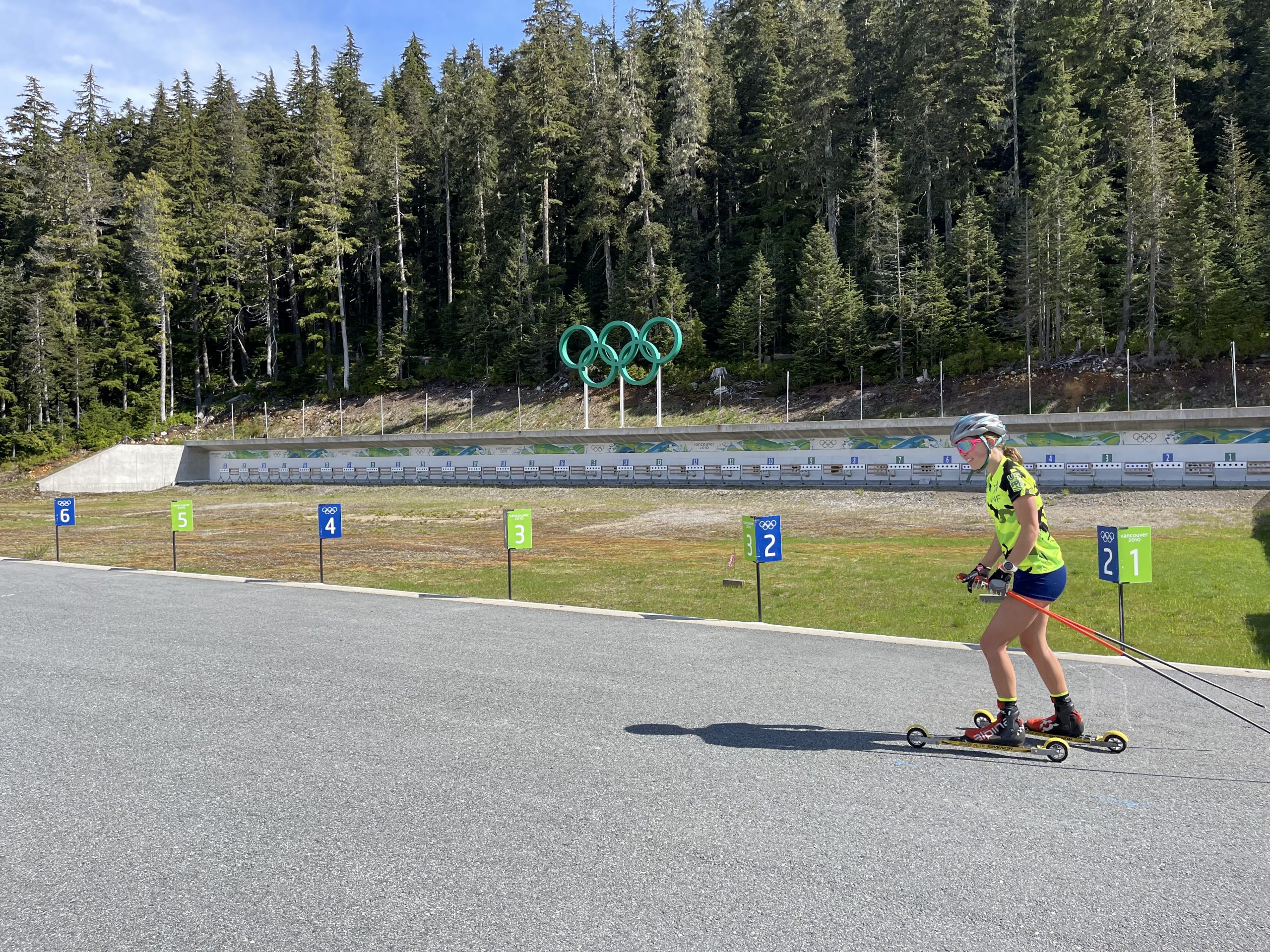
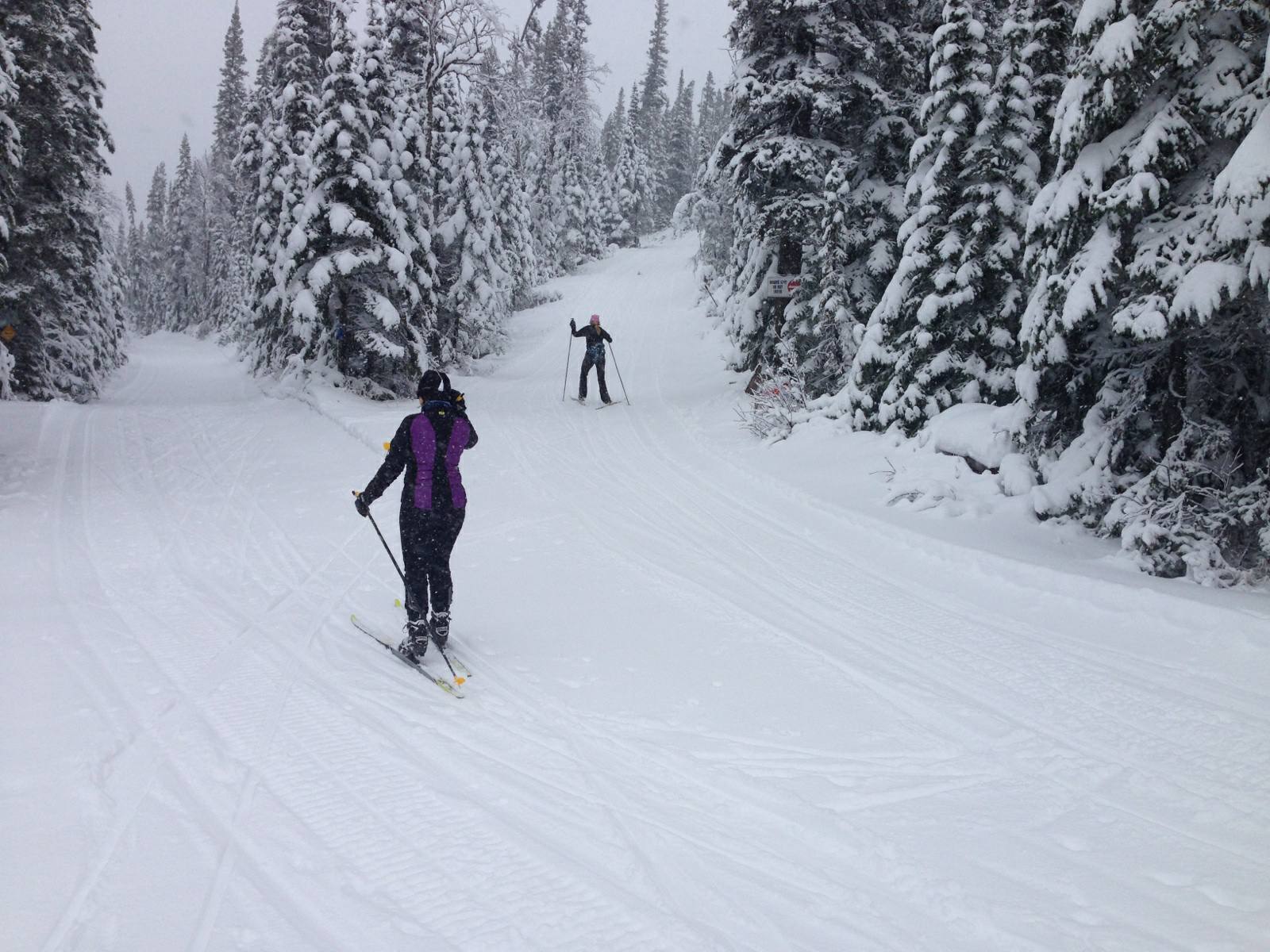
Getting familiar with the trails at the Whistler Olympic Park before 2023 Jr World Championships (Photo: Greta Anderson)
In addition to Fish, the camp’s coaching staff was comprised of U.S. Development Team Coach Greta Anderson, Alex Jospe from Stratton Mountain School, and Naomi Kiekintveld from Alaska Pacific University Nordic Ski Center.
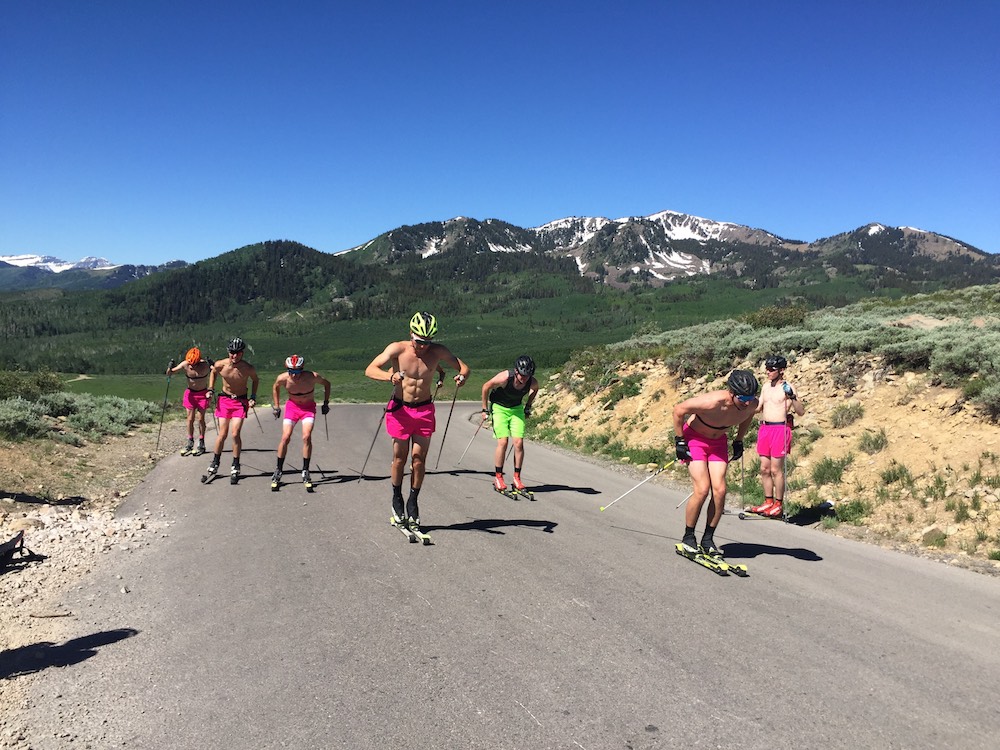
After the recent conclusion of the NTG camp, Fish felt that the camp’s objectives had been achieved. He wrote, “the camp successfully achieved the goals of familiarizing ourselves with all aspects of the venue, the race courses, and the living arrangements. It was a great group of athletes which made for positive and motivating training sessions. The Whistler rollerski track is on a portion of the Jr World race courses, so we spent a great deal of time getting comfortable on the track at speed to understand how the course flows.”
Through collaboration with Nordiq Canada, the joint U.S./Canadian Spring National cross-country Championships were also held in Whistler in March, which Fish explained, “provide[d] our athletes with true on-snow race experience on these courses.”
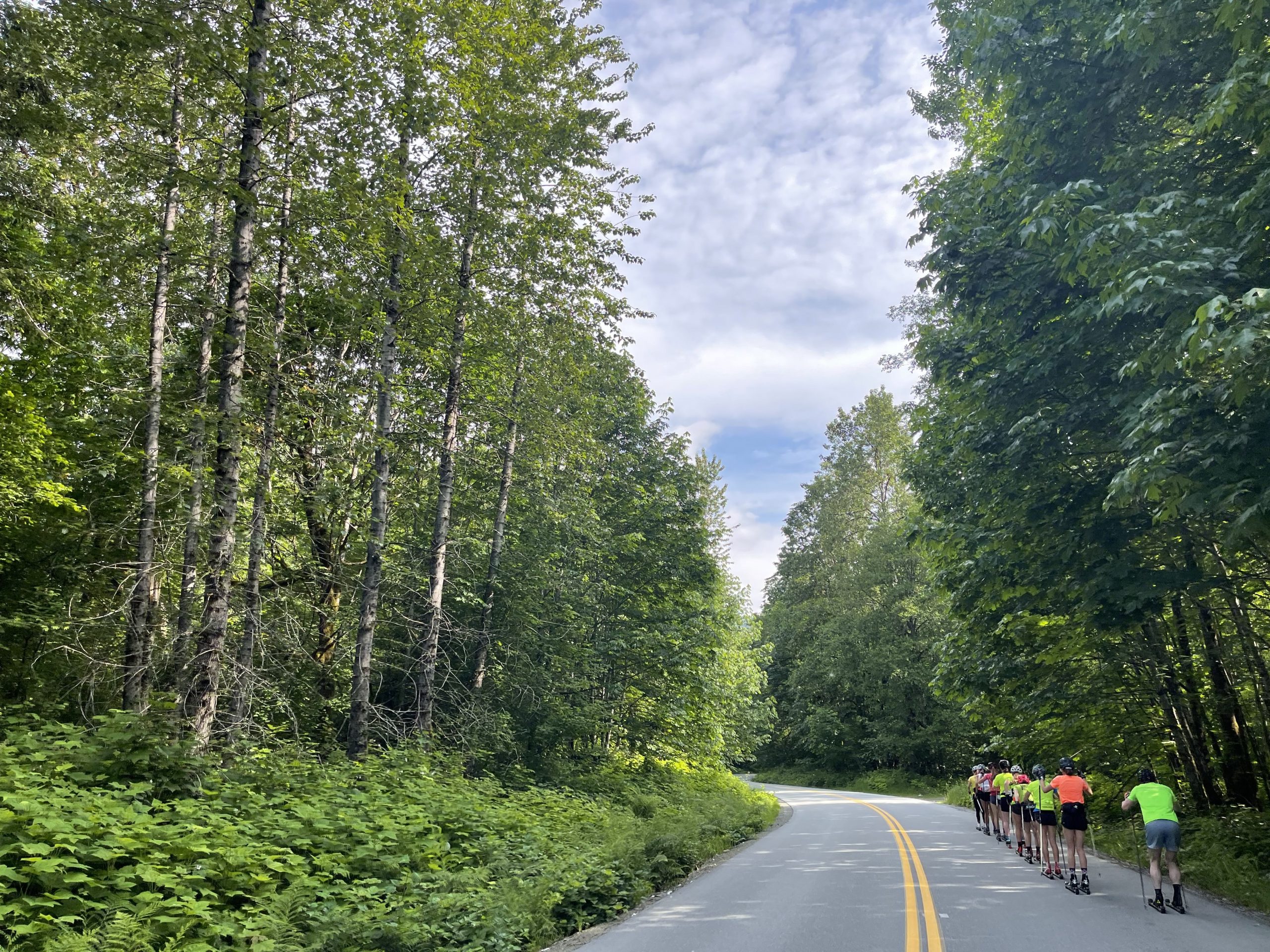
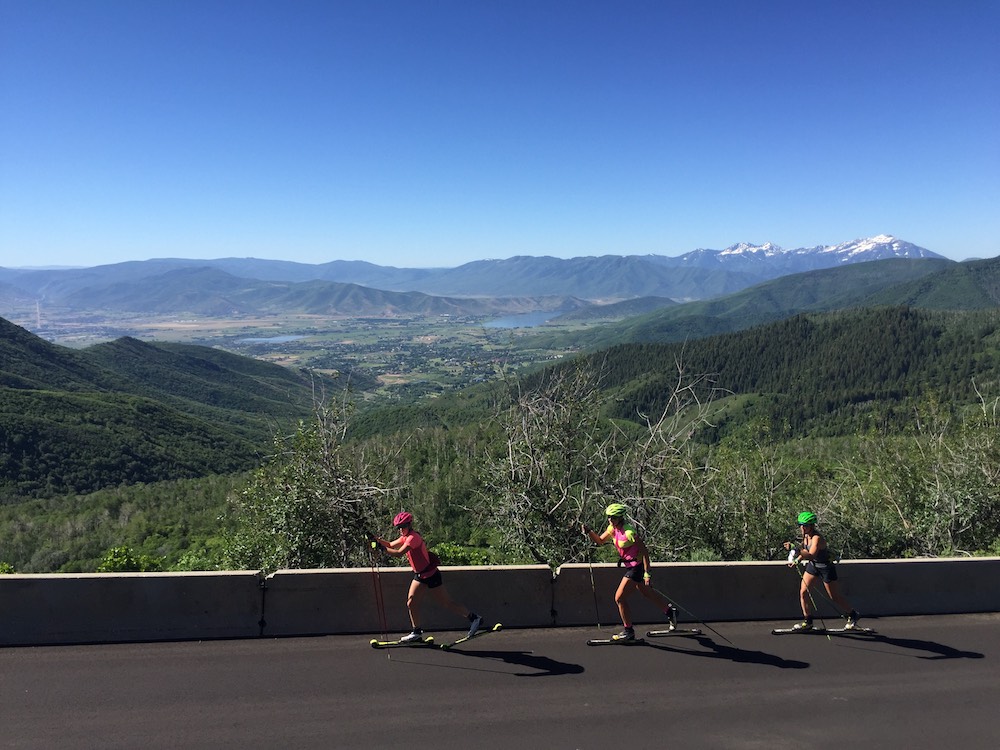
Exploring the area outside of the Whistler Olympic Park and getting some training (Photo: Greta Anderson)
As for the athletes’ perspective, in a blog post written for NNF, Midwest junior Cooper Camp reflected that for him, “one of the most valuable parts about this camp was being able to ski with the best juniors in the nation. Not only being able to get quality training in with each other, but also skiing behind others and learning from what they do, is one of the biggest benefits from camps like these.”
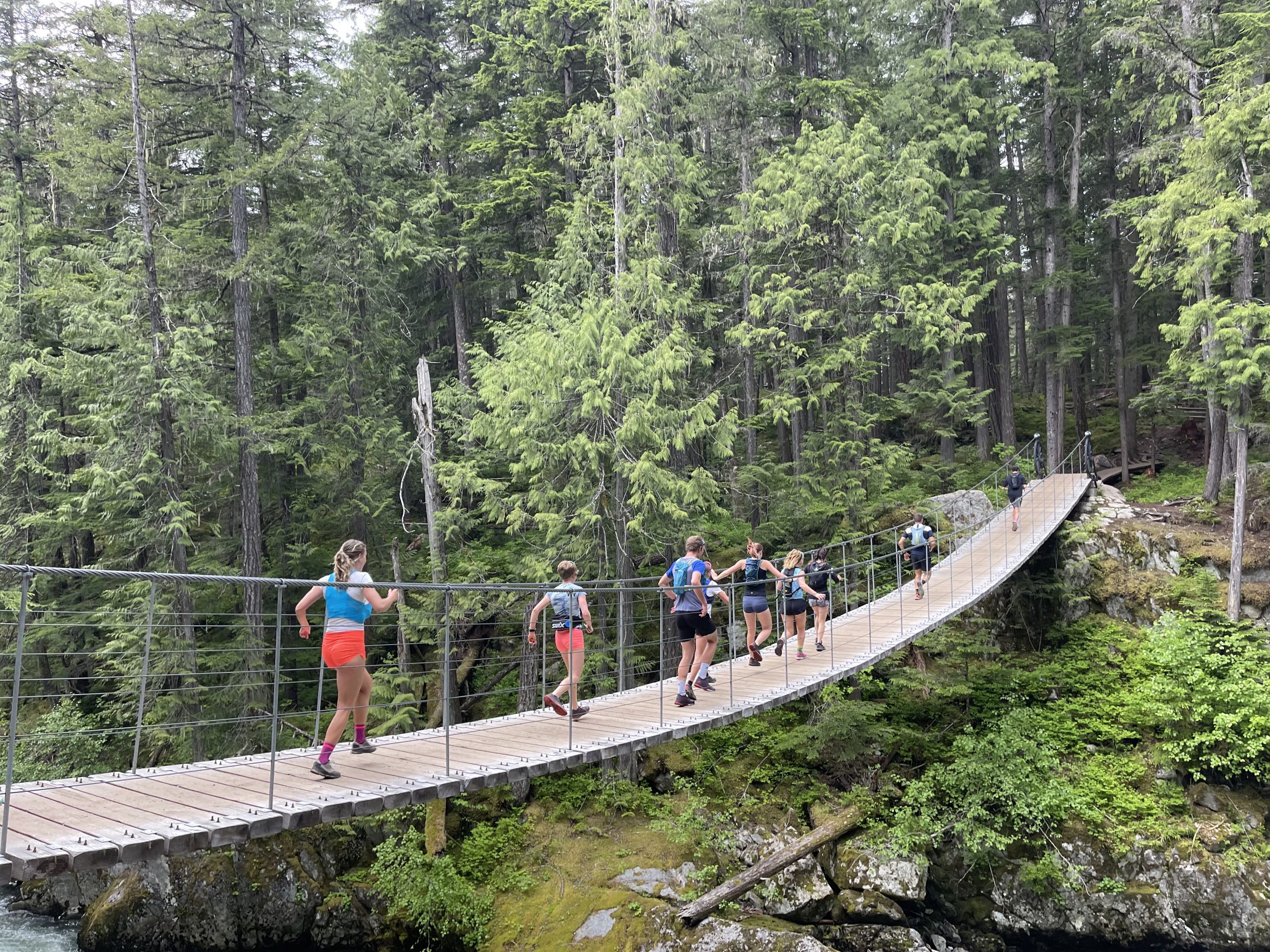
Campers head out for a long run (Photo: Greta Anderson)
Although the athletes have returned home to their respective clubs, there may be more opportunities for them to train together before the summer is over with both Regional and National Elite Group camps still to come. As to who will be returning to Whistler to represent the U.S. at the Jr/U23 World Ski Championships starting January 27th, 2023, both athletes and fans will have to wait until the conclusion of Senior Nationals (Houghton, MI) at the beginning of January before the team will be announced.
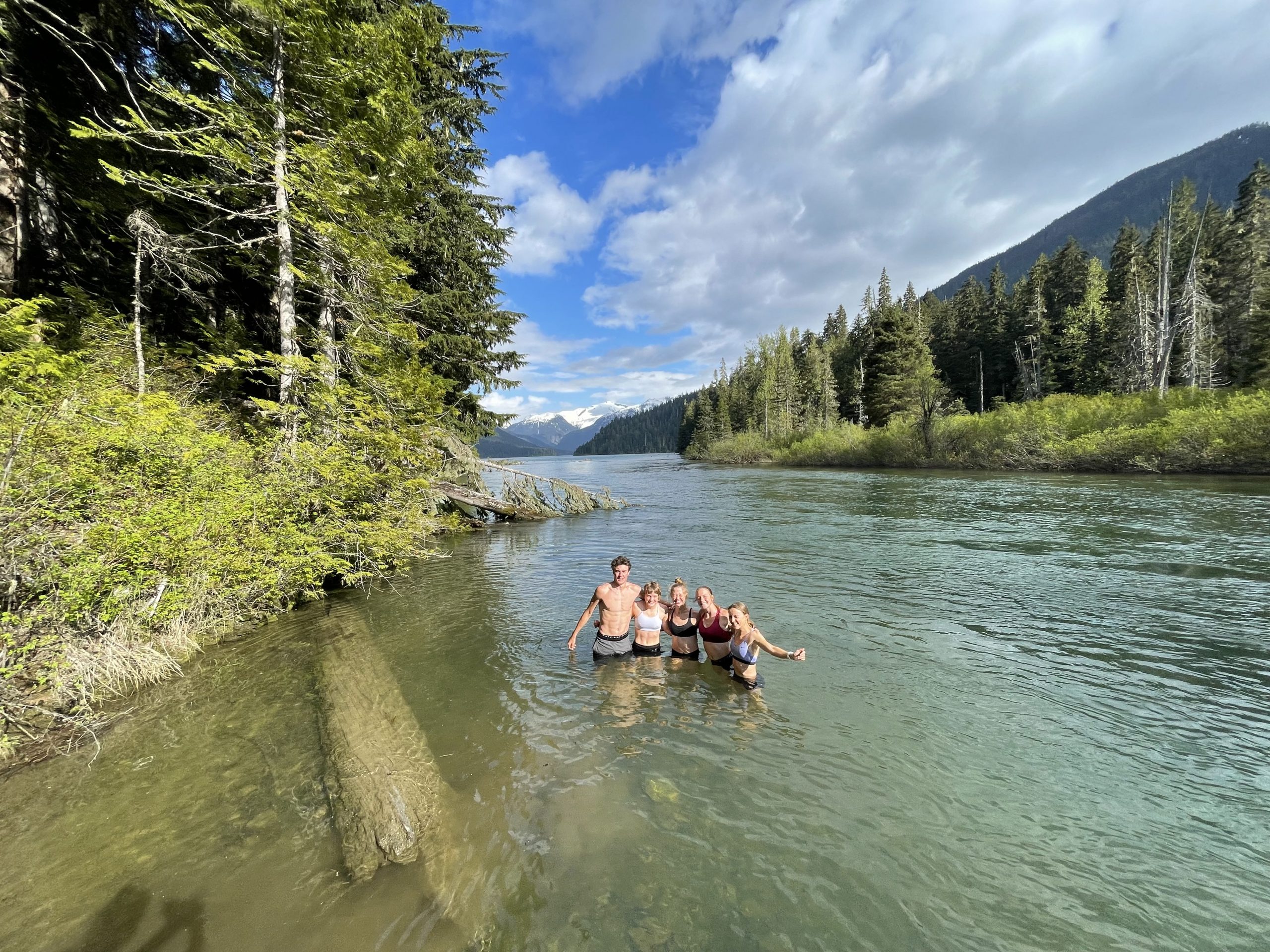
Campers cooling off after a day of training (Photo: Greta Anderson)
For an on-the-ground look at the recent camp, a recap video made by coach Alex Jospe, can be found here.
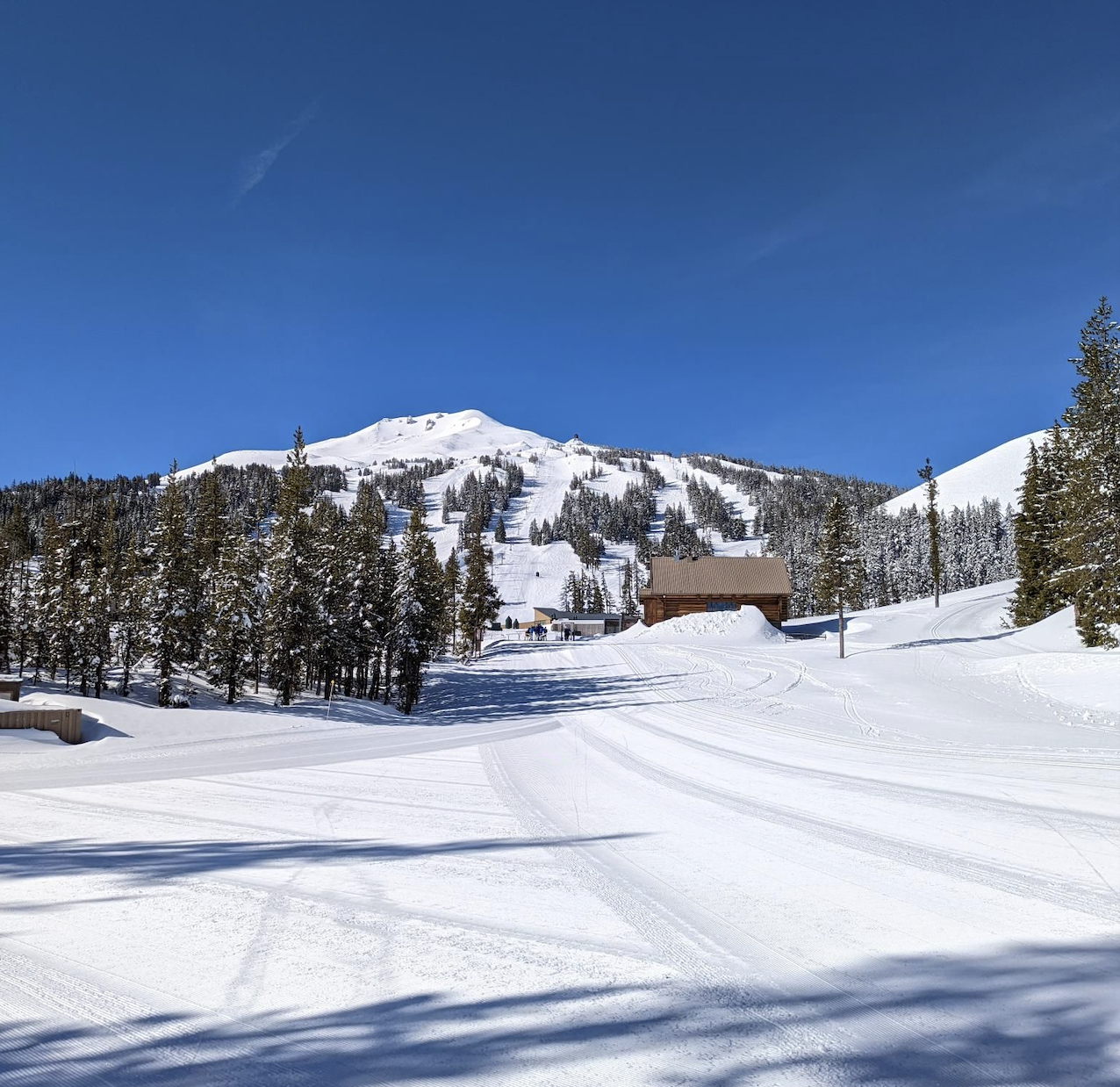
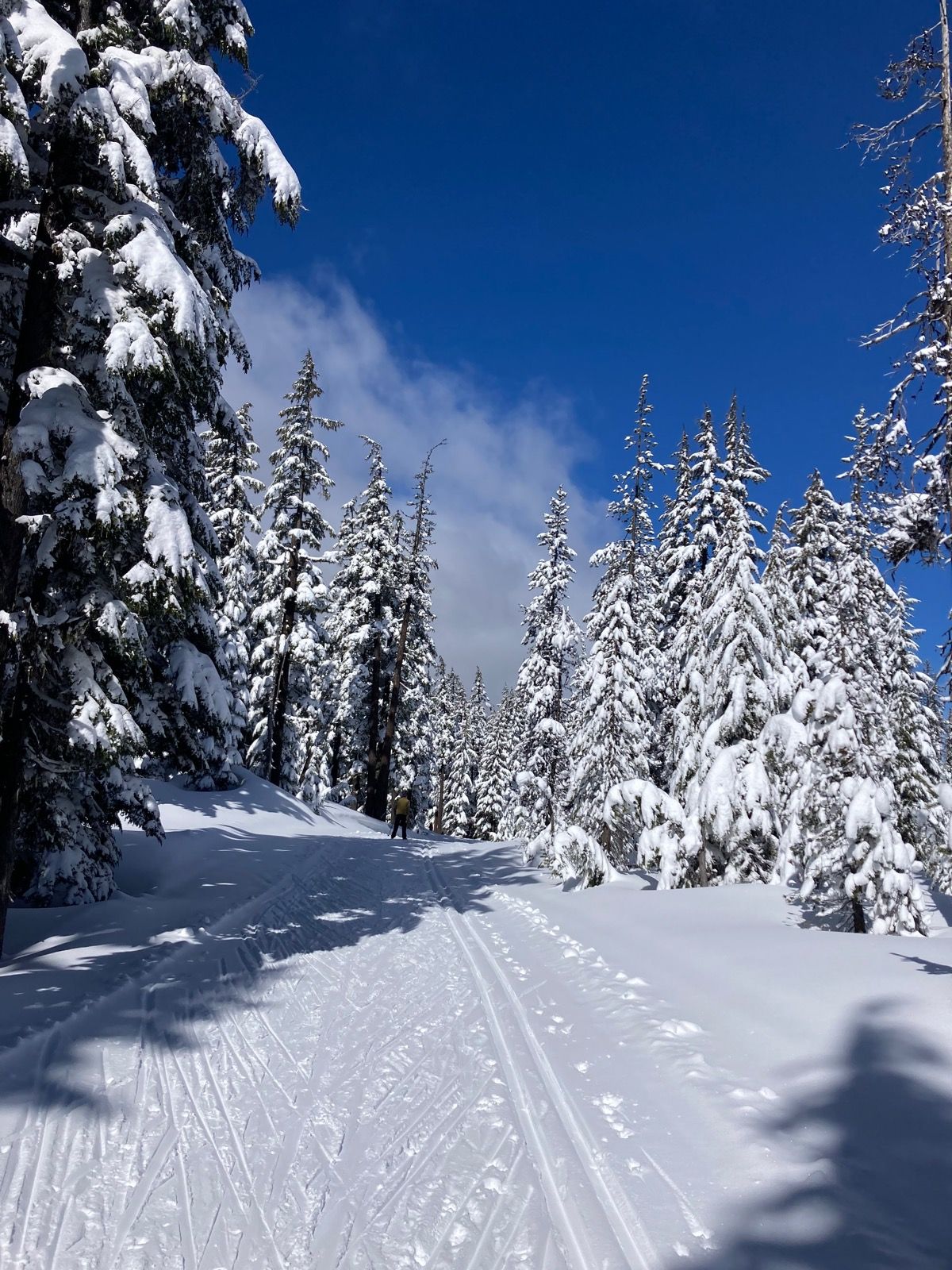
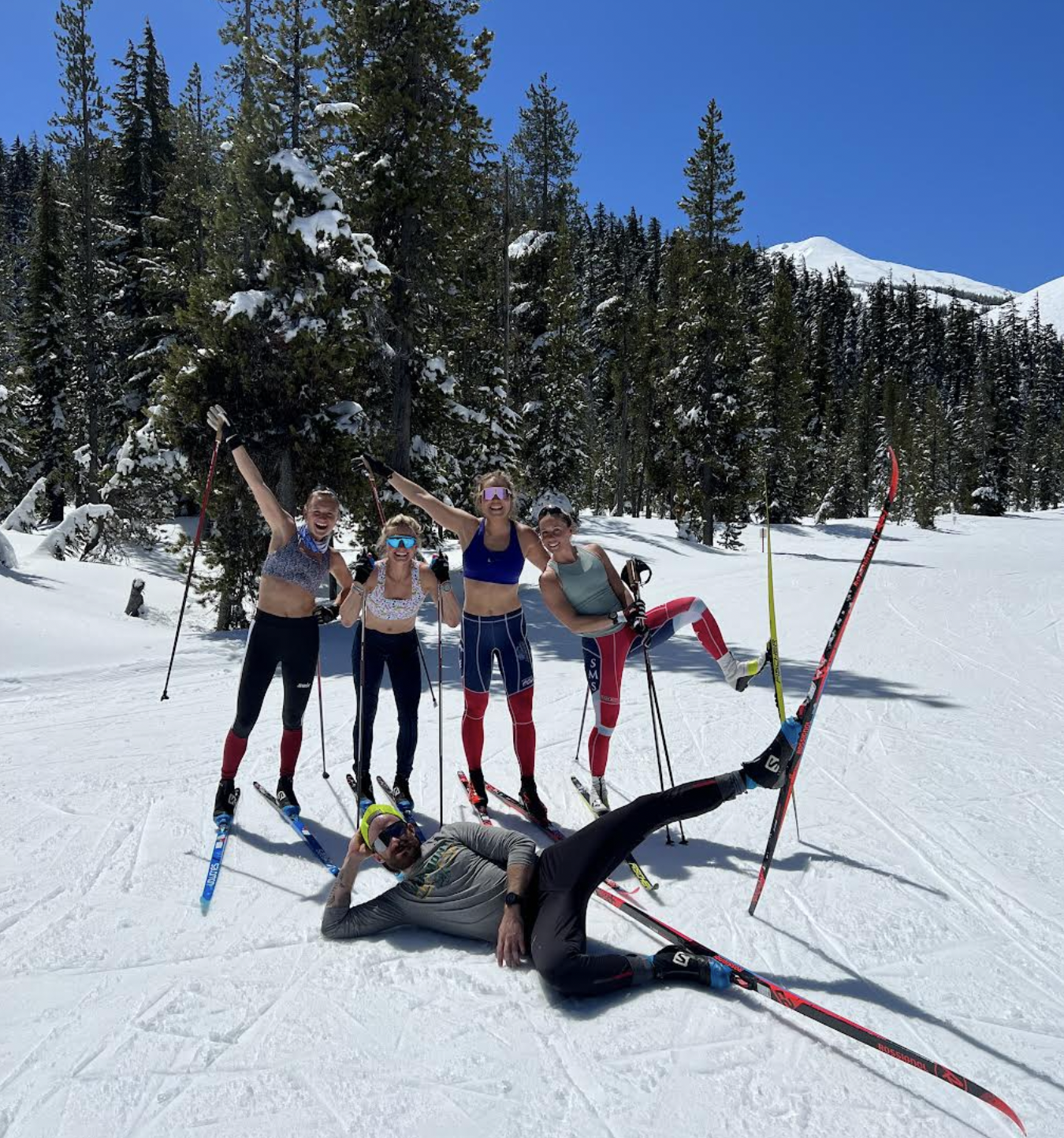
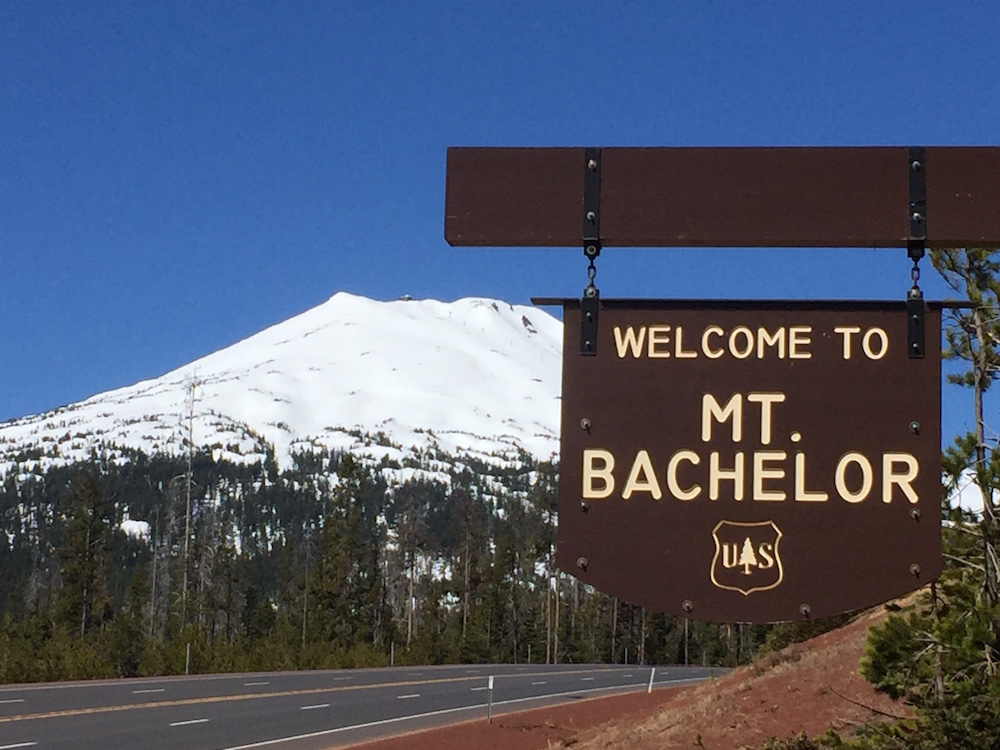
May or January? The US Ski Team has found prime conditions at Mt. Bachelor during the 2022 Bend Camp. (Photo: Noel Keeffe)
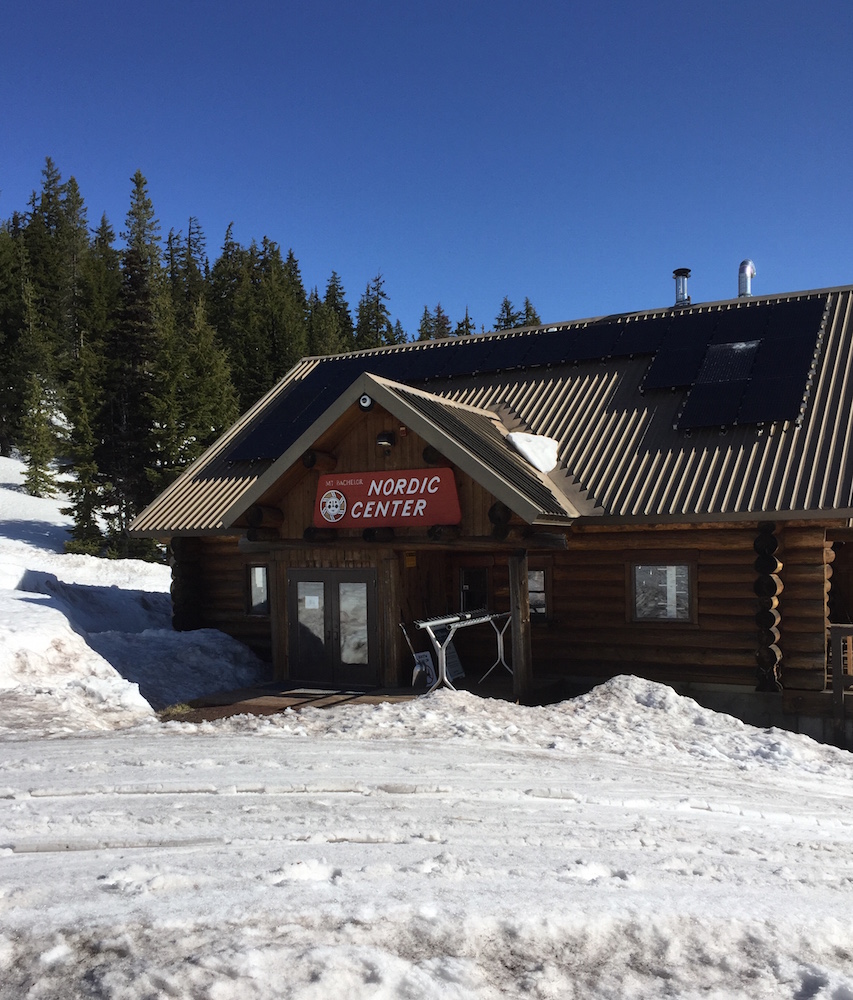
Believe it or not, it is mid-May. For those following a traditional cross-country calendar, this means the start of a new training year, building toward the 2022/2023 competition season. And, for many of the top American athletes, this means it’s time to make an annual pilgrimage to Bend, Oregon for the on-snow camp of the season at the Mt. Bachelor Nordic Center.
The weather gods were kind to the camp attendees, with nearly a foot of fresh snow falling on Mt. Bachelor last weekend, restoring it to mid-Winter conditions. April was also a fruitful month for snowfall, setting up for a base-depth of 92” currently reported on the trails – not bad for May!
To learn more about the camp and what has made Bend and Mt. Bachelor a staple of the U.S. Ski Team’s early season training, FasterSkier connected with head coach Matt Whitcomb, who shared that he has been coming to Bend almost-annually for the last 26 years.
He first experienced the trails at Mt. Bachelor during the 1996 U.S. National Championships.
“I was rooming with Justin Beckwith (current NENSA Competitive Program Director),” Whitcomb recalled fondly. “Amy Caldwell took us out and then Sverre [Caldwell] joined us, and we had our first experience racing Nationals. And it really jumped out as this town that had skiing at its center, not only alpine but cross country.”
The following summer, Whitcomb, Beckwith, and a couple additional training partners hopped into a car and drove to Oregon to spend the summer of ‘97 in Bend.
“But we weren’t, by any means, the first people to do this – we were following in the footsteps of Justin Wadsworth and Pat Weaver and a whole bunch of other people. And by our senior year [at Middlebury College], we had twenty-something people driving out from the east just to experience what Bend has in late May and June, and we’d be there through August until we had to go back to college.”
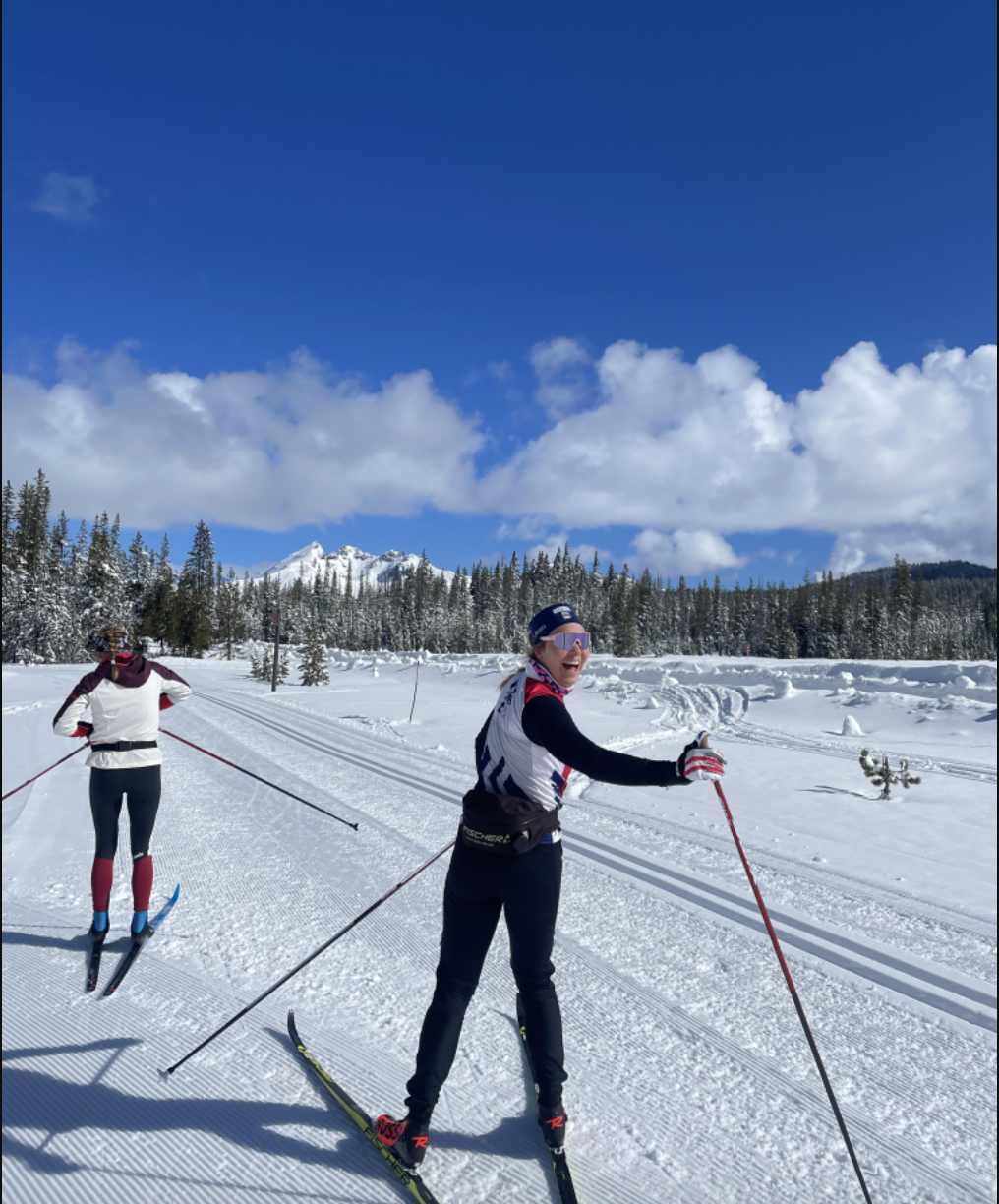
Lina Sutro (right) and Alayna Sonnesyn (left) enjoy fresh snow and a fresh groom at Mt. Bachelor during the 2022 Bend Camp. (Photo: Lauren Jortberg)
What Bend has in late May and June, he said, is a vast array of diverse training opportunities, which most importantly includes snow.
“That’s probably the first thing that really drew us in, particularly as people from the East.”
He shared that the snow report they had received from Mt. Bachelor Nordic Center manager Sue Foster was measuring the accumulation from April storms in feet, not inches.
But it’s not just the access to snow on its own that makes Mt. Bachelor worth the trip.
“The trail system is world class. You’re skiing through Douglas fir — just these massive, old old trees on creative, windy, hard trails, and on a good year they’ll have close to 30 or 40 kilometers groomed for us still in May.”
In addition to its geographical location and an accumulation of over 300” of snow annually, the elevation of the Nordic Center preserves the snowpack for late season skiing. The parking lot sits at roughly 6,000’ above sea level, while trails range from 5,750 to 6,400’.
This puts Mt. Bachelor in a similar altitude zone to Soldier Hollow, UT, offering athletes both an early season bump in red blood cells and the opportunity to fine tune their altitude skiing strategies, “which is something that we really value. Because skiing at altitude is not just something for the aerobically gifted; it’s also something for people that develop the skill of how to actually ski at altitude. So that’s been great.”
Whitcomb also lauded the convenience of Mt. Bachelor relative to their lodging down in Bend, roughly a 25 minute drive down the mountain at a significantly lower elevation of roughly 3,300’. In addition to easy access to the trails, this gives the team the opportunity to train high and sleep low, as well as to enjoy non-ski training modalities in a totally different climate.
“So recovery is complete. We can also go roller skiing in the afternoon, we can go mountain biking, we can run in shorts and tee shirts. It’s like you’re experiencing the summer and the winter on the same day for two weeks in a row.”
Fresh snow and vitamin D — Jessie Diggins and Alayna Sonnesyn head to Mt. Bachelor for the 2022 US Ski Team spring training camp. (Photo: Lauren Jortberg)
Overall, Bend and Mt. Bachelor have become a special place for Whitcomb, and for the many athletes who have made their way there over the years.
“It’s just such a wonderful environment. The way these cascade forests smell this time of the year when the new growth is coming up — you step out of the car when you first arrive and it’s like, ahh. I could be blindfolded and tell you exactly where I was.”
While Mt. Bachelor offers high quality grooming all season, Whitcomb also spoke to the relationships the US Ski Team have developed with the trail operations team, and their willingness to adapt their usual grooming patterns to best serve the visiting skiers. This year, Whitcomb is looking to replicate the track format of a World Cup stadium so the team can practice “switching lanes in the finish and figuring out how to develop more speed — a bit of a twist to our [usual] speed training.”
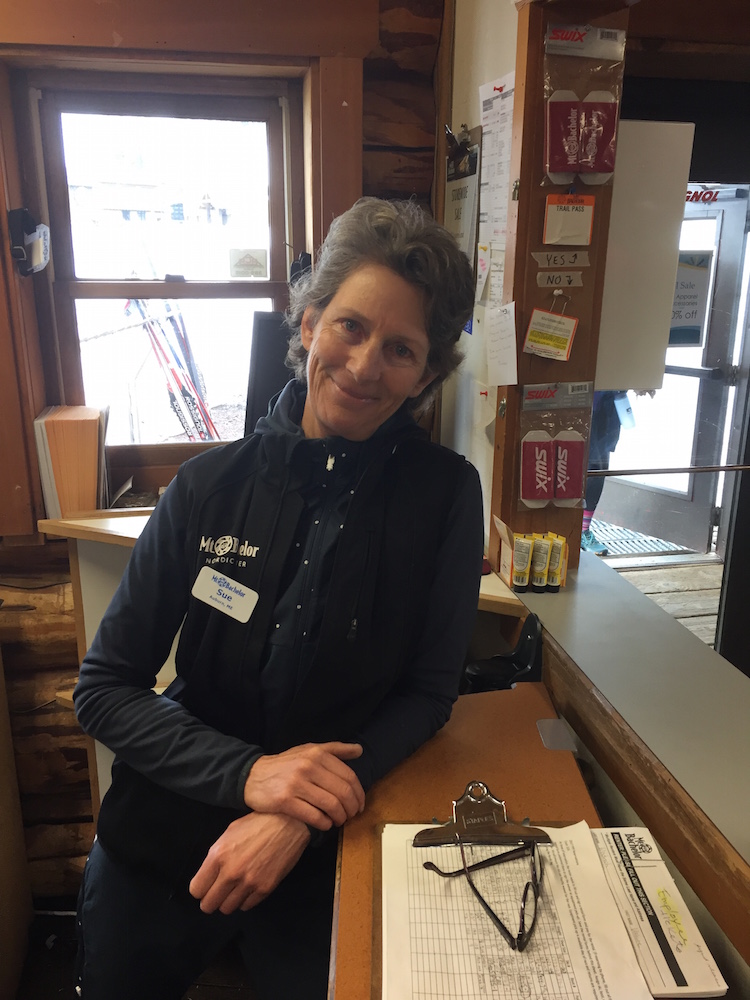
At the helm, and helping US Ski Team coaches interface with the grooming team, is the aforementioned Nordic Center Manager, Sue Foster, who Whitcomb says has been an invaluable resource over the years.
“She meets us in the lodge every day, she helps us prepare the TV and the chairs so that we can do a little visualization before every session. And she’s just a delightful, inviting person that makes you want to come back and see [her.] It’s rare that every athlete on the team knows the names of the people working the lodge, but Mt. Bachelor is one of those places.”
Midwinter conditions return in May to Mt. Bachelor. (Photo: Alayna Sonnesyn)
Off the ski trails, Whitcomb shared that a highlight for many athletes is the lower elevation terrain in Bend, where the unique volcanic geology of Mt. Bachelor sets up for miles of tacky “hero dirt” for afternoon rides.
“The mountain biking is some of the best in the US, particularly in May, before it’s gotten dusty.”
During the late spring, many trails along the Deschutes River are also beginning to open up, and often the team will be dropped off an hour and a half up-river to enjoy a point-to-point run back to their cluster of rental houses.
This year, the team is spread between three large rental homes in close proximity, with the staff house centrally located to host nightly team dinners catered by USOPC chef Megan Chacosky. To reduce COVID risks among the team and staff, masks are still worn during team meetings, allowing them to safely happen in-person. Though mask mandates and COVID safety precautions are largely being dropped, Whitcomb expressed the importance of keeping athletes and staff healthy, setting everyone up for success during the high-volume summer months of training.
“I think the world has made a major shift to decide that the pandemic is over, but we’re pretty well aware that the COVID is not done yet.”
Finally, Whitcomb cited the greater ski community in Bend as a reason the camp has been such a valuable component of the annual training cycle.
“As far back as I can remember, it didn’t matter whether we are registered with a local club or not, we were always being invited by [coach/director] John Downing to the XC Oregon sessions. He’s still a good friend of the team, and we have so many locals in town that are helping us out and welcome us every year to town.”
Acknowledging that he was only giving the short-list of names from the Bend skiing community who have supported and welcomed the team each year, he also noted former physiologist at the Olympic Training Center in Colorado Springs Tim Gibbons, who builds excitement for the camp by giving Whitcomb snow reports all winter, indicating how the trails are shaping up for spring skiing. And lastly, he thanked the members of the Mt. Bachelor Ski Education Foundation (MBSEF), including nordic director Dylan Watts.
This community support allows the team to maximize their time training in Bend, while also creating opportunities for outreach via programs like Fast and Female or hosting workouts for the MBSEF junior athletes. This partnership helps the team feel connected, and also stoke the enthusiasm of the next generation of cross country skiers.
“It just really feels like a family that we’re coming back to every year. So thanks to everybody that has always been welcoming. We try to be great ambassadors for the sport, and we need partners like this [to continue to move forward as a nation].
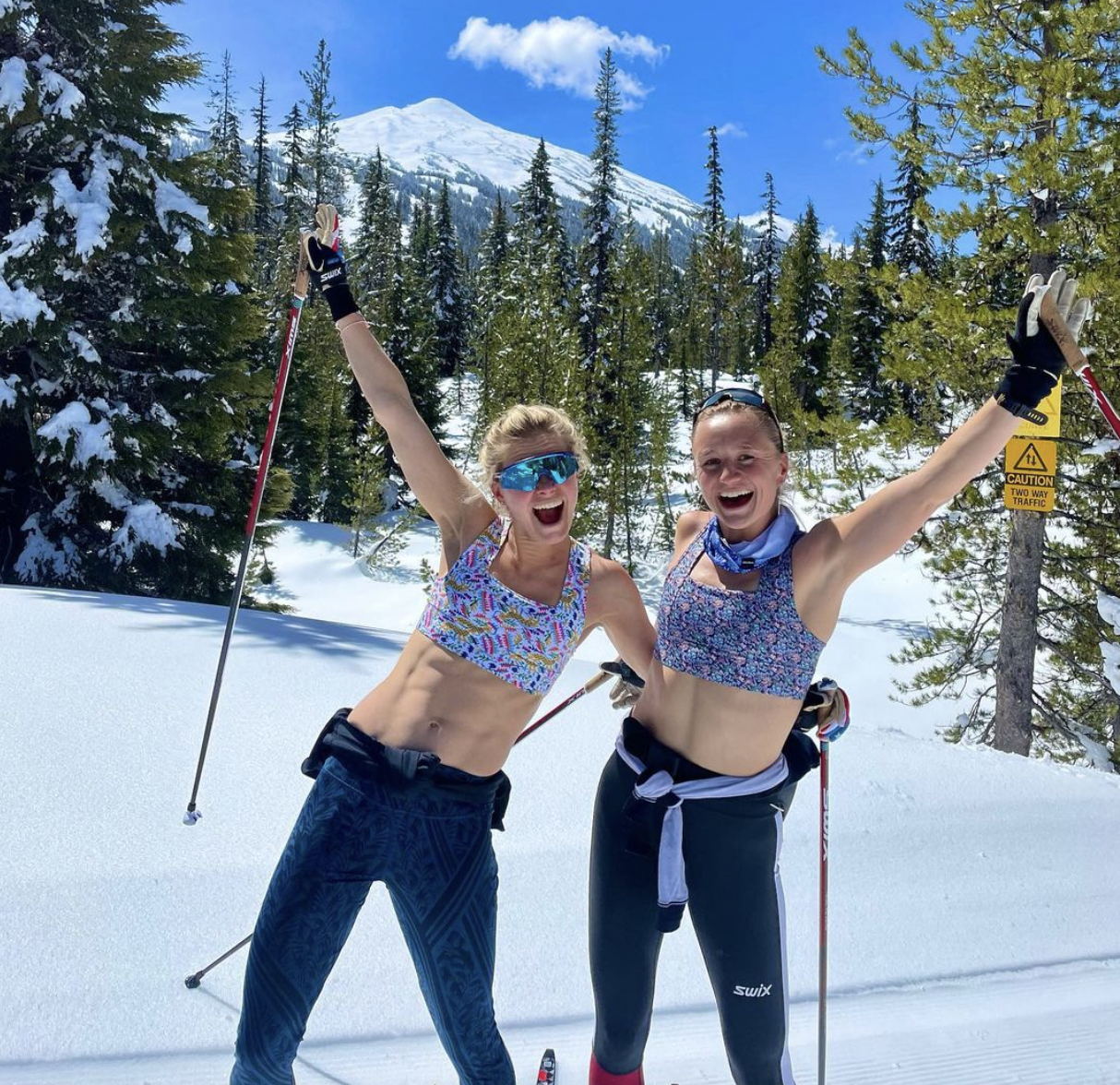
Sun, snow, and lots of training during the 2022 US Ski Team camp at Mt. Bachelor. (Photo courtesy Alayna Sonnesyn)
The Mt. Bachelor Nordic Center is known for it’s world class spring cross-country skiing. You can find more information about spring conditions at mtbachelor.com.
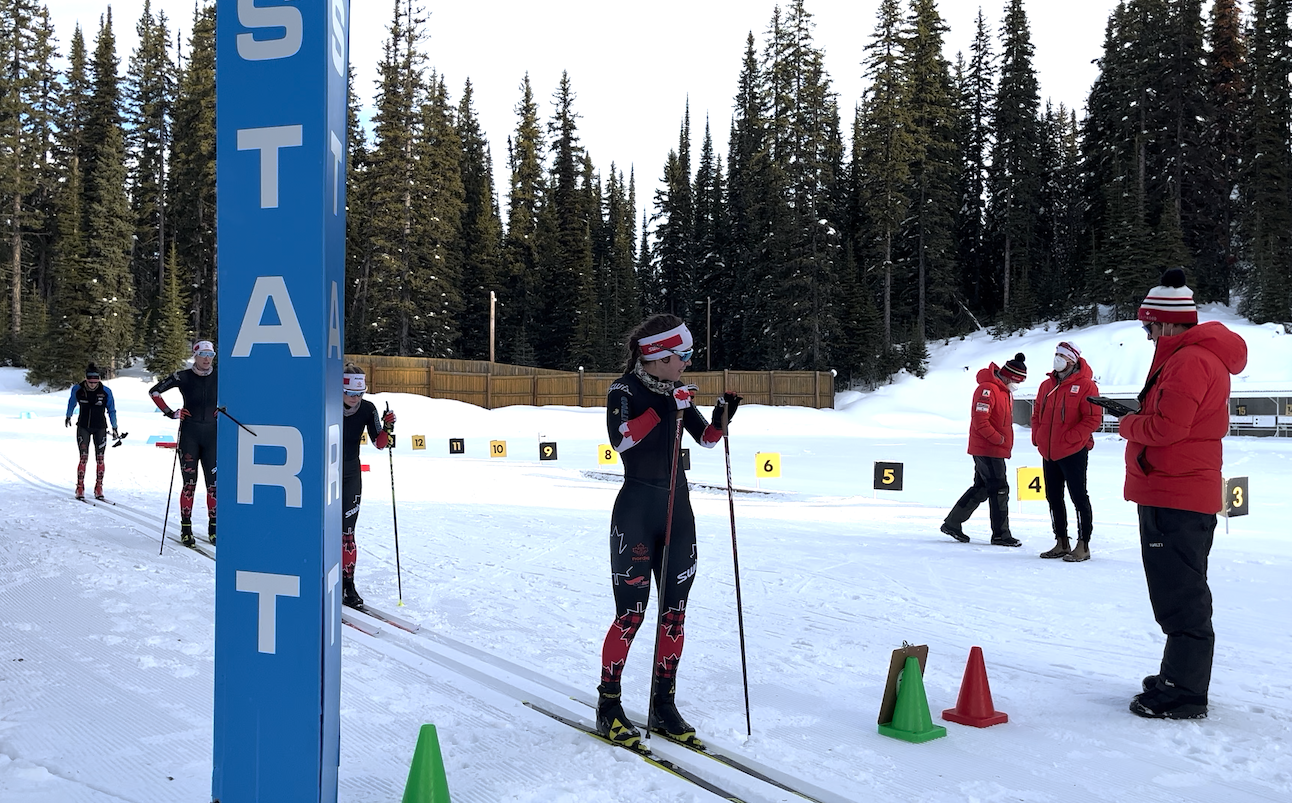
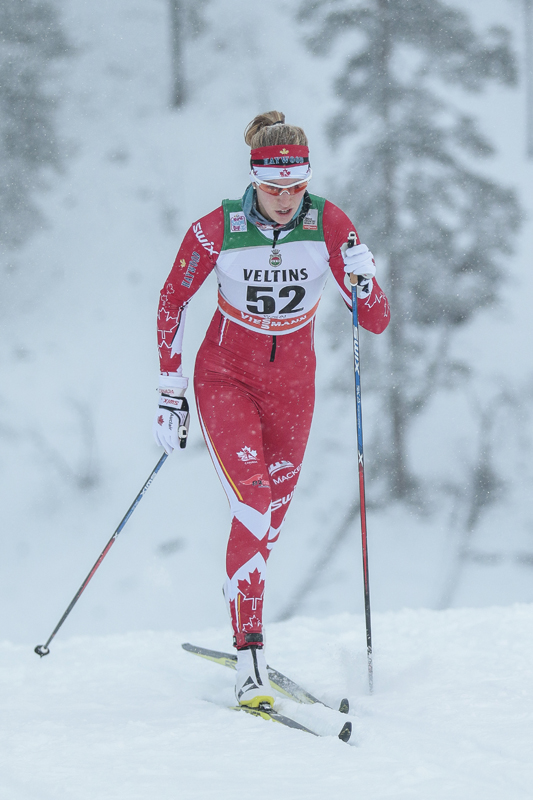
Katherine Stewart-Jones ready to start a skiathlon at the Olympic Prep Camp.
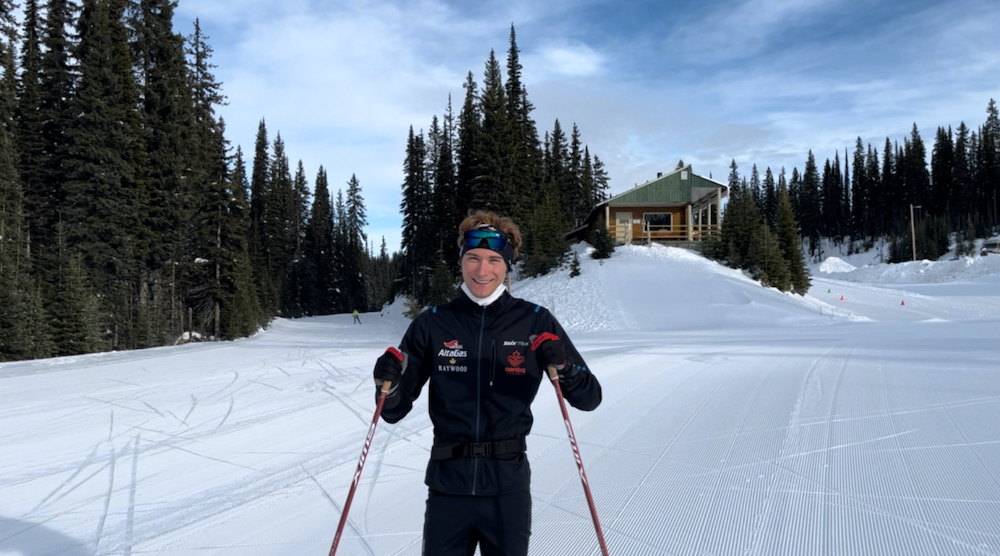
The Canadian Prep Camp in Sovereign Lake and SilverStar, BC prior to the 2022 Beijing Olympics sounds like a nordic skier’s heaven.
A two-week ski vacation with 100 kilometres of perfectly groomed snow. A private room above a great coffee shop (pain au chocolate!) and next door to some great beer. January weather just below freezing with enough falling snow to make every day a hardwax day. Two weeks of what locals call superhero snow. A whole lot of sunshine.
The reality was a little different: COVID stress, travel uncertainty, and outside pressure combined to make this very much a work trip, not a vacation.
The camp, which ran from January 12th to 25th, included nine athletes, the high-performance manager plus two coaches, two wax techs, a massage therapist, and a cook.
The athletes included the majority of the 2022 Olympic Team: Katherine Stewart-Jones, Laura Leclair, Dahria Beatty, Tony Cyr, Olivier Léveillé, and Graham Ritchie. Alternates Olivia Bouffard-Nesbitt and Rémi Drolet would officially join the team after the quota reallocation during the second week. Second alternate Russell Kennedy will not add to his Olympic CV and will instead go to his third Paralympics as a guide, supporting the well-decorated visually impaired athlete, Brian McKeever. The only Olympic team member not in attendance was Cendrine Browne, who chose to train in Canmore, while second alternate Jasmine Drolet returned to school at Dartmouth and earned her first collegiate wins.
World Cup coach Erik Bråten, Next Gen coach Eric de Nys, Team Lead and high performance manager Joel Jaques, techs Simon Boisvert and Félix-Antoine Vezina, massage therapist Stephen Waterreus, and Zoe the cook made up the support crew. Everyone except de Nys and Zoe are going to Beijing.
When this writer asked for last names, the response was always, “Zoe? You know Zoe.” In the end, it was revealed that Zoe is Zoë Roy, who retired from racing in 2014 as a founding member of Team Ninja. Yup, we all know Zoë.
All interviews were done on snow, from a distance, with FasterSkier wearing an N95 mask.
On Snow Training
The on-snow part of the camp was reported to have gone very well. The coaches were able to find times and trails that allowed training races that closely matched the Olympic course for profile and elevation while keeping distance from the local skiers.
The Zhangjiakou 5km course elevation range is 1639m to 1696m. The Sovereign Lake upper World Cup 5km is 1651m to 1708m, with the stadium at 1660m.
The Friday sprint course worked fairly well, despite a layout that would give any technical delegate apoplexy. As Bråten explains above, the coaches chose to do four qualifiers instead of heats to manage risk.
The Sunday skiathlon course ended up being 13km for the women and 17km for the men, with some flat sections removed from the 5km loop to better mimic the Olympic courses.
Bråten was often seen working with athletes one-on-one.
As the days counted down to departure, skiers were working on filling their bags with seconds gained: a tweak in one skate (V2) poling, free skating further on a fast flat section, experimenting with pacing on courses that simulate Zhangjiakou.
The mood of the camp seemed slightly tense, at least to a journalist who was careful not to pierce the bubble. The change on Tuesday morning, 12 hours after everyone passed the final COVID test, was dramatic, with smiles everywhere.
“It’s been fantastic conditions and just a really nice camp all around, it’s always nice when you get some sunshine,” Kennedy told FasterSkier. “So yeah, especially after a [World Cup] Period One in Finland in the dark.”
First time Olympian Rémi Drolet is all smiles after passing the final pre-travel testing.
COVID Management
COVID protocols at the camp were strict, races were more relaxed.
A positive test would be the end of one person’s Olympic dreams and a logistical nightmare for the support team. Any close contact of the infected person would not be able to travel. Any replacement person, athlete or not, would need to follow the same testing protocol. If that replacement wasn’t ready for the scheduled flight, the complexity of travel planning might be insurmountable.
In order to travel to the Olympics, the athletes, coaches, and techs would all have to pass two PCR tests less than 24 hours apart in the final 96 hours before boarding. Once at the Calgary airport, there would be another PCR test, with a fourth upon arrival in China.
Nordiq Canada chose a more restrictive plan than some other countries. Each person (athlete, coach, tech, cook, massage therapist) had their own room and didn’t enter other rooms. Meals were delivered. Grocery shopping was done by local resident, de Nys, scheduled for 7am to avoid crowds. No one entered coffee shops, bars, or restaurants. Each morning, everyone would do a rapid antigen test in their room. Athletes skied from their accommodation at SilverStar to the homologated trails at Sovereign Lake to avoid close contacts in vehicles. Only de Nys and Zoë the cook had contacts outside the bubble, and neither is going to Beijing.
The goal behind this aggressive protocol was twofold. First, to prevent exposures. Second, if one person tested positive, there would be no close contacts forced into isolation or removed from the Olympics. The two wax techs (Simon Boisvert and Félix-Antoine Vezina) inevitably had a shared bubble as they shared a private waxing room.
Was this the right answer? We got three answers to that.
Drolet found the camp harder than usual: “We were still able to ski together a little bit, but it was definitely a little bit lonely at times.”
Kennedy, entering with a mentally tough prospect of only making the team if disaster struck a friend, found the positive. “The guys have been playing, like hanging out online together… And we’ve been skiing together. So it’s separate, but at the same time, not too lonely.”
“Ask me on Monday afternoon when we get all the results back,” Jaques told FasterSkier on Sunday morning. “We’ve taken the right precautions so we’ll just see. But I think it’s looking good.”
A number of athletes mentioned feeling comfort in knowing they were doing everything possible to protect their Olympic dreams.
The system has worked. Everyone tested negative and the entire team is now on snow in Zhangjiakou.
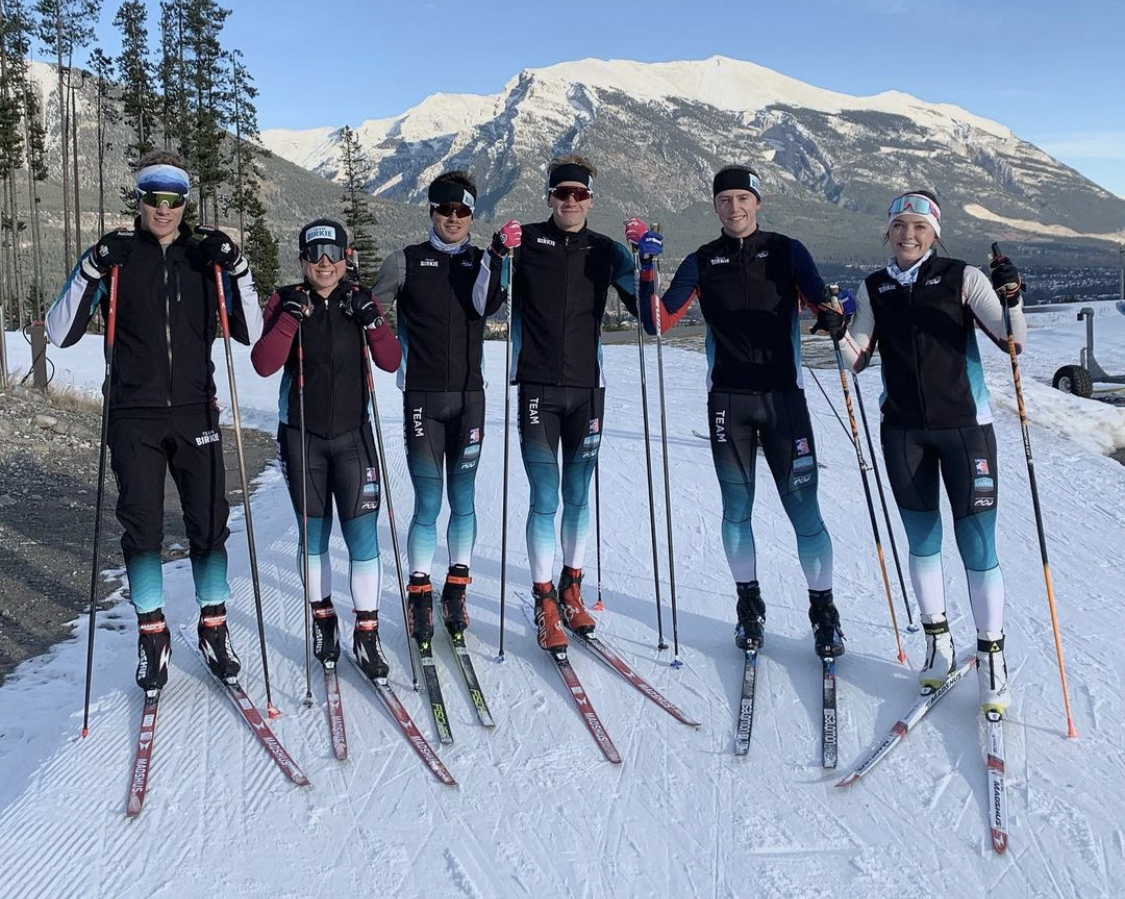
Team Birkie athletes at Soldier Hollow, Christian Gostout, Ingrid Thyr, Jordan Schuster and Zak Ketterson (left to right). (Photo: Team Birkie)
At the end of October, Team Birkie headed west for three-weeks. Leaving the midwest in search of a higher altitude training venue and snow, they headed first to Park City, UT, then north to Canmore, Alberta, where winter has already settled in.
Coach Caitlin Gregg had several objectives for the camp, primarily related to training time above sea-level. Her first goal for the team was to get in a three-week altitude block, in order to learn how the Team Birkie athletes respond at higher elevation to guide preparations for the races at altitude coming up this season, including U.S. Nationals at Soldier Hollow and the Super Tour stop in Sun Valley, ID. Gregg explained the second objective for this camp was to give the athletes time at the Soldier Hollow venue to familiarize themselves with the trails and race course, as well as to experience some higher altitude living in Park City.
In the second phase of camp, Team Birkie headed to Canmore, Alberta to take advantage of the early-season Frozen Thunder ski track while continuing to train at altitude, this time with higher intensity sessions and races on snow. The time in Canmore not only offered the athletes early-season snow time but also provided Gregg and assistant coach Leo Hipp with the opportunity to learn as much as possible about the athlete’s individual fleets of skis so they feel prepared when race waxing and guiding selection in the competition season.
Skis on snow in Canmore. Athletes Christian Gostout, Ingrid Thyr Andrew Millan, Zak Ketterson, Tony Mathie and Jordan Schuster (l-r). (Photo: Team Birkie)
For all six of the athletes who travelled to Canmore, this was their first time on snow this season. Although the only trail open was a 2.5k loop, Gregg shared that they took advantage of the opportunity to work on refining technique and got in lots of ski testing. As athlete Ingrid Thyr said, “Ski selection and waxing can play a huge role in racing, so this was a great opportunity to spend a couple of weeks dialing those things in with my coaches.”
Team Birkie member, Zak Ketterson shared that his personal goal for this camp was to put in plenty of quality training hours on snow in preparation for the upcoming races.
“Getting on snow this time of year can be really difficult, so I definitely try to not waste the opportunity when I have it,” wrote Ketterson. “The more time you have on snow before the first races, the better. Skiing on snow is just different enough from roller skiing that it can be a bit of a transition at first.”
In addition to technique work, Gregg prepared very specific goals for the team’s intensity sessions and race prep that are hard to mimic with dryland training.
Zak Ketterson capitalizing on snow time at Frozen Thunder (photo: Team Birkie)
Travel between the US and Canada is a bit more involved these days, thanks to COVID protocols and procedures. The team flew from Salt Lake to Canada and was required to present proof of vaccination and a negative PCR test within 72 hours of departure. In spite of this, Gregg said, “We were lucky and the travel process on both ends of the trip was very smooth.”
In addition to the snow loop provided by the Canmore Nordic Centre for Frozen Thunder, Nordiq Canada put on two race events in which 100 athletes from Canada and the U.S. participated. The first being a 5/10 k classic and the second a 10/15k skate. For Team Birkie’s Christian Gostout, these races were about learning.
Gostout had COVID in September and had to take a substantial amount of time off to recover.
“Because of this,” he explained, “I came into the camps without a lot of rest, so I was prioritizing good performance and execution of our key sessions (intervals etc.) while being quite weary of volume and fatigue outside of these sessions.”
The two time trial events in Canmore provided the opportunity to re-learn how to embrace the discomfort of racing.
“I didn’t bother to look at results until well after both,” said Gostout, “I went into the first race knowing I was going to make lots of mistakes, but that I would learn from them. I definitely did make said mistakes, but I felt surprisingly good while racing! My next goal was to correct for the things I had done wrong the second day, and see if I could improve the quality of my race. I did manage to execute certain things better on day two, but the camp fatigue finally caught up with me, so the performance as a whole wasn’t great. The overall experience has me optimistic for the upcoming races.”
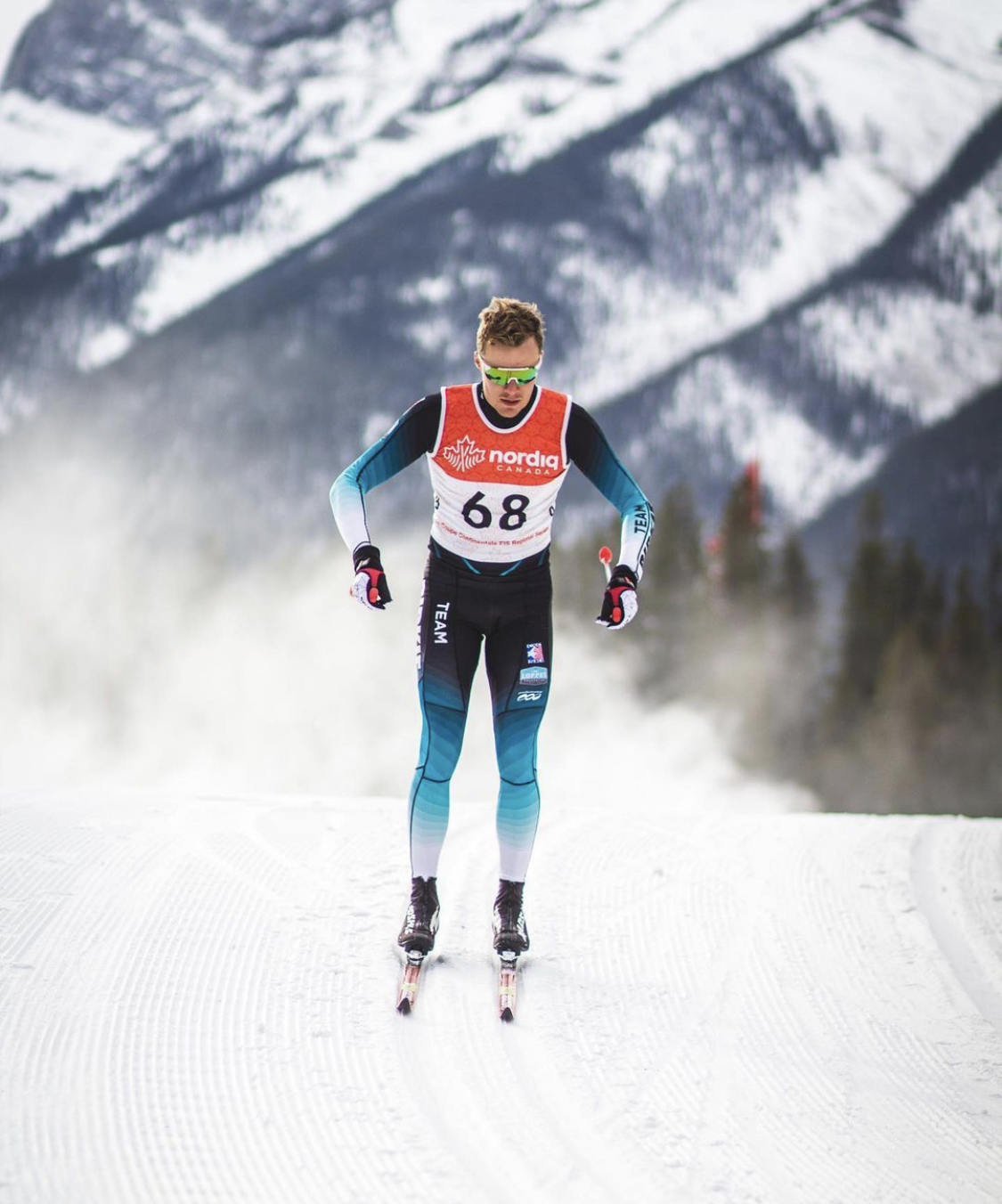
Christian Gostout competing in one of the time trial events at Frozen Thunder in Canmore, AB. (Photo: Anna Sellers)
For Ketterson, he approaches any race effort with the same mentality, regardless of the type of competition.
“Even if these races weren’t super ‘important’ from a season standpoint, I still try to go into any race with a similar attitude,” he wrote. “I view these races as some of the best practice I can get for the races I am really training for. I would be lying if I said I didn’t care about them, because I definitely do. Any race I do I will try to put my best foot forward because racing is a skill that gets better with practice.”
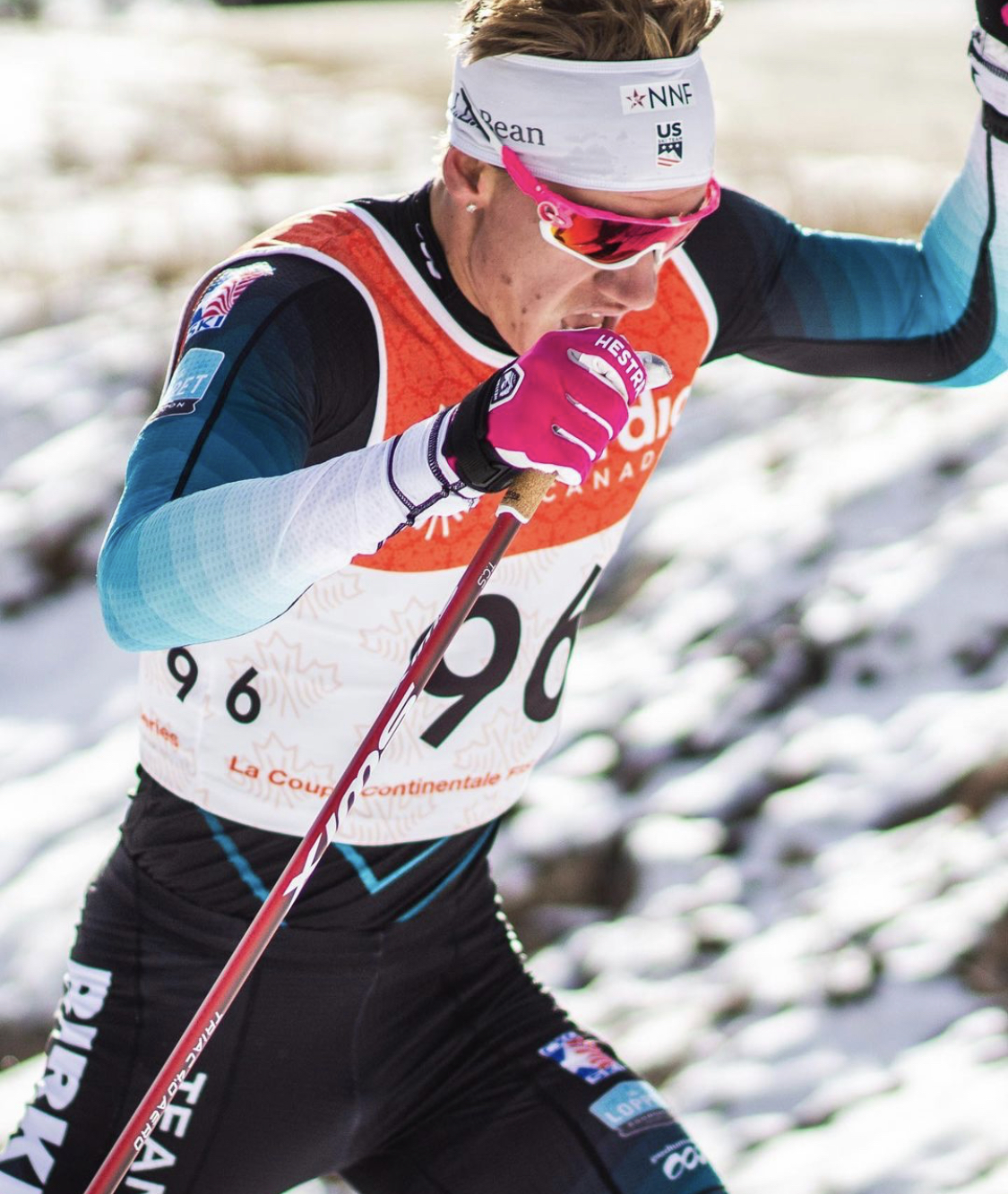
Zak Ketterson pushing hard at Frozen Thunder (Photo: Anna Sellers)
Racing and training aside, the three weeks resulted in different highlights for everyone. Gostout shared that a classic ski the team did up towards Lake Moraine was a favorite, saying, “It finally felt like winter, and I was just skiing for the joy of being out. Those kinds of days can’t be beat.”
Team Birkie heads up the snowy road in wintery conditions (Photo: Team Birkie)
Ketterson wrote that a personal highlight from the trip for him was watching coach Caitlin Gregg do some hard skate intervals on her birthday.
“Caitlin has really embraced her head coaching role this year — so much so that it can be easy to forget that she is still an incredibly fit skier,” he wrote. “I thought it was really cool to see Caitlin flying around the course and watching people’s expressions as she skied by. I am sure they were probably hoping she wouldn’t be doing the races.”
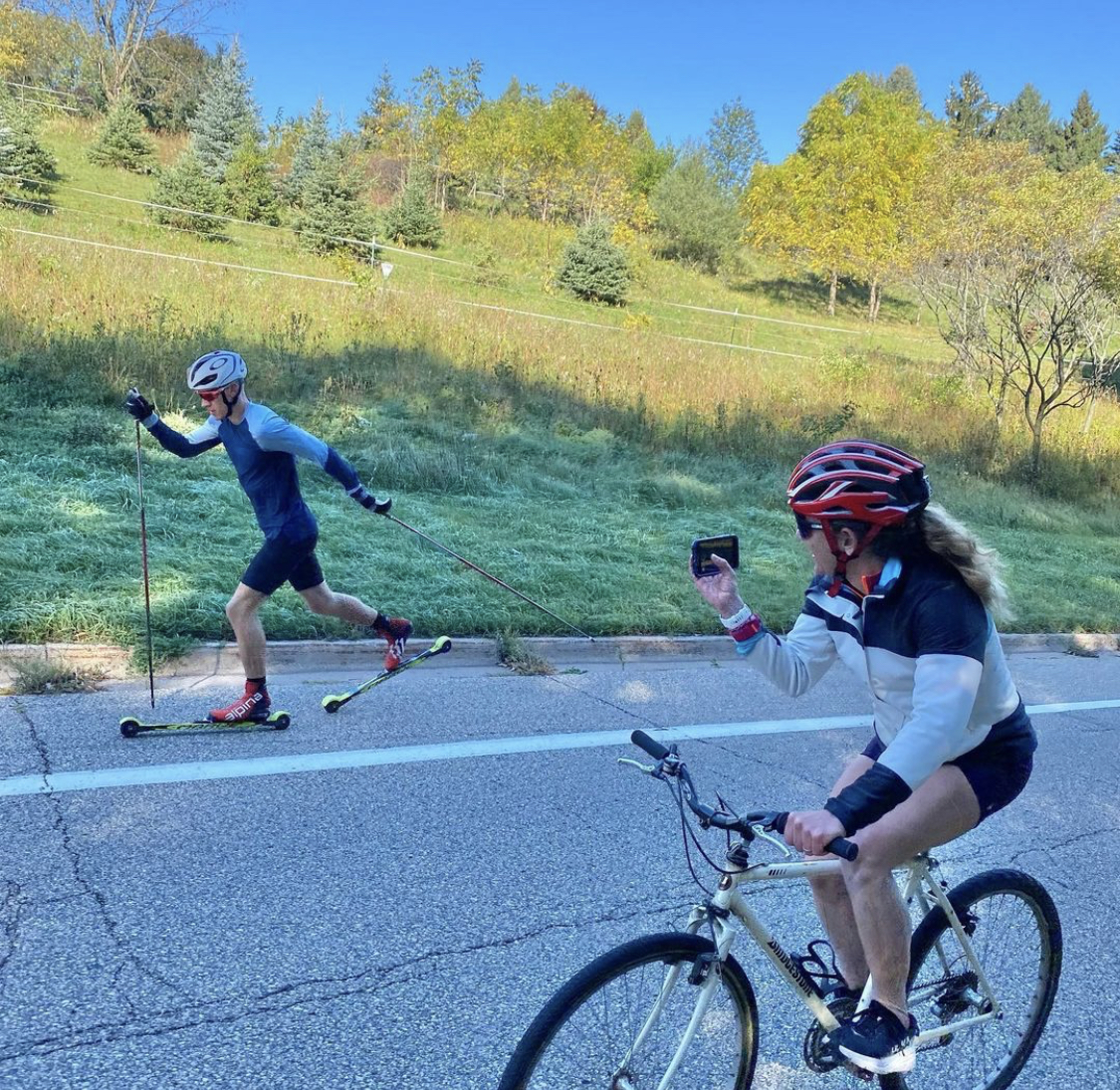
Coach Caitlin Gregg videos athlete Zak Ketterson during a rollerski session this summer (Photo: Caitlin Gregg)
Gregg reminisced that as an athlete traveling to Park City and Canmore was one of her favorite camps and now as a coach she loved it even more. Gregg said, “The high quality training in both locations was exactly what we needed and we now have an off week before our final preparations for the start of the season in Duluth, MN in only a few weeks.”
With the first Super Tour happening December 4-5th, the race season is just around the corner. Looking ahead in the upcoming season, the Team Birkie athletes have a range of goals.
Gostout wrote, “You have to go all out and dream big when an Olympic year comes around, so I do want to have strong early season races in the December Super Tours and at US Nationals. Even more so because the early races will be in the Midwest, and Team Birkie has the opportunity to showcase our success to our local community.”
Ketterson stated that his main goal is to make the Olympics in Beijing starting in February.
“I know that is a goal for a lot of skiers this year and most of them are working really hard for it, just like me,” said Ketterson. “At the end of the day, I just want to improve every year because skiing is a long-term type of game and I know that hard work pays off — if not this season, then eventually. All I can do is my best, and I have been trying to do that every day.”
Returning home after three weeks at altitude, the team is taking some time for rest and recovery before the race season kicks off in earnest. As Ketterson said, “My focus now is on staying healthy and getting my body and equipment dialed for the start of the season. There is still a lot of work to be done before the first races, but I am confident that Team Birkie and I will be ready when the time comes.”
FasterSkier wants to help spread the word that USA Nordic will be organizing camps this summer geared towards new and experienced junior ski jumpers. The first camp will be held in Anchorage, AK., in June, the second in Eau Claire, WI., in July.
The schedules and registration for each camp are linked below.
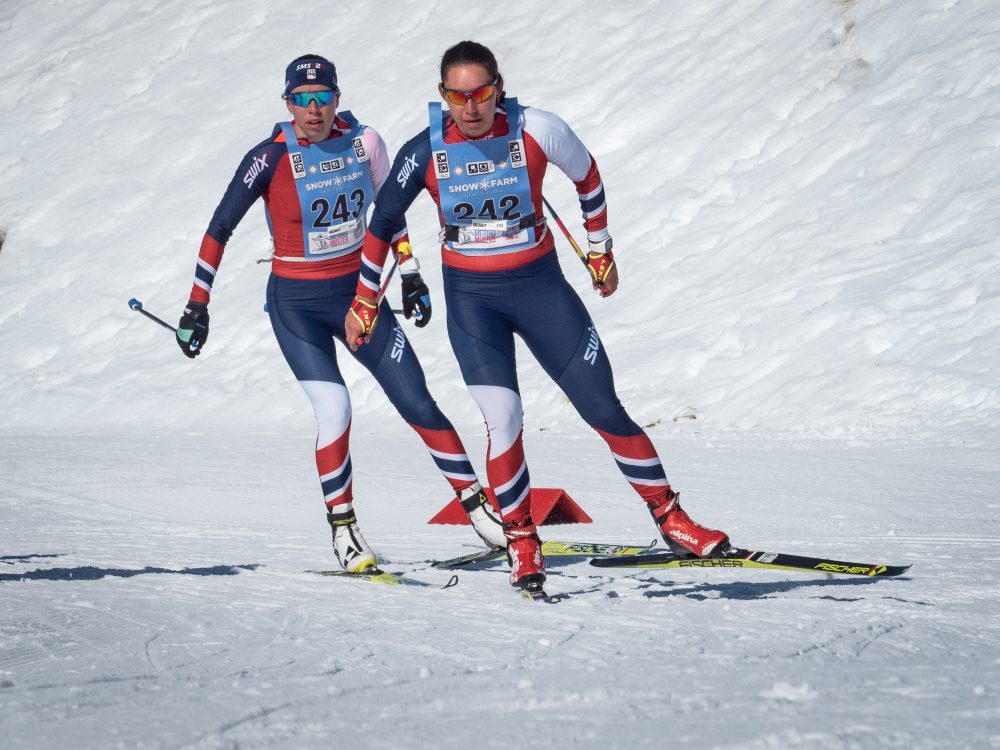
Julia Kern leads Katharine Ogden, her fellow Stratton Mountain School (SMS) and U.S. Ski Team development team member, during the Snow Farm’s 21 k Snow Rake at the 2018 Merino Muster in Wanaka, New Zealand. (Photo: Garrick Cameron)
Note: This article has been updated to include comments from Simi Hamilton of the U.S. Ski Team (USST) and Stratton Mountain School (SMS) T2 Team, and Kevin Bolger of the USST and Sun Valley Ski Education Foundation.
***
It’s that time of year again where several members of the U.S. Ski Team, along with top-level skiers from the Craftsbury Green Racing Project (CGRP) and Stratton Mountain School (SMS) T2 Team are training at the Snow Farm above the town of Wanaka, New Zealand.
The on-snow volume camp, which featured multiple days of racing, started Aug. 20 and continues through Sept. 10, and includes U.S. Ski Team (USST) athletes Jessie Diggins, Ida Sargent, Sophie Caldwell, Katharine Ogden, Julia Kern, Simi Hamilton, Kevin Bolger, and Paddy Caldwell, and coaches Matt Whitcomb, Jason Cork and Gus Kaeding.
According to Sophie Caldwell, conditions have been “amazing” for the duration of camp so far. “New Zealand had a great snow year and we’ve been lucky to have sunny days almost every day,” she wrote in an email to FasterSkier.
Japan’s Tomoka Satou (446) leads American Jessie Diggins (428) and others up a climb during the Merino Muster 42 k skate race on Sept. 1 at the Snow Farm in Wanaka, New Zealand. (Photo: Garrick Cameron)
Diggins called it the annual trip one of her “all-time favorite camps because the living at the Snow Farm is great, the food is outstanding, and you can step out the door right onto the 65+ km of trails!” she wrote in an email.
“I love having the chance to work on my on-snow technique for three solid weeks because that’s when I get to really see progress and make some changes in my striding,” Diggins wrote.
Apart from logging kilometers on snow and soaking up the vitamin D, the team has also spent time trail running in Wanaka.
“The highlight [of the camp] will probably be a crust cruise we go on in the next few days, but since we haven’t done that yet, some highlights so far are an awesome distance run down in Wanaka, and pretty much every day of bluebird skiing we’ve had up here!” Caldwell wrote.
The camp also coincided with the Merino Muster, a 42 k freestyle marathon that is part of the Worldloppet series, and the Winter Games NZ, which doubled as the Australia/New Zealand Cup FIS races and included three days of nordic racing this year at the Snow Farm: a 5/10 k freestyle individual start, a freestyle sprint, and a 10/15 k classic mass start..
Diggins finished a minute and 21 seconds faster than the second-place woman, Aurelie Dabudyk of France, while Hamilton edged Craftsbury skier Adam Martin by 3 seconds for the overall win.
“The day of the Merino Muster was gorgeous and sunny, with fast conditions,” Diggins wrote. “I loved getting the chance to race a long race, and starting with the men as one big field is really exciting! I hope to get to race the 42km race every year. Huge thanks to the volunteers and organizers for making it such a fun day.”
Crossing the finish line in 1:52:34 hours, Diggins placed sixth overall. Dabudyk was eighth overall and Alayna Sonnesyn (SMST2) was the third woman, 11th overall, 5:30 behind Diggins.
Meanwhile, Hamilton finished in 1:39:46, beating his time of 1:40:33 from last year’s race. Martin followed 3 seconds later, while Kyle Bratrud (SMST2) finished 24 seconds after from Hamilton in third, followed by Tomoka Satou of Japan in fourth (+45.0).
“The Merino Muster is always an awesome race,” Hamilton wrote in an email. “It actually lends itself to the type of intensity we are still mostly focused on in August/late September because the terrain and snow conditions usually make for a really good chance to get in about 1.5 hours of level 3 effort followed by a few minutes of really hard skiing in the last km before the finish. It’s a very rolling course and if you ski it in a pack with people switching leads it’s basically impossible to go much harder than level 3.”
Also on Saturday, Americans also took the top spots in the 21 k Snow Rake. Ben Saxton (SMST2) ran away with the overall win by more than 12 minutes in 47:48, while Paralympic sit skier Dan Cnossen placed second (+1:12:13) nine seconds ahead of Petr Sykora of the Czech Republic in third (+1:12:22).
Ogden was the fastest woman and second overall with a time of 50:29. Her SMS and USST teammate Kern finished 56 seconds later as the second woman, and Elizabeth Martin of the University of New Hampshire (UNH) followed in third, 7 minutes and 30 seconds behind Ogden.
With about 300 participants between three different races at the Merino Muster, Hamilton described the atmosphere as “super fun and light.”
“But the grooming always rocks and it’s just a really fun course to ski,” he added. “I think that in this day and age of social media being so huge and cross-country skiing gaining more attention in the US and world-wide, we’ll start to see more and more people showing up for the marathon. I feel like in the last few years alone their has been noticeably more attention and attendance each year. The quality of skiing is a small part of the race atmosphere here… New Zealand’s south island is one of the most beautiful parts of the world and the culture is so welcoming and comfortable.”
Many of the American skiers in New Zealand also competed in the Winter Games NZ races this week.
“The New Zealand Winter Games are also a huge opportunity to get back into racing mode and test out all the technique work we’ve been putting in so far!” Diggins wrote. “And if you know me, you know how much I adore 5km individual skate races, and we no longer get to do those on the World Cup. So I’m so grateful to the Snow Farm and race organizers for keeping such a fun and hard, fast race alive! I forgot how much it can hurt to go so hard for 5km, but it was fun to really get that lung burn back for the first time since last winter.”
Three days after her marathon win, Diggins won the 5 k skate at the Snow Farm in 15:02.6. The U.S. swept the top five with Sophie Caldwell finishing 10.5 seconds back in second place, Caitlin Patterson (CGRP) in third (+16.7), Sargent (USST/CGRP) in fourth (+1:02.6), and Kelsey Phinney (SMST2) in fifth (+1:16.6) out of eight women.
Kyle Bratrud (SMST2) gets a feed from U.S. Ski Team coach Jason Cork during the 2018 Merino Muster 42 k skate race at the Snow Farm in Wanaka, New Zealand. He finished third behind two other Americans. (Photo: Garrick Cameron)
In the men’s 10 k skate on Tuesday, Bratrud took the win in 27:48.1, 21 seconds clear of Kaichi Naruse of Japan in second, while Craftsbury’s Ben Lustgarten and Martin (CGRP) followed in fourth (+23.0) and fifth (+44.0), respectively. Eight men competed.
Wednesday featured 1.1 k skate sprints, which saw Sophie Caldwell take the win in a field of 10 women, ahead of Sargent in second and Phinney in third.
“The sprint was a short and tactical race that was awesome practice for what’s to come this winter,” Caldwell wrote. “It was really fun toeing the line with my USST and SMS training partners. On one hand, that final could have been any day of summer training, but it also could be a World Cup heat! It’s pretty cool to be pushed by so many strong training partners and friends and we were psyched to throw on a bib and put in a race effort.”
In the men’s final, Bolger landed the top spot on the podium, ahead of Saxton in second and Satou in third. Eleven men competed in the sprint.
“I really enjoy these early session races it gives us as races a chance to get in the mindset and practice real race strategy,” Bolger wrote in an email. “I wanted to go out there test myself, I approached every round like a final and attacked from the start getting out in front and leading into the finish, and was very happy to end the day on top, especially after a long camp down here with the US crew.
“… Coming down here and having a good result in the sprint is of course a huge confidence booster heading into the September/ October training months, but there is still a ton of preparation to be done,” he added.
On the final day of Winter Games NZ racing, Diggins continued her undefeated streak (after skipping the sprint), winning the 10 k classic mass start, while Patterson placed second and Sargent placed third. Saxton picked up his second win of the week, while Martin took second and Lustgarten third.
Complete results will be posted once they’re available.
“We have been incredibly lucky with weather and conditions this year,” Hamilton noted. “Usually, when you’re here at the Snow Farm for 3 weeks in the winter, you’re bound to get an extended period of really nasty weather and wind. But this year we’ve basically had sunshine and cold night time temps every single day, making for amazing skiing for pretty much 3 weeks straight. There is about 40-50 km of trails to ski when everything is groomed, so it’s essentially impossible to get bored. The highlight of our camp every year is a big crust ski up to and around Mt. Pisa. We are planning on getting out tomorrow [Friday, Sept. 7] because the crust hasn’t been great yet while we’ve been here, but conditions for tomorrow look promising. But even when we can’t get out for a huge adventure like that, it’s just one of the best and most fun places in the world to train.”
Earlier this month from Aug. 2-8, nine top American junior athletes had the opportunity to participate in the largest International Junior Camp to date. In total, 146 athletes and 37 coaches from nearly 20 nations gathered in Sjusjøen, Norway, for a week of training and collaboration. The camp offered athletes the opportunity to gain confidence by training with the best junior skiers in the world against whom they will soon be competing, and to learn from the prestigious Norwegian development team training methods.
To make the trip, athletes needed to be born in either 1999 or 2000 and have the lowest ranking on the FIS Distance and/or Sprint World Ranking list. The U.S. sent Gus Schumacher, Ti Donaldson, Noel Keeffe, Ben Ogden, and Wyatt Gebhart on the men’s side, and for the women, Sofia Shomento, Mae Chalmers, Abby Jarzin, and Molly Gellert. Two coaches joined the group: Bryan Fish, cross country sport development manager at U.S. Ski & Snowboard, and Maria Stuber, head coach at the College of St. Scholastica, and the National Nordic Foundation (NNF) partially subsidized the trip.
2018 International Junior Camp attendees: – Armenia
– Austria
– Bosnia/Herzegovina
– Belarus
– Canada
– China
– Czech Republic
– Estonia
– Italy
– Finland
– Japan
– Korea
– Latvia
– Norway
– Slovenia
– Slovakia
– Spain
– Sweden
– U.S.
The format of the camp was similar to what U.S. juniors might experience at an elite national camp; a large emphasis on volume (18-25 training hours), with some intensity, technique and strength mixed in. For most workouts, all the athletes trained together as one large group, only dividing into smaller groups for time trials or activities held in spaces that could not hold the nearly 200 attendees.
The camp opened with back-to-back time trials, beginning with a classic sprint event featuring “King’s Court” style heats, meaning that from each heat, the top skier moved up in the seeds and the last skier moved down. Each skier competed in four rounds of sprints plus the qualifier, one round more than in a typical sprint. The most notable result for the U.S. was a victory for Schumacher in the men’s final, and on the women’s side, an eighth-place finish for Gellert.
In the 10- and 15-kilometer distance races, the Americans continued to show their strength with another win for Schumacher and another eighth-place finish for Gellert.
“Local hero – Joergen Lippert from Lillehammer joined in on the 15 km freestyle race,” Fish explained. “This was a great measuring stick for the men since Joergen medaled in all four races last year at Junior Worlds (2018 Junior Worlds – 1 gold, 1 silver, and 2 bronze). At the 5km split, Lippert was leading, Ben Ogden was 2nd and Gus Schumacher 6th. Haavard Moseby took the lead after 10km. At 12km Haavard and Gus were tied, then Gus surged to edge Haavard for the second day in a row.”
Molly Gellert striding in the sprint heats at the 2018 International Junior Camp in Sjusjøen, Norway. (Photo: Maria Stuber)
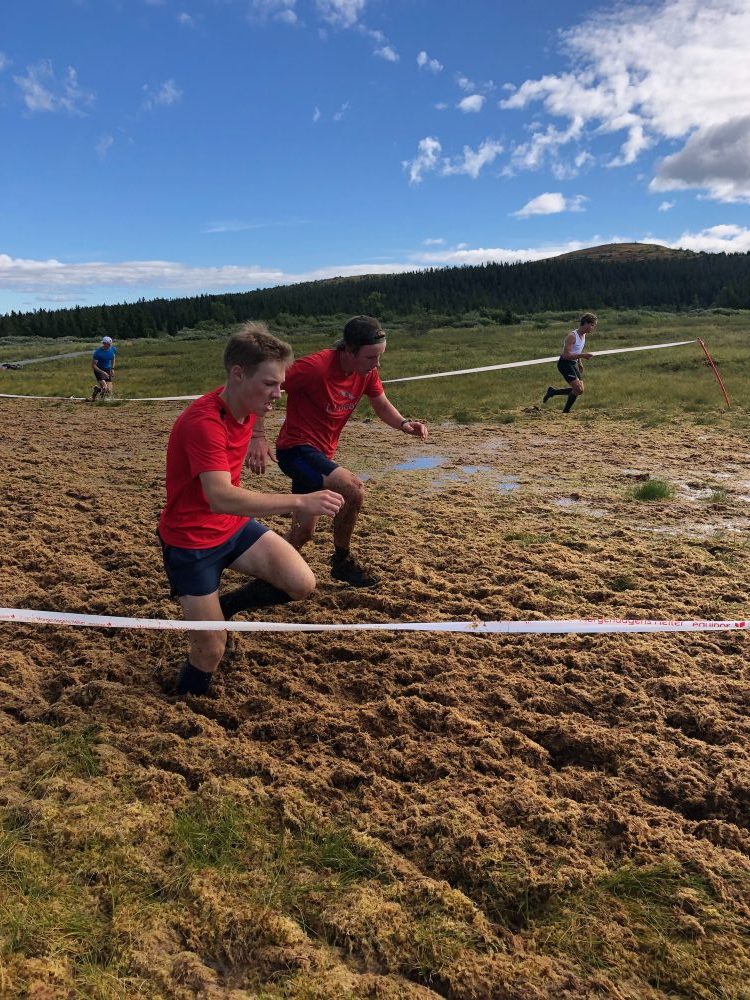
To take advantage of the unique terrain on the plateau around Sjusjøen, the group also participated in a 3 1/2- to 5-hour run crossing through several bogs, and a set of Level 4 bog intervals, which was reported to be the hardest workout of the entire camp. These 3-5 minute intervals were run in mud up to or above athletes knees, making it a full-body challenge to move forward through the course.
“Running through that stuff as hard as you can is incredibly hard,” Stuber told FasterSkier. “People were breathing at the end of those intervals harder than you ever hear, besides maybe the best athletes in the world in a 5- to 10-kilometer distance kind of race.”
Another highlight was getting to meet and hear from Olympic gold medalists Johannes Høsflot Klæbo, Ragnild Haga, and Astrid Uhrenholdt Jacobsen, who shared insight into the aspects of their training and development they felt have led to their success.
The U.S. coaches contributed to the camp by leading an agility workout, as this has been creatively emphasized in their own programs with positive results. Fish reportedly traveled with his own set of cones and plenty of sidewalk chalk to ensure they could set up a high-quality course.
“It was really fun to have the rest of the world interested in what we’re doing with agility,” said Stuber.
Ben Ogden (second from r) in the middle of a bog interval at the 2018 International Junior Camp in Sjusjøen, Norway. (Photo: Maria Stuber)
Apart from the training benefits, the U.S. development program considered the experience of collaborating with top athletes in this age group to be invaluable, as it showed how hard their international competition is working.
“In the U.S. when you’re a top athlete you feel like you’re working pretty darn hard, and this kind of shows them that, yeah, they’re working hard, but the kids that they want to be competing against are also working really hard,” Stuber said.
She added that the U.S. athletes were well-prepared for the camp, as all performed very well throughout the week despite the demanding training schedule.
“We fit in, we go there and see that we’re doing the right things, and we bring these kids back with the confidence that they can do this and the motivation to keep at it and work harder,” Stuber said.
It was noteworthy to the coaches that the U.S. is finally recognized as a nation that can train and compete with the best athletes in the world — a testament to the growth and success of the U.S. Ski Team at all levels over the last ten years.
“Going into this, I was expecting to just be learning a ton and less of a contributor,” Stuber said. “It was really cool to get there and feel like the U.S. was very much a country where people wanted to know what we were doing. Norway is clearly ahead, but otherwise, I think the U.S. had to say as much as any other place, which was a really eye-opening surprise for me.”
This is the third time that the U.S. has attended Norway’s International Junior Camp (also in 2015 and 2016), and American juniors will continue to make the trip biennially to maintain collaboration with other countries in the coming years. According to the U.S. coaches, because of the cost of the camp and the fact that it is similar each year, they plan to only attend every other year so they have a “fresh” group of athletes each time.
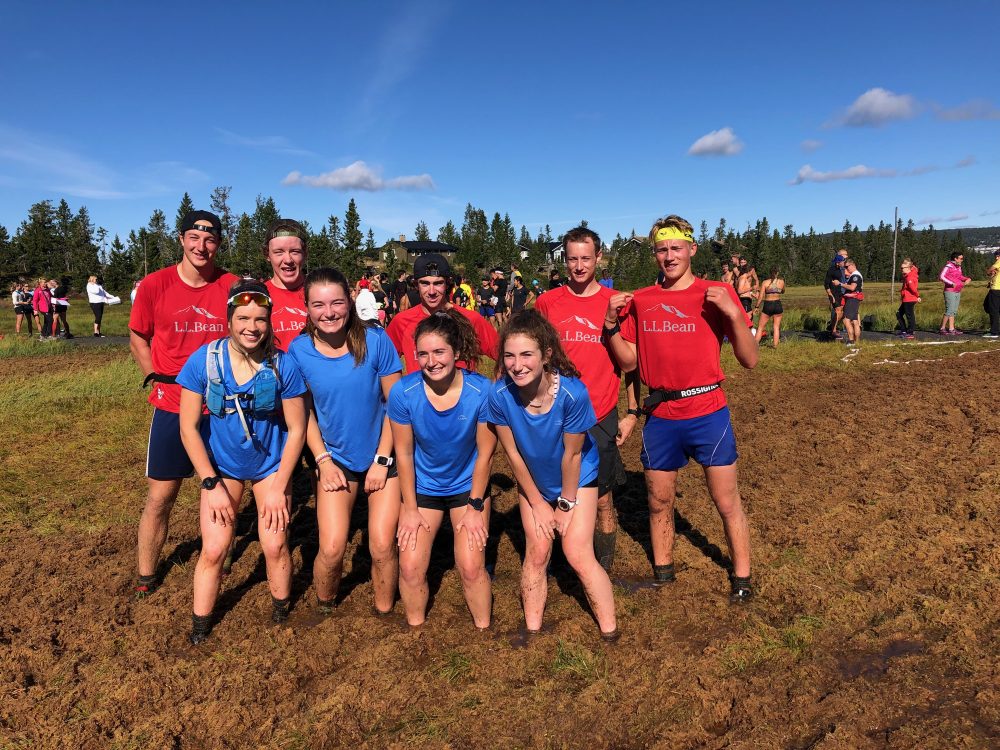
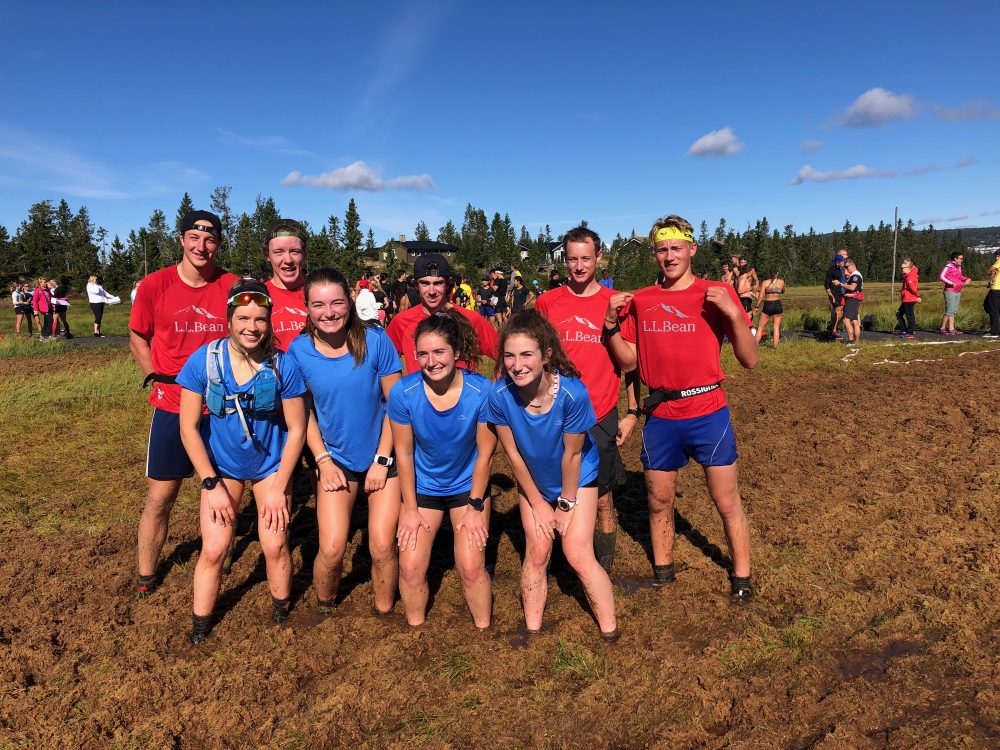
Americans during a muddy training session at the 2018 International Junior Camp earlier this month in Sjusjøen, Norway. (Front row, l to r) Abby Jarzin, Mae Chalmers, Sophie Shomento, Molly Gellert, and Noel Keeffe. (Back row, l to r) Ben Ogden, Wyatt Gebhart, Ty Donaldson, Gus Schumacher. (Photo: Maria Stuber)
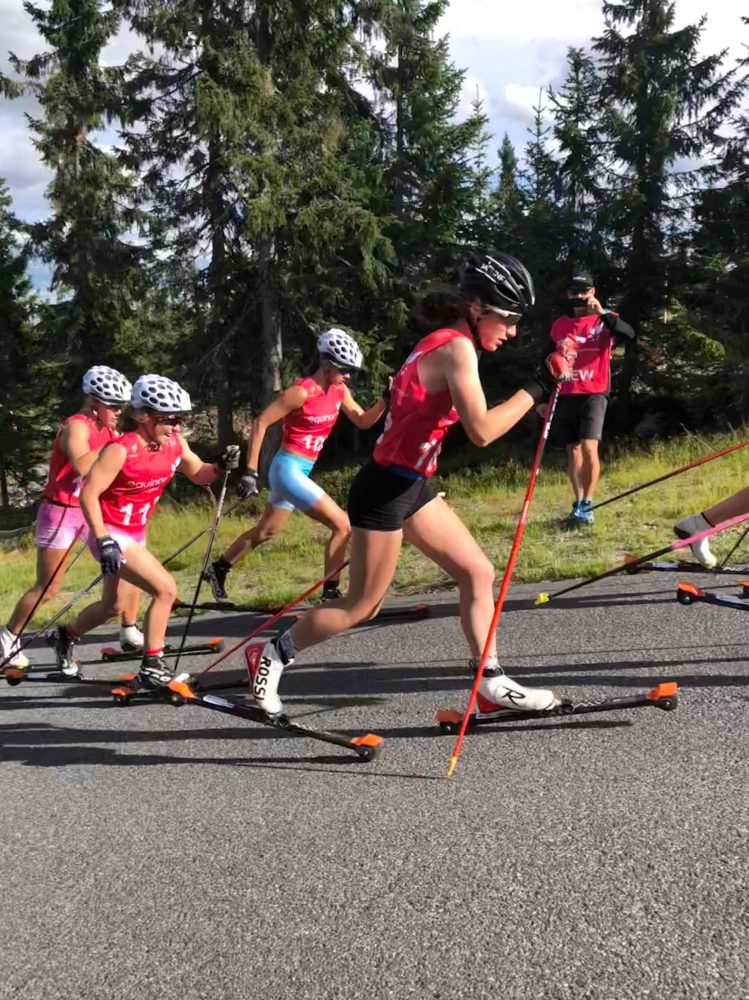
From left to right: Katharine Ogden, Julia Kern, Ida Sargent, Caitlin Patterson and Kelsey Phinney navigate the tag zone during a freestyle team-sprint rollerski workout at the U.S. Ski Team women’s camp on July 15 in Lake Placid, N.Y.
LAKE PLACID, N.Y. — This past Sunday, July 15, FasterSkier visited the U.S. women’s cross-country team in Lake Placid, where the team has been holding a dryland camp since July 11. Most all of the team’s top athletes are there — sans those that train with Alaska Pacific University (they’ll largely stick to Anchorage and nearby Eagle Glacier for summer training) — for a “semi-intensity focused” camp that will last through Friday, July 20. Their training has included everything from rollerski speed work to ski walking/bounding, over-distance trail running/hiking and point-to-point distance rollerskiing. And they’ve held several workouts with the US Biathlon team, which is based in Lake Placid.
Meanwhile, four members of the U.S. men’s team (Erik Bjornsen, Simi Hamilton, Ian Torchia, and Paddy Caldwell) have been in Villard-de-Lans, France, for a camp following the wedding of Bjornsen and Marine Dusser. Their overseas training, which has also included some “incredible trail/mountain running,” as head coach Chris Grover explained, wraps up today.
“The weather has been fantastic so far; warm and dry during the days and cool at night,” Grover wrote in an email on July 9, the first full day of camp.
Ben Saxton, of the Stratton Mountain School (SMS) T2 Team, leads the men’s rollerski-sprint workout out of the start, with Ben Lustgarten (Craftsbury Green Racing Project) and Kyle Bratrud (SMST2) closest behind on July 15 in Lake Placid, N.Y.
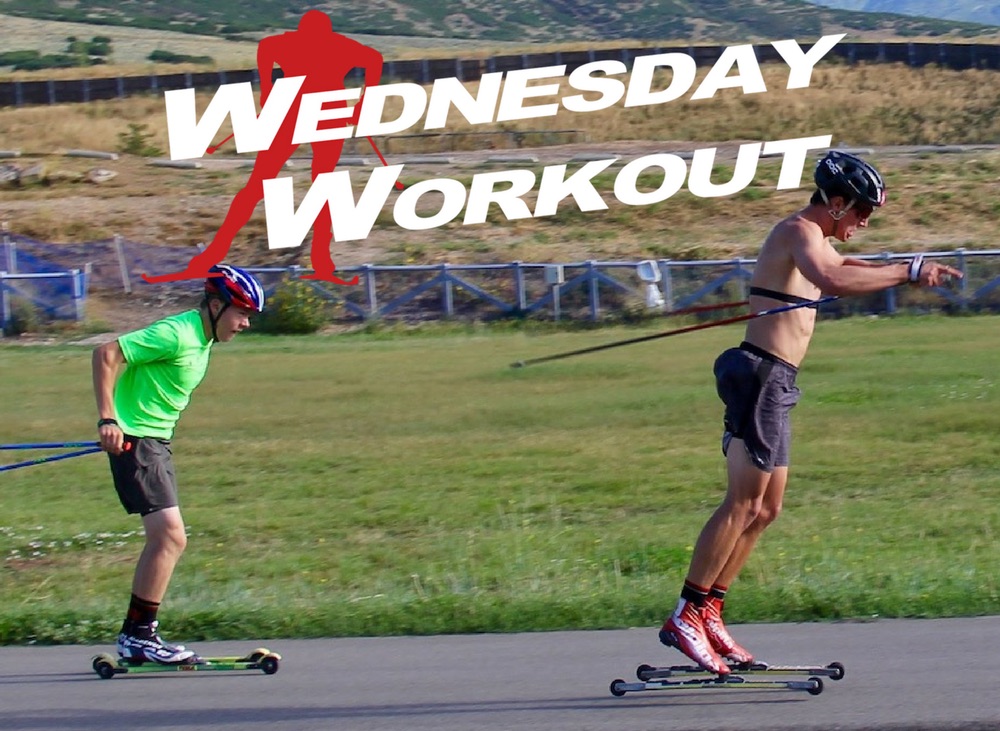
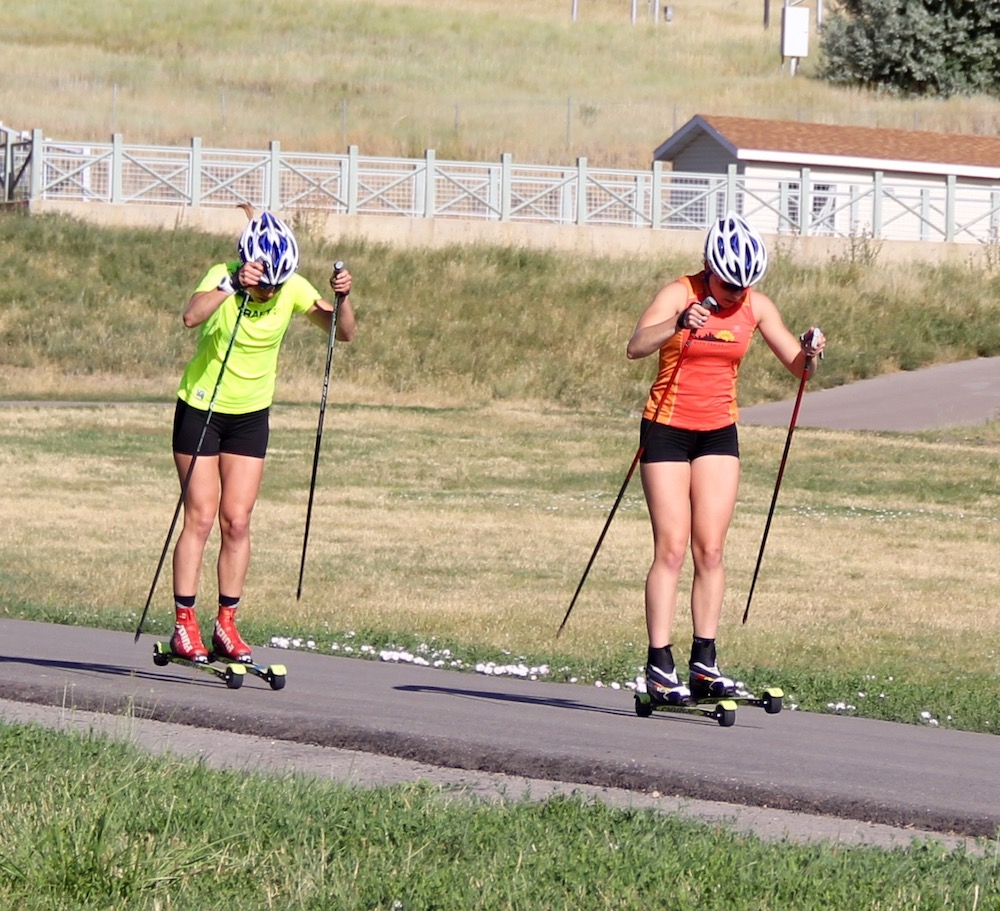
In Lake Placid on Sunday, it was a warm yet breezy day for a freestyle team sprint, with temperatures reaching the 80s by late morning. Asked how many times a year the U.S. team practices team sprints, complete with each member of a two-person team racing three laps apiece, U.S. coach Matt Whitcomb said they did so about twice a year: once in mid-summer and again in October.
(On the World Cup circuit, team sprints are only held a couple of times each winter. This coming winter, a freestyle team sprint — the event Kikkan Randall and Jessie Diggins won at the 2018 Olympics — is on the schedule at 2019 World Championships in Seefeld, Austria.)
“We’ll do a formal team sprint like this a couple times a year,” Whitcomb said. “It’s obviously a huge opportunity for us with the sprint depth that we have, for both men and women, and it’s just a fun way to have a super-hard workout in a camp environment.”
Jessie Diggins (r) and Julia Kern during recovery time between the semifinal and final of their team-sprint session on July 15 at the Olympic Jumping Complex in Lake Placid.
Sunday’s training group included 11 women, including Diggins, Sophie Caldwell, Ida Sargent, Julia Kern, and Katharine Ogden from the U.S. Ski Team, and several others from the Craftsbury and Stratton programs, and six men (Ben Saxton, Ben Lustgarten, Akeo Maifeld-Carucci, Kyle Bratrud, Adam Martin, and Karl Schulz). The course, which was held on the Olympic Jumping Complex rollerski loop, was about 1.3 kilometers for the women and 1.7 k for the men (taking about 3 minutes per lap for the women and 3:40 for the men).
“Goal number 1 is to keep it safe and make sure we’re not having needless injuries, checking the equipment and making sure the athletes’ bindings are all working … ,” Whitcomb said. Sunglasses and helmets were mandatory. “And then secondly, just creating an environment that gives them a perception by the time they hit winter or the first team sprint on the World Cup that they’ve done this. When you feel that you’ve had experience, even if it’s because of a workout in July and one in October, you can draw a lot of confidence from that. While it is just a total 20 minutes of ‘on’ time today, it has much greater value than just that.”
“When you feel that you’ve had experience, even if it’s because of a workout in July and one in October, you can draw a lot of confidence from that.” — Matt Whitcomb, U.S. Ski Team coach
Athletes were selectively partnered in an effort to make for a “stimulating event”, Whitcomb explained. At times, they were instructed to leave the tag zone early before their teammate arrived to make for a more competitive event. The workout started with a semifinal round of head-to-head racing, followed by about a half-hour break, then finals. Due to lower numbers, the men did not compete as teams and instead raced each lap together, then took about an equal amount of rest before the second and third intervals.
Ben Saxton (r) leads Ben Lustgarten, Kyle Bratrud and Adam Martin during a team-sprint workout on July 15 at the Olympic Jumping Complex in Lake Placid, N.Y.
For coaches and athletes wanting to replicate this workout, Whitcomb said you don’t have to have a ton of athletes and a car-free, challenging rollerski loop like the one at the Olympic Jumping Complex.
“Some days you only have three athletes and you might just have a one-mile strip of road that works and you can’t do a loop,” he said.
The U.S. team has held similar team-sprint sessions with just five or six women.
“We’ll just run it like an interval session,” he said. “We simulate it and you even have a tag zone, but you don’t have a teammate. We might simulate a race situation where somebody’s partner broke a pole and we’ll make them wait for five extra seconds or something like that.”
On a point-to-point course, it might take a little more time to get back to the start, “but it gives the athletes what you’re looking for,” Whitcomb said.
Sophie Caldwell leads Ida Sargent at the front of the pack during a team-sprint training session on July 15 in Lake Placid, N.Y.
He also recommended getting creative and having fun with the workout.
“Sometimes the ladies are making decisions on their own; they’ve got a good idea of what makes a great workout,” Whitcomb said. “There were a couple times where our PA, start-finish guy, Gus [Kaeding], who was also our creativity manager today, came up with some interesting situations, like somebody had slow skis that lap so [their partner] had to wait a little bit. For the men, they were running it more interval-style where they sent Kyle [Bratrud] out as a rabbit for Ben [Saxton] and Ben [Lustgarten] to chase down and that made it really exciting and stimulating for them.”
The workout takes close to two hours to complete so plan the start time accordingly. The U.S. coaches moved the start of the women’s final up slightly to try to beat the heat.
“In hindsight we probably would have started a little bit earlier,” Whitcomb said. “It’s hot out here today and it’s something you have to watch out for in the summer. If it’s excessively hot, we won’t run this workout because you start to lose the benefit. … But today was reaching 80 and happened to be humid, but it was manageable.”
Coaches also took lactate readings of all participating athletes immediately after they finished their final laps of both the semifinals and finals.
Team sprint start times (as outlined by the U.S. Ski Team for its July 15 workout. These changed slightly during the session):
9:30 a.m. Men’s semifinal (3 laps of 1.7 k with about 4 minutes of rest in between)
10 a.m. Women’s semifinal (3 laps of 1.3 k with about 3 minutes of rest in between)
10:30 a.m. Men’s final (Same format as men’s semifinal)
11:00 a.m. Women’s final (Same format as women’s semifinal)
The U.S. women’s and men’s teams also have upcoming training camps planned for New Zealand (three weeks in late August/early September) and Park City, Utah, in October.
Athletes staying loose during team-sprint day at the Olympic Jumping Complex in Lake Placid, N.Y.Craftsbury Green Racing Project Head Coach Pepa Miloucheva (l) and Stratton Mountain School T2 Team Head Coach Pat O’Brien (center) assist athletes with lactate testing after the U.S. Ski Team’s rollerski team sprint on July 15 in Lake Placid, N.Y.
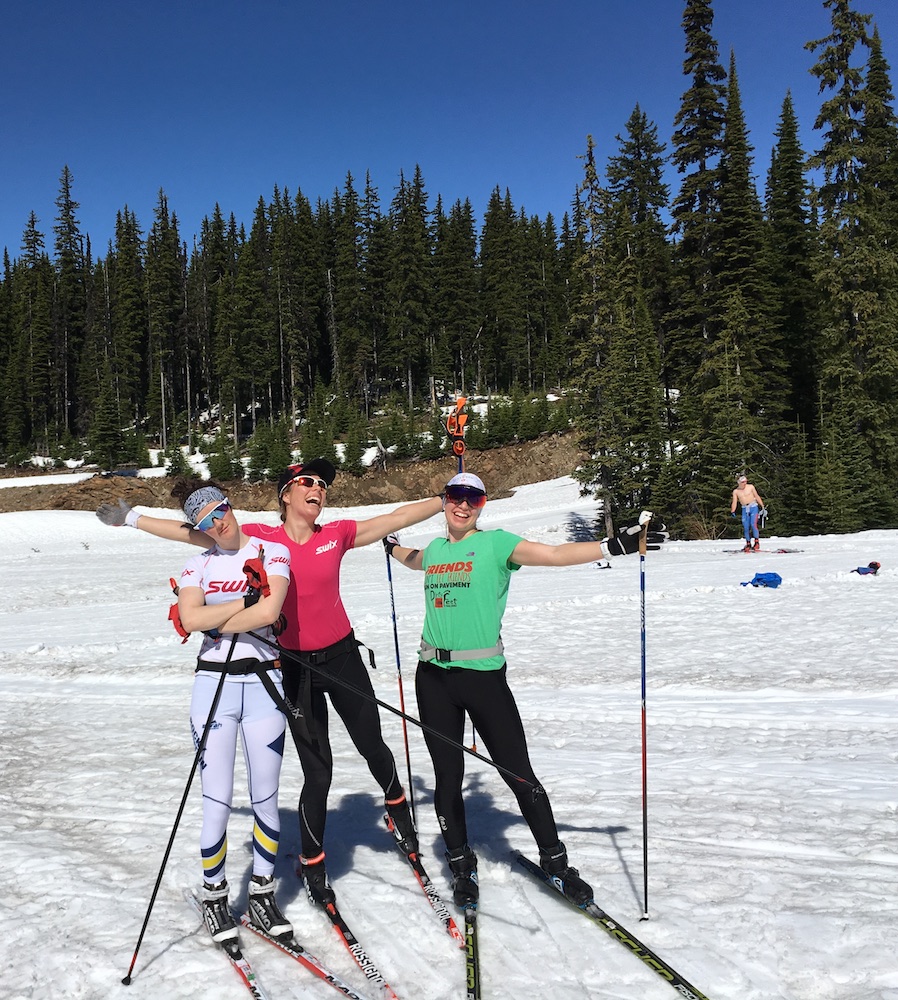
VERNON, British Columbia — Each year, the Sovereign Lake Nordic Centre reopens its trails in May to let skiers start the new training season on snow at its annual Spring Fling Ski Camp.In addition to the local skiers, groups came from Whitehorse, Canmore, Saskatchewan, and Methow Valley to absorb some Vitamin D and snow. The longest travel award goes to Mark who travelled from Atlanta, Georgia, for a long weekend on snow.
Crusty morning on Day 3 of Sovereign Lake’s 2018 Spring Fling Ski Camp on May 12.
The trails were open from 6:30 a.m. to 2 p.m. each day to take advantage of the cooler mornings, with a crusty start and a soft layer over a firm base later on. Air temperatures rose from 1 degree Celsius to 10-15 degrees by noon (34 degrees Fahrenheit to 50-60 F). Most athletes skated early, switched to classic as the snow softened, and then headed down to the valley for biking, running, and paddle boarding in the afternoon.
While there was enough snow to open the whole system, the club only set about 20 kilometers each day as there were only a few hundred skiers expected.
Last year’s innovation was the pushup time trial, which was so much fun it was repeated with double the participation on Saturday, May 12.
This year,the club added an ‘enduro’ race on Sunday, May 13 to spice things up.
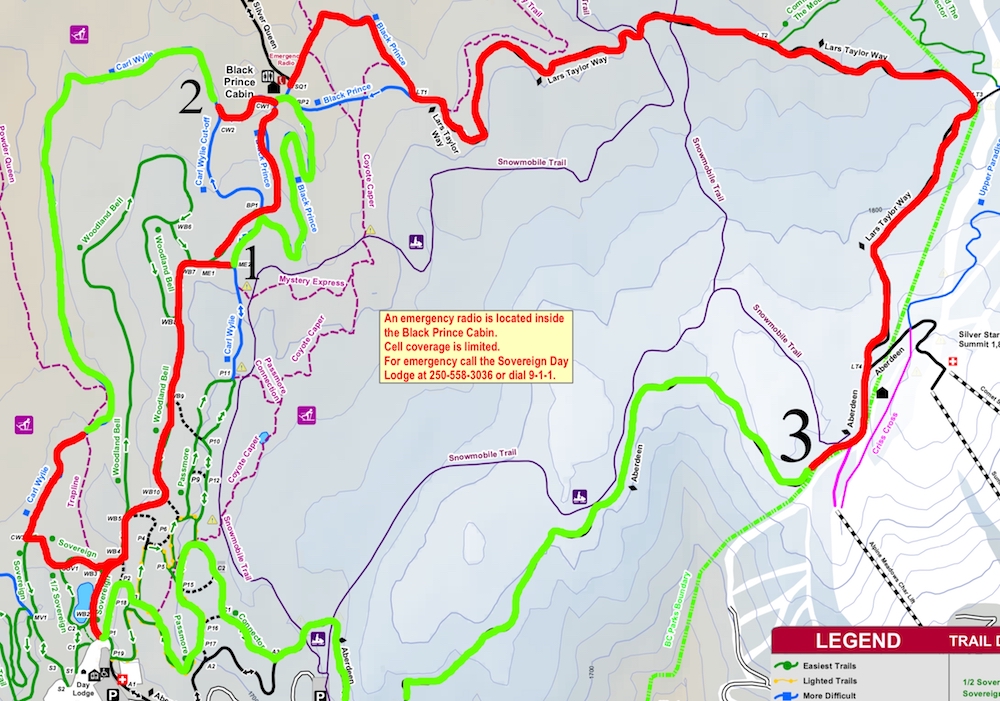
Enduro is a popular mountain-bike race format, with a defined course that everyone must complete, but only the downhill stages are timed. The winner is the person whose total time for the timed stages is the lowest.
The response from the 53 participants was generally positive, with most wanting to repeat the event next year.Many suggested the long flat runout at the end of Stage 2 didn’t feel flat with soft, sticky snow in the sunshine on race day. A few said they were going to copy the event at their home ski area next season.
The official course map. The green sections are timed stages, the red is the route to the next stage.
How to Host an Enduro
Pick a course that is safe for the snow conditions you’re dealt. Especially in spring, transitions can be dangerous. When the predicted high on race day was 17 C, the start time was advanced by an hour and the stages were slightly modified for safety.
Balance the distance with the number of athletes you expect to attend. Sovereign used a 20 k loop with three stages of roughly 1 k, 1.5 k and 4 k.
If your budget doesn’t suit chip timing, have the racers self-time their sections. This event used four volunteers. One covered the front desk in the day lodge while the manager started the event. Three wrote down the self-reported stage times on clipboards. Strava is an option for mountain-bike events, but not many skiers carry a GPS.
Plan for some slow skiing. Many athletes skied the non-timed sections as a group chat. The transfer to the start of Stage 3 had a total climb of about 250 meters which, combined with hot and sunny weather, made for a very slow average pace with the first finishers arriving about 30 minutes later than estimated.
Focus on fun. There are no FIS points for this race format, which means the organization can be very laid back. As this was the fourth day of a volume camp for most athletes, participants were more focussed on having fun than winning. Women’s winner Olivia Bouffard-Nesbitt didn’t check the results and was surprised to be awarded a prize (a 10-day Sovereign punch pass) as she packed her skis at the end of the weekend.
Official results were not available at press time, but it appeared Olivia Bouffard-Nesbitt (Rocky Mountain Racers) won the women’s enduro and Sam Hendry (Canmore Nordic) was the men’s winner.
From left to right: Olivia Bouffard-Nesbitt of Rocky Mountain Racers (RMR), Maya MacIsaac-Jones (National U25 Team and RMR), and Hannah Mehain (Sovereign Lake) at the finish.
Ben Ogden and Bill Harmeyer during double-pole speeds at the 2017 Junior NTG Camp earlier this month at Soldier Hollow in Midway, Utah. (Photo: Bryan Fish)
For this week’s workout, we asked for a specific-strength workout from this year’s Junior National Training Group (NTG) Camp, which was held Aug. 2-15 near Park City, Utah. One of three coaches at the camp, Maria Stuber (head nordic coach at the College of St. Scholastica), shared the following, which she described as an “old-school endurance strength workout.” She led the camp with two U.S. Ski Team (USST) staff members, development coach Bryan Fish and World Cup wax technician Tim Baucom. Eighteen athletes attended — 10 men and eight women — all under the age of 21.
Lauren Jortberg and Nicole Schneider doing double-pole speeds at the 2017 Junior NTG Camp earlier this month at Soldier Hollow in Midway, Utah. (Photo: Bryan Fish)
“The U24’s are invited to other U.S. Ski Team camps like our October camp and our May Bend camp,” Fish explained in an email.
The goal of this month’s camp was “to get our very best together to train and learn from one another,” he wrote. “These are athletes that are already or very well may soon be on the U.S. Ski Team, so building a healthy and positive training environment for these athletes is critical. Secondly, building an environment where these athletes push each other yet trust one another is critical. Many of these athletes have already traveled overseas together and continuing to strengthen their comfort and focus toward how we can support, lean on and succeed together – as a group, as a nation, as a team.
“Third, we want to provide these athletes with meaningful feedback,” Fish continued. “The athletes work with our high performance department at U.S. Ski & Snowboard to learn what individual items they are already strong as well as windows of opportunities for improvement.”
The primary focus was to provide a “strong training environment,” he wrote, while also testing athletes in areas like strength, power and mobility with a protocol similar to the U.S. Ski Team.
Throughout the two-week camp, there was an abundance of rollerskiing and threshold ski walking/bounding, as well as strength work.
“One question that commonly comes up is why such workouts are becoming less familiar or possibly less utilized in coaches’ training plans,” Fish wrote, referring to specific strength. “I think it is because more programs are incorporating this type of effort into classic sprint training sessions. That being said … [this workout develops] many important technical and physical skills.”
Stuber explained that the workout emphasizes repetition “to work out technique issues and to feel efficiency differences,” she wrote. “It is also a fun social workout because the whole team stays in one place and you can have a good time with rivalries and inter squad competition. “
The workout: Specific Strength on Skis
20-minute warmup
Followed by:
8 x 30 seconds single stick
6 x 30 seconds core-only double pole
8 x 30 seconds double pole
20-minute cool down
“We did not harp on technique too much and let the athletes think and discover what was working best to move across the ground with the group,” Stuber noted. “We had video on an iPad for those who wanted to see what they looked like and if the changes they were feeling were showing up on camera.
“There were a lot of blisters,” she added. “Gloves are recommended for this workout.”
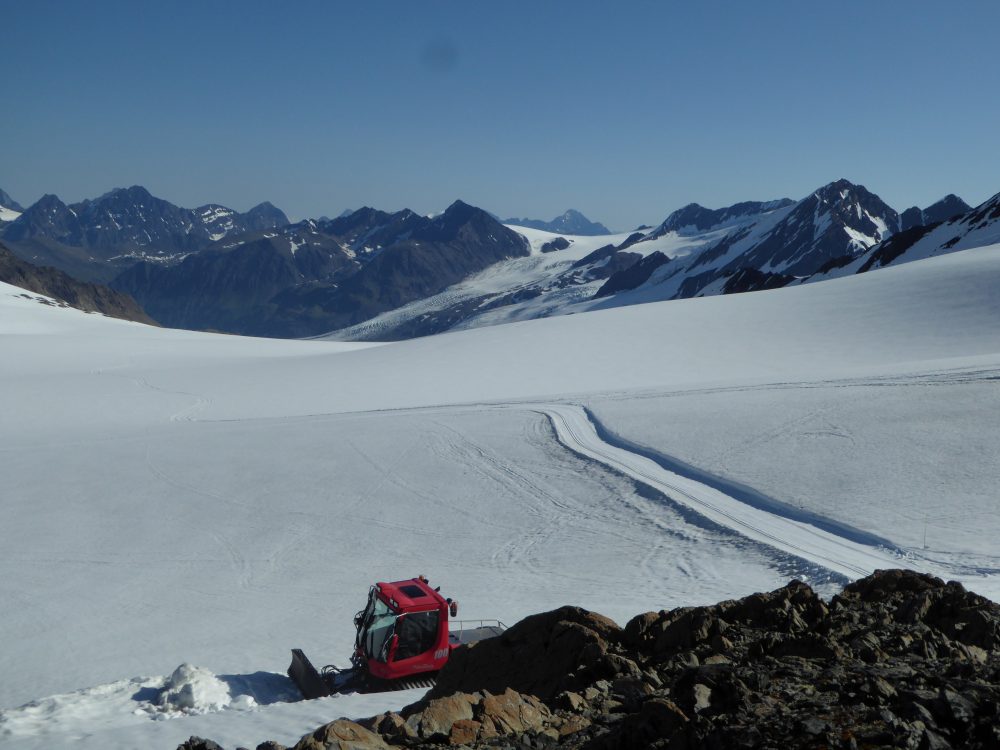
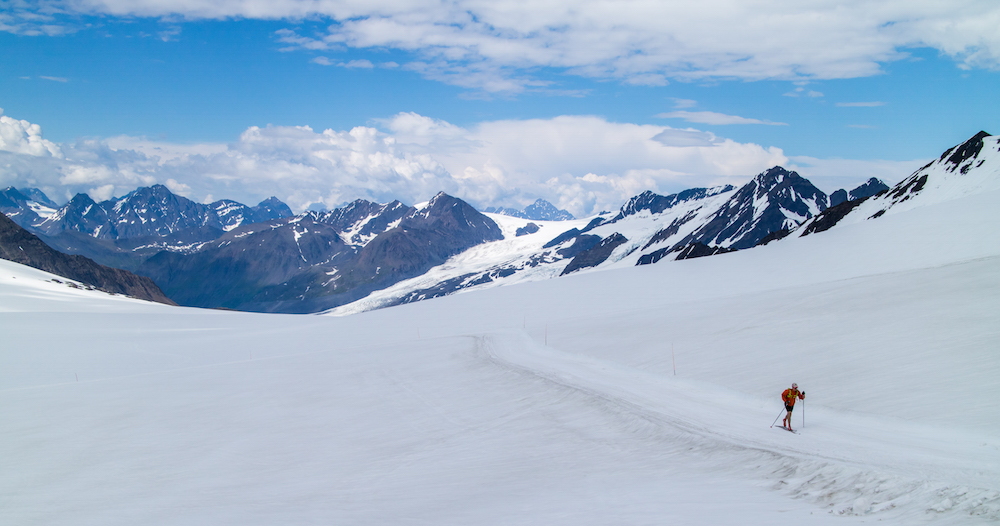
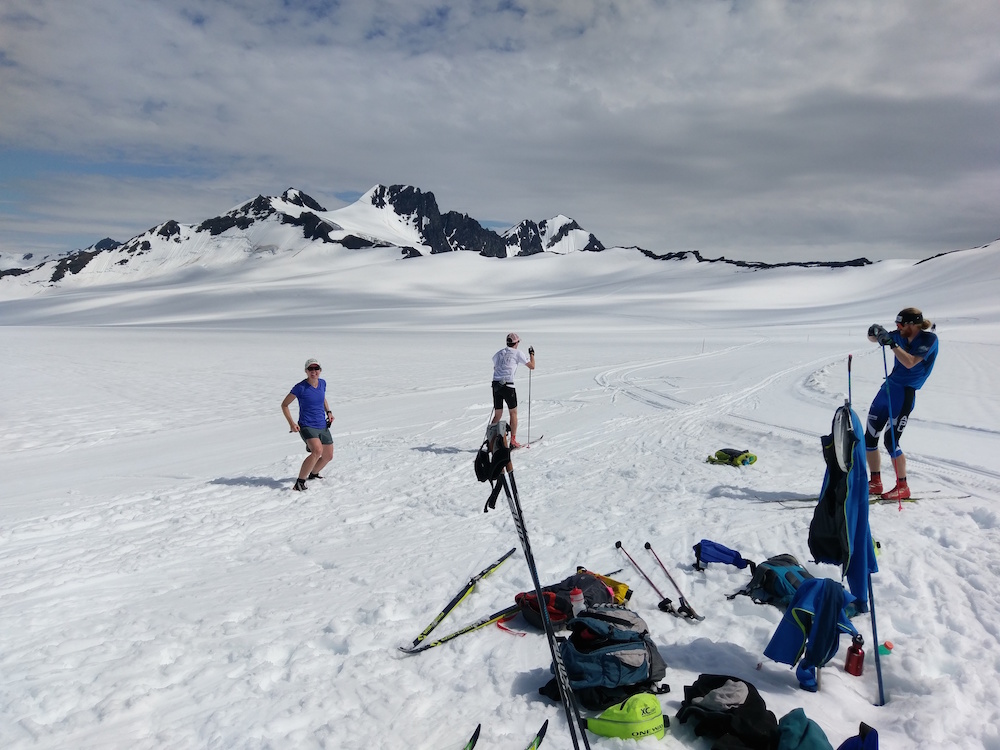
Gavin Kentch (APU) climbs back up to the training center on Eagle Glacier, in the Chugach Mountains, Alaska, during APU Masters Camp in July 2017. (Photo: Jim Falconer)
By Jason Somers
Introduction: Welcome to the jungle
My quads were burning from too much snowplowing. My coach’s words were echoing in my head: “You are most stable when tucking.” I willed, begged, and pleaded with my legs to assume the position, but being in this aerodynamic position also meant I would go fast, too fast, because at the moment I had one small problem – I couldn’t see where I was going.
This small problem could likely be overcome but combined with the fact that I was careening down a trail on Alaska’s Eagle Glacier in a July snowstorm, I had to keep the trail markers to my right or risk going off the trail. Not a big deal except that going off the trail meant I could in theory fall through a previously unknown crevasse, the big one that would lead me all the way to China in a horrific tumble, if I were ever to be seen again.
My mind began to wander. I pushed out of my mind my imagined eulogy that included the requisite nod to global warming and my major contributions to society at large, such as eating large quantities of breakfast tacos. I imagined a bronze cowboy hat statue with a ski hat on top that would commemorate the first loss of life by stupidity on the glacier. Also, of course, celebrities I never met like Eddie the Eagle would attend and say it was a shame. Kikkan Randall would be there, her hair colored extra bright pink.
Was this a death-defying 70-percent gradient that I was attempting? No, it wasn’t, but I was most certainly a nerd. A nerd well over his head. I am also a stubborn nerd so this meant I came equipped with nerd glasses, which were now so badly fogged after having gone through rain, sleet, and snow that they were more of a blindfold. I could barely make out the trail markers, I was flying blind, the skis began to pick up more speed, I knew the trail turned but when, and would I have enough time to turn with it?
Oh, and there was one more thing that made it especially intimidating: They don’t have these conditions or trails, or even snow, where I am from in Southern Texas. Yes, I, am a rollerskier who had not seen snow in four years, and this is my story.
Day one of camp: Welcome to Alaska
As my Egyptian Lyft driver courteously bid me farewell, I walked with my bags toward the small group gathered in the parking lot of Alaska Pacific University (APU) in midtown Anchorage, Alaska. The evening before I had flown into Anchorage and traveled from the airport with my mouth agape with awe at the large peaks towering above. My Airbnb host had been a Russian grandmother who insisted on playing me videos of Russian folk songs, as she sang along with tears in her eyes. This was turning out to be a memorable trip already.
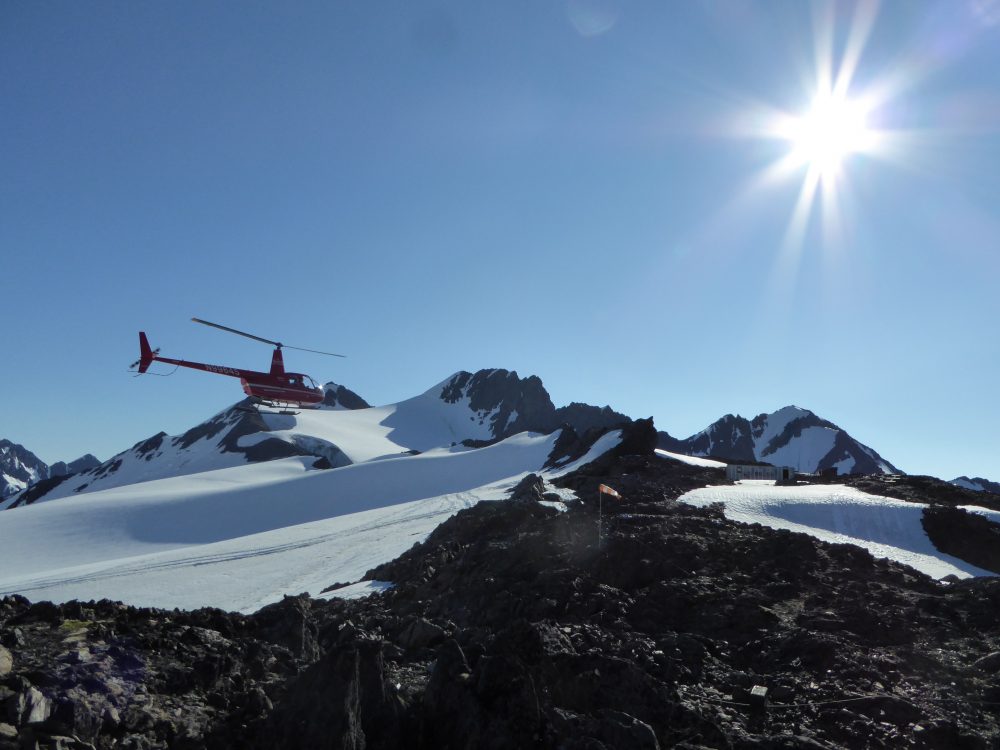
A helicopter approaches the landing zone at Eagle Glacier, in the Chugach Mountains, Alaska, during the 2017 APU Masters Camp in July. (Photo: Gavin Kentch)
As introductions were made in the parking lot I considered it a rousing success that no one burst out in uncontrollable laughter when I told everyone that I was from San Antonio, Texas. The acceptance continued as we drove 45 minutes down Turnagain Arm to Girdwood in the APU van. Fragile ego still relatively intact, it was now time for the first of many firsts to come, a helicopter ride to Eagle Glacier.
As any rollerskier in a southern climate will tell you, there are a few questions you get asked by strangers repeatedly. Unlike bicycling in Texas, in which you may be the recipient of a special howdy in the form of a beer can thrown from a pickup truck, most folks are genuinely curious about your rollerskis.
When you are a rollerskier from Texas, at a premier skiing camp held at a world-renowned training center at almost 6,000 feet in the Chugach Mountains, you get asked questions, too. Number one goes something like, “How the hell did you hear about this place?” Answer: FasterSkier and athlete blogs (Noah Hoffman’s posts from 2013 and 2014 being a standout), and an APU promo video. An email to the world’s best nordic ski coach, Erik Flora, and the next thing you know you are flying in a red helicopter so small it looks like a good gust of arctic air could smack it into the side of a mountain.
Thanks to FasterSkier’s own Gavin Kentch, who insisted that I sit up front; I experienced my first ride to the clouds in the front of our Alpine Air helicopter and felt like I was going to fall through the glass bubble around me. I snapped pictures like a Japanese tourist in Washington, D.C., during the cherry blossom bloom. My adventure was just starting, but as I would find out soon enough, getting there was the easy part.
Secrets revealed
Secrets: we all have them. But how many of us have real, dark, dirty skiing secrets? Well, I do, and they were going to be revealed in an utterly uncomfortable guilt-wrapped blanket of embarrassment followed by an epic explosion. Assumptions are dangerous also, especially if they help to keep your secret a secret. I had those, too, and I was leaning on them heavily already. Day 1 of skiing would reveal all the cracks in my rollerski kingdom, but the real meltdown would come the next day.
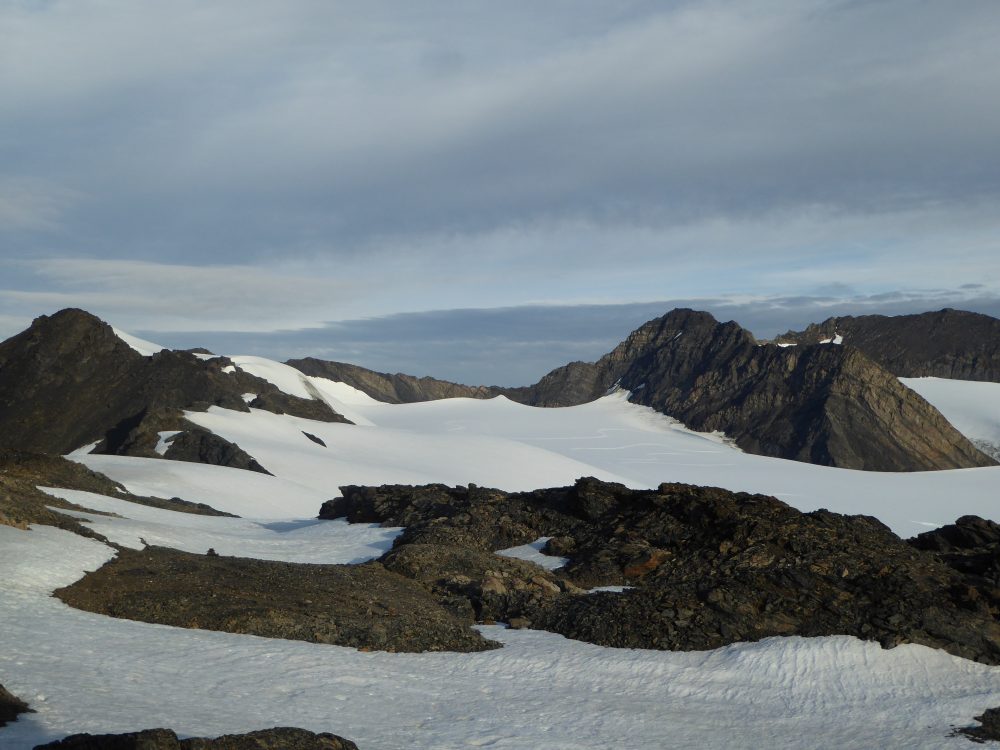
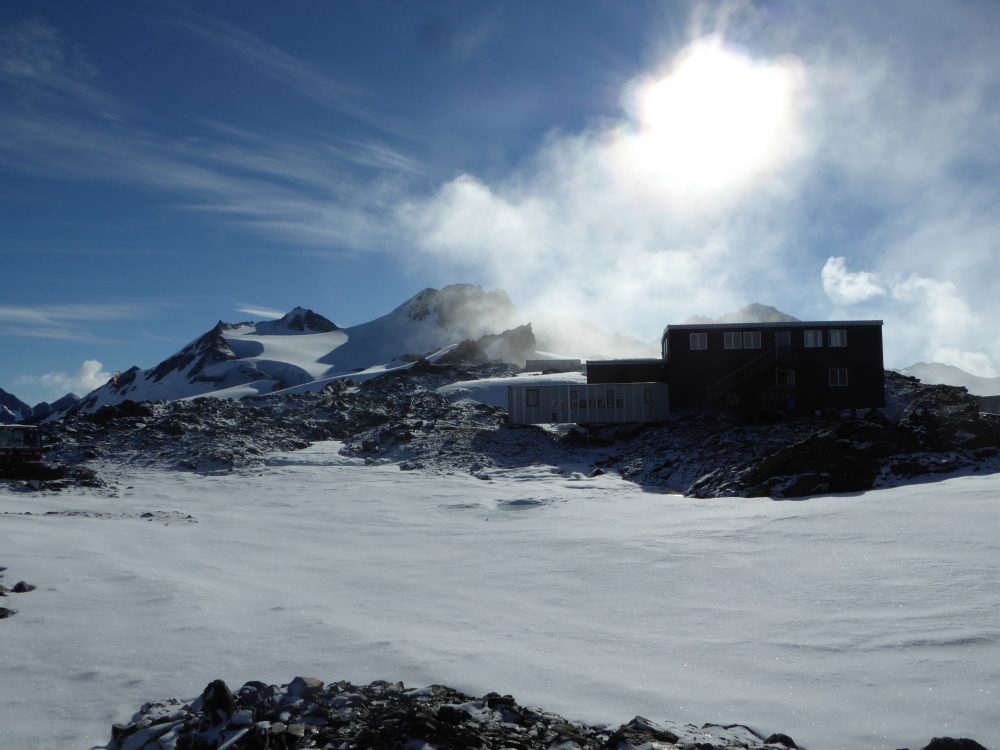
The ski trails are faintly visible (in the background in the shade) from the second-story window of the Thomas Training Center above Eagle Glacier, in the Chugach Mountains, Alaska, during APU Masters Camp in July 2017. (Photo: Gavin Kentch)
But first came room assignments. I would have three roommates in a dorm room with two bunkbeds.
My first roommate would be Jeremy Littell, a USGS brainiac who studied climate change, something I might have wound up doing minus a few missteps and stutter steps in another direction. Jeremy would join myself and several others for a mountain run the day after camp; he struck me as someone who was very fit, and unsurprisingly he turned out to be a speedy skier.
Next was Tom Corbin, with a skiing and ski coaching pedigree that looked like a Who’s Who of the history of American skiing, including decades of coaching and many years spent chasing an Olympic berth. Tom was such an animal that despite hip replacements and blown knees, he was out there everyday ripping it. He also complimented me at the end of the camp on my progress. I told him that coming from someone of his stature it meant a lot to me, and I really meant it.
My other roommate was someone FasterSkier readers would recognize immediately, but I did not see the moniker through the bling at first. Whispers that there was another FasterSkier contributor at the camp led me to suspect and then realize that the author of the very article that led me to buy my last pair of rollerskis was bunking next to me… the man, the legend, the myth – Fast Big Dog, or FBD.
“It’s all about how you look.” — FBD
“It’s all about how you look,” he shouted to Gavin, part of the lively back and forth between the two. With that it was settled.
In case anyone wondered, and I had, FBD is not just an irreverent authorial persona. He is exactly the same in real life as in his writing. There are few skiers who have their own monogrammed “Team FBD” tights and can pull it off. FBD really will throw down at any time, and if you thought it was all bravado, you would be mistaken – he was out skiing longer than anyone else for nearly every session on the glacier. The day after camp, he came away victorious in the T-Bar Row showdown in the APU weight room, though he was then crushed by all of the locals in his ill-advised rollerboard challenge.
FBD was also generous in his encouragement of my progress, and spoke kindly about me at the end-of-camp sharing circle when Erik Flora asked us to share our reactions to camp. But before we could get to the kumbaya and the warm cuddly feeling of all surviving a sufferfest together, I had some dark secrets that were about to be revealed, some assumptions to be utterly disproven, and a near breakdown to weather. Nordic skiing has a way of exposing the rawness that lies beneath, and I was about to be exposed and the curtain was going to be pulled back – way back.
Onto the snow. For the first time in four years.
Time to get on skis. The first ski was classic skiing on the first afternoon.
Some background: I am primarily a rollerskier now, but the memory of snow after four years of asphalt still lingers. I went shuffling around years ago on a whim in Vermont when I used to live there, and after that I borrowed my neighbor’s ancient three-pin skis and used them in a field across the street from my converted farmhouse. Some years later, I took up classic skiing in Ukraine after I decided to stay around six more years after serving in the Peace Corps. Skiing in Ukraine consisted of making a track yourself and skiing back in it if you wanted to get home through the woods a little sooner before you froze to death.
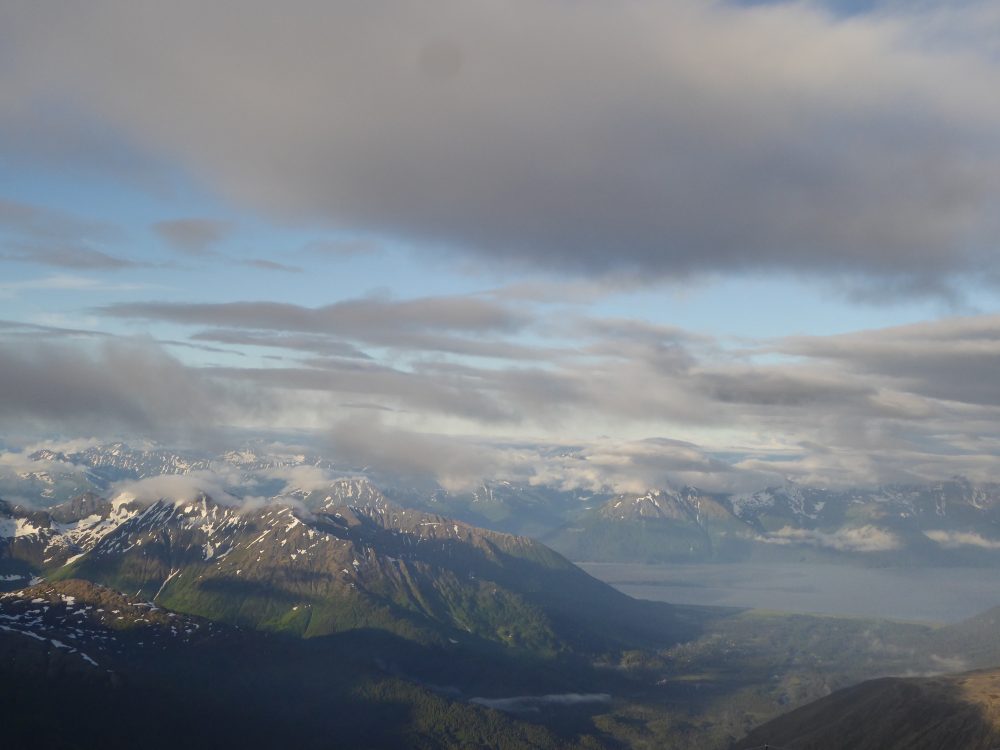
Looking down toward Girdwood and Turnagain Arm from the Thomas Training Center above Eagle Glacier, in the Chugach Mountains, Alaska, during 2017 APU Masters Camp in July. (Photo: Gavin Kentch)
I got into rollerskiing in Texas after I moved back when, by some kind of water-into-wine miracle, I came across Roller Ski Texas, a group founded and organized by a Russian expat named Phillipp Dimitriev, who felt he could bring rollerskiing to Texas’s churro-loving masses by buying pneumatic wheeled skate skis and giving away free lessons. After a while when one day everyone looked at me and asked what are we going to do today and I completely made something up, I became the coach.
The takeaway from this is that although I had some experience with classic skiing on snow, it was always in cold snow conditions and was never in groomed tracks. This was one of my secrets, but I could rollerski in my sleep, I trained everyday… “What could possibly go wrong?” I thought, as I laced up my boots to hit the trail, preparing to plummet 200 vertical feet from the edge of the glacier down to the “stadium” area and start of the main loop.
Little did I know I was doomed from the start.
I realized I was in trouble just seconds into the descent. I was not used to the speed. There were no hills in Texas that could simulate this; I managed to get to the bottom but this is where the fun really began.
My assumption surrounding my secret had been that classic rollerskiing was just like skiing, or at least almost like skiing. Stories of developing a late kick from too much rollerskiing I passed off as unicorn stories spread by misanthropic ski snob haters. Time to go up.
The minute I started to climb out of the stadium, going up a steady uphill in klister conditions at 65 degrees and sunny, I slipped, and then I slipped again, and then I slipped so hard I nearly faceplanted. Where was the kick? Was my coach just messing around when he applied the klister, did he secretly apply butter or motor oil after I left the wax Conex?
I now encountered an additional problem – my poles were sinking almost to the handle. This was made worse when I slipped especially badly. I quickly developed a strategy of trying to excavate my poles by widening the crater so that my basket would be released. About halfway through the first lap my pole came back up out of the snow without a basket on the end; already frustrated beyond belief and in not in one of my prouder moments, I just kept going.
I was slipping so much in the tracks that I could only sometimes find a kick outside of the track. The pole without a basket made things more challenging because that pole would sink much deeper and consistently than the other. I found myself mostly sliding down most of the downhills on my face. My temper was flaring. I was lashing out at myself and cursing the snow gods.
APU Coach Galen Johnston was “part David Blaine and part Dr. Phil with a six pack”
By the end of the first lap I met up with my coach, APU Development and Masters Coach Galen Johnston. Proving himself to be part David Blaine and part Dr. Phil with a six pack, Galen went about assuaging my self-directed assault on myself while simultaneously running off the little devil perched prominently my shoulder whispering a long spew of the negative poison Kool-Aid that I had been drinking.
“I’m so frustrated with myself,” I remember telling him. Galen promptly proceeded to take a look at my scissor kick flailing that I was trying to pass off as skiing and got to work. He quickly began to work with me on proper positioning, finding and feeling the kick, and making smaller movements while increasing the cadence. Pure Genius.
He also takes photographs: APU coach Galen Johnston (r) gets a shot of Shannon Brockman (far left) in the stadium and gear drop area of Eagle Glacier, in the Chugach Mountains, Alaska, during 2017 APU Masters Camp in July. (Photo: Dan Libbey)
The next lap I started feeling less slip, and the next after that I had begun to feel like a skier; I was still skiing without a basket, but I felt stronger with each lap. Galen skied with me, encouraged me, and even helped me nail a downhill that seemed to be my nemesis.
Somehow I survived the first day. Even though I had improved greatly, my confidence was badly shaken. I thought about the hours of intervals, distance, and hills I did on rollerskis; the strength training, swimming, and cycling that had led me to believe I would somehow be competitive with a group of lifelong racers. Call it ignorance, but I still had an inkling of hope that the next day, with our first skate ski session in the morning, would be different… instead, after today’s black eye and ensuing attitude adjustment I would nearly have a breakdown the next day that found me questioning my very reasons for coming to Eagle Glacier.
Because sometimes the first skate skiing of your entire life happens on glacial slush at 6,000 feet
The next morning I found myself at the bottom of the first climb, ready to open up the skate skiing. I was ready, or so I thought. Here, now, I would redeem myself.
My rollerskiing group in Texas was a skate skiing club, I coach skating technique, I’d done it in front of the cameras for local news stations, I was sure that my upper body strength from years of training would help me… but somewhere my biggest deep dark secret was gnawing at me.
I had never skated on snow of any kind in my entire life.
You see, even though I had never skied on soft slushy snow in a track on classic skis – I had never skated on snow of any kind in my entire life. Since classic had been a disaster, my assumption that rollerskiing could simulate skiing was hanging by a thread.
As I started up the first hill [the “first hill” at Eagle Glacier gains roughly 100 meters total over a series of rolling up and downs, though mostly ups – Ed.], the first problem I noticed was that I spend very little time doing V1 rollerskiing. In Texas, the “hilliest” terrain I can still full V2 on my medium-speed Marwes. I practiced V1 based on some video I had seen online, but mostly this was just jump skating the tops of hills.
At Eagle you are either going up or going down, and going up for me meant skiing V1 for a long time. I began to notice immediately that my glide was virtually nil, so I began poling harder to compensate, which just sunk my poles deeper into the soft snow and decreased whatever glide I was getting even further. As soon as I pointed my skis out in a V-stance, my right abductor began to ache. A war injury from my soccer years, it would get worse as I went on before finally turning into a stabbing pain near the end of the lap that reminded me repeatedly that I was 41 years old and going up a steep hill at nearly 6,000 feet.
It was about this time that I began to feel the altitude. Despite moving almost slow enough to fall over, I noticed that my heart rate was highly elevated. Even though I was constantly reminding myself to breathe, I found myself stopping repeatedly on every hill. I vowed to get through the first lap, and I did, but I called it quits after that. I was too demoralized to seek out a coach; I felt utterly broken.
Later that evening, I began to question why I had come to this camp. I had come to get some on-snow time, but also, being highly competitive, I came to measure myself against others. It was not just the four years of training in 100-degree, 80-percent humidity since I had last seen snow that had prepared me for this. I had also spent six years before that skiing by myself in Ukraine.
Fresh snowfall surrounds the Thomas Training Center above Eagle Glacier, in the Chugach Mountains, Alaska, during 2017 APU Masters Camp in July. (Photo: Gavin Kentch)
Skiing had always been a place where I could find solace, peace, satisfaction, and happiness when I couldn’t find it elsewhere. Now it suddenly seemed like my greatest demon. Everything I had done before seemed for naught. It felt like I was just learning how to ski, like the tables had been turned and suddenly I was one of the beginner athletes I coached in Texas. About this time I thought of my family, my 18-month-old. I wondered how they were doing. I began to miss them. To complicate my crisis of conscience, others in our group were regularly seen texting and talking on their phones… I checked my phone and found that I had no service. I was at an all-time low.
Some time before heading out for the classic afternoon session. Berit Flora offered me her phone so that I could call my family. Berit was affectionately referred to as the camp mom for her powers of making sure everyone was doing well and well fed, and her gesture in that moment seemed to give me new lifeblood. A dark cloud seemed to float away from above my head.
(I had the pleasure and honor of later having dinner with Berit and her husband Sam and others after the camp finished. Both Berit and Sam (who are Erik Flora’s septuagenarian parents) were out there skiing every day, and had plenty of history in the form of great stories to add to mealtime discussion. Sam also drove me to my Airbnb room after camp, to Alaska Mountaineering and Hiking to return my rented skis, and to the airport. Their hospitality and kindness will not soon be forgotten.)
About this time I began to reevaluate my goals. There were other reasons to come to this camp, such as receiving some of the best coaching from some of the best coaches in the world. Also I could personally gain from coaching because my first ski taught me I had more to learn than I realized. Also, if I could ski these conditions I could come away with some newfound confidence (maybe getting through it was the moral victory) as well as a desire to get on snow more often; more snow time was something that became apparent immediately that I needed.
The wall of fame inside the Thomas Training Center on Eagle Glacier. From left, the APU Juniors (teenage girls), APU Elite Team, 2014 Masters Camp, North American Women’s Training Alliance (American and Canadian athletes, plus Norwegian skier Celine Brun-Lie), and Man Camp (APU and USST men), among many others, have all left their mark. (Photo: Greta Anderson)
I also reminded myself of how few people get an opportunity to ski here, the names of elite athletes written on on the walls serving as gentle reminders of the caliber of skiers who typically come to Eagle. I vowed to take in the beautiful scenery more, and to receive as much coaching as possible. Once I put the shattered pieces of my ego aside I began to enjoy myself again.
The next classic session I felt especially good and was able to catch Brandy Stewart (an elite skier from Montana) and Gavin, two skiers well above my level, on a climb. I was immediately dropped on the first descent, but it was something Galen would bring up on the last night. Credit to Galen, but also to Dylan Watts, the best cook/competitive skier/coach in the world, who jury-rigged a really sweet basket on my left classic pole. Feeling like I was skiing with two poles really made a difference.
After talking to Erik Flora the night before, he immediately found me the next morning. I got to ski with him for a while, which made my day, and made it apparent what I need to work on for the future.
It was not lost on my me how much it would cost me to have the best coach in any other sport work with me one on one; the experience was priceless. A shooting lesson from Gregg Popovich or a tackling lesson from Bill Belichick I could never afford, even if they were willing to take the time. And yet Erik seemed to enjoy coaching me; that dedication and love for coaching is something that I hope I can duplicate with my rollerskiers. I tried to listen to everything he was telling me technique-wise, but when he skied in front of me I couldn’t help but imagine how hard it was for him to ski that slow; he is an amazing skier and within seemingly a second or two after the lesson ended he was out of sight, moving on to find and coach the next athlete.
Morals and acknowledgments
There plenty of others who gave me the courage to continue on and improve each day. Both of the FasterSkier crew gave me encouragement throughout, and everyone seemed to lift each other up with a kind word or two on the trail. Special thanks to Jeffrey Lynn, my hilarious dishwashing buddy that made the time spent doing chores enjoyable. Jeffrey was there to become a better skier to be able to ski with his son. I watched him put on Moleskin and heaps of duct tape to cover his blisters every day – you were inspirational to me.
Special thanks to Galen, who even loaned me his skis, and to him and the APU Masters Group who let me join two of their workouts after camp. I truly felt like a part of the APU Masters skiing community, and I don’t recall ever feeling that much energy and excitement from working out with anyone else.
I’d come far during the camp, from skiing alone in the woods in Ukraine, to braving the heat in Texas, to V1’ing up a glacier. I had come great distances to see, taste, and feel the ultimate. The ultimate venue, ultimate beauty (yes, Alaska is probably the most beautiful place I have ever seen), ultimate coaching, and ultimate community.
It was only fitting that after coming from humble obscurity and a truly off-the-radar outpost like San Antonio, and overcoming some pretty personal lows, the helicopter I flew out of was bringing up two of our nation’s greatest skiing stars, Kikkan Randall and Sadie Bjornsen. They got out of the helicopter, with an NBC cameraman dressed more for L.A. weather than for Alaska filming every step they took.
Total stars in our sport, they both smiled and waved. Sadie offered a quick handshake and Kikkan smiled and said hello, looking exactly like the Fischer ski poster of her on the second floor of the Thomas Training Center had suddenly come to life. If I would have had the time without the helicopter ready to lift off, and it wouldn’t have been so loud, I might have introduced myself: “Hi, I’m Jason, a skier from San Antonio.”
— Gavin Kentch contributed
***
Masters Minds series: Are you a masters skier who loves your club? Submit camp or training recaps, announcements, or stories to info@fasterskier.com with the subject line “Masters Minds.” Articles can be first-person accounts or written from an observatory standpoint with comments from others.
Peter Wolter, of the Sun Valley Ski Education Foundation, racing to the fastest time up Agony Hill during the 2017 Western Regional Elite Group (REG) time trial in Salt Lake City, Utah. (Photo: Matt Whitcomb)
When it comes to U.S. Regional Elite Group (REG) training camps, there are a few running themes that remain consistent across the country and from year to year. In the East, West and Alaska, participants in the U.S. Ski Team’s development program are tested with an uphill run, agility course and a roughly half-mile double pole, all of which are timed and done individually.
Western REG coaches Mike Elliott and Bill Hokanson explained how the run is done at Agony Hill, adjacent to the University of Utah in Salt Lake City. The “hill”, on the 6,348-foot Mount Van Cott, has been an REG staple since 2006, according to Elliott, a three-time Olympian and former U.S. Ski Team (USST) member. It has been used since the 1990s by the USST, the University of Utah Ski Team, Wasatch Ski Academy, The Utah Nordic Alliance, Park City Nordic Ski Club, and Soldier Hollow Nordic Ski Club, Elliott wrote in an email.
The Agony Hill course records set more than a decade ago still stand, which Hokanson explained was partially due to trail construction since.
“We’re not 100% convinced the modern course is exactly equivalent to the historical one,” wrote Hokanson, head coach of the Wasatch Nordic Ski Academy in Park City and Salt Lake City.
For instance, Morgan Arritola set the junior women’s record of 16:55 minutes up the 1.7-kilometer climb in 2004. The rest of the course records were set before that by John Aalberg (12:46), Nancy Fiddler (15:46) and Rob Whitney (reportedly under 14:00) for senior men, senior women and junior men, respectively.
“Variations in the Agony Hill TT course over the past 3 – 4 decades may in part account for the difficulty contemporary athletes have faced in trying to set new records,” Hokanson wrote. “However the records are held by 4 of the toughest, fittest, most talented athletes of all time, which may fully account for the tenacity of their record efforts.”
Here’s how you can replicate the Agony Hill time trial in your own backyard:
“Agony Hill can be developed anywhere and it does not have to be all uphill,” wrote Elliott, now executive director of Rocky Mountain Nordic in Durango, Colo. “My coach, Dolph Kuss, used a course on the edge of Durango when I was in college a Fort Lewis college in 1965 & 1966. It was a loop next to the local cemetery. The area is still called test tracks.”
Elliott recommends a climb lasting 12 to 15 minutes for athletes 18 and older. He also suggested starting athletes individually (via interval starts).
“It can be all out for one lap or Level 3 below threshold intervals,” Elliott added. “Try and have around the same time each time. It can be a 15-minute run to see how far you can go. Like Agony Hill, it can be all uphill.”
He explained that these kind of time trials measure fitness, pacing and rate of improvement over time, and recommended doing this workout once every other week or once every three weeks.
The Workout: Agony Hill uphill time trial
1. Warmup: Light running and stretching for 30-40 minutes
2. Uphill Run: Interval-start recommended
Option 1: One time, all-out effort: see how far up the hill/mountain you can go
Option 2: Level 3 intervals: aim for consistent times
3. Cool down
Agony Hill specifics:
Where: Mount Van Cott, east of the University of Utah in Salt Lake City
The Alaska REG participants near the start of the Hatcher Pass Road climb during their final session of the 2017 Alaska REG camp, held July 12-16 in Anchorage and Palmer. (Photo: Alasdair Tutt)
The following Regional Elite Group (REG) camp recap was submitted by NSCF-FXC Interim Head Coach Alasdair Tutt. FasterSkier encourages coaches and athletes from any regional offseason camps (dryland or on-snow, in the U.S., Canada or abroad) to submit their own recaps and photos to info@fasterskier.com. The Western and Eastern REG camps took place last month in Utah and Vermont, respectively.
***
On July 12, 16 athletes gathered at Hillside Ski Area in Anchorage for the 2017 Alaska REG camp, kicking off five days of testing and training. The first day was in Anchorage before heading north to Palmer for the remainder of the camp.
The camp was led by U.S. Ski Team Development Coach Bryan Fish who was joined over the week by Ja Dorris and Stan Carrick of Alaska Nordic Racing (ANR), Eric Strabel and Sam Sterling of Alaska Pacific University (APU), Jan Buron of Alaska Winter Stars (AWS), and Alasdair Tutt of Nordic Ski Club of Fairbanks – Fairbanks XC (NSCF-FXC).
Addison Gibson (ANR) on course during the agility time trial where she posted the fastest time of the day. (Photo: Bryan Fish)
The first test was the infamous Gasline time-trial uphill run, a regular test for the Anchorage-based teams and previous REG camps. The course saw the athletes wind up beside an alpine run before appearing out onto the road overlooking the sea. The fastest times were set by Ti Donaldson and Kendall Kramer, both of the NSCF-FXC program. That afternoon, athletes were led through a strength workout by Bryan at the Alaska Pacific University gym.
Day 2 brought the agility test at Colony Middle School in Palmer and with it some of the more exciting and competitive testing of the camp. The fastest combined times (best two of three) were set by Addison Gibson (ANR) and Donaldson.
That afternoon, our grand plans for bounding drills were mostly foundered by a huge lightning storm that came in over Hatcher Pass that had us running back to the cabin to find a river where the lawn had once been, now occupied by a moose cow and two calves.
It was game on for some head-to-head double pole sprints just below the Government Peak Recreation Area trails in Fishhook, Alaska. Athletes raced in a king’s court format both up and downhill. (Photo: Alasdair Tutt)
On the third day, we had much better luck with our weather and a double-pole time trial was on the menu as our final test of the camp. Over a 970-meter course on Mountain Trails Road, the athletes were sent to chase down their best performances leading to three athletes being separated by only one second each. The best times were again set by Kramer and Donaldson of Fairbanks. That afternoon we braved the growing afternoon traffic with a rollerski up Hatcher Pass Road with some technique work at key points along the road.
Some highlights of the remainder of the camp were: an over-distance workout on the Reed Lakes Trail, where athletes were fortunate enough to avoid several brown bears in the vicinity who were harassing hikers (or being harassed), a critical viewing of the new Spiderman movie in which we decided Spiderman exhibited a great example of how the Central Governor Theory could be applied in a superhero scenario, and a final day classic rollerski up the Hatcher Pass Road.
Four REG skiers at Upper Reed Lake in the Hatcher Pass area during an over-distance workout on the second-to-last day of the 2017 Alaska REG camp earlier this month. (Photo: Alasdair Tutt)
The U.S. Ski Team women’s team at work during a 10-day camp in the Methow Valley. (Photo: Matt Whitcomb/U.S. Ski Team)
(Note: This article has been updated to include comments from Canadian coach Ivan Babikov on his team’s recent camp in Park City, Utah.)
Two days after Andy Newell and Erika Flowers tied the knot in Bozeman, Mont., seven members of the men’s U.S. Ski Team and eight U.S. women’s team members jumped into an intensity training block at their respective dryland camps in Park City, Utah, and the Methow Valley in northern Washington.
The 10-day camps were scheduled simultaneously from June 26-July 5 to accommodate the wedding. Newell is a longtime U.S. Ski Team (USST) member and teammates with Flowers on the Stratton Mountain School (SMS) Elite Team out of Stratton, Vt. Because several national-team members ventured to Bozeman (Flowers’s hometown) to watch them say “I do,” the USST coaches decided to reduce travel and keep their squads together out west.
“We wanted to capture the men in the Intermountain West immediately following Andy Newell’s wedding in Bozeman, and therefore reduce the overall travel load for athletes who were already coming to the West from the East or Alaska,” head coach Chris Grover explained in an email.
The men based themselves in Midway, Utah, about 1,500 feet lower in elevation than Park City and 1,000 feet lower than Deer Valley, where they typically reside for summer and fall camps. Grover explained that this was by design, “because of the shorter duration of the camp (i.e. too short to create a meaningful stay at altitude), the focus on specific intensity workouts, and the benefits of quicker recovery at lower altitude,” he wrote.
Staying closer to the Soldier Hollow training venue was also ideal for the men’s team’s “PyeongChang-specific workouts”, Grover explained, including sessions focused on the freestyle team sprint, classic sprint and 4 x 10-kilometer relay, which will be contested at the 2018 Winter Olympics in PyeongChang, South Korea.
Newell, Simi Hamilton, Erik Bjornsen, Scott Patterson, Paddy Caldwell, Ian Torchia, and Ben Saxton attended and worked with coaches Jason Cork, Pat O’Brien, Grover, and U.S. Ski & Snowboard Strength and Conditioning Coach Tschana Schiller.
“The men did a great job of bringing heightened focus and effort to these key intensity workouts and we are grateful to the staff at Soldier Hollow for preparing the track for us,” Grover wrote. “Overall, it was a very productive camp and I think sent the men into the main summer preparation period with important areas to work on, a good gauge of fitness, and a further understanding of what skills need to be developed for the WC [World Cup] season and for PyeongChang.”
(Article continues below)
The U.S. men’s cross-country team at work during a classic distance rollerski near Midway, Utah. (Photo: Pat O’Brien)
The U.S. men’s cross-country team at work during a classic distance rollerski near Midway, Utah. (Photo: Pat O’Brien)
The U.S. men’s cross-country team at work, accompanied by head coach Chris Grover on his bike, during a skate over-distance rollerski near Midway, Utah. (Photo: Pat O’Brien)
The U.S. men’s cross-country team at work during a skate over-distance rollerski near Midway, Utah. (Photo: Pat O’Brien)
The U.S. men’s cross-country team at work during a skate over-distance rollerski near Midway, Utah. (Photo: Pat O’Brien)
The U.S. men’s cross-country team at work during a skate over-distance rollerski near Midway, Utah. (Photo: Pat O’Brien)
Start of the men’s skate team sprint on July 3 at the U.S. Ski Team men’s camp at Soldier Hollow in Midway, Utah. (Photo: Pat O’Brien)
Start of the men’s skate team sprint on July 3 at the U.S. Ski Team men’s camp at Soldier Hollow in Midway, Utah. (Photo: Pat O’Brien)
Do you use a heart rate monitor for training? Has it ever given you a seemingly implausible reading? Here’s why, and whether you should worry. (Photo: Pat O’Brien)
Andy Newell (r) leads the men’s skate team sprint on July 3 at the U.S. Ski Team men’s camp at Soldier Hollow in Midway, Utah. (Photo: Pat O’Brien)
Scott Patterson starting the U.S. Ski Team’s distance time trial at Soldier Hollow in Midway, Utah. (Photo: Pat O’Brien)
Scott Patterson (l) ascends the infamous Hermod’s Hill during the U.S. Ski Team’s distance time trial at Soldier Hollow in Midway, Utah. (Photo: Pat O’Brien)
Paddy Caldwell climbing during the U.S. Ski Team’s distance time trial at Soldier Hollow in Midway, Utah. (Photo: Pat O’Brien)
Simi Hamilton during the U.S. Ski Team’s distance time trial at Soldier Hollow in Midway, Utah. (Photo: Pat O’Brien)
Newlywed Andy Newell on his U.S. Ski Team’s distance time-trial day at Soldier Hollow in Midway, Utah. (Photo: Pat O’Brien)
From left to right: Andy Newell, Ben Saxton and Simi Hamilton working on classic speeds at Soldier Hollow in Midway, Utah. (Photo: Pat O’Brien)
From left to right: Andy Newell, Ben Saxton and Simi Hamilton working on classic speeds at Soldier Hollow in Midway, Utah. (Photo: Pat O’Brien)
Simi Hamilton leads Andy Newell and Paddy Caldwell during a classic-speeds workout at Soldier Hollow in Midway, Utah. (Photo: Pat O’Brien)
Andy Newell leads Simi Hamilton during a classic-speeds workout at Soldier Hollow in Midway, Utah. (Photo: Pat O’Brien)
Paddy Caldwell leads Erik Bjornsen (c) and Ian Torchia (r) during a classic-speeds workout at Soldier Hollow in Midway, Utah. (Photo: Pat O’Brien)
Ben Saxton (r) and Erik Bjornsen (l) during a classic-speeds workout at Soldier Hollow in Midway, Utah. (Photo: Pat O’Brien)
U.S. men’s team members Erik Bjornsen (l) and Ian Torchia during a classic-speeds workout at Soldier Hollow in Midway, Utah. (Photo: Pat O’Brien)
U.S. Ski Team Men’s Assistant Coach Jason Cork checks in with Ian Torchia during a classic-speeds workout at Soldier Hollow in Midway, Utah. (Photo: Pat O’Brien)
Local juniors rollerski alongside U.S. Ski Team members during a workout at Soldier Hollow in Midway, Utah. (Photo: Pat O’Brien)
***
Meanwhile, the U.S. women tried a new camp in the Methow Valley, home of current national-team members Sadie and Erik Bjornsen. The athletes themselves dubbed it the “CAGS Camp“, which U.S. women’s coach Matt Whitcomb explained stood for “a secret and mildly inappropriate team acronym that pokes fun at girls being girls. Sophie had hats made for the camp that she handed out at the airport when everyone arrived.”
All kidding aside, the goal of the camp was to be small and intensity focused, “with eight days of training and hard intervals every other day,” Whitcomb wrote in an email. “It’s an unusual setup for our team as we usually run joint camps with the men, but both enjoyed the simplicity of having such small training groups.
“We chose the Methow in part because it is where Sadie and Erik Bjornsen grew up, but also because we could get close to sea-level to maximize our hard efforts,” he added. “Another draw was that Pete Dickenson, one of our team physical therapists, was able to provide great treatment all week. Winthrop PT & Fitness sponsored our strength sessions, which meant we didn’t have to drive very far to get strong.”
Like Grover, Whitcomb used the word “ideal” to describe the Methow as a training site, yet emphasized that the community that hosted them was “even more incredible.”
“A local couple gave us their two cabins in a location as beautiful as we’ve seen anywhere in the world,” he wrote. “The chance to meet Olympians Laura McCabe (’94, ’98) and Leslie Hall (’88, ’92, ’94) was an important experience for the team. We owe them special thanks not for just guiding us to their favorite training spots, but for helping pave the early path for elite women’s skiing.”
The women’s team, which included Sadie Bjornsen, Rosie Brennan, Sophie Caldwell, Jessie Diggins, Katharine Ogden, Kikkan Randall, Ida Sargent, and Liz Stephen, spent one afternoon working with with the Methow Valley Nordic Team, which McCabe and Hall both coach.
“We invited a handful of their top athletes to join our bounding and ski walking sessions, and were encouraged by their technique and fitness, but also their love for the sport,” Whitcomb wrote. “They are doing a good job up there. I don’t know what the future holds for us regarding camp locations, but the Methow Valley will be considered as a great option moving forward. Thanks to so many people for making it happen.”
Women’s team staff included Whitcomb, Tim Baucom and physical therapist Pete Dickenson.
(Article continues below)
The U.S. women’s team with Methow Valley Nordic Team members during the U.S. Ski Team’s recent camp in Washington state’s Methow Valley. (Photo: Matt Whitcomb)
Rosie Brennan (in yellow) takes the lead while Sadie Bjornsen (in pink helmet) coaches on the bike during a 2017 U.S. women’s team camp in the Methow Valley. (Photo: Matt Whitcomb)
The U.S. Ski Team women’s team at work during a 10-day camp in the Methow Valley. (Photo: Matt Whitcomb)
The U.S. Ski Team women line up for the team sprint final during their camp in Washington state’s Methow Valley. (Photo: Matt Whitcomb)
Liz Stephen at work during the U.S. Ski Team women’s team’s camp in the Methow Valley. (Photo: Matt Whitcomb)
Sadie Bjornsen (front) and Ida Sargent get some help hydrating from coach Tim Baucom during a run in the Methow Valley. (Photo: Matt Whitcomb)
The U.S. women’s team at their dryland camp in the Methow Valley: (from left to right) Ida Sargent, Kikkan Randall, Sophie Caldwell, Jessie Diggins, Liz Stephen, Sadie Bjornsen, and Rosie Brennan. (Photo: Matt Whitcomb)
U.S. Ski Team coach/serviceman Tim Baucom sits on the porch of one of the team’s cabins during their recent camp in the Methow Valley in northern Washington. (Photo: Matt Whitcomb)
***
Cross Country Canada also recently finished up a two-week camp in Park City (June 26-July 11) with its entire men’s World Cup team — Alex Harvey, Len Valjas, Devon Kershaw, Jess Cockney, Knute Johnsgaard, and Graeme Killick — and U25 national-team member Julien Locke. Co-World Cup coaches Ivan Babikov and Louis Bouchard accompanied the team for the duration, and Joel Jaques joined for the first week.
While Park City has become an annual staple for the Canadian team, Babikov explained that this was their first time there in the summer, as opposed to the fall.
“We love the area and training there. … It was pretty hot but we managed,” he wrote. “The main goal was a big training volume/hours at the altitude. We were planing on doing a time trial at the SoHo but it got closed for those dates so we ended up doing intensity down in Salt Lake instead.
It was a great camp for all the guys, everyone feels good and no injuries on the team.”
The following recap was written by Justin Beckwith, competitive program director for the New England Nordic Ski Association (NENSA) and a coach at this year’s Eastern Regional Elite Group (REG) camp, which took place in late June in Waitsfield, Vt. FasterSkier encourages coaches and athletes from any regional offseason camps (dryland or on-snow, in the U.S., Canada or abroad) to submit their own recaps and photos to info@fasterskier.com. The Western REG camp also took place last month in Utah.
***
During the last week in June, the Eastern Regional Camp was held at the Green Mountain Valley School (GMVS) in Waitsfield, Vt. Thirty-four athletes came together for a week of training and testing as a part of the U.S. development programming. Twenty-three Junior National skiers, ages under-18 (U18) to U20, from throughout New England and New York were joined by 12 U16 skiers who participated in a separate but parallel camp.
U.S. Ski Team Development Coach Bryan Fish was joined by Colin Rodgers and Katrina Howe from GMVS, Rob Bradlee (CSU), Nathan Alsobrook (Bowdoin), Jake Barton (Craftsbury), Kathy Maddock (Dublin/CSU) and Justin Beckwith from NENSA. The staff was bolstered throughout the week by several club and collegiate coaches who joined for individual sessions. One of the highlights of camp was Olympic Day, where Olympians Dorcas Wonsavage (’88,’92,’94), Pat Weaver (’98,’02) and Noah Hoffman (’14) visited the group during a skate session in Jericho to help lead technique stations and imparted inspirational words to end the day.
A skier at the Eastern REG camp last month gets some air during an agility test at the Green Mountain Valley School in Waitsfield, Vt. (Photo: Justin Beckwith/Vimeo screenshot)
This year’s agility test was spiced up with two curved step-up ramps and a Slip ‘N Slide, complete with tiki torches to mark the finish line. Skiers got a taste of continuous pursuit formats by removing their skis and poles in a transition box before running and diving over the refreshing finish line. Ben Ogden and Mae Chalmers, both from Stratton, took top honors with the two fastest combined times.
The second test for camp was the uphill run, which was staged again at Mad River Glen. The course was adapted from previous years to use slightly faster uphill terrain. Several athletes were heard saying it was the hardest effort they had done so far this year – going all out for just over ten minutes up the main work road on the mountain. Ben Ogden again took the win on the men’s side and was joined by Rena Schwartz (GMVS), who took a decisive victory in the women’s race by over a minute.
The final test pitted the athletes against the Plunkton Road 800-meter double pole test. Overall times were quite impressive this year and it is clear that clubs are pushing hard to improve this component of their training. Again Ben Ogden and Rena Schwartz topped their respective fields with convincing wins and Ogden tied the second fastest historical time for over ten years of results on this course.
Athletes and coaches alike will remember an awesome week of training with rather cool and perfect temperatures in the Mad River Valley. The Green Mountain Valley School hosted an excellent camp with tasty food and well organized logistics. NENSA would like to thank all of those who made this camp such a great success!
A Slip ‘N Slide and tiki torches marked the finish of the agility test at this year’s Eastern REG camp at the Green Mountain Valley School in Waitsfield, Vt. (Photo: Justin Beckwith/Vimeo screenshot)
All 34 Western REG participants and U.S. Ski Team Development Coach Bryan Fish after L3 intervals at Soldier Hollow in Midway, Utah. (All photos: Mike Elliott)
The following recap was written with the help of Mike Elliott, director for the Western Regional Elite Group (REG) camp, which took place June 17-24 in Park City, Utah. FasterSkier encourages coaches and athletes from any regional offseason camps (dryland or on-snow, in the U.S., Canada or abroad) to submit their own recaps and photos to info@fasterskier.com.
***
For seven days in June, 34 athletes (17 women and 17 men) from five western U.S. divisions (Rocky Mountain, Intermountain, Far West, Pacific Northwest, and High Plains) came together in Park City, Utah, for the annual Western REG (Regional Elite Group) camp in Park City, Utah.
With the help of U.S. Ski Team coaches Matt Whitcomb and Bryan Fish, a staff of nine led the camp, including Gus Johnson (Auburn Ski Club), Dan Weiland (Ski and Snowboard Club Vail), Greta Anderson (Steamboat Springs Winter Sports Club), Paul Smith (Sun Valley Ski Educational Foundation), Molly Susla (Crested Butte Nordic Team), Pierre Niess (Leavenworth Winter Sports Club), Bill Hokanson (Wasatch Nordic Ski Academy), Mike Elliott (Rocky Mountain Nordic), and camp chef Nancy Elliott (Durango Nordic Ski Club).
An over-distance classic ski from Pine Canyon to Empire Pass out of Midway, Utah. Inspired by the U.S. Ski Team women who wear matching socks for relays, the camp’s male athletes bought pink shorts at the outlets in Kimball Junction to show their unity. “Coaches, however, did not make the purchase of pink shorts,” camp director Mike Elliott explained. (Courtesy photo)
According to camp director Mike Elliott, athletes were selected based on two factors which were weighed equally, 50/50: their final USSA points at the end of last season and their best two out of three races at 2017 Junior Nationals.
The first training session of the week was held at the infamous Agony Hill next to the University of Utah Hospital in Salt Lake City. Peter Wolter of Sun Valley posted the winning time for the men and Novie McCabe (Methow Valley Nordic Ski Club) was the fastest woman to the top.
In the agility sprint, Sarah Morgan, of Park City’s Wasatch Nordic Ski Academy, claimed first for the women and James Schoonmaker (Auburn Ski Club) was the fastest man. Another Wasatch skier, Madison “Maddie” Morgan won the double-pole time trial, along with Evan Barbier of Steamboat Springs.
“Working with such talented young skiers is so much fun and rewarding,” Elliott wrote in an email. “We often left the lodging facility at 6:30am or 7am to beat the heat. The athletes were always on time and motivated and organized with the proper training equipment. There was a high degree of Esprit de Corps among all the participants. They competed in the three events that were timed, and they supported each other in the other training sessions. Some of the skiers had a goal to qualify for the National Elite Group training camp scheduled later in Park City.”
Of the skiers that attended this year’s camp, several were Junior National medalists, including Wolter, McCabe, Maddie Morgan, Haydn Halvorsen, Sydney Palmer-Leger, Sofia Shomento, and Marin Coletta. Another multiple medalist, Johnny Hagenbuch was scheduled to attend this year’s Western REG, but broke his leg the weekend before the camp, Elliott explained.
An over-distance classic ski from Pine Canyon to Empire Pass out of Midway, Utah, at the 2017 Western REG camp in June. (Photo: Mike Elliott)
Mt. Bachelor in Bend, Ore., as seen in May 2017. (All photos: FBD)
You should be in Bend. Bend, Oregon. Right now.
For all of my “shallow readers” in the audience, those unable to focus on any piece of written work longer than 140 characters (you know who you are), you can stop here. You’ve both learned everything you need to know and also everything your SnapChat-addled brain can handle, so you’re done. For those of you with attention spans longer than those of fruit flies, dig in, as I’m about to plan your next trip for you — and here’s the good news — it’s this weekend. Or next year at this time. And every year thereafter.
Let me see if I can guess what’s going on right now for most of you — you’ve already storage waxed your skis for the summer, you’re back out on your mountain bike, and you’re re-reading each of my whap-stick reviews (skate & classic) every night before you go to bed. You tell yourself each morning as you go through your visualization and meditation routine, in which you attempt to teleport into my magnificent body and life, that this is the year that you’re going to set a PR at the (insert your favorite race here), beat your nemesis (insert the name of that person who you’ve been chasing for a decade or so) or finally slay that dragon and qualify into Wave 6 of the Birkie. Then your change-adverse subconscious kicks in and tells your mind, “Hey brain, these are great goals — you know what we really ought to do? We should do the same thing that we’ve been doing for the last 5, 10, 15, or 20 years, I bet THIS year is the year that it finally works.” Sure, that’s one approach, but you know what’s an even better tactic, one that might actually work? Try something new. And he’s a shocker, start by spending more time on snow. It is for this strategy that this report is going to come in handy.
Mt. Bachelor Nordic Center in May 2017.
Once you make this leap of faith and commit to change, the hard part is over and then it’s just a matter of figuring out what you’re going to do differently (read, better). As usual, I have you covered, as what better way to dilute the knee-buckling pressures of adulthood and obstinate Great Danes than to escape to a place filled with cool people. And not just cool people, YOUR people. And Bend is that place. Not only can you still get on snow here right now, but you can get on really good snow.
This isn’t an article about some BS 2 k loop in a carbon-monoxide-filled tunnel in the armpit of Europe. In fact, it’s about as far away from that (both literally and figuratively) as possible. The Nordic center in Bend is nestled between 1,752 and 1,950 meters at the base of Mt. Bachelor and offers an amazing array of trails and options. Right now, all 56 k of perfectly prepared trails are open and believe it or not, the venue is still getting regular new snowfall.
Sue Foster, Mt. Bachelor Nordic Ski Center director
“This is truly an amazing place,” said Sue Foster, director of the Mt. Bachelor Nordic Ski Center. “Our snow in early to mid-May is usually quite reliable, but this is a particularly great year, even for us. We’re still grooming the whole network, so every trail is still open, which is pretty awesome for this time of year. We may shut the lower loops down soon, but we’re still going to to have a lot of skiing available into mid-June.”
It is for all of these reasons and more (more on this in a bit), that Bend is the venue of choice in May for all of the U.S. nordic national teams: US Biathlon, Cross Country, Nordic Combined, Paralympics Nordic, and several top junior teams are either here right now or coming shortly.
“This is a fabulous place to train in May,” said US Biathlon Women’s Coach Jonne Kähkönen. “We’ve been coming here for several years as it is a perfect place to log a lot of quality hours on snow, really focus on technique and have a wide variety of outstanding dryland training options as well.
Jonne Kähkönen, US Biathlon women’s head coach, in Bend, Ore.
“I coached in Finland before I took this position with US Biathlon and we used to go to the glacier in Ramsau, Austria, for a similar camp, but this is really much better,” he continued. “Not only is the snow as good or better, but everything is much easier logistically, as you don’t have to take a gondola up every day to ski and the afternoon dryland training is accessible from right outside the condo. It’s a great way to start the season.”
Reigning biathlon world champion Lowell Bailey elaborated on some of the concepts from Kähkönen: “I come to Bend because it has been one of the most dependable places for quality on-snow training in May. With more than 50 kilometers of trails and world-class grooming, there is no better place to start the training season each year.”
His fellow world championship medalist Tim Burke concurred: “Bend is the perfect place to kick off the training season because you can combine ski-specific training in the morning with world class mountain biking in the afternoon. I don’t know of any other locations that can offer this combination in May.” But don’t just take their word for it, as this video says it all:
Determined to build on the incredible success of last season, the US Biathlon men’s team arrived in Bend looking leaner and more focused than ever, with their mantra being, “New year, new gut.” From left to right: Leif Nordgren, Tim Burke, Lowell Bailey, Sean Doherty.It is also important to point out that while Lowell (l) and Timmy (r) aren’t skiing quite as much as me here, they’re still skiing a fair amount and since the skiing is at altitude and there is an oxidative stress associated with high levels of aerobic training, the camp has already taken its toll on both athletes, for while they don’t look bad in the aforementioned video and photo, here is a shot of them on their first day in Bend, so wear that sunscreen people.
The XC mafia is out in force, too, with their whole gaggle on-site as well. “I’ve spent a lot of time here,” said Chris Grover, head coach of the U.S. Cross Country Ski Team. “Probably going back to the ’80s. From the national-team perspective, it’s a no-brainer — we can ski every morning on legitimate cross-country trails, which is not really something you can do on the glaciers in Europe, then in the afternoon, Bend also offers all sorts of amazing dryland options. On top of all of that, the community support that we have here is unreal: everything from the management and staff at Mt. Bachelor, to fellow skiers, to the community in general, we are always blown away at how nice people are here and how willing everyone is to lend a hand if we need help with something crazy. It’s an incredible place.”
Andy Newell (U.S. Ski Team) training both on snow and on dry land earlier this month in Bend, Ore.
The cross-country athletes share all of these sentiments as well: “The U.S. Ski Team Bend training camp is a tradition that pre-dates me, for sure,” said longtime, wily U.S. Ski Team veteran Andy Newell. “I don’t know the exact origins, but I believe it started a generation or two before me with Justin Wadsworth and all of those guys — maybe even earlier, I’m not sure — but there’s a reason why we keep coming back, it’s because it’s pretty awesome.”
Newell continued, “Bend is sweet for many reason: amazing trails, reliable conditions, and manageable elevation, so the overall quality of the training is very high, which is not something you can do in many places in Europe, especially at this time of year. In addition, the overall vibe is really cool. The camp itself has lots of focus on technique, not hammering intervals, so it’s really nice to be able to just enjoy being back together with your teammates and have fun being back on snow. Plus, as you well know, FBD, the afternoons are open for all sorts of shenanigans. It is without a doubt one of the best camps of the year.”
So elites are here, pre-elites are here, juniors are here, but what about you, the mid-life crisis, disenfranchised desk jockey with 2.2 kids, a white picket fence and a possible brain-damaged Great Dane that somehow still does not know his name, is this place for you? Of course it is.
FBD’s Great Dane
How can I write this with such confidence? Well, for starters, I am one of you: you are “my people” and vice versa. I’ve been on the tracks every day for two weeks and the skiing is amazing. However, if you are a regular reader, Instagram follower (and you certainly should be, as I am awesome), or you only know me by reputation, you may have some “concerns.” For example, why don’t we take a completely wild hypothetical: let’s say that I have lost my mind and have been filling my free time pretty much exclusively just skiing, mountain biking, paddling, and trolling Josh Smullin on Instagram. Again, this is purely hypothetical. So in this clearly random and arbitrary example, you’re now likely thinking, “this dude is nuts, I’m not going to listen to him” (often a very sound strategy, btw). OK, fine, if you aren’t going to listen to me, nonetheless Lowell, Timmy, Andy, or Kikkan, maybe you will listen to one of my favorite nordic power couples and dyed-in-the wool, uber-Master Blasters, Pat and Cyndy Flores. I’ve crossed paths with these globe trotters in Alaska, Switzerland, all over the continental U.S., and seemingly every other place where the snow is good, so it made complete sense that these crafty snow-chasers were smiling in the sun on the deck as I walked up to the nordic center one morning.
Pat FloresCyndy Flores
“You can’t beat Bend in May,” noted a tan, fit, and rested-looking Pat Flores. “Cyndy and I would come up here regardless, as there is so much great training, good restaurants and nice people, but what really makes the trip a no-brainer for us is we do JD’s master’s camp each year and this is really the icing on the cake.”
Cyndy agreed, “This is one of the few places that not only has reliable snow in May, but to be able to stay in a nice condo only 20 minutes from snow and also less than 10 minutes from a really cool town with all kinds of great restaurants, shops and fun stuff to do, makes this a ‘must-do’ every year. JD’s masters camp is great, the skiing is great, the food is great and if you’re really lucky, you might get to ski with FBD!” (Ed. note: REALLY LUCKY, as he is both everywhere and quite elusive, all at the same time, in particular when stories are due).
I have personally never attended one of JD’s camps, so being the always suspicious, ever-vigilant investigative reporter than I am, I didn’t just take Pat and Cyndy’s word for it, I also went straight to the source, XC Oregon Head Coach John “JD” Downing. “The camp is a great way for masters skiers to get to the next level,” Downing said. “We keep it fairly small, so there is a lot of personalized attention and the venue is amazing. Bend doesn’t just have skiing in May, it has really good skiing in May. Sadly, climate change is a reality everywhere, but this is one of the places that still seems to be holding up well. In fact, some of the best days I’ve ever had on snow anywhere in the world have been in Bend in early May. As you well know, you can ski all morning, then bike and run in the afternoon on a trail system that is also world class. You can even go play a round of golf. It’s an extraordinary thing, really. This why so many national teams come here at this time of year.”
Chris Grover, head coach of the U.S. Cross Country Ski Team, earlier this month in Bend, Ore.
Speaking of national teams and master blasters, Kähkönen offered very valuable advice for athletes of all ages, in particular masters: “My recommendation is to adapt your training to your length of stay. If you can only make it out for an extended weekend, that’s OK, as this can still be very productive. In this scenario, focus on skiing well and don’t worry too much about your levels of exertion. You’re at altitude and you probably won’t feel as good if you are sea level athlete, but for a short stay, that’s okay. If you are able to come out for a more extended block of training though, keep a close eye on your levels. Altitude can be tricky, so be careful to not go to hard every day. You should use this camp to set a solid aerobic base and technical foundation for the year, so be smart.”
Grover also offered up some top-secret, US Ski Team ninja sh*t: “This is a phenomenal place for skiers at all levels to come to start their seasons, as Mt. Bachelor can throw lots of different conditions at you. We view this as a strength, not a weakness, though, as it’s a great place to improve your skills, in particular in classic. If you’re here for a week, you’ll likely ski on hard wax, klister and zeros, so it is a perfect environment to test equipment, wax and work on technique in these different conditions. Even if you are mainly skating, you’ll get fresh snow, wet snow, dry snow, old snow, hard pack, and slush, sometimes many of these in one day. These variable conditions are something that you usually don’t get on glaciers, so without a doubt, practicing in this environment has made us better skiers as a national team and it most certainly will help skiers of all levels.”
For more on my travel idiosyncrasies, check out this wonderful podcast from some dude named, “Jason”.
Now that this esteemed panel has convinced you to make the trip, the next question is, “How are you going to roll? There’s BALLER, FBD-style, which means that you’ll need a stevedore to unload all of your gear (I like to have the options to choose between lots of colors and styles of underwear each morning).
Study at the feet of the master and bring six sets of skis (rock classic, cruiser classic, race classic, rock skate, cruiser skate and race skate — yes, not having both cold race skate and warm race skate still has you upset, but you’re praying that you’ll be able to make your “cold skate” race skate skis work, as you are pretty frickin’ adaptable). Now over-stuff your ski bag with base layers of every conceivable thickness, material, color and style. Ditto for mountain-bike gear. Double-ditto for running gear. Better bring that paddling gear, too, just just in case Timmy Burke gets his nerves back after his horrific loss to me in our race on Lake Placid, then, since everyone knows you have a reputation for looking real nice for the ladies, you’ll also need your traditional two bags of personal grooming items and tastefully coordinated couture.
To adequately transport all of this crap, you’re going to need one of those stupid monster trucks but that’s OK, as your top priority is to make it to the tracks every day, regardless of road conditions, completely ignoring the fact that the scenic highway to the mountain is perfectly maintained and essentially never closes. You’ve never been one to listen to reason and you’re certainly not going to start now (after all, you are a self-loathing nordic skier who pays money to suffer) so you rationalize this ridiculous gas guzzler with the explanation that you also need this vehicle so you have room for the sherpas, in particular your shirt sherpas, as those dudes are indispensable. If you’re fortunate enough to snag one of the rare and exclusive invites to have dinner with me and you show up looking like you slept in your clothes, “my people” will immediately show you to the door. You’ve been warned. So yup, better pack that travel steamer as well.
This excessively wasteful and cumbersome manner of travel isn’t for everyone though — I get that — and to be fair, it is really more of a lifestyle and not something for which everyone is suitable emotionally and financially equipped, which is fine. Some of you out there in FasterSkier-land may consider yourself the nordic version of Seal Team 6, and thanks to my gripping expose on why you never need to do laundry again, you may prefer to go commando and travel with just one pair of socks, undies, and a T-shirt. Well, fear not my nimble travelers, I have you covered here as well (see what I did there?).
How to go “lean and mean”
If you want to really go for it, you can do this trip with just a backpack. Load your ski boots and cycling shoes in your day pack and wear your running shoes. Stuff your one extra pair of socks and skivvies into your boots, eschew the bulky and pesky toothbrush for a pack of Tic Tacs that you pick up at a gas station in town, and POW, you are set. The fine folks at my favorite shop, WebCyclery, will hook you up with the rest: skis, boots, poles and mountain bike. If you’re one of those “I don’t need 20 outfits but I need my own skis” types, fear not, as WebCyclery also has a public wax bench, so you don’t actually have to choose between either of these two extreme examples and there is plenty of room for a reasonable, middle-of-the-road approach. Do yourself a favor, though, and regardless of which camp you gravitate towards, avoid the “why you need to travel wax” lecture from my good buddy Zach Caldwell and be pro: travel wax, then scrape at WebCyclery or up at the nordic center. The most important point here is regardless of where you are on the baggage, underwear and ski spectrum, I’m dead serious, you really can do a great, multi-day training camp with only a carry-on bag.
Now you’re geared-up and ready to crush the ski each morning, but what about the rest of your day? Glad you asked. It just so happens that Bend has a wide variety of trails to suit every skill level taste and agro level. Whether you are a normal person who can can chill in Level 1 and simply enjoy the super fun, flowing trails, or if you are one of “those guys” who gets all kitted up and lurks in the bushes ready to pounce on Adam Craig or Ryan Trebon as they ride by so you can shame them with your exemplary nordic fitness (completely disregarding the fact that they are probably out cruising and you’re about to ‘ring the bell’) none of that matters. What matters is that this place is perfectly suited for you to either be super-smart and carefully but gradually build your base fitness while loving life, or you can go out and hammer every day and completely blow yourself up by doing stupid sh*t. I know that’s how some of you roll and I’m not your mother, so knock yourself out. If you do fall into the latter category, please be sure to tell Adam and Ryan that I say hi, but don’t come crying to the FBD when you find yourself wrecked in January. Remember, no one wants to be a “Thanksgiving star and a Christmas turkey.” Church.
Just one of the many savage views that you will encounter on one of the nation’s best bike trail systems.
All right, where was I? Ah, yes, what to do with the rest of your day: the ski was epic, you tore up the dirt faster than the GOP shredding Obamacare and since you’ve now logged over six hours of training on your way to being sick and injured, you’re so hungry that you’re ready to eat your own head. Please tell me you’re not one of those annoying nordic nerds who flies with chopped up, organic, locally sourced carrots in your carry-on, nestled between the hand sanitizer and the Nalgene bottle that you filled up in the bathroom. If so, stop it, stop it right now. Have a beer and a can of Pringles on the flight like a normal person.
If this is you however, you’re probably also going to cook breakfast at your condo each morning and subsist on PBJs that you eat in the car on the drive home, as you’re concerned about not achieving the correct 4:1 carb/protein ratio before your glycogen window closes. This is all well and good, but I’d kill myself if I lived like this, so my advice to my one or two normal readers is treat yourself, after all, who deserves it more than you, right? Don’t worry, I hear ya, you’ve blown 90% of your disposable income on new skis, flights, condos, and Great Danes, so you don’t want to break the bank on lavish meals. Fair point. But, in addition to all sorts of great restaurants with real plates, flatware and food served by humans, there are some economical options that fit the bill nicely without decimating your wallet: two FBD favorites are Parrilla and The Pancake Wagon. There’s also a parking lot full of food trucks, aptly named, “The Lot,” which offers all sorts of options for people comfortable eating food that has been prepared in a structure that can drive away at a moment’s notice, one step ahead of the law.
And let’s not forget the beer — ah, my beloved beer, the source of, and solution to, so many of life’s problems. So while the FBD loves beer and Bend has all kinds of great beer places, interestingly enough, you know what the FBD hates? To be fair, this list is long and distinguished and merits an entire series of its own, so for now let’s confine this to the context of this discussion, the FBD hates the hipster/yuppie/hippie/yippie whateverthehellyourproblem is, beer snob. Yes, beer is awesome, but you know what none of us need? Some smug, pseudo-olfactory savant weirdo wearing an outfit that looks like it came out of my grandmother’s basement and a haircut that screams that he lost a bet, telling us why some particular brew “has a nose that resembles Costa Rican coco beans buried behind a pit toilet with a hint of a 1972 Volkswagen Bug seat covers,” or whatever nonsense the hip crowd is spewing these days. Just order you goddamn beer and shut up. Guy code is that you have between 15 – 20 seconds to place a beer order, with no editorializing. The ONLY circumstances in which you can offer anyone at the table any advice or commentary whatsoever is if they directly and specifically ask you a question and even in this very focused and narrow circumstance, you answer must again be limited to 15 – 20 seconds. I don’t make the rules, I just enforce them.
So assuming you navigate through these hipster-invested waters of annoying ignorance, pomp and circumstance, you should be good to go. Or are you? If you’re anything like me, my thinking in this situation usually goes something along the lines of, “I skied over 50 k today AND crushed Adam Craig in a race so secret that not even he knew it was happening, so I have earned these 162 ‘cheat calories’…..…Wait a minute…. 162 calories? In only ONE beer? Damn, that’s a lot. Maybe I should go do some sit-ups in the bathroom or I’ll never make that cut for Wave 6. I feel fat just thinking about this. Now everyone is looking at me, I can feel it. Oh crap. Do I look fat in these pants? I knew I should have skied another hour. I wonder what Noah Hoffman is having for dinner? I really wish he still blogged daily……” Then I go in the bathroom and do 15 minutes of core while sobbing uncontrollably. But that’s me.
OK, let’s move on. I now have you set up for skis, bikes, and food, anything else else? Well, if you’re anything like me, you’ve probably going to completely disregarded the very sage advice of world-class coaches like Kähkönen and Grover (we don’t need to talk about my lactate reading after doing a supposed threshold block with Burke and Bailey), and you’re now completely wrecked. Sure, you could give up and fly home while attempting to pick up the pieces of your shattered life, or, you could simply train wisely in the first place, but we all also know that you are a stubborn nordic skiers, so you aren’t going to do either one of those things, which means that your only other option is to get some professional help. Step One is to get a massage from someone who specializes in working on athletes. For this, my go-to guy is Scott Yount. He has worked on all kinds of elite skiers, so stop your crying, he can get your whiny nordic ass back out there overtraining in no time. If things really get bad, or if you showed up with some pre-existing conditions (which shortly won’t be covered by proposed, “new and improved” and “really terrific” Affordable Care Act, so act fast), hit up the PT to the stars, Dave Cieslowski, DPT, CSCS. He also specializes in Type-A, needy, nordic skiers (and is one himself), so you guys will hit it off great.
Finally, since as always, I like to make all of these reports as long and rambling as possible, not to mention my rigorous and adorable sense of honor and integrity, I would like to go on record right now and state that I do not receive any sort of remuneration whatsoever from any of these people, organizations, restaurants, shops, businesses, clubs, cliques, or churches. My uncle does not own the bike shop, nor does my brother-in-law work at the burrito place. I am simply giving you a sampling of some of your many options and suggesting places for which I have had very positive experiences. My goal is to make your trip out here not only as easy as possible, but also as fun and as successful as all of mine have been, with as little effort on your part as possible. Let’s be real clear here, too — this is this is like divulging your secret powder stash or favorite surf spot, so if you do happen to run into me somewhere in the world, suffice it to say that you owe me a beer, as you aren’t getting information of this quality from many other places. That’s just how we roll at here at FasterSkier.
You also need to promise to use this information for good, never evil. I’m trusting you with all sorts of top secret beta and if you embarrass me, I’m gonna be pissed. If you bring a bunch of East Coast attitude, use your cell phone in line at the burrito place, or get all pushy in the tent behind The Pancake Wagon and someone kicks you in the nuts, well, you had it coming. Don’t hate on these places or write me that my recommendations suck — that’s on you — this is not check-in at the Philadelphia International Airport. You are in polite society now, so act accordingly.
A few other tips, as noted earlier, the weather is unpredictable, so come prepared for sun, wind and snow, perhaps all in the same day. Embrace this, though, as there is something incredibly bad-ass about having to have the heat blasting on the drive up to the ski and the AC cranking on the drive home. Be prepared to deal with whatever the mountain throws at you — remember, skiing is an outdoor activity and you will most likely see very different conditions each day. Thankfully, I was able to shoot perhaps the most informative video EVER on mental preparation, so I’d advise watching this every morning before you head up:
In general, the optimal ski window is usually between 8:30-10:30 a.m., so lie around in bed for too long and things will get soft. If you consider your weather forecasting and navigational skills to be superior, there is also amazing crust cruising to be had when the conditions cooperate.
Crust cruising in Bend
Watch your goodies coming back in, though, as one route back to civilization has some mighty big kickers: these are known as, “FBD Killers,” so I only hit them a few times.
FBD killers
The alpine skiing is also awesome, if you’re in to that sort of thing. Some of the really hard-core locals will hit the tracks at 8:30 for a few hours, transition directly to alpine, grab some lunch, paddle, then go for a ride or run. If that’s not a perfect day, I don’t know what is.
Mt. Bachelor alpine area
In conclusion, Bend is one of the nicest places in the world to be in May for nordic skiers of all levels. “I never, ever get tired of this place,” Foster mused. “Every day up here is special. Each day has its own personality and every one is different. Even the drive to the nordic center is amazing. You’re in the trees for most of the trip up, then you hit the high country, turn the corner, and you can see the mountains — it’s breathtaking. It’s just such a cool reminder that everything is okay in the world.”
So instead of squandering those frequent flyer miles on something stupid like going to visit family, invest in your future and book a flight into Bend (Redmond) today. From there, you are less than 30 minutes away from having all of your problems solved. You’re welcome.
And remember, you owe me a beer. One that doesn’t smell too much like VW seat covers, if it’s not too much trouble, please.
Dahria Beatty (Canadian U25 Team) celebrating a snowy peak during an overdistance run near Park City, Utah. (Courtesy Photo)
To kick off this World Cup season, Cross Country Canada (CCC) had planned to send four women for Period 1. After its men’s team has gathered most of the attention in recent years, the Canadian women are now in a position to develop depth at the top level of the sport.
In her third full World Cup season, Emily Nishikawa, of Canada’s World Cup B-team, will be joined for Period 1 by national U25 Team members Dahria Beatty and Cendrine Browne. Maya MacIsaac-Jones was scheduled to make the trip but a minor foot injury at the end of October turned into a longer recovery.
“Things have been going well,” MacIsaac-Jones wrote in an email last week, “And I’ve been able to ski pain free while still seeing improvement in my foot.”
Her plan to test her recovery from sesamoiditis, with pain at the forefront of her foot, in an Alberta Cup last Saturday was derailed by a minor cold, but she remained in good spirits.
“I used to race in triathlon competitively until I was around 14,” wrote MacIsaac-Jones, a 21-year-old Alberta World Cup Academy (AWCA) skier. “Having that background helped because it meant that I was able to start getting good quality training in the pool right away.”
For the women’s team, CCC’s primary goal this period is to get top-30 finishes and World Cup nation’s points to maintain its quota for World Cup starts. The Canadian women have four quota spots plus the Continental Cup (COC) leader this season. As Beatty is COC leader, there is one quota spot open. According to CCC High Performance Director Thomas Holland, the top choices for that spot are out: U25 Team member Olivia Bouffard-Nesbitt is “recovering from injury that kept her from doing any weight bearing training until this fall,” Holland wrote in an email. “Doing well in training/racing but not ready for the World Cup yet—needs to be cautious at this point.”
Then there’s another U25 Team member, Katherine Stewart-Jones, who declined the Period 1 trip to focus on selection trials for U23 World Championships.
“Our women’s team, they’re developing, but their best chance of getting nation’s points is in the relay, team sprints, those kinds of things,” Holland said in a previous phone interview in early November following CCC’s World Cup team trials. “But we’re not just going [to Europe] just to do the relay. It’s important [for skiers] like Dahria Beatty, who is more sprint-oriented and got her results there last year, they’re chasing World Cup points, is the primary goal.”
The World Cup is very much a European tour. North American athletes spend months in hotels scheduling calls home around the six- to nine-hour time difference. European athletes don’t just benefit by keeping the same mobile phone number on the road and avoiding jet lag. At the start of Ski Tour Canada, France’s Maurice Magnificat told FasterSkier that he went home after “every weekend” during the World Cup season. Last season, Nishikawa was the only Canadian woman racing World Cups in Europe for most of the season. While many of the European athletes recovered at their homes, Nishikawa spent time with the American women when possible.
Emily Nishikawa (42) and Canadian teammate Cendrine Browne (44) in the women’s 15 k skiathlon at the 2016 Ski Tour Canada in Canmore, Alberta. (Photo: Peggy Hung)
“It was not super-bad, but I’m excited to have Canadian women there with me,” Nishikawa said in a phone interview in October.
When she first spent a few months on the World Cup circuit following 2013 World Championships nearly four years ago, Nishikawa, now 27, had teammate Perianne Jones to look up to.
“That was great to learn from her and have her there showing me the ropes of World Cup racing,” Nishikawa said.
This season, she will be sharing her experience with the younger three.
“I really don’t know how [Nishikawa] did it,” Browne, 23, of the Pierre-Harvey National Training Centre, said on the phone.
All three said they view Nishikawa as a leader and mentor.
“She’s much more calm than we are,” Browne said. “We are still all excited and sometimes a little bit stressed out. She brings something else to the group, she tells us some tricks sometimes, or tells us stuff we should do.”
“Emily’s had a few years of experience now,” said Beatty, 22, of the AWCA. “And she’s been able to bring a wealth of knowledge of what we need to make that jump and help us with that.”
“To have enough women to fill a relay team is awesome,” Nishikawa said in October of her three teammates (before MacIsaac-Jones was injured). “To improve the women’s program in Canada, we need to have women there [in Europe]. I’m really excited about it.”
Preparing for Europe
For Canmore-based Nishikawa, Beatty and MacIsaac-Jones, elevation training is an everyday activity, with an elevation of 1,400 metres (nearly 5,000 feet) at the front door and 2,800-metre peaks (9,000+ feet) visible from the couch. For Browne, who lives and trains near sea level in Quebec, elevation trips are an important development step.
“This year is my third time in Park City, I feel already much better than the first year I was here,” Browne said during the team’s Utah camp in October.
She completed two elevation camps this season: first in Park City, Utah, and in mid-November, 10 days in Davos, Switzerland, before the World Cup opener in Finland.
There has been an increased emphasis on alignment camps this year, with more women training together. A two-week camp in Mont Tremblant, Quebec, was followed by two and half weeks at Park City in October. All the women were happy to spend more time with a bigger group.
“I would like to train more with them because they’re stronger than the people on my team,” Browne said.
An additional highlight from the Tremblant camp was the lake. “It was really nice to have the lake right there and go for a swim afterwards,” Beatty recalled. In and around Canmore, the water is colder, and “you just jump in and jump out,” she said.
Nishikawa, Beatty, and MacIsaac-Jones added a summer snow camp to their schedule, going to New Zealand for three weeks of skiing in August, which they paid for themselves.
Beatty and MacIsaac-Jones appreciating the ‘summer’ snow in New Zealand in August. (Photo: Emily Nishikawa)
“We rented our own car,” Beatty said. “We kind of were there without a coach, so it was a little bit scary thinking about it, but it went really smoothly and everyone was really helpful.”
The Canadian Para-Nordic and biathlon teams were also there and provided some external support. For all three women, it was a volume block. “Lots of skiing and less intensity than in a regular block,” Beatty explained..
“It was incredible,” MacIsaac-Jones reflected. “The conditions were amazing while we there and it was probably my best training camp of the season.”
“That was my first time to New Zealand,” Nishikawa said. “It’s like the perfect training setup […] staying at Snow Farm Lodge. It was a really successful camp and I definitely want to go back there next year.”
During the offseason, Beatty said she addressed an injury. She missed the final classic stage of Ski Tour Canada with back problems and worked through the summer realigning her classic posture to prevent a repeat.
“When I did a classic time trial in NZ, it came back a little bit, but I’ve been working a lot on trying to strengthen my core and the areas around it. It doesn’t bother me for everyday training,” she said.
The Park City alignment camp in October was fully supported by CCC, with 15 to 18 women training together when possible.
“It’s nice to have such a big group to train together,” Beatty said of the camp. “To have so many girls all in one place.”
MacIsaac-Jones made the biggest changes of the four this year, joining both the national team and, for the first time in her career, a training centre.
“I guess the biggest difference would be having such a big group of coaches and physiologists and strength coaches and people to help me with my training,” MacIsaac-Jones said of the World Cup Academy.
She estimated that her new program costs about the same as training with Rocky Mountain Racers, also based in Canmore, with the added national-team funding offsetting the higher fees for the Academy. But European travel adds to the costs as well.
“At this moment, I’m budgeting about, my guess is around $6,000 for the Period 1 World Cup,” MacIsaac-Jones said in October.
First Weekend
Canada’s Dahria Beatty racing to 50th in the classic sprint qualifier last Saturday at the first World Cup of the 2016/2017 season in Kuusamo, Finland. (Photo: Fischer/NordicFocus)
Beatty and Browne opened the season with the classic sprints in Kuusamo, Finland, last Saturday, Nov. 26, placing 50th and 62nd, respectively, in a stacked field.
After the qualifier, Beatty explained she was “a lot less nervous” and had a better sense of how European World Cup sprints work after experiencing it for the first time.
Now, “… I feel like I can treat these race starts more like any other race I would do!” she wrote.
The next day on Sunday, Nov. 27, Beatty described being less-than-satisfied with her 10-kilometer classic race, where she placed 74th. (Browne placed 58th, just ahead of Nishikawa in 59th.)
“The race didn’t going very well for me but my back’s not a problem, so that’s a big positive going forward,” Beatty explained. “At the start of the season one good race of two isn’t that unusual for me. I was happy with the sprint and I am really looking forward to the mini tour in Lillehammer.”
Last season at the Ski Tour Canada, which doubled as World Cup Finals, five Canadian women completed the eight-stage Tour. Nishikawa, Browne and MacIsaac-Jones were three of them, along with Bouffard-Nesbitt and Canmore’s Annika Hicks. Beatty didn’t complete the final stage, but she notched a career-best 15th in the Canmore classic sprint.
Asked how those World Cups starts affected her confidence for this season, Browne wrote, “I feel like I belong here and that I am a World Cup skier like all these other girls. I feel like I’m part of them now.”
Heading into this season, Browne had 17 World Cup starts to her name, ahead of Beatty with 16 and MacIsaac-Jones with 15. Despite their collective experience, Browne and Beatty were glad to have Nishikawa’s guidance in Kuusamo.
“I think the best thing Emily helped with this week was suggesting we get breakfast food to make in our condo,” Beatty wrote. “It definitely saves an extra stress on race mornings.”
Nishikawa skipped the sprint to focus on the 10 k classic the next day.
“It was great cheering on Dahria and Cendrine, and made me so excited to put a bib on!” Nishikawa wrote after watching the sprint. “It is lots of fun having them here and we are looking forward improving together as a team this season. We can’t wait for Maya to join us when her foot is healed up.”
Potential Outlook
All programs in all countries go through phases. Looking back a decade, the World Cup scene was very different.
In 2005/2006, Norway had a rough year, most notably placing fifth in both genders at the Olympic relays in Torino, Italy. Despite health struggles, Marit Bjørgen did win the Overall World Cup despite (by six points over Canada’s Beckie Scott), but the country was feeling pain after a disastrous Olympics. With his first World Cup podium (in a skate sprint in March of that season), Canadian Devon Kershaw helped elevate a men’s program that had been largely funded by the women’s success. Also that year in Borlänge, Sweden, in the same race that Kershaw broke through, Kikkan Randall recorded her first World Cup top 10, placing fifth in the skate sprint. At the time, she was the star of a tiny U.S. team. Then at the iconic Holmenkollen women’s 30 k freestyle, Italy was the only country with two athletes in the top 10.
Will 2016/2017 be the watershed year for the Canadian women’s team? As with the continuously emerging U.S. women’s team, we won’t know for a few years, but it will be fun to watch.
Canada’s Emily Nishikawa (42) and Cendrine Browne (44) on the heels of American Chelsea Holmes, followed by Sweden’s Hanna Falk (20) during the women’s 15 k skiathlon at the 2016 Ski Tour Canada in Canmore, Alberta. (Photo: Fischer/NordicFocus)
(From left to right) Bob Thompson (NTDC Thunder Bay) chases Lenny Valjas (Canadian World Cup A-Team), Graeme Killick (AWCA/NST B-team), and Knute Johnsgaard (AWCA/NST U25 Team) at the start of a classic sprint heat at 2016 Frozen Thunder in Canmore, Alberta, on Nov. 1. (Photo: Jenn Jackson)
As promised, the Canadian version of “Where the (Skiable) White Stuff Is” (a.k.a. November skiing) is here, minus the bit about where to ski at Thanksgiving. Canada doesn’t usually have much snow at Thanksgiving, mostly because Canadian Thanksgiving is in early October. But by the time U.S. Thanksgiving rolls around in late November, there is an abundance of reliable snow to choose from in Canada.
In addition to major camps and well publicized early season track setting, there are a lot of places in Canada where people quietly start skiing when there is snow. Whitehorse in the Yukon is one of those places where “early” doesn’t have the same meaning as it does in the south. No one will advertise October skiing at Barkerville, British Columbia, but the Caledonia Nordic Ski Club in Prince George can tell you about it. FasterSkier’s West-Coast based Canadian contributor was on snow Oct. 8 this year.
All of the western venues mentioned here were affected by the same weather pattern than forced the cancellation of the Bozeman SuperTour. A heatwave rolled in on Nov. 3, starting with a very warm classic sprint in Canmore, Alberta, and ending in spectacular flooding near Whistler, B.C. It has been a better start in the east.
This article will focus on reliable set track and camps open to the public in November — in Canada (for the U.S. version, click here). If your favourite early season spot isn’t featured, you are in good company. Let us know in the comments below.
And if you are visiting Canada, remember that the U.S. dollar is worth $1.35 up here.
***
CAMPS
XC SuperCamp
Where: Sovereign Lake Nordic Centre and Silver Star Mountain Resort, Vernon, B.C.
A trailside photo from 2015 SuperCamp at Sovereign Lake/Silver Star (Courtesy photo)
SuperCamp has evolved over 30 years, but its always been held on natural snow and it’s always run camps in November. Four of this season’s seven camps are in November, and biathlon options were offered this month as well.
“SuperCamp is a very comprehensive nordic experience,” Shane Landreville, SuperCamp coordinator, wrote in an email. “Trail passes are included, as are lunches, off snow programs, wax sessions, massages, and ski demos.”
Ski-in/ski-out accomodation and restaurants are available at Silver Star. Vernon, a 20-minute drive and 1,200 metres lower in elevation, offers a wide range of food and lodging alternatives. Some of the November camps sold out in mid-October when registration opened.
Glenn Bond XC Ski Camps
Where: Labrador City, Newfoundland
The 2016 Glenn Bond XC Ski Camp at Menihek Nordic on Nov. 3. (Courtesy photo)
The four-year old Glenn Bond XC Ski Camp program travelled to Menihek Nordic in Labrador City, Newfoundland, for a November camp on natural snow.
“[This camp] was November 3-6 with 70-80 cms of snow and big smiles,” Bond wrote. “Menihek Nordic wins the prize for best early season xc ski conditions this year hands down.”
(Longtime SuperCamp attendees remember Bond from his time with that program.)
NATURAL SNOW
Menihek Nordic
Where: Labrador City, Newfoundland and Labrador
Fifty centimetres (roughly 20 inches) of natural snow at Menihek Nordic in Labrador City on Oct. 23, 2016. (Photo: Menihek Nordic)
Mention ‘Lab City’ to a national team member from the 1980s and you will see the good memories scrolling behind the smile. In the glory days of Pierre Harvey, the national team would kick off its season at Menihek before moving on to Silver Star for an early season elevation camp. After that national team stopped visiting the venue in 1988, it quietly dropped off the radar, to the point that FasterSkier missed this October skiing opportunity in last year’s guide.
Labrador City is not visited by many tourists. It’s at least a 13-hour drive from Quebec City, which is the nearest major population centre. But there are some big-name skiers that have visited, including Sweden’s Gunde Svan, Americans Bill Koch and Tim Caldwell, Norway’s Anette Bøe, and the Firth sisters from Canada’s Northwest Territories. Menihek Nordic hosted the 1983 World Cup Final, the 1985 World Cup opener and was a national training centre from 1981 to 1988. Mining communities are often multicultural: the World Cup hosts were able to find local translators for 20 languages from a population of less than 10,000. Koch designed some of the trails in 1981.
What makes this venue unique, other than reliable October-to-May skiing?
“Labrador is unique in that it is nearly the last frontier,” Menihek Nordic Ski Club President Gerry Rideout explained. “There is a certain magic about Labrador, it gets in your blood.”
This season, Menihek opened on Oct. 23, held four camps in November, had the full 34 k system set on Nov. 3, and plans to stay open to the first week of May (as usual).
Sovereign Lake/Silver Star
There were lots of smiles during U.S. Thanksgiving at Sovereign Lake. Methow Valley Nordic coach Laura McCabe (a two-time Olympian) led 30 kids over the top from Silver Star and FasterSkier caught them on the way back. Locals know to start at Sovereign and stop for a croissant in Silver Star village to fuel the second half of the ski. (Photo: Gerry Furseth)
This destination is actually two ski areas. The Sovereign Lake Nordic Centre (also Sovereign Lake Nordic Club) has been operating since the 1930s under a variety of names, while Silver Star Mountain Resort is more recent, opening as an alpine-skiing area in 1958. The two organizations have 105 kilometers of interconnected nordic trails and a surprisingly good relationship between the commercial resort and the volunteer-based club (which is one of the largest cross-country ski clubs in B.C.). Silver Star hosted a World Cup in 1991, Sovereign Lake in 2005.
Daily track setting runs from November to early April, with the full 105 k usually available from late November to mid-March. Sovereign Lake reopens in May for team camps and diehard skiers.
This season, both sides opened 10 days late on Nov. 20, with 57 k set by Nov. 25.
“We are still well below our average snow pack for this time of year, but are optimizing our small machine grooming to create great tracks and corduroy,” Sovereign Lake manager Troy Hudson wrote in an email on Nov. 24.
There were at least eight private camps in November, ranging from a master’s women’s group to biathletes to a combined U.S. club camp with the Mt. Bachelor Sports Education Foundation, Methow Valley Nordic and Momentum Northwest from Oregon and Washington.
MANMADE & STORED SNOW
Frozen Thunder
Where: Canmore Nordic Centre in Canmore, Alberta
Canmore is perhaps the best known of Canada’s nordic venues. Between the 1998 Olympics, reoccurring World Cups and last season’s final stages of the Ski Tour Canada, it is famous beyond the skiing world. Each October, Frozen Thunder opens a small loop with a combination of stored snow and manmade snow.
This year, Frozen Thunder opened on Oct. 22 with a 1.7 k loop. The regular season began on Nov. 19 and is scheduled to run to April 30. So far, Canmore has hosted seven days of cross-country ski races and three biathlon races in November. All the camps were private, with the Ukraine biathlon team traveling the farthest to Canmore.
Boreal Glide (Glisse Boréale)
Where: Forêt Montmorency, owned by the Université Laval, in Saint-Ferréol-les-Neiges, Quebec
Skibec skiers on the Boreal Glide at Forêt Montmorency north of Quebec City. (Photo: La Forêt)
Located 45 minutes north of Quebec City and belonging to Laval University, the ‘Boreal Glide‘ is an early season favourite in Quebec. Set in the largest teaching and research forest in the world (at 412 square kilometers), La Forêt Montmorency has 2.5 k of early season trail using stored snow and a larger system that depends on natural snow. As of Nov. 20, it had 20-24 inches of packed snowed and track groomed for both skating and classic.
“If I had to invest my money in one single cross-country skiing area in North America, I would honestly choose the Forêt Montmorency,” La Forêt’s Director of Operations Hugues Sansregret wrote in an email. “The fact that it sits on top of the Laurentian mountains is the best guarantee for early skiing.”
Boreal Glide opened on Oct. 28 without any official camps or events — just skiing. Can’t argue with that.
Callaghan Gold
Where: Whistler Olympic Park, Callaghan Valley, B.C.
Callaghan Gold on Nov. 7, 2016, at Whistler Olympic Park in Callaghan Valley, B.C. New this year, the loop includes the biathlon range. (Courtesy photo)
Canada’s other Winter Olympic venue has created Callaghan Gold, an early season loop of stored snow. The regular season opens on Nov. 24 (U.S. Thanksgiving) and ends in early April. Located in a cool valley surrounded by rainforest, this venue has been known for lots of snow in non-Olympic years. Weather has been a challenge in the fall of 2016, eased by two last-minute storms that expanded the stored snow loop to 21 k during the opening weekend.
In the project’s four-year history, Callaghan Gold has met some challenges. In its experimental year, the stored snow came out ‘gold’, coloured by the sawdust insulation. In 2014, the storage methods were improved and an 800-metre loop of lovely, white snow greeted skiers on opening day. In 2015, record-setting warm weather melted all the snow in March, leaving nothing to store. In 2016, Callaghan Gold opened on Oct. 29 with 600 metres of trail, expanding to 1.4 k on Nov. 4.
“The warm temps and significant rainfall of November took its toll on the Callaghan gold trail depth but we feel it held up well considering,” managing director Tim Hope wrote in an email.
Nakkertok Nordic
Where: Gatineau, Quebec
Nakkertok snowmaking in action for the first time in November, 2016. (Courtesy photo)
With two sets of ski trails just outside Ottawa and Gatineau, Nakkertok is the newest addition to reliable November snow. This month, one of the country’s largest ski clubs recently turned on its brand-new snowmaking equipment (which was largely funded by from its Project Play grand prize) and opened for skiing on Nov. 25.
According to Nakkertok Head Coach Kieran Jones, the club turned on five snow guns for the first time on Nov. 20 and was excited to test its new system and equipment. That night, the trails received an additional 15 to 20 centimeters of natural snow.
“Winter has definitely come to Ottawa-Gatineau, which is awesome!” Jones wrote. “Our initial goal was to create an 800m loop that covered our stadium, and extended out both ends. At that point we could then begin to push snow further to create 1 km of skiable terrain with a couple of quality climbs as well.”
He hoped they would have 1 k open for skiing by the end of last week.
“For now, the focus is on making sure we can have skate grooming,” Jones added. “Classic tracks will depend on the depth of snow that we’re able to produce. Nakkertok isn’t officially open to the public for day usage of the loop yet, but we’ll let you know as soon as it is!”
The Nakkertok Early Season Ski Loop (NESSL) is an important step for the region.
“It is great for the club, other clubs in the region and should allow a quality early season race site in the East,” Nakkertok fundraising mastermind Toni Scheier wrote in an email. “It will also ensure snow for the Easterns where clubs from across the country attend, (700 plus competitors) and for our Nationals bid, likely 2019.”