From the FasterSkier archive — posts syndicated from athletes’ and coaches’ own blogs between 2004 and 2012, kept online as published. Current coverage is at fasterskier.com.
Category: Health
We aren’t doctors, and we try not to play one on the internet. But if we find health information that we feel affects cross-country skiers as a group, we do our best to pass it along.
“I haven’t straight out won a highly competitive race in two years, so winning on my arch nemesis course of West Yellowstone was huge,” Hart, 25, wrote in an email last week about her Dec. 2 sprint win. “I know that the period one altitude is not my best friend, and am really working on keeping a positive and confident mentality. The race for period two World Cup starts is tight (I think right now there are five or six women all within three points), so I’m trying not to focus on that too much. It would obviously be wonderful to lock those up, but more than anything I just want to set myself up physically and mentally well for a stellar nationals in Alaska.”
The day after her win in the 1.3-kilometer skate sprint, Hart finished 15th in West Yellowstone’s 10 k classic mass start on Dec. 3. Last weekend up at Sovereign Lake in British Columbia, Hart finished seventh both in the NorAm-opening skate sprint and 10 k skate, which counted toward SuperTour standings.
She started her season with a training block in Sjusjøen, Norway, then at the Beitostølen races, with a goal of racing on snow before it really counted at this month’s SuperTour and U.S. nationals. In Beitostølen, she told FasterSkier she was mostly focused on recovering, feeling fresh, and above all, having fun.
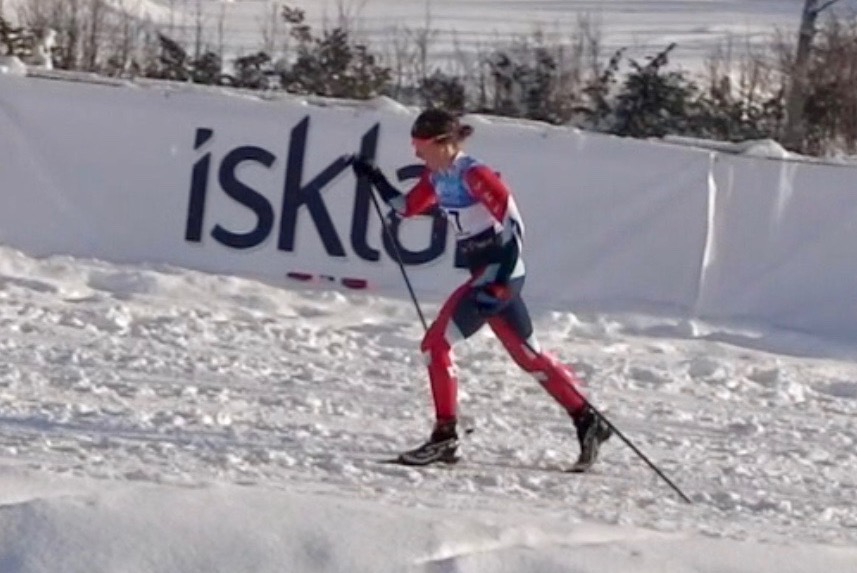
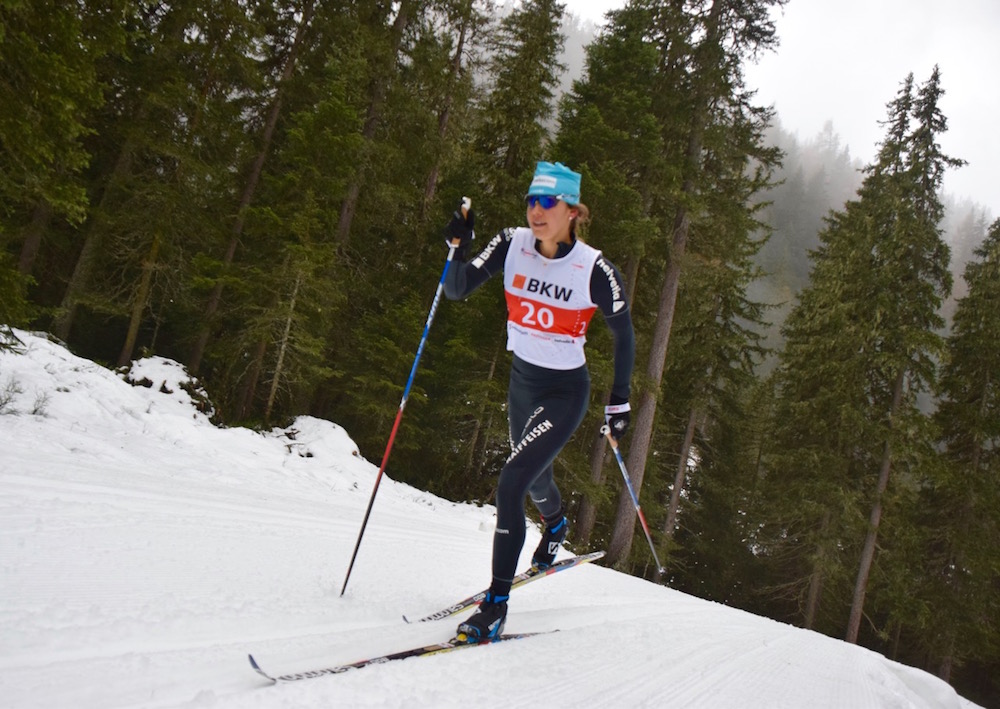
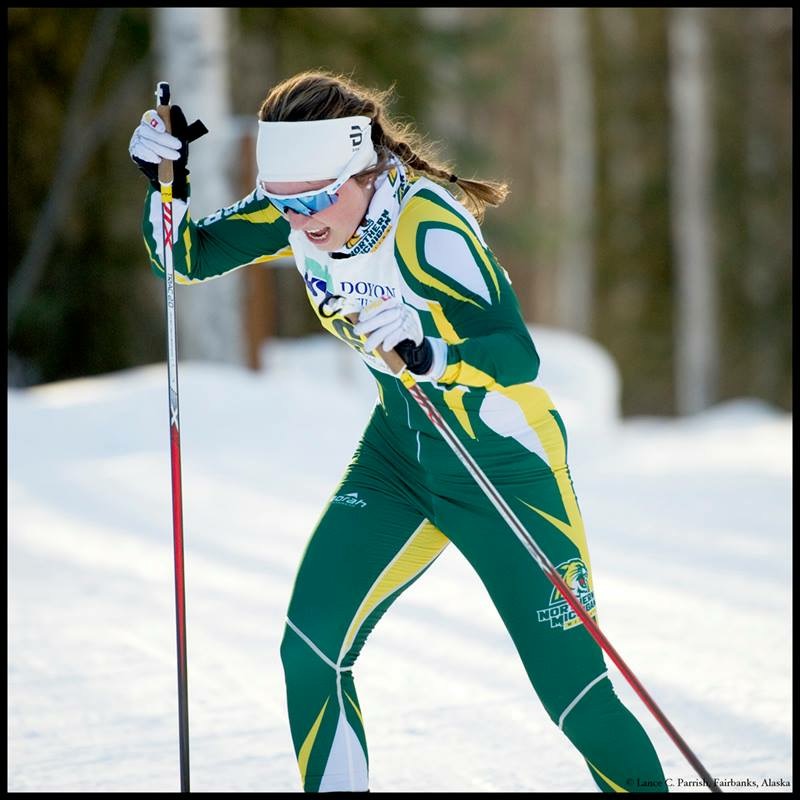
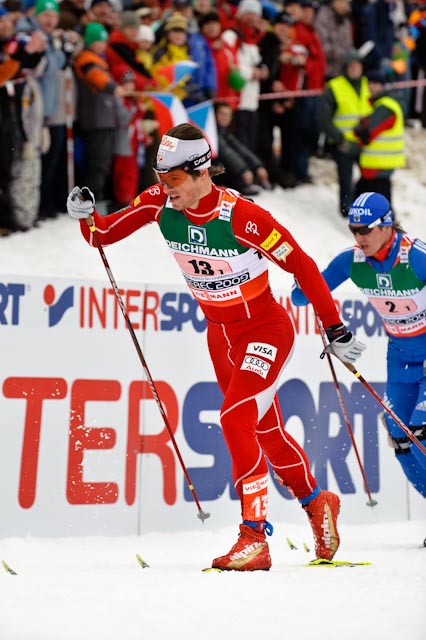
Anne Hart (SMS Elite Team) racing in last month in Beitostølen, Norway. (Courtesy photo)
“I’ve just been doing way less training this year and paying attention with my strength coach, saying that you’re trying to be an athlete first and then the skiing comes,” she said on Nov. 17, after placing 31st in the 10 k classic in Beitostølen (she raced all three races there, repeating in 31st in the classic sprint, then 19th in the 10 k skate). “So this whole summer I’ve been working on my general athleticism and I’m just now starting to hone in on the skiing intensity of that.”
In West Yellowstone, she talked about using her journal to map out the sprint course, point pointing areas to focus on.
“In my journal last night I actually had part of the course labeled ‘mushroom boost,’ which is right over the top of that last hill,” Hart said after her sprint win, alluding to the speed burst featured in the Mario Kart Nintendo game.
“So I was able to do my planned mushroom boost at the end, came across with the win and I couldn’t be more thrilled,” she said.
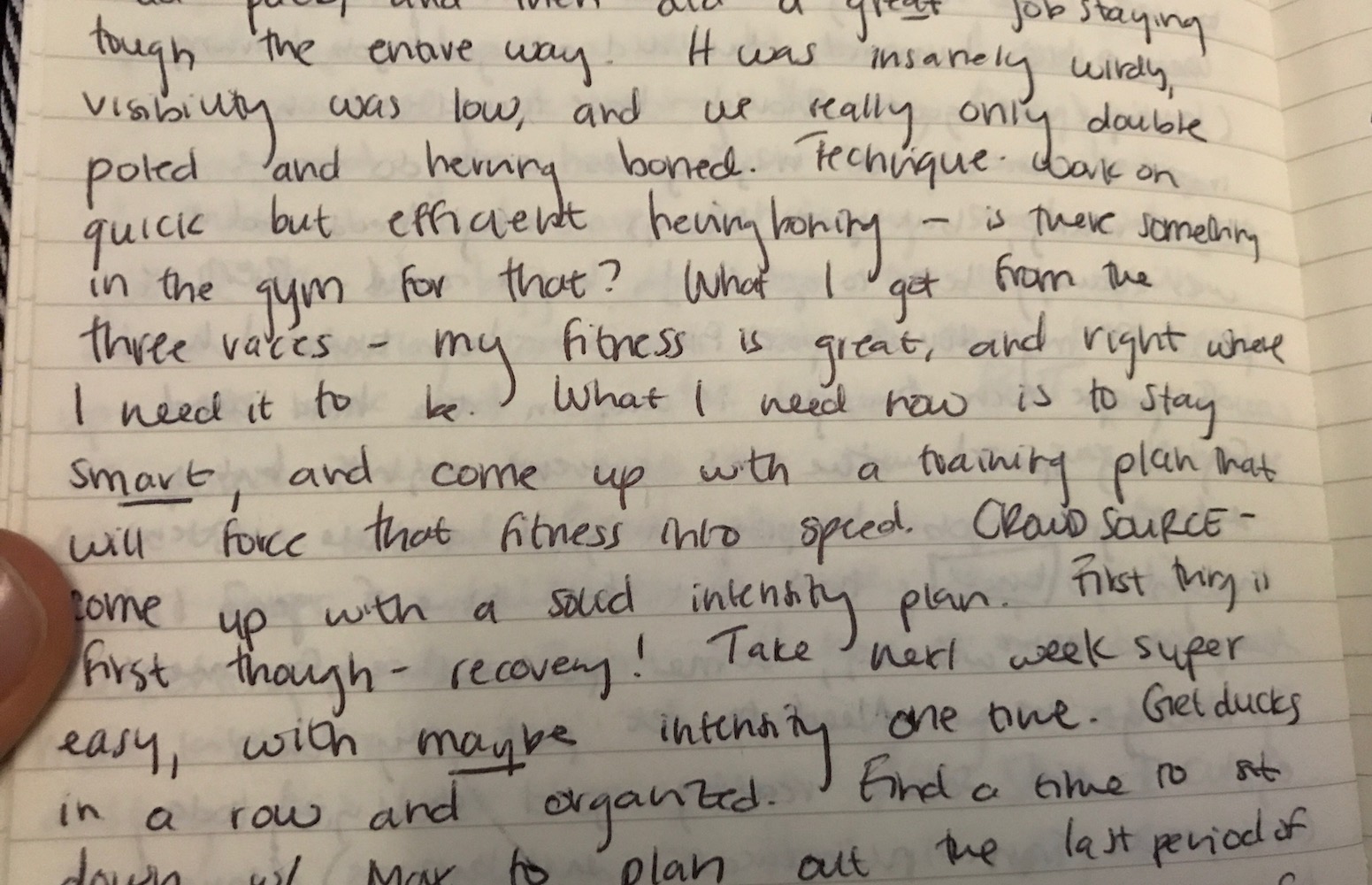
That mushroom-boost reference got us thinking: what kind of journal does Hart keep? It’s nothing like a training log, she explained, but rather a tool she picked up from a mental trainer she’s been working with since the summer, at the suggestion of her strength coach Max Lipset.
“I had been doing all of this physical training, but had been struggling a bit with how to wrap my mind around all the variables inherent in ski racing,” Hart wrote in an email. “This past season I had a really hard time shaking off bad races, and ended up carrying negative feelings from one weekend to the next. And I can tell you that there is no amount of physical training that can surmount that.”
She started speaking with John D’Agostini of Invictus Leadership, a “mindset and personal leadership coaching” company based out of the Twin Cities, according to D’Agostini’s Linkedin profile. Hart grew up in Stillwater, Minnesota, attended Dartmouth College in New Hampshire, and now trains out of Stratton in southern Vermont.
Hart explained that they initially spoke twice a week and are now in contact about once every 10 days.
“The Invictus program is a bit unique in that John is not a sports psychologist — he is just an individual with a lot of experience in the arena of mental fortitude, and has developed a curriculum that has helped me immensely,” Hart wrote. “As part of my ‘homework’ he suggested I start keeping a journal. I’m the only one who looks at it (although I’ll give you a sneak peak), and it has been a great way for me to critique myself without being negative.”
Here are the key aspects of Hart’s journaling:
1. Don’t think of it as a training log. It’s for everything else that’s on your mind.
“It has absolutely nothing to do with a training log (I have a big old google spreadsheet for that), but is instead a place I write down random thoughts, anything that is bothering me, things that are empowering me, and even recipes I want to try,” she explained.
2. It can include drawings, or more specifically, course maps for pre-race, mental training.
In West Yellowstone, Hart “drew a very loose representation of the sprint course, noting how I wanted to ski different sections and places I should look for passing opportunities (to either pass or be passed),” she explained. “This ended up being a huge help, as when it came to the final of the sprint and I found myself in the back, I had already figured out four or five different places I could attempt a pass as long as I kept my head cool and my wits about me. I ended up being able to use one of my pre-planned places and come out with the win.”
3. It’s your journal. Nobody else needs to see it. Although Hart did share a few excerpts (below) as examples:
Anne Hart’s course map, as she drew it in her journal, of the SuperTour sprint course in West Yellowstone, Montana.An excerpt from Hart’s journal entry after racing in New Zealand in this past September.Recipe notes as seen in Hart’s journal.
In terms of a physical workout, here’s one Hart recommended:
“Late last winter I did a workout with the Craftsbury team that I really loved,” she wrote. “It is designed to prepare for a hard but somewhat paced 10-kilometer race, and I did it once while I was in Norway to get ready for individual start distance races.”
The Workout: 2 x 5 k time trial
Warmup: 30 minutes of easy skiing, plus 3-6 minutes of threshold
The workout: On a measured 5 k loop, time yourself while completing 5 k at threshold with an occasional Level 4 pace.
Rest for five minutes, then try to complete the same loop 15-30 seconds faster.
“It is WAY harder than I would have initially thought, but is an awesome way to find a hard but sustainable pace, and a good way to pay off part of the mortgage on your own personal pain house :)” Hart wrote.
Do you use a heart rate monitor for training? Has it ever given you a seemingly implausible reading? Here’s why, and whether you should worry. (Photo: Pat O’Brien)
At the same time, recreational athletes using heart rate monitors during their training will sometimes see numbers go up as high as 220 or 225 beats per minute (bpm). Such racing heartbeats are called tachycardia, and some of the possible underlying causes can be life-threatening.
But does a high heart rate reading on a heart rate monitor equate to this dangerous condition?
That’s what Polish doctor Robert Gajda and colleagues set out to investigate. They suspected that the super-high heart rate readings were errors, but knew that they did cause anxiety for some of the athletes in question. Even if a reading seems crazy, it can sow a seed of doubt about an athlete’s health. And that makes them important.
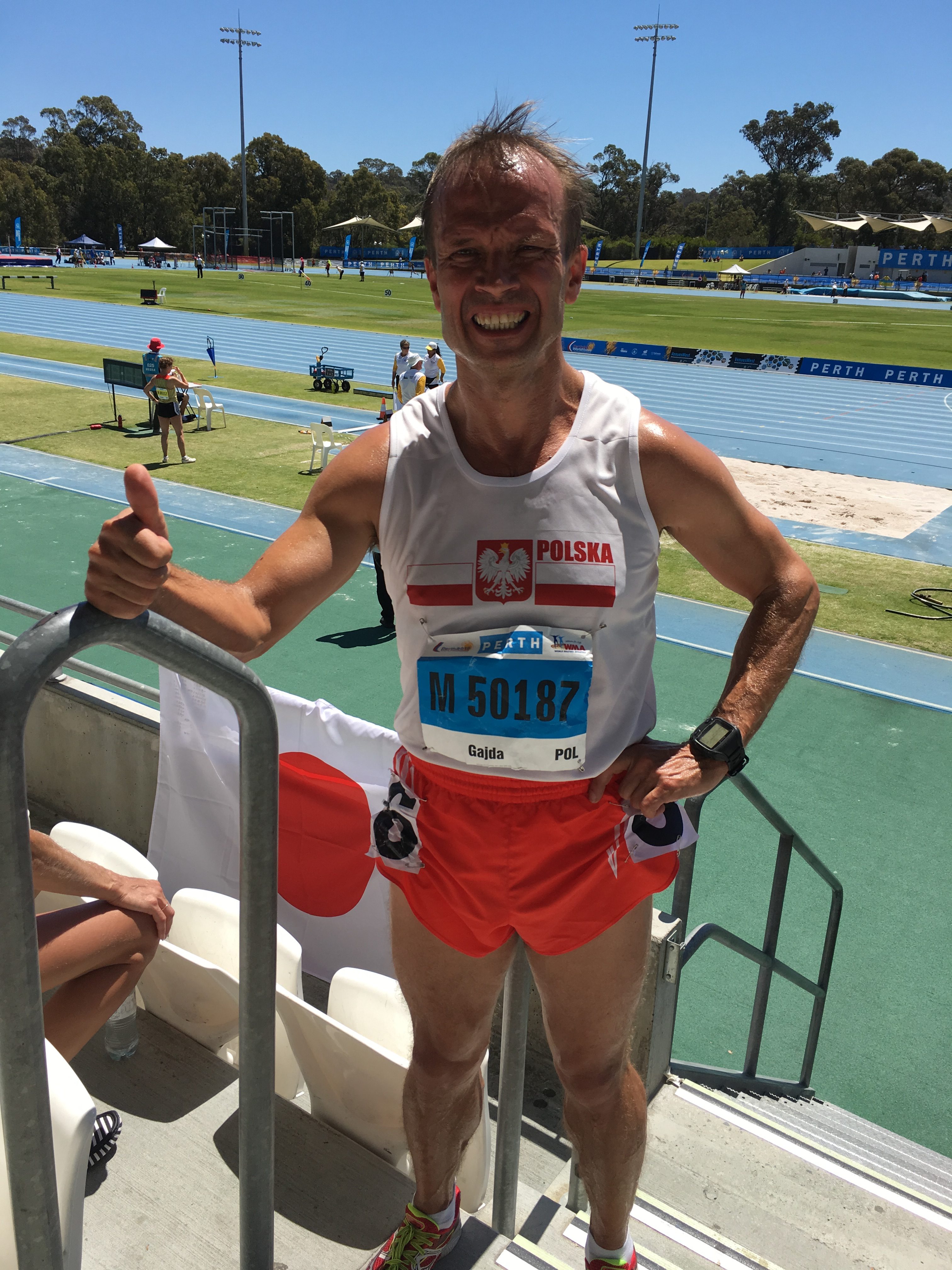
The author of the study, Dr. Robert Gajda, before competing in the 1500m run at 2016 World Masters Athletics Championships in Perth, Australia, where he finished seventh in the M50 division with a time of 4:39.45. (Courtesy photo)
“I assure you, we do not get seriously sick during training and not notice it,” Gajda wrote in an email. “More than the [heart rate monitor] indications, clinical symptoms are important and should worry us … we need to inform people about the occurrence of artifacts in heart rate monitor readings, instead of sending them for senseless diagnostic procedures or abstaining from physical activity.”
They also had a second question. Regardless of whether the high readings were correct, if athletes had any other kind of heart arrhythmia, would an off-the-shelf heart rate monitor detect it and thus provide them information they could use to protect themselves?
In a paper recently accepted by the Scandinavian Journal of Medicine and Science in Sports, Gajda worked with 142 runners and cyclists who came to his Center for Sports Cardiology because they were suspected to have heart arrhythmias. All of the athletes had seen sudden, large increases in the heart rate readings on their monitors while exercising.
Under the researchers’ watchful eyes, the athletes tried to replicate these readings, this time wearing not only a heart rate monitor but also a Holter Electrocardiogram (ECG). This small device uses electrodes and provides a detailed picture of electrical signals.
“The Holter ECG is a professional device recognized worldwide by doctors as the gold standard for assessing arrhythmias in patients,” Gajda explained. “It accurately records the heart rate at a given moment of measurement, the average value of the whole record, as well as its minimum and maximum value … we see not only the heart rate but also its possible abnormalities, such as extra ventricular and supraventricular beats.”
A heart rate monitor, on the other hand, simply “detects the main electrical field produced by the heart muscle.” Instead of seeing the whole heartbeat as one would on an electrocardiogram performed at a hospital, or from a Holter ECG, a heart rate monitor simply counts what it detects as heart beats and displays that as an average rate.
“Some [heart rate monitors] with ‘beat-to-beat’ measurements and data storage capabilities do permit accurate heart rhythm analyses,” Gajda wrote. “However, these devices are also prone to artifacts that are often similar to a ‘beat’… we still do not know whether we observed the R-R distance (QRS to QRS) or only the ‘artifact peak to artifact peak’.”
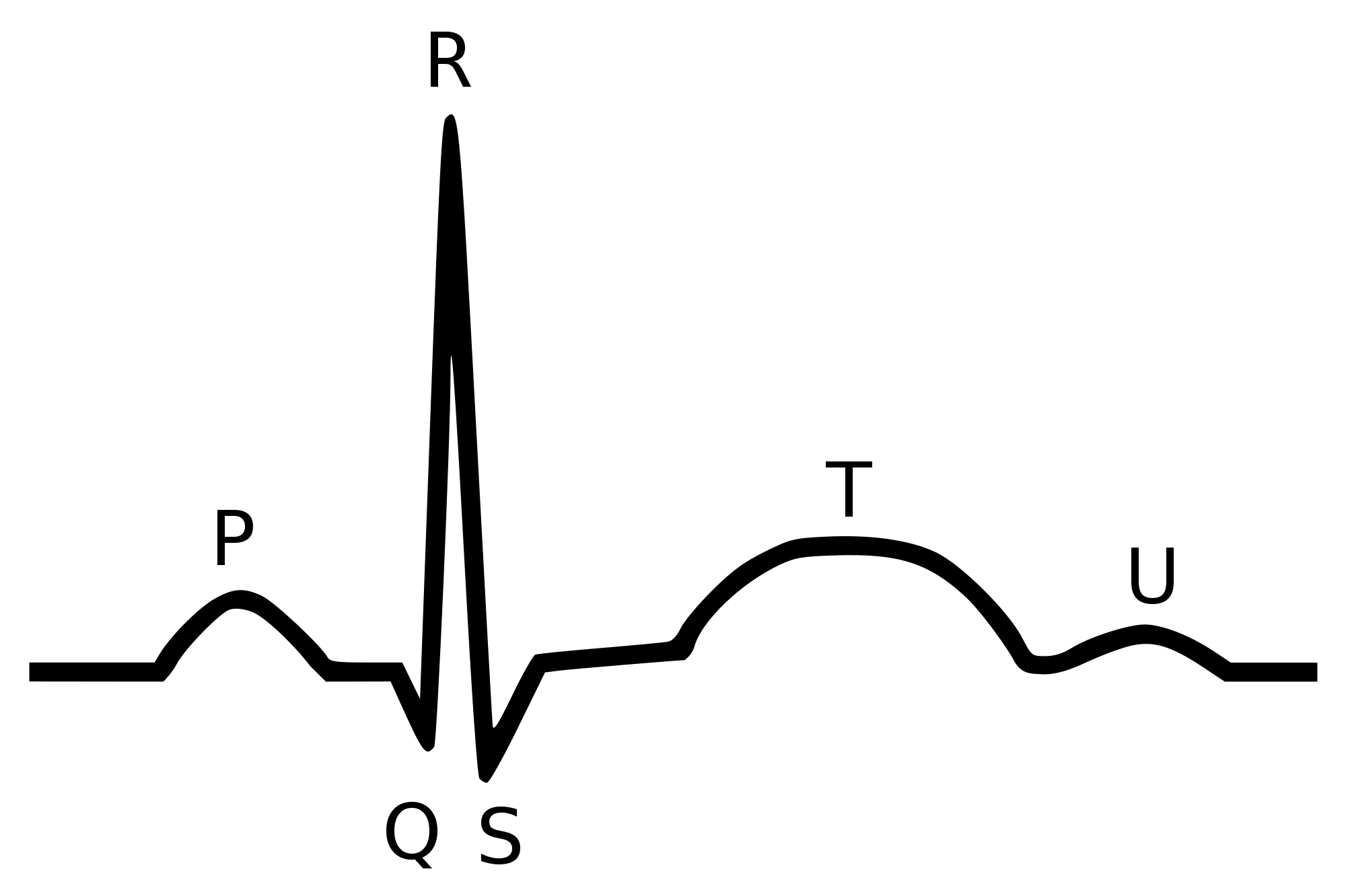
The phases of a heartbeat. (Image: SKvalen via Wikimedia commons)
(The QRS is a phase of the heartbeat when the ventricles are depolarized before contraction, and the R wave – the middle of the QRS – is the biggest wave or peak on an electrocardiogram, as seen in the diagram at right.)
Wearing both their own normal heart rate monitors – such as the Suunto Ambit3 or a wide variety of Garmin Forerunner models – and the Holter ECG’s, the athletes were told to head out on their usual training for about an hour.
Of the group, 39 percent failed to replicate the earlier high readings. Neither their heart rate monitors nor the Holter ECG’s picked up anything abnormal, and there was also no difference between the readings provided by the two instruments in terms of average, maximum, or minimum heart rate.
A second group of athletes, about 15 percent of the total pool of subjects, picked up signs of arrhythmias on the Holter ECG but not on their heart rate monitor. These were single ventricular or supraventricular heartbeats, and, in the absence of other symptoms, don’t really indicate major heart problems.
“Every healthy person has supraventricular and ventricular beats during the Holter ECG record,” Gajda explained. “Arrhythmias have been observed in athletes with ‘healthy hearts,’ but it is not a negative prognostic factor and does not constitute grounds for abstaining from sporting activities … athletes in this group should not be concerned about these irregular beats, especially if there are no other connected clinical symptoms, for example chest pains.”
If there are those other symptoms, then it’s another story.
Most off-the-shelf heart rate monitors do not detect such single beats, because they “average out the rhythm” by counting electrical stimuli. So if an athlete has some indication that they should worry about heart disease and wears a heart rate monitor, they will not find out about these extra beats. An actual ECG would be needed.
“The value of [heart rate monitors] for detecting arrhythmias in runners and cyclists is not supported by the results of this study,” the authors wrote in the paper.
Finally, for 45 percent of athletes, an arrhythmia was indicated by the heart rate monitor: on average, a reading of 199 bpm for roughly a minute, but in the most extreme case a reading of 236 bpm for three minutes.
In only one athlete was this reading accompanied by the detection of an arrhythmia on the Holter ECG. For that athlete, it was quite clear that something serious was happening as the heart rate rose from 167 bpm to 227 bpm.
“The athlete was forced to cease training due to clinical symptoms and the sudden decrease in exercise capacity,” Gajda explained.
After resting, the rhythm went back to normal.
For the other 64 athletes, the high reading on their heart rate monitors was not accompanied by either clinical symptoms or high readings on the Holter ECG. Those athletes were not having arrhythmias. The readings were just errors.
“It is not possible to have a HR of 200-220 bpm and feel good,” Gajda wrote. “Such arrhythmia ‘cuts off’ the athlete suddenly, and even if he or she does not lose consciousness, they cannot continue to exert at the same level of intensity. Such tachyarrhythmia forces you to stop. You can’t catch your breath. You think about the worst. This is the feeling of person with severe tachyarrhythmia. You can’t miss it.”
The fact that so many athletes can encounter these faulty readings, Gajda believes, is something of a public health issue. The numbers are alarming and cause some athletes to dial back, either in that particular exercise session or in terms of how much they exercise at all.
“A physically active lifestyle is widely promoted for healthy individuals and large groups of patients,” Gajda wrote. “Millions of physically active individuals worldwide use heart rate monitors to control exercise intensity. False ‘arrhythmias’ or surprisingly high bursts of heart rate during exercise can induce fear in physically active individuals and might cause them to reduce or even abstain from training, or to seek unnecessary, time-consuming, and costly medical diagnostics. So we can say: this is a public health issue.”
The reason such anomalous readings are generated has to do with electricity. Heart rate monitors are just meant to pick up the electrical field of the heart, but many of these “artifacts” come from other electrical signals.
“Sometimes it is enough to change the position of the belt and the pulse values will return to normal,” Gajda explained. “Sometimes we run alongside the high-voltage line and the heart rate monitor goes ‘crazy’. A few meters further it returns to normal.”
A few other factors can lead to more frequent errors in the readings. For example, carrying a cellphone with you training provides additional electromagnetic waves that can disrupt transmission from the chest strap to the watch. Sometimes other athletes’ heart rate monitors create interference and errors as well.
Another source of artifacts is additional clothing either around the chest strap or the watch. For winter sports athletes, this could be a particular issue.
“There is no doubt that thicker winter clothing is conducive to the development of more artifacts,” Gajda wrote. “A thick glove on the ‘watch,’ too. Sometimes this occurs in the form of a complete disappearance of the connection between the belt and the watch … It is likely that synthetic materials that are easier to electrify may produce more distortions.”
And women, wearing sports bras, have an extra layer they have to worry about.
“The idea is for the chest strap to stick well to the body,” Gajda wrote. “This problem is beginning to be noticed by manufacturers of heart rate monitors. Today there are already some on the market that use a sports bra or shirt as the strap of a heart rate monitor (equipped with integrated electrodes). I think further development in this area will solve this problem completely.”
Then, there’s simple body movement. There are fewer artifacts in heart rate monitor data for cyclists than for runners, indicating that having a steady upper body position reduces the error rate. Gajda wasn’t sure what the cross-country skiing motion would mean in terms of these erroneous readings.
If an athlete carefully adjusts for all these factors – repositioning the chest strap, wetting the sensors so they stick to the skin better, re-arranging clothes, replacing batteries and other parts, and avoiding other sources of electrical interference – but the high readings keep coming, then they should seek out a physician even if they don’t have other symptoms, Gajda and his colleagues suggested in their paper.
But overall, his message is clear. Heart rate monitors are valuable for monitoring and controlling the intensity of training, but for detecting arrhythmias, they aren’t as great. Very high heart rate readings shouldn’t alarm athletes in the absence of any other symptoms of discomfort. The way to check whether the number is real, Gajda reminded, was to stop what you’re doing for a minute and take your pulse.
The biggest problem with anomalous readings from heart rate monitors is one of annoyance, he posits, because such artifacts make it harder to accurately track the intensity of exercise. Sure, your heart rate isn’t actually 220, which is a relief – but what is it?
“We should be upset that you do not record the training in accordance with its actual reality,” Gajda wrote. “For me, still an active runner, it is an extremely important part of the training, which informs me not only about the quality of the effort but also my form – overtraining or lack of training.”
Robert Gajda, MD, PhD, director and owner of Center for Sports Cardiology (CSC) at the Gajda-Med Medical Center in Pułtusk/Poland, is a cardiologist and sports medicine physician. His main area of research interest is physiological adaptation to endurance training as well as to extreme endurance efforts. He cooperates with Polish scientific institutes in this field. Dr Gajda is an active runner and the record holder of Polish doctors in the marathon.
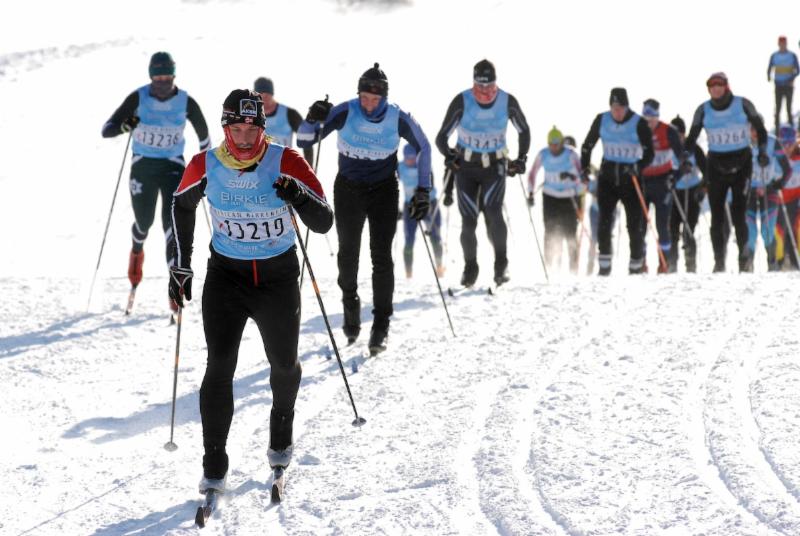
Racers at the 2014 American Birkebeiner. (Photo: ABSF/Kelly Randolph)
Part I of this interview discussed findings about general health and exercise habits of American Birkebeiner participants compared to the general public. You can catch up on that piece here.
When the Birkie Health Study launched in 2014, the role of social support in forming and keeping healthy habits was a big a question for researchers – and their high-profile supporters.
“Why people choose to get out in the first place, and what keeps them staying active, especially when we’re talking about the social aspect of it which is super huge for girls and women – I’m interested to look at the results and glean some things from it that we can apply to Fast and Female so that we can continue to make our programming more effective, and really work towards achieving our mission of keeping girls and women involved in sports for their whole lives,” World Champion skier Kikkan Randall said at the time.
Researchers Paul Anderson and Ralph Bovard received survey responses from more than 5,000 people who had participated in the American Birkebeiner, a cross-country ski marathon held every year in Wisconsin.
While the survey asked about exercise, general health status, and behavior, it also sought to understand why people exercised. Their results were published in BMJ Open last year (and can be read free of charge here).
Among survey respondents – typically middle-aged, married men with a four-year education and a full-time job – nearly 80% had been introduced to skiing by family or friends, and 96% said that they were “highly motivated to exercise by signing up for races like the Birkie.”
“I think that the masters athlete movement in America and worldwide has been a terrific incentive to many people,” Bovard wrote in an email. “It lets adults know that it is okay to move and revel in their bodily movement. It is okay to aspire to race and challenge one another in physical activity even if you’re 65 or 85 years old. We hosted the national masters swim meet and Minneapolis in early August… [One older] swimmer said: ‘I can still swim because I’m healthy. But I’m only healthy because I swim.’”
What does “social support” mean, though?
The survey asked a series of questions to find out how skiers interacted with other people regarding exercise.
Maybe most obviously, that meant finding out whether skiers trained with other people. They did. For instance, 35% of respondents said that they most often exercised with other people, and 71% of respondents said that they trained with others at least once a week.
But other behaviors are also considered social support, and some of them are so simple and basic that a skier might not realize they are doing it. An example is simply talking about exercise with a friend, family member, or co-worker. The survey asked whether family and friends talked about their own exercise, encouraged the respondent to exercise, or simply “discussed exercise with me.”
That last was the most common social support interaction among all of the choices.
“Among individuals who are training together or are interested in fitness, verbal processing of training challenges and successes builds connection, reinforces the value of physical activity, and provides a strong context for the positive meaning of an active life,” Anderson wrote in an email. “This is not surprising since language is one of the predominant forms of human connection in virtually all the important aspects of life.”
Simply talking about a workout might seem trivial, but survey respondents with high “social support scores” were more likely to spend more time exercising, get more sleep, eat more fruits and vegetables, and suffer less from depression or low moods.
That last relationship is complex, but important. While exercise can often relieve some symptoms of depression, non-exercise specific social support also can lead to better outcomes in depressed patients. So which caused the lower rates of depression in the Birkie skiers?
“Physical activity is a well-known intervention for mood disorders and I think we observed an expected change in this metric,” Anderson wrote. “Our data doesn’t allow us to speculate about causal relationships, however… we would need to design a study to look at this question specifically if we wanted to answer this question definitively.”
Besides simply talking about exercise, other forms of social support were also prevalent. Family and friends often offered to exercise with a survey respondent, scheduled activities around the respondent’s need to exercise, or planned to exercise on recreational outings.
The authors speculated that this was a second mechanism to help survey respondents get over the motivational barriers to exercising. For adults with full-time jobs, time and energy aren’t always in abundance.
This finding also highlighted an interesting complexity in the data: most survey participants trained primarily alone, and yet training with friends was also very important to them. For instance, only 22% said that they wouldn’t do the Birkie if their family or friends didn’t sign up as well. Yet 75% said that exercising with family or friends motivated them to sign up for races like the Birkie.
“While these responses seem difficult to reconcile, it may be that on the one hand the predominance of solitary training coupled with the determination to sign up for races regardless of social support suggests a high level of self-efficacy,” the authors wrote in the paper. “On the other hand, the pattern of weekly exercise with others and the fact that skiers do sign up for races because of motivation derived from others suggests that any pre-existing self-efficacy may be reinforced by regular doses of exercise-specific social support.”
In other words, even those who are highly self-motivated benefit from getting social support.
“I think a big part of the argument of Paul’s research is that the social aspects of physical activity participation can be life changing,” Bovard wrote. “When I lived in Arizona I joined a master swim group. I did not know any of those people before I went there but they quickly became good friends… I think the essence of this is that people develop a shared, camaraderie that is life enhancing. I always say that I do not hang out with the people I work with, rather I hang out with the people I work out with.”
Bovard, however, was already looking for a swim group to join: he had pre-existing motivation, and so it was probably relatively easy to fold into a community in a new place. Many skiers have likely experienced the same thing when they move to a new area and sign up for a race or join a training group.
The question remains of whether such behavior can simply maintain exercise and training habits, or start them off. Can the same social support systems that keep Birkie skiers exercising be used to get a non-exercising member of the public to start being more active?
“Exactly how this would work between a fitness-minded individual and one who isn’t currently active highlights the complexity of initiating a new behavior,” Anderson wrote in an email. “It would be interesting to study whether or not language (talking) was the strongest factor leading someone to initiate physical activity or if the was another form of social support that was more influential.”
The survey results generated lots of new ideas and Anderson is looking forward to studying Birkie skiers in more detail. But even these first results give some hints at strategies to improve public health.
“Those wanting to initiate, maintain or increase physical activity regimens should receive guidance that emphasises the importance of physical activities in groups, especially family of friend groups connected to larger fitness cultures that often surround community races or large national or international competitive events,” the study concluded.
Interested in this study? Anderson wrote, “We are also very interested in learning what Birkie skiers wonder about and doing some studies that answer their questions too. They should feel free to email me at Paul.J.Anderson@HealthPartners.com with their ideas.”
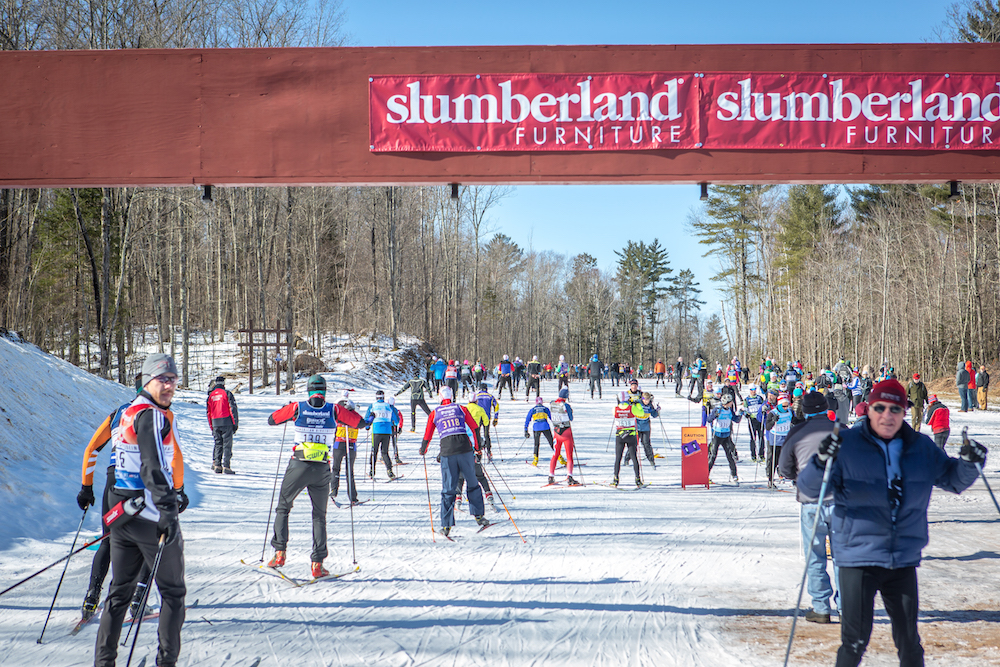
The scene at 2017 BirkieFest on Feb. 25 at the American Birkebeiner trailhead near Cable, Wis. A health survey showed that Birkie participants are five times as likely as the average American to have all of the “healthy four” health characteristics that decrease stroke risk: exercising at least 150 minutes per week, not smoking, eating at least five fruits and vegetables per day, and having a body mass index (BMI) less than 25. (Photo: American Birkebeiner Ski Foundation)
Back in 2014, Paul Anderson and his colleague, Ralph Bovard, set out to study the health habits of cross-country skiers by surveying those who participated in the American Birkebeiner (“the Birkie”), a cross-country ski marathon in Wisconsin.
“We wanted to understand and characterize the role of social support for exercise among Birkie skiers,” Anderson explained in an email this month. “Dr. Bovard and myself are both Birkie skiers and we have both experienced how the Birkie motivates us and others to stay fit throughout the year. Also, we wanted to document the health status in a population of people who follow recommended guidelines for exercise and diet in order to underscore the value of preventive health measures.”
Anderson and Bovard sent their survey out to nearly 24,000 race participants, getting a 23% response rate.
“When over 5,000 people take the time to answer a long survey, it shows a high level of interest in the Birkie itself and the culture surrounding it,” Anderson wrote.
In a paper recently published in BMC Research Notes (available for free/open access here), the pair and their colleagues compared the health and behavior of Birkie skiers to that of a representative swath of Americans. That data had been collected as part of the National Health and Nutrition Examination Survey and the Behavioral Risk Factor Surveillance System.
Perhaps unsurprisingly, by many metrics the Birkie participants were healthier than the “average American.” For instance, they had an average body mass index (BMI) of 23.8, vs. 26.7 for the U.S. population sample. And only 3.23% had a BMI over 30, which is said to indicate obesity, compared to 27.7 for the U.S. population sample.
BMI is a problematic index, as it is based only on height and weight. Muscle is heavy, so lean but strong people often have high BMI scores even though they have little fat on their bodies.
“BMI has upwards of a 40 percent error rate with approximately 20 percent of these being false positives and 20 percent being false negatives,” Bovard explained. “It is a 180-year-old metric created by a Belgian astronomer named Adolphe Quetelet who was trying to find a formula that would be able to calculate & predict the dimensions of the ‘average man.’”
You can calculate your BMI here to understand the measurement.
“The BMI is a metric used to evaluate populations, but it isn’t very good at characterizing individuals,” Anderson wrote in an email. “We used it because it remains the standard language for describing body habitus in the health literature.”
In other words: the research team knew that it might not be a great measure, but it’s the standard tool of the trade, so still made sense to use in order to compare the Birkie participants with other populations.
Other data from the study indicate that even as a flawed measurement, the BMI data is showing something real. The Birkie survey participants had healthier habits than the average American. (And they weren’t shy about saying so: 99.1% of respondents estimated that they were “as fit/more fit than their peers.”)
Just 3.1% of the survey participants smoked. More than 65% of them reported sleeping on average more than seven hours per night, compared to 35.3% in the the U.S. population sample. Birkie skiers reported eating more fruits and vegetables, and only one-fifth as many of them reported doing no physical activity in their leisure time compare to the the U.S. population sample – where 25.5% of Americans report this to be true.
There are four healthy lifestyle characteristics that public health professionals see as, combined, leading to a 40-80% reduction in stroke risk. They are exercising at least 150 minutes a week (2 ½ hours), not smoking, eating at least five fruits and/or vegetables a day, and keeping a BMI under 25.
It’s quite rare for Americans to hit all those marks, and in the U.S. population sample, just 3% did. But 15% of Birkie survey participants reported having all of the four healthy characteristics.
“We were trying to make a point about cardiovascular health,” Anderson wrote of this comparison. “Some researchers have suggested that too much exercise can be harmful for cardiovascular health, but in general, their conclusions are based on small studies.”
As shown by the U.S. population sample, the main heart health risks to most Americans come from too little activity, not too much. And the Birkie skiers didn’t, on average, report doing so much training that the risks would come from the other side. In fact, less than 40% of the respondents reported getting more than 2 ½ hours of exercise a week, although Anderson warned about taking that number too literally.
“We may not have asked the question in a way that people normally think about their exercise and it may have been confusing,” he wrote. “On the other hand, it may tell us that people can come out to do this race on a very modest fitness regimen. This was self-reported exercise and this number should be viewed with caution. In future studies, I would really like to measure physical activity using a wearable device and an online data repository (e.g. Garmin Connect).”
Nevertheless, the amount of exercise the Birkie participants were doing was, compared to the general public, very much in a range that should promote health and decrease risk of cardiac events.
“There may be some evidence that highly trained endurance athletes (especially males) are more likely to experience cardiac arrhythmias than those who exercise moderately,” Anderson wrote. “[But] In general, the scientific evidence continues to find that the benefits of physical activity far outweigh the risks.”
That’s in line with a recent study from Finland. There, researchers found that even after adjusting for confounding factors like total amount of physical activity, age, smoking status, and BMI, male cross-country skiers had a 16-18% reduction in risk of death for any reason after 30 years of follow-up. The original study participants had been selected in the mid-1980’s.
In the Birkie study, it’s harder to draw concrete conclusions because these confounding factors were not controlled for in any way. So when it comes to trying to disentangle causes and effects – are Birkie participants healthy because they exercise? Do they exercise because they already had low self-reported rates of physical limitations? – there are no clear answers.
Overall, the Birkie survey respondents were quite different than the general population: predominantly male, on average 48 years old, with more than 70% of survey respondents married and more than 65% employed full time, vs. 53.1% married and 29.4% employed full-time in the surveillance system data. Nearly 90% of the Birkie participants had a four-year college degree, well above the 31% rate for the U.S. population sample.
“Nordic skiing can be costly and our study participants reported higher socioeconomic status, higher levels of educational attainment, and more leisure time for training,” the authors wrote in their paper. “The Nordic origins of cross-country skiing and the trails in the United States where it can be practiced currently attract predominantly white participants although there are exceptions to this trend.”
These are factors that are correlated to many health characteristics and behaviors. As a result, it’s hard to tell if differences in health between the Birkie participants and the general population sample are due to the Birkie and cross-country skiing in particular, or are simply artifacts of the different demographic and socioeconomic characteristics of the samples.
“A cross-sectional survey of a population can’t really be used to test a hypothesis, but it can tell you where to look next,” Anderson wrote in an email. “I’d like to design a study that compares two similar groups of people who are randomly selected from the population except for one thing: one group would participate in the Birkie culture, the other group would not. We would measure and study both groups before and at the end of the study period and observe how the groups differed. Our guess (hypothesis) is that the group exposed to the Birkie culture would do slightly better at starting and sticking with an exercise regimen.”
A few studies have been published in Sweden and Finland tracking the long-term status of cross-country skiers.
“We are highly interested in creating our own longitudinal study of Nordic skiers in the U.S. to compare with these populations,” Anderson wrote. “The task is harder for us because we do not have national health registries like those in Norway, Finland, or Sweden. These registries allow researchers to mine individual medical records and hospital records to track disease occurrence over time. Nevertheless, we can do the work but we have to find other ways of getting accurate health data on a large number of people over time without losing too many in follow-up.”
The research team is planning further studies, but for now they can say that for one reason or another, the type of person who participates in the Birkie is fairly healthy compared to the average American. As Anderson had hoped, this “underscore the commonly observed coexistence of vigorous physical activity and higher levels of other beneficial health behaviors,” he and his co-authors wrote in their paper.
If public health and policy experts could find ways to help more Americans be like Birkie participants, perhaps through informal or organized exercise groups, there would be many benefits.
“Our basic point is that individuals in the U.S. have primarily been told to exercise in order to be healthy, but the importance of social support (i.e. working out with a community or group) has been less emphasized,” Anderson eplained. “This is changing, I think. I do believe that programs and events that simply expose less active folks to fitness events (5K, fun walks for a cause, the MS 150) can be potent mechanisms by which they see people having fun, enjoying health, and feeling ‘alive.’ These events can also help new participants meet others and join running groups, ski clubs, bike shop teams, close to their homes, schools, and workplaces.”
Stay tuned for Part II of this interview, which is more specifically about the role of social support in forming and keeping exercise habits.
Interested in this study? Anderson wrote, “We are also very interested in learning what Birkie skiers wonder about and doing some studies that answer their questions too. They should feel free to email me at Paul.J.Anderson@HealthPartners.com with their ideas.”
Heidi Widmer relaxes in Val Verzasca in Ticino, Switzerland. The Swiss-Canadian skier shares tips for how to use mindfulness to improve athletic performance. (Courtesy photo)
Swiss-Canadian skier Heidi Widmer found herself on a tough stretch of road, she recently wrote on her blog. The road in question was a huge hill outside of Torsby, Sweden. To get up it four times, she “embraced the grind”. “The moments where I feel like I juiced the most potential, are the ones where my thoughts and actions were dedicated to executing the task at hand,” the 26-year-old Banff native wrote.
One of the ways she works towards getting that potential is practicing mindfulness. The term is is something of a bandwagon these days, with numerous apps and other monetized incentives to be more mindful.
But more simply, mindfulness just means being fully present in the moment and aware of oneself. According to the Merriam-Webster dictionary, it’s “the practice of maintaining a nonjudgmental state of heightened or complete awareness of one’s thoughts, emotions, or experiences on a moment-to-moment basis; also: such a state of awareness.”
Heidi Widmer, who lives and trains in Switzerland, racing in a classic preseason race in Davos, Switzerland, in 2016. (Photo: NORDIC-ONLINE.CH)
Widmer first started paying attention to mindfulness as a system of thought when she was in crisis.
In 2013, she collided with fellow Canadian racer Andrea Dupont in a NorAm sprint in Thunder Bay, Ontario, and got a concussion. Later that year she crashed while rollerskiing and concussion symptoms returned. She ended up taking several weeks off training.
“When I had a concussion (both in the fall of 2010 and again in 2013), I listened to mindfulness videos on YouTube,” Widmer wrote in an email. “Those were stressful and uncertain times for me, because I didn’t know what was causing my symptoms nor how to get better. The videos helped guide a mindfulness practice to relax and recover. So, I guess that’s how I first showed interest in mindfulness and meditation.”
Fast-forward through 2014 — when she became an Olympian — and the subsequent years, where she moved to Switzerland, claimed her dual nationality, joined the Swiss National Team, and is now part of a long-distance pro team, SAS ProTeam.
Swiss-Canadian skier Heidi Widmer finds a quite place in Switzerland’s Valle Verzasca. (Courtesy photo)
Mindfulness still helps.
“Using mindfulness helps me create a mindset that is focused, open to learn and expand,” Widmer explained. “In training, that could transfer into focusing on technique, going out to push out some intervals or letting yourself go to enjoy a mountain run. For racing, it clears up space in my mind to focus in on the race at hand and creates a better body awareness. I have learned that by observing my thoughts, body language, how I am feeling and my response to different training inputs, for example, is not just important for me as an athlete, but as a person. It slows the time down and breaks the bigger goals into smaller moments.”
Many athletes will have worked on one or more of those goals in different ways. For Widmer, doing some simple, calming breathing exercises every day helps. She took us through some of the steps to getting our own mindfulness routine going.
Figure out what works for you. “I’ve had a couple of different recordings, where you sit there and listen with headphones,” Widmer wrote of her initial explorations into mindfulness. “Some of them are done lying down and they’re these guided meditations or mindfulness. I think they work well, but I have found even more benefit from being the initiator and the evaluator. I am observing where my thoughts are going (or not going for that matter) instead of it being a guided process… There are so many options online and apps available, but if it’s a daily practice that you’re after, just try sitting in a comfortable position in a private space and just breathe. No head phones, turn your phone off and if you’re on a mountain or near the ocean, all the better.”
It doesn’t have to be high-tech. “Nowadays, I work with sport psychologist John Coleman, and we talk a lot about incorporating daily practice and energy management,” Widmer explained. “There are a lot of videos and apps (friends speak highly of ‘Headspace’), but the most valuable and accurate representation of how I’m feeling is just counting my breaths, no technology needed. It’s very transportable and versatile.”
Widmer’s five-minute go-to: “Each even number is a breath in, and the odd numbers are a breath out. I count from zero up to ten and then back down again. Deep belly breaths through my nose, observing my thoughts and always ending with a smile.”
Don’t be afraid to let others in on your mindfulness routine, says Heidi Widmer, pictured here with her niece Evia. (Courtesy photo)
Make it a routine. “Doing it at a similar time and place each day helps create a patterned habit,” Widmer wrote. “I’m no expert, monk or yogi, but I am the weird girl who embraces sitting by herself in the morning to breathe. I try to do it first thing in the morning for about five minutes.”
Don’t hide. Rather than letting interactions with other people rip you out of your habits, get them familiar with your routine, too. Out of the universe of things people do, they probably won’t think it’s that weird. “It is definitely difficult to keep a schedule at training camps or when I was in Canada and my niece was the only thing I wanted to concentrate on — She is THAT cute,” Widmer wrote. “However, filling people in on what your doing (as in teammates, coach, family or friends) helps to keep me on track. It’s the same with incorporating any habit. The more you do it, the easier it becomes.”
Even on busy days, stay on track. “If there are days (eg. travel days or tight living quarters at training camps) when I am flustered and just forget to do it in the morning, I get to the end of the day and think ‘whoa, cray. Where did the day go?’” Widmer wrote. “Having those few minutes in the morning to just sit, and be still is so powerful. Acknowledging if I am focused, calm and energised or if I have low energy or don’t feel great in training. Observation is the key.”
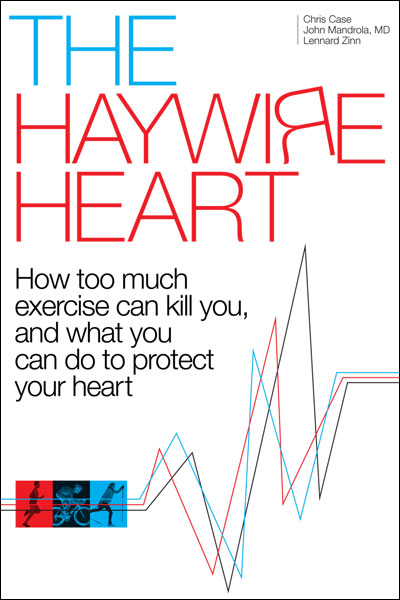
The Haywire Heart by Lennard Zinn, Dr. John Mandrola and Chris Case, is available for purchase directly from the publisher at VeloPress, or at Amazon and other booksellers.
When I heard that there was a new book coming out about heart arrhythmias in endurance athletes, I was interested.
Several years ago, I read some of the research papers that the book’s authors refer to. One was a cohort study on participants in the Vasaloppet, the 90-kilometer ski marathon in Sweden. Those researchers found that skiers who competed in more Vasaloppets had more heart arrhythmias – as did those who finished the race the fastest.
I wrote a piece about the findings at the time. The FasterSkier commenting system has changed, so original comments no longer appear at the bottom of the article, but I remember them clearly. Multiple commenters found the study hard to believe. One commenter was so sure that the findings were impossible that he wrote multiple angry comments arguing that exercise is good for you, so it couldn’t possibly cause heart problems.
As a scientist, I was flabbergasted.
There are a lot of crappy studies out there in sports science — and science in general, but I’m used to reading sports science papers with sample sizes of eight athletes. It’s hard to defend a lot of conclusions made from such studies. But this one? The researchers had following thousands and thousands of individuals and, well, numbers are numbers. An individual is either diagnosed with an arrhythmia or they aren’t. This was pretty straightforward.
Scientists go out and measure a phenomenon, and then we present numbers as an estimation of the world. There are many legitimate reasons to question the data or interpretation, and this is actually built into the scientific process. Before publication, other scientists will rip a a study apart as part of “peer review”, suggesting ways to make it better or even recommending it not be published.
That doesn’t mean that all published research is perfect. After publication, scientists continue to raise important points about whether the data collected represents reality (due to potential flaws like bias or study design), whether the statistical techniques are appropriate and correctly performed, whether alternative mechanisms could explain the patterns shown, and more. The public should absolutely engage in this process — and scientists should do better about engaging with the public. Anyone outside the study itself can ask questions that the researchers might not have seen, illuminating important aspects and leading to new research questions or repeating the study in a different way. In the end, this leads to gradually more and more accuracy in that estimation of the world.
Asking good questions is different than arguing that data is wrong simply because of a gut feeling or belief. The reaction to the Vasaloppet article was a frustrating moment for me but, I would come to realize, not an unusual one. When presented with facts that do not support our worldview, we tend to just discount them. It’s human nature.
All of which is to say that I was very interested to read The Haywire Heart by Chris Case, John Mandrola and Lennard Zinn.
First, I wanted to get more background on the topic, and I wanted it to be explained to me in clear, straightforward language instead of the scientific jargon of research papers.
Second, I wondered if the book would get the same reaction as my old writeup of the Vasaloppet study.
And third, I was interested to see whether, when presented with some scary narratives, I had the same reaction as those few FasterSkier commenters. After all, as much as I tout that I’m a scientist, I, too, have knee-jerk reactions — and I spend a lot of time exercising. I guessed that I might find the conclusions of the book plenty threatening.
The book opens with the story of Zinn, who is a former national team cyclist and a staff writer for VeloNews. Zinn is riding his bike outside of Boulder, Colo. He feels his heart skip a beat, and his heart rate “had jumped from 155 to 218 beats per minute (bpm), and stayed elevated.”
Zinn initially takes some rest and dials his training back, but ultimately he tries to keep riding and training. The incidents become more and more frequent until his heart actually stops at one point.
After that, Zinn radically changes his lifestyle. He does no hard efforts and much less training volume, period. Because of that, he’s still around to write the book today. His life is richer now, he writes (although it sometimes sounds like he is trying to convince himself as much as the reader). He has developed more different hobbies and can spend more time with his family. But it took him a long time to come to that understanding.
It’s a transfixing story about what can happen to a seemingly fit, healthy person. Because Zinn is an author on the book, you know that he will make it out alive. But how far will he go before he stops training? What will happen to him? Could that happen to me?
As we say in research, the plural of anecdote is not data.
While the authors include “case studies” at the end of every chapter (several of which feature cross-country skiers who nearly died on the side of Colorado ski trails), they also bring the data.
The book presents a compelling argument that we should be thinking more about our hearts – and particularly, the heart’s “electrical system,” as the authors call it. Endurance exercise doesn’t seem to increase the prevalence of problems with the “plumbing system,” or how the blood is pumped.
That’s not to say that athletes don’t have heart attacks (or, more accurately, myocardial infarctions). Risk factors are risk factors, and don’t completely disappear with exercise. High blood pressure, high cholesterol, a family history of heart disease, being male rather than female – these increase the risk of a myocardial infarction. In particular, athletes who came to endurance sports later in life and previously smoked or were overweight still carry those risks with them.
But the unique risk associated with long and intense bouts of exercise seems to be in the electrical system. Studies across multiple sports and countries, as well as in animal models like mice, rats and goats, have shown that the electrical impulses that keep the heart in rhythm can be made, well, haywire, by a lifetime of endurance training.
There’s a wealth of observational, epidemiological data suggesting that a long-term habit of endurance exercise can cause atrial fibrilliation, a rapid and irregular heartbeat originating in the atria. (Atrial fibrillation was the type of arrhythmia mentioned in the Vasaloppet study.)
Other arrhythmias seem to occur more frequently in athletes, too, like ventricular fibrillation. Premature ventricular contractions are common in trained athletes and don’t necessarily lead to bad outcomes; complex ventricular arrhythmias are also common, and can lead to cardiac arrest.
Exercise can also make genetic diseases like arrhythmogenic right ventricular cardiomyopathy (ARVC) more dangerous, and can lead to the disease even in the absence of genetic markers.
Some causes are straightforward. One symptom of “athlete’s heart,” as it is called, is enlarged chambers in the heart. And this is associated with atrial fibrillation: patients with atrial fibrillation tend to have larger left atria than those without.
Exercise also leads to inflammation of muscles. The heart is a muscle; inflammation can lead to scarring, which can then disrupt the transmission of electrical signals across cells.
The logic and evidence go on and on. The authors explain all of this much better than I can, even when paraphrasing. I’ll let you read the book and just say: it’s convincing. And if you haven’t studied human anatomy since high school, don’t worry. It’s clear and well-explained.
As to the second question, the authors tackle that, too. Mandrola, a doctor, notes that when many athletes receive a diagnosis of a heart problem, they go into denial. Many decide not to change their behavior. There’s a sort of cognitive dissonance to being told that something you have always believed is healthy is actually putting you at eventual risk of death.
“It is completely natural to go into denial for a while,” Zinn writes. “I don’t know of any masters athletes diagnosed with non-life-threatening arrhythmias who didn’t go back to pushing it hard in training or racing in hopes that the incident that sent them to a cardiologist was just a fluke.”
If you do have a problem with heart rhythm, the authors provide several chapters as a guide for when to go to the doctor, what to ask and tell them, and what treatment options might be available. Getting a correct diagnosis is key, and as cross-country skiers, that is not a trivial ask.
“Even doctors who run marathons don’t quite get the intensity thing,” Mandrola writes. “Marathons are a different sort of affair. There is no question that they are hard, but they generally have an even pace and don’t involve the competitive crises that flare up repeatedly in a bicycle race or a cross-country ski race or triathlon.”
Women, too, are often misdiagnosed. The authors explain that women are more likely to be assessed as having an anxiety disorder than men, even when suffering from the same underlying heart problems: “Women younger than 55 were seven times more likely to be misdiagnosed and turned away from the ER than their male counterparts.”
But the main advice, when confronted with a heart arrhythmia, is first to go to the doctor, and second to back off of training. It might save your life – and it might also make the problem disappear. That doesn’t necessarily mean stopping completely, but it might mean going slower and for shorter sessions. “Detraining” is a good therapy for several diagnoses.
“In the end, I believe that all that denial and continued racing and training hard with the hopes of retaining some portion of my former life either damaged my heart or trained it so that it now goes into arrhythmia more easily,” Zinn writes of his own situation.
Detraining might seem horrible, like an unacceptable lifestyle adjustment. But as the authors point out, once you know the other options – medications with scary side effects, procedures with non-trivial rates of complications, death – training a bit less might seem like a much better option.
As for me? I definitely reacted to the book, but not by going into denial. Instead, I was scared.
“The day before he died, he had gone for a six-hour run,” the authors wrote of Micah True, a barefoot- and distance-running legend.
I read that the day after I had done a four-hour overdistance running workout. It hit home: none of us are invincible.
That said, the one thing I found missing from the book was a real estimate of the prevalence of these heart problems. I could easily follow why they would develop, based on the physiology of the heart and what we do to it. And I found the research cited credible. But how many people does this happen to? Just what is the risk, statistically?
One reason the answer might be lacking is simply that it’s hard to do comprehensive research on such a topic. As the authors point out, you can’t really do a randomized, controlled, double-blind trial – the gold standard for scientific studies – about the effects of lifelong exercise.
Nevertheless, it’s clear that such health issues are common enough to give one pause.
I’m just 30 years old, and I am probably not going to change my exercise habits after having read this book. But it reinforced a lot of peripheral behaviors that I should know are important anyway.
For instance, in some patients, arrhythmias pop up only when they are stressed. Leading a high-stress life and sleeping too little are major risk factors. Burning the wick at both ends: that’s the sort of life I lead – and the sort of thing I always know I should work to address, but here’s another good reason to do so.
Likewise, making sure to get enough electrolytes when training, to avoid dehydration, to get good rest and recovery, and to listen to your body – these are important.
“You have probably been training for many years, if not most of your life,” Mandrola writes in one chapter. “Those years of training have given you a good sense of what ‘normal’ feels like. What you are looking for is anything that falls outside the boundaries of normal.”
If I do ever feel a flutter in my chest, I’ll now know not to ignore it.
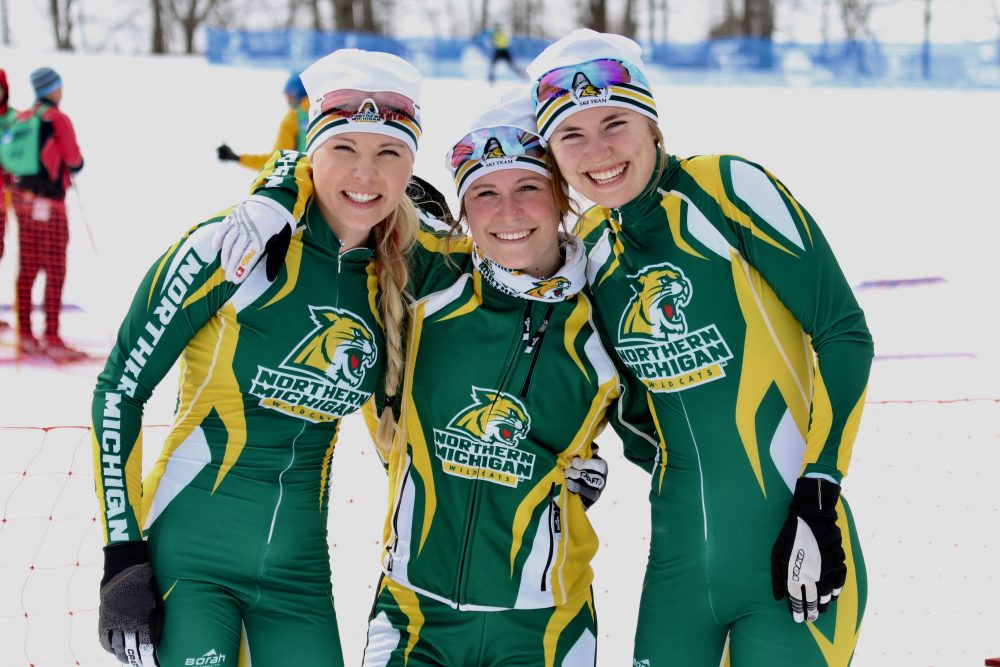
Northern Michigan University’s Kristen Bourne (c) after the 5-kilometer classic race at the 2017 NCAAs in Jackson, New Hampshire. (Photo: Jackie Schneider)
Two-and-half months into her summer training last year, Kristen Bourne woke up in a cold sweat. Her temperature read higher than normal and no amount of lozenges could soothe her sore throat. The Northern Michigan University (NMU) skier went to a doctor and received antibiotics to treat what was thought to be strep throat.
But two weeks later, Bourne still didn’t feel like herself, and she wanted to know why.
Behind her were 215 logged hours of summer training in Marquette, Mich., a 6 1/2 hour drive from her hometown of Lake Elmo near Stillwater, Minn.
Ahead of her was a promising junior season at NMU, with plans to attend the university’s sports-science graduate program in the winter of 2018. She had redshirted the year before and gained an extra year of development under NMU Head Nordic Coach Sten Fjeldheim, as well as an extension on her National Collegiate Athletic Association (NCAA) eligibility.
The investment she had put in her season was nothing to scoff at; neither was her uncharacteristic exhaustion at practice. After finishing one session in late August feeling especially spent, Bourne returned to the doctor, and this time, was able to pinpoint the issue.
“I went to the doctor that day and they did a mono test,” Bourne explained on the phone.
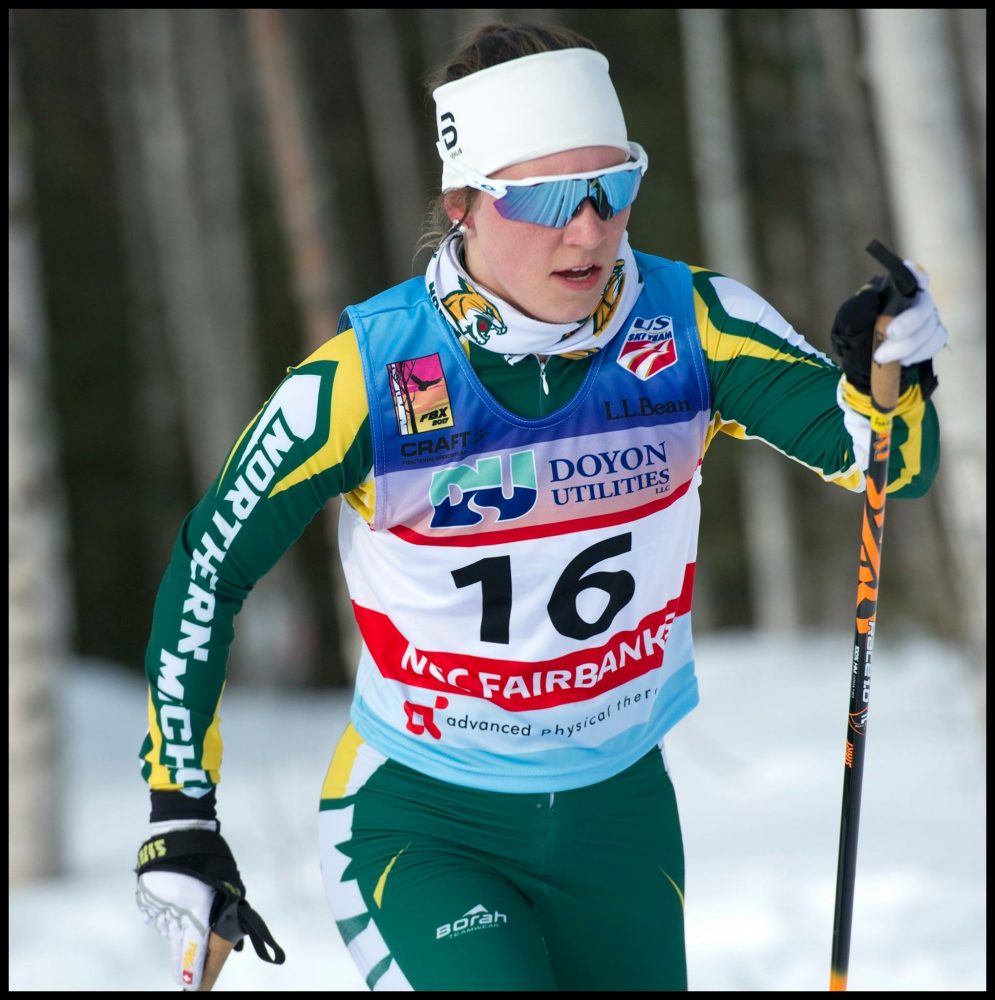
NMU junior Kristen Bourne racing to 19th in the 15 k skiathlon at the 2017 U.S. SuperTour Finals on March 27 in Fairbanks, Alaska. (Photo: Lance Parrish, Fairbanks)
The results tested positive. With fall training just around the corner, and a sudden uncertainty about where she was headed, Bourne began to worry. What did this mean for her season? Was there any way out? Were all those hours of work and training for nothing?
“I was so bummed,” Bourne, who turns 22 later this month, said. “It was the best I had felt training; when you put in all this work and then realize that you’re not going to do anything and for that long, it’s really concerning.”
The mononucleosis put her out of training for two months, from the beginning of September until the end of October. These months are not dispensable as they often incorporate a new cycle of intensity sessions, hours and gym time.
But for Bourne, it was the beginning of a learning process and careful track back to top form, thanks in part to Fjeldheim and his connection to the NMU sports-science department.
The First: Fielding Mono with Fjeldheim
What exactly is mono? How does it affect athletes? How might it affect athletes as they return to training?
These were some of the questions Fjeldheim had when he encountered his first case of mono among his student athletes. While coaching NMU’s cross-country running team, one of his top runners came down with the illness at the end of the summer. (Fjeldheim coached for the NMU running program for more than 20 years, and now solely coaches nordic).
With the cross-country running season only lasting about eight weeks, there was limited time before some of the more important scoring races, like regionals, appeared next on the calendar.
Fjeldheim wasn’t deterred. He approached Dr. Phil Watts, NMU’s sports-science program coordinator and professor. Sitting in Watts’s office — a room Fjeldheim had visited when he was a Wildcat — the two discussed the costs and benefits of de-training to the body and ultimately developed a way to help the runner make a full recovery.
“We laid out a plan with the team doctor on how to bring her back,” Fjeldheim said. “I think she got [mono] in early August and then by early November we ran our regionals and she got third. That’s after running only one other running race before the regionals. I think she ran a running race at the end of October and then second week in November, she’s third in our regionals.”
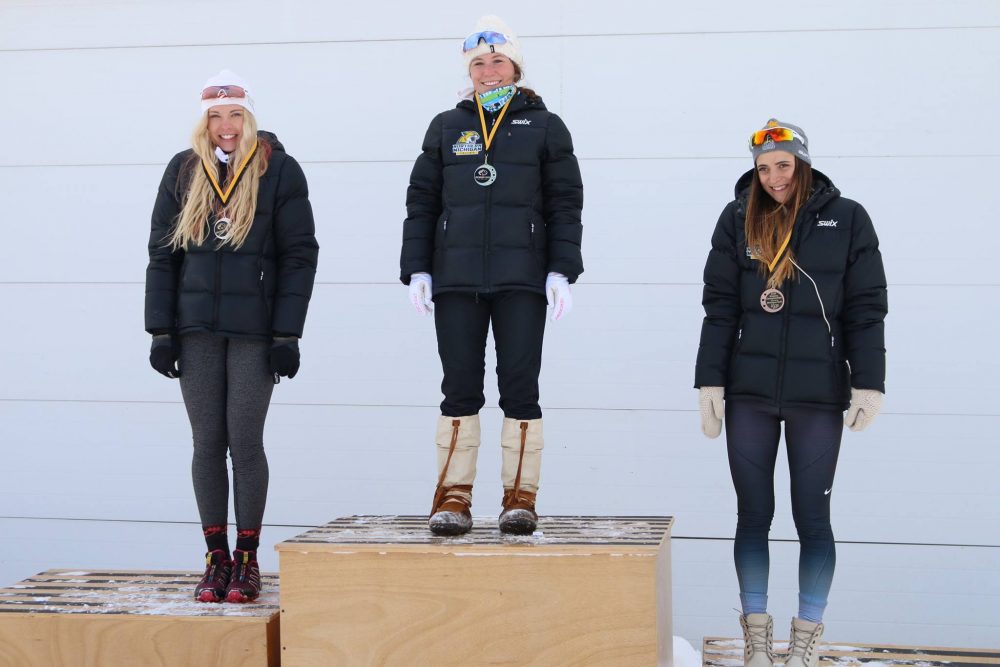
NMU’s Kristen Bourne (c) topped the podium at the 2017 CCSA Distance Championships in early February in Houghton, Mich. (Photo: Jackie Schneider)
After that, Fjeldheim worked with a few other athletes who came down with mono early in their season yet went on to become All-American athletes. Though Bourne would not earn this accolade, she came close.
Bourne’s comeback was not without meticulous and methodical planning. Her return to training was slow and her situation was unique: not only did her coach, Fjeldheim, have experience working with athletes who had mono and successfully returned to racing, but Bourne was also the type of athlete who made the return more amenable.
Over the course of an entire summer, Bourne routinely checked her heart rate each morning, before getting out of bed. She wrote it down and kept track of fluctuations and differences. Every day.
When she was diagnosed with mono, knowing her base heart rate was crucial. After two months off and having her spleen examined to ensure it was no longer enlarged, she started exercising again. Each week entailed meetings with coaches and every day, she assessed her resting heart rate and how far off it was from her previous one.
“We used the morning heart rate as a guide,” Fjeldheim explained. “Once her morning heart rates were back to normal, within say two or three beats of what her base morning heart rate had been for months and possibly years, then we just started with getting back into moving again.”
He emphasized that this came after making sure Bourne’s spleen was a normal size. Then she safely began training again while agreeing to listen to what her body was telling her via her heartbeat and lactate tests. And she had to keep it to a minimum.
“When I started working out, it was 15-minute jogs,” Bourne said. “Then every week, I’d sit down with my coaches and re-evaluate how I felt, how that week went. Every two weeks I was doing some lactate tests to monitor my heart-rate zones … then every week adding a little bit if I was ready. Come November, I started actually doing more systematic training instead of just doing low distance.”
Fjeldheim also monitored Bourne’s sleep patterns to make sure there weren’t disruptions and whether she was gaining or losing weight.
If any of the numbers were off, she rested.
“You don’t mess with mono,” Bourne emphasized. “If you don’t feel good, you do nothing. You can’t try and push it out of your system it just doesn’t work that way.”
NMU junior Kristen Bourne racing the freestyle leg of the mixed relay at the 2017 U.S. Distance Nationals in late March in Fairbanks, Alaska. (Photo: Lance Parrish, Fairbanks)
This perhaps was the hardest part. While Bourne rested in bed, her teammates were out training. When Bourne finally began training an hour and a half again, her teammates were out doing three. She missed out on more than three months of interval training. And when she did reincorporate hard efforts, she didn’t always feel good.
“Mentally, it’s really tough,” Bourne said. “I just had to trust what my coaches said and trust myself and keep my fingers crossed and hope that my season would work out. We figured that I wouldn’t start doing well until February because I didn’t actually start doing intervals until the end of November. … I have to give so much credit to my coaches reassuring me all the time and my teammates being so supportive about it, being like, Kristen if anyone can do it, you can do it.”
Rather than get caught up in what training she couldn’t do, Fjeldheim advised Bourne to focus on what she could do, like improving her technique.
“As I told her, hey you know, you’re going to come back from this. It’s not cancer, it’s not debilitating, you didn’t find out you’ve got some rare disease,” he said. “You have mono and we’re going to figure out a plan. You got to have a plan and then they got to buy into it.”
The experience gave Bourne not only some of her best collegiate results, but also a new edge on her training. She plans to ski for NMU next winter and is considering continuing to race competitively after she graduates.
“A lot can happen in a year and I can’t set any expectations for myself right now,” Bourne wrote in an email. “We’ll just have to wait and see!”
***
Author’s note: This article is not intended to be a guide on how to train through mono, but rather track one athlete’s recovery from illness.
In this episode of Nordic Nation, we feature U.S. Ski Team physician Dr. Larry Gaul. We caught up with Gaul back in late January while he was in Utah for U23/Junior World Championships.
U.S. Ski Team Doctor Larry Gaul with Liz Stephen (l) and then-USSA Communications Director Margo Christiansen (r) at 2013 FIS Nordic World Ski Championships in Val di Fiemme, Italy. (Photo: Sarah Brunson/U.S. Ski Team)
Gaul has a long history working with the U.S. Ski Team’s cross-country athletes as the chief medical officer at the U.S. Ski & Snowboard Association (USSA). And on the international side of things, Gaul serves on the International Ski Federation’s (FIS) Medical Committee. It was part of his FIS duties that brought him to this year’s U23/Junior Worlds at Soldier Hollow near Midway, Utah, where he served as the FIS medical supervisor during the weeklong competition.
Listen up to hear about Gaul’s role with the U.S. team and FIS.
Paul Everett (l) racing at 2015 IBU Junior World Championships near Minsk, Belarus. (Photo: Jake Ellingson)
If you follow U.S. skiing closely, you’ve probably heard of Paul Everett. After three years on US Biathlon’s development team, Everett, 20, is currently a Montana State University sophomore and member of the Bridger Ski Foundation in Bozeman, Mont. He is studying exercise science and psychology, and wrote the following letter for an assignment. It’s about depression and anxiety in athletes, “more specifically ski racing about what it is like for those competing with these disorders and ways in which athletes and coaches can help with these mental conditions,” Everett wrote in an email to FasterSkier. “I offer this letter … to spread awareness or help other skiers with similar struggles.”
***
Dedicating one’s life to a sport can fittingly be described as near insanity. As complete insanity is defined as doing the same thing over and over again expecting different results, an athlete’s job description nearly meets that criteria, but with at least showing the smallest increments of improvement each time. To compete at the highest of levels in any sport, an athlete needs this narrow, single-sighted vision of reaching their optimal best, and doing only that which will help them achieve this goal. For some this mindset comes easily, but for others like myself, this near insanity that is required of athletes may not always coexist with their own mentality. Much of my life I have suffered from depression and anxiety. Each time this struggle rises, I have always gone to skiing as a way to cope with this mental disorder. While skiing has done tremendous improvements on my mentality towards life and understanding of what it takes for me to be happy with myself, the competitive side of ski racing can take an emotional toll on anyone, especially those suffering this condition.
For a disorder that affects millions of people, including many athletes, its severity is not always recognized for the damage it can do. Living with depression, energy and motivation seem to drain at even the smallest of obstacles. While thoughts are occupied on unrealistic concerns or perspectives, much of what once brought joy now fades to empty routines. The ability to see the positives of accomplishments is replaced with highlighting the faults within them. It is this voice within the head demanding one’s self to quit, but never itself going away. Though exhausting, these symptoms are not what stop me from racing. While I can quiet this voice much of the time through skiing, it is only when I am faced with expectations of success in racing that my anxiety strengthens these destructive tendencies.
As a product of depression, you let yourself down countless times by not reaching the impossible standards you set yourself up to attempt. That pain may numb after a while, but the additional anxiety from letting down others cheering you on is what becomes unbearable. Competing with the heavy weights of depression and anxiety on your shoulders can become a crippling task. Trapped within your own head without a filter, negative thoughts become a constant stream for days leading up to a race. Self-esteem is lowered with every comparison of your vulnerabilities to another athlete’s strengths, and when time does finally come to leave it all out there, your only wish during the entirety of the course is to just be on the other side of that finish line. No matter the outcome, be it standing on the podium or the last page of the results, the anxiety always takes its toll.
Depression and anxiety are a tradeoff pair, both taking turns quieting the other, but also taking turns gaining control of your life. As anxiety acts as a distraction from depression, it is one that only heightens the inevitable fall of the melancholy to come. Being physically and mentally exhausted after a weekend of racing is the perfect time for depression to surface. You need a break like anyone after a hard effort, but this break when left alone makes you susceptible to that retuning voice in your head. Now without the distraction of skiing or the energy to combat it, the voice can take ahold of your thoughts, dragging you once more to your lowest point and letting you surface only when the next race comes for anxiety to take its turn.
As the years have passed with this disorder, I have learned new ways to help deal with this voice and the thoughts that come with it. While the voice may always be there, distractions and acceptance seem to be what aid me the most. Finding anything productive to do in order to keep my mind from wandering to these thoughts is the most efficient way I am able see positive changes in my mood. This is a disorder that thrives on isolation. To have the company of others I closely regard not only distracts myself, but brings an uplifting environment that can carry with me long after. While this companionship may not always be offered when I need it, finding acceptance is another tool used to great degrees of success. Anxiety is a product from fearing the future’s unknown. By doing what I need to at this moment to ensure the best future for myself and accepting the things I cannot change, there should be no reason for my fear to take ahold of me. Of course more easily said than done, these ideas are things I am still working out for myself today, and hope anyone reading this as well can gain from.
“Anxiety is a product from fearing the future’s unknown. By doing what I need to at this moment to ensure the best future for myself and accepting the things I cannot change, there should be no reason for my fear to take ahold of me.”
Depression is not something that will be relieved permanently from my life. That negative voice will always be there, but there are things I can do to quiet it. This letter is not only written for my own benefit, but for any athletes or coaches of athletes who share this burden with me. I have seen positive improvements from my own life by sharing my feelings with family, therapists and coaches. It is not something that should be hidden from others. As like any disorder, one needs support if it is to be managed properly. To the athletes, please shed light of your feelings to your family and coaches, so they can do their own part as well to help. Seek a therapist before you think you even need to. There are therapists out there that can do unbelievable work. It is something that can never be done too soon, and could possibly save your life. To the coaches, if you see your athlete show any signs of abnormal moods or behavior, it is your obligation to talk with them in an appropriate manner in order to know what the best choice is for their health. An athlete’s wellbeing takes priority over any race, and if that means taking time away from skiing in order to address changes that need to be made, so be it.
I have come out the other side of dark times brought on by this disorder, with a great amount of work still to come. Although I cannot completely prevent others from the reality that is depression, I do have the ability to spread awareness and provide tools to those and their supporters who need it most. There is no reason for you to fight this on your own. Skiing has never only been about competing, but more importantly about having fun, and it’s hard to be sad with a smile on your face.
Former US Biathlon development skier Paul Everett (Methow Valley Biathlon) racing in December 2014.
Twenty-three days ago, Hannah Halvorsen hit the send button in her email, delivering 60 messages to cross-country skiers across the U.S. and worldwide. The subject line read: “Just two sentences!” Recipients who opened the message were greeted with two prompts: 1) “What’s one way that you’ve been affected by eating and body image in cross-country skiing?” and 2) “What’s one thing you tell yourself or perspective that you use that has been healthy or helped you?”
Twenty responses, numerous follow-up emails and 15 videos later, Halvorsen, an 18-year-old U.S. Ski Team rookie, had acquired enough footage to compile a video titled “Breaking The Silence”. Published last Saturday, Oct. 22, the video had already acquired over 3,000 views by early Wednesday. According to Halvorsen, it was a month-long project she created with the intention of raising awareness and opening discussions about disordered eating and body image among nordic skiers.
This fall wasn’t the first time the topic had crossed her mind. The issue was one she had mulled over during much of her junior skiing career and during the past season, she began brainstorming ways to bring it into nordic skiing’s spotlight.
“I decided a video would be better than doing an article because I’ve seen articles out before and I wanted to do something a little bit different and more emotional,” Halvorsen, of Truckee, Calif., said on the phone Monday while at a U.S. Ski Team (USST) training camp in Park City, Utah. “I’ve been wanting to do a project on this topic for a long time because the longer I’ve been skiing the more I realize this is a huge issue. Even traveling internationally I’ve talked to kids from other countries and it’s the exact same thing.”
Hannah Halvorsen (far left) with some of Team Norway’s junior athletes while competing for the National Nordic Foundation’s U18 team at the 2015 Scandinavian Cup in Ornskoldsvik, Sweden. (Photo: usaj1team.blogspot.com/)
Halvorsen’s video includes responses from junior and collegiate skiers, current and former USST members, as well as American and international athletes, all sharing their thoughts on the issue.
“I told people to keep it light,” she explained. “I wasn’t asking people to confess. I didn’t want to be super personal or controversial because I’m not a professional and I didn’t want to make something that could offend people or hurt people. I just wanted to bring awareness.”
Halvorsen is a U.S. development team member who races for the Sugar Bowl Nordic Team, has qualified for two Junior World Championships and competed in three Scandinavian Cups as well as the 2016 Youth Olympic Games. It took her roughly four to five follow-up emails per person to obtain enough footage for the video, but by the time she arrived to Park City last week on Monday, Oct. 17, she’d received enough material to put together “Breaking The Silence”.
“I knew that I was coming to this U.S. camp, so if I didn’t end up getting any footage I was just going to pester the girls at the camp and film them myself, but I ended up getting plenty beforehand,” Halvorsen said.
“The longer I’ve been skiing, the more I realize this is a huge issue. Even traveling internationally I’ve talked to kids from other countries and it’s the exact same thing.” — Hannah Halvorsen on body image issues and disordered eating in skiing
The compilation is five minutes long and provides a montage of women’s perspectives on how body image and eating have affected female cross-country skiers, with World Cup race footage interspersed throughout the video as well. Though all of the featured interviews are of women, Halvorsen points out that disordered eating and body image may also be an issue among men who cross-country ski, even if manifested in different ways.
“I had a lot of discussion on whether I should include males [in the video],” she said. “It’s tricky because it’s almost seen as a woman’s issue, so men are more sensitive about being asked about it. … I did ask a few men and they weren’t comfortable with it, so then I thought maybe I should just direct my focus on women because that’s the issue I understand. I know what it’s like for women; I don’t know if it’s slightly different for men and if I’d be tackling something totally different [by asking them], but I do think men are struggling with it, too.”
So far, Halvorsen said the responses to the video had all been positive, with many commenting that more conversation about issues like these need to happen.
She also pointed out that the video is not the solution to disordered eating and body image amongst nordic skiers, but rather a step in the right direction.
“I know that not everyone who watches it is going to be perfect and never struggle with body image, but there might be something in there that resonates with someone no matter how small of an impact it is,” Halvorsen said. “It helps people believe that they’re not alone because it’s so unspoken I think people think they’re the only ones thinking about it.”
Halvorsen also asked Truckee-based nutritionist and health coach Natalie Boggs how to best support those struggling with disordered eating or body image. Her response was fairly short and simple: “If you notice someone who seems to be struggling, you can ask them if they are feeling OK and if there is anything you can do to help.”
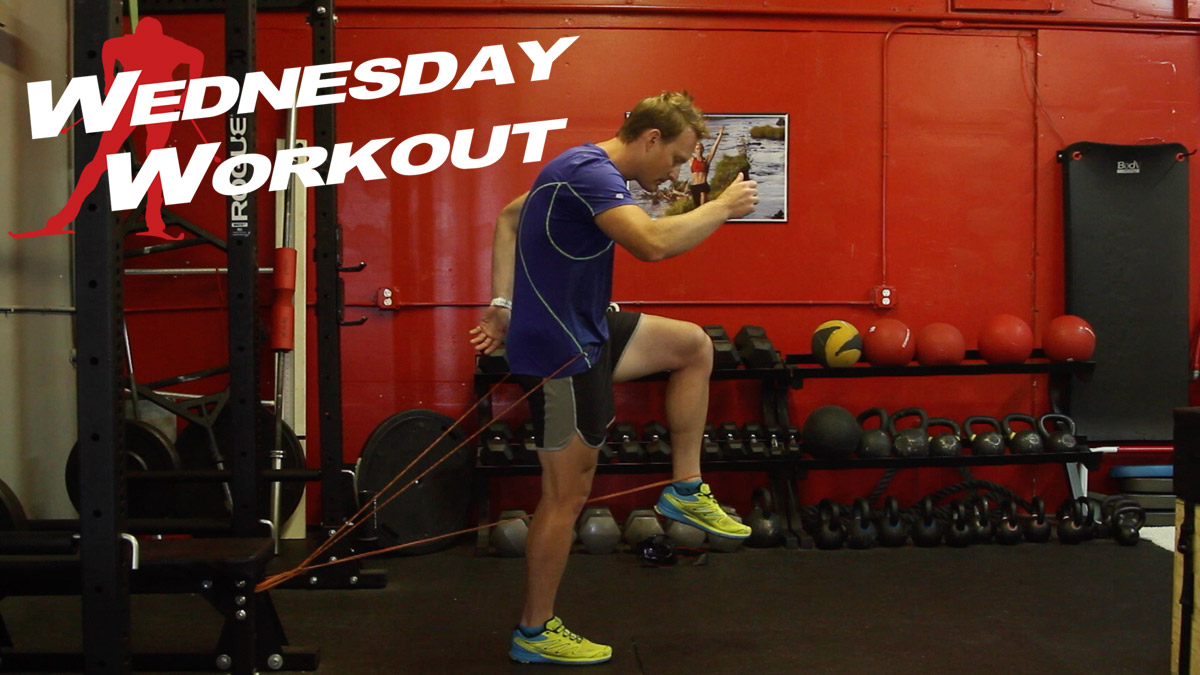
Bend-based physical therapist and strength/conditioning coach Dave Cieslowski demonstrates an exercise to help tame compartment syndrome.
BEND, Ore. — Two letters for better or for worse that we often associate with the negative sides of too much skiing are PT— as in physical therapist. Based in Bend, Dave Cieslowski is a licensed physical therapist and certified strength and conditioning coach. He has a core group of cross-country skiers who take his word on injury prevention and treatment — that group includes the U.S. Nordic Combined team.
One common overuse injury is compartment syndrome, or what specifically is called exertional compartment syndrome. Painful? Yes! If you don’t take my word for it, just read this post from former U.S. Ski Team member and distance skier Kris Freeman.
OK, it’s painful, but according to Cieslowski, it may be preventable and treatable in some cases without surgery.
Here are some basics: pain and/or numbness may develop when a muscle becomes swollen during exercise and the compartment containing the muscle does not expand. For skiers, this most often occurs in the lower leg where there are four muscle compartments — commonly, when compartment syndrome is suspected in a skier, symptoms are often evident in either the calf or shin area.
According to Cieslowski, the onset of compartment syndrome that specifically affects the shin is more likely in skiers who raise their toe up during the return phase (just after the leg push off) while skate skiing. That action, the toe raising, may eventually cause pain in the shin area.
Here’s a short podcast episode in which Cieslowski describes the reasons for the following exercises (press the play button below).
What You’ll need for exercise #1:
2 x 3 ft. resistance tubing
A secure structure to anchor the resistance tubing
Place one piece of tubing around the top of your hips, the other around one ankle
Watch the video for more specific details about how to proceed
What You’ll need for exercise #2:
1 x 2 ft. resistance tubing, both loose ends knotted together to form a circle
Step through tubing and position just above the knees
Dumbbell and weights appropriate for a single leg step up onto an approximately foot high box
Watch the video for more specific details about how to proceed
For both exercises, use caution and determine the proper number of sets to ensure you are fatiguing the appropriate muscles. You’ll note in the video that Cieslowski’s cycle rate is slow — that is on purpose. These are not meant to be high cycle rate exercises.
Jessie Diggins (U.S. Ski Team) racing to fourth in the women’s freestyle sprint qualifier at Stage 3 of the Ski Tour Canada in Quebec City. She went on to place 13th after a crash in her quarterfinal. In an interview earlier this month, Diggins said her reliance on sport psychology has helped her make gains, especially in her consistency last season. (Photo: FlyingPointRoad.com/NNF)
At the 1964 Tokyo Summer Olympics, Billy Mills was America’s best hope in the 10,000 meters: a 25-lap race of high-turnover running coupled with a Grandmaster’s chess match worth of strategy. Coming into the Games, Mills was an outlier. In other words, he was not considered a medal contender; he’d need to improve his 10,000 time by nearly two minutes to contend for the podium.
In an archival video from Tokyo, around 1:15 in, the television announcer makes subtle note of Mills.
“Billy Mills is right in there for the U.S., a man no one expects to win this particular event,” the announcer said at the time.
A minute later we see Mills and world-record holder, Australian Ron Clarke, running one-two — jostling, throwing elbows with fewer than 400 meters to the tape. One particularly robust shot from Clarke almost trips up Mills. About then, third-place runner, Mohammed Gammoudi from Tunisia, pounces. He’s a blur as he accelerates between Mills and Clark.
It appears Mills is a bronze-medal lock. Gammoudi, chased by Clark, drop Mills by five meters, the finish only moments away.
At far left, Billy Mills, of the Oglala Lakota (Sioux) Tribe, representing the U.S. as he crossed the finish line first for the gold medal in the 10,000 meters at the 1964 Olympic Games in Tokyo. (Photo Official Marine Corps Photo # A411758)
Mills’ story is well documented. His belief in self, his ability to mentally break down an epic distance into small discrete moments, helped him close the two-minute gap he once faced. Mills later said, in this video, that he started to think about how he’d first decrease his time by 25 seconds. He concluded that simply holding a faster pace for one second longer per lap would do the job. Afterall, it’s a 25-lap race. Mills’ logic followed that a 50-second decrease would require the faster pace for two seconds longer per lap.
A simple pattern and a simple remedy, but not such a simple plan to execute on the Olympic stage.
On that day in 1964, Mills set a remarkable personal best as he outsprinted Clark and Gammoudi for the gold.
Sport is inherently measurable. At its most basic, there’s the win or the loss. In sports like cross-country skiing, where there’s one winner, most athletes fill in the ranks from second to, say, 50th. Yet, the non-winners still strive. They train. They attempt to fine-tune their “engines” for a window of elite performance that may last only a few weeks annually or even a single race. All this in an attempt to decrease the physical performance gap between themselves and the winner.
Still, sometimes that’s not enough for the breakthrough. Using Mills’ example, he’d say the mental piece was the breakthrough.
Rich Gordin, a Utah-based sport psychologist, asked this author to watch the Billy Mills clip. It’s also something he’s recommended to many top nordic athletes. Through his first foray into psychology and sport in the ’70s with the University of Utah’s women’s gymnastics team, perennial NCAA champions, to his work with the 2010 Olympic-medal-winning U.S. Nordic Combined Team, Gordin remains bullish on psychology’s place in sport.
Yet Gordin says many elite athletes are reluctant to seek the help of a psychologist.
“Most of the endurance runners and cross-country skiers are primarily, I think, initially most interested in their physiology,” he said. “I can put somebody on a treadmill and I can tell you their VO2 max, I can tell you their lactate threshold, I can tell you biomechanically exactly how your skis are and where your poles are.”
Sport psychology, Gordin admits, is less data-driven.
“Why is it not utilized as much is because you cannot see it,” he said. “It’s harder to measure. Cross-country skiers are very much like endurance runners. When you bring a sport-psych person in, a mental trainer, they don’t really get it … because they think it’s all physiological; ‘if I’m physiologically able to pound someone into the dirt, that’s all I need.’ ”
Initially, Gordin needs to establish athlete buy-in. That, he said, begins with the basic belief system. In this case, the idea that an athlete believes they can accomplish a specific goal.
“And it’s not a fake thing. It’s not a little red choo-choo train, ‘I think I can I think I can.’ That’s superficial. It’s a start, but it’s not enough,” he said. “I’m talking about anybody I’ve ever worked with. And when these people finally flip the switch — I call it flipping the switch when it happens — it clicks. You have to believe you belong there.”
“It’s not a little red choo-choo train, ‘I think I can I think I can.’ … You have to believe you belong there.” — Rich Gordin, professor at Utah State University and sports psychologist
Sophie Caldwell (U.S. Ski Team) racing to 22nd in the women’s freestyle sprint qualifier at Stage 3 of the Ski Tour Canada in Quebec City. (Photo: FlyingPointRoad.com/NNF)
Pam Lemons is a Park City-based sport psychologist employed by the U.S. Ski & Snowboard Association (USSA) counseling cross-country and mogul skiers, and non-snow athletes like golfers, lacrosse and soccer players. She’s one puzzle piece that has allowed the U.S. women’s nordic team to believe. Lemons said that belief, and the reality of consistently performing well has been created incrementally.
A psychologist for multiple USSA teams, Lemons emphasizes core mental practices for effective physical athletic performance. She teaches skiers to communicate, set clear goals, and practice purposefully. Purposeful practice, Lemons explained, makes effective and efficient use of the athlete’s time.
“So when you go out and you are doing double-pole intervals, you don’t just go out and wing it,” she said. “You have a very specific goal in mind for that particular day, and the whole premise — and I try to get the athletes to understand this — is if you just go out there and wing it, then you are not building upon the structures that are going to make you better.”
The mental training Lemons prescribes also places a premium on journaling.
“The journaling allows for a record. We are looking for trends so we can if we see that there is a trend in behavior. Then we know, especially in cross-country, when they get so tired and their energy output is great it could be that, ‘Oh my gosh, I noticed that at the end of the camp that I’m not as successful at double poling or sprinting.’ Maybe they are tired. We will be able to see that from a mental standpoint and from a physical standpoint. Much the same as you do training journals. It is a training: it’s mental training.”
In the journal, Lemons asks that athletes document specific goals. She calls these goals “OFI’s” — Opportunities For Improvement. For example, if a skier is focusing on striding, they outline that as a journal entry.
“And they might say, ‘Today my training went really well. I felt strong. I felt like my technique was excellent, but my kick wasn’t what it should be,’ ” she suggested. “ ‘And so the kick then, tomorrow when I do my training, I will focus on sending my legs,’ or whatever they need to do, they will have a specific technique that they may work on.
“I have them document that, and then at the end of the week they can determine whether or not it was successful,” she continued. “And maybe they did something really, really well and they didn’t do something as well. That’s an OFI — they then become the goals for the next day or the next week.”
The journal becomes part-training log and part-guide, a reference for each athlete to discover where they have been, where they’d like to go and how to get there.
Lemons had this anecdote about why journaling is effective. “I had one athlete at a camp, and she came back from the camp and she said it was a horrible camp. I said, ‘Really? Tell me why.’ ‘Oh my gosh, it was the worst camp ever … I didn’t do x, y, and z.’ And I said, ‘Well, let’s see what the goals were for that camp? Let’s just look at it and see what you were planning on doing and what you did.’”
The athlete fortunately had a written record — the OFI’s and the goals — to cross reference.
“‘Did you meet goal number one?’ ” Lemons asked. “ ‘Oh yeah, I did.’ ‘Did you meet goal number two?’ ‘Oh yeah, I did.’ The reason she said the camp was awful was because the last day she was stinking it up. In her mind, all she remembered was that last day. Because she journaled, she really then changed her whole reflection about that camp.”
The skier was able to understand she was, in fact, moving closer to her overall goals. In this instance, the journal can be a safety net. According to Lemons, here’s why: humans have a tendency to recall, say during a weeklong training camp, the first and last things that occurred.
“It’s called primacy and latency,” Lemons explained. “You don’t want to leave your reflection to your memory. You want to be able to document these things.”
The journaling allows athletes to thwart our wiring for primacy and latency, allowing them to see the bigger picture and discrete trends.
Sport Psychology at the National Level
Chris Grover, head coach of the U.S. Cross-Country Ski Team, has been part of the team’s coaching staff since 1999. He took a two-year hiatus in 2004 and has been with the national team since 2006. During his tenure, he’s seen sport psychology become more fully integrated into the team’s methodology.
Grover noted that he’s witnessed a simple yet critical change: the increased number of providers available to U.S. Ski Team athletes.
“When I began working for the national team again in 2006, we were looking at one provider for the entire team in kind of one-size-fits-all strategy,” Grover said. “And now we are using one, two, three, four, five, I believe five different providers for the team. People can find someone that they really click with, someone that they like to work with.”
According to Grover, like any group, the needs of the team are varied. As a result, the team does not use group-wide sessions as a regular practice. It’s up to the athlete and provider to do what works best.
Grover said he does intervene when the situation arises.
“Where we do interact is [when] we are seeing behaviors or lack of skills or what have you with an individual athlete and we are talking about that with them and then encouraging them to discuss that topic with their provider,” he said. “We are talking directly with the provider in order to make sure the athlete is getting those needs attended to.”
North of the border in Canada, the understanding that sport psychology should hold a firm place in coaching and mentoring nordic skiers is not lost on Justin Wadsworth, Cross Country Canada’s head coach for the last five seasons. (Wadsworth was interviewed for this article before he stepped down from the position this spring.)
One key difference between the Canadian and U.S. models are the number of providers associated with the Canadian program.
“We have one team sport psychologist that works with the whole team, and then he is available to work individually as well if it was a match,” Wadsworth explained. “If they choose to go outside our team sport psychologist, we ask them that if they work with a psychologist to make sure that that psychologist is working with our team psychologist so at least things are getting downloaded and there are notes being taken and referenced back to our team sport psychologist.”
Wadsworth’s belief in sport psychology is profound. His wife, multiple Olympic medalist Beckie Scott, worked personally with noted sport psychologist Terry Orlick.
“I saw it with my wife,” Wadsworth said. “It was night and day when she started working with Terry Orlick. Though her gains with him, it was, I would say, life changing or career changing.”
At the same time, that close-to-home success story sometimes led to frustration.
“I’ve also seen those athletes that I know for sure could be in the top 30 and it’s all mental,” Wadsworth said. “And that’s the most frustrating thing because you really try to get people to work with a psychologist. But again, it’s not one of those things you see benefits from right away, and it’s really hard to show small progress. So its really, really tough. I would say ninety percent of our team needs real hardcore sport-psychology work. And about ten percent of that ninety percent is actually doing it right now.”
Wadsworth said large budget cuts prevented him from fully implementing team wide use of sport psychology. But at the top end of sport, Wadsworth believes sport psychology remains a game changer.
“It’s probably more important than the physical training,” he said. “Any monkey can do the hours and the work, but to have the confidence and the confidence to rest and have the confidence when you come to the winter and have a game plan, all that stuff just doesn’t fall in your lap. You have to work on it.”
The Junior Scene
For some, perfection is a carrot. Yet a lack of perfection is something most junior skiers — arguably the most important part of any development pipeline — know well. There’s the expectations of coaches, peers and parents, all of them constantly wired to as-it-happens results. Add that mental pressure to a junior skier’s changing body and it’s no wonder some coaches turn to sport psychology.
Josh Smullin, head coach of the Steamboat Springs Winter Sports Club’s U20/U18/U16 cross-country teams, holds a master’s in sport psychology. Smullin has provided psychological-skills training to athletes of all disciplines at the Winter Sports Club, and he asserted those skills can help improve an athlete’s performance.
Josh Smullin, Head Nordic Coach at Steamboat Springs Winter Sports Club, directing a fall workout in Steamboat Springs, CO. (Courtesy photo)
One common issue Smullin has grappled with recently is helping his junior athletes navigate the different rates at which teenagers develop muscle. Watch any boys’ U16 race and you’ll see some kids honed and toned, while others remain sinew and bones. Smullin said he has encountered this with one of his most driven athletes.
“That’s a really challenging thing, when you have an athlete that doesn’t develop early and they are getting beat by guys that don’t, say, train as much as them or have as good of technique,” he explained.
As he counsels athletes, Smullin highlights a core tenant of sport psychology: “Focusing on the things they have control of,” he said. “That’s perfecting their technique, utilizing what they have as their strengths. For instance, I have a small guy who can really climb well. Maybe they are going make their make their move on the steep hill that the bigger guy might not be able to. Maybe all his muscle and his mustache will not be an advantage.”
Facial hair aside, keeping all kids in the sport remains a goal. Smullin says he emphasizes the long term.
“Keeping the kids that are getting beat just because of their size motivated,” he said. “And showing them that you believe in them. At some point down the road, they are going to make that jump, and when they do, they are going to have all the other skills developed.”
The timing of physical maturity, however, is a two-sided equation.
“It’s also a major challenge to coach the kids that mature early, and I was one of them,” Smullin said. “They develop a mindset, ‘Oh, I’m just better than all these kids’. They don’t learn to associate hard work with what leads to their success; they just think they are better, and they are for a little bit because they are bigger and stronger and have more testosterone. But the problem for them is, the only reason you are faster is because you developed a little faster. These guys are fighting right below you, getting the better technique and doing whatever it takes to keep up with you right now, so that’s the other side of it.”
The pipeline from the junior ranks to the World Cup constricts as skiers age. The competition gets tighter, opportunities more difficult to achieve. Some athletes slow down, some get faster. Winning and losing are part of the learning experience. As clubs are responsible for developing athletes that can stay in the game, perhaps placing a premium on mental training along with logging hours makes the most sense. Yet with juniors, it’s a balancing act.
Smullin admits, kids are already taxed. Realistically, sport psychology does not allow juniors to supplant training hours with mental training.
“Ultimately, we have to prioritize the time we do have with the kids, and some of these programs, we take a lot of their time and they have busy lives,” he said as he considered how athletes try to fit it all in.
Even with his psychology background, Smullin believes the greatest benefits sport psychology provides may come on the latter end of a junior skier’s race path. Smullin recalled the skier who remains a late bloomer.
“Let’s say that kid has to be in the sport and stay in the sport to have any chance,” he explained. “Second thing, they have to do the training. That’s the most important to even have a chance. Sport psychology can’t just overcome someone who trains 400 hours beating someone who trains 600 hours. Where sport psychology will likely make the biggest difference in terms of performance is when somebody is at the top level and all the fitness and the skills are so close — how are you going to beat somebody who is very similar to you and gain that extra 20 to 30 seconds?”
The International Scene and Mental Management
Jessie Diggins, of the U.S. Ski Team (USST) and Stratton Mountain School (SMS) T2 Team, racked up 16 top-10 World Cup results this past season, including five podiums and a career-first World Cup win. Posting consistent results and hyped as a podium threat throughout the season is a good problem to have. Yet success brings with it expectations and intense pressure.
Diggins, 24, has worked with the same sport psychologist since she joined the USST five years ago. Along the way, she realized that mental training is as important as her raw skiing speed. One aspect of mental training she cultivated is her ability to compartmentalize pre-race jitters. She calls it, “taking the nervous butterflies and making them fly in formation.”
Diggins clarified over the phone that stress is not always a negative.
“That’s not to say that all stress is bad stress,” she said earlier this month. “[My psychologist] has helped me learn that when I’m nervous before a race, to see that as at a sign that I am ready. You wouldn’t be nervous if you didn’t have a chance. So when I get those pre-race jitters, instead of being like, ‘Oh no, I’m wasting all this energy,’ I embrace it. This is my body telling me it knows something big is about to go down. It knows I am ready. It knows that that I’ve prepared.”
Beyond pre-race anxiety management, Diggins said she has learned to separate racing goals from results goals.
“You might finish a race, and you might think, ‘Wow, that was a kickass race. I felt completely together,’ and then you look at the results sheet and you are like, ‘crap,’ ” Diggins said. “So one thing she has helped me is to not simply put a number on a result sheet. To evaluate my performance independently from what anybody else thinks. Maybe my goal was to be super calm testing skis because I know it is going to be a tricky klister situation and I want to be super efficient and not be panicky. If I’ve accomplished that, then I can feel good about what I have done that day regardless how the race went.
“That is one way to keep the pressure of feeling like everyone is expecting me to get top-five in this result, or I’ve podiumed on this course before, what do I do? You just break it down into smaller goals for the day and you evaluate yourself on those goals, not on results.”
The U.S. women placed a historic second for their best-ever relay finish on Sunday at the World Cup 4 x 5 k in Nove Mesto, Czech Republic. From left to right: Jessie Diggins, Sophie Caldwell, Sadie Bjornsen, and Liz Stephen. (Photo: Fischer/NordicFocus)
It’s a rare athlete who finds themselves unchallenged over the course of their career. Diggins’ arc was on an upswing this season while her U.S. teammate, veteran Liz Stephen, who prevously had been punching the accelerator full gas, experienced a deceleration. Stephen’s 2014/2015 World Cup campaign was stellar; she finished the season ranked seventh in the distance overall and 10th overall on the World Cup — both career bests.
“I came off one of my best seasons ever, last spring, and I was really inspired and psyched,” Stephen, 29, said over the phone earlier this month.
But back at her training base in Park City last summer, she reflected that perhaps at times she became a bit overambitious with her training load.
“I think that I kind of hit a stalemate in terms of my mental enjoyment of the sport,” Stephen said. “At some point I didn’t know whether I was just so burned out mentally that I felt tired all the time or whether I was tired and I felt bad mentally. I think they are kind of hand in hand and it’s hard to tell which is which. But at some point, you kind of realize that this is not the mental state I want to be in.”
Stephen explained she never really could pull up from her perceived performance nosedive except during team relays on the World Cup, where she said, “I have a sense to be be able to forget my own issues because it’s for somebody else.”
Her ability to suffer for others paid off — the two World Cup relays in 2016 amounted to a third place followed by a best-ever second place for the U.S. women. And in the final stage of the Tour de Ski in Val di Fiemme, Italy, Stephen busted out a prime solo performance as she posted the second-fastest climb time up the Alpe Cermis. She finished the Tour in 19th overall.
Beyond the relays, Stephen’s evaluation of her season was blunt: “When you stack yourself up against you, sometimes you are your biggest enemy out there,” she said of her inability to breakout. “And I found that it was really hard to get out of my own way this year.”
Despite the harsh self-assessment, Stephen was still nominated to the A-team — at season’s end, she was 28th overall on the Distance World Cup. But she still considered the season below her expectations.
“All of a sudden I’m at the older end of the spectrum,” she said. “And I think that the sport has gone from being just this happy-go-lucky, fun, ‘I ski because I love it’ thing, to why am I doing this? And what is the purpose of being 29 and pursuing a medal or whatever it is that I am pursuing? The thought now is kind of, ‘I need to restructure why I am skiing. What is my purpose in the sport? Why is sport important be it skiing or anything else? And what am I setting out to do?’ … I spent the year doing what I should’ve loved to be doing and just not being able to do it the best I could because I was too worried that what I was doing was not meaningful enough, and that’s not the way I want to live my life.”
Heavy questions — questions with no immediate easy answer for an elite athlete trying to reset for the 2016/2017 race cycle.
Stephen stated several times that her goals in life are simple: to live an inspired life, live a meaningful life and to try to give other people meaning and purpose in their lives, too.
“It’s really easy to to think that what you are doing is not affecting others and that’s really hard for me to swallow,” Stephen said.
Fortunately, Stephen’s dilemma is not hers to solve alone.
“I think that the psychologist helps the athlete figure out why they are doing what they are doing so that then they can work backward and say, ‘OK, if your purpose is to inspire people, how are we going to take that feeling of purpose because somehow a medal doesn’t do it for you … in terms of like a goal? … We want you to figure out how to purposefully live this skiing lifestyle for the next two years in a way that in turn can get you to perform to your highest ability,’” she observed.
Stephen acknowledged her life as an elite athlete remains a gift. Yet staying positive when results don’t come is downright gritty mental work.
When asked how confident she felt looking at an 18-month grind ahead of the next Winter Olympics, she replied, “I think that it depends on the day you ask me, honestly. Right now I don’t feel invincible. I don’t feel confident. … Right now, if I had to suit up, the fitness is not there and I know that. The part I love about this, or part of it, is the training. Like I tend to overdue do it, because I just love the training, it is why I am involved in sport and the community and that’s what got me in it, that’s why I’m still doing it.”
In cross-country skiing, success is measured in seconds. Maybe that’s the margin for a training-camp invite or a European race trip. As sport psychology becomes more readily available and a greater part of the success equation, mental training may become as routine as checking the HRM and uploading the data to a training log.
Helping athletes stay positive, reflective and making their endeavors meaningful can be a struggle at any level of competition — Bill Koch League through the World Cup. Sport psychology appears to be another tool to make improvements and balance success and perceived failure.
Lemons, the USSA psychologist, had these parting words as she questioned why sport psychology wasn’t more of a regular part of sport, “If you can even improve a little bit, if you can maximize your opportunity, why not?”
Martin Johnsrud Sundby of Norway celebrates the fruits of his labor over eight stages of the Tour de Ski (TdS), after winning the final climb. He has told Norwegian media that his lung capacity is 80% of a normal man’s, which is why he trains so much; Russian cross-country ski federation president Elena Välbe says that if he’s really so sick, he shouldn’t be competing. (Photo: Fischer/NordicFocus)
Elena Välbe, the President of the Russian Cross-Country Ski Association, recently had some thoughts on how the Norwegians attain their dominance in cross-country skiing: through inhaler use.
“It’s annoying because this team, everyone has asthma,” she said, according to a translation of an interview with the Russian news service Izvestia. “I personally don’t understand what kind of asthma you can have, and still ski so fast… [Martin Johnsrud] Sundby said in a recent interview that in Oberstdorf it was bad because it was warm, and he lost his breathing and had to use powerful drugs. For us, this is nonsense. If a person is so sick then how are they going as if they were healthy? It seems to me that if someone is sick, they don’t have to compete.”
She went on to say that the trend of inhaler use in young Norwegian athletes was “alarming”.
Many of the former World Champion’s statements are far off the mark, scientifically speaking. But Välbe isn’t the first to imply that the Norwegians obtain an unfair pharmaceutical advantage.
Russian Ski Federation President Elena Vyalbe in 2004. (Photo: Ivan Isaev, Russian Ski Magazine)
Inhalers using albuterol (also called salbutamol) and other drugs of that class, called beta-2 agonists, seem to have an unfair reputation as narrowly-disguised cheating in parts of the sports world. This is despite the fact that numerous studies have shown that such drugs are not performance-enhancing.
And with Bjørgen currently on the sidelines after having her first child, Sundby appears to be the new poster child for winning with asthma. The winner of the Tour de Ski and the current World Cup leader, Sundby initially didn’t respond to Välbe’s comments.
Besides asthma, there are also other reasons to use inhalers containing beta-2 agonists or other drugs. A number of disorders fall under the umbrella of airway hyper-responsiveness, when the airways narrow in response to some challenge more easily or quickly than they would in a healthy person. Symptoms include coughing, wheezing, and shortness of breath.
“Airway dsyfunction as described by Price in 2014 includes the following: airway hyper-responsiveness, exercise-induced asthma, and/or asthma,” explained Dr. Michael Kennedy, a researcher at the University of Alberta who has studied airway inflammation in cross-country skiers. “Airway hyper-responsiveness in reality is the most important of these specific definitions because it accurately describes the phenomenon of airway narrowing (bronchoconstriction) due to exercise or physical activity.”
American track star Jackie Joyner-Kersee is an example of a famous athlete who succeeded despite an asthma diagnosis. (Photo: Wikipedia)
Those with airway hyper-responsiveness and another disorder in that family, exercise-induced bronchospasm (EIB), also treat their challenges with inhalers. Most individuals with asthma also have EIB, but many people have EIB without having asthma.
“Both asthma and EIB are likely under-diagnosed, but diagnosis can be tricky and there are look-alikes, like vocal cord dysfunction,” Dr. Krystian Bigosinski, a sports medicine doctor in Maine who works with the U.S. Ski Team, explained in an email. “That is why it is very important to get a solid diagnosis with the help of testing, such as spirometry with exercise or cold air challenge.”
Beta-2 agonists are generally prohibited by the World Anti-Doping Agency, but inhaled salbutamol, formoterol and salmeterol (common ingredients in inhalers) are allowed up to certain doses without a Therapeutic Use Exemption (TUE).
That’s good news for a lot of athletes.
“The treatment for both asthma and EIB is similar, and in both cases, the first line treatment is albuterol,” wrote Bigosinski. “If that doesn’t work, other medications are added, such as long-acting beta-agonists, inhaled corticosteroids, mast cell stabilizers, and leukotriene inhibitors. EIB, if not accompanied by true asthma, typically responds better and often only necessitates the use of EIB, by itself, is rarely if ever life-threatening. However, EIB with a background of asthma is more likely to need other medications as mentioned above, and EIB with asthma can be a medical emergency.”
Välbe seems to suggest that if you need treatment, you shouldn’t be competing.
“It is mostly a lack of understanding for the use of medications,” Vidar Löfshus, the chief of the Norwegian ski team, told Norwegian newspaper Aftenposten regarding Välbe’s comments. “Use of asthma medications are strictly regulated in doping legislation, no one does it for performance enhancing reasons. There are many people who have some issue or another with their airways, and when they are allowed to use drugs they can get to a normal level with their airways.”
The data backs him up: a lot of athletes have asthma or other airway hyper-responsiveness, and even for those who don’t, using inhalers does not provide a performance advantage.
Many Asthmatics in Elite Sport
In fact, asthma and other respiratory problems are extremely common in elite athletes, especially those who compete in unusual air conditions: very cold air, very dry air, or the chlorine-filled air inside a swimming hall.
The prevalence is high enough that a team of British researchers and doctors from, among other institutions, the National Heart and Lung Institute recommended that airway dysfunction be classified as an “occupational disease” in athletes.
“Applying a label of occupational disease in this setting raises implications for the care and treatment afforded to elite athletes,” the authors wrote. “Indeed it is a key mandate of the International Olympic Committee–Medical Commission (IOC-MC) that no athlete is harmed by exposure to sport and that all care is taken to ensure their health is maintained.”
Among athletes, most asthma diagnoses could be broken down into two categories. A research team from Portugal and Norway set out to see how prevalent the diagnoses of each were, hoping this could lead to better targeted treatment.
The first type of asthma they identified is classic asthma, associated with allergy problems. The second is what the authors called “sports asthma”: induced by exercise and lacking the connection to allergy that often underlies the disease. In water and winter sports, athletes were three to nine times more likely to have this second type of asthma than those who did not compete in cold weather or in aquatic sports complexes.
“Sports asthma” might be more recognizable when called a term you have probably heard: “exercise induced asthma.”
“There is exercise induced asthma (EIA) and exercise induced bronchospasm (EIB),” wrote Dr. Ed Merrens, the Chief Medical Officer of the Dartmouth-Hitchcock Medical Center in New Hampshire and the former team doctor for the U.S. Biathlon Association. “It is different than childhood asthma. Winter athletes certainly have higher incidence of EIB and EIA.”
What does that mean, in terms of numbers?
An Italian study of 659 summer and winter Olympians over a 12-year period found that 15% of athletes had asthma, and for almost a fifth of those, their asthma was not “under control”. The researchers also found that the proportion of athletes on an Olympic squad who had asthma increased from quadrennial to quadrennial.
A study in Sweden found that depending on the age class investigated, between 20 and 35% of current and former elite skiers reported that they had been diagnosed with asthma by a doctor. Diagnosis was usually during adolescence, and prevalence was higher for women than men.
“Nordic athletes have a high prevalence of airway dysfunction and it is clear (and I mean definitive) that both the cold, dry air that nordic athletes inhale plus the volume of air (total exchange of air over months and years) as well as the flow rate (shear stress on the airway lining) caused by high-intensity intervals and races all combine to induce this,” Kennedy wrote.
Effects of Inhalers
Many, though certainly not all, of those athletes treat their asthma with inhalers of various kinds. And that’s allowed by the World Anti-Doping Agency.
“Inhalers using beta-agonists have absolutely no ergogenic or performance enhancing abilities,” wrote Merrens. “They do not require a use exemption from WADA.”
There’s plenty of research to back up this assertion: inhalers using salbutamol and beta-2 agonists do not enhance athletic performance.
They don’t enhance it in five-kilometer running races, whether using the maximum or half the allowable dose set by the World Anti-Doping Agency, a team from the United Kingdom found.
Nor did a combination of beta-2 agonists (including salbutamol) enhance performance by elite swimmers, a team in Denmark reported.
There are other results, too, but the message is clear: using an inhaler isn’t cheating. That’s in fact why the World Anti-Doping Agency took inhaled salbutamol and salmeterol off the Prohibited List (you can find the classification and legal dose limits, as well as information on which doses are contained in common inhalers, here).
“Everyone can use these in a FIS race if they so choose,” Kennedy, the researcher, wrote. “However the net effect for anyone whom does not have [exercise-induced bronchioconstriction] is negligible: you can’t relax smooth muscle in the airway if it has not been contracted. So Välbe is really politicizing something that is a non issue.”
Can Asthmatics Win?
Asthma can clearly have negative effects not only on health, but on athletic performance. Those are both reasons that the British team suggested designating airway problems as an occupational disease in athletes: the issues seem to be caused by the huge training loads that are part of athletes’ profession, and the diseases also have consequences in both professional and personal life.
But depending on the type and severity of respiratory problems, athletes may still be able to turn in winning performances.
For instance, the Italian study of 12 years of Olympic participants found that asthma had no impact on whether an athlete qualified for an Olympic team or not, and that at the 2008 Games, two of Italy’s 26 medal came from athletes who had asthma.
“Asthma, especially in its moderate or severe forms, can absolutely reduce athletic performance, but not necessarily so,” Bigosinski explained. “There are plenty of athletes who also have asthma that are able to train and compete at very high levels. Developing a good asthma treatment plan can significantly decrease asthma’s effect for many athletes with asthma.”
“There is no question that with proper treatment and even better, warmup, athletes with EIB/EIA can perform at the elite level,” agreed the former U.S. Biathlon Association doctor, Merrens.
Kennedy, the researcher, suggested that perhaps the reason that so many Norwegian skiers have a diagnosis of asthma is that their team is ahead of the curve on detecting and treating the disease. Rather than assume that shortness of breath or post-race cough is just a normal product of racing in cold weather, they look to see if there’s a clinical explanation.
“Using an inhaler is not cheating and many World Cup athletes need and should use an inhaled beta-agonist or inhaled glococorticosteroid for health reasons, and secondly to reduce EIB during racing and training,” Kennedy wrote. “In essence the Norwegians are on top of their game and have a comprehensive screening program for [airway hyper-responsiveness] so that all athletes in all their systems get screened at least once per year and use the best Therapeutic Use Exemption available to them. That is a great example of sport science at work because the Norwegians are using at their at disposal the available evidence to ensure that their athletes have the best performances possible.”
And furthermore, shaming atheltes for using inhalers is dangerous, he concluded.
“I find this disconcerting because having shortness of breath and wheeze that is severe due to EIB can lead to extreme emotional and psychological discomfort, and can be life threatening,” Kennedy wrote.
Peter Griffin of the animated sitcom Family Guy winces in pain. He probably doesn’t have compartment syndrome, but should probably look into the symptoms.
Note: This article has been updated to include comments from U.S. Ski Team development team skier Julia Kern, who had compartment-syndrome surgery last spring.
Shin pain is an increasingly common complaint among cross-country skiers, causing many lost days of skiing every year. It’s difficult to identify a single reason for the trend, but greater training demands, such as high volumes of rollerskiing in the offseason, increased boot stiffness, diets that don’t meet the caloric demands of training, or single-sport specialization from a young age may play a part. In the individual skier, however, a sports medicine doctor can make a specific diagnosis, find the cause of the problem, and then tailor a treatment plan for the athlete.
The three most common causes of shin pain are shin splints, bony stress injuries and exertional compartment syndrome. The term ‘shin splints’ is often incorrectly used to describe any shin pain in athletes. However, true shin splints are caused by micro-tearing of the muscle away from the bone along the medial, or inner, part of the lower shin. Pain from shin splints is often spread out along the inner shin, and typically goes away or ‘warms up’ with exercise, but comes back after exercise or after a hard workout.
U.S. Olympian Kris Freeman during the 4 x 10 k relay at 2009 World Championships in Liberec, Czech Republic. In the spring of 2009, Freeman had surgery to remedy compartment syndrome in both shins. (Photo: Swix Sport)
In more advanced cases, the pain can worsen during exercise, limiting a skier’s ability to race and train. Most athletes with shin splints are sore for the first few minutes of a ski, then the pain improves or disappears entirely, and then they are sore again after they cool down.
Shin splints are often diagnosed without any special testing, and can be managed effectively with relative rest, stretching tight muscles, especially those of the calf, strengthening weak muscles, especially those of the hips and ankles, and working on ski technique and balance. A physical therapist and sports medicine physician can work with the skier to identify underlying biomechanical issues that could be causing their shin splints. An arch support orthotic may also be helpful.
A bony stress injury is a more serious condition, which occurs across a spectrum. Milder injuries cause some inflammation in the bone; more serious injuries can lead to a fracture, or break, of the bone.
I often use the analogy of a paperclip to illustrate how these injuries happen. Bend the wire of a paperclip back and forth enough times and the metal will start to get warm. That heat is analogous to a mild bony stress injury. Keep bending the paperclip, and it will eventually break, much like with a stress fracture.
Bony stress injuries occur in athletes who engage in high volumes of exercise without allowing adequate rest time for the bone to heal between workouts. A skier may be more at risk for this type of injury if his or her diet doesn’t provide adequate energy or nutrition to allow the bone to heal properly. Bony stress injuries can occur anywhere in the lower leg, including both the large shin bone, or tibia, and the smaller shin bone, or fibula.
The location of pain is often much more focal than in shin splints, with the athlete being able to point, with one finger, to where the pain is most intense. Pain often worsens with activity, causing an athlete to abandon workouts or races earlier and earlier as the injury progresses.
Because symptoms can overlap with those of shin splints, an MRI is often used to distinguish between the two. Treatment for a bony stress injury requires rest for the bone. If the bone has fractured in a high-risk area, however, surgery may be necessary. Training through worsening shin pain may lead to a more serious stress fracture with a much longer lay-off from skiing, or even a season-ending surgery. It’s important to get a diagnosis and full work-up quickly. If caught early, these injuries can be managed effectively and prevented from worsening.
Exertional compartment syndrome is a less frequent cause of shin pain in nordic skiers and can be difficult to diagnose. Compartment syndrome occurs when the muscles expand during exercise, due to increased blood flow, but the sheath around the muscle does not stretch adequately, which causes the pressure in the muscle compartment to increase.
The four muscle compartments in the lower leg: one in the front, one on the outside, and two towards the back.
There are four such compartments in the lower leg: one in the front, one on the outside, and two towards the back of the lower leg (at right). Athletes with this condition complain of crampy pain in the shin or calf that starts a few minutes into exercise, continues to worsen, and then quickly improves after they stop exercising. This pain is caused by the muscle becoming strangulated as the high pressure in the compartment prevents muscle tissue from getting enough blood to continue to work at a high level.
Depending on which compartment or compartments are affected, and if those compartments contain nerves, athletes can also feel tingling or numbness associated with the pain. They may even experience a sensation that the foot or ankle are weak, causing the skier to more often catch their tips in the snow. A sports medicine physician may order an X-ray or MRI to rule out other causes of pain, and may also suggest a special test to measure the pressure in the compartments before and after exercise. Compartment pressure testing can be uncomfortable, however, and a diagnosis of compartment syndrome can often be reached without it.
Most compartment syndrome can be treated non-surgically with the proper physical therapy and technique adjustments, but in some cases, surgically opening the compartments of the lower leg can be helpful by opening the muscle sheath and allowing the muscle to expand fully during exercise.
Shin splints, bony stress injuries and exertional compartment syndrome have similar symptoms, but they require very different management strategies. Skiers who experience shin pain that worsens with exercise or lasts more than two weeks, despite rest, should immediately consult a sports medicine physician who is familiar with the demands of nordic skiing. Addressing the injury early may prevent a much worse injury, and even allow the athlete to continue skiing at a high level while addressing some correctable technique, strength, or flexibility issues throughout the remainder of the season.
***
Firsthand Experience:
Julia Kern, a member of the U.S. Ski Team D-team and Stratton Mountain School, underwent compartment-syndrome surgery last spring. She shared the following reflections and photos with FasterSkier in a recent email:
– I think if I had done more calf stretching early on, it could have been a lot better. Also, I assumed that my numb toes were coming from my boots and never had second guessed that it was something else like compartment syndrome. I think technique is also a big factor. I think I may have been able to prevent by altering my technique in skating. With that all being said, part of it can be genetic so I cannot say home much was in and out of my control. In hindsight things are much more obvious and clear.
– Through this process I have learned how important it is to listen to my body. For cross country skiers it is often times easy to push pain under the rug because you think it is no big deal and it will go away. From my experience, sometimes this is true, but most of the time the pain or injury escalates and you loose a lot more time from training when you don’t address the issues early. Keeping a very detailed training log is important because it is easier to recognize an injury coming on.
– My recovery has been filled with ups and downs, but now I am fully recovered. I took the more cautious, slower recovery because the reoccurrence rate is a lot lower. I was lucky enough to have spent 6 weeks rehabbing in Park City, at the COE with access to PTs and other resources.
“One of my biggest recovery tools was the AlterG treadmill, which can alter the amount of body weight you are loading when you are running.” — Julia Kern, U.S. Ski Team development and Stratton Mountain School skier who had compartment syndrome surgery last spring
“Doing PT work in the COE [Center of Excellence at the U.S. Ski & Snowboard Association headquarters in Park City, Utah].” — Julia Kern, U.S. Ski Team development and Stratton Mountain School skier who had compartment syndrome surgery last spring
“September at Lake Placid training camp. I was working towards being unrestricted training, still on a modified plan.” — Julia Kern, U.S. Ski Team development and Stratton Mountain School skier who had compartment syndrome surgery last spring
“My legs current day. They are bruised from who knows what, but scars aren’t very noticeable.” — Julia Kern, U.S. Ski Team development and Stratton Mountain School skier who had compartment syndrome surgery last spring
***
About the Author: Krys Bigosinski, MD., is a sports medicine physician in Portland, Maine. He helps provide medical coverage for the US Cross Country Ski Team and is an avid nordic skier. He is also the Associate Program Director for the Maine Medical Center Sports Medicine Fellowship.
Krys Bigosinski, MD is a sports medicine physician in Portland, Maine
Canadian Olympic gold medalist Chandra Crawford stands next to a Cold-FX blowup advertisement on the side of the trails at the Canada Olympic Park (COP) in Calgary, Alberta, during a 2009 Fast and Female event.
As the temperatures drop, cross-country skiers everywhere are looking forward to getting back on the snow. But winter isn’t the only season athletes need to look out for.
In the Northern Hemisphere, cold and flu season typically lasts from December to February, with the highest incidence of flu occurring in February. The common cold is prevalent throughout the fall and winter months. There is no research to show that exercising in the cold makes one more susceptible to viral illness. Evidence suggests that moderate exercises may even be protective because it stimulates the production of white blood cells, which help fight off infection. High levels of exercise can have the opposite effect, however, making elite athletes more susceptible to these illnesses. All athletes can decrease their risk of getting sick and limit time lost from training by following a few simple guidelines.
Wash your hands … a lot
Respiratory viruses are spread through the air by coughing or sneezing, or through direct contact, such as shaking hands. Frequent hand washing with regular soap and water, or with an alcohol-based hand sanitizer, decreases the risk of contracting a viral illness by up to 45 percent. If you are using soap and water, be sure to wash your hands for at least 20 seconds.
Also, avoiding environments where large numbers of people congregate can help. There’s no reason to become a hermit for the winter, but a skier with a particular race or training goal in mind may want to sit out that big holiday party if it comes a week or two before a key race. And if you are sick, do your teammates a favor by staying home on race weekend or, at least, maintaining a three-foot distance from others and avoid hugging, giving high fives, or shaking hands.
Get a flu shot
Influenza is a potentially serious respiratory disease that can derail an entire pre-season of hard work. A seasonal flu shot decreases the risk of getting the flu by 50-70 percent, depending on the year, and may decrease the severity of the illness if you do get sick. Getting a flu shot also protects teammates, family and friends. The one or two days of arm soreness or mild flu-like symptoms an athlete may experience from the vaccination are well worth the insurance policy it offers.
Don’t exercise with a fever
Tad Elliott (l) and Matt Liebsch (r) with the Midwest’s widely celebrated ‘Birkie Fever’ before the 2012 American Birkebeiner.
Athletes should not exercise if they have a fever over 100.4 degrees Fahrenheit (38 Celsius). Exercising with a fever puts an athlete at risk for dehydration, prolonged illness, or pericarditis, a dangerous viral infection of the heart muscle or pericardium, the lining around the heart. Pericarditis can be life threatening. There is nothing to gain and everything to lose by competing or continuing to train with a fever.
Once a fever has broken, athletes may return to exercise in as little as 24 hours or as long as two weeks depending on their symptoms. Fatigue, muscle pain, congestion, or other factors often dictate the timeline.
Give the body time to rest
The pressure to get back to training and racing can be high, but returning too quickly may result in symptoms that don’t resolve as quickly as they would have if the athlete had waited an additional two or three days.
The muscle aches that come along with colds and flu are not well understood. Viral illnesses do seem to affect muscle tissue, however, and exercising with intense muscle aches can result in longer lasting muscular symptoms, such as pain or weakness. An athlete who has significant muscle aches with a viral illness should wait until these symptoms resolve before returning to exercise.
A handy rule of thumb is the ‘above-the-neck’ rule. If an athlete’s symptoms are limited to above the neck, meaning a sore throat, runny nose, and sinus congestion only, if they don’t have a fever, and if exercise doesn’t make symptoms worse, it’s reasonable to continue training. However, it may be wise to decrease training intensity or volume until all symptoms resolve. A physician, especially one trained in sports medicine, can provide guidance and reassurance.
Consult a physician about medications
Most of the medications used for viral illnesses are aimed at decreasing symptoms. Acetaminophen and non-steroidal anti-inflammatories, such as naproxen or ibuprofen can decrease a fever and lessen the pain of a sore throat and muscle aches.
Anti-viral medications for the flu, such as Tamiflu need to be started within 24 hours of the onset of illness and may only decrease the length of symptoms by less than a day. For some athletes, however, that one day may be crucial. A sports medicine physician can help provide guidance on when anti-viral medication are appropriate.
Antibiotics, which act only on bacterial illnesses, have no role in treating viral illnesses and can cause other symptoms, such as diarrhea and stomach upset, which may worsen an illness.
Some viral illnesses can cause bronchitis, an inflammation of the airways, resulting in a long-lasting cough. In those cases, asthma medications, such as albuterol, can be helpful in decreasing cough and chest congestion. Because this class of medications may be banned by certain skiing governing bodies, it is important to know the rules regarding these medications as your doctor may need to fill out a therapeutic use exemption.
Colds and flu are an inevitable part of winter. Athletes who limit their exposure, get vaccinated for seasonal flu and follow a physician-approved return to training plan can protect themselves from the dangerous consequences of getting sick and maximize their time out on the snow.
***
About the Author: Krys Bigosinski, MD., is a sports medicine physician in Portland, Maine. He helps provide medical coverage for the US Cross Country Ski Team and is an avid Nordic skier. He is also the Associate Program Director for the Maine Medical Center Sports Medicine Fellowship.
Krys Bigosinski, MD., a sports medicine physician in Portland, Maine
U.S. Nordic Combined skier Taylor Fletcher during a summer competition in Oberwiesenthal, Germany. Fletcher is seen leading a pack up a city street during the Summer Grand Prix last weekend. (Photo: FIS-Sandra Volk)
We’re officially into September, but that doesn’t mean we’re necessarily there with fall weather. As your workouts intensify in anticipation of the winter ahead, keep in mind that it’s important to stay hydrated — and the days can still reach very warm and potentially dangerous temperatures. The following was extracted from a 2011 “Skis, Strains and Sprains” post by Annika Ferber, an athletic trainer, and physical therapist from Minneapolis. Read the original, “How to Beat the Heat,” here.
***
Use your common sense with hot and humid weather. You know you’re going to sweat right? Well then drink before practice/training, and BRING YOUR WATER BELT. Of all the equipment I have, the water belt is the most essential. Seeing young skiers without them is scary because dehydration and heat illnesses can easily be prevented if water is readily available.
How do you know if you’re hydrated? Check your pee! I’m sure we have all heard this before, but lemonade colored is ideal for being hydrated. Hydrating itself is important as well. Don’t chug your Nalgene 10 minutes before the workout. Drink about 20 oz of water 3 hours before the workout, and then about 20 minutes from the start of your workout drink another quick 10 oz.
During exercise, if you begin to feel thirsty you are reaching dehydration. Replenishing fluids lost after a workout is essential too. Mild dehydration means that normal body weight will drop 2 percent. For example, if you weigh yourself before a workout and you’re a lean 150 lbs, and after the workout you are 147, you are dehydrated. Again, the best thing is to be smart about water.
Don’t forget about sports drinks too! They often do a better job hydrating and rehydrating the body when used properly. They replace the carbohydrates, sodium, and potassium often lost through sweat.
Types of Heat Disorders and how to Prevent them:
– Heat Cramps: Sweating heavily and working hard causes an imbalance between water and electrolytes, the athlete will most likely experience muscle twitching and cramps in their calves and abdominals, or other muscles. If heat cramps occur, it’s key to rehydrate. Also mild stretching with some ice massage can help relieve the pain from the cramps. To prevent heat cramps, make sure you’re acclimated to the environment and properly hydrated.
– Heat Exhaustion: Heat exhaustion can be detected by pale skin, loss of coordination, excessive thirst, fatigue, weakness, mental dullness, and an elevated body temperature up to 104⁰F. The best indicator that an athlete isn’t on their way to having a heatstroke is temperature. The only accurate way to test for this is to take a rectal temperature; taking the temperature anywhere else won’t be as accurate. Quickly remove the athlete from the heat, and begin rehydrating and lowering core body temperature. Continue to monitor the athlete, and if their condition doesn’t significantly improve, transportation to a hospital may be needed.
– Heatstroke: Heatstroke is a life-threatening emergency. The elevated body temperature can lead to tissue damage and central nervous system dysfunction. Many symptoms can occur: altered levels of consciousness, confusion, irrational behavior, rectal temperature above 104⁰F, flushed/hot skin, shallow/fast breathing, rapid/strong pulse, nausea, vomiting, diarrhea, decreased blood pressure, and dehydration. If the athlete’s body temperature can be lowered quickly, the risk of death decreases significantly. The best plan would be to strip the athlete, and immerse in a cold bath or sponge down with cold water and a fan. If possible, try to lower the body temperature at least 4 degrees before transport to a hospital. Only attempt rapid cooling if adequate medical supervision is available, otherwise transport to a hospital quickly. After recovery, an athlete should avoid exercise, be asymptomatic, and be cleared by a doctor before returning.
Summer can be the best time of the year, and we can often forget the dangers associated with training in the heat. The best advice is to use common sense before going out and training. Stay hydrated and stay smart.
Information and recommendations taken from ‘Principles of Athletic Training,’ 13th edition by William Prentice.
A scene from the start of the 2015 Uitslagen Ladiesrun in Rotterdam. A recent study published in the Scandinavian Journal of Medicine & Science in Sports is shedding light on low energy availability and eating habits of competitive female athletes. (Photo: Wikimedia Commons)
We have written before about the prevalence of eating disorders in female athletes, but a new study attempts to describe the diets of female endurance athletes who have low energy availability and/or skipped periods.
What is energy availability? It is the amount of energy left over for the body to go about its functions and maintain homeostasis after the number of calories expended on exercise is subtracted from the number of calories consumed. Unsurprisingly, it is very important for overall health; low energy availability is a risk, whether it is linked to an eating disorder or not.
The results of the new study show definite patterns in dietary habits among female athletes with low energy availability and skipped periods, and enable the researchers to suggest specific nutritional changes that women can make to maintain their energy intake even when training at a high volume and intensity. Notably, replacing calories obtained through fiber with those derived from carbohydrates might significantly avert the risk of skipped periods and gynecological problems.
Writing in the Scandinavian Journal of Medicine & Science in Sports, Danish researcher Anna Katarina Melin and her colleagues describe studying the eating habits and health of 45 national-level and competitive runners, triathletes, and orienteerers who train at least five times a week. They trained an average of 12 hours per week, plus or minus six hours, and had an average VO2Max of 54.5 mL/kg/min.
The research focused on women whose eating habits are perceived to be normal or irregular, but not to a dangerous extent, and examine how this relates through exercise to health. In initial screening, 11 of the women were found to have disordered eating – that’s roughly 25 percent — and were excluded from the rest of the study.
Those with low energy availability trained 25 percent more than the other women, corresponding to 37 percent more energy being spent on training. Those who skipped periods had 15- to 20-percent lower fat mass on their bodies, although their body mass index (BMI) was not significantly different from athletes who did not skip periods. (This is yet another indication that BMI is not an accurate assessment of health or fat.)
Unsurprisingly, the researchers found that energy availability was associated with how many calories the women consumed, as well as with how many macronutrients, proteins, and fats were in their diet.
The athletes with low energy availability ate less energy-dense foods: that is, foods that provided fewer calories per gram. Athletes with low energy availability also ate fewer than the recommended amount of carbohydrates (6 g per kilogram of weight per day) and ate 26 percent less fat than athletes with optimal energy availability.
Usually, when female athletes have low available or energy or skip periods, it is recommended to gradually increase caloric intake by small amounts so as to regain health without gaining weight.
The research team suggests a more detailed approach: to consider how much energy is being expended in training, and then to make up the deficit in calories with the recommended amounts of protein and, in particular, carbohydrates, which so many of the athletes had been missing.
Meanwhile, the athletes who skipped periods showed a pattern of consuming more than the recommended amount of fiber per day, and much more than the women whose menstrual cycles remained regular.
The researchers write that while the general population is often encouraged to eat more fiber for very good reasons, exceeding the recommended amount of fiber intake brings consequences. A high-fiber diet leads to more excretion of fat and other energy sources, and some kinds of fiber also delay food processing so that an individual feels satiated and does not end up eating as much.
“These fiber-related effects are normally seen as beneficial,” the authors write. “However, in endurance athletes with a high total energy expenditure, they can potentially become problematic since high-intensity exercise also has been shown to have an acute suppressive effect on appetite.”
And finally, high levels of fiber intake have been shown in other studies to be related to lower estrogen levels. This is because estrogen, like fats, binds to fiber in the digestive tract and is excreted instead of being reabsorbed into the body. This might be the mechanism which leads the female athletes with excessively high-fiber diets to skip periods, which puts them at risk for other health problems.
Thus, in addition to making up missing calories with carbohydrates, the researchers suggested that women with low energy availability or skipped periods replace some of the fiber and whole grains in their diet with carbohydrates and energy-dense foods. In particular, they suggest drinking drinks that contain calories, such as juice, dairy, sports drinks, or smoothies, instead of water some of the time.
And, even though none of the athletes had diagnosed eating disorders, the team found that some had a “drive for thinness” related to their pursuit of excellence in their sport. These athletes, even though their diets were more or less following normal patterns, did tend to have lower energy availability and an increased prevalence of skipped periods.
Thus, the authors argue that even slightly restricting caloric intake can have health consequences.
“Our results indicate that even a slightly increased drive to lose or maintain a low body weight is associated with dietary characteristics likely to increase the risk for persistent LEA and FHA,” they concluded. “Handling the issue of leanness and body weight with care is therefore of paramount importance in sport environments.”
When the temperatures plummet, like they did at U.S. Cross Country Championships last week in Houghton, Mich., make sure you hydrate. Guest writer Ted Burns explains how to implement a hydration strategy.
Optimizing performance is a tricky business for winter-endurance athletes. Climate variations, equipment choices and training methods are all factors in a successful performance, and frequently leave nutrition at the bottom of a long checklist. For many reasons, hydration is an overlooked aspect of winter-sports performance.
There are several common issues that cross country skiers run into. Cold weather can lead skiers to believe they are not sweating as much as they might be in other endurance activities. Evening races can cause issues due to the passive dehydration that occurs over the course of the day. Poor pre-race hydration, combined with eating too close to race time, can leave racers under-hydrated and over fueled. Long-distance events require athletes to keep their fluids topped up for 3-5 hours or risk losing the power and reflexes needed for efficient skiing.
In order to improve performance and comfort skiers of all levels should implement a hydration strategy.
Dr. Stacy Sims, founder and chief scientist of Osmo Nutrition, has worked with many professional endurance athletes including elite cross-country skiers and biathletes. Her work in hydration, nutrition, and thermoregulation has rippled across everything from triathlons to car racing.
Regardless of a skier’s athletic level, Sims first recommends having a good daily hydration routine. “A few days before a race, you are eating watery fruits and vegetables and lightly salting your food,” Sims recommends. “Any water that you are drinking, you are adding a pinch of salt. These are all techniques to stay hydrated throughout daily life.”
“A few days before a race, you are eating watery fruits and vegetables and lightly salting your food. Any water that you are drinking, you are adding a pinch of salt. These are all techniques to stay hydrated throughout daily life.” — Dr. Stacy Sims, founder and chief scientist of Osmo Nutrition, also an exercise physiologist, nutrition scientist and athlete
‘Pre-loading’, the method of hyper-hydrating before an event is a strategy Sims recommends for both short and long distance skiers.
“They way hyper hydration works, you want to do small sips across the course of an hour so that it actually gets absorbed,” said Sims “If you guzzle it down then you can sometimes have what we call a baroreflex. This is when the volume in the stomach, stretches the stomach. This signals the kidneys to uptake the liquid a lot faster, and pee it out. If you go in small sips across an hour then it all gets absorbed.”
Drink mix formulas designed for pre-loading, like Osmo Pre-Load Formula, The Right Stuff, or Skratch Labs, are now easily found online and at local bike and ski stores. Athletes can play with alternatives such as creating their own buffer mix or just using water.
Putting a hydration plan in place is not difficult. It can be accomplished with a few simple steps, many of which athletes already execute in some manner already.
Hydration Plan
Drink some pre-load or water the morning of or night before event to top up body water
Finish meals 2 hours before the race
Prepare pre-load drink (water or with mix) 1.5 hours before event
Start drinking pre-load an hour before race
Sip pre-load fluid slowly,10 mls/kg or 1-2 water bottles, over the course of an hour
Finish drink approximately 20 minutes before the race.
For longer events use a hydration pack or bottles to take in 8-10 mls/kg per hour.
An effective hydration plan is easy to implement, and will enable skiers to check off one more detail on the long list of to do’s that are required for maximum performance and comfort.
***
About the author:Ted Burns has been writing and producing content about outdoor sports since 1998 when he covered his first Tour De France. Since then he’s been a frequent contributor to VeloNews, cyclingnews.com, Cyclocross Magazine, Behind the Barriers TV and other print, online, and video properties. Ted moved to Madison Wisconsin in 2011 and took up cross-country skiing to stay sane. He’s recently started training for his first biathlon race despite having never shot a rifle before.
Alex Harvey (r) of Canada leads (from right to left) Russia’s Maxim Vylegzhanin, Switzerland’s Dario Cologna, and Russia’s Evgeniy Belov in Sunday’s 15 k classic pursuit in Lillehammer, Norway. He finished 10th after starting 11th. (Photo: Fischer/Nordic Focus)
After three races in three days, and top-10 results in two of them, Alex Harvey — like most elite racers of his caliber — makes a point to recover.
The Canadian World Cup Team member, who finished 10th overall in the Lillehammer World Cup triple last weekend, typically skis for an hour or so on a rest day following a mini tour.
But on Monday, Harvey opted for a run in Davos, Switzerland, instead.
While Davos has been dealing with a lack of snow leading up to its World Cup this coming weekend, Harvey explained in an email on Tuesday that it had been snowing “almost nonstop” since his team arrived on Monday. “But it’s very light, ‘Christmas ambiance’-like snow,” he wrote, with an initial accumulation of just about 6 centimeters (2 1/2 inches) in 36 hours.
Early this week, Davos organizers offered two skiing options: 2.1 k on a golf course, and 1.4 k on the upper part of the race loop.
“They actually have covered a lot of the rest of the race loop with manmade snow that they produced at the top on Flüela pass (2100 M) but they haven’t groomed it yet!” Harvey wrote on Tuesday.
“Since I didn’t feel like skiing on the hamster loop [on Monday], I ended up going for an hour fifteen jog with TA [coach Tor-Arne Hetland] and G-Kill [Graeme Killick],” he wrote.
Hetland, who lives in Davos, led them over running trails and farmers’ fields, and with about 5 centimeters of snow on the ground, Harvey described it as “perfect.”
“TA gave us a tour, we ran across Dario [Cologna] twice, seems like he did the exact same run as us,” he added.
For anyone looking to replicate Harvey’s post-race recovery sessions, he explained it’s important to take it slow.
“The day-after ski is very mellow,” he wrote. “I focus on drinking lots and skiing slow, nothing else, no technique work or anything.”
“The day-after ski is very mellow. I focus on drinking lots and skiing slow, nothing else, no technique work or anything.” Shoot for an hour or so, Harvey explains.
But recovery starts the moment you finish a race. Harvey makes sure to eat and drink immediately after, usually eLoad (electrolytes) or ProBar. Then he changes into dry clothes, skis for 20 minutes and heads back to the hotel.
Back at the homestead, he eats something solid for lunch: pasta, rice or potatoes with some meat, poultry or fish. “I usually will skip salad there, just ’cause my stomach is normally a bit upset after a race and I’m not actually that hungry,” he explained. “But I know I have to jam some food down there so I focus on what has actual calories and carbs.”
Then, he showers and squeezes in a nap if possible, even if it’s 4 or 5 p.m. When he wakes up, it’s time for more food and a massage, followed by a 30-minute run (or a 30-minute run, then the massage).
He showers again, puts on compression tights and heads to dinner — usually similar to lunch, but with salad and/or other vegetables. After that, he takes the tights off and stretches his legs with a 20-minute walk. His night wraps up with an evening “carbo” meal around 9:30 p.m.
“The trick for me is to turn the page quickly after the race, whether it’s a good race or a bad race,” Harvey summed up. “I give myself max, max, max, 1 hour to get pissed or psyched, draw some conclusion on what went well and what went wrong, then I move onto the [next] race.”
Noah Hoffman on Sunday at the Ruka clinic in Kuusamo, Finland, after breaking his fibula in the 15 k classic. He and physical therapist Peter Dickinson waited in the clinic for an ambulance to take them to a nearby medical center for X-rays. “We were only going half a kilometer and I thought the ambulance was overkill,” Hoffman wrote on his blog. (Photo: Peter Dickinson via NoahHoffman.com)
Never fail, on Monday afternoon during a flight from Frankfurt to Denver, Noah Hoffman blogged. And not just any quick update, almost a whopping 2,000 words.
The U.S. Ski Team’s top male distance skier emerged from a one-day online hiatus to explain exactly what happened Sunday in Kuusamo, Finland, where he fell hard with slightly less than 2 kilometers left and did not finish a World Cup race for the first time in his career.
Hoffman explained he aimed to start the 15 k classic — the first distance race of the season — conservatively, and he settled after the first kilometer. Waiting patiently to get a ride, he saw his opportunity with Norway’s Pål Golberg, who went on to place ninth, after the first lap around 5 k. As Hoffman accelerated to catch him up the big climb and did so about halfway up, he found shortly after that the effort was too much, too soon.
“For several kilometers I had to focus on being smooth and recovering. I lost a ton of time,” Hoffman wrote on his blog on Monday.
At the end of the second lap, Finland’s eventual third-place finisher Sami Jauhojärvi caught Hoffman. He saw that as another opportunity and stayed with Jauhojärvi around the stadium and up the big climb, but “just like the lap before, the effort was too much for me. He dropped me and I was blown,” Hoffman wrote. “I was suffering for the rest of the race. I was not skiing fast. At the 13.1 kilometer split station, which was right before I crashed, I was in 52nd place, not where I want to be.”
Hoffman went down on a sharp-righthand corner at the bottom of a fast downhill. He expected it to be icy and wasn’t intimidated by it and didn’t think it would be a problem. When he crashed on his third lap, no one was near him and he explained he wasn’t trying to be aggressive. If anything, he wondered if he should have tried to carry more speed through the turn.
“I’m not sure exactly what happened. I slid on the ice, went into the snowy berm, lost control and slammed into the fence,” he wrote.
What he thought was his right ski snapped in half as it hit the solid paper or plastic lining the bottom half of the fence. The top part was made of alpine netting. His other leg punched through the solid material and was tweaked with his left ski still in the fence. He kept sliding and injured his knee and ankle.
“I knew almost immediately that I was hurt,” Hoffman recalled. “I got up and glided about a hundred meters down the trail. I needed to get out of the way of other racers and I needed to get to some people who could help me.
“I couldn’t put any weight on my left leg,” he continued. “I knew I couldn’t finish the race, which is significant because I’ve never previously dropped out of a race. I’m bummed that I had to end that streak yesterday.”
A photo of Hoffman’s X-ray taken by Peter Dickinson. “It didn’t turn out super well but you can see the fracture in the fibula behind the tibia, at least that’s what I’m told,” Hoffman wrote on his blog. (Photo: Peter Dickinson via NoahHoffman.com)
Hoffman’s blog post was titled, “Broken Fibula,” and he included an X-ray taken at a medical center near Ruka venue, which showed a fracture in his fibula behind the tibia (shin bone), “at least that’s what I’m told,” he wrote.
“The plan then immediately became for me to get back to the U.S. as fast as possible,” he continued. “There wasn’t really any discussion about it, and I didn’t have any say in the matter. They put me in a hard cast for the travel.”
Hoffman and the U.S. team’s physical therapist, Peter Dickinson, who accompanied him to the clinic, took a taxi 300 meters to their condo “because Pete wouldn’t let me crutch down the icy stairs and hill,” he explained.
“Things happened really fast once I got back to the condo. I got on the phone with the U.S. Ski Team travel agent to try to re-book my ticket,” he wrote.
Hoffman getting a hard cast on his left leg for travel. (Photo: NoahHoffman.com)
His previously scheduled return was after the Tour de Ski in early January, departing from Munich and arriving in Hartford, Conn. Last night, he wanted to leave northern Finland for Denver on the earliest flight. Unable to re-book, he found the cheapest option was buying a new ticket for $1,000 dollars. But there weren’t any seats available in most of the airports near Kuusamo.
“When we kept striking out I started doing some research on my own and amazingly found an award ticket option through United but on partner airlines out of Lulea, Sweden,” Hoffman wrote. “The only ticket available was in business class for 70,000 miles. Luckily I had that many miles available and it sounded better to me to spend them than paying $1,000, so I purchased it at 6 O’clock last night. The flight was at 6:20 this morning. Lulea is 5 hours from Kuusamo.”
From there, two of the team’s wax techs JP Laurin and Oleg Ragilo drove him to Luleå. They were headed there anyway with a cargo van full of skis en route to Lillehammer before next weekend’s World Cup. Hoffman squeezed up front with them in the three-person bench seat.
“Oleg and Jp were ready to depart before I even booked the flight and I hadn’t packed, eaten dinner or showered. Also, my leg was quite painful,” he wrote. “Luckily I have incredible teammates. They did everything for me. I took a washcloth bath while Simi and Ida packed my duffel bag and Liz made me four peanut butter and jelly sandwiches for dinner. I got out of the condo in less than 15 minutes.
“As we took off on the long drive I had to make a ton of phone calls, organizing things at home. I talked to my coaches and parents, started the process of setting up doctor’s appointments and organized transport with [my girlfriend] Emilia for when I land in Denver,” he added. “The drive was long and monotonous on snow covered roads.”
But they got to Luleå at midnight, 1 a.m. Kuusamo time. Hoffman wrote he slept fairly well despite keeping his leg elevated.
“I made it to the airport without issue, although crutching while rolling a duffel is a challenge,” he wrote.
At the airport, Scandinavian Airlines couldn’t find his ticket number. Hoffman spent a half hour on the phone with United sorting it out and almost missed his flight.
“Since then the travel has gone very smoothly,” he added. “I’m ashamed to say I’ve been getting pushed around airports in a wheelchair.”
Once airborne, he enjoyed business class and his first time with internet access in a trans-Atlantic flight.
Hoffman is currently on blood thinners and Aspirin to reduce the risk of a blood clot. After flying into Denver, he was headed to Breckenridge, Colo., Monday evening and hoped to see a specialist at The Steadman Clinic in Vail on Tuesday.
“Then I can start making plans for my recovery and my return to racing,” he wrote.
“Because I haven’t posted anything, I didn’t know anybody knew about my crash yesterday,” Hoffman noted. “Apparently I was wrong. I just turned on my computer for the first time, and I’m overwhelmed by the number of get well messages. I feel incredibly lucky to have so much support! Thank you all.”