From the FasterSkier archive — posts syndicated from athletes’ and coaches’ own blogs between 2004 and 2012, kept online as published. Current coverage is at fasterskier.com.
Category: Lifestyle
Skiing is more than just a sport, it is a way of life. Articles discussing the life style of a Nordic skier, as well as suggestions to bring balance.
Where do High School and USCSA programs fit into our development.
In a recent article, I laid out the disconnect between what we say about long-term development in Nordic skiing and what we do and the rewards. “Long-Term Development in Nordic Skiing: What We Say vs. What We Actually Do”. Most people that I talk with agree with the premise of long-term development and keeping youth in sport longer. None of this is particularly controversial. We all understand that endurance development, technical skills and learning how to race takes years. We now see this statement across virtual all endurance sports world, that early results are a poor predictor of long-term success.
So, if we assume there is a consensus then we must ask why the system seems to act in the opposite way. Because systems don’t reflect what we say. They reflect what we reward through early selection, for competition and training opportunities. That’s really the question sitting underneath all of this.
We’ve reached a point where there’s broad agreement on philosophy. Long-term development matters. Early results don’t predict long-term success. Endurance, technique, and racing ability take years to build. You hear that all endurance sports now, not just skiing.
None of that is controversial!
But if that’s true, then we have to be honest about what follows. Because systems don’t reflect what we say. They reflect what we reward. And right now, the system is still rewarding something very different.
The incentives tell the story.
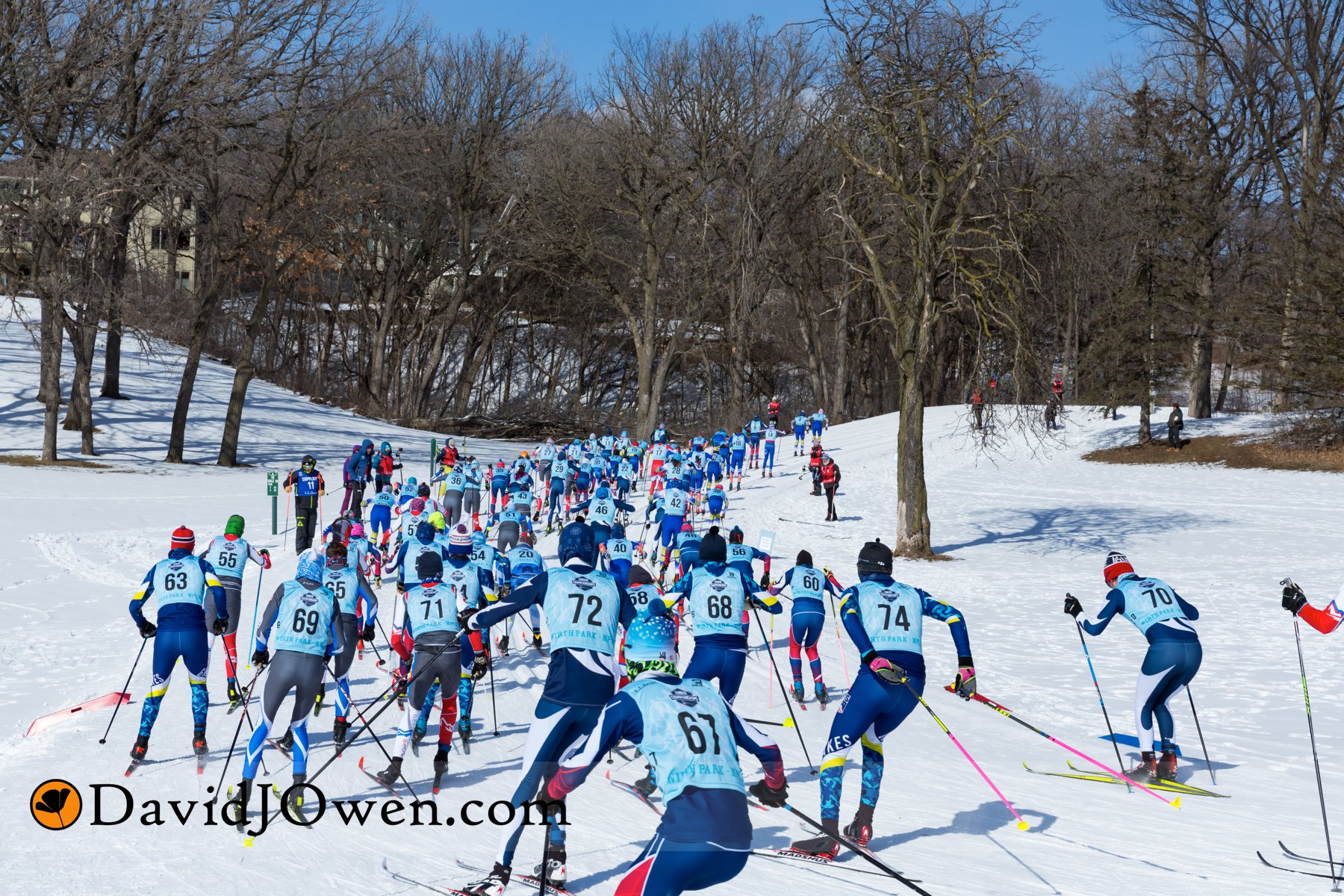
Skiers from all over the country round the first corner of the Theodore Wirth Park course in the U16 Boys 5 k Classic at Junior Nationals in Minneapolis in 2022. (Photo: David J Owen Photography)
Junior skiing in the U.S. is quietly organized around early selection. Qualification for Junior Nationals, especially at U16 and younger, carries weight. Rankings matter. Opportunities follow results. No one would say that’s the goal. But it’s the outcome.
Athletes see it. Parents respond to it. Coaches feel it. And none of that is inherently bad. But when those forces align around early results, the system starts to tilt. Short-term performance carries more weight than it should. And over time, that shows up in participation. The fields in USSS junior races get smaller as the age groups progress. We can debate why, but we can’t ignore that we’re losing athletes along the way.
The earlier we start selecting, the earlier we start excluding, selecting out athletes. And in a sport like skiing, that’s a problem. Development is long-term, non-linear, and tied to maturation in ways we can’t reliably predict. So, when we sort athletes at 13, 14, or 15 years of age, or younger, we’re making decisions on incomplete information, and treating those decisions as if they’re meaningful. They’re not!
What we’re really doing is narrowing the pathway at the exact point where it should be widest. If we believe in long-term development, early stages should include more athletes, not filter them out. We don’t lose athletes because they lack talent. We lose them because they stop seeing a path or opportunities forward.
That loss doesn’t always show up at the top. At the elite level, we can always point to success and say the system works. And in a narrow sense, it does. Every system produces some high performers. But that’s survivorship bias. But even with the perceived success, it is clear that most of those who step onto the World Cup are not prepared and developed for that level of competition, or we see an erosion of their performances over several years.
What matters more is what happens in the middle. Over time, that middle erodes. Fewer athletes stay. Fewer develop later. Fewer are still around when their best years should begin. And once they’re gone, they’re gone. So, how do we grow the sport and improve the development system? Following are a couple of ideas for the integration of high school and college skiing.
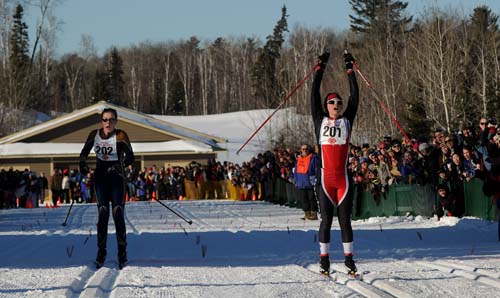
Stillwater senior Jessie Diggins, right, finishes ahead of St. Paul Academy senior Annie Hart in the 2010 edition of the Minnesota State Meet. (Photo: MSHSL Archives)
This is where the high school system should come into focus. Whether we acknowledge it or not, it’s one of the most influential environments in the entire pathway. We’re talking about roughly 6,500 high school athletes, compared to about 2,100 in the USSS junior system. That alone tells you something. Most athletes are not in the club pipeline. And there’s very little overlap between the two, in some regions more than others.
So now you have two systems, often operating in parallel, sometimes in conflict, shaping the same athlete. The club system is year-round, often very expensive, which creates barriers, and it is tied to rankings, qualifications, and progression. Ideally, at least in theory, it is long-term focused. The high school system is seasonal. Compressed. Built around immediate competition, conferences, regional, and state.
Both have value. But they’re not aligned. And when systems aren’t aligned, the athlete’s abilities are often put in difficult positions. High school seasons are short. That compresses everything. Training, racing, recovery, all of it gets stacked into a three-month season.
And yet, high school skiing also gets something right that the system needs more of. It creates a connection. It lowers barriers to entry. It brings athletes into sport who might never join a club. It makes skiing social. It makes it fun. Those values matter!
Athletes who feel connected to a team stay in the sport longer. That alone makes the high school system one of the most valuable pieces of the entire pathway. The issue isn’t that it exists rather it is not integrated, where do those high school skiers go after high school, an assumption may be many go into the non-integrated USCSA programs.
If that gap exists in high school, it becomes even more obvious at the college level.
Because this is where the pipeline either tightens or disappears. On one side, you have NCAA skiing. Roughly 20–25 programs. Maybe 300–400 athletes. Small, but structured, providing consistent coaching, clear expectations, and daily training environments that align with the demands of sport.
On the other side, you have USCSA. Thousands of athletes. Hundreds of active racers. A much broader participation base. So yes, USCSA is far bigger. But the NCAA is more efficient. In NCAA programs, a higher percentage of athletes improve year over year. More reach FIS relevance. More stay on a performance trajectory. That’s not because they’re inherently more talented. It’s because the environment supports development. Training is consistent. Coaching is present. Progression is clear.
USCSA shows the opposite. It’s not only a talent problem. It’s a structural problem. You have hundreds of athletes still in the sport. Many have endurance backgrounds. Many are still within a trainable window. But training is inconsistent. Coaching is variable. Development isn’t systematized. And there’s no clear bridge to higher performance levels. So, the conversion rate stays low.
This is where the pipeline argument starts to fall apart. We tend to focus on the front end, getting more kids into the sport. But at the USSS level that has been ineffective at best. And missing the fact that we already have athletes in the system that aren’t welcome or integrated. High school skiing, USCSA, represents a large participation pool sitting right in the middle of the development pathway. What we don’t have is a system that consistently integrates and develops them.
So, what actually needs to change? Not the philosophy, it seems we already agree on that. What needs to change is how the system behaves across the junior and collegiate level, it means recognizing where the opportunity is not just in the NCAA pipeline, but in the larger, under-structured USCSA system that already exists.
Even if we integrated the high school athletes and the USCSA athletes into the USSS system, the sport is still tiny. But it seems growing the sport significantly beyond this level is unlikely so we should be looking for ways to include these athletes in the system as much as possible for those who have an interest.
There are athletes in the system right now, thousands of them, who could or have the potential to improve dramatically beyond high school. Some who could enter the sport late and still become competitive.
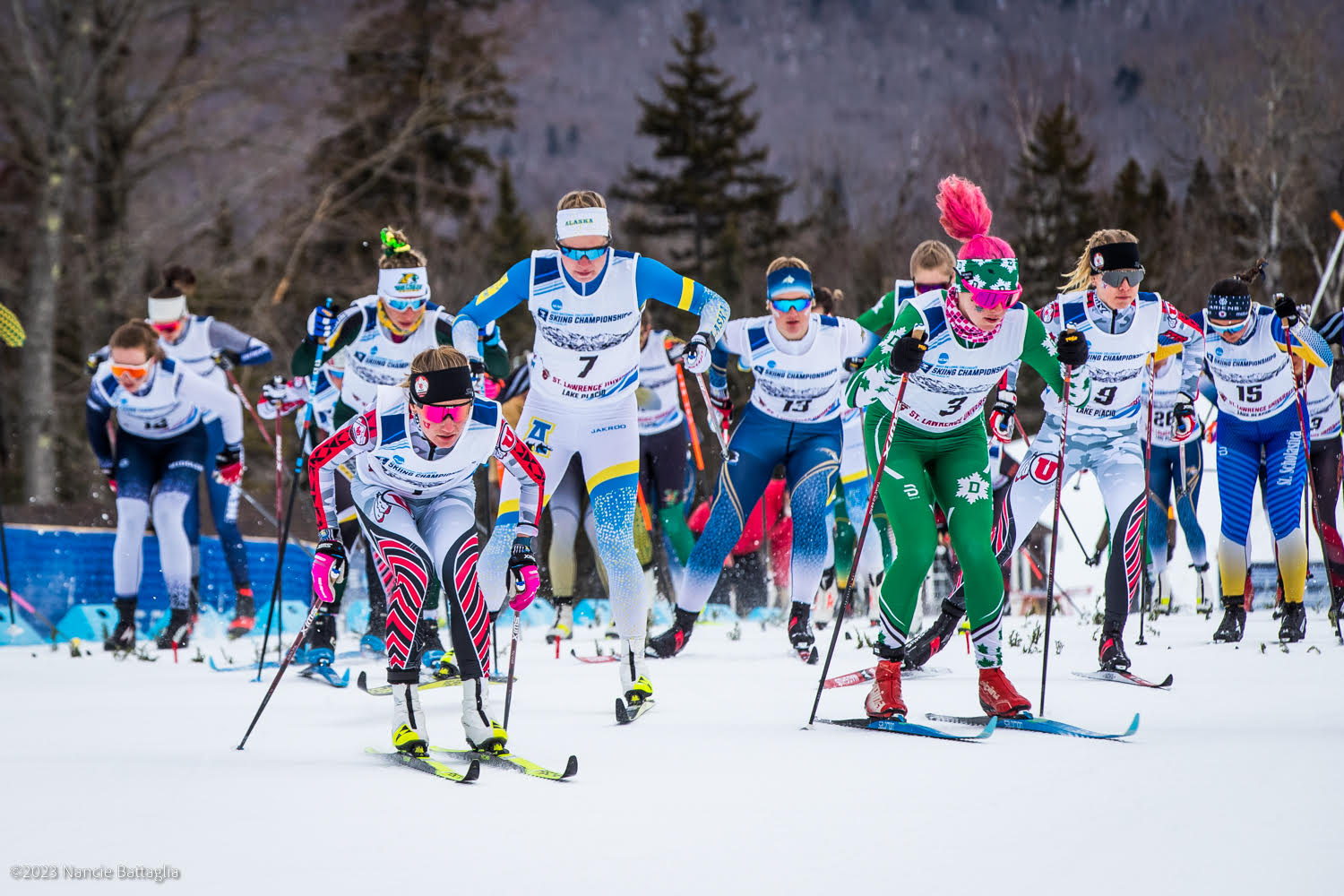
Novie McCabe controlled the pack for much of the 20-k mass start at the 2023 NCAA Championship in Lake Placid, New York. McCabe became just the fifth three-time NCAA Women’s Champion with her win. (Photo: (c) 2023 Nancie Battaglia)
At some level, this comes down to a simple choice. Do we want a system that identifies and benefits early performers? Or one that develops athletes over time? Right now, we say the second. But too often, we operate like the first. And the differences are real; we can see it by who improves, who stays in the sport, and when athletes exit the sport.
We don’t need to overhaul everything. There’s a lot in the system that works. High school brings athletes in. NCAA shows what structured development can look like. Even USCSA shows us how much untapped potential is sitting there.
But without alignment, those pieces don’t add up. So the question isn’t whether we understand long-term development. It’s whether we’re willing to build a system that actually supports it. Because if we are, the path forward should be clear.
And if we’re not, we should at least be honest about what we’re choosing instead.
Help Support Our Olympic Coverage!
If you value the thoughtful work and access FasterSkier provides, please consider becoming a Voluntary Subscriber. Your support directly fuels our work to cover the people, places, and moments that make our sport special.
When the first real snow falls in West Yellowstone, everything changes. The sound of car tires gives way to the swish of skis; coffee shops fill with cold hands and red cheeks; and this small Montana town of 1,100 becomes the epicenter of cross-country skiing in North America.
A Small Town With a Big Nordic Heart
Each Thanksgiving week, thousands of skiers descend on West Yellowstone for the Yellowstone Fall Ski Festival—an event that blends early-season training, clinics, races, and old-fashioned camaraderie. The teaching arm of the festival, officially called the Yellowstone Fall Ski Clinic, has become legendary in its own right.
“The festival has always been about community,” says Jack Hart, who is the co-director with Todd Eastman, and has been part of the event for more than three decades. “We’re a small town, but for this week, we become the center of the Nordic world. It’s a celebration of skiing in its purest form.”
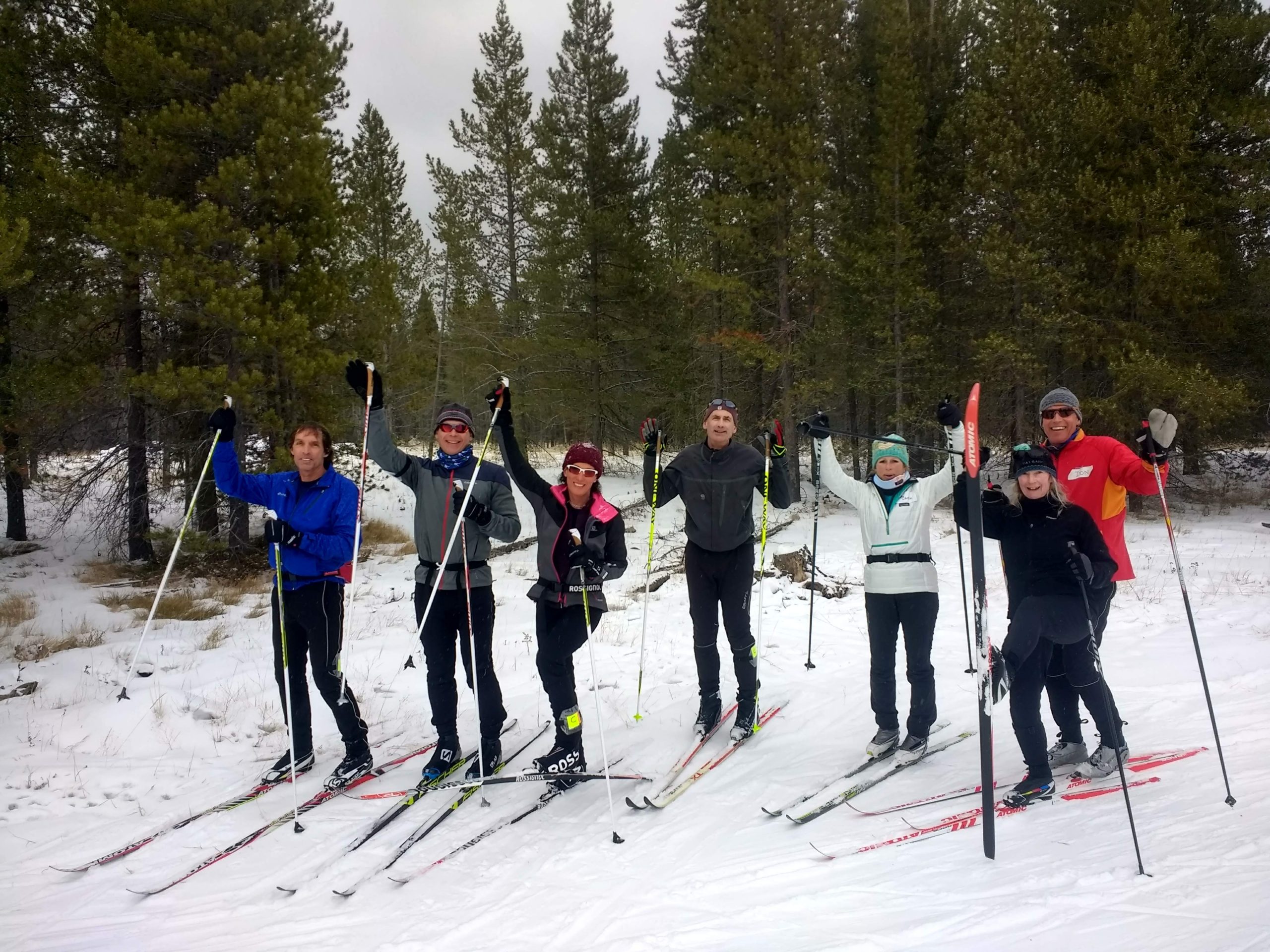
Bridger Ski Foundation out for a first ski in West Yellowstone back in 2015. (Photo: Courtesy Bernie Nelson)
From Coaching Coaches to Coaching Everyone
The roots of the festival trace back to 1979, when the U.S. Ski Team established a coaching development program in West Yellowstone. Hart remembers it well.
“Before it became an official, commercial event,” he explains, “the U.S. Ski Team brought in coaches. They said, ‘We have a coaching program. We want to develop people like yourself who want to take their level higher. Come to West Yellowstone in November and we’ll train you to be a U.S. Ski Team coach.’ That’s really how this whole event started.”
As more coaches came west, the program began to evolve. “Torbjorn Karlsen, Drew Barney, and Dick Hunt—those are the three names that co-founded the event,” Hart says. “They realized we could turn this into something commercial and teach more people how to ski. We’ve got early snow, we’ve got the trails—why not invite everyone?”
By the early 1990s, that idea had taken hold. The first snow of the season, combined with West Yellowstone’s unique geography, made it a magnet for teams and individuals alike. “At its peak about twelve years ago,” Hart says, “we had over 5,000 day passes sold during the week. That’s how many people were here. These days we’ll sell 2,500 to 3,000 if we get a lot of snow—but it’s still the biggest kickoff to winter anywhere.”
Building Better Skiers — and a Stronger Community
The Yellowstone Fall Ski Clinic runs alongside the festival under the same umbrella. It offers structured instruction for everyone from teenagers to masters racers, with one-, two-, three-, and five-day options beginning the Tuesday before Thanksgiving.
“We take kids down to high school age,” Hart says. “We’ll have around one hundred people in actual instruction this year, and then another couple thousand here training with their own coaches—high-school programs, club teams, that sort of thing.”
The diversity of ability levels is part of the event’s charm. “We have literally people who have not been on skis before,” Hart says, “and we also have the five-day, full-time training type of skier. The idea is to enhance, improve, and enjoy skiing in this environment—with this community.”
The entrance to the Rendezvous Trail System in West Yellowstone, Montana. (Photo: Courtesey Photo)
Each clinic begins with a quick on-snow evaluation. “We ask for a self-assessment on the registration form, but that can be different from where people really are,” Hart laughs. “The first fifteen or twenty minutes on snow, we do an evaluation and adjust the groups right there. We want everyone with others of similar ability so they can maximize their time and get more enjoyment out of it.”
The formula works. The Rendezvous Trail System becomes a living classroom—groups working on technique, coaches calling out cues, laughter echoing through the lodgepole pines. “The idea,” Hart says simply, “is to enjoy, to improve, and to learn—and obviously have a bunch of fun while you’re doing it.”
Philosophy in Motion: Teaching, Balance, and Joy
Behind the logistics of the clinic—the sign-ups, scheduling, and staffing—stands Eastman, whose background in both coaching and teaching shapes how the clinics operate.
“My contention,” he says, “is that all the coaches needed to do more ski teaching, and all the teachers needed to learn about coaching. The sweet spot is the combination of the two.”
That balance defines the Yellowstone approach. Eastman and Hart have assembled a team of approximately a dozen instructors who rotate throughout the week, exposing participants to a range of learning styles. “We’re not following PSIA or USSA scripts,” Eastman explains. “Most of our instructors have been skiing forever and teaching for years. It’s a mix of styles and personalities.”
The offerings reflect this flexibility: a five-day skate and classic clinic, a three-day version, two-day tune-ups, and popular one-day technique intensives for both skate and classic skiing. “The one-day stuff fills up really well,” Eastman says. “It’s at the end of the week—Thursday through Saturday—so people already in town can still jump in.”
Last year’s clinics drew 82 participants, supported by a staff of 12 instructors, a healthy ratio that ensures personalized attention. “Our ideal number is around a hundred,” Eastman notes. “We want everyone to leave feeling like they were seen and supported.”
Just as important as the structure, however, is the tone. “This isn’t about grinding or chasing a podium,” Eastman says. “We’re careful not to overwhelm people, especially early in the season. A lot of folks haven’t been on the snow yet. We want to be delicate with feedback, help them rediscover how it feels to glide again.”
That sentiment pervades the entire week. “Everybody at some point has a sensation—they go, ‘What was that? That felt good. I want more of that,” he says. “You may not find it for years, but it’s that moment that keeps you coming back.”
Eastman laughs at the sport’s reputation for being physically demanding. “Cross-country skiing gets this bad rap: ‘Oh, it’s the hardest cardiovascular sport in the world.’ Yeah, gee, that’s exactly what I want to sign up for on my vacation! We want people to see the joy in it—the beauty, the community, the stress relief, the meditation in motion. It’s the best way to deal with winter.”
The sense of inclusivity is central. “We have everyone from high schoolers to eighty-year-olds,” he says. “And if someone needs more challenge or less, we just move them. Our job is to make sure every skier finds their place.”
For Eastman, success is simple. “When a hundred people swear they’re going to tell all their friends how much fun they had—that’s when we know we did it right.”
Free Heel and Wheel: The Beating Heart of the Festival
For many participants, the festival’s unofficial headquarters is Free Heel and Wheel, the beloved ski and bike shop owned by Jack’s wife, Kelly Hart, and Melissa Alder.
“Every kid hangs out there,” Hart says. “They have hot chocolate, buy a new ski hat, talk skiing—it’s where everything happens. That little store is kind of the center of communication because people have been going there for thirty years.”
Part café, part gear shop, and part social hub, Free Heel and Wheel embodies the spirit of West Yellowstone. During festival week, it hosts evening events, wax clinics, and impromptu meetups that stretch late into the night.
“It’s just part of the experience,” Hart says. “Besides the Holiday Inn, which is where everything is based, it’s the other center of the place. A lot of the kids meet there, sit at the coffee bar, talk skiing, and talk about whatever teenagers talk about.”
The shop is also the birthplace of one of West Yellowstone’s most famous legends—the “snow-dance” story. Years ago, when November warmth threatened to derail the event, the Free Heel and Wheel crew improvised. “They all got on bikes in bikinis, with skis on the back, and rode around town,” Hart laughs. “They lit the skis on fire as part of the dance, and that night we got nine inches of snow. It’s one of those legends that’s become part of the lore around here.”
Lots of Après-ski fun to be had. (Photo: Courtesy Photo)
Exploring Beyond the Trails
While the festival’s focus is skiing, Hart emphasizes that West Yellowstone offers plenty beyond the tracks.
“If you were that customer saying, ‘Jack, what else can I do? I’m only skiing three days, but I’m here for five,’ there’s a lot,” he says. “The clinic has speakers and films—wax clinics, athlete talks, people like John Bauer speaking about his career and the park.”
Just outside town lies the west entrance to Yellowstone National Park, which remains open to non-motorized travel in late November. “You can either tour in, or, depending on conditions, you can skate on the groomed road,” Hart says. “It’s a big tradition for a lot of higher-end athletes to ski all the way to Old Faithful. That’s 30 miles in and 30 miles out. We call it the 100 K day.”
In the 1980s, before skate skiing, that tradition was even tougher. “We used to classic ski into Old Faithful and back on Thanksgiving Day,” Hart remembers. “You could eat like crazy that night—you were starving.”
“Our restaurants stay open for this event,” Hart notes. “The bars are open. The town comes alive. If you’re coming all the way to West Yellowstone, skiing our trails and seeing Yellowstone National Park in its winter beauty should hold your interest for at least three or four days.”
A Safe Adventure
Early-season skiing in bear country sometimes raises eyebrows among first-time visitors, but Hart reassures them that precautions are simple and effective.
“We always recommend traveling with bear spray,” he says. “Most bears are in hibernation by then, but it’s not unusual this time of year to see one that’s not. Ski in a group, carry bear spray—Free Heel and Wheel rents it, and the Chamber has them too—and follow park guidelines. We’ve never had an incident with an animal on the Rendezvous Trail system in 34 years.”
Snow, Weather, and the “Snow Dance” Factor
Reliable early snow has always been West Yellowstone’s calling card, but Hart admits that every year brings a little suspense. “We’ve had snow and we’ve been skiing on the plateau already,” he said in early November, “but it’s been wet—low 40s and even rain up to 7,000 feet. The good news is it’s supposed to snow today, tomorrow, Sunday, and part of Monday. Temperatures are dropping to the teens at night, and starting the week before camp, it’s supposed to snow steadily.”
If conditions in town fall short, organizers simply shift to the South Plateau Road, about six miles outside town, which reliably holds snow. “We’ve always been able to adjust,” Hart says. “If we don’t get snow until Wednesday, fine—we’ll ski Wednesday or go up on Tuesday. The key is being flexible. And if all else fails, we might call on the Free Heel and Wheel girls for another snow dance.”
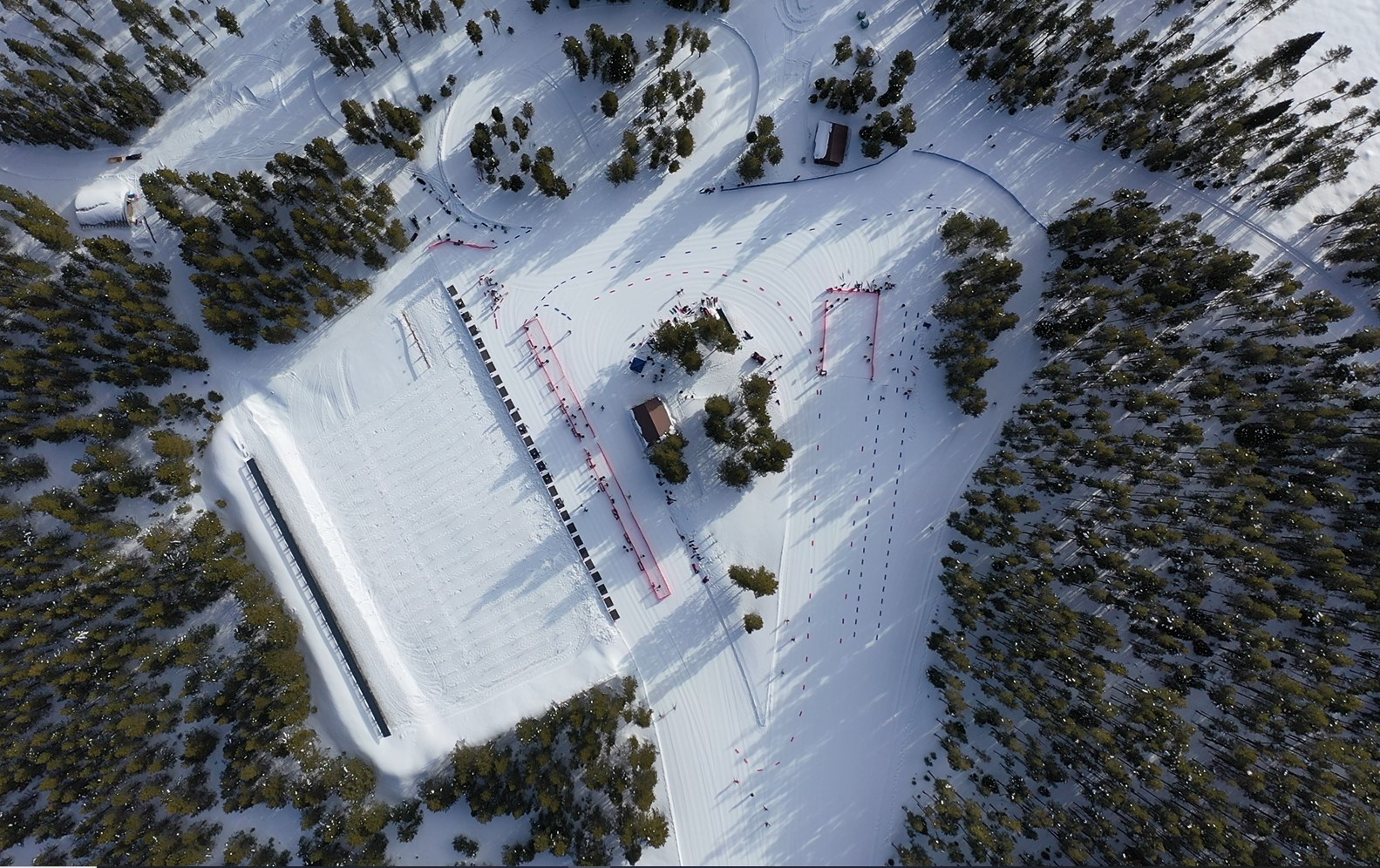
Aerial view of the stadium and biathlon range at the Rendezvous Ski Trails in West Yellowstone. (Photo: WYSEF courtesy photo)
Try Something New—Free Biathlon
One of the most distinctive parts of the week is the chance to try biathlon—no experience required.
“The biathlon events we have during the week are free,” Hart says. “If you’ve never shot a gun, it doesn’t matter. Some of our highest participation numbers come from the ‘never-ever’ biathlon event. You spend half a day being taught how to shoot, and then that afternoon there’s a race for all those people who’ve never raced before.”
The facility is first-rate: a 26-station range that includes a Paralympic setup. “You can feel what it’s like to actually do a biathlon race,” Hart says proudly. “It’s one of the nicest ranges in the western United States.”
Thanksgiving, Nordic-Style
Thanksgiving is the centerpiece of the week—a mix of tradition, family, and fitness.
“Thirty years ago, you couldn’t even get a turkey in town,” Hart recalls. “Now we have two grocery stores that carry everything, from turkeys to cranberries. We’ve got six hotels open, and you can make your own dinner if you rent a VRBO. There’s plenty of food available.”
The scene on the trails that morning captures what the festival has become: families pulling children in pulks, elite athletes finishing intervals, and clusters of friends laughing as snow falls softly around them. “Thanksgiving Day is a big tradition for a lot of people,” Hart says. “They come out with their family, ski for an hour, have a big Thanksgiving dinner, ski Friday and Saturday, and head home Sunday. You’ll watch races, watch biathlon, see some of the best people in the world on snow—it’s a great time to be here.”
The West Yellowstone Ski Festival and Clinics is a gathering place for our community to celebrate the start of the new season. (Photo: Courtesy Photo)
The Spirit of the Festival
For Hart, who has worked at this event for the last 30 years, the reward is seeing the joy it brings. “We’re proud of what we’ve built,” he says. “It’s a massive effort for a small community, but when you see 3,000 people skiing, smiling, and reconnecting after a long summer—that’s everything.”
As the first flakes settle over town and the hum of wax being corked onto skis fills the air, West Yellowstone once again takes its place as the spiritual home of early-season Nordic skiing.
Amidst the pines and geysers, every November offers a fresh reminder: the ski season doesn’t begin with a race—it begins with a community.
Garrott Kuzzy’s journey from the trails of Minneapolis to the alpine valleys of Austria reads like a skier’s odyssey—equal parts serendipity, endurance, and vision. Before becoming an Olympian or founding Lumi Experiences, a travel company built around the joy of cross-country skiing, Kuzzy was simply a kid who loved movement.
“There were no cell phones then,” he recalls with a laugh. “I think I was just playing soccer, doing the stuff kids did in Minneapolis.” His early athletic spark came not from racing bibs but from curiosity. That curiosity deepened after watching the 1994 Lillehammer Olympics. “I thought ski jumping was the coolest thing,” he says. His father, driving home past the lights of the Minneapolis airport ski jump, stopped and signed Garrott up on the spot.
Ski jumping, however, involved more trudging than flying—lugging 240 cm skis up icy stairs for a handful of attempts. “I remember thinking, this is too much work. I’m going to do cross-country skiing instead.” That decision set the trajectory for the next three decades of his life.
Garrott Kuzzy skiing the 1997 König Ludwig Lauf. (Photo: Courtesy Photo)
A Culture of Excellence at Hopkins High
At Hopkins High School, Kuzzy joined a program that had quietly become one of Minnesota’s most respected Nordic teams. Coach Pat Lanin had spent more than 30 years nurturing a culture of commitment and camaraderie. “He definitely set the culture,” Kuzzy says. “We had this lineage—guys like Matt Schadow and Pete Tollefson, who were great runners and skiers—and it made you want to rise to that level.”
Those roots mattered. Minnesota’s high school skiing scene was (and remains) a hotbed of talent and community spirit, a proving ground where future Olympians learned not just how to race, but how to love the sport.
Switzerland and the Making of a Global Perspective
If Minnesota planted the seed, Switzerland provided the light. During what he calls his “first senior year” of high school, Kuzzy embarked on a foreign exchange in the Alps—a decision that would alter his trajectory.
“I kind of forgot to apply to college while I was there,” he says, laughing. But what he gained was immeasurable: “That year completely changed my trajectory in life. I trained with a local club, learned German, raced at Swiss Nationals, and came back stronger and faster.”
Garrott at age 7 with his father, Jim, at the Engadin Ski Marathon. (Photo: Courtesy Photo)
Once back home in Minnesota, Kuzzy repeated his senior year, dominated the state circuit, and qualified as a forerunner for the 2002 Salt Lake Olympics. More importantly, he returned home with a new sense of maturity and a lifelong interest in connecting people through travel.
That international curiosity would later become the foundation of Lumi Experiences—years before the company even existed.
Middlebury: A Team of Global Thinkers
After strong results at Senior Nationals, Kuzzy fielded offers from several East Coast colleges. He ultimately chose Middlebury, drawn by the school’s blend of academics, languages, and skiing. “Terry [Aldrich] let me run cross-country and ski, and they had a strong German program,” he says. “By that point, I’d just gotten back from Switzerland. Studying languages was my jam.”
Middlebury’s team at the time was something of a cultural experiment: nearly every skier had taken a gap year abroad. “Five or six of our top racers had spent a year in Norway, Sweden, or Switzerland,” Kuzzy explains. “It gave us a maturity advantage—like grad students who’ve worked before going back to school.”
That worldly approach shaped not just results, but perspective. “It opened doors for people,” he reflects. “Those experiences make you realize sport isn’t just about skiing faster—it’s about how you see the world.”
Garrott Kuzzy (CXC) on his way to first place at the SuperTour in West Yellowstone in 2009. (Photo: Andy Canniff)
Climbing the Ladder: From CXE to the World Cup
After college, Kuzzy joined the Central Cross-Country Elite (CXC) team under coach Yuriy Gusev. His methodical plan—Europa Cup in 2007, World Cup in 2008, Olympics in 2010—was ambitious but precise.
He broke through in Canmore in 2008, finishing ninth in a World Cup sprint. “That race changed everything,” he says. “I barely missed the A-final, but it qualified me for the U.S. Ski Team.”
The result was validation of years of grinding. “In that semifinal, I was fourth, and I forgot about the lucky loser rule,” he recalls. “Had I stuck my toe out another inch, I would have made the A-final.” Still, his B-final victory and top-10 finish made him one of the first Americans to hit the objective criteria for team selection.
Yet even amid success, Kuzzy felt the solitude of life on tour. “I remember running at night in Falun, seeing warm lights in houses and feeling homesick,” he says. “I thought—how cool would it be to share these places with friends and family?” That yearning for connection would eventually define his subsequent career.
Garrott Kuzzy was CXC’s first athlete to make the Olympics.
From Racing to Guiding
When Kuzzy retired from racing in 2011, he joined Vermont Bicycle Tours (VBT) and began designing active travel experiences across Europe. “On one of my first days, I told Gregg Marston, ‘I’d love to do cross-country ski vacations,’” he recalls. Within a year, he was running VBT’s ski trips in Europe.
After VBT was sold, Kuzzy spent a year coaching at Green Mountain Valley School before pursuing an MBA in Tourism Management in Innsbruck, Austria. “The program gave us winters off to work in the industry,” he says. “That’s when I started Lumi.”
The first Lumi trip, in 2018, was a test run for the 2019 Seefeld World Championships. “I totally mispriced it,” he admits. “But we ended up making a $10,000 donation to the National Nordic Foundation.” Guests saw Sophie Caldwell and Jessie Diggins both win World Cups that weekend—one of the most memorable in U.S. skiing history.
Some of those guests have traveled with Lumi every year since.
Sophie Caldwell (USA – bib: 4), Maiken Caspersen Falla (NOR), Laurien Van Der Graaff (SUI), (l-r) race to the line of the individual sprint in Seefeld (AUT) in 2018. (Photo: Fischer/NordicFocus)
Building Lumi: Travel with a Nordic Soul
From its base in Innsbruck, Lumi has evolved into a small but deeply personal company offering immersive ski journeys across Europe—Seefeld, Toblach, Falun, and beyond. The mission, Kuzzy says, is simple: “To share the best cross-country skiing in the world with American travelers.”
He brings the same precision he once applied to interval training to trip design: ski-in/ski-out hotels, strong coffee, smooth logistics, and moments that foster connection. “We still do things like mulled-wine curling nights, inspired by my time with the U.S. team in Ramsau,” he says.
Seefeld remains the company’s spiritual home. “You can walk out your door and ski, but it still feels like a small town,” Kuzzy explains. “It’s the only place I’ve seen with an après-ski scene for cross-country skiers. There’s a bar right at the trailhead—it’s magic.”
Lumi’s guests have ranged from former Olympians to families discovering Europe’s ski culture for the first time. And through it all, the ethos remains: connection, community, and joy.
Kuzzy and his Lumi guests pose with Julia Kern and her parents at the 2023 Planica World Championship. (Photo: Lumi Experiences)
Full Circle: The Olympic Spirit, Reimagined
As Lumi prepares for the 2026 Winter Olympics in Italy’s Val di Fiemme—where Kuzzy raced during his career—things feel, in his words, “beautifully full circle.” The company will host multiple groups in Cavalese, the same valley as the legendary Marcialonga.
“It’s surreal,” he says. “From racing there as an athlete to now bringing people to experience it—it’s everything I hoped Lumi could be.”
Beyond 2026, Lumi has already secured hotel space for the 2027 Vasaloppet and Falun World Championships—a feat of foresight that shows Kuzzy’s racer discipline never truly faded.
In the end, Lumi is less about luxury or logistics than it is about legacy. “Some of our guests have been on every trip since the first,” Kuzzy says. “They’ve become friends. We share this deep love of skiing and place—that’s what it’s all about.”
The Glide Continues
Garrott Kuzzy’s life on skis has taken him from the frosted parks of Minneapolis to the peaks of Innsbruck, from the World Cup start line to the front desk of a boutique ski tour company. But his mission has remained constant: to bring people closer to the snow, to the sport, and to each other.
“The best part of Lumi,” he says, “is seeing guests experience skiing the way I did when I first fell in love with it. That’s the magic I want to share.”
Love Stories Like This? Help Keep Them Coming.
Feature interviews like this one take time, access, and care to produce. If you value thoughtful storytelling and independent ski journalism, please consider becoming a Voluntary Subscriber. Your support directly fuels the work we do to cover the people, places, and moments that make our sport special.
When Trond Nystad talks about Norway’s athletic success, he doesn’t start with medals or podiums. He begins with children — specifically, children who love to play.
“The model of Norwegian sport,” he says, “is to have as many kids as possible, for as long as possible, and try to make them as good as possible.” That simple mantra, lived out in ski clubs from Tromsø to Trondheim, is what he believes keeps Norway at the top of the endurance-sport world.
“It’s about being a champion of the world, not a world champion,” Nystad explains. “The focus is on learning, mastering things, having fun — not on winning.”
Trond Nystad (Photo: NordicFocus)
A System That Lives Its Values
Nystad has coached at nearly every level — from college programs at Northern Michigan University and the University of Denver to national teams in the U.S., Germany, Austria, Switzerland, and Norway. He’s seen systems that thrive and systems that sputter. What sets Norway apart, he says, isn’t a secret training formula but the culture that surrounds young athletes.
“In Norway, the principles of long-term athlete development — the LTAD model — are lived, not just written,” he says.
“In some places, LTAD is a document. In Norwegian clubs, it’s a way of life. Coaches and parents make sure kids master skills, become independent, and most importantly, have fun.”
That lived philosophy keeps kids skiing, running, and playing far longer than in most countries. “Every country that has success over a longer period of time has figured out how to lure kids into sport and keep them there,” he says. “If you have a lot of kids and you teach them a lot of skills, they’ll be driven and have fun. Then it’s easy to talk about high-level training later — because you start with the right foundation.”
The U.S. Comparison: Knowledge Is Not the Issue
Nystad has deep respect for the American coaching scene — he spent years building programs here and still closely follows U.S. skiing. “The U.S. has a lot of really good coaches,” he says. “Sometimes the issue isn’t knowledge. It’s that cross-country skiing doesn’t attract as many kids because it has to compete with other sports.”
The challenge, he believes, is not to clone Norway’s system but to borrow its spirit. “We need more skiers, and we need to take care of them,” he says. “Make sure they have so much fun developing that they don’t want to quit.”
That message — that development is not linear, and that joy is a strategic asset — could resonate in American junior clubs. “If you have fun and learn mastery,” Nystad says, “success will come. But if you chase results too early, you lose too many kids.”
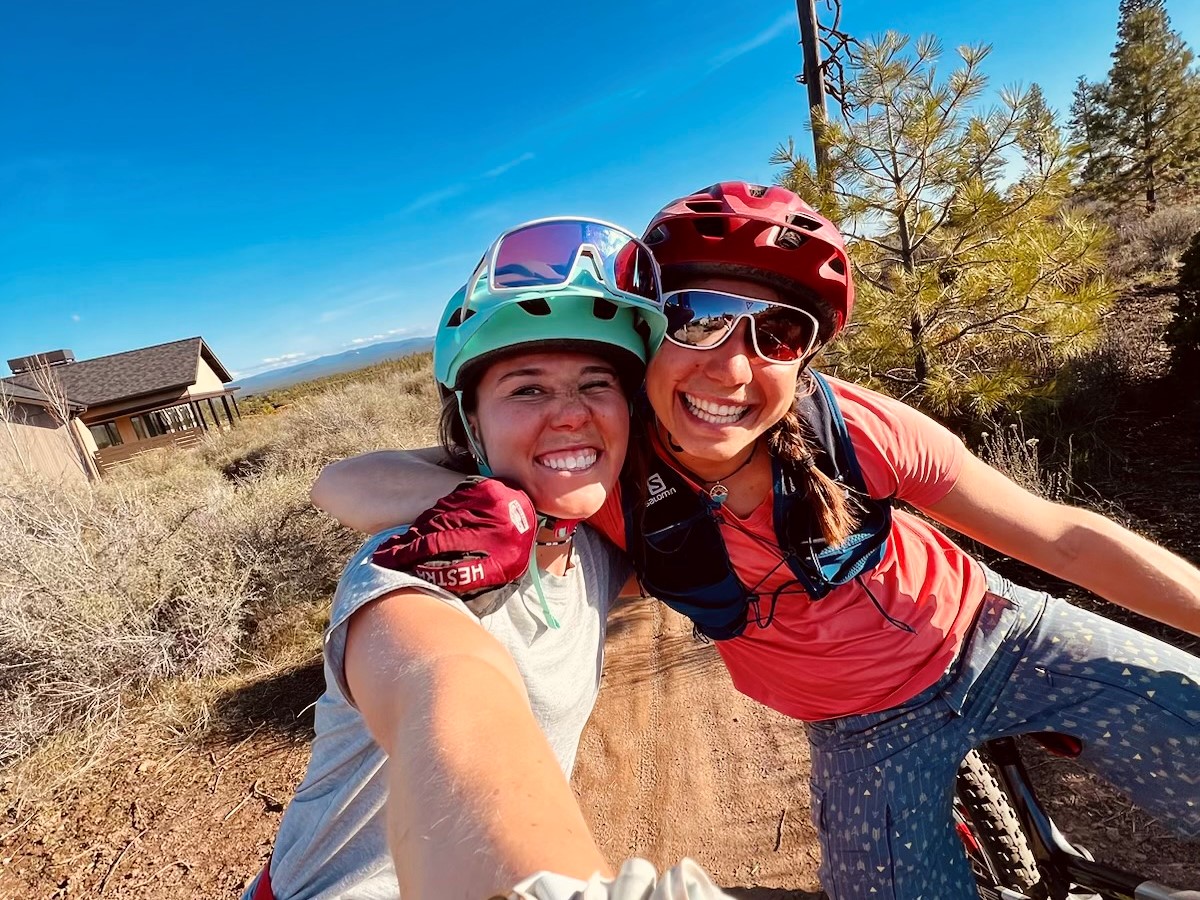
Like many elite skiers, Lauren Jortberg and Julia Kern enjoy mountain biking opportunities for a change of pace. (Photo: Julia Kern)
Against Early Specialization
Asked when Norwegian athletes begin to specialize, Nystad laughs gently. “Focus and specialization are a little bit mutually exclusive,” he says. “You can be focused and still do more than one sport.”
Most Norwegian kids, he explains, play several sports until age 15 or 16 — sometimes even longer. “When they’re 18 or 19, they might focus on one main sport and keep a couple on the side — running and skiing, for example, or cycling and skiing,” he says. “It’s part of the culture. People are active.”
The danger, he warns, comes from well-meaning adults. “A lot of parents try to self-realize through their kids,” he says.
“They want them to specialize early, to do everything right. In the end, the kids are sick of it, have no fun, and they quit.”
His takeaway is simple: “Kids are not miniature adults. They’re kids. Let them be kids as long as it makes sense. Life gets serious soon enough.”
Adam Witkowski poses with his parents after unexpectedly racing a World Cup in Minneapolis in 2024. (Nathaniel Herz/FasterSkier)
The Role of Parents: Mentors, Not Managers
Nystad, as a father himself, knows firsthand how difficult it is to strike that balance of knowing when it is time to commit. “Sixteen is just a number,” he says. Some sixteen-year-olds are grown up; they can form their own opinions and take ownership. Others can barely wipe their own ass,” he says with a laugh.
“But in the end, the kids have to decide for themselves. It has to be something that’s rewarding for them. Our job as parents is to support them — to help them make fewer mistakes, to be mentors along the way.”
That mentoring role — guiding but not controlling — is something Nystad sees as critical for the next generation of athletes. “We’re supposed to help them realize their dreams and develop,” he says. “Not to live our dreams through them.”
“Keep It Simple”: Trust the Body, Not the Gadgets
In an era dominated by data, GPS, and lactate meters, Nystad is refreshingly old-school. He’s not anti-science — he’s trained with and coached some of the world’s most analytically minded teams — but he cautions against what he calls “numbing the senses.”
“The reason to measure is to understand,” he says. “You measure to confirm your subjective feelings — not to replace them.”
“If you’re tired, you sleep. If you’re hungry, you eat. If you’re thirsty, you drink. Those are subjective feelings — and they’re more important than any data you can measure,” he explains.
“Most devices today are not 100 percent correct. Your body usually is.”
For Nystad, training success comes from continuity, not complexity. “The KISS principle applies — keep it simple,” he says. “In endurance sports, you have to train with continuity for a long time and be patient. Don’t screw things up. Control gives continuity, and continuity is everything.”
Fun as a Foundation for Longevity
Nystad lights up when the conversation turns to lifelong sport. “If sport or physical activity makes us happy, we’ll prioritize it,” he says. “Talking about training doesn’t make you better — actually doing it does.”
He encourages athletes — elite or recreational — to reframe movement as a privilege, not a chore. “We should appreciate every day we get to move,” he says.
“It means we’re healthy, we have the time, we can afford the equipment. That’s a luxury we need to appreciate more.”
For parents juggling work and family, his advice is pragmatic: “Maybe it’s better to go for a one-hour run first, and then drink your beer and watch Netflix,” he says with a grin. “It’s just about organizing your day so you get your little quick fix of physical activity.”
The Norwegian Definition of Success
For someone who’s coached Olympic medalists, Nystad’s definition of success has nothing to do with results. “I can’t even remember what happened last winter,” he admits. “Success has nothing to do with medals or wins. I’m happy as a coach when the athletes are happy — when they’ve developed as athletes and as human beings.”
He sees coaching as a human project as much as an athletic one. “I always try to build teams where people work together, respect each other, and do their best. That’s success. If we treat each other well and do the job the best way we can, we’ll reach our potential. Reaching your potential — as a human or as an athlete — that’s success.”
It’s a deeply Norwegian sentiment, one echoed across their sports system: the process matters more than the podium.
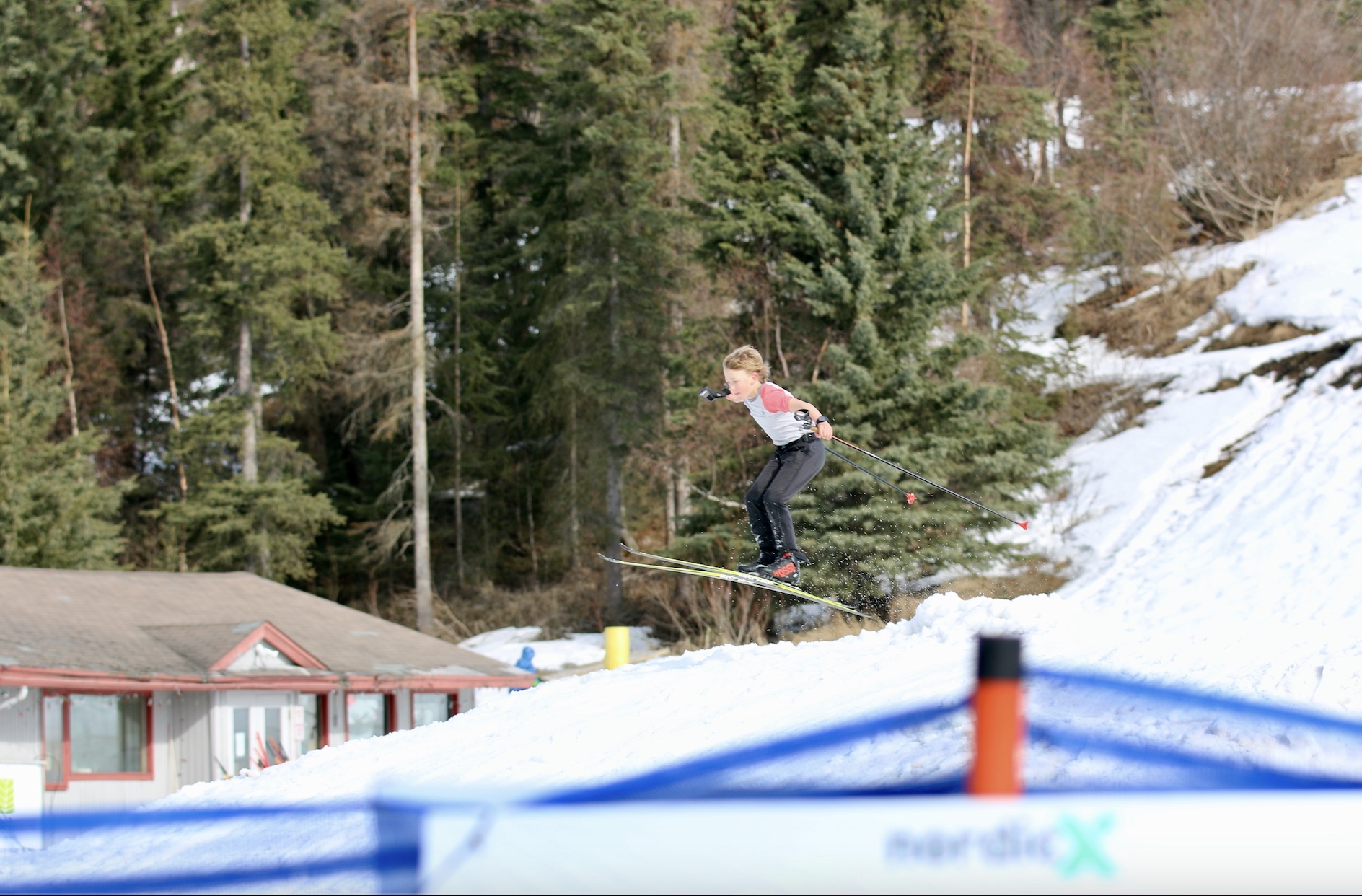
One of many kids enjoying the features on the course and in the Kiddie Cross terrain park at NordicX in 2022. (Photo: Eric Maurer / NordicX)
Lessons for U.S. Clubs and Coaches
Nystad believes that U.S. programs can apply these lessons without mimicking Norway wholesale. “The principles are the same,” he says. “It’s about creating an environment where kids master things, have fun, and stay in sports longer.”
That may mean rethinking what “development” looks like. “Most of the time, we lose more than we win,” he says. “So it’s okay to have a bad race or a bad day. Focus on skill development and mastery — even when things aren’t going well. If it’s fun, and you keep mastering skills, success will come.”
He also urges patience from young athletes. “A big mistake is intensity control,” he says. “They go too fast on the easy sessions and too fast on the hard sessions. They believe ‘no pain, no gain,’ but endurance sport doesn’t work like that. The best athletes are the ones who train a lot — and train smart.”
Technique, Mastery, and Play
Skiing, Nystad reminds us, is as much art as science. “Especially in skiing, which is such a technical sport, the quality lies in doing things right — not just going hard,” he says. “I see so many people skiing with music in their ears, talking, doing all kinds of things, instead of focusing on perfecting technique.”
He encourages athletes to “play” with movement: “No one tells us how to do it. We can choose the way that fits our body and our strength,” he explains. “If more people would play with technique, be conscious of their technical and pacing choices, the outcome would be better for most people.”
Astrid Oeyre Slind (NOR) on her way to a second-place finish in Cogne, Italy. (Photo: NordicFocus)
The Lifelong Athlete Mindset
At 55, Nystad continues to coach, ski, and move daily — not out of obligation, but joy. “If you train right, take care of yourself physically, mentally, nutritionally — and have a blast doing it — there’s no limit to how long you can be good,” he says.
“The moment you start thinking it’s a sacrifice, or that it’s boring — that’s when your career starts to end.”
He cites examples like Hilde Gjørum, who earned her first Olympic medal at 43, and Astrid Øyre Slind, who made her first Norwegian World Championships team at 34 and won her first World Cup at 37. “There are lots of stories like that,” he says. “Everyone can keep getting better — if you love what you do.”
Looking Ahead: A Sustainable Future
Nystad’s final reflections return to sustainability — both of snow and of sport. “Obviously, we’ll have issues with snow,” he says. “Snow storage and snow farming are becoming normal in Europe, and that will change the sport. But cross-country skiing will survive. It’s a great sport — full-body, low-injury, healthy.”
The real challenge, he believes, is getting people to participate. “We need to sell it for all it’s worth and get more people involved,” he says. “If we can bring more people into skiing — kids, families, anyone — the rest will take care of itself.”
The Takeaway: “Master the World”
For Nystad, the essence of sport is not the stopwatch, but the spirit. “The focus,” he repeats, “is on mastering the world — being a champion of the world, not a world champion.”
It’s a mindset that turns every trail into a classroom, every race into a chance to learn. And perhaps that’s the real secret behind Norway’s golden age of endurance: a culture where success isn’t measured in medals, but in how many people can’t wait to clip into their skis again tomorrow.
Trond Nystad, the coach of the Norwegian men’s cross-country ski team, takes questions from the media after the relay at the Sochi Olympics.
This article was made possible through the generous support of our voluntary subscribers. If you would like to see more collegiate coverage like this, please support FasterSkier with a voluntary subscription.
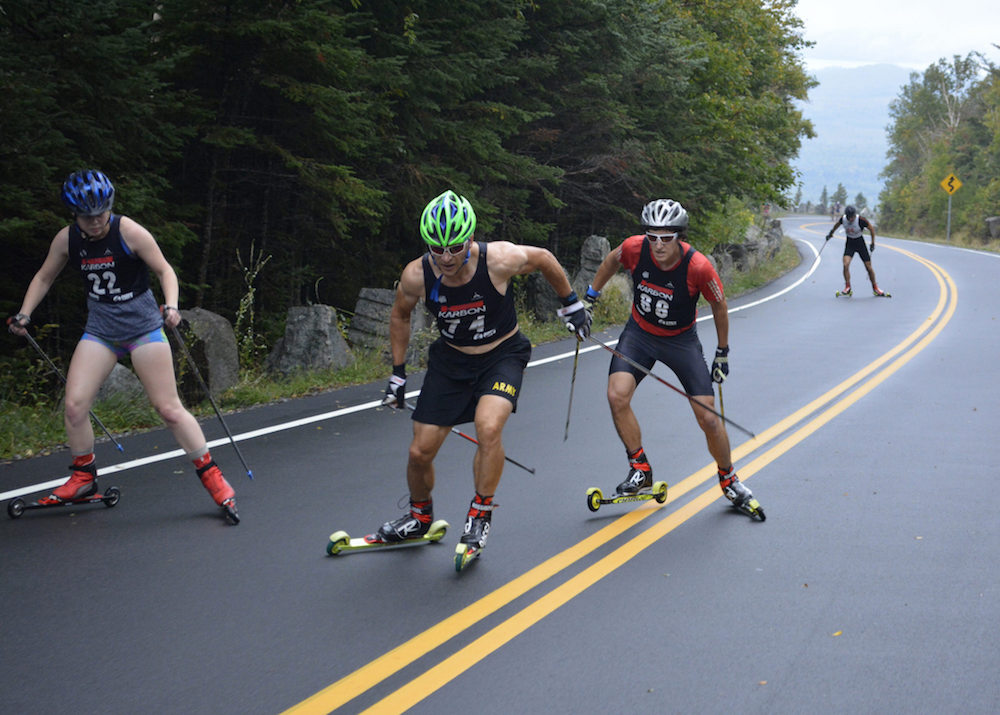
Seasoned veteran Duncan Douglas (74) leads biathletes Russell Currier (in red) and Paul Schommer (back right) in the 2016 Climb to the Castle roller-ski race up Whiteface Mountain, while Clarkson’s Jenevieve Broadwell (22) looks on. Douglas held off Currier by eight seconds for his third victory in four times racing the Climb and Schommer finished third. (Photo: NYSEF/Flickr)
I’m losing my edge
The kids are coming up from behind
I’m losing my edge
LCD Soundsystem
I knew it was coming. I have the conversation all the time with patients in the physical therapy clinic: “The older we get, the less our bodies care about fitness—the priority is to simply survive another day, never mind getting faster or even maintaining muscle mass.” I knew it was coming and I tried to fight it. I made my training more structured. I became more consistent with weight training. I tried to get more sleep. I tried to drink less wine. But I couldn’t control the reality that I turned 50 this year and every hard trail run I did was slower.
Andy Munter (Ketchum, ID) racing the 2023 Boulder Mountain Tour at the age of 69. (Photo: BMT)
I’m sure there are plenty of readers in their 60s and 70s who are currently shaking their heads and thinking, “You think you’re slowing down now, just wait until you’re my age.” But it’s still challenging to accept. When I transitioned from bike racing to running in my early 40s, Strava was full of praise and PRs. Now, Strava just laughs at me, “Kudos, you just set another Slowest Time Ever!”
I found cross country skiing later in life. It’s been a blessing both in the tremendous joy I get from the self-propelled glide on snow and from the rewards of learning a new skill. I came to Nordic skiing with a good engine, and plenty of experience Alpine skiing, but I had zero technique. Initially, I didn’t much care because I only saw skiing as a way to stay fit for cycling season. But as I came to enjoy the skiing more and more, I started to focus on gaining better technique, which thankfully brought increased speed. Now, I think the gains in technique are about equal to the losses in fitness. Treading water, but at least not drowning.
I’ve read sciencey articles like this and this. And books, which I really would recommend, like The Midlife Cyclist and Fast After 50 (not trying to push Amazon; please get them from the bookseller of your choice). But they did little to console me and only reinforced the obvious. In search of some tips on reconciling my condition (and hopefully easing my depression), I got in touch with a couple of heavily decorated masters athletes, who are both older and faster than my whiny ass, to ask a few questions about their experiences with aging and training.
My former PT colleague Lo Knapp is 70 years young and still swimming at the highest level (for her age). She just set two more age group world records, adding to her already impressive collection. Barry Makarewicz, at 63, is a local legend on the triathlon, bike racing, and skiing scenes. He’s won a half dozen races at World Masters and took the overall at the Yellowstone Rendezvous 50k at age 47.
Katherine Ann, Barry Makarewicz and Rob Bradlee hiking up Grandeur Mountain above Salt Lake City, Utah in 2017. (Photo: Rob Bradlee)
When did you start slowing down or notice age related changes in performance?
Lo: I pretty much held my speed until age 60. My 200 yard breaststroke time at age 38 was ~2:42. At age 44 it was down to 2:39 (pretty much my lifetime best but also affected by some rule changes). Age 60 was 2:44 (national record in yards)–not much slower than age 38. Then, at age 62: 2:47. I was wondering what is wrong with me? After covid and polymyalgia rheumatica, age 67 was 3:02. Crazy slow. Anyway, in a 50m pool, between age 60 and 65 I slowed down 10 seconds in a 200m breaststroke. And another 11 seconds between 65 and 70. And this is after not slowing down much 38-60. That just seems like significant slowing.
Barry: In my early 40’s I think I noticed that I was not at the physical level of the younger athletes in terms of physical capacity, but in skiing I was able to sort of hold my performance steady due to improving technique. I actually feel like I held my skiing performance kind of steady from my mid 40’s until later 50’s (57-58). Then I noticed a significant decline in power, strength and top end mojo.
How have you changed your training, or approach to training, in hopes of minimizing these age related changes?
Lo: We know older folks need more rest/recovery time, but I am not sure what that means. I still work hard, just nap more afterwards (or maybe because I’m not working and I am able to nap!). I think weight lifting is key, especially for women. We lose so much strength as we age—hormone drops? I do a TRX class 1x/wk and another session of kettlebell or a core strength session 1x/wk. When I rest for a meet, I REALLY rest more than I used to. I decrease my yardage much more. But I still push hard on the bike and in the pool. It’s a slippery slope that you have to fight against. “No, we’re not doing that interval. We can do faster than that!”
Barry: The common complaint of needing several days to recover after a hard workout or race did not really hit me until 60ish. Now it’s a real thing to need more easy days of active rest to feel recovered.
I have always felt that general strength training is very important for performance, overall health, and injury prevention and made weight training part of my year round routine. Now, as an older person, I am even more dedicated to consistent general strength training year round with more ski focused strengthening work in late summer and fall. I am absolutely convinced that focused and consistent strengthening exercise is essential for any middle to older aged person for good quality of life and longevity. This is where the best gains are made and kept.
Becoming a student of skiing technique has helped me stay competitive, and it has been fun to focus on body position and execution, especially in classic technique. We are very lucky to have so many opportunities to watch elite skiers on video and in person. There are always technique tips to observe and try to copy.
In summary my method for adjusting my approach to training to minimize the inevitable age related changes are:
Consistent and vigorous strength training. Both general year round and ski specific seasonal work.
Consistent interval or other high end workouts. Use it or lose it.
Always focus on improving ski technique.
Salt Lake City, Utah’s Lo Knapp having fun where she is happiest in 2014. (Photo: Courtesy Photo)
I’m sure it wasn’t easy to see yourself getting slower. How did you come to terms with this mentally and emotionally?
Lo: Since I had a close friend, age 58, die of cancer this year, my motto at Nationals was, “I’m just happy to be here!” I am happy to be alive, healthy and able to work out and challenge myself. I do get discouraged when I see how slow I am going in practice. Is this the best I can do because I’m old? Or can I do better? Then I compete and I am with my peeps and I win events and I realize we are all getting old and slow. So it tells me that I’m still right in there, even though I’ve slowed down. It gives me a boost for another year. If I didn’t compete, I would be really discouraged.
Barry: I am trying to accept the inevitable decline with some grace and not fret too much about tumbling down the results list. At this point there is nowhere to go but down so try to enjoy the notion that I’m still doing it and having fun with what I have always loved to do.
Responses were mildly edited for clarity. Huge thanks to Lo and Barry for sharing.
Here are my primary takeaways:
The older you are the slower you’ll be, but at least you’re still out there–and being out there is the whole point to begin with.
With age comes wisdom, so train smarter because you can’t handle harder, at least not without a lot more recovery. Make your “easy” days legitimately easy so your “hard” days can be truly hard (and absorbed by the body).
Strength training is key. Your body doesn’t care about building muscle anymore so you’ve got to pick up heavy things, at least twice a week, to remind it that being strong is still a good idea.
Sleep is the best recovery aid on the market, and your body needs all the recovery it can get. Seven hours minimum.
Your metabolism might be slowing down, but you still need gas in the tank so don’t skimp just because your six pack feels more like a keg.
Technique is the great equalizer, especially in skiing, and there’s always room for improvement. Age related losses in aerobic capacity and strength can be countered, at least to some extent, with increases in efficiency.
I’m trying to stay optimistic and apply the words of wisdom from my elders. I’m very grateful that I can lace up my running shoes and knock out an easy hour without taking ibuprofen. Maybe I don’t feel fast on trails anymore, but I’m still amazed that my eyes and feet can talk to each other seemingly without any delay from my brain. I know this agility will help when I’m statistically at risk for falling while going out to the mailbox. Now that winter has arrived and I’m happily on snow, I’m spending even more time focusing on technique, finding tremendous joy from nailing the kick or being lock-in stable on the glide ski. I’m getting slower and the kids are getting faster, but we’re all having the same amount of fun.
Skiing with kids can feel like, well, a daunting junk show. The gear explosion, the logistics puzzle, and the constant battle to keep everyone warm and happy can make you wonder if it’s worth stepping foot out of the door. As a mom of two, I live this reality, staring down the barrel of a long winter filled with wrestling squirmy little bodies into layers upon layers of wool, fleece, and down. Can kid-pulling ever be more than just a logistics hassle and a sufferfest?
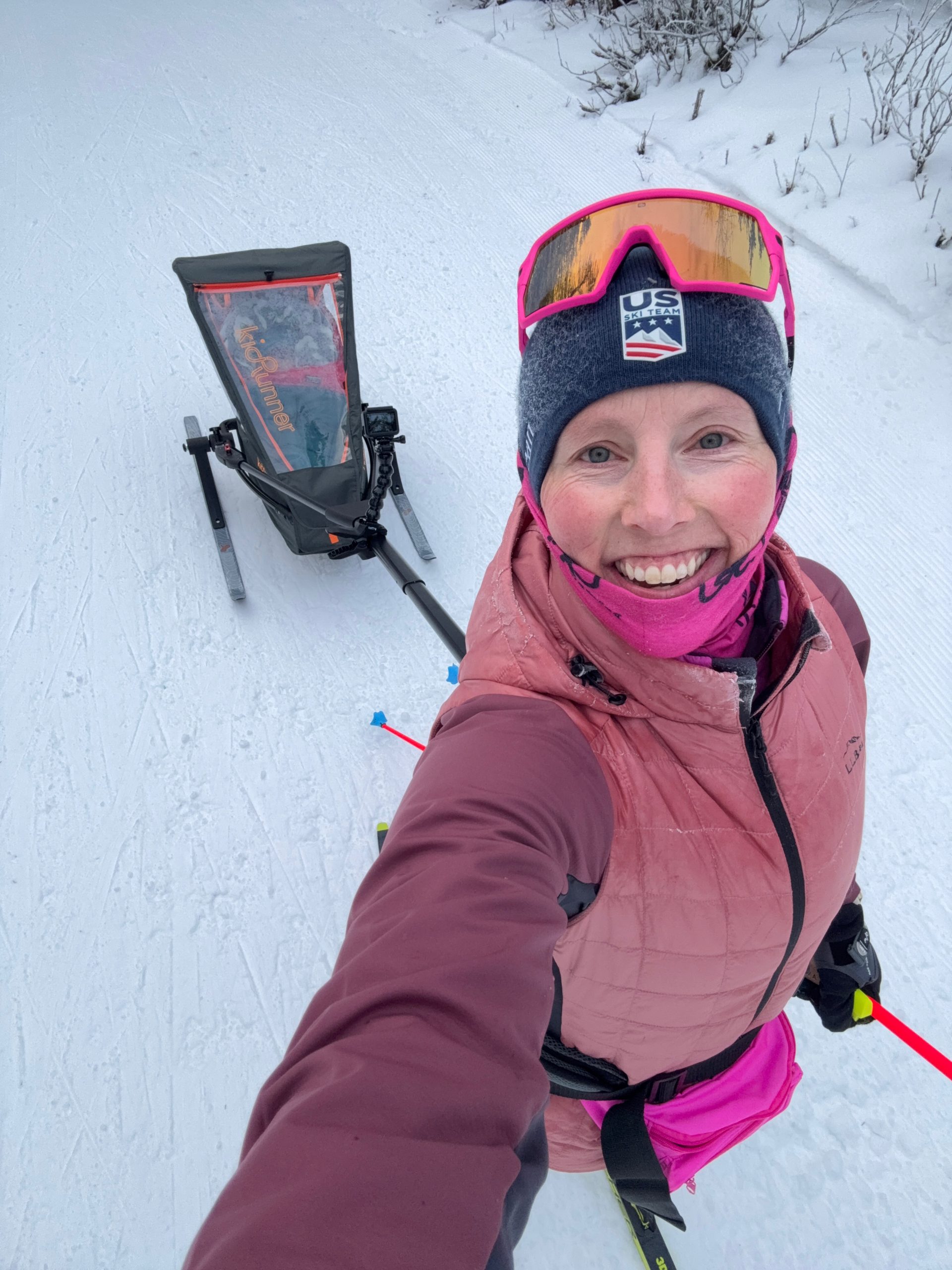
When I reached out to five-time Olympian and gold medalist Kikkan Randall for advice, she told me to hold on a few days. “I have a new device. I want to trail test it before we talk,” she said. Ok, ok. Interest piqued. A few days later, she got back to me. Here is someone who has not only figured it out but turned skiing with kids into something enjoyable—maybe even relaxing? I took close, personal notes, and her strategies are a guidebook and practical packing list for any parent dreaming of making ski outings more than a chore.
The Setup: Packing for the Trail
“It’s all about having a system,” Kikkan explains. “I start by loading the Kid Runner, which has been a game-changer for skiing with a baby. I pack the main carriage, attach the telescoping poles to the waist harness, and add my skis and poles. Then, of course, there’s the diaper bag.”
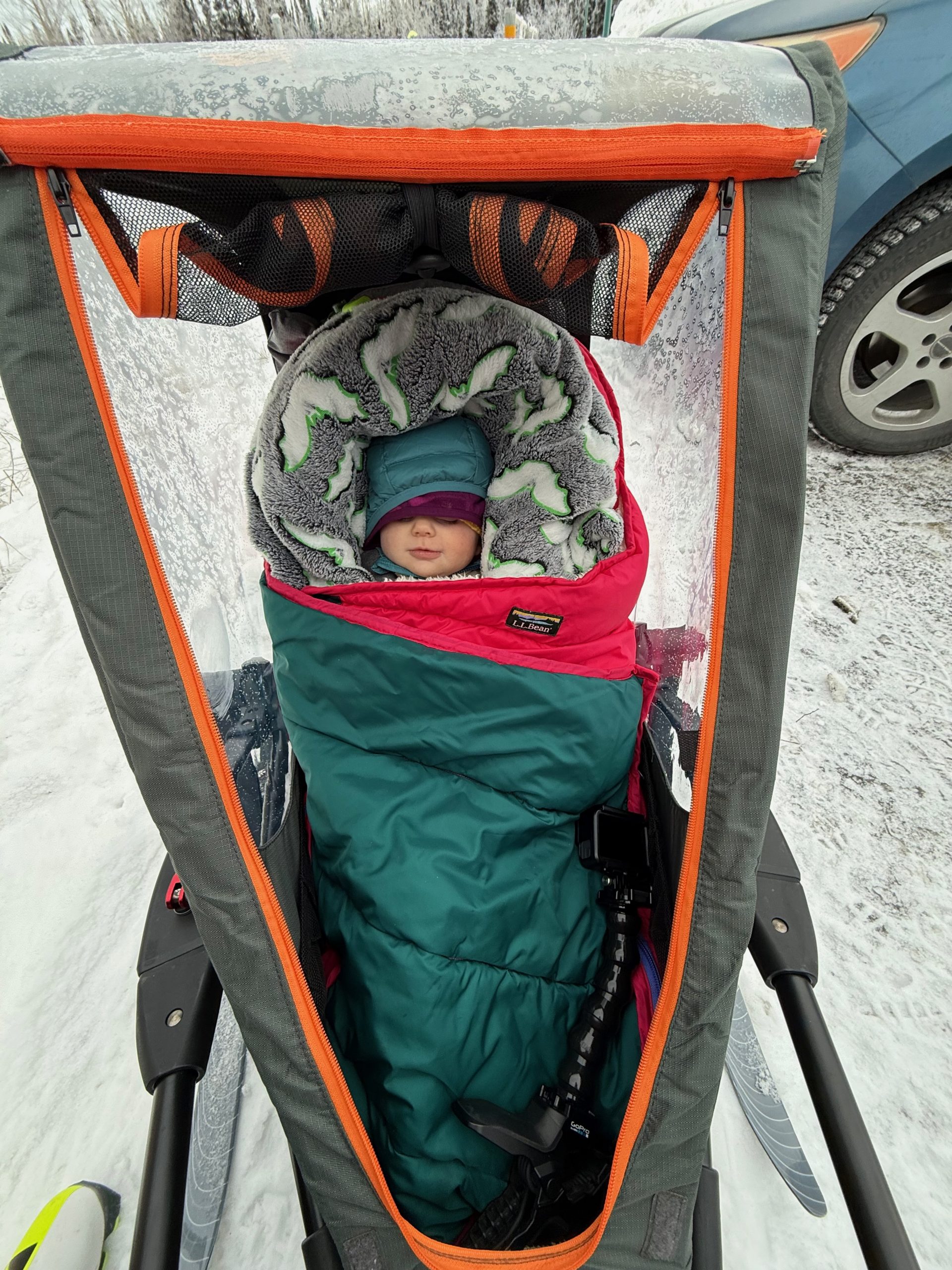
Inside the Kid Runner, Kikkan uses a down puffer suit and a fleece bunting to keep her baby snug. “It’s furry on the inside and adds a cozy layer of insulation,” she says. She also employs a clever hack she learned from fellow skiers Brian and Caitlin Gregg – using half of a pool noodle wrapped in a fuzzy blanket to stabilize her baby’s head. This trick prevents any bobble-heading on uneven terrain, keeping her little one’s head steady and secure. Even though her baby has pretty good head control for five months, it helps keep her extra supported. Plus, she always falls asleep in the Kid Runner, so this setup makes it quite comfortable for her.
Kikkan also tucks a bottle between her baby’s legs, inside the bunting. “It stays warm there and is ready when she needs it,” she says. It’s a simple trick that keeps everything streamlined and ensures her baby stays content mid-ski.
Baby Aspen rides in cozy style, snugly layered against the winter chill with her bottle close at hand—ready for every mile of the adventure. Photo: Kikkan Randall
On the Move: Transforming the Experience
At first glance, the Kid Runner looks like any other kid-pulling contraption, but Kikkan highlights several details that make it particularly well suited to Nordic skiing. “The single-point harness is a big deal,” she explains. “With other systems, like the double-point harness I used with my older son, you’re constantly fighting against the weight pulling you back. It makes it harder to stay in your natural ski stride and can really wear on your lower back after a while.”
Kikkan Randall makes Nordic skiing with a little one look seamless using the innovative KidRunner ski trailer. Photo: Kikkan Randall
The single connection point pivots with your movement. “That pivot point is what allows you to ski dynamically,” Kikkan says. “You’re not locked into a rigid position, so you can lean forward, flex your ankles, and really feel like you’re skiing—not just towing.”
Stability is another key feature. “It tracks so well, even on downhills,” Kikkan adds. “I was worried about it tipping or dragging on uneven snow, but it’s been super predictable.”
Kikkan said she has been out for several genuinely good skis towing her baby.
The Gear List: Kikkan’s Must-Haves
Here’s a breakdown of Kikkan’s go-to gear for skiing with her baby:
The Trailer: The Kid Runner is an innovative ski trailer designed to let you ski naturally while towing your little one. Its single-point harness and pivoting connection allow natural movement, preventing the strain and discomfort common with traditional setups. Lightweight, adjustable, and smooth-tracking, the Kid Runner is a game-changer for skiing parents.
Fleece hat with chin strap: Keeps the hat in place, which is so helpful.
Mittens and booties: These are tucked under the puffer suit to ensure they stay securely in place, keeping your baby’s hands and feet warm throughout the adventure
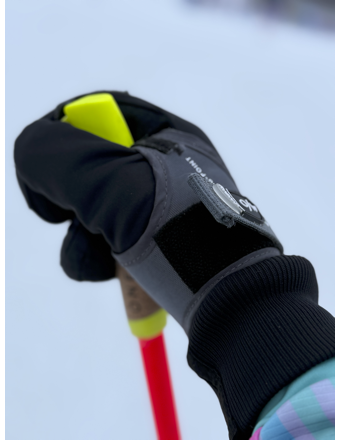
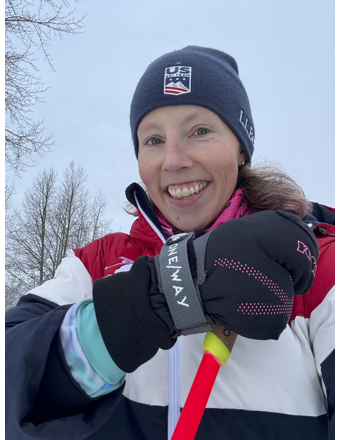
Quick In and Out Poles: Kikkan uses One Way Storm GTX Poles with magnetic click-in straps. These poles make it easy to stop and check on your baby without fussing with complicated gear. “When your baby fusses or you just want to peek back and make sure everything is good, you don’t want to be fumbling with straps. These poles let you stop, unclip, check in, and get back to skiing without missing a beat,” she says.
Grip, snap, go. Magnetic pole grips are a game-changer for Nordic skiers on the move. Photo: Kikkan RandallQuick in, quick out—Kikkan shows off her One Way Storm GTX poles with magnetic click-in grips, making it easy to stop, check in, and get back to skiing without missing a beat.
4. Drink Belt Great for carrying water and a phone. Worn above the trailer belt for easy access.
5. Ski Boot Covers These make walking to the trail much easier and safer while preventing snow and ice from getting packed into your boots during multiple trips back and forth from the parking lot.
Finding Your Groove: Advice for New Parents
For parents who feel overwhelmed at the thought of skiing with a baby, Kikkan’s advice is simple: start small and be patient. “The first couple of times might feel like a circus, but once you find your rhythm, it’s so worth it. The fresh air, the movement—it’s good for both of you. The Kid Runner has roll bars and a five-point harness, so I feel confident my baby is secure.”
She emphasizes the importance of taking your time to get dialed in. Each outing, she learns something new—whether it’s how to load the car more efficiently or a small adjustment to make her baby more comfortable.
Whether you’re a competitive athlete like Kikkan or just looking for a way to get outside with your little one, her gear recommendations and tips offer a practical, approachable guide. “It’s not just about getting out for family time,” she says. “With the right setup, you can actually enjoy a great ski experience, too.”
Warning: This review contains lengthy passages of unrestrained gushing.
This was state-of-the-art video production technology when “A to B Roller Ski” was made. (Photo: Wiki Commons)
Is it possible that the best movie ever made about cross-country skiing doesn’t have a single scene which was filmed on snow? The answer is a decided yes. Because that movie is “A to B Roller Ski,” and it shatters the ceiling for what a movie about cross-country skiing can be.
Moving, inspiring, authentic, pure, poetic, and beautiful, ‘A to B Roller Ski’ tells the story of Latvian born biathlete Raimonds Dombrovskis who in 1988 decided that after his Olympic biathlon dreams had ended due to a life threatening illness, it would be a good adventure to roller ski from Inuvik, Canada— near the Arctic Circle— to Baja, Mexico— a journey of 4,200 miles which took 90 days. Why? Well, “because everyone goes across the continent” he says in the movie. This incredible and crazy true story is a cinematic marvel which like a well-aged fine wine could only have been accomplished with decades of commitment. The movie has been out for years for viewing at film festivals. But now, it’s available for streaming on Amazon.
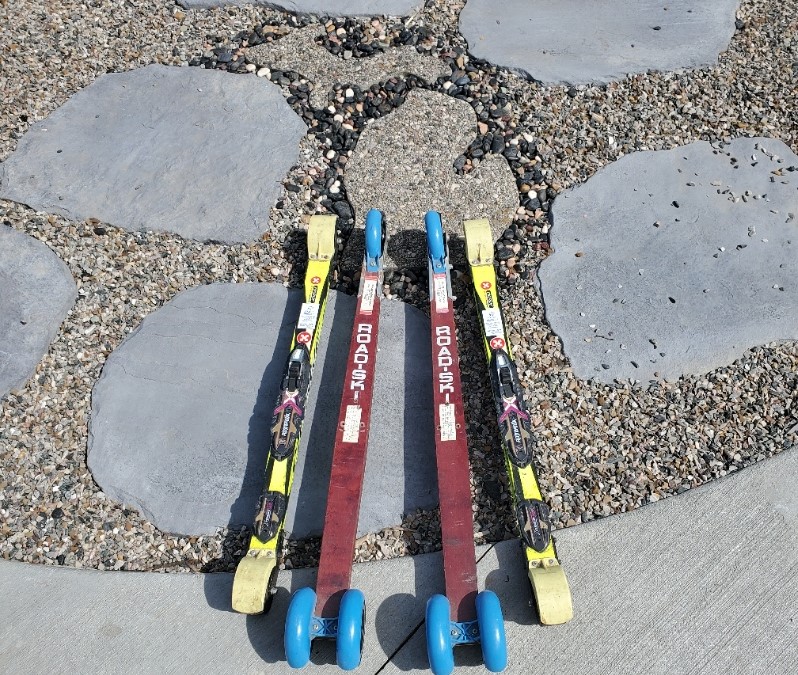
Old versus new roller skis from the author’s collection. (Photo: Ken Roth/FasterSkier)
The concept behind the movie’s narrative is pure folly. Who in any sane mental state would even consider such a journey? From the baseball-size stone filled roads of the Alaska Highway, to the Rocky Mountains, to the deserts of Arizona, Dombrovskis and his faithful canine companion, Bucis, soldiered on and completed a journey that not only seemed impossible, but also seemed likely to end up with a dead protagonist. Remember, this original journey occurred in the late 1980s, on roller skis which were nothing like the ones we have today. There were no heel brakes or speed reducers. Shafts were either aluminum or wood. I had the exact pair of the skis, boots, and bindings that Dombrovskis used for a large part of his trip, and I can tell you from first hand experience that, even on the paved trail at my local park, they were nerve racking. Going down mountain passes on these is unimaginable.
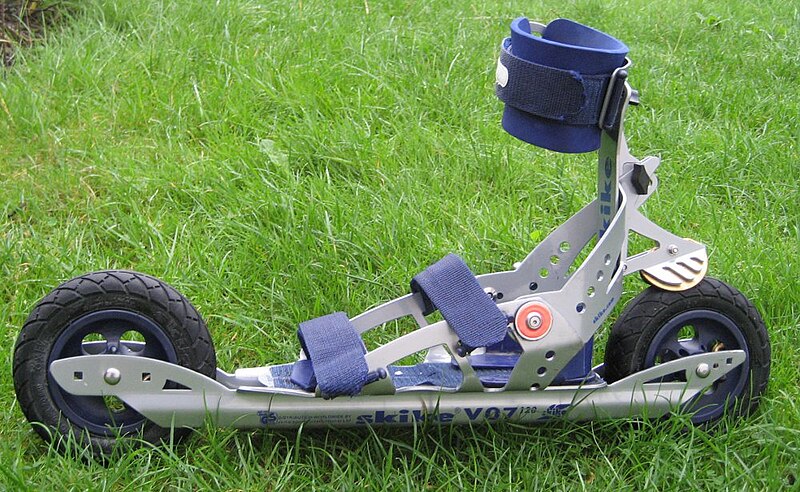
Suspension roller skis weren’t on the horizon when this 4,200 mile journey was made. (Photo: Wiki Commons)
The photography is remarkable. There is old footage of the journey from 1988, which given the technology of the time, a handheld VHS camera; and the limited budget—almost none— is beautifully crafted and technically well executed. The photography is perfectly mated with an evocative sound track, and the combination works wonders. There are contemporary interviews seamlessly interwoven into the original footage, which is also nicely crafted. Both the old and new photography help move the story along, and in a 1:38 minute movie, there is never a dull spot.
The vintage videos of biathletes racing in the Classic technique are enough to make one hope that the IBU (International Biathlon Union) mandates a couple of Classic races a year; just for aesthetics alone.
Having this kind of all-road technology would have been nice for portions of the journey. (Photo: Wiki Commons)
The movie is told against the backdrop of Dombrovskis’ emigration from Latvia to America, the end of his Olympic dreams, and the folly of trying to do something so outrageous that you would think it was surely a joke.
One of the more striking things about the journey is Dombrovskis’ obvious interest in the people he met along the way. Many of them may have been skeptical of him at first, but he’s the kind of guy who makes friends easily, which unquestionably helped him complete this odyssey.
The original 1988 epic odyssey would be enough for a full feature film. But the story only gets better and deeper when Dombrovskis decides in 2014 to recreate a scaled down version of his journey 26 years later. Dombrovskis looks like he’s still fit enough to make the national Biathlon team when he retraces his steps from 1988, tracking down people he met along the way two and a half decades earlier, which leads to heartwarming reunion scenes.
One of the nicer sections of the Alaska Highway, 1988. (Photo: Wiki Commons)
‘A to B’ is a testament to one man’s belief that nothing is impossible and that the price of not following your dreams is far greater than the cost of pursuing them.
I’m not certain if non-skiers will gush about it as much as skiers will, but it’s more likely than not that even people with no interest in skiing will find the movie to be at the very least a compelling tale.
Fortunately, you won’t need one of these to watch the 1988 footage of Dombrovskis’ original journey. (Photo: Wiki Commons)
So, whatever you’re doing tonight, change your plans, and rent ‘A to B.’ (Depending upon your Amazon setup, if you search for it in Amazon’s catalog you may not find it listed under ‘A to B Roller Ski.’ If you can’t find it, enter “roller ski” in the search bar and the movie will pop up as an option.)
Fortunately, you won’t need one of these to watch the 1988 footage of Dombrovskis’ original journey. (Photo: Wiki Commons)If you don’t want to risk your $2.99 movie rental money on this review’s recommendation, then take a look at IMDB’s (Independent Movie Data Base) reviews. It gets rated 8.6/10. By comparison, ‘The Godfather,’ often judged to be the best movie ever made, is rated 9.2/10. That’s some pretty lofty company. Here’s a link to the IMDB site where you can watch the trailer.
It is rare when a movie conveys a naïve purity which is historically accurate and inspiring. The amazing thing about this film is that if someone had created the script from ideas they made up, viewers would have immediately dismissed it as nice, but ludicrous. What makes ‘A to B’ so special is that when outlandish truth mixes just right with awe and splendor, and it’s captured on film, amazing things happen.
Roller skis have improved over the years. Braking wasn’t generally available when the unbelievable Odyssey of Raimonds Dombrovskis took place. (Photo: Wiki Commons)
FasterSkier has been fortunate to have the support of Snow Mountain Ranch for many years now. If you are looking to extend your ski season we hope you will consider visiting our friends at Snow Mountain Ranch.
If you’re a kid in Granby or Winter Park, Colo., snow days aren’t a thing—until last Thursday, March 13. According to Mary Ann Degginger, the program director at Snow Mountain Ranch, students in the East Grand School District had their first snow day in 20 years last week.
“[Winter Park] ski resort got 15 or 16 inches, and the roads are closed, so it’s a good day in the mountains,” she said that afternoon.
About 12 miles north of Winter Park Resort and 80 miles east of Denver, Snow Mountain Ranch/YMCA of the Rockies in Granby received about 8 inches of snow, which should help extend their cross-country ski season into April. After what Degginger called a slow start to a “spotty” winter, Grand County had a solid second half of the ski season and currently has above-average snowpack in most areas.
Stampede mass start at Snow Mountain Ranch in early March.
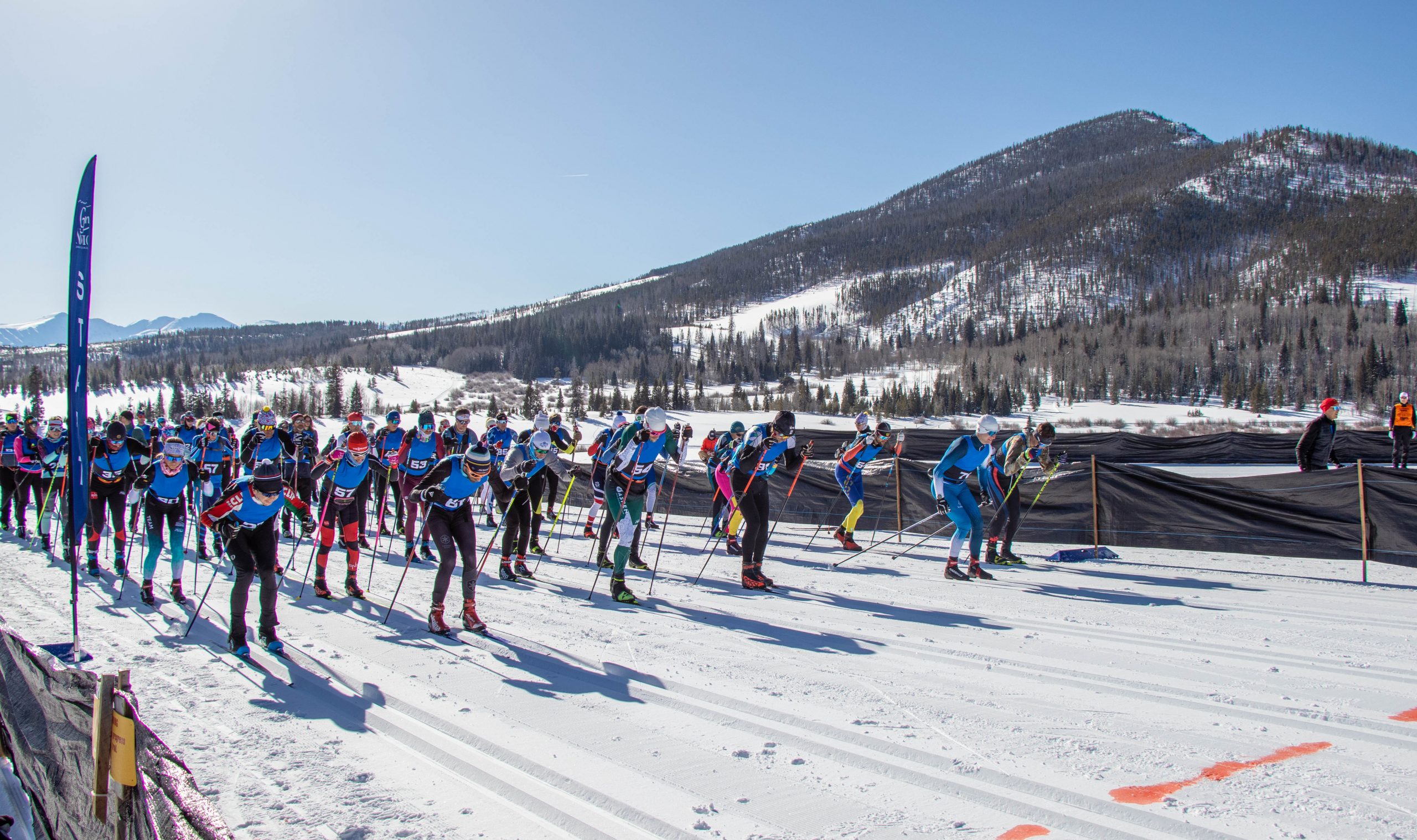
As of Wednesday, March 20, the Snow Mountain Ranch Nordic Center had all 82.5 kilometers of groomed trails open. The ranch recently held its 40th annual Stampede Races, with about 350 participants over two days for the 3-, 12.5-, 25-, and 50-kilometer skate and classic distances.
“It’s kind of a big deal,” Degginger said of the final event in the Grand County Nordic Race Series. “If you do both disciplines at 25 or 50 k, you earn the ranch-boss belt buckle. I gave out about 75 belt buckles to people who did both, and I have mad respect for those people. It’s a lot of skiing.”
She recalled the ideal weather that weekend of March 9-10: “The snow was cold, the weather was warm, it was sunny, and it was beautiful.”
Looking ahead, Degginger said the Snow Mountain Ranch Nordic Center plans to stay open until April 7.
“With this last snow we got, I wouldn’t be surprised if the snow was skiable beyond that,” she noted. “A lot of the north-facing slopes and shadier areas will hold their snow for a couple more weeks even after that. So, spring skiing conditions, but warm and pleasant and really good snow, really good tracks. Our groomers are doing a great job of maintaining our snow.”
At Snow Mountain Ranch, visitors can stay right on the 5,100-acre property, with ski-in, ski-out lodging options and a cafeteria for dining. Vacationers can choose from rustic cabins and hotel-style rooms and, in the summer and fall, yurts, RV sites, and tent campsites.
“At one of our lodges, all the rooms have balconies or porches on the back, and you can ski right out of the lodge,” Degginger explained. “A lot of our cabins are either ski-in, ski-out, or you might have to carry your skis across the street to get into the trail, [but] really close by.”
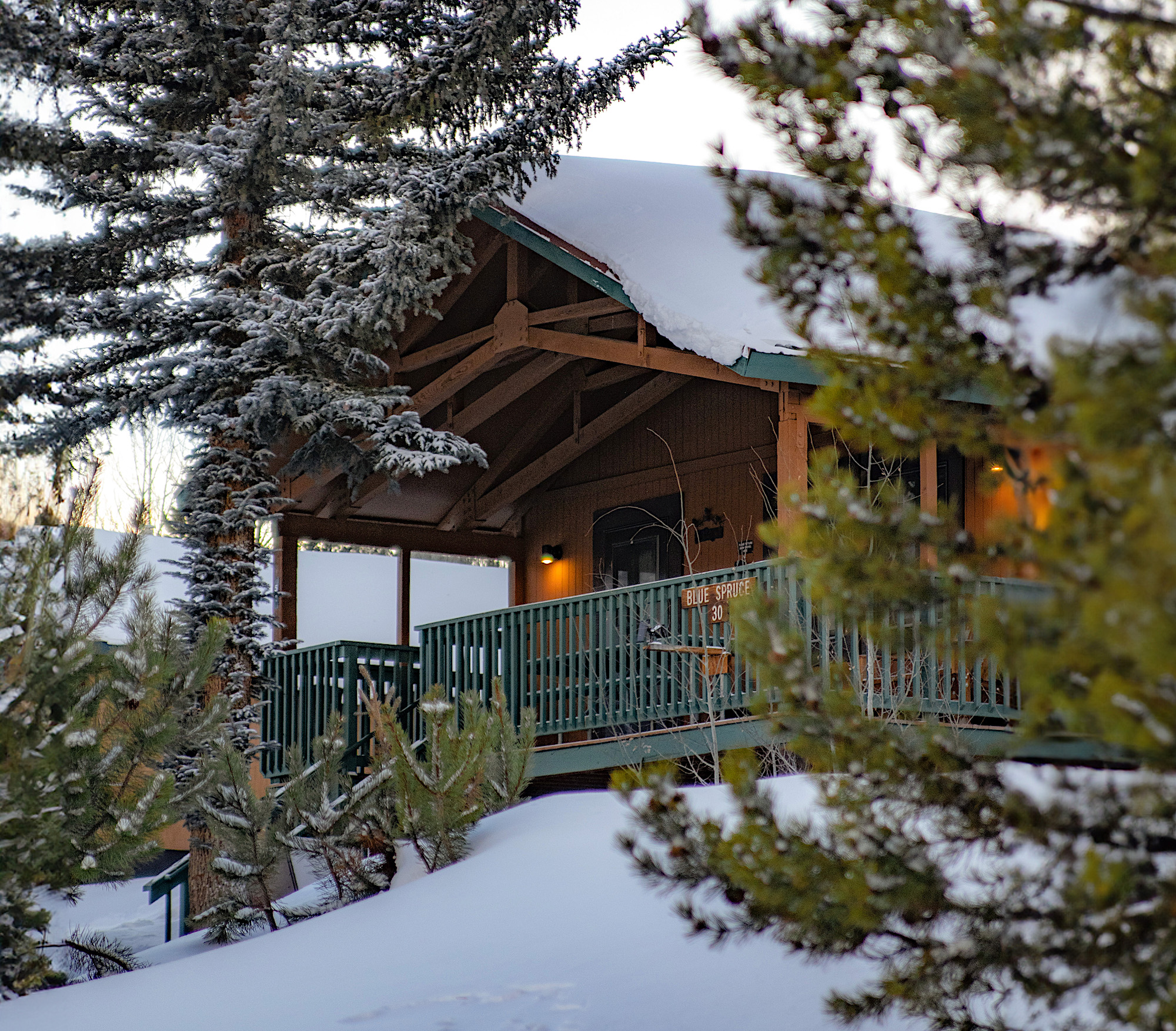
Snow Mountain Ranch winter cabin.
Those who stay there can expect everything they need and nothing they don’t. The rooms aren’t fancy, but they’re practical. Most don’t have TVs, but they do have WiFi. The idea is to connect with friends, family, and the outdoors while taking a break from the hustle and bustle of everyday life. The YMCA of the Rockies makes a point to offer affordable and family-friendly accommodations along with various on-site activities to keep everyone entertained.
“We have a ton of amenities geared toward families and stuff to do when they’re not skiing,” Degginger said. “They can go rollerskating, play basketball, go to the swimming pool, or go to the craft shop—lots of different options and things to do when you’re not on the trails.”
Snow Mountain Ranch also has an indoor archery range and climbing wall. As a nonprofit, the YMCA can provide a wide range of activities and amenities at a relatively low cost to locals and visitors. When asked how their YMCA differs from other community centers, Degginger said people need to experience the YMCA of the Rockies to understand.
“We have members, just like a normal YMCA, who love to come and ski,” she said. “Some are hardcore skiers who ski every day and Paralympians who come and train here. We [serve] our locals as well as our guests and people who come from far away. If you’re not staying here, you can buy a day pass or trail pass to use the facility for the day, but we’d rather you stay with us.”
For those who stay overnight (Degginger recommends booking in advance, especially for holiday weeks, summers, and weekends), trail passes are included, along with access to many of the facilities, such as the roller rink, gymnasium, and pool.
While winter is still going strong at the ranch, she recommended also visiting in the summer, which is the ranch’s busiest season.
“[We] have a brand-new ropes course opening this year, an aerial challenge course, which will be awesome, and a summer tubing hill, which is like tubing on snow but on a synthetic surface,” she said. “We also have archery, a climbing wall, canoeing, and mini golf—so many activities.”
In addition, the ranch has more than 5,000 acres of mountain terrain to explore, giving guests plenty of space to roam, and an abundance of wildlife.
“We have a lot of moose, and we see more and more of them every year,” she said. “I can’t blame them. If I were a moose, this is where I’d want to hang out.”
“We [also] have some elk that you can hear bugling in the fall, especially up in Rocky Mountain National Park,” she added. “A fun thing to do is go in the evening and listen to the elk bugle during mating season. We have typical mountain predators—mountain lions, bobcats, coyotes, and such—and a lot of cute little foxes running around everywhere, marmots, and all kinds of mountain critters.”
In the summer, the Nordic Center serves as the dining hall for the YMCA’s overnight camp. That camp initially drew Degginger to the ranch 20 years ago when she applied for a job there.
“I’m a Midwestern girl who had never cross-country skied before until I came out for an interview for summer camp,” she recalled. “They said, ‘We’re going to take a tour of camp. Put on these skis.’ ”
That was her first of many times on skis. She got the job and stayed, later becoming the head of programming and the Nordic Center at Snow Mountain Ranch.
“If you love being outdoors and recreating outdoors, you can’t find a better place to be,” she said. “We’re at the Continental Divide, and Rocky Mountain National Park is not very far away. You can do everything, and it’s absolutely gorgeous.”
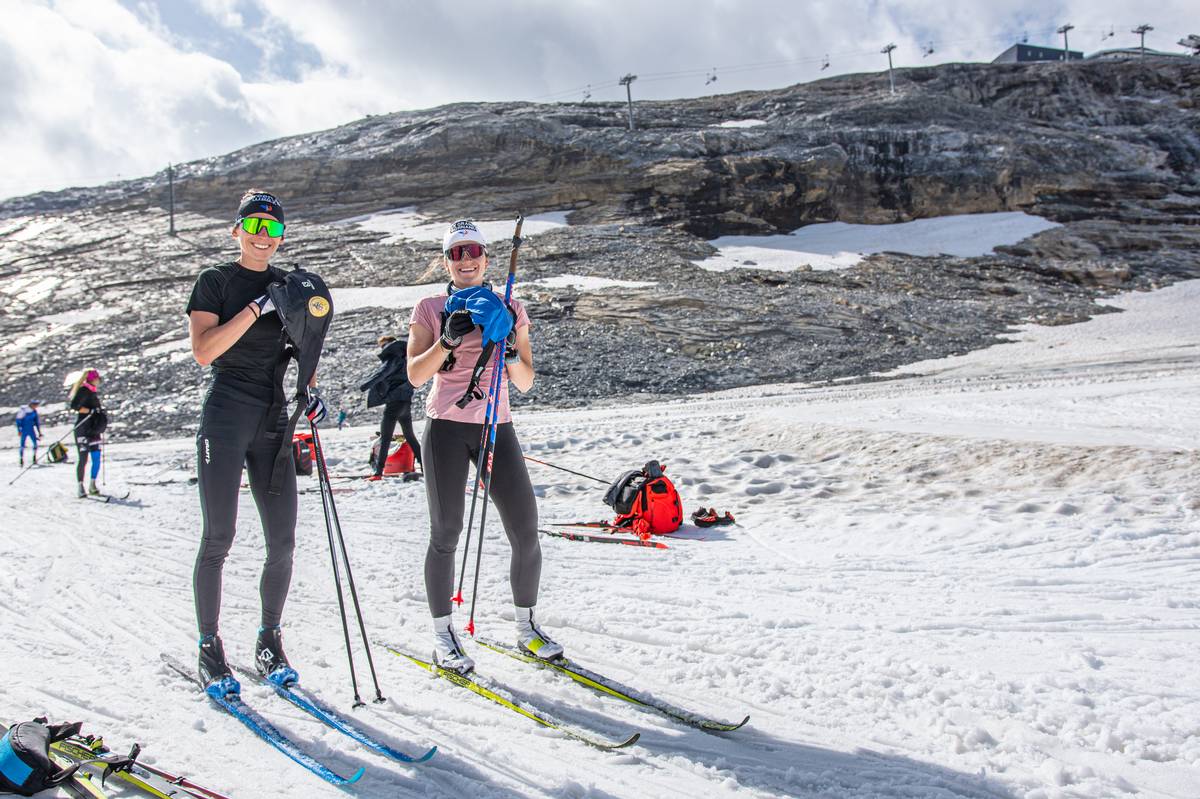
French skiers Delphine Claudel and Lena Quintin stop to refuel during a training camp on the Glacier de la Grande Motte near Tignes, FRA. (Photo: NordicFocus)
I grew up playing soccer. Every practice was hard. “No pain, no gain,” and all of that. By tenth grade, I was burned out and quit.
I started rock climbing. Every day at the crag was about pushing your limits. This was before indoor gyms or any concept of training other than doing as many pull ups as possible. I plateaued, got frustrated, and quit.
Then I had a go at running. I read some books, but skipped the training methodology parts and cherry picked the workouts. Every run was hard. Every interval was done to exhaustion. I plateaued, got frustrated, and quit.
Then I got into cycling. I began to hear of “easy” rides. I knew pros who rode around for four or five hours at such a pedestrian pace that they were talking the whole time. ‘How insanely boring!’ I thought. ‘Where’s the fun in that?’ So I went hard every time because it’s more fun. And guess what? I plateaued, got frustrated, and quit.
Fortunately, I didn’t learn my lessons the really hard way – through injury – but I still learned them the really stupid way – by throwing away any potential I might have had.
You can’t go hard all of the time. It’s as simple as that (at least on paper).
Scott Patterson enjoying a training day in Seiser Alm, ITA in January 2021. (Photo: Caitlin Patterson / Instagram @scottgpatterson)
The Basics of Polarized Training
Make your easy days easy and your hard days hard.
That is the backbone of a Polarized Training model. I had no problem making my hard days hard–they were all hard days after all. Full gas. Gun to tape. But in hindsight, I realize how depleted and chronically fatigued I was. I thought that was the desired effect, but it meant my training became less and less productive.
It’s the easy days that are actually the hard part.
First: I hear your inner dialogue. “Who wants to go easy? It’s unproductive. It’s a waste of precious time. It looks lame on Strava.” But the science says everyone should want to go easy. Metabolic efficiency is the name of the game.
If hard workouts train the engine to create more horsepower, then the easy sessions improve the gas mileage.
Secondly: let’s define easy. Training intensity is commonly split into five zones. (Some systems use three and others use seven, but I’ll be referring to a five zone system.) Zones 1, and especially 2, define the ranges of easy. Heart rate is the typical metric, especially for cross country skiers and runners, while cyclists typically use power.
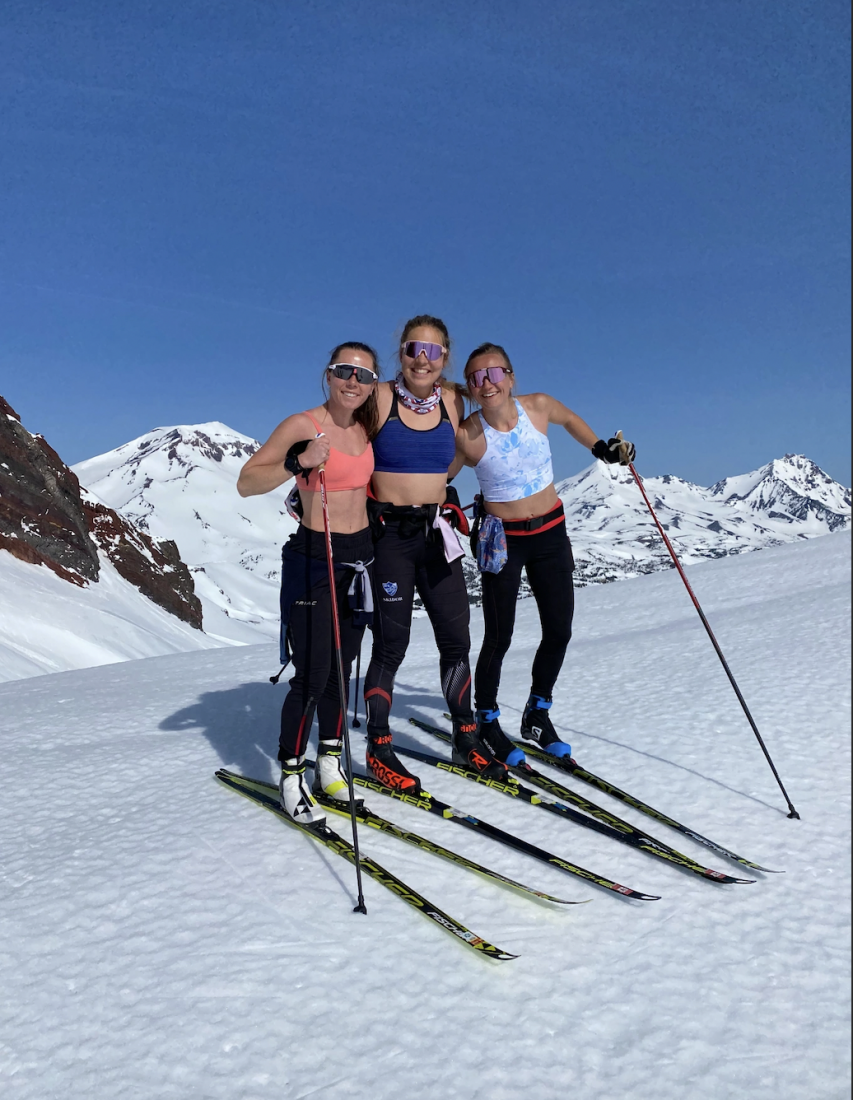
SMS T2 athletes Lauren Jortberg, Lina Sutro, and Alayna Sonnesyn find bluebird conditions for a crust ski up Broken Top near Bend, OR in May. (Photo: SMS T2 Blog)
Identifying Your Easy Zones
The theoretically simple method for establishing heart rate zones is to work backwards from your maximum heart rate where each zone represents a percentage of the max. The challenge is that there’s very little agreement on how to best calculate one’s max heart rate without actually experiencing it.
A more accurate method is to undergo a lactate threshold test, where heart rate zones are calculated based on the amount of lactate measured in the bloodstream. More accurate, but more difficult to conduct, and not universally accessible.
So how can we determine what is easy and what is too hard?
In an effort to keep easyeasy, I’m going to define it as conversational pace. You should be able to talk in complete sentences without having to… pause… to take in… more air… to finish your sentence. This is mediocre science and not especially objective, but with some practice, it’s not difficult to find that upper limit of talkability.
If you’re a numbers person, you can likely conduct your own ramp test where – after a warm up period – you progressively increase speed/effort while reciting poetry or singing along to what’s in your AirPods. Mark the heart rate where you lose the rhythm, and that’s a decent estimate of your upper limit for Zone 2.
Your new goal on easy days will be to keep your heart rate below this threshold, not necessarily at this level. For those accustomed to pushing the pace on every session, slowing down enough to keep your heart rate in the appropriate zones might feel like a big adjustment. There’s no real way around it – you’ll need to buy in, and trust the process/science. Maybe use it as an excuse to get out with a training buddy who is generally slower than you and give the whole “pedestrian pace, talking the whole time” thing a go.
Worst comes to worst, you give it an honest try and decide you prefer to just go hammer, then go back to your old ways. That’s the beauty of being a recreational athlete – at the end of the day, we’re just pursuing hobbies we find rewarding and enjoyable.
* A note for Strava users: don’t rely too much on the Relative Effort number. As a metric of intensity over time, it seems optimized to capture long, hard efforts like an hour-long tempo run where your heart rate stays high for the entire hour. It doesn’t handle intervals very well since the rest periods sort of cancel out the high intensity efforts.
For example, Strava gave 60 points to a 55 minute tempo run with an average heart rate of 158; however, an 57 minute interval session (9x600m on the track) with an average heart rate of 147 only got 35 points. To me, both sessions were equally hard, but the tempo run scored 25 points higher.
Strava does allow you to use your perceived exertion in place of heart rate for calculating Relative Effort. When I enabled this override, the tempo run scored an 87 while the track workout got a 147. (My easy efforts aren’t affected much.) Personally, I’ve found the Relative Effort score, along with the weekly log and Fitness and Freshness, far more useful (and accurate?) with this tweak. Here’s a deeper dive into that black hole.
French athletes Lucas Chanavat (left) and Maurice Magnificat (right) out for a rollerski during a training camp in Tignes. (Photo: NordicFocus)
The Purpose of Polarized Training
Now we can talk about why the easy is important.
Stress + rest = growth/adaptation/strength/speed. That is the basic formula. Our bodies are designed to adapt to load, but we have to give ourselves the opportunity to make those adaptations. Too much volume or intensity and the body will stop absorbing. Not enough recovery and the body will stop adapting. Best case, your performance plateaus. Worst case, you get injured.
The Krebs Cycle. The stuff of High School nightmares. But the essence of the endurance athlete. The Krebs Cycle is the pathway by which our bodies put gas in the tank. It is the process by which our mitochondria – magical little intracellular thingies – convert carbohydrates, fats, and proteins into the specific energy required by muscles to contract. In oversimplified terms, the more efficient the mitochondria are, the faster and longer we can go. And it appears that the best way to train mitochondrial efficiency is with training in Zone 2. (If you want to seriously nerd out, this podcast with Dr Iñigo San Millán, perhaps the Father of Zone 2, is a deep dive in a submarine to depths of the ocean.)
The easy/Zone 2 is considered so important that it typically makes up 70-80% of elite athletes’ training volume. The other 20-30% is hard (high Zone 3, Zone 4, and rarely into Zone 5). For the athlete who doesn’t have all day, every day to train, that means you only get a couple of hard sessions per week. Keep the rest easy.
Some that’s hard, lots that’s easy – that’s the essence of putting Polarized Training into practice.
Example Training Plan Template
Monday
Easy short or Rest if needed
Tuesday
Hard long
Wednesday
Strength/core maintenance
Thursday
Hard short (intervals)
Friday
Easy short or Rest if needed
Saturday
Easy long OR Hard long AND Sunday is Easy
Sunday
AM: Hard short (intervals) + PM strength/core maintenance
My training template is based on my work schedule and typical life obligations. I’ve given myself a max of three hard sessions a week with one of them longer (2-3 hrs ride or mountain run–the fun stuff!) and the others around an hour of intervals. My strength/core maintenance sessions typically fall into the easy category and don’t require much recovery (no delayed onset muscle soreness). But my schedule is also very flexible. If I’m tired, I can move a hard session to another day or skip it that week. If I get too busy or stressed, then I can modify the program without too much frustration.
I’m fortunate that I can train/play seven days a week, as long as I’m recovering adequately. However if your schedule only allows for training three days a week, you can still apply the basic formula and have one hard day and two easy days.
Richard Jouve doublepoles up an incline during a team training camp in Tignes, FRA. (Photo: NordicFocus)
For some of you, this may be common sense and describe how you’ve been training for years. For others, this is quite a departure from your norm and will take a concerted effort to implement. But whether your goal is optimal performance or staying healthy for years to come, investing in a polarized plan, and especially leaning into the Zone 2 work, will pay dividends.
Lastly, I think any discussion about training principles/plans needs to have the overriding theme of ‘push yourself, but be kind to yourself’.
Be flexible. Training plans aren’t written in stone. Don’t beat yourself up if work, family, weather, fatigue, or lack of motivation keeps you from your intended workout. Take a walk, play with the kids, lie down on the sofa—whatever it takes to reset and be ready for another day. One workout will not make or break, but constant self-criticism will sink the ship.
If you look at the lines that graph long-term athletic performance – VO2 max, anaerobic threshold, maximum heart rate, 10k running speed – it can be pretty demoralizing. Even before age 30, there’s a slow and steady cant downward, and then by the mid-40s, a descent into a valley that plunges toward the abyss’s void of emptiness.
Some of us choose to oppose these trendlines, wrestling with them like tentacles in a roiling sea of errands and bills and fraying cartilage and arthritis. During well more than one rollerski session each year, I think of the “strange resistance” Robert Frost describes in his poem “West Running Brook”:
“It has this throwing backward on itself / So that the fall of most of it is always/ Raising a little, sending up a little.”
This man, whose Vermont cabin touches the Rikert Nordic trail system, continues:
“It is this backwards motion toward the source/ Against the stream, that most we see ourselves in,/ The tribute of the current to the source./ It is from this in nature we are from./ It is most us.”
The tribute of the current to the source. It’s as though Frost (who, I’m guessing would be Birkie wave 8 – at best) was tasked to make an inspirational T-shirt that captures the mind of a masters skier. I am proud to be a member of this infinitesimal subset of American society, and if you still think skis with holes in the tips look new, I imagine you are too.
Tim Donahue mid-race during the 2020 Winter World Masters Games in Seefeld, AUT. (Photo: Garrott Kuzzy / Lumi Experiences)
After too much running for my large frame and my knees, I began uphill skiing in earnest in my mid-30s, just as I knew these charts were generally tipping downwards. As I was effectively starting from scratch, though, I felt I had an advantage. I did not have to chase the ghost of my 22 year-old self, vaunted by a college program and a systematic knowledge of voluntary suffering. Skiing gave me a second athletic life, and as I opened its invitations to technique, training blocks, intensity sessions, and World Cup fandom, I delighted in every aspect of its complexity.
Nearly twenty years into it, the fires still burn, though sometimes it’s hard to tell whether I’ll coax any new flames or just ride along the glimmer of dying embers. Now into the swing of summer as we are, I find myself between an acronym – SAMITS (skiers are made in the summer) – and, a hammock. Can I throw another log onto this fire? Should I? It’s a question of little worldly consequence, and yet it’s the central question of this other world I’ve built for myself.
More than anything, the lure of skiing these days is that reliable doorway it opens into another place. I have sat through all-morning “self-care” sessions in hot rooms in masks, and then I have clicked into the Marwes and breathed. I have endured a full Guy Fieri cooking show in the doctor’s waiting room, then I’ve gently climbed through the woods with four points of contact. I just learned the world emitted more C02 than ever last year, and I needed to get out and roll among the innocent trees.
This otherworldliness has especially come as I’ve lived in, and now just north of, Manhattan all these years. I have approximately one teammate (the great Sproule Love) and I get on snow maybe a dozen days a season. But new wheels roll well on fresh pavement even here, and it’s easy to let the mind return to the familiar grooves. On the rail trail that runs mercifully just out my door and now nearly connects through the entire state of New York, I can lather into a third hour under a canopy of early spring leaves and let the Wendell Berry in: “The health of nature is the primary ground of hope – if we can find the humility and wisdom to accept nature as our teacher.” Yes, skiing can soften the hard edges of the world and give way to the dance of balance and strength. And yet, sometimes I need more than this.
Sometimes, I can rouse the fires within to see a completely different world beyond, with its own muses and images. Here’s where I hear the siren song of Devon Kershaw and his allusions of carnage: the “rip their legs off” and “gun to tape annihilate” and the “going down to the basement.” Racing is just instinctual for me. I ran my first 10k back in 1979, when I was nine, and whether up stairs, across bogs and sand dunes, on bikes, on skis or snowshoes, I’ve raced every year since. To this career high school English teacher, it’s the opposite of grading essays.
The author, Tim Donahue, races the 2012 American Birkie with teammate Sproule Love (bib 97). (Photo: livestream screenshot)
When I’m trying to connect with my limited stores power and speed, I’ll sometimes watch World Cup clips on YouTube. I see Petter Northug gritting his way through the field to take the 50k classic at the 2015 Falun World Championships; I see those last few k’s in the Beijing Olympic 30k when Jessie Diggins finishes on fumes for silver. (Yes, a proud moment in our household when my daughters encouraged me to name our puppy Diggins.) The one I’m thinking of now is the 2019 World Champs 30k skiathlon in Seefeld. It’s Sundy-Bolshunov-Røthe trying to destroy each other up the last few climbs, finding a hop skate after seventy-five minutes of redline racing, then spilling across the line with perfectly emptied tanks. Perhaps you have your own favorite clips.
As I try to summon a summer interval in the suburbs, after dropping my daughter a sleepover, I can get to thinking about my own highlight tape, which Chad Salmela is definitely not narrating. I think of the 2006 Pepsi Challenge, when at 48k, I gave a nod to my one teammate and we made a decisive surge, dusting the last young buck riding in our train. I think about Bitch Hill, a steep little climb 40k into the Birkie, when several years later, I found the spring to fracture our large, lollygagging pack. I find these memories within, gently flogging me with their flagella. In part because it’s so hard to explain them in my faculty lounge in the Bronx, in part because they are the payouts of so much stoic suffering, and mostly because I just love it, I want to make more.
This winter was different though. Mysteriously, I started feeling a constriction in my chest. I was often unable to get a full breath, even when reading in bed at night. When I tried to get out of zone three, I just couldn’t find the air. I saw my pulmonologist, my cardiologist, a gastroenterologist. I drew blood, I got tests. I got sucked down the Internet vortex: was it long Covid? Had I even had Covid? It took time and was expensive, and I didn’t learn much.
With each race I had penciled into the schedule and had to decline, I felt the nip of disappointment. I didn’t want to say good-bye yet. Could I salvage, at least, something?
One day in February after a good night’s sleep, I decided to enter a low-stakes challenge – the benchmark 10k rollerski time trial in Central Park. It wasn’t awful. In fact, it was an improvement from a few months prior. So, I succumbed to the beast and tried a few late-season races.
It’s not a great feeling to stand on the starting line with a doubting mindset – “What am I doing here?” “Don’t blow up.” But that’s how things went – I felt like I was wearing someone else’s clothes. It was hard, humbling, and really not that much fun. But my last race of the “season” (four races total) offered a glimmer of hope. It was just a 5k relay leg, in perfect conditions on a rather flat course. Still, I felt relatively strong. I was actually able to pass people up a hill. So that’s the memory I’m choosing to take away.
Tim Donahue in Maine during the summer of 2020. (Photo: Sproule Love)
But is it enough to justify all the rigamarole? That sixth hill interval when the pain just feels pointless? Those beautifully aimless workouts – where you go a little faster than you should – interrupted by the voice of prudence? The occasional margarita you eschew for some pious purpose? And then, when winter comes, all that fretting over Wunderground and waxes and websites, where you read about volunteers shoveling snow onto corners in dwindling hopes of staving off the coming thaw, toward which your travel no doubt contributes?
Ugh – yeah, it’s worth it! We skiers worship a rather demonic god, it seems. And its worth only grows because it’s so fleeting, like surfing through a barrel wave – exhilarating and bound to crash. Like trying to ski uphill forever. If you, reader, have not grappled with this same question, you probably will!
Here’s the best revelation I’ve come to: I just want to be able to work hard enough so that going out on a long ski feels easy. For a recent New York Times piece about the pleasure of running slowly, one of the most popular comments was, “Running for joy beats running to win anytime.” I’m not quite there yet, but I see the light of this too. For now, I want my strength to be more than my pain. I know my imagination can supply the rest.
Author Bio:
Tim Donahue teaches high school English at the Ethical Culture Fieldston School in The Bronx. He lives in Hastings-on-Hudson, NY and rollerskis year round. You can find his writing on climate change and education in The New York Times, USA Today, and Newsweek.
The journey into motherhood, though challenging, has also been rewarding for UAF head coach Eliška Albrigtsen. (Photo: Tobias Albrigtsen / @untraceableg)
Part 1 of this story details Eliška’s experience coaching through pregnancy and the birth of her son. Keep reading to learn about the challenges she, like many women, experienced during the postpartum recovery process, and what it took to navigate year one of life on the road with baby Viggo.
Expectation versus reality.
When preparing to interview Eliška Albrigtsen about her experience pairing NCAA coaching with new motherhood, I expected the challenges she faced during her transition to primarily be focused on the balancing act of managing a demanding job with frequent travel and a new baby. Maybe a few relatable stories of airport meltdowns, sleepless nights in hotels while on the road with the team, and inopportune timing of diaper blowouts. Or any number of other ways societal systems in the US seem to be structured in opposition to new moms in the workplace.
But Eliška’s passion for her job and dedication to her athletes were abundantly clear throughout the conversation; coaching is where she thrived. Her grit and energy allowed her to problem solve bringing baby Viggo on the road with the team – perhaps paired with the added fortune of a husband whose skill set includes waxing and ski testing and a well placed mother-in-law eager to help care for her grandson. And the team embraced its new member without hesitation.
In reality, the biggest challenges Eliška faced in returning to coaching postpartum were connected to the physiological impacts pregnancy and delivery had on her body. In short, it was a discussion on the shortcomings of our healthcare system and the myriad of ways the current standard of postpartum care falls short of what many women require to restore their body to full function.
Her story highlights a few key takeaways for programs looking to support women coaches surrounding pregnancy; in particular, there’s much more to the return to coaching than navigating who will care for your child while you’re out training with athletes and traveling to races. Respecting the timeline of a slow return, and perhaps offsetting the costs of postpartum physical therapy, may be an essential component of an improved and holistic support system.
Eliška Albrigtsen in action at US Nationals in Soldier Hollow, UT. (Photo: Tobias Albrigtsen / @untraceableg)
Postpartum Recovery
A theme of Eliška’s narrative of her perinatal experience was the ways in which her “athlete mindset” served and hindered her ability to roll with the punches.
While women like Kikkan Randall, Marit Bjørgen, Aino-Kaisa Saarinen paved the way for women looking to begin their family before retiring from professional skiing in many ways, Eliška said that the ease with which they outwardly seemed to rebound beyond their previous levels of fitness was, in some ways, a disservice to women like herself who did not experience as smooth a return. In her mind, she had expected a comparable experience given her athleticism and good health, but quickly learned that women might be better served using caution when extrapolating from outliers.
“You see these professional skiers having babies and then coming back and winning gold medals at [the] Olympics,” she said. “And you’re like, ‘Oh, yeah, that’s gonna be me.’ But no one really sees the giant support team they have behind them.
“They have professional doctors, physical therapists, and strength and conditioning [specialists] to go through their pregnancy with them, monitoring everything, having them at the birth, and then jumping right into the recovery. As a coach, you don’t get that. You probably have the same amount of on-ski hours as professional skiers – not the same quality of course, but you can’t do your job without being there. So I think that’s how most of our ski community sees pregnancy – so easy and you are an even better athlete afterwards, because all these women did it…
“For me, it was the opposite. It was hell. I can’t wear the clothes that I wore when I was pregnant because I have extreme PTSD from that… it was such a, not just physically but painfully, impacting experience.”
Though expectation and reality could not have been more different, her drive to recover from the injuries sustained from pregnancy and birth, and the creativity required to adapt during the recovery process, mirrored her general approach as an athlete more broadly.
“I think the athlete mindset in me was, ‘Okay, I had this baby. Now I put myself through physical therapy, and I’m gonna recover’… Just like after having a shoulder dislocation or having a torn iliopsoas, all those pretty crazy injuries – I knew that eventually you get better, and you get back to yourself.”
What Eliška identified as the biggest physical challenge she faced after the birth of her son was the repair of a condition called diastasis recti (DR), which is a separation and consequential loss of function and strength of the rectus abdominis muscles.
Happy baby and happy mom. (Photo: Tobias Albrigtsen / @untraceableg)
During pregnancy, as a woman’s belly expands to accommodate the growing baby, the muscles of the abdomen are forced to stretch. The deeper muscle layers, known as the transverse abdominis, are structured like a corset wrapping around the belly, giving them a greater capacity to expand. However, the rectus abdominis muscles, better known as the “six pack” muscles, run vertically while connected by fascia, and have significantly less ability to adapt to the expansion.
Instead, the outward pressure and growth of the belly causes the rectus abdominis muscles to separate, thinning and weakening the fascia as it stretches, or in extreme cases, tearing it.
“When I was the most pregnant, my six pack was under my armpits.”
This connective tissue cannot simply snap back to its original state after delivery. As fascia lacks the blood flow of muscle tissue, it is slow to heal, leaving many women with a gap between muscles known as a diastasis. All women experience some amount of ab separation during pregnancy, but if the gap of two or more finger widths between the muscles persists postpartum, she is diagnosed with DR.
Because of the combination of her stature, a short torso, and the size of her baby, Eliška found herself with an extreme separation.
“Basically, you could stick your whole fist into my stomach. That was the biggest problem for me because I basically lost my core. And my core was a big part of me as an athlete – not just as a skier, but as an athlete. So that was really hard.”
As she hopes for a second child down the road, any surgical repair options were contraindicated, and instead, Eliška dedicated herself to a physical therapy regimen. She felt lucky to have access to a Fairbanks-based Osteopathic medicine expert, Dr. Todd Capistrant, who specializes in the Fascial Distortion Model and was therefore primed to help Eliška improve her diastasis.
“I saw him basically on a weekly basis.”
She also met regularly with a pelvic floor physical therapist, both to work on the diastasis, and to restore appropriate function to the muscles of her pelvic floor. Her PT identified that her pelvic floor was hypertonic, meaning the muscles carried tension chronically, rather than contracting and relaxing in functional patterns. Like holding a flexed arm hang and then being asked to knock out a set of chin-ups, this chronic low-level tension leads to fatigue in the pelvic floor muscles, preventing them from outputting the strength and tension required to support the organs sitting inside the pelvic girdle and interact appropriately with surrounding musculature when recruited during activity.
With the guidance of the PT and a set of progressive exercises to relax and engage her muscles appropriately, Eliška saw progress, but it took time for her muscles to function in coordination subconsciously.
“It took me probably around eight months to incorporate the mental [and neuromuscular] connections back. I was able to [engage the muscles] when I wanted to, but all the muscles of the pelvic floor, everything that’s sitting in the pelvis, they were not working with the rest of my body.”
On the bench: Eliška Albrigtsen prepares skis for the UAF athletes. (Photo: Tobias Albrigtsen / @untraceableg)
She expressed feeling lucky to have access to high level care in Fairbanks, including her therapist who could incorporate a variety of techniques to help her recover, including deep tissue massage, cupping, electrical muscle stimulation, and biofeedback.
“I think biofeedback for athletes just works the best. Because we’re such strong willed people. Like, if we see it happening, we can really focus on making it happen more.”
An unexpected benefit of time and resources being placed into learning how to strengthen and reintegrate her deeper core musculature trickled down to her athletes. She recognized that several of her athletes, who had complained of back pain surrounding core workouts, were not sufficiently engaging their transverse abdominis muscles, instead relying too heavily on the outer rectus abdominis or other smaller core muscles. Teaching the techniques she learned through PT helped improve the form of her athletes, relieving the back pain they had experienced previously.
“It definitely deepened my understanding of how the core should work, and how we use it when we ski.”
As she navigated her own challenges, she became aware through talking with friends of how common these experiences are amongst mothers. Describing herself as “someone who says everything”, she felt it was important to both be open regarding the challenges she’s faced, and the resources and options available for women to make progress toward recovery, rather than accept the conditions as permanent.
Most women only receive one postpartum checkup, approximately six weeks after delivery. As my own pelvic floor PT described it, these visits typically only check to see that the tissues have healed and that there are no visible pelvic organ prolapses, but most midwives and OB/GYN practitioners do not have the depth of knowledge to assess muscle function, hence the need for an evaluation from a pelvic floor PT. However, quality pelvic floor physical therapy is not universally available, and as it is not always covered by insurance, making it cost-prohibitive for many women to continue care long enough to make sufficient progress.
“I think the most tragic experience post-pregnancy that I had was the realization that women are left being damaged from bringing life to the world.”
As she discussed her own experience with the women in her community, in turn, many of them shared that they continued to suffer from the impacts of ab separation or pelvic floor dysfunction from pregnancies, including friends who were more than ten years postpartum. Some of these women had given up activities they had enjoyed previously, like running, because they felt as though they were “spilling their guts” out of their bellies due to a lack of core function.
“How is this okay for women to live this way? That was just mind blowing to me.”
Imparting the knowledge she gained in the process, and advocating for women to find their own ways to make it work, she offered up suggestions.
“I was just like, ‘Hey, if you can’t go to physical therapy, this is how you tape your belly, so at least you can start hiking fast.”
At roughly 13 months postpartum at the time of the call, Eliška recognized the improvements she’s made, while still acknowledging she has not fully recovered.
“It’s [been] more than a year, and I feel functional. I still have pains and I would not go and enter a race, because my brain can push much harder than my body can, so I know I would hurt myself. But I’m so much better than most of my friends that, you know, [had to] just give it up…”
Eliška Albrigtsen lead the UAF Nanooks to an historic seventh place finish at 2022 NCAA Championships following the birth of her son in February 2021. (Photo: Tobias Albrigtsen / @untraceableg)
As she worked with athletes through the fall and winter, Eliška found ways to adapt her ski technique to avoid putting unnecessary strain on the musculature she was working to rehab, and work instead with the muscles that already had the necessary strength. In particular, she needed to change her doublepole technique.
By returning to the older style of doublepoling, which involved less of a crunch through the abdomen than modern technique, instead increasing the bend at the waist and relying more heavily on the arm and shoulder muscles.
“I don’t have the strength there anymore [to crunch]. My muscles are two three packs, they’re not connected. So I go into doublepole and I tighten my lower belly, but then I pull my butt up kind of like into downward dog instead, and work with my arms again.”
Multitasking: Eliška Albrigtsen feeds her son trailside while on the road for competition. (Photo: Tobias Albrigtsen / @untraceableg)
Another lingering problem she has experienced is a result of the endocrinological changes experienced surrounding pregnancy. To allow the body to grow during pregnancy and a widening of the hips for delivery, the body releases an aptly-named hormone called relaxin, which acts on cartilage and other soft tissues to allow expansion and increased joint mobility to occur. The production of relaxin typically declines after delivery, but remains higher than normal for the duration of breastfeeding.
While beneficial for pregnancy, it also puts perinatal women at a higher risk of joint instability and consequently injury.
Eliška shared that she seems to produce an above average amount of relaxin, which has continued to affect her postpartum as a nursing mom. She experienced joint pain, particularly in her pubic symphysis joint at the front of the pelvis, with unexpected movements – like slipping on ice or mud. “And it’s always slippery here. Like 10 months out of the year.”
“On skis, I don’t have a problem. Because everything’s gliding and I already have the natural anticipation of gliding. But walking and slipping – I try to catch myself and my muscles, my joints, my tendons are just too loose.”
Reflecting on her journey through the first year postpartum, the lack of care available to most women remained at the forefront of her mind. The impact of these types of conditions, which linger if left untreated, affects more than just the level of activity a woman can enjoy. As those who have experienced it (waves hand) can attest, the emotional toll affects quality of life more broadly.
“I would absolutely fight for every woman to be able to have a year of free PT [after pregnancy]. You just need your life back.”
Life on the Road
There’s a commonly used phrase when it comes to raising children: “It takes a village.” This resonated as Eliška shared insights into what support was necessary to allow baby Viggo to travel with the team through the competition season.
While children under two-years-old are typically able to fly for free on their parents’ laps, the travel of the person who would care for Viggo while Eliška was working is not. Fortunately, her husband Tobias was already incorporated as a volunteer assistant coach, and had both the skillset and the NCAA certifications to play a variety of roles during travel, which also got him on the payroll to offset travel costs.
“I’m lucky that my husband’s quite good tester and waxer as well. And traveling with a full team this year, six [women] and six [men], I knew that we will need more than two coaches to wax.”
And, conveniently, Tobias’ mother is based in Boulder, CO. “She was able to actually drive to all the races and babysit when we were ski waxing and racing.”
The village: Eliška Albrigtsen has help from her mother-in-law during the RMISA Championships in Steamboat Springs, CO. (Photo: Tobias Albrigtsen / @untraceableg)
For US Nationals, UAF collaborated with other Alaskan clubs to wax, but it was still useful to have an extra driver to bring athletes back and forth to the venue. Consequently, they paid out of pocket for the flight, but Tobias was able to get a per-diem salary as a driver. “So we got at least the food covered,” she laughed.
For other RMISA and SuperTour races where UAF was only waxing for their own athletes, Tobias could have his travel expenses fully covered in exchange for his work. It’s perhaps a model that’s hard to replicate for other mom-coaches, but still demonstrates that with some creativity and determination, bringing the family along for the ride is possible.
“We call it the primary. He’s the primary on the baby when we have training days, where me and my assistant go with athletes and train. And then when we were testing and race waxing, grandma was the primary. And oh my God, bless her heart — she paid for all of her gas and her accommodation and food. She would just come to the house where we were staying when we had to leave and just babysat for us… So that’s the way that we made it work, but it’s a very, I think, exceptional situation.”
Was traveling back and forth from Fairbanks to Colorado and Utah challenging with a toddler? Yes. But Eliška knew it was something they would need to navigate as a family regardless of her career.
“I know living in Alaska, he’s gonna fly anywhere he goes. That’s just what it is. So that was just like one thing that we were like, ‘Yeah, there’s no way around it.’ We did have to travel with more things. Because you have to have the car seat, we have to have the crib, we had to have a bunch of diapers with us.”
The system worked for the first year, but it will need to be modified for next season. The full RMISA calendar has not yet been set, however, the regional championships will be held in Anchorage, which will make at least one competition easier to travel to.
From there, it will be running the calculus on what makes sense financially. She laughed that Viggo is already a squirmy baby to keep on their laps on the plane and will need his own seat next year, but she is also not sure whether he will still be nursing, which may make it easier for her to leave him behind with Tobias.
Just another member of the team: the UAF skiers pose with coach Eliška Albrigtsen and baby Viggo at the RMISA Championships in Steamboat Springs, CO. (Photo: Tobias Albrigtsen / @untraceableg)
In terms of the impact to the team, better worded as the lack thereof, Eliška felt Viggo’s presence on the road improved the atmosphere. Rather than lamenting their littlest teammate, they found humor and joy in his presence.
“When you’re stressed before the race, and you’re having breakfast and you’re barely putting the oatmeal into your mouth [because of nerves], and the baby in front of you is just like throwing the food and laughing… I think that it helped with the team atmosphere, for sure.”
In addition to helping distribute the weight of ski, wax, and baby gear when navigating through the airport, the athletes also served as an extra set of eyes in the team house.
“The team, in general, was super helpful as well. When we would be waxing in the garage, they were playing with Viggo, and he believes they’re all his brothers and sisters, I’m pretty sure.”
A relatable image: the al fresco diaper change during a competition weekend. (Photo: Tobias Albrigtsen / @untraceableg)
Reflections on the Experience Thus Far
Praising the community in Fairbanks, Eliška was grateful for the help and support she received through her perinatal journey, which allowed her to not only continue as head coach, but help the team to new heights this season. Rather than holding her back, becoming a mother enhanced her ability to lead the Nanooks program.
“I also feel like my season was so much more successful this year because I really wanted to go home to my baby. So I was really trying to work smarter and more efficiently, and I think the athletes probably had that push too.”
While some might fault a woman who shares that her priorities have shifted since having a child, Eliška explained the number of ways this desire to optimize practice time served her team.
“I was always driven for success – I love being successful. But now it’s more like, ‘Yes, I will be successful so then I can spend more time with my child.’”
University of Alaska Fairbanks head coach Eliška Albrigtsen shares her experience with pregnancy, postpartum recovery, and life on the road with baby Viggo in tow. (Photo: Tobias Albrigtsen / @untraceableg)
As to whether there was anything she would have done differently, Eliška’s answer was more focused on reducing barriers to mom-coaches as a group surrounding pregnancy.
“I think the side that no one ever talks about is: how fit coaches should actually be able to do their job well.”
Because her insurance cycle was aligned with the school calendar, her deductible reset in July. Having maximized her out of pocket expenses with prenatal care and delivery, this meant the physical therapy treatments she needed were essentially free for the first four months. However, after the plan turned over for the new year, each pelvic floor PT visit cost $60–70, and she was looking to go twice per week to continue to make steady progress. This adds up quickly, particularly for a family relying on one salary, which happens to be a ski coaching salary.
While nationwide free postpartum PT for all women would be the ideal, Eliška proposed that these costs should, at minimum, be offset by the school or program.
“That is something I would definitely fight for women coaches. Talk to your boss, or whoever, and tell them, ‘If you want me to come back to the same level of coaching, you need to pay for occupational therapy for me to recover.”
Hannah Halvorsen creates a video on eating disorders in cross-country skiing from a survey of coaches of all levels. (Courtesy photo)
At 24-years-old, Hannah Halvorsen recently announced that she is ending the pro-skier chapter of her life, but it’s not the only transition she has on deck. This past weekend, Halvorsen also graduated from Alaska Pacific University (APU) with degrees in cognitive psychology and business administration. As a senior capstone project, focused on the psychology side of her studies, Halvorsen chose to research a topic she has been invested in throughout her time as a student-athlete: eating disorders in sport.
Given the size and scope of the topic, she began to explore ways to narrow the lens. She chose to focus on cross-country skiing to leverage her extensive experience as an athlete, but was still initially unsure of where to begin.
“I didn’t want to look at just, ‘how do we get them to go away?’ because I just don’t think that is feasible with the resources and education we have right now,” Halvorsen explained in a call.
Ultimately, she chose to consider the topic from a perspective she had not encountered previously: that of the coach.
“Not every nordic athlete has access to a dietician or to a counselor, depending on their insurance, depending on their family culture, their family support… But the majority of athletes have a coach and that’s a frequent person that they’re interfacing with. So I thought, ‘This is a really unique link that a lot of people have. How do we utilize that?’”
Hannah Halvorsen races through the heats in Dresden during a December 2021 World Cup skate sprint. (Photo: NordicFocus)
Rather than trying to identify a “solution” to a nuanced and multifaceted mental health condition, Halvorsen looked to collect a “broad perspective on what coaches think, what coaches feel, [and] what coaches see… I wondered what it looks like for them because they see athletes come and go all the time, and they see all different types of athletes.” Utilizing connections in the sport both internationally and domestically, she contacted coaches from the junior level through the World Cup.
Looking to avoid factual answers that may just be regurgitated onto a survey from a basic Google search, Halvorsen sent coaches a list of four prompts, and asked them to submit their response as a video. “I wanted to see their mannerisms and their body language and the inflection in their voice when they were responding. Essentially, where they were at with [the topic].”
Specifically, the questions were as follows:
How do you see issues with eating disorders manifest in athletes who may or may not be struggling? What types of behaviors do you see that you associate with this problem?
What are some of the pressures or contributing factors that you either notice or athletes tell you are the reasons that an athlete starts down the path of an eating disorder?
What do you see as the challenges with reducing the amount of eating disorders in sport? What types of obstacles make it hard for an athlete with an eating disorder to recover?
Do you see a difference with eating disorders between male and female skiers? Such as prevalence, the root cause, how it manifests, or anything else.
Setting her expectations low on what she would receive in return, Halvorsen was amazed as videos rolled in, and suddenly found herself with over three hours of thoughtful and in-depth responses. Some of the participants included: US National Team coaches Matt Whitcomb, Kate Barton, and Jason Cork; the Italian and Finish National Team coaches and Norwegian Women’s Team coach; current and former NCAA coaches like Cami Thompson Graves (Dartmouth), Maria Stuber (College of St. Scholastica), Marine Dusser (Univ. of AK Anchorage); elite post-graduate coaches Erik Flora (APU) and Andy Newell (BSF Pro); and junior level coaches Anna Schultz (Craftsbury), Molly Susla (Crested Butte), and Kris Hanson (Stillwater, MN).
The challenge then became condensing this footage into a concise and effective 15-minute montage, fit to a “script” that would connect the perspectives without redundancy or losing the attention of viewers. “I wanted to have this artistic effect of being [shorter] sound bites, so people would stay engaged.”
The final project: Hannah Halvorsen’s senior project video.
As she reflected on what she heard from coaches, Halvorsen identified some of the important themes that resonated with her and aligned with what she had learned through her studies on the subject.
“There were some very noticeable overlaps. A lot of [coaches] said, ‘I’m not a medical professional, I’m not qualified in eating disorder rehab or therapy or treatment. I am not the person for that. It’s not appropriate for me, it’s not something I have the skills to do, and it’s unethical for me to be doing it.’ And it was honestly really nice to hear that at all different levels, coaches do know that this isn’t their job or role…
“I also noticed that a lot of them talked about how eating disorders weren’t just about sports performance, or wanting to perform in sport. A lot of the coaches pointed out how it often came at a time where the athlete has a lot of other stress in their life, and this is just something that they have found control over, which is also something that I’ve researched and learned about in preparing for this video.”
Halvorsen pointed out that this is a key distinction. While negative body image and a preoccupation with one’s physical appearance can be symptoms of eating disorders, the root cause is typically much deeper. In the endurance sport realm, an unhealthy need for control can run parallel to the type-A, perfectionistic mindset that may also contribute to athletic development and progress in sport.
In her advocacy work in the eating disorder space, Jessie Diggins has often used the phrase“Genetics loads the gun, but the environment pulls the trigger.” Or, as Andy Newell put it in Halvorsen’s video, eating disorders are “stressful habits that manifest themselves as eating habits.”
Hannah Halvorsen spends time at home in Truckee, CA with three of her five siblings. (Photo: Instagram @hannah.g.halvorsen)
“Another big takeaway that I would describe more as a tangible lesson from this,” Halvorsen continued. “And the coaches kind of led to it – is that the right role for a coach is to be in touch with athletes and be aware and there for them, so that if they do notice a change in behavior, they can be that link that helps the athlete get connected with the help that they need as soon as possible. They’re not the one to fix that problem, but they might be the first person who sees it. The first person who checks in with [the athlete] and says, ‘Hey, you should see someone about this.’ That, I think, is where I stand on the issue right now.”
Reflecting on her experience as a World Cup athlete and the responses of international coaches she received, Halvorsen indicated that she did not notice any significant differences in trends compared to the US, though this was an aspect she was looking to investigate.
“‘Does it vary culturally in how we see it, how it manifests, how we talk about it?’ Overall, I would say, the problems seem to come from the same issues. They seem to be similar in the way that athletes want to hide it. It’s kind of taboo to talk about it. It’s largely more taboo to talk about an eating disorder if you’re a male athlete. Those trends seem to hold very similar.”
While the pervasiveness of eating disorders and disordered eating across genders in sport is a challenging project to take on, Halvorsen indicated that she left feeling positive about the direction progress is heading.
“Something that surprised me is that I didn’t give coaches enough credit for how in tune they are and how much they care and their capacity to communicate about this. There’s so much talk about how eating disorders are uncomfortable, they’re very secretive, no one wants to talk about them. And that was why I thought, ‘I’m gonna have to send this to 200 coaches because I’m going to maybe get five who are willing to talk.’ And that wasn’t the case at all. They talked in depth about it and I think that surprised me, and made me feel really optimistic, too, because coaches are willing to have this conversation and to be very authentic and real about it. And I left feeling a little bit more optimistic that people can get in touch with the help that they need, if they’re ready or wanting that help.”
Another aspect that Halvorsen pointed out was the development that has happened surrounding eating disorder research over the last decade. She noted a shift away from pigeon-holing the disease as a women’s issue – for example, the change from Female Athlete Triad to Relative Energy Deficiency in Sport (RED-S) – and stated that there are notable differences in studies that were conducted within the last two years, in comparison to those published five or ten years ago.
“It needs to be acknowledged that there has been progress. There’s a lot more conversation about it. There’s a lot more training, there’s a lot more education and understanding of it. That needs to continually be part [of the solution].
“We need people, particularly coaches and older teammates and people in the nordic community, to identify as lifelong learners… because it’s gonna keep changing and we’re gonna get better and better at knowing how to support athletes and how to make the environment better. And so I think committing to having an open mind and staying that way is really important.”
Hannah Halvorsen congratulates Sweden’s Moa Lundgren at the finish of a skate sprint heat in Dresden, Germany in Dec. 2021. (Photo: NordicFocus)
While it was not a focus of the questions posed to coaches, Halvorsen discussed her perspective from her experiences and research on what still needs to change in cross country skiing.
“I think that there is a subconscious cultural emphasis put on being lightweight, and that was being affirmed and validated and encouraged in subtle ways. Even if we’re saying the right things, athletes and kids and everyone is still aware of what is validated and when is affirmed and when is celebrated.”
She discussed the overt messages a coach could give to athletes, such as an instruction to lose weight for performance or complementing a leaner aesthetic, however, she felt that more covert messaging is pervasive and perhaps more harmful. In particular, she identified aspects of traditional ski training that may skew focus and praise toward athletes with smaller body-types.
“Every time I went to a summer training camp growing up, there was an uphill run test that, I think, held a lot of weight.”
Halvorsen called the test “iconic” and expressed how the test felt like a measuring stick, both for one’s merit as a skier and as a basis for a social hierarchy among the athletes attending the camp. “There’s just a lot of, ‘That’s the cool athlete who can run uphill.’ And it holds for men and women.”
Simultaneously, there are the challenges of a sport whose athletes race in lycra body suits throughout the winter, put in the most training hours during the heat of the summer.
“That means a lot of shirtless time, a lot of shirtless social media, and a lot of emphasis put on doing things uphill. Uphill rollerski time trials, bounding intervals, uphill running time trials, mountain running races. I think all of that plays [into developing good fitness for ski racing], and I’m not saying ‘let’s get rid of it all, don’t do it.’ It just gets validated in a way that a doublepole time trial does not… There’s never quite as much emphasis being put on someone who’s really good on their skis, or really powerful, or really tactically gifted.”
This leaves coaches in a catch-22; should they abandon a measuring stick that has served programs at all levels, both in the US and internationally, or are there alternatives?
“[The uphill run test] is a good marker of fitness, and if there was a way that you only compared to yourself and didn’t use weight loss as a way of improving your times, you would be able to track your fitness. But there’s just no comparison. You could be a better skier than someone and if they’re a lot smaller than you, they probably are going to beat you in that. And no matter what your age is, it’s hard to not see that.”
Denying the inextricable connection between size and uphill performance is not the answer in Halvorsen’s mind, as athletes will “see right through it.” Rather, she believes that an intentional shift in culture toward placing equal value on the myriad of athletic qualities that are less correlated with body size.
“How do you shift the weight to ‘it can still be valued, it should just be valued the right amount’? Like, ‘It’s one marker that we use, but we also want to see you improving on the doublepole tests. And if you lose a bunch of weight, you’re not going to. We also want to see you improving in speeds, and if you lose weight, you’re not going to improve in speeds.’ I think just giving it a little more balance is the only realistic, well-rounded solution that I see.”
Hannah Halvorsen pushes through the freestyle sprint qualifier in Ulricehamn, Sweden in Feb. 2021. (Photo: NordicFocus)
Halvorsen described herself as “a little bit blunt” and “pessimistic” as she continued to discuss systemic changes she’d like to see in the future, namely, whether athletes at U16 and U18 training camps should be allowed to go shirtless.
“The kids who go to [U16 and U18] camp are the kids who are really cool and fast on their local teams. So every kid who’s on the local team is looking up to them, and looking at the pictures that they post, and I think that they help set the trend for their local teams. They bring home that culture.”
She proposed that instead organizers ensure that tee shirts and tanks that athletes receive at those camps be made of lightweight, breathable material that remains comfortable even when training in heat and humidity.
These ideas are rooted in her own experiences as a junior. Attending her first U18 camp was Halvorsen’s first exposure to the unhealthy culture permeating sport, which interrupted the otherwise healthy and unencumbered relationship she had with food and her body, developed through her family culture. Diggins has also acknowledged the disordered eating she witnessed at junior camps as a triggering example she later followed once her eating disorder took hold.
For Halvorsen, this led to a year of fixation on shrinking her body, with an aftermath of self-image and body dissatisfaction highs and lows that have persisted to the present.
“People were talking about what they eat and their weight, and I put it all together and kind of became obsessed with it… I just spent all my energy and time obsessing over what I could eat and when, that I couldn’t see anything else. Making sure to time it so that people would see me eating so that they would hopefully not know that I was doing this. It made me so miserable. It wasn’t sustainable.”
Hannah Halvorsen and her brother Bjorn enjoy the Alaska backcountry after finishing the 2022 race season. (Courtesy photo)
While plenty of change and education remains necessary to improve the climate surrounding athlete health, eating disorders, and RED-S, Halvorsen expressed optimism in the trends across sport culture and the outlook for future generations of athletes.
“It’s such a difficult issue and I don’t know that it’s ever going to totally go away… We’re at a point right now where it’s becoming common knowledge this is an issue and a lot of people are open to having that conversation and learning about it and it’s not as secretive. And that’s huge, because now we have enough people on board that we can start to think, ‘So what are we gonna do about it? I don’t think that we only know. I think we’re flailing a little bit. I think we’re looking, we’re asking the right people, we are trying to figure it out, and we care and we want to make this better. But I don’t think that we’ve figured out exactly what to do and put that into action yet…
“But I feel optimistic because I think I see a lot of energy being put into, ‘We can’t just ignore this. This issue is huge. And we’re willing to spend the money and the time and energy even if it makes us uncomfortable to figure out what what that is that we need to be doing.’”
Halvorsen is soon headed back to her home state of California for an internship in Berkeley that she described as “more on the business side” of her academic experience. However, she remains passionate about advocating for better education, support, and resources for coaches and athletes, and hopes to return to this type of work in the future.
“I just think there’s something so central about it, because it’s your body. It’s you. It’s so important. And I think everyone deserves the right to feel good in who they are. I don’t really care if people are good, medium, or slow at skiing, I just want them to feel good in their bodies. Skiing should be a way to feel good, not something that makes you feel bad about your body.”
Norway’s Therese Johaug celebrates her final 30 k race at Holmenkollen, before retiring at the end of the 2021/22 season at age 33. (Photo: NordicFocus)
This article was submitted by a reader. To pitch a story or article to FasterSkier, reach out to info@fasterskier.com.
In 2010, FasterSkier published an article titled “Analysis: Performance and Age”, written by Joran Elias, or as he is otherwise known, “The Statistical Skier.” The piece attempted to parse the relationship between age and performance by comparing the ages of some of the world’s top skiers to their FIS points in a given year. Elias was quick to acknowledge the limitations of the analysis, primarily that the data appeared to exhibit selection bias. The oldest skiers on the World Cup, still racing well into their 30s, were likely still racing precisely because they were the best of the best, while those who were not performing as well retired sooner, and weren’t reflected in the data. These data appeared to show a trend of improvement associated with getting older, but to what degree was this apparent trend a result of the selection bias?
Elias’ original figure showing distance performance by age, published on FasterSkier in March, 2010.
In the now hallowed annals of the FasterSkier comments section, a commenter with a name none other than Dakota Blackhorse-von Jess, a veritable force in U.S. skiing for over a decade, posed a potential solution. He asked, “Can you filter the dataset so that only athletes that are still competing at some reasonable later stage (say 30 or 32) are represented?”
It was a great question. What would happen if we were able to look at careers that spanned a longer period of time and plotted the trajectories of those careers as the athletes aged? This would mitigate the effects of attrition on the data and hopefully give us a clearer picture.
The question of what happens to the performance of cross country skiers as they age has personal significance to the authors of this article. Both of us are solidly into our 20s and deeply invested in the project of being competitive at the highest levels of ski racing. At the University of Wyoming, we are both involved in furthering the development of a growing program which serves college graduates, many of whom are pursuing graduate studies alongside elite ski racing.
Athletes at this age often have the unenviable experience of watching as some members of their age cohort find success on the world stage while others do not. It leaves us to wonder what is possible and what is likely for us to achieve as we move from teens to twenty-somethings to thirty-somethings.
The recent success of Rosie Brennan on the World Cup and at the Olympics has contributed to reigniting a decades old conversation about age, skier development, and team selection. One has to imagine that this “conversation,” at times less than cordial (as evidenced by archived comment threads on this website), has ended friendships, and who knows, maybe even a few marriages. Brennan, who has seen striking improvement in her 30s, skied in college despite the U.S. Ski Team’s erstwhile insistence that promising young skiers should “strike while the iron is hot,” eschewing school and taking on international ski careers full time. After Brennan’s 4th place in the 30km at the Beijing Olympics, U.S. Ski Team Head Coach Matt Whitcomb acknowledged that the previous development strategy may have been short sighted. At this point, many of America’s most standout skiers have chosen to ski in college, adding renewed urgency to the question of age and development. At the risk of adding fodder to an already crowded debate, let’s get into the data.
***
In hopes of combatting the potential selection bias of slower skiers retiring earlier, we focused on skiers that stayed in the game for at least 20 years, or at least held a FIS license and skied in 5+ FIS races per year for that long. To put that in perspective, the FIS points system has only been around since 1994, or 28 total seasons. As you can see in the figure below, the vast majority of skiers who ever hold a FIS license only hold one for a few years. Those that continue to ski seriously enough to buy a FIS license for 20 years are a tiny, tiny fraction of the skiers. On average, these “20-season skiers” get their first FIS license around the age of 19 and continue past 40. Additionally, every member of this group happens to fall loosely into the category of “professional skier,” having received at least one World Cup, World Championship, or Olympic start at some point in their career.
We used FIS distance points from the last period of each season from 1994 to 2022. While it would have been interesting to track sprint points as well, the more recent arrival of sprinting makes a long term analysis less feasible. In the graph below, each black line represents the career trajectory of a “20-season skier.” There are 40 athletes represented, 23 of whom are men and 17 of whom are women. Interestingly, the ratio of men to women who hold FIS licenses for at least 20 years is more or less consistent with the ratio of men to women who have ever held one, suggesting that one gender does not have significantly more “staying power” than another in the highest levels of the sport. The blue lines represent the overall trend.
Whereas Elias’ 2010 analysis shows a continuing downward points trend even as skiers reach their 40s, ours shows more of a u-shaped trend. Skiers improve in their teens and 20s, reaching a peak around 30, then begin to experience an increase in points in their late 30s and 40s. This seems to suggest that athletes improve until they hit some peak age and then stop performing as well when they get older.
We can, in fact, fit a trendline and calculate that peak age at which the average skier (or at least the average skier who skied seriously for 20+ years) hits their lowest points. That magic age based on these data happens to be 31.5 for men and 32.0 for women. However, the striking story shown by the mess of black lines is that no one is “the average.” There are clearly many other factors at play in determining a skier’s performance. Some athletes have their worst seasons in their late 20s while others have stellar seasons in their late 30s and even early 40s. At nearly 41 years old, Italian Giorgio Di Centa stood at 2.9 FIS points, notching multiple top tens on the World Cup. At 38, Marit Bjørgen stood at 0.9, never leaving the podium at the PyeongChang Olympics in 2018. There is valuable information to be gleaned from both the aggregate and the individual.
These results were surprising given the disparity between the 2010 analysis and our own. Why did Elias find a continuing downward trend where we found an upward slope after 30? Was it possible that his results were driven strongly by attrition and selection bias as he suggested? We went back to the data, this time including everyone with a FIS license, regardless of how many years they held one. We saw the same u-shaped trend as before. Skiers continued to improve until their late 20s to early 30s before an upward slope in points as they reached their 40s. This was not just the case for elite world cup skiers, but more casual racers as well. A similar trend is present whether exclusively analyzing skiers with points under 50 or over 500. Additionally, the age of peak performance stays in the range of 29-32 regardless of the chosen points tier.
Instead of analyzing within point tiers, what if we returned to our “20-season skiers” and segmented each athlete’s career into two pieces–one before their last World Cup, World Champs, or Olympic race–and one after? This way we would be able to see the difference in performance between skiers at the height of their professional careers in comparison to the years that followed.
The results of this breakdown make sense intuitively. When we separate the careers into “World Cup” and “post-World Cup” segments, the upward trend coincides with retirement and is much steeper for those athletes who have stepped away from World Cup racing. People don’t ski as fast after their last season on the World Cup as they did before. One possible explanation for this is that many athletes retire from the highest levels of international competition, stop training as seriously, and begin to perform worse as a result. Another explanation is that athletes continue to ski on the World Cup until their performance stops improving, and then retire (or are forced to retire) as a result.
While our results alone can’t distinguish between these possibilities, it seems likely that some combination of them are responsible. Regardless, we believe including serious post-World Cup racing in our analysis allows us to gain valuable insight into the effects of age on performance and supports our conclusion of a peak age around 32. It is also important to reiterate that there are athletes for whom the trend is not representative in the first place. Nothing about our analysis suggests the inevitability of career decline by the age of 32.
The decorated Dario Cologna and his Swiss national teammate Jovian Hediger race the Pro Race Sparenmoos in Zweisimmen, SUI, part of the Swiss Championships, following their retirement from the World Cup in March, 2022 at ages 36 and 31, respectively. (Photo: NordicFocus)
These results do seem to partially explain the discrepancy between our analysis and Elias’, but isolating the World Cup portion of their careers does not fully eliminate the trend of skiers eventually slowing down. The graph is still “u-shaped.” It appears that a reason for this is that the landscape of professional skiing has changed since the initial 2010 analysis. Additional comparison of data before and after 2010 indicates that the phenomenon of points swinging upward with age is a relatively recent one, in part the result of a growing number of skiers continuing to race very seriously at older ages. In other words, the effects of attrition have become less prominent since 2010 because there is simply less attrition.
Perhaps the more interesting question here is, what circumstances and structures have allowed this subset of skiers to race at such a high level for so long, while the majority of elite skiers have far, far shorter careers? It may be worth asking how many people are forced to quit before their potential has been reached because they lack opportunities and support. Prior to 2010, individuals over the age of 40 only made up 0.4% of total FIS license holders. In the period since then, that proportion has more than doubled and there are over five times the total number of license holders over 40. Athletes who are deemed too old to present the shimmering possibility of medals and crystal globes may not be getting as many resources, but they are showing up to train and race in increasingly high numbers anyway. There are, after all, reasons to race besides winning medals.
Ella DeWolf graduated from the University of Wyoming with her BS in molecular and microbiology and MS in botany. She continues to coach and race while working as a data analyst for an environmental consulting firm.
Andrew Siegel graduated from the University of Vermont in 2021 and is now at the University of Wyoming–coaching, racing, and pursuing an MFA in creative writing.
Now that we’ve got your attention with fresh wintery tracks and crisp corduroy, read on to learn more about a new GPS-based live groom reporting tool to automate and streamline communication between groomers and skiers.
If there’s a generalization that can be made about cross country skiers, it might be that we like to “know before [we] go.” As the ski season waxes and wanes, or mid-season storms roll through, we relentlessly check the weather forecast and our local grooming report as we fantasize hungrily about the fresh corduroy or classic tracks we hope to enjoy that day.
But we can’t always know before we go. Timely grooming reporting asks those cultivating the trails to go a step further after a middle-of-the-night shift, when sitting at a computer to update the website in a timely manner might be less appealing than crawling into a warm bed or sipping a hot cup of coffee. This creates friction between the hard-working groomers and skiers who are chomping at the bit and weighing the potential disappointment of making the drive to the ski area without knowing what to expect.
Luckily for both parties, there’s a new system growing which allows faster and more efficient communication, Nordic Pulse.
Former Canadian national team member Julien Locke has been working as a web-developer for several years to support his ski career. Locke raced regularly on the World Cup from 2017 to 2019, before sustaining a severe concussion, which removed him from training and competition. His career best result arrived in Dresden, Germany where he popped a 15th place finish in the freestyle sprint in 2018. Though he still trains as a professional skier, subsequent health issues have prevented him from returning to his former performance level, but the fire still burns, and he aspires to make it back to the World Cup.
Roughly six years ago, one of Locke’s projects was a website overhaul for Sovereign Lake in Vernon, BC, including integrating a better method for sharing grooming information with skiers.
“Their grooming team was quite frustrated with not having a slick system for them to use to update the report, and their skiers were feeling like they didn’t have enough information,” Locke explained in a call. “So we made a little web based system and it worked okay, but it really opened my eyes to a real need that Sovereign Lake had, and other ski areas that I was working with also had, to promote the groomers perspective and skiers perspective. And it really inspired me to start thinking, ‘How can we make this better?’ And it took quite a few years for this project to really get going. It wasn’t until a year and half ago that I started developing it full time.”
During the interim, Locke continued to work with Sovereign Lake and other ski clubs, all the while listening to the interests, needs, and frustrations of groomers, skiers, and club organizers. Eventually, this evolved into the development and launch of Nordic Pulse, a GPS-based live grooming system that allows for simple, efficient, and automated communication on grooming operations for ski areas of all sizes and capacities.
“The goal in the beginning was to make it easier for groomers and ski areas to share what they’re doing, their trail conditions and their grooming reports. And then for skiers to have a central platform so that in November when you don’t know where to go skiing, or mid season when you have two different options of places near you, you can easily and conveniently see what conditions will be like.”
Nordic Pulse founder Julien Locke trains on the Haig Glacier. (Photo: Russell Kennedy)
In particular, a need Locke identified and aimed to solve was creating efficiency for the grooming team.
“Oftentimes, they start grooming at midnight, and are grooming until the early, early hours in the morning. They finish their shift, and you know, they’ve been up all night, they’re tired, and the last thing that they want to do is go fiddle around with the website or call somebody to tell them an elaborate description of where they went.”
Locke looked to automate the reporting process and make it seamless.
“Our solution is using GPS, so the groomers click ‘start’ when they start recording and they click ‘stop’ and when they’re done, and then, in that time, all the grooming reports are done automatically. So it really saves them quite a bit of time every day at the end of their shift not having to report or go through the trails list and try to remember what was groomed at what time.”
Acknowledging that it is common for a groomer to only hit part of a particular trail within a route, the traditional system of listing off what was completed can fall short. With Nordic Pulse, a color-coded map shows specifically what was groomed each day, including options to differentiate between skate and classic if track has not been reset on all trails that day. If needed, groomers can also select from a materials list to indicate what machinery was used, from snowmobile to PistonBully, depending on what the ski area has available. Additional notes can be added as needed.
“Being able to get the grooming information onto a map so that the skiers have a really quick visual of what’s been done, I think, was a real need from the people I had talked to. I know from the feedback we’ve gotten, people really appreciate being able to see visually what’s been done.”
When a new ski area comes on board, Nordic Pulse handles the mapping to create a pre-set base on which the system will run. While the app is running in the groomer’s pocket, GPS data points are collected every 20 to 30 meters, keeping precision high even for trails with frequent intersections or overlapping segments. This data is synced to the Nordic Pulse server and processed by its algorithm to determine which trails on the predetermined map were completed, with time stamps.
No cell service at your local trails, or perhaps your groomers don’t want to burn cell data? No problem.
A simple app allows groomers to track their work with GPS, which is pushed to a map so skiers can see what and when grooming took place. (Photo: nordic-pulse.com)
Groomers can run the app without having cell reception or consuming data. The GPS information will be stored locally on the device until the phone enters WiFi, then the groomer would only need to click sync to push the data to the NordicPulse server. Time stamps will be preserved to accurately reflect the work that was done, should there be delays.
Locke added that some of the earliest users of the system were ski areas based in the Kananaskis Provincial Park near Canmore, Alberta, well outside the reach of cell reception.
In terms of the cost of adopting Nordic Pulse, pricing is adjusted on a sliding scale system depending on the number of kilometers groomed by the ski area, the number of skiers, and the amount of GPS data that needs to be processed with daily grooming. Clubs are billed annually and prices currently range between $600 and $2000 per year.
Having grown up in the small town of Nelson, BC, it was important to Locke to keep the costs reasonable.
“When I started developing Nordic Pulse, I was looking at options. One strategy I could have taken was creating an enterprise level product for just large ski areas who have the budget to afford that. But I grew up in a really small club, and I really wanted Nordic Pulse to be accessible to everybody. So we’ve done our best to really keep the cost as affordable as we can by having a sliding scale.”
For ski areas with limited budgets, Nordic Pulse offers a “community edition” with no yearly fee.
A color-coded trail list and map with time stamps indicates which trails have been groomed, with room for additional notes as necessary. (Photo: nordic-pulse.com)
Rather than using GPS to track grooming and automatically update the live-grooming maps and trail reports, the community edition uses the in-app trail editor to manually update the maps or trail lists instead. While Nordic Pulse “would love to be able to offer the community edition completely free”, there is a small one-time setup fee to cover their costs in getting the but there’s no yearly costs after that.
Year one has gone “incredibly well”, surpassing Lockes original goals and expectations.
“I started developing this year and a half ago and I was optimistic we’d get maybe a dozen clubs on board in the first year. I really thought we’d start small and grow. And then, we started doing a beta testing phase, and all of the sudden, clubs were reaching out every day, it seemed. And by the time we officially launched, I think we had over almost 20 areas on board, and then by the end of the year, we had 35, and now we have around 80 ski areas total after year one. So it’s growing really fast, which has really been exciting for us. And also, I think, really great for skiers because the more ski areas that are on board, the more useful the information is for skiers, as in, skiers can go to any area and be able to check the reports on the same platform.”
The goal for next year: “Just keep growing.”
“We’re always looking are excited to have new ski areas come on, and are looking to grow more in the States and more in Canada, and potentially elsewhere in the world as well.”
Currently, the app is only designed for us by groomers, while skiers check either the Nordic Pulse site or an embedded applet on their local trail system’s website directly. The website is mobile optimized, but Locke said that a skier specific app is in the works to improve the user’s experience, and should be on line by next season.
“I’m really motivated to make the system as interesting as possible for everybody, and as useful as possible, and just continually roll out new features for both skiers and also groomers.”
So far, the feedback Nordic Pulse has received from clubs who have integrated the system this year has been “incredibly positive,” improving the experience for a growing population across all abilities within the cross country ski community.
“I think in the last few years, especially with the numbers of skiers increasing from COVID, a lot of ski areas have been feeling the need to have better ways to report their grooming and show that information. And a lot of ski areas come to us saying, ‘Hey, we’ve been thinking of doing something like this, but on our own, we can’t afford it because it’s expensive to build a system like this.’ And they really appreciate being able to use our service and tap into all those features. Already this year, we’ve had over 160,000 skiers using our platform and almost a million views, so it’s growing really fast and it’s meant a lot to me. It’s been very rewarding, and humbling to be able to make a difference in the ski world.”
What are users saying about Nordic Pulse?
According to Nordic Pulse, Ethan Meginnes of the Black Jack Ski Club in Rossland, BC, the system is a “game changer” for its members.
“As a groomer and avid skier, I am relieved to be able to relay and receive reliable information. Nordic Pulse is easy to use with multiple platforms,” Meginees said. “I would love to see every cross country ski center ultimately utilize this app.”
Methow Valley resident and regular trail user Alex Hall called the system “exceptionally good.”
“I love the live grooming report,” he wrote to FasterSkier. “Though I find that I question its accuracy at times… There do seem to be occasional misalignments, but the thing I love about the live timing is it will show you instantly, completely and comprehensively where the cats are and what they’ve done, and it’s all on a picture, so it’s really handy. It’s definitely my favored system because it’s really quick and gives that overview. It updates automatically, it’s live, it’s got color graphics. Every now and then, there is something goofy about the live map. It’s definitely [an improvement from the last system].”
The Methow Valley Trails receive a fresh groom in January, mapped with Nordic Pulse. (Photo: nordic-pulse.com)
When reaching out to Sun Valley’s Annie Pokorny to learn more about her decision to become a technical delegate and her experience so far, it was also on the radar that Pokorny’s friend and former teammate Kelsey Phinney was also engaged in the process. As it turned out, Pokorny had been a leading influence in Phinney’s decision to become a TD herself.
Like Pokorny, Phinney is a 2016 graduate of Middlebury College, before continuing with her ski career, first with the SVSEF Gold Team and then the SMS T2 team until 2020. The 2019-2019 season was perhaps her peak year from a performance perspective; spending ample time in Europe racing World Cups, Phinney popped a top-20 during a skate sprint in Lahti, after having taken third at U.S. Nationals a month prior, behind Julia Kern and Hannah Halvorsen. At the end of the season, a crash during Spring Series left Phinney with a torn labrum in her shoulder, for which she underwent surgery later that year and rehabbed, before eventually stepping away from professional skiing.
Phinney is currently in her final semester of graduate school where she’d pursuing a Master’s Degree in Health Systems, Management, and Policy through the Colorado School of Public Health. She now lives in her hometown of Boulder, CO with her partner, fellow retired SMS T2 skier Kyle Bratrud.
Kelsey Phinney and friend Annie Pokorny snap a picture at a 2019 SuperTour in Sun Valley, where Pokorny was working as a technical delegate and Phinney was assisting SMS T2 coach Pat O’Brien with waxing while rehabbing from shoulder surgery. (Courtesy photo)
FasterSkier (FS): When did you begin the process of becoming certified as a TD? What was your experience like with the certification process? Were you able to “fast-track” given your experience as an athlete and has your experience as a high level racer been an asset?
Kelsey Phinney (KP): I began the process of becoming a TD this past fall after a conversation with Annie Pokorny about ways to stay involved with the sport. My experience as a former racer has certainly been an asset. While I have learned much more about the specific rules than I knew when I was racing, I hope my ability to bring a racer’s perspective to decisions – like where to start and end turning zones in a classic race – helps make races safer and more fair.
FS: You mentioned Annie helped get you involved. Can you say more about what those conversations were like? What/who were some of the other factors/people that motivated you to become a TD?
KP: The primary reason I looked into becoming a TD was to give back to the sport within my current time constraints as a full-time graduate student. There is also a shortage of TDs in Colorado, which motivated me to follow through with the training and certification process following my conversation with Annie.
Since I’m currently living in Boulder, the races hosted in Colorado are all within driving distance for me. This year, I was the assistant TD at a junior race in Aspen the weekend after my fall semester wrapped up, as well as at a college race in Steamboat a couple of weeks ago.
FS: There is an overall need for TDs in the U.S., and while there are some noteworthy female TDs who have or will be jury members at the World Cup, World Championship, and Olympic level, there are few women in the role domestically. We ran an article about the need for TDs in 2017 and at the time, there were only 10 women listed in the U.S. Is this something that you considered prior to becoming a TD?
KP: To be honest, I didn’t think much about the lack of female representation of officials when I decided to work towards becoming a TD, but I do think representation matters and it is important to have diverse voices and perspectives included in the decision-making process. I’m happy to contribute to increased representation of women among the officials domestically. I think my racing experience and age are other important qualities I bring to the table.
Kelsey Phinney and Al Pokorny (father of Annie) work as technical delegates at the RMISA Regionals race in Steamboat Springs, CO. (Courtesy photo)
Today, March 8th, is International Women’s Day, which celebrates “the social, economic, cultural, and political achievements of women.” Simultaneously, International Women’s Day is a call to action, recognizing the disparity and challenges women face for a variety of reasons in different realms of society, and seeking change.
While the American women’s team has put together an ever-growing highlight reel on the race course, cross country skiing, like most sports, remains male dominated when it comes to leadership, coaching, and technical roles.
That is not to say women are eternally trapped under a glass ceiling in the sport. Organizations like the Women Ski Coaches Association have already taken significant strides forward in connecting, empowering, and supporting women in leadership roles nationwide. Simultaneously, U.S. Ski & Snowboard has created working groups to discuss ways to develop and promote women, included presentations from Dr. Nicole LaVoi of the Tucker Center for Research on Women & Girls in Sport into annual meetings, and more recently supported developing coach Kristen Bourne through an opportunity to shadow, coach, and tech at the World Cup level.
Today, we are excited to share an interview with retired athlete Annie Pokorny, who has recently transitioned into the role of technical delegate (TD). At the 2022 U.S. Cross Country Championships in Soldier Hollow, Pokorny worked alongside long-time TD Lin Hinderman as the first ever all-female TD/TDA (assistant technical delegate) team in the event’s history.
A Sun Valley, ID native, Pokorny raced professionally until 2017, after graduating from Middlebury College and training with the SMS T2 and SVSEF Gold Team programs. After retirement, Pokorny returned home to the Sun Valley area, where she works full time in addition to her contributions to the ski community as a TD.
Retired racer Annie Pokorny transitions to TD, working as assistant technical delegate at this year’s US Cross Country Championships. (Courtesy photo)
FasterSkier (FS): When did you begin the process of becoming certified as a TD? What was your experience like with the certification process? Were you able to “fast-track” given your experience as an athlete and has your experience as a high level racer been an asset?
Annie Pokorny (AP): This is my fourth season as a TD. I attended my first TD training at West Yellowstone in 2018, where I earned my level 1 certification by attending seminars on rules and procedures and passing an exam. Level one means that you can work as an assistant in any US Ski and Snowboard or FIS sanctioned race. After working a certain amount of races under evaluation by your TD, you can be promoted to a level 2 TD, which means that you can be the head TD at US Ski and Snowboard sanctioned races and be an assistant at FIS sanctioned races. In order to earn your level 3, you have to work a certain number of races as assistant under evaluation of the head TD and attend the regional FIS conference where you are evaluated by FIS TDs in the U.S. and Canada and graded on a set of qualifiers to become a FIS TD. (See Assessment Part B here.)
I say all this to illustrate that there is quite the process to becoming a TD! This process usually takes about six years to become a level 3 TD. I earned my level three in the fall, and was fast tracked through the process by getting the opportunity to work twice as many races every year than are required. Not all candidates are (or want to be) fast tracked, but US Ski and Snowboard gave me the support and opportunity to get to the higher levels and pull on my experience as a racer while it was still fresh. Through the experience I have really enjoyed opportunities to be mentored by long-time TDs, and to add my voice and experience as a racer to the decision making process on the jury.
FS: Your dad is also a TD and has been involved in TD education over the years. Did his position/experience influence your decision to become a TD also? What/who were some of the other factors/people that motivated you to become a TD? AP: My dad is the ultimate TD! He got into it while I was in high school as a way to stay involved while I was racing. When I decided to leave full-time racing, he was whispering in my ear that I should consider being a TD. I wasn’t ready for it right out of the gate, I needed some space from the sport to decide how I wanted to participate in the future. It wasn’t until I was on a bus in St. Louis with a client from work who is involved in skiing on the Alpine side. We were talking about skiing and he asked how I was giving back to the sport that raised me. Without thinking I said I was going to be a TD. I guess that kind of sealed the deal.
FS: Has there been anything about the role, or a situation that you’ve faced, that surprised or challenged you? AP:There have been plenty of challenges in becoming a TD, most of which were fun challenges. First, there are so many rules, far more than I had an appreciation for when I was racing. There are plenty of athletes that know the rules (shoutout to you, Tyler Kornfield) I just wasn’t one of them. When I first started, I had the benefit of racing to know generally how things should be, but had to study the International Competition Rules (ICR) to support the organizing committee (OC) on the finer details. For example, do you know how many meters should be between each track into a finishing lane of a mass start classic race? I do!
The next thing that surprised me was how much work goes into putting on a ski race. Whether it’s a regional Junior National Qualifier or a national-level race, hundreds of hours go into grooming, preparation, planning, regrooming, replanning (especially in the era of COVID), training on new ICRs, coordination and fundraising – almost all of which is on a volunteer basis. My teammates, coaches, and I were always courteous and said thank you to volunteers, but it wasn’t until I was on the other side that I understood how much heart goes into every race day. The racers aren’t the only passionate ones out there, which is pretty cool.
The most challenging thing is making tough decisions when the answer isn’t clear. There’s a bad side to everyone feeling so passionate about the sport, too, because sometimes the decisions the Jury makes when trying to be fair feel personal to athletes (or their support systems). Even worse is making the wrong call, which I’ve done. Like all things, you have to own up to your mistakes and learn from them. The thing about being a TD is that if you do your job perfectly, and make all of the right calls, the race participants shouldn’t even know you’re there. If you make a mistake, folks get pretty fired up, pretty fast. I know what that’s like. I had a handful of reprimands as an athlete (the most severe of which was delivered to me by my dad), but it never gets easy to deliver bad news.
Annie Pokorny works the start at a Pacific Northwest Skiing Association (PNSA) JNQ in Spokane, WA. (Courtesy photo)
FS: There is an overall need for TDs in the U.S., and while there are some noteworthy female TDs who have or will be jury members at the World Cup, World Championship, and Olympic level, there are few women in the role domestically. We ran an article about the need for TDs in 2017 and at the time, there were only 10 women listed in the U.S. Is this something that you considered prior to becoming a TD? How do you see yourself contributing to the increased presence of women in leadership roles in our sport domestically? AP: My decision to become a TD mostly had to do with wanting to make use of a decade of racing experience – the idea that I would increase representation for women in leadership positions in the sport was just an added bonus. There is certainly an intentionality across the sport to increase representation, whether through the work of the Women Ski Coaches Association or the working groups within U.S. Ski & Snowboard. FIS and U.S. Ski & Snowboard are both increasing opportunities for different voices in leadership and I’ve been a beneficiary of that. I feel lucky to have felt support from all angles. I’ve heard some horror stories of what it feels like to be a woman TD in Europe, and have always felt respected in my roles here in the States. I attribute that respect in part to my racing background and, more hopefully, to a changing culture.
At the end of the day, representation matters most if you do a really good job. I’ve benefited from the mentorship of several TDs, men and women, and want to be a contributor to the sport. Being part of the the first all-female TD leadership team at U.S. Nationals came with a little bit of pressure, but we were supported by a fantastic jury and OC to put on world class racing. It never comes without its challenges, but I’m proud of every race I’ve gotten to work.
FS: What was it like being back at U.S. Nationals, this time in the role of TD versus athlete? AP: Being back at Nationals was two parts inspiring, one part heartbreaking, especially in an Olympic year. An important part of being a good TD is putting yourself into the shoes of the racers and support teams to build a safe and fair event. In addition to knowing the rules and having an analytical mind, you also have to empathize with the people actually doing the thing! I think I take that empathy to the next level on race day. I know what it’s like to have the race of your life, and I also know what it’s like to merely be trying to get to the finish line. I’m watching these athletes very closely all day, and I absorb all of the different emotions, good and bad, as they pass by.
Annie Pokorny and Lin Hinderman were the first all-female TD/TDA team at the 2022 US Cross Country Championships in Soldier Hollow, UT. (Courtesy photo)
FS: Are there any specific goals you’d like to achieve or future roles you’d like to play that are connected to this role? AP: I’m grateful for this year’s opportunity to work at U.S. Nationals, and would like to continue to improve and grow to work on the national level in Canada and abroad. Any way I can support the growth of the sport in U.S. will work for me, whether getting to be on a OC for a larger race, or having the opportunity to be on the jury. But my most important future role will be continuing to participate in smaller, local races. Without quality racing at the local and regional level, we don’t create high level athletes that compete on the world level.
FS: In your post-ski racing career, how has your relationship to the sport shifted? I.e., have you always wanted to stay engaged in cross country skiing and contribute to the ski community, or has there been an ebb and flow in the involvement you’d wanted to have? Remaining involved in skiing has been important for me at this time in my life.
Leaving skiing is hard. It can be really hard to figure out where skiing fits into your life after you stop putting on race bibs. It took time for me to figure out who I was without skiing, let the wounds from racing heal, let the good memories begin to flourish, and decide that I wanted to rejoin the community. I quit racing earlier than planned in order to preserve my relationship with the sport. I knew I would be involved for life but I just didn’t know exactly how.
For me, the first year out of racing was about finding my balance and health. After a while I realized that although I liked being a casual weekend skier, I really missed being around racing. The problem was that coaching or racing wasn’t the right path for me. Being a TD has been the perfect opportunity for me to continue to learn in the sport and contribute. I’ve had the benefit of getting to step back into the high energy world of racing. I get to enjoy the music, sunshine, and excitement of race day, but without the lung burn.
Annie Pokorny (far left) trains with her SMS T2 teammates in 2014. (Photo: SMST2 Blog)
We’re excited to share our first edition of the “Ask the PT” series, where Ned Dowling does his best to support our readers in staying healthy and strong to get the most out of the ski season, and beyond. To submit a question, email: askthept@fasterskier.com.
***
Hi Ned,
A diagram of the achilles tendon with its connection to the calf muscle and heel. (Photo: freepik.com)
I have been dealing with bilateral Achilles tendon soreness (midsubstance, several cm proximal to insertion) since an over-zealous hill bounding session in October. When ski season arrived in December, and the soreness persisted, I made the assumption that skate skiing would cause less irritation to the Achilles than classic skiing. However, after recently reading about the importance of plantarflexion force during the push-off phase in skate skiing, I have been reconsidering my assumption. Additionally, my experience over the past month has demonstrated more aggravation from skate skiing than classic skiing, even at low intensity. Does this make sense to you? How would you guide a skier with Achilles tendinopathy regarding selection between skate and classic skiing?
FYI, I am under the treatment of a local PT, working on stretching and eccentric ankle work
JC Schoonmaker on his way to an 11th place finish during the freestyle sprint in Lillehammer, NOR. (Photo: NordicFocus)
Skate skiing is more leg and balance intensive, so it doesn’t surprise me that it’s more irritating than classic. It’s a simple matter of the body being overwhelmed by the load being placed on it. Classic skiing is exhibiting less load on the Achilles, so it doesn’t elicit a pain response. The load with skating exceeds your Achilles’ threshold or comfort level so it starts yelling. Your brain interprets this as pain, which is a pretty good defense mechanism for getting us to stop doing whatever it is that’s being perceived as a threat to our survival.
The follow up question is a matter of load management. Since load is the culprit, we don’t want too much of it. However, it doesn’t need to be avoided altogether. (And from an exercise/rehab perspective, we very much want load, just in the right amount.)
(Photo: www.freepik.com)
As long as the pain is 4/10 or less and subsides within a couple of hours, you are ok to proceed. This is green light territory. Yellow light is a bit more challenging to navigate. Here in Utah, a yellow light means speed up and a red light really isn’t red for the first 4-5 seconds… but it should mean proceed with caution. So if pain is 5-6/10 or is less but doesn’t subside quickly, I wouldn’t push it any further. You were ok with that activity, but I’d probably want to back it off a little. Pain that exceeds 6/10 is definitely a red light and should be an indication that you need to pack it up and go home. (Admittedly, this guidance becomes much more foggy when the pain presents after, not during, the activity.)
So balancing the volume and intensity of skating would first be a matter of fitting into the stoplight paradigm. But you can also make a lot of your outings into skiathlons: skate until the pain begins to escalate then switch to classic. Or ski most of the time on classic then switch to skate for the last few kilometers. If you’re able to skate for a full session within the green light zone, it is a good idea to have a day or two of relative recovery before your next day of skating. This recovery could be classic skiing, cycling, or strength training, as long as pain levels remain quite low. You just don’t want to be constantly irritating the tendon.
Hannah Halvorsen races the 10 k free in a December, 2021 World Cup in Davos, SUI. (Photo: NordicFocus)
Though not specifically addressed in your query, there is the greater question of what caused the overloading of the tendons in the first place? I know the pain began after a bounding session, but was it an issue of volume or intensity, weakness, compensatory patterning, range of motion deficits, or a culmination of your training up to that point?
In diagnosing musculoskeletal issues, we deal very little in known causation and almost exclusively in correlations. We know that large and sudden increases in training volume tend to cause injury. If the quads or glutes are not doing their share of the work during forward propulsion with bounding or skate skiing, then the gastroc and soleus (and thus Achilles) will have to do more. If ankle joint mobility is restricted, the Achilles might see higher loads. If you recently switched to a running shoe with less heel drop, the Achilles will see more load.
Hopefully, you and your PT have gained some insight into the potential underlying causes. Eccentric exercises are a very valid way to address tendon irritability, but I would highly encourage an exploration of the root cause, if that hasn’t been teased out – or at least hypothesized – already.
Happy skiing,
Ned Dowling, PT
Rosie Brennan races the freestyle sprint quarterfinal in Lahti, FIN. (Photo: NordicFocus)
Author’s Disclaimer: The advice given in this article is the sole opinion of the author except where other media is cited. FasterSkier and the author’s employer (University of Utah) should not be considered accountable. As with any medical advice acquired on the internet, information presented in this article should not take the place of proper examination and treatment from a licensed Physical Therapist or Physician. If symptoms are severe or worsening, please do yourself a favor and seek appropriate medical attention.
The following was submitted by reader Ivy Spiegel Ostrom in response to the New York Times coverage of Jessie Diggins earning an Olympic bronze medal in the individual freestyle sprint. FasterSkier published a story expressing some of the early reactions to the NY Times piece here, along with an opinion piece by our contributor Ben Theyerl here. The viewpoints expressed in this article do not necessarily reflect that of FasterSkier’s staff or sponsors. We fully support open dialogue and encourage those who wish to share their perspective to reach out at info@fasterskier.com.)
“In a sport that has so many women with massive shoulders and thighs, Diggins looks like a sprite in her racing suit, and it’s not clear exactly where she gets her power. But the power is there, as she flies up hills, and comes off climactic turns with a burst. On the downhills, she tucks low and cuts through the air,” writes Matt Futterman in his February 8th New York Times coverage of Nordic skier Jessie Diggins’s historic bronze medal win at the Beijing Olympic Games.
A former college teammate of mine sent me a screenshot of this excerpt with an outraged, “We are past commenting on women’s bodies in sports!!”
In a response to Futterman, sportswriter Lori Nickels wrote a piece in USA Today documenting such reactions from female athletes and wondering at their intensity, when men’s bodies are so frequently fodder for sports analysis.
As a female athlete and a former collegiate nordic skier, I would like to offer an explanation to Nickels and Futterman and anyone else who may be wondering why this seemingly commonplace commentary is such a big deal.
Ivy Spiegel Ostrom (bottom left), a ’20 graduate of Williams College, pens a response to the NY Times comment that Jessie Diggins looked like a “sprite” relative to her peers. (Courtesy photo)
Athletics can be an amazing tool for teaching women how to use their bodies effectively and powerfully; knowing how to become healthier, faster, and stronger is information that our society has historically neglected to teach women, to our great detriment. On the other hand, we are simultaneously receiving programming from nearly every direction that smaller is better, that women with muscles are ugly, they look too much like men, that men won’t find our shapes attractive. And in an appearance-oriented society where women seem to be valued especially for their ability to fit into an idealized category, that is no small thing. Growing up, even as they powered activities that brought me joy and self-worth, my pronounced muscles (“massive shoulders and thighs,” if you will) felt like blemishes. Some days they still do.
And that is only half of it. Nordic skiing is a sport in which strength to weight ratios play a role, albeit a small one. However, when so many other factors feel out of their control, that single, tiny factor can loom large in the minds of both male and female competitors. I know all of us have fielded comments from performance-obsessed coaches, our own parents, and often other parents concerning our body types, weights, and emphasizing the advantage of a low body mass. This adds up to a complex of emotions and ideas surrounding food. Endurance athletes are particularly susceptible to disordered eating given their tendency towards self-discipline and performance.
I am not saying men and male athletes don’t suffer from similar or analogous notions and prejudices – in fact I would love to open that conversation – but they do display a different level of intensity and contain fewer contradictions. Female athletes really sit at the nexus of a particularly overwhelming complex of ideas and judgments surrounding our bodies. And that is even before mentioningthe pressures of sex and the constant threat of sexual assault that every woman feels. It makes us unsure who our bodies really belong to.
I am lucky that this dissociation with and antipathy towards my body was relatively mild, and never developed into an eating disorder like it has for many. Regardless, years out of adolescence and competitive racing, I am still trying and often failing to inhabit my own body and trust that it is beautiful no matter the form it takes, that it is my own by right, and that I can’t let others decide how I feel about it or what I do with it. And I am finally learning how hard my teammates, role models, and competitors have also had to fight to avoid this disassociation, to preserve the vital relationships to their bodies that is at the heart of their love for athletics.
Ironically, Jessie Diggins herself has been one of the fiercest supporters and advocates for those suffering from eating disorders and has been a key player in raising awareness of the issue. In her memoir, Brave Enough, she writes about her struggle to overcome an eating disorder, which threatened her health and prevented her from competing, culminating in outpatient treatment. She is hardly alone in the work. My high school teammate Julia Burnham, also an eating disorder survivor, is the co-creator of a podcast called Bodies inMotion, chronicling the stories of those – especially female athletes like Jessie – who have experienced eating disorders. A clear and consistent take-away from her discussions is that we need to stop commenting on each other’s bodies. No matter how positive or negative, direct or indirect, these comments generate the feeling that how our bodies look is more important than what we do with them or that what we do with them is more important that the relationship we have with them.
Ivy Spiegel Ostrom (top row, third from left), a ’20 graduate of Williams College, pens a response to the NY Times comment that Jessie Diggins looked like a “sprite” relative to her peers. (Courtesy photo)
This is not meant to be an attack on Futterman. His words were poorly chosen, but we have all made similar comments regarding fellow bodies. I know I have, and I regret them all, for I have felt acutely so many times the detrimental effect of such words. Comments like Futterman’s may have sent my ninth grade self into a well of negative feelings about my body and a bout of obsessive eating. It is sensitive terrain, which means we are all responsible for being aware and careful.
So to everyone who may be reading this – and I really mean everyone – if you are ever tempted to make a comment about someone’s body, consider keeping it to yourself. Please.
About the Author:
Ivy Spiegel Ostrom grew up skiing in the mountains of Leavenworth, Washington. She went on to ski for Williams College where she majored in English and Environmental Studies. Since graduating in 2020, she has been living in her hometown, indulging in her other favorite sport of rock climbing while learning how to farm and live sustainably.
ZHANGJIAKOU, CHINA — Rosie Brennan brought two left boots to her cross-country ski race at the Olympics on Tuesday.
Then, she crashed.
Just speed bumps on her way to history.
Brennan’s fourth place in Tuesday’s sprint, in the skating technique, was overshadowed by her teammate Jessie Diggins’ bronze — only the third Olympic cross-country skiing medal in U.S. history, and the first individual medal for women.
Rosie Brennan (USA) on her way to the 2nd fastest time during qualification. (Photo: NordicFocus)
But Brennan’s result is arguably just as big of an achievement. It’s also the best-ever American women’s Olympic result in her sport by someone who isn’t named Diggins or Kikkan Randall.
Brennan, a 33-year-old Utah native and Anchorage resident was cut not once but twice from the U.S. Ski Team. She’s fought through a car crash, other injuries, mononucleosis and nearly walked away from the sport.
And on Tuesday, she was a couple of ski lengths away from an Olympic medal — a result that was simultaneously exhilarating and agonizing.
“Fourth place is hard. You feel really happy and also frustrated at the same time, so I have a lot of mixed emotions about it,” she told reporters after the race. “But I did everything I could today.”
Brennan has long excelled at distance racing, but her world-class talent in sprinting has only emerged in the past few years.
Emma Ribom (SWE), Nadine Fähndrich (SUI), Rosie Brennan (USA) and Maja Dahlqvist (SWE), (l-r) get up to speed at the beginning of the women’s individual sprint final. (Photo: NordicFocus)
Tuesday’s result was not a surprise, however: She’d been a podium contender in sprints on the top-level European World Cup circuit earlier this season.
The grinding sprint course also favored Brennan. It’s at altitude, a setting where she’s produced good results in the past, and the snow was cold and slow — a tough combination some of pure sprinters competing who lack Brennan’s endurance capacity.
But Brennan’s day in Zhangjiakou, a resort town outside Beijing that’s hosting the Olympic cross-country ski events, began inauspiciously, when she arrived with the two left boots.
The U.S. men’s team bailed her out, grabbing the right one for Brennan on their way to the skiing venue.
Then, in her quarterfinal heat — the first of a series of head-to-head knockout races — she tripped as soon as the starter’s gun went off. A closer look at her ski revealed she had poled directly onto it, punching through the top sheet.
A close up of the hole left by a bad pole plant at the start of Rosie Brennan’s freestyle sprint quarterfinal. (Photo: Nat Herz/FasterSkier-ADN)
Immediately, Brennan found herself 10 yards behind her five other competitors, a near-eternity in a race that lasts three minutes. The U.S. Ski Team’s cross-country director, Chris Grover, was watching from the side of the trail.
“I was like, ‘Okay, that was one of our best shots, and her day’s over,’” he said.
Ironically, Brennan said she’d been practicing her sprint starts for the past six weeks with help from her boyfriend Tyler Kornfield, a former national champion sprinter.
“The first thing on my mind was, ‘Tyler’s going to kill me, I just messed that up so badly,’” she said. “But then I had to be like, ‘Well, the start can be his thing, the uphill’s my thing. So let’s go.’”
She did. Brennan picked herself up and went in such fierce pursuit that she’d reeled in the pack on the first hill, then managed to place second in the heat — a performance Grover described as “nothing short of miraculous.”
In her next heat, a semifinal, Brennan was stuck racing against Jonna Sundling and Maja Dahlqvist, the two Swedes who went on to win gold and silver medals. The heat was scorching fast, but Brennan skied well enough to advance.
That put her in the final with Diggins, where Brennan didn’t quite have the speed to match her teammate and the two Swedish women. Grover, the coach, said Brennan was likely paying the price for the two big efforts she’d made in the previous heats.
“She had to really lay it out so much in the quarterfinal. She didn’t have the best semifinal,” he said.
“For her to regroup and still be fourth in the final,” he added, “is really amazing testament to what her fitness is.”
While it was tantalizing to be so close to an Olympic medal, both Grover and Brennan said her result gives her a shot of confidence for upcoming races where she could also contend for hardware: two more distance events, a relay and a team sprint where Brennan and Diggins form a formidable pair.
Jessie Diggins (USA) and Rosie Brennan (USA) find their position in the early moments of the women’s final. (Photo: NordicFocus)
That mental boost is especially welcome, Brennan said, given what she described as a disappointing 14th-place result in Saturday’s Olympic opening event, the skiathlon.
“I feel like I’m back on track now, and this is where I want to be,” she said. “So, I have a lot of hopes for the rest of the week, too.”
And while Brennan may have to grapple with the mixed emotions of an Olympic fourth place, her teammates were free to offer some unrestrained enthusiasm.
“This quote is your reminder to never sleep on Rosie Brennan. Never sleep on Rosie Brennan,” said Luke Jager, one of her teammates at the Alaska Pacific University club who also raced Tuesday. “She persevered and grinded. She had some tough years there, I know. But she made it happen, and it’s really amazing.”
The women’s 20 k skate podium at the 2019 U.S. Cross-Country Nationals at Craftsbury, VT. From left to right, Jessica Yeaton (APU/Australian National Team) in third, Caitlin Patterson (CGRP) first, and Rosie Frankowski (APU) second. (Photo: John Lazenby)
In the fall of 2018, on the heels of a season that included representing Australia at the PyeongChang Olympics, Jessica Yeaton applied to physical therapy programs. What she did not expect as she focused her lens on a new goal is that the 2018-2019 season would include some of the top results of her career, which reinforced the vision that she was not quite ready to fully hang up her skis.
During that season, Yeaton secured her first podiums at U.S. Nationals with a second place finish in the 10-kilometer classic behind Caitlin Patterson, followed a few days later by a 3rd place finish in the 20k freestyle, which was also won by Patterson. (Yeaton’s APU teammate Rosie Frankowski took second.) Later in the season, she earned her first SuperTour win in a 5k skate, and achieved a career best finish at the FIS World Ski Championships in Seefeld, AUT with a 22nd place finish in the 15k skiathlon.
Despite the upward trajectory of her skiing, Yeaton enrolled full time in the physical therapy program at the University of New Mexico in Albuquerque. Six months later, she won the 2020 American Birkie as a relative dark horse considering infrequent racing and significantly less time on snow than her previous training cycles. Yeaton explained in her post-race interview that she was only able to get on snow a few times a week in her Birkie build up, and that she had been listening to recordings of the lectures and her own notes while driving or training to ensure her training was not cutting into the study hours she needed to log.
Then the pandemic hit, making traveling to races more complex — increasing her risk of exposure not only threatened her own health, but the health of the patients she saw during clinical rotations. The university imposed its own set of quarantine rules, and as parts of New Mexico were severely impacted by COVID outbreaks, Yeaton was primarily restricted to the Albuquerque area. Out of state racing was out of the question.
Between the Birkie in February 2020 and the beginning of the 2021-22 season, she competed in only one FIS race in December 2020 — a 10k skate at Kincaid Park in Anchorage, which happened to coincide with an extended winter break from school. Yeaton took third in this event behind Sadie Maubet Bjornsen and Rosie Frankowski.
Flashforward to fall 2021, Yeaton is on a leave of absence from PT school, delaying her completion of the program by roughly five months, to chase down a spot on the Australian Team in Beijing. She’ll still walk with her cohort in the spring, but is putting off her final three clinical rotations to put on a bib and some skinny skis.
FasterSkier connected with Yeaton on a call in early November shortly after she had returned to Anchorage and plugged back in with her APU Teammates. At the time, Yeaton was making the trek from Anchorage to Hatcher Pass almost daily to take advantage of early-season snow in preparation for the upcoming season.
While Albuquerque may not immediately incite mental imagery of pristine corduroy and crisp classic tracks, Yeaton explained the area has been an excellent place for her to train. The city’s elevation is roughly a mile high, but thanks to a geological anomaly, the nearby Sandia Nordic Center sits atop the “rim of a massive uplifted fault block” at an elevation of over 10,600 feet. While this makes breathing all the more difficult, Yeaton applauded the local ski community’s dedication to keeping these trails well-maintained and was grateful to have access to the venue during her time at UNM.
A silver lining of the pandemic for Yeaton was online classes, which allowed her to make the 45-minute drive from town to the trails four to five times a week, nearly doubling her time on snow the previous season.
“I was able to train super well,” Yeaton explained. “And in the back of my head, I was always focused on this [upcoming] season. I had asked for the time off last winter, so I knew I was going to be taking the leave of absence and could focus on qualifying for the Olympics this year. So I think having that goal just made me better able to not worry about last season, but just stay focused on building base fitness and putting in quality training. Just focusing on the Olympic goal.”
Jessica Yeaton puts in high-altitude training at the Sandia Nordic Center above Albuquerque, NM. (Courtesy photo)
As previously mentioned, Yeaton’s success in the season before she began full-time school included many of her career highlights. She explained that knowing her potential helped her stay hungry, even when she was busy with schoolwork and watching races from afar.
“In the back of my head, I’m like, ‘Man, I want to have a shot at that 30k skate at the Olympics.’ And there are other goals that I still have. So that has made it hard for me to just sit back and be like, ‘Oh, I’m okay not doing the ski season,’ because I do really want to race and I want to see how fast I can ski this year. So that’s played a really big role. I think without some of those results that last season, and without the Birkie, maybe I wouldn’t be so motivated, but it’s been pretty easy to stay motivated to train just because of some of those results.”
Yeaton said that it was easy to stay motivated to take a break from school to rollerski, and she enjoyed getting more into mountain biking on the plentiful trails in the area. She also enjoyed the contrast of the high desert climate compared to what she had grown accustomed to in Anchorage.
“I don’t even check the weather anymore,” she laughed. “I worry about thunderstorms in the afternoon, but you’re never like ‘Oh man. It’s raining out, I don’t really want to go do this workout.’ It’s always a beautiful day, so you’re just like, ‘Of course I want to get out there and train today.’”
Yeaton also enjoyed getting to know the small but very supportive local ski community surrounding Sandia Nordic.
“There’s so many people in Albuquerque that are stoked on cross country skiing, and it was really cool getting to know some of them. They’ve been really welcoming and supportive of me as a skier. I did the virtual Birkie last year [with some other local skiers], and there were people out cheering and one guy brought a bunch of food for us and set up a feed station and things like that. I’ve met a few people that will train for the Birkie [or other marathon races], so I’ve had people to ski with up there… It’s been cool just to see that there is this great community in New Mexico, and it’s sort of hidden.”
Jessica Yeaton skis the “Virkie” — the 2021 virtual Birkie — at the Sandia Nordic Center. (Photo: Instagram @jjyeaton)
Though the training has been good, it can be hard without races to keep a finger on the pulse with fitness relative to your competition. Yeaton had hoped to enter some mountain bike races this summer, but this was prevented by a significant setback in April. While on a mountain biking and camping trip in the Utah desert with her partner, David Norris, Yeaton slipped while navigating her way down an embankment to a creek in crocs. She fractured her pelvis and had to significantly modify her usual training.
“It took a really long time to get back to full training and I didn’t want to rush or risk anything.”
Instead of races, Yeaton tracked her progress using times on Strava segments.
“Which was a little dangerous at first, because if you’re not meeting those segments, you can just be really hard on yourself. But I would use that, really just to see how I’m measuring up against myself.”
She explained that there were only a couple of options for rollerski venues, and she would typically do intervals at the same location. This made it easy to directly compare her results from similar sets of intervals.
Despite full time schooling toward a doctorate in physical therapy, Jessica Yeaton has maintained her training base in hopes of qualifying for the Beijing Olympics. (Courtesy Photo)
Yeaton also found it encouraging and invigorating to rejoin her APU teammates upon her return to Alaska, as she knows these women have been working hard and are in excellent shape.
“I think one thing people on teams forget is that it’s so valuable — even if the point isn’t to measure yourself against each other, you do have that feedback from teammates. I’ve really valued just being here and doing intervals [with the team].”
On one hand, she recognizes that, compared to doing level four on her own, she can tap into a different gear when chasing another skier down. Even if it meant “getting [her] butt totally kicked”, Yeaton recognized her teammates would help elevate her fitness and sharpness before the season began. On the other hand, having respect for the talent and strength of her teammates, she also gained confidence from being able to complete these workouts alongside them.
“All these girls are so fast. And I’m like, ‘Man, if I can keep up with these girls, then that’s a good sign.’”
At the moment, Australia’s quota for the Beijing Olympics is limited to three men and two women. To earn a spot, Yeaton will need to perform well in early-season races that fall during the qualification period, roughly the month of December.
In terms of outlook, Yeaton expressed that she believes she has “a decent shot”; however, she recognizes that a lot can change during the 18 months she has been away from racing.
“I’m hoping it goes well, but I’m definitely nervous, just not having really raced last season.”
She explained that she trusts the quality of the training she has been putting in, but even pros experience self-doubt.
In preparation for the season ahead, she headed to Davos, SUI in late November to begin training with the Australian national team. World Cup support was not available to the team until the third race weekend in Davos, beginning December 11th, but she will be able to use results from nearby Alpen Cup races toward qualification instead.
Yeaton kicked off her season last weekend in Goms, SUI and also plans to race in St. Ulrich am Pillersee, AUT December 18-19th. After that, she will head back to the World Cup to start in the Tour de Ski.