From the FasterSkier archive — posts syndicated from athletes’ and coaches’ own blogs between 2004 and 2012, kept online as published. Current coverage is at fasterskier.com.
Category: Testing
Reports on the scientific approach to better understanding the human body as it responds to training.
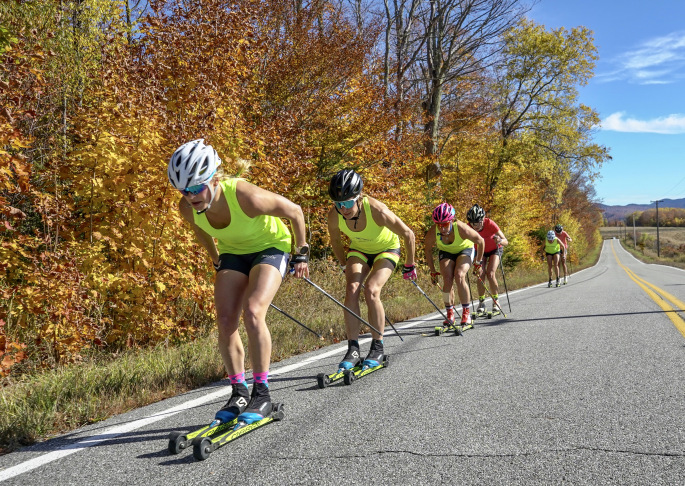
The SMST2 squad led by Jessie Diggins pushes the pace in a double pole interval workout during a fall 2019 training camp in Lake Placid, NY. (Photo: Matt Whitcomb / smseliteteam.wordpress.com)
It’s May. Yes, really.
For most skiers, the new page on the calendar also marks the beginning of a new training year. Dust off your rollerskis, locate your heart rate strap and drink belt, and make sure your running shoes have plenty of life in them.
With the country still predominantly on public health orders to stay close to home, avoid groups, and keep at least six feet of distance from those outside your home, kicking off a new cycle is happening without hugging our training partners, post-workout high fives, or otherwise gathering to ring in the new season. There also remains abundant uncertainty regarding the feasibility of racing during the upcoming season from the World Cup level to the junior and collegiate circuits to popular skiing. Nonetheless, we open our training logs and carry on.
Last season ended abruptly and the off season may have looked different than anticipated. We may have put our energy into homeschooling children, sourdough baking, binge-watching Tiger King, connecting virtually with our family and friends, or otherwise remaining largely homebound and less active than we’re accustomed. On the flip side, maybe the change in schedule has freed up additional time for long adventures and you’ve logged more hours in April than ever before.
Either way, at the onset of a season, you may be interested in checking in on your fitness and strength, looking for metrics to track improvement over time and to guide your pacing or heart rate zones during future workouts. FasterSkier reached out to Pepa Miloucheva, head coach of the Craftsbury Green Racing Project, to discuss fitness testing that could be done without the support of a facility or coach, making it accessible to any level skier as they begin the new year.
Miloucheva provided the disclaimer that she relies on advanced metabolic testing with her athletes to determine VO2 Max and lactate threshold levels to assess fitness and heart rate zones, and then prescribes training based on this information. With that caveat, Miloucheva holds a masters degree in Sport Science with a focus on physiology and biomechanics and has been coaching for over 20 years, over a dozen of which have been spent with the CGRP elite program.
Before jumping into assessing fitness and blowing up trying to hit a new PR on the SkiErg, Miloucheva emphasized that the most important thing an athlete can do at the beginning of a new cycle is to have a training plan and to understand how the periodization targets different areas of athletic development. This might be a plan from a coach or one found online.
“If someone really wants to establish a baseline and monitor, then they have to have a training plan,” said Miloucheva in a call. “I think everything else is kind of pointless, because all of these tests won’t give you anything if you don’t know what you’re looking for. In general, everything starts with first having a good training plan.”
Once a clear plan is established and you have taken time to understand it, then decide which part of the training process you would like to test.
“If you have 2-3 months of high volume, you want to test your basic aerobic improvement. You do the test, you see if you’ve actually improved. When you start doing a little bit more speed, you want to see if you’ve improved your speed. So you really have to schedule these tests based on your training plan.”
As the typical periodization of the year for skiers focuses on aerobic development during the spring and summer, a good starting place could be an uphill run test, possibly combined with a rollerski or SkiErg time trial, if those are available to you.
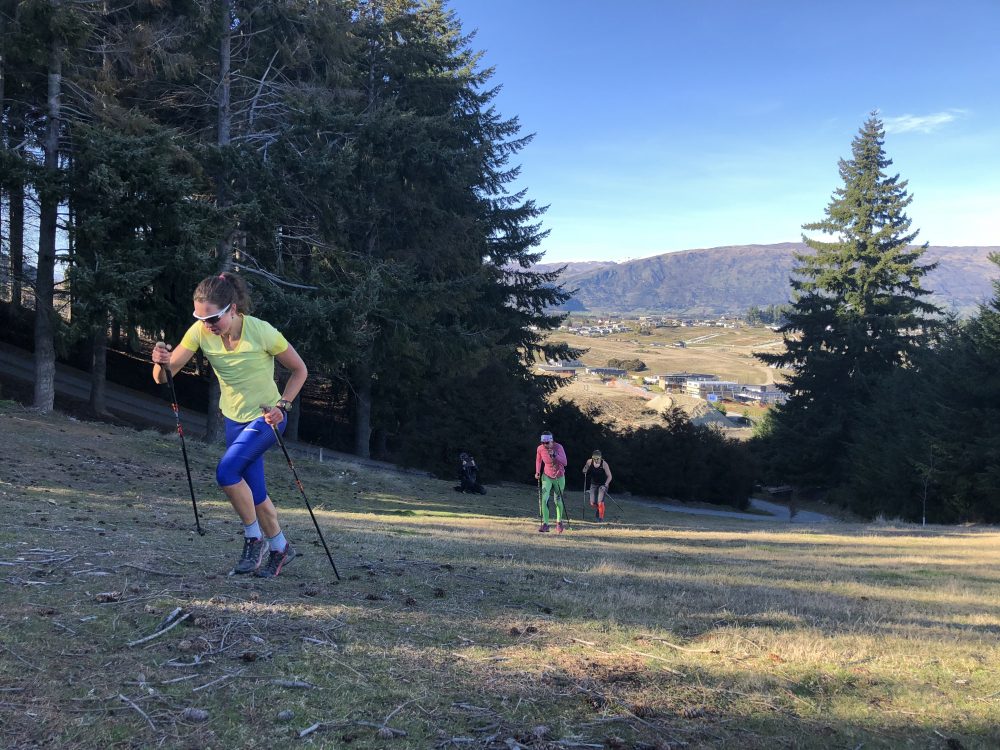
Traditionally, a 3000 meter run on the track was commonly used as an aerobic benchmark, but the results can be skewed based on individual running economy. Athletes with more running experience and better form often fare better than those with comparable or potentially better fitness. As such, most ski programs have transitioned toward an uphill run test, as it tends to level the playing field in terms of the impact of running efficiency on results.
In addition to being a good indicator of aerobic capacity, Miloucheva explained that the test has the added benefit of being easily repeatable with relatively few outside variables that might impact performance.
“The uphill running test is probably the most standard around the world. Simply, it’s easier to repeat. It’s a little bit less affected by the weather, but there are still a lot of elements and it is hard to keep it consistent.”
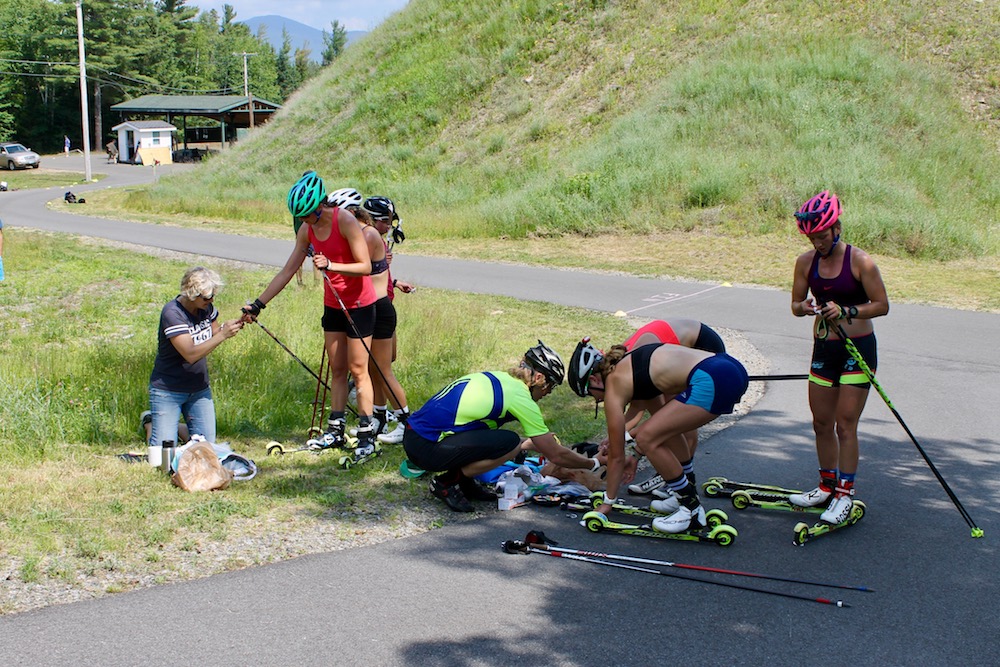
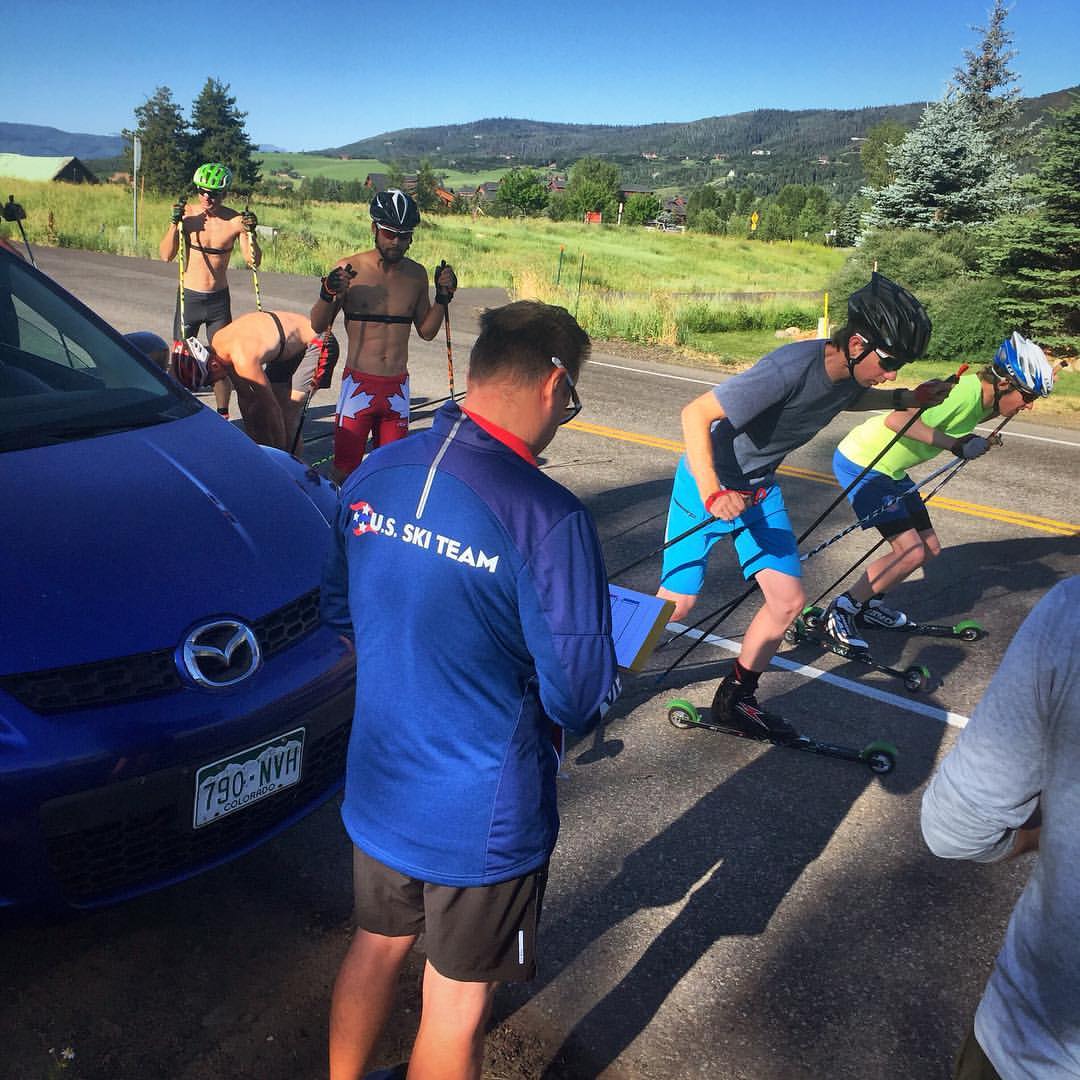
Craftsbury Green Racing Project Head Coach Pepa Miloucheva (l) and Stratton Mountain School T2 Team Head Coach Pat O’Brien (center) assist athletes with lactate testing after the U.S. Ski Team’s rollerski team sprint on July 15, 2018 in Lake Placid, N.Y.
If you’re looking to track your own progress on an uphill course, Miloucheva recommends finding a stretch of road or trail with little traffic that takes roughly 10-12 minutes. The effort should be steady throughout the test and you should finish feeling completely spent.
Be careful not to start out too fast as you want your heart rate to increase throughout the test, rapidly at first then gradually continuing to rise toward your lactate threshold heart rate, which can be estimated as the average heart rate sustained over the last five minutes of the test assuming it was well-paced. (TrainingPeaks has a deep dive on blood lactate and lactate threshold here, or you can read this description of lactate threshold training by Len Kravitz Ph.D., Exercise Science professor at the University of New Mexico.)
As for the course, you’re looking for terrain that is runnable, meaning you won’t need to resort to walking or hiking, and a relatively consistent grade.
Miloucheva later added that many veteran athletes have their own aerobic fitness test piece, which is also perfectly sufficient.
“I’m an old lady and I have this loop around the lake I do every year and I measure my time just for fun. So in general, everybody who has been training for years, they have a place where they can run the test.”
Miloucheva has also used a 1-kilometer uphill double pole test on rollerskis with some of her athletes. Her course starts relatively flat, climbs gradually, then levels off at the finish.
“The biggest thing is that [athletes] need to keep moving, so it cannot be very steep because strength and the resistance become the issue [rather than fitness].”
She has found this test harder to standardize than the run test, meaning results must be taken with a grain of salt.
“The problem using it year to year is that [the athletes] don’t always use the same rollerskis, they change wheels, cold weather and cold pavement changes a lot. So you have to consider all these details with the results.”
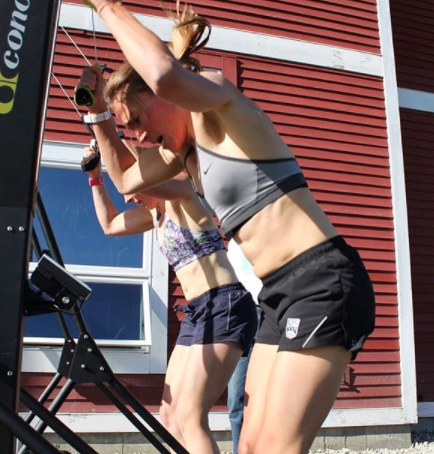
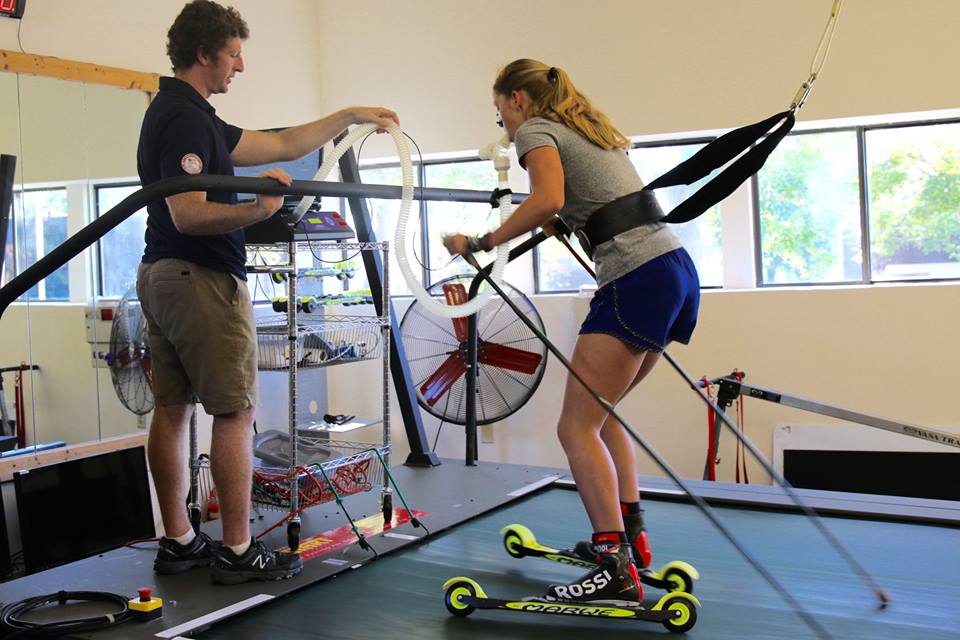
Sophie Caldwell and Annie Hart square off for a SkiErg time trial during a week of testing with the SMST2 team in 2017. (Photo: Instagram @sophiecaldwell(
Because of the ease of standardization, Miloucheva prefers using SkiErg time trials, as athletes can repeat the test indoors with a fixed resistance. Her junior athletes complete 1 and 2 k time trials, and her senior athletes additionally complete a 5 k test. The CGRP athletes complete the tests while hooked up to a VO2 Max testing equipment. If these are available to you, these tests could also serve as a benchmark for aerobic fitness with some ski specific strength indicators.
As for strength, Miloucheva is working on developing a test she feels is informative and can be standardized, as she is not satisfied with other tests used previously. She has historically used a version of the Canadian Strength Test (outlined here by Jackson Hole Ski & Snowboard Club), which counts the number of pull-ups, sit-ups, push-ups, box jumps, and dips an athlete can do in one minute with one minute rest between each exercise. Some differences in Miloucheva’s version include the use of single leg squats within a 30 second time period and measures pull-ups to exhaustion.
If you’re completing this test from home, ask a member of your household to help time, count, and keep your form honest so the data reflects your current strength accurately.
Okay, you’ve done an initial test of your aerobic fitness and/or strength. Now what? How soon should you repeat the test to check for improvement?
Miloucheva reiterated that it is essential to plan testing between training blocks to assess whether the block had the intended impact on fitness. She explained that her testing weeks are written into her general yearly plan for athletes at the beginning of the season.
When considering your own plan, space the tests out roughly 6-10 weeks to give the body time to absorb and respond to training. In addition to striving for a faster time, you can also consider trends in heart rate, as more time during the test spent closer to the lactate threshold heart rate is also an indicator of improved aerobic capacity.
To get the most information from a testing period, it is essential that each round is approached the same way, including how the training looks in the days prior and the warm-up performed before beginning the tests.
“You want to have a standard approach into the test, because you don’t want to do the first test after a very exhausting week and the second after an easy week, because it will affect the results.”
For CGRP athletes, this typically looks like one or two days of rest or easy training prior to a test.
There you have it. If you’re looking to assess and monitor progress in your fitness, first select and understand a training plan. Then, determine what factors of your fitness you’d like to assess and decide when a set of tests might fit best between different blocks within the training plan. Finally, do what you can to ensure that when the tests are repeated, the environment is as controlled as possible and your approach is the same so improvement (or lack thereof) between tests provides accurate insight into how your body is responding to training.
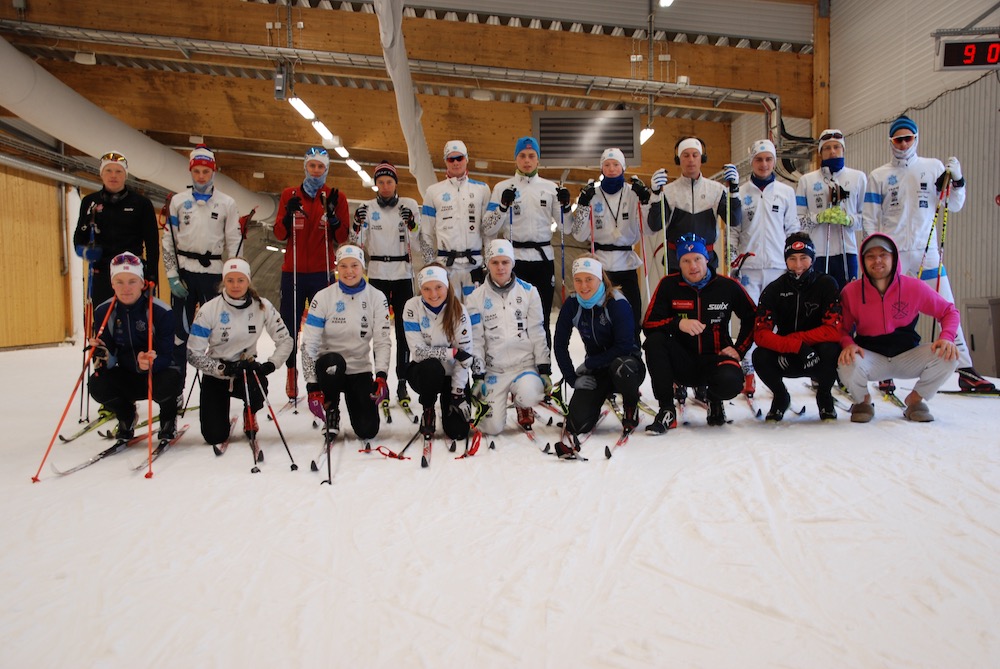
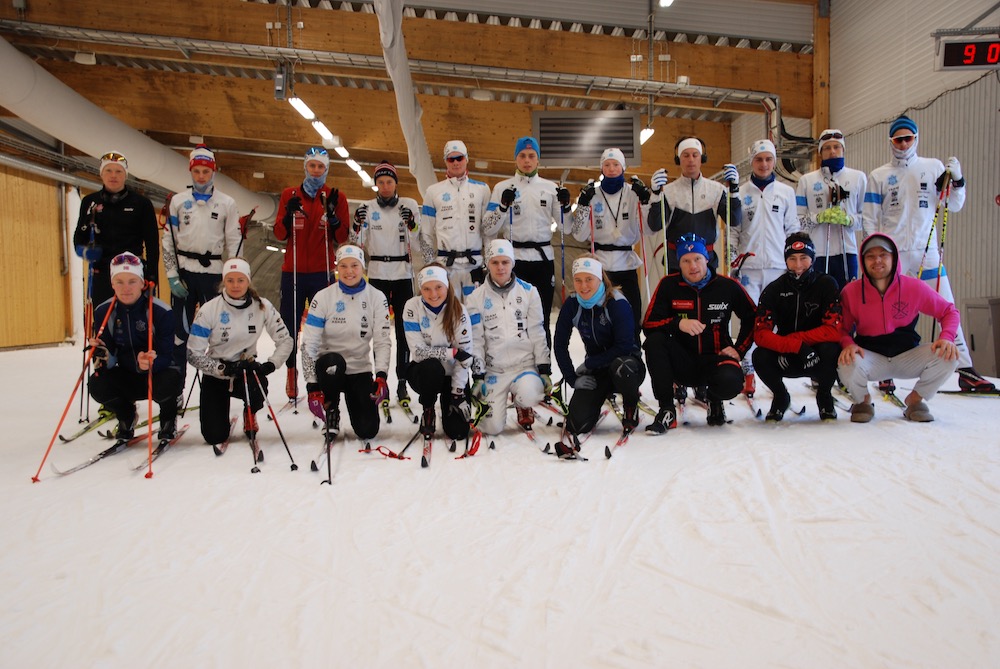
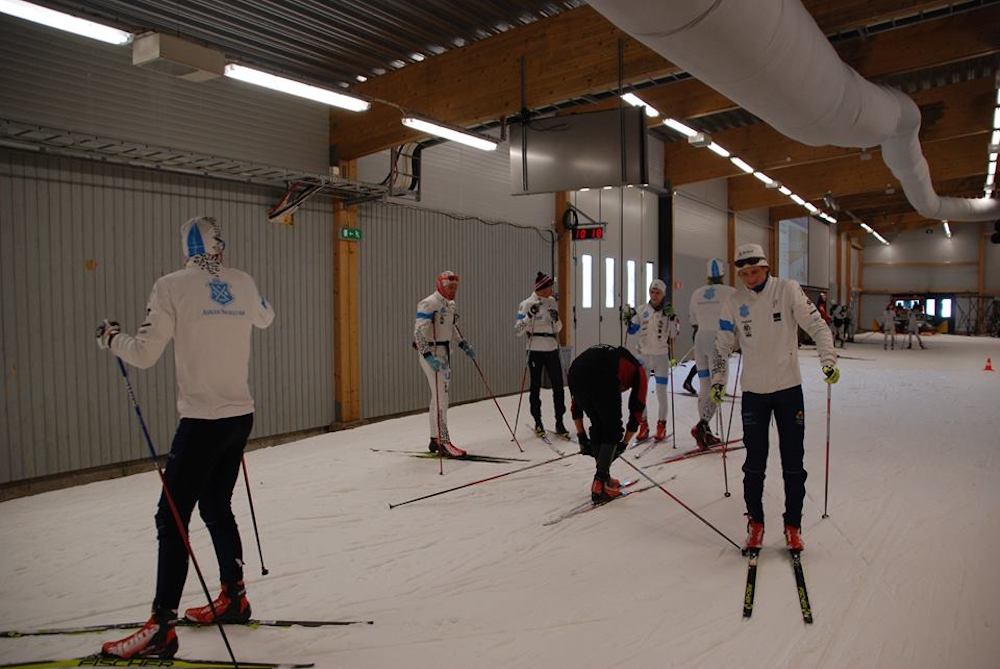
Team Asker gets together for a group shot in the ski tunnel in Torsby, Sweden. (Photo: Johanna Lier)
Editor’s Note: The following is the fourth post in a series proposed by Maks Zechel, a 20-year-old Canadian cross-country skier embarking on his first season training abroad. He recently made the big move to Norway, where he’ll be training and racing with Team Asker for the next nine months. Through these updates, Maks hopes to share his personal “observations, stories, and lessons learned” to help close the gap between North American and Scandinavian nordic skiing. Previous posts: #1,#2,#3, and #4.
***
I never thought that on my 20th birthday I would be shivering at the top of a ski resort, a thick fog obscuring the spectacular view of Oslo, listening to 30+ Norwegians sing the Norwegian birthday song for me. But I guess turning 20 was bound to be different!
“No more excuses,” was my first thought. Gone is the security of being a teenager. Rather than impressing people with maturity, it now feels like it is expected. I think it’s a good thing, but it doesn’t make being an adult any easier. My trip to Norway has been full of moments when I suddenly realized, “Oh, I guess I’ll just have to figure this out on my own.” My parents are no longer always present to make introductions, so now it is up to me to advocate for myself. Risks taken as an adolescent do not come with the expectation to produce results. “I’m impressed,” people say, and they applaud you just for trying. But adults are expected to see things through to completion.
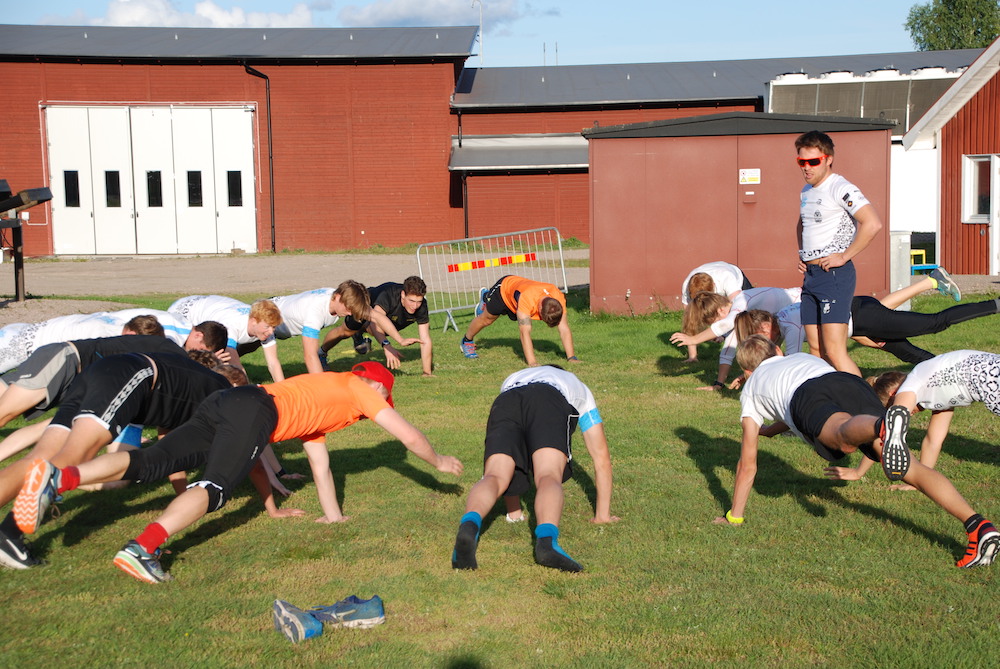
Team Asker group core session after a ski in the tunnel in Torsby, Sweden. (Photo: Johanna Lier)
Back on a cold, foggy Norwegian ski slope at the end of August, my teammates and I were about to tackle 6 x 6 minute Zone 4 bounding intervals. In Norway, bounding with poles is called elghufs, or “moose-hooves”. I had never done a bounding workout of this duration and intensity. Despite this, I decided to take a risk and stick with the best runner on the team, who was two and a half minutes faster than me on our last uphill running test. I stuck with him from the first interval, and stayed with him as he threw in big surges on the plateaus between climbs. He added these surges because he is trying to get better at working the flat sections of ski races in the winter, which happens to be one of my goals as well. We did the whole workout together, and I stayed with him until he got away on a downhill and a steep climb at the end. I took a risk in a workout, not caring if I blew up halfway through, and it allowed me to train at a higher intensity than I would have thought possible.
Earlier this summer I listened to a “TED Talk” by Eduardo Briceño on “the learning zone and the performance zone”. At first it didn’t seem like a life-changing lesson, but since I arrived in Norway, his ideas have led me to think differently about my actions, and in particular, my training. Briceño discusses how people, from office workers to athletes, fail to improve at what they do, whether it is a hobby or a job, because they do not give themselves the opportunity to take risks, make mistakes and learn. In our society, the “performance zone” is the default; this is where we only do the things we are comfortable with, because we want things to be perfect, because that is how we envision our end goals to turn out. Briceño argues that we should encourage employees, athletes, and ourselves, to spend more time in the “learning zone,” where we break our ideal performance into the things we need to work on to get there. It is only here that we get better, because it is here that we allow ourselves to try things that we would otherwise never attempt for fear of failure. In the learning zone, risk and creativity produce the most astounding results. Having reached higher comfort levels, it is possible for someone to apply their repeated failures and lessons-learned to a better end result.
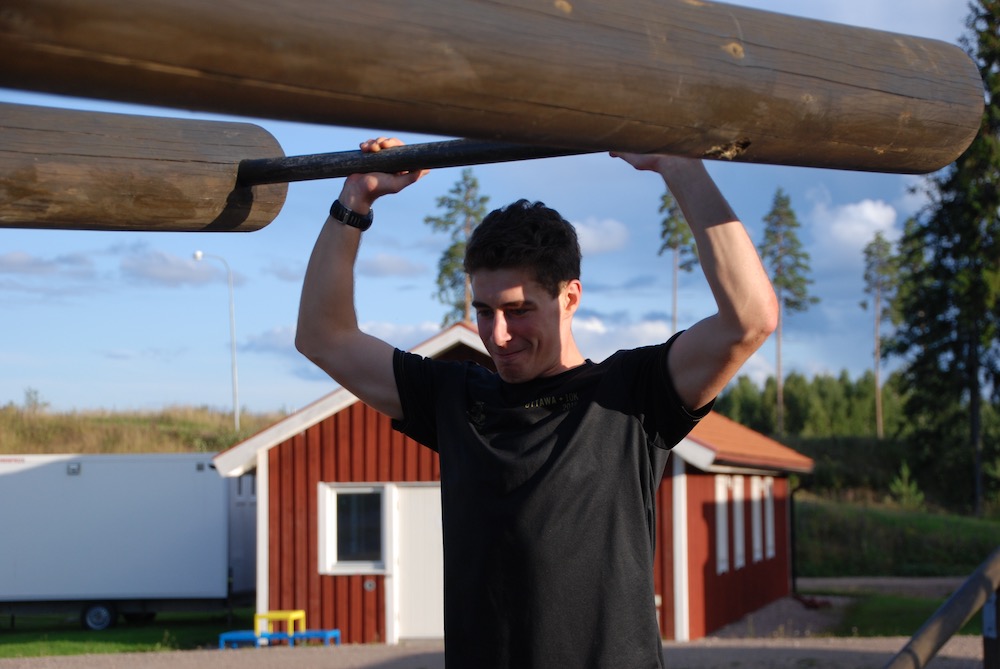
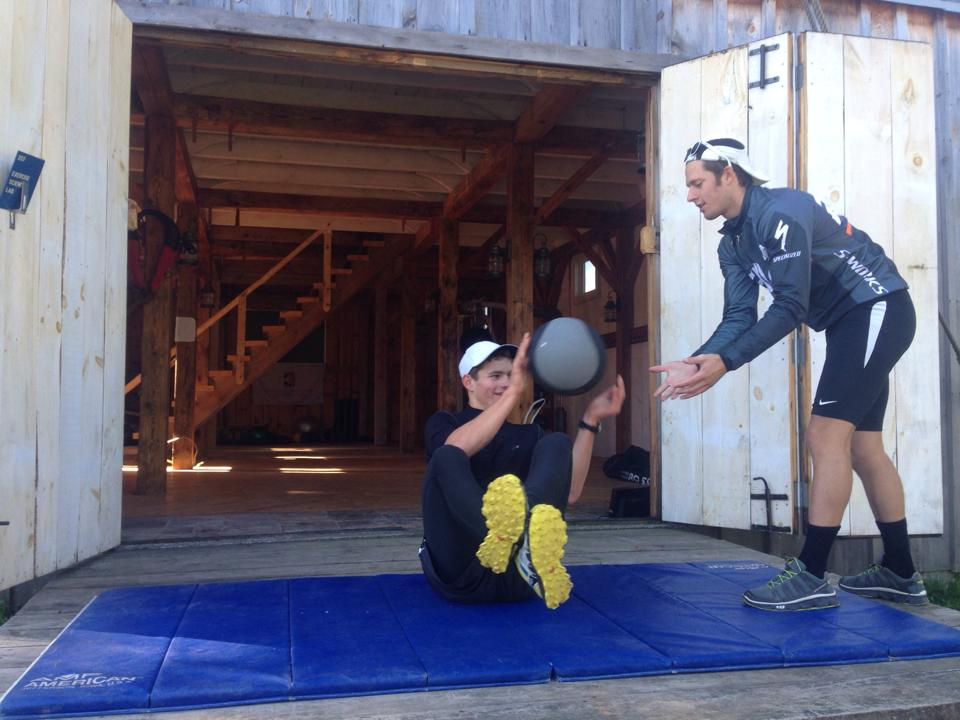
Author Maks Zechel doing pull ups: “the most popular Norwegian strength exercise.” (Photo: Johanna Lier)
A few days after “birthday elghufs”, Briceño’s ideas come back to me as I am training in the ski tunnel in Torsby, Sweden. I am back here for a long-weekend training camp with Team Asker. In the tunnel I confront a skiing related fear of mine, developed over a few years of poor performances in classic races. I dread the feeling of my grip giving way while striding up a hill. I am determined to become a better classic skier, the technique I was strongest in when I was younger, so I work hard at anything that I believe will make me a better classic skier: bounding intervals, core, double poling, hours of video technique work, and skiing without poles. If I can ski up a hill legs-only, then surely I can do it with poles in a race, right? Whenever I am on skis, I challenge myself to stride up the steepest hills without poles, but it becomes a challenge that I must perform to perfection, otherwise in my mind I have failed as a classic skier. The pressure that I put on myself leads me to shuffle stiffly and tentatively up hills, not allowing myself any room for error. The result is a poor imitation of the principles of classic skiing, lacking any weight shift, pop in the ball of my foot, or ankle compression. Sure, I made it to the top of the hill, but I didn’t summit the mountain.
On our first morning in Torsby we have a distance classic ski in the tunnel. Rather than skiing slowly around the tunnel for a couple of hours, our coach has added some variety to our workout: one lap legs-only, one lap thinking about good striding on the hills (not thinking about heart rate), and one lap with a short “race pace” acceleration. The variety in this workout is important in early season skiing so that we can take advantage of our short time on snow to train our muscle memory to ski properly, getting rid of lazy habits developed while rollerskiing.
Maks Zechel working on legs-only in the ski tunnel in Torsby, Sweden. (Photo: Johanna Lier)
On my legs-only loops, I decide to take a risk. Instead of pressuring myself to make it up the entire hill, I ski as dynamically as I can, focusing on full commitment to each ski and compressing the wax pocket as if I had perfect grip. Although frustrating, I know that it is better for my development to ski properly up half the hill, than to shuffle up the entire thing. A few times I am rewarded with making it to the top, and other times I almost face plant spectacularly in front of the Norwegian junior national team coach.
The risk of embarrassment is one that I am willing to take. I made a decision to escape my comfort zone when I left Canada, leaving behind family, friends, and a team that I have trained with for nine years. I left behind the chance at another year of racing on the NorAm circuit and seeing marginal, or perhaps substantial, improvements up the results board. I was sick of feeling like there was an order to things. If I beat a friend of mine during a race, that meant that I had had a good day, but if someone finished ahead of me who I was supposed to beat, then the day was unsuccessful. To me, this type of racing environment was toxic, as I struggled through a season of failed expectations. I am fortunate to have had the means to come to Norway, where simple training aspects, things that had lost their magic over the years, are now bringing back the same giddy excitement that skiing originally gave me. I am in a place filled with potential opportunities, but now I need to have the guts to seize them.
Team Asker reparing for an intensity workout in the ski tunnel in Torsby, Sweden. (Photo: Johanna Lier)
While training in Torsby, we were lucky enough to be there at the same time as the Norwegian junior national team and national recruit team (a step below the national senior team), as well as Anders Gløersen, Charlotte Kalla, Stina Nilsson, and Hanna Falk. I watched some of the members of the recruit team doing offset sprints, and it was the fastest I have ever seen someone sprint on skis in real life. Rather than being intimidated, I felt almost relieved to watch some of my idols skiing this fast. The mystery was gone; this is how fast you have to ski to be great, as simple as that, and now I could spend the entire weekend shadowing some of the best skiers in the world.
On our first day in Torsby I had the opportunity to do two things for the first time in my life: rollerski on a treadmill and take aVO2 max test (maximum rate of oxygen consumption). Naturally, because of my name, I prefer to say it in Norwegian: VO2maks.
After an initial stumble on the treadmill, I found it quite easy to classic rollerski on. Before the test started I warmed up on a few different gradients and speeds, unable to stop smiling at myself in the large mirror in front of me. Here I was, rollerskiing in the same laboratory that has tested countless World Cup skiers! The test began at a gradient of 10 percent and speed of 10 kilometers per hour, with the gradient increasing every minute until it reached 18 percent. This felt remarkably steep. From then on the gradient remained the same, but every 30 seconds the speed increased.
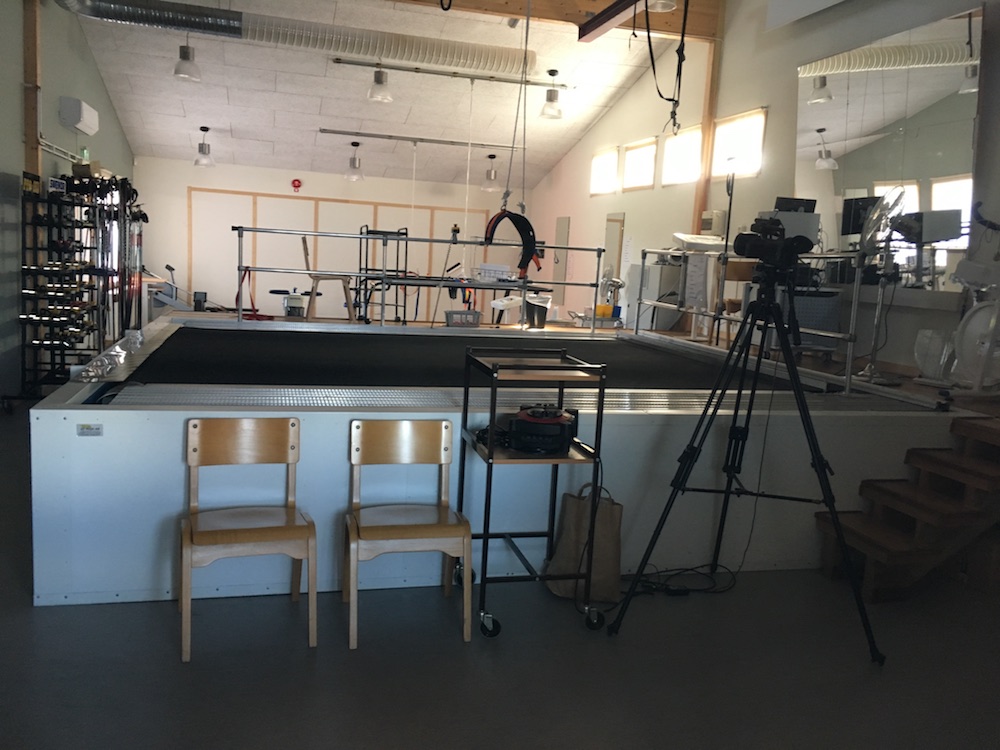
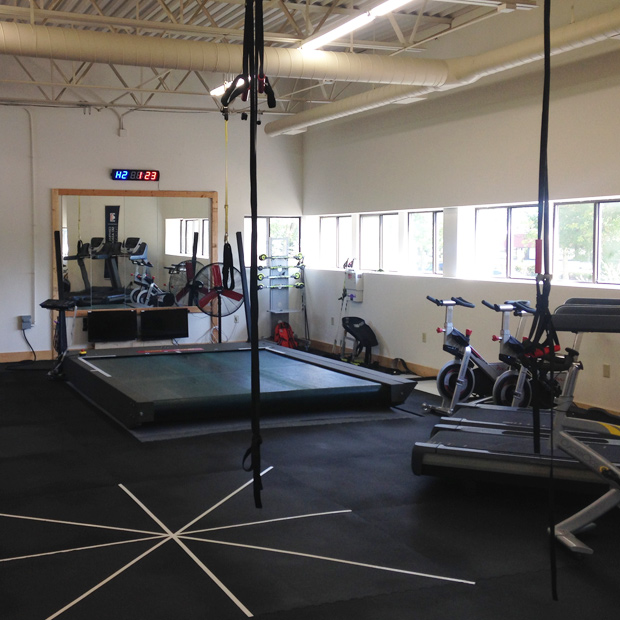
The rollerski treadmill/testing lab in Torsby, Sweden. (Photo: Maks Zechel)
During testing there is a harness around your waist so that you don’t fall off the treadmill, a heart rate monitor around your chest, and a mask strapped to your head to measure oxygen consumption. It’s a lot of gear hanging from your body, and your head has to remain relatively steady, but once the test started I found that the pain was an adequate distraction from all of this. Unfortunately, during my test a strap on my mask came undone and the mask fell off while I still had something left to give, so I was robbed of the chance to ski until collapsing (the skier’s dream). My VO2 max result was 74.5 ml/kg. Last year Harald Amundsen, the top skier on the team, reached a VO2 max of 85 ml/kg as an 18 year old (an exceptional result).
Being in a new place, with a new team, and in close proximity to many of the world’s best skiers, there is a lot to take in. It is important for me to absorb as much as I can during my time here, but it is also important to stay consistent with things that I have been working on before I got here. If I jumped to apply every newly learned training philosophy to my training, I would be all over the place and have no chance to improve. I am allowing myself to take risks and make mistakes while staying true to some of the basics that got me to where I am. In the midst of so many talented and competitive skiers, I am trying to create a learning space for myself, devoid of expectations, so that I can learn without restrictions. When winter finally comes, I hope that I can translate my learning to some fast performances on skis. I have had a lot of practice translating after all…
Norwegian Phrase of the Week
Norwegian: Kan jeg få skyss?
Translation: Can I have a ride?
Norwegian: Kan jeg få et kyss?
Translation: Can I have a kiss?
*An important distinction that could add an unexpected twist to your ride to practice, as skyss and kyss sound almost exactly the same.*
***
About Maks: Maks Zechel is a competitive cross-country skier who secretly wants to become a professional mile runner. He loves hiking and going on canoe trips with his family, as well as peanut butter cups in ice cream. Johan Olsson is his favourite skier and he hopes to race the Cortina-Toblach stage of the Tour de Ski one day. He enjoys writing about his experiences. Follow him on Instagram @makszechel.
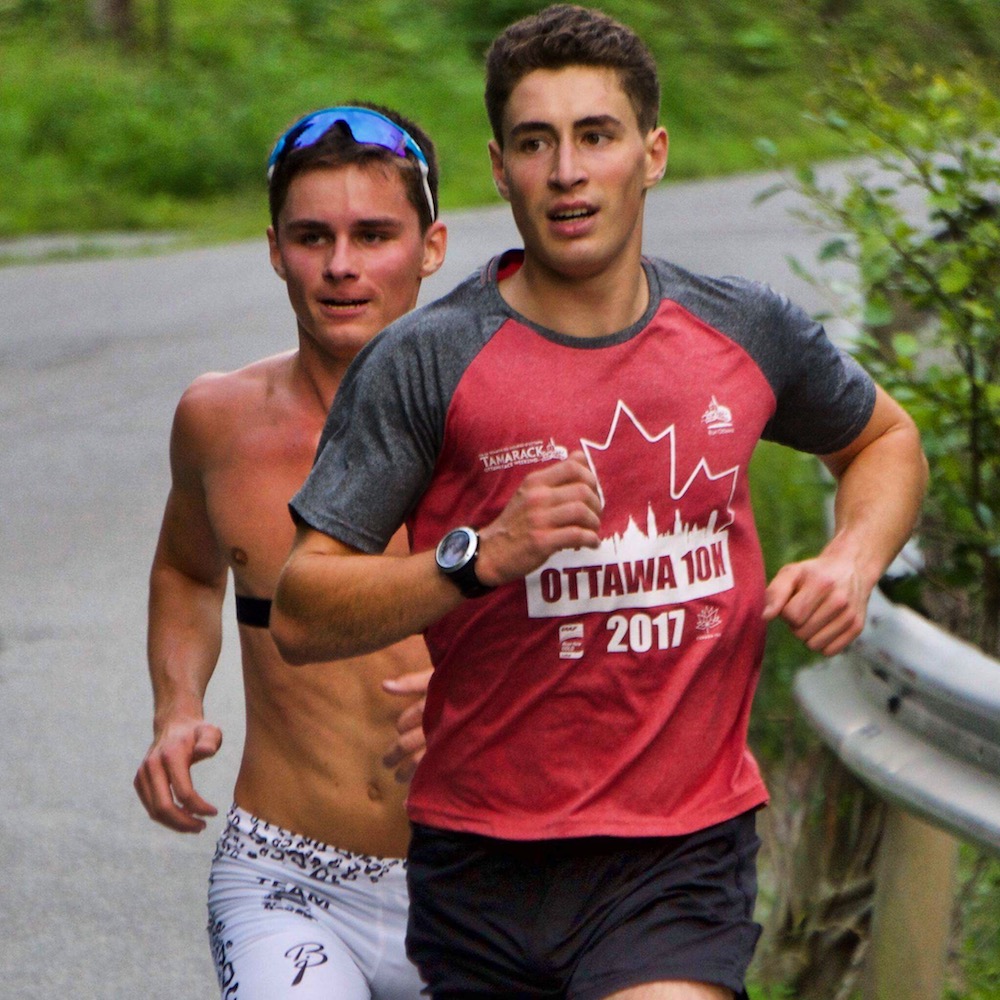
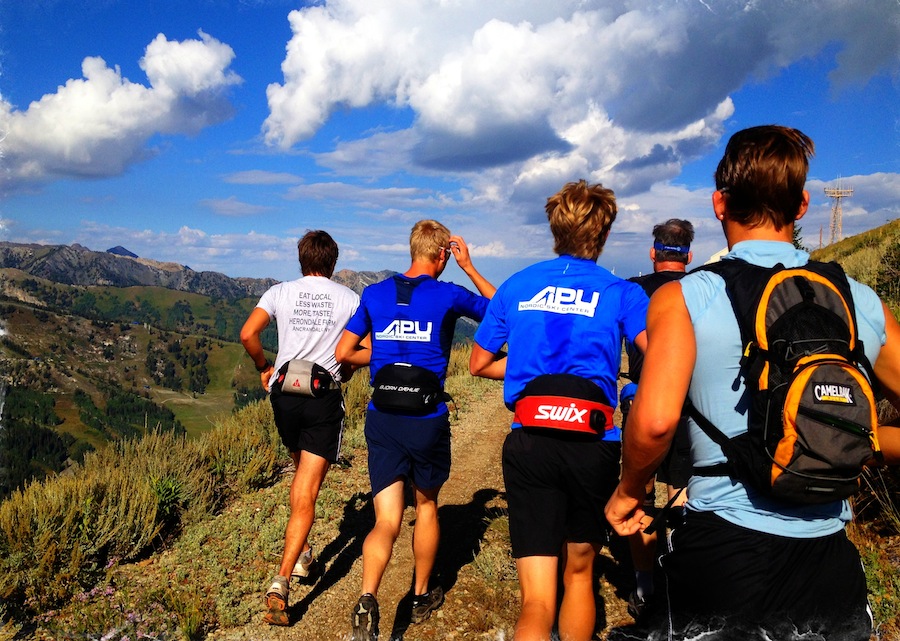
Asker til topps uphill running test, featuring author Maks Zechel (front) and his teammate Ola. (Photo: Lars-Erik Nygaard)
Editor’s Note: The following is the fourth post in a series proposed by Maks Zechel, a 19-year-old Canadian cross-country skier embarking on his first season training abroad. He recently made the big move to Norway, where he’ll be training and racing with Team Asker for the next nine months. Through these updates, Maks hopes to share his personal “observations, stories, and lessons learned” to help close the gap between North American and Scandinavian nordic skiing. Previous posts: #1,#2 and #3.
***
Tuesday, Aug. 15, 2017:
It is late at night when I finally get the message: “Meet at Føyka stadium, 9:00am, for practice, 10x2min zone 4 double poling.” I panic. In less than ten hours I will be meeting my new teammates for the first time. My initial reaction is defensive: “I can’t do this. It’s too late. Maybe if I had more time to prepare…. I’ll just do the workout on my own.” I know what to expect, and it terrifies me.
Views of the Black Forest, Germany, 2011 (Photo: David Zechel/Dad)
When I was 13 years old I went to a school in Germany for a year; nobody spoke English and I barely spoke any German. On my first day of school, I walked through the school doors alone. Somebody asked me what my name was, and I replied “I don’t know,” only realizing what they had said after they looked at me like I was crazy. I ended up having an amazing year in Germany and I am still in contact with some of the friends I made there.
Seven years later, the thought of yet again integrating myself with a peer group in a country where I don’t know anyone and can’t speak the language, makes me nervous. It was time for me to make some decisions, time to step up and seize my opportunities. I did not come all the way to Norway to train in solitude for fear of the awkwardness that comes with learning a new language and meeting new people. This may have been just one practice, but to me it was a decision point on whether or not I had what it took to make this trip successful.
I went to practice. I arrived 20 minutes early and waited, breathing in the thick air of anticipation. Slowly, the rest of the team started to arrive. I greeted each of them with a smile, a handshake, and “Jeg heter Maks (My name is Maks)… I am from Canada.” Almost everyone spoke English well, and even if they didn’t, we all spoke the language of “I think I’m going to puke” at the end of the interval session. I rollerskied home from training, giddy with happiness. This was why I put myself into these situations that scare me, because the friendships formed and the memories made are more rewarding than staying in my comfort zone.
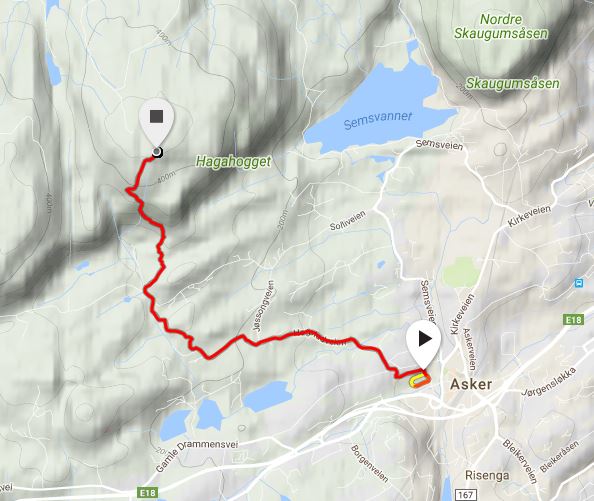
Asker til topps uphill run course (Red = very high heart rate, ouch)
After Tuesday’s intensity workout we transitioned quickly to the team’s second testing camp of the year. The “lactate-party” started on Friday evening with a brutal 5.8-kilometer mass-start uphill running test. The race started with a lap of the track in the center of town, then climbed steadily to the halfway point, where the course entered the forest and followed steep, narrow trails requiring all of my willpower just to keep running. The race finished on top of Hagahogget, a rocky peak with an incredible view over the fjord and surrounding towns. I ended up third, far behind the winner, Erland, who happens to run an 8:50-minute 3,000 meter.
The next morning we began the second test, a 4.4 k mass-start uphill double-pole race. It was difficult to go from racing at 7 p.m. the night before to racing again at 9 a.m. the next morning, but it reminded me a lot of afternoon distance race starts followed by early sprint qualifiers the next day, something that I experienced last year at U.S. nationals in Soldier Hollow and Canadian Nationals in Canmore.
Day 3 started off with one of the tests I had been looking forward to the most: a 9.5 k individual-start skate time trial at the Holmenkollen rollerski track. After driving up a long road out of Oslo, I arrived at arguably the most recognizable nordic sports stadium ever built. In the center of everything is the spectacular ski jump. Rollerskiing over the top of the course, you are treated to a panorama of Oslo, the Inner Oslofjord, and all the surrounding towns. Warming up around the course brought me back to the 2011 World Championships, which took place at Holmenkollen. I watched the races live on TV while I was living in Germany. There are many iconic moments from that World Championships that I remember clearly to this day (although I must admit, I regularly re-watch the races).
As we are rollerskiing, my new friend, Erland, points out special parts of the track. The last hill before you enter the stadium is called “Hellenbakken,” named after Swedish skier Marcus Hellner and the attack he made on that hill which won him sprint gold over Norwegian favourite Petter Northug in front of thousands of Norwegian fans. I ask Erland if the stadium is called “Harvey stadium.” No answer, but he laughs amiably. Now, rollerskiing exactly where it all took place, I can see the asphalt turn to snow and Alex Harvey crossing the finish line. He puts a finger to his lips in response to a stunned and silent Norwegian crowd as he and Devon Kershaw take team sprint gold ahead of Norwegian legends Ola Vigen Hattestad and Petter Northug. The crowd may have been speechless, but 13-year-old Maks was yelling in excitement at German Eurosport.
The Holmenkollen rollerski course is filled with the types of steep climbs common in winter ski races, but almost non-existent in summer rollerski races. There were two or three hills per lap where I was forced to offset, something that I have never done before in a rollerskiing race effort. This type of dryland training is invaluable to winter racing success.
View from Hagahogget, end of the uphill running test. (Photo: Maks Zechel)
With the morning time trial finished, we completed the testing camp with a flat, double-pole sprint qualifier in the afternoon. Four race efforts in three days, and five intensities in a week; not a gentle introduction to Norwegian ski training. The amazing part about this weekend was having many strong teammates to compete with. Everyone has different strengths, and depending on the test, I had between five and 10 skiers with whom I was competitive. I did not have the best four race efforts of my life, but I am excited to be training with people who are around my speed, and to have others who are pushing all of us to reach new levels.
Some schools of thought may disagree with cramming this many intensities into such a short period of time, but Team Asker puts a big emphasis on recovery after these intensity blocks. Athletes only ever post on social media about their most “epic” workouts, so it is easy for skiers to think that they need to be doing these ridiculous workouts all the time. I think it is important to recognize the purpose of these workouts, and also gain an understanding of the training that surrounds these big workouts. With regard to Team Asker’s testing week, I appreciated becoming familiar with the difficulty of back-to-back race efforts — the refocusing and the physical shock that one experiences from competition — all in the risk-free safety net of summer training. The next testing week will take place in five weeks’ time and I am excited to give it another shot.
I have to acknowledge how welcoming and kind the Asker Skiklubb community has been. I have already made many friends and have talked to numerous parents who have sought me out just to get to know me. It is never difficult for me to find a ride to training with a teammate, and everyone helps me feel comfortable, while at the same time pushing me to learn Norwegian and become a bigger part of the team. I am having no difficulty working with the coaches, who are excited to have me join the team and want more skiers like me to come train with them as Team Asker grows.
Have I convinced you yet?
Norwegian Word of the Week:
Hjem. Home.
Due to popular request, a picture of another, smaller, roommate of mine. (Photo: Maks Zechel)
About Maks: Maks Zechel is a competitive cross-country skier who secretly wants to become a professional mile runner. He loves hiking and going on canoe trips with his family, as well as peanut butter cups in ice cream. Johan Olsson is his favourite skier and he hopes to race the Cortina-Toblach stage of the Tour de Ski one day. He enjoys writing about his experiences. Follow him on Instagram @makszechel.
Taylor Fletcher cruising in the 2017 Fish Creek Time Trial in Steamboat Springs, Colo. (Photo: Jasper Good)
From late June into early July, U.S. Nordic Combined hosted a major training camp in Steamboat Springs, Colo. Among the sessions was the Fish Creek Time Trial, a skate rollerski race first held in 2007. That year, Johnny Spillane set down the first in a series of course records that would be improved by different athletes in the next decade.
The time trial is 8 kilometers and gains 885 feet of elevation, starting just south of Steamboat Springs and ending up in the Medicine Bow-Routt National Forest.
National team member Jasper Good is a Steamboat Springs native and remembers the first time he participated in the now-annual time trial.
“In 2012 Ben Berend and I miscalculated how long it would take us to get to the start,” he wrote in an email. “We proceeded to show up and were getting yelled at by everyone saying, ‘You’re starting right NOW, GO GO GO!’ Not the best first impression at a time trial with the National Team.”
A group photo of participants in the 2016 Fish Creek Time Trial, from “young guns” to Olympians. That year, retired gold medalist Billy Demong competed. (Photo: Jasper Good)
OK, that first start was a snafu, but that’s one of the points of the time trial: getting young racers like Good and Berend were then on the same pavement with the national team veterans and staff. Good is now 21 years old and collected his first Continental Cup top-10 last season, so he’s on his way to being one of those veterans that juniors can measure their progress against.
“We do the annual Fish Creek Time Trial with everyone from national teams down to young guns,” Good wrote.
The time trial is a suffer-fest, starting with rolling terrain that must be worked very deliberately, and also featuring a few walls.
“The first half is a gradual but hard rolling uphill with a lot of V2 gradient, an important part to keep your speed up and use momentum over hills,” Good explained. “About [5.5 k in], you hit the first wall of the race. After the wall there is a false flat with another segment of rolling uphill V2 gradient before you hit the final climb. As it starts to kick up more and more, you hit the second wall where you really don’t want to bonk. Because after the top of that, you only have about 250 meters to the finish. But the last 250 at the very top is a false flat that hurts oh so much. The race finishes with all the racers sprawled out all over the parking lot.”
Because there are now ten years of data, performances can be compared both between athletes and from year to year for any individual racer.
“It has been helpful to see the results from this time trial over the years,” Good wrote. “With it being a mid-summer uphill time trial, it is good to see overall fitness and willingness to suffer, but it’s not always a key indicator of how an athlete may race in a NoCo race come winter. It’s more of a checkpoint mid-summer.”
Other things can change over the years, too: as the “suffer-fest” becomes more and more like a normal race effort over the years, athletes can change how they approach it. For instance, Good’s warmup has changed a lot since that first year when he nearly missed the start.
“My warm-up now resembles my winter time warm-up more than ever,” he wrote. “When I was younger it was mostly just warmup to the start of the race from downtown and then just send it into the race.”
How To Make a Great Time Trial Course
U.S. Nordic Combined Coach Martin Bayer starts athletes at the 2017 Fish Creek Time Trial in Steamboat Springs, Colo. (Photo: Jasper Good)
There are a few things to keep in mind while putting together a rollerski time trial course: just finding the biggest hill with a paved road is not enough. Here are some reminders from Good, who has done Fish Creek for several summers in a row now.
Not All Uphill. “The first part is all about pacing it right and not going out to hard,” Good wrote. “If you go too hard at the beginning the two walls [at the end] are absolutely brutal. Technique and momentum is key in the first half.” Choosing a course with a big chunk of rolling terrain will require athletes to use good technique, execute on their transitions, and maintain momentum. That means that finishing times will reflect not only the athlete with the biggest ‘motor’, but also to some extent that they are skiing well.
Overall Time. “Taylor Fletcher set the time trail record this year at 23:02,” Good writes. “But most of us race it in 23:30 to 26:00, so it is very similar to our typical 10 k times [in nordic combined competitions]. I think it is key that it is in a sense the same time as our typical race, and the same sort of mentality.”
When the Gun Goes Off. How will you set up your time trial? Mass start? Interval start? For Fish Creek, there’s a very deliberate seeding strategy. “It is an interval start with reverse order and the best skier starting last,” Good writes. “In that regard, it is good for every athlete to have someone to chase, and perhaps a stronger skier to go by them. This is good because everyone can try their best to hang on to faster skier and learn how they ski the time trial.”
Pick a Location. If your club is big, this isn’t a big issue — you will always have people to race. But potentially consider whether you can locate your time trial in a place where athletes from surrounding clubs might consider commuting to, or a spot where regional or national teams sometimes host camps. “It is important for all of the NoCo crew to do this time trial together so that every athlete can see where they are at in comparison to the best (i.e. Taylor Fletcher the last few years),” Good writes. “It is also an annual thing so everyone can go out and try and best their time from previous years.”
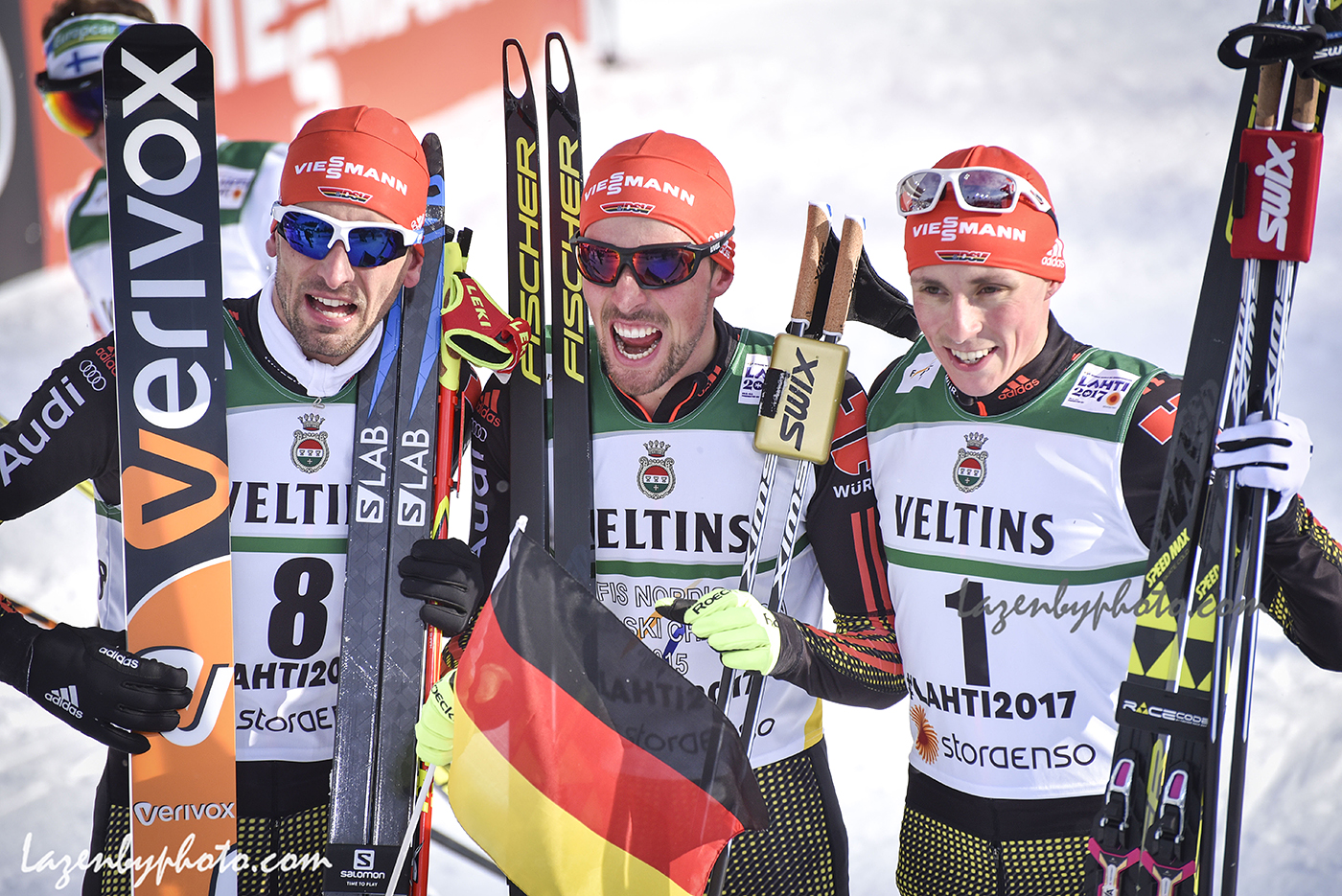
German nordic-combined stars Johannes Rydzek (c), Eric Frenzel (1) and Björn Kircheisen (8) after taking gold, silver and bronze, respectively, in the individual normal hill/10 k Gundersen at 2017 World Championships in Lahti, Finland. (Photo: John Lazenby/Lazenbyphoto.com)
What are the physiological capacities of nordic-combined athletes and can laboratory tests predict performance capabilities on the World Cup?
Those are the questions that a team of Norwegian researchers set out to answer by testing 12 competitors from eight different countries before a 2015 World Cup competition in Trondheim, Norway.
The study, led by Vegard Rasdal of the Norwegian University of Science and Technology and the Norwegian Olympic Sports Center, was recently published in the academic journal Plos One. It is an open-access journal, so you can read the paper here.
“The sport is always evolving,” Rasdal wrote in an email to FasterSkier about the results. “Today it is no longer enough to be ‘just’ a strong ski jumper or cross-country skier, you really have to excel in both in order to be successful in terms of podiums. Johannes Rydzek and Eric Frenzel, the two most successful athletes last season, were not only two of the best jumpers last season but also the fastest skiers.”
Indeed, they found that the best skiers in the nordic combined field have VO2Max capacities close to those of the best cross-country skiers, period – and even higher than those of Olympic medalist sprinters. Furthermore, this was a good predictor of World Cup results in the Trondheim competition.
Variability in Abilities and Physiology
There have been plenty of physiological studies on top cross-country skiers and some on ski jumpers, but the fascinating aspect of nordic combined is that two very different sports are combined. That creates uncertainty about what the ideal physiology for a competitor might actually be. Should they be light and explosive, for jumping? Strong and enduring, for skiing?
And do nordic-combined atheltes have as much explosive power as ‘special jumpers’, or as high aerobic capacities as cross-country skiers?
“As with most endurance sports, you will find a strong association between VO2Max and performance when the study group is heterogeneous, as e.g. a study group of 200 college students,” Rasdal explained. “Overall, VO2max is widely accepted as the most important factor for endurance performance. However, in a more homogenous study group, such as elite cross-country skiers, all athletes may have a ‘high enough’ VO2max to perform well at an elite level. Thus, other factors such as skiing efficiency becomes a stronger determining factor.”
U.S. Nordic Combined skier Bryan Fletcher jumping to 31st on the large hill at 2017 Nordic Combined World Championships in Lahti, Finland. At the end of last season, he was the top-ranked American in the overall World Cup standings in 34th. (Photo: John Lazenby/Lazenbyphoto.com)
Rasdal and his co-authors wondered whether nordic-combined athletes fell into the first group, with moderately variable VO2Max, or the second group, where all had such high capacity that they had to be distinguished by some other characteristics.
Because some athletes get their start in ski jumping, and all must also train for jumping, the athlete selection process and training background from young ages is different than for cross-country skiers and could lead to more variability among individuals.
“It is not given that all nordic combined athletes have a ‘high enough’ VO2max or vertical jump capacity,” Rasdal wrote. “The shortcomings in one may to some degree be compensated with higher level in the other.”
To address that question, the research team partnered with the International Ski Federation (FIS) to conduct laboratory tests on athletes the day before a World Cup competition.
“FIS was responsible for the invitation of athletes, and each nation in the World Cup was invited and encouraged to participate with two athletes to be tested,” Rasdal explained. “To collect data on the very best athletes in the world is always a challenge, especially so close to an important international competition. We as a research group are extremely grateful that so many World Cup athletes chose to participate in the data collection.”
The athletes ran the gamut from being ranked second to 66th in the previous season’s overall World Cup standings, and included the eighth-best skier and second-best ski jumper.
About Endurance Capacity, and World Cup Success
The hypothesis that nordic-combined athletes were more variable in their physiology compared to single-sport specialists was largely upheld.
“Among the athletes we studied, a VO2peak range of 66.9-80.8 could be found, which does illustrate the heterogeneity in nordic combined,” Rasdal wrote. “This may make subordinate factors such as skiing efficiency relatively less important (although still important) than VO2peak.”
The upper measurements of VO2Max among the 12 athletes are close to those of cross-country skiers.
Furthermore, it was clear that the athletes on the lower end of the VO2Max spectrum were somewhat less successful on the World Cup. At least at this World Cup event, the overall ranking at the end of the day was strongly correlated to an athlete’s VO2Max and ski performance.
“This study together with the study by Tønnessen et al. may indicate that a body-mass normalized VO2Max in the region of 75 ml/kg/min is a sufficient capacity for a strong cross-country performance in Nordic Combined, whereas 80 is at very highest percentile,” Rasdal explained.
However, the Trondheim World Cup course is not necessarily representative of all World Cup venues. And poor cross-country skiing could have been penalized even more at this venue than usual.
“Trondheim is a special arena compared with other courses in the World Cup, with many steep uphills and fast downhill terrain,” Rasdal wrote. “In addition, 2015 was a bad winter in Trondheim, and the course was salted and ice hard. This made the event well suited for technical good skiers with strong upper-body capacity. It is therefore necessary to investigate the impact of ski jumping versus cross-country skiing on overall performance, as well as the associations to laboratory capacities, also at other venues and conditions.”
And About Those Jumps
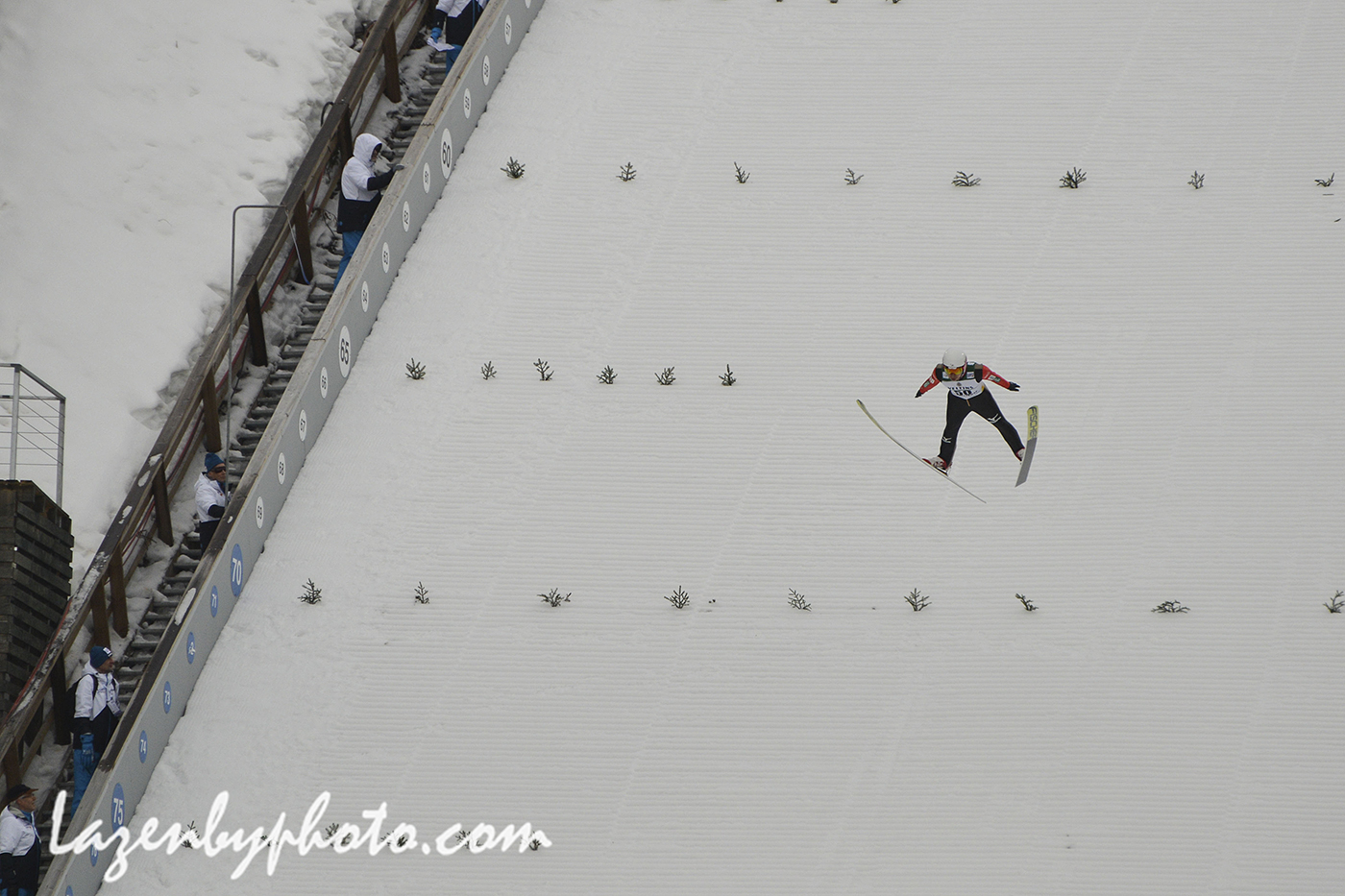
2017 World Championships jump training on Feb. 21 in Lahti, Finland. (Photo: John Lazenby/Lazenbyphoto.com)
The implication is that perhaps at a different competition, the association between ski jumping performance and overall competition ranking might be stronger.
“Unpublished data does show that [across a whole season], the regression line for ski jumping to overall performance is similar to that of cross-country and the correlation coefficients are similar,” Rasdal explained.
When it came to benchmarking, the researchers also identified laboratory measurements that could predict ski jumping performance by nordic-combined athletes. They tried two measurements: a straight, simple squat-jump, and an “imitation jump” where the athletes were asked to start in the same position they would on a ski jump ramp. The jumping style and technique varied from athlete to athlete.
While it seems logical that these would be good predictors of ski jumping performance, it actually wasn’t a trivial matter. Such measurements have mainly been validated on straight ski jumpers, and because of their different body mass and physiology the relationship between squat jumping and performance, for example, could very well have been different among nordic-combined athletes.
“The time available at the take-off in the [ski jump] hill may present a greater challenge for NC athletes than specialist ski jumpers as two-thirds of the NC athletes’ annual training consists of endurance training,” the authors wrote in the paper. “This does not only leave less time available for power and [jumping-] specific training compared to the specialists, but endurance training may lead to negative effects on muscle strength and power.”
But in the end, the same measurements did predict ski jump performance.
“The jump capacity in the sport-specific imitation jump distinguished performance level better than the general jump capacity in squat jump,” Rasdal wrote. “That supported the argument for sport-specific testing at an elite level.”
Still, the imitation jump wasn’t perfect at predicting actual ski jump performance.
“The upper range of the lowest ranked performance group touches the lower range of the highest ranked performance group,” Rasdal said of the imitation jump measurements. “There is not necessarily a continuous linear relationship with performance. At some level, the ability to utilize the capacity in the field as well as other factors become more determining for performance, e.g. body mass, transition to flight (minimize the loss of speed), flight performance, etc… Ski jumping is an extremely challenging technical task to be performed in less than 0.35 seconds, and where a well execution may compensate more for a lack of physical capacity.”
And then there’s money.
“In ski jumping the equipment plays an important role, and the nations with the highest budgets may for instance have better suits which makes them jump farther,” Rasdal said of other potentially confounding factors in predicting jump performance.
What to Shoot For
At the end of the paper, the authors summarized the ideal characteristics of a nordic-combined athlete: high VO2Max, a strong upper body, a good vertical jump, and low body mass. Hitting all those different metrics at the same time is a tough calculus, but it’s what is required to be a champion these days.
“Although the relative importance of ski jumping to overall performance has varied in the sport over time, the pendulum today appears to lean more towards ski jumping,” Rasdal noted. “That’s both as a result of regulations (e.g. increase of meter-value in large hills in 2015), and also an increase in overall performance level where the best ski jumpers also ski fast.”
May 1 marks the symbolic start of the annual training cycle for many year-round nordic skiers. With that in mind, we recently spoke with Stephen Seiler. A Texas native, Seiler, 51, is a professor of sports science at the University of Adger in Kristiansand, Norway.
Stephen Seiler, a professor at the University of Adger in Kristiansand, Norway, specializes in exercise science. (Photo: uia.no)
Seiler has researched, written and spoken extensively about physiological adaptations as it relates to endurance athletes. Seiler’s mantra — the 80/20 Rule — the easy to hard intensity ratio when it comes to training sessions, has been well publicized. Seiler believes easy days should be truly easy, meaning walking the hills may be mandatory. If the easy days are easy, then the hard days are hard. He espouses a fidelity to training models with little, if any, in-between efforts; that means no middle-of-the-road intensity. And his observations come straight from Norway.
“… They know what gets you on the podium,” he said of the Norwegians’ tried-and-tested training principles. “And they know that there are no shortcuts. They don’t fall for the latest trend, the latest trick because they know how you get there. The magic is there is no magic in Norway.”
For years, Norway emitted a strong message, and it went something like this: we’re a paragon of clean sport and clean athletes who happen to dominate the cross-country ski world. Within the last three months, that image has been tarnished. Norway’s leading skiers Martin Johnsrud Sundby, and as of this past week, Therese Johaug, are embroiled in separate doping violations. And along with that news, sport-governing bodies like the World Anti-Doping Agency (WADA), the International Olympic Committee (IOC), and the International Ski Federation (FIS) are attempting to muddle through a post-McClaren Report world.
FasterSkier Editor-at-Large Chelsea Little on a trail run in the Alps. Little is based in Zurich, Switzerland. (Courtesy photo)
In this podcast episode, FasterSkier Editor-at-Large Chelsea Little gets front billing as she dives into some of her recent reporting involving nordic sport, doping and how to move forward. Little also gives some context to the Sundby case and fills us in on some of the details swirling around Johaug’s positive doping test.
From the 20,000-foot perspective, the leaders of anti-doping, presumably institutions like the IOC and WADA, continue to figure out how best to protect sport and athletes, and their own interest. After the IOC’s recent meetings where they issued a statement, or what they call a declaration, describing cultural norms of a new WADA, Little was still unsure how to decipher how the instututional players will modernize.
Little remarked that the language within the document is vague. “And somebody has to sort of get to the bottom of what that actually means, if you think that they know what that means,” Little said.
Razor-sharp logic to describe the back and forth world of doping in sport.
Click the play arrow below to listen to the podcast.
Central Cross Country (CXC) junior development skier Siri Martin (r) gets a mid-summer VO2max test on the rollerski treadmill at CXC’s Center of Excellence in Madison, Wis., in late July (Photo: CXC Facebook)
A glance into any one of the glass windows lining the east side of Central Cross Country (CXC) Academy’s Center of Excellence building might give the impression of the average athlete gym. But if you step across the front threshold or take a peek at the academy’s 360-degree virtual online tour and sport science page, you’ll find much more than treadmills, stationary bikes and medicine balls.
Located in Madison, Wis., the CXC Center of Excellence also houses a 10-by-12-foot rollerski treadmill, SkiErgs, and an in-house-made, power-pole machine. For many, though, equipment is not the most powerful tool in the center. Rather, it’s the center’s capacity to evaluate and educate its members and non-members alike about nordic skiing.
Currently, the Center of Excellence offers performance evaluations, as well as fitness testing for lactate and VO2max using the oversized treadmill. Recorded and individualized technique coaching sessions on the rollerski treadmill are also available for those willing to pay $150 dollars per hour. To help athletes gain a better understanding of their body within sport, the center is also presently working on developing a biomechanical analysis software.
The rollerski treadmill at the CXC Academy Center of Excellence (Photo: cxcacademy.com)
And CXC recently hired a sport development and education director, Egor Akimov, CXC head coach Andy Keller explained on the phone.
“He’s got a bachelor’s and PhD from the Russian State University in physical education and sport, so he majored in human physiology, he’s competed over in Russia and then he served on the Moscow Center of advanced sports technology as the head of the science department,” Keller said. “So he’s done a lot of research over in Russia on the biomechanics and stuff like that. He’s kind of leading our center [in Madison], doing a lot of the sessions down there and the technique work.”
According to the CXC Executive and Athletic Director Yuriy Gusev, the Center of Excellence is approximately 90 percent complete. Anyone from CXC club members, to donors, to CXC team members, and the general public, can access the center at no cost. Rollerski treadmill evaluations cost CXC clubs $250 per day, $150 per hour for all others.
“We are finalizing a few more partnerships on the sports science program and equipment but will start performing studies in cross country skiing this coming fall,” Gusev wrote in an email. “Our goal is to have top sports science facility to study latest innovations in the sport, potential application in cross country skiing to improve training, recovery and performance.”
While the CXC elite team, known as the CXC Team, uses the center for testing, its current base in Marquette, Mich. has also led the team to seek out other partnerships. This included collaborating with the Northern Michigan University (NMU) Olympic Training Site, allowing CXC Team members to use the school’s facility and other amenities.
CXC Team Head Coach Andy Keller (r) works on strength with Scott Harrison outside a barn near the team’s former home base in Cable, Wis., in 2014. The team is now based in Marquette, Mich. (Photo: CXC/Facebook)
“This year we moved up to Marquette partly because a lot of the athletes have come from Northern Michigan, but also because there’s quite a bit of opportunity up here,” Keller said. “We’ve kind of partnered up with the Olympic training site located here. So we’ve been able to use the dorms on campus, offer schooling, have a training room and weight facilities available. … [The move to Marquette] has given us a lot more freedom with athlete housing and training opportunities.”
At present, the CXC Team has three full-time athletes and two part-time collegiate skiers. Kyle Bratrud returned to the CXC elite team for his second year; new full-time members include Dartmouth graduate Oscar Friedman and NMU grad Felicia Gesior. Jan Ketterson, a Dartmouth student currently taking the fall and winter trimesters off to focus on skiing, plans to race for CXC along with Nicole Bathe, presently a student at University of Alaska Fairbanks.
The growing numbers on the CXC Team was one reason CXC also recently decided to nix its marathon team, Keller explained.
“That was kind of another thing with refocusing with the marathon team, just my role and what resources I can put out just being by myself,” Keller said. “The main reason why we [ended our marathon team] is we’re trying to make a big push to promote club development.”
By discontinuing the marathon team, CXC saw an opportunity for athletes to return to their home clubs and promote racing on a more local, community-based level.
“The athletes that were on our team last year, both our current athletes and our previous athletes that we don’t have on the team anymore, we encouraged them this upcoming year to be a part of the clubs in their local area,” Keller said. “From what I heard in talking to them, most will continue to race in some facet.”
Chris Pappathopoulos won the men’s overall CXC Marathon Cup last season while competing for the CXC marathon team. (Photo: CXC)
He added that the team’s reigning CXC Marathon Cup winner Chris Pappathopoulos would likely be supported by companies like Rossignol and Boulder Nordic Sport.
While former CXC marathon team members like Pappathopoulos will look to return to their local clubs, Keller looks to expand the CXC Team program and podium at U.S. nationals with the athletes he’s currently working with.
“For a couple years [CXC] was really down and out from the years when we had Jessie [Diggins], Caitlin [Gregg], and Jennie [Bender], all those strong athletes,” he said. “So we definitely want to get back to fighting for SuperTour podiums, fighting for World Cup spots … and in this next year, I think there’s athletes who are on our team that are capable of it.”
With access to the NMU Olympic Training Site, CXC’s Center of Excellence and new scientific research taking place this fall, Keller doesn’t doubt CXC as a force to be reckoned with this season and seasons to come.
“We have the training group, we have the structure and the facilities,” Keller said. “And I think the more excitement we got here, the more we can achieve those goals of being at the top level.”
If you want to be as cool and go as fast as Tad Elliott, you need to first buy a bad-ass El Camino and then next get a Suunto Ambit 3 heart rate monitor and Firstbeat HRV software.
This review of the Firstbeat heartbeat analysis system originally appeared on SlowTwitch.com, a publication targeted for triathletes (see Part I, II and III). This version has been added to and updated specifically for nordic skiers.
He says they’ve already got one…
Monitoring training load is the Holy Grail of endurance athletics. Any good coach will always be looking at how to optimize training load, and essentially every competitive athlete from the first time they toe the line will wonder how to best balance intensity, volume and recovery. Throw in the added and significant stressors of work, school and social obligations and this already complicated equation becomes even more involved.
As the world becomes increasingly digital and the science more precise, the last few years have brought a number of different technologies to the plate that look to better quantify training and recovery. Heart rate monitors have been a staple of endurance training for over three decades. With the increased prevalence of smart phones and their ever increasing functionality, the ability to collect data has never been greater. Even more recently, a speciality market of “fitness trackers” has emerged with devices 100 percent dedicated to tracking movement, heart rates and a variety of other metrics. Several of the big players like Apple have gone a step further (no pun intended) and incorporated these features into everyday wrist watches, so finding ways to clutter your hard drive and mind with biometric data is now easier than ever.
One area which is ironically much less clear however, is the overall effectiveness and utility of all of these devices. Your functional threshold power (FTP) on the bike is 407 watts? Great. Now what? I didn’t win bike races by having a better FTP than the other riders, I won races by getting to the finish line first. Same deal with heart rate. Now before all of you data geeks fire off an angry email that these metrics are tools to help better guide athletes to the podium, I agree with you, but what if there was something that allowed you to quantify both work and recovery? Something that provided insight into not just the physiological stresses of training but also in activities of daily living (ADL). There is. And it is called Firstbeat.
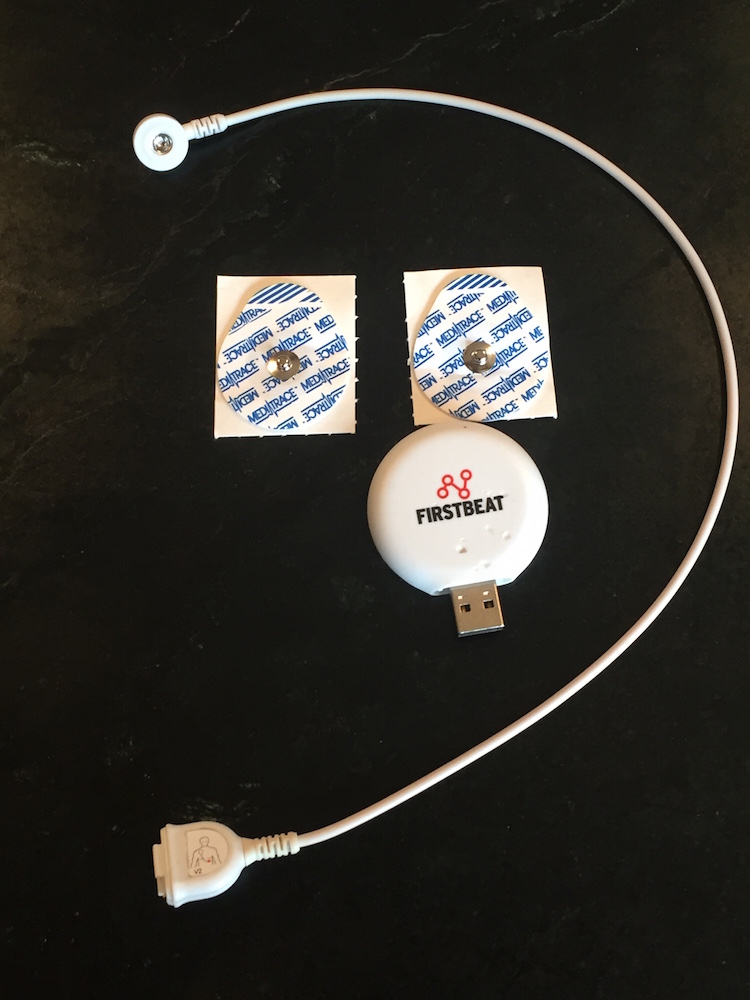
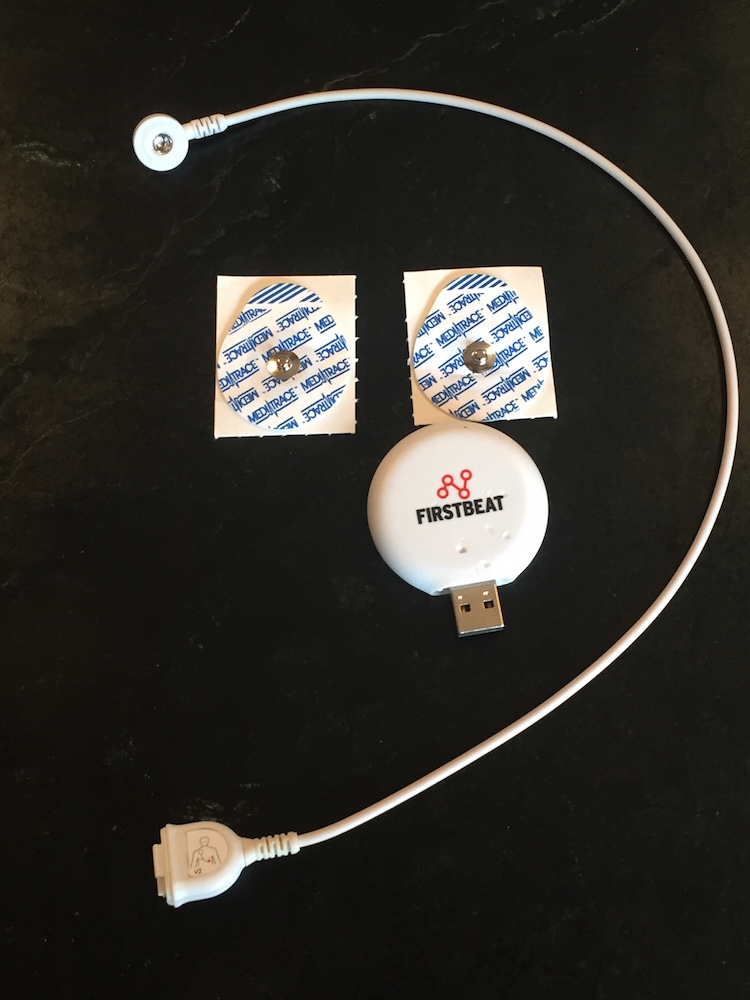
The Firstbeat system can be used with a traditional heart rate monitor chest strap or specially dedicated chest sensors as pictured.
HRV
The Firstbeat system (FB) is a member of a class of devices that monitor heart rate variability (HRV). In simple terms, HRV, as the name implies, is the difference in the intervals between heart beats. Different devices approach this situation differently, but in essence, Firstbeat uses a mathematical algorithm to compare heart rate, interval regularity, maximum heart rate and VO2 to calculate a few different output and recovery metrics.
How it works
One sport early to adopt HRV monitoring is nordic skiing. Three-time Olympian and former U.S, Ski Team coach Jim Galanes, offered his history with the device.
“Tina Hoffman, who was a coach at University of Alaska, Anchorage, showed this to me about eight years ago, so I’ve been studying this system for quite a while,” Galanes, who co-owns Galanes Sports Systems and handles the distribution, sales and service for Firstbeat products, explained on the phone. “The more I used it, the more convinced I became that it is a very effective tool and by far the best one out there. I’ve become so convinced of its effectiveness that starting four years ago, I won’t coach anyone who won’t use it; it is that powerful. It is the single best way to making training decisions.”
Zach Caldwell, coach of several members of the U.S. Ski Team, has been working with the system for a few years and provided a more in-depth explanation of the underlying science. “Your heart rate is governed by your central nervous system (CNS) through two central pathways in your autonomic nervous system: your sympathetic nervous system and your parasympathetic nervous system” Caldwell said on the phone. “Your sympathetic nervous system is what governs your ‘Fight or flight’ response, in common parlance. This is a stress response. It elevates your heart rate and creates a signal that makes the beat to beat interval very regular.”
Caldwell continued, “The second component, your parasympathetic nervous system, which governs rest and relaxation. The influence of the parasympathetic nervous system is to lower and create less regularity between heart beats. By looking at an individual’s heart rate (HR) variability in comparison their own baseline, you can make a statement about the prevalence of a sympathetic response, which is an indication of stress. In short, by using the Firstbeat system we can see how your body is responding to stress. It is a fairly direct measurement. I am not a scientist or a doctor, so while I have reviewed some of the literature, I can’t speak to the experimental design, but my read of the science is that there is ample support for the efficacy of utilization of heart rate measurements of indications of CNS function. CNS pathways are integral for heart rate regulation, so this is very pertinent for sports. Their appears to be very good science and very good efficacy of that science toward athletics.”
Galanes agreed, “A great deal of research, thought and testing has gone into this system: is the result of life work of Heikki Rusko, one of the best sports science researchers in the world, so the system is very well grounded in science, as the research that went into validating the system spanned over 15 years. From this perspective, unlike a lot of systems that are out there, this has gone through rigors scientific validation, both for monitoring training and recovery.”
The key, according to Galanes, isn’t just what the Firstbeat system measures, but what it does with it.
“There are a lot of systems out there that collect data, whether it is a regular heart rate monitor, power meter, Strava, Fitbits, whatever, but there is very little analysis that goes on with that data. Using HRV and the Firstbeat software to look at training load and recovery has become the gold standard. Power and HR are certainly useful, but alone they are not good measures of the disturbance of homeostasis on the body and that’s what training and recovery are all about.” For those interested in a much more in-depth presentation of actual data fields and a more detailed explanation and description of the software, check out this webinar: https://www.firstbeat.com/en/webinars/training-load-recovery-monitoring-in-professional-xc-skiing/
Why Use It
“Coaches and athletes are all very concerned with stress and recovery,” said Caldwell. “Previously I don’t think we have done a very good job at looking at this holistically, so while we looked at rest, we didn’t look at enough factors. The ability to examine and even quantify the role of stress both independent and related to training load is very powerful. This is particularly important for self-coached athletes, for as athletes, we tend to be good at lying to ourselves. Athletes are delusional. We take a lot of information on board and we interpret it based on what we want the outcomes to be. I see it all of the time. I can tell if an athlete is tired and I think even that athlete knows it, but when you ask them, they say they’re fine, in particular at the elite level. I work with over-motivated athletes who want to be able to do more. This isn’t a tool to tell you to take it easy, rather it is a tool to help you make better choices.”
Erika Flora, head coach of the Alaska Pacific University (APU) elite team, agreed. “It can be a good tool if used correctly and in combination with other indicators, in particular feel — I am a big believer in teaching athletes ‘feel,’ ” he said during an in-person interview. “HRV is not an absolute indicator, but it is definitely useful, as sometimes motivation overrides good judgment.”
The 24-Hour Athlete
So often the motivation to try harder is bundled into the four hours of training each day and the other 20 hours in the day are ignored, or at least not optimized,” theorized Caldwell. “If your job has had you running around all day, it may actually be counter-productive to do the interval session you had scheduled. This system is a tremendous help in monitoring your overall stress and adaptation. Careful and correct interpretation of this data can create what I call ‘better 24-hour athletes’.”
Caldwell continued, “One of the major things we want from training is to see a positive response. It sounds so basic, but I see so many good athletes mess this up. We want training to make you stronger. You do a hard training session, we hope that this will make you better, that’s the goal. It’s easy to skip the part where we ask, ‘Is this really going to make me better? If so, when?’ This is a tool to help answer the question. I am unconvinced by things for which I don’t see evidence. I see lots of people doing lots of hard work, but I don’t always see benefits. Why? Training should work. As a coach, if an athlete is not getting better, I want to know why. Why are they not responding positively to training? If we’re counting totally on self-reporting, well, that doesn’t work very well. Most of the good athletes I know have a very good way of coloring their own training. You can beat them into the ground with tests, but that also has its limitations and is disruptive. What if you had a tool that could quantify all of these factors. What if you knew who had good sleep and recovery? This tool does all of that.”
How to use it
Essentially the Firstbeat system measures two primary factors: training load and recovery. The two are obviously related, but can also be uniquely independent. Training load is monitored through a combination of factors, in particular, Excess Post-exercise Oxygen Consumption (EPOC). Measuring EPOC offers several advantages over measuring power or heart rate alone.
“EPOC is very interesting in that it helps you understand the load that you feel when you’re training is cumulative, not instantaneous,” noted Caldwell. “The cool thing about EPOC is that it looks at accumulation of effort over time. The best athletes have a great sense of how to keep things ‘easy’ — their HR can drift up a bit, but they can feel the recovery. What I see in less accomplished athletes is that they religiously follow the HR monitor, so sessions designed to be easy oftentimes aren’t so. Typically amateurs overdo it on easy days and under train on hard days. Using EPOC to help monitor this is huge.”
“Granted, my case is somewhat unique,” Caldwell continued, “as I exclusively coach elite skiers, so EPOC scores are useful, but the recovery thing is even more useful for me. The recovery score is great because it utilizes HRV as a real-time score. The recovery score is an indication both of the level of recovery and the level of fitness. You can’t rest your way to a great recovery score any more than you can rest your way to a great performance. Your peak recovery scores come in relation to your peak training loads and your best management of the recovery process, so it’s not just rest – paradoxically it is also training load.”
Galanes followed up on this thought: “This system is based on understanding each individual’s unique physiology. To use this system optimally, you need to start out and do some testing programs on things like max HR and help determine max VO2. So you need to do a six-minute max test. This helps set a good benchmark for all of the data. This is key, as you need good data going into the system at the start. Once you have this, all you need to do is start training and understand the simple observations of EPOC. The information you get from the system gives you the tools to quantify the training load but also ask the questions about how to modify training to improve overall capacity and performance. The human body is always in flux: it is always adapting to load, so the body is not the same day in and day out and FB is one of the best systems to quantify these changes and better define these different states of readiness.”
Over-The-Hill Gang
One group Galanes believes benefits the most from HRV monitoring is masters athletes. “Recovery profiles for masters athletes are very, very different than young, elite athletes. As we age, there is a whole different training process that needs to occur. Ned Overend, Joe Friel and others are making some good observations on this. Since we all age differently, FB is one of the best possible tools to assess each individuals response in training and recovery. The real value at looking at EPOC is to help you understand if you’re getting the desired effect of your training. If you go too hard, you are compromising something later in the training process. It really helps clarify the focus and the implications of the training. It is the most incredible training tool that has come along in my training and coaching lifetime.”
Optimal Usage
As a frequent traveler to both Europe and high elevation (sleeping at 7,200 feet, training between 6,700-10,400 feet), being able to measure the “stress” and overall physiological impact of traveling to and training at these sites have proven to be incredibly valuable. Sure, any idiot knows that they’re tired when they get off the plane after a nine-hour flight, but what does this really mean in terms of training? Should you even train right off the plane or take a nap instead? If you do go, how long and hard should you go? Firstbeat can help answer all of those questions. And that’s just the tip of the iceberg.
Anyone who knows me knows that I lead a very unusual life. I spend more time on airplanes than many people do in bed. I have a large animal rescue and much to the amusement of my vet and farrier, I often ride my mountain bike to my farm to administer vaccines to the animals while wearing a full cycling kit (apparently this isn’t all that common). I also regularly work on three continents, ski home from work in the dark and a bunch of other stuff too strange to print, so I think most would agree that I am clearly an outlier on the curve in many ways and in many things. Now, having said that, while my stressors may be different from yours, my guess is that each and every reader out there has lots of other demands for their time outside of training and lots of factors that impede recovery, some unique to them, others not. Sure, most of these stressors most likely don’t involve giving vaccines to donkeys or having the entire U.S. Ski Team’s jump skis lost in Japan, but I have yet to meet the person who claims their job is easy, who gets all of the sleep that they’d like and who does not have any worries or responsibilities. So just how much is your stupid job, long commute or inability to attract a member of the opposite sex affecting your training? More than you might expect.
Sure, most of these stressors most likely don’t involve giving vaccines to donkeys or having the entire U.S. Ski Team’s jump skis lost in Japan, but I have yet to meet the person who claims their job is easy, who gets all of the sleep that they’d like and who does not have any worries or responsibilities.
“The thing that the most interesting about it is that it provides hard data on feedback that helps us modify our behaviors in ways that are otherwise difficult,” claimed Caldwell. “I first started using Firstbeat when I was traveling in Europe. I found that I was getting high EPOC scores on runs that I thought were easy. As soon as I recognized the stress from the long travel and adapted my training, I got better EPOC scores and felt an immediate fitness bounce. Don’t get me wrong, it took me years to learn this lesson and I had to learn it the hard way. Generally us old dudes go out and hammer. Most masters skiers train like they’re going to win World Cups. That’s just wrong. We’re exercising our fantasies, not reality. This system helps stop that and allows you to train smart. It can both slow you down and speed you up, which is an important mix. Generally our instincts don’t always line up with the true need of the situation and figuring out how to keep this in check is very, very important.”
U.S. Ski Team member Noah Hoffman with his Suunto Ambit heart rate monitor, compatible with Firstbeat technology.
One of the elite athletes that Caldwell coaches on the U.S. Ski Team is Noah Hoffman. Hoffman’s perspective is interesting in that he is exclusively focused on outcomes, not on any of the theory or science behind the system.
“I don’t really look at the numbers; I rely on Zach for that. All I know is that it helps me a great deal,” Hoffman said during an in-person interview. “I’ve been using the system for a while and I love it. It gives me piece of mind when I’m going into a big training block that I can handle the training load. I know I’m not going to drive myself to oblivion. It’s also very valuable if you start to feel rundown from travel or illness, as it gives you good feedback on just how much you should back off or push through.”
Another elite skier to use the system is Sophie Caldwell, winner of a World Cup this year. “I’ve only been using it for about a year, but I love it,” she said on the phone. “When I see my recovery trending downward, I can catch it early, which is so key. It’s also been very interesting to see which workouts take more out of me. I’ve noticed things like if I’m in Level 1, I can go forever, but as soon as I start going into Level 2, there is a much bigger cost there. I know this is very different for different people, so this allows both the athletes and the coaches to see that different workouts affect different people in different ways. Liz Stephen [U.S. Ski Team teammate) and I are both coached my Matt [Whitcomb] and we’re amazed when we compare data on how different workouts effect us. I find this fascinating and it clearly shows how important individualized monitoring is for athletes. If Liz and I were attempting to follow the same program, it wouldn’t work well for either of us. So thanks to the data and insight we’ve gotten from the system, we’ve all learned a lot about ourselves and training.”
Without a doubt the most ringing endorsement came from Tad Elliott, who had a history of illness and overtraining. “Firstbeat saved my career. I was so sick and struggling so much with how to carefully and gradually return to full activity, I never could have made the comeback that I did without Firstbeat. It is that important to me. Now, my case may be a bit extreme, but it is most certainly very useful for all endurance athletes, in particular busy ones.”
Weaknesses
Is this system perfect? Of course not. Firstly, to achieve nighttime recovery data, here’s a shocker, you have to wear something when you sleep. Firstbeat gives you two options: your traditional HR monitor chest strap or specially dedicated chest sensors.
The HR monitor chest strap is easier, cheaper and I suppose looks less weird (though a word to the wise: prepare yourself for lots of comments/questions from your significant other). The disadvantage is that this setup is more prone to error. The chest sensor option is very, very accurate, but not only do you have to buy electrode patches (cheap, but a PITA to remember to bring on trips and re-order) you also look like you are undergoing screening for the Mercury space program every night as you prepare for bed. The system provides uber-accurate measurements, but sadly I found it to also be a bit wonky. If you do not upload the data every few days, you experience the dreaded “system crash and freeze” therein losing all of your data. This is not an issue if you stay on top of your uploads, but it seems as though this should work better for a system of its price. Sleeping with either contraption is a bit of an adjustment, but thankfully FBD is a good sleeper and after a few nights I don’t even notice either option. Your mileage may vary.
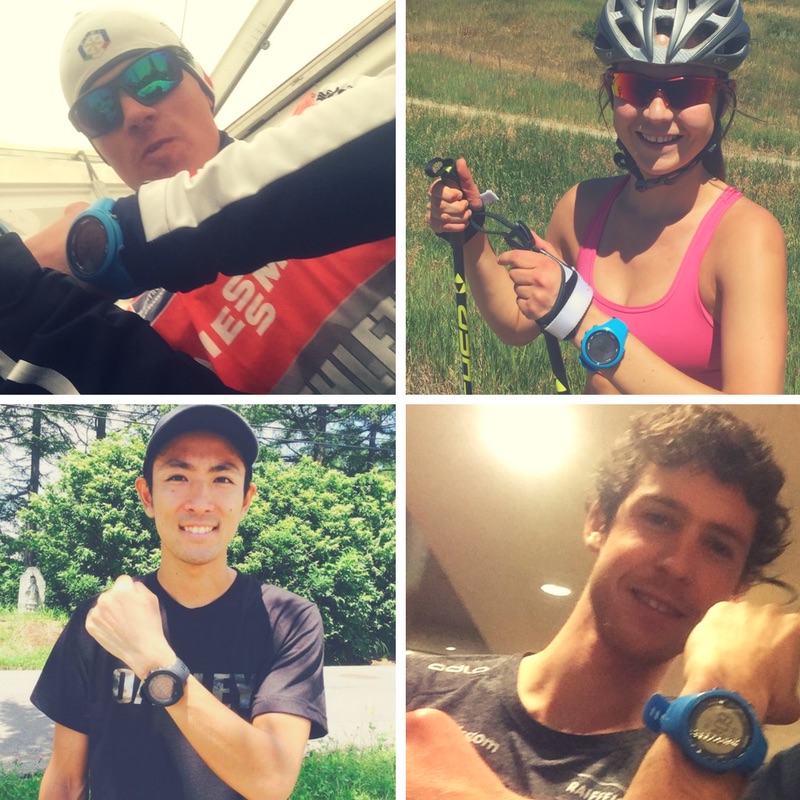
Several high-level skiers show off their Suunto Ambit heart rate monitors:(clockwise, from upper left) Italian nordic combined skier Samuel Costa, Steamboat Springs Winter Sports club alumn and current CU skier Lucy Newman, Swiss nordic combined skier Tim Hug, and 2014 Olympic silver medalist Akito Watabe of Japan. (All photos: FBD)
The system requirements claim that it can work with several different heart rate monitors, but everyone I’ve spoken to uses a Suunto Ambit 2 or 3, myself included. I found the Suunto to be superior to the Garmin even as a stand-alone HR monitor, so using it for FB was an easy transition. And I’m not alone — look on the wrists of many a World Cup skier and you’ll see a Suunto, so I don’t view this as a negative, but knowing that you may need to also buy a new watch is an important consideration for budget and ROI. Then there’s the issue of the software not running on Mac. This can easily be overcome by installing an emulator, but again, it seems like software of this price should be Mac compatible.
On a more macro level, “power user” (see what I did there?) Zach Caldwell offered a few more criticisms, “Overall the software could be a bit more user friendly. There is a lot going on, which is a good thing, but this means that it can take some time to understand how to correctly interpret the data. Perhaps more importantly, it is a speedometer. It tells you how fast you’re going. It does not tell you how fast you should be going. This is not a weakness, but rather a common misperception of the utility of the device. It is a fantastic device, but all users and potential users need to be aware of what is actual does and does not do.”
Galanes seconded this observation, “People make the mistake of buying the software, installing it, going for a run, then looking for something magical. It doesn’t work that way. You need to establish a baseline for recovery, do some VO2 tests and begin to look for trends. It takes a few weeks before the data will start to be meaningful and you need to understand how to properly interpret it, but once you have all of that down, it’s the best thing out there by a long shot. If you can work with a qualified coach who has experience with the system, that’s the best of both worlds.”
“People make the mistake of buying the software, installing it, going for a run, then looking for something magical. It doesn’t work that way. You need to establish a baseline for recovery, do some VO2 tests and begin to look for trends…” — Jim Galanes, Olympian, former U.S. Ski Team coach and current Firstbeat rep, on Firstbeat system
Flora also believes that metrics such as heart rate, lactate, etc., need to taken in context and used as a part of the “big picture”. “HRV can help athletes see trends and match up with what they’re feeling, which is very important, but using it as a main driver can be complicated,” he said. “I am a big believer in athletes learning how to understand what’s happening with them.”
Biggest Takeaways
“I’ve been around sport for a long time,” said Caldwell, “first as an athlete and then as a coach and one of the biggest things that I see while advising my athletes is just how hard it is to coach yourself. I include myself in this, too: my personal instincts for training are terrible. Every basic instinct I have is to run myself into the ground. I always thought I just wasn’t tough enough, but in reality the problem was that I was way too impatient and way too stupid. I wanted to go faster right away and I didn’t want to listen to my body. I know this is not just me either, so being able to quantify some of these issues helps me have a good discussion with athletes in a very non-threatening way, which is important.”
“One of the biggest things that I’ve learned is just how right coaches are,” Hoffman said. “As athletes we always hear about the importance of rest and recovery, but we you can look at the data right on the screen about how your behavior impacted your ability to train, that is much more powerful than anything a coach can say.”
Fellow U.S. Ski Team member Sophie Caldwell agreed, “I’ve become a lot more aware of my recovery and the impact that different workouts has on recovery. It makes me think a lot more about how important recovery is for success. It’s forced me to pay more attention to all of the other parts in my day and that’s a good thing, a very good thing. I’ve been using it for almost a year, and while I’m not at the point where I rely on it 100 percent, it is very helpful to see my trends. Sometimes it shows that I’m getting into a bit of a hole and this helps me stay in front of it. I also use it to ramp things up if it looks like I can handle more load. I can probably do a pretty good job guessing, but I certainly would have missed it a few times and it is in those instances that it is particularly helpful. My overall experience is very positive.”
Hoffman continued, “One of the first things that I did when I started using the system was I collected data for 24 hours/day for 6 weeks. What we learned with this is that my activity through the day correlated much more highly than I believe earlier to my nighttime recovery scores. Some of the coaches had told me that they thought I was being too active in between training sessions and that’s exactly what we found. It was also surprising the types of things that disrupted recovery. I’m a competitive guy and it turns out that even board games elevate my stress levels enough to impede recovery. I never would have guessed this. It’s also important to note that while we have prioritized recovery in our use of the system, I definitely do use it for training and racing, in particular for things like pacing. It helps you verify what you think you already know in terms of feel. I look at it as a great safety net.”
Applicability for Age-Groupers
So is this just a tool for the over-80 VO2 crowd with Olympic aspirations? Hardly. In fact, given the complexity of training for any race while working full time, this system is probably even more applicable to age-group athletes. “It’s probably more important that people who aren’t full-time athletes use this system,” noted Hoffman. “It’s WAY harder to balance your training load that manages your energy appropriately, as non-professional skiers have so many other distractions. I can at least try to devote most of my energy to training, so it’s easier to recover and not overdo it, but for people who have lots going on, it would be incredibly valuable. It is an important guide to help you train effectively with everything else that you have to do.”
Zach Caldwell agreed: “If you use a system like Firstbeat to measure stress load external to exercise output, you’re nailing things down from both sides. Neurological state and physiological cost and that’s a great thing. Human performances lives in the gap between input and output. If you’re only quantifying one or the other, you’re opening yourself up for surprises on race day, I don’t care what sport you’re in.”
Parting shots
In this day and age of the “shallow reader,” this article was long, perhaps too long for the taste of many, but there’s a lot going on here and I felt it was important to accurately describe the power and limitations of this very exciting technology from multiple perspectives. How you proceed from here is up to you, but to help perhaps guide some of your next steps, I asked some of the people the most familiar with the system for their advice to those considering taking the plunge.
“Jump in with patience,” advised Zach Caldwell. “Definitely do it, but go in with realistic expectations. The system won’t pay dividends in the first week, but if you are patient for three months, you absolutely will not be disappointed. But you need to be committed: three months of wearing this thing to bed. Training with it every day. Doing baseline and follow-up testing. Learning how to interpret the results. But if you are consistent and patient, you will learn a lot. It is an incredibly valuable tool when used correctly.”
Galanes went one step further, “Balancing endurance and intensity training is not easy and finding that line without the insight that the system provides in very, very difficult. FB gives you access to much better data and a much bigger picture. It is going to change your paradigm on what is optimal training and it is going to change how you view endurance training, all in a very positive way, but you need to be sure you are using the system correctly. If you do, you will feel better and you will perform better.”
Elliott added, “If you’re juggling work, family, illness or any other stressor, I strongly encourage everyone to use it. I never could have made it back to the top level with the data I got from the system and I know it will help most, if not all athletes.”
“I’ve had a very positive experiences with it,” said Sophie Caldwell, “so I absolutely advise people to use it, but start out cautiously. Track your training and sleep, but don’t rely 100 percent on this system. You need a baseline, but the more time you spend with it, the more you learn to correlate how you feel with what the data is showing, which makes you even more comfortable with it and able to count it on even more. It’s not the only tool that I use, but I sure am glad that I have it.”
Hoffman summarized the whole process nicely and offered solid advice, “Take it slow at first. Firstbeat tells you a lot, so it can be a bit overwhelming. Take your time, learn what the numbers mean or find someone who does and be patient. It takes a while to understand how this is all relevant to you, so don’t get overwhelmed by it. Stick with it, though, and you’ll be glad that you did. You will learn a lot and you’ll be a better, happier athlete.”
For more information on Firstbeat technologies and pricing information, visit Firstbeat.com.
Competitors in the women’s 15 k skiathlon crest a hill at the 2014 Winter Olympics in Sochi, Russia. (Photo: Fischer/NordicFocus)
“There needs to be an investigation by WADA,” International Ski Federation (FIS) Secretary General Sarah Lewis told FasterSkier in a phone interview on Monday. “FIS totally supports it and we have already expressed that anything we can provide, we will do. And it needs to be done [quickly], but carefully.”
With allegations published last week in The New York Times of state-sponsored doping at the 2014 Olympics in Sochi, Russia, attention turned immediately to the World Anti-Doping Agency (WADA) and the International Olympic Committee (IOC).
FIS runs its own anti-doping program, as does each country which sends skiers to the World Cup. Those programs add up to thousands of urine tests done on skiers each year. When it comes to the Olympics, however, the IOC takes over all in-competition testing and WADA provides Independent Observers to watch the process.
There had been allegations as early as November of last year, in the WADA Independent Commission report, that Russian state security personnel had infiltrated the Sochi anti-doping laboratory; WADA did not follow up on the finding.
Thus when Grigoriy Rodchenko, the former head of Russia’s anti-doping laboratory, said that 66 Russian athletes had been protected from testing positive by laboratory and security staff who swapped out their dirty urine samples, there was outrage from many sides.
Outrage – and bewilderment. Lewis was the head of the WADA Independent Observers at the 2008 Summer Olympics in Beijing, China. She is intimately acquainted with the anti-doping process and the tamper-proof bottles which were allegedly opened in a secret lab and filled with replacement urine.
Sarah Lewis, secretary general of the International Ski Federation. (FIS file photo)
“Frankly, these bottles, having seen the whole thing in action, to imagine that they can be reopened– wow,” Lewis said. “The fact that they could even be taken out of the lab is really quite shocking.”
WADA has pledged, finally, to investigate winter sports and the Sochi Olympics. But should the investigations confirm the allegations, all the IOC can do is ban an athlete from the Olympics, including retroactively. With 14 Russian cross-country skiers implicated in The New York Times report, including superstar Alexander Legkov, many are wondering whether World Cup results will also be shaken up.
For instance Legkov – who won the 50 k skate in Sochi as well as helping the Russians take home silver in the men’s relay – was on the podium three more times later that season, including at World Cup finals; he then earned a number of top-ten World Cup results in the next two seasons. Are those results in jeopardy?
In the 2014/2015 season, Russian Olympians Evgeniy Belov and Maxim Vylegzhanin – who have not been implicated by name but were members of the 20-athlete team of which 14 were supposedly on the doping list – both finished in the top 10 of the overall World Cup standings. Are the many individual race results that went into those standings also in jeopardy?
Whether to negate results going forward from the date of a positive test – if such a test exists – would be a decision left to FIS, which is also shaking its head about how doping could have happened in its sport, on the world’s biggest athletic stage.
“The story has to be verified – that’s a basic principle,” Lewis said of the allegations. “If any elements of it are true, then it’s a huge throwback, a huge step back for all anti-doping efforts. Especially that this could happen at the Olympic Games where there are so many resources in terms of money, personnel, global expertise – it’s such a major blow.”
Why Weren’t Cheaters Caught?
Russia led the world in anti-doping rule violations in 2014: 148 athletes faced sanctions, 14 of which were in Winter Olympic sports and more specifically four in biathlon and seven in skiing. Despite those numbers, no star cross-country skiers were caught in the leadup to the Olympics.
Irina Starykh (far right) celebrates with her Russian teammates after they won an IBU World Cup biathlon relay in Ruhpolding, Germany, in January 2014. The result was voided as a result of Starykh’s doping ban, from a sample collected in December 2013. (Photo: Fischer / Nordic Focus.)
So could FIS have done more, and tested harder, in order to prevent the cheats from reaching the Games in the first place?
“To be honest, with what they are talking about, namely a steroid program during the Games, it’s likely that the program was very specifically targeted around the Games,” Lewis argued. “Of course you’re always looking at your processes, but with the out-of-competition program we have in place it’s very comprehensive … Nevertheless in hindsight, of course you ask those questions. Until we know what the time scale was, it’s hard to know.”
A total of 6,439 anti-doping samples were collected by various testing agencies from athletes across the skiing disciplines in 2013, a number that shrank to 5,764 in 2014, the Olympic year.
But here, too, numbers don’t tell the full story, FIS argues.
“Let us respectfully point out that this question is rather outdated,” FIS Anti-Doping Coordinator Sarah Fussek wrote in an email on Tuesday. “The WADA policy and guidance to [anti-doping agencies] many years ago was to move away from large testing numbers and move to more quality testing. For example to organise a doping control at a remote location takes much more planning efforts, logistics, transport costs as 10 tests collected at a training camp at an easy to reach place. So comparing numbers only says nothing about the quality of a testing programme.”
In fact, Lewis said that the Russian skiers had been targeted with plenty of tests. That fact was underscored in an interview over the weekend where Legkov claimed to have been tested 33 times in the season leading up to the Games.
“Our specialists are monitoring the results of the testing from a clinical perspective, but also performances, participation, history of that nation, it’s all connected together,” Lewis said. “There’s no question that there’s been extensive targeting of the Russian team for more than ten years.”
That testing did lead to a rash of positive tests and disqualifications before the 2010 Olympic Games in Vancouver, Canada. But despite the bans, some athletes and coaches who were picked up in the sweep stayed in the sport. In one case, Russian athletes who had previously served doping bans decided not to train with the national team, and instead took up with a coach who had been barred from working with the national team because of his involvement in doping.
Rodchenkov – the head of Russian anti-doping who admitted massive fraud to the New York Times – also remained on the FIS Medical Committee until November, when he was suspended after the initial WADA Independent Commission report.
The history of Russian doping in skiing is not lost on anyone. But the biggest personality on the current scandal, Legkov, is a different case from the doping Russian skiers of six or seven years ago, at least in terms of lifestyle. He trained not only away from the standard national team coaching staff, but also primarily outside of Russia, basing himself instead in Davos, Switzerland, with non-Russian coaches in the seasons leading up to Sochi.
Additionally, Lewis had confidence in FIS’s out-of-competition testing.
“During the winter season, you have the athletes more or less with you the entire time,” she said. “It’s possible to carry out very extensive testing.”
Chain of Custody
Vitaly Stepanov, a former RUSADA employee, during an interview with 60 Minutes’ Armen Keteyian, which aired Sunday, May 8. (Photo: CBS News)
With the accounts of malpractice in Russian anti-doping laboratories in not only The New York Times piece but also by another whistleblower to CBS News’ 60 Minutes, there’s also a question as to whether previous anti-doping samples belonging to Russian skiers were manipulated.
Rodchenkov, for instance, said that he had destroyed over a thousand samples to prevent them from being re-tested by a different testing authority.
According to Lewis, samples collected by FIS were rarely stored in Russia.
“There was quite a lot of testing missions which were coordinated with [the Russian Anti-Doping Agency, RUSADA], but most were carried out by the FIS-appointed doping control agency with their own personnel and equipment,” she explained. “Most samples were transported to a different laboratory, in Lausanne or Cologne or somewhere else. We weren’t in the position that they could be manipulated in the Moscow laboratory.”
In addition, after RUSADA was suspended and the Moscow laboratory lost its accreditation from WADA, FIS took any samples that had been stored there immediately out of the country.
“In fact, all the samples were delivered to Cologne,” Lewis said. “They were evaluated again, all of the profiles, the blood profiles but also the steroid profile. That information was analyzed again as to whether there was the need to re-tests … They all returned negative.”
FIS anti-doping samples are handled primarily by a company called PWC, which is based in Germany and also offers services to other international and national federations.
“PWC is currently the main sample collection provider for FIS on the basis of an annual contract, but FIS uses regularly also the services from various national anti-doping agencies, and does not have an exclusive contract with PWC,” Fussek explained in her email.
The company then delivers samples to WADA-accredited laboratories around the world.
“The samples are not left overnight somewhere in a vault,” Lewis said. “Doping control officers carry out the tests and then ship or take them to the lab. That period for tampering doesn’t exist.”
Moving Forward
News broke on Tuesday that the U.S. Department of Justice would investigate the Russian doping claims. Earlier that day, the IOC announced that it directed the Lausanne laboratory where Sochi samples are stored to cooperate with WADA on potential re-testing, a move that many have urged for months.
“The statement by WADA and the IOC in terms of re-testing samples stored in Lausanne, we fully support that and have championed that cause for a long time,” Lewis said. “But that is an issue for the IOC, they are responsible for doping controls at the Olympics.
“In terms of what could be found through the re-testing, we would also support DNA testing of the urine samples in case there has been switching of urine and some errors,” she continued. “How it reads in the [Times] article is that they have used those athletes’ own urine, but nevertheless the experts are able to assess if there has been a change in terms of the composition of the samples. Plasticides were mentioned and that sort of thing.”
FIS already worked with the Russians to ensure that testing was carried out in the 2015/2016 season, even after RUSADA and the Moscow laboratory lost a say in the process.
“On the request of the Russian ski association, they asked FIS to step in and arrange in-competition testing,” Lewis said. “They didn’t have RUSADA to do it. We did that through the group appointed to help them, which was UK Antidoping. There was some additional blood testing carried out by the FIS agency during competitions during the season.”
That said, the testing arranged by UK Antidoping over the last six months was not exactly a roaring success.
Forty percent of the tests the agency was prescribed to carry out were unsuccessful, with one test being flat-out refused by an athlete. Of the tests which were collected, 49 were positive. UK Antidoping is reportedly considering ending its role in Russia altogether.
Nevertheless, Lewis asserted that athletes who competed in 2015/2016 should not worry that they were facing an unfair playing field.
“Anti-Doping holds a very high priority in our organization,” she said. “We have a strong commitment to clean sport. There’s no question that we’re horrified by these stories and absolutely support this investigation to clarify that situation. But when it comes to the statements of how the manipulation was done, in terms of exchanging samples and tampering with the bottles, those things can’t happen with the testing which is carried out by the FIS-appointed agency.”
For FIS, internal discussions are ongoing and the organization’s top brass has already set aside time at their biennial Congress in the second week of June.
“To be perfectly honest, the situation was and is on the agenda based on the WADA report on November,” Lewis said. “The situation with the Russians is on the agenda of the FIS Council already, and then obviously there is more information to be able to discuss and address.”
Correction: The author previously quoted Lewis as saying that she had “dropped a note through to Alex.” She was referring to Fasterskier’s Alex Kochon, not Alexander Legkov. We apologize to Lewis and to readers for this misunderstanding.
Devon Kershaw (r) lunges for a World Cup silver in the 2011 Tour de Ski classic sprint in Obertsdorf, Germany, 11 years after his Fischer classic skis were made. He placed second to Sweden’s Emil Jonsson (l) and edged out Switzerland’s Dario Cologna. (Photo: Devon Kershaw/NordicFocus)
At the elite level of endurance sport, most often it’s not about the gear. Everybody’s competing on the lightest, most highly engineered equipment available. But in the fickle realm of World Cup cross-country skiing, it can be about the equipment. Canadian National Team member Devon Kershaw says that’s a frustrating aspect of the sport.
“Oh my gosh, when you miss the skis or the wax and [you’re] on the best day of your life, and you end up 35th! It’s gut wrenching,” Kershaw, 32, said in a recent phone interview. “It’s just about the equipment some days.”
Cross-country skiing, like any gear-intensive sport, is caught in a constant cycle of innovation where weight, stiffness, and new color schemes, reveal product evolution and glossy rebranding. Yet, if you have maintained a keen eye on World Cup ski selection since 2008, you may have noticed Canadians Alex Harvey and Kershaw racing to podiums on what appear to be antiquated Fischer classic skis. The duo specifically raced on 1999 Fischer RCS classics; skis sporting a yellow top sheet and a fire-engine-red sidewall.
Devon Kershaw with his 1999 Fischer RCS classics after placing second in the 2011 Tour de Ski classic sprint in Obertsdorf, Germany. (Photo: Devon Kershaw/NordicFocus)
These old skis were a staple for the Canadians. A go-to ski on numerous World Cup weekends.
For many on the World Cup, seeing Kershaw race around on the old-school skis became an eye roll moment.
“People would say, still using those old skis from the Ramsau World Champs, eh?,” Kershaw said. “Everyone thought we were using the exact same pair, but we had a number of them for different conditions. Some were good in the cold, I mean ridiculously good in the cold.”
Race after race, careers are on the line. A podium here, a World Championship medal there, translates into real sponsorship dollars and an extended athletic life. So the Canadians must of had good reason for using skis built the same year a Cher tune was an international hit.
Kershaw explained the fleet of 1999 skis were slippery on the snow.
“Man those skis. I’m telling you, it seems like superstition, but the free glide on those skis kept them in the mix on the World Cup,” he said. “The one characteristics across the board for all those skis, we call it free glide. You bring your foot through, a lot of classic skis, even ones that win a glide test, you can feel the kick wax under your foot. That’s what Alex and I look for a lot, when you can’t feel the kick wax when moving the foot through. They felt like they had no grip wax on them but they have locker kick. How is that possible?”
That mystery — trying to determine how, when and why some things work and others fail — is an intriguing part of the sport. When it comes to race-day ski selection, Harvey, 27, is as fastidious as they come. He employs a personal ski tech he calls a “test pilot.” Together they test grinds, hand structure, waxes, top coats, and of course, skis. In a phone interview, Harvey explained it’s good to have an expert second opinion. In speaking about those 1999 skis, he said the skis began playing games with his mind.
Alex Harvey finishing out his lap in the 15 k classic individual race at the 2014 Olympics in Sochi, Russia. He did not finish the race, but his 15-year-old classic skis weren’t completely to blame. The team missed the wax.
“They were great on hills and flat, but I’d be dropped on the downhills,” Harvey said. “They feel good when skiing, but when comparing objectively, they are not as good.”
Those old skis did remain viable for years. At one point, Fischer asked why the Canadians were using older skis. Remember, a good ski is a good ski. So the fleet was returned to Fischer and refreshed with new bases and an up-to-date black top sheet. After the cosmetic upgrade, without handling the skis, there’s no telling the difference between those retrograde skis and a pair of the latest and greatest.
The matchmaker between the Canadians and the 1999 “magic” skis was Micke Book, a former wax tech for the Swedish National Team. Book served as a Canadian World Cup tech for eight years. In an email, Book wrote that two pair belonged to him and he acquired the remaining four pair from Tobias and Mathias Fredriksson.
As for Book’s thoughts on the magic attributes of these skis: “‘Well nothing is magic, they are good skis and well taken care of,” Book wrote in an email. Asked if the skis hold up in testing, Book explained, “They are still in the Bag. So yes they match new skis very well.”
The Canadians no longer have access to the skis as they remain with Book. This season, Book will serve as a personal ski tech for Kazakhstan’s top skier Alexey Poltoranin. He has no plans for Poltoranin to use the skis. Book also waxes for long-distance nordic team, Team Exspirit. Book explained that Sweden’s Daniel Rickardsson will test the 1999 fleet for the 2016 Ski Classics marathon series.
According to Kershaw, the legend of Book’s skis remain alive. “If I see Poltoranin on those skis, that will weird me out big time,” he said.
Italy’s Marco Pantani riding to his 1998 Tour de France victory. (Photo: Tumblr)
Even Kershaw seemed dumbfounded by his use of the retro gear. He referenced Marco Pantani’s Tour de France win in 1998, pointing out the Italian cyclist’s rickety bike, once perceived as state of the art.
Consider a YouTube clip of 1998 vintage Pantani. A few things remain the same: Paul Sherwen and Phil Liggett are stoked. The riders still gaunt and suffering in the Alps. But the bike frame tubes resemble toothpicks. Helmets? Not yet.
“Yet I’m using skis from that era,” Kershaw said with a laugh. “Alex is hitting the podium on the World Cup.”
Look at most skis used on the World Cup and it’s rare to see older skis. Like many industries, nordic ski manufacturing has become more controlled. With manufacturing tolerances measured in millimeters comes the ability to produce more consistent skis. U.S. Ski Team Head Coach Chris Grover wrote in an email that his team no longer carries old skis — the quality of new product available on the World Cup eliminates the need.
“Some individuals have a few older go-to pair of skis, and occasionally we share them with other athletes on the Team, if the athlete who owns them is not using them an conditions are right,” he wrote. “However, many of the skis being made today are faster than the athletes’ older skis.”
Canadian head coach Justin Wadsworth adds that not having the skis as part of the quiver is relieving.
“You are always leary of going on a 15-year-old pair of skis,” he said. “You use those in the World Championships or something, are they going to break? At a certain point the material starts to break down even though they have been re-based and re-topsheeted.”
“You are always leary of going on a 15-year-old pair of skis.” — Canadian National Team Head Coach Justin Wadsworth
After a lifetime of racing, Kershaw understands quality. When the 1999 skis were available to him, Kershaw chose them because they were better. Because they were faster. Ski selection ultimately remains the athlete’s responsibility.
“Just enjoy skiing because you never know when those magic skis will make it into your life,” he advised. “Who cares what they look like. As long as they are fast and they work well. We don’t discriminate based on age or cosmetics.”
LAKE PLACID, N.Y. — In his eighth year skiing, retired Army veteran and double-leg amputee Andy Soule, of the U.S. Paralympics Nordic B-team, had been on a rollerski treadmill before — several times in fact: at the U.S. Ski Team headquarters in Park City, Utah, and at U.S. Biathlon’s base at the Olympic Training Center (OTC) in Lake Placid, N.Y., where he trained with fellow national-team members for a week earlier this month.
Straight off a training camp at Sweden’s Torsby ski tunnel in early September, Soule, A-team member Oksana Masters and C-teamer Aaron Pike all put their wheels on the OTC treadmill last week on Sept. 16. And while Soule, 34, was comfortable testing his double-pole technique in front of two coaches (John Farra and Eileen Carey), two physiologists (Jason Kask and Australia’s Sacha Fulton), and a visiting biomechanic from the Chula Vista OTC in California, Masters — who was born with multiple physical defects — had never been on a treadmill before.
“We’re starting from scratch,” Farra said to Masters, 25, as she watched herself rollerski on a video monitor at eye level in front of her. This was the first time the team had set up the treadmill with live-video capabilities, showing front and side views for the athlete to make tweaks or corrections on the fly.
“This is all new,” he said, reminding her to not overthink it. “Work on your V2.”
“What’s V2?” Masters asked as she playfully swung her poles behind her, alternating sides as if she was gliding to the left and right with each double pole.
“You were just doing it,” Carey said.
During each session, Soule, Masters and Pike all reached speeds around 10 miles per hour at about 10-percent incline. Each double poled for about 45 minutes, getting feedback from coaches, with Carey taking notes, Farra holding the safety rope, and both coaches asking how it felt.
The idea was to give the athletes ownership of their own progress — not just on the treadmill, but throughout offseason training. Farra said he got the treadmill-with-real-time-video idea from U.S. Ski Team member Noah Hoffman, who keeps a detailed training blog, and the U.S. Biathlon team, which uses it for that purpose in Lake Placid. As far as he knows, no other Para Nordic team in the world is doing that.
“Maybe one of our advantages is that we think that way,” Farra said. “I hope other Paralympic teams around the world aren’t thinking about all these little pieces and parts because we have a long ways to make up on Russia, who won most of the medals at the [Sochi] Paralympic Games. We’re not them, but I think we can run one of the most professional program in the world. That’s the goal: even if our results aren’t there yet, but if you do everything possible to run the single-best Paralympic program in the world, then that stuff will come, if you find the athletes and if they love it and if everything goes well.
“Andy Soule’s won a medal, so you could kind of go, oh well, he’s already won a medal, so why mess with his technique?” he added. “Well, because he can make two-, three-percent difference just by locking that down …”
U.S. Paralympics Nordic skier Andy Soule (r) gets feedback from coaches Eileen Carey (l) and John Farra during a treadmill workout at the Olympic Training Center on Sept. 16 in Lake Placid, N.Y.
U.S. Paralympics Nordic skier Andy Soule (in yellow) gets feedback from coaches Eileen Carey (l) and John Farra during a treadmill workout at the Olympic Training Center on Sept. 16 in Lake Placid, N.Y.
Andy Soule
Andy Soule working on technique during a treadmill session on Sept. 16 at the Olympic Training Center in Lake Placid, N.Y.
U.S. Paralympics Nordic skier Oksana Masters (r} talks to coach Eileen Carey before her first time on a treadmill on Sept. 16 at the Olympic Training Center on Sept. 16 in Lake Placid, N.Y.
Oksana Masters gets her poles and helmet from coach Eileen Carey (r) and team physiologist Jason Kask (second from r) and is ready to go while teammate Aaron Pike (l) observes.
Oksana Masters
Oksana Masters
Oksana Masters on the treadmill while coach Eileen Carey (r) and team physiologist Jason Kask observe.
Oksana Masters
Oksana Masters (r) looks at a video screen next to coach John Farra
Oksana Masters demonstrates superior tucking ability during a rollerski treadmill workout at the Olympic Training Center in Lake Placid, N.Y.
U.S. Paralympics Nordic director and coach John Farra (l) briefs Oksana Masters before her first-ever time on a treadmill at the Olympic Training Center on Sept. 16 in Lake Placid, N.Y.
The U.S. Paralympics Nordic Team treadmill staff works with athlete Aaron Pike in Lake Placid, including Larry (pointing) a biomechanic from the Chula Vista Olympic Training Center, team physiologist Jason Kask (l), visiting physiologist Sacha Fuller from Austalia, and coaches Eileen Carey (in red) and John Farra (r).
Canada’s Yves Bilodeau at the 1992 Albertville Olympic winter Games. (CP PHOTO/COA/Ted Grant)
Yves Bilodeau is one of the faces on the Canadian World Cup Team that’s seldom seen. Like his crew of wax technicians, he’s a behind-the-scenes guy, one of several responsible for the successes and sometimes lack thereof at international competitions.
Born in Quebec City and currently living in France, the 52-year-old made himself known as a Canadian cross-country skier, competing at five World Championships and three Olympics (the last of which came in 1998, three years after he retired. A wax tech at the time, he competed in the 10 k in Nagano, Japan).
After that, he retired for good — at least from international nordic racing. He’s still known in international adventure-racing circles after winning 2005 World Championships with Team Raid Quechua.
Known by his close friends and relatives as Bilose, Bilodeau is embarking on his 20th season working with the Canadian squad, and he’s witnessed a lot of change within the team since his racing days. At the ’92 Olympics in Albertville, France, Canada had one wax tech. Twenty-two years later, the team had a record nine at the Sochi Olympics.
In a phone interview with FasterSkier, Bilodeau spoke in his native tongue, humbly with a hint of humor. Seemingly attached to the past, he revealed he’s somewhat skeptical of ever-growing progress and new technology.
From his home in Ruffieux in south-eastern France, he talked about his waxing debut in 1995, reflected on what he called the “Sochi drama,” and explained who he’ll be working with this upcoming World Cup season.
Canada’s 1992 Albertville Olympic team, including Yves Bilodeau (top, center). (From left to right) Top: Alain Masson, Dave Wood (the lone wax technician), Dany Bouchard, Yves Bilodeau, Darren Derochie, Al Pilcher, Wayne Dustin. Bottom: Laurent Roux (head coach) Jane Vincent, Lucy Steele, Lorna Daudrich, Rhonda De Long, Marty Hall (NST director), absent Angela Schmidt-Foster. (Photo: Cross Country Canada)
FasterSkier: Starting as an athlete, what made you join the Canadian technical ski team 20 years ago?
Yves Bilodeau: Back in 1995, when I stopped competing after the Nordic World Ski Championships in Thunder Bay, I moved to France with my first wife, who at the time was finishing an international law degree and working at the International Labour Office located in Geneva. I was looking for a job and actually thinking about joining a European ski team for long-distance races. In the end, my luck turned suddenly when my old friend Alain Masson gave up his spot on the Canadian technical team to fill a coach position for the Yukon ski team. It was a great opportunity and I accepted it with no hesitation.
Former Canadian National Team member Yves Bilodeau racing in Calgary. (Photo: Cross Country Canada)
FS: How has your previous racing experience helped shape your interest in ski preparation and waxing?
YB: Times have changed dramatically over the course of two decades. Back in 1992, racers had to put the shoulder to the wheel in terms of ski preparation, since Canada had hired only one technician — who moreover undertook other tasks aside from waxing — for the Olympic Games in Albertville. We were already at the back of the peloton compared to most of the European technical teams. Things then started changing gradually, thanks to the arrival of Dave Wood [head technician in 1992 and head coach in ’02], as more technicians got hired. I think we improved a ton since then, although we sometimes struggle making ends meet with what limited budgets we have.
FS: Who will you be working with on Canada’s World Cup technical team this season?
Canada’s 2014/2015 NST Wax Techs:
– Yves Bilodeau (full-time Sept.-April)
– Joel Jaques (full-time year-round)
– Micke Book
– Alain Masson
– Sacha Bergeron
– Fabio Ghasifi*
– Graham MacLean**(New this season)
YB: Micke Book, a great Swede who couldn’t get along with his fellow countrymen, joined the Canadian team in 2006 after the Olympic Games in Turin. Joel Jacques is based in Canmore and works year-round with us. Alain Masson also gives us a hand during the more important events, when his schedule in Yukon allows for it.
Although he will spend less time with us this years, having recently become a father, we can still count on Sacha Bergeron. We also hired Fabio [Ghasifi], an Italian who previously worked magic for the Japanese team [for the last decade] in difficult snow conditions. Graham MacLean will also help us this year.
For my part, I always join the team full-time from September to April. We usually form a group of six during World Cups, and go up to nine technicians for Olympic Games and World Championships. When few Canadians take part in a World Cup freestyle event, we make ends meet with only four waxers. Micke and Joel are the grip specialists, while Fabio and I work primarily on gliding.
FS: Looking back on the last Olympics in Sochi, what went wrong exactly from a technical standpoint for some of your athletes?
YB: We failed in Sochi due in large part to the abrupt change in snow conditions, which always seemed to occur exactly at the time when most races started, around 2 p.m. At that precise time, one side of the mountain remained cold, while the other was totally exposed to the sun. With only 15 minutes before the start, we were confident with the skis and our racers would tell us just how satisfied they were with them. Then, as the races unfolded, skis became really sluggish. Looking back, we should’ve been able to capitalize on these difficult conditions and set ourselves apart from the rest, as other teams experienced similar technical setbacks.
It was Daria [Gaiazova] who involuntarily provided us with the key to our waxing issues. On race day, after testing her first pair of skis, she asked Sacha to rewax them. Sacha took his spatula and scraped off a thick layer of wax. Before he knew it, Daria took those skis and retested them. She told him they were perfect and needed no additional adjustment! We finally realized that the trick was to apply a very thin layer of red klister on soft skis, which was contrary to our common practices. Unfortunately, this discovery was made too late and they [our athletes] paid the price.
FS: Were these simply the worst snow conditions you’ve experienced in a race?
YB: I had rarely witnessed such bad conditions, that’s for sure. Even with air temperatures approaching -3 degrees [Celsius], accumulated snow in the trees would melt and water dropped constantly on the course, then refroze, then melted again. It was crazy. Nevertheless, we weren’t totally surprised, having skied previously many times on the Olympic course before the Sochi Games. Our greatest oversight was having done no ski testing at 2 p.m. precisely. We underwent various tests from 11 a.m. to 1:45 p.m. and everything worked great. At 2 p.m., we were in serious trouble.
“Looking back, we should’ve been able to capitalize on these difficult conditions and set ourselves apart from the rest. … Our greatest oversight was having done no ski testing at 2 p.m. precisely.” –– Bilodeau on what went wrong in Sochi
FS: In hindsight, what lessons have you drawn from the last Olympics?
YB: Life is made of ups and downs. Yes, we failed in Sochi, but we weren’t the only ones getting rocked. Take Norway for example. Their technical team did much more testing before the Games, in addition to collaborating closely with Swix and having their technicians undergo several separate tests. In the end, they failed just as bad as we did. After Sochi, we quickly came to the conclusion that we needed to work closer with athletes throughout the last minutes leading up to the race start. Next year, Graham and another technician, who weighs the same as Alex Harvey, will accompany and assist Alex for testing and any last-minute wax adjustment.
FS: Were Harvey’s impressive results at World Cup Finals (in Falun, Sweden) a form of redemption after Sochi?
YB: We’re constantly put under the pressure to deliver the best skis possible. We can’t have too many bad days, as our main objective is to always move up in the World Cup standings. But sometimes things go unplanned. Harvey, just like Norwegian Martin Sundby, stood several times on the podium before and after the Sochi Games, but both were out of luck when it counted most. That was the Sochi drama: performing poorly while the expectations we so high in Canada. As Quebecers say, the puck wasn’t going our way. [Laughs]
Canadian wax tech Yves Bilodeau (second from l) receives a gift from Chandra Crawford, Beckie Scott and Sara Renner for his commitment to Canadian cross-country skiing. (Photo: John Evely/Cross Country Canada)
FS: How has cross-country ski racing changed since you first joined the Canadian technical team in 1995? What major technical shifts have you noticed?
YB: Major changes are fewer than most people think. When it comes to gliding, what I call “accelerators” — fluor liquids applied at the very end of the ski preparation — make the biggest difference. On the grip side, there are a few new interesting products, but twenty- to thirty-year-old waxes, like Rode Red, still work great. Every piece of equipment is lighter with each year. Ski manufacturers also work hard on bettering the uniformity of their productions, to deliver equal skis as much as possible. It may sound simple, but ski making is no exact science yet.
FS: What makes a ski go fast? What unique features distinguish a great pair from a standard one?
YB: It’s fairly easy to eliminate the pairs we don’t like, but trying to handpick the best ones directly from the manufacturer remains a dubious task. The only way to tell which pairs stand out is to install bindings and try out the skis on snow. In the summer, Micke will do various tests in the Torsby ski tunnel in Sweden and rate each pair. There is no other way to go about it.
FS: How does Canada manage to stay competitive against other larger and wealthier European teams?
YB: Last season, Haywood and AltaGas, two of our long-time sponsors, helped us in acquiring a brand-new wax truck. Only a handful of teams enjoy such luxury, as other nations like France and the U.S. are presently working on purchasing their own truck. Since I first started this job, it’s probably the best technical improvement I’ve seen yet. We’re now completely self reliant, as we can park the truck right at the foot of the ski slopes for quick testing and avoid unvented and crowded waxing rooms. This vehicle can hold easily our 350 pairs of skis and six workstations are available. The ventilation system filters the air every two seconds and my back doesn’t hurt like it normally used to. It makes our job so much easier and more enjoyable.
“… The Sochi drama: performing poorly while the expectations we so high in Canada. As Quebecers say, the puck wasn’t going our way.”
FS: How are you approaching the upcoming World Cup season? Are the World Championships in Falun the team’s main objective?
YB: Definitely. We’re aiming for medals in Falun, that’s for sure. We want to get closure on everything that went wrong in Sochi, move forward and focus all our efforts on the World Championships and the Tour de Ski.
FS: Does living in France gives you and the Canadian team a strategic advantage on European soil?
YB: It works out great for everyone. Joel stays in Canmore year-round and works with the team in the summer, while I stay here in France and rejoin him and Micke later in September. I can test skis in Val d’Isère and in various areas in France. I keep a lot of the team’s equipment to avoid carrying everything by plane from Canada when the World Cup season kicks off. One of the team’s buses we use during competitions also stays at my home in the offseason.
FS: Finally, are you working on any projects for the summer? Are you still competing in expedition races, do you plan to fish a lot in Savoie?
YB: My career in expedition races slowed down quite a bit, but I always stay active, competing locally in trail running mainly. With the frequent showers beating down recently in the region, there’s less fishing in the Rhône valley’s rivers, but perch, trout and other types of fish can be found in lakes nearby.
***
About the author: FasterSkier contributor François Léger Dionne raced for 15 years at provincial and national competitions in Quebec. After obtaining a Bachelor of Law at the University of Montreal, he’s currently enrolled in a full-time program at the Montreal College of Osteotheraphy. French is his first language, but he speaks and writes fluently in English. His claim to fame? Racing and beating a younger Alex Harvey!
Canada’s Yves Bilodeau at the 1992 Albertville Olympic winter Games. (CP PHOTO/COA/Ted Grant)
Si le ski de fond de compétition connaît un essor considérable au Canada depuis la dernière décennie, il faut en remercier les athlètes, dont le talent énorme déborde sur la scène internationale. Au coeur du succès canadien figure également l’équipe de fartage, au sommet de laquelle Yves Bilodeau, Québécois d’origine habitant la commune française de Ruffieux, trône modestement depuis quelques années.
«Bilose», joyeuse épithète dont l’affublent ceux qui côtoient régulièrement l’expatrié, entamera en septembre sa vingtième saison au sein de la troupe canadienne. Avec trois participations olympiques (88, 92 et un retour inattendu en 98) et cinq Championnats du monde, le vétéran de 52 ans a d’abord fait ses classes sur neige à titre de fondeur d’élite. S’il peut compter encore aujourd’hui sur cette riche carrière initiatique, il n’en mesure pas moins le fossé séparant les deux époques: quelques deux décennies avant les Jeux Olympiques (J.O.) de Sochi, pour lesquels le Canada déploya une artillerie record de neufs farteurs, un seul technicien travaillait au service de fartage à Albertville en 1992. En dépit d’un tel renversement, le technicien en chef de l’équipe canadienne conserve un attachement au passé et semble porter une méfiance de vieux loup face à l’accélération des choses.
Nous avons joint Bilodeau à sa demeure savoyarde, battue derechef par une forte pluie contraignant le passionné de pêche à délaisser temporairement le Rhône. L’homme revient avec humour sur ses débuts en 1995, nous présente ses compagnons d’armes oeuvrant au sein de l’équipe canadienne et se prononce sans détour sur les déconvenues de Sochi.
Canada’s 1992 Albertville Olympic team, including Yves Bilodeau (top, center). (From left to right) Top: Alain Masson, Dave Wood (the lone wax tech), Dany Bouchard, Yves Bilodeau, Darren Derochie, Al Pilcher, Wayne Dustin. Bottom: Laurent Roux (head coach) Jane Vincent, Lucy Steele, Lorna Daudrich, Rhonda De Long, Marty Hall (NST director), absent Angela Schmidt-Foster. (Photo: Cross Country Canada)
FasterSkier: De fondeur olympique canadien à technicien en chef de l’équipe canadienne de ski de fond: qu’est-ce qui vous a convaincu de faire le saut il y a vingt ans?
Yves Bilodeau: En 1995, lorsque j’ai arrêté de skier après les Championnats du monde de ski nordique à Thunder Bay, je suis déménagé en France avec ma première conjointe qui, à l’époque, travaillait au Bureau international du Travail situé à Genève et terminait ses études en droit international. Je me cherchais un boulot et songeais à me joindre à une équipe européenne pour faire des courses de longue distance. En fin de compte, Alain Masson, mon grand copain qui travaillait déjà au sein de l’équipe canadienne de fartage, m’a laissé son poste pour combler celui d’entraîneur de ski de fond du Yukon. Le transfert s’est fait rapidement, d’autant plus que le métier de farteur m’intéressait déjà.
Former Canadian National Team member Yves Bilodeau racing in Calgary. (Photo: Cross Country Canada)
FS: Vos nombreuses années de compétitions ont sans doute contribué grandement à façonner votre intérêt pour le fartage, alors que déjà vous mettiez les mains à la pâte?
YB: Il faut dire que mes années en Coupe du monde au sein de l’équipe canadienne n’ont rien à voir avec l’encadrement, le matériel et le personnel de travail dont bénéficient les athlètes d’aujourd’hui. Aux J.O. d’Albertville en 1992, nous avions seulement un technicien, qui s’occupait aussi de prendre des photos et remplissait d’autres tâches. Nous étions donc déjà à cette époque bien loin de l’imposante machine norvégienne. Peu à peu, notamment avec l’arrivée de Dave Wood [technicien en chef en 1992 et entraîneur en chef de l’équipe canadienne en 2002], davantage de techniciens ont été embauchés, mais le Canada demeurait à la traîne sur le circuit de la Coupe du monde. Je crois que nous avons maintenant corrigé le tir, malgré que les budgets nous limitent toujours un peu.
FS: Qui sont les membres de l’équipe canadienne de fartage actifs en Coupe du monde?
YB: Micke Book, un Suédois formidable qui s’entendait mal avec ses compatriotes, s’est intégré au groupe tout juste après les JO de Turin en 2006. Joel Jacques travaille avec nous à l’année longue depuis Canmore. Quand son horaire d’entraîneur au Yukon le lui permet, Alain Masson nous épaule lors des plus gros événements.
Il y a aussi Sacha Bergeron, qui vient tout juste d’être père d’un garçon, et nous avons engagé récemment Fabio [Ghasifi], un excellent farteur italien qui a travaillé avec l’équipe japonaise. Comme les Japonais ont souvent eu de bons skis dans des conditions difficiles, nous tenions fortement à l’avoir avec nous. Graham Maclean fera aussi partie de l’équipe.
Pour ma part, je suis entièrement consacré au ski de fond à partir de septembre jusqu’à avril. Normalement, nous sommes six techniciens en Coupe du monde, et huit ou neuf pour les JO et les Championnats du monde. Pour les courses de style libre en Coupe du monde, lorsque nous avons peu d’athlètes inscrits, nous nous débrouillons avec quatre techniciens, sans compter les entraîneurs qui viennent parfois nous porter main-forte. Micke et Joel travaillent surtout à l’«accroche» (l’adhérence), alors que je m’occupe davantage de la glisse avec Fabio.
FS: Les déboires d’Alex Harvey et des autres membre de l’équipe canadienne aux derniers J.O. de Sochi ont fait couler beaucoup d’encre. Que s’est-il passé exactement au niveau de la préparation des skis?
YB: Nos déboires en fartage ont eu tout à voir avec la transition de 14h, soit le moment à partir duquel les conditions de neige du parcours changeaient complètement. À 14h, heure de départ de la plupart des courses à Sochi, un côté de la montagne était très froid, alors que l’autre -avec deux longues montées- était exposé au soleil. 15 minutes avant le départ, les athlètes étaient confiants et nous disaient combien leurs skis étaient bons, mais au départ de la course, les skis étaient pourris et n’avançaient plus. D’autres équipes ont évidemment connu les mêmes difficultés. Nous aurions dû être en mesure de tirer profit de ces conditions exceptionnelles et nous démarquer des autres. Nous avons finalement trouvé la solution de fartage grâce à Daria [Gaïazova]. Daria a demandé à Sacha de préparer à nouveau sa première paire de skis, qu’elle trouvait trop lents. Sacha a eu seulement le temps d’enlever une généreuse couche de fart sur cette première paire, puis l’a mise de côté. Daria l’a ensuite testée, puis est revenue nous dire que ses skis étaient parfaits. Nous avons donc compris qu’il fallait appliquer une couche très fine de klister rouge sur des skis à faible cambrure, ce qui allait à l’encontre de nos pratiques habituelles. Cette découverte s’est faite malheureusement trop tard. Nous n’étions finalement pas dans le coup et nous les [athlètes canadiens] avons fait souffrir.
FS: Étaient-ce parmi les pires conditions de neige auxquelles vous avez été confronté en carrière?
YB: J’avais rarement vu ça! Habituellement, le dégel se fait uniformément, mais là les deux montées faisant face au stade étaient soumises à une chaleur étonnante. C’était fou! Même à -3°C, la neige accumulée dans les branches des grands arbres fondait puis dégouttait sur la piste, pour ensuite regeler. Nous étions pourtant au courant de ces circonstances inhabituelles, ayant skié plusieurs fois à Sochi dans les trois ans précédant les JO. Nous avons cependant raté notre coup en ne testant aucune fois les skis à 14h. À 11h, ça allait. À 13h, ça allait. 15 minutes avant 14h, ça allait toujours. J’ignore pourquoi, mais c’est à 14h pile qu’avait lieu ce changement soudain de conditions et ça n’allait plus du tout!
FS: Avec quelques mois de recul, quels enseignements ou leçons tirez-vous des derniers J.O.?
YB: La vie est faite de bons et de moins bons coups. Nous nous sommes faits avoir à Sochi, mais pensons aux Norvégiens qui se sont aussi gourés. Ils ont visité et testé le parcours bien plus souvent que nous avant le début des J.O., en plus de collaborer de près avec la compagnie Swix, dont les techniciens sont allés faire nombre d’essais en préparation des Jeux. Nous avons fait le point sur Sochi et conclu que dès l’an prochain, Graham et un autre technicien du même gabarit qu’Alex accompagneraient et assisteraient Alex jusqu’aux derniers moments précédant le départ des courses, pour tout ajustement de dernière minute.
FS: La fin de saison 2014 exceptionnelle de Harvey (notamment à Falun, en Suède) a-t-elle effacé en partie les mauvais souvenirs de Sochi?
YB: La pression de bien faire pèse sans arrêt; nous ne pouvons nous permettre plusieurs mauvais coups si nous voulons marquer des points au classement général de la Coupe du monde. C’est étrange, Harvey, tout comme le Norvégien Martin Sundby, a fait des podiums avant et après les Jeux. Le drame de Sochi, c’est d’essuyer ce revers alors que les attentes étaient tellement élevées, que tout le monde en parlait depuis si longtemps. Comme on dit au Québec, «la puck ne roulait pas pour nous»! [Rires]
Canadian wax tech Yves Bilodeau (second from l) receives a gift from Chandra Crawford, Beckie Scott and Sara Renner for his commitment to Canadian cross-country skiing. (Photo: John Evely/Cross Country Canada)
FS: Depuis vos débuts en fartage au sein de l’équipe canadienne en 1995, comment le ski de fond de compétition a-t-il évolué sur les plans sportif et technique selon vous? Quels grands changements avez-vous observés?
YB: Les grands changements ne sont pas aussi nombreux qu’on peut le croire. Au chapitre de la glisse, les «accélérateurs» -produits liquides à base de fluor que nous appliquons en fin de préparation- font une grande différence. En termes de «kick», il existe quelques nouveautés, mais nous utilisons encore aujourd’hui des farts d’adhérence vieux de vingt à trente ans, comme la Rode rouge, qui n’a rien perdu de son efficacité. Tout le matériel s’allège d’année en année. Les compagnies de ski cherchent aussi sans cesse à améliorer l’uniformité dans leurs productions afin d’offrir des skis égaux. Comme il ne s’agit pas encore d’une science exacte, nous découvrons souvent des paires qui se démarquent du lot.
FS: Qu’est-ce qui caractérise un ski rapide, comment le reconnaître?
YB: Il est aisé d’éliminer les paires plus lentes, mais il demeure impossible de repérer un ski exceptionnel directement chez le fabricant sans y poser d’abord une fixation et le tester sur neige. L’été, Micke effectue aussi des essais dans le tunnel de neige de Torsby en Suède et attribue une cote à chaque paire testée. L’essai sur neige demeure incontournable et constitue l’unique moyen d’identifier les meilleurs skis.
FS: Les forces économiques variant grandement d’une nation à l’autre, comment parvenez-vous à tenir tête aux équipes de fartage les mieux nanties?
YB: La saison dernière, avec l’appui de nos commanditaires canadiens, comme Haywood et AltaGas, nous avons fait l’acquisition d’un camion de fartage, faisant dès lors partie d’une poignée de nations profitant d’un tel véhicule de soutien. D’autres, comme les Américains et les Français, travaillent actuellement à amasser les sommes nécessaires et espèrent en bénéficier aussi. Depuis mon arrivée au sein de l’équipe canadienne, il s’agit de l’amélioration technique la plus formidable! Nous sommes désormais pleinement autonomes: nous pouvons nous garer au pied des pentes, accomplir plus facilement nos tests et éviter de travailler dans les salles de fartage mal ventilées. Le camion peut accueillir nos quelques 350 paires de ski et comprend six stations de fartage, de même qu’un système de ventilation filtrant l’air toutes les deux secondes. C’est aussi la première année où je ne suis pas aux prises avec des maux de dos! En évitant le transport de tout le matériel dans des salles éloignées, notre boulot et notre qualité de vie s’en trouvent fortement améliorées.
FS: Comment entrevoyez-vous la prochaine saison de Coupe du monde 2014-2015? Les Championnats du monde de Falun seront-ils l’objectif premier de l’équipe?
YB: Oui, les Championnats du monde ont certainement la priorité cette année et nous nous attendons à récolter des médailles à Falun. Nous voulons oublier Sochi, remettre les pendules à l’heure et bien faire aux Championnats du monde et au Tour de ski.
FS: Le choix d’habiter à Ruffieux (France), malgré l’éloignement des centres canadiens d’entraînement, vous offre-t-il une position stratégique en Europe?
YB: Oui, je peux tester moi-même des skis à Val d’Isère et à plusieurs endroits en France, tout en conservant du matériel de fartage en sol européen pour éviter à l’équipe de tout transporter par avion depuis le Canada. Je garde aussi chez moi un bus loué à l’équipe que nous utilisons lors des compétitions en Europe. L’équilibre est parfait car Joel demeure à Canmore et s’occupe d’y encadrer l’équipe durant l’été. C’est ensuite en septembre que Micke, Joel et moi unissons nos forces pour la prochaine saison hivernale.
FS: Finalement, quels sont vos projets estivaux? Avez-vous une compétition de raid en vue bientôt, un voyage de pêche en Savoie…?
YB: Ma carrière en raid a beaucoup diminué. Je reste quand même toujours actif, pratiquant surtout la course à pied et la course en montagne. Je m’inscris à plusieurs compétitions locales. Avec les dernières pluies abondantes, la pêche sur le Rhône est impossible, mais on trouve de la perche, de la truite et bien plus dans les lacs de Savoie.
Germany’s Evi Sachenbacher-Stehle leaves the range during Monday’s Olympic mass start race.
FasterSkier’s coverage is made possible through the generous support of Swix.
KRASNAYA POLYANA, Russia – A veteran German athlete tested positive for a banned stimulant after Monday’s biathlon mass start race, according to the German Olympic Committee.
Evi Sachenbacher-Stehle, an Olympic champion in cross-country skiing who took up biathlon last winter, had both her A- and B-samples test positive for the stimulant methylhexanamine.
The German Olympic Committee is sending her home immediately, it said Friday evening.
Methylhexanamine can be found in several supplements, including geranium oil, and the U.S. Anti-Doping Agency has cautioned athletes against accidental ingestion. Multiple athletes in sports like basketball, soccer, and track and field have been slapped with suspensions after accidentally taking the substance, among them Jamaican sprint World Champion Sheri-Ann Brooks.
In a prepared statement provided by the German Ski Association, Sachenbacher-Stehle maintained that she had always confirmed the legality of her nutritional supplements with a laboratory.
“I am experiencing the worst nightmare that one could possibly imagine, because I cannot explain how I have received a positive test,” she said. “All I can do at this moment is assure everyone that I have at no time deliberately taken banned substances, and I will do everything possible to clear up this matter completely.”
Sachenbacher-Stehle is the fourth biathlete to have failed a doping test recently, after the International Biathlon Union in January announced positive tests from a Lithuanian and two Russians.
The German Olympic Committee said that it had been notified of Sachenbacher-Stehle’s positive A-sample on Thursday evening.
Sachenbacher-Stehle was informed around midnight, said Stefan Schwarzbach, a spokesman for the German Ski Association.
German Ski Association spokesman Stefan Schwarzbach takes questions after Friday’s women’s relay race.
Schwarzbach said that the association provides its athletes with a list of approved supplements, and said it was possible that Sachenbacher-Stehle had ingested a contaminated product.
“It really seems that it is a mistake,” he said. “And she has to handle the consequences.”
Under the principle of strict liability, athletes are responsible for banned substances found in their samples regardless of whether they were ingested intentionally or not.
The news of the positive test—bits and pieces of which trickled out throughout the day—cast a pall over athletes, coaches, and officials involved in biathlon and cross-country skiing at the Sochi games.
Many said they were shocked to learn that the athlete involved was Sachenbacher-Stehle. Both biathletes and cross-country skiers described her as a cheerful, positive presence on their circuits—American cross-country skier Kikkan Randall called her “the last person, really, that you would suspect.”
Some said they found Sachenbacher-Stehle’s claims plausible, while others dismissed her denials as typical for an athlete who has been caught red-handed.
“The first line of defense that you always hear, in virtually every possible doping case, is that: ‘It was in my supplement. It was inadvertent,’” said Canadian Beckie Scott, a retired Olympic champion cross-country skier who’s a member of both the International Olympic Committee, and the executive committee of the World Anti-Doping Agency. “I’m a really hardened cynic when it comes to those kinds of defenses.”
But American biathlete Tim Burke, whose girlfriend is Andrea Henkel, another member of the German team, said he was “really shocked” to learn of the positive test.
“I’m sure she’s taking some sort of supplement that had something in it that wasn’t listed on it,” Burke said. “I feel awful for her—she’s a multiple-time Olympic champion, and I’m sure she did that clean. And now, she’s always going to have this stain on her name.”
Sachenbacher-Stehle trains in Rupholding, in southwest Germany, with the country’s national biathlon team.
Her coach is Ricco Gross, a German who won eight Olympic medals in biathlon in the 1990s and 2000s as an athlete.
Gross has ties to the American biathlon team, as Bernd Eisenbichler, the team’s high-performance director, was Gross’s personal ski technician for five years.
Eisenbichler said he found it hard to believe that Gross would have any role in a doping program.
“I cannot see any evidence that he would be involved with that at all. I got to know him as a very hard-working sportsman and athlete,” he said. “But for sure, I don’t know. That’s just my feeling.”
In 2006, Sachenbacher-Stehle was given a five-day suspension for elevated levels of hemoglobin just before the start of the Turin Olympic Games. Hemoglobin is the protein in blood that carries oxygen, and high levels have been associated with doping—though they can also occur naturally.
On Friday, news reports were quick to cite the incident from 2006, but Burke, the American biathlete, noted that Americans, including Randall and another cross-country skier, Leif Zimmerman, were both handed the same five-day ban as Sachenbacher-Stehle.
“And I can guarantee you they weren’t doping,” Burke said. “Everyone reads that and just sees that as a doping violation. But it’s not.”
Burke and Max Cobb, the president of the U.S. Biathlon Association, said they were worried about how the report of Sachenbacher-Stehle’s test would reflect on their sport—which both asserted is predominantly clean.
Cobb said he saw the preliminary details of Sachenbacher’s case as distinct from one in which an athlete had been caught using blood-boosting drugs.
“There’s a big difference between having someone stick a needle in your arm, and eating the wrong sports bar,” he said. “On the other hand, you have millions of people around the world watching the Olympics right now. For many of them, they won’t bother to differentiate between a real case of blood doping, and a case of accidental doping.”
Burke said that the news about Sachenbacher-Stehle had been a challenge for the German women’s team, which includes Henkel, his girlfriend.
“She was just shocked, and she was really confident that it was just a mistake. But that doesn’t stop people from pointing fingers and saying bad things about the entire German team that aren’t true,” he said. “And it just puts biathlon in a negative light—especially for what I think this is, which is just all a big mistake.”
On Nov. 13, the International Association of Athletics Federations (IAAF) released a statement to the 2013 World Conference on Doping in Sport, organized by the World Anti-Doping Agency from Nov. 12-15. (Photo: IAAF)
At last week’s 2013 World Conference on Doping in Sport, its host, the World Anti-Doping Agency (WADA) approved the 2015 World Anti-Doping Code in Johannesburg.
According to a statement from outgoing WADA President John Fahey in the agency’s Play True Magazine: “Through the acceptance of the Code and International Standards in South Africa this week, the anti-doping community has left its mark and demonstrated the renewed commitment that both government and the sport movement have towards putting the right of clean athletes ahead of all others in the years ahead.”
The conference concluded a two-year review of the Code, which included extensive input from stakeholders and four rounds of consultation and draft revisions.
The new Code, effective Jan. 1, 2015, is a direct response to the shortcomings and failings of the current international anti-doping system.
“We now have a Code, which, I believe, offers the best response to combating the scourge of doping yet,” Fahey stated. “Stronger sanctions while maintaining better investigative powers for WADA, a stronger focus on the sharing of information between the sport and governments, intelligent testing and risk assessment in relation to different sports, and fair consideration of an athlete’s human rights.”
How Bad is the Situation?
In reaction to the new Code, former WADA president Dick Pound summed up his dissatisfaction of the current anti-doping system on an interview on NPR’s BBC World News. According to Pound, the positive test results are simply not keeping up with the number of successful dopers. Moreover, only one out of 100 tested dopers actually gets caught, the same as 30 years ago when testing began.
WADA statistics from 2012 show that out of 267,00 drug tests conducted globally last year, 1.19 percent had “adverse” findings or were positive. An additional 0.57 percent were “atypical” and needing further investigation, the Daily Mail reported.
Pound told NPR about the real need for a stronger global effort. “No one really wants to catch anyone,” he said, adding that WADA is seriously underfunded and he knows it will require expensive measures to catch dopers. At last week’s conference, WADA announced a 1-percent increase to its $28-million-dollar budget.
Pound also stressed the need to test for the right things at the right time, referring to out-of-competition, drug-testing strategies. With good planning, an athlete can always come up with an in-competition clean test.
“If you know the date of your event and you get caught, you have failed two tests: a doping test and an intelligence test,” Pound said.
WADA Approved Maximum Four-Year Sanctions
The adopted Code has increased the maximum penalty for first-time doping offenders from two to four years. This is a much heavier penalty, as offenders will miss at least one Olympics. While the stronger sanction should serve as a major deterrent to athletes, there are several loopholes, which have the potential to allow cheaters to slip through.
The four-year ban from participation in competition may be reduced to two years if the offender denies the intention to have used a banned substance. Little or no proof is needed for this to take place. Other loopholes leading to reduced sanctions include admitting to cheating or allowing the athlete’s support staff to take the blame.
“If you know the date of your event and you get caught, you have failed two tests: a doping test and an intelligence test.” — Former WADA president Dick Pound
In response to the WADA conference outcomes, the International Association of Athletics Federations (IAAF) released a statement, which mostly supported the new Code, but also addressed some concerns:
“Time will tell whether the sanction regime under the new Code will make more severe penalties the norm. Frankly we believe there are too many means of escape.
“In 95% of the cases we face, the athlete denies doping outright; and the blame is routinely laid at the door of a sacrificial coach, doctor or other third party. The new Code provisions on intention play firmly into the hands of these athletes and their unscrupulous entourage and will only serve in our opinion to make cases more procedurally complicated, time-consuming and costly than they ought to be.”
The IAAF’s bottom line is unwavering in support of four-year bans: “When clear evidence of cheating is presented, four years must truly mean four years.” The Federation also recommended a mid-term review of sanctions in three years.
New Code Focuses on Investigation
Seven-time Tour de France winner Lance Armstrong vehemently denied doping claims before admitting to using performance-enhancing drugs in January 2012. (Photo: totalprosports.com)
Learning from cycling, WADA’s new set of rules offers athletes possible immunity from punishment in return for “substantial” information on doping.
According to Fahey, “I guess it’s founded on the question: If you can bring about a greater good with the cooperation you give, then there ought to be some encouragement for you.”
The new Code has strengthened its power to punish the trainers, coaches, and officials who are complicit in doping athletes. Essentially, if members of an athlete’s support group are found in possession of banned substances, they will be subject to disciplinary actions by national sporting federations and the IOC.
WADA Pushes for Sport-Specific Testing
One drug-testing protocol is not sufficient to cover the many sports played internationally. The doping protocol for tennis would be quite different from that of an endurance sport such as cross-country skiing. WADA now is able to tell sports federations to test in a specific method in order to find the substances most likely to be abused by athletes in their sports.
The Haematological Passport has seen some success since WADA adopted it in 2009. In 2014, a new component, the steroidal module, will be added to the Athlete Biological Passport. This will add a standardized urine test to detect the presence of anabolic steroids to the APB in addition to the blood profiles already being used.
New WADA President, Renewed Anti-Doping Education Efforts and the Sochi Testing Lab
Former IOC Vice-President Sir Craig Reedie was appointed WADA’s incoming president and will be sworn in on Jan. 1, 2014.
Fahey is confident that the revised Code will help eliminate drug cheats, but part of his final message calls for a greater focus on education.
“The more we educate our young athletes on these [anti-doping] topics, the better outcomes we will have,” he stated.
WADA is also responsible for deciding whether Russia’s anti-doping lab is eligible for drug testing at the Sochi Olympics, an issue that arose last week. While WADA does not have a presence at the Olympics, it has the power to set the standard for the Olympic drug-testing facility. Moscow and its Sochi satellite laboratory, which was to be used to test Olympic athletes in less than three months, has been slapped with a pending six-month suspension.
Just one part of Russia’s $50-billion dollar budget for the 2014 Sochi Winter Olympics, the ski jumps, which cost about $265 million (more than six times their estimate), as they appeared in July 2012. (Photo: Dave Jarrett)
Note: On Saturday, WADA decided to discipline the Moscow Antidoping Center in the form of a pending six-month suspension, according to Play True Magazine.
The World Anti-Doping Agency (WADA) discovered a major snafu this week in the leadup to the 2014 Winter Olympics when it rendered Moscow’s antidoping laboratory — responsible for testing Olympians via its satellite lab in Sochi — sub-standard.
According to the New York Times, “a team of laboratory experts reported those findings to officials at the antidoping agency and recommended that the lab be stripped of its accreditation.”
While WADA President John Fahey didn’t explain specifics on Friday, antidoping officials familiar with the Moscow lab said it produced false-positive tests during a routine evaluation process, and failed to identify samples with banned drugs, the Times reported.
Fahey told reporters he would decide whether or how to discipline the lab, the only one capable of administering such tests in Russia. If WADA revokes its accreditation, the agency, International Olympic Committee and Sochi Olympic organizers will have to come up with an alternate plan — quick.
Arne Ljungqvist, chairman of the International Olympic Committee’s medical commission and a vice president of the antidoping agency, told the Times it would be impossible for the drug tests from Sochi to be sent out of the country and processed fast enough. The Washington Post reported that if they were able to do so, the financial burden would likely be on local organizers.
For Rio de Janeiro, the host of next year’s FIFA World Cup, being stripped of their antidoping accreditation means FIFA will have to send samples to Lausanne, Switzerland, next summer.
(Ljungqvist told the Times that Rio’s case is different because so few players are tested after each game, compared to the Olympics, where a higher number of athletes will tested. The IOC plans to administer 2,457 tests before and during the Games.) Regardless, Fahey aimed to ease concerns.
“Look, I am very confident that irrespective of what is in that report, there will be a very effective anti-doping program associated with the winter Olympics in Sochi next year,” Fahey told the Post. “I have no doubt that will occur.”
With the Sochi Games estimated to cost Russia upwards of $50 billion, if the nation invests more than $16 million in an antidoping facility like London did for the 2012 Summer Olympics, there’s not enough time to get it up and effectively running.
“People would need to be in place there well in advance of the Games,” former WADA chairman Dick Pound told the Times. “A problem like this cannot be solved overnight.”
APU and U.S. Ski Team members Kikkan Randall (l) leads Holly Brooks (c) and Sadie Bjornsen (third from r) up a hill during rollerski intervals earlier this month near Park City, Utah. (Photo: Tom Kelly/USSA)
In preparation for three premier events being held at high-altitude venues this winter, the Alaska Pacific University (APU) Elite Team spent two weeks this month training 7,000 feet above sea level in and around Park City, Utah. With nearly a dozen athletes, the team slept another 1,000 feet higher at Deer Valley Resort.
Whether their focus for the season is on U.S. Nationals at Soldier Hollow in Midway, Utah, Junior and U23 World Championships in Val di Fiemme, Italy, or the Olympics in Sochi, Russia, the athletes that attended the camp are hoping the exposure to thin air will give them an edge their sea-level base in Anchorage can’t provide.
The APU men’s team during an over-distance run on the Wasatch Crest Trail earlier this month near Park City, Utah. (Photo: Holly Brooks)
“Hopefully we’ll go home and feel pretty good, just with the increase in oxygen,” APU and U.S. Ski Team (USST) member Holly Brooks said in a phone interview on Aug. 24, the final day of camp. “Hopefully we’ll have some good interval sessions in the next two weeks while we still have the boost from altitude.”
The higher the altitude, the less oxygen molecules in the air, which working muscles require to function at their best. In order to compensate, the body produces extra red blood cells to deliver oxygen to the muscles. When the athlete returns to lower elevation, the extra red blood cells will remain in their system for 10 to 20 additional days, providing a natural, legal boost in performance.
“Whether it’s the altitude or not, I think everyone here has gotten two weeks of incredible training,” Brooks said. “It’s hard to say from a physiological standpoint, but I think it’s been a really productive camp either way.”
The camp marked a shift in the athletes’ training cycles from the base-volume period to intensity leading up to the season-opening races. They will continue adding faster intervals and time trials back in Anchorage before returning to Park City for three more weeks in October. The non-Alaskan USST members will be at an intensity camp in Lake Placid, N.Y., for the first two weeks of September.
Erik Bjornsen (APU/USST) leads the men’s group during sprint training at APU’s altitude camp. (Photo: Tom Kelly/USSA)
“Now it’s the time to kind of get fast,” Brooks quipped. “This camp was kind of the first time that we’ve seen a big dose of Level 4.”
Though the next trip to Park City will be an official USST camp, several club teams including APU will take over the roads and trails, including the freshly laid pavement on the Soldier Hollow race courses.
APU skiers are able to train at a moderate altitude (about 5,000 feet) on Eagle Glacier in Alaska, but Brooks said this is significantly more time at altitude than her typical annual training plan prescribes. Glacier camps typically last about a week, as food and other supplies have to be flown in by helicopter.
The altitude at World Cup venues tops out at around 4,500 feet, Brooks said, which is Sochi’s elevation. With the stakes raised this year, athletes are hoping to be acclimated to the change in environment well in advance of the events they have invested so many training hours in.
Brooks likes the Americans’ chances racing at altitude. When the national team arrives in Park City, the skiers stop in at the U.S. Ski Association’s Center of Excellence, where they undergo hemoglobin-mass tests, which is compared to a second measurement later in the camp to analyze their body’s response to the change in altitude. Brooks said she and her USST teammates typically test very well.
“Generally, I really like altitude,” Brooks said. “Hopefully Sochi will be good and we’ll be prepared for it.”
Welcome back to This Month in Journals, where we read the latest exercise and sports science and pull out some research that might be of interest to skiers.
Despite being a fairly general journal – other papers this month featured, for example, bone metabolism in lambs grazing in idyllic Alpine pastures – the Journal of Applied Physiology has found itself at the center of a fight over the intersection of doping and research. Rather than hide, the journal decided to tackle the issue head-on.
The criticism focused around two distinct issues. First, the journal had published back in 2005 a paper by Dr. Edward Coyle of the University of Texas assessing the physical maturation of Lance Armstrong from age 21 to age 28. With Armstrong’s recent admission of doping, the paper came under question, as did Coyle; did he know that Armstrong was doping? Should he have been suspicious? Would the journal retract the paper?
Coyle responded in an editorial by saying that, first of all, he had no idea that Armstrong was doping. The original paper’s main conclusion was that the Tour de France champion became leaner and more efficient on the bike over the course of those seven years. Coyle wrote that there was no way to know whether doping affected these conclusions – first because it is not clear what Armstrong used, when, but second because there is no research relating erythropoietin to mechanical efficiency.
Coyle believes that his original conclusions remain valid. He wrote:
“Since publication of the 2005 paper, there have been several reports of champion athletes displaying improved efficiency of movement. The world record holder in the women’s marathon, Paula Radcliffe, displayed a remarkable 15% improvement in running economy between 1992 and 2003.”
(As the blog Retraction Watch, which documents scientific error and fraud in published research, pointed out, it wasn’t the first time the paper was in the news. Coyle had been accused of making errors in his calculations, although the main antagonist was actually a paid consultant for a company in a dispute with Armstrong. Coyle responded in a 2008 interview with the New York Times that “people are drawing their opinions [about the paper] essentially on whether or not they believe Lance cheated… I don’t know what the truth is about that, but I don’t really care.”)
What is a researcher’s obligation with regard to the doping status of his test subjects? This could certainly be a recurring issue for anyone working with elite cyclists – or sprinters, NFL or MLB players, or myriad other athletes.
Journal editor Dr. Peter Wagner of the University of California, San Diego, clearly considered this an unfortunate development, but didn’t think that Coyle had done anything wrong despite the fact that Armstrong may have been doping during the course of the research.
“Should Coyle’s paper therefore be retracted or withdrawn?” he asked in his own editorial. “We do not think so; the data are the data, free of author-related ethical concerns. His editorial seems to be the best solution, especially because there can be no definitive answer.”
Perhaps the reason that Coyle needed to respond was that his study focused on only one athlete. Although he never explicitly named Armstrong in either the original paper or the editorial, his description made it 100% clear who he was working with, so now it is equally clear that the subject of the paper was doping. In papers with larger groups of subjects, it’s impossible for reviewers or readers to connect a later admission of doping to an anonymous participant.
The second battle waged in the pages of the Journal of Applied Physiology looks at the opposite side of the coin: what are the ethics of asking study participants to participate in methods that are banned by WADA?
Last summer, Drs. Christoph Siebenmann and Carsten Lundby of the University of Zurich, along with collaborators, published two papers questioning the efficacy of the “Live High, Train Low” (LHTL) training strategy, one of which was in the Journal of Applied Physiology. At the time, we interviewed U.S. Ski Team doctor Jim Stray-Gundersen, who originally proposed the method, about what was going on.
But this month, the papers came under fire for a different reason, one that had nothing to do with their conclusions. Dr. Yorck Schumacher, a German currently working out of the Aspetar Orthopedic and Sports Medicine Hospital and Qatar, pointed out that in the course of the studies, Siebenmann and Lundby had removed blood and then replaced it.
“Given the sensitivity of the topic, it is surprising that the studies used competitive athletes who likely were license holders of their respective federations and thus bound to Word Anti-Doping Agency (WADA) antidoping regulations,” Schumacher and five co-authors wrote in their letter to the editor. “Under these regulations, both blood removal and reinfusion and using plasma volume expanders are forbidden. Therefore, the athletes who volunteered to participate are in conflict with antidoping rules.”
It may be the case of a turf war or sour grapes: Schumacher has also researched LHTL.
The journal have Siebenmann and Lundby the chance to respond, and the authors pointed out that they had mad test subjects aware of their potential violation of WADA rules and also cleared the study with the national antidoping authorities in France and Switzerland, where the research was performed. They believed they had behaved ethically.
The point of the blood draws and then retransfutions was to examine adaptation to hypoxia. At the end of the 4-week block of either LHTL or placebo lifestyle, the researchers had tested performance on a stationary bike. Then, just after the first test, they had either removed blood and/or injected a starch solution to return the study participants’ blood volume and dilution to its pre-study status, and tested them again. The goal was to see whether any adaptation was merely a product of increased volume, or something more specific in the blood.
Furthermore, they pointed out, the blood was drawn and re-transfused all in the course of a single day.
“The second maximal test was initiated 2 h after the end of the first bout of exercise,” the authors wrote in the original British Journal of Sports Medicine paper. “After completion of the second exercise test, the subjects were either reinfused with their own blood, or infused with saline, again by using a blinded design.”
Removing blood and retransfusing it is a violation of WADA rules, which both the researchers and the athletes were aware of. But the result was not performance-enhancing, Lundby and Siebenmann wrote.
“Less than 30 min after completion of the second exercise test, any red blood cells removed before the second VO2max test were retransfused,” they explained in their letter of reply. “Thus it should be clear that the study participants experienced absolutely no athletic gain by participating in this specific part of our study.”
Furthermore, they pointed out, this was an unusual case of the pot calling the kettle black. Schumacher, a blood-doping expert, and several other authors on the letter to the editor have performed their own research which confronts the same ethical issues – perhaps even more strongly. One study, for instance, gave a “doped” group of athletes recombinant erythropoietin three times a week for eight weeks. Another gave a group of cyclists autologous blood transfusions for 42 weeks, simulating a competitive season. (While morally debatable, these studies were certainly valuable in adding to both our understanding of physiology and to anti-doping efforts.)
Not content to simply let it rest that their own journal had probably not made any grave ethical violations, the editors also reached out to WADA and published the anti-doping organization’s response to both this specific case and the use of banned methods in research more generally.
WADA Director General David Howman made it clear in his reply that as far as WADA was concerned, the athletes in the LHTL study had broken the rules. The fact that they were described as national- or international-level competitors meant that the WADA guidelines did apply to them, that they could be tested, and that their behavior was sanctionable.
In WADA’s own research, Howman said, scientists work only with “occasional or recreational athletes to circumvent the risk of exposing elite athletes to prohibited drugs or methods” and also allow a long “wash-out period” to minimize effects of these methods. Other scientists, he implied, should do the same.
He has a point, obviously. But at the same time, recreational athletes and highly-trained elite competitors don’t necessarily react in the same way to an illicit substance or method. To develop tests or simply determine whether something is performance-enhancing, it may every once in a while be greatly beneficial to use subjects who are physiologically similar to those who face WADA’s randomized or in-competition testing.
If researchers want to do this, how can they? Lundby and Siebenmann point out in their letter that in some countries, national federations ban the use of altitude rooms, which are essential to a whole field of exercise science. Navigating the maze of local and international rules is not easy. They had followed local guidelines and, they felt, the spirit of the WADA rules, if not the letters of the law.
The journal’s editor, Wagner, hoped that by publishing WADA’s position on this type of research, it would be more clear to researchers what their ethical obligations were, and that they need to inform test participants that they may run afoul of WADA.
“Although the Journal considers that banned substances/procedures research in elite athletes is as legitimate a scientific area as any other, investigators will need to be very careful before exposing their elite athlete subjects to risks of sanction by their governing bodies,” he wrote. “What are our editorial responsibilities then in circumstances like this? They are: to provide a forum for open discussion; to ensure there are no ethical transgressions in any articles published; and to inform our readers of the issues, including the positions of relevant authorities (here, WADA), to help prevent future, similar situations.”
This Month in Journals is our occasional series surveying the world of sports science and trying to extract tidbits of research that might be of interest to the skiing public. Previous editions can be found here: April,March, February, January, December, October, and September.
We don’t live in Gattaca yet, but the future is coming: in the last several years, scientists have begun to unlock the identity of genes that control humans’ response to endurance training.
“We all have the same genes, but within the genes there is variability so that certain elements of the genes may be different for you or me,” Dr. Carl Johan Sundberg of the Karolinska Institute in Stockholm told FasterSkier in a phone interview earlier this winter.
In other words, the human genome always follows roughly the same map. But at points on that map, individuals could have different specific sequences in their DNA. Some genes are “fixed” in the population, so that everybody has the same copy and there is no variation. Others, however, are “polymorphic”: there are anywhere between two and many copies of the gene circulating in the population, and different copies function slightly differently.
Not everything is controlled by genes; environment plays a big role too, and the two often interact. But what if a skier’s ability to get faster by doing a lot of volume training was controlled by genetics, and polymorphism was the culprit for why your buddy got faster than you did, even though you did the same training? What if genes determined, too, if more intensity training was a better bet than hours of long slow distance?
Anyone who has watched or participated in sports knows that isn’t a crazy idea. And back in the late 1990’s, a study of several hundred adults suggested that the improvement in aerobic capacity, as measured by VO2Max, was roughly 50 percent heritable – that is, dependent on gene copies passed down by their parents, not anything unique to an individual.
Immediately, the researchers asked their follow-up question: which genes accounted for this heritable portion of the response to training? By 2000, an international team led by Drs. Claude Bouchard of Louisiana State University and D.C. Rao of the Washington University of Saint Louis had found several regions of on specific chromosomes that they hypothesized would contain the genes.
By working hard, honing in on these regions in finer detail, and taking advantage of advances in genetic techniques, in 2009 Sundberg and a group of colleagues published another study, indentifying roughly 30 genes that could explain 23 percent of an individual’s gains in performance due to training, or about half of the heritable portion.
“It may be a minor part of it – one out of 1500 [polymorphisms] will make a difference in terms of protein function,” Sundberg said. “We tried to find genes that could explain differences between people. And with endurance training, we did find something that would explain the difference in response.”
How? A Genetics Research Primer
To get to their final result took several steps, and multiple sets of test subjects. Importantly, all of the subjects were untrained, sedentary adults – we’ll get back to what the results mean for athletes a little later.
First, the team took a group of 24 men and put them through a training program, taking a snapshot of RNA expression in muscle tissue before and after the intervention. They found that the training provoked changes in the expression patterns of about 800 genes, which they called the “Training-Response Transcriptome.”
(A transcriptome is simply all of the different RNA produced by a group of cells, and their concentrations. What is RNA? It is produced by copying off of DNA, and has many functions in a cell, from controlling gene expression to synthesizing proteins.)
Some of the genes were expressed more, or “upregulated,” while most were expressed less, or “downregulated.” They likely had a wide variety of functions and controlled many different things in muscle tissue; among those, the team hoped, would be something that determined whether aerobic adaptation took place.
The team then narrowed this down to the 29 best genes that might serve as predictors of training response, and tested them in a second group of 17 study subjects who were also put on a training plan. The prediction was proved true when the expression of these genes correlated to the size of VO2Max improvements in the test subjects.
Finally, the group returned to their large dataset, which is part of what is called the HERITAGE family study. Each of 473 subjects had a personalized 20-week training plan designed based on their existing aerobic capacities. Testing against the VO2Max gains in these 473 men and women, the team found that genetic variation – polymorphism – in a few specific predictor genes was significant in explaining the adaptations.
Even more impressively, the “signature” of these genes could be tested using just 11 single-nucleotide locations in the genetic code extracted from skeletal muscle tissue.
“These variants were common enough in this population to explain the variation,” Sundberg told FasterSkier. “It would explain half of the variability in responsiveness – we found genes that would explain 23 percent of it, which is about half of the genetic component. In the next years, I am sure that there will be studies explaining the other forty percent.”
Can We Predict Olympic Medals?
Sundberg and his colleagues are more interested in public health than in sports – and rightly so. They open their papers by noting that low aerobic capacity is related to inability or lack of exercise, and leads to poor cardiac health and even death. With these studies, they suggest, doctors may be able to tell whether exercise will help their patients gain – back or for the first time – aerobic capacity.
“It is reasonable to state that molecular classifiers (predictors) will be essential for implementing personalized medicine, yet there are limited examples of validated predictors that are able to tailor interventions relevant to the most pressing factors impacting on public health,” Dr. James Timmons, Sundberg, and others wrote in the Journal of Applied Physiology in 2009.
For both cardiovascular health in particular and the emerging field of personalized healthcare delivery in general, the team’s ability to predict and then confirm which genes might determine an individual’s response to treatment was a big step forward.
But what about another application? It’s easy to understand why, if the remaining genes controlling the other half of genetically heritable adaptation are identified, athletes and coaches would want in on this knowledge. They could help tell whether it’s worth pursuing a career into adulthood, how much energy and resources it’s worthwhile for a program to spend on an athlete, or even help identify future stars at a young age.
Let’s not get ahead of ourselves, though. First of all, the training response is not entirely heritable – and the non-genetic component is also incredibly important in determining success.
And even in terms of the genetic component, Sundberg said, the implications for elite athletes are not at all clear. The team was using sedentary subjects, where the range of responses to training was huge. Some saw marked improvement; others didn’t respond at all. What separates one elite athlete from another will be much, much smaller responses, which will be more difficult to detect using these methods.
“When you move to athletes it becomes more difficult,” Sundberg said. “Top level performance is determined by many more genes. It’s extremely difficult to predict who will become a top athlete: we can predict who can respond in a sedentary person, but not who will become a gold medalist.”
For the Curious:
Bouchard, C., Rankinen, T., Chagnon, Y.C., Rice, T., Pérusse, L., Gagnon, J., Borecki, I., An, P., Leon, A.S., Skinner, J.S., et al. (2000). Genomic scan for maximal oxygen uptake and its response to training in the HERITAGE Family Study. J Appl Physiol 88, 551–559. Abstract here.
Timmons, J.A., Knudsen, S., Rankinen, T., Koch, L.G., Sarzynski, M., Jensen, T., Keller, P., Scheele, C., Vollaard, N.B.J., Nielsen, S., et al. (2010). Using molecular classification to predict gains in maximal aerobic capacity following endurance exercise training in humans. J Appl Physiol 108, 1487–1496. Abstract here.