From the FasterSkier archive — posts syndicated from athletes’ and coaches’ own blogs between 2004 and 2012, kept online as published. Current coverage is at fasterskier.com.
HOUGHTON, MICHIGAN: Welcome to FasterSkier’s on-location coverage of the United States National Cross-Country Ski Championships from Houghton, Michigan.
This week, Houghton hosts the U.S. National Cross-Country Championships on the Michigan Technological University’s trails system. Today’s event was the freestyle sprint. Even though the race was held under the organizing umbrella of the national championships, today’s event was not a national championship race; as it is part of the US. SuperTour. U.S. Ski and Snowboard has decided to hold the freestyle sprint national championships at the spring finals in Craftsbury, Vermont, March 24th.
Many of the entrants who competed throughout the week were also at the top of the ranking lists for the U.S. SuperTour; so, even though the national title was not in the mix, a lot was on the line. Among those at top of the SuperTour leaderboard for the men were John Steel Hagenbuch, Zanden McMullen, Andreas Kirkeng, and David Norris; all of whom had already podiumed in Houghton.
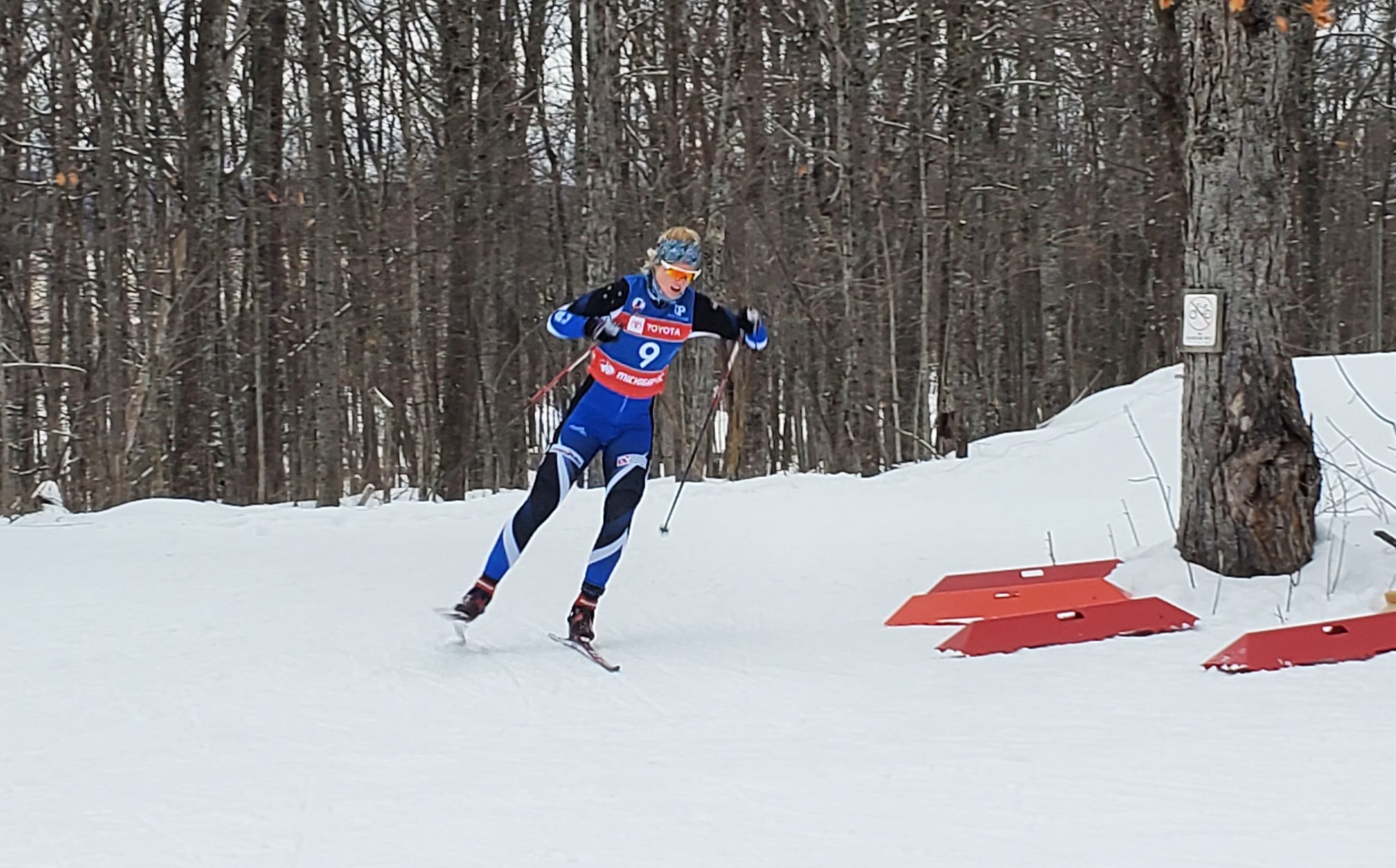
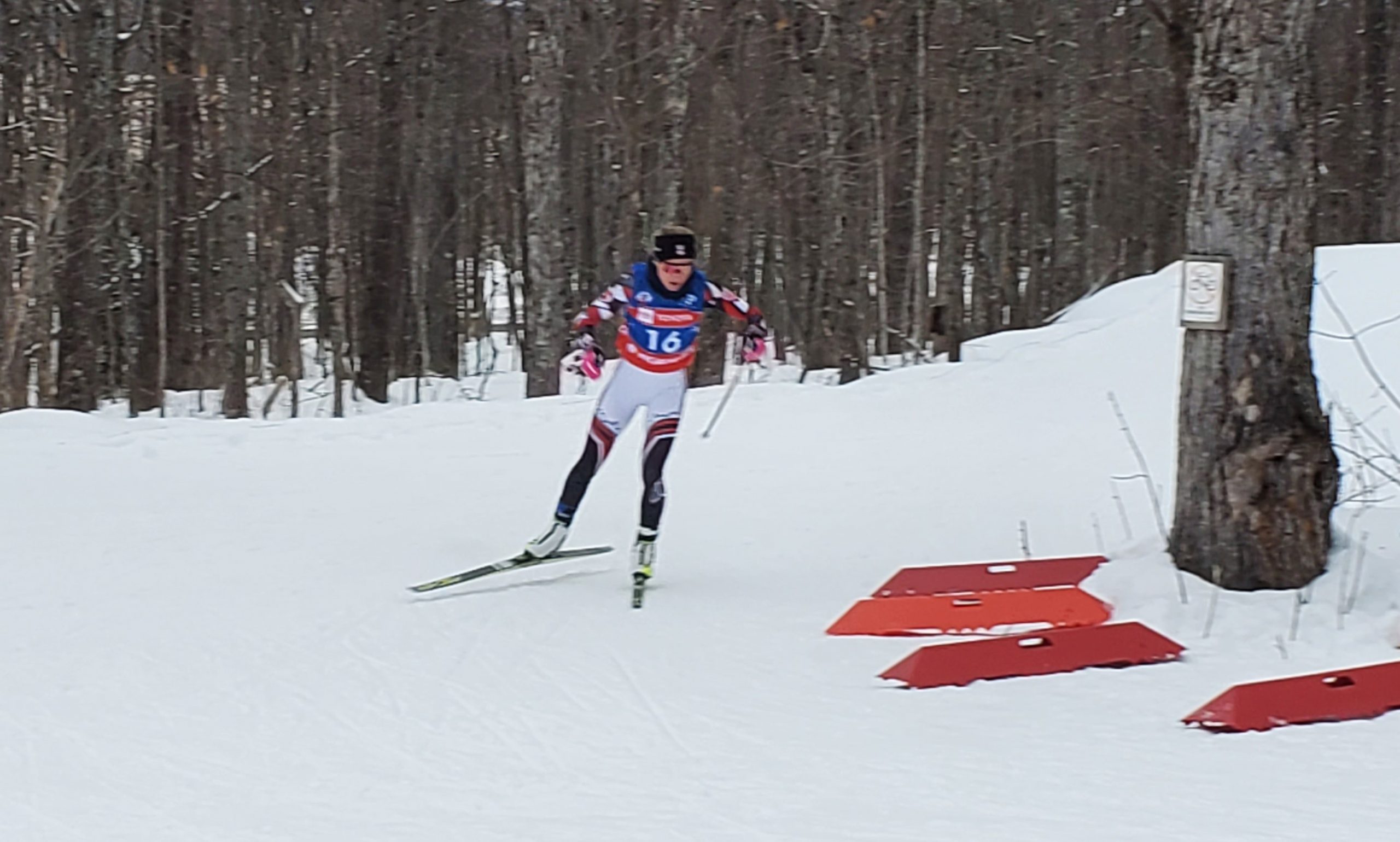
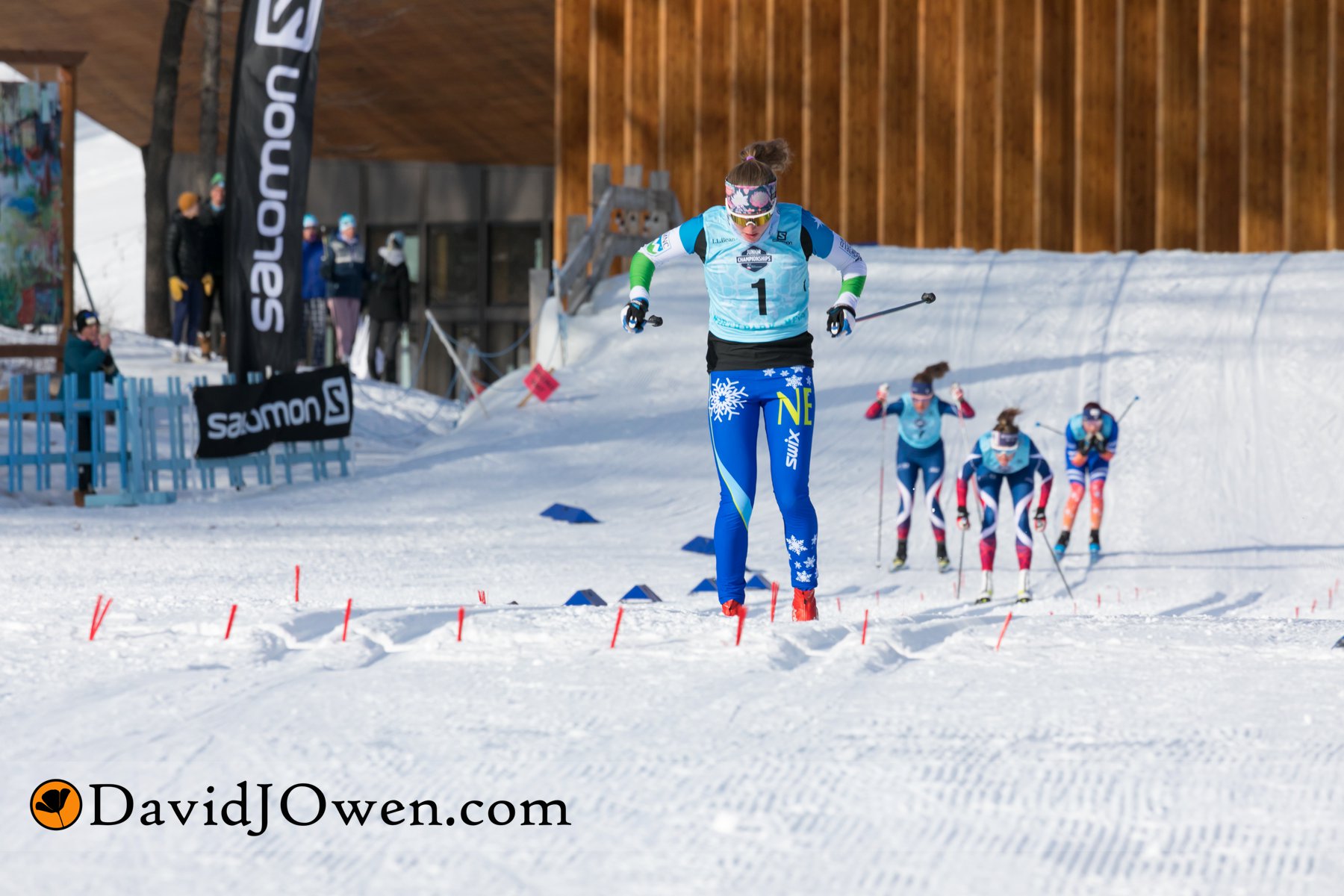
Hailey Swirbul powering through a corner in the qualifying round. (Photo: FasterSkier).
The women’s SuperTour leaderboard also included the names of Houghton podium finishers; with Hailey Swirbul, Sydney Palmer-Leger, and Novie McCabe being on the list.
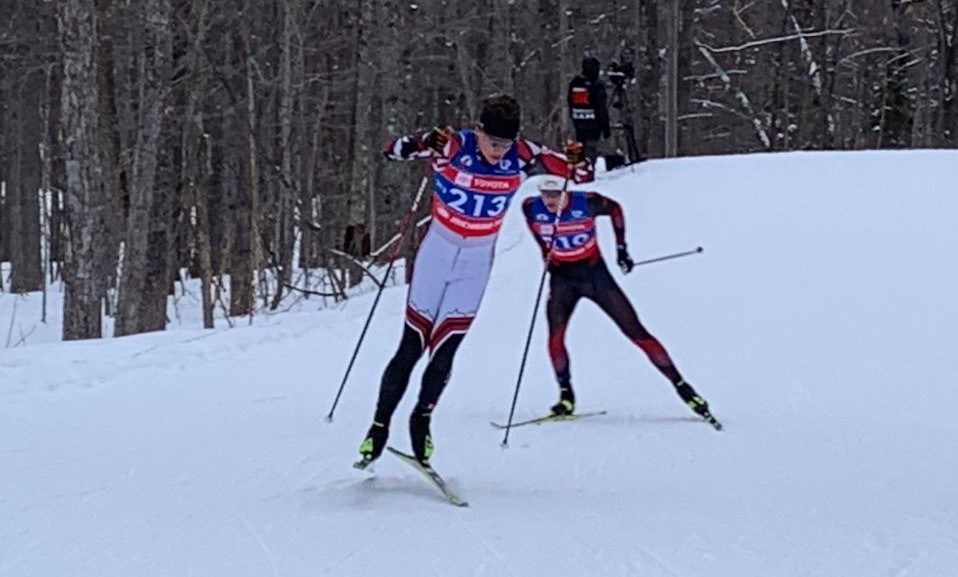
Luke Jager generating enough power to get airborne in a high g-force corner in Houghton. (Photo: Dr. Amy Kostrzewa)
So, despite the lack of a national championship designation, the stakes were still very high. An explanation of the SuperTour designation was provided by U.S. Ski and Snowboard’s Brian Fish. Fish told FasterSkier that several years ago the decision was made to split the U.S. National championships. He said, “The decision was made to take the last competition here, being the second sprint, and be moved as a national championship to the spring. The intent is to have an equal distribution of national championships, and it allows some of our World Cup athletes to be able to do a sprint race as a national championship.” Fish added that, “The intent is to provide a good amount of distance and sprint racing throughout the year.” Fish explained the point system designation of national championship points and SuperTour points: “The U.S. national championship races are double points to the SuperTour, so all of our national championship races are also SuperTour points.” Fish also pointed out that normally this race would be held on a Sunday but was moved to Saturday to try and get more Juniors to race. The back-to-back race days turned out to be a significant factor with today’s sprints following yesterday’s 20 kilometer race.
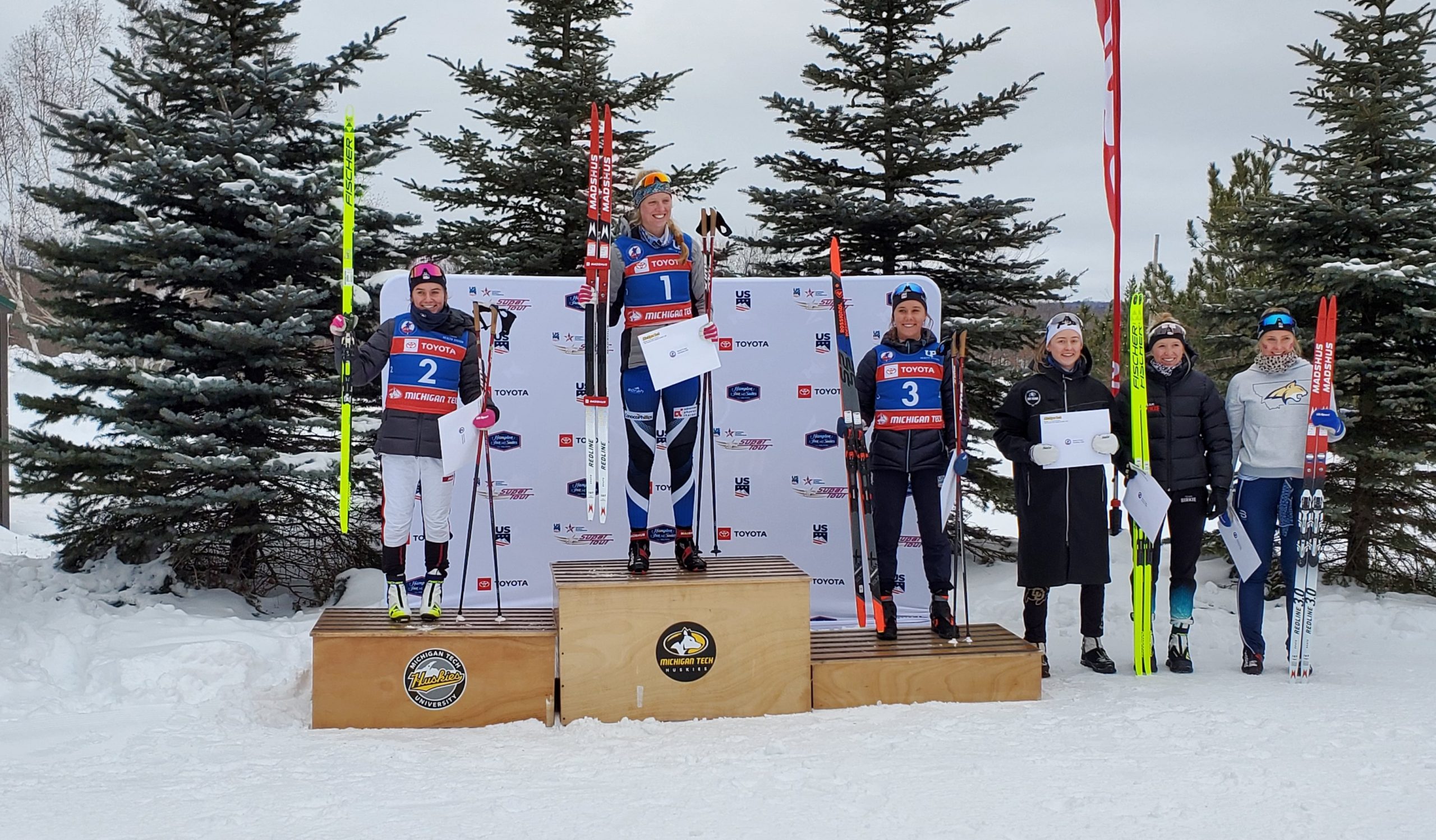
Regardless of what the race was designated, the competition was stiff. On the women’s side, Hailey Swirbul (APU Nordic Ski Center) made it a clean sweep of Houghton winning the sprint by six-tenths of a second over Novie McCabe (University of Utah), who came in second. Lauren Jortberg (SMS T2) came in third.
The men’s race was won by Norwegian Kristoffer Alm Karsrud (Northern Michigan University). He beat out Luke Jager (University of Utah), by seven-tenths of a second. Tom Mancini of France (University of Utah) finished third.
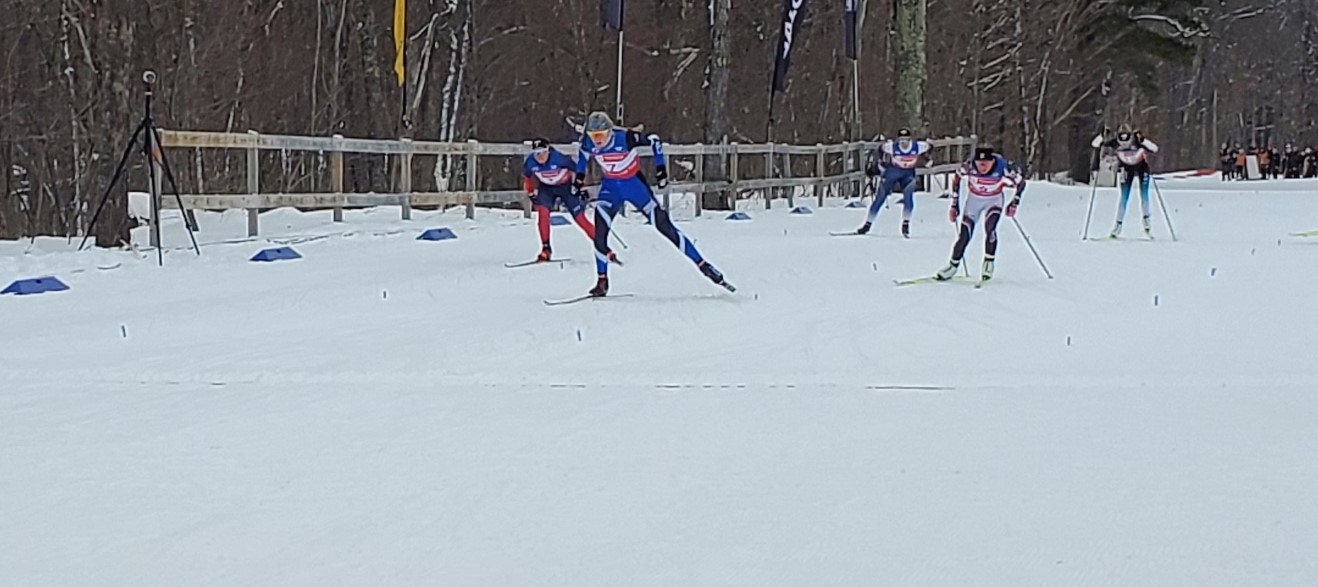
Novie McCabe qualifying for the heats. She would ultimately finish second. (Photo: FasterSkier).
The Race
The week’s racing and back-to-back race days took its toll on racers. Energy reserves were low for everyone, and pacing during qualifiers and heats was critical. Women’s winner Swirbul finished seventh in the qualifiers and didn’t win any of her heats until it mattered most in the finals. She told FasterSkier that, “I was pretty tired today. I didn’t really have it in me to go as hard as I possibly could in every heat. I knew I wouldn’t have any in the end. I tried to move on using as little energy as I could instead of a fitness contest from the first get go. I’m learning a lot about how to conserve energy in the whole sprint day, something I don’t get to practice on the World Cup.” But Swirbul acknowledged that the strategy came with risk. She said,
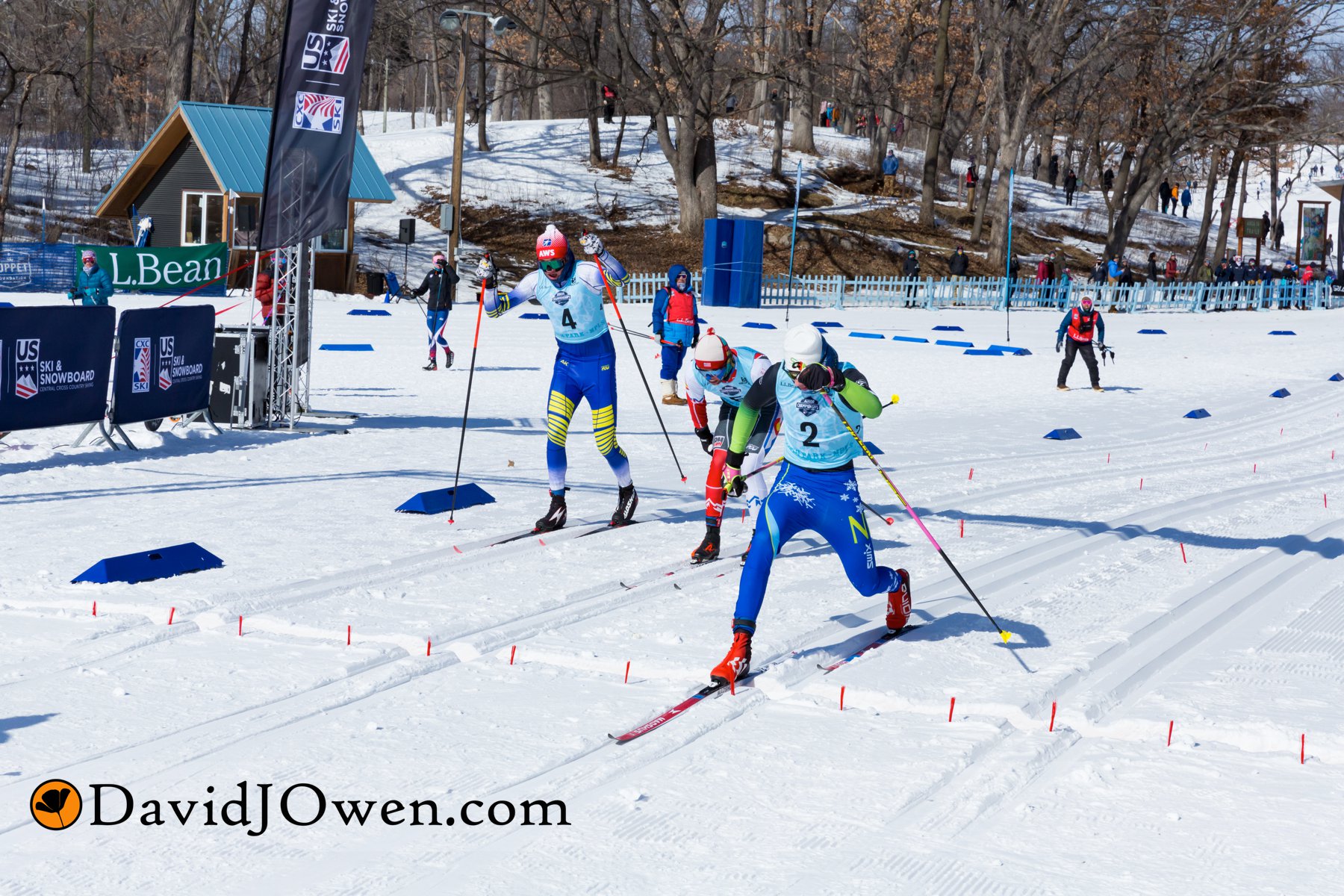
“The semi-final was a stacked group. That cut it pretty close for me. I wasn’t planning on having a four-way lunge with everyone.” Hailey Swirbul
Hailey Swirbul’s first time crossing the finish line in the in the lead was in the finals. (Photo: FasterSkier)
Men’s podium finisher Jager also noted the strain of back-to-back racing. He told FasterSkier, “I was feeling some fatigue from yesterday. Especially since yesterday was a long one. I got better throughout the day. I knew that…today I needed to hold back everywhere I can and stay in the group as much as I can, just wait to the finish. I got a little more dialed every heat.”
In addition to fatigue, the women’s race faced some controversy. In the semifinals, Mariel Merlii Pulles (University of Alaska Fairbanks), who finished second in Wednesday’s classic sprints, was relegated (moved to last) in her heat due to interference. The infraction occurred in the final few yards of the race. Pulles was boxed out at the finish and tried to pass Karianne Dengerud (University of Utah). As Pulles pulled up to Dengerud their skis tangled and Dengerud tumbled to the ground. At the finish line it was Tilde Baangman first, followed by Pulles, with Dengerud sixth. However, the jury ruled that Pulles interfered with Dengerud and Pulles was penalized by relegation. Racing was held up for about five minutes while the jury deliberated. Race technical delegates told FasterSkier that there was some discussion about whether there could be any compensation awarded to Dengerud due to her position near the finish when the violation occurred, and ultimately, they determined that there was nothing within the rules that could be done to compensate her. With Pulles’ relegation, Dengerud’s day would end with her in fifth place in the heat.
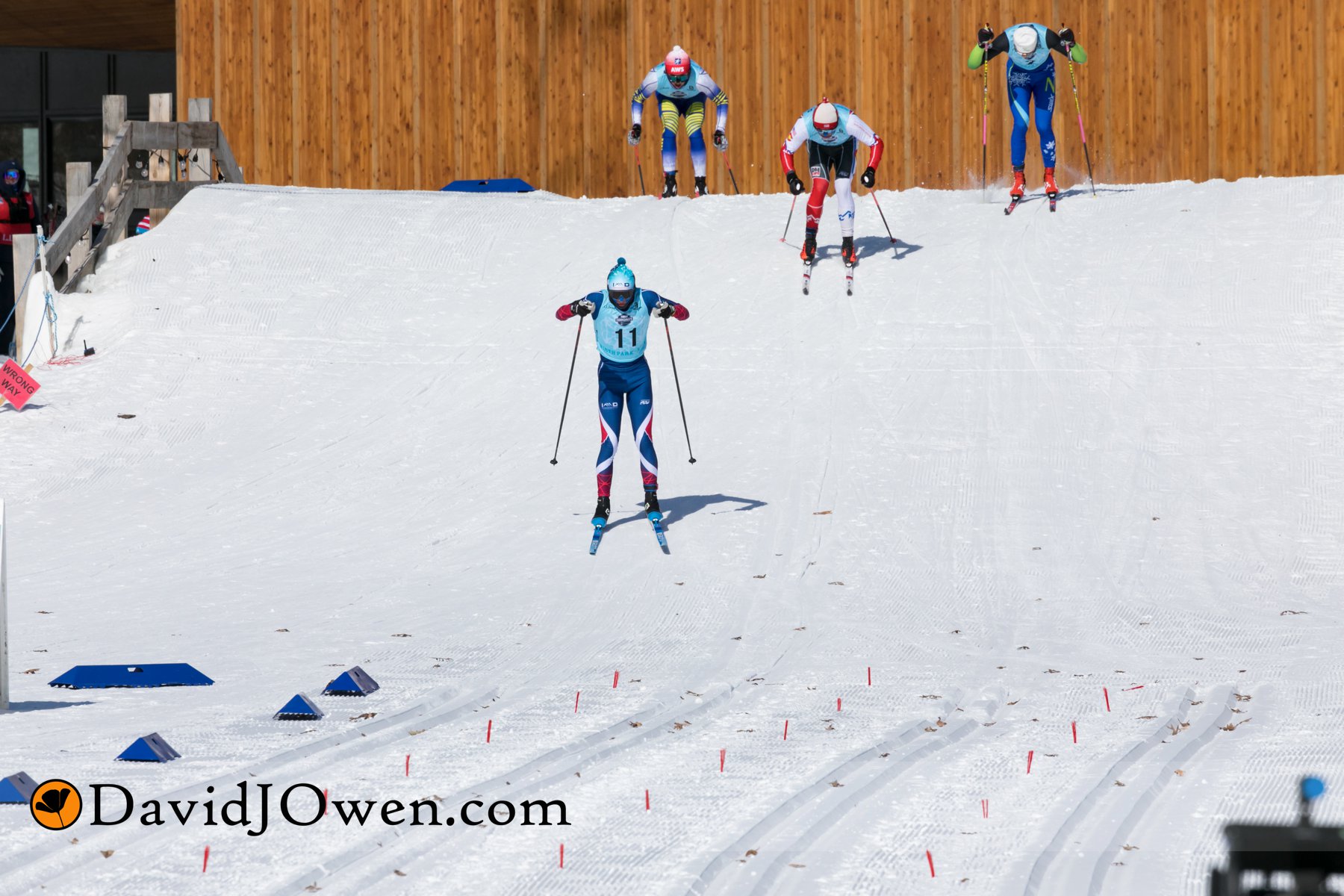
As women’s racing continued into the finals, all eyes were expectantly focused on Swirbul to see if she could sweep the week’s events. Jortberg went out fast, and Swirbul latched on to the back of the pack. Going into the course’s steepest hill for the first time, Swirbul swung wide to pass several skiers and pulled into second. The second time around on the hill Swirbul asserted herself and pressed into the lead. Swirbul put the accelerator pedal all the way down into the stadium and ended up beating out McCabe and Jortberg.
The clean sweep for Swirbul was satisfying. She said that she had held out hope for the possibility of sweeping the week. Swirbul had taken inspiration from her teammate, Rosie Brennan, who had previously accomplished the same feat. She said, “Our coach had talked about that quite a lot, and I wanted to follow in her footsteps, and she’s been a huge inspiration for me.” She continued that, “What means more to me is that I get to be here at nationals. I’m so stoked that I chose to have that be part of my plan this year, instead of going to Europe at the start of the season. So, win, lose, or draw, that’s what I’m really excited for…I love this community.” Swirbul said that this felt like the high point of her career because,
“I am the most happy where I am right now, and I don’t feel like I’m wishing I was home or wishing I was somewhere else. I’m just happy to be where I’m at and happy to be racing well at the same time.” Hailey Swirbul
In the men’s final race, Thomas O’Harra (APU Nordic Ski Center) took the early lead. But most of the field passed O’Harra the second time up the course’s steep hill with Jager and Karsrud surging to the front. Jager had built a very slim lead at the top of the hill. Into the stadium it was Karsrud and Jager in the lead, with Jager holding a slight advantage. But Karsrud had a gear that no one could match and pulled away from the field. Jager acknowledged Karsrud’s finishing prowess:
“Karsrud in that final 100 meters is the stuff of nightmares. He’s just so strong.” Luke Jager
Jager said that he wanted to be in front coming into the stadium. He told FasterSkier that, “I really didn’t like my odds against him in a head-to-head because of how its been panning out for me every other time. He’s an absurdly strong finisher. I feel like the World Cup heats I’ve skied have had finishes that weren’t that fast.”
Men’s sprint podium (l-r Luke Jager, Kristoffer Alm Karsrud, Tom Mancini). (Photo: Dr. Amy Kostrzewa).
For Karsrud, who skis for NMU, the course at Houghton has a bit of a home field advantage feel for him. He said, “This is the third time for a skate sprint here this year, so I know the course really well.” The Wildcat junior said his strategy was, “To pretty much just take it easy in the start, stay far back, and then take it the last 100 meters.” The strategy panned out perfectly for Karsrud, who’s afterburners were unmatchable, and led to a perfectly executed race.
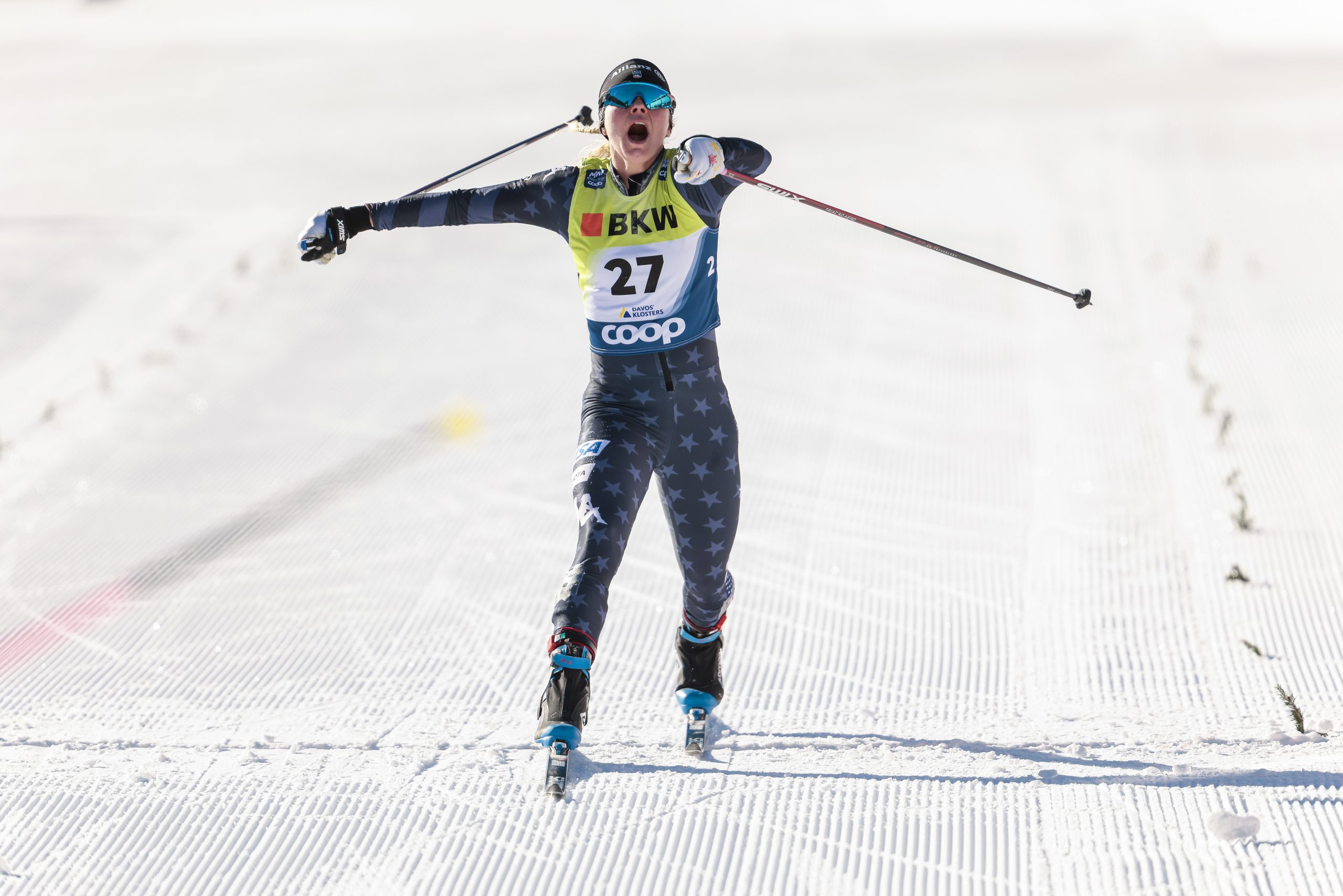
Men’s winner Kristoffer Alm Karsrud with a monster finish had time to celebrate. (Photo: FasterSkier).
The exciting racing was a fitting way to conclude the competition in Houghton. The venue was well organized, and the conditions were excellent. It was all one could hope for in a national championships.
This World Cup coverage is made possible through the generous support of Marty and Kathy Hall and A Hall Mark of Excellence Award. To learn more about A Hall Mark of Excellence Award, or to learn how you can support FasterSkier’s coverage, please contact info@fasterskier.com.
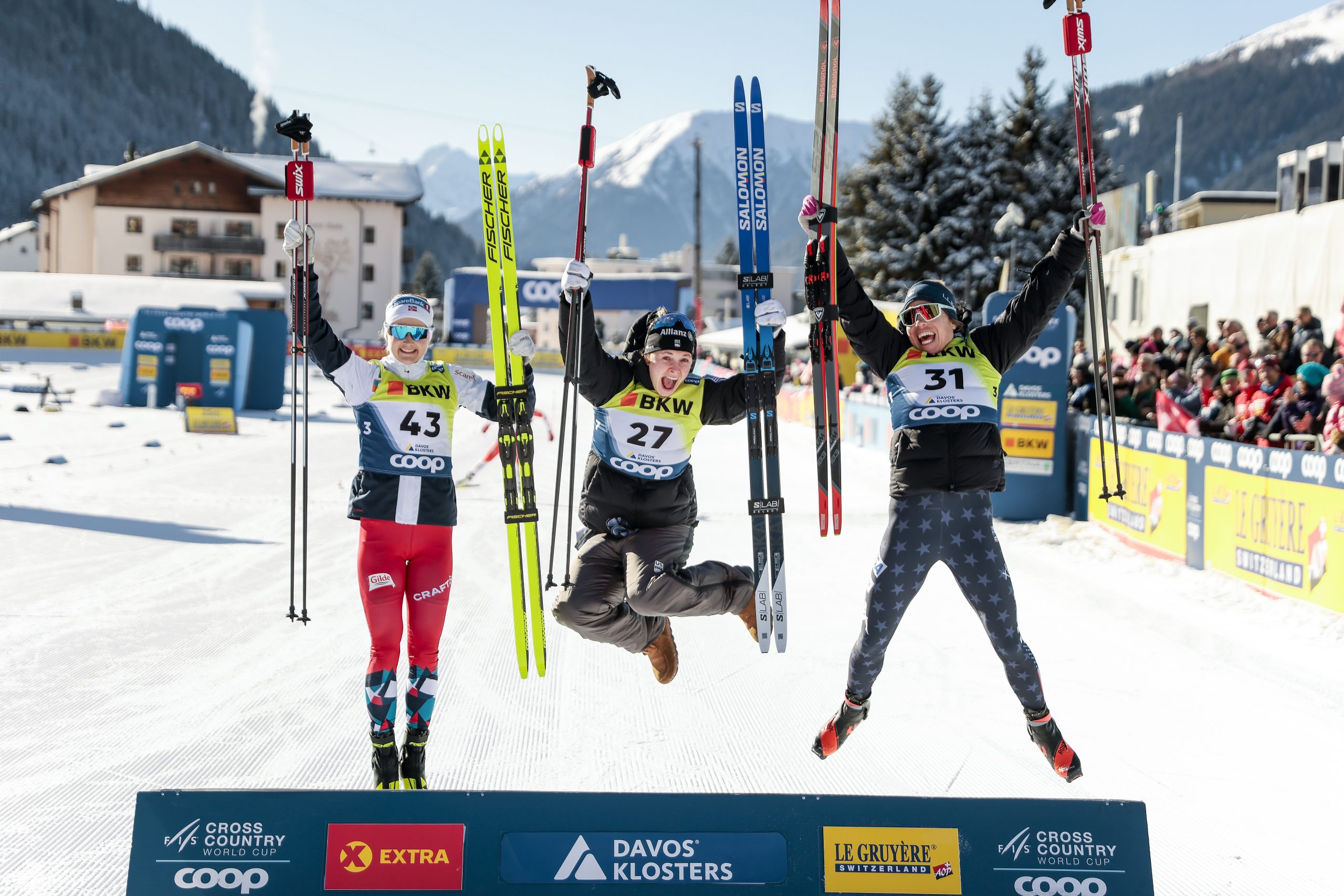
An American celebration in Davos as Jessie Diggins and Rosie Brennan take first and third: l-r Ingvild Oestberg (NOR), Jessie Diggins (USA), Rosie Brennan (USA) (Photo NordicFocus)
Today the World Cup returned to Davos, Switzerland where the women competed in the 20 k Individual Start Freestyle. As has been the case for the last several weeks, much of the critical pre-race story was about who wouldn’t be present. Absent from the field was Swedish long-distance heavy hitter Frida Karlsson and teammate Ebba Andersson. Missing from the Norwegian squad was Heidi Weng.
The U.S. hoped that Jessie Diggins could find her way back to the podium after yesterday’s second place sprint finish. Diggins has the most wins of any active woman athlete in individual distance freestyle, having won 10. She is also the most recent woman to have won consecutive individual World Cup distance events in the freestyle when she did so in January, 2021. After yesterday’s sprint performance, Diggins moved into second place in the overall World Cup standings, behind Tiril Udnes Weng (NOR).
Taking first place was Jessie Diggins (USA), in second was Ingvild Flugstad Oestberg (NOR), and in third Rosie Brennan (USA). Other American finishers were Sophia Laukli (17th), Alayna Sonnesyn (26th), and Lauren Jortberg (39th). Novie McCabe was scheduled to race but did not start due to illness.
It was another standout day for the Canadians with Katherine Stewart-Jones finishing 11th, Olivia Bouffard-Nesbitt 30th, Dahria Beatty 32nd, and Liliane Gagnon 40th.
Jessie Diggins (USA) showing the hardware that comes with first place. (Photo: NordicFocus)
In a pre-race interview Diggins said that she thought Davos was a fun course and really challenging. “It’s sneaky hard,” she said, reiterating her love for individual start skate races. “Just give me a trail in woods by myself and my skis and my brain . . . and I’m just excited to see how hard I can go.”
The skiers had another beautiful Davos day with full bright sun.
Rosie Brennan with the decisive lunge at the finish. It was enough to get her third place by half a second. (Photo: NordicFocus)
20 K Individual Freestyle
Diggins went out hard at the start. At the 2.2-kilometer time-check she had the fastest time by a slim margin over Claudel Delphine (FRA). Brennan started at a controlled tempo and was fifth after the first time check.
Diggins kept the hammer down for the first seven kilometers, leading at every time check. But her lead was very small, ahead of Oestberg by only seven seconds. By the time the 7.2-kilometer mark was reached, Oestberg—who had a later start position than Diggins—had clawed her way into first, leading Diggins by just over a second. The see-saw between the two would continue for the rest of the day with Oestberg hanging onto a small lead for much of the race.
Tactically, it appeared that Oestberg might have an advantage being the last of the top three skiers to start, so she would be fed the others’ times along the way. But Diggins has told Fasterskier in the past that she’s not always interested in hearing split times; she just skis as hard as she can. She also values having warmups conclude close to her starting time.
U.S. coach Chris Grover confirmed with Fasterskier that, “[Diggins] likes to take an earlier draw in start position because she likes to not have the track closed for so long for warmup. She really doesn’t even think of splits out there. Jessie knew exactly how she wanted to ski that course and that was to not go quite as hard on all of the ups . . . you have to work all the transitions, all the corners, all of the downs. The last 1.8 K are down . . . she had that strategy in mind for how she was going to ski it and she went out and skied it exactly the way she wanted to.”
Jessie Diggins (USA) found another gear in the final 1.8 k to finish first. (Photo: NordicFocus)
Grover continued that it was a different approach for Brennan. He said, “She’s prioritizing climbing on the uphills. Two opposite strategies and they both worked out pretty well for them.”
Twenty kilometers is still a relatively new distance for the women, so proper pacing would be critical. Grover indicated that the change to 20 k hasn’t been much of an issue. “It seems like it hasn’t been that hard of a transition,” Grover said. “They looked like they were at a high pace the whole time, the same kind of strategies they employed on this course in 10-K. We did a little bit of feeding, which we wouldn’t have done in a 10-kilometer event. Otherwise, it wasn’t so different.”
“I really wanted to pace it like red-line pacing…go as hard as I could right before I felt like I was going to blow up, and then hold it there.” Jessie Diggins
Diggins continued: “My strengths are the second half of the lap with all of these working sections, trying to find the extra seconds here and there,” she said. “We had some really awesome skis, and awesome energy from the fans.”
Regarding pacing for today’s race, Brennan told Fasterskier that: “I have never done a 20k interval start which was probably true for the whole field today. That made it really tricky to know the pace or really what to expect. I love the course here and love skiing at altitude so I had some confidence that I could find a steady pace and hold it.”
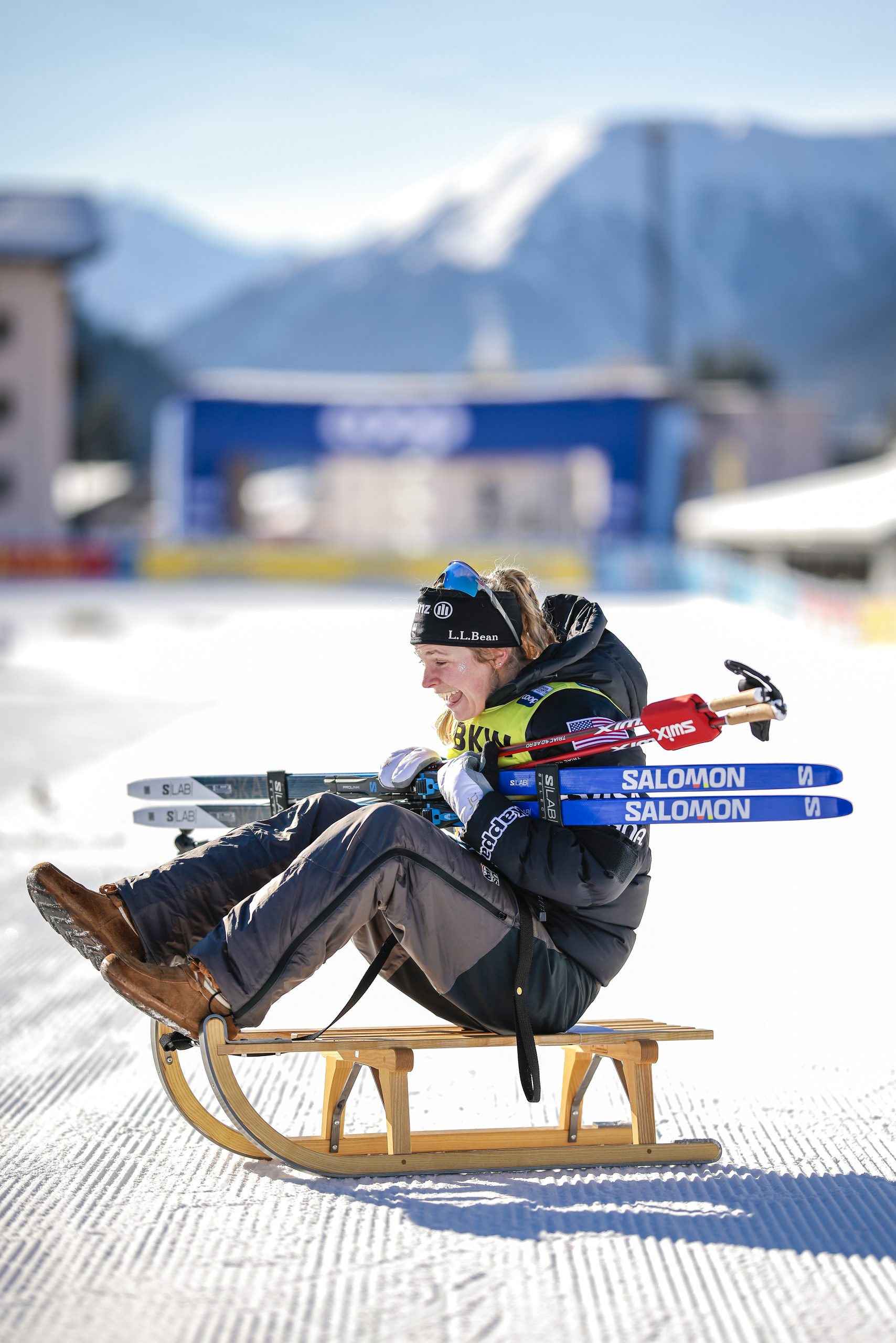
Jessie Diggins (USA) enjoying her first place hardware in Davos. The full-sized sled goes to the winner. (Photo: NordicFocus).
With only five kilometers to go, the race for first was almost a dead heat. Oestberg had a scant three second lead over Diggins. Meanwhile, the fight for third was boiling down to Brennan and Tiril Udnes Weng (NOR). At the 15 kilometer mark, Weng held a one second lead over Brennan. Both those racers were over 13 seconds off first place.
As the race wound down, the momentum for first place seemed to favor Oestberg as she continuously displaced Diggins from the lead with each time check she passed. But her lead was small enough that Diggins remained in the hunt for first place.
With two kilometers to go the competition had boiled down to two distinct races: Oestberg and Diggins battling for first, and Brennan and T. Weng battling for second. The tension continued to mount as Oestberg approached the final time-check at 18.2-kilometers. Oestberg had moved past Diggins at every time split since the 7.2-kilometer mark, and that trend continued at the last time check with Oestberg going into first place, but by only 2.9 seconds. Brennan and T. Weng were even closer with less than two seconds separating them with Brennan holding the lead.
With the race close—but momentum still in Oestberg’s favor—one couldn’t help but have the feeling that things would go Oestberg’s way.
Rosie Brennan (USA) showing the grit needed to earn a spot on the podium. (Photo: NordicFocus)
But as ski fans have seen so many times over the years, Diggins always has that little extra bit to put forth at the finish. Over the last 1.8-kilometers, Diggins reached for her well-known extra gear and ended up skiing the final stretch in 3:33.7. Oestberg skied the same stretch in 3:42.1. The 7.4 second advantage over the final 1.8-kilometers was enough to give Diggins the win by 5.5 seconds, dropping Oestberg to second.
“I knew it was tight, I knew it was exciting. I was just trying to ski my own race and ski as smart, as powerful, and as smooth as I could. My mental mantra was find the glide. Individual starts are my favorite way to race, it’s just you and your head out there.” Jessie Diggins
Diggins commented that she was so focused over the final downhill that she didn’t blink and her contact lens froze which added to the normal post finish line stress. “My eyes were ok, they just needed some time to warm up . . . no lasting damage; it was just quite painful and a little bit scary.”
T. Weng was nibbling away at Brennan’s lead by tenths of a second. Weng skied the final 2.8-kilometers faster than Brennan, but Brennan had established a three second lead at the 17.2 mark. It would be just enough to hold off T. Weng who finished half a second behind Brennan. Brennan told Fasterskier that, ” I had really good skis today and did all I could to push the downhill on the last lap which just barely snuck me on the podium.” Brennan said of the day’s events that, “Today was a great day for USA!!! I was pleased to turn around a disappointing day yesterday into a podium today. It was a tight race the whole way and I am thrilled to have just nipped the podium spot. It was great to share the podium with Diggs and is a great way to close out period 1 racing. Now it’s all eyes on the Tour!”
A 20 kilometer race had turned into a game of inches with Diggins and Brennan skiing perfectly to claim the podium. It was a glorious day in what turned out to be a fantastic weekend for team U.S.A. After the dust had settled from the day’s racing, Diggins would find herself firmly in second place in the overall World Cup points standings. Tiril Udnes Weng holds first place with 872 points. Diggins is in second with 738, and Krista Parmakoski (FIN) is in third with 625.
The World Cup takes a weekend off and picks up December 31st in Val Mustair, Switzerland for the start of the Tour de Ski with the freestyle sprints leading off.
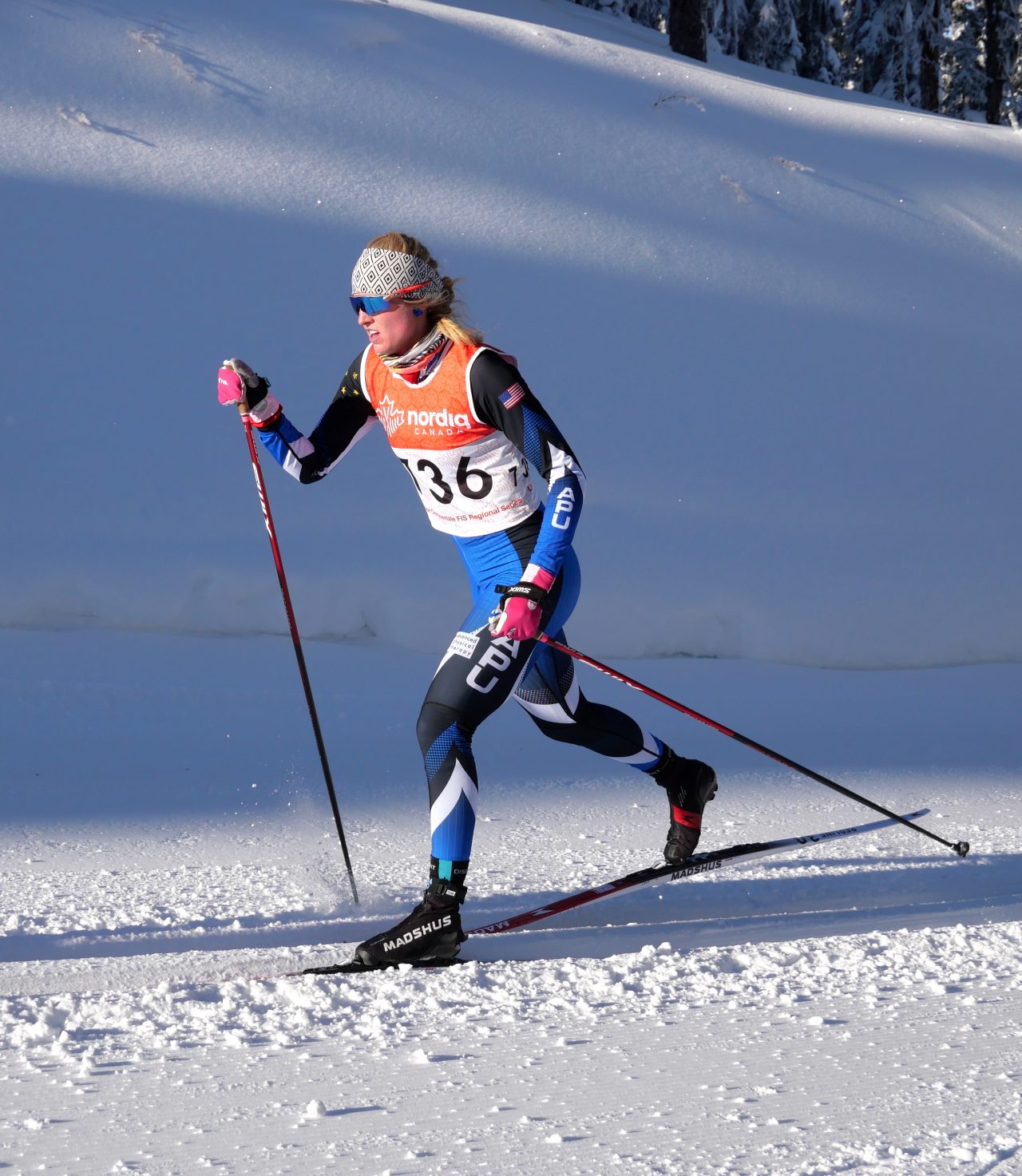
Hailey Swirbul striding to victory at Sovereign Lake. (Photo: Peggy Hung)
Race day four at Sovereign Lake was a 10km individual start classic in the sunshine. With humid new snow at -10C all day while the air warmed up to -4C, all the teams found fast skis and solid kick on a great day for striding.
Once again, the Open and U20 categories skied 2x5km first, followed by U18 and U16 who skied 2×2.5km, for a total of 385 starters Sunday.
Individual start races are about skiing fast, but also about pacing. Keep reading to the end to see the different pacing ideas from top skiers.
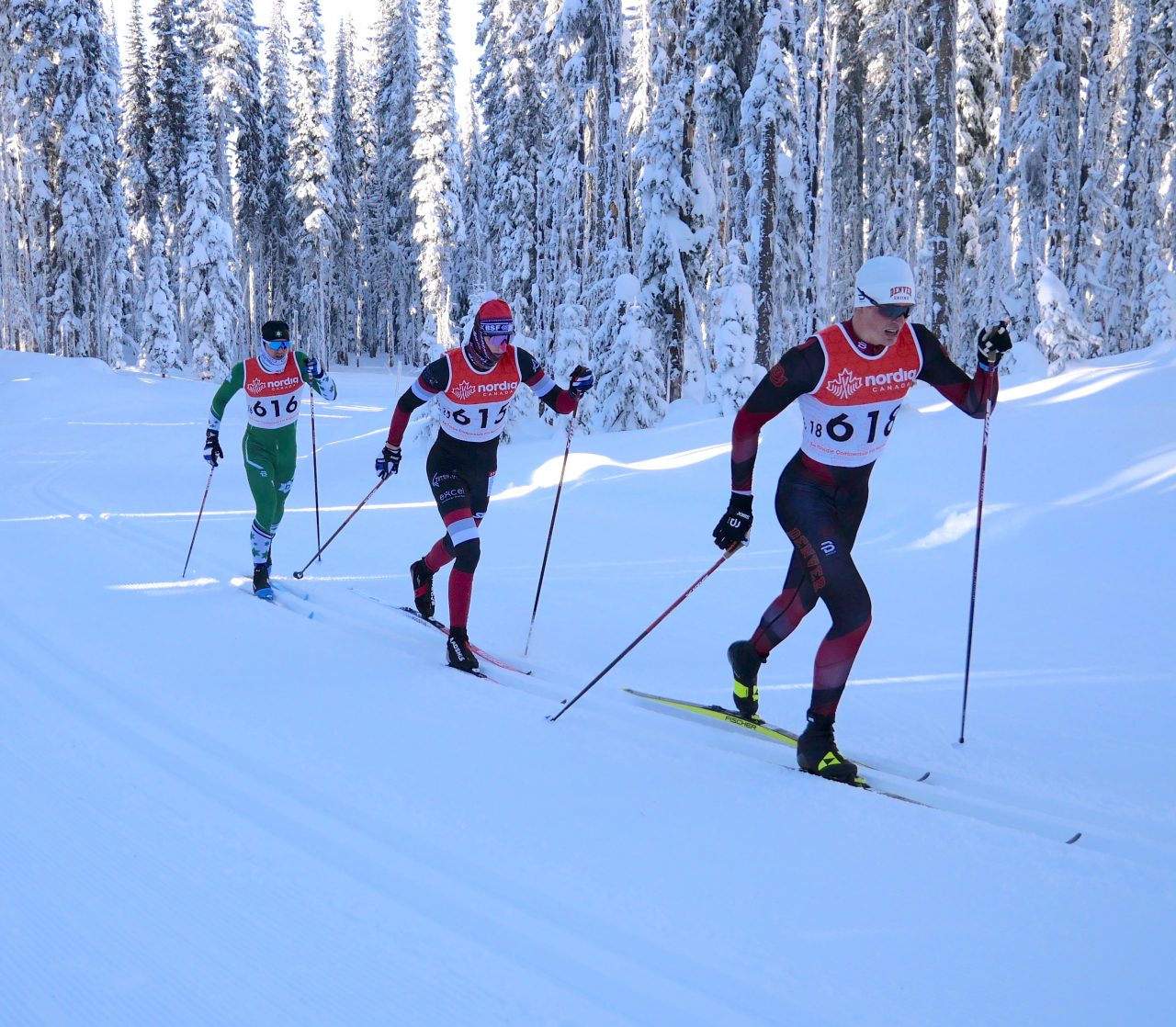
Andreas Kirkeng (618) leads Reid Noble (617) and John Steel Hagenbuch (616) on the second A climb. (Photo: Peggy Hung)
At the end of a hard week of racing, only 102 men of 118 would finish, with University of Denver’s Andreas Kirkeng (NOR) taking his second win in his second race, completing the 10km in 27:17.7. Bridger’s Finn O’Connell (USA) was second, 53.1 seconds back. Dartmouth’s John Steel Hagenbuch (USA) was third at 1:08.6.
Canada took the next three spots, with AWCA’s Scott Hill at 1:09.6, U of Utah’s Sam Hendry at 1:23.5, and National team member Xav McKeever at 1:25.3 (and top U20).
Kirkeng was pleased with his racing, having skipped Wednesday and Thursday to complete a volume block here.
“Today, I was really good. I felt super strong and my skis were perfect. They were like real good kick, more than enough to do the hills here and the speed on them in the downhill were just insane. So perfect day.”
Here is Kirkeng’s second time up the final ‘kicker’ climb with 500m to go:
O’Connell was more moderate about his second place: “It was pretty solid I’d say. The goal is always to go out there and fight for to win and I felt good today, skis were really good. Thanks to both my coaches and yeah, gave it everything I had.”
So many skiers commented on having great skis that it would become repetitive to quote each one.
“It was good,” Hagenbuch said. “It was definitely quite hard after a long week of racing and a lot of cold air that has been breathed so far this week. So like the lungs are definitely feeling that but I tried hard.”
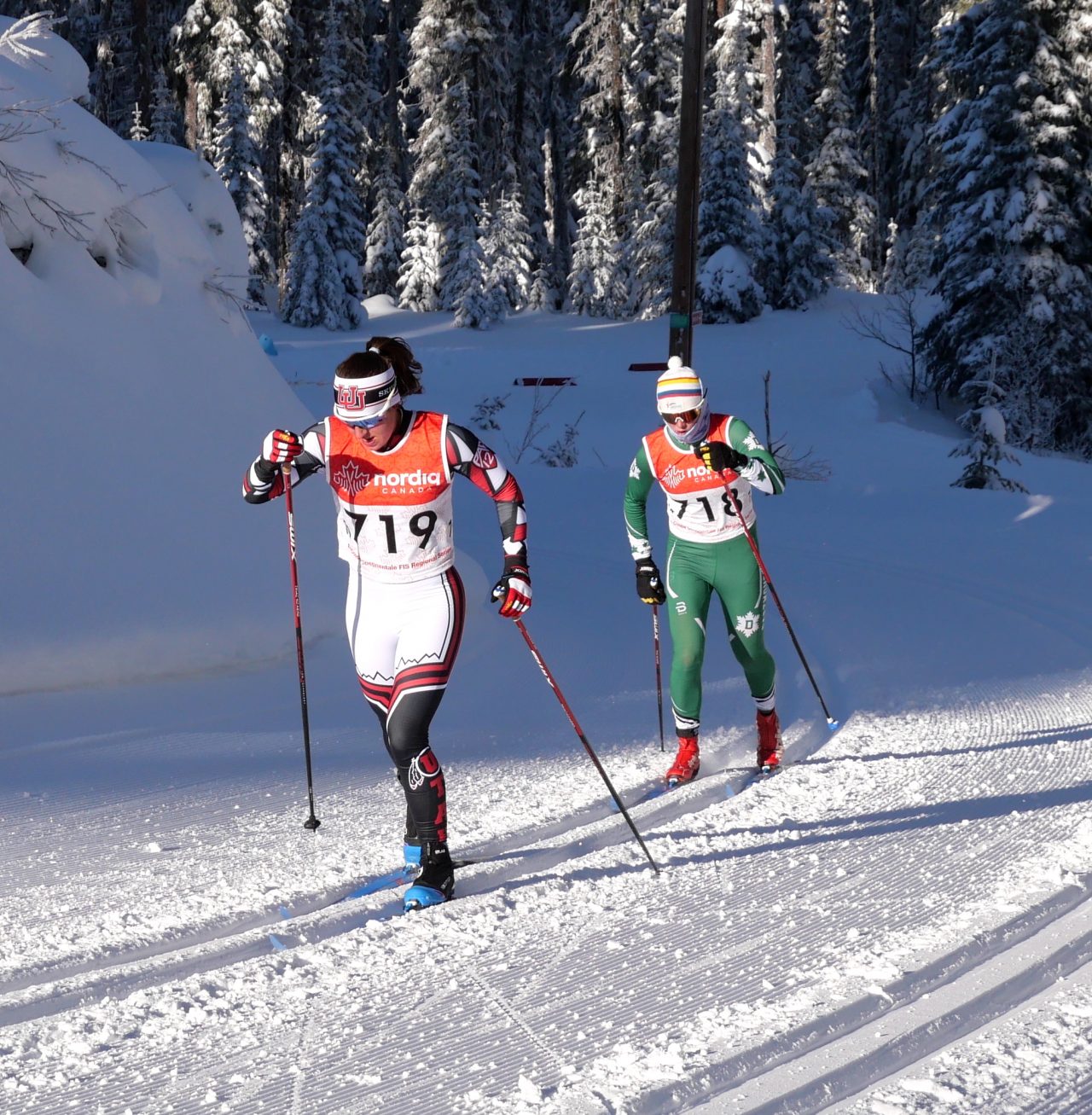
Sydney Palmer Leger (719) on her way to a fourth podium in five days. (Photo: Peggy Hung)
On the women’s side, APU’s Hailey Swirbul (USA) continued her solid week with a third win, skiing the 10km in 31:55.9. U of Colorado’s Hanna Abrahamsson was 23.6 seconds back with U of Utah’s Sydney Palmer Leger (USA) taking third at 1:12.5. AWCA’s Sonjaa Schmidt was top Canadian, in sixth at 1:33.5.
Swirbul was happy: “Today was a really good one for me. I felt like I paced it well and tried to race really smart for me. And I think that paid off.”
Abrahamsson was all smiles on Sunday and FasterSkier has the video evidence:
FasterSkier missed Palmer Leger, but did get some video on the final ‘kicker’ climb:
The women’s field was also diminished by a hard week, with only 75 of 87 starting. There were a lot of smiling faces on those that persevered.
For some, the Upper World Cup 5km is a course they can ski in their sleep. Or nightmares. For others, it was the first visit. The course looks simple on paper, with only 154m of climbing in 5.2km. With 14 splits per lap, there is endless opportunity to compare pacing.
Kirkeng won by 53 seconds. Almost a minute in a 10km with a deep North American field. Which means when he talks about pacing, FasterSkier records video:
Kirkeng took a different view of the course than most of the others and maybe that made the difference.
“I knew with fast skis that some of the downhills and flats that were tracked I would be able to rest quite a bit. So I really just pushed the hills and got up with as quick as I could, knowing that there was rest ahead.” — O’Connell
“It’s at altitude. And it’s there’s a lot of sustained climbing on this course. So I think you have to start out the first lap almost in threshold. And that actually is race pace on a course like this. I also had the benefit of, honestly, some of the best skis I’ve had in years. And my coaches did an amazing job with skis today. So that really helps to have good kick and also enough glide through the double pole you can make up time because there’s a lot of time to be made on those transitions. ” — Swirbul
“I started out a bit easier on the first lap, especially because it’s a lot. There’s a lot of uphill the very first half of the first lap. So I started out a bit easier. And then when I came around for my second lap, I really started to dig deep and give it all I had.” — Schmidt
“Oh, just crush it up hill and double pole like a maniac in the flatter part. I would say and just survive. Yeah, enjoy a little bit of a nice view, it was so beautiful out there today.” — Abrahamsson
“You got to really keep it controlled in the first k. I almost feel like I’m warming up the first climb and then kind of get into the race. But yeah, thinking about it, I don’t think I’ve raced a race course in any part of the world more than this course, I’m used to it. ” — Hill
“It’s always hard to race at Sovereign because it’s high altitude. Always hard racing. So yeah, it’s probably one of the tougher spots to race in Canada.” — McKeever
“Just kind of settling into a rhythm on the long climb there [pointing to the first A climb] and just working it and then making sure you save something for those last two punchy climbs into the finish.” — Hendry
How Was Your Week
After a long five days that both Swirbul and her coach Erik Flora compared to the start of the Tour de Ski, FasterSkier asked skiers for their impressions.
The wax techs had skis dialed by sunrise. (Photo: Peggy Hung)
“Oh, I absolutely love SilverStar. And there’s no better day like today to finish off this really good week of racing and just well, well put on races by everyone here.” — Swirbul
“I really like this place. I don’t want to go home. We’re flying back to Boulder tomorrow. And I don’t want to do that. I want to be here. It’s like, it’s so amazing. The skiing is so good. And yeah, so beautiful.” — Abrahamsson
“It was great. I’ve never been to SilverStar [before] but the conditions have been unbelievable and races have been very, very well organized. The volunteers and race organizers did an amazing job and I look forward to coming back sometime.” — Hagenbuch
“I live over in Canmore, so as soon as Sovereign gets snow, I’m hopping in the car and coming here [and] did a two week training camp leading into these races. So yeah, the SilverStar magic is a real thing.” — Hill
It is an early start under the lights for the coaches. (Photo: Jacqueline Akerman, Sovereign Lake Nordic Development Academy)
This World Cup coverage is made possible through the generous support of Marty and Kathy Hall and A Hall Mark of Excellence Award. To learn more about A Hall Mark of Excellence Award or to learn how you can support FasterSkier’s coverage please contact info@fasterskier.com.
Julia Kern (USA) Having a big day in Lillehammer. (Photo: NordicFocus)
Today is day two for the World Cup stop in the Nordic skiing playground of Lillehammer, Norway. But it was all work and no play, today, as skiers faced the challenge of the 1.6-kilometer freestyle sprint course. It was another grey, overcast day in Lillehammer as skiers lined up for the races. Fifty-five women fought for the Sprint qualifiers, hoping to land a place in the heats. The top 30 qualifiers would earn the right to compete through to the quarterfinals—a bit of a misnomer, as there are actually five races in the quarterfinal round.
Going into the qualifiers, the United States was represented by Julia Kern of Massachusetts, Minnesota native Jessie Diggins, Vermont resident Alayna Sonnesyn, and Colorado native Lauren Jortberg. As reported yesterday, Jortberg is a coach’s discretionary pick, racing in her second World Cup weekend.
At the end of the day, Jessie Diggins (USA) was tantalizingly close to securing her second podium in as many days. She qualified 5th leading into the quarter finals, and made her way to the finals, but fell just short of the podium, finishing fourth overall. Julia Kern (USA) finished 20th in qualifying and made it into the semi-finals, just missing qualifying for the final heat.
The race was won by Emma Ribom (SWE), who is showing sprint prowess this year, having topped the podium last week as well. Maja Dahlqvist (SWE) was second, followed by Tiril Weng (NOR).
Emma Ribom celebrates her second sprint victory in as many weeks. (Photo: NordicFocus)
Lillehammer Women’s Freestyle Sprints
Diggins landed in the first heat and kept the pace brisk. A late turn of pace brought her to the front, and she finished in a photo-finish for second, which she took by .02 seconds.
Kern competed in the fifth quarterfinal, conserving her energy in the first half of the race, moving up to the lead in the last half of the race. She pushed very hard toward the end, separating herself going in the final turn. She ended up comfortably winning her heat.
“I found my gear and skied it tactically exactly how I wanted to and had really good energy to push in the second half of the course, which was my plan,” Kern said. “I walked away feeling super energized and confident going into the semi-final.”
Diggins at the finish in Lillehammer (Photo: NordicFocus)
In the semi-finals Diggins raced in the first heat, and Kern in the second.
In her heat, Diggins’ skis appeared exceptionally fast as she glided past many of her rivals. She bided her time, remaining toward the back for the first half. She then exhibited the cagey race tactics for which she is now known, deftly working her way through traffic. She ended up finishing third to advance to the finals in a lucky loser slot.
Kern used a strategy similar to what she had shown in the quarters, keeping back for the first half of the race; however, the racers bunched up at the half-way point and there was still a lot of traffic for Kern to make her way through. As the pack neared the finish, Lotta Weng (NOR) crashed, slightly disturbing Kern’s pace. Kern desperately pushed through to the finish, but finished fourth, failing to advance. Kern confirmed with FasterSkier that this affected her race:
“I saw it coming, I had a feeling there might be a tangle and was able to react pretty quickly and get around her,” she said. “That little blip and hiccup, that maybe cost me moving up. But, that’s sprint racing. I’m really happy with today, with how my skis felt and how my body felt. Looking forward to more racing tomorrow.”
“It was a super exciting day to have four in the top ten (including the men), Kern said. “We had ripping fast skis.”
Diggins a happy finisher at the Lillehammer sprints. (Photo: NordicFocus)
U.S. Head Coach Matt Whitcomb shared with Fasterskier that, “Julia executed perfectly the general recommendation to get a reasonable start, and if you find yourself boxed out, take the opportunity to relax, and when you find a window go through it fast.”
“The strategy going into the races was based on footage watched earlier in the week,” Whitcomb added. “We do this to minimize the amount of talk race day, or the meeting before the race, to avoid putting too much stress on the racers. By the time we showed up, everyone pretty much had their own plan. Watching the athletes warm up, they knew what they were intending to execute, that’s a pretty special thing to watch.”
Whitcomb continued his explanation, adding that, “We felt that we had great skis today, which is nice because you can guarantee that Norway’s going to have great skis and that’s half of the competition for us.”
In the finals, Diggins was joined by Ribom, Dahlqvist, Tiril Udnes Weng (NOR), Johanna Hagstroem (SWE), and Victoria Carl (GER). Diggins started fast and still looked to have very fast skis. She shot into third place right off the start. After about a minute, the skiers were tightly bunched. Diggins managed to pass skiers on the outside of the track and move herself into the lead. As other skiers accelerated on the long hill leading into the stadium, Diggins gradually drifted to fourth, but she was still in the thick of things. Ultimately, she couldn’t match the pace of the top three as they separated from her going into the finishing stretch. Diggins ended up fourth—1.1 seconds off the podium—but it was definitely another of her signature sparkling days for the American star.
Whitcomb told Fasterskier that yesterday’s first-place effort had taken its toll on Diggins. “By the end of the race, Jessie felt like her arms had kind of run out of power,” Whitcomb said. “At this point in the season, she could have podiumed yesterday or today, but to have both, was going to be a tall ask. We’re so thrilled with yesterday’s race that getting fourth today feels like a podium.”
This World Cup coverage is made possible through the generous support of Marty and Kathy Hall and A Hall Mark of Excellence Award. To learn more about A Hall Mark of Excellence Award or to learn how you can support FasterSkier’s coverage please contact info@fasterskier.com.
Women’s 20K Pursuit.
Today, Ruka, Finland was home to the inaugural running of the women’s 20K pursuit. The format is now a 20-kilometer skate race with interval starts based upon skiers’ finishing times taken from yesterday’s classic race. The weather has stayed consistent over the weekend. Temperature at the start was 21 (-6.0 Celsius). The humidity has been high all weekend, this morning it was 93 percent.
Frida Karlsson (SWE) celebrates the victory as she nears the finish of the 20k pursuit in Ruka (FIN). (Photo: NordicFocus)
The course was different from yesterday’s 10-kilometer race. Skiers raced six laps on a 3.33-kilometer course.
Ebba Andersson (Sweden) started first with a six second advantage over Frida Karlsson (Sweden) and 13 seconds over Katharina Henning (Germany).
American Rosie Brennan started 29 seconds back. Her teammate Jessie Diggins started at plus 1:18. Diggins usually performs well in this format but had a long way to come back to reach the podium. However, the new longer format could work to her advantage. The other Americans, Novie McCabe, Sophia Laukli, Alayna Sonnesyn, and Julia Kern, all began over two minutes after the starting gun.
Prior to the race Rosie Brennan expressed her excitement on the 20-kilometer format. “I’ve never done 20k on the world cup, but it is a distance I’ve done in the U.S. before, it’s super tight at the top ten and it will be fun and exciting.”
The Results.
First: Frida Karlsson (Sweden)
Second: Ebba Andersson (Sweden)
Third: Tiril Weng (Norway)
Fourth: Heidi Weng (Norway)
Fifth: Silje Theodorsen (Norway)
Sixth: Rosie Brennan (U.S.A)
Seventh: Maja Dahlqvist (Sweden)
Eighth: Anne Kalvaa (Norway)
Ninth: Krista Parmakoski (Finland)
Tenth: Jessie Diggins (U.S.A.)
Other American finishers: Novie McCabe, 25th, Alayna Sonnesyn 33rd, Sophia Lauklia 34th, and Julia Kern 35th
Jessie Diggins (USA) leads Ingvild Flugstad Oestberg (NOR) during the 20k pursuit. (Photo: NordicFocus)
The Race.
One minute before the race, competitors were part of one of the stranger sights at a World Cup start. The entire field of athletes were holding their hands over their ears trying to block the incredibly shrill piercing noise of the pre-race alarm going off. It was much like the frequency of a smoke detector. The athletes were visibly bothered, but the race began without a hitch.
Within the first two minutes, Karlsson had closed the initial gap on Andersson. The unanswered question arose: was this intentional team tactics to try and work as a group or was it simply two skiers racing?
At the 1.1-kilometer mark, Brennan had reduced her deficit by three seconds, and was only six seconds out of third place. Diggins had already shaved six seconds from her deficit moving into 19th place.
Pacing for the new 20-kilometer distance was going to be a challenge. It remained to be seen how racers would manage the new event. Brennan hooked up with a seven-person chase pack at about 2.5-kilometers. It included Maja Dahlquist, Heidi Weng, Tiril Weng, and Anne Kalvaa. Kalvaa had put in a strong performance yesterday, barely missing out on a podium.
By the 3.3 mark, the leading Swedes had slightly extended their advantage over the chase group. Brennan was 27.6 seconds back. But the lingering question of whether the leading Swedes were working together had been answered: they were.
Rosie Brennan (USA) leads the chase pack during the 20k pursuit. (Photo: NordicFocus)
At the 3.3-kilometer mark Diggins was 1:03.8 behind the two leaders and was now skiing in a group. She had trimmed 15 seconds from her original deficit. But the lead Swedes continued to press their advantage, increasing the gap on the next chase group by another couple of seconds at the 4.4-kilometer time check.
Going into the 6.6-kilometer mark, the lead Swedes continued to swap spots, while the chase group had now increased to ten racers. Brennan—perhaps realizing that the pace was not good enough to catch the leaders—moved to the front of the pack, but the group was still bleeding time to the lead Swedes, now 38.3 seconds behind.
Meanwhile, the second chase group—which contained Diggins—was working hard. Diggins was now only 57.2 seconds behind with over 13-kilometers to go. But, closing the gap to the next chase group would be a monumental task.
At 7.7-kilometers Brennan was clearly trying to push the pace and began to try and pull away from the rest of the chase group.
By the halfway point, the lead Swedes had extended their lead over the chase group to 49 seconds. It appeared that much of the chase group had given up the hunt and were jockeying for third place. Their pace had slowed enough to allow Diggins to join the group. At this point the chase group had swelled to twelve athletes with Diggins tucked in the middle.
Meanwhile, the front running Swedes calmly exchanged the lead, skiing in tandem, in almost perfect rhythm which each other.
At the start of the fifth lap, if any doubt had remained, it was clear that the chase group was now competing for third place. The chasers were about 50 seconds behind the leading Swedes.
27.11.2022, Ruka, Finland (FIN): Frida Karlsson (SWE),- FIS world cup cross-country, pursuit, Ruka (FIN). www.nordicfocus.com.
It was at this point that Norway tried to assert itself as a wave of red suits went to the front of the chase group. But Diggins would have none of it, and at 14.3 kilometers she had broken through the Norwegian wall and pushed herself to the front of the pack and was now in third place overall, having started the day in 19th.
With 3.5-kilometers to go, race tactics took over as the skiers in the chase group began to position themselves for what would surely be a sprint finish. The chase group was now over a minute back from the leaders, but it didn’t really matter as the top two spots had been conceded.
At the front of the race, Karlsson put in a gigantic turn of speed to establish a small gap over Andersson. It was the first time since the start that there had been any space between the two Swedes. Karlsson then shot up the next big climb putting several more seconds on her compatriot.
27.11.2022, Ruka, Finland (FIN): Rosie Brennan (USA) – FIS world cup cross-country, pursuit, Ruka (FIN). (Photo: NordicFocus).
At about the same time, the chase group pushed the pace and began racing for third.
With 2.4 to go Karlsson had amazingly gapped Andersson by over 18 seconds; a remarkable push to the lead in the short span of only 1.1-kilometers.
By the time the chase group reached 2.4-kilometers to go, the Norwegians created a gap on much of the group; fracturing it. Kalvaa went to the front trying to earn the podium spot which had barely eluded her yesterday.
Diggins gamely held onto the surging Norwegians. She then jumped to the front of the group with about 1.5- kilometers to go trying to break the Norwegian red suits. Having committed so much energy into making up her original deficit would she have enough left to gain a podium spot?
Julia Kern (USA) on her way to 35th place. (Photo: NordicFocus)
While the rest of the field was still fighting, Karlsson calmly skied across the finish line having broken away from Andersson, never looking back. Karlsson had put in such an impressive burst of speed that she ended up finishing 33 seconds ahead of Andersson.
Coming into the stadium the large chase group mounted a frenetic charge toward the finish with Diggins remarkably out front. But it was too much to ask, even for Diggins, as she faded slightly going up the final hill and the Norwegian skiers swallowed her up. Diggins eventually slowed up the final hill, as she stumbled slightly, but American hopes were kept alive as Brennan asserted herself and moved into third position in the chasse group. Coming into the finishing straight it was T. Weng, H. Weng, and Brennan.
Brennan gave it everything and tried to outsprint the Norwegians, but she fell just short as T. Weng, H. Weng and Silje Theodorsen beat her out at the finish. Brennan, having started seventh, ended up finishing sixth, in a photo finish with Theodorsen, missing the podium by just under one second!
Having started 19th, Jessie Diggins ended up in tenth, but, Diggins final placing didn’t reflect just how close she had come to making the podium as she lost several spots going into the finish. She ended up missing the podium by just eight seconds. A remarkable comeback.
Overall, the inaugural women’s 20-kilometer did not disappoint.
27.11.2022, Ruka, Finland (FIN):Jessie Diggins (USA) – FIS world cup cross-country, pursuit, Ruka (FIN). www.nordicfocus.com. .
After the race Karlsson said that she went hard from the start to maintain the gap and had planned to not push the pace until the final lap.
U.S. coach Matt Whitcomb was pleased with the day. “We are satisfied with our opening World Cup weekend. We had some very good results, but not as many big fireworks compared to what we are capable of. This is the fourth year of a team strategy of not doing a longer training camp prior to the first weekend of racing. The idea is that we shorten the amount of time on the road between day one, and World Championships. It’s a strategy to win races in February. Next season, we’ll consider a longer pre-camp, as it’s a non-championship year, and a good opportunity to test our strategies and try new things.”
This World Cup coverage is made possible through the generous support of Marty and Kathy Hall and A Hall Mark of Excellence Award. To learn more about A Hall Mark of Excellence Award or to learn how you can support FasterSkier’s coverage please contact info@fasterskier.com.
Johannes Hoesflot Klaebo (NOR) cruising to victory in Sunday’s 20 K World Cup Freestyle Pursuit, and posting a clean sweep of sprint and distance events in the season’s first FIS World Cup weekend. (Photo: NordicFocus)
Snow-covered Ruka, Finland set a wintry stage for the third day of World Cup cross-country racing, as the men’s field returned to the trails to contest a 20 k Freestyle Pursuit. Johannes Hoesflot Klaebo skied a smart, economical race to claim the victory (his third of the weekend), and was joined on the podium by Norwegian teammate Paal Golberg, and Italian sprint-specialist Federico Pellegrino (who advanced to bronze medal position upon the ultimate disqualification of Sweden’s Kalle Halfvarsson).
Among North American finishers, Canadians Graham Ritchie and Oliver Leveille were 47th and 55th, respectively, while American finishers included Scott Patterson 14th, Hunter Wonders 30th, Zak Ketterson 32nd, Gus Schumacher 36th, and Ben Ogden 50th.
In 2017, Klaebo swept the opening weekend of World Cup Races at Ruka on his way to an eventual 2018 Overall World Cup Championship It may not have been his goal to repeat such a sweep in 2022; nonetheless, Klaebo has silenced any who may have doubted his readiness for another season of dominance. At this early point in the season, Klaebo definitely looks like the skier to beat.
On his way to victory in the Men’s 20 K Pursuit, Norway’s Johannes Hoesflot Klaebo (in yellow bib) consistently marked the pace-making efforts of his teammate, Han’s Christer Holund (on left). (Photo: NordicFocus)
20 K Freestyle Pursuit
Sunday’s Freestyle Pursuit incorporated start positions determined by finishing statistics in Saturday’s Individual Classic 10 k. Having won Saturday’s race, Klaebo started first with an advantage of twenty seconds over the second starter, Paal Golberg. As it turned out, a number of other starters—including some starting nearly a minute back—would play significant roles in today’s race.
In the absence of Russian skiers, World Cup mass start races are likely to revolve around Klaebo. With any Klaebo-led pursuit race apt to evolve into a mass start strategy, it will always be unlikely that Klaebo—the world’s best sprinter—will volunteer do the lion’s share of the work. Predictably, while Klaebo’s pace was brisk at the beginning of Sunday’s race, he soon eased up and allowed himself to be caught by a charging chase pack led by Klaebo’s Norwegian teammate, Hans Christer Holund. The train of chasers behind Holund included Norwegians Martin Lowestroem Nyenget, Golberg, Erik Valnes, Emil Iverson, Mattis Stenshagen; Swedes Kalle Halfvarsson and William Poromaa; Pellegrino of Italy, Friedrich Moch of Germany, and the lone Brit, Andrew Musgrave. With Klaebo now skiing in the group—and Holund setting the tempo—this lead pack of a dozen proceeded to maintain a pace that effectively excluded all others from the race for medals.
American skiers spent the early part of the race grouped in the 30’s, with Scott Patterson having moved up 20 places from his 51st place starting spot. Patterson would continue to ski strongly throughout the race, eventually forming a group of only four chasers closely pursuing the lead group. Patterson would ultimately finish the day in a remarkable 14th place, after having begun his race near the back of the pack.
Hunter Wonders (USA) skied from an original 54th starting position to finish in the first chase group with a very impressive 30th place finish. (Photo: NordicFocus)
Holund drove the pace through the halfway mark, knowing that Valnes, Golberg, Halfvarsson, Pellegrino—and of course Klaebo—all possessed far superior sprinting skills. Musgrave also pushed the pace through the later kilometers, but neither he nor Holund could break the other contenders—nor did they put a dent in Klaebo who seemed contained, confident, and relaxed throughout the race.
With less than two kilometers to race, Klaebo moved to the front (shadowed by Pellegrino). Klaebo’s victories at Ruka have all been delivered by a surging attack on the final hill before the finish, and Sunday’s race proved no different. Klaebo led the pack into the bottom of the final hill, increasing his tempo and jump skating over the top of the hill with the other contenders faltering in his wake. Halfvarsson sought space far to the skier’s left, possibly even leaving the race course, though in a manner that did not seem to give him any advantage or to shorten his distance to the finish line. Ulitmately, both Halfvarsson’s skis veered outside the course markers for just a stride or two. In the eyes of the FIS jury, that small infraction was sufficient to merit his disqualification. Third place on the podium was awarded to Pellegrino who had started the race in the 14th position, and moved up to 3rd for what is likely to have been his first World Cup distance medal. In a post-race interview, and emotional Pellegrino spoke of goals well beyond what he had accomplished on this day: “The main goal this season will not be in sport, but with my wife at home.” Pellegrino and his wife are expecting their first child.
Sunday’s Ruka World Cup Pursuit was an especially satisfying day for sprinter Federico Pellegrino (ITA), who notched his first World Cup Distance Race podium. (Photo: NordicFocus)
This World Cup coverage is made possible through the generous support of Marty and Kathy Hall and A Hall Mark of Excellence Award. To learn more about A Hall Mark of Excellence Award or to learn how you can support FasterSkier’s coverage please contact info@fasterskier.com.
Johannes Høsflot Klæbo displayed his dominance in this year’s FIS World Cup Sprint in Ruka, Finland. (Photo: NordicFocus)
Ruka, Finland sits at a northern latitude similar to Fairbanks Alaska, similar to the northern end of Canada’s Hudson Bay. By early winter, the sun is a weakened glow on the horizon, and then for only a few precious minutes each day. By midday, skiers vying for the win in today’s FIS Cross-Country World Cup Sprint were racing under Ruka’s stadium lights.
The first men’s events of the FIS World Cup Cross-Country season took place in cold conditions that left competitors wreathed in the steam of their own breath, and tested the skill of ski technicians charged with creating kick and glide. Johannes Høsflot Klæbo quickly dispelled any notion that he may be limited by a lingering hamstring injury: Klæbo qualified first, dominated all heats in a manner that appeared easy, even for him, and cruised to victory ahead of Norwegian countrymen, Even Northug and Paal Golberg.
Ben Ogden and JC Schoonmaker were the only North American’s advancing to the heats in the men’s field—Ogden 13th and Schoonmaker 19th—with a near-miss for Logan Diekmann who skied to 32nd place in qualifying. Luke Jager tied for 40th, and Kevin Bolger 46th.
Canada entered two skiers in sprint qualifying, with Graham Ritchie placing 53rd and Oliver Leveille 56th.
Ruka Men’s World Cup Sprint
While Klæbo’s first win of this World Cup season appeared leisurely, it was not without emotion. Ruka is where Klæbo was famously pipped at the line by Alexander Bolshunov in 2018. Ruka is also where Klæbo lost a World Cup sprint to Erik Valnes in 2020, and where Alexander Terentev outskied him in the opening World Cup Sprint in 2021. If Johannes Høsflot Klæbo were ever motivated by a desire for redemption, it would be at Ruka.
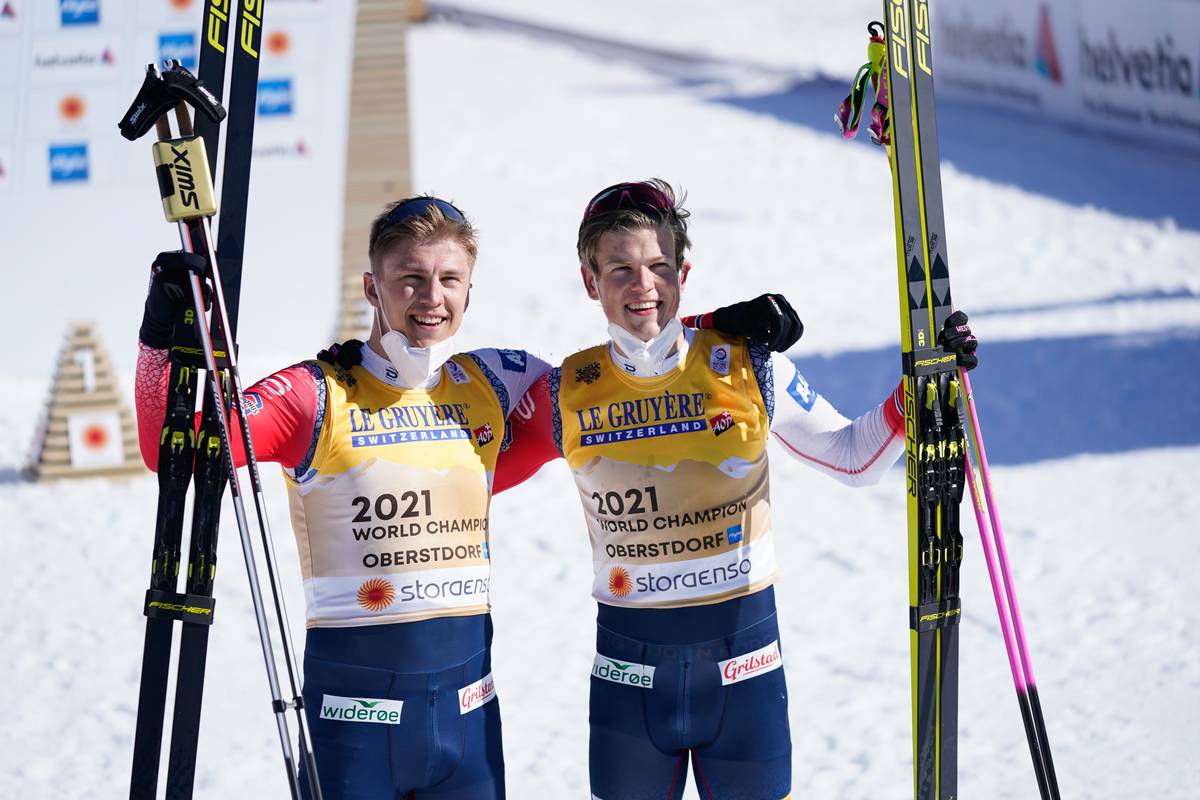
Norwegian teammates Erik Valnes and Johannes Høsflot Klæbo celebrated a team sprint victory in Oberstdorf. Valnes is one of the few sprinters to take a World Cup sprint victory from Klaebo, as he did last season in Ruka. (Photo: NordicFocus)
QUARTERFINAL 1—Klaebo and Valnes dominate
Norwegian skiers arrived for Quarterfinal 1 clad in truly confusing red racing uniforms (all but indistinguishable from what Russian team skiers have worn on the World Cup circuit for quite a few years). Except for Klæbo, most Norwegian athletes even raced in very Russian-looking red hats. At least the Swedes (mostly white) Finns (blue) and Americans (in blue with red/white stripe accents) remained recognizable.
Wearing the yellow bib of last year’s overall World Cup champion, Klæbo advanced easily by means of his now-familiar acceleration on Ruka’s signature hill, though he never needed to unleash the high tempo striding that has been his trademark in this event. His skis seemed to float along the finishing stretch, allowing him sufficient space in front of his rivals to stand up and remove his pole straps well before the line. Norwegian teammate, Erik Valnes, followed him across the line in second.
QUARTERFINAL 2—Halfvarsson advances
The day’s second heat saw American, Ben Ogden, joining Norwegian sprint specialist, Even Northug, and the rejuvenated Swede, Calle Halfvorsson. Finland’s Joni Maki displayed fast skis as he moved to the lead, with Ogden pressing forward on the course’s first uphill. Ultimately, Halfvarsson finished first in the heat ahead of Northug, with Maki advancing as a lucky loser. Ogden seemed to struggle with slow skis, ultimately finishing the heat in fifth.
QUARTERFINAL 3—Chanavat fades
Heat 3 was dominated by Norway’s Haavard Solaas Taugboel who sprinted the ultimate hill followed by an inspired Francesco De Fabiani. France’s perennial sprint contender, Lucas Chanavat, finished fourth without ever appearing sharp.
QUARTERFINAL 4—Schoonmaker comes close
Paal Golberg moved quickly to the front in Quarterfinal 4, with American JC Schoonmaker jumping in behind. France’s 2022 World Cup Sprint Champion, Richard Jouve, worked his way forward through the quarterfinal field to tuck in behind Goldberg. Schoonmaker raced cleverly through the final stretch with a smart move to the inside on the final curve, narrowly missing a lucky loser spot.
QUATERFINAL 5—Pellegrino climbs to the win
Beijing silver medalist, Federico Pellegrino wore Italy’s new black race suit, and advanced to the semifinal by moving efficiently through the quarterfinal field. Pellegrino went to diagonal striding early on the ultimate hill, allowing him to pull away from the field. The inspired Frenchman, Jules Chappaz, crossed the line second.
A resurgent Calle Halfvarsson moved consistently through the field on his way to the final. (photo: Fischer/NordicFocus)
SEMIFINAL 1—both the lucky losers
Wearing a white hat that differentiated him from his Norwegian teammates, Klæbo moved easily to front of his semifinal field before abruptly easing up. Northug and Halfvarsson took over the pace-making: thereafter, the script was pure Klæbo: driving to the front on the hill before gliding unchallenged across the finish line. Halfvarsson, Valnes, and Northug all advanced to the final.
SEMIFINAL 2—Chappaz arrives on the scene
The 1.4 k Ruka sprint course incorporates a critical uphill groomed four lanes wide, continuing over the top and down the other side to a lefthand turn into a wide finishing straight. Commentators often become so focused on Klæbo’s quick-striding domination on Ruka’s signature hill that we may overlook the fact that many other skiers bide their time on the hill, using the finishing straight to pick off their rivals. Semifinal 2 looked to be competitive, with Goldberg, Pellegrino, Chappaz, Jouve, and De Fabiani seeming well matched. Early on, Jouve moved into the lead after a very tight move that cut off De Fabiani. Ultimately, Jouve faded badly on the uphill—as did Pellegrino—allowing Chappaz to storm ahead for the semifinal victory (though he may have used too much energy in achieving it). Golberg crossed the line second to advance to the final.
Sprint Final
Making only his 12th World Cup start, Jules Chappaz may have spent more energy than was necessary in winning his semifinal; he would not end up being a factor in the final. That left Sweden’s resurgent Calle Halfvarsson to face four Norwegians (Northug, Valnes, Golberg, and Klæbo). Golberg and Valnes maneuvered to the front after Klaebo had slowed the opening pace. Lingering mid-pack, Klæbo accelerated on the course’s primary downhill, and moved into a leading position before the hill. Klæbo never appeared to need his top gear, easily distancing the field on the hill. By the top, he had established a considerable gap which he handily maintained through the finish for his 49th World Cup victory. Northug won last week’s tune-up sprint Beitostolen, and his good form and good strategy brought him to the finish line second followed by teammates Golberg in 3rd, and Valnes in 4th.
Johannes Høsflot Klæbo of Norway takes the win in Ruka, Finland’s classic sprint, gaining redemption for two Ruka World Cup sprints when he suffered rare defeats. (Photo: NordicFocus)
While Klaebo had shown his early season fitness last week in Beitostolen with wins in Classic and Freestyle 10 k’s, his sprint-condition had remained in question. It wasn’t known (even by Klæbo) whether or not he would have the speed, the power, and the pop to contend in a World Cup sprint.
“I didn’t know how this should go,” Klaebo said in a post-race interview.” . . . [I’ve had] things to deal with the last three weeks (referring to his lingering hamstring injury). [But] I had a really good day today. It was a lot of fun.”
If there were any lingering questions regarding Klæbo’s fitness—or about his recovery from his summer-long hamstring injury—those questions have now been answered.
The World Cup Sprint podium ceremony was still fist bumps instead of handshakes, reminding viewers that Covid still threatens events such as these. That memory must be particularly poignant to Klæbo: in 2020, the Norwegian team was unable to compete in the final World Cup events, and in 2021 Klæbo, himself, succumbed to Covid in the final weeks of the year, allowing Richard Jouve to claim the crystal globe. Today, at least, Klæbo had achieved a level of redemption, finally exiting the Ruka stadium with the sprint win that we’ve all come to expect.
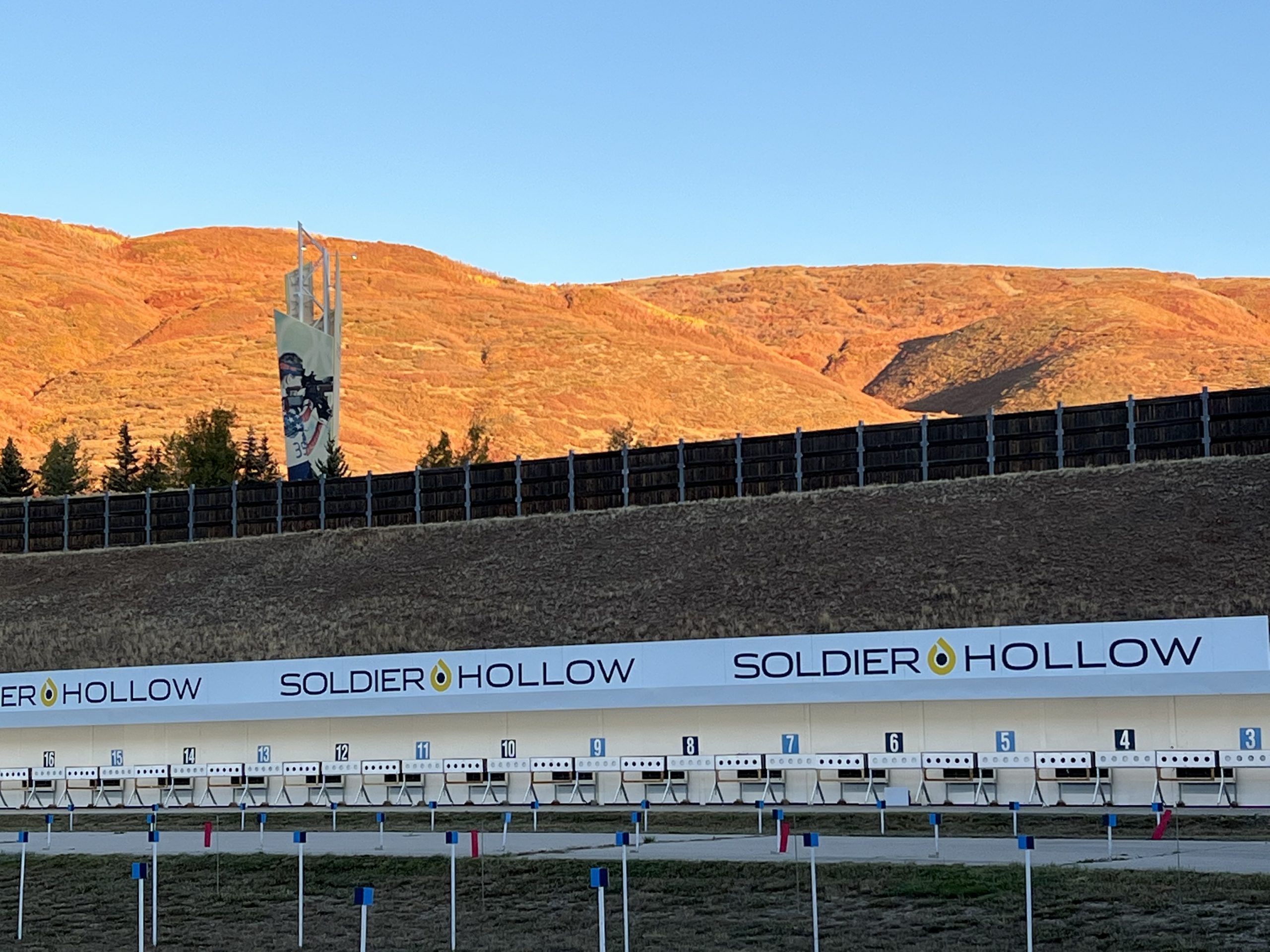
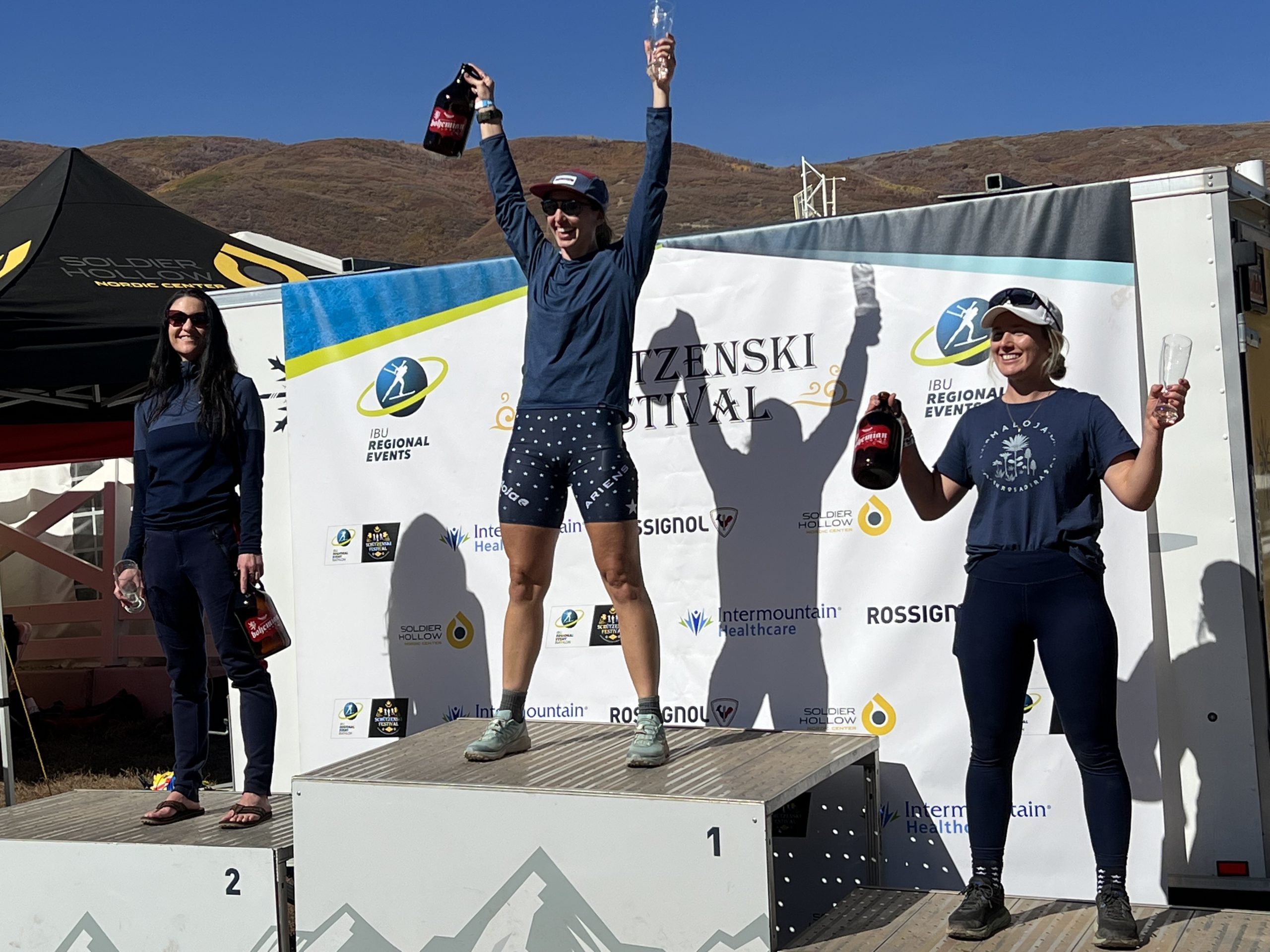
Clear, crisp autumn mornings in the Heber Valley are a delight to the senses: scrub oak and sumac color the high slopes, willow and cottonwood fill the dry washes, and the scents of cedar and sage waft up from nearby flats. On just such a morning—dry, windless, and cool—this section of “Utah’s Alps” rang with the sounds of cheering along the trails and the pops of rifles on the range. Schutzenski Festival 2022 had arrived in Soldier Hollow.
Soldier Hollow hosted Schutzenski Festival 2022 on a perfect autumn morning.
Located in Utah’s Wasatch Mountain State Park, the Soldier Hollow Nordic Center played host this weekend to the 2nd Annual Schutzenski Festival. Site of biathlon and cross country events in the 2002 Olympic Winter Games, Soldier Hollow is known for diverse trails and challenging race courses, made even more exceptional by the numerous kilometers that have been meticulously paved for roller skiing. In this world-class environment was staged the Schutzenski Festival, a series of roller ski races and associated events displaying the talents of the nation’s best biathletes and nordic skiers.
Saturday
Saturday dawned with temperatures below freezing, but the Soldier Hollow tracks had warmed up before the start of the Biathlon Mass Start. This was the second biathlon event in two days at Soldier Hollow, but Saturday’s event was the one circled on everyone’s calendar, and this was the event in which athletes acknowledged the biggest opportunities and the most severe consequences. While Schutzenski is a roller ski festival rather than an on-snow event, Saturday’s mass-start biathlon would be used to refine the selection process for US Biathlon’s World Cup Teams. Much was on the line, and emotions ran high both before and after the event.
Deedra Irwin celebrates her win in the 10k mass start alongside Joanne Reid (2nd) and Chloe Levins (3rd).
Women 10k Mass Start
Deedra Irwin led the field from start to finish, stamping her authority on the 10k Mass Start event. Shooting cleanly—and posting the second-fastest ski time—she separated herself from a national-caliber field, and established herself as one to watch in the upcoming World Cup season. Posting the day’s fastest ski time, silver medalist Joanne Reid was hindered by two misses in the initial shooting round and spent much of the race playing catch-up. She skied bravely and efficiently, clawing her way back into contention, but additional misses in the third shooting round may even have kept her from the victory. Third on the day, Chloe Levins skied and shot with confidence while the remainder of the field behind her struggled with consistency on the shooting range.
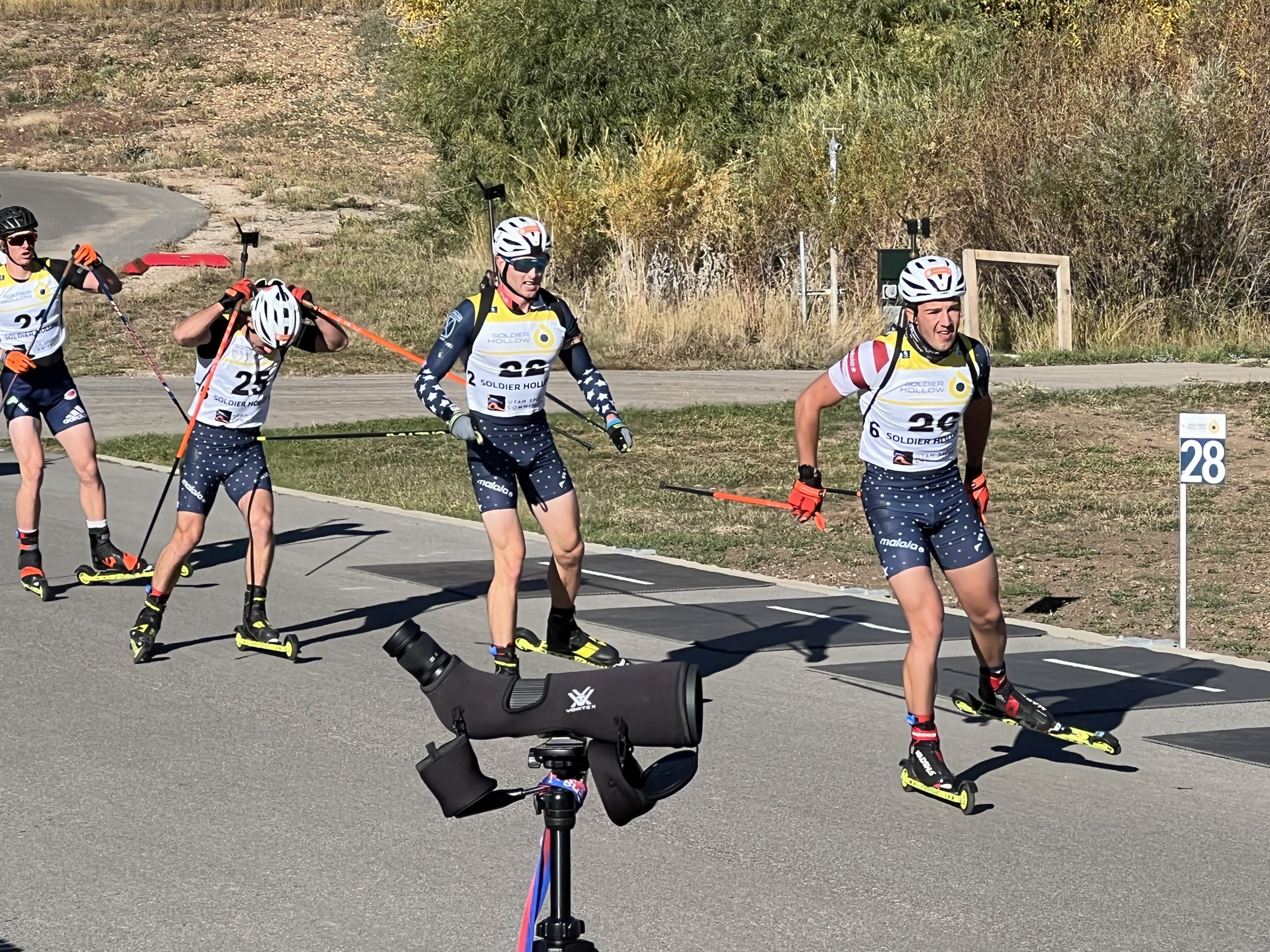
Men’s lead pack enters the shooting range in the 12.5 mass start biathlon.
Men 12.5k Mass Start
Sean Doherty posted the day’s fastest ski time (and second fastest time on the shooting range) while matching the field’s best shooting performances. Doherty worked through early laps in a field that included Vaclav Cervenka, Paul Schommer, and Campbell Wright. That group only broke up after the second and third shooting rounds. Cervenka missed two in the third shooting round, and the issue was all but decided as Doherty skied into the final shooting round with a lead. Doherty would miss once in the fourth round, but his skiing prowess was sufficient to hold on for the win.
US National Team Camps and NTG Camps have been ongoing in neighboring Park City, so many of the USA’s top nordic skiers were also in Utah this weekend. Schutzenski Festival races were scheduled to include these fine fields with men’s and women’s individual start 10k classic races on Saturday.
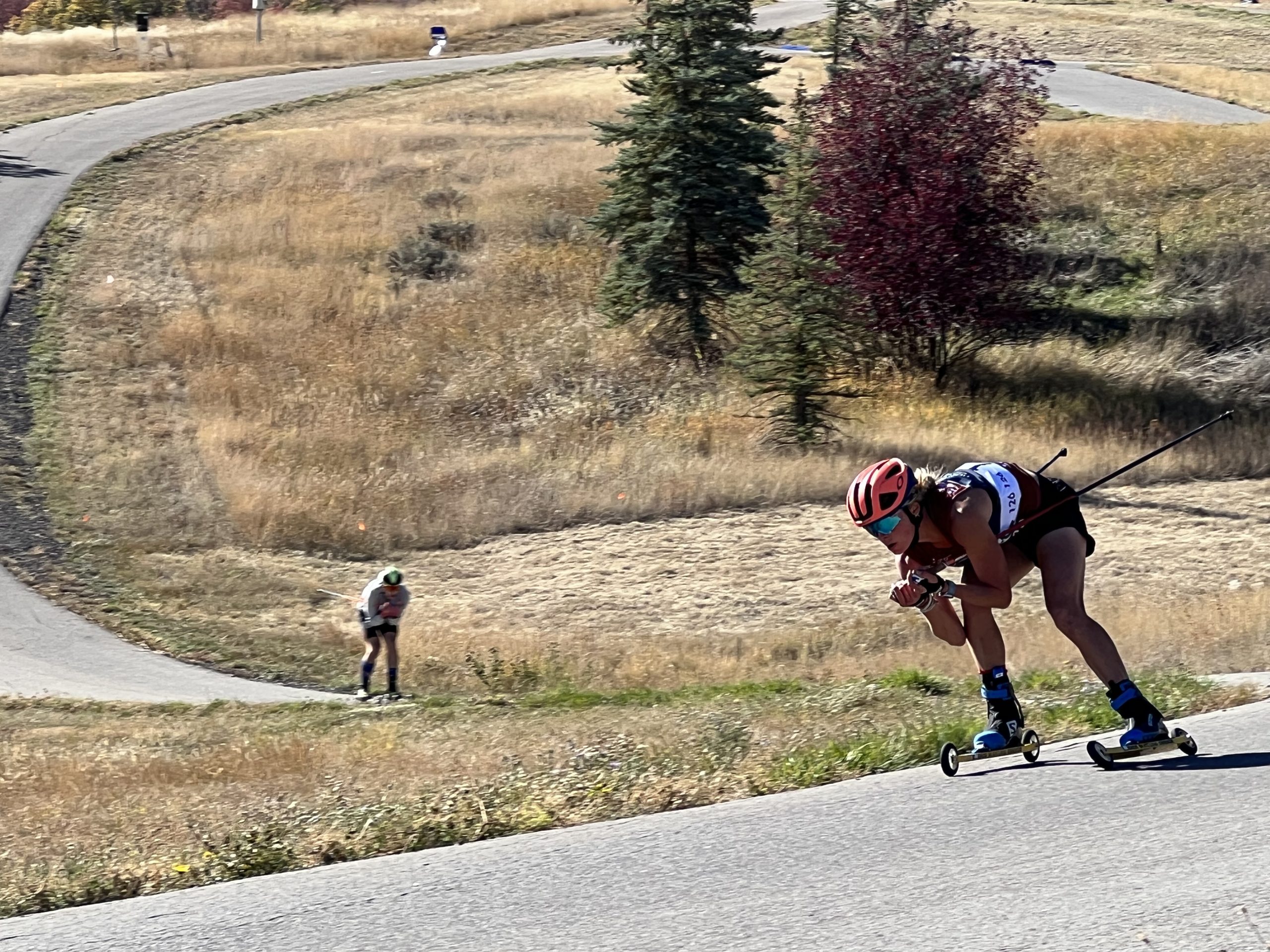
Jessie Diggins in full flight; 10k Classic Individual Start.
Jessie Diggins won the women’s race in commanding fashion with winning margins of 42 seconds and 46 seconds over second place finisher Novie McCabe and third place finisher Sarah Goble, respectively. The energy and power that Diggins brings to her racing is a thrill to witness, and spectators were not disappointed. With three Olympic medals to her name—and certainly the most recognizable face in American nordic skiing—Jessie is followed around the course by the voices of young fans cheering her name.
A late starter in the men’s field, US Ski Team’s Scott Patterson skied a consistent race that saw him rise to the top of the leaderboard. The top three finishers were closely grouped, with second and third place finishers—USST’s Zak Ketterson and University of Utah’s Tom Mancini—separated by less than three seconds.
Shoot out
Saturday’s finale was a highlight of the weekend as competitors gathered for a Shoot Out on the biathlon range. In front of a large and appreciative crowd, competitions were conducted in quick-draw accuracy in an environment of humor, energy, good-natured ribbing, friendly trash-talking, and eventual celebration. In a field that included both male and female competitors, Deedra Irwin emerged as champion, narrowly edging Vaclav Cervenka and Sean Doherty.
Sunday
On Sunday, the trails belonged to the cross country skiers, as the Schutzenski Festival offered up a sprint competition contested on the same loop as last year’s Senior Nationals. Jessie Diggins was the top women’s qualifier on the day, advancing efficiently through her heats. Even so, it took a lunge at the line for her to best USST teammate, Julia Kern, in the women’s final. In the men’s field, Noel Keefe was the second qualifier behind Logan Diekman, but Keefe turned the tables on him in the final, taking the win by a second. The final spot on the podium remained in doubt for more than a minute, as a late-race crash involved racers two-thirds of the field. Ultimately, Reid Goble extracted himself from the pile up, crossing the line for third.
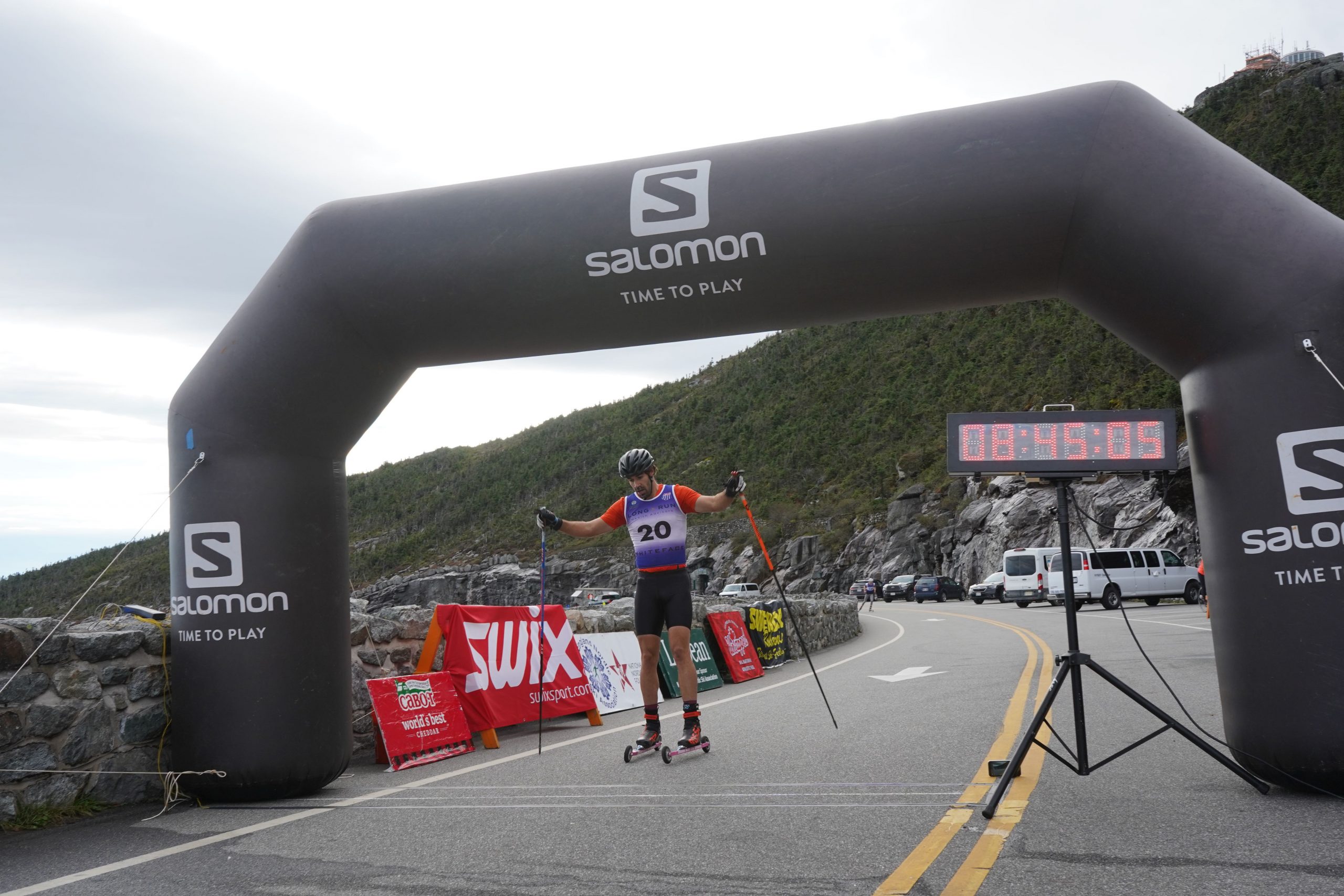
On an overcast Sunday, Ricardo Izquierdo-Bernier and Emma Page were the men’s and women’s winners of the Climb to the Castle roller ski race. Both were first-time victors.
Izquierdo-Bernier, of the club Fondeurs-Laurentides north of Montreal, won in 39:06.5. Aidan Ripp, of Paul Smith’s College, finished second for the men in 41:17.0. Behind him, Parke Chapin of Green Mountain Valley School (GMVS) took third in his first Climb to the Castle, in 42:41.7.
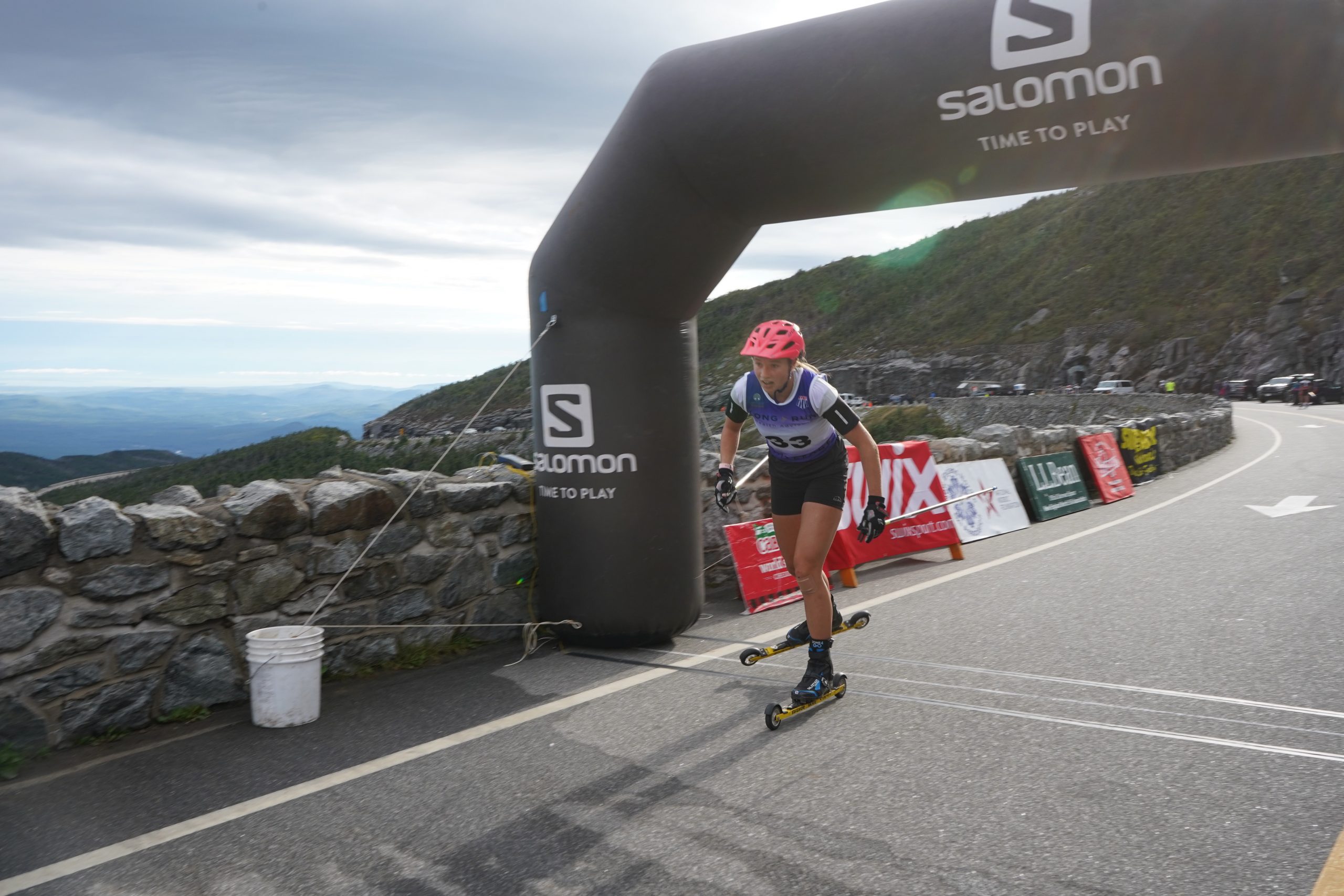
In the women’s event, Emma Page of Mansfield Nordic (MNC) finished in 52:42.7, Dolcie Tanguay came second in 55:06.2, and Master skier Kathy Schwenk finished third in 57:52.2.
Climb to the Castle, 2022.
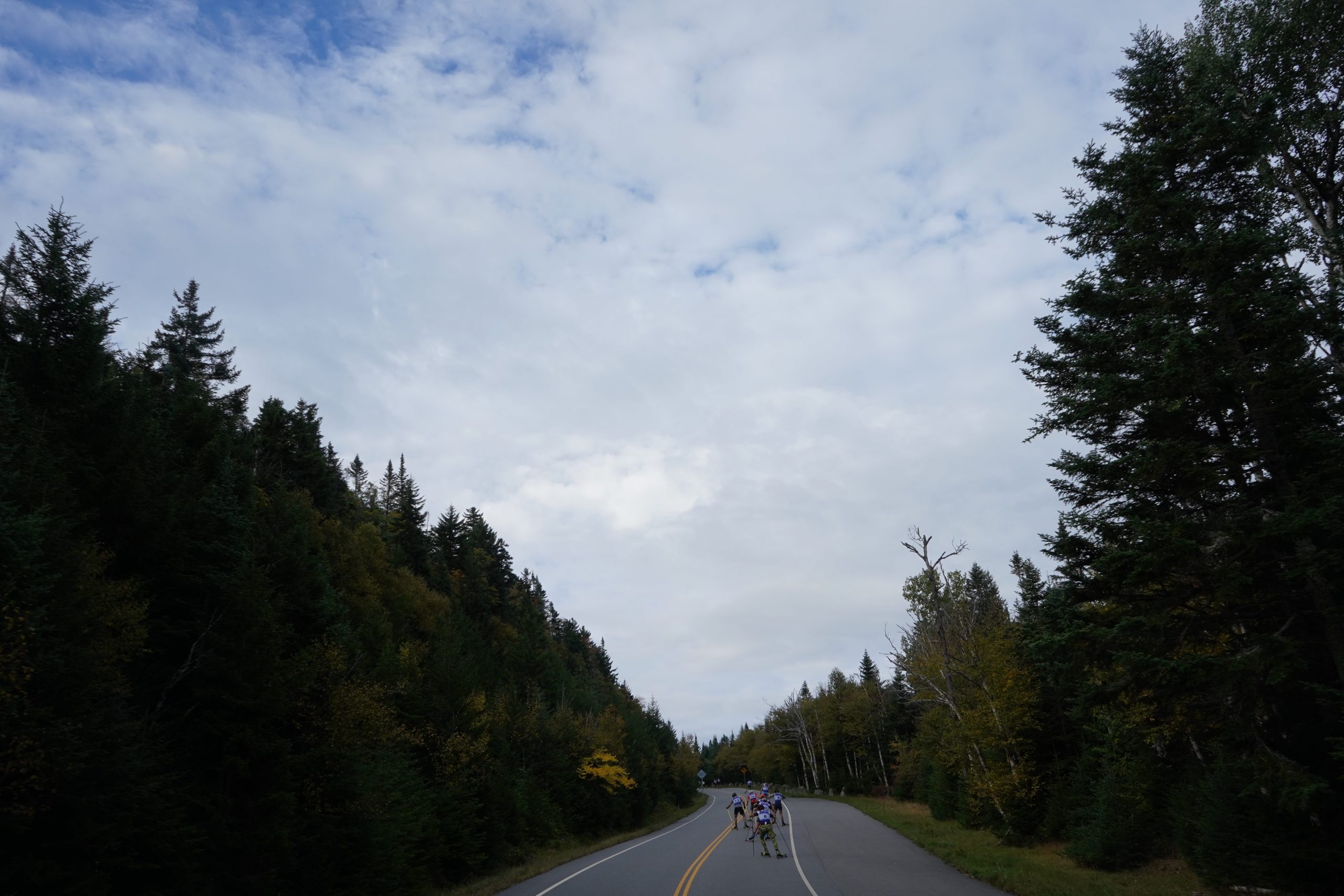
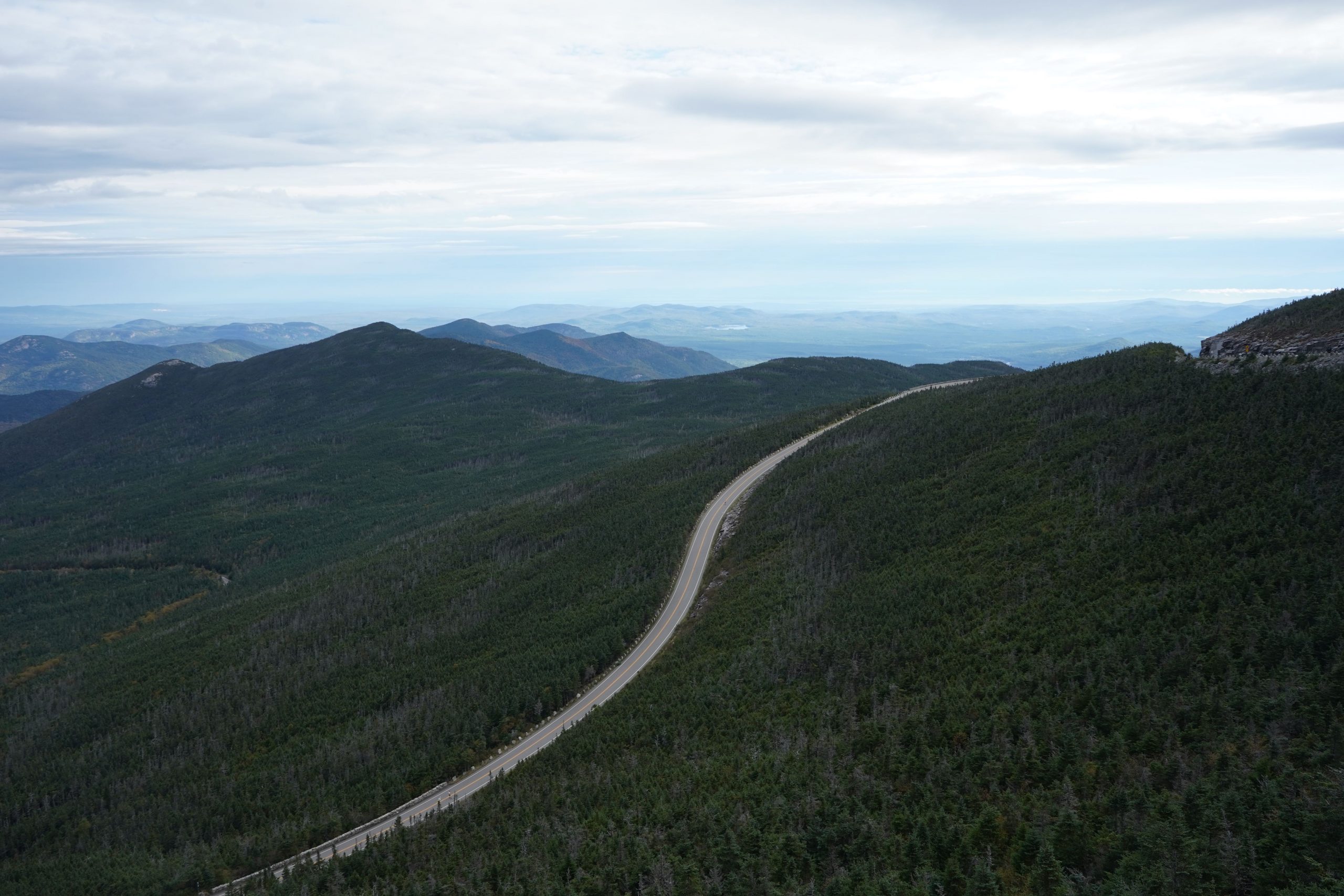
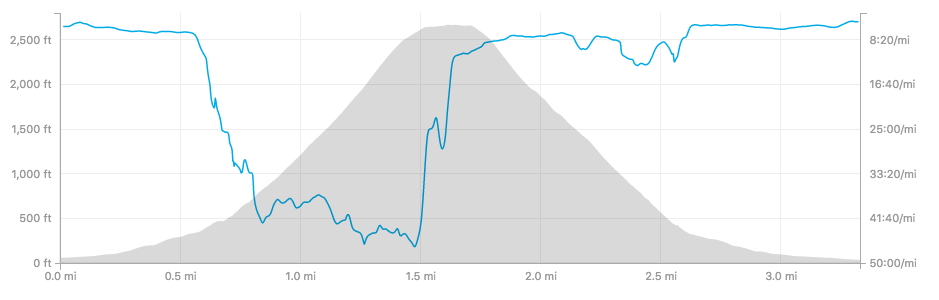
The Climb to the Castle follows the auto road on Whiteface Mountain in New York’s Adirondacks. At 4,867 feet, Whiteface is the fifth highest Adirondack peak. The toll road snakes upward for five miles at an eight percent average grade, gaining about 2300 vertical feet. Unlike the wet racers experienced in 2021, today the weather was dry, with a start time temperature around 50 degrees, and only a light breeze. Every two minutes, athletes went off in waves of 15.
Ripp led from the start, gradually dropping the rest of the first wave. Starting in the second wave, Izquierdo-Bernier bridged the gap up to the first wave around the halfway mark. “I stayed with [Ripp] all out to the top,” Izquierdo-Berniuer said. “In the last (kilometer) and a half, I put in a gap. That was fun to have someone to ski with.”
Ricardo Izquierdo-Bernier takes the win at Climb to the Castle, 2022.
Not only was this Izquierdo-Bernier’s first win, it was his first trip to the Climb. “I had wanted to come a couple times, but it never fit in my training,” he said. He added that he didn’t have a specific race plan. “Try not to start too fast, that was the only plan. I didn’t the course and where I was going, so it was more controlled, and try to have fun.”
In this his second Climb to the Castle, Ripp applied lessons learned from last year’s race. “Last year, we got drawn out really quickly, and a lot of guys went out hard,” Rip said. “Last year, Jake Brown went really hard off the gate so you were trying to chase him down. But this year it was just me off the front. It was a little bit odd to have to lead and have to pace myself to try and figure out what felt like a good pace. But it was nice because Ricardo caught me about halfway through and then it was really fun racing with him. Around the last corner [Windy Corner] was where he dropped me.”
For Parke Chapin, it was also his first attempt at the Climb, finishing with a solid third place. “I didn’t know what the course was like, I just knew it was five miles,” he said. “So I started out with two other dudes in my wave. They were similar pace, and I pushed with one of them. Towards the top, I felt like there was more in me and I turned the dial a little more. A positive day out there.”
Women’s Climb
On the women’s side, Emma Page gapped the field at the start and never looked back. She admitted to having a tough point, mid-race: “There was definitely a hard part in the middle where I was getting bogged down, but one of the master skiers, he was really helpful and he was pushing me through it,” she said.
Emma Page for the win, finishing well clear of the field on the summit of Whiteface Mountain.
Like several other skiers, Page competed in (and won, as we shall see) the previous day’s sprint races at Mount van Hoevenberg. Was she fully recovered from the previous day’s effort? “I could definitely feel my legs, but I think that once I got through the warmup I was recovered and ready to go,” Page said.
“I wanted to not start out too hard because last year I started too hard and I ended up dying a bit,” she continued. “So I wanted to make sure that I eased my way into it. I went kind of hard in the start, to the first corner, and then I reeled it in a little because I realized I might need a little extra [energy]. But I did feel good the whole time, I never had to stop or slow down.”
Dolcie Tanguay also raced not only the previous day’s sprints, sprints, but also the biathlon race at the end of the day. She said that at the start of the Climb, she didn’t feel 100% recovered. “I did it last year for the first time, so I knew what to expect. This time, I paced it pretty consistently, which is an improvement. At the start, Emma Page went out way ahead, and I couldn’t hold on to her. That’s pretty much how it stayed. I caught a couple of people along the way. I just tried to keep it consistent.”
Master skier Kathy Schwenk commented on her finish: “I just appreciate the opportunity to race. I thank the race director and everyone who put it on. I started in a group of six, and I wanted to go just a little bit faster. So I got out of that and pretty much skied by myself the whole way.”
The Whiteface Toll Road climbs to the castle.
Once again this year, racers could sign up to ski classic technique in a separate category. New this year was a short course: Athletes could choose to start further up the mountain in a three-mile race. New England Nordic Ski Association (NENSA) Competition Director Justin Beckwith wrote, “We’ve always talked about a junior race that was a more appropriate distance and time – but why limit that to just juniors? Hopefully it boosts participation and gives folks a way to participate and get the experience without having to ski for an hour.”
Rollerski Sprints and Rollerski Biathlon took place on Saturday, with action on the paved rollerski trails at Mount van Hoevenberg.
Men’s Freestyle Sprint
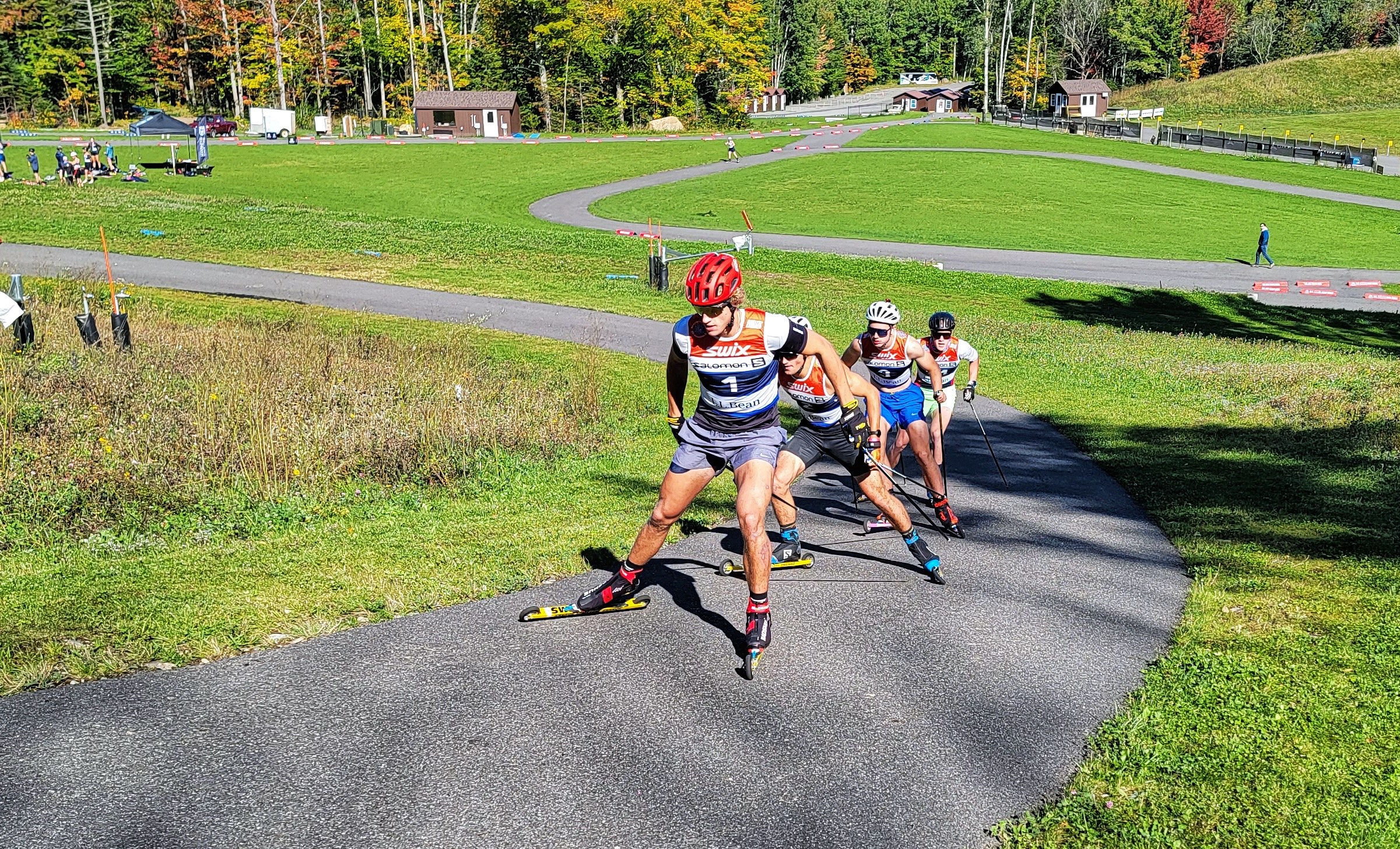
Sprints were contested on the 1500-meter sprint course that had seen use last winter. Instead of a typical “knockout” format, races were organized in a “king’s court” format. Individual start qualifiers determined athletes’ start positions with competitors racing four to a heat. Winners of each round moved up a bracket; second and third places remained in their bracket; fourth place finishers dropped to a lower bracket.
The action was fast and furious on the race course, as athletes accelerated to establish a lead before the first hill under the bridge. Some groups were incredibly tight—even in high-speed corners—while other heats saw athletes more spread out. There was less recovery time between rounds than in a normal sprint, and athletes approached recovery in a number of different ways. Most skied easy around the biathlon penalty loop, some did speeds, others changed into sneakers for a jog.
Eventual winner, Fin Bailey, leads the first quarterfinal ahead of Elvis McIntosh, Sam Gallaudet, and Wyatt Teaford.
Fin Bailey of Stratton Mountain School (SMS) won the men’s sprint in dominating fashion, winning the prologue and every subsequent round. Through the morning, he never appeared fatigued. On the decisive climb to the high point of the course, he jump skated to build a gap from other skiers.
“I pretty much worked as hard as I can,” Bailey said. “Worked with Elvis [McIntosh] in our heats, had a little strategy that when we got to the big hill, we just hammered. That’s about it.”
The final climb on the sprint course leads to a sweeping downhill past the lodge, to a hard turn and an uphill finish. Owning that climb was key to Bailey’s strategy: “That was a pretty important part of the course,” Bailey said. “You come over the top of the hill, right at the big swooping downhill to the finish, you can get ahead… you’ll be set for the finishing straight.”
Elvis McIntosh, of GMVS, was hunting for a podium before he broke a pole in the final round. “First couple of rounds went pretty well,” McIntosh said. “I was working with Fin to keep it controlled and keep the pace good and we’d hammer up and over the final hill and sweep around the [downhill] corner into the finish. It was working pretty well and then in the final, my pole broke. Final didn’t go as well as I would have liked. It was a good, fun, race.”
Wyatt Teaford of SMS described his day: “I qualified fourth today. I moved up and down throughout the heats; I narrowly missed out on the final (getting) narrowly out-cornered on the last corner there. I think races like this are really great for preparing for winter.”
When everyone’s in a tight group on a small piece of real estate, do you get nervous? “I think it’s faster than a normal ski race, but I don’t think it’s scarier,” Teaford said. “Because everyone knows the etiquette of the course. No one’s gonna cut people off on corners where it could be dangerous. I think in skiing in the winter, everyone can get more physical in sprint races.”
Aidan Ripp of Paul Smith’s and Charles Martell of SMC-MNC came second and third in the men’s sprint.
Women’s Freestyle Sprint
Emma Page was first in the women’s sprint, followed by Dolcie Tanguay and Margot Nightingale in second and third respectively.
“It was great! I fell in the warmup, but other than that, it was great,” Page said.
Emma Page was the top qualifier—and eventual winner—of the Women’s Sprints.
Asked how she manages her efforts to keep a consistent pace, Page said, “I’m usually really excited, so that’s actually my worst thing. I generally have worse energy towards the end. That’s what I worked on this summer. I’ve been working on doing speeds at the end of training, no matter what the training was. To try and get myself to push all the way to the end.”
Dolcie Tanguay took second place in the sprints before moving to the biathlon race later in the afternoon. “Usually, the point is to go pretty hard in the qualifier,” Tanguay said. “And then go from there. The high schoolers put on some pretty good competition today, so I just took each heat one at a time, went as hard as I could. The last one, I definitely slowed down a bit. But it was fun overall.”
Did she hold anything back for the biathlon? “Maybe a little. But the biathlon race is fairly short. I’m treating today more like a regular workout day, like two interval sessions.”
After the sprints, the biathlon race was contested: five laps of a 940-meter loop (with 140-meter penalty loop) with the high point of the course occurring near the lodge. There were two prone and two standing rounds of shooting. NYSEF head biathlon coach observed Maddie Phaneuf explained the challenging conditions that Mount van Hoevenberg is known to serve up:
“Here at the new van Ho range, it’s a bit more challenging wind,” Phaneuf explained. “You might zero with a consistent wind from left to right, like we have right now, then it keeps shifting from dead wind or wind from right to left. The athletes really have to pay attention to the wind flags and know what their zeroing wind was and then make corrections throughout the race.”
Paul Smith’s College grabbed five of the six podium positions in the biathlon. Kaisa Bosek of Paul Smith’s won the women’s event, getting shouts from spectators as one shot clean in the first standing round. What went through her mind when she shot clean, then had a couple of misses on the final shooting? “First, you get excited, I think you leave the range a little faster,” Bosek said. “Then after not doing as well in the next round, it’s a mental game so you have to try to forget about that. At least mine [multi-miss standing] was on the last round so I didn’t have to think about it any longer. Then leave the range, try to finish the race strong and keep going.”
Dolcie Tanguay took second place in the women’s biathlon with Taylor Landrum, also of Paul Smith’s, finishing third.
Logan Jensen of Paul Smith’s was the men’s biathlon winner. He said of his race, “It was all right; it’s early in the season. [I’m] using it as a benchmark to hopefully keep working, and get better, faster, shoot better as the season goes on.”
On his race plan, Jensen said, “Today the course was super interesting. Super flat. I was working on getting my heart rate up, seeing how high I could shoot and stay accurate.”
Diego Shillaci of Paul Smith’s finished second among the men’s biathlon competitors, while Frazier Patterson of Mansfield Nordic finished third.
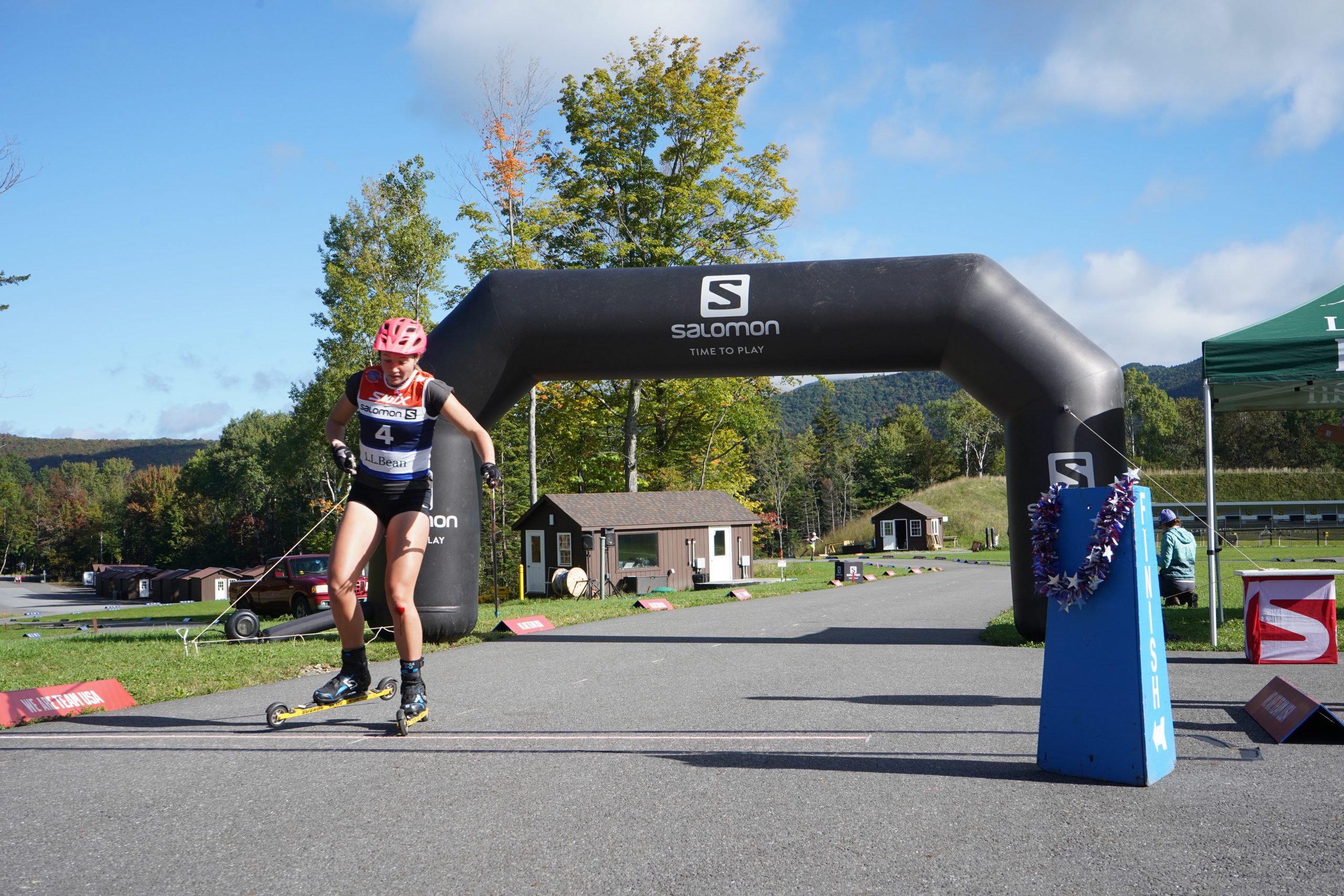
This past weekend 114 hearty humans braved the wet weather at the Ethan Allen Firing Range in Jericho, VT and competed in Sunday’s Free Fall Rollerski Race!
The FreeFall has become a staple of NENSA’s roller series and always draws a competitive and fun crowd. Open racers were slated for a 15km and juniors a 5km — both utilizing the same full 5km race loop which includes some sporty downhills. Minutes before the men’s start it began to rain and the track became slick. Racers took the challenge in stride and navigated downhills, and slippery ups, with varied tactics. At the finish there were unfortunately more DNF’s due to falls than we have ever experienced — but the overwhelming feedback was that was “wild fun” and “really hard.” Before the women’s race the Jury made the decision to eliminate the furthest loop and eliminate the most technical downhill on the course for safety reasons. The women contested an 11.5km course. Both races saw really awesome overlap of juniors, collegiate and elite level skiers.
In the men’s race the top of the field included a rematch of US Ski Team athletes, Johnny Hagenbuch (Dartmouth) and Ben Ogden (UVM). Although Ogden had just returned from impressive international races at Toppidrettsveka, it was Hagenbuch who prevailed for the second year in a row with a time of 34:20. Johnny described his tactic to fend off Ogden, by starting faster than he usually would, and then treating each lap as a six minute interval in the hardest part of the course. Times were nearly two minutes slower than 2021 due to heavy rainfall and a wet track. Also of note was UVM freshman, Petter Bakken (son of the legendary Thorodd Bakken), who placed third, less than a minute from Ogden.
The women’s race was equally talented at the top end — featuring a fun rivalry between the US Ski Team’s Julia Kern (SMS T2) and US Biathlon’s Deedra Irwin (National Guard Biathlon). Kern missed the 2021 event, and came to 2022 psyched to visit the Ethan Allen venue for the first time in ten years, a place she noted she has fond memories for. Kern left the gate first and used her powerful technique to log the fastest splits for all three laps. We were thrilled to have Irwin join our race, and she was, “really redlining,” to show her fitness on her home track and push her limits against the cross country specialists. Kern covered the course in 27:55, just shy of a minute faster than Irwin. U20, Haley Brewster (UVM) put in an impressive performance to take the final spot on the podium.
USST Coach, Matt Whitcomb and NENSA’s Fred Bailey start the final competitors of the 2022 FreeFall.
While NENSA races draw some of the best skiers in the country, every event is intended to accommodate all levels of skiers and development. Due to the slippery conditions, both the juniors and any recreational or masters skiers were treated to a dual start 6km course that eliminated the trickiest of downhills on the track. Despite increased rain, the stoke of the juniors and masters was contagious. USST World Cup Coach Matt Whitcomb was present throughout the junior race and remarked how impressed he was with the skiing he saw, and how similar NENSA rollerski events are to what he just witnessed in Norway.
Congrats to everyone who competed in this event, and a big thank you to the Adam Terko and the Mansfield Nordic Club, the Ethan Allen firing Range, and all the awesome volunteers that came out to help. We are also very grateful to Bullitt Timing for their exceptional services.
2021 FreeFall Champion, Alayna Sonnesyn (SMS T2), charges to the finish.
In addition the incredible support we receive from our NENSA associate sponsors – Salomon, LL Bean, Swix, and Fischer – we are also grateful to Enjoy Winter and Swenor Rollerskis for supplying NENSA with an awesome fleet of rollerskis so the top-seeded athletes in all our events have matched skis. All women and juniors, and 35 men raced on matched skis. And no NENSA rollerski race would be complete without the exceedingly tasty support of Cabot who has generously donated cheese for this season’s podium finishers! Full results and top-3 highlights below as well as a photo album courtesy of Paul Bierman.
Julia Thurston of Mansfield Nordic, ran registration and was excited to see her likeness on the winter-side of the new NENSA / Fischer / OneWay trailer!
The Free Fall was the third race of our seven race series. Next up we head to the Castle Conquest New York for an exciting double header weekend in Lake Placid featuring the Keys to the Castle Freestyle Sprint on September 24th and the legendary Climb to the Castle freestyle hill climb on September 25th. There is also a biathlon race and free BKL learn-to-rollerski opportunity on Saturday at Mt Van Hoevenberg. Details and registration HERE. You can view our full 2022 rollerski line up HERE.
The sport of trail running is growing. With more specialization, sponsorships, and media attention, the scale of competition changes. The Golden Trail World Series, which launched in 2018, is helping guide this growth. With a world series circuit, national series, and a championship, the Golden Trail World Series (GTWS) “exists to celebrate and evolve trail running as a sport.” Given that trail races can be roughly anywhere from 5 k to 330 k and with a range of national and private circuits, the idea with the GTWS was to provide a competition for the top trail athletes to compete in year after year.
Golden Trail World Series competitors pose together before Sierre Zinal in Switzerland (photo:@goldentrailseries)
The GTWS combines a circuit of the best-known 21 to 42 kilometer races in the world and draws the best athletes to compete. In practical terms, the Golden Trail World Series could be considered a trail world cup. The man behind the vision, Gregory Vollet, sees the GTWS as a way for more professional athletes to be able to make a living from running, as broadcasting helps grow viewership and thus sponsor interest. In an interview earlier this summer, Vollet said, “currently the rate of athletes who have a real financial contract is very low. The Golden is designed to help them: them, the athletes, and the sport. This is its raison d’être and it will remain so.” With four GTWS completed this summer, the next two events will be happening in the U.S. in September before the five-stage series finale in Madeira at the end of October.
Sophia Laukli is all smiles after winning her first-ever Golden Trail World Series event (photo: @goldentrailseries)
In an email to FasterSkier, Laukli shared her thoughts on the GTWS experience, saying “the environment was very intense, but also fun and exciting all around, similar to ski races I would say.” Having never met or competed against the other women was initially a little daunting but Laukli said, also “made it a bit more exciting.” She remarked that, “All the runners ended up being very nice and stoked for each other which is always great. It stood out to me too that the top ten women were almost all from different countries, which was pretty sweet to see.”
Stranda Fjord women’s top-five finishers: Blandine L’hirondel (FRA), Elise Poncet (FRA), Sophia Laukli (USA), Emelie Forsberg (SWE) and Sara Alonso (ESP) from left to right. (photo: @goldentrailseries)
According to the race description, the Stranda Fjord 25 k “takes you on a wild ride in the Norwegian fjords. This course has everything from fast and flowy trails, steep climbs and technical downhill running.” With 1700m (5,577 ft) of climbing, there was plenty of vertical to be found as well. Laukli described the race as “crazy technical.” She wrote, “I had done part of the course a couple days before so I knew what was coming, and I was pretty terrified on the start line. There was a lot of discussion about the strong technical skills of the other runners before the race, so I knew there would be tough competition since I knew I struggled with technical terrain myself.”
In soggy conditions with minimal visibility, Sophia Laukli leads the women’s race (photo: @goldentrailseries)
Knowing that about herself, Laukli made a plan to go hard out of the start in an effort to make up time on the climbing sections. The plan worked, “I had a pretty large gap at the final peak,” Laukli shared, “so I did everything in my power to stay on my feet and keep moving on the descent. The first boulder section was brutal and slippery but luckily I avoided any crashes. The course then moved along to basically a long mudslide, and then the hardest part for me ended up being the marsh for the last part of the course, which seemed to last forever.”
Nearing the finish, Laukli began to suffer, realizing that she hadn’t been eating or drinking enough throughout the race. She wrote, “I bonked pretty hard the last 45-ish minutes in the marsh, and that’s when I no longer stayed on my feet, but it was just face plants in the mud so no injuries involved. I was really just playing catch up until the finish and hoping none of the other women would come fly by me. I was absolutely exhausted at the finish, but managed to hold off the rest of the field, although many of them did make up some time on me on the whole descent. Once I crossed the line, I was honestly very shocked I had won, but it was a great feeling! It felt so rewarding to be done after probably the hardest race I had ever done.”
When asked about maintaining a balance between ski training and trail racing, Laukli said that the two go well together. She wrote, “I haven’t changed much about my ski training this summer just because I have always incorporated quite a bit of trail running into my plan for skiing. In the week or so leading up to my running races, I do sometimes have a little more running focus at least for the intensity, just for some last prep, but the majority of my training is still a lot of roller skiing. It’s very helpful to have the roller skiing aspect to prevent running injuries and keep building a solid base, so I feel the two are very compatible and cross over well. I wasn’t sure how it was going to work initially, but so far it seems to be working well to combine the two.”
Originally, Laukli’s plan was to travel to Switzerland for the next stage of the GTWS at Sierre Zinal before heading to Sweden to join the U.S. Ski Team for a camp there. Unfortunately, she caught COVID just after the Stranda race, meaning that plan was out. Instead, Laukli will be traveling back to Utah in preparation for the start of the school semester at the end of August and competing in a couple more running races later in September.
Laukli’s University of Utah teammate, Sam Hendry also shared some thoughts with FasterSkier about his recent racing experiences. Before traveling to Europe, Hendry won a stage of the U.S.-based Cirque Series, in Brighton, UT, which he described as a “good training race.”
Sam Hendry closes in on the finish line at the end of the Stranda Fjord 25 k (photo: @goldentrailseries)
Heading across the Atlantic, Hendry touched down in Norway, ready for his GTWS debut. “The Golden Trail World Series is pretty cool,” said Hendry, “it is essentially the World Cup of trail running.” About his performance in the Stranda 25 k Hendry shared, “Stranda was a crazy technical and challenging course, but I was very happy to finish in the top ten.”
The men’s top-ten from Stranda Fjord, won by Jonathan Albon (GBR), with Sam Hendry in 10th (far left) (photo: @goldentrailseries)
From there, Hendry moved with the rest of the GTWS circuit to Switzerland for the 50th edition of the famous Sierre Zinal race. Hendry wrote, “[Sierre Zinal] was much more straightforward but still super hard, being a 31 k with 2100m (6,890 ft) of vertical. I had a terrible climb but got into a rhythm at 11 k and managed to move up into 22nd. I’m pretty happy with the two weekends of racing here in Europe.”
***
In other domestic running news, Scott Patterson held onto his title as victor of the Crow Pass Crossing, earning his 8th win (6th in a row). Patterson finished the 22.5 mile race in a time of 3:04:07, running in challenging weather conditions. His fellow APU teammate, Ari Endestad, finished in third place, +28:35 behind Patterson.
In the Alyeska Cirque Series on July 30th, former U.S. Ski Team D-Team member and current UAF athlete, Kendall Kramer won the female division in a time of 1:24:26. On the men’s side, Patterson won (1:07:02) ahead of Micheal Earnhart (U.S. Ski Team D-team & APU) and David Norris (APU). Norris also competed in the Snowbird Cirque Series on August 6th and finished in sixth place, while continuing his recovery from a bruised heel that hinders his ability to run downhill quickly.
Thomas O’Harra (APU) approaches the turnaround point in the 2022 Mt. Marathon race above Seward, Alaska. (photo: Anna Engel)
Occurring annually on the 4th of July, and touted as the toughest 5 k on the planet, the 94th edition of the Mount Marathon race took place this past Monday in Seward, AK. Needless to say, the race is a storied tradition, beginning with its first “official” running in 1915. Over the years, participation has increased to such an extent that these days there are a number of complex ways for race entrants to register, including selection through a lottery system, petition for a race spot, or even buying a bib at a last-minute live auction.
There is no set course up the mountain itself. Racers start on city streets, at sea level, and run through town for half a mile before starting the climb and heading straight up the mountain. During the climb, athletes cover roughly 2,675 vertical feet of climbing in less than a mile (0.9 to be exact). Once they’ve crossed the timing mat around the false summit at Race Point, they turn around and descend that same steep slope via a slightly different route. A junior boys and girls race is also run, in which the participants only ascend partway up the mountain before turning around.
Runners bomb down scree back towards Seward and Resurrection Bay after turning around at Race Point. (Photo: Walker Hall)
This steep and challenging course has seen a number of nordic skiers succeed, including current men’s record holder, David Norris (41:26). Norris has won the race all three times he entered and took the record from mountain master, Kílian Jornet (41:48). Four-time Olympian, Nina Kemppel, holds the record for most race wins at an impressive nine victories. And until this year, three-time Olympian, Todd Boonstra was the oldest victor at age 41. However, at the conclusion of the 2022 edition of Mount Marathon, that crown went to a new champion.
The men set off at 11 a.m. local time and Max King of Bend, Oregon, took this year’s victory in a time of 43:37. At the age of 42, he became the oldest winner in the race’s long history.
Behind King, APU skier Thomas O’Harra placed second in his Mount Marathon debut. “I really didn’t expect to do as well as I did,” shared O’Harra. “It’s such a strong field, even without David [Norris] racing this year.”
Just a few weeks before O’Harra took top spot in the Bird Ridge Hill Climb, so he had confidence heading into the uphill section of Mount Marathon. “I knew that I was in good shape for the climb at least, after Bird Ridge, so I figured that I could be in the top three to the top and then the downhill was a total unknown to me. I practiced it once, a week before the race, but I’ve never raced a downhill like that before so I had no idea what to expect.”
Thomas O’Harra (APU) rounds Race Point in second place in the 2022 edition of Mount Marathon (Photo: Anna Engel)
Plummeting down the scree slope, O’Harra said his main goal was to stay on his feet and not get hurt. “I was shocked that I was still in second coming off the mountain and suffered my way down the road to the finish, where I managed to sneak under 45 minutes, which was a kind of secondary, if-it-goes-well goal,” said O’Harra. “[It was a] super fun time though, the closest running race I’ve ever done to the Birkie, and I’m stoked to come back and race again next year!”
Canadian skier and current Ute (athlete at the University of Utah), Sam Hendry, finished second behind Norris in 2021. This year, Hendry placed 7th with a time of 47:39. Hendry shared that this year’s Mount Marathon “was a bit of a disappointment.” He continued, “I finished second last year and was really hoping for a strong result again. With some busy travel getting up to Alaska, I didn’t have the best preparation and my legs were just a little off.” Hendry raced both the Vertical Kilometer (VK) and 26 k at the Broken Arrow Skyrace mid-June and placed fourth in both, besting King by nearly a minute in the 26 k. Hendry said, “I had some good results there, and plan to add some more running competitions to the calendar for later in the summer. I really enjoy getting some competitions in during the summer and getting to feel stressed and nervous.”
Michael Earnhart descends a dusty slope towards Seward (Photo: Jim Jager)
New U.S. D-Team member and APU skier, Micheal Earnhart, finished his day in 15th (49:45). He wrote to FasterSkier, “I wasn’t stoked with my results by any means but I am happy that I’m at a point in my career where top-15 at Mount Marathon can be a bad day.” Earnhart was quick to praise his teammate’s success saying, “My main takeaway was how impressive it was to see my APU teammate, and race rookie, Thomas O’Harra get second place. Definitely a strong day for APU and skiers in general which is always fun to see.”
Fellow U.S. Ski Team athlete Luke Jager was shortly behind Earnhart in 18th.
With the men’s race concluded, the focus turned to the women, who started at 2 p.m. local time. (The men and women now race in the flagship afternoon slot in alternate years.) Breaking the seven-year-old women’s record, Allie McLaughlin of Colorado earned the victory in a time of 47:09. Previously held by Swedish runner, Emelie Forsberg, with a time of 47:48, McLaughlin created a margin of 39 seconds in her favor.
Rosie Frankowski, who finished 4th in 2021, and is perhaps one of the fastest climbers out there, came in sixth this year (53:19). Racing Mount Marathon for the first time, newly named U.S. Ski Team A-Team member, Novie McCabe placed 8th (56:27). About her race, McCabe shared, “Mount Marathon was crazy! So hard, but a very cool experience for sure. I’m pretty happy with it. I was nervous about the downhill and was honestly pretty happy with myself for just doing something a bit out of my comfort zone.”
After racing the junior girls event, Dashe McCabe waters her sister, Novie (bib #7), on the climb (Photo: Jim Jager)
Kendall Kramer of UAF finished just outside the top-ten in 11th position (57:12). Kramer finished 9th last year (56:50) and was the junior girl’s race champion in 2018 (34:05).
Full race results of all the Mount Marathon events can be found here.
In other racing news, U.S.A. Track and Field Mountain Running Championships (USATF) in Wilmington, NY at the beginning of June saw two 2022 Beijing Olympians competing. Sophia Laukli finished third in a time of 1:29:03., and Caitlin Patterson came in sixth (1:35:52.3). Results for that event can be found here.
The Loon Mountain Race hosted Vertical U.S. Mountain Championships on July 10th, which a number of nordic and biathlon athletes attended. Alex Lawson representing Craftsbury Green Racing Project finished third, and posted the second fastest time on the “Upper Walking Boss,” a 40% grade ski hill for a half-mile at the end of the race.
Jake Brown (also of CGRP) had the second fastest time on the “Upper Walking Boss” and finished 9th overall. Full results for the event can be found here.
The Cirque Series mountain race circuit kicks off this coming Saturday (July 16th) at Brighton, UT. With a schedule of six U.S. based races taking place over the next few months nordic ski fans should keep an eye out for familiar names near the top of the results sheet.
The U18 Girls field works its way past the Loppet Foundation Adventure Center at Theodore Wirth Park in Minneapolis during Junior Nationals on March 11th, 2022. (Photo: David J Owen Photography)
To trace the thread of the past, present, and future of American cross-country skiing, all you have to do is look at a golf course in Minneapolis that touches 3 of those 10,000 lakes in Minnesota; Theodore Wirth Park.
Over the past week, America’s most-skied loop played host to the US Ski and Snowboard Junior Championships (formerly Junior Nationals, or “JNs”), bringing the top under-20 year old skiers from across the nation together for the first time since 2020s JNs in Truckee, CA were forced to cancel mid-competition in the panicked early days of the COVID pandemic.
Two years later, the performances by the nation’s top junior skiers seemed to be nothing less than a brighter future put into motion. A week of skiing which saw athletes from Maine to Alaska, and anywhere in-between with enough snow, push each other, and the future of US skiing, forward.
Wirth Park Finally Gets to Host the Show
Last week marked just the second time that JNs was held at Wirth Park since its inception fifty-seven years ago.
The first was just eleven years ago in 2011, when an air of real possibility had just started to take hold in US skiing. Names like Kikkan Randall and Andy Newell were forging a path with their results on the World Cup. The Loppet Foundation, a decade into growing the sport in America’s most Nordic-centric city, was drawing up plans to turn Wirth Park, and Minneapolis, into an American Oslo. Competitors and spectators came to the 2011 Junior Olympics (as JNs was then known) with the idea that what they would see was a first glimpse into the future of skiing, in the US and beyond.
Some of what they saw was in part gimmick. The sprint race, for example, was held at night on purpose despite Wirth’s lighting being pretty much a few old trail lamps augmented with a couple of generators and some hip string lighting.
Some of what they saw though, was the real deal. Including the Female OJ (U20) skier from just down the road in Afton who won every race she could that week; Jessie Diggins.
In the intervening decade between then and now, Diggins went on to change the sport forever in the US, and actively reflected it back on the prime venue in her home state. She led the campaign lobbying the FIS to put a World Cup at Wirth on the calendar, and that vision for the future was set to be realized in March 2020.
The new homologated sprint course at Wirth had the FIS starting gates in the snow, bleachers set-up, and starting double-pole tracks set when it was canceled due to the COVID-19 pandemic on March 12th, 2020. The Loppet Foundation closed its new glass-fronted chalet a week later.
Wirth Park and Minneapolis were pushed back into looking forward to the future once again.
Two years later, the starting gates were repainted with the US Ski and Snowboard logo, the sprint course was ready, the start tracks set once again, Diggins was sending her best wishes, and Wirth Park would finally get to see its future vision for skiing come into the present.
Just how far Wirth, JNs, and skiing in the US had come, was on full display. Whereas JNs just a few years ago was only possible to follow from afar if you were willing to carefully read results sheets, the 2022 edition came with a full four camera set-up and commentary team provided by Engage Livestream Broadcasting. You could now watch nearly every corner of the Theodore Wirth Park course from anywhere, and according to Loppet Foundation, nearly 83,000 viewers did.
The Wirth course has evolved quickly in the past few years to adapt to the age of climate change, homologation, and well…live broadcasts. The traditional 5 k course at Wirth, which sent skiers out from the maples and oaks onto the windblown golf course, was eschewed to race either a 2.5 k or 3.3 k lap (depending on the distance) that concentrated the park’s unique, urban, time-tested terrain. Over the crest of the downhill that u-turned into the A-climb, skiers would view the Minneapolis skyline. On the new sprint course, they stormed up the tow rope line of a tubing hill. The middle-section made use of the out-runs for the now-demolished ski jumps, where skiing in America got its start with the Norwegians who founded Minneapolis in the 1800s.
The Minneapolis skyline visible in the distance from the finish area at Theodore Wirth Park on a cold, sunny March day during Junior Nationals last week. (Photo: David J Owen Photography)
Of course, none of this pomp and circumstance was on the minds of the skiers who looked at Wirth park’s course with one question on their mind: how do I ski it faster than anyone in the country?
A Week of Racing: the Junior Nationals Program
Over the week-long course of JNs, about four-hundred junior skiers sought an answer to that in a four-race program. They started with an individual start freestyle 10/5 k, then an individual classic sprint, then a 15/10/5 k classic mass start, and finally a 4 x 3.3 k mixed team relay. Each race was held as a separate event, meaning four distinct opportunities for athletes to win the title of junior national title. Each event also contributed to the cumulatively scored Alaska Cup – the top regional team in the country , the Junior National Club Team Classification – the top junior club, and the Roger Weston Trophy – the top high school team. Skiers competed against others in their age classes: U16s, U18s, and U20s.
In keeping with tradition, skiers competed for their regional teams, which proves to be an ever-evolving and wonky geographical distinction at JNs. Clubs leave and move divisions, and especially when high schoolers turn to college skiers in the U20s, skiers who may be from one division might ski for another (i.e. a skier from Alaska going to school in New England might qualify for the New England U20 team). Generally the map below shows the regional break-up of teams*:
Geographical make-up of each division that competed at Junior Nationals in 2022. *Note: Wisconsin started competing with Great Lakes in 2020, and did so this year as well. (Photo: US Ski & Snowboard)
The sheer amount of racing that occurs over the week of JNs is overwhelming in a way that’s inspirational – speaking to the depth and excitement that US skiing can expect in years to come. However, there were names and performances to highlight, and so here we look briefly at each race.
Monday: Individual Start 10k/5k Freestyle
After a weekend of course preview in which the skiers of America were greeted with the local Midwestern custom of a too early March rain, the JNs program began on a sunny Monday where the temperature stayed in the mid-high 20s (Fahrenheit). The snow left from the snowstorm a week before (another Midwestern custom, the Birkie-week foot of snow) combined with the man-made base to produce fast conditions.
The week kicked off at 9:00:15 with Minneapolis’ own Greta Hansen (Midwest, Minneapolis Ski Club) starting in bib 1 in the female U18 5 k race. The female U20, U18, and U16 fields were combined in the 5 k, before being separated by class in the results.
Combining the fields yielded the first intriguing result of the week, when U18 racer Ava Thurston (New England, Mansfield Nordic Club) finished the race in 1st nearly a minute (14:18.9) ahead of 2nd place (and first place U20) Nina Seemann (+55.6 seconds). Thurston had a similar advantage over 2nd place U18 (and 3rd overall) Maggie Warner (+56.1) (Midwest, NordicWerks). In a field of the best skiers from across the country, Thurston also proved to be one-half of the extraordinary feat of being joined by a teammate on the podium. Hattie Barker, also from Mansfield (New England), was the 3rd U18 (+57.3 sec).
Thurston, who was named to the U18 Nordic Nations Cup US team (the event, set to be held outside of Trondheim, Norway was canceled at the end of January due to COVID-19), had begun a banner week.
In the U20 girls, meanwhile, Seemann topped the field ahead of 2nd place Aurora Cramer (Intermountain, Sun Valley) (+3.9 sec). The Dartmouth freshman came to US Junior Championships after having competed for the US at World Junior Championships just a few weeks ago. The U20 podium was rounded out by New England’s (Gunstock Nordic) Catherine Stow (+25.9 sec).
In the U16 girls race, host club Loppet Nordic Racing (LNR) got its first national champion on its home turf. Sydney Drevlow (Midwest) finished the 5 k in a time of 15:36.8 for 1st place, and was joined on the podium by her teammate Inga Wing (Midwest, LNR) in 3rd (+13.7 sec). In between them was Pacific Northwest’s Neve Gerard (Mt. Bachelor) in 2nd (+11.6 sec).
The U20/U18 Boys 10 k field would see similar results to their female counterparts, with top athletes having come fresh-off of qualification for the Nordic Nations trip or Junior World Championships.
Like the girls field, there was one boy who stood out immediately with his result in the skate race. Alaska Pacific University’s (APU) Michael Earnhart (Alaska) continued a breakout year that’s seen him post strong results at Junior World’s, Senior Nationals, and on the SuperTour alike, winning a junior national championship in a time of 22:02.5. He was followed in the overall by the U18 National Champion Adrik Kraftson (Midwest, LNR) (+13.1 sec), and U18 2nd place Jack Lange (New England, SMS) (+16.2). Wes Campbell (Intermountain, Park City) rounded out the U18 podium (3rd) in 4th overall (+23.5). All three U18s were set to be teammates on the Nordic Nations trip that was canceled in January, but would make-up for the chance to get familiar with each other there by seeing plenty of each other on the race course the rest of the week.
Midwestern skier Adrik Kraftson (LNR) lies on the Wirth Park snow in exhaustion after a race a JNs. Kraftson had a week of impressive results, including a 2nd in the U18 Boys 10 k Freestyle and the fastest leg in the U18 Team Relay. (Photo: David J Owen Photography)
The U20 podium was rounded out by Alaska’s Alexander Maurer (Alaska Winter Stars) (+35.0) in 2nd and University of Vermont (UVM) freshman Aidan Burt (UVM) (+37.8) in third.
The U16 boys would see a tight 5 k race. Green Mountain Valley School’s (GMVS) Tabor Greenberg (New England) delivered a big win for New England in a time of 13:37.4. He edged out Alaska’s Murphy Kimball (AWS), who was 2nd (+4.1). New England did place another on the podium though, with Stratton Mountain School’s (SMS) Micah Bruner in 3rd (+11.5).
The first day allowed skiers that had come off of the World circuit to re-establish themselves at the forefront of US skiing, and saw young promising skiers have their first “big” results on a national stage. A familiar picture for the Alaska Cup also began to take shape, with New England, Midwest, Alaska, and Intermountain all prominent at the top of the results.
Wednesday: Classic Sprint
The Minnesota sun was still high above Wirth Park, but by Wednesday skiers and coaches realized they had come to visit the land of the wind chill factor. Highs were in the single-digits with the wind blowing across the hills of Wirth.
While the new sprint course kept mostly in the park’s trees to mitigate the wind, the cold, transformed snow on a Classic day surely sent a couple of wax techs to parts of their boxes they don’t visit very often (base klister, anyone?). Then again, with the best skiers in the country come the best wax techs too.
Still, the Wirth sprint course that had been designed for the World Cup required those techs to be on their A-game. After turning out of the marsh bottom the start-area sits in, skiers were greeted by the wide, four-lane, long climb that begins all Wirth courses, before a series of rolling hills sent them straight up the steep, rope tow lift line A-climb. Then, the course twisted and turned before popping over a bridge that led to the finishing straight.
In terms of tactics, the climb-heavy course would allow only the strongest of skiers a little maneuvering. If you could stay below full-bore on the first climb, then you could throw in a commanding push over the top of the A-climb. The final half-kilometer had enough mitigating turns and bumps that would wipe out an attempt to draft into the finishing line, and so there wasn’t much reason to hold back before then.
One skier who did have the capacity to use the tactic of waiting for the A-climb proved to be Michael Earnhart. In the Boys U20s final, Earnhart tucked into a pack that contained the whole field: Jack Young (New England, Colby College), Peter Hinds (Alaska, APU), Aidan Burt (New England, APU), Jack Christner (New England, Middlebury College), And Anders Weiss (Rocky Mountain, Aspen Valley Ski and Snowboard). On the A-climb, he moved out of the track and attacked, coming over the top in first. The U20 field yielded a strong response, and when they came over the top of the bridge, the gaps at the top of the climb had remained the same. Earnhart was followed by Colby freshman Jack Young who came in like a Mule (shameless bad pun) in 2nd (+0.2). Rounding out the podium was Hinds (Alaska, APU) in 3rd (+1.6 sec)
Jack Young (New England, Colby College) outsprints Peter Hinds (Alaska, APU) for second place in the U20 Classic Sprint Final behind winner Michael Earnhart (Alaska, APU). Along with the Classic Sprint, Earnhart also won both the Individual 10 k Freestyle and Classic Mass Start 15 k at JNs. (Photo: David J Owen Photography)
In the Girls U20s final Nina Seemann (New England) was able to establish a gap from the gun and hold it. She claimed her 2nd win in as many races -5.9 sec ahead of the College of St. Scholastica’s Mia Case, who raced for her home division Great Lakes (Case is from Minoqua, WI). In 3rd place, by a ski, was Northern Michigan University Freshman Lauren McCollor (+0.1).
The boys U18 final saw Finegan Bailey (New England, SMS) establish a two-man break alongside Trey Jones (Rocky Mountain, Steamboat Springs), before Bailey pulled ahead in the final stretch. Bailey won, with Jones 2nd (+0.4), and Adrik Kraftson (Midwest, LNR) taking his second podium of the week in 3rd (+5.6).
In her second breakaway win of the week, Ava Thurston (New England, Mansfield) commanded the field to win by -5.8 sec over Jackson Hole’s Kate Brigham (Intermountain). Molly Moening (Midwest, Minneapolis Ski Club), another Nordic Nations team qualifier, rounded out the podium in 3rd place (+7.9 sec).
Finegan Bailey (New England, SMS) celebrates after winning the U18 Boys Classic Sprint ahead of Trey Jones (Rocky Mountain, Steamboat Springs). Midwestern skiers Adrik Kraftson (LNR) and Benon Brattebo (LNR) sprint for 3rd in the background. (Photo: David J Owen Photography)
When the U16 boys raced their final, the runner-up from Monday Murphy Kimball (Alaska, AWS) was willing to animate the race as it hit the first hill. When they got to the A-climb, the only one in the field who could match his climbing was Midwest’s Miles Miner (Minneapolis Ski Club). The pairing raced to the finish, with Kimball opening a gap to take first and Miner in 2nd (+1.9 sec). In the ensuing sprint for third place, one of the layered nuances that makes JNs a great national gathering for the ski community played out. Winning the sprint for 3rd was New England’s Ellis Slover (+8.6 sec), who hails from Quarry Road Nordic Ski Club in Waterville, Maine. The small detail of the home club can seem small, but for a club that’s only a decade old tucked into a town in Central Maine, having a junior on a national podium takes every bit of the ski community working towards one goal, and represents a joyous breakthrough. “QRSC for the win” commented Slover’s teammate Beckett Cote on his result (who is also the author’s cousin). Indeed.
The U16 girls race saw Sun Valley’s Cora Faye Scott (Intermountain) establish a lead late in the race over a pack of three. In the sprint for the final two podium spots Maeve Ingelfinger (Intermountain, GNT) (+2.5) got 2nd and Lucy Perkins (Rocky Mountain, Ski and Snowboard Club Vail) finished third (+2.6).
The day of sprint racing saw racers who had already had top results earlier in the week show their dynamism as skiers, and those who may go on to specialize in the discipline have affirming results. The regional mix still leaned heavy towards New England, Alaska, and the Midwest, and half-way through the week, it seemed those three would be racing for the title in the Alaska Cup.
Murphy Kimball (Alaska, AWS) lifts his poles as he celebrates a national title in the U16 Boys Classic Sprint. 2nd place Miles Miner (Midwest, Minneapolis Ski Club) sprints in the background. (Photo: David J Owen)
Friday:15 k/10 k/5 k Classic Mass Start
By Friday, the air had gotten colder (highs in the single-digits) and the wind had gotten blowier (the windchill well below zero). Even worse, skiers would leave the wooded-protection of the sprint course to face the wind head-on for a u-turn hill out in the open on the golf courses fairway. It was a mass start though, so at least they’d have each other.
The closest race on the day came from the U16 Boys field, which raced 2 laps of a 2.5 k loop for their 5 k. A pack of 4 skiers came together on the second lap, which included Landon Wyatt (Intermountain, BSF), Tabor Greenberg (New England, GMVS), Benjamin Barbier (Rocky Mountain, Steamboat Springs), and Elias Soule (Alaska, AWS). Wyatt was able to make a move in the last kilometer to give him a small advantage over the field, and came away with the national championship (14:38.2). In another sprint for 2 podium places with 3 skiers, Tabor Greenberg (New England) was able to take 2nd (+1.3), and Benjamin Barbier (Rocky Mountain) 3rd (+2.0).
The U16 Girls field yielded just as impressive performances. Sydney Drevlow came back for a second convincing distance race win on the week, claiming another national championship twenty seconds ahead of the field (16:25:0). Following her was Rose Horning (Rocky Mountain, Ski and Snowboard Club Vail) in 2nd (+29.1), and the runner-up in the sprint Maeve Ingelfinger (Intermountain, GNT) in third (+33.6).
Sydney Drevlow (Midwest, LNR) finishes her second U16 national title of at year’s JNs in the Classic Mass Start 5 k. Drevlow also turned in a commanding win in the Individual Start 5 k earlier in the week. (Photo: David J Owen Photography)
Despite the change in distance, the top of the U18 Boys field still came down to a battle between the top sprinters Finegan Bailey (New England, SMS) and Trey Jones (Rocky Mountain, Steamboat Springs). At the end of 3 laps of a 3.3 k (10 k total) Bailey and Jones were locked in a sprint again. Bailey again got the edge, winning a second national championship on the week (23:57.3). Jones finished second (+0.12). Then, Wes Campbell (Intermountain, Park City) came in to pick up a second podium on the week in 3rd (+9.1).
In the U18 girls 10 k, Ava Thurston could make the gaps she had over the field something you could see with your own eyes on account of the mass start. She came in -26.6 seconds (27:41.5) ahead of 2nd place Nina Schamberger (Rocky Mountain, Summit Nordic Ski Club). Schamberger’s podium capped an impressive season for the 16 year old who made her Junior World Championship debut a few weeks ago. Molly Moening (Midwest, Minneapolis Ski Club) was 3rd for the second consecutive race (+39.1).
With her 3rd win in the JNs program, Thurston inched towards the rare distinction of winning every race at a JNs. In fact, it had only been done once before at Theodore Wirth Park. With one race to go, her path had only been walked by one skier before her – Jessie Diggins. Not bad company.
Ava Thurston (New England, Mansfield) and Nina Schamberger (Rocky Mountain, Summit Nordic Ski Club) after finishing 1st and 2nd in the U18 10 k Classic Mass Start. (Photo: David J Owen Photography)
She was walking that path, though, with two skiers alongside her. In the U20 Girls, Nina Seemann (New England, Dartmouth) came away with her third win on the week (28:50.8). Meanwhile, in the U20 Boys, Michael Earnhart (Alaska, APU) also won a third in his 15 k (40:54.8). Earnhart had a close one, with Alexander Maurer (Alaska, AWS) in 2nd (+1.8) and Aidan Burt (New England, UVM) (+1.8) in 3rd, while Peter Hinds (Alaska, APU) just missed out in 4th (+1.9). Catherine Stow finished 2nd behind Seemann (+18.5), and Aurora Cramer (Intermountain, Sun Valley) finished in 3rd (+28.0).
After three days of individual racing, JNs would turn towards resolving the issue of which region had the competitive edge in the US in 2022. The Alaska Cup, still a close contest between New England, Midwest, Alaska, Intermountain, and Rocky Mountain would be resolved the next day when individual results gave way to regional pride in the team relay.
Landon Wyatt (Intermountain, BSF) leads the U16 Boys field into the final sprint during the 5 k Classic Mass Start. Wyatt would win the race, with skiers (l-r) Elias Soule (Alaska, AWS), Benjamin Barbier (Rocky Mountain, Steamboat Springs), and Tabor Greenberg (New England, GMVS) sprinting for 2nd-4th place.Tabor Greenberg (New England, GMVS) wins 2nd place, with Benjamin Barbier 3rd (Rocky Mountain, Steamboat Springs), and Elias Soule (Alaska, AWS) 4th. Greenberg claimed victory earlier in the week in U16 5 k Individual Freestyle Race. (Photo: David J Owen Photography)
Saturday: Mixed 4 x 3.3 k Team Relays
The team relays were the one part of the program at JNs that changed between 2020 and 2022. The distance of each leg – the same; the number of skiers on a team – the same; but the gender makeup of those skiers – different. In keeping with the World Cup, the teams would feature two boys and two girls. The two boys would scramble the 3.3 k course in legs 1 and 2, while the girls would anchor in legs 3 and 4. One race apiece for the U16s, U18s, and U20s.
There was plenty of variety among how coaches approached putting together their teams, and they presented different results accordingly. There did, however, prove to be one constant across the three age classes. New England would finish in first.
It began with the U16s. New England-1 skier Tabor Greenberg (GMVS) scrambled to come in alongside the Alaska-1 skier Murphy Kimball (AWS) and hand-off in first and second, respectively, together (6:57.8). The duo’s leg was the fastest the race would see. Through the second lap, New England-1 skier Quinn McDermott (Berkshire Nordic) had kept them in front (14:09.9). Elias Soule (AWS) kept Alaska-1 in 2nd, and a strong leg from Rocky Mountain-1 skier Henry Magill (Steamboat Springs) brought them into 3rd. When the girls began to race, Beth McIntosh (Frost Mountain) built on the New England-1 lead, Rose Horning (Vail) went into the final exchange having put Rocky Mountain-1 in 2nd. Inga Wing (LNR) and Adeline Loewen (Plain Valley), meanwhile had put Midwest-1 and Pacific Northwest-1 into 3rd and 4th when Loewen skied up to Wing and came into the final exchange with her. Anchor Sydney Drevlow (LNR) was able to continue the charge for Midwest-1, and with the fastest women’s split (8:25) she moved into 2nd place. In the end, she couldn’t quite catch Annelies Hanna (Ford Sayre), who finished the win for New England-1 (31:37.7). Drevlow brought home 2nd for the Midwest-1 team (+11.2), and Pacific Northwest-1 had ridden their late surge to a 3rd behind the skiing of Neve Gerard (+12.9).
The U18s saw similar close racing throughout the race. Adrik Kraftson (LNR) scrambled with the fastest leg (6:37.5) to put Midwest-1 in first. But Intermountain-1 with Wes Campbell (Park City), New England-1 with Finegan Bailey (SMS) , and Midwest-2 with Cooper Camp (LNR) were all within five seconds. When Jack Lange (SMS) handed off to the 3rd leg though, he had skied New England-1 into first place (13:35), followed by Midwest-1 with David Isom (Minneapolis Ski Club), and Midwest-2 with Jonathon Clarke (LNR) (+4.6). Hattie Barker (Mansfield) built on New England-1’s lead to hand off to the anchor Ava Thurston (Mansfield) in first place (21:42.3). Behind, the skiing of Maggie Warner (NordicWerks) had maintained Midwest-1’s 2nd place (+13.1), and Abigail Haas (FXC) had moved Alaska-1 into 3rd (+24.1) alongside Midwest-2 with Jordan Parent (NordicWerks) in 4th (+24.2). Thurston anchored with the fastest girls leg (7:51.1) to win it for New England-1, and give New England the 2nd win of the day. Midwest-1 skied to second with Molly Moening (Minneapolis Ski Club) anchoring, and Meredith Schwartz (AWS) was able to hold off a challenge from Greta Hansen (Minneapolis Ski Club) to see Alaska-1 finish in 3rd ahead of Midwest-2 in 4th. With that 4th though, the Midwest pulled off the impressive feat of having two teams in the top 5, speaking to the region’s depth.
When the U20s started then, New England was looking for the sweep. Their bid would start with Colby’s Jack Young, who finished his leg with New England-1 in 3rd (+12.1) behind Intermountain-1 with Elijah Weenig (Jackson Hole) in 2nd (+5.6) and Alaska-1 with Michael Earnhart in 1st (6:38.2). At the 2nd exchange, Alexander Maurer (AWS) had held 1st place for Alaska-1 (13:26.6), while Aidan Burt (UVM) had moved New England-1 into 2nd (+5.8), and Intermountain-1 had held 3rd with Max Kluck (BSF) (+9.5). Then, Catherine Stow (Gunstock) put in the fastest women’s leg of the race (7:58.3) to put New England-1 into 1st (21:41.0) with a gap coming out of the final exchange. Marit Flora (APU) kept Alaska-1 in 2nd (+23.2), and Lucienne Ludwig (Sun Valley) had Intermountain-1 in 3rd (+1:00.0). Nina Seemann (Dartmouth) kept New England-1’s gap, and finished her fourth and final win of JNs with a sweep for New England on the day (30:00.7). Katey Houser (Alaska Nordic Racing) finished a 2nd place relay for Alaska-1 (+29.6), and Aurora Cramer (Sun Valley) kept Intermountain-1 in 3rd (+1:13.7).
Nina Seemann comes across the line in first place for the 4th time in 4 races at JNs last week. The Dartmouth Freshman swept the U20 Girls races while cementing New England’s Alaska Cup win at Wirth Park. (Photo: David J Owen Photography)
Team Results: Alaska Cup Settled
By the time the Team Relays finished, there wasn’t a coach or spectator in Wirth Park that needed to pull up the Alaska Cup standings to do the math on who had won. New England, after a week of strong individual and team skiing, came away with the distinction of the top region for junior skiing in the country. It was a title that they’ve become used to winning. Going back to 2014, the only thing that could stop team New England from winning the Alaska Cup was the global pandemic of the past two years (*Alaska was in first at 2020 JNs when it was cancelled mid-week, it should be noted). And it doesn’t appear anything will change as we emerge from that era.
Behind New England, the Midwest finished 2nd by less than 300 points, which was a sure sign that the development places like Theodore Wirth Park have been invested in to spur is on track. Intermountain had a strong showing coming in 3rd place, while Alaska and Rocky Mountain were also competitive in 4th and 5th, respectively.
In the Junior Nationals Club Classification, Loppet Nordic Racing maintained its streak as the top junior racing club in America. Service High School in Anchorage, Alaska won the Roger Weston Trophy for the top high school in the country.
Skiers from all over the country round the first corner of the Theodore Wirth Park course in the U16 Boys 5 k Classic last week in Minneapolis. (Photo: David J Owen Photography)
Lessons from a Week at Wirth
In winning all four races at a JNs held in Wirth Park, Ava Thurston (U18) and Nina Seemann (U20) just one other skier with that distinction; Jessie Diggins. No matter where their promising careers in skiing go (and all signs on that are far), they’ve accomplished a feat that shows a unique capacity for focus, grit, and determination appropriate to the skier they followed in the feat.
Ava Thurston (New England, Mansfield) sprints to 1 of her 4 victories at JNs last week. Alongside fellow Vermonter Nina Seemann, Thurston replicated a feat that three time Olympic medalist Jessie Diggins completed a decade earlier by sweeping her category at JNs. (Photo: David J Owen Photography)
And then again, that’s really what bringing back Junior Nationals to Minneapolis – to Theodore Wirth Park – was all about. Letting the work and dedication that’s gone into American skiing be shown by the juniors who do it best.
As Loppet Foundation Executive Director Claire Wilson said in remarks to FasterSkier “The week was the highlight of the winter – and the Loppet is proud to support the development of the sport and finally give the community a great Junior Nationals!”
Each racer that crossed the start line at Wirth did so powered by all that has been put into the ski community over the course of their young lives. The brand-new chalet that played background to a new course at Wirth was a constant reminder that people coming together to grow something they love has the power to produce big things. If you paid attention to the skiing in the foreground though, that power wasn’t broken down into pieces. In each look of determination while skiing down the trail, each smile on a face when that trail had been skied, was the reflection of a coach, parent, or teammate that shared the joy of ski racing with a young person, and who in turn let it run wild.
It’s that simple. All that we leave Minneapolis with is again an air of possibility, for where the nation-wide community of Nordic skiing will set its sights on next – a future that by the looks of last week is as inspiring as anything that’s come before it.
Rocky Mountain coach Molly Susla (Crested Butte) and athlete Sawyer Ezzell (Crested Butte) share a smile in Minneapolis during JNs last week. (Photo: David J Owen Photography)
David J. Owen is a Minneapolis-based photographer who’s work showcases the best of skiing in the Midwest. Check all of his 2022 Junior Nationals galleries here. Visit his website to see his full suite of work in skiing and beyond.
A composed David Norris talks with local media moments after winning the 2021 Mount Marathon race in Seward, Alaska. (Photo: Twitter screenshot from Alaska’s News Source)
Men’s race
Most athletes pay their dues as they work their way up the results list for Mount Marathon, the grueling 5-kilometer, 3,000-foot-gain out-and-back race in Seward, Alaska, that dates to 1915. There is no substitute for experience on the technical course, and most people need to get their rookie run out of the way before they can even think of challenging for the overall victory in subsequent times on the mountain.
David Norris is not most athletes.
Racing on an overcast Wednesday afternoon, Norris lodged his third-ever start in what is believed to be the country’s oldest mountain race. Roughly 43 minutes later, he had claimed his third-ever victory, continuing his winning ways as he ran down Fourth Avenue in downtown Seward before a crowd of thousands.
Norris’s time of 43:27, though well off his course record of 41:26, was still just outside the all-time top-10 list for a race that has was first held in World War I. He probably would have cracked the top 10 if he hadn’t slowed to high five children lining the final few blocks.
Norris’s aerobic fitness, even for a world-class cross-country skier, is superb. In June he lowered his own course record on the uphill-only Bird Ridge hill climb (3 miles, 3,400 vertical feet) to a frankly staggering 35:40, well over a minute ahead of anyone not named David Norris on a course that has been covered by virtually every Alaska-based nordic athlete in the past three decades.
On Wednesday, Norris used these skills to hit the halfway point of the climb in 18:25, already well ahead of Canadian skier Sam Hendry (second at this year’s NCAA Championships for University of Utah) in 18:59 and pro trail runner Darren Thomas in 19:21. By the turnaround, at 2,974 feet at a false summit midway up the mountain, the gap had grown to nearly two minutes: Norris in 31:54, Thomas in 33:48, and Hendry in 34:27.
David Norris descends a near-vertical shale field approaching the end of the 2021 Mount Marathon race in Seward, Alaska. (photo: Twitter screenshot from Alaska’s News Source)
Hendry overtook Thomas on the descent to move back into second, as the athletes plummeted nearly 3,000 feet in less than three kilometers, but Norris padded his lead as he ran alone to the finish. The final podium was David Norris, 43:27; Sam Hendry, 46:00; and Darren Thomas, 46:09, according to unofficial live results. Fourth went to Michael Connelly, a bronze medalist at 2019 Youth World Skyrunning Championships, and sixth to Lars Arneson, who holds the unsupported Grand Canyon Rim-to-Rim FKT, reflecting the depth of the Alaska mountain running community. (Another Salomon-sponsored athlete from Outside was seventh.)
“It feels good. I’m stoked to be back” at this race, a composed Norris told local television broadcasters after taking the time to put on a dry shirt and drink some water, looking barely winded and conducting his post-race interview while the rest of the podium was still on the course.
“I felt good,” he continued. “The mud [on the first part of the ascent] was super-slick, so I was just being patient till we got out of the trees. Then I figured, use the fitness where the footing’s good.”
“It’s great to see that we’re able to pull this off” again, Norris said, after the 2020 race was cancelled due to Covid and the 2019 race was marred by poor air quality due to wildfire smoke. “It’s fun to be out here with so many good friends, and the Alaskans who are psyched to run up a mountain.”
So what’s next, Norris was asked. “Now it’s just rollerski time trial time,” he said, as he looks ahead to this winter’s Olympics.
Norris holds the all-time course record for Mt. Marathon, 41:26, as well as the third-fastest time. Second place on the all-time list is held by Kílian Jornet (yes, that Kílian Jornet), from 2015. Other notable skiers in the all-time top-10 include former UAA and APU skier Eric Strabel, and 1988 Winter Olympian Bill Spencer.
Women’s race
Rosie Frankowski’s race began a lot like Norris’s: she was first by nearly a minute at the halfway point of the climb, and first by nearly two minutes at the top. Unfortunately for the APU skier and Olympic hopeful, the finish line is back down at sea level – and no one else in the top five needed to hold back a little on the descent to avoid incurring an injury in the run-up to the Beijing Olympics. Frankowski would ultimately finish fourth this year, after taking a notably non-aggressive line on the descent in 2018 to slip from first to seventh.
In this file photo, Rosie Frankowski races the first stage of the FIS Ski Tour 2020. (Photo: NordicFocus)
The uphill, however, was all Frankowski. She already had a gap of several meters by the base of the cliffs roughly a half-kilometer into the race, which she consistently stretched on the near-vertical climb through densely humid undergrowth. She emerged onto the stark shale slopes of the upper mountain to reach the halfway point of the climb in 20:19, substantially ahead of Ruby Lundquist (21:17), Hannah Lafleur (21:44), and Christy Marvin (21:45). It was more of the same at the turnaround point: Frankowski first in 37:06, then a gap of nearly two minutes to Lindquist (38:57) and three minutes to Marvin and Lafleur (39:38 and 39:40).
Frankowski’s ascent tied her 2018 effort for the third-fastest uphill since at least 2006, according to available records.
“The uphill was great,” Frankowski emailed. “It was definitely a bit slippery in the first half from recent rain and the top half was quite a bit softer than in 2018. I had quite a few slips where I had to catch myself with my hands, but I never did a total belly slide. Fog rolled in right when I was near the top and inexperience on the mountain made me think I had a lot further to go than I did, so I was surprised to see the American flag at the top and kind of bummed out that I didn’t put in a last uphill surge which I was waiting to do to run under 37 minutes.”
The descent, however, is not Frankowski’s forte, and she may have wished to exercise additional caution as a non-U.S. Ski Team athlete going into an Olympic year. Lafleur unleashed the day’s fastest downhill by a substantial margin, 11:44, to overtake all three athletes in front of her and win in 51:24. Lindquist was close behind in 51:38. Marvin, a 40-year-old mother of three, rounded out the podium in 52:21. Frankowski reached the finish, apparently uninjured, in 52:56.
“I have been focusing more on ski training than running this year since it’s an Olympic year and I want to put my best foot forward in trying to make that team,” noted Frankowski. “Nonetheless, I was still hoping to run a good uphill time and then just enjoy the downhill and not get injured. It’s hard not to get wrapped up in the hype of the downhill, but in order to hold off fantastic downhills like my friend Hannah (who won), I’d have to be so ballsy and sendy, and I am not willing to do that yet with skiing on the line (maybe someday or then again, maybe not haha!).”
In 2018, Frankowski notched the day’s 92nd-fastest time on the descent. She improved considerably this year, taking off nearly four minutes on the downhill to rank a healthy 24th among downhillers, out of roughly 230 women total, helping her to a fourth-place finish.
Other nordic skiers in this year’s top 10 included former Dartmouth skier (and current Salomon-sponsored pro trail runner) Taryn Hunt-Smith in eighth and current USST D-Team athlete Kendall Kramer in ninth. Nordic skiers in the all-time top 10 include Morgan Arritola in seventh and Jessica Yeaton in ninth.
“According to folklore, the tradition of the Mount Marathon Race began when two sourdoughs argued about the possibility of climbing and descending the mountain in less than an hour. ‘Impossible’ one said. To settle the argument, and the resulting wager, a race was held, with the loser to furnish drinks for the crowd. At the same time, enterprising merchants put up a suit of clothes and other attractions for the winner and proposed the race take place on a holiday – why not the 4th of July? The optimistic sourdough lost his bet. The winning racer took one hour and two minutes.”
The race was first formally contested in 1915, with a winning time of 1:02:02. There were no races held in the early 1920s, the mid-1930s, and for one year during World War II. The race has been held every year since 1943, always on the fourth of July. 2018 marks the 91st running of the race. [The 2019 juniors race would be cancelled due to poor air quality, and the 2020 race cancelled due to Covid.]
The first official women finishers were in 1963, nine years before women were officially allowed in the Boston Marathon and 21 years before women were allowed to race distances over 1,500 meters at the Summer Olympics.
Notable past Mount Marathon champions who were also skiers include, in reverse chronological order, Holly Brooks, Kikkan Randall, Nina Kemppel, Lynn Galanes, and Betsy Haines (Randall’s aunt). Notable male Mount Marathon champions who were also skiers include Scott Patterson, David Norris, Eric Strabel, Trond Flagstad, Toby Schwörer, Todd Boonstra, Bill Spencer, Jim Renkert, Tom Besh, and Sven Johanson. Kílian Jornet, who won in 2015 and held the course record before David Norris happened, may merit honorable mention as a ski mountaineer.
About that steepness: Elevation profile of Mount Marathon course, from an athlete (Jeff Levin) who finished 58th out of 306 men in 2017. Note the 35- to 45-minute pace per mile for much of the climb. (photo: Strava screenshot)
The race’s course description page reassures racers, “Mount Marathon is not quite as steep as has been previously reported. The true steepness – from the base of the mountain to the lip of the mountain just before the turnaround rock – averages 34 degrees. That figure was calculated using GPS data from several racers. Excluding the road approach, the vertical gain is about 2,675 feet in 0.9 miles.”
Max King, a professional runner who has raced all over the world for nearly twenty years, told Clint McCool that he “had never raced anything so steep, and had never come down anything so fast,” according to McCool’s comments on the broadcast.
Outside magazine has called Mount Marathon “the toughest 5k on the planet.” It is undeniably the most famous footrace in Alaska, and the second most famous athletic event anywhere in the state, behind only the Iditarod Trail Sled Dog Race. It has grown from its humble origins to a yearly spectacle that is sometimes covered by helicopter and drone and broadcast live on local network television, as well as online.
The US SuperTour kicked off the first races of the new year at the Craftsbury Outdoor Center with a classic sprint. The event, dubbed the 2020 Lost Nation Cup, brings together senior athletes, EISA carnival teams, developing NENSA skiers, and citizen racers for a weekend of racing in the Northeast Kingdom of Vermont.
“Retired” Craftsbury native Ida Sargent won the women’s race in a time of 3:55.47, followed by fellow CGRP athlete Kaitlynn Miller (+0.21), and Dartmouth Ski Team’s Katherine Ogden (+2.09). Erika Flowers posted the fastest qualifying time of 3:56.03; she finished fifth in the final (+6.67).
Breaking down the heats in Craftsbury. (Photo: BullitTiming.com)
On the mens’ side, Ben Saxton (SMST2) took the final in 3:19.0. He was followed by Canada’s Julien Smith of NTDC Thunderbay (+2.04) with Forrest Mahlen of APU in third (+2.25). University of Vermont athlete Ben Ogden was the fastest qualifier of the day in 3:18.62. Ogden was eliminated in the first heat of the semifinal, finishing 11th overall.
Results from the men’s heats in Craftsbury. (Photo: BullitTiming.com)
Racing continues tomorrow with interval start freestyle distance races Saturday and mass start classic distance races Sunday.
Notable for the Norwegian names in the field, several Brits, and a lone American, a series of sprint and distance rolllerski races were held this past week in the Telemark region of Norway. Jessie Diggins of the U.S. Ski Team spent the week in Norway training with the Langrenns Rekruttlag ski team prior to the weekend’s racing.
On Friday, organizers held a skate sprint called the Sommarlandsprinten.
Women’s Podium:
Maiken Caspersen Falla, Gjerdrum IL 2:24.28
Anna Svendsen, Tromsø Skiklubb +1.22
Heidi Weng, BUL IL +1.41
Women’s sprint bracket: (click bracket for large view)
Men’s Podium:
Sindre Bjørnestad Skar, Bærums Verk og Hauger IF 2:14.98
Pål Trøan Aune, Steinkjer Skiklubb +0.22
Andrew Young, Storbritannia +1.26
Men’s Sprint Bracket: (click bracket for large view)
Sunday featured the Kanalrennet, a 50-kilometer classic rollerski race with the women’s event won by the high turnover queen Therese Johaug. Diggins placed fifth in the women’s field. Athletes raced twice around a 25 k loop, featuring three climbs per lap.
The eponymous outhouse of the Race to the Outhouse #2, Archangel Road, Talkeetna Mountains, Alaska, in April 2018. (photo: Gavin Kentch)
ARCHANGEL ROAD, above Palmer, Alaska — The tenth annual Race to the Outhouse #2, held amidst the Talkeetna Mountains on April 6, marked a neat bookend to the 2018/2019 race season in southcentral Alaska, and possibly in North America.
While this season’s Race to the Outhouse #1 was held in early December 2018, roughly one month later than normal, it still marked the season’s first race in southcentral Alaska, and, behind perhaps only Frozen Thunder and a handful of races in Fairbanks, one of the first nordic ski races in the entire continent. Four months later, the SuperTour had come and gone, Senior Nationals had been completed, Junior Nationals had crowned champions just down the road in Anchorage, and it was time to hold the Race to the Outhouse #2. The course goes from a roadside trailhead to an eponymous outhouse some distance uphill, with mountains towering all around.
A post on the local trail conditions forum from race director Ed Strabel last Thursday helps set the stage and introduce the course profile, as well as reveal the general level of informality that characterizes this contest:
“Forgot to add that the Race to the Out House, (Number 2) will be held at Archangel Rd Saturday AM. Registration at 9:30 AM (FREE). 7 KM, but skis like a 10 K because of the 750 [foot] climb to the finish line at the outhouse. Skate division starts at 10:30. Classic division starts at 10:31. Go crust skiing after the race back down to your car.”
That’s a 750-foot climb over roughly the last three kilometers of the course, or a healthy 250 feet (76 meters) of climb per kilometer. That said, using one figure for the total climb of 927 feet over all seven kilometers suggests that the race course as a whole falls at the far upper limit of FIS-legality for a course certified by the International Ski Federation, as 927 feet of climbing over 7 kilometers is “only” 40.4 meters of climbing per kilometer. The comparison should deepen any armchair ski fan’s appreciation for World Cup skiers’ performance at Holmenkollen (39.1 meters of climbing per kilometer, although of course they have to go downhill there, too) or other hilly venues.
Tamra Kornfield, women’s winner of the Race to the Outhouse #2, Archangel Road, Talkeetna Mountains, Alaska, in April 2018. (photo: Gavin Kentch)
That said, the Race to the Outhouse’s maximum climb of 229 meters is well above the FIS limit of 80 meters for a single A Climb, if barely half that of the Tour de Ski final climb (405 meters over 3.5 kilometers).
FIS-legal or not, registration occurred via clipboard left atop a snowmachine trailer from 9:30 to 10:28 a.m., with racers collecting the appropriate bib number from a cardboard box after signing their name. At 10:29 a.m. Strabel gave instructions, and at 10:30 a.m. a field of 19 freestyle racers set off. (The morning’s only classic racer had started 30 minutes early. An additional two late-arriving skate entrants started a few minutes later.) At roughly 10:40 a.m., Strabel slowly passed the entire field on his snowmachine, motoring up to the outhouse so that he could record finishing times.
First place overall was claimed by this reporter, who had agreed to write an article about the race before he knew he would win, in 23:08. (Of note, the reporter’s quick trip to the outhouse was facilitated by a speedy pair of skis purchased from Holly Brooks.) Local skier and trail groomer Jeff Kase was second, 1:17 back in 24:25.
Both times were considerably faster than the winning time on this same course in 2016, 26:05, reflecting a recent freeze spring-thaw cycle that left much of the top layer of Saturday’s course as ground-up ice. Or, as the results put it, “WEATHER CONDITIONS: -1 C, FLAT LIGHT. Norwegian snow taxonomy: VIII,F,5,e,2.”
In the day’s closest finish, youth and experience went head to head for the final spot on the men’s podium. Experience (Randy Bladel, an M7 racer) led youth (Noah Hanestad, a U16 racer in ninth grade at local Colony High School) by a few strides coming up the final pitch to the finish, only to see youth pull around him and unleash a credible jumpskate over the final few meters, to which experience was unable to respond. Hanestad ultimately took third in 25:50, with Bladel two seconds back.
Following their tight finish, one of them collapsed on the ground just past the finish line, while the other sprinted to the conveniently located nearby outhouse to use the facilities.
The first woman in the co-ed mass start was Tamra Kornfield, who finished in 29:03. She was followed by Cindy Decker (31:02), who just held off Dorothy Childers (31:06) for third.
Deborah Rix made up the entirety of the classic division.
Kase, the second-place finisher, Mat-Su Ski Club board member, and volunteer trail groomer, wrote of his race:
The Mat Su Ski Club’s (MSSC) Outhouse series is a unique event mainly because these ski races are conducted early and late season. As a MSSC member I feel thankful to have access to an alpine elevation trail system and grooming that lets me start my ski season early and extend on ski season well into the spring. Saturday’s Race to the Outhouse 2 was a good reminder that this year is not over and that training for next year starts now.
In preparation for the race I woke up early and groomed the trail at Archangel Rd in Hatcher Pass State Park. The freeze thaw cycle requires early morning grooming when the snow is frozen. As the day progresses and the sun warms the snow, there is a “sweet spot” for skiing when the conditions on and off trail are firm enough to ski and soft enough to edge. So as I was wrapping up the groom and headed back to the start area I could see a bunch of skiers and racers getting ready and starting their warm up. You never know who is going to show up for the Outhouse Race but as the start time approached several familiar ski racers were present including an APU master skier, Gavin Kentch, who would likely be my biggest competition and eventually won the race.
I regularly see Gavin’s name in race results from around the state and sometimes national and international competitions; so what I inevitably do next is scroll down the results one or two places, insert my name, and get a little bit of satisfaction as I convince myself that I would have placed about here if I would have race. (Based on this method I have done quite well in several events that I actually didn’t participate in.)
My strategy for today was to hang with Gavin until the bottom of the big climb and then see if I could make him hurt on the long hill. Inevitably I knew a win was unlikely but if I could be on his tails then I could justify all my faux results based on his performances.
Turns out I did get second place but not as close as I think I can be. Basically, I realized if I want to stay relevant in the nordic scene, I need to do intervals next year.
The most exciting part of the day was watching the uphill sprint finish for 3rd and 4th. I also liked the way that the classic technique racer started 30min early and finished a minute or two after the skaters which means pretty much all the participants were at the finish line at the same time.
Men’s podium for the 2018 Race to the Outhouse #2: Gavin Kentch (c), Jeff Kase (r), and Noah Hanestad (l), Archangel Road, Talkeetna Mountains, Alaska, in April 2018. (photo: courtesy Gavin Kentch)
16 minutes behind Kase, Anchorage skier Liam Cleary, 10, finished higher than his age when he crossed the finish line in ninth place in the men’s division. Tenth place went to his father, Steve Cleary, three seconds back.
Saturday marked his first time ever doing this race, the younger Cleary told FasterSkier after the finish. “It was fun,” he said, “because there’s a lot of uphills, and I like uphills.” He hopes to race again next year.
Liam’s results goal coming into the race had been to finish in under one hour. He was thrilled to stop the clock in 40:53, with over 19 minutes to spare.
Liam attends Winterberry Charter School in Anchorage. The school has a ski team that competes in Anchorage School District middle-school ski racing, but Liam is not a member. “I can’t yet,” he explained. “I’m a fifth-grader.”
Cleary fils had skied with Cleary père for most of the race, Liam explained, “except for the last part.”
And then what happened? he was asked. “I ditched him.”
And how did that make Liam feel? “Good.”
What comes next
April is a curious time for the nordic ski world. Many skiers are done skiing by this point, out of necessity, for the simple reason that there is no more snow. For those skiers who still have access to snow, additional formal training may seem undesirable following a long race season. And then there’s the siren song of crust skiing. If you follow professional skiers on Instagram in April, you may see them crust skiing, or backcountry skiing, or surfing, or sitting at the beach, or occasionally even sharing candid thoughts about how tired they are… but you probably don’t see many of them doing much serious racing.
Duncan Wright (r) and Julia Ditto crust skiing in Hatcher Pass, Talkeetna Mountains, Alaska, April 2018. (photo: Gavin Kentch)
Put another way, past winners of the Race to the Outhouse #1, held in November or December and thereby providing a valuable early-season race stimulus, include APU skier Scott Patterson, who was 11th in the 50k at the 2018 Winter Olympics, and Alaska Winter Stars skier Gus Schumacher, who anchored the gold-medal relay team at 2019 World Juniors. Past winners of the Race to the Outhouse #2, held in April at a time when race stimulus is the last thing that most people want or need, include, well, this reporter. All the real skiers are sick of racing by this point.
So what does that leave for the April racing calendar? Not much, and heavy on the whimsy. There was the Nordic X race at Cochran’s Ski Area in Richmond, Vermont, on Sunday morning. Craftsbury stopped grooming for the year on Monday, but will hold its Mud n’ Ice Quadrathlon, including a ca. 10 k skate leg, on April 20. Alyeska Resort, in Girdwood, Alaska, had scheduled its annual Alaska Skimeister race (alpine skiing, nordic skiing, and fat biking) for the same day, but has already had to cancel this year’s event due to a lack of snow near the base of the ski area, which may have the lowest elevation of any alpine resort in the world at 250 feet. It’s dumping at Mt. Bachelor, and there’s still good skiing in the UP, and the skiing in New Hampshire looks pretty darn good right now… but the will or desire to hold a nordic ski race in April may be limited.
Becca Rorabaugh (APU) races in a season-ending ski cross race at Cochran’s Ski Area, Richmond, Vt., in April 2019. (photo: Becca Rorabaugh Instagram screenshot)
(Possible honorable mention: There is a spring storm currently affecting roughly half of the Lower 48, and the homepage for SkinnySki.com has gone from talking about the season being over and surveying running races – the season’s results list includes a “Last Chance Ski Race” from March 23 – to discussing “significant snowfall” and the possibility of up to 20 inches’ accumulation by the end of this week. The Midwest blizzard of April 2018 brought at least one short-notice pop-up ski race at Wirth Park in Minneapolis; this may do the same.)
Internationally, meanwhile, the FIS calendar for upcoming races in April reads like a survey of exotic northern destinations: Bruksvallarna, Sweden; Ylläs–Levi, Finland; Taivalvaara, Finland; Kirovsk, Russia; Petropavlovsk–Kamchatskiy, Russia; and so on. If you want to race a marathon on the last weekend in April, Norway (either Geilo or Svalbard) is the place to be.
And let’s not forget May, as May 4 of this year brings the remarkable sight of an on-snow FIS race held three days after the official training year has begun. The Fossavatnsgangan ski marathon will be held in Ísafjörður, in northwestern Iceland, the latest running of a race first held in 1935. Last race of 2018/2019 or first race of 2019/2020? As the early-May truism goes, next season starts now.
Sean Doherty on his way to winning the men’s 12.5 k pursuit. (Photo: John Lazenby/lazenbyphoto.com)
USBA National Championships Jericho, Vermont 12.5 k/10 k pursuit
On Saturday, Sean Doherty (USBA) won the 12.5-kilometer pursuit in 34:19.1. Doherty shot 1+2+1+2 in taking the win. He began in bib 2, 5.8 seconds behind Jake Brown (CGRP). Brown placed second in Saturday’s pursuit finishing 17.0 seconds back. Max Durtschi (USBA/Strafford) raced to third (+1:36.6, 1+1+1+1).
Susan Dunklee during the women’s 10 k pursuit at the 2019 USBA National Championships. (Photo: John Lazenby/lazenbyphoto.com)
In the women’s 10 k pursuit, Susan Dunklee (USBA/CGRP), the winner of Friday’s sprint, won in 34:38.7 after shooting 0+3+1+3. Hallie Grossman (CGRP) placed second (+4:06.7, 0+05+1), with Kelsey Dickinson (CGRP) taking third. Dickinson shot 0+0+4+3 to place 4:41.0 back.
Hallie Grossman placed second in Saturday’s 10 k pursuit at the USBA National Championships. (Photo: John Lazenby/lazenbyphoto.com)
Kelsey Dickinson skiing to third in the 10 k pursuit. (Photo: John Lazenby/lazenbyphoto.com)
Canada’s Alex Harvey acknowledging the crowd after his second place in the men’s 15 k classic in Québec City. (Photo: John Lazenby/lazenbyphoto.com)
Amidst overcast skies and spectators bearing signs for the local cross-country favorite, Canadian Alex Harvey, World Cup Finals resumed on Saturday in Québec City, Québec with a men’s 15-kilometer classic mass start race.
Thanks to his win in Friday’s freestyle sprint, Norway’s Johannes Høsflot Klæbo lead Saturday’s 78 starters out of the gate, his yellow bib also indicative of his first place rank in the 2019 Overall World Cup Standings.
With Saturday and Sunday being the last competition days of the World Cup season, and only 24 points separating Klæbo’s first place (1443 points) from second place Alexander Bolshunov of Russia (1419 points) in the Overall Standings heading into the 15 k on Saturday, both athletes were looking for a win.Klæbo to solidify his position on top and Bolshunov to supersede it.
A literal mass of skiers after the start of the men’s 15 k mass start classic in Québec City. (Photo: John Lazenby/lazenbyphoto.com)
Leading up to 10 k, it appeared as if Bolshunov was on track to overhaul Klæbo’s immutable position on top. The Russian had positioned himself at the front of the lead pack’s 13 skiers which included Klæbo, Harvey, Italians Federico Pellegrino and Francesco de Fabiani, Russian Andrey Larkov, Switzerland’s Dario Cologna and Norwegians Didrik Tønseth, Sindre Bjørnestad Skar, Emil Iversen, and Sjur Røthe.
Taking charge through the climbs, Klæbo and Bolshunov went stride for stride, with Harvey hard pressed a little more than 1 second behind.
“I didn’t want to be leading because it was windy but I wanted to be near the lead every time,” Harvey told FasterSkier after the race.
Their descents through the tight sugary s-turns were maneuvered with ease. At 12 k, a Klæbo versus Bolshunov battle had directed most of the race and seemed fated to the finish.
However at the 13 k mark, halfway up one of the course’s major climbs, the bottom of Bolshunov’s right pole snapped. Although he received a replacement pole within a meter or so, the broken one did damage to his pace.
Russia’s Alexander Bolshunov leads the front group of skiers in the mens’s 15 k mass start classic in Québec City. (Photo: John Lazenby/lazenbyphoto.com)
“When I heard the Russian broke his pole, I went all in for Klæbo to make a gap as big as possible,” Tønseth told FasterSkier after the race. “We went for Klæbo and that’s the most important thing.”
With Tønseth pushing the pace, Bolshunov began to fall back. By the bottom of the next descent, the lead group had dwindled to five: Tønseth, Klæbo, de Fabiani, Røthe, and Harvey.
“We started to stretch the pack and…Didrik [Tønseth] is the strong guy that can make a hard drive in the final 2 kilometer to the finish he’s better than Johannes [Klæbo] or me in that so it was almost fun for him, if you want to be on the podium you got to punch it hard now and I knew for me it was going to help me,” Harvey said.
For the remaining 2 k, all five skied together until the finishing stretch. In the final 100-meters to the finish, Klæbo moved to the front and held off the charge of Harvey and Tønseth. Klæbo crossed first in a time of 36:10.9, while Harvey claimed second, just 0.8 seconds behind Klæbo, after a last minute surge past Tønseth.
Crossing 0.5 seconds back from Harvey and 1.3 seconds back from his teammate, Klæbo, was Tønseth in third.
“It’s a different scenario than two years ago when I came in newly World Champion fighting for the top three in the overall, I feel like this time I’ve had a harder season, was a bit more of an outsider,” the 31-year-old Harvey said. So I knew I needed my best race of the year to be on the podium and I was able to do that today so it’s pretty special.”
It is spring. “Go Alex!” (Photo: John Lazenby/lazenbyphoto.com)
Harvey confirmed earlier this season that World Cup Finals in Québec City will be the last World Cup races of his career. The Canadian will now start Sunday’s pursuit less than a second behind Klæbo.
“I felt strong today so I was able to come up in the front again. I needed these points for the total World Cup,” Klæbo told FasterSkier after the race.
With Saturday’s 15 k complete, Klæbo retained his top spot in the Overall Standings now with 1493 points. Bolshunov is currently second with 1451 points and Røthe third with 892 points.
Following Harvey was the U.S. Ski Team’s (USST) Erik Bjornsen in 18th (+1:04.3).
“I’m happy with the result,” Bjornsen told FasterSkier after the race. “I think it might have been the first time I was leading a World Cup for a bit. ”
Around 4 k, Bjornsen was at the front of the 78 skiers who started the race.
“The way my season’s been going it feels easy to go at race pace but when there are surges in the pack, if I try to go I just flood and I can’t really recover the way I’m hoping. But that was fun today,” Bjornsen said.
The next top North American finisher was Canada’s Len Valjas in 32nd (+1:43.6).
“It was one of the best distance races of my career,” Valjas told FasterSkier after the race. “I’ve had a few really good ones, but I don’t think I’ve ever been near [Top] 30 in my career other than the two podiums. So I’m super happy. Alex had a great day. I feel like I had a great day and I’m looking forward to tomorrow.”
“I was in bib 69 and I was skiing with some guys who were in the Top 20, so it’s really exciting for me to feel sort of back again,” Valjas added.
Following Valjas was the USST’s Simi Hamilton in 39th (+2:13.7). After the race, Hamilton indicated that prior to Saturday, his most recent classic distance race had been the Lillehammer 15 k back in December.
“I think by far the hardest part about today was the poling,” Hamilton told FasterSkier after the race. “It was just super rotten everywhere, the tracks stayed firm, which was nice, but the poling trenches just got so deep. I was constantly trying to look for harder snow on the outside and it made for, as a bit of a heavier skier, it made for a tricky 15k, but it was fun.”
Also skiing for the Americans was Kevin Bolger in 44th (+2:31.1), Scott Patterson in 50th (+2:37.9), Gus Schumacher in 56th (+3:44.1), David Norris 57th (+3:48.8), Ben Saxton 66th (+4:55.0), Logan Hanneman 67th (41:17.2) Ben Ogden 70th (+5:15.2) and Peter Holmes 73rd (+6:30.4). Andy Newell did not finish.
For the Canadians Remi Drolet finished 52nd (+2:57.4), Evan Palmer-Charette 55th (+3:16.6), Philippe Boucher 58th (+3:53.9), Jack Carlyle 59th (+4:13.6), Russell Kennedy 62nd (+4:27.0), Antoine Cyr 63rd (+4:29.8), Scott James Hill 64th (+4:46.5), Alexis Dumas 65th (+4:52.3), Bob Thompson 69th (+5:06.6), Antoine Briand 71st (+5:16.1), Julian Smith 72nd (+5:56.7), Julien Locke 74th (+6:31.8), Graham Ritchie 75th (+6:44.4).
The men’s podium from the 15 k classic mass start in in Québec City. Alex Harvey (bib 11) was given the honor of standing in the center. Harvey placed second to Johannes Høsflot Klæbo (left). Third place went to Didrik Tønseth (bib 17). (Photo: John Lazenby/lazenbyphoto.com)
The women’s Top Three from Sunday’s 10 k skate in Falun, Sweden. From left to right, Sweden’s Ebba Andersson in third, Norway’s Therese Johaug in second, and the U.S. Ski Team’s Jessie Diggins in third. (Photo: FIS Twitter Screenshot)
In all of the individual distance races she has entered this season, both World Cup and World Championships events, Norway’s Therese Johaug has remained the undeafeated distance winner, with Sunday’s victory in the women’s individual start 10-kilometer freestyle race in Falun, Sweden marking her twelfth win so far.
Starting in bib number 34 out of 56 starters on Sunday, Johaug passed the 3 k mark 11.9 seconds faster than Sweden’s Ebba Andersson to take the leader’s position. The Norwegian not only maintained, but expanded that gap to 19 seconds by the 6.7 k mark, losing only half a second by the time she crossed the finish line in a time of 25:23.9 for the win.
“It was difficult to go out there,” Therese Johaug said during a post race interview with the International Ski Federation. “I feel not so good, but I think everyone feels that. So it was some place ice and someplace a lot of snow and the balance was not so good, but I’m really happy to take a new first place.”
With World Cup Finals slated to take place next weekend in Quebec, Johaug has two 10 k distance races remaining to make her 2018/2019 winning streak complete. She is currently ranked first in the women’s Overall Distance World Cup Cross Country standings with 860 points to her name.
Finishing 18.5 seconds back from Johaug’s time was Andersson in second place. Andersson had started ahead of Johuag in bib 30, and held the fastest splits throughout the race until Johaug’s start. Her pace was consistently the second fastest time through the 3 k mark, 6.7 k mark to the finish. The podium is Andersson’s seventh individual World Cup top three this season.
The race for third came down to the U.S.’s Jessie Diggins, and Norwegians Ingvild Flugstad Østberg and Heidi Weng.
Østberg was first on course in bib 32, with Weng and Diggins chasing down her times in bibs 48 and 40, respectively. By the 3 k mark, Weng’s time was ranked third and she had a 6.3 second lead on Østberg in fourth and a 6.9 second lead on Diggins in fifth.
At the 6.7 k mark, Weng had retained the third fastest time, ahead of Diggins by 8.4 seconds and Østberg by 2.5 seconds. By the 9 k mark, Østberg had overcome the 2.5 second gap and had put 6 second into Weng. Diggins had also upped the pace by the 9 k mark, her time leading Weng’s by 4 seconds and trailing Østberg’s by a mere 2 seconds.
In the final kilometer, it was Diggins chasing down a two second gap for a Top 3. Her last push was just the right amount to put her 0.5 seconds ahead of Østberg’s time by the finish, and snagging her the day’s third and final podium spot 30.3 seconds back from the winning time.
“I knew my fitness and energy were in a great place going into today, and I love this course because it’s so twisty with a lot of turns and places to continue working the downhills all around the course,” Diggins wrote in an email after Sunday’s race.
“I focused on even pacing because it was slower with all the new snow, and pushing as hard as I could in the V2 sections where it was easier to ski without the deeper snow,” Diggins continued. “I was psyched to have great skis and even when the visibility on the downhills was a little sketchy in the snow, it was fun to send it!”
The top three performance is Diggins’s fifth individual World Cup podium this season, her best result so far having been a first place finish in the Cogne freestyle sprint. She is currently ranked fifth in the women’s Overall World Cup cross country standings with 901 points. Ahead of Diggins is Østberg in first with 1424 points, Russia’s Natalia Nepreyava in second with 1327 points, Finland’s Krista Parmakowski in third with 1115 points and Johaug in fourth with 1060 points.
Three more U.S. women finished in the Top 30, with the U.S. Ski Team’s Sadie Bjornsen racing to 12th (+1:05.7), Julia Kern, also of the U.S. Ski Team, placing 25th (+1:53.9), and Rosie Brennan finishing 27th.
Two more American women competed in Sunday’s race with Kaitlynn Miller of the Craftsbury Green Racing Project finishing 34th (+2:21.5), and Rosie Frankowski of Alaska Pacific University racing to 35th (+2:26.1).