From the FasterSkier archive — posts syndicated from athletes’ and coaches’ own blogs between 2004 and 2012, kept online as published. Current coverage is at fasterskier.com.

Category: Travel

Information about skiing in new places.
  • What to Do in Lake Placid When You’re Not Watching World Cup Racing

    What to Do in Lake Placid When You’re Not Watching World Cup Racing

    You’ve got your tickets. You know the race schedule. You’re making the trip to Mt. Van Hoevenberg for the first World Cup finals ever held on American soil. But the racing doesn’t fill every hour of the day, and Lake Placid is the kind of town that rewards a little wandering. Over the last 15 years, my family and I have spent a lot of time in Lake Placid, and here’s what we’d suggest for filling in the gaps — whether you’re traveling solo, with a crew, or with kids in tow.

    Fuel up

    Start the morning at Big Mountain Deli & Crêperie on Main Street. They’ve got 46 sandwiches named after Adirondack high peaks, plus breakfast burritos, crepes, and all the espresso drinks you need to survive a cold morning in the stadium. A word of advice: order online in advance. The line moves faster if your food is already being made. Note that they’re closed on Wednesdays, so plan accordingly if you’re arriving midweek.

    If you’d rather sit down and take your time, The Breakfast Club is just up the street and serves a proper breakfast and lunch with views of Mirror Lake. The portions are generous, the pancakes are legit, and if you’ve got kids, the hot cocoa is a guaranteed win. They open at 8 a.m. daily and close at 1, so don’t dawdle.

    Lunch and dinner

    For a real meal, Lisa G’s is our pick. It’s a short drive from Main Street on Sentinel Road, with a menu that leans American but doesn’t phone it in — think elevated pub food with creative wings, excellent fish and chips, and a solid beer list. They serve lunch on Fridays through Sundays starting at 11:30, and dinner Thursday through Monday. Closed Tuesdays and Wednesdays, so keep that in mind for early-week arrivals.

    For something more upscale, the Mirror Lake Inn is one of the classic Adirondack properties — a lakefront resort with a polished dining room and views to match. And if you want something a bit more casual but still special, check out The Cottage, also on the Mirror Lake Inn grounds. It’s a cozy spot right on the water where you can grab dinner or a drink in an old gondola. It’s open Tuesday through Sunday — closed Mondays.

    If you’re looking for a spot that can handle a crowd, Dancing Bears at the High Peaks Resort is worth a look. It’s at the far end of Main Street and has plenty of space — which matters on a weekend like this one, when every restaurant in town is going to be slammed. We’re fans of the food here, especially the salmon. It’s a reliable pick when other spots have a 45-minute wait.

    Breweries

    Lake Placid has two breweries worth your time, and both serve food if you’re looking to make a full stop of it.

    Lake Placid Pub & Brewery has been an institution on Mirror Lake Drive for years. The beer list is deep, the vibe is pub-casual with college banners lining the walls, and the upstairs bar is a solid spot to post up after a day at the races. They’re open daily from 11:30 a.m. (noon on Sundays) and stay open late — midnight on weeknights, 2 a.m. on Fridays and Saturdays. If you can only try one drink, ask about the Smoked Berry Old Fashioned.

    Big Slide Brewery & Public House is out on Cascade Road, about a five-minute drive from downtown and right near the Olympic Jumping Complex — which makes it an obvious stop if you’re heading to the Skirious Problems live recording Saturday evening. The beer ranges from fruit-forward lighter options to solid IPAs and porters, and the food holds its own. The burgers are good, the pizza is legit, and the buffalo wings have a bit of a cult following. They’ve also got outdoor seating with fire pits and Adirondack chairs if the weather cooperates. Open daily from 11:30 a.m. (10 a.m. on Sundays).

    Catch some NCAA March Madness

    The World Cup finals land smack in the middle of the NCAA basketball tournament, and if you need a screen and a cold beer between race sessions, Lake Placid has you covered. Wiseguys Sports Bar & Grill on School Street is the classic move — TVs everywhere, good wings, no pretense. They’re open Wednesday through Sunday. Players Waterfront Eatery on Main Street is another solid option with screens and lakeside seating if the weather cooperates.

    Stroll and Explore Main Street

    Don’t underestimate a good Main Street stroll. Lake Placid’s downtown is walkable and full of shops worth ducking into.

    Saratoga Olive Oil Company is one of those places you walk into out of curiosity and end up spending way longer than you planned. They’ve got dozens of flavored olive oils and balsamic vinegars you can taste — some combinations will surprise you, and it’s a genuinely fun challenge for your taste buds. Great for picking up a gift or just entertaining yourself for half an hour.

    The Maple Shop is exactly what it sounds like — a deep dive into maple syrup and all things maple. But it’s more interesting than you might expect. They carry different varieties and grades, and tasting your way through the range is a quick education in how much variation there is in something most people think of as one flavor.

    Adirondack Popcorn Co rounds out the Main Street tasting tour. They specialize in creative popcorn flavors — some classic, some funky — and it’s the kind of snack you can grab and take with you to the races or back to wherever you’re staying.

    Get Outside

    You’re in the Adirondacks. Get some fresh air.

    Though having recently CLOSED at the end of the 2026 season, Olympic Speed Skating Oval is open for public skating and is one of the few outdoor refrigerated ovals in the country. If the oval’s schedule doesn’t line up with yours, Mirror Lake itself often has a maintained skating area — check conditions locally when you arrive.

    Get out on the Ironman Lake Placid course on Mirror Lake Drive — hopefully it won’t be raining — like IMLP Champion Trevor Foley. (Photo: Voisin / FasterSkier)

    For our money, no trip to Lake Placid is complete without a walk or jog around Mirror Lake. The loop is about 2.7 miles on a paved path, it’s flat and accessible, and the residential architecture along the shoreline is worth the trip on its own — beautiful old Adirondack homes mixed in with classic lake houses, all set against the mountains. It’s a perfect way to shake out your legs before or after a day in the stadium.

    If you’re looking for something a bit more rugged, there are dozens of short hikes in the area, but be warned: this time of year, trail conditions are unpredictable. You might hit packed snow, mud, ice, or all three in the span of a quarter mile. Bring traction devices if you have them, and dress for the mess. Cobble Hill is a nice short option with a rewarding view at the top — nothing too long or steep, but enough to feel like you earned it.

    Need to get out for a Nordic Ski

    If you’re itching to actually ski while you’re up here, your options may be limited. Mt. Van Hoevenberg’s trails will almost certainly be closed to the public during the World Cup weekend. But if you’re willing to make the drive, the Paul Smith’s College VIC in Paul Smiths — about 30 minutes north of Lake Placid — is a strong option. We checked in with Paul Smith’s head Nordic coach Matt Dougherty, who had his team out on the trails Wednesday morning for biathlon practice. “It was actually fantastic,” Dougherty told FasterSkier. “Conditions will reflect the temperatures — normal spring skiing.” Most trails are open and being groomed daily with the college’s PB 100, though a few trails that got washed out last week are closed for the season. The VIC maintains over 25 miles of trails, including more than 10 kilometers of FIS-homologated courses and 25 kilometers of skate skiing. The system benefits from heavier snowfall than other parts of the region, which tends to keep trails skiable even when conditions elsewhere are lean. Trail conditions are updated on their Nordic Pulse page. The VIC’s winter season runs through April 1.

    Saturday Evening at the Jumps

    After the sprint finals wrap up on Saturday, head over to the Olympic Jumping Complex on Cascade Road for a live recording of the Skirious Problems podcast at 6:00 p.m. Hosts Mika Vermeulen and James Clugnet will be joined by Ben Ogden, Frida Karlsson, and Federico Pellegrino. It’s free, but organizers are suggesting it may already have sold out — check the World Cup Finals event page for the link. After that, the Palace Theatre downtown is screening Threshold at 7:00 p.m.

    Family-friendly fun

    The Lake Placid Toboggan Chute on Mirror Lake is one of those only-in-Lake-Placid experiences — a 30-foot wooden tower that launches you and a toboggan out across the frozen lake. Warmer spring temperatures have caused the chute’s closing for this season, but it’s typically open Friday evening and Saturday and Sunday during the day. Lines can build, but it’s worth the wait.

    If you’re already out at Mt. Van Hoevenberg, the Hi Notch Indoor Climbing center is right inside the Mountain Pass Lodge. It will be CLOSED during the FIS World Cup finals, but other days you’ll find a 30-foot top rope wall with over 1,500 square feet of climbing space, plus bouldering and traverse walls. All gear is provided, and instructors are on hand during daytime sessions. It could be busy this weekend, given the crowds, but it’s a great option for families or anyone who needs to burn off some energy between races.

    If you’ve got a free morning or want a half-day excursion, the Wild Center in Tupper Lake is about 45 minutes west and worth every mile. It’s a natural history museum with live animals, hands-on exhibits, and the Wild Walk — a series of treetop bridges with panoramic views of the Adirondacks. It’s open Friday through Sunday, so you could pair it with a race day or build it into your travel schedule. Just know you’ll have to choose between the Wild Center and a morning at Van Hoevenberg if you’re trying to do both.

    Closer to town, the Palace Theatre on Main Street is a beautifully maintained old single-screen movie house — a perfect way to wind down after a long day in the cold. And if your group wants something more active, Lake Placid Lanes (also known as Big Z’s) has bowling, arcade games, shuffleboard, darts, and a full bar. Reservations are recommended, especially on weekends — this place fills up.

    Lake Placid has been hosting the world’s best winter athletes since 1932. The town knows how to do this. Get out there and enjoy it.

  • From Olympian to Entrepreneur: How Garrott Kuzzy Turned a Life on Skis into Lumi Experiences

    From Olympian to Entrepreneur: How Garrott Kuzzy Turned a Life on Skis into Lumi Experiences

    Garrott Kuzzy’s journey from the trails of Minneapolis to the alpine valleys of Austria reads like a skier’s odyssey—equal parts serendipity, endurance, and vision. Before becoming an Olympian or founding Lumi Experiences, a travel company built around the joy of cross-country skiing, Kuzzy was simply a kid who loved movement.

    “There were no cell phones then,” he recalls with a laugh. “I think I was just playing soccer, doing the stuff kids did in Minneapolis.” His early athletic spark came not from racing bibs but from curiosity. That curiosity deepened after watching the 1994 Lillehammer Olympics. “I thought ski jumping was the coolest thing,” he says. His father, driving home past the lights of the Minneapolis airport ski jump, stopped and signed Garrott up on the spot.

    Ski jumping, however, involved more trudging than flying—lugging 240 cm skis up icy stairs for a handful of attempts. “I remember thinking, this is too much work. I’m going to do cross-country skiing instead.” That decision set the trajectory for the next three decades of his life.

    Garrott Kuzzy skiing the 1997 König Ludwig Lauf. (Photo: Courtesy Photo)

    A Culture of Excellence at Hopkins High

    At Hopkins High School, Kuzzy joined a program that had quietly become one of Minnesota’s most respected Nordic teams. Coach Pat Lanin had spent more than 30 years nurturing a culture of commitment and camaraderie. “He definitely set the culture,” Kuzzy says. “We had this lineage—guys like Matt Schadow and Pete Tollefson, who were great runners and skiers—and it made you want to rise to that level.”

    Those roots mattered. Minnesota’s high school skiing scene was (and remains) a hotbed of talent and community spirit, a proving ground where future Olympians learned not just how to race, but how to love the sport.

    Switzerland and the Making of a Global Perspective

    If Minnesota planted the seed, Switzerland provided the light. During what he calls his “first senior year” of high school, Kuzzy embarked on a foreign exchange in the Alps—a decision that would alter his trajectory.

    “I kind of forgot to apply to college while I was there,” he says, laughing. But what he gained was immeasurable: “That year completely changed my trajectory in life. I trained with a local club, learned German, raced at Swiss Nationals, and came back stronger and faster.”

    Garrott at age 7 with his father, Jim, at the Engadin Ski Marathon. (Photo: Courtesy Photo)

    Once back home in Minnesota, Kuzzy repeated his senior year, dominated the state circuit, and qualified as a forerunner for the 2002 Salt Lake Olympics. More importantly, he returned home with a new sense of maturity and a lifelong interest in connecting people through travel.

    That international curiosity would later become the foundation of Lumi Experiences—years before the company even existed.

    Middlebury: A Team of Global Thinkers

    After strong results at Senior Nationals, Kuzzy fielded offers from several East Coast colleges. He ultimately chose Middlebury, drawn by the school’s blend of academics, languages, and skiing. “Terry [Aldrich] let me run cross-country and ski, and they had a strong German program,” he says. “By that point, I’d just gotten back from Switzerland. Studying languages was my jam.”

    Middlebury’s team at the time was something of a cultural experiment: nearly every skier had taken a gap year abroad. “Five or six of our top racers had spent a year in Norway, Sweden, or Switzerland,” Kuzzy explains. “It gave us a maturity advantage—like grad students who’ve worked before going back to school.”

    That worldly approach shaped not just results, but perspective. “It opened doors for people,” he reflects. “Those experiences make you realize sport isn’t just about skiing faster—it’s about how you see the world.”

    Garrott Kuzzy (CXC) on his way to first place at the SuperTour in West Yellowstone in 2009. (Photo: Andy Canniff)

    Climbing the Ladder: From CXE to the World Cup

    After college, Kuzzy joined the Central Cross-Country Elite (CXC) team under coach Yuriy Gusev. His methodical plan—Europa Cup in 2007, World Cup in 2008, Olympics in 2010—was ambitious but precise.

    He broke through in Canmore in 2008, finishing ninth in a World Cup sprint. “That race changed everything,” he says. “I barely missed the A-final, but it qualified me for the U.S. Ski Team.”

    The result was validation of years of grinding. “In that semifinal, I was fourth, and I forgot about the lucky loser rule,” he recalls. “Had I stuck my toe out another inch, I would have made the A-final.” Still, his B-final victory and top-10 finish made him one of the first Americans to hit the objective criteria for team selection.

    Yet even amid success, Kuzzy felt the solitude of life on tour. “I remember running at night in Falun, seeing warm lights in houses and feeling homesick,” he says. “I thought—how cool would it be to share these places with friends and family?” That yearning for connection would eventually define his subsequent career.

    Garrott Kuzzy was CXC’s first athlete to make the Olympics.

    From Racing to Guiding

    When Kuzzy retired from racing in 2011, he joined Vermont Bicycle Tours (VBT) and began designing active travel experiences across Europe. “On one of my first days, I told Gregg Marston, ‘I’d love to do cross-country ski vacations,’” he recalls. Within a year, he was running VBT’s ski trips in Europe.

    After VBT was sold, Kuzzy spent a year coaching at Green Mountain Valley School before pursuing an MBA in Tourism Management in Innsbruck, Austria. “The program gave us winters off to work in the industry,” he says. “That’s when I started Lumi.”

    The first Lumi trip, in 2018, was a test run for the 2019 Seefeld World Championships. “I totally mispriced it,” he admits. “But we ended up making a $10,000 donation to the National Nordic Foundation.” Guests saw Sophie Caldwell and Jessie Diggins both win World Cups that weekend—one of the most memorable in U.S. skiing history.

    Some of those guests have traveled with Lumi every year since.

    Sophie Caldwell (USA – bib: 4), Maiken Caspersen Falla (NOR), Laurien Van Der Graaff (SUI), (l-r) race to the line of the individual sprint in Seefeld (AUT) in 2018. (Photo: Fischer/NordicFocus)

    Building Lumi: Travel with a Nordic Soul

    From its base in Innsbruck, Lumi has evolved into a small but deeply personal company offering immersive ski journeys across Europe—Seefeld, Toblach, Falun, and beyond. The mission, Kuzzy says, is simple: “To share the best cross-country skiing in the world with American travelers.”

    He brings the same precision he once applied to interval training to trip design: ski-in/ski-out hotels, strong coffee, smooth logistics, and moments that foster connection. “We still do things like mulled-wine curling nights, inspired by my time with the U.S. team in Ramsau,” he says.

    Seefeld remains the company’s spiritual home. “You can walk out your door and ski, but it still feels like a small town,” Kuzzy explains. “It’s the only place I’ve seen with an après-ski scene for cross-country skiers. There’s a bar right at the trailhead—it’s magic.”

    Lumi’s guests have ranged from former Olympians to families discovering Europe’s ski culture for the first time. And through it all, the ethos remains: connection, community, and joy.

    Kuzzy and his Lumi guests pose with Julia Kern and her parents at the 2023 Planica World Championship. (Photo: Lumi Experiences)

    Full Circle: The Olympic Spirit, Reimagined

    As Lumi prepares for the 2026 Winter Olympics in Italy’s Val di Fiemme—where Kuzzy raced during his career—things feel, in his words, “beautifully full circle.” The company will host multiple groups in Cavalese, the same valley as the legendary Marcialonga.

    “It’s surreal,” he says. “From racing there as an athlete to now bringing people to experience it—it’s everything I hoped Lumi could be.”

    Beyond 2026, Lumi has already secured hotel space for the 2027 Vasaloppet and Falun World Championships—a feat of foresight that shows Kuzzy’s racer discipline never truly faded.

    In the end, Lumi is less about luxury or logistics than it is about legacy. “Some of our guests have been on every trip since the first,” Kuzzy says. “They’ve become friends. We share this deep love of skiing and place—that’s what it’s all about.”

    The Glide Continues

    Garrott Kuzzy’s life on skis has taken him from the frosted parks of Minneapolis to the peaks of Innsbruck, from the World Cup start line to the front desk of a boutique ski tour company. But his mission has remained constant: to bring people closer to the snow, to the sport, and to each other.

    “The best part of Lumi,” he says, “is seeing guests experience skiing the way I did when I first fell in love with it. That’s the magic I want to share.”


    Love Stories Like This? Help Keep Them Coming.

    Feature interviews like this one take time, access, and care to produce. If you value thoughtful storytelling and independent ski journalism, please consider becoming a Voluntary Subscriber. Your support directly fuels the work we do to cover the people, places, and moments that make our sport special.

    Join the FasterSkier community.


  • 2024 West Yellowstone Ski Festival & Clinics

    2024 West Yellowstone Ski Festival & Clinics

    Bridger Ski Foundation out for a first ski in West Yellowstone back in 2015. (Photo: Courtesy Bernie Nelson)

    Hello XC Skiers!

    Join us for the 2024 West Yellowstone Ski Festival and Clinics.

    Fall season is around the corner which means the West Yellowstone Ski Festival and Clinics will be here before you know it. This year’s festival takes place November 26th – November 30th, 2024 with clinics starting on Tuesday November 26th. Check out schedule details here.
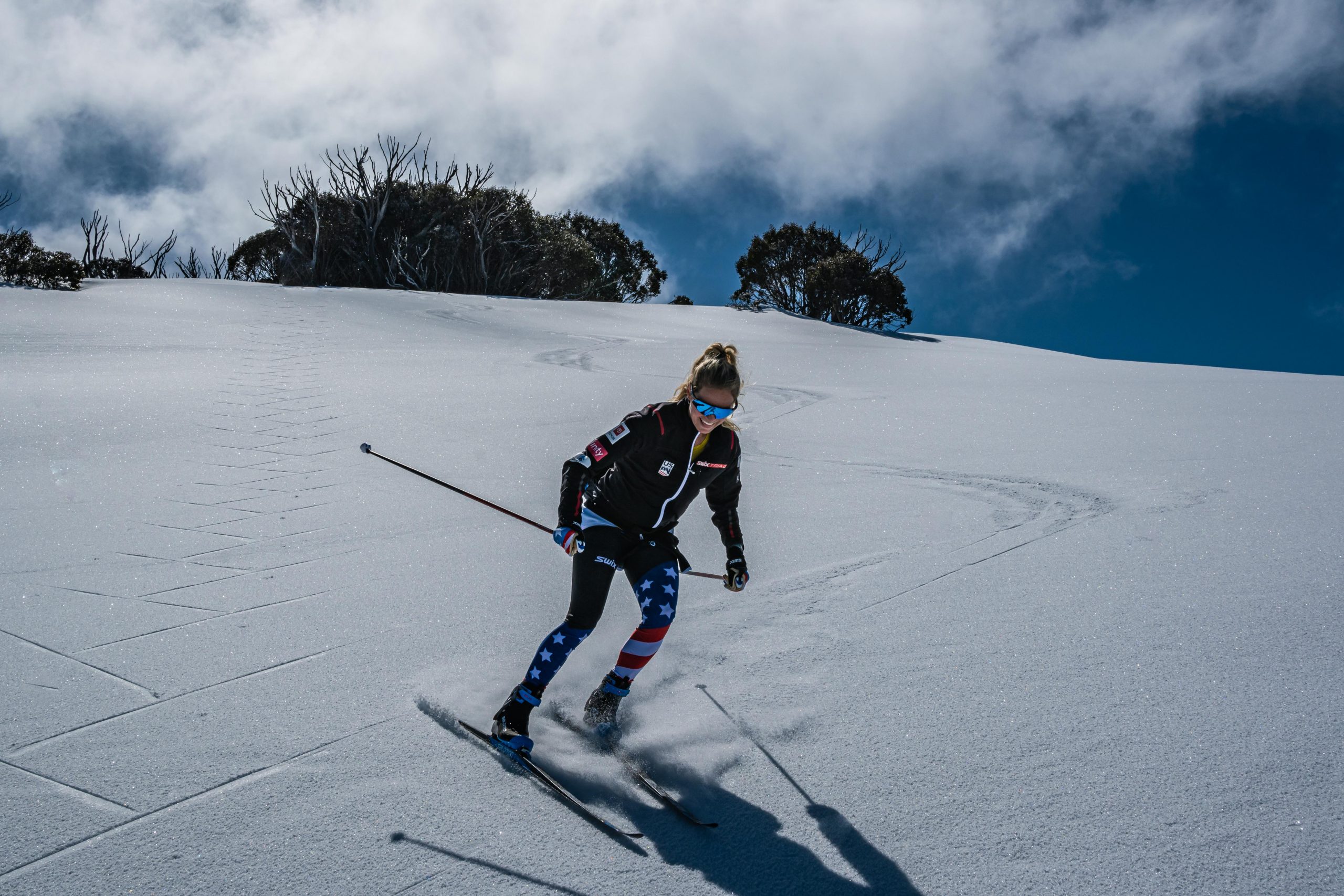
    West Yellowstone Ski Festival and Clinics are excited and proud to announce that Todd Eastman had joined Jack Hart as Co-Director of the Camp! Todd has over 30 years of teaching and racing around the world! He most recently was the Madshus Director of Racing and head ski tech at West Hill Bike and Ski Shop in southern VT.

    Jumpstart your ski season. (Photo: WYSEF).

    Jump Start Your Ski Season

    You’ll log more time ‘on snow’ than any other place you’d be during this week.

    Exceptional Coaches

    Come and join our professional coaching staff who will help you get the most out of the 2024-2025 ski season. We’ll provide a solid understanding of technique and give you the tools and drills to gain strength and efficiency, and to propel your skiing to the next level.

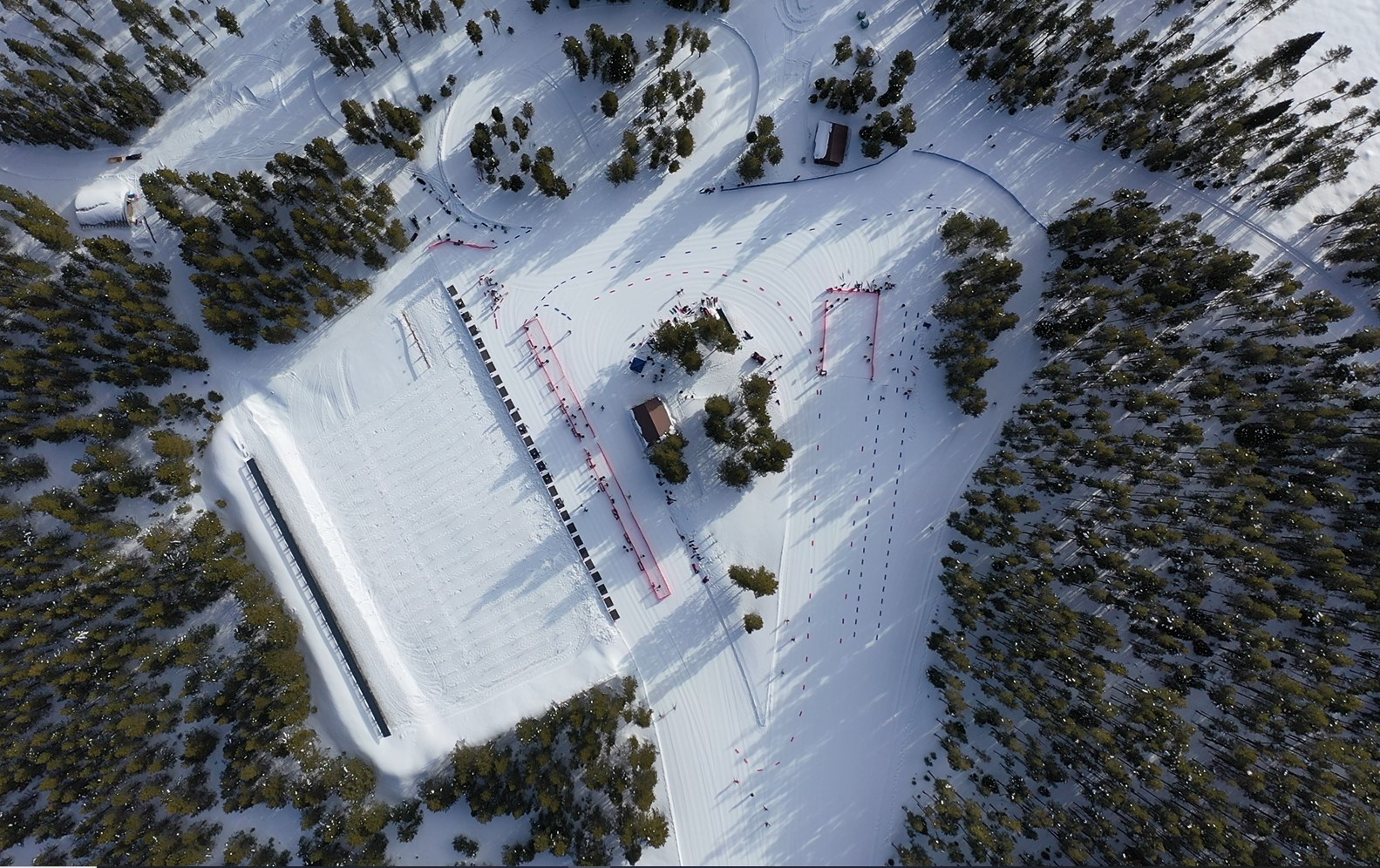
    Aerial view of the stadium at the Rendezvous Ski Trails in West Yellowstone. (Photo: WYSEF courtesy photo)

    Rendezvous Trails and Grooming

    Historically speaking, the West Yellowstone Rendezvous trail system has some of the best early-season snow in the country and is groomed by a team of top groomers in the industry. While we can’t control the weather, we’re hoping the snow falls early and often this season. Get an early view of the trails!

    Something for Everyone

    The Grizzly & Wolf Discovery Center is open every day, giving you the rare opportunity to safely view grizzly bears, wolves (bonus: the bears don’t hibernate, so they’re visible year-round) and playful river otters. For a break from the outdoors, catch a Hollywood hit or the breathtaking nature documentary, “Yellowstone,” on the aptly named Yellowstone Giant Screen theater at a whopping six stories tall (bonus: at night a Hollywood featured film is available). Check out other activities to do around West Yellowstone.

    Fun, Inspiring, Welcoming

    The feedback we hear most each year is that the festival and clinics are fun, inspiring and welcoming.  For XC ski enthusiasts, it’s the place to be.

    Register here today for West Yellowstone Ski Clinics.


    See you in November!


    Jack and Todd


  • Happy Mother’s Day!

    Happy Mother’s Day!

    Calling all Parents & Adult Children: Ski in Europe together in 2025

    (plus savings from Mother’s Day to Father’s Day!)

    Leading up to Mother’s Day, we’re taking an opportunity to reflect on the special time that adult children and parents can spend together on a ski vacation. In a world with busy work schedules and obligations, time together is often squeezed into a meal, a weekend or the holidays. Recently, we have found that Lumi trips are increasingly popular for parents and their adult children. It’s rare that Moms or Dads can spend a dedicated week together with the adults they once taught to ski. The itineraries are planned and logistics are taken care of, so neither parent nor child has the responsibility of deciding which route to take, how to navigate transportation in a foreign country or even who is going to cook or wash dishes. I love seeing when our guests can simply relax at the hotel bar before dinner in the evening and catch up with their loved ones without any responsibility – this is especially the case when it is parents and their adult children.

    With Mother’s Day this Sunday, we wanted to share some reflections from Katie who traveled with her mom Francie to Austria & Italy on the Seefeld & Seiser Alm Sight-Skiing trip last winter. 

    Do you want to take a special ski trip with your or parent(s) or adult child(ren) this winter? Sign up for a 2025 Lumi trip that still has availability before Father’s Day on Sunday, June 16 and save $300 per person!

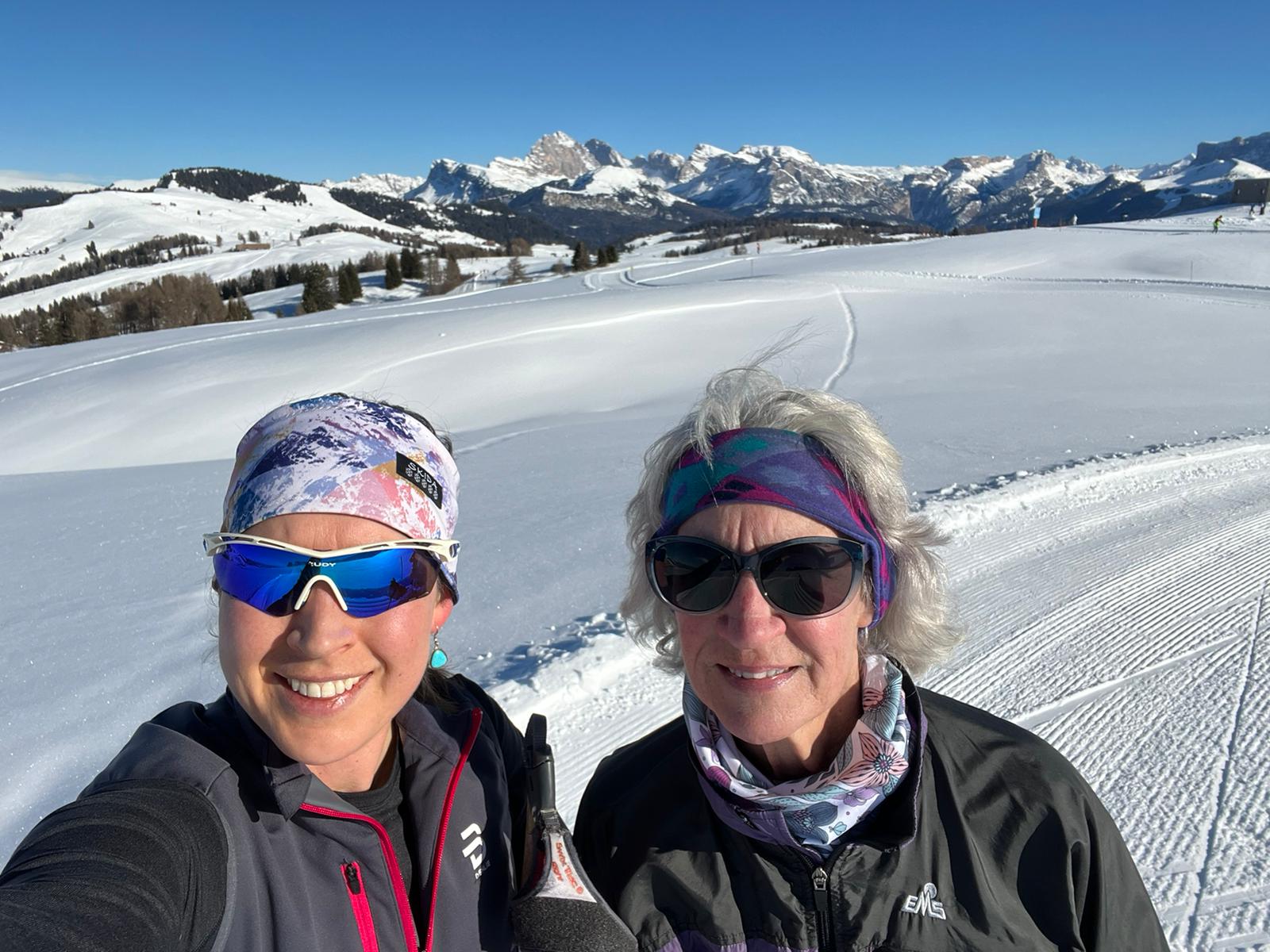
    Katie and Francie in Seiser Alm

    2024 Seefeld & Seiser Alm reflections by Katie Miller:

    I knew going on a trip to Europe with my mom would be unlike anything we had experienced together before. What I did not know or expect was the connection, gratitude, and joy that I was going to experience traveling with my mom. We had never been on a trip of this length or magnitude. 

    To say the trip and traveling with my mom for 11 days was special would be a vast understatement. I saw her in ways that I never had before, we bonded not only as mother and daughter, but became closer as friends which I think is one of the greatest gifts that arises when you spend time with a parent as an adult. You can see them and understand them in ways that you were not able to when you were younger.
    We spent the majority of our time in Seefeld, Austria, and Seiser Alm, Italy, with a quick added day and half in Venice, Italy at the end of the trip. We hit the timing just right and Seefeld was blanketed with snow that looked like vanilla frosting creating some mouth-watering photos and the kind of skiing that Nordic enthusiasts dream of. We skied through stunning trails, got the perfect mix of snowy and sunny weather, ate lunch at huts on the side of the trail, trying local dishes including Kaiserschmarrn and Käsespätzle. Drank several hot chocolates with Amaretto (highly recommended!) and went Rodeling (Austrian sledding!) down the mountain at an alpine hill. 

    It was hard to leave the dreamy trails, delicious local foods, and perfect ski days in Seefeld, but we made the trek to Seiser Alm, Italy and somehow the trip only got better. Seiser Alm is truly a skier’s paradise (Nordic and Alpine). I can say without a doubt it is now at the top of my list of favorite places to ski ever. The trails are seemingly endless, the grooming is impeccable, and the views are stunning and leave you feeling like you are standing in a painting. Our days in Seiser Alm were filled with joyful skiing, never ending smiles, soaking up sun and drinking a lot of coffee and espresso. We started and ended our days enjoying meals with our other trip goers and guides filled with tales of our days, recommendations for the next days, and information about the local area. 

    My mom and I got to see each other push our comfort levels and be adventurous out on the trails; my mom pushed herself by trying to ski longer than normal and on trails that were harder than those she normally skis on. I headed out on one of the days for a day of alpine skiing on the Sella Ronda (which may have been the coolest thing I have ever done!). When we were off doing different activities, we’d come back together later in the day and share what we’d done and continue to be in awe of the amazing place we were in and the gratitude we had for being able to experience it together.

    A trip filled with laughter, new experiences, new places, and becoming closer friends with my mom was a truly unique experience and one I would recommend to anyone lucky enough to have the opportunity.

    Katie in Seefeld

    It’s always a treat for me to have parents and adult children enjoying the trails together on Lumi trips. My Dad joined me for the Iceland-Fossavatn trip (his first Lumi trip!) last month – more on that later. If you’d like to travel with your parent(s) or adult child(ren) this next winter, there is still some space available on the 2025 Seefeld & Seiser Alm Sight-Skiing trip that Katie and Francie experienced last winter. 

    Prefer to watch your favorite skiers race together? Check out the Tour de Ski and Trondheim World Champs trips. Want to participate in a ski marathon or two together? The Marcialonga & King Ludwig, France-Transju, Seefeld & Engadin, Norway-Birken and Iceland-Fossavatn trips still have space available, but are filling up quickly. Reach out by Father’s Day (Sunday, June 16) to reserve your spot and save $300 / person!

    Happy Mother’s Day to all the Moms out there,

    Garrott

    garrott@lumiexperiences.com

  • FasterSkier At The Movies: The Best Cross-Country Ski Movie Ever?

    FasterSkier At The Movies: The Best Cross-Country Ski Movie Ever?

    Warning: This review contains lengthy passages of unrestrained gushing.

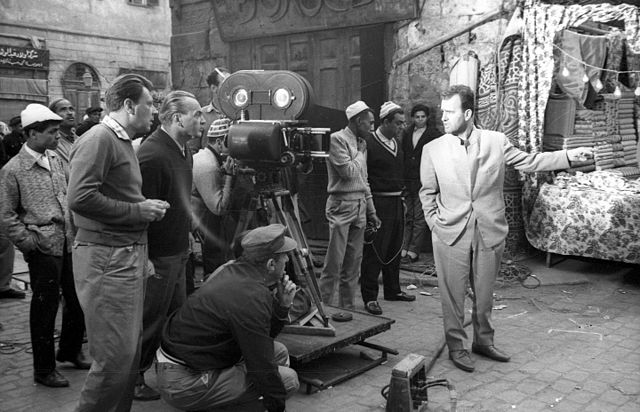
    This was state-of-the-art video production technology when “A to B Roller Ski” was made. (Photo: Wiki Commons)

    Is it possible that the best movie ever made about cross-country skiing doesn’t have a single scene which was filmed on snow? The answer is a decided yes. Because that movie is “A to B Roller Ski,” and it shatters the ceiling for what a movie about cross-country skiing can be.

    Moving, inspiring, authentic, pure, poetic, and beautiful, ‘A to B Roller Ski’ tells the story of Latvian born biathlete Raimonds Dombrovskis who in 1988 decided that after his Olympic biathlon dreams had ended due to a life threatening illness, it would be a good adventure to roller ski from Inuvik, Canada— near the Arctic Circle— to Baja, Mexico— a journey of 4,200 miles which took 90 days. Why? Well, “because everyone goes across the continent” he says in the movie. This incredible and crazy true story is a cinematic marvel which like a well-aged fine wine could only have been accomplished with decades of commitment. The movie has been out for years for viewing at film festivals. But now, it’s available for streaming on Amazon.

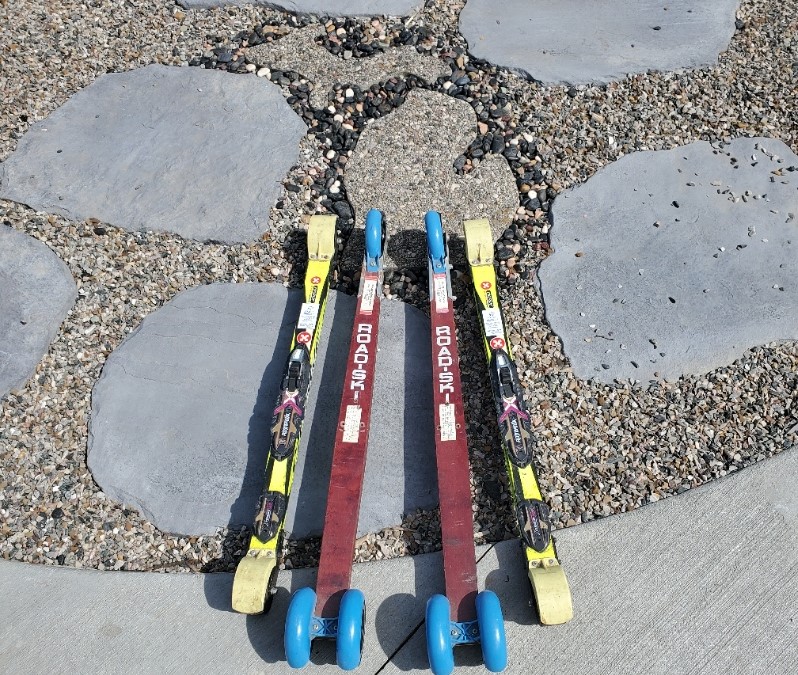
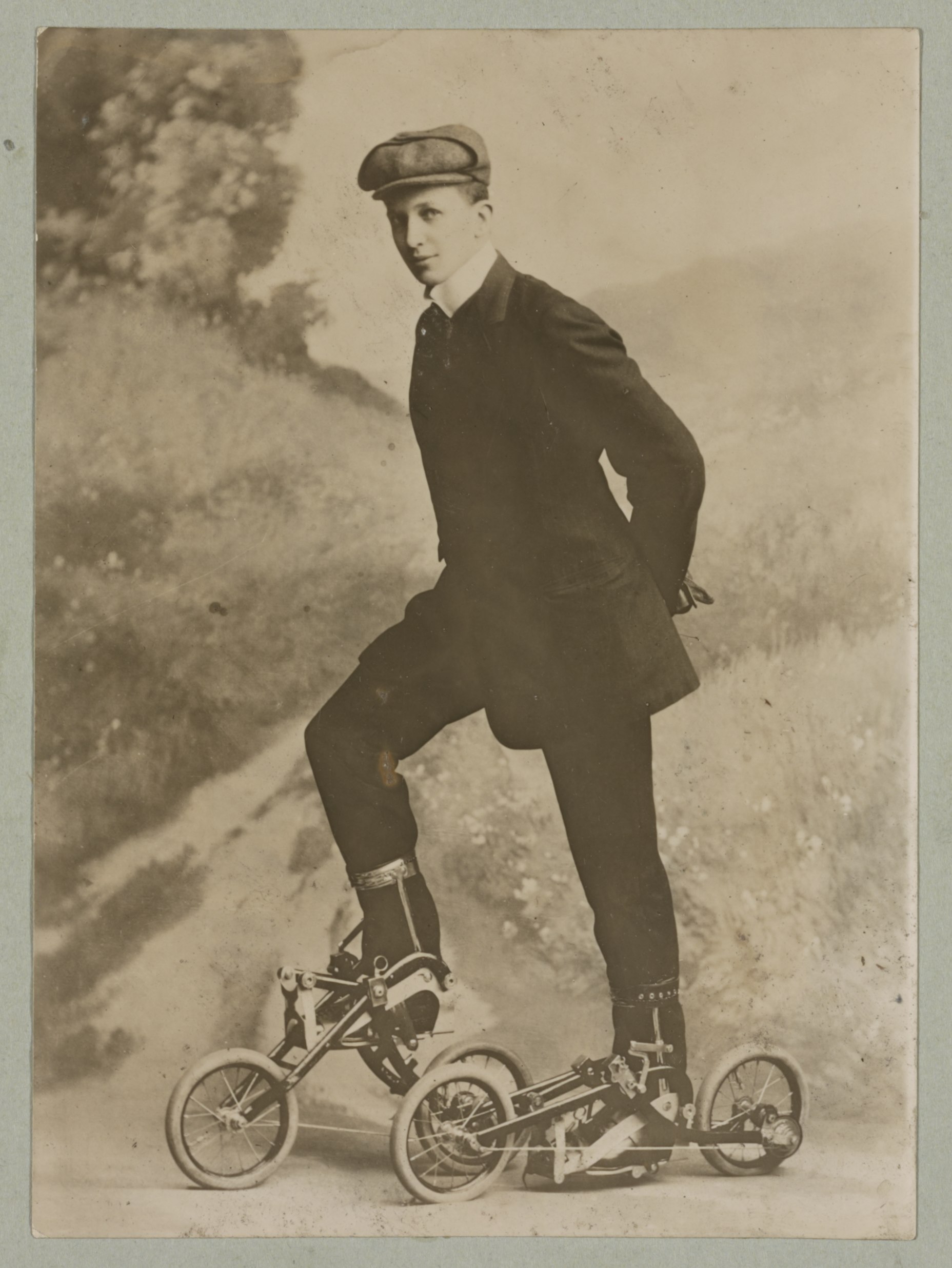
    Old versus new roller skis from the author’s collection. (Photo: Ken Roth/FasterSkier)

    The concept behind the movie’s narrative is pure folly. Who in any sane mental state would even consider such a journey? From the baseball-size stone filled roads of the Alaska Highway, to the Rocky Mountains, to the deserts of Arizona, Dombrovskis and his faithful canine companion, Bucis, soldiered on and completed a journey that not only seemed impossible, but also seemed likely to end up with a dead protagonist. Remember, this original journey occurred in the late 1980s, on roller skis which were nothing like the ones we have today. There were no heel brakes or speed reducers. Shafts were either aluminum or wood. I had the exact pair of the skis, boots, and bindings that Dombrovskis used for a large part of his trip, and I can tell you from first hand experience that, even on the paved trail at my local park, they were nerve racking. Going down mountain passes on these is unimaginable.

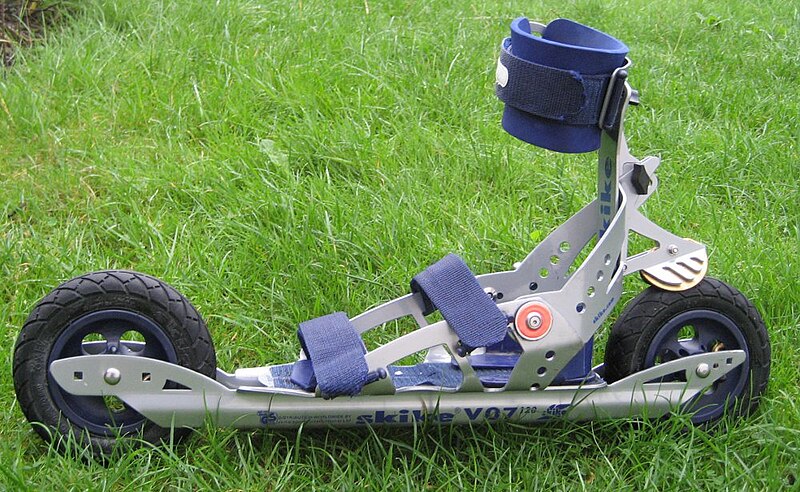
    Suspension roller skis weren’t on the horizon when this 4,200 mile journey was made. (Photo: Wiki Commons)

    The photography is remarkable. There is old footage of the journey from 1988, which given the technology of the time, a handheld VHS camera; and the limited budget—almost none— is beautifully crafted and technically well executed. The photography is perfectly mated with an evocative sound track, and the combination works wonders. There are contemporary interviews seamlessly interwoven into the original footage, which is also nicely crafted. Both the old and new photography help move the story along, and in a 1:38 minute movie, there is never a dull spot.

    The vintage videos of biathletes racing in the Classic technique are enough to make one hope that the IBU (International Biathlon Union) mandates a couple of Classic races a year; just for aesthetics alone.

    Having this kind of all-road technology would have been nice for portions of the journey. (Photo: Wiki Commons)

    The movie is told against the backdrop of Dombrovskis’ emigration from Latvia to America, the end of his Olympic dreams, and the folly of trying to do something so outrageous that you would think it was surely a joke.

    One of the more striking things about the journey is Dombrovskis’ obvious interest in the people he met along the way. Many of them may have been skeptical of him at first, but he’s the kind of guy who makes friends easily, which unquestionably helped him complete this odyssey.

    The original 1988 epic odyssey would be enough for a full feature film. But the story only gets better and deeper when Dombrovskis decides in 2014 to recreate a scaled down version of his journey 26 years later. Dombrovskis looks like he’s still fit enough to make the national Biathlon team when he retraces his steps from 1988, tracking down people he met along the way two and a half decades earlier, which leads to heartwarming reunion scenes.

    One of the nicer sections of the Alaska Highway, 1988. (Photo: Wiki Commons)

    ‘A to B’ is a testament to one man’s belief that nothing is impossible and that the price of not following your dreams is far greater than the cost of pursuing them.

    I’m not certain if non-skiers will gush about it as much as skiers will, but it’s more likely than not that even people with no interest in skiing will find the movie to be at the very least a compelling tale.

    Fortunately, you won’t need one of these to watch the 1988 footage of Dombrovskis’ original journey. (Photo: Wiki Commons)

    So, whatever you’re doing tonight, change your plans, and rent ‘A to B.’ (Depending upon your Amazon setup, if you search for it in Amazon’s catalog you may not find it listed under ‘A to B Roller Ski.’ If you can’t find it, enter “roller ski” in the search bar and the movie will pop up as an option.)

    Fortunately, you won’t need one of these to watch the 1988 footage of Dombrovskis’ original journey. (Photo: Wiki Commons)If you don’t want to risk your $2.99 movie rental money on this review’s recommendation, then take a look at IMDB’s (Independent Movie Data Base) reviews. It gets rated 8.6/10. By comparison, ‘The Godfather,’ often judged to be the best movie ever made, is rated 9.2/10. That’s some pretty lofty company. Here’s a link to the IMDB site where you can watch the trailer.

    It is rare when a movie conveys a naïve purity which is historically accurate and inspiring. The amazing thing about this film is that if someone had created the script from ideas they made up, viewers would have immediately dismissed it as nice, but ludicrous. What makes ‘A to B’ so special is that when outlandish truth mixes just right with awe and splendor, and it’s captured on film, amazing things happen.

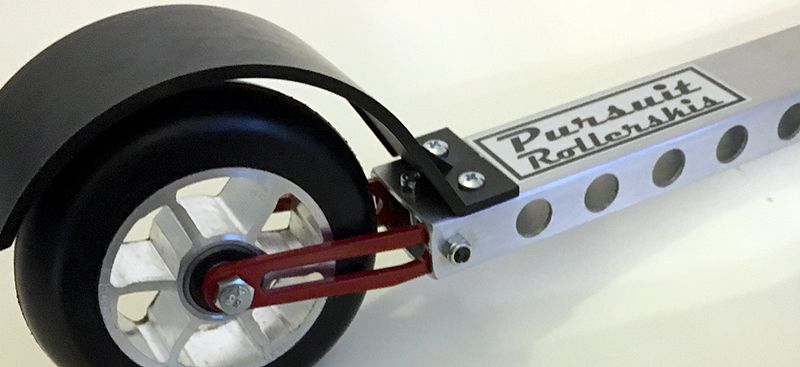
    Roller skis have improved over the years. Braking wasn’t generally available when the unbelievable Odyssey of Raimonds Dombrovskis took place. (Photo: Wiki Commons)
  • Spring Skiing on a Volcano: The Novelty of Mt. Bachelor

    Spring Skiing on a Volcano: The Novelty of Mt. Bachelor

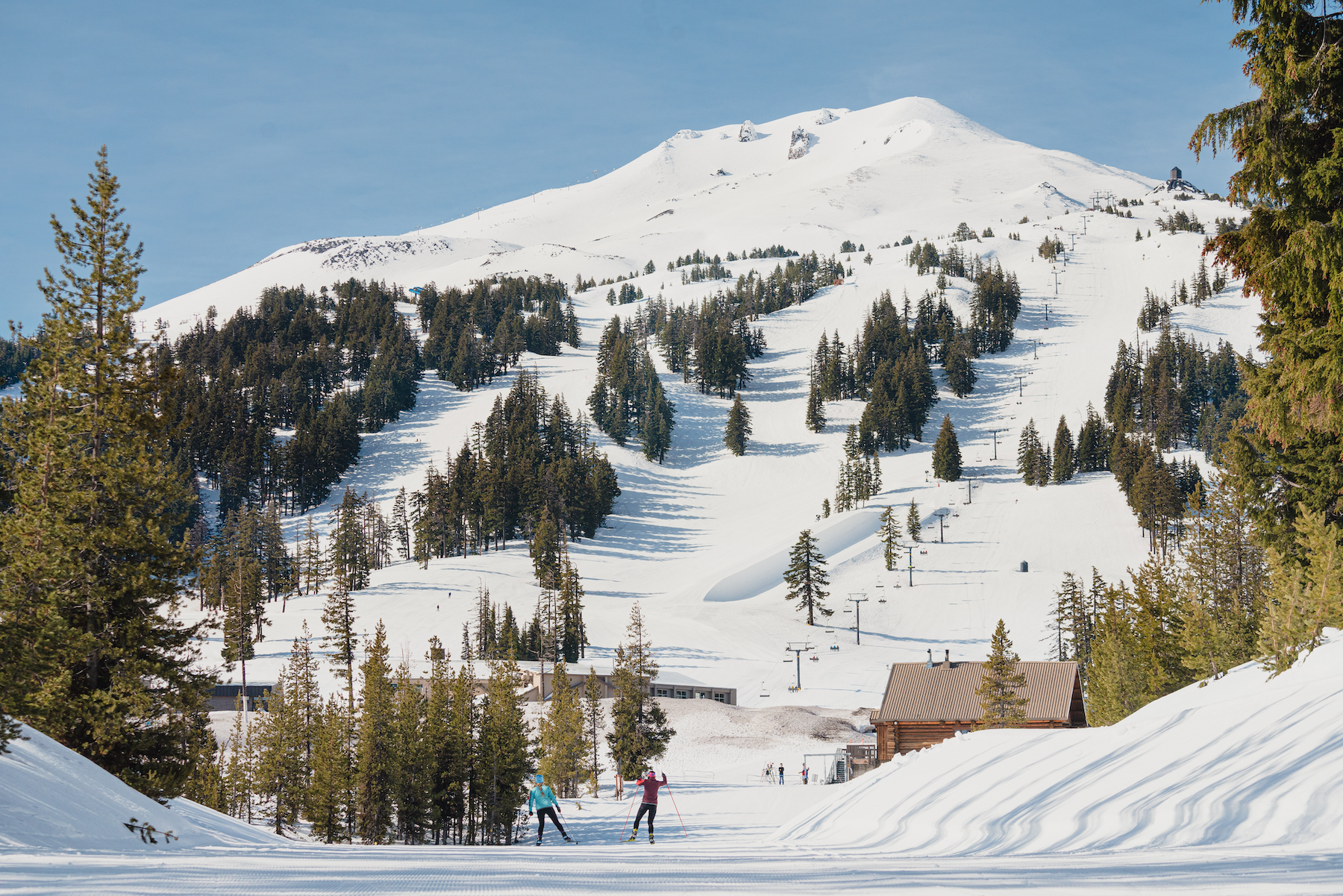
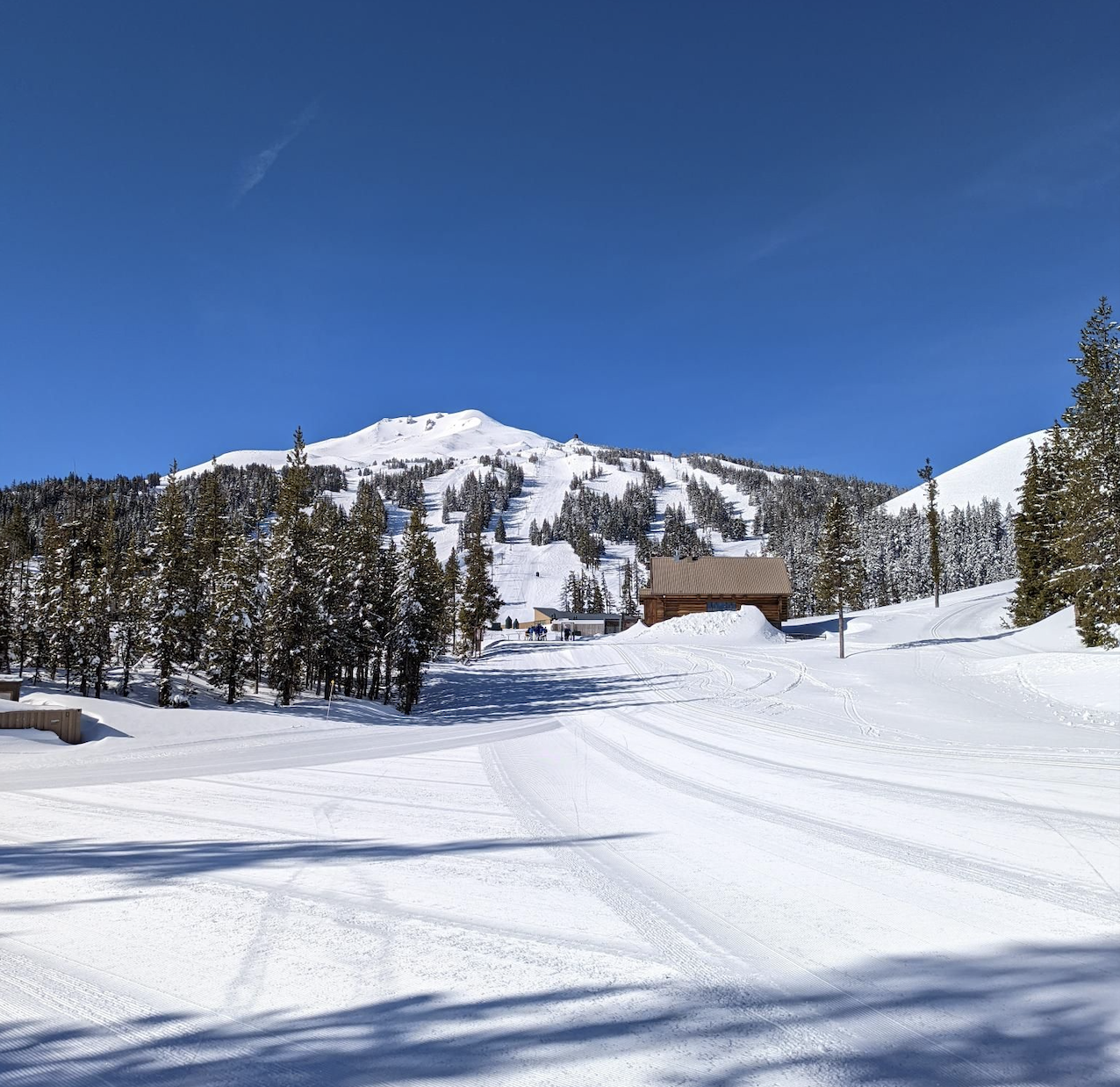
    If there’s ever a place for a cross-country skier to put on their bucket list, Mt. Bachelor in central Oregon is it. With a ski season that typically lasts into late May and can even extend to June—with natural snow some 6,400 feet above sea level—the Mt. Bachelor Nordic Center is spring skiers’ paradise.

    According to Nordic Manager Sydney Powell, Mt. Bachelor (about 22 miles west of Bend, OR) has been inundated since January with snowstorms that brought powder conditions throughout the winter and a 10-foot snowpack (120-inch base depth) as of early March.

    “The grooming team has worked long hours to keep up with it all, but we are really grateful to have this challenge given the lack of snow in some places [of the country],” Powell stated. “May 26 is our planned season-end date, so there are nearly [two] months of skiing yet to go!”

    As of late March, the Nordic Center, situated on the side of North America’s sixth-largest ski center, had all 56 kilometers of groomed terrain open for classic and skate skiing.

    On April 6, it will host the Cascade Crest, the last race of the Mt. Bachelor Cup Series organized by the Mt. Bachelor Ski Education Foundation (MBSEF). Powell described the 25 k course that winds throughout much of the trail system as “hilly but very scenic.” The 25 k skate race is the most popular, and the 50 k marathon tour entails two laps of that course. There’s also a 12.5 k distance and a 5 k kids’ race. All races are freestyle discipline.

    To close out the official season, the Nordic Center also has a variety of fun spring activities planned, including an Easter egg hunt on March 31, “Treats on the Trails” on April 12 and May 12 (Mother’s Day), and a spring deck concert/closing weekend celebration on May 25. While not entirely nordic, the Pole Pedal Paddle, MBSEF’s signature event, is slated for May 18. The multi-sport relay includes an alpine leg, 8 k cross-country ski, 22-mile road bike, 5-mile run, 1.5-mile canoe/kayak/SUP paddle, and 0.4-mile sprint.

    A dormant volcano in the Cascade Range, Mt. Bachelor tops out at 9,068 feet and regularly experiences high winds and extreme storms. This keeps the ski season extending from November through May most years and into June for teams who pay to use the trails.

    “We hope to host the US Ski Team, Biathlon Team, and Para Team again this May,” Powell explained. “We offer contract grooming in June for club teams and typically get a pretty good turnout from club ski teams from the western states. We’ll offer June grooming again this season for interested teams if snow conditions allow it.”

    Powell was confident most of the trail network would remain open into May. In late March, temperatures were still in the mid-20s and low-30s Fahrenheit. She expected the Nordic Center to have at least 15-20 kilometers still open at the end of the season and said they hoped to offer skiing on the remaining snow into mid-June.

    That’s typically when ski teams from around the country, from club to national level, visit Mt. Bachelor to start training for next winter, even if only on a few kilometers of snow. Cross-country skiing in June is as much a novelty as it is a rarity in the U.S.

    According to U.S. Ski Team Head Coach Matt Whitcomb, the 25-minute drive down to Bend, where the ski team stays during their visit, at an elevation of roughly 3,300 feet, makes for a key training and recovery combo.

    “We can also go rollerskiing in the afternoon, we can go mountain biking, we can run in shorts and T-shirts,” he told FasterSkier during the team’s Mt. Bachelor training camp in May 2022. “It’s like you’re experiencing the summer and the winter on the same day for two weeks in a row.”

    Mt. Bachelor is a similar distance from Sunriver, a small resort town to the south. It’s marketed as the Pacific Northwest’s largest resort playground, with everything from cross-country and downhill skiing to snowshoeing and dog sledding in the winter, plus mountain biking, cycling, trail running, paddling, concerts, and more in the summer.

    “Central Oregon is an awesome spring destination,” Powell explained.

    For those who have visited before, Powell said not much has changed in the last ten years since she’s worked there—which is a good thing.

    “We have a nordic lodge and offer lessons for all levels every day of the week,” she said. “We also have a cafe on-site and a retail shop with rentals. We have nordic ski patrol and day grooming, so a pretty full-service nordic offering.”

    For Whitcomb, it’s the trees and world-class trail system that get him.

    “You’re skiing through Douglas fir—just these massive, old trees—on creative, windy, hard trails…,” he said. “It’s just such a wonderful environment. The way these cascade forests smell this time of the year when the new growth is coming up—you step out of the car when you first arrive, and it’s like, ahh. I could be blindfolded and tell you exactly where I was.”

  • Three weeks down under: Diggins and Kern find snow in Australia

    Three weeks down under: Diggins and Kern find snow in Australia

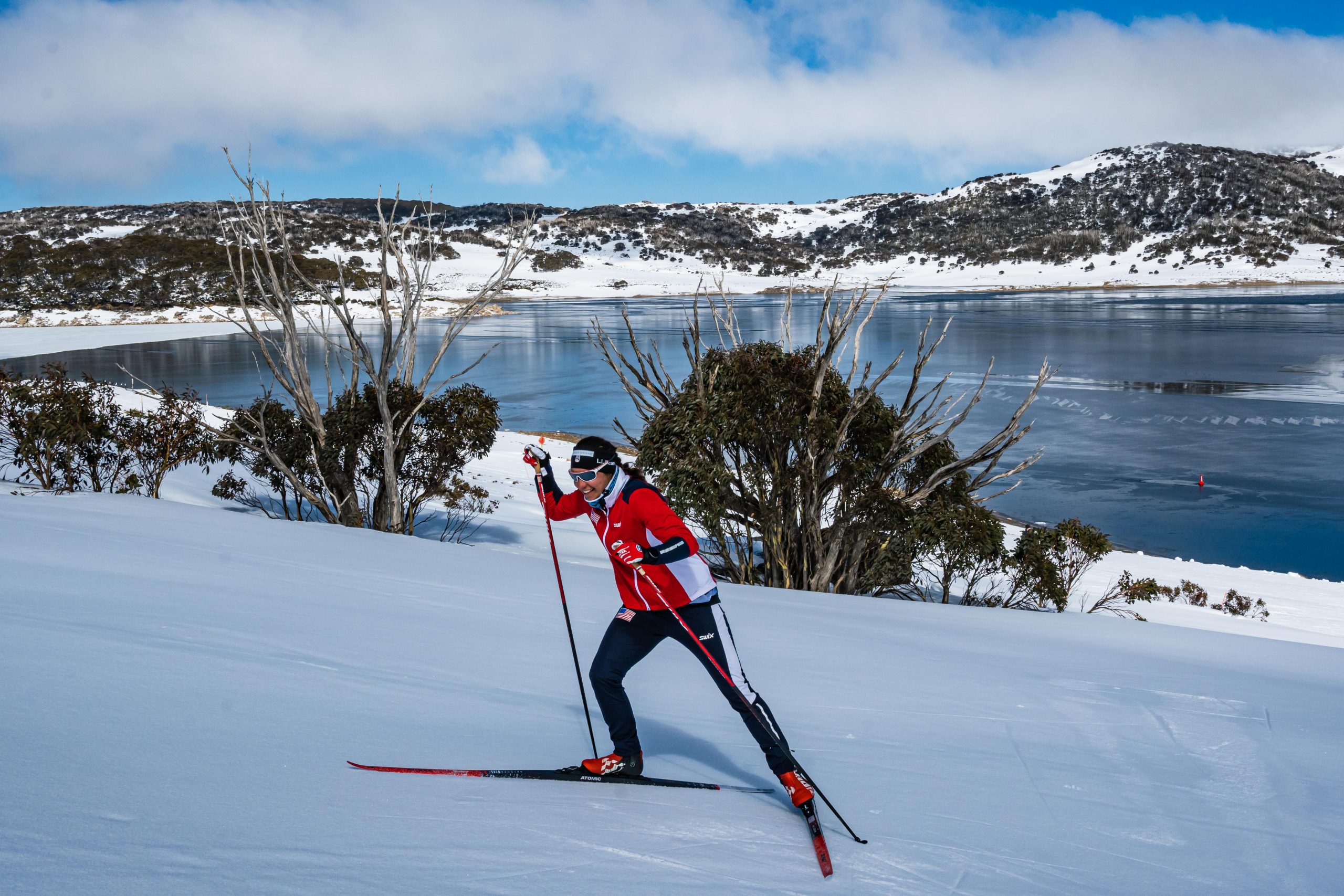
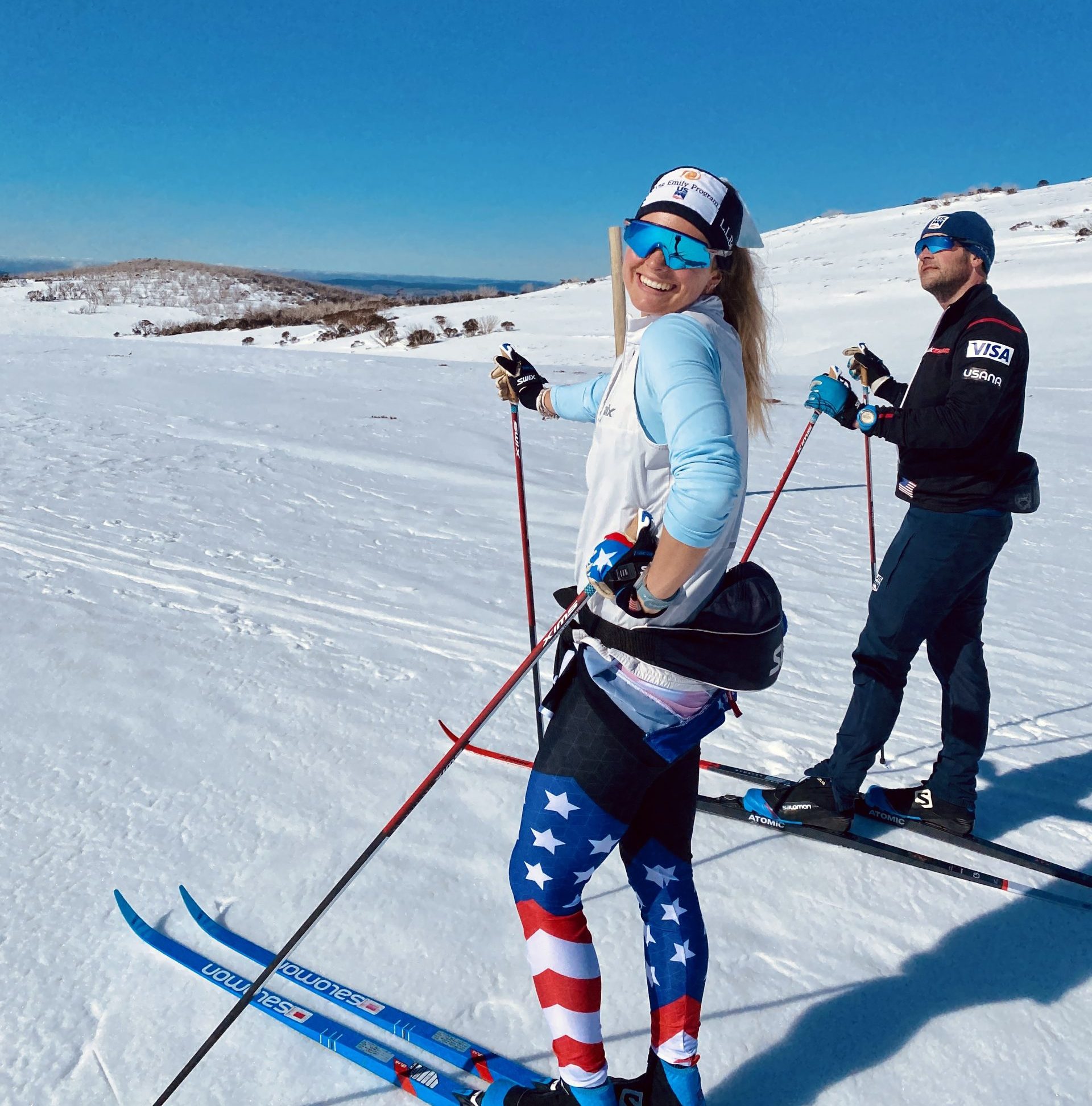
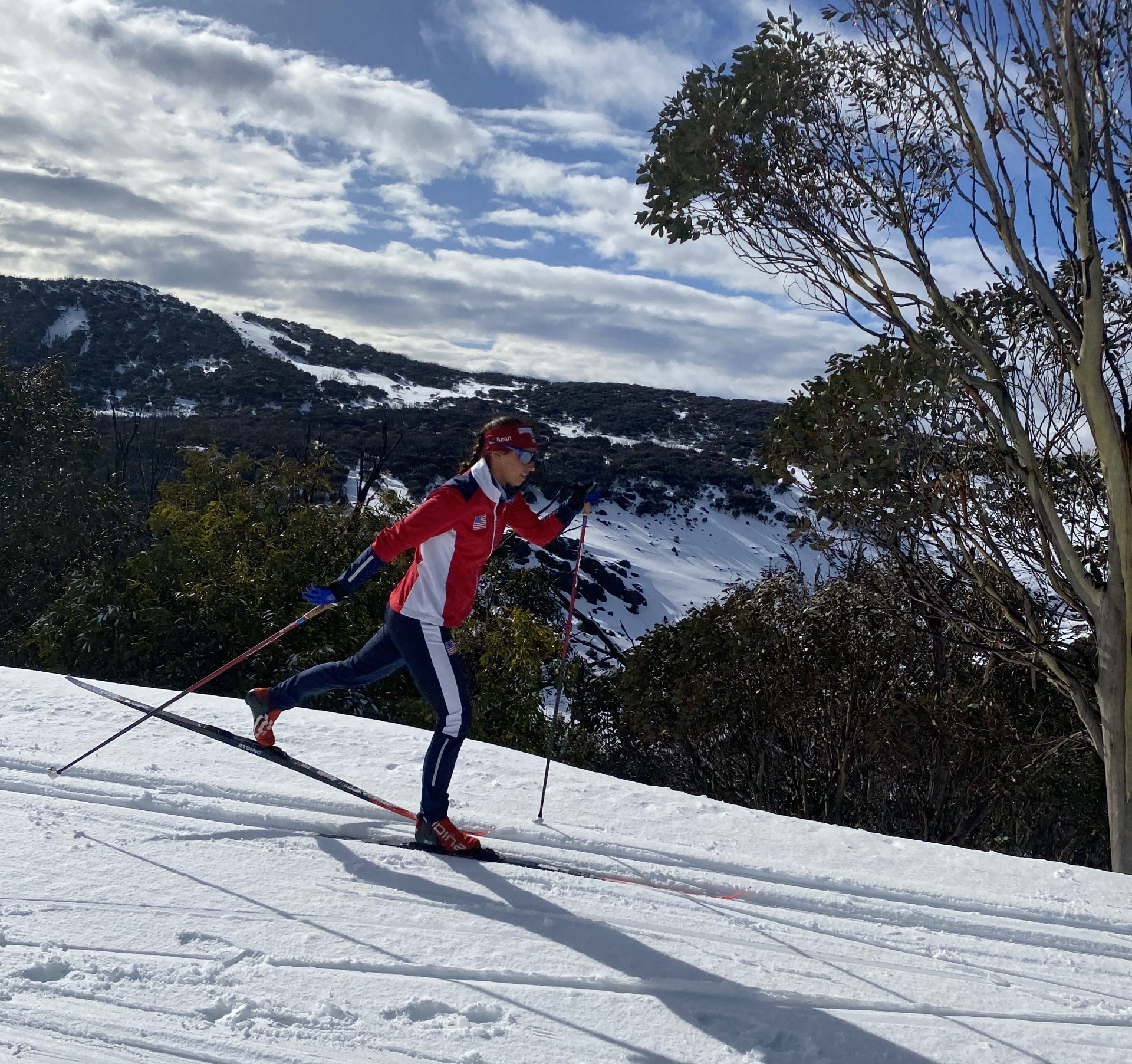
    You might imagine traveling from the U.S. to Australia as being an arduous marathon of flights- and it is- but as Jessie Diggins points out, it turns out to be about the same length of journey time as the U.S. Ski Team makes annually when heading to Ruka, Finland for the first World Cup of the season. “So in my head, I was ready for it to be like this crazy long, super hard travel,” said Diggins, “And then I was like, well, actually, this isn’t any harder than what we do every single fall. So I really thought it wasn’t that bad. I mean, yes, it’s a super long flight, but overall, it’s only three flights.”

    Diggins, along with teammate Julia Kern, and coach Jason Cork, made the trip “down under” for three weeks of snow skiing at the Falls Creek cross-country center. This August, the U.S. Ski Team has been operating with a bit of a divide-and-conquer strategy, as coaches Matt Whitcomb, Greta Anderson and Kristen Bourne took six athletes to Scandinavia, Kern and Diggins found skiing elsewhere. As Whitcomb explained, “We weren’t able to fit it into the budget to have a bunch of people go down to New Zealand or Australia,” thus the separate trips. 

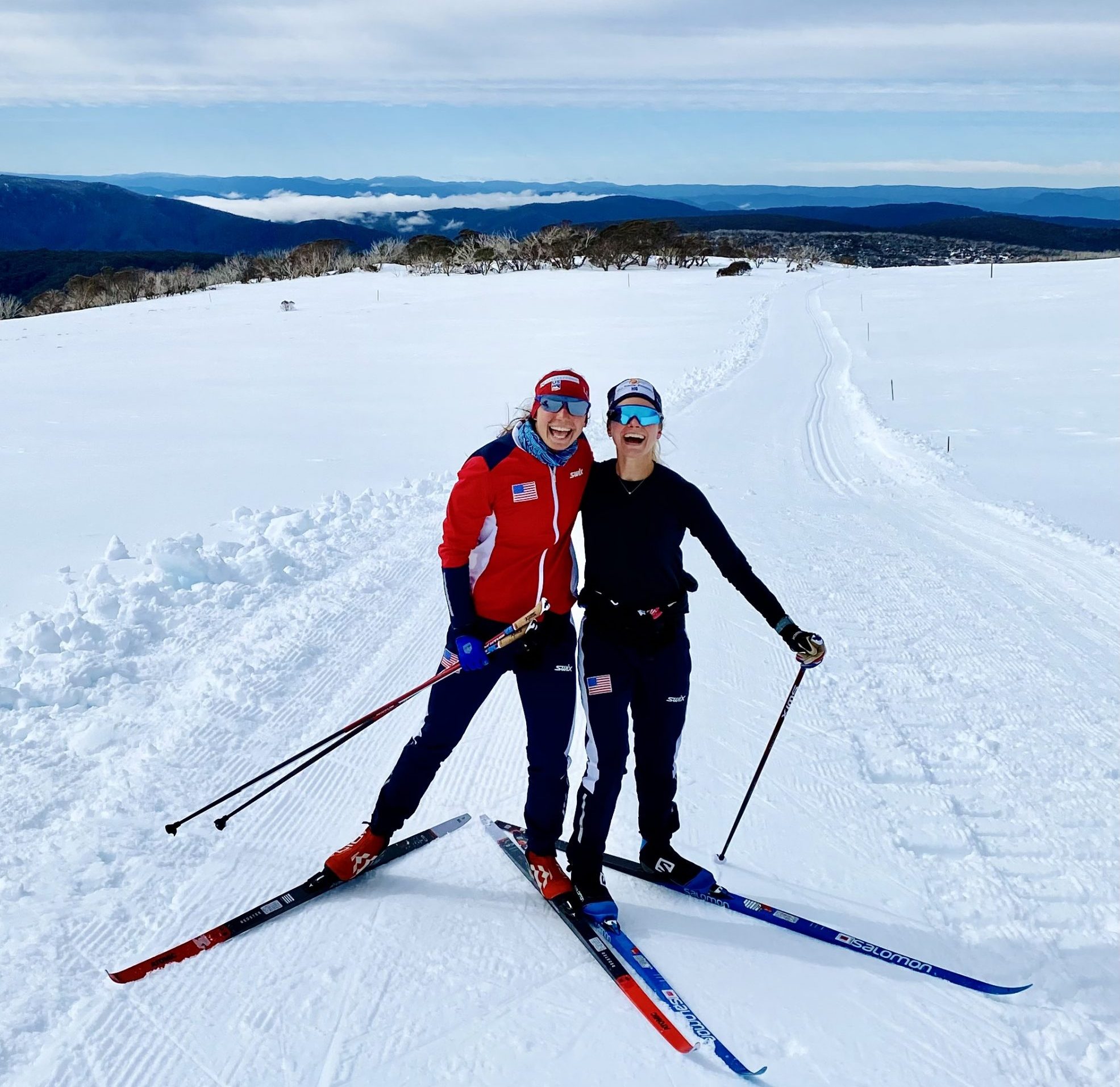
    Julia Kern and Jessie Diggins at the Falls Creek trail system in Australia (photo: Julia Kern)

    Historically, the U.S. Ski Team has spent time on snow at the Snow Farm, in New Zealand, staying at a lodge just feet from the ski trails. But, as Diggins explained, the lodge shut down during COVID and has yet to reopen. “[That] makes it less desirable because it was going to be a long drive up,” Diggins said, “So we thought, we’ve never tried Australia and we’ve heard Falls Creek has amazing skiing… so we thought this would be a good year to try something new and I’m really glad we did. It’s really cool because it’s hard to get the feel for a place unless you get to actually go to a camp there. So this has been really neat.” 

    In Australia, the crew is staying in the town of Bogong, about a 30 minute drive from the Falls Creek trails. “I want to say a huge thank you to the Australian National Team and Finn (described as the Chris Grover of Australia), between him and Cork, they found us a really nice cabin situation,” said Diggins. 

    Evening near Bogong, located in north east Victoria, Australia, where Kern, Diggins and Cork are staying (photo: Julia Kern)

    With something like 300 turns on the road between Bogong and Falls Creek, Diggins and Kern have been using the Birkebeiner Ski Club clubhouse to hang out in, between two-a-day ski sessions. “[They’ve] been super kind and gracious letting us hang out in the clubhouse,” said Diggins, “So we have a warm place to just chill for a couple hours.” 

    For both Diggins and Kern, this is their first time visiting Australia and the Falls Creek trail system. “There’s a lot of corners, and I think they say about 60 k of skiing or so,” said Kern, “There’s a lot of terrain out there and in general, pretty gradual and rolling. There are some big loops- there’s like a 12 or 14 k loop that we skied this morning, then there’s some more steeper hills near the beginning. So we’ve been able to find terrain for just about everything.” 

    Julia Kern at Falls Creek in Australia (photo: Julia Kern)

    The travlers have also experienced the full gamut of weather conditions. “We’ve had every bit of weather from sunshine to snow, to sleet, to wind gusts, and everything in between,” said Kern. “We’ve really gotten to experience about every condition to train in and do some intervals.” 

    Diggins added to that, saying, “I think it’s really nice because you don’t want to get used to just one condition right? Like if you’re coming down to get some time on snow, it’s really nice to be able to touch on every different kind, so I think that’s really, really valuable.” 

    Jessie Diggins and coach Jason Cork out on a sunny day (photo: Julia Kern)

    Besides the general goal of spending time on-snow, both athletes had a specific focus for the camp. For Kern, it was an emphasis on classic skiing. “Roller skiing is great training,” she said, “But it’s not the equivalent of trying to kick a ski in a variety of conditions, and we’ve actually got a lot of zeros conditions here, so it’s been a really great time to practice skiing in zeros conditions.”

    Additionally, Kern has been testing skis and getting a feel for them, having switched to Atomic this season. “So it’s been testing skis, classic skiing, and then just speed work and intervals,” she said. “Skiing is not the same as roller skiing, you can do all that but having the feel for snow and variable terrain and punchy or firm conditions, for me, I think it’s easier to commit to going all out in a speed when you know you can just fall on snow instead of pavement, so we’re working on that.” 

    Striding and gliding, Julia Kern works on her classic skiing (photo: Julia Kern)

    Diggins chimed in, saying, “As someone who has fallen on her face roller skiing, for me, it’s really nice to be able to, like today we’re practicing sprint finish lunges, and on roller skis you really just can’t do that.” 

    Diggins has been prioritizing practicing the things that don’t work as well on roller skis, like start speeds, lunges and herringbone. “When you’re here for three weeks, you feel like, if I have a bad day, or I’m tired, I can afford to just be really smart and relaxed about it and still know that I’m going to get all the time I need to make these changes on snow,” she said. 

    The first week was spent getting used to being on snow again, then in the second week the athletes can move on to making some changes and in the third week, “[We] try to make them stick,” said Diggins. 

    Working on speed in lower stakes conditions, where a fall hopefully won’t result in road-rash (photo: Julia Kern)

    An added bonus to the trip came in the form of the Kangaroo Hoppet Worldloppet race on August 27th. “It’s really cool to finally get to do another Worldloppet on a different continent that we otherwise don’t get to ski in very much,” said Diggins, “I also think it’s really a chance to practice fueling for long races because we don’t get an opportunity to do long races very often, and now we’re going to have a few more on the World Cup circuit.” 

    After a two-year COVID hiatus, Saturday’s race was the 30th edition of the Kangaroo Hoppet. Diggins took gold, ahead of Kern, and Australian skier, Casey Wright finished third. It turned out to be a double victory for the U.S., as Peter Wolter of Sun Valley topped the men’s podium. Campbell Wright (NZ) took second place and Lars Young Vik (AUS) came in third. 

    Following the conclusion of their three week camp, Diggins and Kern will be heading in separate directions. Kern plans to stay an extra week in the country, renting a campervan and exploring Australia. “I want to see a little bit, and traveling forces me to make sure I recover and don’t jump right into training right away,” she explained. After that trip, she will head back to Vermont for two weeks before traveling to Utah for the U.S. Ski Team Park City Camp in October. 

    Diggins will head straight back to Stratton for a few weeks before flying to San Francisco for the Salomon Women Trail Half-Marathon at the end of September. “And then I come back, and then I go to Las Vegas with Toyota for a show, and then I go right from there to Park City Camp,” she explained, “So it’s a lot of travel this fall, but for some cool events that I’m excited about.” 

    Jessie Diggins enjoying some off-trail skiing (photo: Julia Kern)

    Summarizing their experience in Australia thus far, both Diggins and Kern emphasized how welcoming the community has been. “People are just friendly to a default,” said Kern. 

    “Everyone has been so welcoming and super kind and helpful,” said Diggins, “It’s such a nice ski community here, it seems like everyone’s really close knit and looks out for each other and there’s all these kids out skiing, and it just seems like a really cool thing they’ve got going on here.” 

  • The Other Tour: Roadside Perspective from the Tour de France

    The Other Tour: Roadside Perspective from the Tour de France

    Recently I’ve become rather obsessed with the Tour de France. Having never watched a bike race previously, I now find myself glued to Eurosport for upwards of five hours a day. There are a number of factors contributing to this shift on my part: an increased familiarity with the landscape and culture of the host nation, some covid-induced couch time, and a newfound respect for the insane feats of athleticism on display day after day. 

    Aware that this is a cross-country skiing publication, I should point out that this famous bike race is not totally without connection to our sport of focus here at FasterSkier. The event that ski fans might refer to as “the Tour” (the Tour de Ski) is the result of an idea allegedly generated in a Norwegian sauna by then International Ski Federation (FIS) cross-country race director, Jürg Capol and ski legend, Vegard Ulvang. Following the germination of this idea, Capol visited the Tour de France in 2006 before the first edition of the Tour de Ski. According to an FIS press release, “the goal of the trip was to gain valuable insight into the logistics, marketing implementation, television and internet production and accreditation services that are part of the organization of any world-class sports event consisting of multiple stages.” 

    The course in Val di Fiemme, ITA  prepped and ready for the men’s mass start during the 2021-22 FIS Tour de Ski. (Photo: NordicFocus)

    After his visit Capol remarked, “the logistical accomplishments of the local organizing committees at the Tour de France are truly remarkable… I am convinced that the organizers of the FIS World Cup Cross-Country could all learn a lot by reaching out to other sports and events in the future.” 

    The logistics are just one of the many impressive things about the Tour de France, which saw its 109th edition start in Copenhagen on the first of the month. The spectators are another. Without having witnessed either race in person, I imagine the atmosphere at the Tour de France being somewhat akin to the Holmenkollen World Cup, only lasting three weeks as opposed to two days. 

    To gain some insight on the roadside spectating experience, I reached out to a few people who made it there in person. 

    Anna Gibson grew up watching the Tour de France annually with her family from their home in Wyoming. Gibson said, “even on TV, I could tell how physically and emotionally intense the Tour was. It has always impressed me. But getting to watch the Tour in person made me realize that the race is even more athletically impressive than I ever thought.” 

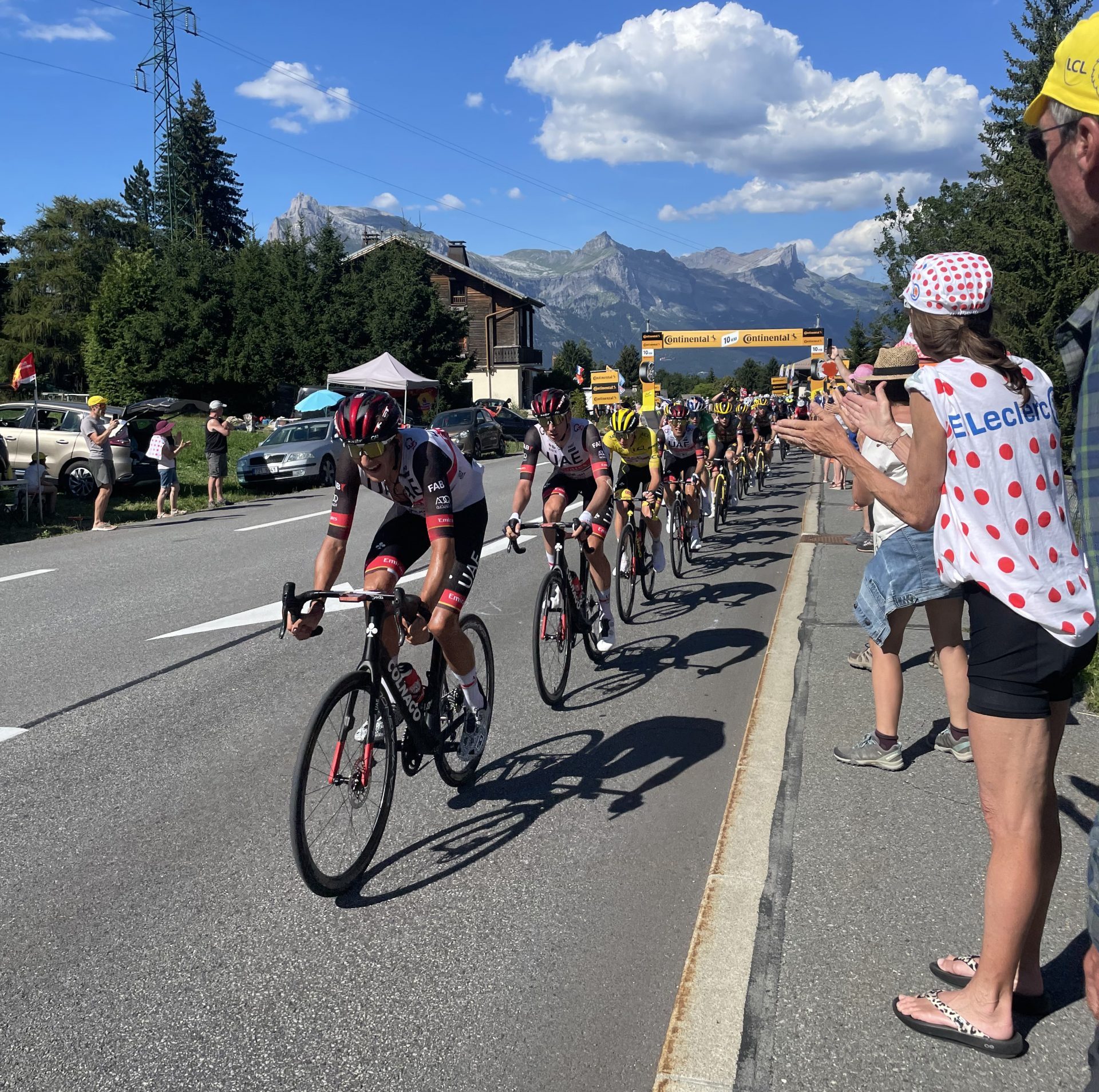
    Team UAE riders lead the yellow jersey, then worn by Tadjec Pogačar of Slovenia, on Stage 11 (Photo: Anna Gibson)

    Consisting of 21 stages stretched over three weeks, bikers race a total distance of 3,328 kilometers (2,068 miles) with just two rest days. Though each stage varies in distance and elevation gain, even the ‘easiest’ of days look challenging on paper.

    Sophie Stuber was on her own multi-day bike adventure with a friend, and planned a route overlap with the Tour in a few places. “It definitely gives you such an appreciation for what they do because our tour days were basically half or a third of the length of a stage and the [pros] climb up 11% grades literally twice as fast. And our days felt hard,” she added. 

    Fans line the road as Tadej Pogačar (UAE) and Jonas Vingegaard (Jumbo Visma) battle on Stage 11 (Photo: Anna Gibson)

    Aside from appreciating the overwhelming physical performances of the riders and the obvious excitement of watching the athletes ride by, spectating at the Tour is a fully immersive experience. As Gibson explained, “What you don’t see on TV is everything that happens before and after the riders pass through… The entire day is a party for everyone involved, whether they watch in town, or camp on the side of the mountain the previous night and picnic all day beforehand, or ride up the climb earlier in the day to find a spot to spectate.”

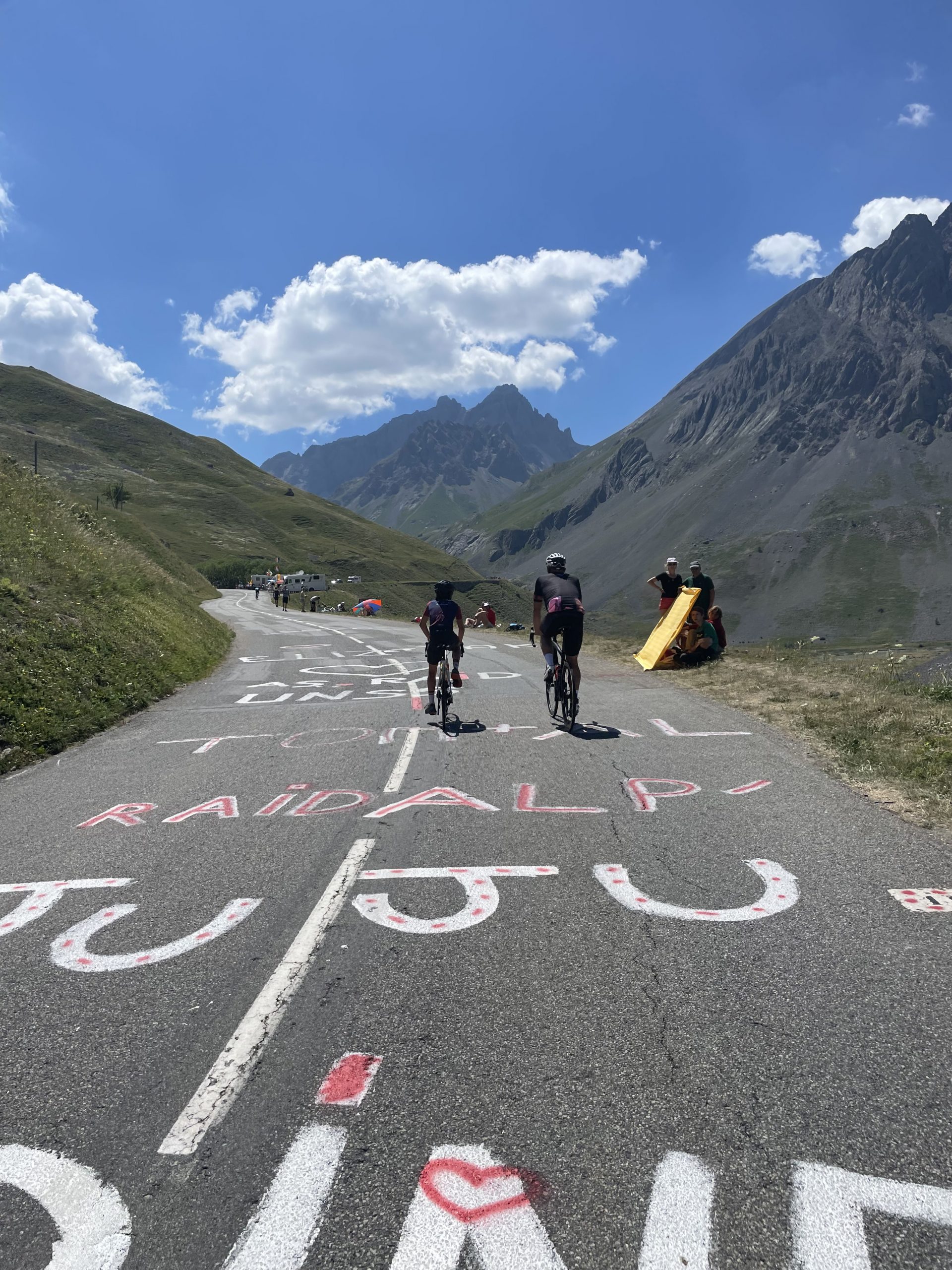
    Gibson chose the latter option for Stage 11 (which turned out to be a pivotal race day as two-time Tour winner Tadej Pogačar from Slovenia lost nearly three minutes to his rival Jonas Vingegaard of Denmark who currently wears the yellow jersey). The portion of the stage that Gibson rode included 30 miles and 7,700 feet of climbing from Saint Jean de Marienne to the summit of the Col du Galibier. Gibson said, “although this segment was just the middle section of the stage for the pros, this was amongst the most challenging rides of my life, and unquestionably the most fun.” 

    Heading up the Col du Galibier in the morning before the riders come through (Photo: Anna Gibson)

    The racers aren’t the only ones getting encouragement from the crowds, Gibson said, “I even got small tastes of what it must be like to be in competition, as some of the crowd hollered ‘allez’ or ‘femme’ or ‘bravo’ as I laboriously pedaled onward. People waved flags for me and made tunnels. The energy was infectious, and by the time I reached the top and gently laid my bike down on the rocks, exhausted and exhilarated, I was doing the same for the other random people reaching the summit.” 

    Waiting for the riders to arrive, Gibson talked to fellow fans from all over the world. With no cell service available, anticipation was high to see how the race was unfolding. Gibson said, “It turned out to be a very exciting stage, with small groups of riders separated by several minutes. People (including me) went absolutely berserk watching the race unfold before their eyes. A few of my idols rode through, crusted in salt from the afternoon heat. Seeing them do their thing in person was legendary!”

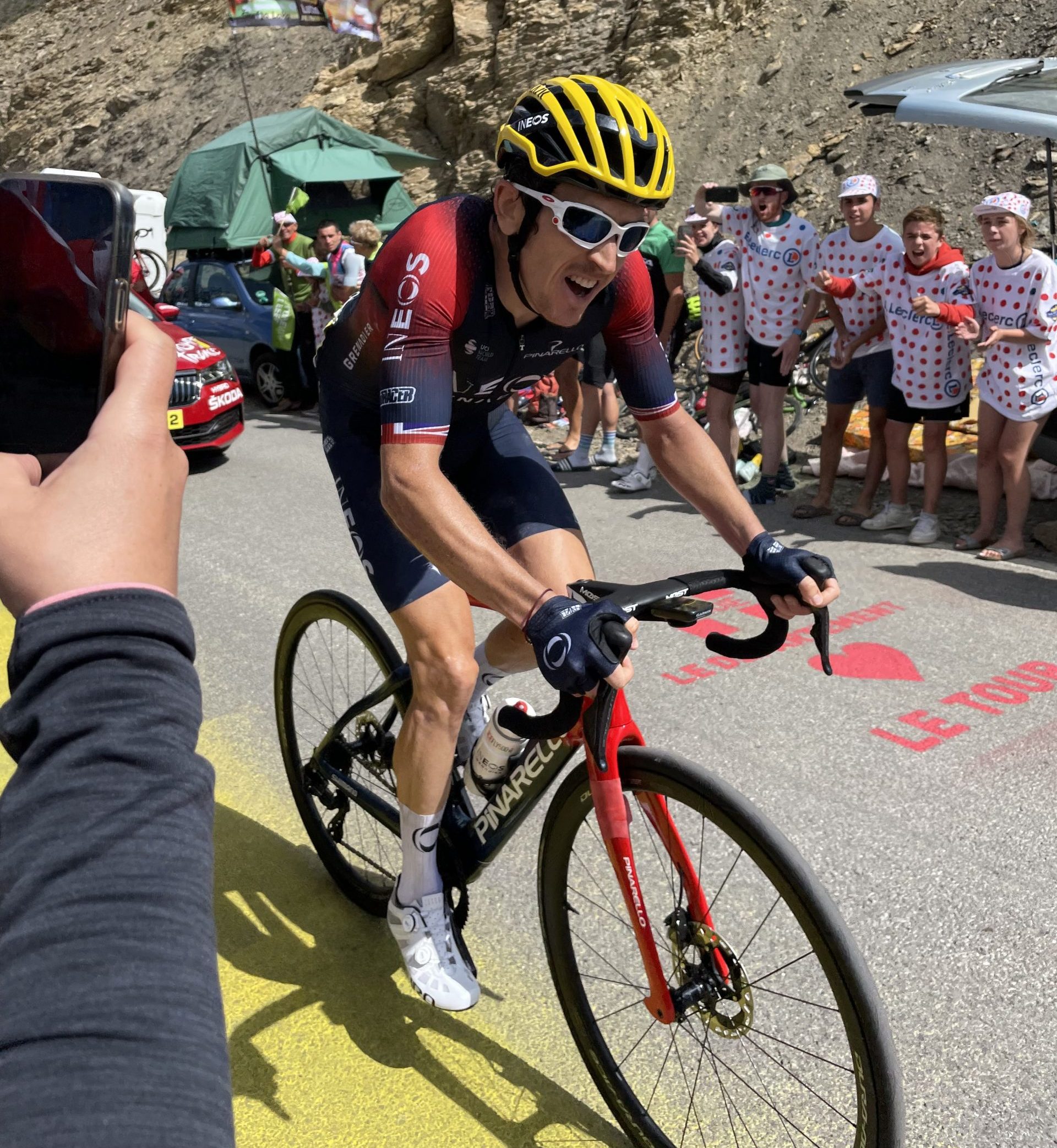
    Victor of the Tour de France in 2018, Geraint Thomas heads up the Col du Galibier, riding for team Ineos Grenadiers (Photo: Anna Gibson)

    With the racers through, the crowds also had to make their descent, which Gibson described as “epic.” She said, “I assumed a position in what was essentially a civilian peloton, ripping down turn after turn. Returning to Valloire at the base of the climb, I came across a big screen broadcasting the end of the stage in the cobbled center plaza. The pace was packed and the party went on.” 

    Though she only watched three of the twenty-one stages, Gibson said, “I can imagine the party goes on in this same manner for the whole three weeks of the Tour. It is a production. And seriously one of the coolest things I’ve ever seen.” 

    After such a testimony, I’m ready to add in-person Tour de France viewing to my bucket list. For the time being however, the screen experience will have to suffice. 

    With 76 hours, 33 minutes and 57 seconds on the cumulative race clock for leader Jonas Vingegaard, only one stage remains before the 2022 Tour de France comes to an end- on the Champs Élysées in Paris on Sunday. Lucky for me, the race watching opportunities don’t end there as the first edition of the Tour de France Femmes kicks off the same day.

  • Spring skiing: Mt. Bachelor Nordic Center hosts annual U.S. Ski Team camp

    Spring skiing: Mt. Bachelor Nordic Center hosts annual U.S. Ski Team camp

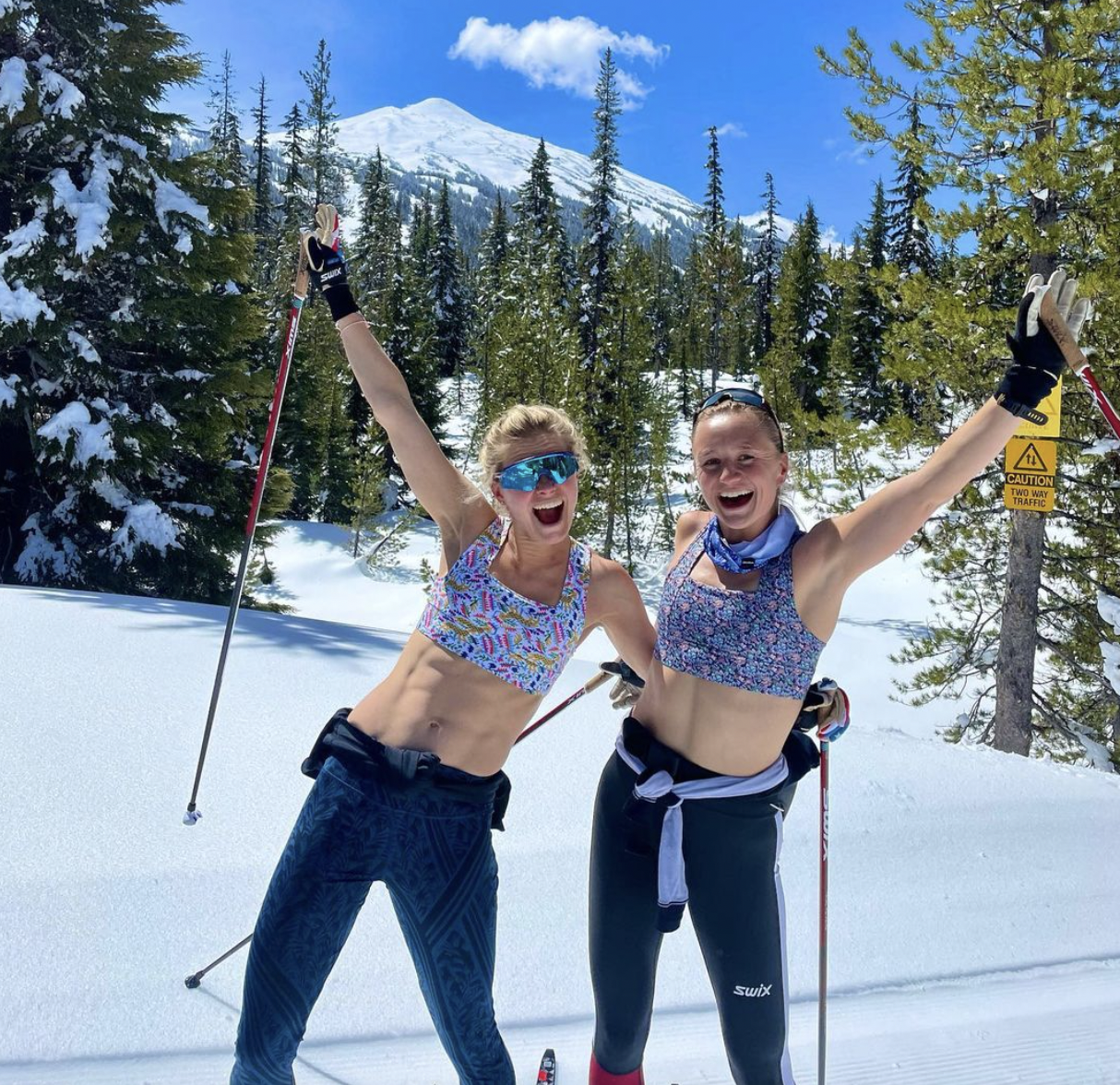
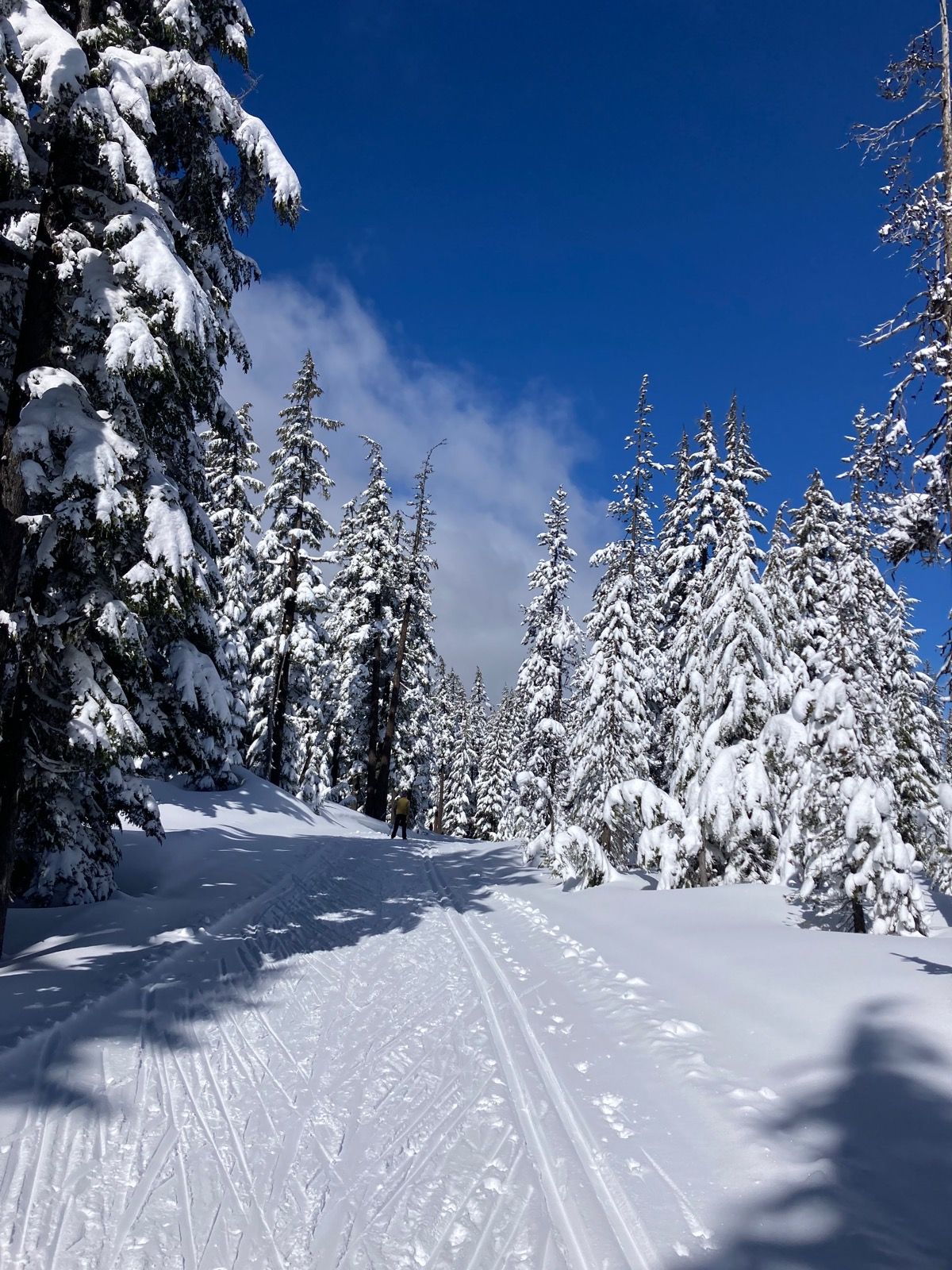
    May or January? The US Ski Team has found prime conditions at Mt. Bachelor during the 2022 Bend Camp. (Photo: Noel Keeffe)

    Believe it or not, it is mid-May. For those following a traditional cross-country calendar, this means the start of a new training year, building toward the 2022/2023 competition season. And, for many of the top American athletes, this means it’s time to make an annual pilgrimage to Bend, Oregon for the on-snow camp of the season at the Mt. Bachelor Nordic Center.

    The weather gods were kind to the camp attendees, with nearly a foot of fresh snow falling on Mt. Bachelor last weekend, restoring it to mid-Winter conditions. April was also a fruitful month for snowfall, setting up for a base-depth of 92” currently reported on the trails – not bad for May!

    To learn more about the camp and what has made Bend and Mt. Bachelor a staple of the U.S. Ski Team’s early season training, FasterSkier connected with head coach Matt Whitcomb, who shared that he has been coming to Bend almost-annually for the last 26 years. 

    He first experienced the trails at Mt. Bachelor during the 1996 U.S. National Championships. 

    “I was rooming with Justin Beckwith (current NENSA Competitive Program Director),” Whitcomb recalled fondly. “Amy Caldwell took us out and then Sverre [Caldwell] joined us, and we had our first experience racing Nationals. And it really jumped out as this town that had skiing at its center, not only alpine but cross country.” 

    The following summer, Whitcomb, Beckwith, and a couple additional training partners hopped into a car and drove to Oregon to spend the summer of ‘97 in Bend. 

    “But we weren’t, by any means, the first people to do this – we were following in the footsteps of Justin Wadsworth and Pat Weaver and a whole bunch of other people. And by our senior year [at Middlebury College], we had twenty-something people driving out from the east just to experience what Bend has in late May and June, and we’d be there through August until we had to go back to college.” 

    Lina Sutro (right) and Alayna Sonnesyn (left) enjoy fresh snow and a fresh groom at Mt. Bachelor during the 2022 Bend Camp. (Photo: Lauren Jortberg)

    What Bend has in late May and June, he said, is a vast array of diverse training opportunities, which most importantly includes snow. 

    “That’s probably the first thing that really drew us in, particularly as people from the East.”

    He shared that the snow report they had received from Mt. Bachelor Nordic Center manager Sue Foster was measuring the accumulation from April storms in feet, not inches. 

    But it’s not just the access to snow on its own that makes Mt. Bachelor worth the trip.

    “The trail system is world class. You’re skiing through Douglas fir — just these massive, old old trees on creative, windy, hard trails, and on a good year they’ll have close to 30 or 40 kilometers groomed for us still in May.” 

    In addition to its geographical location and an accumulation of over 300” of snow annually, the elevation of the Nordic Center preserves the snowpack for late season skiing. The parking lot sits at roughly 6,000’ above sea level, while trails range from 5,750 to 6,400’. 

    This puts Mt. Bachelor in a similar altitude zone to Soldier Hollow, UT, offering athletes both an early season bump in red blood cells and the opportunity to fine tune their altitude skiing strategies, “which is something that we really value. Because skiing at altitude is not just something for the aerobically gifted; it’s also something for people that develop the skill of how to actually ski at altitude. So that’s been great.”

    Whitcomb also lauded the convenience of Mt. Bachelor relative to their lodging down in Bend, roughly a 25 minute drive down the mountain at a significantly lower elevation of roughly 3,300’. In addition to easy access to the trails, this gives the team the opportunity to train high and sleep low, as well as to enjoy non-ski training modalities in a totally different climate. 

    “So recovery is complete. We can also go roller skiing in the afternoon, we can go mountain biking, we can run in shorts and tee shirts. It’s like you’re experiencing the summer and the winter on the same day for two weeks in a row.”

    Fresh snow and vitamin D — Jessie Diggins and Alayna Sonnesyn head to Mt. Bachelor for the 2022 US Ski Team spring training camp. (Photo: Lauren Jortberg)

     Overall, Bend and Mt. Bachelor have become a special place for Whitcomb, and for the many athletes who have made their way there over the years. 

    “It’s just such a wonderful environment. The way these cascade forests smell this time of the year when the new growth is coming up — you step out of the car when you first arrive and it’s like, ahh. I could be blindfolded and tell you exactly where I was.”

    While Mt. Bachelor offers high quality grooming all season, Whitcomb also spoke to the relationships the US Ski Team have developed with the trail operations team, and their willingness to adapt their usual grooming patterns to best serve the visiting skiers. This year, Whitcomb is looking to replicate the track format of a World Cup stadium so the team can practice “switching lanes in the finish and figuring out how to develop more speed — a bit of a twist to our [usual] speed training.”

    At the helm, and helping US Ski Team coaches interface with the grooming team, is the aforementioned Nordic Center Manager, Sue Foster, who Whitcomb says has been an invaluable resource over the years. 

    “She meets us in the lodge every day, she helps us prepare the TV and the chairs so that we can do a little visualization before every session. And she’s just a delightful, inviting person that makes you want to come back and see [her.] It’s rare that every athlete on the team knows the names of the people working the lodge, but Mt. Bachelor is one of those places.”

    Midwinter conditions return in May to Mt. Bachelor. (Photo: Alayna Sonnesyn)

    Off the ski trails, Whitcomb shared that a highlight for many athletes is the lower elevation terrain in Bend, where the unique volcanic geology of Mt. Bachelor sets up for miles of tacky “hero dirt” for afternoon rides. 

    “The mountain biking is some of the best in the US, particularly in May, before it’s gotten dusty.”

    During the late spring, many trails along the Deschutes River are also beginning to open up, and often the team will be dropped off an hour and a half up-river to enjoy a point-to-point run  back to their cluster of rental houses. 

    This year, the team is spread between three large rental homes in close proximity, with the staff house centrally located to host nightly team dinners catered by USOPC chef Megan Chacosky. To reduce COVID risks among the team and staff, masks are still worn during team meetings, allowing them to safely happen in-person. Though mask mandates and COVID safety precautions are largely being dropped, Whitcomb expressed the importance of keeping athletes and staff healthy, setting everyone up for success during the high-volume summer months of training. 

    “I think the world has made a major shift to decide that the pandemic is over, but we’re pretty well aware that the COVID is not done yet.”

    Finally, Whitcomb cited the greater ski community in Bend as a reason the camp has been such a valuable component of the annual training cycle. 

    “As far back as I can remember, it didn’t matter whether we are registered with a local club or not, we were always being invited by [coach/director] John Downing to the XC Oregon sessions. He’s still a good friend of the team, and we have so many locals in town that are helping us out and welcome us every year to town.”

    Acknowledging that he was only giving the short-list of names from the Bend skiing community who have supported and welcomed the team each year, he also noted former physiologist at the Olympic Training Center in Colorado Springs Tim Gibbons, who builds excitement for the camp by giving Whitcomb snow reports all winter, indicating how the trails are shaping up for spring skiing. And lastly, he thanked the members of the Mt. Bachelor Ski Education Foundation (MBSEF), including nordic director Dylan Watts. 

    This community support allows the team to maximize their time training in Bend, while also creating opportunities for outreach via programs like Fast and Female or hosting workouts for the MBSEF junior athletes. This partnership helps the team feel connected, and also stoke the enthusiasm of the next generation of cross country skiers. 

    “It just really feels like a family that we’re coming back to every year. So thanks to everybody that has always been welcoming. We try to be great ambassadors for the sport, and we need partners like this [to continue to move forward as a nation].

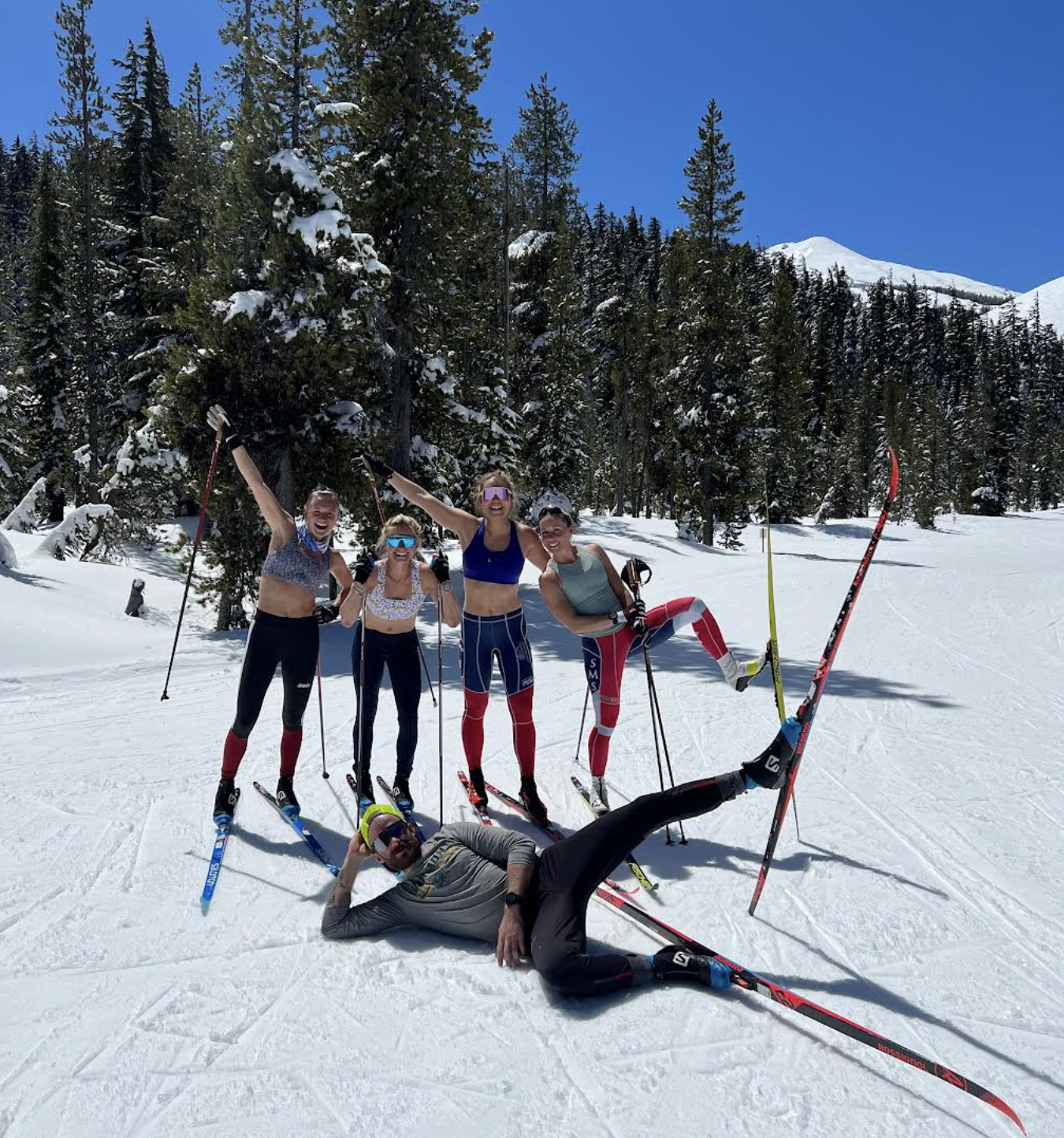
    Sun, snow, and lots of training during the 2022 US Ski Team camp at Mt. Bachelor. (Photo courtesy Alayna Sonnesyn)

    The Mt. Bachelor Nordic Center is known for it’s world class spring cross-country skiing. You can find more information about spring conditions at mtbachelor.com.

  • Sovereign2SilverStar Ski Marathon: Building a New Event

    Sovereign2SilverStar Ski Marathon: Building a New Event

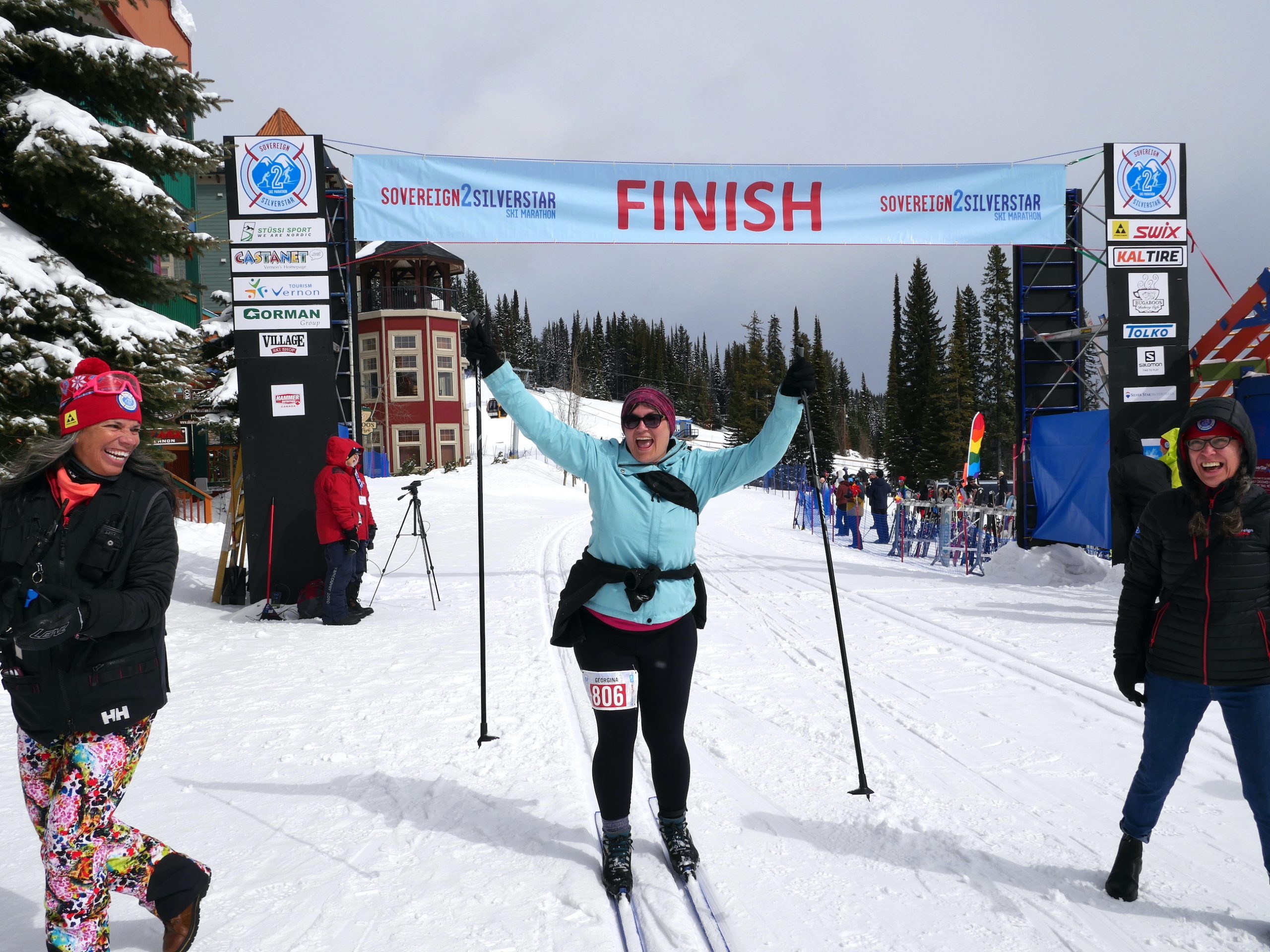
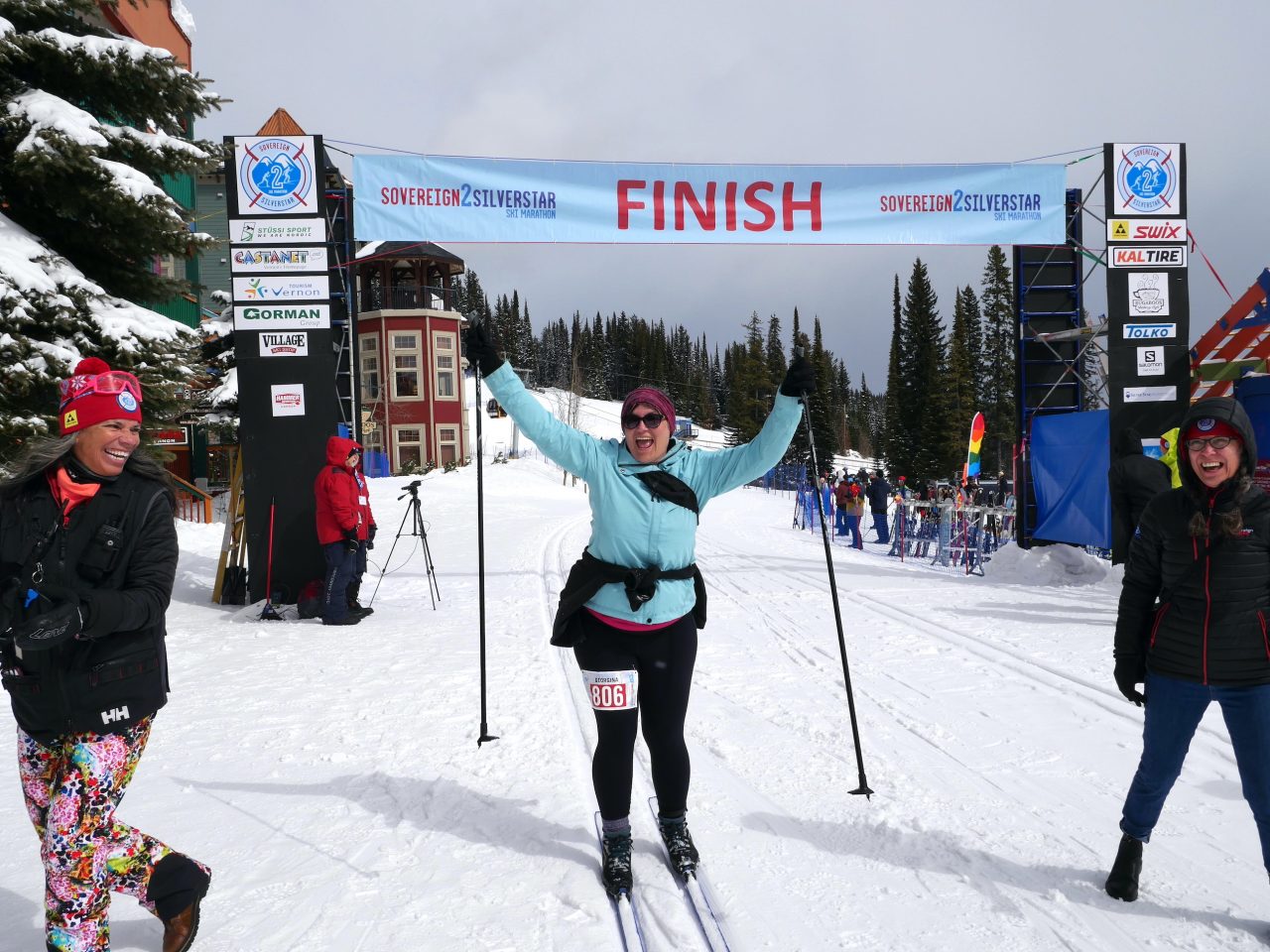
    Finishing with a smile at the Sovereign2SilverStar Ski Marathon (photo: Peggy Hung)

    Disclaimer: The author skied both days and was one member of the large S2S organizing committee. This may seem like a conflict of interest, but also allows a more detailed look behind the curtain at how a new event was built.

    Click here to learn more about the origins of the Sovereign2Silverstar Ski Marathon, and to take a look at the successful first year of the event.

    ***

    The motto for S2S was ‘finishing is winning’, a phrase that also served as the touchstone for the bigger decisions.

    The members of the Organizing Committee (OC) had a lot of experience hosting ski races, from local loppets to Canada Cup/SuperTour weekends to World Cups, and even a combined Nationals plus SuperTour Finals that got cancelled by a pandemic in 2020. A destination event is a different beast, however. High-level events under the FIS umbrella don’t need marketing: athletes follow the events calendar. Local loppets are advertised with a few posters at the neighbouring ski areas. FIS events have required distances, homologated courses, and rules for everything.

    A destination event, by definition, has to entice skiers to travel. In the midst of a pandemic, this is not as easy as it once was, even to a destination with quality late-season snowpack and a mountain backdrop. The question then becomes, ‘What can be done to make the event attractive?’ Immediately followed by ‘how can we keep the participants, volunteers, and local community safe?’

    Year 1 went well, with lots of smiles generated.

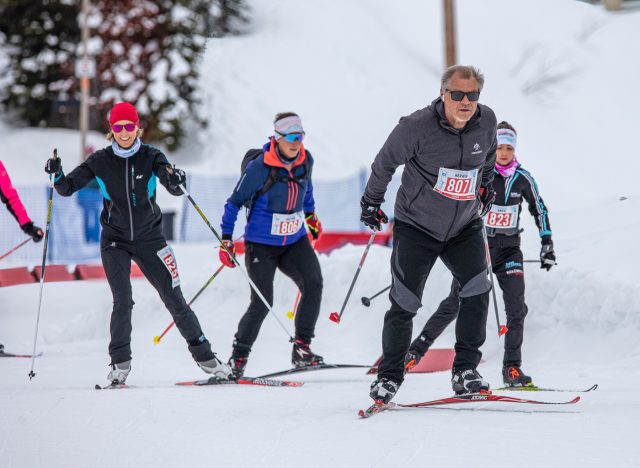
    One of the 21km waves heading out of the stadium on S2S Skate day. Look closer for a mix of ages, a pair of headphones, and a backpack. (photo: Robert Conchie)

    Which skiers?  

    The club already hosts high level events in nordic and biathlon, which led the OC to a focus on inclusion for the new event.

    To get a larger number of skiers, it is necessary to look outside the group of committed competitors and attract recreational skiers. Thus, the motto ‘Finishing is Winning’ was chosen to both appeal to non-racers but also give the OC a vision to follow.

    The motto led to a list of goals: Inclusive. No time limit. Small waves. No technically difficult course features. A minimum of climbing, but enough to discourage classic racers from double poling on skate skis.

    When?

    One of the original goals was to show the trail system at its best, which means late March and early April. March is most often the big snowfall month and has been the choice for the annual 30km for two decades. The elite skiers always visit in early December or late November for Continental Cup races. As a result, generations of racers have visited just before the skiing gets really good. 

    The OC wanted to add to the season calendar instead of competing with existing events. Choosing the same weekend as the American Birkie, for example, would limit future growth.

    The early 2021/2022 international calendar had no events for April 2nd and 3rd.

    Using historical data, there is a 70% chance of blue hard wax skiing on the first weekend of April. Unfortunately, history doesn’t account for climate change and the increasing risk of extreme weather. In 2021, the Vernon area set new records for lowest precipitation in March, April, and May, based on data going back to 1904. In June, heat records were broken all over BC and Washington state. Then, an atmospheric river in November washed away all four highways to Vancouver and dramatically thinned the snowpack.

    With the extreme 2021 weather as a backdrop, there was some nervousness about hosting in April. Club members are usually committed to cycling and paddling by mid-March. An entire web page was devoted to showing what April skiing looks like.

    The final choice also became an effort to change perceptions. In a year where many people were limiting travel and pandemic rules changed monthly, success would depend on persuading local skiers to keep skiing into April. Early data suggests there were more skier visits in late March and early April than previous years.

    Shortly after the OC committed to the dates, the Fossavatn moved to the same weekend and in December the Alex Harvey Classic was announced. The worldwide calendar is crowded, and there really aren’t any ’empty’ weekends.

    Course Design

    At this venue, a long flat double pole route is simply not an option. Sovereign Lake is a small pond and the flat trail around it is less than 1km long. Spectacular mountain views like Canmore or Toblach require nearby mountains and the twin ski areas are just part of the Interior Plateau that was eroded less after the glaciers receded. What the OC does have is twisting, rolling trails through a coniferous forest, tonnes of snow, and a few beautiful viewpoints.

    Many of the OC had skied in events with fast downhills, wild corners, road crossings, and chaotic starts. To be inclusive to newer skiers, the course would avoid tight switchbacks, avoid steep climbs, and be relatively flat.

    Starting in the Sovereign Lake stadium and finishing on Main Street in SilverStar village were the main selling points. With that decided, the Alder Point loop was essential, with views of the Monashee mountains on one side and views of many alpine runs busy with skiers on the other. That decided, it was a matter of building a route with no repeats, no technical sections, a moderate amount of climbing, and exactly 42km long.

    There were many candidate routes that met the requirements, but there was also a 40km route that was more fun to ski.

    After some debate, the OC decided that the fun 40km course fit the ‘Finishing is Winning’ motto best. The first 10km is a flat warmup before the climbing starts. There are three ‘long climb’ sections with about 70m gained over 3km. The finish is a gentle 3km downhill leading into a ‘feature’ finish onto Main Street.

    Exact distances can be important. While every long-time skier has done events that are very different than advertised, some participants want precision. And precision usually means that their watch or phone records the exact advertised numbers.

    There are two common causes of GPS accuracy errors: mountains and trees. As the venue is well equipped with both, the OC quickly learned that only the homologated loops had accurate mapped distances. A sub-team was recruited to get more accurate map data using LIDAR data.

    Scanning through Strava on April 3rd, most of the 40km skiers posted distances between 38km and 41km. The measured elevation gains varied even more. 

    The 21km course splits from the long course at the 5km point, heading directly to SilverStar while the 40km skiers ski a 17km loop to arrive at the same intersection from another direction. The 21km course also skips the final climbing section up Howie’s loop and on the Bergstrasse alpine run.

    Making the 21km a subset of the 40km course and using the same course both days resulted in a huge reduction in volunteer effort.

    Small Waves

    Many of the OC had skied in major events where there were queues at the first pinch point. To be inclusive to non-racers who aren’t used to skiing in a pack, the decision was made to spread the skiers out so they could watch the scenery instead of the butt of the skier in front. The final choice was a series of waves, spaced three minutes apart.

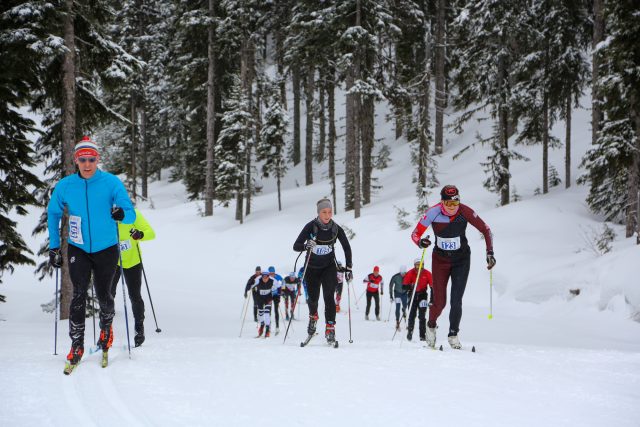
    One of the larger packs 4km into the 40km. (photo: Paul Pickard)

    The largest wave had 42 skiers and it spread out quickly. The telephoto and steep hill combine to compress the B wave group above, which is actually spread out over about 100m of the short climb.

    The first pinch point on the 40km course is at 21km, where the packed trail is only 6m wide and there is just enough room to skate two abreast. The lead pack on classic day was three skiers here, mostly because the short climbs in the Zumas tend to explode packs. 

    A few skiers didn’t like the small waves while most participants loved the space to ski at their own pace. The elite skiers were indifferent to wave size, possibly because they would immediately ski away from any size of group.

    Working Together 

    SilverStar Mountain Resort is a commercial alpine ski area answering to shareholders, with trails for nordic, snowshoeing, and fat biking. Sovereign Lake Nordic Club is a 3,200 member ski club set in a provincial park, answerable to the nordic skiing members and BC Parks. Twin nordic areas to be sure, but fraternal not identical.  

    The differences between the areas can sometimes make it challenging to reach win/win consensus, but the desire to work together gets there in the end. 

    The local community has dreamed of a joint nordic event for years. In 2021, three people came up with a vision that both areas could say yes to, resulting in the birth of the 50/50 event committee. That name was abandoned, as it was quickly apparent that any 50km course would be more epic than inclusive (see an example course profile here).

    The local snowmobile club loaned us 500m of one of their trails for five days, allowing the removal of two tricky hairpins and giving locals a new experience.

    Learning From Others

    The US Birkie and the Gatineau OC’s provided example budgets, registration advice, examples of what can go wrong. And then each event provided a top OC volunteer to spend an hour answering questions from the S2S OC. The nordic skiers on the OC thought this level of assistance was extremely helpful, but not unexpected. The alpine skiers on the OC were surprised that major events would actively help their ‘competition’. 

    Cortina-Dobbiaco is a good example of a fun event: point to point, one day for each technique, and a big effort to create an experience beyond the race.

    The Vasaloppet is an example of how to grow big, but also an example of crowd management. 

    Other events the OC took ideas from include the Birkenbeiner, Engadin, Hoppet, Merino Muster, Moonlight Classic, and Ski To The Sun.

    The decision to join the Visma Ski Classics challenger series was a surprise. One of the Cortina-Dobbiaco OC had explained the economics of the ProTour series, which put that idea on the year six or later list. Then it was discovered that the chief of volunteers knows every skier in every country, which led to a Norwegian friend of his making a pitch for the Ski Classics Challengers series and a cost-effective way to connect with a worldwide group of skiers who like to build vacations around ski events.

    The Region

    Vernon is an unusual place. The three lakes are just under 400m above sea level. The mountain bike trails at Kalamalka lake sprawl up the east ridge to 1,400m. Some years, the lower mtb trails are good all winter. Other years, the snow level is lower and bikers are waiting for April for the trails to dry. The nordic trails are higher, ranging from 1,500m to 1,915m. Skiing starts in October, with grooming beginning in early November. In April, the grooming stops when the supply of skiers runs out. In non-pandemic years, the Spring Fling snow camp in May provides an opportunity to start the new training year on groomed snow. SLNC and SilverStar have a combined 105km of nordic trails, groomed daily.

    Vernon is a ‘small town’ of 40,000 people with strong sports communities and a high proportion of retirees. Silverstar village has a smaller population and an even larger sense of community. Some of the volunteers that committed hours as course marshals on the alpine run crossings are alpine skiers who have never tried nordic skiing.

    Charitable Partner

    Our target audience of adults who travel to ski events could be called privileged. With so many skiers who appreciate what sport has given them, the OC wanted to find a charity that could give sport to others. KidSport is an organization that helps financially disadvantaged youth participate in organized sport and the local chapter was a good fit for our goals.

    The first year of any event is financially challenging and breaking even can be difficult. With an unknown event during a pandemic that wasn’t ending as quickly as hoped, there was uncertainty around raising a significant amount of money for the cause. Thanks to strong support from sponsors, volunteers, and skiers, the event raised $8,000, about 20% of the local division’s annual budget.

    It turns out that partnering with a charity makes it easier to attract sponsors and volunteers, an unexpected but welcome benefit.

    Promotion

    There is a popular quote: ‘if you build it, they will come.’ A more useful version would be ‘if you invite people, they will come.’

    A good logo and wordmark means the swag looks good.

    Partnering with an alpine ski area comes with some significant advantages here. SilverStar has a marketing team with skills far above what is common in the North American nordic community. A stunning logo, word mark (that ‘text’ brand image), event colour scheme (based on both areas’ existing colours), and a branding document allowed the OC to present a consistent and attractive package to skiers, volunteers, and sponsors.

    While ‘branding’ has always been an essential element in creating a successful business, it is equally valuable in building a new event. Many of the participants commented on how much this first event felt ‘organized’ and ‘polished’. A big part of that comes from providing a good athlete experience, but the polish is a direct result of that branding document.

    Volunteers

    Last on the page, but not last in importance. Over 250 volunteers worked tirelessly to bring energy and enthusiasm to the event day experience. Dozens of skiers made the effort to find someone wearing an ‘OC’ bib to talk about the atmosphere generated by the volunteers.

    How much did the OC value the volunteers? When the financial team had to make hard choices to be ready for a last minute cancellation by any of three levels of government, one of the expenses eliminated was a toque for each participant. Because if you spend all the entry fee money in advance, how will you provide refunds?

    The Volunteer team worked with one of the sponsors to give every volunteer a toque (a toque is a ski hat to Americans, a beanie to Brits). Thanks to supply chain constraints we all are living with, the sponsor had to pay the expense months in advance. Another sponsor provided food and drink for a volunteer party on Sunday afternoon. Many of the elite skiers and past Olympians known to FasterSkier readers made the effort to connect with the volunteers at the party.

    In the end, the volunteers are what brought smiles to the participants faces. The event will need those people next year, which means showing volunteers the love is one of the biggest steps towards a successful second year.

  • Why Davos is a Top European Cross-Country Ski Destination

    Why Davos is a Top European Cross-Country Ski Destination

    Drone captures in Davos Switzerland (Photo: Julia Kern)

    Cross-country skiers heading to Europe are spoilt for choice. The continent is packed with top-class destinations for all sorts of snow-related sports. For Nordic skiing, you might naturally assume that Norway should be top of your list but that all depends on want you want from your holiday.

    If your priority is having access to the maximum number of kilometers possible, then Norway ticks that box. The resort of Geilo alone has around 550km of trails set in some of the continent’s most spectacular scenery. You ski across plateaus, down into valleys, through forests and alongside lakes in a true winter wonderland. If you are looking for a cross-country ski holiday that offers fantastic terrain and a little more away from the snow, there might be better options.

    It may surprise you that the Norwegian Nordic ski team do most of their training in Davos, Switzerland. Teams from Russia, Sweden and Switzerland also use the area as their training camp. In fact, it has become epicenter of cross-country skiing in Europe. There, you’ll be mixing it with the professionals but also find plenty to do in your downtime.

    The season kicks off in October, one of the earliest in Europe, and reveals over 100km of routes for skiers of all levels. The resort has a perfect mix of peaks and valleys offering everything from relaxed trails for newcomers in the Sertig and Dischmatal valleys, to the toughest routes for elite competitors in the Flulatal Valley.

    Away from the slopes, Davos has plenty to offer. There’s a casino right in the middle of the resort with a striking glass exterior. The venue has that sophisticated feeling associated with high-end European establishments, but there is no pressure to dress too smartly if you don’t want to. You can enjoy all the games that you might expect, including roulette, blackjack, and poker. There’s also a huge number of slot machines with titles that will be familiar to those who play online at any of the sites featured in this new casinos article. It’s the kind of place that keeps buzzing with activity well into the small hours.

    Those interested in art and culture are also well-catered to. Since 1870, Davos has been a destination for art and literary figures, including Arthur Conan Doyle, Robert Louis Stevenson and Albert Einstein. They were drawn to the resort by the health benefits that became associated with its mountain air during the 19th century. German artist Ernst Ludwig Kirchner made Davos his home and there is now a museum and gallery named after him.

    The resort is also a haven for food lovers with everything from high-class takeaways to fine dining, with options to suit all budgets and tastes. Some popular eateries include Montana Stube, Dorfbeiz, Cafe Weber Backerei Konditorei Bar, and the Golden Dragon, a local Chinese restaurant featured in the Michelin guide. And there are at least half a dozen Italian restaurants worthy of a visit, including the highly-rated Alpenhof Davos, which also offers great vegetarian and vegan options.

    If you are a Nordic skiing fan planning a trip to Europe and want plenty to do around the clock, you should definitely have Davos on your shortlist.

  • Visit Canmore: Some Off-the-Ski-Trail Suggestions

    Visit Canmore: Some Off-the-Ski-Trail Suggestions

    For those who have yet to experience the beauty of Canmore, Alberta, a Google search for photos of the town alone should provide sufficient motivation to put it on your travel bucket list. A dramatic skyline of rugged and imposing peaks provide a backdrop to main street, the Nordic Centre, and pretty much anywhere else you could visit in the Kananaskis Valley. Smaller than its perhaps better-known neighbor, Banff, the streets of Canmore are lined with mom-and-pop shops that offer a low-key and inviting atmosphere. Canmore is home to many long-term residents and families, and has what local Lindsey Sinclair refers to as a “home-grown feeling”. 

    The town of Canmore lit up on a wintery night with the Canadian Rockies looming above (Photo: Travel Alberta)

    As a cross country skier, you have likely heard of Canmore and it’s fabulous nordic center. Whether it be because of the 1988 Winter Olympics, the FIS World Cup in 2005, 2008, 2010, 2012 and 2016, the annual Frozen Thunder race hosted in early November, or simply the 60+ kilometers of beautiful trails, the Canmore Nordic Centre Provincial Park is well known in North America. 

    Inviting tracks sparkle in the sun along the 10/15km race course for Masters World Cup in March 2022 (Photo: GibsonPictures)

    In March 2022, Canmore  will be host to the annual Masters World Cup of Cross Country Skiing. Skiers from around the world will meet in Canmore for ten days of fun racing and camaraderie. But Canmore and the greater Kananaskis area has much more to offer than just great ski trails. For those looking to fully experience Canmore, the opportunities are numerous and varying in physicality. With a mix of culture and outdoor adventure, there is something for everyone. 

    The wide and inviting stadium at the Canmore Nordic Center (Photo: GibsonPictures)

    For off-ski outdoor recreation that keeps the energy output to a minimum, a dog-sledding adventure is one way to experience more of the area through a unique form of transport. Snowy Owl Sled Dog Tours was started in 1983 by Connie and Charles Arsenault with one team of ten dogs. The operation has since grown into a thriving business with sixteen teams of sled dogs. They offer a range of outings and experiences that are sure to give you a taste for both the community and scenery in the Canmore area. 

    You could enjoy a sunny sled dog ride just like this with Snowy Owl Sled Dog Tours (Photo: Travel Alberta)

    A caving tour or evening ice walk could also be a great way to pass time spent away from the ski trails. Canmore Cave Tours offers tours to Rat’s Nest cave under Grotto Mountain. These excursions are more pleasant than the cave name suggests and feature 7,000-year-old animal bones and pictographs in a cave that is completely untouched by development. Similarly, an evening walk down Grotto Canyon will take you away from town and towards the amazing ice formations of the canyon’s frozen waterfalls. 

    When you’ve had your fill of the outdoors for the day, downtown is ready to welcome you because, as Sinclair says, “Canmore is home to a little bit of everything.” With five breweries and distilleries in town, taking a trip through town with the Canmore Brewery and Distillery Tours would be a great way to learn more about the local craft beverage scene. The guides from this locally-owned business are professional, experienced, and well-versed in just about everything in the area has to offer, plus they will transport you to and from stops while keeping you entertained with stories. 

    A crew of fat-bikers heads through downtown Canmore (Photo: Hero Images)

    For morning, midday, or anytime pick-me-up beverages, the award-winning Eclipse Coffee Roasters is a sure bet. Not only do they have a diverse selection of over ten freshly roasted bean varieties available, but they are also well-stocked with delectable baked goods to fuel you out on the ski trails. 

    After a fortifying cup of coffee, you’ll be ready to dive into the arts and culture scene that flourishes in Canmore. Home to world renowned sculptures, painters, and photographers, Canmore has a multitude of art galleries that are worth visiting. Stroll down main street and enjoy the beautiful collections on display. Then, if you find yourself inspired and in a creative mood, head to Crock A Doodle where you can paint your own pottery.  

    The Carter-Ryan Gallery and art venue found in Canmore (Photo: @carterryangallery)

    After a hard day out on the ski trails, visiting one of Canmore’s spa or wellness centers would be the perfect place to recover. Back At It Sports & Wellness caters specifically to sports, therapeutic massage, and acupuncture. Maybe you’re too sore to even leave the hotel room? Not a problem because Mobile Massage Canmore will come to you. They offer in-home and hotel massage therapy and will bring their table, lotion, music and highly skilled RMTs directly to your doorstep. 

    Speaking of hotels, it is worth stopping by the Paintbox Lodge, even if you don’t end up staying there. Owned and operated by Olympic silver-medalist, Sara Renner and her husband, former World Cup Champion in alpine skiing, Thomas Grandi, the Paintbox Lodge is an award-winning boutique hotel located downtown. They offer five unique and comfortable suites and rooms with complimentary breakfast featuring a legendary sourdough bread. Additionally, you and your party can sign up for a kitchen party, harvest table dinner or tapas party at “the BOX.”

    Spray Valley at night, in the greater Kananaskis area (Photo: Travel Alberta)

    Whether you’re there to race at World Masters, on a ski vacation, or simply to enjoy the mountains in winter, there are plenty of activity options in Canmore and the greater Kananaskis area to keep you interested and engaged during your stay. For assistance with planning your trip or any other questions about Canmore, the staff at the Visitor Information Centre are ready and eager to help. The Centre is staffed daily and can respond to emails sent to: canmore.vic@gmail.com.

  • Martin Fourcade Nordic Festival Draws Big Crowds in Annecy, France

    Martin Fourcade Nordic Festival Draws Big Crowds in Annecy, France

    Enthusiastic fans fill the stands for the Martin Fourcade Nordic Festival.

    Nordic festival are two words most North American ski fans can only dream about. Skinny skiers here are unlikely to experience the reality of such an event for themselves unless they make a trip across the Atlantic. For residents of France, the opportunity to participate in the second edition of the Martin Fourcade Nordic Festival presented itself this weekend and there were many eager attendees. This lucky expat was among the masses.

    Martin Fourcade (FRA) IBU world championships biathlon (Photo: NordicFocus)

    For those unfamiliar with the name, Fourcade retired from biathlon competition in March 2020 after a very successful career, including five Olympic gold medals and thirteen World Championships titles. He is the most successful French Olympian of all time and is celebrated as a beloved hero in his home country. Anywhere he went this weekend, he was accompanied by cheers and a train of fans hoping for autographs, handshakes, or photos. 

    The festival stretched over three days, beginning Friday, September 3rd and wrapping up on Sunday the 5th. Located in Annecy, in the Haut-Savoie department of France, the stadium sat facing the electric blue water of Lac d’Annecy, rimmed by limestone bluffs.

    It’s difficult to imagine a better setting for drawing crowds than the park Le Pâquier, which is right downtown and runs along the popular bike path that circumnavigates the lake. Indeed, the place was bustling with spectators all weekend long, both paying customers and those stopping by, drawn along the fence by all the commotion.

    Tickets cost €33 (about $40), and were sold out before the event began. As evidence, several posts were made in the days leading up to the festival on the French nordic Craiglist-esque site, searching for available tickets. 

    In addition to tickets, to enter the venue one needed to present their pass sanitaire, essentially a health passport in the form of a QR code which proves either you’ve been vaccinated, had a negative COVID test in the last 72hrs or, recovered from COVID in the last 11 days to 6 months. Furthermore, masks were required, even though the event was taking place outdoors where typically masks are not required in France. 

    Kicking off the weekend with the presentation of the athletes on Friday evening.

    The festivities kicked off in earnest Friday night, beginning with a presentation of the athletes on stage. While 30 international athletes had been recruited to the event, not all were able to make the journey. Many French national team members were present, both biathletes and cross-country racers, including: Richard Jouve, Renaud Jay, Delphine Claudel, Julia Simon, Anais Chevalier-Bouchet, Antonin Guigonnat, and Quentin Fillon-Maillet.

    As for the international contingent, some notable names in attendance were: Tiril Eckoff (NOR), Johannes Dale (NOR), Sturla Laegrid (NOR), Oskar Svensson (SWE), Jovian Hediger (SUI), Nadine Faendrich (SUI), Laurien van der Graaff (SUI), and Emma Ribom (SWE). 

    Following the presentation of athletes, a concert featuring Gaëtan Roussel, a well-known French musician drew quite a crowd and provided the festival with quite a lively start, setting the tune for the rest of the weekend. 

    Gaëtan Roussel in concert, Friday evening.

    Saturday started with the exposition village opening, a circle of vendor tents featuring nearly 60 brands, food and drink options, and shops. Attractions included, virtual biathlon, ski-erg competitions, and athlete appearances.

    Lines at both the Fischer and Salomon tents stretched for quite a distance as athletes patiently sat for hours, signing autographs and taking photos with fans. Not only were famous nordic athletes present, but recent competitors in the Ultra Trail du Mont-Blanc mountain running series, such as Camille Bruyas who took second place in the storied 170 km full tour around Mont-Blanc, and Thiabuat Beronian who finished 3rd in the 100 km “CCC”. These events both end in Chamonix.

    The exposition area, filled with vendors (pictured here Friday evening).

    Gradually, the crowd began to shift focus towards the stadium, as athletes started warming up for the afternoon show races. Over 3,000 attendees filed into the stands, giving Martin Fourcade a cheer that lasted for minutes as he gave an introduction.

    Explaining his motivation for organizing this event, Fourcade said, “When I think of a Nordic festival, I want an event that grows the sport, that shares the sport, and that promotes the sport.” He thanked the crowds for their support and provided a schedule for the afternoon events, starting with women’s biathlon. 

    Eight elite biathlete women toed the start line, headed by Eckoff of Norway. They completed four laps of the flat course, with two prone and two standing rounds of shooting. Eckoff lead to start, followed by Chevalier-Bouchet (FRA) who cleaned the standing shoot quickly and gained the lead for the penultimate lap, to the joy of the crowd.

    She maintained her lead and entered the final shooting round with a bit of a lead to Eckoff (NOR), cleaning again in rapid time. Franziska Preuss of Germany was second out of the range, followed by Eckoff.

    Out on the course, which at times was flanked directly by the lake where boaters had pulled close to cheer, Eckoff passed Preuss (GER) to find second place. Chevalier-Bouchet (FRA) finished first, Eckoff second (+14) and Preuss third (+29.2).

    The spectators were thrilled to begin the competitions with a French victory and showed their appreciation in the form of overwhelming applause.

    “Yeah it’s amazing,” said Chevalier-Bouchet after her victory, “Thanks everyone. I can’t hear anything because of the noise!”

    Anais Chevalier-Bouchet (FRA) pumps up the crowd as she heads towards the finish line.

    Tiril Eckoff similarly enjoyed the support of the crowd and said, “It was very fun to be in such a good atmosphere again. It’s the first time in two and a half years to be in front of crowds so it’s really fun.” 

    Tiril Eckoff (NOR) finished second.

    Up next was the men’s biathlon. Guigonnat (FRA) was the first to clean and left the first round of shooting in the lead, while Fillon-Maillet (FRA), a fan favorite, struggled and exited well behind the pack. Through the second time, Doll of Germany was first to clean with Fak (SLO) right behind. Into the standing round, Laegrid (NOR) was the first to clean, Fak in second but with a penalty and Khalili (RUS) in third.

    Sturla Laegried (NOR) leads the pack along the lakeside. (Photo: NordicFocus)

    For the final time, Laegrid entered without anyone else in sight, shot 5/6 and left the range still in the lead. Khalili (RUS) was next out with Fak in third, followed closely by Fillon-Maillet who had made up ground and had a fast final round of shooting.

    Laegrid skied the last lap with a healthy gap and high-fived fans as he headed for the finish with a big lead, ending in 25:02.4. The Russian, Khalili held on for second place and Doll (GER) took third having passed Fillon-Maillet (FRA) and Fak (SLO).

    “I’m a very lucky man today so thank you Annecy!” said Laegrid after the race, “It was really fun and it was so nice to say hi to all my fans. Merci beaucoup!” 

    Sturla Laegrid (NOR) holds a bottle of victory champagne after his win.

    With the biathlon races concluded, the crowd lost some it’s density before the cross-country rounds, biathlon being more popular. Nevertheless, there were still plenty of spectators who stuck around as the women lined up for their event. Not a true sprint event, the cross-country skiers completed six laps in succession with the final skier across the lap line being eliminated each round.

    The pack stayed tight for the first five laps, gradually losing skiers off the back. With a tight course, passing was quite difficult so the leaders did not change much. French skier Flora Dolci had the lead into the final lap, with the top seven athletes all within 1.4 seconds.

    Faendrich (SUI) dropped off as they passed along the lake, and then there were six. Ribom (SWE) made a pass to the front, shadowed by Van der Graaff (SUI). Rounding the final corner Van der Graaff launched an attack but Ribom held her off, keeping the advantage heading into the finish.

    Emma Ribom (SWE) guns for the finish line, followed by Laurien van der Graaff (SUI).

    Behind them, Dolci (FRA) outsprinted Claudel (FRA) to take third place, +4.5 back. “I felt really strong out there so it was a fun race,” said Ribom, “My plan was to have a good position the whole race so I tried to stay in the front and keep on pushing to the finish line.”

    Post race interview with Emma Ribom: 


    Van der Graaff, who speaks a bit of French, said, “I am very happy with the competition but not to do an interview in French! I tried really hard to get a second win here, but Emma was really strong.” 

    The final race of the day was the men’s cross-country. With such tight pack racing there was sure to be some broken equipment out there and sure enough, nearly every lap saw someone with a broken pole. Hugo Lapalus (FRA) was the first to be eliminated, Hediger (SUI) broke a pole near the end of the second lap and was next to stop.

    Svensson (SWE) dropped off the pace during the third lap and was stopped, followed by Valentine Chauvin (FRA) on the next lap. Jouve (FRA), a race favorite, broke a pole in lap three but managed to hang with the group, only to be eliminated with two laps to go. Heading into the final lap, Adrien Backscheider (FRA) had the lead, with Marcus Grate (SWE) the last to be eliminated.

    As they neared the finish, Jay (FRA) and Pål Aune (NOR) were duking it out, ultimately the win going to Jay. Arnaud Chautemps of France finished third.

    “I’m really happy,” said Jay, “I wasn’t able to be here two years ago so this is really nice.” 

    Renaud Jay (FRA) and Pål Aune (NOR) speed towards the finish (Photo: NordicFocus)

    After the professionals raced on Saturday, it was the public’s turn to compete on Sunday. The “Biathlon Running” was open to all, involving teams of 4-6 in a relay style event. First up to compete were the kids, racing a 1km course with obstacles and shooting in between laps, followed by the adult teams.

    Kids navigate the “toile de l’araignée” (spider web) in Sunday’s obstacle course.

    There were three categories to sign up under (Mixed, female, and male) and the price was €200/team. The competitors were enthusiastic and lots of smiles were seen out on course, a fun way to wrap up a fun weekend. 

    Scenic backdrop of Sunday’s biathlon running event.
  • Landing Softly in Les Houches, France

    Landing Softly in Les Houches, France

    Moving abroad during the best of times can be a challenge. Doing so during a global pandemic is at best, a questionable decision, at worst, a disaster. Thankfully my experience thus far has fallen mostly under the former category. At the age of twenty-two, after eight months of living at home in the Methow Valley with my parents, when the opportunity to move to France presented itself, I seized it. After a frantic month of visa applications, numerous COVID tests, and endless paperwork, I landed in Lyon on October 18th. This would provide a time-cushion before beginning my job as an English teacher at the Université Lumière Lyon 2 in November.

    Things did not go as planned. 

    While I struggled through making coffee orders in rusty French (Je voudrais un café au lait, s’il vous plait) and attempting to understand the exhaustive requirements of opening a French bank account, COVID cases in France and throughout Europe were climbing. Within a week of my arrival, there were rumors of a second lockdown. Ten days after I had landed the country entered its second confinement. President Emmanuel Macron announced the lockdown at 8 pm on Wednesday, October 27th, saying the restrictions would begin the following day at midnight. 

    For me, the intervening 28 hours involved shedding tears, multiple frantic phone calls, a falling out with my Airbnb host, a four-hour train ride, and the lucky chance of finding an apartment in the village of Les Houches located in the Chamonix valley to endure the lockdown.

    Thanks to some good friends and a fair bit of good fortune, I arrived in Les Houches on Thursday afternoon, immediately awed by the cracking glaciers visible from my doorway, the unlikely cable-car to the summit of Aiguille du Midi (12600 ft) and the formidable massif of Mt. Blanc. 

    The view from my driveway looking east. From left to right: Aiguille de Midi, Glacier de Taconnaz, Montagne de Taconnaz (foreground), Mont Blanc.

    Growing up in the foothills of the North Cascades in Washington state, I feel most at home in the mountains. If I was to spend a month or more on my own in a foreign country during a global pandemic I wanted it to be somewhere I was comfortable and happy to be. As an outdoor enthusiast and a lover of great views (who doesn’t?), this proved to be an excellent opportunity. 

    Les Houches is a small community located just 6 kilometers from Chamonix-center. Interestingly, it is “twinned” with the Russian villages of Sochi and Krasnaya-Polyana and thus was chosen to help with the organization of the 2014 Winter Olympics.

    Looking down on the neighborhoods of Les Houches and the Chamonix valley.

    For the first month of lockdown, the restrictions were similar to those of the spring, though I heard from several locals that this time around things were much more relaxed. To go out required an attestation, either a physical piece of paper or a digital version with your name, address, and one of six or so selected reasons to leave, detailing your destination and time of departure. Exercise was limited to within a one-kilometer radius of your home and not to exceed one hour in duration. Upon initial exploration, I believed I could not have found a better one-kilometer bubble to be confined to. It seemed that any direction or turn I took led to some new trail or pathway that criss-crossed the hillside and provided ample views and exercise opportunities.

    In little time, I felt quite comfortable in my little bubble and found it easy to stretch the rules here and there. However, I was stopped by the gendarmes to present my attestation towards the end of a run in mid-November which provided a bit of a wake-up call though thankfully I was not in violation of any rules at the time.

    The one-kilometer radius from my apartment. The blue pin shows my apartment location, the red dashed lines show trails and the brown dashed lines show dirt roads.

    The month of restrictions proved effective at curbing the spread, and COVID cases declined, yet the threat of upcoming holidays coupled with increased travel proved daunting. As restrictions loosened, the government deicided that alpine ski areas would remain closed until January 2021. Naturally, there are numerous implications for resort towns such as Les Houches or Chamonix but not all of them may be negative. 

    When one hears “Chamonix” thoughts initially jump to feats of alpinism, luxury hut tours, and over-priced hot chocolate. Generally, Nordic skiing is not top of the mind. For a nordic-lover such as myself, however, the news of closed lifts did not deter me and despite the official end of confinement on December 15th, I chose to remain in the valley through the end of the year. 

    Arve river, en route from Les Houches to Chamonix.

    Ready to give my shins a break from the pounding of daily runs and always eager to glide on snow, I ventured to the Chamonix Nordic Center as soon as I judged there to be sufficient snow for grooming. With snow-making to augment an initial one-kilometer groomed loop and natural snow on the outer trails, I first skied on December 6th. I have since gone skiing as often as possible and each time more trails are groomed and I see more skiers out on the tracks.

    Since I am solo, I enjoy people-watching while out and about. It seems that the composition of nordic participants here in Chamonix is not so different from what I might find on my home trails in the Methow Valley. I’ve spotted instructors giving lessons to young and old skiers alike. I’ve seen the Club de Ski Nordique de Chamonix out for afternoon practice. I’ve seen some shufflers on classic skis and some tippy skate skiers. I’ve seen some folks out for a quick round of exercise during lunch and others out for a long weekend tour. 

    It is comforting to know that while I may be 8,324 k from home, I can still encounter familiar scenes out on the ski trails. For now, I plan to ski as much as possible before heading back to the city in January. But, as we have all learned this past year, nothing in the future is certain so who knows what might actually happen. If I end up being here longer, I won’t complain. 

    Can’t complain about the view from my doorstep. Looking NE at sunset.
  • Five Fun Cross-Country Ski Centers Close to NYC  

    Mt. Van Hoevenberg. Photo: courtesy of Mt. Van Hoeveberg.

    Due to the COVID-19 pandemic, most people skipped their summer vacations. We don’t know what will happen by the time ski season is open, but we hope for the best. Hopefully, we’ll be back to the old normal instead of adjusting to the “new normal.”

    Cross-country skiing will be possible even in the new normal circumstances. Maybe we’ll skip the after-ski parties and get-togethers. Skiing is an individual sport, which allows you to maintain physical distancing.

    So there’s nothing wrong in planning your winter getaway.

    We can give you an idea! We’ll list the top 5 cross-country ski centers that are close to NYC.

    Cross-Country Skiing: 5 Centers Close to NYC

    1. High Point Cross Country Ski Center

    This center is located in the High Point State Park in Sussex, New Jersey. Snow is practically guaranteed during winter. It’s a breathtaking scenery with 15 km of neatly-groomed trails.

    This is a safe place for entire families. Since cross-country skiing is not the type of rebellious and high-adrenaline sport like freestyle skiing or snowboarding, it’s perfect for kids. The center is dog-friendly, so feel free to spend some time bonding with your best friend, too.

    The High Point Cross Country Ski Center is peaceful, so students often use it as a place where they can combine their winter vacation with studying or research work. Let’s be honest: most of them will decide to pay for essay and relax because Edubirdie will do it. But if you have to devote part of your vacation to studying or work, this place will help you achieve the perfect balance.

    1. Olympic Sports Complex – Mt. Van Hoevenberg

    Mt. Van Hoevenberg is located just outside of Lake Placid, NY. It has the longest cross-country skiing trail in the region (50 km of marked trails). The site is regularly maintained, and the security patrols will make you feel safe.

    This option works great for both beginner and intermediate skiers. The trails are rated, so you’ll know what works for you. You don’t have to worry about traffic while you’re exploring the sites, since there are bridges that serve for cross-country skiers.

    The center offers programs and lessons that can help you polish up your skiing skills.  Best of all, a transformational restoration is nearly complete and by November 1, 2020 you will be able to enjoy the facilities which will rival any ski center in the world.

    1. Frost Valley

    Frost Valley is a dedicated cross-country skiing center in the Catskills Mountains. You’ll have an opportunity to explore over 25 km of well-maintained trails.

    The site is perfect for family retreats, but it’s even better for student programs. College and youth groups regularly choose it for their winter and summer vacations. In winter, they can learn how to ski with certified instructors. They can be part of an organized morning routine, so they will bond with the group while obtaining a new skill.

    The accommodation is lovely, and it’s available in a few versions: cabins, home-style and hotel-style suites, dorm-style lodges, modern lodges, and more.

    1. Mohonk Mountain House

    Are you more of a resort type of person? You want to indulge in comfort and a healthy dose of luxury? You’ll love the Mohonk Mountain House, located in the Hudson Valley. It’s a Victorian castle resort that’s been founded in 1869 and is still operated by the Smiley family.

    Yes; this is a luxury destination. However, it’s not a pretentious and rigid place. On the contrary; it offers great recreation opportunities. There’s a vast area with perfect cross-country skiing trails around the castle. The resort offers various programs that help you to reconnect with your body, mind, and spirit. The food is absolutely amazing, given the fact that it’s prepared by award-winning chefs.

    1. Fahnestock Winter Park

    Beginner skiers enjoy Fahnestock Winter Park, but it has trails for experienced ones as well. It’s located in the Hudson Valley, and it offers 18 km of mapped and maintained trails. This park is especially suitable for families, who find the terrain easily accessible.

    The cottages are perfect for those who prefer a rustic, homey vibe. You can bring your own food and pay only for the accommodation. That’s a very affordable way to spend a nice winter vacation. The cottages may be humble, but there are modern log cabin options as well.

    Cross-Country Skiing Is Awesome!

    This is the perfect winter sport to practice during the times of “new normal.” There’s no waiting in lines. You’ll just put your skis on and head off to explore the tracks. It’s a peaceful way to explore nature and reconnect with yourself. This might be the most meditative winter sport of all.


    BIO: Jeremy Raynolds has been enjoying snowboarding a bit too much during his youth. After a few injuries, he decided to shift towards cross-country skiing. Who knew that this peaceful sport would be so adventurous? Jeremy loves exploring new centers and recommending them to his readers.   


    This article was brought to you with the support of CustomEssayMeister.com
  • Community Focused Skiing in Wolfeboro, New Hampshire

    Community Focused Skiing in Wolfeboro, New Hampshire

    FasterSkier’s Kathryn Miller will be profiling a number of ski areas this winter. You can find her profile of Bretton Woods here. 

    Wolfeboro XC Ski

    The Nordic Skier is the local shop in Wolfeboro where you can get ski tickets, find trail maps, rent gear, and purchase nutrition for your ski.

    The shop is located at:

    47 North Main St.

    Wolfeboro, NH 03894

    Trail system hours of operation: No set hours, ski when you are able to but make sure you stop in when the shop is open to pay for a ticket. The Nordic Skier is open Monday-Saturday 9-5:30, Sunday 9-5.

    Also check out the trail conditions website which updates regularly with trail conditions, grooming, and during questionable weather indicates if staying off the trails might help with later grooming.

    Ticket Rates for a day pass:

    • Adults $12
    • Teens $10
    • 12 years and under Free
    • 75 years and up Free

    If you frequent New Hampshire cross-country ski locations then a Wolfeboro XC season pass might be one way to save money. Included in the purchase of a Wolfeboro XC season pass ($69 individual, $170 family of 4) is a 50 percent off the day rate — with no blackout dates — at the following NH locations: Bretton Woods Nordic Center, Eastman XC, Dartmouth XC, Great Glen Trails, Jackson Ski Touring, Mountain Washington Valley Ski Touring, Waterville Valley Adventure Center, Purity Spring/King Pine XC and Snowshoe Center. 

    Amenities:

    • Rental Equipment (for skiing, snowshoeing, and ice skates)
    • Group and private lessons for all ability levels
    • Trails that allow fat biking (check the trail conditions site to see if fat biking is open on the day you want to go, only allowed on the Abenaki side of the trail network see map below)
    • Trails for snowshoeing 
    • Bathrooms at the two main trailheads
    • Warming huts at the two main trailheads
    • Two different trail networks, one offering easier skiing, the other suited for those looking for a challenge
    • A youth nordic ski program


    The history of Wolfeboro XC: 

    Wolfeboro XC began in 1972 with the vision of the Flagg family. Verna and Cal Flagg wanted to provide ski trails for the community and since that time, along with their son Steve Flagg, they have realized that vision. In 1972 they opened their ski shop and began to groom, mark, and maintain trails. When the Nordic Skier Shop and Wolfeboro XC began, the outfit  was one of only a few places in New England where you could ski on a trail system and buy XC gear. Although beginning with a modest amount of kilometers, the ski area has grown into a 30 k system of trails. Cal and Verna have since retired and now live trail side. 

    Steve has followed in his parent’s footsteps. He is quick to speak of the community that sustains Wolfeboro XC. Without the support of the community through season passes, use of the land by private landowners, and annual volunteer trail work days, Wolfeboro XC would not have thrived.

    Photo: Verna and Cal Flagg pictured on the town docks in Wolfeboro, NH at the start of Wolfeboro XC. (Photo: news archives)

    Wolfeboro XC Ski Association is the overarching group that runs Wolfeboro XC. The association does not receive financial support from the town and the town is not maintain the trails.  

    The grooming is top notch. In speaking with Steve, his knowledge of grooming (when to groom, when not to groom, how to sustain snow for the longest period of time) is clear. His ability to groom impeccable trails is even more clear when you are out skiing on them. In 2017, Steve was awarded the Al Merrill Award by Ski NH for his outstanding contributions to New Hampshire nordic skiing. 

    Here’s the bottom line: if you are looking for high quality skiing and have a family to get outdoors, Wolfboro XC’s season pass (remember that’s $170), this is a score.  

    Photo: Looking up one of the hills on the Holy Chute trail February 2020

    The Trails:

    Once you’ve picked up your trail passes at the Nordic Skier shop in downtown Wolfeboro and decided which side of the trails to start on it’s time to head out for a ski.  (See parking information below.) 

    Wolfeboro XC is made up of two connected trail networks. The Abenaki Trail Network and the Sewall Woods Trail Network with a combined total of 30 k. Each trail network offers great skiing with its own unique trail ebbs and flows. The Abenaki side offers “More Difficult” and “Most Difficult” trails with challenging and fun terrain. Trails climb, descend, twist, and turn providing the perfect terrain if you are looking to get in a hard workout or a stay-on-your-toes challenge.

    The Sewall Woods side offers mainly “Easiest” and “More Difficult” trails with two “Most Difficult” trails. The trails on this side may be easier but they are no less fun. The Sewall Woods side includes the “Super Loop.” This loop (marked by red diamonds on the map) has been designed to drain efficiently, hold snow, and is able to be skied in low snow conditions.

    If you want to connect these two sides during your ski you will want to follow the Internet Trail. The Internet Trail is a “Most Difficult” trail approximately one mile long and is made up of steep ups and downs with three road crossings. It is well worth the journey to check out both sides of the trail network.    

    Wolfeboro XCTrail map

    Trail Recommendations:

    Steve’s favorite trail is Holy Chute, part of the Abenaki Trail Network and a “Most Difficult” trail.  He fondly recalls cutting and creating the trail approximately 12 years ago with help from the owner of the land, Jim Bean. He remembers standing in the woods talking about where the trail should go. His thought was a straight cut through at the point they were standing, Jim on the other hand said “watch me” and took off running through the woods. Jim ran up and down, turning and twisting through the trees, showing him a place to put the trail that Steve had not seen. It is a trail with multiple steep and turny descents in a row which brought Steve to exclaim “holy S&%$” while skiing it and the clever name Holy Chute came to be.  

    My favorite trails on the Abenaki side were Home Run and Lower Bog Hill Run. They roll and flow which made for a relaxing ski. But, you still should be ready for the occasional quick turn. On the Sewall Woods side I enjoy skiing the outer trails (keep taking right turns except for the right onto the Internet Trail!) which makes for a mix of “Easiest,” “More Difficult,” and the two “Most Difficult” trails. The best part about this side of the trail network is that you can shorten or lengthen your ski as you choose — at almost every trail intersection there are several trails to choose from.


    Looking up one of the hills on the Holy Chute trail on a recent February ski.

    Parking options:   

    There is a parking area to access either part of the trail network. On the Abenaki side you can park at the Abenaki downhill area, 390 Pine Hill Rd, Wolfeboro, NH 03894, and access the Abenaki trails.  This access point is 2.8 miles from the ski shop. On the Sewall Woods side you can park on Clow Rd. to access the trails. This access point is .3 miles from the ski shop.  Both of the trailheads offer bathrooms and a warming hut. There is a third trailhead located on the Abenaki side which offers another option for parking in case the other Abenaki area is full. There are no bathrooms at this trailhead. It is located off of Filter Bed Rd.

    Food in Wolfeboro:

    Seven Suns Creperie in downtown Wolfeboro is a great spot for a bite to eat or a hot beverage post-ski. They offer a variety of crepes, savory and sweet. They also offer breakfast sandwiches, bagels, fresh juice, smoothies, coffee and tea drinks. A crepe with smoked salmon, tomato, and avocado is my go to. The town of Wolfeboro offers a variety of spots for breakfast, lunch, or dinner, a few offer great views of Lake Winnipesaukee. The view of the lake is gorgeous and only steps from Main St.

  • Erik Bjornsen Going Long

    Erik Bjornsen Going Long

    Erik Bjornsen and Marine Dusser touring in Alaska. (Photo: Ophira Group)

    Once the kid who crushed from the secluded Methow Valley, Erik Bjornsen (28) has evolved into an all-arounder on the World Cup for the U.S. Ski Team and man with a plan. The plan is part travel business start-up co-mingled with a take it year by year approach when it comes to his elite level racing status.

    America’s World Cup skiers commonly remain in Europe over the holidays and prep for either the Tour de Ski or the ever-lasting don’t stop until spring run of post-holiday racing. Bjornsen began racing this season in Norway’s national opening races in Beitostølen on November 22. He raced the Ruka triple — the World Cup’s opening weekend in Finland — and then a skiathlon and 4 x 7.5 k relay in Lillehammer. He then pulled the plug. Not so much a get me the hell back home plug pulling, but a much needed reset. For the record, Bjornsen had proved he’s top-30 in Ruka: he placed 25th overall in the three day event. 

    Erik Bjornsen of the U.S. Ski Team finishing the 2019 World Cup Ruka Triple. (Photo: NordicFocus)

    It is not a championship year. It’s still two full winters until the 2022 Olympics. If there were a time mid-season to refocus and reset, this would be it. 

    “I think people forget that I have spent five years maybe six years in Europe from the start to finish on the World Cup and not come home to the U.S. once,” said Bjornsen during our late December call. “That is nothing compared to Kikkan Randall or Andy Newell, but I definitely feel like it has been a good portion of my life.”  

    In an all consuming 11-month a year sport, five or six seasons abroad is literally epic. Bjornsen is married now to Marine Dusser, the Head Coach at the University of Alaska Anchorage. Coming home to Anchorage means coming back to a place where he shares a life and can be supported by his APU ski team. Bjornsen has been effectively grinding on the World Cup since December 2012. The World Cup and it’s living-out-of-a-suitcase-life for North American skiers is no fairy-tale.  

    “When I was young, I had, and still have, high goals — to win World Cups and be on the World Cup podium,” Bjornsen said amidst describing his ski-life journey. “I figured about the time I was like 26, I would probably be wrapping up with my career with a bunch of medals and success. But in reality, I have not really reached the goals that I had set for myself. 

    “It has been an amazing experience to go to the Olympics twice. I have had some top-10s on the World Cup. I am proud of what I have been able to accomplish. I also feel like I have gotten to know the level over there in Europe, and seeing it for so many years, it’s been quite the learning experience. I still have some goals on the World Cup that I would like to chase. But, this year, I knew I wanted to race less. I wanted to focus more on a few races and put all my effort into races with the most opportunities for success.”

    So home for the holidays in December it was for Bjornsen. During our conversation, I asked how he would be training while home in Anchorage — I made the assumption he’d forego the 2020 U.S. Nationals in Houghton, MI. Bjornsen corrected me and explained that Senior Nationals was a prime opportunity to stay race fit and support his wife as she managed the UAA skiers. I noted that he’d be the marked skier for the upstart generation of U.S. male skiers. I could sense Bjornsen nodding at the truth of it. 

    Here’s his U.S. Nationals snapshot: 8th in the skate sprint, 3rd in the 15 k skate, 1st in the 30 k classic mass start, and eighth, after an untimely fall, in the classic sprint. Followers of the domestic scene know this is a transitional year. The emerging junior skiers have risen and are challenging. This was not a scenario where it’s a year or two out when an eighteen-year-old could challenge Bjornsen. It happened in Houghton. That’s, in fact, a good sign. A sign of the drive of those younger skiers. And it’s a normal sign for a senior athlete like Bjornsen; careers have an arch.

    In our post-race coverage at Nationals, Bjornsen seemed genuinely happy for his speedier peers. And it was also a statement of his character that he arrived in Houghton to race rather than eschew a domestic race series. The results prove less about Bjornsen and more about a nexus in U.S. cross-country skiing.

    Erik Bjornsen (Bib 2) at the start of the men’s 30 k mass start classic at the 2020 US Senior Nationals in Houghton, MI. (Photo: Reese Brown)

    During some research before I emailed Bjornsen about this story, I had a mental lapse — was it a “c” or a “k”: Eric or Erik? I honestly had probably typed his name 1000 times. Google to the rescue. 

    On my wide and tall desktop screen, the results were clear: “k”. I also noted as I scrolled down, a site titled Bjorn To Adventure. Catchy name. I took the bait. 

    Bjornsen and Dusser have started a travel company focused on nordic sport. In short, they are organizing training camps for juniors and luxury oriented camps for masters athletes (don’t worry masters, they are separate camps) and a race trip to Iceland’s Fossavatn Marathon. 

    “My wife has been coaching for several years and the idea was born about a year ago now,” Bjornsen said of the company’s genesis. “Especially when we were in Iceland and we saw a lot of travel companies doing things there. We were actually thinking about all the other interesting places we have been and how it is surprising that people have not really taken advantage of Alaska in terms of cross-country travel. We also have been fortunate to have both grown up in two very cool locations, Marine’s in France and mine in Washington, in the Methow.”

    While in Iceland, Dusser and Bjornsen were motivated enough to investigate potential housing and trip itineraries. “I would say it was like, in that month, after our Iceland trip, we were settled on coming up with the company.”

    Bjornsen is not the first to mix a business idea with an elite level sporting career. Andy Newell is but one example of a cross-country skier blending an active race and training schedule with running a business. Bjorn to Adventure’s planned trips include the Iceland trip in April, a single camp at the end of June, and then a packed calendar for the end of July and August. 

    Erik Bjornsen during a high altitude European roller ski. (Photo: Bjorn To Adventure)

    The word retirement did not cross Bjornsen’s lips. This question, however, did come up: how does a World Cup athlete manage training and juggle clients on a full service training trip? The logistics are dizzying. Bjornsen appeared to be unfazed. He’s been the primary author of his training plan for the past three or four years. 

    “I have learned over the years as a professional athlete, something like 12 years or whatever it has been, I know what it takes for me personally to reach my highest potential,” said Bjornsen. 


    “And I think for me, being happy and having excitement, and good training as well, those are the most important things for me. With this project, it will give me a good balance for sure. I think it is something my coaches are pretty excited about, seeing me do something outside of training as well as me giving back to a community that has helped support me so much.”

    Bjornsen and Dusser own a home in Anchorage they have wisely remodeled: a portion of the house is rented out to tenants. A young couple able to offset mortgage with rental income is prudent. It also speaks to their ability to take on risk and the sometimes solvable problems that arise with those responsibilities.    

    On the day we spoke, it was a frigid Anchorage day. Bjornsen had been busy dealing with thawing frozen pipes in his home.  

    “For me, entrepreneur style, kind of like the house that we have here, and fixing those pipes, we have always been working on fun side projects,” said Bjornsen. “We actually have thrown out ideas for other businesses and come up with clever ways to keep our minds busy and be excited about. Bjorn To Adventure just happened to be one that was really exciting and we both would love to do. We have to chase this.” 

    Erik Bjornsen and Marine Dusser. (Photo: Rossignol-Nordic)
  • Ski a New Hampshire Classic

    Ski a New Hampshire Classic

    FasterSkier will be profiling a number of ski areas this winter.

    Bretton Woods Nordic Center

    210 Mount Washington Hotel Road, Bretton Woods, NH 03575

    Trail system hours of operation: 8:30-4pm

    Ticket rates: 21$ adult day, 19$ teen (13-17), 14$ Junior (5-12) and Senior (65+), Free for Seniors 80+ and kids under 4 with an adult

    *Rates are cheaper for resort guests as well as multi-day deals, special offers and a military rate

    Bretton Woods Nordic Center offers all the amenities you could need for a day of skiing and more!  Just a sample of what they offer:

    • Rental equipment (for skiing and snowshoeing)
    • Group and Private lessons for skiers of all skill levels
    •  A ski shop offering apparel, wax, and ski gear (including a large enticing selection of Skida hats, headbands, and buffs!)
    • A bar offering coffee, snacks, and on the weekend’s sandwiches and soup! 
    • Tables as well as couches and comfy chairs surrounding a double-sided fireplace.  
    • Cubbies to store your backpack or extra clothes while skiing.
    • A waxing area 
    • Lockers rooms which not only offer bathrooms but a changing area and showers which can be key if you have a longer drive ahead of you after skiing
    • Dog friendly trails (~8km) accessible right from the Nordic Center
    • A safety check-in if you are skiing solo

    *The safety check-in is for anyone skiing alone. Prior to heading out on a solo ski they have a book for you to sign into with your name, cell phone number, car make, model, and state along with what time you are heading out skiing and what time you plan to be back. Then when you return from skiing you sign out, so they know you have returned. Speaking from personal experience when it turns to 4pm and your car is still in the parking lot they will call your cell phone and make sure you are okay.  It was reassuring to know they were aware of who was out on the trails by themselves, a nice safety precaution. 

    The Omni Mount Washington Resort and alpen glow on the Presidentials is the backdrop for Bretton Woods. The nordic center offers 95 k of groomed trails. (Photo: Bretton Woods Nordic)

    The Trails:

    Now to the best part! THE TRAILS! The skiing at Bretton Woods is never-ending in the best possible way.  There are 100 kilometers of trails, many of them in the White Mountain National Forest and you can easily ski for several hours barely having skied on the same trail twice.  The trails run along rivers, are framed by snow-covered trees, meander around glittering fields of snow, and show you beautiful views of the Presidential Mountain Range. I have been to Bretton Woods many times and skied many hours and have yet to ski all the trails offered.  A ski center with that many kilometers of trails is sure to keep even the hardiest skier entertained.

    One of the best parts of the Bretton Woods trail system is the variety, there are trails ranging from “Easiest” to “More Difficult” to “Most Difficult.” The trails immediately surrounding the Nordic center are trails in the Easiest category making it an ideal area if you are new to skiing or looking to head out for a more relaxing ski. (Link to large PDF trail map.)


    Trail recommendations:

    Skiing fresh snow on the Bridal Path trial.

    Perimeter to Bridle Path to B&M (Easiest, More Difficult, Easiest) Approximately 4-5km loop or do an out and back! If you are looking to get swept up in all that Bretton Woods has to offer, beautiful trails, scenery, relaxing and rolling skiing this is a great option. Heading out of the Nordic Center, go across the small bridge and take a left on to Perimeter. Continue to follow Perimeter around the outside of the open field and then into the woods.  Stay to the left when you come to the intersection with Bridle Path, take the Bridle Path trail and enjoy a trek along a winding river. Follow Bridle Path until it meets up with the B&M trail and take a right to follow B&M back to the Nordic center.  This entire loop will be approximately 4-5km. If you are looking for a longer loop you could turn left on B&M and check out the map for several longer options that way! 

    Sebosis (More Difficult) (connecting to Sebosis from Porcupine Lane) A long and fun downhill (just be careful of skiers coming up!) if you connect to it from the trail Porcupine Lane (Easiest).

    Dark Forest (More Difficult)– a long uphill if you start from the end closer to the Nordic center- especially good if you are looking for a place to practice uphill technique or for uphill intervals. 

    Bretton Woods Nordic Marathon pre-start. (Photo: Bretton Woods)

    Jump in a race at Bretton Woods

    The Nordic Center offers some great racing options if you are looking to experience the trails in a more competitive fashion.  The races are well run on fun picturesque courses. The races are for any skill level, whether you are looking to race competitively or just jump into a race for fun!  

    The Geschmossel is a 15K classical race on Monday, January 20, 2020.

    The Mt. Washington Cup is a 10K skate race on Saturday March 7, 2020.

    The Bretton Woods Nordic Marathon offers two classical race options, a 21 K and a 42K.

    Looking for food on the way to or from Bretton Woods?

    These are my personal recommendations and offer a couple of on the go coffee and food options off of the two main routes in New Hampshire.  Those are I-93 and route 16.   

    Close to Bretton Woods, on route 3

    The Wandering Moose Coffee shop is located in Carroll, NH only seven miles from the Nordic Center.  They offer coffee, smoothies, breakfast sandwiches, grab and go snacks, and sandwiches. An option if you are accessing Bretton Woods from I-93 and could also be an option if you are coming from the north or west of Bretton Woods since it is located so close to those routes.

    Off I-93

    If you are using I-93 to get to Bretton Woods and looking for a place to stop for coffee or food then check out Mad River Coffee House in Campton, NH.  Located approximately 45 minutes from Bretton Woods, they offer coffee, beer, breakfast and lunch sandwiches, soups, and baked goods!

    Off Route 16

    If you are like me and sometimes want to turn your day or weekend going skiing into a joint shopping, eating, and coffee drinking trip Route 16 offers all three of those activities.

    Route 16 on the eastern side of NH is my favorite way to get to Bretton Woods.  This route brings you through North Conway, NH where there is a variety of food options and shopping.  Downtown North Conway is a great area to walk around and there are numerous restaurants, coffee shops, and stores.

    For coffee, I recommend Frontside Coffee Roasters in North Conway, NH.  Specifically, their maple latte is delicious (Tip: ask for half the maple syrup if you don’t like it too sweet!) They also offer bagels and breakfast sandwiches.

    Kids welcome. (Photo: Bretton Woods)


  • Find Your Ski Talents in Crested Butte this Thanksgiving

    Simply imagining striding along at just shy of 9,000 feet makes the heart rate drift upwards. So let’s get this up front: if you’re coming from significantly lower elevations to Crested Butte, Colorado, take it easy for a day and acclimate.

    Big vista views in Crested Butte, Colorado.

    If you’ve got the acclimation piece down, Crested Butte could very well be the most iconic of ski towns. Tucked into a dead end valley in winter, and with it’s downtown oozing rustic ski town charm, it’s worth a pilgrimage there for any aficionado of sliding on snow. Calling it the hyperdiverse mecca of snow sliding is not an understatement. There’s snowboarders, splitboarders, alpine racers, jibbers, tele-skiers, real-deal ski mountaineers, and the skinny ski clan. None of whom, it seems on past trips there, were mutually exclusive. 

    It’s hard to get caught up in ski-turf tribalism when the Elk Mountain’s has you mesmerized.   

    If you’re looking for a dose of what Crested Butte has to offer, from Thursday November 28th (Thanksgiving) until December 1, Crested Butte Nordic will host its annual Thanksgiving Camp. (You can link to a full camp schedule here.) They’ll have a gamut of clinics catering to first timers and those looking to eek out just a bit more speed.

    The camp organizers sent along a “real time conditions” update on November 15, — and we’ll update this story as conditions change. 

    If snow conditions allow, Thanksgiving Camp clinics are based out of the in-town Crested Butte Nordic Center.

    “We have not received significant snow accumulation since October 29th. The snow events which occurred in late October laid down a skiable base at higher elevations, but have not been sufficient enough as of yet, for USFS to allow us to begin grooming operations at our high elevation venue – Lily Lake (5 miles outside Town, towards Kebler Pass)

    “Warming temperatures the last two weeks has largely evaporated our base outside our Nordic Center in town, however our north facing homologated track (mowed – 5k) is still holding a base in the trees.

    “We have a chance to receive new snow next week, with two small pulses of moisture in the forecast. Essentially, we need temperatures to drop and stay consistently cold, and get about 6″ new for our homologated track to come online for the  camp.”

    With ample snow, the cross-country skiing in Crested Butte is an in-town affair. Yet the trail system flows across meadows, kicks up benches and descends down draws, and threads through forest to provide a big dose of skiing perfection in the high mountain West. It’s easy to find your inner and outer exercise tranquility. The reality is, you’re never too far away from a fine food-coma inducing meal back in town.

    Ideally, the camp’s on-snow offerings will remain at the nordic center. However, there’s the flexibility to “adjust the camp formatting according to where snow conditions are best.” 

    Yes, kids are welcome.

    Despite the current bony conditions in town, the snow gods have a way of blessing the kowtowing disciples in Crested Butte. 

    “While conditions are always a concern, we’ve been on snow for the last 30 years,” the camp organizers emailed. “We’ve got a devoted core following who has adapted with us when we need to, and we offer a variety of fun events beyond the on-snow training, including a wine & waxing clinic and a fun party.”

  • Off-Season Training Options: Ramsau am Dachstein

    Off-Season Training Options: Ramsau am Dachstein

    First the Snow:

    Ben Lustgarten (CGRP) striding out on the Dachstein Glacier. (Photo: courtesy Ben Lustgarten)

    Sometimes off-season snow is an afterthought — access to trail running, mountain biking, and yes even rollerskiing is enough to satiate the training apatite. And sometimes it’s not. Warm temps prevent access to snow and maybe you simply need a break.

    With that in mind, here are some resources for accessing snow in Ramsau am Dachstein: the famed high region in Austria where the Dachstein glacier awaits with groomed “off-season” cross-country tracks.

    The basics to access snow are this: take toll road to gondola — gondola to the glacier — walk/hike a short distance to glacier skiing — ski. Reverse in order when descending to town.

    Most tourist stay in or around Schladming, a small mountain town nestled in the valley with all the amenities you’d expect. Schladming is also at the base of the toll road.

    Dates for Groomed Ski Tracks: Mid-May through the end of November. During the fall months, you are likely to see a smattering of World Cup skiers on locale testing skis and readying the fitness.

    Costs for Cross-Country Passes: A single day will set you back € 40.00 for adults. A seven-day pass runs € 217.50.

    Travel to the Gondola: It’s a bit more complicated than simply hopping on an express chairlift and zipping to snow right from town. So let’s back up a bit. The gondola is accessed by a toll road. According to online info, the toll road fee is waived for those presenting a validated pass for the Dachstein gondola. We assume you are there to ski, so you’ll have a lift pass and therefore will not be paying to use the toll road. Otherwise, that’s a € 14.00 toll road fee with no valid lift pass. Local buses also offer transport up the toll road.

    Gondola Service to and from the Glacier: Round trip on the gondola for an adult is € 39.00. (This does not include a cross-country ski pass. It’s only for the lift ride up and down.) The first lift up rolls at 7:50 AM. Make note, if you are traveling to the Dachstein during the summer, you are required to make a gondola reservation. “DURING SUMMER A GONDOLA RESERVATION IS REQUIRED!” All caps and an exclamation point claims the website– they mean business. The website we have linked claims reservations are needed until the beginning of September. Evidently, non-ski tourist love the high altitude access too.

    Some scale for reference. Groomed ski tracks on the Dachstein Glacier. (Photo: Ben Lustgarten)

    The Skiing: The groomed glacier skiing is high elevation: situated at 2700 meters, which is pushing 9,000 feet. You’ll want to check the weather and be prepared. To ensure the weather gods won’t be tossing thunder and lighting or spitting moisture — you can view the live cam.

    The 18 kilometers of tracks are groomed for skate and classic. Depending on snow conditions, the available skiing may be less than 18 k.

    Ben Lustgarten of the Craftsbury Green Racing Project (CGRP) has been in Ramsau am Dachstein with several teammates and had this advice:

    The skiing this year is pretty good, but short. This is only my second time here but it is shorter than the previous time, and there are plenty of rocks and dirty snow/ice. I would recommend rock/training skis for sure. The temperature this time of year is around 25 Fahrenheit or when its sunny it can warm to 40 Fahrenheit. We aim to take the first gondola ride up that leaves the tram at 7:50 am so we ski at around 8:05 am for a few hours. Earlier is better because it only gets warmer and softer and skied in throughout the day.

    So far we have been lucky and have had good weather. When it is sunny it is absolutely gorgeous. But it can be quite windy, foggy, cloudy, and rainy as well. I always pack a rain jacket, ski pants, ski jacket, buff, etc just in case because even if it is sunny at the bottom it can be totally different up there. Also remember sunscreen for your face and dark or photochromatic sunglasses. Even if it is cloudy, there’s a ton of UV reflection on the glacier. I would recommend boot covers that brands such as Alpina, Rossi, and Fischer have now because you have to walk down a steep rocky section that can very easily destroy carbon ski boots, or bring running shoes to use for that section. As always, plan to pack dry clothes and a snack for after, because if you miss the gondola down it is a 20 min wait then a 10min gondola ride down and you don’t want to mess up your recovery especially when you are training at 10,000 ft.

    There is not a table and bench waxing set up at the glacier. For skate skiing I recommend waxing, scraping, and brushing your skis before you get to the gondola so you are ready to go when you get up there. For classic I think we were kicking on some universal klister. But if you want to ski for a while bring the tube with you because there are lots of icy corners and you will inevitably scrape off your kick within an hour or so.

    We have been cooking all of our meals, so can’t comment on local food, but I am sure it is awesome! There is an extensive grocery store in Schladming as well.


    Below are some visuals to help orient yourself with the splendors of the Dachstein. (Click images to enlarge.)

    A zoomed out view showing Schladming and the cross-country tracks to the right of the Dachstein Skywalk towards the mountain shadows.


    Map from derdachstein.at


    The Mountain Running:

    The area also offers world-class dryland training. Much of it in the form of mountain running.

    Caitlin Patterson of the U.S. Ski Team and the CGRP relayed that many of the local accommodations offer a complimentary “Summercard”. The card provides access to free bus service and discounted entry to several local attractions.

    Patterson is also an accomplished mountain runner. Here’s her advice on using some phone apps to assist with determining the day’s running route.

    3d map screenshot

    There are a lot of great trails meandering around the valley and lower hills near Ramsau, but what I really like to do is get up higher in the mountains! The visitor/information center in Ramsau has paper maps which are quite helpful, with the trails numbered as they will be out on the signs, but there are also plenty of resources online. I like to use the “Offline Topo Maps” app, where I can download a map of this area, since I don’t have European cell service. I also just discovered this 3D interactive map, which could be useful to give newcomers a sense of the vertical: https://www.schladming-dachstein.at/en/service/digital-services/3d-realitymap-webgl

    Generally this year I’ve been cross-referencing several of these maps, studying my route, and then also programming it into my Suunto 9 watch using the Suunto App which is extremely handy for mileage estimations and on-the-fly navigation.
    A few notes for people going for any of the serious mountain/trail runs:
    1. Don’t calculate mileage based on your flat-running speed – the mid-to-high mountain trails are rocky and climb a lot. We pro skiers are finding that at a pretty good clip we cover about 4 miles per hour in these mountains, sometimes a little less. For example a 9.5 mile run/hike the other day took 2.5 hours.
    2. All major trails are directed with yellow signs, which have trails labeled with their numbers, and the destinations and time estimate to those destinations. Related to the speed of travel note above, we find that we can run/hike in about 1/2 the time marked on the sign. Not like in the U.S. where you can divide a hiker time estimate by 4 or 5 – people hike fast here! Most of the trails also have painted markers on rocks guiding along the way.
    3. If the weather is bad or foggy, consider staying down lower or at least don’t venture onto steep unknown trails if you can help it – there are quite a few via ferrata routes around here that are awesome but not to be taken lightly nor without gear. This is part of the reason to cross-reference several maps when planning a route, and pay attention to the ladder symbols or other mentions of via ferrata or klettersteig.
    4. If visitors are into adventure and don’t mind heights, the via ferrata (German name kletterstieg) is really fun, a kind of hybrid of rock climbing and hiking with metal cables and pins. You can find guidebooks in the info center, and can rent or buy gear at local shops like Ski Willy.
    5. Carry a few Euros so you can grab a snack at the huts, or sometimes you may also need to pay to refill water at the huts.

    A few of my very favorite runs/hikes:

    – hike up from Ramsau to the Guttenberghaus. Guttenberghaus up and down is about 7.5 miles, expect 2-3 hours. Can add on one of several peaks up above the hut.
    – link a loop by ascending the Silberkaralm Gorge east of town, across the top/back of the ridge, and down the Guttenberghaus trail. Silberkaralm Gorge to Guttenberghaus and down, 10.8 mile loop so expect 3-4 hours.
    – hike to top of Rettenstein, west of Ramsau. 6-10 mi depending on start and end point.
    – from tram base station, make a loop to the west that goes through a pass between “Raucheck” and “Torstein”. We present you the gaming portal 1xbet live India, you will find interesting slots, a large number of sports events. This is 9 miles from base of tram, several miles longer if running from town. On the 3D map this loop is called “Torwanderug”
    There is also quite a good rollerski track, but it would be recommended only for advanced rollerskiers because it has some serious corners and descents. In general for intensity, we’ve done running with poles intervals down in town, to keep the speed sharp after a bunch of glacier skiing.