From the FasterSkier archive — posts syndicated from athletes’ and coaches’ own blogs between 2004 and 2012, kept online as published. Current coverage is at fasterskier.com.
There have been, by FasterSkier’s calculation, 37 distinct nations that have seen at least one athlete start a World Cup race this season. The first 22 of them were surveyed following the opening weekend of racing in Ruka, in what now seems like a dispatch from another era in which all Scandinavian countries competed and Jessie Diggins was still rounding into form. This article surveys the next 15 who competed on subsequent World Cup weekends, from more traditional Nordic nations (Canada, Slovakia) to more outré participants on the World Cup (Brazil, Nigeria, Thailand).
All photos in this article are taken and copyrighted by NordicFocus photo agency.
Andorra
Carola Vila Obiols races in the 10-kilometer skate in Davos in December 2020. Photo: NordicFocus.
Armenia
Katya Galstyan races in the 10-kilometer skate in Falun in January 2021. Photo: NordicFocus.
Australia
Kat Paul races in the skate sprint qualifier in Davos in December 2020. Photo: NordicFocus.
Belarus
Polina Seronosova races in the skate sprint qualifier in Dresden in December 2020. Photo: NordicFocus.
Bosnia and Herzegovina
Strahinja Erić races in the skate sprint qualifier in Dresden in December 2020. Photo: NordicFocus.
Brazil
Steve Hiestand races in the skate sprint qualifier in Davos in December 2020. Photo: NordicFocus.
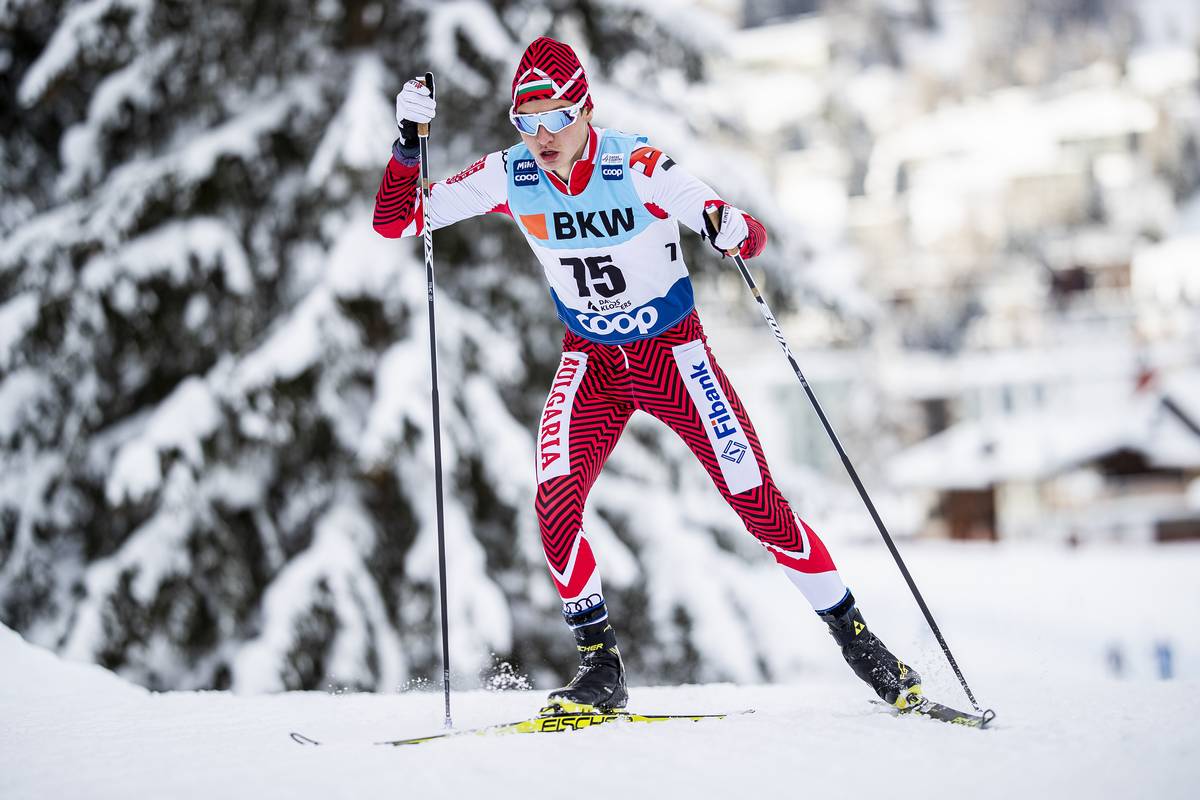
Bulgaria
Daniel Peshkov, 17 years old, races in the 15-kilometer skate in Davos in December 2020. Photo: NordicFocus.
Canada
Cendrine Browne races in the skiathlon in Lahti, Finland, in January 2021. Photo: NordicFocus.
China
Dinigeer Yilamujiang races in the skate sprint qualifier in Davos in December 2020. Photo: NordicFocus.
Greece
Maria Ntanou races in the skate sprint qualifier in Davos in December 2020. Photo: NordicFocus.
Nigeria
Samuel Uduigowme Ikpefan races in the 10-kilometer skate in Falun in January 2021. Photo: NordicFocus.
Romania
Petrică Hogiu races in the skate sprint qualifier in Davos in December 2020. Photo: NordicFocus.
Slovakia
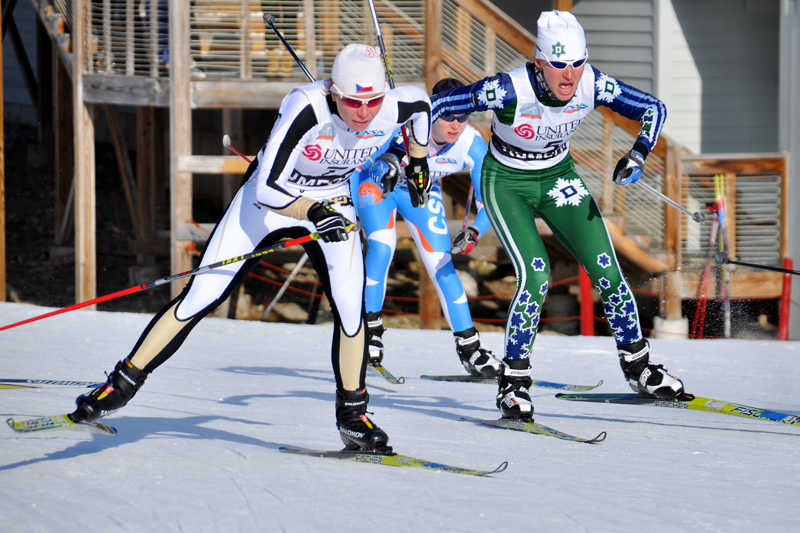
Alena Procházková races in the skate sprint qualifier in Davos in December 2020. Photo: NordicFocus.
Spain
Jaume Pueyo races in the skate sprint qualifier in Davos in December 2020. Photo: NordicFocus.
Thailand (his and hers suits edition)
Karen Chanloung, who has had Italian–Thai dual citizenship since birth and is Mark Chanloung’s sister but has a different race suit than him, races in the skate sprint qualifier in Davos in December 2020. Photo: NordicFocus.Mark Chanloung, who has had Italian–Thai dual citizenship since birth and is Karen Chanloung’s brother but has a different race suit than her, races in the skate sprint qualifier in Davos in December 2020. Photo: NordicFocus.
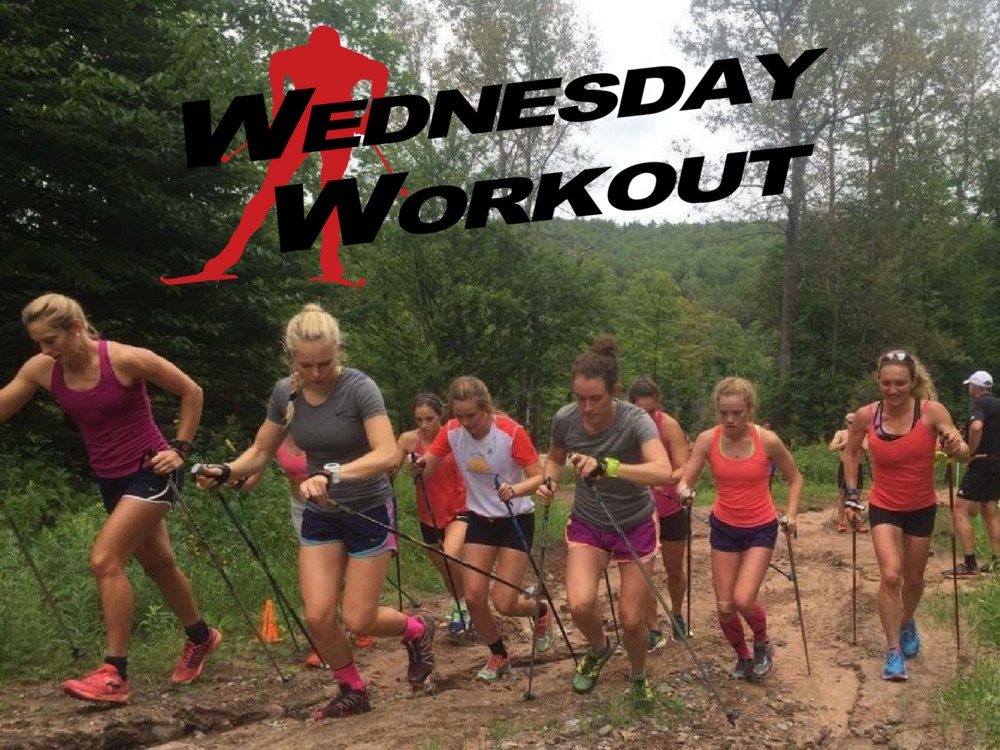
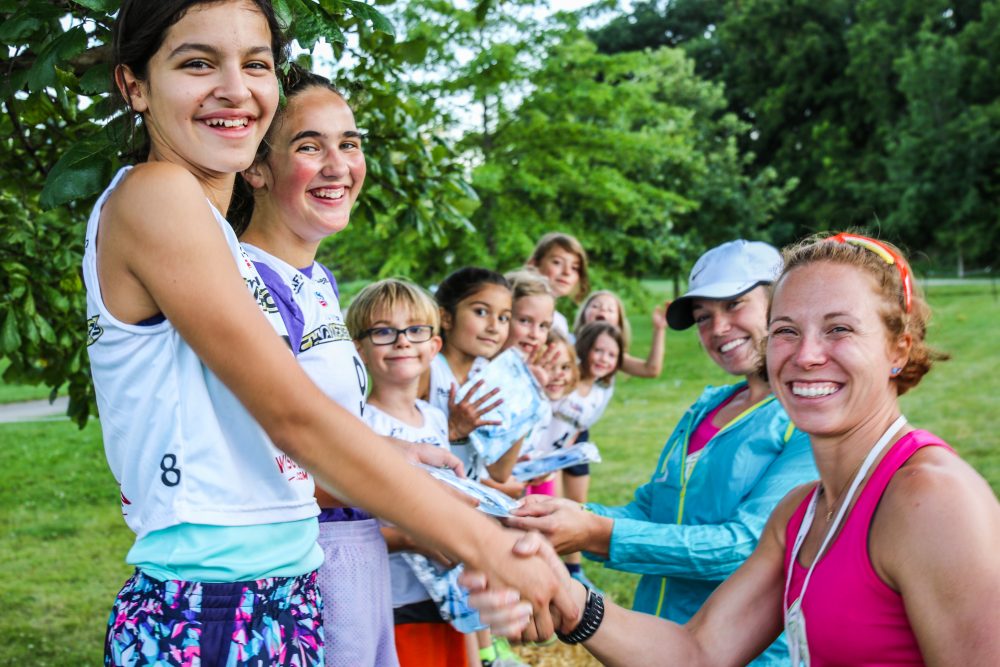
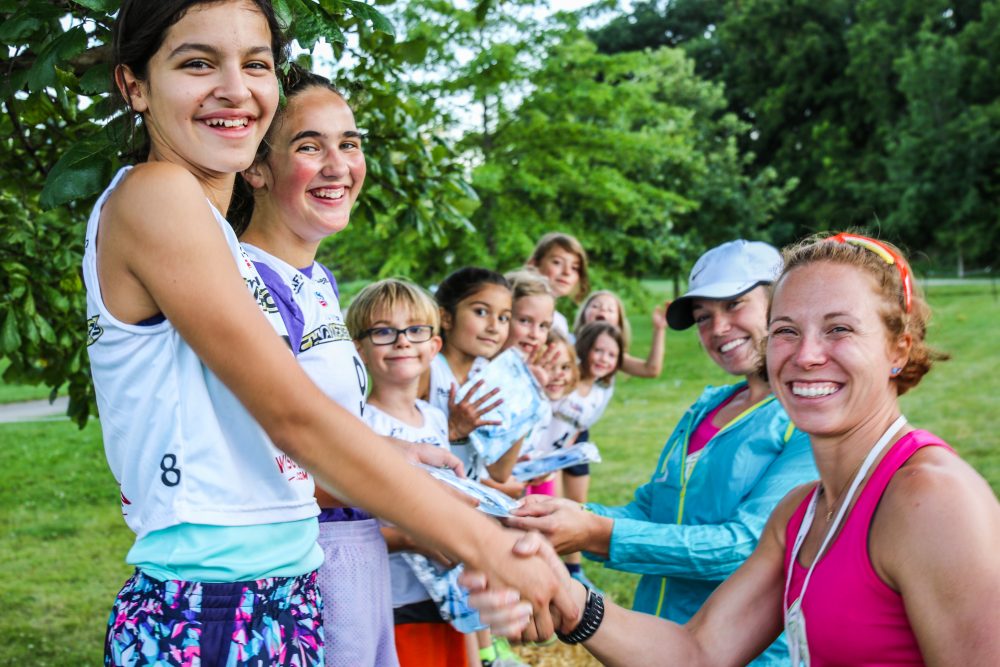
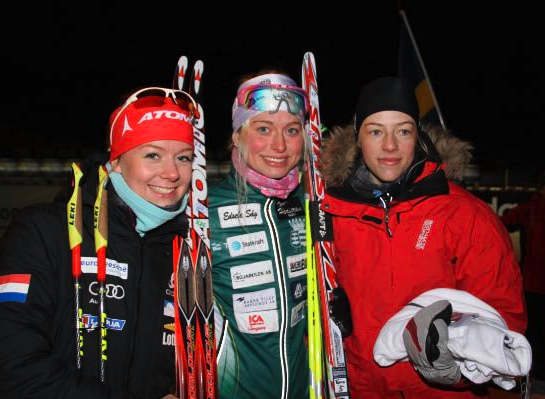
NMU alumnae Felicia Gesior (far left) and Caitlin Gregg (far right, blue shoes) during a fall training session with the Northern Michigan University (NMU) women’s ski team in 2016. (Courtesy photo)
This week’s Wednesday Workout comes from Central Cross Country (CXC) Team member Felicia Gesior. In her second year with CXC, Gesior, 24, is currently working on coordinating the Bergkönig Trail Run, an annual event that began six years ago to raise money for post-collegiate CXC skiers. Race registration and information can be found here.
***
Bergkönig. In German, it translates to “mountain king”. In 2011, it translated to the perfect name for the trail run Northern Michigan University (NMU) alums Maria Stuber and Bryan Cook were launching in an effort to fund their ski racing with Central Cross Country (CXC).
Both Stuber and Cook had been brainstorming a name to make the event, with 5- and 10-kilometer races, stand out from others in the mid-eastern Wisconsin area. Intending to email her brother for an outsider’s opinion, Stuber explained she accidentally sent a message to a “random guy” by the name of Thomas Stuber hailing from Germany. Thomas immediately informed Maria that she had the incorrect Stuber, but not before suggesting the trail run be called Bergkönig. In lieu of the erroneous email, the Bergkönig bank account and Bergkönig Trail Run began.
“Our goal was to give back to the local community, raise money for our winters, and create some awareness for the sport,” Stuber explained in an email to FasterSkier. “After a few years it became a big race and we felt fortunate to be able to rely on it for financial support every year. It was one of the factors that allowed up to keep ski racing as long as we did … something we are really proud of. We didn’t want to see it go away after we were done racing so we kept doing it for a couple years and put the money in a bank account to help future skiers with similar aspirations that needed funding.”
Felicia Geisor (CXC Team) at 2017 U.S. nationals in Soldier Hollow in January. (Courtesy photo)
One of those future skiers included CXC’s Felicia Gesior. Five years after the inaugural Bergkönig, Gesior, originally from Waukesha, Wisconsin, qualified for the 2016 U23 World Skiing Championships in Rasnov, Romania, and the Bergkönig extended its connections beyond Germany and the continental U.S. That year, it granted Gesior a round-trip plane ticket to get her to Romania.
“It was SO COOL for us to be able to send Felicia that check!” Stuber wrote.
This year, Gesior, a 2016 NMU graduate now in her second season with CXC, will be in charge of coordinating the very race that helped her get to U23 Worlds. Proceeds from this race will help cover her travel and ski expenses as well as go toward that “Bergkönig Scholarship Fund that will assist future generations of Wisconsin Skiers pursuing Olympic dreams after college,” the event’s website states.
Stuber, head nordic coach at the College of St. Scholastica, and Cook have stepped back this fall, though they both plan to drive down from Duluth, Minnesota, for the event. The race is scheduled for Nov. 11 in Delafield, Wisconsin, on the hilly trails of Lapham State Park, a course Gesior, Stuber and Cook all trained on as Peak Nordic skiers in high school.
“Many of the [Peak Nordic] coaches are the same today as they were when I was in high school and they went way above and beyond to support me throughout my entire career,” Stuber noted. “We are all so proud of this place that we would go to great lengths to see Felicia represent us at the highest level of U.S. skiing.”
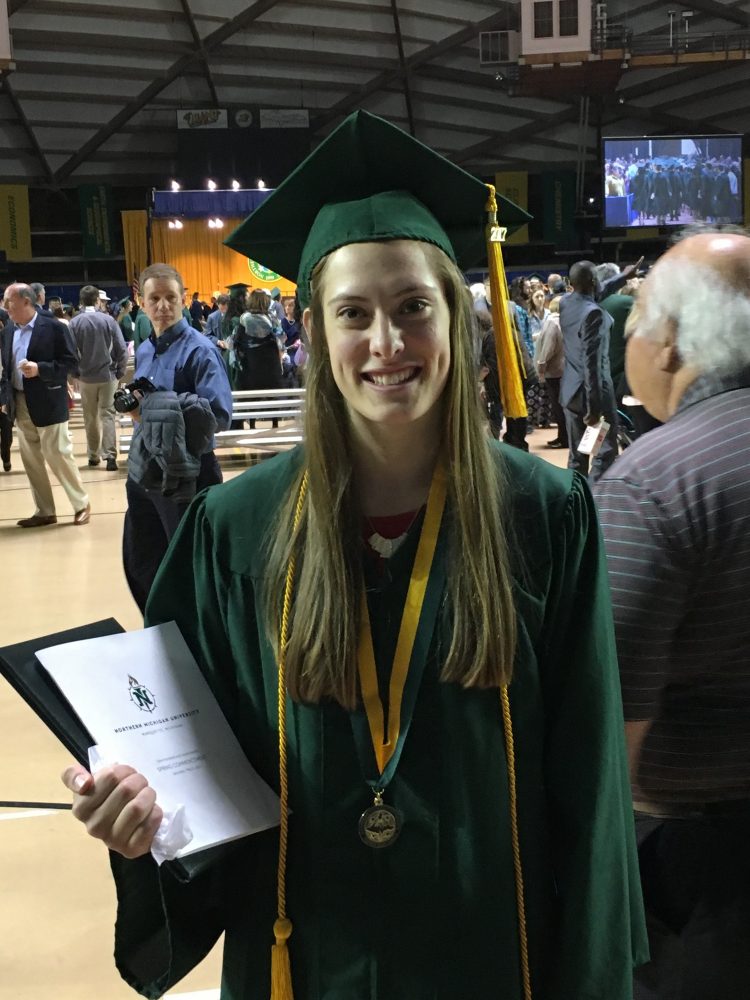
Felicia Geisor on graduation day at Northern Michigan University in the spring of 2017. (Courtesy photo)
Gesior has been training in Marquette, Michigan, this summer and fall under the guidance of the CXC Team’s new head coachEliška Hájek Albrigtsen. Most of Gesior’s goals revolve around U.S. SuperTour races and U.S. nationals in January. She views being an American woman on the domestic race circuit as “an exciting time” with “everyone pushing to new levels.”
“Every time I have the opportunity, like at U.S. nationals, to race against those elite girls that’s just excellent because they’re pushing the whole field,” Gesior said on the phone last month.
When she isn’t training, Gesior substitute teaches at local schools in Marquette. The work not only serves as a supplemental income, but also as way for her to stay connected to her post-skiing career — she has a degree in education from NMU. She also plans to help with CXC’s ‘Nordic Rocks’ for Schools program, an initiative that aims to get more youth involved with nordic skiing.
“That’s one of CXC’s major goals is to get Nordic Rocks in more of the schools. My relationship is getting it into Marquette this year,” Gesior explained, adding that the program has donated up to 30 pairs of nordic skis to more than 200 elementary schools.
“Kids can put them on with their snow boots and then they can walk literally from the gym outside to the door … You can imagine all these little kids, it’s hilarious,” she said. “So that’s just another side thing where I can connect my two passions together.”
Beyond training and teaching, the Bergkönig will be the most forthcoming of Gesior’s fall focus, along with the Level 4 ski-walking intervals she recommends as race prep for the Bergkönig trail’s hills. May the best Mountain King win.
The Workout: “Marquette Mountain Repeats”
Type: Level 4 Ski Walking Intervals
The workout should be hard to complete with a focus on an elevated heart rate and mental fortitude. Gesior usually incorporates this workout into her plan towards the end of her summer training cycle and and continues doing it once a week through the fall.
She suggested doing this workout without ski poles to prevent building up too much lactate while climbing.
“The best part about this workout is that you do not get as much lactate build up as you might on a bounding workout because you don’t have poles in your arms,” Gesior wrote in an email. “Instead, you can push your heart without building up too much lactate. This is a good workout during a week that you don’t want to necessarily build lactate but still want to get in a hard effort.”
Terrain: Small alpine hill (should take 4-5 minutes to ascend; Geisor recommends no more than 6 minutes)
Warmup: 20-25 minutes jogging with a couple minutes of Level 3 toward the end of the warmup followed by strides
The set: 5-8 x 4-minute ascents; off time is amount of time it takes to descend the hill
The first 4-minute set should be done at the high end of a Level 3 pace. Each consecutive set should be done slightly faster.
“This workout is an interval ski walking workout so you ski walk up the hill swinging your arms as if you are classic skiing and you should be going at Level 3-plus into Level 4,” Gesior explained.
Cool down: 20-30 minutes easy jogging
Total time: 1.5 to 2 hours
Gesior’s Golden Rules:
Record; don’t get wrecked. Since each ascent should be faster than the previous one, Gesior indicated that recording times should not be overlooked, nor should going to hard from the start. “It is important to keep track of your times on each interval because you want to have your last ones be faster than your first ones,” she wrote. “You want to do the first one starting in L-3 and then you go for a faster time on each consecutive interval. The majority of the intervals are done in Level 4 and you should strive to push the pass towards the end of each interval as well as the last few intervals in your set.”
Make mental note. Don’t be afraid to use the intervals as practice for pushing past negative thoughts that might pay visit during competitions. “You should be focusing on your mental toughness that you tap into during races,” she wrote. “You should remember to use good ski walking technique in your legs as well as using your arms as if you were striding.”
Eliška Hájek Albrigtsen (formerly Hájková, front right) with Madison Nordic Ski Club’s Trail Kids this summer.(Photo: Tobias Hájek Albrigtsen)
Many mornings, Eliška Hájek Albrigtsen’s husband, Tobias Albrigtsen, has to peel her out of bed. Living the life of an early bird like her spouse is nowhere near the top of her list — partly because she spends most nights prodding her hubby awake as he finishes his work, partly because she is strung out between four jobs of her own.
Being in charge of three ski programs while assisting a fourth is not where the 29 year old envisioned herself when she moved to Madison, Wisconsin, this past June to work for Central Cross Country (CXC). But a lot can change over the course of a summer and for Albrigtsen (formerly Hájková), a lot did.
After relocating to the Badger State’s capital from Lake Tahoe, California, to serve as CXC’s Community Olympic Development Director, Albrigtsen’s responsibilities began to accrue.
It started with the addition of coaching CXC’s online master’s program. Then she had an interest in helping with CXC’s Paralympic and adaptive athletes. Finally, in late August, Andy Keller left his head-coaching position with the CXC Team to join Northern Michigan University (NMU) as an assistant coach, and Albrigtsen was in a prime spot to take over the reins.
“When Andy took the assistant coaching job at NMU, it was kind of natural that I got the CXC Team head coach position,” Albrigtsen, a Czech Republic native, said during a recent phone interview. “For me, it’s not like a big promotion, it’s just more stuff to do while I still do all the stuff I was doing before. I have a lot of responsibilities all of a sudden that I didn’t start with.”
Among those responsibilities, she has been busy making informative videos for CXC Academy under the job title of Community Olympic Development Coach.
While attending the University of Colorado-Boulder (CU), she finished in the top 10 of 45 out of 48 races over the course of her college career, according to a CU press release, all while maintaining above a 3.5 grade-point average.
Eliska Hajkova (CU), racing against Sophie Caldwell (Dartmouth) and Corey Stock (CSU) during a sprint semifinal in 2012. Hajkova graduated in 2013 and after marrying, changed her last name to Hájek Albrigtsen. (Photo: James Doucett)
After three seasons coaching the BNJRT in Colorado, Albrigtsen moved to Kings Beach at the north end of Lake Tahoe last year, where the juggling act continued. There, she served as the head coach for Tahoe XC, while also volunteering with the Auburn Ski Club’s elite athletes, taught private ski lessons for Tahoe Donner, coached an online master’s program, and once again raced U.S. nationals, placing 12th in the 20 k classic mass start.
She’s also raced more than two dozen World Cups, most recently in 2014.
Though Albrigtsen indicates that she “never stops officially training or racing” this year might be a little different as it will be her first season coaching senior elite skiers. Still, the idea of more challenging practice sessions is enough to draw her in, even if it means scaling back her training a bit. As a coach she brings not only race experience, but the empathy and understanding of an athlete.
“With U14 kids, I mean, I was challenging them, but I was not getting challenged,” she reflected. “I think being challenged as a coach, being able to hang out with your athletes, you really see and you can really feel their pain. When you’re right on their butts and doing every exercise, you can see, ‘OK, I know that in the Level 4 on the fifth minute, during the sixth interval you died, so let’s figure that out.’ I think that’s one of my powers, that I can really be there when it’s happening.”
When asked of her strengths as a coach, CXC Executive Director Yuriy Gusev was quick to respond.
“Her racing experience, number one,” he said on the phone. “And [she’s] just very energetic and hardworking and organized.”
Albrigtsen will work with three CXC Team skiers this winter: Felicia Gesior, Kyle Bratrud and Sam Elfstrom. All three graduated from NMU, are currently based out of Marquette, Michigan, and will set their focus on the first few SuperTour races and U.S. nationals before re-evaluating their season goals. The fourth CXC Team member, Nichole Bathe (who graduated from the University of Alaska Fairbanks) remains on roster, but headed to Europe earlier this fall to train in Norway with a goal of making the 2018 Winter Olympic Games for Great Britain’s national team.
Until the first week of SuperTour racing in early December, the amount of time the other three CXC elite skiers and Albrigtsen work together will depend on the athletes. Albrigtsen wanted to keep the summer and fall schedule fairly flexible so her athletes would not feel restricted in the amount of paid work or fundraising they could accomplish while training for the upcoming season.
For example, Gesior made a trip to Madison earlier this fall for a training session on CXC’s rollerski treadmill with Albrigtsen, but will spend most the next few weeks training in Marquette and preparing for a fundraiser she’s organizing: the Bergkönig trail run on Nov. 11. The event features 10 k, 5 k and 1 k races and was originally created by Maria Stuber and Bryan Cook in an effort to raise money for local cross-country skiers looking to continue their ski careers post-college.
Gesior also works as a substitute teacher in Marquette, and most of her training this summer and fall has been with the NMU women’s team. Similarly, Bratrud and Elfstrom train with the NMU men’s team.
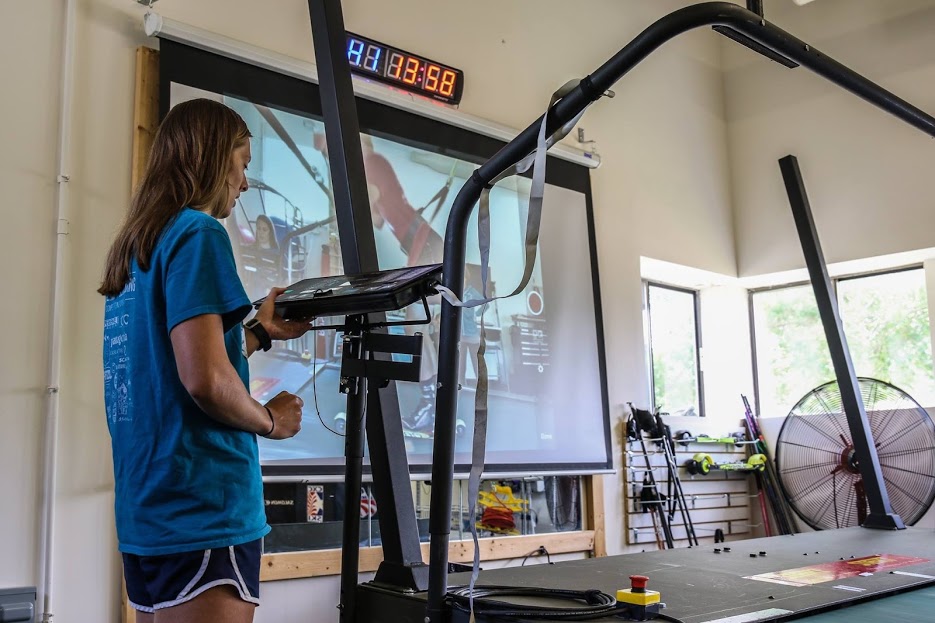
Felicia Geisor of the CXC Team prepares to hop on the treadmill in early September. (Courtesy photo)
“I think that’s OK that they follow [NMU],” Albrigtsen said, “That’s kind of the program that really took them where they are and they have something to top it. They don’t train like college skiers; I mean, it’s their job right now so they do train more. But the base is very similar and [NMU Head Coach] Sten [Fjeldheim] is being really nice about allowing them to train with them. Not all college coaches are that way, so we’re definitely really lucky.”
According to Gusev, partnerships like the one CXC has with NMU and other programs in the Midwest are the reason for CXC’s expansion. Over the last decade, he said CXC has grown from a $50,000-dollar organization to a million-dollar one.
“It’s all of those partnerships,” Gusev said of the CXC programs’ continued growth. “They’re incredible organizations so we’re able to work with all of them together and help them work together.”
The organization hopes to continue its expansion with the addition of a $12-million-dollar training complex just outside the Madison suburb of Middleton, Wisconsin, which is currently in the planning stages. The facility would not only include a competition venue, but snowmaking equipment, a lit rollerski loop, and 30,000-square-foot facility open for recreational use as well.
The idea behind the complex, Gusev indicated, would be to provide CXC athletes with a training venue, while simultaneously encouraging community members to get outside and active, using skiing as an example. The center already has one complex, the CXC Center of Excellence in Madison, complete with rollerski treadmill. “With the CXC Team, our number-one goal is to support the athletes that need the support. That’s as simple as that,” Gusev said. “But overall, our goal as an organization is to grow the sport at all levels.”
To Albrigtsen, the new facility is another reason Madison and CXC seemed like a good choice for her and her husband, Tobias, who is CXC’s media and communications coordinator, when moving from Tahoe to the Midwest. That, and the cost of living.
“We always talk about what can Midwest offer that other regions can’t. We don’t have the mountains, we don’t have the best winters, but what we really have is the best quality of life,” Albrigtsen said.
“You can live much cheaper here than anywhere else in U.S. and still make somewhat good money,” she continued. “Not everybody, especially in the U.S., there’s maybe 10-15 people who can do this professionally and get paid being skiers, otherwise you have to work and that’s something Midwest does have to offer. You can have a normal life and be a skier. You can do it here.”
While Albrigtsen’s “normal life” is somewhat busier than others might prefer, she is in no way deterred.
“I am a total sport addict, and I think every coach has to be, otherwise it’s not really worth it,” she said. “Tobias and I, we’re just trying to do what we love and give something back.”
Give something back, and get a little training in at the same time, even if it’s in between her multiple jobs.
“My motivation is also to fit in my jeans, wearing tight dresses,” Albrigtsen added with a laugh. “I have a five-year-younger husband so I have to take care of myself.”
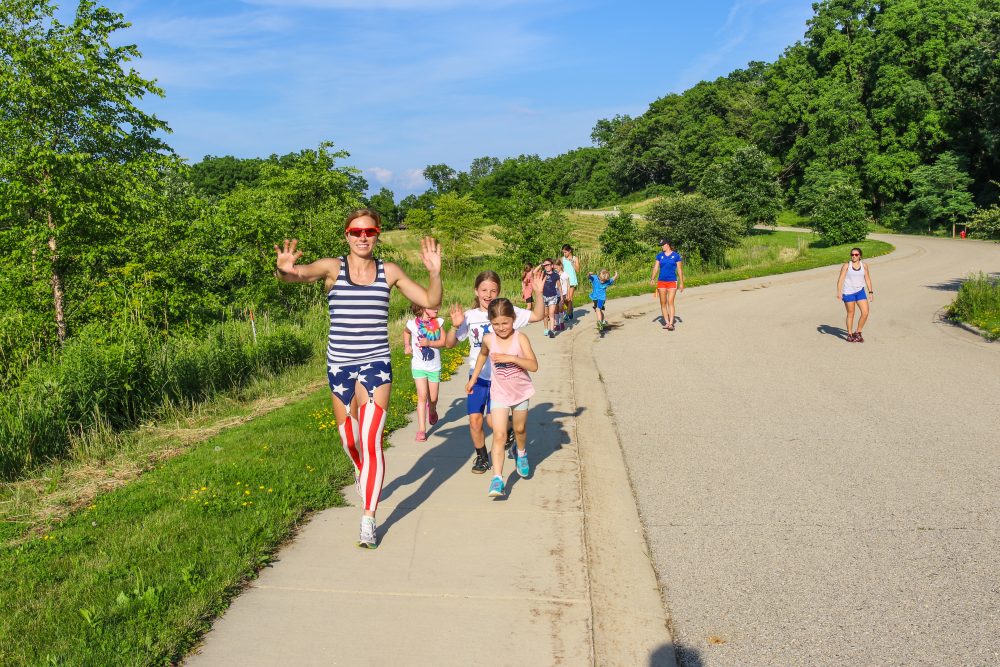
Eliska Hájek Albrigtsen (formerly Hajkova) leading a Fourth of July run with Madison Nordic Ski Club’s Trail Kids this summer. (Photo: Tobias Albrigtsen)
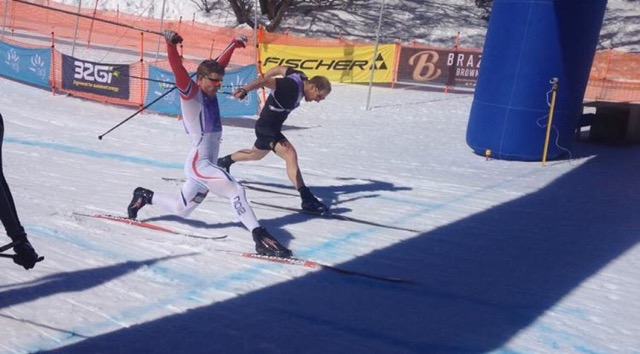
Miles Havlick (l) outlunges Australian national team member Phillip Bellingham for the win in the 42-kilometer 2017 Kangaroo Hoppet on Aug. 26 at Falls Creek in Victoria, Australia. (Photo: AUSXC)
When Australian Phillip Bellingham lunged for the finish line in the men’s 2017 Kangaroo Hoppet a week ago on Saturday, Aug. 26, in Falls Creek, Victoria, it wasn’t his fellow national team member Callum Watson he had to worry about. Nor was it anyone sporting a suit with the Australian flag. It was a skier wearing the colors of Norway.
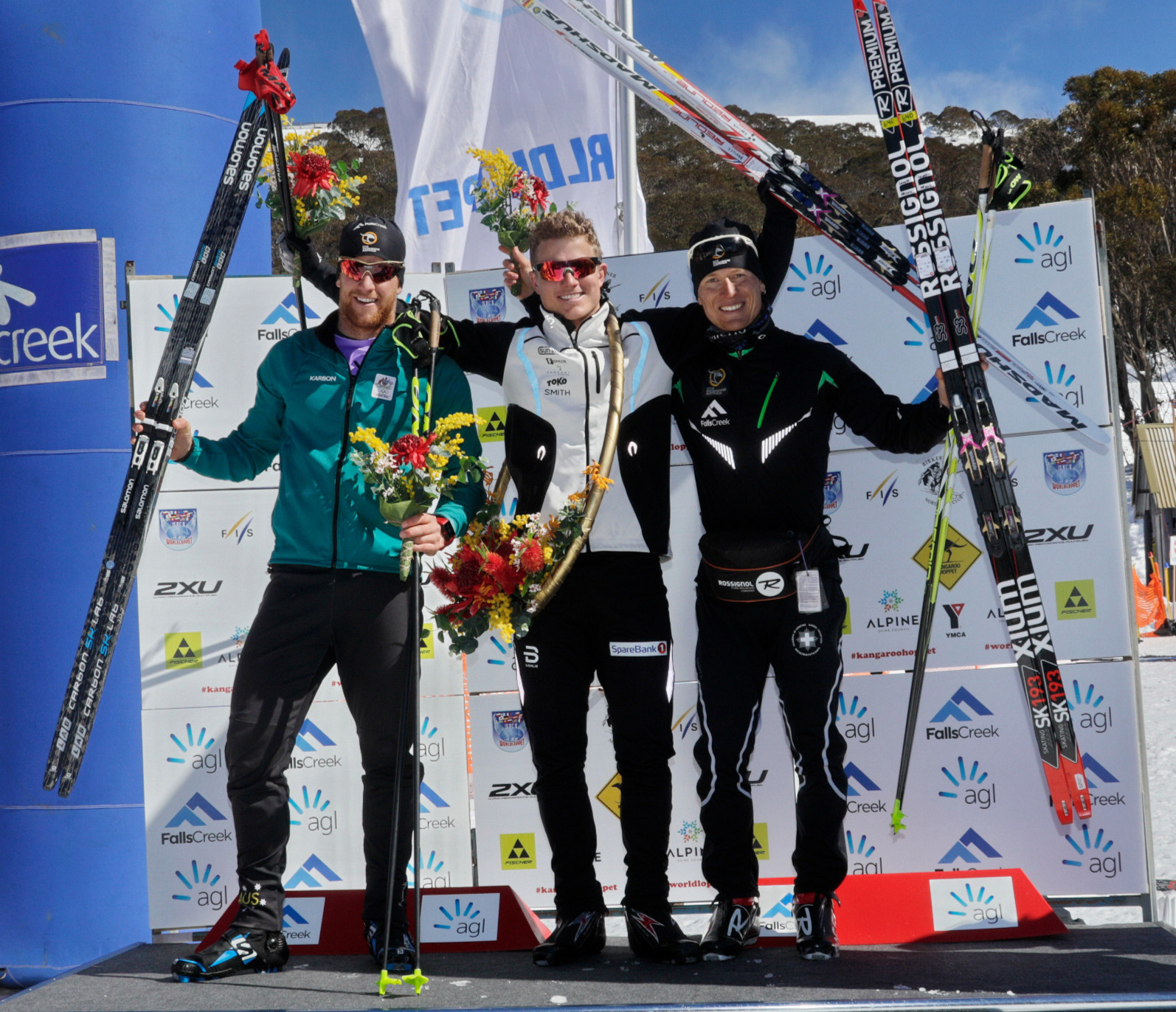
The men’s 2017 Kangaroo Hoppet podium, with American Miles Havlick (c) in first, Australian Phillip Bellingham (l) in second, and Switzerland’s Valerio Leccadi in third. (Photo: Hoppet.com.au)
The winner, however, was not Norwegian. It was American Miles Havlick, a 27-year-old Boulder, Colo., native. Why was he sporting a Scandinavian suit while racing in the Southern Hemisphere? School.
After retiring from professional skiing and leaving the Sun Valley Ski Education Foundation (SVSEF) Gold Team in 2016, Havlick enrolled at the Norwegian University of Science and Technology (NTNU) in Trondheim, Norway, to obtain a master’s degree in exercise physiology (he received an undergraduate degree in exercise physiology from the University of Utah in 2013) through NTNU’s two-year program.
When the Norwegian university went on summer “holiday”, Havlick spent it the way any diehard skier might: on snow. From the beginning of July until the end of August, Havlick worked as the international guest coach for the Birkebeiner Ski Club in Mount Beauty, a small town in Victoria, Australia. Along with leading adult ski clinics, Havlick worked with local primary school and high schoolers as well.
“They have a very welcoming and passionate ski community down there and it was great to experience the skiing culture in the Southern Hemisphere,” Havlick wrote in an email to FasterSkier. “Obviously, I spent a lot of time on snow over the past few months which provided a good opportunity to try to burn off some Tim Tams in between coaching sessions.”
That appeared to be enough for Havlick’s Hoppet performance, which came at the end of his two-month break from school. He, Bellingham, Watson, and Switzerland’s Valerio Leccardi broke away from the pack by 1o k on the course’s infamous “Paralyzer Climb”. From there, the four exchanged the lead until the final push to the finish.
“The last kilometer was pretty hectic with finishers from the Joey and Birkie events clogging up the trail which made weaving around other competitors pretty tactical,” Havlick wrote of the busy race day. “Going into the race, I knew I probably wasn’t in as great of shape as the others but if I could just manage to hang on until the end I would have a shot in the final kick. The race organizers and volunteers did an amazing job with this event and I will certainly be back!”
Havlick outlunged Bellingham by two-tenths of a second for the win in a time of 1:37:24.2 hours. Bellingham claimed second, just one second ahead of Leccardi in third (+1.2).
Missing the podium by 2.8 seconds was Watson in fourth, four seconds back from Havlick’s winning time. A second American and Havlick’s former teammate, Matt Gelso (SVSEF) finished fifth, 4 minutes and 36.2 seconds after Havlick. Gelso won last year’s Kangaroo Hoppet, and returned this year, arriving in Australia a week prior to the event.
“My race played out much differently with me getting dropped relatively early but that wasn’t entirely unexpected,” Gelso, 29, wrote in an email. “I of course was going for the win again this year but it was not to be. Mainly I was happy to be out racing and training after a very frustrating and challenging last 2 months.”
Gelso and his SVSEF teammate Mary Rose spent seven days in Australia before joining their other Gold Team teammates and head coach Chris Mallory in New Zealand.
“Now I am in New Zealand to put in some good specific volume training and do some more racing,” Gelso wrote. “As for more marathons, I am not totally sure. I will possibly race in the Merino Muster down here at Snow Farm but other than that I have not planned out next race season beyond US Nationals.”
Also finishing in the men’s top 10 was American Andre Lovett in seventh (+7:56.2). American Jeremy Hecker placed 14th (+13:25.5), Canadian Caelan Pangman McLean was 15th (+13:30.0), American Jeffery Clarke 68th (+44:04.2), Canadian Dayle Gilliatt 109th (+1:03:04.0), American Aris Apostolou 111th (+1:03:30.5), Canadian Robert Palliser 114th (+1:04:38.3), Canadian Pierre Ethier 126th (+1:09:52.0), Canadian John Wragg 153rd (+1:22:44.5), American Charlie Dee 157th (+1:27:51.9), American Jay Wiener 202nd (+2:13:32.4), and American Robert Saalfeld 205th (+2:22:06.4).
Rose’s Podium Repeat
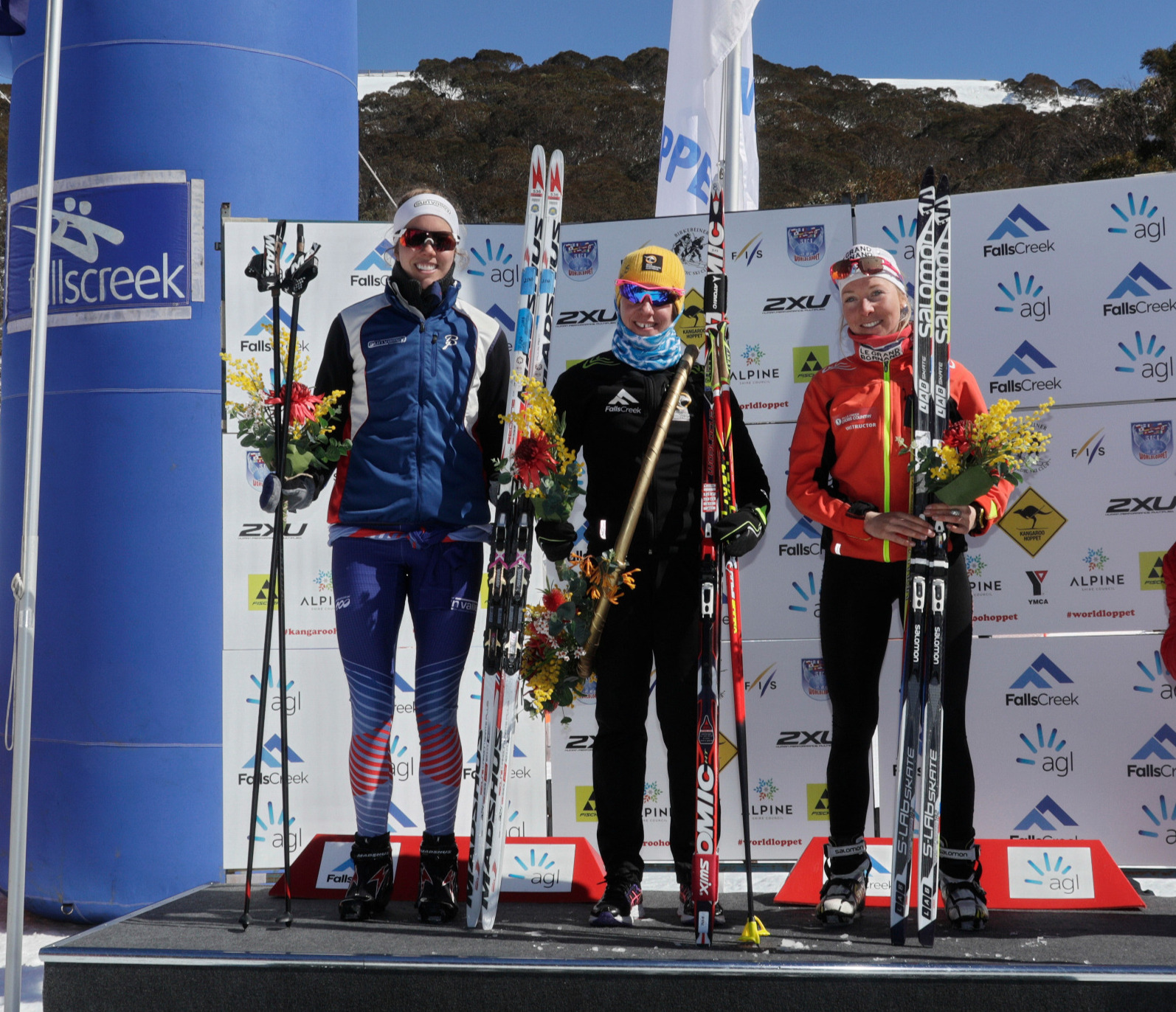
The women’s 2017 Kangaroo Hoppet podium, with Australia’s Barbara Jezersek (c) in first, American Mary Rose (l) in second, and France’s Iris Pessey in third. (Photo: Hoppet.com.au)
In the women’s 42 k race, Australian Barbara Jezersek won in a time of 1:46:59.8. Rose placed second, 5 minutes, 42.8 seconds later. It was Rose’s second straight year as the Hoppet runner-up, having been edged by her SVSEF teammate Deedra Irwin last year.
“I competed in the Hoppet last year and absolutely loved the event!” Rose wrote in an email. “It is exciting to be racing in August and surrounded by over 1,000 cross-country skiing enthusiasts. It is a unique event and one that I plan on attending well after I am done skiing at the elite level.”
Rose’s week in Australia was intended to be used as a chance to adjust to the time zone prior to her club team’s on-snow camp in New Zealand and to get a longer race effort in.
“Like any race, I wanted to win,” Rose wrote of the Hoppet. “I knew that was a lofty goal but one that I thought was achievable.”
The pace set by Jezersek, however, held off Rose from the win and gave the 26-year-old Steamboat Springs, Colo., native a second Hoppet place finish for the second year in a row.
“Barbara Jezersek is a very strong skier and has some notable finishes on the World Cup and at the Olympics,” Rose wrote. “From the start Barbara was skiing very strong and aggressively weaving in and out of all the elite-wave racers. It was difficult to follow her and hold her pace while navigating everyone around us. Once she broke away I skied with 3 other guys until the last 15km and then had to push it in solo. It was an awesome event this year with perfect weather and lots of snow!”
Following Rose was France’s Iris Pessey in third (+8:40.6). The only other North American senior woman to participate in the event, American Kayla Billett, raced to 16th (+47:34.5).
Close to 230 men and 62 women raced the 2017 Hoppet, Australia’s international ski marathon and a Worldloppet. Though Havlick, this year’s male winner, indicated that racing is no longer his priority, he does have a few more marathons he’s keeping in mind.
“At the moment, I hope to compete in the China Tour de Ski during the first week of January which includes the Chinese Vasa and then maybe a marathon or two this spring if it works with my school schedule,” Havlick wrote. “For the most part, my ski racing days are behind me but it was pretty fun to jump into the mix for the Hoppet and come out on top!”
U.S. Ski Team B-team member and Alaska Pacific University skier Scott Patterson scaling his way to the top of Mt. Marathon in Seward, Alaska on July 4, 2017. (Photo: Rob Whitney)
As with other epic modern-day adventure race series, the fabled origin of Seward, Alaska’s annual Mount Marathon — held every July 4 — began with beer and a bet: who among us can run from the streets of downtown to the top of the 3,022-foot mountain crowding Seward’s skyline, then back to the bottom the fastest? What about within the hour?
While the footrace race has evolved massively since the port town’s pioneer miners took on the challenge, clambering up its craggy course in woolen pants and workman’s boots nearly 90 years ago, it holds no less prestige for the millennial athletes or spectators who partake nowadays. To many Last Frontier residents, it is their Olympics. An estimated 30,000 outsiders annually inundate the town’s (population 2,500) sidewalks just to watch the event.
“It’s Mount Marathon. It’s Alaska. It’s my Fourth of July,” Allie Ostrander, the 2017 women’s overall race winner and a Soldotna, Alask. native,told Alaska Dispatch News reporter (and former FasterSkier editor) Nat Herz after the competition. “Fourth of July feels empty without Mount Marathon.”
Scott Patterson on his way to winning the 2017 Mt. Marathon running race on July 4 in Seward, Alaska. (Photo: Holly Brooks)
Despite the obvious risks associated with careening down a mountain at top speed, stories of close encounters with kidney failure, brain-damagingfalls, and disappearance deterred a few from re-entering this year’s version of the event.
The upcoming 2018 PyeongChang Winter Olympics was reason enough for the current Mt. Marathon course-record holder and last year’s overall male champion, David Norris, to watch from the sidelines. His Alaska Pacific University (APU) teammate, Scott Patterson, who also recently earned a U.S. Ski Team (USST) nomination, however, did not.
“It’s a big deal up here. I just figured why not go again?” Patterson, an Anchorage native, explained on the phone.
In his debut Mt. Marathon race, Patterson had twisted his ankle and ultimately finished fourth last year. This year, as he weighed out his risk in racing, he arrived at a far less insidious calculation.
“There’s definitely always a risk, that downhill is tricky,” Patterson said. “But I think looking at the competition beforehand, I knew that I could probably have a pretty good lead at the top and stake the downhill at my own speed; not really have to duke it out with someone down the hill.”
With that, Patterson entered the 2017 event aiming for the win, but not the record. Norris was not on the start list, nor Kilian Jornet, the 2015 record holder and a professional ski mountaineer and ultramarathon runner, not to mention Patterson had recently returned from the men’s USST training camp in Park City, Utah, which ran from June 26-July 5. Patterson departed the camp early to return for the race.
“Everyone was saying going into it that it was my race to lose,” the 25-year-old Patterson said. “The other guys who could really challenge me on the uphills this year skipped it, so it was kind of just me just out there on my own.”
Patterson completed the 5-kilometer race in a time of 44:30 for the win, just over three minutes off the course record. The closest male finishers behind Patterson were Erik Johnson in second place just under a minute back (+0:52), and Kenneth Brewer in third, a little over two minutes behind (+2:23). Patterson’s first-place finish at Mt. Marathon is nothing unheard of among cross-country skiers. A number of other nordic athletes have been crowned the overall champion, including current USST A-team member Kikkan Randall, former USST athlete and Olympian Holly Brooks, APU nordic coach Eric Strabel, and Norris.
Morgan Arritola scaling her way to the top of Mt. Marathon in Seward, Alaska on July 4, 2017. (Photo: Rob Whitney)
The runner-up in this year’s women’s event, Morgan Arritola, was also a member of the 2010 Vancouver nordic Olympic squad and skied competitively for over six years before she made the switch to mountain running in 2012. In her debut Mt. Marathon race, Arritola, 31, finished second in a time of 51:09, a minute and fifty seconds behind the 20-year-old Ostrander, who won in 49:19.
While Arritola did preview the course once, she also indicated that she didn’t hold a whole lot over herself in terms of expectations and outcome going into race. Ultimately her goal coming into her first Mt. Marathon event was to “take it all in.” In discussions with her former teammates and champions, Randall and Brooks, the advice remained fairly simple: enjoy the atmosphere.
“I didn’t really pre-race research. That’s not really my style,” Arritola, of Ketchum, Idaho, wrote in an email to FasterSkier. “Everyone has their own way of handling racing and I tend not to overthink.
“I would love to come back next year,” she continued. “If there was a race-specific goal it would be to know the route I’m taking better. I asked for directions a few times 🙂 and be more confident on the downhill. I haven’t raced that kind of downhill and I just never got into a good rhythm.”
While Arritola has three U.S. Mountain Running Championship titles to her name and a World Mountain Running bronze medal, mountain running is not where she is indelibly focused. She is currently going back to school for a degree in respiratory therapy and working various jobs to help fund her racing, such as The Rut 50 k in Big Sky, Mont., which she is registered to race in September.
“I’m not running full time like with skiing,” Arritola wrote. “I am in my last year of school and running just keeps me sane. I don’t overthink it, I do what I want with it, and I enjoy it.”
Finishing behind Arritola to round out the women’s top three was mother of three and three-time Mt. Marathon champion, Christy Marvin, in third place with a time of 52:22.
In the junior race division of the event — in which racers run approximately halfway up the mountain before turning around for the descent — APU’s Luke Jager won the boys’ race in a time of 29:09, marking Jager’s second junior title in a row. Jager was followed by Gavin Block in second in a time of 29:32 and Ali Papillon in third in a time of 30 flat. The junior girls title went to Molly Gellert (Alaska Winter Stars) in a time of 32:53, also for the second year in a row. Behind Gellert in second was Ruby Lindquist finishing in a time of 33:55. Kendall Kramer (FXC) came in third, finishing in a time of 35:06 for the girls race.
Russian ski jumper Sofia Tikhonova during the women’s 100HS final at 2017 FIS Nordic World Ski Championships in Lahti, Finland. (Photo: Dustin Satloff/dustinsatloff.com)
For Tara Geraghty-Moats, nothing compares to the sense of weightlessness she feels and the way spectators appear to sink into the ground when she soars off a ski jump — except maybe the feeling of pushing her physical limits during a cross-country ski race.
The two sports have been a part of the 24-year-old New England native’s life since her grammar-school days — she picked up both at the age of 9 and in both, she excelled.
By the time she was 15, her jumping talents earned her a spot on the Women’s Ski Jumping USA development team, and she captured third place at the 2009 Springer Tournee in Park City, Utah. But within a year of her nomination, due to concurrent knee injuries, she was forced to leave the ski hill and for the next four seasons, she focused on cross-country skiing.
Vermonter Tara Garaghty-Moats (c) after winning the junior sprint at 2013 Swedish Biathlon Championships. (Courtesy photo)
Despite being told she would never jump again, she returned to the hill in 2013. That same year, she jumped to fifth at ski-jumping nationals in Lake Placid, N.Y., which earned her nomination to the Women’s Ski Jumping USA World Cup B-team.
While Geraghty-Moats saw success in both jumping and XC over the years, she never had the opportunity to showcase her combined abilities at an international level. Not because she didn’t want to, but because the opportunity didn’t exist — until this year.
“We have sort of been waiting for the sport to catch up with Tara Geraghty-Moats for quite a while,” Billy Demong, executive director for USA Nordic Sport (the U.S. governing body for men’s ski jumping and nordic combined) said on the phone earlier this month.
Geraghty-Moats on the range at 2011 Swedish Biathlon Nationals. (Photo: Per Nilsson)
Now it appears to be heading in Geraghty-Moats’s favor. Prior to this season, most of the cross-country ski training she did was either for pleasure or to maintain fitness for ski jumping. Now her training will take on a new meaning, as for the first time in history, women’s nordic combined will be included in the International Ski Federation (FIS) Continental Cup schedule. The inaugural women’s Nordic Combined event in the U.S. will be the USSA National Championships in Lake Placid on October 7. Demong anticipates eight to ten women to participate in the event.
“I’ve been wanting to compete on an international level for nordic combined for a long time,” Geraghty-Moats said on the phone this month. “It’s something I’m really invested in long term and something I’d like to see at a World Championships and Olympic-level competition. I’m really looking forward to helping develop the sport and helping mentor the younger girls that are getting into and also performing at a high level internationally.”
Women’s nordic combined has not yet been contested at the World Cup or Olympic level. Since this season marks an Olympic year, Geraghty-Moats will put her focus on World Cup ski-jumping events and enter as many FIS nordic-combined Continental Cups as she can.
“The ideal situation would be that I would qualify [for the 2018 Winter Olympics] in ski jumping and then am able to compete all the nordic combined races,” she said. “But there’s no way for me to tell where I’ll be in the points for the Olympic qualifying competitions … so hopefully I’ll be able to do them all, but I don’t really know.”
According to Demong, incorporating women’s nordic combined into the FIS schedule has been “on the radar for quite a while.” However, one blockade that prevented immediate action was the risk of draining athletes from a developing sport. Women’s ski jumping was added to Nordic World Ski Championships in 2009, the World Cup in 2011 and the Olympics in 2014.
“I think [women’s nordic combined] has really been in discussion since it was obvious that women’s ski jumping was going to be in the Olympics,” Demong said. “At the FIS level, I think one of the biggest challenges is with women’s ski jumping, you still have a developing sport. The ranks just aren’t as large and deep as the men’s side. And so I think there was a lot of fear that if you add another discipline, it could truncate the growth of women’s jumping.”
Sarah Hendrickson (Women’s Ski Jumping USA) taking flight during a summer competition in 2011. (Photo: Dan Campbell)
Over the past few years, the U.S. has seen more junior women participating in ski jumping. According to Demong, some a clubs have doubled their numbers within the last five years.
“The largest increase we saw in any user group was U8 [under 8], U10, and U12 in the Midwest, but also in Park City there was a pretty big increase, too,” he said. “We didn’t have a whole lot of participation before probably because they didn’t see a pathway. There were some diehards, like Tara and Gabby [Armstrong], but there weren’t droves of them and I think now there will be more in the sport because there’s a much more clear pipeline.”
This year will also be the first year that women’s nordic combined will be included at Junior World Championships. To Demong’s knowledge, Geraghty-Moats and Armstrong are the only two senior American women that plan to compete in the FIS Continental Cup competitions. Both will be supported by USA Nordic national-team staff at nordic-combined events, since the women’s events are scheduled to align with the men’s competitions.
“We have some really good 14 and 15 year olds that we’d like to see participate in the FIS Youth Cups again this year,” Demong added.
Also this year, the inaugural Women’s Nordic Combined National Championships will be held Oct. 7 in Lake Placid, N.Y.
With a longtime dream finally coming to fruition, Geraghty-Moats is not ready to let it end there.
“I don’t necessarily schedule things four years out,” she said. “But I definitely know that nordic-combined is going to be in my goals as an athlete for the foreseeable future. Obviously I need to stay healthy and continue doing things in my life, like going to school and staying at a high level of skiing, but I’m 100-percent sure that I will do nordic combined for as long as possible.”
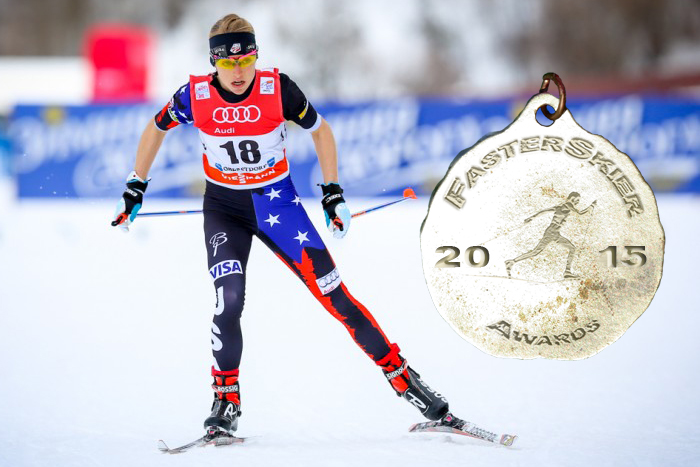
Liz Stephen of the U.S. Ski Team is FasterSkier’s female cross country skier of the year. (Photo: Marcel Hilger)
With the 2014/2015 season officially in the rearview, FasterSkier is excited to unveil the last (but not least!) of its annual award winners for this past winter. Votes stem from the FS staff, scattered across the U.S. and Canada, and while not scientific, they are intended to reflect a broader sense of the season in review.
***
Liz Stephen, U.S. Ski Team, Burke Mountain Academy
Liz Stephen is a lot of things. She’s a world class athlete, the “glue” of the U.S. Ski Team, one of the friendliest people you’ll ever meet, and FasterSkier’s female cross country skier of 2015.
Stephen entered the 2014/2015 season with the goal making it to the next level of competition. Disappointed with an Olympics that fell short of the her expectations, the 27 year old hit the pavement hard in the summer — winning the acclaimed Blink Festival rollerski hill climb in Norway in addition to Climb to the Castle in Lake Placid, N.Y.
Once on snow, Stephen took some time to ramp up, but when she reached her peak there was no stopping her. Her best result from the first period of the World Cup season came in the 10-kilometer freestyle in Davos, Switzerland, where she finished 12th. But the Vermont native was just warming up, and in the first stage of the Tour de Ski, she finished an impressive eighth. Throughout the following races of the Tour, Stephen fought to stay near the top of the rankings. After the penultimate race, she sat in sixth position and ready to tackle her best event: the 9 k climb up Alpe Cermis.
Stephen aggressively attacked the climb, passing Poland’s Justyna Kowalczyk and catching Norway’s Ragnhild Haga. While it appeared that Stephen had the edge on Haga in the middle of the race, the Norwegian powered in the final meters to best Stephen by roughly 10 seconds.
Although she was meters away from fourth, Stephen’s fifth-place finish marked the best placement by an American in the Tour de Ski and was lauded by the domestic and international ski community.
More success was on the horizon for Stephen. In Rybinsk, Russia she rocketed to a second-place finish in the 10 k freestyle — the best distance result on the World Cup by an American female.
After her podium in Russia, Stephen explained that her results were not just a product of her individual abilities, but also the support of her team. Pointing to her fellow American skiers and coaches, Stephen said that everyone, especially women’s team coach Matt Whitcomb, who taught Stephen how to ski at Burke Mountain Academy, played a role in both performances.
“It means a lot to be with this team, having this result, and knowing that you’re never ever out there by yourself. Good days, bad days, great days, this team forms around you,” she said.
Riding the momentum into the 2015 FIS Nordic World Ski Championships in Falun, Sweden, Stephen finished 11th in both the skiathlon and the 30 k mass start. In her signature event — the 10 k freestyle — Stephen battled heavy snow and a slow track to place 10th.
Before the 10 k, Stephen was seen as a U.S. favorite for a distance medal. At the end of the day, however, it was Jessie Diggins and Caitlin Gregg who claimed two spots on the podium for the U.S. Despite missing her goal by 20 seconds, Stephen was upbeat, humble and ready to celebrate the successes of her team.
“Certainly it’s not the podium I put down on my goal sheet and that was in my brain when I started the race but I’m really happy with the effort. My day was in Russia this year and it will come again. I’m just so happy for the U.S. Ski Team,” she said with a smile.
“I’ve always skied for the effort and the team and the love I have for the sport, and today was a perfect representation of all of those,” Stephen added. “The podium is just a gold star you get at the end. The people and the sport are why I do it.”
Medal or not, the way Stephen raced that day particularly impressed her coach.
“I’ve never seen Liz ski so perfectly as she did today. It’s the best I’ve ever seen out of her,” Whitcomb said.
To finish the World Cup season, Stephen placed an impressive ninth in the Holmenkollen 30 k. She will return this 2015/2016 season, once again on the USST A-team.
***
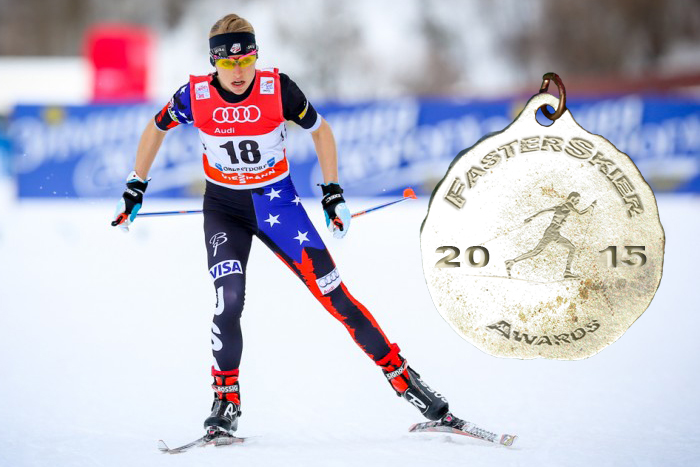
Canada’s Alex Harvey (5) is FasterSkier’s male cross country skier of the year. (Photo: flyingpointroad.com)
Alex Harvey, Canadian World Cup Team
If you’re not rooting for Alex Harvey, maybe it’s time to start.
The 26 year old has already earned male cross country performance of the year for his collective results at the 2015 World Championships. There in Falun, he captured silver and bronze in the classic sprint and skiathlon, respectively, skied the fastest first leg of the men’s relay, and finished fifth in the 50 k classic mass start.
“I had two medals in my career in World Championships, and now I have two in three days,” he added after achieving his fourth medal. “It’s crazy.”
The podiums had more significance than personal achievement, as much of Canadian funding is tied to high performance results. Canadian head coach Wadsworth noted the impact the medals had on the program after Canada took home one medal between the last two previous championships (2013 World Championships and the 2014 Olympics).
“To have two medals [in Falun], it’s more [about] showing that we do have one of the best programs for waxing and we’ve invested a lot in it,” he said. “We’ve also done things that are a little bit different than other teams or the U.S. by having a little bit smaller team. We’re here to get medals and this is what’s going to help our program in the long run, where we can put it back into development and other things. We have to go for it at these big events like this.”
As if that wasn’t enough, Harvey finished ninth overall in the World Cup standings after several standout performances, including taking silver in both the second stage of the Tour de Ski and the World Cup sprint in Østersund, Sweden. While it wasn’t the third-place ranking he achieved in 2014, ninth marked Harvey’s third-best season ranking in his career.
When you factor in the physical challenges Harvey faced over the course of the winter, his results become even more impressive. Although he appeared to be on top of his game in the 2014/2015 season, he was struggling with debilitating pain in his legs.
Due to friction on his iliac arteries, Harvey had difficulty skiing to his full capacity in both training and racing. In training, the problem was was made worse when he ran. “In training and running, when my heart rate goes above 150/155 I can’t go any further and they completely shut down,” Harvey said, referring to his legs.
While classic skiing was easier due to the increased use of upper body, the injury was especially painful when skating on steep, long hills. Due to the injury, Harvey has not competed in the Tour de Ski’s final climb since 2013.
“In skating, already you’re using your legs a little more on the flats than in classic, and then on the climbs you can’t use your upper body as much,” Harvey explained. “When it was an effort that was longer than three to four minutes on a steady climb, in skating that’s when the problem started to appear.”
Immediately after the end of the 2015 World Cup season Harvey returned to his home in Quebec to undergo surgery on both his iliac arteries. The procedures, which took place March 20 and April 1, give Harvey the chance to ski without the painful symptoms for the rest of his career.
Harvey returned to training May 1 and will look to be at the top of the international circuit for yet another season.
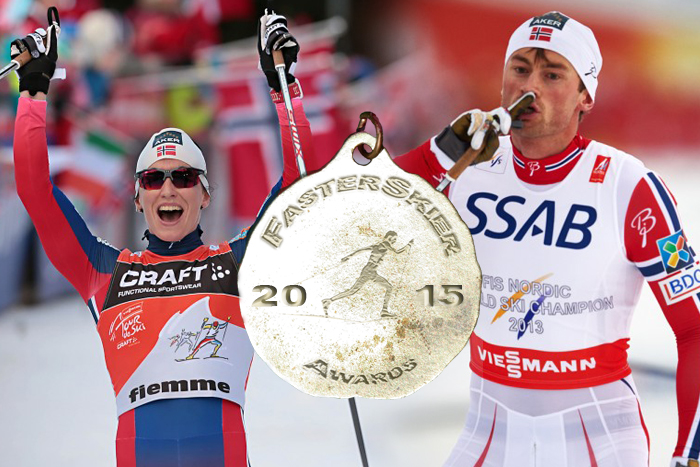
Norwegians Marit Bjørgen and Petter Northug are FasterSkier’s international skiers of 2015. (Photo: Fischer/NordicFocus)
With the 2014/2015 season officially in the rearview, FasterSkier is excited to unveil its annual award winners for this past winter. Votes stem from the FS staff, scattered across the U.S. and Canada, and while not scientific, they are intended to reflect a broader sense of the season in review.
***
Marit Bjørgen, Norway
Marit Bjørgen is the undeniably the queen of skiing. Just take a look at her stats from her long career:
Since 2003 Bjørgen has earned 153 World Cup podiums, 93 of which were victories.
In her 36 World Championships appearances she earned 22 podiums, including 14 wins
She garnered 10 olympic medals over the course of four games, six of which are gold
Impressed? We are too, but for someone of Bjørgen’s stature it takes a little more than that to win international skier of the year. Yes, she took the overall World Cup title in the 2014/2015 season and added three more World Championships medals to her name, but perhaps her biggest accomplishment of the year came in January.
Before this past season Bjørgen had never won the Tour de Ski, and on Jan. 11 she did just that. Entering the final climb with a large lead, the Norwegian clocked the third-fastest time to cross the finish line at Alpe Cermis ahead of teammates Therese Johaug and Heidi Weng by over a minute-and-a-half. The win marked the final barrier in Bjørgen’s search for complete dominance.
“It is a big victory for me. To win the FIS Tour de Ski has been a goal for me for a long time. It took me nine years to achieve it,” Bjørgen said to FIS after her win.
The 34-year-old will return to the Tour de Ski and the World Cup circuit in the upcoming season. Maybe this year her goal should be to win every race she enters.
Petter Northug, Norway
Whether you hate to love him or love to hate him, it’s hard to deny that nordic skiing’s bad-boy is at the top of his skiing game. In a year surrounded by controversy (much of which was created by the skier himself) Northug walked away from the 2015 World Championships in Falun, Sweden with four gold medals.
Roughly a year ago, Northug crashed in a drunken driving incident. As a result he was sentenced to 50 days in prison and 180,000 kroner in fines, in addition to losing driving privileges. At one point it was unclear whether Northug would compete in the entirety of the season, but after the sentencing he was given the possibility of serving his jail time later in the year. While it’s impossible to say whether he learned from the incident, Northug entered the season more subdued than his normal self. Even during his biggest wins, the often overly boastful Norwegian refrained from showy acts such as his 2011 finishing snowplow. At times he would even stay behind in the finish area to congratulate fellow competitors finishing minutes behind him.
At Worlds, Northug brought his best skiing to the trails of the Lugnet Stadium. In each of his four wins the 29-year-old demonstrated passionate and tactful skiing. All those in attendance could tell that he wasn’t just trying to win a medal, he was attempting to be the best skier in the world.
Whether or not he’s the best skier in the world remains to be seen, but his four World Championships golds and this third place standing in the overall World Cup rankings was enough to earn him FasterSkier’s international skier of the year award, in addition to the title of performance of the year for his come-from-behind 50 k win.
While the controversy continues to swirl around the Norwegian as he negotiates a spot on the National Team, he plans to continue racing in some form in the 2015/2016 season.
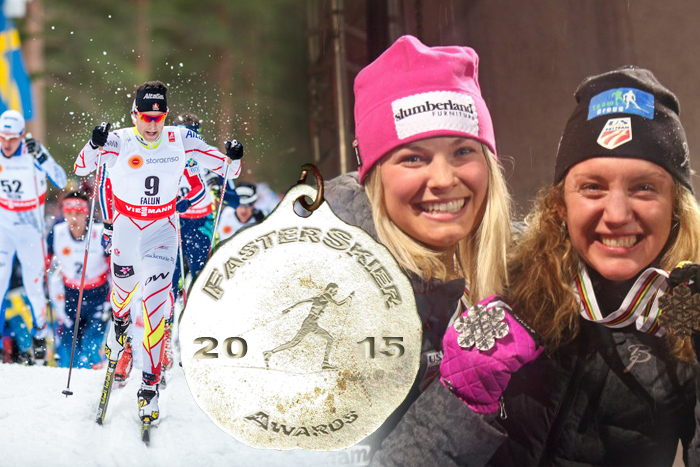
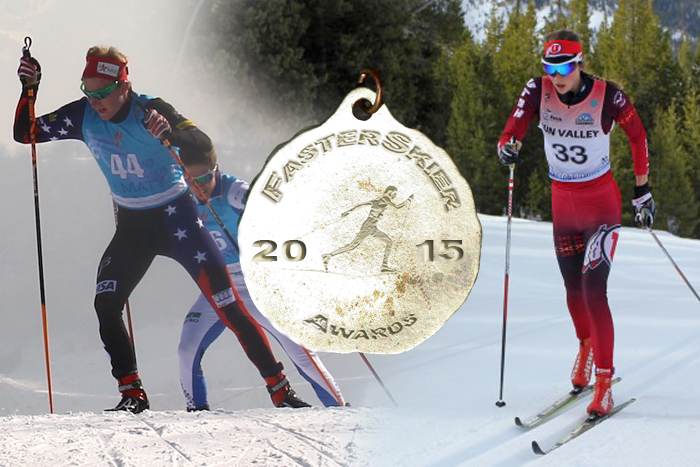
FasterSkier’s cross country performances of the year come from Alex Harvey (l) at the 2015 World Championships where he won silver and bronze medals in the sprint and skiathlon. Jessie Diggins (c) and Caitlin Gregg (r) are co-recipients of the women’s award for their 2-3 finish in the 10 k freestyle at worlds.
With the 2014/2015 season officially in the rearview, FasterSkier is excited to unveil its annual award winners for this past winter. Votes stem from the FS staff, scattered across the U.S. and Canada, and while not scientific, they are intended to reflect a broader sense of the season in review.
***
Jessie Diggins and Caitlin Gregg, 2015 World Championships 10 k freestyle individual start
It’s rare for American cross country skiers to earn World Championships medals. Before this winter the U.S. had only stood upon the podium four times over the history of the sport – Bill Koch in the 1982 30 k, Kikkan Randall in the 2009 sprint, and Randall and Jessie Diggins in the 2013 team sprint.
Come February of 2015 the count increased to six because of pair of midwestern skiers, Diggins and Caitlin Gregg, who surprised nordic fans across the globe with their 2-3 finish in the World Championships 10 k freestyle individual start.
The day was far from ordinary as light flurries turned to a dumping of wet snow that slowed the trails in Falun, Sweden for the competition’s late starters. Gregg, in bib 3, missed the majority of the heavy snow but skated over the two-lap course with confidence and control to cross the line with the leading time. Her stay in the leader’s chair lasted longer than expected, as skier after skier failed to match her effort. It was only until Diggins entered the finish that Gregg lost her spot in on the hallowed seat.
When the whirlwind day — filled with blowing snow, tears and cheers — was complete, Diggins and Gregg placed second and third, respectively, behind home-crowd favorite Charlotte Kalla of Sweden. Kalla’s time of 25:08.8 outpaced Diggins by 41.0 seconds and Gregg by 46.9.
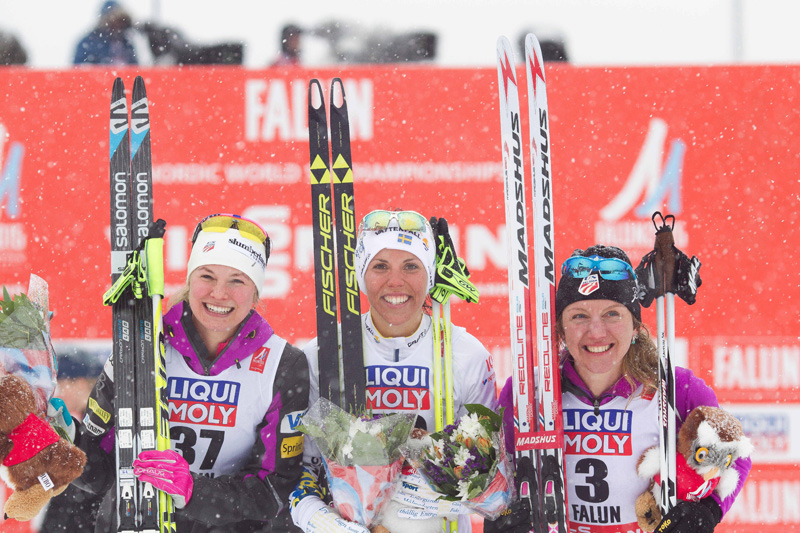
Americans Jessie Diggins (l) and Caitlin Gregg (r) share the women’s World Championships 10 k freestyle podium with Sweden’s Charlotte Kalla (c), who won the race by 41 seconds for her first individual gold in Falun, Sweden. Diggins took second while Gregg took third, 46.9 seconds back. Both finishes were the best distance result in history for a U.S. woman at a World Championships. (Photo: Fischer/NordicFocus)
The historic performances – which were the best distance results of an American women at a championships event – were a product of a combination of efforts, from coaching to a phenomenal wax team, and the two Americans took advantage of the opportunity that was handed to them. The night before the 10 k freestyle U.S. Ski Team women’s coach Matt Whitcomb gathered the team for a pep talk. According to Diggins and Gregg, the theme of his speech revolved around the simple question: Why not?
He emphasized that many skiers count themselves out before they’ve even had the chance and that every member of the U.S. team had the opportunity to achieve their best. The two skiers didn’t know it at the time, but Whitcomb’s central message — anything is possible –– would become a reality the next day.
Taking Whitcomb’s advice, both athletes entered the 10 k with high expectations. Diggins, a regular on the World Cup circuit, explained her goal was a top six: “If I was having an amazing day,” she said.
Gregg, on the other hand, skied with the aim of being an early leader. She easily accomplished her objective, but soon realized that her time was much better than she ever could have expected.
“My goal was to try to come in, be the leader, and put in a good time,” she said. “I think it took maybe another twenty or thirty skiers before I started realizing that it was actually a really, really good time.”
Gregg watched Diggins from the leader’s chair as the 23 year old trailed on the final climb and then roared into the finish to best Gregg by nearly six seconds. “Then all of a sudden things started to become a reality,” she said.
The silver was Diggins’ second-career World Championships medal. Her first came from the 2013 freestyle team sprint in Val di Fiemme, Italy, where she joined forces with Kikkan Randall to claim gold. The pair was the first to earn a World Championships title in the history of U.S. skiing.
Gregg hasn’t been at, or near, the top of international skiing since the start of her career. The 34-year-old’s best World Cup result was in a 2010 Canmore World Cup, where she place 14th in the 10 k freestyle. Her next best result was last year in Falun at the 2014 World Cup Finals where she had the 25th fastest time in the 10 k pursuit. Last season, Gregg missed a spot on the Olympic team despite dominating the domestic distance circuit.
As the 2014 SuperTour leader, Gregg started the 2014/2015 season on the World Cup, but contracted shingles and consistently race in the 50s on the World Cup.
Due to USSA criteria and the previous year’s Olympic selections, it appeared uncertain whether or not Gregg would be named to the U.S. World Championships team. Come Jan. 26, however, Gregg’s name was on the list and she was preparing conquer the 10 k freestyle — a race she had been focusing on all year.
According to Gregg, her bronze medal was validation of a career that has consisted of hard work and perseverance. She said her medal sent a clear message that developing skiers who aren’t often given the best opportunities from the start of their careers can still be successful — all it takes is a little passion and grit.
“If you really truly feel it in your heart, keep pushing, keep pushing,” she said. “Anything is possible. Obviously, a lot of things fell together today for me, but I think it is a super strong message.”
“Some skiers just take a little bit longer to get going,” she added with a laugh. “You can win your medal at 34 years old.”
Both Diggins and Gregg will return to the U.S. Ski Team to compete on the World Cup in the 2015/2016 season.
Alex Harvey, 2015 World Championships
When it came time to pick the male cross country performance of the year choosing the recipient was an easy decision. Alex Harvey was the leading North American man of the year and gave many inspiring displays of athleticism over the course of the winter.
Then the hard part came: choosing his best performance.
Over the course of the regular season, Harvey skied to earn ninth overall on the World Cup ranking list, but it was at the World Championships where the 26-year-old truly shined. His collective results from the year’s most important two weeks of racing warranted an award for not just a single race, but for multiple performances.
It all began at the first race of World Championships: the classic sprint. Harvey started the day qualifying in fifth position. He continued to advance through the heats – but not without some close calls. From the quarterfinal to the final, Harvey would ski at or near the back of the pack, at times would seem as if he was out of the running. By the finish, however, he would always be positioned at the front.
In the final Harvey sat in fourth on the last hill before charging into the line. He finished second only to Norway’s Petter Northug.
Canadian National Team Head Coach Justin Wadsworth said he believed Harvey could have overcome Northug, had the finishing straightaway been longer.
“I think if it would have been five more meters, he would have won the race,” Wadsworth said in a post-race interview. “[Harvey] said ‘oh i timed it kind of bad,’ but I think it was an amazing race, especially after being in last place at the top of the hill.”
Norway’s Petter Northug (l) and Canada’s Alex Harvey (r) lunge in the 1.4 k classic sprint at the 2015 FIS Nordic World Championships in Falun, Sweden. Northug won the are by 0.05 seconds over Harvey, who earned his best individual finish at a Championships. (Photo: flyingpointroad)
Harvey reflected a similar sentiment, saying that he was gaining on Northug as they approached the finish. However, the Canadian was cautious in his speculation, adding, “I wouldn’t redo the race just to take that chance.”
When asked how he was able to advance from dead-last to a podium position, Harvey explained that his come-from-behind day wasn’t necessarily planned.
“I would like to lead on this course on the first hill if I could. [The course] is a bit more endurance-based and I am a bit more of an endurance-based athlete.” he said.
Despite trailing the pack at the key point in the race, Harvey explained the first hill was more of a “warmup” and the second hill was where he needed to make his move. The Canadian added that he was confident in his skiing despite his position, because he knew his finishing speed was strong.
Wadsworth agreed, adding that fast skis also played a large role in Harvey’s performance.
“I think he knows what he’s capable of and he knew the skis were good enough to do that,” he said. “This course has such a fast downhill. Then all you have to do is run up that and everyone is going to run the same. Then you have to have enough speed for the end and his double poling has been really good.”
The silver medal marked Harvey’s highest individual placement at a World Championships. Prior to the sprint, the Canadian had won two other medals. In 2011 he and Devon Kershaw powered to a World Championship title in the team sprint and in 2013 he claimed third in the classic sprint.
There was more to come from Harvey as the championships progressed.
Two days after his silver medal performance, Harvey competed in the 30 k skiathlon. He stayed near the front of the race, often switching the lead with the event’s favorites – eventual winner Maxim Vylegzahanin, Dario Cologna, and Maurice Manificat among others.
As the finish approached, Harvey sat nearly seven seconds behind Vylegzahanin, Cologna, and Didrik Tønseth. He charged hard to close the gap, and nearly caught them on the second-to-last climb. While Cologna and Vylegzhanin skied out of reach, Harvey trailed Tønseth closely, passing him 5 seconds before the finish.
“It was so mushy and I was starting to not see clearly,” Harvey recalled, noting that his legs felt extremely spent after 15 k of classic followed by 15 k of skating on Falun’s notoriously tough course — and in soft conditions on an above-freezing afternoon. “I knew my legs were not 100 percent, so I wouldn’t have an amazing sprint, but it was good enough to grab one place, that was good for the podium.
“I had two medals in my career in World Championships, and now I have two in three days,” he added after achieving his fourth medal. “It’s crazy.”
Wadsworth noted the impact the results had on the program after Canada took home one medal between the last two previous championships (2013 World Championships and the 2014 Olympics).
“To have two medals [in Falun], it’s more [about] showing that we do have one of the best programs for waxing and we’ve invested a lot in it,” he said. “We’ve also done things that are a little bit different than other teams or the U.S. by having a little bit smaller team. We’re here to get medals and this is what’s going to help our program in the long run, where we can put it back into development and other things. We have to go for it at these big events like this.”
Harvey continued a successful Championships with earning the fastest first leg time in the men’s 4 x 10 k relay in which Canada eventually placed 10th. Harvey skied to fifth in the 50 k classic mass start after leading for much of the race to close out the two weeks of racing.
Harvey will once again return to competition in the 2015/2016 season as Canada’s leading man. He began his spring training May 1, after dual surgeries on his iliac arteries. Armed with new hardware, the 26-year-old will look to add another successful year to his name.
Petter Northug and Charlotte Kalla delivered FasterSkier’s international performances of the year at the 2015 World Championships in Falun, Sweden.
With the 2014/2015 season officially in the rearview, FasterSkier is excited to unveil its annual award winners for this past winter. Votes stem from the FS staff, scattered across the U.S. and Canada, and while not scientific, they are intended to reflect a broader sense of the season in review.
***
Petter Northug, 2015 World Championships 50 k classic mass start
Like him or not, it’s hard to deny Petter Northug has a winning formula. In mass starts the Norwegian will often save his energy in the middle of lead pack, wait till the end of the race, and sprint past the world’s best skiers to victory. He did exactly that in the 2015 World Championships 50 k mass start, a performance that earned him the title of FasterSkier’s international men’s performance of the year.
The victory was Northug’s fourth at the 2015 World Championships and his 13th career World Championships. The gold medal is also his fourth in the 50 k, with additional wins at the 2009 and 2011 Championships and the 2010 Olympics. The number ties Swedish skier Sixten Jernberg who won two World Championship titles in 1958 and 1962 in addition to the 1956 and 1964 Olympic titles.
Petter Northug Pawers down the finish of the men’s 50 k at the FIS Nordic World Ski Championships in Falun, Sweden. (Photo: Fischer/Nordic Focus)
According to Northug, there was no particular part of the World Championships 50 k that necessarily suited him. He explained in a press conference that his plan was to remain in the middle of the pack until the final 10 k, and then make his way towards the front. After his finish, Northug told NRK Sport that one of his favorite parts about racing is the actual finish, especially in a long 50 k.
“It is a great relief to go in the finish. The feeling of crossing the finish line first is indescribable. That is what we train for, and that is what we hope to replicate in Championships,” he said. “I have had the opportunity several times here in Falun. It is the feeling that is difficult to describe. It is so good that you do everything you can to get it back.”
Northug faced a turbulent year after crashing a car in May and subsequently being charged with intoxicated driving. The Norwegian rarely mentions his thoughts surrounding the incident, but said to NRK that the 50 k win was the high of two extremes in the past year. He explained that his complete focus on training in the 2015 season was essential to his four victories in Sweden.
“There are two extremes, from being completely down to win four gold in a World Championships” he said. “The road has been long, it has been a lot of training, many tough sessions. But the plan we put in May has been solid. It has been very quality of what we have done and that is why I have been in such good shape that I’ve been in this Championship.”
Charlotte Kalla, 2015 World Championships 10 k freestyle interval start
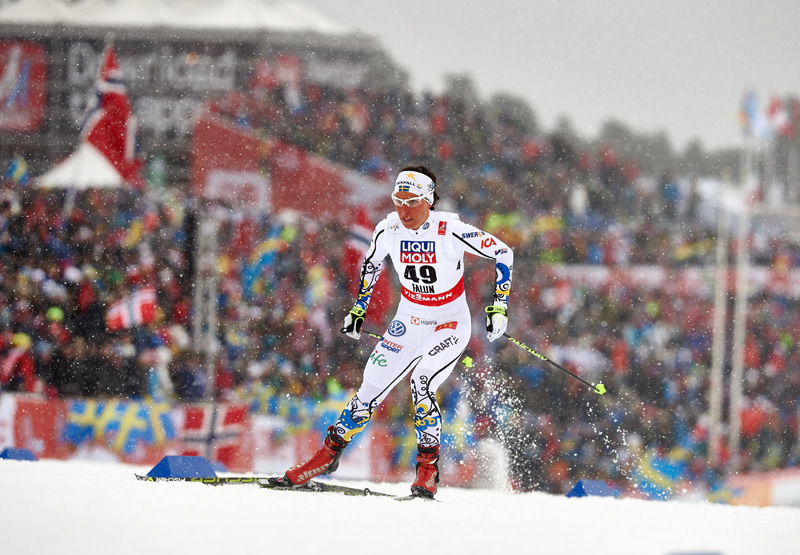
Sweden’s Charlotte Kalla racing to her first-career individual gold at 2015 World Championships in Falun, Sweden. Kalla won the 10 k freestyle by 41 seconds over silver medalist Jessie Diggins. (Photo: Fischer/NordicFocus)
There was one name on everyone’s lips at the 2015 World Championships: Charlotte Kalla. The Swede was skiing in front of a fanatic home crowd and by the middle of the championships she had already won her first individual World Championships medal – a bronze in the skiathlon – in addition to silver in the team sprint.
However, throughout the Championships Kalla had her eyes set on one race. The 10 k freestyle individual start suited all her strengths and there was extra incentive from the thousands of cheering Swedes singing her name.
“I was a little bit nervous before the start and for the whole morning; I just longed to go to the competition area and put on my race bib,” Kalla said in a post-race press conference. “When the speaker presented me before the start, it was an amazing atmosphere in the stadium. I had to keep calm and focus on skiing all the way and not just go crazy because there was a big crowd cheering for me.”
The combination of the home course, cheering crowd, and focused training appeared to work for Kalla as she sped to victory. The Swede rounded the course in 25:08.8, 41 seconds faster than the next finisher, American Jessie Diggins.
What was truly impressive of Kalla’s win was her ability to overcome the day’s conditions. Lightly falling snow at the start turned into a full-fledged downpour of wet-and-heavy snowflakes throughout the race, making an already soft track in above-freezing temperatures even slower. And while some of the Norwegians, like Therese Johaug, later said they felt like they were skiing on glue, the snow didn’t seem to bother Kalla. Although, early starters had faster and more stable conditions, Kalla was not one of those skiers. She faced the worst of the weather, yet was able to dominate the day.
None of the famed Norwegians, including powerhouse Marit Bjørgen, came anywhere close. Heidi Weng – who was the highest finisher from the team – placed 22nd and 1:51.9 behind Kalla. The rest of the squad finished over two minutes back, demonstrating the impressive demonstration of power by the Swede in the challenging conditions.
“It’s a dream come true, to become world champion at home,” Kalla told Expressen after the win. “It probably has not really dawned on me yet. I need enough time for it to melt in.”
Honorable Mentions:
Therese Johaug, World Championships 30 k classic mass start
The World Championships 30 k classic mass start demonstrated that Johaug is called the energizer bunny for a good reason. From the beginning to the end of the longest women’s race at World Championships, Johaug’s high tempo created an ever-growing gap over her competitors so that when she crossed the finish line, the Norwegian was 52.3 seconds ahead of teammate Marit Bjørgen.
French men, World Championships 4 x 10 k relay
The French men did what no one expected at the 2015 World Championships: earn a repeat bronze in the men’s 4 x 10 k relay. They accomplished the feat at the 2014 Olympic games, but it was a day that the Norwegians and other nations missed the wax. That was not the case in Falun, where the French led for much of the race. It was a clear, decisive accomplishment for a team with just a fraction of the resources of the Swedes, Norwegians, or fourth-place Russians, and from a country where cross-country skiing is hardly a popular pastime.
Kyle Bratrud (l) and Veronika Mayerhofer (r) are FasterSkier’s collegiate skiers of the year.
With the 2014/2015 season officially in the rearview, FasterSkier is excited to unveil its annual award winners for this past winter. Votes stem from the FS staff, scattered across the U.S. and Canada, and while not scientific, they are intended to reflect a broader sense of the season in review.
We kicked off the series Monday with awards for Junior Skiers of the Year (SOTY), Katharine Ogden and Sean Doherty. This second set of honors goes to outstanding male and female skiers on the U.S. NCAA collegiate circuit.
***
Kyle Bratrud, Northern Michigan University
For a 22-year-old, Kyle Bratrud had a momentous 2015 season.
The Northern Michigan University skier came out swinging at the 2015 U.S. Cross Country Championships, winning the 15 k freestyle individual start by 5o seconds over veteran Kris Freeman. The win and his subsequent bronze in the 30 k classic mass start started Bratrud on a whirlwind European adventure that would take him from competing at the U23 World Championships in Kazakhstan to being the second-youngest member of the American FIS Nordic World Ski Championships team in Sweden.
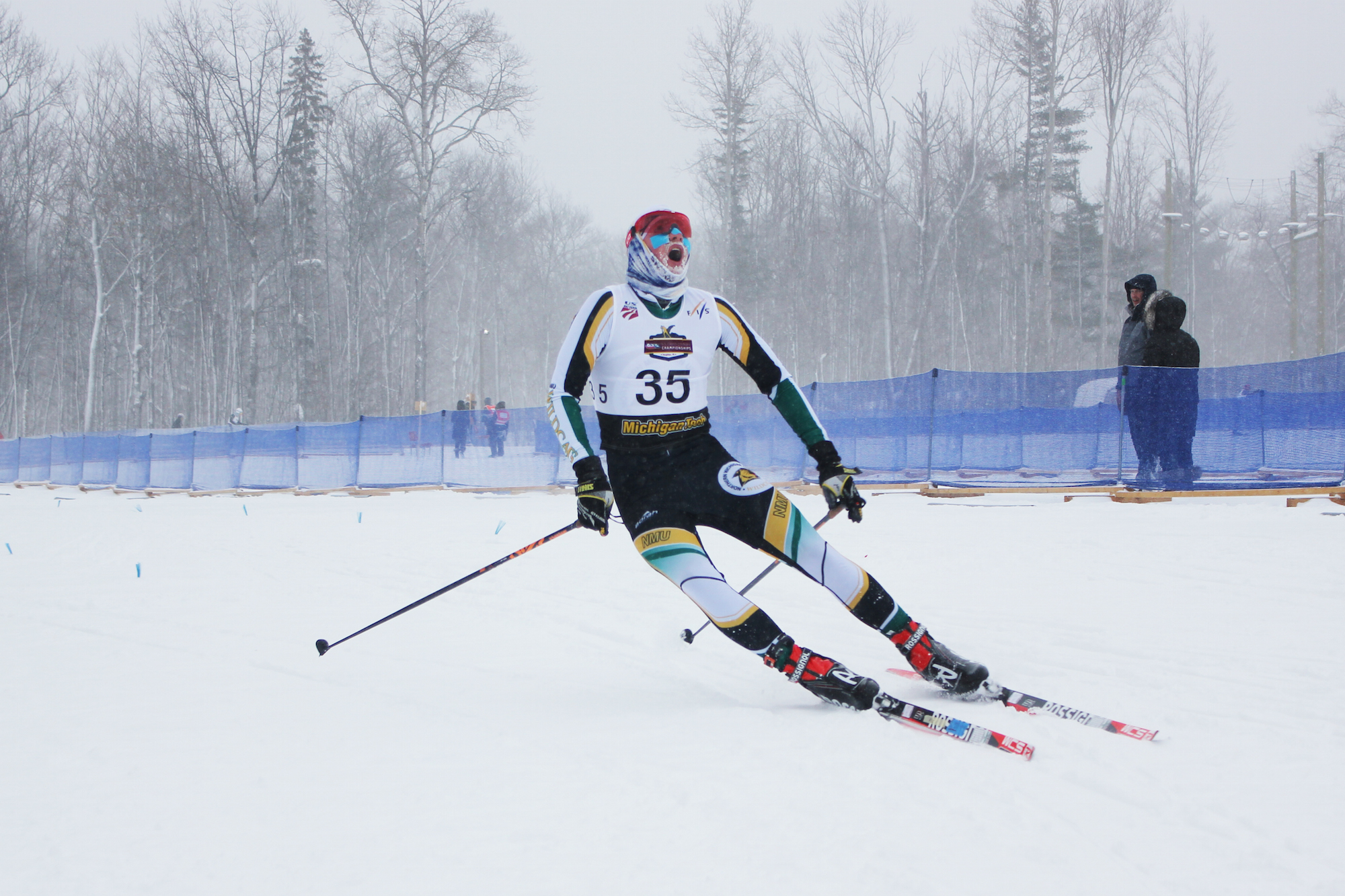
Kyle Bratrud collapses after his 51-second win in the men’s 15 k freestyle at the 2015 Cross Country Championships in Houghton, Mich.
Entering the season, the Eden Prairie, Minnesota native told FasterSkier that his goals for the year were to qualify for the U23 World Championships and earn a podium at the NCAA Championships in Lake Placid, N.Y. After his successful week at U.S. Nationals it was clear that the NMU senior was well on his way to completing his goals. At the U23 World Championships, Bratrud’s best finish was 19th in the 15 k freestyle.
When the USST announced its World Championship team in late January many were surprised and pleased to see Bratrud’s name on the list. According to USST Head Coach Chris Grover, the decision to select Bratrud was an investment in the future.
For Bratrud, his selection was a major step in his career that offered valuable experience in the year before he jumped into professional racing. “This is a gigantic accomplishment for me and not necessarily something that I targeted going into this year. I really think this is a step in the right direction towards accomplishing my goal of making the USST,” he wrote in late January. “I am super stoked to see how the big boys race and hopefully I can contribute to the team in some way! It will be a great step in my ski career.”
At World Championships Bratrud raced the 15 k freestyle individual start and as the third leg of the men’s 4 x 10 k relay. The relay was significant for the 22-year-old as it provided him with international experience that is extremely rare for a collegiate skier.
“They asked me if I wanted to be in it and I said sure. I was flattered,” he said after the relay. “It’s another race on the international stage for me so I was all for it. I knew I was going to get my butt kicked around a little bit out there but that’s how you get better, racing these guys.”
Bratrud returned to the U.S. after what he called an exhausting European tour and arrived in Lake Placid for the NCAA Championships. He raced to seventh in both the 10 k freestyle and the 20 k classic. He was the first American in the mass start.
Bratrud will graduate from Northern Michigan University this spring. He plans to race for the CXC elite team in the 2015/2016 season.
Veronika Mayerhofer, University of Utah
University of Utah’s Natalia Mueller (l) and Veronika Mayerhofer (r) at the 2015 U.S. Distance Nationals 30 k freestyle mass start in Sun Valley, Idaho as part of the year’s SuperTour Finals . (Photo: flyingpointroad)
It’s clear that Veronika Mayerhofer is an unassuming and good-natured person. If you meet her in a ski race, however, watch out – the University of Utah skier is always a threat and has the experience to back it up. Her achievements aren’t surprising, as the 22-year-old has competed for the Austrian National Team and raced at the 2013 FIS Nordic World Ski Championships and the 2014 Winter Olympic Games.
In her first year as a Ute Mayhofer rose to the top a strong field of international and domestic collegiate women. She ended the regular season ranked second in the Rocky Mountain Intercollegiate Ski Association (RMISA) and earned the year’s Women’s Nordic MVP award for the region. She was the only skier to finish in the top five of all regular season races.
At the NCAA Championships in Lake Placid, N.Y. the Austrian won the 5 k freestyle individual start by a large 13.2 seconds and finished second in a sprint finish at the end of the 15 k classic mass start.
“It’s my first year of college racing and I was so happy that I could go to the NCAAs,” Mayerhofer said after her NCAA 5 k win. “I really enjoyed it so much because it is so much for the team and not just individual racing, because cross country skiing is so much on your own. It’s maybe less pressure and everyone is so happy for you.”
Mayerhofer’s impressive skiing led the University of Utah women – including Sloan Storey and Anna-lena Heynen – to earn the most team points in both of the NCAA women’s nordic races. Their strong performances contributed to a third-place finish for the Utes.
The Austrian’s season didn’t end there. She competed at the 2015 U.S. SuperTour Finals in Sun Valley, Idaho, skiing amongst the best American skiers throughout the entire week. Her strongest performance was perhaps in the mixed team relay where she brought her team from a far seventh to first. She posted the fastest third leg and overcame a charging and motivated Chelsea Holmes (APU) in the process.
In addition to FasterSkier’s Colliegiate Skier of the Year Award, the 22-year-old was also named the United States Collegiate Ski Association’s skier of the year. Mayehofer will return as a sophomore to the University of Utah in the upcoming season.
Honorable Mentions:
Patrick Caldwell, Dartmouth College
Caldwell also had a breakthrough season that rivaled Bratrud’s. The Vermont native raced to third in the 15 k freestyle at U.S. Nationals which was enough to earn him a spot on the U23 World Championships team. In Kazakhstan Caldwell finished 15th in the 15 k freestyle and 20th in the 30 k skiathlon. Throughout regular the season, Caldwell won all but one of the Eastern Collegiate Ski Association races at which he was present. At the NCAA Skiing Championships, Caldwell won the 10 k freestyle individual start to cap a largely dominant season. He finished 10th in the 20 k classic mass start.
Emilie Cedervaern, University of New Mexico
Cedervaern finished the 2015 season as the RMISA’s top-ranked woman. Over the course of the regular season the Lobo earned seven podiums, four of which were wins. She continued her dominance into NCAA’s where she placed third in the 5 k freestyle and won the 15 k classic in a sprint finish over Mayerhoffer.
Therese Johaug of Norway celebrates her win in the 10 k classic mass start in Val di Fiemme, Italy – and being the first woman to beat Marit Bjørgen in this edition of the Tour de Ski. (Photo: Val di Fiemme/www.fiemmeworldcup.com)
After skiing together and taking turns leading through the first 9 k, the final stretch to the finish became a three-way thriller between the usual suspects among the Norwegian women where Therese Johaug eked out everything to beat Marit Bjørgen to the line.
For Johaug, winning the sprint finish in the 10 k classic mass start in Val di Fiemme, Italy, was a huge victory in a Tour de Ski that has been a bit off for the defending champion. Johaug crossed the line in 33:10.4, just over 1 second ahead of Bjørgen and 5.5 seconds ahead of Heidi Weng in third place.
“I was determined to stick with Marit (Bjørgen) up the last hill, and I knew I had great skis, and my double-poling was really strong toward the end of the race,” Johaug said to NRK reporters after the race. “It was amazingly fun to win today. It feels so good after struggling a bit so far in the Tour de Ski. Now I felt my body was with me, and I love these courses here in Val di Fiemme.”
The podium trio had a huge gap to Aino-Kaisa Saarinen of Finland, who clocked in 1:13.1 behind Johaug. Liz Stephen delivered a strong fifth place, 1:39.6 behind Johaug; Polish star and classic specialist Justyna Kowalczyk was disappointed in seventh place.
A clan with a plan
The Norwegian trio on course, with Marit Bjoergen in the lead. (Photo: Val di Fiemme/www.fiemmeworldcup.com)
The Norwegian women, who have been dominating the podium so far in this Tour de Ski as well as in the World Cup season as a whole, had a plan prior to the sixth stage today.
Bjørgen’s plan was to conserve energy and prepare for the final stage up Alpe Cermis tomorrow. Johaug, who has been struggling more this Tour, was told to hold back – at least on the first lap. She managed to stick to the plan exactly one lap. Two meters into the second lap, Johaug was in the lead and set the pace. And the trio already had a huge gap on the rest of the field.
But group plans had to go out the window because of the presence of sprint “preems”: bonus seconds awarded to each of the first skiers across the line at two intermediate points during the race.
The time didn’t mean much to Bjørgen, who already had a roughly two-minute lead in the Tour de Ski after winning every single previous stage. But each second counted dearly for Weng and Johaug. Before today’s stage Weng sat in second place and Johaug in third, but Johaug is an expert at the final stage climbing up the Alpe Cermis. She wanted to narrow the gap to Weng so she could be sure of passing her; Weng wanted to widen the gap to prevent that from happening. It all came down to the bonus seconds.
At the 5 k mark, Weng was in the lead, 0.4 seconds ahead of Johaug and 0.8 seconds to Bjørgen. Approaching the sprint, Bjørgen predictably let Weng and Johaug fight for the bonus seconds. Johaug had the longest toe across the sprint line, collected the 15 bonus seconds and reduced the overall gap to Weng by 3 seconds. Weng cashed in 12 seconds and Bjørgen received 10 seconds in the sprint.
Thriller sprint finish
Johaug reacting to having won the sprint finish. (Photo: Val di Fiemme/www.fiemmeworldcup.com)
Bjørgen pulled the group of three into the final kilometer, looking confident going into the finish. She turned on the turbo on the last hill, but lost the sprint finish to Johaug after, perhaps, a tactical mistake. Johaug was able to stay in Bjørgen’s draft all the way down the hill, and was still tucking behind her as Bjørgen started double-poling. When Bjørgen decided to switch tracks before entering the finishing lanes, she handed Johaug the opportunity to pass her.
In almost every other time the pair has faced off in a sprint finish, Bjørgen has won – so it may not have seemed like a big deal. But Johaug turned it up to an extra gear and pulled away from her older teammate, stopping Bjørgen’s Tour de Ski winning streak.
It wasn’t an accident.
“I worked yesterday with my coach on my classical technique,” Johaug said in a FIS press release. “I knew Marit would be strong on the last hill but I could follow her.”
The effort was taxing: Johaug collapsed in the snow before sitting up and screaming in victory. She was excited and almost as surprised as anyone else.
“Shit, I’ve got more speed than her,” Johaug told NRK she thought as she drew even with the Tour leader.
Weng stuck with Bjørgen and Johaug all the way to the finish chutes, but had to settle for third place for the stage. She is still solidly in second place overall, and with a good day tomorrow, her 39 second lead to Johaug could be enough to defend that second place to the top of the monster hill Alpe Cermis.
It was a tough day for Justyna Kowalczyk of Poland. The four-time Tour de Ski champion bled more time to the leaders, and is now more than seven minutes back from another title. (Photo: Val di Fiemme/www.fiemmeworldcup.com)
Neither Saarinen nor Stephen of them was able to make up time on the final kilometer.
It was by far the best result all season for Saarinen, who struggled with a foot injury in the off-season.
“This was no longer a step, but a leap forward,” she told Finland’s Helsingen Sanomat newspaper. “I have received what I went for… It is a pretty good performance. Yes, it is on the way up and I’m beginning to seriously think about properly profiting at Falun [World Championships].”
As for Steven, on paper it was her best classic result yet. (With less than a full World Cup field present at such a late stage in the Tour – for example teammate Sadie Bjornsen dropped out of the seven-stage event – the race might have been less competitive than some others. On the other hand, the Norwegians didn’t seem to treat it that way, and Saarinen, like today, finished fourth in this event at the 2014 Olympics.)
“I had great skis today. It’s so warm and it was perfect klister skiing out there,” Stephen in a USSA press release. “These courses really suit the way I ski, steep hills and long hills. I really liked being in Val di Fiemme with the memories of World Championships.”
Stephen beat Norway’s Ragnhild Haga by 10.9 seconds, and has thereby made herself a serious threat to Haga’s fourth place in the overall Tour de Ski. Stephen, known as one of the best climbers on the circuit, sits less than a minute behind Haga in sixth place in the overall standings.
“It’s my favorite event of the whole year,” Stephen said in the press release. “It’s just you and the mountain, the gates and the people. I won’t sleep much tonight because I can’t wait for tomorrow.”
Poland’s Justyna Kowalczyk, a four-time Tour winner who has dominated the classic ski stages in previous editions of the event, finished in seventh place, 1:47.2 behind Johaug. She sits in fifth overall, but more than seven minutes back from Bjørgen. It’s a huge change from previous seasons, and even Kowalczyk can’t put her finger on what went wrong.
She initially tried to go with the Norwegian trio, and indeed lasted almost a kilometer longer than every other woman. But then she was dropped, and after a few more kilometers could not hold onto fourth place.
“At some point, I disconnected the electricity,” she told the Polish media. “Then I learned about what it’s like to be a skier on tour with fatigue.”
She slipped through the field; by the finish, she looked crushed and despondent.
“It’s hard for me to analyze at the moment the cause of my poor performance skiing,” she told Eurosport Poland. “If it wasn’t the Tour de Ski, I might not have finished. There was even talk about that. What kept me alive was only thinking how foolish it would be to abandon when there is still a chance of a good placing in the event. My goal is to finish the Tour de Ski.”
Andy Newell (l) holds the Protect Our Winters banner as he joined 400,000 other protestors on the streets of New York City for the People’s Climate March on Sept. 21. (Photo: Protect Our Winters)
Four-hundred thousand demonstrators gathered on the streets of New York City for the People’s Climate March on Sunday, Sept. 21. Timed to occur just days before the United Nation’s climate summit, the event boasted high-profile attendees including former Vice President Al Gore, Leonardo DiCaprio, Jane Goodall, and U.N. Secretary-General Ban Ki-moon, who wished to demonstrate the world’s necessity to combat climate change.
Amongst the crowd was a lesser-known figure who has been diligently working in the environmental movement for several years — U.S. Ski Team member Andy Newell.
Newell wasn’t always an activist and says that he used to be indifferent to political action. However, as he began to witness environmental activists fighting to raise awareness about climate change, he realized that he had the power to make a difference.
Recognizing that the sport he loved was in jeopardy if major action didn’t take place, Newell began to get involved with environmental organizations like Bill McKibben’s 350.org.
As Newell worked with the movement, he saw a unique opening for him to create real change, and in 2013 he started Athletes for Action. Using his status as an Olympic athlete, he created the organization to ensure that he and other winter athletes’ voices were heard at the upcoming 2015 U.N. Framework Convention in Paris.
A group of activists with Protect Our Winters march in the 2014 People’s Climate March in New York City. Event organizers estimate that roughly 400,000 protestors attended the event. (Photo: Protect Our Winters)
Working together with McKibben, Newell drafted a letter for fellow athletes to sign that was addressed to world leaders, urging them to recognize climate change and take action.
“It sounds like a small step, but even getting governments to recognize the problem and take it seriously can be a big step,” Newell wrote in an email. “We are still working on that even here in the U.S.”
Athletes for Action received extensive attention during the Olympic year and as a result, Newell was asked to Washington D.C. to meet with Todd Stern, who is special envoy for climate change for the Obama administration and leads talks at the United Nations climate change conferences.
As Athletes for Action gained awareness, Newell partnered with an organization called Protect Our Winters, which was founded by snowboarder Jeremy Jones.
“Since they are an organization that has a pulse on the winter sports community they have been incredibly helpful in aiding me organize and get these projects off the ground,” Newell said.
He added that the partnership with Protect Our Winters has allowed him to continue to be involved with climate change activism, while being a full-time athlete.
As part of the the partnership, Newell marched alongside the Protect Our Winters contingency at the People’s Climate March.
Despite having completed the SMST2 100 k Ski-A-Thon only a day before, Newell boarded a train to New York at 6 a.m. and arrived at the largest-ever march on climate change. He said it was an experience he would never forget.
Andy Newell (l) participating in the People’s Climate March in New York City on Sunday Sept. 21. (Photo: Protect Our Winters)
“It was crazy to see the energy of that many people and also pretty interesting to see how many different organizations were involved in the march,” Newell wrote. “As a skier we can get caught up in the winter sports side of climate change, but there are so many other reasons to get involved and they were all represented on the streets of New York.”
After departing New York that evening, Newell said that the energy from the event further fueled his aspirations for his organization. In the next year he plans for Athletes for Action to make some noise around climate change while creating an environment where it’s easier for athletes to get involved.
“We as individuals can continue to recycle and conserve and work toward a more sustainable life, but the only way we can see big progress and change is if there is better legislation coming out of the U.S. and internationally to reign in big business and big oil,” he urged.
With his continued work with Athletes for Action and Protect Our Winters, Newell hopes to foster new growth of athlete participation.
“It’s funny because I used to be a person who could care less about politics and I feel like there are a lot of professional athletes out there who are in the same boat,” Newell said. “There are plenty of people out there who claim to be ‘green’ athletes but at the same time have no idea who represents them in congress or how most of these big environmental decision are made, which is something that needs to change.”
Emily Attwood celebrates her final college ski race atop a pyramid of her Middbury College teammates in February of 2014. (Photo: Stella Holt)
Editor’s note: Growing up as a gay male in the ski community, I always wondered what the experience was like for other junior and college-aged LGBT skiers like myself. The opportunity arose for me this summer when FasterSkier’s editor-at-large, Chelsea Little, published an interview with 2006 Olympic biathlete Brian Olsen. The interview sparked my exploration into the many positives and some of the challenges that arise as a young, gay athlete in the skiing world. Hearing these individuals’ personal accounts has been very inspiring and educating and it is my hope that you, the reader, will be able to appreciate and relate, whatever your experiences may be.
Jack Nelson came out as gay to his Williams College teammates in 2005. Not only did his openness create a strong team environment, but Nelson also had the best season of his college career. (Photo: Jack Nelson)
Jack Nelson was a sophomore at Williams College when he realized he was gay. The Hanover, N.H. native struggled with the internal realization, but when he accepted that he was attracted to men there was never a question as to whether he would tell his family-like team.
So when the Williams’ skiers gathered for New Year’s dinner while at a training camp in Quebec, Nelson made an announcement to the team: he was gay.
Nelson was met with both admiration and support from his teammates. Head coach Bud Fisher gave Nelson a big hug and his teammates offered him congratulations on his bravery and honesty.
In the weeks following, Nelson said the bond with his teammates only grew stronger and being gay became a non-issue as his teammates and friends saw him as a well-rounded person rather than a gay male.
Armed with newfound confidence from both his self-acceptance and the welcoming nature of his teammates, Nelson skied to his best season in his four years at the New England college.
“That was the best ski season I had at Williams. I was just so much more relaxed and comfortable with who I was,” he said.
An Accepting Community
Experiences similar to Nelson’s can be found scattered throughout the nordic community. Given the close family-like bonds often developed during the hundreds of hours of training, it’s not surprising that nordic skiers are supportive of their teammates, whatever their identity may be.
Bridger Ski Foundation coach and former Harvard skier Tanner Wiegand knew he was gay at the age of 13 and came out to his team when he was a sophomore in high school. Like Nelson, his peers were incredibly supportive.
Wiegand found that the encouraging environment of his ski community gave him the extra confidence needed to discover who he truly was.
“Being gay in the ski world didn’t scare me like it did in other spheres of my life,” he explained.
Tanner Wiegand, a 2014 graduate of Harvard University, races in an EISA college carnival in this undated photo. (Photo: Tanner Wiegand)
Wiegand believes that there were several reasons behind his self-assurance in the ski community, including the co-ed nature of the sport and the tendency of nordic skiers to be more liberal and educated.
University of Utah alumnus and 2003 NCAA Champion Ryan Quinn has another theory to add. He believes that most endurance sports share the same sense of acceptance.
“I think the culture of individual endurance sports (skiing, running, triathlon, etc.) lends itself to individuality and acceptance of differences. Those sports attract the kind of people who tend to be introspective and independent,” he said.
The Alaska-native came out to his team in 2005 and is also author of the acclaimed coming of age book, The Fall. He said that while coming out was a difficult process, it was easier to do so in the college skiing community because of its size and modest visibility.
“There’s not a lot of media attention; there’s no money at stake. So it’s a less complicated environment to come out in than say on an SEC football team,” he said.
Emily Attwood, a recent graduate from Middlebury College, had little difficulty being gay in the ski community. However, at a LGBT awareness meeting for the athletic department at the small Vermont school she began to realize that her experience as a nordic skier and cross-country runner was unique.
“It was interesting to hear the commentary from other sports. I think that we’re lucky in the culture of skiing, because the people are so open,” she said. “It’s not that other sports aren’t like that, but someone on a lacrosse or hockey team has a lot more difficulty coming out in that environment.”
The Challenges of Being a LGBT Athlete
When Kate came out to her college team they were nothing but supportive. Both her friends and fellow skiers were intrigued by what it meant to be a lesbian and while it was sometimes annoying, they showed their support by incessantly asking about the love-life for the newly-out skier.
However, when Kate – who wished to use a false name – sat down with her coach during one of their regular meetings, she was confronted by something that she would never forget.
Sitting across from her coach, Kate was told that she was drawing too much attention to her sexuality and making the team uncomfortable.
Kate, whose nature was to be exceptionally friendly and embracing, had no idea what her coach was talking about: she had never done or said anything inappropriate and her teammates had been anything but uncomfortable about her sexuality.
The assumption of the coach that she was somehow acting inappropriately because she was around a team of fellow women was extremely hurtful to Kate, both in terms of her relationship with the team and her self-esteem.
However, after investigating the situation further the coach soon realized the mistake and apologized to Kate for the way that she was treated.
Kate believes that the coach never meant to single her out because of her sexuality, but due to a lack of education and experience regarding such delicate situations, it was handled in the worst possible way.
Both Kate and the coach were able to treat the incident as a learning experience and move on. Today, the two are very close and are still in constant communication.
While an experience such as Kate’s is a rare occurrence in skiing, it demonstrates that difficulties are still present for LGBT athletes in endurance sports.
One of nordic skiing’s attributes that can make acceptance second-nature is often the sport’s greatest challenge: its small size.
Ryan Quinn, a 2003 NCAA Champion who skied for the University of Utah, believes that one of the biggest barriers for gay athletes is awareness. (Photo: Ryan Quinn)
Gay nordic skiers can feel as if they are the only LGBT person in the community. Given that nordic skiing is frequently a central part of an athlete’s social life, the absence of others with the same identity can be solitary.
For an athlete who is thinking about coming out, this isolation can often be a hindrance in the process.
“I think the biggest barrier still is awareness,” said Quinn. “Most straight people continue to just assume that everyone else around them is straight. And for a closeted athlete wrestling with the unknown of coming out, that can be interpreted as intolerance when in fact it’s just oblivion.”
Quinn said that such an interpretation coupled with a fear of the unknown caused him great anxiety before he told his teammates.
“When you’re in the closet facing the unknown, your mind really goes to the worst possible scenario more often than not,” he said. “So I was scared and nervous and wasn’t able to form any rational expectation.”
While his coming out was a positive experience, Quinn said that he guessed many in the community went through a similar fear.
The size of the community can be equally challenging once a gay skier is open with his or her sexuality.
During his experience as a junior, Wiegand felt excluded due to his sexuality on certain occasions. It was unintentional but the contrast was stark: his straight friends were free to be themselves and act on any adolescent urges they experienced, while Wiegand didn’t always have the opportunity to participate in his straight friends youthful bliss.
“Certain rites of passage were closed to me growing up gay in the ski world. Junior Nationals’ dances were never more than a chance to dance with my girl friends. I didn’t get to hold hands with someone special on long van rides, nor was I kissed for the first time at West [Yellowstone] Camp,” he explained. “These experiences and explorations of sexuality that were open to my teammates were inaccessible to me not because I feared recourse for engaging in them, but because I swam nearly alone in a very small pond.”
A New Era
Nelson looks back on his college experience as one of the best times of his life and he still remains in touch with many of the teammates he came out to at the New Year’s dinner many years ago.
With the changing atmosphere in the United States in regards to acceptance of LGBT individuals, Nelson thinks that it will become easier for nordic skiers to accept who they are and share their identity with their teammates.
Emily Attwood celebrates after crossing the finish line at the 2014 EISA Championships in Ripton, Vermont. (Photo: Stella Holt)
“The acceptance of LGBT people, especially in athletics, has changed so quickly. It’s shocking,” he said. “All it takes is for someone’s friend or family member to come out and that changes their outlook. I’ve seen that happen in a lot of different segments in society, including sports so I think the situation now is improving.
Quinn agreed, stressing that responsibility falls equally on gay athletes and their straight counterparts to make sure that they’re creating a welcoming environment for fellow LGBT athletes.
“I think gay athletes have the responsibility to be true to themselves and come out, which is the single best way to counter homophobic stereotypes,” he said. “But their straight teammates, coaches, and friends also have a responsibility to foresee that not everyone is just like them and to create an environment that projects acceptance and individuality rather than take it for granted.”
Attwood believes that being gay is on its way to becoming a non-issue in the sport.
“Being gay is just like being anything else, and it takes time for acceptance,” she said. “There are identity issues for everyone, and coming out is one of those issues. Having conversations and unraveling people’s experiences is the only way to initiate more acceptance and make it a more encompassing community.”
While challenges of misunderstanding may be a reality for LGBT skiers both now and in the future, it is apparent that the nordic ski community is well on its way to creating an embracing and tolerant environment. The small numbers and lack of diversity may be speed bumps on the road to complete ease for LGBT skiers, but it is evident that this tight knit community has the ability to overcome its downfalls and ensure that anyone, regardless of their identity, has a place on the trails.
The course of the Bridger Ridge Run looms ahead from the top of Sacajawea Peak in Bozeman, Mont. The Ridge Run is a 20-mile race that traverses the Bridger Range, finishing at the base of Baldy Peak (seen in the far distance.) The race attracts runners from across the country and many from the nordic ski community participate each year.
The Bridger Ridge Run has been called one of the most rugged running races in the U.S. It was named one of America’s top trail running races by Runner’s World, claiming the title of “Most Raw Exposure” in 2012. In 2013 Outside Magazine included the race as one of its top 10 trail runs in its bucket list.
It’s no secret that the Bozeman, Mont. race is a challenge. The course begins at the base of Sacajawea Peak and continues along the ridge of the Bridger Range for 20 miles until runners descend and finish at the “College M” that overlooks town. Over the course of the run, racers climb 6,800 ft. and face 9,500 ft. of steep decent. For much of the course, the trail is barely distinguishable and racers must maneuver their way through the sharp and unforgiving rocks.
The only thing more difficult than finishing the race is entering. The run allows roughly 300 competitors to register each year. Guaranteed spots are reserved for those who have either previously won the race or have participated at least 10 times in the past. Everyone else must be chosen by lottery.
The race was founded by Bozeman local Ed Anacker in 1985 in an effort to bring attention to the acclaimed trail running in the Montana town. Since its inaugural race, the Ridge Run has become a Bozeman staple and draws runners from across the country.
The Bridger Ridge Run is an attraction for the many nordic skiers in the area as well, and many former and current ski racers from the nordic community participate every year.
Mountain goats often act as race spectators during the Bridger Ridge Run.
This past May, I made the fateful decision to enter the Bridger Ridge Run. Having ended my ski racing career several years before, I missed working towards a specific athletic goal and the Ridge Run sounded like the perfect race to get me on a regular training plan over the summer.
When I was chosen as one of the entrants in June, however, the training did not follow. Due to an extremely painful IT band related knee issue, I was stuck biking most of the summer and a month before the race, it seemed as if I wouldn’t be lining up for the race on August 9.
However, after several weeks of physical therapy and a few practice runs just weeks before the race I deemed myself “ready” for the to run. At this point my main goal was only to finish.
Come race morning participants wound their way up Bridger Canyon to the start of the race. With the sun just beginning to rise, moods of the racers and their chauffeurs were incredibly high considering the early start.
At 7:00 am the first wave of racers, including University of Vermont’s Cole Morgan and 2002 Olympic biathlete and former Montana State University assistant nordic coach Dan Campbell, took off.
As part of the second wave, I began five minutes later.
From the very start racers face an unforgiving climb. As we made our way from the base of Sacajawea Peak to it’s summit, which sits at 9,839 feet, I instantly regretted starting near the front of the second wave. However, the adrenaline and cheering crowds made the pace manageable.
Halfway up the peak we met more encouragement in the form of a lone bagpiper. Every year he and his pipes make the journey to provide racers a distraction with his belting tunes that echo on the mountain cliffs.
From the top of Sacajawea, the bagpiper’s tune was no longer audible but a new sight had caught our attention. The remaining 18 miles of the course appeared before us, both stunning and daunting at the same time.
Heading down from the summit into our inevitable “pain cave,” we faced multiple descents where I felt a fall was imminent. Fortunately I never tumbled off the trail, but every so often I’d hear someone go down around me or pass a fellow racer with bloodied knees and elbows.
Looking back at Ross Peak with Sacajawea Peak (the start of the Bridger Ridge Run) far in the distance.
As we made our way along the rolling Bridger Range the trail became less apparent, the rocks more jagged, and fatigue started to set in. Fortunately, I was stocked with Shot Bloks and HoneyStinger waffles that kept me well fed and energized. Former University of Denver skier and past participant of the Ridge Run, Kate Dolan had advised me to eat every 20 minutes, so I set the timer on my watch and did my best to pop in a sugary Blok every time the alarm went off. After two-and-a-half hours had passed I was thankful for her advice.
Passing the halfway point at the top of the local ski area, Bridger Bowl, my legs were starting to feel a bit shaky and my energy started to wane. There were two major climbs and a steep, unforgiving 5-mile decent between me and the finish.
By the time I reached the final aid station at the top of Baldy Peak, volunteers, friends, and other spectators gave me words of encouragement. While I wanted to believe their statements that the race was almost over and that it was an “easy” downhill from there, I knew my legs were shot and that the nearly vertical decent for the next five miles was going to be painful.
Even armed with my skepticism of the spectators’ encouragement, I was not prepared for the difficultly of the decent. The mixture of dust, loose rocks, and jello-like legs kept me at a turtle’s pace. Each step made it feel as if knives were repeatedly stabbing my legs. At this point, the lack of preparation was starting to haunt me.
Finally I reached the finish to find a cheering crowd. With the last bit of energy I could muster, I crossed the finish line, a grimace-like smile plastered to my face, with a time of 5:04:49.
I later found that Peder Andersen had garnered the best time of the day, finishing the race with a time 3:28:41. Campbell earned sixth, with a time of 3:56:02 and UVM’s Morgan finished eighth, with a time of 3:57:10.
For the women, ultra-marathon veteran Nikki Kimball, who earned multiple NCAA All-American distinctions during her time at Williams College, was the top finisher with a time of 4:02:47. Bridger Ski Foundation coach, Emily Allison finished fifth with a time of 4:29:08. Former and current Bates College skiers, Samantha Forrest and Maddy Ekey finished with times of 5:21:55 and 6:26:51.
After ample time spent relaxing in the finish line hot tubs filled with ice, I already began to forget the pain I had experienced only minutes before. I even began talking with other finishers about training for next year’s race.
That’s the magic of endurance sports: one minute it feels as if mental and physical collapse is imminent; the next you’re ready to get out and conquer the next big adventure.
Do you have an amazing pre or post-workout food that hits the spot before or after a long training session? Do you have a recipe that helps you recover for tomorrow’s intervals? Are you willing reveal your cooking skills so you can win the respect of the nordic ski community in addition to some Rottefella swag?
Regardless of your motivations, now is your time to shine with FasterSkier’s Ultimate Refueling Contest.
Noah Hoffman’s raw-egg smoothie is an excellent example of a high-quality submission.
In this contest we are looking for appealing, tasty, and energizing foods that help you get the most out of your training. All you need to do is prepare the food, take a picture of it, and send us the recipe! No pre or post-workout food is too big or to small; too healthy or too decadent.
Name and a valid email address (that you actually check) in addition to shipping address
A photo of your post-workout food
A recipe for said food
All submissions will be judged by a panel of current and former ski racers based on creativity, quality, and ability to refuel. Multiple submissions will be accepted but only one submission from a person/party will be judged. In addition, teams/clubs may enter group submissions.
Do you ski on SNS bindings or are sponsored by another brand? You can still enter! If the allure of winning isn’t enough, Rottefella gear makes excellent gifts for friends or family members. In lieu of the gift of an Rottefella binding, winners can instead opt for FasterSkier prizes.
Winners will be notified after August 15, 2014. Contact lander@fasterskier.com for more information.
The Canadian junior women’s team at the U23/Junior World Championships in Liberec, Czech Republic. From left to right: Annika Hicks, Katherine Stewart-Jones, Marlis Kromm, Cendrine Brown, Frederique Vezina, Heidi Widmer, Anne-Marie Comeau, Maya MacIsaac-Jones, and Andrea Lee. (Courtesy photo)
Once again, the women led the way for the Canadian team in Liberec, Czech Republic, this time in the U23 freestyle individual-start distance races in fresh, falling snow on Thursday.
Heidi Widmer (Alberta World Cup Academy) rebounded from what she considered a disappointing result in Tuesday’s sprint to place 28th in Thursday’s 10 k.
“I am really happy for a top 30 in a distance race,” she wrote in an email after placing 34th on Tuesday. “It is a personal best for me and really encouraging.”
Widmer was 3 minutes and 5 seconds behind race winner Ragnhild Haga of Norway, who won in 27:50.4. Last season, Haga placed third in the 10 k freestyle at Canadian Nationals, well ahead of the other U23-eligible skiers present.
Widmer was a little surprised by her good day. “I had pretty low energy yesterday but after a good warmup this morning I tried to shake it all off and just focus on the moment and having the best race possible for the day,” she explained.
Widmer felt the course was in good condition, adding “there was sun in the forecast for today which I was super excited about but we got some nice fluffy snowflakes and clouds instead.”
“My skis felt really good,” she wrote. “The Canadian wax techs here are really experienced with these conditions and [with] the Liberec site so we are very lucky.”
Annika Hicks (AWCA) was the second Canadian in 37th (+3:29.3).
“I’m not too happy with my result because I know I’m capable of more,” Hicks wrote. “Unfortunately, I started feeling strong a little too late in the race, but hopefully that means good things for [Saturday’s] pursuit!”
Hicks was also pleased with the course and her skis. “There was a little bit of fresh snow accumulating on the track, and we thought it’d be sunny,” she wrote. “The main race line was pretty skied in, but if you were off that you were skiing through about an inch of powder. My skis were really fast! I was passing people on the downhills (which doesn’t happen very often … I’m pretty small!). The course was great, it suits me really well. Lots of tough climbs and fast downhills.”
Andrea Lee (NDC-Thunder Bay) finished 40th (+3:45.4), nine seconds ahead of Marlis Kromm (AWCA) in 43rd.
“Today was a so-so day for me,” Kromm wrote. “I was really thinking about skiing smooth and relaxed, and skiing my own race, but felt like I was missing that top gear.”
Kromm was also happy with the work of the support team. “The conditions were good and we had awesome skis today,” she wrote. And she’s also looking forward to the pursuit. “I like the mass start races, they’re exciting and you can really get in there and fight.”
As for the Canadian men, two of the team’s stronger skate skiers – Russell Kennedy (AWCA) and Andy Shields (NDC-Thunder Bay) were unable to race because of illness, which also kept them out of the sprint. That left just two men to represent Canada on Thursday. Colin Abbott (Yukon Elite Squad) was 63rd, 4:31.4 back from Russia’s Sergey Ustiugov, who won in 35:44.1. Patrick Stewart-Jones (AWCA) was 71st (+5:16.6).
Abbott described his experience of U23 World Championships best. “It was a pretty average day for me,” he wrote, “And that just isn’t good enough against the best in the world.”
“While I wasn’t happy with how my body felt today I was happy with how I raced mentally,” he added. “I skied smart and efficient and did what I could with what my body gave me today. I’m still confident I can put together a good race for the skiathlon on Saturday.”
He echoed what other Canadians said about the venue and the skis. “The course is a challenging one with steep climbs, fast downhills and deceptively hard gradual climbs,” Abbott wrote. “Joel and Graham (the Canadian wax techs) nailed the skis today.”
Patrick Stewart-Jones (l), Colin Abbott and Andy Shields drag some sleds on Jan. 14 in Ramsau, Austria. The Canadian Junior/U23 World Championships team spent about a week training there leading up to the event in Liberec, Czech Republic. (Photo: Heidi Widmer)
(Note: This recap has been updated with comments from Heidi Widmer.)
Tuesday didn’t go exactly as the Canadians at the FIS Nordic U23 World Championships in Liberec, Czech Republic, had planned. Starting the week off with classic sprints, many had hoped to make the rounds. Out of five, none did.
But several were close. Canadian team leader Lisa Patterson told Cross Country Canada that it wasn’t their best day of racing – but they were also going against the best in the world.
“At the Under-23 World Championships you can’t get away with an average day,” Patterson said in the press release. “We are looking for some better results over the next two days when we hit the short distance freestyle events.”
Marlis Kromm (AWCA) racing at the Sovereign Lake NorAm in Vernon, British Columbia, last season. (Photo: Jesse Winter/jessewinterphotography.com)
One of the team’s highlights, Marlis Kromm, 22, of the Alberta World Cup Academy finished 32nd in the women’s 1.3-kilometer sprint qualifier, just 1.06 seconds outside qualifying in the top 30. Kromm could not be reached for comment on Tuesday.
Not far behind, teammate Heidi Widmer (AWCA) was 34th, 1.74 seconds from qualifying and 18.75 seconds behind top qualifier Elena Soboleva of Russia, who went on to win her quarterfinal, semifinal and final. Last year, Widmer qualified in 16th in the freestyle sprint at U23 World Championships in Erzurum, Turkey. She ended up 27th overall (while Kromm was 36th).
“I definitely expected to qualify and had a goal of a top 12 result, so angry and confused are my first reactions,” Widmer wrote in an email. “I know that I am capable of these results and believe in my ability, so when it doesn’t pan out the way I had hoped, it is hard to understand why. I felt I skied the course the way I had intended and did everything in my power to have a good race, but I just didn’t have the fitness to back it up today.”
Less than three weeks ago, Widmer, 21, suffered a mild concussion in the NorAm Junior World/U23 trials classic sprint. Her head was fine Tuesday, she explained.
“I had better energy [while training] in Austria, but maybe that was more to do with the sunlight!” she wrote. “We had really good preparation leading into today’s competition and although I didn’t feel like I had my top form, I thought that I put together the best I was capable of, but came up short.”
Andrea Lee, 22, of the Thunder Bay National Development Centre (NDC) placed 47th (+29.28) in her U23 debut.
Of the Canadian men, Patrick Stewart-Jones (AWCA) posted the best result in 39th. He was 12.97 seconds behind top qualifier and eventual winner Frederico Pellegrino of Italy, and about five seconds out of qualifying.
One of two Canadian men to race, Stewart-Jones, 21, wrote in an email that he was fortunate to avoid various ailments that have been affecting his team. Andy Shields (NDC-Thunder Bay) was unable to start because of sickness, and Russell Kennedy (AWCA) was also ill, according to Colin Abbott (Yukon Elite Squad), who was 47th on Tuesday.
“Andy has either food poisoning or gastroenteritis,” Abbott explained. “He hasn’t eaten much in the last two days. Russell has been in bed for most of the past 4 days with a fever, cough and upset stomach.”
“Despite being healthy I felt like I missing a couple of gears and just couldn’t get in the right zone for racing,” Stewart-Jones wrote. “I felt flat warming up and hoped I would feel better racing but unfortunately I didn’t.”
With a mix of manmade and natural snow, the conditions were good and course suited him, he explained.
“Unfortunately the sprint was the race I was really looking forward to,” Stewart-Jones added. “Now I’ll just try to prepare the best I can for the next two races. I suppose the pursuit is my best chance left for a good result.”
Abbott, 22, who was 16.86 seconds behind the leader, explained in an email that he lost time in the final stretch.
“I felt snappy and strong up the first big climb, unfortunately my body let me down in the last 300 meters,” he wrote. “While I was hoping to qualify today, this is my first European race experience and I’m trying to keep expectations on results to a minimum. I really have no idea where a good race would put me in the standings so I’m focusing on trying to have good races and figuring out what a ‘good result’ is later.
“The 30km pursuit is the race I’m most looking forward to,” Abbott added. “I’m excited to race head to head with this field!”
That said, he feels for his teammates.
“It’s been hard seeing two of my team-mates unable to race here so far due to illness,” Abbott wrote. “Andy and Russell worked their butts off to make it here and I know that no matter how hard a race hurts, it always hurts more to not be able to race.”
Graham Nishikawa, 29, leads some Alberta World Cup Academy teammates, including Jesse Cockney (207) and Kevin Sandau (202), in the skate leg of Thursday’s NorAm 30 k skiathlon in Thunder Bay, Ontario. Nishikawa won the race to earn a trip to 2013 World Championships (Photo: Martin Kaiser)
For the second time this season, the Nishikawa siblings – Emily and her older brother Graham – pulled out NorAm victories on the same day at the NorAm World Junior/U23 Trials in Thunder Bay, Ontario. Emily won the women’s 15 k skiathlon by 9.1 seconds in 45:30.5.
The first time the Nishikawas both topped the podium was at an interval start skate Dec. 9 at Sovereign Lake with a few top domestic racers away at a sprint World Cup in Quebec City. On Thursday, the skiathlon field was slightly stronger as those missing skiers were back to chase points toward a World Championships start opportunity in Val di Fiemme, Italy. Combined with U23 Worlds and Junior Worlds start places going to the first finishers in those categories, this weekend has been highlighted on most domestic athletes’ calendars.
The weather has not cooperated with very little snow falling in the last month. Only a huge effort from Lappe Nordic and volunteers in the local ski community has allowed the race to proceed. The course had to be shortened, which changed both the number of laps and the shape of the races. The senior women did three laps of 2.5 k classic and three laps of 2.6 k skate. The junior women did two laps of each.
Zoe Roy (5) leads Emily Nishikawa in the NorAm leader’s bib during the skate leg of the women’s NorAm 15 k skiathlon on Thursday in Thunder Bay, Ontario. Nishikawa won the race. (Photo: Martin Kaiser)
While the skate loop remained challenging, the shortened 2.5 k classic loop took on a very different character. “The classic course had long downhill and double pole sections with just one climb near the end of the 2.5k loop,” women’s runner-up Alana Thomas (Nakkertok/XC Ottawa) wrote in an email. At least three of the favourites tried and failed to make a split on that small climb.
The flatter classic loop resulted in an unusually large group of 13 women arriving at the transition together. Brittany Webster (Highlands Nordic), who was fourth, already struggling with the cold, got tangled “with another athlete who lost her ski box. Can’t blame her, I’ve done things like that before,” she wrote.
Webster left the transition zone in seventh place, only 7 seconds behind the leading Thomas, but was not able to close the gap. Thomas, one of those who had tried to split field in the classic loop, wasn’t waiting.
“[I] tried to string it out again starting the skate portion and got a gap with Emily Nishikawa and Zoe [Roy],” Thomas said of the third-place finisher from Rocky Mountain Racers. “We skied together switching leads and eating up the big hills on the skate course. Emily gapped us a bit in the last k but it sure was an exciting day!”
Race winner Emily Nishikawa of the Alberta World Cup Academy (AWCA) had a similar view of the racing. “I’m happy with today’s race, and I felt good,” she wrote. “The classic course was pretty easy with a lot of downhill and flat sections so the pack really stayed together, it was hard to break away in that part. Then in the skate course, I was skiing with Zoe and Alana for the whole time until the last lap where I was able to get a bit of a gap and hold it until the finish. I was confident I could win, and I’m really glad I was able to do that today.”
Thomas was satisfied with her second place. “The race was really fun today and especially satisfying after a slow start to the season so far,” she wrote.
Andrea Lee (NDC Thunder Bay) in seventh led the U23 athletes and qualified for the U23 Worlds. “I was really happy with the way I felt today,” she wrote. “After having a tough time in the races before Christmas, I finally felt like I had my energy back. I struggled a bit in the classic leg, but once I transitioned to skate, I felt much better.”
Frédérique Vezina of the Pierre-Harvey Training Centre (CNEPH) dominated the Junior Women’s category to earn her JW berth and continue her strong run of results from December. Katherine Stewart-Jones (Nakkertok) and Cendrine Brown (CNEPH) came in together for second and third places after spending much of the race in a chase group with Dahria Beatty (Yukon Ski Team) and Maya MacIsaac-Jones (RMR). Anne-Marie Comeau (CNEPH), ranked second after her world cup successes, did not start.
Some of the athletes struggled in the -13C conditions, like Webster, who explained she “felt good warming up today, but the cold really got to me out there, and even at the start of the race I could feel my body contracting slower and slower. By the end, of course , you don’t really notice it, but I didn’t ski or feel like I had much punch. Just cold limbs and frost bite on the toes!!”
Other athletes didn’t mention the cold. One thing almost every racer mentioned was the work of the volunteers. Thomas wrote, “I’ve got to mention how impressed I was with the course, T-Bay really loves skiing and volunteers spent hours and hours shoveling snow onto the race loops to make today possible – all worthwhile and much appreciated!”
Men’s Race
Graham Nishikawa (AWCA) continued what his sister started, winning the men’s 30 k skiathlon at Lappe Nordic by 3.7 seconds in 1:15:51.9. As with the women’s race, all the top domestic racers were there to earn points towards a World Championships start, or U23 or Junior Worlds trips.
The lack of snow in the last month forced the use of shortened courses, with even more laps for the men. Nishikawa wrote that “the course was 12 laps of 2.5km. The classic side was gentle and the skate side was challenging. The organizers did an amazing job getting the course together – there is very little snow here!”
At the end of the 15 k classic, there was a pack of 23 skiers in the transition zone. While it is typical for the men to ski in packs, this was larger than usual. Second-place finisher Kevin Sandau (AWCA) said the shortened classic course “was sort of good and bad – easier to ski easy and relaxed but at the same time there was too much congestion just cause it was harder to break into a smaller lead pack.”
The ‘good’ for Sandau, who was “a bit nervous about the classic leg of the race as I haven’t been as strong in classic this season”, was ‘bad’ for some of the other racers who were stronger in classic. Skiathlons usually slightly favour the better skaters, this course was just a little more skewed that direction.
Sandau was one of the skiers pushing the pace early in the skate leg. “I felt pretty good in the skate leg, and for the first couple laps tried to speed the pace up to thin it out a bit,” he wrote. “Near the 25km mark I knew it was going to come down to the final climb before the stadium for the win, as the four of us in the lead were skiing pretty strong.”
Graeme Killick (AWCA), who was third, Michael Somppi (AWCA) in fourth, Brian McKeever (Para Nordic National Team) in fifth, and Jesse Cockney (AWCA) in sixth also spent time on the front pushing the pace.
Racing on his home trails, Somppi slid back into “seventh or eighth place” after the exchange, he explained. “With the trails not being overly wide, it was difficult to pass and the yo-yo effect made it impossible to get into any sort of rhythm,” Somppi wrote. “I was able to move up to 4th as other skiers faded, unfortunately I didn’t have the energy left for a sprint to the finish line.”
Nishikawa used his experience in the final. “I know the skate course well from previous years- and made my attack on the final climb,” he wrote. “Got a gap and maintained.”
Sandau was happy with his second place: “On the very last climb, Nishikawa attacked and I couldn’t respond, but was able to just edge out Killick after getting in his draft before the finishing lanes.”
Somppi’s lack of energy gave him the best view of the finish. “Graham Nishikawa played it well with a strong surge up the final big climb to secure the victory while Kevin and Graeme fought for silver,” he wrote. Personally, he was also fairly pleased. “[I] am happy to have finished with the leaders, however 4th place is always a tough place to finish.”
Cockney, who was sixth just 2.5 seconds behind McKeever, felt good about his race and is “really looking forward to Saturdays sprint as today shows I have good shape for the weekend,” he wrote. “The last couple laps were just a bit too much for me but I’m happy with the improvement from past years results.”
Andy Shields (NDC Thunder Bay) used his hometown advantage to finish seventh, good for first in U23 and a trip to U23 Worlds.
“My goal was to win the U23 category today and that’s what I did so I’m very happy with how things played out,” Shields wrote. “Skis were superb, both ski selection and wax, so I didn’t have to work very hard in the classic leg – which went out slow anyway. I was able to stay with the lead pack for most of the classic but got into the exchange further back than I wanted to. I was able to catch back up to the lead pack in the first half of the skate and in the process ended up dropping all the U23’s.
“It feels great to qualify for Worlds on the first day of trials. Now I can just concentrate on enjoying the rest of the races by skiing as fast as I can.”
Raphael Couturier (CNEPH) won the Junior Men’s 20 k skiathlon ahead of Alexis Turgeon (CNEPH) and Ezekiel Williams (Nakkertok) to book his ticket to Junior Worlds. Jack Carlyle (Soo Finnish), David Palmer (Black Jack) and Scott Hill (Team Hardwood) completed the group of six that skied the last 5 k together.
Canadian World Cup team member Chandra Crawford (r) leads her national-team training group during a workout on Frozen Thunder at the Canmore Nordic Centre a few weeks ago in Canmore, Alberta. (Cross Country Canada photo/CCCski.com)
This week, World Cup cross-country skiers across North America are checking their lists, checking them twice, loading up on supplies and then cutting their luggage in half to prepare for a long season over in Europe.
The Canadian national team is headed over to Sweden next Wednesday on Nov. 7, about 2 ½ weeks before the World Cup opens in Gällivare, Sweden. Meanwhile, several U.S. Ski Team members are flying to Finland within the next week or so.
For the past two seasons, the Canadian World Cup Team has chosen to spend its final prep period in Östersund in central Sweden on the country’s fifth largest lake. Two of the team’s wax techs – Micke Book and Peter Thor – live there, and apparently, the athletes love it.
“We’ve been other places in the past and it seems like they like the atmosphere and the vibe in Östersund,” women’s coach Eric de Nys said on the phone Tuesday. “There’s a good coffee shop that’s always a big hit when you’re trying to adjust to the jet lag and whatnot for the first week anyways.”
Head coach Justin Wadsworth explained in an email they stay on the course at Camp Södergren, which is a group of cabins owned by Anders Södergren and Thomas Alsgaard.
“It’s a lot more south then Muonio [Finland], [Gällivare], Kiruna,” he wrote. “So it’s warmer, lighter and close to some great early season races in Bruksvallarna.”
On Nov. 16-18, the Canadians will compete in FIS races in Bruksvallarna, Sweden, about 200 kilometers southwest of Östersund. De Nys said they’ll pick them individually, with some athletes taking part in the 5/10 k classic, others in the 10/15 k skate, and some in the skate sprint. A few might do them all.
“We’ll just see where everyone’s at when we actually get over there, what kind of form they’re in and do some fine-tuning for the race season,” de Nys said.
Just over three weeks out from start of the World Cup, de Nys said the team’s in good shape following some quality time on snow at Frozen Thunder in Canmore, Alberta. Next Wednesday, the entire team will leave Canada with the exception of Ivan Babikov and Dasha Gaiazova, who will travel to Sweden a week later.
“Ivan has a family; he can’t spend as much time away as the others can,” de Nys said. “Dasha just got into Canmore [Monday] night. She’s been in Quebec area training so she just wants to have a little bit more time to prepare before going overseas.”
An Australian Addition
Also in Canmore, two-time Australian Olympian Esther Bottomley has been spending her preseason at Frozen Thunder. According to de Nys, the 29-year-old World Cup skier is staying with Amanda Ammar, who skis for the Canmore Nordic Centre and trains regularly with the women’s World Cup team. He was happy to invite Bottomley to join them.
“We’ve always had a pretty good standing agreement with Australia/New Zealand just to say, you know, come up here when it fits,” he said. “She’s joined us here for a few workouts and kind of considered her part of the team.”
Bottomley will remain in town for the Canmore NorAm Dec. 1-2, travel to Quebec City for the World Cup sprints the following week, and fly back for the Canmore World Cup Dec. 13-16.
“She has a plan coming from her Australian coach so sometimes she’s [like], ‘I’m joining you guys today,’ or ‘Nope, I’m gonna do this today,’ ” de Nys said. “It works out great as another female to have around and it makes the group a little bigger. That’s always good.”