From the FasterSkier archive — posts syndicated from athletes’ and coaches’ own blogs between 2004 and 2012, kept online as published. Current coverage is at fasterskier.com.
Øystein Pettersen, the Norwegian Olympic champion also known as “Pølse,” or “Sausage,” joins the show to break down an epic weekend of racing in Switzerland — and to help Devon and Nat come up with ways to save the World Cup men’s distance racing from permanent Norwegian domination.
As always, we’re at devon@fasterskier.com and nat@fasterskier.com if you’ve got questions or feedback.
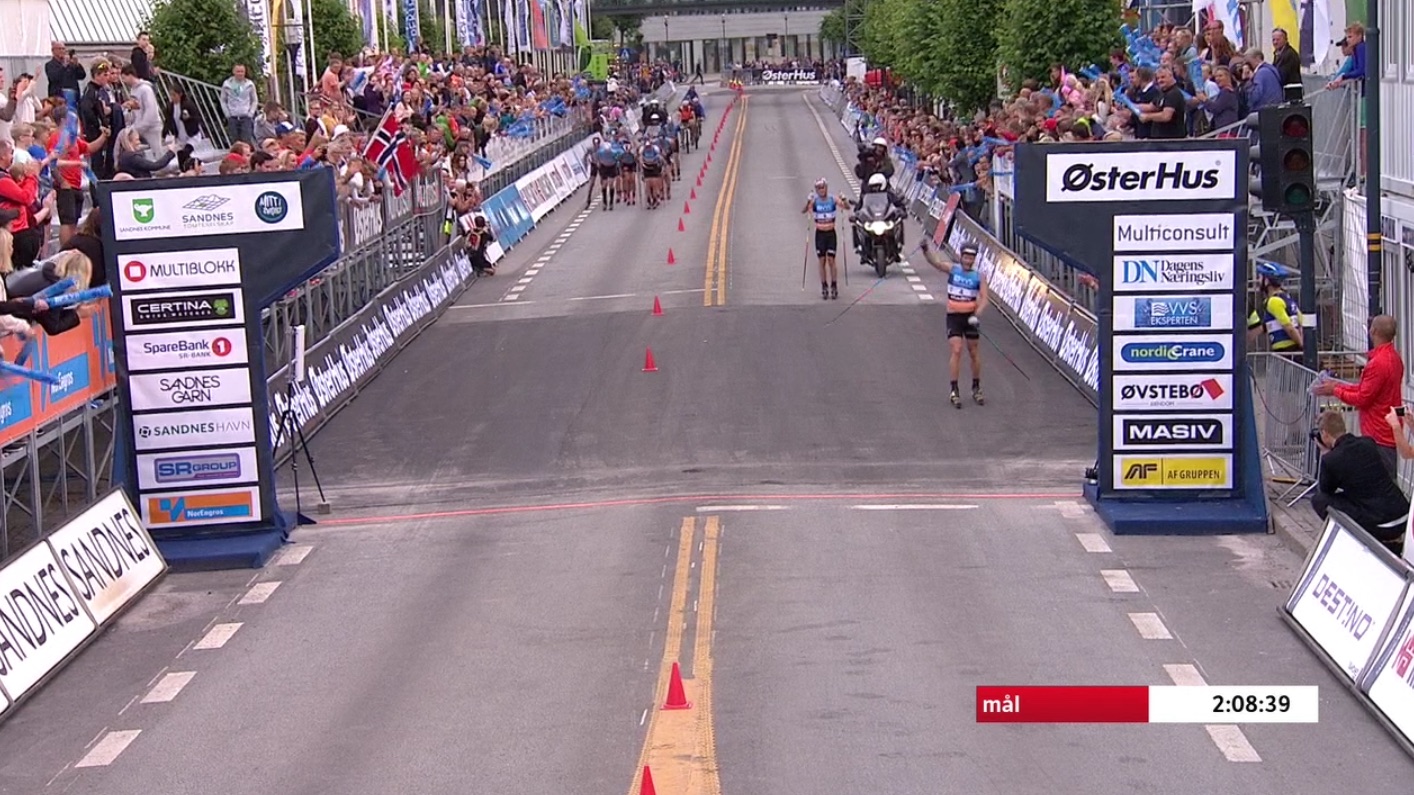
Defending Overall World Cup champion Martin Johnsrud Sundby won the first race of the 2017 Blink Ski Festival on Wednesday, finishing 2.6 seconds ahead of fellow Norwegian Simen Hegstad Krüger in the Blink Classics 60 k distance rollerski. (Photo: NRK screenshot)
Stands crowded with 50,000 cheering spectators. Bibbed athletes clad in shorts and T-shirts clicking by on rollerskis. Competitors representing various countries dousing themselves with bottled water as they cross the finish line.
These were among the sights and sounds of the world’s largest summer rollerski-race series, Norway’s Blink Ski Festival.
Celebrating its ninth year, racers and fans kicked off the 2017 four-day festival in Gjesdal and Sandnes, Norway, with men’s and women’s classic distance rollerski races on Wednesday.
Toeing the start line for the elite men’s 60-kilometer were well-known Norwegian World Cup racers, such as Martin Johnsrud Sundby, Petter Northug and Sjur Røthe, as well as Russia’s Sergey Ustiugov, Finland’s Iivo Niskanen, Germany’s Lucas Bögl, and American Andy Newell.
In the beginning, it appeared Ustiugov was gunning for the lead, charging the group of 58 rollerskiers with 46 k to go. But within another 9 k, a pack of six had broke off the front, including Sundby, Røthe, Niskanen, and Norwegians Øystein Pettersen, Simen Hegstad Krüger, Anders Aukland, and Simen Håkon Østensen. Ustiugov was now in the chase group close to 45 seconds away.
With less than 30 k of road left to race, the front group had dwindled to three Norwegians and a Finn: Sundby, Røthe, Krüger, and Niskanen. Newell had caught up to the chasing group, now almost two minutes back from the leaders.
Given 20 more kilometers, however, Sundby and Krüger had pulled away, Niskanen working to hold onto third 30 seconds back. The two Norwegians battled together until the final kilometer, when Sundby surged for the final city sprint to secure the victory in a time of 2:08:40.6.
Though some may see the win as a premature predictor of what’s to come this winter, Sundby was not one of them.
“We are talking about July. Everyone pretends like they don’t care, but this is important for everyone who is on the starting line,” Sundby told NRK, according to a translation. “There weren’t a lot of world-class athletes who was not on the starting line today.
“This is incredibly good practice,” he continued. “I greatly appreciate all of these competitions.”
Just 2.6 seconds behind Sundby, was Krüger crossing in second. Third went to Niskanen, who finished 36.7 seconds back from the winner.
Just 1.8 seconds outside of the top 15 was Newell in 16th overall (+5:25.1) in the elite men’s race, out of 58 finishers.
In the elite women’s 60 k, which started at the same time as the men, Norway’s Astrid Øyre Slind latched onto a few male racers from the start and broke away from her competition, which included just 10 women.
Slind took the win in a time of 2:20:04.2, while fellow Norwegian Kari Vikhagen Gjeitnes claimed second, 2:11.1 minutes back. Belarus’s Yulia Tikhonova completed the women’s podium in third (+2:23.4).
Racing continued Thursday with the men’s and women’s hill climb, the Lysebotn Opp, in Lysebotn, Norway. Sixty-five women came out for that race, with Sweden’s Charlotte Kalla taking the victory in 33:18.3. Norway’s Heidi Weng finished 40.3 seconds back in second, and Marit Bjørgen wearing bib 1 finished third, 1:50.5 minutes behind Kalla.
Liz Stephen of the U.S. Ski Team took sixth (+3:35.7) behind Norway’s Ragnhild Haga (+2:43.4) in fourth and Finland’s Krista Pärmäkoski in fifth (+2:47).
In the men’s race, Norway’s Hans Christer Holund took the win in 27:37.6. Krüger repeated in second place, 1:13.9 minutes back, and Finland’s Matti Heikkinen placed third (+1:25.6), while Sundby was sixth (+2:11.5) behind fellow Norwegians Henrik L’Abée-Lund in fourth and Røthe in fifth.
Out of 100 male starters, 99 finished. Newell did not compete.
Check back Friday for a more detailed recap of Thursday’s Lysebotn Opp.
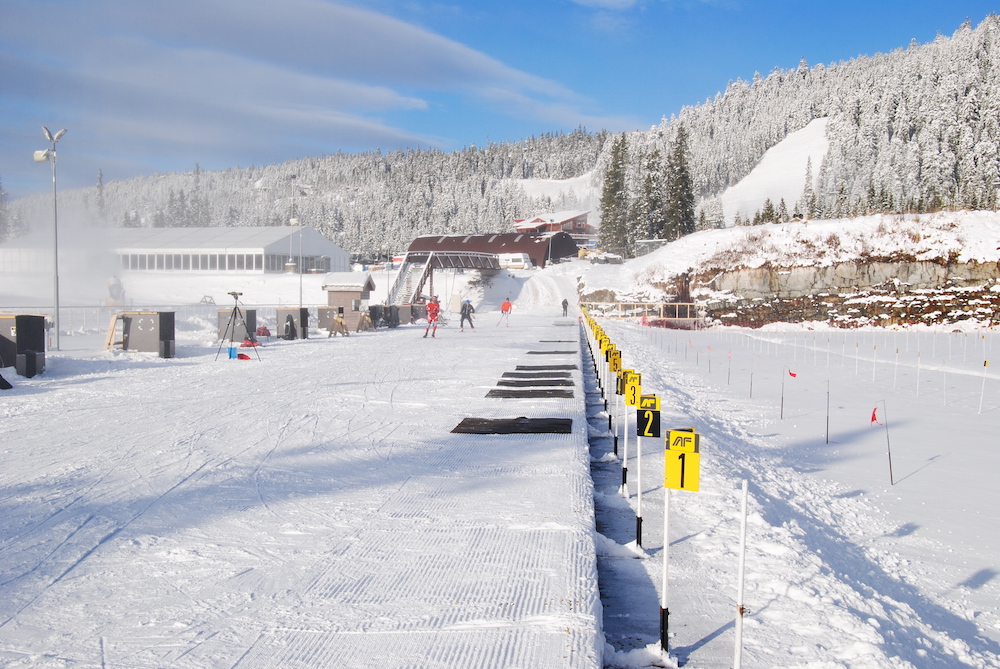
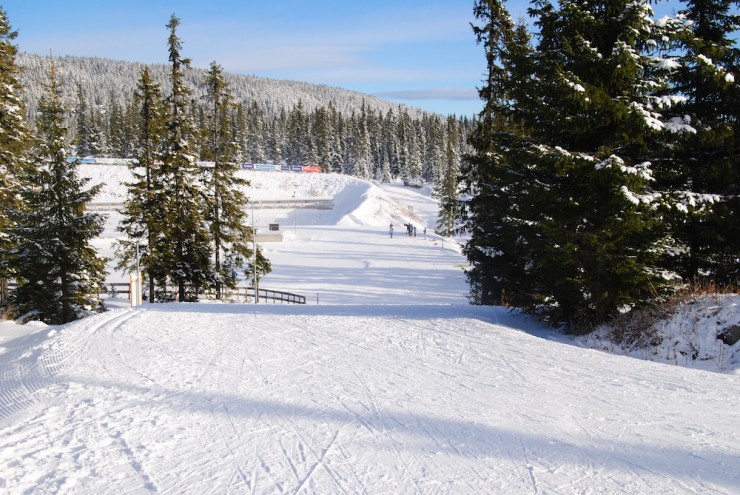
Sjusjøen’s shooting range as seen from a bridge in front of the VIP/media tent on Nov. 2 in Norway. Sjusjøen is hosting the season-opening biathlon races on Nov. 12-13. (All photos: Aleks Tangen)
SJUSJØEN, Norway — Talk about early snow: Sjusjøen, a Norwegian ski destination just 20 kilometers outside Lillehammer, has offered a one-kilometer loop since Oct. 1 for biathletes and cross-country skiers of all levels.
Over the last month, the loop has grown to several kilometers as winter arrives in Norway. The area had a substantial snowstorm last weekend, with more than 12 centimeters of standing depth.
“It’s to give people a chance to ski. It’s an ‘offer’ this destination provides and it helps us maintain full-time positions, which is positive for the region and people that want to ski have a chance to do so,” Johannes Håukåssven, the head groomer in Sjusjøen, explained in a recent phone interview. “It also lengthens the season for Sjusjøen as a ski and tourist destination. For example, fifteen years ago, there were no tourists here before Christmas.”
Looking down Sjusjøen’s race course, which will be used for this weekend’s season-opening biathlon races. The competitive course goes off to the right.
The early snow loop is financed primarily by Ring Alm, a locally based manufacturer of wood-based products.
Håkåssveen works on the loop from 6 in the morning until late at night. Many days during the season, he starts working on the tracks at 5 a.m., and some times even earlier.
“They have been salted nearly every day, but we stopped doing it the week of Oct. 17-23 when the temperature at night began to stabilize below zero [Celsius],” Håkåssveen explained. “We work hard to maintain a clean set of tracks with no gravel of any kind. We also have some snow stored, but most of it comes from snow canons.”
While the tracks support tourists as well as elite skiers from around the world (the U.S. team trained there for a pre-World Cup camp last season, for example), they are a primarily local resource.
Therefore, organizers take special care to preserve the boreal landscape that makes Sjusjøen a favorite ski destination.
“The environment is really considered,” Håkåssveen said. “We know that 60 to 70 percent of our potential users live in the surrounding area, and the short drive to Sjusjøen is far better than a long flight to, for example, the Alps. We also don’t use any chemicals and all of the electricity we use comes from hydroelectric power. Some trees will be removed, but this is far from substantial.”
Athletes from all over Norway come to Sjusjøen in order to ski the loop. Håukåssven says it has been quite popular among both professionals and recreational users.
“Biathletes such as Ole Einar Bjørndalen and cross-country skiers Heidi Weng and Øystein Pettersen have used the tracks,” Håukåssven said. “There are also many local athletes, in addition to biathletes from Ukraine and Latvia, that have tested the tracks. And they seem happy about the conditions.”
The venue also hosts season-opening biathlon races attended by not only Norwegian, but also other international athletes. Those competitions are slated for Nov. 11-13 this year, with men’s and women’s sprints and mass starts this weekend. In 2015, biathletes came from Germany, Ukraine, Italy, Finland, France, and the U.S. to start their race seasons in Sjusjøen.
The shooting range in Sjusjøen, Norway, as seen on Nov. 2. (Photo: Aleks Tangen)
“The event is continuously developing,” Norwegian Biathlon Association President Erlend Slokvik said of the season-opening races. “This year there will be a tent overlooking the shooting range for the audience. There will also be many invited guests from the eastern part of the country, people from politics, business and sports administration. What we’re experiencing is that people see the season opener as a fine place to witness great performances and to socialize.”
In an effort to attract spectators, the organizing committee is offering free transportation to the races from Lillehammer and nearby Moelv.
As of Thursday, there were nearly 400 athletes entered in various competition categories. Some teams use the opportunity to make roster selections for the World Cup, which adds excitement.
“It is perhaps a little too early in the season for the athletes to perform at their best level, but with the fresh snowfall, that’s being well maintained we are looking at some good conditions and potentially fast times,” Slokvik said. “I don’t think the artificial snow will have an effect on the performance, loose snow might favor the lighter athletes, but it doesn’t seem like that will happen.”
— Chelsea Little contributed reporting
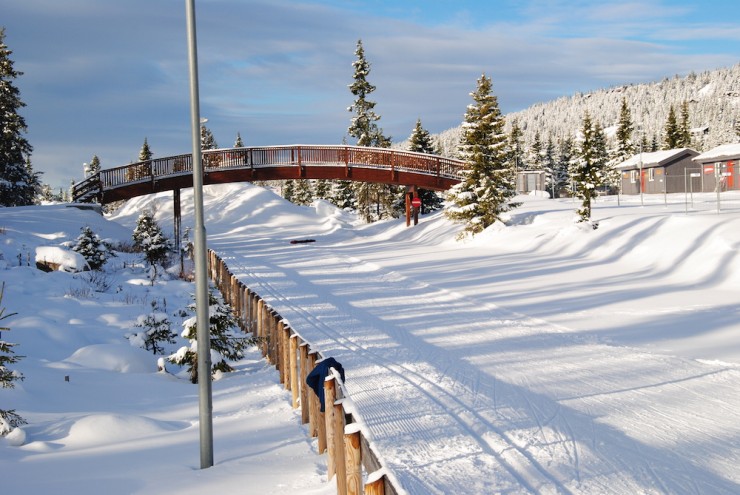
Just beyond the bridge is the start.
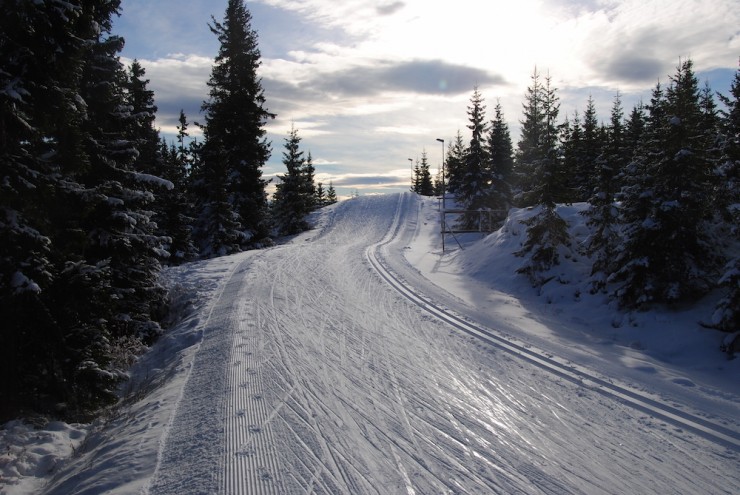
First hill after shooting.
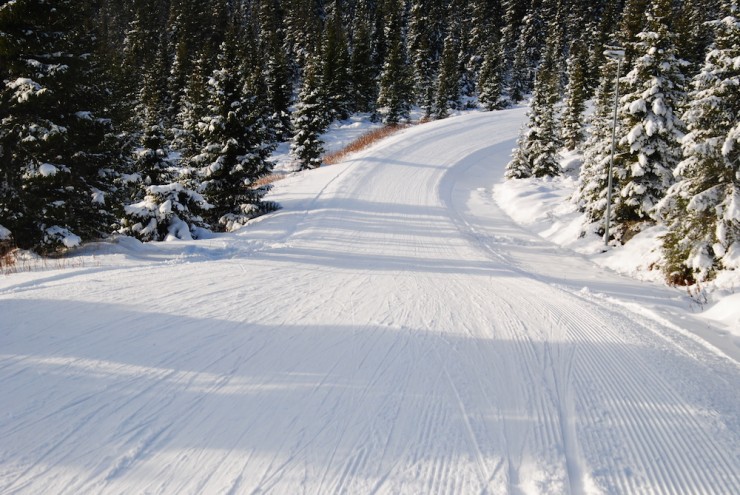
The Sjusjøen course offers a variety of challenges, this is near the middle.
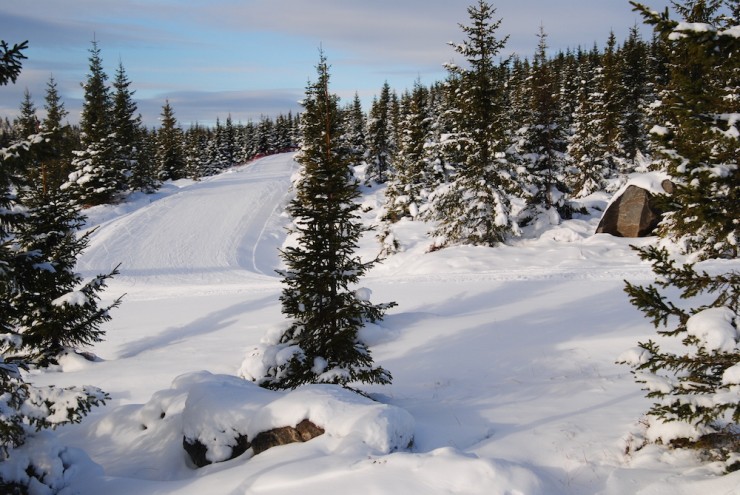
The toughest climb on the course, close to 200 meters long, and near the end of the loop.
On top of the hill seen in previous photo, after the turn comes a short climb before racers enter the stadium.
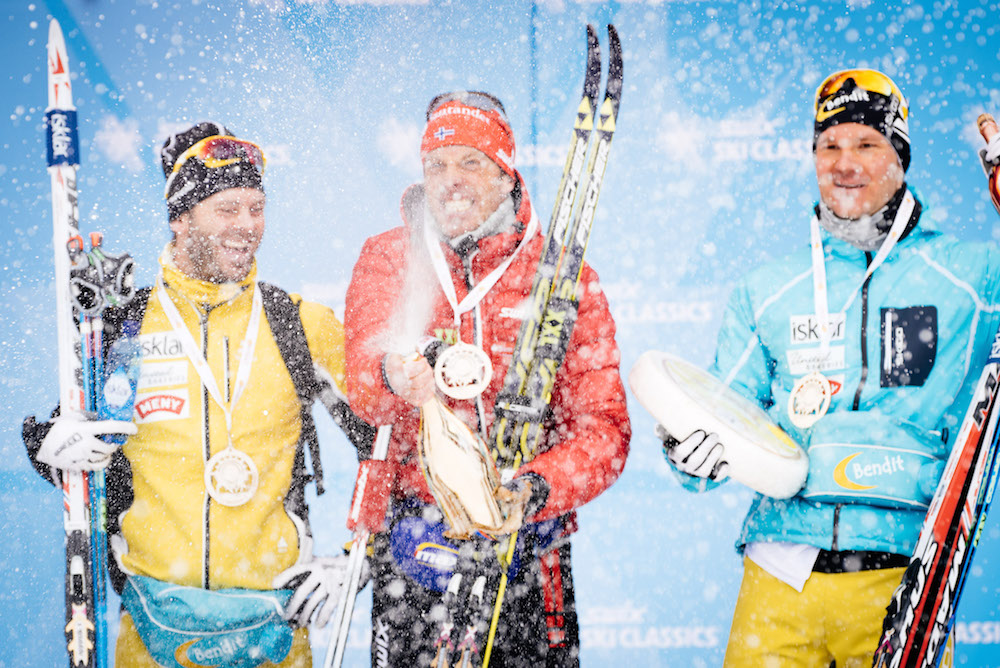
Øystein Pettersen (right) of Team United Bakeries after placing third in the 2014 La Sgambeda Ski Classics race in Livigno, Italy, behind Team Santander’s Anders Aukland (c) and Team United Bakeries teammate Johan Kjølstad (l). (Photo: Ski Classics)
Norwegian cross-country skier Øystein Pettersen posted the following essay on his Facebook page last week. He felt a need to respond to discussion about doping (or not) by the Norwegian national ski team after the cases of Therese Johaug and Martin Johnsrud Sundby. With his permission, we are posting an English translation for the North American ski community.
“I am glad that some are interested in the truth and not only speculation,” Pettersen wrote in an email to FasterSkier. “I have nothing to hide and am more than willing to answer any questions.”
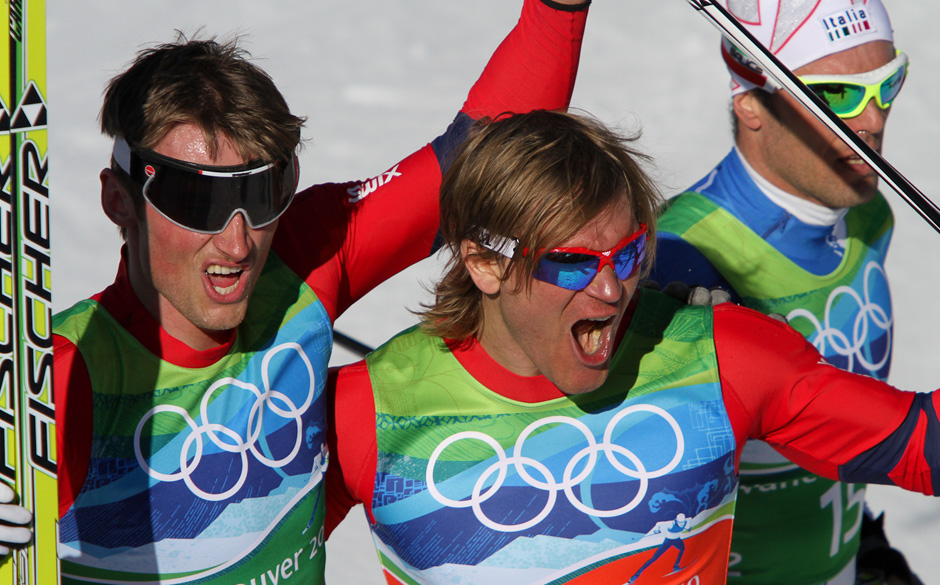
Pettersen, age 33, is currently a member of the newly-formed BN Bank Ski Classics team. Nicknamed “The Sausage” (“Pølsa”), he previously represented Team United Bakeries, won the 2015 La Diagonala and finished third in the Marcialonga. Before that, he was a member of the Norwegian national team, where he accumulated six World Cup sprint podiums and won Olympic gold with Petter Northug in the 2010 team sprint in Vancouver, British Columbia. Despite being Norwegian, he says that his favorite Ski Classics event is Sweden’s Vasaloppet.
***
“There is a wind blowing in Norwegian cross-country skiing.
It blows on many fronts and it is equally sad as it is self-inflicted. I will not say anything about the cases in question, for the simple reason that I have no idea what has happened. I won’t comment on anything about the handling of cases. It is not my responsibility, and the last thing this debate needs is yet another expression of opinion without enough knowledge. But I feel it’s appropriate to talk about how I experienced my time in Norwegian Ski Federation (NSF) and how my practice was around these doping regulations.
Short backstory, I have been skier my entire adult life. Never been the world’s best, perhaps never will be. Eight years in the national team at senior level, and been on a number of other teams out there.
Petter Northug (l) and Øystein Pettersen celebrate their gold medal in the 2010 Olympic team sprint.
In today’s VG I was interviewed and yes, it’s true that what happened Therese could have happened to me. Call it naive, call it irresponsible, call it whatever you want, but I never checked anything I got from the doctor during my time on the national team.
The reason for this? As long as I have known it, the culture of cross-country Norway has always been founded on hard and honest work. Doping and bending the rules have never been accepted. For this simple — but also strong — reason, I never had any reason to believe that I would ever be breaking doping regulations by taking something I got from my NSF doctor. I salute the support I received from the federation. They worked like crazy for me to have the best possible conditions to be able to reach my sporting goals.
Doping was never even an issue. It was never a case of bending the rules or trying to take advantage of regulations. If I was sick and needed antibiotics, it was never in my mind that I would get something that was not allowed. The same was true, for example, with anti-inflammatory agents I might need for overuse injuries. Or asthma medicine for that matter. (Ed note: Pettersen has taken asthma medication since he was a child.)
Call it blunt, call it naive, call it irresponsible of me, call it what you will. I look at it as trust, respect, and I never had any reason to doubt.
The consequences for Johaug sadly have become catastrophic from a simple human error. I will not judge anyone, speculate or place blame. I’m just saying that if my doctor had made the same mistake, I also would been caught in the same trap.
NSF’s support is fantastic. My experiences were so positive that I became lazy. It is perhaps the only objection against the system. In my case, it led to the situation I never made extra checks.
I do not know if this was only the case for me. Maybe I’m the laziest of everyone, but it gets to my second comment.
What I know is that as I write this, I am dealing with an inflammation in my heel. In connection with this injury, I was prescribed an anti-inflammatory agent by a sports physician here in Lillehammer. He knows who I am and what I stand for, I know the same about him. I did not check if there was anything frightening in the package he gave me. Had the Johaug case not come up, I probably wouldn’t have even considered it either.
This case is a “wake up call” for all athletes to take responsibility for what we use.
When I look at NRK and see that 24 percent of you (the Norwegian public) think Norwegian cross-country skiers are doping, it makes me sad. But I can understand that you doubt in light of recent events. Therefore, I am very interested in being open. Is there anything you or the media are wondering about around my training, my use of medication, my routines involving ski racing? Do not hesitate to contact us.
There are sides of Norwegian cross-country skiing that are not so positive. Eating disorders, overtraining, stress, pressure, the equipment arms race and much more. But doping, this is not part of the Norwegian cross-country sport. If it is, I am the most naive, blue-eyed soul and I will retire from the sport immediately.
Now I’m going out to train. I love the cross-country skiing lifestyle and I love its development.
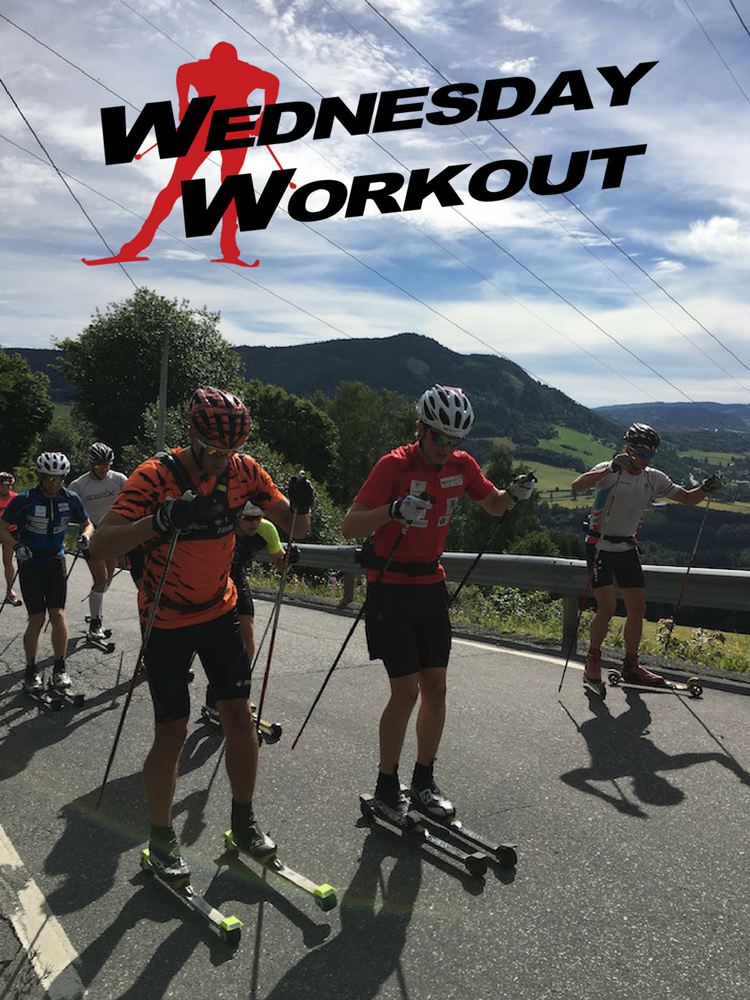
Norwegian pro skiers Petter Skinstad, Kjetil Dammen and Marten Skinstad rollerskiing last month outside Lillehammer, Norway. (Photo: Andy Newell)
Last month, Andy Newell of the U.S. Ski Team traveled to Norway to train with several Norwegian skiers. Why, you might wonder? Why not?
“I chose to travel to Norway to train with some friends in Lillehammer for a few main reasons,” Newell explained in a recent email. “First — to learn a little about how a lot of these guys are training for double pole and second, just to have a cool new change of venue to put in some of the big volume hours I was training for those two weeks.”
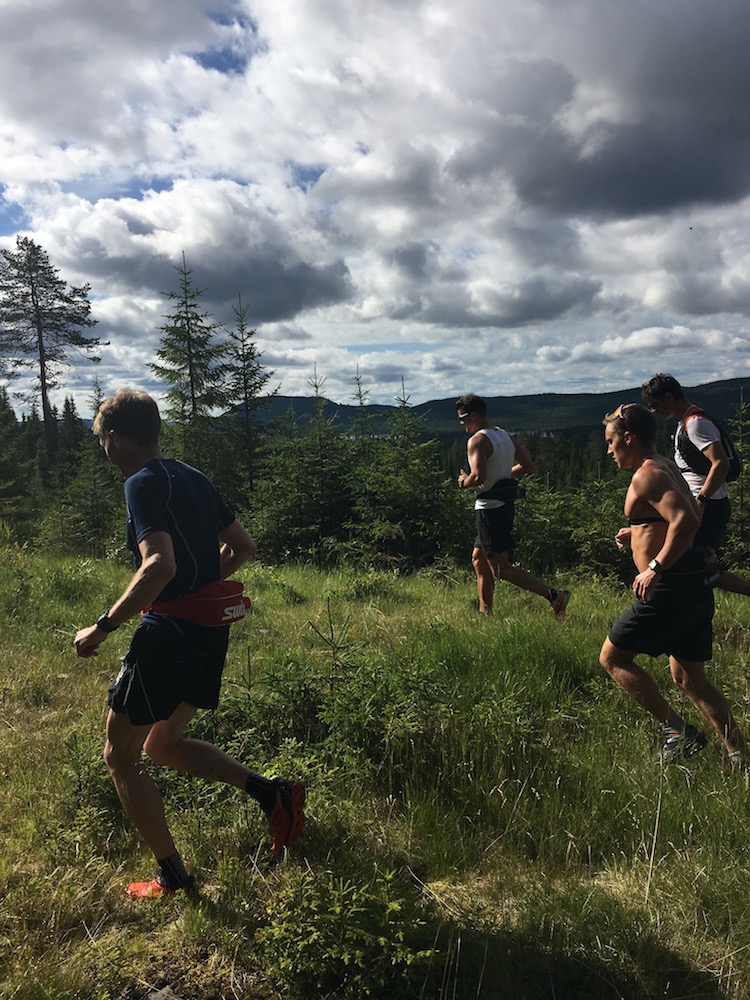
Norwegians Erik Stange and Rune Ødegård, Finland’s Heikki Korpela, and Great Britain’s Andrew Young running on the Birkenbiner ski trails in Norway in July. (Photo: Andy Newell)
Lillehammer, a popular training base among World Cup skiers and the new home to his friend Øystein Pettersen, seemed like a perfect fit.
“There wasn’t any real official training camp with a specific team that I was joining which made it kind of fun so I basically just got in touch with a lot of guys who lived in the area and lined up a big training schedule for two weeks,” Newell wrote.
He stayed with Petter Skinstad, a professional Norwegian skier and the son of Åge Skinstad, head of the Norwegian Ski Federation’s cross-country division.
“It was great to meet [Petter Skinstad] and his brother and do some training with them and learn a little more about the Norwegian ski culture,” Newell wrote. “To set a picture for you, Petter’s god father is Bjorn Daehlie so he really grew up in the thick of it so you can imagine he has some cool stories.”
Without any single club or coaches overseeing their workouts, Newell explained that the Lillehammer group coordinated via Facebook by posting their planned workouts and aligning them as best they could.
“It was a great way to meet some new training partners and connect with a few folks I already knew from skiing over the years like Erik Stange and Rune [Ødegård],” he wrote.
He spent the first four days training with sprinters like Great Britain’s Andrew Young and Marius Caspersen Falla, the twin brother of Olympic champion Maiken Caspersen Falla. They did Level 4 intervals at a rollerski track at Lillehammer’s Olympic stadium, as well as a skate speed session, and logged several hours on the roads — mountainous roads that zig-zagged up big climbs and included fast descents.
To focus on his double poling, which Newell estimates is 60 percent of these Norwegian athletes’ training (the remaining 40 percent being classic striding, running and “a little bit of skating”), he joined Øystein Petterson for some hard double-pole sessions. Formerly of Team United Bakeries, Petterson recently started a new team called Team BN Bank with Morten Eide Pedersen, Simen Østensen, and Nils-Ingar “Nilsi” Aadne, a famous comedian and now a professional skier. Newell trained with Petterson and Pedersen, as well as Team LeasePlan Go’s Kjetil Hagtvedt Dammen for the better part of a week.
“We did everything from 3 hour+ double pole sessions to uphill double pole intervals. One slightly different workout we did was a 45 seconds on 15 seconds off continuous intervals at the rollerski track,” Newell wrote. “That was a really fun fast workout to do in a big group. it felt a lot like a distance race. In general I would say that those guys train very similarly to the way we do just with a much bigger focus on double pole to prepare for the Ski Classics [marathon series].”
The Workout: Continuous Double-Pole Intervals (Norway style)
You’ll Need: 5 k rollerski loop and ideally a group of 5-6 training partners
Ready: Warm up together, then start the intervals together
Set: 45 seconds on (pushing hard, exchanging leads at the front) followed by 15 seconds recovery (ski easy and “make sure anyone who fell off the pace and re-group before starting to hammer again,” Newell explains)
Go: Repeat intervals continuously for 30 minutes. “It’s a lot like a mass start distance race, that builds in intensity until we are basically going all out by the end.”
While in Norway, Newell tried to do as the Norwegians do, honing in on double poling — a technique that’s having a big impact on classic World Cup races — while also logging some big hours. At the same time, he added in “a little more skating compared to some of the pure double pole guys,” he wrote. “I think everyone in the skiing world is continuing to learn how to train to be the best double polers. It’s clear that you have to double pole a lot to be strong enough for the races, but at the same time having a wide range of training modes… especially all body exercises, is the best way to get fit.”
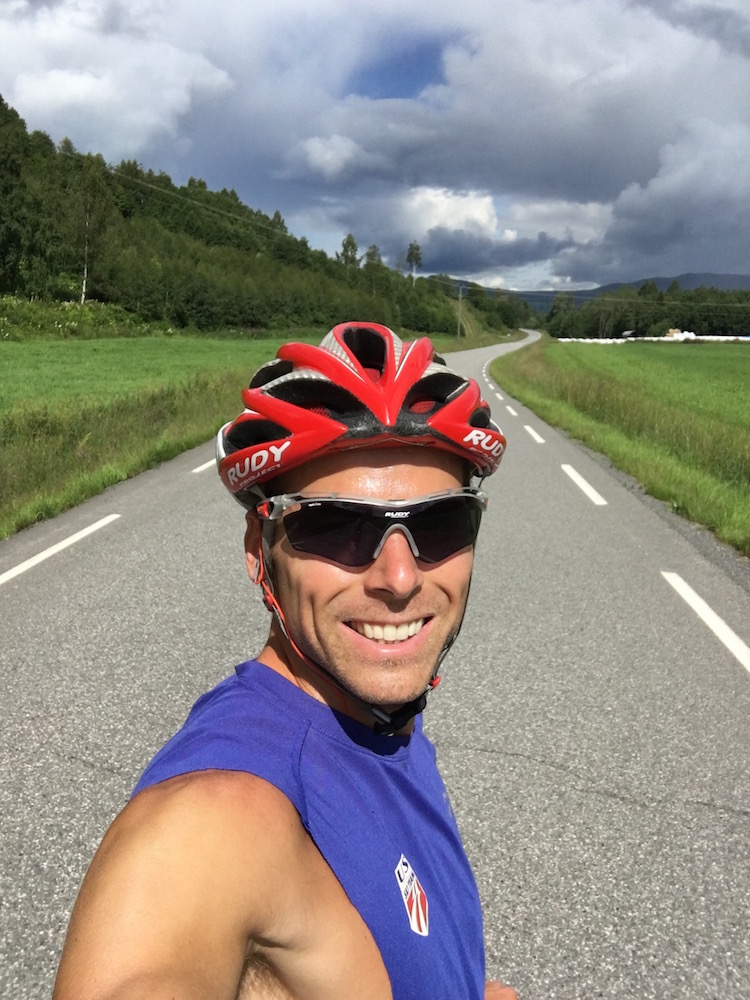
Andy Newell is all smiles on a rollerski in Norway. He enjoyed some “sweet roller skiing pavement” leading up to Nordseter, not far from Sjusjøen, Norway. (Courtesy photo)
While Newell explained that he’s certainly upped his amount of double-pole training this year, he’s also trying to improve his skating to achieve his all-around goals on the World Cup.
Looking back, he reflected that the skiing culture in Norway — in the heart of summer — was one of the best parts of his trip.
“You could go out roller skiing and see at least 2 or 3 other groups of good skiers out for a training session as well, and all the people driving tend to respect the roller skiers on the roads over there because it’s their national [pastime],” he wrote. “I think those two weeks were some of the most productive training I’ve ever had.”
“I was out skiing with the guys on my third or fourth to last day there and they were doing that thing when they started to speak a lot more Norwegian than normal,” Newell reflected. “Typically our training talk was in English. So I could tell something was up, and all I got was ‘tomorrow sh*t is going to hit the fan in Norway’ referring to Sundby and his doping ban. So I guess the word was already starting to spread through the skiing community and it was defiantly big news when the story broke.”
The news was all over Norwegian TV, and Sundby appeared on a multitude of televised interviews and press conferences.
“I would say that most of the skiers support him as would most teammates in an instance like that,” Newell said of the Norwegians he was with in Lillehammer. “If anything I’m sure they were worried about how it would reflect on the ski federation.”
A day or two later, all the chatter about Sundby faded.
“I don’t know if thats good or bad but that’s what you have to do if you are an athlete,” Newell said. “We are all the same in that regard. No need to worry about what others may or may not be doing, there are only so many hours in the day and focusing on your own training is what we have all learned to do over the years.”
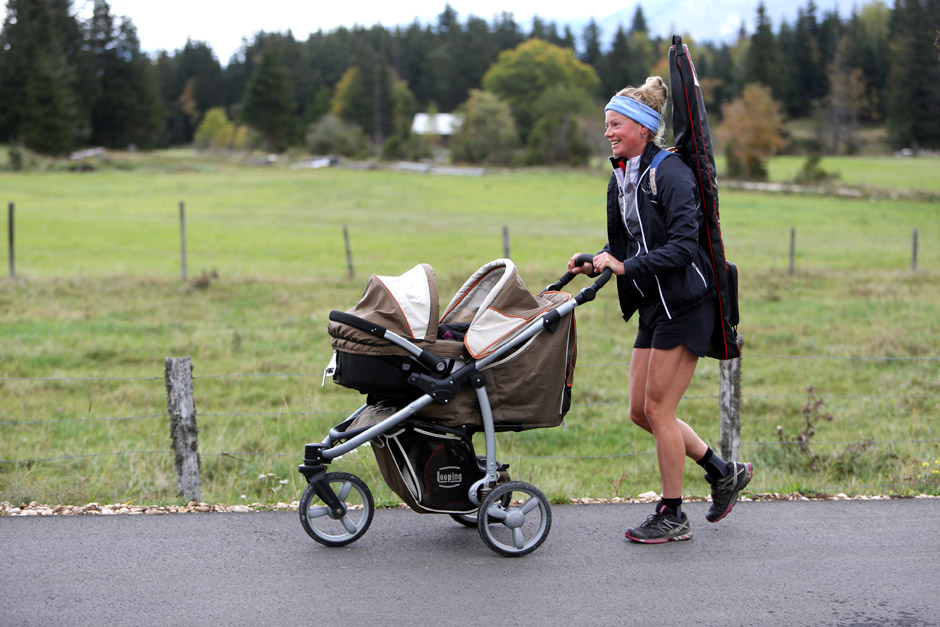
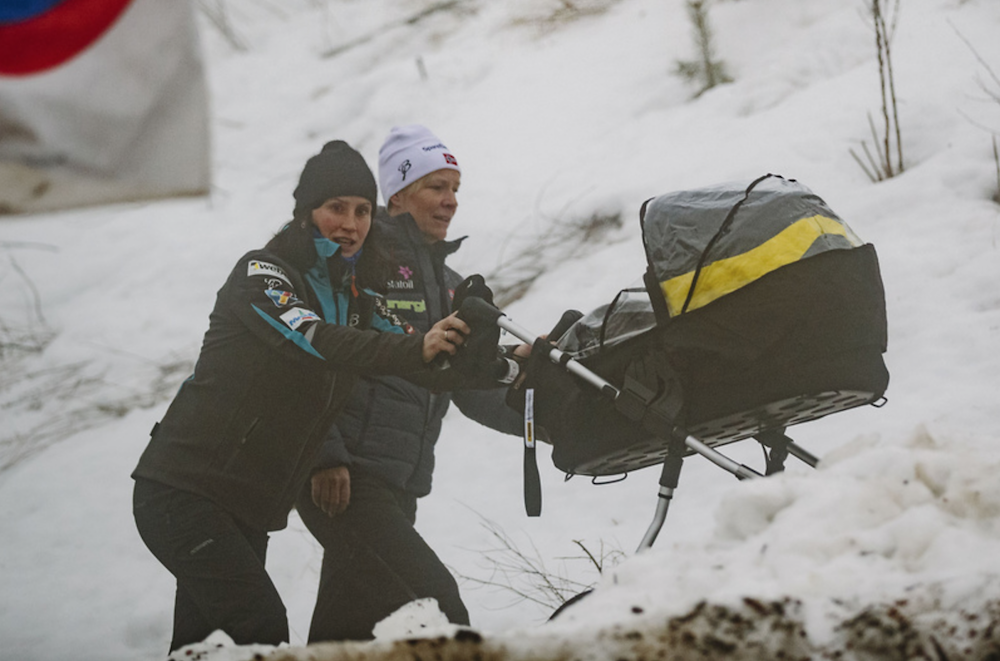
Marit Bjørgen of Norway (l) gets in some early season hill climbing with the stroller in preparation for the 2016 NYC Stroll-a-thon. (Photo: SportoweFakty)
Ready. Set. Stroll. When 7,000 contestants charging carriages hit the streets of New York City (NYC) this year at the 2016 NYC Stroll-a-thon, a few nordic names may find a new race niche that has nothing to do with snow. Especially if the U.S. Ski Team’s Kikkan Randall and Norway’s Marit Bjørgen steer a stroller the same way they ski.
After side-stepping the 2015/2016 World Cup season, Bjørgen and Randall will release nine months of curbed competitive edge at the debut marathon event — presented by the New York Road Runners organization — which promises competitors 26.2 miles of the steepest inclines and most tactical turns in stroller racing.
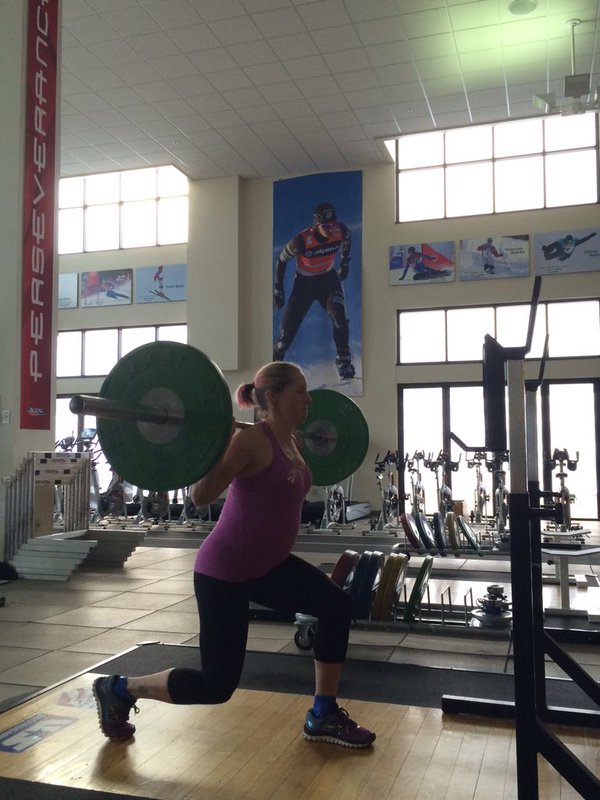
U.S. skier Kikkan Randall sets early season squats as preparation for the NYC Stroll-a-thon taking place this May. (Photo: Kikkan Randall/Twitter)
Open only to parents who can cover the course with their child in a carriage (*see more detailed rules and regulations below) the NYC Stroll-a-thon is scheduled to take place May 2, 2016 — though Randall admits her April due date will be cutting it close.
“I’m as strong as I’ve ever been,” Randall said in a phone interview.
“My main concern is switching to the spring training cycle, which for me includes a 50-percent increase in stroller hours and a sizable volume jump for Bean,” she explained, confirming recent rumors that she and husband Jeff Ellis have made the decision to name their child ‘El Bean’ — Bean for short — a decision primed by one of Randall’s sponsors, L.L. Bean, which offered to pay for the child’s college education if Randall and Ellis could find a way to christen the child after the company.
With a three-month head start of stroller steering on Randall, Bjørgen will no doubt prove a force to be reckoned with at this year’s NYC Stroll-a-thon.
But Bjørgen is not the only nordic skier who is well practiced in the art of carving the streets with their child and carriage.
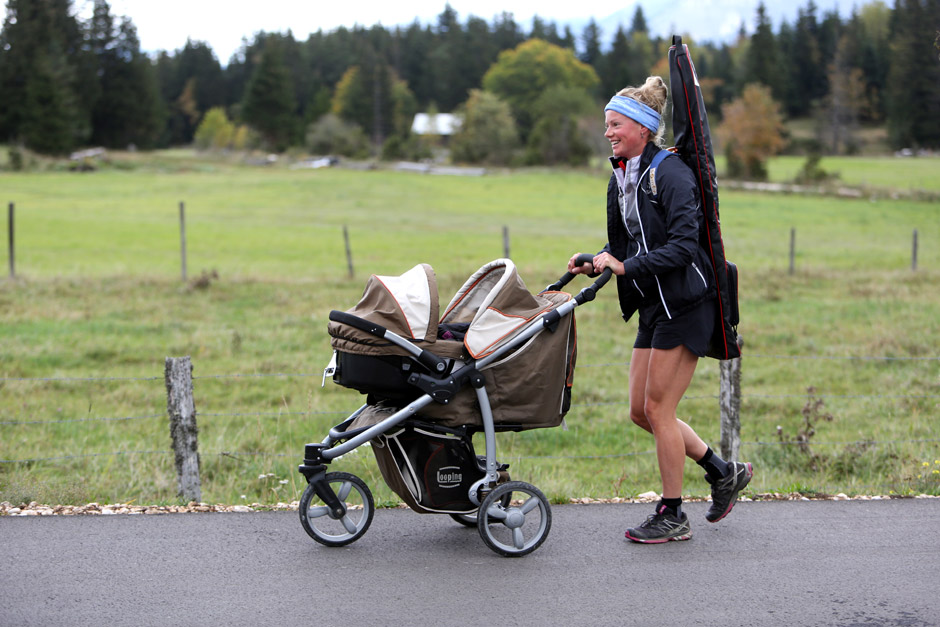
Norwegian nordic superstar, Øystein Pettersen, better known as “The Sausage,” has also confirmed his entry in the event. He and his son, who was born this July 2015, have spent much of this winter ski season meditating their moves for the marathon course.
“It will be tough challenge, for sure” Pettersen wrote on Twitter. “But baby boy and I are ready to bring the burn.”
Also competing in the event is French biathlete Marie Dorin Habert, coming off two individual gold medals at 2016 IBU World Championships, and the U.S. Paralympics Nordic Development Coach, BethAnn Chamberlain.
French biathlete Marie Dorin Habert getting training for the upcoming NYC Stroll-a-thon. (Photo: DauphieNordique)
Selecting the Right Stroller
The NYC Stroll-a-thon, which follows the same a point-to-point course for the NYC running marathon, tests racer’s stamina and steering skills, making savvy stroller selection critical for participants looking to win.
Bjørgen will sport the lightweight Kolcraft Cloud 2015 stroller, which features an adjustable canopy, shock absorbing front swivel wheels, and foam padded handles. Weighing in at only 11.4 pounds and earning an average rating of 4.3 stars, this model remains one of the best hill climbers in the industry.
However, the Cloud’s strongest selling point is also its weakness. Without much weight in the front, the Cloud makes wieldy turns, which heightens the chance of blowing a crucial course curve.
Yet, Bjørgen finds herself more well-suited for technical steering, preferring to gamble with race technique tactics than lost time on an incline.
Randall will run Bjørgen’s rival carriage, the BOB Sport Utility Stroller. The fixed front wheel and treaded tires necessitate more aggressive driving, but Randall prefers the stroller stability and top of the line suspension system for Bean.
Pettersen on the other hand will opt for the industry’s heaviest hitter, the ŠKODA stroller, an ATV-style stroller designed by a Czech automotive company. At two meters tall with complete high suspension and brake systems, it’s no surprise Pettersen will choose ŠKODA.
*Rules, Regulations and Registration:
A few of the most unique rules that apply to the 2016 NYC Stroll-a-thon are summarized below.
Children must be legitimate: competitors may not enter carriages carrying children that are not their own.
Contestant’s child must be in good health upon crossing the finish line; vitals will be checked.
Weight added to the stroller in order to enhance downhill speed is not permitted.
To register or learn more about the 2016 NYC Stroll-a-thon, click here
FasterSkier editor Alex Kochon is signed up for the inaugural event but she isn’t expecting to contend with the elites. “My 10-month-old puts me at a severe weight disadvantage, especially on the uphills,” Kochon said. “I love the little guy and all, but we can’t compete with those newborns.”
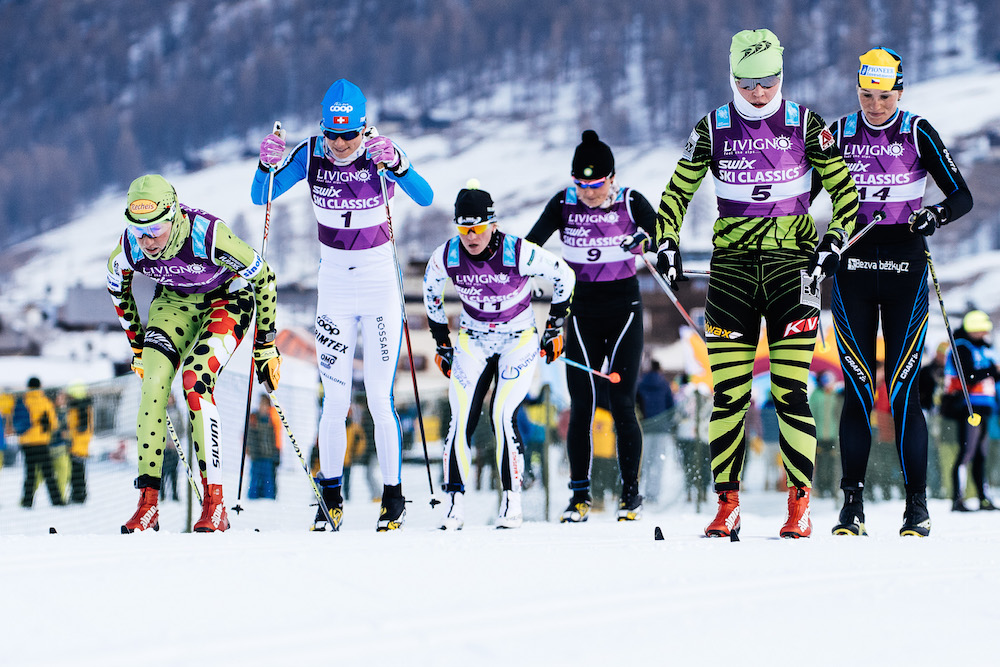
Last year’s Team Tempo Prologue in Livigno, Italy, which Team Coop (in bib 1) won. This year, the team prologue will again open the Ski Classics series in Livigno on Saturday, followed by the shortened La Sgambeda classic race on Sunday. (Photo: Visma Ski Classics)
The 2016 Ski Classics kicks off with a doubleheader in Italy on Saturday and Sunday, and the marathon regulars are chomping at the bit to get started with the long-distance race series.
The 15-kilometer Proteam Prologue in Livigno, Italy, on Saturday opens the show for the marathon series, now called the Visma Ski Classics (with a new title sponsor in place of Swix), which has been extended to nine venues this season.
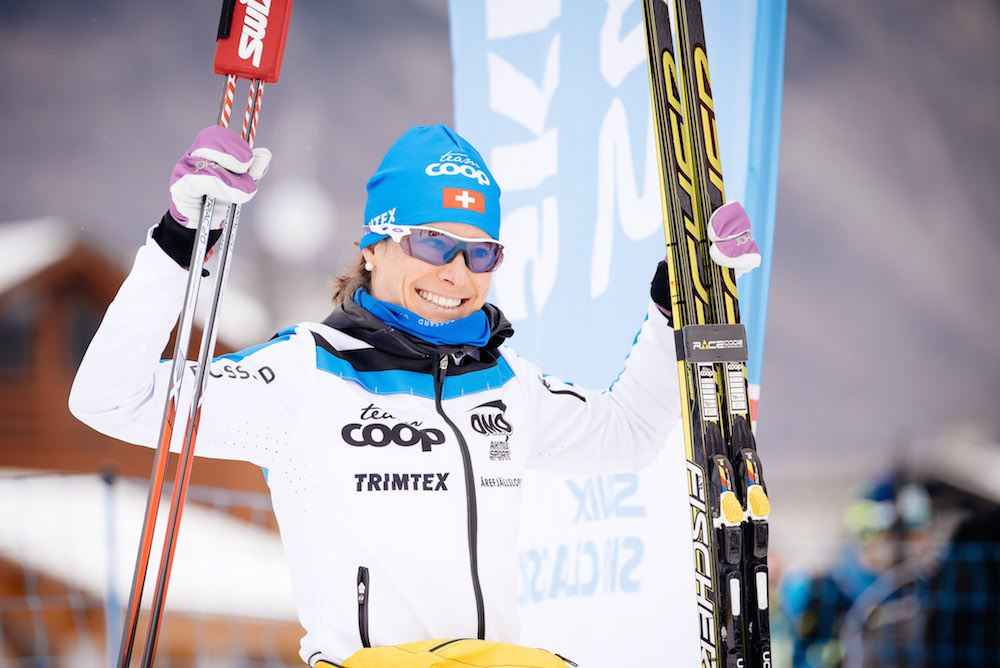
Seraina Boner of Team Coop (now called Team Exspirit) after winning the 2014 La Sgambeda in Italy last season. (Photo: Ski Classics)
On the women’s side, last season’s Ski Classics champion Katerina Smutna of the Czech Republic will be on the start line for the first races this weekend, but she will face plenty of competition. Team Exspirit’s Seraina Boner of Switzerland is eager to take back the overall title, which she has earned three times (2011, 2013 and 2014), beginning with La Sgambeda.
Poland’s World Cup star and the queen of the FIS Tour de Ski, Justyna Kowalczyk, will be doing several of the Ski Classics long-distance events this season with the Norwegian Team Santander headed by the Aukland brothers. And Britta Johansson Norgren of Sweden, who was on the podium at several of the Ski Classics events last season, is one to keep an eye on. Last season, she raced with the all women’s team Ski Pro Am, and this year she is a part of Sweden’s Lager 157 Ski Team, with teammates such as three-time Vasaloppet champion Jörgen Brink of Sweden.
Among the men, 2015 Ski Classics overall champion Petter Eliassen of Norway makes his season debut in Italy this weekend. He will have to fend off a large and deep field of competitors such as Norway’s 43-year-old marathon veteran Anders Aukland and his Santander teammates, including younger brother Jørgen Aukland, and former World Cup skiers Tord Asle Gjerdalen of Norway and Johan Olsson of Sweden.
Norwegian stayers such as Johan Kjölstad, Øystein Pettersen, Eldar Rønning, and John Kristian Dahl of Team United Bakeries, as well as Ski Classics veterans of Team Exspirit, including Daniel Richardsson, Anders Södergren and Jimmie Johnsson of Sweden and Norway’s Morten Eide Pedersen, will certainly do their best to make it a tough season opener from Day 1.
Two unique competitions in Livigno
The Prologue, in which the teams must field at least three racers to compete, was added last year, and is a team effort where the third person’s time determines the team result. The next day, on Sunday, the skiers embark on the first distance event, the now-24-kilometer classic technique La Sgambeda.
Team Santander’s Anders Aukland (c) after winning the 2014 La Sgambeda in Livigno, Italy. Johan Kjølstad (l) and Øystein Pettersen (r) both of Team United Bakeries, placed second and third, respectively. (Photo: Ski Classics)
Team Exspirit (previously known as Team Coop) won the prologue last year and is aiming to defend the title this year.
“We have had great preparations here in Livigno, skiing on the race course and acclimatizing to the high altitude,” team member Jimmie Johnsson said in a press release on Friday. “Of course, we’re aiming to defend our victory and we’re faster this season than ever before.”
Team Exspirit’s Seraina Boner won La Sgambeda last year after breaking away from the field on the hard climb at the turning point of the course. This year, the course is shortened to from 35 k to 24 k due to lack of snow and is also flatter. While Boner prefers more elevation gain, she was still optimistic before the race.
“The tougher course fits me better than the flatter one we have now,” she said. “But I will do my best, and I am really excited to finally start the long distance season together with my teammates.”
While the Team Prologue is only open to professional teams registered with the 2016 Ski Classics, La Sgambeda on Sunday is open to amateurs and pros alike.
Saturday’s Prologue will be held on the original course, but due to lack of snow in Livigno, the classic marathon on Sunday will be run on 6 k loops.
“Last season, seven of the nine Ski Classics events had to change their courses due to weather issues,” Ski Classics CEO David Nilsson in a press release earlier this week. “We can just cross our fingers that the political leaders at the environmental summit in Paris this week are able to make the right decision.”
For the 2016 season, there are 28 pro teams registered for the Ski Classics series.
After the season opener in Italy, the Ski Classics takes a break until the Jizerská Padesatka in Liberec, Czech Republic, on January 10, 2016. The race series concludes April 2 with Årefjällsloppet in Sweden as the season finale, as it has been for years. New this year is the Toblach/Dobbiaco Cortina, a 50 k classic race in Italy on Feb. 13.
Vasaloppet matters most
For Madshus racer John Kristian Dahl of Norway, who won the Vasaloppet two years ago, the 90 k race from Sälen to Mora in Sweden is the main goal for the 2016 season.
“It’s the longest and one of the oldest races in the circuit, and very special with the flats. That package makes it very unique, and difficult to win, too. In our world, it’s the championships in marathon skiing, and I’m happy that we have it every year,” Dahl said in an interview with Ski Classics earlier this fall.
Live streaming in English
In order for fans to follow the action live, Visma Ski Classics has launched the Live Streaming “Season Pass” available with English commentary on the app or the Tour Live Center at Visma skiclassics.com.
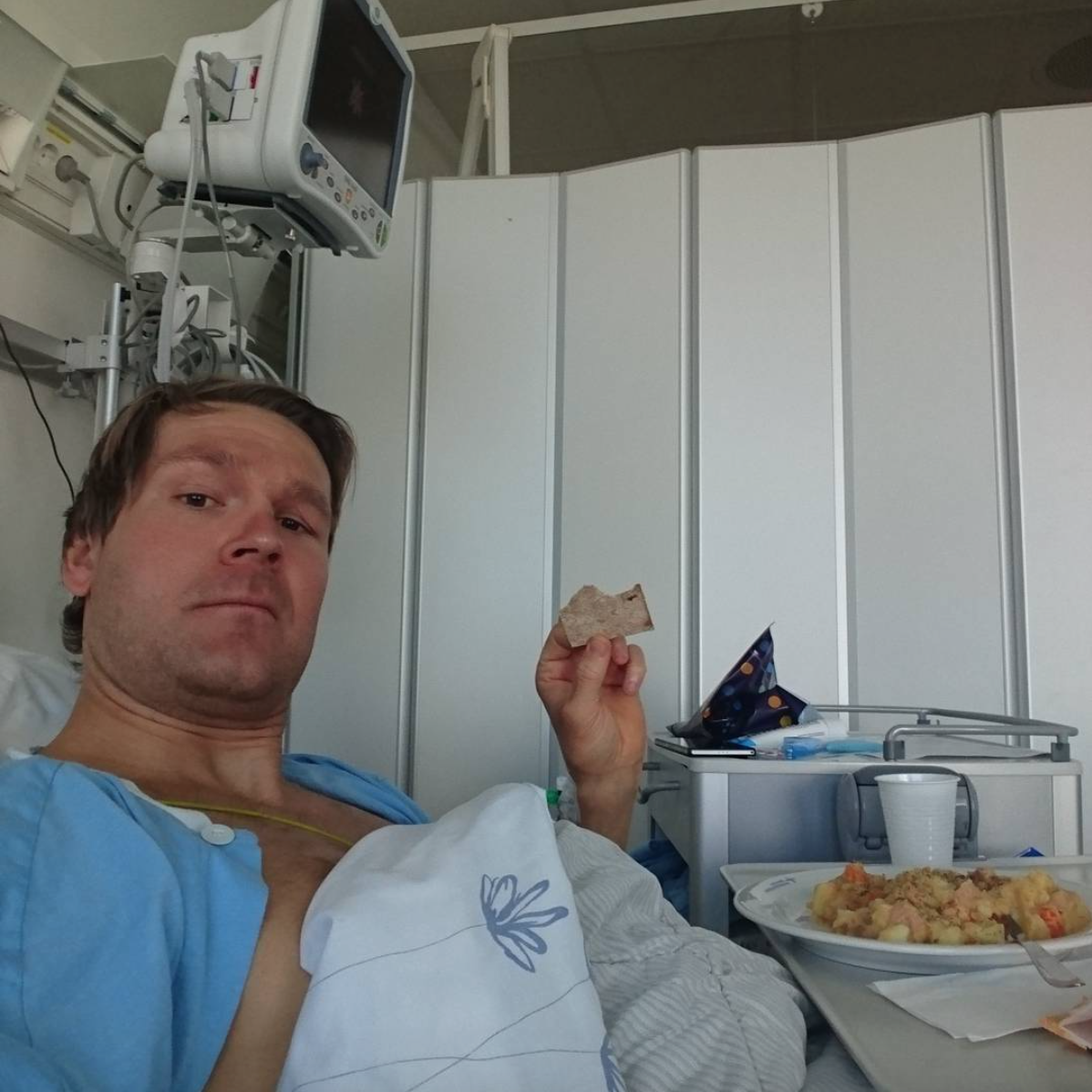
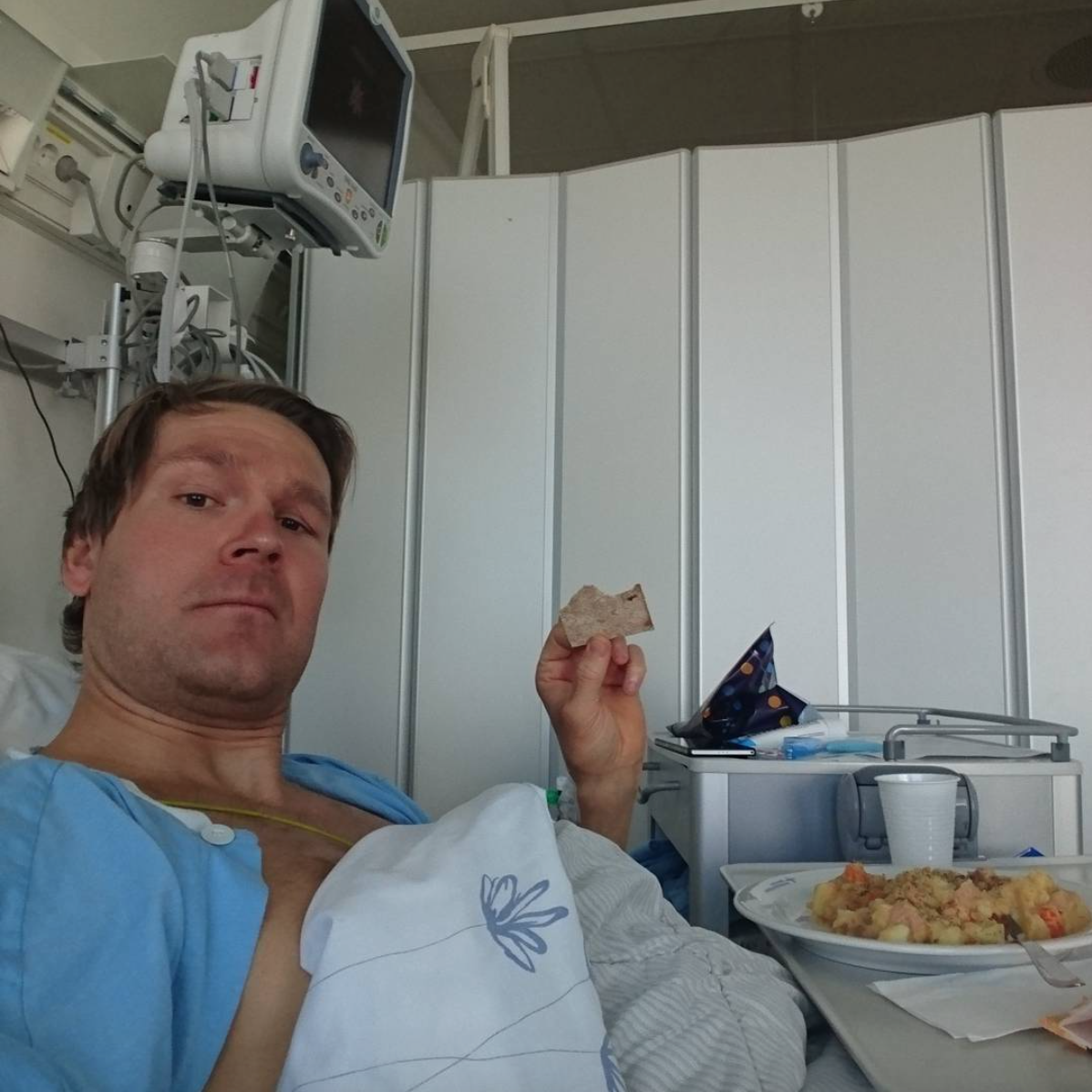
Norwegian sprinter-turned-distance skier Øystein Pettersen Instagramed a photo of himself in the Ahus hospital in Norway on Monday, showing his highlight of the day: stew and flatbread. (Photo: Øystein Pettersen/Instagram)
Øystein Pettersen went to the emergency room on Sunday night after feeling unbalanced following a training camp with Team United Bakeries. The 32-year-old Norwegian Olympian, nicknamed “The Sausage”, snapped a selfie of himself from the hospital bed and posted on Instagram, explaining that he had been admitted to Ahus outside Lillestrøm, Norway, with a low pulse and too much fluid retention.
“What’s wrong, we do not know, but since Friday the body has been out of balance,” Pettersen wrote, according to a rough translation.
Later on Monday, he joked in another post about his “absolute highlight” of the day: stew and flatbread. “Taking a bunch of tests and know not yet what is wrong,” he wrote.
He was in good spirits, he added, and was “delighted” that he had some time before his gastroscopy on Tuesday. He imagined the exam of his upper digestive track would reveal he ate stew.
Norway’s Øystein Pettersen in 2014. (Photo: FIS/NordicFocus)
“I will not be broken by an all-inclusive stay in the ER,” he added, quoting Norwegian celebrity Ramsey Suleiman, “ ‘If you are not living on the edge, you are taking up too much space.’ ”
According to Team United Bakeries manager Henrik Kvissel, Pettersen left camp in Mallorca, Spain, before the team (which returned to Norway on Monday), but not for any alarming reasons. His wife had been sick, Kvissel told Aftenposten, and while they were waiting on the results of his hospital tests, the manager speculated that the recent training load may have been too much for Pettersen.
“He is in good hands and we are all thinking of him,” Kvissel said.
Update: Pettersen Instagramed a photo of himself traveling home on Tuesday. “The body is still not in balance, but I am healthy,” he wrote. “Heart, kidneys, liver, blood, blood pressure, electrolytes and nutrients, all is well. Still have a lot of fluid [retention] and I must return to Ahus tomorrow for more tests. We believe that the body will [fix itself] through rest, good diet and through quality family 🙂
“When I can train again I do not know, the only thing I know is that I will use the time it takes,” he added. “In addition, I take lessons from the event, so that I can continue with cross-country skiing and development. For that I need a body that works…”
A 2010 Olympian who won gold with Petter Northug in the team sprint in Vancouver, Pettersen has traditionally been known as a sprinter. However, since joining the Team United Bakeries distance squad in the spring of 2014, he has become a favorite for certain marathons, including Sweden’s 90-kilometer Vasaloppet. He placed third in the 57 k Marcialonga in January, and fourth in last year’s Vasaloppet.
In late July, Pettersen and his wife, Ellen Sanbakken, announced the birth of their second child.
On Saturday, a day before he was hospitalized, he posted a photo on Instagram of him napping with his son.
“Our little baby can teach me a lot,” he wrote. “[For example] a baby sleeps when it is tired, no matter what time it is or what day it is. The body says it is tired so …. today I do the same…”
Øystein Pettersen with his son, who was born in July. (Photo: Øystein Pettersen/Instagram)
The super duel at Bysprinten in Mosjoen (NOR) on Saturday was entirely between Marit Bjørgen and Petter Northug. Bjørgen was given a five-second lead on Northug on the course through the city center.
Shortly into the first of the two laps, Northug had managed to close the gap and hung out comfortable on Bjørgens tails. He stayed there until the last turn, when he decided to pull off a surge and accelerate out of the curve to finish ahead.
Bjørgen answered the surge with an impressive tempo change, but Northug still managed to get ahead.
“He’s a coward. I couldn’t get him to pull,” Bjørgen concluded.
“Marit is actually better than me,” Northug admitted.
Swede wins the men’s sprint
While Northug won the “super-duel” with Bjørgen, the Sweden dominated the men’s sprint in Mosjoen. Northug didn’t deliver a particularly impressive qualifying time. He was eliminated from the A-final in the quarterfinals. In the B-final, Northug was among the last to cross the finish line. It is of course possible that he was saving his energy to win the “super-duel” with Bjørgen.
The men’s A-final was a thrilling battle between Teodor Peterson (SWE), Øystein Pettersen (NOR), Odd-Bjørn Hjelmeset (NOR) and Renato Pasini (ITA).
Pettersen was ahead from the start and was leading for a long way, but had to let go when Hjelmeset and Peterson surged. In the sharp corner right before the finish, Pettersen looked like he was onto a comeback and passed Hjelmeset, but was an inch short of Peterson. Pasini also managed to drop Hjelmeset on the finish line for third place.
Amazing Bjørgen
Among the women, it was all about Bjørgen. She won the quarterfinal, the semifinal and to finish. No games.
“Winning means a lot. It’s fun to be on the top of the podium. I’m glad I made it to Bysprinten in Mosjoen,” she said with a huge grin after the race.
Italian Gaia Vuerich was second and Mari Eide (NOR) was third.
Therese Johaug (NOR) and Dario Cologna (SUI) were also among the many stars on the start line in Mosjoen Saturday. Neither of them made it to the A-finals.
Results:
Women:
1. Marit Bjørgen, NOR
2. Gaia Vuerich, ITA
3. Mari Eide, NOR
Men
1. Teodor Peterson, SWE
2. Øystein Pettersen, NOR
3. Renato Pasini, ITA
4. Odd-Bjørn Hjelmeset, NOR
Super-duel
1. Petter Northug, NOR
2. Marit Bjørgen, NOR
From Langrenn.com, April 9, 2011. By Geir Nilsen, translation by Inge Scheve
Nordic skiing is the national pride and joy of the roughly 4.5 million people in this small, frigid country. To earn the title as the overall best nation, Norway’s skiers have to win at least four gold medals in Holmenkollen, preferably five just to be sure, which is 25 percent of the gold medals up for grabs. The sprint on Thursday represents the first opportunity, and if successful, that would be Norway’s 100th World Championship gold medal to date.
Currently on the World Cup, Norway is leading the nation’s cup for the women by more than 2,000 points (5,134 points) on Italy in second place (3,080 points), Sweden is in third place just over 200 points behind Italy (2,855). In the men’s standings, Russia is in first place (3,751 points), leading by about 250 points on Norway in second place (3,504 points), and Sweden breathing down their necks another 150 points behind (3,383 points).
Norway is fielding 33 athletes: 19 cross-country skiers, nine ski jumpers and five jumpers.
Women’s sprint: wide open
Norway’s team consists of four strong racers all capable of making the final on a good day: Astrid Uhrenholdt Jacobsen, Celine Brun-Lie, Maiken Caspersen Falla and Marit Bjoergen.
“The girls on the team are peaking, and with some tail wind and a good day, we could easily experience all four of them in the final. If that happens, it’s wide open. They’ll all fight fiercely for the medals,” said national team women’s sprint coach Jon Arne Schjetne.
“The women’s sprint is possibly one of the most undecided events. There are at least 13 to 15 racers on the circuit that could jump into the final,” Schjetne said, and looked over to the girls.
“I just realized I got really nervous,” Marit Bjoergen replied. “But I’m really excited and I know that there are a lot of really strong skiers out there. I’ll totally have to be on top of my game all day long,” she added.
“The Norwegian spectators are the best in the world. I hope they’ll be proud of me at the end of the day. I think this is just going to rock,” Bjoergen said.
Astrid Uhrenholdt Jacobsen (front) and Celine Brun-Lie are aware of the expectations that comes with home turf.
Homegrown talent
While Bjoergen might have the star sticker on her forehead, the sprint team consists of three other racers with proven track records. Two of them considers Holmenkollen their home course: Astrid Uhrenholdt Jacobsen and Celine Brun-Lie.
“I skied my first race in Holmenkollen when I was 10 years old. I’ve skied up and down and around these trails for many many years,” said Jacobsen. The humble blonde grew up 10 minutes from Holmenkollen, and has put more kilometers behind her on these courses than most.
“It will most definitely be a very special experience, but I won’t think about that when I’m racing. If I start recognizing people along the course while I race, I’ll lose my focus,” Jacobsen said, adding that she’s not sure the skate sprint is her best medal option.
“I don’t feel like I’ve managed to realize my potential in the skate sprint this season, but if I can perform as well as I do at practice, it might just pan out really well,” Jacobsen said.
Men’s sprint
The Norwegian men’s team, is a combination of proven World Cup winners in Anders Gloersen, Eirik Brandsdal and Øystein Pettersen, the reigning World Champion Ola Vigen Hattestad, as well as Petter Northug. But despite their track record and the home turf advantage, there are no guarantees.
“There are a lot of nations that are in it to win, and the margins are miniscule, particularly in sprint,” said Erik Røste, who is responsible for the Norwegian cross-country skiers and former national team coach.
Everyone has respect for the Swedes, and particularly Emil Joensson, the current World Cup sprint leader. Joensson has 430 points and leads the World Cup by almost 100 points over Ola Vigen Hattestad in second place (344 points). Alexei Petukhov (RUS) is in third place, with 277 points.
Everything for the crowds
“It’s so cool that we have three guys on the team who grew up here. That shows the development pipeline here is working, and I think being able to train together helps us elevate the level. Maybe it’s coincidence, but I think we’re doing something right,” said Gloersen, who regularly trains with Brandsdal and Pettersen outside of the national team camps.
Pettersen agreed, and he is eager to give the locals what they’re coming for: a huge party, a celebration of skiing.
“We’re still talking about the World Championships here in 1966 and in 1982, and the Olympics in 1952. I hope that in 20 years, we’ll tell stories from the Worlds in 2011. And I hope it will be remembered as the best World Championships in Norway ever,” Pettersen said, adding that it’s about time to retire Oddvar Braa and the broken pole story from 1982.
“I’ll do my best to give you the smoothest stories, whether I am racing in all five events or just one,” Pettersen concluded.
Cheering: Teacher Anita Flølo (center) and Firat Mercanoglu (center left) and his classmates represented Team Croatia at the opening ceremony in Oslo.
Inclusive
More than 50,000 spectators showed up to the opening ceremony downtown Oslo on Wednesday night. 1,800 elementary school children marched from the palace to the university square representing the 50 nations that are competing in the World Championships.
11-year-old Firat Mercanoglu from Oslo was one of the 30 students from Sagene Skole representing Croatia in the opening ceremony. His fifth grade teacher has spent the entire last week talking about the small Balcan country that borders to Italy.
“We learned how to draw their flag, and we’ve talked a lot about the country and learned a lot,” Mercanoglu said to FasterSkier right before heading to the opening ceremony.
As a thank-you for participating, Mercanoglu, his entire fifth-grade class and teacher Anita Flølo are invited to the stadium for all the events on Monday, February 28.
Facts and Numbers
Over the course of the 12 competition days and 21 events, the organizers are expecting almost half a million spectators, spread out along the course as well as in the stands at the stadium.
650 athletes from 50 nations are entered. 2,200 volunteers are taking care of their needs and those of the specators and the 1,800 working media.
Only during the pre-Worlds in 2010, there were more than 8,000 spectators camped out along the course.
The host broadcasters will rig 108 TV cameras for the event, contributing to broadcasts reaching 300 million viewers all over the world, including Europe, Japan and Russia. Norwegian television station NRK will broadcast no less than 110 hours of coverage from Holmenkollen, which averages out to just under 10 hours per day.
From the opening ceremony downtown Oslo on Wednesday night. (Photo courtesy of Oslo2011 Organizign Committee)
Ulf Morten Aune, Norwegian sprint team coach, says the sprint podium on Thursday is wide open, and does not rule out Americans in contention for the medals.
Andy Newell in action on Sunday.
“Andy Newell is an incredible skier. He is a true performer on skis, he corners like a god and maneuvers the equipment like child’s play. It’s fun to watch,” Aune said at the Norwegian team’s opening press conference.
“Newell has made the podium in a World Cup sprint before, and once you’ve been there, it’s always possible to repeat in the world championships,” Aune said, noting that Newell is a good fit for the challenging course in Holmenkollen.
“Newell is very nimble on skis and he handles the high speed well,” Aune said, explaining that the finishing stretch on the Holmenkollen sprint course will create some fast finishes.
As for the Canadians, Aune would also not be surprised if they finish high on the result lists.
“Devon Kershaw won the sprint in the Tour de Ski in Toblach, and that was impressive,” Aune said.
For Alex Harvey, Aune is concerned that the Holmenkollen course profile might be tough. Harvey pulled off a surprise podium finish at Konnerud/Drammen (NOR) last Sunday, the final World Cup sprint before the World Championships. However, Aune considers the Konnerud sprint course an entirely different animal than what the racers will face in Holmenkollen. But on the other side, Holmenkollen success might just be in Harvey’s DNA.
“Alex might have learned something from his father, Pierre Harvey, who won the 50K in Holmenkollen way back when,” Aune said. For the record, Pierre Harvey won the 50K in Holmenkollen in 1988.
Experience, confidence and respect
The Norwegian men’s sprint team consists of defending world champion Ola Vigen Hattestad, Anders Gloersen, Eirik Brandsdal, Øystein “Sausage” Pettersen and Petter Northug. All of them are men who have proven results in the sprint and have trained on the race course as much as anyone. But while they know the course, they also know what it takes to make it on the brutal course, and know they have hours of pain ahead of them.
“Everyone will open hard, and there will be fighting for positions the whole way, until someone takes a chance and surges, then everyone will try to follow. It will be brutal,” says Eirik Brandsdal, who won the sprint at the Norwegian nationals in January.
The team is optimistic in terms of their own chances, but also respectful of their competitors.
Ola Vigen Hattestad is the defending world champion, but he doesn’t let the pressure bother him.
“I don’t mind, I’d rather be the favorite than the outsider,” said Ola Vigen Hattestad, who pointed out that he felt more pressure leading up to the 2009 World Championships in Liberec (CZE). This season is coming along nicely and according to plan.
“Since Christmas all the signs are pointing in the right direction, I’ve gotten the feedback I need to feel confident. After all, the one who has a good day and everything falling into place will win,” Vigen Hattestad said.
Teammate Gloersen did have a good day in Holmenkollen last year at the pre-worlds, when he won both the qualifier and the sprint final.
“I skied well here at the pre-Worlds last year, and I like this course, but there are plenty of strong competitors, especially (Russian Alexei) Petukhov and (Swede Emil) Joensson,” Gloersen said.
Northug, who is one of the team members with the least sprint victories to point to, said his goal is to be in the final.
“I want to prove that I can be right up there among the best on a good day. But there are many strong skiers out there who can win a sprint,” Northug said, noting that the Oslo course suits him well with a long hill in the middle and a fast finish.
“With the fast finish, you need to be where you want to be before you get into that section. If you are too far back, it will be hard to gain on people on the final stretch. I’ll try to make a push on the long hill, especially in the semifinal and the final, to try get a gap on the field there that they can’t close,” he explained.
Defending World Champion Ola Vigen Hattestad
Home turf advantage
Coach Aune also points out that the course in Oslo is different than all other courses on the World Cup circuit. “We’ve used the opportunities to train on the course well, and figured out how to solve the technical and tactical challenges it presents. Ola is the defending champion, but I will not be surprised if any of these guys win,” Aune said.
Brandsdal, Gloersen and Pettersen are all from Oslo and grew up racing on the Holmenkollen trails. Racing in the World Championships on courses they know like their back pockets will be epic, they said.
“I definitely feel that this will be special. I have a lot of butterflies, but I think it’s good to be on fire like that. It keeps me focused,” Brandsdal said.
When asked if they are favorites to win, they try not to worry about it.
“I don’t really think about it too much. I have enough with thinking about the tasks and take care of my own things,” Gloersen said.
While the sprint course has been criticized by both racers and coaches on several occasions since the pre-Worlds in Holmenkollen last year, the Norwegians are content with the course now. Some thought the course is too narrow, some argued that the last turn is too steep and will cause crashes, and others were concerned about the downhill finish. And then some said fluke incidents will determine the race. Pettersen, who has trained on the course both before and after the adjustments, thinks the fastest skier will win. It’s all about positioning yourself right.
Øystein "Sausage" Pettersen
“It’s not luck that determines who’s in position when you get around that turn and into the final stretch. If that was the case, you might as well do a raffle to pick a winner. I don’t think luck determines who wins this sprint, even if a lot of people claim so,” Pettersen said.
BEITOSTØLEN, Norway – “It’s really fun to win here. I won the classic sprint here last year, but you have to handle both techniques. This was a good indication that things are working,” said John Kristian Dahl (NOR) to Norwegian television station NRK after the FIS freestyle sprint.
Dahl qualified 5th, 2.25 seconds behind Anders Gloersen, before advancing to the finals and defeating the likes of Ola Vigen Hattestad and Oystein Pettersen. Dahl failed to make the Norwegian Olympic team last year despite winning one World cup sprint and finishing in the top-4 two other times.
He was followed in the final by Eirik Brandsdal in second and Pettersen in third. Gloersen took fourth on the 1.4km loop.
Petter Northug had his second sub-par race in a row. He did not qualify for Saturday’s sprint heats, and considers sitting out the classic race tomorrow to prepare for the World Cup opener in Gällivare (SWE) next week.
“Petter felt a bit cooked today. You could almost see that he gave up coming into the stadium,” Northug’s personal assistant Eirik Myhr Nossum said to the Norwegian newspaper Aftenposten.
Torin Koos (USA) was the top foreigner in the race. He qualified in 17th, 6.48 seconds behind Gloersen, but was eliminated in the quarterfinals, maintaining his spot and ending the day in 17th.
Harald Wurm (AUT), Oliver Wunsch (GER), and Andrew Musgrave (GBR) in 20th, 22nd, and 29th respectively were the only other non-Norwegians in the top-30.
Thomas Northug, younger brother of the famous Petter, won the family battle, easily outshining his elder sibling. Thomas qualified 10th and advanced to the semis, ultimately placing 11th.
In the women’s race, Maiken Caspersen Falla won wire-to-wire. She posted the fastest qualifying time by 1.9 seconds over Vesna Fabjan. The two were clearly a step above the field today, with Fabjan placing second in the final as well. The women’s course was somewhat shorter, measuring 1.1km.
Kari Gjeitnes (NOR) rounded out the podium. Marthe Kristoffersen was 4th, just ahead of veterans Celine Brun Lie and Astrid Jacobson.
The 20-year-old Falla, a sprint specialist, is looking to improve upon a solid 2010 season where she finished 20th in the classic sprint at the Vancouver Olympics and cracked the top-14 four times on the World Cup.
With only 25 women in the race, all starters advanced to the heats. The entire field was made up of Norwegians and Slovenians.
Racing in Beitostolen continues tomorrow with a 10/15km classic.