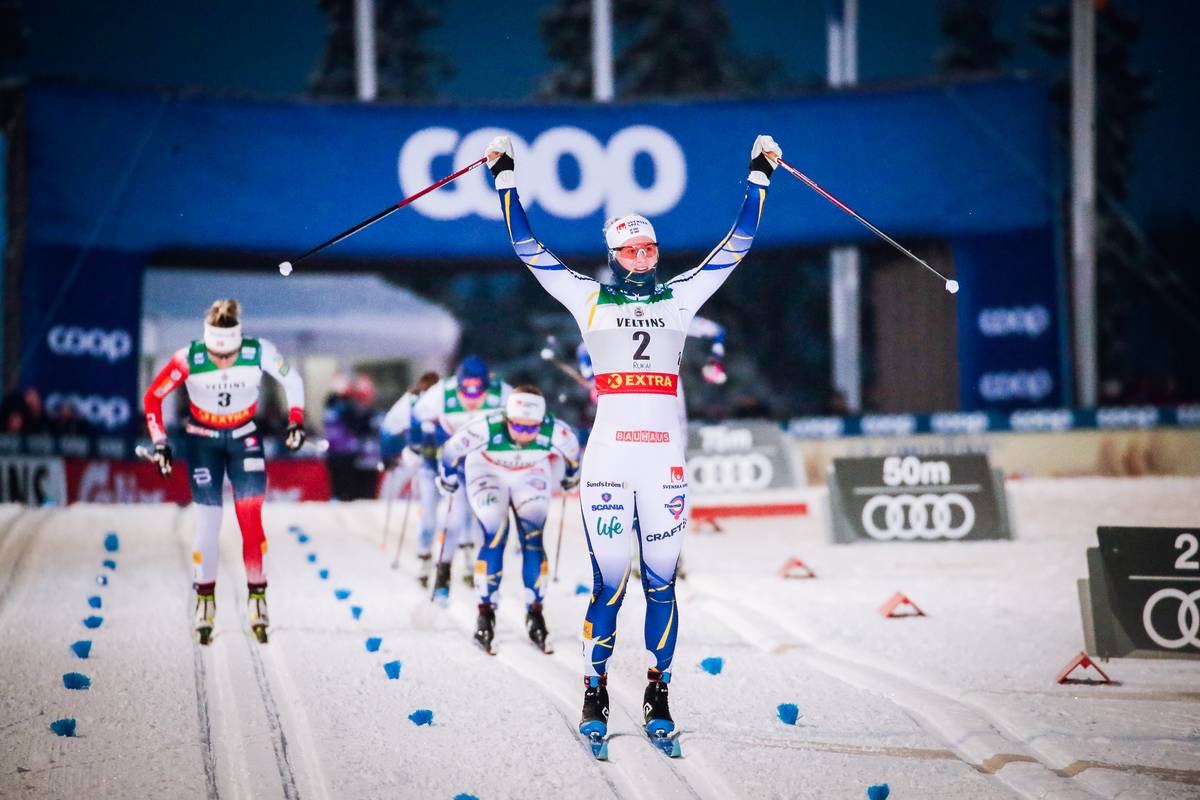

Tag: 1.2 k classic sprint

  • Dahlqvist Wins the Opener in Ruka; Three Americans in the Top-20

    Dahlqvist Wins the Opener in Ruka; Three Americans in the Top-20


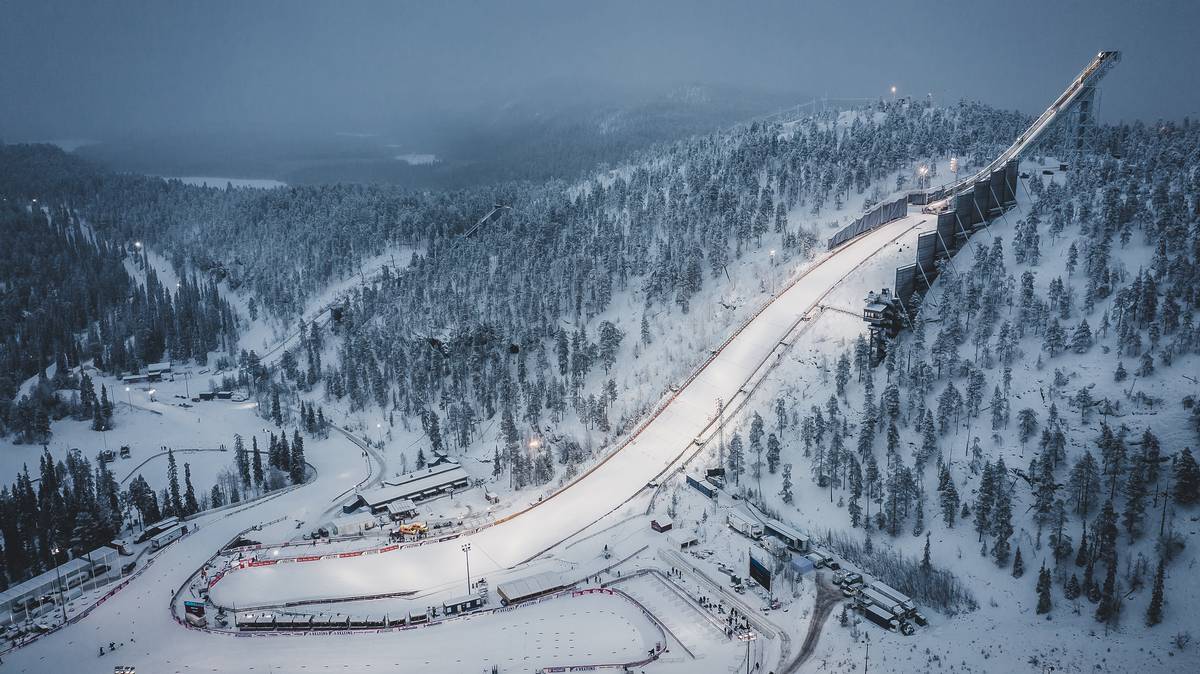
    An aerial view of the wintery venue in Ruka, Finland. (Photo: NordicFocus)


    This World Cup coverage is made possible through the generous support of Marty and Kathy Hall and the A Hall Mark of Excellence Award.  To learn more about A Hall Mark of Excellence Award or to learn how you can support FasterSkier’s coverage please contact info@fasterskier.com.


    And so it begins. The first round of World Cup racing took place in Ruka, FIN today with conditions one might expect in late November at almost 66 degrees North latitude: long shadows, low light, and squeaky tracks, with strong, eager athletes kicking and gliding around a 1.4-kilometer loop. The temperature showed in the athletes’ appearance, as they were bundled with mittens and buffs through the heats, layering with jackets and vests on the warm up and between rounds. Perhaps good practice for the forecasted conditions in Zhangjiakou, China, during the upcoming Olympics. 

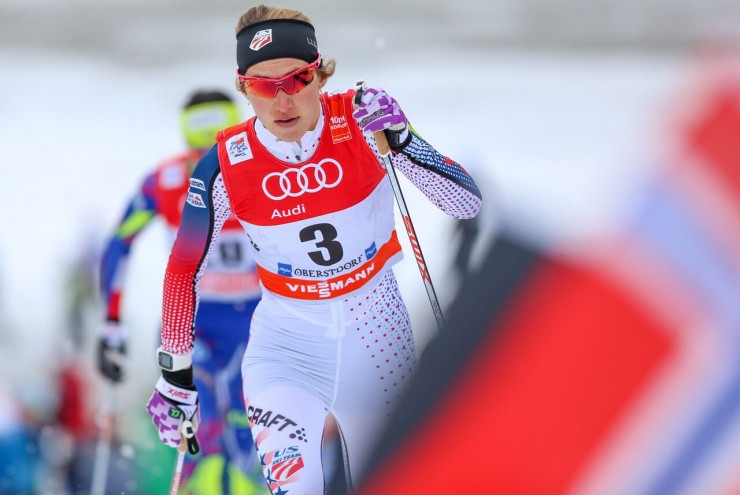
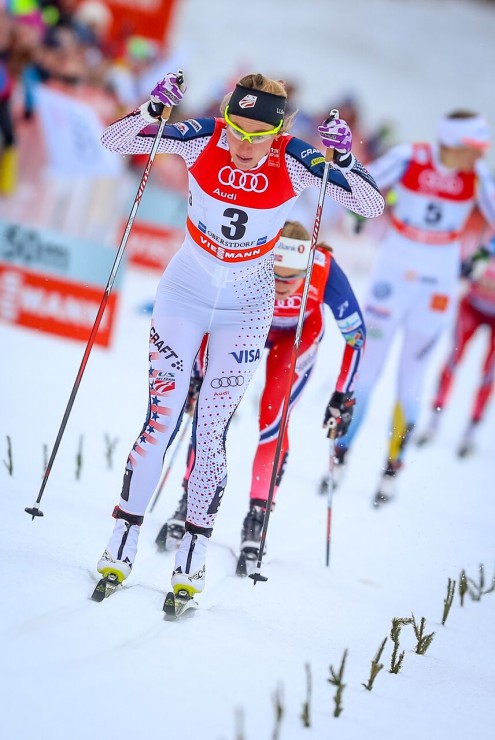
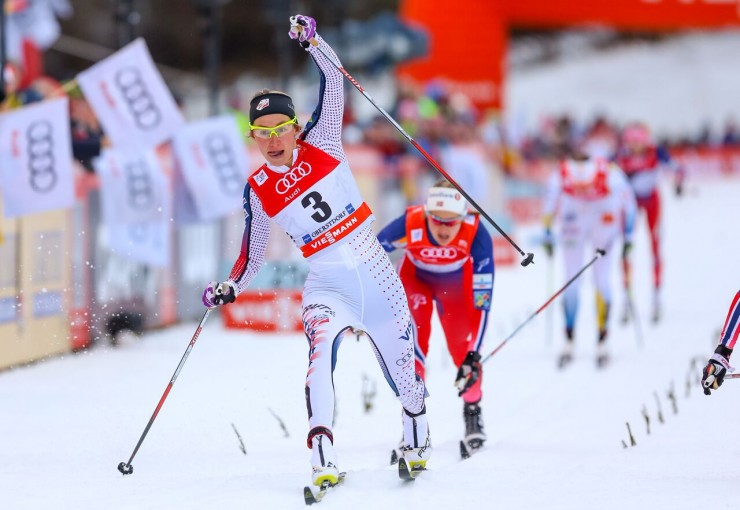
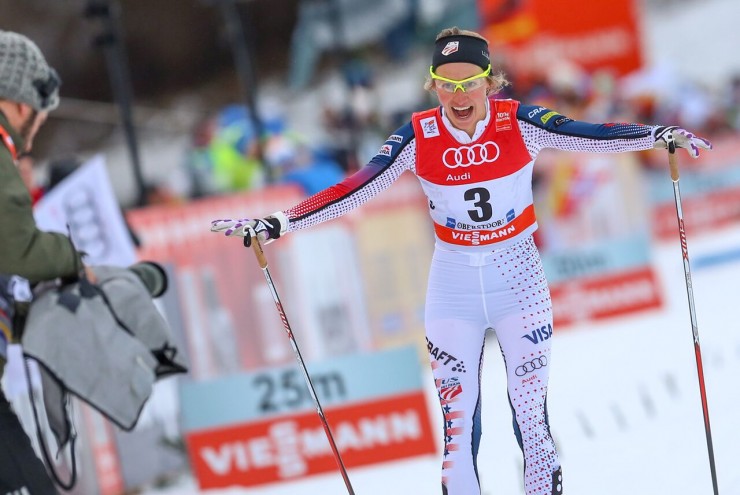
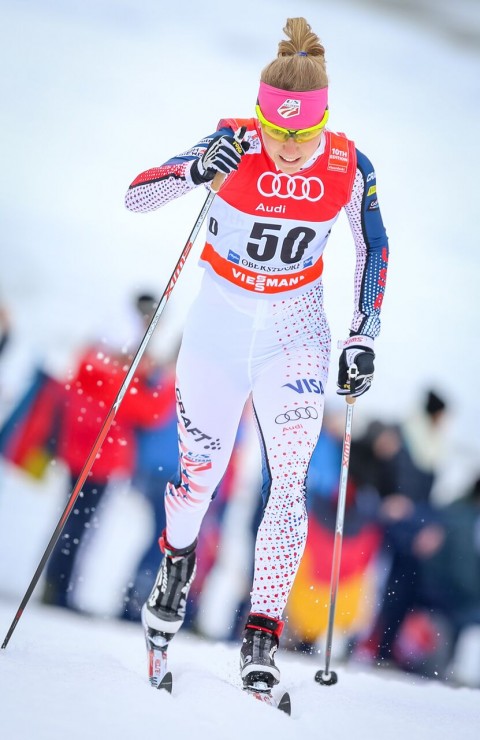
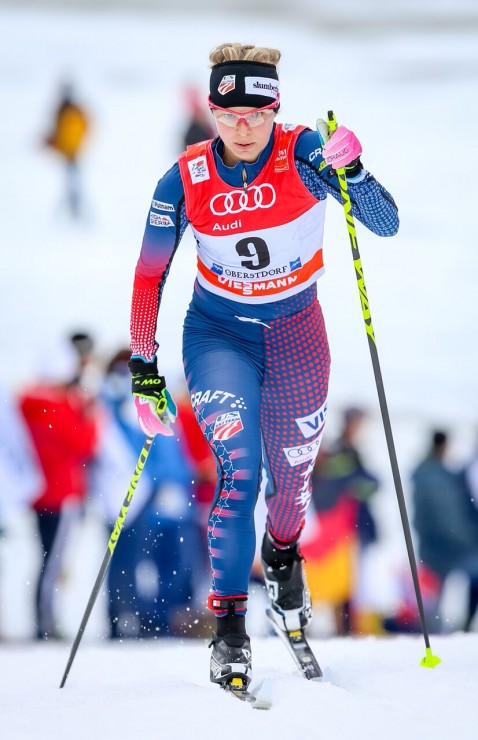
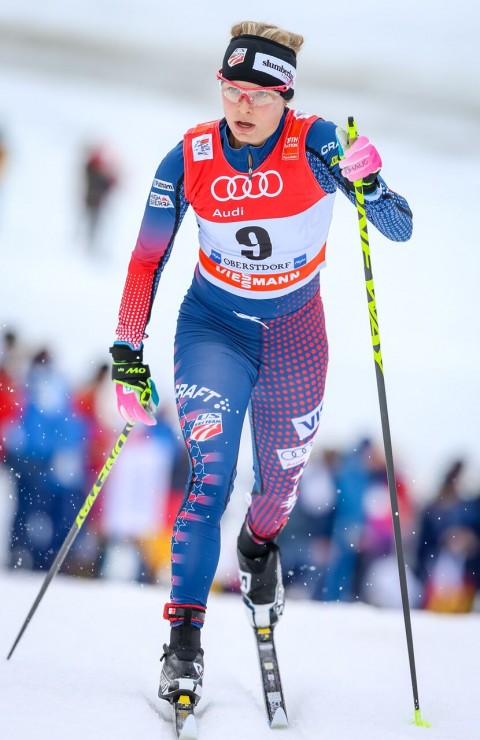
    While Jessie Diggins normally comes into form later in the race season once she has a handful of races under her belt, she surprised herself with her opener in Ruka. Diggins may not be considered a favorite for classic sprints, but she has shown time and time again that she should never be ruled out in a classic race. Today, she raced the fastest qualifier with a time of 2:58.85, 0.77 seconds ahead of the next woman.
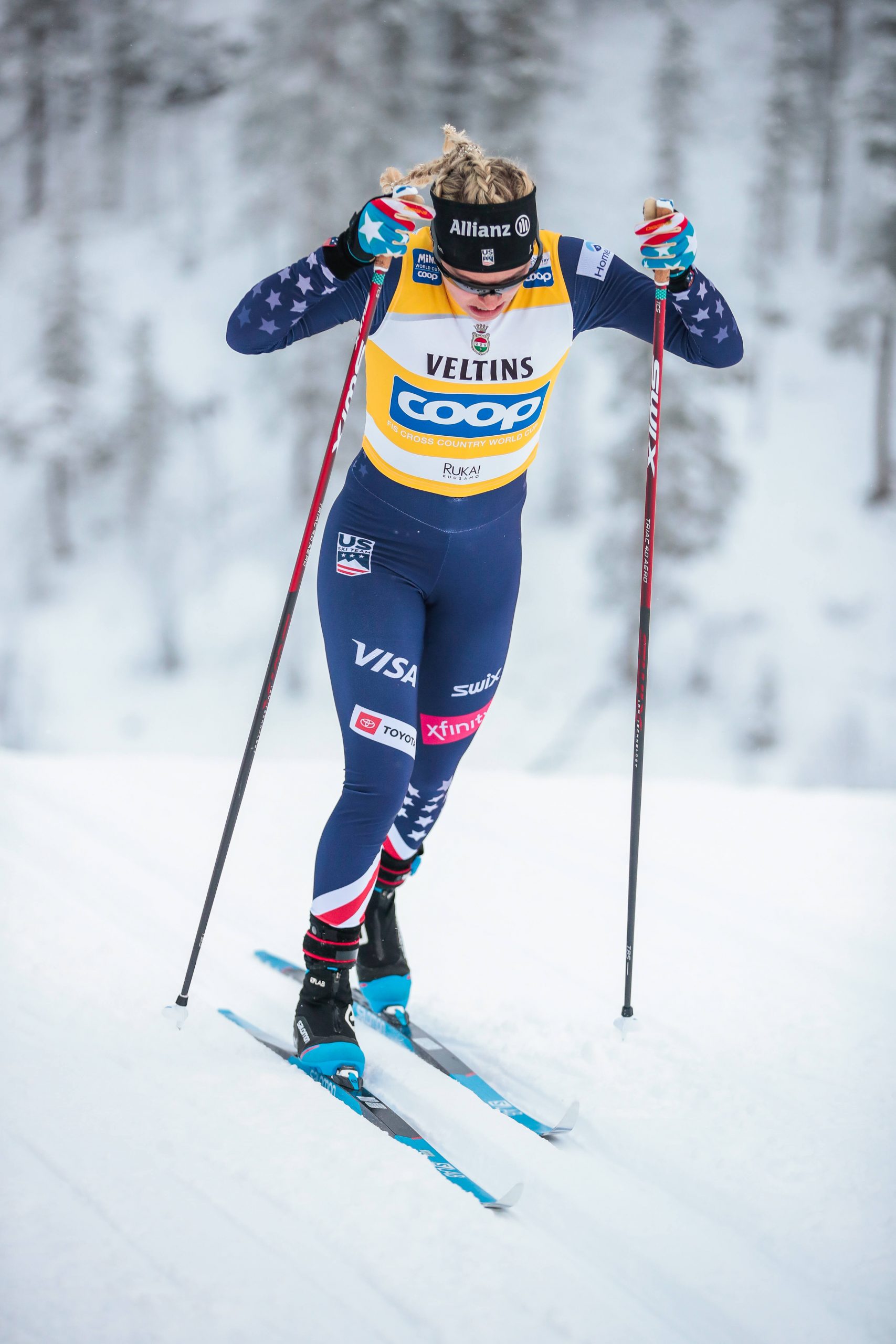
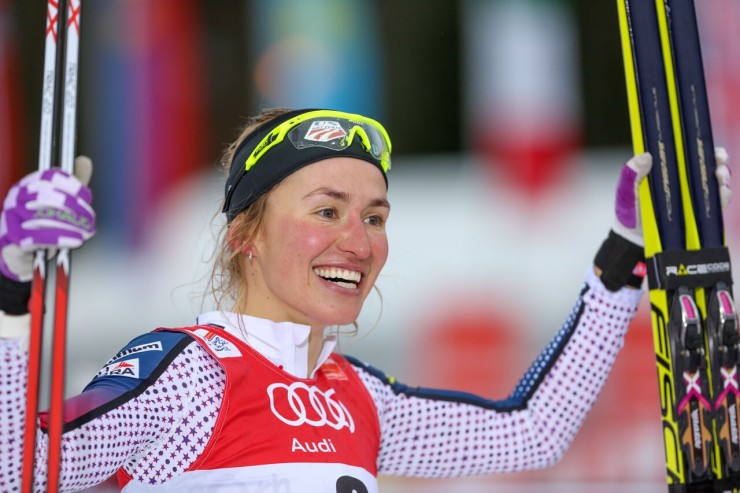
    Jessie Diggins with the surprise win in the qualifying round of the classic sprint in Ruka. (Photo: NordicFocus)

    In an interview with FIS before the rounds, Diggins credited her techs for preparing her winning skis, laughing that “no one looks at her in a classic sprint qualifier.” (We expect there might also be a fitness component at play here.) In terms of a return to the World Cup, she expressed her excitement that the season is upon us.

    I feel great,” she said. “It’s so fun to be back in Europe, back with my team. This is such cool energy. For me, it feels like the first day in school. I just love being here with these people.”

    Heading into the rounds, Diggins selected the fifth and final quarterfinal heat.

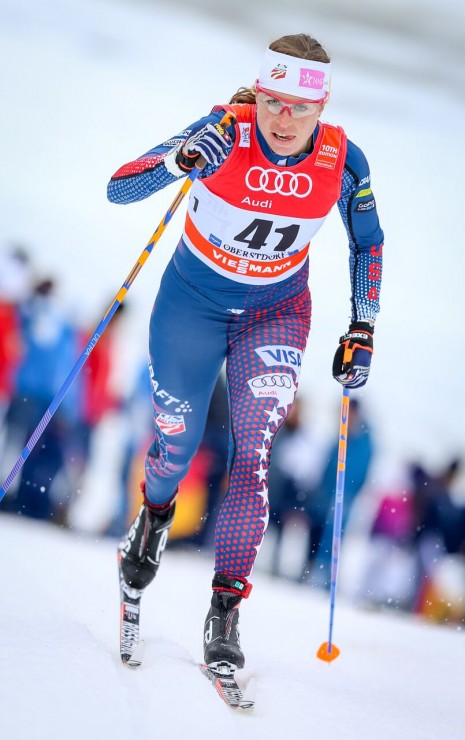
    Also among the top-30 qualifiers were Rosie Brennan in 8th (+1.90) and Julia Kern in 21st (+5.6). Kern raced in the second heat of the quarters, while Brennan selected the fourth.
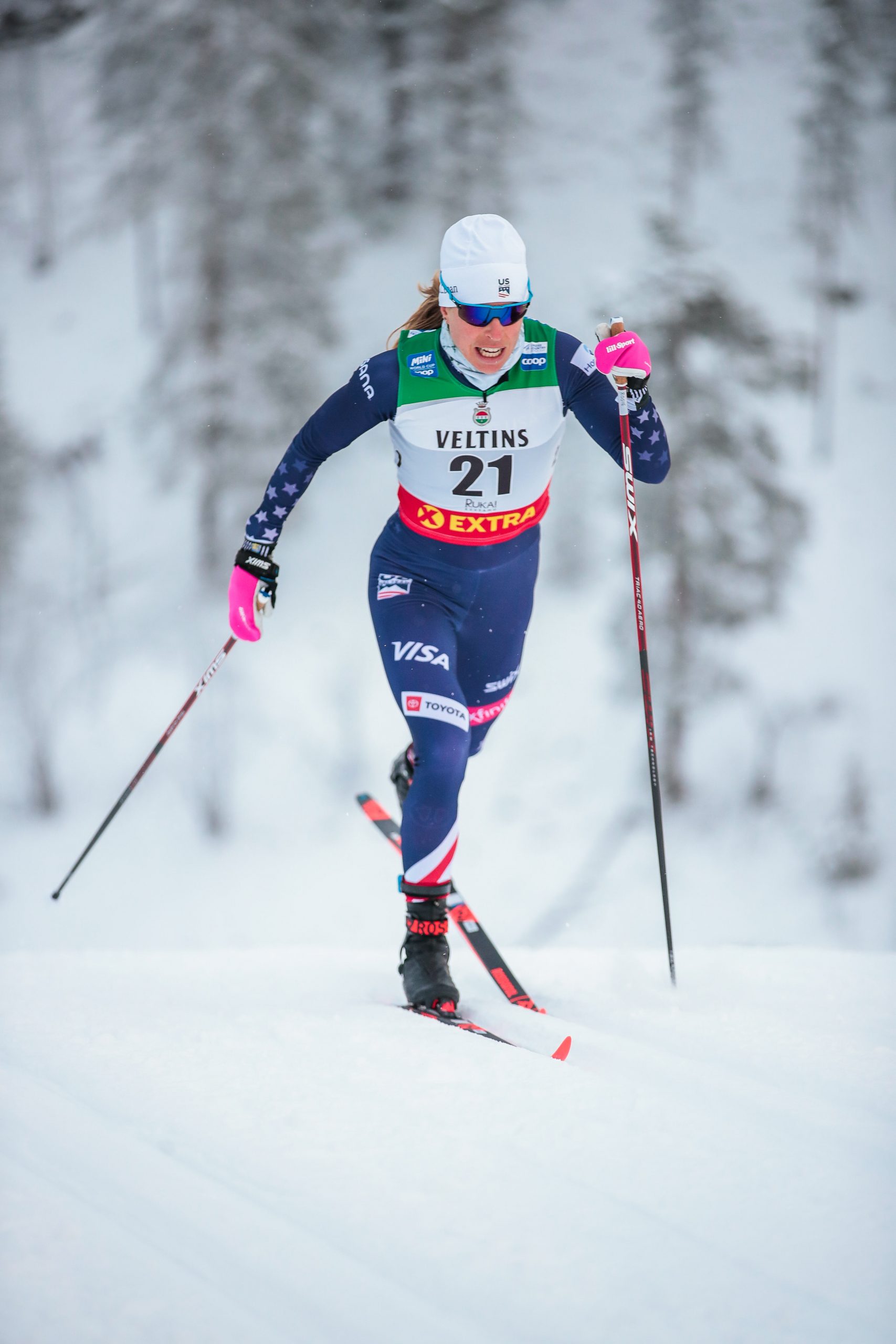
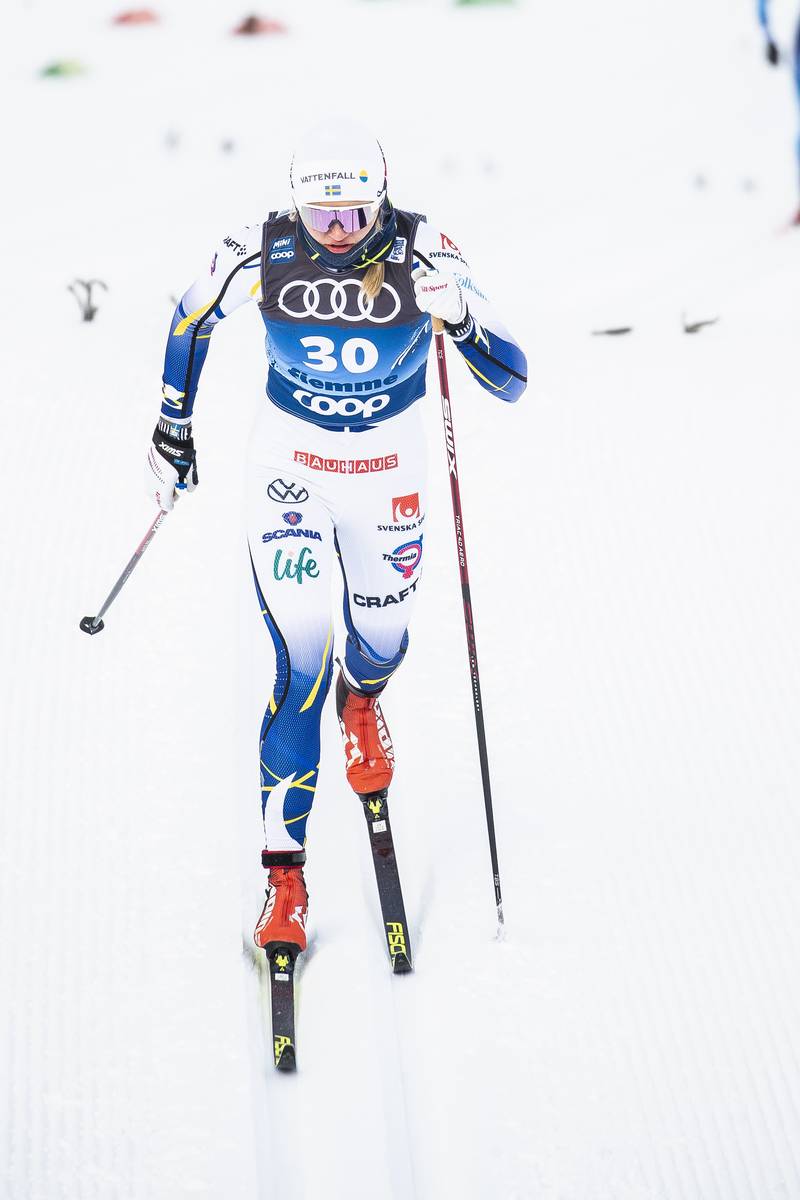
    Rosie Brennan skis to 8th place in the qualifying round in Ruka. (Photo: NordicFocus)

    A quick note on the sprint course in Ruka. You’ll notice from the profile that the A-climb begins just before the 1k mark, leading into a false flat before winding into the final straightaway to the finish. There is no downhill out of this climb; athletes simply climb a little over 20 vertical meters, then fight the subsequent flood of lactate as they make their way to the finish.

    The course profile in Ruka. (Photo: FIS Broadcast)

    In the second quarterfinal, a pair of Swedes, Maja Dahlqvist and Anna Dyvik, got out quickly to establish position at the front. Kern tucked in behind the Swedes out of the gate, then made a commanding move using momentum from the first descent to put herself at the front of the pack for the first climb. Heading up the A-Climb, the Swedes began to pull ahead, along with Slovenia’s Anamarija Lampič. Kern held her position in fourth place into the stadium and across the line, however, the time was not fast enough to secure a lucky loser position and she was knocked out. 

    During Brennan’s heat, she remained tucked into the middle of the group at the halfway mark. She dialed the effort up a notch on the A-climb, but as she neared the top, there were still four women vying for the lead. Brennan was tucked in on the tails of Finland’s Johanna Matintalo coming down the final stretch to take third in the heat. Unfortunately for the American, this was less than half a second off the time needed for a lucky loser spot in the semis.

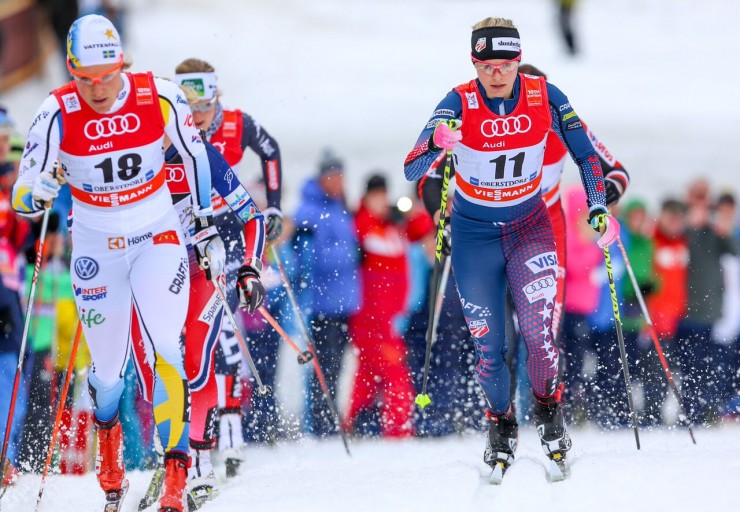
    Diggins took the lead early in her quarter, her fast skis having allowed her to capitalize on the first downhill. She held her ground into the A-climb, where Krista Pärmäkoski and Katri Lylynpera, both of Finland, followed by Sweden’s Frida Karlsson, caught the American, leaving the climb as a pack of four. 
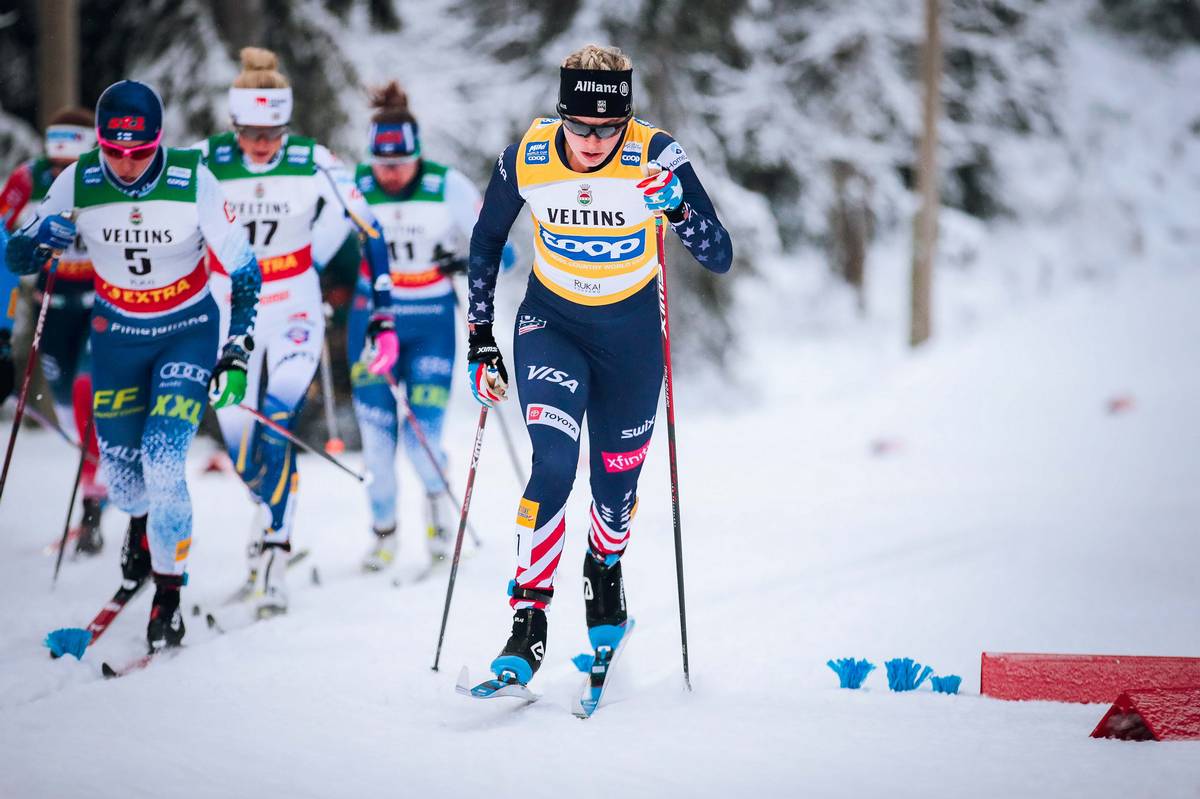
    Jessie Diggins holds the early lead in the quarter final of the classic sprint in Ruka. (Photo: NordicFocus)

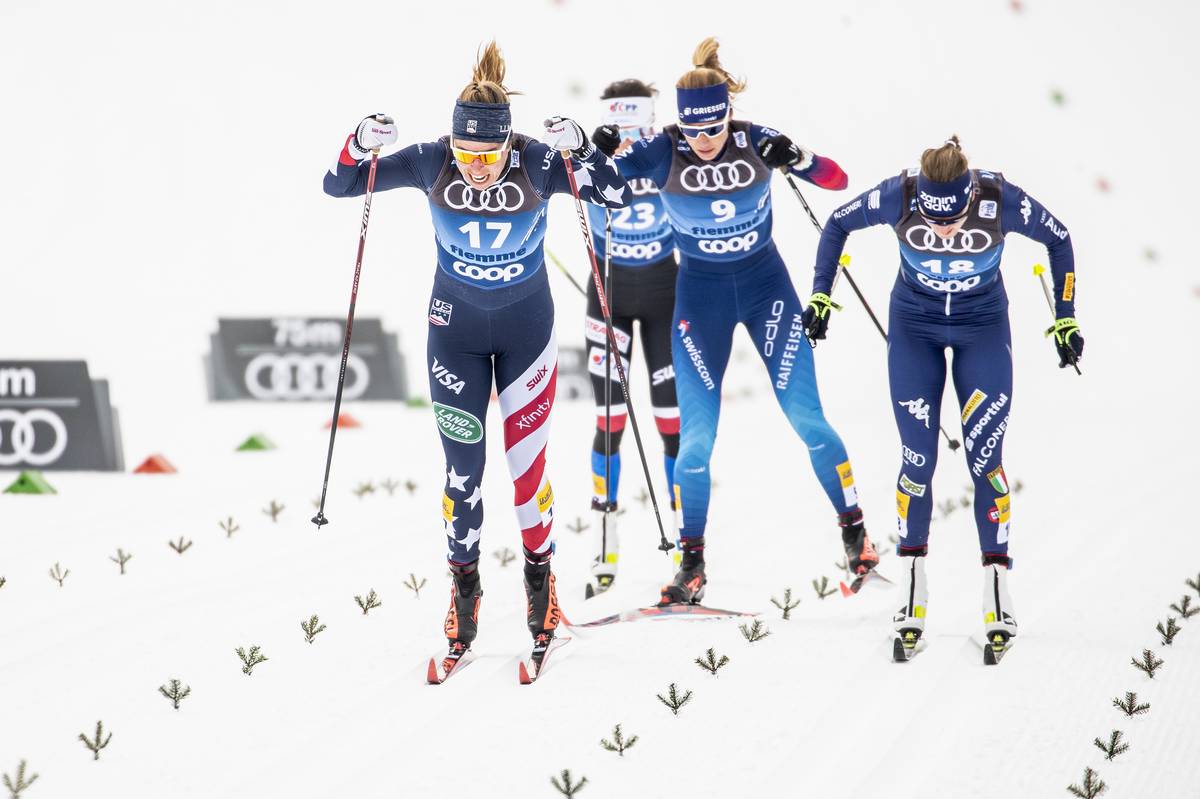
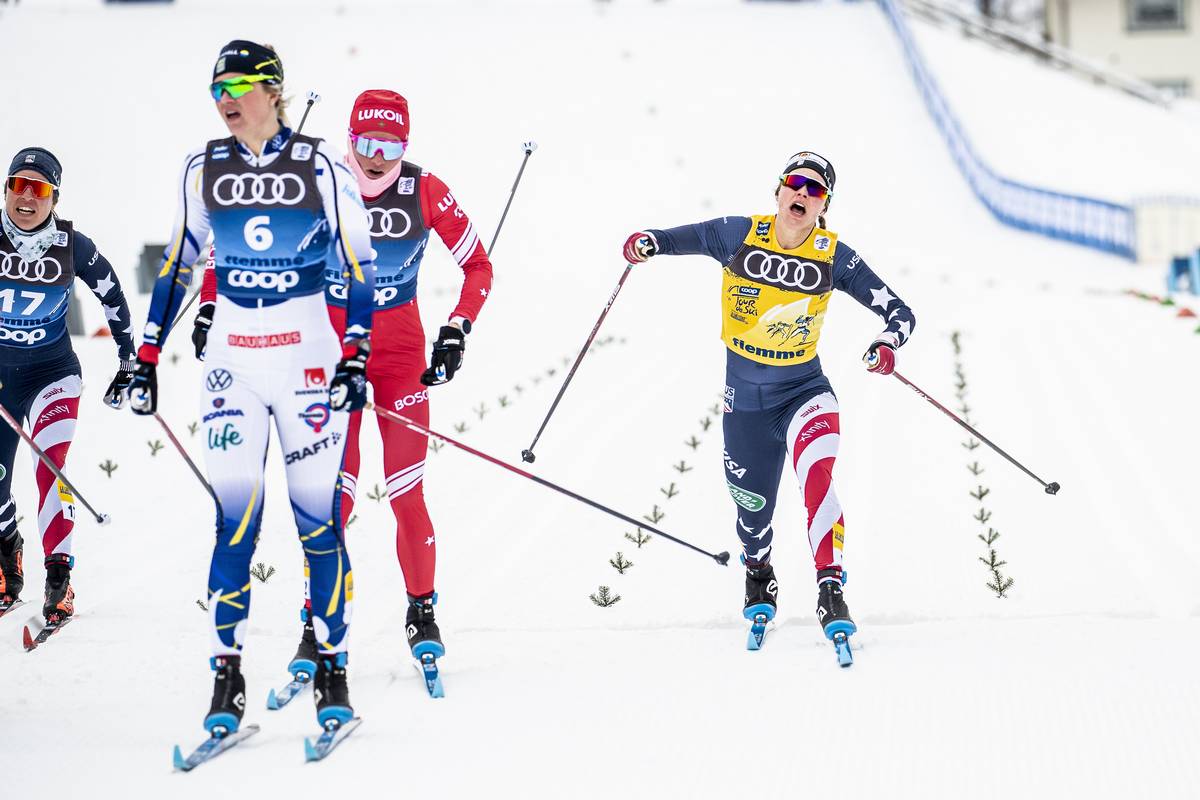
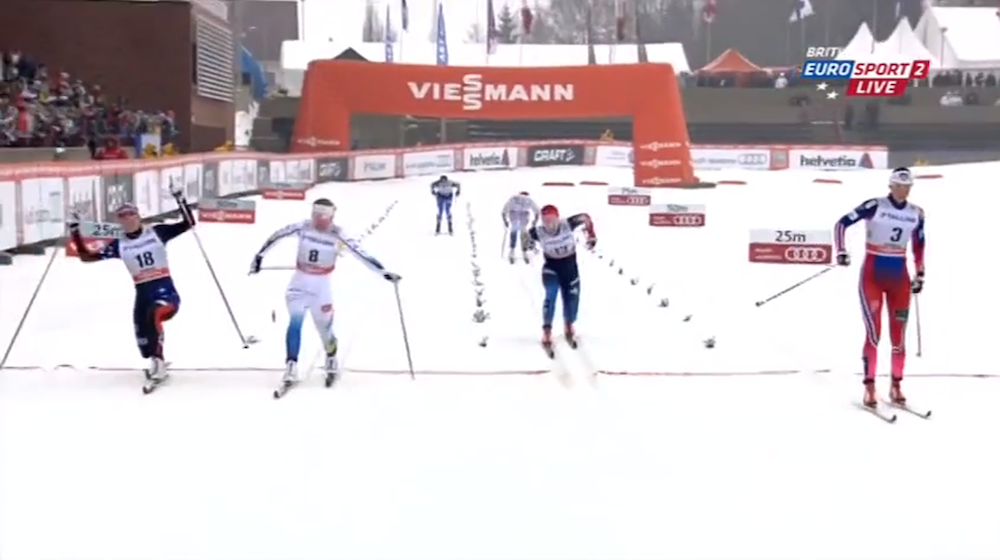
    In the final stretch, Karlsson gained ground with her double pole to take the win just ahead of Lylynpera. Diggins crossed the line in a photo finish with Pärmäkoski, but timing showed that the American was 0.04 seconds behind the Finn, leaving her in fourth for the heat, which did not see any lucky losers.  

    Despite not advancing further in the rounds, Diggins said she knows she is “exactly where I need to be” at this point in the season. She acknowledged how much she has put in with her coaches to improve her classic skiing, and sees this as a positive indicator of the progress they’ve made. Here’s more from Jessie:

    Post-race audio clip from Jessie Diggins.
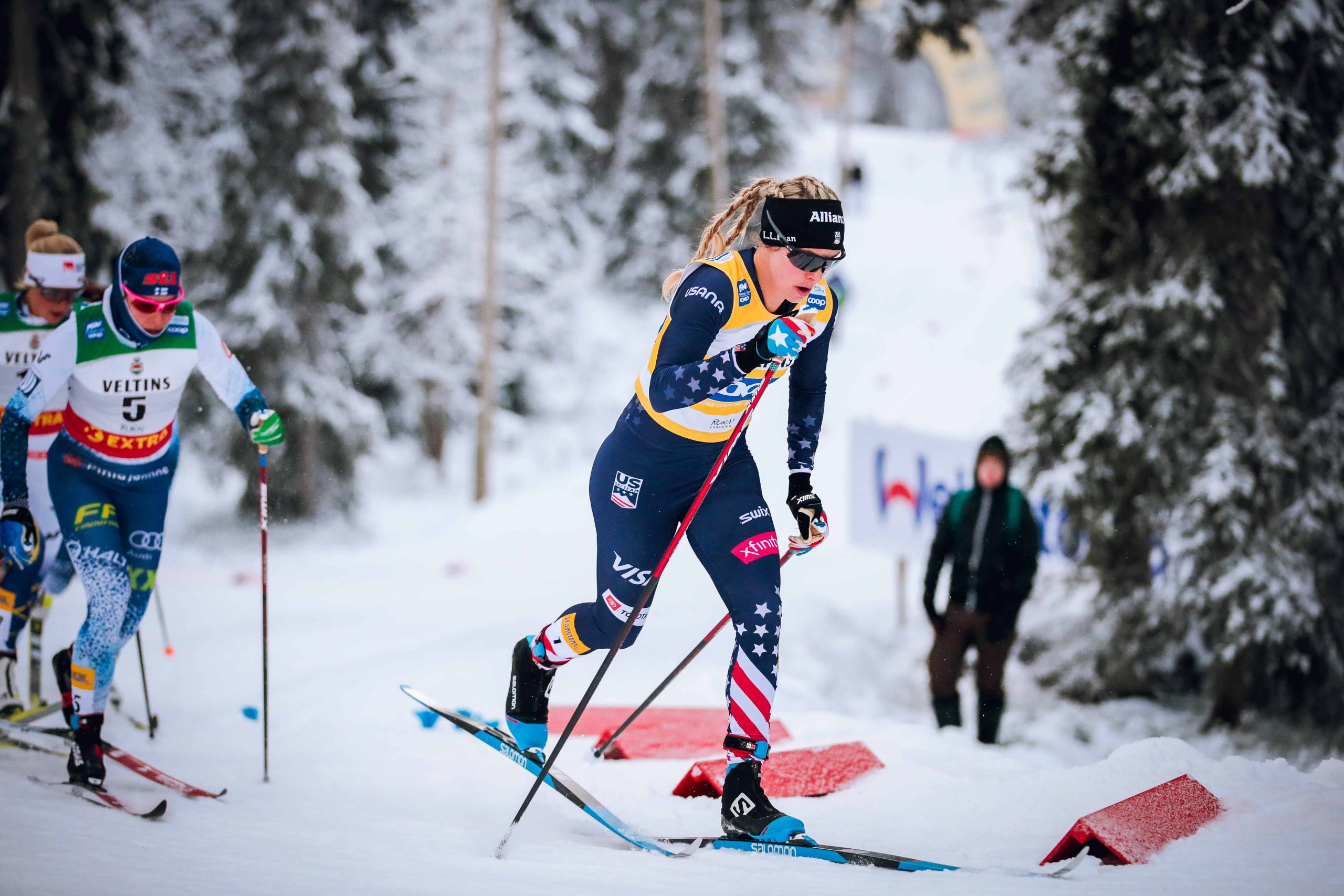
    Jessie Diggins holds the early lead in the quarter final of the classic sprint in Ruka. (Photo: NordicFocus)

    In the first round of the semis, all six women remained tight through the halfway mark. You’ve probably caught on to the theme of the day: positioning oneself at the front heading out of the A-climb proved critical for final placement. Deciding moves were made here. Using this tactic, Johanna Hagström (SWE) and teammate Dahlqvist ran powerfully uphill to pull ahead. The women entered the final straightaway side-by-side, but Dahlqvist soon made ground on her teammate, taking the win in the round. Russia’s Natalia Nepryaeva was close on the women’s tails, closing the gap in the last 50 meters and sliding across the line just behind Hagström in third, not quite fast enough for a lucky loser spot in the final.

    Moving on to the second round. Russia’s Yulia Stupak led the women through the first half. On the A-climb, Norway’s Maiken Caspersen Falla held the lead with Lylynpera close behind. Moving from the back of the pack into third, Karlsson took the inside around the curve heading into the stadium. She steadily gained ground on the other women in the double pole sprint to the line, edging Lylynpera out at the line to take the heat. Falla took third, with Matintalo close behind. As the second was the faster heat of the semis, both of these women advanced to the final. 

    In the final round, Sweden was looking to repeat their podium sweep from last year in Ruka. With Dahlqvist, Hagström, and Karlsson in the final, the possibility remained on the table.

    Despite a brief failure in grip and consequent slip, Dahlqvist charged the A-climb to put herself in excellent position for the final meters. A few stride lengths behind, Falla and Hagström were matched as they vied for the second and third podium spots.
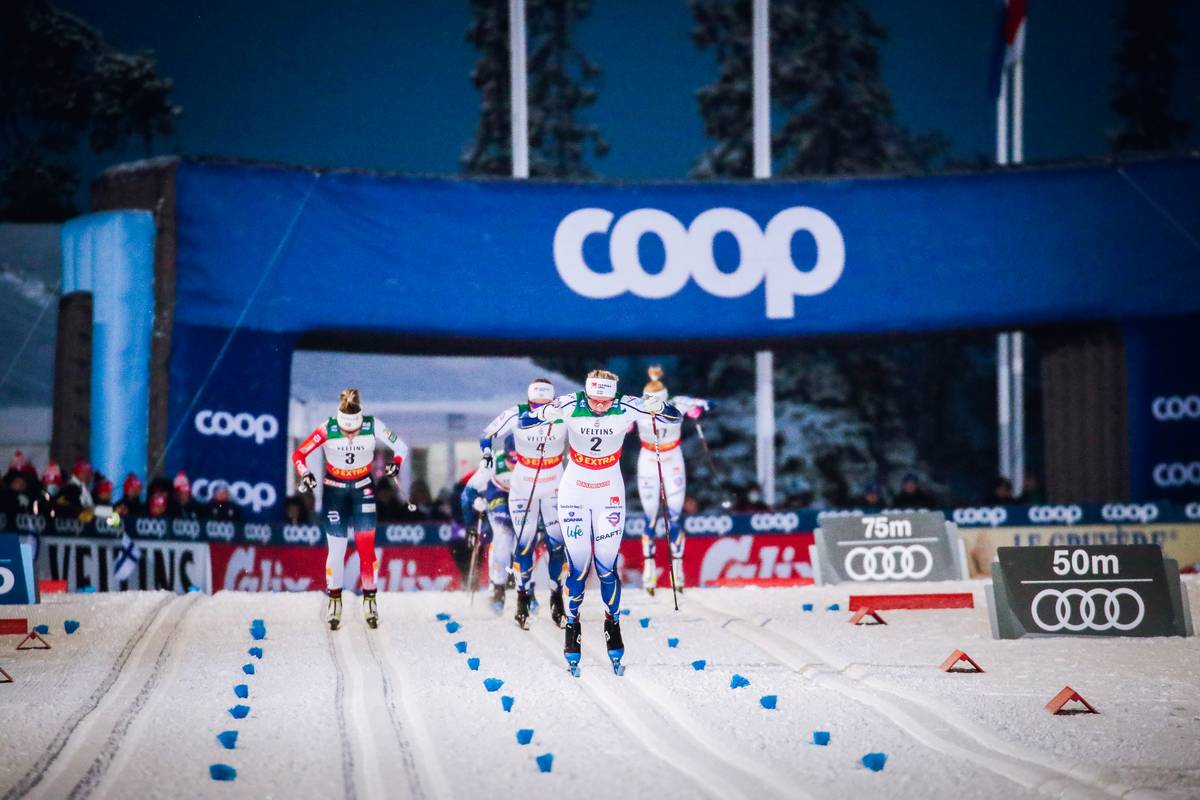
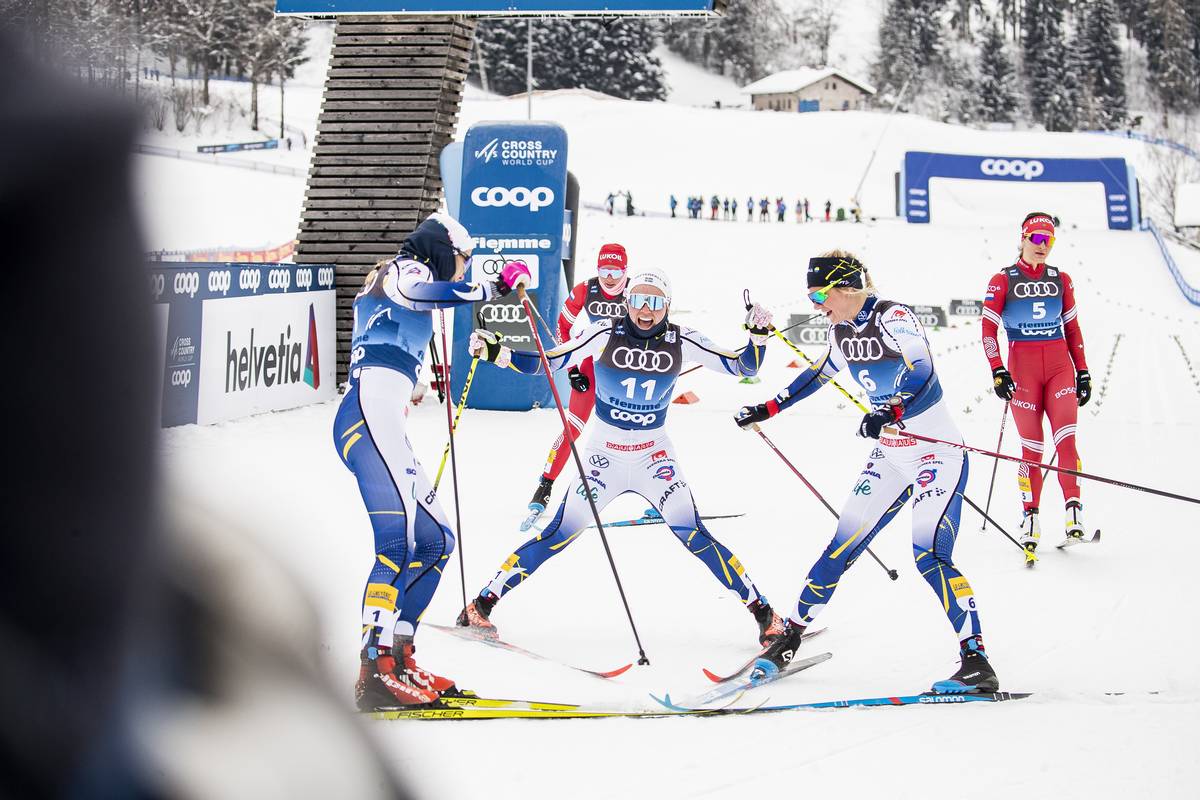
    The final straightaway as the women head for home in the Ruka Classic Sprint. (Photo: NordicFocus)

    As they rounded the final left-hand bend into the stadium, the Swede had enough space to take the preferred line into the second track from the left of the curve heading into the final straight, leaving Falla to make a lane change behind her. This advantage carried Hagström to the line for second (+1.77) with Falla just behind for third (+2.02). 
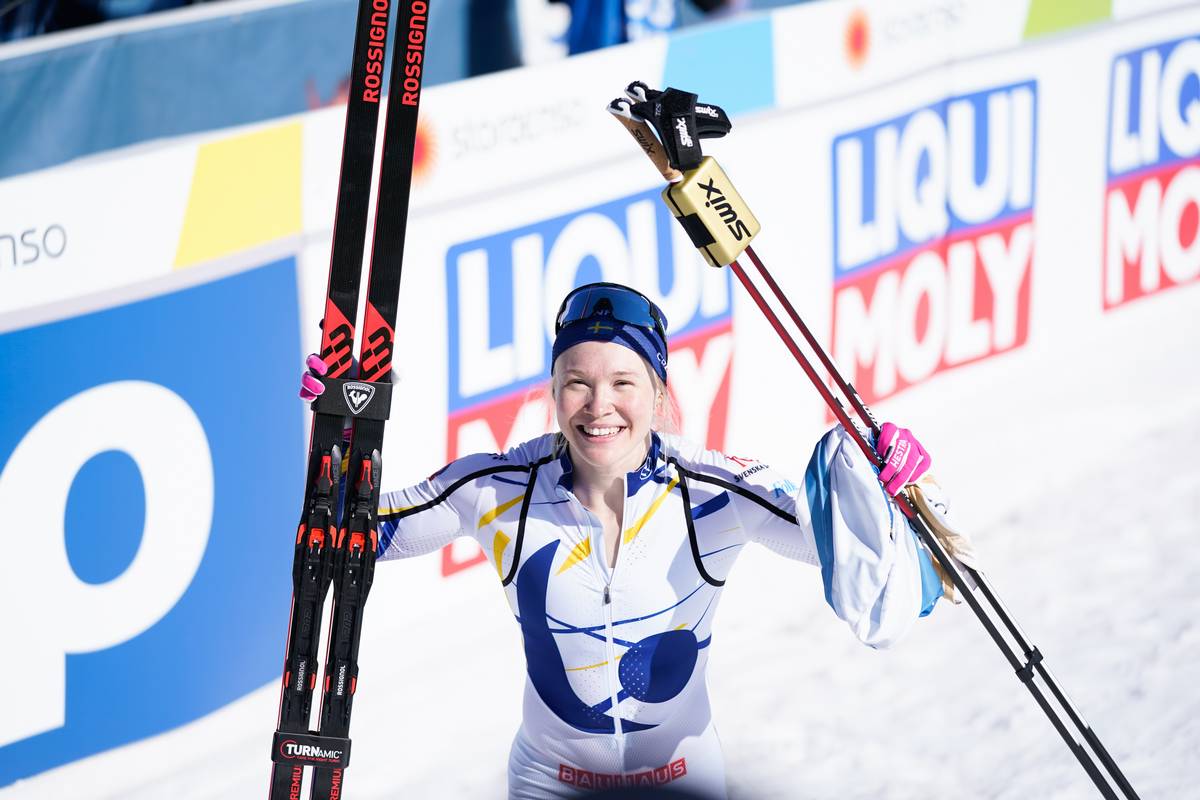
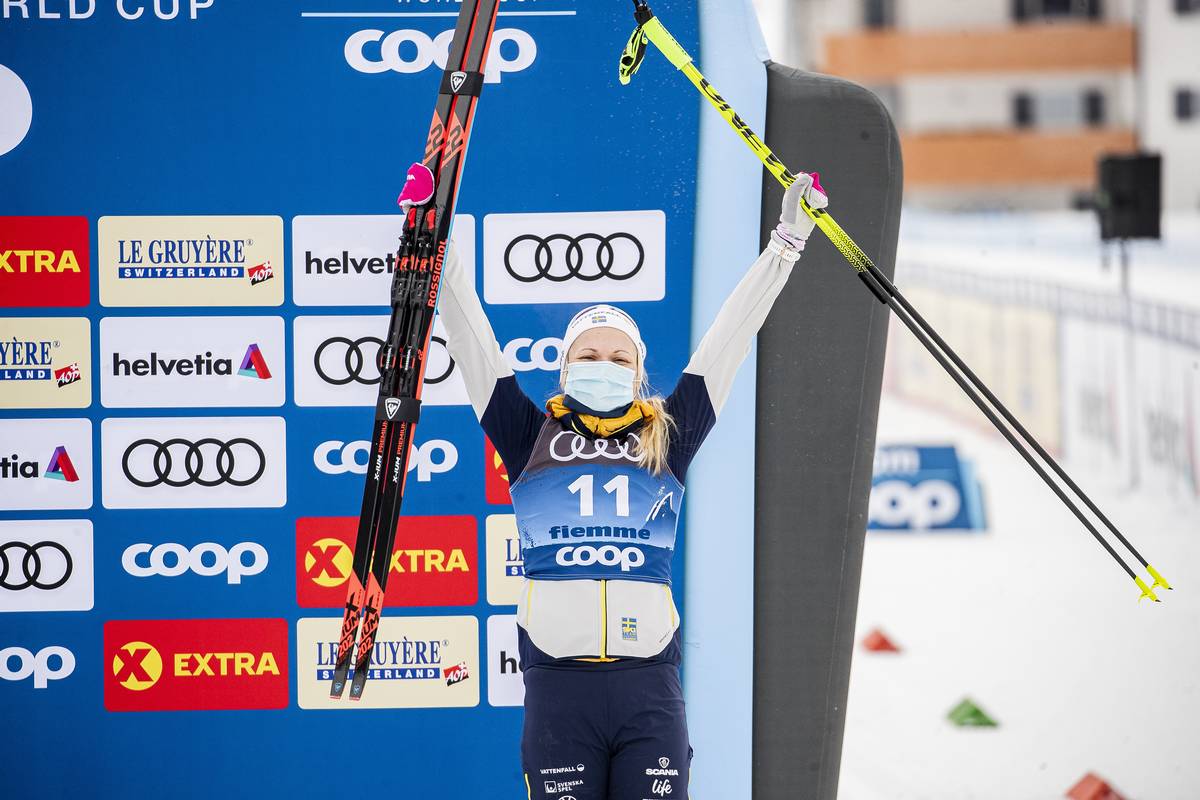
    Sweden’s Maja Dahlqvist takes the win in Ruka. (Photo: NordicFocus)

    “I couldn’t say better — perfect start,” Dahlqvist told FIS after the race. “I had really good shape and my skis were so good, so I just wanted to ski fast. I couldn’t wait for the uphill, and that’s never happened with me before.”

    This is Dahlqvist’s second World Cup win, but 13th time on the podium. She was second in last year’s classic sprint opener in Ruka.
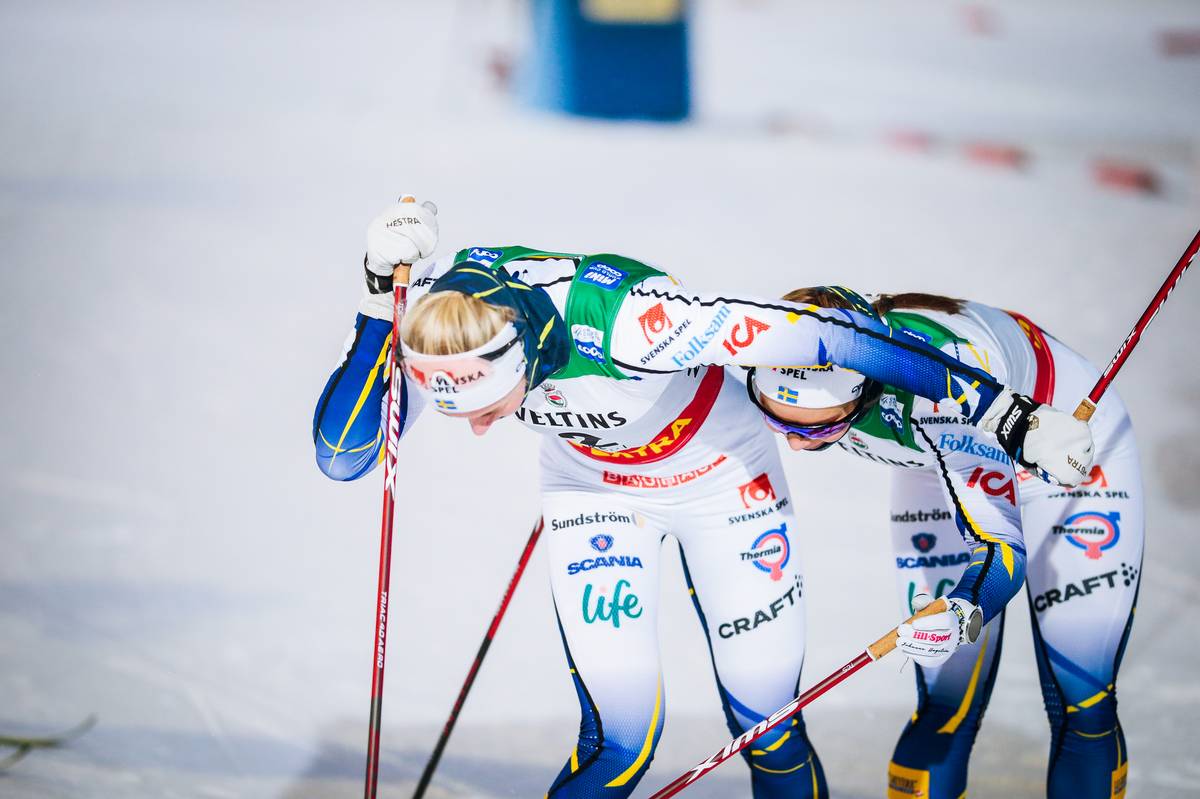
    Maja Dahlqvist (SWE) takes the win in Ruka ahead of teammate Johanna Hagström. (Photo: NordicFocus)

    Off the podium, Finland’s Matintalo finished fourth in the final (+3.21) with teammate Lylynpera next over the line for fifth (+3.74). Karlsson was sixth across the line (+3.97) to close out the final heat.

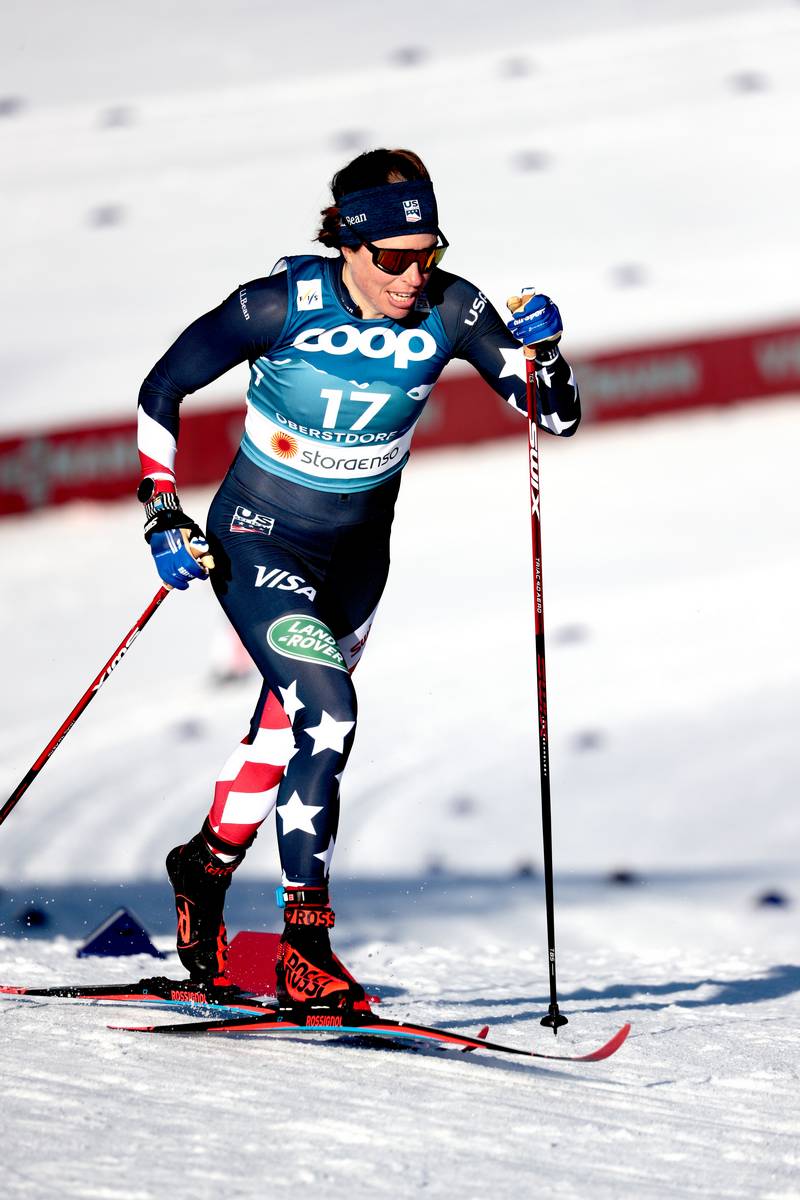
    Once final rankings from the heats were solidified, Brennan was deemed the top American in 15th, with Diggins just behind in 16th. Still inside the Top-20, Kern ended her day in 18th. 
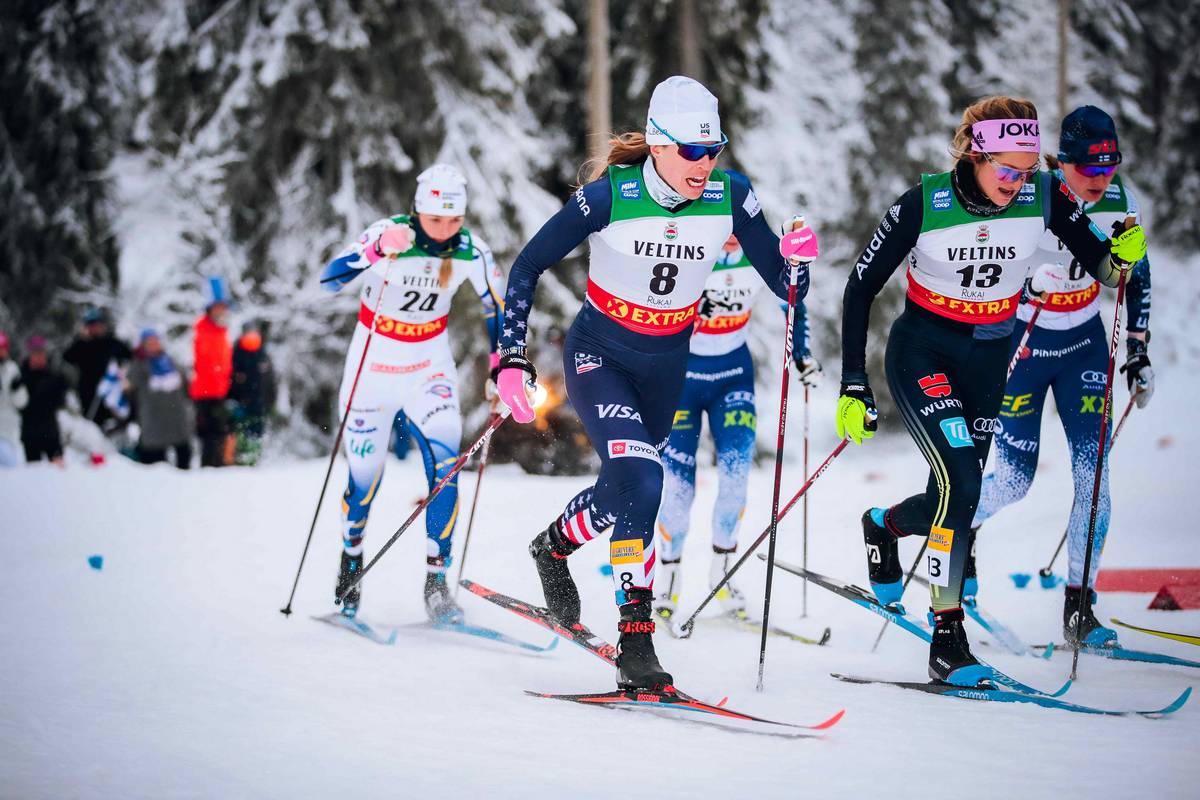
    Rosie Brennan skis to 15th in the classic sprint in Ruka. (Photo: NordicFocus)

    Reflecting on her opener, Brennan shared the following in a post-race email:

    “Ruka is such a unique course and being the first race of the season, it’s always hard to know what to expect. My goal was to be in the mix and skiing well. I am happy with my effort and really happy to be underway with racing. I think this was my best result in Ruka so even though I always want more, I am happy to be where I am right now. I felt I was missing a little top end speed today, but feel that I am on track and moving in the right direction. I’m excited to do some distance racing and to continue working out the kinks this weekend.”

    Kern also posted her career-best result in Ruka. She finished outside the heats in 40th last year. Remarking on this progress, Kern wrote:

    “I was really happy with the energy I brought today, with the added bonus of figuring out how to qualify in Ruka. The final climb is always the crux on this course; every year it gets greasy, washed out and tricky. I am proud with how I skied with confidence and figuring out how to ski the last part of that final climb fast will hopefully come with more days skiing on snow! I am excited that the season has started and feel that I am in a much better place coming into the race season this year.”
    In a post-race interview, Whitcomb shared his thoughts on Diggins’ win in the qualifier, along with Brennan’s result and the outlook for the women’s program heading into the season. We did have some technical issues on the call. You’ll notice that the first question was cut off, which was regarding the cold conditions in Ruka and whether there is any additional emphasis by the team or techs on cold events this year, considering the Olympic venue is predicted to be very cold.

    Outside the heats, Hailey Swirbul was 37th in the qualifier (+8.59). Katharine Ogden was next for the U.S. in 52nd (+12.23), immediately followed by Hannah Halvorsen in 53rd (+12.95). Novie McCabe was 61st (+16.43), with Sydney Palmer-Leger closing out the American team in 66th (+21.61). 

    Hannah Halvorsen skis the qualifying round of the classic sprint in Ruka. (Photo: NordicFocus)

    Results:

    Qualification | Final

  • Sweden’s Sundling Cruises for First Championship Gold in the Classic Sprint

    Sweden’s Sundling Cruises for First Championship Gold in the Classic Sprint

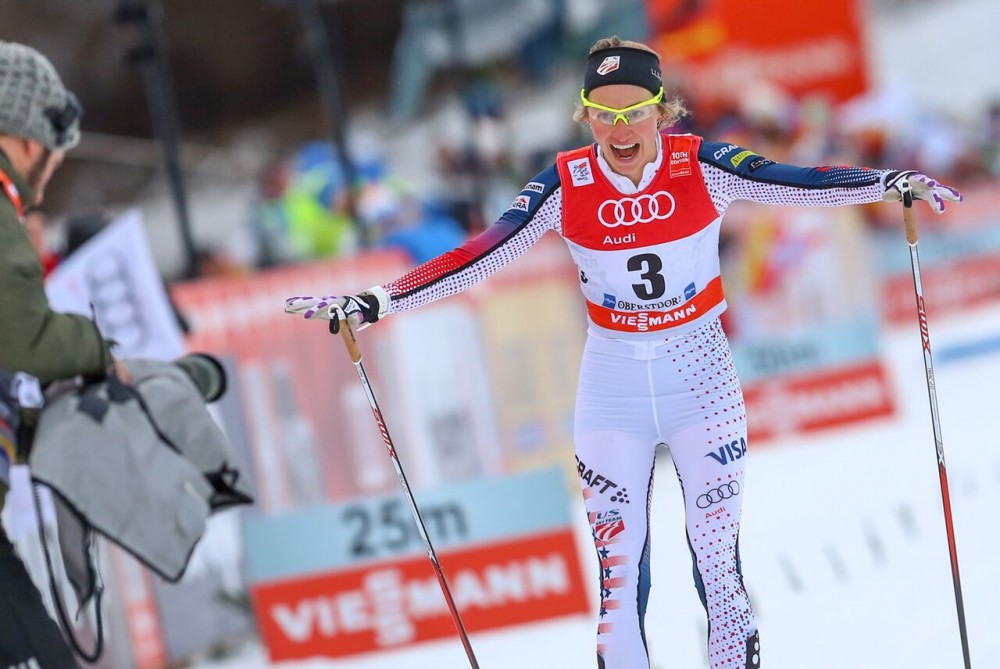
    Jonna Sundling of Sweden wins the women’s classic sprint at the 2021 Oberstdorf World Championships. (Photo: NordicFocus)

    This World Championship coverage is made possible through the generous support of Marty and Kathy Hall and their A Hall Mark of Excellence Award. To learn more about A Hall Mark of Excellence Award or to learn how you can support FasterSkier’s coverage please contact info@fasterskier.com.

    After qualifying events on Wednesday, World Championships kicked off in earnest in Oberstdorf, Germany with the Classic Sprint event Thursday morning. Due to unseasonably warm temperatures, the start times were pushed earlier in the day to optimize course conditions and hopefully preserve snow for the remainder of the competition.

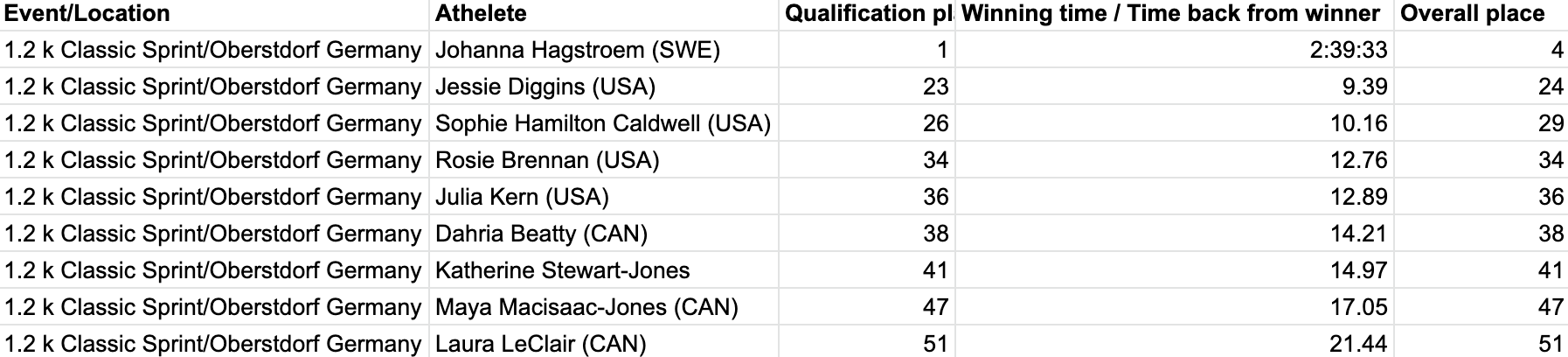
    The women raced a 1.2 k course, with Johanna Hagström winning the qualifier in a time of 2:39.33. After her qualifier, Hagström said, “it felt really great, I was focused on being calm and do[ing] fast skiing by good technique so I think I got it.”

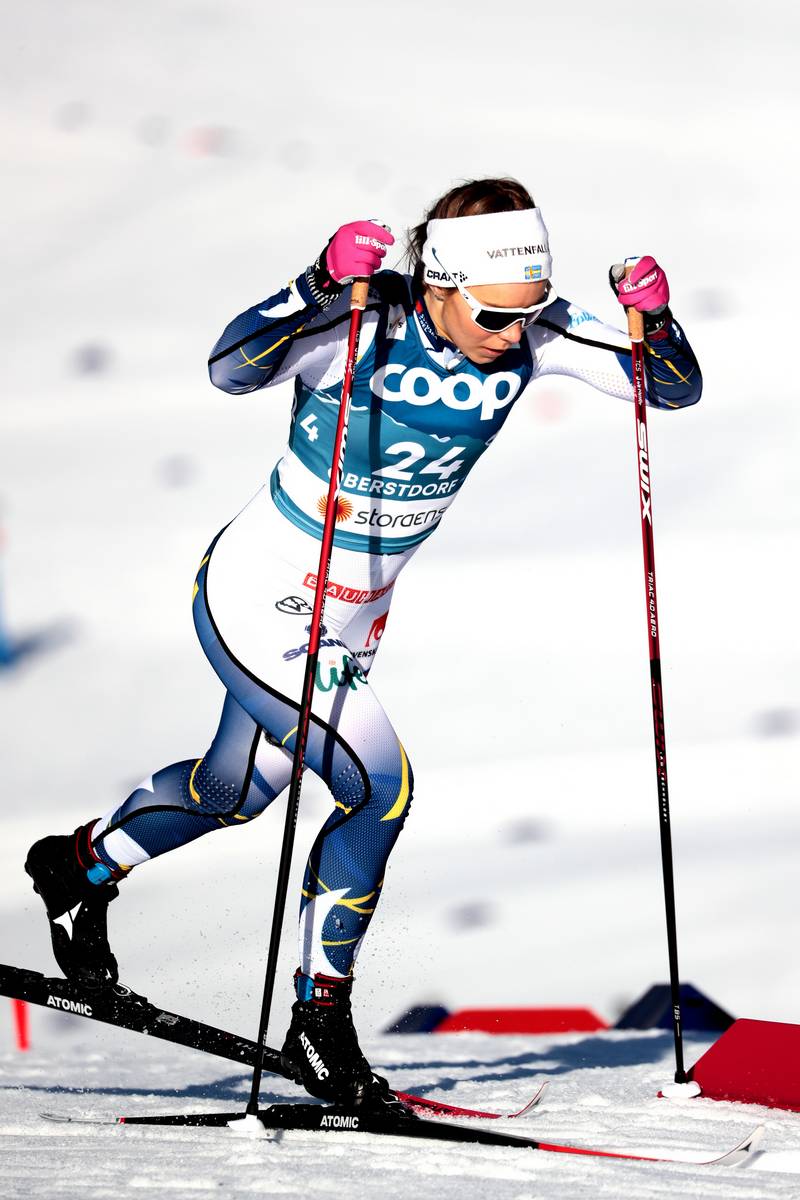
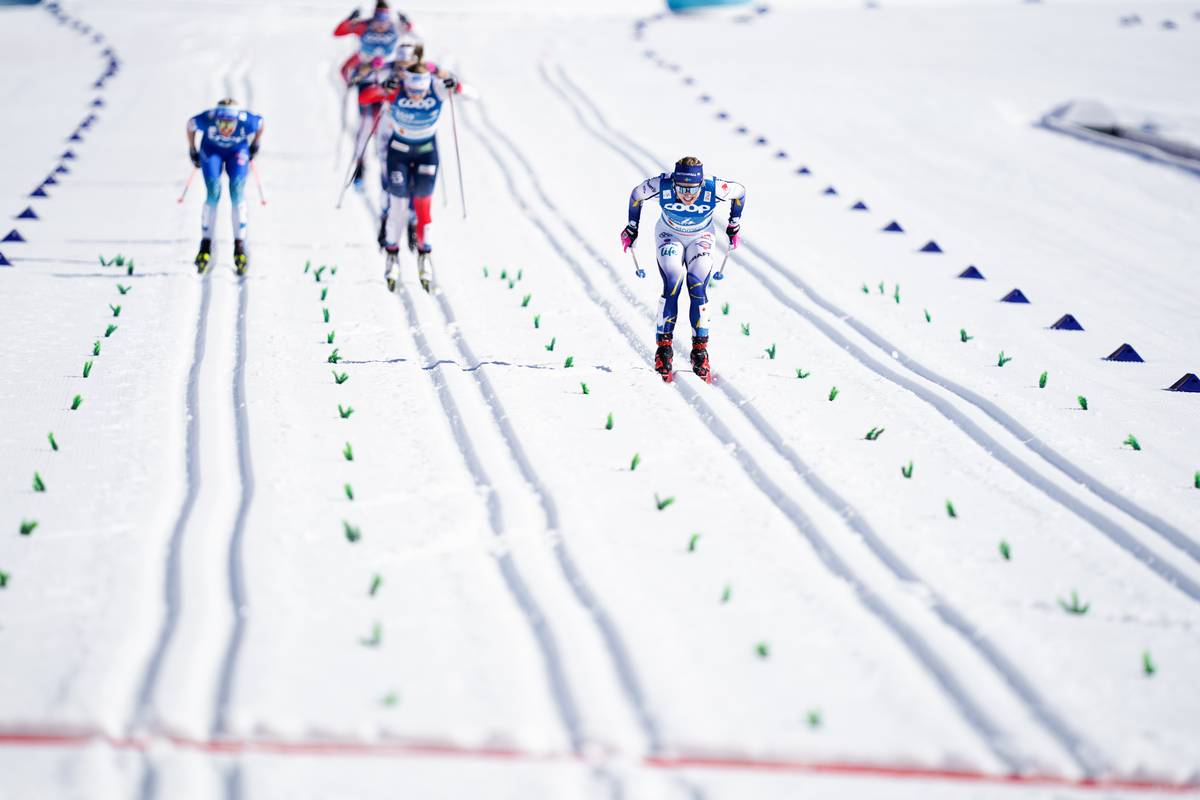
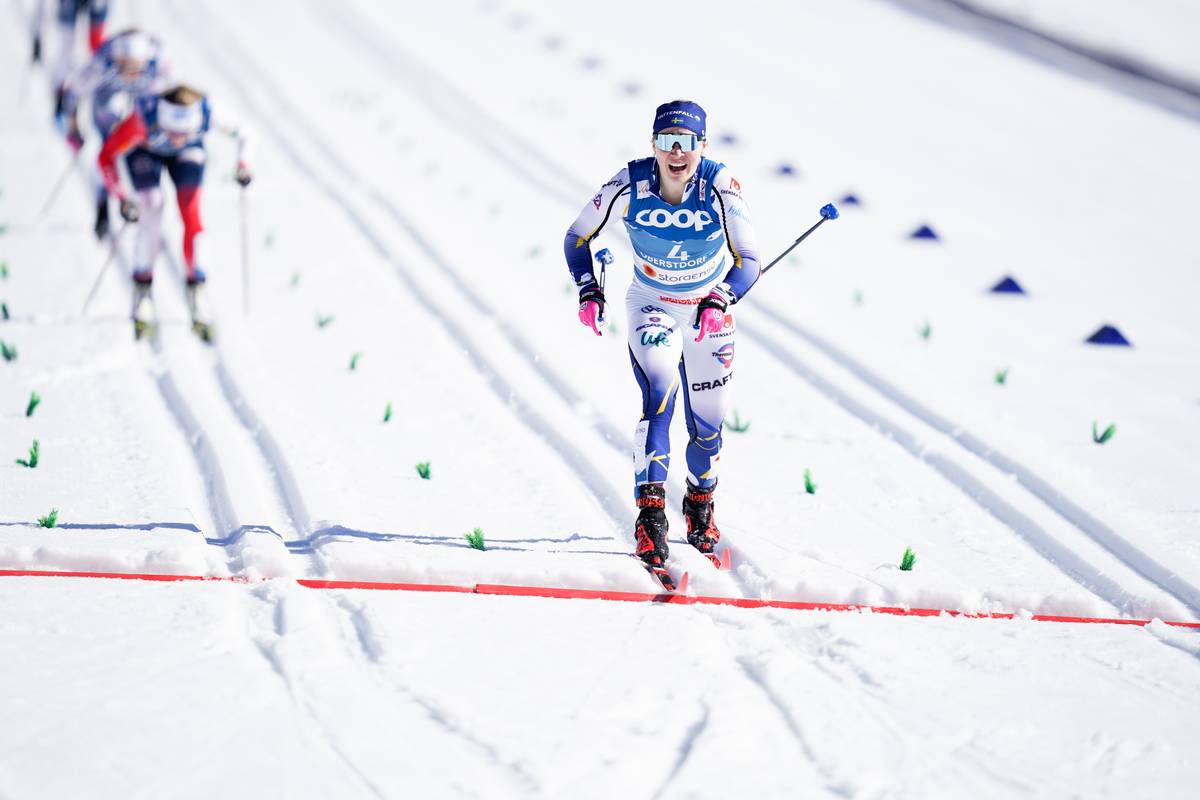
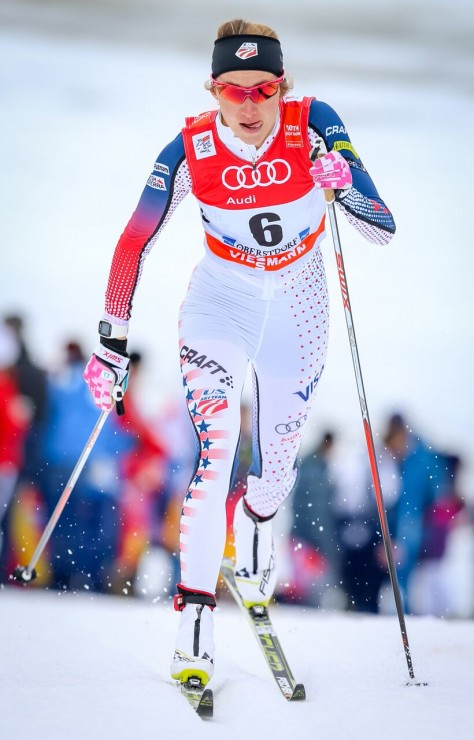
    Johanna Hagström of Sweden during the women’s classic sprint qualifier. (Photo: NordicFocus)

    Jumping ahead to close the day out, top honors went to her Swedish teammate, Jonna Sundling, who won the final in a time of 2:36.76.

    On a salted course, which despite the sun’s radiation held up, the sustained final climb proved to be an effective make-it or break-it moment in terms of dictating the results narrative. Throughout the quarter-final rounds, gaps formed as the leaders crested the hill well ahead of their competitors. Notably, after two false starts at the beginning of Heat 5, one for technical issues and the second the result of Tatiana Sorina (RSF) jumping the gun, a crash by Johanna Matintalo of Finland forced Sorina well off-course to avoid a tangle though she seemingly was not disqualified for her deviation. Observers of the sport will note that Russian athletes are representing the Russian Ski Federation and not “Russia” during these championships. This is the result of a recent Court of Arbitration for Sport ruling.

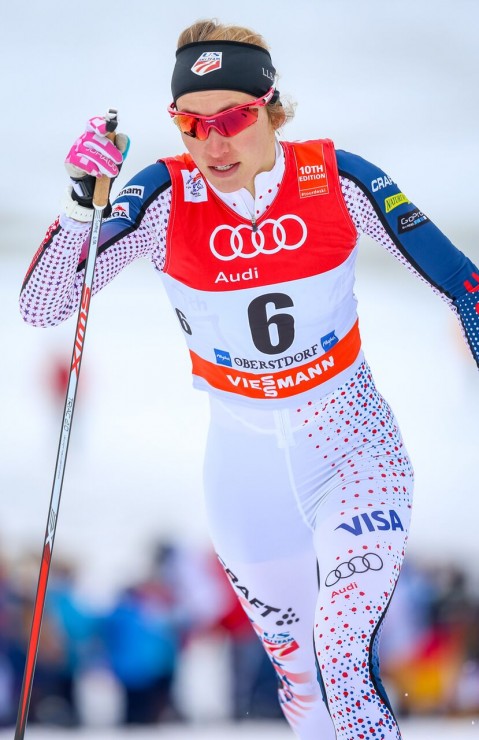
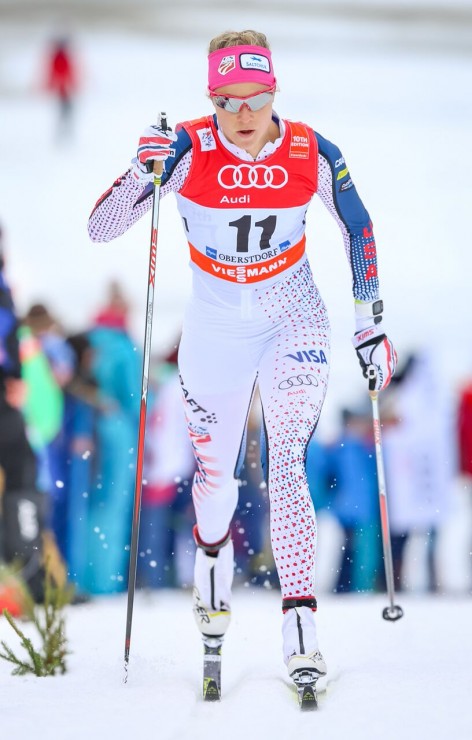
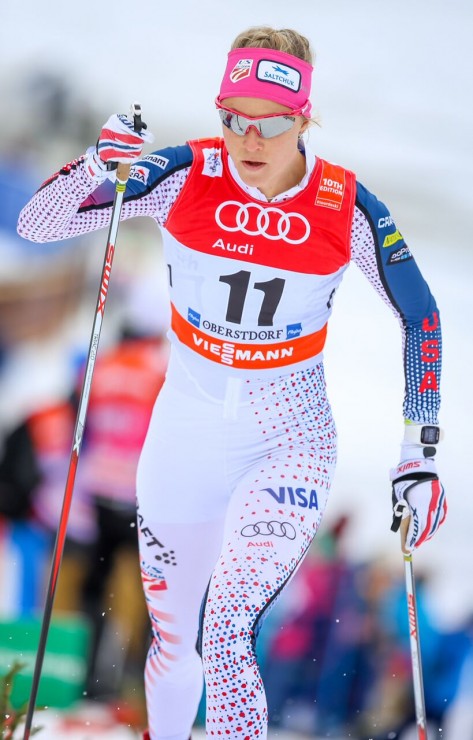
    Sophie Caldwell Hamilton of the U.S.s racing in qualification. (Photo: NordicFocus)

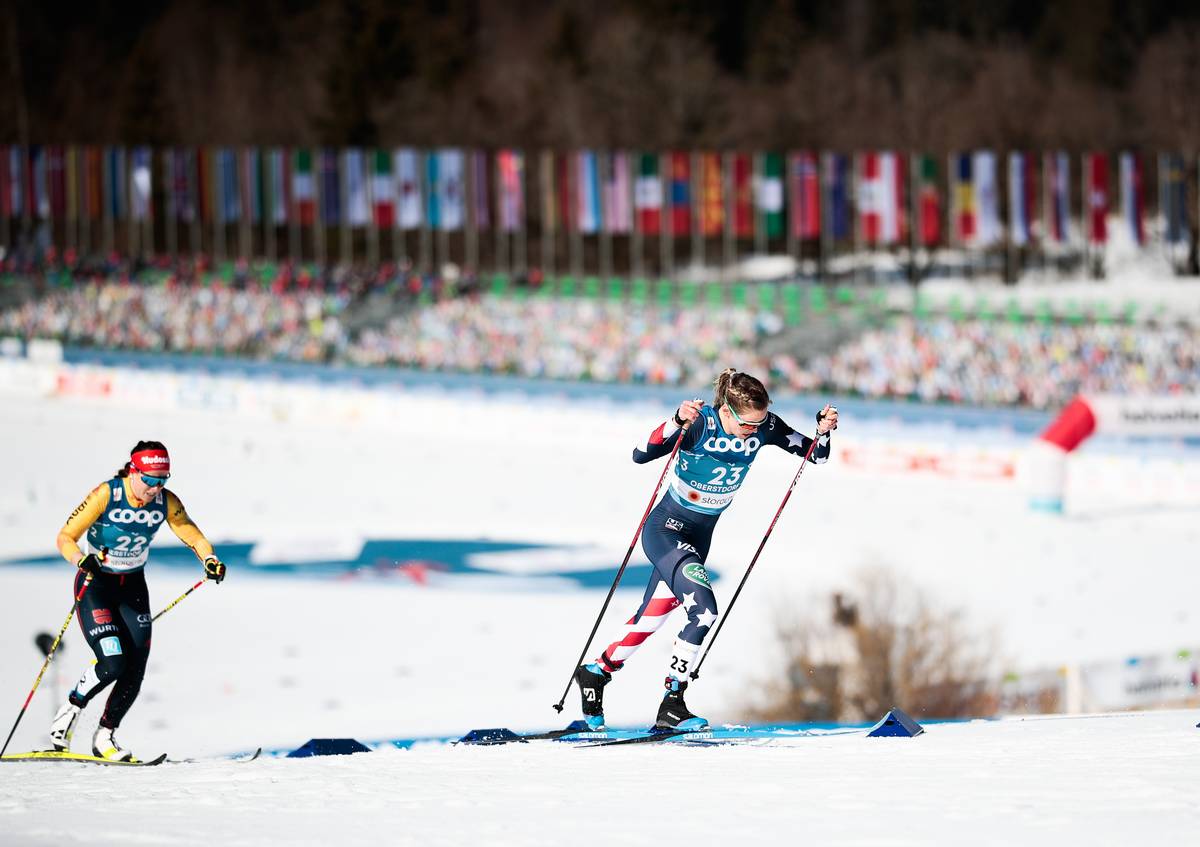
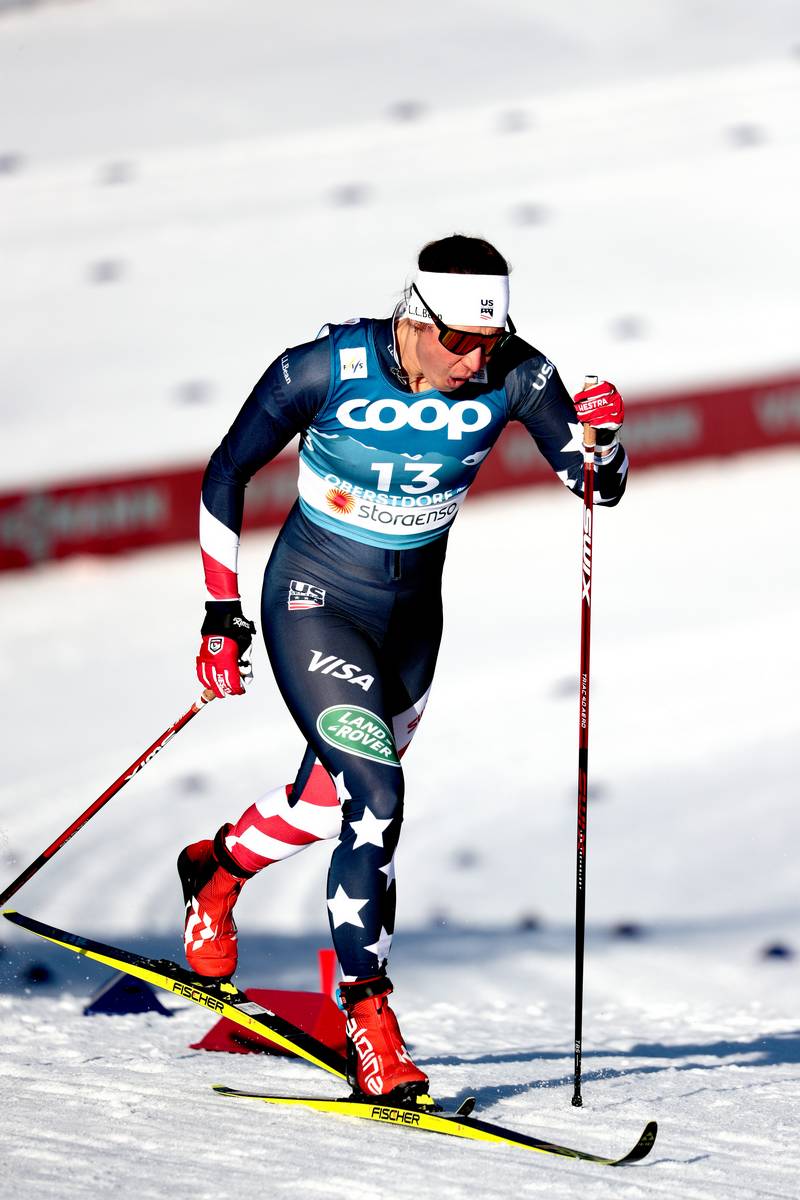
    Two U.S. women qualified for the heats, Jessie Diggins in 23rd and Sophie Hamilton Caldwell in 26th. Hamilton Caldwell raced in quarterfinal number two where she finished 6th, concluding the day in 29th position. Diggins chose heat four and finished 5th for an overall place of 24th.

    After her race, Diggins shared with the U.S. Ski Team, “I am really really excited to be here, first of all, I feel like really lucky that we are getting to race at all. I think this is pretty incredible when I think back to how we were looking at this season back in November, the fact that we have made it here to World Champs and they are happening is really really cool. For me personally, I came into this World Champs feeling like I have prepared the very best that I could. I even tried to acclimate to the heat as much as possible because it is super super hot and sunny here.”

    Johanna Hagström (SWE), Jessie Diggins (USA), (l-r) racing in the heats. Diggins went on to place 24th overall. (Photo: NordicFocus)
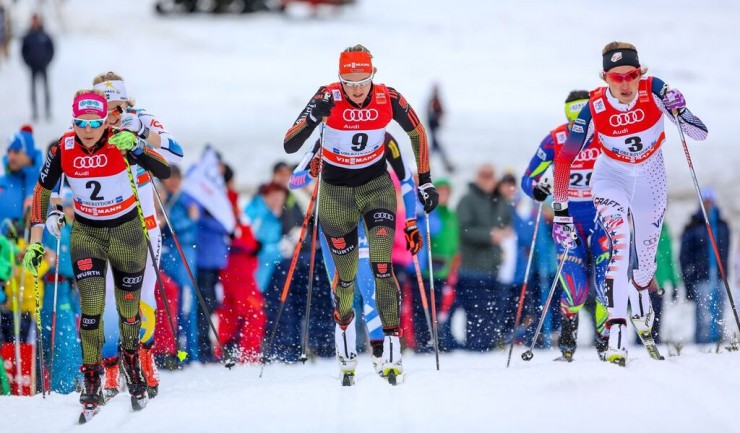
    Katharina Hennig (GER), Jessie Diggins (USA), (l-r) during the fourth heat in Oberstdorf. (Photo: NordicFocus)

    Regarding today’s race Diggins said, “So today, in the qualifier, just went out and I think I definitely was still waking up my body I think from pre-camp so it definitely felt like I need to find that next gear. But was happy to have made it into the heats. And then in my heat, I felt like I did a good job not overheating staying out of the sun when I could. Getting a great warm-up and skis dialed in with Cork. And I think we had very competitive skis. On the last uphill, I definitely was mentally trying to churn the legs and get the gears going and I just felt like my body just ran out of energy. I know I prepared the best I could and now am just focused on hydrating, fueling, getting out of the snow and getting ready for a lot of races up ahead. I am really proud of my effort, I felt like I pushed as hard as I could and I don’t have any regrets.”

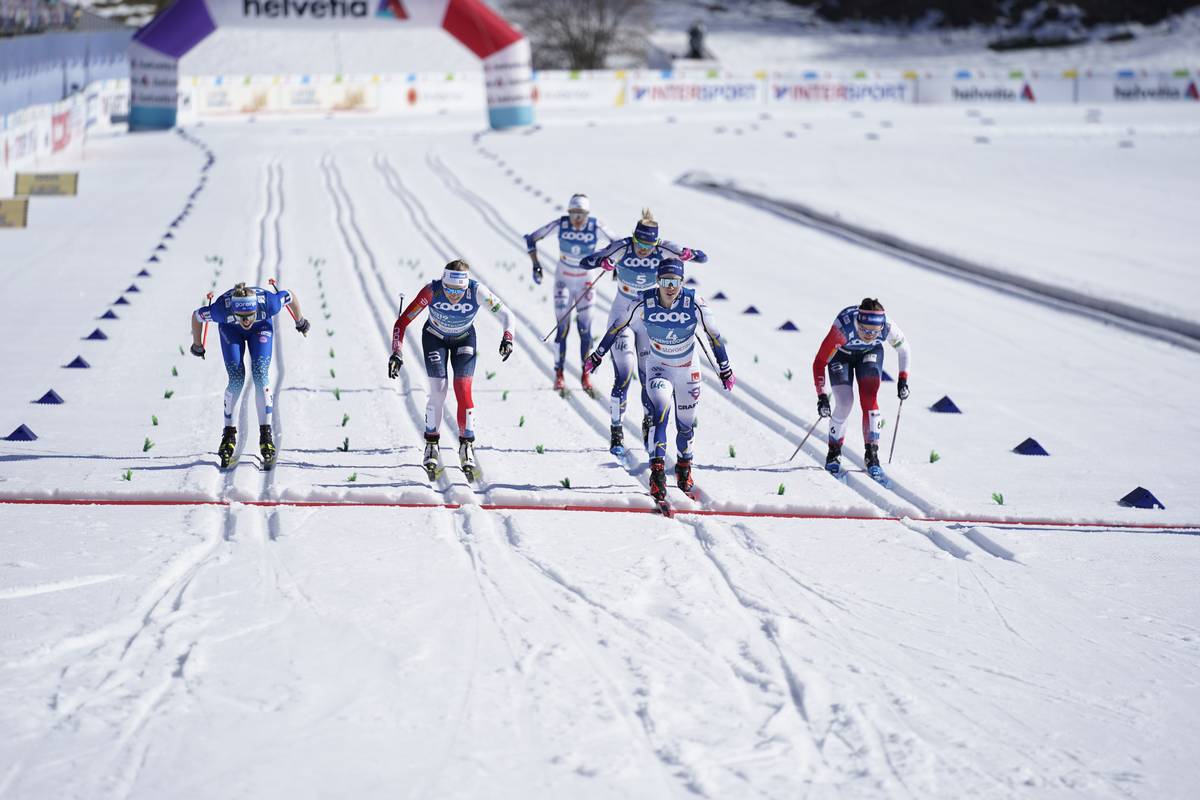
    Maiken Caspersen Falla (NOR), Maja Dahlqvist (SWE), and Jonna Sundling (SWE), (l-r) finishing a tight first semifinal. (Photo: NordicFocus)

    In a stacked first semi-final heat, Sundling of Sweden and Maiken Caspersen Falla of Norway advanced automatically with both lucky losers also coming from this heat, Norway’s Ane Appelkvist Stenseth and Slovenia’s Anamarija Lampic. A false start at the beginning of semi-final number two resulted in a yellow-card for Hagström though she still qualified in second place. Lotta Udnes Weng of Norway had a stumble and fall at the top of the first climb, nearly taking out her sister and fellow competitor, Tiril Udnes Weng (NOR). Tiril Udnes Weng recovered to win the semi-final ahead of Hagström.

    For the final, three Norwegians, two Swedes and one Slovenian lined up to complete the first medal event of the 2021 World Championships. For the first climb, the group stayed largely together but as they entered the second and final hill Sundling turned on the burners. Gapping the field, she crested over the top alone, with Falla some paces behind. Entering the final straights, Sundling was unchallenged as she swept across the line, arms raised, to claim her first-ever championship medal.

    Sundling soloing in for the win. (Photo: NordicFocus)


    With the win, Sundling scores her first career championship gold. (Photo: NordicFocus)

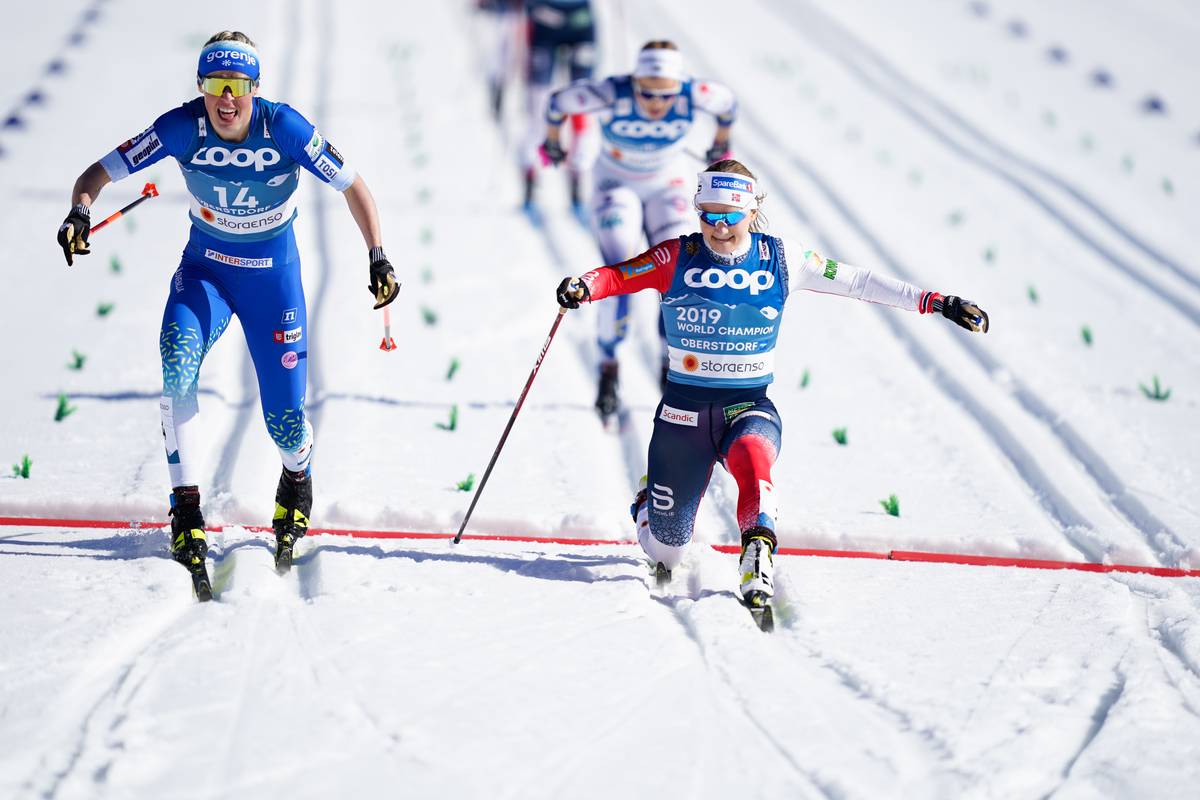
    Behind her, a battle for second and third position was playing out as Lampic was quickly closing in on Falla. Both skiers threw their feet forward for a photo-finish lunge that ultimately went to Falla, leaving Lampic with bronze. Hagström finished fourth, Stenseth fifth and Tiril Udnes Weng (NOR) placed sixth.

    Throwing toes at the line, Anamarija Lampic (SLO) and Maiken Caspersen Falla (NOR), (l-r). Falla placed second with Lampic third. (Photo: NordicFocus)

    Sundling has three individual World Cup victories to her name, all coming from freestyle sprint events. At the Seefeld World Championships in 2019 she finished fourth in the skate sprint. After her victory today Sundling said in an interview with FIS, “I am so so happy, I have dreamt of this and to get this victory, it’s amazing. I’m really really happy.” When asked about the rest of the field she said, “[my competitors] were so strong, it is a fast and tough track and I think everyone did a really good job today and I’m really satisfied to be the first over the finish line of course.”

    Falla, the 2019 and 2017 Sprint World Champion, takes home her fifth individual championship medal after placing second. This is Falla’s second international race of the year as she sat out much of the season. For Lampic, this third-place finish marks her first individual World Championship podium. In Seefeld in 2019, Lampic placed second in the team sprint with teammate Katja Visnar.

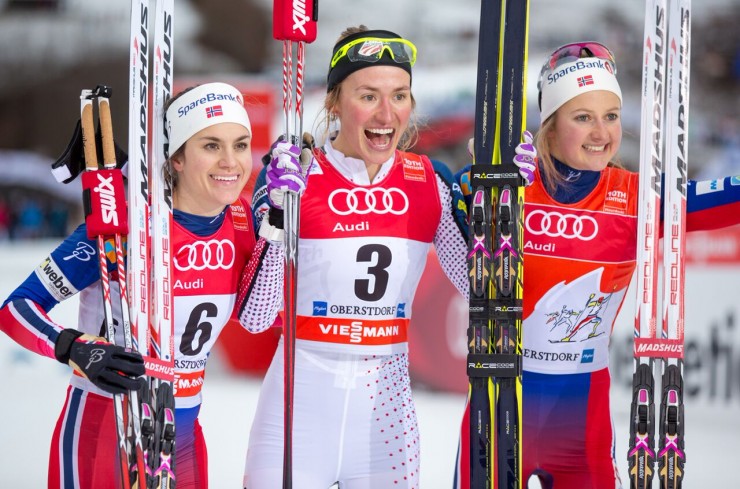
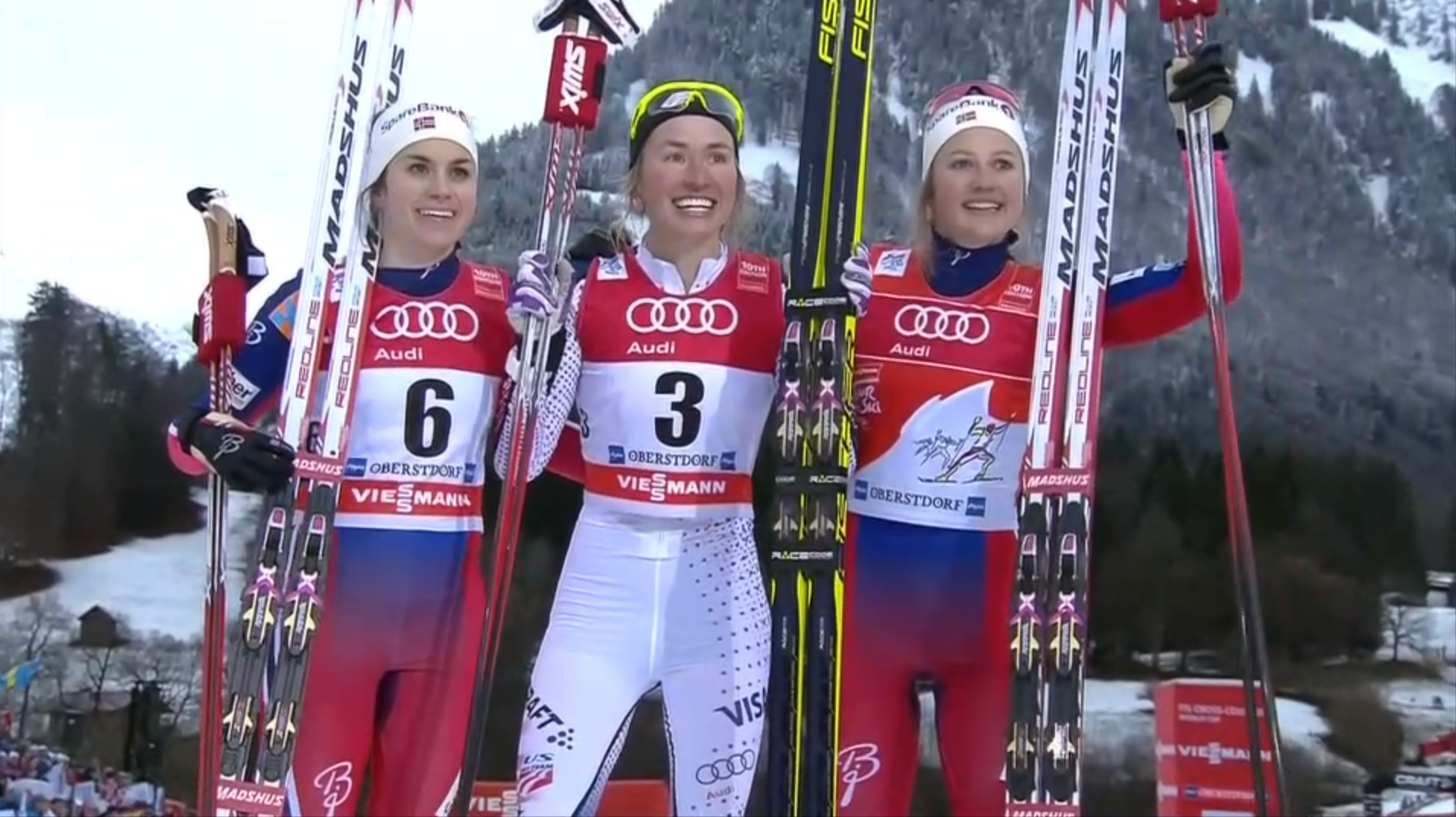
    The women’s classic sprint podium: Maiken Caspersen Falla (NOR) second, Jonna Sundling (SWE) first, and Anamarija Lampic (SLO), (l-r). (Photo: NordicFocus)


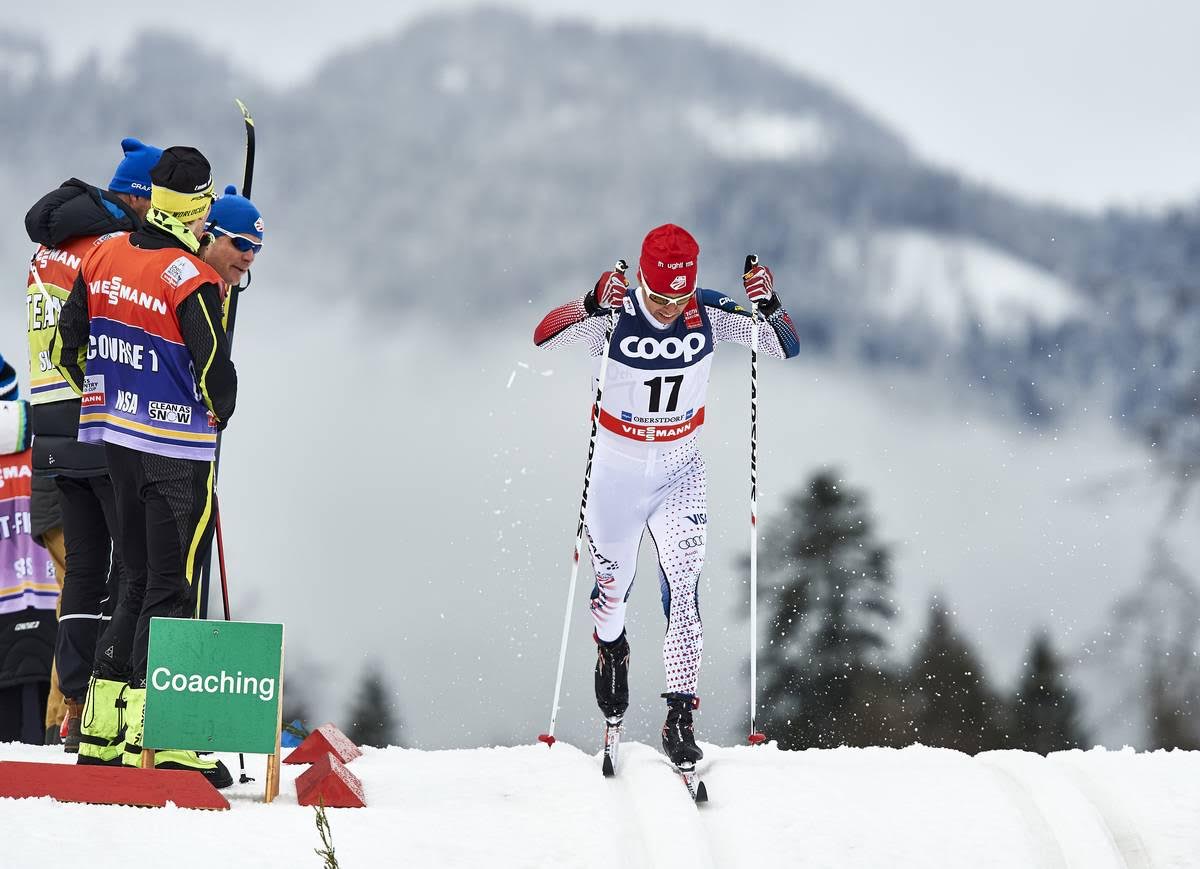
    Rosie Brennan racing in qualification. (Photo: NordicFocus)
    Julia Kern racing in qualification. (Photo: NordicFocus)
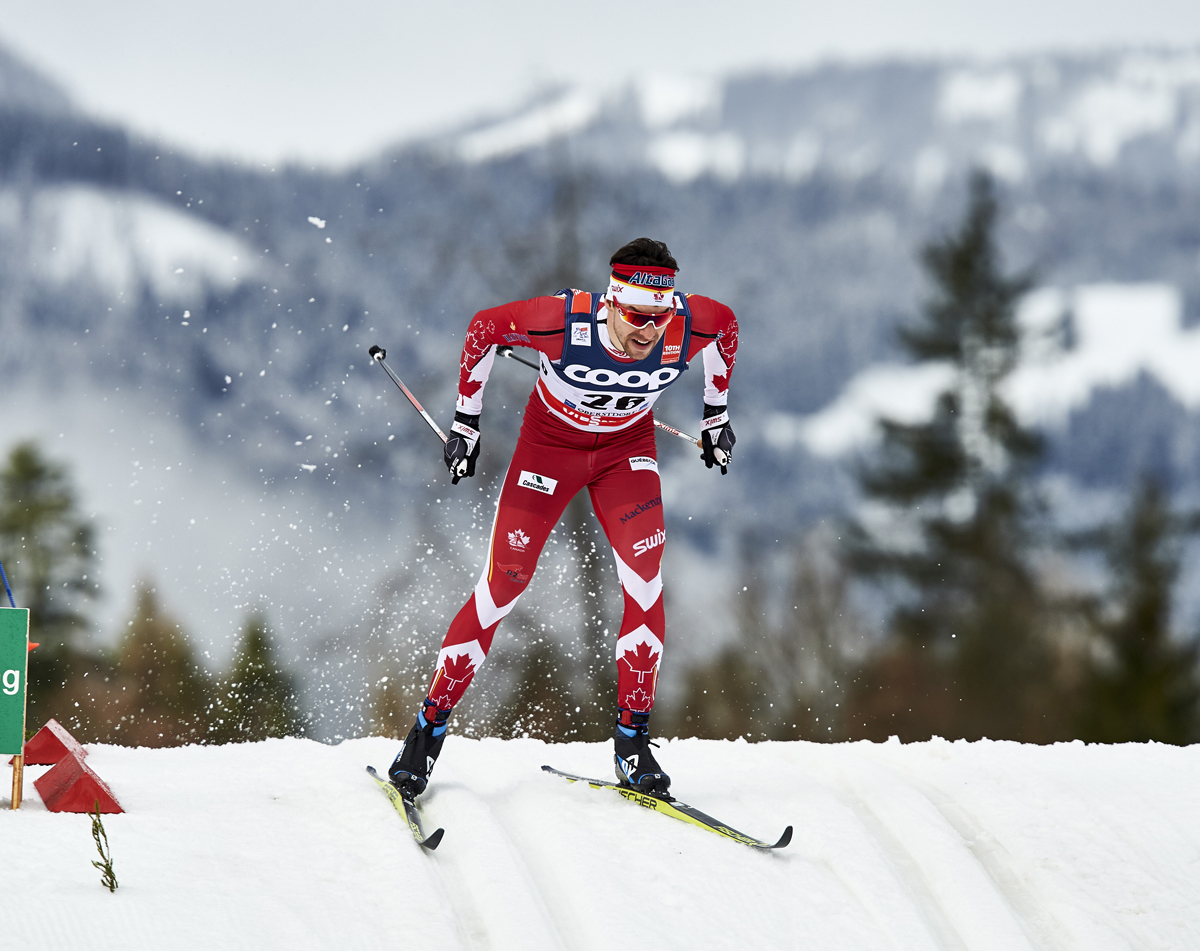
    Dahria Beatty was the top Canadian placing 38th. (Photo: NordicFocus)

    Racing continues Saturday with a 15 k skiathlon for the women. Looking forward, when asked about her feelings going into the skiathlon Diggins said, “sometimes after a camp especially at altitude, you need to do a hard effort to just sort of blow the rust out of the gears. And so I think that was really great, and yeah it is kind of nice because in skiathlon it is a very different energy system than a sprint. I am really excited to again just send it with everything I have. That is all I can promise, is that I am going to cross the line being totally gassed.”

    Results: Women’s Final | Women’s Qualifier

  • Svahn Leads Another Swedish Triple; Diggins Retains Overall Tour Lead

    Svahn Leads Another Swedish Triple; Diggins Retains Overall Tour Lead

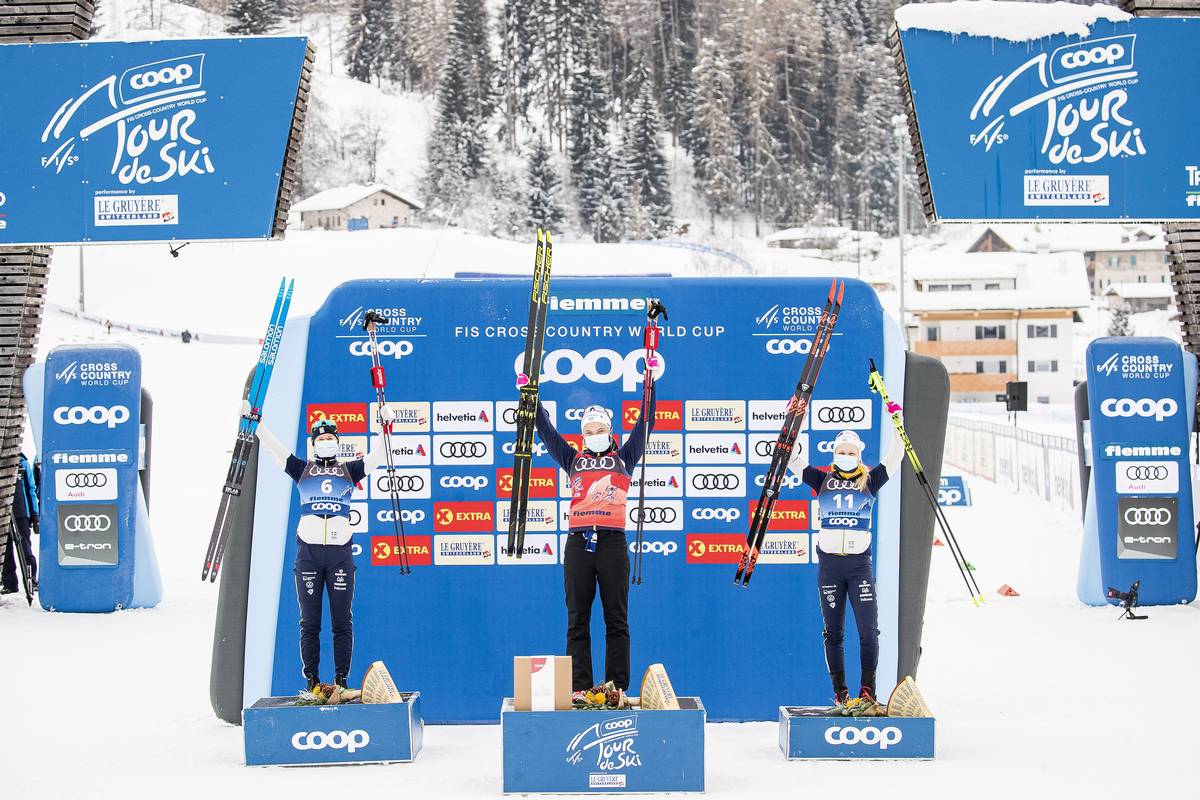
    Triple Swedish podium: Maja Dahlqvist (SWE) second, Linn Svahn (SWE) first, and Emma Ribom (SWE) third, (l-r) (Photo: NordicFocus)

    This World Cup coverage is made possible through the generous support of Marty and Kathy Hall and their A Hall Mark of Excellence Award. To learn more about A Hall Mark of Excellence Award or to learn how you can support FasterSkier’s coverage please contact info@fasterskier.com. 

    It was a cloudy day in Val di Fiemme, Italy for Stage 7 of the Tour de Ski. Today marked the final event before the looming Alpe Cermis hillclimb, with the athletes completing a classic sprint where the inside line on a corner could mean the difference between advancing or not and precious seconds for the overall tour.

    Linn Svahn (SWE) on a tear through qualifying and beyond. (Photo: NordicFocus)

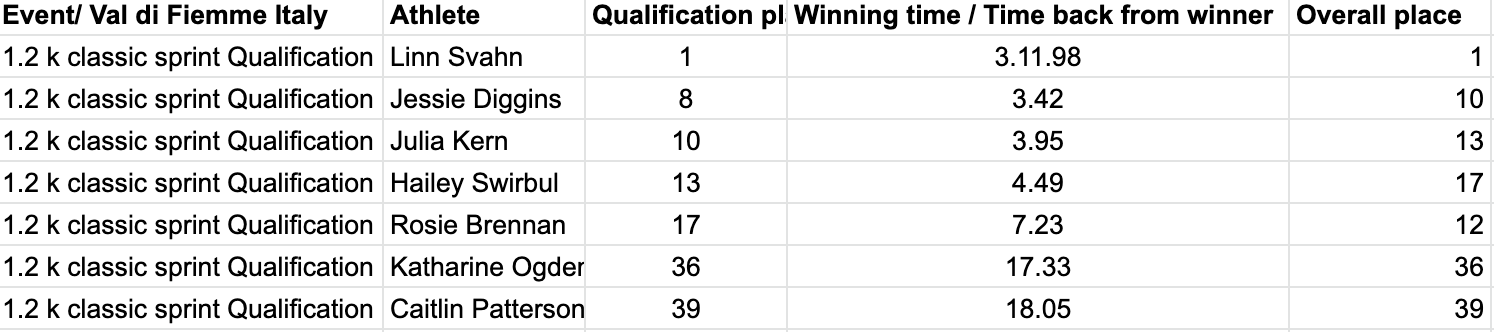
    Linn Svahn of Sweden won the qualifier in a time of 3:11.98. For the U.S. women, four of the six remaining tour participants qualified for the heats with Jessie Diggins 8th, Julia Kern 10th, Hailey Swirbul 13th, and Rosie Brennan 17th. Katharine Ogden and Caitlin Patterson placed 36th and 39th, respectively. Kern and Swirbul were both knocked out in their quarterfinals. Diggins and Brennan were seeded in the second semi-final where they finished 5th and 6th, respectively.

    Julia Kern (USA) double poles through qualifying to place 10th. (Photo: Nordic Focus)

    After today’s sprint Brennan wrote, “It was a very tight turn around from yesterday’s race and today’s race, so after an extremely tough day yesterday, I wasn’t sure how my body would fare today. In the quarterfinal, I finally found a little bit of snap and was very happy to move on to the semifinal. Jessie and I were in a very fast semifinal heat which certainly gives you the best chance of a lucky loser, but I just didn’t have the power I need to get those few extra places. This was the first time I have made it to the semis in a classic sprint so I’m happy to have crossed that barrier.”

    Rosie Brennan (USA) gets some vertical down the finish straight in her quarterfinal. (Photo: NordicFocus)

    Advancing to the final was Linn Svahn, Maja Dahlqvist and Emma Ribom of Sweden, Natalia Neprayaeva and Tatiana Sorina of Russia, and Krista Pärmäkoski of Finland. Svahn, who won both her quarter and semi-final heats in addition to the qualifier, looked to be the favorite. As the racers came into the final corner above the descent to the stadium all six were still in podium contention. Neprayaeva led with Svahn tucked in behind her, ready to slingshot into the final straightaway. Echoing her tactic from the earlier rounds, Svahn did exactly that, pulling away to take her second sprint victory in this year’s Tour de Ski. Behind her, Dahlqvist placed second and Ribom third to make a triple Swedish podium.

    Three happy Swedes following a podium sweep. (Photo: NordicFocus)

    This is a maiden podium finish for Ribom. Her previous personal best came in Ruka at the start of the 2020/21 season where she finished 6th in the classic sprint.

    Emma Ribom’s (SWE) first individual World Cup podium finish. (Photo: NordicFocus)

    “It was so so fun,” said Svahn after the race, “I said to Maja [Dahlqvist] before the final, ‘OK let’s do a triple again’. And it’s all so amazing to be inside with the Swedish girls, we are such a strong team. I am so glad to be a part of this, it’s so so fun.”

    The Swedish women are renowned for their sprinting, in fact, they opened the season in Ruka with a triple podium where Svahn once again took gold followed by Dahlqvist and Jonna Sundling placed third. 

    Many raised hands, Linn Svahn (SWE) takes gold ahead of teammates Maja Dahlqvist and Emma Ribom. (Photo: NordicFocus)

    For Svahn (age 21), this victory makes her the youngest woman to win multiple sprint stages in the Tour de Ski. In addition to winning the opening sprint in Val Müstair, she took gold in the 10 k classic mass start the following day. Today marks her fourth win of the season and seventh win in total.

    Braids flying for Jessie Diggins (USA) as Maja Dahlqvist (SWE), Rosie Brennan (USA) and Yulia Stupak (RUS) (r-l) close out in the semi-final. (Photo: Nordic Focus)

    After her elimination in the semi-final, Diggins finished in 10th place for the day. “That was a good day today,” she wrote, “Once again, so incredibly proud of our staff for all their hard work and for the amazing skis they keep giving us! I did exactly what I needed to out there today in terms of the overall tour. I would have loved to make the finals since my body was feeling great, but that’s just a little extra energy in the bank for tomorrow! Focused on one moment at a time, and ready to absolutely destroy myself on that hill climb tomorrow. The only thing I know for sure is that I’ll be crossing that finish line with absolutely nothing left! I’m proud of this team and what we’ve accomplished together, and excited to go charging one last time.”

    Diggins and Brennan lunge for the line in semi-final number two. (Photo: Nordic Focus)

    Overall Tour Standings: 

    Leading into the final day of racing, Diggins holds the lead, +54 seconds ahead of Russia’s Yulia Stupak in second. Frida Karlsson of Sweden, who was in third place in the tour standings, withdrew from the tour before today’s race. Karlsson sustained an injury from strength training earlier in the week and cited this as a reason for her withdrawal. With the absence of Karlsson, Parmakoski (FIN) moves into third place in the overall rankings (+1:51). Just seven seconds behind her is Neprayaeva (RUS) who finished second in last year’s edition of the Tour de Ski. 

    Also for the U.S., Brennan remains in 7th place, starting +2:19 after Diggins. Looking towards tomorrow Brennan said, “I am still in the fight for a strong overall and am looking forward to duking it out on the hill tomorrow.” 

    Swirbul will start in 18th (+5:46), Ogden in 22nd (+7:28), Patterson in 34th (+10:53) and Kern 38th (+13:16). 

    The Tour concludes tomorrow with the final hillclimb up the Alpe Cermis.

    Women’s Final | Women’s Qualifier | Women’s Overall 


  • Falla for the Win, Diggins Third in Drammen Classic Sprint

    Falla for the Win, Diggins Third in Drammen Classic Sprint

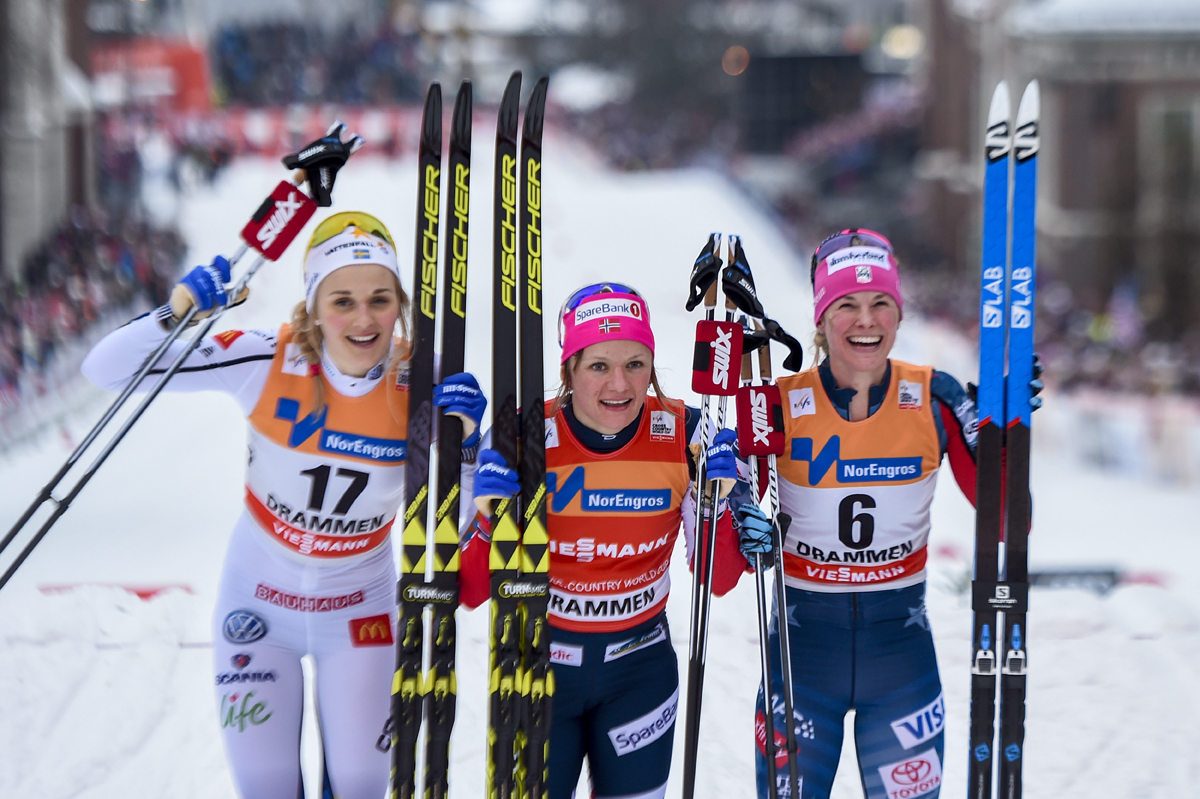
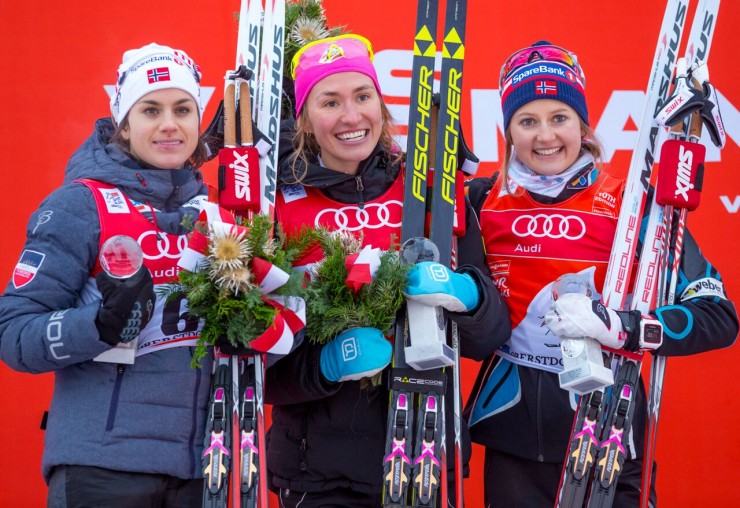
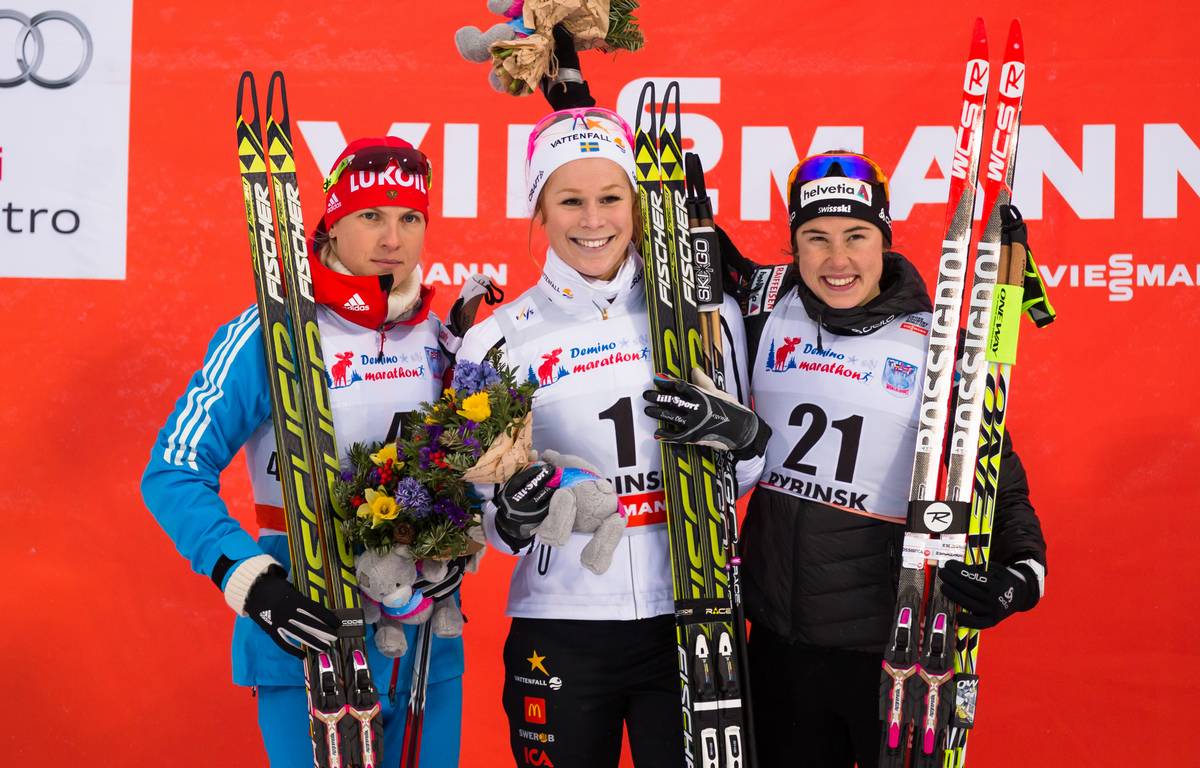
    The women’s classic sprint podium at the World Cup in Drammen, Norway, with Norway’s Maiken Caspersen Falla (c) in first, Sweden’s Stina Nilsson (l) in second, and American Jessie Diggins (r) in third. (Photo: Fischer/NordicFocus)

    DRAMMEN, Norway — Barring the spectators cheering from their apartment balconies, the most marked aspect of Wednesday’s 1.2-kilometer classic sprint course was the finish line. It crosscut the top of a 15-meter climb.

    Throughout the day, no skier closed out Drammen’s uphill finish better than Norway’s Maiken Caspersen Falla. After winning the day’s qualifier in a time of 3:19.44 minutes, Falla won her quarterfinal in photo-finish fashion and outlunged Sweden’s Stina Nilsson to place first their semifinal.

    In the final, Falla once again proved her form in the uphill. She strode past Russia’s Natalia Nepryaeva and Nilsson to take the win in a time of 3:10.18. The closest any competitor came to the Norwegian was Nilsson, 1.39 seconds back.

    Norway’s Maiken Caspersen Falla en route to her second-straight World Cup victory in Wednesday’s classic sprint in downtown Drammen, Norway. (Photo: Fischer/NordicFocus)

    The first-place success in Drammen is Falla’s standard. From 2014 to 2016, she won three World Cup sprint races held in the city, all of them classic. (Falla missed qualifying by one place in 31st in last year’s Drammen classic sprint.)

    “It’s my fourth win here and I am so happy with the way I am feeling,” Falla said, according to an International Ski Federation (FIS) press release. “I think my battery is finally fully charged. I was a bit tired after the Olympics and I haven’t trained very much. But I can feel that my body is back and it’s great to get another win here and almost secure my third Crystal Globe.”

    Falla now leads the Sprint World Cup with 543 points, while Nilsson trails in second by 48 points. Only one sprint race remains this season, a freestyle competition that is featured in next weekend’s World Cup Finals in Falun, Sweden. With her second-place finish on Wednesday, Nilsson could still snag the Sprint Crystal Globe from Falla, as 50 points remain for a win in that race.

    “I didn’t qualify so well so I was a bit worried about how today would go,” said Nilsson, who qualified in 17th, according to a FIS press release. “Maiken was just too strong for me today but I am happy that I felt better and better as the rounds happened today … and in the end I can say that I am satisfied.”

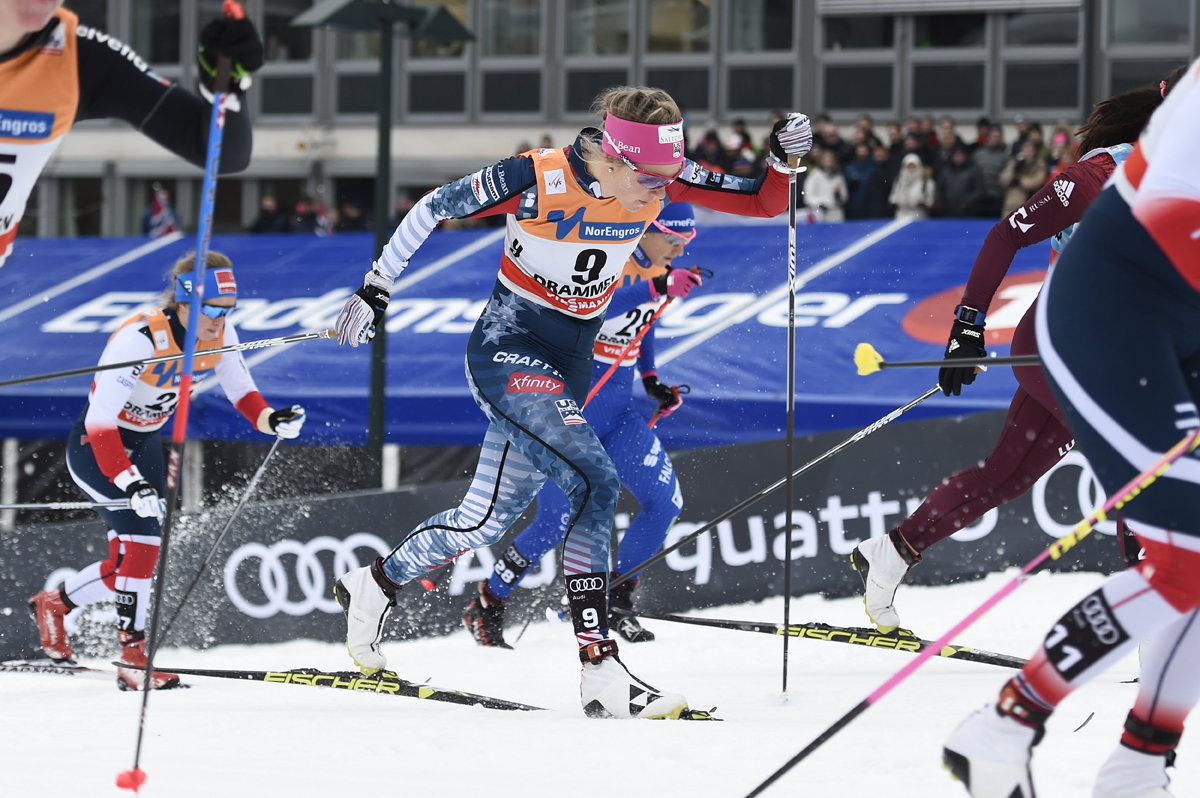
    In a dramatic closeout, U.S. skier Jessie Diggins came from behind to claim third (+1.88), despite appearing out of podium contention with 150-meters to go. The American’s advancement to the final itself was up in the air until the jury ruled a technical violation for Switzerland’s Nadine Fähndrich.

    Norway’s Maiken Caspersen Falla (l) winning the first semifinal of the Drammen World Cup classic sprint in Norway on Wednesday, ahead of Sweden’s Stina Nilsson (r) in second and American Jessie Diggins (c) in third. Norway’s Ingvild Flugstad Østberg (behind Nilsson) finished fourth and Thea Krokan Murud (14) was fifth in that heat. (Photo: Fischer/NordicFocus)

    After racing in semifinal 1, Diggins finished in third behind Falla and Nilsson. Semifinal 2 was the faster of the two semis, and produced the day’s two Lucky Losers before Fähndrich’s yelllow card. The Swiss skier lost her automatic qualification spot, giving Diggins a shot as the final lucky loser in the final. 

    At the start of the women’s final, the American was positioned in sixth, trailing Slovenia’s Katja Visnar in fifth, Finland’s Krista Pärmäkoski in fourth, Nilsson in third, Nepryaeva in second, and Falla in first. While she had burned off the front in the start of her quarterfinal, Diggins played a safer start in the final. 

    “Last year [in Drammen] I got swallowed up in the draft and then broke my pole,” Diggins told FasterSkier during an in-person interview after. “So this year I was trying to be really smart, be aware of where other bodies were and keep myself out of any tangles; just ski a smart, clean race.”

    “In the final I started out in the back thinking ‘OK, just ski relaxed, stay in contact,’ ” she continued. “Then I was really able to go for it and put the hammer on in the last 50 meters.”

    Taking the opposite tactic of Diggins, Falla forced a fast pace in the front. By the top of the first climb the Norwegian had a one-meter gap over Nilsson and Nepryaeva, who were positioned in second and third, respectively. Another half meter behind the Russian and Swede were Diggins and Pärmäkoski.

    Heading into the descent, Falla held her capacious lead. About a meter behind the Norwegian, Nepryaeva slid ahead of Nilsson. Diggins, who had surged around Pärmäkoski on the hill’s crest, took a few double poles midway through the descent’s two twists in an attempt to close the gap separating her from the top three.

    By the bottom of the hill, Nepryaeva had closed in on Falla. The Russian and Norwegian went head-to-head as they approached the course’s final hairpin turn. Chasing the backs of their ski tails was Nilsson. Fighting to hold onto Nilsson was Diggins.

    Coming out of the hairpin, Russia had the lead, followed closely by Norway and Sweden. The American clung tenaciously, though now two ski lengths behind the finals top three leaders with less than 150-meters to go.

    “Admittedly I have to say that while I will never count Jessie out, it certainly looked like she was on her way to fourth,” U.S. Ski Team Women’s Coach Matt Whitcomb told FasterSkier during an in-person interview. “I think she surprised just about everyone out there today.”

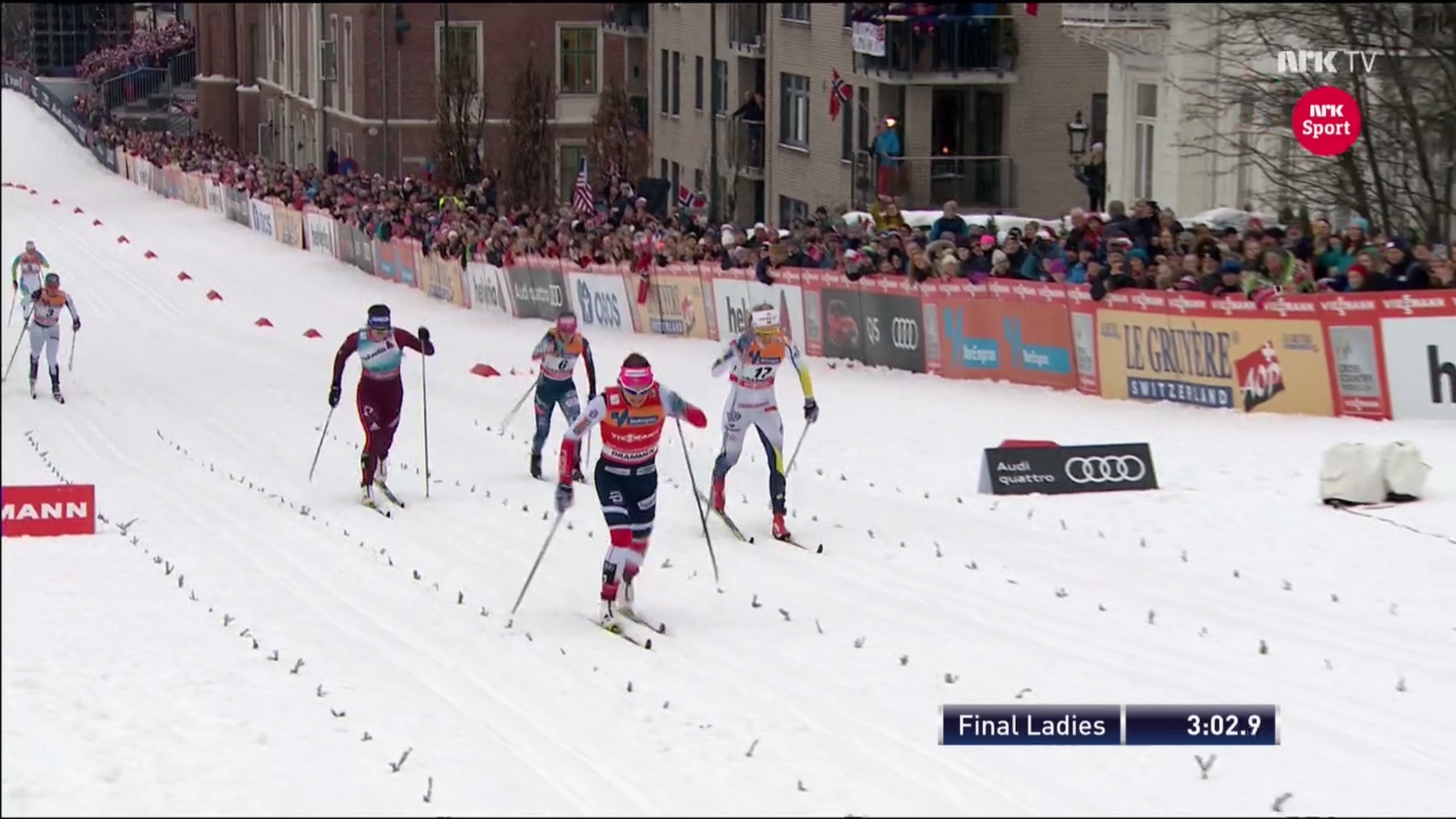
    Norway’s Maiken Caspersen Falla leads Sweden’s Stina Nilsson (r) ahead of Russia’s Natalia Nepryaeva (third from left) and American Jessie Diggins (third from right) during the women’s 1.2 k classic sprint final on Wednesday at the World Cup in Drammen, Norway. (Screenshot: NRK broadcast)

    In the final climb, Falla was the first to pass Nepryaeva on the left. Nilsson followed suit, and then Diggins. By a mere 0.44 seconds, Diggins edged Nepryaeva, earning her first World Cup classic sprint podium.

    “It was so cool because classic sprinting — especially on a course like this, in deep sugary snow that is falling apart — is arguably my all-time weakest event; to be able to finally get a podium, that’s something I’ve been after for many years,” Diggins said.

    Wednesday’s classic sprint was Diggins’s first race back since last month’s Olympics in PyeongChang, South Korea. Following the Games, she and her teammate Kikkan Randall returned to the U.S. for what Whitcomb referred to as essentially a “media tour” thanks to the duo’s Olympic gold medal in the team sprint. Both returned to Europe last weekend, though neither raced the World Cup races that took place in Lahti, Finland on Saturday and Sunday. 

    “Not for a minute, when we saw them after we arrived from Lahti, did we think that was a mistake,” Whitcomb said of the decision for Diggins and Randall to return to the U.S. “At the end of the day, had it been a mistake, we didn’t care. We wanted that story told.” 

    “I think it was really important that I had that rest. I clearly needed it and I was able to come back feeling snappy,” Diggins added.

    Diggins is now ranked third in the Overall World Cup standings, 375 points behind Norway’s Heidi Weng in first and 179 points behind Norway’s Ingvild Flugstad Østberg in second. She is 35 points ahead of Pärmäkoski in fourth.

    Following Diggins on Wednesday, Nepryaeva crossed in fourth (+2.32), Pärmäkoski fifth (+8.85) and Visnar sixth (+20.70).

    Rounding out the top 10 was Sweden’s Hanna Falk in seventh, Østberg in eighth, Norway’s Tiril Udnes Weng in ninth, and Norway’s Thea Krokan Murud in 10th.

    Sadie Bjornsen (9) racing to fifth in her quarterfinal for 21st overall in the women’s classic sprint at the World Cup in Drammen, Norway. (Photo: Fischer/Nordic Focus)

    Two more Americans qualified for Wednesday’s classic sprints, with Sadie Bjornsen placing 21st after finishing fifth in her quarterfinal, 9.24 seconds behind Fähndrich in first. Sophie Caldwell raced in the first quarterfinal with Falla, where she finished sixth, 10.6 seconds back, for 27th overall.

    U.S. skier Ida Sargent finished 47th in the qualifier, followed by Rosie Brennan in 48th, Randall in 50th, and Kaitlynn Miller in 53rd.

    Canada’s Emily Nishikawa placed 52nd and Dahria Beatty 55th.

    Results: Qualifier | Final
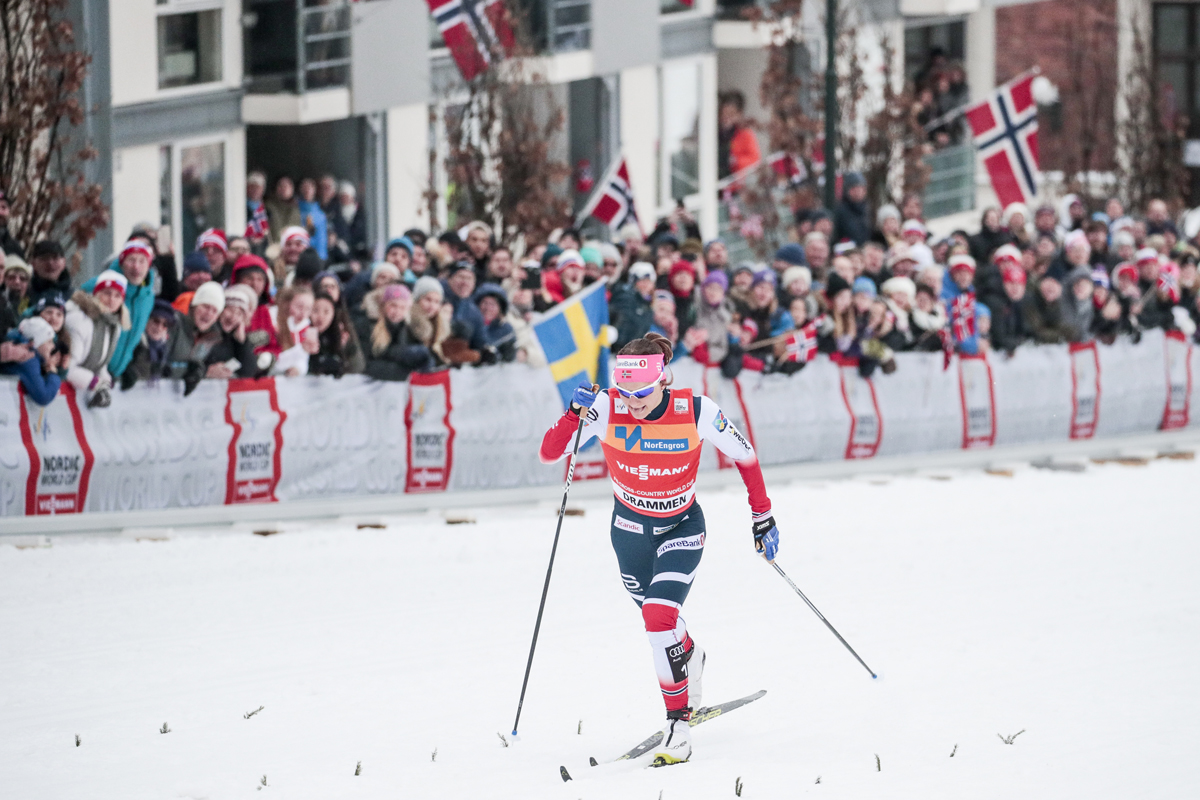
    — Chelsea Little, Harald Zimmer and Alex Kochon contributed

    Sophie Caldwell racing to 20th in the qualifier of the women’s classic sprint at the World Cup in Drammen, Norway. She went on to place 27th overall after finishing sixth in her quarterfinal. (Photo: Fischer/NordicFocus)
  • Klæbo Takes a Bow in Drammen Classic Sprint; Erik Bjornsen 18th

    Klæbo Takes a Bow in Drammen Classic Sprint; Erik Bjornsen 18th

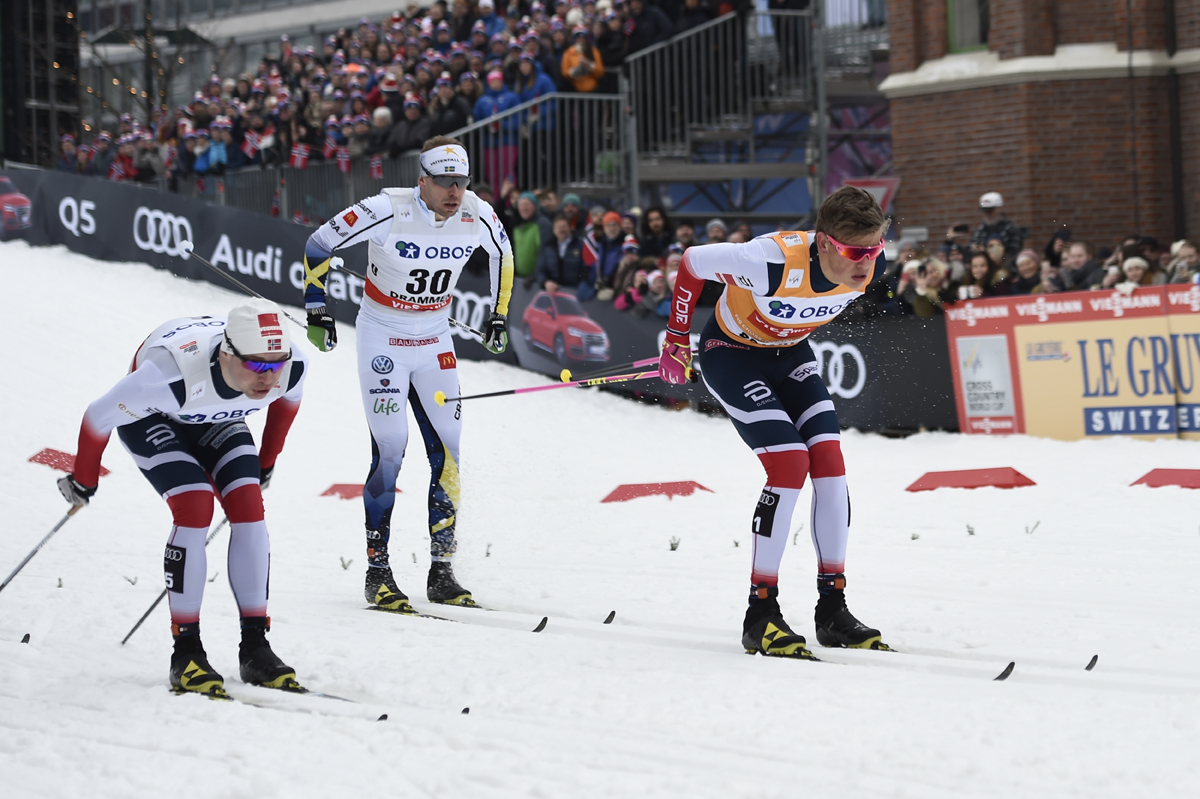
    Norway’s Johannes Høsflot Klæbo (l) edging Russia’s Alexander Bolshunov (3) and Norway’s Eirik Brandsdal (not shown) in the first semifinal of the men’s classic sprint at the World Cup in Drammen, Norway. Klæbo went on to win the final, ahead of Brandsdal in second and Bolshunov in third. (Photo: Fischer/Nordic Focus)

    In the classic venue that are the Drammen city sprints, it was a singular affair from start to finish during the men’s World Cup 1.2-kilometer classic sprint on Wednesday. In a race format that tapered from a field of 61 skiers to the winner, one only needs to track the skier in the overall World Cup’s leader bib to follow along.

    The yellow-bibbed skier, Norway’s Johannes Høsflot Klæbo, didn’t surprise with his sprint win in Drammen as much as place another high performance stamp on his 2017/2018 campaign.

    Klæbo won the qualifier in 2:49.32 minutes. Teammate Eirik Brandsdal skied to second in the qualifier, 3.5 seconds behind Klæbo. Russian Alexander Bolshunov skied the third-fastest qualifying time, finishing 4.48 seconds back. This puts some things in perspective, if anybody thought Klæbo would bloat in his post-Olympic gold medal glow — he won three golds in PyeongChang — you’d be wrong.

    Klæbo would have have good reason to cash it in. What exactly does the 21 year old need to prove? Coming into Wednesday’s race, Klæbo had already captured the Sprint World Cup Crystal Globe. It’s the Norwegian phenom’s second-consecutive overall sprint title.

    Yet Klæbo is also on the verge of sealing up his first Overall World Cup title. After the Drammen sprints, Klæbo leads the overall standings with 1308 points. Behind him, Martin Johnsrud Sundby of Norway (who did not contest Wednesday’s sprint), trails in second place with 980 points total.

    Johannes Høsflot Klæbo leads his quarterfinal with fellow Norwegian Fredrik Riseth (l) and Sweden’s Emil Jönsson (30) at the World Cup classic sprint in Drammen, Norway. (Photo: Fischer/NordicFocus)

    “It was really important to me to get the 100 points today,” Klæbo told the International Ski Federation (FIS) after the race. “I need as many points as I can get against the other guys for the [overall] Crystal Globe. I will race the Holmenkollen 50 k this weekend and I know it will be tough. Also it’s great to win here in front of all the people. I was second here last season and I’m really happy to now have won Drammen.”

    Let’s circle back to what Klæbo needs to prove, beyond padding his overall lead by another 100 points by winning the Drammen sprint. He’s proving at his young age, pending any monumental flameout, that he’s setting the stage for a historic international cross-country ski career.

    This season alone, Klæbo has won six of nine individual sprint World Cups. He’s won 10 World Cup races in total. That win total puts Klæbo in rarefied company: in the men’s field, only Petter Northug (with 10 wins) and Sundby (16 wins) have won 10 or more World Cup races in a single season.

    Winners want to win. Amidst the five-deep crowd surrounding the sprint course featuring Drammen’s iconic Bragernes Church, with his pink-themed flare, Klæbo proved once again he is a consummate winner.

    There was his dominating qualifier. Then there was Klæbo’s quarterfinal, in which he looked less threatening. He won the first quarterfinal by 0.7 seconds in a photo finish with Brandsdal. That heat seemed to be a test run, as if Klæbo were feeling the course out and asking himself how it skied with five other bodies jousting for tracks and inside lines. There was never the hallmark Klæbo burst of speed or any real dominance. Klæbo kept in contact up the long initial uphill, and down through the tight and sinuous S-turns after the course’s highpoint.

    If in fact the first quarterfinal was a dress rehearsal, Klæbo must have realized that any real podium threats would be drag racing up the final quarter-kilometer climb that finished nearly smack-dab in front of the church.

    The first semifinal featured the day’s top-three qualifiers: Klæbo, Brandsdal and Bolshunov. (Bolshunov advanced by winning the second quarterfinal.) The three skiers finished 1-2-3 with Klæbo taking the win in another photo finish with Brandsdal.

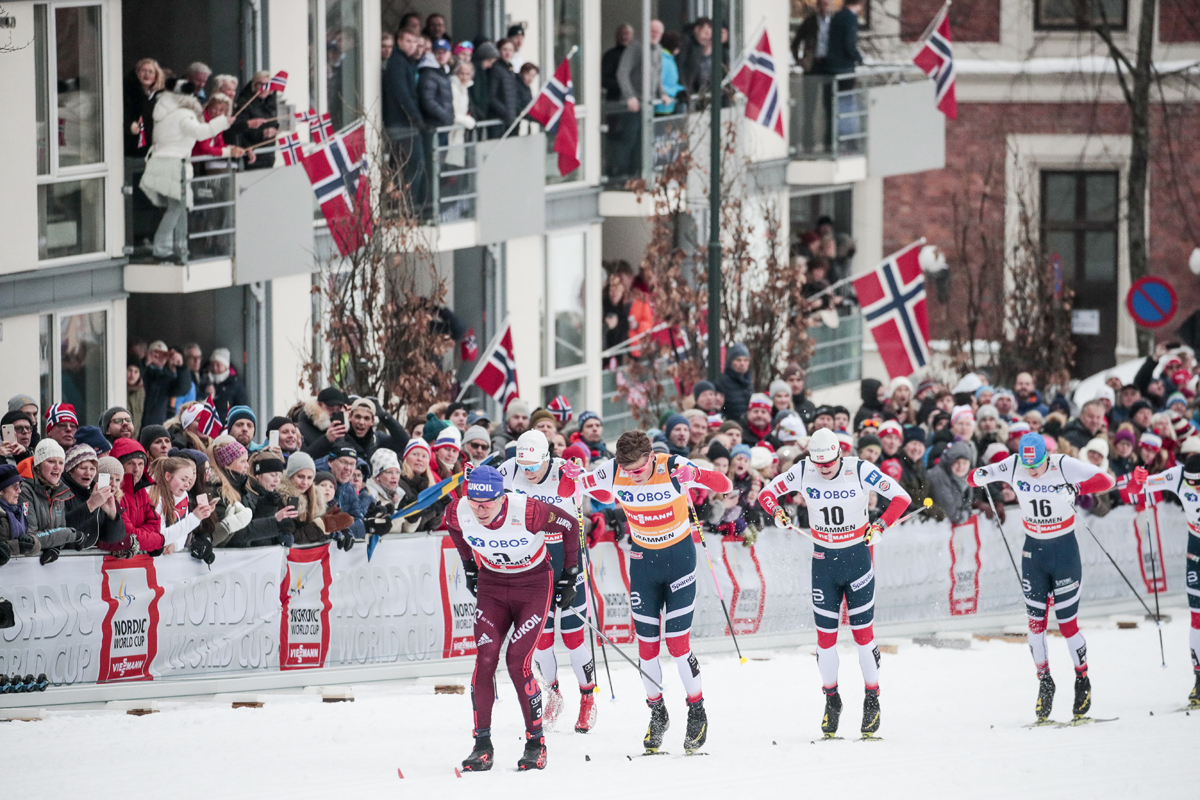
    Russia’s Alexander Bolshunov leads five Norwegians in the men’s classic sprint final at the World Cup in Drammen, Norway: (from l to r) Eriik Brandsdal, Johannes Høsflot Klæbo (yellow bib), Sindre Bjørnestad Skar (10), Kasper Stadaas (16), and Emil Iversen. (Photo: Fischer/Nordic Focus)

    Tactically, Bolshunov played his hand early. Determined to break Klæbo, the Russian led out hard and took the sharp end of the race in earnest. At the top of the course, Bolshunov had strung the five other skiers out behind him. Moments before the highpoint and entering the technical downhill S-turns, Bolshunov and Klæbo gave a burst of speed and distanced themselves by 10 meters. As Klæbo learned in his heat, even with speedy skis, the downhill is not decisive. It’s more a function of skiing out front, staying on your feet and entering the final straight with enough high-octane gas to turbo the finish.

    Up the final climbing stretch, which seems as eternal as some flame burning inside the Bragernes Church, Bolshunov faded slightly, while Klæbo and Brandsdal pulled ahead.

    Klæbo’s second takeaway: he already knew the course was won on the final straightaway climb. If he could match Bolshunov on the remainder of the course, Bolshunov could not mirror him in the final meters.

    The final played out like Klæbo’s semi. Bolshunov punched it early. Klæbo sat behind the Russian, matching him pole for pole, stride for stride. Up front was as good a place as any for Bolshunov. Besides the Russian, it was an all-Norwegian final. There was Klæbo and Brandsdal, along with Sindre Bjørnestad Skar, Kasper Stadaas and Emil Iversen.

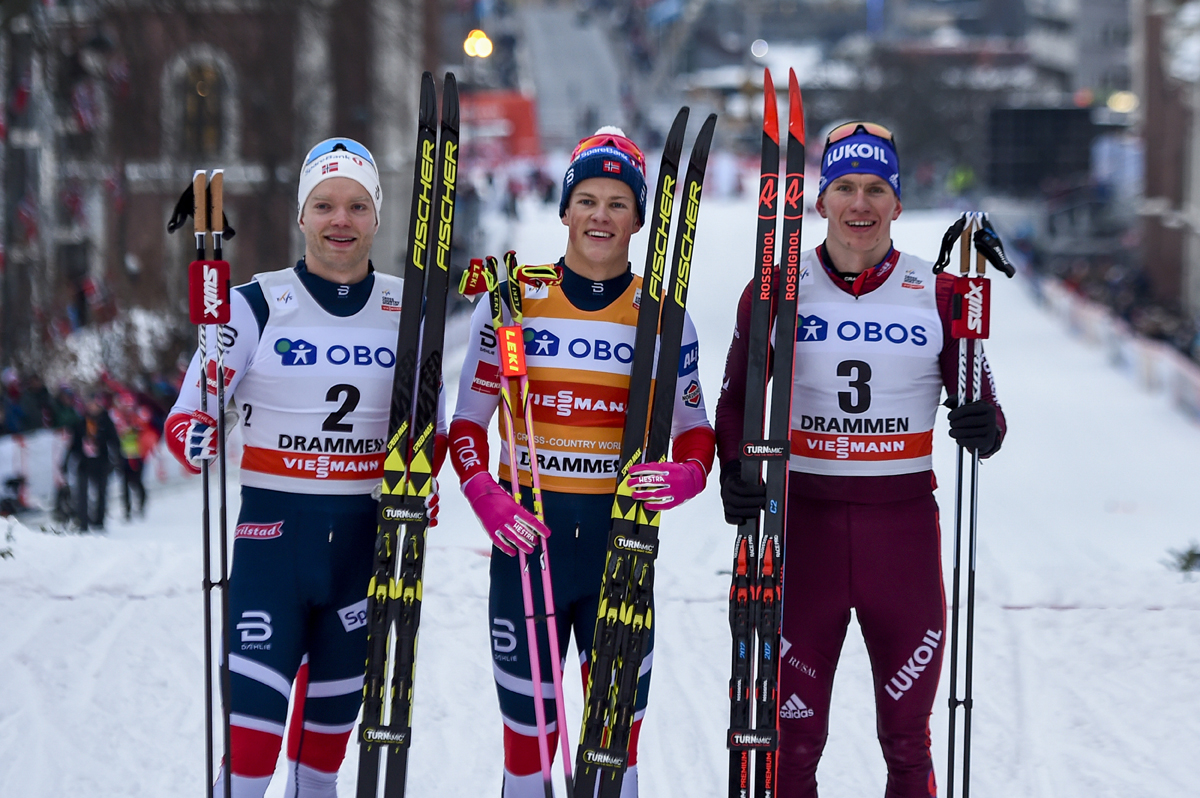
    The men’s podium from Drammen’s 2018 classic sprint. Norway’s Johannes Høsflot Klæbo (c) placed first, his teammate Eirik Brandsdal (l) was second, and Russia’s Alexander Bolshunov (r) finished third. (Photo: Fischer/NordicFocus)

    Bolshunov again led up and over the top of the course, through the S-turns and through the tucking downhill. Brandsdal trailed by 10 meters, but by the final turn before the uphill to the church’s front door, the threesome had regrouped. Again, as the double poling got down to business, Bolshunov faded, Klæbo pulled away and Brandsdal could only stay a second behind the day’s winner. And of course Klæbo was able to toe the line as he bowed to the frenzied crowd. Nothing to prove except he can win with panache and win in style when the Norwegian cameras turn out in force.

    Klæbo won the final in 2:44.69 minutes. Brandsdal followed 1.04 seconds back in second place, Bolshunov finished third (+3.78), Bjørnestad fourth (+6.55), Kaspar fifth (+8.71), and Iversen sixth (+11.45).

    Bjornsen Reaches Quarterfinals, 18th Overall

    Erik Bjornsen was the lone North American who advanced to the heats, qualifying in 26th and finishing the day in 18th.

    “I was feeling good,” Bjornsen told FasterSkier after the race. “It’s a tight course. It was a bit scrappy. … It’s my first time here qualifying for the heats, so I’m learning some things, for sure.”

    Bjornsen skied in the fifth quarterfinal with Iversen, Russia’s Alexander Panzhinskiy, Finland’s Ristomatti Hakola, Emil Nyeng of Norway, and France’s Lucas Chavanat.

    The American skied near the back of the group but avoided any real mishaps. Although the sport is not roller derby, Drammen’s tight-and-rutted corners offer up a close cross-country skiing cousin.

    The U.S. Ski Team’s Erik Bjornsen toeing the line in fourth during Wednesday’s fifth heat in Drammen, Norway. Bjornsen placed 18th on the day. (Screenshot: NRK broadcast)

    I feel like – I kind of missed a few spots,” Bjornsen said.  “At the bottom corner I was pushed to the outside. I was almost moving up into second, and looking back maybe I should have gone around him on the other side.”

    Up the never-ending final straightaway, Bjornsen poled himself into a position to potentially advance to the semifinals as a lucky loser. However, that didn’t pan out for Bjornsen. Iversen won the heat in 2:51.96 minutes, Panzhinskiy placed second (+0.20), Hakola third (+0.99), with Bjornsen in fourth (+1.18).

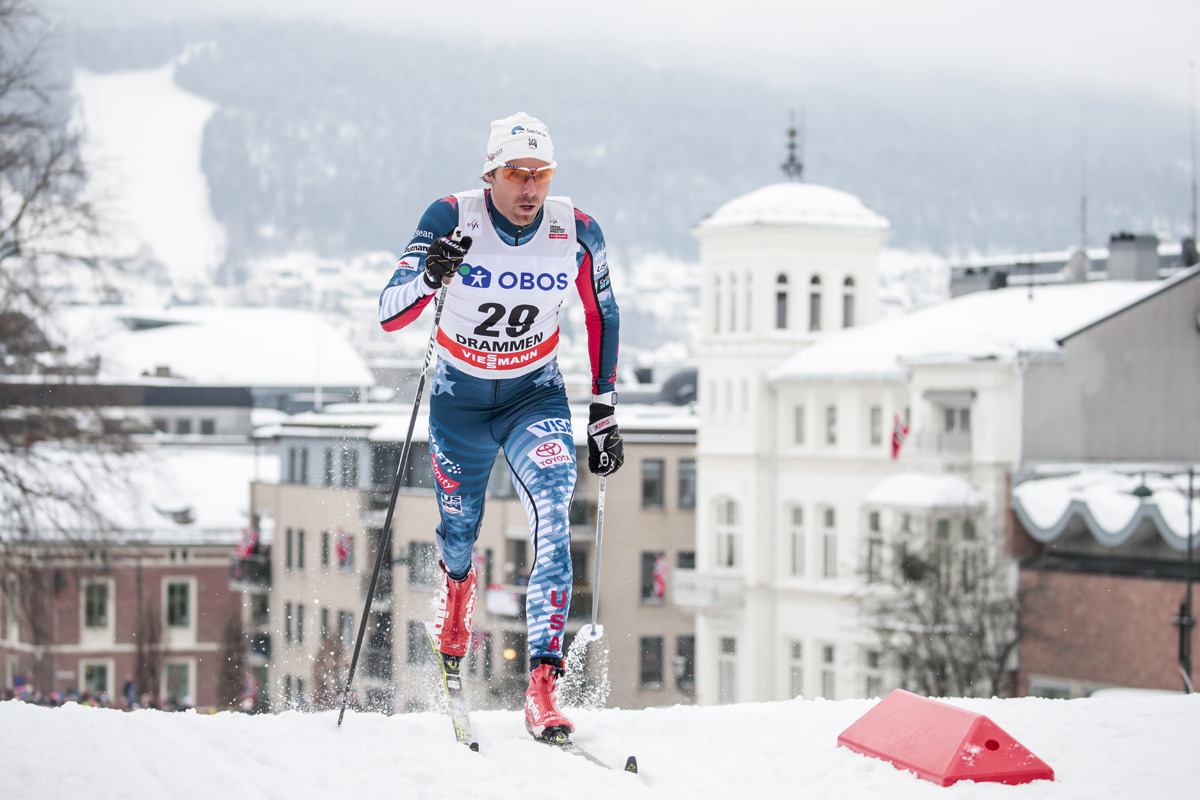
    Andy Newell racing to 33rd in the men’s classic sprint qualifier at the World Cup in Drammen, Norway. (Photo: Fischer/NordicFocus)

    Also for the U.S., Andy Newell missed the quarterfinals after finishing 33rd in qualification, 0.9 seconds out of 30th. Logan Hanneman and Kevin Bolger finished 49th and 50th, respectively, and Reese Hanneman 56th. The U.S. Ski Team’s Simi Hamilton sat out Wednesday’s sprint as he is recovering from an illness.

    For Canada, Julien Locke finished 51st in qualifying, Alex Harvey was 54th, and Andy Shields 58th.

    Results: Qualifier | Final
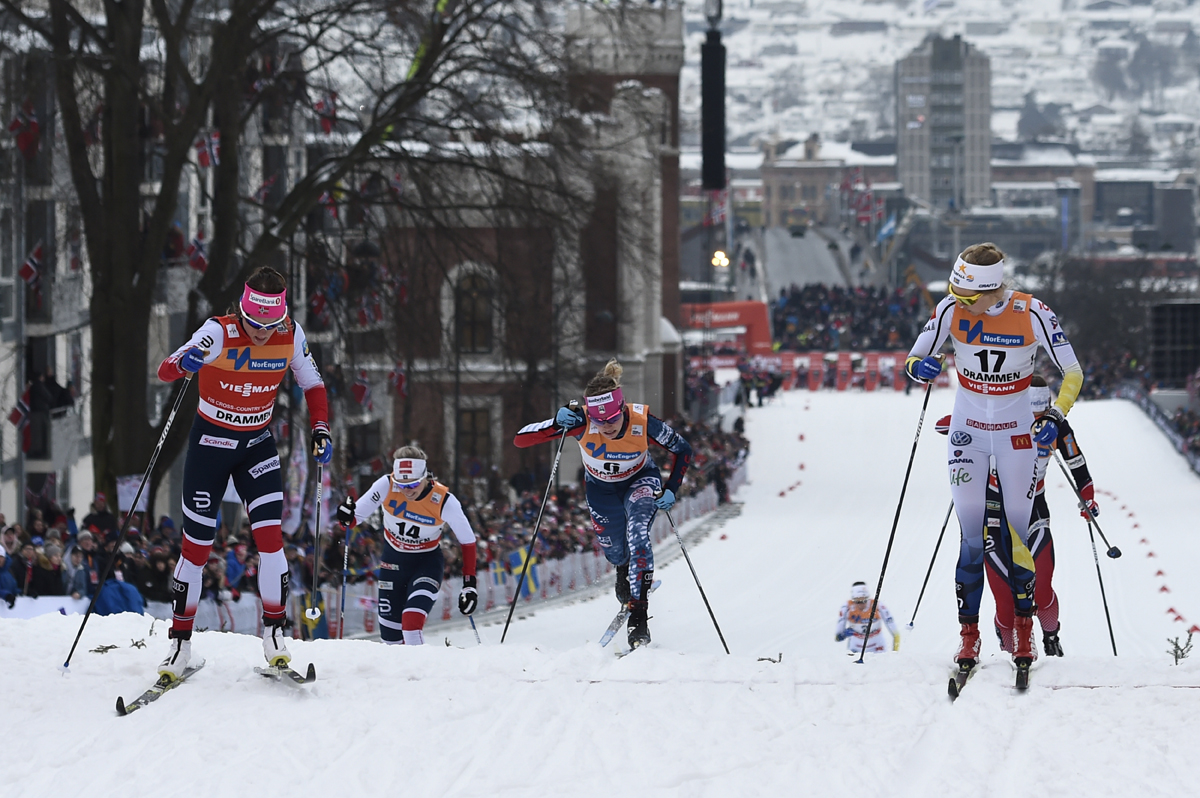
  • Oberstdorf Classic Sprint: A Tour de Ski Photo Gallery

    Oberstdorf Classic Sprint: A Tour de Ski Photo Gallery

    OBERSTDORF, Germany — On Tuesday, Sophie Caldwell became the third U.S. woman in World Cup history to win a World Cup race, and the first-ever to win a classic sprint. We are grateful Marcel Hilger shared the following photos recapping the day at the fourth stage of the Tour de Ski, which included another first for Norway’s Emil Iversen, the winner of the men’s final.

  • Valjas Sprints to the Semis, Back in Top 10 in Oberstdorf; Harvey and Newell in the Heats

    Valjas Sprints to the Semis, Back in Top 10 in Oberstdorf; Harvey and Newell in the Heats

    Len Valjas (Canadian World Cup Team) racing to 25th in Tuesday's 1.2 k classic sprint qualifier at the fourth stage of the Tour de Ski. He went on to place second in his quarterfinal and fifth in his semifinal for 10th overall on the day. (Photo: Fischer/NordicFocus)
    Len Valjas (Canadian World Cup Team) racing to 25th in Tuesday’s 1.2 k classic sprint qualifier at the fourth stage of the Tour de Ski in Oberstdorf, Germany. He went on to place second in his quarterfinal and fifth in his semifinal for 10th overall on the day. (Photo: Fischer/NordicFocus)

    Canadian Len Valjas double poled past Italian sprint star Federico Pellegrino — the Tour de Ski sprint leader heading into Tuesday’s 1.2-kilometer classic sprint — at the end of the first men’s quarterfinal to earn a spot in the semifinals and ultimately lead the North American men in 10th in Oberstdorf, Germany.

    “I was really thrilled to make it to the semi,” Valjas, 27, told FasterSkier in an in-person interview after Stage 4 of the Tour de Ski.  “I haven’t been there in maybe a couple of years.”

    After undergoing knee surgery in May 2013, ahead of the 2014 Winter Olympics, Valjas struggled to recover. His last semifinal was in March 2013 in Lahti, Finland. Earlier that season in 2012/2013, Valjas racked up two Tour de Ski podiums and a national title, but struggled to train after the surgery.

    In four preceding sprints this season, Valjas qualified for the heats once (in the only other classic sprint in Kuusamo, Finland, where he ended up 22nd). Twice in the last three skate races, he finished just outside the top 30 needed to qualify in 31st.

    In the second-and-final sprint of the eight-stage Tour (Valjas’s last race before skipping the rest of the Tour to prepare for other World Cup sprints), the Canadian World Cup Team member was looking for something more than an almost-top 30. He got what he was looking for on Oberstdorf’s slushy manmade course, marked by a couple troublesome downhills and corners.

    “The organizers have done a great job here with so little to work with,” U.S. Ski Team member Noah Hoffman said of Obertsdorf’s extreme lack of snow. “The fact that we’re racing in Obertsdorf at all right now is kind of amazing.”

    The sprints started off with a number of crashes in the women’s quarterfinals, leading organizers to spend some additional time raking and shoveling snow back onto the course.

    Despite a couple years of reduced head-to-head opportunities in sprints, Valjas was still on top of his tactical game on Tuesday.

    “I knew even up the first hill, if I was slightly gapped, that everybody in the group kind of snowplows and doesn’t take the corner as well as they could,” he reflected. “I didn’t stress going over the top, gave a couple of hard pushes, and as long as I could step turn I came right back to the group.”

    This tactic worked perfectly in his quarterfinal, as Valjas finished second in a photo finish with Russian winner Sergey Ustiugov. He automatically advanced to the semis 0.07 seconds back in second and ahead of Pellegrino, another 0.19 seconds back in third.

    While Valjas moved on, he let a gap open up too wide in his semifinal and had to recover from falling off the back of the pack by the final descent. He finished fifth, 1.4 seconds behind Ustiugov, who again won the semifinal and went on to place second in the final.

    Alex Harvey (Canadian World Cup Team) racing to 13th in the qualifier at the 1.2 k classic sprint at Stage 4 of the Tour de Ski in Oberstdorf, Germany. He went on to place third in his quarterfinal for 15th overall and improved to eighth in the Tour standings. (Photo: Fischer/NordicFocus)
    Alex Harvey (Canadian World Cup Team) racing to 13th in the qualifier at the 1.2 k classic sprint at Stage 4 of the Tour de Ski in Oberstdorf, Germany. He went on to place third in his quarterfinal for 15th overall and improved to eighth in the Tour standings. (Photo: Fischer/NordicFocus)

    Alex Harvey was the second-best Canadian on Tuesday, finishing 15th on the day after placing third in his quarterfinals, behind Norway’s Petter Northug and Germany’s Sebastien Eisenlauer, respectively. That moved him up one spot to eighth overall in the Tour (+3:22.2).

    In a post-race interview with FasterSkier, Harvey said he was pleased to qualify for the heats. He failed to do so in every other sprint so far this season (he placed 33rd in the Tour’s opening skate sprint on Jan. 1 in Lenzerheide, Switzerland).

    “The speed is there,” Harvey said. “But the tactics [were not]. I was lacking some aggression in the first half of the race, letting gaps open, letting guys take the spots.”

    A small gap opened up between Harvey and heat leader Eisenlauer on the first hill, after the German jumped to the front out of the start.

    “But then Northug was able to sneak in the lane, and then kind of stop over the top and go — he does that a lot — I kind of got f*cked there,” Harvey said.

    After Northug apparently held up Harvey, the other three squeezed him out on the corner and back into sixth.

    “On the last uphill, I was able to jump behind Northug, but then he kind of slowed down again, let two guys go, eased up, then punched it again, so then a huge gap opened to the top two, and then that was it,” Harvey recalled.

    The Canadian fought back to catch Sweden’s Carl Quicklund and move into third, but he couldn’t reach Eisenlauer and Northug, and ended up third, 1.22 seconds behind Northug and 0.78 behind Eisenlauer.

    Newell 17th for U.S.

    Leading the U.S. men in 17th, Andy Newell had the best qualifier of the North Americans in ninth and finished fourth in his quarterfinal, 2.15 seconds behind Norway’s Emil Iversen, who won the heat and went on to achieve his first World Cup win.

    “I don’t know what happened between going over the bridge and going into the lanes, but it wasn’t great,” Newell said of his quarterfinal finish. “I somehow got caught in some soft snow, or maybe my skis were dragging a little bit more than others.”

    Unlike the Swedes, who had visibly fast skis in the finishing straight all day, Newell was not gliding as well at the end despite looking poised into the final corner. He ended up behind Iversen, Kazakhstan’s Alexey Poltoranin, and Sweden’s Emil Jönsson in the second quarterfinal.

    The rest of the North Americans started recovering for the next stage earlier in the day, with Canada’s Devon Kershaw missing the top 30 in 34th, 4.02 seconds behind qualifying winner Martti Jylhä of Finland and more than two seconds from qualifying. American Erik Bjornsen was 38th (+5.12), Canadian Ivan Babikov was 59th (+11.21), ahead of Hoffman in 61st (+11.73).

    Noah Hoffman (U.S. Ski Team) placed 61st in Tuesday's classic sprint at Stage 4 of the Tour de Ski and continues to sit in 25th overall in the Tour standings. (Photo: Madshus/NordicFocus)
    Noah Hoffman (U.S. Ski Team) placed 61st in Tuesday’s classic sprint at Stage 4 of the Tour de Ski in Oberstdorf, Germany. He continues to sit in 25th overall in the Tour standings. (Photo: Madshus/NordicFocus)

    Neither Hoffman, still 25th in the Tour standings (+5:43.8), or Babikov (37th and 7:21.9 back overall) had any expectations for the sprint day.

    “We’re halfway done now,” Hoffman said, “and we’ve got both sprints out of the way so I’m looking forward to what’s coming. That was not my best classic sprint, but the difference between my best and my worst is kind of insignificant in the course of the Tour.”

    Additionally, Bjornsen ranks 32nd in the Tour (+7:01.8), Kershaw is 41st (+7:53.4), and Valjas 61st (+10:54.3), although Valjas is done with the Tour. Newell plans to race once more in Oberstdorf before withdrawing and ranks 71st (+13:11.7) heading into Wednesday’s 15 k classic mass start.

    American sprinter Simi Hamilton did not start Tuesday’s sprint despite looking forward to it, and thus withdrew from the Tour earlier than planned.

    “I have no doubt that Simi could have gone out and qualified today, gotten into some heats, and gotten a tremendous chest cold,” U.S. coach Matt Whitcomb told FasterSkier. “We need him healthy as an athlete for this winter, not just for this Tour.”

    Results | Tour standings (through Stage 4)

  • First Report: Caldwell Does What She Considered Unthinkable

    First Report: Caldwell Does What She Considered Unthinkable

    Sophie Caldwell became the second U.S. woman to win a World Cup race on Tuesday at Stage 4 of the Tour de Ski in Obertsdorf, Germany. The U.S. Ski Team member won the classic sprint ahead of Norwegians Heidi Weng (l) and Ingvild Flugstad Østberg (r), the latter of which leads the Tour de Ski standings.
    Sophie Caldwell (c) became the third U.S. woman to win a World Cup race on Tuesday at Stage 4 of the Tour de Ski in Oberstdorf, Germany. The U.S. Ski Team member won the classic sprint ahead of Norwegians Heidi Weng (l) and Ingvild Flugstad Østberg (r), the latter of which leads the Tour de Ski standings.

    Note: This is an initial post about American Sophie Caldwell’s World Cup victory on Tuesday at the Tour de Ski in Obertsdorf, Germany. Stay tuned for more in-depth reports about the women’s and men’s classic sprints.

    Correction: This article has been updated to reflect the fact that Caldwell became the third U.S. woman to win a World Cup.  Alison Kiesel (formerly Owen-Spencer) won the inaugural women’s World Cup event in December 1978 at Mount Telemark in Wisconsin.

    ***

    OBERSTDORF, Germany — Sophie Caldwell saw the opportunity in the final roller of a hill in the women’s 1.2-kilometer classic sprint final on Tuesday and she seized it, overtaking the last Norwegian in her sights and holding off Heidi Weng by one-tenth of a second to win Stage 4 of the Tour de Ski.

    “It feels really good,” Caldwell, a 25-year-old member of the U.S. Ski Team, told FasterSkier in an in-person interview after the race. “It has been a while since I have been on the podium and that is the first sprint I have ever won. So I am psyched, I never thought it would come in a classic sprint so that was a pleasant surprise.”

    A native of Peru, Vt., and daughter of the Stratton Mountain School’s nordic director Sverre Caldwell, Caldwell has been on the World Cup podium once before — in a freestyle sprint in March 2014 in Lahti, Finland. There, she placed third after teammate Kikkan Randall, who won, and Slovenia’s Katja Visnar in second. Two U.S. women had never before shared a World Cup podium.

    On Tuesday, Caldwell continued to make U.S. history, becoming the third American woman, after Randall and Alison Kiesel, to win a World Cup race. Caldwell is also the first U.S. woman to win a World Cup classic sprint.

    No stranger to sprint finals, she had reached the finals (thus placing in the top six) in two of the last three sprints (all of which were freestyle) before Tuesday. The only one she missed, she did so by just one place in seventh in Toblach, Italy. She has now placed in the top seven in four consecutive sprints.

    “I knew I had some really good skis today and my strengths are usually tricky downhills because I didn’t like to snowplow and I don’t get freaked out by them,” Caldwell said of Tuesday’s classic sprint.

    “I was probably the last person who woke up this morning and thought this would happen,” she told FIS media coordinator Jeff Ellis (Randall’s husband) in a post-race interview. “I’m thrilled.”

    “We know Sophie is among the best downhill skiers in the world,” U.S. women’s coach Matt Whitcomb said. “These conditions today are like, growing up in New England, skiing through slob it’s no big deal. She got to the tops of climbs and attacked over them rather than backing off, and that was a big difference-maker today. But what really stood out was that she was climbing with the best of the world today.”

    Caldwell stayed on her feet all day, even in the final when Sweden’s Ida Ingemarsdotter came close to nicked her skis. Ingemarsdotter began to snowplow on a washed-out descent, which caused problems in several heats — including those of Caldwell’s U.S. teammates Ida Sargent and Jessie Diggins. In the final, Caldwell scooted around the snowplowing Ingemarsdotter and moved into third behind Norway’s Ingvild Flugstad Østberg — the overall Tour de Ski leader — and Weng. She proceeded to pick both Norwegians off to take the win.

    Earlier in the day, Sargent avoided a crash in the first women’s quarterfinal to place third in that heat. But finishing 10.36 seconds behind Østberg as the winner of that quarterfinal, Sargent did not advance to the semifinals.

    Neither did Diggins, who got hung up in a snowplow snafu by Sweden’s Hanna Falk on that same downhill in the fourth quarterfinal. The back of Falk’s skis caught Diggins and both went down. Diggins finished fifth in that heat, 26.22 seconds behind Norway’s Therese Johaug, who won that quarterfinal. Falk crossed the line 50 seconds back in sixth.

    At the end of the day, Sargent placed 15th and Diggins 21st. Also for the U.S., Rosie Brennan again narrowly missed qualifying in 35th, Sadie Bjornsen did not make the quarterfinals in 44th, along with Liz Stephen in 49th, and Caitlin Gregg in 53rd.

    In terms of overall Tour standings after four of eight stages, Diggins ranks 10th (+4:33.4), Bjornsen slipped out of the top 10 to 13th (+4:53.7), Caldwell is up to 14th (+5:23.7), Stephen is 25th (+6:22.1), Caitlin Gregg 39th (+8:12.6), Brennan 42nd (+8:33.1), and Sargent 45th (+8:47.3).

    Racing continues in Obertsdorf on Wednesday with the women’s 10 k classic mass start and men’s 15 k classic mass start.

    “[I] plan on racing tomorrow as long as … I have had a bit of a race hack, so as long as that doesn’t get any worse,” Caldwell said.

    (Her boyfriend Simi Hamilton had to skip Tuesday’s sprint and thus withdraw from the Tour due to illness.)

    “I plan on racing tomorrow and then probably dropping out,” she continued. “There is a small chance I would do the 5 k in Toblach [Italy on Friday], but kind of taking it a day at a time. I won’t go past Toblach.”

    Results | Tour standings (after Stage 4)

  • Falla Impedes Her Buddy Østberg, Leaving Matveeva with Beitostølen Sprint Win

    Falla Impedes Her Buddy Østberg, Leaving Matveeva with Beitostølen Sprint Win

    The women's podium (from l-r): Natalia Matveeva (RUS)  second, Jennie Öberg (SWE) first, and Laurien van der Graaff (SUI) third.
    Russia’s Natalia Matveeva (l)  on the podium last season at a World Cup skate sprint in Rybinsk, Russia, with Swedish winner Jennie Öberg and Switzerland’s Laurien van der Graaff in third. On Sunday in Beitostølen, Norway, Matveeva won a FIS classic sprint after Norway’s Maiken Caspersen Falla (not pictured) was disqualified. (Photo: Fischer/NordicFocus)

    For the second time this weekend, a Norwegian skier was disqualified from an International Ski Federation (FIS) race in Beitostølen, Norway, and missed out on a victory because of it.

    Despite a strong opening to Sunday’s 1.2-kilometer classic sprint, in which she won the qualifier by 2.22 seconds over Norwegian teammate Ingvild Flugstad Østberg and topped every heat thereafter, Maiken Caspersen Falla was ultimately at the hands of the jury by the end of the final.

    Norwegian teammates and friends Maiken Caspersen Falla (l) and Ingvild Flugstad Østberg celebrate gold and silver, respectively, in Tuesday's Olympic skate sprint in Sochi, Russia.
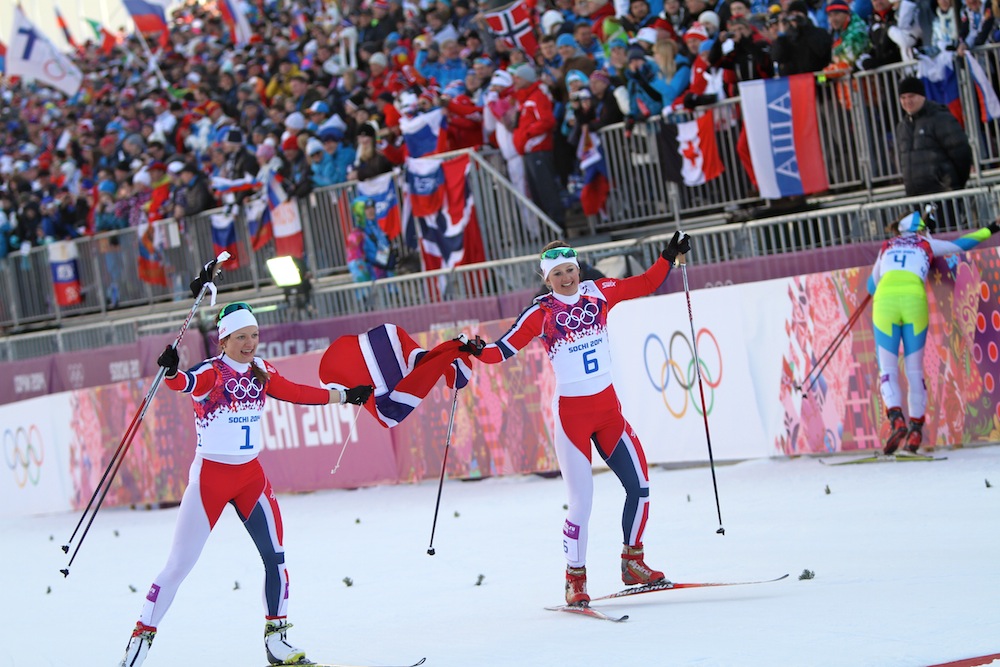
    Norwegian teammates and friends Maiken Caspersen Falla (l) and Ingvild Flugstad Østberg celebrate gold and silver, respectively, at the 2014 Olympic skate sprint in Sochi, Russia.

    Facing off against Østberg, Russia’s 22-year-old Polina Kovaleva — who was third in the qualifier (6.44 seconds behind Falla) — another Russian Natalia Matveeva, and two more teammates, Astrid Uhrenholdt Jacobsen and Barbro Kvåle, the 25-year-old Falla ran into trouble in the final when she moved to change tracks on a technical turn.

    Due to the sharpness of the turn and traffic around her, Falla explained she had no choice but to ski over her good friend Østberg’s skis.

    “I saw that I [cut off] Ingvild in the bend, but what else could I have done?” Falla said in a post-race interview with Langrenn, according to a translation. “I was either running up the back of Astrid or into Ingvild.” 

    While she finished first in the final, Falla was ultimately relegated to last because of the move. She didn’t regret her decision, telling NRK“I would do it again, because I did not have anywhere else to go.”  

    She added that the DQ should give her some added fuel moving forward, especially two weeks out from the World Cup opener in Kuusamo, Finland.

    “It’s too bad to be disqualified” she told Langrenn. “It was one of best races I’ve done in three or four years. I can use this as extra motivation when I go [to the] World Cup.”

    With Falla out, the women’s sprint victory went to the second racer across the line: Russia’s 29-year-old Matveeva, who finished second in both her quarterfinal and semifinal. Skisport.ru noted classic isn’t usually Matveeva’s strength. In 2007, she won a World Cup skate sprint in Duesseldorf, Germany, and last season, she reached the World Cup podium for the first time in three years when she placed second in a skate sprint in Rybinsk, Russia. 

    Despite the mishap with Falla, Østberg was two-tenths of a second from the win on Sunday, finishing just behind Matveeva in second. After reaching the final as a lucky loser from her semifinal, Jacobsen led out of the start, but slipped back on the climbs and ended up 2.9 seconds back in third. Kovaleva placed fourth (+8.3) and Kvåle was fifth (+12.1). The winner of last year’s classic sprint in Beitostølen, Kvåle, 23, was a lucky loser twice over, narrowly advancing from both the quarterfinals and semifinals with fast-enough times.

    Results: Qualifier | Heats
  • Hamilton Takes 11th, Newell 12th to Lead Americans in Östersund Sprint

    Hamilton Takes 11th, Newell 12th to Lead Americans in Östersund Sprint

    Simi Hamilton placed 11th overall in Saturday's World Cup classic sprint in Östersund, Sweden after falling during his semifinal heat and taking sixth. Here he is pictured en route to his first distance points ever in World Cup competition in Oberstdorf, Germany. (Photo: Marcel Hilger)
    Simi Hamilton placed 11th overall in Saturday’s World Cup classic sprint in Östersund, Sweden, after taking sixth in his semifinal heat. Here, he is pictured en route to his first distance points in a World Cup race earlier this season in Oberstdorf, Germany. (Photo: Marcel Hilger)

    On what U.S. Ski Team (USST) Women’s Coach Matt Whitcomb called a “wild-and-crazy course,” Simi Hamilton was the lone American to reach the semifinals in Saturday’s 1.2-kilometer classic sprint in Östersund, Sweden.

    However, Hamilton would fall while ascending a hill during the first lap of his semifinal heat and took sixth, ending up 6.33 seconds behind semifinal winner Sondre Turvoll Fossli of Norway (who won the heat in 2:27.83) and finishing 11th overall.

    Hamilton explained in a phone interview that the difficult course was breaking down quite a bit throughout the day, and the snow was getting deeper on the steep hills that required the skiers to herringbone.

    “My right ski just got caught behind me a little bit in the powder, and I just put my right pole right through the top of that ski,” he said. “When you’re trying to hammer a herringbone your poles are just coming so close to your ski it’s definitely a pretty thin margin between a good pole plant and planting right on top of your ski.”

    After falling, Hamilton focused on getting up as fast as he could and surged through the end of the first lap in order to make up lost time.

    “I made contact with the back of the group again, but just didn’t have a ton of energy left after that to try and get around anyone,” he said.

    After qualifying in 12th, 2 seconds behind Norwegian qualifier winner Timo André Bakken, who posted the fastest time in 2:28.25, Hamilton won his quarterfinal in 2:31.97.

    “My energy felt really good all day, so I knew I’d be able to put in a good, sustained effort, hoping that a few of those guys in the quarterfinal would start to drop off a little bit,” he said.

    Hamilton explained that he was able to put himself in second place, behind Finland’s Toni Ketelä, as they went up the hill above the stadium for the second time. By the last climb before the short, final descent into the stadium, he went as hard as he could and took an open lane on the left.

    “I had some room to do my own thing, so I could hammer up and over the top of that climb and focused on having a good double-pole finish,” he said.

    “I felt like some times in the past, especially with classic sprinting I haven’t been able to lay down a really good qualifier and haven’t been able to find the energy,” he continued. “So I was definitely pretty happy with the quarterfinal.”

    Rosie Brennan racing to 33rd overall in Saturday's World Cup classic sprint Östersund, Sweden. (Photo: Ian Harvey/Toko)
    Rosie Brennan racing to 33rd overall in Saturday’s World Cup classic sprint Östersund, Sweden. (Photo: Ian Harvey/Toko)

    Meanwhile, Hamilton’s teammate Andy Newell took third in his quarterfinal after qualifying in 17th (+2.68). He finished 12th overall for his best World Cup result of the season.

    Newell explained that if he had made “one or two better moves” going into the final uphill of his quarterfinal, he might have had a shot at placing into the semifinals or moving on as a lucky loser. But he ended up 2.61 seconds behind Norway’s Thomas Northug, who was second in his heat, and 1.10 seconds short of a lucky loser spot.

    “It was a pretty unique course, that’s for sure. It’s fun in that we don’t get to race courses like that very often,” Newell said in a phone interview. “You had to have a unique technique of herring bone in order to do well.”

    Newell was happy with the result, especially in light of his struggles earlier in the season due to both allergies and physical injuries.

    “You have years where a 12th-place finish is a disappointment … But at the same time I’m feeling really good, and it’s not always reflected in the results,” he said. “As an athlete you have to gauge your excitement and your momentum on how you’re feeling and not necessarily on your results.”

    Norway’s Finn Hågen Krogh would eventually win the men’s final in 2:25.28, holding off Canada’s Alex Harvey by 0.47 seconds. Bakken took the final spot on the podium in third (+1.41).

    Bjornsen, Caldwell Lead U.S . Women

    In the women’s sprint, Sadie Bjornsen qualified in 27th, 10.02 seconds behind Norwegian qualifier winner Kari Vikhagen Gjeitnes, the fastest in 2:47, while Sophie Caldwell qualified in 24th (+9.84). They raced in the same quarterfinal heat against Sweden’s Stina Nilsson and overall World Cup leader Marit Bjørgen of Norway.

    Bjørgen won the heat in 2:50.88, while Bjornsen placed fourth (+4.53) to finish the day 20th overall, and Caldwell took fifth (+5.57) to place 22nd.

    Bjornsen said in a phone interview that the course was fun, and much different than what the skiers are used to on the World Cup circuit.

    “I knew it was going to be very dependent on my herringboning skills, which I’ve been working a lot on the last couple of years, because I used to be terrible at it,” she said, adding the course featured very little striding and consisted mostly of herringbone, double pole and downhill tucking.

    Because of the chevron start, Bjornsen and Caldwell had to begin the quarterfinal heat in unfavorable, outside positions.

    “I didn’t have a great start, but I tried not to panic,” Caldwell wrote in an email. She explained that it was difficult to move around skiers because of the constant herringboning, so she spent most of the race in fifth place.

    Sophie Caldwell placed 22nd overall in Saturday's World Cup classic sprint in Östersund, Sweden. Here she is pictured during the 2015 Rybinsk, Russia sprint, where she took seventh.   (Photo: NordicFocus)
    Sophie Caldwell placed 22nd overall in Saturday’s World Cup classic sprint in Östersund, Sweden. Here she is pictured during the 2015 Rybinsk, Russia sprint, where she took seventh. (Photo: Fischer/NordicFocus)

    Bjornsen described the race as a “busy scene.” She said that with six skiers trying to funnel into small areas, there were a lot of tangles and opportunities for blocking.

    She explained she was not able to close in on the leaders as much as she wanted to at the end, but she said that she definitely felt confident about her fitness.

    “I didn’t want to set a goal this weekend that was going to dictate how I felt about my fitness – so it was kind of just for fun today. I’m definitely going into [World Championships] feeling happy and confident,” she said.

    Whitcomb said in a phone interview that it was a solid result for the American women and its team’s sprinters would not leave Östersund discouraged.

    “You’re always hoping for a top 10 … but it was a tricky course, with a variety of unique demands,” he said.

    Based on their positions after qualifying, Caldwell and Bjornsen made the most of what they had, he said, as it was nearly impossible for them to be better than fifth and sixth coming off the top of the steep hill leaving the stadium.

    “For Sadie to mix it up in third and fourth, and for Sophie to be able to finish fifth – in good contact with people – I was pretty happy with that. It was a course that was really difficult to move around on, and your place at the start in many cases didn’t change,” he explained.

    Rosie Brennan narrowly missed the quarterfinals, qualifying in 33rd (+11.03), 0.72 seconds out of the top 30.

    Brennan said in a phone interview that while it is frustrating to be so close to qualifying – especially three weeks after placing 31st in the Rybinsk, Russia freestyle sprint – she is still happy with the result.

    “I am really happy with the way I skied so I will just have to work on perfecting the details … As with every race I enter, my goal is simply to push as hard as I can and ski well,” she said.

    Whitcomb said that Östersund does not suit Brennan’s strengths, as the Alaska Pacific University skier benefits from powerful striding and not the herring boning the course requires.

    “Thirty-third is definitely a success, one of the successes of the day,” he said. “It’s an indication that she’s in the best shape of her life and she should be looking forward to a really positive World Championships.”

    Two other American women raced in the qualifying round – Ida Sargent finished 41st (+13.11) while Kikkan Randall was 51st (+16.92).

    Whitcomb said that Randall and Sargent were not pleased with their results. He said Sargent reported that she was skiing frantically, while “it took Kikkan a lap to get things going, and you don’t have time for that in a short sprint like this.”

    Randall wrote in an email to the press that her qualification was not as strong as she was hoping for after a month-long break from racing.

    “I skied too tense and didn’t quite have enough tempo out there, kind of like I was blowing the cobwebs out,” she wrote.

    However, she added that she is still confident in the recovery and preparation she has undergone over the last month, and believes it was a good decision to go home and “get a chance to complete reset and get back to basics.”

    Bjørgen would end up expanding her overall lead by comfortably winning the final in a time of 2:46.82, 1.80 seconds ahead of teammate Maiken Caspersen Falla. Nilsson placed third (+2.03) in front of a roaring home crowd.

    World Cup racing in Östersund continues on Sunday with the 10/15 k freestyle individual starts.

    Results: Men | Women
  • Harvey Charges to Second Place; Krogh Takes World Cup Sprint Lead

    Harvey Charges to Second Place; Krogh Takes World Cup Sprint Lead

    Canada's Alex Harvey celebrates in his traditional fashion after winning his third World Cup race of the season, the 30 k skiathlon and second stage of World Cup Finals on Saturday in Falun, Sweden. (Photo: Fischer/Nordic Focus)
    Canada’s Alex Harvey finished second in Saturday’s 1.2 k classic sprint in Östersund, Sweden to earn one of his best World Cup results of the season. Here he’s pictured after winning the 30 k skiathlon and second stage of 2014 World Cup Finals in Falun, Sweden, the site of the upcoming 2015 World Championships. (Photo: Fischer/Nordic Focus)

    When it comes to the World Cup, competitor’s personal expectations aren’t always met. But for Alex Harvey it was a good thing that Saturday’s 1.2-kilometer classic sprint didn’t go the way he thought it would. After examining the course, Harvey didn’t see much potential for a top result. It was a short loop that featured steep hills, and the 26-year-old Canadian had completed an altitude camp in Italy just days before.

    However, as the men’s final entered the finish Harvey wasn’t an onlooker. Instead, he was in the thick of the action with 100 meters to go, double poling to fight for his best non-stage World Cup result of the 2014/2015 season.

    Harvey finished second to Finn Hågen Krogh of Norway, who skied to victory with a time of 2:25.28. Harvey skied across the line in a close second, 0.47 seconds back. Timo Andre Bakken, also of Norway, placed third after winning the qualification round earlier in the day. He finished 1.41 seconds back from Krogh.

    In fourth was Norwegian Sondre Turvoll Fossli, who competed in Östersund after winning the classic sprint at the U23 World Championships in Kazakhstan earlier this month. He was 4.27 seconds back from the win. Matias Strandvall (+5.86) of Finland and Alexander Panzhinskiy (+9.30) of Russia finished fifth and sixth.

    Krogh skied a smart and technical race throughout the day. He placed himself behind the leaders in the beginning of both the quarterfinal and semifinal, yet surged ahead in the final meters of the 1.2 k course. In the final he did the same, but roughly halfway through the race he attempted to gap the field. While his fellow podium finishers were able to keep contact, it was a strategy that worked, as Krogh stretched out the pack and cruised across the line in first.

    “It is great to have another win this season. It was really challenging today and it was important to race smart and stay out of trouble. I always tried to stay near the front and in the end it worked for me,” Krogh told the International Ski Federation (FIS) after his win.

    Krogh is not officially slated to start at the 2015 World Championships set to begin next week, despite being a member of Norway’s team for the event. He explained that the result was a step towards earning a coveted Norwegian spot at the starting line in Falun. He also has a case for a start position in his world ranking. Krogh is now the World Cup sprint leader after Saturday’s win, toppling Italian sprinter Federico Pellegrino who finished Saturday’s race in 10th.

    Unlike Krogh, Harvey had a roller-coaster ride to his best World Cup result of the season. Qualifying in 26th position, Harvey entered a stacked quarterfinal featuring Pellegrino and Norwegians Ola Vigen Hattestad and Pål Golberg. Harvey spent much of the race near the back of the pack, at one point falling to fifth in the second half of the race.

    Pål Golberg and Ola Hattestad of Norway slide off course in Saturday's 1.2 k classic sprint in Östersund, Sweden. (Photo: CCC)
    Pål Golberg (6) and Ola Hattestad of Norway slide off course in Saturday’s 1.2 k classic sprint in Östersund, Sweden. (Photo: CCC)

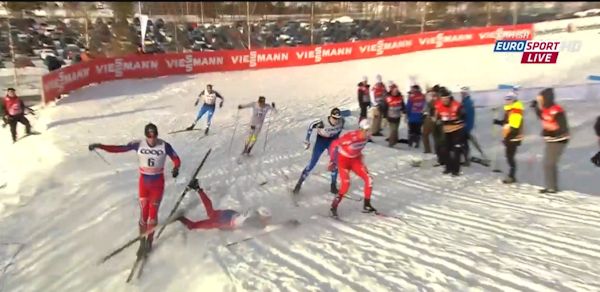
    With Hattestad and Golberg in the lead, the skiers rounded a sharp corner before climbing the final hill. It was there the Norwegians fell victim to a race-ending crash as Hattestad slid into Golberg and the two flew off the course. With the leaders out, Pellegrino and Harvey took advantage of the situation to cruise into first and second.

    “I still think I would have snuck into a lucky loser spot because our heat was really fast,” Harvey speculated in a post-race interview. “I was second but I think if those guys had stayed on their skis I would be lucky loser.”

    Harvey once again started near the back of the pack in the semifinal, but surged ahead in the second half of the course to take second behind Fossli and ensure his advancement to the final. He explained that his skis in the quarterfinal had too much kick but that they were perfect by the time he started the semifinal.

    “In the second lap I knew that guys would start fading a bit, so I was able to make my way to the front,” Harvey said of the heat.

    In the final, Harvey had a slow start but inched forward through the pack over the first lap. By the time Krogh attempted to break away from the six men, Harvey was the first to respond, trailing the Norwegian closely and breaking even with him throughout much of the remaining meters.

    “I think physiologically I’m not as fast as the pure sprinters. I’m not fast enough on the first lap, but on the second lap the pure sprinters get a little tired and I stay the same,” Harvey explained of his ability come from behind in the final.

    Heading into the finish, Harvey lost a little ground to Krogh and was unable to match the Norwegian’s speed in the final 100 meters. Although the win was just out of sight, Harvey maintained his speed to outlast a late charge by Bakken.

    “I was close to being perfect but just missing a little at the end,” Harvey said of the final.

    Bakken, who skied in his first-ever World Cup final and notched a first career podium, said that the course favored his strengths and that the roughly 10,000 person crowd in Östersund was impressive because of their enthusiasm.

    “I felt this was a good course for me and I am happy to have my first World Cup podium. I am Norwegian Champion this year but I have not much success on World Cup so this is a great feeling,” Bakken said to FIS.

    Valjas 13th, Jones 21st for Canada

    Harvey’s teammate Lenny Valjas was the only other Canadian male to qualify for Saturday’s heats in 18th position. In the quarterfinals, he spent much of the race in last position but was able to take advantage of a crash by Sweden’s Calle Halfvarsson to advance through the pack and take third. Valjas was only 0.05 seconds away from a lucky loser position and ultimately finished his day in 13th.

    Jess Cockney was the final Canadian male, placing 75th.

    Canada's Perianne Jones skies behind Norway's Celine Brun-Lie and Sweden's Ida Ingamarsdotter in the quarterfinals of Saturday's 1.2 k classic sprint in Östersund, Sweden.
    Canada’s Perianne Jones skis behind Norway’s Celine Brun-Lie and Sweden’s Ida Ingamarsdotter in the quarterfinals of Saturday’s 1.2 k classic sprint in Östersund, Sweden. (Photo: CCC)

    For the women, Perianne Jones raced to 18th in qualification. She skied to fifth in her quarterfinal to claim 21st overall.

    “My qualifier was great – for sure the strongest one this year by far,” Jones wrote in an email. “I had some great skis, and executed everything the way I wanted to. I maybe used a little too much energy on the first lap, but overall I was really happy with it.”

    Jones said that while she was in good position early on in her quarterfinal, she was unable to match the leader’s speed and lost ground.

    “I wouldn’t have done anything differently, I need to be able to ski with those girls for the entire race, not just the first half,” she wrote.

    In her first World Cup start, teammate Olivia Bouffard-Nesbitt was the only other Canadian woman to race Saturday. She finished 55th overall.

    Harvey will not participate in Sunday’s 15 k freestyle individual start. He explained that while he wanted to use the race as training, his coaches’ plan said otherwise. As he and the Canadian squad shift their focus to World Championships, which start Feb. 18th, Harvey said that Saturday’s result is a boost before the year’s most anticipated races.

    “It gives me a lot of confidence. I think the speed is there for sure and I know the endurance is there too,” he explained.

    According to Harvey, the key to a successful championships will be to stay healthy and stick to his planned routine.

    “I need to stay healthy. That’s always number one,” he said. “It’s routine now. I’ve been to a lot of championships, even from my junior days. I know the drill and how to prepare. So I’ll just stick to the plan and trust the plan and trust the shape.”

    Results: Overall | Qualifier
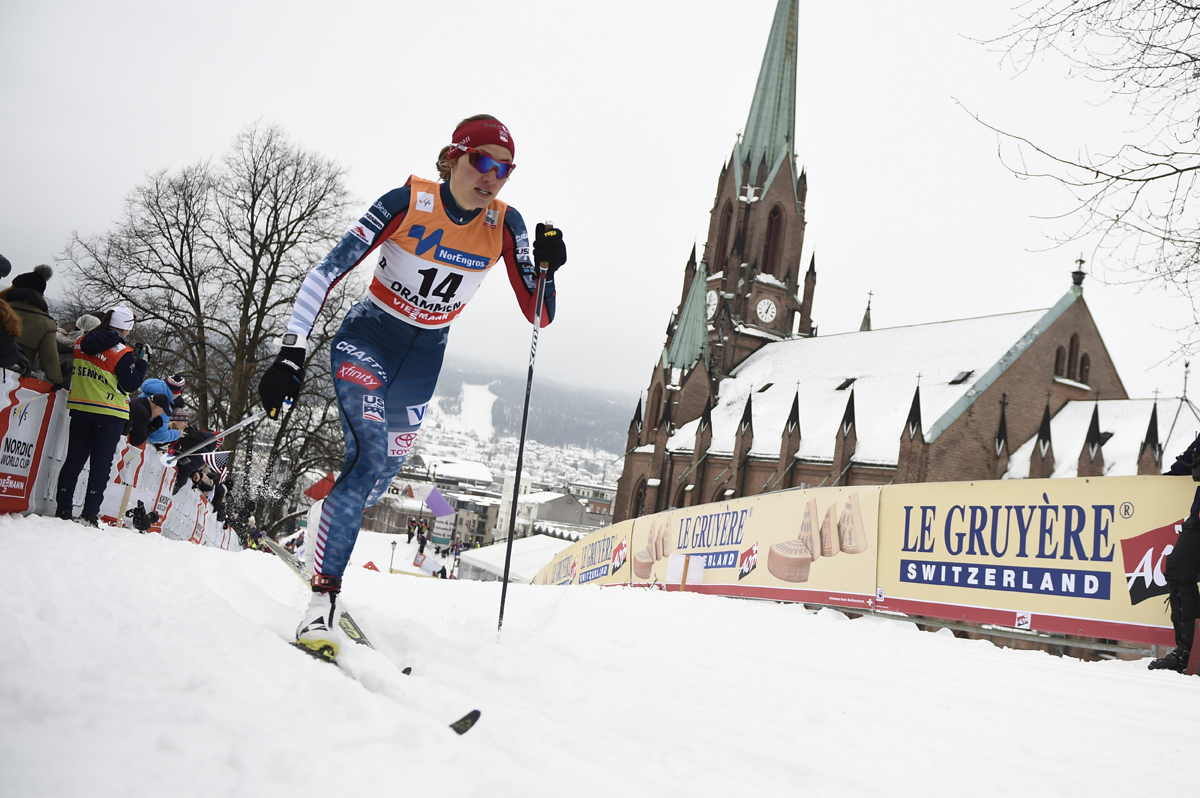
  • Østberg Carries the Torch for Norway with First Classic Sprint Win in Otepää

    Østberg Carries the Torch for Norway with First Classic Sprint Win in Otepää

    (Photo: Fischer/NordicFocus)
    A very happy Otepää podium, with Norway’s Ingvild Flugstad Østberg (c) in first, Swden’s Stina Nilsson (l) in second, and Norway’s Celine Brun-Lie in third. (Photo: Fischer/NordicFocus)

    With many of the top women using this weekend to recover from last week’s Tour de Ski competition, Saturday’s World Cup stage in Otepää, Estonia, was not short on fast, up-and-coming talent.

    The 1.2-kilometer classic course featured a flat start then into a tough 30-meter climb to the top of the only hill on the women’s course, then right back downhill to a tricky 180-degree turn. After the turn, the course still continued downhill to the finish line. Placing on the downhills was extremely important because as the races went on, the snow really started to get soft and tracks started to wash away. This made choosing the right wax extremely important. Too much wax and there would be no glide on the downhill, not enough wax and it was hard to get up the hill.

    The first of five quarterfinal heats featured Norway’s Ingvild Flugstad Østberg, the fastest qualifier in 2:52.93, Sweden’s Ida Ingemarsdotter, Kathrine Rolsted Harsem of Norway, Natalia Matveeva of Russia, Germany’s Denise Hermann, and Russia’s Elena Soboleva.

    Østberg showed that she didn’t lose any energy in the qualification round, taking the lead from the start and easily skiing away from the group to win her heat, crossing the line in 2:55.72. Ingemarsdotter was second (+1.62).

    The second quarterfinal heat featured Norway’s Celine Brun-Lie, Hanna Falk of Sweden, Slovenia’s Katja Visnar and Alenka Cebasek, Switzerland’s Laurien Van Der Graaff, and Germany’s Victoria Carl .

    Just like her teammate Østberg did in her heat, Brun-Lie took a very aggressive start into the hill and separated herself from the chase group. Falk was able to stay with her the entire time, but when qualification was certain, slowly eased up towards the finish to save energy. Brun-Lie won the heat in 2:58.32, and Falk took second (+0.86).

    The third heat featured German teammates Hanna Kolb and Sandra Ringwald, Jennie Öberg of Sweden, Anamarija Lampic of Slovenia, Mona-Lisa Malvalehto of Finland and Yulia Romanova of Russia.

    At the start, Malvalehto lead the group up the climb followed closely by Öberg. Leading into the downhill, Malvalehto was easily passed by Öberg and Lampic who were just waiting for an opportunity. The pair proceeded to separate themselves from the group and battle it out together for the win. It was a photo finish at the line between Öberg and Lampic. Öberg got the win crossing first in 3:00.77, and Lampic was 0.02 seconds behind in second.

    Quarterfinal 4 featured the second-fastest qualifier and overall U23 leader Stina Nilsson of Sweden, Maiken Caspersen Falla of Norway, Justyna Kowalczyk of Poland, Evgenia Shapovalova of Russia, Anne Kyllönen of Finland, and Lucia Anger of Germany.

    At the gun, Nilsson took command at the start and led the group up the climb followed by Falla. As the pack continued up the hill, Falla took an opportunity to pass Nilsson when a gap opened up. That was all she needed to win the heat in 2:56.05. Nilsson made a late pass and challenged Falla at the finish, but let up when second place was secured, crossing at 0.08 seconds back in second. Kowalczyk placed fourth, 2.22 second behind Falla and after Shapovalova in third, and did not advance to the semifinals.

    The fifth-and-final quarterfinal heat featured a pair of Swedish teammates, Magdalena Pajala and Evelina Settlin, American Sadie Bjornsen, Kari Vikhagen Gjeitnes from Norway, Anastasia Dotsenko from Russia and Krista Parmakoski from Finland.

    Bjornsen started fast but wasn’t able to get any separation at the start and was quickly caught by the chase group. Heading into the first climb, the group was still together but Bjornsen was slowly dropping back, but still remained close to the leaders. Settlin fell just after the 180 turn and really broke the pack into two fields. Gjeitnes, Pajala and Bjornsen were in the lead group. Gjeitnes was able to double pole away, 0.31 seconds ahead of Pajala in 3:02.6. Pajala edged Bjornsen in a photo finish, after Bjornsen closed quickly in the last five meters.

    The lucky losers were Harsem and Shapovalova. As the races went on, the times were getting slower as a result of the soft snow forcing many to change skis and wax. Heading into the first semifinal the question was: how much did the track soften up after the men’s quarterfinal heats?

    It was a duel between Sweden and Norway for the first semifinal; three from each country were in the field with  Østberg, Brun-Lie and Harsem from Norway, and Ingemarsdotter, Öberg and Falk from Sweden.

    At the start, all three Norwegians jumped out front and lead the group up the hill and then never looked back, easily separating themselves from the Swedish chase group. Crossing the line first out of the Norwegian trio was Østberg who showed she is the one to beat. Her time was 3:10.45; Brun-Lie was 1.75 behind in second.

    The second semifinal featured Nilsson, Falla, Shapovalova, Pajala, Gjeitnes and Lampic. Nilsson and Falla were determined to get to the final and challenge Østberg. The pair separated themselves at the start and easily skied away from the other skiers. Falla’s skis were really fast, pulling away on the final downhill to the finish. Nilsson challenged for first but when she realized she was easily going to qualify eased up and crossed second behind Falla. Falla crossed in 3:08.74, and Nilsson 1.40 seconds back in second.

    Best seat in the house to watch Saturday's classic race (Photo: Fischer/NordicFocus)
    Best seat in the house to watch Saturday’s classic race (Photo: Fischer/NordicFocus)

    The second semifinal was a lot faster than the first, resulting in Shapovalova and Pajala earning lucky loser positions.

    To add more drama to the softening track, as the men were winding up their semifinal heats, the snow really started to fall. This caused many to change skis.

    “Before the final I had to make the decision if I go on zero skis or klister. I chose the second option,” Østberg told FIS afterward.

    Nilsson also told FIS after that she changed skis as well before the final, which gave her both good grip and good glide.

    The final was set, with three Norwegians (Falla, Brun-Lie and Østberg), two Swedes (Pajala and Nilsson), and Russia’s Shapovalova.

    The start was pretty even with Nilsson taking up the pace followed closely by Falla. Heading to the hill, Østberg passed her teammate Falla and closed the gap to Nilsson. As the climb continued, Østberg made her move and passed Falla at the summit. Falla then passed Nilsson making it a Norwegian in first and second. As the trio descended down to the finish, Nilsson was able to pass Falla, but lost a lot of energy in the process, letting Østberg pull away to win in 3:20.18. Nilsson finished in second (+0.60) and Brun-Lie took third (+2.29).

    Afterwards Østberg told FIS that the skis were the key to her win, which was her first-ever in a World Cup classic sprint, her second victory of the season and her fourth podium of the season.

    “The whole day I had perfect skis,” she said. “I felt good that nobody could keep up with me in the last 100 meters.”

    This now raises an interesting question: can Østberg beat her teammate Marit Bjørgen?

    “I’ve done it before and I can do it again. One must at least have faith that one can beat her,”said Østberg told NRK.

    The World Championship were definitely on all of the Norwegians’ minds after the race. Brun-Lie told FIS, “I have never been on the podium in the classic sprint. Today’s result is very important for the qualification for the World Championships.”

    As a result of her win, Østberg passes teammate Bjørgen in the Sprint World Cup standings to take first place. She has 385 points, and Bjørgen is 35 points behind with four sprints left. Bjørgen still leads the Overall World Cup by more than 400 points over teammate Therese Johaug. Neither Bjørgen, Johaug nor Heidi Weng raced on Saturday.

    Sunday’s race is a freestyle team sprint competition.

    Results

    Ingvild Flugstad Oestberg (NOR) takes the win.  (photo: Fischer/Nordic Focus)
    Ingvild Flugstad Oestberg (NOR) takes the win. (photo: Fischer/Nordic Focus)
  • Americans Go 15th, 16th, 17th with Bittersweet Feelings After Otepää Sprint

    Americans Go 15th, 16th, 17th with Bittersweet Feelings After Otepää Sprint

    Simi Hamilton (l) and Switzerland's Gianluca Cologna going head-to-head in the quarterfinal of the men's 1.5 k classic sprint on Saturday in Otepää, Estonia. Hamilton placed third in the heat, ahead of teammate Andy Newell in fourth (not shown) and Cologna in fifth. (Photo: Fischer/NordicFocus)
    American Simi Hamilton (l) and Switzerland’s Gianluca Cologna going head-to-head in the quarterfinal of the men’s 1.5 k classic sprint on Saturday in Otepää, Estonia. Hamilton placed third in the heat, ahead of teammate Andy Newell in fourth (not shown) and Cologna in fifth. (Photo: Fischer/NordicFocus)

    Three Americans made the heats on Saturday, and all of them felt basically “meh” about their races.

    “If at first you don’t succeed…try, try again,” Sadie Bjornsen wrote in an online message after placing 15th in the women’s 1.2-kilometer classic sprint in Otepää, Estonia.

    In some ways, she found a good deal of success: Bjornsen qualified in 18th, 6,76 seconds behind Norway’s Ingvild Flugstad Østberg, who won the qualifier and went on to win the women’s final. Then the 25-year-old Bjornsen, who was coming off some of her best results of the season in her first Tour de Ski 10 days earlier, nearly secured a spot in the semifinal.

    Sadie Bjornsen (U.S. Ski Team) racing to 29th in the World Cup classic sprint on Saturday in Kuusamo, Finland. On Sunday, she placed 17th in the 10 k classic to lead the U.S. (Photo: Fischer/Nordic Focus)
    Sadie Bjornsen (U.S. Ski Team) racing to 29th in the World Cup classic sprint early this season in Kuusamo, Finland. (Photo: Fischer/Nordic Focus)

    But she was three-hundredths of a second short. In a photo finish for second in her quarterfinal, Bjornsen finished third to Sweden’s Magdalena Pajala, and was 0.34 seconds behind the heat’s winner of the heat, Kari Vikhagen Gjeitnes of Norway.

    According to U.S. Ski Team Head Coach Chris Grover, Bjornsen executed her tactics almost perfectly.

    “She skied great and of course she is not that happy with it because she has had a lot of qualifiers, but she has struggled to get through the quarterfinals this year,” he said on the phone Saturday. “She really wanted to get through there and man, did she come incredibly close.”

    In six sprints this season (two of which have been classic sprints), Bjornsen has made the quarterfinals in four of them, but yet to advance to the semifinals. Her best result this season has been 13th in the Tour de Ski freestyle sprint in Val Müstair, Switzerland.

    Out of the start, she challenged for the lead, but tucked behind Russia’s Anastasia Dotsenko after the two bumped slightly while vying for the same track. Pajala led the group out, with Gjeitnes coming up alongside the Swede at the base of the lone climb on the women’s course.

    Bjornsen skied hard to get directly behind Pajala, and with five women bunched together at the apex, she was fifth heading into the descent. Sweden’s Evelina Settlin went down moments later, slipping out of contention, and Bjornsen moved into fourth next to Gjeitnes.

    She rode her skis even with the Norwegian, tucking while Dotsenko had to stand up and double pole over the last rise, and Gjeitnes and Bjornsen caught Pajala rounding the corner into the finishing straight.

    While it looked to be a double-pole showdown for first between Bjornsen and Pajala, with Bjornsen slightly ahead early, Gjeitnes caught them both before the finish, and Pajala outlunged Bjornsen at the line.

    Sweden's Magdalena Pajala (second from l) edges American Sadie Bjornsen (l) for second behind Norway's Kari Gjeitnes (r) in the quarterfinal of the women's 1.2 k classic sprint on Saturday in Otepää, Estonia. Russia's Anastasia Dotsenko (second from r) pushes for fourth.
    Sweden’s Magdalena Pajala (second from l) edges American Sadie Bjornsen (l) for second after Norway’s Kari Gjeitnes (r) in the quarterfinal of the women’s 1.2 k classic sprint in Otepää, Estonia. Russia’s Anastasia Dotsenko (second from r) pushes for fourth.

    “Sadie knew she wanted to be in the top two and she put herself in position with a few meters to go where she was actually second, but she just couldn’t hold off Pajala there at the end,” Grover said.

    If she could do it again, Bjornsen explained she would want more of a push at the end.

    “I was double poling against one of the finalists [Pajala, who ended up sixth]… so I think I was in there,” Bjornsen wrote. “It was one of those days where the weather was making each heat slower and slower, so maybe on a different day, it could have been a lucky loser position.”

    Her heat was the fifth-and-final quarterfinal before the men started. Temperatures hovered above freezing, but it started to rain lightly before the heats. Later on in the rounds, that turned to snow.

    Soon after Bjornsen’s heat, two other U.S. Ski Team members — Andy Newell and Simi Hamilton — started next to each other with four others in the first men’s quarterfinal on a 1.5 k course with a second, steeper climb.

    Newell pushed to get in front and lead up the first climb with Norway’s Pål Golberg, while Hamilton skied behind Newell at the back of the pack. Another Norwegian, Ola Vigen Hattestad worked to get in front of Newell at the base of the second hill, which required the not-so-pretty herringbone technique to get up in the softening conditions.

    Golberg stayed ahead over the top and Hattestad trailed him by a few meters in second, while Newell skied in third ahead of Hamilton and Switzerland’s Gianluca Cologna. None of the men were quite close enough to get a draft, leaving Newell and Hamilton to race the clock in third and fourth into the finish.

    “They [Hattestad and Golberg] had good skis today,” Hamilton said on the phone afterward. The two went on to place second and fourth in the final. “Not that we didn’t, but [the Norwegians] have the resources and the people to make great skis every day and that really showed. I was really psyched on my skis for sure, but having great skis, it’s hard to bridge that gap, especially with such a long hard downhill on the second part of the course.”

    In the finishing lanes, both Hamilton and Newell realized it was faster outside the track and skied alongside each other. Hamilton came from behind to finish 0.42 seconds ahead of Newell and 3.26 seconds behind Golberg, who won the quarterfinal, and Hattestad, who was 0.3 seconds back in second.

    Americans Andy Newell (21) and Simi Hamilton (30) chase Norway's Pal Golberg up the first of two climbs in the men's 1.5 k classic-sprint quarterfinal on Saturday in Otepää, Estonia. (Photo: Fischer/NordicFocus)
    Americans Andy Newell (21) and Simi Hamilton (behind Golberg in bib 1) chase Norway’s Pal Golberg up the first of two climbs in the men’s 1.5 k classic-sprint quarterfinal on Saturday in Otepää, Estonia. (Photo: Fischer/NordicFocus)

    Their quarterfinal was the third slowest, and neither Hamilton nor Newell advanced to the semifinals.

    While Hamilton, who narrowly qualified in 30th and went on to place 16th overall, hadn’t felt great in the qualifying round, he noted some improvement in the quarterfinals — and some of his weaknesses as well.

    “Up the gradual climb from 400 meters to a ‘k’ or so, I felt like I kind of lost some energy there and that’s something I need to work on for the future,” he said. “I wasn’t able to relax as much there.”

    However, he felt he regrouped on the second half of the course.

    “I was happy how I skied that,” he said, after putting in a surge up the last climb. “I knew that [Cologna and Ueli Schnider] were fading behind me and I wanted to put a gap on them so they couldn’t get a draft off me.”

    Hamilton was pleased with his double-pole finish and his ability to maintain good technique and a high tempo in that stretch, which he’s been working on. He also knew the conditions on Saturday didn’t suit him: “It was kind of soft and sloppy … I think it takes really good balance, something that I’m always working on, but I definitely like it when it’s super-icy and fast and firm.

    “I know there’s a lot more,” he added. “I still have some work to do before world champs, but that’s what this time of year is for — keep the train going and trust the coaches and know that in just a few weeks we’ll be at the top of our game.”

    “His fitness is there,” Grover commented. “He skied really relaxed during his quarterfinal on the back … but then just got stronger as the round went on and actually passed Andy in the final stretch. He had a great finish and double pole [which] he has been working on it a lot and it is really coming.”

    Newell, who qualified 21st and placed 17th overall, said on the phone Saturday that it was fun, but “weird” to be classic sprinting again after not having raced that format since the first World Cup of the season in Kuusamo, Finland.

    “This was the first time we had raced this [course], and I think if I’m feeling 100 percent, this is a really good course for me … one I hope to make the finals in,” he said. “But I’m still kind of working into things.”

    This season, Newell has been struggling to manage an allergic reaction that comes out in the form of hives and elevated heart rates, and seems to intensify with hard workouts. While his heart rate had normalized this week, Newell took it easy leading up to Saturday’s sprint, Grover explained.

    “We’ve been just trying to figure out what’s causing that by trying different diets and different medicines,” Newell explained. “It’s more like there’s something suppressing my system … in a way that’s making me hive up when I’m under stress.”

    This week, he started eating gluten-free, following the lead of teammate Liz Stephen, which he said he’d try for a couple weeks despite it being hard to do in Europe.

    “Until I figure out my allergic reaction, my racing’s not going to be at my potential,” Newell said. “I think if I felt 100 percent, it would’ve been a better day. I was in there and I knew Hattestad and Golberg would be tough in the finish. … I would’ve been happy trying to lead over that hill and gap them a little bit.”

    While he knew Golberg and Hattestad would be tough to beat and even more difficult to catch in the finishing stretch, he didn’t realize Hamilton was right behind him.

    “I think for both Simi and I, the race was finished at the top hill,” he said.

    In the final straightaway, Newell recalled feeling “draggy; a little fatigued for sure. You just have to try to get across the finish line quickly in hopes that you’re going to get a lucky loser spot,” he said.

    But after a long break from racing, he was ready to get back at it again.

    “I think my body and my energy are feeling good for sure. I don’t think the result showed that,” Newell said.

    On Sunday, Newell and Hamilton will team up in the freestyle team sprint, while Erik Bjornsen and SuperTour leader Matt Gelso (Sun Valley Ski Education Foundation) start on the second squad.

    On the women’s side, Sadie Bjornsen and Sophie Caldwell will team up, and Ida Sargent and SuperTour leader Rosie Brennan (Alaska Pacific University) will form the second team. Liz Stephen and Jessie Diggins are taking a break after the Tour and training in Seiser Alm, Italy.

    Caldwell started first on Saturday and placed 31st in the qualifier, 0.9 seconds out of the top 30 needed to make the quarterfinals in her first classic sprint of the season.

    “Even though the result wasn’t anything spectacular, I am not disappointed,” Caldwell wrote in an email. “I knew that classic sprinting was going to be more difficult for me because I’m naturally a better skate sprinter and it requires more upper body strength, which I’m still working on. The course was pretty broken down and the women’s course in particular had a lot of double poling. I don’t mind the soft conditions, but a gradual classic course is probably not my strength.”

    She felt like she had good skis — a sentiment echoed by her teammates — and Grover agreed.

    “I think our skis were actually pretty good for the day,” he said, explaining they used straight klister. “Norway had smoking-fast skis during qualification. I think probably they were probably just better than everybody else’s. I mean, they had ten guys make the rounds.”

    Alaska Pacific University's Rosie Brennan completes the trifecta in the last race of U.S. Cross Country Championships with a skate-sprint victory in Houghton, Mich.
    Alaska Pacific University’s Rosie Brennan notching her third-straight win in the last race of U.S. Cross Country Championships with a skate-sprint victory in Houghton, Mich.

    Brennan placed 38th in her first World Cup of the season, 2.8 seconds from 30th. It was her first time back on the circuit since December 2013, and her best result since finishing 38th in the World Cup skiathlon two seasons ago in Canmore, Alberta.

    Straight off U.S. nationals in Houghton, Mich., seven time zones away, Brennan and Gelso arrived in Estonia on Wednesday night.

    “There is always some amount of jetlag and shaking the travel out, but I feel like I have been faring well all things considered,” Brennan wrote in an email.It felt good to go hard again, but I feel I don’t have the turn over I would like after a long week of really slow snow in Houghton. I have to say, the course even felt really short after Houghton, which is not the usual reaction when coming from the U.S.”

    At nationals, Brennan won three out of four races.

    “I was hoping to just feel like I was skiing well today and I think I accomplished that,” she explained. “I have found from my previous experiences over here that putting some sort of results goal in front of you is often counterproductive and that you can’t beat yourself up over results here. It takes a lot of patience. Weaknesses are often inflated when you go against the best so I already have a good idea of what I need to work on to get the result I believe I am capable of. I’m happy to be here and trying to take each day on its own to make the best of my time here.”

    Sargent finished 43rd after falling in the qualifier on the downhill corner into the stadium.

    “It is kind of a high-speed corner and it was a little bit tricky … you kind of went from an icy track to loose snow,” Grover explained. “I think her klister just grabbed a little bit as she was going around the corner and the skis were on edge. … It was the worst place on the course to lose your momentum because it is absolutely the place where you are going the fastest. … She is obviously bummed out because it is basically the same thing that she did in Val Müstair.”

    “Another sprint another fall…Ugh!” Sargent tweeted afterward. “Practicing patience and getting psyched for the next one!”

    Erik Bjornsen finished 57th in the men’s qualifier, 15.19 seconds behind Golberg.

    In terms of the team on the whole and what they’re working on in the weeks leading up to World Championships next month, Grover said it breaks down on an individual basis.

    “Everybody’s got their thing that is holding them back a little,” he said. “For some it is perhaps fatigue, for some it is that they haven’t fine tuned their fitness, for some it is a double-pole finish, for some it is how they are herringboning compared to some of these others. … I think going into our two-week camp in Davos following Rybinsk [next weekend] everybody is going to have their list that needs to get accomplished if everybody is going to take a step forward.”

    — Matt Voisin contributed reporting

    Results: women | men

  • Marshall Top Canadian in 44th, Valjas 45th in Otepää Classic Sprint

    Marshall Top Canadian in 44th, Valjas 45th in Otepää Classic Sprint

    Lenny Valjas placed 45th in the men's 1.5 k classic sprint qualifier on Saturday in Otepää, Estonia. (Photo: Fischer/NordicFocus)
    Lenny Valjas placed 45th in the men’s 1.5 k classic sprint qualifier on Saturday in Otepää, Estonia. (Photo: Fischer/NordicFocus)

    In her first World Cup of the season and best result since the 2012 World Cup freestyle sprint at home in Canmore, Alberta, Alysson Marshall launched back into international-racing action on Saturday and placed 44th in the women’s 1.2-kilometer classic sprint in Otepää, Estonia.

    The NorAm, or Continental Cup, leader for Period 1, she was one of two Canadian women selected to this weekend’s Otepää World Cup. The other, Perianne Jones, opted to stay home and race at Western Canadian Championships in Lake Louise, Alberta.

    “It’s great to be back on the World Cup!” Marshall, 26, wrote in an email on Saturday after finishing 44th in the qualifier, 15.67 seconds back from the qualifier winner, Ingvild Flugstad Østberg of Norway, and 6.42 seconds out of the top 30 needed to advance to the heats.

    Marshall, a national development-team member, most recently placed fifth in a classic sprint at last weekend’s NorAm in Duntroon, Ontario. Last Saturday after the sprint, Alberta World Cup Academy teammates Marshall, Jess Cockney and the men’s NorAm leader Patrick Stewart-Jones flew to Estonia for a Sunday arrival.

    Alysson Marshall at the Frozen Thunder classic sprint on Oct. 24 in Canmore, Alberta. (Photo: Angus Cockney)
    Alysson Marshall (48) racing alongside Americans Liz Stephen (44) and ahead of Erika Flowers (37) at the Frozen Thunder classic sprint on Oct. 24 in Canmore, Alberta. (Photo: Angus Cockney)

    “I’m just starting to feel like I have adjusted to the time change,” Marshall explained. “I am definitely disappointed with today, I started well but body wasn’t 100% and I couldn’t maintain the pace over the top of the course. Hopefully next weekend will go better!”

    Without another Canadian woman on the circuit, she won’t be racing Sunday’s freestyle team sprint. Marshall plans to next race the freestyle sprint on Saturday, Jan. 24 in Rybinsk, Russia.

    Canadian World Cup Team member Lenny Valjas finished 45th in the men’s 1.5 k classic sprint on Saturday, 12.1 seconds back from the top qualifying time set by Norway’s Pål Golberg, and 3.83 seconds out of the top 30.

    Jess Cockney placed 61st in the men's 1.5 k classic sprint qualifier on Saturday in Otepää, Estonia. (Photo: Fischer/NordicFocus)
    Jess Cockney placed 61st in the men’s 1.5 k classic sprint qualifier on Saturday in Otepää, Estonia. (Photo: Fischer/NordicFocus)

    Cockney, of the national development B-team, placed 61st in the qualifier after winning the NorAm classic sprint in Duntroon last week. Back in 2011 in Otepää, Cockney placed 61st in a classic sprint as well.

    Stewart-Jones, who was second in the Duntroon sprint, finished 62nd on Saturday in his first international World Cup, and first World Cup since 2012 in Canmore.

    According to Sunday’s start list, Cockney and Valjas will team up in the 6 x 1.5 k freestyle team sprint.

    Alex Harvey, Devon Kershaw, Ivan Babikov, and Graeme Killick are taking the weekend off to recover and train in Seefeld, Austria, before traveling to Rybinsk on Wednesday.

    Results: women | men
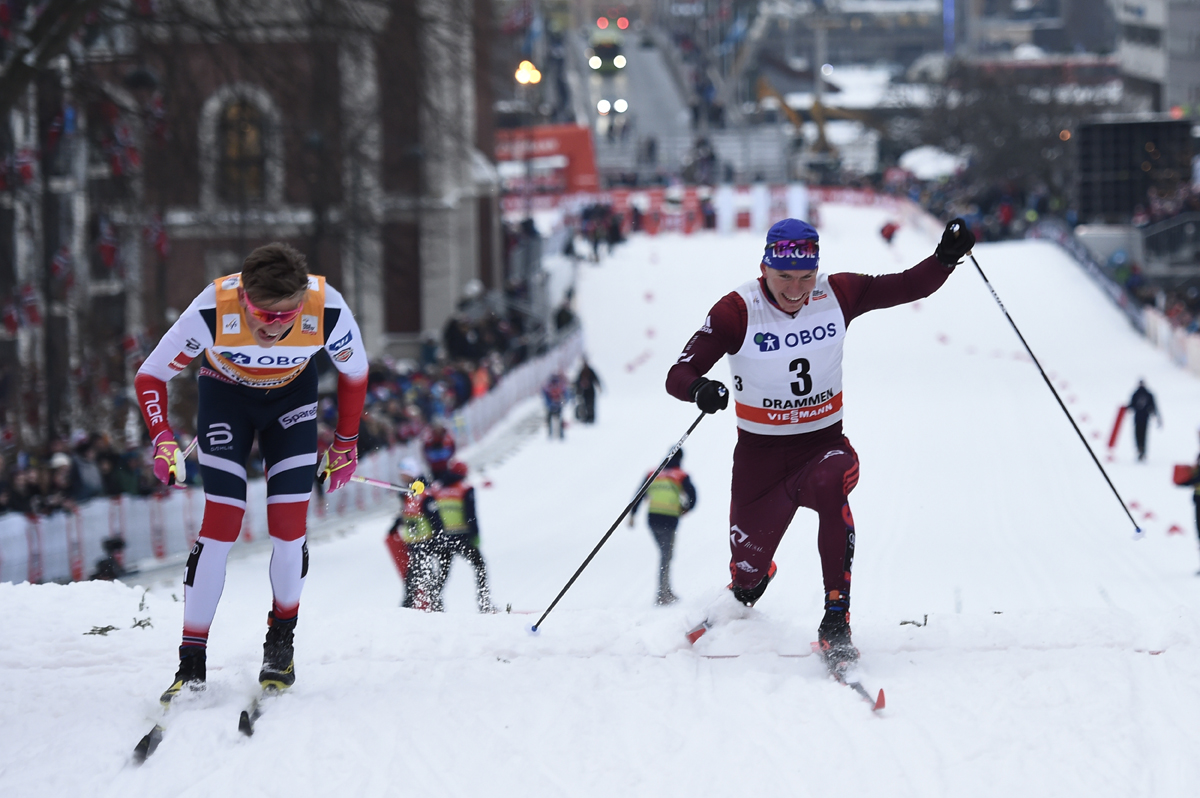
  • Barbro Kvåle, 22, Breaks Through in Beitostølen Classic Sprint

    Barbro Kvåle, 22, Breaks Through in Beitostølen Classic Sprint

    A stunned Barbro Kvåle after winning Sunday's FIS classic sprint by 0.3 seconds in Beitostølen, Norway.  (Photo: Photo NTG Lillehammer)
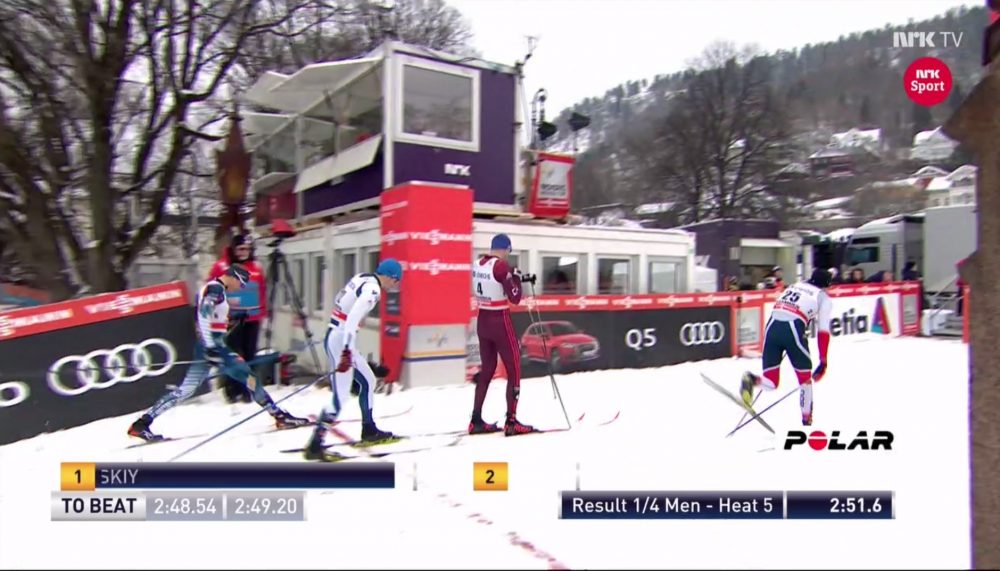
    A stunned Barbro Kvåle after winning Sunday’s FIS classic sprint by 0.3 seconds in Beitostølen, Norway. (Photo: Photo NTG Lillehammer)
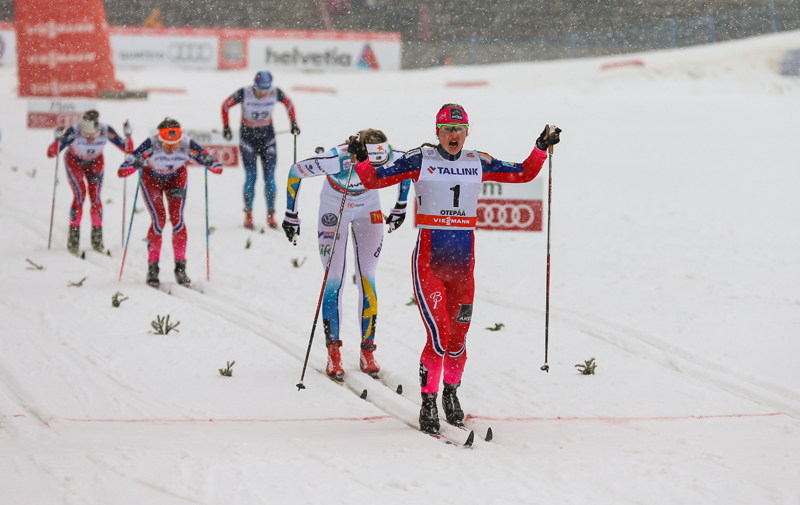
    Barbro Kvåle, a 22-year-old Norwegian junior world champion in ski orienteering, joined the ranks of national-team stars Therese Johaug and Marit Bjørgen, who won the Beitostølen distances races this weekend. On Sunday, Kvåle, now on Norway’s U23 cross-country team, came from behind to win the women’s 1.2-kilometer classic sprint by three-tenths of a second.

    With meters to go in the final, she passed Norway’s Kari Vikhagen Gjeitnes to seize the early season International Ski Federation (FIS) victory in 2:56.8. Gjeitnes, 29, took second and Kvåle’s best friend Kathrine Harsem was third just 0.2 seconds later.

    She’s a really laid-back personality,” Harsem said of Kvåle to NRK. “She’s a really good friend, and we can talk about everything, or nothing at all. As a skier, she’s just amazing on the mental level.”

    Norwegian Olympic gold-and-silver medalist Ingvild Flugstad Østberg finished fourth, 0.9 seconds after Kvåle. A previous winner of Beitostølen’s classic sprint (in treacherous conditions), Slovenia’s World Cup sprinter Katja Visnar placed fifth (+4.9), 1 second ahead of Germany’s Victoria Carl.

    Kvåle, who qualified 15th out of 42 women — nearly 6 seconds behind Visnar as the qualifier winner (in  2:48.91) — had never been in a sprint final before, and certainly not with an Olympic champion or World Cup favorite.

    “This was insanely fun. I just wanted to go for it,” Kvåle told NRK. “I know I have a strong sprint finish, but I never imagined that I would actually win.”

    When asked if she could describe the feeling, she simply said, “No.”

    “I know I have a strong sprint finish, but I never imagined that I would actually win.” — Barbro Kvåle, 22-year-old Norwegian U23 team member, after winning Sunday’s classic sprint in Beitostølen

    In her last season as a U23, her larger goals this season involve U23 World Championships in Kazakhstan.

    A member of Norway’s rookie team, she said she’s always playing catchup with the veterans.

    “In all the hard sessions, I’ve gotten beaten,” she told NRK. “But I have come closer and closer in autumn..”

    Asked if this was her biggest win so far, she said: “Yes! Are you crazy?”

    One of Barbro Kvåle's Instagram selfies from last week. (Photo: Instagram/barbrokvale)
    One of Barbro Kvåle’s Instagram selfies from last week. (Photo: Instagram/barbrokvale)

    Harsem said Kvåle likes putting herself out there on social media.

    “She posts a lot of self-promoting stuff on Instagram and Twitter, which people in general thinks is really stupid. But I kind of like it, because she dares to be herself,” Harsem said. “She’s honest and loyal, not your typical girly-girl. She’s a bit tomboy-ish, and I like that.

    Østberg, who dominated all the heats and looked like she had the victory in the bag leading the final six women into the stadium, was outsprinted on the final meters. She was less than a second behind Kvåle, but ended up fourth and couldn’t disguise her disappointment.

    “I have to admit that I’m a bit disappointed,” Østberg said. ‘The three other girls were stronger than me. I guess I’m not meant to be on the podium at Beitostølen.”

    She placed fifth in Saturday’s 10 k freestyle — her first FIS race of the season.

    “I haven’t usually been in perfect sprint shape early in the season, so I have to look forward,” Østberg added. “There are new races next week. I will have to try to dig deeper and find that little extra as the season progresses.”

    Results | Complete results

  • Jones Tops Gällivare Women’s Classic Sprint; Harvey Second and Three Canadian Men in Final

    Jones Tops Gällivare Women’s Classic Sprint; Harvey Second and Three Canadian Men in Final

    Alex Harvey racing in the World Cup individual classic sprint last weekend in Asiago, Italy. Harvey posted the 13th-fastest qualifying time but was disqualified for skating. (Photo: Fischer/Nordic Focus)
    Alex Harvey during the World Cup classic-sprint qualifier last December in Asiago, Italy. He posted the 13th-fastest time, but was disqualified for skating. He missed qualifying for the heats in three-straight sprints at the beginning of last season, but things could be turning up for the 26-year-old Harvey if Gallivare is any indication. (Photo: Fischer/Nordic Focus)

    This time last year, the most racing Alex Harvey had done leading up to the World Cup opener was a time trial with teammate Devon Kershaw at the Canadian’s training base in Davos, Switzerland.

    Harvey went to Davos again this year, only as long as he had to, though, since the snow wasn’t ideal, before meeting the rest of the team this past Monday in Gällivare, Sweden. There, he and three other Canadian World Cup Team members and four development-team skiers converged for about five days of training before the first International Ski Federation (FIS) race of the season in Europe.

    Canada's Perianne Jones en route to the 1.2 k classic sprint victory at an opening FIS race in Gallivare, Sweden. (Photo: SportEventGallivare)
    Canada’s Perianne Jones en route to the 1.2 k classic sprint victory at an opening FIS race in Gallivare, Sweden. (Photo: SportEventGallivare)

    Perianne Jones was one of them. A year ago, she was still home in Canmore, Alberta, trying to get her iron levels under control. She didn’t start racing until Dec. 21 at the World Cup in Asiago, Italy.

    On Saturday, Jones, part of Canada’s development B-team, put down the second-fastest women’s qualifying time in the 1.2-kilometer classic sprint in Gällivare after Petra Novakova of the Czech Republic. The two faced off in the A final, which Jones led from start to finish and won by 1.8 seconds in 2:54.19.

    “It’s been great to get to Europe and get adjusted, and get the racing season going!” Jones, 29, wrote in an email. “I wanted to have good feelings racing today, and just go through a race day/prep and everything to make sure I have things dialed in for next weekend, and of course I wanted to win too! Training has been going well, I feel much better right now than I did this time last year, so that’s a good sign!”

    After Novakova in second, another Czech, Karolina Grohova finished third 1 second later. Sixteen-year-old Swedish junior Emma Ribom was fourth (+4.09), Norway’s Anna Svendsen placed fifth (+5.73) and Nelly Johansson of Sweden was sixth (+11.0). Twenty-four women raced the heats.

    Russia's Sergey Ustiugov on his way to a semifinal win on Saturday at the FIS 1.4 k classic sprint in Gallivare, Sweden.  He went on to win the final. "Perfect workout before the World Cup premiere next weekend and a good proof that the mold is in the works," Ustiugov said after the final. (Photo: SportEventGallivare)
    Russia’s Sergey Ustiugov on his way to a semifinal win on Saturday at the FIS 1.4 k classic sprint in Gallivare, Sweden. He went on to win the final. “Perfect workout before the World Cup premiere next weekend and a good proof that the mold is in the works,” Ustiugov said after the final. (Photo: SportEventGallivare)

    The men’s 1.4 k sprint was a speedy one, with Russia’s Sergey Ustiugov setting the pace in the qualifier with the fastest time of 2:46.12 and ultimately winning the final in a blistering 2:38.55. Canadian World Cup sprinter Lenny Valjas qualified third (+2.31) after Evgeniy Belov of Russia in second (+0.33).  Harvey qualified in fourth, 3.65 seconds after Ustiugov, which he was pleased with.

    “Just because I’m a dork, I looked at times from last year in Kuusamo and I think he beat me by six seconds [in the classic-sprint qualifier],” Harvey said on the phone after Saturday’s sprint. “So now to be 3.6 behind him in the qualifier is probably good thing. It means I have a better chance of qualifying in Kuusamo next weekend.”

    Ustiugov was a top qualifier in the classic sprint at World Cup Finals in Falun last season, clocking the second-fastest time there — about 3.3 seconds faster than Harvey, who qualified in 10th.

    But it took Harvey two World Cup sprints (three if you count his disqualification in Asiago) before he made it to the quarterfinals for the first time last winter.

    “I think this year is probably a bit better, but we’ll see when it really counts in Kuusamo,” Harvey said of the 2014/2015 World Cup opener next weekend.

    To his team’s advantage, it won’t be their first race of the season.

    “It’s different for everybody, but for me, it’s important to get some races in — that’s why I chose to do both races this weekend,” he said, referencing Sunday’s 15 k classic. “Last year all I’d done was a time trial with Devon in Davos. When you’re doing quite similar training, you’re going to be in quite similar shape so it’s hard to know if you’re on or not because you don’t compare with other nations.”

    On Saturday, Harvey ended up second overall — winning his quarterfinal and finishing right behind Ustiugov in both the semifinal and final. Belov was third, Valjas fourth, Russia’s Stanlislav Volzhentsev fifth and Canadian B-team member Jess Cockney sixth. Thirty-five men competed.

    Because of his qualifying time, Harvey started in the fourth lane, toward the outside of the pack in the A final. Everyone raced on classic skis on a minus 5-degree Celsius morning, Harvey said, and he nearly caught Ustiugov up front along the big climb back to the stadium. With 300 or 400 meters to go, he was fourth, then surged ahead of Valjas and Belov right before the finish.

    Harvey said he let out a mini fist pump at the finish, then he remembered what Canadian World Cup coach Tor-Arne Hetland told him the day before.

    “Yesterday Tor-Arne said, ‘Do not let up before the line ever,’ ” Harvey recalled. “If I did that in the first race of the season that would’ve been bad. I let up a bit, but I didn’t get caught.”

    Sergey Ustiugov (RUS) lunges across the finish line in the men's 15 k classic in the 2014 U23 World Championships in Val di Fiemme, Italy. Ustiugov finished second after winning Wednesday's freestyle sprint. (Photo: Fiemme 2014)
    Sergey Ustiugov lunging across the finish for second in the men’s 15 k classic in the 2014 U23 World Championships in Val di Fiemme, Italy. (Photo: Fiemme 2014)

    Finishing 0.97 seconds after Ustiugov, Harvey held off Belov by two-hundredths of a second. But Harvey was skeptical about the final times.

    “I didn’t think it was that close,” Harvey said. “I knew I had him, but I guess he must’ve stretched because Lenny was coming from him. I felt like it was bigger than just two-hundredths of a second.”

    Valjas finished three-hundredths of a second after Belov, Volzhentsev crossed the line almost three seconds later, and Cockney was another 2.26 seconds back in sixth.

    In an email, Valjas explained he was coming off a huge training load this fall, but took some time off before flying to Europe to recover.

    “I’ve been feeling really good skiing this week, especially considering I’m still dealing with jet lag,” the 26-year-old Toronto native wrote. “The heats today were easy until the final. [The] Russians pushed the pace hard. Coming into the final straight it was two Russians leading Alex and I in. I was very happy with my kick at the end, I could see I was gaining on the others but it was a little too late as I lost a ridiculously close lunge to Belov.

    “Fun day racing and I’m ready for Kuusamo,” Valjas added. “Looking to get back into the points after missing the top 30 last year with my knee surgery.”

    “Tor-Arne said, ‘Do not let up before the line ever.’ If I did that in the first race of the season, that would’ve been bad. I let up a bit, but I didn’t get caught.” — Alex Harvey, second to Sergey Ustiugov and just ahead of another Russian, Evgeniy Belov, in third

    Lenny Valjas during the Frozen Thunder classic sprint on Oct. 24 in Canmore, Alberta, in which he placed eighth. "I've had a huge training load this fall and was feeling pretty tired in Canmore for the Frozen Thunder races," he wrote in an email after Saturday's FIS classic sprint in Gallivare. "I felt strong today in the race, like my old fast self." (Photo: Angus Cockney)
    Lenny Valjas during the Frozen Thunder classic sprint on Oct. 24 in Canmore, Alberta, where he placed eighth. “I’ve had a huge training load this fall and was feeling pretty tired in Canmore for the Frozen Thunder races,” he wrote in an email after Saturday’s FIS classic sprint in Gallivare. “I felt strong today in the race, like my old fast self.” (Photo: Angus Cockney)

    Cockney, 25, wrote in an email that the qualifier felt “pretty weak,” and was disappointed with qualifying eighth, 10.39 seconds after Ustiugov.

    He devoted much of his offseason to improving his qualifiers and quickly resolved to target certain training aspects this coming week to get back to where he had been in previous workouts this fall.

    “ I tried to really pin it for the final and ski hard from the gun,” Cockney explained. “I moved towards the front for the first climb and held onto second behind Ustiugov for a big chunk of the race but I was really gassed near the end and wasn’t able to hang on to anyone moving past me.

    “Today was a good starting spot for the early season,” he added.

    Next weekend, he’ll race a Norwegian Cup near Lillehammer instead of the Kuusamo World Cup in Finland.  The races will be the same format as in Kuusamo, and he’ll race with Team Trøndelag, he explained.

    In the meantime, Harvey said the FIS races are a good tuneup before the real thing. Not only did it help him remember what it feels like to wear a race bib and step on the start line, but it was a good reminder for timing critical parts of the morning (eating, warmup, etc.) — and at 9:30 a.m. on Saturday in the dark in Sweden, that wasn’t easy.

    “I mistimed my warmup for the qualifier so I didn’t feel like I had enough time,” he recalled. “These are things you can learn for a real race. When it’s a time trial, you can just tell the coach, I need five more minutes, and he might postpone the start, but today he couldn’t, so I think it’s good to have a real race with a real bib and everything.”

    Two years ago, the Canadians opened the season with FIS races in Bruksvallarna, Sweden. Harvey, for one, was glad they weren’t there nor in Beitostølen, Norway, this year.

    He spoke with Sweden’s Marcus Hellner, who recently left Bruksvallarna for Gällivare. (Hellner opted out of the sprint, but planned to race Sunday’s 15 k.)

    “He came here because he said it was sh*tty,” Harvey said. “They had to do their interval sessions at noon because there was too much traffic on the track before that and said it was pretty bad conditions and a really short loop. And Beitostølen, it’s mayhem there. It’s probably a bigger deal than an actual World Cup. It’s live on TV and there’s so many media, journalists, people so it’s just a lot of people on the tracks. Here were able to do the races and then we’re able to relax and have nice enjoyable training sessions.”

    And they’ve got some competition as well.

    “It’s good to race these Russian guys and some Czech guys, too,” Harvey said. “Ales Razym is a decent sprinter and tomorrow there will be a decent field, too.”