From the FasterSkier archive — posts syndicated from athletes’ and coaches’ own blogs between 2004 and 2012, kept online as published. Current coverage is at fasterskier.com.

Tag: 1.3 k classic sprint

  • Bjornsen Third in Lillehammer Classic Sprint; Falla for the Win

    Bjornsen Third in Lillehammer Classic Sprint; Falla for the Win

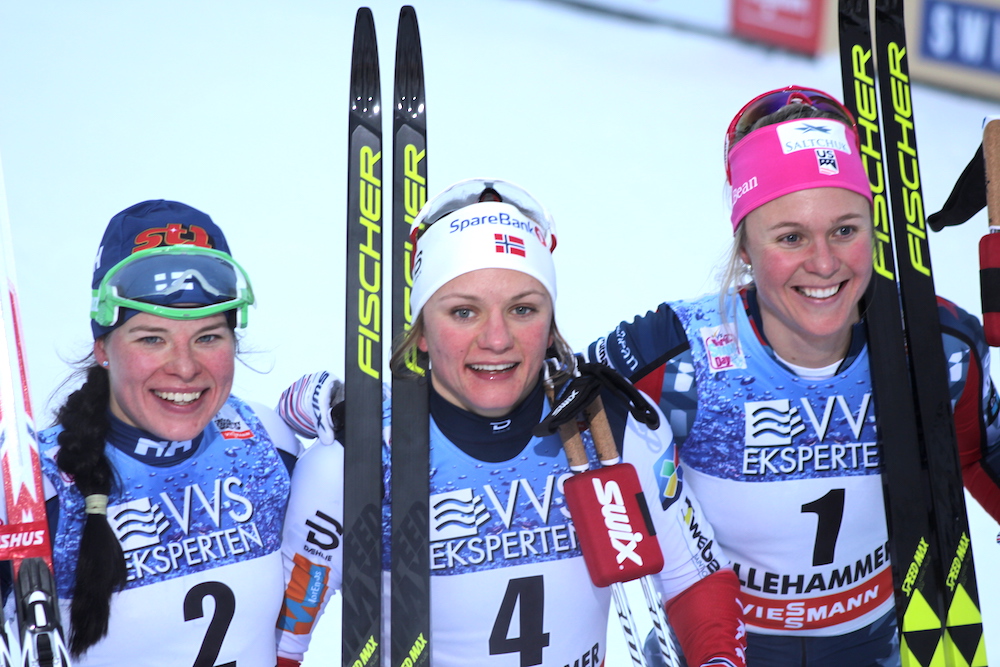
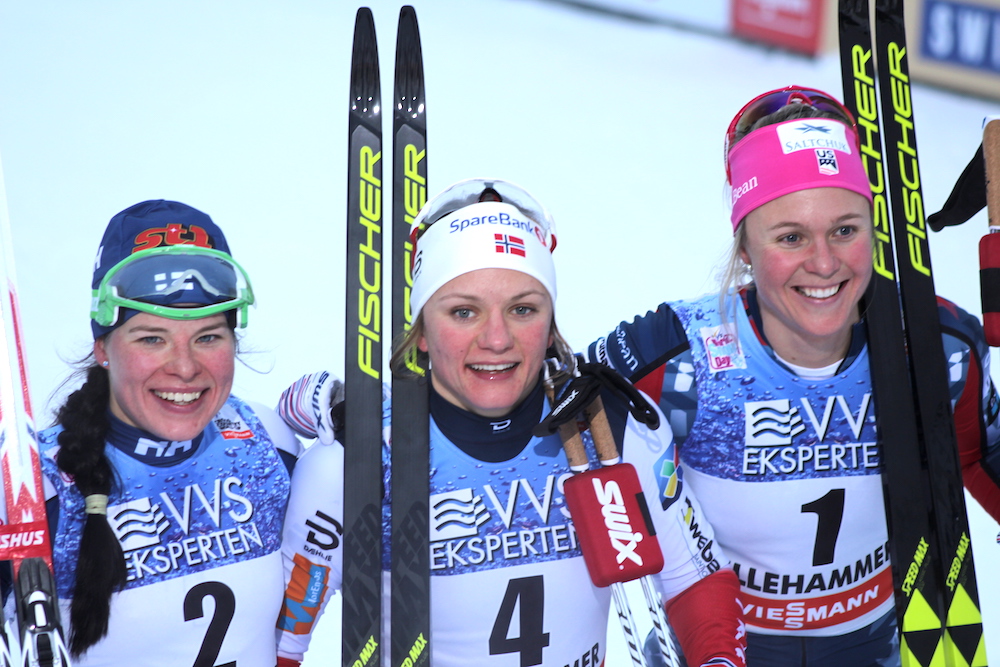
    Left to right: Finland’s Krista Pärmäkoski, Norway’s Maiken Caspersen Falla, and the U.S. Ski Team’s Sadie Bjornsen after the women’s 1.3-kilometer classic sprint on Saturday in Lillehammer, Norway. (Photo: Henrik Hunnes)

    Sadie Bjornsen can remember watching World Cup race footage as a kid, skiers zipping across the T.V. screen moving at speeds that seemed to her at the time, superhuman. In a recent blog post she recalled her view of them as “not even real… they were just figures in a movie.”

    Now, with two World Cup sprint podiums on back-to-back weekends, her most recent being third place in Saturday’s 1.3-kilometer classic sprint in Lillehammer, Norway, Bjornsen is stepping into the reality of her childhood dream, and she’d like to debunk the myth that World Cup podium contenders possess some kind of otherworldly abilities. As she put it, they are more like “your friendly neighbor across the street working darn hard towards something”.

    If Bjornsen is now finding herself on par with the World Cup racers she was once in awe of, it’s no magic trick. It’s what she’s described as “belief in myself.”

    “I think sprint racing is a mental thing, absolutely, and last winter I really struggled with it,” Bjornsen said during a post-race, in-person interview on Saturday. “I feel like now I have more confidence to go out and lead the race, whereas before, I would have never done that because I was not confident in my skills. That’s been a mental hurdle that I’ve gotten over this winter, and hopefully it continues.”

    Last year in Lillehammer, Bjornsen was the fastest qualifier but did not advance past the quarterfinals. This year in Lillehammer she once again won the qualifier, completing the course in a time of 3:22.45, but didn’t stop there. She placed second in her quarterfinal behind Norway’s Heidi Weng, and advanced to the second semifinal, which she won in a time of 3:23.33, crossing 0.46 seconds ahead of Sweden’s Stina Nilsson.
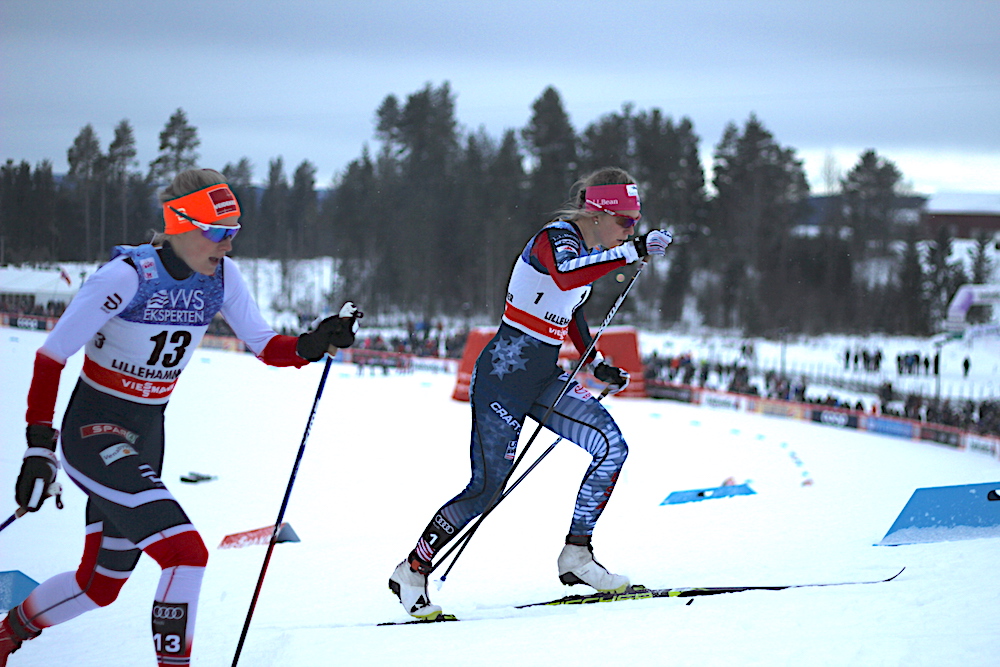
    The U.S. Ski Team’s Sadie Bjornsen (r) during the women’s 1.3-kilometer classic sprint quarterfinal on Saturday in Lillehammer, Norway. (Photo: Henrik Hunnes)

    Heading into the final, Bjornsen faced Nilsson (whom she placed second behind in last weekend’s opening sprint), Norwegians Maiken Caspersen Falla and Ingvild Flugstad Østberg, Finland’s Krista Pärmäkoski, and her U.S. Ski Team (USST) teammate Jessie Diggins.

    The Americans bookended the rest of the women’s finalists off the start, with Nilsson, Pärmäkoski and Falla taking hold of the lead by the first climb. Diggins strode to the right of the pack in fourth, while Bjornsen tucked in the inside left of the group in fifth.

    As the six crested the top of the first hill, Nilsson continued to put pressure from the front, attempting to distance herself from Pärmäkoski and Falla with three powerful double poles. Bjornsen held her position in fourth, while Diggins had slipped a position, trailing Østberg in sixth.

    As the finalists descended back toward the stadium, Pärmäkoski maneuvered her way to the front, and Nilsson and Falla clung to her. Bjornsen’s fast skis gained her ground, forcing her into a slight snowplow to prevent bumping into Falla by the bottom of the descent.

    Pushed tightly to the inside on the next corner by Falla, Bjornsen lost a few centimeters on the three leaders and a small gap separated her from the top three heading into the second major climb. In milliseconds, the Americans were reunited, Diggins and Bjornsen striding side by side with Østberg at the hill’s halfway point. In the same moment, Falla powered to the left of Pärmäkoski, commanding the pace at the front.

    Striding with unmatchable speed, Falla put close to a meter between her and the Finn by the top of the last climb, while Bjornsen and Nilsson jostled for position.

    “Stina cut straight in front of me and I kind of lost my momentum,” Bjornsen said. “It was really, really hard to get going again; over the top of the final climb, my legs were for sure buckling.”

    Diggins who had been racing to the outside, cut in, which put her in sixth.
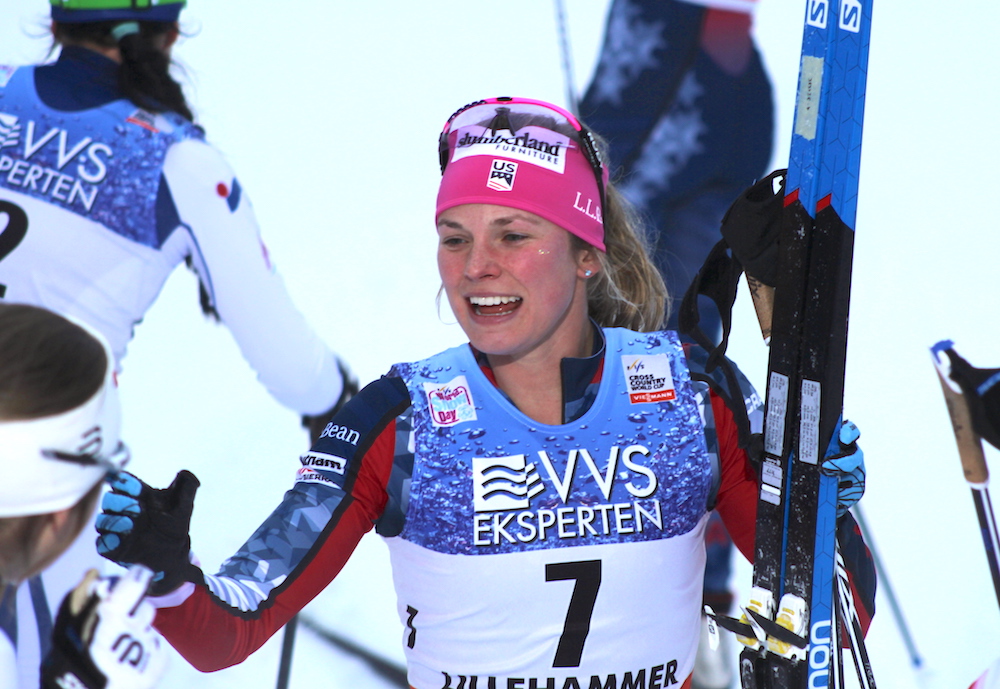
    Jessie Diggins of the U.S. Ski Team after the women’s 1.3-kilometer classic sprint on Saturday in Lillehammer, Norway. (Photo: Henrik Hunnes)

    “I’m not in my very top shape right now, which is the plan … so in the final I got a little bit tired and my technique kind of came off the rails a little bit, but it felt good to try to stay close and be … in it with those girls,” Diggins said during an in-person interview after with FasterSkier.

    In the final descent, it was Falla alone in the lead, Pärmäkoski poling with all her might to make up the two seconds that separated her from the win. Behind them, Bjornsen was sandwiched between Nilsson and Østberg in a race for third.

    In the end, Falla, the defending Sprint World Cup champion, crossed first in a time of 3:19.98 for her first win of the 2017/2018 season. In last weekend’s classic sprint in Kuusamo, Finland, Falla missed qualifying by 0.32 seconds and ended the day in 31st.

    “I was really sad after the race last week. Our skis weren’t that good as we hoped, but that happens in an outdoor sport,” Falla said, according to an International Ski Federation (FIS) press release.

    Living just 20 minutes away from the Lillehammer venue, Falla indicated she had plenty of practice on the sprint course, shown in the final meters of Saturday’s race.

    “I have been doing a lot of training exactly on that hill, many very hard trainings since the last season for the last minute on that climb, so today I really got to use it so I am really happy now,” Falla said.

    Pärmäkoski crossed 2.07 seconds behind Falla for second place.

    “Before Ruka I had a flu, since then I have been feeling better and better,” Pärmäkoski said, according to FIS. “It was a good day for me. In every heat I was feeling better.”

    Bjornsen edged Nilsson by 0.27 seconds for the third spot on the podium, 5.01 seconds behind Falla. Last weekend, Nilsson outlunged Bjornsen by 0.24 seconds for the Ruka sprint win.

    “I took the slingshot from Nilsson, and then just double poled my heart out to the finish,” Bjornsen said. “I did a lot of work this summer with double pole and … it seems to be paying off.

    “It definitely feels maybe even more special than last weekend,” Bjornsen continued. “There were not as many Norwegians in the heats last weekend because they had some problems with their skis, so, to be on the podium here in Lillehammer, where it’s the home course for them, and everybody was strong, it was super special.”

    Completing the women’s final was Nilsson in fourth (+5.28), Østberg in fifth (+6.09) and Diggins in sixth (+7.81).

    “I’ve been working so hard for so long to try to feel like a classic skier, so to get into the final in a classic sprint, arguably my worst event, is really confidence boosting,” Diggins said.

    Last weekend in Kuusamo, Diggins did not advance to the heats.

    “Two years ago we were wondering if Jessie would qualify in classic sprints and now she can go one weekend from not qualifying to the next weekend to being in the final,” USST Women’s Coach Matt Whitcomb said during a post-race phone interview. “It’s clearly there for her. Yeah, she skates more easily than she strides, but it has come such a long way.”

    On Saturday in Lillehammer, Diggins qualified seventh, 2.37 seconds off Bjornsen’s time. In the first quarterfinal, she raced Falla, Østberg, Finland’s Aino-Kaisa Saarinen, Norway’s Mari Eide, and Italy’s Greta Laurent.
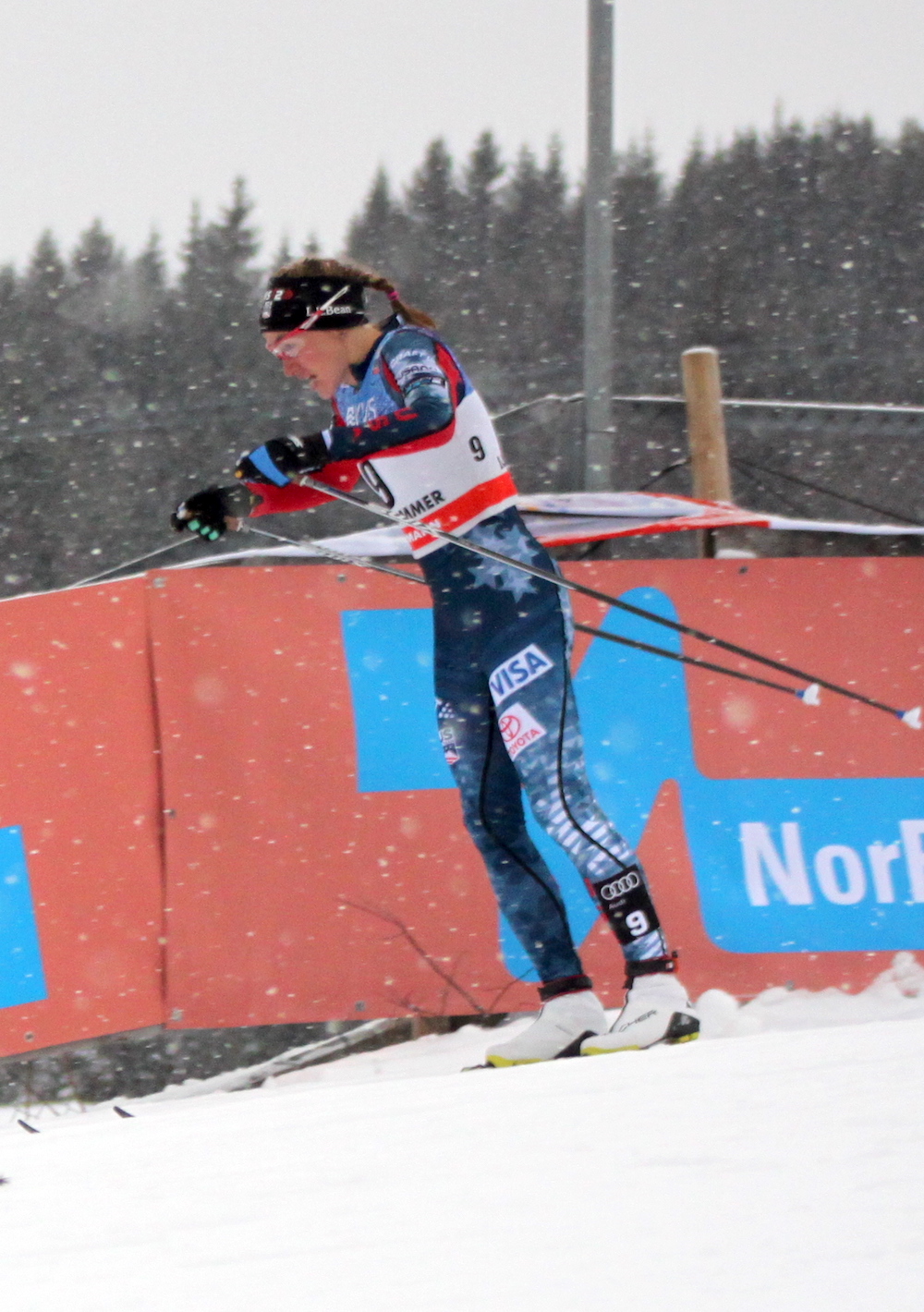
    Sophie Caldwell of the U.S. Ski Team after the women’s 1.3-kilometer classic sprint on Saturday in Lillehammer, Norway. (Photo: Henrik Hunnes)

    After finishing second in her heat behind Falla, Diggins advanced to the first semifinal with Falla, Østberg, Pärmäkoski, Russia’s Natalia Neprayeva, and another USST teammate Sophie Caldwell. In a three-way lunge, Østberg, Diggins and Caldwell fought for two lucky loser spots, which ultimately went to Østberg and Diggins.

    Caldwell missed advancing by 0.06 seconds and ended the day in ninth overall.

    “There were a couple things I wish I could have done differently in my semi, but it’s all a learning experience and even though I’d like to be in the final soon in a sprint, I think this is the best I’ve ever started a season. So I’m definitely happy with it,” Caldwell said after on the phone.

    Explaining that she felt strong in her qualifier and quarterfinal, Caldwell indicated that if she were to change anything, it would be in her semifinal.

    “I felt like I put myself in a really good position going up the first hill and then sort of over the top I let Krista hop in between me and Maiken, which sort of bounced me to the outside,” Caldwell reflected. “I just wish I’d been a little more aggressive and held my own and not allowed Krista to sneak in, but it’s just very little things that looking back you would have done differently.”

    With Caldwell out, Diggins and Bjornsen advanced to the final, doubling the number of American finalists since last weekend’s classic sprint.

    “It’s especially enjoyable when you have a day like this in Scandinavia where the Nation’s Group [in this case, Norwegian] quota is so strong,” Whitcomb said. “To put somebody on the podium and somebody else sixth and ninth, we’re really proud of that.”

    Rounding out the top 10 was Poland’s Justyna Kowalczyk in seventh, Norway’s Heidi Weng in eighth, followed by Caldwell in ninth and Norway’s Thea Krokan Murud in tenth.

    Rosie Brennan of the USST, who turned 29 on Saturday, missed qualifying for rounds by 0.26 seconds, finishing in 33rd (+6.84).

    “She was skiing with a little birthday power out there today. I really like how Rosie is looking in these races, regardless of whether or not she gets in,” Whitcomb said. “I think it bodes really well for tomorrow and I think she’s in awesome shape.”

    The second day of World Cup racing in Lillehammer takes place Sunday with the women’s 15 k skiathlon and men’s 30 k skiathlon.

    Also racing for the USST on Saturday, Kikkan Randall finished 42nd (+9.70) and Ida Sargent was 44th (+10.09). The next North American finishers were Emily Nishikawa (Canadian World Cup Team) in 58th (+16.21), Dahria Beatty (Canadian World Cup Team) in 59th (+16.25), and Cendrine Browne (Canadian U25 Team) in 63rd (+23.11). American Chelsea Holmes (Alaska Pacific University) finished 64th (+24.84) and Katherine Stewart-Jones (Canadian U25 Team) was 65th (+30.85).

    Results: Qualifier | Final

  • Wednesday Rundown: Canadian Nationals Classic Sprint

    Wednesday Rundown: Canadian Nationals Classic Sprint

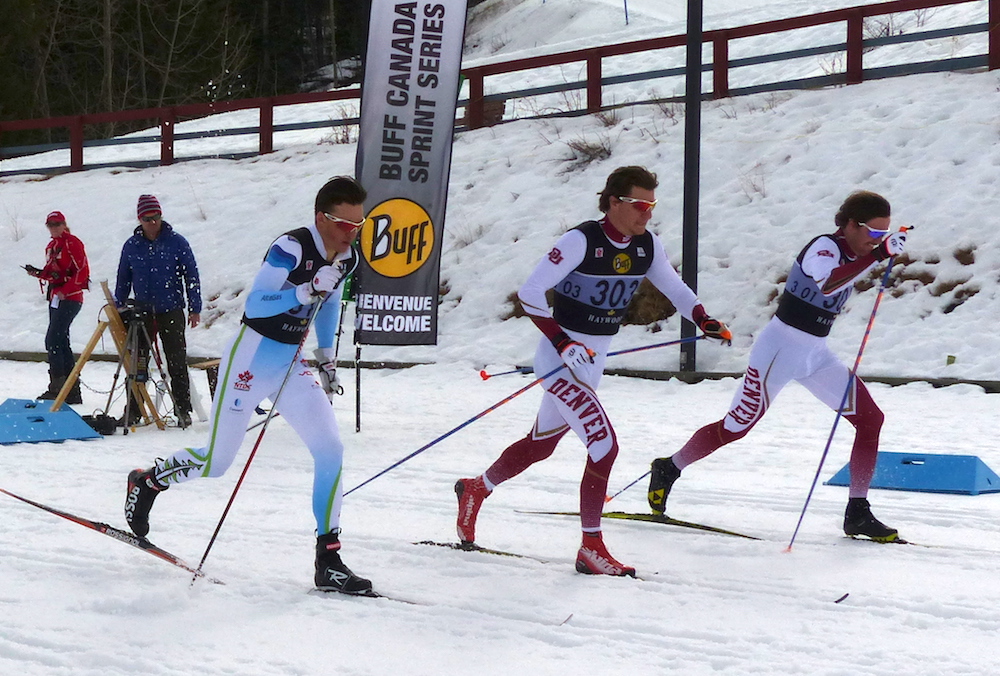
    The start of the men’s 1.3 k classic sprint A-final at 2017 Canadian Ski Nationals on Wednesday in Canmore, Alberta, with Evan Palmer-Charrette (l) with the University of Denver’s Moritz Madlener (303) and Dag Frode Trollebø (301). Madlener went on to win, Trollebø placed second and Palmer-Charrette third. (Photo: Peggy Hung)

    2017 Canadian Ski Nationals (Canmore, Alberta): Classic sprints

    Emily Nishikawa won her second-straight race at Canadian Ski Nationals in Canmore on Wednesday, topping the women’s 1.3-kilometer classic sprint in slushy conditions for her second national title in as many days.

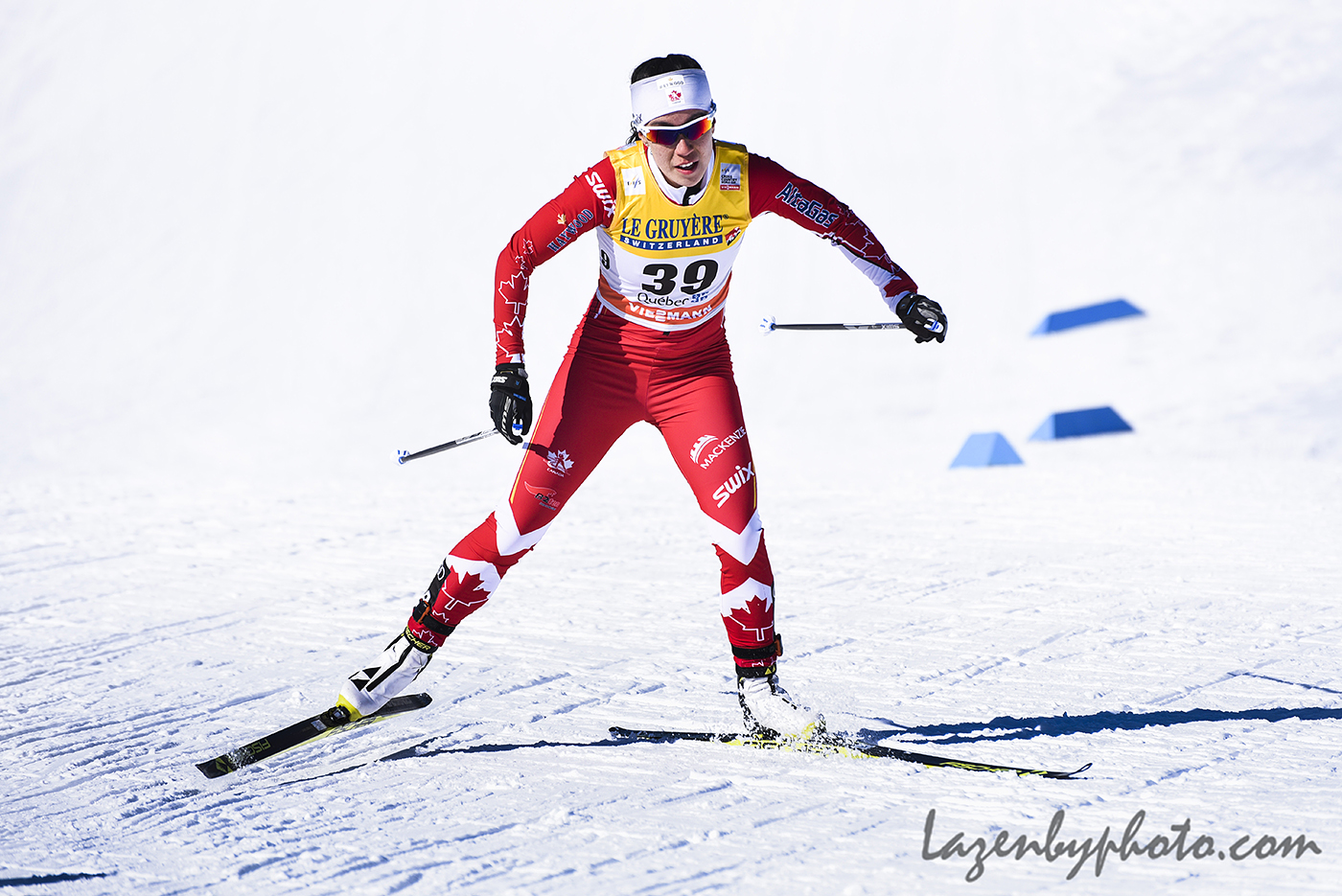
    Emily Nishikawa (Canadian World Cup Team) racing to 38th on the final day of 2017 World Cup Finals on Sunday in Quebec City, the women’s 10 k freestyle pursuit. Wednesday at Canadian nationals marked her fifth race in six days. (Photo: John Lazenby/Lazenbyphoto.com)

    Nishikawa, of the Canadian World Cup Team, initially posted the third-fastest qualifying time, 2.92 seconds behind qualifying winner Andrea Dupont (Rocky Mountain Racers), while junior Katie Weaver (Hollyburn Ski Club/NST Junior Team) qualified second (+0.43).

    Nishikawa went on to win both her quarterfinal and semifinal before besting five others in the women’s A-final in 4:00.86 minutes. Dahria Beatty, of the Alberta World Cup Academy (AWCA) and Canadian U25 Team, finished 2.79 seconds later in second place and Katherine Stewart-Jones (NTDC Thunder Bay/NST U25 Team) followed in third (+3.14). Also reaching the A-final, Annika Hicks (AWCA) finished fourth (+21.37), and Sophie Carrier-Laforte, of the Pierre Harvey Training Centre (CNEPH) placed fifth (+45.63) and Alannah MacLean (NTDC Thunder Bay) did not start.

    “Today with these soft, slushy conditions, it kind of played into my favour,” Nishikawa told FasterSkier in person on Wednesday. “I love classic sprinting, I always have. To pull enough energy together today was really great.

    “It’s my fifth race in six days, so I’m really tired, but I couldn’t be happier right now,” she said. “To win two back to back national titles yesterday and today is really cool.”

    In the junior women’s A-final, Annika Richardson (NTDC Thunder Bay/NST Junior Team) took the win in 4:05. Her Hollyburn club teammate, Weaver placed second (+4.48) and NTDC Thunder Bay teammate Lisle Compton finished third (+7.4). Also in the A-final, Zoë Williams (Nakkertok/NST Junior Team) placed fourth (+11.37), Hannah Mehain (Sovereign Lake Nordic/NST Junior Team) fifth (+25.75) and Catherine Reed-Métayer (Skibec/Quebec Ski Team) sixth (+1:05.44).

    In the senior men’s 1.3 k sprint, Moritz Madlener beat his University of Denver teammate Dag Frode Trollebø by 0.5 seconds for the A-final win in 3:12.56. Madlener started the day by qualifying in third, 1.6 seconds behind Trollebø, the fastest qualifier, while Joey Foster (Team Hardwood) qualified second (+0.88).

    Madlener went on to win both his quarterfinal and semifinal. So did Evan Palmer-Charrette (NTDC Thunder Bay), who qualified 14th and ended up third in the final, 3.76 seconds behind Madlener. With Madlener hailing from Germany and Trollebø from Norway, Palmer-Charrette was the top Canadian, ahead of Antoine Briand (CNEPH) in fourth (+10.53), Knute Johnsgaard (AWCA/NST U25 Team) in fifth (+12.65), and Michael Somppi (NTDC Thunder Bay) in sixth (+13.4).

    “I tucked in behind the two guys from Denver,” Palmer-Charrette explained of his tactics in the final. “I knew they were going to put in a surge on the climb. I went inside to try and go past them, but they were smart, took the two outside tracks, which were still there; inside was really soft. I cut over to get behind them, but I lost a couple metres and just wasn’t able to get that back.”

    Despite finishing behind them, Palmer-Charrette as the first Canadian earned his first national title at the age of 22, after rebounding from compartment-syndrome surgery last summer.

    “[I] trained really hard after that,” he said. “It’s been a great year.  … Awesome to be Canadian champion, surprise for sure in a classic sprint for me. Definitely not quite the Canadian field you’d see at a lot of Canadian nationals, a lot of guys sick and injured after World Cups on the weekend, but awesome nonetheless.”

    Most notably, Canadian World Cup sprinter Len Valjas did not race.

    Étienne Hébert (Quebec Ski Team/NST Junior Team) won the junior men’s A-final in 3:22.09, edging Nicolas Beaulieu (Orford/Quebec Ski team) by 0.55 seconds, and third-place finisher Larkin Wasmuth (Fort Saskatchewan Nordic Ski Club) by 0.68 seconds. Michael MacIsaac-Jones (AWCA) was in contention for a podium before crashing in the soft snow just before the finish. He ended up fifth (+11.63), behind American Nick Matelich (Bridger Ski Foundation) in fourth (+10.55) and ahead of Antoine Blais (Quebec Ski Team/NST Junior team) in sixth (+16.77).

    The next senior races will be the long-distance freestyle mass starts on Saturday.

    Complete results | Schedule

  • Beatty 12th in SoHo Classic Sprint for U23/Junior Worlds Career Best

    Canada's Dahria Beatty (8) chasing Norway's Thea Krokan Murud (3) in the fifth quarterfinal of the women's classic sprint on Tuesday at U23 World Championships at Soldier Hollow in Midway, Utah. Beatty finished 12th on the day while Murud went on to place second in the final. (Photo: FlyingPointRoad.com)
    Canada’s Dahria Beatty (8) chasing Norway’s Thea Krokan Murud (3) in the fifth quarterfinal of the women’s classic sprint on Tuesday at U23 World Championships at Soldier Hollow in Midway, Utah. Beatty finished 12th on the day while Murud went on to place second in the final. (Photo: FlyingPointRoad.com)

    A year ago, Canada’s Dahria Beatty had eight World Cup starts to her name. Not too shabby considering she was 21, but now another year older, the Whitehorse, Yukon, native has more than doubled that amount with a grand total of 21 World Cup starts — one of which included her 15th-place breakthrough at the Ski Tour Canada classic sprint in Canmore, Alberta.

    Beatty lives and trains in Canmore as a member of both the Alberta World Cup Academy (AWCA) and Canadian National U25 Team. She led the NorAm (Continental Cup) standings at the end of last season, reiterating her position as one of Canada’s top talents. Just under a month ago, she won the freestyle sprint prologue at U.S. nationals at Soldier Hollow in Midway, Utah.

    Then on Tuesday, on the same 1.3-kilometer sprint course at Soldier Hollow, Beatty notched a career-best individual result at her second U23 World Championships, placing 12th in the classic sprint. She started the day by qualifying in eighth, 3.85 seconds back from the fastest qualifier, Sweden’s Anna Dyvik, who rounded the course in 3:39.4 minutes.

    “My qualifier was pretty solid. I skied well, I made one small tactical mistake on the last climb but the rest of the race went smoothly,” Beatty reflected in an email. “This is a really taxing course and by the finish shoot my legs were pretty exhausted … it was a fight to get across that line. I was happy to qualify 8th and to post another consistent qualifier. Overall my qualifying speed has improved this year which I am very happy with.”

    She was one of three Canadian women to qualify in the top 30, with Jenn Jackson (Lappe Nordic/Team Hardwood) posting the 22nd-ranked time (+12.99) and Katherine Stewart-Jones (NTDC Thunder Bay/NST U25 Team) qualifying in 28th (+16.61).

    Maya MacIsaac-Jones, Beatty’s teammate on the AWCA and national U25 Team, missed advancing to the heats in 32nd (+20.68), 3.7 seconds out of 30th.

    American Kelsey Phinney (6) racing alongside Norway's Lotta Udnes Weng (5) during their quarterfinal of the women's classic sprint on Tuesday at U23 World Championships at Soldier Hollow in Midway, Utah. (Photo: FlyingPointRoad.com)
    American Kelsey Phinney (6) racing alongside Norway’s Lotta Udnes Weng (5) during their quarterfinal of the women’s classic sprint on Tuesday at U23 World Championships at Soldier Hollow in Midway, Utah. (Photo: FlyingPointRoad.com)

    All four of the U.S. women qualified, with Kelsey Phinney (Sun Valley Ski Education Foundation) leading them in sixth (+2.77), followed by Nichole Bathe (University of Alaska-Fairbanks) in 14th (+8.8), Jesse Knori (University of Colorado-Boulder) in 19th (+12.07), and Corey Stock (Bridger Ski Foundation) in 26th (+15.11).

    Out of those seven North Americans, Beatty was the lone woman to advance to the semifinals, which had been her “base” goal to start the day. She finished third in her quarterfinal (the fifth and final quarterfinal) and advanced as a lucky loser with a fast-enough time.

    “My quarterfinal was going well, but I had a stumble cresting the last hill and l lost contact with the top 2 women,” Beatty reflected in an email. “My heat was really fast and I was able to recover from the stumble and move onto the semis as lucky loser. When I finished I had a feeling it was a fast heat but you always have to wait and see.”

    Norway’s Thea Krokan Murud won her quarterfinal in 3:35.2, which would hold up as the fastest time of the day until the final. Germany’s Pia Fink took second in that heat (+1.25) and Beatty was third (+2.45), ahead of Russia’s Yana Kirpichenko in fourth (+7.13) and Stewart-Jones in fifth (+12.63).

    Without much time to recover before the second semifinal, Beatty explained that she was still pretty tired by the start of it. She ended up sixth in that semifinal, 8.04 seconds behind Murud, who won it in 3:37.42.

    “Overall it was great to be in the semi finals and I learned a lot about tactics and where my weaknesses lie,” Beatty wrote. “I just didn’t have enough in the tank today to contend for the final but I am happy to have race my first international semi final and am looking forward to the 10k skate Thursday.”

    With a previous U23 best result of 20th in the 2015 classic sprint in Almaty, Kazakhstan (and 15th in the 5 k classic at 2014 Junior Worlds the year before), 12th was Beatty’s best ever at a world championship.

    “Racing well on the World Cup had definitely helped my confidence in myself and race knowledge. I feel I am right in the mix with these top women and on the perfect day I could be on that podium,” she wrote. “Going into today I had set base goal (I would be happy with the day if I achieved this) at making the semi finals. My target goal was making the final and my dream goal was being on the podium. My goals will stay pretty similar for the distance races. There are two more races and we’re at altitude so you never know what can happen.”

    Jesse Knori (University of Colorado-Boulder) leading Estonia's Anette Veerpalu during their quarterfinal of the women's classic sprint at U23 World Championships at Soldier Hollow in Midway, Utah. Knori finished third in that heat (while Veerpalu was sixth). While she didn't advance to the semifinals, Knori was the top U.S. woman in 15th on the day. (Photo: FlyingPointRoad.com)
    Jesse Knori (University of Colorado-Boulder) leading Estonia’s Anette Veerpalu during their quarterfinal of the women’s classic sprint at U23 World Championships at Soldier Hollow in Midway, Utah. Knori finished third in that heat (while Veerpalu was sixth). While she didn’t advance to the semifinals, Knori was the top U.S. woman in 15th on the day. (Photo: FlyingPointRoad.com)

    While Beatty reached the semifinals, the two other Canadians and four Americans were eliminated in the quarterfinals. Knori led three U.S. women in the top 20 overall, placing 15th on the day after finishing third in her heat, 7.18 seconds behind Norway’s Tiril Udnes Weng (who won that heat by 1.07 seconds over another Norwegian Lovise Heimdal).

    Canada’s Jackson raced in that same quarterfinal and finished fifth (+8.72), behind Italy’s Caterina Ganz in fourth (+7.56), for 21st overall.

    Both fourth in their quarterfinals, Phinney ended up 16th and Bathe 18th overall. Phinney finished 3.81 seconds behind Weng’s twin sister, Lotta Udnes Weng, in first. Bathe finished 7.14 seconds behind the winner of her quarterfinal, Germany’s Sofie Krehl.

    American Corey Stock (Bridger Ski Foundation) leads Australia's Casey Wright (University of Alaska Anchorage) in the third quarterfinal of the women's classic sprint at U23 World Championships at Soldier Hollow in Midway, Utah. They finished fifth and sixth, respectively, in that heat. (Photo: FlyingPointRoad.com).
    American Corey Stock (Bridger Ski Foundation) leads Australia’s Casey Wright (University of Alaska Anchorage) in the third quarterfinal of the women’s classic sprint at U23 World Championships at Soldier Hollow in Midway, Utah. They finished fifth and sixth, respectively, in that heat. (Photo: FlyingPointRoad.com).

    Stock ended up 22nd after finishing fifth in Phinney’s quarterfinal, 10.08 seconds behind Lotta Weng. Also in that quarterfinal, Australia’s Casey Wright, of the University of Alaska Anchorage Ski Team, finished sixth (+12.37). Wright qualified in 25th and ultimately placed 29th overall.

    Canada’s third woman, Stewart-Jones placed 24th after finishing fifth in the same quarterfinal as Beatty.

    In the first quarterfinal, the Czech Republic’s Petra Hyncicova (Knori’s teammate at the University of Colorado-Boulder) finished fourth, 4.33 seconds behind Sweden’s Maja Dahlqvist in first. Hyncicova qualified in 21st and ended up 20th overall.

    Sweden's 22-year-old Anna Dyvik celebrates her win in the U23 World Championships women's classic sprint on Tuesday, nearly 3 1/2 seconds clear of second place. (Photo: FlyingPointRoad.com)
    Sweden’s 22-year-old Anna Dyvik celebrates her win in the U23 World Championships women’s classic sprint on Tuesday, nearly 3 1/2 seconds clear of second place. (Photo: FlyingPointRoad.com)

    Dahlqvist and Murud won the first and second semifinals, respectively, then took a back seat to Dyvik — the qualifying winner who finished second in both her quarterfinal and semi — in the final. Dyvik took control early and avoided a crash near the back to win the final in 3:32.40, the fastest time of the day. She won by more than three seconds for her first U23 Worlds medal, after earning gold in the relay and bronze in the skiathlon at 2014 Junior Worlds.

    Behind her, Murud claimed silver (+3.42), edging Dahlqvist, the second Swede on the podium in third (+3.76).

    Norway’s Heimdal took fourth (+6.03), while Krehl and Lotta Weng, who fell, finished fifth (+33.34) and sixth (+1:13.17), respectively.

    Junior Worlds racing continues on Wednesday with the 5/10 k freestyle individual starts.

    Results: Qualifier | Brackets | Overall

    The women's classic sprint podium on Tuesday at U23 World Championships at Soldier Hollow in Midway, Utah, with Sweden's Anna Dyvik (c) in first, Norway's Thea Krokan Murud (l) in second, and Sweden's Maja Dahlqvist (r) in third. (Photo: FlyingPointRoad.com)
    The women’s classic sprint podium on Tuesday at U23 World Championships at Soldier Hollow in Midway, Utah, with Sweden’s Anna Dyvik (c) in first, Norway’s Thea Krokan Murud (l) in second, and Sweden’s Maja Dahlqvist (r) in third. (Photo: FlyingPointRoad.com)
  • Friday Rundown: Lillehammer Classic Sprint

    Friday Rundown: Lillehammer Classic Sprint

    Sweden's Calle Halfvarsson racing to his first World Cup win in three years, ahead of Norway's Emil Iversen in Friday's 1.6 k classic sprint in Lillehammer, Norway. (Photo: Nordic Lillehammer/Twitter)
    Sweden’s Calle Halfvarsson racing to his first World Cup win in three years, ahead of Norway’s Emil Iversen in Friday’s 1.6 k classic sprint in Lillehammer, Norway. (Photo: Nordic Lillehammer/Twitter)

    Welcome to The Rundown, your quick primer of need-to-know information about the day’s racing. We’ll be updating this digest as the day goes on with additional results, photos and quotes. The Rundown is NOT a race report; stay tuned for complete race reports later today with interviews from the day’s top racers.

    ***

    FIS Cross-Country World Cup in Lillehammer: Classic sprint

    Women’s report | Men’s report

    For the second time in her career, Sadie Bjornsen of the U.S. Ski Team (USST) won a World Cup sprint qualifier on Friday, Day 1 of the first mini tour of the season in Lillehammer, Norway.

    After turning 27 last week and finishing 17th in both races at the Ruka World Cup in Finland, Bjornsen put down the fastest qualifying time in the women’s 1.3-kilometer classic sprint, by 0.29 seconds over Norway’s Maiken Caspersen Falla, who qualified in second.

    Four U.S. women made the heats, with Jessie Diggins qualifying ninth (+1.75), Sophie Caldwell in 10th (+2.01), and Ida Sargent in 26th (+6.17).

    In the men’s 1.6 k classic sprint, Calle Halfvarsson of Sweden topped the qualifier, clocking in 0.14 seconds faster than Norway’s Johannes Klæbo in second. Last weekend’s sprint winner, Pål Golberg qualified third (+2.07), and two Canadians, Len Valjas and Alex Harvey qualified for the heats in 19th (+10.24) and 23rd (+10.92), respectively. American Erik Bjornsen (USST) nabbed the final qualifying spot in 30th (+12.61).

    In the heats, the women’s third-fastest qualifier (who was third in the first two races of the season), Heidi Weng of Norway won her quarterfinal and semifinal and finally, the final, by 0.48 seconds over her teammate, Falla. (It was Falla’s second runner-up finish in as many classic sprints this season.)

    Sweden’s Hanna Falk placed third, 1.06 seconds after Weng, and Norway’s Ingvild Flugstad Østberg finished fourth (+2.99). The fourth Norwegian in the women’s final, Anna Svendsen placed fifth (+6.27), and an early leader in the race, Yulia Belorukova of Russia faded to sixth (+16.75).
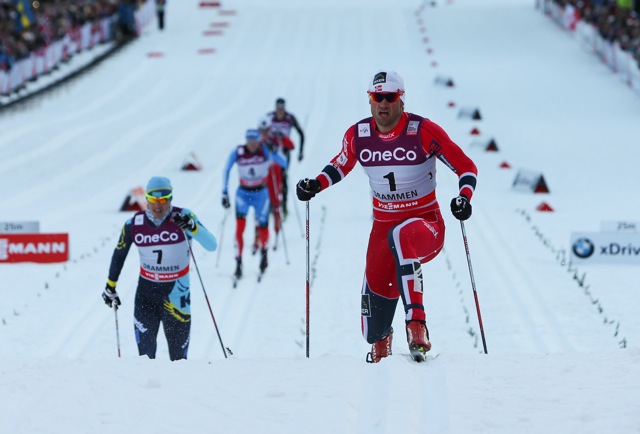
    Meanwhile, Diggins led the U.S. women in 14th overall after all four did not advance to the semifinals. Diggins finished third in her quarterfinal, just 0.22 seconds behind Belorukova and 0.14 behind runner-up Kathrine Rolsted Harsem of Norway, respectively.

    Bjornsen finished in, you guessed it, 17th for the third-straight race after placing fourth in that same quarterfinal, 0.82 seconds behind Belorukova.

    Caldwell was 21st on the day after placing fifth in her quarterfinal, 3 seconds behind Falla, who won that heat. Sargent finished 28th overall after placing sixth in the first quarterfinal, 8.24 seconds behind Finnish winner Krista Parmakoski.

    In the men’s heats, Halfvarsson took it all the way to the final, winning his first World Cup race in three years (since a skate sprint win in Oberhof, Germany, in December 2013). There, he beat out Norway’s Emil Iversen by 0.12 seconds at the line, and Sweden had two on the podium with Teodor Peterson in third (+0.54). Finland’s Iivo Niskanen placed fourth (+4.01), Sweden’s Emil Jönsson finished 42 seconds back in fifth, and Golberg crossed the line nearly 2 minutes after Halfvarsson in sixth.
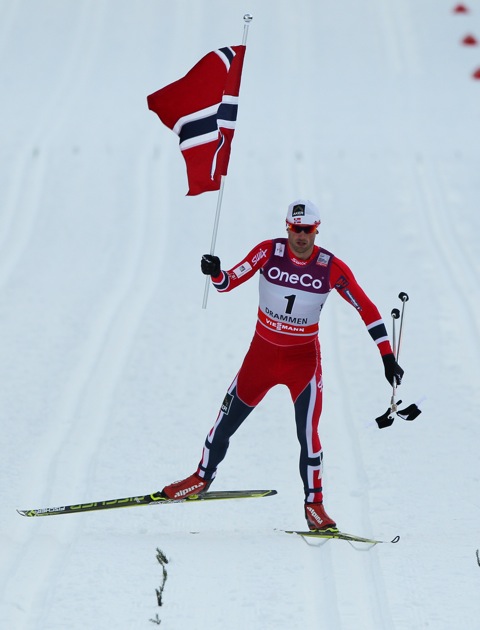
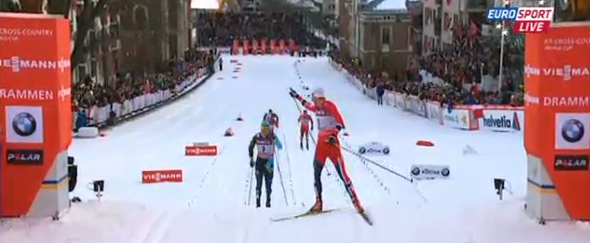
    Harvey notched his first top 10 of the season in 10th overall, after placing fifth in his semifinal. (Notably, the same semifinal where Halfvarsson received a yellow card for obstruction, but was allowed to start the final. Norway’s Finn Hågen Krogh and Sondre Turvoll Fossli were relegated to 29th and 30th, respectively, for technique infractions in the heats.)

    Then there was Valjas, who led his quarterfinal until late, where Norway’s Martin Johnsrud Sundby initially picked up the pace and Petter Northug came from behind to win the heat. Just 0.05 seconds back, Niskanen took second and Valjas just missed out on advancing to the semifinal in third (+0.19). Overall, Valjas placed 13th for his best World Cup result since the Canmore classic sprint last year at the Ski Tour Canada (STC), where he placed 11th.

    Bjornsen finished 24th (his best World Cup result since finishing 20th in the Quebec skate sprint at the STC) after placing fifth in his quarterfinal, 3.69 seconds behind Klaebo, who won that heat.

    Also for the U.S., Rosie Brennan narrowly missed the heats in 34th, last season’s U.S. SuperTour leader Caitlin Patterson (Craftsbury GRP) placed 68th, and USST distance skier Liz Stephen was 70th in her first World Cup of the season.

    In the men’s race, Canada’s Devon Kershaw missed qualifying in 42nd, Knute Johnsgaard was 51st, Bob Thompson 52nd, Graeme Killick 71st, and Andy Shields 90th.

    U.S. sprinters Andy Newell and Simi Hamilton finished 47th and 48th, respectively. Last season’s SuperTour leader Eric Packer (APU) placed 76th, and Noah Hoffman (USST) 89th.

    Canada had three women in the distance race, with Emily Nishikawa finishing 62nd, Dahria Beatty 66th, and Cendrine Browne 67th

    Final results: Men | Women

  • Newell 12th, Valjas 14th in Final World Cup Sprint in Drammen

    Newell 12th, Valjas 14th in Final World Cup Sprint in Drammen

    FIS world cup cross-country, individual sprint, Drammen (NOR)
    (From l-r) Canada’s Lenny Valjas, Andy Newell of the U.S., and Norway’s Pål Golberg (9) at the finish line of their quarterfinal heat in the World Cup freestyle sprint in Drammen, Norway. Newell advanced to the semifinals and ended up 12th overall, while Valjas narrowly missed advancing and placed 14th. (Photo: Fischer/Nordic Focus)

    American Andy Newell ended his World Cup season on a high note, finishing as the top North American in Wednesday’s 1.3-kilometer classic sprint in Drammen, Norway. He reached the semifinals before finishing 12th overall.

    Newell qualified in 28th, 5.48 seconds behind top qualifier Ola Vigen Hattestad of Norway (2:36.48).

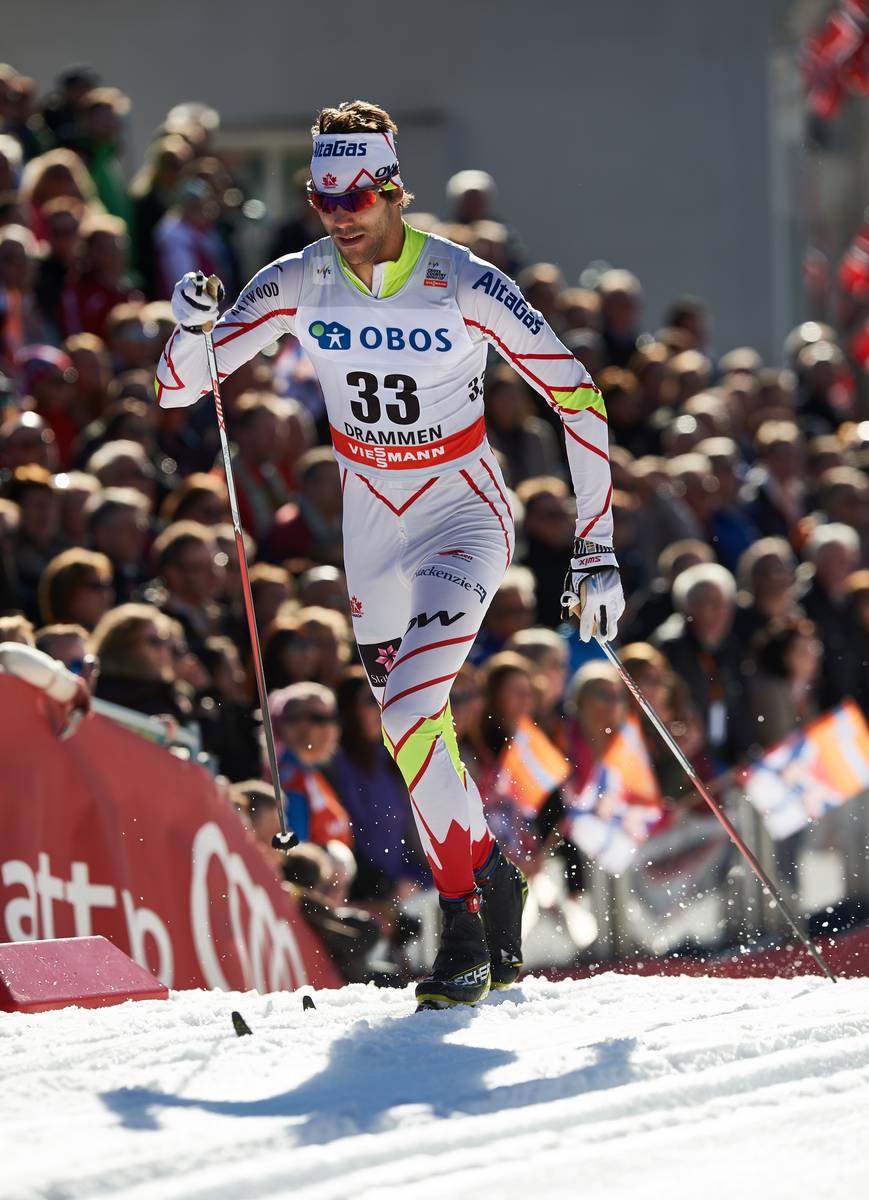
    Canada's Lenny Valjas during of the World Cup classic-sprint qualifier in Drammen, Norway. Valjas qualified 19th and placed 14th overall. (Photo: Fischer/Nordic Focus)
    Canada’s Lenny Valjas during of the World Cup classic-sprint qualifier in Drammen, Norway. Valjas qualified 19th and placed 14th overall. (Photo: Fischer/Nordic Focus)

    Lenny Valjas of Canada qualified in 19th (+4.90) and was the only other North American male in the quarterfinals. He and Newell ended up racing in the fifth quarterfinal.

    In that heat, Valjas held a slim lead until Newell and Norway’s Pål Golberg passed him in the final stretch. The Canadian finished in third, just 0.72 seconds behind Golberg, who won the heat in 2:39.43, while Newell lunged to a second-place finish, 0.43 seconds back.

    Valjas would finish 14th overall. He did not immediately respond to an email for comment.

    Newell said in a phone interview that he felt strong during his quarterfinal heat, deciding to go with kick wax while trying to stay near the front throughout the heat.

    “I was able to do that in the first climb and get a good draft on the downhill. I felt good striding up to the finish line and was able to move on pretty comfortably,” he said.

    Newell, who is coming off an eighth-place finish in Saturday’s freestyle sprint in Lahti, Finland, explained that he had a yellow card on his record and had to be especially careful to avoid skating, a risk on the steep hill where many of the racers were herringboning.

    “You can be skating very easily trying to do that,” he said. “I think there were definitely some sketchy techniques going on out there, so I went into that hill doing my best to be really under control and not herringboning too much.”

    In the semifinal, Newell finished sixth, 8.75 seconds behind winner Sondre Turvoll Fossli, who won in 2:35.41.

    Newell said that although he was happy to reach that round, he wished he could have been more competitive. The quick turnaround from the final quarterfinal heat left him fatigued, he said.

    “I just got stuck in the back going over the tops of the hills and into the drafts,” he explained.

    Newell wanted to establish a good position to catch a draft on the long downhill, but became stuck behind Russia’s Nikita Kriukov, who was herringboning the uphill.

    “I had to herringbone behind him as well, and he wasn’t going as fast as some of the guys that had kick wax,” Newell said. “We did come back on the downhill, but because he had skate skis he wasn’t a great person to draft behind because he pulled away from me and I was left in no-man’s land on the downhill. And then I didn’t carry quite enough speed on the corner.”

    Andy Newell (U.S. Ski Team) at the 1.3 k classic sprint in Drammen, Norway. He placed sixth in his semifinal for 12th overall. (Photo: Fischer/NordicFocus)
    Andy Newell (U.S. Ski Team) at the 1.3 k classic sprint in Drammen, Norway. He placed sixth in his semifinal for 12th overall. (Photo: Fischer/NordicFocus)

    Newell finished the season 18th in the overall Sprint World Cup, despite missing one sprint and failing to score in two others.

    He explained he was pleased to be able to turn his season around after suffering from a slow start, injuries and adversity, particularly a neck injury and a reoccurring allergic reaction, earlier in the season.

    “As far as an overall sprint year, it was not super successful, but I was able to learn some things and turn it around at the end of the season,” Newell said. “It’s always nice to finish pretty strong.”

    Canada’s Alex Harvey, who took a silver medal in the classic sprint at the 2015 World Championships and bronze in the skiathlon, missed qualifying by 0.7 seconds in 33rd (6.53 seconds behind the qualifying winner) and ended the season 13th in the sprint standings.

    Other American men racing on Wednesday included Erik Bjornsen in 38th (+7.16), Dakota Blackhorse-von Jess in 42nd (+7.55), and Simi Hamilton in 65th (+13.56). Hamilton crashed late in his qualifier to take him out of contention.

    Sadie Bjornsen Qualifies Ninth 

    Sadie Bjornsen was the lone North American woman to qualify for the heats, finishing ninth, 5.22 seconds behind Norway’s Ingvild Flugstad Østberg, the top female qualifier in 3:01.25.

    Sadie Bjornsen (U.S. Ski Team) racing to ninth in the 1.3 k classic-sprint qualifier on Wednesday at the World Cup in Drammen, Norway. In the last sprint of the season, Bjornsen went on to place sixth in her quarterfinal for 26th overall. (Photo: Fischer/NordicFocus)
    Sadie Bjornsen (U.S. Ski Team) racing to ninth in the 1.3 k classic-sprint qualifier on Wednesday at the World Cup in Drammen, Norway. In the last sprint of the season, Bjornsen went on to place sixth in her quarterfinal for 26th overall. (Photo: Fischer/NordicFocus)

    However, Bjornsen ended up in the fastest quarterfinal, which Norway’s Astrid Uhrenholdt Jacobsen won in 3:00.33, and placed sixth (+2.87) to finish 26th overall.

    Bjornsen said in a phone interview that it is unfortunate she was put a heat with so many fast skiers, but her time in the heat still left her encouraged.

    “Even though I was last in my heat, I was skiing faster than most of the other heats, so there’s definitely some positive things to take away,” she said.

    Bjornsen explained that her strategy in the quarterfinal was simply to ski as hard as she could and try to keep contact with the front. She said she had a strong start, but became caught behind the other skiers. Once she had to slow down, she had a difficult time regaining speed. It is something she says she has struggled with throughout the season.

    “I ended up skiing from the back the whole time, and every time I tried to find a hole, it was quickly covered,” she explained. “It was a bit frustrating, but those are all really good skiers so it was hard to find my way to the front.”

    Bjornsen was able to make contact with the leaders at the bottom of the course’s steep hill, but got tangled up in the back while climbing the other side and was not in an ideal position when she reached the finishing stretch.

    “The hills were steep and narrow and tricky,” she said.

    Despite temperatures above 50 degrees Fahrenheit, skis were not an issue for her.

    “I definitely had awesome skis,” she explained.

    Even though she was not able to reach the semifinals, Bjornsen is encouraged by how she qualified.

    “I feel like this year I’ve sort of struggled. There have been many races where I’m just barely qualifying or on the other side of not qualifying,” she said. “I was definitely really happy to finish the last sprint of the year knowing that I can qualify in the top 10.”

    Although she has not had as many top results as during the 2013/2014 World Cup season, Bjornsen said this season has been a step in the right direction. She finished 24th in the sprint standings.

    “It’s easy to be greedy and just want to have those high races … but I’ve finally found a level of consistency. And I do believe this is the next step,” she said.

    She explained that this winter she has raced more than ever, and hopes for even better results next season after a good summer of training.

    American Sophie Caldwell placed 35th in qualifying in Wednesday's World Cup freestyle sprint in Drammen, Norway. (Photo: Fischer/Nordic Focus)
    American Sophie Caldwell placed 35th in qualifying in Wednesday’s World Cup freestyle sprint in Drammen, Norway. (Photo: Fischer/Nordic Focus)

    Meanwhile, her teammate Sophie Caldwell missed out on qualifying by 1.18 seconds, placing 35th (+11.59). She finishes the season 20th in the sprint standings.

    She wrote in an email that she was not very satisfied with her qualifier and felt like she skied frantically.

    “I’ve been fighting a little sickness the past few days, but it never got bad enough to consider not racing. I felt a little flat and tired, but mostly just frantic,” she explained.

    She wrote that she tends to struggle with the Drammen course due to the power striding and double poling, and is going to work hard to improve those techniques during the offseason.

    “I’ve never qualified in Drammen, but one of these years that’s going to change!” she wrote.

    American Kikkan Randall, who reached the podium in third in Saturday’s freestyle sprint in Lahti, qualified in 45th (+18.03), while Caitlin Patterson was 51st (+19.73) for the U.S.

    No Canadian women competed on Wednesday.

    The 2014/2015 World Cup season finishes this weekend at Holmenkollen in Oslo, Norway,  with the men’s 50 k and women’s 30 k freestyle mass starts.

    Results: Men | Women

  • Brandsdal Rolls to Drammen Classic-Sprint Win, But Krogh Takes Overall Sprint Globe

    Brandsdal Rolls to Drammen Classic-Sprint Win, But Krogh Takes Overall Sprint Globe

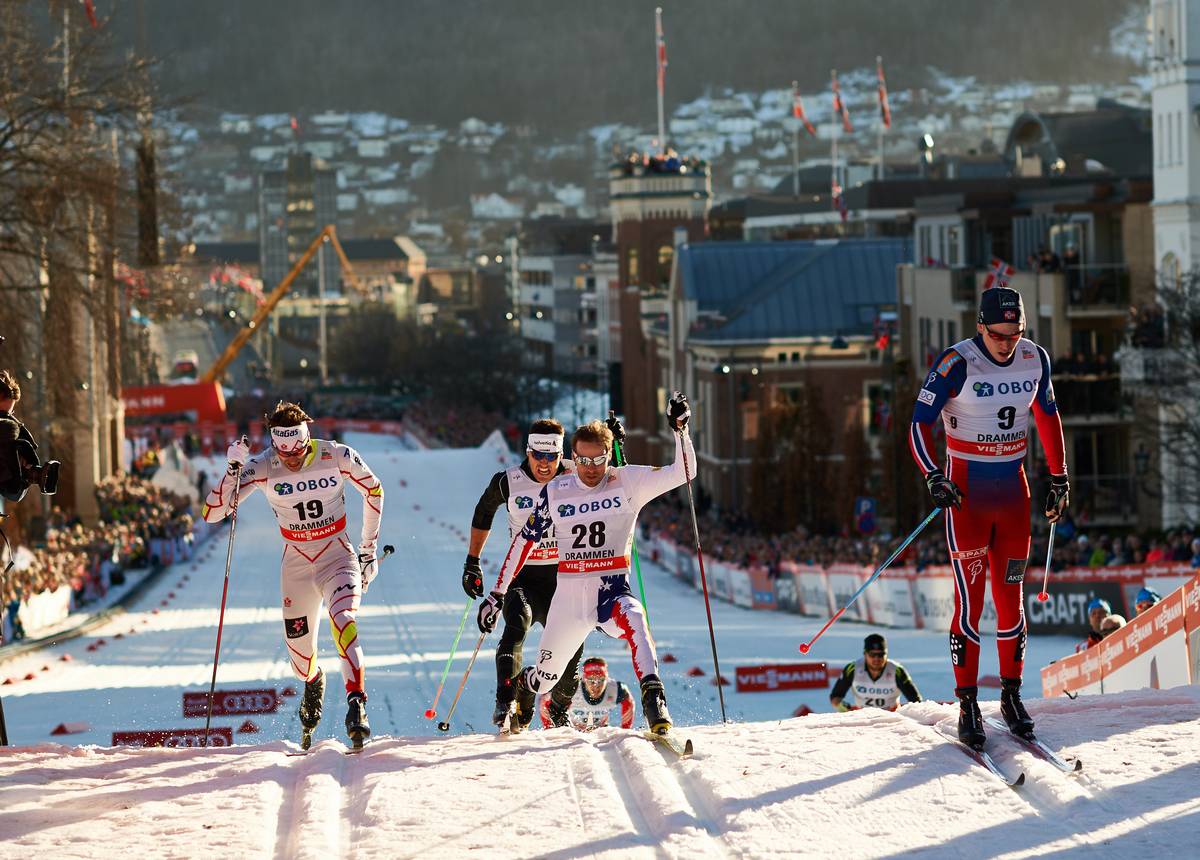
    The all-Norwegian men's classic sprint podium in the last World Cup sprint of the season on Wednesday in Drammen, Norway: (from left to right) runner-up Finn Hågen Krogh, winner Eirik Brandsdal, and Ola Vigen Hattestad in third.  (Photo: Fischer/NordicFocus)
    The all-Norwegian men’s classic sprint podium in the last World Cup sprint of the season on Wednesday in Drammen, Norway: (from left to right) runner-up Finn Hågen Krogh, winner Eirik Brandsdal, and Ola Vigen Hattestad in third.
    (Photo: Fischer/NordicFocus)

    Wednesday’s 1.3-kilometer classic sprint in Drammen, Norway, was essentially two races in one: the race for the win and the race for the overall Sprint World Cup.

    Drammen marked the final World Cup sprint this season. Going into the race, Norway’s Finn Hågen Krogh led the Sprint World Cup with 399 points, 33 points ahead of Italy’s Federico Pellegrino and 57 points ahead of fellow Norwegian Eirik Brandsdal.

    All three men were still mathematically eligible to win the overall title. Brandsdal won last weekend’s freestyle sprint in Lahti and neither Krogh nor Pellegrino had ever qualified for the final in Drammen. Pellegrino had only qualified for one World Cup classic-sprint final in his career.

    Eirik Brandsdal racing to the victory in the men's 1.3 k classic sprint in Drammen, Norway. While he won the race, he took second overall in the Sprint World Cup to teammate  Finn Hågen Krogh. (Photo: Fischer/NordicFocus)
    Eirik Brandsdal racing to the victory in the men’s 1.3 k classic sprint in Drammen, Norway. While he won the race, he took second overall in the Sprint World Cup to teammate Finn Hågen Krogh. (Photo: Fischer/NordicFocus)

    Over the course of the qualification round, the snow at Drammen turned very soft with temperatures around 50 degrees Fahrenheit. Earlier in the morning, organizers hauled in two truckloads of snow to slow the rate of thawing on the course. Several skiers opted to use skate skis and take their chances double poling instead of making decisions regarding classic skis and what to use for kick.

    As the first quarterfinal heats got underway, it appeared that Norwegian Petter Northug’s decision to use skate skis over classic might be the way to go. He had very fast skis and only lost to Brandsdal in a photo finish. Brandsdal took the quarterfinal win in 2:37.55, and both advanced to the semifinals.

    One-third of the race for the Sprint World Cup was decided after the first quarterfinal. Pellegrino finished fifth, 2 seconds behind Brandsdal, ending his chance of winning his first ever overall sprint title.

    Last year’s Drammen and overall Sprint World Cup champion, Ola Vigen Hattestad of Norway was a decisive winner in heat two. He qualified in 2:35.91, and teammate Timo Andre Bakken advanced as well, 1.71 behind.

    Krogh kept his title hopes alive when he and Russia’s Anton Gafarov advanced out of the third quarterfinal. Krogh won it in 2:38.34, and Gafarov was 0.21 seconds behind in second.

    Also advancing to the semifinals were Russia’s Sergey Ustiugov and three more Norwegians: Sondre Turvoli Fossili, Pål Golberg and Fredrik Riseth. American Andy Newell qualified as well.

    It was an all-Norwegian lineup for the first semifinal. Still on skate skis, Northug jumped out to a fast start and lead up the first climb, but in the slushy conditions, he fell behind quickly and never came back into contention. Brandsdal dominated the race, crossing the line first at 2:36.3, ahead of Hattestad in second.

    Fossli and Ustiugov advanced from the second semifinal, as did Russia’s Nikita Kriukov in third. Fossil’s winning time was 2:35.41, Ustiugov finished 0.39 seconds back, and Kriukov was 0.61 seconds back in third. Kriukov and Krogh advanced as lucky losers.

    The finals were set, with two Russians Ustiugov and Kriukov, and four Norwegians: Brandsdal, Fossli, Hattestad, and Krogh. With his spot in the finals, the sprint title was wrapped up by Krogh before the final started. His margin over Brandsdal was too big of a deficit for Brandsdal to overcome even if he won.

    Norway's Finn Hågen Krogh placed second in Wedneday's classic sprint in Drammen, Norway, to secure his first Sprint World Cup Crystal Globe. (Photo: Fischer/NordicFocus)
    Norway’s Finn Hågen Krogh placed second in Wedneday’s classic sprint in Drammen, Norway, to secure his first Sprint World Cup Crystal Globe. (Photo: Fischer/NordicFocus)

    At the start, Ustiugov led up the first climb and started to pull away from the pack. The group started to string out with Ustiugov leading to the second hill then an unforced error took out the two Russians at the same time.

    Ustiugov on skate skis tried to herringbone up the second hill in the middle lane. Since he had no grip he tried to cut the corner short by going to the inside. He wasn’t aware that Kriukov was there and both men collided and lost momentum. Kriukov was later relegated to last in the heat.

    With this happening at the back of the pack, the Norwegian train with Hattestad up front rocketed down the hill towards the finish. On the last turn, Brandsdal ultimately made the winning move, gliding past Hattestad and into the lead. He crossed the line first at 2:38.18. Krogh followed Brandsdal past Hattestad as well and finished second, 0.56 seconds later. Hattestad held onto third to complete the all-Norwegian podium.

    “The World Championships in Falun did not go as I had planned. I wanted to end the season strong,” Brandsdal told FIS after the race. “I did everything I could to fight for the crystal globe for the sprint.”

    While he didn’t get it, Brandsdal did win his sixth World Cup race.

    Krogh used his disappointment from not being named to Norway’s World Championships sprint team as motivation.

    “I have little to put a finger on what has been bad this season. Everything has gone according to plan,” Krogh told NRK, according to a translation. “This has been a bright season.”

    This Sprint Crystal Globe was Krogh’s first. He won it by 57 points over Brandsdal and 103 points over Pellegrino. Hattestad won it last season, ahead of Brandsdal in second, and Brandsdal was third in the sprint overall in 2011/2012.

    Results

  • Saxton Skis to Sixth in U23 Classic Sprint; Beatty 20th for Canada

    Saxton Skis to Sixth in U23 Classic Sprint; Beatty 20th for Canada

    Ben Saxton (SMS T2) leads Norwegian Sondre Fossli in a quarterfinal of the 1.3 k classic sprint at the U23 World Championships. Saxton finished sixth in Tuesday's even after falling victim to a crash in the final. (Photo: Bryan Fish/USSA)
    Ben Saxton (SMS T2/U.S. Ski Team) leads Norwegian Sondre Fossli in a quarterfinal of the 1.3 k classic sprint at the 2015 U23 World Championships in Almaty, Kazakhstan. Saxton finished sixth in Tuesday’s final after crashing in the final. (Photo: Bryan Fish/USSA)

    Ben Saxton of the Stratton Mountain School (SMS) T2 Team and U.S. Ski Team had a a lot to celebrate after the finish of Tuesday’s 1.3-kilometer classic sprint at the U23 World Championships in Almaty, Kazakhstan. He notched a top-10 result in the qualifier, he dominated a challenging quarterfinal, survived the fastest semifinal of the day, and was in strong position near the last meters of the final before falling victim to a crash.

    Saxton ended his day in sixth behind eventual race-winner Sondre Turvill Fossli of Norway. Despite being a U23, Fossli has skied to much success on the World Cup circuit with several qualifier wins and podium finishes. He was recently named to the Norwegian World Championships team. In Tuesday’s sprint, Fossli skied to a time of 2:56.46 in the final to best teammate Sindre Bjørnestad Skar by 2.02 seconds. Taking the final podium spot was Russian Emil Vokuev, who finished 3.42 seconds off the winning time. Rounding out the final were France’s Richard Jouve (+4.66), Norway’s Martin Løwstrøm Nyenget (+6.48), and Saxton (+17.54).

    Saxton entered the classic sprint looking to crack the top-10, a feat he had yet to accomplish as a junior or U23 skier. He did just that in qualifier, placing 10th and 3.59 seconds off the pace of Fossli.

    Saxton used a strong start in his quarterfinal to catapult himself into the lead. He and Fossli led the pack through the winding course, which featured many twists and turns in the form of switchbacks and 180 degree turns. The group crested the final hill and Saxton powered down the finish to place first, easily qualifying for the semifinals.

    “I was able to get out front for most of my races today and control that. It’s not like I was working that hard but I was controlling the rest of the field,” Saxton said in a post-race phone interview. “I had a clean run up the hill and I was able to go up with Fossli. I’m not exactly sure how but I beat him in the quarterfinal.”

    Saxton employed similar tactics in the semifinal but was unable to ski the heat with the ease of his quarterfinal. Forced to tactically maneuver around competitors when his preferred tracks were blocked, Saxton recovered from a fourth place standing to finish third. The heat was the faster of the two semifinals, meaning Saxton advanced to the final as lucky loser.

    “I’m supposed to be racing with them at their level on a regular basis. I’m capable of that and that’s the biggest thing I took away from today. It’s not just some pipe dream. I’m here and I can race them.” — Ben Saxton on finishing sixth in the 1.3 k classic sprint at 2015 U23 World Championships

    In the final, Saxton was sitting in fourth and close to the leaders at the bottom of the final hill. A lane opened in front of him, giving him a chance to power forward. However, the chance was denied as Russia’s Vokuev skied from the far left track to cut in front of Saxton. In the process, the Russian clipped Saxton’s pole, which he subsequently planted between his legs. The resulting fall took Saxton out of contention and he skied the remainder of the race behind the pack to finish sixth.

    Ben Saxton (10) in the semifinal of Tuesday's 1.3 k classic sprint at the U23 World Championships in Almaty, Kazakhstan. Saxton finished third in the heat and sixth in the final for his best international result. (Photo: Bryan Fish/USSA)
    Ben Saxton (10) in the semifinal of Tuesday’s 1.3 k classic sprint at the U23 World Championships in Almaty, Kazakhstan. Saxton finished third in the heat and sixth in the final for his best international result. (Photo: Bryan Fish/USSA)

    “It was probably a clean move, but the tail of his ski clipped my pole and I just planted between my legs and went down. After that I just got up, finished, and enjoyed it because it was still a really fantastic day,” he said of the fall. “Honestly right now my biggest emotion is a little bit of regret. I didn’t put myself in 100 percent the best position [in the final] and I paid for it.”

    Saxton said that the sixth-place finish is a strong indicator of where his fitness and abilities are in the 2015 season. According to the SMST2 skier, his previous results, especially at the U.S. Cross Country Championships in early January, were not representative of his potential as a skier. With a strong showing in Kazakhstan, Saxton is confident that he has reached his top shape.

    “I qualified less than four seconds out from Fossli who has won World Cup qualifiers and I beat him in a quarterfinal and skied with him all the way up the climb in the semifinal,” Saxton said. “All those things are representative that I belong with those guys and I’m supposed to be racing with them at their level on a regular basis. I’m capable of that and that’s the biggest thing I took away from today. It’s not just some pipe dream. I’m here and I can race them.”

    Saxton wasn’t the only North American to find success in Tuesday’s sprint.

    The men's 1.3 k classic sprint podium at the U23 World Championships in Almaty, Kazakhstan. (Photo: Ben Saxton/Facebook)
    The men’s 1.3 k classic sprint podium at the U23 World Championships in Almaty, Kazakhstan. (Photo: Ben Saxton/Facebook)

    Canada’s Knute Johnsgaard (Yukon Elite Squad) finished just out of the semifinals with a 14th place finish. He improved two spots from his qualification placement in 16th after finishing third in his quarterfinal heat. Johnsgard explained that his results on the domestic circuit this season haven’t matched his expectations but that his performance in the U23 classic sprint demonstrated his fitness is back.

    “Last year my best result was 21st so I was happy to improve on that today. Every opportunity I get to race in Europe is always a learning experience so for sure it helps having gone to World Juniors and U23s before,” he wrote in an email.

    The third North American finisher of the day was Logan Hanneman of the University of Alaska Fairbanks. Hanneman skied his way to 21st in the qualifier and finished fifth in his quarterfinal — the same as Saxton and Fossli — to take 23rd overall. 

    “It was just awesome to be in a heat with [Saxton], and with Sondre Fossli,” Hannmen wrote in a post-race email.

    Hanneman, who achieved his goal of a top-30 finish, wrote in an email that he was pleased and proud of his result.

    Canadian Sebastian Townsend (Alberta World Cup Academy) narrowly missed the heats, finishing 31st and 0.15 seconds out of qualification. Rounding out the North American finishers were Canadian Raphael Couturier (CNEPH/NST-U23), American Scott Patterson (Alaska Pacific University), and Canadian Scott James Hill (Thunder Bay NDC) who placed 33rd, 39th, and 40th in the field of 52.

    Beatty Top North American Women in 20th

    In the U23 women’s 1.3 k classic sprint, Canada’s Dahria Beatty (AWCA/NST-U23) led the North American contingent in 20th place. She qualified 27th and finished fourth in her quarterfinal. Beatty explained in an email that her goal for each race of U23s is to place in the top 20 and that Tuesday’s result was a good start to the week.

    “I had a poor qualifier and was glad to be able to move up a bit. I was hoping to contend for a lucky loser spot but the last little pitch I ran out of energy and dropped back a bit from the first three ladies,” Beatty wrote. “I placed exactly the same this year as I did in the junior sprint last year. I am hoping to have stronger results in the distance races.”

    Just behind Beatty was Canadian Olivia Bouffard-Nesbit (Rocky Mountain Racers) in 21st. Bouffard-Nesbit had a strong to start the day and placed 12th in the qualifier. She finished fifth in her quarterfinal to end the sprint as the second North American. 

    Annie Hart (21) skis at the back of her quarterfinal in Tuesday's 1.3 k classic sprint at the U23 World Championships in Almaty, Kazakhstan. She finished her day in 26th. (Photo: Bryan Fish/USSA)
    Annie Hart (21) skis at the back of her quarterfinal in Tuesday’s 1.3 k classic sprint at the U23 World Championships in Almaty, Kazakhstan. She finished her day in 24th. (Photo: Bryan Fish/USSA)

    Anne Hart (SMST2) was the top American finisher in Tuesday’s race after qualifying in 21st position and finishing fifth in her quarterfinal.

    Hart, who earned her best-ever international finish, explained that she was confident going into the quarterfinals, but got “caught a little off guard” at the start of the race.

    Regardless, she was able to maintain her position in the pack of skiers until one of leading women forced the heat to nearly stop, and subsequently charged ahead to leave the pack behind her. After the move, Hart explained that she was unable to match the fast pace and maintained her fifth-place standing into the finish.

    “It was unlike any race I had ever done, with very aggressive lane changing, cornering, and skiing,” she wrote in an email. “There is no room for error, no time for panicking, and no time to let off the pedal. Everyone really just sends it the entire way, and it was pretty cool to be a part of. In a perfect world I would have moved on past the quarters, but for my first international heat experience I would call the day a smashing success.”

    Canada’s Cendrine Browne (CNEPH/NST-U23) also finished in the top 30. She placed 23rd in the qualifier and skied to fifth in her quarterfinal to take 26th overall.

    Tuesday’s race was dominated by Italian Francesca Baudin who won the qualifier and ultimately the final. Her final time of 3:27.66 bested second place finisher Silje Thødorsen of Norway by 0.48 seconds. Fellow Italian Giulia Stuerz claimed the remaining podium spot, 1.59 seconds back. 

    Other North American finishers in the women’s 1.3 k classic sprint were Deedra Irwin (Michigan Tech), Annie Pokorny (SMST2), and Paige Schember (Sun Valley Ski Education Foundation) who finished 31st, 32nd, and 35th, respectively, in the field of 39 women. 

    Conditions in Kazakhstan

    Organizers were forced to reschedule the classic sprint, which was originally planned for Monday, due to an unprepared course and need for more snowmaking. While organizers were able to create a 1.3 k loop, there were still complaints of rock and dirt in the snow. In addition, pollution continued to be a problem at the Almaty venue with many skiers using air masks during training to prevent the inhalation of unhealthy air.

    Despite any problems, the possible 2022 Olympic venue still has promise.

    “This place has the potential to be an absolutely amazing venue. Huge mountains as backdrops with the city below. Yes the smog is an issue. It is quite bad. But everyone is in the same boat, so you just have to go with it. I am looking forward to the clean air back home…we don’t know how good we have it,” Hanneman wrote.

    Beatty agreed, but explained that she had become accustomed to the air quality after several days of training.

    “The smog is bad but after having been here a week I barely notice it anymore. Since everyone is having to race in it I don’t think it plays a big part in performance,” she wrote.

    Racing continues in Kazakhstan on Wednesday with the Junior World Championships 5/10 k freestyle races.

    — Chelsea Little contributed reporting

    Results: Men | Women

  • O’Harra 14th in Classic Sprint for Junior Worlds Best; Stewart-Jones Leads Three Canadian Women in Heats

    O’Harra 14th in Classic Sprint for Junior Worlds Best; Stewart-Jones Leads Three Canadian Women in Heats

    An exhausted-and-ecstatic Fredrik Riseth of Norway after winning his first Junior World Championships title on Tuesday in the 1.3 k classic sprint. (Photo: FIS)
    An exhausted-and-ecstatic Fredrik Riseth of Norway after winning his first Junior World Championships title on Tuesday in the 1.3 k classic sprint. (Photo: FIS)

    Last year in his FIS Junior World Ski Championships debut, Thomas O’Harra placed 54th in the freestyle sprint in Val di Fiemme, Italy. Another year older and with another season of training under his belt, the 18-year-old Alaska Pacific University (APU) skier placed 14th on Tuesday in the opening race of 2015 Junior Worlds in Almaty, Kazakhstan: the 1.3-kilometer classic sprint.

    Thomas O'Harra (APU) leading his freestyle-sprint quarterfinal with Sun Valley's Miles Havlick (3) and Kris Freeman last month at 2015 U.S. nationals in Houghton, Mich.
    APU’s Thomas O’Harra (13) leading his freestyle-sprint quarterfinal with Sun Valley’s Miles Havlick (3) and Kris Freeman (8) last month at 2015 U.S. senior nationals in Houghton, Mich. He went on to place 18th overall.

    O’Harra qualified 18th and went on to place third in his quarterfinal, 2.92 seconds behind the winner of his heat, Ludek Seller of the Czech Republic, and 0.35 seconds behind Russia’s Alexander Bakanov, who also automatically advanced in second.

    O’Harra’s quarterfinal was the slowest of the five, which prevented him from moving on to the semifinals as a lucky loser. But at the end of the day, 14th was still way better than 54th.

    “I don’t know if I can say I was expecting it, but I definitely knew that if I had a good race, I could get into the top 30,” O’Harra wrote in an email on Tuesday. “Coming into the sprint, my goal was to qualify. Ultimately though, my goal was to get into the top 10. Once I had qualified, I focused more on trying to advance out of my quarterfinal.”

    He reflected that his quarterfinal was “pretty hard right off the bat … everyone was jostling for position.” Knowing that he needed a top-two in his heat to guarantee a spot in the semifinal, O’Harra followed Bakanov in his track to the finish and lunged between the Russian’s legs as Bakanov let up near the line. And while it wasn’t quite enough, O’Harra was pleased to finish well within the top 30.

    “Today was a much better experience than last year’s sprint!” he wrote. “Last year I tripped myself going up the first hill and ended up 54th — not exactly super-duper. I think that a year’s more experience helped a lot. I was definitely a lot more collected and calm this year, both going into the race and during the race.”

    He was also optimistic about another top 30 in Wednesday’s 10 k freestyle.

    “I think that I’m in a really good place right now, but I didn’t actually try to peak specifically for these races, mainly because there is still a lot of racing left this season,” he wrote.

    “Last year I tripped myself going up the first hill and ended up 54th — not exactly super-duper. I think that a year’s more experience helped a lot.” — Thomas O’Harra, 14th in 2015 Junior World Championships 1.3 k classic sprint

    O’Harra led the North Americans in the junior men’s sprint, which Norway’s Fredrik Riseth won outright in 3:01.25. The Norwegian qualified fifth behind Finland’s Lauri Vuorinen (the top men’s qualifier in 3:01.88), and Riseth went on to win his quarterfinal and his semifinal before beating Bakanov by 4.85 seconds in the final.

    Norway’s Johannes Høsflot Klæbo made the podium as well in third, 8 seconds behind Riseth. Germany’s Marius Cebulla was fourth (+10.04), Sweden’s Oskar Svensson finished fifth (+10.11), and Vuorinen was sixth (+21.67).

    Riseth’s father, Svein Riseth, told Langrenn that he was impressed with his son’s result. While he knew Fredrik was in great shape, Svein wasn’t sure he had enough left after dominating his quarterfinal and semifinal. The contender he was most concerned about was Fredrik’s Byåsen IL teammate, Høsflot Klæbo.

    “Johannes is not only a good skier, but he is mentally and tactically strong,” Svein said, according to a translation. “It is outrageously fun two Byåsen runners entered the podium. Not just for the team but for [Trondheim] skiing.”

    While no other North American men qualified in the top 30, Canada’s Julian Smith (Georgian Bay) placed 39th, 3.82 seconds from 30th. Americans Evan Weinman (Middlebury) and Peter Holmes (University of New Hampshire) were 46th and 48th, respectively, Canada’s Alexis Dumas (CNEPH/NST-Junior) ranked 53rd, Ricardo Izquierdo-Bernier (CNEPH/NST-Junior) was 56th, American Gavin Hess (UNH) 58th, and Canadian Philippe Boucher (CNEPH/NST-Junior) 59th.

    Stewart-Jones Leads Three Canadian Women in the Heats

    Canadian National Junior Team members Katherine Stewart-Jones (19) and Maya MacIsaac-Jones (29) chase Russia's Natalia Nepryaeva (2) in the quarterfinal of the 1.3 k classic sprint on the opening day of 2015 Junior World Championships in Almaty, Kazakhstan. (Photo: Lisa Patterson/CCC)
    Canadian National Junior Team members Katherine Stewart-Jones (19) and Maya MacIsaac-Jones (29) chase Russia’s Natalia Nepryaeva (2) in the quarterfinal of the 1.3 k classic sprint on the opening day of 2015 Junior World Championships in Almaty, Kazakhstan. (Photo: Lisa Patterson/CCC)

    In the women’s 1.3 k classic sprint, Katherine Stewart-Jones knew what was coming, or at least what to expect, in her third time qualifying for the Junior Worlds heats.

    The 19-year-old Canadian National Junior Team member qualified in 19th, 13.61 seconds behind Russia’s Yulia Belorukova, the top qualifier in 3:29.24. Stewart-Jones then finished fourth in her quarterfinal, 9.77 seconds after another Russian, Natalia Nepryaeva, who won the heat. Their quarterfinal was the second slowest and Stewart-Jones did not advance, putting her in 19th overall.

    “I am satisfied with my result,” Stewart-Jones, the top North American female junior of the day, wrote in an email. “I definitely had the goal to make it past the quarter-finals because last year I was extremely close. I can’t really be disappointed with how it turned out because I gave everything I had.”

    “I definitely had the goal to make it past the quarter-finals because last year I was extremely close. I can’t really be disappointed with how it turned out because I gave everything I had.” — Katherine Stewart-Jones, 19th in 2015 Junior World Championships 1.3 k classic sprint

    Last year at Junior World Championships, she placed 15th in the freestyle sprint, and the year before, she was 25th at the 2013 Junior Worlds in Liberec, Czech Republic.

    But for the first time on Tuesday, she raced against one of her fellow national-junior team members in the heats: Maya MacIsaac-Jones of Rocky Mountain Racers (RMR).

    “We both had a really good start so it was fun to ski at the front together for the first part of the race,” Stewart-Jones explained. “After the long downhill I was in third place but then I made a bit of a tactical mistake. At the start of the long uphill I went right behind a Russian but she slowed down. When I went to make the pass and change lanes I lost my momentum.”

    MacIsaac-Jones, 19, made the top-30 qualifying cutoff in 29th and ended up fifth in her first time racing the heats at that level, 12.05 seconds behind the winner.

    “Katherine and I have raced together for a long time, and since there are so many things at World Juniors that are different from racing in Canada, it was nice to have a familiar face beside me,” MacIsaac-Jones wrote in an email. “My ‘realistic’ goal for today was to qualify, and my ‘dream’ goal was to get a top-15 result. I am very happy to have qualified for the heats, especially to have qualified with two of my teammates, but I am disappointed that I wasn’t able to move on past the quarter final.”

    Her previous best in her last Junior Worlds in 2013 was 36th in the classic sprint. On Tuesday, she placed 25th overall. The third Canadian woman to make the rounds, Sophie Carrier-Laforte (Skinouk/NST-Junior) qualified in 23rd and placed 22nd overall after finishing fifth in her quarterfinal, 12.21 seconds behind Austria’s Lisa Unterweger, who won the heat.

    “It was a lot of fun to be racing with so many other Canadian girls in the heats today,” MacIsaac-Jones wrote. “We have all been training really hard for these championships, so it feels great to show the world what Canadian girls can do!

    “This experience is definitely different from my experience in Liberec 2013,” she explained “I feel like I am in a lot better distance racing shape than I was in Liberec, and I should have a chance to race most or all of the distance races, which will be a lot of fun. This being my second Championships, I feel like I have a bit of a better idea of what to expect and how to prepare for racing on the international scene.”

    Stewart-Jones was also looking forward to the distance races after placing 31st in the skiathlon in Val di Fiemme last year.

    “I would like to make a top 15 in a distance race and I believe that I can,” she wrote.

    Nakkertok Head Coach Kieran Jones wrote in an email that Stewart-Jones’ performance on Tuesday wasn’t a surprise.

    “We have been targeting top 30’s at World Juniors since the start of the year. While I was pretty excited for the classic sprint, I would say that it’s definitely not her strongest event,” he noted. “It’s more of a good indicator that the fitness and speed is where we want it to be. Katherine is rock solid — once she gets rolling, she’s great at managing her energy, enthusiasm, and focus.”

    He explained that she’s shooting for top-30 results in both Wednesday’s 5 k freestyle and Friday’s 10 k skiathlon.

    “Personally, I think she has a shot at a top 10 in the 5 km if everything goes to plan,” Jones wrote. “She is also really looking forward to the relay — this year the Canadian women’s team is one of the strongest it has been in a long time, and she wants to help them have a strong finish.”

    Germany's Victoria Carl after notching her second Junior World Championships title and third podium in the first race of 2015 Junior Worlds in Almaty, Kazakhstan. (Photo: FIS)
    Germany’s Victoria Carl after notching her second Junior World Championships title and third podium in the first race of 2015 Junior Worlds in Almaty, Kazakhstan. (Photo: FIS)

    Just 0.26 seconds from qualifying in the top 30, Julia Kern of the Cambridge Sports Union led the U.S. junior women in 31st. Vivian Hett (Northern Michigan University) placed 36th, 3.89 seconds from 30th, and Hailey Swirbul (Aspen Valley Ski & Snowboard Club) was 40th.

    Canada’s Annah Hanthorn (Whitehorse) finished 45th, and American Kristen Bourne (NMU) placed 46th.

    Germany’s Victoria Carl racked up her second Junior Worlds title since she last raced at the championships in 2013 (where she won the 5 k freestyle and placed second in the classic sprint). Carl, 19, qualified fourth and won her quarterfinal and semifinal before topping the final as well in 3:29.01, 1.64 seconds ahead of Belorukova in second.

    Another one of the women in the Stewart-Jones/MacIsaac-Jones quarterfinal, Nepryaeva placed third in the final, 2.18 seconds back from the win. The Russian edged Norway’s Lotta Udnes Weng by 0.2 seconds for the podium, and Weng’s sister Tiril Udnes Weng placed fifth, 6.42 seconds after Carl. Germany’s Jenny Mann finished sixth in the final (+30.43).

    First Impressions

    The junior classic sprint was originally scheduled for Monday, then pushed back a day to allow more time to extend the 800-meter loop to 1.3 k. In addition to concerns about dirt and rocks on the trail, the air quality in Almaty continues to pose one of the biggest problems for athletes, with several U.S. athletes bringing ventilation masks to the championships.

    “The air quality is certainly an issue, but we all share this challenge,” U.S. Ski Team Development Coach Bryan Fish wrote in an email. “Many of our athletes purchased filtering masks before arriving. The same ones used [at the Summer Games] in Beijing.

    “They don’t wear them all the time — primarily when skiing,” he added. “The trails are uphill, so it depends how high the inversion is. Unfortunately there is no way to escape it in the city.  All the teams are staying in the city except Russia is an hour away in the mountains.”

    According to O’Harra, “Skiing here is… thin. When we arrived, there was only about 2.5k of trail, and that was full of rocks. The volunteers and organizers have done an amazing job, though! They have been blowing snow around the clock, and their hard work definitely shows,” he wrote. “The smog varies. It pretty much always sits down in the bottom of the valley, and most days it creeps up to where the trails are as we ski. It was definitely hazy today, but there have been worse days. I don’t think that it hindered my performance, but I still don’t like having it around.”

    MacIsaac-Jones wrote that the skiing over the last week had not been ideal; the postponement of the first race “altered everyone’s race preparations, and we have been dealing with heavy smog all week.”

    She added that there was adequate snow on the sprint course, “and there should be enough for the skate race tomorrow. The snow here is artificial, cold and hard-packed right now, which is great for me because it is similar to the snow I am used to training on in Canmore, Alberta,” she wrote.

    “The skiing here is nothing like I have seen before,” Stewart-Jones explained. “The race site is built at the top of a huge sand hill in the middle of the city. All the trails weave around the hill and the snow is all man made. … The smog is definitely an issue; I have been coughing a lot more than usual.”

    Through email exchanges, her coach Jones has been keeping tabs on the conditions.

    “That stuff is out of our control,” he wrote. “That’s always been the message — control what you can, and don’t worry about anything else. … Kath is great at that, so I wasn’t worried.”

    — Chelsea Little contributed reporting

    Results: Men | Women

  • Might Not Be Perfect, But Canadians Will Take Three in Top 20

    Might Not Be Perfect, But Canadians Will Take Three in Top 20

    Canadian World Cup Team member Lenny Valjas, who qualified in 29th and went on to place 16th in Wednesday's 1.3 k classic sprint in Drammen, Norway. (Photo: Fischer/Nordic Focus)
    Canadian World Cup Team member Lenny Valjas, who qualified in 29th and went on to place 16th in Wednesday’s 1.3 k classic sprint in Drammen, Norway. (Photo: Fischer/Nordic Focus)

    Any racer will tell you it feels pretty good to qualify, especially in a World Cup sprint. Even if they expect to, making that top-30 cutoff is often easier said than done and doing so is a relief.

    However, in the hour or so that follows before the heats, one has to move on, refocus and think strategically about the quarterfinals ahead. And on the downtown course in Drammen, Norway, there’s no cut-and-dry method to depend on. No matter what the conditions, some men double pole on skate skis, some stride the 1.3-kilometer classic course. Women race the same distance and have to get in position early if they want to make it to the next round.

    For Canada’s three qualifiers in Wednesday’s World Cup classic sprint, Dasha Gaiazova, Lenny Valjas and Alex Harvey, there were a few decisions to be made after concerning kick, no kick, etc. But mostly, they were thinking about how to guarantee a top-two finish and secure a spot in the semifinals.

    Dasha Gaiazova (CAN). Québec City Sprints, December 7, 2012, 12/7/12, Canada
    Canada’s Dasha Gaiazova (second from l) at the Québec World Cup city sprints on Dec. 7, 2012.

    Once again, not so simple.

    Both men and women raced the one-lap course in Drammen, marked by a gradual incline from the start to the top of a 60-meter (200-foot) hill, followed by a long descent, a few sharp corners and several straightaways. The longest straight leads to the finish, and at several hundred meters long, it’s also uphill.

    Gaiazova qualified in 24th, the best of the Canadians, while Valjas and Harvey narrowly made it though in 29th and 30th, respectively.

    Like several of the top racers in the 75-person men’s field, Harvey initially raced on freestyle skis – double poling the entire loop. Qualifying by six-hundredths of a second didn’t exactly put him at ease, and Harvey opted for classic skis in the heats. Valjas, meanwhile, stuck with striding throughout.

    In the women’s quarterfinals, Gaiazova surged to the front out of the start, leading Sweden’s Linn Sömskar and Aino-Kaisa Saarinen of Finland. Saarinen pulled ahead over the top of the long hill, and Gaiazova and Sömskar attempted to hang on. Germany’s Hanna Kolb and Nicole Fessel threw themselves into the mix on the descent, coming around the last corner in second and third behind Saarinen.

    Back in fifth ahead of American Sadie Bjornsen, Gaiazova pushed hard toward the finish, picking off a few places to finish third and edging Kolb in a photo finish. Saarinen won the heat in 3:19.2, Sömskar was 0.9 seconds back in second and Gaiazova 1.4 seconds behind in third.

    With two more women’s quarterfinals to go, Gaiazova waited to see if she’d nab one of two lucky-loser spots. Her heat wasn’t fast enough compared to the five others, and the Canadian settled for 15th.

    “That was a hard effort,” Gaiazova told Cross Country Canada. “My arms and lungs are toast now, but I’ll take a 15th place result in a World Cup.”

    Gaiazova has been one of Canada’s most consistent racers this season, notching 12th at the last World Cup classic sprint in Davos, Switzerland, and achieving the same result in a skate sprint at the pre-Olympic World Cup in Sochi, Russia. Also in Sochi, Gaiazova and teammate Perianne Jones won bronze in the classic team sprint. And in mid-January in Liberec, Czech Republic, Gaiazova tallied a career-best fourth in a World Cup classic sprint.

    “Dasha was good today,” Canadian head coach Justin Wadsworth wrote in an email. “She kinda got pin-balled around a bit, but was solid.”

    Jones placed 45th, about 15 seconds behind Finland’s top qualifier Mona-Liisa Malvalehto and 3.43 seconds out of the top 30. Emily Nishikawa of the Alberta World Cup Academy (AWCA) was 63rd (+26.56).

    Canadian World Cup Team member Alex Harvey, who qualified in 30th and went on to place 20th in Wednesday's 1.3 k classic sprint in Drammen, Norway. (Photo: Fischer/Nordic Focus)
    Canadian World Cup Team member Alex Harvey, who qualified in 30th and went on to place 20th in Wednesday’s 1.3 k classic sprint in Drammen, Norway. (Photo: Fischer/Nordic Focus)

    In the men’s quarterfinals, Harvey lined up in the first heat with eventual-winner Petter Northug and his younger brother Tomas Northug, another Norwegian in Paal Golberg, American Andy Newell, and Sweden’s Johan Edin.

    Dropped by the top of the climb, Harvey took advantage of separate crashes on the other side: the first by Newell, who appeared to have his skis slip out from underneath him on a fast straightaway, and the second by Edin, who fell on an S-turn before the finish.

    “I think I crashed at that exact same spot last year,” Harvey said of Newell. “He was skiing outside the track because it was faster and I think he hit some ice and kind of slid, but I couldn’t see … I wasn’t really in contact with these guys.”

    Until Newell and Edin went down, that is. The Canadian moved from sixth to fourth in the heat, 5.23 seconds behind Petter Northug as the winner.

    “I got kind of lucky that they crashed because I wasn’t in it much,” Harvey said.

    His time wasn’t fast enough to lift him to the semifinals, and Harvey ended up 20th. A World Championships bronze medalist in the preceding classic sprint in Val di Fiemme, Italy, Harvey pointed out that he hadn’t cracked the top 30 in a World Cup race since the Tour de Ski in early January.

    So even though it wasn’t a “super-great result” and he might have reconsidered using skate skis for the heats, Harvey wasn’t disappointed. With the Holmenkollen 50 k freestyle mass start on Saturday in Oslo, Norway, and World Cup Finals next week in Sweden, he’s hungry for more.

    “Holmenkollen’s always really special and the World Cup Finals, last year was pretty good for me and I hope this year will be the same,” Harvey said. “It’s the last push now so I’m excited for the five next races.”

    Valjas is feeling good about his form coming off an eighth-place skate sprint result last weekend at the World Cup in Lahti, Finland. Wednesday didn’t exactly go as planned after he placed third in his quarterfinal for 16th overall.

    But it was also sprint racing in Drammen, where positioning is king. Given a difficult starting spot on the outside, Valjas had to get out early and fight for a track. When he couldn’t quite cut in, he decided to restart his race from the back.

    Trailing up the hill, Valjas was unable to pass on the descent. He opted for a lot of grip, which didn’t make his skis fast compared to the four skate-ski double polers in his heat. Pushing hard to get toward the front, Valjas had no room to move, no tracks to ski in. Somehow he skied along the outside and finished third, 0.7 seconds behind Norway’s Finn Hågen Krogh and John Kristian Dahl, respectively.

    “It was kind of a frustrating race and then getting blocked at the finish, there were no tracks to kind of show my speed,” Valjas said. “I just followed and ran in between the track at the end there. I’m a bit disappointed, but I guess it could’ve been worse. I’m happy that I even got in the heats.

    “I was really hoping to hoping to get top two in that heat and get to the semi and try again … but Stockholm’s coming,” Valjas added.

    He’ll also participate in the 100-meter sprint in Olso on Monday. “I’ve never done a hundred-meter race so that should be pretty fun,” he said.

    As for the rest of the Canadian men, Devon Kershaw placed 49th, 8.43 seconds behind Northug as the qualifying winner and 1.84 seconds out of 30th. Like Harvey, he also went with skate skis.

    “Drammen is always one of the toughest sprints to qualify for due to the number of good classic sprinters in Norway, so getting [in] was good,” Wadsworth wrote. “Devon was satisfied with his effort, and although disappointed, at least his body felt decent and was not too far from qualifying.”

    Kershaw has not raced since World Championships in an effort to rebound from stomach ailments. AWCA skiers Jess Cockney was 67th (+15.58) and Graeme Killick was 71st (+19.83).

    “Today was pretty disappointing,” Cockney wrote in an email. “I was really hoping to ski heats again and being so far out contention was really never what I imagined.”

    Cockney, Killick and their teammate Michael Somppi will join Canadian World Cup members Ivan Babikov, Harvey and Kershaw in Holmenkollen, according to Wadsworth.

    “The guys seemed in OK shape, so we’re hoping for good bodies on Saturday and next week,” Wadsworth added.

    ***

    Results: women | men

  • Northug Conquers Drammen City Sprint, Eyes World Cup Title

    Northug Conquers Drammen City Sprint, Eyes World Cup Title

    Norwegian Petter Northug (r) edges Kazakhstan's Alexey Poltoranin by 2.15 seconds in the Wednesday's 1.3 k classic sprint at the World Cup in Drammen, Norway. (Photo: Fischer/Nordic Focus)
    Norwegian Petter Northug (r) edges Kazakhstan’s Alexey Poltoranin by 2.15 seconds in the Wednesday’s 1.3 k classic sprint at the World Cup in Drammen, Norway. (Photo: Fischer/Nordic Focus)

    Once Petter Northug gets rolling, he’s tough to stop. Just ask Kazakhstan’s Alexey Poltoranin, who fell victim to the Norwegian on Wednesday in the last few hundred meters of the men’s 1.3-kilometer World Cup classic sprint in Drammen, Norway.

    You could also ask Switzerland’s Dario Cologna, who sat out the city sprint to rest up for Saturday’s 50 k freestyle mass start at Holmenkollen in Oslo, Norway. But he probably doesn’t have much to say; things might be a little tense with Northug just 23 points behind him for the overall World Cup crown.

    Petter Northug celebrating his first victory in Drammen after dominating Wednesday's 1.3 k classic sprint at home in Norway. (Photo: Fischer/Nordic Focus)
    Petter Northug celebrating his first victory in Drammen after dominating Wednesday’s 1.3 k classic sprint at home in Norway. (Photo: Fischer/Nordic Focus)

    And coming off two World Championships titles and a 15 k classic victory last Sunday at the World Cup in Lahti, Finland, Northug’s not about to let up.

    “It is very amusing that the body is so good,” the 27-year-old told NRK after winning Wednesday’s sprint final, his 27th World Cup victory and first in Drammen, by 2.15 seconds over Poltoranin. “I guess I can only say that I will be very hard to deal with the future.”

    Northug also won the qualifier (by 1.68 seconds over teammate Eldar Rønning) and then his quarterfinal (ahead of teammates Paal Golberg and Northug’s younger brother Tomas, who finished second and third in the heat).

    In the semifinal, Northug took second to Poltoranin, but not by much: 0.09 seconds. Poltoranin relied on his classic striding to get him up and over the line first, ahead of Northug and Russia’s Nikita Kruikov, who was just 0.4 seconds back in third.

    Northug wasn’t going to let that happen again. Sticking with his choice of freestyle skis – which required double poling the entire one-lap course, with one hill in the middle and another incline at the finish – Northug would have to lean on pure strength in the finishing straight.

    In the final, Poltoranin broke away on the main climb, skiing alone on the descent. It wasn’t long until Northug’s glide got the best of the Kazakh, and he came close enough to catch Poltoranin’s draft then switched tracks to overtake him.

    With a gradual uphill between them and the finish, Northug and Poltoranin began their double-pole battle. Northug quickly gained, and Poltoranin switched to striding, running as fast as he could to hold on. Using every ounce of his explosiveness, Northug prevailed, cresting the hill and stepping over the line first.

    Petter Northug points back after beating Alexey Poltoranin of Kazakhstan on Wednesday in the World Cup classic sprint final in Drammen, Norway.
    Northug points back after beating Alexey Poltoranin on Wednesday in the World Cup classic sprint final in Drammen, Norway.

    Northug immediately threw his right arm in the air, then turned around to point at Poltoranin. The seventh-fastest qualifier of the day, Poltoranin put his hand up as well, celebrating his silver.

    Kriukov placed third, 4.96 seconds behind Northug. Norway’s John Kristian Dahl and Øystein Pettersen achieved season bests in fourth (+6.22) and fifth (+7.74), and Dario Cologna’s younger brother, Gianluca Cologna was sixth (+11.95).

    Out of the start, which was delayed by an intentional false start by Dahl (seeking a break after racing Cologna and Pettersen in the second semifinal), Kriukov lead early. Northug sent Poltoranin a message out of the gate, switching to a track in front of him and forcing Kazakhstan’s leading skier to stand up and slow down.

    Of the six finalists, the group was evenly divided by equipment choices on a mostly sunny afternoon with temperatures just below freezing. Three went with skate skis, and three went on classic. Like Poltoranin, Kriukov was one of the latter.

    “In the quarterfinals and semifinals I skied on skate skis, but I was not as fast as Petter,” he said at a post-race press conference. “I thought it would be better to go on classic skis in the finals.”

    Alexey Poltoranin (KAZ), who finished second to Petter Northug on Wednesday in the World Cup classic sprint in Drammen, Norway. (Photo: Fischer/Nordic Focus)
    Alexey Poltoranin (KAZ), who finished second to Petter Northug on Wednesday in the World Cup classic sprint in Drammen, Norway. (Photo: Fischer/Nordic Focus)

    Poltoranin had no regrets: the 25-year-old believed he’d be faster on classic skis, and he came close.

    “I started very fast, but Petter was very strong,” he said. “I am again second, but I am very happy for it.”

    Sunday in Lahti, Poltoranin was the 15 k runner-up by nearly 32 seconds. He’s fourth in the World Cup standings, 199 points behind Northug and 115 behind Kriukov in third. A total of 190 points are up for grabs in Holmenkollen on Saturday, and another 350 will be distributed at next week’s World Cup Finals in Sweden.

    According to Northug, his own success is a testament to his training and desire to win the second-biggest prize of the season (after a World Championships gold), the Crystal Globe.

    “I’ve been very careful about things after I got home from the World Championships,” Northug told NRK, according to a translation. “I’ve done things properly, focused up and tried to keep the throttle in any way up [until] the World Cup is finished.”

    Last season, Northug finished third in the overall World Cup rankings to Cologna and Canadian runner-up Devon Kershaw. The Norwegian won the year before in 2010, ahead of Lukas Bauer of the Czech Republic and Sweden’s Marcus Hellner, after placing second to Cologna in 2009.

    “The World Championships was the most important; World Cup comes in second,” Northug said. “But I want to finish the season in style.”

    Aside from Northug, Norway put on an all-around good show for its home crowd with a total of seven racers in the top 11. Eirik Brandsdal was seventh, Finn Hågen Krogh placed eighth, Sondre Turvoll Fossli was ninth, and Golberg was 11th. Tomas Northug, 22, took 14th to tie his career-best World Cup result.

    Results

    Showing his softer side, Northug high-fives crowd after classic-sprint victory in Drammen, Norway.
    Showing his softer side, Northug high-fives spectators after his World Cup classic-sprint victory on Wednesday in Drammen, Norway.
  • Schember, Lustgarten Take Chances; Win OJ Sprint Titles

    Schember, Lustgarten Take Chances; Win OJ Sprint Titles

    Paige Schember of F.A.S.T. Performance Training (center) hugs one of her Midwest teammates after winning the 1.3 k sprint A-final for the 2012 Junior Nationals OJ sprint title at Soldier Hollow in Midway, Utah, on Monday.

    All 2012 Cross Country Junior Nationals coverage is brought to you through the generous support of The Memory Clinic, in Bennington, Vt., committed to caring for the mind since 1987. Currently conducting clinical research on the Alzheimer’s disease vaccine.

    MIDWAY, Utah – Paige Schember knew her strengths, and they didn’t include sprinting.

    Regardless, the St. Olaf College skier and F.A.S.T. Performance Training athlete decided to go for it in the 1.3 kilometer classic sprints at the 2012 Cross Country Junior Nationals on Monday. She held her own and represented the Midwest all the way to the OJ A-final, where Schember continued her gutsy racing.

    Paige Schember (Midwest/F.A.S.T.) celebrates after crossing the line first at the 2012 Junior Nationals OJ sprint A-final. Rachel Mason of Great Lakes/Michigan Tech (in yellow) finished second, and Sharmila Ahmed of the Midwest/Go Training (l) was third.

    Trailing Rachel Mason (Great Lakes/Michigan Tech) for the first half of the race, Schember attacked on the up-and-over final climb at Soldier Hollow and cruised ahead to an OJ sprint title in 4:20.25.

    Mason was second (+4.02), and Sharmila Ahmed (Midwest/Go Training) was third (+4.65).

    In the last race of the nearly eight-hour opening day of competition at Junior Nationals, Schember was the only non-New England winner. In five other races, the eastern team had a champion in every category, from the J2s to the OJ boys.

    Without a New Englander in the OJ girls A-final, the race was all about the Midwest. Five of six competitors were from there.

    Schember’s F.A.S.T. teammate, Elizabeth Simak finished fourth. Claire Galvin of Go Training was close behind in fifth, and Alice Flanders (Sisu Ski Club) placed sixth.

    “It hasn’t even registered yet; I feel so awesome,” Schember said after the race. “That race was so much fun and I’m just in shock.”

    That morning, she had been excited to qualify for the heats in 17th.

    “I’m not a sprinter. I don’t consider myself one,” she said. “Every race I thought, I’ll just look forward to the next one and take it race by race. If I qualify, I qualify—and then every race was like, ‘Wow,’ so I’m just amazed right now.”

    After placing second in her quarterfinal to Simak, Schember won her semifinal ahead of Galvin and Simak, who were second and third, respectively. Mason as the fifth-fastest qualifier won both her quarterfinals and semis.

    The top qualifier, Felicia Gesior (GL/Northern Michigan) finished fifth in the B-final and 11th overall.  She won her quarterfinal and was fourth behind Schember in the semis.

    OJ girls heats results

    OJ/J1 girls qualifier results

    Overall results (scroll for J1 girls)


    Lustgarten Leads New England

    In a 1.3 k sprint, there isn’t much time for decisions. So when Eric Lustgarten, a sophomore at St. Lawrence University, forged ahead on the second and final significant climb at Soldier Hollow, he knew there was no turning back.

    St. Lawrence University and New England skier Eric Lustgarten (c) on the podium after winning the 2012 Junior Nationals 1.3 k classic sprint at Soldier Hollow in Midway, Utah, on Monday. Austin Cobb (l) was second and Nick Michaud (r) rounded out the New England podium sweep in third.

    Previously hanging behind his New England teammates in the A-final, Lustgarten said the pace was relaxed. With five of six racers from New England, it wasn’t rocket science to figure out why. Regardless, Lustgarten chose to push the tempo.

    “I realized I either needed to make a move or stick in second on the downhill to catch a draft,” Lustgarten said. “I decided to take it. Skis were perfect, magic skis today, and just finished as fast as I could.”

    Lustgarten won the final for the OJ sprint championship in 3:08.15, nearly three seconds ahead of Austin Cobb (NE/Stratton Mountain School), who made up considerable ground from skiing around fifth to finish second (+2.71).

    Nick Michaud of the Maine Winter Sports Center was third (+3:23) after passing the only non-New Englander, Sawyer Kesselheim (Intermountain/Bridger Ski Foundation), toward the end of the race.

    With Dartmouth’s Silas Talbot in fourth (+3.78), New England swept the top four. Kesselheim finished fifth (+6.73) and Hans Halvorsen (NE/Green Mountain Valley School) was sixth.

    Michaud qualified in first earlier on Monday. He went on to place second in the quarterfinals to Kesselheim and second in the semifinals to Lustgarten.

    Lustgarten was the fourth-fastest qualifier and placed second in his quarterfinal to Kevin Bolger (IM/Sun Valley). Bolger went on to place second in the B-final after Kyle Bratrud (MW/Minnesota Valley), putting Bratrud in seventh and Bolger in eighth.

    OJ boys heats results

    OJ/J1 boys qualifier results

    Overall results (scroll for J1 boys)

    Audrey Mangan contributed reporting.