From the FasterSkier archive — posts syndicated from athletes’ and coaches’ own blogs between 2004 and 2012, kept online as published. Current coverage is at fasterskier.com.
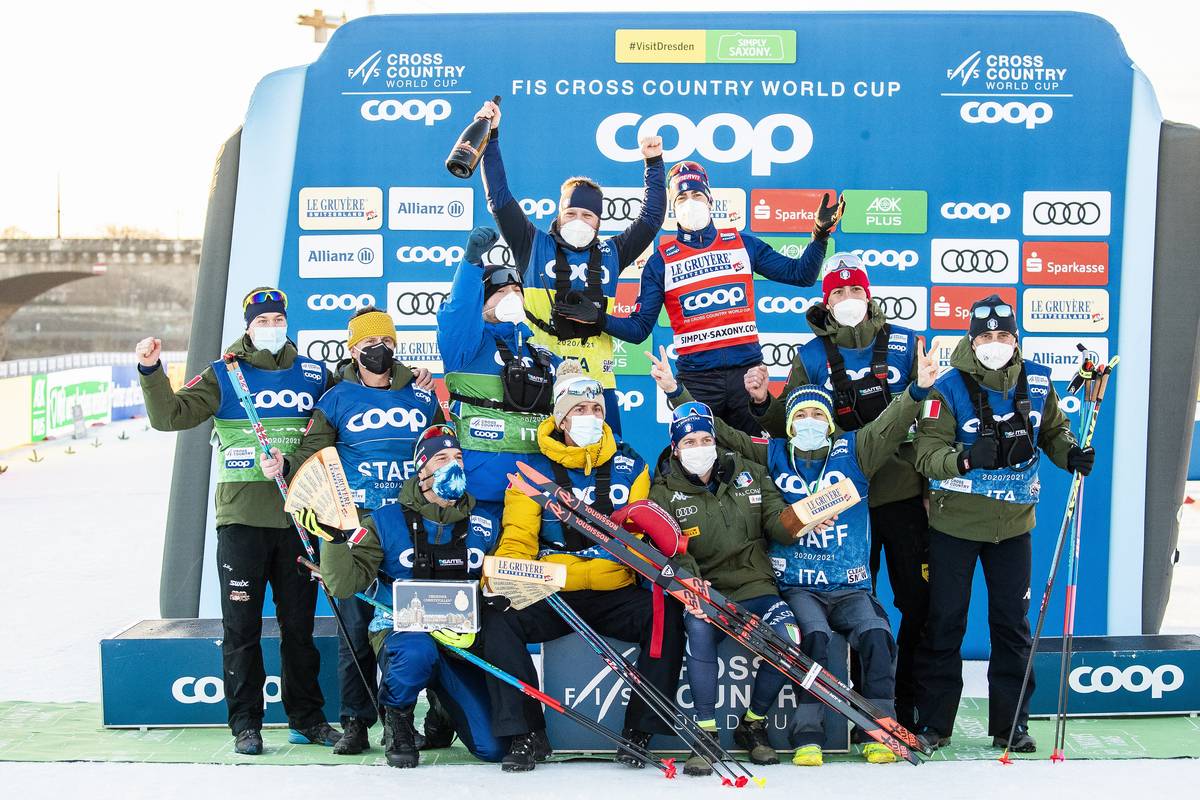
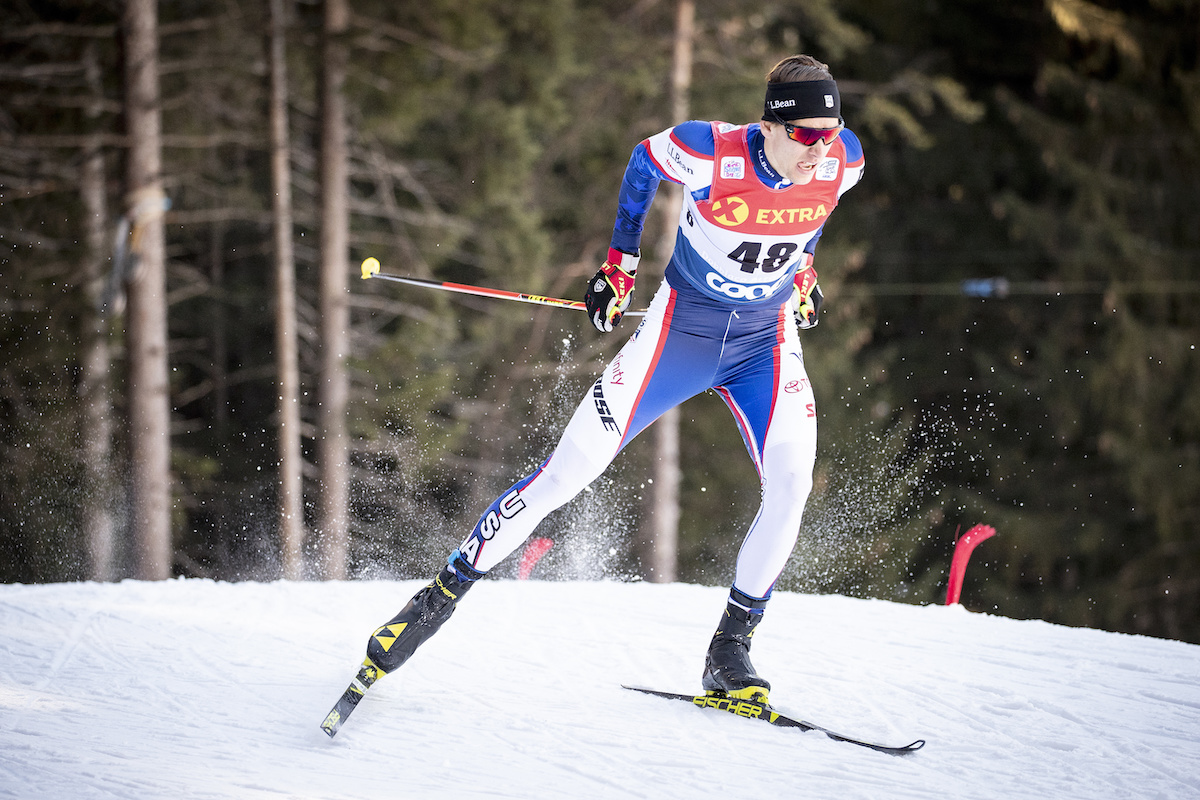
The Pellegrino support crew after his Dresden win. (Photo: NordicFocus)
This World Cup coverage is made possible through the generous support of Marty and Kathy Hall and their A Hall Mark of Excellence Award. To learn more about A Hall Mark of Excellence Award or to learn how you can support FasterSkier’s coverage please contact info@fasterskier.com.
Laid out like a white magic carpet along the Elbe River in Dresden, Germany, the thin ribbon of snow became the speedy tracks for the men’s 1.3-kilometer freestyle sprint on Saturday. While the state of Saxony, where Dresden is situated, went on lockdown this week, Federico Pellegrino of Italy was unleashed, yet again.
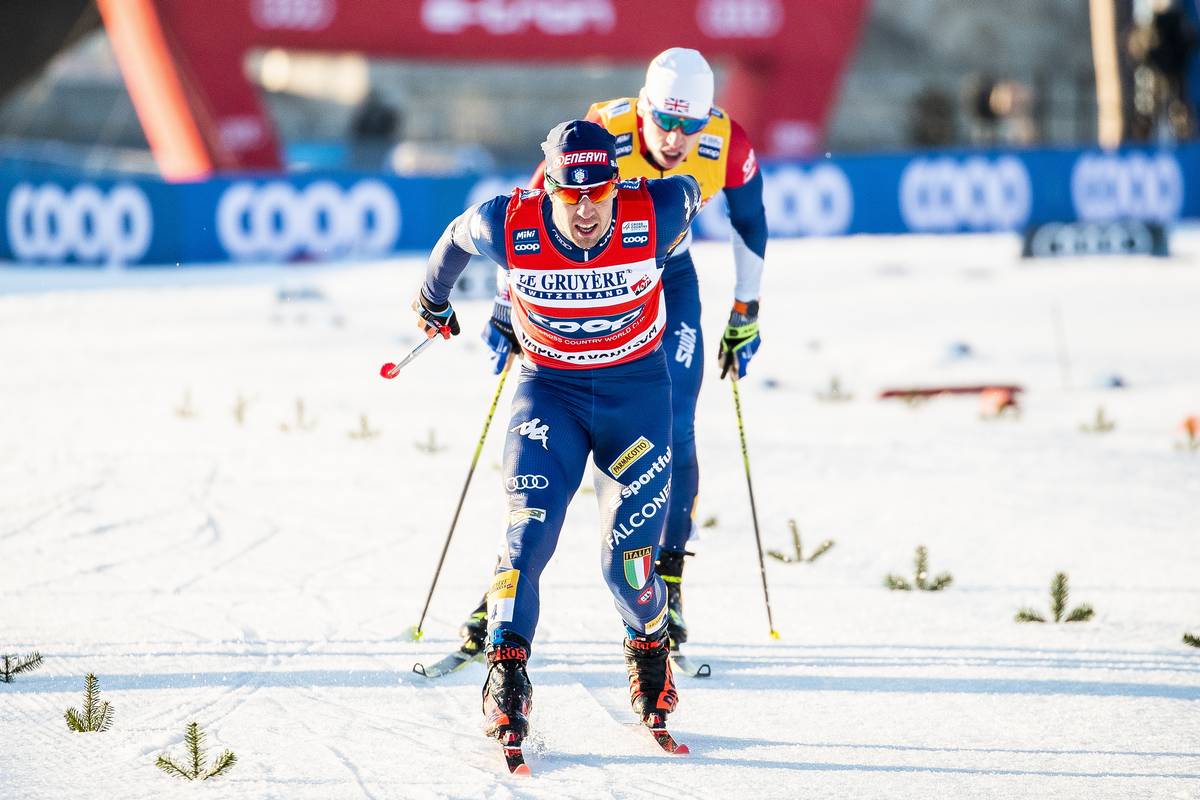
Peerless once again to the line: Federico Pellegrino with the Dresden skate sprint win. (Photo: NordicFocus)
After qualifying in fourth behind fastest qualifier Lucas Chanavat from France, Pellegrino boxed out, out-paced, and out-foxed the six-athlete final to win in 2:21:96. Last week’s sprint winner in Davos for back-to-back wins. This is Pellegrino’s 15th individual World Cup title, to place third overall for the most career sprint wins on the World Cup. (Johannes Høsflot Klæbo of Norway has 24 wins, while the now-retired Emil Jönsson of Sweden won 16 sprints.)
“After Davos, for sure my confidence went up, really up, and I knew I had a good chance to win,” said, Pellegrino in his post-race interview with FIS, “Two years ago I was disqualified and last year somebody took me down… so today by the semi-final I didn’t want to get any risk so I went in the front.”
Pellegrino advanced to the final after winning the first quarterfinal and placing second to Andrew Young (28) in the first semifinal. Great Britain’s Young continued his impressive rise to the elite level as he placed second on Saturday, a scant 0.53 seconds off Pellegrin’s winning time. Last weekend in Davos, Young earned his first World Cup podium since 2015, when he placed third overall in the skate sprint. Russia’s Gleb Retivykh placed third (+0.91) for the podium’s final spot. Teammate Alexander Bolshunov, the overall leader of the men’s World Cup, was fourth (+1.19). Two Americans advanced to the finals. Simi Hamilton, for his best 2020-2021 result skied to fifth (+1.80), and Kevin Bolger sixth (+3.95).
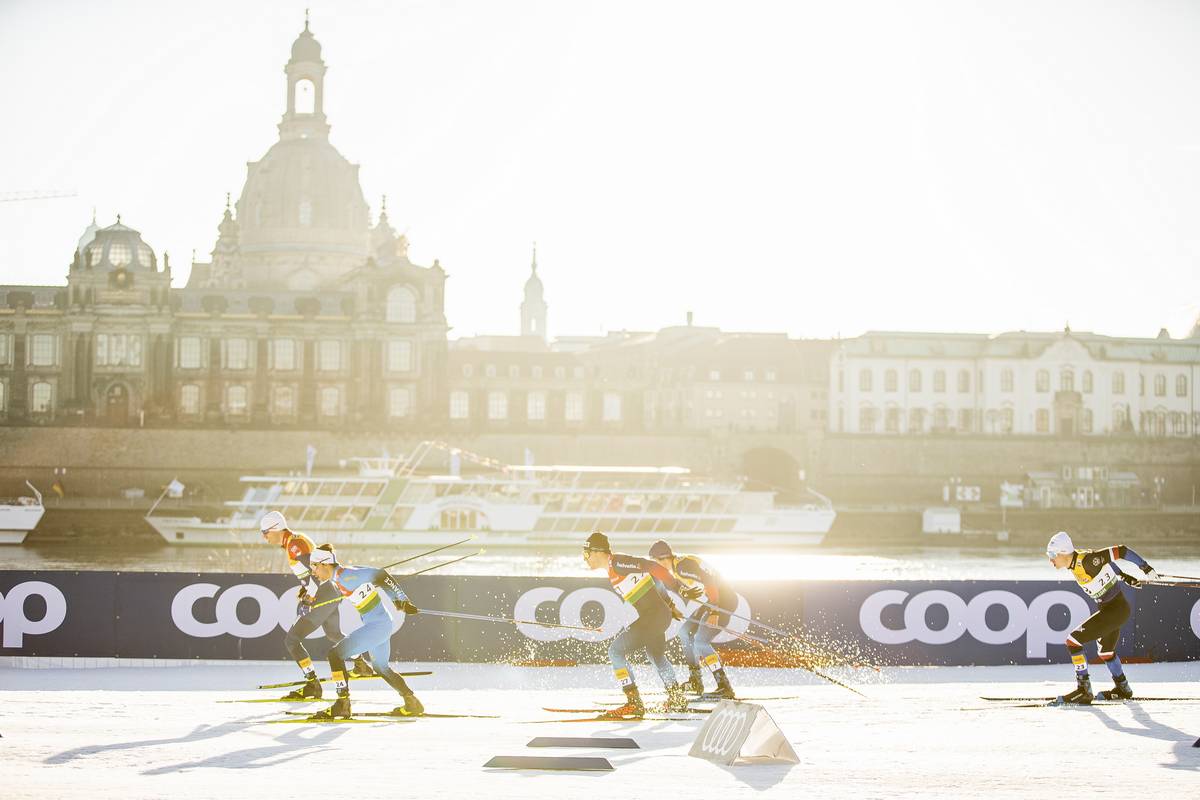
A big glimmer of British hope, Andrew Young leads the pack in Dresden. (Photo: NordicFocus)
For the thirty-three-year-old Hamilton, in his third individual sprint of the season, he has steadily improved. After placing 50th in the Ruka classic sprint, he qualified ninth and placed 14th in Davos, cresting with his fifth place in Dresden. Hamilton did not start last year’s Dresden sprint as he recovered from illness.
Post-race interview with Simi Hamilton.
“I think there were a lot more good things than bad things that came out of today,” said Hamilton. “Those will become more clear as I go forward. … I feel like I regained a lot of confidence today with my top-end speed which I feel I haven’t had in a few years just with getting older and losing a little bit of power. On a day like today when you have such a fast flat course, you are not going to have a good qualifier and you are not going to ski in the finals if you don’t at least have a little bit of sprinter strength still. So I think that was a really good sign.”
Big and smooth: Simi Hamilton during the Dresden sprints. He placed 5th overall. (Photo: NordicFocus)
Since Bolger broke onto the scene after placing 11th in the 2018 Lahti, Finland skate sprint, Saturday’s result marked his 12th career top-30 World Cup result. However, since that Lahti semi, Bolger has a run of semi-final droughts. His sixth place in Dresden is a result high-mark for the U.S. Ski Team athlete as he advanced to his first sprint final after progressing through the semis along with Hamilton as lucky losers.
Bolger looked at ease in the final, his big-frame keeping pace, until he snapped a pole. He did eventually receive a spare, fiddled with the grip, and reconnected to the pack of five skiers slightly upfront.
“I was on cloud nine I was psyched to be there,” Bolger said of his first sprint final appearance. “Even going back [a bit], once you make the semi-final anything is possible, and then making that final was an extra cherry on top. From there I wanted to try and just ski fast in any possible way that I could. From the gun I just went for it and had a really great start … I got unlucky with that pole break but just getting there is such a relief because … I came onto the scene in Lahti with that 11th, and there has been this big elephant in the room, ‘when am I going to get back to the semi-final again?’ Doing it today and getting to a final is like a huge monkey off my back.”
Post-race interview with Kevin Bolger.
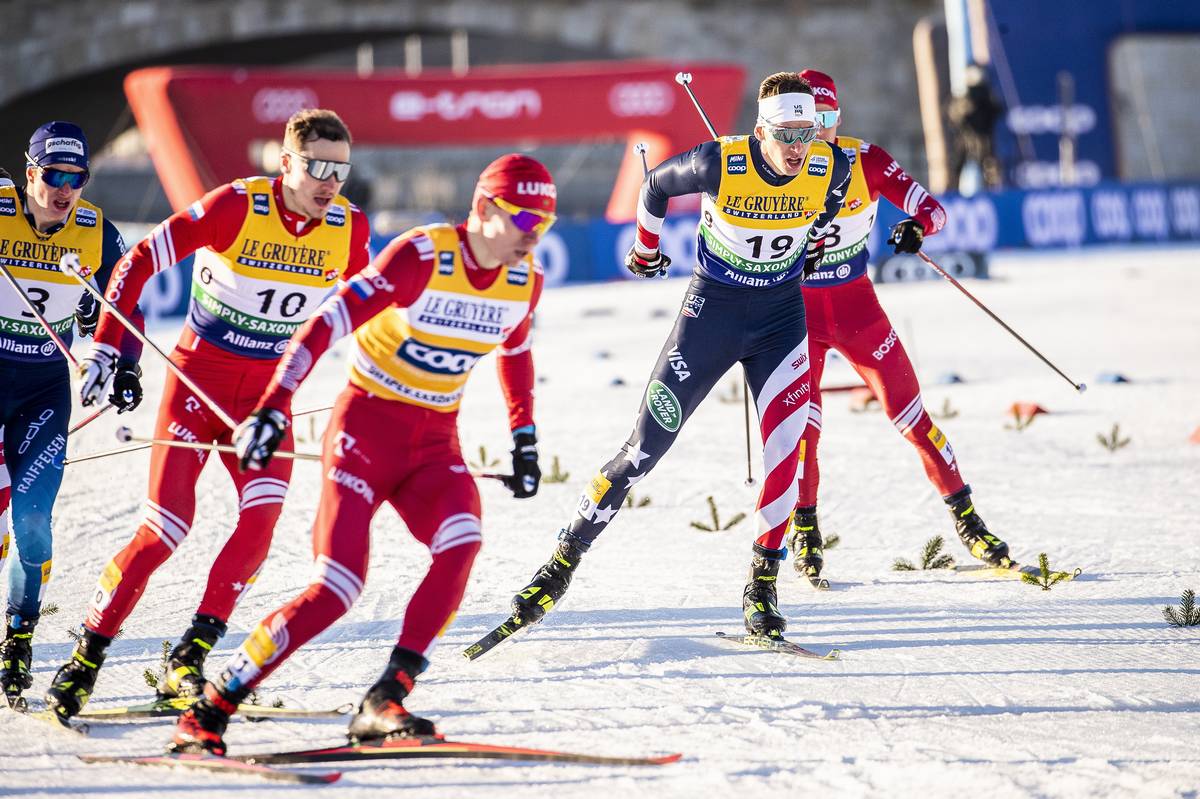
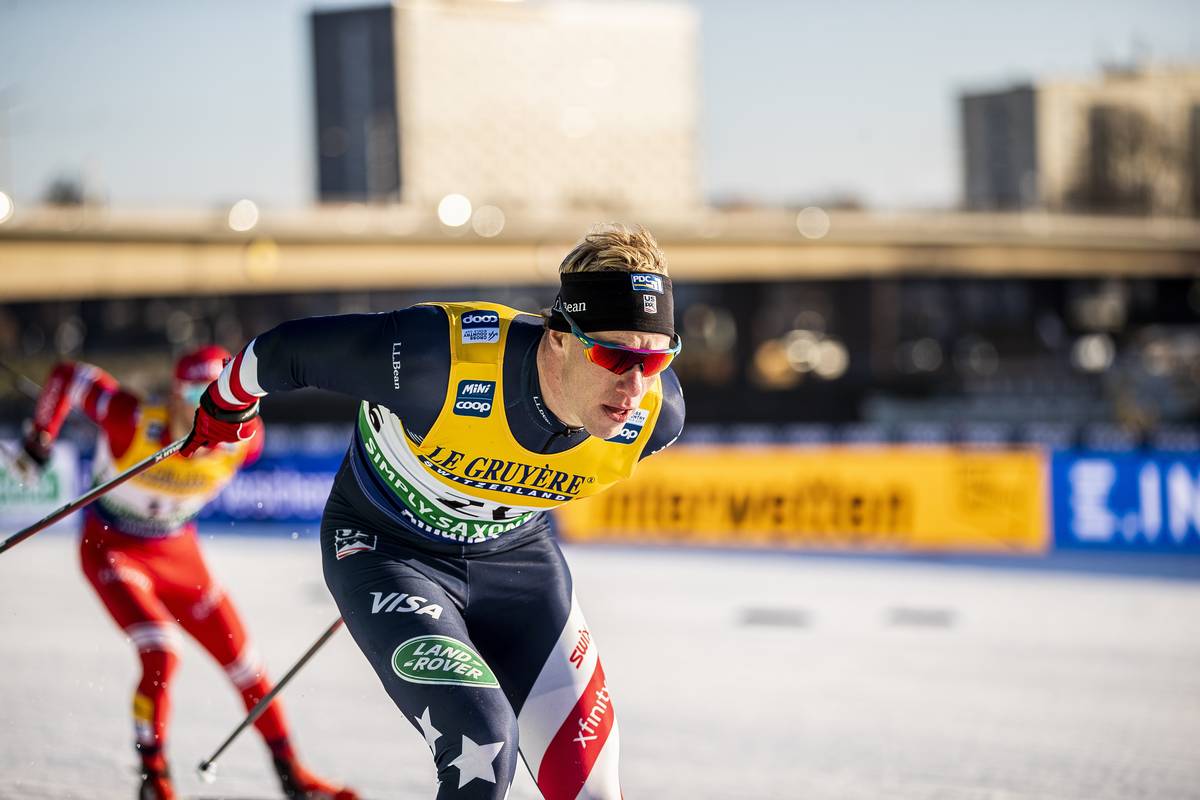
Kevin Bolger, bib 19, had a career-best 6th overall in Saturday’s Dresden skate sprint. (Photo: NordicFocus)
Hanneman moved onto the semi-finals for the second weekend in a row. In Davos, he placed ninth overall, a career-best. Today, he fell off the pace in the first semi where he placed sixth. He concluded the day 12th overall.
Logan Hanneman placed 12th on the day in Dresden. (Photo: NordicFocus)
Gus Schumacher (20), finished in 43rd, while Tyler Kornfield was 52nd.
Considering the World Cup sprint series, Pellegrino leads with 220 points, Bolshunov is second with 170, and Young is third with 152. Hamilton is eighth, Bolger ninth, and Hanneman 11th, respectively.
Racing continues in Dresden with a team sprint on Sunday.
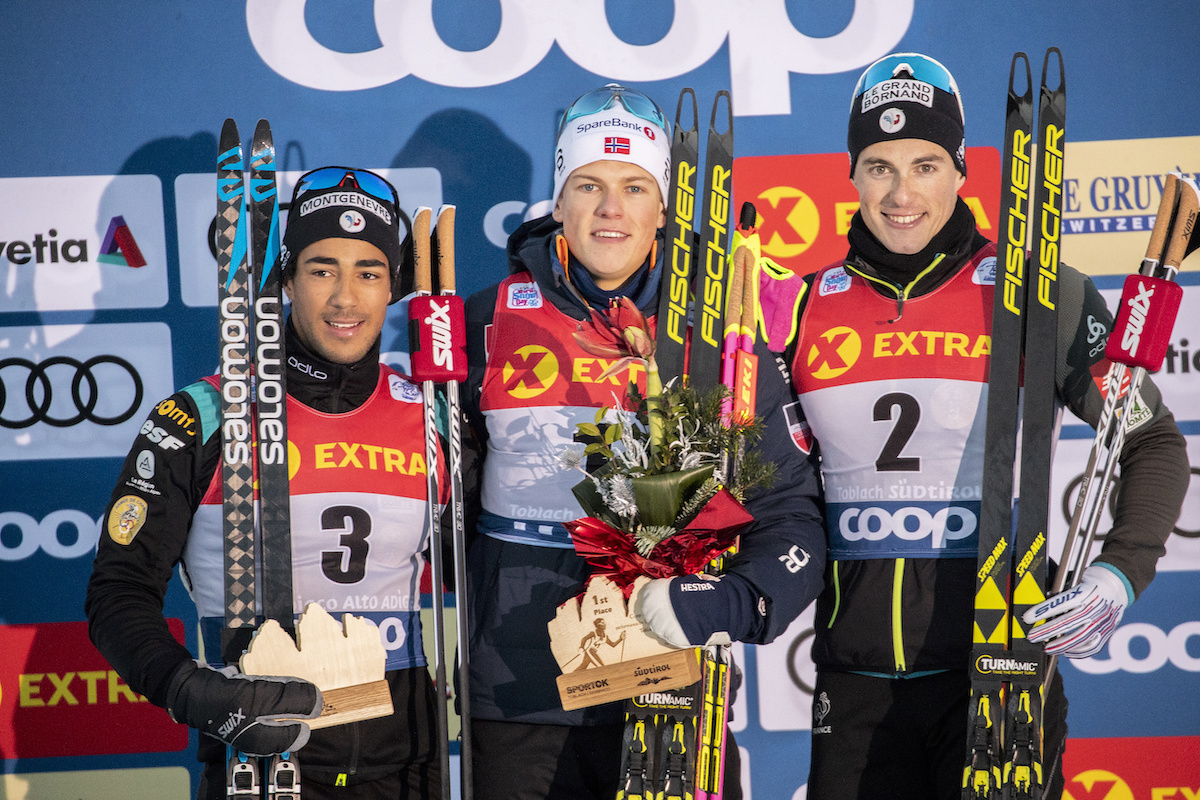
The men’s podium from Toblach, Italy’s first stage of the 2018/2019 Tour de Ski — a 1.3 k skate sprint. Richard Jouve (left) from France placed second, Johannes Hoesflot Klaebo (center) of Norway was first, and Lucas Chanavat of France (right) was third. (Photo: Fischer/Nordic Focus)
*Note: This article has been updated to include comments from U.S. Ski Team B-Tean member, Kevin Bolger
Without the visual of the grey and white U23 marker next to his name on an FIS results sheet, it’s easy to forget Norwegian Johannes Høsflot Klæbo is still under 23 years of age. As the Tour de Ski (TdS) celebrates its 13th edition this year, the twenty-two-year-old Klæbo (he celebrated his 22nd birthday this October) is only in his first TdS. He did not start last season’s 2017/2018 Tour. Nor did he start the 2016/2017 TdS. His debut World Cup race came in the spring of 2016.
Even so, by the opening race of this season’s TdS, a 1.3-kilometer freestyle sprint in Toblach, Italy, Klæbo maintained the composure of a seasoned Tour veteran. A skier used to winning and ready to do it again.
He started by posting the day’s fastest qualification time, placing first in a time of 2:16.86 minutes.
Klæbo then advanced to Quarterfinal 1, exchanging the lead with Russia’s Sergey Ustiugov for the first half of the sprint loop, before taking command and eventually duking it out with France’s Lucas Chanavat and Norwegian Sindre Bjørnestad Skar in the finishing stretch.
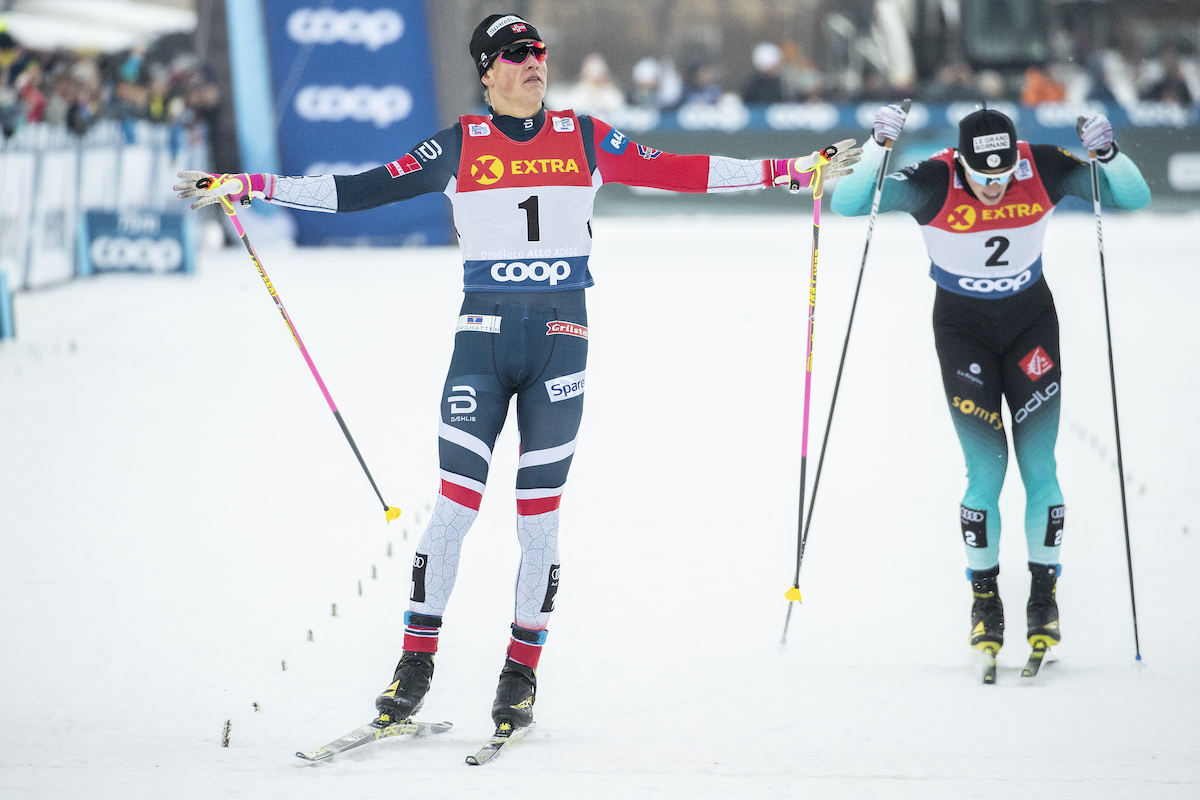
Johannes Høsflot Klæbo (bib 1) from Norway winning the men’s final in Toblach, Italy. Klæbo looked in form during the first stage of the 2018/2019 Tour de Ski.(Photo: Fischer/Nordic Focus)
Klæbo eventually won that quarterfinal, crossing first in a time of 2:19.71 minutes, just ahead of Chanavat. Both he and the Frenchman advanced to semi-final 1. Skar squeaked into the second semi as a Lucky Loser thanks to the heat’s fast times.
In the first semi-final, Klæbo once again took the lead from the start. He was shadowed closely by Chanavat and Italy’s Federico Pellegrino until the course’s second climb. There, the Italian made a push to the front, but by the bottom of the following hill, Chanavat had maneuvered his way around Pellegrino to take the lead. As the first semi-final skiers cornered into the finishing stretch, it was a four-skier battle between Chanavat, Pellegrino, Klæbo and Norwegian Eirik Brandsdal.
Chanavat took the semi final win. Crossing behind Chanavat, Klæbo (+0.07) bested Pellegrino (+0.10) by 0.03 hundredths of a second to advance to the final. Pellegrino did not move on.
By the time the men’s final rolled around, the line up included three Norwegians, two Frenchman, and a Russian. Norway’s Emil Iversen and Skar had advanced to the final as the two Lucky Losers from the second semi, which was won by France’s Richard Jouve followed by Russia’s Alexander Bolshunov.
From the start of the gun, it was Klæbo in front in the final. Clinging to his skis were Jouve and Bolshunov as the group headed toward the first climb. Klæbo maintained the leader’s pull just until the top of the climb, where Bolshunov positioned himself in first for the descent. Rolling into the second short climb, Bolshunov and Klæbo went head-to-head. Lurking just behind them was the French duo.
As they headed into the third climb, Chanavat moved to the outside right of the group. Jouve followed. By the time the final field crested the last climb on course, Klæbo was positioned in first, Jouve in second and Chanavat in third.
A final sling around the curve to the finish revealed Klæbo flurrying to hold off the attacks of Chanavat and Jouve. His efforts paid off and the Norwegian finished the sprint, his first TdS race, in first in a time of 2:17.99 minutes. Chanavat crossed 0. 34 seconds behind Klæbo for second.
Crossing a mere 0.05 hundreths of a second behind Chanavat was Jouve in third (+0.39). The podium is Jouve’s sixth in the top three (fifth individual) all of which, like his compatriot, were in the freestyle sprint discipline.
Rounding out the top 10 was Pellegrino in seventh, Brandsdal, in eighth, Sweden’s Oskar Svensson in ninth and Norway’s Finn Hågen Krogh in 10th.
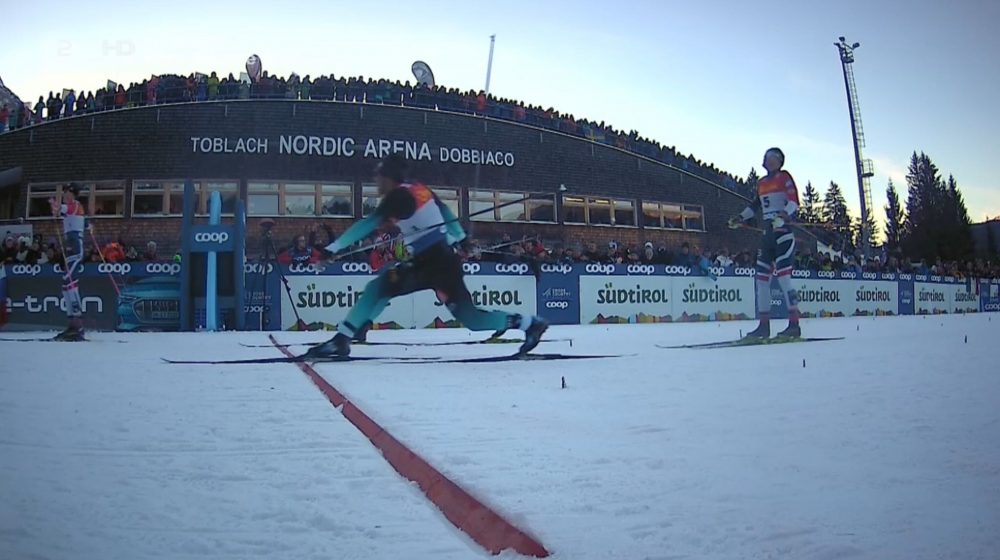
Johannes Høsflot Klæbo of Norway crossing the line in first as France’s Richard Jouve placed second and his teammate, Lucas Chavanat, was third. (Photo: ZDF Screenshot)
Two Americans qualified for the heats, with Simi Hamilton qualifying in eighth (+3.00) and Kevin Bolger of the U.S. qualifying in 13th (+3.98).
Hamilton, who advanced to the second quarterfinal, looked strong for the first two-thirds of the course. However, in the last climb of the sprint loop, while moving from fifth to third, Hamilton fell. The crash cost him advancing to the semis and he crossed his heat in sixth, ending the day’s sprint in 26th.
“I think he unfortunately just took himself out,” U.S. World Cup head coach, Matt Whitcomb said during a phone conversation. “From the side angle, it looked like he just started getting a little bit too far forward. He thought he might have hit something…But it was a bummer because he had a really speedy qualification and was just positioned perfectly to move on and was feeling great.
“It’s one of those instances where you can be disappointed but not discouraged because he’s where you want him to be,” Whitcomb continued. “He’s in a place where he’s good enough to be on the podium, can certainly ski with the best, but unfortunately that didn’t unfold today.”
The U.S. Ski Team’s Kevin Bolger during the first stage of the 2018/2019 Tour de Ski — a 1.3k skate sprint. Bolger placed 21st overall. (Photo: Fischer/Nordic Focus)
Bolger, who advanced to the fifth quarterfinal remained in contact with Swedish skiers Karl-Johan Westberg and Viktor Thorn and Russian Alexander Bolshunov, who lead through the first and second climbs. Bolshunov picked up the pace on the second hill, pulling the rest of the field with him.
“I kind of assumed Bolshunov would want to take command of the heat, and he did from the start, and then he put in that surge just over the top of the second climb, I felt like I was ready but not in the best position to react, and was able to get back in contact with the group over the last climb, but making a move from there was tough,” Bolger wrote in an email to FasterSkier on Saturday. “We had one of the fastest heats of the day, if I was in any other heat I think I would have qualified.”
The Russian crossed the quarterfinal first with Poland’s Maciej Starega holding onto him to cross in second. Bolger eventually crossed in fifth for 21st on the day.
“Really exciting to see Kevin qualify,” Whitcomb said. “Watching his qualification rounds, he must have skied one of the fastest first climbs. His V1s were absolutely lightning fast. We’re really impressed with his trajectory throughout Period 1 getting gradually faster and faster and almost being there in Davos and he’s clearly there now.”
Two weekends ago, Bolger finished the Davos, Switzerland sprint in 31st, just one place outside of qualifying. These were the first heats of the season in which he qualified.
“I was excited, but also relaxed,” Bogler wrote of how he was feeling. “I don’t feel like a newbie in the world cup heats anymore, I’ve had experience. So I wanted to ski aggressive and attack and be in the mix from the start.”
“I will be dropping out of the tour after the 3rd stage, along with Simi, and Sophie,” Bolger continued. “But tomorrow’s 15 k skate will be a hard effort, but a fun fast course I’m looking forward to having a good race, but I’ll be putting a little more focus into the next skate sprint in Val Müstair!”
Canadians Alex Harvey finished in 50th (+7.16), Len Valjas in 55th (+7.46), and Bob Thompson 62nd (+8.10).
“My skis were great today!” Harvey wrote in an email after the sprint. “I was actually feeling quite good in the warm up and in the race. I just think that a 2:16 sprint is a bit too short for me. The conditions made for a quick and fairly easy prologue, I think 2 years ago in was more around 2:45 so to shave 30 sec of a sprint course is pretty impressive.”
“I would have liked to get in the heats and maybe put some time on some of the contenders for the overall but I guess I’ll have to wait for tomorrow to do that!” he added.
Another duo of North Americans started the qualifier, with Erik Bjornsen (USST) and Ben Lustgarten (CGRP) of the U.S. placing 76th (+10.38) and 105th (+15.23), respectively.
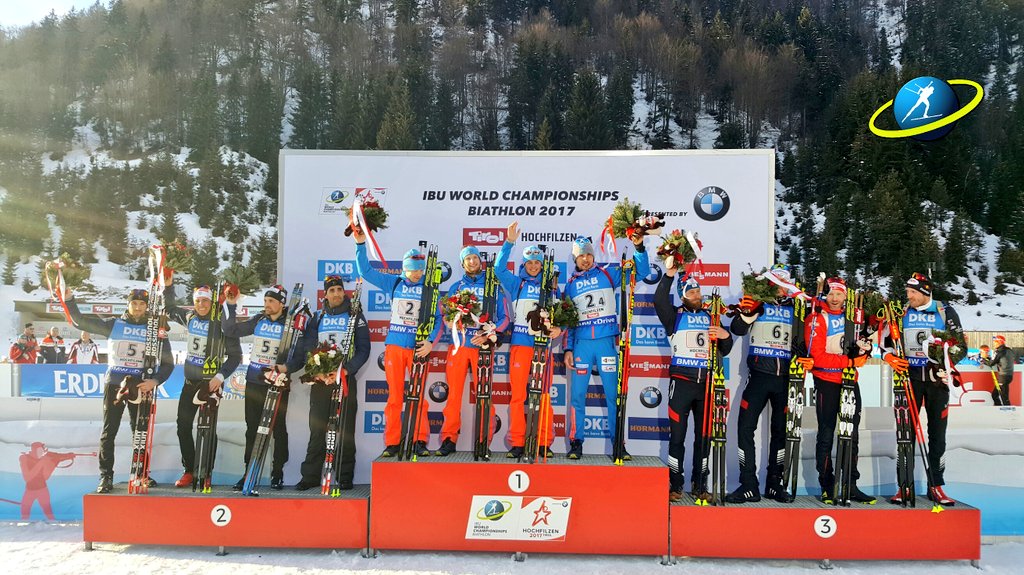
The men’s 4 x 7.5 k relay podium at 2017 IBU World Championships on Saturday in Hochfilzen, Austria, with Russia (c) in first, France (l) in second, and Austria (r) in third. (Photo: IBU World Champs/Twitter)
IBU World Championships (Hochfilzen, Austria): Men’s relay
[UPDATED] Russia’s four-man relay team hit nearly every target on Saturday, using a total of just three spares to clean 40 targets, and stayed out of the penalty loop to capture gold in the men’s 4 x 7.5-kilometer relay at the International Biathlon Union (IBU) World Championships in Hochfilzen, Austria.
It was the last team event and the second-to-last day of the championships, with the men’s and women’s elite mass starts remaining on Sunday. Anton Shipulin anchored the Russians to first, 5.8 seconds ahead of France’s Martin Fourcade, after Shipulin cleaned his prone stage and used one spare in standing to hold onto the lead his team built. Fourcade cleaned both stages to secure silver for his team, and Austria took bronze (+20.1) with anchor Dominik Landertinger.
After Russia’s Alexey Volkov used one spare in each of his shooting stages and came through the exchange in seventh, Maxim Tsvetkov and Anton Babikov both cleaned without any spares to bring the team into fourth, then first, respectively.
France’s first leg Jean-Guillaume Béatrix shot clean as well and tagged Quentin Fillon Maillet in second. Fillon Maillet then needed one spare in prone, but cleaned standing to take the lead, tagging Simon Desthieux in first. Desthieux used three spares in prone, but avoided the penalty lap before tagging Fourcade in third, 12 seconds behind Austria in second. Fourcade closed the gap and clinched second, and France combined for a total of just four spare rounds.
Austria achieved bronze in front of a home crowd with Daniel Mesotitsch, Julian Eberhard, Simon Eder, and Landertinger combining for 10 spares and no penalties.
Finishing 8.5 seconds after Austria, Germany placed fourth. Italy was a minute and a half out of first in fifth, Ukraine took sixth (+1:41.3), and the U.S. placed seventh (+1:50.5) with Lowell Bailey, Leif Nordgren, Tim Burke, and Sean Doherty. Bailey initially put the team in fourth at the first exchange, 12.4 seconds out of first, then Nordgren tagged Burke in sixth, 17 seconds behind. Burke used four spares to clean and tagged Doherty in seventh, about a minute back. The Americans used a total of eight spares but had no penalties.
Canada finished 13th (+3:35.5) with Christian Gow, Scott Gow, Macx Davies, and Brendan Green. They were 39 seconds out of first and in 12th place after Christian Gow’s first leg, then slipped to 14th before Davies moved them back into 12th by the last exchange. Canada had a total of 10 spares and zero penalties.
FIS Cross-Country World Cup (Otepää, Estonia): Freestyle sprint
In the last World Cup before the upcoming 2017 International Ski Federation (FIS) Nordic Ski World Championships next week in Lahti, Finland, five U.S. women qualified in the top 12 of the women’s 1.3-kilometer freestyle sprint, and Jessie Diggins reached the final on Saturday in Otepää, Estonia.
Diggins started the day by placing 12th in the qualifier, 3.93 seconds behind Sweden’s Stina Nilsson in first (and her U.S. teammates Kikkan Randall in third, Sophie Caldwell in fourth, and Ida Sargent in 10th) before winning her quarterfinal and semifinal. In the final, Diggins wad gapped by the leaders on the final climb and finished fifth (+6.82).
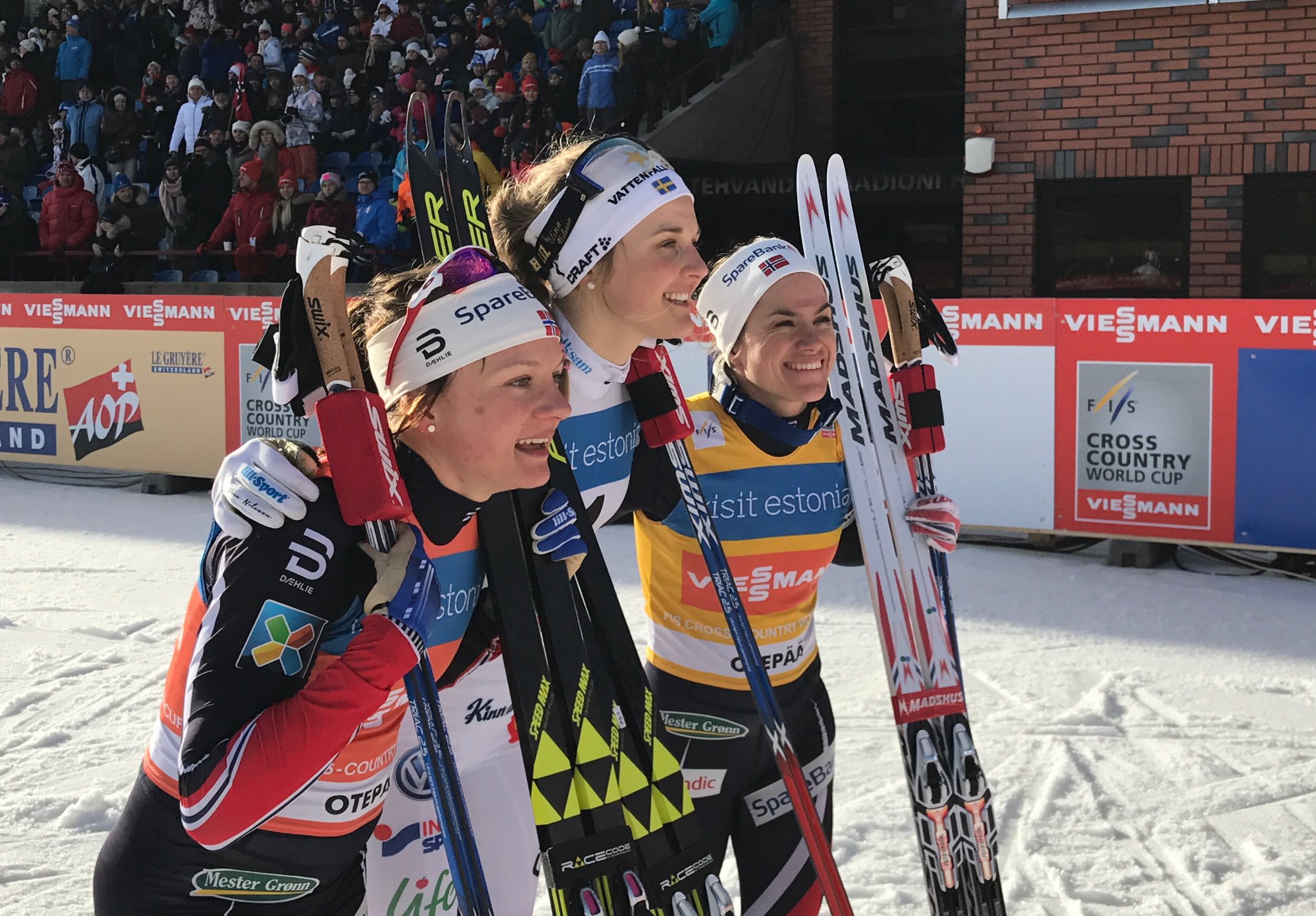
The women’s freestyle sprint podium at the Otepaa World Cup on Saturday in Estonia, with Swedish winner Stina Nilsson (c), Norway’s Maiken Caspersen Falla (l) in second and Heidi Weng (r) in third. (Photo: FIS Cross Country/Twitter)
Nilsson won the final in a time of 2:49.96 minutes, just ahead of Norway’s Maiken Caspersen Falla (+0.27) who lost her balance and her speed with it on the last corner. The two had broken away from third place and Nilsson led into the final straightaway and held Falla off for the win. Norway took second through fourth with Heidi Weng in third place (+3.75) and Astrid Uhrenholdt Jacobsen in fourth (+4.91).
Randall initially finished her quarterfinal in third position and would have been out, but advanced when Russia’s Natalia Matveeva was relegated to last for obstruction. In the same semifinal as Diggins, Randall fell cresting a small hill over a tunnel and finished fifth (+13.30) for ninth overall on the day.
Caldwellplaced second in her quarterfinal heat behind the day’s winner Nilsson, then stumbled halfway up a climb early in her semifinal, but stuck with the pack to finish fifth (+1.83) for 10th overall.
Sargent raced in the same quarterfinal as Falla and narrowly missed advancing to the semifinal in third place, fewer than 0.2 seconds behind Switzerland’s Laurien van der Graaff in second and 0.35 seconds behind Falla, who won that heat. Sargent placed 13th on the day.
Sadie Bjornsen qualified 25th and finished fourth (+2.82) in the same quarterfinal as Randall for the 25th overall.
Canada’s Dahria Beatty also qualified for the sprint heats in 30th place, and finished sixth in her quarterfinal for 29th overall.
Also for Canada, Cendrine Browne finished the qualification in 48th place and Katherine Stewart-Jones was one position behind in 49th.
Also for the U.S., distance specialists Chelsea Holmes and Rosie Brennan placed 58th and 60th, respectively.
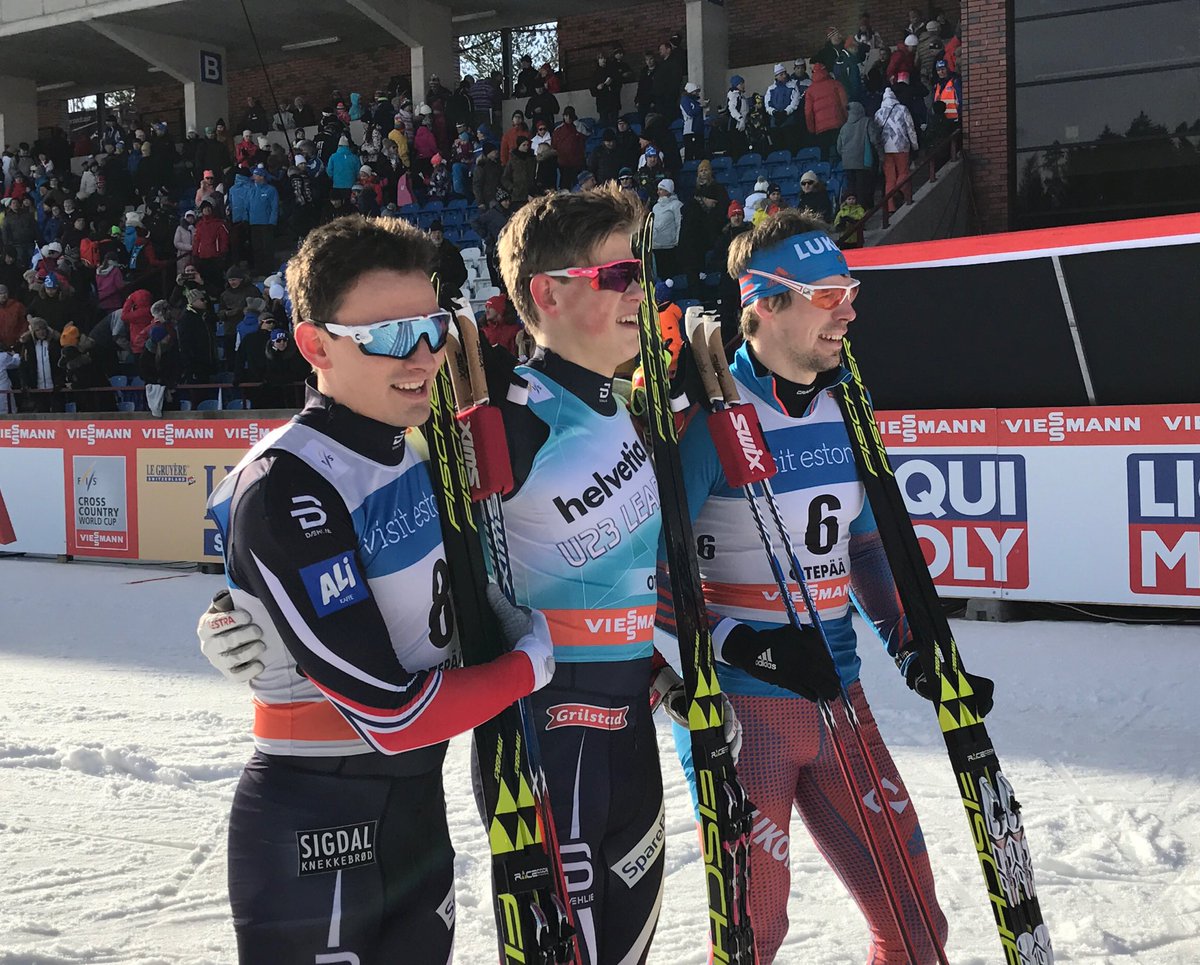
The men’s freestyle sprint podium on Saturday at the World Cup in Otepaa, Estonia, with Norway’s Johannes Høsflot Klæbo (c) taking his first World Cup win, Norway’s Finn Hågen Krogh (l) in second, and Russia’s Sergey Ustiugov (r) in third. (Photo: FIS Cross Country/Twitter)
In the men’s 1.6-kilometer sprint, Norway’s Johannes Høsflot Klæbo achieved the first World Cup victory of his career in a time of 3:06.53 minutes, holding onto a lead he had created with an attack right out of the start gate in the final. His teammate Finn Hågen Krogh placed second (+0.60), taking the inside lane in the last turn to push reigning Tour de Ski winner Sergey Ustiugov of Russia to third (+1.0).
For the North Americans, it was a day of narrow misses.
For the U.S., Simi Hamilton started his race day by qualifying in seventh position, and placed second in his quarterfinal. He then closely missed out on the final after placing fourth in his semifinal in a four-way sprint photo finish (+0.33), just 0.04 seconds behind the third place and lucky loser time of Norway’s Håvard Solås Taugbøl, who advanced. Hamilton ended the day in eighth overall.
Canadian World Cup Team member Alex Harvey snuck into the sprint heats in 29th place in the qualifier, then just missed out on advancing from his quarterfinal in a photo finish for second with Great Britain’s Andrew Young, who took it by 0.04 seconds. Harvey finished third in that heat, 0.6 behind Italy’s Federico Pellegrino, for 15th for the day. Young went on to finish sixth in his semifinal for 12th overall, and Pellegrino advanced as a lucky loser from the same semifinal and was fourth in the final (+4.77).
American Andy Newell qualified 16th and finished sixth (+1.89) in his quarterfinal for 27th overall.
Canada’s Len Valjas missed qualifying for the heats in 40th place, as did his teammate Devon Kershaw in 50th.
American Erik Bjornsen was 53rd, and for Canada, Jesse Cockney 54th and Knute Johnsgaard 56th. In his World Cup debut, Benjamin Lustgarten placed 64th in the qualifier.
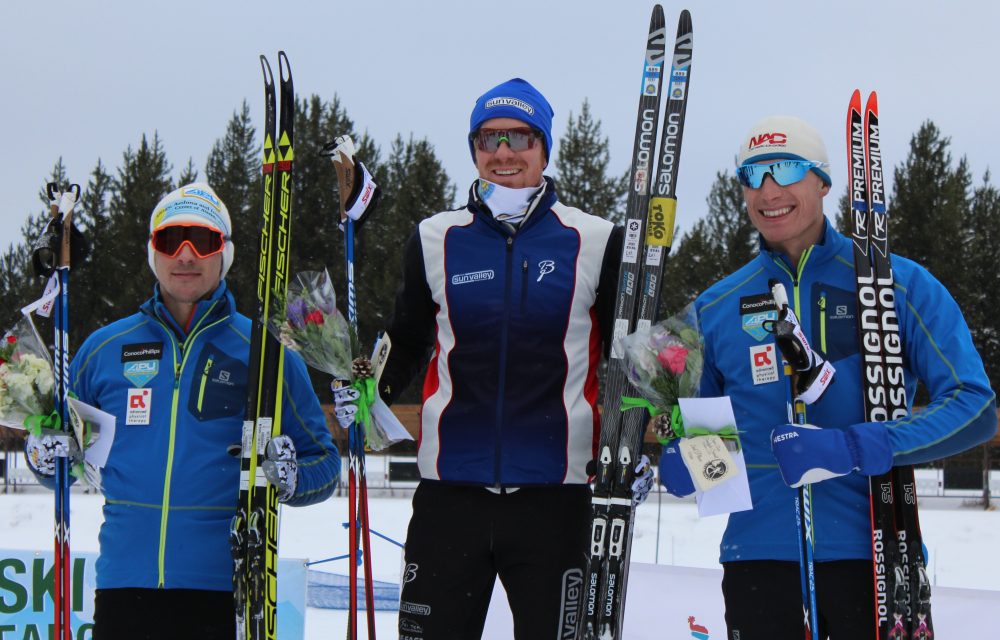
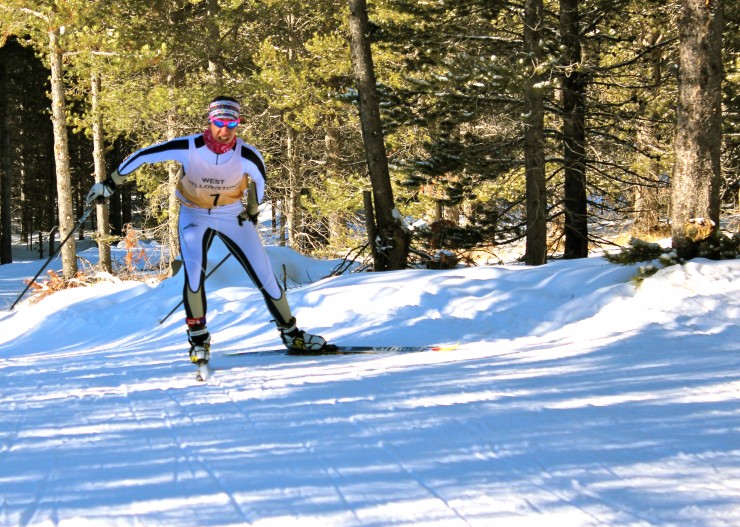
From left to right: Saturday’s third-place finisher Reese Hanneman (APU), winner Matt Gelso (SVSEF) and runner-up Tyler Kornfield (APU) on the podium at the men’s SuperTour 1.3-kilometer freestyle sprint on Saturday in West Yellowstone, Mont.
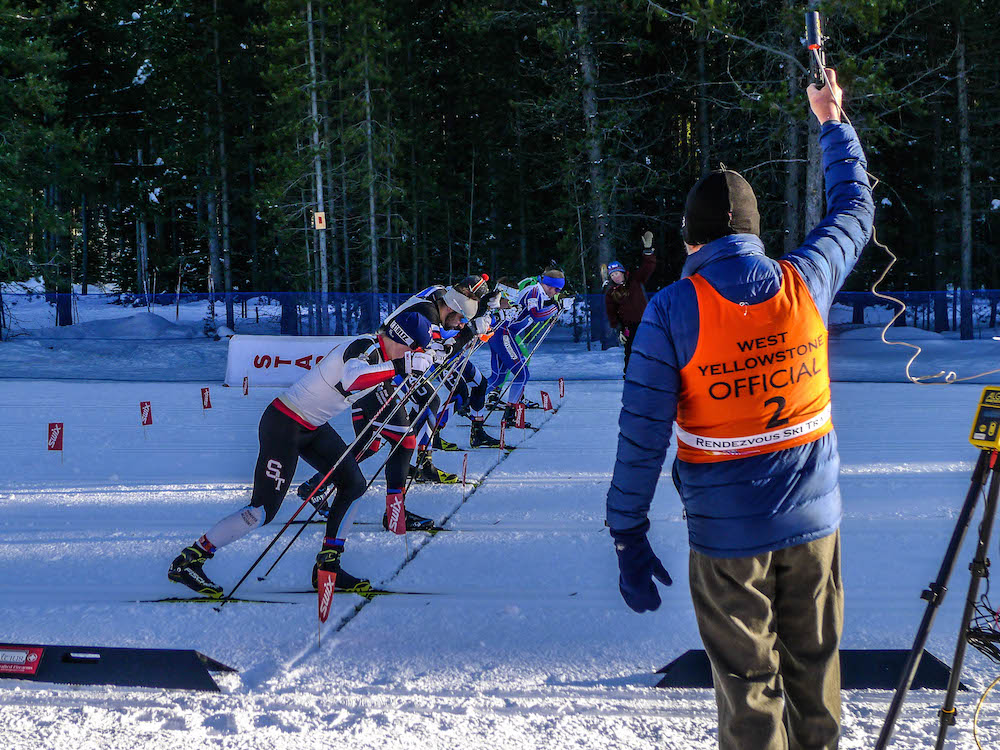
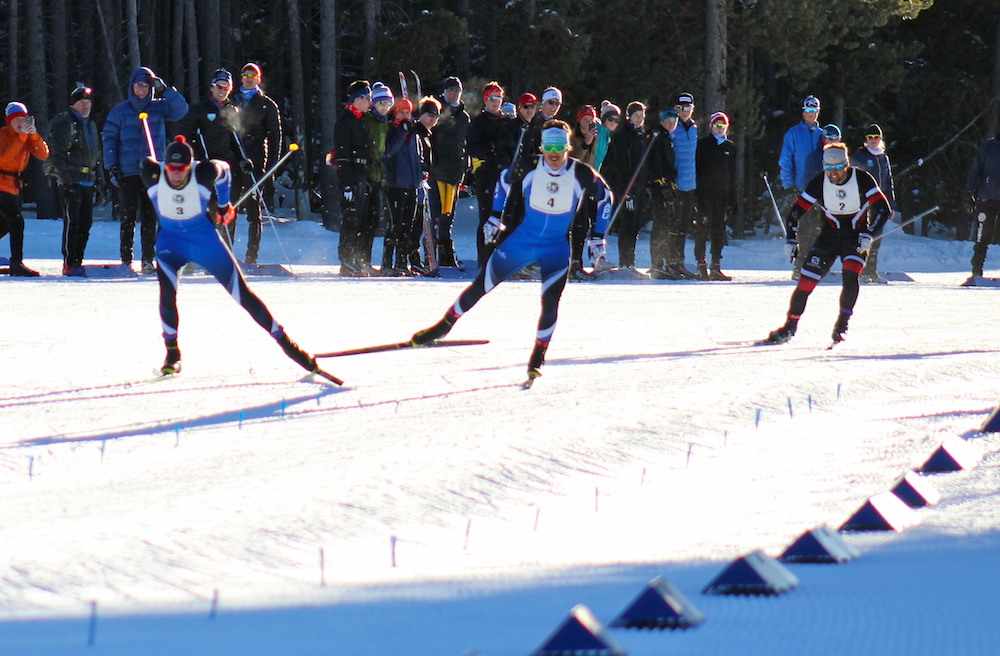
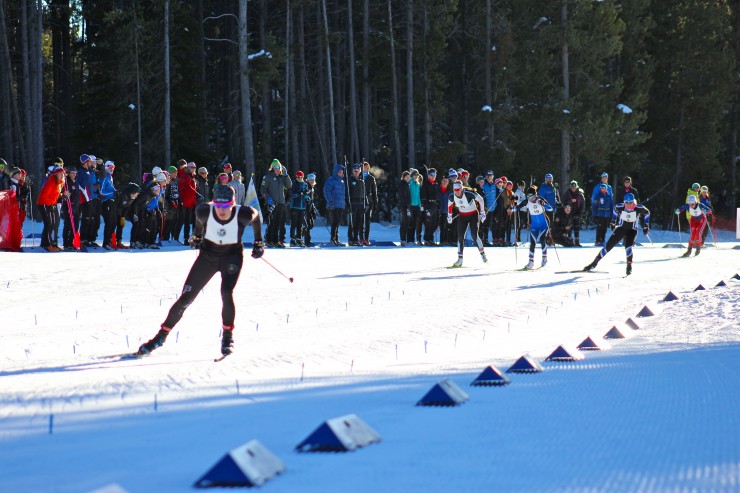
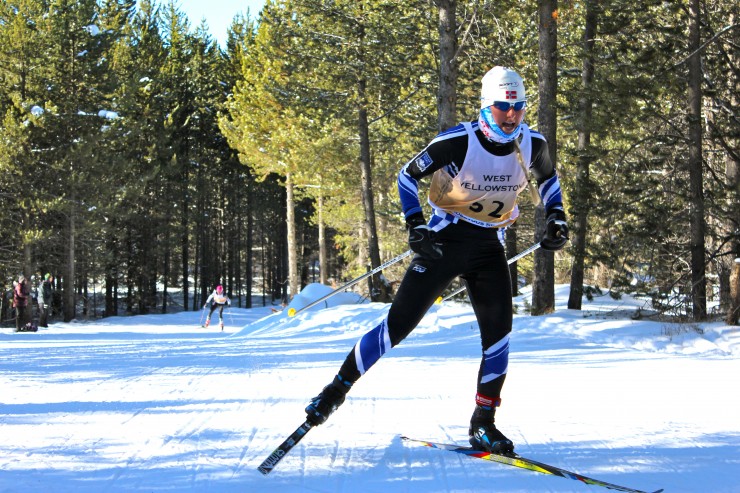
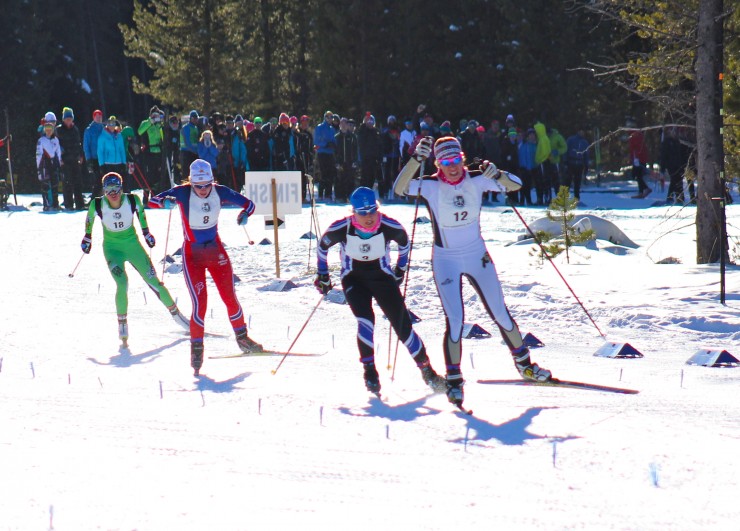
WEST YELLOWSTONE, Mont. — With a little less than a kilometer left, the pack started to panic. Saturday marked the first SuperTour sprint of the season and the gap Sun Valley Ski Education Foundation (SVSEF) Gold Team veteran Matt Gelso had put on the five other skiers in the men’s sprint final was not getting smaller.
The winner of last year’s SuperTour sprint season opener, Reese Hanneman of Alaska Pacific University (APU), saw the nearly 15-meter lead Gelso had established halfway through the 1.3-kilometer men’s freestyle sprint final heat as a sign.
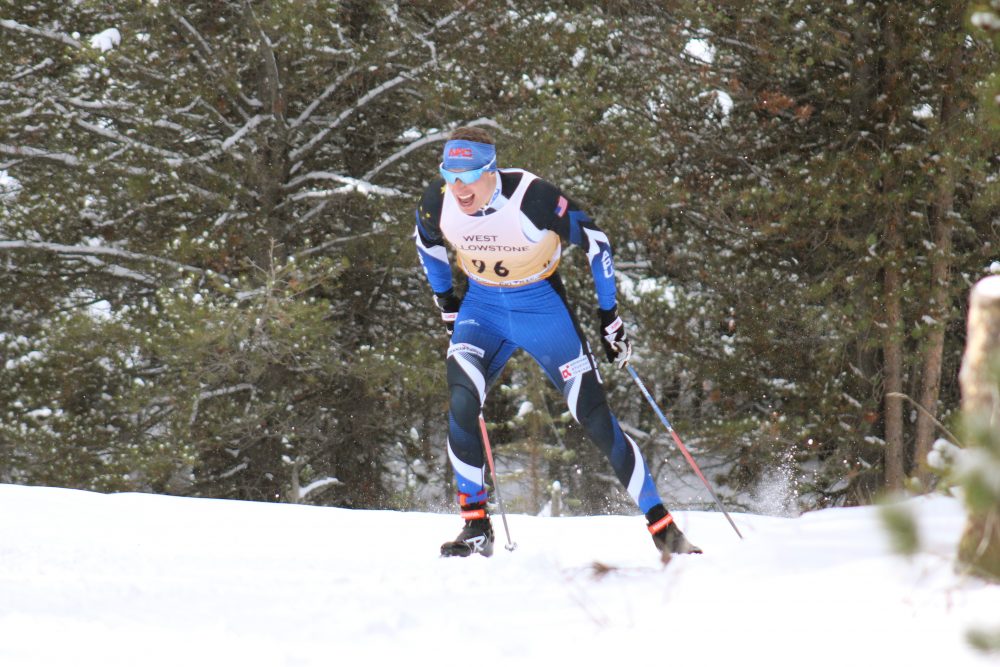
Tyler Kornfield (APU) racing during the qualifier of the men’s SuperTour 1.3-kilometer freestyle sprint on Saturday in West Yellowstone, Mont.
“I was in third or fourth thinking, ‘Uh, OK, we better start closing this down,’” Hanneman said during an in-person, post-race interview.
“Basically in the final it was five sprinters and then Matt,” Hanneman said. “So I think he knew that he had to go out like … and then I think none of us thought that [Gelso] could hold it all the way. … It was really impressive skiing by him to just go for it the whole time.”
Yet, as Gelso began to climb the final hill of the course on the Rendezvous Ski Trails, he proved his gap on the other five finalists would take a strong challenge to beat. Hanneman pushed around Morgan, Saxton and Blackhorse-von Jess, while racing behind his teammate Kornfield. The two APU racers began gaining on Gelso, but not soon enough.
With 100 meters to go, Gelso, a 28-year-old SuperTour regular best known for his distance skiing, left the two sprint champions chasing, and crossed the finish line first in a time of 2:36.85 for his first SuperTour sprint win.
“I was pretty fired up,” Gelso said after. “I didn’t know going into the semifinal and final if [leading from the start] was going to still work … but I had the body and the skis to stay consistent with my plan.”
Crossing 1.94 seconds after Gelso was Kornfield, who indicated that his second-place finish was his best performance on the West Yellowstone sprint course since the start of his sprint career.
“The first year [I raced] here I didn’t even qualify,” Kornfield said after. “This is the first year I’ve moved on from the quarters…[last year] I got taken out and I took Eric Packer out too.”
“I think none of us thought that [Gelso] could hold it all the way … It was really impressive skiing by him to just go for it the whole time.”— Reese Hanneman (APU), on Matt Gelso’s sprint performance Saturday
The final podium finisher for the day was Hanneman, finishing 2.27 seconds after Gelso and 0.33 seconds out of second place.
“I didn’t feel that good in the qualifier,” Hanneman said. “I was skiing a couple gears lower than I needed to be but then I started feeling better in the heats … I think after today I’ll definitely wake up and feel a little bit better.”
The final three finishers included Saxton in fourth (+5.1), Morgan in fifth (+5.34) and Blackhorse-von Jess in sixth (+22.85).
In the women’s 1.3 k freestyle sprint, it was Jennie Bender of the Bridger Ski Foundation (BSF), who took first, besting SMST2’s Erika Flowers and Annie Hart.
Bender, 28, started the day by winning the women’s qualifier in 3:08.76, holding off Hart by three hundredths of a second.
“My goal is to do better in qualifying, and I did that today, so that was a big win for me,” Bender said. “I love this course and I hope to repeat last year, get back to Europe and race some World Cups.”
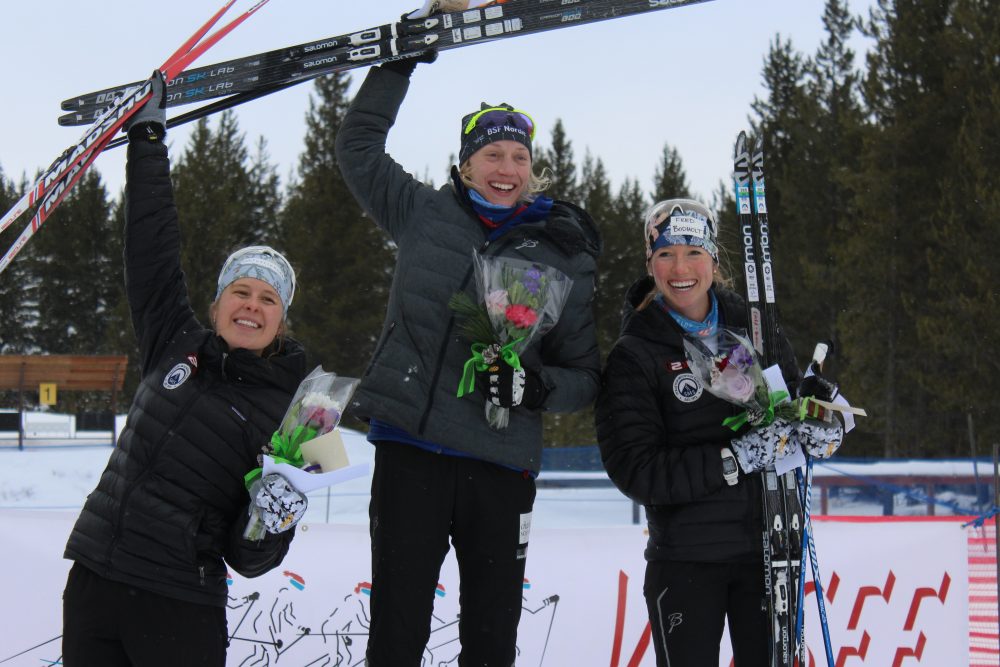
From left to right: Saturday’s third-place finisher Annie Hart (SMST2), winner Jennie Bender (BSF), and runner-up Erika Flowers (SMST2) on the podium at the women’s SuperTour 1.3-kilometer freestyle sprint in West Yellowstone, Mont.
After winning the qualifier, Bender’s course time only got faster. She won her quarterfinal in 3:08.24 and her semifinal in 3:06.86. By the time she finished the women’s final in first, she had covered the 1.3 k course in 3:04.78, almost four seconds faster than her qualifying time.
With a strong headwind challenging many of the racers who chose to lead, Bender decided in her final to follow the other finalists for the first half of the course before making her move.
“There’s a lot of wind happening so … you kind of have to play with the wind and whether or not you want to be the only one blocking it or not,” Bender said of the heats. “I led my quarter, and I was like ‘Holy sh*t, I took all the wind myself!’ so I was trying to kind of mess around with sitting behind people the next two heats, and that felt way better.”
While Bender’s plan for the final was to tuck in and conserve for the first half, then surge to the front in the second half, Hart decided to lead out of the start.
“Because we had some big headwinds [today] … the debate was whether to lead or follow,” Hart said. “I went into the rounds and decided to lead most of them, because I ski better generally when I kind of feel like I’m in control.”
Hart skied at the front of the pack up until the course’s last climb, where her teammate Flowers passed her on the right side and Bender cruised by on her left.
“I just, one, didn’t have much energy left, and two, there really wasn’t anywhere to go,” Hart said of her attempt to hold onto the lead. “I typically don’t do very well in West Yellowstone, so this year was by far the best first race I have had … I will take it.”
Jennie Bender (1) of the Bridger Ski Foundation leading her semifinal during the women’s 1.3-kilometer freestyle sprint on Saturday in West Yellowstone, Mont.
Rounding the final turn, Bender took the inside lane while Flowers remained to the far outside left. The two raced head-to-head through the final 100 meters, lunging to the line for a photo finish.
Bender was eventually awarded the win and Flowers took second by a mere 0.09 seconds. Hart crossed in third, 1.94 seconds behind Bender.
“I needed a lane, so I moved outside early and zoomed up the hill as fast as I could, and then into the finish,” Flowers said of final move up the course’s last climb. “I don’t think I quite realized I was as close to Jennie as I was until about ten feet from the finish line. It was exciting, I’ve never thought of myself as a sprinter, so it was fun to do well.”
“She was behind me the whole time until that hill,” Bender said of Flowers. “And you just save so much energy, due to headwind, so I think that helped both of us. It’s funny, we talked about it before our quarter — she was in my quarter, I was like, ‘it’s better drafting,’ and it worked out!
“I feel pretty fit compared to previous years, I would say, and I’m hoping for a good season,” Bender concluded.
Also in the final was Hannah Halvorsen of the Sugar Bowl Ski Academy and U.S. Ski Team in fourth (+2.0), APU’s Chelsea Holmes in fifth (+3.86), and University of Colorado-Boulder (CU) skier Petra Hyncicova in sixth (+4.53).
American Julia Kern (SMS/USST) racing to a career-best 16th in the Junior World Championships freestyle sprint on Monday in Rasnov, Romania. (Photo: Pete Leonard)
Note: This article has been updated to include comments from Canada’s Marie Corriveau and American Ben Saxton.
Julia Kern’s biggest hurdle on Monday? Hands down: the heat.
“The conditions today we’re a very good representation of how poor this winter has been,” 18-year-old Julia Kern, of the Stratton Mountain School and U.S. Ski Team D-team, wrote in an email on the opening day of U23/Junior World Championships racing in Rasnov, Romania.
Kern placed 16th in the junior women’s 1.3-kilometer freestyle sprint, qualifying with the 14th-fastest time then placing fourth in her quarterfinal, 2.8 seconds out of first.
“It was about 50 degrees and sunny, so pretty darn hot, and man made snow,” she continued. “Almost the entire course was deep slush, making it hard to power through a sprint like I usually do. My approach was to ski light and quick, but still getting power through the legs and poles. I hammered the first hill, leaving a little left in the tank to really work the flats and the finish.
“The heat was definitely one of my biggest challenges today because I tend to overheat very quickly,” Kern, a Massachusetts native, added. “I found that pouring some water on my hair and staying in the shade before I started helped.”
Sixteenth marked her career best at Junior World Championships since placing 32nd and 38th in the classic sprint and skiathlon, respectively, at last year’s junior worlds in Almaty, Kazakhstan.
“My goals for these championships were pretty conservative because I wasn’t sure how I compared with others after having injuries this year and I also had no strong sprint results thus far,” wrote Kern, who had compartment-syndrome surgery last spring followed by a back injury at the start of the season. “My goal was to make the heats and I achieved that. Anything more than that was just a bonus!”
She was one of two North American junior women to reach the heats on Monday: Canada’s Marie Corriveau qualified 29th and went on to place 25th when she finished fifth in her quarterfinal, 12.41 seconds behind the winner of that heat.
Kern had qualified 14th, 9.63 seconds behind the top qualifier, Anastasia Kirillova of Belarus.
“I was pretty confident about my qualifier,” Kern explained. “I felt like I was gaining on the Russian who started in front of me. By the time I was half way down the downhill, my legs were burning more than they ever have, to the point where I couldn’t feel them. I knew that I had given it my all. The heats were a lot different since the course is really tight, barely 2 people wide.”
In her quarterfinal, she found herself in sixth early after what she considered “a really bad start”. The pack remained together until a 180-degree turn, where Kern recalled one of the two Germans in the heat stepping on the skis of France’s Delphine Claudel, causing Claudel to spin around and face Kern.
“I tried to ski as quickly as I could around her, but had lost contact to the first 3 girls,” Kern wrote. “I worked the flat and downhill, almost catching up the 3rd, but not quite. I was still content with how I raced and was really excited to place 16th!”
Sweden’s Emma Ribom won the heat in 3:07.28 and would ultimately place fifth in the final. Norway took first and second overall with Amalie Håkonsen Ous, who won the final in 2:55.77, and runner-up Lotta Udnes Weng, 0.22 seconds back. Sweden’s Jenny Solin placed third, 0.71 behind the winner.
In an email, Corriveau explained she started her quarterfinal with the goal of staying behind the leaders as long as possible.
“I stayed with them the first part of the sprint, but after this point I was not able to follow anymore, they were really too fast for me,” the 18-year-old Pierre-Harvey National Training Centre (CNEPH) athlete wrote. Weng won her heat.
“I am feeling very good about my result today, especially that it was my first international race, so I am very happy with a top 25 to start the week!” Corriveau wrote.
Also in the junior women’s sprint, Americans Sarah Bezdicek placed 36th, Leah Lange was 42nd and Nicole Schneider 52nd. For the Canadian team, Sadie White placed 44th, Hannah Mehain was 47th and Natalie Hynes 70th.
In the junior men’s 1.3 k sprint, Henry Harmeyer was the top American in 35th, Zak Katterson placed 51st, Thomas O’Harra was 58th, and Leo Hipp 66th. For Canada, Antoine Blais finished 41st, William Dumas was 44th, Philippe Boucher 52nd, and Joey Foster 63rd.
Another Norwegian topped the junior field, with Johannes Høsflot Klæbo winning the final in 2:31.42, by 0.67 seconds over Korea’s Magnus Kim in second place. Italy’s Giacomo Gabrielli edged Russia’s Denis Spitsov by 0.07 seconds for third, 1.02 seconds behind Klæbo.
American Logan Hanneman (25) racing to third in his freestyle sprint quarterfinal at U23 World Championships in Rasnov, Romania. He ended the day 15th overall. (Photo: Pete Leonard)
In the U23 men’s 1.3 k skate sprint, Logan Hanneman of Alaska Pacific University pulled out a career-best 15th at his second U23 World Championships (fourth including junior worlds as well). Hanneman, 22, had previously placed 16th in the classic sprint at 2013 junior worlds and 23rd in the classic sprint at Almaty U23’s last year.
“After Nationals in Houghton, I headed home to heal and rest my back, as well as to put in some good weeks of training,” Hanneman, who placed ninth in the U.S. nationals skate sprint in January, wrote in an email. “The skiing back home in Fairbanks has been absolutely amazing, so I was able to get many weeks of very solid training in. Unfortunately, those amazing conditions were nowhere to be found here Romania. I probably should have gone training out in an ungroomed field if I wanted to be prepared for the slush that was on the race course today.”
After qualifying in 25th, Hanneman raced to third in his quarterfinal, 2.57 seconds behind the winner.
“Out of the start, I was last……I need to work on my starts,” he explained. “From there, I was just patient and kept making moves where I could. Coming down the downhill into the finishing rise, I was fourth and a little behind 1st – 3rd, but I just went really hard and was able to real another guy in and pass him. I was satisfied because the guy I passed in the finish [Norway’s Håvard Solås Taugbøl] was 7th in the Lahti World Cup Sprint just 2 days earlier. It was a great feeling.”
While he finished 0.39 seconds ahead of Taugbøl, Hanneman was one place and 2.39 seconds away from automatically advancing to the semifinals.
“My main goals were to make it out of my quarterfinal and place high in the sprint,” Hanneman wrote of his goals for the championships. “Perhaps a very good placing in this sprint may have given me a chance to race [at the Ski Tour] Canada, but who knows exactly. Due to the conditions that were not very well suited for me, I am very happy with the result. After skiing the little bit during my warm up, I honestly could tell that it was going to be a tough one.”
“I probably should have gone training out in an ungroomed field if I wanted to be prepared for the slush that was on the race course today.” — Logan Hanneman, top North American in 15th in Monday’s skate sprint at U23 Word Championships
Behind him, Ben Saxton placed 25th for the U.S., after qualifying in 29th then placing fifth in his quarterfinal, 10.59 seconds behind the winner of that heat. In an email, the 22-year-old Saxton, of the SMST2 Team, explained this would be his only race of the week.
“I got a tough lane draw, but I won my start and slotted into second behind a German guy,” Saxton explained of his quarterfinal. “It was really relaxed up the hill, and when we hit the top everyone punched it as hard as they could. On the top section there was some real WWE style skiing going on, but that’s what these races are usually like, this time though it ended up with me in 4th place around the 180 degree turn and not much way to get back on the leaders. I think I felt quite good, I’m just mad at myself for not anticipating the physical contact that came up top and suffering because of it.”
Also for the U.S., Paddy Caldwell finished 43rd and Akeo Maifeld-Carucci was 48th.
“Logan and Julia were standouts at 15 and 16th, respectively but we felt like the day left us wanting more,” U.S. Ski Team Development Coach Bryan Fish wrote in an email. “Logan skied smart and surged from the 5th and out sprinted Haavard Taugboel (7th overall last weekend in the Lahti World Cup sprint) into 3rd in his heat. Unfortunately, he did not move on as a Lucky Loser. Ben Saxton started strong in 3rd in his heat for most of his quarter, but ran into traffic and faded toward the finish.”
Canada’s Julien Locke (Black Jack) placed 16th in his first-ever race outside of North America — the freestyle sprint at U23 World Championships — on Monday in Rasnov, Romania. (Photo: CCC)
Canada’s top finisher on Monday, Julien Locke of Black Jack placed 16th on the day after qualifying 27th then placing third in his quarterfinal, 0.94 seconds out of first. Not only was it his debut U23 World Championships, but his breakthrough result came in his first race outside of North America.
“Today’s race was my main focus for the week, and also for the year,” Locke, 22, wrote in an email. “My goal since May was to be in the A-Final, so to come up short is disappointing. Despite that, it was fun to be in the mix and I believe that while the level here is high, it’s well within reach.”
He planned to race Tuesday’s 15 k classic individual start then return to Canada on Thursday morning. Locke was on the bubble of being selected to the Ski Tour Canada (STC), but was not on the final list released Monday.
“It’s been quite neat to be here in Romania,” he wrote. “I had a few great rollerskis through some small villages down in the valley. The people (many of whom were working in their fields alongside the road) were very friendly and seemed very intrigued to see skiers on their roads. Up here at the venue, the organizers have been working very hard to put on the races. Given the weather, they have done an impressive job to make the races happen.”
“Today’s race was my main focus for the week, and also for the year. My goal since May was to be in the A-Final … I believe that while the level here is high, it’s well within reach.” — Julien Locke, top Canadian in 16th in U23 World Championships skate sprint
Locke led three other Canadian U23 men, with Scott James Hill in 39th, Angus Foster in 50th and Jack Carlyle in 56th.
France’s Lucas Chanavat won the final in 2:35.78, outlasting Sweden’s Karl-Johan Dyvik by 0.92 seconds. The second Frenchman on the podium, Jean Tiberghien placed third (+1.11).
In the U23 women’s sprint, also 1.3 k long, Jenn Jackson of Canada’s Thunder Bay National Development Centre (NDC) placed 29th overall in her first world championships.
In an email, Jackson, who turned 21 on Saturday, described being “on the edge with my health the week before leaving for Europe.” She took a turn for the worse upon arriving in Seefeld, Austria, on Feb. 13 and was unable to train for several days.
“So I wasn’t as primed to race as I’d hoped, very well rested though,” Jackson wrote. “Being unable to deliberately prepare for the races was frustrating. On Saturday the tightness and pain in my chest had subsided enough that I was okay’d to do intensity. It was a painful wake up call after being without any hard efforts since Eastern [Canadian Championships], clearing the rust out of the pipes.”
She raced to 25th in the qualifier before placing sixth in her quarterfinal, 2.63 seconds behind the winner.
“I had a good start from an outside lane and held my ground to hit the hill in third,” Jackson wrote of her quarterfinal. “The two girls ahead of me spread across the trail and I swung to follow on the outside, which would ultimately be the end of my contention in the race. I got pushed to the edge of the track and lost a lot of speed running up behind the girl in front of me. The two of us got gapped by the rest of the field and I didn’t have the jam to get back on…
“I didn’t feel outclassed by the competition and I know my decision on who to follow up the hill was my undoing,” she added. “But that was a decision in the moment, not a mistake, so again, I’m content with how I raced.”
Jackson was one of 12 women chosen to represent Canada at the Ski Tour Canada. She plans to fly to Ottawa on Thursday.
“My coach and I agreed that if I was going to make the most of the opportunities of both U23’s and Ski Tour that this was the best option,” she wrote.
In terms of a goal for her last race of U23’s — Tuesday’s classic individual start — Jackson isn’t getting stuck on numbers.
“As with today’s sprint, I don’t have a number goal because I don’t know how my body will handle the full race effort. A top 20 would be really great, another top 30 would be nice, and being the top North American is also on my check list,” she wrote.
Two-hundredths of a second away from 30th, which would have qualified her for the heats, Canada’s Alannah Maclean placed 31st on Monday. She made the cut for the STC team, as did Sophie Carrier-Laforte in 40th, while Kendra Murray placed 47th for Canada.
Kelsey Phinney was the top American in 34th (0.69 seconds out of qualifying), Felicia Gesior placed 39th, and Heather Mooney was 46th.
Sweden’s Jonna Sundling topped the U23 women’s final in 2:52.14, edging Switzerland’s Nadine Fähndrich by 0.36 seconds. Another Swede, Maja Dahlqvist rounded out the podium in third (+1.33).
“Our athletes have done a good job staying composed and focused despite the schedule changes and inability to get on snow,” Fish wrote. “The athletes and staff hadn’t been able to ski until Sunday – the day before the sprint today. On Sunday, each gender got 1 hr to test their skis and ski the sprint course in preparation for the sprint race.”
He explained that it was 11 degrees Celsius (52 Fahrenheit) on Monday, and the manmade snow was melting fast.
“The competition schedule has been changed and condensed,” Fish wrote. “The skiathlon was replaced with a mass start skate and tonight it was decided to change it again to an interval start skate due to the narrow width. The [organizing committee] has worked hard to host these championships in the very warm conditions.”
Updated U23/Junior World Championships schedule:
– Tuesday: Junior 5/10k and U23 10/15 k classic
– Wednesday: Course closed due to predicted rain throughout the day
– Thursday: Junior 10/15 k and U23 10/15 k freestyle
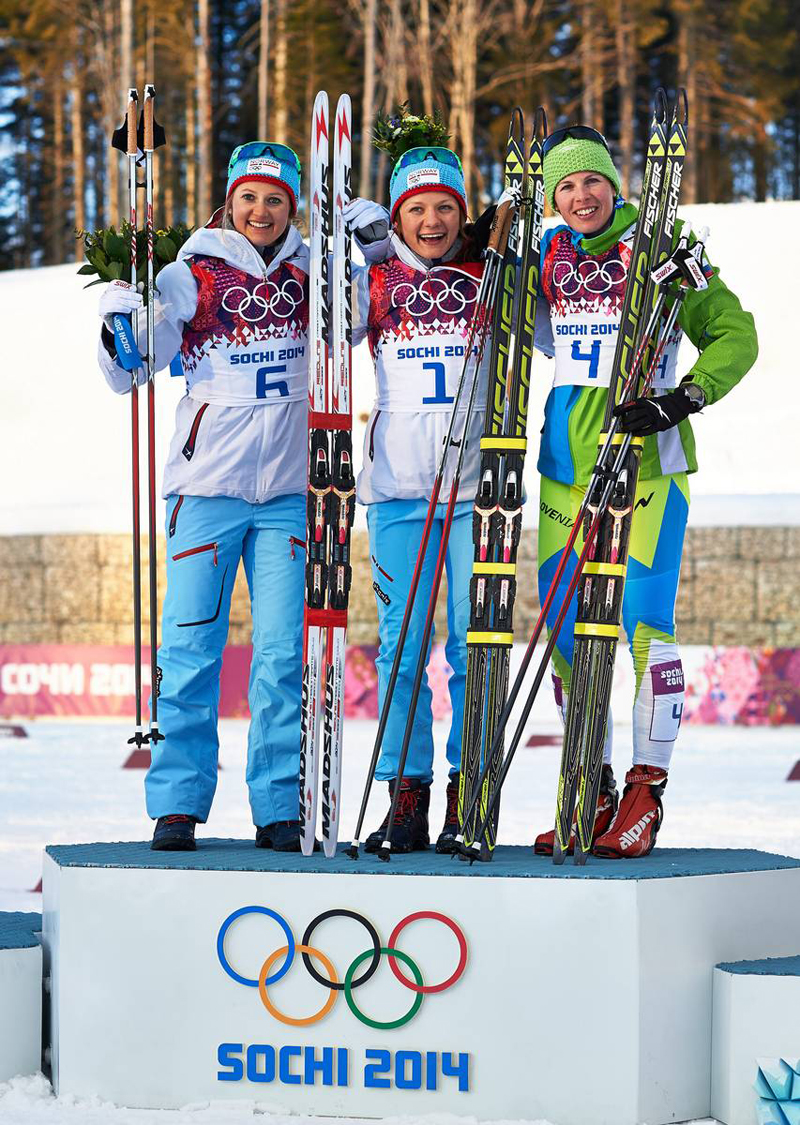
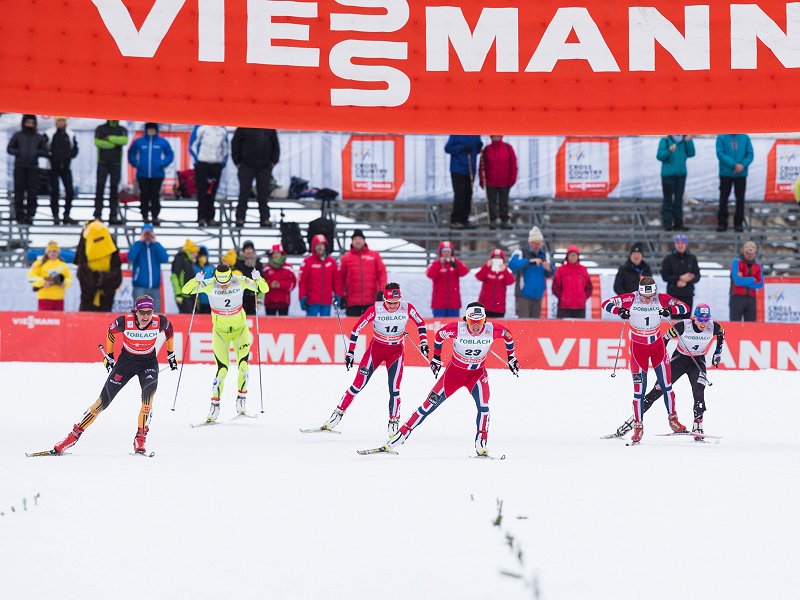
Maiken Caspersen Falla (front left) edges Norwegian teammate and sprint rival Ingvild Flugstad Østberg in the women’s World Cup freestyle-sprint final on Saturday in Toblach, Italy. Falla won by 0.17 seconds, Østberg was second, and Sweden’s Stina Nilsson (not shown) placed third and another Swede Linn Soemskar (also not shown) placed fourth. Two Germans Hanna Kolb and Denise Herrmann (at left) placed fifth and sixth, respectively. (Photo: Fischer/NordicFocus)
Two Germans. Two Norwegians. Two Swedes. These national pairs composed the women’s World Cup 1.3-kilometer freestyle sprint final on Saturday in Toblach, Italy.
It was Norway who took the lead from the start, with 25-year-old Ingvild Flugstad Østberg pulling her teammate Maiken Caspersen Falla, along with the Swedish duo Stina Nilsson and Linn Soemskar.
Østberg remained in front for the first downhill of the 600-meter lap course, followed closely by Falla and Nilsson.
Coming off last weekend’s skate-sprint victory in Davos, Switzerland, 22-year-old Nilsson stuck with the two Norwegians until the final climb of the two-lap course. Last Sunday in Davos, Nilsson shared the podium with the two Norwegians, with Falla in second and Østberg in third.
Norway’s Maiken Caspersen Falla (2) leads her quarterfinal with (from left to right) Switzerland’s Nadine Faehndrich, Laurien van der Graaf, Italy’s Greta Laurent, Russia’s Natalia Matveeva, and American Sophie Caldwell (10) on Saturday in the women’s World Cup freestyle sprint in Toblach, Italy. (Photo: Fischer/NordicFocus)
With one last uphill to go, Falla, 25, took the lead from her teammate while Nilsson moved from third to second.
As the trio descended the final downhill into the stadium, Falla maintained herposition in front, while the battle for second ensued between Østberg and Nilsson.
Rounding the final turn into the 50-meter straightaway, Nilsson attempted to go wide on the the outside corner to get around Østberg and Falla. The Swede’s tactical maneuver, however, didn’t match Østberg’s raw speed.
The Norwegians went 1-2, with Falla winning the final in 2:47.28 minutes, just 0.17 seconds ahead of Østberg in second. Nilsson crossed the line in third, 0.61 seconds after Falla.
“It’s great to be on top again,” Falla told FIS after her second sprint victory of the season. She also won the classic sprint opener late last month in Kuusamo, Finland. “It was a … battle last week and again this week. I think it will be a great battle all season.”
Østberg said she had to be happy with second.
“I had really bad last 100 meters in Davos. I was focused on having a good finish here,” she told FIS. “If it was 20 meters longer I think I could have fought with Maiken for victory. I have been fourth [in the Kuusamo classic sprint], third [in Davos] and second. I am going to be dangerous next time.”
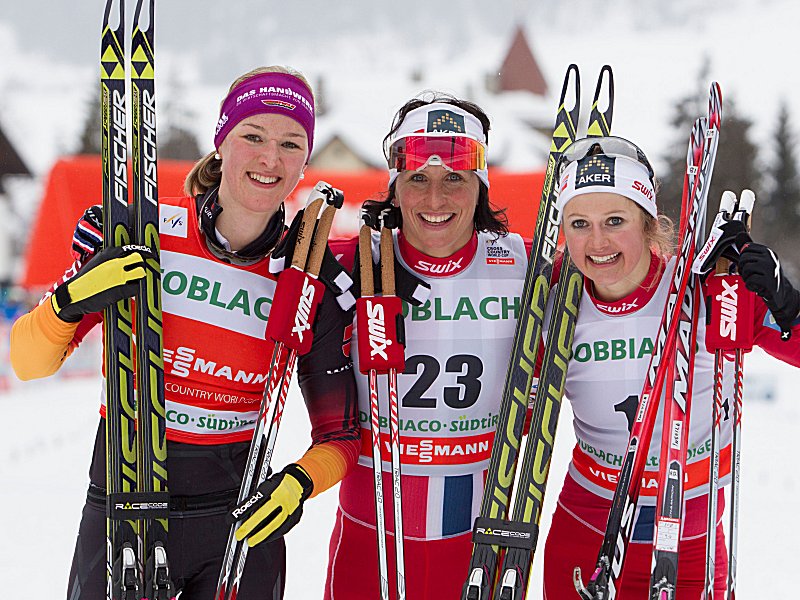
The top-three women in Saturday’s World Cup freestyle sprint in Toblach, Italy, with Norway’s Maiken Caspersen Falla (c) in first place, Ingvild Flugstad Østberg (r) in second, and Sweden’s Stina Nilsson (l) in third. (Photo: Fischer/NordicFocus)
Rounding out the top six in the final was Soemskar in fourth (+1.31), Germany’s Hanna Kolb in fifth (+1.59) and Denise Herrmann, also of Germany, in sixth (+2.31).
During a post-race interview with German broadcaster ZDF, Kolb commented on reaching the final. The 24-year-old German had done so twice before in the skate sprints at the 2013 and 2014 editions of the Tour de Ski, where she placed fourth and fifth, respectively.
“I am a little relieved that I was able to do it [reach the final] because it was a crazy amount of training throughout the summer,” Kolb said. “And in sprints, often small details are decisive. That it finally worked today makes up for all the effort.”
For Herrmann, it was her first appearance in a sprint final this season for her best result so far this winter.
“I am just happy that it worked out again to reach the final, because the start of the season was not good for me,” she told ZDF. “Step by step, I will try to tie it up to [past] results.”
Two U.S. Women in Top 10
Sophie Caldwell (U.S. Ski Team) racing to 10th in the qualifier at the women’s World Cup freestyle sprint in Toblach, Italy. She went on to place seventh overall after making it to the semifinals. (Photo: Fischer/NordicFocus)
Although there wasn’t an American pair in the final, two U.S. women ended up in the top 10.
Sophie Caldwell, 25, of the U.S. Ski Team took seventh overall, after qualifying in 10th, 3.23 seconds behind Østberg, the fastest qualifier in 2:49.45.
Caldwell went on to place second in her quarterfinal, 0.13 seconds behind Falla, before missing advancing beyond the semifinals by eight-hundredths of a second. She finished fourth in her semifinal behind Falla, Nilsson and Kolb, respectively, with Kolb finishing third and advancing as a lucky loser, 0.45 seconds behind Falla.
Their semifinal, with Falla setting the pace and finishing in 2:46.31, turned out to be the fastest women’s heat of the day. This was perhaps expected with players like Falla and Nilsson in the same semifinal.
“My semi final was really close and I knew there were a lot of fast skiers in it, so I had to make every second count in order to fight for a top two place or a lucky loser place,” Caldwell wrote in an email.
She tucked into fifth on the inside of the second large climb, alongside Kolb, Norway’s Heidi Weng, and Laurien van der Graaff of Switzerland. Nilsson attempted to split from the group on the second-to-last downhill, only to be reeled back in by Falla in second Caldwell, who had moved up to third. Meanwhile, Kolb closed in behind them.
The turn into the finishing stretch became a tossup, as Nilsson cut into the center lane, Caldwell went to the inside left and Kolb accelerated to the right of Caldwell.
“I moved into a great position coming into the last downhill, but things got a little jammed up coming into the last corner and I moved back to fourth,” Caldwell explained.
Caldwell and Kolb lunged at the line, but the German snatched third, and ultimately the lucky loser ticket to the final. Last week in Davos, Caldwell advanced as a two-time lucky loser to the sprint final, where she placed sixth.
“I was psyched with every aspect of today,” Caldwell wrote on Saturday. “Mentally I feel like I’m skiing with more confidence and my goal is to ski like I belong in front of each heat and not to just hope that I move on.”
Not far behind, Sadie Bjornsen recored her first top 10 of the season in ninth (after five consecutive top-20’s in as many individual World Cup races this season). She qualified sixth (+1.48), placed second in her quarterfinal, 0.28 seconds behind Østberg, and went on to finish fifth in the second semifinal — 0.46 seconds behind Østberg, who won that heat as well.
Like her teammate Caldwell, Bjornsen was also mere fractions away from making the final.
“Skate sprinting has always been a gamble for me in the past. 50% of the time I make the heats, 50% of the time I don’t qualify,” Bjornsen wrote in an email after the race.
On Saturday, the odds seemed to be in her favor.
“It started with my best qualifier ever, and advanced into some fun heats and skiing. I felt really good out there, and just missed the finals by a touchable hair,” she wrote. “But each week I am feeling more confident and excited about sprint racing.”
Sadie Bjornsen (U.S. Ski Team) racing to her best-ever sprint qualifier in sixth at the World Cup freestyle sprint in Toblach, Italy. She went on to make the semifinals and place 10th overall. (Photo: Fischer/NordicFocus)
In her quarterfinal, Bjornsen, 26, chased down two Norwegians, Østberg and Kathrine Rolsted Harsem. The three battled it out into the finishing straight, where Bjornsen chose the outside line in an effort to move into the top two.
Østberg outskated the two for the quarterfinal win in 2:47.34, while Bjornsen outlunged Harsem by two-hundredths of a second to move on.
In her semifinal, Bjornsen faced off against Østberg, Soemskar, Herrmann, Russia’s Natalia Matveeva, and Finland’s Krista Parmakoski. Østberg flew out of the start to take the lead, while Bjornsen hung in fourth as they approached the first climb.
Descending back into the stadium during the final downhill, Bjornsen leapt into third, behind Østberg in first and Herrmann in second. With 50 meters to go, Soemskar snuck into the mix, along with Matveeva.
In a lunge for the line, Soemskar placed second, 0.22 seconds behind Østberg, and Herrmanb took third another 0.02 seconds back. That close finish gave Herrmann the final lucky loser spot in the final, while Matveeva placed fourth (+0.44) and Bjornsen was fifth (+0.46) behind them.
“It might’ve been Sadie Bjornsen’s best skate-sprint race of all time on the World Cup,” U.S. Ski Team Head Coach Chris Grover said on the phone after the race.
In addition to Caldwell and Bjornsen, U.S. teammates Jessie Diggins and Ida Sargent also qualified for the heats and went on place 22nd and 28th overall, respectively, after finishing fifth and sixth in the same quarterfinal — the first one of the day.
“Great to have six athletes qualify for the heats again, but not really a big surprise,” Grover said in a USSA press release, referring to the four women and two men (Simi Hamilton and Andy Newell) who qualified on Saturday. “The women skied great. Sophie must have been mere hundredths from going through to the finals again as a lucky loser. She executed her race plan perfectly all day.”
In an email, Sargent called her qualifier “decent … although I felt a little flat and had trouble getting going,” the 27 year old wrote after qualifying in 24th (+5.71). Diggins qualified in ninth (+2.98).
“Seeing Simi ski so well and end up on the podium was incredible,” Sargent added, referring to Hamilton’s second-place finish for the U.S. men. “Even if it was a tough day for me personally it was an awesome day for the team, so I’m leaving the day feeling excited and inspired.”
“We’re really gaining momentum and it’s a big lift for the whole team!” Diggins wrote in an email.
“A big thing for me on a really short and tactical course such as Toblach is to learn to hold my ground and not get pushed around out there,” the 24 year old added. “Rounding the finishing corner, someone actually reached out a hand and shoved me, and in years past, I probably would have fallen down. But I didn’t let it get to me or impact my race, which I’m really pumped about!”
The fifth U.S. woman, Rosie Brennan, 27, narrowly missed qualifying in 35th. She was 1.91 seconds out of the top 30.
“We had great skis today and I felt better than last weekend so now it’s just moving on to tomorrow, which I am very much looking forward to,” Brennan wrote.
On Sunday, the women will race a 10 k classic individual start — the final race before the holiday World Cup break.
The Hanneman brothers, both of which race for Alaska Pacific University, after placing first and second in the men’s SuperTour freestyle sprint on Friday in West Yellowstone, Mont. Younger brother Logan Hanneman (r) won the final for his first SuperTour victory and Reese (l) placed second.
WEST YELLOWSTONE, Mont. – Reese Hanneman spent much of the cold afternoon in West Yellowstone unchallenged on Friday. He cruised to wins in both his quarterfinal and semifinal. However, the challenge came from close to home, as Hanneman led down the final stretch in the men’s final before his younger brother and Alaska Pacific University (APU) teammate Logan powered past him for the win.
After a cold morning with temperatures hovering in the negative single digits, resulting in a two-hour start delay, the men’s field jumped into the first SuperTour race of the season shortly after 11:30 a.m. Nerves were running high as athletes headed out on to the relatively flat 1.3-kilometer course in 15-second intervals to test themselves against the clock and gauge the effectiveness of their summer training.
“The course was in great shape, grooming was perfect,” Reese Hanneman reflected in a post-race interview.
Canadian national-development team member Knute Johnsgaard took the win in the qualifying round in 2:30.9 minutes, 0.72 seconds ahead of defending U.S. national sprint champion Dakota Blackhorse-von Jess of the Bend Endurance Academy.
APU teammates and brothers, Logan, 22, and Reese Hanneman, 25, qualified in third and fourth, respectively, and Canada’s Andy Shields (Thunder Bay National Development Centre) advanced in fifth.
Most of the established elite racers in the men’s field managed to ski their way in to the top 30, earning the right to compete in the afternoon’s elimination rounds.
Dakota Blackhorse-von Jess (Bend Endurance Academy) racing to second in the qualifier on Friday at the SuperTour skate-sprint opener in West Yellowstone, Mont. He went on to place third in the final.
As the rounds progressed, two men skied to comfortable wins in their quarterfinals and semifinals. Reese was one of them and Blackhorse-von Jess was the other, displaying impressive finishing speed to win his quarterfinal by a convincing margin. Johnsgaard and Shields also skied strong through the quarters, as did Matt Gelso of the Sun Valley Ski Education Foundation (SVSEF) Gold Team, after qualifying in 20th. Montana State University’s Forrest Mahlen and Alex Howe (Craftsbury Green Racing Project) also stayed in contention through the semifinals.
When eventual winner Logan Hanneman saw the list for his semifinal, “I thought, ‘Good grief!’ ” he explained. “Mads [Strøm, of the University of Colorado-Boulder], [Ben] Saxton [of Stratton and the U.S. Ski Team], Dakota… I don’t know how this is going to go! That’s a tough group.”
But by the end of the semi, Logan and Blackhorse-von Jess had established themselves as the frontrunners and the finish was almost too close to call.
“At that point, I knew I had a pretty good chance heading in to the final,” Logan said.
When the lucky losers had been sorted out and the start list for the men’s final was posted, Blackhorse-von Jess, Johnsgaard, Gelso, Howe and both Hanneman brothers had reached the final round. Mahlen, Brian Gregg (Team Gregg) and Saxton narrowly missed the cut.
The tension increased as the six men toed the line for the final, with two consecutive false starts due to malfunction with the starter’s pistol.
The start of the men’s final in the 2015/2016 SuperTour opener, the 1.3 k freestyle sprint, on Friday in West Yellowstone, Mont. APU took first and second with Logan Hanneman and Reese Hanneman, respectively, and Dakota Blackhorse-von Jess placed third.
When the gun fired in earnest, Blackhorse-von Jess shot to the front, a move he had used all day.
“If you’re willing to burn your jets early, you can get to that first corner with a lead,” he said afterwards. “It worked for me in the quarters, it worked for me in the semi, and it worked for me last year.”
Several athletes have noted that, on this particular course, there aren’t many spots to pass, which made Blackhorse-von Jess’s strategy successful. Until the final, that is.
“Reese made a really bold move at the bottom of the climb,” Blackhorse-von Jess said. “It’s a risky move, because if you can’t execute it all the way, you can drop from second back to fourth or fifth.”
It worked for the older of the two Hannemans, as Reese moved in to the lead at the bottom of the course’s only real climb.
According to Gelso, who finished fifth, “There was a lot of bumping and grinding in the final. Everyone was amped up and trying to get in to position all the way around the loop.”
“I was thinking that Dakota was the guy to beat,” Reese said. “He’s so consistent. When I saw the chance to get around him at the bottom of the climb, I jumped on it.”
A few skiers back, 22-year-old Logan had been focusing on strategic cornering through the lower “NASCAR” section of the course.
Logan Hanneman (l) leads older brother Reese Hanneman (c) and Dakota Blackhorse-von Jess into the finishing stretch to win the 1.3 k freestyle sprint at the West Yellowstone SuperTour opener for his first SuperTour victory.
“There’s a corner in there, the last corner before the climb… I’d been focusing on taking a little bit wide in the quarters and the semis and had used that move to pass a few guys each time,” Logan said.
In the final, his timing was perfect. “Just after that corner, Reese made his move, and I jumped on with him and got past Dakota,” he said.
When they emerged from the trees at the top of the climb and made the 90-degree turn to toward the finish, it was Reese, followed by Logan and Dakota, with Johnsgaard, Gelso and Howe close behind. A bit of contact between Gelso and Howe slowed the duo, but in the front, a battle for the win was shaping up between the Hannemans.
“I was leading, but I could hear Logan behind me, then I could see the tips of his skis coming up beside me,” Reese recalled. “I knew that he and Dakota were back there, and when it comes to sheer wattage those guys are so powerful, they’re like a couple of bison. Plus, Logan is like 6’3”. On a gradual downhill like the one leading in to the finish, he’s just so fast.”
Crossing the line with a three-meter lead, Logan grabbed his first-ever SuperTour win, coming off of successful college career at the University of Alaska-Fairbanks. Reese joined him on the podium in second, with Blackhorse-Von Jess there as well in third. Johnsgaard skied to fourth, Gelso was fifth and Howe came in sixth.
“I think I may need to stop giving him all my good hand-me-down skis,” joked Reese, who was both satisfied with his own performance and thrilled with his younger brother’s victory.
The West Yellowstone SuperTour continues with the first distance race of the season, the 10/15 k freestyle individual start on Saturday.
Logan Hanneman (l) leads the men’s final into the finishing stretch at the SuperTour freestyle sprint opener in West Yellowstone, Mont. He is followed by Reese Hanneman (second from l), Canadian Knute Johnsgaard (second from r), and Dakota Blackhorse-von Jess (r). Logan Hanneman won, Reese was second and Blackhorse-von Jess placed third.
One of two men’s semifinals on Friday at the SuperTour opener in West Yellowstone: (from left to right) Forrest Mahlen (MSU), Logan Hanneman (APU), Ben Saxton (SMST2/USST), and Dakota Blackhorse-von Jess (Bend Endurance Academy).
Reese Hanneman racing to second in the freestyle-sprint qualifier on Friday in West Yellowstone, Mont. He went on to place second in the SuperTour sprint final behind brother Logan Hanneman.
***
About the Author: Travis followed up a somewhat undistinguished competitive career with the University of Colorado with coaching positions in Steamboat, Boise, and most recently as the Gold Team Coach in Sun Valley. As of 2011, he works with middle school skiers, including his own two boys, and sells second homes to dot-com millionaires in Nordic Town USA: Sun Valley, Idaho.
BSF Elite athlete Jennie Bender crushes the final during Friday’s SuperTour 1.3 k skate sprint in West Yellowstone, Mont.
Jennie Bender (BSF) dominated the first SuperTour of the season on Friday with a sizable victory in the 1.3 k freestyle sprint in West Yellowstone, Mont. (Photo: Bryan Fish/USSA)
Hannah Halvorsen (Sugar Bowl Academy) racing to qualify third in the West Yellowstone SuperTour skate sprint. Halvorsen went on to place second in the final.
The University of Colorado’s Petra Hyncicova qualified 12th in the West Yellowstone SuperTour skate sprint on Friday. She went on to place fifth in the final.
Petra Hyncicova (r) leads Hannah Halvorsen, Cambria McDermott and Caitlin Patterson in the semifinal of the SuperTour skate sprint on Friday in West Yellowstone, Mont.
WEST YELLOWSTONE, Mont.– After a day of skate sprinting on Friday in West Yellowstone, Bridger Ski Foundation (BSF) Elite Team member Jennie Bender stood as the fastest woman around the 1.3-kilometer course at the Rendezvous Ski Trails.
“Jennie was just in a class of her own today. I don’t think anyone could have beat her,” said Canadian third-place finisher, Dahria Beatty of the Alberta World Cup Academy and U23 national development team.
The lone woman to consistently finish first, starting with the qualifier and ending with the final, Bender positioned herself as the woman to beat in the first SuperTour race of the 2015/2016 season.
“I’ve really been working this year on getting a faster qualifier, so I was pretty stoked about my results there,” Bender said after the race.
After winning the qualifier in 2:59.26, 2.44 seconds ahead of Canada’s Jenn Jackson (Thunder Bay National Development Centre), who was the next fastest woman, Bender only got quicker.
“The conditions definitely got faster going into the rounds” said Bender, improving her course time to 2:54.42 in the quarter final, and 2:51.32 in the semi.
Sub-zero temperatures in West Yellowstone resulted in a two hour delay for Friday’s sprint race and slower conditions early on.
With warmer temps into the afternoon, Bender continued to bring the heat through the rounds.
“I usually come alive in the heats. I really like the head-to-head,” the 27-year-old Johnson, Vt., native said with a smile. “It’s a good power course, which was perfect for me.”
BSF elite athlete and bib No. 1, Jennie Bender fist bumps her coach Bernie Nelson before the start of the women’s SuperTour sprint final on Friday in West Yellowstone, Mont. Bender went on to win the final for the first SuperTour victory of the season.
Along with feeling powerful throughout the day, Bender’s tactical race was particularly on.
“Especially with the turns [on course], you don’t want to necessarily be first, but you can’t be far back or else you get dusted,” she explained.
For Bender, this at times meant staying relaxed while letting others lead.
Beatty explained she led their semifinal until the last climb, where Bender passed her on the first corner before it.
“She was just skiing so fast today. It was a fight to stay with her,” Beatty said.
In the final, Bender again chose to stay relaxed and tucked in behind Halverson for the first half of the course. “You can tuck in behind someone and save some energy on those first two downhills,” said Bender during a second in-person interview.
“Hannah lead [the final] and I was second for a while just trying to keep it cool and stay smooth and relaxed until the last half or third of the course” she added.
With a little over the first half of the final completed, Bender decided to make her move in the last third of the course.
“Going around the S-turns I put myself into position and then gunned it a few turns before the last hill,” said Bender.
Finishing close to 50-meters ahead of her sprint final competitors, Bender believed she closed her sprint race stronger than ever before.
“I felt like I was able to punch it harder and sooner than I’ve been able to in the past,” Bender said.
Bender’s impressive performance came, in her eyes, as a prime start to the race season.
“You go into the season and you never really know what picture you’re going to paint,” she said. “So I’m stoked on how things were drawn today.”
The runner-up in the final, 17-year-old Hannah Halvorsen (Sugar Bowl Academy) was pleased with the opening to her season, despite not knowing how her first race would go.
“I went into the qualifier not really knowing what to expect,” she said. “I put in a big week of training — about 22 hours –and that’s a big week for me.
“I felt a little flat [in the qualifier], but I knew I skied smart and hard,” Halvorsen added. She qualified third, 3.73 seconds behind Bender. “When I saw where I was in the qualifier, I decided to just stay as smooth and relaxed as possible and take the heats one by one.”
During her semifinal, Halvorsen edged out Czech and University of Colorado-Boulder skier Petra Hyncicova for first.
“It was tight,” Halvorsen recalled. “I knew that I just needed to stay in second [to advance] so I was working with her. I saw it as an advantage because she was pushing me.”
Hyncicova also advanced in second and went on to place fifth in the final.
Hannah Halvorsen (r) of the Sugar Bowl Ski Academy checks the women’s SuperTour sprint qualifier results on Friday in West Yellowstone. Halvorsen qualified third and went on to place second overall.
Despite her age, Halvorsen showed her experience during and between the rounds.
“I’m the kind of person who wears two down jackets. I’m [also] wearing two pairs of gloves, two buffs, and two pairs of pants. So I double up,” she said.
With second place under her belt, Halvorsen said she’s excited about this season.
“I’m really looking forward to trying to qualify to race in Europe this winter,” she said. “[Today] I was just having a good time with the big girls.”
After starting first in the qualifier, Beatty, 21, ended the day with a podium.
“I was bib number one this morning, which was a new experience for me,” she said.
With no one in front of her, Beatty accidentally started 15 seconds early during the women’s qualifier. “As I went, the [official] and I both realized that we were 15 seconds early, so when I got to the end of the 10-meter double pole [zone] I stopped and turned around,” she said.
Unsure whether or not she was going to be disqualified, Beatty stood waiting near the start until spectators told her to ski.
“I was backwards on the course standing still, looking at the starter like, ‘Uh oh, am I going to be disqualified? What’s going to happen?’ and then eventually everyone on the side was just yelling at me to keep skiing so I turned around and kept skiing,” she said.
Despite a rough start, Beatty qualified 25th, good enough to advance to the rounds and ultimately, the final.
“Skiing in the final was my goal,” she said. “I was hoping to get all four races in.”
While she accomplished her goal, Beatty explained it wasn’t easy.
“On this course, if you’re not in the top two, it’s tough to get around anyone,” she said. “[In] the final I didn’t get out to quite a good start and I knew as soon as I started that that was dangerous and I’d have to fight pretty hard to have a chance to be on the podium.”
Dahria Beatty of the Alberta World Cup Academy racing to third finish during Friday’s SuperTour freestyle sprint in West Yellowstone, Mont. Chelsea Holmes (r) of APU finished fourth.
However, with proper maneuvering, Beatty managed to finish third behind Bender and Halvorsen.
“[There’s] lots of contact with all those corners, which I think all us North Americans lack in our racing when we go to Europe,” Beatty explained of the competitive final.
“On the final corner, Hannah and Chelsea had the inside lines. Since they were still in front, I had to go wide to try to pass,” she clarified in an email.
“For most of the final, I was fourth or fifth. Then in the finish chute I was able to pull into third on the far outside,” Beatty said.
“Hannah did such a good job of getting herself into position early and securing that front spot. It was great to see her finish [in] second.”
Also in the final, Chelsea Holmes (Alaska Pacific University) finished fourth, Hyncicova was fifth, and Cambria McDermott (Montana State University) placed sixth.
Overall, many of the top women felt the race was a good start to the season.
In the words of Bender, “The season is just beginning and I’m just warming up.”
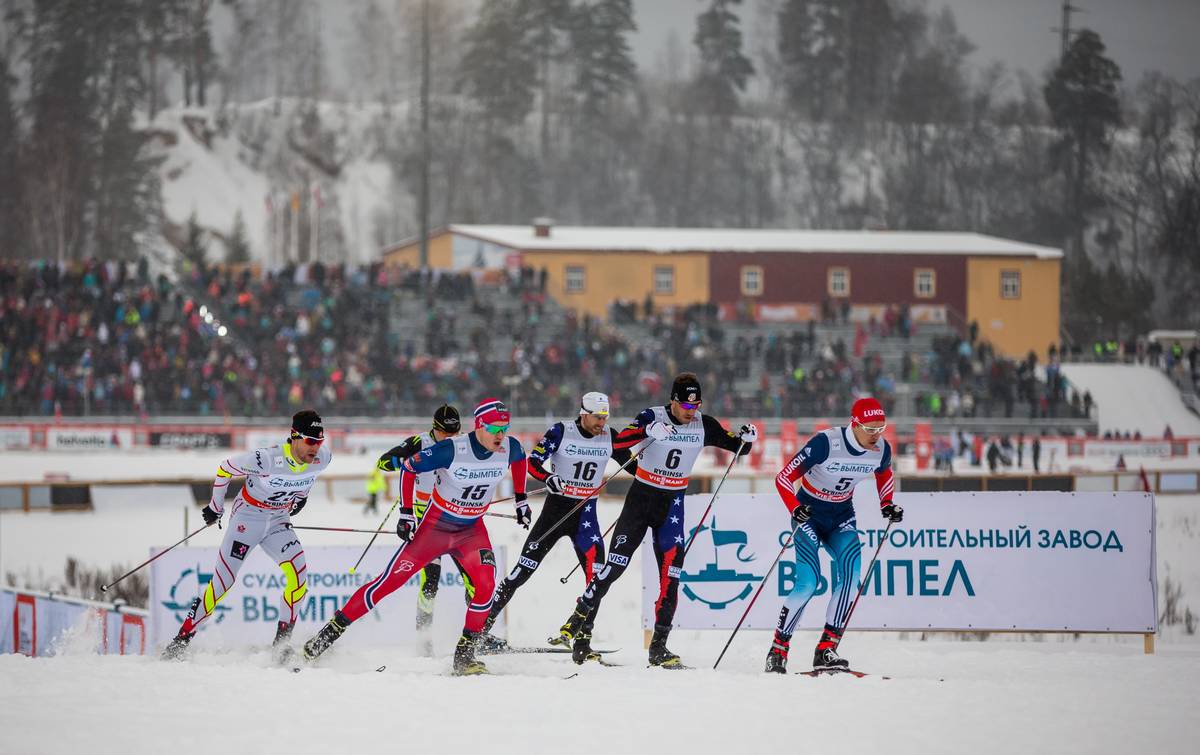
Simi Hamilton (6), Andy Newell (16), Alex harvey (25) compete in a quarterfinal of the 1.3 k freestyle sprint at the World Cup in Rybinsk, Russia. (Photo: Fischer/Nordic Focus)
As Italy’s Federico Pellegrino and a contingent of Russian skiers shined in the 1.3 k freestyle sprint in Rybinsk, Russia, the North American skiers attempted to keep. While three Americans and Canadian Alex Harvey qualified for the heats, no North American skiers made it into the semifinals.
American Simi Hamilton had a strong qualifier, qualifying in sixth and finishing 5.29 seconds behind top qualifier Sergey Ustiugov of Russia (2:41.10).
Hamilton – who placed eighth in the Tour de Ski freestyle sprint in Val Mustair earlier this month – said in a phone interview that he was pleased with how the qualifier went and that the sixth-place result was encouraging.
“It was one of those days where the snow was super soft, and I think in the past I haven’t been able to ski in conditions like that too well … but I think I’m definitely getting better at skiing in those softer snowy conditions,” Hamilton said.
U.S. Ski Team Head Coach Chris Grover said in a phone interview that it had snowed “quite a bit” the night before and the morning of the race. Even though the snow tapered off before the competition began, it made for challenging conditions.
“They re-groomed the course an hour before the competition but it was a really dry snow so and didn’t really bond. It was pretty soft for qualification,” Grover said.
Simi Hamilton competes in the qualifier of Saturday’s 1.3 k freestyle sprint in Rybinsk, Russia. He qualified sixth but ended his day in 17th. (Photo: Fischer/Nordic Focus)
American Andy Newell qualified in 16th (+7.59) and said in a phone interview that he felt decent during the qualifier. However, he was hampered by a neck injury that developed during the World Cup races in Otepää, Estonia, where he finished 17th overall in the classic sprint.
“My neck was all jacked up and I was racing with hot packs taped on there to loosen it up, but it still wasn’t feeling great, and especially across the flats it was hurting a decent amount,” the 32 year old said.
The highlight for the Americans on Saturday was Erik Bjornsen posting his best sprint result ever on the World Cup, taking 20th (+8.64) and reaching the heats for the first time.
The 23 year old wrote in an email that he believed his fitness allowed him to push hard from the start and maintain a consistent pace throughout the race.
“The track was soft so I didn’t feel like I was Superman, but I kept the tempo up and tried to keep it light. It seemed to really work! I was pretty close to some guys I’m usually several seconds behind,” Bjornsen wrote.
Grover was also excited for Bjornsen, saying he beat several sprinter specialists to get into the quarterfinals.
“He looked great in qualifications. People were really struggling but he was really powering so that was really cool. He was stoked, and it’s exciting to get another skier in the men’s sprint points besides Simi and Andy,” Grover explained.
Bjornsen landed in the first quarterfinal heat, and found himself up against eventual finalists Ustiugov, who would take second overall, and Norway’s Emil Iversen.
Bjornsen was never competitive in the heat, writing that he was “a bit of a spectator from the back of the pack.” Iversen won the heat in 2:40.36, with Bjornsen finishing 2.30 seconds behind in fifth. He was 24th overall.
“I see that you have to be … aggressive in the World Cup heats. Not a surprise but something that I will learn from experience,” Bjornsen wrote. “Next time I will be a little less shocked to be there and a little more hungry for a semifinal spot!”
Canada’s Alex Harvey competes in the qualifier of Saturday’s 1.3 k freestyle sprint in Rybinsk, Russia. He qualified 25th and ultimately finished 28th. (Photo: Fischer/Nordic Focus)
Three other Canadians also raced, but failed to qualify. Lenny Valjas was 42nd (+13.00), 1.89 seconds behind the final qualifier, while Jesse Cockney was 47th (+15.57) and Patrick Stewart-Jones was 52nd (+21.29) out of 53 finishers.
Newell, Hamilton, and Harvey all raced in the same quarterfinal, in addition to eventual finalist Nikita Kriukov of Russia.
Hamilton said he felt like he had a great start to the heat, skiing just behind Kriukov. However, he said that he was not aggressive enough on the long flats before the steep climb and let other skiers pass him on both sides.
“Once that happened, I knew that to stay in contention I had to get back by a couple people before the steep climb,” Hamilton explained, adding that he tried to pass France’s Paul Goalabre on the right but was prevented by the soft, powdery snow.
At the start of the climb, Hamilton said that Goalabre accidentally knocked his left ski, causing him to fall on his knees. He got up quickly, but was not able to catch up with the leaders, especially on the fast downhill going into the finish.
Kriukov won the heat in a time of 2:43.77, and Hamilton finished fourth (+1:39), ending up 17th overall.
“I kept my effort up all the way through the finish … but it’s a tough finish, just super soft all the way through the finish lanes which makes for an interesting last 20 or 30 seconds. You ski as hard as you can but you still feel like you’re skiing a 30 k or 50 k because you’re not moving that fast,” Hamilton said.
Grover said Hamilton’s slip was unfortunate, as he was forced to play catch-up and “wasn’t able to demonstrate really where he is.”
Canada’s Len Valjas skied to 42nd in the qualifier of the 1.3 k freestyle sprint in Rybinsk, Russia. (Photo: Fischer/Nordic Focus)
Meanwhile, Newell took fifth in the heat (+2.12) to take 22nd overall.
Newell said that he tried to put himself in a good position while ascending the hill, and was in third at the top. He tried to get in position right behind Kriukov but was unable to secure his position.
“I just got gassed a little bit over the top … I don’t have much power with the way I’m skiing right now,” Newell explained.
He also said his injured neck played a factor in the quarterfinal heat.
“I don’t like to make excuses but I’m not 100 percent when it comes to racing right now … it’s hard to heal and it’s just getting worse some days; sprints and stuff make it worse. So I need to try and heal it up so I can get some hard training in,” Newell said.
Harvey finished just behind Newell to take sixth in the heat (+2.24) and ended up 28th overall.
“It was not a good sprint for me today. I wasn’t in the greatest spot before the climb and got stuck behind a fall. I am now focusing on tomorrow’s 30 kilometer,” Harvey told Cross Country Canada.
As for Sunday’s skiathlon, Bjornsen wrote that it is the race he was most excited for going into this weekend.
“I’m definitely a little tired from the last two races and intervals in the cold on Thursday, but I have nothing to lose out there! Tomorrow is just another opportunity to ski with the fastest guys in the world,” Bjornsen wrote.
However, Newell is planning to sit out the race in order to heal his neck, and Hamilton said his status depends on the conditions.
He said if the recent snowfall sets up before the race and the snow becomes firmer and faster, there is a chance that he will race, but if the snow remains soft and slow he will probably opt out of the race.
After leaving Rybinsk, the American team will have a training camp in Davos, Switzerland, then head to World Cup races in Oestersund, Sweden, before World Championships begin in Falun on Feb. 18.
Kikkan Randall (U.S. Ski Team) led the American squad with a ninth-place finish in Sunday’s World Cup sprint in Davos, Switzerland. She’s pictured here racing to a World Cup win in a 2013 freestyle sprint in Lahti, Finland. (Photo: Fischer/Nordic Focus)
The frustration in U.S. Ski Team Head Coach Chris Grover’s voice was clear after Sunday’s 1.3-kilometer sprint in Davos, Switzerland – on one hand his skiers had demonstrated their strength with strong qualification and aggressive skiing in the heats, while on the other, their potential results were impeded by uncharacteristic falls.
Kikkan Randall led the team with her first top-10 finish of the season in ninth with Sophie Caldwell trailing in 11th. Jessie Diggins and Ida Sargent finished 22nd and 29th, while Simi Hamilton ended his day in 23rd.
“It was a good and bad day for us,” Grover said in a phone interview. “Bad in the sense that I can’t believe we had so many falls. We have some of the most talented cross country skiers in the world and they’re so good on their skis and somehow everybody was stumbling today.”
Even with the tumbles, the day proved to be a step in the right direction for the USST as they build their results through the season. In year where the team has aimed to start the season slow and faced illness and injury, Sunday’s results demonstrate the potential for continued progression.
“It was good in the sense that people who have been struggling to come back from injury or from illness or fatigue were moving a lot better,” Grover said referring to Randall and Hamilton who have recently battled sickness, and Caldwell who is recovering from a broken elbow she sustained in October.
The USST’s top finisher in ninth, Randall, started her day feeling better than she had all season. Earlier in the week she struggled in a intensity workout on the sprint course, but come sprint day Randall was ready to go.
“I had some better feelings this week compared to last week. Race prep yesterday felt a little better so I was optimistic to take another step forward today,” she said in a phone interview.
“I was really happy with the way I felt in qualifications and I could tell I definitely made a big step forward,” she added, referring to her 9th position in qualification.
Randall and teammate Sargent, who earned a fifth in November’s Ruka sprint, were placed in the same quarterfinal heat. Joined by Swiss sprinter Laurien van der Graaff, Heidi Weng of Norway, and Claudia Nystad of Germany, the Americans took off with Randall sitting in second up the first hill.
Randall soon found herself near the back of the pack after failing to give a full effort over one of the course’s many hills. It was there that Sargent made a tactical move and advanced into second position.
As the pack entered the stadium for the second lap of the quarterfinal, Randall saw an opportunity to move forward, but in the process she tangled with her teammate.
“I had a good line on the inside coming through the lap and I saw and opening to get to the outside,” Randall explained. “I felt like I barely grazed someone, I didn’t realize it was Ida but I knew I needed to have a good lane up the uphill. It ended up working out well.”
Once in a strong position, Randall and van der Graaff maintained a lead over the other women and cruised across the line to advance to the semifinals.
Sargent did not fare as well. After the small tangle with Randall she fell back to fourth. As the group climbed the next hill, she and Weng crossed skis resulting in a faceplant for Sargent and an eventual sixth place finish in the heat.
“I came in last in my heat but I guess that’s sprint racing,” Sargent wrote after the race. “[It] gives me motivation for the next one.”
Meanwhile, the next quarterfinal featured Caldwell, Norwegian Ingvild Flugstad Østberg, and 2010 Olympic Champion Charlotte Kalla of Sweden.
Caldwell watched Østberg charge to a convincing victory the previous week in the same event, and decided that her best chance at advancing was sticking with the Norwegian.
That’s exactly what she did, and from the start of the gun the two skiers were well ahead of the four other women in the heat. But going all-out from the start took its toll on Caldwell as she started to fade just as Kalla began to pick up speed.
“I told Gus [Kaeding] that my strategy was to stick with Ingvild until I blew up, and that’s exactly what I did. I blew up on the second hill,” she said in a phone interview.
Despite losing ground, Caldwell held onto third place behind Østberg and Kalla. The heat was fast enough to earn her a lucky loser spot in the semifinals with Randall.
The only Americans to land in the semifinals, Randall and Caldwell had their eyes on a visit to the final – but events didn’t unfold the way the two had planned.
As the racers moved up the first hill Caldwell fell, taking the 24-year-old out of contention.
“I honestly have no idea [what happened],” she said. “I don’t think it was related to anyone else. I don’t know if I pulled between my legs or hit an icy patch, but I was in a pretty good position going up the hill, and the next thing I knew I was just on my knees and the pack skied away.”
With Caldwell out of the picture Randall sat near the back of the pack of five women, waiting to make her move. The opportunity came on an icy corner where she attempted to take a wide turn and use the momentum to accelerate past her competitors.
Instead she found herself on the ground.
“I was set up and I started to look up to decide where I wanted to make a move. Right then I hit ice and my feet went out from under me. I went from ‘ok, I’m in a good position’ to ‘oh, now I’m down,’” she said.
After the fall, it was clear that Randall had lost her momentum and any chance of advancing. She and Caldwell eventually skied together, and took fifth and sixth positions.
Randall was disappointed the fall prevented her from achieving her full potential, but was pleased to feel like her old self again.
“It was a bummer to fall because the feelings were a lot stronger today. I could have been in the fight to move into the final, and in the final anything can happen. I was just really happy that I felt more like myself today. You don’t realize how bad you were feeling until you start to feel good again. I’m happy the trajectory is going uphill,” she said.
“It was a weird start to the season so I’m glad to be feeling like I am coming back,” she added.
Caldwell demonstrated that she’s made a near-full recovery in terms of fitness and racing.
“I was trying not to think about results at all [earlier this season], but it’s never fun to be that far back, and I was just thinking ‘oh God, am I ever going to get back there this year, and how long is it going to take,’” she said of the first weekends of World Cup racing. “I’ve just taken big steps the last two weekends, and that helps a ton with my confidence.”
Diggins was the other U.S. woman to qualify for the heats in 17th. Diggins prefers to race longer courses that provide opportunities to pass, which made Sunday’s race a challenge for the Minnesota native. Given all the factors, she said was pleased with her qualification.
“I went into it with a plan for every inch of the course, and I was able to execute the plan and finally qualify. So that felt really good to be able to go into it saying, ‘okay, here’s what I need to work on, here’s what I’ve practiced for,’ and then have it turn out,” she said of her qualification.
Diggins was the only U.S. skier in the finals who did not fall, but on a final hill in her quarterfinal she and Maja Dahlqvist of Sweden collided which slowed her progress and eventually led to her fifth place finish in the heat.
In the men’s race, Hamilton was the lone U.S. male to qualify for Sunday’s heats. While the illness that kept him from racing in the previous weekend’s sprint had run its course by Sunday, Hamilton said he still wasn’t feeling 100 percent.
Qualifying 14th, Hamilton skied the beginning of his quarterfinal with confidence and strong tactics. Near the front of the pack, Hamilton was waiting for a moment of weakness from the heat’s leader, Emil Jönssen of Sweden. The opportunity came as Jönssen faded the course’s final hill.
That’s when he became a victim to yet another USST fall.
“I think it was that and a combination of hooking my right tip in a little bit of the softer snow that was on top of the ice. It just caught me and I rocked forward. Before I even knew it I was down on all fours,” he said.
While Hamilton was eventually able to recover to fifth position in his heat, the placement was far from advancing to the semifinals.
“I think that in 90% of sprint days, little things happen that throw you off your game. What makes really good ski racers is being able to move past those little things,” he said, explaining that the “little things” for him on Sunday were his health and his fall.
While Hamilton believes he was far off his mark, the result gives him confidence as he heads into the short break before the Tour de Ski.
“You keep plugging away, if you’re patient and confident, sooner or later it’s going to pay off,” he said.
Grover said that there was no particular reason for his team’s abundance of falls, and chalked it up to bad luck.
“These are typically athletes who don’t fall – Kikkan was trying to remember the last time she had a fall in a sprint. I think it just happened to be some bad luck for a number of people out there,” he said.
Grover said the team was sitting in a good position as they take a short break before partaking in the Tour de Ski in January.
“I think we’re feeling really optimistic about the team’s shape at the Tour de Ski. Right now everything is pointing to catching up with the competition. It’s been a slow start but we’re starting to pick up some momentum,” he said.
Caldwell summed up the team’s sentiment, explaining the day’s results show the she and her teammates are on the right track.
“It definitely leaves us wanting more, it’s a bummer we all fell, but I think it’s a boost of confidence – that’s how we felt today, knowing our potential,” she said.
The majority of the of the USST will remain in Davos for Christmas, as the rest of central Europe is facing a lack of snow. Sadie and Erik Bjornsen will head to France for the Holidays.
Racing returns January 3, with the Tour de Ski 3/4 k prologue in Oberstdorf, Germany.
The women’s World Cup 1.3 k freestyle sprint podium on Sunday in Davos, Switzerland: Norwegian winner Marit Bjørgen (c), Swedish runner-up Stina Nilsson (l) and Norway’s Ingvild Flugstad Østberg in third. (Photo: FIS Cross Country/Twitter)
How much did Marit Bjørgen have left and could anybody beat her?
Coming off her incredible 10-kilometer display on Saturday, the 34-year-old Norwegian was a huge favorite to win Sunday’s 1.3 k freestyle sprint in Davos, Switzerland. Last week, the first go-around in Davos, the Norwegians dominated the freestyle sprint, completing yet another podium sweep.
Ingvild Flugstad Østberg won that race and she was out to prove again that her result last week wasn’t because Bjørgen had an off day. However’ Sunday’s course was different from a week ago, with a two-lap, 650-meter course featuring two big climbs and a combination of manmade and natural snow.
There was a lot of ice on the turns leading to some interesting technical downhill turns. In a pre-race interview on Eurosport, American Kikkan Randall said, “The final turn coming into the finish line will cause some spills.” In qualification, there were several of those to reiterate her point.
The first of five quarterfinal races featured Bjørgen — the fastest qualifier in 2:37.59 — Germany’s Denise Herrmann, Italy’s Gaia Vuerich, Sweden’s Linn Soemskar, and Finland’s Anne Kyllönen and Krista Parmakoski.
Bjørgen took a very aggressive outside line out of the start and double poled her way to the front of the pack headed into the first crest. On the following descent, she was able to pull away, taking Vuerich with her. At the start of the second lap, Herrmann was able to overtake Vuerich, who lost her pace heading to the uphill. The battle for second place let Bjørgen pull away easily taking the quarterfinal win in 2:36.62. Hermann was second, +1.90 behind Bjørgen
The second quarterfinal featured Norway’s Maiken Caspersen Falla, Sweden’s Maja Dahlqvist, Slovenia’s Katja Visnar, Germany’s Sandra Ringwald, Russia’s Natalia Matveeva, and American Jessie Diggins.
At the start, Matveeva dove for the inside line heading into the first climb, but an attack from Falla got the Norwegian out of trouble and up to the front of the pack, followed closely by Visnar, who kept pace with Falla. The pack followed behind but was quickly losing ground heading into the last climb.
On the downhill, the gap between first and second extended, but sitting in third was Dahlqvist who saw an opportunity to catch a slowing Visnar at the finish. Dahlqvist outsprinted the Slovenian in a photo finish for second, one second behind Falla, who won the heat in 2:38.69.
The third quarterfinal featured three Swedes — Stina Nilsson, Hanna Falk and Ida Ingemarsdotter — two Germans, Hanna Kolb and Lucia Anger, and Finland’s Riikka Sarasoja.
Nilsson pushed the pace when the gun sounded followed closely by her Swedish teammates heading up the first climb. On the descent, the icy righthand turn put Kolb in a spot of bother, opening the door for the three Swedish teammates to gather back in front and lead the pack up the second climb. The second descent gave Nilsson and opportunity to open a bit of a gap from Falk her teammate.The Swedish pair crossed the line in first and second, with Nilsson winning in 2:39.71, and Falk finishing 0.15 seconds behind to automatically advance.
The fourth quarterfinal featured Randall and Ida Sargent of the U.S., Switzerland’s Laurien Van Der Graaff, Slovenia’s Vesna Fabian, Norway’s Heidi Weng, and Germany’s Claudia Nystad Germany.
Van Der Graaf took the lead up the first hill followed closely by an in-form Randall. The downhill turn didn’t separate the field like in previous races, and heading back into the second climb it was a six person pack, still led by Van Der Graaff. A podium favorite, Weng was losing pace stuck in fourth headed into the downhill. Van Der Graaff was able to hold everybody else off to win the heat in 2:38.29, followed by Randall, who was nearly caught off guard at the finish by a charging Fabian but was able to sneak by for second (+0.28).
The fifth quarterfinal featured Østberg, Sweden’s Charlotte Kalla, American Sophie Caldwell, Finland’s Kerttu Niskanen, and Slovenia’s Alenka Cebasek and Nika Razinger.
Just like her start from last week, Østberg took a very quick approach to the start and led the group up the hill in first position, while Caldwell followed closely. The two hammered the first 400 meters and built a sizable gap, with Kalla chasing them down in third. On the second climb, Caldwell started to fade as a result of her effort in the first part of the race. Kalla passed her and joined Østberg, finishing just 0.28 seconds behind her. Østberg clocked the fastest quarterfinal time by more than a second in 2:35.05.
The two lucky losers making it into the semifinals were Fabian from heat 3 and Caldwell from heat 5.
The first semifinal featured a lineup that could give favorite Bjørgen her biggest challenge all day. Nilsson, Falla, Fabian, Herrmann and Dahlqvist all lined up alongside of Bjørgen.
The race started off with Bjørgen not taking her usual fast start, possibly waiting to see how it unfolded. As a result, she was fourth up the first climb. In front of her were Herrmann, Falla and Nilsson.
Bjørgen was just waiting for her chance, and an opportunity presented itself on the downhill when Falla stumbled on the icy turn into the finish. This gave Bjørgen room to move into third up the last climb. On the descent, her ski prep essentially got her in perfect position to take the inside line going into the last turn.
With no effort, Bjørgen was able to glide right past Nilsson and attack the corner. After the turn, Bjørgen, Falla and Nilsson were essentially tied heading toward the finish. Falla was in the lead but lost steam and passed by Nilsson a few meters from the finish. Bjørgen closed the last five meters hard and ended up passing Falla in a photo finish. Nilsson’s won the semi in 2:38.96, Bjørgen was 0.15 back in second, and Falla missed advancing just one-hundredth of a second back in third.
The second semifinal featured Østberg, Kalla, Falk, Van Der Graaff, Randall and Caldwell.
As expected, Østberg took a very fast start, surging to the front and out of trouble up the first hill, with Van Der Graaff close behind. Heading into the first turn, Randall lost her footing and took a fall, eliminating her from a shot at advancing to the final.
The leaders attacked heading into the second climb, and Kalla found an opportunity to attack Østberg on the downhill and eventually passed her when Østberg let up a bit into the corner. Kalla was able to hold her off to the finish, winning in 2:36.7. Østberg was second, 0.64 seconds behind, and Randall finished fifth, almost 12 seconds out, to end up ninth overall.
The two lucky losers came from the second semifinal as a result of pace Østberg set. Falk and Van Der Graaf advanced.
This set up an incredibly fast final with two Norwegians — Bjørgen and Østberg — and three Swedes — Nilsson, Kalla and Falk — and Van Der Graaf. The question was, how much energy did Bjørgen have left?
Just like her previous heat, Bjørgen initially sat back without losing site of Nilsson, who took the lead to the first hill. Bjørgen took a wider line and positioned herself next to Østberg. The pair led up the hill and stayed together down the backside and into the first turn.
At the end of the first lap, Bjørgen outpaced Østberg and lead up the hill. Nilsson was third up the hill, but Østberg lost all of her energy trying to match the pace Bjørgen set up it. Nilsson passed the second Norwegian before they got to the top.
Bjørgen knew Østberg was suffering, and attacked, taking Nilsson with her. The 21-year-old Swede tried to match Bjørgen’s pace, but simply couldn’t. Bjørgen easily skated away and across the finish line for yet another World Cup win in 2:35.86. Nilsson placed second, 0.55 seconds later, and rounding out the podium was Østberg, 1.12 back in third.
Kalla finished fourth (+2.31), Falk followed in fifth (+5.3) and Van Der Graaff was 12 seconds back in sixth.
In her post-race interview Bjørgen said she “didn’t feel so good in my semifinal so it was a surprise to feel so strong in the final. I am happy to win both races this weekend and I am looking forward to the Christmas holiday and to prepare for the Tour de Ski. “
This was also Nilsson’s first-ever skate podium and third individual podium, which she “was so excited about.”
“I executed my tactics as I planned,” Nilsson said. “I wanted to attack on the last climb. I wanted to be closer to Marit but she was too fast. “
Heading into the holiday break Bjørgen in the overall World Cup lead has a 321 point advantage over her teammate Therese Johaug, who did not race on Sunday.
Perianne Jones was close — just 0.22 seconds from qualifying in the women’s World Cup 1.3-kilometer freestyle sprint to be exact.
So was Jesse Cockney, who was 0.68 seconds outside the top 30 in the men’s 1.5-kilometer sprint in 34th.
Both are Canadian Development B-Team members, and both were a few places and tenths of a second away from getting more racing time on Friday in Lillehammer, Norway.
“I wanted to make sure I finished today and felt like I left it all out there,” Jones, 29, wrote in an email after placing 33rd. “Last weekend I skied so terribly that I didn’t feel like that at the end, so that was a step in the right direction.”
In the World Cup opening classic sprint in Kuusamo, Jones placed 48th, 4.38 seconds out of 30th. Considering that, Friday was an improvement.
“Of course I would have liked to be in the heats, being that close is hard, but at the same time encouraging because I was so close,” she wrote.
Jones hadn’t raced since last Saturday’s classic sprint, opting out of the distance race to get a full week of recovery.
“If this had been a regular weekend race instead of a Friday race I probably would have raced the distance race in Kuusamo, but I just didn’t want to risk feeling crappy today,” she explained.
“I will for sure race tomorrow.”
As for Sunday’s 10 k classic pursuit, she added that she was taking it one day at a time.
In his first World Cup of the season, Cockney, who placed 13th in a Norwegian Cup Gala classic sprint and 39th in a 10 k classic last weekend, explained his two races there were “great prep” for Lillehammer.
“It’s been all good here the last week with some good training at Sjusjoen, just outside of Lillehammer,” the 25 year old wrote in an email. “I’m not doing anything differently to transition from domestic circuits to the World Cup so it’s fairly business as usual in that sense.”
Warming up on Friday morning felt normal, he added. “I felt like I had some speed to use today,” he wrote.
“I thought my qualifier was good but with a field like this in Norway, it has to be perfect to get to the heats. I’m happy with the feeling and I did everything I could but pretty bummed about being on the wrong side of a close race.
“I skied hard and gave everything that I could but maybe I need to ski a bit more like my job is on the line because at the end of the day it actually is,” he added. “Some more desperation may go a long way to putting me in the heats.”
Like Jones, he plans to race Saturday’s freestyle individual starts — 5 k for the women and 10 k for the men — after which he will decide whether he’ll start Sunday’s 15 k pursuit.
“Some more desperation may go a long way to putting me in the heats.” — Jesse Cockney, 34th in Lillehammer 1.5 k freestyle sprint qualifier
Alex Harvey was Canada’s lone male qualifier in 22nd. He went on to finish a season-best fifth in the final.
Lenny Valjas finished 45th in the preliminary round, 2.65 seconds from qualifying. Devon Kershaw placed 64th, Graeme Killick was 94th and Ivan Babikov was 110th out of 119 men.
“I was feeling good warming up to be honest. Kind of like last weekend before the sprint qualifier,” Kershaw wrote in an email. “In the qualifier though, not feeling as good. Just not able to hold the technique I wanted deep enough into the hills (switching to offset too early).
“Once that started happening, perhaps I started to scramble too much and I did a poor job over the tops of the climbs — I wasn’t snappy or peppy enough to create enough speed into the descents,” he added. “It wasn’t a stellar day of sprint qualifying.”
Kershaw described the course as a “good, honest and hard course,” excellent for a sprint.
“Climbs, turny descents, some flatter terrain and probably most importantly, room to pass if you were strong,” he wrote. “I didn’t ski fast, but once upon a time I would have loved a course like this! I wanted to race the heats badly because I thought it really would suit me. I am just not fast enough on my own yet to put that last statement to practice.
“I guess I am still carrying fatigue from the training load, or perhaps I’m just getting slower in my old age — I don’t know. I do know I’m not totally ready to give up on the sprints yet — but I am taking my knocks that’s for sure.”
His goals for the weekend remain unchanged, he wrote, and he’s excited for Saturday’s 10 k skate and will focus on some technical tasks during that.
“Of course I am most excited about Sunday’s 15km classic. It’ll be pretty much a mass start — or at least there will be big groups to ski with,” Kershaw added. “The course is really challenging, but I felt good last weekend in Kuusamo on a challenging course in classic, so I am for sure excited and more confident in that distance/discipline at the moment. I am very thankful that the sprint is out of the way now and I can focus more on the distance racing for the weekend which has been feeling better for me by miles than the short, fast sprints.”
The second Canadian woman in Friday’s sprint, development-team member Emily Nishikawa placed 76th.
Norway’s Marit Bjørgen (yellow bib) leads teammates Maiken Caspersen Falla (l), Heidi Weng (behind) and Celine Brun-Lie (r) into the finish of the women’s 1.3 k freestyle sprint final on Friday at the Lillehammer World Cup mini tour in Norway. Bjørgen dominated every heat from the qualifier on to win the final by 0.76 seconds. (Photo: Fischer/NordicFocus)
Change happens. After four-consecutive seasons of the World Cup opening with the Ruka Triple in Kuusamo, Finland — all of which Marit Bjørgen won outright — Lillehammer, Norway, became the new host of the first mini tour of 2014/2015. And it opened with freestyle sprints on Friday.
Luckily for Bjørgen, skiing on home snow wasn’t a problem. It actually worked out for her quite nicely in the women’s 1.3-kilometer skate sprint. The overall World Cup leader since last weekend, Bjørgen (who won the opening classic sprint in Kuusamo) steamrolled the competition for her second-straight World Cup sprint victory on Friday afternoon.
Overall World Cup leader Marit Bjørgen (Norway) celebrates her second-straight sprint win in the first freestyle sprint of the season on Friday in Lillehammer, Norway. (Photo: Fischer/Nordic Focus)
“It is always fun to win. That’s what you train for,” she told NRK after the race. It’s a good thing it doesn’t get old.
To say she was a favorite would be an understatement — but there are never sure-things in racing. Most would put American Kikkan Randall right up there with her, after Randall’s won seven of the last 13 World Cup skate sprints, but it became apparent early on that showdown wasn’t going to play out in Lillehammer, at least not today.
Randall failed to qualify for the rounds after placing 43rd in the morning prelim. She was 12.48 seconds behind Bjørgen, the fastest woman’s qualifier, and 1.63 seconds outside the top 20.
The last time Randall missed out on the heats in a World Cup sprint was four years ago in Kuusamo— and that was a classic sprint. In 2009 in Lahti, Finland, she placed 47th in a freestyle sprint.
“My race shape is not quite 100% yet, and, in combination with battling a cold this week and possibly some tough skis for our team today, I missed advancing to the quarterfinals for the first time since spring of 2009,” Randall wrote in an email. “While this is not what we were all hoping for today, the good news is we get right back at it tomorrow with an individual start skate race. … I always love another chance to get out there and fight again!”
With Randall out of the picture (and Poland’s Justyna Kowalczyk out of qualifying in 37th), the next question to be answered was which Norwegian would win the day and by how much. After the morning qualifier, Bjørgen appeared primed for the heats, yet eight of the top 10 women were her teammates, or at least skiing for Norway. In total, 13 of the top 30 qualifying spots went to Norwegian women.
The quarterfinals started off with Bjørgen setting the early pace in the first heat, winning in 3:01.38. Of the five quarterfinal heats, her winning time was fourth-slowest. The fastest quarterfinal belonged to Norway’s Heidi Weng, who won the third heat in 2:59:55, 0.35 seconds ahead of Germany’s Denise Herrmann. In the fourth quarterfinal, Norway’s Therese Johaug pushed the pace up the final long climb back up to the stadium, but didn’t have quite the sprint kick in the finishing stretch and placed third, about half a second behind teammate Ingvild Flugstad Østberg in first (3:02.94) and 0.3 seconds back from Sweden’s Ida Ingemarsdotter in second.
The first women’s semifinal was stacked with three strong Norwegians: Bjørgen, Weng and Celine Brun-Lie, who took second in the second quarterfinal to Norway’s Mari Eide.
Bjørgen set a blistering pace in her semi, treating it more like a final than a qualifying round. She had skied similarly in the quarterfinal, controlling the pace and leading out of the start, but this time, she was out for a definitive win and the fastest time as well. She lead from start to finish and held off Weng by 0.14 seconds in 2:56.42.
Brun-Lie finished third in that semifinal, but moved on a lucky loser with a fast-enough time, along with Slovenia’s Katja Visnar in fourth.
The second heat showcased Norway’s Maiken Caspersen Falla, the winner of the fifth quarterfinal, and Herrmann. Falla beat out Herrmann in the photo finish in 3:01.51. Leading the race with Falla into the stadium, Østberg narrowly missed out on the final in third (+0.33). Ingemarsdotter dropped off the pace late to finish outside the top three, but nipped Norway’s Ragnhild Haga in a another photo finish for fourth (+2.12).
Of the six women in the final, four were Norwegian: Bjørgen, Weng, Brun-Lie, and Falla. Visnar and Herrmann toed the start line with them.
Now the question was how much energy Bjørgen had left after her rocket-fast semifinal. That was easily answered immediately after the start. She flew out of the gate and never looked back, as Weng led the initial chase, followed by Falla and Brun-Lie. Not far behind them on the first hill, Herrmann and Visnar appeared to conserve at the back.
Halfway through the final, it became clear that the two non-Norwegians simply couldn’t catch the four-woman train ahead of them. Bjørgen continued to lead the charge, with Falla, Weng, and Brun-Lie in tow at the bottom of the last grueling hill. By the top, Bjørgen remained in front, letting the teammates behind her duke it out for the remaining podium spots.
The all-Norwegian women’s skate-sprint podium on Friday in Lillehammer, Norway: winner Marit Bjørgen (l), runner-up Celine Brun-Lie (r) and Heidi Weng (c) in third. (Photo: Fischer/NordicFocus)
Bjørgen won it in 2:55.71 by 0.76 seconds over Brun-Lie, who edged Weng in a photo finish for second. Four-hundredths of a second separated the two, and Falla completed Norway’s top-four sweep in fourth, 1.43 seconds behind Bjørgen. Visnar took fifth (+4.43) and Herrmann finished sixth (+7.57).
Shortly after, FIS Media Coordinator Jeff Ellis was at a loss for words interviewing Bjørgen on camera. “We’ve done this many times. What would you like to answer today?” he said.
“I am very happy today. I was good in the prologue and also in the heats,” she responded. “Thanks to our men in the waxing cabin, it’s amazing how our skis have been in the last week and also this weekend. The shape is very good and today I feel very fast also.”
It was her 84th World Cup win (including stages), according to FIS, and Brun-Lie’s first World Cup podium since two seasons ago in Sochi, Russia.
“It’s been a long time since my last podium,” Brun-Lie told FIS. “I am very grateful for the support I got from the people around me.”
“I’ve had so many downs in recent years,” she told NRK while tearing up, according to a translation. “Now I am very happy.”
Weng said she had fun in the final with Bjørgen and Brun-Lie, despite being a little irked by Bjørgen’s repeated success.
“She’s a machine,” Weng told NRK. “That’s a bit irritating. I was thinking that if I could only hang on over the crest, I should be able to beat her. But she just puts a gap on you right away.”
“She’s a machine and difficult to beat. That’s a bit irritating.” — Heidi Weng, third in Lillehammer skate sprint on Friday, to NRK
“I tried to follow Marit so that she did not ski away too far, but she was very strong,” she told FIS. “I am very happy for the third place. I will try to have a good performance tomorrow and beat Marit.”
Bjørgen is currently first in the Lillehammer “triple” standings with a time of 2:27.5, 6.3 seconds ahead of Brun-Lie and 9.3 second in front of Weng.
Johaug, who didn’t advance past the quarterfinals, currently trails Bjørgen by 32.4 seconds. Sweden’s Charlotte Kalla is 36 seconds back and Kowalczyk 41 seconds behind.
Norwegian teammates and friends Maiken Caspersen Falla (l) and Ingvild Flugstad Østberg celebrate gold and silver, respectively, in Tuesday’s Olympic skate sprint in Sochi, Russia. Slovenia’s Vesna Fabjan (r) took bronze.
FasterSkier’s coverage is made possible through the generous support of Rudy Project.
SOCHI, Russia — Tuesday’s Olympic freestyle sprint was more about survival than tactics, more about crashes and carnage than grace and finesse.
But some people managed to stay on their feet and ski fast at the same time on the soft and, in some places, salted snow, and at least three of them were Norwegian.
No, not Marit Bjørgen, the all-around favorite at this Olympics.
Germany’s Denise Herrman (r) leads Norway’s Marit Bjørgen (l) down the finishing stretch of the women’s freestyle sprint quarterfinals on Tuesday at the Olympics in Sochi, Russia. Kikkan Randall (second from r) tries to hold onto third while Italy’s Gaia Vuerich (second from l) charges from behind.
Not Kikkan Randall either, who was eliminated in a surprising turn of events in her quarterfinal, where she went from first to fourth between the last corner and the finish, then missed out on third in a photo finish that would’ve advanced her to the semifinals.
The masters of sprinting on sugary snow turned out to be 23-year-old Norwegian teammates and friends, Maiken Caspersen Falla and Ingvild Flugstad Østberg, who won gold and silver, respectively, in the women’s 1.3-kilometer sprint.
“My tactic was to stay in the front because so much can happen in sprints and I have learned that the hard way,” Falla said in a post-race press conference. “I get trouble because of other peoples skis or poles. … The people in front of you decide how your race will turn out.”
Slovenia’s Vesna Fabjan took bronze in the photo finish for second, two-hundredths of a second behind Østberg and 0.4 behind Falla, who won the final for her first Olympic medal in 2:35.49.
Fabjan’s result matched that of former Slovenian skier Petra Majdič, who placed third in the 2010 Olympic classic sprint and retired in 2011.
“I think it’s a great achievement for our team,” Fabjan, 28, said of her first Olympic medal. “We weren’t so great organized before; it was everything around Petra and after she retired the sport is on us. I think we showed to the world that Slovenia is not just Petra Majdič.
“We are much more connected than before,” she elaborated. “We are also like a big family supporting each other. We were working for this medal so hard. This medal is not just mine but it’s from all team.”
Another Norwegian, Astrid Uhrenholdt Jacobsen, placed fourth (+1.82) less than a week after her brother died unexpectedly last Friday. She broke a pole after tangling with American Sophie Caldwell on a tight corner at the top of the course, but came back for her second-best sprint result of the season in her first race of the Olympics.
Caldwell lunging for the line in a photo finish with Ingvild Flugstad Østberg in her semifinal heat.
Sweden’s Ida Ingemarsdotter passed Caldwell and placed fifth (+6.55) and Caldwell finished 5.7 seconds later in sixth for the best U.S. Olympic women’s result of all time in cross-country skiing.
Earlier in the afternoon, with temperatures well above freezing, Falla won the qualifier by 0.4 seconds over Fabjan, and Bjørgen followed in third (+1.1). Randall had qualified in 18th behind her U.S. teammates Caldwell in ninth and Jessie Diggins in 12th.
Caspersen went on to win the first quarterfinal by 0.78 seconds over Sweden’s Stina Nilsson, as did Østberg, who edged Ingemarsdotter in a photo finish for first in the third quarterfinal. Jacobsen won the second quarterfinal by 0.21 seconds over Fabjan, and Fabjan’s teammate, Katja Visnar, won the fourth quarterfinal, 0.76 seconds ahead of Caldwell. Diggins was third in that heat, eight-hundredths of a second back, narrowly missing out on the semifinals.
The fifth quarterfinal could’ve easily been mistaken for a final, with Bjørgen, Randall and Germany’s Denise Herrmann squaring off, along with Finland’s Mona-Liisa Malvalehto, Canada’s Perianne Jones, and Italy’s Gaia Vuerich.
Randall took charge on the pivotal climb out of the stadium then lost steam in the finishing straight, as Herrmann and Bjørgen unleashed their energy reserves to take first and second ahead of her. Vuerich lunged ahead of Randall as well, placing third by 0.05 seconds to capture the last lucky loser spot that went with it.
Falla went on to win the first semifinal by 0.22 seconds, after Fabjan nearly caught her on the downhill with a slingshot that rocketed the Slovenian to second. Ingemarsdotter sprinted up to challenge Fabjan for second, and ended up third by three-hundredths of a second. Jacobsen finished 0.3 seconds later in fourth, and all four advanced to the final.
Østberg (c) leads while Caldwell (l) challenges her to the line in the women’s 1.3 k freestyle sprint semifinal, which Østberg won by 0.01 seconds. Marit Bjørgen crashed in the finishing straight to place sixth.
Østberg led Caldwell and Visnar up the first hill in the second semifinal, where Caldwell tucked into second. The order held all the way back to the stadium, while Bjørgen struggled to find room to come from behind.
Herrmann took the lead early in the finishing stretch while Vuerich and Visnar followed. Østberg and Caldwell caught up along the horseshoe-shaped flat for a five-way fight to the finish while Bjørgen stumbled in last, falling flat on her stomach.
“I have bad start and cannot find my [position],” Bjørgen told NRK, according to a translation. “There was fighting all the way, and finally it ends with a fall.”
Østberg clinched first, 0.01 seconds ahead of Caldwell in second, and Vuerich again placed third (+0.21), not enough to advance the finals for seventh overall. Herrmann finished fourth in (+0.28), nearly a second ahead of Visnar in fifth. Bjørgen came through in sixth, nearly 16 seconds after Østberg.
In the final, Caldwell in her debut Olympics said she was “thrilled to be there.”
“I definitely wasn’t expecting that coming into today, so it exceeded any expectations that I had,” the 23-year-old Vermont native said.
Falla and Fabjan led out of the start while Østberg stayed close in third. With a sharp righthand corner leading into the big climb, Ingemarsdotter and Caldwell hung close around fourth and fifth, while Jacobsen was just off the back in sixth.
The front free broke away slightly down the backside of the hill, and remained in order until the S-turn final descent. Jacobsen pushed hard to make up significant ground on the leaders, nearly reining them in before the finish.
Falla pressed on and outlasted her competition for gold in her second Olympics. Just 0.38 seconds behind, Østberg beat out Fabjan by two-hundredths of a second for silver.
Together, Falla and Østberg notched Norway’s 100th gold medal in cross-country and their nation’s first 1-2 finish at the 2014 Winter Games.
“It’s a little coincidence,” Falla said. “We’re coming from a great winter sport nation and it’s a really big part of that heritage.”
“It’s great to win with Maiken,” Østberg added. “We’ve been training for so many years and we’re at the same age and still young, proud to be norwegian today.”
With three women in the top four and a men’s winner in Ola Vigen Hattestad, it was the kind of day Norway needed four days after Jacobsen’s family tragedy.
“It’s definitely been some hard days for the Norwegian team, but Astrid showed today that she’s really strong and I’m extremely proud of her,” Falla said. “She really pulled herself together … it’s bad that she broke a pole in the final because she also could get a medal. I’m proud of her and I’m proud of the team and I hope we have encouraged her to do a good sprint today.”
Adding to the excitement for Falla, she got to meet the Crown Prince of Norway, Haakon Magnus. According to NRK, he said he pinned her as the winner from the first round.
“I had absolutely wonderful skiing; the best ever!” Falla replied, according to a translation.
“It feels like I have fallen from the moon and it’s so great to share the day with my good friend Ingvild and other supporters,” she added.
“I have said that the goal is a medal,” Østberg told NRK. “I’m absolutely ecstatic and cannot believe it.”
— Nat Herz and Chelsea Little contributed reporting
Kikkan Randall with her husband, Jeff Ellis, after being eliminated in the 2014 Olympic skate sprint on Tuesday.
SOCHI, Russia — So much leading up to Tuesday’s freestyle sprint — the lone individual sprint at the 2014 Olympics — had been geared toward Kikkan Randall winning. The chances of her doing so, what she’d have to do to beat Marit Bjørgen, to beat everyone tactically and powerfully on a course she’d memorized many times over since racing it last year.
Few, if any, considered that she might not make the final — let alone semifinals. Joey Caterinichio, the U.S. Ski and Snowboard Association nordic program director, had brought an American flag to present Randall at the finish.
Yet in a sprint, where any athlete will tell you that anything can happen, it’s always a possibility. And for Randall in her signature event, the one she had been working toward since placing ninth eight years ago at the 2006 Torino Games (and eighth in the 2010 Olympics classic sprint), it was a reality on Tuesday.
After qualifying in 18th, 4.6 seconds behind the preliminary winner Maiken Caspersen Falla of Norway, Randall was one of the overall-race favorites in a stacked quarterfinal that included Norway’s Marit Bjørgen and Germany’s Denise Herrmann, who qualified in third and eighth, respectively.
Germany’s Denise Herrman (r) leads Norway’s Marit Bjørgen (l) down the final stretch of the women’s freestyle sprint quarterfinals on Tuesday at the Olympics in Sochi, Russia. American race favorite Kikkan Randall (second from r) tries to hold onto third while Italy’s Gaia Vuerich (second from l) charges from behind. Canada’s Perianne Jones placed fifth after Randall, who was fourth in the heat, and Finland’s Mona-Liisa Malvalehto was sixth.
The 31-year-old Anchorage native got off to a strong start in the last quarterfinal, tucking into second behind Finland’s Mona-Liisa Malvalehto before the first and only (albeit steep) hill on the 1.3 k course. Randall passed Malvalehto over the top, while Bjørgen followed to move to second.
Herrmann hovered in third then used her momentum and reserves to pounce on the final corner, overtaking Bjørgen and Randalls soon after. Bjørgen was next to pass Randall on the drawn-out finishing stretch and Randall slipped to third. Fighting to hold off Italy’s Gaia Vuerich, Randall missed out on the photo finish for third.
The heat was the second-fastest of five quarterfinals, and Vuerich took the final lucky loser spot in third, 0.78 seconds behind Herrmann in first and Bjørgen in second. Randall was fourth, five-hundredths of a second behind Vuerich. For nearly a minute, everyone at the Laura Olympic cross-country stadium waited for the outcome of Randall’s fate.
Finally, it was announced: the four-time Olympian, who was pinned as the U.S. cross-country skiing’s best chance at ending a 38-year medal drought (since Bill Koch’s silver), would not advance to the semifinals. Randall made it through a barrage of interviews before breaking into tears halfway through, away from reporters. After collecting herself moments later, she said the reality of the result hadn’t quite sunk in yet, but she was sure it would hurt for a while.
“I’ve been thinking about this race for a long time,” Randall said. “I felt really strong and ready to go today and I’ve always said my number-one goal is to come in ready to go and ready to fight for the medal and give it everything I had, and I did do that today.”
Kikkan Randall after finishing Tuesday’s Olympic skate-sprint quarterfinal in fourth. Her time was 0.05 seconds short of securing the last lucky loser spot to the semifinals, and Randall placed 18th overall in Sochi, Russia.
Looking at her quarterfinal, she knew her work was cut out for her and made the tactical decision to lead over the top of the hill — a classic Randall move. Coming into the stadium she said she was feeling good, ready to come off that turn, but when she did, that final gear simply wasn’t there.
“Unfortunately I fell apart a little bit at the finish and didn’t get that lunge in,” Randall said. “[Five] hundredths of a second is an incredibly close margin and I’m sure I’ll be reliving those moments hundreds of times in my head.”
At the end of the day, she was 18th overall.
“It’s tough when you get one shot at this every eight years, and sprints especially are always a little bit tough with strategy and everything that can happen,” she explained. “I’m sure it’ll sink in a little bit and sting for a while, but I’m still happy with the way I came into this and I gave it my all.”
Three years ago at the World Championships in Oslo, Norway, Randall fell in her quarterfinal and ended up 26th. She hadn’t missed out on a skate-sprint semifinal since.
“In Oslo when I fell in the sprint, that was the one shot the whole team had at a medal, you could just feel just this wave of disappointment,” she said. “That was only three years ago, and in that amount of time, the team has transformed and now we have multiple hopes coming in. Having a great team around me and having so many successes to look forward to … it makes some of these tough days for some of us a little bit easier when you’ve got good things to celebrate all around.”
All four Americans made the heats on Tuesday, with Sophie Caldwell placing ninth in the qualifier, Jessie Diggins advancing in 12th, Randall in 18th, and Ida Sargent also making the top 30 in 26th.
Randall said she felt like she had energy to burn in her quarterfinal and described her skis as great; even the moves she made as sensible at the time.
Kikkan Randall with her husband, Jeff Ellis, after Tuesday’s sprint.
“Of course taking the lead makes it so those behind you can conserve a little more energy,” Randall said. “Usually that works for me, but today that final gear wasn’t quite there. Hopefully the effort today will bring that around for the next race.”
Diggins, who placed third in her heat behind Katja Visnar and Caldwell, respectively, appeared to fight tears after being eliminated in the quarterfinals as well. She ended up 12th, but it wasn’t her race she was emotional about.
“My energy was also really focused toward some of my teammates today,” Diggins said, three days after notching the U.S. women’s best Olympic distance result of eighth in the 15 k skiathlon.
“Anyone can be a fantastic sportswoman when they win but when something disappointing happens, to see [Kikkan] put on a smile and say, ‘You know what? I skied the best I could and I’m proud of that,’ that is so inspiring. That’s even more important than winning and being able to lose with extreme grace and amazing sportsmanship.”
Caldwell went on to place sixth for the best-ever Olympic result by an American woman in nordic skiing. Sargent was fourth in her quarterfinal and finished 19th.
“Right before I went in, Kikkan came up and gave me a big hug, which helped a lot,” Caldwell said.
“Of course she’s disappointed with today, but you can also see that she really appreciates Sophie’s result,” said Erik Flora, Randall’s coach at Alaska Pacific University. “After this all happened … we watched the race proceed. She was cheering for Sophie, so it was an incredible day.”
SOCHI, Russia — All four American women in Tuesday’s 1.3-kilometer freestyle sprint successfully locked up spots in the quarterfinals, advancing with top-30 qualifying results on a challenging and soupy course.
With temperatures well into the 40’s and snow that didn’t freeze overnight, officials salted the critical climb out of the stadium, but the curving descent back toward the finish proved challenging. Of the first seven women who started, two fell (Sweden’s Hanna Erikson and Poland’s Sylwia Jaskowiec). Several others followed — between the women’s and men’s 1.8-kilometer qualifier — and China’s Wenlong Xu had to be assisted as he limped off the course.
Sophie Caldwell led the American qualifiers in ninth, 3.11 seconds behind winner Maiken Caspersen Falla, who clocked 2:32.07. Slovenia’s Katja Višnar advanced in second, 0.4 seconds back, and Norway’s Marit Bjørgen was third (+1.10).
Also for the U.S. Ski Team, Jessie Diggins clocked the 12th-fastest time (+3.57), Kikkan Randall made it through in 18th (+4.6), along with Ida Sargent in 26th (+7.73).
Of the Canadian women, Perianne Jones qualified in 23rd (+6.56) and Dasha Gaiazova made the heats in 27th (+7.97). Heidi Widmer (Alberta World Cup Academy/National Senior Development Team) was 3.19 seconds out of qualifying in 43rd, and the defending Olympic skate sprint champion, Chandra Crawford, placed 44th — 0.23 seconds after Widmer.
In the men’s race, Andy Newell was the fastest American in 17th, 7.17 seconds behind qualifier winner Ola Vigen Hattestad of Norway, who finished in 3:28.35. Russia’s young gun Sergey Ustiugov, 21, was nearly two seconds behind in second (+1.91), and Italy’s Federico Pellegrino advanced in third (+2.03).
Alex Harvey was the lone Canadian male in the top 30, qualifying in 19th (+7.73). Simi Hamilton of the U.S. was just four-hundredths of a second back from Harvey in 21st.
Canada’s Len Valjas in 36th was 1.99 seconds out of 30th — and 11.52 seconds behind Hattestad.
“I caught a cold three days ago, so I was in bed for three days,” Valjas said. “Yesterday I dragged myself out to do a half-hour ski and I just felt like total crap. So this morning I did two laps pretty hard, just clearing out the cylinders, and I didn’t feel awesome there. But come the race, the skis were fast and I actually felt pretty good.
“I would have liked to have been a few positions better, but I’m considering everything that’s happened this year … I think I did okay today,” he added. Valjas had knee surgery last summer and spent the last month taking a break from the World Cup to rehab it in Canmore, Alberta.
Four-time U.S. Olympian Torin Koos finished 37th (+11.92) — consistent with his 35th- and 36th-place finishes in the freestyle sprint in the 2002 and 2006 Games, respectively.
Erik Bjornsen of the U.S. Ski Team was 39th in his first Olympic sprint (+12.04), and Canada’s Jesse Cockney (Alberta World Cup Academy/National Senior Development Team) placed 53rd (+16.01) in his first Olympic race.
Norway’s Marit Bjørgen (23) powers to the finish while trying to hold off Germany’s Denise Herrmann (l) and two Norwegian teammates, Ingvild Flugstad Østberg (1) and Maiken Caspersen Falla (14). Bjørgen ended up winning by 0.43 seconds, Herrmann was second, Østberg third, and Falla fourth. American Kikkan Randall (r) placed fifth and Slovenia’s Katja Visnar (2) took sixth. (Photo: Fischer/NordicFocus)
If anyone was going to deny Kikkan Randall of her third-straight skate sprint victory, a feat that hasn’t been achieved on the World Cup since Marit Bjørgen’s similar sprint-winning streak in 2006, it was most likely going to be Bjørgen.
Everyone else had too much respect for Randall: if she decided to lead, they’d let her go and try to hang with her to the finish. If she took the inside lane around a tight corner, like she did in Sunday’s semifinal around Norway’s Ingvild Flugstad Østberg, her competitors would try to hold their own — but also do their best not to take Randall down.
Randall emerged out of that predicament before the last straightaway in the 1.3-kilometer freestyle sprint semifinal at Sunday’s World Cup in Toblach, Italy. She had nudged her way ahead of Østberg to win the heat, after the Norwegian led most of the semifinal. The two had come in slight contact with extended arms around the turn, but it was clear neither wanted to take each other out of the running.
Bjørgen wasn’t out for blood, either, but she was looking for a victorious sendoff to her fourth Olympics.
Marit Bjørgen celebrates her second victory of the weekend at the Toblach World Cup, winning Sunday’s freestyle sprint — the final race before the 2014 Olympics. (Photo: FlyingPointRoad.com/NNF)
“I was good at keeping the peace, and I knew I had good skis and I had the opportunity to settle in the sprint,” Bjørgen told NRK, according to a translation.
A day after winning her first World Cup back on the circuit by 36 seconds in the 10 k classic, Bjørgen qualified 23rd then won her quarterfinal and semifinal to advance to the final.
The 2-1 favorite from the start (Randall was given 4-5 odds, or an 80 percent chance, of winning), Bjørgen said she felt a little tired earlier in the day — probably a result of Saturday’s effort and her team’s preceding training camp at Seiser Alm, Italy.
“Today I feel a bit slow in the beginning and feel better and better in each heat,” she told FIS in a post-race interview. “I just had to calm down and have as much power in the end.”
For Bjørgen, that meant letting others do the work early then take control by the final descent. She relied on superior glide throughout her heats to get her where she needed to be on the downhills before the stadium. In the final, she followed one of two teammates in the heat, Østberg, up the first of three hills as the other Norwegian, Maiken Caspersen Falla, led the pack with Randall.
Over the top of the second short-but-steep climb, Randall, who had qualified fourth behind Østberg and two Slovenians: Katja Visnar and Vesna Fabjan, respectively, passed Falla to take control. Germany’s Denise Herrmann quietly moved to third, then challenged Falla and Randall up the outside of the last hill.
Falla got to the top first, Randall tucked behind her on the way down. Bjørgen soared to the front in another track with the skis and energy-saving tactics that had carried her all day. Herrmann went with her, as did Bjørgen’s teammates, and Randall was left chasing the four coming into the final stretch.
“While I’m definitely bummed not to have been in the fight for the win in the final stretch I am happy with the way I felt today and I probably learned more from the way the race played out,” Randall wrote in an email. “With such a long straight downhill before the finish, this was a very tactical course and a very different course from Sochi.
“I am looking forward to heading to Sochi in a couple days and getting in some good training on the sprint course there,” she added.
Similar to her semifinal, in which Bjørgen looked over both her shoulders before the finish to make sure she had won it, then edged Herrmann by four-hundredths of a second, Bjørgen pulled out another victory in 2:59.8. This time, she was four-tenths of a second faster than Herrmann in second, cheering at the finish with a big smile that showed how much the win meant to her.
The Toblach World Cup women’s 1.3 k freestyle podium on Sunday, with Norwegian winner Marit Bjørgen (c), German runner-up Denise Herrmann (l) and Norway’s Ingvild Flugstad Østberg in third. (Photo: Fischer/NordicFocus)
“The answer I got this weekend means a lot,” Bjørgen told NRK.
Østberg pushed for third (+1.46) and Falla placed fourth (+2.13) to help Norway put three in the top four.
The winner of both her quarterfinal and semifinal, Randall ended up fifth (+2.66), her first time off the podium in the last nine World Cup skate sprints, and Visnar was sixth (+3.01).
“Today was another solid day,” Randall wrote. “Performance was strong through all the rounds just didn’t employ the right tactics in the final. I was really happy with 4th in the qualification and pumped to see 3 of my teammates [Sophie Caldwell, Jessie Diggins and Holly Brooks] advance as well.”
The three other Americans did not reach the semifinals and finished 19th, 28th and 29th, respectively.
Already second to Herrmann in the World Cup sprint standings, Randall retained her position but Herrmann extended her lead to 60 points ahead of her.
“It has become one of my goals now to win the overall World Cup sprint title, but I know it will be tough against Kikkan and Ingvild,” Herrmann told FIS.
Østberg racing to third in the Toblach World Cup freestyle sprint on Sunday in Italy. (Photo: FlyingPointRoad.com/NNF)
Østberg is currently 81 points behind Randall in third.
“It was really great today to be on the podium again,” Herrmann added.
After qualifying in ninth, Herrmann won her quarterfinal ahead of Visnar in second. One of Herrmann’s training partners, 22-year-old Elisabeth Schicho, won her first title at U23 World Championships in the freestyle sprint on Jan. 29, then qualified in Sunday’s World Cup in 22nd before finishing fifth in Herrmann’s quarterfinal.
“It is really great to see her ski so well,” Herrmann said.
“Marit and Denise were really smart in the finals and were in the right place coming into the homestretch,” Østberg told FIS. “I was a little bit caught on the inside and fought as hard as I could to be on the podium today. It was great racing. I am happy with my result and excited for Sochi.”
With Olympic races starting in six days in Sochi’s mountain village of Krasnaya Polyana, Russia, Bjørgen is considering competing in all six events, but doesn’t expect to win gold in every one. Asked if she could medal in each, she acknowledged she’s a favorite in most.
“It’s not impossible,” she told NRK, according to a translation. “But there is plenty to be done before that.”
The biathlon stadium at the Rendezvous Ski Trails, where 72 women and 134 men (including juniors) will start and finish Friday’s SuperTour skate sprint in West Yellowstone, Mont.
To jumpstart our U.S. SuperTour coverage in West Yellowstone, Mont, we’re leaving the predictions to you! The SuperTour opens Friday morning with men’s and women’s 1.3-kilometer sprint on a short-and-fast course at the Rendezvous Ski Trails.
Who do you think will win? Vote on the women’s and men’s polls with some of top seeds below.
As a refresher, last year’s freestyle sprint took place on the South Plateau in West Yellowstone. It was a point-to-point 1.6 k prologue, with a single round (as opposed to a qualifier followed by heats and a final), won by Sophie Caldwell (SMST2) and Ryan Scott (SSCV/Team HomeGrown). Last year’s prologue results: women | men
Sprint rounds are an entirely different ball game than prologues, and this year’s SuperTour field is full of skiers that will be gunning for some recognition (and most importantly, World Cup starts).
So weigh in below, and if your favorite isn’t an option, leave a (respectful) comment about who you’re rooting for.
Sadie Bjornsen of APU/USST (front right) edges Stratton’s Sophie Caldwell (l) and CXC’s Jennie Bender (c) in the 1.3 k freestyle sprint final at U.S. nationals on Tuesday in Soldier Hollow. Caldwell was second and Bender placed third while Becca Rorabaugh (117) was fourth, Annie Hart (103) fifth and Caitlin Gregg (r) sixth.
FasterSkier’s coverage of the 2013 U.S. Cross Country Championships is brought to you through the generous support of The Memory Clinic in Bennington, Vt.
MIDWAY, Utah – The whole tactics and ‘let’s see if I can outsmart you’ game was pretty much out the window by the start of the women’s freestyle sprint final at U.S. Cross Country Championships on Tuesday.
Or so it seemed.
With every passing quarterfinal and semifinal, six competitors per heat shared the task of completing the 1.3-kilometer course the fastest and smartest way possible. Play your cards right – getting in any fighting position except first on the long downhill – and you could make the final. Do that in the final, and you should make the podium.
Caitlin Gregg of CXC (l) leads the start of the 1.3 k skate sprint final at U.S. nationals in Soldier Hollow. She ended up sixth behind Sadie Bjornsen (in black), who captured her second straight victory.
It was too easy, and Caitlin Gregg – one of the shorter ones in the bunch – knew it wouldn’t work for her. The 32-year-old Central Cross Country (CXC) skier had watched US Ski Team (USST) member Tad Elliott use his small stature to his advantage in the men’s final just before. He stormed out of the gate and tried to drop the field, building a gap by the first straightaway. But Gregg never saw the finish.
Oh well, she thought. Might as well go for it, too.
“Look at how much taller are these girls are than me,” Gregg said. “I’m a little [makes sound effects] meep, meep, meep. I had to go where my strengths were. I pretty much just hammered as hard as I could.”
The rest of the women’s finalists simply followed her lead. The pace was much different than they were used to, but it was a welcome change to the typical jockeying game that came about later in the heats.
Sadie Bjornsen, of Alaska Pacific University (APU) and the USST, didn’t stress.
“Kudos to Caitlin for charging from the start,” Bjornsen said. “That’s a scary thing with this course. … I was afraid it was gonna be a cat-and-mouse again.”
Instead, she followed Gregg and Sophie Caldwell (Stratton Mountain School T2 Team) up the short, steep climb known as the horseshoe at Soldier Hollow, putting herself in third for the downhill.
Meanwhile, Caldwell just ahead in second was getting nervous.
“It’s just really stressful coming down the hill because positions could change so much and always felt very flustered,” said Caldwell, who placed third in the preceding classic sprint at nationals.
“The position I came into the stadium wasn’t ideal,” she added. “It wasn’t terrible, but Jennie [Bender] and Sadie [Bjornsen] both flew by me in the draft on the downhill.”
Rounding the corner into the stadium, it was all Caldwell could do to challenge Bjornsen to the line. The two lunged in a photo finish, and Bjornsen took the win for her second straight national title and first in a sprint. Caldwell was second, and Bender finished just behind in third.
Women’s freestyle sprint podium at 2013 U.S. nationals: 1. Sadie Bjornsen (APU/USST), 2. Sophie Caldwell (SMST2), 3. Jennie Bender (CXC)
“This time, I remembered to lunge at the finish,” Bjornsen said, after taking second to Bender in the classic sprint last week.
Caldwell also lunged, but longed for a few extra meters to catch up.
“I was pretty sure when I finished that Sadie had gotten the win,” Caldwell said. “I don’t know if I looked over or just felt that she was a little ahead.”
For Caldwell, it was her best finish at nationals this year (following two third-place finishes) and tied her skate-sprint result from last year’s U.S. championships, where she was second to USST member Jessie Diggins.
For Bjornsen, 23, two victories and two silvers in four races were as much as she could’ve asked for following an injury filled offseason.
“For all of us who got a win this week, it’s a dream come true of course,” Bjornsen said. “But this wasn’t even in my hopes and plans two months ago before the season. Today was a real test of my fitness because I was exhausted, as was everybody … It’s just a good feeling to be able to finish a fourth race in a big week like that strong.”
One step behind a repeat sprint victory, Bender (CXC) nearly made it into the mix for first or second after winning the classic sprint last week. After the finish, she couldn’t remember if she lunged or not, but was wishing she did.
Regardless, she was excited about her national showing after a bout with mono and Lyme disease last summer.
“The podium definitely gives me hope for the rest of the season,” Bender said. “I had no idea how today would go really.”
Given the women’s course was identical to the classic sprint, she knew what was coming. For her, it was perfect.
“It’s definitely a super-tactical course and you never really knew what was going to happen,” Bender said. “I had to go into it with that mindset that whatever happens, happens. Each race is different.”
In the semifinal, she fell behind on the final climb and was nearly out of contention to advance. Making up time on the downhill, she slingshot back into position and won the heat. For the final, she worked her way up on the outside of the hill, scooting into fourth for the descent. There, she passed Caldwell and Becca Rorabaugh (APU), who ended up fourth.
Caitlin Gregg (r) leads up the “horseshoe” climb in Tuesday’s U.S. nationals skate sprint final at Soldier Hollow in Midway, Utah. Sophie Caldwell (second from r) hangs in second, Sadie Bjornsen sits in third, and Jennie Bender (l) makes her way up the outside.
“I was like, ‘OK, just stay in the pack, just stay there, just stay there … I’m lost again,’ ” Bender recalled thinking. “Coming down this hill I just got super low and made sure I pushed really hard off so that I could catch up and it worked. Each time I came flying around the outside and I was like, ‘Sweet! All right, let’s go for this!’ ”
Following Rorabaugh in fourth, Annie Hart (Dartmouth College) also slipped by Gregg for fifth. Gregg ended up sixth, but remained satisfied with her effort. Earlier in the day, she had qualified in second just 0.63 seconds behind Caldwell, who won in 2:55.07.
Gregg thought that was great considering she suffered a mild concussion a few days before when she hit her head on a beam.
“I didn’t do the classic 20 k because I’ve been having a lot of concussions this year,” she said, referring to one suffered in the Engadin ski marathon in March. “[Monday] I felt better and today I felt fine. I’ve kind of learned the drill with how bad it is and how long it takes now [to recover]. It’s probably not great, the doctors say, but it’s kind of a low-risk sport.”
Looking back, she’s not sure she would’ve changed her strategy for the final.
“Every other heat I went out in the pack and I did that signature slingshot, but then I was like, ‘Gosh these girls are so good,’ ” Gregg said. “I just thought, ‘What if? I gotta just try it I guess. Why not?’ ”
The third-fastest qualifier, Hart was regret-free after notching a career best at nationals. Two years ago, she was 17th in a classic sprint.
“I’ve been having an OK week, nothing bad by any stretch of the imagination, but also nothing that was just like, ‘Yeah, that’s really what I wanted,’ ” Hart said. “And today was just so perfect. I could not have asked for a better day, just like, skis were great, course was great. I just stayed really relaxed, and it was just a blast.”
After falling slightly behind on the last climb, Hart reunited with the group on the descent.
“We were just all in this huge glomp coming around the turn and then it was just like, everyone’s yelling and you’re just zoned into the lane you want and someone’s in your lane,” she said. “But it was just so much fun. I would not have done, I don’t think, anything differently.”
Rorabaugh was also thrilled with a nationals best of fourth after notching two sixth-place finishes earlier this week. Not feeling well to start the day, she considered calling it quits after qualifying in 17th.
“I’ve been kind of sick the last couple races and I was like, ‘Man, this just isn’t smart. I’m not trying to make U23’s,’ ” Rorabaugh said. “This morning I was pretty sure I wasn’t racing, coughing stuff up, total mess and so then I was like, ‘I’ll try the prelim, see what happens.’ Debated after that for a long time and then I was like, ‘Whatever I’ll just ski, it’ll be fun,’ and it was!”
In the heats, Rorabaugh stuck with a similar tactic: don’t lead.
“It works out better to try to come from behind at the end with the big corner and the fast finish,” she said after advancing second in her quarterfinal and third in her semi.
Rorabaugh took the inside lane to the finish, edging Hart on the outside behind Caldwell.
“So now I’m fourth!” Rorabaugh said of breaking her streak. “Now of course I’m like, ‘Oh, I was so close to top three.’ ”
U.S. nationals skate sprint women’s final finish: post-lunge with Sadie Bjornsen (r) in first, Sophie Caldwell (l) in second and Jennie Bender (c) in third.