From the FasterSkier archive — posts syndicated from athletes’ and coaches’ own blogs between 2004 and 2012, kept online as published. Current coverage is at fasterskier.com.

Tag: 1.4 k freestyle sprint

  • Norway Sweeps Freestyle Sprint in Falun; Hamilton 22nd, Bolger 27th

    Norway Sweeps Freestyle Sprint in Falun; Hamilton 22nd, Bolger 27th

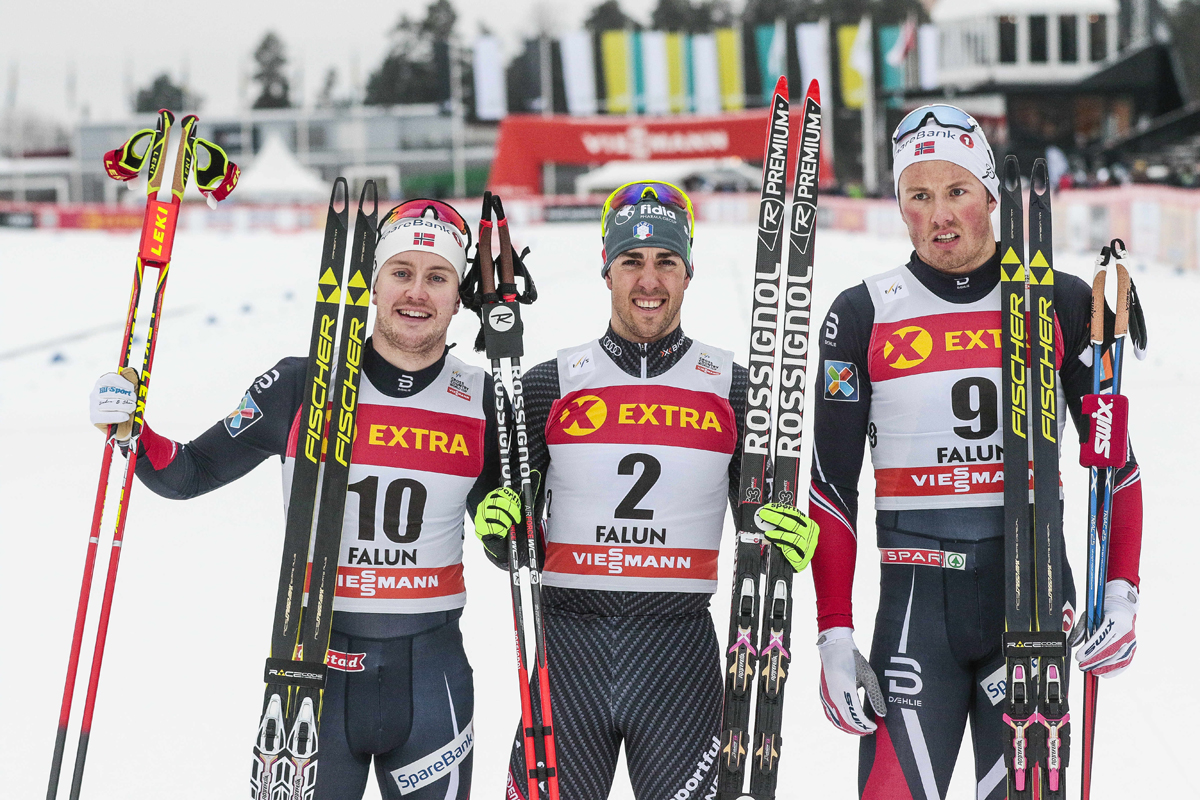
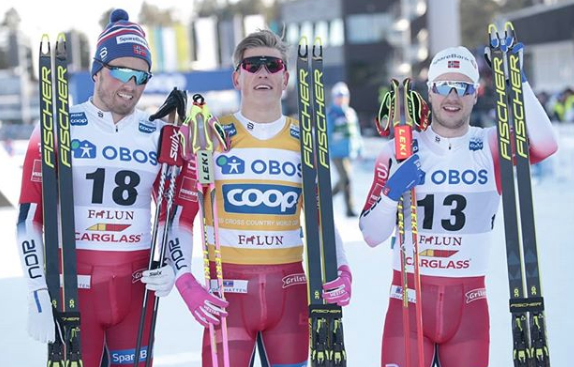
    Norway swept the men’s podium of the 1.4-kilometer freestyle sprint in Falun, Sweden. With a narrow margin, Johannes Høsflot Klæbo (center) took the win over Emil Iversen (l) and Sindre Bjørnestad Skar (r). (Photo: Instagram Screenshot @fiscrosscountry)

    The World Cup made its final European stop in Falun, Sweden before the field heads across the pond to Quebec City for the final series. For the men, the weekend opened with a 1.4-kilometer freestyle sprint, a last test before the freestyle sprint in Canada.

    Heading into the weekend, Norway’s Johannes Høsflot Klæbo sat comfortably in the lead for the overall sprint standings with string of six back-to-back wins, not including a win at the World Championships. The 22-year-old phenom had earned a remarkable 604 points and held a lead of 145 points over second place, his friendly rival from Italy, Federico Pellegrino. Klæbo had not lost a sprint since the second World Cup weekend in Lillehammer where a broken pole in the semifinal took him out of contention. He was also humbled in the first race of the season where he looked over his shoulder and laid off the gas too soon, allowing Russia’s Alexander Bolshunov to take him at the line.  

    While the top of the podium might be more memorable than the other positions, in reflecting on the season, one cannot overlook Pellegrino’s freestyle sprint results. The Italian has landed on the podium, most frequently in second, in all but one skate sprint event this season — the city sprints in Dresden where he was issued a yellow card for obstruction in his quarterfinal, leaving him in 30th for the day.  Eirik Brandsdal of Norway sat in third, followed by his teammate Sindre Bjørnestad Skar in fourth, and Gleb Retivykh of Russia in fifth.

    Despite Falun sitting roughly 60 degrees north in latitude, a fair amount of grass showed aside the ski jumps and between the folds of the ribbon of snow making up the course. Above freezing temperatures and plenty of sun quickly caused the windy course to become chewed up, especially on some of the downhills and corners. With variable weather leading into the weekend as well, the event coordinators reportedly kept the course closed, even to athletes, techs, and coaches in an effort to preserve a solid track. But despite their best efforts, the course was no match for the sun.

    As athletes skied their qualifier, the course eroded; uphills became soft and piles of corn snow could be found on the outside of the curves. This made for an exciting day of races as the sprints became a test of both speed and surefootedness. With numerous crashes in the heats for both men and women, tactics had to include staying on their feet as the athletes’ primary goal.
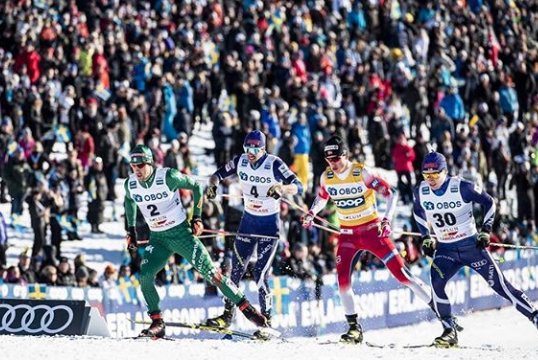
    Federico Pellegrino (right) leads Johannes Høsflot Klæbo (yellow bib), Ristomatti Hakola (bib 4), and Lauri Vuorinen (bib 30) during the quarterfinal of the 1.4-kilometer freestyle sprint in Falun, Sweden. (Photo: Instagram screenshot @chiccopelle/@nordicfocus)

    As expected given their introduction, Klæbo and Pellegrino went one-two in the qualifier. The two then met head to head in the first heat of the quarterfinal, where they debuted their chosen strategy of hanging back for the first half of the race, then slowly moving into better position before the last 30 seconds where they fired on all cylinders. Klæbo made his move a bit sooner than Pellegrino, demonstrating his signature powerful jump skate as he climbed a granular hill. Pellegrino took things closer to the wire, blasting his way into second place with a no pole skate in the final stretch. The two finished just 0.4 seconds apart in a heat where less than 1.5 seconds separated first through fourth.

    The remainder of the quarterfinal heats proved to be close as well, in particular, the third heat, which ended in a four-way photo finish between Skar, Francesco De Fabiani of Italy, Richard Jouve of France, and Andrew Young of Great Britain. As the heat did not prove to be the fastest, only Skar and De Fabiani advanced even though the men were only separated by 0.2 seconds in all.

    The course continued to keep things interesting in the semis, where Klæbo and Pellegrino faced Martin Bergström of Sweden, Bolshunov, Skar, and Miha Simenc of Slovenia. Again, Klæbo could be found toward the back 1:30 into the race, but his tactic did not play out as smoothly for him as it did in the quarters.

    Rounding a curve late in the long downhill that caused so many skiers to lose their footing, Klæbo found himself boxed out by Bolshunov, forcing him wide into the loose corn on a turn. This robbed the Norwegian of some of his momentum, making it harder for him to position himself with a  jump to the front as he did before.
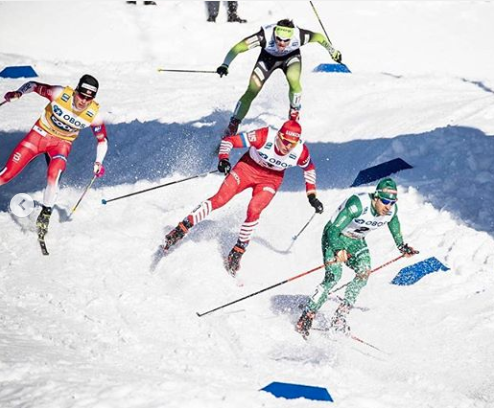
    Federico Pellegrino (right) leads Alexander Bolshunov, Johannes Høsflot Klæbo (left), and Miha Simenc (back) around a turn through loose granular snow during the semifinal of the 1.4-kilometer freestyle sprint in Falun, Sweden. (Photo: Instagram screenshot @chiccopelle/@nordicfocus)

    Charging down the final stretch, Skar held the lead with Pellegrino on his tails. Klæbo surged desperately close behind, battling for position with Bolshunov and Bergström. With a final lunge, Pellegrino slid his boot across the line first, just 0.11 seconds head of Skar. Klæbo crossed 0.27 seconds behind Pellegrino in third, holding his breath that the heat would be fast enough to allow him to advance to the final as a lucky loser. Bergström finished fourth 0.91 seconds back, with an unlucky Bolshunov only 0.03 seconds behind him in fifth.

    While not as close as the first, the second semi still kept spectators on edge. A broken pole took out Lucas Chanavat of France who had qualified in fifth and was seen as a favorite to win the heat. From there, Emil Iversen and his teammate Brandsdal skied comfortably to take first and second in the heat respectively. Luckily for Klæbo and Bergström, the second heat was indeed slower than the first, so both were able to advance. This put Bergström, who skied for the University of Utah, in unchartered territory, as the 27-year-old had never before made the finals in a World Cup sprint.

    Perhaps this fact made Bergström more inclined to take the plunge. At the top of the perilous downhill midway through the final, the six men who had skied as a group to that point stood up and exchanged glances, not wanting to lead until later in the race. While his opponents paused, Bergström charged down the hill in front, staying on his feet through the curves. His lead did not last long, as he was overtaken by the three Norwegians, Iversen, Skar, and Klæbo, and by Pellegrino.

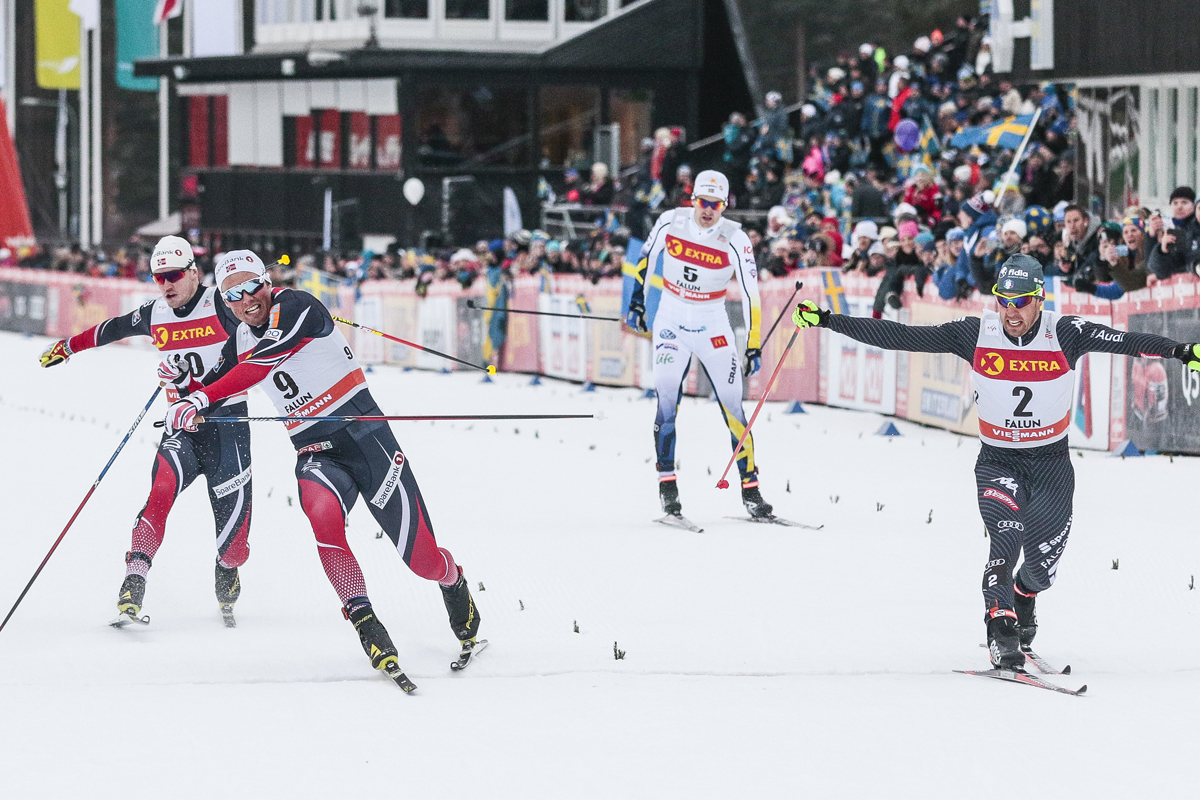
    Neck in neck at the finish of the 1.4-kilometer freestyle race in Falun, Sweden. Johannes Høsflot Klæbo (far right) took the win over Emil Iversen (left) and Sindre Bjørnestad Skar (right center). Federico Pellegrino (left center) walked away empty-handed in fourth. (Photo: Instagram screenshot @chiccopelle/@nordicfocus)

    Heart rates collectively increased for the racers and the crowd as Skar rounded the corner into the finish in first, just ahead of Pellegrino.

    Had Klæbo’s tactic failed him again? Just on the leaders’ tails, Klæbo and Iversen skied furiously to reel them in. With little room to spare, Klæbo battled his way to the front, throwing his foot to stop the clock at 2:52.38. Iversen too overtook the fading Skar and Pellegrino, sliding across the line just 0.1 seconds behind Klæbo, with Skar 0.18 seconds behind to close out the Norwegians’ podium sweep. Pellegrino was left with the wooden medal after crossing the line in fourth, 0.71 seconds behind Klæbo. Bergström took fifth (+1.97) and Brandsdal sixth (+2.18).

    “It was a really hard race,” Klæbo told the International Ski Federation (FIS) after the finish. “The conditions are quite difficult, especially on the downhills. So it was tough, but in the end there, it was really good conditions and it was a fair fight to the finish. So a bit of struggle in the semifinal, but in the final, a bit better.”
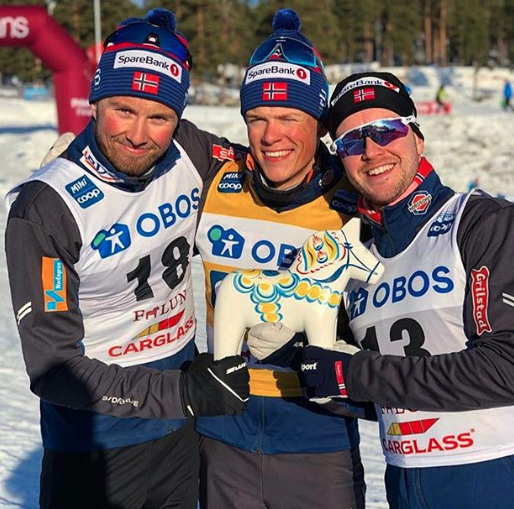
    The Norwegians celebrate after sweeping the men’s podium of the 1.4-kilometer freestyle sprint in Falun, Sweden. With a narrow margin, Johannes Høsflot Klæbo (center) took the win over Emil Iversen (l) and Sindre Bjørnestad Skar (r). (Photo: Instagram Screenshot @emilivers)

    U.S. skier Simi Hamilton (USST), qualified in 16th, but a hangup on an uphill early in his quarterfinal robbed him of his momentum and disrupted his plan, leaving him fifth in his heat. Hamilton ended the day in 22nd overall. Kevin Bolger (USST) advanced to the heats where he was eliminated, finishing in 27th overall.

    Also for the U.S., Logan Hanneman (APU) placed 39th, and Ben Saxton (SMS T2) was 60th.

    Alex Harvey of Canada ended his race in 31st. He was the only Canadian entered.

    While two out of four entrants finishing in the top-30 is a positive result for the U.S., head coach Chris Grover explained that luck was not in their favor. In both the men’s and women’s races, crashes and tangles plagued the Americans throughout the day.

    “Today was a day where everything started great, but it seemed like one version of misfortune struck followed by another, unfortunately,” Chris Grover told FasterSkier in a call. “But people were healthy, the service team made great skis all day long, so that was really good.”

    Bolger had perhaps the best luck of the day.

    “Kevin might have been the only guy who didn’t have a significant hangup or bauble out there,” reported Grover. He also felt that Bolger skied well technically, though Bolger felt his race left room for improvement.

    “I’m very happy to have come here and qualified with such a strong field,” wrote Bolger in an email. “I was feeling very strong leading into the quarterfinal, unfortunately, a few mistakes led to me losing some time and positioning in my heat, so I can say I’m a little upset leaving the day not having moved on or finishing better.  But every race is a learning experience, and I’m looking forward to the next race and applying new tactics!”

    Despite feeling strong, Hamilton struggled a bit to feel powerful in the soft conditions during his qualifier. At the start of the heats, he felt poised for a good day but was struck by the poor luck Grover mentioned.

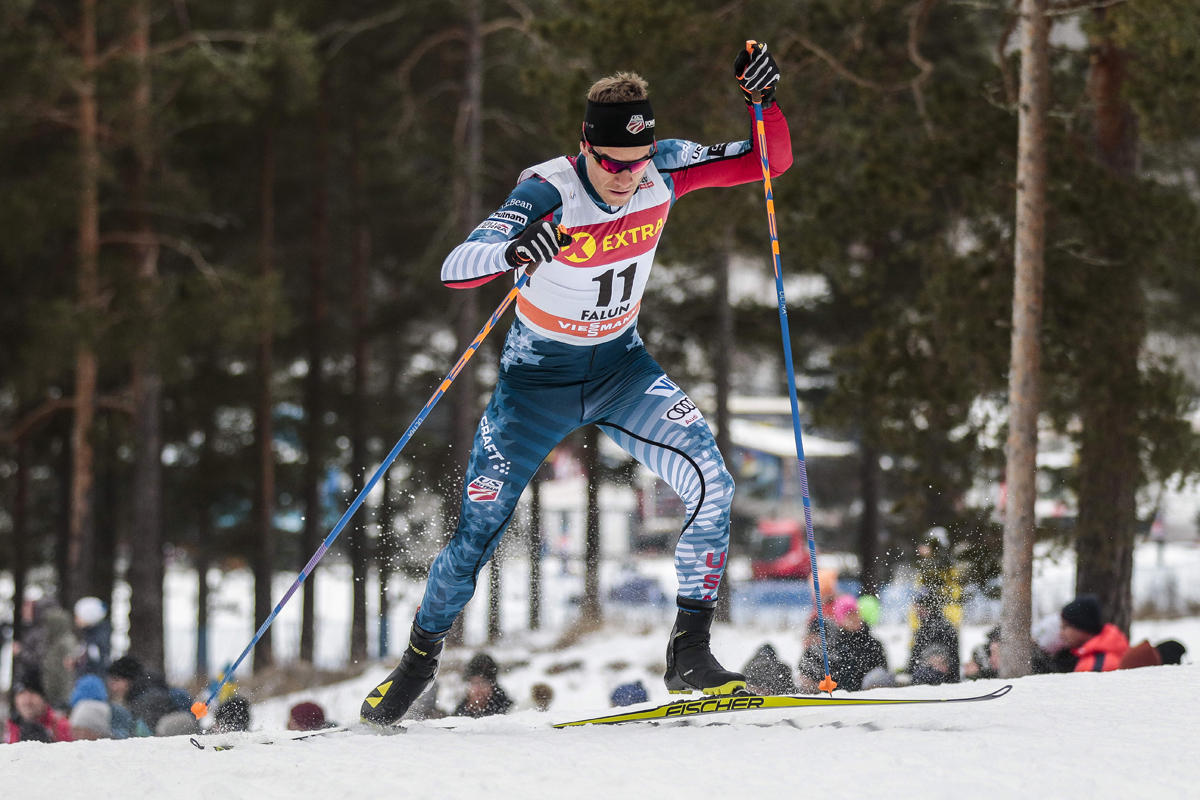
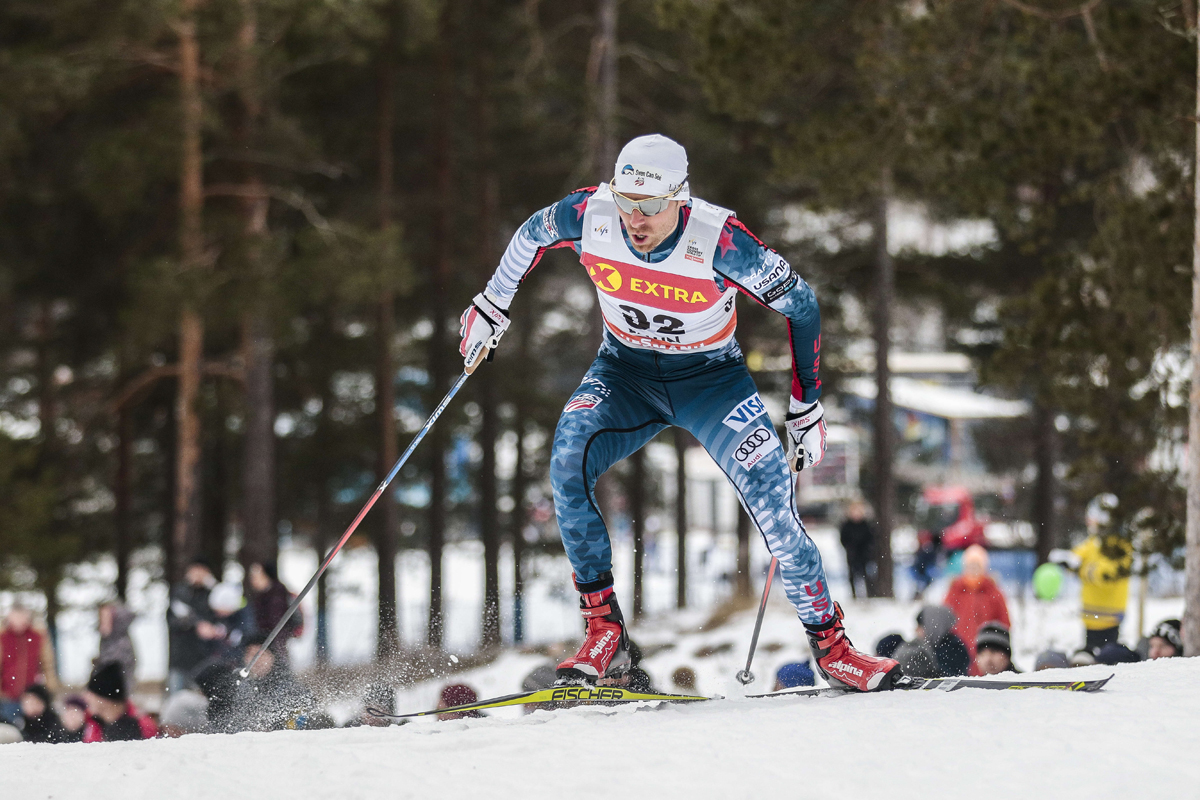
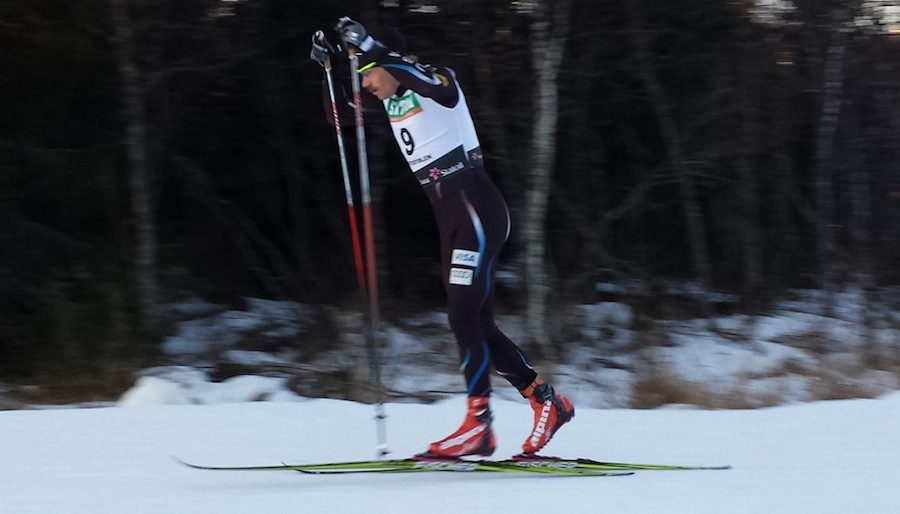
    Simi Hamilton on course during the 1.4-kilometer freestyle sprint in Falun, Sweden. (Photo: Instagram screenshot @simihamilton/@nordicfocus)

    “In the quarter, I wanted to get up front, or as far up as I could, just so I could have the first line into those downhill corners and try to control the heat,” explained Hamilton in a call. “I got off to an okay start, not great, but I just kind of slotted behind Chanavat, knowing that he would probably ski pretty well and ski toward the front, so I felt like I was in a great position.

    “At the end of the long straightaway at the start, there’s a hard right-hand corner that goes into the little steep climb, and I just got completely skied into by one of the Finns, Mæki,” he continued. “I almost went down, but kind of saved it, but lost some pretty valuable time there and ended up getting stuck at the back. I still felt good at that point, my energy felt great, but I couldn’t really make any moves past people on the two climbs. And the nature of how the course was holding up today, it was pretty much impossible to pass people on the downhill corners, just because there was basically one line through the corners today and it was incredibly sketchy.”

    This experience was frustrating for Hamilton, who is known for his agility on skis. Typically, the downhills and corners would have played to his strengths.

    relafen

    “I’m still psyched about where my fitness and shape are right now, and I’m still mentally engaged with everything, so I’m looking forward to the races coming up in Quebec,” he concluded.

    The season has left Hamilton with “mixed feelings” as he has not been able to achieve the results he has felt capable of. He has also faced his fair share of illness.

    naprosyn online

    “I think there have been points in the season that I’ve been really proud of an happy about,” he reflected. “I feel like I’ve had quite a few races this year where I was really close to having a great day, but for whatever reason, I couldn’t quite get there. I’m thinking specifically about the two skate sprints in the Tour [de Ski], both of those were bittersweet because I felt great for both of those, and in Toblach, I had that weird fall on the uphill, and then in Val Mustair, I felt pretty good again but had a pretty tough heat with Chanavat and Pellegrino and couldn’t quite move on. So I’ve felt like in quite a few races, I was just ready to break through and it didn’t quite happen.

    “But at the same time, I think that there were a lot of positive moments and positive signs,” he continued. “I knew that my fitness was quite good all season, so I have a little more confidence in that, and have just kind of tried to enjoy it. It was definitely a bummer to get sick in January and miss Dresden, and then January and early February were just not awesome for me with getting sick and missing some training, and then a pretty bad weekend in Lahti. There were some down moments for sure, but looking back on the good races, I’m pretty proud of those.”

    After three Olympics and consistently racing on the World Cup circuit since 2010, the 31-year-old Aspen, CO native feels that he is in the twilight of his career.

    “All season, I was debating whether I was going to keep coming after this year or not, and right now I feel pretty fired up still and pretty motivated. I know that there are some really specific things that I can work on, so I haven’t fully made a decision yet, but I am definitely leaning toward skiing one more year. So right now, I’m just trying to focus on putting together the best sprint in Quebec and the best weekend in general that I can and have fun there skiing with a big North American team and have a lot of friends and family cheering us on, so I’m looking forward to that.”

    Racing in Falun continues tomorrow with 10/15k freestyle events.
    Qualification | Final Results

  • Lahti Qualifiers, Press Conferences, Pre-Sprint Stats, and Photos

    Lahti Qualifiers, Press Conferences, Pre-Sprint Stats, and Photos

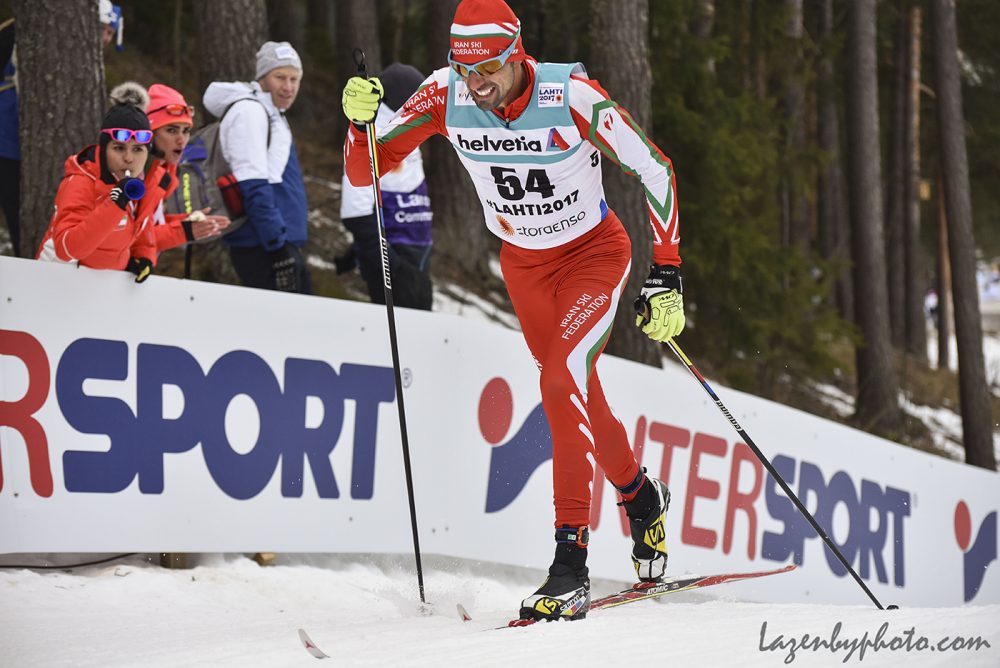
    Iran’s Seyed Sattar Seyd racing to fourth in the men’s 10-kilometer classic individual start, a qualifying race for World Championships, on Wednesday at the 2017 Nordic World Championships in Lahti, Finland. (Photo: John Lazenby/Lazenbyphoto.com)

    LAHTI, Finland — Yesterday’s lick of blue sky winter sun was fleeting, as Lahti woke to overcast skies and buzz that new snow was imminent. Race time temps hovered around 24 degrees Fahrenheit, but with 78-percent humidity and a brisk wind — some would say ripping —  blowing out of the west, it felt wind-brief cold.

    Wednesday’s kickoff events were an opportunity for volunteers, camera crews and even hundreds of local Finnish school children who spectated, to test the venue’s preparedness in a soft opening. For both the men and women on Wednesday, athletes from non-traditional ski countries — skiers without the prerequisite International Ski Federation (FIS) points — raced in 5/10-kilometer classic qualifiers for the 2017 FIS Nordic World Championships distance races. All registered racers are able to contest Thursday’s freestyle sprint qualification. However, only the top 10 from Wednesday’s men’s 10 k and women’s 5 k classic individual starts would qualify for Lahti’s distance events.

    In both races the list of representative countries vying for precious world-champs starts was a testament to FIS’s attempt to market a more globalized brand. There was Ecuador, Brazil, Lebanon, Venezuela, and India to name a few. A colorful splash of international pizazz. But in the end, all these aspiring skiers had to qualify on a championship-level course.

    On the women’s side Iceland’s Elsa-Gudrun Jonsdottir took the win, completing the the 5k loop in 15:23.9. Nansi Okoro from Bulgaria skied to second place (+20.1) with Australia’s Katerina Paul third (+34.2).

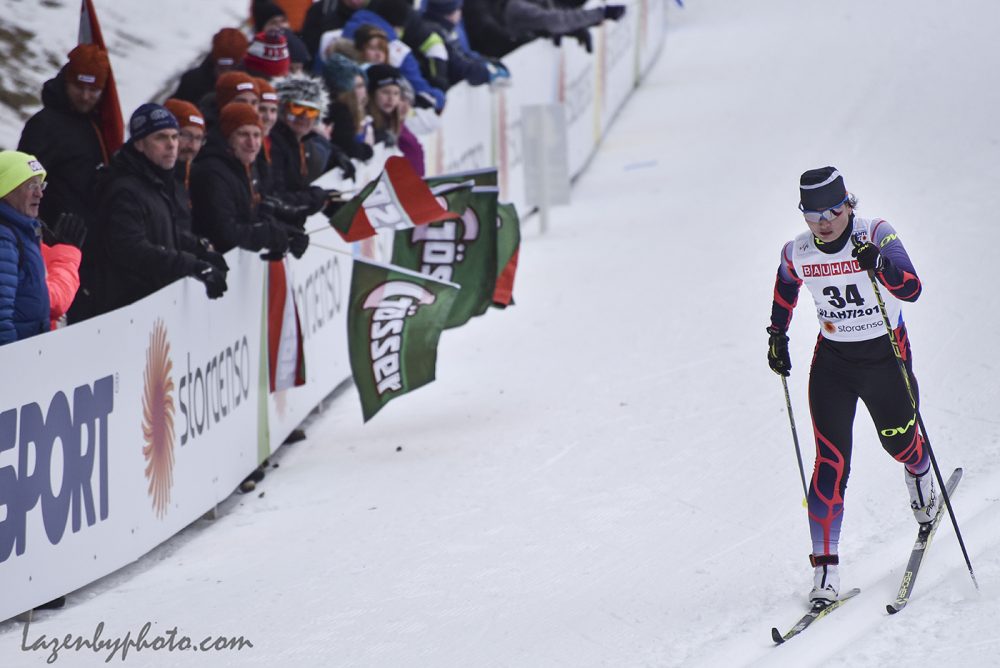
    Mongolia’s Otgontsetseg Chinbat racing to fourth in the women’s 5 k classic qualifying race on Wednesday at 2017 Nordic World Championships in Lahti, Finland. (The top 10 finishers qualified for the distance races at these championships.) (Photo: John Lazenby/Lazenbyphoto.com)

    Top-10 Women’s Qualifiers:

    1. Elsa-Gudrun Jonsdottir (Iceland)
    2. Nansi Okoro (Bulgaria)
    3. Katerina Paul (Australia)
    4. Otgontsetseg Chinbat (Mongolia)
    5. Gabrijela Skender (Croatia)
    6. Kitija Auzina (Latvia)
    7. Katya Galstyan (Armenia)
    8. Maria Ntanou (Greece)
    9. Enkhtuul Ariunsanaa (Mongolia)
    10. Vanesa Emilova (Bulgaria)

    In the men’s 10 k classic, Croatia’s Kresimir Crnkovic took the win in the non-medal event, covering the course in a time of 26:21.5.

    Finishing 55.6 seconds back was Lithuania’s Deividas Klisevicius in second place. Rounding out the men’s podium in third (+1:05.5), was Achbadrakh Batmunkh of Mongolia.

    Top-10 Men’s Qualifiers:

    1. Kresimir Crnkovic (Croatia)
    2. Deividas Klisevicius (Lithuania)
    3. Achbadrakh Batmunkh (Mongolia)
    4. Seyed Sattar Seyd (Iran)
    5. Jens Hulgård (Denmark)
    6. Thibaut De Marre (Belarus)
    7. Tue Rømer (Denmark)
    8. James Clugnet (Great Britain)
    9. Omer Aycicek (Turkey)
    10. Apostolos Angelis (Greece)

    Results: Women | Men

    ***

    Lahti 2017 Freestyle Sprint

    Seasoned heavy hitters to World Championships first timers will make their way to the race the venue on Thursday for the second World Championships event: a 1.4 k freestyle sprint.

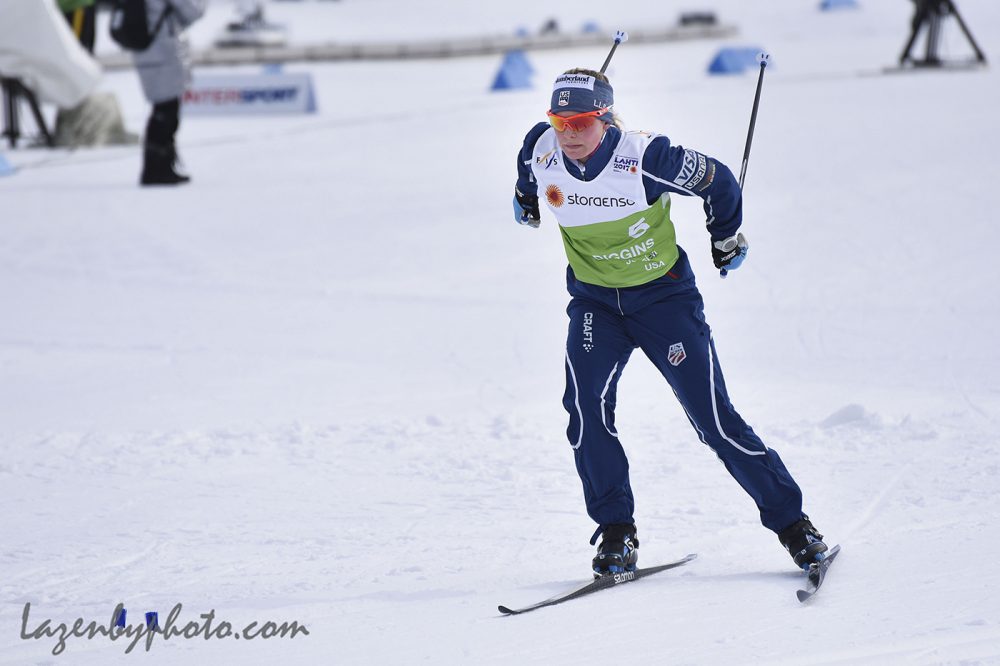
    U.S. Ski Team member Jessie Diggins during training day on Wednesday at 2017 Nordic World Championships in Lahti, Finland. (Photo: John Lazenby/Lazenbyphoto.com)

    In the women’s field, Sweden’s Stina Nilsson and Norway’s Maiken Caspersen Falla rank as the top-two favorites following this World Cup season. For the past three freestyle sprints Nilsson has entered, she has placed first, her most recent victory this past Saturday in Otepää, Estonia. Falla, however should not be counted out, she took the win in last year’s freestyle sprint held in Lahti, Finland, while American Jessie Diggins claimed second.

    For the men, Italy’s Federico Pellegrino emerges as the top non-Scandinavian favorite for the sprint. He won the most recent freestyle sprint in Falun, Sweden, last month and placed second in this year’s Tour de Ski Stage 1 freestyle sprint.

    Many men, however, will be vying Pellegrino for the top spot. This includes Norwegians Johannes Høsflot Klæbo, Finn Hågen Krogh, Emil Iversen, as well as Russia’s Sergey Ustiugov, to name a few.

    U.S. Freestyle Sprint Entries:

    Women

    • Jessie Diggins
    • Sophie Caldwell
    • Ida Sargent
    • Kikkan Randall

    Men

    • Simi Hamilton
    • Andy Newell
    • Erik Bjornsen
    • Cole Morgan

    Canada Freestyle Sprint Entries:

    Women

    • Dahria Beatty
    • Cendrine Browne
    • Katherine Stewart-Jones

    Men

    • Alex Harvey
    • Len Valjas
    • Jesse Cockney
    • Knute Johnsgaard

    Qualification start lists: Women | Men

    ***

    Behind the scenes on Wednesday, FIS President Gian Franco Kasper was part of a press conference that in part discussed the latest doping news: the five Russian skiers who appealed to the Court of Arbitration in Sport (CAS) had been denied immediate reinstatement to race.

    Sarah Lewis, FIS Secretary General made this statement regarding Norwegian star Therese Johaug’s doping case. “The other one on the table is the Norwegian Anti-Doping Agency’s decision that was issued last week in the case of Therese Johaug,” Lewis said. “It was received by FIS on the 14th of January. The present status is that it is being studied by FIS doping panel and this will continue until the 7th of March and at that time a communication will be issued. In the meantime, FIS has got no further statement to give on this case.”

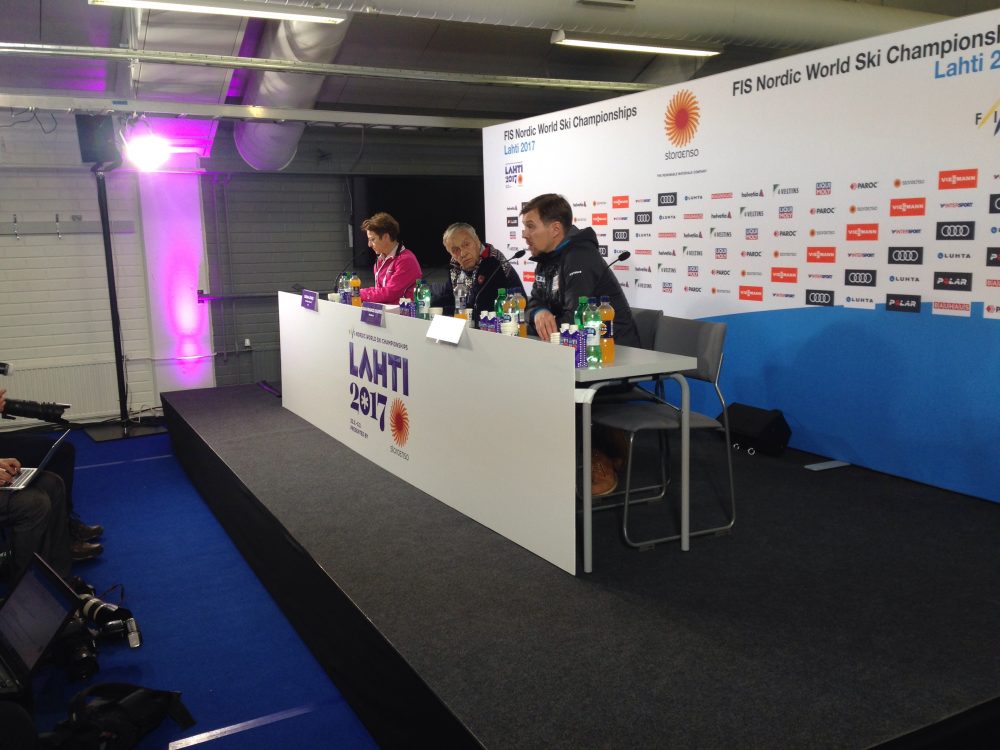
    During Wednesday’s press conference, FIS President Gian Franco Kasper (center) defended himself from comments he made to The New York Times.

    That part of the press conference was administrative. Then during a question-and-answer period a journalist asked this of Kasper: “You gave an interview to The New York Times where you said the sport is clean and the athletes have been irritated with that quote from you. How do you respond to the criticism that’s been thrown your way?

    (The most recent comment from Kasper in the Times was this past November. He reportedly said, “We need to stop pretending sport is clean. It’s a noble principle, but in practice? It’s entertainment. It’s drama.”)

    Kasper was blunt and stern in his response. “Well don’t forget this, your colleague from The New York Times, she wrote whatever she wanted,” Kasper said during the press conference. “Her question to me was, it must really disturb or hurt the sport of skiing in particular cross country? I said of course it hurts our credibility of sport in general and also skiing is damaged by all the open cases we have at the moment. But at the end for the public watching at home, the Olympics in particular, it’s still the drama that comes up, the joy if you win, disappointment if you lose, that is part of the game. It’s more or less a mirror of the social world … I never said it doesn’t matter for the importance of the Games, of course not.”

    Later on Wednesday, Kasper was part of a group that met with athletes to discuss his response to halt doping in nordic sport.

    ***


  • Pellegrino is Back; Iversen Frustrated After Photo Finish in Falun Sprint; Valjas 10th

    Pellegrino is Back; Iversen Frustrated After Photo Finish in Falun Sprint; Valjas 10th

    Italy's Federico Pellegrino (r) edging Norway's Emil Iversen in Saturday's freestyle sprint final at the World Cup in Falun, Sweden. (Photo: Fischer/NordicFocus)
    Italy’s Federico Pellegrino (2) edging Norway’s Emil Iversen (9) by 0.06 seconds for the win, with Norway’s Sindre Bjørnestad Skar (l) following in third and Sweden’s Oskar Svensson (5) in fourth, in the men’s freestyle sprint final on Saturday at the World Cup in Falun, Sweden. (Photo: Fischer/NordicFocus)

    It didn’t seem likely until the last second – but last season’s star sprinter has once again arrived on the World Cup circuit.

    Italy’s Federico Pellegrino collected his ninth individual win on Saturday in Falun, Sweden, nipping Norway’s Emil Iversen by six-hundredths of a second in a photo finish in the freestyle sprint. The winner of last year’s Sprint World Cup, Pellegrino didn’t make his first sprint final of the season until after Christmas.

    However, since then, he has been second (in Val Müstair, Switzerland), fourth (in Toblach, Italy), and now, finally, first.

    “This season is not so easy right now for me,” he told the International Ski Federation (FIS) in a finish-line interview. “Now I think [the way it is going] is the right way, going toward the World Championships.”

    Pellegrino had the second-fastest qualifying time around the 1.4-kilometer course in the morning. Then, he won his quarterfinal with a blazing display of speed at the finish to best Norway’s Finn Hågen Krogh. In the semifinal, Pellegrino pulled a similar move to win the heat by 0.21 seconds over Sweden’s Teodor Peterson.

    In the final, coming into the last few hundred meters it looked like Pellegrino was too far off the pace to make it to the front. The rest of the men – all Swedes and Norwegians – jostled for the lead constantly. As the field shot down a long hill into the stadium, though, Pellegrino made his way to the front; he said he had amazing skis. He followed Iversen over the last bump of an uphill and down a corner to the finish. The pair’s paced outstripped anything the others could keep up with.

    “In the final I showed up still fresh, but with a long downhill before the finish I couldn’t pull, and when you’re behind you risk losing [moves],” he told the Italian Winter Sports Federation, according to a translation. “In fact, I found myself in fifth place and I thought I would not make it. But on the last hill before the finish I took a wide path and I went for it, giving everything I had in the body. Then I made it a photo finish.”

    Iversen had thought he had the win in the bag. He seemed incredulous that Pellegrino could catch up with him in the final meters – and the Italian timed his finishing lunge better, eventually edging Iversen by just six hundredths of a second.

    Iversen slapped his poles in the snow in frustration after finishing, breaking one, and lay unsmiling while the two waited for the results of the photo finish. He remained restrained during the post-race photo opportunities.

    “I thought I had the win today,” Iversen told FIS. “I didn’t know who was coming but I could feel the shadow. I was very disappointed in the finish but in the end I have to be happy with second place.”

    “I’ve been pretty mad at my little brothers, but I don’t think I’ve been this angry in years,” Iversen elaborated to NRK.

    Another photo finish gave Sindre Bjørnestad Skar of Norway third place (+0.47), by three hundredths of a second over Falun’s own Oskar Svensson. Johannes Høsflot Klæbo – the fastest qualifier on the day – finished fifth (+1.32), and Peterson placed sixth (+2.08).

    The men's freestyle sprint podium on Saturday at the World Cup in Falun, Sweden, with Italian winner Federico Pellegrino (c), and Norway's Emil Iversen (r) in second and Sindre Bjørnestad Skar (l) in third. (Photo: Fischer/NordicFocus)
    The men’s freestyle sprint podium on Saturday at the World Cup in Falun, Sweden, with Italian winner Federico Pellegrino (c), and Norway’s Emil Iversen (r) in second and Sindre Bjørnestad Skar (l) in third. (Photo: Fischer/NordicFocus)

    “It’s really tough to make it on World Cup as a Norwegian and so every time I can make a podium result it is important,” Skar told FIS, referring to simply earning start rights.

    Indeed: Pål Golberg, who before this weekend led the Sprint Cup, did not even get the chance to start Saturday’s race. The Norwegian team deemed him too slow. Other skiers also found this amazing. Alex Harvey told Norwegian media that the Canadian team would be happy to take Golberg and give him a starting spot.

    “They seem sure, like me, that it’s comical,” Golberg told Norwegian broadcaster NRK. “I’ve certainly gotten lots of messages from people who think it’s strange, so I’m glad that other people share that view.”

    He now worries that he might not have a chance to start the sprint at World Championships. Five of the top seven men in the Sprint Cup standings are Norwegian: Skar in second, Iversen in fourth, Krogh in fifth, Golberg in sixth, and Klæbo in seventh.

    There’s no such problem for Italy, a team which is thrilled that its star is back in top form. Pellegrino now has the most podiums in skate sprints of any Italian man ever, with 13.

    World Championships is the only thing on his mind.

    “At this time the [Sprint Cup] ranking does not interest me,” he said in the federation press release. “I’ll skip the next stage in Korea, and then will race in Otepaa [Estonia, the last World Cup before World Championships.”

    Valjas 10th After Blistering Quarterfinal Finish

    Len Valjas (Canadian World Cup Team) racing in Saturday's freestyle sprint at the World Cup in Falun, Sweden, where he ended up 10th on the day. (Photo: Fischer/NordicFocus)
    Len Valjas (Canadian World Cup Team) racing in Saturday’s freestyle sprint at the World Cup in Falun, Sweden, where he ended up 10th on the day. (Photo: Fischer/NordicFocus)

    Only two Canadians started the sprint. Alex Harvey missed qualifying in 46th, but teammate Len Valjas not only made the quarterfinals, but shone there.

    Valjas was skiing near the back of his heat, only to find his way to the front at the last possible moment, much like Pellegrino. While Klæbo had seemed to have the quarterfinal locked up with only a possible challenge from Andrew Young of Great Britain remaining in the finishing stretch, Young and Valjas came down the last downhill with more momentum and some speed in their legs. Eventually all three crossed the line together in a photo finish, from which Valjas emerged second.

    In his semifinal heat, Valjas also hung near the back of the pack. But the whole heat finished within about a second, and he wasn’t able to fight his way through the crowd. Valjas landed fifth, this time 0.99 seconds behind heat winner Klæbo.

    “I definitely felt like I had a little more,” Valjas said in a Cross Country Canada press release. “I was able to close in the finish, but I just lost a little too much contact with the pack. I had the speed at the finish and felt great. I was really comfortable staying at the back. I thought I could bring it back on the second hill, but I just stayed a little too far back.  I needed to work on my tactics a bit better.”

    He finished 10th overall, his best individual result in a year since he finished 10th in a classic sprint in Oberstdorf, Germany, as part of last year’s Tour de Ski.

    “I had great skis and I know the fitness is there,” Valjas said in the press release. “Being in the fifth heat in the quarters, I likely could have used about five more minutes of rest time before the next heat, but I can’t complain and have to be happy with a top 10.”

    Hamilton, Newell in the Quarters

    Simi Hamilton (U.S. Ski Team) racing to 13th in the men's qualifier of the 1.4 k freestyle sprint on Saturday at the World Cup in Falun, Sweden. He went on to place 18th on the day. (Photo: Fischer/NordicFocus)
    Simi Hamilton (U.S. Ski Team) racing to 13th in the men’s qualifier of the 1.4 k freestyle sprint on Saturday at the World Cup in Falun, Sweden. He went on to place 18th on the day. (Photo: Fischer/NordicFocus)

    For the U.S., Simi Hamilton qualified 13th and Andy Newell 25th. Both were at the front of their quarterfinal heats at some point, before fading at the finish.

    For Hamilton, things more or less immediately deviated from plan.

    “I actually lost my basket on my right pole coming out of the start,” Hamilton said. “The pole holes were pretty gnarly at the start since people are double poling so hard, and I think my basket got stuck in on of the previous pole plant holes… [the snow] was actually firm enough that I could still pole pretty well, but I knew that the rest of the course got a little bit softer. So Andrew Morehouse, who is one of our techs, made a great hand-off and I got a new pole at the first corner. That’s probably only 20-25 seconds in the race at the point, but I was definitely off that back a little bit.”

    Hamilton did manage to catch back up to the group. And then on the last uphill before the descent to the stadium, the skiers in the left lane got a bit jammed up. Being in the right lane, Hamilton was able to ski freely – but then found himself leading the heat, exactly what he didn’t want to do.

    As Pellegrino had said, leading down the hill into the stadium means that most likely, the competition would sail past you thanks to the draft effect.

    “You know, a lot of the race was going to come down to that final little bump that is in the stadium,” Hamilton said. “So I knew if I came into that with some really good momentum and hopefully get a slingshot off of someone in front of me, that I would be able to crush that bump and make a move into the finish lanes and then have a open lane for the finish… that was what I was really hoping for, it didn’t totally play out like that.”

    Instead, a few competitors slingshot past Hamilton.

    “I kind of found myself tangling with a lot of dudes going over that bump and through that corner,” he explained. “I just didn’t really ski the last 200 meters the way I would have really liked to, with a lot of energy power and speed. So found myself fighting in the pack going into the finishing stretch. I just focused on just skiing a good finish, and unfortunately wasn’t quite enough.”

    He landed fourth in his heat (+0.87), and not close enough to get a lucky loser spot. He finished 18th on the day.

    Andy Newell (U.S. Ski Team) racing to 25th in the men's qualifier of the World Cup freestyle sprint in Falun, Sweden. He ended up 16th on the day.(Photo: Fischer/NordicFocus)
    Andy Newell (U.S. Ski Team) racing to 25th in the men’s qualifier of the World Cup freestyle sprint in Falun, Sweden. He ended up 16th on the day.(Photo: Fischer/NordicFocus)

    “It’s a frustrating day, but I felt good in my qualifier, and it’s hard course and I know my fitness is really good right now,” Hamilton said. “It was just kind of one of those days that happens out there, not a lot of things really connecting in terms of luck and positioning and equipment. But still a decent day so I am okay with it.”

    Newell also found himself outgunned in the final meters, finishing third in his heat and 16th on the day.

    Also for the U.S., Erik Bjornsen finished 43rd (+9.30) and Matt Gelso 59th (+13.12) in the qualifier.

    Results

  • Pellegrino Delivers Much-Needed Win for Italy in Davos Skate Sprint

    Pellegrino Delivers Much-Needed Win for Italy in Davos Skate Sprint

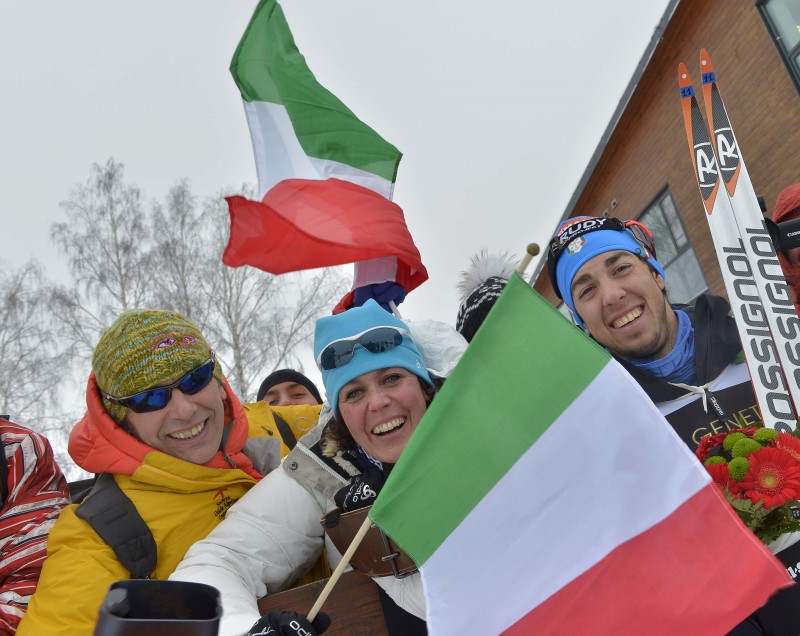
    Pellegrino celebrating his win with Italian supporters. Photo: Liberec2013.
    Federico Pellegrino (r) two seasons ago, celebrating his classic-sprint win with Italian supporters at the 2013 U23 World Championships in Liberec, Czech Republic. (Photo: Liberec2013)

    There was no shortage of action in the men’s 1.3-kilometer freestyle sprint on Sunday as 24-year-old Federico Pellegrino fought his way to his first-ever World Cup win and Italy’s first victory in four years.

    The Italian sprinter took charge in the last half of the men’s final in Davos, Switzerland, and earned the win (and his sixth World Cup podium), while Russia’s Alexey Petukhov slid across the finish line to snag second ahead of Norway’s Finn Hågen Krogh in a photo finish for the podium.

    “It’s a great day. I have been working for the World Cup victory for so long,” Pellegrino told FIS after the race. “It feels amazing to reach this goal. I hope that my victory will help the Italian Cross-Country team to good results.”

    With his best World Cup results coming at altitude, Pellegrino rocketed to first in last weekend’s freestyle-sprint qualifier. He went on to place 11th exactly a week ago after finishing sixth in his semifinal.

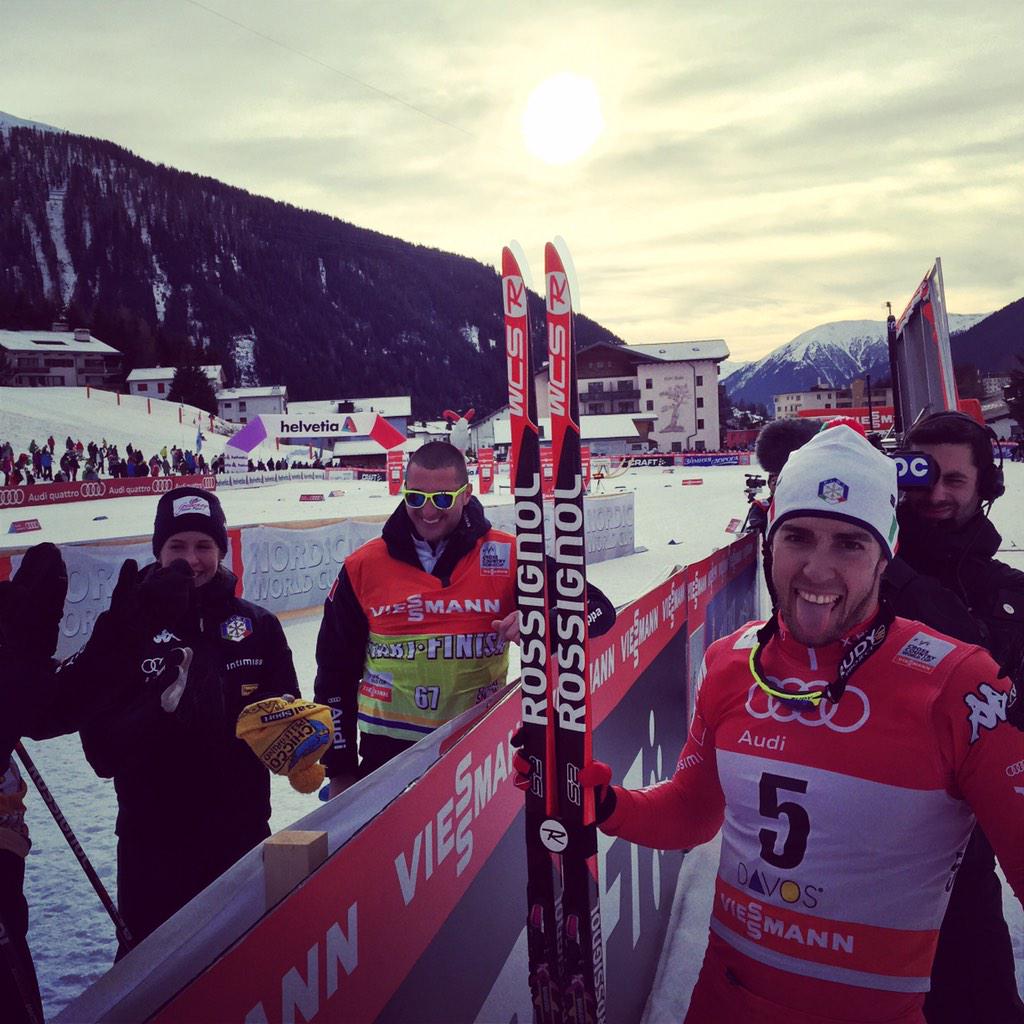
    Federico Pellegrino (r) after his first World Cup victory on Sunday in the 1.4 k skate sprint in Davos, Switzerland. (Photo: FIS Cross Country/Twitter)
    Federico Pellegrino (r) after his first World Cup victory on Sunday in the 1.4 k skate sprint in Davos, Switzerland. (Photo: FIS Cross Country/Twitter)

    On Saturday amid fast conditions with an ample amount of manmade snow, Pellegrino advanced to the final as a lucky loser — the fourth man in a fast heat — and ended a slow start to the season for Italy. The young Italian was last out of the gate, but quickly made up ground to put himself in third by the first turn.

    Petukhov led early, up and over the first hill, where Pellegrino sat in second. The Russian accelerated in an effort to drop him, but Pellegrino hung close. By the time the last climb on the second lap rolled around, the Italian made his move — surging past him and creating a large gap on Petukhov and the rest of the field (with Norway’s Krogh and Sondre Turvoll Fossli, and Sweden’s Calle Halfvarsson and Emil Jönsson) before the final turn into the straightaway finish.

    Petukhov gained ground back on the descent into the stadium with fast skis, and Krogh came like a bullet from behind through the last turn to challenge Petukhov to the finish.

    While Pellegrino edged Petukhov by 0.24 seconds in 2:19.36, the Russian slid across the line two-hundredths of a second ahead of Krogh for second place — his second World Cup podium this season.

    “Last week, I was also in the final but I chose the wrong tactics,” Petukhov told FIS, referencing his fourth-place finish last Sunday behind three Norwegians: Krogh in first, Anders Gløersen in second, and Eirik Brandsdal in third. “Today I did everything right but my legs felt little bit heavy. I was able to close the gap on Pellegrino, but the finishing straight is so fast I could not beat him.”

    After winning last Sunday’s sprint, Krogh advanced from the back of the pack to the podium in the final meters after struggling to stay with the pack for most of the final. Krogh admitted that the pressure to perform affected him during the race.

    “It is always tough to come back on the course where I have won. I felt the pressure, and it is good to be on the podium,” Krogh said to reporters after the race, explaining that he didn’t manage to get himself a very good position.

    “I had a not-so-good start, and I had to find a good position in the field. I gained some places in the uphill and I gave it all in the last corner,” he said, adding that he was very happy to make the podium.

    Fossli had the fastest qualifying time in 2:17.43 and advanced easily through the heats, but fell short in the final and ended up fifth (+1.43), behind Halfvarsson in fourth (+1.01), who was ninth in the qualifier. Jönsson finished last in the final (+11.02), but had the fourth-fastest qualifying time. Krogh was third in the qualifier, Petukhov advanced to the heats in 10th, and Pellegrino qualified fifth in the qualifier and won his quarterfinal.

    “Today, I beat all the Norwegian guys,” Pellegrino told NRK. “All of them.”

    “I wanted this victory with all my strength,” he told the Italian broadcaster RAI, according to a translation. “This victory comes at a negative period for our team, I hope it can serve to raise ourselves. I am very happy because I had not won anything and this time I did.

    “I dedicate the success to all those who have followed me since childhood: coaches , physiotherapists and [wax technicians], and all those who were close to me, including my girlfriend Greta Laurent who lack a bit of confidence in this period,” he added. “I hope it’s a good omen. … I hope it is the first in a long series of triumphs.”

    Results | by heats

  • Newell Sixth in Beitostølen Sprint; Hamilton Keeps Energy High in 27th

    Newell Sixth in Beitostølen Sprint; Hamilton Keeps Energy High in 27th

    Andy Newell on his way to qualifying in fourth in the 1.4 k skate sprint FIS race in Beitostølen, Norway. (Photo: Noah Hoffmann/noahhoffman.com)
    Andy Newell on his way to qualifying in fourth in the 1.4 k skate sprint FIS race in Beitostølen, Norway. (Photo: Noah Hoffmann/noahhoffman.com)

    In his first skate sprint since August, when Andy Newell mixed it up in New Zealand at the NZ Winter Games, the U.S. Ski Team’s veteran sprinter made it all the way to the final on Sunday in Beitostølen, Norway. Newell ended up sixth in the 1.4-kilometer freestyle sprint, the last FIS race in a three-race series this weekend.

    Fourth in the qualifier, Newell was one of the top guys heading into the final after Norwegians Sondre Turvoll Fossli, Ola Vigen Hattestad and Anders Gløersen. The 20-year-old Fossli went on to win every heat, including his final in 2:33, just a tenth of a second faster than runner-up Finn Hågen Krough, also from Norway.

    A lucky loser in both his quarterfinal and semifinal, Newell finished 4.6 seconds behind Fossli in the final (and 0.2 seconds behind German fifth-place finisher Sebastian Eiesenlauer).

    “I was feeling ready to race leading into [the race], although I hadn’t done a real skate sprint since New Zealand,” Newell wrote in an email. “This course wasn’t too easy because of the wind … but it definitely wasn’t a World Cup course either with less climbing, only taking us about two-and-a-half minutes. So I knew I was going to have to be quick in qualification and aggressive in the heats.”

    He tried to get out front in each of his heats to avoid trouble and “also get some room to punch it on the uphill,” Newell explained.

    “My fitness and speed was feeling good so I think I was able to push a high pace in the heats, but just didn’t have my usual kick at the end,” he added. “This tends to be a recipe for Lucky Loser, which is what happened to me today.”

    A problem for most everyone, Newell said the wind was a factor in the men’s race.

    “We all stayed together up and over the final uphill but my legs were just a little too heavy to challenge in the lanes and the German skier and I duked it out,” he explained. “It’s still early and I want to be skiing my best in January and February … so I’m confident, but also not feeling much pressure.”

    With this coming Friday’s sprint part of the Kuusamo Ruka Triple mini tour, and a “double distance weekend” Dec. 7-8 in Lillehammer, Norway, Newell said the next two weeks will also be about building and “hopefully get me ready to rock once the real sprints start going off.”

    Simi Hamilton racing to 15th in Sunday's 1.4 k freestyle sprint qualifier in Beitostølen, Norway. (Photo: Noah Hoffman/http://noahhoffman.com/beitostolen-sprint-race/)
    Simi Hamilton racing to 15th in Sunday’s 1.4 k freestyle sprint qualifier in Beitostølen, Norway. (Photo: Noah Hoffman/noahhoffman.com)

    Newell’s teammate on the USST and Stratton Mountain School T2 Team (SMST2), Simi Hamilton was also looking forward to moving on after the FIS races in Beitostølen. He qualified in 15th on Sunday and went on to place 27th with a sixth-place finish in his quarterfinal.

    “I decided to make a move around [German] Josef Wenzel on the inside when we were coming around the last 180 turn before the finishing stretch,” Hamilton explained in an email. “I knew [I] could ski the corner better and faster than him, so I decided to go for it and see what happened. Wenzel is an aggressive skier and crashes occur in a lot of heats that he skis. When I was coming thru on his inside, I got nudged into the V boards and possible got my skis stepped on. It went down pretty quick.

    “I broke my pole and lost all my momentum coming into the finishing stretch, but rubbing is racing and I’m using it to fuel the fire for the upcoming World Cup sprints,” he added.

    Hamilton finished last in his heat, more than 19 seconds behind Wenzel, who went on to place eighth overall. Regardless, Sunday’s crash and an unlucky 15 k classic race on Friday didn’t faze Hamilton.

    “My energy felt really good going in to the day,” he wrote Sunday. “It was a good course for me… Pretty short time-wise and some good transition skiing on fast and hard conditions. During the qualifier I focused on skiing powerfully and getting that good skate sprint feeling going.”

    After the race, Hamilton said he did some mock sprint intervals. “I’m using that as a good sign of where I am fitness and speed-wise,” he wrote. “I’m psyched about that feeling, especially after such a frustrating day on Friday when I broke my pole after catching my kick pocket on a sheet of ice and just couldn’t get my body revved up to where I wanted it to be during that race.”

    Three other American men raced on Sunday, but missed qualifying for the heats. Torin Koos (Bridger Ski Foundation) placed 32nd, less than four-tenths of a second out of qualifying. Dakota Blackhorse-von Jess (Bend Endurance Academy) tied for 54th, and Mikey Sinnott (Sun Valley Ski Education Foundation) was 71st.

    “I felt optimistic going into [Sunday’s] race,” Sinnott wrote in an email. “Body was feeling sharp. I had a solid warm up and things seemed ready to go. I tried to ski longer and glide a lot during the race, which I believe I did. I never bogged down and had plenty left for a strong finish, which can be a weakness of mine.”

    Ultimately, Sinnott felt he should have been more aggressive.

    “I still had plenty left in the tank at the finish line,” he wrote. “This week was about relearning to race and assessing fitness, in that regard it was a success. I can have a tough time the first week in Europe, but I didn’t suffer the usual deep fatigue. I didn’t ski fast this week, but it was a low priority to do so. Mostly I wanted to have a test run.”

    “Now, I know where I need to work in the upcoming week,” Sinnott added. He’s planning to race all three races in Kuusamo. “I’m close to where I want to be next week, and I think you’ll see a big change.”

    — Alex Matthews contributed reporting

    ***

  • Crawford Soaks Up Atmosphere at Canadian Nationals, Wins Sprint

    Crawford Soaks Up Atmosphere at Canadian Nationals, Wins Sprint

    Chandra Crawford (r) of the Canadian National Team celebrates her victory in the 1.4 k freestyle sprint final at Canadian Ski Nationals on Thursday at Mont Sainte-Anne, Quebec. Her teammate, Dasha Gaiazova (second from right) was second, Jennie Bender of CXC (second from left) was third and Ida Sargent (USST/CGRP) in green was fourth.

    MONT SAINTE-ANNE, Québec — Whipping along the first of two downhills on a chemically enhanced sprint course at Canadian Ski Nationals on Thursday, Chandra Crawford could feel the vibrations in the stadium.

    Everyone there could.

    A helicopter soared directly ahead, swaying above one end of the 1.4-kilometer freestyle sprint loop to the other for an unrivaled viewpoint of the nation’s cross-country skiing finale. Spectators buzzed that the mayor of Québec was inside.

    A sponsor for Canadian National Team member Alex Harvey hovers in a helicopter above the women's B-final freestyle sprint at Canadian Ski Nationals on Thursday at Mont Sainte-Anne, Quebec.

    In fact, it was the CEO and president of Alex Harvey’s sponsor, a paper company called Cascade. His last name was Lemaire, which means “the mayor” in French.

    Crawford didn’t care who was inside. This was cool, the Canadian National Team member thought.

    Surging ahead of Ida Sargent (U.S. Ski Team/Craftsbury) to take the lead in the A-final, Crawford one-skated beneath the swirling chopper, playing the White Stripe song “Blue Orchid” in her head.

    You got a reaction, you got a reaction, didn’t you?

    While people on the sidelines held onto their hats and race organizers chased runaway V-boards, Crawford attacked the final hill and skated away to national title.

    She beat runner-up and teammate Dasha Gaiazova by 1.37 seconds, completing the course in 3:30.7. Earlier in the day, Crawford won the sprint qualifier in 3:17.15, nearly two seconds ahead of the second-fastest female in the time trial, Sophie Caldwell (Dartmouth College).

    Crawford went on to win her quarterfinal and semifinal, beating Alysson Marshall (Alberta World Cup Academy/Senior Development Team) for the top spot in the first heat and Gaiazova in the second.

    In the A-final, Crawford did her best to lead the six-person field, getting out front to start and then tucking behind Sargent before kicking hard out of the stadium. American Jennie Bender of Central Cross Country (CXC) worked her way to third (+2.44) and Sargent finished fourth (+2.96).

    “The finish was so exhilarating with the helicopter and everyone cheering,” Crawford said after defending her national freestyle sprint title from 2010.

    “I was just like, ‘Oh I can go race again I just felt so good.’ ”

    Last year, Gaiazova was the classic sprint champion at nationals, and Crawford took second. Both were coming off long trip back from Europe on Monday and raced in Tuesday’s 10 k freestyle race. Crawford wouldn’t have done it any differently.

    “Québec is so fun to race in, the best place in the country to race in, I just love it so much,” she said. “Canmore’s amazing as well, Callaghan’s great, but the passion of the Québec people for the sport; there’s a helicopter. It’s kind of another level. It’s nationals and there’s a helicopter. I think that’s quite impressive.”

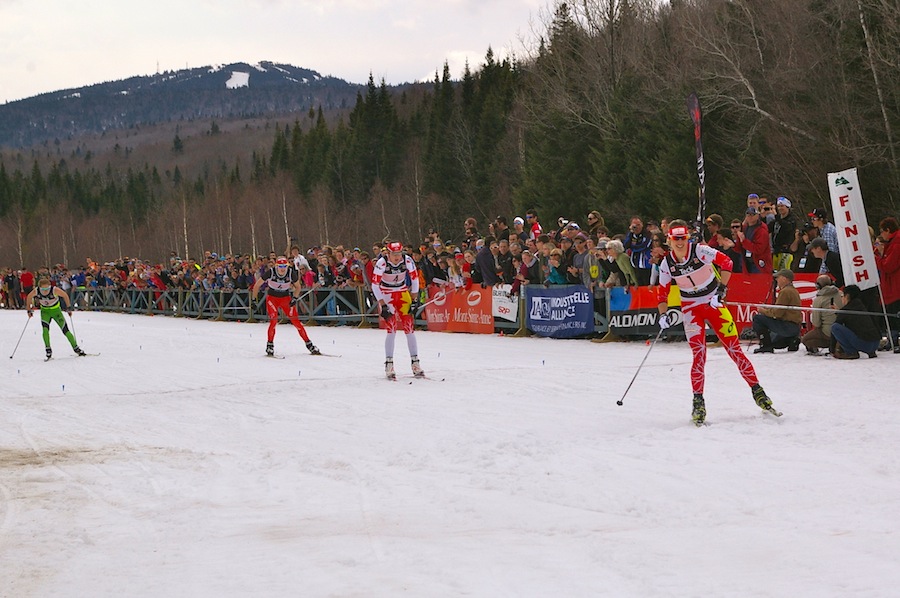
    Chandra Crawford (1) leads the skate sprint A-final at Canadian Ski Nationals on Thursday at Mont Sainte-Anne, Quebec. Jennie Bender (r) finished third after Dasha Gaiazova, and Ida Sargent (l) was fourth. Britt Ingunn Nydal (NOR) in bib 14 was fifth and Alysson Marshall (10) placed sixth.

    She fueled her optimism with some melatonin sleeping pulls for a good night’s rest and woke up excited to race. She always felt grateful to do so, she said. Just because the season was winding down, Thursday was no different.

    After clocking the fastest qualifying time, Crawford made a point to lead each heat from the start. She was tired and wanted to control the pace.

    She advanced out of the quarterfinal with Marshall, who ultimately finished sixth in the A-final, and set out in the semifinal with her younger sister, Rosanna. In their first race together, Rosanna, a Canadian biathlete, moved up alongside her sister in front and went on to place fifth in the heat.

    The three women in front, Chandra, Gaiazova, Marshall and Norwegian Britt Ingunn Nydal, advanced to the A-final. Rosanna finished 10th overall.

    “I was surprised to qualify in seventh and fourth Canadian,” Rosanna said. “I knew it was going to be hard, the stamina all the way to the finals if I made it. The quarterfinal was fine, but the semi was a little bit rough. I wasn’t used to people pushing and shoving so I should have been a little bit more aggressive, but it was fun.”

    “My sister was awesome,” Chandra said. “I’m so happy for her and she skied so well. When I went to the front, I tried to preserve a space for her, but she just blew those booster jets in the middle. I have the same physiology, I know how that feels.”

    In the final, Crawford tried to play a similar pacing game, and Gaiazova followed.

    “Dasha’s really strong so if she had the lead, she would probably grind me into a fine grain of pain,” Crawford said. “But because I had the lead, I took it out pretty slow.”

    That was OK by Gaiazova.

    Canadian women's sprint podium at 2012 nationals: 1. Chandra Crawford (CNST), 2. Dasha Gaiazova (CNST) at left, 3. Alysson Marshall (AWCA) at right

    “I’m really, really tired and burned out from the whole season so I knew I didn’t have much energy to begin with,” Gaiazova said. “I had to be strategic where I make my moves and try to conserve as much as I can in the beginning and fight for it at the end.”

    Had the course been a little bit longer or involved more climbing, Gaiazova said she probably could have challenged Crawford more.

    “I’m really happy with my silver,” she added. “It was good considering that we just flew in from Europe. … This morning I felt absolutely horrible, and actually now after racing, I feel much better.”

    Bender, who won her qualifier and semifinal, was relieved to make the podium after placing 12th in the 5 k classic individual start on Monday. She had taken some time off after winning the American Birkebeiner 54 k classic race in late February.

    Based on the way she felt in Monday’s classic race, she wasn’t sure that was the best decision.

    “I was kicking myself like ‘Nooo, I’m really hoping that this didn’t screw me over,’ ” Bender said. “I was hoping for a good race today so I could feel like, ‘OK, I’m back in it.’ ”

    She was sixth in the qualifier to initially calm her fears. Last year, Bender finished third to Gaiazova and Crawford in the classic sprint at nationals, and was happy to repeat the feat.

    “Everyone who’s good in Canada is here,” Bender said. “It’s definitely fun to see how they sprint.”

    On Thursday, Bender and Sargent had to skip the awards ceremony to drive back to Craftsbury, Vt. There, they would gear up for the SuperTour Finals, which start with a freestyle prologue on Saturday.

    Jennie Bender leads Ida Sargent in their semifinal at the Canadian Ski Nationals 1.4 k freestyle sprint on Thursday.

    A clear-cut leader coming into the finish of her quarterfinal, Sargent was surprised to advance to the semi. About 50 meters before the finish, she poled between her legs while transitioning from a free skate and fell forward.

    “I faceplanted, got a bloody nose and still made it,” Sargent said. “It took me a while to get up so I took my bib off. I thought I was done. That was kind of a nice surprise.”

    Sargent, who qualified in fifth, also fell in the qualifier after she caught her ski in a rut on a corner before the finish. She rebounded from the adversity, placed second to Bender in the semi and landed a spot in the A-final.

    There, she started in the back row behind Crawford, Gaiazova and Bender, but managed to pull ahead after the last hill.

    “I finally got by them and went for it but ran out of steam just in the last bit,” Sargent said. “I was also a little timid in the lanes; those lanes were really icy. I probably should have gone for it more, but I just didn’t want to faceplant again.”

    Sargent said racing against World Cup sprint veterans like Crawford and Gaiazova was always a great experience. She also appreciated advancing through the heats.

    “On the World Cup, I never made it to the final so more heats than I’m used to,” Sargent said. “That’ll be good going into Craftsbury.”

    Complete sprint brackets/heat results

    Women’s qualifier results