From the FasterSkier archive — posts syndicated from athletes’ and coaches’ own blogs between 2004 and 2012, kept online as published. Current coverage is at fasterskier.com.
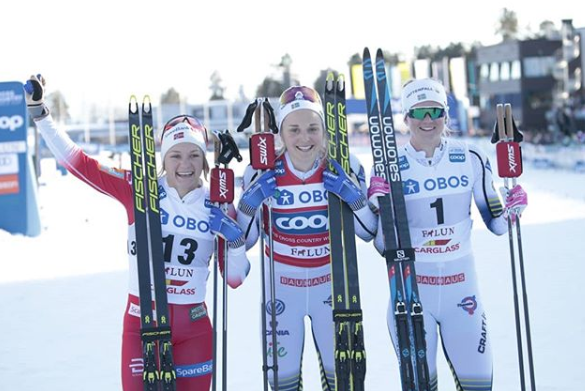
Women’s podium from the Falun, Sweden 1.4 k skate sprint. From left to right, Maiken Caspersen Falla of Norway in second, Stina Nilsson of Sweden in first, and Maja Dahlqvist of sweden in third. (Photo: @fiscrosscountry Instagram screenshot)
FIS World Cup Falun, Sweden 1.4 k Freestyle Sprint
On a day when sugary snow course picked off skiers trying to advance during Falun, Sweden’s 1.4-kilometer freestyle sprint, Stina Nilsson, yes of Sweden, took the win. She won the final in 3:07.72 over Norway’s Maiken Caspersen Falla in second (+0.67). The day’s top qualifier, Maja Dahlqvist, placed third (+2.14).
The Americans entered in the race were some of the key players who tumbled on course. Jessie Diggins (USST) qualified in 21st and was leading the second quarter final when she fell on a sugared downhill to place 28th overall. Both Sadie Bjornsen (USST), ranked fourth after qualification, and Sophie Caldwell advanced to the semis.
Caldwell took a belly slide on the the course’s funky downhill to place sixth in her semi and finish 11th overall. In the second semi, Bjornsen was eliminated after placing fifth. She finished 10th overall.
In the men’s 1.4 k skate sprint, Norway’s Johannes Høsflot Klæbo continued his winning ways with another sprint victory. He won the final in 2:52.38, 0.1 seconds over teammate Emil Iversen. Another Norwegian, Sindre Bjørnestad Skar, placed third (+0.28).
U.S. skier Simi Hamilton (USST), who qualified in 16th, bowed out in the quarterfinals after placing fifth in his heat. Hamilton was 22nd overall. Kevin Bolger (USST) advanced to the heats where he was eliminated to end up 27th overall.
Also for the U.S., Logan Hanneman (APU) placed 39th, and Ben Saxton (SMS T2) was 60th.
Alex Harvey of Canada ended his race in 31st. He was the only Canadian entered.
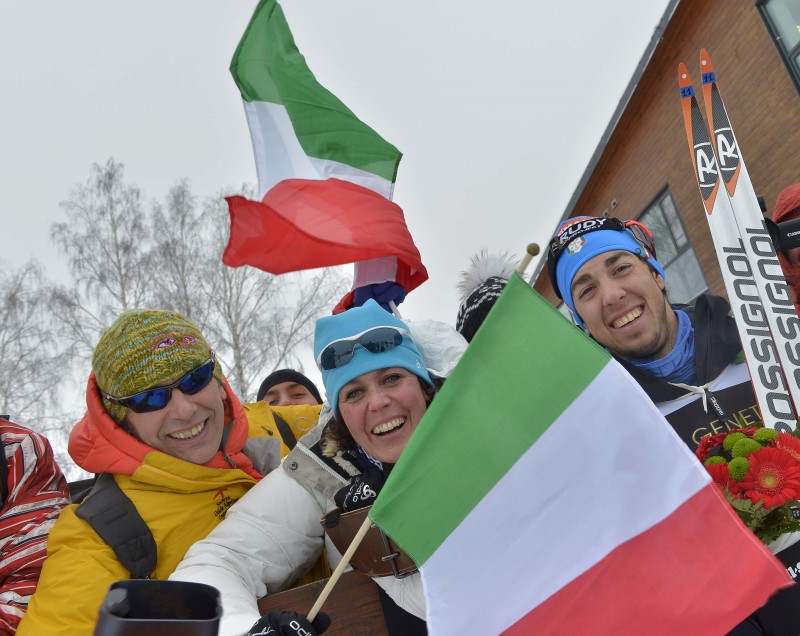
Federico Pellegrino (r) two seasons ago, celebrating his classic-sprint win with Italian supporters at the 2013 U23 World Championships in Liberec, Czech Republic. (Photo: Liberec2013)
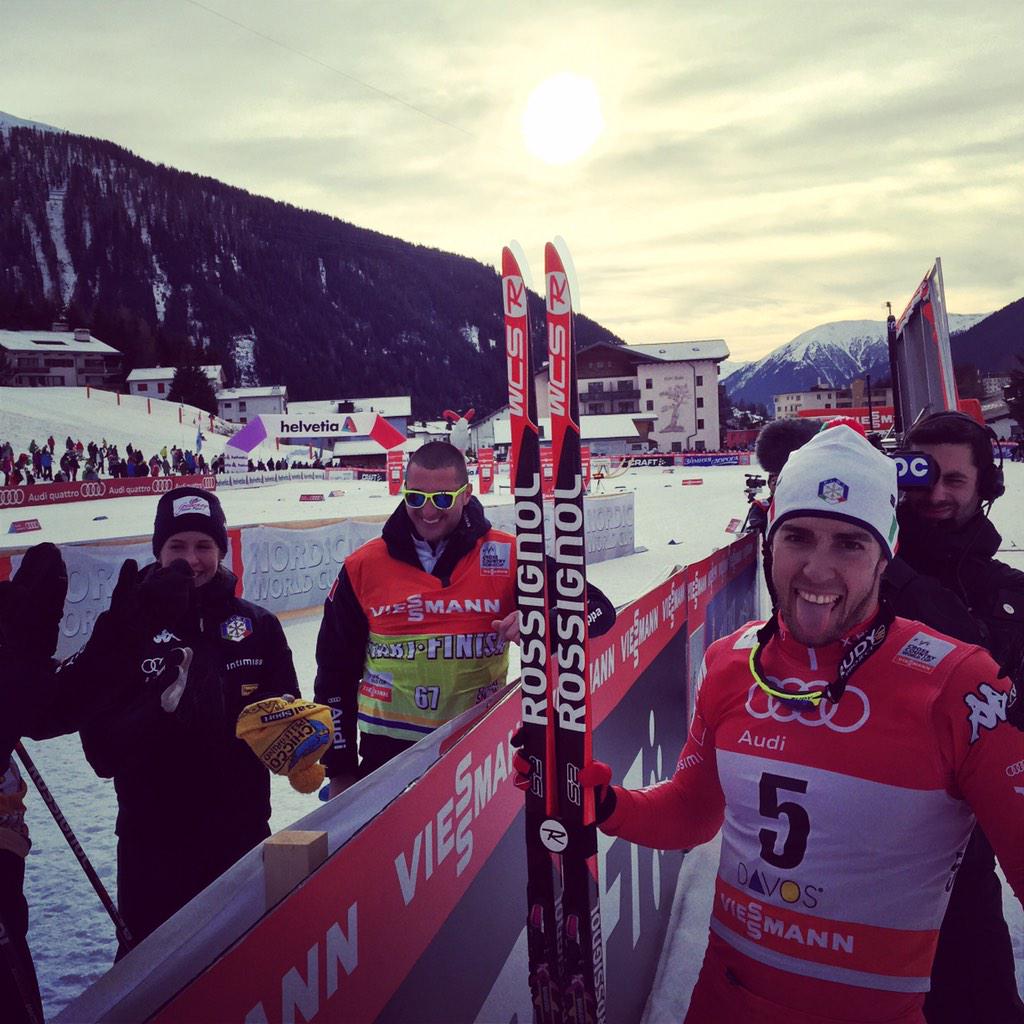
There was no shortage of action in the men’s 1.3-kilometer freestyle sprint on Sunday as 24-year-old Federico Pellegrino fought his way to his first-ever World Cup win and Italy’s first victory in four years.
The Italian sprinter took charge in the last half of the men’s final in Davos, Switzerland, and earned the win (and his sixth World Cup podium), while Russia’s Alexey Petukhov slid across the finish line to snag second ahead of Norway’s Finn Hågen Krogh in a photo finish for the podium.
“It’s a great day. I have been working for the World Cup victory for so long,” Pellegrino told FIS after the race. “It feels amazing to reach this goal. I hope that my victory will help the Italian Cross-Country team to good results.”
With his best World Cup results coming at altitude, Pellegrino rocketed to first in last weekend’s freestyle-sprint qualifier. He went on to place 11th exactly a week ago after finishing sixth in his semifinal.
Federico Pellegrino (r) after his first World Cup victory on Sunday in the 1.4 k skate sprint in Davos, Switzerland. (Photo: FIS Cross Country/Twitter)
On Saturday amid fast conditions with an ample amount of manmade snow, Pellegrino advanced to the final as a lucky loser — the fourth man in a fast heat — and ended a slow start to the season for Italy. The young Italian was last out of the gate, but quickly made up ground to put himself in third by the first turn.
Petukhov led early, up and over the first hill, where Pellegrino sat in second. The Russian accelerated in an effort to drop him, but Pellegrino hung close. By the time the last climb on the second lap rolled around, the Italian made his move — surging past him and creating a large gap on Petukhov and the rest of the field (with Norway’s Krogh and Sondre Turvoll Fossli, and Sweden’s Calle Halfvarsson and Emil Jönsson) before the final turn into the straightaway finish.
Petukhov gained ground back on the descent into the stadium with fast skis, and Krogh came like a bullet from behind through the last turn to challenge Petukhov to the finish.
While Pellegrino edged Petukhov by 0.24 seconds in 2:19.36, the Russian slid across the line two-hundredths of a second ahead of Krogh for second place — his second World Cup podium this season.
“Last week, I was also in the final but I chose the wrong tactics,” Petukhov told FIS, referencing his fourth-place finish last Sunday behind three Norwegians: Krogh in first, Anders Gløersen in second, and Eirik Brandsdal in third. “Today I did everything right but my legs felt little bit heavy. I was able to close the gap on Pellegrino, but the finishing straight is so fast I could not beat him.”
After winning last Sunday’s sprint, Krogh advanced from the back of the pack to the podium in the final meters after struggling to stay with the pack for most of the final. Krogh admitted that the pressure to perform affected him during the race.
“It is always tough to come back on the course where I have won. I felt the pressure, and it is good to be on the podium,” Krogh said to reporters after the race, explaining that he didn’t manage to get himself a very good position.
“I had a not-so-good start, and I had to find a good position in the field. I gained some places in the uphill and I gave it all in the last corner,” he said, adding that he was very happy to make the podium.
Fossli had the fastest qualifying time in 2:17.43 and advanced easily through the heats, but fell short in the final and ended up fifth (+1.43), behind Halfvarsson in fourth (+1.01), who was ninth in the qualifier. Jönsson finished last in the final (+11.02), but had the fourth-fastest qualifying time. Krogh was third in the qualifier, Petukhov advanced to the heats in 10th, and Pellegrino qualified fifth in the qualifier and won his quarterfinal.
“Today, I beat all the Norwegian guys,” Pellegrino told NRK. “All of them.”
“I wanted this victory with all my strength,” he told the Italian broadcaster RAI, according to a translation. “This victory comes at a negative period for our team, I hope it can serve to raise ourselves. I am very happy because I had not won anything and this time I did.
“I dedicate the success to all those who have followed me since childhood: coaches , physiotherapists and [wax technicians], and all those who were close to me, including my girlfriend Greta Laurent who lack a bit of confidence in this period,” he added. “I hope it’s a good omen. … I hope it is the first in a long series of triumphs.”
Dasha Gaiazova (l) leads Canadian World Cup teammate Perianne Jones in the senior women’s 1.4 k freestyle sprint A-final at 2014 Canadian Nationals on Thursday in Corner Brook, Newfoundland.
CORNER BROOK, Newfoundland — One the second-to-last day of Canadian Nationals racing in Corner Brook Newfoundland, Thursday saw the nation’s best line up behind the starting wand for the freestyle sprint qualifiers — and later on, the sprint heats.
The groomers tilled the course overnight, which, combined with the relatively mild temperatures of -7 degrees Celsius in the early morning warming up to around zero for the heats, to led to a fast course.
Olympian Amanda Ammar of Team Ninja in Canmore, Alberta, described the course as having “a lot of flat sections and gradual downhills so you really have to push the free-skate,” she said after the qualifier. “The couple uphills on the course are steep and pretty soft — you can get bogged down if you’re not careful. It’s a good course for someone who skis powerful with longer glides.”
The senior women’s freestyle-sprint podium at 2014 Canadian Nationals in Corner Brook, Newfoundland, with winner Dasha Gaiazova (third from l), Perianne Jones in second (second from l), and Alysson Marshall in third (third from r). (Photo: Cross Country Canada)
First off the line for the heats were the women, starting around noon. World Cup Team members Perianne Jones and Dasha Gaiazova dominated the day, winning their 1.4 k quarterfinals and semifinals. The two skiers fought it out in the A-final, with Gaiazova leading most of the sprint and ultimately taking the victory for her first win of the week.
Jones came up beside her in the finish lanes, but didn’t quite have enough for the top spot and placed second. Alysson Marshall, of the Alberta World Cup Academy (AWCA) and National Development Team (NST), skied in third for most of the final and finished on the podium.
Gaiazova was unavailable for post-race comments, but this reporter was able to interview the silver medalist.
Perianne Jones (2nd)
1. How did the race play out for you from a tactical perspective? Did your race plan change very much through the heats?
“I changed up my tactics a bit because I was slower off the start in the semi. Drafting on the downhill mid-course seemed to work pretty well in the semi so I waited for the downhill to move towards the front in my final too.”
2. Did your travels home from Europe have much of an effect on your race today?
“I got back to Canmore about a week ago from Drammen, [Norway,] so I had some time to rest before coming out here. I don’t think the travel affected the racing too much.”
3. Some athletes like to listen to music to get them pumped up before a race. Is music part of your pre-race plan?
“I don’t really listen to music very much in my race prep. I just go out there and ski the course and stay relaxed.”
Knute Johnsgaard (Yukon Elite Squad) leads Graham Nishikawa (second from r) and Patrick Stewart-Jones (in black) in the A-final of the men’s 1.6 k freestyle sprint at Canadian Nationals on Thursday in Corner Brook, Newfoundland.
After qualifying in fourth in the men’s 1.6 k prelim, Graham Nishikawa made it through to the semifinals as lucky loser out of the quarterfinal heats.
Having just returned from Sochi, Russia, where he helped guide Paralympian Brian McKeever to three gold medals, Nishikawa overcame jet lag and advanced out of the semi to the final, where he notched his first senior national title. The podium was rounded out by Knute Johnsgaard of the Yukon Elite Squad in second, and Patrick Stewart-Jones (AWCA/NST) in third, both U23 skiers.
Graham Nishikawa (1st)
1. How did the race play out for you from a tactical perspective? Did your race plan change very much through the heats?
“I really didn’t feel ready to go in the quarters, fighting jet lag, and I came in fourth in that heat. I was walking back to the car to get the keys and found out I made lucky loser. … In the semi and the final I just went right to the front each time since there wasn’t much space to pass on the course.”
2. Did your recent trip back from Europe effect you much today?
“I got in at 2:20 a.m. the day of the 15k [on Tuesday]. I wasn’t as worried racing right off the flight but today, two days later, I thought it’d be tough. I just went out there to have fun today and enjoy the racing.”
3. Is this your first national sprint title? How many titles do you currently have to your name?
“I’ve got a number of junior titles but this is actually my first senior national title. I have a lot of silver and bronze medals at home.”
Katherine Stewart-Jones (Nakkertok) pulls away from the pack in the junior women’s A-final on Thursday in Corner Brook, Newfoundland. She went on to win the freestyle sprint for her third national title.
The junior women’s heats were quite the battle. With not much room to pass on the 1.4 k course and a particularly technical downhill at the end, many skiers ran into trouble getting tripped up or boxed in.
Jennifer Jackson, of NDC Thunder Bay and the National Junior Team (NST), won the qualifier, and Sophie Carrier-Laforte, of the Quebec Ski Team, who qualified second, moved up through the quarterfinals and both won their semifinals.
However, Katherine Stewart-Jones (AWCA/NST) was the one who avoided trouble and pushed the pace in the A-final, taking the lead on a tricky downhill corner to cross the line with a comfortable lead ahead of second.
Katherine Stewart-Jones (1st)
1. How did the race play out for you from a tactical perspective? Did your race plan change very much through the heats?
“In the quarter and semifinals I took the lead for a lot of the race but I found people were catching me on the downhills. In the final I made my move later on, moving into the lead on the last downhill corner.”
2. At what point in the race did you know you had the win?
“I was pretty sure I had it when I moved into first on the last downhill, as long as I managed to stay on my feet.”
3. How many national titles do you now have to your name?
“I’ve won three titles, not including a couple where I came second to a Norwegian at [2012] Quebec Nationals. This is my first sprint title!”
Colin Foley (r) duels Evan Palmer-Charrette to the finish of Thursday’s skate sprint. Palmer-Charrette won the A-final for his first title of the week at Canadian Nationals in Corner Brook, Newfoundland.
NDC Thunder Bay continued its dominance of the junior men’s category. Instead of Scott Hill, who’s already won two individual races this week, taking gold in the sprint, Evan Palmer-Charrette — the 15 k skate runner-up — notched another gold for Thunder Bay in the 1.6 k sprint. Colin Foley of the Callaghan Valley Training Centre took second, after winning both his quarter and semifinals, and Hill placed third.
1. How did the race play out for you from a tactical perspective? Did your race plan change very much through the heats?
“In the quarterfinal I wanted to conserve my energy so I didn’t lead any of it except for the final stretch. In the semi’s I wanted to make it to the final without risking anything and I was feeling good so I lead off the start and took it fast all the way around. The final I really just tried to make sure I was in the top three coming to the steep climb about halfway through the course. After that it was just about giving everything I had left.”
2. Is this your first national sprint podium? How many podiums do you currently have to your name?
“Before this nationals I only had one podium, it came last year with a silver in the 10 k skate. So yes this is my first podium in the sprint. In the past my distance skiing has been much better so I’m very happy to get on a sprint podium.”
3. Do you have a favourite song to get you in the mood on race day?
“I don’t like to listen to music very close to my race, but I’ll often listen to it if I have a long time until I start. In that case it would definitely consist of some of The Black Keys.”
Junior men’s freestyle-sprint podium at 2014 Canadian Nationals in Corner Brook, Newfoundland. (Photo: Cross Country Canada)
***
About the Author: A Canadian cross-country ski racer with the Alberta World Cup Academy, Zeke spends most of his time in Canmore, Alberta, but calls Cantley, Quebec, his home. He thinks that you can learn a lot about a person from their goals — his is to ski really fast on the Winter Olympic race course in 2018. Unfortunately he is not competing at 2014 Canadian Nationals on account of an injury. Check out his blog: zekewilliams1.blogspot.ca.
Alex Harvey (l) on his way to outsprinting fellow Canadian National Team skier Devon Kershaw (r) for the victory in the A-final of the 1.4 k freestyle sprints at Canadian Ski Nationals on Thursday in Mont Sainte-Anne, Quebec. Phil Widmer (second from left) and Len Valjas (third from left) skate to third and fourth place, respectively. (Photo courtesy of David Greer)
MONT SAINTE-ANNE, Québec — Alex Harvey had a lot going for him on Thursday.
The hometown course and its accompanying fans, the helicopter and a little luck were just a few of the things in the 23-year-old’s favor in the 1.4-kilometer freestyle sprint final at Canadian Ski Nationals.
Alex Harvey (l) edges Devon Kershaw (r) in the A-final of the 1.4 k freestyle sprints at Canadian Ski Nationals on Thursday.
Heck, organizers even pushed the weeklong event back in March to accommodate Harvey and his national team’s return. When Harvey nearly missed his quarterfinal on Thursday, they gave him the benefit of the doubt and made several announcements calling him to the start line.
After winning the qualifier, Harvey had the luxury of driving a short distance home before the heats started about 1 ½ hours later. He brought a few buddies with him.
It’s almost an understatement to say Harvey is a celebrity in Québec; he has his own autographs tent at nationals and a cartoon-version of his face on a “Canadian Power” T-shirt with teammates Devon Kershaw and Len Valjas.
He won his first 2012 national title in Tuesday’s 15 k freestyle race; why not pick up another in the sprint?
Men's skate sprint podium at 2012 Canadian Ski Nationals (from left to right): Devon Kershaw (2nd), Alex Harvey (1st), Phil Widmer (3rd), Len Valjas (4th), Baptiste Gros of France (5th), Sindre Bjornestad Skar of Norway (6th)
Harvey tuned out the outside distractions and embraced every piece of positive energy around him to roll through the heats on top. Elbows flailing in the last stretch of the A-final, Harvey edged Kershaw in an-all out free sprint to the line by 0.17 seconds.
Phil Widmer of the Alberta World Cup Academy was third (+1.58) and the defending national classic sprint champion, Len Valjas, was fourth (+2.2).
Harvey said the key to his A-final victory was timing. After Widmer and Valjas initially jumped to the front, Harvey and Kershaw found themselves toward the back with Baptiste Gros of France and Sindre Bjornestad Skar of Norway, which finished fifth and sixth, respectively.
Kershaw said some “shady moves” left him without a pole heading into the first climb, but his coaches anticipated the rough spot and immediately handed him a replacement. For the second-straight heat, Kershaw switched out poles shortly after the start and finished with a mismatched pair.
“We were both on our side of the trail and [Kershaw was] slowly kind of drifting into me,” Harvey said. “I couldn’t go in the woods and I just must’ve hit his pole. The first two-thirds of the race was really slow. He was back in the lead like a minute after.”
Alex Harvey (l) tries to stay on his feet while breaking his pole just after the start of his quarterfinal in the 1.4 k freestyle sprint at Canadian Ski Nationals on Thursday.
While Kershaw used his frustration to move from last to third behind Valjas and Widmer, Harvey tucked behind in fourth. He noted the draft off the downhills, not so much because of the wind (with Harvey’s sponsor’s helicopter hanging low overhead to the watch the action), but rather because of the heavily salted snow, which made the track almost icy.
“It’s a really high-speed course so I tried to stay out of trouble and in the lead,” Harvey said, after losing the basket of his pole early in the quarterfinal.
On the final climb out of the stadium in the A-final, Harvey continued behind Kershaw, who surged ahead and created a gap.
“I was third behind Lenny so I tried to go around him, but by the time I did, Devon was gone,” Harvey said. “I worked really fast over the top and then I was able to get in his draft just at the last second before the last downhill, and I was able to slingshot by him at the finish.”
Alex Harvey (r) looks at his broken pole just after the start of the 1.4 k freestyle sprint quarterfinal at Canadian Ski Nationals on Thursday. American Sam Naney (Methow) skis on.
Kershaw thought he could hold off Harvey for the last few hundred meters, but lost his balance on the slick course and couldn’t recover from the minor slipup.
“My legs were dead, I was dead,” Kershaw said. “And then I saw Alex, just kind of this binding sticking out beside me and that was it. The prince wins, that’s OK. When you’re in Québec you don’t mess with that kind of stuff.”
After Valjas had his pole and both skis stepped on near the finish, he said there were some obvious frustrations at the finish. Going up the last hill, Valjas opted to go up the middle, reasoning that no one could get by.
Harvey and Kershaw passed him on either side, with Harvey first catching Valjas’s pole and Harvey and Kershaw accidently running over his skis. He immediately dropped to fourth as Widmer moved up with them.
“It’s a frustrating way to end the season, but it’s all for fun here,” Valjas said. “I think we forgot it halfway around that course. We started stepping on each other … All yelling at each other when we cross the line. It happens.”
Widmer said he was fortunate to do well enough in the heats and start in the first row of the final. Because of the course’s width and a tight right turn after the start, two rows were necessary to start six racers at once.
After placing second in his quarterfinal to Valjas and edging him by 0.02 seconds in the semifinal, Widmer tried to control the pace early in the final. Valjas moved ahead on the first hill, and the two switched leads before Valjas took the front once more into the stadium. There, Kershaw and Harvey decided the race was on.
“Once they go then it’s time to try to stay with them and fight for podium and the win,” Widmer said. “I was happy with third and the finish was quite fast. I didn’t use my poles at all. I should have thrown them in the woods and saved some weight.”
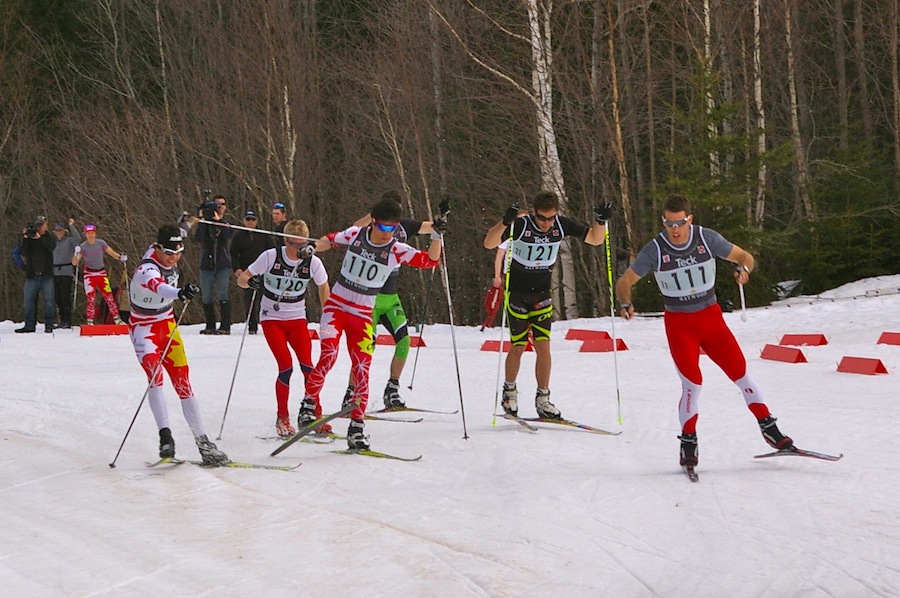
Len Valjas (l) leads the men's A-final off the first hill into the stadium. Phil Widmer, Devon Kershaw, Alex Harvey, and Sindre Bjornestad Skar follow, respectively. Baptiste Gros (not shown) finished fifth.
He said placing third to Harvey and Kershaw was “motivating for the future,” especially going into summer training. Widmer posted the second fastest qualifying time, 0.02 seconds after Harvey, who won in 2:51.27.
Another top qualifier in fourth, Jesse Cockney won his quarterfinal and advanced with Gros, but did not make it out of the semis after placing third to Harvey and Gros. Drew Goldsack was fourth in that heat.
In the second semi, Kershaw had his first mishap of the day, getting tangled with Valjas just after the start. Kershaw broke a pole and dug deep to finish fast enough in third to make the A-final.
Kershaw said his season was most likely over. He did not plan to do the 50 k classic mass start on Saturday.
“I’m dead,” Kershaw said. “I was on fumes and now the fumes have dissipated into the air.”
Looking back on the season, he hadn’t really absorbed everything he and his national team achieved yet.
“I honestly haven’t had a chance to reflect, but I’m just so proud of what our team has been able to do,” Kershaw said. “To see Len’s results at the end of the season was spectacular, Alex to be sixth overall at 23 years old is unbelievable, and for me, it’s just been a big goal of mine for a long time to be in the top three overall and to be second in the distance cup, too, and six podiums.
“To be honest, second in the World Cup finals is a really big thing for me,” he added. “It was a big goal because I just sucked in Falun [Sweden] the last few years. There’s a lot of positives, for sure.”
Valjas was still in awe at what they had accomplished.
“It’s been a historic year for the whole team and I’m so glad I was able to be there with all the guys,” he said. “I couldn’t have done it just on my own and it helps knowing that you’re training with the world’s fastest guys.”
As for Harvey, he was still living in the now, running from warm-up to warm-down with media and autograph-seekers on his heels, and video shoots with sponsors on his off days.
“It’s good to win at home,” Harvey said with a laugh. “It’s good for me to win in front of the fans.”