From the FasterSkier archive — posts syndicated from athletes’ and coaches’ own blogs between 2004 and 2012, kept online as published. Current coverage is at fasterskier.com.
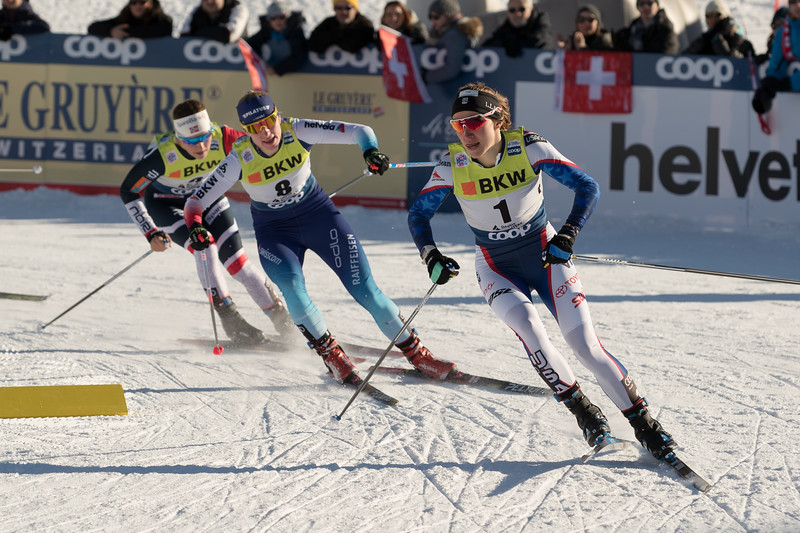
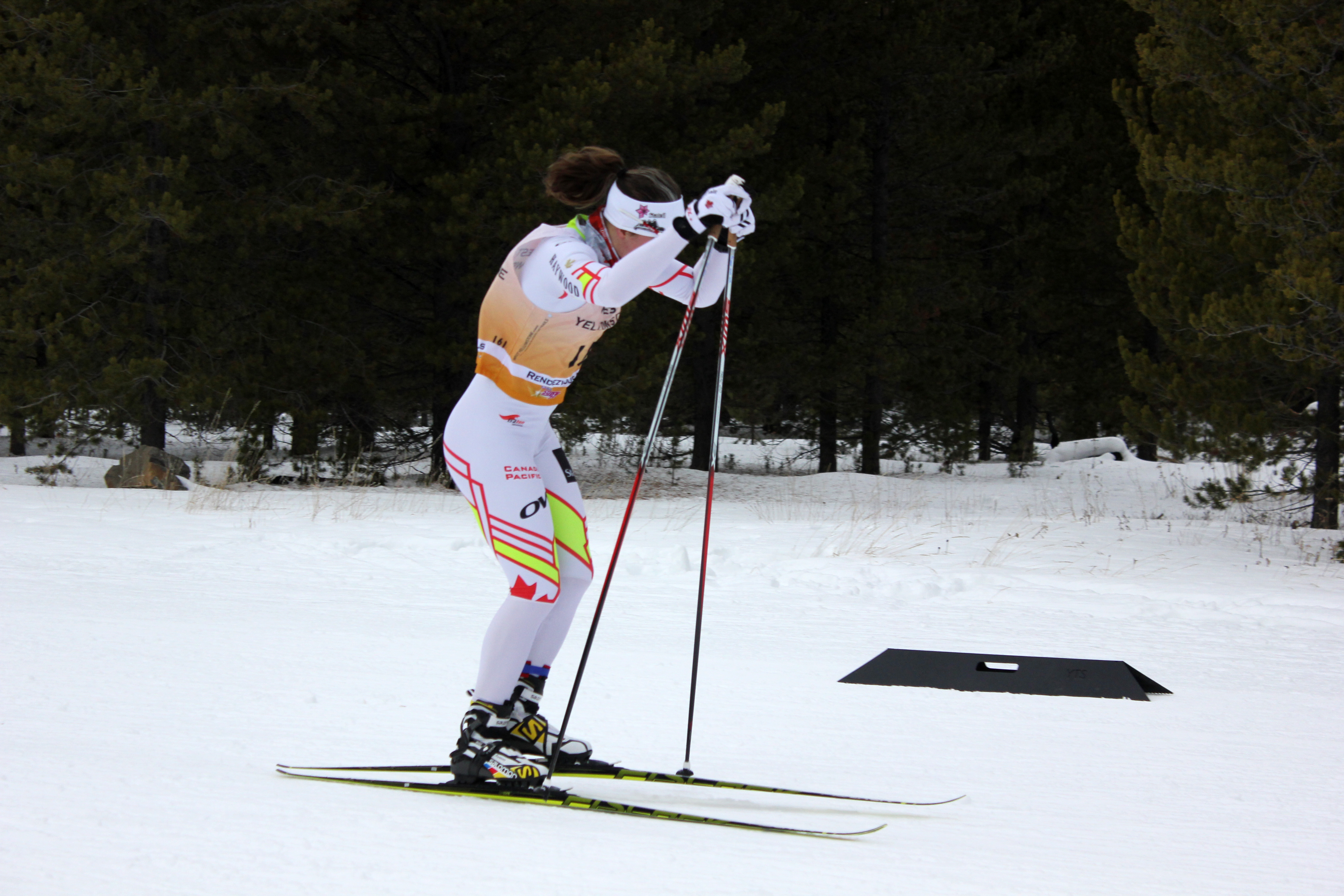
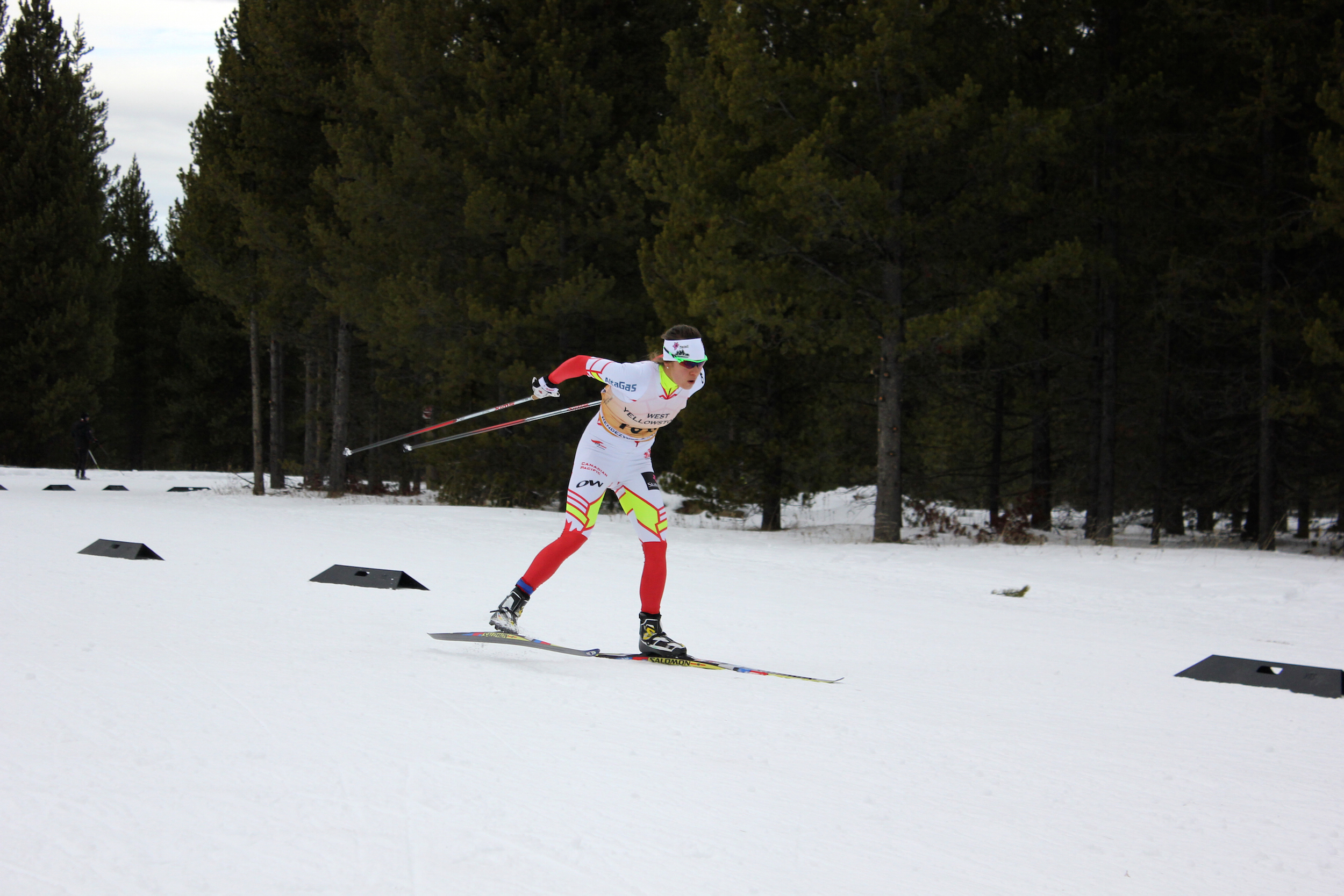
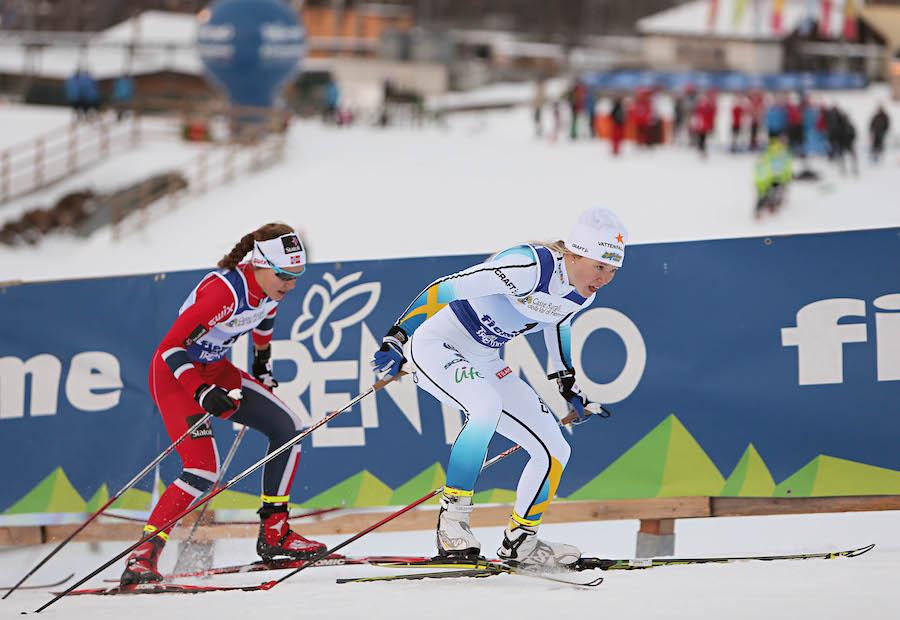
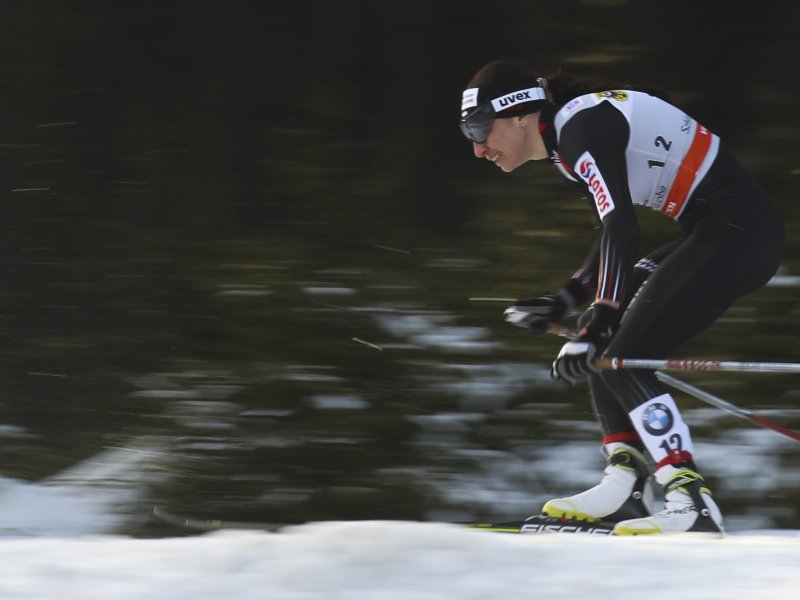
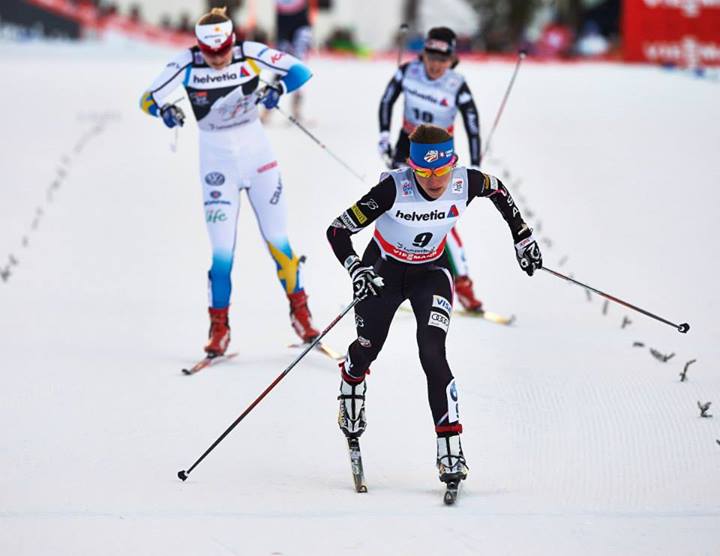
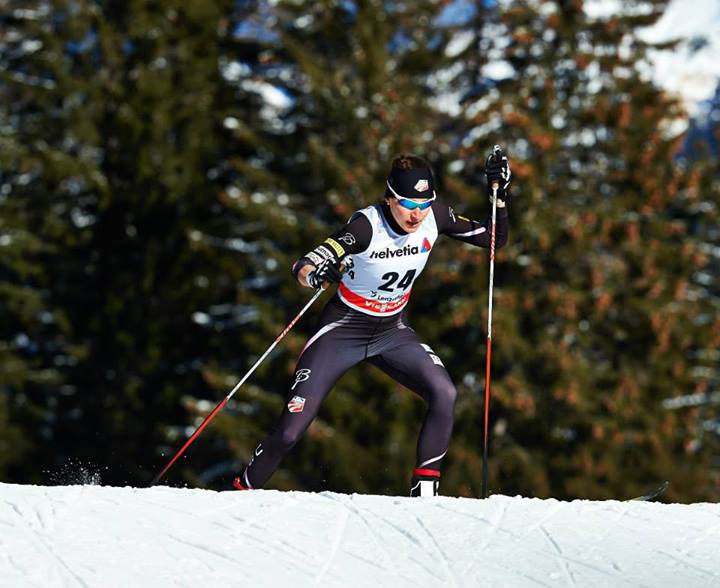
Sophie Caldwell (bib 1) of the U.S. Ski Team racing on Saturday during the women’s 1.5-kilometer freestyle sprint in Davos Switzerland. (Photo: Reese Brown/ U.S. Ski Team)
DNS. It’s a rare acronym to crop up in the results portion of Sophie Caldwell’s FIS database. But after battling a cold for the first few weeks of the 2018/2019 season, Caldwell did not start (DNS) the Lillehammer freestyle sprint and also chose to sit out the women’s relay last weekend.
By this Saturday in Davos, Switzerland, the 28 year old’s decision to rest and not race seemed to have paid off. She sprinted to a second place in the women’s 1.5-kilometer Davos freestyle competition, finishing just behind Sweden’s sprint superstar, Stina Nilsson. Earlier in the day, Caldwell also won the women’s qualifier in a time of 2:46.2.
“I think when you lay down a really fast qualifier, it gives you confidence moving forward,” U.S. World Cup head coach, Matt Whitcomb said during a phone conversation after the race.
“I was coming off a long bout of illness, so I was honestly just really happy to be racing again and didn’t have any expectations going into the day,” Caldwell wrote in an email to FasterSkier.”I think when you’ve had a period of illness or feeling down, it’s important to set smaller goals to gain your confidence back, so I was really grateful to be feeling healthy again and told myself I would be happy to qualify today. I was very pleasantly surprised when I won the qualifier and continued to feel great throughout the day, so the day exceeded any expectations I had going into it.”
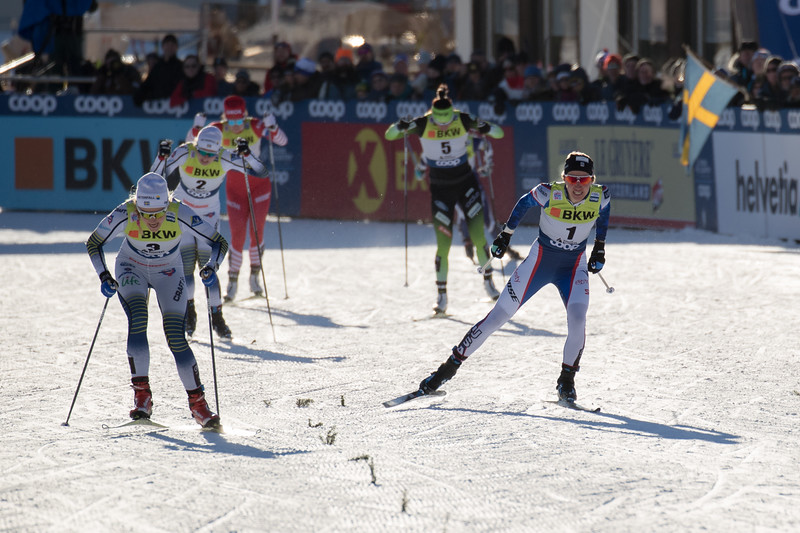
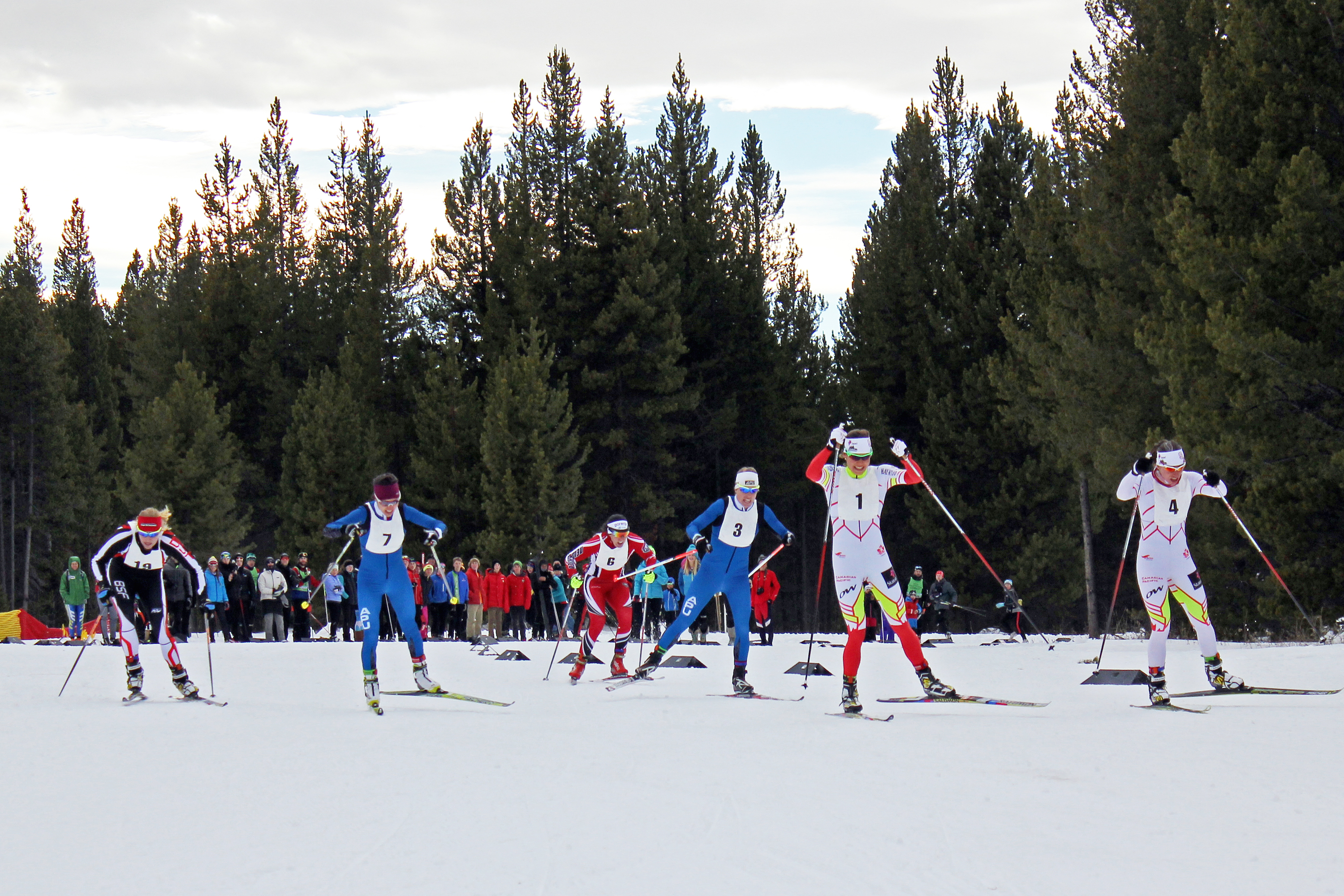
Sophie Caldwell (bib 1) and Stina Nilsson (bib 3) during the women’s 1.5-kilometer freestyle sprint final on Saturday in Davos Switzerland. (Photo: Reese Brown/U.S. Ski Team)
After qualifying in first, Caldwell advanced to the first quarterfinal which she won in a time of 2:41.97. Moving on to the semifinal, Caldwell once again crossed first in a time of 2:42.28. For both her quarterfinal and semi, Caldwell remained positioned in third to fourth through the first climb and descent and second major climb of her heats, before making her move in the final descent.
“She decided in both her quarters and semis and final to lay back a little bit mid-pack try and follow a little bit and then pounce as the pack tired out intending to have bit more energy herself and that went to plan perfectly,” Whitcomb said. “Really proud of her tactics today.”
“I really like how technical and fast this course is, so after I had a good qualifier, I knew I could be really confident in my ski speed and finishing stretch, so I just tried to ski smart the rest of the time, conserving energy when I could and moving into a good position up the hill the second time,” Caldwell said.
In the final, it was Nilsson along with Slovenia’s Katja Visnar setting the pace from the gun. Caldwell, who had started in lane two, slotted herself to the inside of the final group in third through the first climb.
As the field approached the crest of the course’s first major uphill, Finland’s Krista Pärmäkoski made a decisive move to the front. She maneuvered to the left of the group, jetting from fourth to first. Caldwell continued to click away, cornering to the inside to maintain a draft off Visnar and Pärmäkoski. Just to Caldwell’s left, was Nilsson.
As the group swept into the course’s first descent, the skis of the U.S. and Sweden seemed to outpace the rest. Heading into the following course’s flatter V2 section, Nilsson had snuck around Visnar and Pärmäkoski to take the lead. Caldwell shadowed her move and the two began to push the pace. It was Sweden’s top sprinter being chased down by Caldwell; the remainder of the sprint final’s field chasing down the U.S.
Neither Caldwell or Nilsson let up. The two pulled away in the final climb, with Nilsson holding a slight gap over Caldwell. As the racers began the final descent on course, almost two meters separated Caldwell from the next closest skier, Sweden’s Maja Dahlqvist.
Rounding into the final 100-meters, Nilsson maintained her lead on Caldwell and crossed ahead of the American for first in a time of 2:41.34. Caldwell finished 0.72 seconds behind for second place.
“I was feeling pretty good on the climb, but I knew I had fast skis and felt really good in the finishing stretch, so my goal was to position myself in 2nd or 3rd at the top of the last hill to take advantage of the draft, corner, and finish stretch,” Caldwell wrote in an email. “Unfortunately, Stina got away from me a bit on the climb, but I tried to push as hard as possible to close the gap and am of course thrilled with 2nd!”
The win is the first of the season for Nilsson. She won the Davos freestyle sprint in December last year, besting American Kikkan Randall (now retired) and Norwegian Maiken Caspersen Falla. Falla placed fourth in her quarterfinal and did not advance to the semis. Nilsson now has 13 individual World Cup sprint victories and is currently ranked first in the sprint standings with 186 points, ahead of Dahlqvist in second with 140 points and Russia’s Yulia Belorukova in third with 119 points.
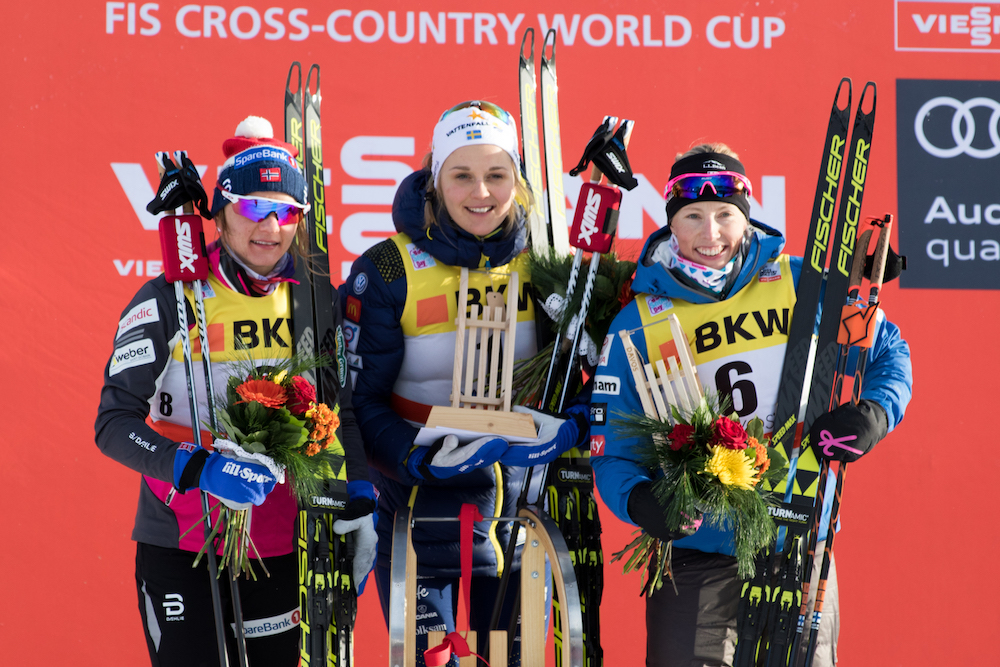
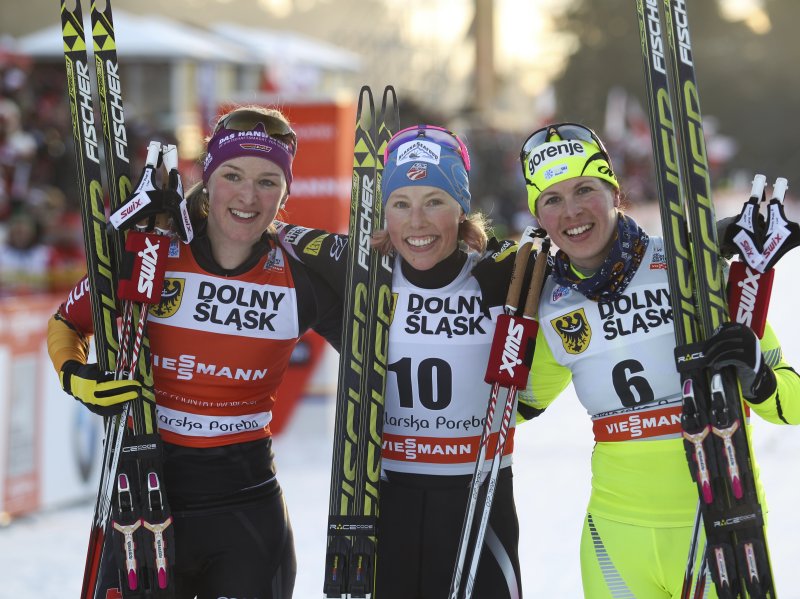
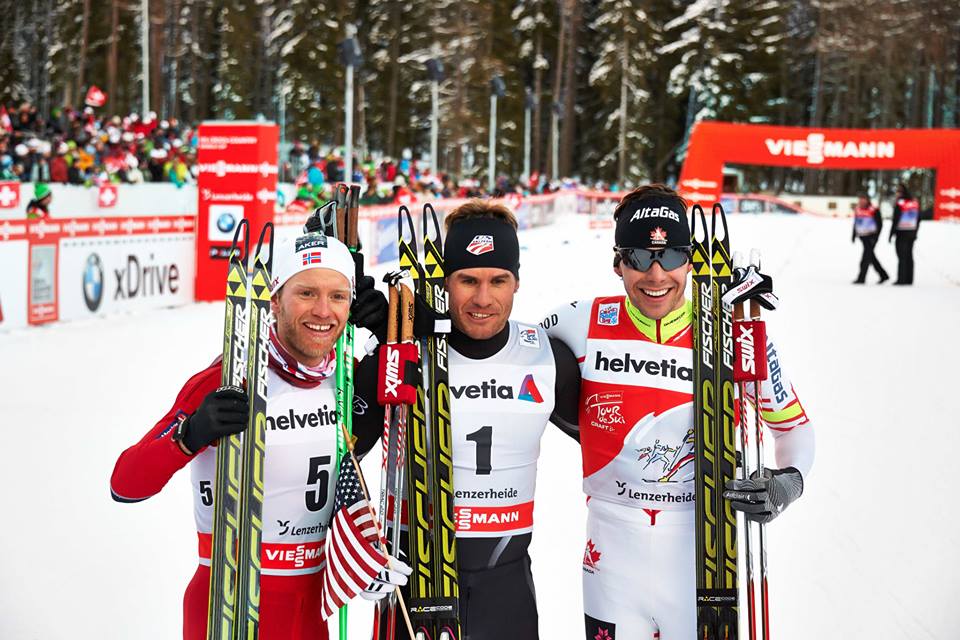
2018 Davos, Switzerland women’s sprint podium. Sweden’s Stina Nilsson (center) placed first, Sophie Caldwell (left) of the U.S. was second, and Maja Dahlqvist (right) also of Sweden was third. (Reese Brown/U.S. Ski Team)
Claiming Saturday’s third and final podium position was Dahlqvist, who crossed 2.60 seconds behind Nilsson. The podium is Dahlqvist’s second World Cup podium this season. She placed second in the FIS classic sprint opener in Kuusamo, Finland. Prior to this year, Dahlqvist has had one other individual World Cup top three performance, that being her second place finish in last season’s Dresden freestyle sprint.
Finishing in fourth on Saturday was Russia’s Natalia Nepryaeva (+3.98). Following Nepryaeva was Visnar in fifth (+4.34) and Pärmäkoski in sixth (+11.16).
Rounding out the top-ten was Swiss skier Nadine Fähndrich in seventh, Evelina Settlin in eighth, Lotta Udnes Weng in ninth and Ingvild Flugstad Østberg in tenth.
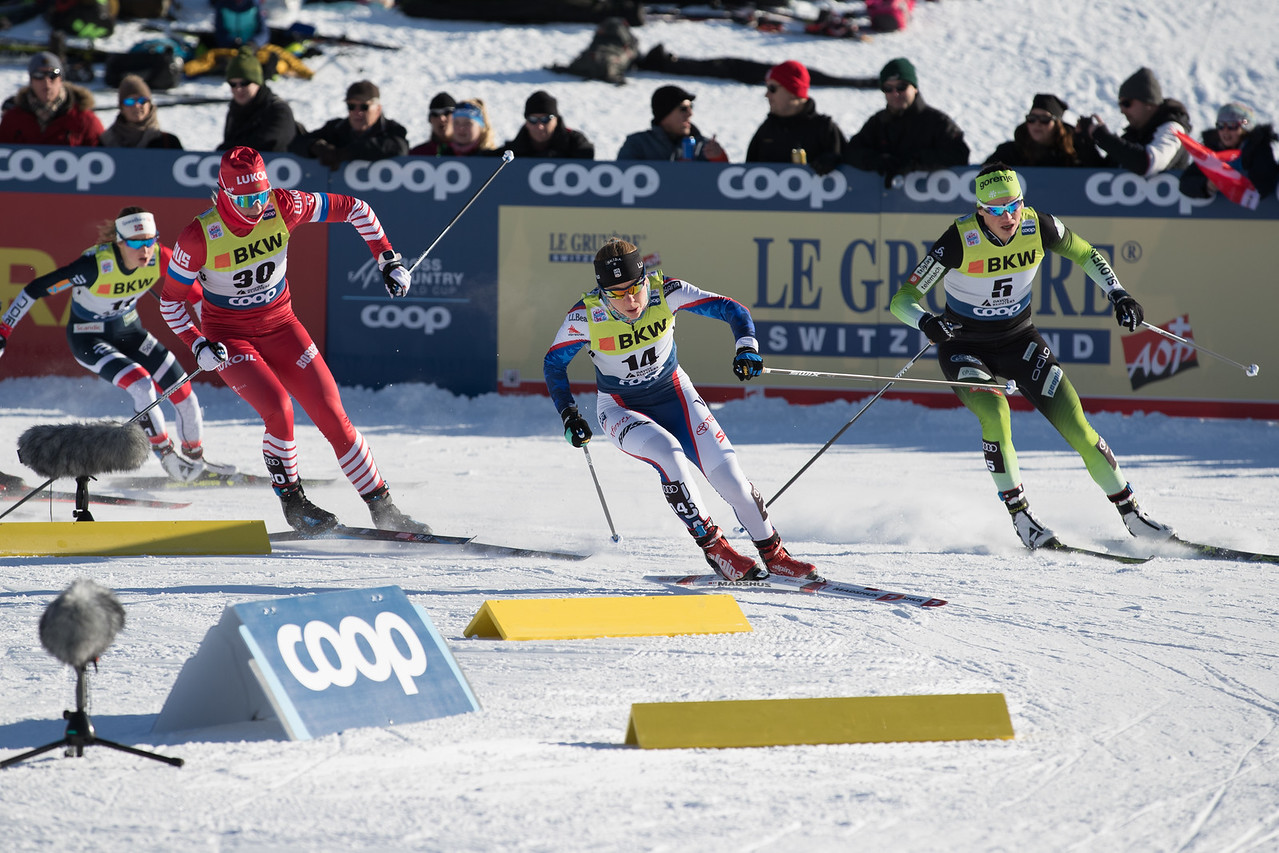
The U.S. placed four women total in the top-30, with Caldwell’s second place performance followed by Sadie Bjornsen in 14th, Ida Sargent 21st, Jessie Diggins 26th, and Rosie Brennan 29th.
Sadie Bjornsen of the U.S. Ski Team during the third quarterfinal of the women’s skate sprint in Davos, Switzerland. (Photo: Reese Brown/U.S. Ski Team)
Both Bjornsen and Brennan advanced to the third quarterfinal, with Bjornsen having qualified in 10th and Brennan 28th. Bjornsen had led the first climb and descent of her quarterfinal before Sweden’s Hanna Falk took over the pace as they headed into the course’s second climb.
Bjornsen held onto second through the descent before getting passed by Nepryaeva in the finishing stretch. She finished the quarterfinal in third behind Falk and Nepryaeva. Bjornsen missed advancing by 0.13 seconds. Brennan crossed in sixth.
In the first quarterfinal along with Nilsson, Sargent led the group through the first uphill. However, by the second climb on course, Sargent had dropped back to sixth and eventually crossed her quarterfinal in fifth.
Ida Sargent locked in during her World Cup quarterfinal in Davos, Switzerland. of the U.S. Ski team during the qualifier of the women’s skate sprint in Davos, Switzerland. (Photo: Reese Brown/U.S. Ski Team)
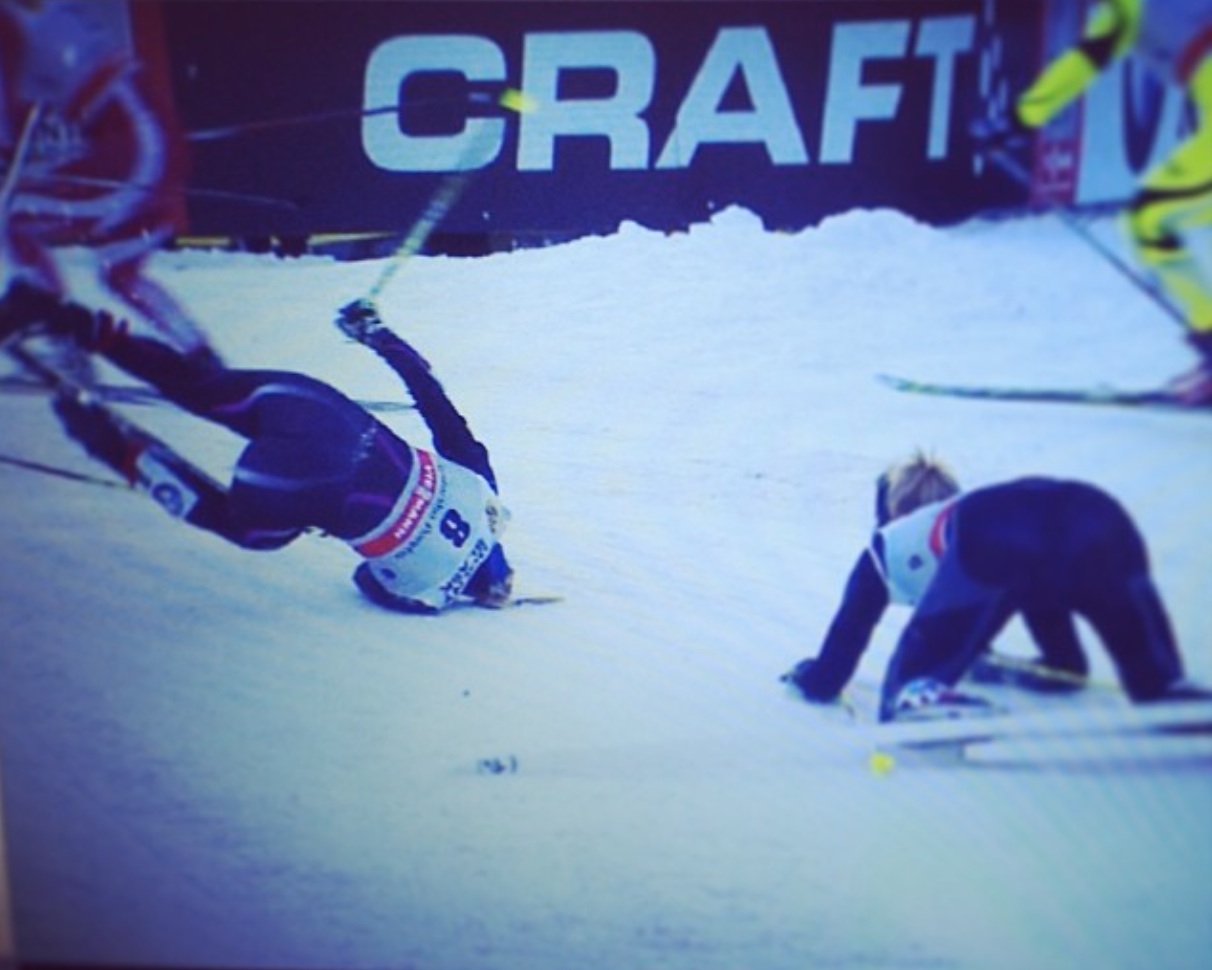
In the fourth quarterfinal, an early fall put Diggins out of contention for advancement to the semis. In the first straightaway, the American’s left ski collided with the pole of Russian ski racer, Natalia Matveeva, causing Diggins to crash.
“Traffic just sort of closed in on her,” Whitcomb said. “Just a race incident, the kind of the thing you saw happen in some of the other heats.”
In the second semifinal, a collision between Pärmäkoski and Norway’s Tiril Udnes Weng caused the Norwegian’s left ski to fall off midway through the race.
“Unfortunately in Davos, even Jessie can’t recover the 30-meters required to catch back up to the group,” Whitcomb added. “It’s too delicate a venue at altitude.”
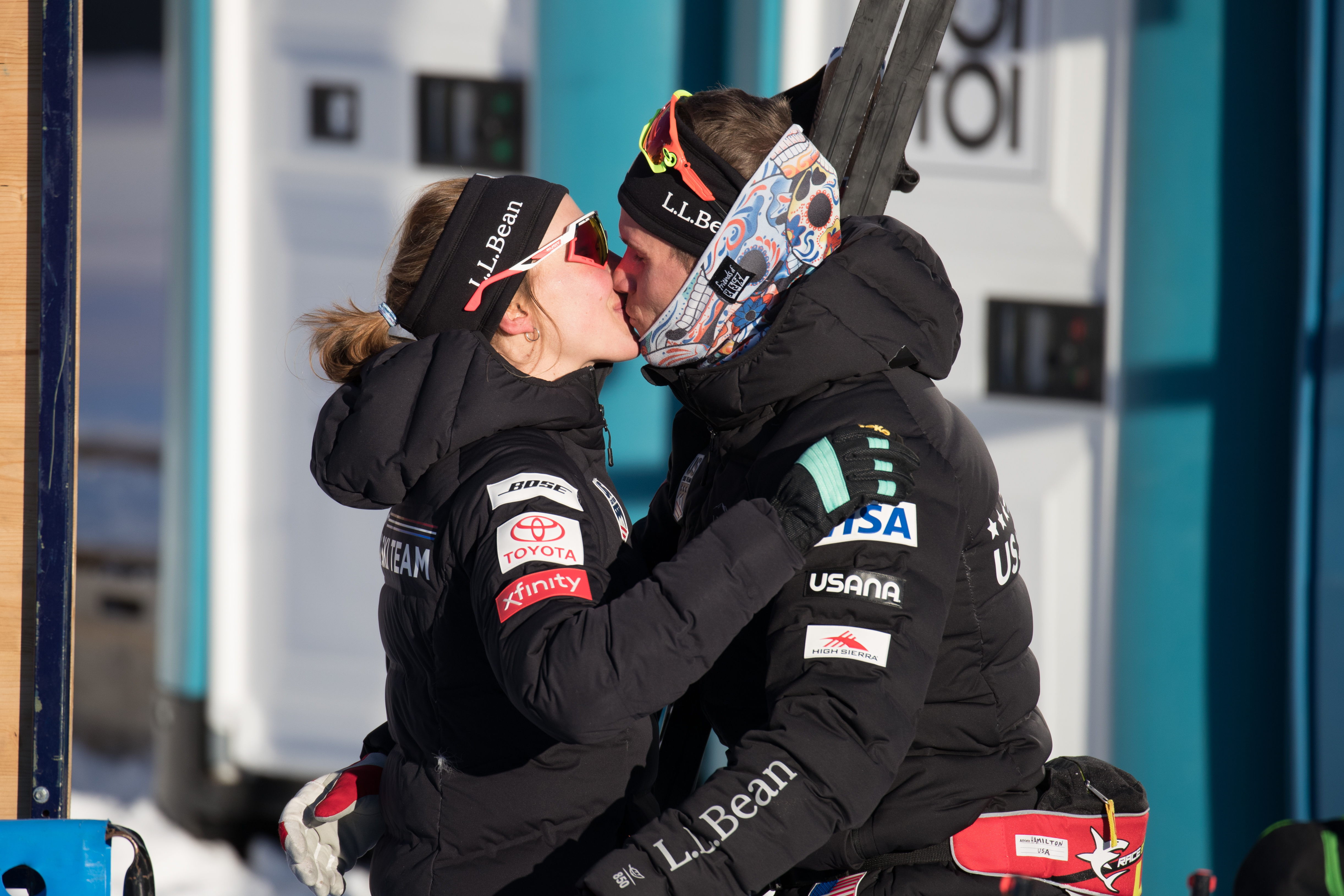
Sophie Caldwell (l) and U.S. Ski Team teammate/boyfriend Simi Hamilton after Caldwell placed second in Saturday’s 1.5-kilometer freestyle sprint on Saturday in Davos, Switzerland. (Photo: Reese Brown/U.S. Ski Team)
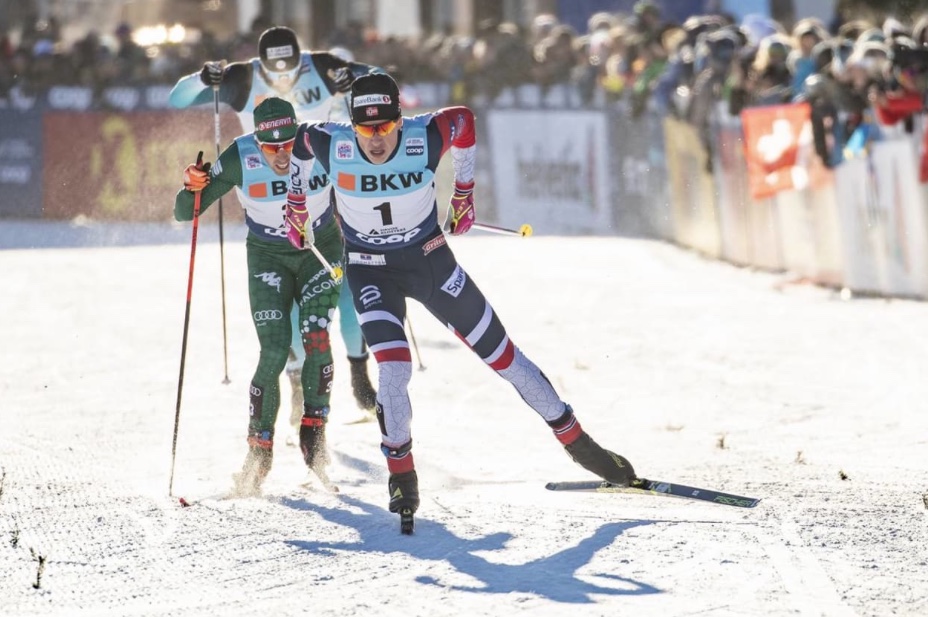
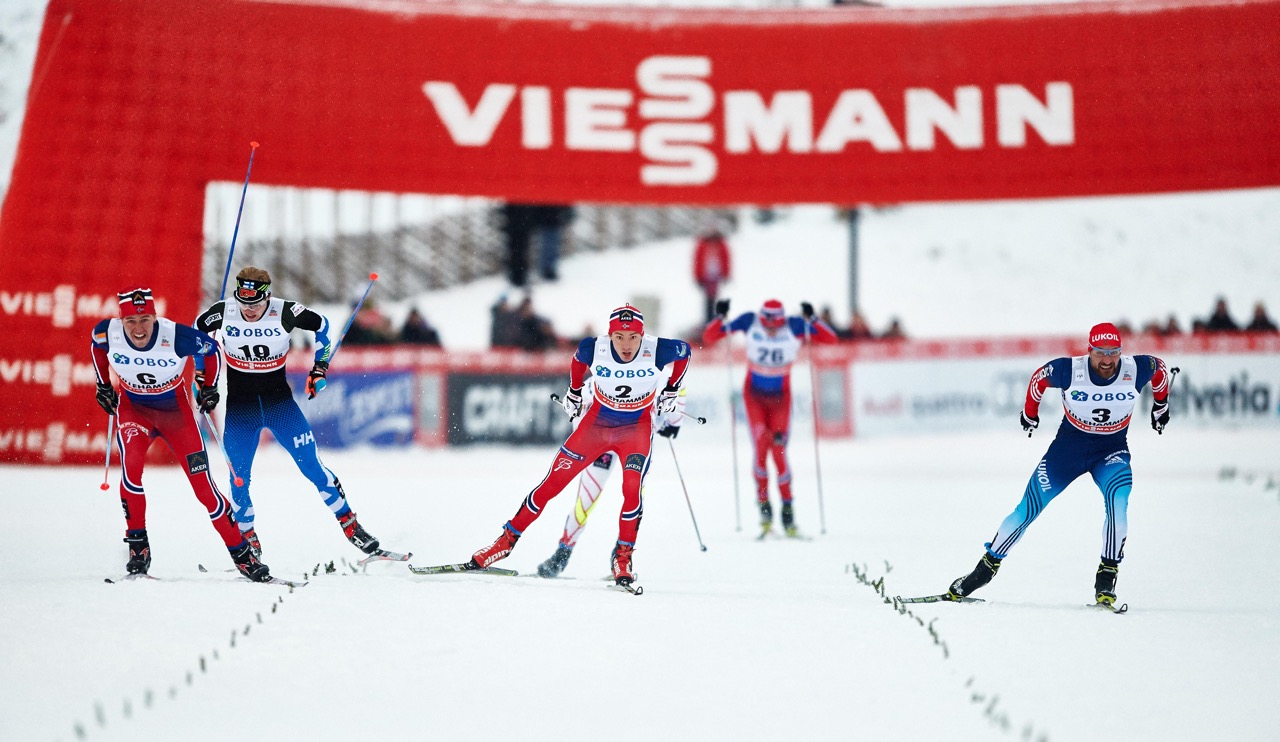
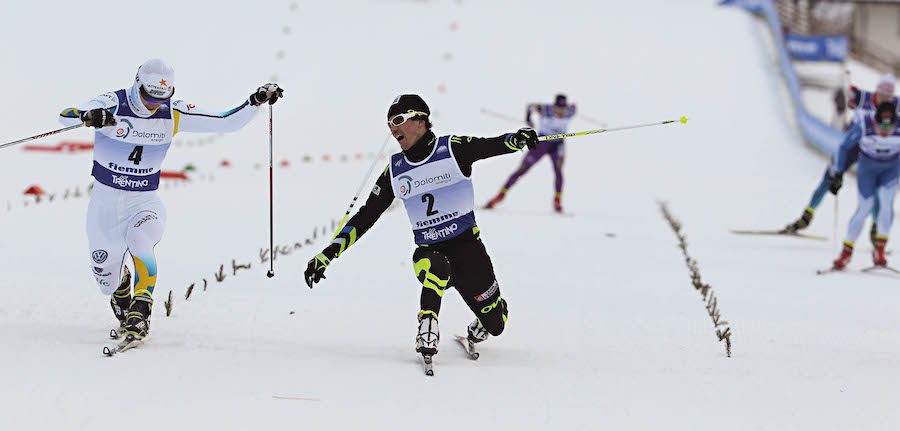
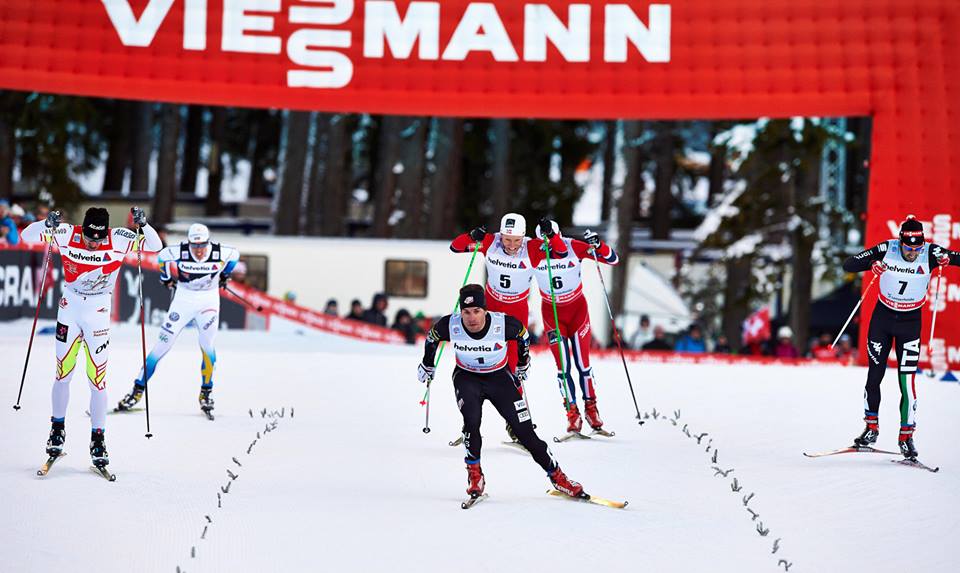
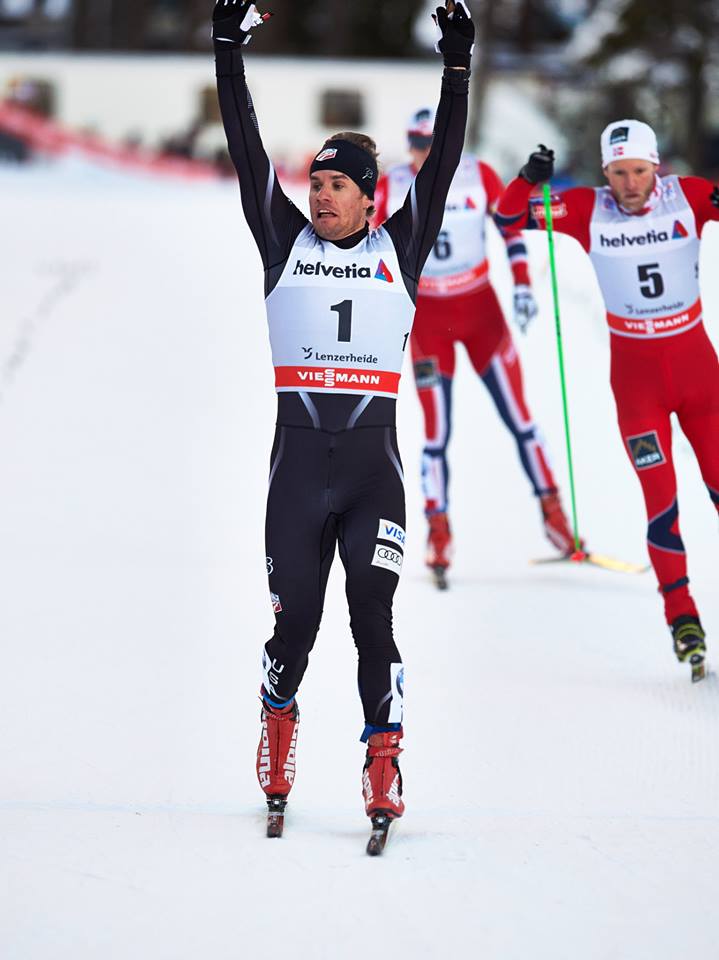
Johannes Høsflot Klæbo of Norway down the finishing stretch in Davos, Switzerland. He won the day’s skate sprint while Italy’s Federico Pellegrino (green suit) was second. (Photo: Fischer/Nordic Focus)
As seems fitting for all things Davos, Switzerland: the racers enjoyed a bluebird day for the 1.5-kilometer freestyle sprint on Saturday. And just when we thought Johannes Høsflot Klæbo of Norway might be too spent from a year of media coverage and big-effort racing, he scored his first win of the season in gorgeous Davos.
He began the day at full-throttle in the men’s qualifier, placing first with a time of 2:22.39 minutes. Lucas Chanavat of France qualified second (+0.36) and Federico Pellegrino of Italy qualified third (+1.76).
Klæbo continued his winning streak throughout the heats, winning his quarterfinal, and semi. He finished the day with an overall win in the final, finishing in 2:20.44 minutes. This was Klæbo’s first win of the season. He qualified first in the 1.6-km skate sprint in Lillehammer, Norway two weeks ago, but he finished in 11th overall. One thing was for certain in Davos: Klæbo was skiing with confidence, snappiness, and some of the flair he’d been missing this season.
On the first climb of the final, Klæbo and Chanavat duked it out for the lead position. Pellegrino, skiing more conservatively at the outset, started in the back of the pack but was able to work the first corner to his advantage. By the top of the hill, he was sitting in third place. As the skiers lapped through and skated around the tight right-hander before the final climb, Kælbo was in stalk and hunt mode. He punched up the final climb and gapped the field on the downhill, sprinting to the finish ahead of Pellegrino who finished second (+.39).
“That’s what we train for the whole spring and all summer – so now I’m where I want to be. It’s a fantastic feeling,” Klæbo told Norwegian broadcaster NRK according to a translation. Klæbo also told NRK he has not confirmed his plans to race the Tour de Ski (TdS) and will make that decision in the coming days.
With the win on Saturday, Klæbo joins Norway’s Eirik Brandsdal and Petter Northug with nine wins each in World Cup individual sprint wins. The three all sit fourth all-time for World Cup sprint wins among Norwegian men.
For Pellegrino, it was his second podium of the season. He won the 1.6km skate sprint in Lillehammer. Pellegrino has won 11 freestyle sprint World Cups in his career which is the men’s record. That win total is topped by only Kikkan Randall who won 12 freestyle sprints, and Marit Bjørgen who won 24 freestyle sprints during their careers.
Despite his skate sprint pedigree, Pellegrino admitted he feels slightly old among the sprint scene’s young skiers.
“I think I am starting to be a bit old,” Pellegrino told the International Ski Federation (FIS). “This was my 10th race here in Davos and always passed the qualifications. I am really proud of that until now and I hope to do 10 more years and maybe I’ll beat the younger then.”
Babtiste Gros of France finished third (+1.40), barely out sprinting teammate Chanavat (+1.45) in the final. This was Gros’s first podium of the season and his fifth career podium.
Simi Hamilton of the U.S. Ski team zeroing in during the fifth heat Saturday in the 1.5-kilometer freestyle sprint in Davos, Switzerland. Hamilton placed 12th overall. (Photo: Reese Brown/U.S. Ski Team)
Simi Hamilton(USST) was the only North American that qualified for the men in the Davos sprint. Hamilton was 17th (+4.76) in the qualifier. In the fifth heat, Hamilton was second to Joni Maeki of Finland to advance to the semis. A bit spent from the quick-turnaround after the fifth heat to the second semi-final, Hamilton placed sixth in his semi-final.
“Davos, it’s always been a good place for me, having grown up at 8,000 ft. I don’t feel like it’s super high here at 5,000 feet,” Hamilton told FasterSkier in a call. “I think it is still tough for everyone, but also for me when I haven’t been above 1,000 ft for the last 6 weeks, it’s still a shock to the system.”
Hamilton also spoke about his short recovery time from the fifth heat to the semis, and why he chose a later heat.
“Obviously you want to choose one of the earlier heats so you have a longer turnaround time between the quarters and the semis,” Hamilton added. “But, my main goal today was to ski into the semis. It’s always the big goal to be in the final and be on the podium, but I think setting the short-term, realistic goal is also important. So today, having not been at altitude for a while and not feeling super super good, I set the goal of just being in the semis. With that in mind, I chose heat five, knowing that would set me up best for getting into the semis, but probably wouldn’t result in me feeling really good in the semis. So I was kind of expecting that, but just went out and raced as hard as I could and completely ran out of gas in that semi-final and felt pretty crappy on that second lap. ”
US Ski Team Coach Matt Whitcomb also commented on Hamilton’s 12th place in a call.
“Nice step forward for Simi today,” Whitcomb said. “Not exactly what we need on a podium day, but it was still a step forward. He felt very controlled in his quarterfinal and was tactically sound today, made really good moves. It was nice to see him in the semifinals, it’s positive feedback for him. But I’m really looking forward to seeing him in the first few ski sprints in the Tour de Ski.”
Kevin Bolger (USST) was the second-best American, finishing 31st and barely missing the cut off for the heats. This is Bolger’s best individual result so far this season.
In an email to FasterSkier, Bolger explained he is feeling better energy in his first full World Cup season as a new member of the U.S. Ski Team.
Kevin Bolger of the U.S. Ski Team during the skate sprint qualifier in Davos, Switzerland. Bolger just missed the heats by qualifying in 31st. (Photo: Reese Brown/U.S. Ski Team)
“The qualifier was a fast 2 lapper, no room for error,” Bolger wrote. “Unfortunately, I ended up 31st just 0.02 out from qualifying, but it’s a step in the right direction. I’m moving forward and that’s a huge confidence booster going into Christmas break, and the Tour.”
Bolger also noted he will be racing in tomorrow’s 15 k skate individual start.
“It’ll be a burner, pretty tough course especially at altitude but I’m excited. I feel like my distance skiing is moving in the right direction as well, I’ll be using today’s result as fuel for tomorrow, but looking forward to getting out there and putting together a good race, should be a fun day in the sun!”
Alex Harvey was the best placed Canadian, placing 37th overall. Harvey, who in the past has explained he does not prefer higher altitude courses, has placed in the top-30 twice in Davos sprints: a ninth place in 2011, and a 23rd in 2017. Lenny Valjas, in his first World Cup of the season, was 53rd. Andy Shields finished in 60th. No other Canadians were entered.
Racing continues tomorrow for the men with a 15 k skate individual start.
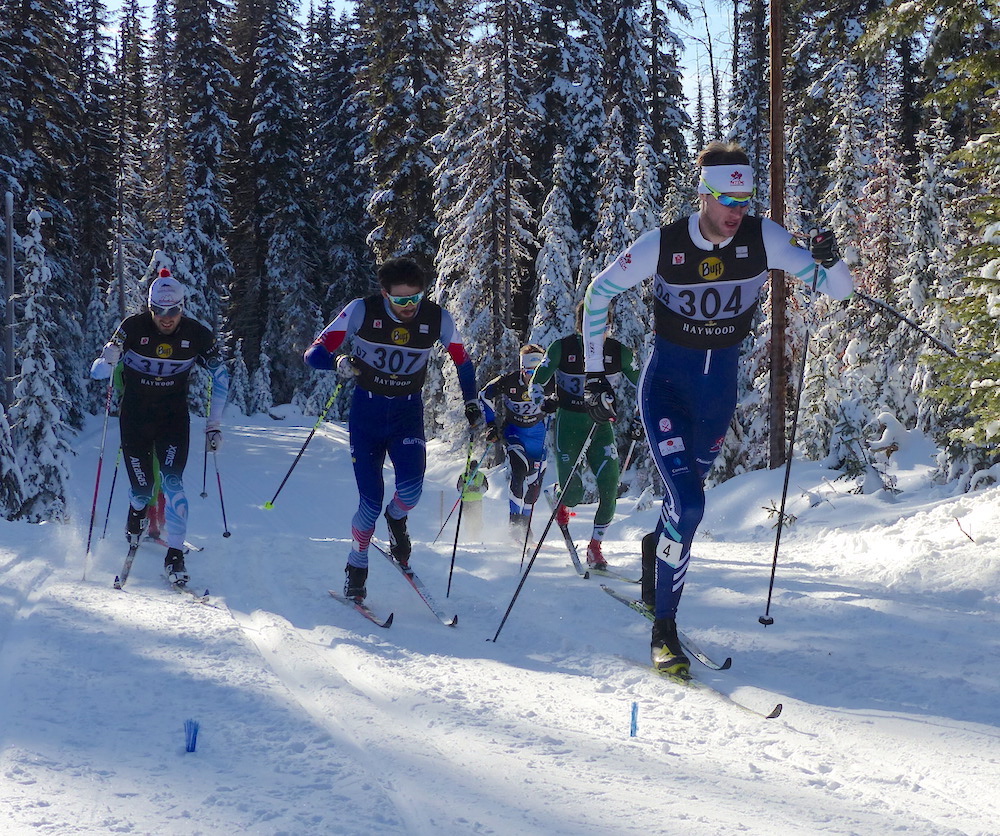
Bob Thompson (304) of NTDC Thunder Bay leading Sun Valley’s Jack Hegman (307) and Patrick Stewart-Jones (317) of the AWCA during their quarterfinal of the NorAm men’s 1.3 k classic sprint on Saturday at Sovereign Lake near Vernon, B.C. (Photo: Peggy Hung)
NorAm/SuperTour (Sovereign Lake near Vernon, British Columbia): Classic sprints
On the opening day of the NorAm Continental Cup series in Canada (which doubled as a U.S. SuperTour), American Kaitlynn Miller of the Craftsbury Green Racing Project (CGRP) started Saturday with a nearly three-second win in the classic-sprint qualifier at the Sovereign Lake Nordic Centre, then went on to win her quarterfinal and semifinal before topping the final as well.
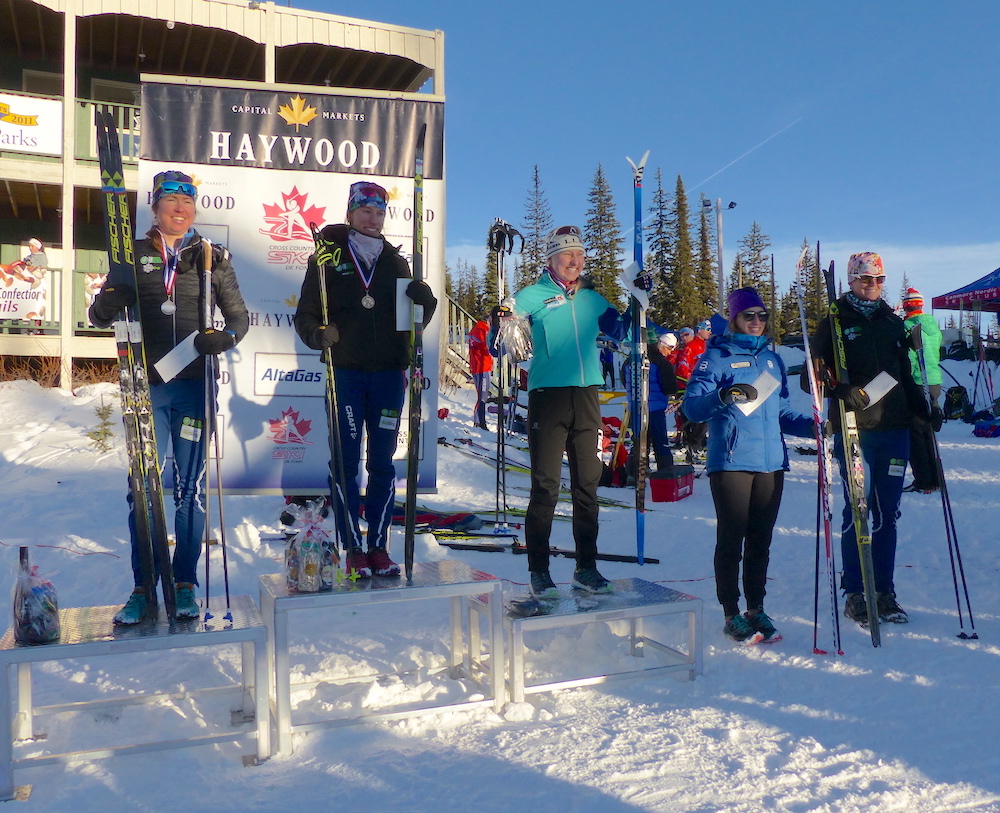
The women’s 1.3 k classic sprint podium and top five at the first NorAm of the season on Saturday at Sovereign Lake near Vernon, B.C., with (from left to right) Caitlin Patterson (CGRP) in second, Kaitlynn Miller (CGRP) in first, Hannah Halvorsen (APU/USST) in third, Kelsey Phinney (SVSEF) in fourth, and Liz Guiney (CGRP) in fifth. (Photo: Peggy Hung)
Miller was the fastest women’s qualifier by 2.87 seconds on the 1.3-kilometer course with a time of 2:59.39. Ultimately, she won the final in 2:57.53, 0.93 seconds ahead of her teammate Caitlin Patterson in second and 2.59 seconds clear of the third American on the podium, Hannah Halvorsen of Alaska Pacific University (APU) and the U.S. Ski Team (USST) D-team, in third place.
Halvorsen previously qualified third behind Kelsey Phinney, of the Sun Valley Ski Education Foundation (SVSEF) in second. Phinney finished fourth in the final (+2.85), while a third Craftsbury skier, Liz Guiney placed fifth (+3.53). The lone Canadian in the six-woman final, Sophie Carrier-Laforte of the Pierre-Harvey National Training Centre (CNEPH) placed sixth (+4.38).
Thompson Fends Off Five Americans
Of the six racers in the men’s 1.3 k freestyle sprint final, five of them were American. Bob Thompson, of the Thunder Bay National Team Development Centre (NTDC), bested them all for the win in 2:29.31, just 0.03 seconds ahead of Ben Saxton, of the Stratton Mountain School (SMS) Elite Team, in second place. Cole Morgan (SVSEF), the qualifying winner who had so far dominated all of his heats, ended up third overall, 0.48 seconds behind Thompson.
Sun Valley and APU each had two athletes reach the men’s final with Jack Hegman (SVSEF) taking fourth (+0.51), and APU’s Reese Hanneman and Tyler Kornfield placing fifth (+7.75) and sixth (+7.9), respectively.
To start the day, Morgan posted the fastest men’s qualifying time in 2:31.00, while last weekend’s SuperTour skate sprint winner Nick Michaud, of the Bridger Ski Foundation (BSF), qualified in second, 0.78 seconds back. Americans took the top-three qualifying spots with Logan Hanneman (APU) in third (+1.59), whileThompsonwas the top Canadian qualifier in fourth (+2.34).
Morgan won both his quarterfinal and the first semifinal to advance to the final, along with Thompson who placed second in that semifinal (and placed second to Hegman in the quarterfinals).Saxtonwon the second semifinal (after finishing second to Logan Hanneman in the quarterfinals) andKornfield was second behind Saxton in that semifinal to automatically advance to the final. Reese Hanneman and Hegman made it to the final as lucky losers after placing third and fourth, respectively, in the first semifinal.
Norway’s Johannes Thingnes Bø notched his second-straight win in Hochfilzen after Martin Fourcade of France missed three on the final shooting stage of the men’s 12.5 k pursuit on Saturday. Bø, who started the race 12 seconds ahead of Fourcade in second, cleaned the final standing stage to leave the range nearly a minute ahead of Slovenia’s Jakov Fak in second. Meanwhile, Fourcade, who had been skiing in first just ahead of Bø before the last stage, dropped 1:19 minutes back to fifth.
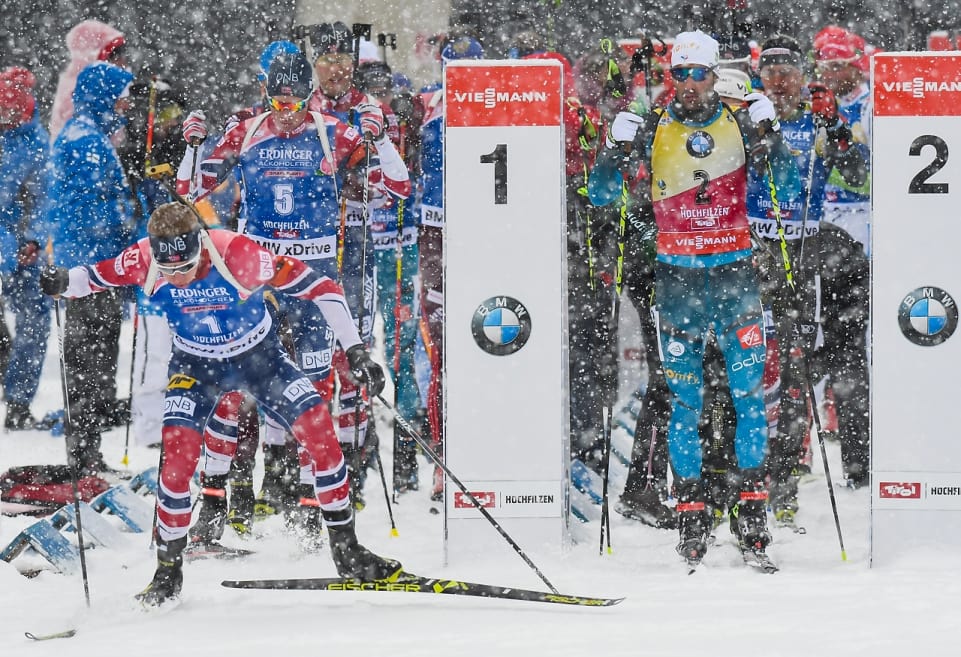
Norway’s Johannes Thingnes Bø (1) heading out of the start, 12 seconds ahead of the second starter, France’s Martin Fourcade (yellow bib), on Saturday in the IBU World Cup men’s 12.5 k pursuit in Hochfilzen, Austria. (Photo: IBU/biathlonworld)
While Bø skied the win in 36:41.1 minutes and Fak, the third starter, finished 58.8 seconds later in second place, Fourcade made up two places on the final loop to place third (+1:10.0) after passing Germany’s Simon Schempp and Russia’s Maxim Tsvetkov.
Schempp settled for fourth (+1:10.5), and Bø’s older brother, Tarjei Bø, passed Tsvetkov as well to claim fifth (+1:11.9), while Tsvetkov finished sixth (+11:12.3).
On another snowy afternoon in Hochfilzen, Johannes Bø had three penalties, two of which came in the first stage (2+0+1+0). Fak was one of four men in the race with just one miss (0+0+1+0) — no one cleaned — while Fourcade missed five (1+0+1+3). Schempp had four penalties (3+1+0+0) but held onto his starting position in fourth, Tarjei Bø improved from 14th at the start to fifth with just two misses (1+0+1+0) and Tsvetkov raced up from 20th to sixth with a single miss (1+0+0+0).
American Sean Doherty tied his second-best World Cup result in 17th (+2:12.8) after starting 23rd and 1:39 out of first. He had two penalties (1+0+1+0).
Canada’s top finisher, Nathan Smith placed 31st (+3:02.2) after starting 19th and missing three shots (1+1+0+1). His teammate Brendan Green rose to 33rd (+3:15.7), up from 52nd at the start, with three penalties as well (1+0+1+1).
Four Canadians qualified for the pursuit, with Scott Gow placing 48th (+5:08.4) with seven penalties (1+1+3+2). His younger brother Christian Gow crossed next in 49th (+5:13.7) after missing five (+5:13.7).
The other American man in the race, Lowell Bailey placed 36th (+3:20.6), up from 53rd, with three misses (0+2+1+0).
Kuzmina Gets First Win in Three Years
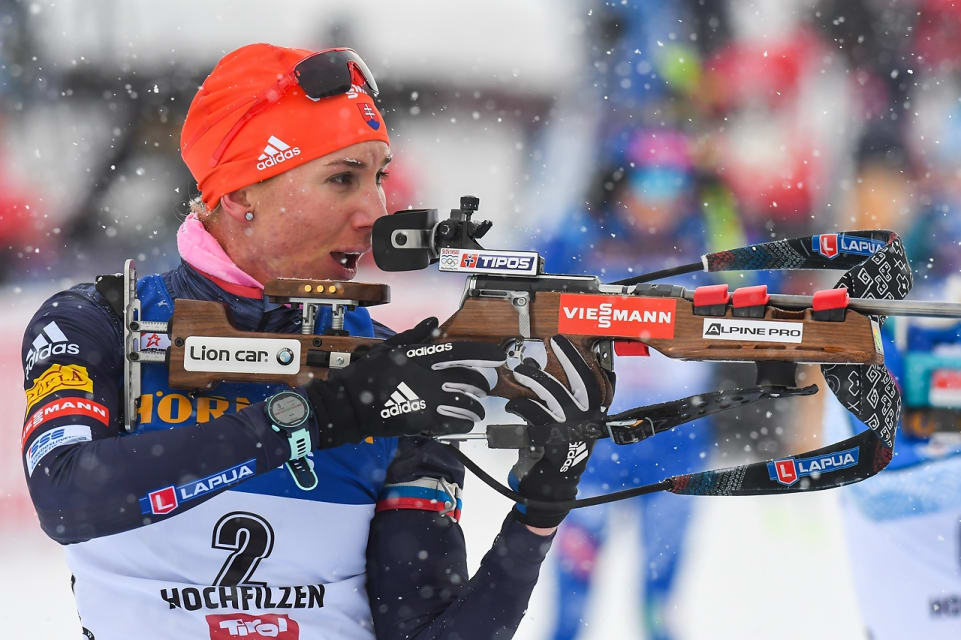
Slovakia’s Anastasia Kuzmina cleaning one of two standing stages in the women’s 10 k pursuit at the IBU World Cup in Hochfilzen, Austria, en route to a 10-second win. (Photo: IBU/biathlonworld)
In the women’s 10 k pursuit that followed, Slovakia’s Anastasia Kuzmina overcame a 22-second starting deficit to win her first race in three and a half years, shooting 19-for-20 (1+0+0+0) and finishing in 34:31.2. Kuzmina (the sister of Russia’s Anton Shipulin) started second behind Friday’s sprint winner Darya Domracheva of Belarus. Domracheva had a single miss as well in Saturday’s pursuit (0+0+1+0) but slipped to second after her penalty in the first standing stage, while Kuzmina cleaned the last three stages to take the win.
Domracheva settled for third (+11.8) and Finland’s Kaisa Mäkäräinen rose to second (+10.2) after shooting 18-for-20 (1+0+0+1) and skiing the fastest course time to rise from her starting position in sixth.
Italy’s Dorothea Wierer slipped one place to fourth (+51.6) after starting third and missing two (1+0+0+1), while Norway’s Marte Olsbu raced up from 13th to fifth (+58.2) with a single penalty (1+0+0+0). Ukraine’s Yuliia Dzhima improved from 20th to sixth (+1:08) with one miss as well (0+0+0+1).
Canada’s Emma Lunder achieved her second-best career World Cup result in 27th (+2:31.6) after starting 42nd and cleaning three stages after missing one in the first prone (1+0+0+0). Her teammate Rosanna Crawford improved from 49th at the start to 39th at the finish (+3:44.3) with four penalties, one in each stage (1+1+1+1).
The U.S. had one woman qualify for the race, Clare Egan, who finished 53rd (+5:21.6) with seven penalties (2+2+2+1).
For the third and final day of World Cup racing in Hochfilzen, the men’s and women’s relays will be held Sunday.
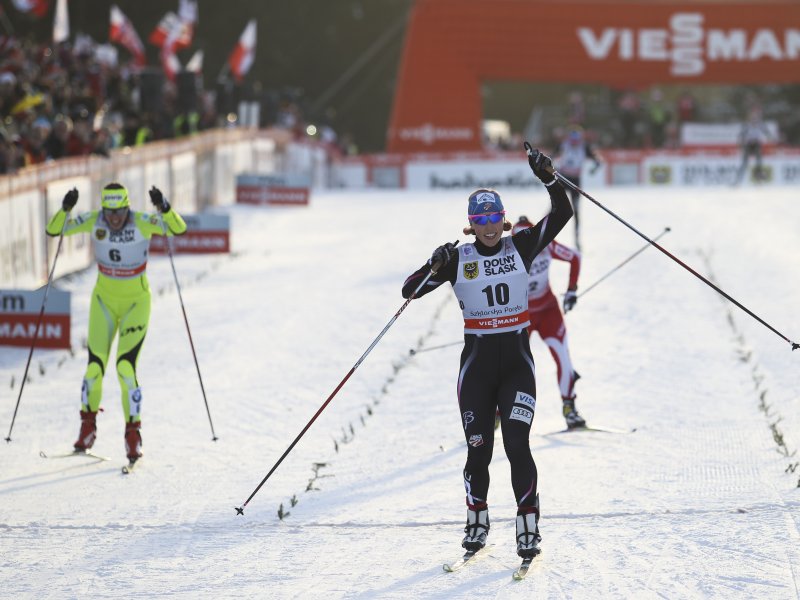
The women’s skate sprint podium at Saturday’s World Cup in Davos, Switzerland, with Kikkan Randall (r) of the U.S. Ski Team in third place, Sweden’s Stina Nilsson (c) in first, and Norway’s Maiken Caspersen Falla (l) in second. (Photo: Reese Brown/US Ski & Snowboard)
Kikkan Randall returned to the podium on Saturday in the first freestyle sprint of the 2017/2018 World Cup season, placing third in the women’s 1.5-kilometer skate sprint behind Sweden’s Stina Nilsson and Norway’s Maiken Caspersen Falla, respectively, in Davos, Switzerland.
Americans made up half of the women’s final, with Jessie Diggins racing to fourth and Ida Sargent sixth, with Norway’s Ingvild Flugstad Østberg between them in fifth.
Nilsson started the day by winning the qualifier in 2:51.71 minutes, while Østberg had the second-fastest qualifing time, 2.57 seconds back. Switzerland’s Nadine Fähndrich posted the third fastest qualifying time (+2.73), and for the U.S., Diggins qualified fourth (+3.37), Sargent fifth (+3.78), Randall sixth (+4.11), Sophie Caldwell ninth (+4.87), and Sadie Bjornsen in 11th (+5.38).
Nilsson then won her quarterfinal and the first semifinal before outlunging Falla by eight-hundredths of a second for the final win in 2:47.99. Randall (who won her quarterfinal and advanced to the final as a lucky loser in third in the first semifinal) finished 2.53 seconds after Nilsson for third overall, and Diggins (who won both her quarterfinal and the second semifinal) was 4.41 seconds back in fourth. Østberg finished 5.62 seconds back in fifth, and Sargent crossed the line 14.49 seconds back in sixth.
Caldwell placed eighth overall after winning her quarterfinal then placing fourth in the second semifinal, behind Diggins, Sargent and Germany’s Sandra Ringwald, respectively. Ringwald did not advance to the final, either, for seventh overall. Bjornsen placed 13th on the day after finishing third in her quarterfinal.
Also for the U.S., Julia Kern (U.S. Ski Team D-team) finished in 57th in the qualifying round, 16.55 seconds out of first.
Dahria Beatty was the top Canadian in 53rd (+15.53), followed by Katherine Stewart-Jonesin 55th (+16.18) and Cendrine Browne in 64th (+18.27).
In the men’s 1.5 k skate sprint, Norway’s Johannes Høsflot Klæbo rocketed to his sixth-straight win in as many World Cup races this season, topping the qualifier in 2:23.10 (by 1.27 seconds over France’s Lucas Chanavat and 1.73 seconds over Italy’s Federico Pellegrino in third) then winning his quarterfinal and semifinal comfortably before capping the day with a victory in the final in 2:28.07. Pellegrino placed second in the final, 1.8 seconds back, and Russia’s Alexander Bolshunov tallied his third podium of the season in third place (+4.64). Finland’s Ristomatti Hakola placed fourth (+5.39), France’s Richard Jouve was fifth (+8.65) and Russia’s Gleb Retivykh was sixth in the final (+18.34).
Americans Andy Newell and Simi Hamilton both qualified for the heats in 10th and 12th, respectively. Hamilton went on to place ninth overall after finishing second in his quarterfinal (behind France’s Renaud Jay) and fifth in the second semifinal (which Hakola won). Newell’s day ended in the quarterfinals, where he placed fifth, 2.44 seconds behind Klæbo, who won that heat. Overall, Newell was 21st.
Canada’s Alex Harvey qualified for the heats in 21st and went on to place 23rd overall after finishing fifth in his quarterfinal, 1.14 seconds behind Retivykh in first.
Also for Canada, Julien Locke missed qualifying in the top 30 by 1.07 seconds in 36th (+7.84). Russell Kennedy placed 48th (+9.39), Knute Johnsgaard was 52nd (+10.35), Jess Cockney 54th (+10.83), Devon Kershaw 63rd (+11.78).
For the U.S., Erik Bjornsen finished 58th (+11.12) and Paddy Caldwell 108th (+24.04) in the qualifier.
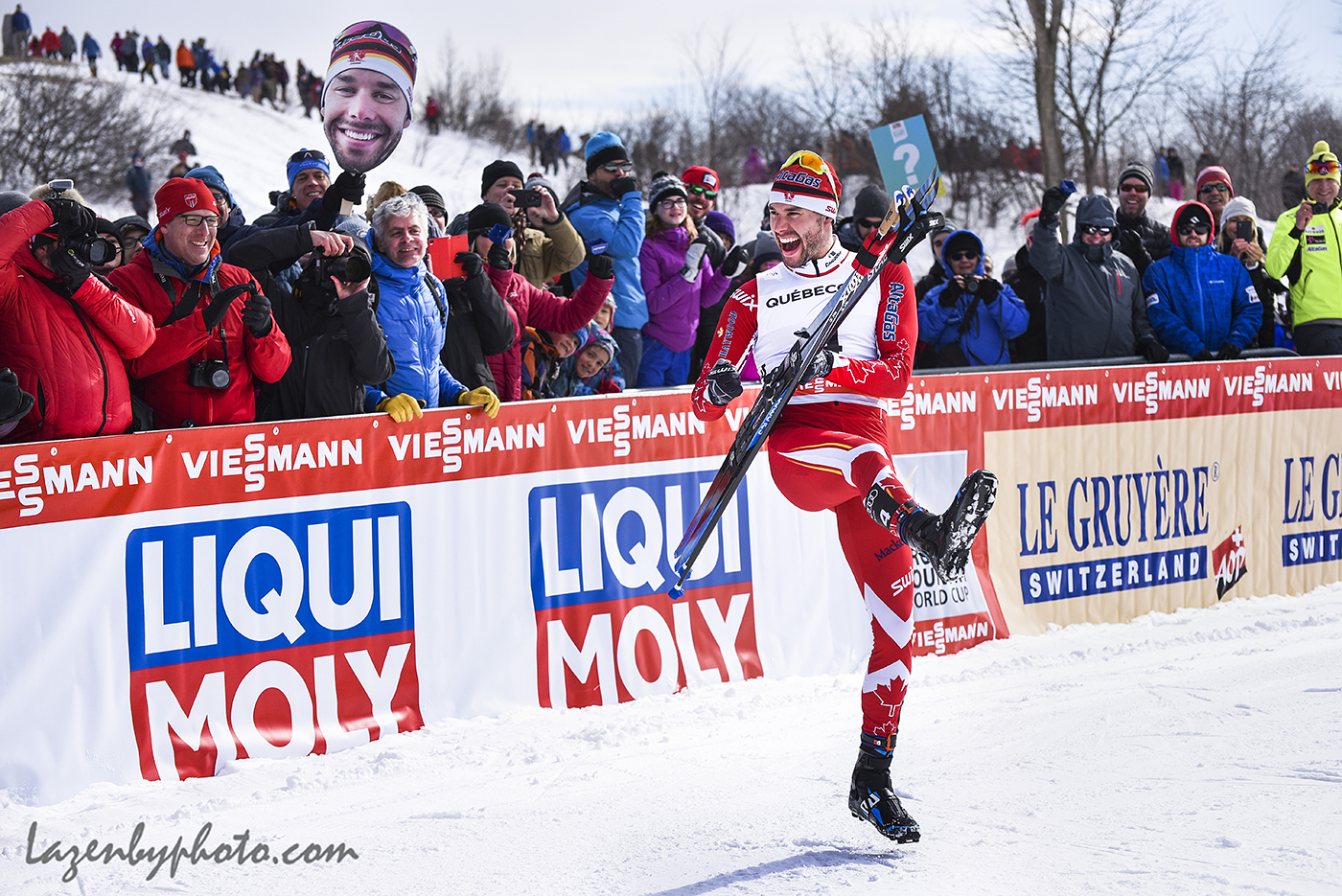
Alex Harvey (Canadian World Cup Team) celebrates his World Cup Finals freestyle sprint win at home on Friday in Quebec City. (Photo: John Lazenby/Lazenbyphoto.com)
QUEBEC CITY — Friday started off about as good as the Canadian men’s team could have hoped for, with five skiers finishing in the top 30 to qualify for the heats in the 1.5-kilometer freestyle sprint on the first day of World Cup Finals. According to Cross Country Canada, that’s the first time five Canadian men have qualified in a World Cup race.
Racing one lap around the Plains of Abraham in the heart of Quebec City, athletes were bolstered by an estimated 25,000 cheering spectators. While they ramped up the intensity for their Canadian skiers, they went wild for Alex Harvey.
And the Saint-Ferréol-les-Neiges native delivered in every sense possible.
Harvey started off as his team’s leading qualifier, clocking in with the fourth-fastest time, 4.14 seconds behind Norway’s qualifying winner, Johannes Høsflot Klæbo, who rounded the course in 2:39.44 minutes. Behind Harvey, four other Canadians also qualified less than seven-tenths of a second apart. Len Valjas qualified 24th (+9:28), Julien Locke of the Alberta World Cup Academy (AWCA) 25th (+9.39), Jess Cockney 28th (+9.90), and Bob Thompson of the National Team Development Centre (NTDC) Thunder Bay in 30th (+9.95) as the final qualifier in the men’s race.
For Locke and Thompson, it was their first World Cup top 30. For Cockney, it was the beginning of one of his career-best days. For Harvey, he was just warming up.
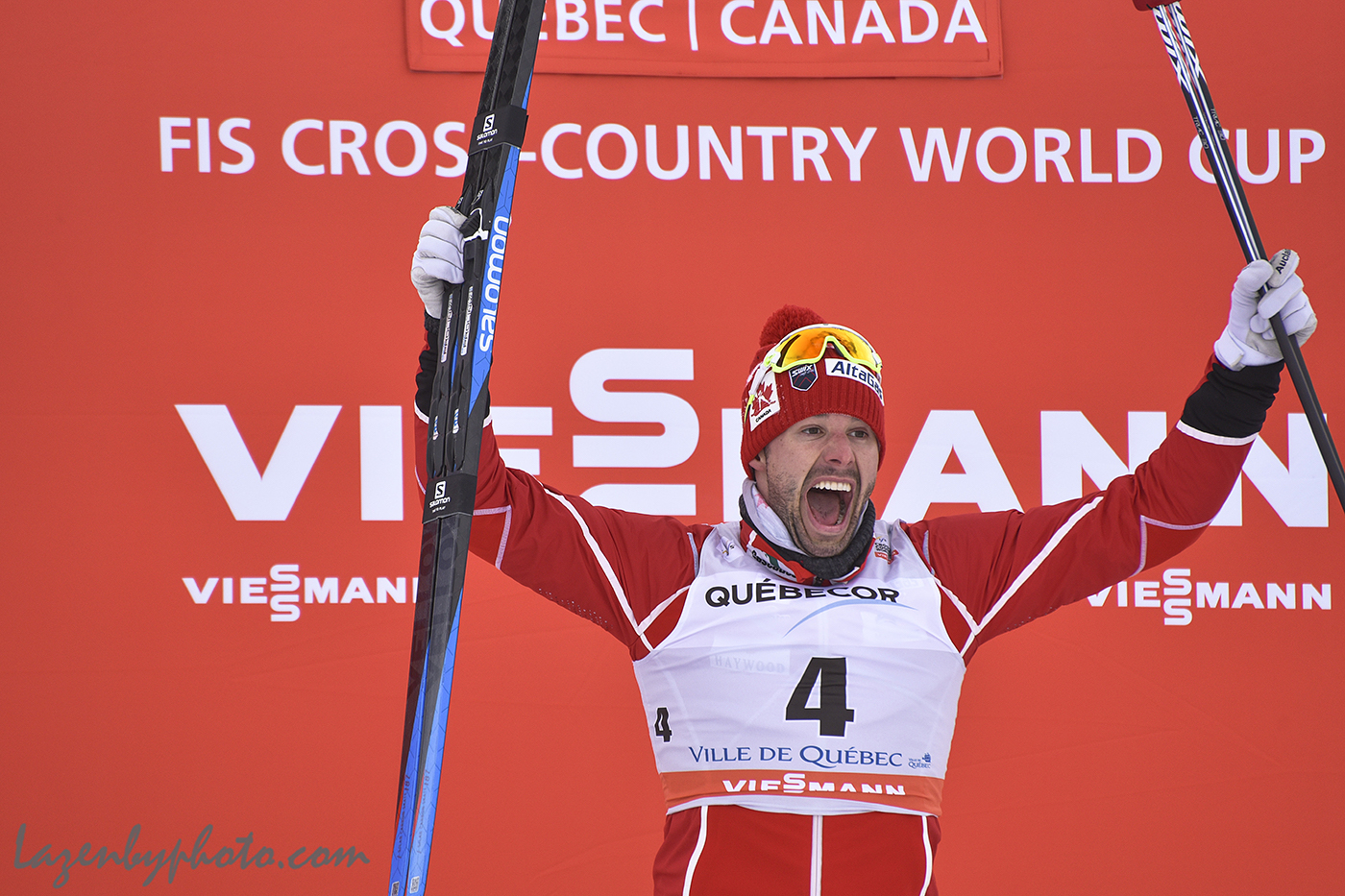
Canada’s Alex Harvey celebrates his sixth-career individual World Cup win (not counting World Championships) on Friday at 2017 World Cup Finals in Quebec City. Harvey won the freestyle sprint by 0.31 seconds over Norway’s Finn Hågen Krogh. (Photo: John Lazenby/Lazenbyphoto.com)
In Harvey’s nine years as a World Cup skier, the 28 year old has racked up six individual World Cup wins — spoiler alert — including Friday’s. He won a skate sprint one other time, three years ago in Szklarska Poreba, Poland. At World Championships, he’s accumulated five medals, with his first coming in the 2011 classic team sprint and the second World Championships gold of his career in the 50-kilometer freestyle mass start less than two weeks ago in Lahti, Finland.
After winning the longest race on the circuit, Harvey seamlessly switched gears and dominated Friday’s freestyle sprint on a wide-open course with short, steep hills organizers had to work hard to integrate.
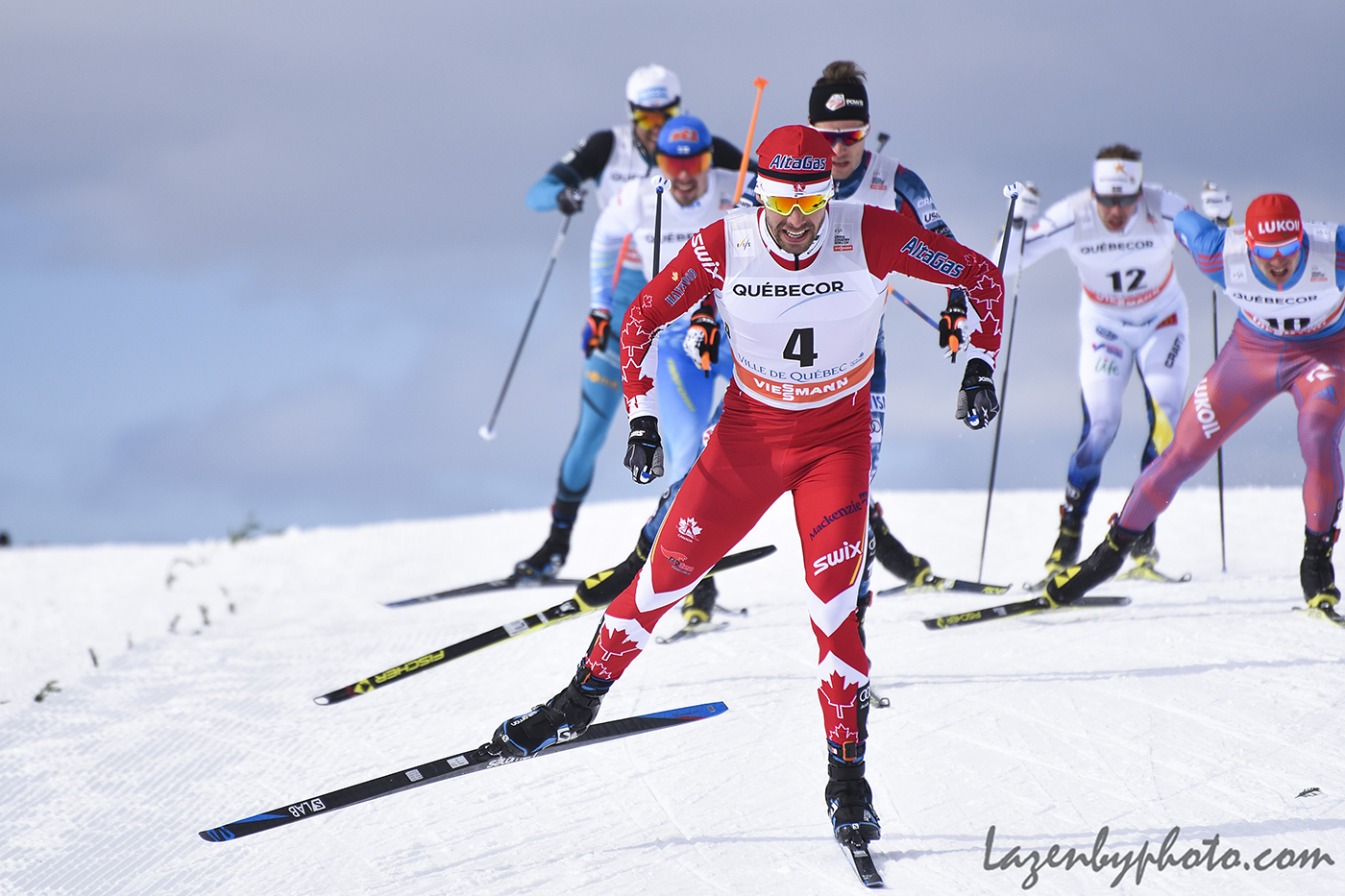
In his quarterfinal and semifinal, Harvey raced to first in both heats in a way few others attempted to do on Friday. He led from start to finish and didn’t appear to worry too much about the draft, only making sure that he was far enough ahead so that no one else could use it to slingshot past him in the finishing stretch. He won his quarterfinal by 0.34 seconds over Simi Hamilton — the lone American man to qualify for the heats — and semifinal by 0.04 seconds over France’s Richard Jouve. That one was a little closer and didn’t give Harvey enough time to remove his pole straps before the finish, like he did in his quarterfinal while Hamilton lunged for the line to secure second behind him.
It was one of those days where it appeared everyone else was working really hard, while Harvey was simply cruising. But that was confidence and the crowd he was riding, and it was a look that worked for him.
Canada’s Alex Harvey leading his quarterfinal in the men’s 1.5 k freestyle sprint on Friday at World Cup Finals in Quebec City. Harvey went on to win the final for his second individual World Cup win this season (not counting World Championships). (Photo: John Lazenby/Lazenbyphoto.com)
In a post-race interview, Harvey explained he decided to set the pace in the fourth quarterfinal. The heats before had been almost 10 seconds slower than Klæbo’s qualifying time, so Harvey knew his quarterfinal contenders had a chance to advance more than the top-two if they skied fast enough.
He faced a similar situation in the second semifinal. Harvey said he spoke with Jouve and Norway’s Niklas Dyrhaug before their semifinal and discussed how one of them should lead, “to keep pushing, not make it easy, ’cause we want to move to the final,” Harvey said. “The strategy is actually pretty similar most of the time, but it’s a question of being able to actually do it.”
He did it and advanced to the final as the man to beat. All around the course, fans shouted for “Alex”.
Out of the gate in the men’s final, Norway’s Finn Hågen Krogh surged to the front. The six finalists launched immediately into the first and longest climb on the sprint course, just short of 250 meters long, where France’s Lucas Chanavat took the lead and Harvey skied just behind him over the top. Racers dropped back into the stadium then skated back out of it again, where Harvey moved to first in front of the two Frenchmen in the final: Chanavat and Jouve.
Krogh soon after slotted into third and attacked on the steepest climb while Harvey and Hamilton proved to have the most left to answer.
As Krogh led into the last uphill, Harvey followed, then Hamilton, Jouve, Chanavat and Norway’s Sindre Bjørnestad Skar — the last three within striking distance of Hamilton in third place. Harvey tucked behind Krogh and absorbed his draft, breaking out his powerful V2 with 100 meters remaining and leaving Krogh chasing him to the line. There, Harvey threw up his arms to celebrate, while Hamilton lunged for third in a photo finish with Jouve. The Frenchman took it by 0.07 seconds, Hamilton ended up fourth, 1.01 seconds behind Harvey, Skar fifth (+1.51), and Chanavat sixth (+1.72).
Canada’s Alex Harvey (l) coming on strong in the finishing stretch to outlast Norway’s Finn Hågen Krogh (2) by 0.31 seconds for the win in the World Cup Finals freestyle sprint on Friday in Quebec City, while France’s Richard Jouve (10) races to third, just ahead of American Simi Hamilton (behind Harvey) in fourth. (Photo: John Lazenby/Lazenbyphoto.com)
“At the last turn, I was confident,” Harvey said in French. “I looked at him [Krogh] and I knew I had him, but I was focusing on staying second because of a strong headwind in the last downhill.”
“To be beaten by the 50 k World Champion on the home stretch is tough,” Krogh told the International Ski Federation (FIS) on Friday. “I was simply not good enough.”
In the finish area, Harvey appeared about as elated as he was after the 50 k in Lahti, a reaction he said was “pure instinct.”
“But sprinting comes with greater stress, with the risk of falling, of breaking a pole…” Harvey said in French. “To cross the finish line after a sprint is like a deliverance.”
The win comes just over a year after Harvey placed second in a World Cup skate sprint in Quebec during the Ski Tour Canada. After passing Russia’s Sergey Ustiugov in the finishing stretch, he had been in first until France’s Baptiste Gros snuck up on him on the inside lane. Harvey finished half a second back in second place, but it was still a day he’d remember — his girlfriend Sophie came out on course to congratulate him.
On Friday, he made sure to lock up the win. And he was met afterward by Sophie, his sister (also named Sophie) and his dad, Pierre Harvey, alongside the finishing lanes.
“Last year it would have been nice to win,” Harvey said in English on Friday. “When I passed Ustiugov last year, I had so much more speed than him … I didn’t ease up, but I thought I was going to win … and then I saw Baptiste just blow by all of us in the corner of my eye. So I had a bit of that in my mind and just making sure it wasn’t going to slip through my finger two years in a row.”
Asked how this stacked up to his 50 k win, he said it was close.
“Today’s victory really isn’t far behind my 50 k win,” he said in French. “My second place last year here was already incredible, so to top that off with a win at home is a dream come true.”
The win comes after Harvey has competed two 50 k races, including last weekend’s Holmenkollen World Cup in Oslo, Norway, in less than two weeks and traveled across the Atlantic back to his home province.
“What surprises me is how well he recovered after the double 50 k, in which he did very well, both times,” Louis Bouchard, Harvey’s personal coach and Canada’s co-World Cup coach, said in French. “Usually in sprints, he will hang at the back and make his move right at the end in the final stretch. So tactically, he skied differently today. He felt strong to the point of leading every round right until the end. It’s also rare to see Alex qualify so strongly. His form his tremendous at this point.”
The men’s freestyle sprint podium on Friday at World Cup Finals in Quebec City, with Canada’s Alex Harvey (c) in first, Norway’s Finn Hågen Krogh (l) in second and France’s Richard Jouve (r) in third. (Photo: John Lazenby/Lazenbyphoto.com)
Pierre Harvey, a local hero and the inspiration behind the Pierre-Harvey National Training Centre, spoke with reporters after the race. Five years ago, he had been on site to witness his son’s first-career World Cup win in Falun, Sweden.
“It’s always very emotional,” Pierre said in French. “I was there when he won his first World Cup in Sweden, which I didn’t think he could ever do at the time, but winning became a familiar sight in a way. I thought he would burn himself after the qualification, but he managed to win every round after. It was impressive to see him beat Krogh, a very capable sprinter, in the last stretch.”
Asked what propelled his son on Friday, Pierre said racing at home.
“In front of friends and of a cheering crowd, along with great ski conditions, is an extra motivation,” he said. “He left home on the fifth of November, so coming back after months of racing in Europe, he really wanted to put on a show for his friends. I hope he keeps his energy levels high for tomorrow and Sunday’s races.”
Two more World Cup races remain to close out the season: a 15 k classic mass start on Saturday and 15 k freestyle pursuit on Sunday. Harvey has essentially solidified third place in the overall World Cup rankings with 57 points separating him from Finland’s Matti Heikkinen in fourth place.
“Today’s win comes with 50 points, 30 bonus seconds and 10 seconds I put on him in today’s qualification,” Alex Harvey explained. “I feel secure with this lead on him.”
Ahead of him, Norway’s Martin Johnsrud Sundby and Russia’s Ustiugov are not racing in Quebec. Sundby already locked up the World Cup overall and distance titles, and Ustiugov is still 282 points clear of Harvey in third place.
After Day 1 of 3 in the World Cup Finals mini tour, Harvey leads by 2.3 seconds over Krogh. All 74 racers remaining in the men’s field will start Saturday’s mass start together.
The Sprint World Cup podium was awarded on Friday, with Norway’s 20-year-old Klæbo in first, Italy’s Federico Pellegrino (last year’s Sprint Crystal Globe winner) in second, and Skar in third. Both Klæbo and Pellegrino were eliminated in the semifinals, with Pellegrino placing seventh and Klæbo eighth on the day.
As for third and fourth place on Friday, Jouve was thrilled with his fourth individual World Cup podium and first this season after being injured in December and January.
“It was a really good day for me,” Jouve said in French. “I passed through my quarter and semi as I wanted. I managed to stay in a good position in the finals. I had very good legs and fast skis.”
Asked what he thought of the crowd’s favoritism for Harvey, he said it wasn’t anything he couldn’t handle.
“We were here last year, and the public is pleasant and cheers for everyone,” Jouve said. “It’s normal to see them favor the local star.”
Simi Hamilton (U.S. Ski Team) racing to 16th in the men’s 1.5 k freestyle sprint qualifier on Friday at World Cup Finals in Quebec City. He qualified in 16th and went on to place fourth in the final. (Photo: John Lazenby/Lazenbyphoto.com)
Even Hamilton, frustrated with fourth, was happy for Harvey.
“He’s such a good guy. He’s such a great North American teammate. He’s always so psyched when we ski well, and we’re always so psyched when he skis well, as well as all the other Canadians,” Hamilton said. “We are really just like kind of one bigger team, us against all the Europeans we feel like sometimes, so it’s cool to see him so successful and skiing so strong. And he handles his success with so much humility and grace.
“Someone as talented as he is, and somebody who works as hard as he does, it’s awesome just to feel the energy,” Hamilton added. “He’s such a good ambassador for our sport, and I think that that’s a testament to see all these people cheering him on, because they know that he’s such a great guy, more than just a good ski racer.”
Hamilton faced Harvey in all three of his heats and followed him in every one.
“I knew that Alex and Finn were far enough ahead of us that, unless they tripped or something, that we weren’t going to catch them,” Hamilton said of the final. “So I also knew that I was ahead of Jouve and the other two that were behind us a little bit, so I knew that, especially with the tailwind, if I just skied it well that I would have held onto third. And I just didn’t do that, and it sucks. I want it back. I want to do it again. I felt good going into it, I felt like my energy was really good during the entire final, and for whatever reason, I just didn’t ski it.”
Four Canadians in Top 20
Earlier in the day, Cockney tied his second-best individual World Cup result in 10th and popped his second top 12 of the season to meet the criteria for the Canadian 2018 Olympic team. After qualifying in 28th and hanging around fourth or fifth for most of his quarterfinal, Cockney used the draft and his reserved energy to sprint from fourth to second in the finishing stretch. He finished just 0.09 seconds behind Klæbo, who won that quarterfinal, and edged Great Britain’s Andrew Young by 0.07 seconds. While Young didn’t advance, Cockney did, and he went on to place fifth in the first semifinal, 1.3 seconds behind Krogh, the winner of that heat.
Jess Cockney (Canadian World Cup Team) racing to 28th in the qualifier of the men’s 1.5 k freestyle sprint on Friday at World Cup Finals in Quebec City. He went on to place 10th on the day to tie his second-best World Cup result. (Photo: John Lazenby/Lazenbyphoto.com)
“You can see just how wide open this field is, and it’s so windy that you kind of had to be smart about where you wanted to use energy,” Cockney said of his tactics.
“I knew the start was straight into the headwind. You could come down with the tailwind behind you and make back a couple spots, or at least close the distance behind some people. And that’s just exactly what I wanted to do in the quarterfinal, and I was lucky that it worked out well, and I had some energy saved from doing that for the finishing straight. So that was really big for me.”
As for his finishing gear, Cockney laughed and said he’d like to think he’s had that all along. His trouble has been getting into the heats. In the one other World Cup sprint he qualified in this season — the classic sprint in PyeongChang — he went on to finish 10th.
“It’s funny, I’d like to think I always have some kind of sprint like that, but I never get into the sprints; my qualifying speed is still not there,” Cockney said. “Today, to actually see it on a race course and see it at a World Cup — I’m really happy with that. I can do it on a domestic level, but being consistent at an international level is still taking some time.”
Four Canadians landed in the top 20 with Valjas in 19th and Locke in 20th. Valjas finished fourth in the first quarterfinal, 1.81 seconds behind Chanavat, who won. Locke placed fourth in the third quarterfinal, 1.89 seconds behind Pellegrino as the winner of that heat.
“I’m a bit disappointed,” Valjas said. “I didn’t feel like I was able to show my potential today. I always felt boxed in, and every time I tried to make a move, there was somebody there. The course is so turny that when you’re beside somebody you get boxed in, so it’s frustrating. I think I had more speed than I showed today, but I ended up not skiing it well tactically, starting at the back.”
Asked about the conditions, Valjas elaborated that Quebec had some of the best snow that World Cup skiers have seen all year. Quebec City was hit with a massive snowstorm earlier in the week on Tuesday.
“Europe is sometimes good, but this is all-time conditions here,” Valjas said. “It’s fast, it’s wide. It’s just, with the curves, it’s harder to pass than I thought.”
Julien Locke (Canadian U25 Team/AWCA) racing to 25th in the men’s 1.5 k freestyle sprint qualifier on Friday at World Cup Finals in Quebec City. He went on to place 20th on the day for his first World Cup top 30. (Photo: John Lazenby/Lazenbyphoto.com)
On the other end of the spectrum, Locke, a 23-year-old member of Canada’s U25 Team, was pleased with his performance in his third World Cup start as it marked his first time in the points (top 30). In his first World Cup race last month, he came close in 36th in PyeongChang.
“At the start of the season, my two main goals were to go to the Korea World Cup and the World Championships,” Locke said. “And I went to Korea, and I unfortunately had a crash there, so I was really hoping for another second chance, and to qualify to come here was fantastic. It’s crazy having Alex here, a world champion coming home, and the atmosphere is incredible. So since this race was announced, doing a good sprint here was my big goal for the year.”
Thompson, 26, ended up 30th after finishing sixth in the same quarterfinal as Cockney. After making his World Cup debut at last year’s Ski Tour Canada, Thompson started this season on the World Cup in Europe and raced to 31st in the classic sprint in PyeongChang. On Friday, he scored his first World Cup points as well.
“Getting in the heats has been the goal for every sprint World Cup I’ve gone to do, which is, this is the 17th now, and I think it’s about the seventh sprint or so,” Thompson said. “… Goal number one is, get a top 30. So I got that, I can reassess, and raise the bar a little bit.”
Newell Narrowly Misses Qualifying
For the U.S., Andy Newell missed out on qualifying by eight-hundredths of a second in 31st. Erik Bjornsen was 0.98 seconds back in 33rd, and Cole Morgan (Sun Valley Ski Education Foundation) another second back in 34th.
“For Andy to be in 31st, disappointing for him,” U.S. Ski Team Head Coach Chris Grover said. “He felt good out there; he’s a little bit mystified. … And then also for Erik Bjornsen and Cole Morgan, who skied great, to be so close to going in … If we’d gotten three or four guys into the heats then I think it would have been a great start to the day. So a little disappointing to miss that opportunity.”
“I was feeling pretty good out there skiing, so I don’t know why it was slow,” Newell said. “I couldn’t figure out why.”
Bjornsen said he hasn’t raced much since World Championships and hoped Friday blew the cobwebs out.
“I was hoping for a little bit more today,” he said. “I obviously wanted to qualify … but I’m excited for the next couple days. … Tomorrow’s a 15 k classic, which is my favorite event, so yeah, hopefully I can put together some good races.”
Also for the U.S., Paddy Caldwell placed 50th, Matt Gelso 57th, Scott Patterson 58th, Jack Hegman 61st, Brian Gregg 62nd, Ben Lustgarten 69th, David Norris 70th, and Noah Hoffman 73rd.
Canada’s Andy Shields came close to qualifying in 35th, Russell Kennedy followed in 36th, Devon Kershaw 38th, Knute Johnsgaard 41st, Evan Palmer-Charrette 47th, Joey Foster 53rd, Graeme Killick 64th, Ricardo Izquierdo-Bernier 71st, Brian McKeever 72nd, and Gareth Williams 74th.
Jessie Diggins (U.S. Ski Team) racing to ninth in Saturday’s 1.5 k freestyle sprint qualifier in Val Müstair, Switzerland. Diggins went on to place sixth in the final. (Photo: Salomon/NordicFocus)
As the women’s sprint finalists promenaded through the stadium toward the starting pen, the demeanors caught on camera varied, seemingly a reflection of their differing personalities or emotions at that moment.
On one hand, there was Stina Nilsson, Sweden’s sprint queen, walking through the athlete’s chute at the first stage of the Tour de Ski with the body language of a prizefighter.
Then there was Norway’s Maiken Caspersen Falla, more smiley and cheery than Nilsson, her fiercest sprint rival on the World Cup circuit. Heading into Saturday’s freestyle sprint, the last eight sprint wins had gone to either Nilsson or Falla. According to the International Ski Federation (FIS), that’s the longest streak ever between two athletes in a sprint.
Next came Switzerland’s Laurien van der Graaff, more reserved in front of her home crowd in Val Müstair, Switzerland, and Norway’s Kathrine Rolsted Harsem, who looked simply happy to be there in her first World Cup of the season.
And then there was Jessie Diggins, the well-known, fun-loving American, exuding the most energy of anyone heading to the start with her head held high as she looked out at the arena.
Finally, Norway’s Heidi Weng shuffled down the line, looking down and avoiding eye contact as she passed the TV camera. But she should get a pass on her body language; she suffered food poisoning before the race, according to Norwegian reports.
As all six women lined up at the start for their formal introductions, Diggins waved with bare hands. On an afternoon with temperatures hovering around freezing, she wasn’t trying to be tougher than everyone else, Diggins later explained.
“That was actually a mistake,” she said in a phone interview. “I was so excited and ready to go, and they were like, ‘All right, march in for the final,’ and I was like, ‘Great, I’m ready.’ ”
With her skis in hand, Diggins began her entrance before realizing she was still wearing her lobster mitts. It had been getting colder as the day entered the evening, and she had switched to the quasi-mitten before the final.
“I got over there, and realized I was still wearing my lobster gloves, and I was like, ‘Oh crap! I don’t want to race with these on!’ ” she said.
She decided she’d be better off racing with bare hands.
“I love my race gloves. I wish I had remembered them, but I didn’t,” Diggins said.
Two laps, 1.5 kilometers and nearly 3 1/2 minutes later, Diggins crossed the line in sixth, but it wasn’t so much an issue of no gloves as it was her positioning.
“I needed a better start to get in a good position from the gun, but that’s fine,” she reflected. “It’s a long tour, and I would just like to be in the final.”
Diggins finished 7.64 seconds behind Nilsson, who won in 3:26.27 to rebound from 31st place in the last skate sprint three weeks ago in Davos, Switzerland, for her second win of the season.
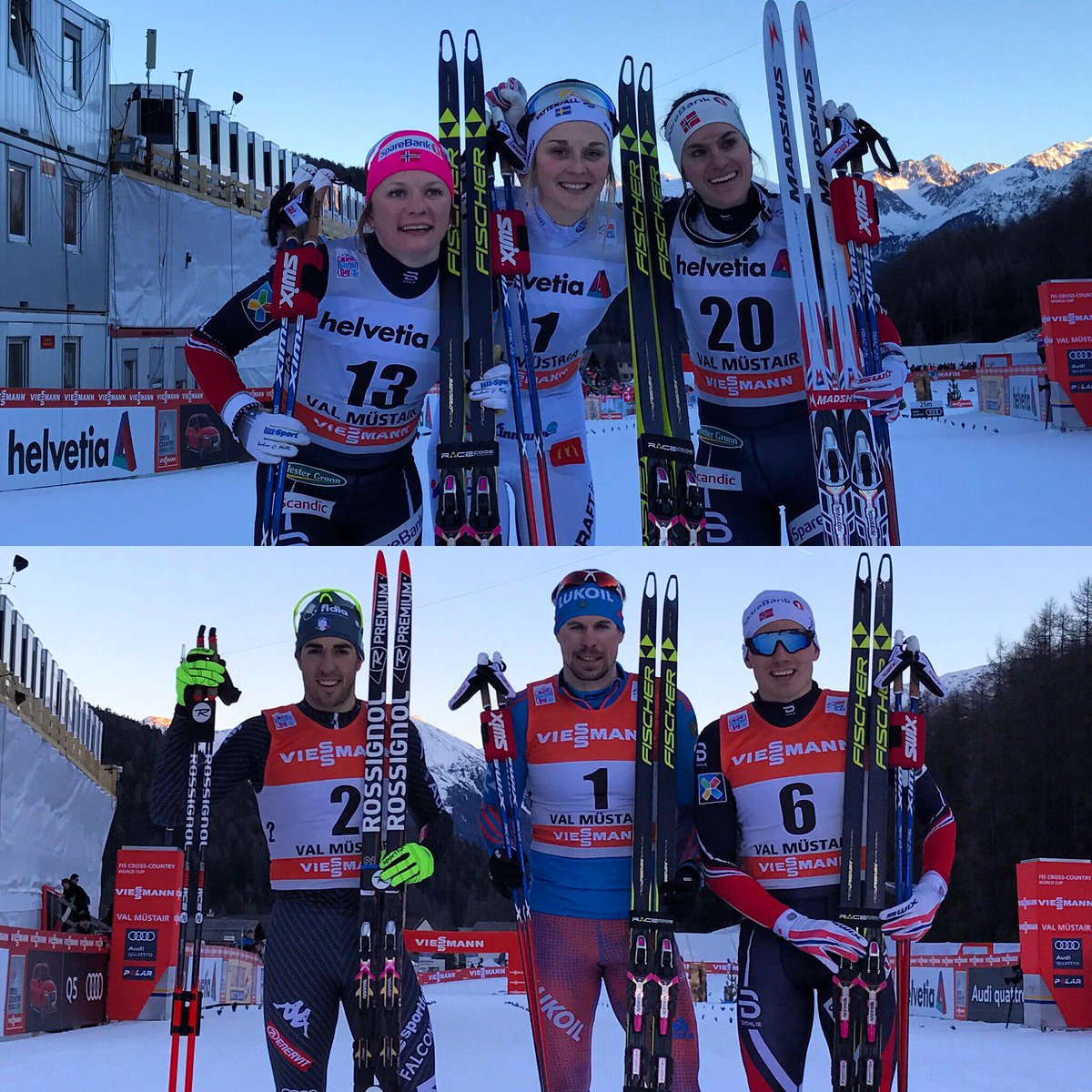
The women’s and men’s podiums at Stage 1 of the Tour de Ski, with (top) women’s winner Stina Nilsson (c) of Sweden, Norway’s Maiken Caspersen Falla (l) in second, and Norway’s Heidi Weng (r) in third. (Bottom) Russia’s Sergey Ustiugov (c) won the men’s final, ahead of Italy’s Federico Pellegrino (l) in second and Norway’s Finn Hågen Krogh (r) in third. (Photo: FIS Cross Country/Twitter)
“This was really important to me since Davos didn’t go so well,” the 23-year-old Nilsson said in a televised interview with TV2. “I am really happy. I felt strong through the entire day.”
“She was in a league of her own,” Swedish women’s coach Ole Morten Iversen told Expressen.
“I’m not surprised that she won, but I am a little surprised by how strong she was compared to the Norwegians. She was on a different level the entire day.”
Nilsson won the qualifier by 1.28 seconds (in 3:28.28) then proceeded to pull away from her competition in the quarterfinal and semifinal, which she won by roughly half a second and one second, respectively. (Diggins finished second behind her in the quarterfinal, after Diggins led the early in the heat. Nilsson passed her the course’s biggest climb on the first lap, while Diggins chased in second all the way to the finish.)
In the semifinal, Diggins and Nilsson met again, with Nilsson leading out of the start and Diggins following in second into the first climb. Falla eventually passed Diggins to move into second while Nilsson continued to lead, then the two built a small gap on Diggins in third. They finished in that order, with Nilsson holding off Falla by 1.04 seconds and Diggins by 1.36 seconds, in first, second and third, respectively.
In the final, Nilsson once again set the tone out of the start, leading Weng and Falla into the stadium at the end of the first lap. Diggins slipped to the back of the field on the first climb then fought to pass van der Graaff on the final descent.
Meanwhile, Nilsson and Falla distanced themselves from Weng in third place, who was just ahead of her Norwegian teammate Harsem in fourth.
Nilsson led into the finishing straight, several strides ahead of Falla, while Falla chased her across the line for second place, about 2 1/2 seconds back. Weng held off Harsem and van der Graaff by half a second for the third spot on the podium, 6.47 seconds out of first, Harsem placed fourth, and the Swiss skier outlasted Diggins by 0.68 seconds for fifth (+6.96).
“This is the worst thing I’ve ever been part of,” Weng said of racing after her food-poisoning episode in an interview with NRK. “… I just had to get it together. The prologue felt heavy, the quarter was heavy, the semi was heavy and the final was heavy. I had to try think positive, that everyone else was tired, but it was hard.”
For Harsem, 27, she was emotional about making it to the final after considering retiring before the start of this season.
“.. There were a lot of emotions in system and it was just so incredibly fun to be successful,” she told NRK. “I tried to wipe my tears and mobilize all that I had. I realized that I could. I had planned to go easy on the first lap, and then Heidi and I weren’t attentive enough to follow Stina and Maiken.”
Even Falla called it a long, hard race, and told FIS she had expected Weng to keep up with Nilsson.
“In the second lap of the final Heidi got little bit tired and I tried to close the gap on Stina myself,” Falla said. “I did not have enough power to do that. Stina was in a great shape.”
While Nilsson has a 10.7-second lead on Falla heading into the second stage of the Tour, it’s worth noting that this is the only sprint on the seven-stage schedule.
“I’m proud to say that I have the lead in the Tour de Ski, I’m going to enjoy this,” Nilsson told Expressen.
Diggins was also onboard with living in the moment.
“My goal for the Tour is have more fun than anyone else, because when I’m having fun that’s when I’m the most dangerous on the race course, and that’s when I’m going fast,” she said. “Yeah, it’s my job, and you always want to win, but it’s also my life, and I want to enjoy the Tour because it’s a really exciting and fun event.
“Going into the final already had my strategy worked out,” she added. “… I’m going to go out there and ski as hard as I can. I’m going to focus on what I need to do, but I’m going to enjoy myself. My game face is not an intimidating one.”
“My goal for the Tour is have more fun than anyone else, because when I’m having fun that’s when I’m the most dangerous on the race course, and that’s when I’m going fast.” — Jessie Diggins, U.S. Ski Team
Sunday’s race is a 5 k classic mass start, so the top women in the Tour so far will line up alongside one another at the front of the pack. That’s a good thing for someone like Diggins, who is currently sixth in the Tour and 23.7 seconds out of first. But she didn’t think it was necessarily fair and noted that it will be tough to pass on the Val Müstair course, just as it was on Saturday’s technical sprint course.
“I think it’s mildly hilarious that we’re doing a 5 k classic mass start,” Diggins said. “I think it’s so stupid that the women have to do exactly half the distance the men do all the time. I think that it’s silly. I think we can handle more.
“That said, I love 5 k’s, I just think a 5 k mass start isn’t entirely fair to the people who are starting in the back; that sucks for them,” she continued. “It will be a fun course tomorrow; it’s a grind of a climb up, and then there’s a lot of 90-degree corners and sharp downhills. There’s one that’s like an elevator shaft. It’s going to be really exciting.”
Sophie Caldwell (U.S. Ski Team) after winning the 1.2 k classic sprint final at Stage 4 of last year’s Tour de Ski in Oberstdorf, Germany. (Photo: Marcel Hilger)
Diggins led four U.S. women in the top 30 on Saturday, more specifically in the top 23. Sophie Caldwell qualified fifth, 3.15 seconds behind Nilsson, for her best qualifier in nearly a year (since qualifying third in last year’s Tour de Ski classic sprint in Oberstdorf, Germany, which Caldwell went on to win).
Sadie Bjornsen qualified eighth (+5.08), and Diggins was the third U.S. woman qualifying in the top 10 in ninth (+5.64).
“We expected big things today, and I think we had certainly a good day to prove that that was in fact the case, and that the tour should go well for us,” U.S. Ski Team Women’s Coach Matt Whitcomb said on the phone.
Kikkan Randall also qualified in 29th (+10.77) on her 34th birthday for her first individual top 30 of the season.
“It was a very difficult course, aerobically as well as technically,” Whitcomb explained. “At 1,600 meters [above sea level], there’s a lot of climbing. To have our women do as well as they did, including Kikkan on her birthday getting into the heats, just said straight up that we’ve got fast women. They’re in good shape, they’re ready for big results, whether or not that happens individually today, or not, that’s just sprint racing.”
Caldwell went on to place 13th after finishing third in her quarterfinal, 0.72 seconds behind Finland’s Krista Parmakoski in first. Slovenia’s Vesna Fabjan automatically advanced to the semifinals in second, 0.71 seconds back, just one-hundredth of a second ahead of Caldwell.
“I was happy with the qualifier and feel so-so about the overall result,” Caldwell wrote in an email. “It was not my best race, but it was not my worst, it was solid.”
She plans to race the second stage on Sunday then withdraw from the Tour for a training block before the next set of regular-season World Cup sprints in Toblach, Italy.
“I got hit hard with the cold that was going around our team as soon as I started Christmas break, so I had to take some time off and do some walking pace training,” Caldwell explained. “I did a little threshold yesterday, but that was my first intensity since La Clusaz [two weeks ago], so I wasn’t sure what to expect going into today. I’m happy to be feeling healthy again, though.
“It’s a long season and while I haven’t had the races I want to have yet, I’m confident that with some consistent training and resting, I can keep getting faster,” she added.
Randall finished third in her quarterfinal, 1.42 seconds behind Falla in first and 0.46 seconds after Germany’s Hanna Kolb in second.
“Today definitely felt like another step forward toward getting my race sharpness back,” Randall wrote in an email to members of the press. “My qualifier was decent and I felt like I had more punch in my quarterfinal. Tough to just miss the lucky loser spot because I was feeling stronger as I went and actually felt competitive for the first time this season. Still lots of racing ahead though so I am satisfied with today as a good start and am feeling good about the races ahead.”
As for how she’d celebrate her birthday and the new year, Randall wrote that it would be a tame night.
“Pop some confetti for us this evening, we’ll probably be in bed early for tomorrow’s race,” she wrote.
Bjornsen explained in an email that she was also hit with the bug and hadn’t skied at sprint pace since Davos three weekends ago. Like Diggins, she did not race in La Clusaz.
“I didn’t know what to expect,” she said of the qualifier. “I felt like I paced it well, but I was an early starter, so I didn’t know what to expect. I was really pleased to see how it had gone.”
Like Caldwell, Bjornsen pushed to get in front early in her quarterfinal on Saturday, but while Caldwell came from behind for third place at the finish, Bjornsen managed to hold the lead into the finishing straight. But in the final meters, something happened. Bjornsen lost her momentum and slipped to fifth.
“I noticed that someone was skiing over my pole almost the entire race,” Bjornsen wrote of the possibility of someone stepping on her pole before the finish. “I don’t recall much from the finish zone other than the fact that I really wanted to get to that line. At one point I bobbled and lost my balance… not sure why… but that was real game changer.”
She ended up 0.78 seconds out of first, which went to van der Graaff.
“I have began to realize this fall that my strength is over the whole course,” Bjornsen explained. “I have made a mistake in the last couple sprint races to sit in the pack, and expect a sprint finish, but I haven’t had so much luck with that. The best I ski is when I am in control a bit. I had a plan to try to be in the front, and it worked out as I was hoping. Of course you run the risk of working harder, but I think that is ok for me. I wasn’t strong enough in the finish zone, and I bobbled, which really was a bummer.
“There are glimmers in today, and I think that I learned that I am strong enough to ski in command,” she added. “I just need to figure out that finish stretch … but fortunately I have seven more races rather quickly in a row to get some redemption with.”
“There were a number of thirds and fourths out there for us today in heats,” Whitcomb noted. “In stand-alone races, we can kind of just look at those and say, ah, I wish that lunge had gone a little better, but in a tour we really have to be glass half-full. We had three girls in the top 15, four people total in the top 20. It’s a really positive start to the team, it’s just a great, solid day.”
Also for the U.S., Rosie Brennan finished 35th, 2.66 seconds outside the top 30, and Liz Stephen placed 57th in the qualifier.
“Liz was sick for a couple days coming into the tour, and just today she was feeling better and she was actually our last person to kind of have this illness,” Whitcomb explained. “As long as today was accepted by her body, we are operating with a completely healthy team going into tomorrow.”
“The tour has always been a fun event for us,” Diggins said. “We see it as you have a chance today and a chance tomorrow, you have all these chances to go out and kick some butt, and I think people are really embracing that. If you had the race you wanted today; awesome, and if you didn’t, you’ll have it tomorrow.”
HOUGHTON, Mich. — After two days off, the U.S. Cross Country Championships picks up again on Thursday with the women’s 20 kilometer and men’s 30 k freestyle mass start races.
Many athletes out on the Michigan Tech Trails enjoyed two non-race days amidst sunny skies and warmer temps, at least compared to last year’s U.S. nationals event, also in Houghton.
While the initial three-day trek for some racers, coaches and techs to arrive in Houghton is perhaps worthwhile with the promise of sun, it is also the present state of the trails that drew these individuals to the event.
“My favorite part about Houghton, Michigan is the [area’s] ski trails,” said University of Denver skier Taeler McCrerey.
This week, much of McCrerey’s and other competitors’ time on snow and the ski trails is largely thanks to the area’s community volunteers.
“It’s all part of building community,” Shane Sullivan, a local and volunteer race starter for the U.S. nationals races this week in Houghton, said on Monday during the freestyle sprint. “It’s as much the community camaraderie as it is putting on the event.”
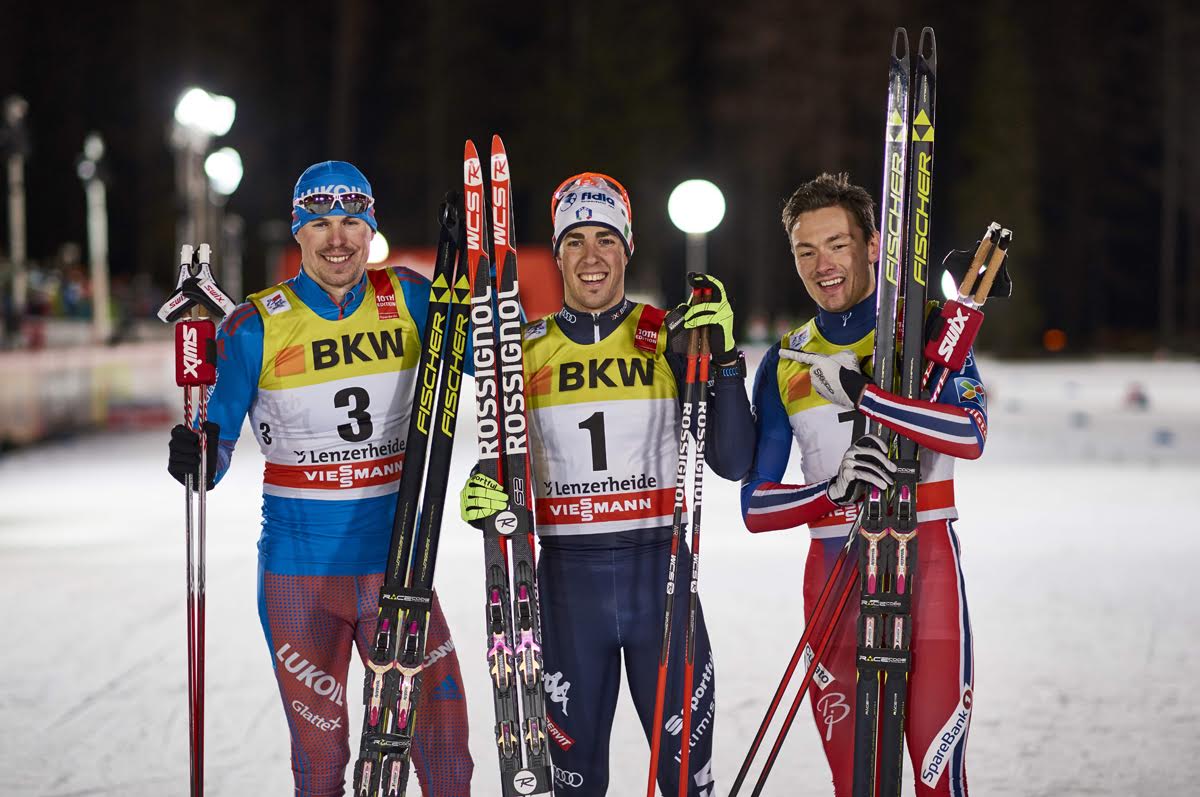
With his third-consecutive World Cup win, Federico Pellegrino (c) became Italy’s most successful sprinter of all time on Friday. He won the 1.5 k freestyle sprint, the first stage of the 2016 Tour de Ski, ahead of Russian runner-up Sergey Ustiugov (l) and Norway’s Finn Hågen Krogh (r) in Lenzerheide, Switzerland. (Photo: Fischer/NordicFocus)
It’s a new year, yet some things remain the same. Jan. 1 marked the opening stage of the 2016 Tour de Ski, a 1.5-kilometer freestyle sprint in Lenzerheide, Switzerland. It also marked the third World Cup sprint victory in a row for Italy’s Federico Pellegrino.
The 25-year-old Pellegrino dominated the day. He qualified first with a time of 2:45.92. Across the official results sheet, a pattern of 1’s next to Pellegrino’s name tells the story; the only aberration on his way to the win, a second place in his semifinal by a margin of 0.11 seconds.
Under a nighttime sky illuminated by what looked like modernist street lamps, Pellegrino won the final in 2:43.14. He out sprinted Russian Sergey Ustiugov who placed second (+0.40). Norway’s Finn Hågen Krogh skied to third (+1.25).
Not considered a sprint specialist, but certainly considered the favorite for this year’s 10th edition of the Tour de Ski, Norwegian Martin Johnsrud Sundby placed fourth (+10.09). In fifth was Sweden’s Emil Jönsson (+12.270, followed by Swiss veteran and three-time Tour de Ski champion, Dario Cologna in sixth (+59.01).
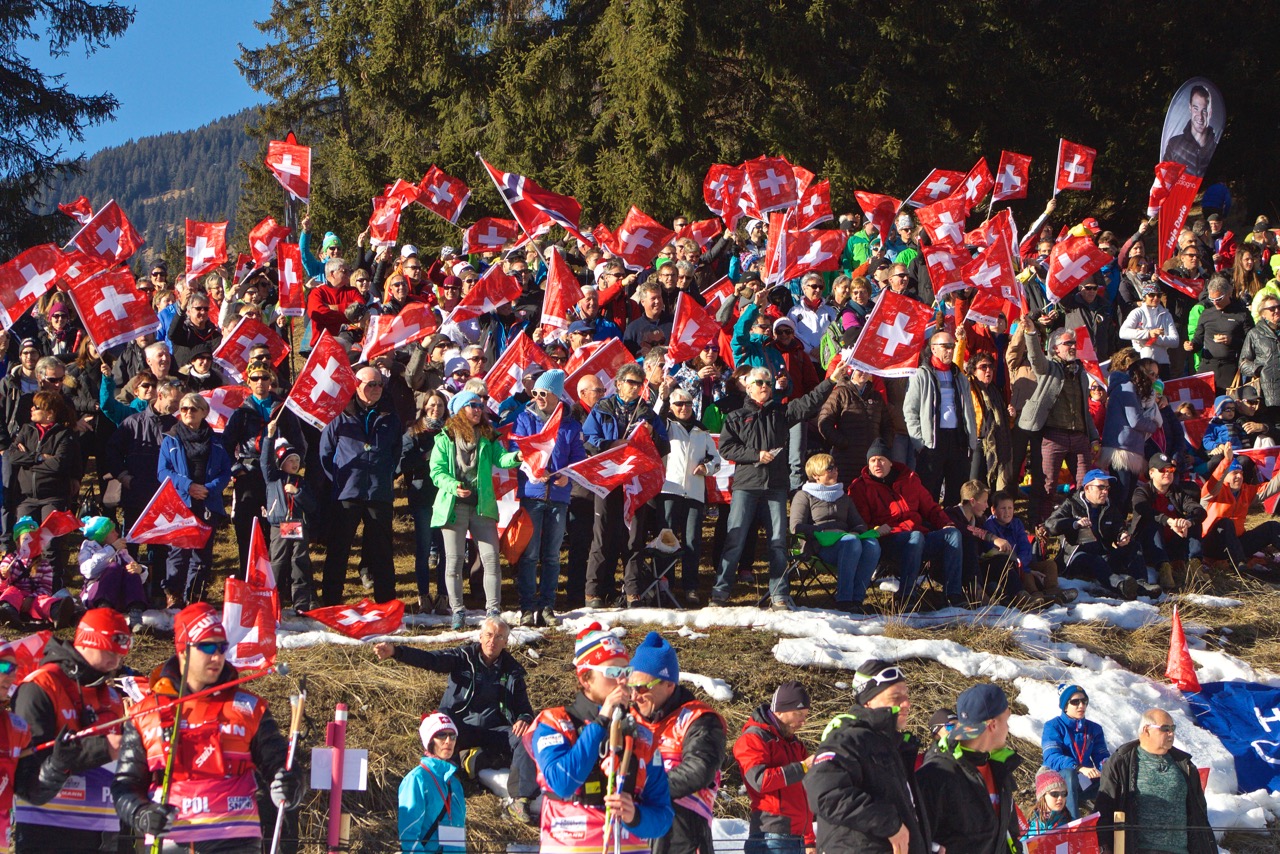
Swiss fans were out in force in Lenzerheide, Switzerland, cheering raucously for their homegrown athletes, especially three-time Tour de Ski champion Dario Cologna, who made the final and placed sixth after falling. (Photo: JoJo Baldus)
Cologna is a good place to start this sprint final’s tale. It was a partisan crowd. And when Cologna’s name was announced as he stepped forward in his lane, the crowd became electric — it was a sea of waving red and white Swiss flags.
From the gun, Ustiugov led out with a scrum of V2ing skiers trailing close behind. After a series of short roll-overs, Cologna slotted into second and eventually dropped into third.
Just over a minute into the race, when it was clear Ustiugov was making a powerful move on the flats, Cologna became tangled with himself, and fell. That left only five skiers, with a clear separation of Ustiugov, Krogh and Pellegrino developing with Sundby dangling off the back.
Then, just over two minutes in, it was a three-person race with Pellegrino taking the lead, accelerating around a turn with what appeared to be the slickest skis in the field. He crossed the line with a cursory foot outstretched, as if the results were in question.
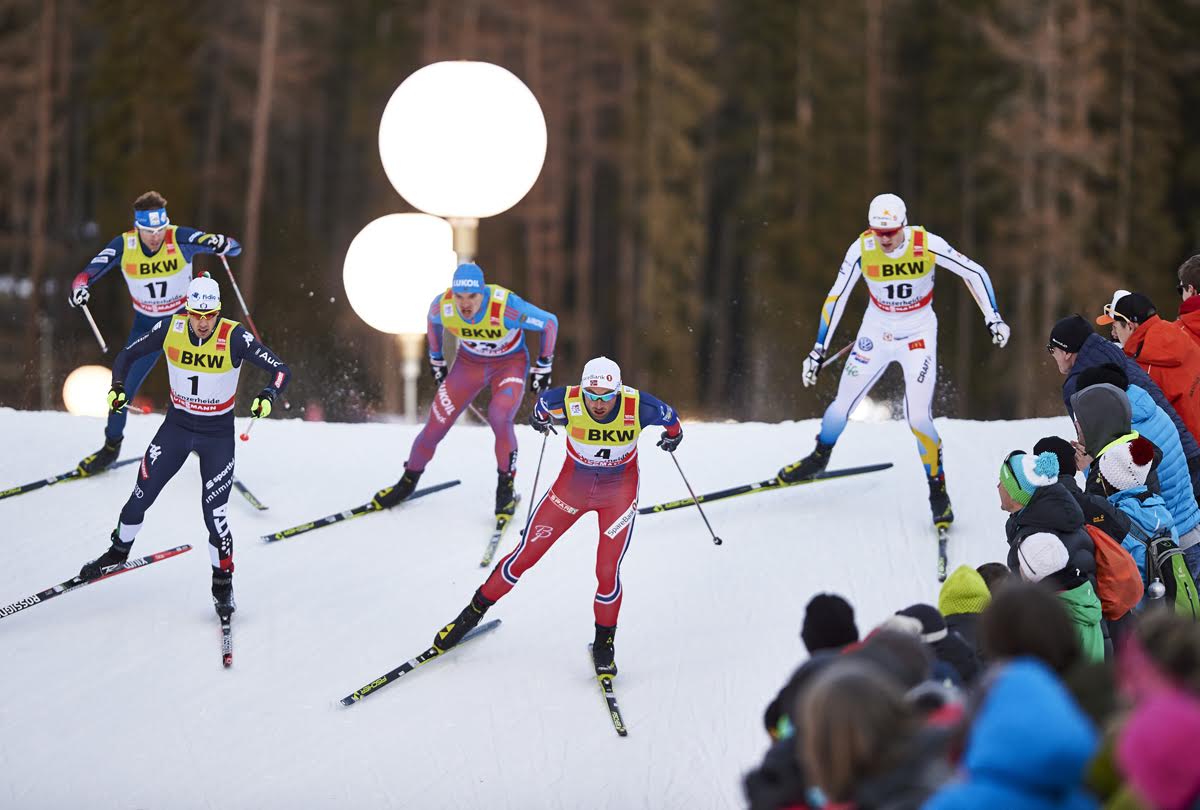
The second men’s quarterfinal, with Italy’s Federico Pellegrino (1) and Norway’s Petter Northug (4) leading, followed by American Andy Newell (17), Russia’s Andrey Larkov (c) and Sweden’s Oskar Svensson (r) at the Tour de Ski freestyle sprint in Lenzerheide, Switzerland. (Photo: Fischer/NordicFocus)
The only blip in Pellegrino’s day — second place in his semifinal — proved a valuable learning opportunity. In the post-race press conference, he admitted his tactics would need to change after his semifinal.
“I learned how to play in the final, so I didn’t make the same mistake,” he said. “I knew that if I arrived in the final 100 meters in the front of the race, I should win. It’s what I made, and so I happy for having do it.”
As a sprint aficionado, and now the winningest Italian World Cup sprinter, with six wins total, (Italian Cristian Zorzi won five World Cup sprints), Pellegrino is still undecided about finishing out the Tour.
“Tomorrow, we have a 30 k. I just have to pay attention to not make a big bonk, and save some energies for [the classic sprint in] Oberstdorf, but I want to be good,” he said. “Maybe in the last five kilometers, I will push as hard as I can, but before, I have to be patient, and quiet and wait. Then we are 10 k in skate, I want to have good sensations in this distance. Then in Oberstdorf, we will have a classic race. We have, I think, two very hard uphills, and in classic, this is my bread. I want to be good there, too.”
Italy’s Federico Pellegrino racing to first in the freestyle sprint qualifier at the first stage of the 2016 Tour de Ski in Lenzerheide, Switzerland. He went on to win the final for his third consecutive World Cup sprint victory.
He’s now shooting for an unprecedented four-consecutive World Cup freestyle sprint victories. With another World Cup win, he’ll become Italy’s winning-most World Cup skier.
“I don’t know if I will finish the Tour de Ski, because then we have [the World Cup weekend in] Planica [Slovenia], and I want to make history and win the fourth sprint skate in a row. I am undecided on my goals,” he said.
Ustiugov avenged his lack of prime results this season with his first podium of the year. Through a translator at the press conference, he showed respect for Pellegrino.
“I tried everything in the final, but Frederico was actually faster than me in the end. Next time, I will try again,” Ustiugov said.
Krogh in third seemed content after the race, nodding to the first- and second-place finishers as simply better on this day.
“The two guys who are one-two today are faster than me, nothing to do about that, so I am very happy with third place,” Krogh said.
As for the Swiss favorite, Cologna, even he surpassed his sprinting expectations — his goal was to make the semis. “Of course I would have liked to get on the podium, but I’m more than satisfied,” Cologna told Swiss TV broadcaster SRF 2. “The semifinal was the goal in order to get a few bonus seconds. Now I could show a good race in the final, prove that I’m in shape. That was a good start to the Tour.”
As a potent threat to Sundby’s overall Tour aspirations, Cologna has set himself up well for Saturday’s 30 k classic mass start, but he has no illusions about overturning the Distance World Cup hierarchy, which Sundby reigns.
“I think it will be a very hard race. The loop has a lot of vertical meters, eight times,” Cologna said. “Sundby will create a lot of pressure early on, and I don’t think it will end with a mass sprint. So you have to save strength whenever possible on the loop, always run a smart race, and hopefully stay in contact with the top until the final.”
The overall Tour standings reveal a tight grouping after the first stage — Pellegrino in first, Ustiugov in second (+6.6), and Krogh in third (+11.6).
But heading into the first distance race, some notable names fared well after a day of freestyle sprints. Sundby is placed fourth, 15.3 seconds out of first, followed by Jönsson, (+20.5), while just over a second back lurks Cologna, with Norway’s Petter Northug Jr., in seventh, 23.1 seconds out. (Note: Saturday’s race is a mass start, but overall time back is cumulative throughout the Tour.)
Andrew Young of Great Britain qualified second in the first stage of the 2016 Tour de Ski on Friday in Lenzerheide, Switzerland. He went on to place 30th overall after colliding with an inflatable archway in his quarterfinal.
For the British, a potential storyline piggy backing on Andrew Young’s third-place sprint podium in Toblach, was derailed in the fifth quarterfinal. Young began race day with a qualifier to be proud of: he qualified second overall, two seconds behind the day’s winner, Pellegrino.
Skiing close to the front, and with no sign of fatigue, approximately 38 seconds into the fifth quarterfinal and moments after skiing under an inflated Audi archway, Young fell to ground — he had been skiing inches from the barrier when he tumbled.
After the race, Young and his coach/father, Roy Young, reviewed the heat’s video with the race jury. Afterwards, the jury ruled in Young’s favor that a course obstacle did impede the skier.
In an email, Roy Young said the TV review showed “a rope dangling from Audi arch caught his arm. This spun him under the advert at side of track where he got stuck. Effectively out of the race bye time he was freed & with bruised arm he decided to stop & tell officials what had happened. For stopping I think they have ranked him 30th rather than last in his quarter. (About to check the rules, but it all seems unfair. ) But we go on and get ready for tomorrow – better go and win then. :)”
The Tour de Ski continues Saturday with 15/30 k classic mass starts.
Alaska Pacific University’s Rosie Brennan notches her third-straight win in the last race of U.S. Cross Country Championships with a skate-sprint victory in Houghton, Mich.
HOUGHTON, Mich. — Rosie Brennan only needed to hear two words from her coach, Erik Flora, before the start of the women’s 1.5-kilometer freestyle-sprint final: “Send it.”
That gave the 26-year-old Alaska Pacific University (APU) skier the go-ahead and guidelines to propel herself to first place for the third time this week at U.S. Cross Country Championships — something she wasn’t sure was possible heading into Saturday’s race.
Brennan hadn’t felt good warming up; in fact, she said she felt “horrible” since the day before the last event of nationals, a race which she considered her weakest.
“Skate sprinting is not my strong suit,” she said. “This was probably the race I expected to win the least.”
In the two races directly before, she added two national titles to her resume in the 1.5 k classic sprint on Tuesday and 20 k classic mass start on Thursday. On track for her third straight in four races at nationals (and seventh-consecutive podium in two months), Brennan didn’t doubt herself, but she wasn’t sure what she had left, either.
“Yesterday testing skis, I was like, ‘Erik, I can’t tell the difference between my skis. I can’t focus. I’m so tired,’ ” she recalled. “I was assuming that most people felt that way. I guess that’s when you really have to believe in your summer training and everything that you’ve done. If you show up on the start line, I just strongly believe in giving it your all no matter what.”
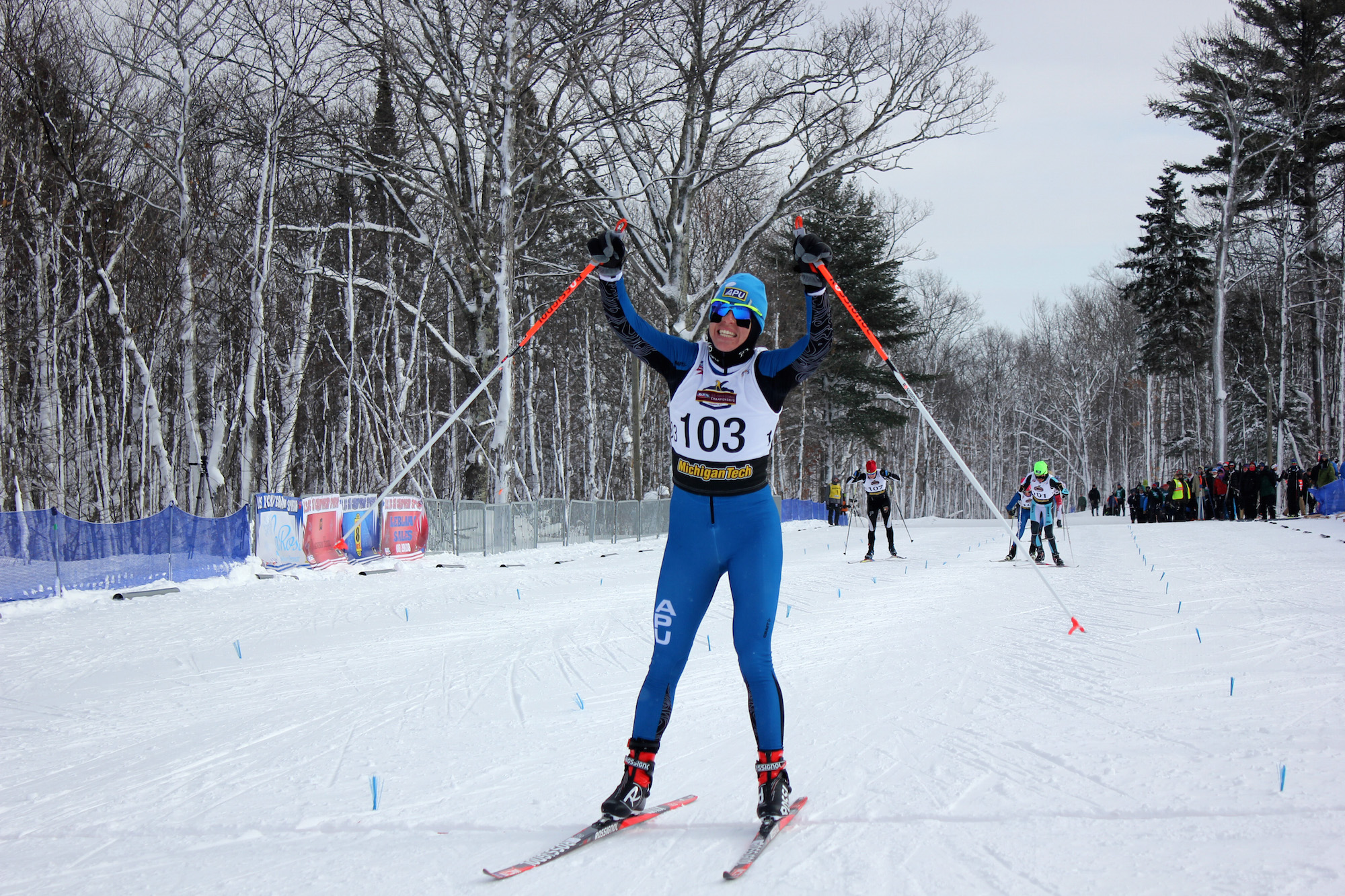
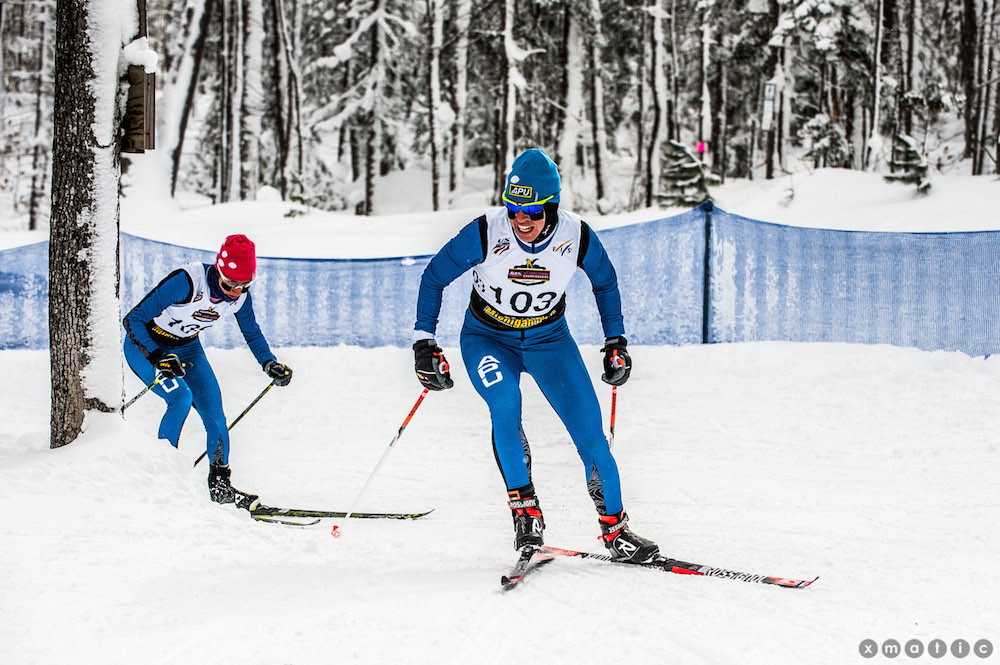
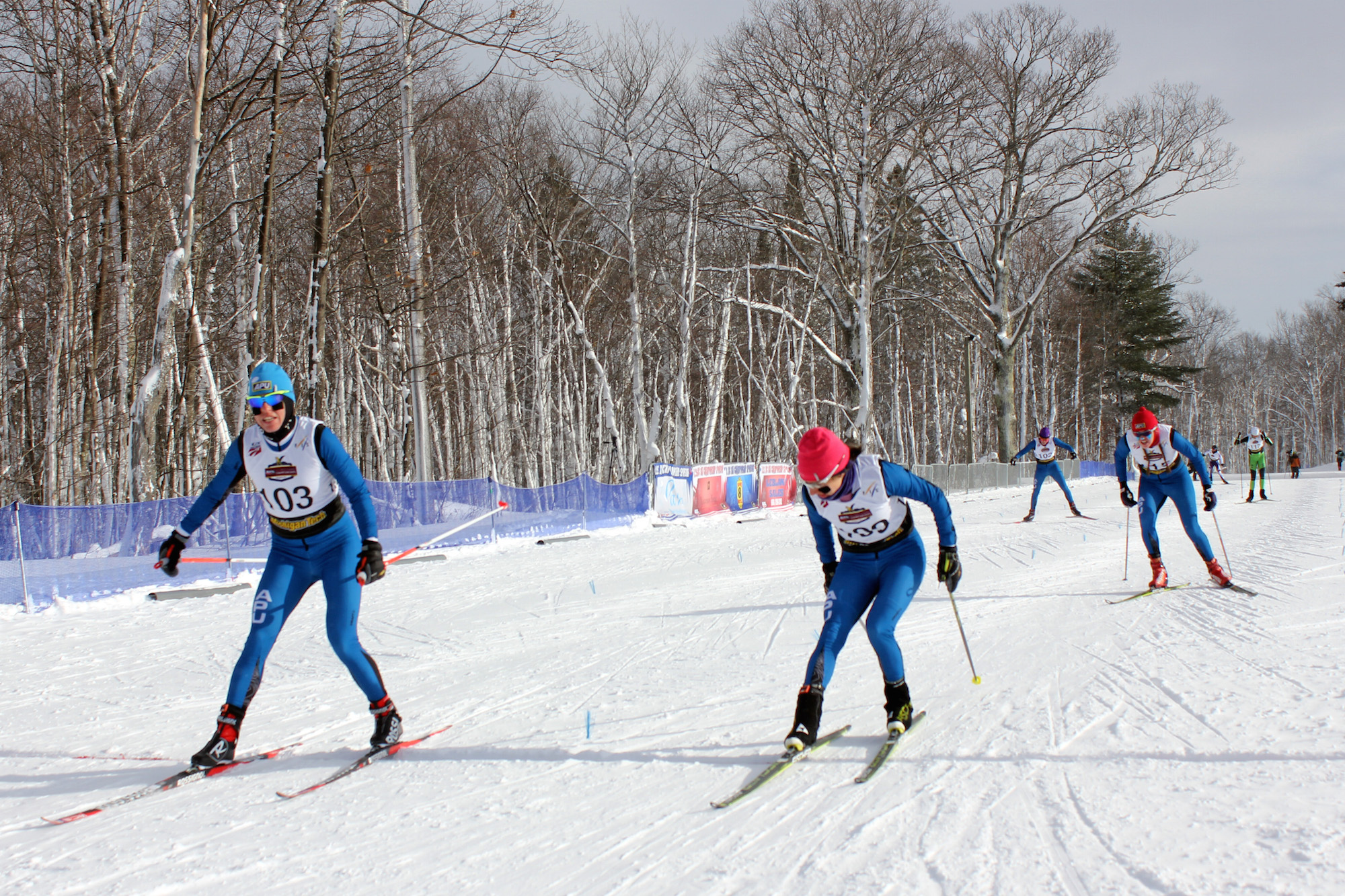
Rosie Brennan (103) leads APU teammate Chelsea Holmes during the women’s 1.5 k freestyle-sprint final at U.S. nationals in Houghton, Mich. (Photo: Christopher Schmidt)
That was the plan, and she stuck to it. Shooting out of the start, Brennan put herself up front, just ahead of APU teammate Chelsea Holmes, who was in her first sprint final at nationals.
“I’m not the fastest starter,” said Holmes, who’s best known as a distance skier. “I was just able to follow, and you can free-ski your way on the downhill into the position you want if you are not in first. So I did that and just tried to stay with Rosie.”
Meanwhile, she and the rest of the six-woman final knew what was coming: “[Rosie] is super strong and she is going to hammer,” Holmes explained.
Brennan wanted to lead and pick the most direct line on the course’s two steepest uphills. She also knew she needed to push over the tops of the hills, “[that] was really where people were kind of breaking,” she said, as well as rely on what she considered her strongest technique in skating: V2ing up steep pitches.
“Everyone was with me, at least Chelsea was with me … as we headed into the second uphill,” she recalled. “I just put my head down there and didn’t look back until I was well around the corner.”
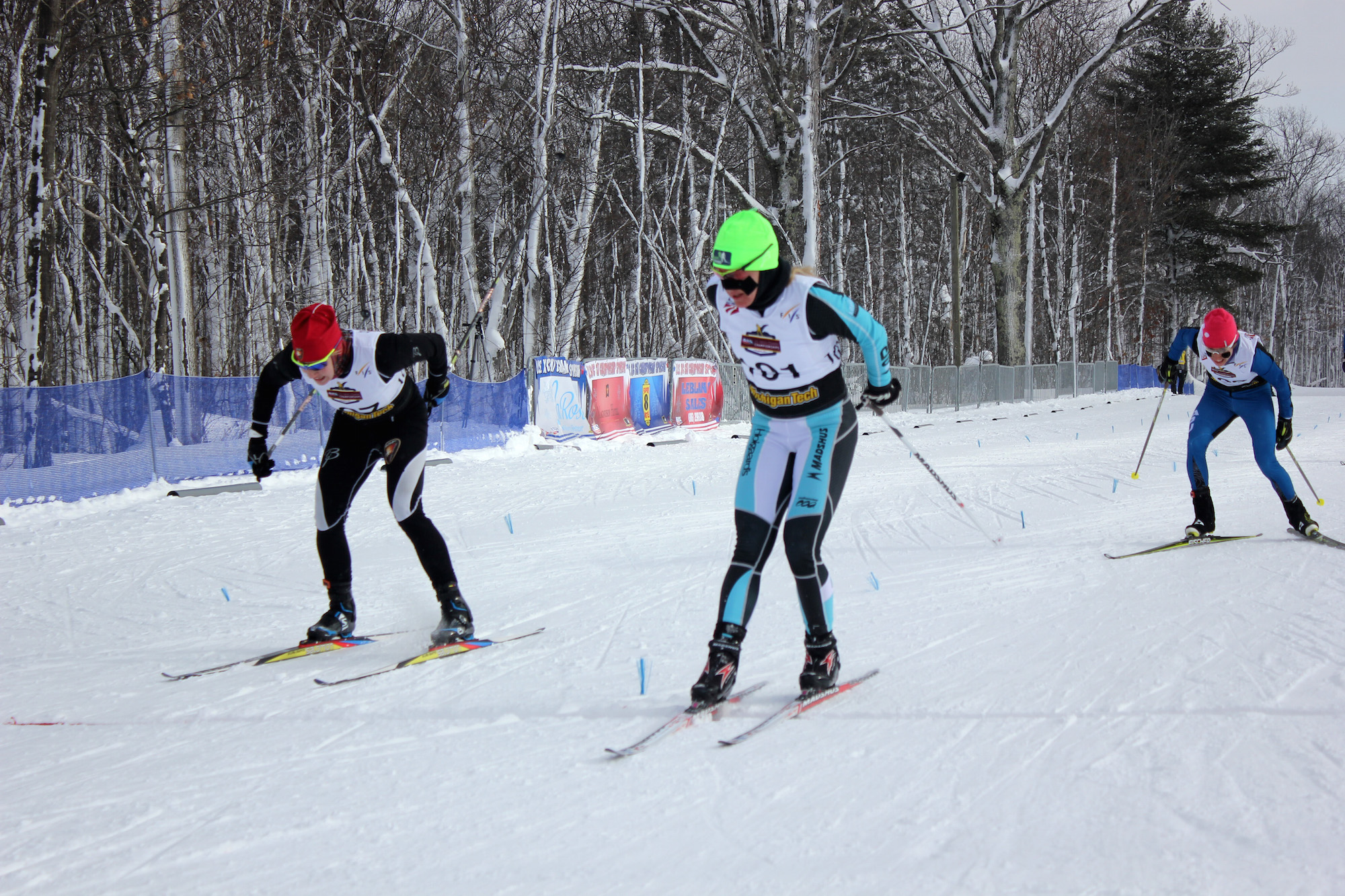
Caitlin Gregg (c) edges Jennie Bender (l) for second place in the women’s 1.5 k freestyle-sprint final (behind Rosie Brennan), while Chelsea Holmes pushes for fourth at U.S. nationals in Houghton, Mich.
Caitlin Gregg of Team Gregg/Madshus, the top qualifier with a time of 4:15.77 (2.23 seconds ahead of APU’s Jessica Yeaton in second and 2.26 seconds faster than Brennan in third) moved from near the back of the pack to third behind Holmes on the second climb.
“Caitlin made a really impressive move… and if I had the legs to follow her I would’ve,” Erika Flowers of the Stratton Mountain School (SMS) T2 Team recalled with a laugh.
“[The final] went out pretty fast and people were kind of jockeying for position,” she added. “I tried to take some outside lines, those weren’t fast. I tried to take some inside lanes, and it just kind of slowly strung out.”
As the sun peaked brightly through the tall birch trees for the first time all week, Brennan began to gap the field, and Holmes pushed hard to reign her back in and distance herself from Gregg in third behind her.
“I ended up getting boxed out in one of the climbs, which is kind of key,” Gregg explained. “That’s where Rosie and Chelsea got away so then I found myself kind of playing catchup for the rest of the race.”
Brennan looked back and saw the cushion she had created, but she still wasn’t comfortable.
“Knowing that Chelsea’s really strong also in skate and [APU teammate] Becca [Rorabaugh] has a hell of a finish, I just didn’t want to take any chances,” she said.
Pushing toward the finish, she heard Flora again. This time, he told her to switch to another gear.
“I thought everyone was catching me so I really didn’t want to look around at that point, and I just tried to give every last bit of energy I could,” she said. “I was like, ‘Oh no, I don’t even want to know if someone’s coming.’ I just went as hard as I could.”
“I was like, ‘Oh no, I don’t even want to know if someone’s coming.’ I just went as hard as I could.” — Rosie Brennan, after winning third-straight race at U.S. Cross Country Championships on Saturday
While there was a three-way battle for second playing out behind her, no one came close to Brennan. The moment she crossed the line, she threw her arms up with what little energy she had left.
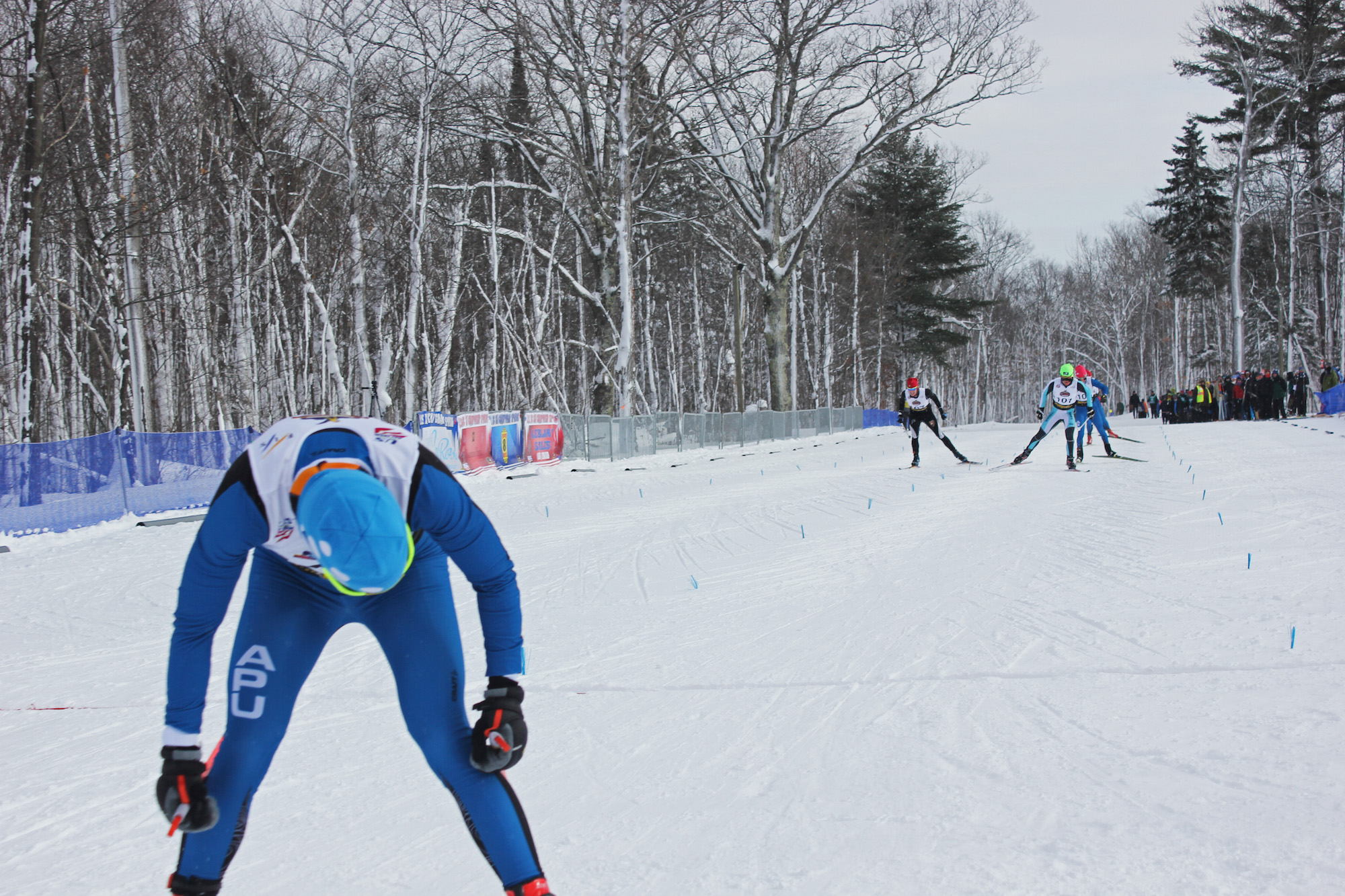
Rosie Brennan (APU) catches her breath after winning the women’s freestyle-sprint final by more than six seconds at U.S. nationals in Houghton, Mich.
Brennan had done it, winning in 4:17.93 by 6.1 seconds for her third-straight national title in a week — the first cross-country skier to do so since her teammate and U.S. Ski Team member Kikkan Randall won all four races at 2010 nationals in Anchorage, Alaska.
It was her fifth title overall, and she knew her family — following her results remotely and checking in daily from Park City, Utah — would be proud. Brennan’s father passed away in August, and she said she struggled over the holidays, which weren’t the same anymore.
“It was hard to feel like I was really preparing for nationals,” she said. “One, I was rollerskiing and running, and I just wasn’t in a very happy place. My team has just been so amazing. I’m just the happiest when I’m with them racing, and [coach] Erik [Flora] has just been unbelievable. It’s just my happy place so I think that makes my family happy, too, to know that I’m doing well.
“Of course, I wish my dad could be here to see it — he would be ecstatic,” she added.
After qualifying in third, Brennan won her quarterfinal handily by 3.78 seconds over Joanne Reid, a 2013 University of Colorado-Boulder graduate and NCAA champion. She then went on to edge Holmes by 0.13 seconds for the win in the second women’s semifinal.
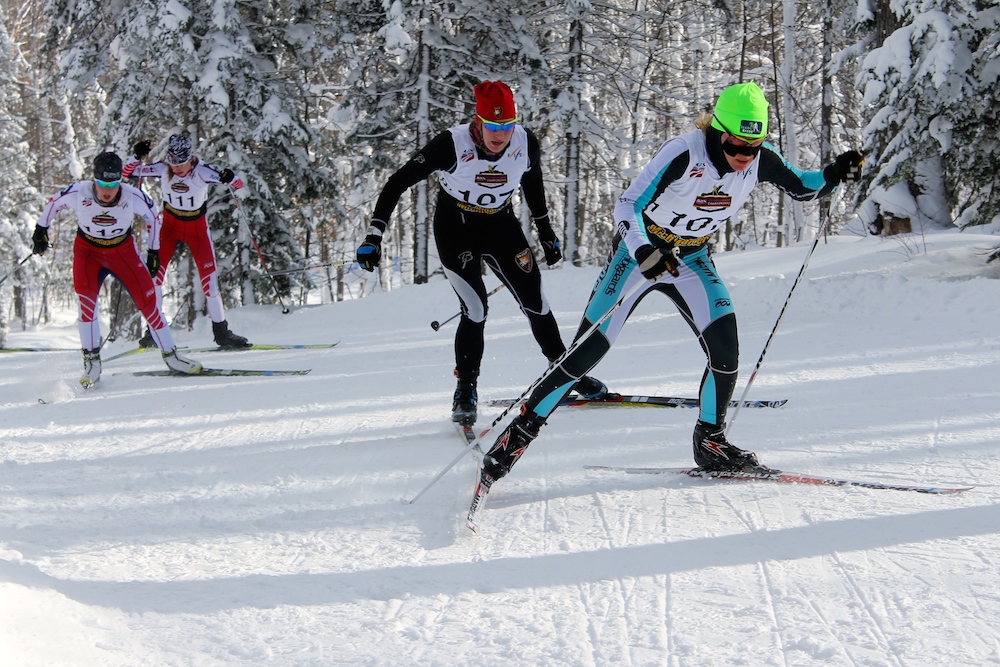
Caitlin Gregg (r) leads Jennie Bender (second from r) and Stratton’s Anne Hart and Erika Flowers in the first women’s semifinal with 500 meters to go in the 1.5 k freestyle sprint at U.S. nationals in Houghton, Mich. Bender went on to win the semifinal ahead of Gregg.
Jennie Bender, of the Bridger Ski Foundation, also won her quarterfinal (ahead of Craftsbury’s Caitlin Patterson) and the first semifinal (by 1.4 seconds over Gregg), to advance to the final as well.
After trying to conserve energy in headwind early on in the final, Bender inadvertently slipped toward the back on the second climb. With less than 500 meters to go, she decided to give it her all and see how many places she could make up.
“The last part, you can see your fate ahead of you so it was like, ‘How deep can I dig?’ ” Bender recalled. “I wish I could dig a little sooner.”
The defending skate-sprint champion, Bender overtook Holmes in the finishing stretch and came with 0.32 seconds of Gregg in second, but Gregg got to the line just before her for her second podium in as many races at nationals (after winning the opening 10 k individual skate race, in which Holmes was second and Brennan placed third).
“I just couldn’t close that gap [to Brennan], so it was a little bit of a mistake on my part,” Gregg said. “But that’s what happens in sprint racing.”
Bender reached the podium for the first time this week in third, 6.43 seconds after Brennan, and Holmes achieved a career-best national sprint result in fourth (+7.77).
“I definitely gained a lot more ground than I initially anticipated,” Bender said. “It was definitely a different gear. I let the skis do the work for me, which is also not usually how I skate ski — I usually just try to power through everything. My skis were running well and the wax was good despite it being really, really cold out — it feels faster than it has all week.
“My goal was to get on the podium today,” she added. “This week was kind of off for me mentally and physically.”
After hanging in second for most of the race, Holmes explained she started to fade on the final corner before the last 200 meters into the stadium.
“My legs were getting a little weak, I guess, and coming up the stretch I just I didn’t have the kick,” Holmes explained. In addition to placing second in the 10 k, Holmes was the third American in the 20 k this week at nationals.
APU takes first through third the second semifinal with Rosie Brennan (l), Chelsea Holmes (c) and Becca Rorabaugh (r), respectively, in the 1.5 k freestyle sprint at U.S. nationals in Houghton, Mich. In the final, all three landed in the top five.
“I would I’d say my lack of finishing kick has really summed up this week,” she said. “The better you get, the closer you taste it. … I am still happy with it; that is a really good sprint for me.”
Coming into the finish in fifth, Rorabaugh pushed to gain ground on the three women just ahead of her — Holmes, Bender and Gregg — but ended up fifth, 2.5 seconds behind Holmes and 10.3 seconds behind Brennan. Six seconds after Rorabaugh, Flowers finished sixth.
“I’ve only ever been in one other A-final in my life so I was fired up,” Flowers said. “I think the sun definitely put a smile on everyone’s face today, which helped a lot.”
Gregg was especially pleased with her qualifier, which comes with valuable USSA points in her quest for making the 2015 U.S. World Championships team — should it select additional members beyond the U.S. Ski Team (USST).
“Every week I’m feeling stronger and stronger, so today was a good race,” she said. “I made a little bit of a tactical error in the final, but I felt strong and I feel like I’m leaving on a good note. I’m happy to be on the podium.”
Gregg, 34, skipped the 20 k mass start to “make sure that I’m not pushing the limit to the point where I have the end of my season come before I need it to,” she said on Thursday. “I’m trying to prepare well and conservatively and race when I feel the best. A long race right now doesn’t seem like it would help my training and preparation, should I make it. The goal is to save up and train well, as if I’m going to World Championships.”
As of Jan. 2, Gregg was one point ahead of Brennan in fourth (behind USST members Liz Stephen, Jessie Diggins and Sadie Bjornsen, respectively) on the USSA distance list. Alternatively, Brennan was about three points ahead of Gregg as the top-ranked domestic racer (behind USST members Sophie Caldwell, Randall, Diggins, Bjornsen, and Ida Sargent) in the USSA sprint standings.
While Gregg spent November and December on the World Cup circuit, Brennan earned World Cup starts for Period 2 as the early season SuperTour leader (and is leaving for Estonia on Tuesday before the Otepää World Cup next Saturday and Sunday). She has won six out of eight races so far this season — placing fifth in the opening skate sprint in West Yellowstone, Mont., and second in the nationals 10 k skate last Sunday.
“I didn’t expect to win [today] at all. It was just a huge relief — it’s amazing,” Brennan said. “I’m so happy that I can make my weakness a strength and to be able to get three titles, that’s huge for me. It’s by far the best week of racing I’ve ever had in my life.”
Notes:
The final day of U.S. nationals on Saturday turned out to be the mildest competition day of the week: with temperatures around 1 degree Fahrenheit in the morning warming up to a high of 14 degrees by the afternoon.
Gregg won the first women’s quarterfinal by a 2.92 seconds over Flowers, and Bender topped the second quarterfinal by 3.31 seconds over Patterson. Rorabaugh edged 16-year-old Hannah Halvorsen (Sugar Bowl Academy) by 0.67 for the third quarterfinal win, and Holmes topped Yeaton by 2.08 seconds in the fourth quarterfinal.
Liz Guiney (Craftsbury Green Racing Project) and Anne Hart (SMST2) both advanced to the semifinals after placing third with the next-fastest times beyond the top two in each quarterfinal. Guiney was in Bender’s heat and Hart raced against Holmes.
Halvorsen ended up as the top junior overall in ninth (after placing fifth in her semifinal behind Bender, Gregg, Flowers, and Patterson, respectively).
Ten athletes were named to the U23 World Championships team after Saturday’s sprints: Joanne Reid, Annie Pokorny (SMST2), Anne Hart (SMST2), Paige Schember (Sun Valley Ski Education Foundation), Deedra Irwin (Michigan Technological University), Kyle Bratrud (Northern Michigan University), Logan Hanneman (University of Alaska Fairbanks), Ben Saxton (SMST2/USST), Patrick Caldwell (Dartmouth College/USST), Scott Patterson (APU)
Canada’s Alex Harvey (r) congratulates Norwegian winner Pål Golberg at the finish of Friday’s 1.5 k freestyle sprint final. Harvey placed fifth for a season best. (Photo: Fischer/NordicFocus)
If you don’t count the Norwegians, most everyone’s skis in Friday’s 1.5-kilometer freestyle sprint were relatively even in terms of speed, according to men’s finalist Alex Harvey of Canada.
But the reality is, Norway is a big part of essentially every World Cup race, let alone one in Lillehammer, Norway. Their often-superior skis can be pivotal to their success, but they’re not the only thing they rely on.
Unless you ask Pål Golberg.
The men’s 1.5 k freestyle sprint podium on Friday at the World Cup mini tour in Lillehammer, Norway, with Norway’s Pål Golberg (c) in first, Russia’s Alexey Petukhov in second (l) and Norway’s Finn Hågen Krogh in third. (Photo: Fischer/NordicFocus)
After winning the men’s skate sprint — the first of three races in Lillehammer’s mini tour — by 0.24 seconds over Russia’s Alexey Petukhov, Golberg said in a press conference that his skis were so good, he simply had to believe he could win.
While that was easier said than executed, the 24-year-old Norwegian’s thought process worked.
“I have a past as a sprinter, so I should be doing well here,” Sundby told NRK. “But it’s fun to prove that I can do both [sprint and distance].”
Golberg stood as the sixth-fastest qualifier behind Russia’s Sergey Ustiugov, who clocked the fastest time of 3:14.99. In the qualifier standings, he followed his teammate Finn Hågen Krogh in second, Petukhov in third, Norway’s Petter Northug in fourth, and Sweden’s Calle Halfvarsson in fifth. Ten Norwegians qualified in the top 30, including several distance specialists: Sjur Røthe (in ninth), Martin Johnsrud Sundby (13th) and Niklas Dyrhaug (20th).
But Golberg, who’s notched seven World Cup podiums in sprints and won a 15 k classic in Lillehammer in 2013, went on to win his quarterfinal on Friday in a photo finish with Norwegian U23 Team member Emil Iversen. He beat out Sweden’s Emil Jönsson, Norway’s Ola Vigen Hattestad, Halfvarsson, and Great Britain’s Andrew Musgrave, in that order, with the second-fastest quarterfinal time of the day in 3:18.56.
Far from done, Golberg squeezed out another victory in his semifinal, this time over Finland’s A-team sprinter Juho Mikkonen in second and Ustiugov in third in a three-way photo finish. (Northug was relegated from fourth behind Ustiugov to last after cutting off Ustiugov in the finishing straight. Jönsson received a warning for a similar action in the quarterfinal, after impeding Iversen.)
Krogh won the other semifinal after dominating his quarterfinal as well — initially beating out France’s Jay Renaud by 0.22 seconds, Harvey (+0.36) and Mikkonen (+0.48), then winning his semifinal in 3:19.57, about 1.7 seconds faster than Golberg. He topped Petukhov (+0.11), Iversen (+0.37), Harvey (+0.59), Larkov (+0.66), and finally, Jay (+1.61) to do so.
Despite finishing third and fourth, Iversen and Harvey advanced to the final as lucky losers with the next-fastest semifinal times. For Harvey, it was his second time advancing in that fashion after doing the same with Mikkonen in the quarterfinal.
From there, teammates Golberg and Krogh would meet in the final, along with 23-year-old Iversen — and Petukhov, Mikkonen and Harvey.
“I knew I had good glide,” Golberg recalled in a translated interview with NRK. “If I managed to keep my back to Finn, I knew I was the only one who stood between myself and the finish. My skis were so good they almost did the job on their own.”
That kind of confidence allowed Golberg to sit patiently behind until the final climb, when he caught a ride out of the sharp lefthand-downhill corner and glided into the start of the long hill. Positioned around fourth with Petukhov and Iversen in tow, Golberg and Petukhov swallowed Harvey in third coming out of the bend. Golberg carried his momentum and attacked for second place by the top, trailing Krogh into the stadium. Petukhov went with him.
Pål Golberg (l) takes on Krogh (2) and Petukhov (3) for the win in Friday’s 1.5 k freestyle sprint at the Lillehammer World Cup. Golberg won it by 0.24 seconds. (Photo: Fischer/NordicFocus)
With a downhill into and around the final curve before the finish, Golberg and Petukhov put the pressure on Krogh — an early leader in the final. Golberg trusted his skis once more and powered past Krogh, winning in 3:20.51 while Krogh and Petukhov duked it out for second. Petukhov emerged on the better end of the photo finish, five-hundredths of a second faster than Krogh for second and 0.24 behind Golberg.
After taking a gutsy leap to the front out of the start, Mikkonen held strong for fourth (+0.56) and Harvey ran out of gas but pushed for fifth (+1.13) ahead of Iversen in sixth (+4.15).
“Right after the finish I was not so satisfied,” Krogh told FIS after cameras caught him shaking his head in disappointment. “I wanted to win, but now I am happy. My plan was to gain a gap before the final stretch, maybe if the gap was bigger I could have won.”
Petukhov explained he knew he had to catch Krogh and Golberg if he wanted a shot at the win.
“I think I could have skied better tactically today, but I am happy for the second place. Pål was very strong today,” he told FIS.
Harvey had similar respect for Petukhov and Krogh.
“I knew from the beginning that the last uphill was crucial,” he said in a phone interview with FasterSkier. “Finn Hågen has won skate sprints on big uphills and Petukhov is a beast on skate sprinting up big hills, so I knew what their move would be even before I skied with them, and I knew I had to make a move there, but for me it’s hard. I feel good coming into that last uphill, but I just can’t go, I just don’t have it yet. I knew I had to position myself first, second or third before the last downhill, but I just couldn’t do it because I didn’t have the jam in there.”
Day 1 put Golberg in the mini-tour lead by 2 seconds over Petukhov. Krogh is 4.9 seconds back in third, Mikkonen 10.2 in fourth, Ustiugov 11.5 in fifth (thanks to bonus seconds from his qualifier win), and Harvey 11.8 seconds back in sixth.
“It set me up good now I have to make sure I stay in the top five,” Harvey said. “After tomorrow, a couple of the guys ahead of me will slip after the 10 k [freestyle]. I think I’m in a good position, something like 15 seconds clear of Sundby and [6.6 seconds ahead] of Petter so I have to use that to my advantage tomorrow.”
Sundby, who was third in his quarterfinal (behind Golberg and Iversen) for 14th overall on Friday, is currently 15th in the mini-tour standings, 27 seconds behind Golberg. Northug, who ended up 12th after being relegated to last in his semifinal, sits in 10th, 18 seconds back from the leader.
“Martin has put himself in a good position [for the mini tour], but I have the best [position],” Golberg told VG with a smile.
“Tomorrow what matters is not the position, it’s the time behind the leader or maybe be the leader,” Harvey said. “Just be able to start in a good group on Sunday. I couldn’t have asked for a much better position than I am now. Any time you make a final in a mini tour or a Tour de Ski, you get a lot of advantage [in that mini tour] compared to other distance skiers.”
The only North American man to qualify for the rounds in 22nd, 6.26 seconds off the top qualifying time, Harvey went on to experience the angst and joy of being a lucky loser twice.
Third in his quarterfinal behind Krogh and Jay, he said he could tell their heat was a fast one based on the way it felt and information from his team’s wax technicians.
“I knew we had a chance of lucky loser already because I knew the first three heats were pretty slow — the techs said they were just crawling up the hill,” Harvey said. “Then I had a good finish, but already I could tell that I was missing some push, some power on the last uphill. Like in offset [V1] on the steep stuff, I was feeling fresh entering that uphill, but I could never have enough speed as the sprinters, but I was lucky to have a fast-enough finish.”
Krogh led their quarterfinal early on, and Poland’s Maciej Starega put himself in second early just ahead of Røthe. Harvey moved from fourth to third, eventually behind Krogh and Røthe, on the long descent before Jay attacked on the climb and Harvey slipped to fifth. The Canadian recovered, pushing into the stadium for third, 0.12 seconds ahead of Mikkonen, who came on late for the last lucky loser spot into the semis.
In the semifinals, Harvey knew his heat had to be faster than the first if he wanted to make the final.
“I knew that the first semi had gone really slow, so the plan was if I could take the lead, I would just go full blast and try to clock a decently fast time to give me a better chance at making the final,” he said. “With a mini tour like that, you get a lot of bonus seconds [for making the final].”
And that was his overarching goal. More bonus seconds meant a more competitive position for the second day of racing.
So, to the Eurosport announcers’ surprise, the usually calm-and-collected Harvey took control out of the start of his semifinal. From their estimations, he was “trying to conserve energy whilst leading” and did so all the way into the base of the big climb before the finish.
However, Krogh and Petukhov shot passed him on the way up it, and Harvey entered the final straight in fourth behind Iversen.
Regardless of his place, his tactic worked. Harvey heard a split after the first climb, around 40 seconds into their semifinal, that they were two seconds faster than the first heat. If they held up that pace, he knew he could finish outside the top two and still make the final.
“I’m usually pretty slow at the start so sometimes that’s my plan, to go to the front and push the pace, but it’s not every day that it happens,” he said.
In the final, Harvey said he looked back for the first time all day because he couldn’t hear anyone behind him — when he was in third behind Krogh and Mikkonen.
“About two-thirds of the way, we had a little gap,” he said. “[I looked back and] I saw that Petukhov was like four or five meters behind. I thought maybe we had a chance to break away and we did.”
Heading into the big hill, which he described as not as steep but longer than Kuusamo’s final 240-meter climb at around 315 meters, Harvey struggled to stay with the pace once again. It didn’t help him that fresh snow overnight made the track slower, and required V1 instead of the V2 he had been able to use to ski up it on Thursday.
“I felt good; I didn’t feel like I was spent or anything,” he said of his last time up that hill. “[Golberg and Petukhov] were side by side with me when we hit the really steep stuff, and when I switched to offset, I was going as hard as I could and I was still in a good position. Had I been strong, I would’ve been able to crest over the top in second place.
“It’s really my weakness in skating,” Harvey added. “I’m working on it, I improved a bit, but I’m still not the world’s best. To make a move like that when you’re in the final and you’re against two, three other dudes that are really good, you have to really be one of the best to make a difference there.”
Regardless, it was Harvey’s best result of the season so far. “Last year, I had three wins, and they were all in skating. … I think my best performances over time are in skating,” the 2013 World Championships classic-sprint bronze medalist said.
Perianne Jones was close — just 0.22 seconds from qualifying in the women’s World Cup 1.3-kilometer freestyle sprint to be exact.
So was Jesse Cockney, who was 0.68 seconds outside the top 30 in the men’s 1.5-kilometer sprint in 34th.
Both are Canadian Development B-Team members, and both were a few places and tenths of a second away from getting more racing time on Friday in Lillehammer, Norway.
“I wanted to make sure I finished today and felt like I left it all out there,” Jones, 29, wrote in an email after placing 33rd. “Last weekend I skied so terribly that I didn’t feel like that at the end, so that was a step in the right direction.”
In the World Cup opening classic sprint in Kuusamo, Jones placed 48th, 4.38 seconds out of 30th. Considering that, Friday was an improvement.
“Of course I would have liked to be in the heats, being that close is hard, but at the same time encouraging because I was so close,” she wrote.
Jones hadn’t raced since last Saturday’s classic sprint, opting out of the distance race to get a full week of recovery.
“If this had been a regular weekend race instead of a Friday race I probably would have raced the distance race in Kuusamo, but I just didn’t want to risk feeling crappy today,” she explained.
“I will for sure race tomorrow.”
As for Sunday’s 10 k classic pursuit, she added that she was taking it one day at a time.
In his first World Cup of the season, Cockney, who placed 13th in a Norwegian Cup Gala classic sprint and 39th in a 10 k classic last weekend, explained his two races there were “great prep” for Lillehammer.
“It’s been all good here the last week with some good training at Sjusjoen, just outside of Lillehammer,” the 25 year old wrote in an email. “I’m not doing anything differently to transition from domestic circuits to the World Cup so it’s fairly business as usual in that sense.”
Warming up on Friday morning felt normal, he added. “I felt like I had some speed to use today,” he wrote.
“I thought my qualifier was good but with a field like this in Norway, it has to be perfect to get to the heats. I’m happy with the feeling and I did everything I could but pretty bummed about being on the wrong side of a close race.
“I skied hard and gave everything that I could but maybe I need to ski a bit more like my job is on the line because at the end of the day it actually is,” he added. “Some more desperation may go a long way to putting me in the heats.”
Like Jones, he plans to race Saturday’s freestyle individual starts — 5 k for the women and 10 k for the men — after which he will decide whether he’ll start Sunday’s 15 k pursuit.
“Some more desperation may go a long way to putting me in the heats.” — Jesse Cockney, 34th in Lillehammer 1.5 k freestyle sprint qualifier
Alex Harvey was Canada’s lone male qualifier in 22nd. He went on to finish a season-best fifth in the final.
Lenny Valjas finished 45th in the preliminary round, 2.65 seconds from qualifying. Devon Kershaw placed 64th, Graeme Killick was 94th and Ivan Babikov was 110th out of 119 men.
“I was feeling good warming up to be honest. Kind of like last weekend before the sprint qualifier,” Kershaw wrote in an email. “In the qualifier though, not feeling as good. Just not able to hold the technique I wanted deep enough into the hills (switching to offset too early).
“Once that started happening, perhaps I started to scramble too much and I did a poor job over the tops of the climbs — I wasn’t snappy or peppy enough to create enough speed into the descents,” he added. “It wasn’t a stellar day of sprint qualifying.”
Kershaw described the course as a “good, honest and hard course,” excellent for a sprint.
“Climbs, turny descents, some flatter terrain and probably most importantly, room to pass if you were strong,” he wrote. “I didn’t ski fast, but once upon a time I would have loved a course like this! I wanted to race the heats badly because I thought it really would suit me. I am just not fast enough on my own yet to put that last statement to practice.
“I guess I am still carrying fatigue from the training load, or perhaps I’m just getting slower in my old age — I don’t know. I do know I’m not totally ready to give up on the sprints yet — but I am taking my knocks that’s for sure.”
His goals for the weekend remain unchanged, he wrote, and he’s excited for Saturday’s 10 k skate and will focus on some technical tasks during that.
“Of course I am most excited about Sunday’s 15km classic. It’ll be pretty much a mass start — or at least there will be big groups to ski with,” Kershaw added. “The course is really challenging, but I felt good last weekend in Kuusamo on a challenging course in classic, so I am for sure excited and more confident in that distance/discipline at the moment. I am very thankful that the sprint is out of the way now and I can focus more on the distance racing for the weekend which has been feeling better for me by miles than the short, fast sprints.”
The second Canadian woman in Friday’s sprint, development-team member Emily Nishikawa placed 76th.
Alysson Marshall (AWCA/NST) in bib 4 and Heidi Widmer (AWCA/NST) in bib 1 lead (from l-r) Rosie Brennan (APU), Eva Severrus (UNM), Chelsea Holmes (APU) and Jennie Bender (BSF) in the women’s A-final of the 2014 West Yellowstone SuperTour freestyle sprint. Marshall won the event with Widmer and Bender finishing second and third.
WEST YELLOWSTONE, Mont. — Alysson Marshall had plenty of opportunities to practice her finishing lunge in Friday’s SuperTour freestyle sprint in West Yellowstone.
The Canadian National Development Team member, who skis for the Alberta World Cup Academy (ACWA) in Canmore, Alberta, barely earned an automatic qualifying spot in her quarterfinal after outlunging Stratton Mountain School (SMS) T2 skier Erika Flowers for second place in the heat.
Alysson Marshall (AWACA/NST) racing to a fourth place finish in the qualification round of Friday’s SuperTour freestyle sprint in West Yellowstone, Mont. Marshall went on to win the event.
In the semifinal, Marshall was neck-and-neck with University of New Mexico’s Eva Severrus, but was able to eke out a position in the A-final despite finishing in fourth behind her competitor. Both Severrus and Marshall earned the lucky loser positions as their times were faster than the second semifinal’s third-place finisher, Becca Rorabaugh of Alaska Pacific University (APU).
When it came to the last heat of the day, Marshall positioned herself in third for most of the A-final. When she reached the finishing stretch into the stadium, however, she surged past APU’s Chelsea Holmes to go head-to-head with fellow AWCA and Canadian national team member Heidi Widmer. As the two approached the finish, Marshall did what she had been doing all day and lunged for the win.
Her practice paid off as she edged Widmer by 0.28 seconds.
“In sprint races, I tend to get stronger as it goes on, so I felt good in the final and had enough in the final kick,” Marshall said.
Marshall, who has competed in both the Canadian and international World Cup circuits, said that the result was an indication that she was on the right track for her season goals. While she considered Friday’s sprint a warmup and acknowledged that anyone in the A-final could have nabbed the top spot, she said that her win was a confidence boost that would serve her well in future races.
Just a boot length behind Marshall, Widmer lost steam in the finishing stretch of the 1.5-kilometer race.
“I felt really strong but I’m a little disappointed that I lost in that little finishing stretch there… It’s nice to have it under the belt and get into the rhythm of ski racing,” the 2014 Olympian said after finishing the A-final.
Heidi Widmer (AWCA/NST) racing to a first place finish in Friday’s SuperTour freestyle sprint qualification round. She finished second in the A-final behind teammate Alysson Marshall.
Widmer started the day with a strong finish in the qualification round, where she placed first ahead of Annie Pokorny (SMST2) and Rosie Brennan (APU), who were second and third, respectively.
The qualification result propelled Widmer throughout the heats as she won both her quarterfinal and semifinal by healthy margins.
Like Marshall, Widmer said that the result added to her confidence but had no concrete significance regarding her season goals – racing on the World Cup and skiing at the 2015 World Championships in Falun, Sweden.
Despite the significance of the race, Widmer said the American competition was refreshing, as Canadian sprint heats are often only competitive in the final.
“It is always good to practice skiing in the heats… getting used to that kind of stuff, especially when we can come down to the states and ski in more competitive heats,” she said. “In Canada we have great skiers, but often it won’t really come together until the final, so we won’t have a competitive heat until the final.”
Two-time U.S. National sprint champion Jennie Bender (Bridger Ski Foundation), agreed, saying that the competition, especially in the A-final, was “stacked.”
Bender, who finished in third position as the top American, fought back after 17th in qualification to handily win her quarterfinal and semifinal.
Once in the A-final, Bender said that it was one most competitive heats she has ever raced, with all six women jostling for a strategic position the entire 1.5 k.
“It was fun and awesome, but scary because you’re in self-preservation mode and you’re trying to hold your line,” she explained. “That was one of the closest finals I’ve had in a long time — just five of us right there.”
Bender, who was in fifth as the skiers crested the final hill into the stadium, looked to find an opening in which she could make her move.
All that was open between the five skiers was a gap to her far right. Although she had to use precious time to place herself into the opening, Bender explained that she believed it was better than the alternative of sitting in behind another athlete.
“You pick [an opening] and you go for it, there’s no time to really jump in behind anyone in my opinion,” she said.
Jennie Bender (BSF) was the first American in Friday’s SuperTour freestyle sprint in West Yellowstone, Mont. She finished the day 3rd overall. (Photo: Toko)
Bender was happy with her third-place finish, but acknowledged that she needed to improve if she wanted to accomplish her season goal of making World Championships.
“I have high expectations for myself, and this is what I wanted to do,” she said. “So, a podium’s good – it’s okay, but it’s not first.”
Just five-hundredths of a second behind Bender was Holmes, positioned in second before Marshall and Bender passed her in the finishing stretch.
Holmes, who qualified in seventh and is traditionally a stronger distance skier, said she was excited to perform well in sprinting and explained that it was a testament to the work she has put into her training the past year.
She said that what set her apart from much of Friday’s field was her ability to climb the final hill into the stadium.
Her teammate, Brennan was also in the hunt for a position on the podium. The 2014 national champion in the classic sprint was a favorite for the top spot and skied both a strong quarterfinal and semifinal to make her way into the A-final.
Brennan said that she was happy with her fifth-place finish and explained it was a victory in itself that she was racing Friday because of the many difficulties she has dealt with in the previous months.
Rounding out the A-final was Severrus, a Slovenian who skis for University of New Mexico. She finished sixth, 1.8 seconds behind Marshall.
Despite the high spirits of the SuperTour racers, there were several organizational issues that caused the day to be longer than planned.
As skiers prepared for their second round of heats, several coaches, including Sun Valley’s Rick Kapala and Stratton’s Patrick O’Brien noticed that the semifinal lists were incorrectly ordered. While the issue was eventually fixed, racing was postponed, leaving skiers in the cold wind while they waited for their start order.
The incorrect order of the men’s semifinal would soon become the least of the organizers’ worries as it was soon discovered that they had incorrectly placed Hailey Swirbul (Aspen Valley Ski Club) into one of the women’s semifinals.
Swirbul had placed fourth in the quarterfinal, 3.03 seconds behind Flowers, but the results read that Swirbul had instead finished ahead of Flowers.
Flowers and several other members of SMST2 alerted organizers of the mishap, but it wasn’t until Swirbul herself came forward that the timers reversed the placement and gave Flowers a position in the semifinal.
When all was said and done, the schedule was delayed by more than 40 minutes.
Flowers said she understood that mistakes happen and explained that the best ski racers are the ones who can work past such setbacks.
“There are a million things that can affect you on race day and that’s just something you have to be prepared for,” Flowers said after placing fifth in the B-final for 11th overall. “The best racers are the ones who can roll with it and that’s always something I can work on so this was good practice of that. It’s frustrating but everyone’s trying to make the best outcome. I think ultimately it worked out even if it added some delays.”
Other athletes were equally as graceful, with Marshall joking that the delays had made her “ready for lunch.” She explained that her key to staying warm and snappy during such a long waiting period was to do a signature running shuffle — a move that often draws the laughter of her teammates.
The SuperTour women will continue competition Saturday with a 10 k freestyle individual start.
Jessie Diggins up front in the women’s 1.2 k freestyle sprint at U23 World Championships on Wednesday in Val di Fiemme, Italy. The fastest qualifier, the U.S. Ski Team member went on to place second in the final. (Photo: FlyingPointRoad.com/Proceeds go to the National Nordic Foundation)
The International Ski Federation (FIS) Nordic Junior and U23 World Ski Championships showcase the highest level of competition among the best up-and-coming skiers around the globe, especially during Wednesday’s opening freestyle sprints. As Canadian Katherine Stewart-Jones put it: “Every second counts.”
Diggins Wins Prelim; Second in U23 Women’s Final
A variety of nations produced top results for both U23 men and women. In the men’s 1.5-kilometer race, six different countries occupied the top eight (Russia, France, Switzerland, Italy, Norway, and Germany) and in the women’s 1.2 k sprint, eight nations finished in the top 12 (Germany, USA, Italy, Sweden, Slovenia, France, Russia, and Norway).
The top three women of Wednesday’s U23 freestyle sprint jumping for joy at the finish (from left to right): runner-up Jessie Diggins (USA), winner Elisabeth Schicho (GER) and Giulia Stuerz (ITA) in third. (Photo: Fiemme2014)
The athletes woke up to sunny, crisp and cold morning on Wednesday in Val di Fiemme Italy. They later warmed up and began their qualification rounds — for some, the most difficult part of sprint racing because you must push yourself as hard as you can go with no one around to go head-to-head against. Those who best demonstrated this skill included American Jessie Diggins, who won the women’s qualifier, and Russia’s Sergey Ustiugov, the men’s qualifying winner.
“The goal of coming here was to hopefully race fast, but my biggest goal was just to have fun and see the team,” Diggins told FasterSkier. “It was so good to practice dealing with pressure and use this as a tune-up race to get more experience and hopefully make the final. My goal was to make the final and get the experience, and get the tactical practice.”
The 22-year-old U.S. Ski Team member, who’s headed to her first Olympics next week, went on to place second to Germany’s Elisabeth Schicho in the final. After winning his first World Cup in a freestyle sprint in Nove Mesto, Ustiugov, 21, tallied his third U23 victory on the first day of competition in Val di Fiemme.
Russia’s Sergey Ustiugov on his way to winning Wednesday’s freestyle sprint on the first day of U23 World Championships in Val di Fiemme, Italy. (Photo: Fiemme2014)
“I hoped I could get a medal and eventually I made it,” Ustiugov said, according to a Fiemme2014 press release. “I felt very comfortable all the way through since the qualifications. In the final heat I started slow ‘cause I wanted to see what the others meant to do. Halfway to the finish I decided it was the right time to attack.”
In the final, Ustiugov attacked on the first climb to create a significant gap on his competitors. Behind him, Switzerland’s Roman Schaad tried to close on him and France’s Paul Goalabre. In the end, Goalabre overtook Schaad with a few powerful pole plants landed him with a second-place finish, leaving third to Schaad. American Erik Bjornsen (U.S. Ski Team) placed 18th.
In the women’s final, Diggins also kept the pace as high as possible from start to finish. Nevertheless, Schicho stuck with the young U.S. Ski Team member and overtook Diggins in a final sprint to the finish, winning by a clear margin.
“In the final I knew that I hadn’t been skiing the finishing lanes very well today, but if I could tire people out, that was going to be my chance to win it,” Diggins said. “So I went to the front and just hammered and pulled a big gap on the field except for [Schicho], who hung with me. She had a great finishing speed. Going down the last hill into the finish she slingshot me and then just skied off and I just had nothing.”
Diggins added that she was satisfied with the race and looking forward to finishing out her tapering period before peaking for Sochi.
“I am more than happy, today is pretty much a golden day,” Schicho, 22, said of her first U23 podium in a press release. “I am really proud … I felt really fit and my skis were perfect.”
A home-crowd favorite, Giula Stuerz of Italy also made the podium in third.
France’s Jean Tiberghien (2) nips Sweden’s Oskar Svensson (4) for the freestyle-sprint victory on the first day of 2014 Junior World Championships in Val di Fiemme, Italy. (Photo: Fiemme2014)
Tiberghien, Sundling Tally Junior Sprint Titles
The junior men’s 1.5 k final began in a controlled manner, without any significant moves up the first hill. Then, on the last climb, France’s Jean Tiberghien (the second-fastest qualifier after fellow Frenchman Lucas Chanavat) took the lead and attacked, testing the reaction skills of Sweden’s Oskar Svensson and Finland’s Joni Maki. Neither were able to respond, and Tiberghien, 18, entered the final straightaway with a decent gap. Ultimately, however, he had to outlunge Svensson at the finish, beating the Swede by a toe. For Tiberghien, it was his first title in his first Junior World Championship. Maki placed third.
“Becoming the world champion is simply amazing and fulfilling,” Tiberghien said in a press release. “Everything was awesome and everything went in the right direction. I still have to realize that I won the gold medal, it’s even better than a dream.”
Jonna Sundling of Sweden leads Norway’s Lotta Udnes Weng in the junior women’s 1.2 k freestyle sprint on Wednesday at Junior World Championships in Val di Fiemme, Italy. The two placed first and second in the final, respectively. (Photo: Fiemme2014)
In the junior women’s 1.2 k final, the race tactics couldn’t have been more different. The winner of both her quarterfinal and semifinal, Sweden’s Jonna Sundling attacked the first climb and reached the top of the hill with a clear margin over her competitors. With such a gap, the 19-year-old Sundling was untouchable and secured her first individual junior-world title. Norway’s Lotta Udnes Weng and Russia’s Yulia Belorukova completed the podium in second and third, respectively.
The top Canadian, Stewart-Jones placed 15th in the junior women’s sprint.
“I was super excited with how things turned out today,” she wrote in an email. “This year I have been disappointed with my qualifiers, but today I was able to have a solid one. My skis were really good, and the rest of the team seemed to agree … I did not expect to make top 15, but I am satisfied for sure!”
Alex Harvey (CAN) celebrates his win in Saturday’s 1.5 k sprint. Harvey, who claimed his first ever world cup victory on the Polish course, qualified seventh and skied a tactical and smart race to take the win (Photo: Fischer/Nordic Focus)
Consistent improvement is the theme of Canadian Alex Harvey’s 2013/2014 racing season. Glancing at his results from the beginning of the season in November, a series of 30’s and 40’s scatter the page. When you look at the last few weeks, however, he’s been consistently in the top ten.
The upward trend has continued in Szklarska Poreba, Poland, where he claimed victory in the World Cup freestyle sprint.
The victory marks a first for the Quebec native. Despite the fact that Harvey has a world championship in the team sprint under his belt from 2011 with Devon Kershaw, and has claimed multiple stage World Cup victories, Saturday’s win marks the first time the 25-year-old has sat atop the podium in an individual World Cup race.
To earn his victory, Harvey bested Josef Wenzl of Germany and Baptiste Gros of France, who placed second and third. Frenchman Cyrill Gaillard and Martin Jaeger of Switzerland rounded out the top five.
Canadian Alex Harvey crosses the finish line ahead of German Josef Wenzl for the win in Saturday’s 1.5 k freestyle sprint. (Photo: Fischer/Nordic Focus)
The 1.5 k course in Szklarska Preba was fast and icy, making for a dangerous day. In a men’s race filled with sprint specialists, the heats were bound to tight. Racers not only had to maneuver the tactics of the pack, but also had to stay on their feet.
Despite the hazardous conditions, Harvey knew that he had the fitness to take it all the way. All he need to do was get into the front to stay away from the messy fray the ensued behind him.
“The conditions were getting icy and a little dangerous so I knew I had to get out in front. I wasn’t afraid of being tired because I knew I was in great shape so my tactic was to stay out in front today. I had no choice,” said Harvey in a press release.
While Harvey was able to get out in front in the A-final, he was not as fortunate in his semifinal. After a relaxed start he found himself at the back of the pack, unable to maneuver to the front. Going around the last corner into the finish he was stuck behind the three skiers in front of him.
In an attempt to get around them he swerved into an adjacent lane. The move did him no good, as he finished fourth in the semifinal, two spots away from automatic qualification. Fortunately for Harvey, his semifinal heat was faster that the second and he was able to advance to the A-final as lucky looser.
Justin Wadsworth, Canadian Head Coach, believed that Harvey’s ability to learn is what earned him a spot on the podium today.
“He (Harvey) is really good tactically and he learns from his mistakes. In the semifinal, he saw he got out and had a slow start and didn’t fight for a position and was caught in the back of the group the whole way,” Wadsworth said in an interview. “He easily could have given up a position or two out of the start but he really pushed hard on the side to move up.”
German Josef Wenzl qualified sixth and finished second in the 1.5 k sprint in Szklarska Poreba. (Photo: Fischer/Nordic Focus)
From the start, Harvey went head-to-head with Gros on the only climb of the course. The Frenchman gained a slight gap, but Harvey knew that he didn’t need to worry as he had some of the fastest skis on the course.
“Alex knew that the skis were super fast. Everyone said we had the fastest skis out there; us and the U.S.,” said Wadsworth. “You need those kind of skis on those fast downhill finishes.”
Coming into the finish, Harvey and Wenzl sped past Gros and rocketed into the stadium. Harvey gained the lead, and Wenzel hopped in the lane behind him. From there, Harvey’s first career World Cup was his for the taking.
Behind Harvey was American Andy Newell, who earlier in the day had placed second in the qualification round. Newell had been feeling optimistic about his chances all day, and after lunging through the legs of Wenzl in his semifinal to take second position he advanced to the A-final.
“I was pretty fired up going into today and knew it was a good chance to be on the podium.” Newell said in an interview. “ But it was a very nerve-racking sprint course out there because of the way it plays out because of the tactics.”
Tactically, Newell had been skiing extremely well all day, but in the last S-turn leading into the finish disaster struck. In a risky move, Newell tried to edge around Gros to claim a better position in the final stretch, but there was not enough space.
Newell then hit a V-board, overcorrected, and bumped into Gros.
“It was too much of a gamble on my part. I had been feeling good in the finish stretches all day and I knew I could have passed those guys. At that point in the race I felt like I had a podium basically wrapped up and I shouldn’t have made that gutsy pass like that. It was kind of dumb.”
After bumping into Gros, Newell fell hard on the corner, and was knocked out of contention.
“It’s really frustrating. I haven’t been that angry or upset after a race in a long time,” he said of his feelings post-race.
Despite the disappointing, result Newell is keeping his sprits high and sights set on the future.
“It’s always good to be racing heats,” the veteran racer said of his experience racing today. “I felt like I had a good finish speed today and good lunges. It’s great to be able to practice that stuff. Things are looking good. We have one more skate sprint before the Olympics so I just keep hoping to improve on that.“
The men’s podium in the 1.5 k sprint in Szklarska Poreba, Poland. (l-r) Baptiste Glos (FRA), Alex Harvey (CAN), and Josef Wenzl (GER). (Photo: Fischer/Nordic Focus)
Harvey was also focused on chat he could take away from the day’s race. The Canadian, who was the third in the Tour de Ski sprint rankings, was happy with the win because it validated the success he found in the Tour. “It is great to get another podium. I felt pretty good coming back from the Tour de Ski, but you just never know. This race confirms things for me,” said Harvey in a press release.
While the Norway, Sweden, and Finland were all holding their respective national championships and thus had no racers in Saturday’s World Cup, Harvey felt that the competition was just as competitive as usual. “The Russians have been the ones to beat in sprinting and I was able to do that today,” he said.
Wadsworth also felt some validation from the result, as the entire Canadian team had a very slow start to this year’s ski season.
“Our whole goal this year was to build towards Sochi and not worry too much about the early season. A lot of the other teams were trying to qualify people. We put the training in, and I think it’s starting to show,” he said.
It certainly appears that the Canadian training is paying off in such an important Olympic year, with Perianne Jones finishing tenth in the women’s race, and Devon Kershaw making the quarterfinals to finish 18th.
“[Perianne Jones] had a good result today. Devon [Kershaw] actually felt good but just got in some traffic, but he said it’s the best he’s felt all year. It’s starting to come around,” said Wadsworth.
With the Olympics looming, many teams are focused on making sure that their teams are ready, both physically and mentally, to get their best results possible.
For Harvey and Kershaw that meant taking last week off from World Cup racing to revive and train in Switzerland. While their plan had been to race in the Czech Republic, they were so enthralled with the good skiing, culture, and atmosphere of Switzerland, they made a spur of the moment decision to stay an extra week.
Wadsworth supported the decision and believes that his team will be at their best over the next weeks. “Everything is going the right direction. We just need to stay healthy and stay focused on the process. We just have to take care of the things we need to take care of: quality training and a good team vibe,” he said.
The World Cup continues for the min in Szklarska Poreba tomorrow with a 15 k classic mass start.
Kikkan Randall (U.S. Ski Team) celebrates her second-straight sprint win in back-to-back World Cup weekends on Saturday in Szklarska Poręba, Poland. Randall topped Germany’s Denise Herrmann for the victory, her ninth-consecutive freestyle sprint podium, and Slovenia’s Vesna Fabjan (l) was third and Poland’s Sylwia Jaskowiec (behind Randall) placed fourth. (Photo: Fischer/Nordic Focus)
Two years ago at a World Cup freestyle sprint in Szklarska Poręba, Poland, Kikkan Randall’s run for the podium was almost over soon after it began.
The U.S. Ski Team standout had made it all the way to final, where she squared off against two Norwegians (Maiken Caspersen Falla and Astrid Uhrenholdt Jacobsen), a Swede (Ida Ingemarsdotter), Laure Barthelemy of France, and Russia’s Natalia Matveeva. Skiing in the middle of the pack as all six women exited the stadium, Randall went down, taking Matveeva with her. Spectators gasped, and the Norwegians, Ingemarsdotter and Barthelemy skied away.
Moments later, Randall was back on the train, skiing in fifth and suddenly challenging the leaders up the outside of the track. She ended up hanging in third, giving Ingemarsdotter a run down the finishing stretch, but ultimately running out of steam. The Swede won and Falla edged Randall in a photo finish for second.
It was a great result, one Randall could be proud of after an unfathomable recovery, but this Saturday’s 1.5-kilometer freestyle sprint was a chance to rewrite history. Racing once again in Szklarska Poręba on a slightly tighter and more technical course than two years ago, Randall had an opportunity to win her second-straight World Cup skate sprint (after winning a week ago in Nove Mesto, Czech Republic) and display another one of her strengths: devouring flat courses.
Randall’s known for a lot of things: skate sprinting, sprinting in general, childhood (and adult) inspiration, pink hair, and powerful attacks on hard climbs. Szklarska Poręba’s new sprint course didn’t have any of those hills for Randall to work her magic on — instead one long gradual in the middle of the loop — followed by a gradual downhill where no-pole skating was key.
“The snow was packing down super hard today and it was kind of hard to balance on,” Randall explained on the phone.
The final corner before the finish — tighter than before — proved to be the most troublesome throughout the day. Qualifying in 10th (3.79 seconds back from Italy’s Greta Laurent, who was fastest in 3:08.69, without any Norwegians, Finns or Swedes competing), Randall won her quarterfinal and semifinal en route the final. Laurent finished fifth in the quarterfinal (behind Randall), failing to advance, while Randall moved along and made tactical changes throughout the heats. Among the most important: how to approach the last turn.
“Everyone was coming in together with the downhill and then you come around that corner,” Randall explained. “It was definitely tricky. This was one of those kind of sprints where you have a lot more people around you, there is not really a good opportunity to try to get away. You just have to try to be smart and hold your position and hope for the best.”
U.S. Ski Team Women’s Coach Matt Whitcomb explained the course as “85 seconds of kind of false flat uphill V2 from the start to the first corner where you get into V2/V1 hill.
“Kikkan has a really effective V2,” he added. “She just kind of bounces along like a spring: loads, unloads, load, unloads, and she can do it for a long time. Several years ago, we probably wouldn’t have said this was a good course for Kikkan, … [but] Kikkan has definitely shown her strength.”
Emerging from the wooded part of the course toward the stadium, Randall found herself in a similar position to two years ago, hanging with the leaders and contending for a win in Saturday’s final. Gliding out of the downhill, she used her legs alone to ski up even with Germany’s Denise Herrmann, who led throughout the first half of the final.
“She just kind of bounces along like a spring: loads, unloads, load, unloads, and she can do it for a long time.” — U.S. Ski Team Women’s Coach Matt Whitcomb, on Kikkan Randall’s success in Szklarska Poręba
Randall later said she was happy Herrmann led out of the start, as she could “tuck in right behind her” and let everybody else — including fellow American Jessie Diggins — file behind.
Women’s 1.5 k freestyle sprint podium at Saturday’s Szlarkska Poreba World Cup in Poland: winner Kikkan Randall (c), Germany’s Denise Herrmann (l) in second, and Slovenia’s Vesna Fabjan in third. (Photo: Fischer/Nordic Focus)
“[Denise] was keeping the pace at a pretty high rate so that was good to power over the top,” Randall explained. “As we came out into the main flat part again I was able to use the draft and then work out to the side and work really hard to get in front of her before we got to that last downhill.”
Heading into the final turn, Randall made sure she was ahead. She had waited longer than usual to make her break, but it ended up working to her favor as she extended her lead on Herrmann into the final straightaway and won by 0.25 seconds in 3:06.89.
“I was happy to find a lot of good feelings and a lot of power left in my legs on that finish stretch,” Randall said after notching her ninth-consecutive freestyle sprint podium.
She threw her arms up in celebration, acknowledging the Polish crowd that cheered for her as if she was one of their own, not realizing what happened behind her.
Diggins, who had tucked behind Randall in third on the long descent, fell victim to a slip-up by Switzerland’s Laurien van der Graaff. With van der Graaff leading her into the last turn, Diggins explained in an email that van der Graaff went left while she tried to go right, then fell in front of her.
Jessie Diggins (l) tumbling headfirst over Switzerland’s Laurien van der Graaff, who fell right in front of her on the last turn of the women’s 1.5 k freestyle sprint final at the World Cup in Szklarska Poreba, Poland. (Photo: FIS Cross Country/Instagram)
“I pitched forward over her and got up as fast as I could but lost the pack,” Diggins wrote. “While that’s of course a little heartbreaking since I had been in third and was feeling great, that’s sprint racing and I’m happy knowing I can do better!”
Qualifying in eighth then winning her quarterfinal — the fastest of the day — by 0.64 seconds over Herrmann, Diggins advanced to the final as a lucky loser. She placed third in her semifinal behind Slovenia’s Vesna Fabjan and Poland’s lone skier to advance out of the quarterfinals, Sylwia Jaskowiec, who posted the second-fastest qualifier time.
All three made it to the final, where Fabjan avoided the late crash to place third, 1.10 seconds behind Randall, and Jaskowiec skied up to fourth (+1.42).
Diggins ended up fifth, 6.99 seconds after Randall, and van der Graaff recovered slowly, finishing 18.97 seconds later in sixth. For Diggins, it was a careest-best sprint result and a good indicator after rebounding from an illness. Friday marked her first intensity workout since the Tour de Ski ended nearly two weeks ago, and she wrote that she was nervous coming into Saturday’s race.
“But I was feeling great all day, my skis were silly fast and the course really played to my strengths — gradual workable downhills are my jam!” she wrote. “I am so proud of the team for skiing so well and the techs for nailing it, and I was so excited to get a sprinting PR!”
“Jessie had podium capabilities out there today,” Whitcomb said. “The performance was unbelievable.”
“My skis were silly fast and the course really played to my strengths — gradual workable downhills are my jam!” — Jessie Diggins, fifth
With two women in the final, the U.S. had three in the top seven. Fourth in the qualifier after Herrmann in third, Sophie Caldwell won her quarterfinal and finished third in her semifinal behind Randall and van der Graaff, respectively, just 0.74 seconds out from automatically advancing for seventh overall.
Whitcomb was pleased with the team’s all-around success, with Ida Sargent nearly making the semifinals to finish 13th and Liz Stephen notching a career-best sprint result of 15th. While Stephen first qualified in a World Cup sprint stage at last season’s Tour de Ski, Saturday was the first time she had made the heats in an outright World Cup.
“I think she missed lucky loser by seven-one-hundredths of a second,” Whitcomb said.
Poland’s Justyna Kowalczyk, who qualified in 12th, and placed fourth in her quarterfinal (0.01 seconds behind American Liz Stephen in third) for 17th overall. (Photo: Fischer/Nordic Focus)
But she did edge Poland’s pride and joy, Justyna Kowalczyk, by one-hundredth of a second for third in the quarterfinal.
“It was exciting for sure, but the fans go absolutely hysterical for Kowalczyk and any Polish athlete,” Whitcomb explained. “But Kikkan is a close second to Kowalczyk in terms of popularity here; it’s pretty cool. The amount of noise that a group of 5,000 fans can make in a small crowded stand when they’re into it is incredible. The fans are some of the best.”
And why do they get behind Randall? “Probably the same reason everybody loves her, smiley, just a great ambassador to the sport,” Whitcomb said. “Kikkan runs right over to the crowd after the flower ceremony and chucks her flowers. She just connects with the crowd. She spends a ton of time signing autographs.”
Randall said the finish was incredibly loud, pushing her to give her all and never look back before securing the win. She was careful not to preemptively celebrate, remembering when Canadian Devon Kershaw capitalized on Russian Nikolay Morilov’s lackadaisical sprint finish two years ago.
“The Russian guy celebrated and Devon snuck through,” she recalled. “I was just totally focused on skiing as strong as I could until I got to that finish line and making sure I went all the way through.”
While a win is a win three weeks before the Olympics kick off in Sochi, Russia, Randall noted there were only 13 seeded athletes in the women’s race.
“When the Scandinavians aren’t here, that certainly takes a lot of top people out, but the nice thing was that the top end was still there,” she said, adding that she was grateful to have so many opportunities for skate sprints before the Olympics.
“Denise has been on the podium several times this season, Vesna has been on a lot of podiums in skate sprinting, Laurien was on the podium last weekend and we knew that there was going to be a lot of really good girls at the top end,” she added. “It is still a great competition, but it was great to see our team get in there and ski well through the rounds. It is good practice for us as we go on.”
As for a back injury she sustained nearly three weeks ago, Randall said it’s “doing great.”
“It was really smart for me to not do the team sprint last weekend because the sprint last weekend definitely put some pressure on me, but I was able to just keep moving forward,” she said. “Now it is in a really great place and I am looking forward to racing tomorrow.”
MIDWAY, Utah — Photos of some of the top finishers in the U.S. Cross Country Championships women’s 1.5-kilometer freestyle sprint on Sunday. Caitlin Gregg (Team Gregg/Madshus) won it by more than 4 seconds in 3:09.97 to advance to the quarterfinals, which start with the men at 1 p.m. MST. Live results
Simi Hamilton (c) races toward the finish of the 1.5 k freestyle sprint final at the Tour de Ski Stage 3 in Lenzerheide, Switzerland. Hamilton held off Canada’s Alex Harvey (l) and Norway’s Martin Sundby (5) as well as Italy’s Federico Pellegrino (r) for the win. (Photo: Fischer/Nordic Focus)
Gus Kaeding literally had one foot out the door and his vehicle running Tuesday morning, but he couldn’t draw himself away from what was unfolding some 3,700 miles away in Lenzerheide, Switzerland.
The Stratton Mountain School (SMS) T2 Team head coach almost missed his flight from Vermont to Utah because of the success four of his athletes — all on the U.S. Ski Team — were having in Stage 3 of the Tour de Ski. He didn’t, but said on the phone from his connection in Detroit that it would’ve been fine if he did.
Sophie Caldwell (U.S. Ski Team) winning her 1.5 k freestyle sprint semifinal on Tuesday at Stage 3 of the Tour de Ski in Lenzerheide, Switzerland. (Photo: Fischer/Nordic Focus)
To start the 1.5-kilometer freestyle sprints, Sophie Caldwell and Jessie Diggins qualified in ninth and 16th, respectively, 5.24 seconds and 6.93 seconds behind Norwegian qualifier winner Ingvlid Flugstad Østberg.
Their male counterparts from SMST2 in southern Vermont, Simi Hamilton and Andy Newell did the unthinkable and qualified first and second, with Hamilton putting down the fastest 1.5 k time of 2:35.01 and Newell ranking second, 0.31 seconds back.
Hamilton went on to win his quarterfinal then advance in third out of the semifinals to make his first final in his three years on the U.S. Ski Team (USST). Newell placed second in his quarterfinal and fourth in his semifinal to end up eighth overall, a season best for the USST veteran.
Diggins placed fifth in her quarterfinal, 1.74 seconds behind Germany’s Denise Herrmann, who won the heat in 2:58.47 and went on to place third overall. Diggins ultimately took 21st to put her 15th in the overall Tour standings.
“My body felt OK, and then as soon as I started trying to go hard, I couldn’t find that extra gear,” Diggins said on the phone. “In my quarters, I kind of let myself get screwed over in the first 100 meters, tried to get behind Denise Herrmann, but I started to get squeezed out.”
Stuck behind a skier who tripped, Diggins said she spent the rest of the two-lap race fighting her way back toward the lead pack.
“I didn’t have the energy to go really wide and pass and I just couldn’t find an open window,” she said. “The heat was not spectacular for sure and I wish I could have done the opening bit again and just tried to get a better start, but the Tour is a long thing and I just have to focus on recovery get ready for tomorrow and the day after that and the day after that.”
Caldwell placed second in her quarterfinal then relied on fast skis and finishing kick to carry her to her first win, which she took 0.25 seconds ahead of Herrmann in 3:01.93.
“I felt awesome in my semifinal, I don’t know what got into me there!” Caldwell wrote in an email. “I had talked a bunch of strategy with the coaches, especially about positioning with that final corner. I thought that I might be able to pick up a place or two by pushing not only over the top of the hill, but a little ways down the hill. I believe I was in 2nd over the top, and I pushed hard and my plan worked! I came into the corner first, so I was able to guard the inside and pick my lane into the finish.”
In her first year on the USST, Caldwell, 23, also advanced to her first final, where she finished sixth for a career best, 6.81 seconds behind Østberg, who won it in 2:58.00.
“I simply just got tired,” Caldwell wrote. “I actually had one pretty decent move that put me into a good position coming around the lap, but then it was downhill (figuratively) and uphill (literally) after that.”
The finish put her sixth overall in the Tour standings, which will put her up front for the start of Wednesday’s 10 k classic mass start. She’ll leave the Tour after that, resting up and spending some time with family in Europe before gearing back up for the World Cup that resumes in Jan. 11 and 12 in Nove Mesto, Czech Republic.
Simi Hamilton (U.S. Ski Team) after becoming the first American man to win a Tour de Ski stage at the third of seven races in the 2013/2014 Tour. Hamilton won the 1.5 k skate sprint in Lenzerheide, Switzerland. (Photo: Fischer/Nordic Focus)
As if watching all this unfold wasn’t enough, Kaeding remained glued to his live stream as Hamilton hung in the mix for the early part of the men’s final. Up the long climb, he rose from fourth to third, then third to first as he slingshot around the last corner.
“I literally had my bags all packed … and I was just standing there,” Kaeding recalled. “As soon as I saw Simi, I was like, ‘Come on Simi, come on Simi.’ ”
Hamilton flew past Italy’s Federico Pellegrino and held off Canadian Alex Harvey and Norway’s Martin Johnsrud Sundby, who also caught the downhill draft, for the victory in 2:37.02, three-tenths of a second faster than Harvey in second and 0.74 seconds ahead of Sundby in third.
For Hamilton, it bested his previous top result of seventh in a sprint, and although not technically a World Cup (Tour stages are worth half the World Cup points), Hamilton became the first man to win a Tour de Ski stage.
“I definitely had a smile on my face all day,” Kaeding said. “I’ve literally been traveling every moment since, but I sent everyone quick emails.”
For Stratton, having four skiers in the heats, three of them make the semifinals and two continue to the final, was huge for the Vermont ski academy. Caldwell’s father, Sverre, overseas the nordic program there, and two years ago he started Stratton’s first elite team with the title sponsorship of the T2 Foundation, a non-profit that financially supports American skiers.
On Tuesday, Eurosport commentators talked about Stratton, but as Kaeding pointed out, ironically failed to mention Newell as a part of the group — and he’s been a local staple for the last two decades.
“I thought it was pretty cool … We always joke about those announcers not even knowing the names of the Americans in the friggen heats,” Kaeding said. “But it’s good to get the school and a little [publicity] … It’s good to know all those athletes are from the same club, but they’re really part of Team USA and that’s the important thing.”
Sophie Caldwell (U.S. Ski Team) on her way to qualifying in ninth in Tuesday’s 1.5 k freestyle sprint at Stage 3 of the Tour de Ski in Lenzerheide, Switzerland. (Photo: Fischer/Nordic Focus)
Regardless of where they come from (Hamilton from Colorado, Diggins from Minnesota and both Caldwell and Newell from Vermont), the mental and physical training is what got them where they ended up Tuesday and in various other races this season.
Kaeding said they don’t do anything special at Stratton, but it’s the mental capacity and natural talent of athletes like Hamilton that he was happy to see pay off. Two days earlier at Stage 2 in Oberhof, Germany, Hamilton as a late starter saw his qualifying time squashed by a snow squall and he missed the heats in 35th.
“Simi’s been on the verge of doing really well here for a couple days and has been really close to pushing something over the top,” Kaeding said. “To his credit, he kept pushing on. … We work on things like that.”
In terms of strategy, Kaeding said Newell and Hamilton are especially good tacticians out on course, and with teammates Skyler Davis and Eric Packer (also sprinters), they learn from one another each day in training throughout the summer.
“Andy, really a veteran, has been in the heats forever; Simi’s just a really a beautiful skier, can ski between cracks that nobody can get through … and those guys all really compliment each other really well,” Kaeding said. “When they train together every day, it’s basically like a World Cup sprint heat. I think it sets them up really well.”
In the last four (of five) sprints she’s raced this season, Caldwell has consecutively made the rounds in each. On Sunday, she qualified in a career-best fifth to finish 22nd and two weeks earlier in Davos, Switzerland, qualified in ninth and went on to place ninth in the freestyle sprint.
Kaeding said he chats with her remotely after races, and in the last two sprints, they discussed her strong finishing speed, but need to to get out front sooner and “see what happens, dictate the pace even if she lacks a little pop at the end,” Kaeding said. “So she tried that two days ago in Oberhof. She said it went pretty well, but maybe that would’ve been a better day to follow.”
Caldwell told him she’d check out Lenzerheide’s sprint course and base her strategy off that. With a boilerplate track, both agreed that sitting in and conserving might be best.
“She kind of hit it perfect and exploded into winning the heat, much like Simi did,” Kaeding said.
“She skied great all day, skied technically well [and] made smart moves out there,” USST Head Coach Chris Grover said on the phone. “She just ran out of gas in the final, and that’s just because she’s a little bit younger and still developing, but she’s going to be a big name for the future.”
Heading into the fourth of seven stages, the U.S. has two skiers in sixth (Caldwell and Newell) overall in the Tour, Hamilton ranks 11th and Diggins 15th, and Hamilton and Newell are currently seventh and eighth in the sprint standings, respectively, Caldwell 10th and Diggins 24th.
“The start of the Tour really favors sprinters … so their Tour standing is reflecting that,” Grover said. “But they’re able to get in there and stay healthy and execute.”
Caldwell, Newell, Hamilton and Holly Brooks (37th on Tuesday) plan to end their Tour after Lenzerheide, but Diggins, Liz Stephen (44th, 37th overall), and Noah Hoffmann (83rd, 89th overall) plan to complete all seven stages with the final races Friday through Sunday in Italy.
“I am so excited for Simi! He was incredible today,” Hoffman wrote in an email. “The course and conditions were perfect today. Racing in the Swiss Alps on a bluebird day is pretty fun, even if it is a sprint race. I felt good. I didn’t have many expectations for results today. I’m certainly looking forward to distance racing.
“[Wednesday] will be challenging starting in the back,” he added. “I’m going to be patient. It’s a good course for me, and I’m looking forward to moving up. … The energy on the team is very high. I’m sorry we’re splitting up tomorrow. It’ll be a very small group for the final three days of the Tour.”
— Lander Karath, Seth Adams and Pasha Kahn contributed reporting
Simi Hamilton celebrates his first victory and podium in the third stage of the Tour de Ski on Dec. 31 in Lenzerheide, Switzerland. In the 1.5 k freestyle sprint final, Hamilton edged Canada’s Alex Harvey and Norway’s Martin Johnsrud Sundby, who placed second and third, respectively. (Photo: Fischer/Nordic Focus)
Simi Hamilton had to look behind him inches before the finish to make sure it was actually happening. Yet the 26-year-old U.S. Ski Team (USST) member hadn’t fully realized what he’d accomplished two hours after his freestyle sprint victory on Tuesday in the third stage of the Tour de Ski.
In his three years on the national team, Hamilton had never made the finals of a sprint. Yes, he was a sprinter, but qualifying in the top 30 among the world’s best, then advancing in the top two or with one of the fastest times in the quarterfinals and semifinals on a given day wasn’t easy.
His best World Cup result of the season had been 14th in a 1.5-kilometer freestyle sprint in Davos, Switzerland, and two years ago he achieved seventh in a World Cup classic sprint in Drammen, Norway.
Just over two weeks ago in Davos, Hamilton nearly made it to the semifinals after placing third in the quarterfinals. On the first day of the Tour on Dec. 28, he placed 42nd in the 4.5 k freestyle prologue in Oberhof, Germany. A day later, he was 35th in the 1.5 k freestyle sprint at the same venue.
Simi Hamilton (c) races toward the finish of the 1.5 k freestyle sprint final at the Tour de Ski Stage 3 in Lenzerheide, Switzerland. Hamilton held off Canada’s Alex Harvey (l) and Norway’s Martin Sundby (5) as well as Italy’s Federico Pellegrino (r) for the win. (Photo: Fischer/Nordic Focus)
Not qualifying didn’t sit well with Hamilton, a guy who lives, breathes and trains for sprinting in southern Vermont with the Stratton Mountain School T2 Team.
“I didn’t have a very good day on Sunday, which I was pretty pissed about,” Hamilton said in a post-race phone interview. “I got a little shafted with some crazy intermittent weather that was going on and just didn’t do what I really wanted to do that day. I knew waking up this morning that all the stars were aligning and that I really wanted to go for it and it turned out well.”
Among the things he and 102 other male competitors had in their favor in Lenzerheide, Switzerland — the weather. It wasn’t snowing, raining, and there was an ample amount of landscape for them to work with on yet another 1.5 k freestyle course.
The race was two loops — unlike Oberhof’s single narrow-and-zigzagging lap — and Hamilton knew he could ski big, just the way he liked. Lenzerheide was also more than 5,000 feet above sea level, with altitude effects that might bother some but typically help the Aspen, Colo., native.
“I had a lot of really good things going for me today,” Hamilton said. “It was fast conditions, nice and sunny, hard-packed. And then a course that’s not super long, has some technical corners, and nothing like crazy steep. I’m a bigger skier, I’m better V2er, and I can kind of carry my speed up through the gradual climbs.”
Hamilton topped Newell by 0.31 seconds with the fastest time in 2:35.01. Sunday’s sprint winner, Calle Halfvarsson of Sweden ranked third, 0.73 seconds behind Hamilton.
“It felt good yesterday just doing some speeds around the course, and knew that it was going to be a good course and venue for me,” Hamilton said. “Just going into the qualifier, I definitely had a hunger for having a good day.”
A typical World-Cup qualifier, Newell wasn’t quite expecting his time to rank second.
“I felt like I didn’t have a super great run in qualification and I was surprised when I came across with the fastest time,” he said on the phone. “But I think it just goes to show that our wax techs obviously did a very good job.”
China’s Qinghai Sun qualified in fourth (+1.17), and the Tour leader, Harvey advanced in 24th (+4.25).
“I have three sprint podiums in my career and I have qualified in the 20’s every time so I know when you get into the heats, and the gun goes off, it is a fresh start,” Harvey said in a Cross Country Canada press release.
Hamilton went on to win the first quarterfinal by 0.29 seconds over Tim Tscharnke in 2:36.37. He had aimed to lead early and control the pace for both laps and did just that, topping Russia’s Ilia Chernousov, Martin Jaks of the Czech Republic, Sweden’s Carl Quicklund, and Ales Razym, respectively.
Hamilton’s quarterfinal was the second fastest and Chernousov ended up making the semifinals as a lucky loser. (Norway’s Finn Hågen Krogh won the third quarterfinal in 2:36.14 and advanced with Switzerland’s Eligius Tambornino, whom he beat in a photo finish for first, and fellow Norwegian Martin Johnsrud Sundby in third.)
Canada’s Alex Harvey still wearing the red leader’s bib through three stages of the Tour de Ski. (Photo: Fischer/Nordic Focus)
Harvey took second in the second quarterfinal, 0.12 seconds after Italy’s Federico Pellegrino, who qualified in seventh and won the heat in 3:27.97. Russia’s Andre Larkov was third in the heat (+0.23), Sun finish fourth (+1.44), and two Brits, Andrew Young and Andrew Musgrave placed fifth and sixth, respectively.
Newell also automatically qualified for the semifinals in placing second to Germany’s Josef Wenzl in the fourth quarterfinal. Hanging behind Wenzl and pushing him to the line, Newell was seven-hundredths off Wenzl’s win in 2:36.98, Poland’s Maciej Starega took third (+0.62), Germany’s Sebastian Eisenlauer was fourth (+0.79), and Kazakhstan’s Alexey Poltoranin fifth (+2.46). Finland’s Ville Nousiainen did not start after qualifying in 22nd.
Halfvarsson won the fifth quarterfinal in 2:38.75, the slowest of the day, after overtaking Norway’s Petter Northug, who advanced in second (+0.13), and Austria’s Bernhard Tritscher in third (+0.28). Italy’s David Hofer placed fourth (+0.8), Austria’s Harald Wurm was fifth (+0.97) and another Italian Enrico Nizzi sixth (+1.19).
Approaching his semifinal with a similar tactic as the quarters, Hamilton floated to the front early, creating space for himself and skiing big while staying low. Pellegrino tucked into second and hovered in fighting position around the inside corners, but Hamilton held is own and picked his line into the finishing stretch.
In fourth at the time, Harvey used a slingshot effect and some conserved energy to rocket to first while holding off both Pellegrino and Hamilton. Harvey won the semifinal in a three-way photo finish with Pellegrino and Hamilton, edging the Italian by four-hundredths of a second for the win in 2:37.94. Pellegrino automatically advanced in second and Hamilton placed third another 0.02 seconds behind. Sundby was fourth, 0.3 seconds after Harvey, and all four ultimately made the final with the fastest times.
In the second semi, notably slower, Krogh won it in 2:38.7, just one-hundredth of a second faster than Halfvarsson in second. Newell stood in the top three for essentially all of the race, getting into second early behind Wenzl. Tucked behind the 6-foot-2 German for most of the race, Newell maintained his position while Krogh attacked on the first significant climb.
While Krogh took the lead, Halfvarsson passed Newell on the second tier of the hill, and Newell trailed them both into the finish. On a sweeping lefthand turn into the stadium, Northug caught up with the pack and passed Newell, pushing down the stretch to contend with the top two. Northug ended up third (+0.11), Newell fourth (+0.34), Chernousov fifth (+0.89), and Wenzl lost steam to finish sixth (+1.59). That would be the end of the road for those four, as Northug placed seventh overall, Newell eighth for his best result of the season, and Chernousov ninth.
“I should have been just a tiny bit more aggressive to get into the top two but our skis were running so fast I thought I would have been able to get around people at the bottom,” Newell said. “I guess that’s what cost me from going into the final. I’m sure Northug and I were probably pretty close. I don’t know what the times were. I’m bummed not be in the final, but, oh well.”
Hamilton realized his plan of skiing one hill better than anyone else “in terms of being able to conserve energy and stay relaxed” backfired a bit in his semifinal, when he didn’t create enough of a gap over to the top of the hill. That allowed guys like Harvey to get into his slipstream.
“Going into the final I knew I was a little more tired than I had been earlier so I was focused on getting a good position within the pack, either second or third, and just kind of conserving energy, getting a good draft on the downhill, and then when I needed to make a move, put some pressure on,” Hamilton said.
He essentially did that, initially following Pellegrino — who leapt out to the front off the start — and Krogh, who quickly reined Pellegrino back in. Harvey put himself third around the first corner behind Krogh and Pellegrino, with Hamilton right there in fourth, along with Halfvarsson and Northug, respectively. On a downhill, Harvey dropped to fifth ahead of Northug, while Krogh and Pellegrino duked it out on the first part of the ensuing climb.
The two nearly tangled when Pellegrino nicked Krogh’s ski, but pushed on as Hamilton followed in third. With Pellegrino leading, Hamilton followed Krogh toward the second tier.
“Finn kind of died on that very last steep pitch up and over the bridge,” Hamilton recalled. “We came down on the first part of the downhill and I thought Federico Pellegrino had definitely just wrapped it up at that point. So I was focused on just what I could do to ski for second or third.”
Before he knew it, Hamilton said he and Krogh were back within striking distance after catching Pellegrino’s draft. Zooming around the last corner, Hamilton started coming up on Pellegrino quickly and searched for an opening to make a move.
“I just went for it, getting through without tripping on any poles or anything,” Hamilton said. “The last 100 meters I focused on skiing powerfully and quick tempo and smooth and good balance.”
Simi Hamilton of the U.S. Ski Team (c) after winning Tuesday’s 1.5 k Tour de Ski freestyle sprint, ahead of Canada’s Alex Harvey (r) in second and Norway’s Martin Sundby (l) in third. (Photo: Fischer/Nordic Focus)
Seconds later, he had done it — winning his first World Cup event (technically a stage as its worth half the points, but an ample amount of cash around $3370 dollars) in 2:37.02 — and becoming the first American man to win a Tour de Ski stage in the eight years of its existence.
Right behind him, Harvey and Sundby had slingshot from behind to overtake both Pellegrino and Krogh, beating them both to the finish for second (+0.32) and third (+0.74), respectively. Pellegrino took fourth (+0.94), Krogh was fifth (+1.61), and Halfvarsson sixth (+2.96).
For Harvey, second place was exactly what he needed to keep the leader’s bib, putting him 22.7 seconds ahead of Halfvarsson and 27 seconds up on Sundby in third. Northug improved to fourth overall, Sweden’s Jens Eriksson is currently fifth, and Newell sits in sixth with one race left in his journey through the Tour. Krogh ranks seventh and Canadian Devon Kershaw slipped from third to eighth after failing to qualify in 56th on Tuesday.
“It is awesome to have the leaders bib,” Harvey said. “Every day I start with it on my shoulders is extra special. … Lots of people are fighting to grab the bib from me so it is special to keep putting it on. Who knows – maybe that even makes me go faster.
“Outside the World Championships and Olympics, the Tour de Ski is the next biggest thing for us,” Harvey added. ‘I can take a lot of confidence into the Olympics this year knowing that I have been able to get on the podium when the lights are shining and everyone is racing in their top form.”
“You start to realize what you’ve done. It’s a pretty amazing feeling.” — Simi Hamilton
Moments after the finish, Hamilton and Harvey grabbed hold of their respective nations’ flags and skied together backward down the final stretch. They smiled and hugged each other, living in the moment and soaking up the jovial atmosphere all around them. Hamilton almost looked starry eyed.
“It’s hard to put the feelings into words,” Hamilton said. “I’ve just had texts and emails and tweets pouring in from friends and family and supporters … You start to realize what you’ve done. It’s a pretty amazing feeling. I’m just so psyched right now.”
Kikkan Randall, who opted out of this year’s Tour to train in nearby Davos, has won two Tour de Ski stages, but remains the only American to have won a race in the multi-stage event.
“I’m in very good company for sure; Kikkan is a hero to us as U.S. skiers,” Hamilton told FIS.
“I felt really good waking up this morning and knew that it was going to be a good day and decided to kind of go for it with guns blazing from the very start,” he said. “It turned out pretty well and I’m pretty ecstatic for sure.”
Aside from Hamilton, four USST members made the rounds, all hailing from the SMST2 Team. Jessie Diggins finished fifth in her quarterfinal for 21st, Sophie Caldwell made her first final for a career-best sixth place, and Newell ended up eighth on the day.
“Both the guys were poised to have good races,” USST head coach Chris Grover said on the phone. “We definitely had an average day in the second day in Oberhof, so you saw that a little bit reflected in their stronger performance today. … Because a snow squall came in that really affected skiers with start numbers 30 through 60 [on Sunday] … he never had an chance to show what he could do in Oberhof.”
In terms of New Year’s celebrations, well, the Tour isn’t exactly designed for that with 10/15 k classic mass starts on Tuesday.
“There probably wont be too much celebrating in terms of the traditional New Year’s celebration, but we’ll save that for another night,” Hamilton said.
Wednesday’s classic races in Lenzerheide in Stage 4 mark the first of two classic events in this edition of the Tour. Hamilton planned to race, then head back to Davos (just 30 minutes away) after that to train for the next World Cup races Jan. 11-12 in Nove Mesto, Czech Republic.
— Lander Karath and Pasha Kahn contributed reporting
Andy Newell (U.S. Ski Team) racing in the qualification rounds of Sunday’s freestyle sprint. Newell ended the day in 10th after reaching the semifinals. (Photo: Fisher/Nordic Focus)
Note: This report has been updated to include quotes from Noah Hoffman.
Another American landed in the top 10 for the first time this season, this time with 30-year-old Andy Newell as the lone U.S. Ski Team member in the heats Sunday at the second stage of the Tour de Ski in Oberhof, Germany.
The wind was whipping and snow pouring down intermittently, yet Newell worked his way into the mix with the best of more than 100 men in the 1.5-kilometer freestyle sprint to finish 10th for 11th in the overall Tour standings.
“I was feeling fine but it started dumping snow, which made some sections of the course feel really sticky and slow,” Newell wrote in an email.
Much didn’t change for the heats and most everyone had a similar strategy: sit back and save up for attacking the headwind into the finish.
Newell found himself racing against Sweden’s Jens Eriksson, Germany’s Tim Tscharnke, Switzerland’s Eligius Tambornino and Finland’s Lari Lehtonen. After qualifying in 29th, Norwegian Chris Jespersen opted out of the quarterfinal to rest up for the rest of the Tour, in which he’s hoping for an overall podium finish.
With four men to contend with, and at least three to beat for an automatic semifinal bid, Newell tried to relax early and strike when the time was right. Trailing into the final hill, he accelerated up the outside corner to make gigantic leap to the front, right behind Tscharnke.
“With the headwind in the finishing 300 meters it really came down to having a strong finish,” Newell explained.
He passed Tscharnke and beat the German by five-hundredths of a second at the line while Eriksson edged them both for first in 2:53.45. Just 0.16 seconds back, Newell advanced in second.
“I was stoked to be able to pass the German and out-lunge him,” Newell wrote. “I was happy with my tactics in that heat.”
The semifinal proved more challenging with heavily falling snow at temperatures around freezing. Passing on the narrow-and-curvy course became even harder, but for most, the game plan remained the same.
“It was kind of funny because everyone was waiting until the end to try to make their move,” Newell wrote. “But the new snow and wind was making it very difficult to get around people and ski fast while breaking your own track.”
In the middle of the pack for most of the race, Newell slipped into last behind Ales Razym of the Czech Republic up the last hill. The Swedes were up front, led by Calle Halfvarsson, who went on to win the final. Halfvarsson attacked on the long climb, Italy’s Federico Pellegrino went with him, and Razym dropped from third to fifth as he crested the hill with Newell.
“Some athletes had great skis for the conditions and others didn’t which became very evident,” Newell wrote.
He ended up overtaking Razym along the straightaway and placed fifth, three-hundredths of a second behind Russia’s Evgeniy Belov in fourth. Halfvarsson won it in 3:02.01, Pellegrino was just 0.19 seconds behind in second, and Eriksson advanced to the final in third, another 0.38 seconds back.
Newell ended up 10th overall for his best result of the season in a race that gave him something to think about for the freestyle sprint Tuesday — the third stage of the Tour.
“I’ve never raced the sprint course [in Lenzerheide, Switzerland], but I’m excited to try to make it to the finals again,” Newell wrote. “I know my fitness and speed is at a world cup top 10 level I jut need to make smart decisions out there.”
Another U.S. Ski Team (USST) sprinter, Simi Hamilton placed 35th in the qualifier, missing out on the top 30 by 0.99 seconds.
“I was obviously hoping for a better result today, but there were some pretty wild things happening with the weather,” Hamilton wrote. “You just have to take a day like this in stride. I don’t like to make excuses, so I won’t, but one of the coolest/most frustrating things about ski racing is that things like conditions and wind and rain make for ever-interesting variables.”
Confident in his fitness and speed, the 26-year-old Hamilton added that he was excited to get another chance on Tuesday.
“Andy and Sophie and Jessie had great days and I’m looking forward to feeding off that momentum for Tuesday,” he wrote.
The third U.S. man in the Tour, Noah Hoffman placed 95th of 105.
“I am looking forward to the distance races to start in this Tour,” Hoffman wrote in an email. In terms of results, the sprint I did on Sunday was my worst World Cup Sprint ever. The race was highly effected by a snow storm that moved in as bib 30 was starting. I am certainly hoping for an improvement over that result today. I am glad to have three chances to practice my race execution and my high-speed skating cues before the important races (for me) start.”
“One of the coolest/most frustrating things about ski racing is that things like conditions and wind and rain make for ever-interesting variables.” — Simi Hamilton, 35th
Diggins, Caldwell Make Quarterfinals
Jessie Diggins (U.S. Ski Team) racing in the quarterfinals of Sunday’s sprints. (Photo: Marcel Hilger)
In the women’s 1.5 k freestyle sprint, Sophie Caldwell qualified in a career-best fifth.
Starting right behind Germany’s Denise Herrmann, who went on to place second in the final, and just ahead of Norway’s Marit Bjørgen, who ultimately placed fifth to hold onto the overall Tour lead, helped.
“You just need to go as hard as possible and hope for the best,” the USST rookie wrote. “Marit didn’t catch me, so I thought that was a good sign!”
Caldwell clocked the fifth-fastest time after Norway’s Ingvlid Flugstad Østberg, who won the qualifier in 3:08.6. The American was 3.05 seconds back and Bjørgen 2.76 second behind in fourth.
With a tactic of staying relaxed early then “hammering the hills,” Caldwell squared off in the quarterfinal against five Germans (Herrmann, Lucia Anger, Katrin Zeller, Sandra Ringwald, and Claudia Nystad) on their home course.
“It was a little intimidating toeing the line against all Germans in a sprint heat in Germany, but I just pretended the crowd was cheering for me,” Caldwell wrote. “I tried to treat it like I would a sprint final with any other people … only two people from the heat move on, so there is only so much team tactics they could have done.”
The lone woman in black in a sea of yellow, red and black suits, Caldwell jumped to an early lead as the five Germans chased her around a tricky downhill corner. Caldwell let off for a moment to find her balance around the slick turn and immediately lost the lead.
“I probably stood up a little early from the downhill and the Germans were both in my draft and had great skis, so I found myself going from 1st to 4th or 5th pretty quickly,” she wrote. “Everything happens so fast that it’s hard to say it was one thing or another, but if I were to do it again, I would have changed a few things tactically.”
Sophie Caldwell leads five Germans early in her quarterfinal at the Tour de Ski 1.5 k freestyle sprint in Oberhof, Germany. (Photo: Marcel Hilger)
As Herrmann went off the front, Caldwell tried to stay within a few meters of her as she tucked in second down a gradual descent.
Herrmann attacked the climb and accelerated over the top, leaving her teammates and Caldwell behind. Caldwell led the chase group into the final stretch, but lost steam as she broke the wind for those behind her.
“[I] got pretty tired out by the final stretch,” Caldwell wrote. “Because of the wind and the long final stretch, you could conserve a lot of energy by following and I couldn’t get quite close enough to Denise to reap any of those benefits.”
Herrmann won the quarterfinal in 3:16.38. Anger came through in second, 1.55 seconds later, and Zeller was third, another 0.1 seconds back. Ringwald was fourth (+1.87) and Caldwell edged the last German, Nystad, in a photo finish for fifth (+2.7).
Ultimately, Caldwell placed 22nd, and after a ninth-place finish in Saturday’s prologue, that put her in 13th overall (with the added boost of bonus seconds for her qualifier result).
“I’m really happy with both days of the tour so far,” she wrote. “I’m still learning a lot from each sprint heat I do and have a lot of areas I can improve, but it’s also nice to come away with some confidence … There’s a big difference between being able to qualify in 5th and place 5th in the finals and I’m not there yet, but last year sneaking into the top 30 in qualification was an awesome day, so I keep reminding myself of that to put things into perspective!”
Caldwell plans to race Tuesday’s skate sprint, but may drop out of the Tour after the third or fourth stages.
One American who intends to do all seven races in nine days, Jessie Diggins placed 18th on Sunday to put her 14th in the Tour standings (Diggins was fifth in the prologue and qualified for the sprint heats in 18th.)
Like Caldwell, Diggins made sure she was in front early in her quarterfinal, getting low on the downhills and attacking around the technical corners. France’s Aurore Jean hung in second behind her, then attacked up the first major climb.
Diggins stayed with her, tucking behind on the downhill and resting up for the last ascent toward the stadium. But when she went to plant her poles, they sunk deep into the snow. Somehow, her pole basket flipped around 180 degrees, leaving her with little power to the top.
Norway’s Therese Johaug passed her on the way up, and Jean and Slovenia’s Alenka Cebasek pushed for the quarterfinal win up the finishing straight while Diggins chased in sixth.
Jean and Cebasek tangled just before the finish and went down on the left side, while Diggins pushed on to take fourth in the heat, 2.11 seconds behind Poland’s Sylwia Jaskowiec, who skied by the carnage to win in 3:19.35. Johaug placed second to advance and Finland’s Aino-Kaisa Saarinen was third (+0.87).
“I got a little tired near the end,” Diggins wrote. “It was a solid day but my body wasn’t feeling the way it was in the prologue. That’s the beauty of the Tour de Ski – it’s about the long run, not each individual day.”
Liz Stephen (U.S. Ski Team) on her way to 34th in Saturday’s 3 k freestyle prologue at the first stage of the Tour de Ski in Oberhof, Germany. (Photo: Marcel Hilger)
Two other U.S. women, Liz Stephen and Holly Brooks nearly made the heats in 33rd and 37th, respectively.
“I’m psyched for Andy’s top 10, Sophie’s amazing qualifier, and our team was SO close to having 3 more in the quarters – especially Liz!” Diggins wrote. “Watch out world, Liz is getting her skate sprint going, and it’s awesome.”
Stephen was 0.78 seconds away from qualifying, and 33rd remained her second-best sprint result and put her 37th in the Tour. Last year in the Tour skate sprint in Val Müstair, Switzerland, she qualified in 30th and placed 25th.
“I am super happy … and so stoked to get another shot at it in a day,” Stephen wrote.
The only time she works on sprinting is team camps, she explained, attributing Sunday’s results to an extra-long warmup.
“Newell told me what he does and I did that, and I really, really wanted to qualify,” Stephen said. “Got my head in gear and went as hard as I could.”
Canada’s Alex Harvey (l) in the Tour de Ski leader’s bib at the start of the 1.5 k skate sprint quarterfinals on Sunday in Oberhof, Germany. After winning the qualifier (for the first time), Harvey placed second in the heat and went on to finish 11th overall. (Photo: Fischer/Nordic Focus)
Alex Harvey missed the bus. The poor guy had to go to a press conference after Sunday’s 1.5-kilometer freestyle sprint in Oberhof, Germany, yet Canada’s tour bus left after the quarterfinals.
Darn red bib. The 25-year-old Canadian couldn’t help that he was still on top in the Tour de Ski overall standings after stage two of seven.
Harvey didn’t win in the same sense that he destroyed the men’s 4.5 k freestyle prologue field on Saturday in Oberhof. But he did surprise himself in Sunday’s qualifier, racing to the fastest time of 2:49.76 on the one-lap course. He was 2.34 seconds ahead of Sweden’s Jens Eriksson in second and 2.39 up on Ales Razym of the Czech Republic in third.
“It’s the best qualifier I’ve had in my career so far,” Harvey said on the phone from the bus on its way to Lenzerheide, Switzerland, for Stage 3 of the Tour on Tuesday. (Yep, he made it. Head coach Justin Wadsworth drove pretty fast in his BMW rental to catch up to the bus.)
His first “zero FIS point” in the books meant a lot in some ways, but in others, “qualifiers don’t mean much,” Harvey said. Either way, it put him in the same quarterfinal as teammate Devon Kershaw, who qualified in 10th. That wasn’t ideal, he said.
“It lowers your odds of having two [teammates] make the semi,” Harvey explained. “But it was a clean heat.”
After Germany’s Josef Wenzl jumped out to an early lead, Harvey quickly tucked behind in second as the whole six-man heat snowplowed around the first technical corner – technical in the sense that the trail was narrow and icy with temperatures right around freezing.
A bigger man than most World Cup skiers, the 6-foot-2 Wenzl eventually faded as Kershaw seized the opportunity to attack up the only offset (V1) climb in the whole 1.5 k loop.
Harvey described the speed of the heat as slow because of the narrow manmade course, which bottlenecked at every corner. Finally, Kershaw went for it, attacking up the definitive climb and putting somewhat of a gap on Wenzl.
Meanwhile, Harvey hovered in fifth. Moving into position on the final corner into the last climb into the stadium, he chose the outside lane and found space behind Kershaw, who was trying to keep his speed in spite of the resisting headwind.
Wenzl took advantage of the second-place position and accelerated past Kershaw to the finish, along with Harvey, who came up on the outside to finish second, 0.41 seconds off Wenzl’s winning time of 2:52.36.
“I moved into the lead then I didn’t have the skis that the Germans had,” Kershaw said on the phone. “Wenzl got ahead of me; he’s a big guy and kind of a dirty skier, and I couldn’t do anything to get around him … I didn’t have the sprint finish I was hoping for.”
Kershaw finished fourth in the quarterfinal, 0.84 seconds behind Wenzl and about three-hundredths of a second behind Poland’s Maciej Starega in third. Only Wenzl and Harvey advanced to the semifinals, and Kershaw ended up 18th overall.
Devon Kershaw racing in the qualification rounds of Sunday’s freestyle sprint. He ended the day in 18th and is ranked third overall in the Tour standings. (Photo: Fisher/Nordic Focus)
“It wasn’t feeling quite as good as yesterday in the qualification, but still miles better than I’ve seen out of myself this season,” said Kershaw, who finished second to Harvey in Saturday’s prologue for his first Tour de Ski podium in almost three years.
“Last year I had no podiums at all and that really stung,” Kershaw said of his 2012/2013 World Cup drought. “This year, I couldn’t understand why my shape wasn’t good so it’s nice to get confirmation. … I don’t think I’ve ever been so excited to be second [on Saturday].”
As he boarded the bus for the long drive to Lenzerheide, Harvey kept racing.
Pinned against two Germans (Wenzl and Sebastian Eisenlauer), two Norwegians (Petter Northug and Martin Johnsrud Sundby) and Russia’s Alexander Legkov, Harvey stuck in the top three early in the semifinal.
Trailing Eisenlauer and Sundby initially, then the two Germans by the main climb, Harvey listened as Eisenlauer and Wenzl spoke in German to each other. A Quebec native, Harvey doesn’t speak German, but guessed they were talking about slowing the pace up the hill. Slow all six men went as they ascended toward the stadium
“Legkov got antsy and tried to go around but there was no room,” Harvey recalled as they entered a tunnel beneath a bridge. “He kind of skied a bit over my skis and I fell. People thought I tried to grab his ankle … but he just kind of took me down and that was the end of the day for both of us.”
Legkov placed fifth in semifinal , 0.75 seconds back from Wenzl as the winner, and Harvey finished in sixth (+1.75).
“That was a bit unfortunate because I think I was in good position,” Harvey said. “You can’t lose sleep over it.”
Either way, he was pleased to end up 11th and keep the leader’s bib, feeling better physically than Saturday in doing so.
“Yesterday it took a long day to get the body going … today was automatic pilot,” Harvey said. ““Keeping the bib is a pretty solid day.”
“The overall standing is good; it’s funny how fast expectations change,” Kershaw said. “I was a little disappointed how I got bumped in the semifinals.”
On Monday, he’s off to a dentist to get a toothache checked out – one of his left molars has been hurting and giving him headaches.
“Hopefully it’s not terrible news about the tooth,” he said. “It’s obviously not affecting my racing so that’s fine.”
Also making the heats on Sunday, Canada’s Dasha Gaiazova qualified in 10th and Perianne Jones advanced in 14th. The two went on to fall off the pace in their quarterfinals, both finishing sixth for 27th and 28th overall, respectively.
Canada’s third man in the Tour, Ivan Babikov – a distance guy – placed 101st of 105.
Norway’s Anders Gløersen (l) leads his quarterfinal in the World Cup men’s 1.5 k freestyle sprint in Davos, Switzerland. Gløersen didn’t win either his quarterfinal or semifinal — Finland’s Martti Jylhä (second from l) did — but the Norwegian took the victory when it counted in the final by half a second over Jylhä on Sunday.
If you missed the 2 ½-minute men’s freestyle sprint final on Sunday in Davos, Switzerland, but caught a glimpse of the top three at the finish – you wouldn’t have a clue what happened.
There was Finland’s 26-year-old Martti Jylhä exuberantly throwing his arms up and running around with unabridged excitement. Then you had Sergey Ustiugov, a 21-year-old Russian coming off multiple U23 World Championships titles, who captured his first World Cup podium on Sunday.
Anders Gløersen, 27, was perhaps the most contained of the group – probably because he’s Norwegian – but even he was pretty psyched. He had just sealed his first World Cup victory since 2010, winning the 1.5-kilometer sprint by 0.58 seconds over Jylhä and a second ahead of Ustiugov in third.
Like Ustiugov, “Poika” Jylhä had never achieved a World Cup podium before, but he was off to a good start with the fastest qualifying time by 0.84 seconds. Jylhä clocked 2:32.19 on the two-lap course – relatively flat with gradual rolling hills and one significant climb that required some V1 action.
“Davos was not my favorite place before,” Jylhä said in a post-race interview. “It was the worst place for me to ski, but now I think I have to change the way how I feel about Davos.”
Russia’s Alexey Petukhov qualified in second, Sweden’s Simon Persson was third fastest exactly a second behind Jylhä. Italy’s Federico Pellegrino qualified in fourth and Ustiugov advanced with the fifth-fastest time of 2:33.98.
As usual, the heats ended up being a few seconds slower than the top qualifying time, with Jylhä winning his quarterfinal in 2:35.54, just ahead of Gløersen in second. The Finn edged Gløersen again in the semifinal, this time by 0.14 seconds in 2:34.32.
Norway’s Anders Gløersen celebrates his win as he crosses the finish line (Photo: Fischer/Nordic Focus)
Once the final rolled around, Gløersen had a pretty good read on Jylhä. The guy was gutsy, racing ahead and trying to break away on the main hill – which worked in his first two heats.
Early on in the final, which started with a casual pace, Pellegrino tried to jump to the front, but couldn’t quite make it. Petukhov then tried his luck without a whole much, and finally it was Jylhä’s turn.
Looking like someone who’s skied in World Cup sprint finals a time or two before, Jylhä took charge. Gløersen sat back, waiting for the anticipated downfall of the less-experienced Finn.
Then again, Gløersen hadn’t won a skate sprint since 2010 in Oslo, Norway. He made the podium twice last season in the Canadian World Cup freestyle individual and team sprints in Canmore and Quebec, respectively, but that was a year ago. He was just as hungry for a win, which could secure his Olympic bid.
Gløersen gave Jylhä a taste of his own tactic when he attacked up the same climb before the long descent toward the stadium. Jylhä held on and tried to draft him, while the two Russians – Petukhov and Ustiugov – hovered around third and fourth.
As the group rounded the final corner into the finishing stretch, Gløersen turned up the jets and started to gap the field, ultimately finishing by a clear margin in 2:38.74. Jylhä was next across the line, then Ustiugov, who ended up edging Petukhov for third by 0.31 seconds.
Petukhov finished fourth, Finn Hågen Krogh placed fifth (+2.14) and Pellegrino ran out of gas to place sixth (+11.81).
“The finals went very well,” Gløersen told NRK on the anniversary of his first World Cup win, which he notched in six years ago in Rybinsk, Russia. “I was really tired when I started, but I thought the others were more tired. … I was lucky to go in the first heat in the quarter and semifinals.”
“It was a long time since I won … too long,” he added. “So this was a real good feeling. It was time to step up again.”
With the same amount of rest as Gløersen, Jylhä struggled to find his position in the final, but when he saw an opening, he said he went for it.
“Anders worked very hard; I could not overtake him, but second place is like a victory,” Jylhä said.
A smiling Ustiugov told reporters: “It feels great to be on the podium. … The course fit me very well in Davos. I tried to keep the pace high and stay in front. I gave everything I had in the home stretch.”
Earlier in the day, Persson mimicked Jylhä’s strategy in the second semifinal and led from the start. Norway’s Krogh and Eirik Brandsdal chased the 22-year-old Swede, along with Russia’s Nikita Kriukov. About halfway through the race, Petukhov leapt to the front and held his position around the final corner, where Brandsdal and Persson collided and fell out of contention.
The men’s podium. Martti Jylhae, Anders Gløersen, and Sergey Ustiugov. (Photo: Fischer/Nordic Focus)
Kriukov, who finished second to teammate Petukhov in the semifinal, was blamed for the penalty and disqualified as a result (keeping him from the final). But Norwegian news agencies sided with Brandsdal and blamed Persson, who stumbled earlier in the semifinal on one of the two climbs.
“I don’t know what he did,” Brandsdal told NRK, according to a translation. “I feel he should have kept outer [lane] instead of cutting in.”
Second-to-last in the heat, Brandsdal ended up eighth and Persson finished ninth overall.
“This … happens,” Brandsdal said. “But I’ve had a good day, so I’ll take it with me.”
In his first World Cup back since a long bout with illness, Sweden’s Emil Jönsson placed 22nd after finishing fifth in his quarterfinal (which Petukhov won). Jönsson told reporters he lost a lot of training and was unable to find his top gear on Sunday. Not too upset with the result, he said his goal was to come to Davos and see where he stood.
“Out in the quarter is not the best there is …” Jönsson tweeted. “[Next] time!”