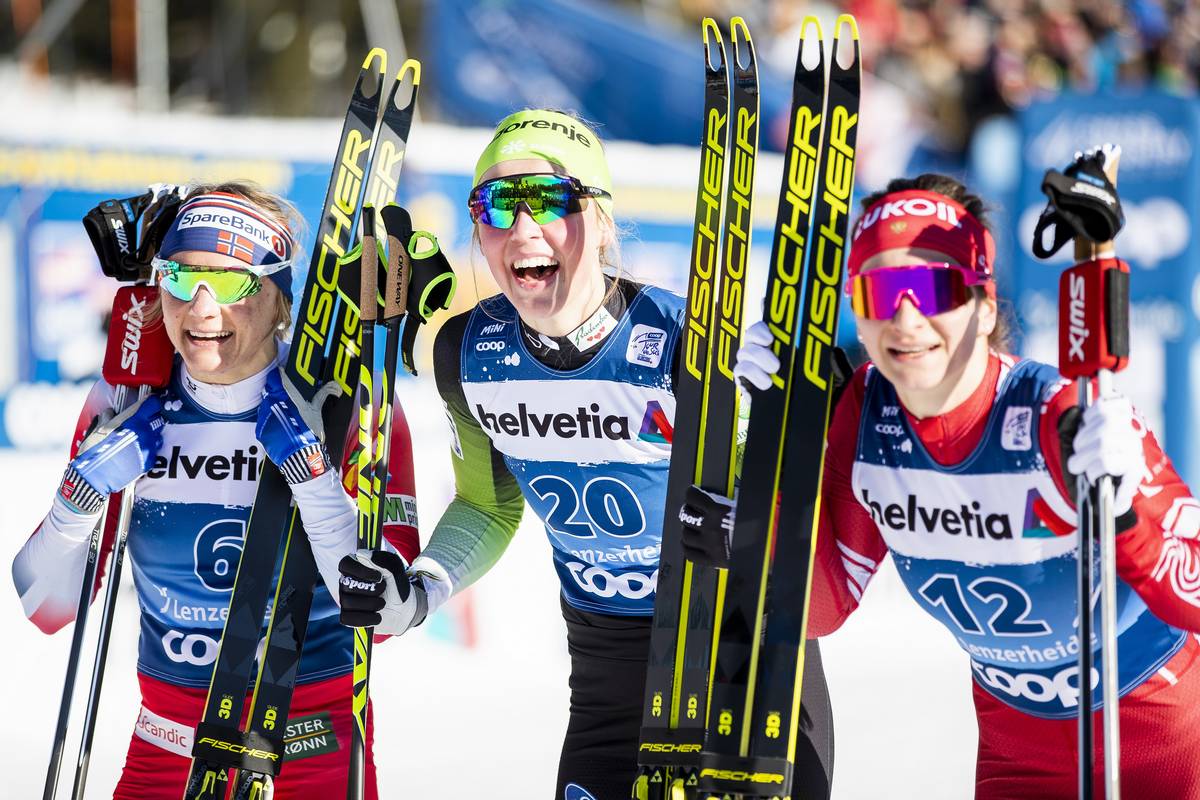
Tag: 1.5-kilometer freestyle sprint

  • Overall Leader Bib Changes Hands; Diggins and Bjornsen Narrow Gap to Overall Lead

    The women’s podium of Stage 2 of the 2019/2020 Tour de Ski. Anamarija Lampic of Slovenia (center) took first ahead of Norway’s Maiken Caspersen Falla (left) and Russia’s Natalia Nepryaeva (right). (Photo: NordicFocus)

    Day two of the Tour de Ski offered the American women the Sisyphean task of earning back time after a miss on ski and wax selection in Stage 1 prevented them from performing to their capability. This was particularly so for Jessie Diggins, a favorite for the overall tour podium who finished the first stage in 29th 1:20 behind Norway’s pace-setting Theresa Johaug. Her teammate Sadie Maubet Bjornsen, also a top all-arounder, was in the same position. Maubet Bjornsen ended Stage 1 in 30th.

    The initial run of the TdS in Lenzerheide, Switzerland is about not digging yourself into a time-deficit hole. A podium is nice, a win even better. But the primary objective is to not lose too much time to the leaders. At the start of Stage 2, Diggins and Bjornsen were in that hole. 

    Backs against the wall and a significant boulder to push ahead of them, the two would need to make it into the final of the 1.5-kilometer freestyle sprint to make significant headway on the tour leaders. A podium finish would be ideal. Since time differentials in sprint racing are small, it would be imperative to earn bonus seconds based on their final standings: 60 seconds for a win sliding down to 42 seconds for sixth. 

    As Johaug, the overall leader heading into the second stage, was not a podium threat in the sprint event, it was almost-certain that she would lose time on her chasers, increasing the opportunity for the Americans and other overall podium hopefuls. 

    Knowing the task at hand, Diggins bravely faced the new day with resolve. 

    Now I get to focus on doing what I love best: fighting my way back,” she wrote on Instagram. 
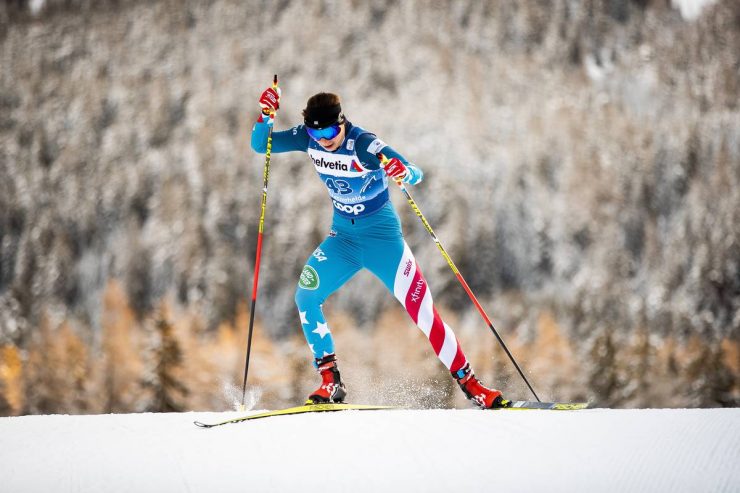
    Julia Kern powers to a seventh place result in qualification during Stage 2 of the 2019/2020 Tour de Ski. (Photo: NordicFocus)

    Surely enough, four Americans landed in the top ten in qualification: Sophie Caldwell in 1st, Diggins 3rd, Maubet Bjornsen 4th, and Julia Kern 5th. Rosie Brennan also qualified for the heats in 28th. The final member of the American squad, Katharine Ogden, finished 60th in qualification. 

    And on to the quarters five Americans went. With the momentum and energy of the team, the boulder budged. 

    Racing in the lightning-fast first heat of the rounds, Diggins fought at the front with leaders Maiken Caspersen Falla (NOR), Anamarija Lampic (SLO), and Anne Kjersti Kalvå (NOR). Last year, Falla was the ranked second overall in the World Cup sprint standings and Lampic was ranked 6th. 

    Diggins was unafraid to push the pace and spend time at the front. She showed her balance on her feet as she took on the fast descents and icy corners of the course, holding her position. In the final straightaway, Falla and Lampic took off from the front, leaving Kalvå and Diggins fighting for lucky loser positions. With the fate of a fast heat and their stick-to-the front pacing —  their times would have won any other round — Kalvå and Diggins easily advanced to the next round. 

    Charging to the finish in the second heat of the quarter-final in Stage 2 of the 2019/2020 Tour de Ski. Jonna Sundling of Sweden holds the lead on the far left with Rosie Brennan tucked into the back left. (Photo: NordicFocus)

    The Americans continued to shine in the rounds. In the second heat, Brennan mixed it up with the leaders but lost contact with the pack, finishing fifth in her heat. In the slowest third heat, Caldwell patiently followed the pedestrian pace, then showed her top gears in the final sprint to win the round. Maubet Bjornsen took second in the fourth heat to advance, and Julia Kern took third in a three-way photo finish for the top spot in the final heat. 

    Three Americans advance to the semis. 
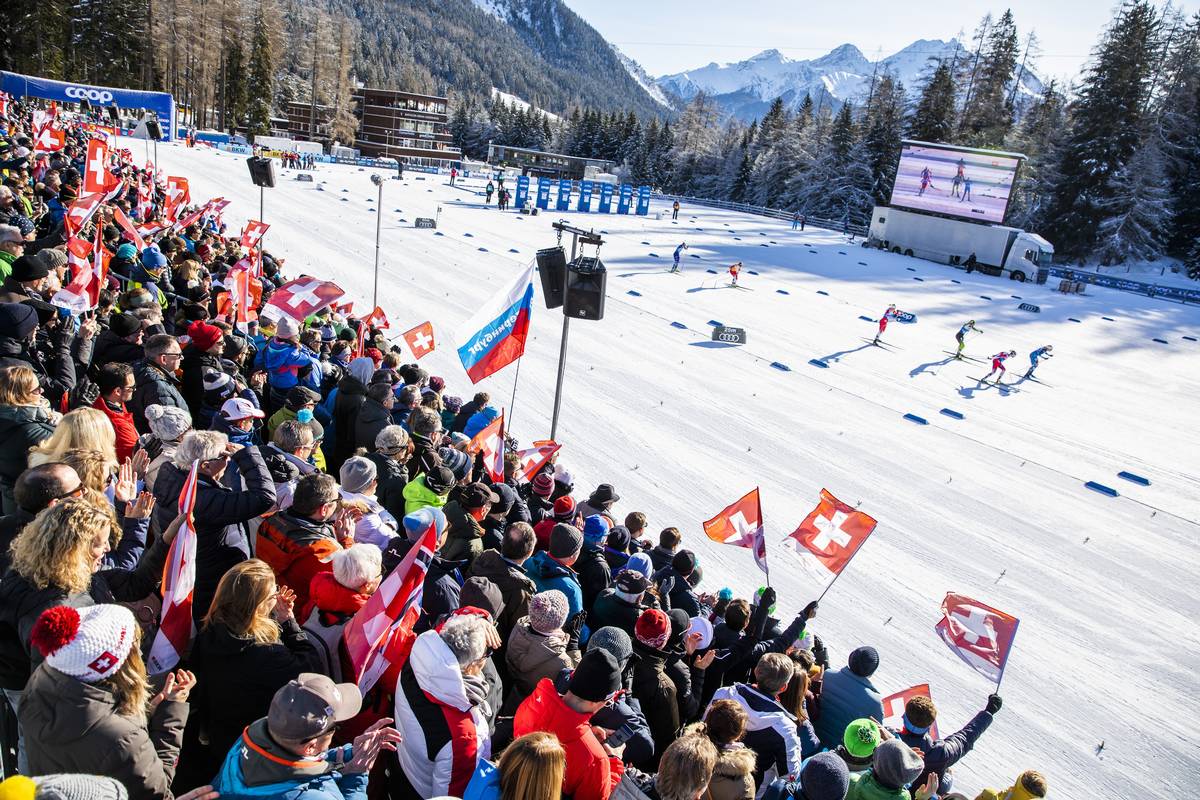
    Adrenaline surges through the crowd in spectacular Lenzerheide, Switzerland during Stage 2 of the Tour de Ski. (Photo: NordicFocus)

    Again, the first round of the semis was stacked with Falla, Lampic, Diggins, and Caldwell battling with Natalia Nepryaeva of Russia and Jonna Sundling of Sweden. Showing her grit, Diggins won the heat for an automatic spot in the finals, while Caldwell finished fifth. The spread of finishers in the heat was less than one second. Maubet Bjornsen finished second in heat 2, also advancing to the final. 

    Two Americans in the final. The pieces were coming together. 

    Diggins kept herself in contention for a podium spot throughout the final, matching each of her opponents moves, never losing contact and often controlling the pace from the lead. Maubet Bjornsen held strong in the middle of the pack.

    Leaving nothing on the course, Diggins jump skated each of the rollers, powering in a no pole skate into a tuck on the descent. She raced with grit over every meter.

    Rounding the final curve into the straightaway, she sat in fourth behind Lampic, Falla, and Nepryaeva who had begun to accelerate off the front. Matching their tempo but unable to close the gap, Diggins crossed the line in fourth, doubling over as she gasped for air.
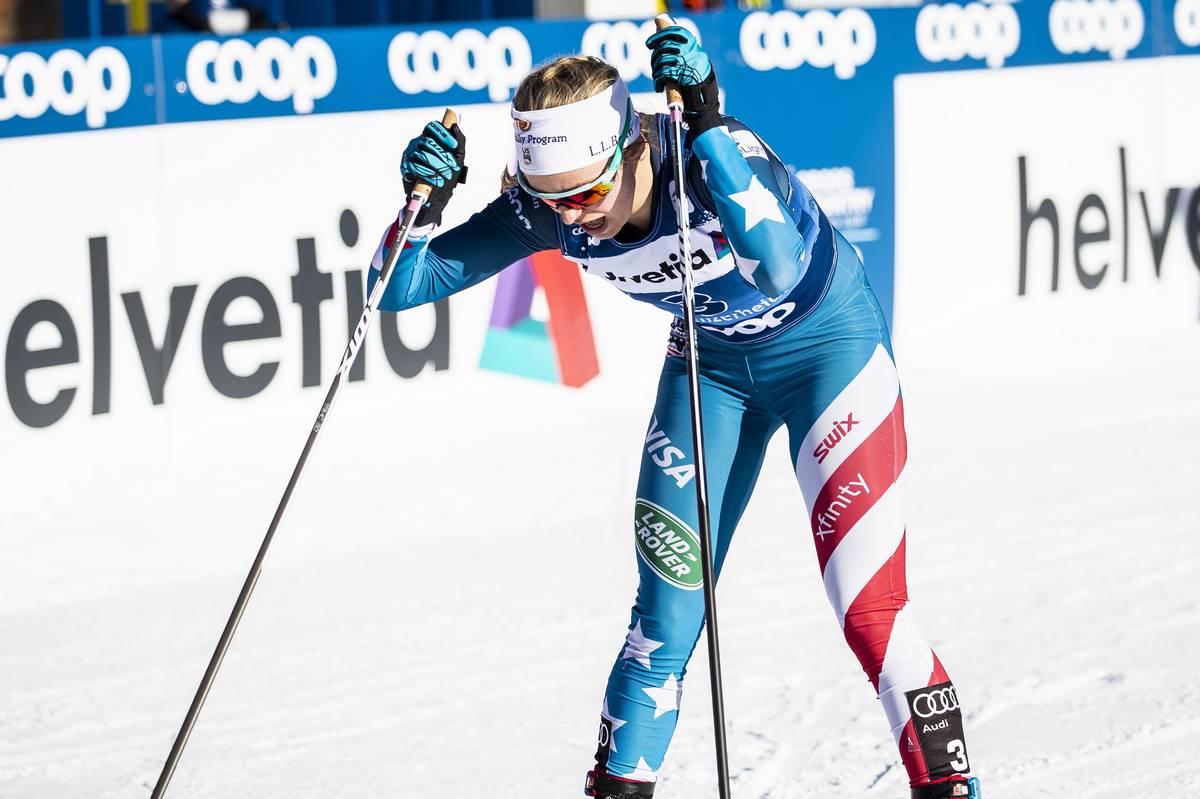
    Racing with the fire for which she is known, Jessie Diggins gasps for air after taking 4th in Stage 2 of the 2019/2020 Tour de Ski. (Photo: NordicFocus)

    In a close finish with Falla, Lampic took the win in 3:06.2 with the Norwegian 0.03 seconds behind her. Nepryaeva finished third (+0.47), with a half second gap to Diggins. After falling off the lead pack, Maubet Bjornsen finished 5th (+4.78), and Tiril Udnes Weng sixth (+5.29).
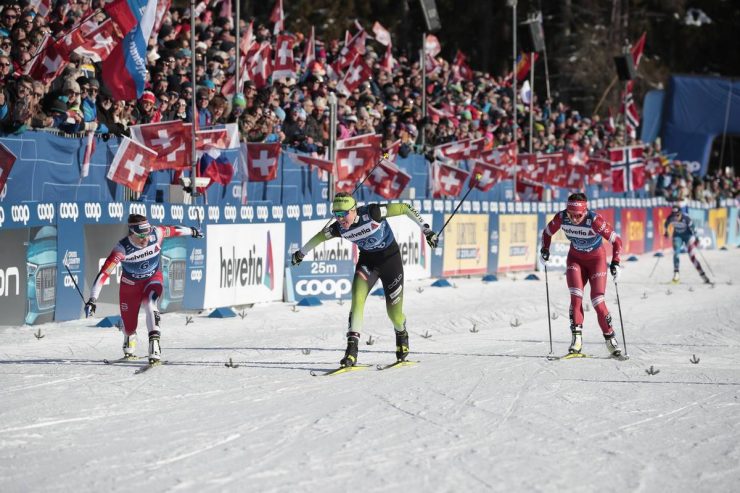
    By centimeters, Anamarija Lampic takes the win in Stage 2 of the 2019/2020 Tour de Ski ahead of Maiken Caspersen Falla (left) and Natalia Nepyaeva (right). (Photo: NordicFocus)

    Because they were quickly on the road to the next venue, the American women were unavailable for phone calls and instead chose to send comments on their performance via email.

    “Today was a great day,” wrote Diggins. “I was so proud of the entire team for staying positive, rebounding from yesterday and for keeping it super professional; nobody was mad, everyone just learned the lessons from the skis that day and then moved onwards. For me, it was important to just focus on what I can control and have confidence in my fitness that I knew was there.”

    In response to a query on handling the pressure of offsetting her deficit in the overall standings, Diggins offered a process-oriented response.
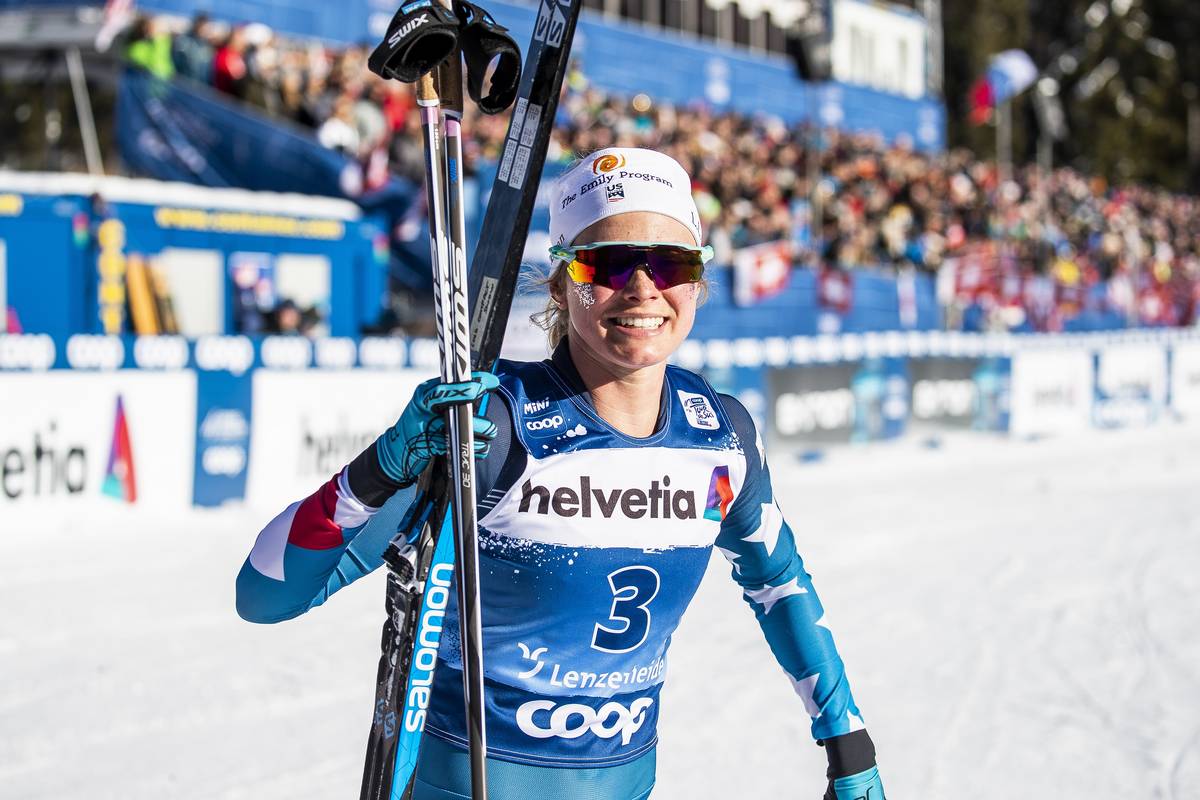
    “It was definitely crucial to my tour to make the finals, but instead of focusing on the outcome I focused on skiing every step of the way as well as I could!”
    Jessie Diggins smiles as she walks away from a 4th place finish in Stage 2 of the 2019/2020 Tour de Ski. (Photo: NordicFocus)
    “Now I’m looking forward to Toblach — a venue with many many positive memories for me!” she concluded.

    Maubet Bjornsen also remarked on the positive energy taking vengeance on the first stage provided. She explained that with “impossibly slow skis”, it felt like a success to lose only 1:20 to the leaders. Maubet Bjornsen added that it was not just the athletes looking for a do-over in Stage 2.

    “The tech team worked extra hard to find a solution and our entire team came back strong today! Although it was an imperfect start, positivity and constantly fighting are the two keys to this incredibly exciting event. I sometimes think the winners of the TDS are not the most physically fit people, but the most mentally tough.”

    Like Diggins, she too is eager for a second go in the next round of racing in Stage 3 and hopes to continue whittling down her gap to the overall tour leaders.

    “I look forward to the next stop in Toblach for another attempt at a 10 k skate, hopefully with an equal revenge as today. I have some precious seconds to try to win back still. One day at a time.”

    She finished by saying that they are driving away from Lenzerheide “with some tired legs, but rejuvenated souls!”
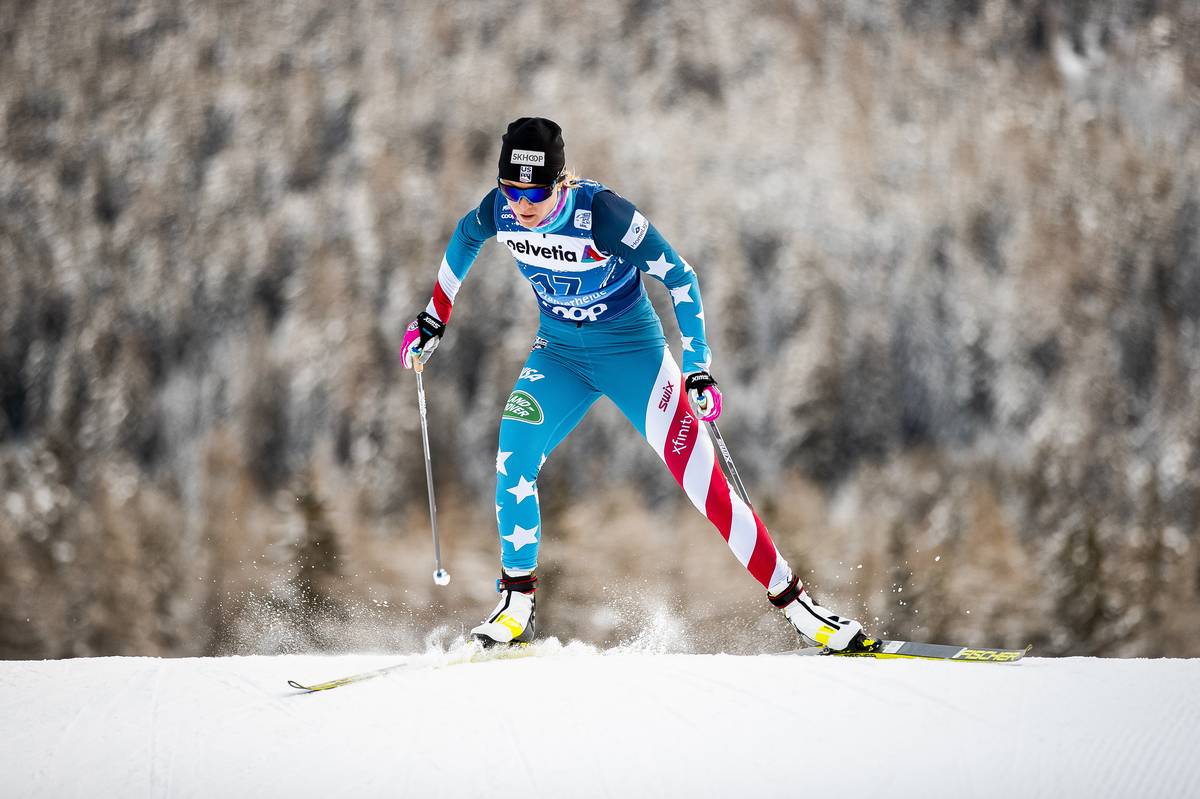
    Seeking revenge, Sadie Maubet Bjornsen flies to a fourth place finish in qualification during Stage 2 of the 2019/2020 Tour de Ski. (Photo: NordicFocus)

    Overall Tour Standings

    Noteworthy for the overall standings, tour leader after Stage 1 Therese Johaug qualified in 21st and raced in the speedy first heat with the eventual winner. She finished in fifth, just behind Diggins. Had she raced in any other round, the distance phenom, who is not known for her sprinting, would have advanced as well. Her result put her in 23rd for the day, earning six bonus seconds.

    Though she slid back to third in the overall rankings, this result maintained her threat for the overall tour victory. Johaug is only five seconds out of first place heading into three distance stages where she will have the opportunity to create a gap over the field before the Stage 6 sprint. In the fifth stage, a mass start classic in Val di Fiemme, Italy, she will also have the opportunity to earn bonus seconds at various checkpoints, giving her further insurance on the following sprint day. 
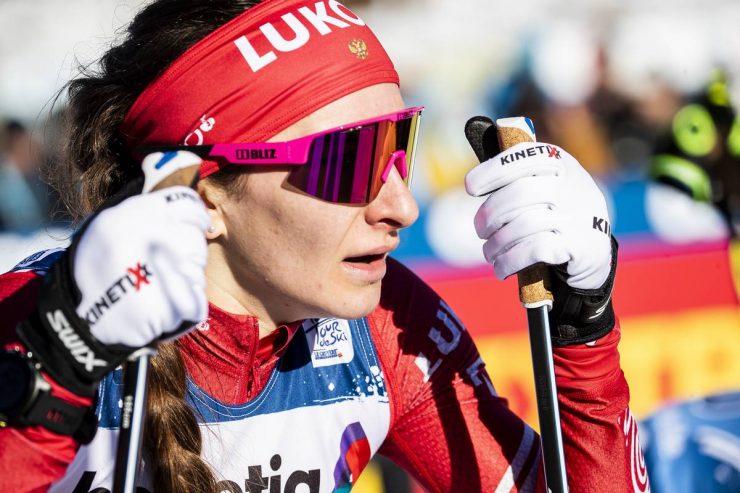
    After a third place finish in Stage 2, Natalia Nepryaeva takes over the overall leader bib in the 2019/2020 Tour de Ski. (Photo: NordicFocus)

    Now wearing the leader’s bib, Nepryeava’s sprint podium moved her into the lead with a cumulative time of 31:18. She finished sixth in the first stage. Demonstrating her potential in the competition, Nepryaeva dueled with Norway’s Ingvild Flugstad Østberg throughout the 2018/2019 tour to finish second overall. The Russian won the first distance stage and took second in the final four stages.

    Lampic, who finished 50 seconds behind Johaug for 20th on Saturday’s distance race, moved into third overall, one second behind Nepyraeva. Last year, she finished 22nd in the tour. 
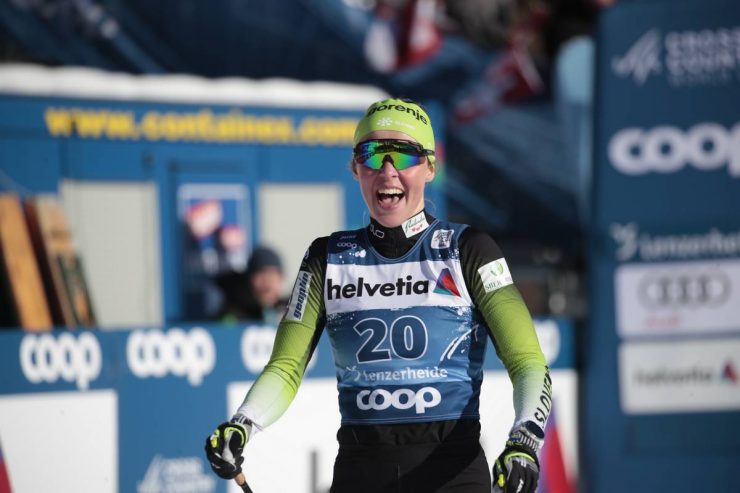
    Slovenia’s Anamarija Lampic smiles in delight after winning the second stage of the 2019/2020 Tour de Ski. (Photo: NordicFocus)

    Posting consistent results in the first two stages, Tiril Udnes Weng’s 7th in Stage 1 and 6th in the sprint put her in fifth overall, followed by her cousin Heidi Weng who was second in the first stage but 32nd in qualification leaving her out of the rounds. 

    Cutting their time back in half, Diggins sits in 11th place, 39 seconds behind Nepryaeva, followed by Maubet Bjornsen in 12th (+41). The overall podium continues to be up for grabs. 

    Racing continues Tuesday December 31st in Toblach, Italy with 10 k freestyle, followed by a 10 k pursuit start classic on Wednesday. 

    Final Results | Qualification | Overall Tour Standings After Stage 2
  • Ustiugov Sets Stage, Wins Tour-Opening Skate Sprint in Lenzerheide

    Ustiugov Sets Stage, Wins Tour-Opening Skate Sprint in Lenzerheide

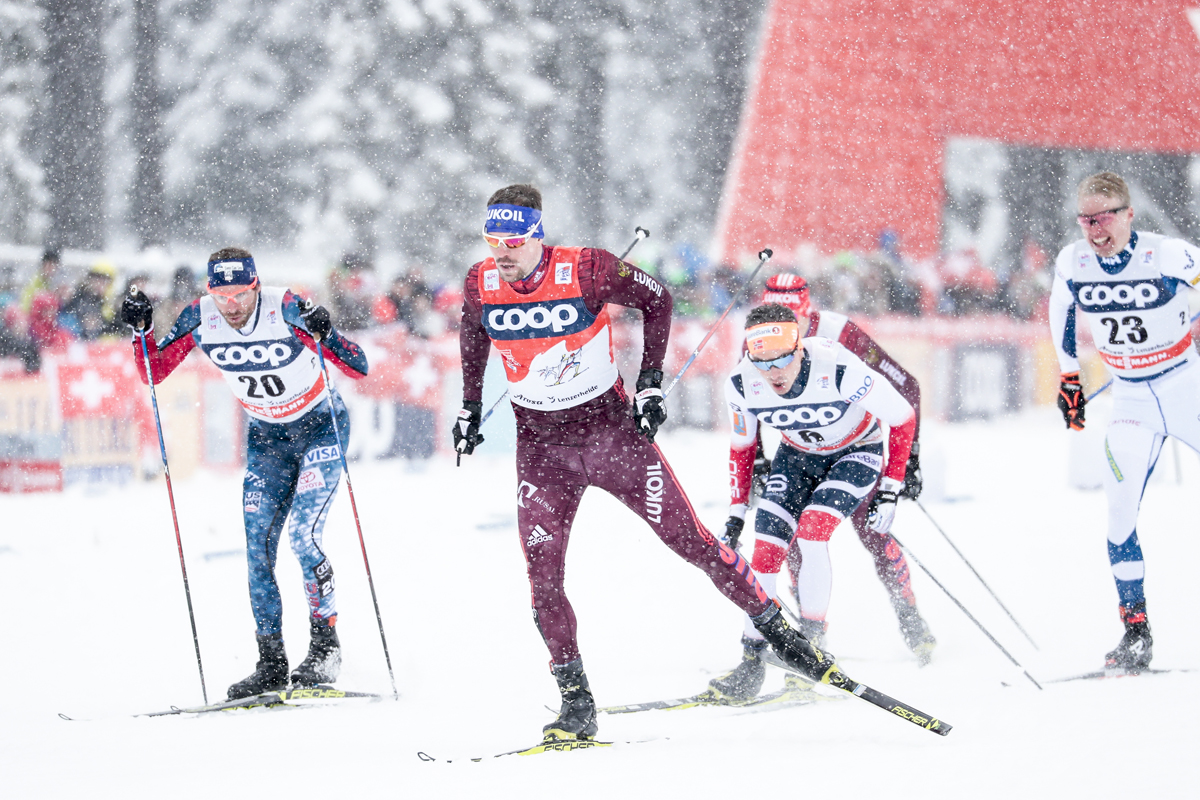
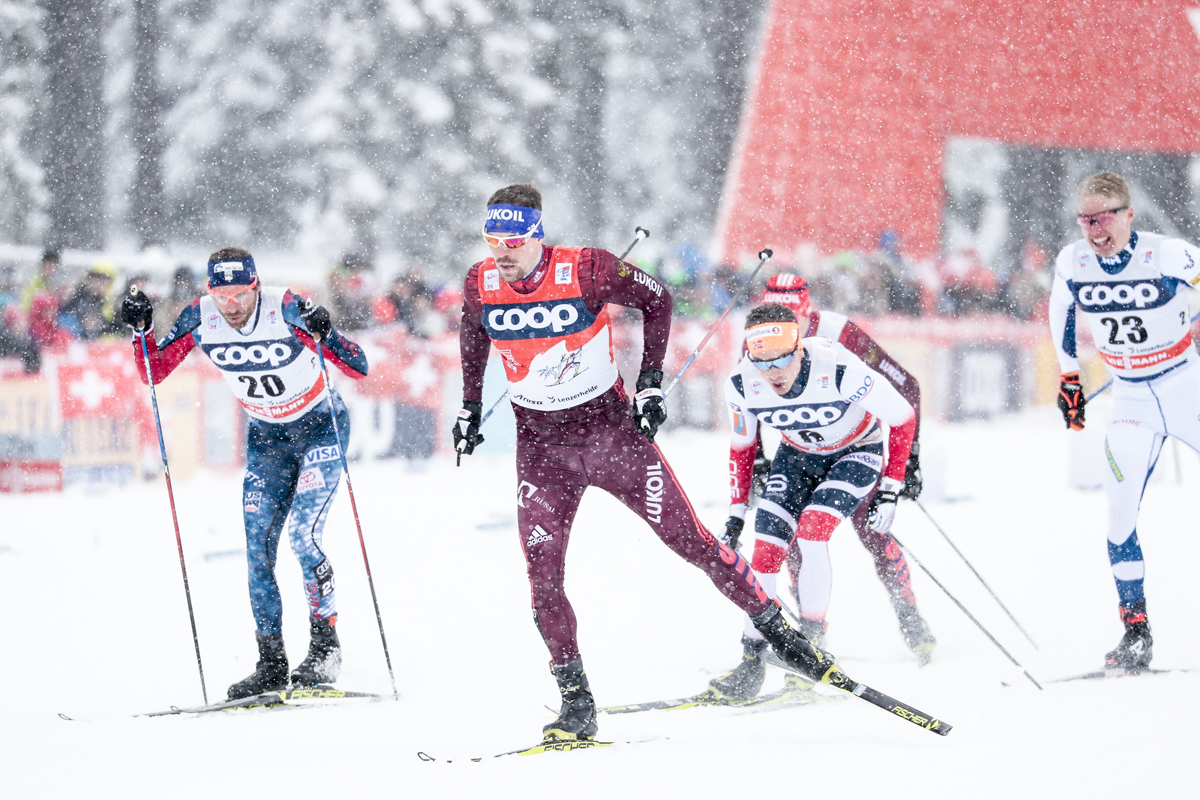
    Russia’s Sergey Ustiugov (front) leads American Andy Newell (20), Norway’s Finn Hågen Krogh, Russia’s Andrey Larkov (behind Krogh), and Finland’s Iivo Niskanen in Quarterfinal 1 of the Tour de Ski 1.5-kilometer freestyle sprint on Saturday in Lenzerheide, Switzerland. Krogh won that heat, Ustiugov finished second, Larkov was third, Newell fourth, and Niskanen fifth. Ustiugov went on to win the men’s final while Krogh placed fifth overall. (Photo: Fischer/NordicFocus)

    For Sergey Ustiugov, the Tour de Ski (TdS) is picking up where he left it last year. Last January, the 25-year-old Russian finished 2017 Tour’s final competition as the overall winner, earning his first TdS title over Norway’s Martin Johnsrud Sundby. In this season’s first stop — a freestyle sprint in Lenzerheide, Switzerland — the Russian reclaimed the coveted leader’s bib, earning not only the stage win, but the Tour’s overall lead with six stages remaining.

    “I really wanted to win today to start the Tour strong,” Ustiugov said, according to an International Ski Federation (FIS) press release.

    Ustiugov’s opening day began with his qualifier, which he won after covering the course in a time of 2:58.46 minutes. Italy’s Federico Pellegrino posted the second-fastest qualifying time, 1.08 seconds back from the Russian.

    Ustiugov then advanced to the first quarterfinal, along with his teammate Andrey Larkov, Norway’s Finn Hågen Krogh, Finland’s Iivo Niskanen, Sweden’s Calle Halfvarsson, and American Andy Newell (Newell previously qualified in 20th (+5.94)).

    The six balled together into a tight group from the start, with Krogh setting the pace up front and Ustiugov positioning himself at the back heading into the first climb. Halfway through the hill, Ustiugov surged, moving from sixth to second before cresting the top. The Swede’s skis proved faster, however, and by the first descent, Halfvarsson had surpassed Ustiugov, while Newell tucked into fifth between Niskanen and Larkov.

    At the bottom of the course’s second climb, a misplanted pole brought Halfvarsson down. Just behind him, Newell narrowly quickly maneuvered to the right of the fallen skier’s skis to stay in contact with the leaders.

    By the time Halfvarsson picked himself up, the group had reach the top of that climb and a break was beginning to form. Ustiugov and Krogh cruised in the front while Newell chased in third.

    Heading into the final 100-meter stretch, the battle for the top two spots was on: Krogh, Ustiugov, Newell, Niskanen, and Larkov all in the mix. In the end, it was Krogh and Ustiugov who went 1-2, with the Norwegian besting the Russian by 0.07 seconds.

    Larkov finished third (+0.36) and Newell crossed in fourth, 0.55 seconds behind Krogh. Neither Larkov nor Newell advanced to the semifinals, and Newell ultimately placed 19th on the day.

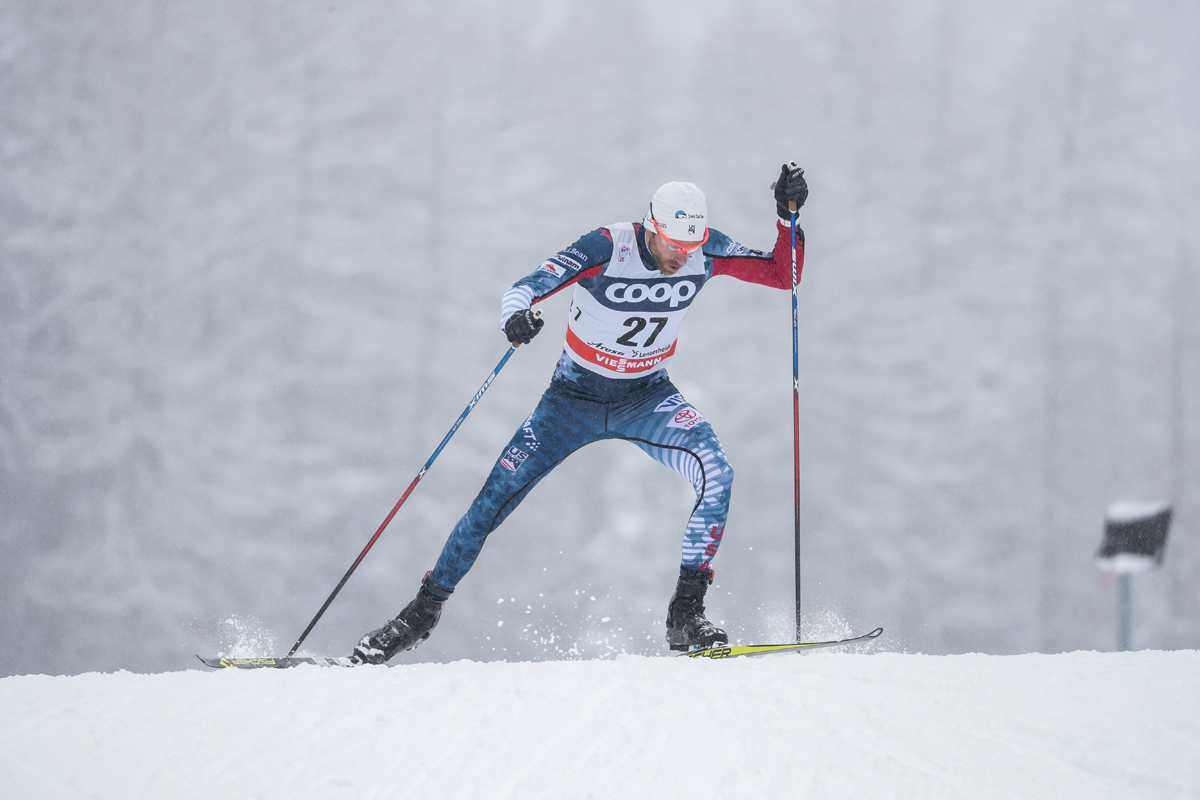
    American Andy Newell racing the men’s 1.5 k freestyle-sprint qualifier at Stage 1 of the Tour de Ski on Saturday in Lenzerheide, Switzerland. He qualified 20th and went on to finish 19th overall. (Photo: Fischer/Nordic Focus)
    “Despite not a great result today my strength, speed, and fitness are all feeling pretty good at the moment so I’m optimistic about the races to come,” Newell wrote in an email. “Always frustrating when you are feeling better than what the results show but sometimes that is sprint racing.
    “I selected a tough heat on purpose to shoot for the A final but as always the quarters were tight and competitive and I was left wishing I could have made better attacks,” he added. “Stoked for the races to come.”
    From there, Ustiugov left no doubt as to how he wanted to start the 2018 TdS and finish Saturday’s sprint. He and Krogh advanced to the first semifinal, along with Pellegrino, Finland’s Ristomatti Hakola, Russia’s Alexander Bolshunov, and Norway’s Emil Iversen.

    In the semifinal, the Russian again took to the back of the pack for the first half of the course, a calibrated move for a racer who is known to prefer to control the pace from the front. The Russian would wait until just before the course’s second major climb to make a move. Nestled behind Krogh with one downhill left, Ustiugov waited for his chance to charge. It came in the final corner.

    As the group rounded the final turn together, Ustiugov, Pellegrino and Krogh skied side by side, as if their skis were linked together with string.

    In a photo finish, it was Ustiugov who crossed first in the semifinal, 0.04 seconds ahead of Pellegrino, who was just 0.02 seconds ahead of Krogh. The first of the day’s two lucky loser spots went to Krogh, the second went to Hakola in fourth (+1.11).

    Heading into the final, it was Ustiugov, Pellegrino, Hakola, Krogh, Jouve, and another Frenchman, Lucas Chanavat, who had won both his quarterfinal and semifinal after qualifying in third.

    By this time, Ustiugov’s tactic had changed. The cat was out of the bag and he was ready to lead. From the start he raced at the front, and Chanavat positioned to his left as they moved through the first climb. Pulling hard to their right was Pellegrino in third.

    Ustiugov drove the front, pulling the rest of the finalists behind him. By the second climb it became obvious the Russian was ready to get what he came for. He gapped the field, leaving everyone but Pellegrino and Chanavat behind. In the finishing stretch, Ustiugov continued to distance himself from his competitors, finishing first in 2:57.28 while Pellegrino crossed 1 second later in second place and Chanavat finished 2.76 seconds back in third.

    “The result is fine but I had some troubles with my legs today and I think that is from the training period before the start of the Tour,” the 27-year-old Pellegrino said, according to FIS.

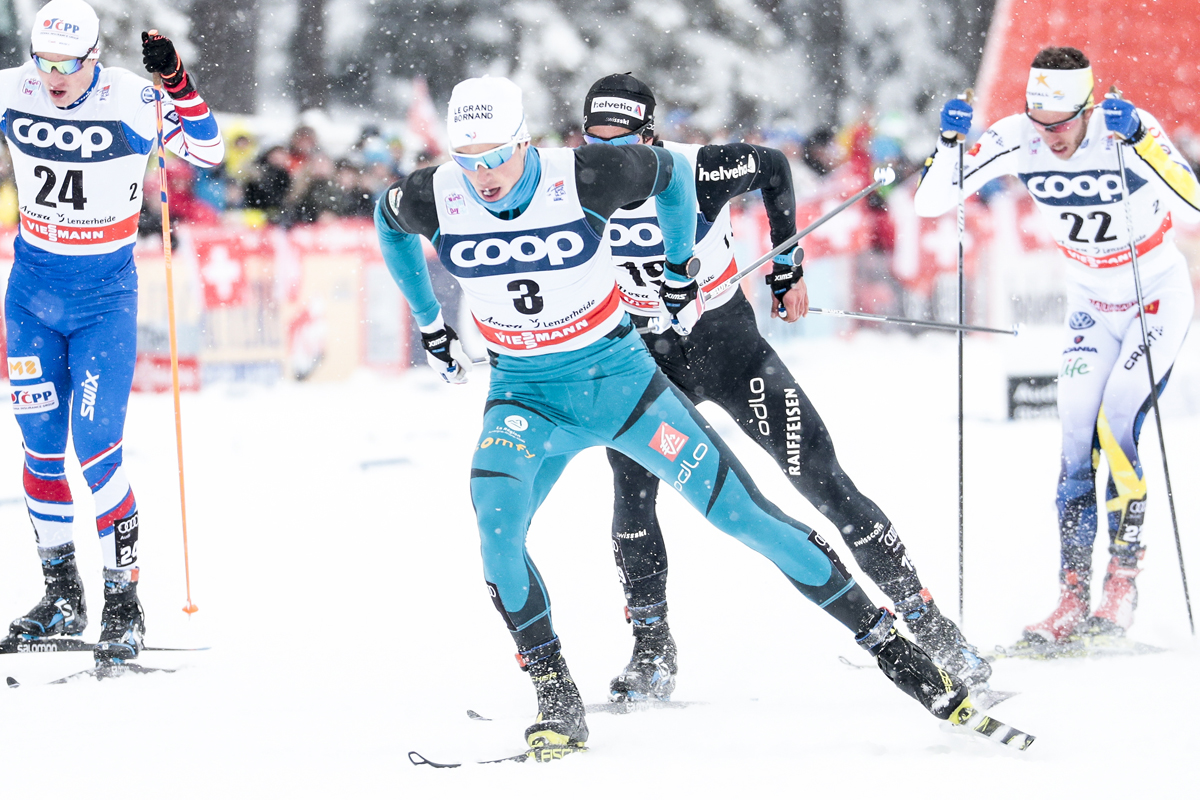
    France’s Lucas Chanavat (3) racing to his first individual World Cup podium at Stage 1 of the 2018 Tour de Ski, the men’s skate sprint in Lenzerheide, Switzerland. (Photo: Fischer/NordicFocus)

    For Chanavat, 23, Saturday marked his first individual World Cup podium.

    “I knew the second lap is going to be the most important one,” Chanavat told FIS. “Ustiugov was really strong on the flats but I could keep up with him. I was little bit struggling on the uphill. In the end I was lacking the speed on the home stretch but I am very happy for my first podium.”

    Hakola finished fourth (+5.91), Krogh fifth (+14.39) and Jouve sixth (+21.01). Rounding out the top 10 was Canada’s Alex Harvey in seventh, Switzerland’s Jovian Hediger in eighth, Bolshunov in ninth, and Great Britain’s Andrew Young in 10th.

    Harvey’s seventh place was the top North American finish on Saturday and puts him in seventh in the overall standings. After qualifying 18th (+4.98) he advanced to the fifth quarterfinal. There, he took a lesson from Ustiugov’s book and paced the first half of the course before making his move. It was not until halfway through the second climb that the Canadian made his way from sixth to second, slipping in behind Switzerland’s Roman Furger. By the final descent, Harvey had moved into the front. Waving to the crowd as he crossed first in his heat was Harvey in a time of 2:58.8, 0.56 seconds clear of Young in second place.

    Both Harvey and Young advanced to the second semifinal, where the Canadian finished third, 0.01 seconds behind France’s Jouve, who automatically advanced in second (0.34 behind Chanavat in first). For Harvey (and for Young, who placed fifth in that heat), that was the end of the road. He missed the final by one-hundredth of a second.

    “Body felt great again. I feel like I did 2 mistakes though, first one was when I took the lead heading into the 2nd lap,” Harvey wrote in an email. “I kinda eased up a tiny bit and Chanavat took me by surprise when he launched into the hill, he gapped me instantly. I should have driven it hard as soon as I took the lead.

    “Second mistake was when I was trying to overtake Jouve, I tried to take go by him on the outside right at the bottom on the downhill, and then again in the last corner before the finish,” he continued. “Looking back I should have just chilled behind him in those two corners, not ski the longer way outside and where the snow was a bit slower and the just have a tiny more power for the finishing stretch…0.02s more extra power could have gone a long way.”

    “It’s still very early in the Tour but so far so good,” Harvey concluded. “I have a bit of an advantage on the allrounders, other than Finn and Usti, so that’s nice.”

    Leading the U.S. men was Simi Hamilton, who qualified in 15th and advanced to the second quarterfinal. Out of the start, Hamilton stayed in the back of the pack, pacing off Pellegrino in fifth. Hakola manned the front through the first climb. Heading into the first descent, Hamilton picked off two positions, moving into fourth behind Hakola, Norway’s Sindre Bjørnestad Skar, and France’s Baptiste Gros.

    After a tight corner with Gros, Hamilton edged into third for the course’s flatter V2 section before the second major climb. The group continued uphill, Hakola and Pellegrino now charging up front. Corning into the final stretch, Pellegrino had created enough of a gap to ease into the finish, crossing first 0.35 seconds ahead of Hakola in second and 0.56 seconds ahead of Hamilton in  third. That finish put Hamilton in 15th at the end of the day.

    Two Americans finished in the top 10, with Newell in 19th, and Erik Bjornsen qualified for the heats in 27th and went on to place 25th overall after finishing fifth in his quarterfinal.

    “Andy and Simi were right there in the middle of their heats, but today you just needed to be in a more aggressive position later in the course because the moves that these guys are often able to make weren’t possible today, so they’re a little frustrated I think,” U.S. coach Matt Whitcomb said on the phone. “And I think if we were to go back and do this again, we would ski the middle section of the course very aggressively and just put ourselves in front.”

    Last year, Bjornsen completed the Lenzerheide freestyle sprint qualifier, cooled down and went back to the hotel without racing the heats. He had finished 69th, missing the top 30 necessary to qualify by 5.76 seconds.  

    “I’m not a regular heat skier, so just making the heats is usually my goal going into them,” Bjornsen wrote in an email on Saturday. “Today I was happy to feel strong in the heats and mix it up a bit.”

    To kick off the 2018 TdS, Bjornsen bettered his finish by almost threefold. He qualified in 27th, 6.95 seconds behind Ustiugov, and then faced off with Jouve, Hediger, Bolshunov, Iversen, and Finland’s Martti Jylhä.

    “Hopefully I can get some more practice in them because every time I  feel a little more comfortable,” Bjornsen continued. He is currently 29th in the tour standings, based on adjustments for qualifying time and time bonuses. “Being in 29th is great but it’s really to early to start looking at overall tour position for me. The distance races are usually what start spreading people out.”

    Out of the gate, Bjornsen tracked to the back, skiing in fifth just behind Iversen and Jylhä, while Hediger and Bolshunov commanded the front.

    By the top of the first climb Bjornsen had moved around the inside of Jylhä and up into third. With the cheers of a homecrowd pushing him along, Hediger continued to lead up the second major climb. Bjornsen slightly lost contact in fifth as the group descended toward the finishing stretch, and in the final meters, it was Iversen clinched first, 0.2 seconds ahead of Jouve in second. Bjornsen finished fifth, 0.82 seconds out of first, to end up 25th overall.

    Also racing for the U.S., was Paddy Caldwell who finished the qualifier in 74th. Devon Kershaw, the only other Canadian racing this year’s TdS, placed 86th out of 94 racers on Saturday.

    Results: Qualifier | Final | Tour standings (through Stage 1)

    –Harald Zimmer, Jason Albert, and Andrea Potyondy-Smith

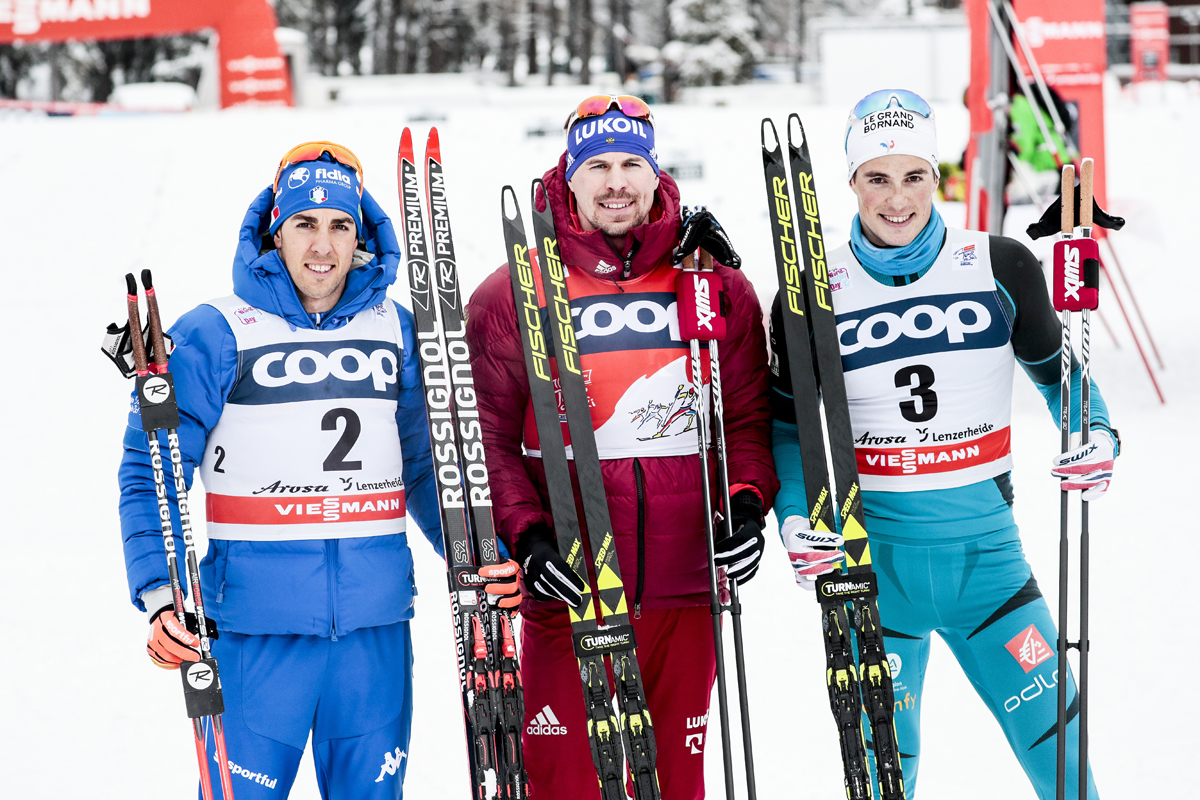
    Russia’s Sergey Ustiugov (c) after winning the first race ot the 2018 Tour de Ski, the men’s 1.5-kilometer freestyle sprint on Saturday in Lenzerheide, Switzerland. Italy’s Federico Pellegrino (l) placed second and France’s Lucas Chanavat (r) finished third. (Photo: Fischer/NordicFocus)
  • Saturday Rundown: Davos, Hochfilzen and Sovereign (Updated)

    Saturday Rundown: Davos, Hochfilzen and Sovereign (Updated)

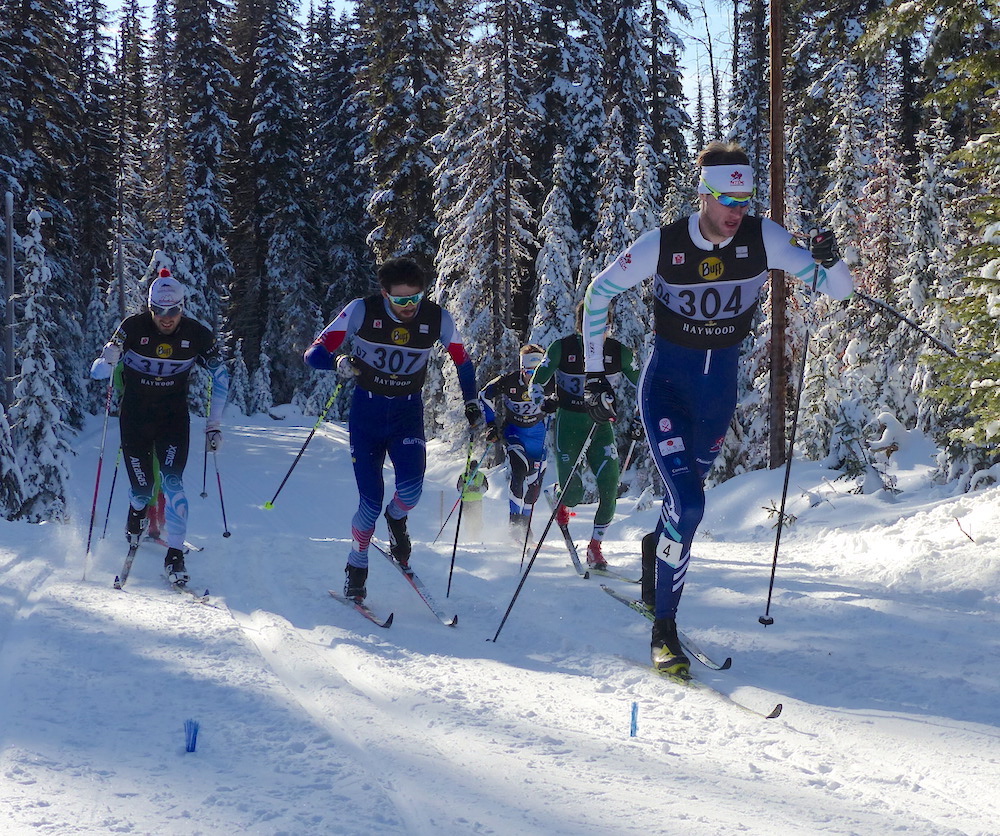
    Bob Thompson (304) of NTDC Thunder Bay leading Sun Valley’s Jack Hegman (307) and Patrick Stewart-Jones (317) of the AWCA during their quarterfinal of the NorAm men’s 1.3 k classic sprint on Saturday at Sovereign Lake near Vernon, B.C. (Photo: Peggy Hung)

    NorAm/SuperTour (Sovereign Lake near Vernon, British Columbia): Classic sprints

    On the opening day of the NorAm Continental Cup series in Canada (which doubled as a U.S. SuperTour), American Kaitlynn Miller of the Craftsbury Green Racing Project (CGRP) started Saturday with a nearly three-second win in the classic-sprint qualifier at the Sovereign Lake Nordic Centre, then went on to win her quarterfinal and semifinal before topping the final as well.

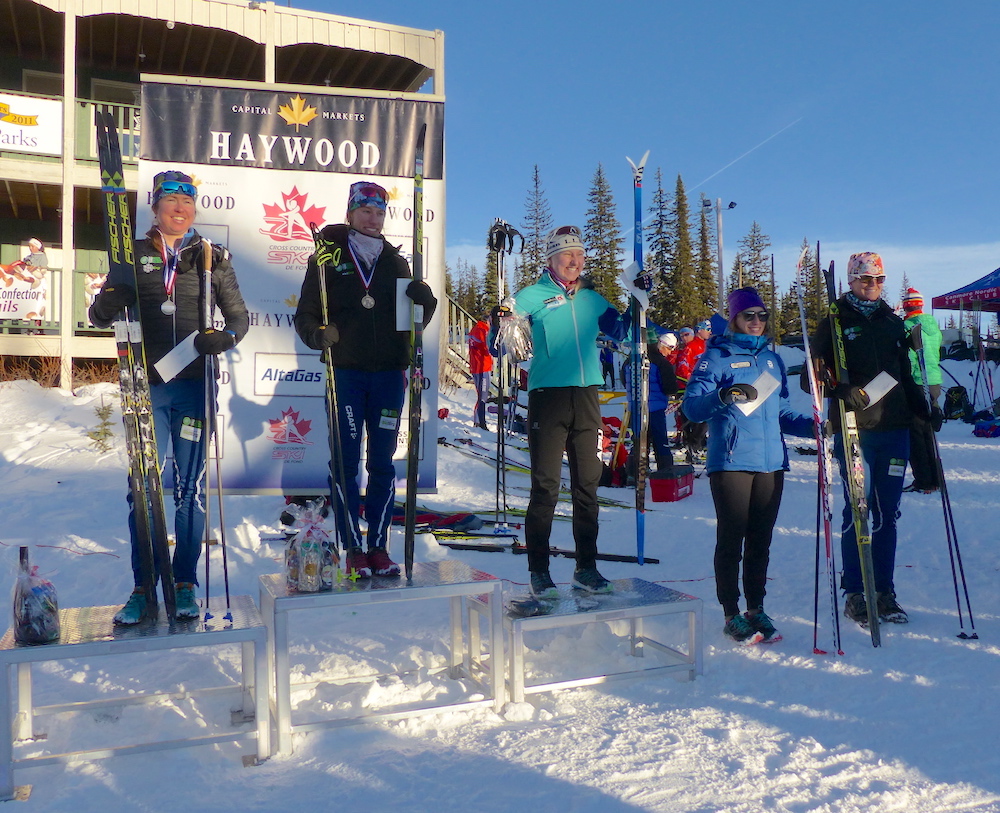
    The women’s 1.3 k classic sprint podium and top five at the first NorAm of the season on Saturday at Sovereign Lake near Vernon, B.C., with (from left to right) Caitlin Patterson (CGRP) in second, Kaitlynn Miller (CGRP) in first, Hannah Halvorsen (APU/USST) in third, Kelsey Phinney (SVSEF) in fourth, and Liz Guiney (CGRP) in fifth. (Photo: Peggy Hung)

    Miller was the fastest women’s qualifier by 2.87 seconds on the 1.3-kilometer course with a time of 2:59.39. Ultimately, she won the final in 2:57.53, 0.93 seconds ahead of her teammate Caitlin Patterson in second and 2.59 seconds clear of the third American on the podium, Hannah Halvorsen of Alaska Pacific University (APU) and the U.S. Ski Team (USST) D-team, in third place.

    Halvorsen previously qualified third behind Kelsey Phinney, of the Sun Valley Ski Education Foundation (SVSEF) in second. Phinney finished fourth in the final (+2.85), while a third Craftsbury skier, Liz Guiney placed fifth (+3.53). The lone Canadian in the six-woman final, Sophie Carrier-Laforte of the Pierre-Harvey National Training Centre (CNEPH) placed sixth (+4.38).

    Thompson Fends Off Five Americans

    Of the six racers in the men’s 1.3 k freestyle sprint final, five of them were American. Bob Thompson, of the Thunder Bay National Team Development Centre (NTDC), bested them all for the win in 2:29.31, just 0.03 seconds ahead of Ben Saxton, of the Stratton Mountain School (SMS) Elite Team, in second place. Cole Morgan (SVSEF), the qualifying winner who had so far dominated all of his heats, ended up third overall, 0.48 seconds behind Thompson.

    Sun Valley and APU each had two athletes reach the men’s final with Jack Hegman (SVSEF) taking fourth (+0.51), and APU’s Reese Hanneman and Tyler Kornfield placing fifth (+7.75) and sixth (+7.9), respectively.

    To start the day, Morgan posted the fastest men’s qualifying time in 2:31.00, while last weekend’s SuperTour skate sprint winner Nick Michaud, of the Bridger Ski Foundation (BSF), qualified in second, 0.78 seconds back. Americans took the top-three qualifying spots with Logan Hanneman (APU) in third (+1.59), while Thompson was the top Canadian qualifier in fourth (+2.34).

    Morgan won both his quarterfinal and the first semifinal to advance to the final, along with Thompson who placed second in that semifinal (and placed second to Hegman in the quarterfinals). Saxton won the second semifinal (after finishing second to Logan Hanneman in the quarterfinals) and Kornfield was second behind Saxton in that semifinal to automatically advance to the final. Reese Hanneman and Hegman made it to the final as lucky losers after placing third and fourth, respectively, in the first semifinal.

    Live results

    Qualifier results

    ***

    IBU World Cup (Hochfilzen, Austria): Men’s and women’s pursuits

    Men’s report

    Norway’s Johannes Thingnes Bø notched his second-straight win in Hochfilzen after Martin Fourcade of France missed three on the final shooting stage of the men’s 12.5 k pursuit on Saturday. Bø, who started the race 12 seconds ahead of Fourcade in second, cleaned the final standing stage to leave the range nearly a minute ahead of Slovenia’s Jakov Fak in second. Meanwhile, Fourcade, who had been skiing in first just ahead of Bø before the last stage, dropped 1:19 minutes back to fifth.

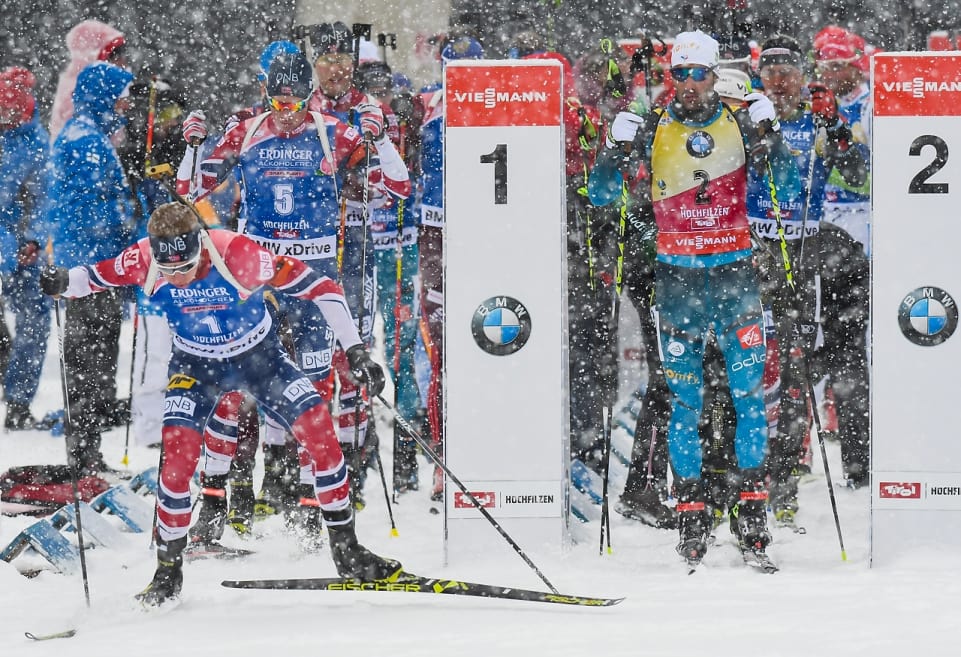
    Norway’s Johannes Thingnes Bø (1) heading out of the start, 12 seconds ahead of the second starter, France’s Martin Fourcade (yellow bib), on Saturday in the IBU World Cup men’s 12.5 k pursuit in Hochfilzen, Austria. (Photo: IBU/biathlonworld)

    While Bø skied the win in 36:41.1 minutes and Fak, the third starter, finished 58.8 seconds later in second place, Fourcade made up two places on the final loop to place third (+1:10.0) after passing Germany’s Simon Schempp and Russia’s Maxim Tsvetkov.

    Schempp settled for fourth (+1:10.5), and Bø’s older brother, Tarjei Bø, passed Tsvetkov as well to claim fifth (+1:11.9), while Tsvetkov finished sixth (+11:12.3).

    On another snowy afternoon in Hochfilzen, Johannes Bø had three penalties, two of which came in the first stage (2+0+1+0). Fak was one of four men in the race with just one miss (0+0+1+0) — no one cleaned — while Fourcade missed five (1+0+1+3). Schempp had four penalties (3+1+0+0) but held onto his starting position in fourth, Tarjei Bø improved from 14th at the start to fifth with just two misses (1+0+1+0) and Tsvetkov raced up from 20th to sixth with a single miss (1+0+0+0).

    American Sean Doherty tied his second-best World Cup result in 17th (+2:12.8) after starting 23rd and 1:39 out of first. He had two penalties (1+0+1+0).

    Canada’s top finisher, Nathan Smith placed 31st (+3:02.2) after starting 19th and missing three shots (1+1+0+1). His teammate Brendan Green rose to 33rd (+3:15.7), up from 52nd at the start, with three penalties as well (1+0+1+1).

    Four Canadians qualified for the pursuit, with Scott Gow placing 48th (+5:08.4) with seven penalties (1+1+3+2). His younger brother Christian Gow crossed next in 49th (+5:13.7) after missing five (+5:13.7).

    The other American man in the race, Lowell Bailey placed 36th (+3:20.6), up from 53rd, with three misses (0+2+1+0).

    Kuzmina Gets First Win in Three Years

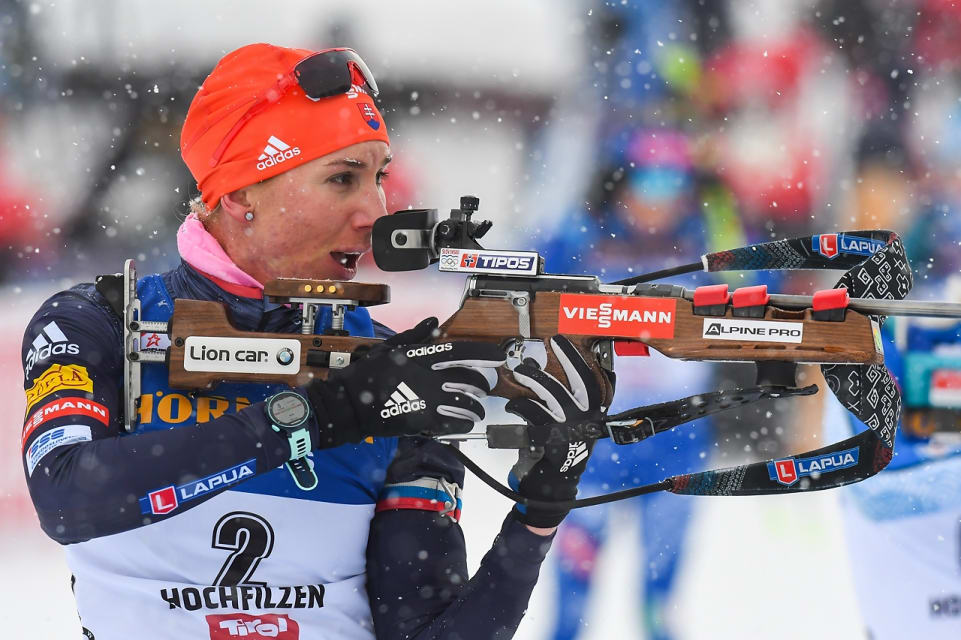
    Slovakia’s Anastasia Kuzmina cleaning one of two standing stages in the women’s 10 k pursuit at the IBU World Cup in Hochfilzen, Austria, en route to a 10-second win. (Photo: IBU/biathlonworld)

    In the women’s 10 k pursuit that followed, Slovakia’s Anastasia Kuzmina overcame a 22-second starting deficit to win her first race in three and a half years, shooting 19-for-20 (1+0+0+0) and finishing in 34:31.2. Kuzmina (the sister of Russia’s Anton Shipulin) started second behind Friday’s sprint winner Darya Domracheva of Belarus. Domracheva had a single miss as well in Saturday’s pursuit (0+0+1+0) but slipped to second after her penalty in the first standing stage, while Kuzmina cleaned the last three stages to take the win.

    Domracheva settled for third (+11.8) and Finland’s Kaisa Mäkäräinen rose to second (+10.2) after shooting 18-for-20 (1+0+0+1) and skiing the fastest course time to rise from her starting position in sixth.

    Italy’s Dorothea Wierer slipped one place to fourth (+51.6) after starting third and missing two (1+0+0+1), while Norway’s Marte Olsbu raced up from 13th to fifth (+58.2) with a single penalty (1+0+0+0). Ukraine’s Yuliia Dzhima improved from 20th to sixth (+1:08) with one miss as well (0+0+0+1).

    Canada’s Emma Lunder achieved her second-best career World Cup result in 27th (+2:31.6) after starting 42nd and cleaning three stages after missing one in the first prone (1+0+0+0). Her teammate Rosanna Crawford improved from 49th at the start to 39th at the finish (+3:44.3) with four penalties, one in each stage (1+1+1+1).

    The U.S. had one woman qualify for the race, Clare Egan, who finished 53rd (+5:21.6) with seven penalties (2+2+2+1).

    For the third and final day of World Cup racing in Hochfilzen, the men’s and women’s relays will be held Sunday.

    Results: Men | Women

    ***

    FIS Cross Country World Cup (Davos, Switzerland): Freestyle sprints

    Women’s report

    Men’s report

    The women’s skate sprint podium at Saturday’s World Cup in Davos, Switzerland, with Kikkan Randall (r) of the U.S. Ski Team in third place, Sweden’s Stina Nilsson (c) in first, and Norway’s Maiken Caspersen Falla (l) in second. (Photo: Reese Brown/US Ski & Snowboard)

    Kikkan Randall returned to the podium on Saturday in the first freestyle sprint of the 2017/2018 World Cup season, placing third in the women’s 1.5-kilometer skate sprint behind Sweden’s Stina Nilsson and Norway’s Maiken Caspersen Falla, respectively, in Davos, Switzerland.

    Americans made up half of the women’s final, with Jessie Diggins racing to fourth and Ida Sargent sixth, with Norway’s Ingvild Flugstad Østberg between them in fifth.

    Nilsson started the day by winning the qualifier in 2:51.71 minutes, while Østberg had the second-fastest qualifing time, 2.57 seconds back. Switzerland’s Nadine Fähndrich posted the third fastest qualifying time (+2.73), and for the U.S., Diggins qualified fourth (+3.37), Sargent fifth (+3.78), Randall sixth (+4.11), Sophie Caldwell ninth (+4.87), and Sadie Bjornsen in 11th (+5.38).

    Nilsson then won her quarterfinal and the first semifinal before outlunging Falla by eight-hundredths of a second for the final win in 2:47.99. Randall (who won her quarterfinal and advanced to the final as a lucky loser in third in the first semifinal) finished 2.53 seconds after Nilsson for third overall, and Diggins (who won both her quarterfinal and the second semifinal) was 4.41 seconds back in fourth. Østberg finished 5.62 seconds back in fifth, and Sargent crossed the line 14.49 seconds back in sixth.

    Caldwell placed eighth overall after winning her quarterfinal then placing fourth in the second semifinal, behind Diggins, Sargent and Germany’s Sandra Ringwald, respectively. Ringwald did not advance to the final, either, for seventh overall. Bjornsen placed 13th on the day after finishing third in her quarterfinal.

    Also for the U.S., Julia Kern (U.S. Ski Team D-team) finished in 57th in the qualifying round, 16.55 seconds out of first.

    Dahria Beatty was the top Canadian in 53rd (+15.53), followed by Katherine Stewart-Jones in 55th (+16.18) and Cendrine Browne in 64th (+18.27). 

    In the men’s 1.5 k skate sprint, Norway’s Johannes Høsflot Klæbo rocketed to his sixth-straight win in as many World Cup races this season, topping the qualifier in 2:23.10 (by 1.27 seconds over France’s Lucas Chanavat and 1.73 seconds over Italy’s Federico Pellegrino in third) then winning his quarterfinal and semifinal comfortably before capping the day with a victory in the final in 2:28.07. Pellegrino placed second in the final, 1.8 seconds back, and Russia’s Alexander Bolshunov tallied his third podium of the season in third place (+4.64). Finland’s Ristomatti Hakola placed fourth (+5.39), France’s Richard Jouve was fifth (+8.65) and Russia’s Gleb Retivykh was sixth in the final (+18.34).

    Americans Andy Newell and Simi Hamilton both qualified for the heats in 10th and 12th, respectively. Hamilton went on to place ninth overall after finishing second in his quarterfinal (behind France’s Renaud Jay) and fifth in the second semifinal (which Hakola won). Newell’s day ended in the quarterfinals, where he placed fifth, 2.44 seconds behind Klæbo, who won that heat. Overall, Newell was 21st.

    Canada’s Alex Harvey qualified for the heats in 21st and went on to place 23rd overall after finishing fifth in his quarterfinal, 1.14 seconds behind Retivykh in first.

    Also for Canada, Julien Locke missed qualifying in the top 30 by 1.07 seconds in 36th (+7.84). Russell Kennedy placed 48th (+9.39), Knute Johnsgaard was 52nd (+10.35), Jess Cockney 54th (+10.83), Devon Kershaw 63rd (+11.78).

    For the U.S., Erik Bjornsen finished 58th (+11.12) and Paddy Caldwell 108th (+24.04) in the qualifier.

    Results:

    Women’s final | Women’s qualifier

    Men’s final | Men’s qualifier

  • Another Sprint Victory for Nilsson; Falla Defends Sprint Crystal Globe in Quebec

    Another Sprint Victory for Nilsson; Falla Defends Sprint Crystal Globe in Quebec

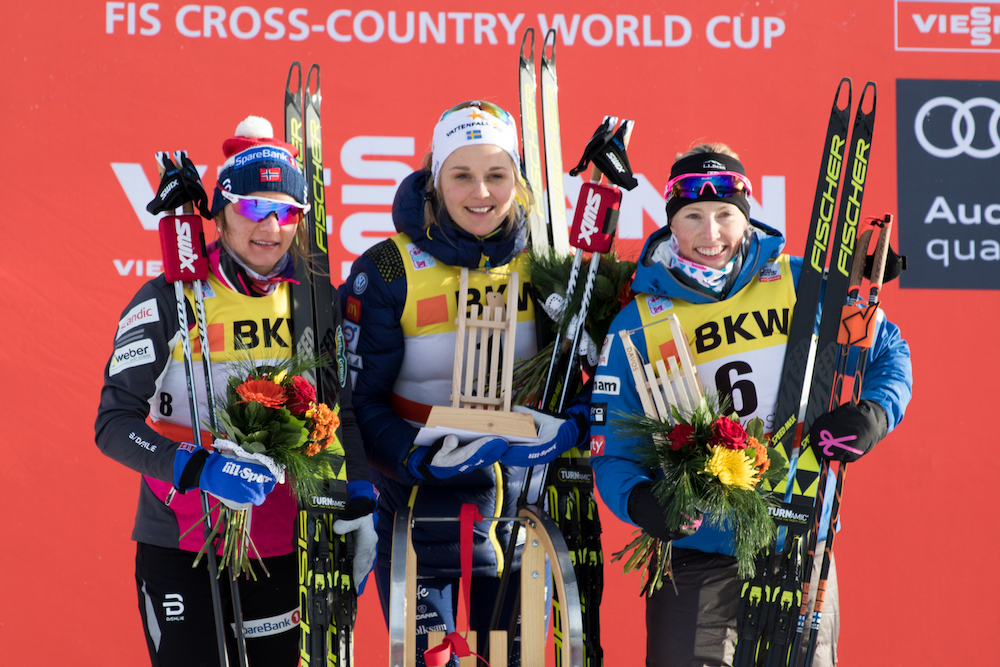
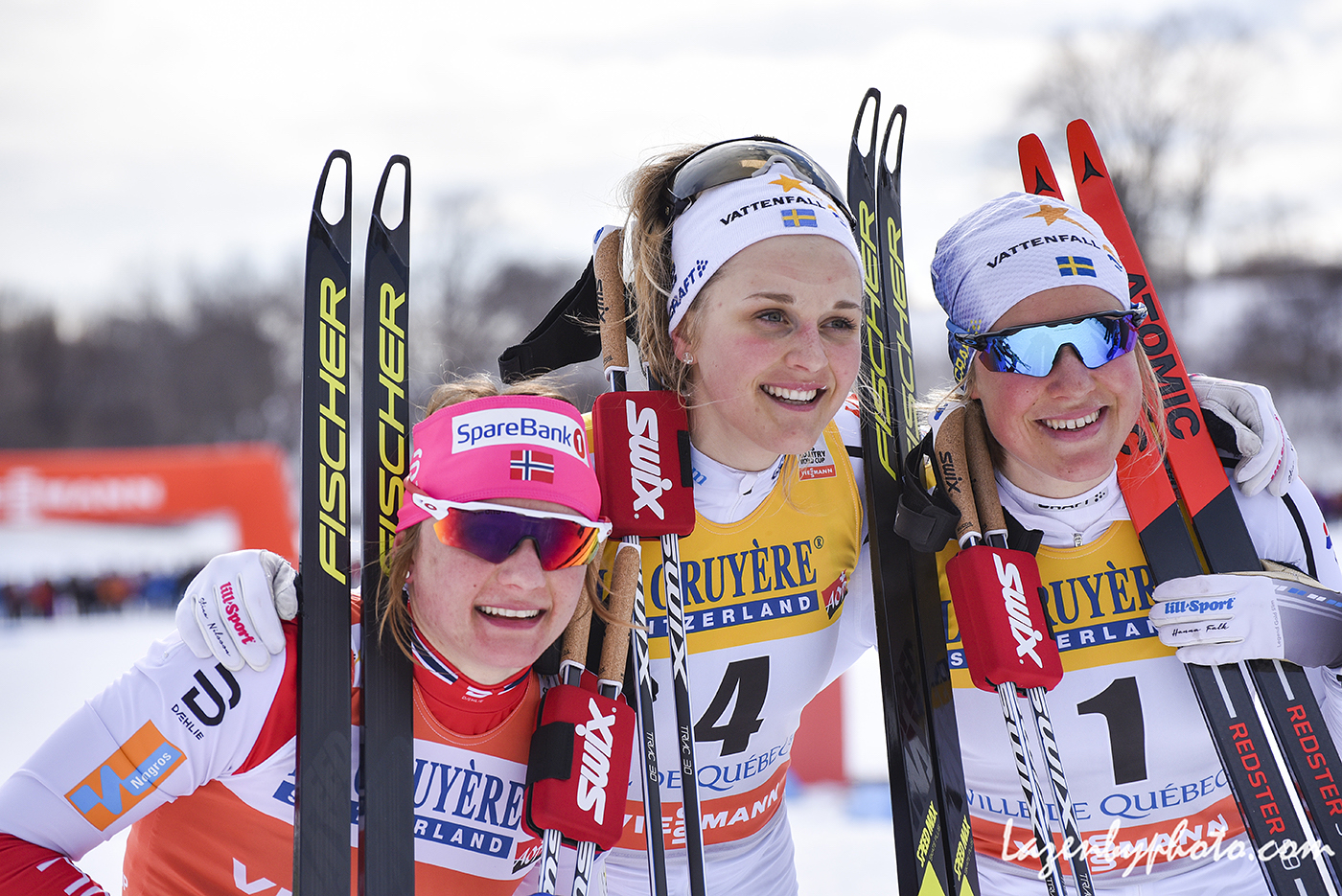
    The women’s freestyle sprint podium at World Cup Finals on Friday in Quebec City, with Sweden’s Stina Nilsson (c) in first, Norway’s Maiken Caspersen Falla (l) in second, and Sweden’s Hanna Falk (r) in third. (Photo: John Lazenby/Lazenbyphoto.com)

    At the start of the season, Sweden’s Stina Nilsson had three individual World Cup wins to her name. Now, after taking Friday’s freestyle sprint title — and only two races left on this year’s World Cup calendar — Nilsson has quadrupled that number.

    The 23-year-old Swede raced to her ninth victory of the season on Friday in Québec City, crossing first in the women’s 1.5-kilometer freestyle sprint in a time of 3:01.87.

    The closest competitor to Nilsson was Norway’s Maiken Caspersen Falla, who crossed 0.42 seconds behind in second.

    The two went head to head from the start of the final, with Falla leading Nilsson into the first incline and through the first downhill. Norwegian Heidi Weng clung closely behind and by the second major climb, Nilsson was at the helm, but not for long. Falla forced her way to the front once again, forcing the Swede to pick up her pace. The two began to break away from the rest of the field with 500 meters to go.

    As they made their way down the third major descent, Nilsson moved around Falla and back to the lead, giving herself an edge on the Norwegian for the final climb. The two entered the final finishing stretch together, but with 50 meters left, Nilsson had knocked the Norwegian off the top spot.

    “I have had an amazing season,” Nilsson said during a televised interview with the International Ski Federation (FIS). “And I really like to compete in Quebec, so I am very happy with the race.”

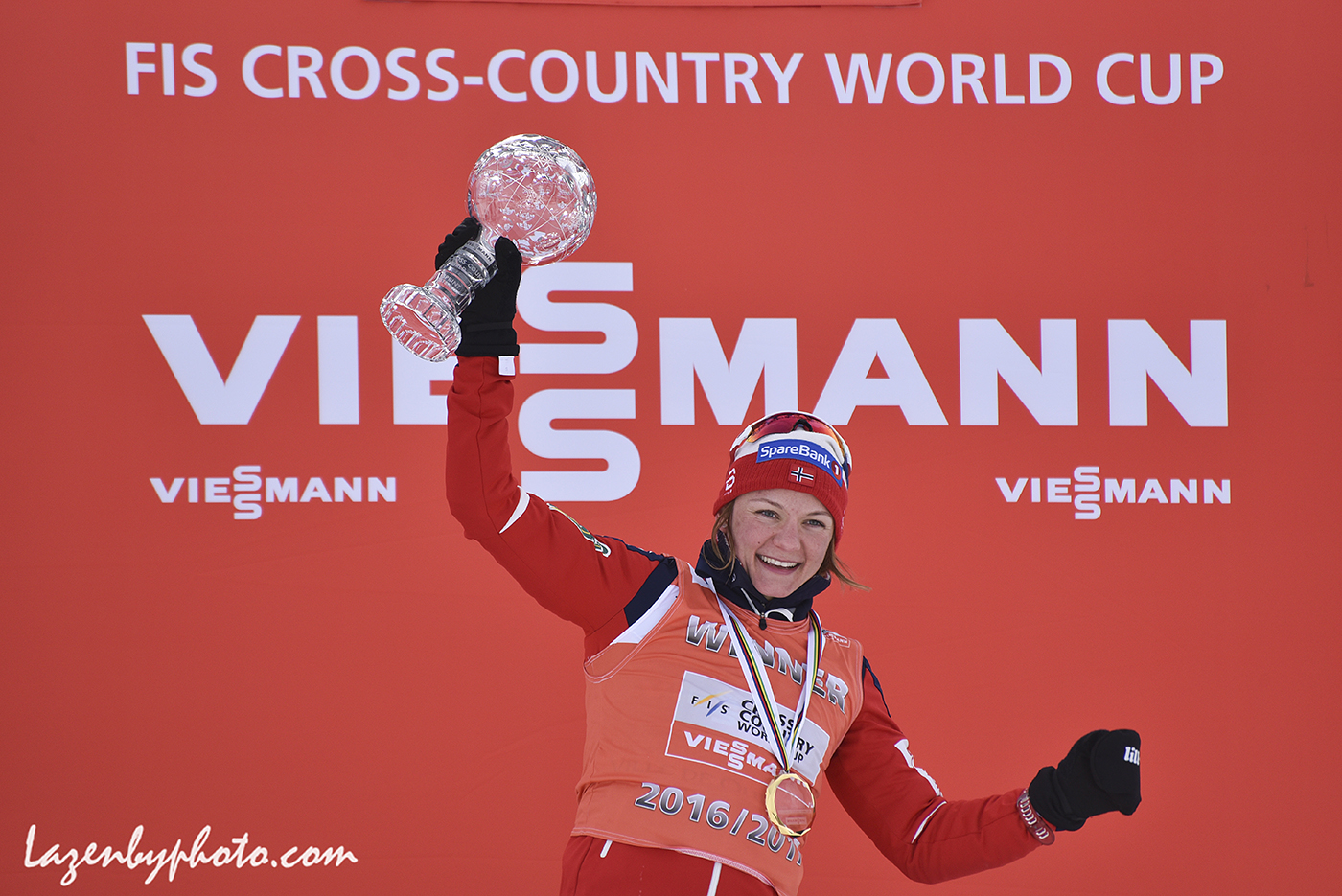
    Norway’s Maiken Caspersen Falla celebrates her second-straight Sprint World Cup Crystal Globe on Friday at World Cup Finals in Quebec City. (Photo: John Lazenby/Lazenbyphoto.com)

    Despite missing the final during last weekend’s sprint in Drammen, Norway, and narrowly sneaking into Friday’s sprint final — she was the second lucky loser in her semifinal after a photo finish with Switzerland’s Nadine Fähndrich — Falla’s podium secures her as the overall sprint leader and awards her with her second-straight Sprint Crystal Globe.

    “When you have a really bad day as I did in Drammen, you’re very happy to be back on the podium,” Falla told FasterSkier during an in-person interview.

    “It’s great to be here and take the crystal globe home,” she added in an interview with FIS.

    Rounding out the final podium spot in third (+2.58) was another Swede, Hannah Falk, who had started the day with a qualifying win in 3:02.91. Despite breaking a pole early in her quarterfinal, she clawed her way back to second to automatically advance to the semifinal and ultimately reach the final.

    “I tried to just stay calm and knew that I got high speed in the end,” Falk told FasterSkier about how she handled exchanging poles after hers broke in the second quarterfinal.

    Falk finished the season ranked third in the Sprint World Cup, behind her teammate Nilsson in second and Falla in first.

    “I’m top number three in the Sprint World Cup so it was my goal today to take that podium,” Falk said.

    Also in the final, Sweden’s Ida Ingemarsdotter was the third Swede in the top four in fourth (+3.02). In her first World Cup sprint final, Fähndrich finished fifth (+3.41) and Weng placed sixth after breaking a pole (+32.36). 

    “I think I made all the right tactical decisions today,” Fähndrich told Swiss broadcaster SRF, according to a translation.

    Just by making the final, Weng essentially locked up the Overall World Cup title with a 325-point lead over Finland’s Krista Parmakoski in second. Norway’s Ingvild Flugstad Østberg another 73 points back in third and 123 points ahead of Nilsson in fourth overall.

    “My goal right now is to be top three in the world overall,” Østberg told FasterSkier after a three-woman crash (with Slovenia’s Vesna Fabjan and Switzerland’s Laurien van der Graaff) ended their runs in the second semifinal. Østberg finished the day in eighth.

    “I really have to fight for that because Stina is chasing me,” Østberg added of her overall podium goal. “The world champs in Lahti was not what I was hoping for so it will be a huge goal and really great if I could be third in the Overall World Cup.”

    Diggins 9th; Kern 24th in First World Cup

    U.S. Ski Team (USST) member Jessie Diggins was the top North American woman on the day, placing ninth overall after finishing fifth in her semifinal. Coming off of a silver medal in the freestyle sprint at this year’s Nordic World Championships, Diggins had high hopes for her performance in Friday’s final sprint.

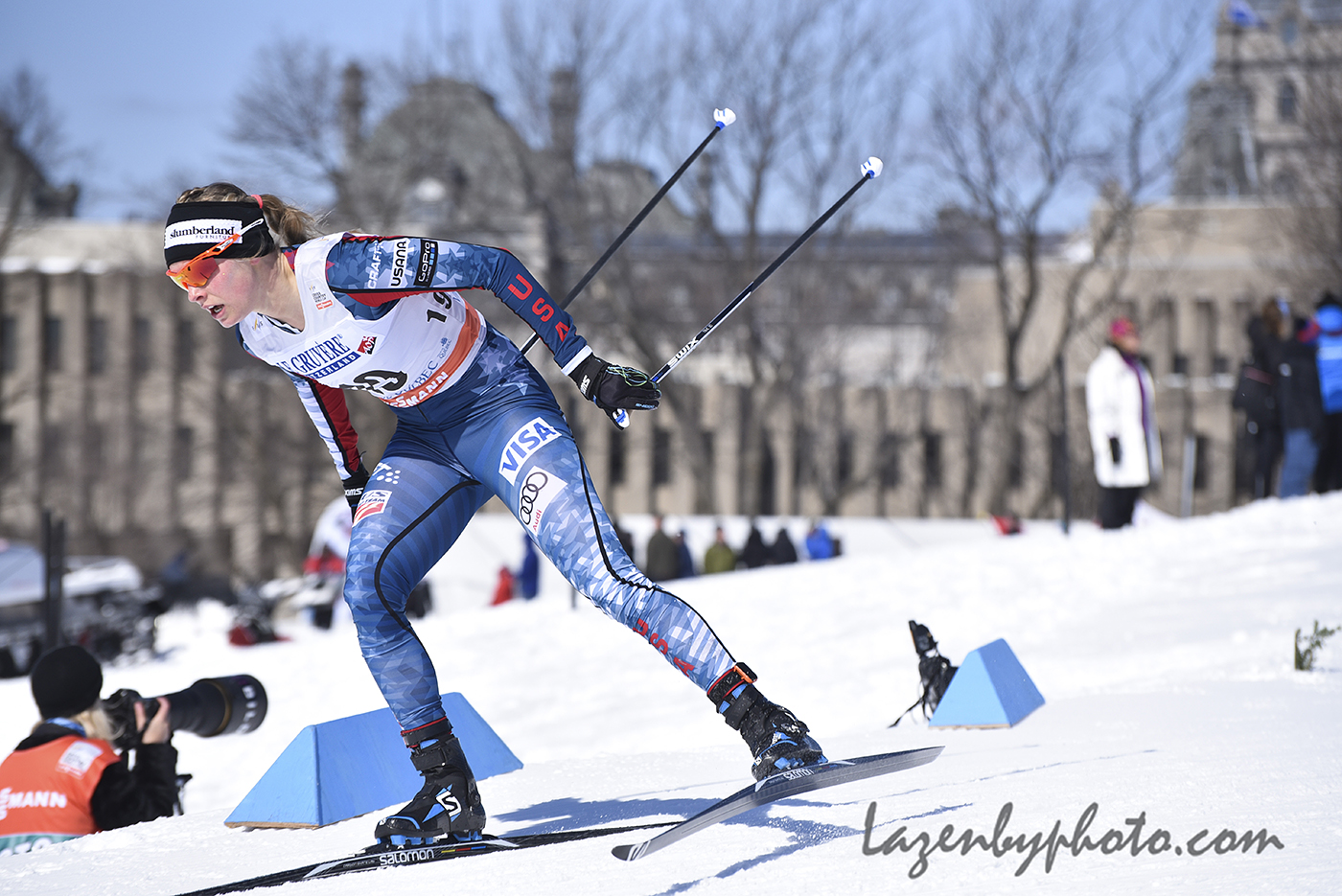
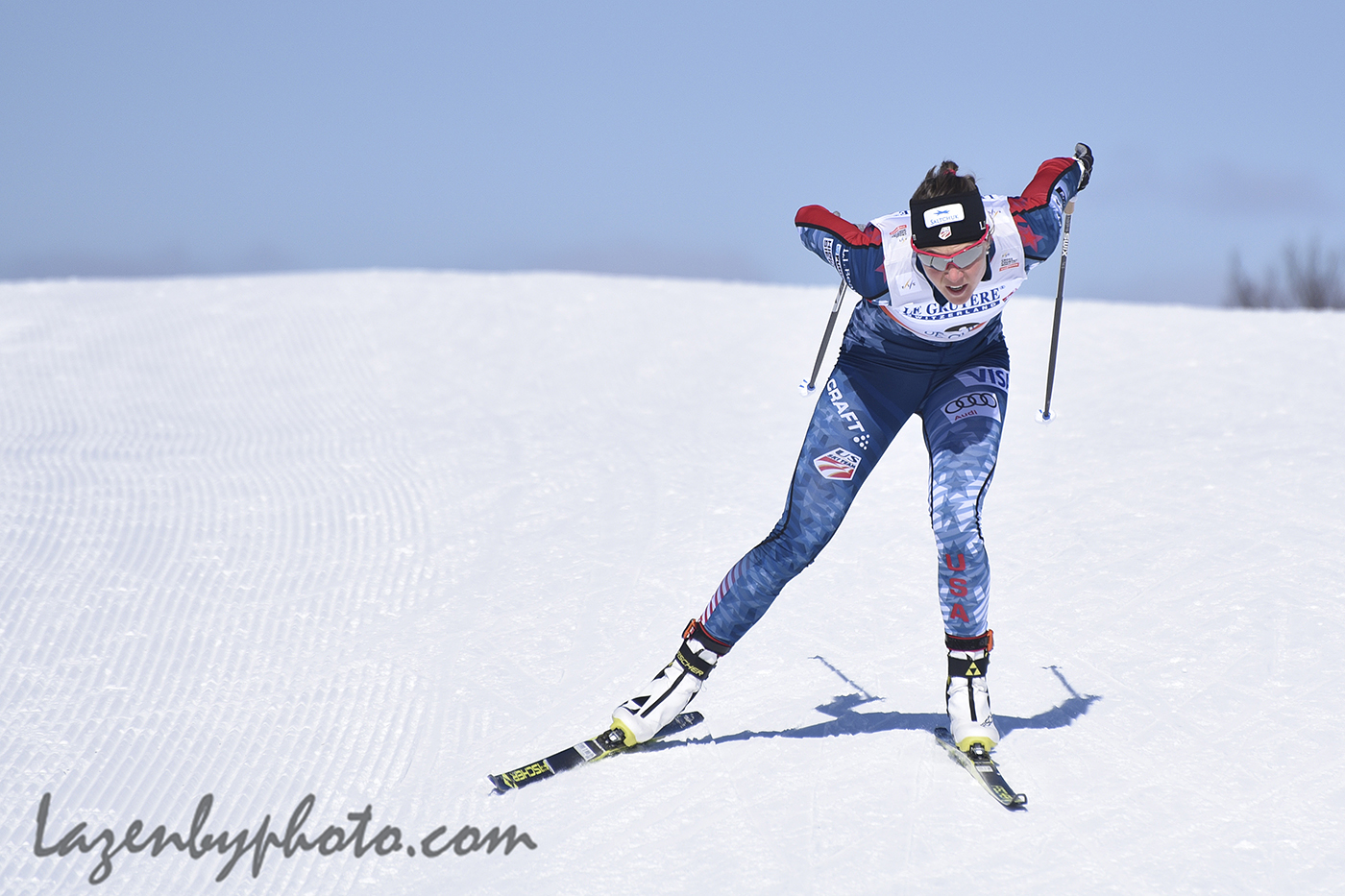
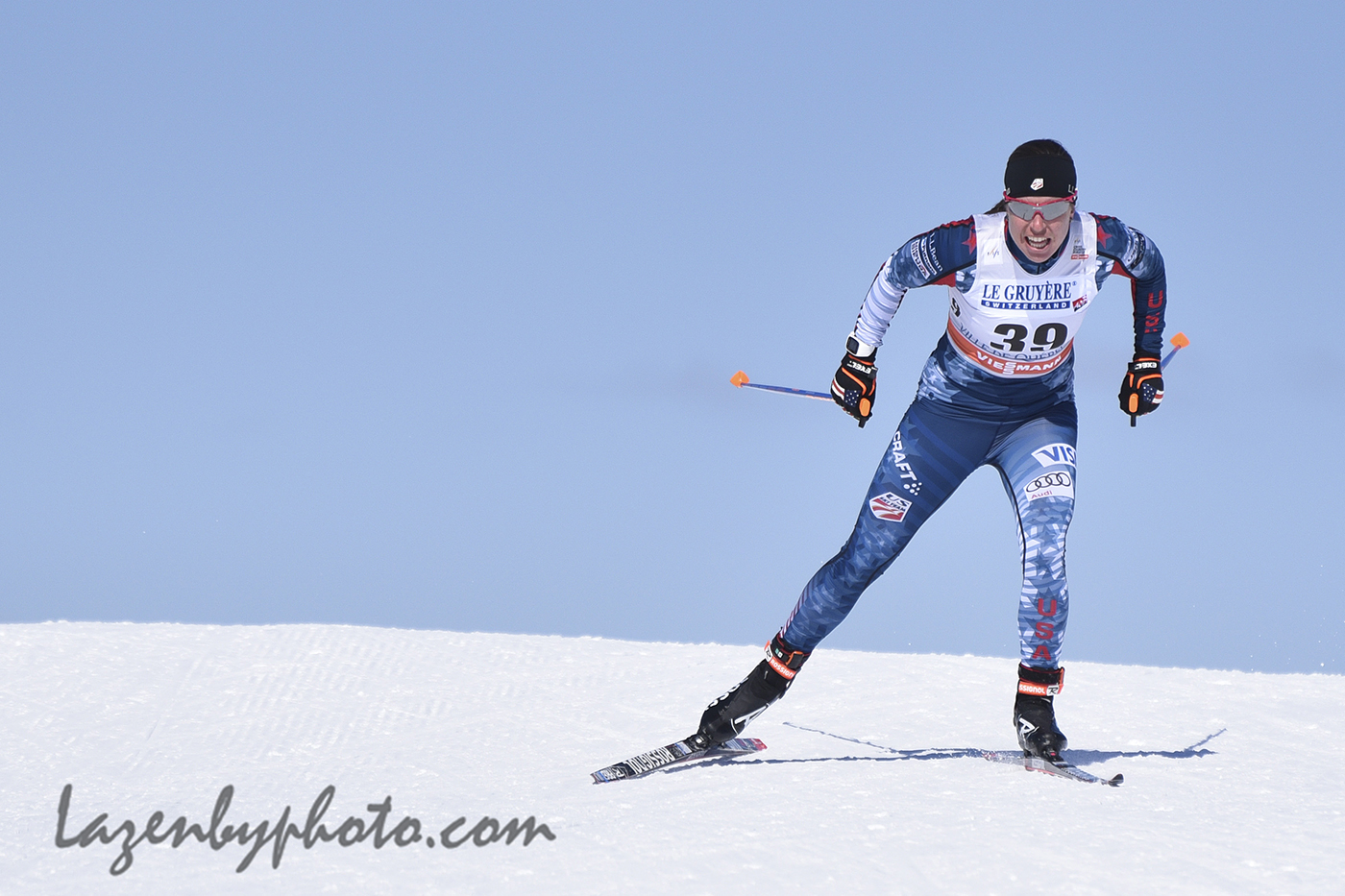
    Jessie Diggins (U.S. Ski Team) racing to 11th in the women’s 1.5 k freestyle sprint qualifier on Friday at World Cup Finals in Quebec. She went on to reach the semifinals and placed ninth overall. (Photo: John Lazenby/Lazenbyphoto.com)

    However, with Nilsson, Falla, Falk, and Fähndrich all pushing the pace in her semifinal, Diggins missed advancing to the final.

    “My finishing speed has been good all season and especially from the last skate sprint we did in Lahti, so I had a lot of high hopes for today,” Diggins wrote in an email. “But in my semifinal there was a lot of fighting for position and it’s always frustrating when your whole heat finishes 1.4 seconds faster than the winner of the other semi! But, that is sprinting sometimes.”

    Along with Diggins, who qualified 11th, four other Americans made the heats: Sadie Bjornsen (who qualified sixth), Sophie Caldwell (18th), Rosie Brennan (27th), and Julia Kern (19th). Bjornsen was the next top finisher for the U.S., placing 16th, just 0.12 seconds away from advancing to the semifinals.

    “Sadie, in her quarterfinal, she did everything she wanted to do, she put herself in the absolute right position to be right here in second place coming into the finish straight and just barely missed, just got passed at the line,” USST head coach Chris Grover said.

    Bjornsen had been positioned in second through the final turn, until she was eventually outlunged by Falk.

    Sadie Bjornsen (U.S. Ski Team) racing to sixth in the women’s 1.5 k freestyle sprint qualifier on Friday at World Cup Finals in Quebec City. She went on to place 13th overall. (Photo: John Lazenby/Lazenbyphoto.com)

    “I just haven’t been able to find that perfect speed at the finishing stretch pretty much every sprint this year,” Bjornsen said. “I was trying to switch things up today and see if I could and I gave it my all and unfortunately didn’t take the draft right into the finish.”

    After qualifying with the sixth-fastest time, 3.47 seconds behind Falk, Bjornsen indicated that even if this season’s World Cup sprints are done, her perfection over the art of sprinting is not.

    “When I’m qualifying that well, I know I can sprint well, that’s like the most exciting part,” Bjornsen said.

    Also left wanting a little more on Friday was Caldwell, who finished 21st. Caldwell had been positioned in third coming into the final turn before the finishing stretch, when she fell after a near-run in with Sweden’s Anna Dyvik. The Swede was relegated to last in that quarterfinal.

    “Today was a really frustrating day for me and not the way I wanted to end the World Cup sprint season,” Caldwell wrote in an email. “My season has been solid and consistent, but I’ve had three crucial falls now and those bummed me out. Davos was entirely my own doing, but Toblach and today were pretty out of my control, which is frustrating because I don’t know what I could have done differently.”

    Caldwell plans to race both of the final two distance days of the World Cup season, though the sprint had been her primary focus.

    “I haven’t been able to do very much distance racing this year, so I have zero expectations and will hopefully be able to have some fun out there!” Caldwell wrote. “I am happy with the season and I feel like I’ve skied a little better than the results show due to some falls, but I’m eager to stay on my feet and accomplish more next season.”

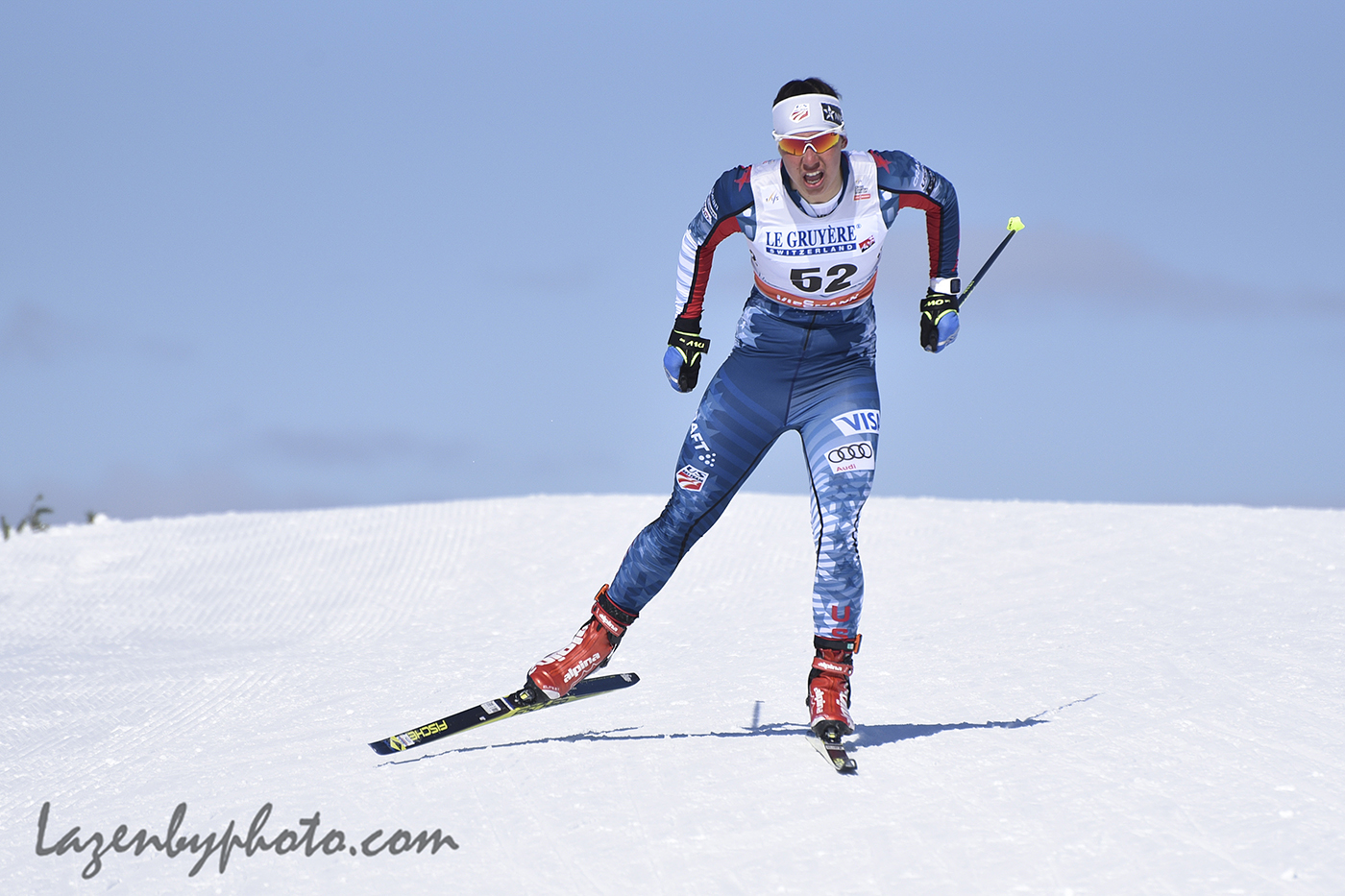
    Julia Kern (U.S. Ski Team D-team/SMS) racing to 29th in the women’s 1.5 k freestyle sprint qualifier on Friday at World Cup Finals in Quebec City. In her first World Cup race, Kern ended up 24th on the day. (Photo: John Lazenby/Lazenbyphoto.com)

    In her first World Cup race, Kern qualified for the heats in 29th and raced in the day’s first quarterfinal — the same as Diggins, sprint leader Falla, Ingemarsdotter, and Fähndrich.

    “At the start line it almost felt like a dream because there I was at the start line next to some of the best skiers in the world, skiers who I have looked up to and watched race after race on my computer screen to learn and gain inspiration from,” Kern wrote.

    Kern explained that though she was a little nervous about starting the sprint on Friday, she cited her recent performances at U.S. Junior Nationals in Lake Placid, N.Y., where she won all three individual races, as giving her confidence. Though getting into the heats would require what she referred to as “a killer day”, the 19-year-old USST development team member pulled it off, ultimately crossing in fifth in her quarterfinal for 24th overall.  

    I felt like I had skied the qualifier pretty well technically, but I didn’t feel my extra spark I get when I am having a really good day so I was very surprised when Chris Grover told me I was hanging in 29th!” Kern wrote. “When it was confirmed that I was in the heats I was extremely excited and a little shocked. It has been something I have imagined over and over when I watch the World Cup sprints on my computer and for it to happen in my first World Cup was truly incredible.”

    With two more World Cup races to go, Kern is coming into them with a newfound confidence.

    “This is a huge confidence booster for me because it is easy to make a goal and have my teammates and coaches who believe in me tell me results like this are possible, but it is another thing to actually live up to it and believe it yourself too,” Kern wrote.

    Rosie Brennan (U.S. Ski Team) racing to 27th in the women’s 1.5 k freestyle sprint qualifier on Friday at World Cup Finals in Quebec City. She qualified for the first time in a sprint, and ended up 28th overall on the day. (Photo: John Lazenby/Lazenbyphoto.com)

    Advancing to the heats for the first time in her World Cup career was Brennan, who qualified 27th and finished the day in 28th.

    “The quarters were not what I had hoped for, but I didn’t really have too many expectations, I’ve never done it before,” Brennan said. “So I’m glad to have gotten that out of the way before the season was over and I have a good list of things to work on this summer.”

    Even with five U.S. women making the heats on Friday, the team was hungry for more.

    “On the ladies’ side, a decent qualification, but not actually really one of our best,” Grover said. “Great for Julia to get in there as a junior athlete, that was really exciting for Rosie to get in there, because that may have been the first time this season she’s actually been in. She’s been just on the outside so many times. So excited for those two guys. Kind of an OK qualification for the other three ladies … all those ladies skied really smart, but it just didn’t come together.”

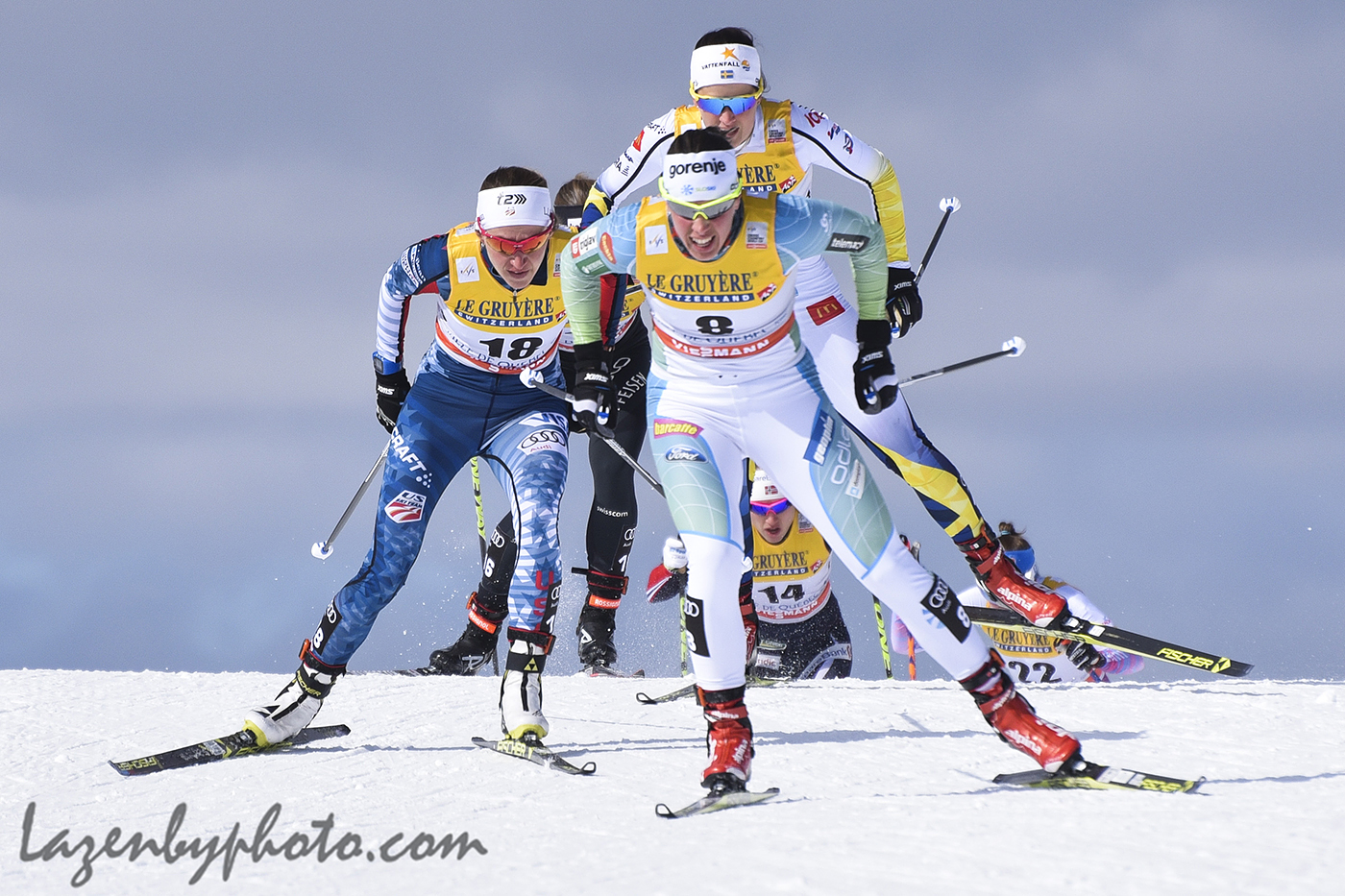
    American Sophie Caldwell (18) chasing Slovenia’s Vesna Fabjan (8), ahead of Sweden’s Anna Dyvik, during their quarterfinal of the women’s freestyle sprint on Friday at World Cup Finals in Quebec City. (Photo: John Lazenby/Lazenbyphoto.com)

    Eight other American women competed in Friday’s sprint, though did not advance beyond qualification with Ida Sargent placing 36th, Erika Flowers 48th, Kaitlynn Miller 50th, Caitlin Patterson 53rd, Becca Rorabaugh 54th, Chelsea Holmes 55th, Jennie Bender 57th, and Liz Guiney 62nd. Liz Stephen did not start.

    Sargent explained that though she had been looking forward to this weekend’s races, a bout of pneumonia left her unable to compete at the level she had hoped to.

    I got sick in Lahti and just couldn’t figure out why I wasn’t getting better,” Sargent said. “They thought it was just a cold, but I kind felt like something was different and so, eventually I got diagnosed with pneumonia and I’m still on antibiotics for that. They said I was fine to race and that it wouldn’t do any damage. I didn’t have much hope for how it was going to go today, I was trying to stay optimistic, but there’s a reason with antibiotics and pneumonia.”

    For Canada, Dahria Beatty finished 41st, Emily Nishikawa 45th, Cendrine Browne 47th, Andrea Dupont 51st, Sophie Carrier-Laforte 56th, Katherine Stewart-Jones 59th, Annika Richardson 60th, Sadie White 61st, Frederique Vezina 63rd, Laura Leclair 65th, Katherine Weaver 66th, Mia Serratore 67th, Alannah MacLean 69th, Annika Hicks 70th, and Lisle Compton 71st.

    Results | World Cup Finals standings

    Overall World Cup standingsSprint World Cup standings (final)