Tag: 1.55 k freestyle sprint

  • Caldwell Fourth in Lenzerheide as Falla Extends Sprint Cup Lead

    Caldwell Fourth in Lenzerheide as Falla Extends Sprint Cup Lead

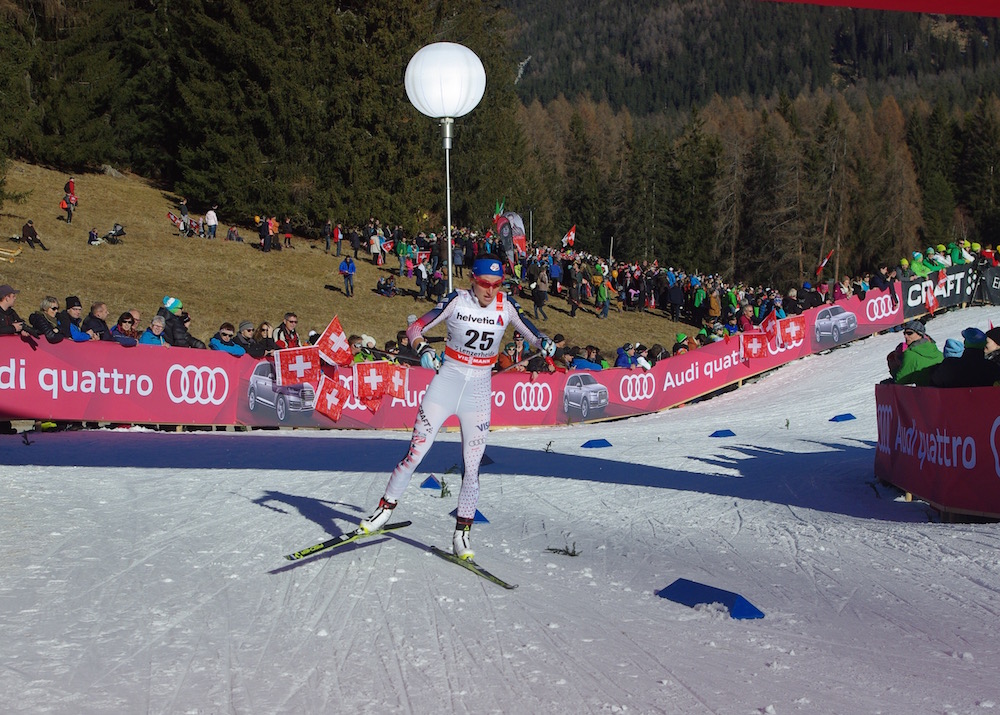
    Sophie Caldwell of the U.S. Ski Team en route to the second-fastest qualifying time of the day in the World Cup sprint in Lenzerheide, Switzerland, the first stage of the FIS Tour de Ski.
    Sophie Caldwell of the U.S. Ski Team en route to the second-fastest qualifying time of the day in the World Cup sprint in Lenzerheide, Switzerland, the first stage of the FIS Tour de Ski.

    LENZERHEIDE, Switzerland — There was a scary moment for Sophie Caldwell in the quarterfinals of Friday’s World Cup sprint, the first stage of the 2016 Tour de Ski.

    Saddled with one of the most competitive quarterfinals of the day, Caldwell got a slow start – which landed her at the back of the pack. She had skied the second-fastest qualifying time earlier in the day, but no matter what angle she tried it was hard for her to get to the front on the course’s one major climb, much less on the downhills.

    “Super scary,” U.S. women’s coach Matt Whitcomb said of watching the heat unfold.
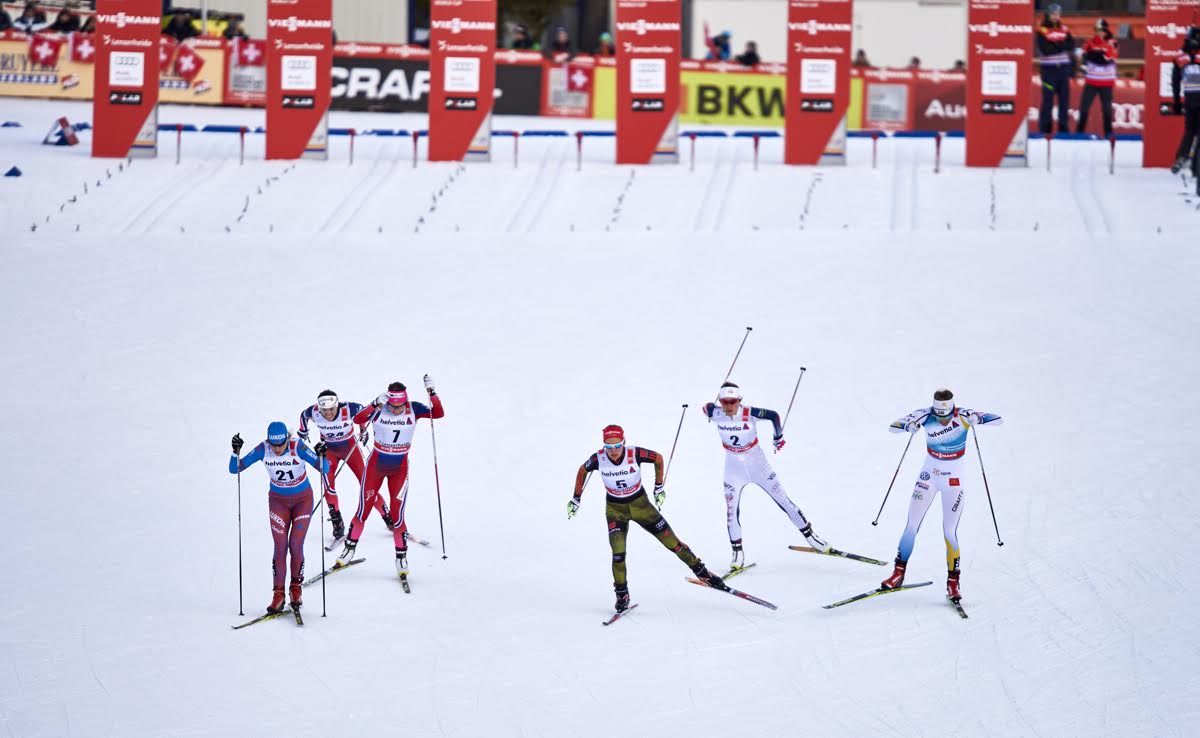
    The second women's quarterfinal (from left to right): Russia's Natalia Matveeva, Norway's Heidi Weng and Maiken Caspersen Falla (7), Germany's Hanna Kolb, American Sophie Caldwell, and Sweden's Stina Nilsson (SWE) shortly after the start in the freestyle sprint at Stage 1 of the Tour de Ski Lenzerheide, Switzerland. (Photo: Fischer/NordicFocus)
    The second women’s quarterfinal (from left to right): Russia’s Natalia Matveeva, Norway’s Heidi Weng and Maiken Caspersen Falla (7), Germany’s Hanna Kolb, American Sophie Caldwell, and Sweden’s Stina Nilsson (SWE) shortly after the start in the freestyle sprint at Stage 1 of the Tour de Ski Lenzerheide, Switzerland. (Photo: Fischer/NordicFocus)

    But the upside to being in a fast heat is that even if you finish fourth – as Caldwell did – you can make it to the semifinals as a lucky loser. Caldwell rode that luck all the way to the final and fourth place overall, changing her strategy along the way.

    “I had a bit of a slow start in my quarterfinal so after that I put my focus on having a fast start and that was a lot better,” Caldwell said. “There were fewer people to go around and I think it’s just easier to keep your head in it when you’re battling for one of the top positions rather than sort of off the back scrambling.”

    Caldwell took a hard inside line on the last downhill corner, putting her in potential podium position. But athletes reshuffled going up the last hill and into the stadium, and was left to edge out Astrid Uhrenholdt Jacobsen of Norway in a photo finish for fourth place, 1.03 seconds out of the win.

    It was her best World Cup result since her podium in Lahti, Finland, at the end of the 2014 season.

    “I am really happy,” Caldwell said. “Fourth is always sort of a bittersweet place to get. I want to be on that podium and I think I can one day. But this is the best result I’ve had in a long time so I’m really happy with it.”
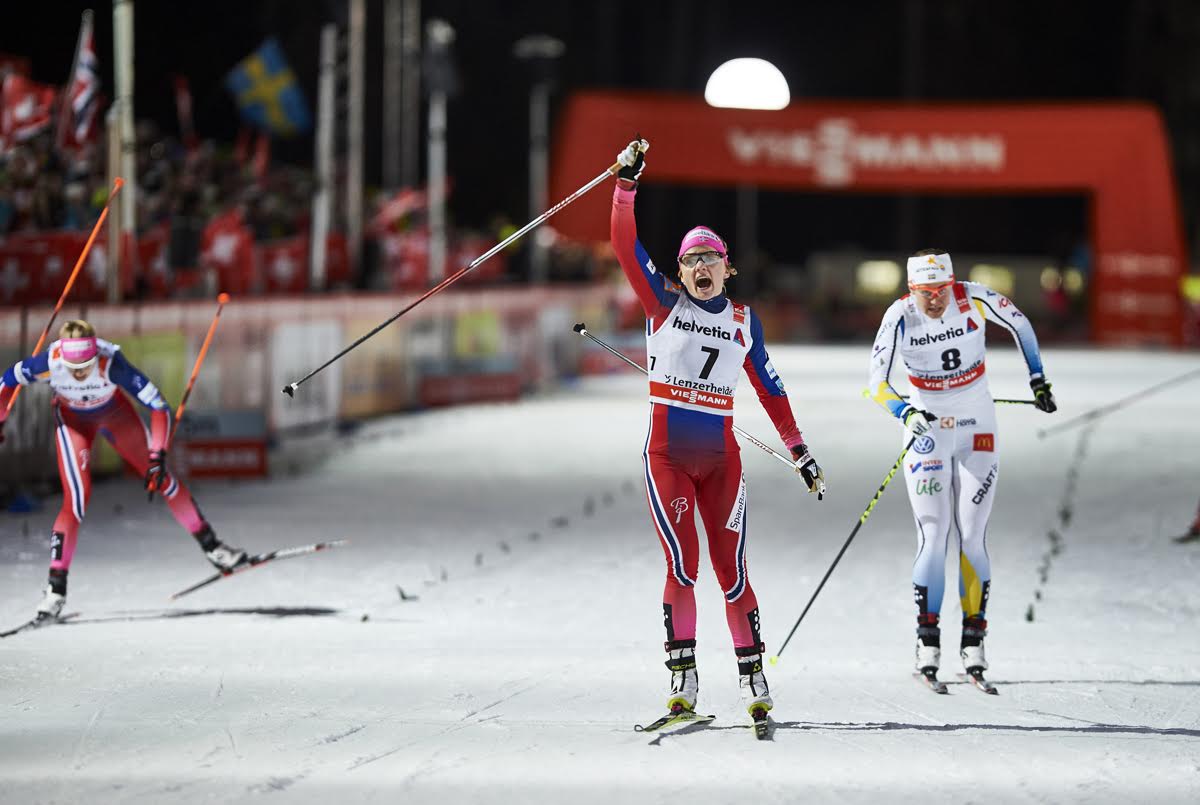
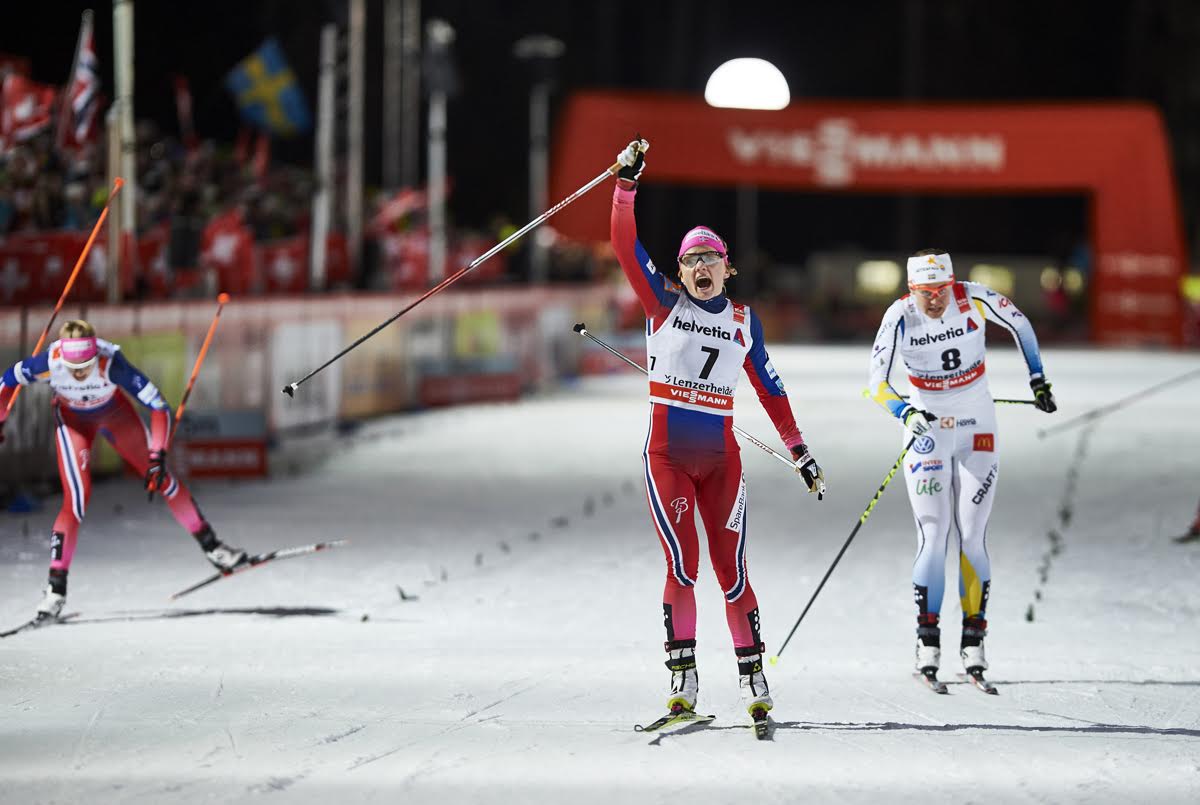
    Norway's Maiken Caspersen Falla (7) celebrates her victory in Friday's freestyle sprint, the first stage of the 2016 Tour de Ski, over Sweden's Ida Ingemarsdotter (8) and Norwegian teammate  Ingvild Flugstad Østberg (not shown). Norway's Astrid Uhrenholdt Jacobsen placed fifth after a photo finish with American Sophie Caldwell (not pictured), who took fourth. (Photo: Fischer/NordicFocus)
    Norway’s Maiken Caspersen Falla (7) celebrates her victory in Friday’s freestyle sprint, the first stage of the 2016 Tour de Ski, over Sweden’s Ida Ingemarsdotter (8) and Norwegian teammate Ingvild Flugstad Østberg (not shown). Norway’s Astrid Uhrenholdt Jacobsen placed fifth after a photo finish with American Sophie Caldwell (not pictured), who took fourth. (Photo: Fischer/NordicFocus)

    Maiken Caspersen Falla of Norway won the day after qualifying in seventh position. She said that the course, with its drag-race uphills and few places to make any huge moves, fit her well.

    “I felt better and better during all the heats,” Falla said in the post-race press conference. “I think the other girls are skiing really fast on the first lap. On the last lap I felt really good especially on the last uphill. I was first in the last 100 meters, so it’s really nice – as always – to get the World Cup victory.”

    Falla leads the World Cup sprint standings this season.

    Ida Ingemarsdotter of Sweden was second (+0.40), and Ingvild Flugstad Østberg of Norway third (+0.54). Ingemarsdotter made her decisive move late in the second lap. It was her second World Cup sprint final of the season, while Falla and Østberg are staples on the circuit.

    “I had a good feeling and was satisfied with myself,” Ingemarsdotter told FasterSkier. “I knew that it’s two laps and it’s not the first lap that counts. It’s the whole way to the finish. I just focused on the second lap and when we went into the stadium I knew that if you can take any position there, you can take it cheap and you don’t have to work so hard.”

    Both she and Østberg are looking forward to the whole Tour de Ski, not only the sprints. She’s “absolutely” going to enjoy more good distance racing, Ingemarsdotter said.

    “Tomorrow is 15 k classic,” she explained. “I think the strong Norwegian girls will go really hard. I will focus as much as possible on following them, to keep the gap to the front not so big.”

    And Østberg? She hasn’t gone all the way to the end of the Tour de Ski since 2012, but this year she has said she’s focusing on also doing excellent distance racing. So finishing the Tour de Ski is on the table.

    “It’s a good start to the Tour,” she said in the press conference. “This year my plan is to go the whole way and up Alpe Cermis, so it’s important to have a good start. Tomorrow is another day with a lot of bonus seconds, so I guess overall standings will look different after tomorrow.”
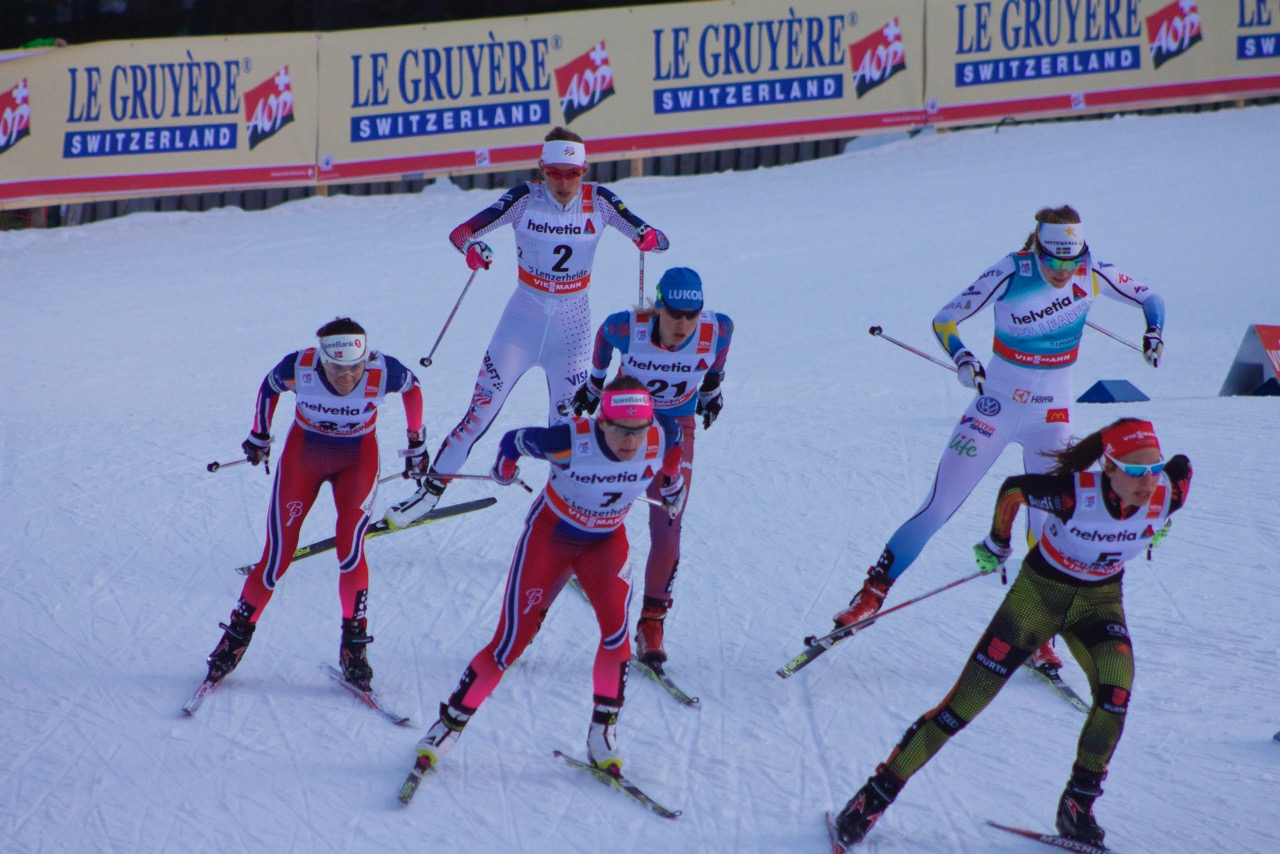
    Sophie Caldwell stuck at the back of the pack in her quarterfinal heat, which was won by eventual race winner Maiken Caspersen Falla of Norway (bib 7). Caldwell placed fourth to move on as a lucky loser. (Photo: JoJo Baldus)
    Sophie Caldwell stuck at the back of the pack in her quarterfinal heat, which was won by eventual race winner Maiken Caspersen Falla of Norway (bib 7). Caldwell placed fourth to move on as a lucky loser. (Photo: JoJo Baldus)

    Caldwell isn’t as likely to go the whole way. Head coach Chris Grover said before the Tour began that she and the other sprint specialists would probably stop after the Oberstdorf, Germany, stages a few days from now.

    But with four times racing around the course, Caldwell definitely got in her workout today.

    “The semi and final were hard,” she said. “But I’ve been working really hard on recovering in between heats and in the qualifier today that was the best my legs have felt all year. So I was hoping to come into the Tour pretty rested and focusing on recovering between each heat. I think it worked.”

    In fact, that’s one thing that U.S. women’s coach Matt Whitcomb picked out as a highlight of the day.

    “The goal for Sophie is to try to skate through as many heats easily as she can, and she has certainly run into some very difficult heats this year,” he said. “But the nice thing about today is that Sophie had to dig really hard a couple of times, which smoked her in Davos. And it didn’t today. She was in the mix right in the end. So she has clearly taken a nice step in the direction.”

    The reason that today’s quarterfinal and some others this season have been so hard is that athletes now pick their own heats, which can leave some easier and some harder than the former system, which automatically seeded athletes according to qualification position.

    “The new heat selection process is interesting,” Caldwell said. “Sometimes it works in your favor and sometimes it doesn’t. I think so far this year I have to be the world’s luckiest loser. In about five of the six heats I’ve moved on in it has been as lucky loser. I have picked some fast heats, which is tough, because it’s hard to move on from. But then lucky losers come out of that heat so sometimes it’s a good thing.”

    Whitcomb admitted that heat selection is something they are still working on. But part of the strategy is also to get each qualifier from the team into a different heat, if possible, so that they are less likely to bump each other out. With three other women (Jessie Diggins, Sadie Bjornsen, and Ida Sargent) qualifying today, that dynamic was at play.

    “We’ve started to change our strategy [for picking heats] but with Stina [Nilsson] qualifying 28th and 30th in the last two weekends, it has thrown a huge wildcard into the mix,” Whitcomb said (Nilsson ended up sixth, 1.3 seconds behind Caldwell). “So still we’ll do our best to select easier heats moving forward, but you can only do your best when you’re also trying to get all four of your women into different heats.”

    So far, though, things have worked out for Caldwell, even if she’s sometimes had to work harder than she or her coach would prefer.

    After making it to the final she gave it her all, which is the most either of them could ask for.

    “I knew it was going to be tight,” Caldwell said. “I can’t even remember what happened there, but positions can change a lot. People who were on the outside are all of a sudden on the inside and then unless you’re right in the front, you never know when someone is going to come over. So it’s tough. But I fought til the end and I’m happy with it.”

    Results | Tour de Ski standings

  • Golberg Wins First Sprint Race, Hattestad Falls, Harvey 7th in Lahti World Cup

    Golberg Wins First Sprint Race, Hattestad Falls, Harvey 7th in Lahti World Cup

    FIS world cup cross-country, individual sprint, Lahti (FIN)
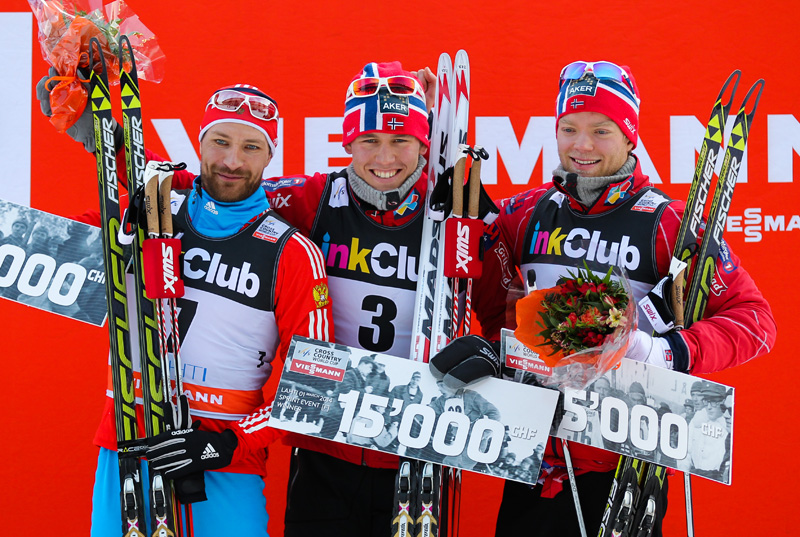
    Lahti World Cup men’s podium: (L-R) runner-up Alexey Petukhov (RUS), winner Pål Golberg (NOR), and third-place finisher Eirik Brandsdal (NOR) (Photo: Fischer/Nordic Focus)

    The World Cup returned to Lahti, Finland, on Saturday with a fast 1.55-kilometer sprint course through soft, artificial snow. With little climbing and a course that took just over two and half minutes for the men to complete, it favored the true sprinters, and those that could stay on their skis.

    In the first quarterfinal heat, Teodor Peterson of Sweden led the race from start to finish, wearing bib No. 1 as the fastest qualifier of the day, and never appeared to be under pressure. Behind him, and challenging for the second qualifying position, was Sergey Ustiugov of Russia who started intentionally slow but then quickly caught up. In the end, it was Germany’s Josef Wenzl who took second, with Estonia’s Peeter Kümmel in third.

    The second quarterfinal heat was led by the tall Swedish skier Johan Edin, who stumbled briefly as he skied over a rise, allowing Alexey Petukhov of Russia and Alex Harvey of Canada to move past him and finish in that order.

    The third quarterfinal heat saw Norway’s Sondre Turvoll Fossli push the pace for much of the race, no doubt trying to put distance between himself and sprint stars Ola Vigen Hattestad of Norway and Emil Jönsson of Sweden. Nevertheless, both Hattestad and Jönsson were faster than Fossli, who finished in third but was quick enough to earn a lucky loser place in the semifinals, along with Ristomatti Hakola of Finland.

    Finland’s Martti Jylhä lead most of the fourth quarterfinal race, until the final few hundred meters when Norway’s Haavard Solaas Taugboel, the second fastest qualifier, took the lead and outsprinted the finish duo of Jylhä and Matias Strandvall, who finished in second. Germany’s Sebastian Eisenlauer fell coming into the stadium nearly taking out Simi Hamilton of the U.S., who stumbled but didn’t fall to finish fourth in his heat.

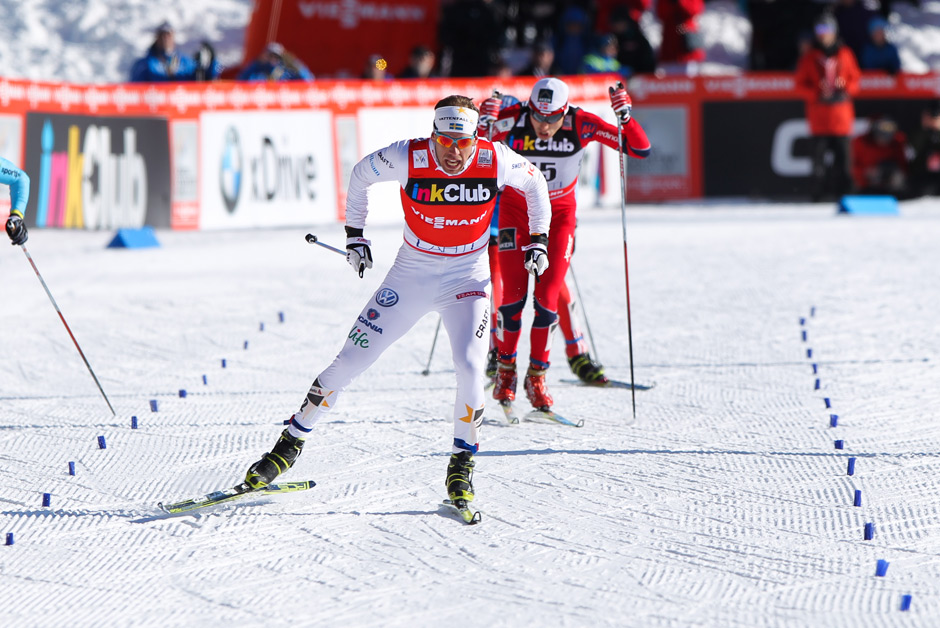
    Emil Jönsson. Photo: Fischer/NordicFocus
    Emil Jönsson. Photo: Fischer/NordicFocus

    The fifth and final quarterfinal promised to be a battle between Andy Newell of the U.S., Nikita Kriukov of Russia, and a four-man Norwegian contingent of Pål Golberg, Eirik Brandsdal, Finn Hågen Krogh, and Sindre Bjørnestad Skar.

    Trouble began, though, as soon as the gun went off. Kriukov, who was skiing to the left of Newell, took an early skating stride after leaving the double pole lane and his right ski went under Newell’s foot.

    With Kriukov’s right ski caught, the Russian was yanked back, spinning him clockwise and bringing his left ski directly into the path of Newell who was still on his feet. Newell lept high to avoid Kriukov’s sweeping ski, an impressively agile move that would have worked had his right ski not fallen off. Forced to turn around and reattach his ski, Newell was way out of contention as was Kriukov who tried, but was unable to recover from his early fall. The rest of the heat was a purely Norwegian contest with Brandsdal leading and taking first and Golberg in second.

    The first semifinal heat was led from the gun by Peterson, until just before the sharp left corner into the stadium where Petukhov cleverly cut into the lead. Behind the Russian were Peterson, Jönsson, and Harvey. Jönsson tried to move past Harvey on the inside lane and appeared to ski into the Canadian, sending Harvey wildly off balance and breaking Jönsson’s pole. Harvey regained himself, though not enough to advance to the finals. Petukhov won the heat and hurried off to prepare for the final, with Peterson finishing in second.

    It was a disappointing day for Jönsson, who has won the World Cup sprint race held in Lahti for the past three years. Jönsson was also looking for the opportunity to make history at his best venue by setting a new record for the most freestyle sprint victories. Currently he is tied with Tor Arne Hetland’s old record of seven wins, but with no remaining freestyle sprints on the World Cup calendar, Jönsson must wait until next season to try and break the record. Jönsson acknowledged his string of bad luck lately with a translated Twitter post that read, “Last three World Cup races, I have fallen / broken rod, in the Olympics, I stood up. Maybe will try to continue with that tactic #wisely #GrattisPål”

    FIS world cup cross-country, individual sprint, Lahti (FIN)
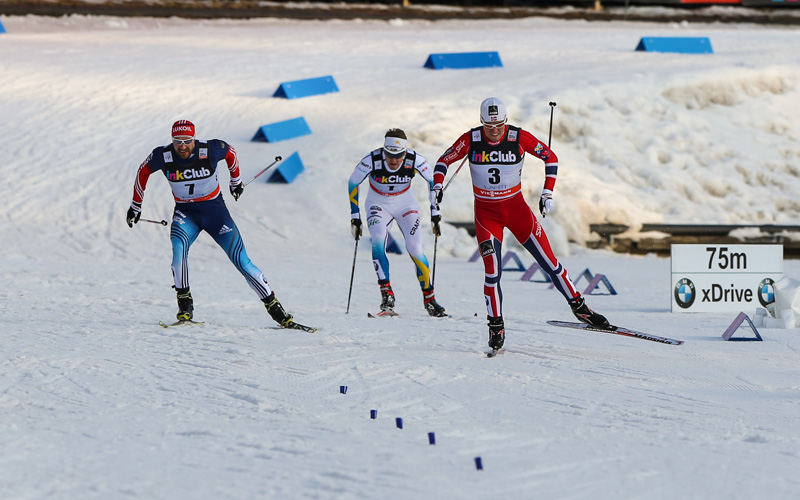
    Golberg, Petukhov, and Peterson at the finish. Photo: Laiho/NordicFocus

    The second semifinal heat was an all-Nordic affair, with four Norwegians and two Finns. Hattestad took early control of the heat, with Brandsdal and Golberg skiing alongside of him. Despite the Norwegians control of the race from the starting gun, the heat moved quite fast, with Hattestad and Brandsdal pushing the pace and finishing first and second, respectively. Behind them, Finland’s Strandvall closed his race with a strong burst of skiing after looking trapped behind the Norwegians for much of the race. Golberg finished fourth, but, like Strandvall, was fast enough for a lucky loser position.

    The final heat was led out of the gates by Peterson, who jump skated up the first slushy hill, and cornered tightly, controlling the race and keeping the pace high. Behind him at first was Strandvall, who was quickly passed by Hattestad who skied patiently behind Peterson, waiting for his opportunity.

    As the course gradually descended into the stadium through slushy snow, first Strandvall went down in the back of the pack, then an instant later, Hattestad fell skiing in second place. Both men appeared to fall simultaneously, and without cause or relation to each other. Brandsdal had to move out of the way of a falling Hattestad which put him slightly behind the now leading three of Peterson, Golberg, and Petukhov.

    In the final few hundred meters, Golberg stormed past a tiring Peterson who’s early efforts seemed to catch up with him. Petukhov tried to challenge Golberg but didn’t quite have enough power to match the 23-year-old Norwegian, and finished in second. Brandsdal, too, had a late burst of energy left and he managed to just get ahead of a steadily fading Peterson to take third, with the Swede in fourth.

    Strandvall applauded the Finnish fans in the stadium before shaking his head as he crossed the line in fifth. The good natured Hattestad smiled as he finished in fifth, looking a little amused and sheepish about his fall, and congratulated Golberg and Brandsdal on their results.

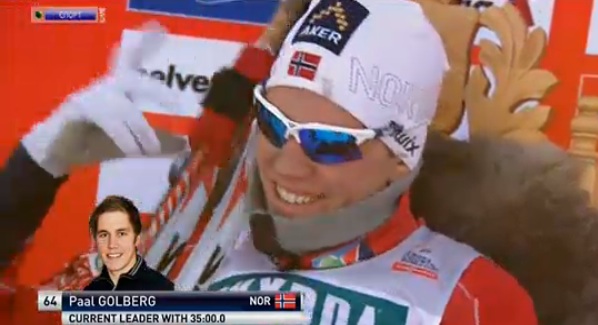
    Norway's Pål Golberg smiles while sitting in the leader's chair on Saturday, after watching Russian Alexander Legkov finish 22.2 seconds off his winning time in the 15 k classic individual start at the Lillehammer World Cup.
    Norway’s Pål Golberg in a race earlier this season.

    Golberg, for his part, appeared somewhat surprised at his victory and perhaps a little confused about how he should acknowledge it, as he skied a cool down lap in front of the stadium, stealing furtive glances at the crowd while the second place finisher Petukhov waved heroically to the crowd.

    Golberg won with a time of 2:32.29, Petukhov was 0.55 seconds behind, and Brandsdal was 1.3 seconds slower than Golberg.

    It was Golberg’s second career World Cup victory after winning Lillehammer’s 15 k classic race in December. Golberg told NRK after the race Saturday, “The way the victory came on today was probably a bit lucky, but such is skate sprinting, and today it was my turn.”

    Golberg told FIS, “It’s been a while since I won in Lillehammer. I was sick afterwards and out for almost a month. The Games did now work out well so I am happy to be back on the top of the podium today. It was a crazy final with two falls. I was bit lucky I could avoid a crash, but luck belongs to sport. For tomorrow I do not know what to expect from myself as I have not raced 15 km free a while.”

    Petukhov looked pleased with second place, and told FIS after the race, “Last two season have been quite difficult for me. Of course I am a bit disappointed I could not win but I am happy for the second place. The organizers did a great job with the course. It was quite soft but so it was also in other venues. I have to congratulate to Pål and Eirik. They are great athletes.”

    Brandsdal took the sprint leader’s bib today from Wenzl, who trails by a mere four points. Hattestad sits in third in the World Cup sprint standings, thirty points behind. With just two sprint races left in the World Cup, both in classic technique, it will be a close contest to see who hoists the crystal globe in Falun, Sweden, in two weeks time.

    Results

  • U.S. Women Get Their Swagger Back with Randall, Caldwell on First Double Podium

    U.S. Women Get Their Swagger Back with Randall, Caldwell on First Double Podium

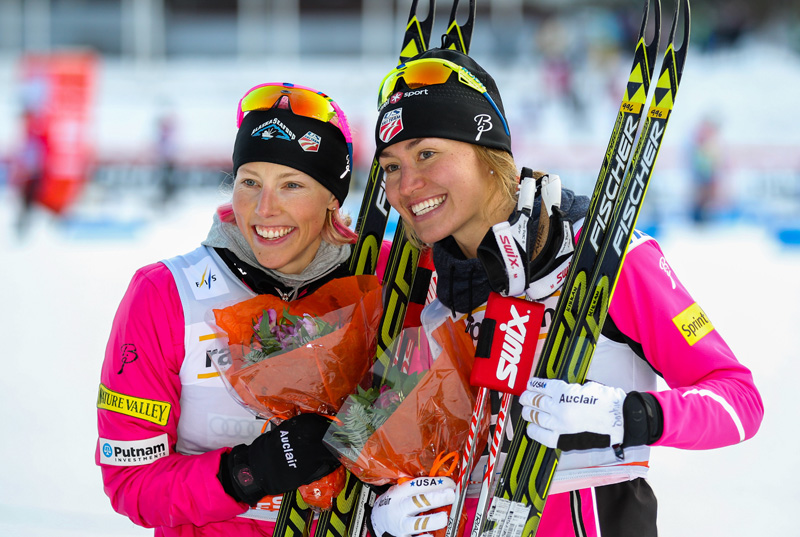
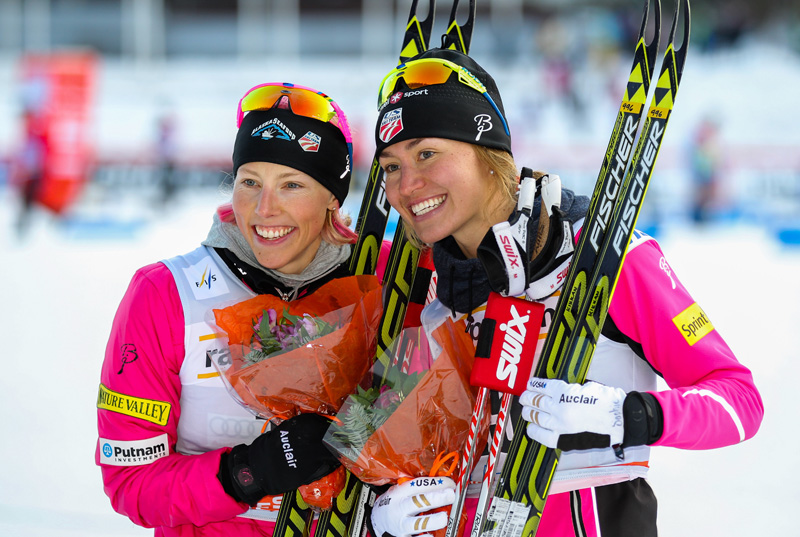
    Fellow U.S. Ski Team members Kikkan Randall (l) and Sophie Caldwell after finishing an unprecedented first and third, respectively, in the Lahti World Cup freestyle sprint on Saturday in Finland. (Photo: Fischer/Nordic Focus)
    Fellow U.S. Ski Team members Kikkan Randall (l) and Sophie Caldwell after finishing an unprecedented first and third, respectively, in the Lahti World Cup freestyle sprint on Saturday in Finland. (Photo: Fischer/Nordic Focus)

    Perched over her poles before the start of Saturday’s freestyle sprint in Lahti, Finland, Kikkan Randall smiled from ear to ear for the cameras, with the same pink-haired, cheery persona that she’s displayed before essentially every race this season — and over the last several years.

    It was the look that’s landed Randall, the 31-year-old U.S. Ski Team leader, sponsorships with major sandwich and cereal chains, and was reminiscent of how she appeared before the start of her last freestyle sprint at the Olympics.

    After flashing her ever-excited grin, she shot out of the gates in the Olympic quarterfinal and attacked the first climb on an unforgiving course in Krasnaya Polyana, Russia. After that, Randall struggled to hold on to an automatic top-two qualifying spot down the finishing stretch, and ended up bounced in fourth.

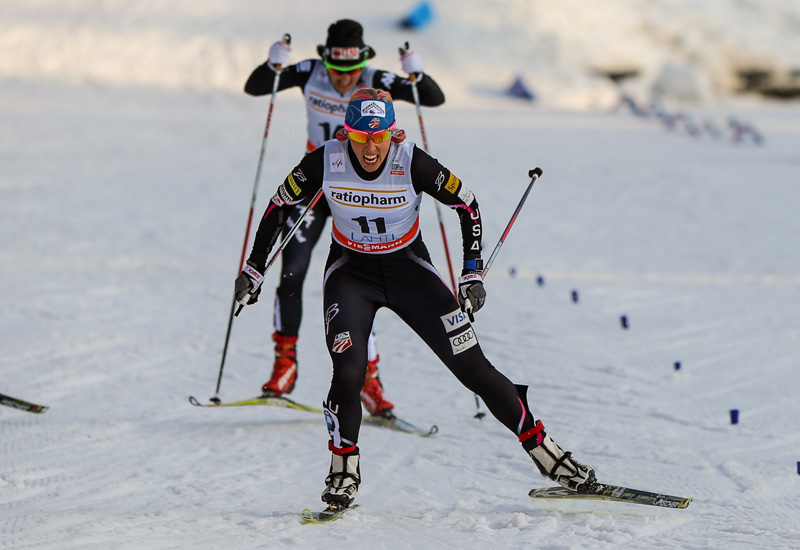
    Kikkan Randall (U.S. Ski Team) racing to a World Cup win in Saturday's freestyle sprint in Lahti, Finland. (Photo: Fischer/Nordic Focus)
    Kikkan Randall (U.S. Ski Team) racing to a World Cup win in Saturday’s freestyle sprint in Lahti, Finland. (Photo: Fischer/Nordic Focus)

    It was the first time she hadn’t advanced to the semifinals in a skate sprint in three years.

    Three Olympic races and two and a half weeks later, Randall was back at the World Cup on Saturday in the last freestyle sprint of the season. After qualifying in 11th, she appeared relaxed throughout her heats, and just as eager as ever at the start of the final.

    Randall had executed as expected on a tactical course in Lahti, one that was relatively narrow and getting more chewed up as the afternoon lingered in temperatures above 40 degrees Fahrenheit.

    After following the qualifier winner, Norway’s Ingvild Flugstad Østberg, around the rolling 1.55-kilometer course for most of the quarterfinal, Randall went from second to first by threading her way through the inside lane around a final hairpin corner then surging ahead of Østberg over one of the final bumps in the stadium. Randall won the heat by 0.25 seconds over Østberg in 2:50.92, nearly five seconds faster than what Randall had qualified in.

    The time proved to be the fastest of any of the quarterfinals by almost three seconds, which enabled the third- and fourth-place finishers in that quarterfinal — Sweden’s Charlotte Kalla and Russia’s Anastasia Dotsenko — to advance as well.

    Meanwhile, Sophie Caldwell, who achieved the Americans’ top result in sixth at the Olympics (and a best-ever Olympic showing by a U.S. woman) qualified in 25th and later said she made a point to relax for the rounds.

    This course wasn’t going to favor anyone who tensed up in the squirrelly snow, and Caldwell, 23, did her best to focus on the openings, seek out the firmer parts of the track, and basically float over it.

    “It was skiing in like a foot of sugar,” Caldwell said. “Maybe that’s an exaggeration, but it was really soft and really sugary.”

    Her attention to detail worked as she skied in third early in her quarterfinal, moved up to second, then challenged Sweden’s Hanna Falk for the win. Falk stayed ahead to finish first by 0.23 seconds over Caldwell, and both advanced to the semifinals.

    There, Randall and Caldwell faced off against Slovenia’s Vesna Fabjan, Italy’s Gaia Vuerich, Østberg and Kalla.

    Fabjan took the lead over the most significant climb in the middle of the course, after a misstep by Kalla over the top dropped the Swede back to third. As all six women converged on the hairpin corner, Kalla lost her balance again, this time, falling face down into the mashed-potato snow. Caldwell and Randall narrowly dodged the crash on the inside of the corner, as did Vuerich, who followed the Americans, but Østberg directly behind had no time to react and toppled over Kalla.

    With four women still standing and racing away to the finish, Caldwell didn’t rule out that Kalla and Østberg could potentially catch up. While Randall accelerated after Fabjan to the finish, Caldwell skied behind them, trying to close the gap hold off Vuerich and anyone else to the line. Fabjan won the heat by 0.45 seconds over Randall, and Caldwell was another 0.45 back in third.

    Vuerich finished fourth, 0.49 seconds after Caldwell, and Østberg and Kalla were 9 and 16 seconds back, respectively, in fifth and sixth.

    The second women’s semifinal was 2.65 seconds slower. Norway’s Maiken Caspersen Falla won it after hovering in third before the final rolling stretch to the finish. Slovenia’s Katja Visnar took second, 0.17 seconds back, and two Swedes, Marika Sundin and Falk contended in a photo finish for third. Sundin got it by one-hundredth of a second, but the heat’s time was not fast enough to advance her to the final.

    Boxed out early and in last place for much of the race, Norway’s Marit Bjørgen ended up fifth, 0.76 seconds behind Falla, after finally getting past Dotsenko. The most successful Norwegian nordic skier’s run would end there — much like it did for Bjørgen in the Olympic skate-sprint semifinals.

    However, Caldwell did move on, along with Vuerich.

    In the final, Falla took charge early, leading over the first rise. Fabjan challenged up the inside lane of the climb, but tripped up in the soft snow, putting her behind her teammate, Visnar, as well as Vuerich and Randall. Caldwell moved into fourth before the infamous corner and emerged out of it in the same position — just as Randall was starting to turn it up.

    Attacking before the final bump in the stadium, Randall surged ahead of Visnar. While the Slovenian chased her in second, Vuerich raced for a podium in third. It appeared the she wasn’t entirely aware of Caldwell’s whereabouts, as the American pushed down the finishing stretch and outlunged her by three-hundredths of a second.

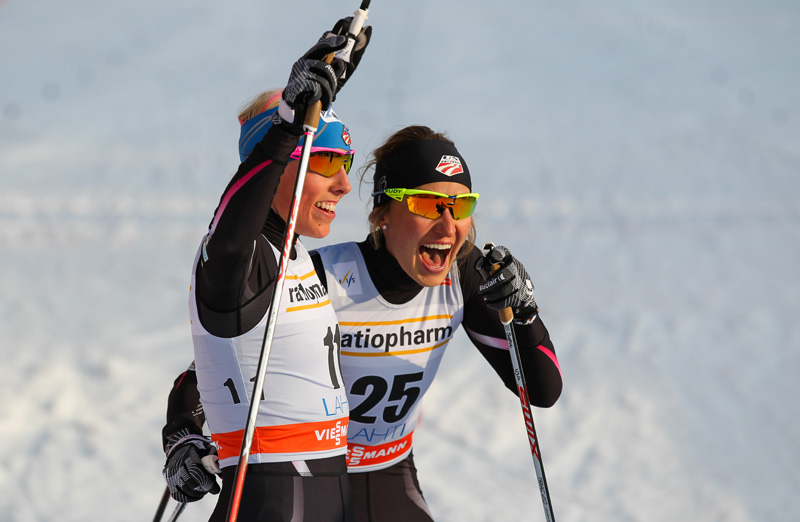
    U.S. teammate Kikkan Randall (l) and Sophie Caldwell celebrate the first U.S. double podium in Saturday's World Cup skate sprint in Lahti, Finland. (Photo: Fischer/Nordic Focus)
    U.S. teammate Kikkan Randall (l) and Sophie Caldwell celebrate the first U.S. double podium in Saturday’s World Cup skate sprint in Lahti, Finland. (Photo: Fischer/Nordic Focus)

    Randall locked up the win in 2:56.53, half a second ahead of Visnar, who achieved her first World Cup podium since 2011.

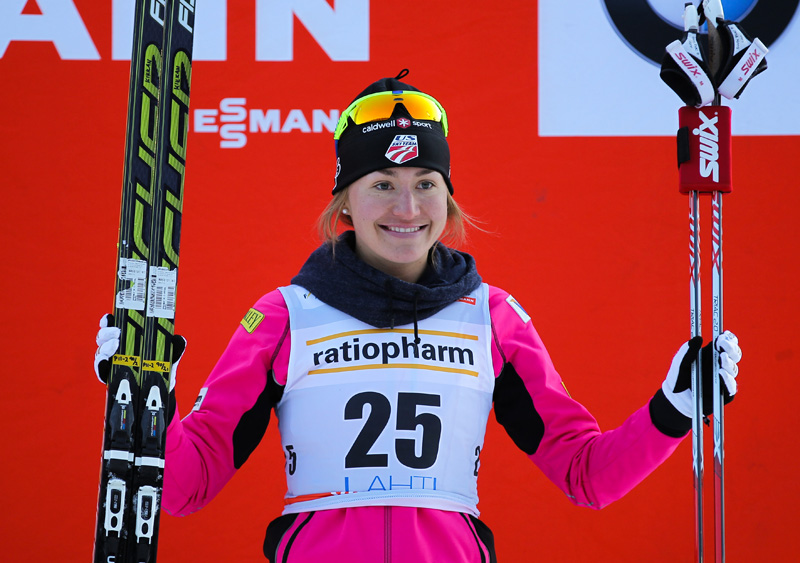
    Caldwell was 0.9 seconds back in third for another historic day for the U.S. — two women on the podium. No other U.S. woman except Randall had ever achieved an outright individual (non-stage) World Cup top three.

    Lying on the ground trying to catch her breath, Caldwell wasn’t sure where she ended up. She didn’t even know where to look to find out.

    Then she heard Randall.

    “Kik just screamed, ‘You just caught a podium!’ ” Caldwell recalled.

    It was her first World Cup podium in her rookie year on the U.S. Ski Team, less than two years after graduating Dartmouth College.

    Randall had scored her third World Cup victory of the season and fourth individual podium — all of which came in skate sprints — which put her at the top of the World Cup sprint standings, 36 points ahead of Germany’s Denise Herrmann, with two classic races left on the circuit.

    A year ago, Randall won the same sprint in Lahti.

    “I am glad the good race feelings are back and I’m hoping to find the strong classic form I had at the beginning of the season,” Randall wrote in an email. “I knew I needed a big race today so it’s great to have a chance to defend the globe now!

    “It’s of course a big bummer that I had that lull in my shape during the Olympics,” she added. “I’m still not quite sure what went wrong. But at least I’m coming back into form so I can hopefully end the season on a good note.”

    Caldwell said her entire season has exceeded her expectations since going pro last season. In terms of peaking, she never really had a plan until this year. In college, it was all about skiing as fast as possible over a few months, and last year, she was trying to earn World Cup starts with top early season SuperTour results.

    This season, she and her Stratton Mountain School T2 Team coach, Gus Kaeding, planned something similar since it worked the year before.

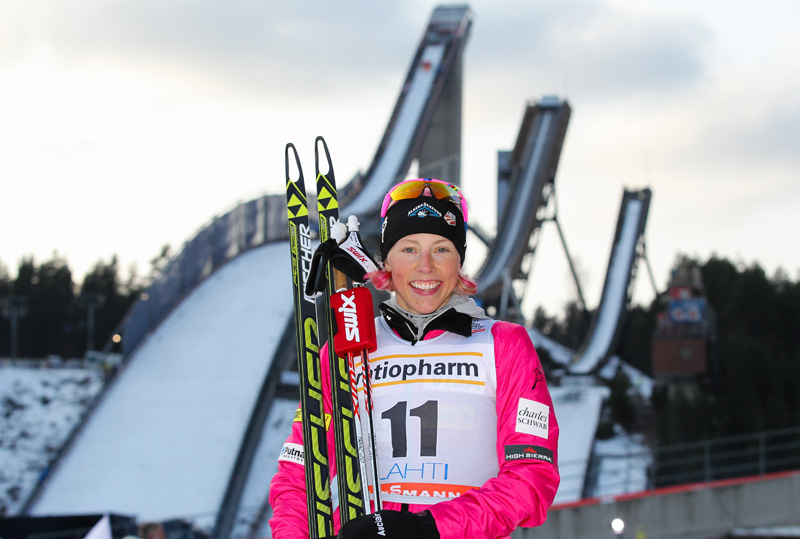
    Sophie Caldwell (U.S. Ski Team) after placing third on Saturday for her first World Cup podium at the Lahti World Cup skate sprint. (Photo: Fischer/Nordic Focus)
    Sophie Caldwell (U.S. Ski Team) after placing third on Saturday for her first World Cup podium at the Lahti World Cup skate sprint. (Photo: Fischer/Nordic Focus)

    “It definitely wasn’t rocket science,” Caldwell said. “It worked out well because it wasn’t complicated.”

    The key to her success on Saturday stemmed from her ability to learn as she progressed through the heats — about where the snow was more skiable and where she’d find opportunities to pass.

    U.S. women’s coach Matt Whitcomb said that Caldwell can find success on any given day in any conditions, but “the more difficult it becomes, the better Sophie can do.”

    “She was the only one out there today that she’d be in sixth then she’d be in second, then she’d be in fourth,” Whitcomb recalled. “She can move through a pack so incredibly well. Sophie can have a bad start and with one decisive move through a corner or through a slushy section… move [up]. … It was fun to watch her today.”

    Caldwell’s shining moment came with her last-ditch lunge past Vuerich. She recalled how many of those she’s lost in the past — at NCAA Championships, at last year’s Slavic Cup — and how she’s been working on them in most of her interval and speed workouts since.

    “[I’d] look at pictures of myself like, ‘What am I doing?’ and I’m basically lunging with my nose,” she said. “Today I put my weight back, pushed my ski forward and somehow managed to time it perfectly.”

    Caldwell saw the replay of her lunge — it looked good, she said with a laugh.

    “I’ve always dreamed of getting a World Cup podium, but I definitely didn’t think it was going to happen this year,” she said. “I was surprised to find myself in any sprint final this year.”

    She made four sprint finals, including Saturday’s and the Olympics.

    “I couldn’t imagine a better way to get my first podium with a teammate, especially Kikkan, someone I’ve looked up to so long,” she said. “I basically was asking her some questions [after the race about where to go, etc.] … and I was like, ‘Is it OK, if i just follow you everywhere?’ ”

    Kikkan Randall (U.S. Ski Team) after winning Saturday's skate sprint in Lahti, Finland, at the first World Cup since the Olympics last week. (Photo: Fischer/Nordic Focus)
    Kikkan Randall (U.S. Ski Team) after winning Saturday’s skate sprint in Lahti, Finland, at the first World Cup since the Olympics last week. (Photo: Fischer/Nordic Focus)

    Randall said absolutely.

    “It was super fun to share the podium with my teammate today,” Randall wrote. “Sophie is having an incredible breakthrough season and it’s so fun to head to the start with your teammate. I’m super impressed with her trajectory and I’m looking forward to pushing each other and the other girls to the next level!”

    Whitcomb explained their first World Cup race back was exactly what the team needed after an Olympics that, for most, left something to be desired.

    “In some ways it’s unfortunate timing and in other ways it’s perfect timing,” he said. “I’m really proud of the team, not just for today’s result, but kind of what led to the result.”

    Sochi was a test of resilience, he explained. Mental state or preparation was never an issue, especially at the start of each race, Whitcomb said. That’s what impressed him most. When his athletes’ performances didn’t match their expectations, “Everyone [held] their heads proud … always ready to take that next swing.”

    “We were ready again today; we weren’t tired, we were ready to see the opening and jump through it,” he said. “Two girls on the podium was a result of our Olympic team never getting beaten down.”

    Mostly, he was extremely happy for Randall and Caldwell. Randall had managed to stay healthy and find energy in the last week, despite being on a team stricken with illness since (and during) Sochi. Caldwell rallied while battling a cold she came down with halfway through the Olympics.

    “Kikkan’s feeling like herself again,” Whitcomb said. “Getting a little bit of her Kikkan stride back again in the start pen.”

    Results

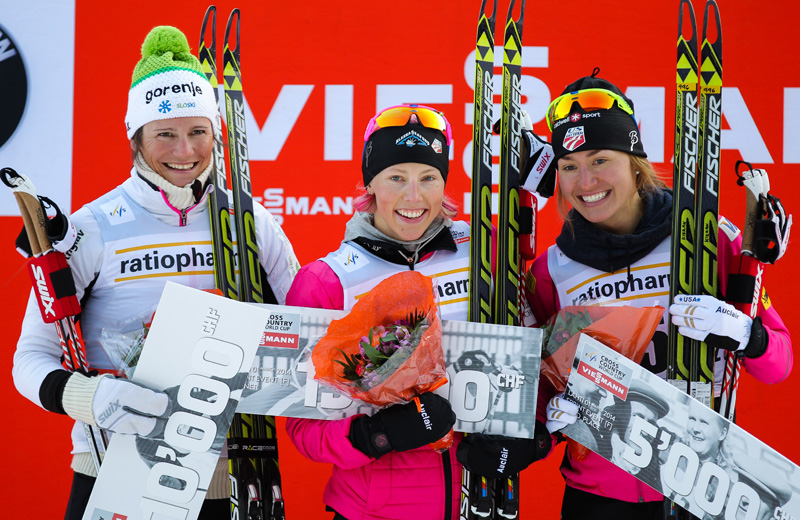
    The women's World Cup freestyle sprint podium in Lahti, Finland, with winner Kikkan Randall (c) and Sophie Caldwell (r) in third for the U.S., and Slovenia's Katja Visnar in second (l). (Photo: Fischer/Nordic Focus)
    The women’s World Cup freestyle sprint podium in Lahti, Finland, with winner Kikkan Randall (c) and Sophie Caldwell (r) in third for the U.S., and Slovenia’s Katja Visnar in second (l). (Photo: Fischer/Nordic Focus)