From the FasterSkier archive — posts syndicated from athletes’ and coaches’ own blogs between 2004 and 2012, kept online as published. Current coverage is at fasterskier.com.
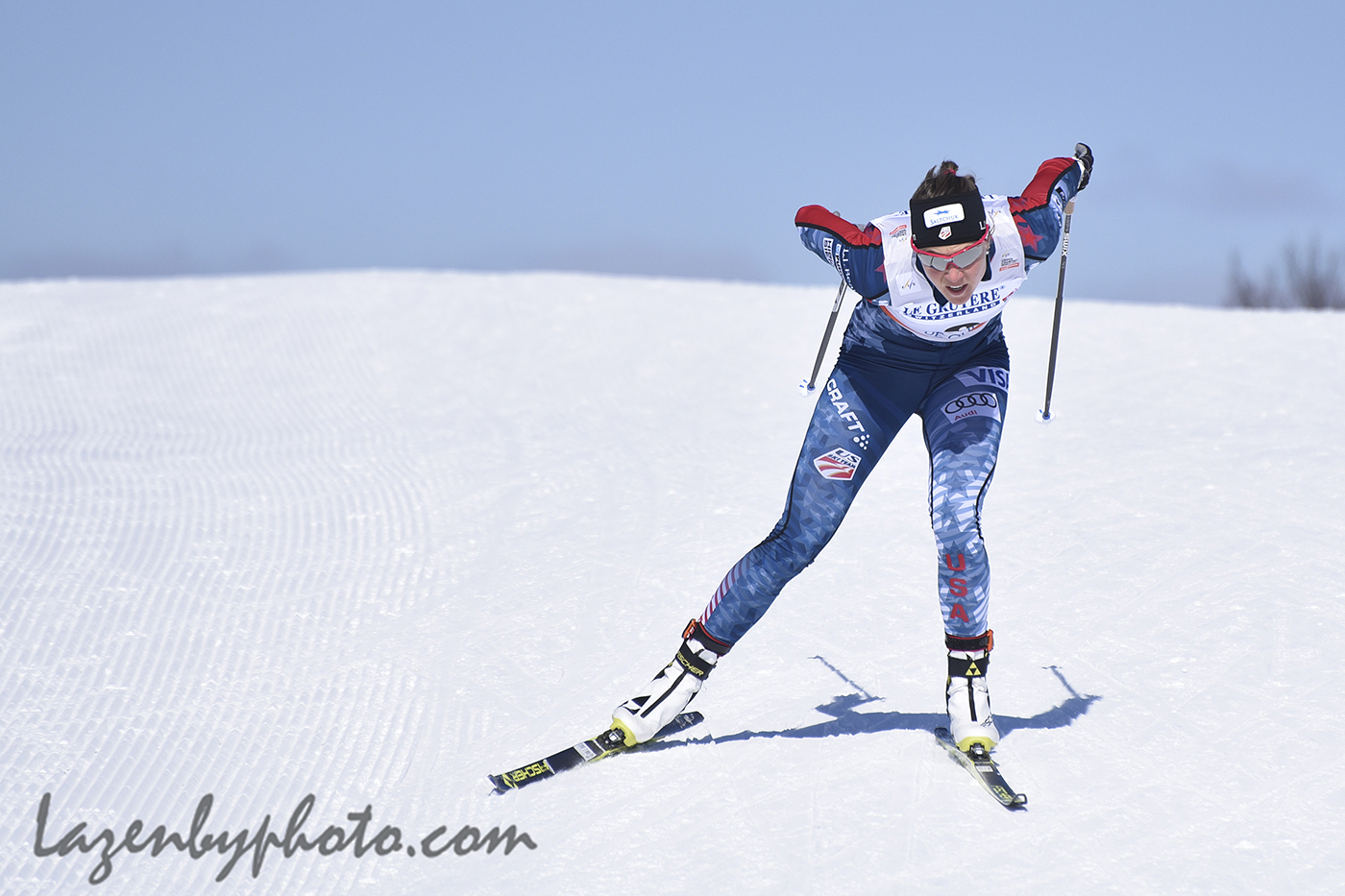
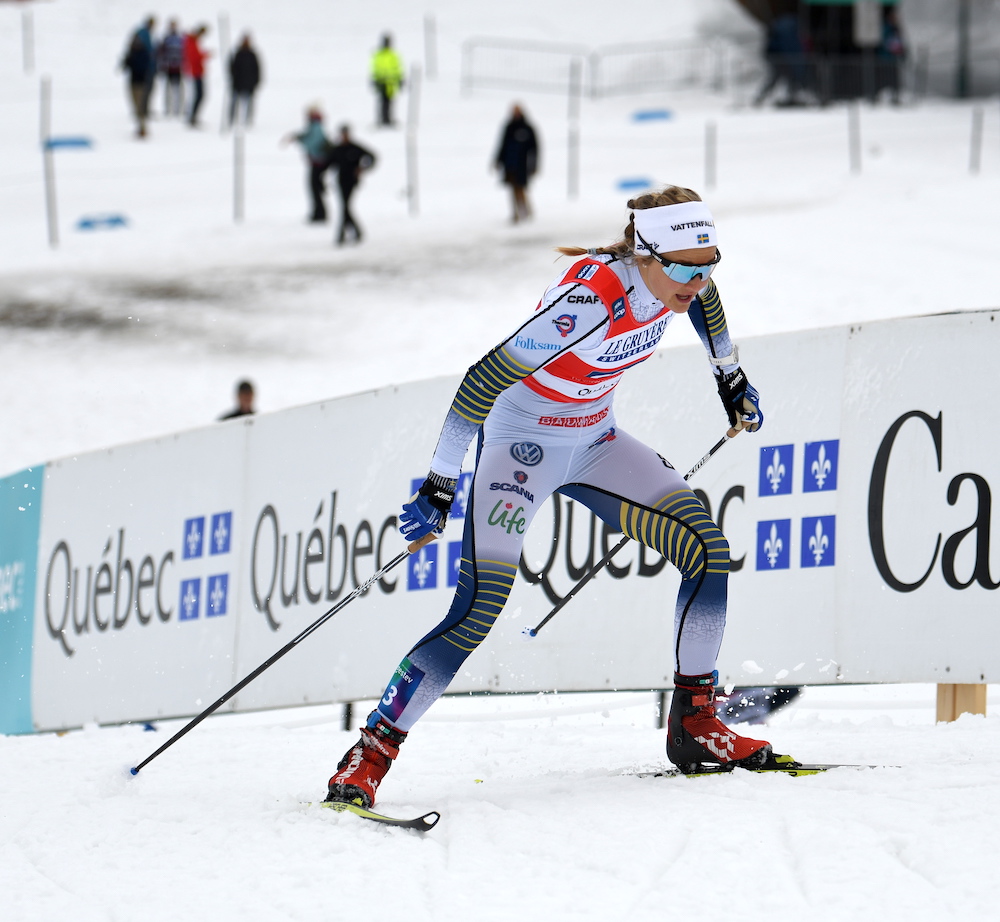
2017 photograph of Sadie Bjornsen racing in Québec. (Photo: John Lazenby/lazenbyphoto.com)
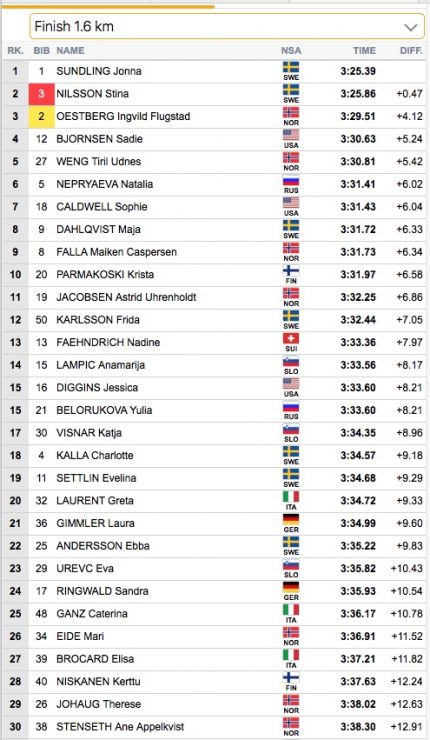
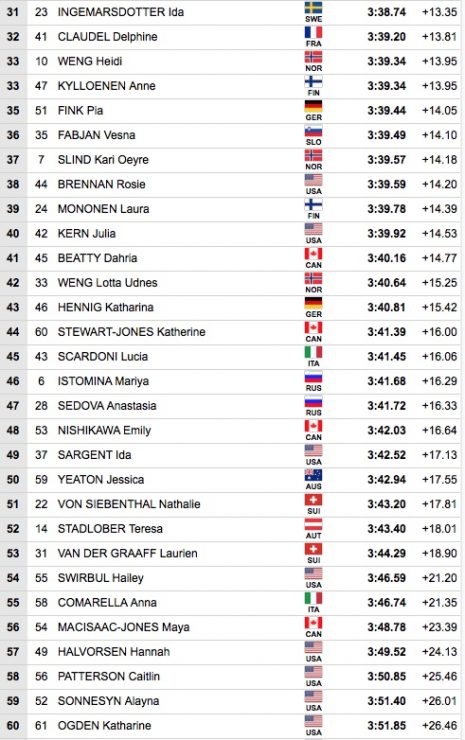
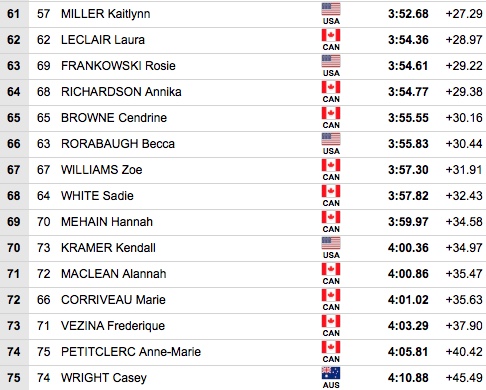
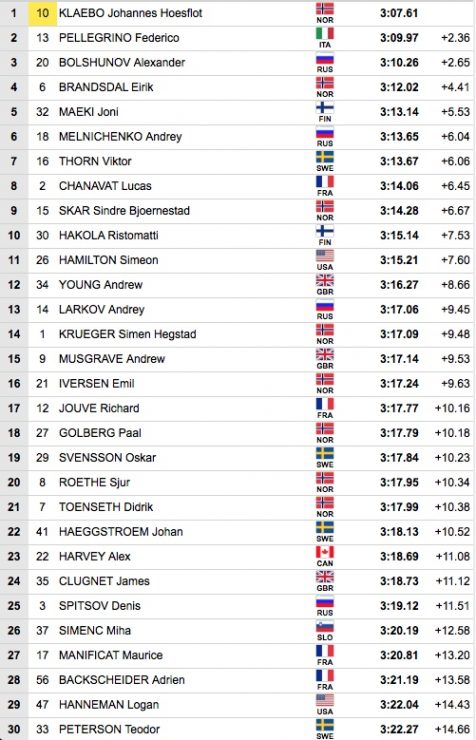
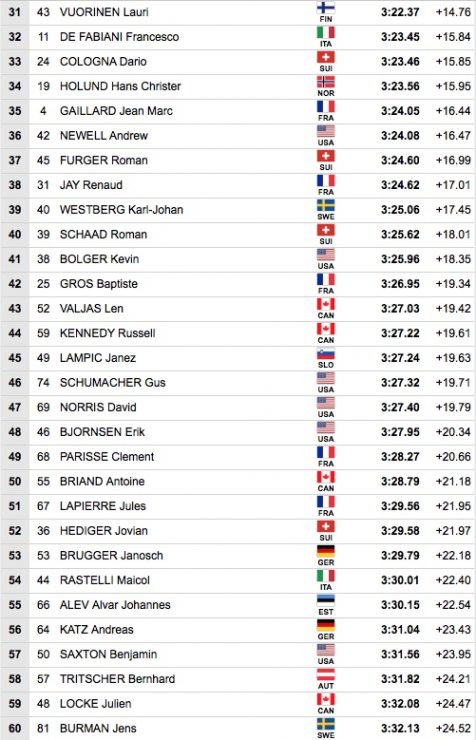
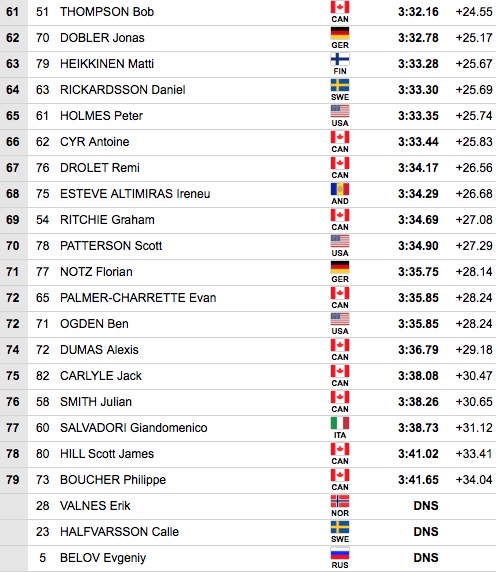
We’re changing the format for this race rundown. With many North Americans racing during World Cup finals in Québec, screenshots from Live Timing will keep the rundown updated efficiently.
FIS World Cup 1.6 K Freestyle Sprint Québec
Results from the women’s 1.6 k freestyle sprint qualifier: Sadie Bjornsen, Sophie Caldwell, and Jessie Diggins made the heats for the U.S. Full qualification results are below.
Sweden’s Stina Nilsson during the 1.6 k skate sprint qualifier in Quebec. (Photo: Doug Stephen)
In the men’s 1.6 k skate sprint qualifier, Johannes Høsflot Klæbo set the fastest time with a 3:07.61. Johannes Høsflot Klæbo. For the U.S., Simi Hamilton qualified in 11th and Logan Hanneman 29th. Alex Harvey for Canada qualified in 23rd. They were the only North Americans to qualify for the heats.
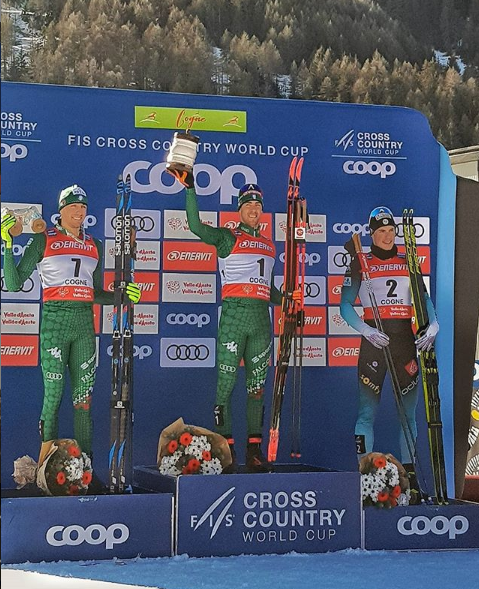
Italy’s Federico Pellegrino (c) after winning the men’s 1.6-kilometer freestyle sprint on Saturday in Cogne, Italy. His teammate, Francesco de Fabiani (l) placed second and France’s Lucas Chanavat third. (Photo: FIS Instragram screenshot)
The sun illuminated the alps in Cogne, Italy, the final World Cup stop before the FIS World Championships in Seefeld, Austria. Nestled in the mountains, the Aosta Valley is home to both Federico Pellegrino and Francesco De Fabiani, who seized the opportunity to delight the home crowd. The 1.6-kilometer freestyle race was also a chance for Pellegrino to earn his 12th individual freestyle sprint victory, tying for the second-most overall for any World Cup athlete with Kikkan Randall and Sweden’s Stina Nilsson. Marit Bjørgen of Norway holds the most with a remarkable 24 skate sprint victories.
Pellegrino won the qualifier in a time of 3:10.57, followed by Lucas Chavanat (+0.20) and Richard Jouve (+1.65) of France, Sergey Ustiugov of Russia (+2.12), and Simi Hamilton of the United States (+3.83).
While no Americans made the heats in Lahti last weekend, four placed in the top 30 on Saturday in Cogne. After Hamilton, Logan Hanneman qualified in 15th (+5.44), Andy Newell in 27th (+8.38), and Kevin Bolger in 28th (+8.42).
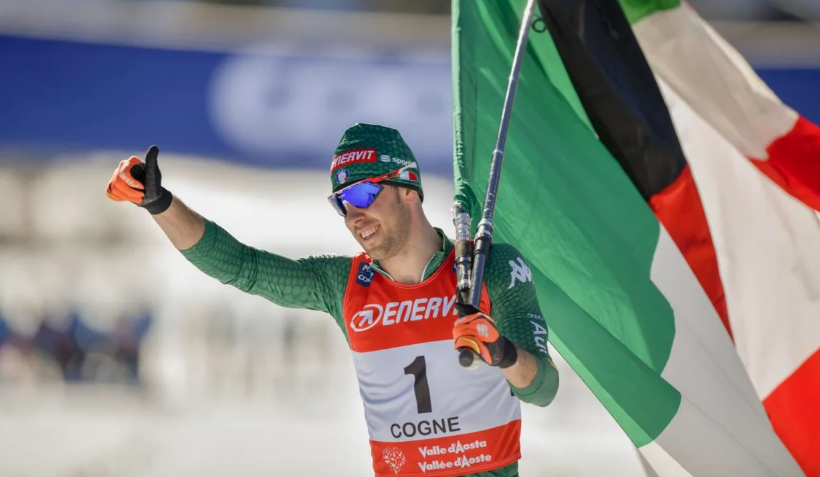
Federico Pellegrino carries the Italian Flag as gives his countrymen a thums up after winning the 1.6-kilometer freestyle race in Cogne. (Photo: Screenshot FIS/Nordic Focus)
When the heats began, it seemed that Murphy’s Law began to take effect, as numerous crashes took out many hopefuls for the final round. In the first heat, Ustiugov led the pack to a fast start, positioning himself in front through the early climbs. Pellegrino marked the Russian, staying close to his tails and maneuvering past him on a curve at the end of the course’s long descent. While cresting a roll just after Pelligrino’s move to the front, Ustiugov caught a ski and crashed, losing contact with the remainder of the men in the heat.
From there, Pellegrino took control through the finish, leaving himself time to stand up before the line. Behind him was a close fight for second place between Baptiste Gros of France, Russell Kennedy of Canada, Mathias Rundgreen of Norway, and Karl-Johan Westberg of Sweden. Gros took second, while Westberg and Kennedy were eventually able to advance to the semifinals as lucky losers thanks to the heat’s fast times.
In Hamilton’s quarterfinal, the fourth of five, a tangle between Jouve and Alexander Bolshunov of Russia took place just in front of the American, who had tucked himself in toward the back of the pack for the first half of the race (Bolger had been slated to race Quarterfinal 4, but did not start). Luckily for Hamilton, he was quick on his feet and dodged their skis as he maneuvered between them unscathed, moving into second position amidst the men left standing. With a hard press back to the pack from Jouve it was the American and the Frenchmen in a duel to the finish behind Sweden’s Marcus Grate. Grate took the quarterfinal win, while Hamilton snagged the automatic advancing spot by 0.1 seconds ahead of Jouve.
“I think the course caught everyone off guard,” Hamilton explained. The course itself featured a single long climb long sweeping descent and a few gut punching rollers before a sharp corner to the finish.
“At least for the guys especially, I think people thought it would spread out a little bit more because it was kind of a longer course and the first climb was so long and such a grinder climb that I think people thought that it was going to spread out and that there would be less contact because of that. But really, it’s pretty crazy, I think almost every men’s heat, especially I think in the quarter and maybe the semis, definitely had a lot of bumping and some crashes.”
Bolger’s decision to sit out the quarterfinal stemmed from his focus on races to come at World Champs. He told FasterSkier in an email that he has been battling a cold and wanted to be conservative to ensure that he is in top form during the sprint in Seefeld on Thursday.
“I’m feeling great this afternoon and looking ahead now to the sprint at World Champs!” he wrote. Bolger ended the day in Cogne in 30th.
In Semifinal 1, Kennedy led the group through the first half of the course, with Pellegrino, de Fabiani, Gros, Chavanat and Sondre Turvoll Fossli of Norway tucked in patiently behind him. Pellegrino took charge in the second half as he skied to the win, spreading his competitors out behind him. Just behind, in a fight for second place, Chavanat outsprinted De Fabiani, with Fossli taking fourth.
Kennedy ended his day in 12th, his career-best result in an individual World Cup event (at the time of publication, FasterSkier had not received comment from Kennedy).
“I felt very good from the beginning of the day,” wrote Kennedy in an email. “I got some good insight from Alex Harvey before the race and did a good job executing what he had suggested! Was super excited after the qualifier.
“I haven’t been know for my finish, so my strategy was to get as many lucky loser spots as possible,” Kennedy explained. “I picked a hard quarter and then went for it to try to make a fast heat in the semi. It was a good strategy but I didn’t have quite as much as I had hoped for in the end.”
In Semifinal 2, Hamilton relied again on patience as he tucked in toward the back of the group through the first half, slowly moving ahead in the final 600-meters. Toward the end of the long descent, yet another crash took place as Jovian Hediger of Switzerland tangled skis with Håvard Solås Taugbøl of Norway and Tom Mancini of France. Marcus Grate of Sweden took the win with Hamilton just behind. As the first heat ended up much faster than the second, both De Fabiani and Fossli advanced to the final as lucky losers.
While there were no crashes in the final, a problem with Pellegrino’s pole spiced things up for the Italian sprint specialist in his quest to win at home. Heading up a hill in V1, as his arm swung forward, he suddenly no longer had a pole attached to the strap on his right hand. Impressively, the Italian did not lose any momentum and continued up the climb where he was handed a new pole which he calmly exchanged without losing his position in third.
He stayed tucked in behind Chavanat and De Fabiani as the three began to separate themselves at the front. Pellegrino surged at the last climb to position himself for a close fight in the final stretch. As the trio of men powered through the straightaway, Pellegrino pulled away from his opponents throwing his arms up in celebration as he crossed the line in first, stopping the clock at 3:09.01. De Fabiani took second (+0.48) besting Chavanat in third (+0.51) by 0.03 seconds. Hamilton landed just off the podium in fourth (+3.91), followed by Fossli in fifth (+4.03), and Grate in sixth (+27.90).
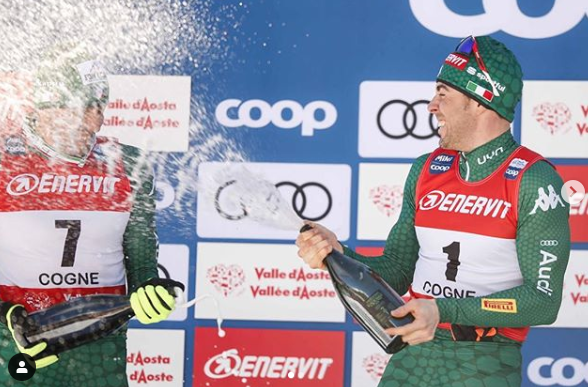
Federico Pellegrino showers his teammate Francesco De Fabiani with champagne as they celebrate taking first and second in the 1.6-kilometer freestyle sprint in Cogne, Italy. (Photo: Instagram screenshot @chiccopelle)
The crowd of Italians cheered as Pellegrino and De Fabiani congratulated each other with an embrace at the finish. In his interview, Pellegrino thanked his countrymen for their support.
“They gave me a lot of pushing,” he told FIS. “I needed this before the World Ski Championship, I tell them to come, and I see that a lot of people came.”
He later added, “Today was difficult to focus but I needed this energy by my people, by region, my valley, because I know now that when I go to Seefeld I have the responsibility to give everything that I can.”
From crashes to illness, Hamilton has had several strokes of bad luck this season. Saturday, things turned around for the 31 year old.
“I’m psyched for sure,” he told FasterSkier in a call. “I feel like I’ve been really fit this year and fast and I haven’t really had a great opportunity to show that. I had some frustrating races in the Tour and stuff, so it felt really good to kind of finally be able to put all the pieces together.”
Sitting above 5,000 ft in elevation, Cogne is one of the higher courses on the World Cup. However, it is still nearly 3,000 feet below Hamilton’s hometown of Aspen, Colorado.
“The conditions were kind of right in my wheelhouse with a little bit of altitude, fast cold snow, and bluebird skies, and being in the big mountains made me pretty happy,” he said. “I think it’s a great sign leading into World Champs and I know that I’m really fit right now. Training the last month has gone really well and I’m just psyched to be able to hopefully put together another good one in a few days [in Seefeld].”
Hamilton is known for being an agile skier, which was certainly to his advantage given the number of mishaps in Saturday’s event. In both the quarters and the semis, Hamilton’s early patience positioned him to avoid any hang ups. While his positioning was part of the plan, the way things played out was unforeseen.
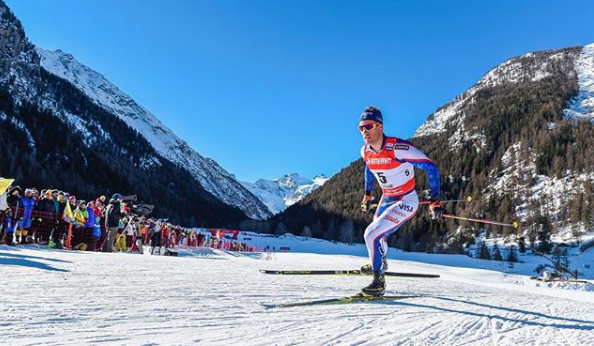
Simi Hamilton skis past a stunning backdrop on his way to a fourth place finish in the 1.6-kilometer freestyle sprint in Cogne, Italy. (Photo: Nordic Focus / Instagram screenshot @simihamilton)
“In my quarter, my tactics were to try to ski that whole first climb really kind of relaxed and I knew I probably wasn’t going to be able to relax a lot if I was leading pack so I just kind of settled in closer to the back and then tried to get around people on the long downhill, but that was kind of the place where the course took everyone by surprise. I think people thought that there was going to be a lot more passing going on in that downhill and they didn’t really, it just kind of stayed as one tight glob all the way down so I wasn’t able to move up there.
“For sure, I got kind of lucky with there being that big crash with Richard and Bolshunov coming up toward the finish in my quarter and I was able to get through that unscathed,” he continued. “I still felt good at that point so I think that I would have been able to put in a good finishing sprint and hopefully moved on anyway, but it definitely helped me to be able to ski past those guys when they were on the ground and then move on that way.”
Despite the risk of ending the day early, Hamilton enjoyed the chaos on course.
“It was a good course, really fun, and I think some crashes are always kind of good because that means it’s more exciting as a sprint race,” he said. “I think people are more psyched to watch a race where there’s some bumping and grinding, it’s always much more fun to race when it’s kind of like that anyway.”
Two more Americans ended the day in the top 30, with Andy Newell placing 23rd and Logan Hanneman 27th.
Erik Bjornsen did not make the heats, placing 39th. Also for North America, Russell Kennedy of Canada qualified in 12th (+5.30). Alex Harvey did not make the heats and finished his day in 48th and Evan Palmer-Charrette 59th.
Racing in Cogne continues tomorrow with 10/15k classic races.
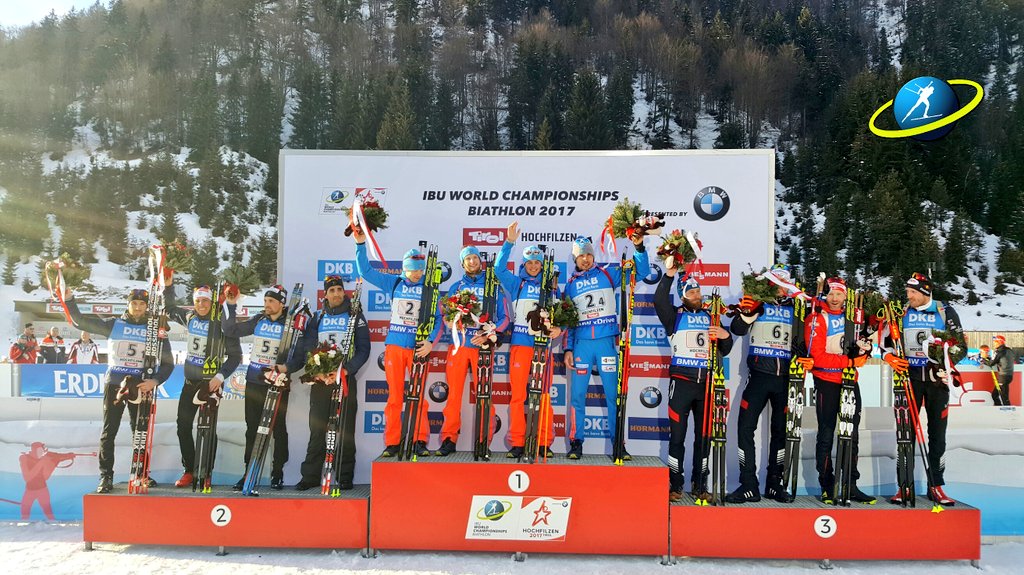
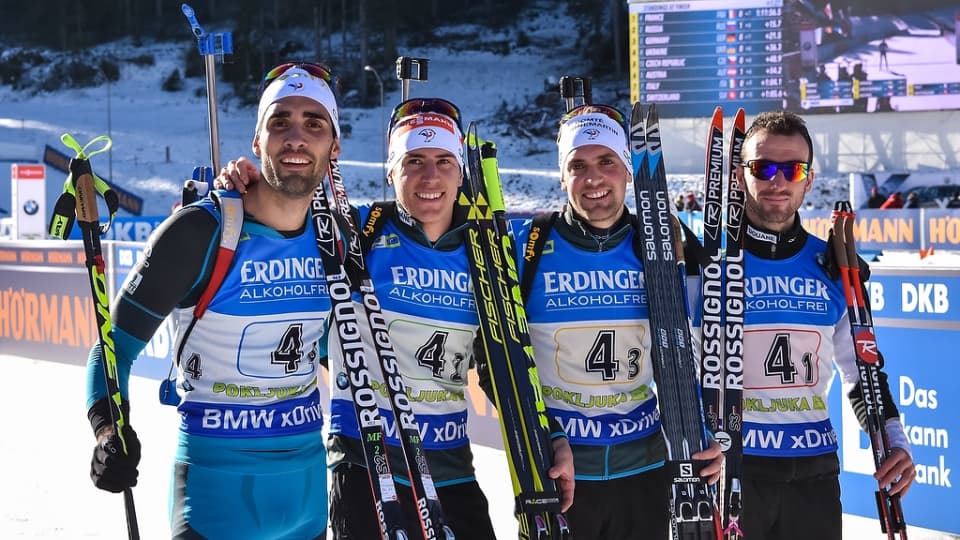
The men’s 4 x 7.5 k relay podium at 2017 IBU World Championships on Saturday in Hochfilzen, Austria, with Russia (c) in first, France (l) in second, and Austria (r) in third. (Photo: IBU World Champs/Twitter)
IBU World Championships (Hochfilzen, Austria): Men’s relay
[UPDATED] Russia’s four-man relay team hit nearly every target on Saturday, using a total of just three spares to clean 40 targets, and stayed out of the penalty loop to capture gold in the men’s 4 x 7.5-kilometer relay at the International Biathlon Union (IBU) World Championships in Hochfilzen, Austria.
It was the last team event and the second-to-last day of the championships, with the men’s and women’s elite mass starts remaining on Sunday. Anton Shipulin anchored the Russians to first, 5.8 seconds ahead of France’s Martin Fourcade, after Shipulin cleaned his prone stage and used one spare in standing to hold onto the lead his team built. Fourcade cleaned both stages to secure silver for his team, and Austria took bronze (+20.1) with anchor Dominik Landertinger.
After Russia’s Alexey Volkov used one spare in each of his shooting stages and came through the exchange in seventh, Maxim Tsvetkov and Anton Babikov both cleaned without any spares to bring the team into fourth, then first, respectively.
France’s first leg Jean-Guillaume Béatrix shot clean as well and tagged Quentin Fillon Maillet in second. Fillon Maillet then needed one spare in prone, but cleaned standing to take the lead, tagging Simon Desthieux in first. Desthieux used three spares in prone, but avoided the penalty lap before tagging Fourcade in third, 12 seconds behind Austria in second. Fourcade closed the gap and clinched second, and France combined for a total of just four spare rounds.
Austria achieved bronze in front of a home crowd with Daniel Mesotitsch, Julian Eberhard, Simon Eder, and Landertinger combining for 10 spares and no penalties.
Finishing 8.5 seconds after Austria, Germany placed fourth. Italy was a minute and a half out of first in fifth, Ukraine took sixth (+1:41.3), and the U.S. placed seventh (+1:50.5) with Lowell Bailey, Leif Nordgren, Tim Burke, and Sean Doherty. Bailey initially put the team in fourth at the first exchange, 12.4 seconds out of first, then Nordgren tagged Burke in sixth, 17 seconds behind. Burke used four spares to clean and tagged Doherty in seventh, about a minute back. The Americans used a total of eight spares but had no penalties.
Canada finished 13th (+3:35.5) with Christian Gow, Scott Gow, Macx Davies, and Brendan Green. They were 39 seconds out of first and in 12th place after Christian Gow’s first leg, then slipped to 14th before Davies moved them back into 12th by the last exchange. Canada had a total of 10 spares and zero penalties.
FIS Cross-Country World Cup (Otepää, Estonia): Freestyle sprint
In the last World Cup before the upcoming 2017 International Ski Federation (FIS) Nordic Ski World Championships next week in Lahti, Finland, five U.S. women qualified in the top 12 of the women’s 1.3-kilometer freestyle sprint, and Jessie Diggins reached the final on Saturday in Otepää, Estonia.
Diggins started the day by placing 12th in the qualifier, 3.93 seconds behind Sweden’s Stina Nilsson in first (and her U.S. teammates Kikkan Randall in third, Sophie Caldwell in fourth, and Ida Sargent in 10th) before winning her quarterfinal and semifinal. In the final, Diggins wad gapped by the leaders on the final climb and finished fifth (+6.82).
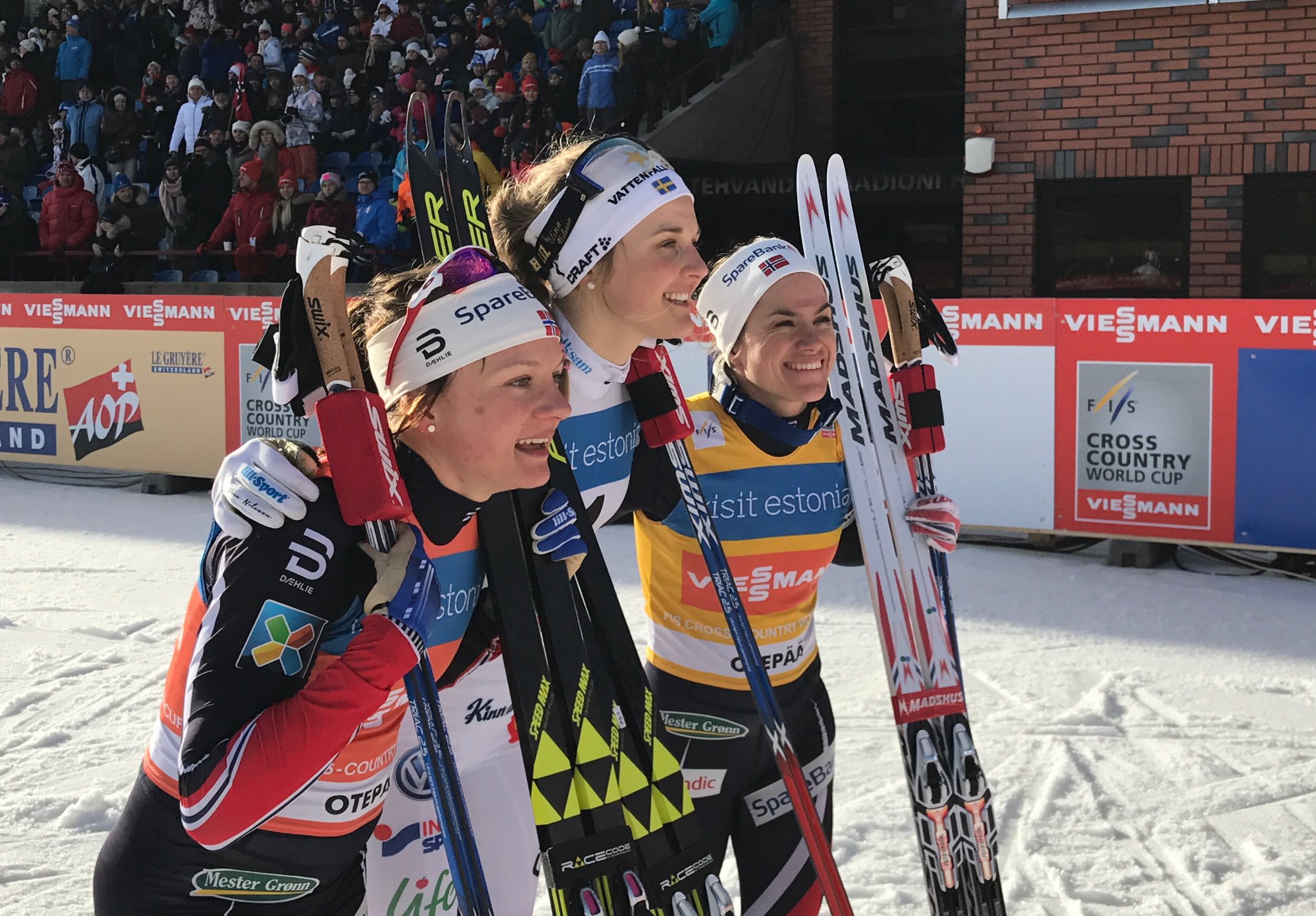
The women’s freestyle sprint podium at the Otepaa World Cup on Saturday in Estonia, with Swedish winner Stina Nilsson (c), Norway’s Maiken Caspersen Falla (l) in second and Heidi Weng (r) in third. (Photo: FIS Cross Country/Twitter)
Nilsson won the final in a time of 2:49.96 minutes, just ahead of Norway’s Maiken Caspersen Falla (+0.27) who lost her balance and her speed with it on the last corner. The two had broken away from third place and Nilsson led into the final straightaway and held Falla off for the win. Norway took second through fourth with Heidi Weng in third place (+3.75) and Astrid Uhrenholdt Jacobsen in fourth (+4.91).
Randall initially finished her quarterfinal in third position and would have been out, but advanced when Russia’s Natalia Matveeva was relegated to last for obstruction. In the same semifinal as Diggins, Randall fell cresting a small hill over a tunnel and finished fifth (+13.30) for ninth overall on the day.
Caldwellplaced second in her quarterfinal heat behind the day’s winner Nilsson, then stumbled halfway up a climb early in her semifinal, but stuck with the pack to finish fifth (+1.83) for 10th overall.
Sargent raced in the same quarterfinal as Falla and narrowly missed advancing to the semifinal in third place, fewer than 0.2 seconds behind Switzerland’s Laurien van der Graaff in second and 0.35 seconds behind Falla, who won that heat. Sargent placed 13th on the day.
Sadie Bjornsen qualified 25th and finished fourth (+2.82) in the same quarterfinal as Randall for the 25th overall.
Canada’s Dahria Beatty also qualified for the sprint heats in 30th place, and finished sixth in her quarterfinal for 29th overall.
Also for Canada, Cendrine Browne finished the qualification in 48th place and Katherine Stewart-Jones was one position behind in 49th.
Also for the U.S., distance specialists Chelsea Holmes and Rosie Brennan placed 58th and 60th, respectively.
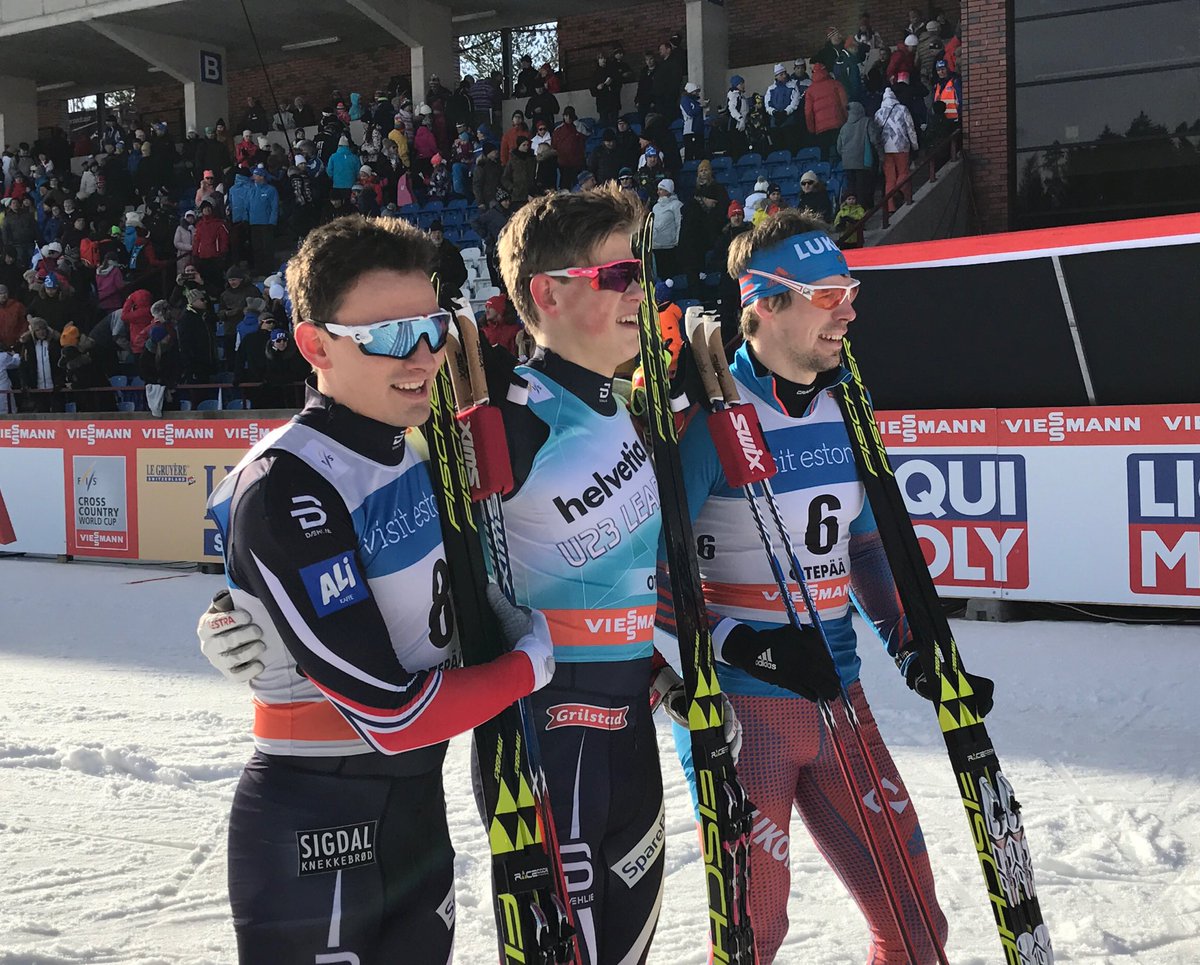
The men’s freestyle sprint podium on Saturday at the World Cup in Otepaa, Estonia, with Norway’s Johannes Høsflot Klæbo (c) taking his first World Cup win, Norway’s Finn Hågen Krogh (l) in second, and Russia’s Sergey Ustiugov (r) in third. (Photo: FIS Cross Country/Twitter)
In the men’s 1.6-kilometer sprint, Norway’s Johannes Høsflot Klæbo achieved the first World Cup victory of his career in a time of 3:06.53 minutes, holding onto a lead he had created with an attack right out of the start gate in the final. His teammate Finn Hågen Krogh placed second (+0.60), taking the inside lane in the last turn to push reigning Tour de Ski winner Sergey Ustiugov of Russia to third (+1.0).
For the North Americans, it was a day of narrow misses.
For the U.S., Simi Hamilton started his race day by qualifying in seventh position, and placed second in his quarterfinal. He then closely missed out on the final after placing fourth in his semifinal in a four-way sprint photo finish (+0.33), just 0.04 seconds behind the third place and lucky loser time of Norway’s Håvard Solås Taugbøl, who advanced. Hamilton ended the day in eighth overall.
Canadian World Cup Team member Alex Harvey snuck into the sprint heats in 29th place in the qualifier, then just missed out on advancing from his quarterfinal in a photo finish for second with Great Britain’s Andrew Young, who took it by 0.04 seconds. Harvey finished third in that heat, 0.6 behind Italy’s Federico Pellegrino, for 15th for the day. Young went on to finish sixth in his semifinal for 12th overall, and Pellegrino advanced as a lucky loser from the same semifinal and was fourth in the final (+4.77).
American Andy Newell qualified 16th and finished sixth (+1.89) in his quarterfinal for 27th overall.
Canada’s Len Valjas missed qualifying for the heats in 40th place, as did his teammate Devon Kershaw in 50th.
American Erik Bjornsen was 53rd, and for Canada, Jesse Cockney 54th and Knute Johnsgaard 56th. In his World Cup debut, Benjamin Lustgarten placed 64th in the qualifier.
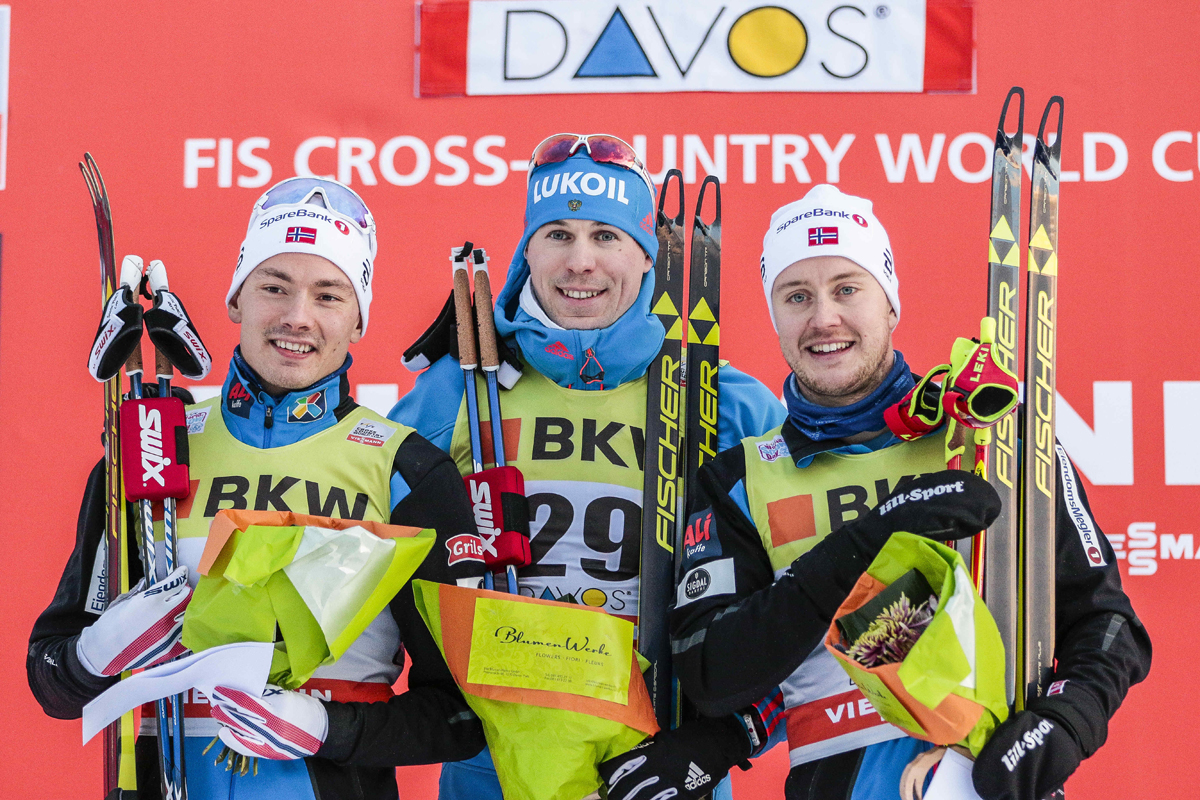
Left to right: Norway’s Finn Hågen Krogh, Russia’s Sergey Ustiugov, and Norwegian skier Sindre Bjørnestad Skar on top of the podium for the men’s 1.6-kilometer freestyle sprint on Sunday in Davos, Switzerland. (Photo: Fischer/NordicFocus.com)
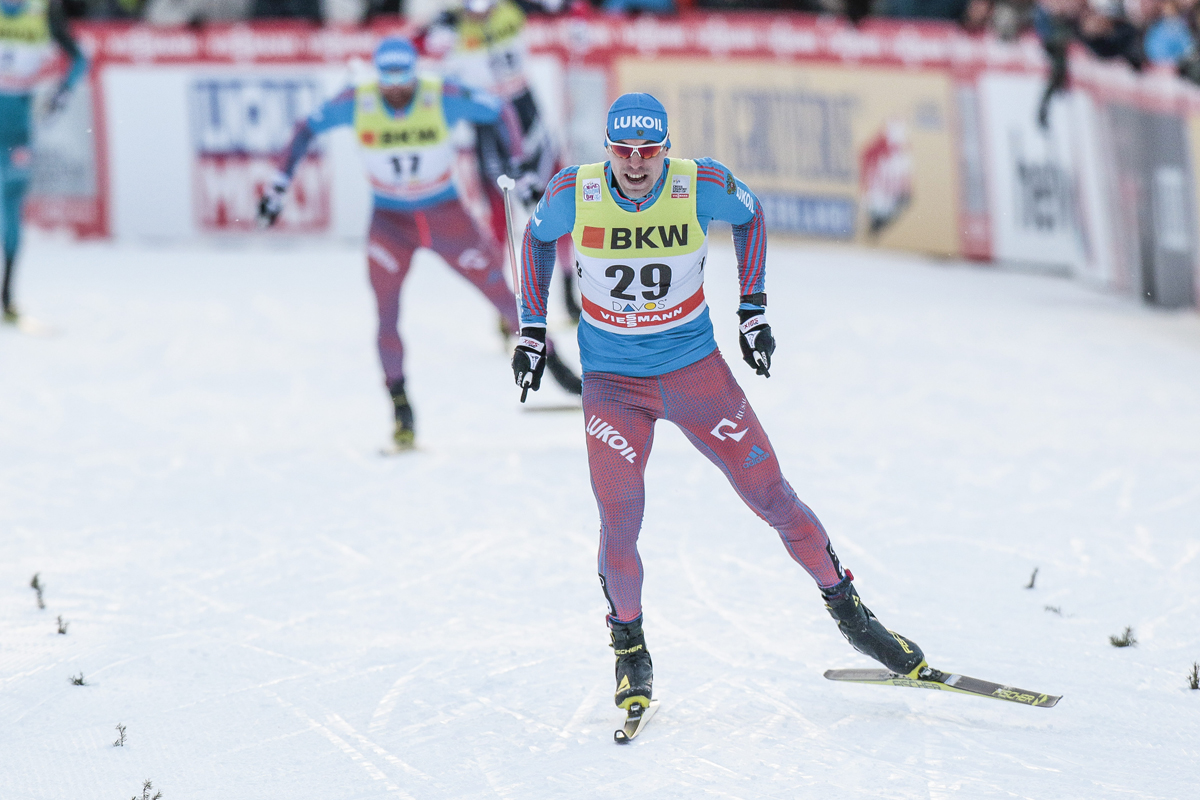
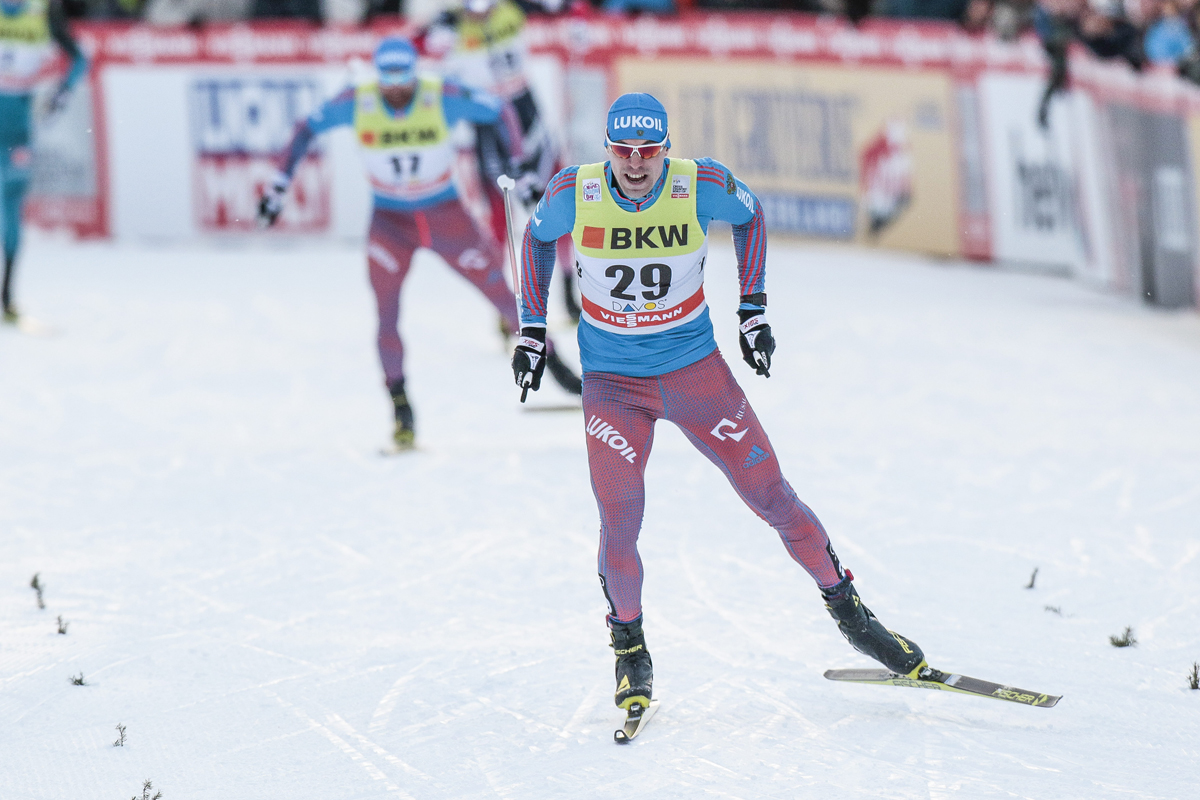
Prior to the start of the men’s 1.6-kilometer freestyle sprint final on Sunday in Davos, Switzerland Sergey Ustiugov pointed to his chest. In bib 29, the eventual overall race winner had just barely qualified for the heats–had his qualifying time been fifteen hundredths of a second slower, he would have cooled down and watched the final from the sideline.
But the 24-year-old eked into the rounds, qualifying 4.28 seconds back from Lucas Chanavat of France’s first place qualification time of 2:20.78.
The Russian continued to leave the leading to the rest of the field throughout the day, racing in the back of the pack during most of his quarterfinal and semifinal.
Russia’s Sergey Ustiugov tops the men’s 1.6-kilometer freestyle sprint podium on Sunday in Davos, Switzerland. (photo: Fischer/Nordic Focus)
In fact, by the first descent of his quarterfinal, Ustiugov was in sixth, with a close to 50-meter gap between his skis and those of Norway’s Sindre Bjørnestad Skar, the quarterfinal’s frontrunner.
The Russian’s waiting tactic worked, however, and by the final climb, Ustiugov had enough energy to not only move around all five skiers in front of him, but distance himself from Skar and Italy’s Federico Pellegrino by 15-meters in the finishing stretch. He took the quarterfinal win and advanced automatically to the semifinals.
A similar scenario went down in Ustiugov’s semifinal, with his Russian teammate Alexey Petukhov taking the lead from the start and Ustiugov lurking in the back of the pack through the course’s first hairpin turn, major climb and major descent.
Once again, Ustiugov moved from sixth to first by the final major course climb, leaving the rest of the semifinalists, including Skar and his Norwegian teammate Finn Hågen Krogh, scrambling. Ustiugov safely crossed first, while Krogh crossed second and Petukhov and Skar’s times earned them lucky loser spots in the men’s final.
By the start of the men’s final, Ustiugov’s bib gesture gave viewers a visual reminder that his come-from-behind tactic for the day was working.
“I did not have the best qualification but I felt much better in the heats,” Ustiugov said according to an International Ski Federation (FIS) press release. “I knew I had power to win. It is great to win here in Davos.”
In the final, however, Ustiugov switched strategies. The Russian took to the front from the start, skiing in second behind France’s Chanavat for the first half of the final.
By the final course climb, Ustiugov overtook Chanavat, with Krogh following closely behind. Heading into the final 50-meters, Chanavat lost steam and Ustiugov and Krogh began the battle for first.
Krogh pulled hard to the Russian’s right, and with 20-meters to go it appeared the Norwegian would take the win. But two V2 poles later, Ustuigov proved too powerful for Krogh, and the Russian edged the Norwegian by fifty-nine hundredths of a second for his first sprint victory of the season in a time of 2:24.65.
Sindre Bjoernestad Skar (NOR) sprints to the men’s podium in Davos (SUI). (Photo: Fischer/NordicFocus.com)
“[Ustiugov] did pretty much the same in every heat,” Krogh told FasterSkier. “So I knew that would be the guy to follow and I tried to be first in the last uphill…[and] I kind of did, but not enough to take him in the final stretch. He was just stronger today.”
Ten meters behind, a second Russian versus Norwegian head-to-head ensued between Petukhov and Skar for the final podium spot. In a photo finish, Skar outlunged Petukhov by eighteen hundredths of a second, securing third place overall (+3.29) and a second Norwegian name to the podium.
Petukhov took fourth (+3.47) and rounding out the top six of the men’s sprint final was Norway’s Emil Iversen in fifth (+5.52) and Chanavat in sixth (+11.48).
Valjas Finishes 14th Overall, Hamilton 23rd
After qualifying 12th and 24th respectively, Canada’s Lenny Valjas and U.S. Ski Team (USST) A-team member Simi Hamilton were entered in the same quarterfinal–the only two North American men who advanced to Sunday’s sprint rounds.
Not getting the start he hoped for in his quarterfinal, Valjas decided to race in the back of the pack for the first half of his race.
“It’s a tough course–it’s all work,” Valjas said during an in-person interview. “So as soon as I realized my start wasn’t very good…I tried to then conserve…[and] happily sat in the back.”
The Canadian managed to move around Hamilton as well Finland’s Ristomatti Hakola coming into the final stretch, crossing his quarterfinal in third, just fifty-four hundredths of a second off of advancing to the semifinal.
“I was happy with it, unfortunately didn’t get the lucky losers spot,” Valjas said. “But I’m happy with another solid weekend for me.”
Coming off of an illness, Hamilton described his race as a “step in the right direction,” indicating that working on his speed will be his focus for the next few weeks.
“[My] speed right now is definitely not where I want it to be,” Hamilton said during an in-person interview. “So I think Christmas break will be a great chance to just work on my speed a bit and just get that gear back… I know I am just going to keep feeling better throughout the season and I’m psyched for the rest of it.”
USST Head Coach, Chris Grover agreed with Hamilton, explaining that as both Hamilton and USST A-team member Andy Newell–who just missed qualifying on Sunday and finished in 36th overall–continue to recover from illness, speedwork will be a primary focus for the two.
“They’re technically very efficient, but they’re just missing a little bit of the high end firing and pop right now,” Grover said during an in-person interview. “Good for Simi to see him in the rounds today…It’s coming and I think you know, by Tour de Ski time and right after the Tour those guys, they’ll be ready.”
Canada’s Alex Harvey was left just outside advancing in 33rd overall. Devon Kershaw ended the day in 49th, Knute Johnsgaard 60th, Bob Thompson 67th, and Andy Shields 73rd. Jesse Cockney did not finish the race.
The third American to race on Sunday, Erik Packer, finished in 95th overall.
The French men’s relay team after their IBU World Cup win on Sunday in Pokljuka, Slovenia, with (from left to right) Martin Fourcade, Quentin Fillon Maillet, Simon Desthieux, and Jean-Guillaume Béatrix. They beat Russia by 15.7 seconds for the win. (Photo: IBU)
Welcome to The Rundown, your quick primer of need-to-know information about the day’s racing. We’ll be updating this digest as the day goes on with additional results, photos and quotes. The Rundown is NOT a race report; stay tuned for complete race reports later today with interviews from the day’s top racers.
***
Note: This recap has been updated to reflect the correct positions each of the four Canadian women exchanged in during Sunday’s 4 x 6 k IBU World Cup relay.
IBU World Cup in Pokljuka: Men’s & Women’s Relays
Germany and France reached the podium in both the men’s 4 x 7.5-kilometer and women’s 4 x 6 k sprints on Sunday, the final day of the International Biathlon Union (IBU) World Cup in Pokljuka, Slovenia.
France won the men’s race by 15.7 seconds over Russia with a total of seven spare rounds and zero penalties. Jean-Guillaume Béatrix started off by putting the French team in fourth, then Quentin Fillon Maillet elevated them to first, a position both Simon Desthieux and Martin Fourcade held for the victory in 1:11:56.5.
“When we started the relay, we thought that winning was possible,” Béatrix said, according to an IBU press release. “At the same time, the competition was very tough. There were many strong teams today.”
“I was very happy to tag Martin with a 20-second lead,” Desthieux said. “This is good for my confidence.”
Russia placed second with Maxim Tsvetkov, Anton Babikov, Matvey Eliseev, and Anton Shipulin, the four of which combined for one penalty (on Eliseev’s third leg) and six spare rounds.
Germany rounded out the podium in third, 21.5 seconds behind France, with Erik Lesser, Matthias Dorfer, Benedikt Doll, and Simon Schempp. In ninth after Lesser’s first leg, Dorfer brough the team to eighth and Doll raced them into second before Schempp lost one place to end up third. They used a total of 11 spares but avoided the penalty lap.
Canada placed 10th of 22 teams, 1:44.7 out of first with one penalty and seven spares. Christian Gow started the team out with clean shooting and tagged off in sixth at the first exchange, and his older brother Scott Gow also shot clean without any spares to move up to fourth at the second tag. Macx Davies required three spares and had to ski a penalty lap on his prone stage, then used another spare to clean standing and tagged off in 14th place. Brendan Green anchored the Canadians to 10th, using three spares but avoiding a penalty in prone, then cleaning standing without any spares.
“I had a somewhat disappointing pursuit race yesterday, and my goal for today was to refocus on the range and push the ski speed as much as possible,” 28-year-old Scott Gow told Biathlon Canada, according to a press release. “I was happy with the overall performance I was able to put forward for my leg of the relay, and I was especially happy with another clean shooting day.
“Today was an acceptable result for the team,” he added. “Christian and I are very proud of our results so far this season. We worked very hard all year to try and elevate our racing abilities to the next level, and we saw our hard work pay off today with great skiing and perfect shooting for both of us. It’s also a big confidence boost going forward with the season knowing we are capable of competing among the best.”
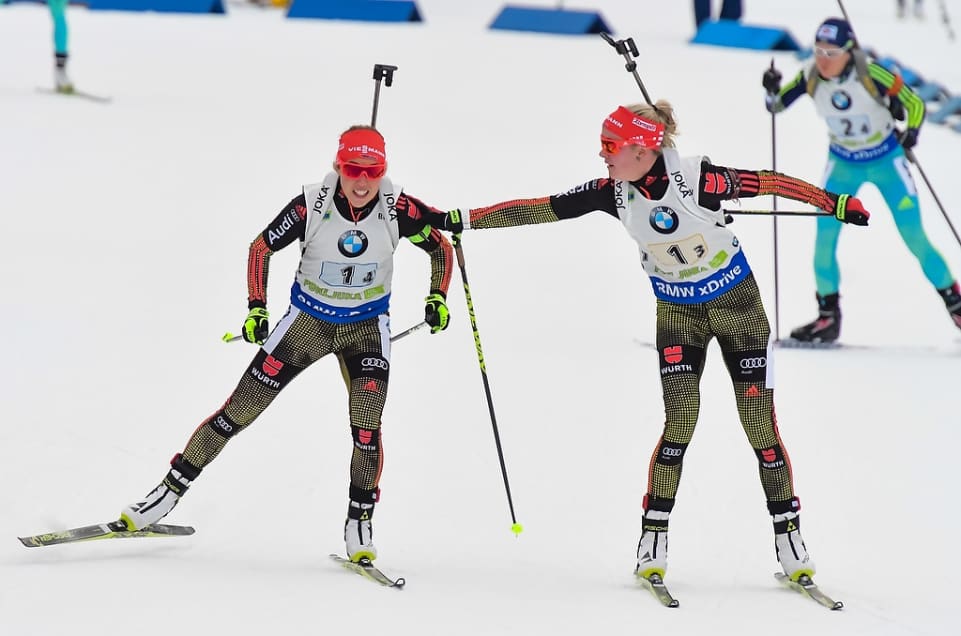
Germany’s Karen Hammerschmidt (l) tagging her teammate Laura Dahlmeier in second place at the final exchange of the women’s 4 x 6 k relay at the IBU World Cup in Pokljuka, Slovenia. Dahlmeier anchored the team to the win by 10.1 seconds over France. (Photo: IBU)
In the women’s relay on Sunday, Germany took first by 10.1 seconds over France, using nine spares but no penalties.
Vanessa Hinz started the Germans out and tagged off in fifth, and second-leg Franziska Hildebrand moved them up into second by the halfway point. Karen Hammerschmidt held that position, which was enough for Laura Dahlmeier who anchored them to the win in 1:11:31.1.
“This was a brutally beautiful race today,” Dahlmeier told German broadcaster ZDF after her third win in as many races in Pokljuka. “It was very fun, and I was very relaxed because I knew we were competing as a team. Even if you don’t have as much power left there are still three others. I was on top of my game and just enjoyed it. I really looked forward to the race, although yesterday I was knocked out. But on the course I had a good feeling right from the start.”
France in second and Ukraine in third (+37.7) both required just three spare rounds and no penalties per team. France secured second place with Anais Chevalier (who initially tagged off in 11th), Justine Braisaz (who picked off eight places to move into third), Celia Aymonier (who tagged off in first), and Marie Dorin Habert (who cleaned without any spares but came up 10 seconds short of Dahlmeier at the finish).
Ukraine reached the podium with Iryna Varvynets, Yuliia Dzhima, Olena Pidhrushna, and Anastasiya Merkushyna.
Canada placed 11th (+3:33.1) with a total of just four spares and no penalties. Sarah Beaudry initially tagged off in 23rd, Rosanna Crawford skied them into 18th, Megan Tandy shot clean without any spares and tagged off in 14th, and Julia Ransom anchored them to 11th out of 23 teams.
The U.S. did not field a men’s or women’s relay team, with just three men and three women in Pokljuka.
FIS Cross-Country World Cup in Davos: Freestyle Sprints
In the men’s 1.6-kilometer freestyle sprint on Sunday it was Russia’s Sergey Ustiugov who emerged victorious, besting Finn Hågen Krogh of Norway and his Norwegian teammate Sindre Bjørnestad Skar for first.
After qualifying 29th overall, Ustiugov crossed first in his quarterfinal and held the led through his semifinal and into the final, winning in a time of 2:24.65. Krogh crossed 0.59 tenths of a second behind him for second place and Skar took the final podium spot, crossing 3.29 seconds after Ustiugov.
Also in the sprint final was Russia’s Alexey Petukhov, who finished just off the podium in fourth (+3.47), Norwegian Emil Iversen in fifth (+5.52) and France’s Lucas Chanavat —who won the qualifier — ended the day in sixth (+11.48).
Lucas Chanavat of France had the fastest men’s qualifying time in the Davos World Cup freestyle sprint on Sunday.
Canada’s Lenny Valjas was the top North American finisher for the day, qualifying 12th and advancing to the quarterfinals where he finished in 14th overall. No other Canadians made the sprint heats, with Alex Harvey left just outside advancing in 33rd, Devon Kershaw ending the day in 49th, Knute Johnsgaard 60th, Bob Thompson 67th, and Andy Shields 73rd. Jesse Cockney did not finish the race.
Simi Hamilton led the U.S. in 24th (+3.88). Andy Newellwas just outside the heats in 36th, and Eric Packer placed 95th (+21.62).
In the women’s 1.6 k freestyle sprint, Maiken Caspersen Falla of Norway took the overall win, crossing in a time of 2:44.63. Just 0.53 tenths of a second behind Falla was her Norwegian teammate Ingvild Flugstad Østberg in second place overall. The final women’s podium finisher, Hanna Falk of Sweden was 0.60 tenths of second off Falla in third.
U.S. Ski Team member, Jessie Diggins made the final, racing to a fifth place overall (+5.91), behind Sweden’s Jonna Sundling in fourth (+1.04) and ahead of Russia’s Natlalia Matveeva in sixth (+6.80).
The United States put three other women into the heats, including Sophie Caldwell who finished 11th, Sadie Bjornsen 15th, and Ida Sargent 20th.
American Caitlin Patterson ended the day 47th, Kikkan Randall 58th, and Liz Stephen 61st.
Dahria Beatty was the top Canadian on Sunday, finishing in 25th overall. Cendrine Browne ended the day 53rd and Sophie Carrier-Laforte 59th.
NorAm/SuperTour at Sovereign Lake: 10/15 k Freestyle
[UPDATE] It was Americans owning the podium again Sunday at Sovereign Lake, and a little bit more. It was warmer on Sunday, -7 Celsius, and snowed lightly throughout.
The men’s 15 k freestyle was first on the schedule. APU’s Scott Patterson won in 40:00.2, followed by Saturday’s A-finalist Matt Gelso at 13.2 seconds and Vail’s Tad Elliot at +26.6.
The top Canadian was Team R.A.D.’s Russell Kennedy in ninth, at 1:38.8 behind.
In the women’s 10 k freestyle, the podium was owned by APU’s Chelsea Holmes in 30:42.9. SMS Elite’s Katharine Ogden was second at 13.4 seconds, also winning the junior category. Her teammate Erika Flowers was third, 36.4 behind.
AWCA’s Olivia Bouffard-Nesbitt was the top Canadian for the second day, placing 13th at 1:51.8.
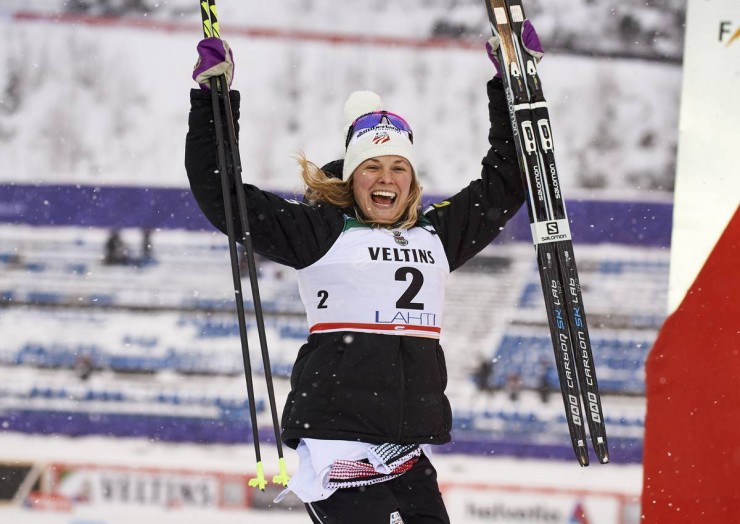
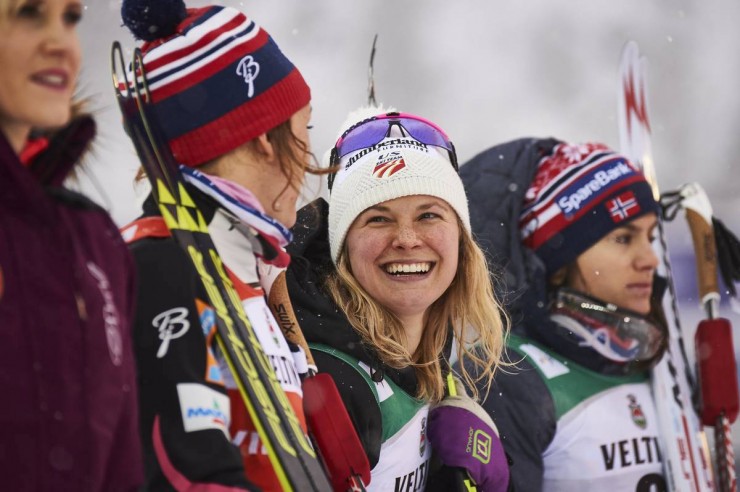
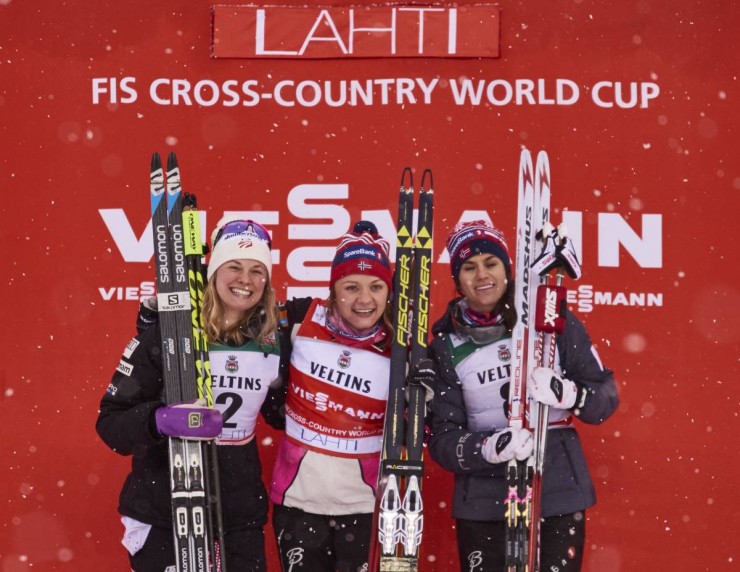
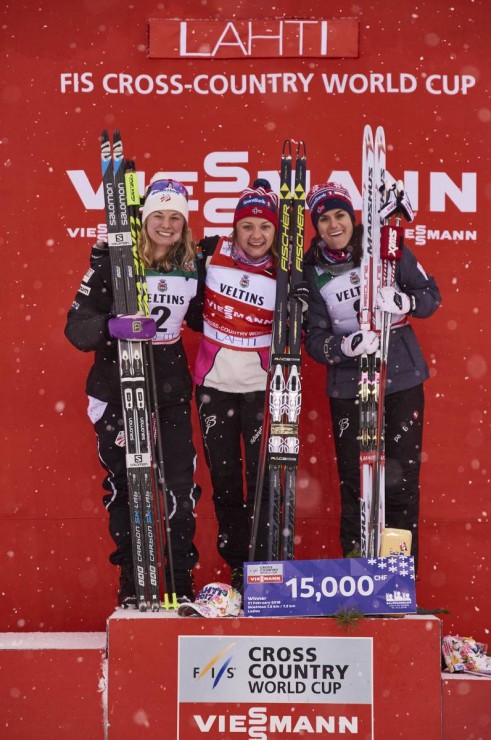
Jessie Diggins (U.S. Ski Team) celebrates second place, her career-best sprint result at the Lahti World Cup skate sprint on Saturday. (Photo: Salomon/NordicFocus)
(Photo: Salomon/NordicFocus)
(Photo: Salomon/NordicFocus)
(Photo: Salomon/NordicFocus)
(Photo: Salomon/NordicFocus)
(Photo: Salomon/NordicFocus)
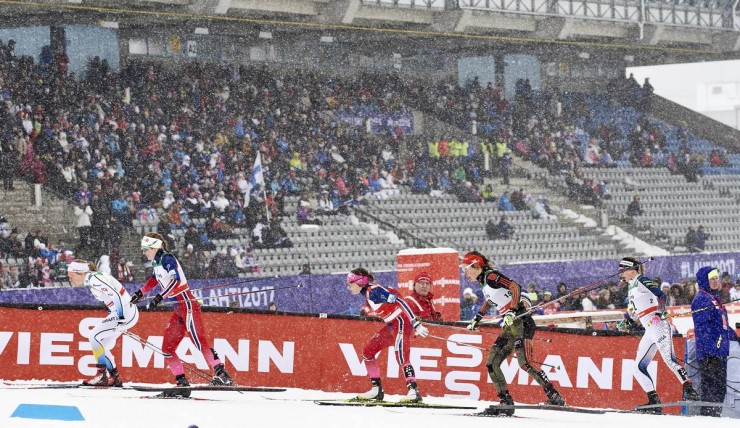
LAHTI, Finland – An army of vuvuzelas echoed from the stadium’s stands and snow blew hard through the Lahti stadium on Saturday. The atmosphere was thrilling and the athletes no doubt felt it.
The “pre-World Championships” — a year out from 2017 World Championships — 1.6-kilometer freestyle sprints opened this weekend’s Lahti World Cup. There, Jessie Diggins, a Minnesota native and U.S. Ski Team member, reached the final for the first time in a year and finished second for her career-best sprint result.
She was the second-fastest qualifier in the morning, just 1.68 seconds back from Norway’s Ingvild Flugstad Østberg, who posted the fastest time in 3:30.85. Diggins then opted for the second quarterfinal in the heat selection process, along with World Cup Sprint leader Maiken Caspersen Falla of Norway and Finland’s local favorite, Krista Parmakoski.
After comfortably advancing from her quarterfinal in second place, behind Falla, Diggins landed in the first semifinal with the likes of Østberg, Falla and Sweden’s Hanna Falk. Diggins skied most all of her semifinal in fourth place behind these three women until the final bend before the finishing straight.
Going into this section, entering the stadium, there is a long decent where a bulletproof tuck and drafting can create an important passing opportunity right before the finish. Here, Diggins rocketed out from drafting behind Falk and glided into the inside lane for the final bend. After passing Falk, Diggins raced to third in the heat, behind Falla and Østberg. While this wasn’t quite good enough to ensure her automatic bid for the final, Diggins’ time was fast enough to give her one of two lucky loser spots to move on.
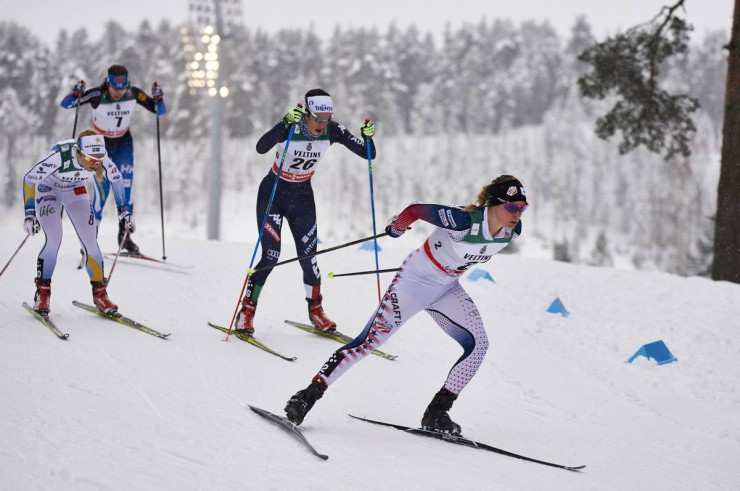
Jessie Diggins (U.S. Ski Team) racing to second in the qualifier at the World Cup freestyle sprint in Lahti, Finland. (Photo: JoJo Baldus)
The women’s final consisted of Diggins, Falk and four Norwegians: Østberg, Falla, Astrid Uhrenholdt Jacobsen, and Heidi Weng.
The snow seemed to only pick up as the day went on, adding an exciting, yet also challenging strategic element to the race.
“The conditions made passing very difficult as the day went on because snow started to accumulate on the edges of the trail,” U.S. women’s coach Matt Whitcomb said in an in-person interview afterward. “So one of the strategies was to stay in control, at least in the middle of the pack, if not farther forward than that. Because [the fresh snow] placed those in the fourth, fifth and sixth positions at a pretty serious disadvantage in that final round, and even some of the semifinals.”
Out of the start, Diggins was unable to get to the front, but quickly climbed up through the pack into fourth position, behind Falla, Østberg, and Weng. Going into the second and final big climb, she held her position in fourth, all the way up to the top and the turnaround.
Then came that same long downhill, which Diggins had made her move at the bottom of during her semifinal. There was a small gap between Diggins and the three Norwegians as they entered the stadium, tucked in a line. Vuvuzelas blared at an all-time high and everyone waited with anticipation for the final moves and hectic finishing sprint.
Again, going into the final bend, Diggins slingshot out from the Norwegian slipstream and began her pass on the inside. She took the nearest lane and put the hammer down in the final sprint before lunging and claiming second in a photo finish with Weng.
“[Diggins] had gas at the end, so she hit the pedal,” Whitcomb recalled. “She was awarded with some extra speed and that made the difference today.”
Jessie Diggins (l) of the U.S. Ski Team and two Norwegians Maiken Caspersen Falla (c) and Heidi Weng (r) jump for joy after reaching the podium in second, first and third, respectively, in the World Cup skate sprint in Lahti, Finland. (Photo: Fischer/NordicFocus)
“In those finishing lanes, I was like, ‘I cannot believe this is happening! I can’t believe it!’ And I just gave it my best lunge I could,” Diggins said after the race. “I just am so happy – it was one of those things that was just incredibly fun and it was a great day out here with the team.”
The Sprint World Cup leader, Falla led most of the sprint as she usually does, and then held on for the outright win in 3:33.81. Diggins finished 0.25 seconds back in second place, beating Weng in a photo finish by six-hundredths of a second. Weng took third (+0.31), Østberg missed the podium in fourth (+0.41), Jacobsen was fifth (+2.27), and Sweden’s Hanna Falk finished sixth (+18.4).
For Falla, it was her fifth-straight sprint victory, and her sixth sprint win of the season. Asked how she does it, she responded: “I always try to stay in front of the heat,” she said during the post-race press conference. “And if I don’t get the first position, I really want the second one [because] I know it’s a big risk to stay behind in the sprint finals. You can always be in an accident, and people can get tired and make some space to the one racing in front. So I just try to stay in front and have some speed left before the last climb or the last meters.”
Weng earned her first win earlier this winter at the Tour de Ski, but Saturday added to her multitude of other podiums.
“ I tried to win, but Maiken and Jessie were faster,” she said. “In the last corner I was going too much on the right. [That made] it hard to fight for the victory.”
Slingshot Tactics and a Longer Course
Two key aspects of the race played out well for Diggins on Saturday: the inherently lengthier nature of the course and her draft into slingshot strategy.
“That was super exciting,” Diggins said about her final slingshot move. “I think I must have had the fastest skis in the world. I was counting on that slingshot to work for me and it did!”
The women’s freestyle sprint podium on Saturday at the World Cup in Lahti, Finland, with American Jessie Diggins (r) in second, Norwegian winner Maiken Caspersen Falla (c), and Norway’s Heidi Weng (r) in third. (Photo: Fischer/NordicFocus)
This proved to be truly essential in both Diggins’ semifinal and final. In both races, she hovered around fourth place for the majority of the race until the final downhill and corner.
“You saw [Diggins] try a few different tactics [throughout the heats],” Whitcomb noted. “With the Norwegian girls leading most of the heats and Jessie working from the front-middle of the pack, she was able to try a couple different drafting strategies. And I thought by that final round, she timed the slingshot perfectly, so that it didn’t come down to just who was sprinting fastest, but who was coming in with just a fraction of a mile per hour of more speed.”
Another factor helping Diggins was that the longer-than-usual sprint course. At 1.6 kilometers, the Lahti sprint course is at the maximum allowed length. Also an accomplished distance racer, the course’s demand for some endurance played into Diggins’ strengths.
“If you can ski top ten in distance, a long sprint course is going to be your game,” Whitcomb said.
“It was a brutally hard course, it was a long course, [and] it was a hilly course” Diggins explained.
Her teammate, Sadie Bjornsen reflected on the course similarly after her second semifinal, in which she finished fifth (behind Weng, Jacobsen, Norway’s Therese Johaug, and Sweden’s Stina Nilsson, respectively) for 10th overall on the day.
“This is a fitness course, it is really, really long and it is hard,” Bjornsen said. “I think at the end of the day it is going to be those distance skiers that are going to [benefit]. You can see, [Diggins] is in there and she is probably going to win today because she is a distance skier and this takes some extra strength.”
Bjornsen proved to be just a few tenths of a second off with that prediction. Diggins’ distance experience and abilities prevailed on the Lahti course and she highlighted the U.S. day with second place.
Bjornsen 10th; Four U.S. Women Qualify
Sadie Bjornsen (U.S. Ski Team) racing to 12th in the qualifier at the World Cup skate sprint in Lahti, Finland, where she ended up 10th overall. (Photo: Fischer/NordicFocus)
As a whole, the U.S. women’s team continued on its path of increasing momentum. Along with Diggins and Bjornsen, who qualified in second and 12th, respectively, Sophie Caldwell qualified sixth and finished in 13th, after placing third in the first quarterfinal and narrowly missing advancing as a lucky loser. Ida Sargent qualified 27th and finished in 24th after placing fifth in the same quarterfinal as Bjornsen (which Falk won and Bjornsen automatically advanced in second out of).
“We have been a little off our mark the last couple weekends,” Whitcomb said. “So to get four [women] back in there and to have Ida in the rounds, she has only missed two sprints this year in terms of qualification, so it was great to have her back in there … it was fantastic.”
Of the four, Bjornsen was the only other woman to reach the semifinals, where she faced off against Weng, Johaug, Nilsson, Jacobsen, and Finnish fave Anne Kyllönen.
“I think that those are some of the girls who are racing the fastest right now,” Bjornsen said. “Today I felt like I could ski with them, but unfortunately today I was duking it out with Stina at the end.”
Bjornsen finished 1.75 seconds behind Weng, the winner of that semifinal, and 0.83 seconds behind Nilsson in fourth. Johaug was third in that heat, just 0.05 seconds ahead of Nilsson, and did not advance to the final, either.
With two in the top 10, and Diggins’ third podium in just over a month (after she won the 5 k freestyle at the Tour de Ski in Toblach, Italy), the results in the last World Cup in Europe before the season ends at the Ski Tour Canada bode well for the U.S. team.
“[Our athletes] are now respected in these heats and are people that belong in there,” Whitcomb said. “They were not getting shut down on their moves today.”
Also for the U.S., Caitlin Patterson (Craftsbury Green Racing Project) placed 35th, 2.1 seconds out of qualifying in 30th, and Jennie Bender (Bridger Ski Foundation) placed 51st.
Racing in Lahti continues with skiathlon races on Sunday: 15 k for women and 30 k for the men.
About the Author: JoJo Baldus is a nordic skier from snowy Minneapolis, Minn. Currently living the dream as a volunteer journalist and photographer for FasterSkier while enjoying a gap year before starting at Macalester College in St. Paul. He could not be more excited to attempt to stagger across the finish line of 8 different WorldLoppet ski races this winter!
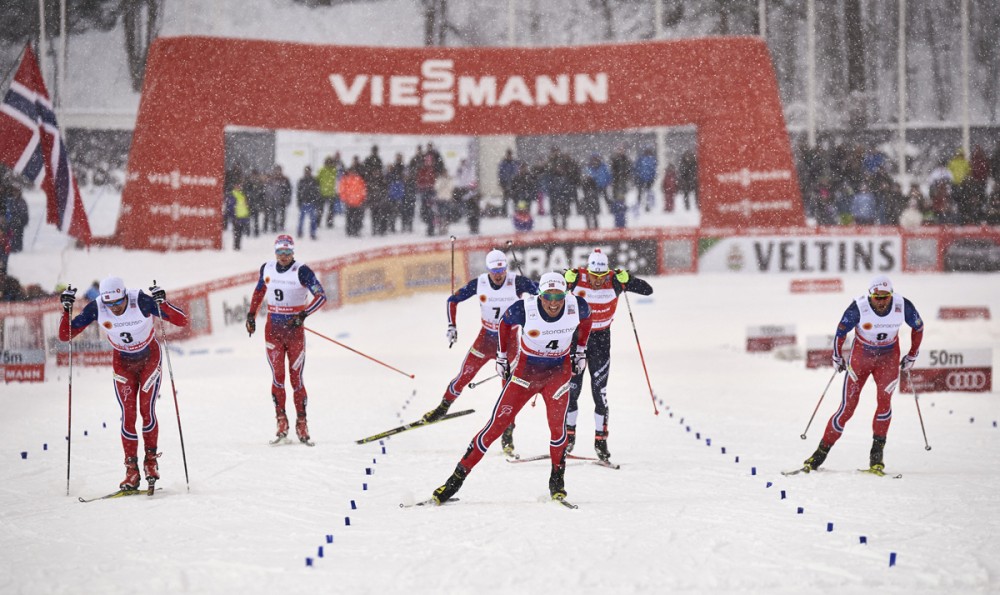
Left to right: Norwegians Finn Hågen Krogh, Eirik Brandsdal, Sindre Bjørnestad Skar, Emil Iversen, Italian Federico Pellegrino, and Norway’s Petter Northug during the men’s 1.6 k freestyle sprint final on Saturday in Lahti, Finland. (Photo: Fischer/Nordic Focus)
Logging hours upon hours of ski training is one thing. Logging hours upon hours of ski training with Norway’s nordic icon, Petter Northug is another. At least, so suggests Norwegian Emil Iversen, winner of the men’s 1.6-kilometer freestyle sprint on Saturday in Lahti, Finland.
“I have trained too much with him now I think,” Northug said during a post-race press conference, referring to his Norwegian teammate, Iversen.
“He has found my weakness … He beat me in Obsterdorf, he beat me here and we will not train together next year, I can tell you now,” he added with a laugh.
With another World Cup sprint title under his belt, 24-year-old Iversen did not disclose his superstar teammate’s sprinting soft spot.
“I can’t tell that to you,” Iversen said at the press conference regarding Northug’s weakness. “But yeah, for sure, I know what that is, so I’m going to use it also next year.”
Whatever secrets Iversen knows, he put into action during Saturday’s sprint.
He qualified fourth, the second Norwegian — one-tenth of a second behind teammate, Finn Hågen Krogh —and2.41 seconds back from Finland’s Martti Jylhä, the top qualifier in 3:04.15. Iversen went on to win his quarterfinal, semifinal and eventually the final, besting not just Northug, but Italy’ssprint prodigy, Federico Pellegrino as well.
“The Norwegians now have seen how I behaved [in prior races],” Pellegrino, 25, told the Italian Ski Federation, according to a translation. “So in the final they put a man in front of me preventing me from doing my game.”
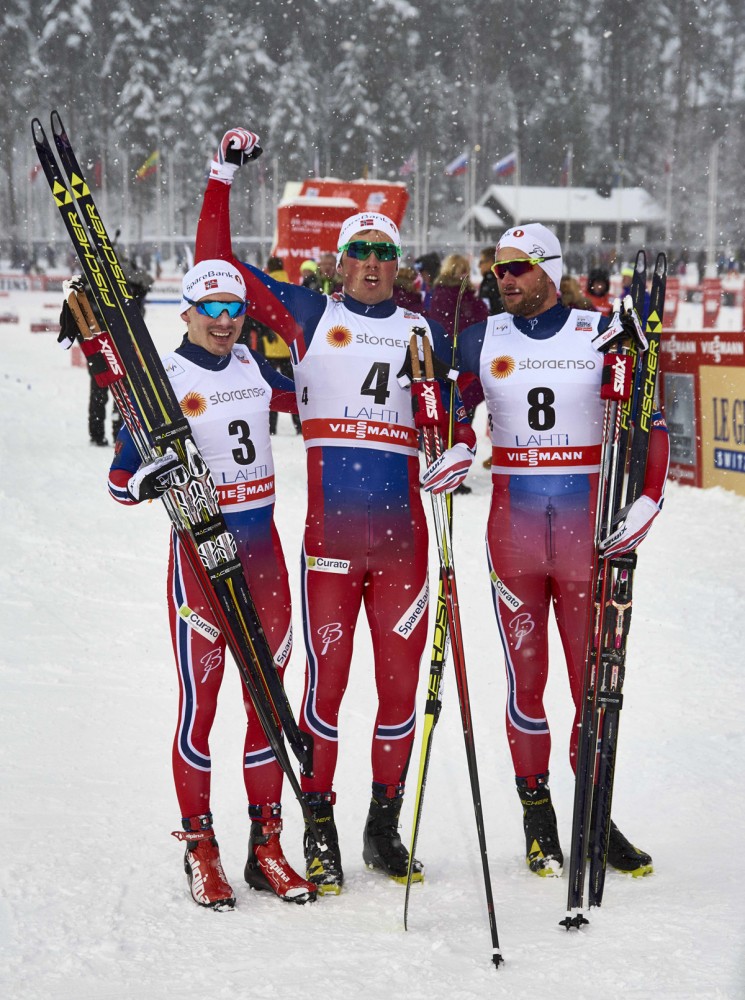
An all Norwegian podium with (left to right) second place finisher Finn Hågen Krogh, first place finisher Emil Iversen, and third place finisher Petter Northug for the men’s 1.6 k freestyle sprint final on Saturday in Lahti, Finland. (Photo: Fischer/Nordic Focus)
The Final
The lone non-Norwegian in the final, Pellegrino found himself sandwiched between Norway’s Krogh and Eirik Brandsdal from the start until the top of the second climb.
Prior to the course’s second major downhill, Brandsdal cornered by Pellegrino on the inside of a sweeping lefthand turn, inching the Italian into third place by the descent. Northug coasted at the pack’s back, sitting behind teammates Sindre Bjørnestad Skar and Iversen.
As the six finalists ascended the third-and-final major course climb, Pellegrino and Iversen maneuvered to the left of Krogh, Northug and Brandsdal. Emerging first through Saturday’s snowfall were the yellow gloves and navy suit of Pellegrino.
However, by the end of the last downhill into the stadium, Pellegrino was lost in a sea of red; his opportunity for a podium spot swallowed by the full force of Norway. Iversen and Krogh tuck skated to the right of Pellegrino, with Iversen cinching his winning spot just 0.25 seconds ahead of teammate Krogh in a time of 3:08.41.
“I tried to have a good position on the last climb, but I was fifth or so,” Hågen Krogh said during a post-race press conference. “I should have been two more spots going forward in the field. But…I was very happy to be on the podium,” the overall second place finisher added.
While Iversen and Krogh tucked past Pellegrino on the right, Northug came up on the left, with a turnover in the final 100 meters that out-motored that of the Italian. In a lunge for the line, Northug nabbed third (+0.69) and secured the final spot for the all-Norwegian sprint podium.
“We train a lot in Norway and I think that’s the answer,” Iversen said regarding Norway’s sprint sweep in the men’s competition. “I think it’s the training we do. You have to train hard all year long.”
Hamilton in the Heats, 17th Overall
Though he did not advance beyond the quarterfinal, American Simi Hamilton’s performance on Saturday proved his progress this season as one of consistency.
“Obviously, every weekend you want to go out and you want to be on the podium, but you take what you can get,” Hamilton said during an in-person interview. “Being able to consistently ski in the teens each sprint. I’m happy with that.”
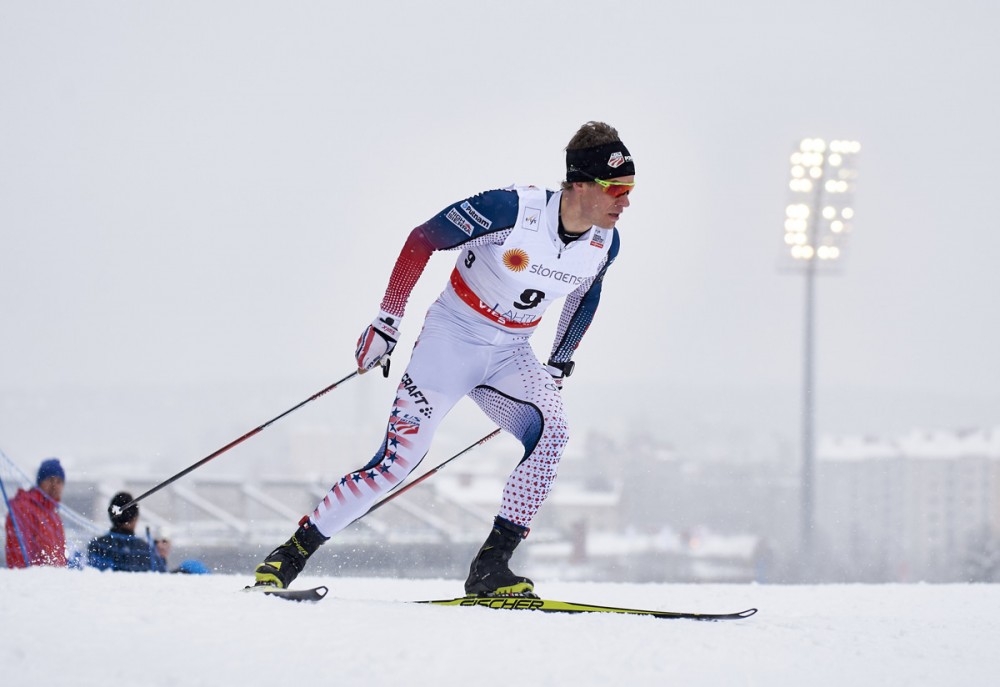
American Simi Hamilton raced to a 17th overall in the men’s 1.6 k freestyle sprint on Saturday in Lahti, Finland. (Photo: Fischer/Nordic Focus)
After qualifying in 10th (+3.42), the top American for the day said his body “felt really good” and gave him confidence to work the longer course during his quarterfinal.
“I think this course has a lot that plays to my strengths. Some very different climbs and a couple very technical corners,” he said. “The first two thirds of the course you’re really working the entire thing, so I wanted to conserve my energy and then kind of pin in it the last third.”
As the U.S. skier made his way into the final major climb, however, he had trouble getting into position.
“I tried to make a move there and got really tangled with a couple different people on that climb,” he explained.
Jumping in behind Russia’s Alexey Petukhov, Hamilton manage to draft speed during the final downhill into the stadium.
“I got a pretty good slingshot coming into Petukhov, but I went left into some slower snow right before the final corner and kind of got pushed back again,” Hamilton said. “So I just had to settle for getting behind Petukhov and then try to do something in the finishing stretch. Unfortunately I stumbled a little bit coming into the finish.”
With motivation for more than a top 20, Hamilton is ready for his next series of races: the Ski Tour Canada.
“I’ll carry that [momentum] with me into Canada,” Hamilton said. “Really looking forward to a couple good skate sprints there and a classic sprint in Canmore and all the other races.”
Saturday’s other U.S. male starter, Reese Hanneman, is also looking forward to the Canadian World Cup races after finishing 51st overall in the Lahti sprint.
“I’m hoping to keep feeling better and use this last block or races as a springboard to some good ones in Canada,” Hanneman, who will head back to the U.S. early Monday, wrote in an email.
While Hanneman remained happy with the amount of power and movements he executed on course during Saturday’s sprint qualifier, he also acknowledged areas where he could have made up time.
“I lost a second or two in the crux of each of the big climbs,” he wrote. “There are two big climbs, each ending in a short steep pitch. I felt like I was able to maintain good momentum up until about the final couple meters of each of those pitches, where I slowed down and had to dig. The top guys were just zipping all the way over.”
The seconds he lost, he said, were not due to his skis — despite fresh snowfall during Saturday’s event in Lahti.
“My wax tech Eli Brown, and all of the US techs did an incredible job with my skis today,” he wrote. “They felt great on snow that could’ve been really challenging. I definitely want to thank those guys for all their hard work.”
— JoJo Baldus and Harald Zimmer contributed reporting
Sophie Caldwell (U.S. Ski Team) qualified fifth in the Davos World Cup skate sprint on Sunday and went on to make the final as a two-time lucky loser (in both the quarterfinals and semifinals), then finish sixth overall. (Photo: JoJo Baldus)
DAVOS, Switzerland — Sprint-racing success requires strength, strategy and at least a little bit of luck. All these factors were in Sophie Caldwell’s favor as the U.S. Ski Team sprinter advanced as a “lucky loser” twice en route to a sixth-place finish in the women’s 1.6-kilometer freestyle sprint at the World Cup in Davos, Switzerland.
Four U.S. women qualified for the heats, racing two laps of the 787-meter course during each round. Caldwell posted the fifth-fastest qualifying time in 2:43.16, 3.32 seconds behind Norway’s Ingvild Flugstad Østberg, who won the qualifier. Jessie Diggins qualified in 13th, Ida Sargent moved on in 18th and Sadie Bjornsen advanced in 19th.
American Sophie Caldwell (r) and Sweden’s Ida Ingemarsdotter (14) chase Norway’s Ingvild Flugstad Østberg (left, in red) during the first women’s quarterfinal of the Davos World Cup freestyle sprint in Switzerland. All three advanced to the semifinals. (Photo: Marcel Hilger)
The fifth U.S. women racing on Sunday, Rosie Brennan finished 2 seconds outside the top 30 (necessary to qualify) in 40th, 11.65 seconds behind Østberg.
After Caldwell, 25, posted her second-best qualifying result in a World Cup (she qualified in fourth two seasons ago in Szklarska Poreba, Poland), she opted for the first quarterfinal heat, squaring off against Norwegian powerhouses like Østberg and Heidi Weng, as well as Sweden’s Ida Ingemarsdotter and even Canadian native Heidi Widmer, a new member of the Swiss National Team.
Østberg, Weng and Ingemarsdotter all made the final at the opening World Cup sprint in Kuusamo two weeks ago. This season on the World Cup, athletes select which quarterfinal they want to compete in order of their qualifying time or heat placement. This adds an additional element of strategy to the racing.
“The first heat is nice because you get more recovery before the semis, but it is often what a lot of the top skiers pick,” Caldwell said during an in-person interview. “I don’t really know what the best answer is yet, but we are learning a lot each weekend; it’s kind of fun.”
In that quarterfinal, Østberg took control out of the start. Caldwell stuck close in second, then slipped into third behind Weng on the first of two hills (with one steep climb per lap). After qualifying in 29th, Widmer hung on in sixth throughout the race while Østberg continued to hammer the pace up front. On the final descent down into a righthand curve and into the stadium, the two Norwegians increased their distance ahead of Caldwell, securing first and second, while Caldwell fought for third, 0.41 seconds ahead of Ingemarsdotter in fourth. She finished 2.34 seconds behind Østberg in first. Widmer placed sixth (+11.1).
Their quarterfinal ended up being the fastest of all five by 3 seconds, lifting both Caldwell and Ingemarsdotter to the semifinals as lucky losers.
“I was hanging on for dear life up that last hill,” Caldwell said.
In the semifinal, competing against two Swedes — Stina Nilsson and Hanna Falk — two Norwegians — Astrid Uhrenholdt Jacobsen and Kathrine Rolsted Harsem — and Diggins, her U.S. teammate, Caldwell ended up fourth, but just 0.88 seconds behind Nilsson as the winner. Diggins was fifth, 1.7 seconds back after advancing to the semis with a dominant quarterfinal performance.
Jessie Diggins (13) led her quarterfinal from start to finish on Sunday, with the likes of Slovenia’s Vesna Fabian (16), Sweden’s Stina Nilsson (in white) and Finland’s Krista Parmakoski (21), to advance to the Davos World Cup freestyle sprint semifinal in Switzerland. She went on to place fifth in the semifinal for ninth overall. (Photo: Marcel Hilger)
Diggins won her quarterfinal by 0.27 seconds over Nilsson after leading the entire 1.6 k. Nilsson came on strong in the finishing stretch, but Diggins held her off. Asked of her strategy, Diggins said she picked the fourth quarterfinal because it was one she thought she could win.
“I tried to get out in front because I know that passing is really tough,” Diggins said after the race. “I was able to have a good start and just hold it.”
In their semifinal, Nilsson and Jacobson gapped the group, pushing over the final climb. Nilsson went on to edge Jacobson by 0.24 seconds for the win. Falk placed third (+0.65) and Caldwell was fourth, while Diggins was shuffled to the back of the pack after the first lap. She recovered, catching the group on the final climb and passed Harsem to finish fifth.
“I was a little more tired than I would have liked so after I got pushed to the back it was really hard to get back on, but I kept fighting,” Diggins said.
She ended up ninth on the day, while Caldwell continued on with a time 0.03 seconds faster than Weng, who placed third in the other semifinal (behind Østberg and Falla, respectively).
Caldwell had beaten the odds yet again and advanced to the final along with Falk.
Sweden’s Stina Nilsson racing to 17th in the Davos World Cup freestyle sprint qualifier on Sunday in Switzerland. She went on to win the final for the first World Cup win of her career. (Photo: Marcel Hilger)
There, in the final round of the day, Falk challenged Østberg out of the gate and into the first climb, and Caldwell skied with the group in fifth at the start of the second lap.
Østberg and Falla took control by Lap 2, and at the top of the last hill, Falla passed her teammate to lead for the first time. Østberg nearly caught her on the downhill and into the final bend, but few saw U23 World Cup leader Nilsson slingshotting up from third.
Nilsson took the outside line around the bend then pulled up alongside Østberg and finally Falla to beat them both to the line. The 22-year-old Swede won in 2:39.27, 0.15 seconds ahead of Falla in second place and 0.84 ahead of Østberg in third.
In 30 World Cup starts, it was Nilsson’s first career victory. She had reached the podium eight times before. For Østberg, it was her second podium in as many days after placing second in Saturday’s 15 k freestyle.
Jacobsen, who was fourth descending into the stadium and around the turn, ended up fourth (+1.06), Falk placed fifth (+2.74), and Caldwell, who had lost contact after the first lap, finished sixth (+14.47).
Despite fading in the final, Caldwell expressed happiness with her day.
“It was definitely a burst of confidence. I’ve felt good skating, but I didn’t know how I stacked up,” she said. “I think my speed and technique are good, but I need to have the fitness to have the same energy as I did in the qualifier in the final.”
Sixth in the skate sprint at the 2014 Olympics, Caldwell finished a career-best third in a World Cup skate sprint after the Olympics in Lahti, Finland. She placed seventh in two World Cup freestyle sprints last year, and 10th in the 2015 World Championships classic sprint, but she hadn’t made a final since Lahti in March 2014.
Sadie Bjornsen (U.S. Ski Team) leads Slovenia’s Nika Razinger (behind) in their quarterfinal of the Davos World Cup freestyle sprint on Sunday. Bjornsen finished fourth in the heat for 17th overall. (Photo: Marcel Hilger)
“I was really psyched to see four girls in the top 20 in the qualifier, highlighted by Sophie’s fifth,” U.S. Ski Team Women’s Coach Matt Whitcomb said in a post-race interview. “Our girls were within striking distance of the top today and that felt really good. We feel like we put together great heats and great performances all the way up to Sophie’s final and she was just too cashed at that point.”
Bjornsen finished fourth in her quarterfinal, 3 1/2 seconds behind Jacobsen, who won that heat. Harsem placed second (+2.41), Slovenia’s Nika Razinger was third (+3.01). Heading into the final climb, Bjornsen hung around fourth behind Italy’s Gaia Vuerich. She passed Vuerich to move into third, but Razinger ultimately passed Bjornsen in the finishing stretch to bump her to fourth.
In a post-race interview, Bjornsen said she found it difficult to pass.
“The course is very tactical so you need to find some open spots,” she said. “On the final climb I got a bit tangled with poles, so I couldn’t sprint it out like I wanted to.”
Bjornsen ended up 17th overall for her fifth-consecutive top 20 in as many individual World Cup races this season.
“I’ve only qualified [for the heats] once in Davos so this is good,” Bjornsen said.
Sargent placed sixth in her quarterfinal, 3.6 seconds behind Germany’s Sandra Ringwald in first. Falk was on the good side of a photo finish for second (+0.06), ahead of Switzerland’s Laurien van der Graaff in third (+0.08). Their quarterfinal ended up being the slowest, leaving only the top two, Ringwald and Falk, to advance to the next round.
Ida Sargent (U.S. Ski Team) racing to 18th in the women’s freestyle sprint qualifier on Sunday at the World Cup in Davos, Switzerland. She went on to place sixth in her quarterfinal for 27th overall. (Photo: Marcel Hilger)
Germany’s Denise Herrmann placed fourth (+0.76), and Russia’s Natalia Matveeva finished fifth (+2.09), while Sargent followed about a second later. She placed 27th overall.
Afterward, Sargent, a classic-sprint specialist, explained her day went better than expected.
“I’m not sure if it is the elevation, but today my legs were not moving quickly and I was actually surprised to qualify so well,’” she said. “I was pretty psyched with qualifying in 18th because normally I’m high 20s, so now I just need to get my legs back underneath me.”
Across the board, the U.S. women credited their wax team with fantastic skis.
“The techs put together brilliant skis even though we had incredibly limited testing window on the tracks,” Whitcomb said. “The fact that we are operating with more of a complete staff these days allowed us to put some skis on the snow and test some good structures and products. We had fantastic skis, the athletes were feeling good and did good things with them.”
“I am really proud of this team. All the athletes and all the staff,” Whitcomb added. “We have a good thing going and I’m proud to be representing the U.S. over here in Europe.”
Widmer finished 30th on the day in her first World Cup of the season. It was her career best and first time in the World Cup heats, and marked her first time representing Switzerland on the World Cup.
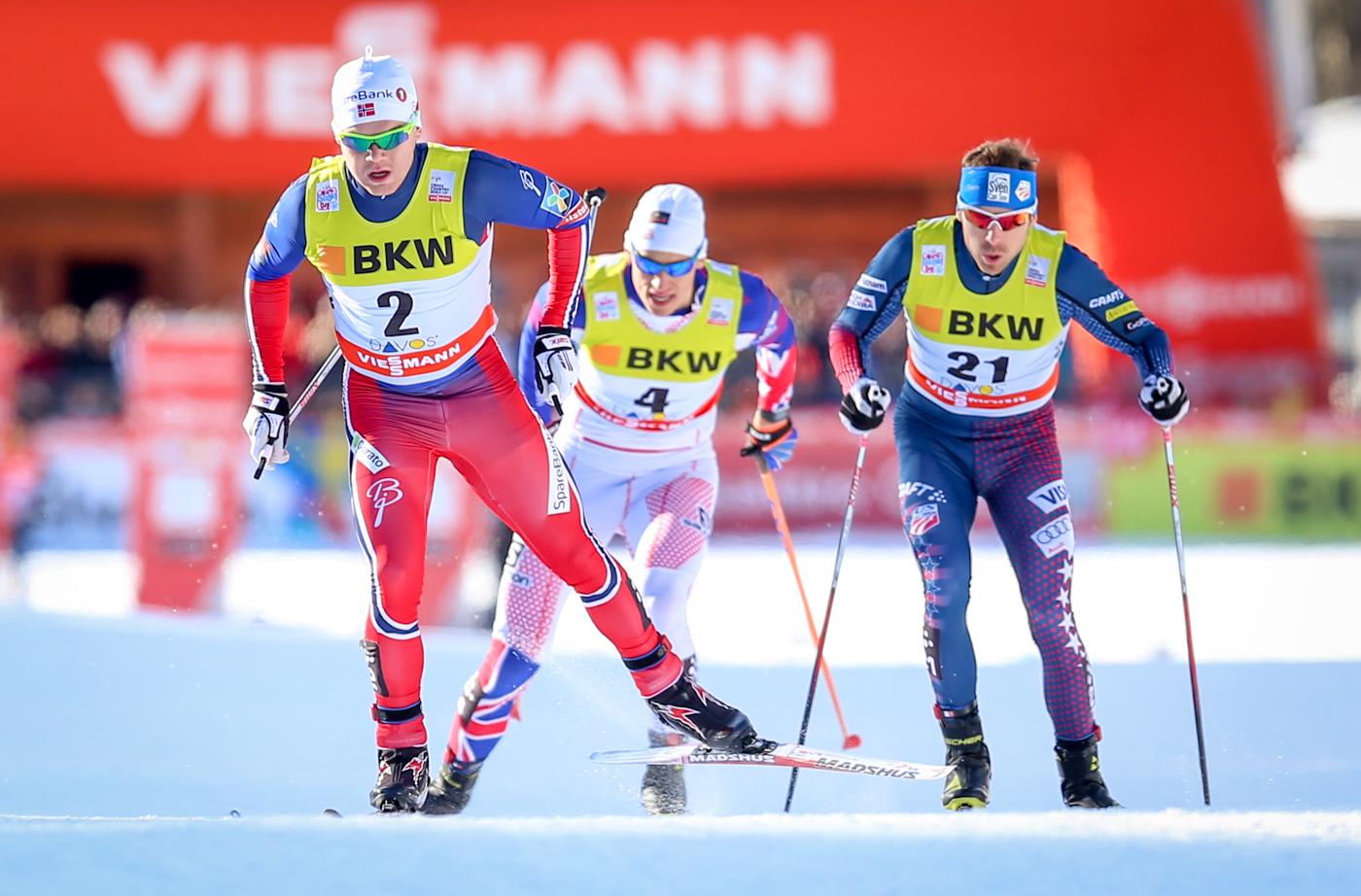
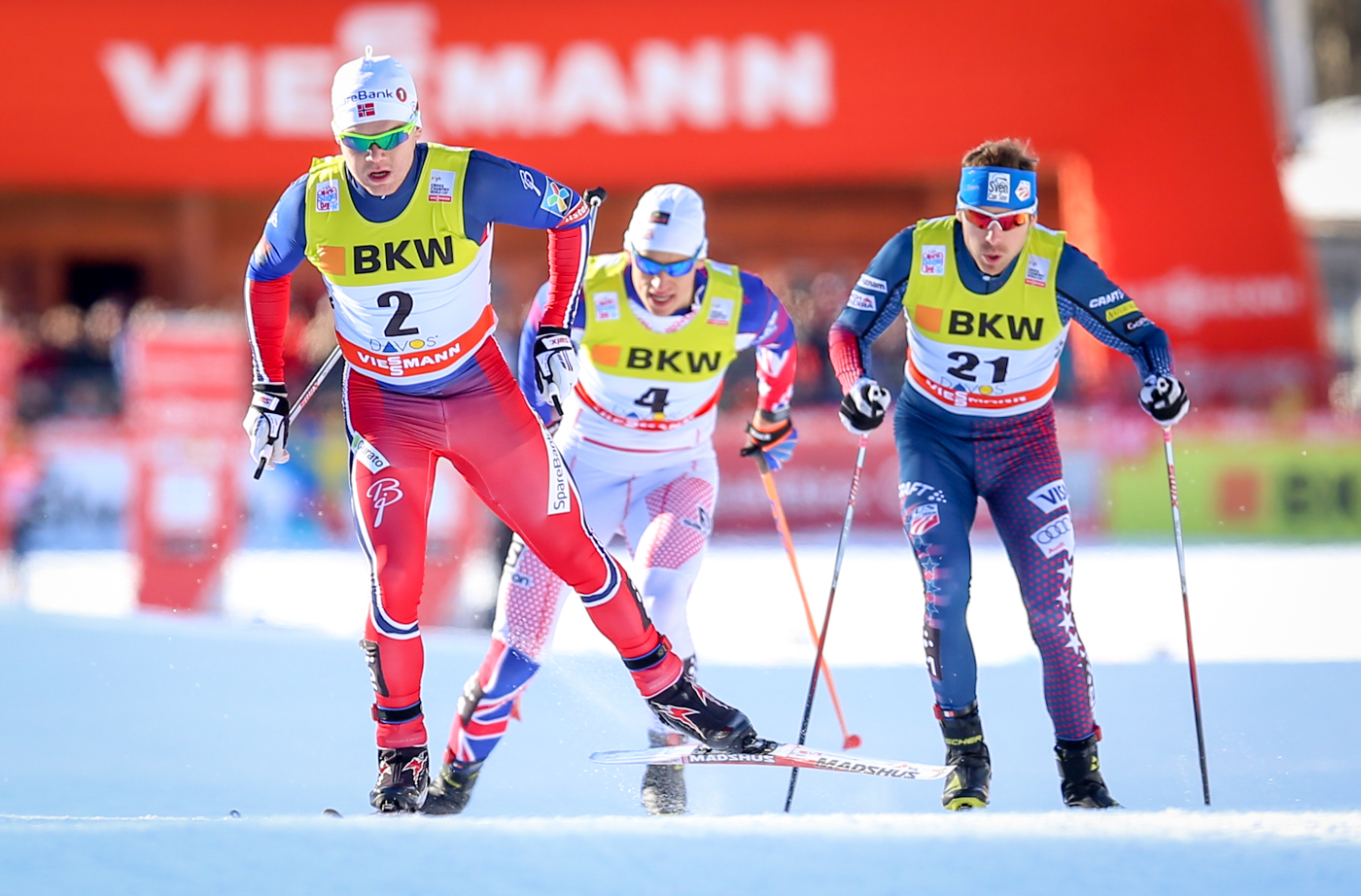
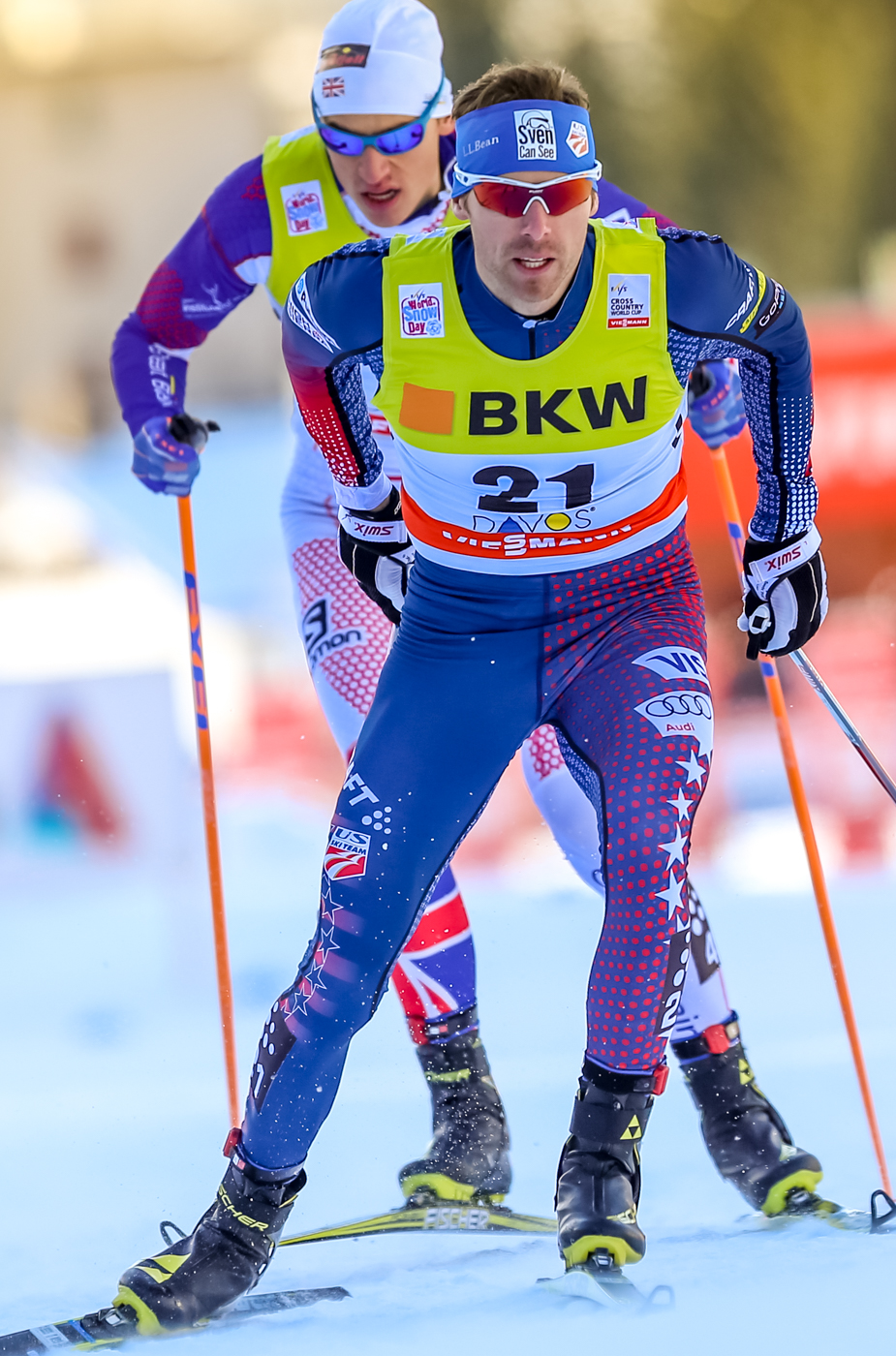
American Andy Newell (r) and Great Britain’s Andrew Young (c) trail Norway’s Håvard Solås Taugbøl (2) in the quarterfinal at the Davos World Cup freestyle sprint on Sunday in Switzerland. Taugbøl won the heat, Young placed third, and Newell was fifth after missing out on a photo finish for fourth. Newell finished the day 23rd overall. (Photo: Marcel Hilger)
DAVOS, Switzerland — A sunny Sunday morning in Davos held an exhilarating bout of freestyle sprints for the World Cup racers and fans alike.
For the U.S. men, Simi Hamilton and Andy Newell both glided through the qualifiers with times ranking 10th and 21st, respectively.
American Andy Newell (r) and Great Britain’s Andrew Young (c) trail Norway’s Håvard Solås Taugbøl (2) in the quarterfinal at the Davos World Cup freestyle sprint on Sunday in Switzerland. Taugbøl won the heat, Young placed third, and Newell was fifth after missing out on a photo finish for fourth. Newell finished the day 23rd overall. (Photo: Marcel Hilger)
Hamilton suffered a broken pole about halfway through his quarterfinal, which forced him to call it a day as he finished sixth and ended up in 26th overall. Newell’s run also ended in the quarterfinals, where he finished fifth for 23rd overall, which bumped him up to seventh in the overall Sprint World Cup standings.
Despite the results not going as they would have liked, both Americans reported feeling confident with their fitness and preparation going forward.
The sprint day began at 8:30 Sunday morning, without much daylight.
“You have to get down here in the pitch black for the first hour of skiing,” U.S. coach Matt Whitcomb said at the venue. “You see who remembered their headlamp and who didn’t. [We] had some near misses on the test track, but it makes for an adventurous day.”
From this race, some athletes joked that they took away a goal of improving their “morning person” technique. Needless to say, the sun and its accompanying warmth came through, and were quite welcomed by the racers.
The course warmed up, too, possibly becoming a little faster, but not necessarily easier for the skiers.
“The field tires as the day goes on and you just have to operate knowing that,” Whitcomb explained. “You feel lousy and so do your competitors. It really grinds you up.”
After 15- and 30-kilometer distance races on Saturday, Sunday held a 1.6-kilometer freestyle sprint, composed of two laps. It featured a long flat into gentle uphill straightaway out of the stadium start, followed by a hairpin turn into the one big climb of the course.
The racers then flew down the other side of the hill into a fairly technical turn around to the wider section of the course, running through the stadium. Along with many other racers, Newell spoke to the importance of this stretch where “everyone tries to pin it through the stadium on the second lap to try to get into a good position on the hill before the corner.”
Passing on this course was especially difficult, so it turned out that the jostling in this wide, straight section tended to be crucial to any changes in position.
The day started with a time-trial qualifier, and those athletes with the top-30 times advanced to the quarterfinals. One athlete starting every 15 seconds, there were 95 men vying for 30 spots to continue on to the next round. While Hamilton and Newell advanced, the third U.S. man in the race, Erik Bjornsen did not in 68th (finishing 9.06 seconds behind qualifying winner Sergey Ustiugov of Russia).
Neither did any of the Canadians; Len Valjas missed 30th by four-hundredths of a second in 31st (+4.64). Alex Harvey placed 54th (+7.39), Jess Cockney was 62nd (+8.27) and Continental Cup leader Michael Somppi 85th (+15.36).
“I skied well enough to move on. I was actually surprised I got knocked out,” Valjas said in a Cross Country Canada press release. “I was only .04 from moving on. There is no reason for people to panic. I felt great, I skied great. It is just unfortunate because I was that close to getting more World Cup points.”
“The field is so deep right now,” he added. “There is just no margin for error. The learning is I need to ski more aggressive now in the qualifiers. You just can’t take any chances or anything for granted anymore. Even if I think I had a great qualifier, when I’m coming down the finishing stretch I have to throw down everything I have, and lunge across the line because you just never know.”
If he could do it again, the 27-year-old Valjas said he would have approached the final curve more slowly to prevent from exiting it too wide.
“We have another shot next week and I know we will be better as a team,” Valjas said.
Hamilton Picks 1st Quarterfinal
After the qualifier, the top-30 athletes took turns selecting their heats for the quarterfinals. The picking order started with 11th place, going down to first, and then 12th up through 30th. The brackets in the midst of forming were displayed on a screen, and in sequence, each racer walked up and selected their desired heat by pressing one of five big red buttons. This is a new aspect of the sprint system permanently implemented this season.
Playing the popular tactic, Hamilton picked the first heat. He explained he wanted to maximize his recovery time between the first quarterfinal and first semifinal, should he advance. One of the risks in that is that he chose an empty heat that was known to be a popular choice.
Simi Hamilton (U.S. Ski Team) rounds a tight corner in the men’s 1.6 k freestyle sprint qualifier at the World Cup in Davos, Switzerland. He qualified 10th and went on to place 26th overall. (Photo: JoJo Baldus)
“I think it was a little bit of bad luck that I had Ustiugov and [Norway’s Sondre Turvoll] Fossli and Roman [Shaad of Switzerland] all in my heat, who are really strong sprinters,” Hamilton said afterward. “… It is an interesting way to be doing things now. It is kind of fun, it makes it a little more of a thinking game.”
After the strategy in picking the heat comes the racing strategy, which is frequently shaped around the opponents in that heat. Hamilton anticipated that Ustiugov and Fossli “would probably push the pace a little bit,” he said. “I also felt like this morning in the qualifier, I still had some really good pop at the top of the climb on my second lap. Those guys are really fast starters, so I knew that if I could kind of settle in behind them and ski really relaxed and smooth until I got to the climb the second time, then I could hopefully be able to push up and over that and either move into first or second on that climb.”
There were two climbs on the course — one for each lap. Hamilton’s plan was going well in the quarterfinal until he broke a pole about halfway through while coming around the corner into the lap lane.
Hamilton took the corner wide after the big downhill because of “personal preference,” he said. Afterward, he had to shift right to make the turn, and his right pole was clipped in the process. “It happens in tight sprints like this,” he said.
In the moments after, Hamilton slipped into last place, sixth in the heat, while skiing to the sidelines to get a replacement. He was just starting his second lap.
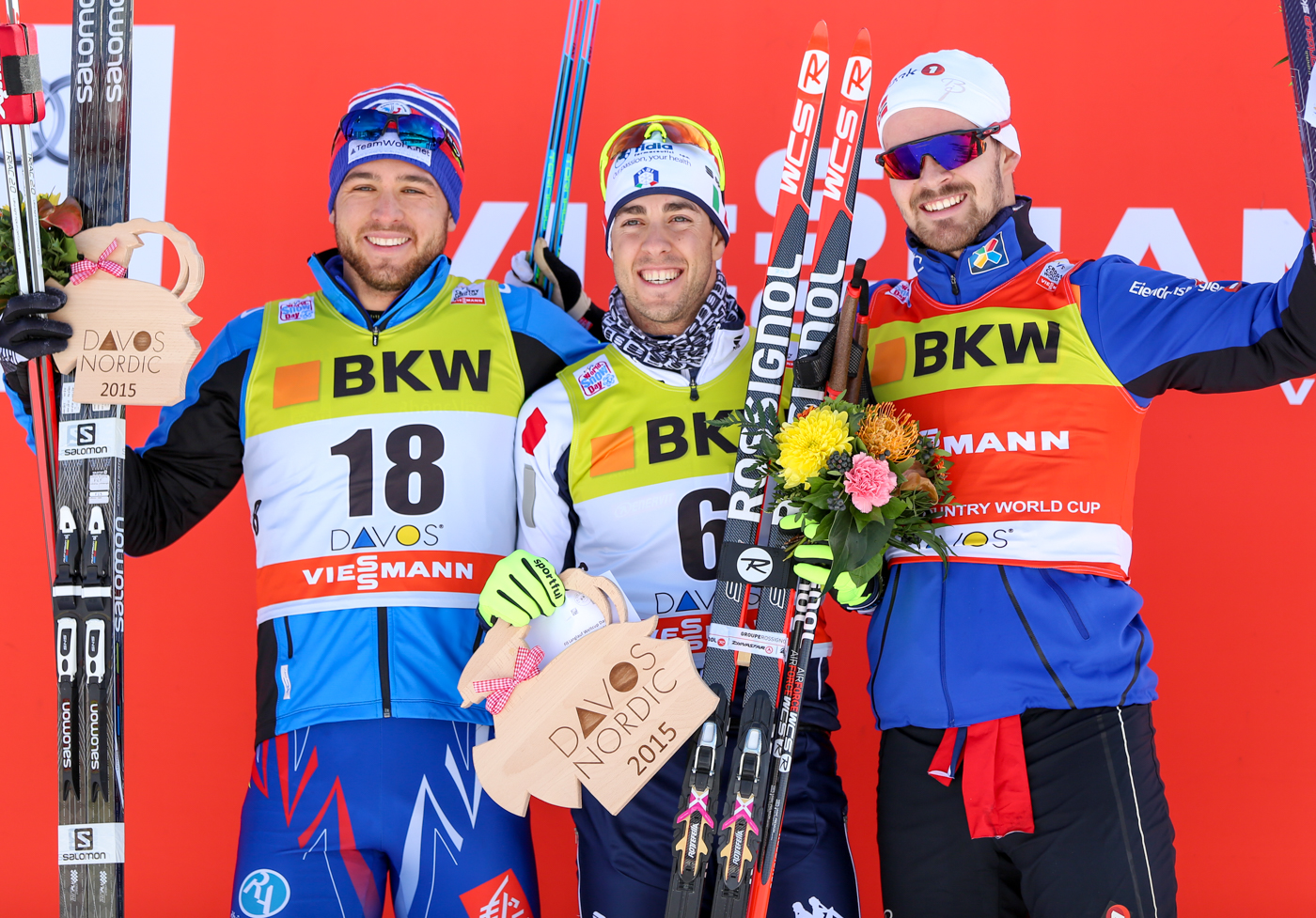
The men’s freestyle sprint podium at the World Cup in Davos, Switzerland: with Italian winner Federico Pellegrino (c), France’s Baptiste Gros (l) in second, and Norway’s Sondre Turvoll Fossli in third. (Photo: Marcel Hilger)
In the end, he finished sixth, 7.31 seconds behind the winner of his quarterfinal, Ustiugov. Schaad placed second (+0.74), and Fossli was third (+1.12). Fossli ultimately advanced all the way to the final, where the Norwegian placed third (behind Italy’s Federico Pellegrino and France’s Baptiste Gros, respectively).
Also in Hamilton’s heat, Lucas Chanavat of France placed fourth (+1.33), and Sweden’s Simon Persson was fifth (+1.86).
Despite his pole trouble, Hamilton remained positive after his race.
“I am psyched. I feel like my fitness is good right now, it is great for this time of year,” he said. “It is still early December – we have a lot of sprints left this year.”
Newell Goes for Last (Quarterfinal)
Newell raced in the fifth quarterfinal. After qualifying with in 21st, 3.84 seconds behind Ustiugov, Newell selected the last quarterfinal heat.
“I had a good look at the heats before I could pick,” he explained. “I chose the fifth [heat] because it looked like a good heat with people I thought I could beat, but it ended up being a really fast, tough heat.”
On the first lap coming into the technical, downhill turn where Hamilton broke a pole, the group shifted and Newell lost a couple spots.
Andy Newell (U.S. Ski Team) after finishing fifth in his quarterfinal for 23rd overall at the World Cup freestyle sprint in Davos, Switzerland. (Photo: JoJo Baldus)
“I kind of stood up a little bit; I went a bit conservative because I didn’t want to crash,” Newell said. “I ended up losing a position or two – I didn’t want to go too far inside because it was icy.”
Then came the best opportunity for passing back: the wide stadium flat.
“I thought I could get into a good position, but I pushed the flat hard and maybe didn’t have quite enough on the uphill,” he recalled. “I should have been able to pick off a skier or two on the uphill, which I wasn’t able to do, so that was a bummer.”
Norway’s Håvard Solås Taugbøl won their quarterfinal in 2:20, just seven-hundredths of a second slower than Hamilton’s heat. Taugbøl beat Germany’s Sebastian Eisenlauer by 0.18 seconds for the win, Andrew Young of Great Britain advanced in third (+0.3), and Norway’s Anders Gløersen nipped Newell in a photo finish for fourth (+1.35) by 0.04 seconds.
Newell took fifth in his heat for 23rd overall. After his quarterfinal, he mentioned that he had been feeling the effects of altitude around 5,000 feet above sea level in Davos.
“My fitness is pretty good; I know that I can have strong finishes,” Newell said. “I didn’t have a super strong finish today but I know it will be there. It definitely is there. Hopefully next week.”
The World Cup continues in Toblach, Italy, next weekend with another freestyle sprint on Saturday and 10/15 k classic individual starts on Sunday, Dec. 20.
Hamilton said he’s also in shape for better results.
“I felt really good on the climb both times,” Hamilton observed. “In the past [at Davos] I think I have been able to V2 the climb the first [lap] and then felt like I was pretty flooded the second time up, but today I knew that my fitness is at a spot right now where it hasn’t been at this time of year before.… I think my body is in a good place right now.”
With a total of six U.S. skiers in the heats (four women and two men), Whitcomb said they’re leaving Davos with confidence.
“Simi unfortunately broke a pole but he was skiing great, fast qualification. That’s a good sign he’s in form,” Whitcomb said. “Fans at home can expect big things in Toblach next week. Andy will be back together, he’s been feeling a bit off all day today, but I’m not worried, he’s in great shape.”