SOCHI, Russia — All four American women in Tuesday’s 1.3-kilometer freestyle sprint successfully locked up spots in the quarterfinals, advancing with top-30 qualifying results on a challenging and soupy course.
With temperatures well into the 40’s and snow that didn’t freeze overnight, officials salted the critical climb out of the stadium, but the curving descent back toward the finish proved challenging. Of the first seven women who started, two fell (Sweden’s Hanna Erikson and Poland’s Sylwia Jaskowiec). Several others followed — between the women’s and men’s 1.8-kilometer qualifier — and China’s Wenlong Xu had to be assisted as he limped off the course.
Sophie Caldwell led the American qualifiers in ninth, 3.11 seconds behind winner Maiken Caspersen Falla, who clocked 2:32.07. Slovenia’s Katja Višnar advanced in second, 0.4 seconds back, and Norway’s Marit Bjørgen was third (+1.10).
Also for the U.S. Ski Team, Jessie Diggins clocked the 12th-fastest time (+3.57), Kikkan Randall made it through in 18th (+4.6), along with Ida Sargent in 26th (+7.73).
Of the Canadian women, Perianne Jones qualified in 23rd (+6.56) and Dasha Gaiazova made the heats in 27th (+7.97). Heidi Widmer (Alberta World Cup Academy/National Senior Development Team) was 3.19 seconds out of qualifying in 43rd, and the defending Olympic skate sprint champion, Chandra Crawford, placed 44th — 0.23 seconds after Widmer.
In the men’s race, Andy Newell was the fastest American in 17th, 7.17 seconds behind qualifier winner Ola Vigen Hattestad of Norway, who finished in 3:28.35. Russia’s young gun Sergey Ustiugov, 21, was nearly two seconds behind in second (+1.91), and Italy’s Federico Pellegrino advanced in third (+2.03).
Alex Harvey was the lone Canadian male in the top 30, qualifying in 19th (+7.73). Simi Hamilton of the U.S. was just four-hundredths of a second back from Harvey in 21st.
Canada’s Len Valjas in 36th was 1.99 seconds out of 30th — and 11.52 seconds behind Hattestad.
“I caught a cold three days ago, so I was in bed for three days,” Valjas said. “Yesterday I dragged myself out to do a half-hour ski and I just felt like total crap. So this morning I did two laps pretty hard, just clearing out the cylinders, and I didn’t feel awesome there. But come the race, the skis were fast and I actually felt pretty good.
“I would have liked to have been a few positions better, but I’m considering everything that’s happened this year … I think I did okay today,” he added. Valjas had knee surgery last summer and spent the last month taking a break from the World Cup to rehab it in Canmore, Alberta.
Four-time U.S. Olympian Torin Koos finished 37th (+11.92) — consistent with his 35th- and 36th-place finishes in the freestyle sprint in the 2002 and 2006 Games, respectively.
Erik Bjornsen of the U.S. Ski Team was 39th in his first Olympic sprint (+12.04), and Canada’s Jesse Cockney (Alberta World Cup Academy/National Senior Development Team) placed 53rd (+16.01) in his first Olympic race.
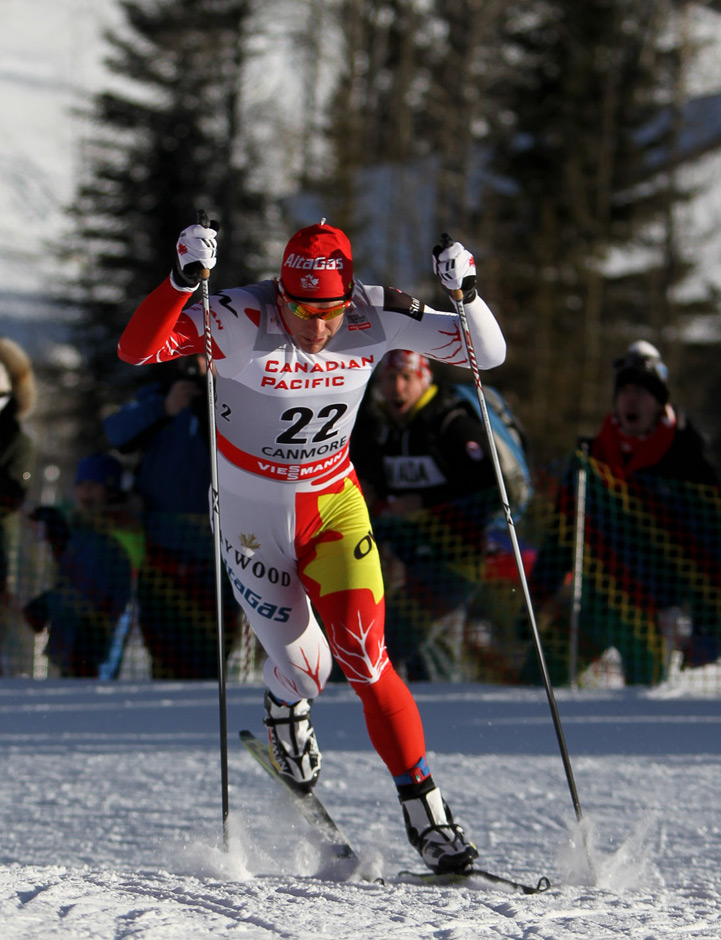
Canadian Devon Kershaw pushing in the Alberta World Cup sprint qualifier on Dec. 15 in Canmore. He was 50th and failed to advance to the quarterfinals, one of the lower points of his season.
It would be generous to term Devon Kerhsaw’s 2013 season “up and down,” as the Canadian star has spent the duration well off his usual level. But when April rolls around and Kershaw looks back, February 1st could mark the turning point from a long stretch of down to what could still be a whole lot of up.
Kershaw skied to an eighth-place finish in the 1.8-kilometer World Cup freestyle sprint in Sochi, Russia, as skiers tested the Olympic course for the first time.
In leading a total of four Canadians into the heats, Kershaw posted his best result of the season, and is finally regaining the belief that he can still be in top form for World Championships.
“It’s coming around at a decent time,” Kershaw told FasterSkier in a post-race interview. “I still don’t have my usual gear changing ability, but I have three weeks to find that and at least now I am more confident that it will actually happen.”
After qualifying in 24th and advancing as a lucky loser in the quarterfinals, Kershaw was eliminated when he finished fourth in his semifinal heat, a round led by eventual winner Petter Northug (NOR).
“I played it tactically super well. In both my heats I was in absolutely the best position you could ever ask for,” Kershaw explained.
Each time, however, he was unable to respond to attacks over the top of the steep climb.
“I am doing everything I can but I just don’t have that gear, to change in to the really fast hop skate,” he said.
This has been the problem all season — the ability to kick it up a notch with the race on the line.
Even without the extra burst, Kershaw still reached the top 10, always impressive, but all the more so considering he was sick with food poisoning two weeks ago, missing the La Clusaz World Cup races and had not competed since the Tour de Ski.
“To come out in a sprint and be top-10 after no racing for almost a month, I was very happy to feel better sensations,” Kershaw said.
He felt good in Thursday’s training and finds the long, hard course to his liking.
With times approaching four minutes, the event favors athletes with superior endurance, and as a strong distance skier, Kershaw can handle the extra effort.
Kershaw’s teammate Lenny Valjas, who skied to 20th, described the loop as “longest and toughest” course he as ever skied.
Valjas felt the long lay-off, not having raced since the Liberec sprint weekend and coming off a big training block Valjas said he “felt a little tired.”
In his quarterfinal, he came out of the downhill with good speed, but couldn’t get past American Andy Newell.
“When I went to pass on the flats Newell heard me coming and cut me off,” Valjas explained. “It forced me to stand up and slow down to sit behind him. I wasn’t able to re-accelerate to pass him in the final stretch.”
Valjas said the course is such that it is difficult to pass in the stadium and the key is getting good position on the last climb and holding on to the finish.
Alex Harvey did not race after dislocating his shoulder on Wednesday. On Friday, he went for a no-poles ski, but explained in an email that he wouldn’t return to racing until the Davos World Cup in two weekends.
“The mobility is pretty much 100% back now. Did some strenght test with our therapist here and this is back too,” Harvey wrote. “I think my shoulder is good now for intensity but the risk of crashing in both the mass start and the team-sprint are too great for me to take a chance…so next race will be Davos.”
Canadian head coach Justin Wadsworth agreed, and wrote in an email that Kershaw and Valjas are slated to start Sunday’s classic team sprint.
“Right now it’s Devon and Len, as I and our medical staff thinks racing would be risky, like season ending risky, if [Harvey] fell,” Wadsworth wrote.
Gaizova Season-Best Skate Sprint, Jones 18th
Dasha Gaiazova led the Canadian women with a season-best World Cup skate sprint result, advancing to the semi-finals and placing 12th.
Bouncing back from illness, she said she feels “90-percent healthy,” and took advantage of a big opportunity to advance in the quarterfinals.
When Finland’s Mona Lisa Malvalheto crashed on the stadiums final tight corner, Gaiazova, who was outside and avoided the carnage, moved up to second and a spot in the semis.
“I got lucky,” Gaiazova said simply. “I was just in a good place when everybody went down and I had a good shot…I’m happy that I was able to do a couple rounds on the course and get some impressions for next year.”
After getting sick just before traveling to Russia, Gaiazova spent four days in bed recovering, and was able to do some harder training yesterday in preparation for the race.
“Coming into the race today my goal was to learn as much as I can, and not try to think too much about having a great result,” she said.
Like Gaiazova, Jones was excited to race the Olympic course, but was left wanting more after being eliminated in the quarterfinals.
She got off to a slow start and was unable to close on leaders Celine Brun-Lie (NOR) and Hanna Kolb (GER) who had skied off the front.
“It was a little bit of learning there,” Jones said. “I still really need to work on my starts and think about positioning because even though the course seems like it’s really wide there’s really not a lot of chances to pass people.”
While the men’s course clocked in at close to four minutes, the women’s loop is significantly faster, with times in the area of 2:45.
Jones was happy to see the shorter distance, noting the increasing lengths of World Cup sprint courses, calling the Sochi race “an actual sprint.”
“I think it’s a challenging course because it’s short, but most of the work is done in the first minute, minute and a half,” she said. “I really like it because it is short and there’s a nice finishing stretch, and there’s a fun corner in there.”
She also pointed out that fresh snow slowed the tracks and that on a faster day it could ski as much as 20 seconds faster.
Gaiazova and Jones will pair up for the classic team sprint on Sunday, with both women looking forward to another opportunity to prepare for next year’s Olympic Games.
The final Canadian in the race, Chandra Crawford, placed 51st. Like Gaiazova, Crawford has been sick and was not in top form.
“I had two full days in bed and then rallied to race because it’s the Olympic course,” Crawford wrote in an email. “That’s it for me for the weekend now to get the health game back up to ‘A’ standards.”
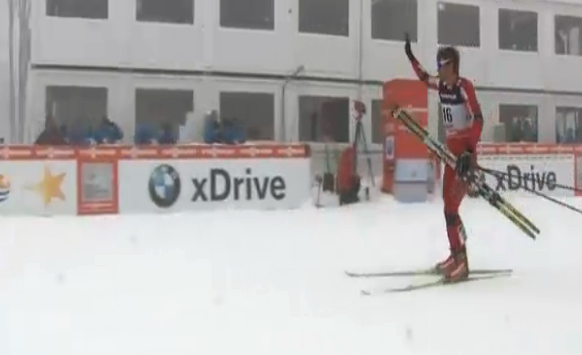
Norway’s Petter Northug waves to the spectators after winning Sochi’s debut cross-country World Cup, a 1.8 k freestyle sprint, on Friday at the brand-new venue in Krasnaya Polyana, Russia.
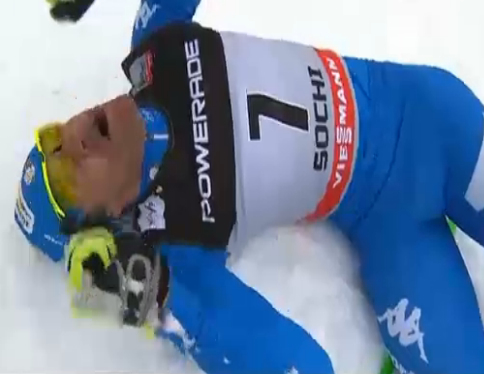
The finish-line expressions pretty much said it all Friday at the 2014 Olympic cross-country venue in Krasnaya Polyana, about an hour’s drive from Sochi, Russia. Norwegian Petter Northug threw up his arms in celebration before crossing the line first, Dario Cologna of Switzerland had a blank look of dissatisfaction after and Italy’s David Hofer was ecstatic.
For those three, that was about right for their respective 1-2-3 placing in Sochi’s debut nordic World Cup. It didn’t matter how hilly or slow or long the course was (with two massive climbs, heaps of fresh, wet snow and 1.8 kilometers that took close to four minutes to complete), Northug knew how to conquer it.
What was more, he wanted to prove that he could do so on the future Olympic course.
At times it seemed questionable. In the final, the 27-year-old Norwegian favorite dropped as far back as fourth with a sizable gap between him and the three leaders. But Friday’s freestyle sprint was all about tactics on the rollercoaster-like course, and Northug repeatedly chose to turn on the jets as needed.
Just as he did in the semifinal, Northug charged up the last hill in the final, but once again wasn’t the first to the top. Right behind Hofer in first coming into the stadium, Northug outpaced both the 29-year-old Italian and Cologna, who caught the draft in third but was unable to catch his rival.
David Hofer soaking up his first World Cup podium after placing third in the Sochi World Cup 1.8 k skate sprint on Friday.
After qualifying in 16th, Northug finished first, 0.57 seconds ahead of Cologna in second. Hofer was third, 0.81 seconds back, for his first World Cup podium. A great day for him, an affirmation for Northug, and oh-so-close result for Cologna, who won the qualifier by 1.1 seconds.
“In the prologue … the body was not playing on the same team,” Northug told NRK, according to a translation. “But beyond that it really is just easier, and I know I’m starting to have the gear I want. It was a good confirmation.”
Northug won both his quarterfinal and semifinal en route to the victory, edging Russians in each to do so.
In the quarter, he tried to set the pace early, but Russia’s Sergey Ustiugov overruled that and skied ahead. American Andy Newell also gave Northug a run up the last long climb, but in the end, it was Northug that pushed hardest up and over, beating Ustiugov by 0.2 seconds to the finish. Newell was third in the heat, which wasn’t quite fast enough to advance him to the semis.
In Northug’s semifinal, Russian Nikita Kriukov took a line from his teammate’s game plan, putting Northug to the test early. Canada’s Devon Kershaw and Russia’s Ilia Chernousov also got ahead of Northug on the first hill, but the Norwegian was right back in it for the second ascent. Heading down into the stadium in second, he trailed Chernousov by about five to ten meters, but slingshot past him on and held off both Kriukov and Chernousov, respectively, for the win.
In the final, Ustiugov went on to place fourth, 1.26 behind Northug. Kriukov was fifth (+6.92) and Petukhov placed sixth (+13.53).
Beating those Russians on their home turf meant a lot to Northug, who was issued a written reprimand for unsportsmanlike behavior in the quarterfinals.
“It feels great to win here, especially with three Russians in the final,” Northug told FIS after the race. “It was perhaps the toughest sprint course I’ve tried. … For me it is the only opportunity to test the trails here in Sochi. I have to store them in my head before I programmed the conclusion of training in the summer and fall.”
It was also Northug’s fourth individual World Cup victory of the season. He’s currently third in the overall World Cup standings, six points behind Russian Alexander Legkov in second, who skipped the race. Cologna is first with 898 points, 33 ahead of Legkov.
“It was a good day,” Cologna said at a press conference. “I was fast in the qualification and also in the heats. I feel my shape is going up. Second place today is also a good sign for the next year.”
Cologna set the fastest qualifying time on the unusually long course in 3:47.92. Russia swept the next four spots, with Kriukov qualifying in second, Chernousov in third, Mikhail Kuklin in fourth and Ustiugov in fifth. Newell qualified in sixth and Hofer was seventh.
For Hofer, the day got even better. He went on to place second in his quarterfinal to Russian Alexey Petukhov, and advanced in fourth as the lucky loser in the semifinal behind Cologna, Ustiugov and Petukhov, respectively.
At a press conference, Hofer called his first individual podium a “great success.”
“It has given me motivation for further training and hopes,” he said. “I like free technique. At the Olympics sprint is in skating and also 50 km. We will see what the result will be.”