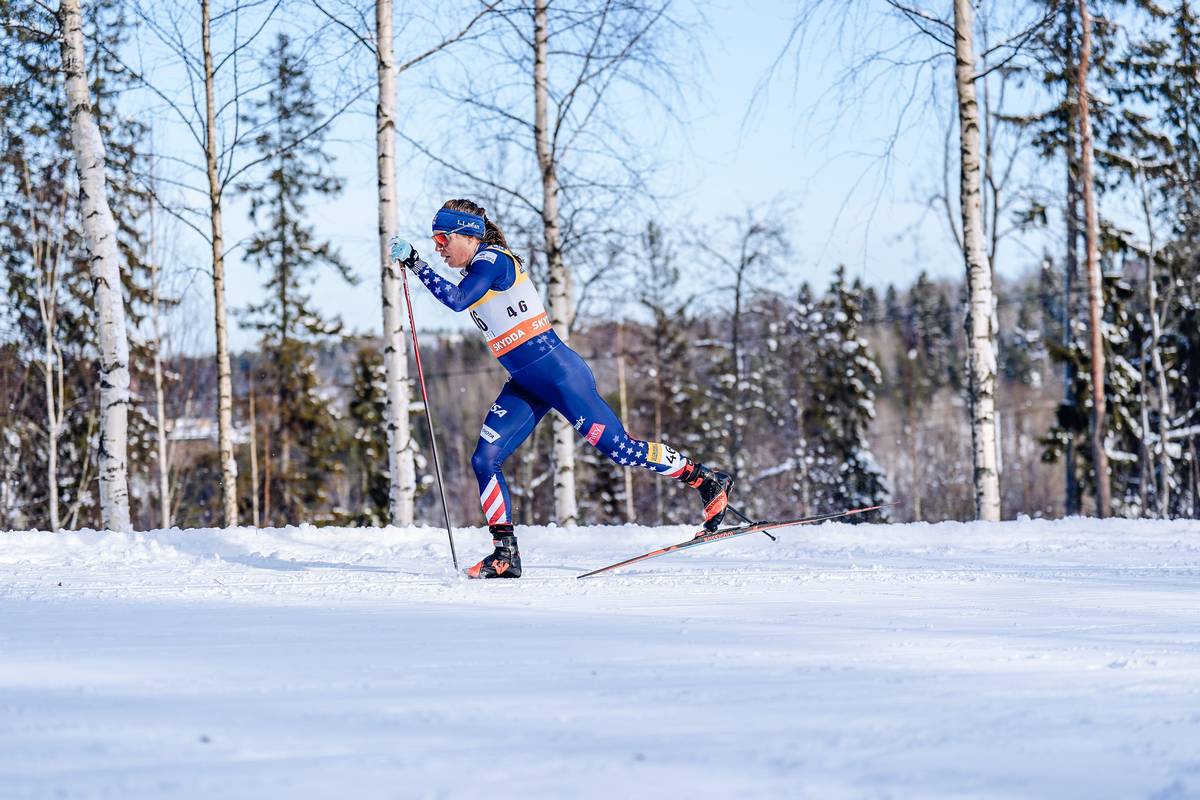
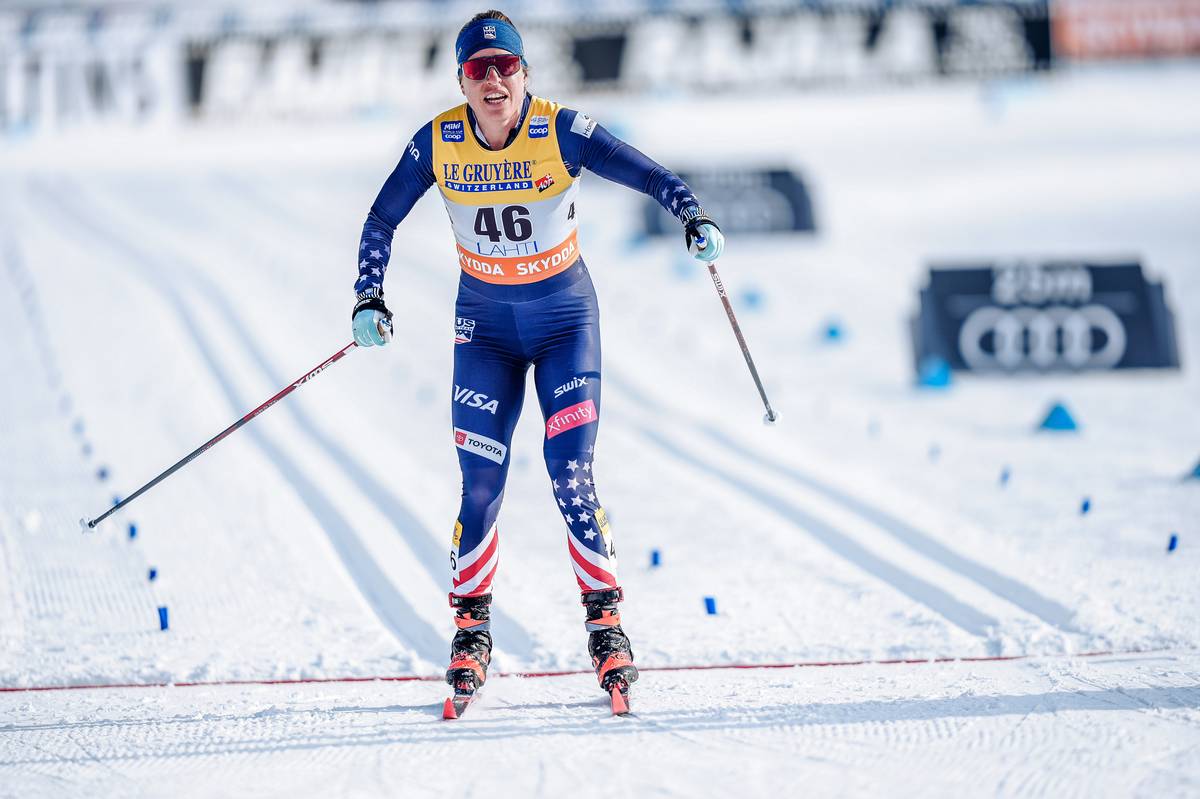
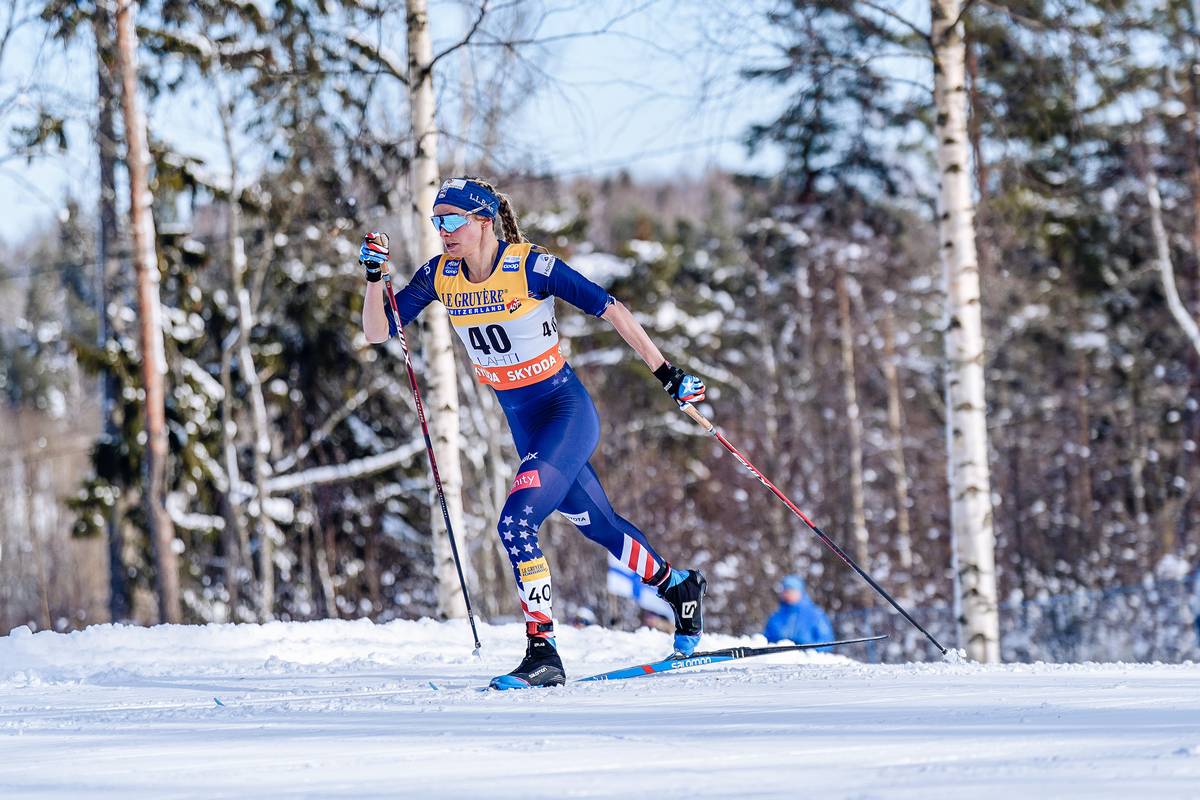
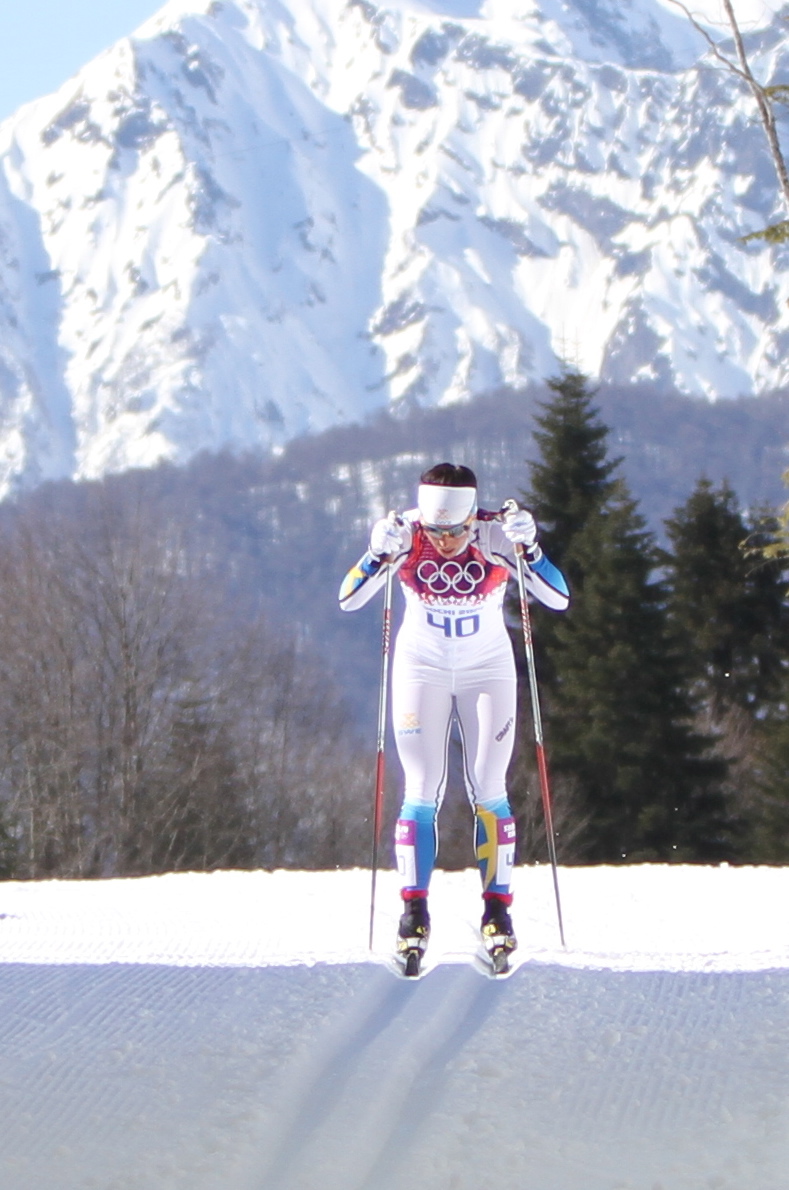
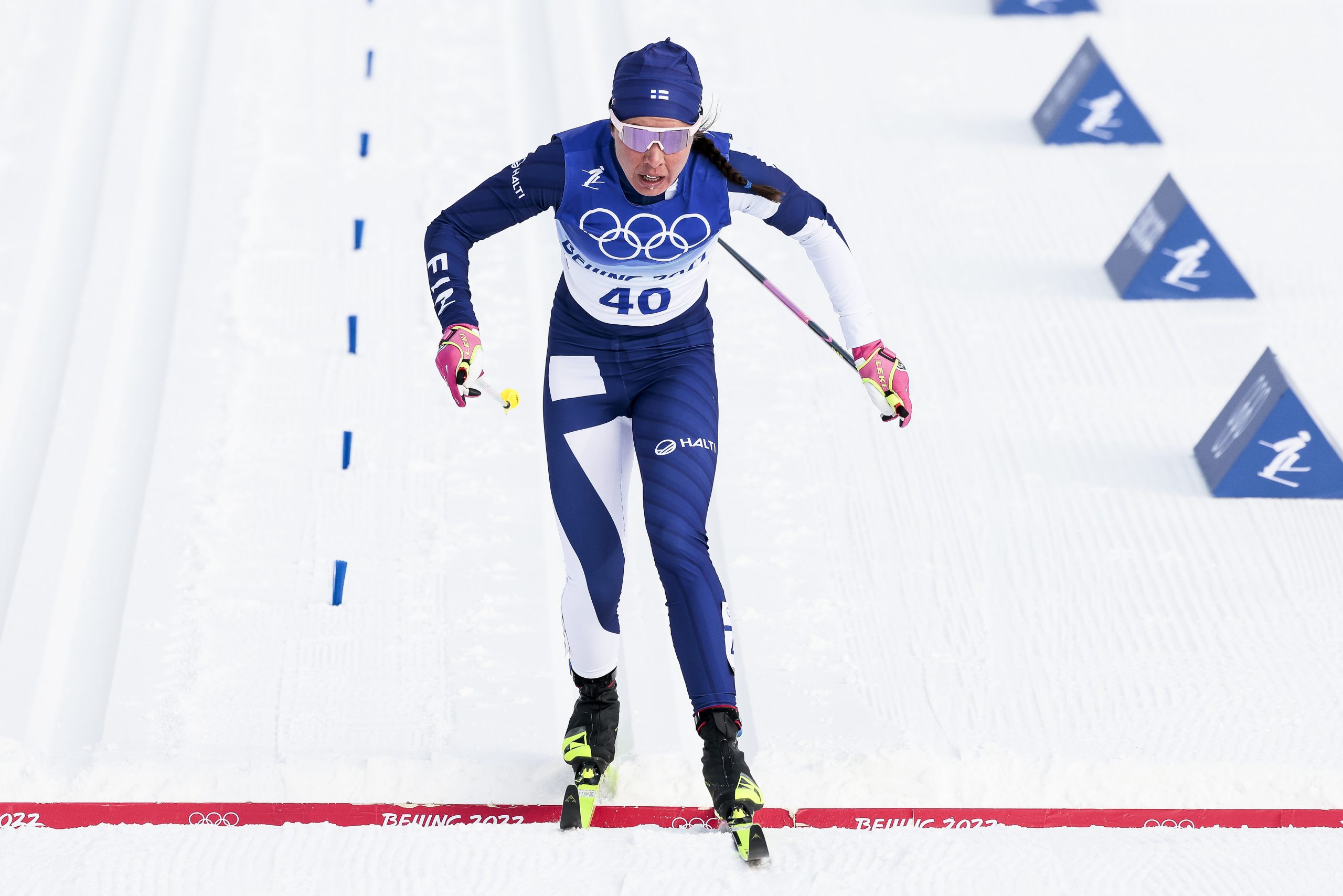
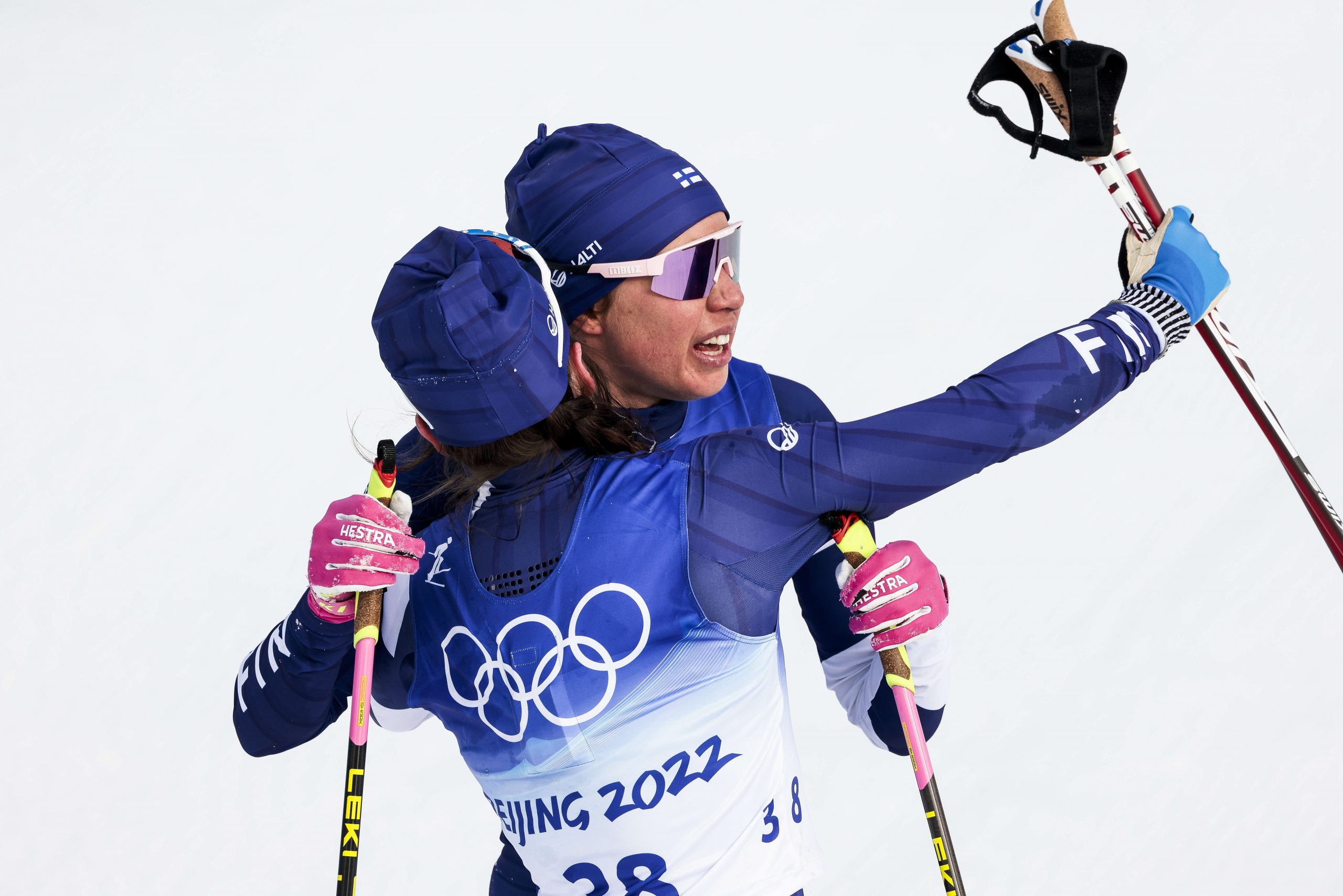
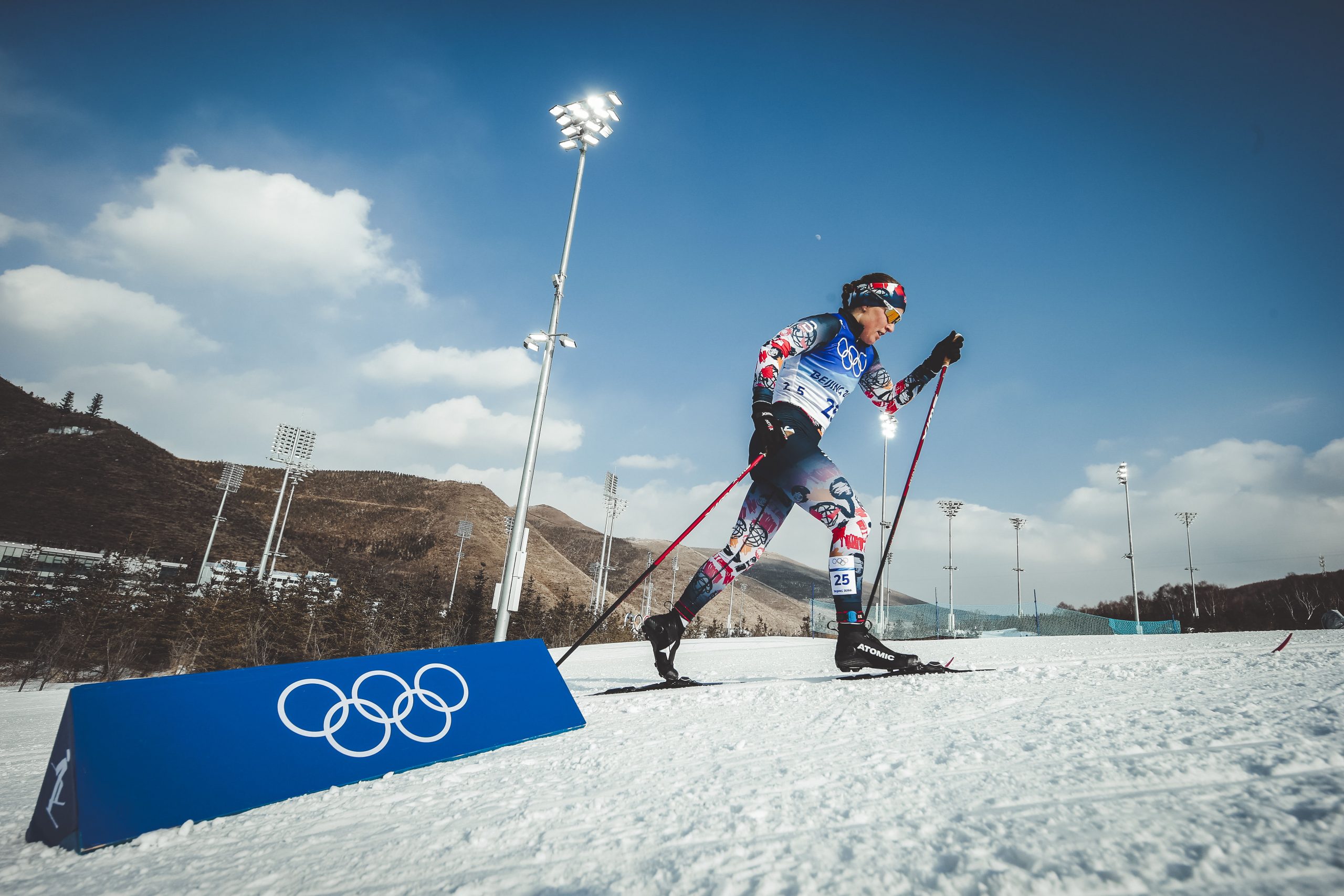
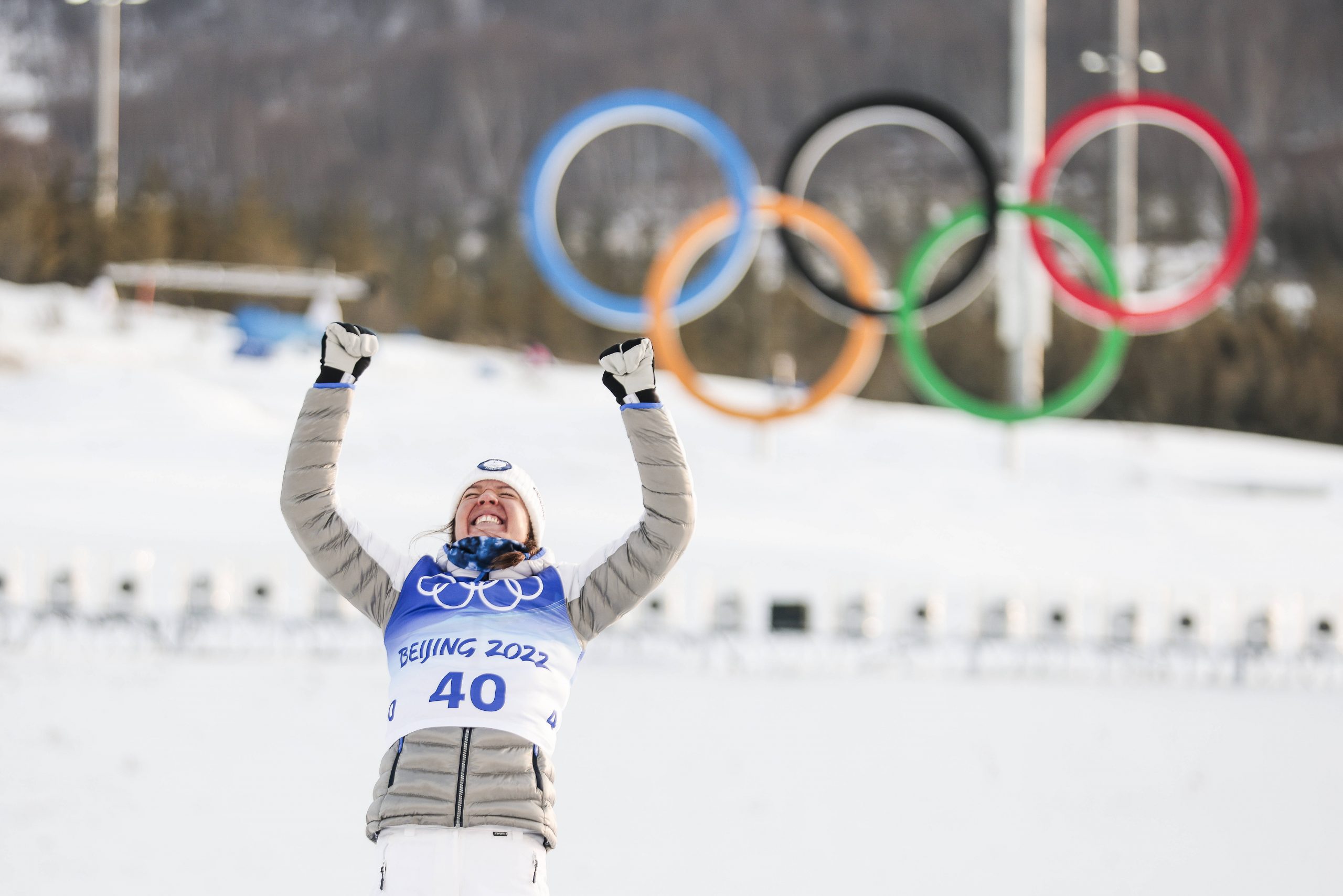
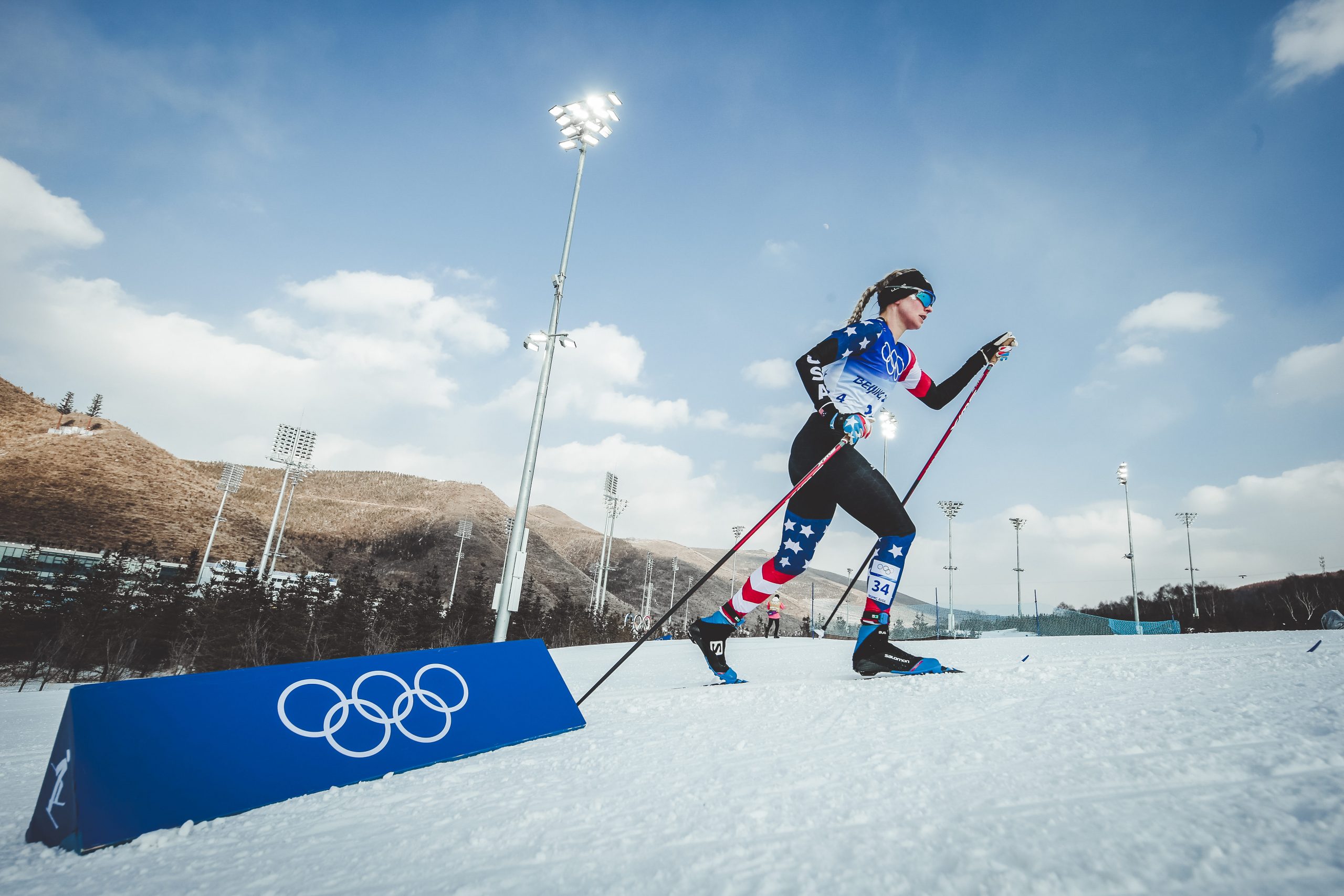
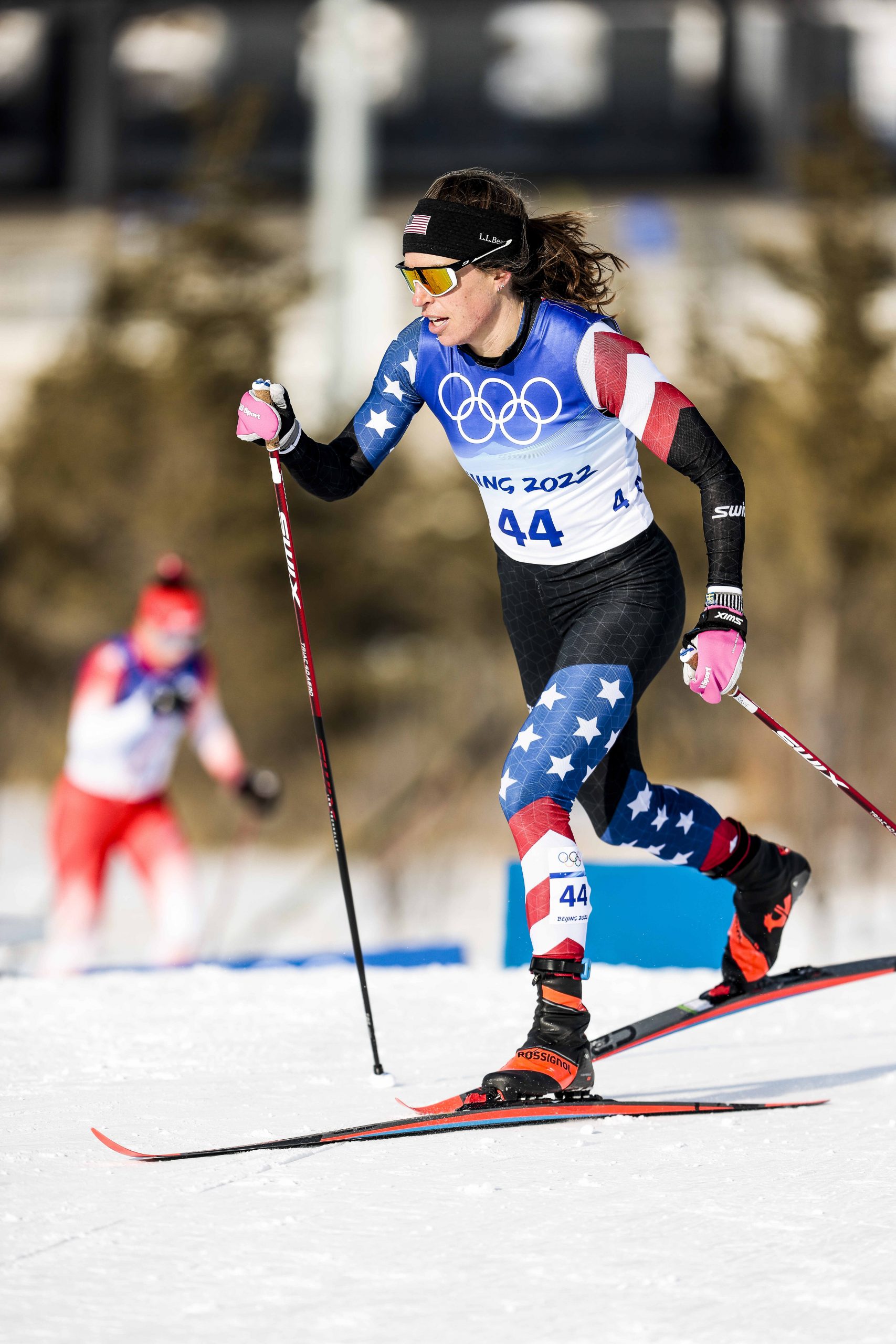
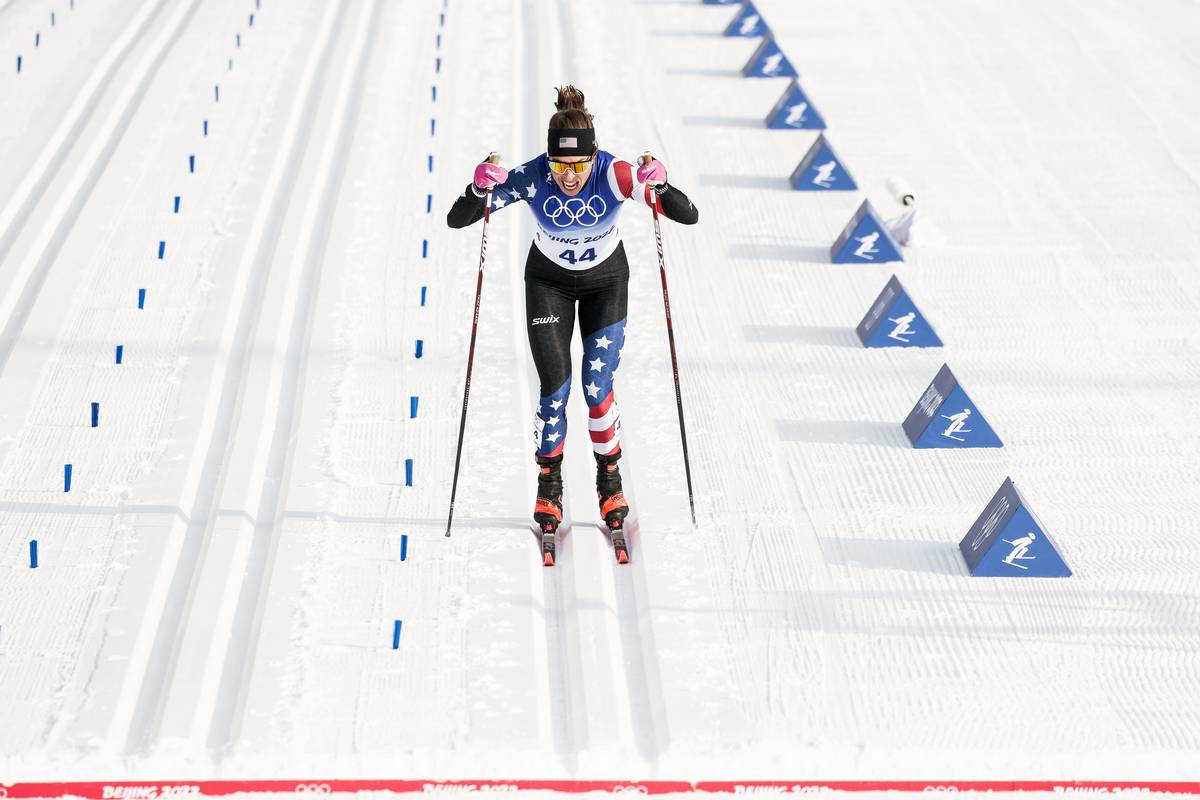
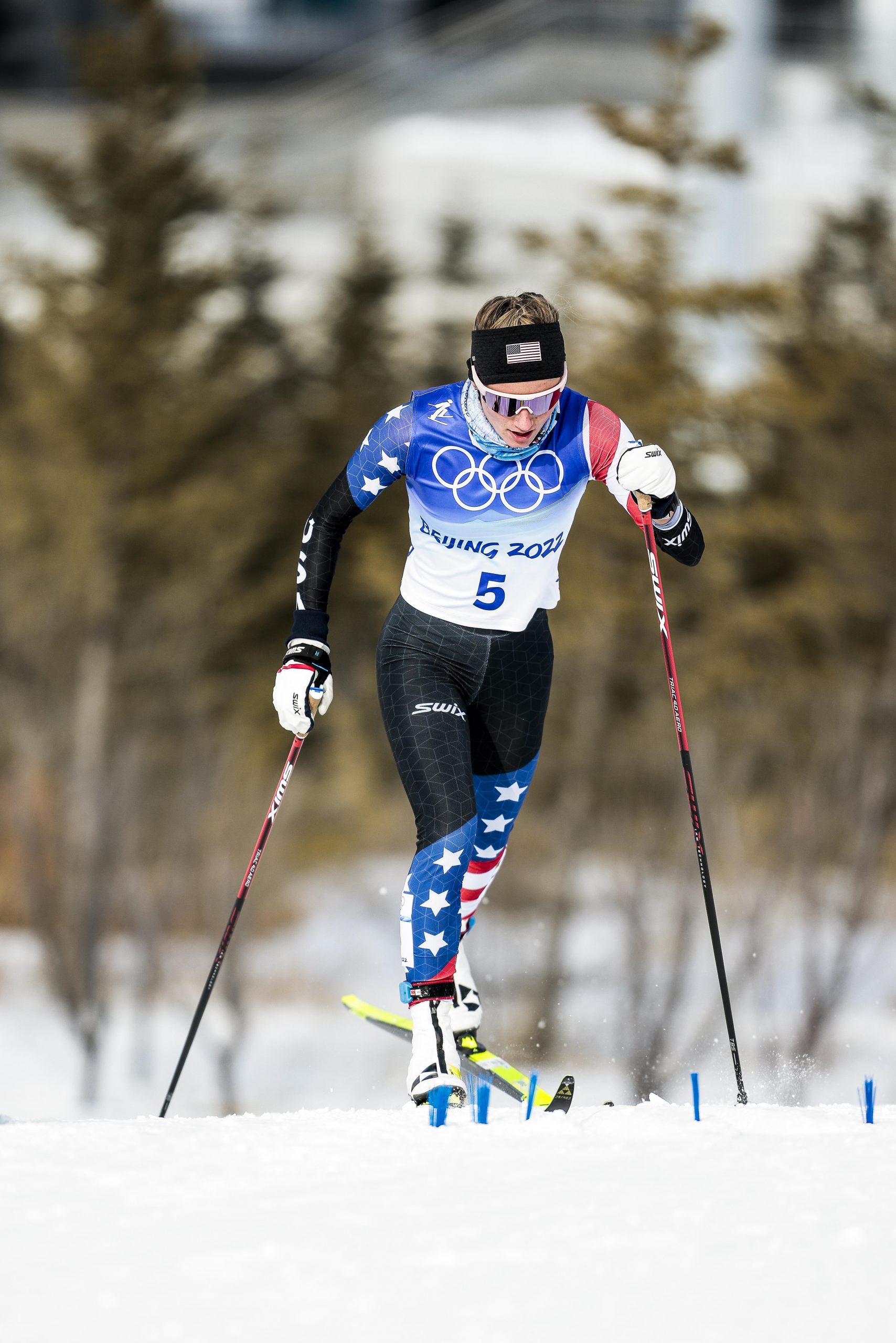
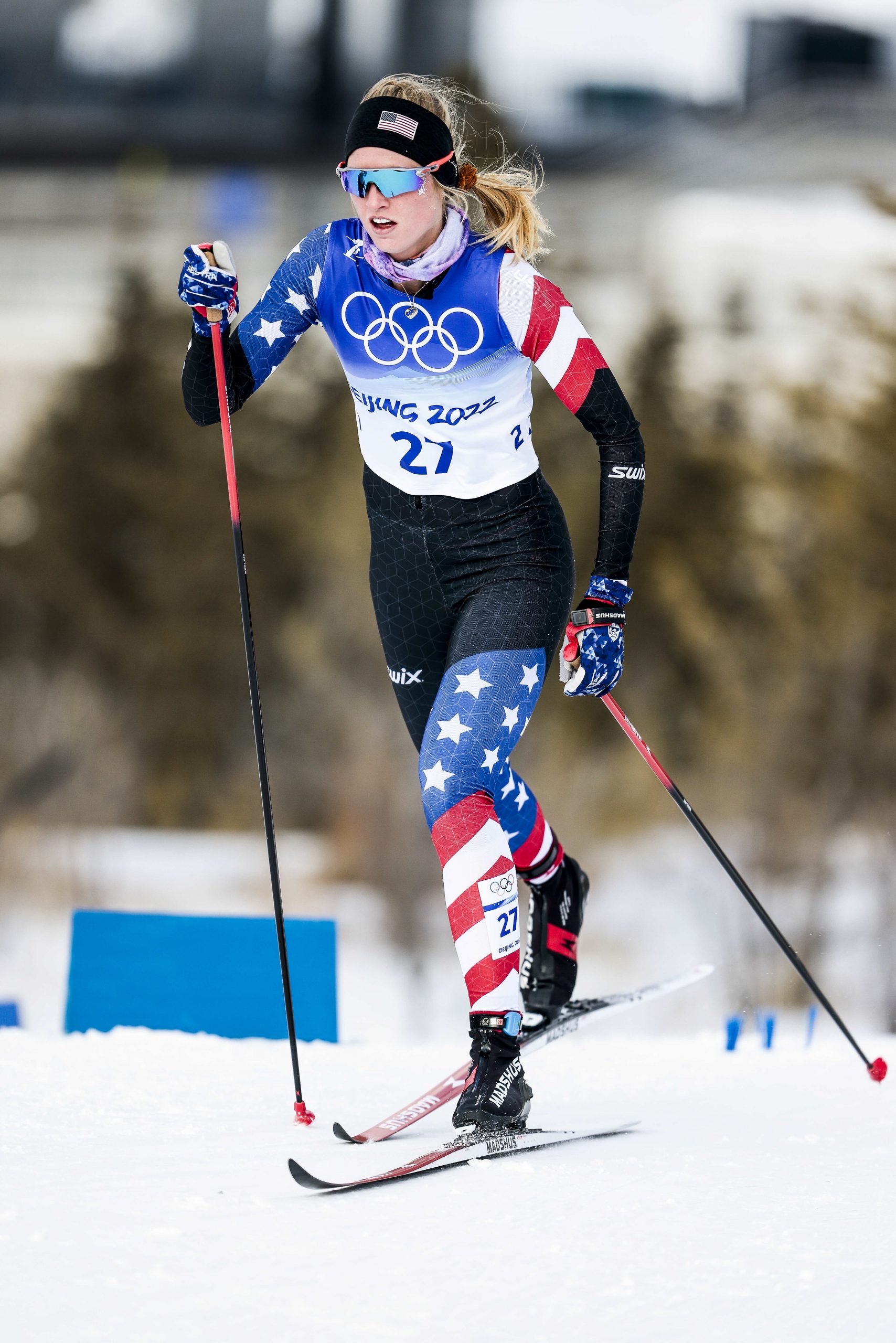
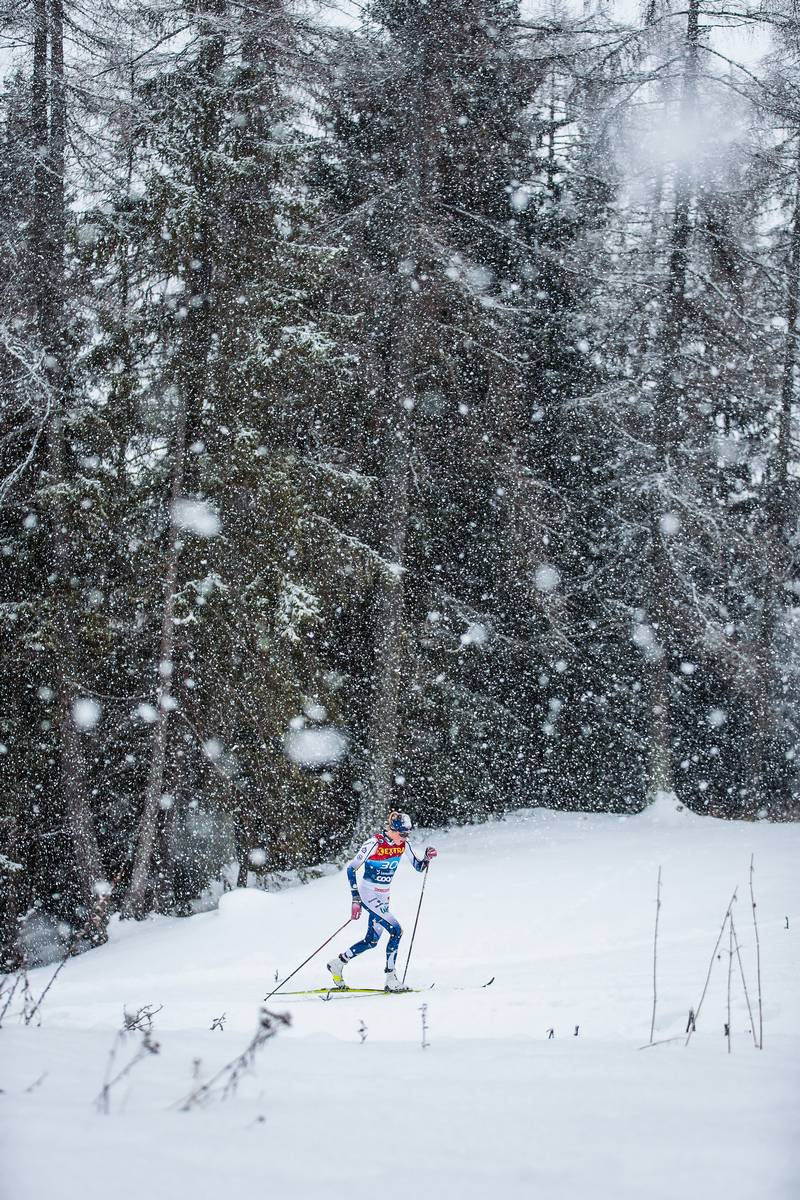
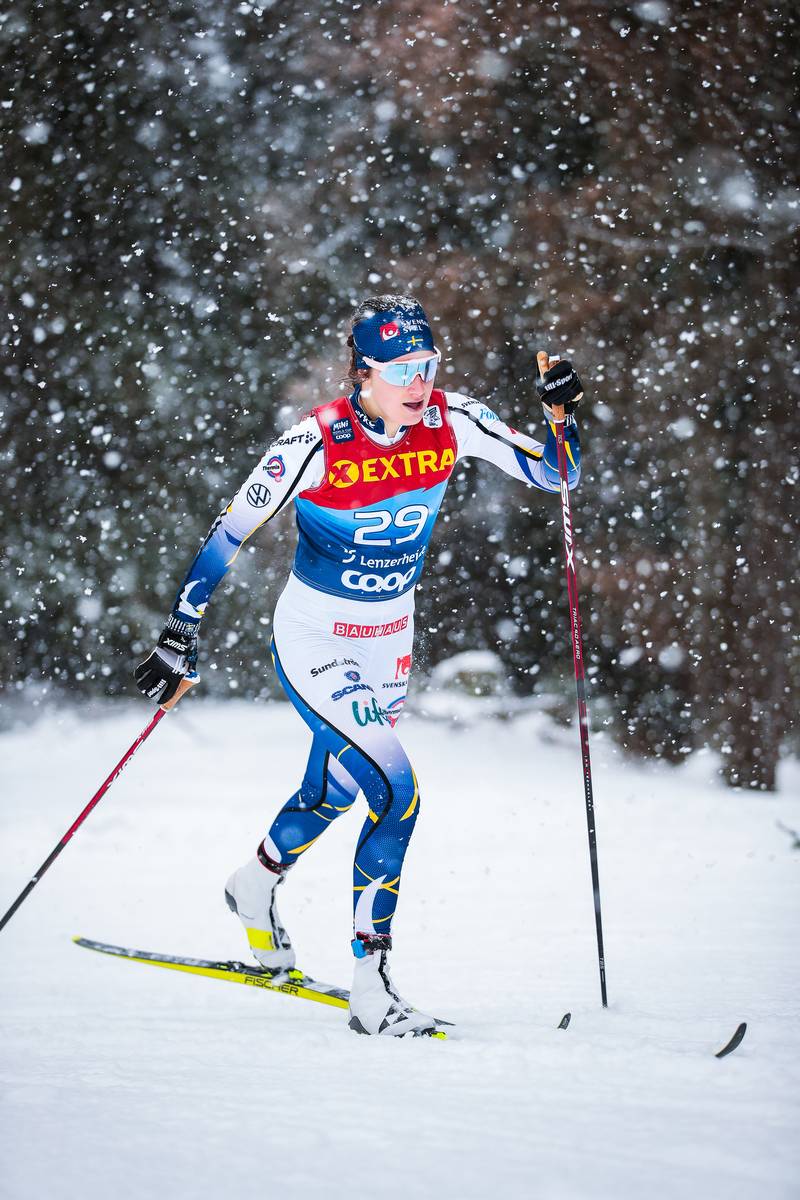
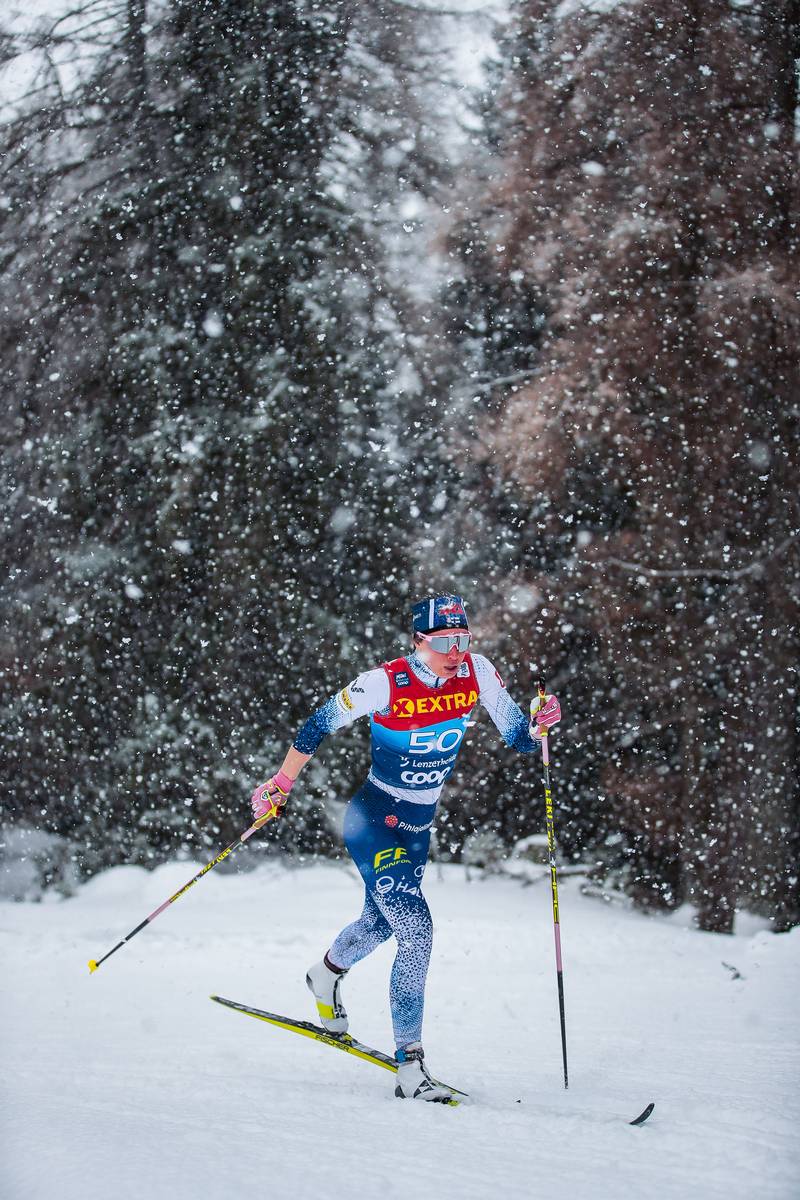
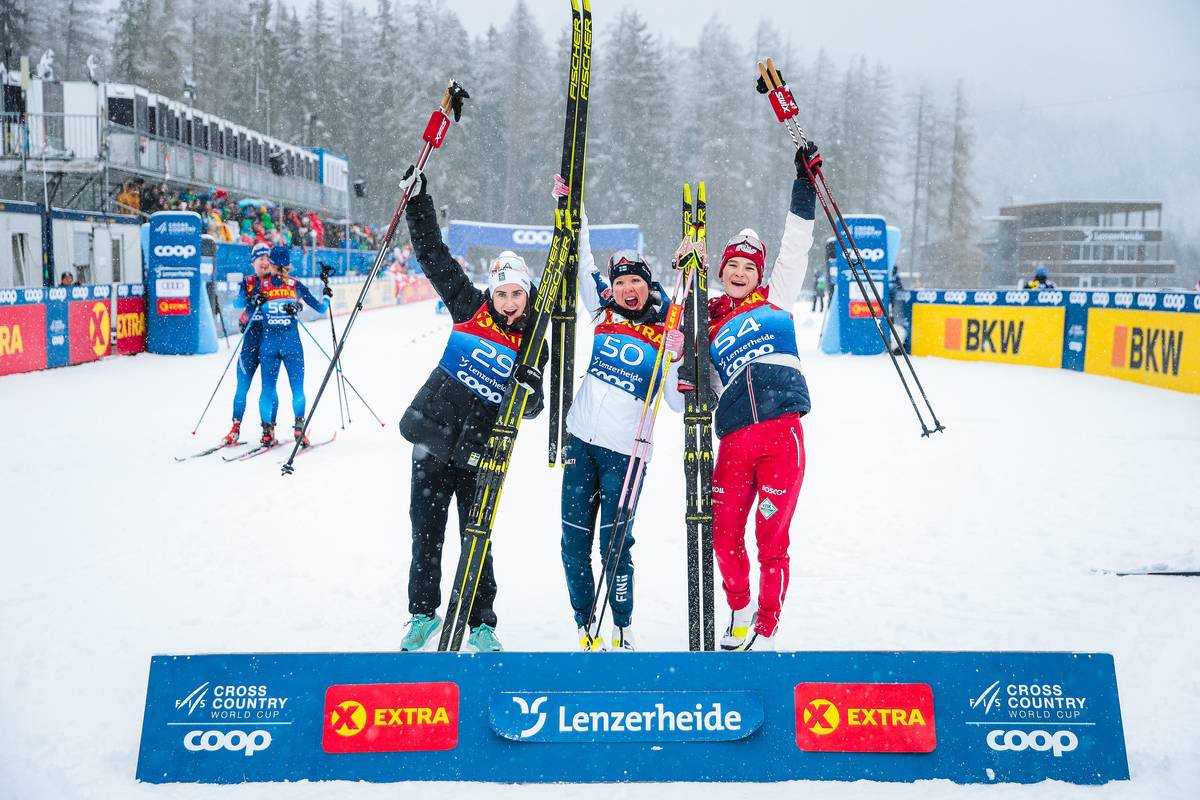
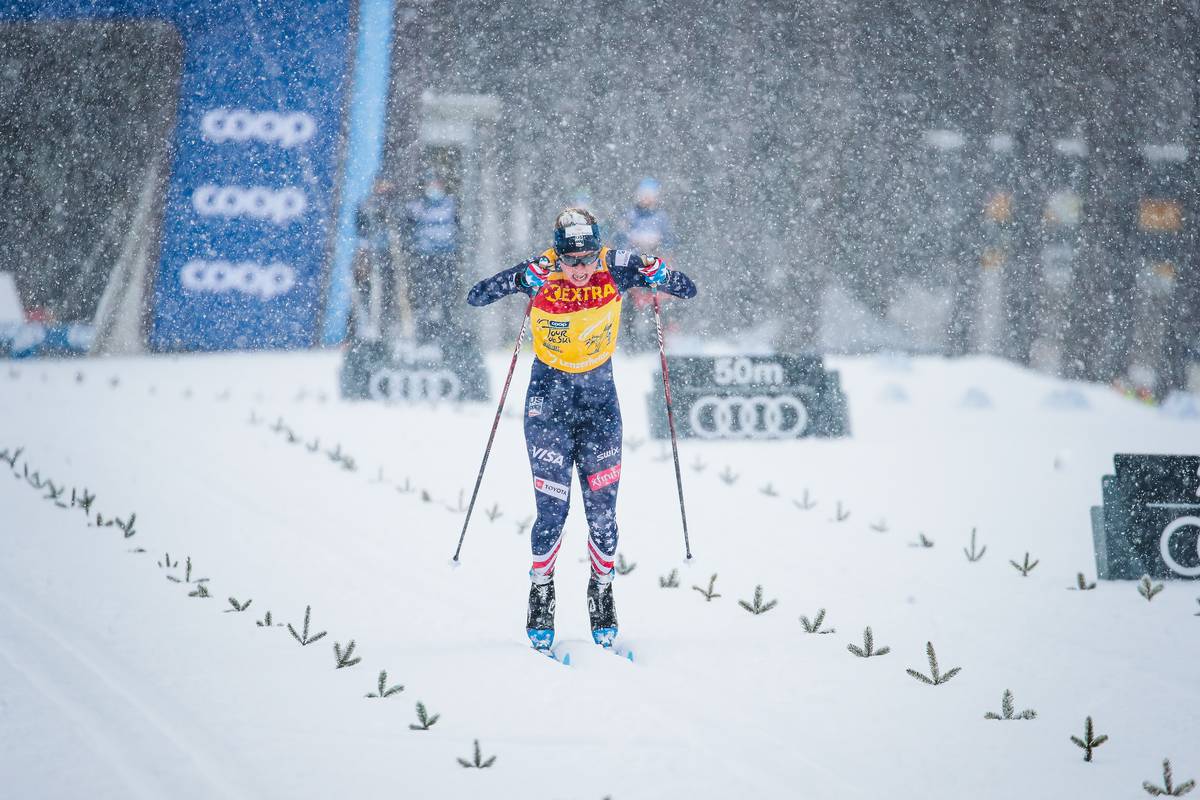
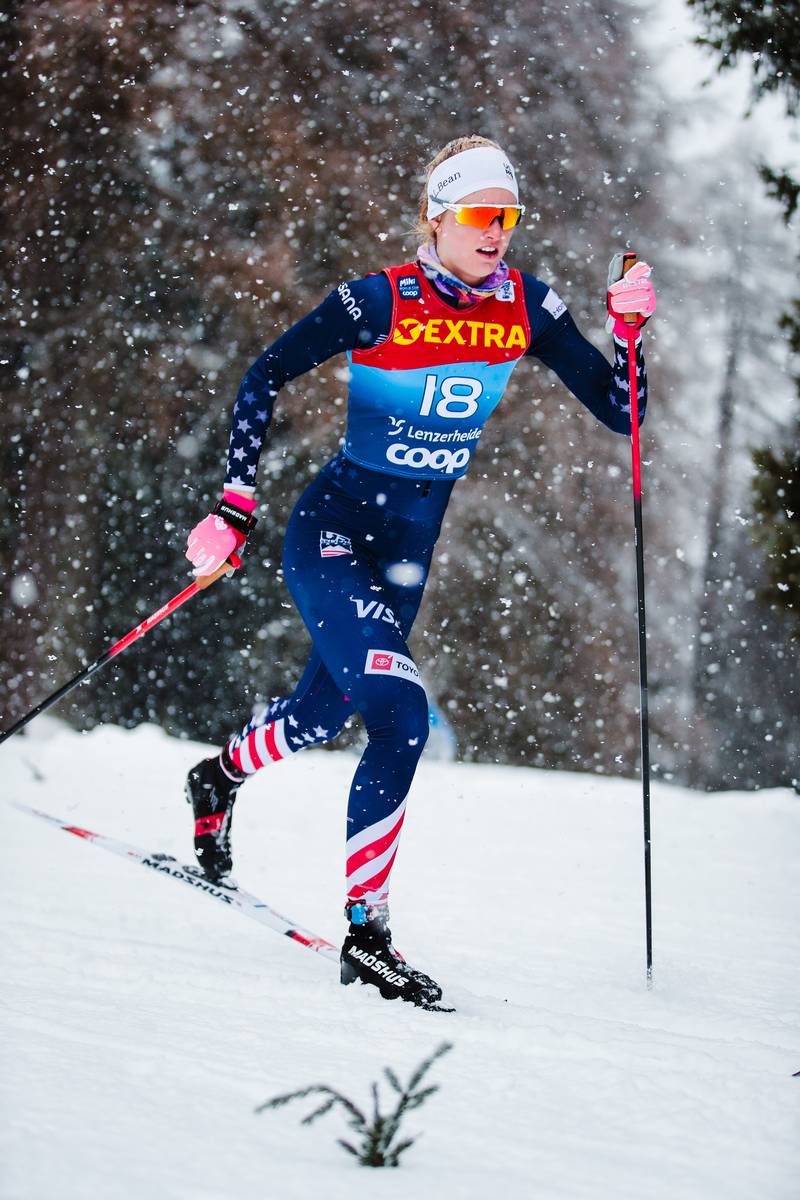
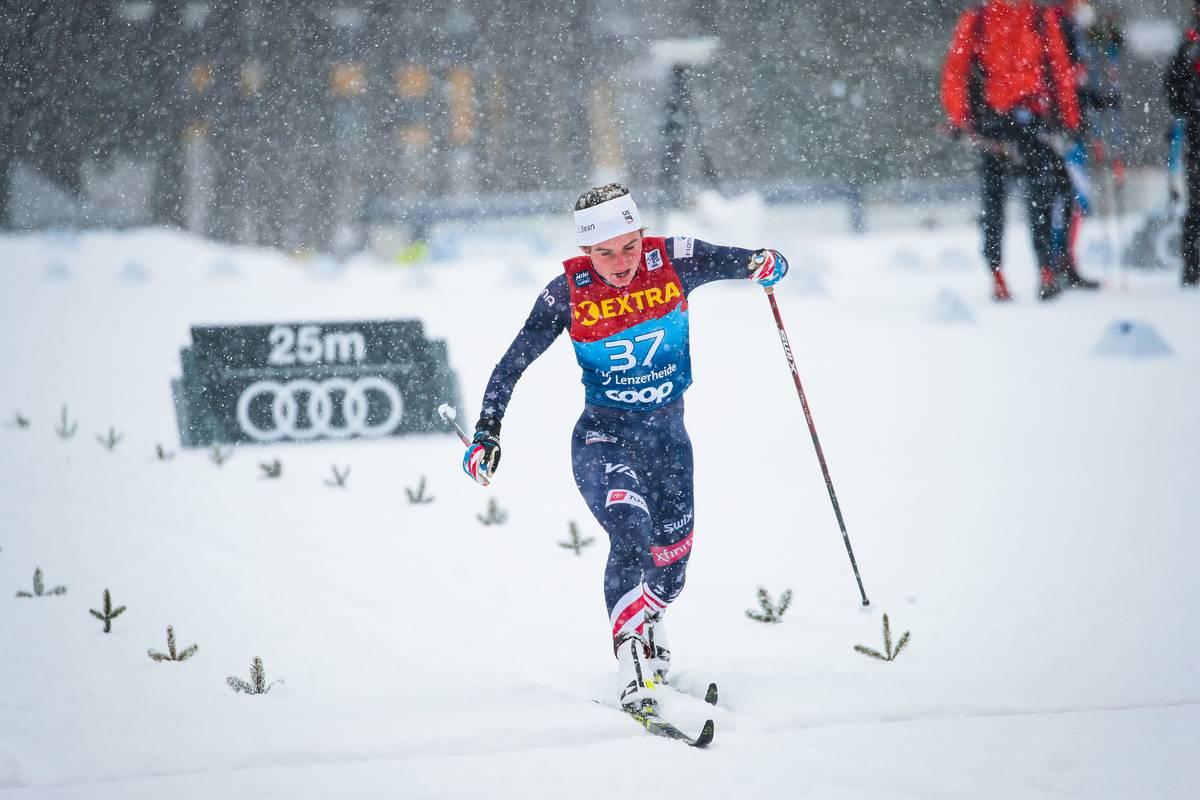
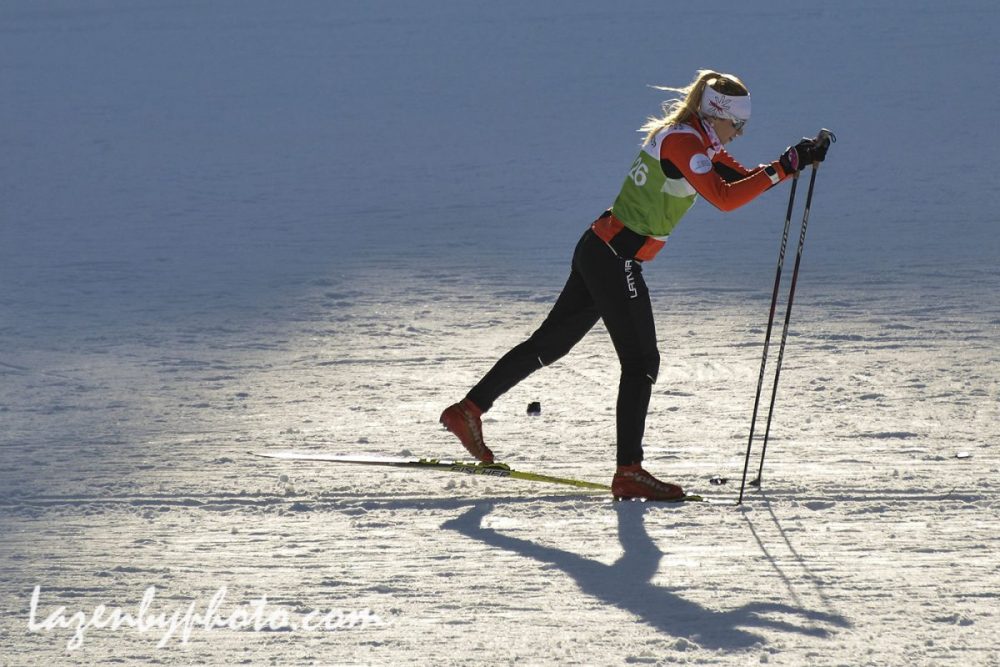
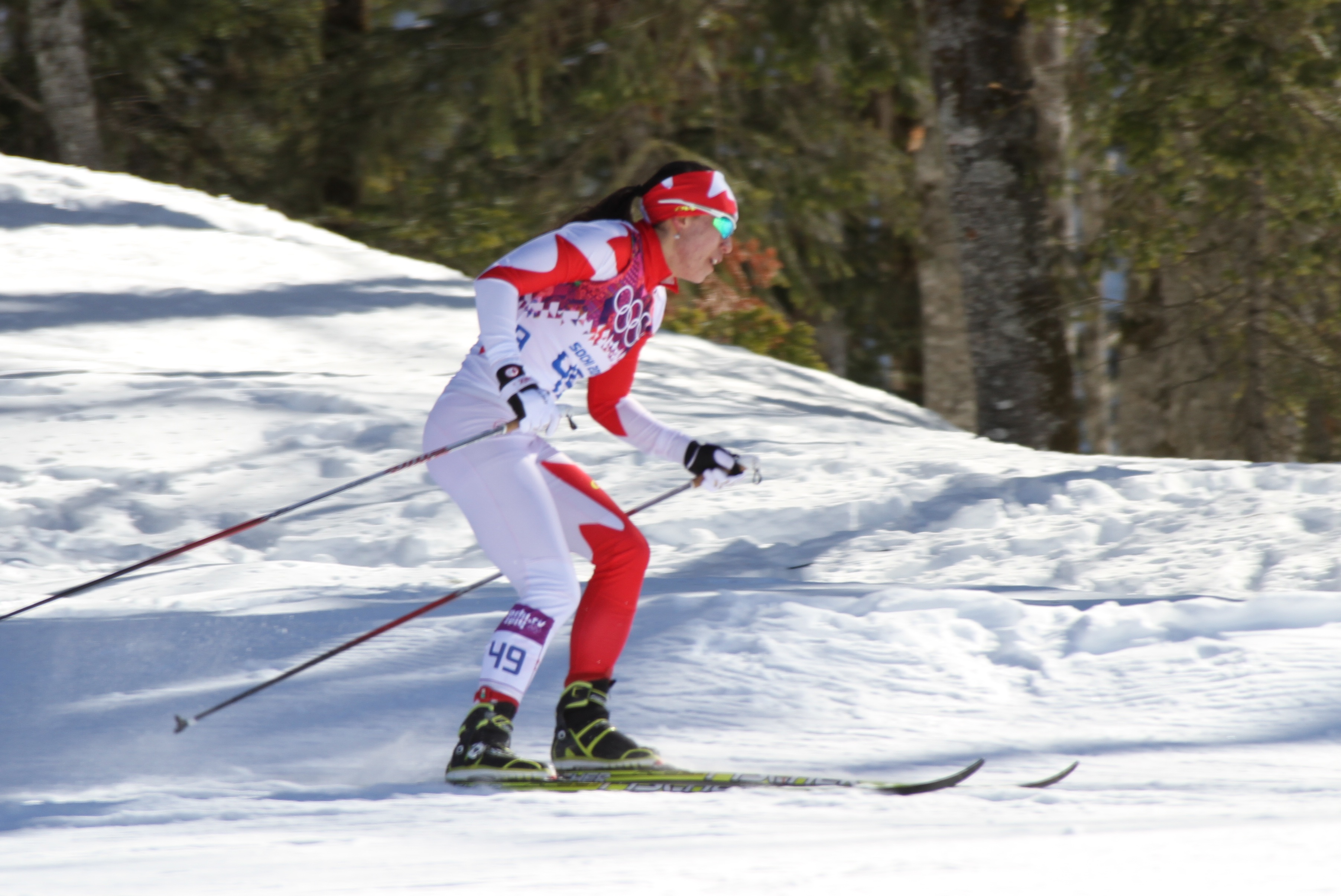
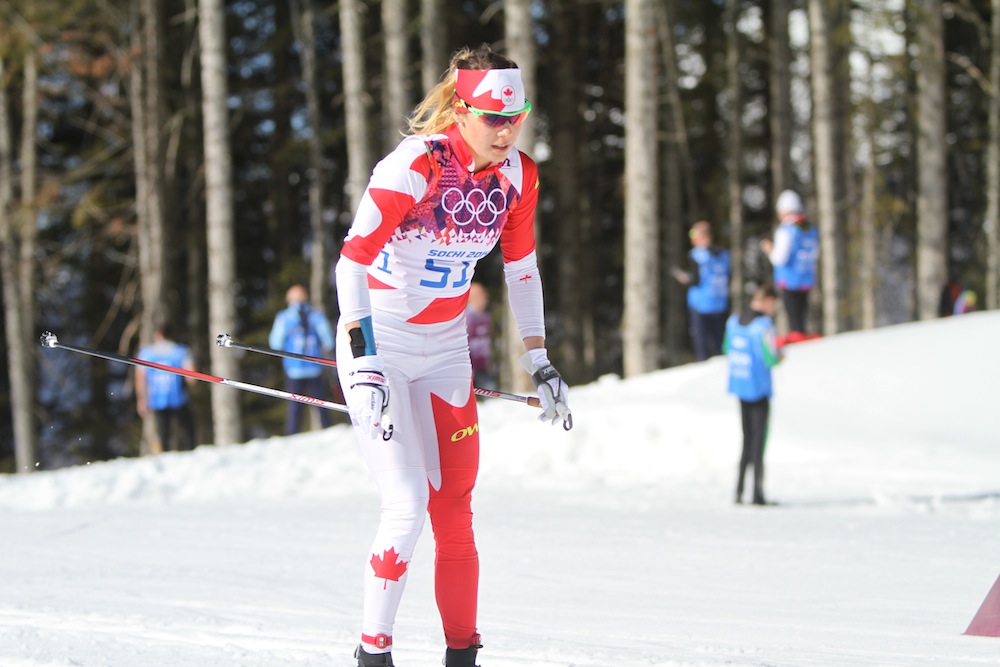
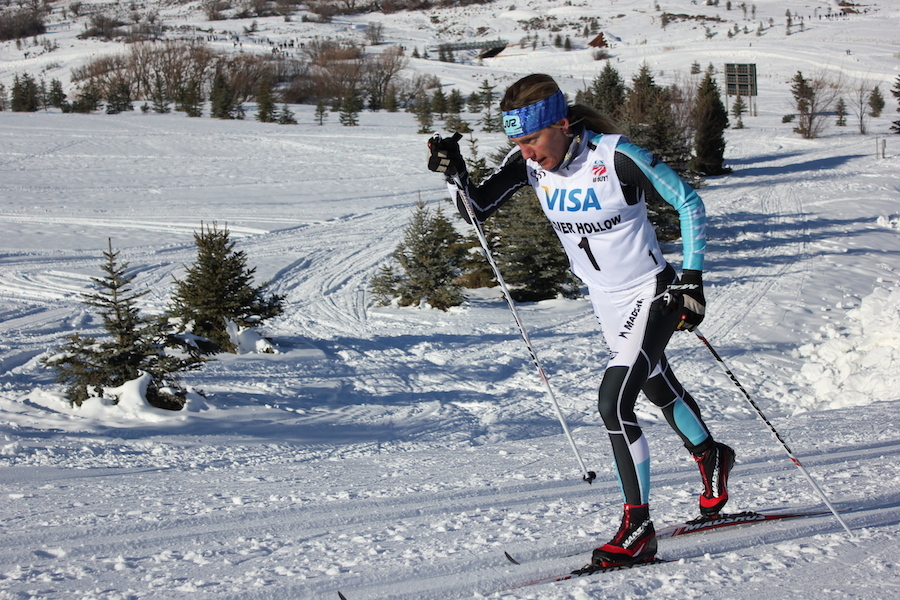
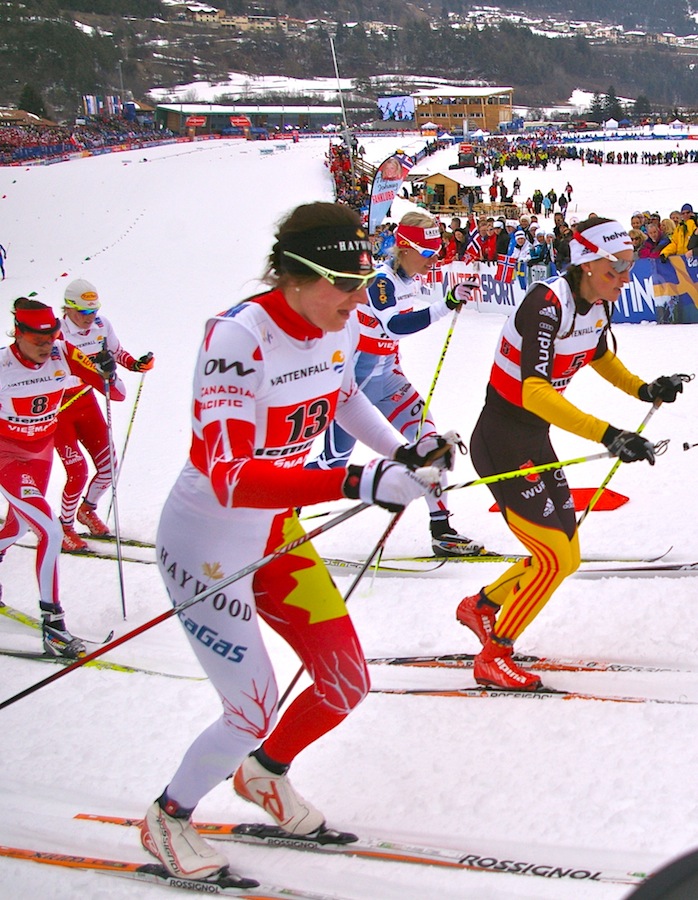
Hailey Swirbul races through the snow-capped pines of Lahti, FIN. (Photo: NordicFocus)
This World Cup coverage is made possible through the generous support of Marty and Kathy Hall and the A Hall Mark of Excellence Award. To learn more about A Hall Mark of Excellence Award or to learn how you can support FasterSkier’s coverage please contact info@fasterskier.com.
An iconic venue, Lahti’s ski jumps rise out of the pine forest from atop the rolling hills, tucked between the many lakes of the region in southern Finland. After two years of empty trails and stadiums, horns blazed, cowbells rang, and voices cheered during the women’s 10-kilometer individual start classic race as fans lined the hills and filled the stadium, memories of pre-pandemic racing flooded back into mind.
What has remained constant through the last two years is the presence of Norway’s Therese Johaug at the top of the results sheet in distance races, particularly classic. Johaug started as the final athlete in the seeded group wearing bib 60, meaning she would have information available to her from the start on how hard she would
A little over halfway through the first of two 5 k laps, it looked like Johaug would run away with yet another World Cup distance race. At the 3.7 time check, Johaug was 11.7 seconds up on Natalia Nepyraeva of Russia who had clocked the fastest prior split, with the Finnish Olympic bronze and silver medalists, Krista Pärmäkoski and Kerttu Niskanen, lurking just behind at 16.2 and 17.5 seconds back. And the Finns were racing on home soil with most of the aforementioned fans waving their country’s flag.
Norway’s Therese Johaug races the 10 k interval start classic in Lahti, FIN. (Photo: NordicFocus)
Sure enough, the margin of Johaug’s lead narrowed. At the lap, she was just under ten seconds ahead of Nepryaeva, who looked to have conserved her energy in the first lap to push the pace in the second. While the Finns became less of a threat to Johaug, the Norwegian’s margin over the Russian’s splits whittled down rapidly.
And ironically, the Russian’s fast second lap might have been partly Johaug’s own doing. As the Norwegian had headed out on course, Nepryaeva was lapping through the stadium, allowing her to match pace as she chased the high-tempo Norwegian through the woods for the second 5 k, perhaps pressuring Johaug to burn a few of her matches a bit earlier than she’d otherwise planned.
Regardless of what was going through each athlete’s mind, Nepryaeva finished her second lap to set the bar at 24:29.6.
Over the first kilometer of Johaug’s second lap, now racing on her own, the time difference between the two women was slashed in half, from 9.8 to 4.8 seconds, and at 8.7 k, it had essentially remained constant at 5.5 seconds. It would come down to the wire.
Looking back at the season, it might be easy to focus on the three Olympic gold medals Johaug won in Zhangjiakou, including in the 10 k classic event. But, she had been beaten in the only other 10 k classic she’s raced on the World Cup this year, which also took place in Finland, during the opening weekend of World Cup racing in Ruka. She might be the favorite, but she’s also beatable.
Natalia Nepryaeva puts together a strong performance in the 10 k classic in Lahti. (Photo: NordicFocus)
As Nepryaeva watched the clock eagerly from the leader’s chair, Johaug kicked, glided, and double poled through the final kilometer. Having over ten minutes prior, she had plenty of time to wait, watch, and be watched by the cameras.
Nepryaeva leaned forward, not taking her eyes off the leaderboard as Johaug made the tight right-hand turn down into the stadium without losing too much momentum, and began to charge as hard as she could toward the line.
With 15 seconds remaining to stay inside Nepryaeva’s mark, Johaug rounded the corner to the finish. With ten seconds to go, she hit the lanes. Nepryaeva watched the seconds tick by hoping Johaug’s time would change to red, while the Norwegian was just trying to keep it in the green.
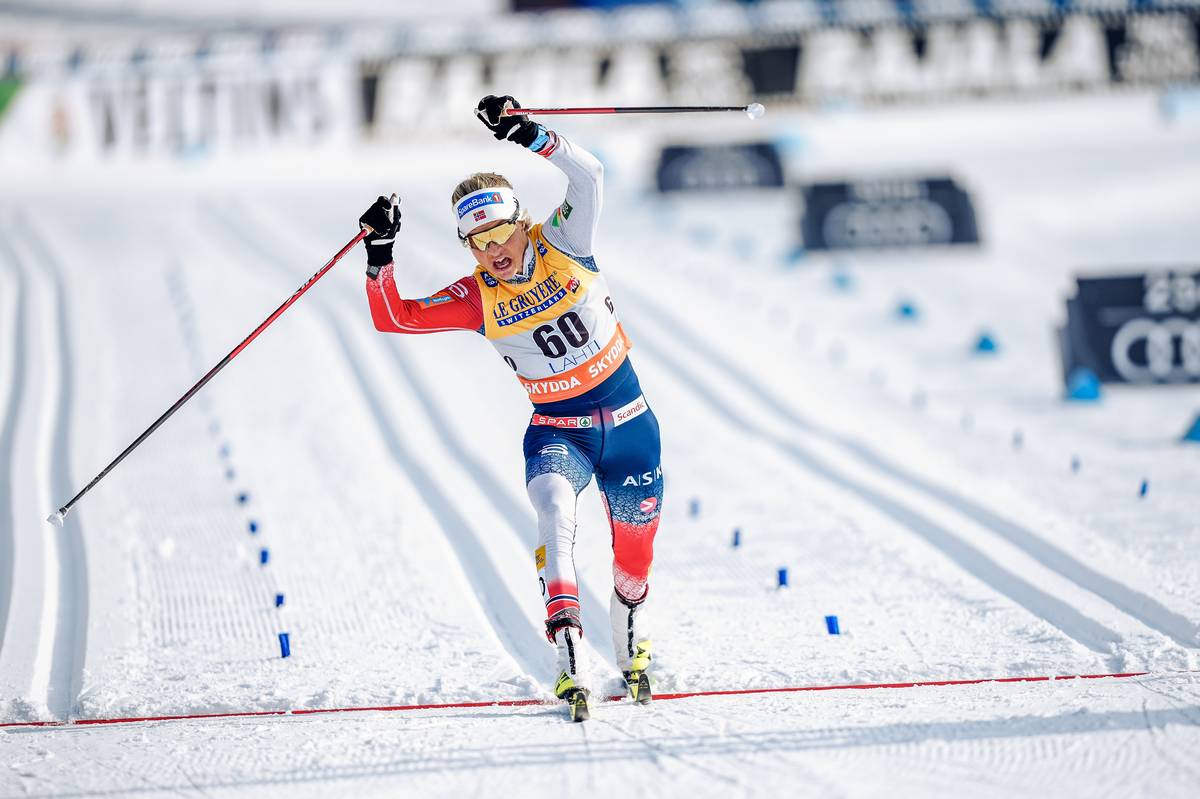
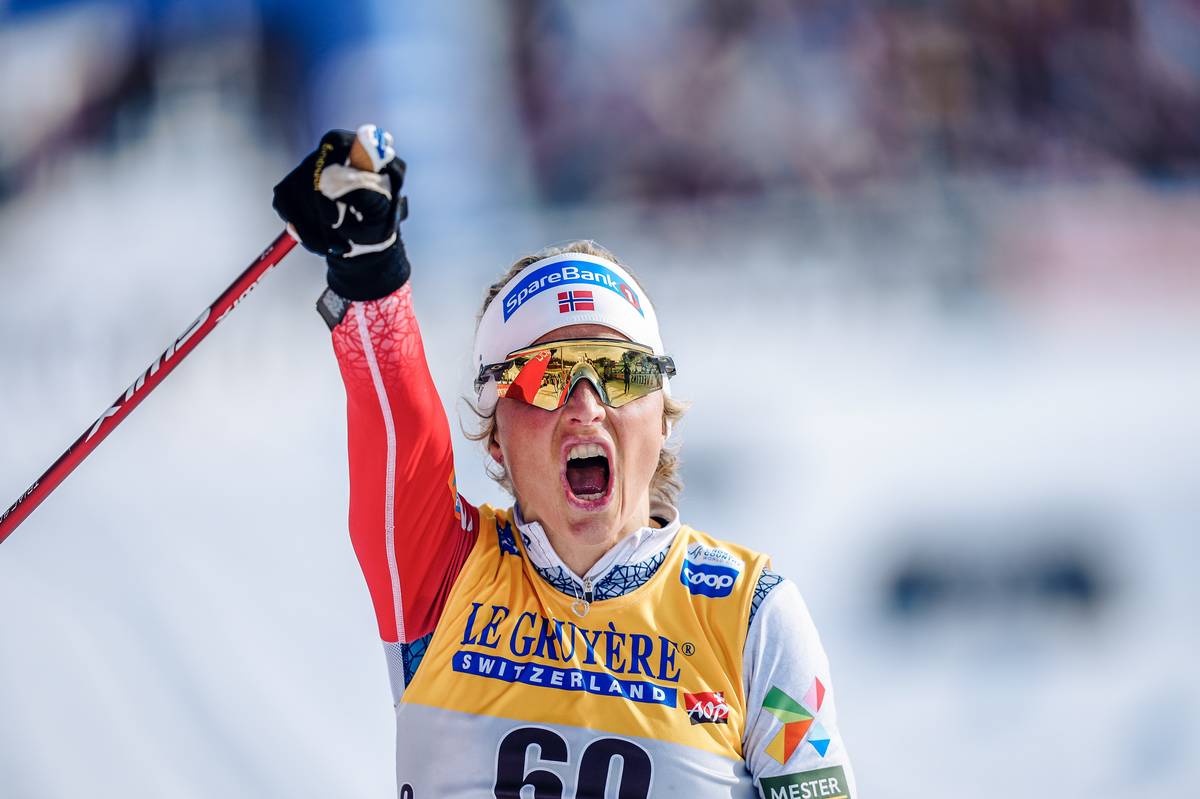
Therese Johaug (NOR) throws her boot to take the win just 1.2 seconds ahead of Russia’s Natalia Nepryaeva. (Photo: NordicFocus)Therese Johaug (NOR) celebrates her victory in Lahti’s 10 k individual start classic. (Photo: NordicFocus)
Until the actual finish line was crossed, it felt like the result could go either way. But with a final push from her poles and kick with her boot, Therese Johaug sealed the deal, just 1.2 seconds ahead of Natalia Nepryaeva. Johaug let out a victorious roar, just before cameras showed the Russian roll her eyes in exasperation, as if thinking, “Really? Not again.”
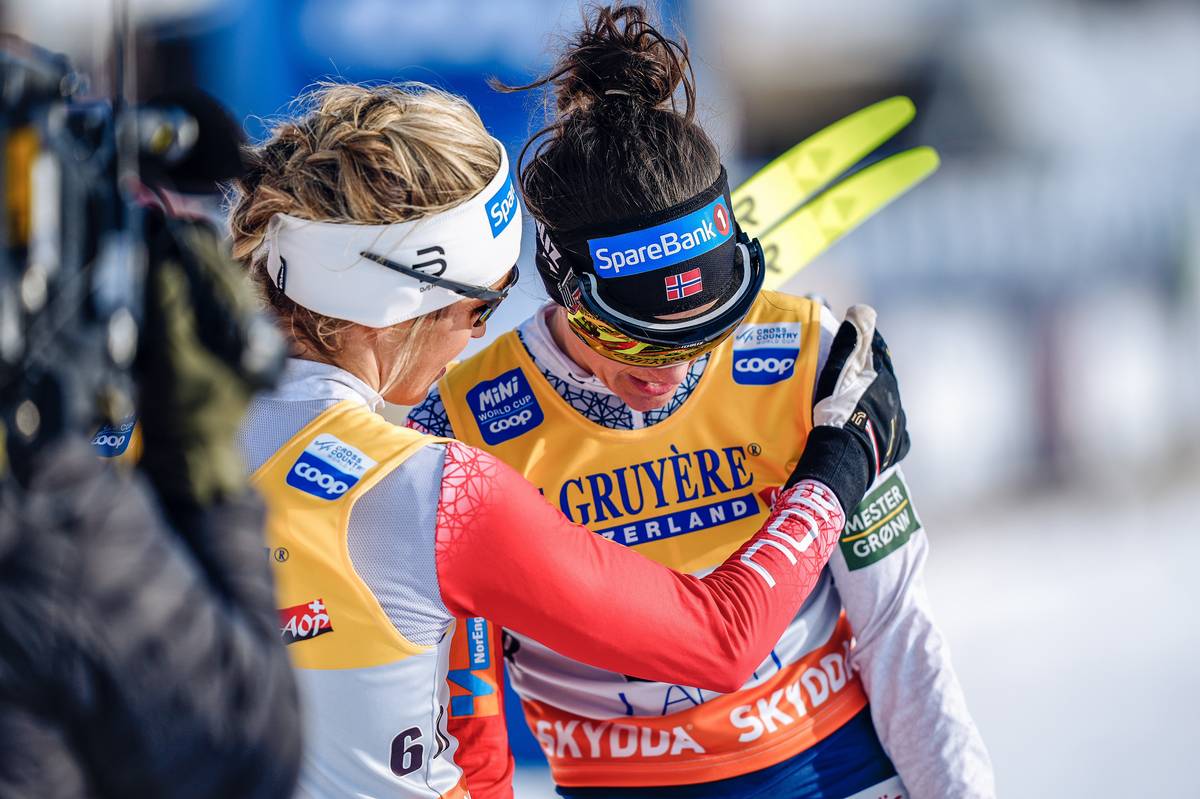
Cameras panning back to Johaug watched her shift away from her own celebration to comfort a very disappointed Heidi Weng, who had started a minute ahead of Johaug in bib 58, but finished 42 seconds behind her teammate in 19th place (+1:42.4). After promising results in the Tour de Ski, Weng had tested positive for COVID just prior to the Olympics, leaving her watching the event from afar. From Weng’s disappointment at the finish, it looked as though she had been looking for more in her return to racing on the World Cup.
Therese Johaug (NOR) comforts her disappointed teammate Heidi Weng at the finish of the 10 k individual start classic in Lahti. (Photo: NordicFocus)
Johaug spoke with FIS after the finish, speaking to what it means to win again today as she nears the end of a successful season, including the three gold medals earned in Zhangjiakou this month.
“It means a lot for me, and I am so happy that I have a second on my side,” Johaug said with a laugh. “After the Olympics, you’re coming home and it’s a little bit hard to motivate again, but when I come to Lahti and go on this beautiful track, I really enjoy it.”
Johaug was also asked whether she felt the benefits of having trained and raced at altitude surrounding the Games, which were held at roughly 5,500 feet above sea level.
“Yeah, I feel that,” Johaug said of the boost. “When you train a lot at altitude and then you go down, you feel like you have more energy in the hills. I think my shape right now is really good, so I’m excited to race at the Holmenkollen next weekend, and in Falun, then the rest of the season.”
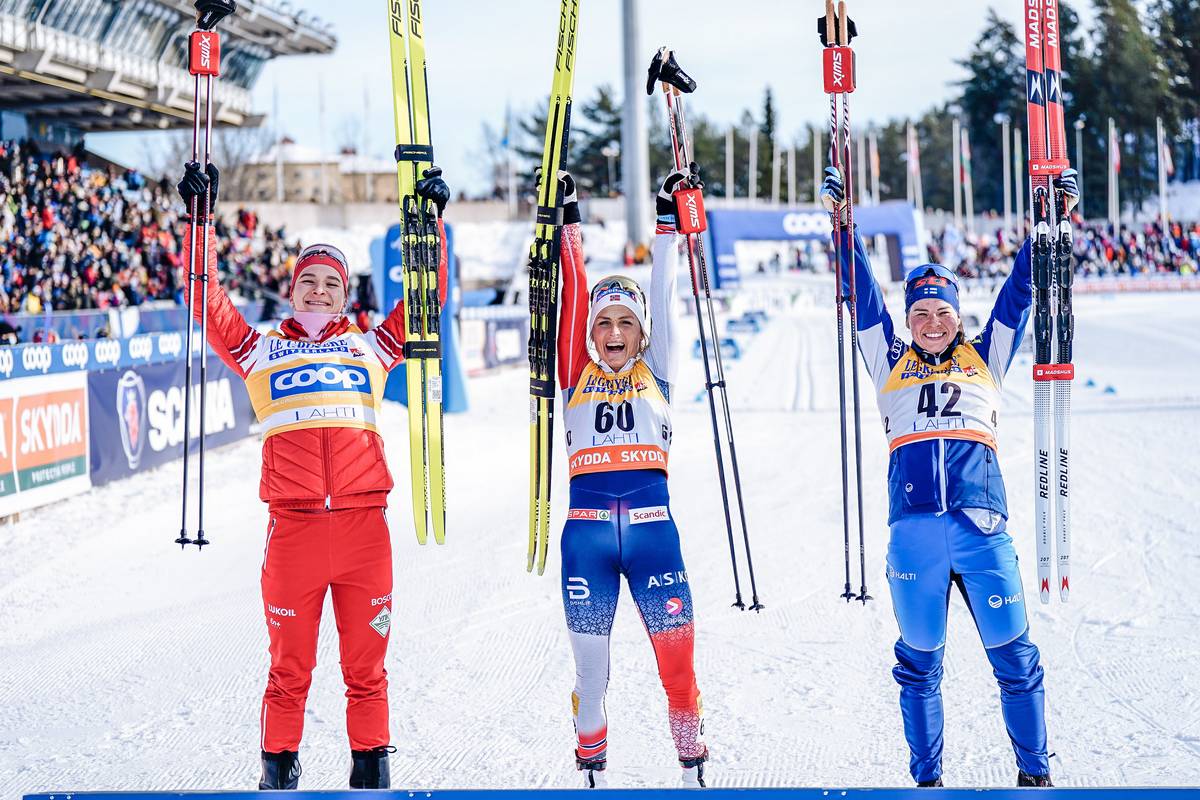
The women’s podium in Lahti: Therese Johaug (NOR) took the win ahead of Natalia Nepryaeva (RUS) and Krista Pärmäkoski (FIN). (Photo: NordicFocus)
Rounding out the women’s podium, Finland’s Pärmäkoski held her margin to 16.7 seconds at the finish for third place, followed after a gap by her teammate Niskanen in fourth (37.7). Sweden’s sprint champion Jonna Sundling was just behind in fifth (+40.7).
Leading the way for the American team, Rosie Brennan posted consistent splits to hover in sixth place through the first lap. Maintaining even tempo and effort, Brennan remained in this position until the last checkpoint, which showed a hard-charging Ebba Andersson of Sweden trade positions to bump Brennan back to 7th.
Rosie Brennan leads the American team during a 10 k individual start classic in Lahti, FIN. (Photo: NordicFocus)
Also posting a split Brennan was not quite able to match in the final kilometer, the American lost nearly eight seconds to Germany’s Katharina Hennig between the final time check at 8.7 k and the finish, leaving Brennan in eighth place overall (+1:02.8) at the finish.
“I am really happy with today.,” Brennan wrote in a post-race email. “I have always struggled post-championships, not so much in my body, but in my mind. It’s really difficult to live on the road and be sharp and push so hard all the time. It often feels like there is never a chance to let down the way someone who goes home every week might experience. I am always trying to figure this out and work towards finding ways to let down and then pull the fight back up for the weekend. It’s all part of the game and it’s a good challenge to try to figure everything out.
“Anyway, today, I felt much more like myself and was able to ski the way I wanted to. Lahti has been a tough venue for me in the past and today I really felt strong in my classic skiing and had some ability to push hard. I was definitely frustrated after yesterday and am really happy I was able to let it go and find myself out there today. We have had really great weather this weekend and a big crowd so that was a huge bonus. It was a joy to not be skiing in an arctic tornado!”
Rosie Brennan crosses the line for 8th place in Lahti’s 10 k interval start classic. (Photo: NordicFocus)Jessie Diggins skis to 20th place in the 10 k classic in Lahti, FIN. (Photo: NordicFocus)
Following a podium near-miss in yesterday’s sprint, Jessie Diggins was next for the U.S., just behind Heidi Weng in 20th (+1:43.4). Julia Kern and Hailey Swirbul also raced into the top-30 for the second day in a row, finishing 28th (+2:03.2) and 29th (+2:10.5), respectively.
Just off Swirbul’s split, Canada’s Katherine Stewart-Jones led her team in 30th place (+2:10.7), with her teammate Dahria Beatty just outside the top-30 in 33rd (+2:19.4). Cendrine Browne raced to 36th (+2:24.5), while Laura Leclair was the final Canadian woman in 58th (+4:29.7).
Canada’s Katherine Stewart-Jones leads her team in 30th during the 10 k individual start classic in Lahti, FIN. (Photo: NordicFocus)
Finishing 30 seconds outside the top-30, Katharine Ogden returned to the World Cup in 43rd (+2:40.8).
Following the races, US Ski Team head coach Matt Whitcomb provided insights into both the women’s and men’s races in Lahti, as well as sharing the news that Östersund, SWE may become the host to the initially cancelled World Cup Finals that had been scheduled for Tyumen, Russia. Whitcomb also speaks to the “Olympic hangover” that can make hard for athletes to perform at their best the weekend following the Games, and gave a shoutout to the athletes racing at World Juniors in nearby Lygna.
World Cup racing continues on Thursday, March 3rd with a classic sprint in Drammen, Norway, just prior to the storied 30/50 k mass start classic races at the Holmenkollen in Oslo.
This World Cup coverage is made possible through the generous support of Marty and Kathy Hall and the A Hall Mark of Excellence Award. To learn more about A Hall Mark of Excellence Award or to learn how you can support FasterSkier’s coverage please contact info@fasterskier.com.
Thursday morning saw the third women’s cross-country race in the Zhangjiakou stadium. On the docket, a 10-kilometer individual start classic with two laps of a challenging 5 k course. After a reprieve from the wind during the sprint event Tuesday evening, it was blowing once again as the athletes headed to the start.
Zhangjiakou 5 k course. (screenshot from FIS homologation certificate)
Unlike the skiathlon which saw 62 finishers, the start list for the 10 k individual classic featured 98 racers. Most of the later starters represented nations we don’t normally see at World Cup events, such as Greece, Brazil, and Hungry. Many of these skiers fall into the ‘B-standard’ Olympic qualification category; provided they can earn less than 300 FIS points in a competition prior to the games, but have greater than the 100 point threshold of the A-standard, these athletes can race in the 10 k and relay events.
To set the stage for Thursday’s race, we can begin with a brief dive into recent Olympic, World Championship, and World Cup results at this distance. Given that this year’s edition of the individual-start 10 k event was contested in classic technique, the 10 k individual start in PyeongChang was a freestyle race (disciplines alter every two years at championship events). As such, it is harder to draw direct predictions from the podium four years ago to possible success in today’s event. Nevertheless, to remind ourselves, it was Ragnhild Haga of Norway who walked away with the gold in 2018. Charlotte Kalla of Sweden finished second and she was followed by Marit Bjørgen of Norway in third position. Delving deeper into the Olympic records, a look at the results from the 10 k individual classic in Sochi, shows that Justyna Kowalczyk of Poland took gold, with Kalla again the runner-up, and Therese Johaug rounding out the podium with bronze.
Sweden’s Charlotte Kalla racing to silver in the 10 k classic individual start at the 2014 Olympics in Sochi, Russia. (Photo: FS archives)
The most recent championship-level 10 k individual-start classic race was in Seefeld, Austria when the World Championships were held there in 2019. There, the victory went to Therese Johaug who finished 12.2 seconds ahead of Frida Karlsson of Sweden. Johaug’s teammate, Ingvild Flugstad Østberg was third, but has since battled health concerns and been largely absent from international racing.
This season, the two 10 k individual start classic events have been won by Karlsson (in Ruka, FIN +13.7 ahead of Johaug) and Kerttu Niskanen of Finland in Lenzerheide, SUI (during the Tour de Ski in which Johaug did not compete).
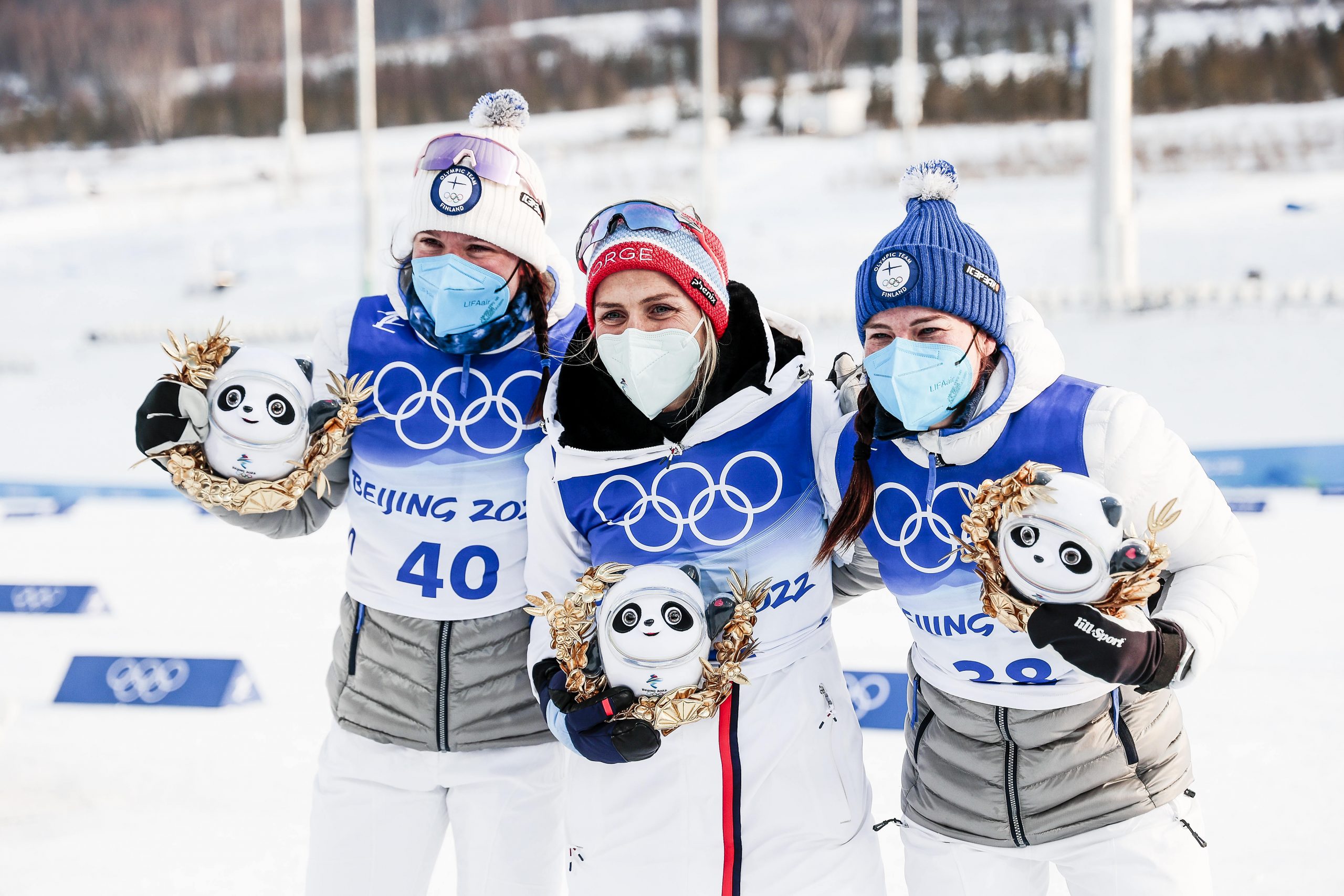
Perhaps one of the more open events in terms of podium predictions, the race turned out to be an exciting one with the margins between medal positions coming down to hundredths of seconds. In the end, it was Johaug of Norway who walked away with her second gold medal from these Games, eking out a win ahead of Niskanen (FIN) by just 0.4 seconds.
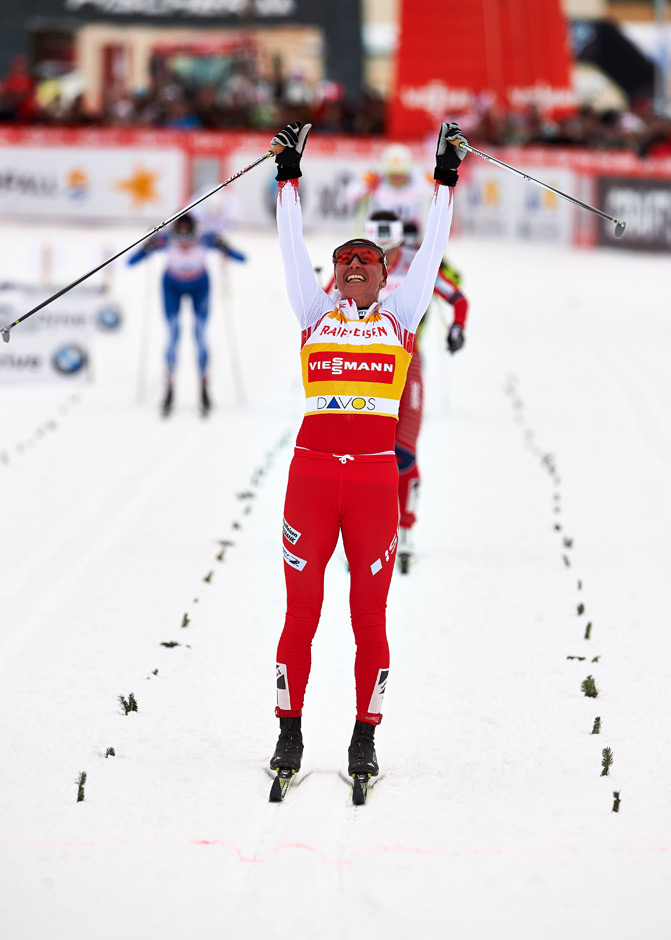
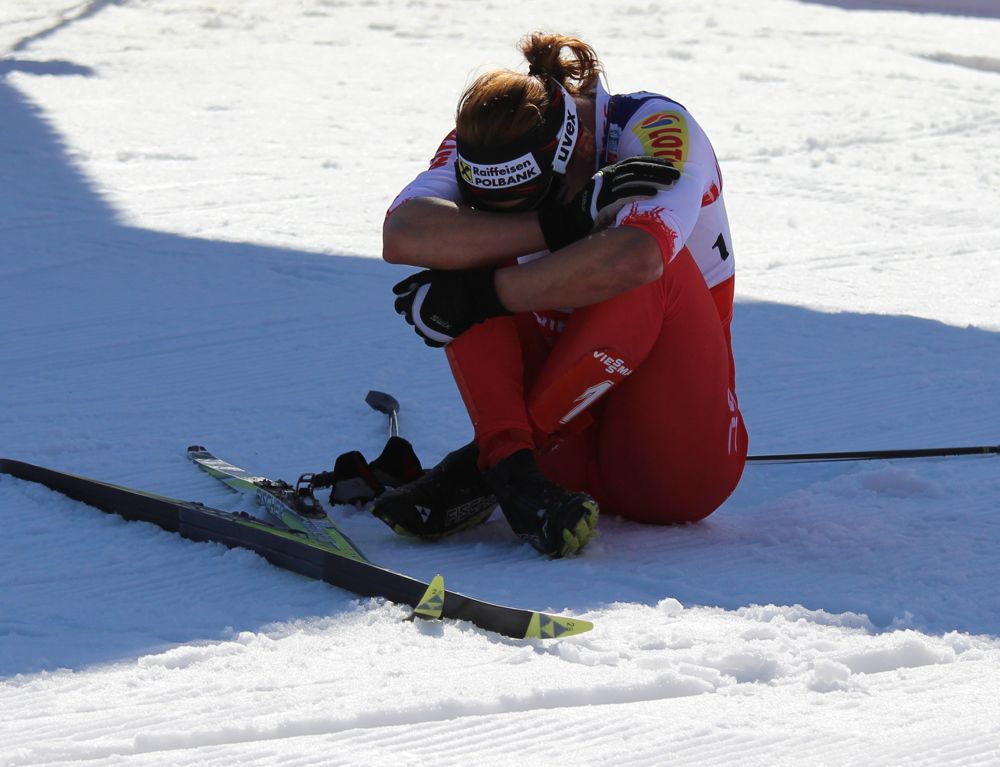
Therese Johaug (NOR) crosses the finish line and collapses (Photo: NordicFocus)
Rewinding to the start, Russian Olympic Committee athletes Natalia Nepryaeva and Tatiana Sorina clocked the fastest times to begin. Looking at the course profile, the first split at 1.3 k comes at the end of a good deal of climbing. Close behind the ROC athletes were two Finn’s, Niskanen and Krista Pärmäkoski, with Johaug rounding out the top five, a surprising +12.8 seconds behind Nepryaeva.
Move forward to 3.6 k and the top three were within 0.5 seconds of each other, Niskanen and Johaug tied with a split of 10:47.7, Nepryaeva passing through at 0.5 seconds off their mark. With one lap complete, Nepryaeva had started to fade, perhaps paying the price for her early pace. At 5 k it was Johaug with the advantage over Niskanen, but only by +0.6 seconds, and Nepryaeva was now +6.2 behind.
Therese Johaug (NOR) striding her way to a win in the 10 k classic (Photo: NordicFocus)
Through 6.3 k it seemed like Niskanen had made a break, pulling ahead of Johaug by 11 seconds, on a section of course that is mostly climbing, generally a strong point for Johaug. Nepryaeva was still in third +14.7 behind Niskanen and Pärmäkoski (FIN) was holding onto her fourth place position, +17.7 back. In the next 0.5 k, something appears to have happened to the ROC athlete, as Nepryaeva lost 12.1 seconds to Niskanen (+26.8) and was overtaken in by Pärmäkoski who moved into third +18 seconds behind her teammate.
The final course split was at the 8.6 k mark and with Johaug having the earlier bib, we saw her through first. She had gained the minute start deficit she had to Jessie Diggins and moved past the American, employing her signature high tempo up the final A-climb. When Niskanen came through moments later, her body language was visibly more labored than Johaug’s. In spite of this, Niskanen still held the lead, +1.3 seconds ahead of the Norwegian. Pärmäkoski remained in third, +23.6 behind, followed by Nepryaeva who was +31.8 behind.
Natalia Nepryaeva (ROC) slides her foot across the line, 0.1 seconds behind Krista Pärmäkoski of Finland (Photo: NordicFocus)
Entering the stadium, Johaug was skiing outside the windblown tracks. Knowing the margins were tight, she pushed hard, crossing the finish line in a time of 28:06.3. Facing a headwind into the finish, Niskanen chose to keep her skis inside the tracks, battling the final meters as the stopwatch ticked by. Sliding her foot across the line, the timestamp turned to red. She crossed +0.4 seconds behind Johaug.
“It was the two most nervous minutes in my life, waiting for [Niskanen]”, said Johaug in the press conference after the race.
“It was a really tough race out there today and, as Kerttu said, it was really close race,” Johaug continued. “So I feel that it’s also Kerttu’s gold medal because 0.4 second is nothing. I think we both are the the winners today in my head.”
Kerttu Niskanen (FIN) digs deep for precious time in the 10 k classic (Photo: NordicFocus)Teammates Krista Pärmäkoski (FIN) and Kerttu Niskanen (FIN) celebrate their podium finishes. (Photo: NordicFocus)
After earning her first individual gold medal just days ago in the skiathlon, Johaug continues to cement her place in history as she gains another. Her performance gives the Norwegians something to hold onto as the rest of the team struggled to perform at the level fans are accustomed to.
With twins Tiril Udnes and Lotta Udnes Weng finishing 21st and 25th respectively and Mathilde Myhrvold back in 44th position, the remaining women racing on behalf of Norway did not have their strongest showing.
So far, Johaug is the only female Norwegian athlete to earn a medal of any color, while Johannes Høsflot Klæbo earned the only medal on the men’s side, a gold in the 1.5 k freestyle sprint on Tuesday. Three Norwegian athletes, including medal favorites Heidi Weng and Simen Hegstad Krüger, remain detained due to a positive COVID test just prior to travel. Weng recently announced on social media that she will not be making it to China and it is unclear whether Krüger will be cleared in time to compete in events next week.
Lotta Udnes Weng (NOR) finished 25th in the 10 k classic (Photo: NordicFocus)
For Kerttu Niskanen, this silver marks her first individual championship medal. She holds two silver medals from team events, both coming from Sochi in 2014. Niskanen only has three World Cup victories to her name and they all were in 10 k classic events, a specialty of hers.
“My plan before this race was to push hard every time and try to ski within my limits,” Niskanen explained in the press conference. “In the second laps on the long uphill from stadium, on the big uphill, [that] was the best part part for me in these tracks… I tried to push hard also end of the race but the I can say that Therese was much better than me. I did my best and it was really near but, yeah.”
Kerttu Niskanen (FIN) celebrating her first individual Olympic medal (photo: NordicFocus)
The bronze medal was also decided by a razor-thin margin. Pärmäkoski started bib number 38 and was hunted by Nepryaeva in bib 60 who had the advantage of more split information. However, when Nepryaeva crossed the finish line, she was outside by just 0.1 seconds, having finished in a time of 28:37.9 whereas Pärmäkoski came across in 28:37.8. Pärmäkoski has three individual Olympic medals, from a range of events in PyeongChang. She earned bronze in both the skiathlon and 10 k individual freestyle in 2018, as well as silver in the 30 k classic mass start.
Krista Pärmäkoski (FIN) stretching for the lunge that gave her third place (Photo: NordicFocus)
For the American contingent, there was some back and forth playing out between Jessie Diggins and Rosie Brennan throughout the race. Just 48 hours after winning the first individual medal for women’s cross-country skiing, Diggins was back on the start line wearing bib 34, starting one minute ahead of eventual winner, Johaug in bib 36. Brennan started in bib 44.
Jessie Diggins (USA) crests a climb in the 10 k individual start classic (Photo: NordicFocus)
At the 1.3 k mark, the two were 13th and 14th, with Brennan +19.9 behind and Diggins +20.4. At 3.6 k Brennan had moved into 8th, +21.3 behind with Diggins in 10th, +25.1 back. With the climbing complete for the first lap, the 5 k split showed Diggins in 9th, +30.1 behind with Brennan now behind her in 11th, +31.8. Begin the climbing for the second lap and Brennan was again the first American, in 9th place and +45.7 behind while Diggins was in 14th, +52.7.
Rosie Brennan (USA) hits a dynamic stride in the 10 k classic (photo: NordicFocus)
At 8.6 k the two were neck and neck, Diggins in 10th, +1:05.6 and Brennan in 11th, +1:11.6. Over the final 1.4 k Diggins grew her advantage over her teammate to finish in 8th position, +1:08.8 behind winner, Therese Johaug (NOR). Brennan finished her day in 13th place, +1:22.3 behind Johaug.
Jessie Diggins (USA) left it all out on the course in the 10 k classic, per usual. (Photo: NordicFocus)
As she provided comments on today’s performance, Diggins first spoke to savoring the moment of yesterday’s medal ceremony. “It was so special to call my family and call my fiancé, and come back to the apartment and show our staff like our coaches the medal and just enjoy that moment.”
After a “rollercoaster” of eating, drinking, and other recovery-focused actions – Diggins said the Tour de Ski was helpful for knowing how to handle the tight turnaround – she turned her full attention to today’s classic race.
“I was really, really happy today,” Diggins said in the mixed zone. “I was so focused on my process. This is undoubtably my weakest event, but I was just so focused on enjoying it – like, ‘Great! No pressure. This is just my day to go out there and enjoy racing at the Olympics.’ Especially seeing Novie do her first Olympic race – I got to put the glitter on her I give her a hug – it was honestly pretty emotional. But in a good way.”
Though she has steadily closed the gap between her results in skate and classic performances, Diggins has been primarily seen success in freestyle competitions. On today’s race, she maintained that her focus was not on the result, but on giving her all despite classic being her weaker technique.
“It was so cool to work on that process and dial in the kick,” Diggins said. “I was so, so grateful for awesome skis. When I go really hard, I can’t feel my body from the waist down. And when you can’t feel your legs and you’re still kicking up the hill – you have to have great kick… And man, they delivered. I was just so proud of them.Especially in challenging conditions where it’s windblown in the tracks, or you’re trying to keep skis fast and grippy. That’s hard… I think they did a great job.”
Speaking to whether she has made progress in her classic skiing, Diggins continued, “I would like to think so. I’ve been working very very hard on it for a lot of years. I’ve been just so focused on that process on the technique and every single stride I was just thinking so hard about my technique. It really kept me right in the moment and thinking about what I could do so yeah, I’m gonna keep working on it to keep improving it.”
Jessie Diggins skis to 8th in the 10 k classic. (Photo: NordicFocus)
On a course Brennan described as “brutal” she explained that seconds could easily be gained or lost along any stretch, up or downhill. She also acknowledged the challenge of facing the wind in an interval start race where there may be less opportunity to use another skier to block the wind than there is in a mass start. Overall, Brennan executed her goals on the day, despite looking to be higher on the results sheet.
“I was really focused on having powerful classic skiing and I was pretty happy with how I skied,” Brennan said in the mixed zone. “I wish I had a little more, but I did what I could with what I had today.”
Brennan finished one place (just 0.6 seconds) behind Sweden’s Frida Karlsson, who has two wins in the 10 k classic on the World Cup, including a win over Johaug earlier this season. This strong result is on the heels of her Olympic career best finish in the individual skate sprint, which was held under the lights Tuesday evening.
“The turnaround was definitely hard,” Brennan said. “It’s really hard with these late night races to get good sleep afterwards. So I think that was challenging. I did a lot of training this summer to try to like mimic that load. So I’m hoping that I can manage it, but we will take it day by day and see what we can do.”
Rosie Brennan comes to the line in 13th in the 10 k individual start classic. (Photo: NordicFocus)
Making her Olympic debut, Novie McCabe was the first starter for the United States, wearing bib number 5. At the age of 20, McCabe is the youngest member of a young team in Beijing. After earning her first World Cup points in Davos earlier this year, McCabe also notched a top-ten finish during the Alpe Cermis hill climb during the Tour de Ski. In an impressive performance, McCabe skied her way to 24th in a time of 30:34.9.
When she started, the British Eurosport announcers remarked, “I think McCabe is going to be a superstar like Diggins in a few years.”
At 5 k, McCabe was in 38th position, +1:27.9 behind Johaug. At 6.3 k she had moved into 32nd, at 6.8 k she was in 29th and by 8.6 k she had jumped to 24th, which she held through the finish.
“The long last hill was, for sure, so hard,” McCabe said after the race. “I tried to kind of just zone out and get through it. And I knew that it would be tough, especially on the last time up. But it was nice also to have so many people like around me out there and kind of have people to watch ahead of me. That helps a lot.”
Novie Mccabe (USA) skiing strong in her first Olympic race (Photo: NordicFocus)
Hailey Swirbul was the fourth American competitor and wore bib 27. Swirbul raced in the skiathlon earlier this week and finished in 40th. In today’s 10 k classic, she bested that performance and landed herself in 32nd, +2:59.0 behind Johaug. Swirbul was just five seconds outside of the Top-30.
“It was better than my last race,” Swirbul said simply in response to how she felt about her day. “I’m excited. I had a little bit of a reset – had a few days to recover from that first effort and have really focused on kind of resetting my goals, trying to push as hard as I could through that whole race and not give up no matter what. And I was able to do that today.”
With the women’s relay looming, team selection is a buzzing topic amongst ski fans. Swirbul skied a classic leg in the December, 2021 relay in Lillehammer, NOR, and was a member of the 2021 World Championship relay team in Oberstdorf, GER. The American team finished just off the podium in fourth in both races.
Swirbul said that relay team selection was not on her mind during her race today, though she does feel the pressure to perform that is perhaps inescapable at an Olympic level competition.
“That definitely does factor in for all of us here,” she said. “But I think at the end of the day, everyone on our team is confident that we’re going to try to put in the team with the best shot of a relay medal. So there are no hard feelings. There’s nothing personal about that team selection. We all trust that we’re just trying to do the best for our nation and give us a good shot.”
Hailey Swirbul (USA) working her way to a 32nd place finish in the 10 k classic (Photo: NordicFocus)
For the Canadians, Dahria Beatty continued her momentum, building off of strong performances in both the skiathlon and sprint to finish 18th, +1:53.9. This is a personal best for Beatty, following a week of personal bests. She finished 25th in the skiathlon and 25th in the sprint; her best Olympic performance before that was a 37th place in 2018 during the 10 k freestyle at PyeongChang.
Dahria Beatty (CAN) skiing to a personal best result of 18th (Photo: NordicFocus)
Behind Beatty, Kathrine Stewart-Jones finished 36th for team Canada, +3:02.3 behind. Cendrine Brown was 48th (+3:41.6), and Olivia Bouffard-Nesbitt was 61st (+4:54.8).
This World Cup coverage is made possible through the generous support of Marty and Kathy Hall and the A Hall Mark of Excellence Award. To learn more about A Hall Mark of Excellence Award or to learn how you can support FasterSkier’s coverage please contact info@fasterskier.com.
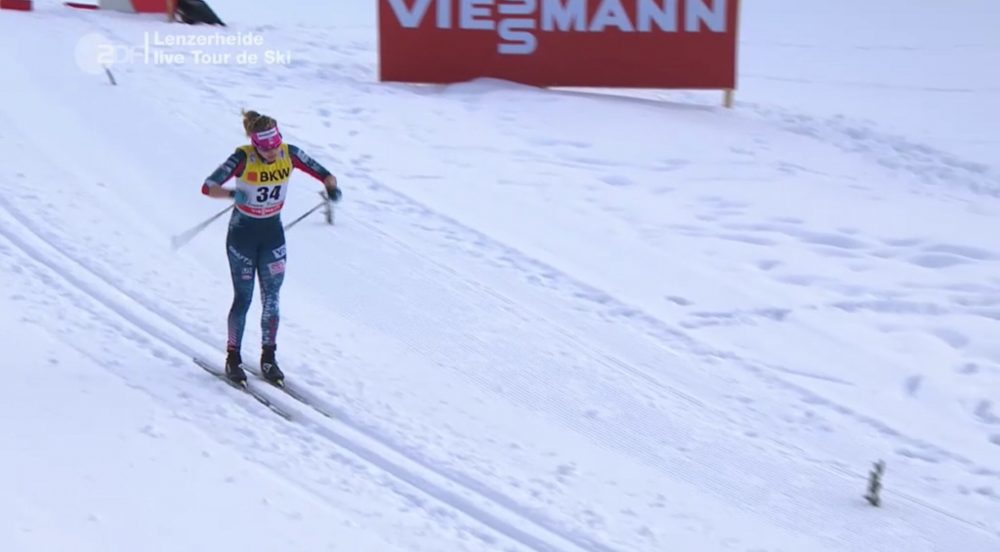
Returning to the kick and glide after a long hiatus, the second stage of the 2021/22 Tour de Ski featured a 10 k classic individual start for the women. With the exception of those who raced the classic legs of the relay in Lillehammer on December 5th, the last classic race was over a month ago, taking place at the season opener in Ruka. To keep things interesting, for the athletes, for the technicians and for the viewers, the temperature in Lenzerheide, Switzerland hovered around 34°F and snow fell heavily. Wax and ski preparation is always incredibly important but not always as evident as it was today as the women completed the 10 kilometer course.
After all 81 skiers had crossed the finish line, it was Kerttu Niskanen of Finland who stood at the top of the podium, having completed the course in 27:04.0.
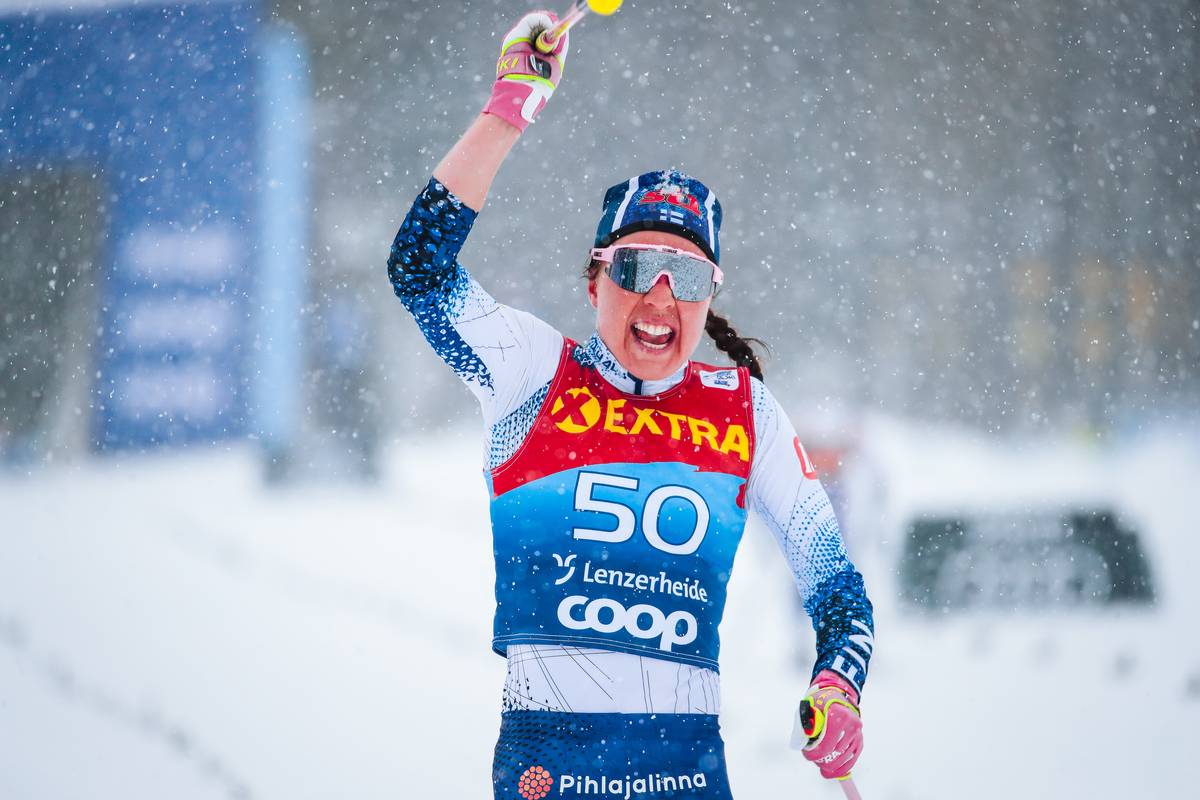
Kerttu Niskanen celebrates a snowy victory in Stage 2 of the Tour de Ski. (Photo: NordicFocus)
To rewind, with Therese Johaug not taking part in the Tour, it is fair to say that Frida Karlsson of Sweden was a strong favorite to win this race. Karlsson has finished on the podium in all four distance events of the season so far, taking first place in the only classic distance event of the season up to this point in Ruka. With her main rival not in competition, Karlsson might have been hoping to ski away with another title.
Frida Karlsson (SWE) on course in Lenzerheide during a snowy 10k interval start classic. (Photo: NordicFocus)
From the start, it was clear that Ebba Andersson (SWE) wasn’t going to make things easy for her teammate. Andersson, who started in bib 29- one place ahead of Karlsson in bib 30, shot out of the gate with a tempo and ferocity that conveyed she meant business. At the 2.4 k checkpoint, there was an opportunity for bonus points in the Tour standings, and Andersson took the lead out of the first 29 starters, only to be quickly bettered by Karlsson by 0.9 seconds.
However, Karlsson’s advantage would not last and already at the 3.7k mark, she was +5.2 seconds behind Andersson. From there, the gap continued to widen. At 5.8 k Andersson was +13.7 seconds ahead of Karlsson, at 7.4 k she was +21.8 ahead and when both Swedes had crossed the finish, Andersson had put 26.4 seconds on Karlsson.
Ebba Andersson (SWE) races through falling flakes during the women’s individual start 10k classic in Lenzerheide. (Photo: NordicFocus)
At this point, it appeared that the day’s victor had been decided. But, as the snowflakes lessened and grew smaller, another contender was showing herself out on the course.
Niskanen (FIN) started in bib 50 and was clearly skiing well. As was Natalia Nepryaeva of Russia in bib 54. Nepryaeva was the second fastest through 2.4 k, slotting between Karlsson and Andersson. Niskanen was +7.8 down to Karlsson at that point in fourth position. Moving forward to 3.7k, Niskanen skied up to third, +5.2 to Andersson, while Nepryaeva had dropped to +8.5. Through 5.8k, Niskanen had overtaken Karlsson’s time and was sitting in second, just +4.8 behind Andersson. Between 7.4 and 8.7k, the Finn turned on the burners, gaining 12.6 seconds on Andersson over that distance. Accompanied by the excited shouts of her coach, Niskanen took the lead and continued to grow the margin. When she crossed the finish line she was +18.2 seconds ahead of Andersson and +44.6 ahead of Karlsson.
Kerttu Niskanen on her way to win the women’s 10k individual start classic in Lenzerheide. (Photo: NordicFocus)
Nepryeava (RUS), who dropped to fifth place at 7.4 k (+24 to Andersson) and was 4th (+32.9 to Niskanen) at 8.7k, gained significant ground over the final 1.3 kilometers. Between the 8.7 and 10k mark, she overtook Krista Pärmäkoski (FIN) to finish on the podium in third, +30.5 behind Niskanen.
The women’s podium for a snowy 10k individual start classic in Lenzerheide. Kerttu Niskanen (FIN) took the win ahead of Ebba Andersson (SWE) and Yulia Stupak (RUS). (Photo: NordicFocus)
This win was Niskanen’s third victory, having more than 230 World Cup starts. All three have come in 10k classic events, two taking place in Lenzerheide (today’s race being one, the other in 2014 when she won the stage).
“Today was a really good day,” Niskanen told FIS after the race. “I felt good and my skis were working well. I usually enjoy high altitude so today was good.” In response to a question about the conditions she said, “we have really good waxing men, they have done really good work yesterday and today.”
Diggins pushes through the final meters to finish 16th in Lenzerheide. (Photo: NordicFocus)
Jessie Diggins was the first finisher for the American contingent in 16th position (+1:07.9). Whether it was the four rounds of sprinting yesterday, the skis and conditions today, or some combination of both, Diggins appeared to be lacking in her usual pep, though she fought hard to the line, as always.
In a post-race interview with U.S. Ski & Snowboard cross country communications manager, Tom Horrocks, Diggins talked about how the team handled trying conditions with down to the wire work by the techs to select the best skis for the day.
“Everyone stayed really calm and collected, on a day when it would have been easy to panic and waste a ton of energy,” Diggins explained. “Really zoning in on process goals has always been [important] for me, and days like this, it’s really clear why that is so important.”
Diggins also provided into her pacing in today’s stage, and how her ability to adapt to the variable conditions and kick by jumping out of the track, running, or double poling are a testament to her progress in classic skiing, as she feels she may have been unable to adapt as seamlessly even four years ago.
Full audio interview with Jessie Diggins hosted by Tom Horrocks.
Hailey Swirbul was the next American, finishing 18th (+1:13.5), to match her bib number.
“I think today was a day that benefitted smooth, strong, steady skiing,” wrote Swirbul after the race. “I tried to stay calm out there and ski into it the best I could. Definitely a challenging course! I honestly didn’t have the greatest feelings in my body today, but I’ve learned that racing isn’t about feeling good… it’s about skiing your best and using your strengths even when it doesn’t feel good or rewarding. I think our skis were right in the mix on a day with tricky conditions, so that was awesome!”
Commenting on the team more broadly, Swirbul spoke to the perseverance of the American women in light of the variable conditions.
“Everyone worked really hard and persevered through a mentally and physically challenging day, and that’s something to be proud of!”
Hailey Swirbul races to 18th in Stage 2 of the Tour de Ski, a 10km interval start classic. (Photo: NordicFocus)
Novie McCabe was just outside the top thirty, in 34th position with a time of 28:50.6 (+1:46.6), followed closely by teammate Katharine Ogden in 35th (+1:47.4). Julia Kern finished 41st (28:58.3) and Sophia Laukli was 44th (+29:04.2). Rounding out the American finishers was Alayna Sonnesyn in 66th position (+3:14.1).
Post-race interview with Matt Whitcomb, from U.S. Ski & Snowboard cross country communications manager Tom Horrocks, discussing the men’s and women’s day in Lenzerheide.
Novie McCabe skis to 34th in Stage 2 of the Tour de Ski. (Photo: NordicFocus)
Niskanen (FIN) now leads the overall Tour standings, with Diggins holding on to second +0:29 seconds back. Nepryeava (RUS) has moved into third, +0:35 behind Niskanen. The athletes get a break tomorrow before racing picks up again on Friday in Oberstdorf, Germany with a 10k mass start skate.
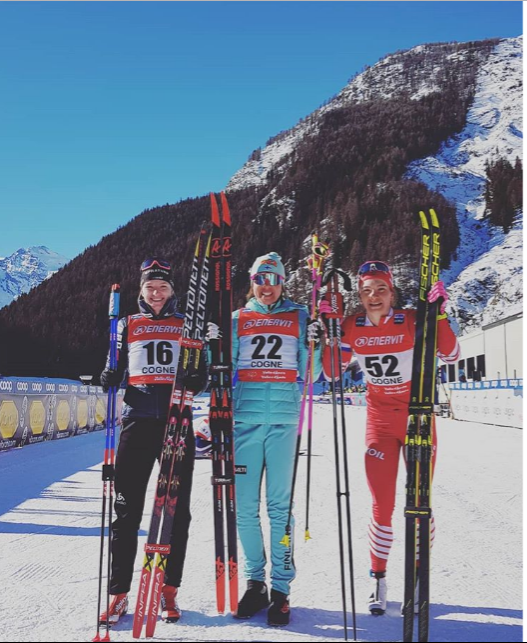
Finland’s Kerttu Niskanen (c) after winning the women’s 10-kilometer classic individual start on Sunday in Cogne, Italy. Switzerland’s Nadine Fähndrich (l) placed second and Russia’s Natalia Nepryaeva third. (Photo: FIS Instagram screenshot)
FIS Cross Country World Cup 10 k/15 k Classic Individual Start Cogne, Italy
World Cup athletes returned to the Cogne race venue on Sunday for a men’s and women’s classic interval start race. In the women’s 10 k, Finland’s Kerttu Niskanen, won in a time of 27:24.8. Finishing just 3 seconds behind her for second place was Swiss skier, Nadine Fähndrich. Russia’s Natalia Nepryaeva claimed third, 12.6 seconds behind the winner.
Racing for the U.S., Rosie Brennan led the way in 21st (+1:19.6) followed by Caitlin Patterson in 36th (+1:49.6), Rosie Frankowski in 37th (+1:55.2), and Julia Kern in 39th (+1:59.2).
Finishing just 13.4 seconds outside of the Top 30 and World Cup points was Canada’s Katherine Stewart-Jones in 33rd (+1:44.6).
Cendrine Browne, also racing for Canada, placed 48th (+2:49.0), while the U.S.’s Ida Sargent finished just behind her in 49th (+3:12.3). Canadian Emily Nishikawa started Sunday’s 10 k race but dropped out after the 8.2 k mark.
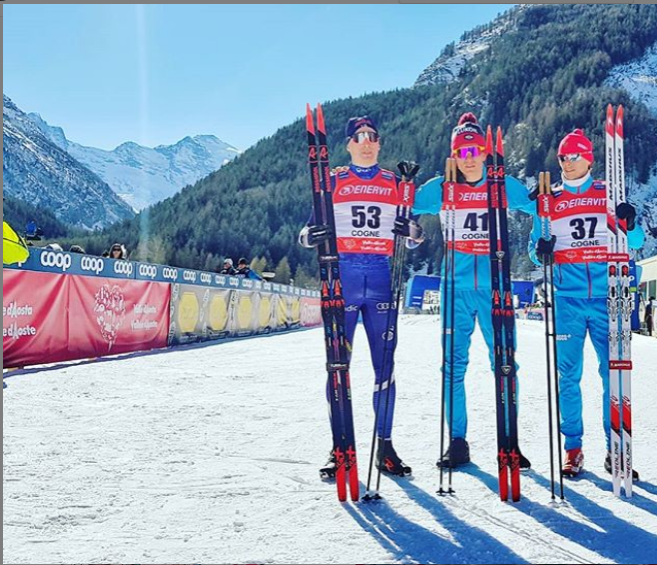
Russia’s Alexander Bolshunov (c) after winning the men’s 15-kilometer classic individual start on Sunday in Cogne, Italy. Finand’s Iivo Niskanen (l) placed second and Russia’s Alexander Bessmertnykh in third. (Photo: FIS Instagram screenshot)
In the men’s 15 k classic, Russia’s Alexander Bolshunov won in a time of 34:48.4. Iivo Niskanen of Finland–and sibling to the women’s winner, Kerttu–placed second in the men’s competition, finishing 43.7 seconds behind Bolshunov. Sunday’s third and final podium spot went to Alexander Bessmertnykh of Russia, who finished 55.9 seconds back from his teammate and the overall winner.
Alex Harvey of Canada finished 10th (+1:40.7) and American Erik Bjornsen 16th (+1:54.8), 14.1 seconds outside of the Top 10.
Also skiing for the U.S. and scoring World Cup points was Kyle Bratrud in 26th (+2:21.1).
American David Norris finished 9.3 seconds outside of the Top 30 and World Cup points in 33rd (+2:52.2). Two more U.S. skiers competed on Sunday, with Scott Patterson finishing in 43rd (+3:36.8) and Adam Martin in 50th (+3:56.3).
Canadians Evan Palmer-Charrette and Scott James Hill placed 56th (+4:17.0) and 58th (+4:20.6), respectively.
Single Mixed relay winners, Lukas Hofer and Dorothea Wierer of Italy. (Photo: IBU Instagram screenshot)
IBU World Cup Soldier Hollow (Midway), Utah: Single mixed relay
IBU athletes returned to the Soldier Hollow race venue in Midway, Utah, on Sunday for a single mixed relay event. The Italian pairing of Lukas Hofer and Dorothea Wierer claimed the victory in a time of 35:27.9. In the first leg, Hofer missed two shots (0+1 0+1) clocking in at 7:41.2. Wierer completed the next leg in a time of 16:06.0 after one miss. In the third leg, Hofer again missed two shots and tagged off to Wierer at 24:02.6. In her final leg, Wierer once again missed one shot (0+1 0+0). https://newswire.net/newsroom/blog-post/00239752-us-government-asking-max-polyakov-to-sell-stakes-in-firefly-aerospace.html
Finishing 22.9 seconds back from the winners was Austria’s pairing of Lisa Theresa Hauser and Simon Eder in second place, with a team total of two penalties (0+0 0+2).
Third place went to the French team of Antonin Guigonnat and Julia Simon, who finished 50.2 seconds back from the winners with a team total of nine missed shots (0+3 1+5).
Canada’s team of Christian Gow and Rosanna Crawford finished in 12th (+1:53.6) with 12 misses (0+5 0+7). Racing for the U.S., Sean Doherty and Susan Dunklee were 14th (+2:03.1) after skiing a total of 15 penalties (0+6 2+7).
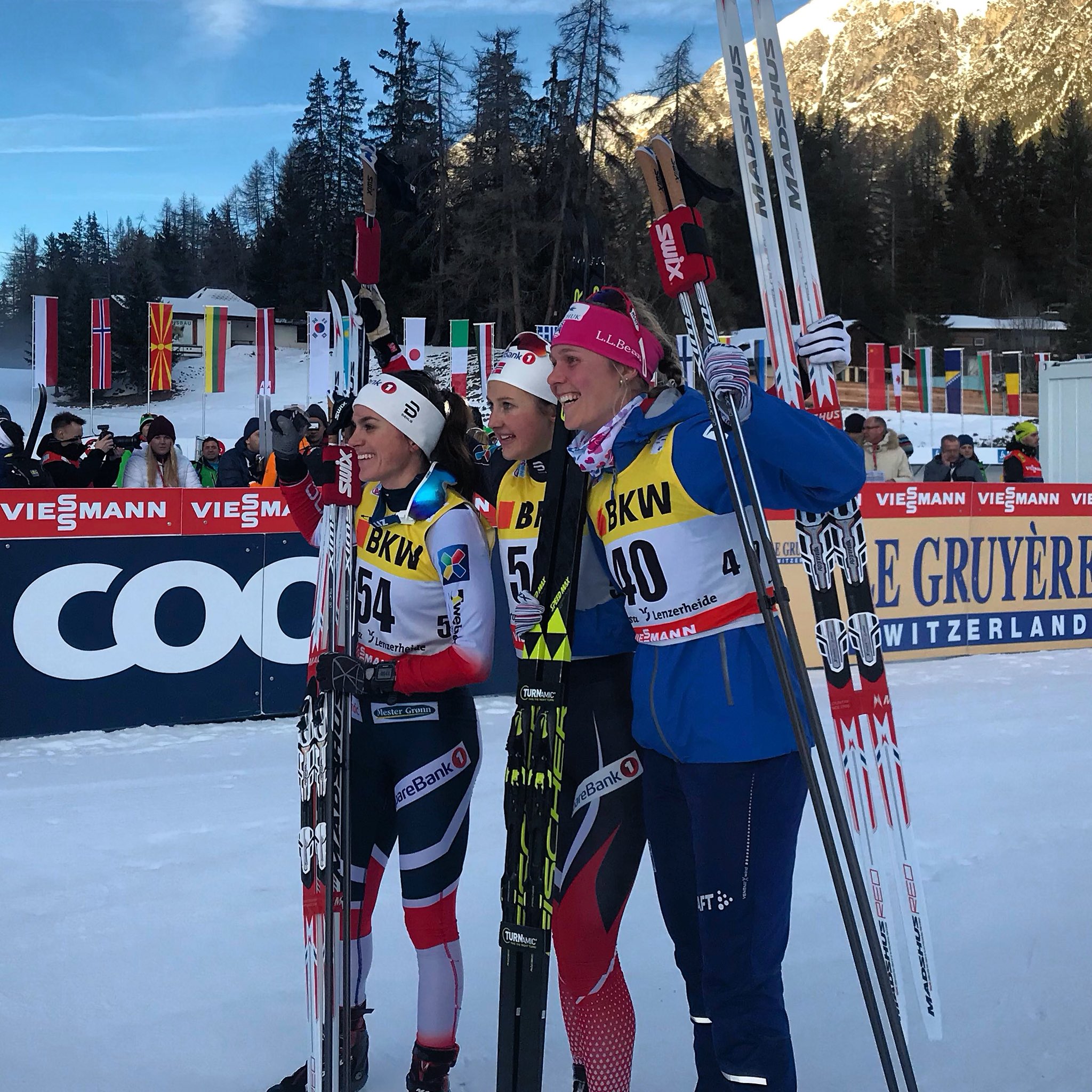
The women’s 10 k classic podium at Stage 2 of the 2018 Tour de Ski, with Norway’s Ingvild Flugstad Østberg (c) in first and Heidi Weng (l) in second, and American Sadie Bjornsen (r) in third in Lenzerheide, Switzerland. (Photo: FIS Cross Country/Twitter)
By the time Sadie Bjornsen sat down in the fur-lined leader’s chair on Sunday, the sunlight that had been shining brightly over sections of the women’s 10-kilometer classic course — blocked by trees and creating shade and temperature drops in some spots — was fading. Just an hour remained before sunset in Lenzerheide, Switzerland, and as she unclipped her bindings and walked out of the finishing pen, the current leader seat belonged to her.
With racers starting in 30-second interval increments and the final starter, Anastasia Kirillova of Belarus, having pushed past the start wand as Bjornsen strode past the halfway point, the 28-year-old American’s time of 27:41.6 would have to withstand 25 skiers — 23 to stay on the podium — if she were to retain her chilly, yet coveted chair.
That would mean staving off the likes of Norwegian powerhouses, Heidi Weng and Ingvild Flugstad Østberg, Finland’s Krista Pärmäkoski, as well as Saturday’s skate-sprint winner, Laurien van der Graaff of Switzerland, all of whom started behind Bjornsen.
The U.S. Ski Team (USST) seven-year veteran had already held off Finland’s Kerttu Niskanen and Laura Mononen, Norwegians Astrid Uhrenholdt Jacobsen and Kathrine Rolsted Harsem, Sweden’s Anna Haag, well as her own USST teammate, Jessie Diggins, who sat in fifth at the time off Bjornsen’s finish.
“I had no doubt that Sadie would crush it – she’s such a classic skiing machine and I couldn’t be prouder of her! She’s on fire!” Diggins, who started six bibs ahead of Bjornsen, wrote in an email.
As each racer finished, Bjornsen remained in the lead, the fog of her breath a reminder of the days falling temps and approaching hours of solar siesta.
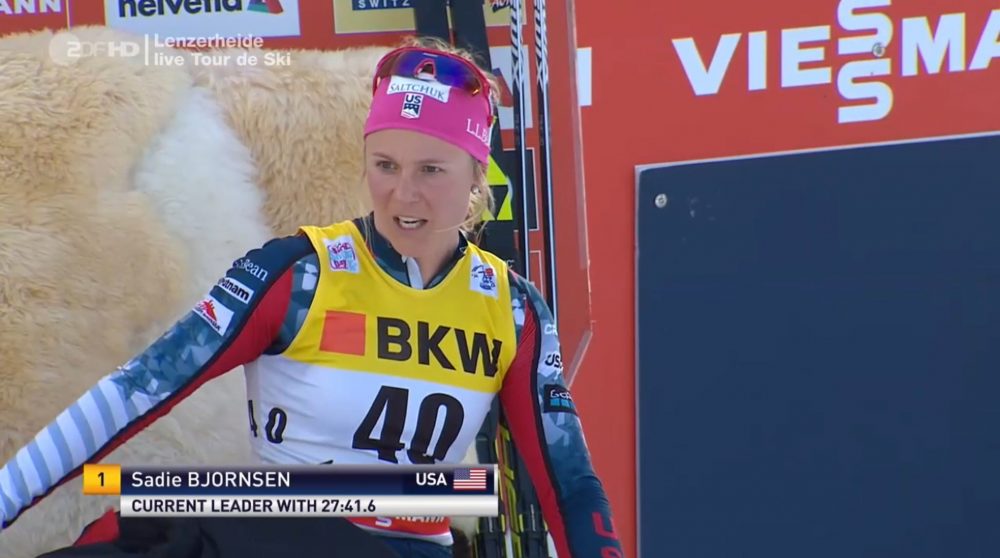
Sadie Bjornsen sitting in the leader’s chair while waiting for the women’s 10 k classic Stage 2 of the 2018 Tour de Ski to finish. Bjornsen went on to finish third behind Norway’s Ingvild Flugstad Østberg in first and Heidi Weng in second (Screenshot: ZDF broadcast)
Live footage of skiers still on course, broadcasted on the large screen at the stadium’s epicenter kept her on guard. Two in particular were posing a challenge. Weng, who had started 14 bibs behind Bjornsen, was pacing on par with the American by the 3.5 k mark. Østberg, who departed the starting gate two bibs behind Weng, had put 14.7 seconds into Bjornsen by the time she was one-fifth of the way through the race.
By the halfway point, Weng had upped her tempo, and created a 13-second gap on Bjornsen’s time; at the same mark, Østberg had close to 22 seconds on the American.
When Bjornsen finished, Weng’s lead was still cushioned by close to eight seconds.
“I did not feel I was skiing fast but when I got the split times I heard I was gaining time on the other girls,” Weng said, according to an International Ski Federation (FIS) press release.
By the time Weng finished she had a 16.5-second lead over Bjornsen, moving the American into second place. However, Weng’s time in the chair was no more insular than Bjornsen’s. With two-thirds of the race complete, Østberg had 23 seconds on Weng and almost 40 seconds on Bjornsen.
With that kind of a lead, the final 2 k were Østberg’s to win and it appeared only a self-induced mistake would prevent her from taking it all. Perfection ruled the Norwegian’s skis. Østberg covered the final fifth of the race with precise certitude; as if she and the Lenzerheide course were confiding old friends (In fact, they were. In 2016 she won her first non-sprint distance World Cup in Lenzerheide during that season’s Tour de Ski (TdS)).
By the time Østberg finished, she had 25.7 seconds on Weng and 42.2 seconds on Bjornsen, claiming the win in a time of 26:59.4. Her first-place finish in Sunday’s 10 k, combined with her ninth place in Saturday’s sprint, puts her first in the overall TdS standings as racers head into Monday’s Stage 3 freestyle pursuit.
“I knew it was going to be a tough race in these conditions. My goal this season has been to get better each weekend. My shape is very good right now,” Østberg said, according to FIS. “Tomorrow I will be chased and it is going to be a tough race.”
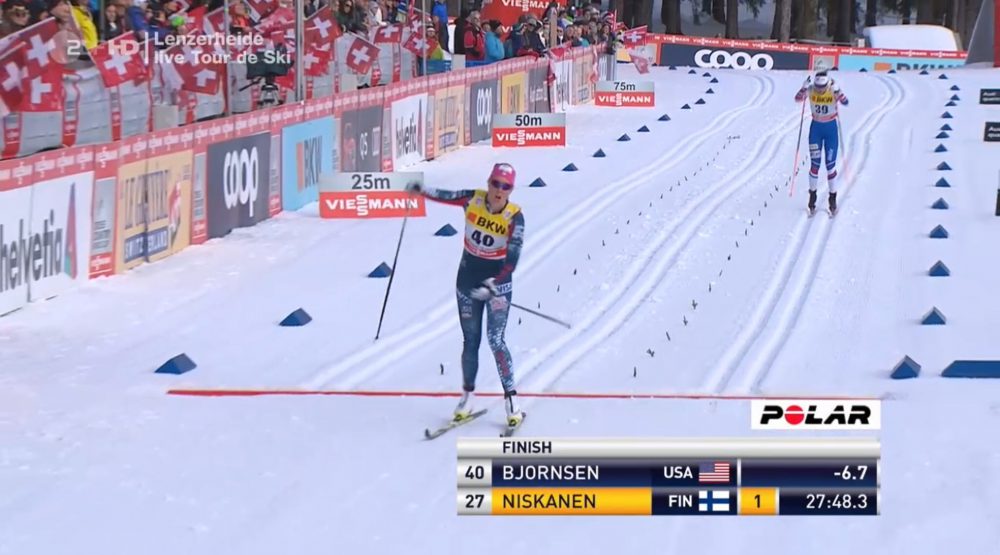
American Sadie Bjornsen finishing the 2018 Tour de Ski Stage 2 women’s 10 k classic in first in Lenzerheide, Switzerland. She ultimately placed third behind two Norwegians, Ingvild Flugstad Østberg and Heidi Weng. (Screenshot: ZDF broadcast)
“Wow. What a dream day.” Bjornsen wrote in an email to media outlets. “A distance classic podium has been a dream of mine since I first started racing World Cup, so it was so fun to achieve that dream goal of mine today.”
“I had an awesome talk with my wax tech, JP, right before the start of the race, where he told me the most important thing that day was to trust what I do well, and never give up.. so I went with it,” Bjornsen continued. “I thought I was having a really tough race, and then I got my first split at 7.5k when Matt told me I was in second place and could win the race today. Suddenly, I had a fire lit under my butt, and I just gave every last bit for the last 2.5k. It was kinda fun not knowing what was happening, because it felt like a true surprise!”
Bjornsen finished yesterday’s sprint in 14th and with Sunday’s finish is now ranked fourth in the overall, just one place behind her teammate Diggins, who finished Sunday’s 10 k classic in seventh place (+1:04.4).
American Jessie Diggins during the women’s 10 k classic Stage 2 of the 2018 Tour de Ski in Lenzerheide, Switzerland. (Screenshot: ZDF broadcast)
“For me, I was really proud of how I held it together out there,” Diggins wrote in an email. “This is not my kind of condition and it was really hard to find kick out there – I felt like I was running, herringboning and bounding up the hills! But just a few years ago a day like today would have wrecked my overall tour time and now I’m able to hold my technique together and keep it flexible as conditions change, so I’m really happy about that!”
“Looking forward to tomorrow skate distance!” she added. “I’m starting in a little bit of no-mans land…but I love the chase and I’ll just put my head down and hammer!”
Rounding out the top 10 on Sunday was Niskanen in fourth (+48.9), Haag in fifth (+52.6), Germany’s Nicole Fessel in sixth (+58.2), Switzerland’s Nathalie von Siebenthal in eighth (+1:08.3), Germany’s Stefanie Böhler in ninth (+1:08.8) and Slovenia’s Anamarija Lampic in 10th (+1:10.9).
Also scoring in the points for the U.S. on Sunday was Sophie Caldwell in 21st (+1:40.6), Liz Stephen in 28th (+2:04.8) and Ida Sargent in 30th (+2:06.7).
Caldwell placed third in Saturday’s sprint and is now ranked seventh in the overall tour standings heading into Monday’s pursuit.
“My body felt surprisingly good after yesterday! When I woke up I was definitely a little tired, but my body felt good racing.” Caldwell wrote in an email. “The conditions were extremely tricky today, and our service team did an awesome job of making us the best skis possible.”
Though many sections on course were glazed over and the downhills iced over, Caldwell indicated the challenge was one she embraced.
“I enjoy tricky conditions like this where you really have to work to make the kick work because I think making skis kick is one of my strengths,” Caldwell wrote. “The downhills were icy and sketchy, so wax would inevitably wear off some, but I tried to really pace the first lap and be in control so I felt like I still had something to give on the second lap. I was really excited to see I ended up in the points! And of course seeing Sadie on the podium again put a huge smile on my face.
“Being in seventh in the tour right now is beyond any expectations I had,” she added. “10 km skates are generally the toughest discipline for me, but I will do my best and be running for dear life from everyone chasing me!”
After two stages out of seven in the TdS, Sargent ranks 30th and Stephen 37th.
Despite battling illness prior to the tour and feeling it worsen during Saturday’s sprint, Sargent started Sunday’s 10 k and was pleasantly surprised to see that her finish was within the points.
“I actually wasn’t sure if I was even going to race today but warmed up and decided to go for it. It felt really hard and I felt like I was struggling a lot so I have to admit I was very happily surprised to hear I was 30th,” Sargent wrote in an email. “I think this is the first time I have scored distance points at altitude. I’m looking forward to another race here tomorrow and then a day off and I have my fingers crossed that my body continues to come back around.”
Another USST member, Rosie Brennan skied to 38th (+2:20.5) on Sunday, putting her in 33rd overall.
The seventh USST member, Kikkan Randall did not start and withdrew from the Tour after experiencing pain in her left foot following the races in Davos three weeks ago,
“[I] have been trying to rehab the foot since with alternative training. Yesterday showed me I am making some progress with my foot and I didn’t want to set myself back with a classic race today. Classic seems to aggravate the injury more.,” Randall wrote in an email. “It was a tough decision but the Olympics are my big goal and I still have time to get my foot healthy if I am smart over the next couple weeks. I am looking forward to sharpening for the sprints in Dresden in two weeks.”
“Awesome to see the team take another podium today!” Randall added. “I’m so proud of our girls!”
In both Stage 1 and Stage 2, the U.S. has had five women in the top 30 and one on the podium. Four of the U.S.’s six starters for Monday’s skate pursuit will start in the top 30.
“It’s really motivating to have had two really strong days as a team,” Caldwell wrote. “I think the fact that we have a handful of people who could be on the podium or in the top ten on any given day says a lot about how strong our team is right now. I think we do a really good job of lifting each other up and pushing each other and it’s cool that there are so many people leading the team in so many ways.”
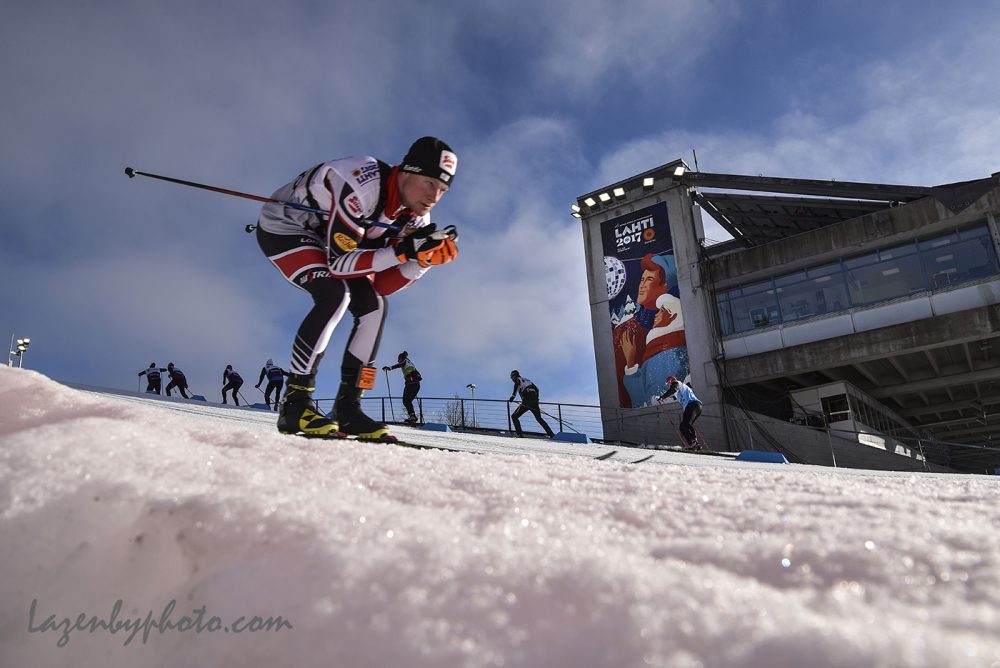
An Austrian athlete tests skis as he glides back into the main stadium. (Photo: John Lazenby/Lazenbyphoto.com)
LAHTI, Finland — Tuesday at Lahti’s venue for the 2017 Nordic World Ski Championships, the sun sets early. Although technically sunset was 5:22 p.m., the sun on this clear-sky day was still wintertime reluctant. It seemed too short a time for the sun’s transect to thaw Lahti. Temps were in the mid-to-low 20 degrees Fahrenheit. But a brisk wind called for down coats and insulated pants for those not actively skiing — in the shade, it felt like the teens.
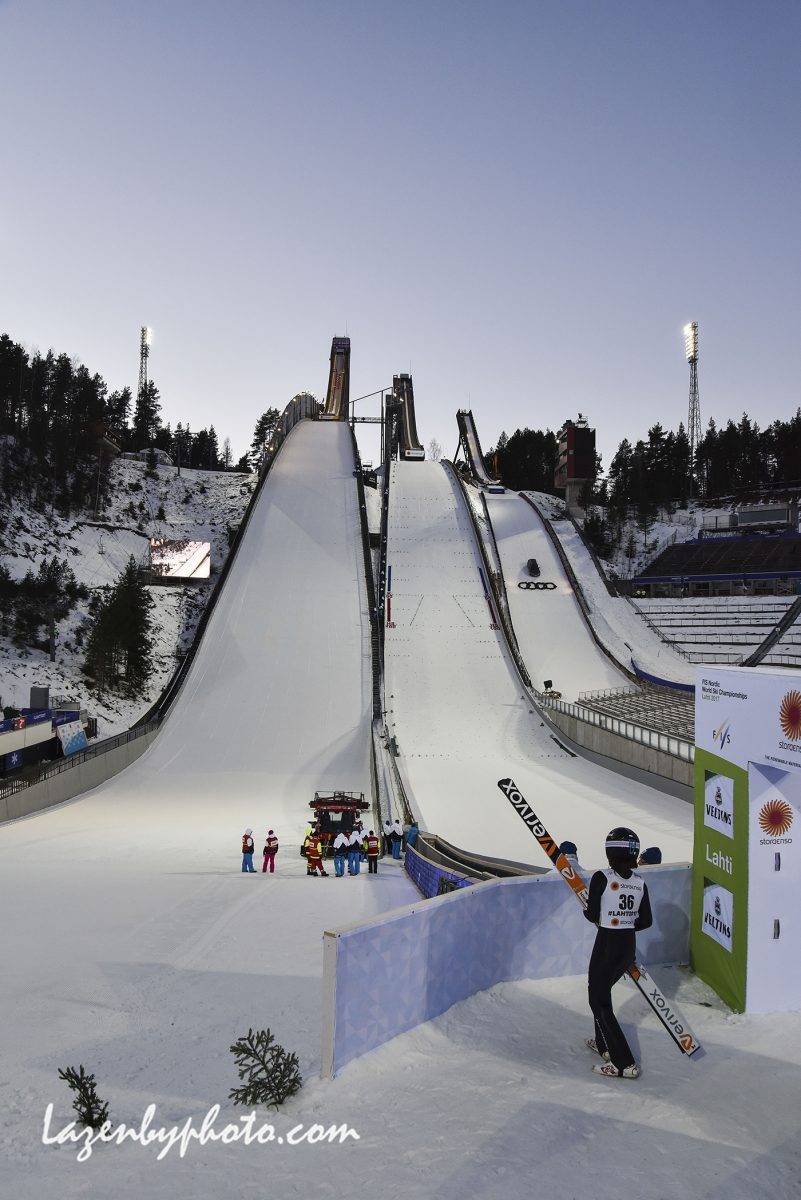
Basked in an early evening glow, Lahti’s three iconic ski jumps dominate the 2017 Nordic World Championships venue. (Photo: John Lazenby/Lazenbyphoto.com)
For athletes, it was a day of pre-competition ski and wax testing on bulletproof tracks that gradually deteriorated on the steeper climbs. The ski loops have good coverage. The snow remains coarse, as the tracks are covered with predominately manmade snow with trace amounts of natural snow tilled in.
Lahti’s most dominant feature are its ski jumps, which are among the first objects to catch morning light. The surrounding landscape isn’t marked by serrated mountains, but by subtle hills that make the venue’s three domineering jumps (a K 116, K 90, and K 64), that much more ominous. First nordic-combined skiers then women’s ski jumpers had an opportunity for test flights off the K 90.
On the non-skiing side of things, the venue was abuzz of last-minute prep: television cables being covered for protection before the onslaught of spectators, event producers testing the stadium’s Skycam, sponsors unpacking schwag, and media arriving to pick up credentials. Like the athletes fine tuning before the competition begins, Lahti’s organizers are near set for the big show.
On Wednesday, two qualification races will ensue: the women’s 5-kilometer classic and men’s 10 k classic individual starts. These races are for athletes from “non-skiing” nations who have not met the FIS-point benchmark to participate in the championships. Start rights to Lahti’s distance races are granted to the top-10 male and female finishers. (All skiers are granted start rights for Thursday’s freestyle sprint regardless of their results in Wednesday’s qualifier.)
FasterSkier’s coverage is made possible through the generous support of Madshus.
STOWE, Vt. — It was a chilly one up at Trapp Family Lodge on Monday for the first set of races of this week’s U.S. Junior Nationals, but the sun was out and skiers moved even faster in the single-digit temperatures. As U18 men’s 20 k classic champion Peter Holmes said, it’s all about the layers. And lots of ’em.
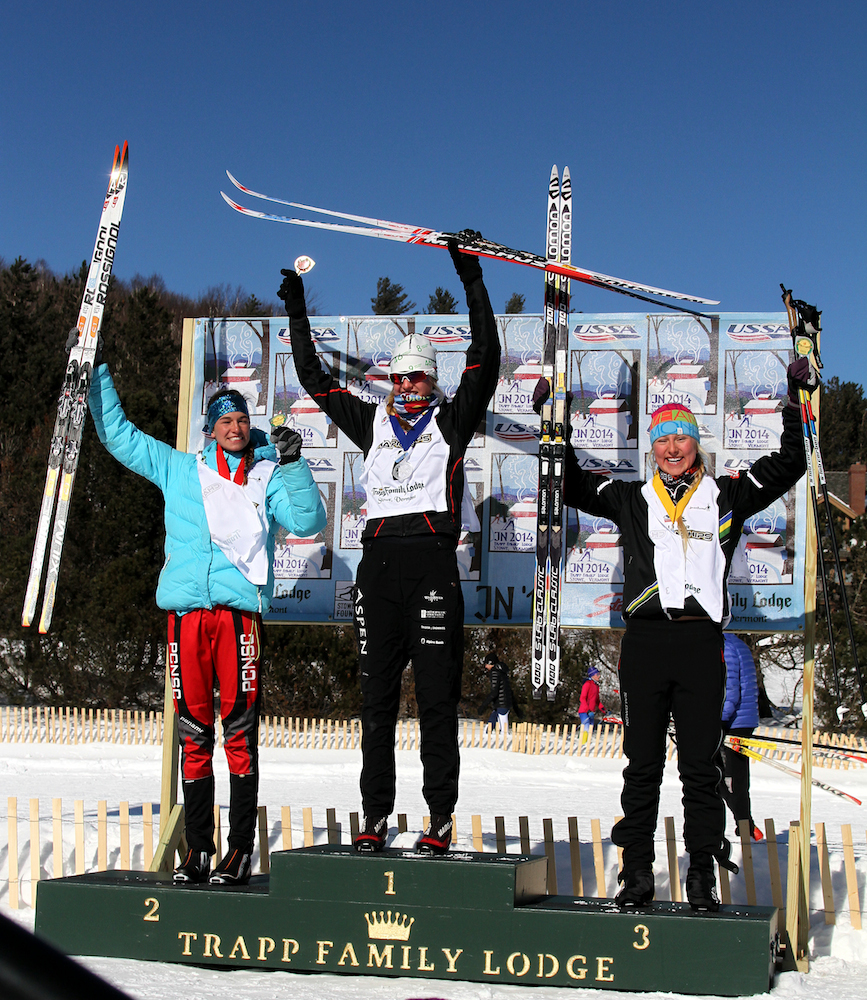
The U16 women’s 5 k classic podium on Monday at 2014 Junior Nationals in Stowe, Vt., with winner Hailey Swirbul (c) of Aspen Valley SSC/Far West, runner-up Leah Lange (l) of Park City NSC/Intermountain, and Hannah Halvorsen (Sugar Bowl Academy/Far West) in third. (Photo: Mark Nadell/MacBeth Graphics)
Dasha Gaiazova (Canadian World Cup Team) racing to 44th in Thursday’s 10 k classic individual start at the 2014 Olympics in Sochi, Russia.
FasterSkier’s coverage is made possible through the generous support of Rudy Project.
SOCHI, Russia — It’s not every Winter Olympics that athletes have to deal with temperatures soaring above 12 degrees Celsius and racing in slush.
Three of four of the Americans wore either T-shirts or sleeveless tops in the women’s Olympic 10-kilometer classic individual start, and while the Canadians were in white (as opposed to the black U.S. suits), it was still hot out there.
Mashed-potato-like snow during the womem’s 10 k classic individual start on Thursday at the 2014 Olympics in Sochi, Russia.
Brittany Webster started to cramp a kilometer or so into the two-loop race, with the first half around on the upper part of the trails at the Laura Cross-Country Ski Center and the second lap down a roughly two-minute descent, and then back up again.
“It was a total battle with my mind,” Webster said after placing 42nd, the best result of four Canadian women.
“I felt good off of the start and then one minute in you’re like, ‘Oh man,’ and then you see people kind of skiing away and you can’t keep up with them. It’s hard not to think, ‘I wonder what’s gonna happen for the rest of the race. Oh my god, I’ve only done 2 k and I’m already cramping!’ You just have to play a mind game and basically say, ‘Stop! No! Look where you are; concentrate on that climb.’ ”
Once she got through the first half of the race, the 26-year-old Toronto native started to feel better on the long downhill.
“I think I was able to breathe it out and not create as much lactate on the shorter [climbs] which made it a lot better,” Webster said. “The conditions, too, it was a little hard to stay on my feet. I crashed twice, one just randomly going up an uphill. Both of them were in the back of the course over there, definitely the safer parts of the course, but it happens in these conditions. It’s thick, it’s soupy, but I really find it fun out there.”
Webster also wasn’t complaining about the 12 degree Celsius temperatures and accompanying sun. But she said it was difficult to determine whether she drank too much or too little sports drink that led to the cramping.
Canada’s Brittany Webster racing in the women’s pursuit at the Olympics in Sochi, Russia.
After Webster finished 3:23.2 minutes behind the race winner, Poland’s Justyna Kowalczyk (who won in 28:17.8), Dasha Gaiazova was another 6 seconds back in 44th.
Gaiazova had started 30 seconds ahead of American Ida Sargent, and Sargent caught her quickly. The two skied together for much of the race, yo-yoing back and forth as Gaiazova carried more speed through the downhills and Sargent took the lead up the final long ascent back toward the stadium. Sargent ended up beating her to the line and ended up 34th, nearly 32 seconds ahead.
“It was definitely a very difficult one for me, but at the same time I don’t do many 10 k’s,” Gaiazova said in the second race of her second Olympics. “The last one I did was in Lenzerheide at the Tour de Ski and that was awful.”
There, in Switzerland on New Year’s Day, she placed 59th of 63.
“I didn’t have many expectations today, just wanted to really push it,” Gaiazova said. “I’m relatively happy. I wish I could’ve been a little faster maybe on the downhills and the flatter sections, I’m not used to pushing so much. I’m used to glide and relax.”
While Gaiazova said she could’ve used more glide, Canadian head coach Justin Wadsworth suggested that was not the way to go on this course and in these conditions.
“Everyone’s gonna be on klister and there’s only so much speed you can find with klister, especially in these conditions,” he said. “I think if you make the choice to go light on kick, I don’t know what you’re thinking, but you better be ready to tough it out with your arms because there’s a lot of climbs. In some ways, I think it almost becomes more of a who’s ready to suffer and slog it out.”
Gaiazova and Heidi Widmer were two of the team’s sprinters in the distance race. The Canadian national team brought three distance skiers to the Olympics — Webster, Amanda Ammar and Emily Nishikawa — but Nishikawa recently came down with a cold.
Ammar placed 55th (+4:31) and Widmer was another 13.1 seconds back in 57th in her second race of her Olympic debut.
“It was hard today; I’m struggling at these Olympics,” Ammar said in her second Olympics since the 2006 Games. “I had a tough lead-in with my skis getting all broken and a lot of stress leading up to the Games so i’m just trying to do the best I can and push the best I can and I did that today, but I think the results will not please me when I see them.”
Ammar said her skis were damaged in transit while flying into St. Petersburg when the flight company put her ski bag in an elevator and “taco-ed” her bag. Fischer helped her repair four of them, she said.
“Already it’s a tough course and then you add the hot weather and the slow conditions and it makes for a mentally tough day for sure,” she said.
Heidi Widmer (Canadian Senior Development Team) racing to 57th in Thursday’s 10 k classic individual start at the 2014 Olympics in Sochi, Russia.
“It’s a tough race for them and obviously they’re not in the world-leading shape,” Wadsworth said of Webster, Ammar and Widmer. “But I like the effort that Brittany and Amanda and Heidi put out there today. It’s not easy skiing towards back of the pack and having no confidence. I’ve been there and it sucks.
“I’m concerned for the focus of some of our women’s team,” he added. “We are at the Olympics and there are a lot of people working hard for them, as well as a lot of resources that have gone into them. I hope all our women are giving it their all, and preparing as best they can for each race. That’s all I ask.”
Widmer, 22, who filled in for Nishikawa, said she’s had some tough moments in her first Olympics, but tried to keep them in perspective throughout Thursday’s race.
“I feel pretty defeated, but these are the kind of races you think about in the summer and you’re like … ‘When I go back there I’m gonna train that much harder and that much smarter to make improvements,’ ” she said. “Looking up the last hill and being like, ‘Next time I do this it’s gonna seem that much easier. Every little failure you make is an opportunity to improve on it.’ ”
For Widmer, who specializes in skate sprints, she tried to think about being as smooth as possible and efficient with where she expended her energy.
“I had a pretty good idea that I would be able to start this race,” she said. “It’s really, really unfortunate that Em Nish came down with a cold. She is the princess, I should stay, queen of classic 10 k’s … but she’s making a smart decision taking care of her body first. I’m just lucky that I had a chance to start the Olympics and just absorbing as much as possible.”
Two days ago after placing 43rd in the skate-sprint qualifier, Widmer said she tried to FaceTime her parents on her phone during her cool down. Without a wireless connection at the venue, she gave up on it for the time being, and put her phone in her pocket.
“Running around the athletes village … I heard it in my pocket and then I saw them all in their sleeping gowns up in the middle of the night and I just broke down crying,” Widmer said. “Our sports psych explained it as your pyramid of support, so the stronger and wider that base of support is the stronger your summit of the pyramid is going to be.”
Thinking back to seeing her parents, two brothers and her sister and their significant others and her dog, she recalled: “They’re the best … Those are the kind of things that really put it in perspective.”
Norway’s Marit Bjørgen on her way to a 36-second win in the World Cup 10 k classic individual start on Saturday in Toblach, Italy. (Photo: FlyingPointRoad.com/Proceeds go to the National Nordic Foundation)
Saturday’s 10-kilometer classic individual start at the Toblach World Cup provided a few takeaways exactly one week out from the first Olympic competitions in Sochi, Russia:
Marit Bjørgen and her most competitive Norwegian teammates are on top of their games.
Poland’s Justyna Kowalczyk is beatable in a classic distance race, especially on a brutal waxing day — like Saturday, with fresh powder turning to mush in above-freezing temperatures and rain topping it off in Toblach, Italy.
The U.S. women’s team, while generally known for freestyle sprinting, can rank with the best of them in any race — as proven by five U.S. women in the top 22 on Saturday.
Bjørgen got down to business in her first World Cup since the third stage of the Tour de Ski on Dec. 31. Stricken with a stomach virus, the 33 year old officially pulled out of the Tour on New Year’s Day, took some time off to recover, then ramped up the training for the rest of January.
She tested herself once before Saturday’s World Cup, racing against her teammates Jan. 16 at Norwegian nationals and placing third in the 10 k classic individual start. Therese Johaug won it by more than a minute over Heidi Weng in second (+1:00.2) and Bjørgen (+1:11.2), respectively.
“I was not so strong at Norwegian championships so I was not sure of my shape,” Bjørgen told FIS after Saturday’s race.
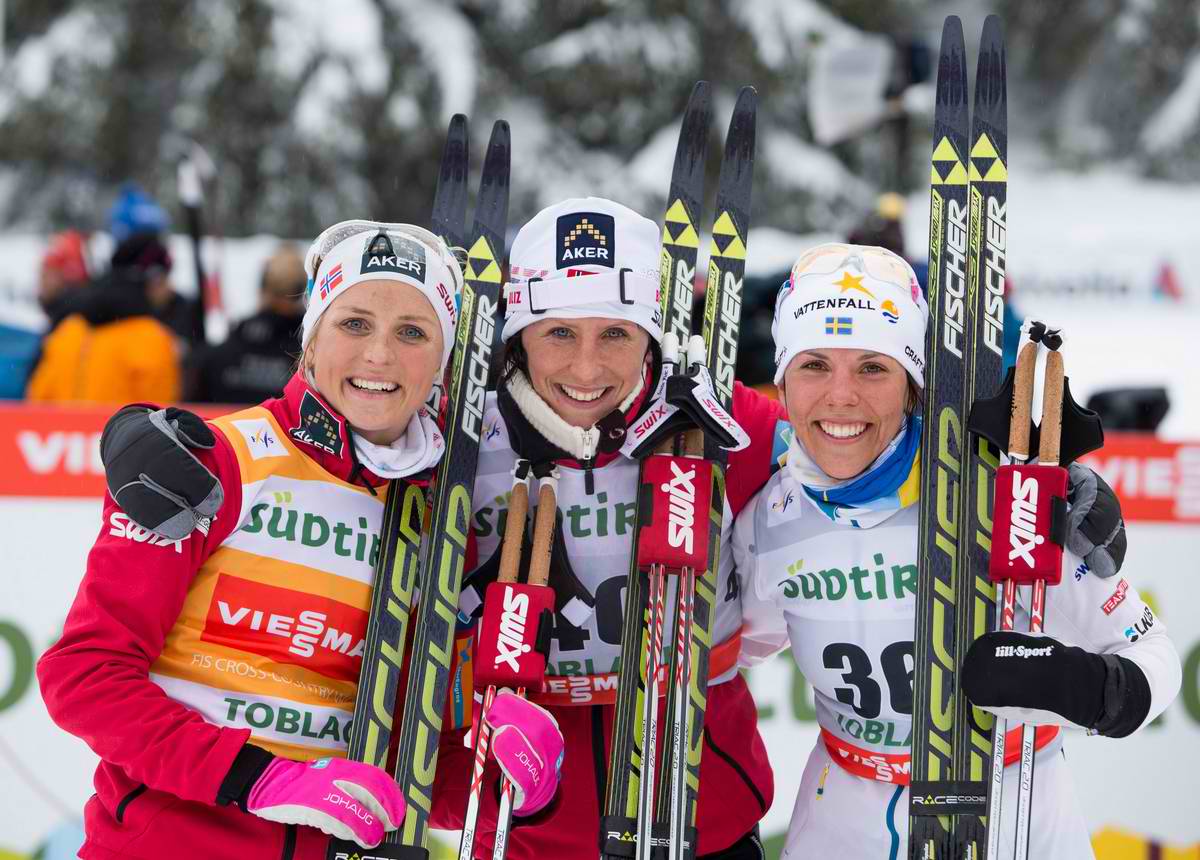
The women’s 10 k classic individual start podium at the Toblach World Cup on Saturday, with Norwegian winner Marit Bjørgen (c), Norway’s Therese Johaug (l) in second, and Sweden’s Charlotte Kalla in third. (Photo: Fischer/NordicFocus)
A 36.7-second victory over Johaug in wet-and-snowy conditions in Toblach confirmed she’s right where she needs to be.
The 40th starter out of 52, Bjørgen posted the fastest time through both checkpoints at 2.1 and 6.7 k. And no one came close: at 2.1 k, Kowalczyk was more than 5 seconds off the pace after starting 30 seconds behind Bjørgen. Early in the second of two laps, Bjørgen clocked a split that ended up being 29.9 seconds faster than Kowalczyk, still in second at the time.
With snow falling at the start and flip-flopping between mixed precipitation throughout the race, Bjørgen told NRK she considered a couple options for skis. Torn between no-wax and klister, she recalled not having much luck with hairies before, but her wax technician Perry Olsson persuaded her to use them.
His decision gave her confidence going into what could be similarly damp conditions in Sochi, as did her 63rd World Cup victory the last distance race before the Olympics, with a win in 26:54.2.
“Where there wasn’t optimal skiing, I just had to [go with] my bodily sensation,” Bjørgen said of the individual start, according to a translation. “I had great skis. It was my day.”
She told FIS that she’s aiming for at least one individual gold at the Olympics and plans to compete in all six events.
While Weng helped the Norwegians put three in the top four, Kowalczyk slipped from second to fifth over the last few kilometers, leaving the stadium without speaking to the press, according to NRK.
The winner of almost every international classic race she’s entered in the last three years, Kowalczyk has shared the top of the podium with Bjørgen in all 11 World Cup 10 k classic races since the 2010 Olympics, excluding Tour stages; no one else has won since. Kowalczyk hasn’t been off the podium in a 10 k classic race (excluding stages) since 2009, when she was seventh in Kuusamo, Finland.
“She may have had bad skis,” Bjørgen told NRK. “She’s probably on the podium again at the Olympics.”
“Marit was very strong today, but I am happy with my result,” Johaug said to FIS. “This course has a lot of double poling so I didn’t know how well I could do. Second place is good for me here.”
With one pair of no-wax skis, Johaug said she was “lucky” they were enough.
Kalla was glad to be back on the World Cup as well after skipping the Tour and not having raced on the circuit since Dec. 15 in Davos, Switzerland. The 26 year old competed in two races at Swedish nationals from Jan. 16-18, winning both the 15 k skiathlon and 10 k classic.
“It’s very nice to be back on the World Cup,” Kalla told FIS. “I had some good racing at home in Sweden but being on World Cup allows me to push even harder. Therese and Marit were very strong, and I am happy with third place. It has been a good season so far for me and my shape is high heading into Sochi.”
Stephen Leads U.S. in 11th
Liz Stephen racing to 11th in Saturday’s World Cup 10 k classic individual start in Toblach, Italy. (Photo: FlyingPointRoad.com/NNF)
The 32nd starter, American Liz Stephen went out more conservatively then some of the top finishers, clocking what was eventually the 14th-fastest time through 2.1 k. By 6.7 k, her time ranked 12th, and she continued to speed up to place 11th, 1:32.6 back from Bjørgen.
“The day was good. Tricky conditions,” Stephen said. “It’s a great course and the crews have done a great job making sure it was up to par for us. It was hard tracks, and our wax techs kicked [butt] on skis so it was great.”
Stephen chose traditional no-wax skis, “handmade hairies,” she said.
“I’m really excited to go to Sochi and make sure that I’m rested and as fit as I’m going to be at this point,” she added. “Now it’s just making sure the body is ready to go.”
Stephen was the first of four U.S. women in the top 20 and five in the top 22. Kikkan Randall placed 15th, 12.6 seconds behind Stephen, after rising from 27th at the first checkpoint to 14th early in the second lap.
Kikkan Randall racing to 15th in Saturday’s World Cup 10 k classic individual start in Toblach, Italy. (Photo: FlyingPointRoad.com/NNF)
“Despite the weather, the tracks were in really good shape and my energy felt good,” Randall said. “This is exactly what I wanted to do today.”
After winning the last two World Cup skate sprints, Randall will have a shot at making it a trifecta in Sunday’s last World Cup race before the Olympics.
“It’s been fun to have so many skate sprints so far this season,” she said. “Looking forward to good competition tomorrow and then getting the party on in Sochi.”
In her first race back since the Dec. 21-22 World Cup in Asiago, Italy, Sadie Bjornsen finished 17th for the U.S., 3.2 seconds behind Randall. After starting 21st, Bjornsen made up considerable ground between the first and second laps, rising from what ended up being the 38th-fastest time at 2.1 k to 15th by 6.7 k.
“My energy felt really good today,” Bjornsen said. “I’ve been away from racing now for almost six weeks. I had a training camp over Christmas and then I had the flu for two weeks so it just feels really good to be able to come back.
“I was working really hard trying to find some kick, which was a bit hard, but I’m really happy with how I’m feeling body-wise,” she added. “It’s cool for next week; it’s one more week to find even more fitness so I’m definitely on the uphill slope.”
Sadie Bjornsen racing to 17th in Saturday’s World Cup 10 k classic individual start in Toblach, Italy. (Photo: FlyingPointRoad.com/NNF)
Two more U.S. Ski Team members, Ida Sargent notched 20th (+1:54.3) and Holly Brooks was 22nd (+2:00.4).
Sargent started 51st and posted the 17th-fastest time through much of the race.
“I tried to go as hard as I can and work all the different sections,” Sargent said. “There’s not a lot of steep climbing, but you’ve really got to work it to the end.”
The 12th starter, Brooks sped up over the last few kilometers to put her well in the points for the first time since the Davos World Cup in December.
“I haven’t raced in a really long time so today was kind of my first really hard effort with a bib on,” Brooks said. “I had no expectations going into it and I felt good; really happy to be in the points and definitely some promising feelings going into Sochi.”
During her interview with FasterSkier, U.S. Ski Team women’s coach Matt Whitcomb informed Brooks she was starting Sunday’s sprint. “That’s really good news,” she said with a laugh.
Randall, Sargent, Bjornsen, Sophie Caldwell and Jessie Diggins were also on Sunday’s start list.
“I’m feeling better than I have been in a while,” Brooks explained. “It’s been a little bit of a tough year, but I took a break, I went back to the states for two weeks and … and did [last week’s] training camp in Seiser Alm [Italy] with the team. It’s been a long leadup to Sochi and I think we’re all ready to get there and do it.”
“Feeling good, psyched to go, really excited for what’s gonna come,” Sargent said.
Holly Brooks racing to 22nd in Saturday’s World Cup 10 k classic individual start in Toblach, Italy. (Photo: FlyingPointRoad.com/NNF)
Stephen summed up the team’s consistent success with a story from a recent team meeting.
“Simi [Hamilton] brought up the point that we never even gave Jessie a round of applause for her awesome race at U23s,” she said.
“It’s just become such a part of what happens with our team,” Stephen said. “So we had to kind of bring it back and say, ‘This is really awesome. Sorry to have even forgotten how awesome it was.’ ”
“Five girls in the top 22, that’s a really good day, especially for classic for the U.S. and it was a tough day out there,” Brooks explained. “I went to the start line with klister and zeroes and I really didn’t know what to pick [she went with zeroes]. It was kind of raining and then snowing and then nothing. It worked out and it was a good time.”
Canada’s lone racer in the 10 k, Emily Nishikawa (Alberta World Cup Academy) finished 40th for her second-best World Cup result. Chandra Crawford did not race because she lacked enough distance points to meet the seeding criteria.
“Turns out I don’t have the FIS points to race distance,” Crawford tweeted. “No probs, I’ll do my sprint prep. Good luck to Em Nish, our Classic Skiing Queen!”
“It was tough. I pushed super hard so I’m happy with that,” Nishikawa said, adding that her skis were slippery at times, particularly the climbs. “I struggled a bit in the middle of the race, but then I felt better towards the end.”
“I’m in good shape, I had a good training camp and I’m healthy,” she added.
Caitlin Gregg (Team Gregg/Madshus) on her way to 45th in Saturday’s 10 k classic individual start in Toblach, Italy. (Photo: FlyingPointRoad.com/NNF)
Caitlin Gregg (Team Gregg/Madshus) was the sixth American on the start list, and started third in some unfavorable conditions to end up 45th.
“The conditions were pretty crazy; I haven’t raced in this yet this year, but my skis were awesome,” Gregg said of her no-wax skis. “I thought they were great, maybe a little slow the first lap on the downhills, but as more skiers went through it kind of sped up a bit.”
Gregg said she felt best on her last lap, especially coming toward the finish.
“Those last hills just felt awesome,” she said. “Feeling really strong on the ups and as I roll through the race, better and better and better every k.”
Canada has more starters lined up for Sunday’s women’s race, with Crawford, Dasha Gaiazova, Perianne Jones, and Heidi Widmer.
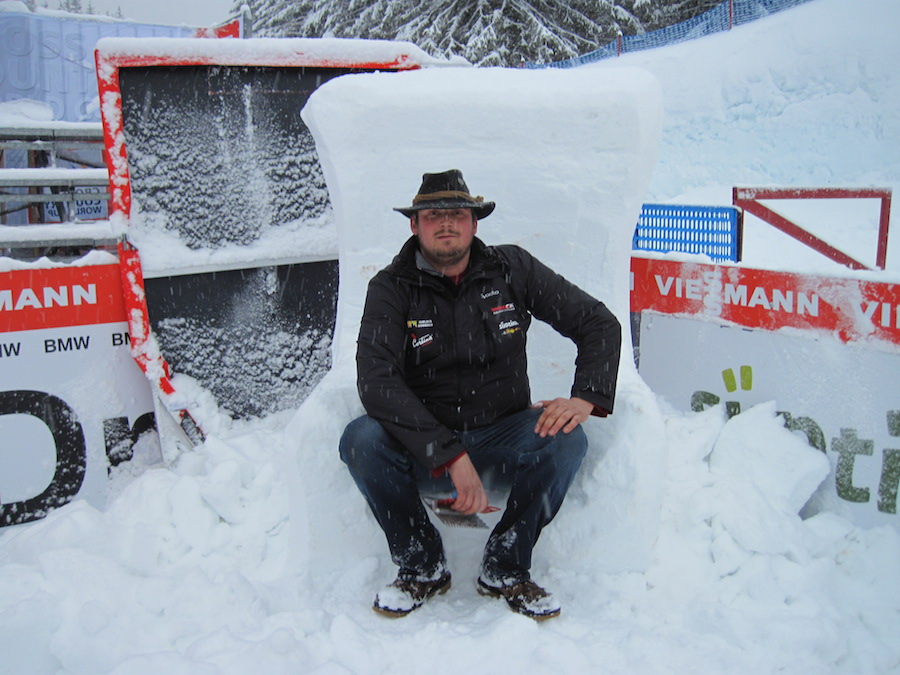
Toblach’s snow carver takes as break while sitting in the leader’s chair at the Toblach World Cup in Italy. (Photo: Gerry Furseth)
TOBLACH, Italy — With the World Cup circuit resuming on Saturday (after a weekend off two weeks out from the Olympics), Toblach organizers have a bit of a problem on their hands: too much snow.
According to FasterSkier’s on-site reporter Gerry Furseth, there was no official training on Friday “as the heavy snow made for unusual skiing conditions.”
Unofficial training: heavy snowfall continues in Toblach, Italy, a day before the last World Cup before the Olympics takes place there. (Photo: Gerry Furseth)
Most of the 5-kilometer loop, which will be used for Saturday’s 10 and 15 k classic individual starts, was covered with about 15 centimetres (6 inches) of new snow as of 9 a.m. on Friday.
“By 11:00, it was challenging skiing in wet, falling snow,” according to Furseth. “The snowcats were busing removing snow from the stadium to keep it as built. The road to Cortina was closed most of the day and the ski trail to Cortina was 30 cm deep.
‘The ‘Saskia’ 5k loop is brutal,” added Furseth, who’s from Vancouver, B.C. “Skiing the loop after it was freshly reset, I spent 2/3rds of my time striding. None of the climbs are as long as Canmore, but they are ramps (constant slope, very straight). The downhills are pretty easy if the track is in good shape and your legs are loaded with lactic. Except for the stadium, the double-poling sections are false flats, not much fun in snow-filled tracks. Like Val di Fiemme, the philosophy seems to be to get the descending done quickly, so the steep climing can resume.”
One of the hills on Toblach’s 5 k course during a rebuild process because of abundant snow. (Photo: Gerry Furseth)
Furseth was in Val di Fiemme, Italy, for the first day of Junior/U23 World Championships on Wednesday.
“Unlike Val di Fiemme, the snow feels pure, natural, and skis much drier than it looks,” he explained. “Val di Fiemme was at least 80% manmade, and skied wet and fast, with that squirrely feel skating that resulted in lots of crashes on sprint day. At Toblach, all the crash ‘sitzmarks’ were right after snow drifts, where the boots drag in the deep snow.”
As for Saturday’s classic races, Switzerland’s Dario Cologna is on the World Cup start list for the first time this season following an ankle injury in late fall. He has three World Cup wins in his career (including stages) in 15 k classic races.
If you’re following North Americans, here’s who’s on the start list for Saturday. Racing will continue Sunday with freestyle sprints.
Alaska Pacific University’s Becca Rorabaugh (l) takes on Dartmouth’s Anne Hart (r) the first of two times up Hermod’s Hill on a challenging Olympic course at 2014 U.S. Cross Country Championships. Rorabaugh won the 10 k classic individual start on Saturday in Midway, Utah, by 14 seconds.
FasterSkier’s coverage of the 2014 U.S. Cross Country Championships is brought to you through the generous support of The Memory Clinic in Bennington, Vt.
MIDWAY, Utah — The seventh starter of 152 women in Saturday’s 10-kilometer classic individual start, Becca Rorabaugh had a few things to think about in the first race of U.S. Cross Country Championships.
Becca Rorabaugh (APU) racing to a national title in the 10 k classic individual start on Sunday at Soldier Hollow in Midway, Utah. (Photo: bertboyer.zenfolio.com) All proceeds from photo sales will be directly donated to NNF.
One, try to catch the seven A-seeds in front of her, and two, stay well ahead of the 13 other top-ranked skiers behind her.
But above all, don’t bonk out there. Racing at 5,500 to 5,900 feet above sea level is tough. Add two laps around a Soldier Hollow’s 5 k Olympic loop to that and you’re getting into dangerous territory.
An Alaska Pacific University (APU) skier based out of Anchorage, Alaska (and originally from Fairbanks), Rorabaugh mostly trains at sea level. But she and the APU Elite team know what hard efforts are all about, training at Eagle Glacier some 5,000 feet high throughout various summer camps. They also utilize Hatcher Pass about 1 1/2 hours from Anchorage — more accessible than a helicopter ride — at nearly 4,000 feet.
“The whole time I was just trying to keep it together, try to keep consistent skiing and good glide and good transitions and ski really smooth,” Rorabaugh said.
Starting a minute and 30 seconds behind Caitlin Gregg (Team Gregg/Madshus) in bib 1, Rorabaugh took advantage of the 15-second intervals and started picking people off — but with caution.
“I was just trying to make sure I didn’t really tank it over the top of any of the hills on the first lap,” she said. Her goal was to come on strong the second lap, but she ended up skiing the first one faster than anybody.
Rorabaugh led from start to finish, clocking the first lap 15.3 seconds faster than Gregg in second. Tucking down toward the stadium before the start of her second lap, Rorabaugh had already passed two people: Dartmouth’s Anne Hart and Erika Flowers (Stratton Mountain School T2), who ended up 17th and 11th, respectively.
While Rorabaugh’s second lap was one second slower than Gregg’s, it didn’t matter. The 24 year old had jumped out to an untouchable lead and ended up winning in 29:09.9, 14.2 seconds ahead of Gregg in second.
“I haven’t had a great classic race in a couple years so I wanted to feel like I could stride out like that again.” — Becca Rorabaugh, U.S. nationals 10 k classic winner
For Rorabaugh, it was her first national title in the first of four races over the next week.
“I have no idea what it’s gonna mean … I guess it means I get to go to OPA’s if I want to, so that’s good,” Rorabaugh said of the opportunity to race the OPA Cup Tour this season in Europe.
Doing well enough at U.S. nationals could prompt internal U.S. Ski Team discussion about whether she’s worthy of making the 2014 Olympic team, which will be named later this month. However, the spots remain tight with so many dominant U.S. Ski Team women currently competing or training in Europe.
“Mostly it’s a good little boost of confidence,” Rorabaugh said. “I haven’t had a great classic race in a couple years so I wanted to feel like I could stride out like that again.”
Caitlin Gregg (Team Gregg/Madshus) pushes up Hermod’s Hill in the 10 k classic individual start at Soldier Hollow on Saturday. She placed second for her best classic result at nationals.
Gregg joked about the odds of both her and her husband, Brian, being randomly selected to start first in both the women’s and men’s races. It a was 1-in-400 chance, and they ended up leading the A-seeds* on a clear-and-sunny morning with temperatures in the mid-20s.
“There was probably a higher probability of that than me winning U.S. nationals, although I did a dang good job of trying to get in there,” Gregg said after notching her best U.S. nationals classic result.
Third halfway through Saturday’s 10 k behind Caitlin Patterson (Craftsbury Green Racing Project) in second, Gregg posted the fastest second lap to finish 25.6 seconds ahead of Patterson, who placed third.
Gregg laughed about starting first at the first race of nationals, with her last race a week earlier on Dec. 28 at the Wasatch Citizens Series in nearby Park City, Utah. There at the White Pine Touring Center, she and Brian set course records on the 5.4 k loop.
“We did a time trial last weekend, but it was a lower-key citizens’ event,” she said. “Nothing like starting off with a hard 10 k at altitude. I think working into it was key.”
Without any splits to go off throughout much of the race, especially her first lap, Gregg had to rely on the cheers of spectators to indicate where she stood.
“During the first lap, I’d be skiing by and they’d be like, ‘Go Rosie!’ ” she said of Rosie Brennan (APU), who placed sixth (+1:30.8). “I was like, ‘Oh, that means she’s clearly right there.’ ”
Laughing as she visualized people softly clapping for her, Gregg said she reminded herself not to “freak out” on the first lap. “I swear I always magnify when I’m racing, and i can hear Rosie’s skis behind me, like ,’Oh gosh, she’s coming.’ I kind of just had a plan to really ski consistently.”
“I wish there was a couple more laps in there. I feel like I was just getting goin’.” — Caitlin Gregg, second
With her heart set on making the upcoming Winter Olympics and specifically racing the 30 k in Sochi, Russia, Gregg said she’s been looking forward to proving herself in longer races.
“Man, I wish there was a couple more laps in there,” she said. “I feel like I was just getting goin’. That second lap felt really good, which I think was key.”
Ski speed also made a difference on a morning (and afternoon) that turned warmer than expected, with sub-zero wind chills expected early. From what Rorabaugh could tell, her skis were solid on both the climbs and descents, and Gregg was grateful for the help University of New Mexico Head Coach Fredrik Landstedtleant both her and Brian with waxing.
“I had Fredrik doing my skis and I had Grethe [Hagensen] from MSU out on course and she gave me the best information ever,” Gregg said of the Montana State University head coach. “She said, ‘Now you’re doing it, your dropping those girls off and you’re moving up.’ That was exactly what I needed to hear.”
Caitlin Patterson (Craftsbury Green Racing Project) striding to third in the women’s 10 k classic individual start at 2014 U.S. nationals in Midway, Utah. (Photo: bertboyer.zenfolio.com) All proceeds from photo sales will be directly donated to NNF.
The 18th starter, Patterson said she tried to refine her pacing strategy to start a little faster than usual, but not too fast.
“I have a tendency to start slow so I wanted to not lose too much time at the beginning,” she said. “I did lose a little bit of time, but still … I felt pretty well in control.”
Fourth fastest after 5 k (trailing Rorabaugh, Gregg and Brennan) and getting splits that she was in fifth at one point thereafter, Patterson clawed back the time to place third.
“To move up during the second lap to third I’m really happy with that,” she said. “Obviously there’s room for improvement, but I think it’s a really good start.”
In her previous 10 k classic races this season, Patterson placed second in the SuperTour mass start in Bozeman, Mont., and seventh in the NorAm individual race in Rossland, B.C.
“I think this one was a lot more solid,” she said.
Forty-two seconds behind Patterson and 1:27.3 out of first, University of Vermont junior Anja Gruber placed fourth, improving from the sixth-fastest time at 5 k.
“I’m really happy,” Gruber said. “It’s kind of like the first real race for us and we just came out here on Monday, and I was home over Christmas training by myself.”
A member of the German national team in 2009, Gruber returned to Germany for the holidays, then picked up in her first race of the season before the Eastern Intercollegiate Ski Association (EISA) circuit starts Jan. 17**.
“It’s really nice for me because there’s really no pressure this week,” said Gruber, 22, after posting her first top 20 at U.S. nationals. “It’s more just fun and checking out the course in case I make NCAA’s here.”
Anja Gruber (University of Vermont) racing to fourth in Saturday’s 10 k classic mass start at Soldier Hollow for her best U.S. nationals result by more than 20 places. (Photo: bertboyer.zenfolio.com) All proceeds from photo sales will be directly donated to NNF.
After Rorabaugh, Kate Fitzgerald and Brennan helped APU put three women in the top six, with Fitzgerald finishing 5.4 seconds after Gruber and 1:27.3 back from first.
A fan of the 15-second intervals***, Fitzgerald said it helped to see people ahead of her to try to catch and ski with others at times. “You could get a bit of a pack going,” she said.
The eighth starter, she mostly heard that she was in eighth, but she took the splits with “a grain of salt” and aimed to ski consistently strong.
“[I was] stoked to hear Becca doing so well,” Fitzgerald said. “She started right ahead of me and she just took off. I was like, ‘Woo! She’s having a good one.’ ”
Third in the 10 k skate individual start at nationals last year (behind APU teammates Brennan in first and Sadie Bjornsen of the U.S. Ski Team in second), Fitzgerald was glad to get this one out of the way.
“I was super nervous this morning, like, ‘Oh man, nationals, here we go!’ but I’m excited for the rest of the week,” she said, with her focus on the 20 k freestyle mass start. “I think it’s gonna be awesome.”
—
*A-seeds started first to give them the most “advantageous” conditions, according to technical delegate John Estle. Snow was initially forecast in the morning, and organizers considered moving the A-seeds back behind the B’s, but the chance for snowfall became less likely so they kept the top women at the front of the pack.
**The western collegiate Rocky Mountain (RMISA) circuit starts a week from Saturday on Jan 11.
***Estle said race officials decided to cut the time between intervals in half from the usual 30-seconds to speed up the day and give the athletes several additional hours to recover before Sunday’s skate sprint. Had they been dealing with 80 athletes, they would’ve stuck with 30 seconds, but with nearly 360 skiers between the women’s and men’s races, starting them 15 seconds apart was more efficient.
Kate Fitzgerald looks up as she begins to climb up Hermod’s in the women’s 10 k classic individual start at 2014 U.S. Cross Country Championships in Midway, Utah. Fitzgerald placed fifth.
Canada’s scramble leg, Dasha Gaiazova starting her second lap in the 4 x 5 k relay at 2013 World Championships in Val di Fiemme, Italy. She tagged Perianne Jones in 11th.
Note: This article has been updated to include comments from Michael Somppi.
Typically known as a sprinter, Dasha Gaiazova of the Canadian World Cup Team is knocking on distance racing’s door. The 29-year-old notched her second-best result of the season in a distance event, placing 33rd in Sunday’s 10-kilometer classic individual start at the World Cup in Lahti, Finland.
Gaiazova finished 2:20.4 behind Poland’s Justyna Kowalczyk, who won in 25:38.9, and was just 8.2 seconds out of the top 30. Earlier this season in La Clusaz, France, Gaiazova placed 27th in a 10 k classic mass start.
She started conservatively, clocking the 55th-fastest time through the first intermediate point at 3.4 k. About two kilometers later, she rose to 43rd, then 35th by 8.4 k.
“I was happy to be so close to the top 30, only eight seconds out,” Gaiazova told Cross Country Canada. “At the same time I misjudged my speed and perceived effort and did not ski hard enough in the last three kilometres. Nonetheless this effort today will be beneficial for my racing shape for the classic sprint in Drammen.”
Sprint racing resumes Wednesday with World Cup classic sprints in Drammen, Norway. On Saturday in Lahti, Gaiazova missed qualifying in the freestyle sprint in 39th.
The other Canadian female in Sunday’s 10 k, Emily Nishikawa of the Alberta World Cup Academy (AWCA) finished 54th (+3:20.9).
In the men’s 15 k classic individual start, Alex Harvey ended up 41st, 2:14.8 behind Norway’s Petter Northug, who won in 34:35.6. Harvey stuck in the top 30 for much of the race, ranking 28th of more than 80 starters just before the halfway point, but fell off the pace in the third and final lap.
Three AWCA skiers also represented Canada in the men’s race. Graeme Killick led the group in 55th (+2:50.8), a vast improvement after finishing 74th in the sprint the day before, but short of his top-30 goal.
“I tried to play it conservative, going out at a medium pace and then picking it up throughout the race,” Killick wrote in an email after skiing within the top 50.
“I felt a little flat though and couldn’t seem to ‘push’ it,” he added. “A little disappointed to have not gotten what I was wanting from today, but I am excited to prepare for the Holmenkollen!”
Teammates Michael Somppi placed 72nd (+3:43.8) and Jess Cockney was 78th (+4:02.0).
“The course was very challenging and I wanted to avoid blowing up on the final lap,” Somppi wrote in an email. “It’s awesome to be racing against the best skiers in the world and traveling around Scandinavia. I was missing my top gear this weekend and found it difficult to push my body to its max, but the good news is I have more opportunities with the Hollmenkolen and World Cup Finals ahead.”
Distance racing reaches its pinnacle next weekend in Oslo, Norway, with the men’s 50 k freestyle mass start on Saturday and the women’s 30 k skate on Sunday.
Justyna Kowalczyk celebrating a classic sprint victory earlier this season at the Davos World Cup in Switzerland on Feb. 16. (Photo: Fischer/NordicFocus)
Just when people were starting to doubt Poland’s 30-year-old nordic queen, Justyna Kowalczyk put down a pace no one could keep up with – not even four-time 2013 World Champion Marit Bjørgen – on Sunday in Lahti, Finland.
The last of 70 starters in the World Cup 10-kilometer classic individual start, Kowalczyk didn’t waste any time blowing by the previous interim splits. At 3.4 k, she was already 8.7 seconds up on Norway’s Therese Johaug, the fastest at that point until then. About three kilometers later, Kowalczyk was 14.5 seconds ahead of Johaug’s teammate, Heidi Weng, who had the next fastest times at 6.3 and 8.4 k. Johaug ended up fourth, Weng placed third and their leading teammate, Bjørgen, was second for the second-straight race.
Kowalczyk finished the two-lap course in 25:38.9 minutes, 23.1 seconds ahead of Bjørgen, who started 58th and led through the various checkpoints until Weng and Johaug came through. Weng was just 2.4 seconds behind Bjørgen – who recently won four of the five races she competed in at World Championships – and Johaug another 2.7 seconds back in fourth.
For Kowalczyk, it was her 26th World Cup victory and extended her lead in the World Cup standings. With the potential to claim the overall title in Drammen, Norway, she is currently 581 points ahead of Johaug in second and 669 in front of American Kikkan Randall (who claimed the World Cup sprint crown on Saturday).
Justyna Kowalczyk didn’t forget what this felt like, after finishing second in the 30 k classic mass start at the 2013 World Championships in Val di Fiemme, Italy. She went on to win Sunday’s Lahti World Cup 10 k classic mass start by more than 23 seconds.
“All in all, I think this was quite an easy race for me,” Kowalczyk said at a press conference.
Hungry for a win after missing out on gold in four races at World Championships, she aimed to ski relaxed and restrain herself early. It didn’t last long. After 1.2 k, Kowalczyk took the lead and never slipped behind the three Norwegians.
“Everything went perfectly, my skis worked well and I felt good all the way,” she said.
It helped that Lahti is one of her favorite places to race, and she said the cold temperatures (around -10 Celsius/14 degrees Fahrenheit) didn’t affect her.
“Winning the overall World Cup is very important for me and the whole season has been good,” Kowalczyk said. “I am glad that my physical shape is in better condition now.”
Coming off a 30 k classic mass-start world title, Bjørgen wasn’t surprised that Kowalczyk, who placed third in the same race behind Johaug, excelled at this distance.
“She failed in the World Championships and had enough light to show how good she is,” Bjørgen told NTB, according to a translation.
Slower than Weng and Johaug for much of the race, Bjørgen opened it up on the final downhill to claim silver. For Weng, it was one step up from last year in Lahti, when she notched her first World Cup podium with bronze in the skiathlon.
“Lahti has been good for me,” Weng said at the press conference. “I felt strong today, but Justyna was faster.”
On their home course, Finland put three in the top eight with Kerttu Niskanen in fifth (+55.2), Krista Lahteenmaki in sixth (+1:01.2) and Aino-Kaisa Saarinen in eighth (+1:08). Sweden’s Charlotte Kalla was seventh (+1:01.2), Norway’s Astrid Jacobsen placed ninth and Olga Kuziukova of Russia was 10th.
The men’s 10 k classic individual start podium on Thursday at the 2013 NCAA Skiing Championships in Ripton, Vt. University of Colorado sophomore Rune Ødegård in first (c), Mats Resaland of UNM in second (r), and Viktor Brannmark of UAA in third.
RIPTON, Vt. – For Colorado University sophomore Rune Ødegård, two laps around the Rikert Nordic Center’s five-kilometer course on Thursday didn’t seem too threatening.
Conditions were tricky for the 10 k classic individual start at the NCAA Skiing Championships with most teams opting for some combination of klister and hard wax. Ødegård reasoned if he started fast and refused to let off, he had as good a chance of anyone at winning.
University of Colorado-Boulder sophomore Rune Ødegård racing to an NCAA title in Thursday’s 10 k classic individual start at Rikert Nordic Center in Ripton, Vt.
Compared to training in Boulder, coming down more than 5,000 feet in elevation would definitely help. The 23-year-old Norwegian had raced at sea level a few months ago in late December, returning back to Europe for some tune-up FIS races in Östersund, Sweden. There, he placed 19th in the 15 k freestyle individual start and 23rd in the 15 k classic.
Hailing from the small coastal town of Molde, Norway, Ødegård wasn’t exactly familiar with Vermont’s Green Mountains, but he had a sense of what the air would feel like on his lungs. So he decided to go hard from the get-go.
“I felt like this course is pretty fast,” he said. “You get some rest in the downhills and when you have strong guys behind you, you want to give them a little tough back splits that they’re behind. It makes it tougher for them. That was definitely part of the plan to go out hard and try to get myself a little bit of respect.”
Fifth in the 10 k freestyle individual start at last year’s NCAA Championships and seventh in the 20 k classic mass start, Ødegård was also out to get a little redemption. He did so winning Thursday’s individual classic race, the first of two at the 2013 nordic championships, with a time of 26:00.2.
Fellow Norwegian Mats Resaland of the University of New Mexico was second, 5.2 seconds back, and Sweden’s Viktor Brännmark (University of Alaska-Anchorage) placed third (+28.3).
Mats Resaland of the University of New Mexico en route to placing second in Thursday’s 10 k classic individual start at the 2013 NCAA Championships in Ripton, Vt.
“I had a dream about winning,” Ødegård said. “I felt like podium would be realistic, and that was what I was aiming for. I definitely wanted to get one win on the week so now I have that one and I can relax for Saturday and do my very best in that race.”
But for now, he’ll soak up the victory. The brother of Unni Ødegård, a six-time All-American who skied for CU (and made the first team five times) from 1998-2000, he said this result was exactly what he was shooting for ever since the 2012 championships in Bozeman, Mont.
“Last year I really screwed up at NCAAs so this is what I’ve been focusing on, getting back in shape to really peak now,” Ødegård said. “It seems like it it’s working.”
The 35th of 40 starters, Ødegård knew some of the best skiers were behind him, including the University of Vermont’s Scott Patterson and Miles Havlik of the University of Utah. Havlik ended up crashing on a technical downhill with variable conditions and tied Patterson for sixth (+46.0).
“When they all fell on the downhills it makes it a little bit easier for me,” Ødegård said.
Even so, he said he faded late in the race. “I was gaining a little bit on the second lap compared to the first one,” he said. “But I lost a little bit at the end, I was super tired going into the finish.”
Viktor Brännmark of the University of Alaska-Anchorage racing to third at the 2013 NCAA Championships 10 k classic individual start on Thursday in Ripton, Vt.
Relying on a similar tactic, Brännmark, a 20-year-old Swede who moved to Alaska to ski for UAA this season, surpassed his goal of a top 10 at NCAAs and made the podium.
“My coach told me to open relaxed but I just hammered in the start,” he said.
About 1 ½ kilometers in, Brännmark heard he was leading by 10 seconds. But he had to keep in mind that he started ninth.
“I caught a lot of guys, but I didn’t know how good I was actually skiing because all the best guys started last,” he said. “We’ve been racing at altitude the whole season, [which] I’d never done before until I came here to the U.S. so I knew that if you get tired here you can keep pushing it, you don’t die. I knew I could do something like this down here.”
For him, third in that particular race was about all he could ask for, except for getting beat by two Norwegians. Resaland, an UNM sophomore who won the 15 k classic mass start at the Bozeman SuperTour in early December, has consistently made the top 10 on the Rocky Mountain Intercollegiate Ski Association (RMISA) circuit this year.
Brännmark led three UAA skiers in the top nine (including Lasse Molgaard-Nielsen in eighth and Lukas Ebner in ninth) to help the Seawolves post the highest score of in the event with 108 points.
“I’ve never really done a good classic individual start before so this is unbelievable,” Brännmark said. “I’m so happy right now. … It’s been a crazy experience.”
Middlebury College captain Ben Lustgarten, a junior from Burlington, Vt., was the top American in fourth (+32.4). Silas Talbot, a sophomore at Dartmouth College, also made first-team All-American honors in fifth (+36.6).
“Home-course advantage definitely helped,” Lustgarten said of his NCAA debut. “The cheering was unbelievable. It got me up those climbs.”
Starting 30th, Lustgarten said he was getting ranging splits, some about being the top 10 and others saying he was in contention for second.
“I didn’t really know which one to believe, like ninth place, second place, but I was just trying to go as hard as I can,” he said. “I wasn’t thinking out there too much.”
He learned at the Middlebury Carnival that going out too hard on Rikert’s new 5 k course could backfire. “I went out a little easier to try to save it and just hit the last lap about as hard as I could,” he said. “It worked. … I’m ready for Saturday. I can’t settle; I gotta go for it again.”
Rounding out the top 10, Erik Soderman of Northern Michigan University – last year’s NCAA champion in the 10 k freestyle individual start – was 10th (+56.3).
Racing resumes Saturday with the women’s 15 k and men’s 20 k freestyle mass starts.
Ivan Babikov (CNST) shortly after starting the 10 k classic at Canadian Ski Nationals in Mont Sainte-Anne on Monday. Babikov was the eventual winner in 28:38.6.
MONT SAINTE-ANNE, Québec – Four days after flying home from Europe, Ivan Babikov was back in action at Canadian Ski Nationals on Monday.
The 31-year-old national team member was also back to his winning ways, hitting his stride as usual at the domestic championships and claiming his seventh Canadian title.
Out of nearly 160 men in the 10-kilometer classic individual start, Babikov was the fastest, completing the two loops in 28:38.6.
Runner-up Erik Carleton (Rocky Mountain Racers/NST) finished 8.1 seconds back, and Michael Somppi (Thunder Bay National Development Centre/NST) was third (+21.8).
By the time Babikov started Monday morning, the snow had softened under sunny skis and the wear about 200 racers before him. Babikov started near 30th in the randomized men’s race, which followed the women and junior girls.
Out on the course, he found several hills no longer had tracks; herringbone was the only option. That didn’t make racing any easier, but he acknowledged it was the same for most of the men’s field.
“I felt like I could fight,” Babikov said. “It was tough conditions and [I wasn’t] feeling great after the flight and jet lag … but it was enough to win and I’m super happy.”
Ivan Babikov (CNST) finishes while Dudley Coulter (NDC-Thunder Bay) recovers on the ground after the Canadian Ski Nationals 10 k classic individual start on Monday in Mont Sainte-Anne, Quebec. Babikov won and Coulter was seventh.
Babikov said the victory most in principle and to those that idolized World Cup athletes like him.
“It’s good to see kids looking up to you,” Babikov said. “It’s not for me; it’s more for the other youngsters coming up. A title is a title. It’s cool to be a national champion.”
Personally, the win was another high in Babikov’s rollercoaster season. After skiing one World Cup race in March and scratching out of his last three, the Russian-born skier didn’t end the season as he had hoped. A second bout with a virus or flu kept him from finishing his last race in Oslo, Norway: the 50 k classic mass start.
“That was the hardest part,” Babikov said. “I didn’t make the finals and I didn’t finish some races, which never happened before. I was disappointed, but it happens. Better this year than next year or an Olympics year.”
Fortunately, he had nationals to come home and look forward to. Babikov said he felt relaxed going into Monday’s race and focused on staying calm throughout the challenging 10 k.
At the halfway point, he was 15.1 seconds out of first behind Patrick Johnson of Middlebury College in Vermont. Babikov closed the gap over the last 5 k and ended up beating Johnson by 32.6 seconds. Johnson finished fifth after another American collegiate skier, Eric Packer (Dartmouth).
Carleton forced his body into high gear as well, and to his surprise, it responded. With just two men starting 15 and 30 seconds ahead of him, he passed them both.
“I didn’t really feel that great … I wasn’t that comfortable,” Carleton said. “But on a 10 k, you have to be able to go that hard, and it’s nice that I had that today.”
Erik Carleton (RMR) on his way to a second-place finish in the 10 k classic individual start at Canadian Ski Nationals on Monday.
During the race, he mostly worried about Brent McMurtry, who started two spots behind him. Eighth after the first lap, McMurtry finished 11th overall.
“I was thinking he would likely catch me today,” Carleton said. “It was just always skiing scared and, ‘You’ve got to just keep moving, he hasn’t caught you yet,’ kind of thing.”
A National Paralympic Nordic Team member and guide for Brian McKeever (Foothills/NPNST) on the IPC World Cup, Carleton knew this race could be his last before flying to Finland. While he hoped to squeeze in Tuesday’s 15 k freestyle individual start, Carleton also had a plane to catch with McKeever at 4 p.m.
Carleton said they were flying out of Québec on Tuesday to compete in the World Cup. The open men’s races start at 12:30 p.m.
“It was kind of, make the best of these two days,” Carleton said. “Hopefully, we have time to fit in that race tomorrow.”
Somppi in third initially aimed for the top five in the short-distance classic, which he said wasn’t his specialty. Upon hearing that he was in second throughout the race, Somppi set his sights a little higher.
“I couldn’t really hear who was leading,” Somppi said. “I knew I was in the mix anyway. I didn’t think I’d be on the podium.”
Michael Somppi (NDC-Thunder Bay/NST) out of the start in the 10 k classic at Canadian Ski Nationals on Monday in Mont Sainte-Anne, Quebec.
He wasn’t complaining. Starting about 10 racers from the front gave Somppi plenty of splits and motivation to feed off.
“Going into nationals I was hoping to take a medal, but I don’t think I really believed in myself,” he said. “I knew it was possible, but I knew everything would kind of have to work out perfectly for it to happen. Today it did.”
The race was Somppi’s first individual event since nearly a month ago at the 50 k American Birkebeiner in Hayward, Wis. Racing in Saturday’s team sprint helped him transition into racing mode again, he said.
“I think I’ve done a good job of peaking for the nationals,” Somppi said. “Hopefully the rest of the week will be just as good.”
Packer finished 6.9 seconds after from Somppi in fourth. Graham Nishikawa (AWCA/NST) was sixth, Dudley Coulter (NDC-Thunder Bay) was seventh, Harry Seaton (NDC-Thunder Bay) was eighth, David Greer (CNEPH) placed ninth and Jesse Cockney (AWCA) was 10th.

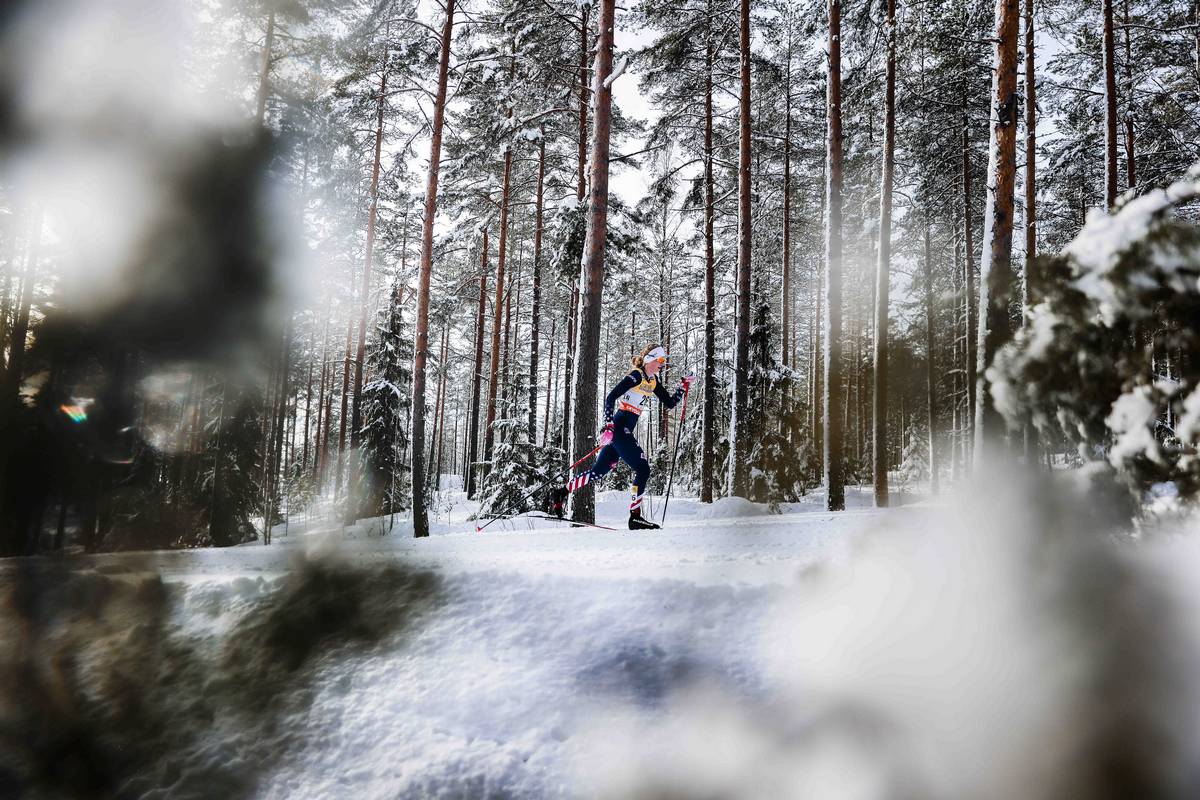
 This World Cup coverage is made possible through the generous support of Marty and Kathy Hall and the A Hall Mark of Excellence Award. To learn more about A Hall Mark of Excellence Award or to learn how you can support FasterSkier’s coverage please contact info@fasterskier.com.