From the FasterSkier archive — posts syndicated from athletes’ and coaches’ own blogs between 2004 and 2012, kept online as published. Current coverage is at fasterskier.com.
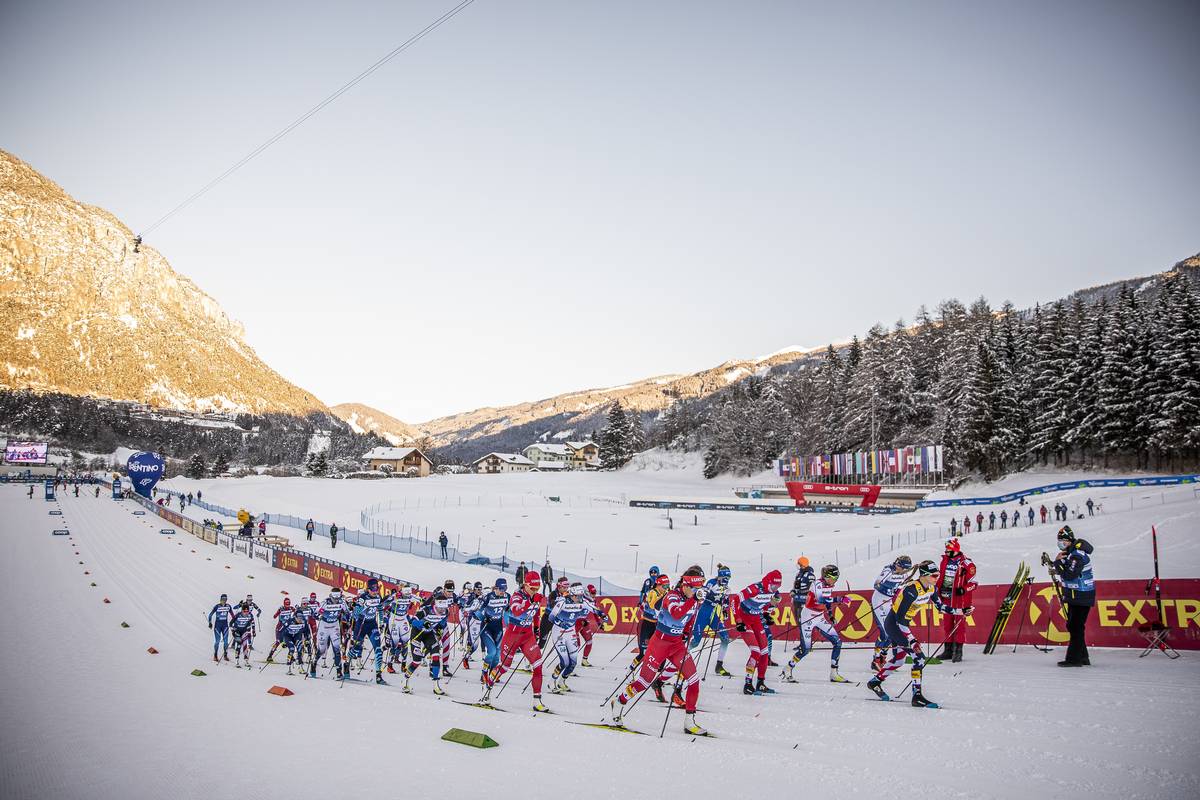
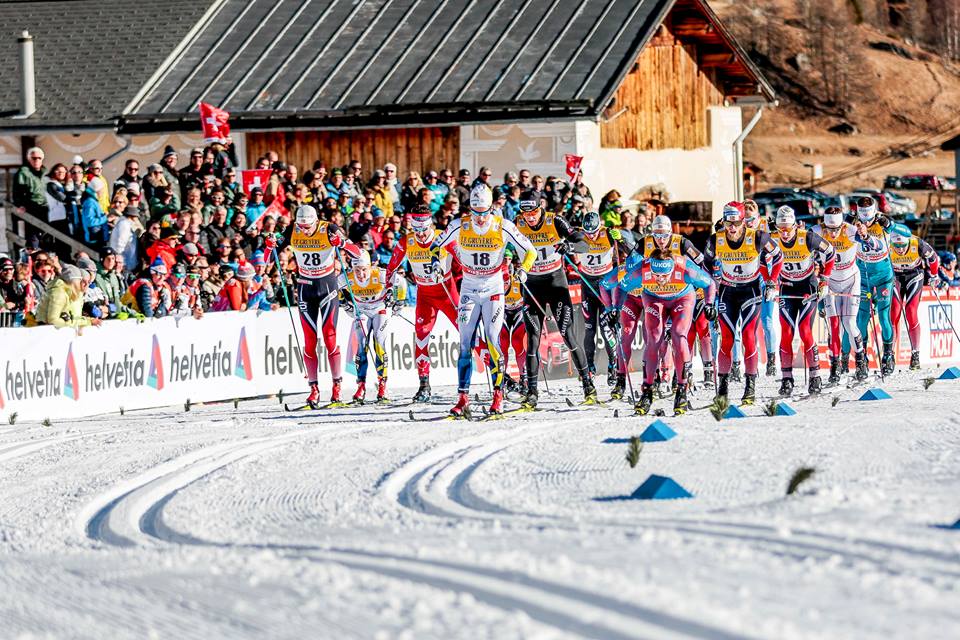
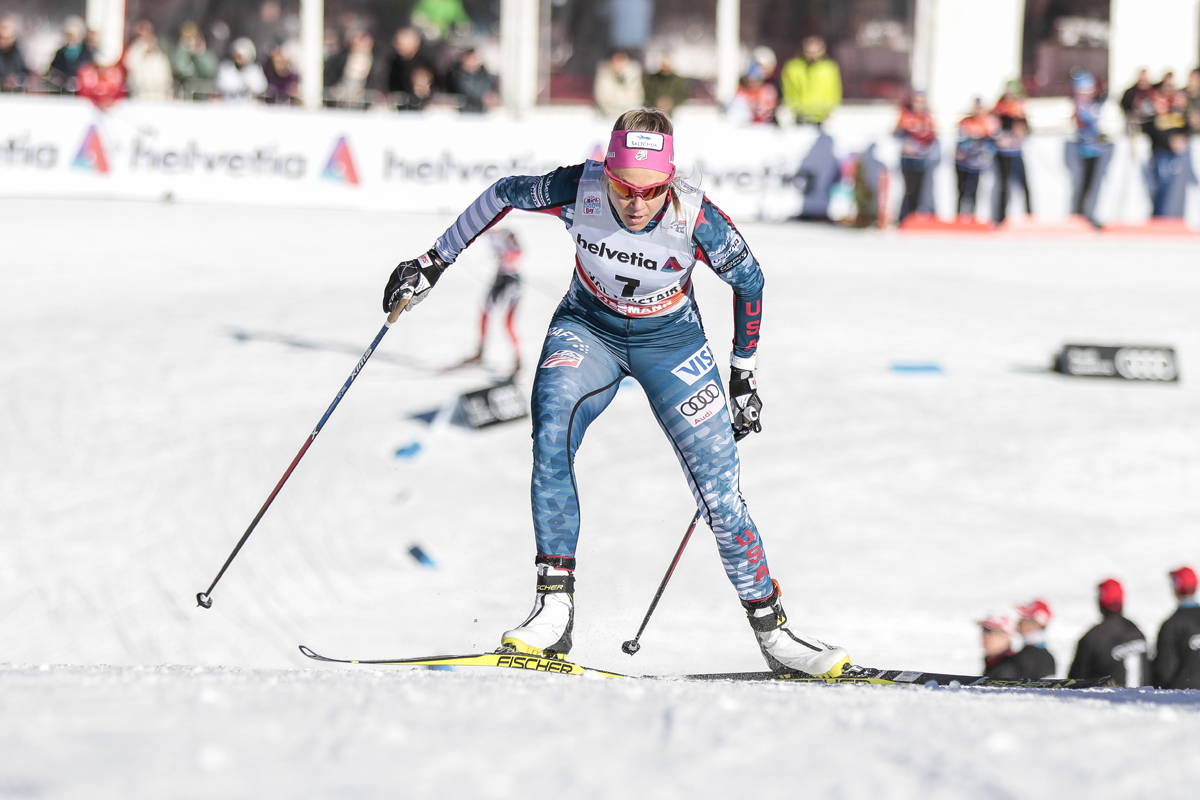
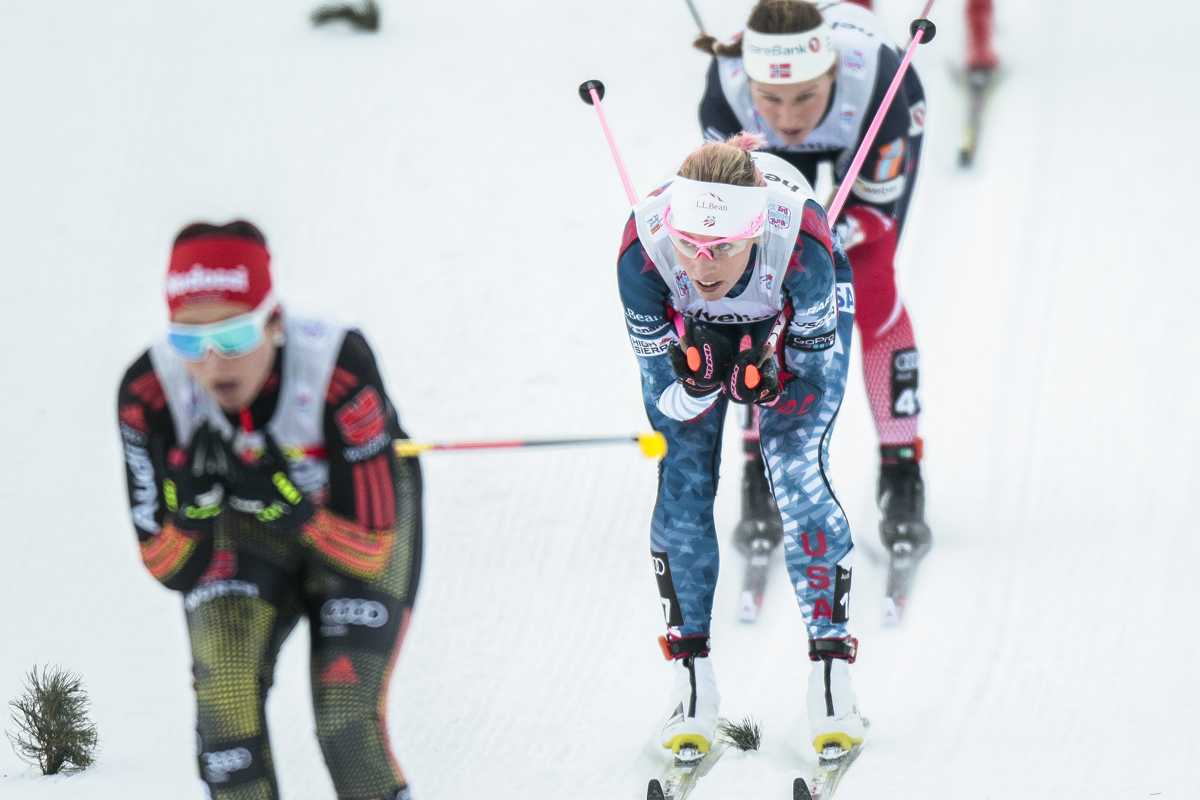
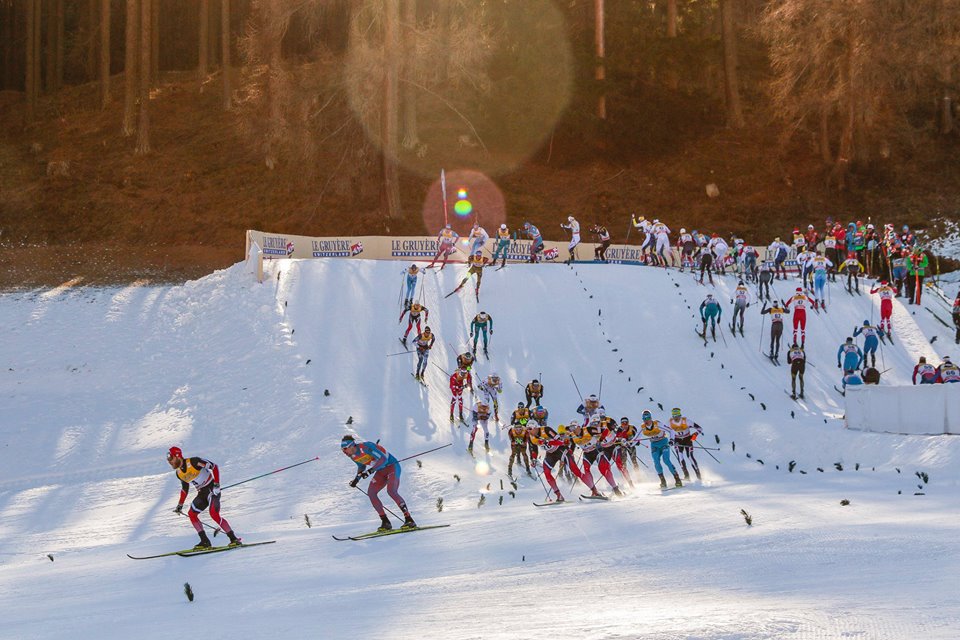
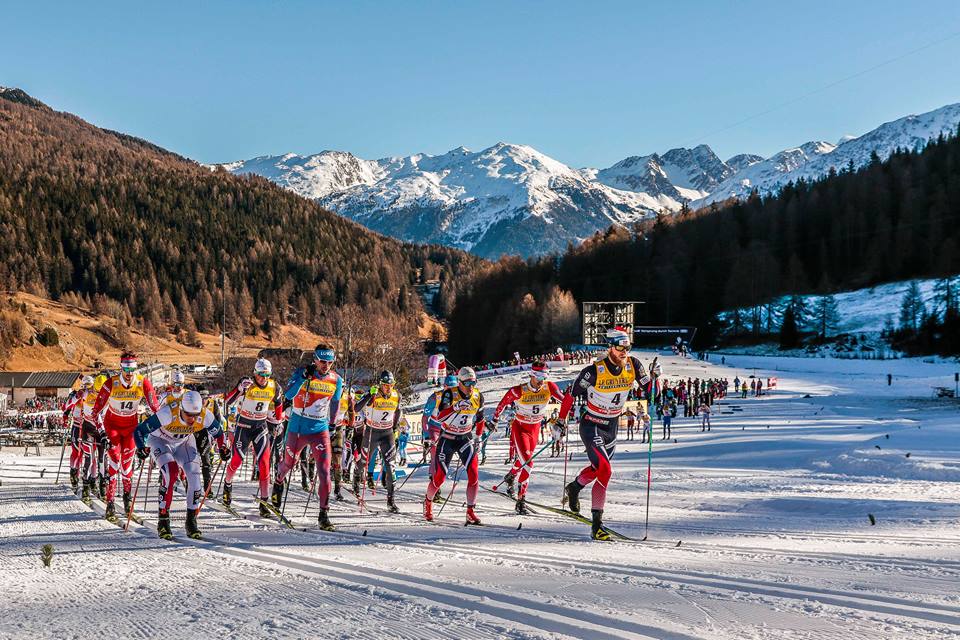
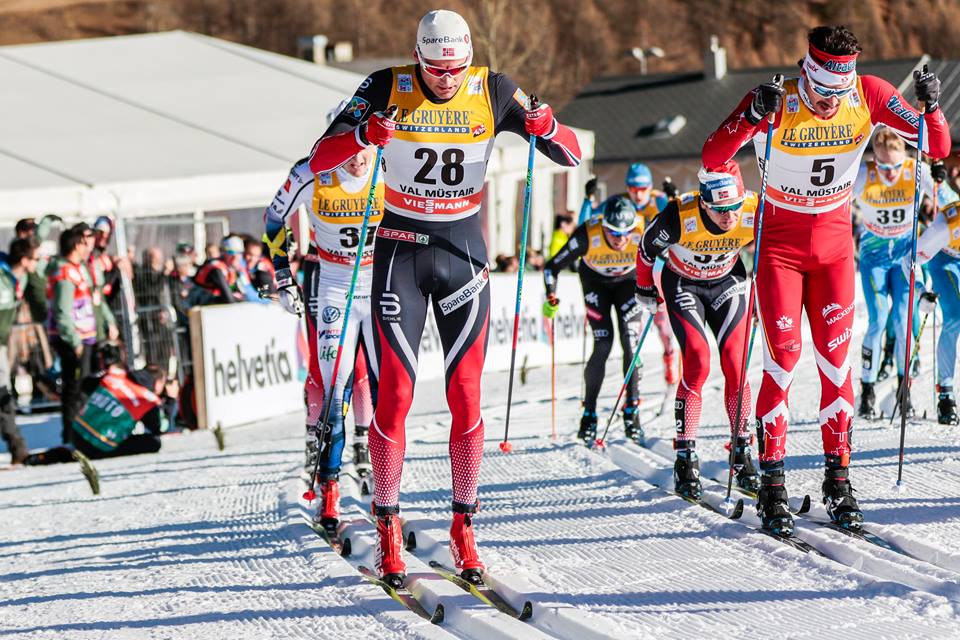
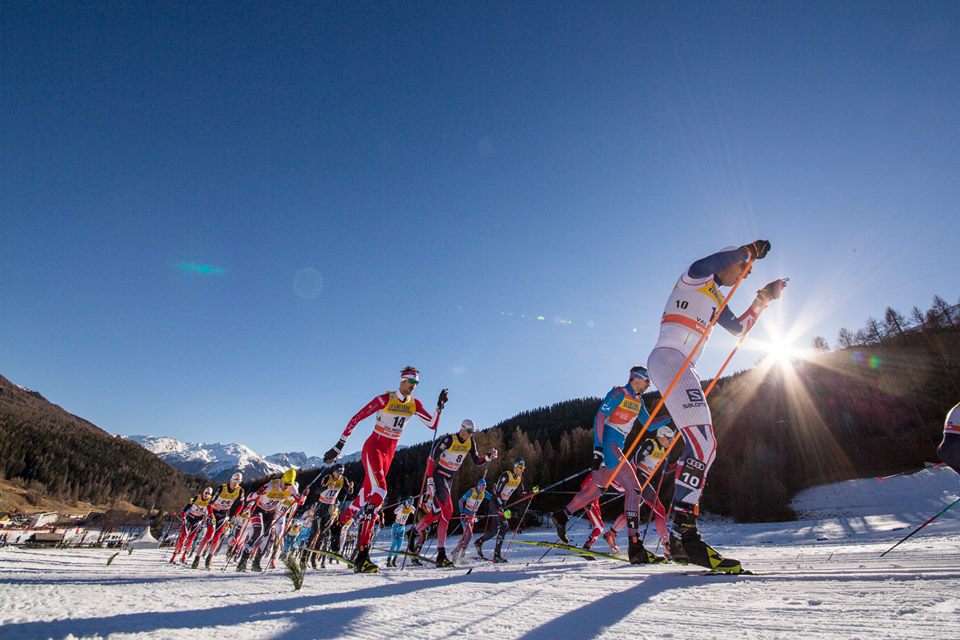
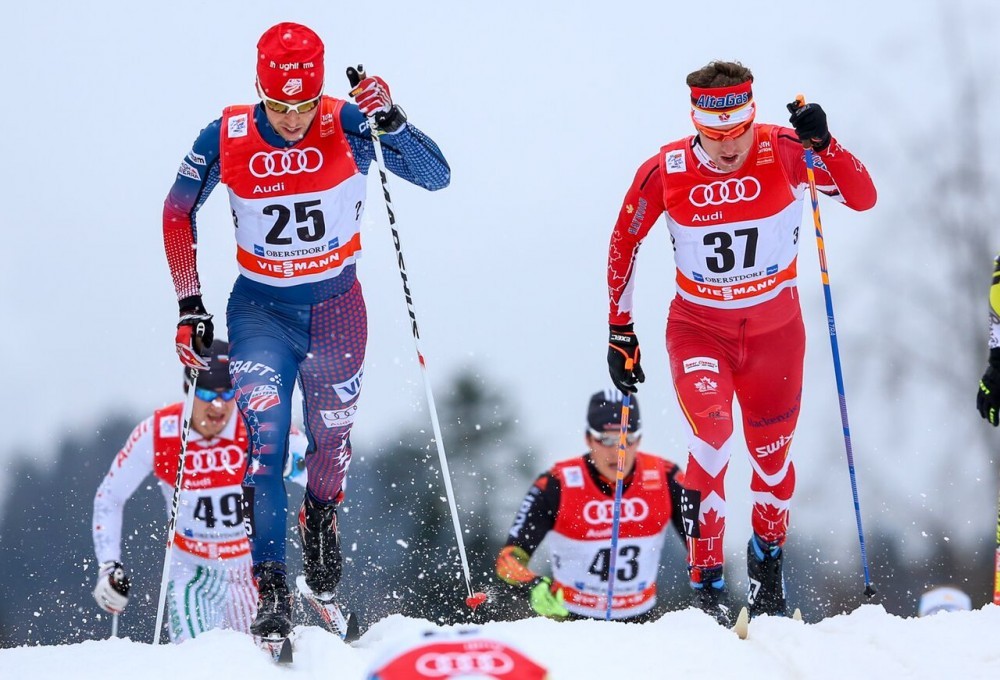
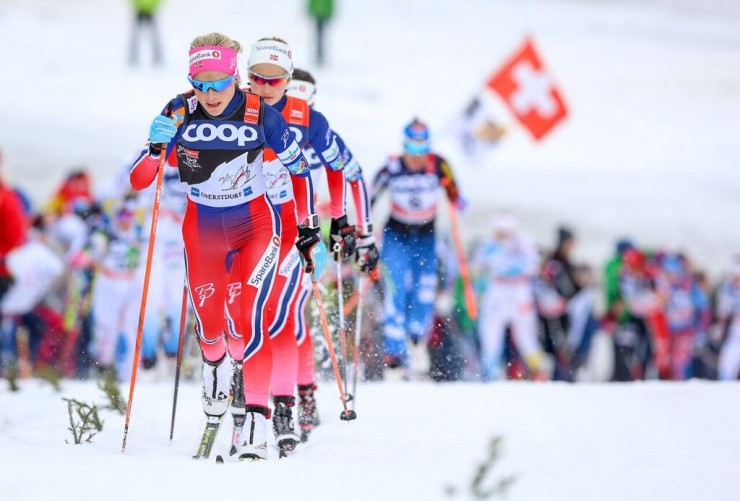
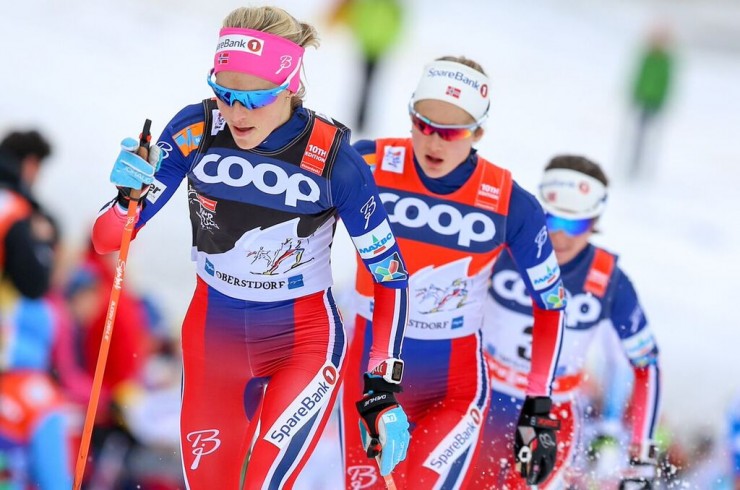
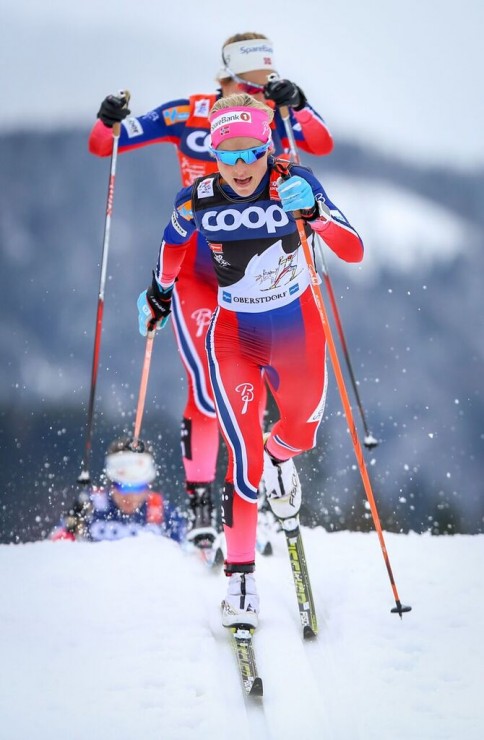
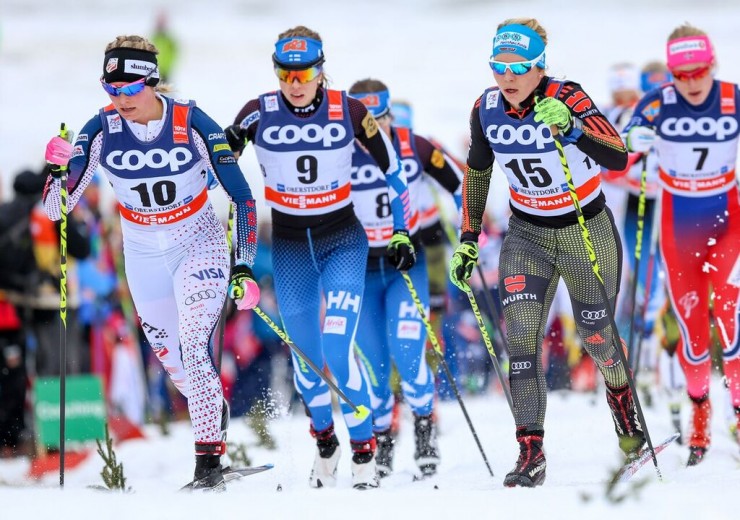
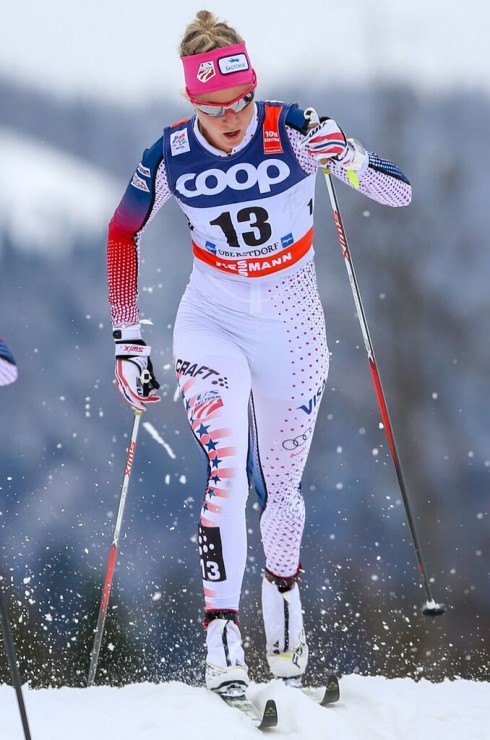
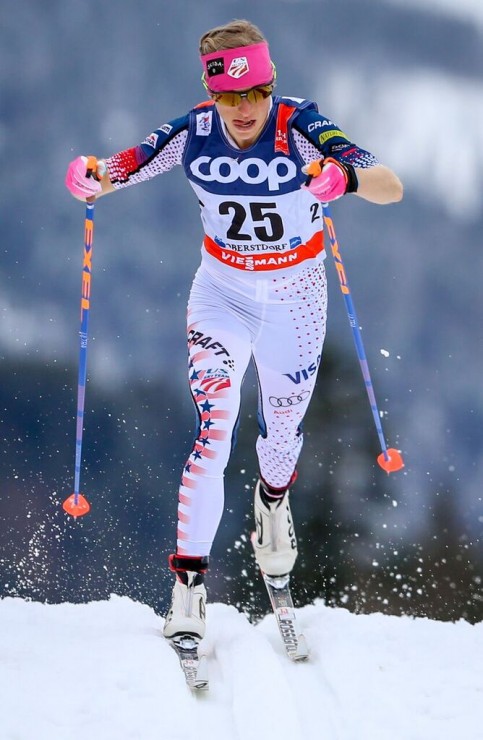
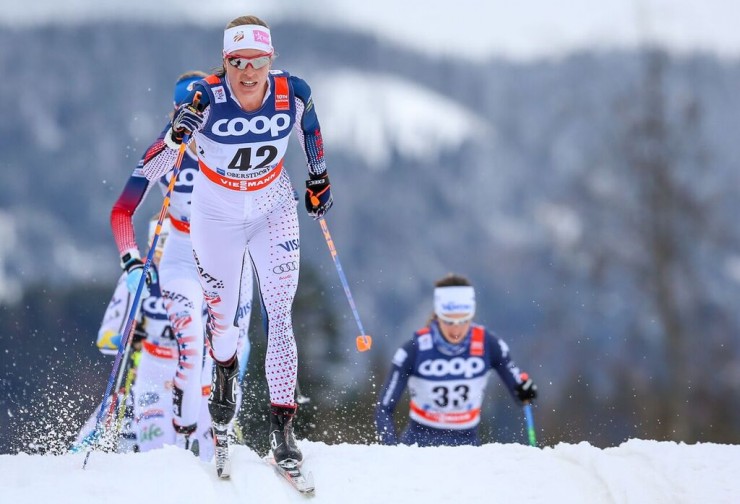
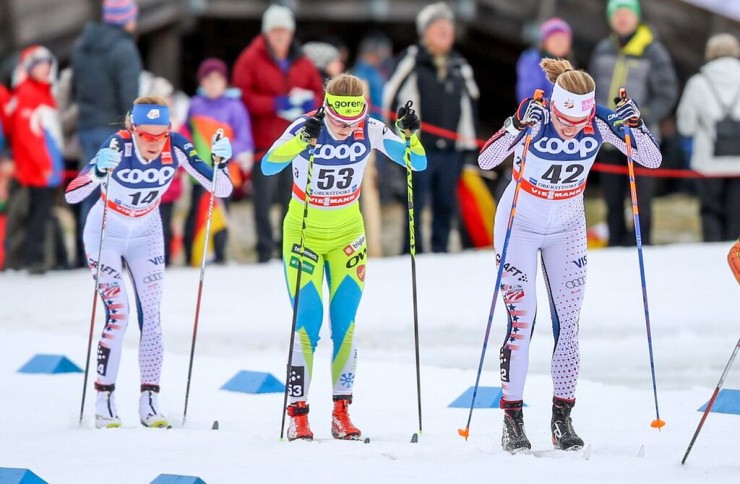
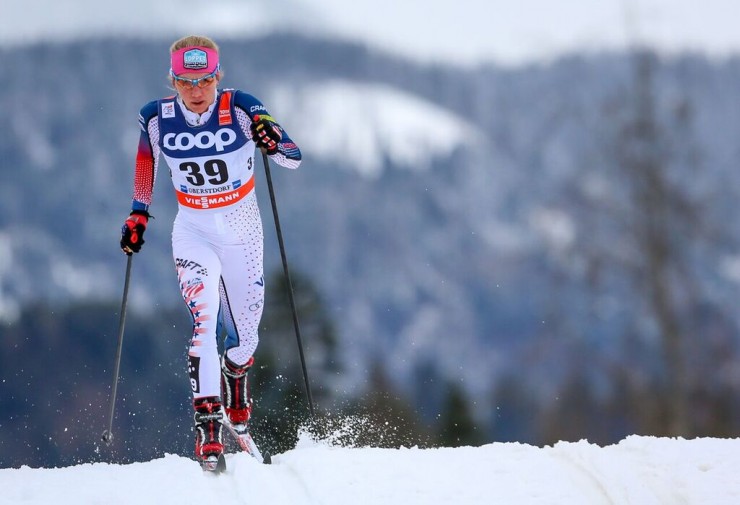
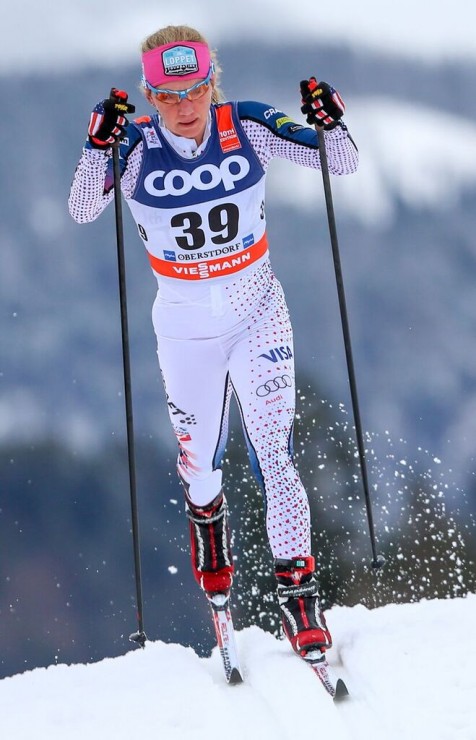
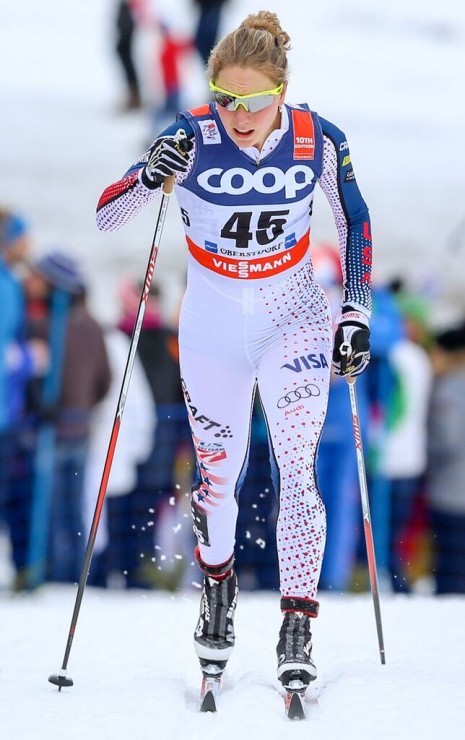
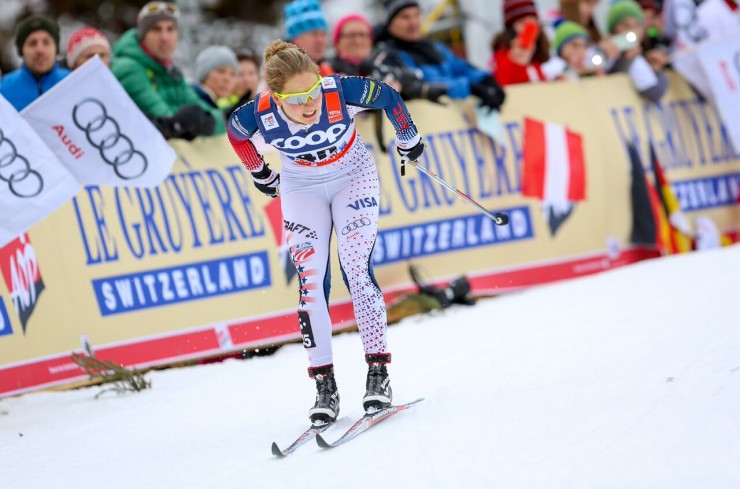
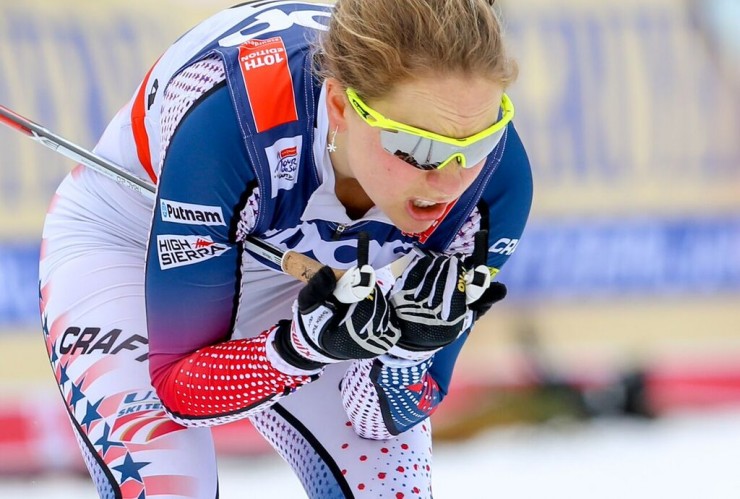
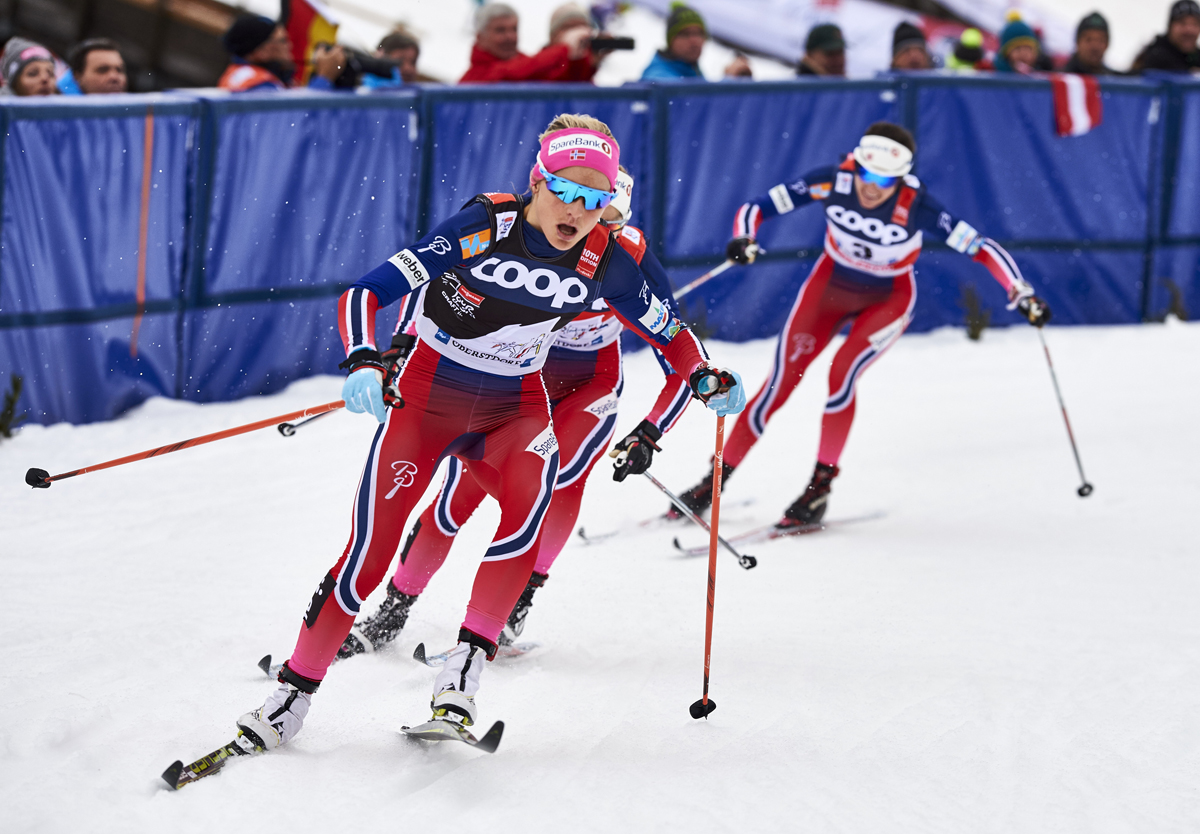
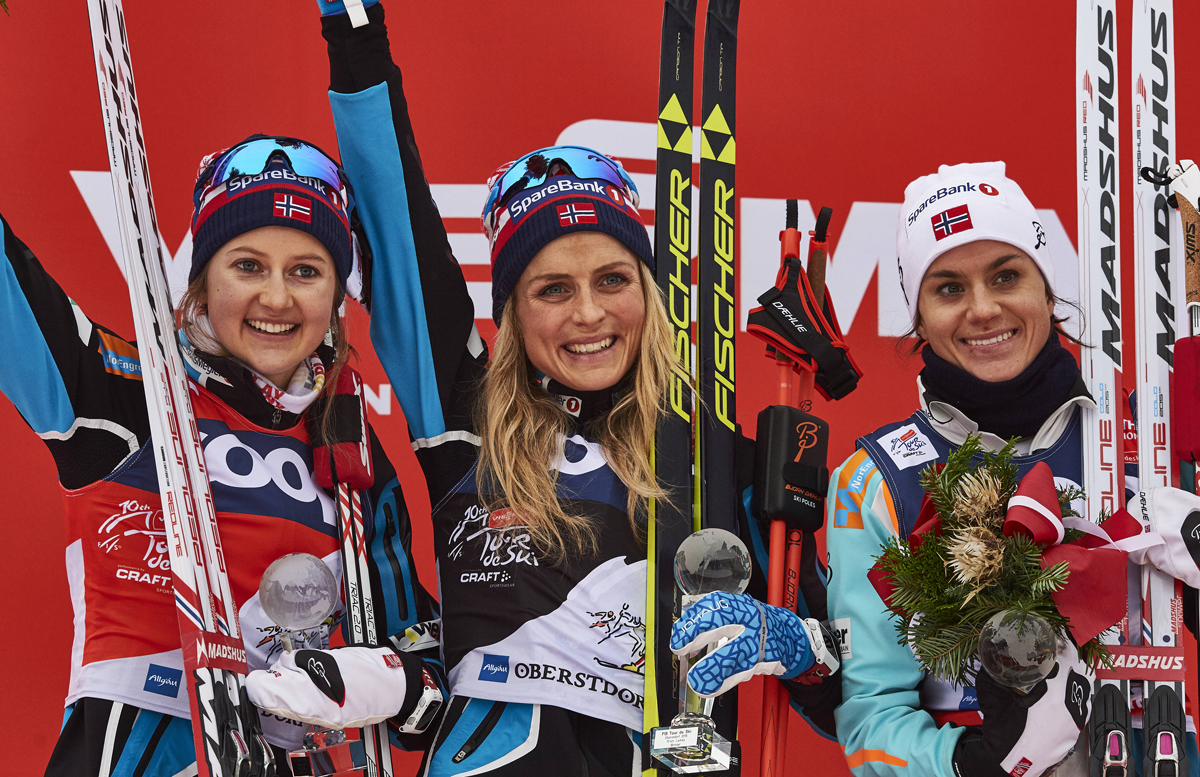
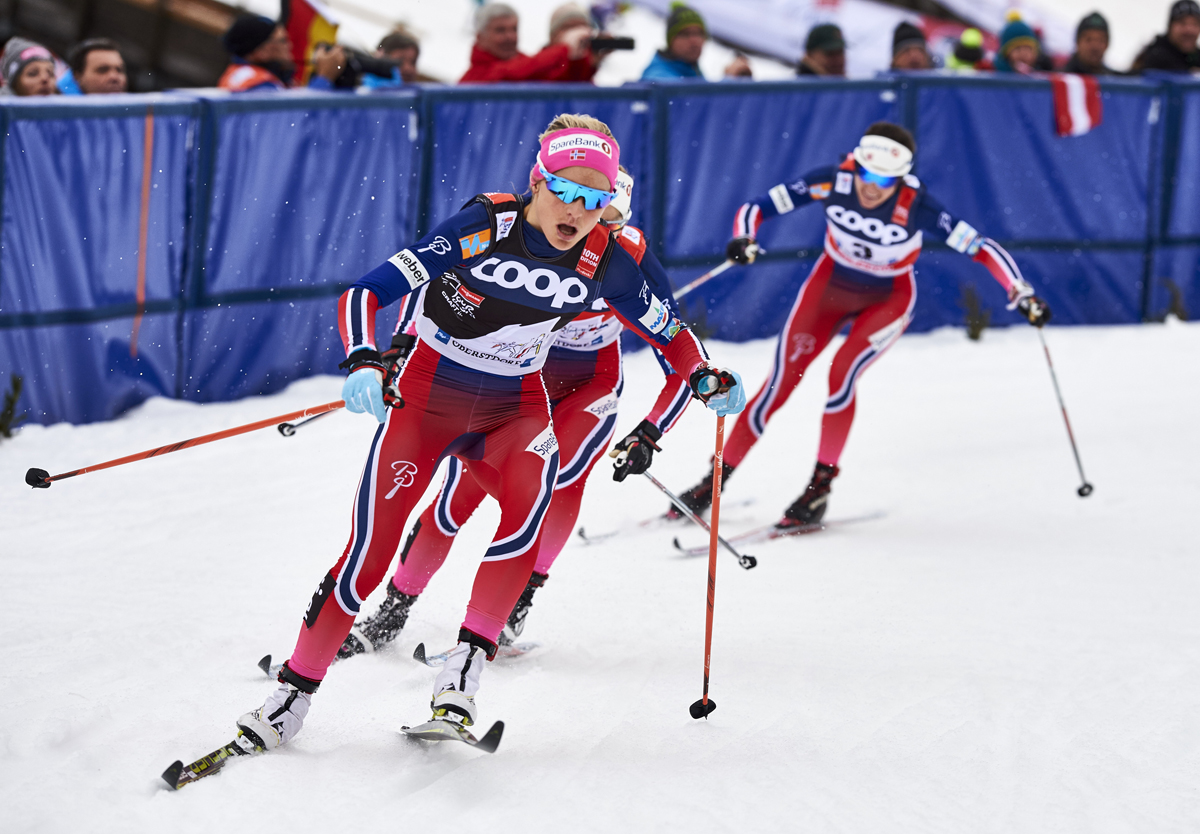
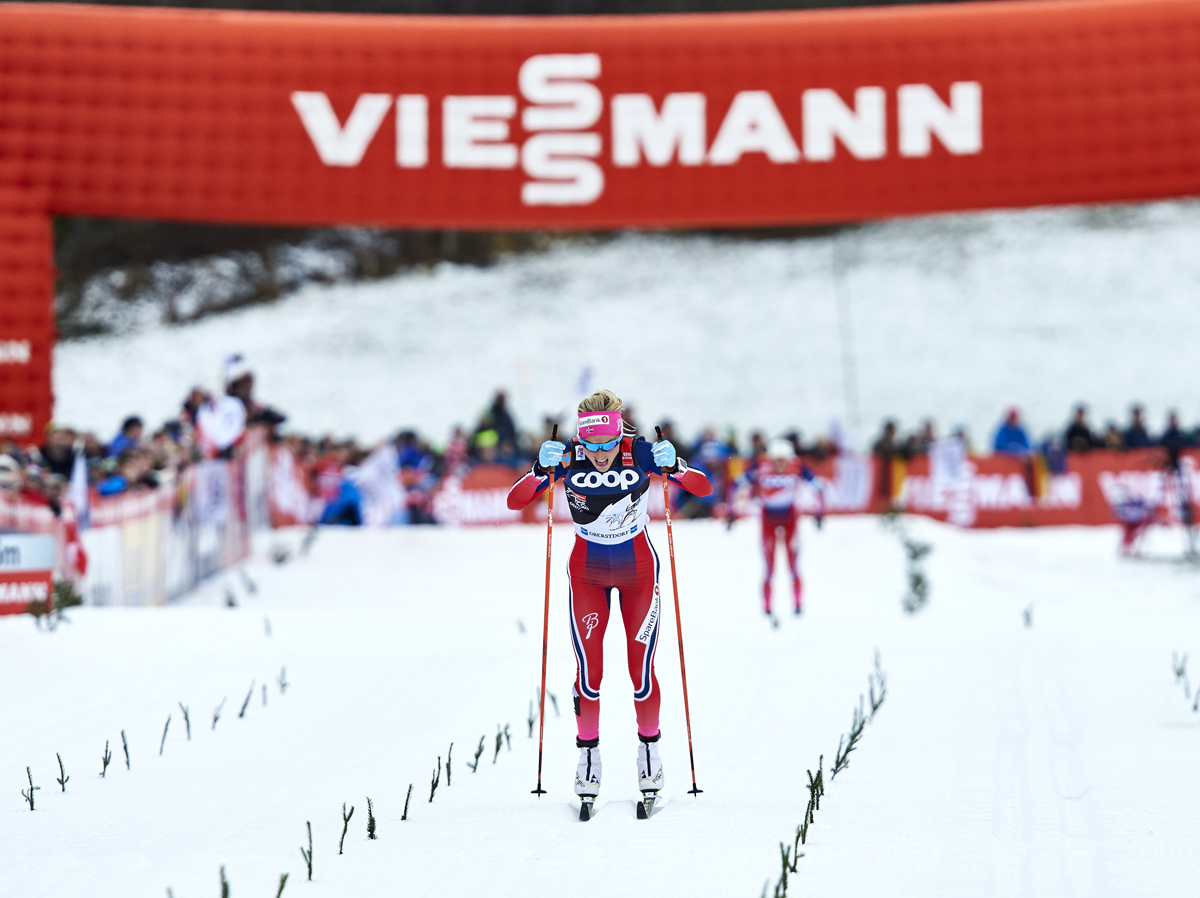
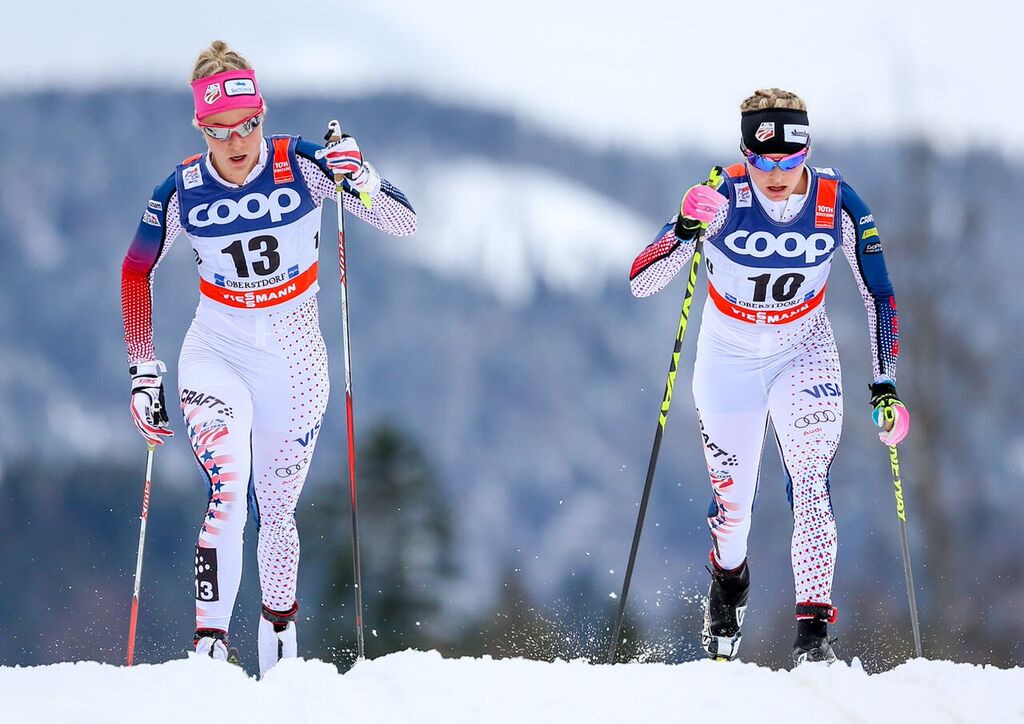
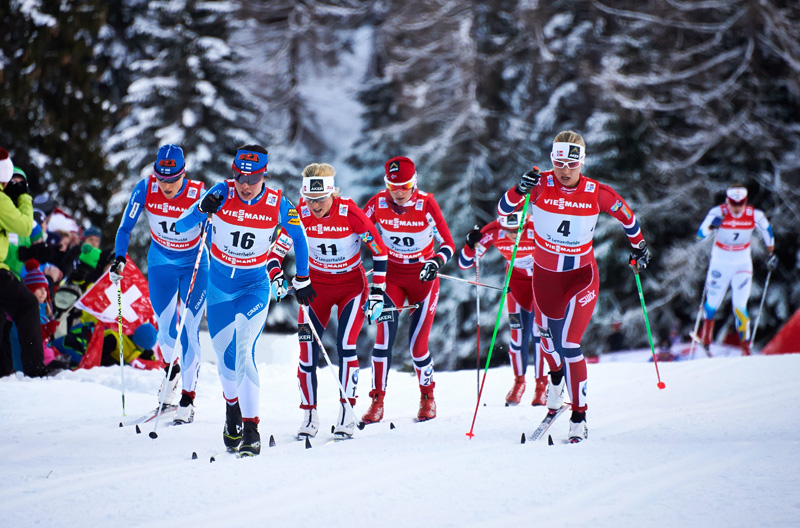
The women’s 10 k classic mass start gets underway in the 6th stage of Tour de Ski in Val di Fiemme, Italy. (Photo: Nordic Focus)
This World Cup coverage is made possible through the generous support of Marty and Kathy Hall and their A Hall Mark of Excellence Award. To learn more about A Hall Mark of Excellence Award or to learn how you can support FasterSkier’s coverage please contact info@fasterskier.com.
With just three more races remaining in the 2021 Tour de Ski, the women toed the start line for today’s 10 k classic mass start. The conditions were a gift of stable bluebird weather, sub-freezing temperatures, and tracks mostly in shade against a backdrop of sun on the opposite side of the valley. Jessie Diggins of the U.S. started at the head of the crowd, wearing the yellow leader’s bib, with a lead of twenty-two seconds over teammate Rosie Brennan in the overall standings.
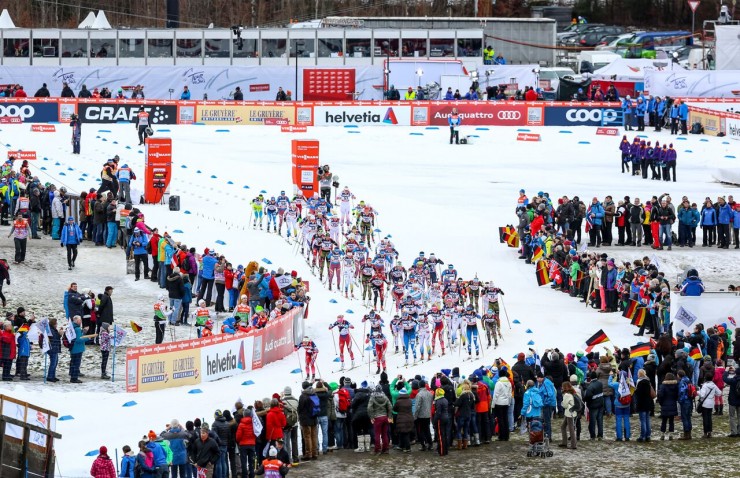
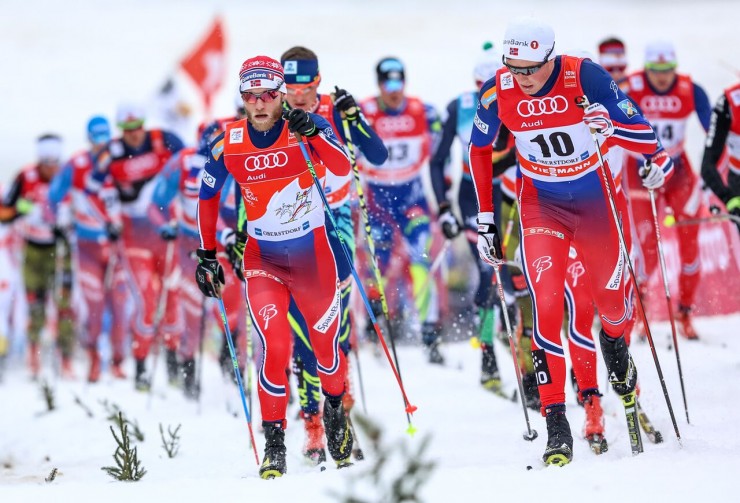
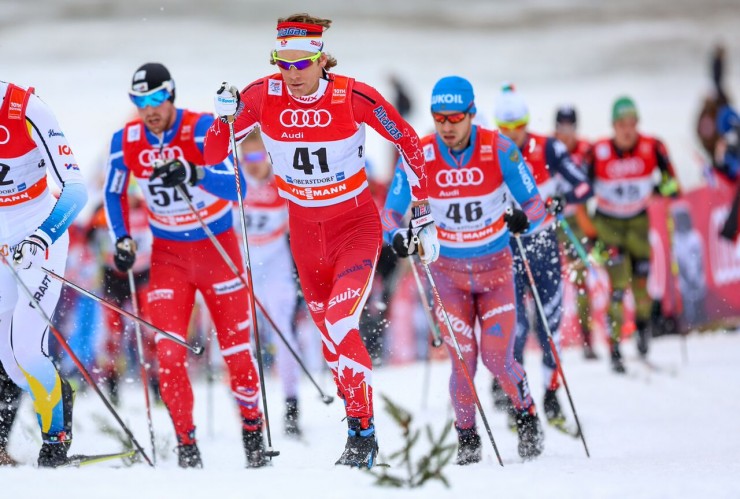
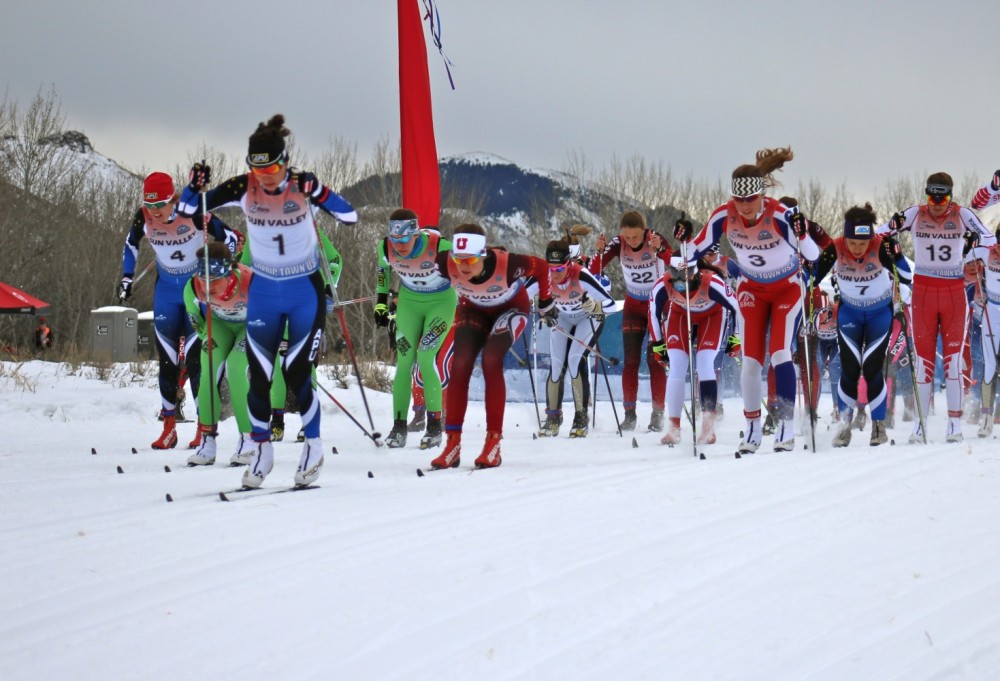
Out of the start gate, in the 6th stage of Tour de Ski in Val di Fiemme, Italy. (Photo: Nordic Focus)
As the race unfolded, however, it was not the tour leaders who took center stage. The pack largely stayed together for the first two of the four laps, until Ebba Andersson of Sweden took charge. Pushing hard out of the stadium onto the third lap, Andersson splintered the group. The Val di Fiemme course is notoriously difficult to pull away on though Andersson gave it her best shot. At 7.5 k she kept pressing her advantage though Katherina Hennig of Germany was only +1.5 seconds behind.
Ebba Andersson (SWE) controls the pace on her way to a third-place finish in the 10 k classic mass start. (Photo: Nordic Focus)
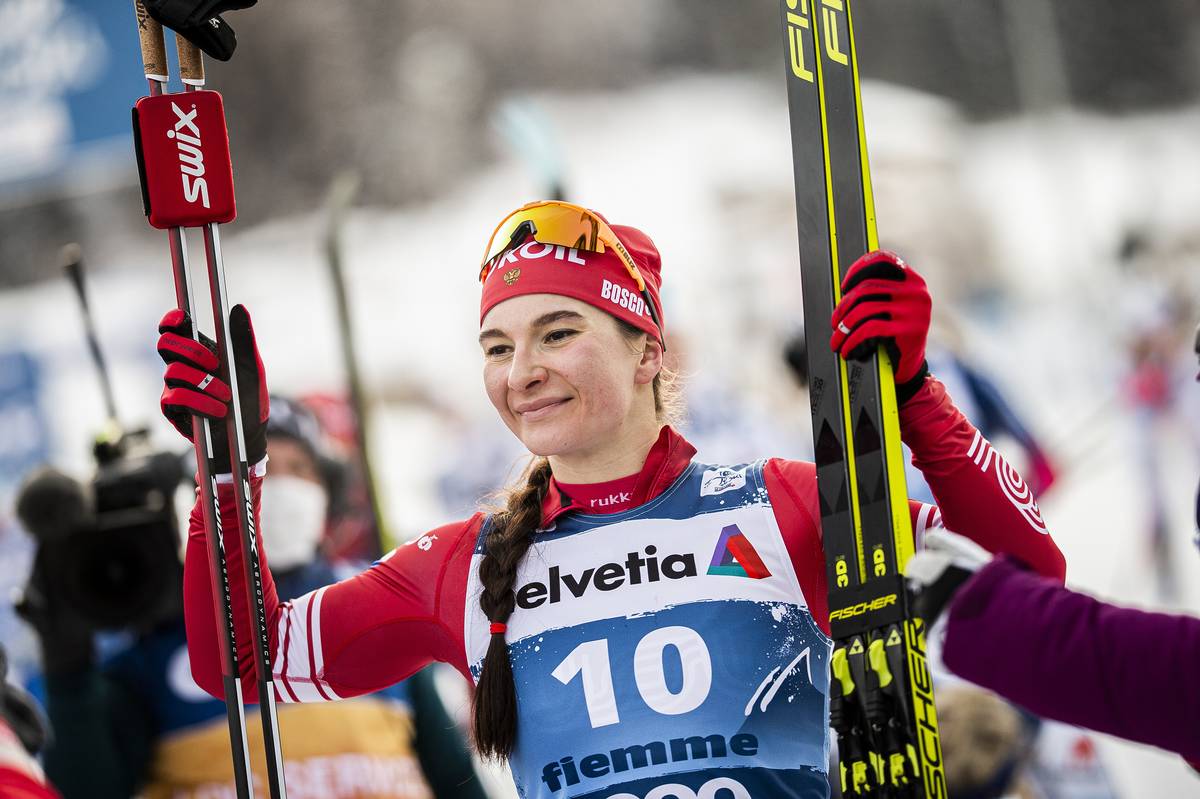
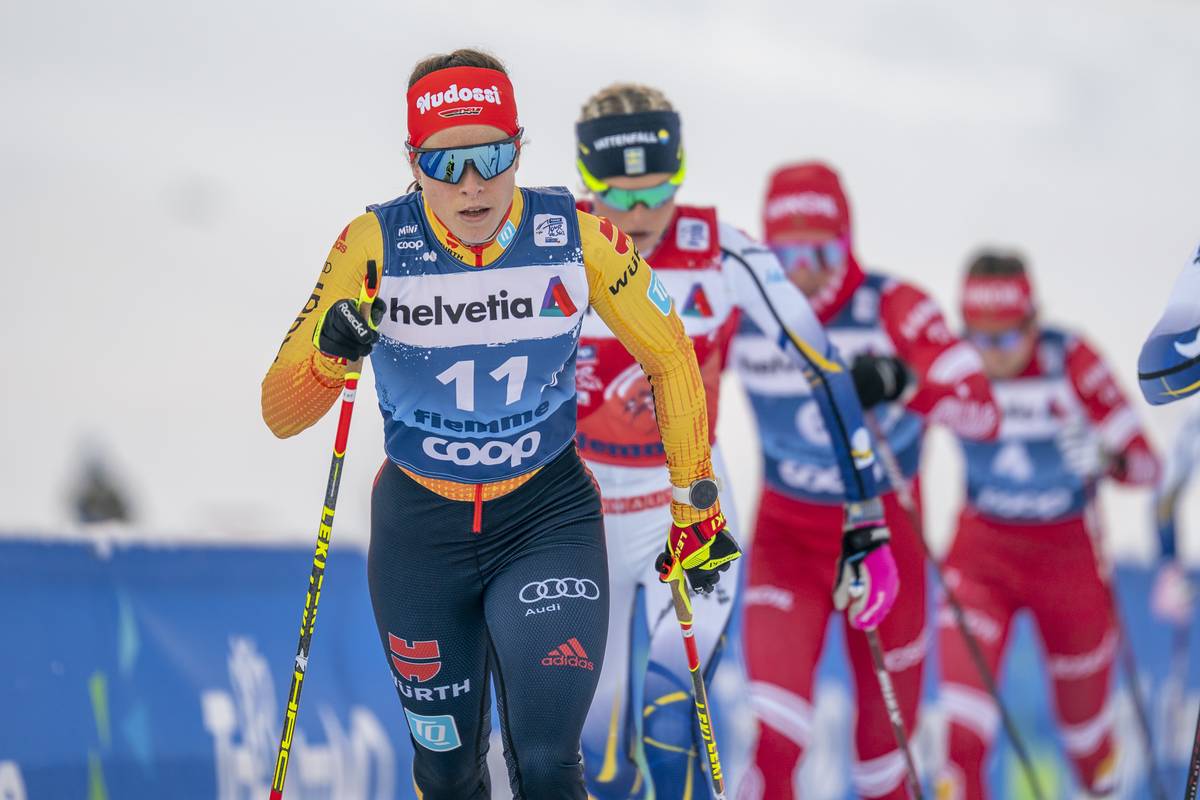
Eventually, Andersson was caught by Hennig and Natalia Nepryaeva of Russia. Cresting the final climb, Napryaeva had the advantage and she crossed the finish line in first, making today a double Russian victory. “It was a tough battle,” said Nepraeva through a translator, “I am very happy with the result and hope the shape is getting better.” Hennig took silver, her second career World Cup podium after finishing third last year in this same event. Andersson placed third.
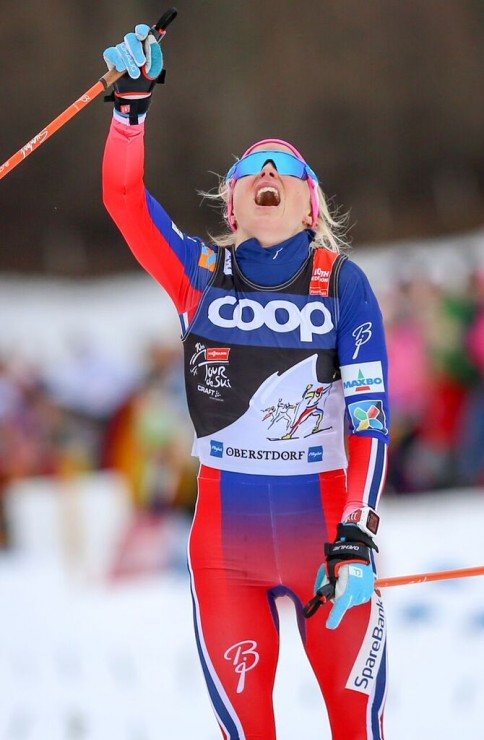
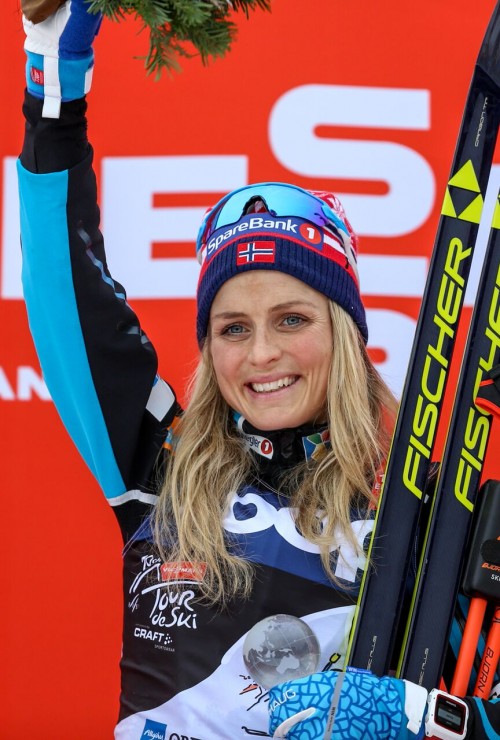
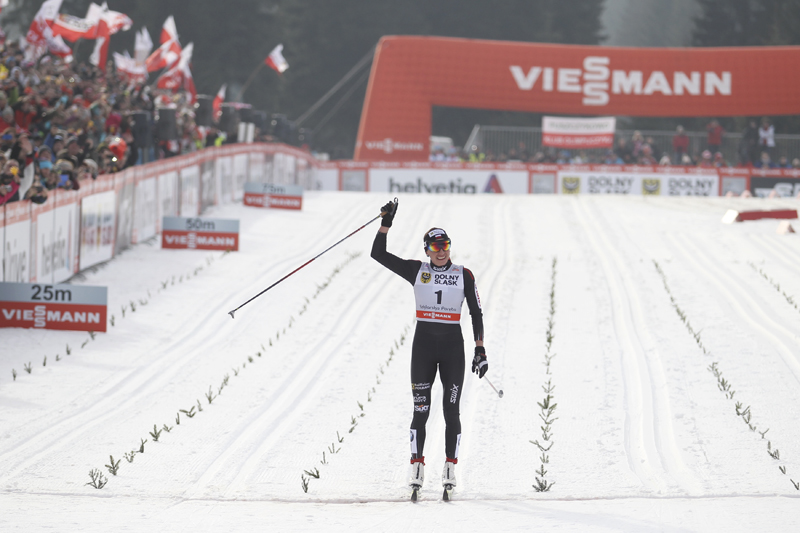
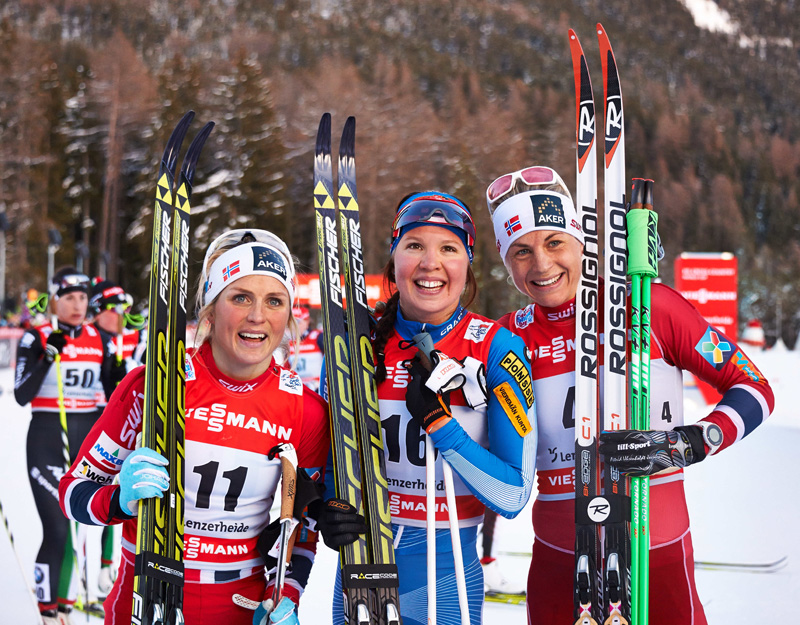
Natalia Nepryaeva (RUS) poses for the cameras following her win in the 10 k classic mass start. (Photo: Nordic Focus)
In a translated interview with the German broadcaster ZDF, Henning said, “I wanted to get back on the podium some time. But I really wouldn’t have expected that it works out like that today. I wanted to orient myself towards the front of the pack, but then in the beginning of the race briefly had a problem behind Rosie Brennan who tangled up. So I had to invest a lot of energy to get back in front. That it then worked out in the end… I can’t really grasp it yet.”
Katharina Hennig (GER) strides her way to second for the German squad. (Photo: Nordic Focus)
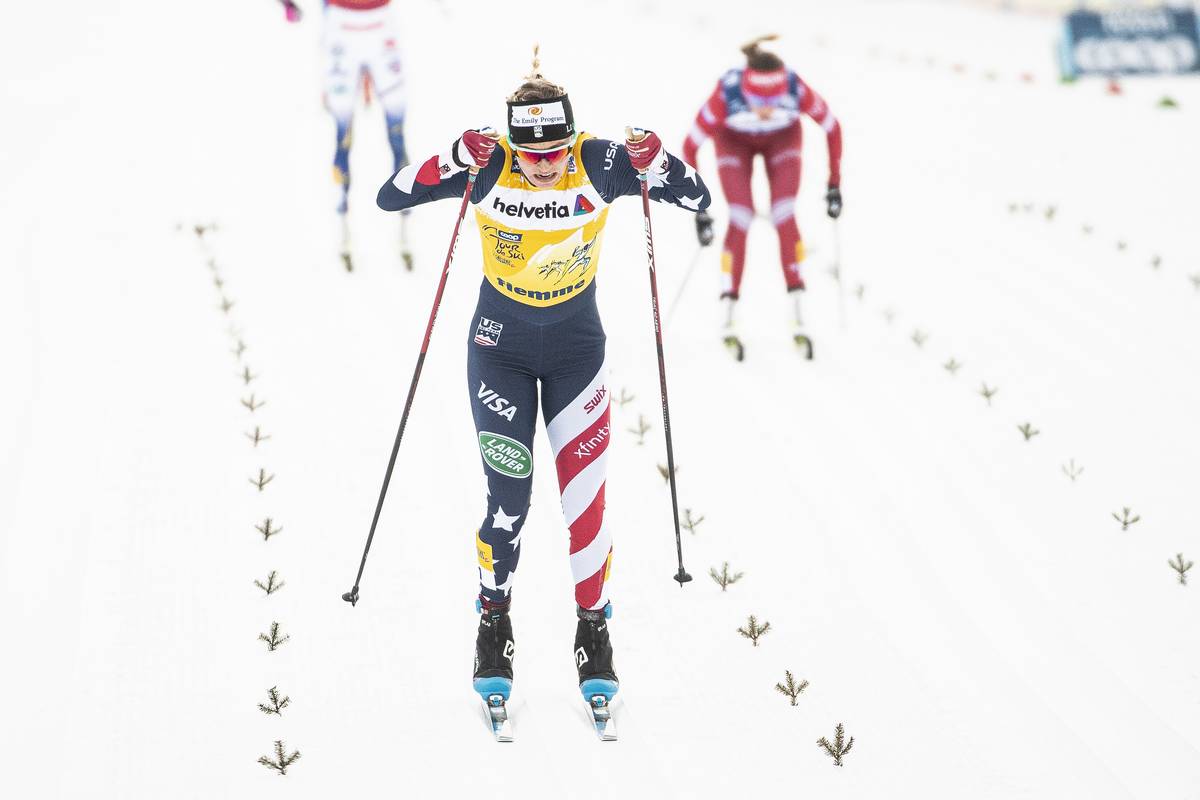
For the Americans, Diggins ended the day in 9th place twenty-four seconds back, after fading over the last lap.
“Today was a big day for me in terms of mental toughness,” emailed Diggins. “My body was numb from the waist down for the entire last lap but I just kept digging deep because I knew every second counted and I had a job to do! I managed to hold on to the leader bib and with a classic sprint and the hill climb coming up, I’m really excited for both these stages and focused on getting all the little details of recovery right! I was proud of the grit I had out there today, but way more proud of the amazing Salomon skis our techs made me! Wow, that was key in today’s race. … Also, so hyped up for Gus! Race of the day for sure.”
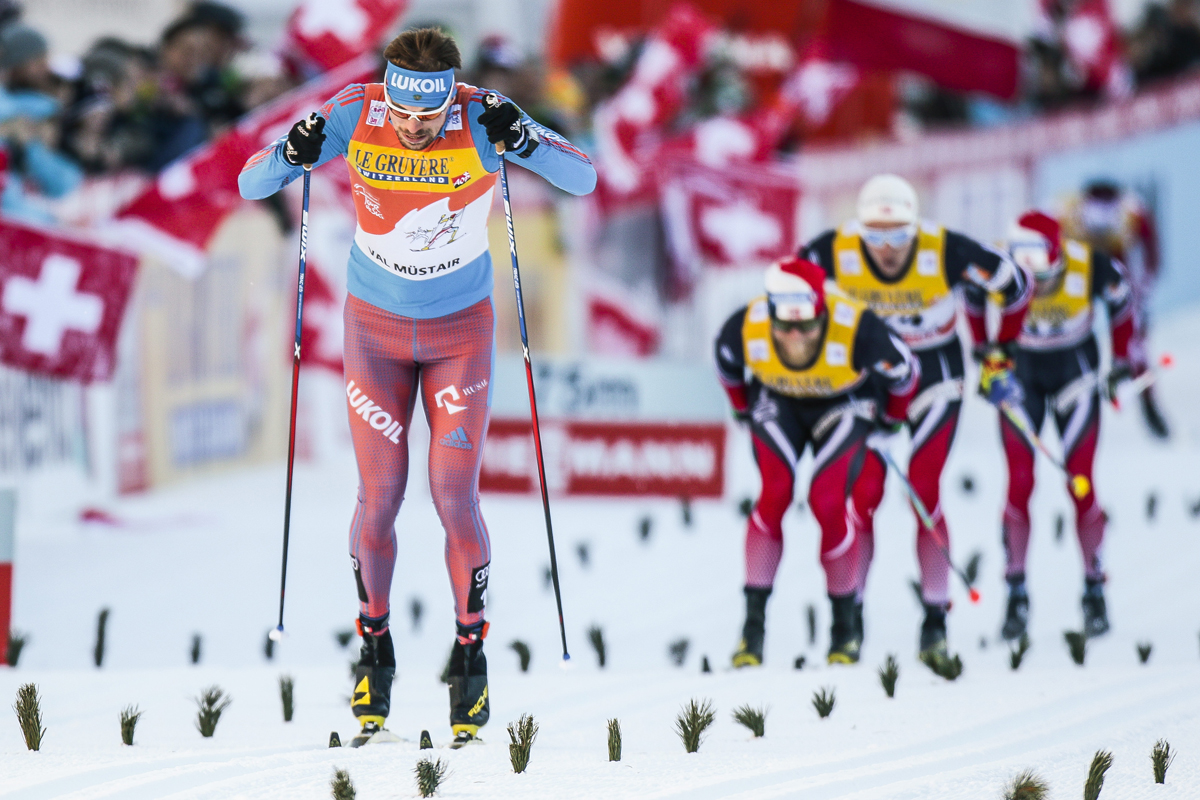
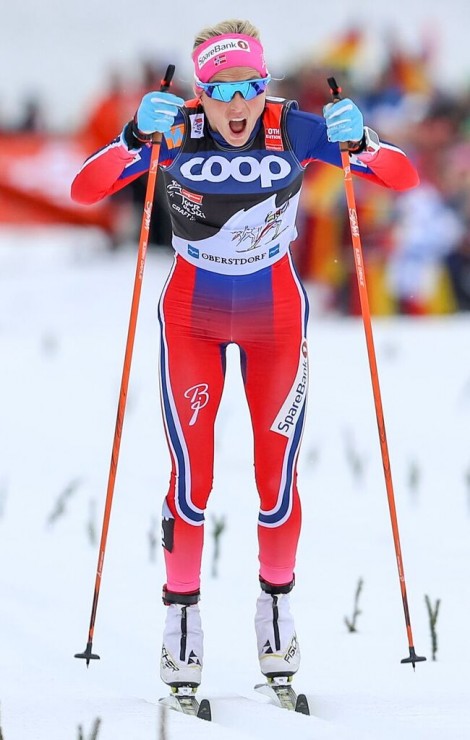
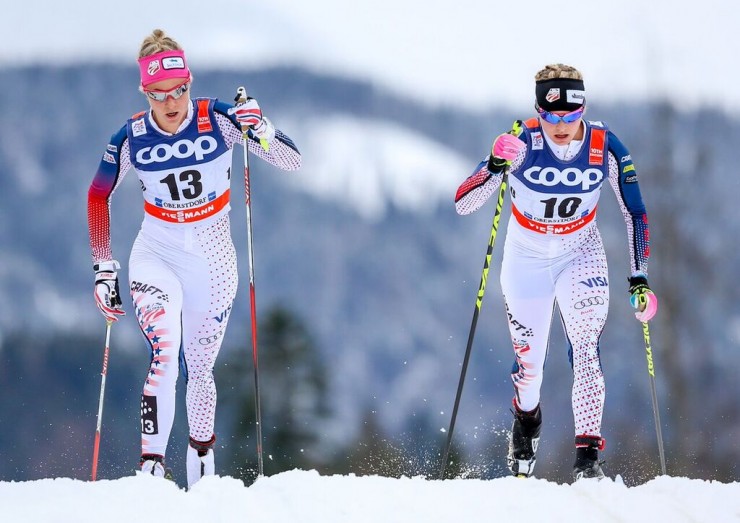
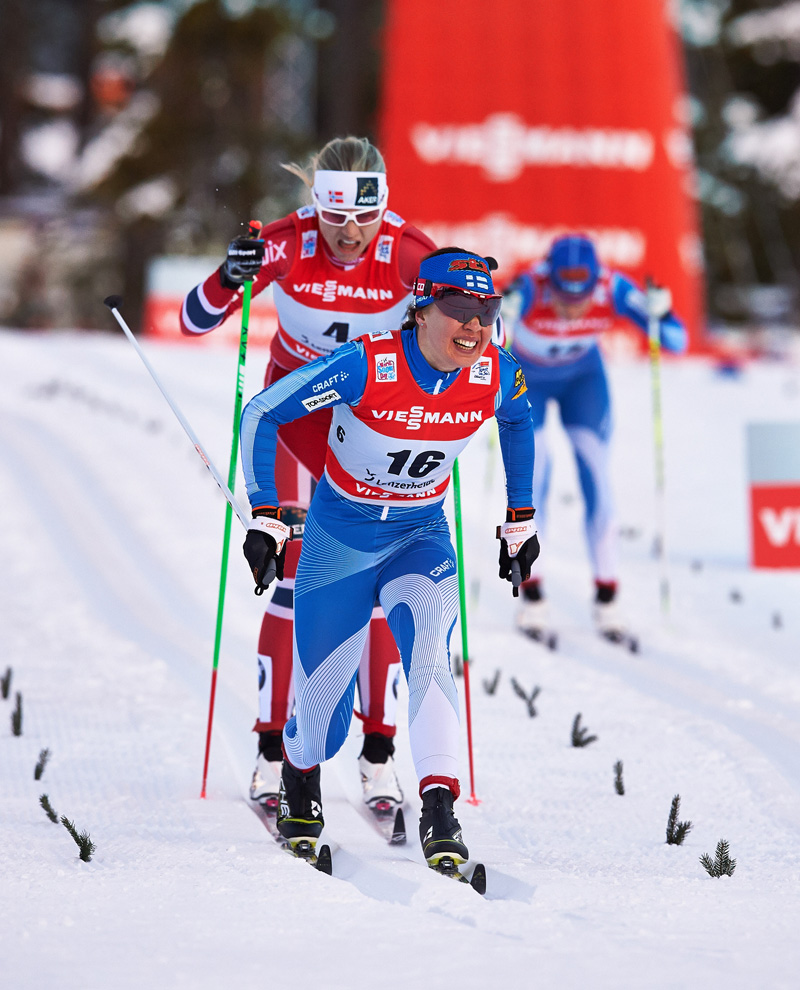
Jessie Diggins gives it everything she has down the homestretch of the sixth stage in the Tour de Ski in Val di Fiemme, Italy. (Photo: Nordic Focus)
Katharine Ogden notched her third top 20 finish of the tour (she placed 18th in the 10 k skate and 20th in the 10 k classic in Toblach) and finished in 19th (+1:12.3). Hailey Swirbul earned a few more points, finishing in 25th (+1:29.1) and Caitlin Patterson snuck into the top thirty with a 29th place (+1:51.8).
Following a tangle early on in the race, Brennan struggled to maintain her position going into the day, ultimately finishing in 31st place (+2:00.5). Julia Kern rounded out the U.S. women finishers in 42nd place (+4:08.3).
“Today was undeniably a tough day,” Brennan wrote post-race. “I was ready for a tough battle and had the confidence to do well today. However, I got tripped up on the second climb and got skied over by a lot of people before I could get up. Because it was so early, we were all still in a big pack and I worked really hard to try to pass people and get back to the front. I think I wasted a lot of energy doing that when my body didn’t have much extra left in the tank. I truly fought with all I had and I am very disappointed that I couldn’t do more out there. Tour racing always brings big up and big downs so I will do my best to pick up the pieces and continue to fight hard the next two days.”
Overall Standings:
Today’s Stage 6 results caused some ripples in the overall standings in the Tour. To recap, prior to Stage 6, Diggins had a 22 second lead over Brennan in second, a fifty-eight second buffer over Stupak in third, with Karlsson in fourth (+1:29).
After today’s day’s grind in Val di Fiemme, Diggins sits in first overall with a fifty-five second margin over Stupak in second. Karlsson moves up a position to third (+1:42). Brennan, who struggled on the stage, fell back to seventh overall (+2:11).
Racing continues tomorrow for the women with a classic sprint.
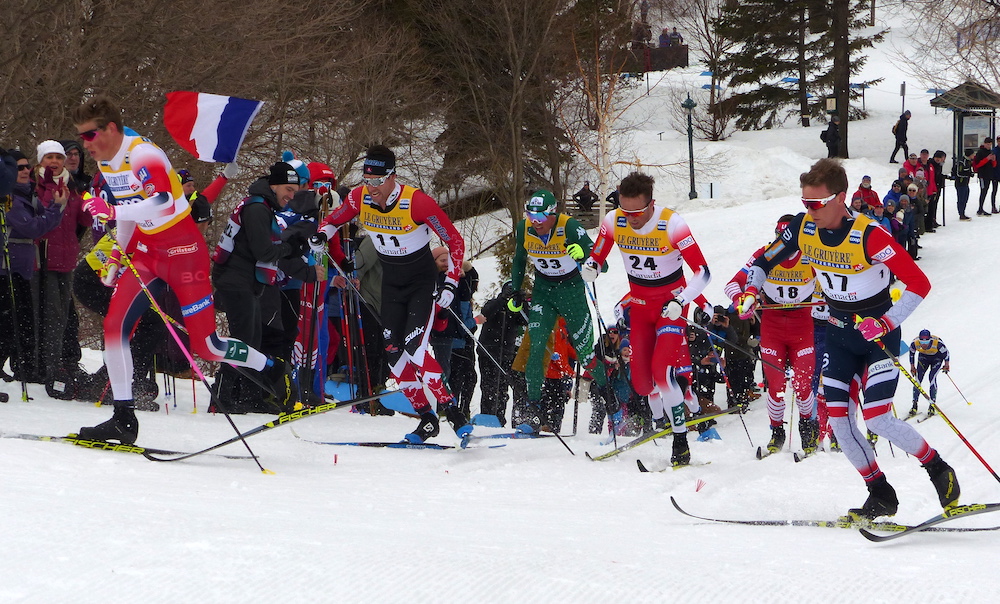
Grinding uphill in the men’s 15 k classic mass start. (Photo: Peggy Hung).
FIS World Cup Québec City 15 k Mass Start Classic
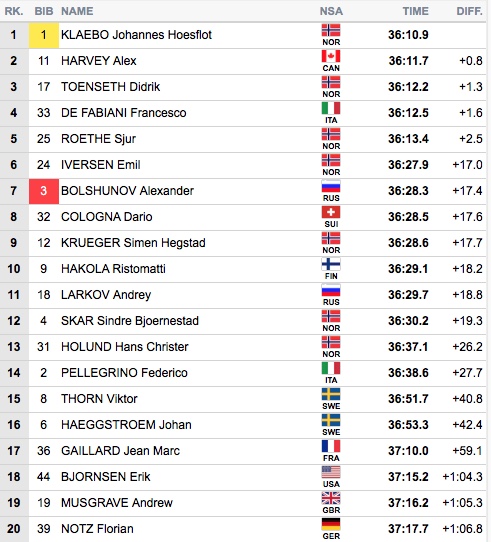
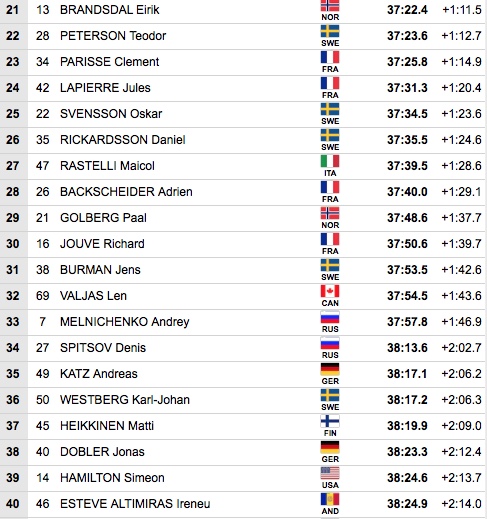
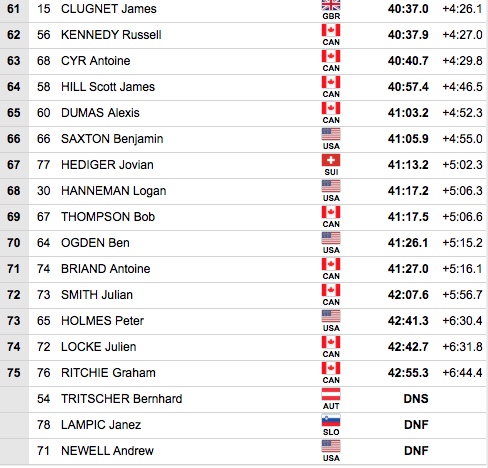
We’re changing the format for this race rundown. With many North Americans racing during World Cup finals in Québec, screenshots from Live Timing will keep the rundown updated efficiently.
Why start with the top of the podium, when the real story sat front and center in second. Canada’s Alex Harvey nailed the pacing and nailed the finish to ski himself into a storybook-like ending in Québec. This was Harvey’s next to last day before retiring from competition after Sunday’s pursuit.
That said, Norway protected Johannes Høsflot Klæbo – more on those tactics in the race report – as he went on to win in 36:10.9.
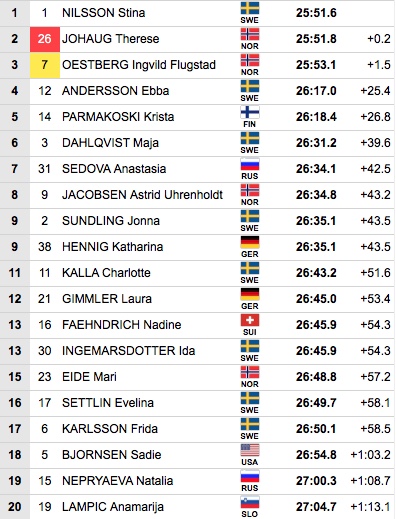
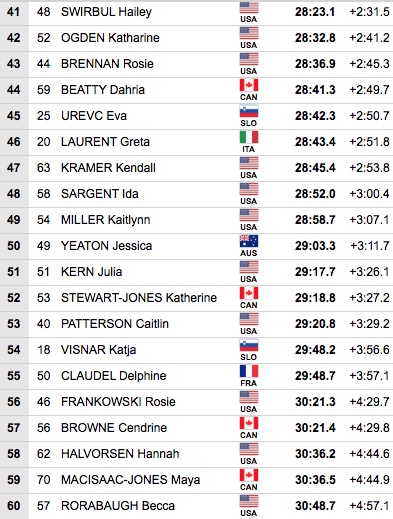
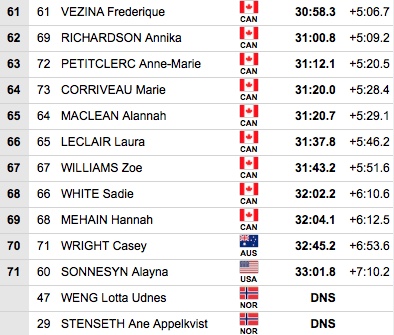
Erik Bjornsen was the top U.S. skier in 18th (+1:04.3).
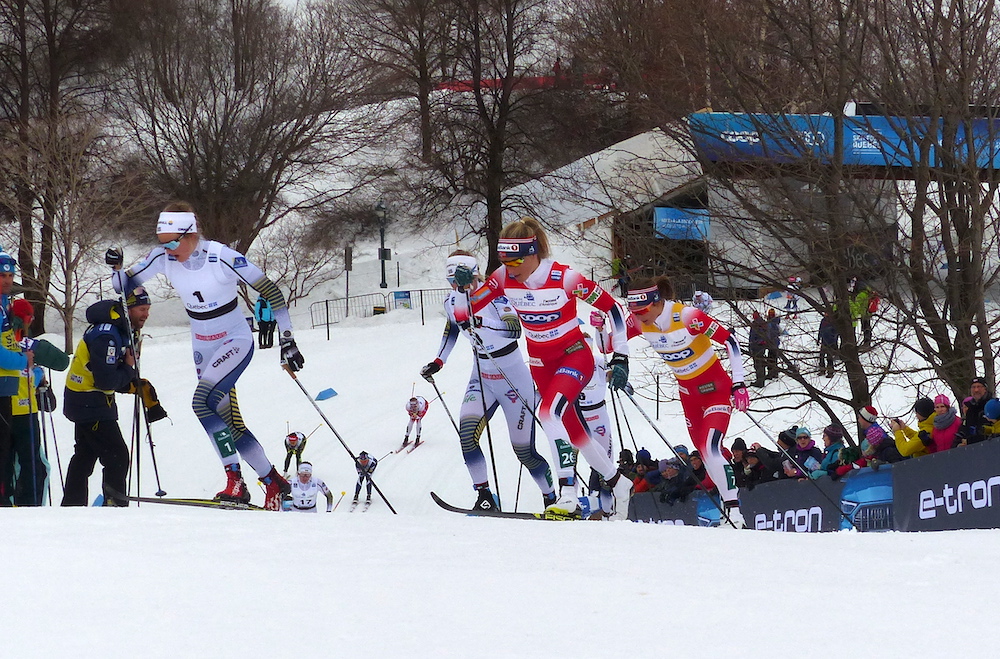
Stina Nilsson of Sweden (bib 1) and Therese Johaug of Norway lead the mass start classic in Québec. (Photo: Peggy Hung)
FIS World Cup Québec City 10 k Mass Start Classic
We’re changing the format for this race rundown. With many North Americans racing during World Cup finals in Québec, screenshots from Live Timing will keep the rundown updated efficiently.
Having won every World Cup distance she’s entered this season, Norway’s Therese Johaug couldn’t shake off Sweden’s Stina Nilsson or her own teammate Ingvild Flugstad Østberg on Saturday morning. We’ll get to all the details in the full race report, but it was yesterday’s sprint winner, Nilsson, who outsprinted the empress of distance skiing, Johaug. When she is on for a distance race, Nilsson is on. She won the Québec City 10-kilometer mass start classic in 25:51.6. Johaug was second, Østberg a not so distance third.
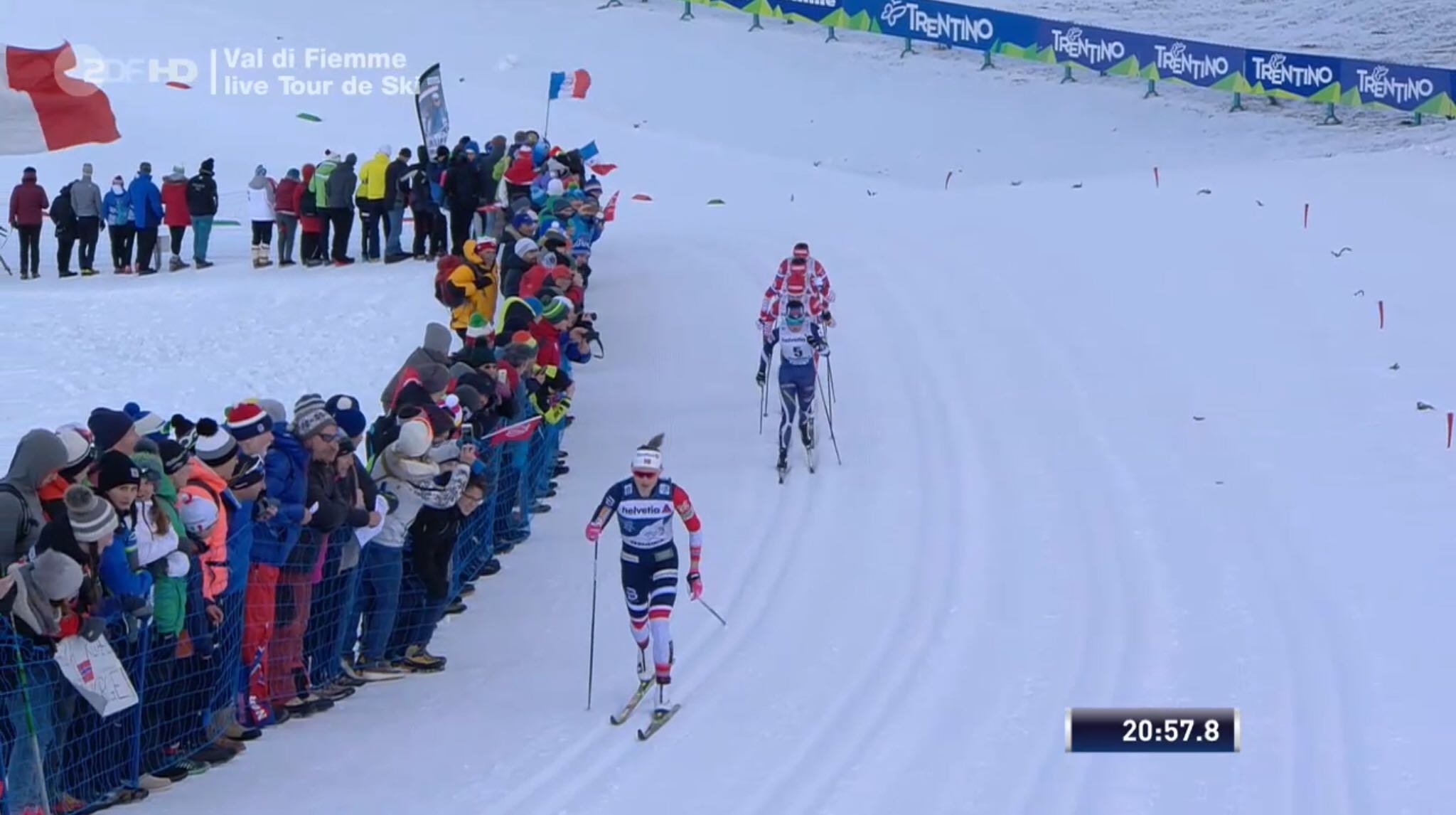
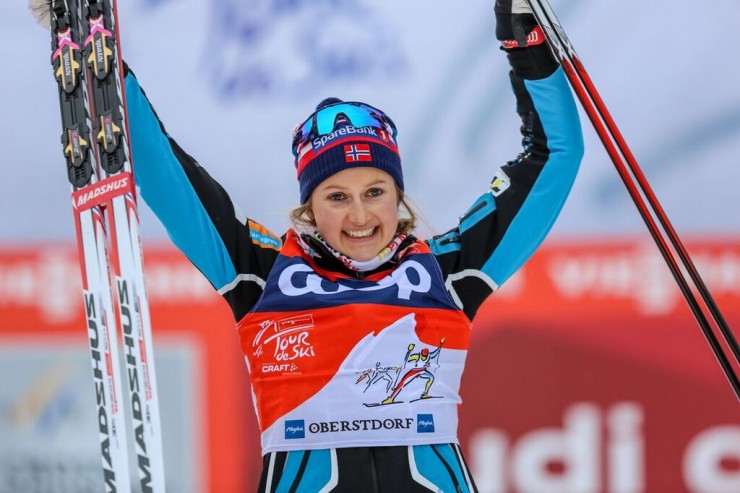
Norway’s Ingvild Flugstad Østberg leading a four-deep chase group on her way to winning Stage 6 of the Tour de Ski — a 10 k classic mass start. (Photo: ZDF screenshot)
FIS World Cup Stage 5 Tour de Ski 10 k/15 k Mass Start Classic Val di Fiemme, Italy
The clear outcome from the women’s 10-kilometer classic mass start was Norway’s Ingvild FlugstadØstberg’sfitness. The TdS leader began the day with a 35.4 second lead on second overall skier Natalia Nepryaeva of Russia. The time back to Nepryaeva at the end of Stage 6 only grew.
Østberg’s form became evident around the 6.2 k mark when she inexorably pulled away from a group that included Russians Nepryaeva, Yulia Belorukova, Anastasia Sedova, and Finland’s Krista Pärmäkoski.
Østberg went on to a solo win in a time of 29:24.4 minutes. Nepryaeva placed second (+10.0), Sedova third (+10.8), and Pärmäkoski fourth (+12.5).
Belorukova ended up in fifth (+39.7), followed by Norway’s Heidi Weng in sixth (+1:10.0), and U.S. skier Jessie Diggins seventh (+1:19.3).
Diggins began the day third overall in the Tour, 1:22.6 minutes behind Østberg.
Canada’s Emily Nishikawa, who began the day in bib 28, placed 25th (+2:47.3).
After factoring in time bonuses, Østberg now leads the TdS by 53.4 seconds over second overall skier Nepryaeva. Pärmäkoski jumped to third (+2:13.1), with Diggins dropping to sixth in the overall, 3:07.9 back.
Thirty-two women began Stage 6 of the Tour de Ski (TdS) in Val di Fiemme, Italy.
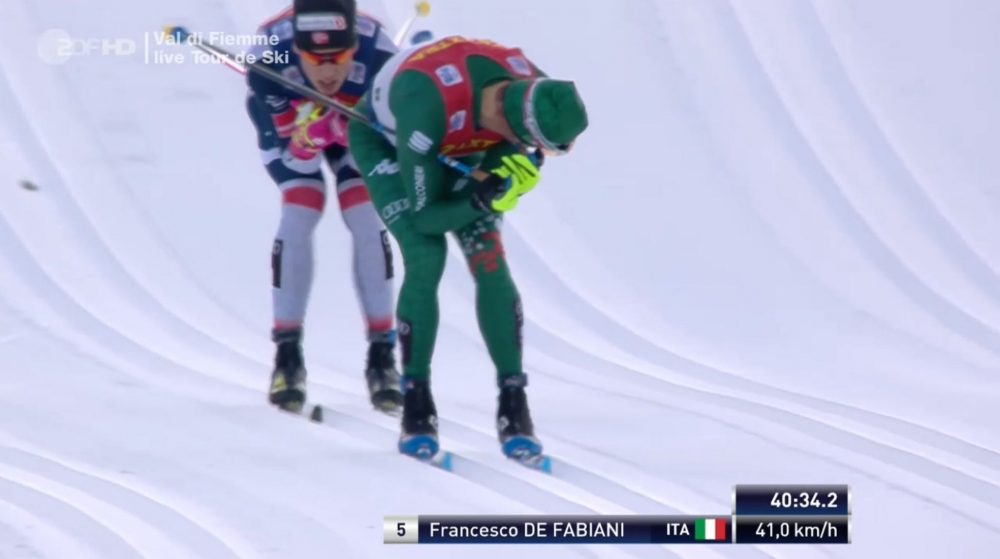
Italy’s Francesco de Fabiani leads Norway’s Johannes Høsflot Klæbo during Stage 6 of the Tour de Ski — a 15 k classic mass start in Val di Fiemme, Italy. (Photo: ZDF screenshot.)
In the men’s 15 k classic mass start, the race was a big opportunity for a results shakedown. Johannes Høsflot Klæbo of Norway came into the race as the overall leader, with a slight 5.4 second lead on Russia’s Sergey Ustiugov who began Stage 6 second overall in the TdS.
Klæbo will retain the overall lead after a tactical Stage 6 where he won the race in 40:52.6 minutes. Francesco de Fabiani of Italy placed second (+0.6), and Russia’s Alexander Bolshunov third (+2.6). Bolshunov had been third overall, prior to today’s stage, 1:18.2 behind Klæbo.
Ustiugov placed 16th (+42) in today’s stage after skiing through the 10 k time check in 20th place, 5.3 seconds back. By 11.4 k, Ustiugov was 20.4 seconds behind the front group of skiers that included Bolshunov and Klæbo.
After Stage 6, with only the Alpe Cermis climb to go, Klæbo sits in first overall, 1:20.4 minutes up on second overall skier Ustiugov. Bolshunov is third overall (+1:43.8), and de Fabiani fourth (+2:40.5).
No Canadian men started the race as Alex Harvey, Lenny Valjas, and Bob Thompson all left the Tour after Stage 5.
Ben Lustgarten (CGRP) for the U.S., is the only remaining North American male. He placed 44th (+5:31.7).
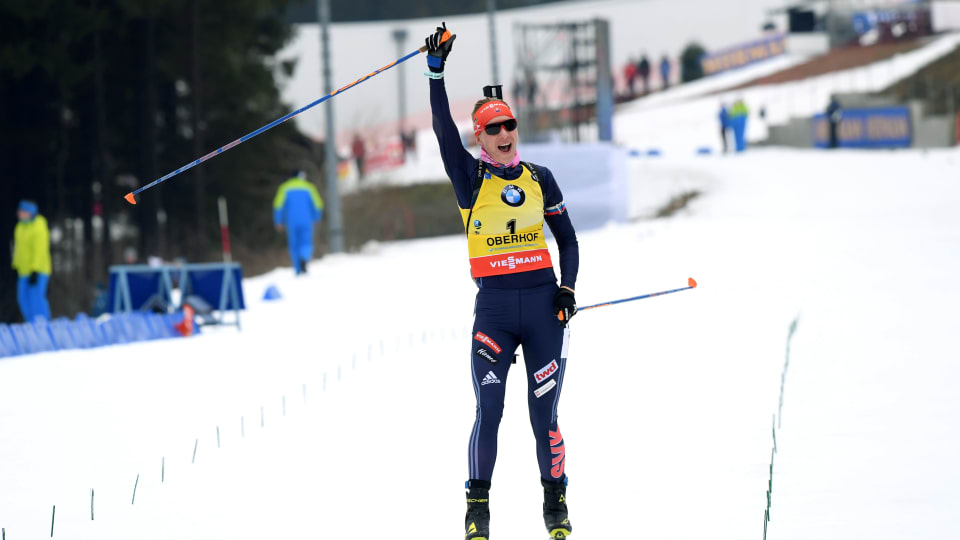
Slovakia’s Anastasia Kuzmina celebrates her second-straight IBU World Cup win in Oberhof, Germany, on Saturday with a 1:04-minute victory in the women’s 10 k pursuit. It marked her fourth win of the 2017/2018 season. (Photo: IBU/Biathlonworld)
IBU World Cup (Oberhof): Women’s and men’s pursuits
So far in 2018, Slovakia’s Anastasiya Kuzmina is undefeated after winning her second-straight race on Saturday at the International Biathlon Union (IBU) World Cup in Oberhof, Germany — this time by 1:04.4 minutes in the women’s 10-kilometer pursuit.
After winning Thursday’s sprint, Kuzmina started 35 seconds clear of anyone else on Saturday, while Finland’s Kaisa Mäkäräinen headed out of the gate after her in second.
Veronika Vitkova of the Czech Republic started another 5 seconds back in third, and Germany’s Franziska Hildebrand set out in fourth, 47 seconds after Kuzmina.
Three Canadians finished in the top 60 of Thursday’s sprint to qualify for the pursuit, with Julia Ransom heading out ninth (+1:14), Sarah Beaudry starting 23rd (+1:39), and Megan Tandy starting 59th (+2:38).
Throughout the four-stage race, it became more and more evident that no one was going to touch Kuzmina. She cleaned the first prone stage to leave the range 55.8 seconds clear of Hildebrand, who also cleaned to move into second. Makarainen dropped to fourth with a miss and Vitkova left the range in third (+1:08.5) after skiing a penalty lap as well.
On the second prone stage, Kuzmina missed one target, but the penalty lap only cost her about 10 seconds; Hildebrand cleaned to keep herself in second place with three loops remaining.
The first standing stage that followed saw Kuzmina miss another target and Hildebrand clean, yet 34.6 seconds still separated them. Kuzmina finally cleaned the last standing to extender her lead back up to a minute, while Hildebrand missed one to lose sight of the podium, slipping to fifth and 1:22.4 back at the start of the final loop.
Italy’s Dorothea Wierer as the 16th starter steadily worked her way up to podium contention, cleaning all four stages with the third-fastest overall shooting time to put herself in second after the final standing, 1:00.2 behind Kuzmina. Ukraine’s Vita Semerenko raced up from 22nd to third with perfect 20-for-20 shooting as well, leaving the range 11 seconds after Wierer with one loop to go.
On the final loop, Kuzmina skied the 22nd-fastest time on that loop (compared to Wierer’s 28th-fastest last-loop time) to put a few more seconds into Wierer as the eventual runner-up, winning in 30:49.5. On the day, Kuzmina’s overall course time was eighth fastest.
“It was a very interesting race for me today,” Kuzmina told the IBU after. “My shape is very good now but I was worried if I could concentrate on the shooting … After the first shooting, I was relaxed and realized it was OK. I just gave the other girls two chances … I must apologize for my emotion [on the shooting range], but I was so happy and enjoyed the last loop.”
Wierer finished 1:04.4 minutes later for second place, and Semerenko crossed the line in third, 1:10.2 out of first. Poland’s Weronika Nowakowska finished fourth (+1:17.1) after starting sixth, with clean shooting, and Mäkäräinen ended up fifth (+1:23.4) with three penalties (1+0+1+1) and the fourth-fastest overall course time. Belarusian Darya Domracheva followed in sixth (+1:28.8) after starting seventh and shooting 18-for-20 (0+0+1+1), and Germany’s Laura Dahlmeier finished seventh (+1:28.8), up from 13th with one late penalty (0+0+0+1).
South Korea’s Anna Frolina placed eighth (+1:36.0, two penalties) for her best result since December 2012, France’s Justine Braisaz finished ninth (+1:37.0; three penalties), and another French skier Anais Bescond 10th (+1:37.1; one penalty). Hildebrand lost six places on the final loop to end up 11th (+1:38.7; one penalty).
Overall, France’s Celia Aymonier skied the fastest course time of the day to rise from 28th to 15th (+2:08.7; three penalties).
Ransom finished the day in 37th (+3:54.4) with three misses (1+0+0+2). She had been in 16th after her early miss in the first prone stage then hovered around the top 20 as she entered her final standing stage. There, she missed two to drop to 36th and she ultimately lost one more place to Finland’s Mari Laukkanen (who started the loop in 37th and passed Ransom, as well as four others, to finish 32nd).
In her first World Cup pursuit of the season, Tandy improved to 43rd (+4:31.8) with a single miss (0+0+1+0). Overall, her range time was the 18th fastest and shooting time was 23rd fastest.
Beaudry finished 51st (+5:36.6) with three misses (1+2+0+0), recovering one place from skiing in 52nd after the second shooting.
In the men’s 12.5 k pursuit that followed, France’s Martin Fourcade held the lead from start to finish and held off Norway’s Johannes Thingnes Bø by 6.3 seconds for his second-straight win in Oberhof. Both of the Bø brothers reached the podium with older brother Tarjei Bø placing third, 30.9 seconds back.
Fourcade as starter No. 1 had a single penalty on the first prone to keep himself ahead (1+0+0+0) and finish first in 32:23.6. Johannes Bø had three penalties (1+1+1+0) but still managed to rise from third at the start to second at the finish. Tarjei started fifth and shot clean to reach the podium.
The fourth starter, American Tim Burke had three penalties (0+2+0+1) and ended up 14th (+1:43.7).
Meanwhile, Canada’s Christian Gow rose from 36th to 21st (+2:19.2) to tie his career best (which also came in a pursuit this season) with 19-for-20 shooting (0+0+0+1). Scott Gow finished 50th (+4:45.0; six penalties), and Brendan Green placed 54th (+5:26.1; three penalties).
The Oberhof IBU World Cup concludes Sunday with the men’s and women’s relays. Canada has entered Beaudry, Ransom, Tandy, and Emma Lunder in the women’s 4 x 6 k, and Christian Gow, Scott Gow, Brendan Green, and Carsen Campbell in the men’s 4 x 7.5 k. The U.S. does not have enough athletes at the Oberhof World Cup to field a team in either race.
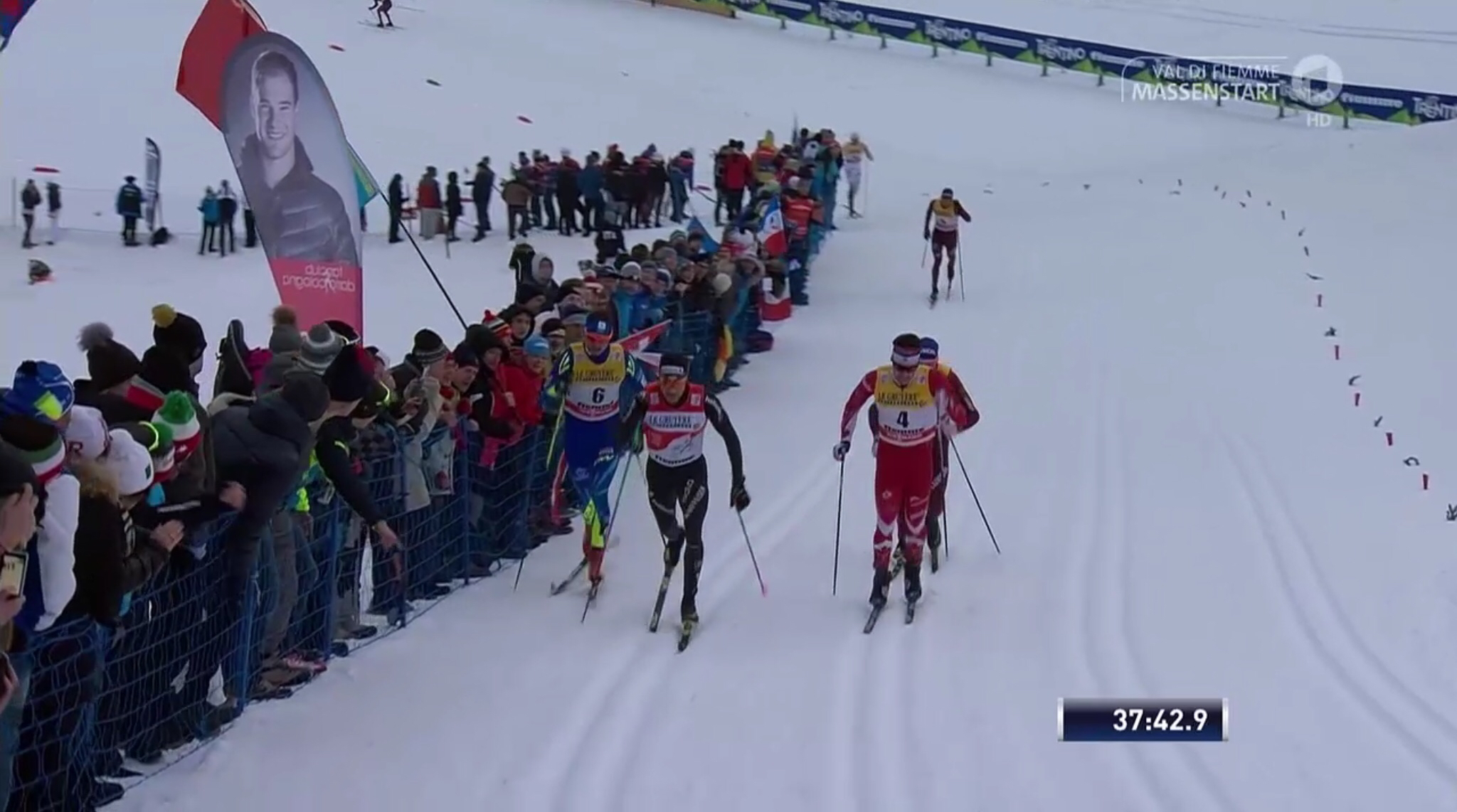
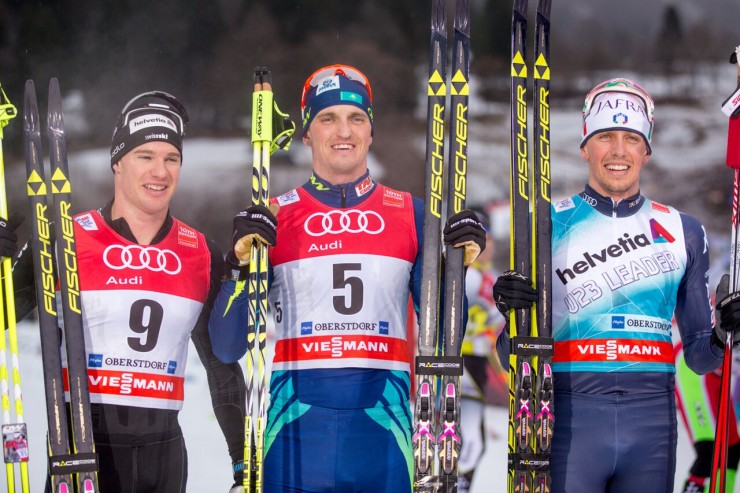
Alexey Poltoranin (l), Dario Cologna (c), and Alex Harvey (4) charge up the last climb of Saturday’s 15 k mass start in Val di Fiemme, Italy. Poltoranin took the win, with Andrey Larkov (behind Harvey) placing second and Harvey third at Stage 6 of the 2018 Tour de Ski. (Screenshot: ARD broadcast)
After a soggy and windy stay in Oberstdorf, Germany where the Stage 4 sprint was canceled and the Stage 5 freestyle mass stats were a cluster, the Tour de Ski (TdS) got back to a sense of normalcy in Val di Fiemme.
Or did they? After dominating the first part of the men’s 15 k classic mass start and picking up valuable Tour bonus seconds, Russia’s Sergey Ustiugov faded, eventually finishing 14th, 42.8 seconds out of the win.
Instead, Alexey Poltoranin of Kazakhstan made a big push to try to break for it about halfway through the race. Dario Cologna of Switzerland, the Tour de Ski leader coming into the day, followed, as did Canada’s Alex Harvey. The trio had a small gap of a few seconds consistently for several kilometers, before Russia’s Andrey Larkov caught up to them. Behind them, the field continued to fracture into chaos, claiming what would in past years have seemed unlikely victims like Norway’s Martin Johnsrud Sundby.
After much posturing and pushing in the final kilometer, the lead pack of four came shooting into the downhill finish with Poltoranin claiming the win by 0.4 seconds over Larkov. Harvey finished third, +0.9, and Cologna fourth, +2.3. There was a bigger gap before Russia’s Alexander Bolshunov crossed the line in fifth, +15.0.
That means that Poltoranin takes over second place in the Tour, while Ustiugov lost ground.
The only American starter, Paddy Caldwell, finished 48th out of 52 finishers, +3:38.6.
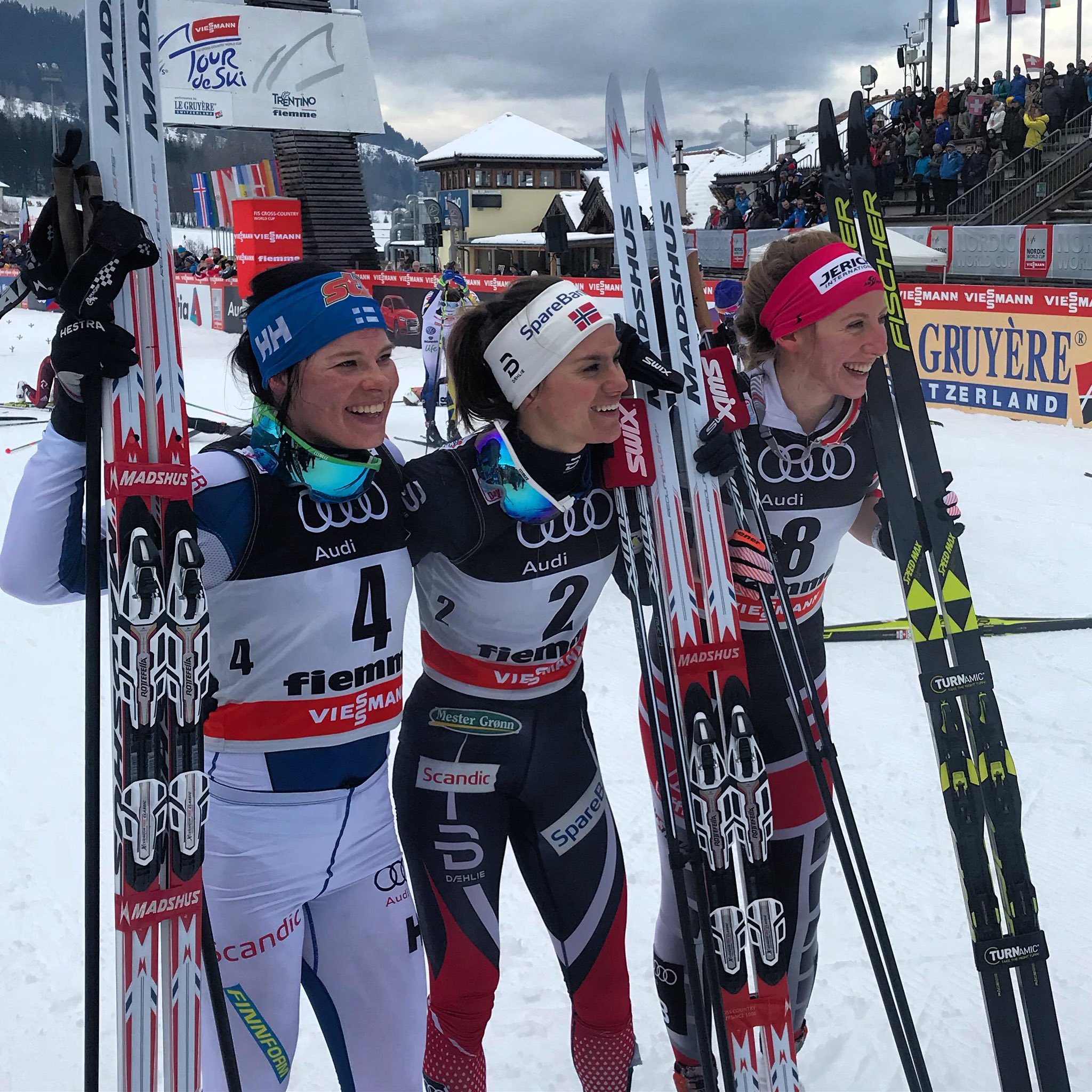
The women’s 10 k classic mass start podium at Stage 6 of the 2018 Tour de Ski on Saturday in Val di Fiemme, Italy, with Norway’s Heidi Weng (c) in first, Finland’s Krista Parmakoski (l) in second and Austria’s Teresa Stadlober in third. (Photo: FIS Cross Country/Twitter)
The women’s race went off as planned: no snafus, only burning lungs and muscles. At the start of Stage 6, Jessie Diggins was ranked third overall in the Tour (+1:56.7). Norway’s Ingvild Flugstad Østberg wore the red bib as the TdS leader, while teammate Heidi Weng was second overall (+57.0).
As Saturday’s race transpired, Weng proved dominant. She won in 29:07.9. Finland’s Krista Parmakoski placed second (+7.6), and Austria’s Teresa Stadlober third (+8.6).
Diggins skied a gutsy race to finish fourth (+23.6). Østberg, who at times looked like she could dominate the pace, faded to fifth (+35.2).
U.S. skiers Sadie Bjornsen finished in 10th place (+1:11.3), Liz Stephen 24th (+2:18), and Rosie Brennan 30th (+2:47.2).
Heading into tomorrow’s final stage, the formidable climb up the Alpe Cermis, Østberg leads the Tour with a tiny 1.8-second gap on Weng. Parmakoski is third overall (+1:33.5), Diggins fourth (+1:43.1), and Bjornsen eighth (+3:33.1).
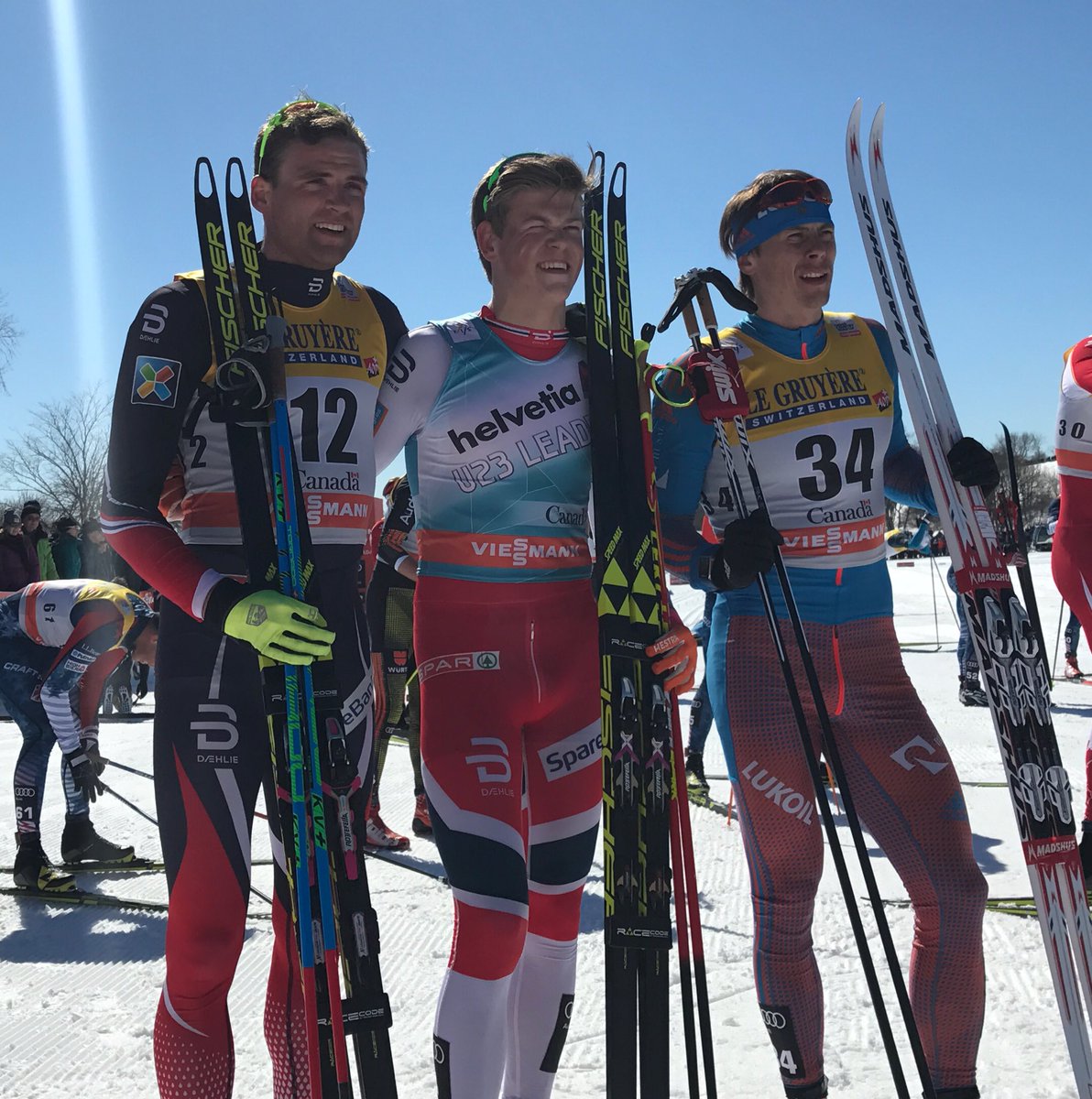
The men’s 15 k classic mass start podium on Saturday at World Cup Finals in Quebec City, with Norway’s Johannes Høsflot Klæbo (c) in first and Niklas Dyrhaug (l) in second, and Russia’s Alexander Bessmertnykh (r) in third. (Photo: FIS Cross-Country/Twitter)
FIS Cross-Country World Cup Finals (Quebec City): 10/15 k classic mass starts
During Saturday’s 15-kilometer classic mass start at World Cup Finals, Canada’s Alex Harvey was in it until the end. But so were Norway’s Johannes Høsflot Klæbo and Niklas Dyrhaug, and Russia’s Alexander Bessmertnykh, to name a few.
Sitting in second with a few hundred meters to go, Harvey was primed to make his move on Dyrhaug, who was leading at the time. But then came 20-year-old Klæbo, the season-long Sprint World Cup champion, who proved to have more left in the tank than anyone else and passed them both to lead into the finishing straight.
Klæbo took the victory — his first in a World Cup distance race — on a bluebird day under a beating sun in 35:23.7 minutes, 0.6 seconds ahead of Dyrhaug. Bessmertnykh followed another 0.2 seconds back in third (+0.8) just ahead of Harvey in fourth (+1.2).
Norway’s Sjur Røthe took fifth (+1.7), Switzerland’s Dario Cologna placed sixth (+1.9), and Norway’s Pål Golberg was seventh (+2.5), half a second ahead of another Norwegian Didrik Tønseth in eighth (+3.0). The top nine were within 3.7 seconds of first, with Russia’s Andrey Larkov in ninth.
Devon Kershaw was the second Canadian in the points on Saturday in 28th (+1:08.4), after breaking a pole and working his way back up from outside the top 60.
Erik Bjornsen led the U.S. men in 31st (+1:16.8), about a second ahead of Canada’s Graeme Killick in 32nd (+1:17.7).
Also for the U.S., Matt Gelso finished 37th, Andy Newell 45th, Scott Patterson 46th, Noah Hoffman 48th, Ben Lustgarten 49th, David Norris 50th, Simi Hamilton 54th, Paddy Caldwell 59th, Jack Hegman 62nd, Cole Morgan 64th, and Brian Gregg 69th.
For Canada, Bob Thompson finished 55th, Knute Johnsgaard 57th, Len Valjas 61st, Russell Kennedy 63rd, Evan Palmer-Charrette 65th, Andy Shields 66th, Jess Cockney 67th, Brian McKeever 68th, Joey Foster 70th, Gareth Williams 72nd, Ricardo Izquierdo-Bernier 74th, and Julien Locke 75th.
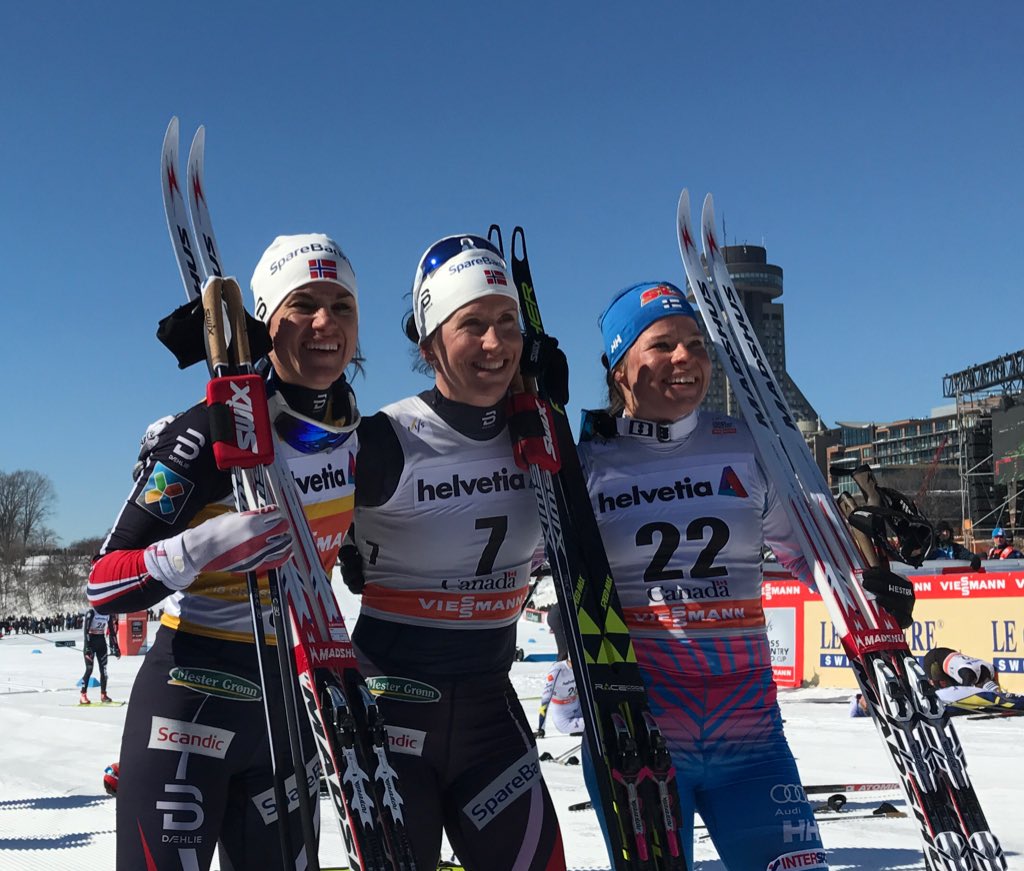
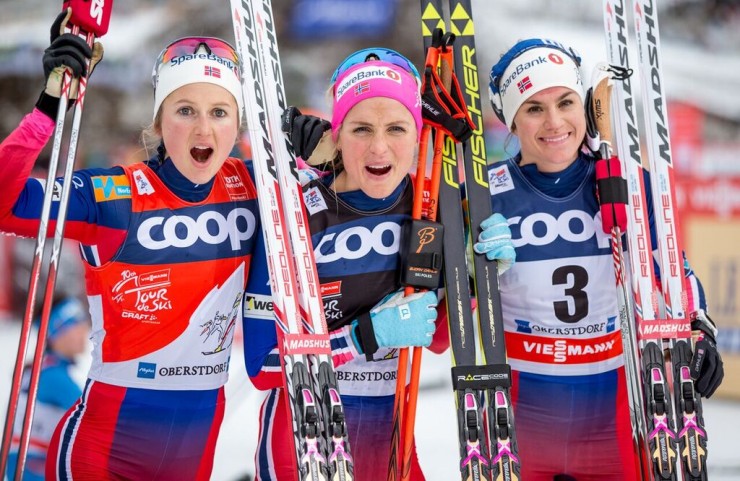
The women’s 10 k classic mass start podium on Saturday at World Cup Finals in Quebec City, with Norway’s Marit Bjørgen (c) in first, Norway’s Heidi Weng (l) in second and Finland’s Krista Parmakoski (r) in third. (Photo: FIS Cross-Country/Twitter)
In the women’s 10 k classic mass start earlier in the day, Norway’s Marit Bjørgen racked up her seventh victory of the season after leading a pack of two other Norwegians and Finland’s Krista Pärmäkoski and holding them off to the finish.
Bjørgen put a few meters into the foursome as she entered the finishing stretch and held her lead across the line in 24:23.6 minutes. Norway’s Heidi Weng finished 0.6 seconds back in second to lock up the Distance World Cup title, in addition to the Overall World Cup title she secured on Friday.
Pärmäkoski finished 2.9 seconds after Bjørgen in third, and Norway’s Ingvild Flugstad Østberg missed the podium in fourth (+7.8).
Behind them, Germany’s Nicole Fessel outlasted a large chase pack to place fifth (+18.6), just ahead of Sweden’s Charlotte Kalla in sixth (+19.9) and Anna Haag in seventh (+19.1).
Sadie Bjornsen of the U.S. Ski Team led the North American women in 15th (+29.9) after skiing at the back of that chase pack in the final stretches of the race. Also for the U.S., Jessie Diggins placed 27th (+1:06.9) and Sophie Caldwell 38th (+1:56.0).
Canada was led by Emily Nishikawa in 37th (+1:51.7). Behind her, Cendrine Browne finished 41st (+2:28.2), Dahria Beatty was 53rd, Annika Richardson 54th, Katherine Stewart-Jones 56th, Frederique Vezina 59th, Annika Hicks 60th, Sophie Carrier-Laforte 61st, Andrea Dupont 62nd, Katherine Weaver 63rd, Alannah MacLean 64th, Sadie White 66th, Lisle Compton 67th, Mia Serratore 68th, and Laura Leclair 69th.
For the U.S. Caitlin Patterson finished 44th, Liz Guiney 45th, Kaitlynn Miller 47th, Chelsea Holmes 48th, Rosie Brennan 50th, Julia Kern 52nd, Erika Flowers 55th, Becca Rorabaugh 57th, and Jennie Bender 58th.
One day left in the 2016/2017 World Cup season remains, with the women’s and men’s 10/15 k freestyle pursuits on Sunday in Quebec City.
World Cup Finals standings (Day 2 of 3): Men | Women
***
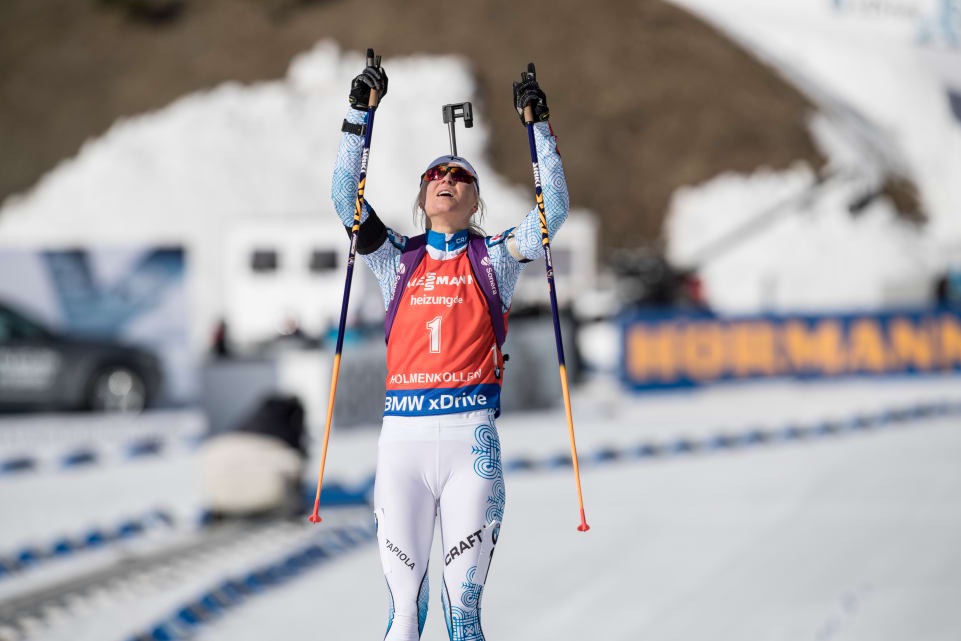
Finland’s Mari Laukkanen pointing to the sky in honor of her late shooting coach, after she won the women’s 10-kilometer pursuit on Saturday at the 2017 IBU World Cup in Oslo, Norway. (Photo: IBU)
IBU World Cup (Oslo, Norway): Women’s and men’s pursuits
Less than 24 hours after winning her first IBU World Cup on Friday in the women’s 7.5 k sprint, Finland’s Mari Laukkanen immediately capitalized on her ideal position with a start-to-finish victory in Saturday’s 10 k pursuit that was never in doubt, cleaning the first three shooting stages before incurring one penalty in her final standing shooting (0+0+0+1) to cross the line in a time of 29:33.3 minutes.
In addition to experiencing the most successful weekend of her biathlon career by far, it was an emotional day for the 29-year-old Finn due to a personal reason. Laukkanen spread her arms like wings skiing down the homestretch with a commanding lead, pointing repeatedly to the sky and a black ribbon she wore around her right upper arm, before kneeling in the snow in the finish for a few seconds. With those gestures, she reportedly wanted to commemorate her shooting coach Asko Nuutinen, who passed away Friday after suffering a heart attack during the World Cup in Kontiolahti, Finland, a week ago. He was 60 years old.
“It’s been a really emotional day for me. We have heard really really sad news that last night we lost our longtime shooting coach,” Laukkanen told reporters with a trembling voice in the press conference. “After this it was more or less only about working for him. Working as he has asked me to do for years and years. So I wasn’t thinking about losing or winning today, I was only thinking about him. And I feel really big pleasure that I was able to come to the finish like this, that I can own the victory for him.”
“I knew it will be difficult after the first victory in my career took me so long,” she added. “And to do it again immediately with good shooting. But as I said I didn’t think about winning or losing today, just doing my work.”
Finishing 26.5 seconds after her, the Czech Republic’s Gabriela Koukalová reached the finish, moving up from her fourth place starting position with a clean shooting performance (0+0+0+0).
“I wanted to miss all targets yesterday because I was so tired I didn’t even want to race,” Koukalová confided in the press conference. “It’s difficult to concentrate, three World Cups after the main goal of the season [the World Championships] is too much. Last year it was many times easier… I tried to catch her, but about one kilometer before the finish I saw her far away so I was happy I didn’t have to fight with anyone and was just enjoying the last meters.”
Despite four penalties (1+1+0+2), France’s Justine Braisaz defended the third place on the podium against a three-person chase group on the last loop (+1:01.4), falling back only one position after having finished the sprint in second.
“I did not expect such a good place today during the race,” Braisaz commented in the press conference. “Because in the last shooting I completely [failed]. I really wanted to have a clean shooting today, and I did not succeed. So I am happy and surprised, too.”
Her teammate Anais Bescond who had started the pursuit in third place fell back to 22nd position (+2:53.5) with seven penalties.
Slovenia’s Teja Gregorin finished fourth with one penalty (+1:08.2), Austria’s Lisa Theresa Hauser shot clean as the only athlete aside from Koukalova on her way to move up from 22nd to fifth place (+1:12.5), while Norway’s Marte Olsbu finished sixth like in the sprint despite three penalties (+1:15.9).
Unlike in Friday’s sprint race where Germany’s Laura Dahlmeier had still given up a seemingly commanding lead in the sprint World Cup discipline standings to Koukalova, she held onto her lead in the pursuit standings on Saturday, moving up from the 31st starting position to ninth place with a penalty in each of her standing shootings (0+0+1+1, +1:53.8). A 22nd place would have been sufficient to win the “small crystal globe” award in the pursuit. Laukkanen’s teammate Kaisa Mäkäräinen finished 8th with two penalties in the standing stages (+1:51.2), and thereby claimed the third place in the World Cup pursuit ranking.
“I knew that I didn’t need to have a perfect race today, just a good one, but that’s always easier said than done,” Dahlmeier told broadcaster ARD after the race. “I am incredibly happy that it worked out and that I could secure myself another small globe… It’s a bit of a weird feeling, standing at the start gate in the middle of the field and the clock ticks and ticks as one athlete after another skis out on the course. And you can only observe how far they have gone and have to wait and be patient, and not make a false start. But then the snow burns, then the chase begins!”
US Biathlon’s Susan Dunklee experienced an uncharacteristically problematic day on the shooting range and fell back to 37th place (+4:00.2), after starting seventh and less than a minute behind Laukkanen. Dunklee had three misses between two prone stages and seven more in her standing shootings (2+1+4+3) therefore having to ski more than an additional kilometer in the penalty lap.
“It is a testament to her fighting spirit that she notched the fourth-fastest ski time — one of her best ranks of the season — and never gave up despite suffering a biathlon blowout on the range,” teammate Clare Egan said of Dunklee, according to a US Biathlon press release. “Bad races happen to the best and Susan is no exception, but not everyone fights through till the end no matter what.”
Egan herself started the pursuit in 34th position and initally was able to make up ground, but then fell back slightly to 41st place (+4:13.9) with four penalties (0+2+0+2).
“I am satisfied with my race even though the result was not what I was hoping for, and that’s how I would summarize my entire season as well,” Egan said after the final race of her season. “I’ve made a good step forward but my competitors also work hard all summer and we seem to improve at a similar rate.”
Canada Biathlon’s Julia Ransom moved up to 47th place (+5:04.8) with three penalties (1+0+1+1), after starting in 52nd position.
[UPDATED] Later on Saturday in the last men’s 12.5 k pursuit of the season, the three best athletes of the season fought throughout the race exchanging in the lead, before they stood next to each other on the range for the final shooting to decide the winner.
Russia’s Anton Shipulin managed to shoot clean with his elaborate rifle stock in the design of a red dragon, proudly waving to the cameras as he left the arena while his two competitors had to ski into the penalty lap. France’s Martin Fourcade – who had already secured himself the overall World Cup Total Score title as well as the award for the pursuit discipline – was left to duke it out against Norway’s Johannes Thingnes Bø, the winner of Friday’s sprint.
On the last big climb before the Holmenkollen arena, Fourcade accelerated with a series of explosive jump-skate steps to decisively gap Bø. He even got fairly close to Shipulin on the finish stretch, who had slowed down a bit to grab a Russian flag before skiing over the line in a time of 32:11.9 minutes with one penalty (0+0+1+0), 5.7 seconds ahead of Fourcade who had incurred two penalties (1+0+0+1). While Fourcade shook hands with Shipulin, Bø came into the finish in third place, 21.6 seconds back and also with two penalties (1+0+0+1).
“It was a crazy race, but I am happy that I managed to finish first,” Shipulin said in the press conference through a translator. “Tough conditions on the shooting range, I had to really work to concentrate on my shooting. On the last loop I was all alone until I saw Martin chasing me, then I got a little bit scared but I managed to [keep him behind].”
It was Shipulin’s second win of the season, for which he credited his recently improved shooting performance.
“It was a really exciting competition with Johannes and Anton,” Fourcade agreed with his rival. “I expected to fight with them for the victory on the last loop, but then Anton was simply stronger in the last shooting. My strategy was to be focused on my technique and skills and not on the results, like I did too often in the past few weeks focusing on records and not the victory.”
Asked about his blazing attack on the final climb, Fourcade added: “Of course I train for that, but I think a lot of athletes do. I talked to Johannes, it was my revenge for the [2016] World Champs where he did exactly the same to me on the last uphill. But I know how it is, it can be different already tomorrow.”
“I am happy with a new podium of course,” Bø said in the press conference. “I was not at my best in the skiing today. But I still managed to shoot 18 out of 20. As Martin said it was [annoying] that we did not shoot zero [misses] and could not fight with Anton in the finish, but it was quite interesting and fun to stand there in the last shooting … I expected Martin’s attack the second he did it, but I had no energy to fight with him. That was quite strong.”
Sweden’s Fredrik Lindström placed fourth with no penalties (+44.7), and was the only man in the field who managed to shoot clean in all four stages.
“For the podium, I was never really close“, Lindström told the IBU in a post-race interview. “But it was a great day anyway. Four times zero [misses], and especially in the standing stages that makes you climb a lot in the standings. Super happy with my performance.”
US Biathlon’s Lowell Bailey, who had to start closer to the back of the field in 44th position, almost two minutes behind the leaders based on his sprint result, managed to move up 21 spots in the race despite three penalties (2+0+1+0).
“I’m happy with the race, considering it started out pretty rough with the first two misses,” Bailey told US Biathlon after placing 23rd (+2:23.3). “I just read the wind wrong and didn’t correct enough. After that, I tried to keep my head in the race and make the best of it. I was happy with my skiing and glad to clean the last stage; this brought me up nine spots and I was able to gain another in the last loop. Now, it’s just one race to go. I’m looking forward to tomorrow.”
Shooting quickly, Bailey recorded the ninth-ranked range time of the day and the ninth-fastest last loop.
His teammate Sean Doherty started 35th but fell back after having to ski six times through the penalty lap (1+3+1+1) to finish 46th (+4:05.6).
For Sunday’s mass starts as the final races of the 2016/2017 IBU World Cup season, the only qualified North American starters will be Dunklee (currently in 10th position in the World Cup Total Score standings) and Bailey (currently in eighth).
The women’s season award in the mass start discipline once more will be decided between Germany’s Dahlmeier and Czech Republic’s Koukalova, while Germany’s Simon Schempp will try to defend his narrow lead on Fourcade. But during Saturday’s final loop, the French star did consider saving energy for the final competition.
“No,” he simply quipped when asked about this in the press conference. “Of course the mass start is important tomorrow because it will decide about the [mass start] crystal globe. But I think today the pursuit was also really important, and you fight for victory and being one of the best athletes. You can’t be satisfied with only a third place when you can claim a second, and I think all athletes in my position would do the same.”
Norway’s Martin Johnsrud Sundby after winning the Norwegian 54 k classic Birkebeinerrennet, part of the Ski Classics series, on Saturday in Lillehammer, Norway. (Photo: Ski Classics)
54 k Birkebeinerrennet (Rena to Lillehammer, Norway): Part of the Ski Classics series
[UPDATED] Not even a snowmobile clipping him and sending him tumbling 20 k before the finish could keep Norway’s Martin Johnsrud Sundby from winning the Birkebeinerrennet on Saturday in Norway. Representing Team United Bakeries, Sundby set a high pace from the start and broke the group down to three by 9 k, with Petter Eliassen of Team LeasePlan and Simen Østensen of Team BN Bank sticking with him until about 30 k in the 54 k marathon.
With about 20 k to go, Sundby collided with a Ski Classics TV production crew snowmobile while trying to double pole in the snowmobile’s tracks. He was OK and went on to win by 48 seconds over Eliassen in second, and smiled about the incident after the finish.
“It came in with tremendous speed and mowed me down,” Sundby told NRK, according to a loose translation.
Ski Classics CEO David Nilsson told NRK he didn’t know exactly how that happened and emphasized that it was unacceptable.
“We always put safety first, but it is a difficult balancing act with the snowmobile at high speed to get TV pictures,” he said, according to a loose translation. “The skiers often ski in the [snowmobile] track and here it happened and somehow the driver missed it.”
While Sundby pulled out the win in 2:20:53.5 hours, Eliassen took second and Østensen followed another 3.5 seconds later for third place.
In the women’s race, Poland’s Justyna Kowalczyk (Team Santander) pulled out a 4 minute and 15 second win over Sweden’s Britta Johansson Norgren (Lager 157 Ski Team). Japan’s Masako Ishida (Team United Bakeries) was another 48.6 seconds back in third.
“I’m really happy to win this race,” Kowalczyk said, according to a Ski Classics press release. “Everything went well and the cheering on the course was amazing. I will do the rest of the races in Visma Ski Classics, but this victory was the most important for me. Of course, I want to win again in Årefjällsloppet like I did last year, but to win here in front of this audience means so much to me.”
Tord Asle Gjerdalen, who finished fourth in the men’s race, and Johansson Norgren continue to lead the overall Ski Classics standings with three races to go. The next stop is the Årefjällsloppet in Sweden on March 25.
“It was a great race and we kept a high tempo up all the way,” Sundby said, according to the press release. “I was able to use uphills for my advantage and get a gap. I had good skis, the conditions were perfect, and to win here was one of my goals for the season. I have the Norwegian Championships in two weeks, and I haven’t counted out the option of going to Finland for the Visma Ski Classics finale.”
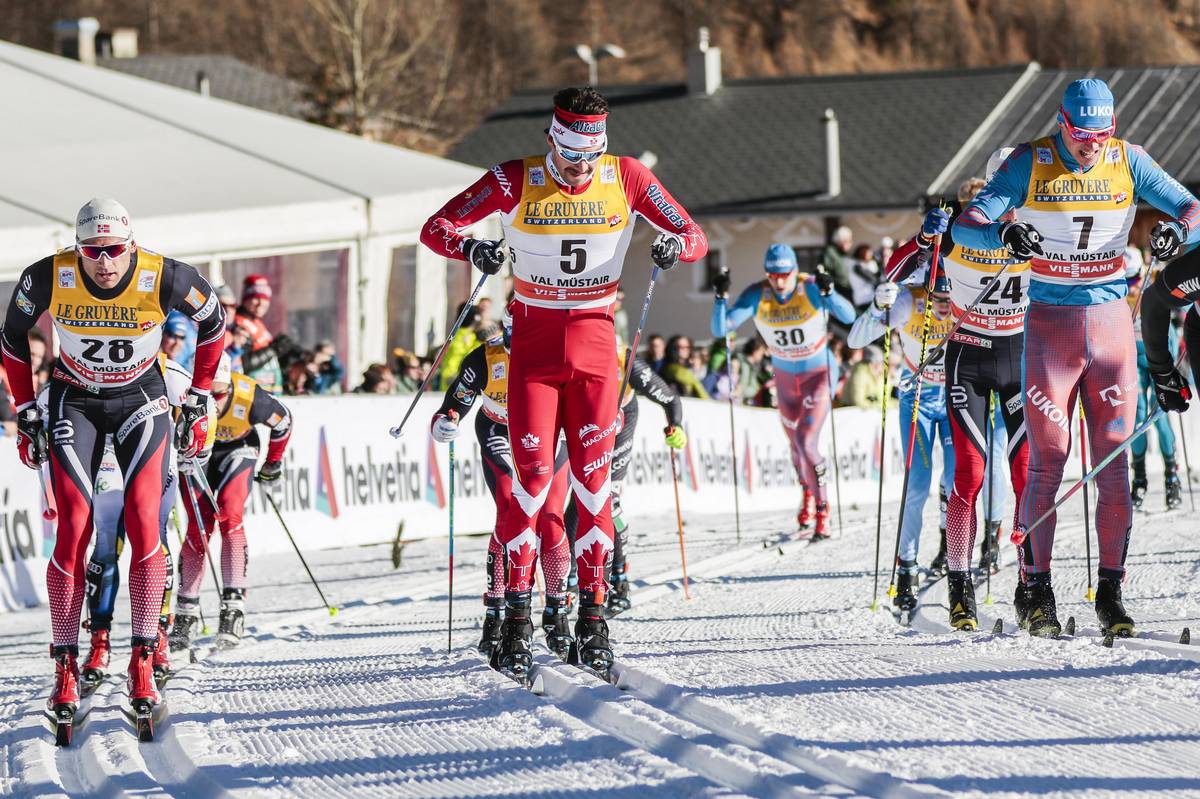
The men’s 10 k classic mass start, with Canada’s Alex Harvey in bib 5 behind Norway’s Niklas Dyrhaug (28) and Sweden’s Marcus Hellner (18) heading out of the stadium on Sunday at the second stage of the Tour de Ski in Val Mustair, Switzerland. (Photo: Fischer/NordicFocus)
With the opening stages of the Tour de Ski in Val Müstair, Switzerland, behind us, we wanted to share some athlete and coach comments that didn’t make it into the race reports:
***
On training over the holidays leading up to the Tour:
“We were in three different main locations over Christmas: France, Austria, and Switzerland, depending on which athlete you were. You kind of come back and see where everybody is. I think we all know each other so well that the feedback we got from France, even though as a coach, I wasn’t there, kind of told me where people were in terms of health and fitness.”
— U.S. coach Matt Whitcomb after Saturday’s freestyle sprint
On American Kikkan Randall qualifying for the heats for the first time this season in 29th, then going on to place 15th in the freestyle sprint on Saturday:
“Who skis poorly on their birthday? We knew Kikkan was going to get in there today. Even though she’s been coming from a different place than she’s ever been, it was cool to see her squeak in there and really fun to see her mix it up in what was actually a pretty fast heat. To be right there at the finish, to hit the gas like Sophie did, and to have some speed to access, says great things for the Tour.”
— Whitcomb
“We took a chance with entering Kikkan in this Tour, and she knows that. This is an investment, and she hadn’t scored points yet, she’d been close in Davos, she told us you know, ‘Hey, I want this, but I respect your call.’ We decided to make an investment and give her these starts because we really believe it’s going to help her get back to a place where she’s been before. Today, made me really happy to see her so happy about her results. She had a Christmas break where several key workouts went very well in Davos, she came out of there with some confidence and that’s always a good combination at the beginning of a World Cup.”
— Whitcomb
On American Sophie Caldwell qualifying in fifth and going on to place 13th on Saturday:
Sophie Caldwell (U.S. Ski Team) skating to fifth in the women’s freestyle sprint qualifier at Stage 1 of the Tour de Ski last Saturday in Val Mustair, Switzerland. She went on to place 13th overall. (Photo: Fischer/NordicFocus)
“One of the best qualifications that she’s ever had, certainly her best this year. It’s great to see her healthy again. She was sick over Christmas, she was the last of the team to go down. She’s healthy again, and so that qualification said great things. She got stepped on, on the final climb and had to cover a gap that got opened up. I was curious to see, at altitude sometimes she can run out of gas and have less than what is required in the finish, and she was really punchy, she hit the gas and got speed out of it, and there was just too many people to go by. She lost by five-hundredths of a second. It could have gone either way; it could have gone fantastically or it could have gone the way that it went.”
— Whitcomb
“I was really psyched with the qualifier today. This is a pretty long, hard course at altitude, so to qualify that high was a really good day for me. It’s funny because this is the second time I’ve raced here, and because it’s long hard and because it’s at altitude, both times I’ve had to tell myself to go easy the first lap or 2/3rds of a lap. Of course you never actually go easy in a race, but if I keep telling myself to go easy, then I can at least take it out a little slower and pace it pretty well.”
— Sophie Caldwell on Saturday’s qualifier
“I’m someone who has a lot of fast twitch and I can get up to speed quite quickly, which is sometimes a blessing and sometimes a curse. On a quick course it can be a great thing, but on a longer course at altitude, I risk having an epic blowup if I start out too hot. So after the first uphill today I was like, ‘okay, good job, your legs don’t hurt and you’re not breathing hard’, then across the long gradual uphilll I started picking it up a bit and then tried to hammer up the hill the second time and of course, my legs hurt, but they were fresh enough to make it over the hill. I didn’t know I was having a good race because it’s hard to feel like you’re crushing it when you’re really trying to pace, but I was really happy to see I was fifth.”
— Caldwell on her qualifier
“Being .01 from advancing was tough, but I’ve also been on the winning end of a lunge before and I guess you can’t always be the lucky one!”
— Caldwell on placing third in her quarterfinal
On American Simi Hamilton:
“I’m expecting big things out of [Simi] in Toblach [at the regular-season World Cup Jan. 14-15]. I think he’s set up for success there. In sprint racing, that doesn’t mean anything, but it’s the best we can ask for. He’s starting to feel better, it’s just today he had a conservative approach to the start as a way of conserving energy, and in this particular heat it put him in sixth, and he had trouble finding windows to make any moves. That didn’t go well tactically today. I think it wasn’t that he was scrambling to hang on, he looked good, he had good acceleration through the finish, he was able to pick off a couple guys. He finished fourth in his heat, and 18th on the day. It’s positive for sure, it’s not where he can race. We’ll see him on the podium again.”
— Whitcomb after Saturday’s freestyle sprint
“I wasn’t surprised with how the qualifier went. I was definitely happy with it. It obviously wasn’t the best qualifier, if you look at the time out from the leader. If you take Ustiugov out of the equation, I think I was somewhat close. I definitely treat it as a sign that things are moving in the right direction.”
— Simi Hamilton after Saturday’s freestyle sprint, where he qualified 14th and went on to place 18th
On the decision for some U.S. Ski Team members to withdraw from the Tour:
“That’s been a part of the plan. It’s not something we decided on the spot. [Sophie Caldwell and Simi Hamilton] will participate in the OPA Cup in Slovenia along with Ida Sargent and Andy Newell this coming weekend. We saw a better opportunity for some of our sprinters than a skate sprint on Friday and a 10 skate on Saturday that they’ll do in Val di Fiemme, [Italy].”
— Whitcomb
On choosing between classic or skate skis for Sunday’s classic mass start:
Canada’s Alex Harvey (5) racing alongside Norway’s Niklas Dyrhaug (28) and Russia’s Andrey Larkov (7) in the men’s 10 k classic mass start at Stage 2 of the Tour de Ski on Sunday, Jan. 1, in Val Mustair, Switzerland. (Photo: Salomon/NordicFocus)
“I tested the skate skis, I was ready to go. I had my pursuit boots, I was ready to go double pole, but the final call was just going to be whatever my competitors were doing. In the end, all the Norwegian guys, Dario [Cologna of Switzerland], and [Finland’s Iivo] Niskanen went classic skis, so I just made the call, kind of looking at what these guys were doing … classic was probably a safer bet and thinking ahead, thinking for the next few days it is a bit easier on the body to stride, and apply the pressure and use all your muscles rather than just the arms and the core so could be a bit better to stride.”
— Canadian Alex Harvey, after placing eighth in Sunday’s 10 k classic mass start
On the classic mass start course:
“There was one, just not super steep, but very long climb like when you started at the bottom of the stadium. It was kind of all gradual for almost four minutes so that was tough, but it was not steep. On the second lap I was skiing behind [Great Britain’s Andrew] Musgrave [who was double poling] the whole way up and not catching him, just going the same speed, but then at the end of the lap, you would hit the sprint hill that we did twice yesterday and that is kind of steep and that is where the double polers were getting bogged down and crashing even. [Others] were trying to herringbone around them and hitting their ski tips, I think had it not be that hill, more people would double pole. That hill, even though it is short, is just enough to put so much stress on the arms that after, you’re kind of paying for it the rest of the course.”
— Harvey on Sunday
On rebounding from illness:
Sadie Bjornsen (U.S. Ski Team) racing to eighth in the Stage 1 freestyle sprint qualifier last Saturday in Val Mustair, Switzerland. She went on to place 23rd on the day. Like teammate Jessie Diggins, Bjornsen was also racing for the first time in several weeks after missing the La Clusaz World Cup due to illness. (Photo: Fischer/NordicFocus)
“I was really nervous coming to this Tour for a couple of reasons; for one, when you felt great, and then you get sick, you almost lose confidence in your immune system, and you’re like ‘What the heck? Am I going to wake up sick before the tour as well?’ It was a big relief to wake up, and be like ‘OK, I feel good, I feel healthy, I’m racing; this is awesome!’ It felt funny because I hadn’t raced in three weeks, and then we’re at this long sprint course at altitude. It was definitely an awkward start. I didn’t feel like I was really going, and I’m sure a lot of people didn’t feel that either, on this course at this altitude. … I was just thrilled to make it to the final, that was a surprise, but a very welcome one.”
— American Jessie Diggins, who placed sixth in Saturday’s sprint final after missing the World Cup in La Clusaz, France, two weeks earlier because of illness
“A lot of people look at illness as a negative thing, it’s really only negative in that you miss some races. [It can be a] somewhat positive recovery process that just unfortunately has to happen. We come out of it feeling fresh and sometimes faster than we were. I think in Jessie’s case, very happy with where she is, I know she’s feeling good.”
— Whitcomb on Saturday
On baby-friendly venues:
Kikkan Randall (c) racing in the 5 k classic mass start on Sunday, Jan. 1, at Stage 2 of the Tour de Ski in Val Mustair, Switzerland. She ended up 19th on the day. (Photo: Fischer/NordicFocus)
“The [Val Müstair] organizers did an amazing job with this race and had a really nice baby room that my mom utilized with Breck. They had diapers, a changing table and toys to play with plus gifts for all the mothers. It’s really neat to see the [organizing committees] getting behind the support for mothers!”
— Randall after Sunday’s 5 k classic mass start
On strategy and expectations for the next few stages:
“It’s easy to try and overcomplicate things as a coach. I mean, we really want what we have to say make a difference to these athletes, but sometimes I think it’s better to just step back and make sure they stay happy, make sure they have access to good food and lodging, and effective travel schedules, fast skis, and just trust that if they show up and the start line feeling happy, relaxed, and with trust of their teammates and service staff and their coaches, that it’s going to go as well as it possibly can. So we don’t overcomplicate things with regards to strategy in a Tour. There may be an occasional point here or there on a sprint day or on a mass start, but basically show up on the start line rested and happy is our Tour strategy.”
— Whitcomb after Stage 1 on Saturday
“I’m definitely not over-analyzing. For a Tour, there’s so many things that need to go right every day for you to be in a top position, and I take it day-by-day. I don’t dwell on the past, I don’t dwell on the future. It’s just the right now I need to drink a lot, eat a lot, recover, foam roll … I just live in the moment during the Tour, because tomorrow when we’re going to drive four hours, then we’re going to do this, it’s a few too many things. … That helps conserve my energy, and not worry about things I can’t help.”
— Diggins on Saturday
“Moving into Oberstdorf, it’s just going to be more of the same. Try and recover with the demanding travel schedule, try and stay hydrated, we’re moving down from altitude, so that should help. And keep having fun.”
— Whitcomb after Stage 2 on Sunday
The men’s 10 k classic mass start at Stage 2 of the Tour de Ski, with Norway’s Martin Johnsrud Sundby (l) leading Russia’s Sergey Ustiugov, in Val Mustair, Switzerland. (Photo: Fischer/NordicFocus)
Norway’s Martin Johnsrud Sundby (r) leading early in the men’s 10 k classic mass start on at Stage 2 of the Tour de Ski on Sunday, with Alex Harvey (second from r), Norway’s Finn Hågen Krogh (3) and Russia’s Sergey Ustiugov (second from front left, in light blue) among those matching his pace. (Photo: Fischer/NordicFocus)
Alex Harvey wasn’t feeling 100 percent on Sunday, but he didn’t need to be. Within three seconds of the leaders and eighth place at the finish of the men’s 10-kilometer classic mass start was essentially what he needed to secure one of the most coveted positions on the Tour de Ski right now: third place.
Ahead of him, Russia’s Sergey Ustiugov and Norway’s Martin Johnsrud Sundby have built a nearly one-minute and 40-second lead on third place, respectively. With another victory on Sunday, Ustiugov has back-to-back wins in the first two stages of the Tour. Sundby was fourth in Saturday’s freestyle sprint and second on Sunday, good enough for second in the Tour, 18.9 seconds behind Ustiugov.
Then there’s Harvey, of Canada, who finished sixth on Saturday then eighth on Sunday for third in the Tour. He realized during the mass start that it was all about whom he was ahead of rather than a specific place he needed to finish in.
For instance, Finn Hågen Krogh. The Norwegian was third going into Sunday and finished 34th in the mass start, 50.1 seconds behind Ustiugov. That puts him 11th after two stages, nearly 1 1/2 minutes out of first.
“Not a lot happened, I just skied really slow,” Krogh told VG after Sunday’s race. “It was boring to do such a slow race.”
He wasn’t sure exactly what went awry on Day 2 of the Tour, but Krogh — expected to be one of Norway’s biggest threats aside from Sundby — was considering dropping out.
“Yeah, that might happen, but I should probably calm down a little before I make such a decision,” he said.
(His teammate Emil Iversen assured reporters that Krogh wouldn’t quit this early. “It’s about inspiring each other regardless of good or bad performances,” he told VG. “It’ll work out, I’ll show him some nice pictures of women on Instagram and then we’ll get him back on track.”)
Norway’s Niklas Dyrhaug (28) and Canada’s Alex Harvey (r) racing toward the front of the pack in the men’s 10 k classic mass start at Stage 2 of the Tour de Ski on Sunday in Val Mustair, Switzerland. Harvey went on to finish eighth while Dyrhaug placed 12th. (Photo: Fischer/NordicFocus)
During the race, which included nearly 80 starters on a 2.5 k course in Val Müstair, Switzerland, Harvey took note of Krogh’s off day. Same thing with Iversen, another all-around contender, who started the mass start in eighth and ended up 18th for fifth overall in the Tour, 9.6 seconds behind Harvey.
“When I started looking at the overall map after yesterday, I knew of course Dario [Cologna], Sundby, Ustiugov and then Finn and Emil were the main threats up there .. and [Sweden’s Marcus] Hellner, too,” Harvey recalled on the phone. “When I saw that Finn and Emil where having a tougher day, I knew it was going to be good for me in the overall standings. I was still able to finish hard and my skis were really fast so I could make up some ground on the downhill, but I was still seven seconds off the pace so I didn’t lose too too much time.”
Exactly seven seconds behind Ustiugov at the finish, he finished less than a hundredth of a second ahead of Finland’s Iivo Niskanen, who placed ninth. In addition to the first and second finishers, Harvey followed five others across the line: Norway’s Didrik Tønseth (who finished 2.3 seconds back in third) and Sjur Røthe (+3.3 in fourth), Switzerland’s Cologna in fifth (+5.5), Finland’s Matti Heikkinen in sixth (+5.6), and Hellner in seventh (+6.0). But he’s ahead of all of them in the Tour standings.
“The finish was real good. Actually, I didn’t think I was eighth at the line, I thought I was more like 12th or 13th, so I made up a lot of ground on the last kilometer,” Harvey said. “Once we hit the sprint hill I passed three guys there, and then two guys out of the last curve, so that’s five guys in the last 500 meters. I passed a few guys before that, too, so I just didn’t know… I was really happy with being in the top 10 again.”
For Harvey, that’s his third-straight top 10 on the World Cup circuit and seventh this season.
“Over Christmas, I was feeling really, like, really good,” he said. “… I was hoping to be in the top five [overall] from the beginning, so I would say the results are like what I was feeling over Christmas, but the feeling is not so. I don’t know if that is a good thing or bad thing, but I chose it’s a good thing.”
The race feeling Harvey was referring to was a lack of snap on Val Müstair’s climbs. The highest point on the course is 1,700 meters, he explained, compared to Davos, Switzerland, where he trained over the holiday break at 1,530 meters.
“It’s not a huge difference, but I didn’t have great feelings, same as yesterday,” Harvey said. “Even though we spent Christmas in Davos and we should be climatized, it was tough so it was kind of going the same as yesterday, trying to go tactical a bit and position myself well at the base of the hills and then kind of drift, lose position and then gain it back on the flats.”
Canada’s Len Valjas (in red) striding near Russia’s Sergey Ustiugov (second from r, in blue) in Sunday’s 10 k classic mass start at Stage 2 of the Tour de Ski in Val Mustair, Switzerland. According to Valjas’s teammate Alex Harvey, most of the top skiers chose to stride rather than double pole, but Great Britain’s Andrew Young (r) was among those double poling on skate skis. He ended up 50th, while his teammate Andrew Musgrave double poled to 17th. (Photo: Fischer/NordicFocus)
While Harvey seemed to be skiing within the top 10 for most of the race, he said he slipped outside it on the downhills.
“Some guys were really aggressive, the skaters especially, so I kind of drifted back a bit by the end of the first lap,” he recalled.
For the second and third lap, he anticipated that drift and positioned himself more competitively.
“I was wearing skiathlon boots so in the corners I could really corner well and my skis were really fast, so I could kind of gain some positions out of the corners there to position myself well for the third and fourth lap,” he said. “But then, when the pace really went in the fourth lap on the hill I just drifted. I could really feel the altitude.”
Like he said, he finished strong, and that’s what mattered. Heading into the Tour’s third and fourth stages in Oberstdorf, Germany, Harvey knows the 20 k skiathlon is an important race. But perhaps more so than the result, he’s mindful of the bonus sprints — for valuable bonus seconds in the overall standings.
“It’s at sea level in Oberstdorf, so hopefully the feeling is a bit better there and I can go for [those sprint bonuses], and now I am defending the third spot. I mean, the two guys out front are clearly ahead — already it’s a minute to Ustiugov and 40 seconds to Sundby, but it’s a lot of guys behind me so I am just going to try to defend my position.”
Are Ustiugov and Sundby untouchable? In a multi-stage series, Harvey didn’t rule anything out. He pointed out that last year Sundby lost nearly a minute in his overall lead after placing 23rd in the 15 k classic mass start in Oberstdorf (although he was still left with 45 seconds wiggle room to second place).
“You never know, but they have a huge advantage already,” Harvey said. “I think Finn Hågen lost the Tour; I don’t think he can win anymore. In my head he was one of the favorites to win this year, but I think it is going to be between those two guys, but it is not a guarantee. It’s still the tour and a lot of skiing to do.”
“We’re going to help Finn back on his feet,” Sundby told VG. “It’s the same thing that happened to me last year in Oberstdorf. I had a horrible day and lost a minute. Finn has that kind of day today, which is really boring in a Tour. We will pull back up from the mud so he can be in the fight again.”
Russia’s Sergey Ustiugov racing to the win in Sunday’s 10 k classic mass start, directly ahead of three Norwegians, including runner-up Martin Johnsrud Sundby (third from r), third-place finisher Didrik Tønseth (second from r), and Sjur Røthe in fourth at Stage 2 of the Tour de Ski in Val Mustair, Switzerland. (Photo: Fischer/NordicFocus)
While Sundby was the first to set the pace in the mass start, Ustiugov closely shadowed him and took control around 7.5 k and then for good with less than 2 k to go.
“He’s an incredible skier,” Sundby told NRK after. “He’s got it in his head and I hear it during the race that he’s tired. He sounds like a locomotive when he’s skiing. And he’s got an incredible finish.”
“I had great skis,” the 24-year-old Russian said, according to an International Ski Federation (FIS) press release. “The service team did a great job. The pace was very high from the beginning. I did not expect I would be leaving Val Müstair with two wins and the lead in the Tour de Ski.”
After Harvey in third overall, Russia’s Andrey Larkov is less than 2 seconds behind him in fourth after two stages, with a seventh place on Saturday and 11th place on Sunday. Iversen is another 7.7 seconds back in fifth (+1:09.2) and Cologna is sixth (+1:10.4) after a ninth place followed by a fifth place on Sunday.
“I’m not yet at 100 percent, but I felt good and was able to keep up,” Cologna told Swiss TV broadcaster SRF after hanging in the top four and even leading at times during the race, along with Sweden’s Hellner. “On the climb when Sundby attacked, it was fast, but I was able to get in contact again, and then on the steep sprint climb my pole did not find grip twice, went into the void a bit, and then I lost contact. But I think it was fine, a small step ahead. And I could show and also show to myself, that everything is OK.”
Of note, Cologna grew up about 500 meters from the Val Müstair course.
“That’s very special. It’s always fun,” he said of the third-straight year of the Tour de Ski being held at the venue. “A good atmosphere and a lot of people, you know? It’s not always easy to meet all demands, but it’s quite fun…”
Kershaw, Killick and Bjornsen Move Up
Two Canadians made up considerable ground on Sunday, with Devon Kershaw racing to 27th (+42.9), putting him 32nd overall in the Tour (+2:22.5), and Graeme Killick finishing 33rd in the mass start (+49.3) for 36th overall (+2:29.5). In Saturday’s sprint, the two finished 51st and 57th, respectively.
That kind of starting position put Kershaw and Killick toward the back of the mass start, with only five tracks across and more than 50 men ahead of them.
Devon Kershaw (54), followed by Canadian teammate Graeme Killick (47), racing to 27th in Sunday’s 10 k classic mass start at Stage 2 of the Tour de Ski in Val Mustair, Switzerland. Killick went on to place 33rd. (Photo: Fischer/NordicFocus)
“… Most of the race was rather hectic — but to be honest it was better than I thought,” Kershaw wrote in an email. “The conditions were perfect and the descents weren’t nearly as icy as the day before when I was skiing around testing out the course.”
He explained it was difficult to pass on a twisty 2.5 k loop, but he focused on being patient.
“It cost me a chance to get into the top 10-15 for sure, but by just biding my time and skiing smooth and relaxed without getting caught up in the mayhem allowed me to have decent energy the whole way,” he wrote. “I just kind of kept picking off a few guys were I could — which happened to be on the climbing section — which I felt decent on.”
In terms of his standalone result — 27th — Kershaw said it was closer to his goal of a top 20 in classic races.
“This year in the three classic races on the World Cup I’ve been 33rd, 23rd (time in Lillehammer where I moved up to 27th in the overall) and today 27th — so I guess I’m consistent — but I’d be lying if I said that’s where I want to live,” he wrote.
And while he might be in 32nd, he’s within 20 seconds of 22nd.
“There is a lot of skating this year — so perhaps not as good for me as years past which lean heavier on classic — it’s all good,” Kershaw wrote. “I will take it day by day and of course I am really looking forward to the classic race in Val di Femme (15km mass start). The [skiathlon] in two days will be fun too (the 20km) so I am looking forward to that as well since I’ve had some OK [skiathlons] in my day.”
Like Harvey, he was looking forward to racing at lower elevations.
Canada’s fourth finisher on Sunday, Len Valjas placed 38th (+54.3) after starting in bib 14. That puts him in 26th overall (+2:13.5).
The U.S. men were led by Erik Bjornsen in 42nd (+59.9), after placing 64th in Saturday’s sprint. He started in bib 59 and is up to 42nd overall (+2:41.2).
“Just out of the stadium they had cut it down to just 4 tracks. I just couldn’t move up with that many guys and such limited space,” Bjornsen wrote in an email. “I had to wait until the second lap and by that time it was so spread out. I definitely don’t have the snap I felt a couple weeks ago, but I put in a hard training block around Christmas and then took some easy days before traveling over to Switzerland.
“I’m hoping coming back down to lower altitude and a couple days of hard efforts will spark the body back into the form I know I have,” he continued.
Noah Hoffman finished 46th (+1:13) for the U.S. after starting in bib 48, and his teammate Simi Hamilton — who planned in advance to withdraw from the Tour after Stage 2 — slipped from 15th overall to 74th after placing 75th (+3:14.8) on Sunday.
Hoffman is currently 48th overall (+2:57.4), about 38 seconds out of the top 30.
The first of two rest days in the nine-day Tour is Monday, then Oberstdorf will host the women’s and men’s 10/20 k skiathlons on Tuesday and 10/15 k classic pursuits on Wednesday.
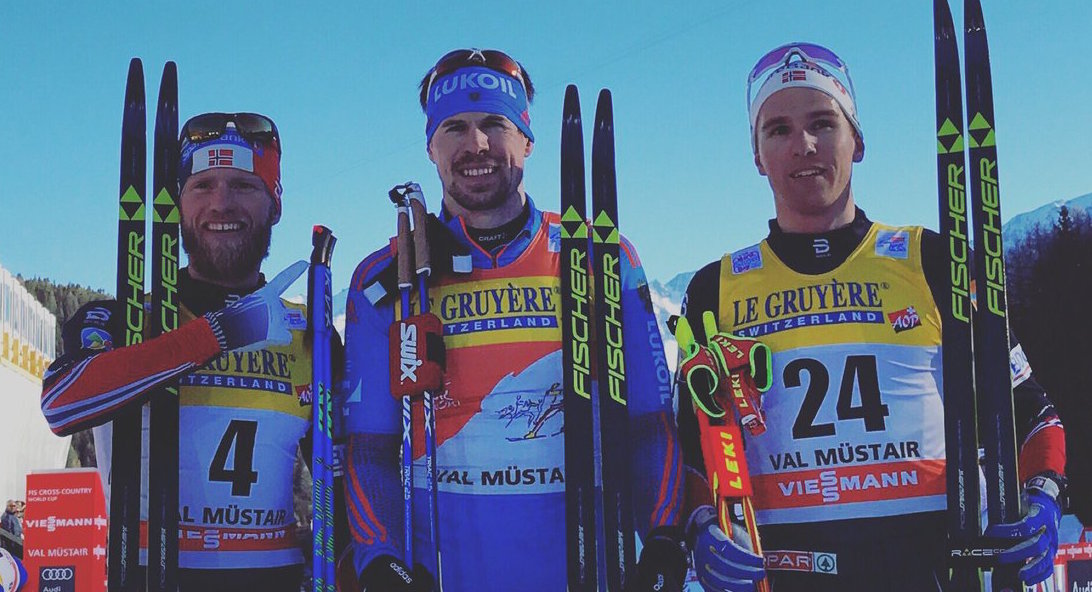
The men’s 10 k classic mass start podium at Stage 2 of the 2017 Tour de Ski in Val Müstair, Switzerland, with Russia’s Sergey Ustiugov (c) in first, Norway’s Martin Johnsrud Sundby (l) in second, and Norway’s Didrik Tønseth (r) in third. (Photo: FIS Cross Country/Twitter)
FIS Cross-Country Tour de Ski Stage 2 (Val Müstair): 5/10 k classic mass starts
There was a lot of jostling between Russia’s Sergey Ustiugov and Norway’s Martin Johnsrud Sundby, with the latter leading early and the Russian not letting him get too complacent up front, but ultimately, Ustiugov was the first across the line in the men’s 10-kilometer classic mass start, the second stage of the Tour de Ski in Val Müstair, Switzerland.
Ustiugov put himself back ahead of Sundby with fewer than 2 k to go and held a sizable lead to the finish, crossing in 24:50, while Sundby finished second, 1.9 seconds back.
Norway took second through fourth with Didrik Tønseth in third (+2.3) and Sjur Røthe in fourth (+3.3), while home-crowd favorite Dario Cologna of Switzerland settled for fifth (+5.5) after racing in the top three for much of the race.
The top 13 finishers all ended up within 10 seconds of Ustiugov at the finish, with Finland’s Matti Heikkinen in sixth (+5.6), Sweden’s Marcus Hellner in seventh (+6.0), and Canada’s Alex Harvey in eighth (+7.0).
With a six place on Saturday and eighth on Sunday, Harvey is currently third overall in the Tour, 59.6 seconds behind Ustiugov in first and 40.7 seconds behind Sundby in second (Sundby trails Ustiugov in the overall by 18.9 seconds.)
Finland’s Iivo Niskanen made it into the top 10 on Sunday in ninth (+7.0), as did the fourth Norwegian, Simen Hegstad Krüger in 10th (+7.3).
Devon Kershaw made big strides in moving up to 27th (+42.9) for 32nd overall in the Tour (+2:22.5), Graeme Killick placed 33rd (+49.3) and Len Valjas 38th (+54.3) for Canada. Valjas is currently 26th overall (+2:13.5) and Killick 36th (+2:29.5) in the Tour.
Erik Bjornsen led the U.S. men in 42nd (+59.9) for 42nd overall (+2:41.2). Noah Hoffman placed 46th (+1:13) and is currently 48th in the Tour (+2:57.4) and Simi Hamilton (+3:14.8) was 75th out of 78 finishers. A sprinter, Hamilton planned to withdraw from the Tour after this stage for a training block.
Norway’s Ingvild Flugstad Østberg (top and bottom center) celebrates her win in Stage 2 of the 2017 Tour de Ski, the women’s 5 k classic mass start, which she won over teammate Heidi Weng (l) and Finland’s Krista Parmakoski (r). Østberg currently leads the overall Tour by more than 10 seconds over Weng with seven stages to go. (Photo: FIS Cross Country/Twitter)
[UPDATED] In the women’s 5 k classic mass start, Ingvild Flugstad Østberg rebounded from Saturday, in which she was eliminated in the semifinals for seventh place in the freestyle sprint, with a seven-second victory over Norwegian teammate Heidi Weng.
Østberg finished first in 13:21.2, Weng took second for her second-straight podium of the Tour, and Finland’s Krista Parmakoski finished third (+11.4).
American Jessie Diggins raced to eighth (+32.6) to maintain her position in sixth overall in the Tour. Østberg took the Tour lead after two stages by 10.3 seconds over Weng. Sweden’s Stina Nilsson, who won Saturday’s sprint, is third, 23.8 seconds back from Østberg, while Parmakoski improved to fourth (+42.0). Norway’s Kathrine Rolsted Harsem placed seventh on Sunday for fifth overall (+51.6), and Diggins 1:01 back in sixth.
The second American in the top 20, Kikkan Randall raced to 19th (+42.4). Also for the U.S., Sadie Bjornsen finished outside the points for the first time this season in 35th (+1:02.6), Sophie Caldwell was 38th (+1:09.4), Rosie Brennan 39th (+1:10.5), and Liz Stephen improved to 44th (+1:21.2).
Overall, Randall is currently 15th (+1:45.9), Caldwell 22nd (+2:03.3) — although Caldwell planned to withdraw from the Tour after Stage 2. Bjornsen is 25th (+2:05.4), Brennan 41st (+2:33.1) and Stephen 46th (+2:49.9).
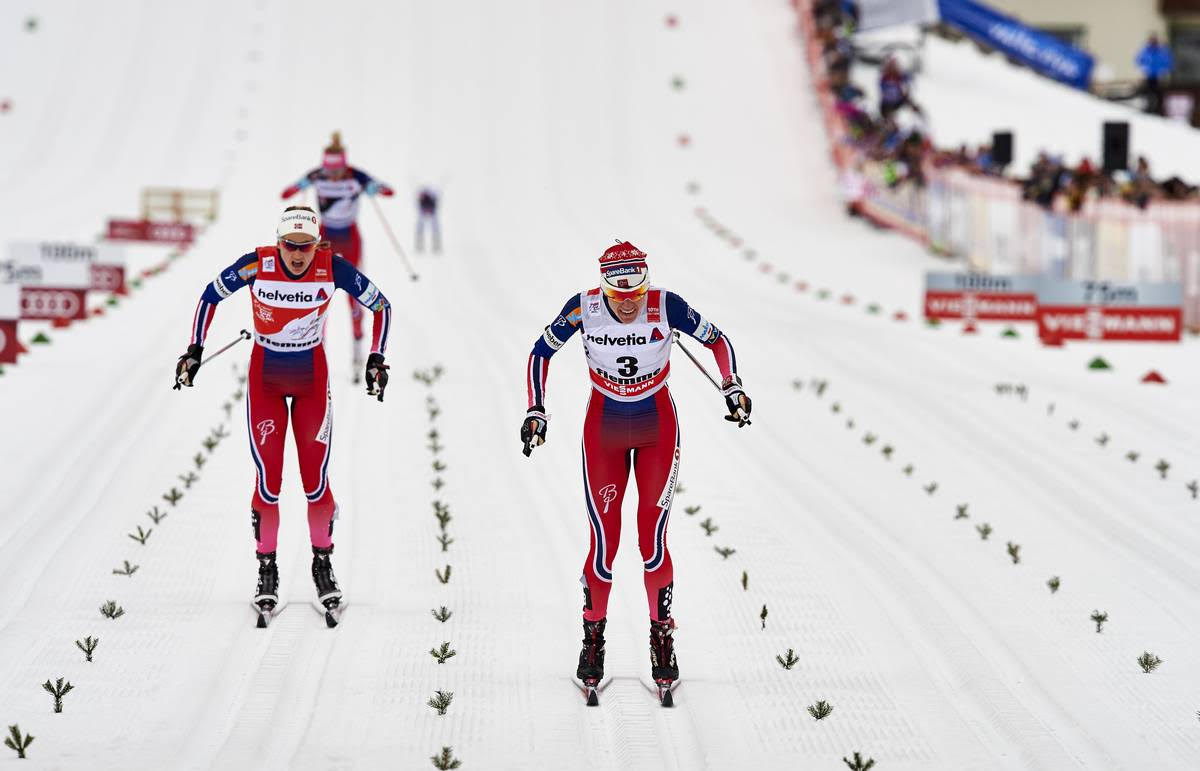
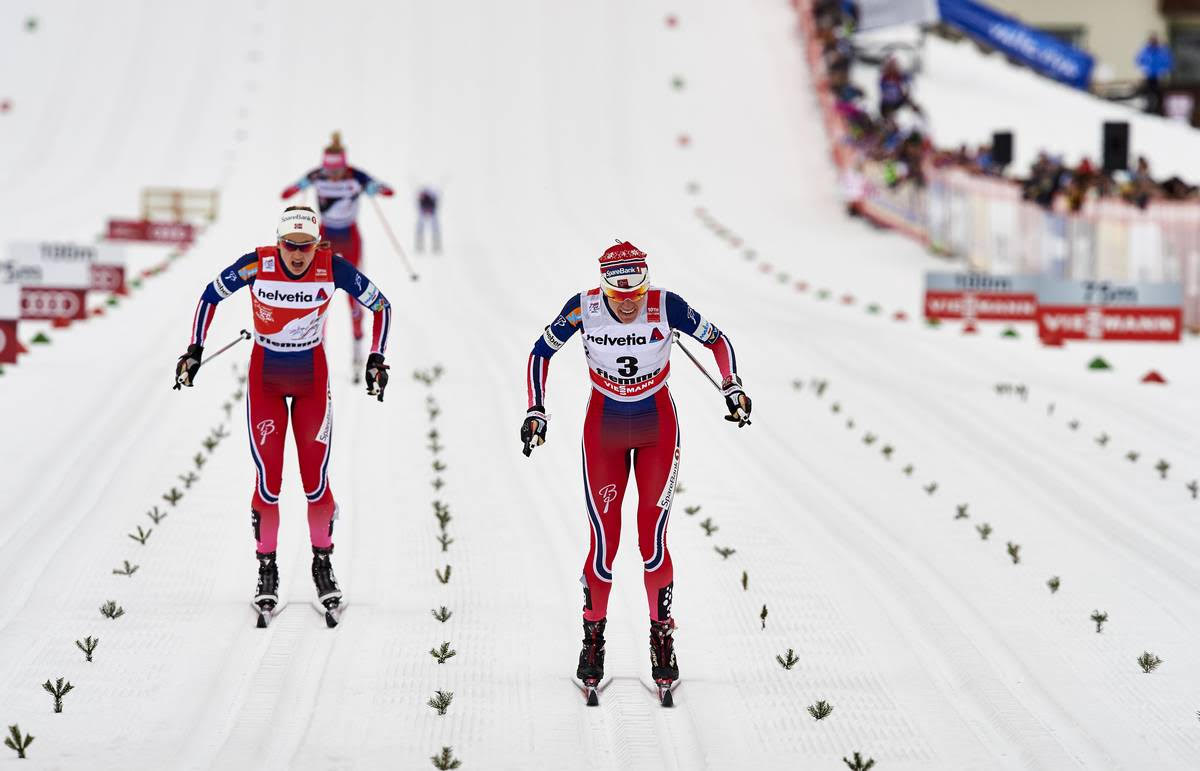
Heidi Weng (r) outlasts Norwegian teammate Ingvild Flugstad Østberg (l) in the final meters of the 10 k classic mass start to win Stage 7 of the Tour de Ski in Val di Fiemme, Italy. It was Weng’s first-career World Cup victory after 37 World Cup podiums. Norway swept the podium with Therese Johaug (behind) finishing 6.2 seconds back in third. (Photo: Madshus/NordicFocus)
In the aftermath and celebration of the U.S. women crashing the Norwegian podium party this week at the Tour de Ski, it’s easy to miss the continual second-fiddle performance of Norway’s Heidi Weng. A perennial-podium finisher on the World Cup, she’s landed on the second and third steps 37 times in her career, according to an International Ski Federation (FIS) press release (including five times in six stages before Saturday). However, it’s her inability to the reach the top that’s been a head scratcher.
Saturday in Val de Fiemme, Italy, at the seventh of eight stages in the Tour, she ended that streak, holding off Norwegian teammate and Tour leader, Ingvild Flugstad Østberg, in the final stretch of the 10-kilometer classic mass start to eke out a 0.8-second victory in 29:16.3.
From the start, the lead pack consisted of three Norwegians — Weng, Østberg and Therese Johaug — and Finland’s Krista Parmakoski. Johaug led early at 1 k, and Østberg came through the timing point first at 2.5 k. There, the four had already started to create a small gap on Sweden’s Charlotte Kalla and Switzerland’s Nathalie von Siebenthal, 1.4 and 1.9 seconds back, respectively, while another Finn, Kerttu Niskanen, skied another second back in seventh.
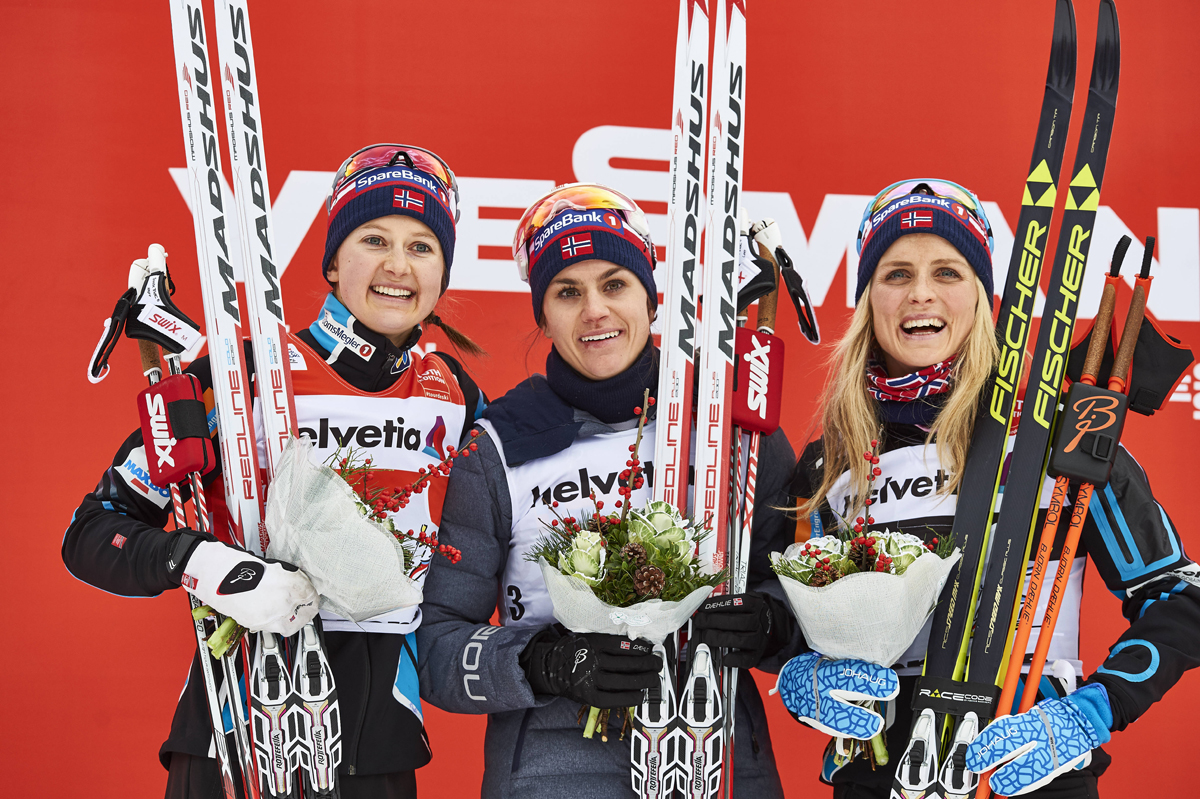
Heidi Weng (c) topped the podium for the first time in her career on Saturday at Stage 7 of the Tour de Ski in Val di Fiemme, Italy. She beat Norwegian teammates Ingvild Flugstad Østberg (l) in second and Therese Johaug (r) in third in the 10 k classic mass start. (Photo: Fischer/NordicFocus)
One kilometer later in the four-lap race, the lead four had put nearly six seconds between themselves and the three-woman chase group, with American Sadie Bjornsen close behind them in eighth.
At the halfway point, Parmakoski led a train with Weng, Østberg and Johaug, respectively, while Niskanen trailed by 12 seconds in fourth. Kalla was 16.4 seconds back in fifth and Bjornsen 17.4 seconds behind in sixth.
The frontrunners’ gap to Niskanen grew to nearly 40 seconds by 8.5 k, while Kalla skied another 10 seconds back in fifth, just ahead of Italy’s Virginia De Martin Topranin. Austria’s Teresa Stadlober followed another 2 seconds back in eighth while Bjornsen hung in ninth, 3.3 seconds later.
“I felt amazing for 7k out there today, at which point I just pushed a little too hard on the uphill, and took the next 2k to recover,” Bjornsen explained in a post-race email.
Parmakoski faded over the next kilometer and a half before the finish and left the three Norwegians to battle for the podium. With about 1 k to go, Johaug’s skis slipped on a small uphill, leaving Østberg and Weng to fight for first. Coming down the final stretch into the stadium, Weng used a draft to slingshot around Østberg and out-double pole her in the final 100 meters to the finish, with Johaug settling for third, 6.2 seconds after Weng.
“I cannot believe it, it is so crazy and hard to describe it. I was the best today and I still cannot believe it,” Weng said in a post-race interview with FIS. “I followed Ingvild’s track in the last uphill. I had stiff legs in the downhills. I was just focused on the finish.”
Parmakoski finished the race alone in fourth (+17.4), Kalla took fifth (+55.1) and Niskanen was sixth (+59.0). Topranin took seventh (+1:03.8), Stadlober was eighth (+1:06.7), and Bjornsen finished ninth (+1:12.6), 4.3 seconds ahead of Finland’s Laura Mononen in 10th.
“Conditions were incredibly tricky out there with icing skis on the uphill, but we all managed,” Bjornsen recalled. “Sometimes you just have to accept the challenge and find a way to make it work. It made a world of difference to have some skis that were fast enough to keep up, so the minor challenges became small! I have to give you a huge thanks to the service team for giving me skis to compete today!”
Bjornsen 12th Overall, Diggins Still 10th
Sadie Bjornsen (U.S. Ski Team) leads Switzerland’s Nathalie von Siebenthal during the 10 k classic mass start at Stage 7 of the Tour de Ski in Val di Fiemme, Italy. (Photo: Fischer/NordicFocus)
On this day, U.S. Ski Team Women’s Coach Matt Whitcomb observed, “Every team had their skiers clearing their skis at the top of each hill,” he said on the phone. Dry tracks and klister conditions made for continual icing and skiers seeking to free their skis up before the descents.
In spite of the challenges, Bjornsen clinched her third top-10 of the Tour (after placing seventh in the skate sprint and ninth in the 5 k freestyle pursuit) and improved from 13th to 12th in the overall standings, 9:32.6 behind Østberg.
“I struggled with classic in the middle of this tour, with a fall in the classic qualifier and then slow and slick skis in the classic mass start in Obersdorf … so it feels nice to be back where I feel like I belong,” Bjornsen wrote.
As for her last lap, “She said on the final lap she went a little bit too hard and got a little too fired up and paid the price, and had to back it off a little bit,” Whitcomb explained.
He viewed that much energy at Stage 7 as “a great sign. To be fired up in any way after seven stages bodes well for how your body is absorbing things,” he said. “She’s still mentally engaged, so she’s probably still physically engaged, too.”
Looking ahead to Sunday’s climb, Whitcomb expects Bjornsen to turn some heads.
“We’re excited to see what she can do in the climb. She’s in great shape and she’s a great skier so I think she can do really well tomorrow,” he said.
“The only other year I have done the TDS is last year, and I dropped out after 4 stages,” Bjornsen explained. “I can’t wait to make it to the top and celebrate the achievement, but also take the energy to celebrate Sophie and Jessie’s huge achievements these last few days!”
Jessie Diggins cooling down after the classic sprint at Stage 4 of the Tour de Ski in Oberstdorf, Germany. (Photo: Harald Zimmer)
Coming off her first World Cup victory — the second for the U.S. in this Tour — Jessie Diggins placed 17th in Saturday’s mass start to maintain her hold on 10th in the Tour, 9 minutes back.
“She is in a great place, very confident, and feeling good in the races,” Whitcomb said.
In an email, she started by focusing on the positives: “I’m super proud of Sadie for hanging up there and especially proud of Rosie’s first WC point of the year!” Diggins wrote, referring to teammate Rosie Brennan finishing 30th on Saturday.
“My wax was not the wax I was hoping for today and made for a very challenging race, but I’m so excited for tomorrow!” Diggins continued.
Liz Stephen placed 21st (+2:01.7) on Saturday, and Tour rookies Brennan and Caitlin Gregg followed in 30th (+3:05.6) and 41st (+5:03.9) for the U.S.
Like Diggins’ victory from the previous day, the elation of finally finding the top podium spot clearly brought out a whirlwind of emotions for Weng, telling NRK, “I thought it was not possible. I’m so used to being 2-3-4. It is so big.”
Stepping away from the race as the fastest person that day posed a difficult reality for Weng to comprehend.
“Seeing ‘Heidi Weng’ at the top of the list is very unusual,” she continued. “That has not happened before, and I never thought it would happen.”
With her victory, Weng maintains a firm grasp on third in the Tour standings and will start the final climb 2:27 behind Østberg.
The Tour leader since Stage 3, Østberg padded her lead by not only finishing five seconds ahead of Johaug, the current World Cup leader and overall runner-up in the Tour with one stage to go, but also by collecting the mid-race bonus seconds. Johaug will start 39 seconds after Østberg in the final climb.
On Saturday, both Østberg and Johaug were happy for their teammate, and proud to be in their current positions as the end of 10 days of racing draws to a close.
“I am really happy for Heidi to win her first World Cup,” Østberg told FIS. “I am very proud to be on the podium on all of the Tour de Ski stages. I would not believe before the Tour I could lead before the last stage by almost 40 seconds.”
Final-Stage Hill Climb
Sunday’s final stage, a 9 k freestyle pursuit-style hill climb up Alpe Cermis includes gradients as high as 26.5 percent and over 1,600 feet of total climbing, with the majority of that coming in the final 3 k.
Another one of the top finishers in the final stage, Stephen skied the fourth-fastest time up Alpe Cermis last year to place fifth overall in the Tour. After placing 21st on Saturday, she’ll start the final climb 25th, about 12 1/2 minutes after Østberg.
“She hasn’t had a great tour; the format [this year] is tricky for her, but she just hasn’t put together races she’s satisfied with,” Whitcomb said, adding that on Sunday, “She’s poised to ski very well, and I would be surprised if her goal wasn’t to win.”
If all goes according to plan, the U.S. will have seven skiers, five women and two men, finish the tour this year — the most yet.
“It’s a cool thing that we’ve got so many athletes ready to start tomorrow’s stage,” Whitcomb said. “That’s a great thing for the team.”
OBERSTDORF, Germany — Therese Johaug jetted to another distance victory on Wednesday in the 10-kilometer classic mass start, but not without a tenacious teammate keeping her on her toes, as Ingvild Flugstad Østberg placed second to stay in the Tour de Ski leader’s bib. Then in the men’s 15 k, Kazakhstan’s Alexey Poltoranin outlasted Dario Cologna of Switzerland by 0.1 seconds for the win, and Italy’s Francesco de Fabiani came on strong for third.
Much thanks to Marcel Hilger, who shared the following photos from Stage 5 of the Tour.
Start of the women’s 10 k classic mass start at Stage 5 of the Tour de Ski in Oberstdorf, Germany. (Photo: Marcel Hilger)
Therese Johaug sets the pace early in the 10 k classic mass start at Stage 5 of the Tour de Ski in Oberstdorf, Germany. (Photo: Marcel Hilger)
Therese Johaug (l) leads Norwegian teammates Ingvild Flugstad Østberg (c) and Heidi Weng (r) during the 10 k classic mass start at Stage 5 of the Tour de Ski in Oberstdorf, Germany. (Photo: Marcel Hilger)
Therese Johaug (front) leads Norwegian teammates Ingvild Flugstad Østberg and Heidi Weng during the 10 k classic mass start at Stage 5 of the Tour de Ski in Oberstdorf, Germany. (Photo: Marcel Hilger)
Norway’s Therese Johaug racing to the win in the 10 k classic mass start at Stage 5 of the Tour de Ski in Oberstdorf, Germany. (Photo: Marcel Hilger)
Norway’s Therese Johaug after winning the 10 k classic mass start at Stage 5 of the Tour de Ski in Oberstdorf, Germany, in January. (Photo: Marcel Hilger)
The all-Norwegian women’s podium at Stage 5 of the Tour de Ski: (from left to right) runner-up Ingvild Flugstad Østberg, winner Therese Johaug and Heidi Weng in third in the 10 k classic mass start in Oberstdorf, Germany. (Photo: Marcel Hilger)
Norway’s Therese Johaug after winning the 10 k classic mass start at Stage 5 of the Tour de Ski in Oberstdorf, Germany. (Photo: Marcel Hilger)
Norway’s Ingvild Flugstad Østberg after finishing second in the 10 k classic mass start at Stage 5 of the Tour de Ski in Oberstdorf, Germany. She remains first in the Tour standings, 12 seconds ahead of teammate Therese Johaug (not shown) with three stages to go. (Photo: Marcel Hilger)
Fellow U.S. Ski Team members Sadie Bjornsen (l) and Jessie Diggins (r) started near each other in Wednesday’s 10 k classic mass start at Stage 5 of the Tour de Ski in Oberstdorf, Germany. Diggins went on to place 23rd and Bjornsen 26th for 12th and 14th overall, respectively, in the Tour standings. (Photo: Marcel Hilger)
American Jessie Diggins (10) skiing in the pack with Finland’s Laura Mononen (9) and Germany’s Sandra Ringwald (15) during the 10 k classic mass start at Stage 5 of the Tour de Ski in Oberstdorf, Germany. (Photo: Marcel Hilger)
Sadie Bjornsen racing to 26th in the 10 k classic mass start at Stage 5 of the Tour de Ski in Oberstdorf, Germany. (Photo: Marcel Hilger)
Liz Stephen racing to 33rd in the 10 k classic mass start at Stage 5 of the Tour de Ski in Oberstdorf, Germany. (Photo: Marcel Hilger)
Liz Stephen racing to 33rd in the 10 k classic mass start at Stage 5 of the Tour de Ski in Oberstdorf, Germany. (Photo: Marcel Hilger)
Rosie Brennan on her way to 35th in the 10 k classic in Oberstdorf, Germany, as part of the 2016 Tour de Ski. Brennan is an athlete representative to U.S. Ski & Snowboard, and recently participated in a call between the leadership of the International Olympic Committee and the World Anti-Doping Agency, with 50 other athlete representatives. That athletes had the chance to ask questions about current doping investigations and anti-doping policy. (Photo: Marcel Hilger)
Rosie Brennan on her way to 35th in the 10 k classic mass start at Stage 5 of the Tour de Ski in Oberstdorf, Germany. (Photo: Marcel Hilger)
American Rosie Brennan (r) leads Slovenia’s Alenka Cebasek (c) and U.S. teammate Sophie Caldwell during the 10 k classic mass start at Stage 5 of the Tour de Ski in Oberstdorf, Germany. (Photo: Marcel Hilger)
Caitlin Gregg racing to 49th in the 10 k classic mass start at Stage 5 of the Tour de Ski in Oberstdorf, Germany. (Photo: Marcel Hilger)
Caitlin Gregg racing to 49th in the 10 k classic mass start at Stage 5 of the Tour de Ski in Oberstdorf, Germany. (Photo: Marcel Hilger)
Ida Sargent on her way to 55th in the 10 k classic mass start at Stage 5 of the Tour de Ski in Oberstdorf, Germany. (Photo: Marcel Hilger)
Ida Sargent on her way to 55th in the 10 k classic mass start at Stage 5 of the Tour de Ski in Oberstdorf, Germany. (Photo: Marcel Hilger)
Ida Sargent on her way to 55th in the 10 k classic mass start at Stage 5 of the Tour de Ski in Oberstdorf, Germany. (Photo: Marcel Hilger)
The men’s 15 k classic mass start podium at Stage 5 of the Tour de Ski in Oberstdorf, Germany: (from left to right) Swiss runner-up Dario Cologna, winner Alexey Poltoranin (Kazakhstan), and Francesco de Fabiani (Italy) in third. (Photo: Marcel Hilger)
Norway’s Martin Johnsrud Sundby (l) and Emil Iversen (10) during the 15 k classic mass start at Stage 5 of the Tour de Ski in Oberstdorf, Germany. (Photo: Marcel Hilger)
Devon Kershaw racing to 29th in the 15 k classic mass start at Stage 5 of the Tour de Ski in Oberstdorf, Germany. (Photo: Marcel Hilger)
American Noah Hoffman (l) and Canadian Ivan Babikov (r) skiing together during the 15 k classic mass start at Stage 5 of the Tour de Ski in Oberstdorf, Germany. Babikov went on to place 34 and Hoffman finished 41st. (Photo: Marcel Hilger)
Finland’s Sami Jauhojärvi (38), and Canadian Ivan Babikov (37) during the 15 k classic mass start at Stage 5 of the Tour de Ski in Oberstdorf, Germany, in January. (Photo: Marcel Hilger)
Erik Bjornsen on his way to 56th in the 15 k classic mass start at Stage 5 of the Tour de Ski in Oberstdorf, Germany. (Photo: Marcel Hilger)
American Erik Bjornsen (32), Sweden’s Oskar Svensson (42), and France’s Jean Marc Gaillard (23) during the 15 k classic mass start at Stage 5 of the Tour de Ski in Oberstdorf, Germany. Bjornsen went on to place 56th. (Photo: Marcel Hilger)
Andy Newell during the 15 k classic mass start at Stage 5 of the Tour de Ski in Oberstdorf, Germany. He did not finish after dropping out between 3 and 4 k. (Photo: Marcel Hilger)
The women’s 10 k classic mass start podium at Stage 5 of the Tour de Ski in Oberstdorf, Germany, with three Norwegians: (from left to right) runner-up Ingvild Flugstad Østberg (still the overall Tour leader), winner Therese Johaug, and Heidi Weng in third. (Photo: Fischer/NordicFocus
OBERSTDORF, Germany – The women’s race in the fifth stage of the Tour de Ski on Wednesday did not offer any radically new occurrences, but allowed Norway’s Ingvild Flugstad Østberg to keep the overall Tour lead despite finishing second to her biggest threat, teammate Therese Johaug.
While Johaug outpaced Østberg in the 10-kilometer classic mass start on Wednesday, doing so by a margin of 9.9 seconds wasn’t quite enough to take back the Tour leader’s bib. Fifty-five women raced around the five-lap course, with the loop being the same as Tuesday’s 1.2 k sprint course except for an extra hill in the middle.
The powerful trio of Norwegians (Østberg, Johaug and Tuesday’s sprint runner-up Heidi Weng) started at the front of the mass start and stayed there, immediately setting the pace for the rest of the field. Based on their Tour rankings heading into the race, Østberg wore bib number 1 and started in the front row, alongside Johaug in second and Weng in bib 3.
As Johaug quickly made her way to the frontmost position on the first climb, there was a moment of déjà vu back to the last classic mass start of the Tour.
Stage 2, a 15 k mass start in Lenzerheide, Switzerland, was a boringly comfortable victory for Johaug. She broke off the front of the pack just a kilometer into the race and continued to ski alone the rest of the race, unchallenged. She won in just over 41 minutes, and the next-closest finisher, Østberg, was almost 38 seconds behind her. Weng took third a minute and 16 seconds back.
Therese Johaug leads Norwegian teammates Ingvild Flugstad Østberg (behind) and Heidi Weng (r) during the 10 k classic mass start on Wednesday at Stage 5 of the Tour de Ski in Oberstdorf, Germany. Johaug went on win by 9.9 seconds ahead of Østberg. (Photo: Fischer/NordicFocus)
But from the beginning of Stage 5, Østberg and Weng made it clear that they were not going to let Johaug get away with an easy win. They stuck to her like glue on the uphills and downhills alike.
Despite the narrow, compacting course, just a couple kilometers into the race, these three began to put space between themselves and the rest of the pack. Naturally switching positions and sharing the workload up front, they steadily lengthened their distance ahead of the rest of the field. The nature of the 2-kilometer loop made it like a hamster wheel; with three red Norwegian suits buzzing around, then a break, followed by a battalion for fourth place.
The 5.3-kilometer mark held a bonus-second sprint, which Johaug reached first for 15 key bonus seconds. Østberg in second received 12 bonus seconds, and Weng in third took 10 bonus seconds.
There, just beyond the halfway point, the three Norwegians had put 25 seconds between themselves and the chase group — led by Sweden’s Charlotte Kalla at the time — vying for fourth.
On the penultimate lap, Kalla wiped out on a downhill, sending her and Swedish teammate, Stina Nilsson, into the grass off the track. Kalla recovered but finished eighth, 1:33.1 behind Johaug, thus slipping from fourth to sixth in the Tour. This was the second day in a row that Kalla crashed on a downhill in Oberstdorf, which took her out of contention in both races.
Therese Johaug double poles to the clear-cut win, beating Norwegian teammate Ingvild Flugstad Østberg by 9.9 seconds, in Stage 5 of the Tour de Ski: the 10 k classic mass start in Oberstdorf, Germany. (Photo: Fischer/NordicFocus)
Over the last few laps, Weng struggled to keep contact with Johaug and Østberg. Johaug had upped the tempo around the halfway point and while Østberg responded, Weng began to slip behind. About 3 seconds back at 5.3 k and trailing Johaug by 6 seconds two kilometers later, Weng closed the gap to 4.2 seconds at the start of the last lap.
However, less than a kilometer later at 8.75 k, she was 10 seconds out of the fight for first. Østberg continued to stick with Johaug, climb after climb — until the last significant uphill on the course, where Johaug successfully popped her over the top. Three-and-a-half seconds ahead by 9.3 k, Johaug widened her gap on Østberg over the last rolling hill and into the stadium, beating her by 9.9 seconds at the line.
“At the end, I just had to fight as hard as I could,” Østberg told reporters afterward. “But she was too strong at the end.”
Weng followed nearly 10 seconds later in third (+19.9) and a fourth Norwegian Ragnhild Haga won the race for fourth, 0.7 seconds ahead of Finland’s Anne Kyllönen in fifth. Sweden’s Ida Ingemarsdotter finished 1.4 seconds later in sixth (+1:13.4), Finland’s Kerttu Niskanen was seventh (+1:15) ahead of Kalla, who came through 18 seconds later in eighth.
When asked if she was surprised about Østberg’s ability to stay with her, Johaug replied, “Ingvild is in really good shape, and I have been training with her so much in the summer and autumn, so I know that she is a strong girl,” she told reporters after the race.
With bonus seconds factored in, Østberg remained 12.2 seconds ahead in the Tour. Weng still sits in third overall, 2:33.1 minutes out of first. Kyllönen is fourth (+4:44.4), Niskanen fifth (+5:14.5) and Kalla four-tenths of a second farther back in sixth (+5:14.9).
“It was very tough,” Weng recalled, “But I [didn’t] lose so many seconds and it’s the best distance race for me this year so that was very good.”
Despite losing the race, Østberg was thrilled to stay ahead of Johaug overall.
“It’s a great day,” she told reporters. “Maybe my best 10 k ever, and ten seconds or something behind Therese … That’s incredible. It was a fun day to race her in Oberstdorf.”
Asked how she was able to stay with Johaug, who has won every distance race longer than 5 k this season, Østberg replied, “I was a bit surprised. I felt strong throughout the day and had really good skis. I am really satisfied with the day.
“There are three really hard competitions left now, and it’s a long time since I have finished the whole Tour,” added Østberg, initially known for her sprinting. “I am just happy for every day that I can feel strong and my body still feels really good.”
The Tour continues on Friday in Toblach, Italy, with the women’s 5 k and men’s 10 k freestyle individual starts. It wraps up with the final two stages in Val di Fiemme, Italy, with another 10 k classic mass start on Saturday and final freestyle climb up Alpe Cermis on Sunday.
“I know that I have to fight with [Ingvild] to get the first position to the top of Alpe Cermis,” Johaug said. “But it’s really cool that we are so close to each other.”
Diggins Ranks 12th, Bjornsen 14th Overall
Fellow U.S. Ski Team members Sadie Bjornsen (l) and Jessie Diggins (r) started near each other in Wednesday’s 10 k classic mass start at Stage 5 of the Tour de Ski in Oberstdorf, Germany. Diggins went on to place 23rd and Bjornsen 26th for 12th and 14th overall, respectively, in the Tour standings. (Photo: Marcel Hilger)
In the scheme of the overall standings, Jessie Diggins leads the U.S. in 12th (+7:01.7) after placing 23rd on Wednesday. Starting in bib 10, she skied in the top 10 for the first lap then slipped to 13th, 19 seconds behind the leaders, by 3.3 k.
About halfway through the 10 k, Diggins and teammate Sadie Bjornsen remained in the top 20, with Bjornsen (in bib 13) skiing in 17th and Diggins in 20th, 47 and 54 seconds back, respectively.
“I took it out hard, and I was really happy with my first lap, and I think I paced OK on the second lap,” Diggins said during in-person interview afterward. “But more than that, what I struggled with was not being decisive enough in ski testing and being a little timid about it, and therefore I did not ask for enough kick wax. I’m not blaming the wax staff. It was my bad to not ask for more, but I did not have enough grip on my skis as a result of that.”
In certain past races when she lacked kick, Diggins recalled falling apart.
“Today I was like, ‘You know what? No! I am fighting. I am in it. I am in a tough kind of day, I want to stay there so bad,’ ” she said. “So I just herringboned, kept my head down, went for it, kept fighting until the very end, for every second that I could get the time, and I was really proud of that.”
At 6.75 k, Bjornsen found herself in 23rd and ultimately placed 26th (+2:23.8), 7.6 seconds after Diggins, for 14th in the Tour (+7:29.6).
After the race, Bjornsen told FasterSkier she struggled with both kick and glide.
“It was really challenging today,” Bjornsen said. “Unfortunately, I didn’t have the skis to be able to compete with the field and that makes it extra hard; you are just kind of working against something. At the end of the day, I have to remember that I’m a good classic skier and at this level, the difference between a race like a couple of days ago, and a race today can sometimes come down to what is under your feet. All you can you do is be the most prepared with what you have.”
Behind them, teammates Liz Stephen finished 33rd on the day for 28th overall (+9:26.1), Rosie Brennan was 35th (for 40th in the Tour), and Sophie Caldwell, coming off her first World Cup win on Tuesday, placed 36th for 23rd overall (+8:31.3), though Caldwell does not plan on finishing the Tour.
Caitlin Gregg placed 49th on Wednesday (for 44th overall) and Ida Sargent finished 55th (for 55th overall).
“My energy feels really good,” Stephen told FasterSkier. “This course was challenging on the downhills for me. A couple of those, I was very timid on them today. It probably cost me quite a few places.”
At the same time, Stephen was pleased with her pacing — just disappointed with her descending.
“I had great skis today, so my wax tech is definitely doing a great job, and I’m on a high from Sophie’s win yesterday,” Stephen added. “We are roommates this Tour and neither of us could sleep [last night]. I felt like it was half my win yesterday. I was just so happy for her. So it’s definitely a cool feeling and this Tour, it is so fun.”
Chelsea Holmes (APU) leads the pack in Sunday’s 10 k classic mass start at the SuperTour in Sun Valley, Idaho, followed by Caitlin Patterson (CGRP), Liz Guiney (CGRP), Kaitlynn Miller (CGRP), Veronika Mayerhofer (University of Utah) Katharine Ogden (SMS/USST), Rosie Frankowski (APU), Petra Hycincova (University of Colorado-Boulder), and Becca Rorabaugh (APU).
SUN VALLEY, Idaho — How much of ski racing is at the behest of the inner individual and how much rests upon the support of a team? For Chelsea Holmes of Alaska Pacific University (APU), the winner of the women’s SuperTour 10-kilometer classic mass start on Sunday at the Lake Creek trails, it’s a little of both.
“I’ve worked really hard on classic skiing this season and spent a ton of time on Eagle Glacier [near Anchorage]. Yesterday proved to me that what I’m doing has paid off and what I’m capable of is inside of me. It was good mental preparation [for today].”
A boost of confidence — and a cup of holiday spirit, “I drank some eggnog to get in the mood,” Holmes explained — the 28-year-old Girdwood, Alaska, native felt ready to lead Sunday’s SuperTour classic mass start.
“I skied with [teammate] Caitlin [Patterson] for most of the race. I knew what I wanted to do and she just kept popping up at the bottom of those downhills,” Holmes said. “But that’s what racing is, it’s so mental.”
With 49 athletes lined up at the start of the mass start, and Holmes in bib number 1 at the front, the individual mental game was high even before the race winner and competitors set their skis in motion on the 4 1/2-lap course.
The pressure only increased after the starting gun sounded, as Holmes took it out hard in front.
Chelsea Holmes (APU) takes it out hard in the start of the women’s SuperTour 10 k classic mass start on Sunday in Sun Valley, Idaho.
“Chelsea really took off at the beginning with a nice high tempo and going for it,” Patterson, of the Craftsbury Green Racing Project (CGRP) said. She started in bib 2.
“I clung on to her and hung on. Then I realized we dropped most everyone else,” Patterson added.
The two gapped the rest of the field by a substantial amount for three of the 2.2 k laps. A climber by nature, Holmes led most of the uphills.
“Climbing is my thing,” Holmes said. “I just tried to go with it and do what was comfortable for me.”
Finally, with a lap to go, Holmes gunned it and won in 31:29, beating APU teammate Becca Rorabaugh by 9.7 seconds. Rorabaugh passed Patterson in the final climb to claim second place.
Even with her solid striding and lead over the field, Holmes pointed to her mental strength and team support as part of the process in her first victory of the season. In four SuperTour races so far this winter, she had finished in the top five in all of them, and reached the podium twice (Holmes was second in the 10 k freestyle in West Yellowstone).
“It was hard … You’re going to doubt yourself at times and I definitely had those moments today of thinking ‘Maybe I don’t have it,’ ” Holmes reflected. “But it just so happened that there was a little voice in there and there was a nice presence on the side of the trail right when I needed it.”
“I definitely had those moments today of thinking ‘Maybe I don’t have it,’ but it just so happened that there was a little voice in there and there was a nice presence on the side of the trail right when I needed it.” — Chelsea Holmes, women’s 10 k classic mass start winner at the Sun Valley SuperTour
Becca Rorabaugh (APU) (l) charges the final climb of the women’s SuperTour 10 k classic mass start. Rorabaugh went on to pass Patterson (CGRP) for second place overall.
Similarly, Rorabaugh found race fortitude in herself and her team on-site. Instead of it coming from the trail side, she found the most valuable support from Holmes ahead of her.
“I was a little to far from the front pack and had people breathing down my neck for a lot of the middle of the race, which was mentally stressful,” Rorabaugh said. “But I could see the front pack and so I was still able to focus on moving forward.”
A little off the front pack until the final lap, Rorabaugh, Saturday’s sprint winner, charged during the final hill.
“Here, you can see everything, so I could kind of get a gauge of where [Chelsea and Caitlin] were at throughout the race,” she explained. “The last time up the big hill, I was like ‘They’re not that far and I only have to do this one more time, so I’m going for it.’”
Patterson, who finished third, 16.3 seconds behind Holmes, also found the course advantageous and somewhat devising.
“It’s fun the way this course wanders around and is so open in the field,” Patterson, 25, said.
(Left to right): sixth place finisher Kaitlynn Miller (CGRP) (+54.6), fifth place finisher Rosie Frankowski (APU) (54.4), second place finisher Becca Rorabaugh (APU (+9.7), first place finisher Chelsea Holmes (APU), third place finisher Caitlin Patterson (CGRP) (+16.3), and fourth place finisher Veronika Mayerhofer (University of Utah) (+43.0) made up the top six for the women’s SuperTour 10 k classic mass start on Sunday in Sun Valley, Idaho.
“I’d get glimpses of my Green Team teammates and know that they were doing well,” she explained. “Likewise, [I] could see when people were catching up. Becca had a really strong finish and passed me at the end.”
The APU women weren’t the only ones with two podiums for the day. APU men Scott Patterson and Eric Packer also both earned a top three in the men’s 15 k.
“I’m really proud of our group,” APU Head Coach Erik Flora said. “We traveled with 16 athletes [to West Yellowstone and Sun Valley] and every single athlete had a moment in this trip where they shined. Whether it was a sprint race or distance race, a classic race or a skate race … everyone is going to go home happy and ready to work on what’s next.”
For most of them, that includes going back to Alaska to race at a few local events and preparing for U.S. Nationals in Houghton, Mich.
“Most of the athletes will fly right out of Sun Valley, the coaches will drive to Boise — there will definitely be some high fives [during the ride over],” Flora added.
“I’m just super proud of my team,” Holmes said. “It was so fun to see them do well and see how the group came together.”
Caitlin Patterson (CGRP) (l) edges Chelsea Holmes (APU) on the downhill back into the Lake Creek stadium on Sunday during the women’s SuperTour 10 k classic mass start in Sun Valley, Idaho.
Chelsea Holmes (APU) striding to a first place in the women’s SuperTour 10 k classic mass start on Sunday in Sun Valley, Idaho.
Liz Guiney (CGRP) (r) sets her sights on the tails of Anne Hart’s skis (SMST2) (l) during the women’s SuperTour 10 k classic mass start on Sunday in Sun Valley, Idaho while more competitors descend the hill behind her. Guiney went on to place ninth overall (+2:09.7) and Hart in eighth (+1:39.3).
Anne Hart (SMST2) (r) leads teammate Katharine Ogden (SMST2/USST), Rosie Frankowski (APU), Josefin Nilsson (University of Utah) Petra Hyncicova (University of Colorado Boulder) and Sloan Storey during the first lap of the women’s SuperTour 10 k classic mass start on Sunday in Sun Valley, Idaho. Hart finished eighth overall (+1:39.3), Ogden seventh (+1:08.6), Frankoski fifth (54.4) Rorabaugh second (+9.7) and Hyncicova tenth (+2:10.2).
Kaitlynn Miller (CGRP) sking her second lap of four and a half laps of the women’s SuperTour 10 k classic mass start on Sunday in Sun Valley, Idaho. Miller went on to place sixth overall, 54.6 seconds back from race leader Holmes (APU).
(Left to right): Veronika Mayerhofer (University of Utah) leads Kaitlynn Miller (CGRP) and Katharine Ogden (SMST2/USST) up the coach’s climb of the women’s SuperTour 10 k classic mass start on Sunday in Sun Valley, Idaho. Mayerhofer went on to finish fourth overall (+43.0), Miller sixth (+54.6) and Ogden seventh (+1:08.6).
Becca Rorabaugh (APU) snags second place during the women’s SuperTour 10 k classic mass start on Sunday in Sun Valley, Idaho.
Rosie Frankowski (APU) skiing her final lap for fifth place during the women’s SuperTour 10 k classic mass start on Sunday in Sun Valley, Idaho.
Thomas O’Harra won the day after his 19th birthday, and Brooke Dunnagan, Katharine Ogden and Emily Hyde repeated as 2015 champions on the third day of racing at U.S. Junior Nationals, in which the 5-, 10- and 15-kilometer classic mass starts took place on Friday at Auburn Ski Club in Soda Springs, Calif.
Below are some podium and race photos, courtesy of Mark Nadell/MacBeth Graphics (minus the U18 and U20 women). Check out his complete gallery here.
Junior Nationals wrap up Saturday with the women’s 3 x 3 k and men’s 3 x 5 k classic relays. Live timing | Live stream
The U16 women’s podium from Friday’s 5 k classic mass start at 2015 U.S. Junior Nationals at Auburn Ski Club in Soda Springs, Calif. (Photo: Mark Nadell/MacBeth Graphics)
The U16 men’s podium from Friday’s 5 k classic mass start at 2015 U.S. Junior Nationals at Auburn Ski Club in Soda Springs, Calif. (Photo: Mark Nadell/MacBeth Graphics)
The U18 men’s podium from Friday’s 10 k classic mass start at 2015 U.S. Junior Nationals at Auburn Ski Club in Soda Springs, Calif. (Photo: Mark Nadell/MacBeth Graphics)
The U20 men’s podium from Friday’s 15 k classic mass start at 2015 U.S. Junior Nationals at Auburn Ski Club in Soda Springs, Calif. (Photo: Mark Nadell/MacBeth Graphics)
Poland’s Justyna Kowalczyk essentially led from start to finish of Sunday’s 10 k classic mass start at the World Cup in Szklarska Poreba, Poland. (Photo: Fischer/NordicFocus)
It’s not easy being Justyna Kowalczyk — always breaking trail, always having the weight of Poland on her, and in a classic distance race at home on her birthday without any Scandinavians in the field? Forget about it.
Kowalczyk was easily the favorite for Sunday’s World Cup 10-kilometer classic mass start in Szklarska Poręba, Poland, nearly two years after she won the same race there. That didn’t make winning any easier.
Poland’s Justyna Kowalczyk breaking away to a victory in Sunday’s 10 k classic mass start at the World Cup in Szklarska Poreba, Poland. Russia’s Yulia Tchekaleva (behind) and Germany’s Denise Herrmann (second from l) remained closest to her for most of the race. (Photo: Fischer/NordicFocus)
With noticeably slower skis, lacking glide on pea-soup, 35-plus degree afternoon, Kowalczyk relied on kick and her unmistakable stride on her 31st birthday. That didn’t help her on the long downhill on the last third of each 2.7 k loop, but she was able to nail the two climbs.
“The person who first blazes trail, it costs a lot of strength and speed,” Kowalczyk’s said in a post-race interview with WP Poland, according to a translation. “Therefore, at the beginning of the second and third [lap] athletes stuck to me.”
Lucky for her, Kowalczyk’s kick wore off as she continued through the four-lap race — just as she was warming up. After immediately taking control and skiing off the front of the mass start, Kowalczyk couldn’t get more than a few strides ahead of Russia’s Yulia Tchekaleva on the first lap. By the downhill, Tchekaleva quickly soared up alongside Kowalczyk, then past her to lap through the stadium 0.6 seconds ahead in first.
Tchekaleva’s lead was short-lived. By the 4.2 k checkpoint, Kowalczyk had gapped her and everyone else by nearly 12 seconds; Tchekaleva was skiing in second and Germany’s Denise Herrmann was 13.4 seconds back in third. American Liz Stephen led a chase pack in fourth, another 10 seconds behind.
“I have never started on the first line of a World Cup mass start before, so that was really fun, and the pace went out hot, but I never got swallowed up in the mass like I think I would have if I had started back in the pack,” Stephen wrote in an email. “Justyna was on a mission today and just never looked back.
“The fans were so loud and into it out there today,” Stephen added, after eventually placing sixth, her career best in an outright World Cup. “Especially as it was Justyna’s birthday today, too.”
Nearly 30 seconds ahead of Tchekaleva early in the first lap, and 41 seconds up on Herrmann in third, Kowalczyk looked back occasionally — giving a glance back as before picking up the maximum bonus points at 6.9 k. Unless something tragic happened, this race was in the bag, but she didn’t let off until striding blissfully into the stadium for the last time.
Upon finishing first in 34:43.2 without anyone contenders in sight, Kowalczyk waved her arms in the air. Then she stopped, bent over her poles for a millisecond to catch her breath and looked back on the course, waiting patiently for Tchekaleva to follow in second.
Tchekaleva came through uncontested 41.8 seconds later, and another Russian Julia Ivanova rounded out the podium in third, 1:15.2 seconds back from Kowalczyk.
Women’s 10 k classic mass start podium at Sunday’s World Cup in Szklarska Poreba, Poland: winner Justyna Kowalczyk (c), and Russia’s Yulia Tchekaleva (l) in second and Julia Ivanova in third. (Photo: Fischer/NordicFocus)
Ivanova had caught and challenged Herrmann with Germany’s Claudia Nystad and Stephen on the last lap, then ended up dropping Herrmann before the finish. Herrmann placed fourth, four seconds later, and Nystad was another two seconds back in fifth. Stephen placed sixth, 1:26.4 after Kowalczyk, edging Germany’s Stefanie Boehler by 2 seconds.
Nystad originally led the chase, along with Stephen, up the final climb. After absorbing Herrmann as part of their group, they forged ahead with Stephen up front and Tchekaleva in their sights — but she was at least 25 seconds out of range.
“I was feeling really good for most of the race until the very top of the uphill on the last lap when Julia Ivanova went by me and as I tried to hang I just fell apart a bit,” Stephen explained. “[I] didn’t push over the top as much as I needed to to hold off the coming Germans.”
Welcoming Tchekaleva across the line, Kowalczyk gave her a hug. The birthday girl was excited, but not visibly ecstatic about her World Cup win in Poland. It was, after all, just another race before the Olympics — minus the Norwegians, Finns and Swedes.
“Maybe you cannot see it, but I am very touched,” Kowalczyk told WP. “I learned to have control emotions. I once cried today when I got the cake, the flowers, but the second time I will not cry. For such moments the training does it all.”
So she got a cake — but did she eat it, too?
“It’s not the best thing for me right after the race,” Kowalczyk said with a smile, adding she’ll, “eat a double portion for my mom.”
As for the victory, Kowalczyk said it was “nice,” but “Sochi is still far away.”
The victory elevated her to third in the overall World Cup standings behind Norway’s Therese Johaug and Astrid Uhrenholdt Jacobsen, respectively, and four points ahead of Marit Bjørgen. At least Johaug and Bjørgen aren’t expected to compete at the final World Cup Feb. 1-2 in Toblach, Italy, before the Olympics.
Also in the top 10, Russia’s Natalia Zhukova placed eighth (+1:47.8), American Ida Sargent notched a career-best distance result of ninth (+1:49.3), and Austria’s Katerina Smutna was 10th (+1:49.5).
Justyna Kowalczyk celebrates a 42-second victory in Sunday’s 10 k classic mass start on her 31st birthday at home in Szklarska Poreba, Poland. (Photo: Fischer/NordicFocus)
Finland’s Kerttu Niskanen (16) and Aino-Kaisa Saarinen (14) lead Norway’s Therese Johaug (11), Heidi Weng (20), Ingvild Flugstad Østberg, Astrid Uhrenholdt Jacobsen (4), and Sweden’s Hanna Erikson (7) in Wednesday’s 10 k classic mass start at Stage 4 of the Tour de Ski in Lenzerheide, Switzerland. (Photo: Fischer/Nordic Focus)
Marit Bjørgen is sick. For Norwegians, the news that the 33-year-old team leader had to pull out of the Tour de Ski on Wednesday morning was definitely a bummer; having never won the Tour before, she was missing the opportunity to do so again.
The attention quickly shifted to her teammates, including distance favorite Therese Johaug and Ingvlid Flugstad Østberg, who led the Tour standings through three stages.
But the Norwegians aren’t the only ones in this seven-stage game, and Finland’s Kerttu Niskanen was among the “others” seeking a little recognition on Wednesday, New Year’s Day.
In the fourth stage of the Tour, Johaug, Østberg and another Norwegian, Astrid Uhrenholdt Jacobsen, assembled almost immediately out of the start of the women’s 10-kilometer classic mass start in Lenzerheide, Switzerland. Together in red suits at the front of the pack, they were out to send a message. They were setting the pace and controlling this race.
The women’s 10 k classic mass start podium at Stage 4 of the Tour de Ski: winner Kerttu Niskanen (c) of Finland, and Norway’s Astrid Uhrenholdt Jacobsen (r) in second and Therese Johaug in third. (Photo: Fischer/Nordic Focus)
But three laps is a long way.
Before the end of the first loop around 2.4 k, the three led while Sweden’s Hanna Erikson — who notched her first international podium with a freestyle-sprint win in Stage 2 — hung less than a second behind the three in fourth. Another 0.5 seconds back, Aino-Kaisa Saarinen headed up Finland’s trio in fifth, with Niskanen and Anne Kyllönen trailing in sixth and seventh, respectively.
By the end of the first 3.1 k lap, Johaug and Østberg still led, but Saarinen had made her way up to third, 0.7 seconds back and even with Jacobsen. Another 1.3 seconds later, Niskanen came through in fifth, followed by Erikson another half-second back in sixth. The top 10 remained within 6 seconds of one another, but when you’ve got Johaug up front — known to “pop” and drop the field at any time — that’s a lot of time to claw make up on her.
Niskanen remained in contact, even after dropping more than five seconds behind Johaug at 4.6 k, along with Østberg, who fell off the pace slightly as well. With Johaug nearly 2 seconds ahead of Saarinen in second and 3.6 seconds up on Jacobsen in third, it seemed the writing was on the wall: another Johaug win without Bjørgen to make it a little more interesting.
At the sprint preem less than a kilometer later, Niskanen sprung to life. First through the bonus checkpoint at 5.5 k, she put 1.2 seconds into Saarinen and just over two seconds into Jacobsen and Johaug. Norway’s Heidi Weng had moved up to fifth, 3 seconds behind Niskanen, and Østberg was more than six seconds back in sixth.
Whatever was going on behind Niskanen, it didn’t matter. Striding smoothly along the rolling course, with an approximately 500-meter climb in the middle of each lap, Niskanen never relinquished the lead — even with Johaug breathing down her neck with less than 3 k remaining.
She managed to keep the Norwegians at least a full stride and couple meters behind until one pivotal point on the high point of the course at 8.6 k, where the preem was on the second lap. As if it was there again, Niskanen charged up and over the top to break free of Johaug and Saarinen, who were nearly even with her at the time. Jacobsen was right there with them, and Weng lost a little time on the screaming-fast descent toward the stadium.
With one more rise to go, Niskanen was first to the top and used her fast skis with superior glide to gain even more on her ground competitors, all while tucking in the track of her choice. Jacobsen followed and Johaug was right behind her in one of the outside tracks, but Johaug’s drafting tactic ended up impeding her as she came up on Jacobsen and quickly searched for a open track to switch to. Meanwhile, Weng was gaining on the group, including Saarinen, skiing alone in another track.
As the leaders rounded the lefthand turn into the stadium, Niskanen launched into double poling as she tried to fend off Jacobsen and Johaug for one last time. She succeeded, winning in 26:27.4, four-tenths of a second ahead of Jacobsen in second. Johaug took third, another 0.7 seconds back, Weng passed Saarinen for fifth (+1.9) and Saarinen settled for sixth (+2.5).
The third Finn in the top six on Wednesday, Kyllönen placed sixth (+23.9) for her fourth-straight top eight in the Tour. Eva Vrabcova-Nyvltova of the Czech Republic finished seventh (+24.5), Russia’s Olga Kuziukova was eighth (+25.1), Erikson ninth (+25.8) and Østberg edged France’s Aurore Jean in a photo finish for 10th (+29.8).
Finland’s Kerttu Niskanen holds off Astrid Jacobsen of Norway to the finish of Wednesday’s 10 k classic mass start to win Stage 4 of the Tour de Ski in Lenzerheide, Switzerland. (Photo: Fischer/Nordic Focus)
For Niskanen, 25, the victory was her first stage win — and podium — after she took third in the classic sprint last season at World Cup Finals in Stockholm.
She started to cry “tears of joy” when she crossed the finish line, Niskanen told the Helsingin Sanomat, according to a translation. “Then I thought, ‘It’s useless to cry when this is not so terribly serious.’ ”
With a total of 30 bonus seconds (15 for being the first through 5.5 k, and another 15 for winning), Niskanen improved to third in the overall Tour behind Jacobsen in first and Østberg in second. The frontrunner since winning Tuesday’s sprint, Østberg dropped 35.4 seconds out of the lead and Niskanen stood 36.8 seconds back in third.
Jacobsen was originally going to go home after four stages, but now she’s in it to win it.
“I’ll go to each race as it is the most important ski race,” she said of the remaining three stages, which pick up Friday in Toblach, Italy.
“She’s at least a podium contender,” Norwegian women’s coach Egil Kristiansen told NRK.
Through four stages, Johaug was fourth overall (+44.7) and Saarinen sat in fifth (+54.0), and Kyllönen was sixth (+55.7).
Kyllönen told the Ski Association Bulletin that Weng pushed her “into the wall,” during Wednesday’s 10 k, according to the Sanomat. “I was on the tip … when I fell, and the group escaped,” she said. “There is no TV picture, so making a protest is a pointless waste of energy.”
Germany’s Denise Herrmann ranked seventh overall (+59.3) after placing 20th in the first classic race of the Tour, Weng was eighth (+1:09.4), Erikson ninth (+1:13.2), and Vrabcova-Nyvltova 10th (+1:39.9).
Leading the Americans, Sophie Caldwell was still in the top 20 after placing 33rd (yet Wednesday marked her last race of the Tour), and fellow U.S. Ski Team member Jessie Diggins was 21st (+2:30.2) after placing 32nd. Liz Stephen finished 26th in the first distance race of the Tour to improve to 21st overall (+2:32.0).
As for Bjørgen, she flew back to Norway on Wednesday, but Kristiansen expects her to be up-and-training again in two or three days.
“The most important thing now is that she gets stored up energy and eats well,” Kristiansen told NRK, according to a translation.
Tuesday was a bit much; she raced after struggling to eat breakfast.
“She was not quite [right],” he said. “Normally she is very sharpened and focused towards competition. … It is never positive to be sick, but at the same time plan B might just as well [focus on] the Olympics. We talked about how important it was that she forgot that and started with a clean slate. We are done with what happened.”
Bjørgen’s righthand rival and close teammate, Johaug said she was “very sorry” to hear the news.
“I told her that [there’s a] more important ski race this year. The Olympics is the main goal,” Johaug told NRK. “The most important thing now was that she came home. There are new opportunities.”
Caitlin Gregg (2) leads the women’s SuperTour 10 k classic mass start on Sunday in Bozeman, Mont. She went on to place third behind Chelsea Holmes (7), who won by 43.4 seconds, and Caitlin Patterson (3), who placed second. (Photo: Anya Caldwell Bean)
To say Sunday’s 10- and 15-kilometer classic mass start races in Bozeman, Mont., were cold would be an understatement. With the temperature hovering just above the legal racing limit of -4 degrees Fahrenheit, racers adorned their warmest gear, wore breathing masks, and covered their faces with tape in order to protect themselves from the frigid conditions.
In addition to braving subzero temperatures, racers had to ski an extremely difficult and technical course at Bohart Ranch.
“The course is tough,” said Dragan Danevski, race organizer and Bridger Ski Foundation (BSF) Head Coach, said in a press release. “But we expect athletes to prove their preparation for competing in the Olympics.”
Chelsea Holmes with a significant lead on the last lap of the women’s 10k (Photo: Anya Caldwell Bean)
Many did just that. In the women’s 10 k, Chelsea Holmes of the Sun Valley Ski Education Foundation Gold Team (SVSEF) won by a commanding 43 seconds in 34:23.5. Caitlin Patterson of the Craftsbury Green Racing Project (CGRP) placed second and Caitlin Gregg (Team Gregg/Madshus) followed in third (+1:08.1).
Rounding out the top six were Kate Fitzgerald of Alaska Pacific University (APU) in fourth, Bozeman native Erika Flowers of the Stratton Mountain School T2 Team (SMST2) in fifth, and Becca Rorabaugh (APU) in sixth.
An Alaska native, Holmes had fun despite the temperatures and tried to prevent the weather from distracting her from the race.
“No one’s psyched to be so cold, but I just try to put it out of my mind and focus on what’s at hand,” she wrote in an email. “Really, it’s the coaches, techs and volunteers that bear the brunt of the cold with all that standing around!”
Sunday’s SuperTour race came after Saturday’s classic sprint was first delayed, then canceled due to temperatures between -10 and -20 Fahrenheit. Organizers decided to push Sunday’s distance races back by three hours and were prepared to shorten them in case of even colder temperatures. Fortunately, Mother Nature complied.
Best known as a distance skier, Holmes wrote that she had looked forward to the classic sprint and was disappointed that it had been canceled. However, with a SuperTour win under her belt, she’s off to a good start this season.
Gordon Vermeer makes his way up the first climb in the men’s 15k mass start (Photo: Anya Caldwell Bean)
The men’s 15 k was much tighter, with Russian Dmitriy Ozerskiy of Central Cross Country (CXC) edging out Miles Havlick (SVSEF) by 1.5 seconds for the win in 44:47.7.
lacing third through sixth were Patrick Johnson (Far West), Matt Liebsch (XC United/Team StrongHeart), Brian Gregg (Team Gregg/Madshus), and Reese Hanneman (APU), respectively.
Gregg and Liebsch competed in the Bozeman SuperTour after going 1-2 in the Canadian NorAm at Sovereign Lake, B.C., on Saturday. They were able to make it to Bozeman via chartered plane that was funded by donations.
In an email, Hanneman wrote that BSF did an “incredible job” with Sunday’s races and was impressed with the high quality of the tracks and course. He felt the weather was bearable, but “probably on the lower limit of what was reasonable.”
For some, the racing in the cold wasn’t worth the risk. Annie Pokorny (SMST2) decided to sit forgo the race after having trouble breathing earlier in the week.
“During my warmup, I decided to save my lungs for the next few weeks of training,” she wrote. “Even at a legal temperature, it wasn’t safe for me, so I’m happy with that decision.” She wasn’t the only one, as roughly 20 racers opted not to start. Seventeen senior women completed the 10 k, and 33 senior men raced the 15 k. US Ski Team member Erik Bjornsen (APU) did not start.
The next round of SuperTour races will be at Solder Hollow in Midway, Utah, as part of the U.S. Cross Country Championships from Jan. 4 through 10.
Photos from the second set of SuperTour races at Bohart Ranch in Bozeman, Mont., with 10/15 k classic mass starts taking place in temperatures just above the legal limit of -4 degrees Fahrenheit last Sunday. All photos by Anya Caldwell Bean.
Caitlin Gregg (2) leads the women’s SuperTour 10 k classic mass start on Sunday in Bozeman, Mont. She went on to place third behind Chelsea Holmes (7), who won by 43.4 seconds, and Caitlin Patterson (3), who placed second.
Women’s 10 k classic mass start
Chelsea Holmes (SVSEF) leads Caitlin Patterson (CGRP) in the SuperTour 10 k classic mass start at Bohart Ranch. Holmes went on to win it in 34:23.5, nearly 44 seconds ahead of Patterson.
Holmes, Patterson and Gregg.
Chelsea Holmes with a significant lead in the women’s 10 k.
Caitlin Patterson (CGRP), racing to second 43.4 seconds behind winner Chelsea Holmes (not shown)
Erika Flowers (SMST2), racing to fifth,
Gordon Vermeer (47) and a packed men’s field in the 15 k classic mass start
Gordon Vermeer (47) and a packed men’s field in the 15 k classic mass start
Patrick Johnson (Far West) leads Brian Gregg in the 15 k classic mass start on Dec. 8 in Bozeman, Montana. (Photo: Anya Caldwell Bean)
Alex Harvey during the 2012 World Cup Finals 15 k classic mass start in Falun, Sweden, where he placed 18th behind teammates Lenny Valjas in third and Devon Kershaw in fifth. On Saturday in the 2013 edition of the race, he led Canada in 30th.
Sometimes a rough day at the races is as simple as missing the wax. The Canadian National Team has been there before, probably more often than it would like to recall this season, but the reality is, you still have to finish.
That’s what stood out to head coach Justin Wadsworth on Saturday. As he watched his team, particularly his men, struggle in the five-lap, 15-kilometer classic mass start on the second-to-last stage of World Cup Finals, the three-time U.S. Olympian remembered what it was like to be in their position.
It’s bad enough when you’re not feeling 100 percent, but if you’ve got no kick to work with, it’s going to be a long day.
Wadsworth noticed the problem on the main hill of the men’s first lap.
“You could see the sun really beating on it and the guys, for so early in the race, were having a little bit of a hard time climbing up it,” he recalled on the phone. “We had really bad grip on the skis so there was no chance for the guys. The women, the skis were OK.”
The women’s 10 k classic mass starter took place earlier on the warming afternoon in Falun, Sweden. NorAm leader Emily Nishikawa of the Alberta World Cup Academy (AWCA) placed 46th, 3:36.3 behind Norway’s Marit Bjørgen, who won in 28.06.7. Canadian World Cup Team member Dasha Gaiazova finished last in 50th (+4:07.3).
Gaiazova told Cross Country Canada she was simply “really tired,” according to a press release. “My energy tank needs a refill.”
That’s how most of the Canadians – and many World Cup skiers on the five-month circuit were feeling these days, but Wadsworth was disappointed his five men didn’t have much of an opportunity to push their limits.
Temperatures warmed from around 3 degrees Celsius (37 Fahrenheit) at the start of the women’s race to 6 degrees (43 Fahrenheit) for the men’s 15 k.
“It was one of the days I would say we missed the wax quite badly,” Wadsworth said. “That doesn’t help because the bodies aren’t perfect anyways, and that combination of not-perfect bodies and bad skis is not so much fun.”
Alex Harvey turned out the team’s top result in 30th, tying Sweden’s Calle Halfvarsson in a photo finish 1:38.2 behind Norway’s Eldar Rønning, who won in 43:26. Harvey skied with teammate Devon Kershaw for much of the race, hovering in the mid-30s. The two stuck with the pack for the first half of the 15 k, skiing 35 seconds off the pace by 10 k. By 12.2 k, they were more than a minute back from the leaders.
Kershaw ended up 36th (+2:09.3), and Ivan Babikov finished 41st (+2:47.7). Around 5 k, Babikov and Lenny Valjas were about 30 seconds back in the mid-40s. Michael Somppi (AWCA) was 50 seconds behind in 51st.
Babikov passed a few places to finish slightly higher, but Valjas ended up 50th (+5:04.5) and Somppi was last in 51st (+6:14.5). A year ago, Valjas captured bronze in the same race on a different course in Falun, which has been altered for 2015 World Championships. Kershaw was fifth in the 15 k classic mass start.
But that was then, and seeing how his athletes were feeling the wear-and-tear of the season, Wadsworth told them before the start he didn’t care where they finished, he just wanted them to work hard.
“All the guys hung in there,” he said. “They went through a day that I can tell you, haven been there myself as a racer, was no fun at all. They knew early on in the race their skis weren’t going to be good and they kept fighting, and I’m really proud of those guys for that.”
Asked what specifically went wrong, Wadsworth said something with the team’s lines of communication.
“I think it was just not going and looking ahead enough, maybe the connection between the wax team and looking at how the weather was changing,” he said. “Everybody’s got to be aware of that and communicating and somewhere that broke down today.
“I don’t think anyone was probably going to win the race today, but at the same time, you need to have good skis to be in the competition,” he added. “The kick wasn’t there for them.”
With one race left, Harvey will be the first Canadian starter in the pursuit in 32nd, 3:15.7 back from Norwegian leader Petter Northug. Last year in the pursuit, Harvey started ninth and finished second.
After Sunday, Harvey will take another look at his shoulder injury from earlier this year while most of the team heads to Canadian Nationals in Whistler, B.C.
“They just really need to refocus again and fight,” Wadsworth said of his athletes in the last World Cup race of the season. “A bunch of them are in positions that aren’t a lot of fun to be in, but they still have to go out there and do their job and work hard.
“It’s gonna be tough [Sunday], but we gotta go into every race and do our best,” he added “If they get there and they grit their teeth and they can see that they’re giving it everything they have, than that’s all I can ask, that’s all we can all ask.”
Marit Bjørgen leads Norwegian teammate Therese Johaug (c) and Poland’s Justyna Kowaczyk (l) during Saturday’s 10 k classic mass start at the 2013 World Cup Finals in Falun, Sweden. Bjørgen went on to win by 3.9 seconds, Johaug was second, and Kowalczyk took fourth, 0.1 seconds behind Norway’s Heidi Weng, who took third. (Photo: Fischer/Nordic Focus; facebook.com/FIS Cross Country)
Marit Bjørgen had seen the scenario play out before. Poland’s World Cup leader, Justyna Kowalczyk would suddenly decide it’s time to ski faster, and off the 30-year-old would go.
Come catch me, she’d beckon. Many would try; few ever did.
But when you’re Bjørgen, Norway’s most decorated female with 12 World Championships golds and three Olympic titles, that’s not an act you readily follow. In Saturday’s 10-kilometer classic mass start at World Cup Finals, Bjørgen certainly wasn’t going to let it happen without a fight.
The 33-year-old kept her head down as Kowalczyk opened a few-seconds lead at the start of the last lap. The Pole was pulling away from Bjørgen and two other Norwegians, Therese Johaug and Heidi Weng, but she still had some three kilometers to hold it. And in Falun, Sweden, that’s a tough task.
The 3.3 k course is unforgiving, marked by the infamous Mörderbacken hill that requires a lengthy climb followed by a multiple-tiered descent. If you can lead through the high point, that’s one achievement, but the real test comes on the downhill.
Bjørgen kept all this in mind as Kowalczyk strided away up the long climb. With about two kilometers to go, the Norwegian nearly reined her back in, trailing by just 2 seconds while Johaug followed 0.8 seconds back. Weng kept them all in sight with a 7.4-second deficit.
The second chase group, led by Finland’s Kerttu Niskanen at 8 k, was more than 36 seconds back and six strong with Sweden’s Charlotte Kalla, Finland’s Anne Kyllönen, Yulia Tchekaleva of Russia, Norway’s Astrid Jacobsen, and Katrin Zeller of Germany.
But with three Norwegians and a Polish favorite up front, all eyes were on the leaders. Bjørgen rode up alongside Kowalczyk during the descent, skiing on the outside of one curve and using her speed to take control up the next climb.
With about a kilometer remaining, Bjørgen led into the final steep rise, and Kowalczyk suddenly slipped behind. Her kick had worn off on the klister day, with temperatures just above freezing. Kowalczyk would have to fight for bronze with Weng, while Bjørgen and Johaug cruised down into the stadium.
Norway’s Marit Bjørgen tops the podium for the second straight day at World Cup Finals in Falun, Sweden, after winning Saturday’s 10 k classic mass start and leading a Norwegian top-three sweep. (Photo: Fischer/Nordic Focus; facebook.com/FIS Cross Country)
There, Bjørgen continued to push the pace and won comfortably in 28:06.7 minutes, 3.9 seconds ahead of Johaug in second.
The two looked back to see if Weng could pull off the Norwegian sweep as she entered the finishing straight with Kowalczyk. The 21-year-old did just that, outlunging Kowalczyk by one-tenth of a second, 11 seconds after Bjørgen crossed the line.
“I just thought that I should have the third place,” Weng told NRK, according to a translation. “I stiffened bad when Kowalczyk caught, but when I saw that she struggled in the last hill I saw hope.”
“She was nervous and fiddled with her porridge a lot at breakfast,” Bjørgen said at a post-race press conference. “But Heidi skied a fantastic lap and I’m very proud of what she did.”
The 1-2-3 finish was about as good as Norway could have asked for, especially with Bjørgen leading the way with her second-straight victory of the Finals. With one race remaining in the mini tour, Bjørgen would enter Sunday’s freestyle pursuit with a 46-second lead on Kowalczyk. However, after the race, Kowalczyk announced she would not be competing.
“I’ve decided not to go on Sunday,” she said a press conference, according to NRK. “I did not have the chance to win mini tour anyway.”
Kowalczyk said she was past her best races of the season, and after competing in essentially every one possible, she needed a break.
“I’ve only been home a few days throughout the year and long for a holiday,” she added.
She’s also struggling with leg pains, and her personal doctor has suggested she might need surgery in the offseason.
The news came as a surprise to Bjørgen, who was excited about the gap she’d built on her longtime rival.
“I had expected her to be here and fight,” Bjørgen told NRK. “But it has been a long season for her and it’s a choice she has to make.”
Kowalczyk is currently 674 points ahead of Johaug in the overall World Cup standings, which will be finalized Sunday. Bjørgen is more than 1,000 points behind in sixth after a heart arrhythmia in December led her to skip several World Cup races, including the entire Tour de Ski.
Even so, Bjørgen has achieved an incredible statistic of making the podium in 23 out of 23 consecutive starts. The last time she didn’t make the top three was more than a year ago on March 18, when she was fifth in the 2012 World Cup Finals pursuit in Falun.
“It is [rare] what she does and shows that she is the world’s best skier,” Johaug told NRK. “I’m terribly proud of her.”
Alternatively, Kowalczyk has been as far back as 43rd this season, and Johaug once placed 49th. Women’s coach Egil Kristiansen believes that even with a health scare, Bjørgen’s season went about as well as the team could’ve asked for.
“Disease breaks [out] involuntarily, but in general, it has been shown before that Marit [needs] a little break from skiing to rest and train,” Kristiansen told NRK. “We’ve realized that it’s a good recipe for success for her.”
Looking ahead to Sunday’s pursuit, Bjørgen’s most concerned about Johaug starting 1:20 back in second.
“Although I have a big gap on Therese, she is very fast and I have to stay focused and do my best,” she said at a press conference.
After the three Norwegians and Kowalczyk took first through fourth on Saturday, Kalla placed fifth (+39.9) and will start third on Sunday, 1:26 behind Bjørgen.
Finland had three in the top 10 with Kyllönen in sixth (+40.2), Niskanen in seventh (+40.6) and Krista Lahteenmaki in 10th (+58.3). Tchekaleva was eighth (+43.9) and Jacobsen finished ninth (+46.3).
Niskanen and Weng will start fourth (+1:37) and fifth (+1:52), respectively, in the pursuit, and Kyllönen will be 1:53 back in sixth.