From the FasterSkier archive — posts syndicated from athletes’ and coaches’ own blogs between 2004 and 2012, kept online as published. Current coverage is at fasterskier.com.

Tag: 10 k classic

  • Ilar Surges, Diggins Rebounds in Oberhof 10 k

    Ilar Surges, Diggins Rebounds in Oberhof 10 k

    This coverage is made possible through the generous support of Marty and Kathy Hall and A Hall Mark of Excellence Award. To learn more about A Hall Mark of Excellence Award, or to learn how you can support FasterSkier’s coverage, please contact info@fasterskier.com.

    Moa Ilar (SWE) continued to solidify her position in  the chase for the overall World Cup. she stands second, 149 points behind Jessie Diggins (USA). Ironically, the strongest Swedish skiers—and those who will be the strongest contenders for medals in Milano-Cortina—may be Ilar’s teammates who stayed away from Oberhof. (Photo: Authamayou/NordicFocus)

    When it comes to World Cup cross-country ski racing, season-long progress can be difficult for spectators and commentators to assess. It’s always hard to tell: are skiers getting faster? Are they fading? Or are they holding steady? This is the time of the season when event results begin to swirl and performances can become confusing. Three weeks from now, when the Olympics begin in Milano-Cortina, today’s winners could find themselves on the podium, or off the back. It’s all about the accuracy of their progression, the physiological and psychological costs of their efforts, their ability to remain healthy, and their commitment to the training peak that comes before the taper. And each skier handles it differently.

    Jessie Diggins races . . . that’s what she does. Others rest, others taper, others plan and plot, others pick and choose. Diggins races, a level of every-week race commitment that has decorated her trophy case with three World Cup Crystal Globes. Diggins has said that she doesn’t rely so much on “tapering” for big events as she intends to continue progressing through the races of each successive week. It’s a strategy that has seen her reach extraordinary levels, but not always at the times when she might’ve hoped. Last season, Swedish contenders went home to train and recover in the weeks leading to the World Championshp in Trondheim. It was a successful strategy, as Swedish women—Ebba Andersson, Frida Karlsson, and Jonna Sundling—definitely dominated those events. The Swedes are, once again, back at home in the weeks before the Olympics. It will be fascinating to watch events unfold in the two weeks of Olympic racing. The Swedish strategy may work again . . . but on the days that those races are run, they’ll be forced to deal with the power and the intensity and the will of Jessie Diggins.

    Olympic Talk

    Much of the media coverage of late has been about Olympic qualification: will Norway continue to make their would-be Olympians jump through hoops? Will the USA consider finishes at US Nationals, rankings in SuperTour, point standings on the World Cup . . . or will coaches exercise discretion in filling the team? Those are interesting discussions—rife with intrigue and opportunity, with aspiration and realization, disappointment and heartbreak—but it’s also a conversation that concentrates more on likely Olympic also-rans, and less on the skiers whom fans really follow. Even in talent-rich Norway, the skiers most likely to claim medals in Milano-Cortina have already been named to the team. Same for Sweden. Same for the USA. The contenders are well known, and their tickets to the Olympics were punched long ago. So while some Olympic hopefuls continue working to climb the rankings toward eventual places on their Olympic teams, the races in Oberhof highlighted the efforts of those who may contend for medals in Milano.

    And the Norwegians just keep coming . . . who is this Karoline Groetting getting her first world Cup start in Oberhof? Kristin Austgulen Fosnaes knows: Groetting is the upstart who nearly undid Fosnaes’ hopes of qualifying for an Olympic spot in Milano-Cortina. Fosnaes continued to elevate her profile with a win in the Norwegian National Championships 10 k, potentially paving the way for her naming to the Norwegian Olympic Team. She was followed onto the podium by Groetting who has now placed her name into the running for Olympic Team selections. Fosnaes has been a regular on the roster of the Norwegian Ski Team, but one who has from time to time, been viewed with skepticism by her countrymen, especially after her leaden performance in last season’s World Championship Team Relay in Trondheim all but handed the gold medal to Norway’s arch rival, Sweden. Fosnaes is a fine skier, a skier who would be a franchise player on the national team of nearly any other ski-country in the world. In any other country, Fosnaes would’ve been named to her Olympic Team two months ago. But as a skier competing for  Norway, she’s forced to keep racing and racing, always hoping to sufficiently impress the committee that selects the Norwegian Olympic Team. How interesting it is, then, that Fosnaes was not on the starting line today in Oberhof. Either she thinks she’s secured a spot on her Olympic team, or the committee selecting that team has already decided to stop looking at her. Either way, the focus today was on Groetting.

    Karoline Groetting (NOR) delivered quite a World Cup debut, leading the field through many of the early checkpoints, and finishing in fifth place on the day. Perhaps more important in her quest to be named to her nation’s Olympic Team, Groetting was the fastest Norwegian finisher in Oberhof. (Photo: Reichert/NordicFocus)
    Oberhof 10 k Classic

    With the Olympics remaining at the forefront of many contenders imaginations—and with resting for those races becoming a priority for many of those competitors—there were plenty of stars missing from today’s 10 k Classic start list: Finland’s Classic specialist, Kerttu Niskanen, is not on the starting line. Nor are Sweden’s Ebba Andersson or Frida Karlsson, Norwegians Astrid Oeyre Slind, Heidi Weng, Karoline Simpson-Larsen, or Kristin Austgulen Fosnaes (who is still yet to be named to Norway’s Olympic Team).

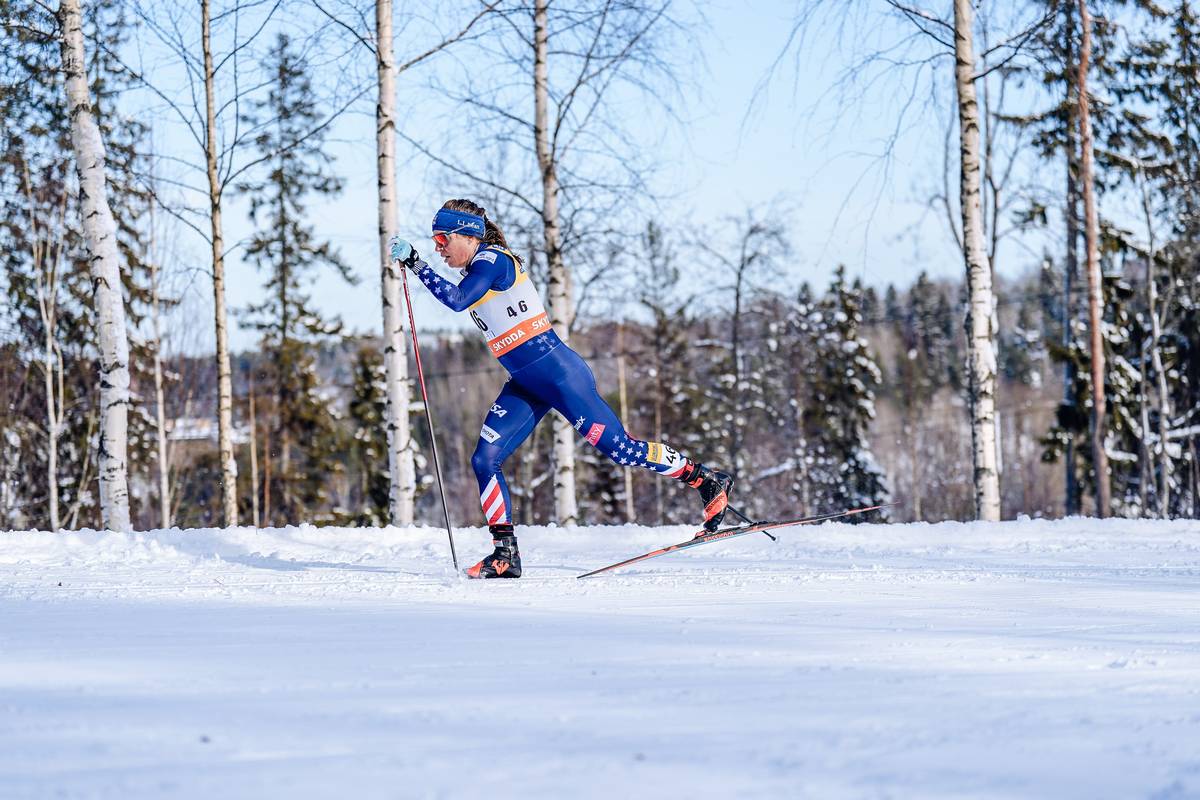
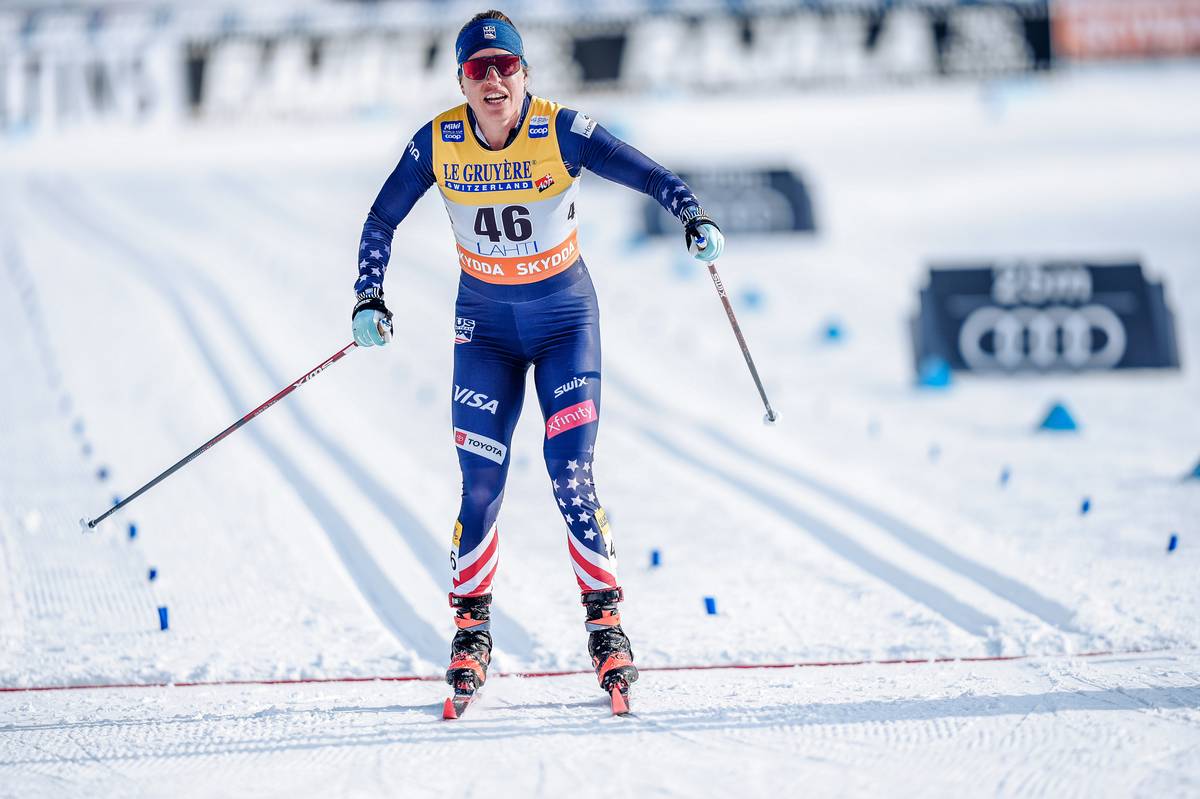
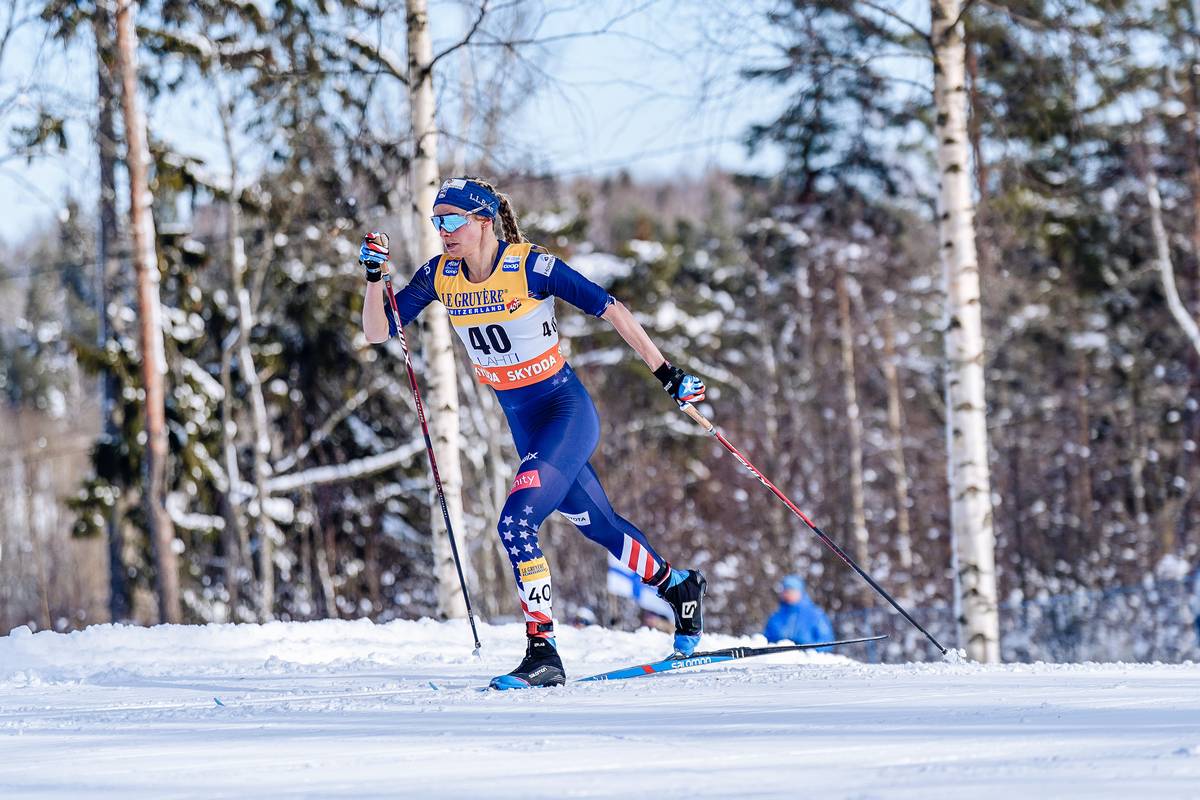
    Chasing an Olympic berth of her own, American Hailey Swirbul was the final starter of the day in Oberhof; she seems to be making the very most of her return to World Cup racing.

    “The smiles have been genuine!” beamed Swirbul. “I’m making sure to enjoy this life the most I can (but) I did not enjoy the feelings in the middle of this 10k today though, I won’t lie. I think a lot of us who came from Nationals, straight to international travel, straight to the World Cup were fighting some demons out there. It feels the most challenging, in my opinion, to find the will to keep fighting when your body feels heavy and the suffering feels unrewarding. But that’s also what keeps us coming back: the days where you can keep leaning into the discomfort and be in the fight and be rewarded for it is like no other feeling!”

    “I was the last starter today,” Swirbul continued. “So I was getting splits to know where I stood. An interval start race is a unique mind game because you can’t gauge if the imaginary people on front of you are pulling away or starting to fade. You just have to focus on your own race and get around the course as fast as you can, regardless of how others pace. That is easier said than done, especially with higher expectations on the World Cup. I try to remember that I don’t need to do anything that I haven’t done before. I just want to try to race my own race, regardless of the stage it’s on.”

    Contenders in Oberhof included Sweden’s Jonna Sundling, Maia Dahlqvist, and Moa Ilar (who is chasing Diggins in the season-long chase for the FIS Crystal Globe), Austria’s Teresa Stadlober, and newly discovered Norwegian phenom, Karoline Groetting. An early starter wearing bib 7, Groetting led the field at many of the early splits, and crossed the finish line with an advantage of 30 seconds over her nearest rival, and 37 seconds over her more famous countrywoman—and long-time national team member—Tiril Udnes Weng. But while Groetting settled into the leader’s chair, the more recognizable contenders began racing: Ilar, Stadlober, Sundling, and Diggins.

    Diggins was 15 seconds behind Ilar at the 2.6 kilometer checkpoint. Ilar led again at the 5.8 kilometer mark, coming across 13 seconds ahead of Groetting. At the finish line, Karoline Hennig-Doetzler (GER) challenged Groetting’s time, but fell just six seconds short. Groetting dodged another bullet when Maia Dahlqvist crossed the lone a mere .1 seconds behind Groetting’s finishing time. It was a tremendous finish for Dahlqvist—best known as a sprinter—as she continues to show great form in the approach to Milano-Cortina where she will certainly be a capable partner for Sundling in the Team Sprint event.

    It was later revealed that Diggins unusual split times resulted from her suffering quite a dramatic fall when her tip got caught in soft snow at the course’s edge.

    “I think that the reason my splits looked a litle funny is that I had a crash on one of the downhill corners. I caught my tip in some really deep sugar, and used my arm as a brake to keep myself from sliding off the course!”

    “It was time lost, and it was also a lot of adrenaline lost,” Diggins continued. “But it was honestly a really great practice in mental toughness, in refocusing, my energy and my attention on ‘what can I do in this moment. How well can I ski?’ I’m just really glad that’s really all that the crash was.”

    Ilar crossed the finish line with an advantage of 31 seconds over Groetting, but there were still other stars shining brightly out on Oberhof’s Classic course. Stadlober had begun the chase back at 7.6 kilometers when she was still 17 seconds behind Ilar. The gap narrowed to 10 seconds at 9 kilometers, and Stadlober was pouring it on. Over the final kilometer, the Austrian flew in pursuit of the Swede, only to find herself falling short by the narrowest of margins. Ilar would hold on to win by .7 seconds showing that hers is the best Classic skiing form today. Even so, she was surrounded by serious rivals—Stadlober in second, Sundling in third, Diggins in fourth, Groetting in fifth—who may be on their way up.

    18.01.2026, Oberhof, Germany (GER):
    Rosie Brennan (USA) – FIS world cup cross-country, 10km, Oberhof (GER). www.nordicfocus.com. © Authamayou/NordicFocus. Every downloaded picture is fee-liable.

    Rosie Brennan has continued to navigate her return to world-class form. “I’m still living in a day-by-day world, trying to figure everything out,” she said. “I had some really good training at home but have struggled again for the last two weeks. I haven’t been able to discover a pattern, so I truly feel I have no control over when my body is ok and when it isn’t, and now I’ve added some vascular complications to the whole thing. I had to come race this weekend to qualify for the Olympics and I am very pleased to have accomplished that! Now I need to look forward as best I can to the Games and try to prepare as best as possible.

    “Erik Flora is over here now,” Brennan continued. “Which will help that process immensely. But overall, it’s been a long year and change of living in an unknown, complicated medical world.”

    Brennan would finish the day in 30th, followed by Hailey Swirbul 33rd, Novie McCabe 35th, Alayna Sonnesyn 45th, Sammy Smith 49th, Kendall Kramer 54th. Alison Mackie led her Canadian teammates in 31st, followed by Sonjaa Schmidt 36th, Katherine Stewart-Jones 38th, Amelia Wells 56th.

    Now trailing by only 149 points, Ilar trimmed a bit of Diggin’s advantage in the World Cup overall race. And Ilar’s plans for the season? She was quite frank in her response to those asking if she’s going for the World Cup overall win now. “Of course I am,” Ilar smiled.” I would lie if I said anything else!”
    And what about the others who stayed home this weekend? We shouldn’t forget the impending return of Andersson, Karlstad, Niskanen, Slind, Weng, and Simpson-Larsen. The plot thickens.


    Oberhof Women’s 10 k Classic RESULTS

    FIS World Cup Distance STANDINGS (entering Oberhof)

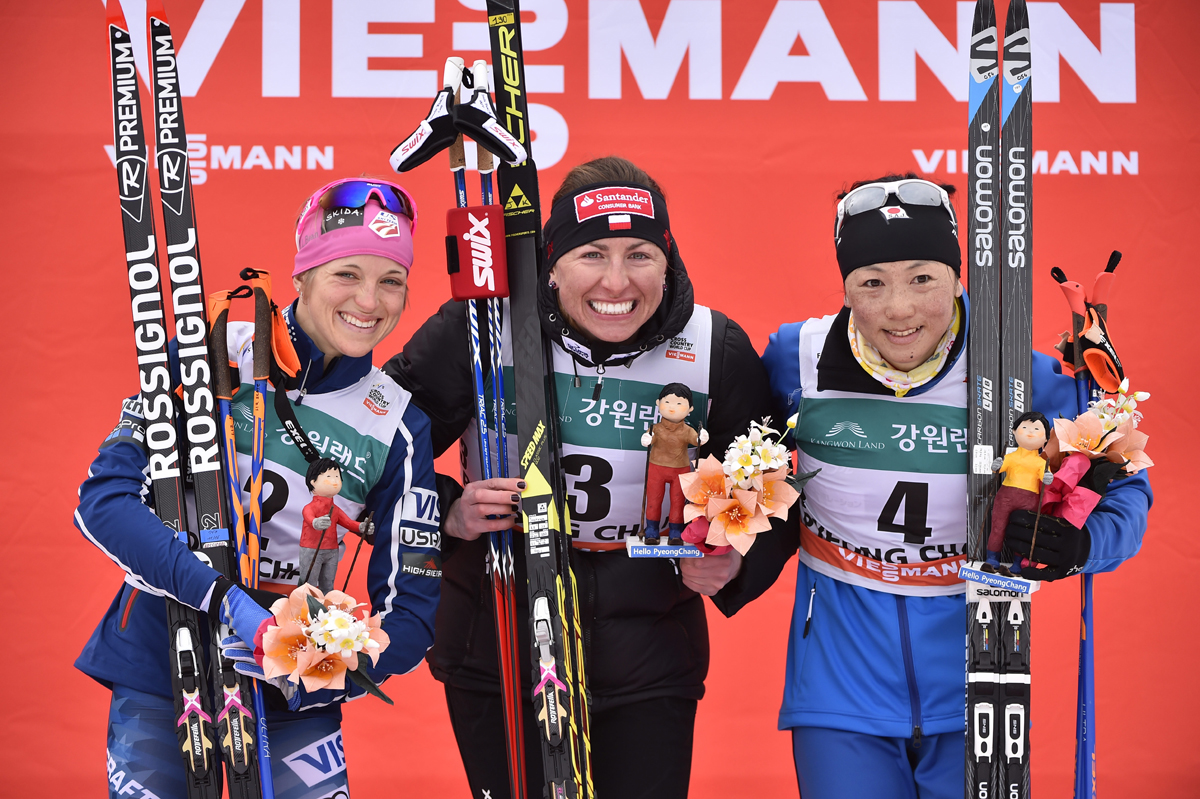
    Teresa Stadlober (AUT), Moa Ilar (SWE), Jonna Sundling (SWE) on the podium in Oberhof . (Photo. www.nordicfocus.com. © Authamayou/NordicFocus. Every downloaded picture is fee-liable.


  • Fast Tracks: World Champs—Men’s 10 k Classic, Press Conference

    Fast Tracks: World Champs—Men’s 10 k Classic, Press Conference

    This reporting costs money. Please support this coverage with a voluntary subscription (below) so FasterSkier can provide this level of access to the sport we all love year-round.

  • Fast Tracks: World Champs—Coach Sjur Ole Svarstad Agrees Last Minute Weather Change is an Advantage for Team Norway

    Fast Tracks: World Champs—Coach Sjur Ole Svarstad Agrees Last Minute Weather Change is an Advantage for Team Norway

    This reporting costs money. Please support this coverage with a voluntary subscription (below) so FasterSkier can provide this level of access to the sport we all love year-round.

  • 2025 World Championships—Zanden McMullen Says All The Snow Makes for a Fun Day

    2025 World Championships—Zanden McMullen Says All The Snow Makes for a Fun Day

    This reporting costs money. Please support this coverage with a voluntary subscription (below) so FasterSkier can provide this level of access to the sport we all love year-round.

  • Fast Tracks: World Champs—Ben Ogden Discusses How Several Nations Are Doing Everything They Can To Catch Norway

    Fast Tracks: World Champs—Ben Ogden Discusses How Several Nations Are Doing Everything They Can To Catch Norway

    This reporting costs money. Please support this coverage with a voluntary subscription (below) so FasterSkier can provide this level of access to the sport we all love year-round.

  • Fast Tracks: World Champs—Rosie Brennan Says, ‘Everyone did everything we could to get me here in the best shape possible’

    Fast Tracks: World Champs—Rosie Brennan Says, ‘Everyone did everything we could to get me here in the best shape possible’

    This reporting costs money. Please support this coverage with a voluntary subscription (below) so FasterSkier can provide this level of access to the sport we all love year-round.

  • Fast Tracks: World Champs—Gus Schumacher, ‘I am very grateful to be healthy and in a good place’

    Fast Tracks: World Champs—Gus Schumacher, ‘I am very grateful to be healthy and in a good place’

    This reporting costs money. Please support this coverage with a voluntary subscription (below) so FasterSkier can provide this level of access to the sport we all love year-round.

  • Fast Tracks: World Champs—Alayna Sonnesyn, “Today, I was ready to face anything!”

    Fast Tracks: World Champs—Alayna Sonnesyn, “Today, I was ready to face anything!”

    Reporting by: Nat Herz and Stuart Harden

    This reporting costs money. Please support this coverage with a voluntary subscription (below) so FasterSkier can provide this level of access to the sport we all love year-round.

  • 2025 World Championships—Zak Ketterson Felt Really Supported on His Way to a Great Race

    2025 World Championships—Zak Ketterson Felt Really Supported on His Way to a Great Race

    This reporting costs money. Please support this coverage with a voluntary subscription (below) so FasterSkier can provide this level of access to the sport we all love year-round.

  • Fast Tracks: World Champs—The Conditions Were Hard, but Antoine Cyr was Happy with the Effort

    Fast Tracks: World Champs—The Conditions Were Hard, but Antoine Cyr was Happy with the Effort

    This reporting costs money. Please support this coverage with a voluntary subscription (below) so FasterSkier can provide this level of access to the sport we all love year-round.


  • Martin and Kern Stride to the Top on Day Two in Whistler

    Martin and Kern Stride to the Top on Day Two in Whistler

    Carrying the momentum from the first day of racing into a second distance event, athletes lined up once more at the Whistler Olympic Park for a 10 / 15-kilometer interval start classic. Over 130 men and 90 women participated in the open categories, representing clubs across Canada and the United States. 

    Adding a springtime layer of complexity to remind us that we are officially past the equinox, temperatures in Whistler hovered above freezing while a mix of precipitation fell off and on throughout the day. Webcams of the venue showed the spectacular mountain backdrop hidden amongst dense clouds and conifers still laden with the week’s snow.

    It’s a humidity-temperature combo that makes classic waxing tricky. Consequently, many athlete chose to use “hairies”, which are known as “rub skis” in Canada, essentially foregoing kick wax and opting instead for a sandpapered kick zone. For those with strong striding technique, this achieves grip without as significant a risk of icing issues, as klisters can be known create in such conditions. 

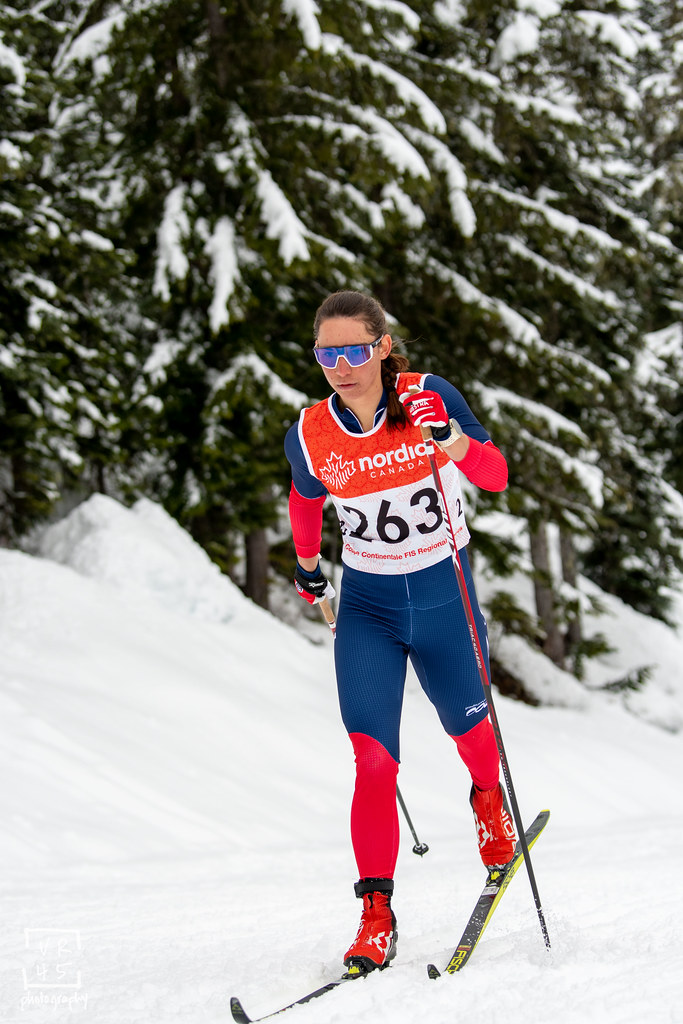
    Top Canadian U20 racer Xavier McKeever (Foothills Nordic), who was 13th overall today, explained how this changes the game for those who haven’t had the experience: “You have to be a bit more careful with your kicks and a bit more gentle, because they can slip out really easily. That was the biggest focus for me [today], just to try and ski technically well.”

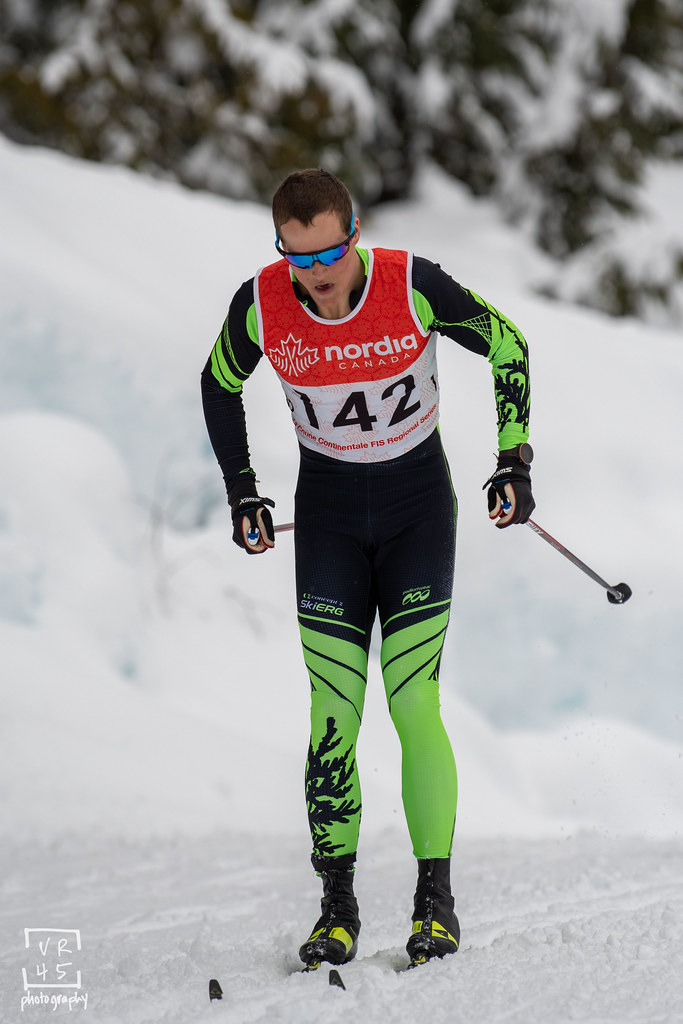
    Craftsbury’s Adam Martin takes the 15 k classic win in Whistler. (Photo: Doug Stephen / VR 45 Photography)

    Following 10 k sitting and standing events contested by Nordiq Canada’s Para Nordic athletes, the open men’s category headed out for the three 5 k loops. In a close race for the top podium spot, Craftsbury’s Adam Martin took the win with a time of 40:29.3. Martin was chased by today’s Canadian National Champion, Antoine Cyr (Skinouk) who hunted his times from 19 bibs behind.  

    Though Cyr led through the first 10 k, a strong closing lap from Martin moved the American to the lead in the splits, with Cyr skiing the third fastest final lap to take second (+1.3). Canmore’s Russell Kennedy was third overall (+13.1) for the second spot on the Canadian podium, while fellow Canmore athlete Sam Hendry, who now trains with the University of Utah, was third for Canada in fifth overall (+48.0). Both Cyr and Kennedy had also raced onto the podium in yesterday’s 10 k free. 

    “I felt really good today,” Martin wrote to FasterSkier after the race. “Particularly in the second half, I started to figure out how to best race this course and these conditions, and I found a good place mentally to push. I’m really happy with the outcome – that was a dream to win.”

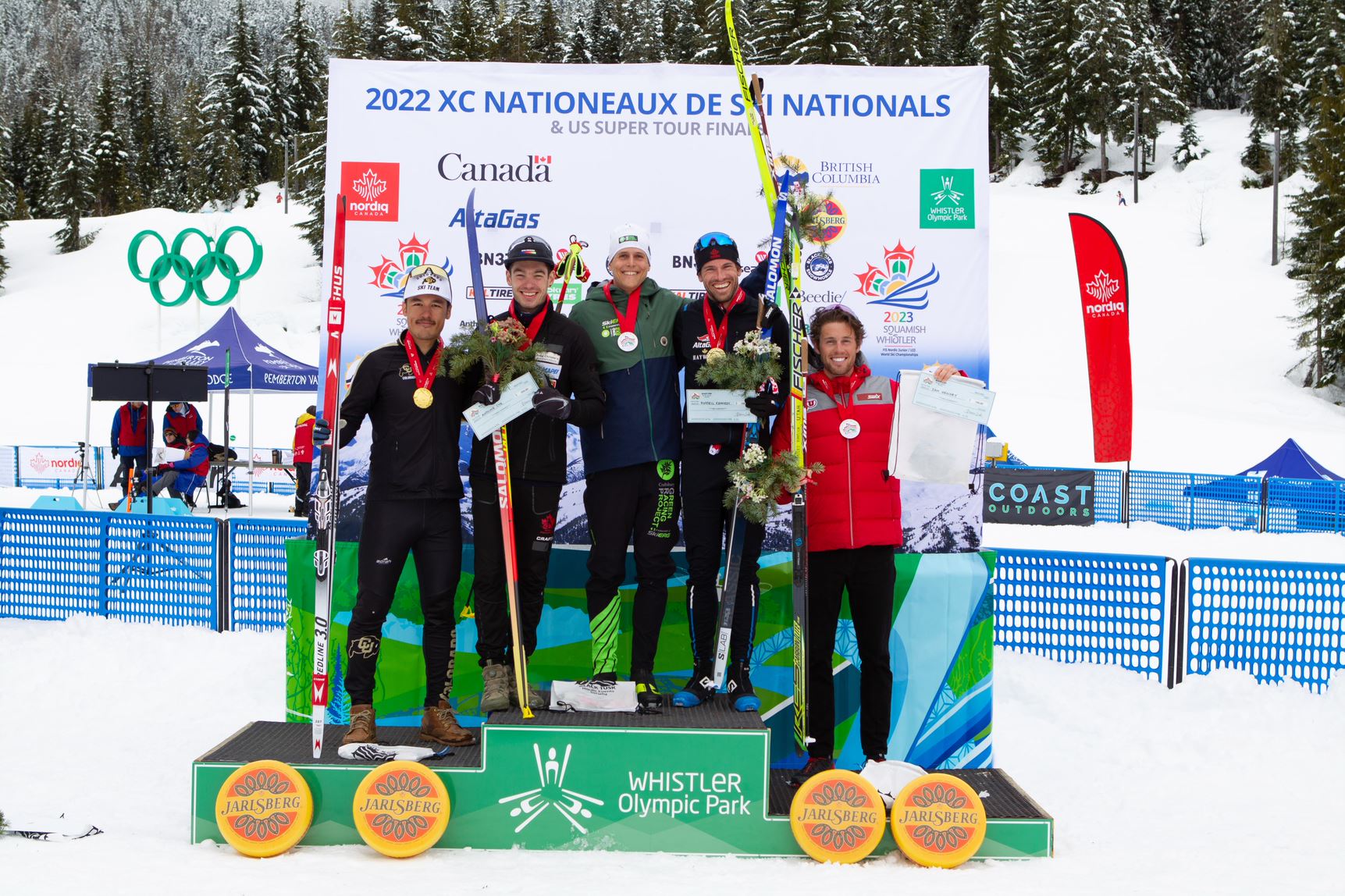
    The men’s 15 k classic podium in Whistler: Adam Martin (CGRP) took the win ahead of Antoine Cyr (Skinouk), and Russell Kennedy (Canmore Nordic). (Photo: Joern Rohde / Nordiq Canada)

    A successful season of SuperTour racing has Martin ranked at the top of the rankings, and earned him starts in post-Olympic World Cup events. After taking third at the American Birkie, Martin headed to Norway to race the 50 k classic at Holmenkollen, where he finished 26th. The following weekend, he skied to 44th in the 15 k free in Falun, Sweden. A week later, Martin is back with his Craftsbury team and standing atop the US SuperTour podium. 

    “It’s nice to return from the World Cup and still feel in good shape. After two 50 k’s, and travel, and a season that I’m really happy with, everything is a bonus at this point. I think it’s great that we are able to combine with Canada for these races. There are a lot of guys at a similar level, so it makes for some tight, fun racing.”

    A 23-year-old Quebec native, Cyr’s best results have been in classic this season, namely an 11th place finish in the opening World Cup 15 k classic in Ruka, Finland, and racing with Graham Ritchie to put the Canadian team in fifth during the Olympic classic team sprint in Zhangjiakou. After the team sprint, he was praised by both his teammate and coach Erik Bråten, along with armchair quarterback Devon Kershaw, for his classic technique.

    “Classic is always good for me and is a race I love,” Cyr said of today’s 15 k in a post-race interview with Nordiq Canada. “It was tough conditions this morning, and a good skier normally comes out on top in hard conditions. I was able to ski well, focus on the race, and came second overall, which is a little bittersweet because it was a really tight battle in the end. But it was really fun, the track is amazing. It’s an Olympic standard track, so it’s just really good.”

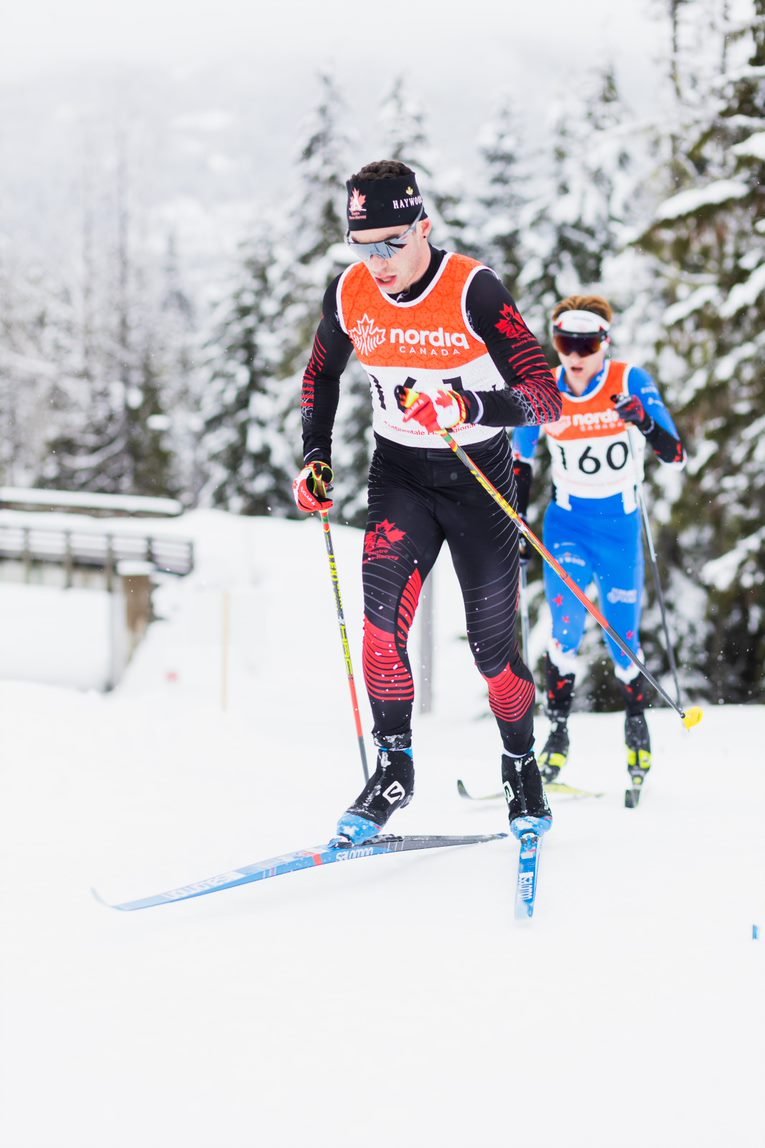
    Antoine Cyr races for the Canadian National Title in the 15 k classic in Whistler. (Photo: Nordiq Canada / Nathaniel Mah)

    In his second lap, Cyr had caught yesterday’s winner, Rémi Drolet (Team Black Jack), whom Cyr credited in supporting his strong result today.

    “When I saw was closing the gap on him on the first lap, I decided to go a little harder than I planned to catch up with him. [I then tried] to relax behind him for a lap or half of a lap.. In the end, I was missing a little bit on the last lap. I think that that helped for sure, skiing with someone strong like Rémi.”

    Finally, Cyr spoke to the importance of an international field featuring all age groups coming together this week, particularly on the heels of a two-year hiatus due to pandemic restrictions.

    “It is so good for the young kids — us older guys, we’ve been racing on the World Cup, but like the juvenile and junior, they almost have no races in Canada. To have a big event like this is just amazing and we’ve been looking at the younger guys’ results for an hour yesterday, seeing who’s in good form, and who’s coming up, and you are the next guys to be like taking over. So for them, it is awesome, and for us too, racing with the US is always — it should always be like this.”

    Joining Martin for the SuperTour podium, BSF Pro Team athlete Finn O’Connell was 7th overall (+1:06.4) and second American, with University of Utah’s Luke Jager half a second behind in 8th overall (+1:06.9).

    Julia Kern strides for the win in tricky conditions during the 10 k classic in Whistler. (Photo: Doug Stephen / VR 45 Photography)

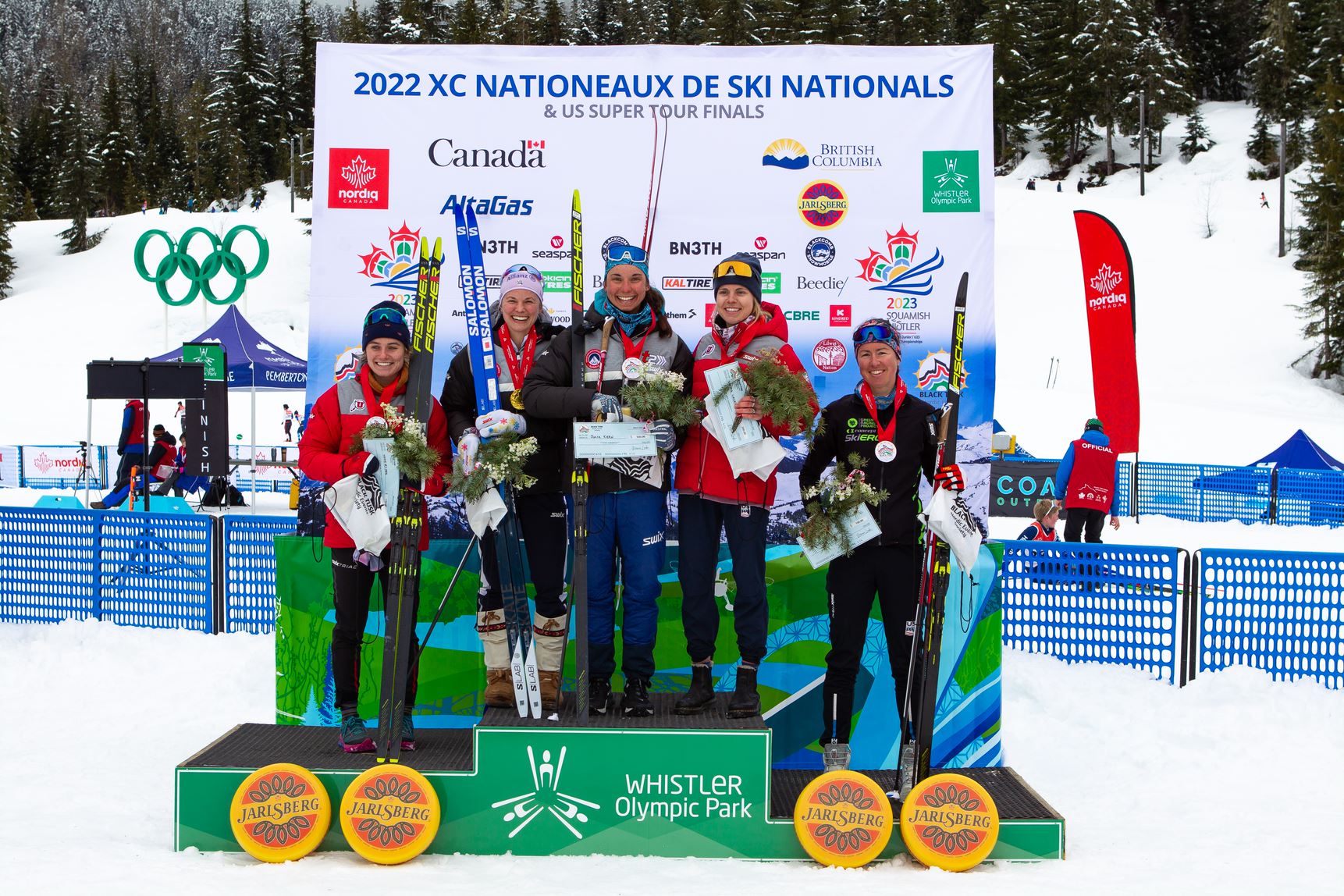
    In the women’s 10 k, SMS T2’s Julia Kern skied a strong second lap to take the win in her second consecutive day on the podium, stopping the clock at 29:54.3. Her club and national teammate, Jessie Diggins, took the second step finishing +18.3 back, while University of Utah’s Sophia Laukli skied to third (+1:03.2).

    Looking at tough conditions, Kern explained she raced by trial and error today, exploring which techniques were most efficient on different sections.

    “I kind of had an open mindset going in today,” she told Nordiq Canada after the race. “I knew that the tracks might be a little bit punchy or washed out in sections, and so I was double pulling wide or double polling narrow or just like power striding on the flats if it was getting too punchy out there. So just trying it all.”

    She continued that she was looking to “have fun, send it from the start, and see if I could hold that pace the whole time,” which she ultimately proved able to do. It’s the time of year where the hay is in the barn training-wise, and athletes have had a long season, leaving them in varying states heading into the last hurrah. On whether she was looking to just have fun at these races, or whether it was a serious quest for the podium, Kern said “both”.

    “I think the end of the season is always really fun. It’s so cool to have this many athletes here. And I’ve been feeling really good the last few weeks and so enjoying racing when it does feel good and when I’m able to push really hard. We’re all really tired at the end of the season, but also, when the body’s in form you might as well take advantage of it and send it on the course.” 

    The women’s 10 k classic podium on day 2 in Whistler: Julia Kern (SMS T2) took the win ahead of Jessie Diggins (SMS T2) and Sophia Laukli (Univ. of Utah). (Photo: Joern Rohde / Nordiq Canada)

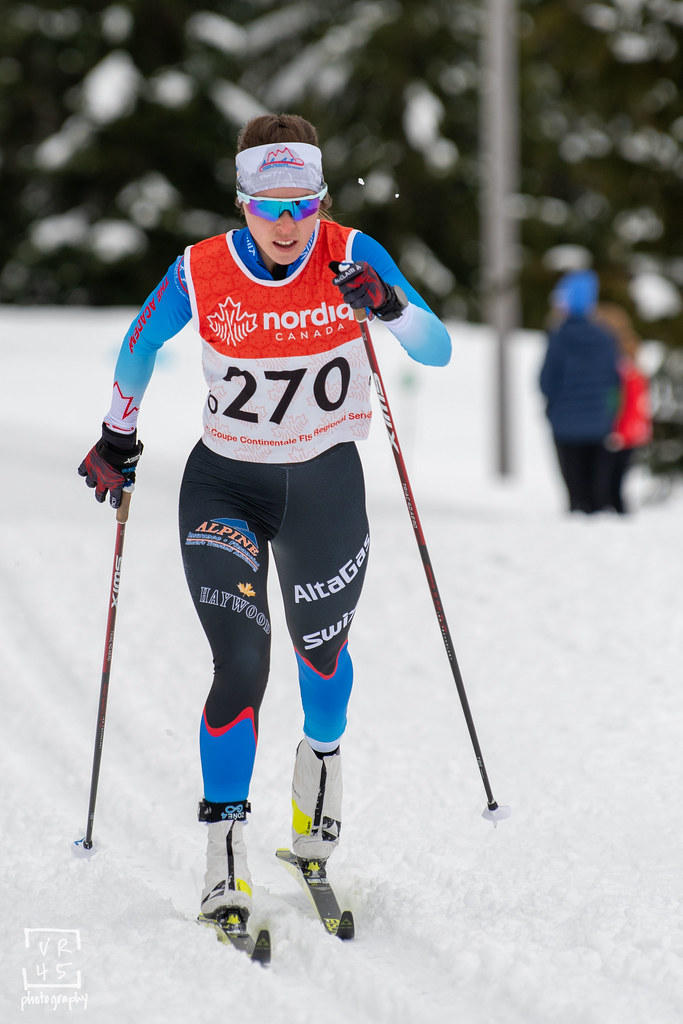
    Winning back-to-back Canadian National titles, Katherine Stewart-Jones (Nakkertok Nordique) was again on top for the Canucks, finishing sixth overall (+1:17.5). Finishing in the same order as yesterday, Dahria Beatty (Whitehorse Ski Club) was second for Canada in eighth overall (+1:55.0), while Cendrine Browne (Fondeurs-Laurentides) rounded out the podium in ninth overall (+2:14.5). 

    “I went out really hard knowing that that’s what I had to do if I wanted to make the podium,” Stewart-Jones said of her race. “I had a good first lap, and I definitely slowed down a lot on the first part of the second lap. I was just tired and was having a hard time staying in the zone and keeping the rhythm, but I was able to pull it together a bit for the second half of the second lap. So I was really happy with that. And I was happy with how hard I pushed. I just didn’t have it quite in me today, and sometimes that happens.”

    On the importance of focusing on her technique on this type of course with sub-optimal conditions, she continued, “It’s really important, especially on the climbs. The grip isn’t always perfect in these conditions, so you really have to make sure to stay on top of your skis. If you get tired and you start leaning forward, then it makes it even harder to kick… And then on the flatter sections, it was a bit awkward, and you had to expect that. Either you’re striding awkwardly or you’re doing a kick double pool, but your poles are sinking. You have to just really focus on committing to whatever you decide to do and not like trying to switch too much between.”

    Speaking to already standing atop two podiums, Stewart-Jones responded with pride, while also acknowledging that the overall win would be sweeter.

    “Oh, it’s definitely nice to be winning the national championship title… because we’re racing against the Americans, I obviously care about the overall too, so maybe it feels a little less exciting, but for sure, I’m proud of that.”

    Katherine Stewart-Jones (Nakkertok Nordique) takes back-to-back national titles in the women’s 10 k classic in Whistler. (Photo: Doug Stephen / VR 45 Photography)

    In order to get closer to the overall podium, she said he would focus on resting as much as possible and maintaining the head space to perform her best. “It’s been a long season and I haven’t raced this much in a long time. I think everyone’s pretty tired. But also just being able to also be mentally strong [over the next races]. And yeah, you never know what’s gonna happen.”

    Racing continues Wednesday with individual classic sprints, which will be live-streamed by the Black Tusk Nordic Events Society. If you’re looking for additional video updates, follow along on the Nordiq Canada and Black Tusk Instagram pages. 

    Full Results

  • Johaug Sneaks Inside Nepryaeva’s Mark for the 10 k Interval Start Classic Win; Brennan Leads U.S in 8th

    Johaug Sneaks Inside Nepryaeva’s Mark for the 10 k Interval Start Classic Win; Brennan Leads U.S in 8th


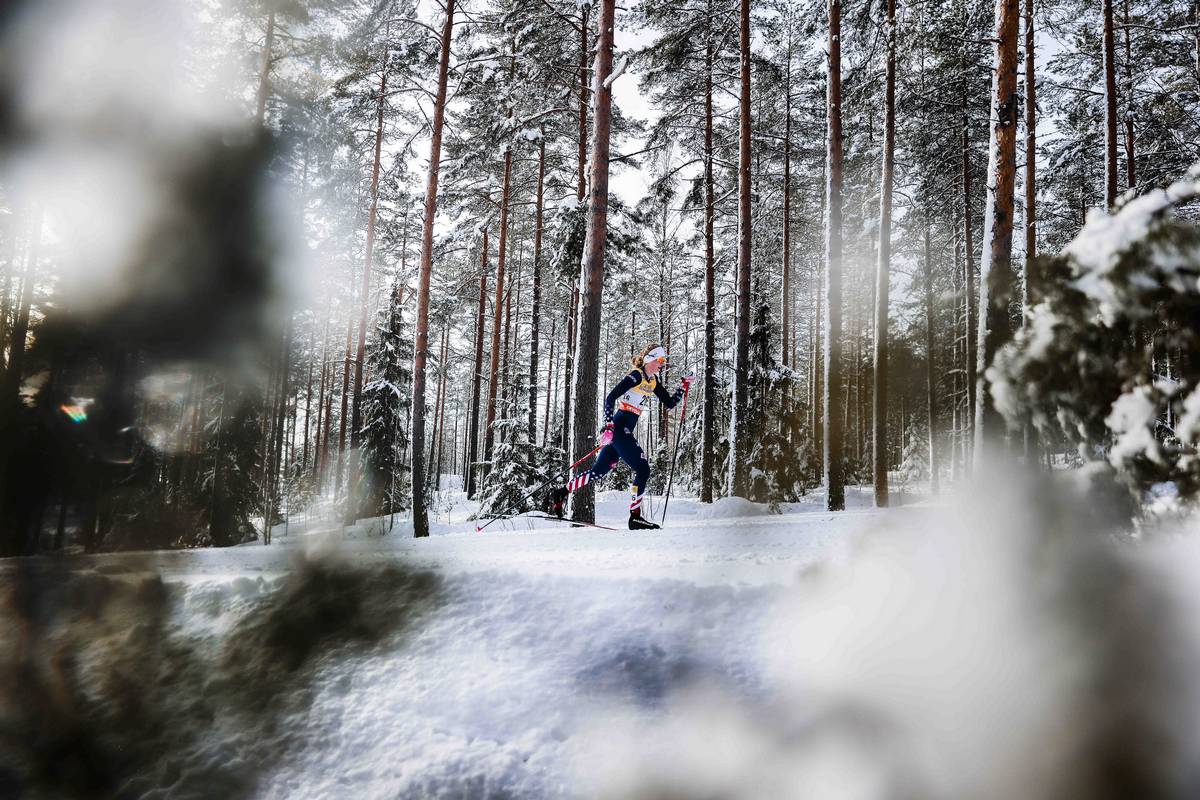
    Hailey Swirbul races through the snow-capped pines of Lahti, FIN. (Photo: NordicFocus)

    This World Cup coverage is made possible through the generous support of Marty and Kathy Hall and the A Hall Mark of Excellence Award.  To learn more about A Hall Mark of Excellence Award or to learn how you can support FasterSkier’s coverage please contact info@fasterskier.com.

    An iconic venue, Lahti’s ski jumps rise out of the pine forest from atop the rolling hills, tucked between the many lakes of the region in southern Finland. After two years of empty trails and stadiums, horns blazed, cowbells rang, and voices cheered during the women’s 10-kilometer individual start classic race as fans lined the hills and filled the stadium, memories of pre-pandemic racing flooded back into mind. 

    What has remained constant through the last two years is the presence of Norway’s Therese Johaug at the top of the results sheet in distance races, particularly classic. Johaug started as the final athlete in the seeded group wearing bib 60, meaning she would have information available to her from the start on how hard she would 

    A little over halfway through the first of two 5 k laps, it looked like Johaug would run away with yet another World Cup distance race. At the 3.7 time check, Johaug was 11.7 seconds up on Natalia Nepyraeva of Russia who had clocked the fastest prior split, with the Finnish Olympic bronze and silver medalists, Krista Pärmäkoski and Kerttu Niskanen, lurking just behind at 16.2 and 17.5 seconds back. And the Finns were racing on home soil with most of the aforementioned fans waving their country’s flag.

    Norway’s Therese Johaug races the 10 k interval start classic in Lahti, FIN. (Photo: NordicFocus)

    Sure enough, the margin of Johaug’s lead narrowed. At the lap, she was just under ten seconds ahead of Nepryaeva, who looked to have conserved her energy in the first lap to push the pace in the second. While the Finns became less of a threat to Johaug, the Norwegian’s margin over the Russian’s splits whittled down rapidly. 

    And ironically, the Russian’s fast second lap might have been partly Johaug’s own doing. As the Norwegian had headed out on course, Nepryaeva was lapping through the stadium, allowing her to match pace as she chased the high-tempo Norwegian through the woods for the second 5 k, perhaps pressuring Johaug to burn a few of her matches a bit earlier than she’d otherwise planned. 

    Regardless of what was going through each athlete’s mind, Nepryaeva finished her second lap to set the bar at 24:29.6.

    Over the first kilometer of Johaug’s second lap, now racing on her own, the time difference between the two women was slashed in half, from 9.8 to 4.8 seconds, and at 8.7 k, it had essentially remained constant at 5.5 seconds. It would come down to the wire.

    Looking back at the season, it might be easy to focus on the three Olympic gold medals Johaug won in Zhangjiakou, including in the 10 k classic event. But, she had been beaten in the only other 10 k classic she’s raced on the World Cup this year, which also took place in Finland, during the opening weekend of World Cup racing in Ruka. She might be the favorite, but she’s also beatable. 

    Natalia Nepryaeva puts together a strong performance in the 10 k classic in Lahti. (Photo: NordicFocus)

    As Nepryaeva watched the clock eagerly from the leader’s chair, Johaug kicked, glided, and double poled through the final kilometer. Having over ten minutes prior, she had plenty of time to wait, watch, and be watched by the cameras.

    Nepryaeva leaned forward, not taking her eyes off the leaderboard as Johaug made the tight right-hand turn down into the stadium without losing too much momentum, and began to charge as hard as she could toward the line.

    With 15 seconds remaining to stay inside Nepryaeva’s mark, Johaug rounded the corner to the finish. With ten seconds to go, she hit the lanes. Nepryaeva watched the seconds tick by hoping Johaug’s time would change to red, while the Norwegian was just trying to keep it in the green.

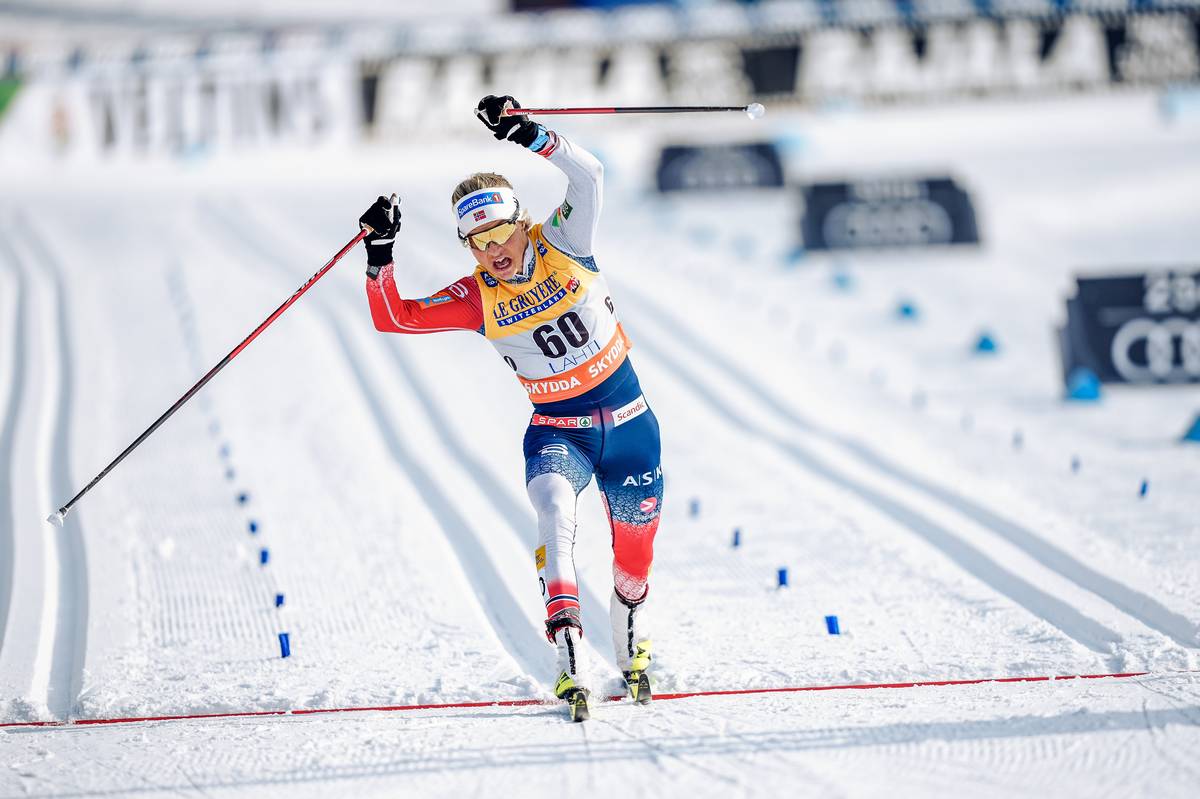
    Therese Johaug (NOR) throws her boot to take the win just 1.2 seconds ahead of Russia’s Natalia Nepryaeva. (Photo: NordicFocus)
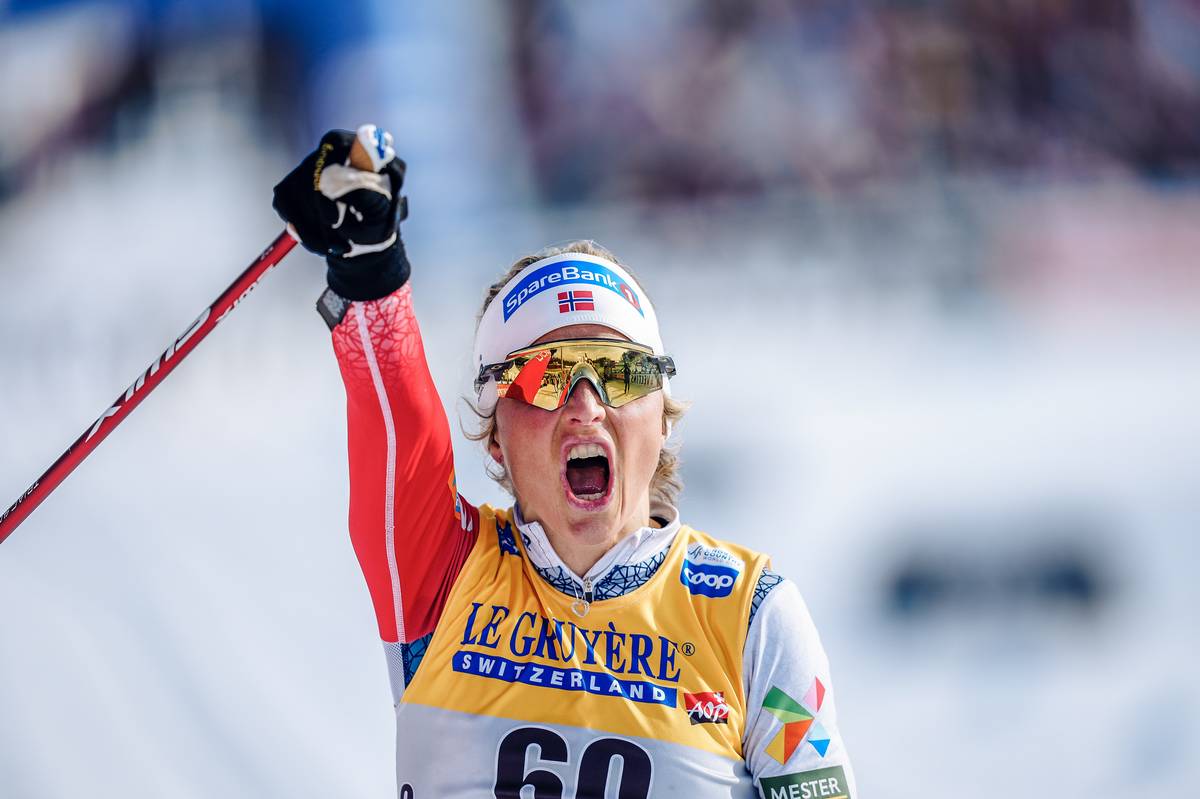
    Therese Johaug (NOR) celebrates her victory in Lahti’s 10 k individual start classic. (Photo: NordicFocus)

    Until the actual finish line was crossed, it felt like the result could go either way. But with a final push from her poles and kick with her boot, Therese Johaug sealed the deal, just 1.2 seconds ahead of Natalia Nepryaeva. Johaug let out a victorious roar, just before cameras showed the Russian roll her eyes in exasperation, as if thinking, “Really? Not again.”

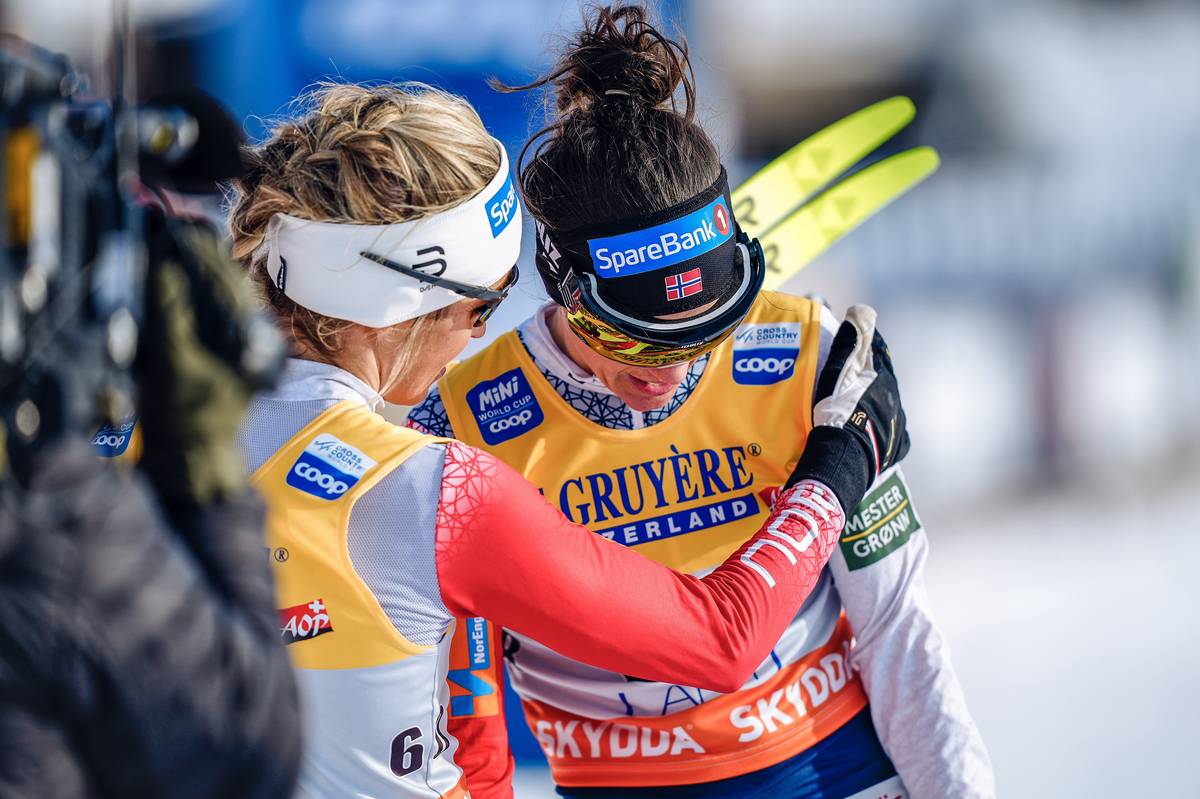
    Cameras panning back to Johaug watched her shift away from her own celebration to comfort a very disappointed Heidi Weng, who had started a minute ahead of Johaug in bib 58, but finished 42 seconds behind her teammate in 19th place (+1:42.4). After promising results in the Tour de Ski, Weng had tested positive for COVID just prior to the Olympics, leaving her watching the event from afar. From Weng’s disappointment at the finish, it looked as though she had been looking for more in her return to racing on the World Cup.

    Therese Johaug (NOR) comforts her disappointed teammate Heidi Weng at the finish of the 10 k individual start classic in Lahti. (Photo: NordicFocus)

    Johaug spoke with FIS after the finish, speaking to what it means to win again today as she nears the end of a successful season, including the three gold medals earned in Zhangjiakou this month.

    “It means a lot for me, and I am so happy that I have a second on my side,” Johaug said with a laugh. “After the Olympics, you’re coming home and it’s a little bit hard to motivate again, but when I come to Lahti and go on this beautiful track, I really enjoy it.”

    Johaug was also asked whether she felt the benefits of having trained and raced at altitude surrounding the Games, which were held at roughly 5,500 feet above sea level. 

    “Yeah, I feel that,” Johaug said of the boost. “When you train a lot at altitude and then you go down, you feel like you have more energy in the hills. I think my shape right now is really good, so I’m excited to race at the Holmenkollen next weekend, and in Falun, then the rest of the season.”

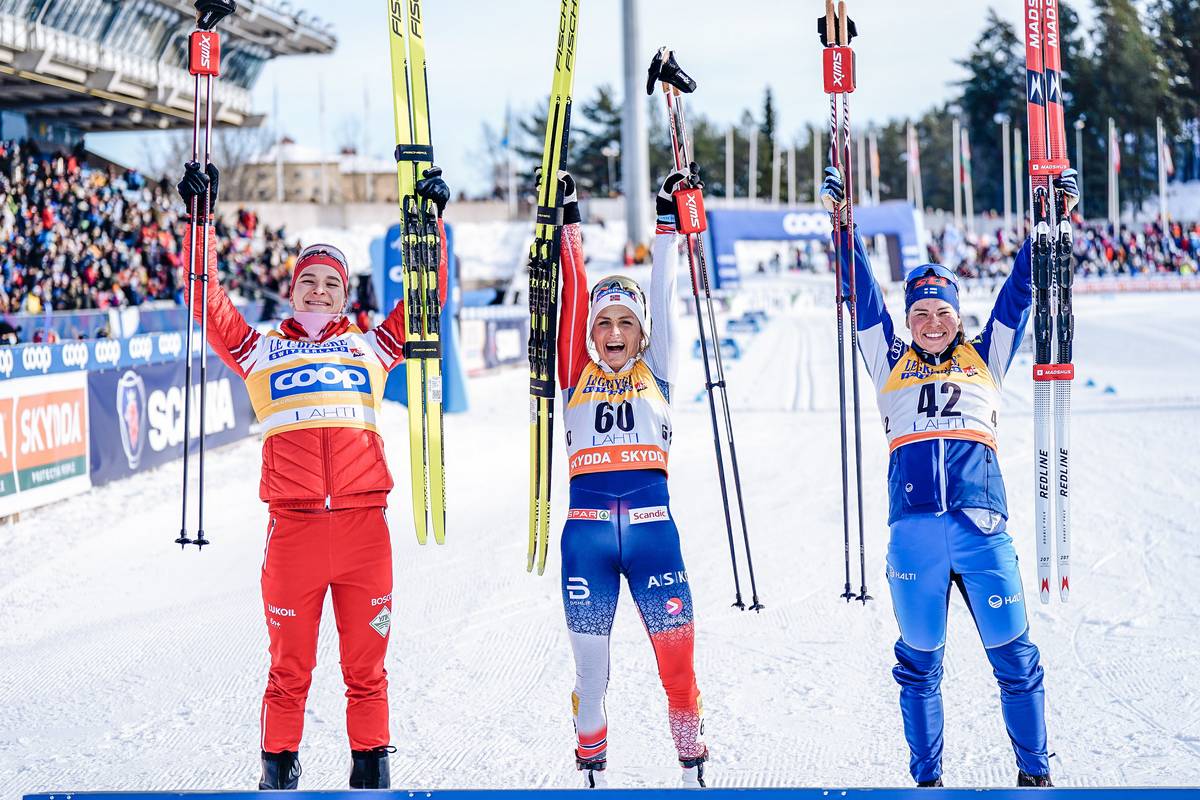
    The women’s podium in Lahti: Therese Johaug (NOR) took the win ahead of Natalia Nepryaeva (RUS) and Krista Pärmäkoski (FIN). (Photo: NordicFocus)

    Rounding out the women’s podium, Finland’s Pärmäkoski held her margin to 16.7 seconds at the finish for third place, followed after a gap by her teammate Niskanen in fourth (37.7). Sweden’s sprint champion Jonna Sundling was just behind in fifth (+40.7).

    Leading the way for the American team, Rosie Brennan posted consistent splits to hover in sixth place through the first lap. Maintaining even tempo and effort, Brennan remained in this position until the last checkpoint, which showed a hard-charging Ebba Andersson of Sweden trade positions to bump Brennan back to 7th.

    Rosie Brennan leads the American team during a 10 k individual start classic in Lahti, FIN. (Photo: NordicFocus)

    Also posting a split Brennan was not quite able to match in the final kilometer, the American lost nearly eight seconds to Germany’s Katharina Hennig between the final time check at 8.7 k and the finish, leaving Brennan in eighth place overall (+1:02.8) at the finish.

    “I am really happy with today.,” Brennan wrote in a post-race email. “I have always struggled post-championships, not so much in my body, but in my mind. It’s really difficult to live on the road and be sharp and push so hard all the time. It often feels like there is never a chance to let down the way someone who goes home every week might experience. I am always trying to figure this out and work towards finding ways to let down and then pull the fight back up for the weekend. It’s all part of the game and it’s a good challenge to try to figure everything out.

    “Anyway, today, I felt much more like myself and was able to ski the way I wanted to. Lahti has been a tough venue for me in the past and today I really felt strong in my classic skiing and had some ability to push hard. I was definitely frustrated after yesterday and am really happy I was able to let it go and find myself out there today. We have had really great weather this weekend and a big crowd so that was a huge bonus. It was a joy to not be skiing in an arctic tornado!”

    Rosie Brennan crosses the line for 8th place in Lahti’s 10 k interval start classic. (Photo: NordicFocus)
    Jessie Diggins skis to 20th place in the 10 k classic in Lahti, FIN. (Photo: NordicFocus)

    Following a podium near-miss in yesterday’s sprint, Jessie Diggins was next for the U.S., just behind Heidi Weng in 20th (+1:43.4). Julia Kern and Hailey Swirbul also raced into the top-30 for the second day in a row, finishing 28th (+2:03.2) and 29th (+2:10.5), respectively.

    Just off Swirbul’s split, Canada’s Katherine Stewart-Jones led her team in 30th place (+2:10.7), with her teammate Dahria Beatty just outside the top-30 in 33rd (+2:19.4). Cendrine Browne raced to 36th (+2:24.5), while Laura Leclair was the final Canadian woman in 58th (+4:29.7). 

    Canada’s Katherine Stewart-Jones leads her team in 30th during the 10 k individual start classic in Lahti, FIN. (Photo: NordicFocus)

    Finishing 30 seconds outside the top-30, Katharine Ogden returned to the World Cup in 43rd (+2:40.8).

    Following the races, US Ski Team head coach Matt Whitcomb provided insights into both the women’s and men’s races in Lahti, as well as sharing the news that Östersund, SWE may become the host to the initially cancelled World Cup Finals that had been scheduled for Tyumen, Russia. Whitcomb also speaks to the “Olympic hangover” that can make hard for athletes to perform at their best the weekend following the Games, and gave a shoutout to the athletes racing at World Juniors in nearby Lygna.

    World Cup racing continues on Thursday, March 3rd with a classic sprint in Drammen, Norway, just prior to the storied 30/50 k mass start classic races at the Holmenkollen in Oslo.

    Results 


  • World Juniors: Canada puts two in top ten as Russia sweeps 5/10 k classic; Will Koch top American in 13th

    The 2022 FIS Junior/U23 World Ski Championships trip has been made possible through support from the National Nordic Foundation (NNF), which has identified this invaluable opportunity for developing athletes as one of its “Pillar Projects”. You can support the NNF and the next generations of America’s top skiers by making a donation here.

    Friday at 2022 FIS Junior World Ski Championships in Lygna, Norway, marked the phase that Steve Fuller, on site to take photographs qua Flying Point Road, calls “the ‘groundhog’s day’ stage” of the championships. “Things are happening so fast that you’re not quite able to get caught up with each day before you get up and do it all over again,” Fuller wrote on Instagram.

    Will Koch races to 13th in the 10 k classic during the 2022 Junior World Ski Championships in Lygna, NOR. (Photo: John McColgan)

    Undeterred, the Americans headed out on course Friday morning for their seventh and eighth races in four days. The coaches and wax techs (see the back row in the lead picture of the relay story) prepped skis for their eighth championship race within less than 72 hours. At the end of the day, Russia took a combined four out of six podium spots; Canadian skiers Xavier McKeever and Jasmine Drolet placed sixth and eighth, respectively; and Will Koch and Sydney Palmer-Leger led the way for the Americans in 13th and 19th.

    Women’s 5 k Classic

    Let’s back up. The women again had the day’s first race, a 5-kilometer interval-start classic. The first starter headed out on course, over a single lap of yesterday’s 5 k course, at 11 a.m. The official results describe conditions as somewhere between moderate and perfect: air temp of -2 C, snow temp of -3 C. Skies were overcast for the women’s race, but the sun came out for the men; as USST Development Team Coach Greta Anderson told FasterSkier later Friday, conditions sped up noticeably by the afternoon.

    82 starters later, Dariya Nepryaeva, who started at the sharp end of the field in bib no. 80, had logged the day’s fastest time, crossing the line in 14:30.1. She was closely followed by her compatriot, Elizabeta Bekisheva, in second, 2.9 seconds back. Emma Kirkeberg Mørk of Norway was close behind for third, 4.0 seconds back.

    Sydney Palmer-Leger skis into the top-20 in the 5 k classic during the 2022 Junior World Ski Championships in Lygna, NOR. (Photo: flyingpointroad.com)

    The day’s fastest North American finisher, and fastest Jasmine in the field, was Jasmine Drolet of Revelstoke, B.C., in eighth, 21.5 seconds back. She was followed in the North American standings by American Sydney Palmer-Leger (University of Utah/Park City, Utah) in 19th (+51.3), and Canadian Jasmine Lyons in 26th (+1:03.3).

    “I felt pretty good. I really like classic skiing and my goal was to give it all I had,” said Drolet in a press release from Nordiq Canada. “You only ski the lap once, so the key was to just go hard the whole time. We had amazing conditions, perfect for classic skiing so it was a good day.”

    Behind Lyons were the two Ninas, Nina Schamberger (Summit Nordic Ski Club/Leadville, Colorado) in 31st (+1:14.2) and Nina Seemann (Dartmouth Ski Team/Craftsbury, Vermont) in 36th (+1:23.0). Annie McColgan (University of Vermont/Bend, Oregon) was 40th (+1:27.3). Canadian athletes Sarah Cullinan (44th, +1:34.2) and Tory Audet (59th, +2:08.2) followed.


    Annie McColgan races the 5 k classic in Lygna, NOR, her first start of the 2022 Junior World Ski Championships. (Photo: John McColgan)

    McColgan radiated enthusiasm when she talked with FasterSkier following her first race at these championships. “It was nice to have everyone cheering out there, and my parents were here so it was really, really fun. It was really cool,” McColgan said.

    McColgan also provided insights on the course, describing it as “a really interesting 5k” with plenty of rolling terrain, but not many opportunities for recovery. “There’s a lot of steep little hills that you just have to be really good at… But it also is 16 minutes long. So you kind of have to make that balance [with energy expenditure]. And then the final climb was so brutal.”

    Men’s 10 k Classic

    The men again had the day’s second race, starting a two-lap, 10 k interval-start classic race at 1 p.m. local time. Taking athletes’ distance points as an informal form chart, in a field with 101 athletes the podium finishes came, relatively unsurprisingly, from bibs no. 90, no. 100, and no. 101. The gold medal on Friday went to Russian Saveliy Korostelev, the penultimate athlete on the course. Korostelev posted the fastest split time at 3 kilometers, at 5 kilometers, and at 8 kilometers, crossing the finish line in 26:15.8.

    Will Koch leads the American junior men with a 13th place finish in the 10 k classic during the 2022 Junior World Ski Championships in Lygna, NOR. (Photo: flyingpointroad.com)

    Korostelev enjoyed a hefty advantage over silver-medal finisher Niko Anttola of Finland, who finished 21.4 seconds back. Anttola ranked one to eight seconds behind Alexander Ivshin of Russia at all intermediate checkpoints, but skied the final two kilometers just barely faster. When Ivshin, the day’s final starter, crossed the line, he had fallen 0.8 seconds behind Anttola and had to settle for third.

    Put another way, Russia came within a second of going 1–2 in both the men’s and women’s races. They instead had to settle for first and second in the women’s race, and first and third in the men’s.

    Shortly behind the podium, Xavier McKeever of Canmore, Alberta, skied a strong race to finish sixth, 52.4 seconds back of Korostelev and roughly 30 seconds off the podium. It was McKeever’s best international result since, well, Tuesday, when he was fifth in the men’s 30 k mass start skate. McKeever’s sixth today tied Palmer-Leger’s sixth, from Tuesday’s women’s 15 k skate, for the second-best North American individual result of these championships.

    “I am stoked to be in the top-10 again,” McKeever told Nordiq Canada in a press release. “I was getting splits that I was close to the podium in the first lap, but I just couldn’t keep the high pace that I started with. Honestly, I feel like the podium is still a fair bit away, but today just motivates me more to make the steps toward being able to contend for a medal. … I have been able to build my confidence over the course of this season. After last year, it was instrumental for me to refocus on putting in the hard work each and every day, which I think has helped me race with more confidence than ever before.”

    McKeever was followed by his countrymen Max Hollman (Thunder Bay) in 17th (+1:28.8), Derek Deuling (Whitehorse) in 19th (+1:31.5), and Thomas Stephen (Calgary) in a tie for 26th (+1:40.0).

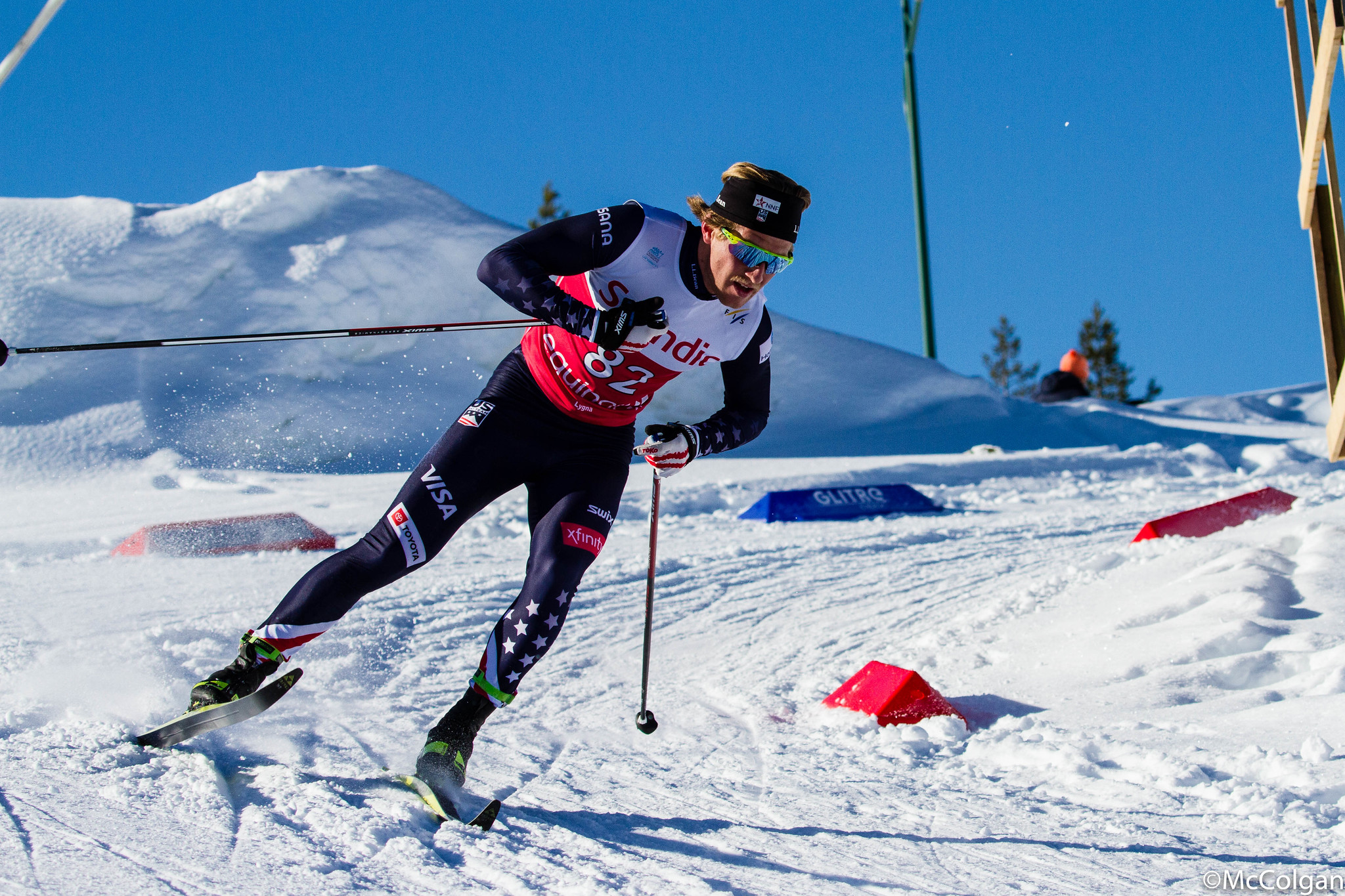
    Brian Bushey races the 10 k classic during the 2022 Junior World Ski Championships in Lygna, NOR. (Photo: John McColgan)

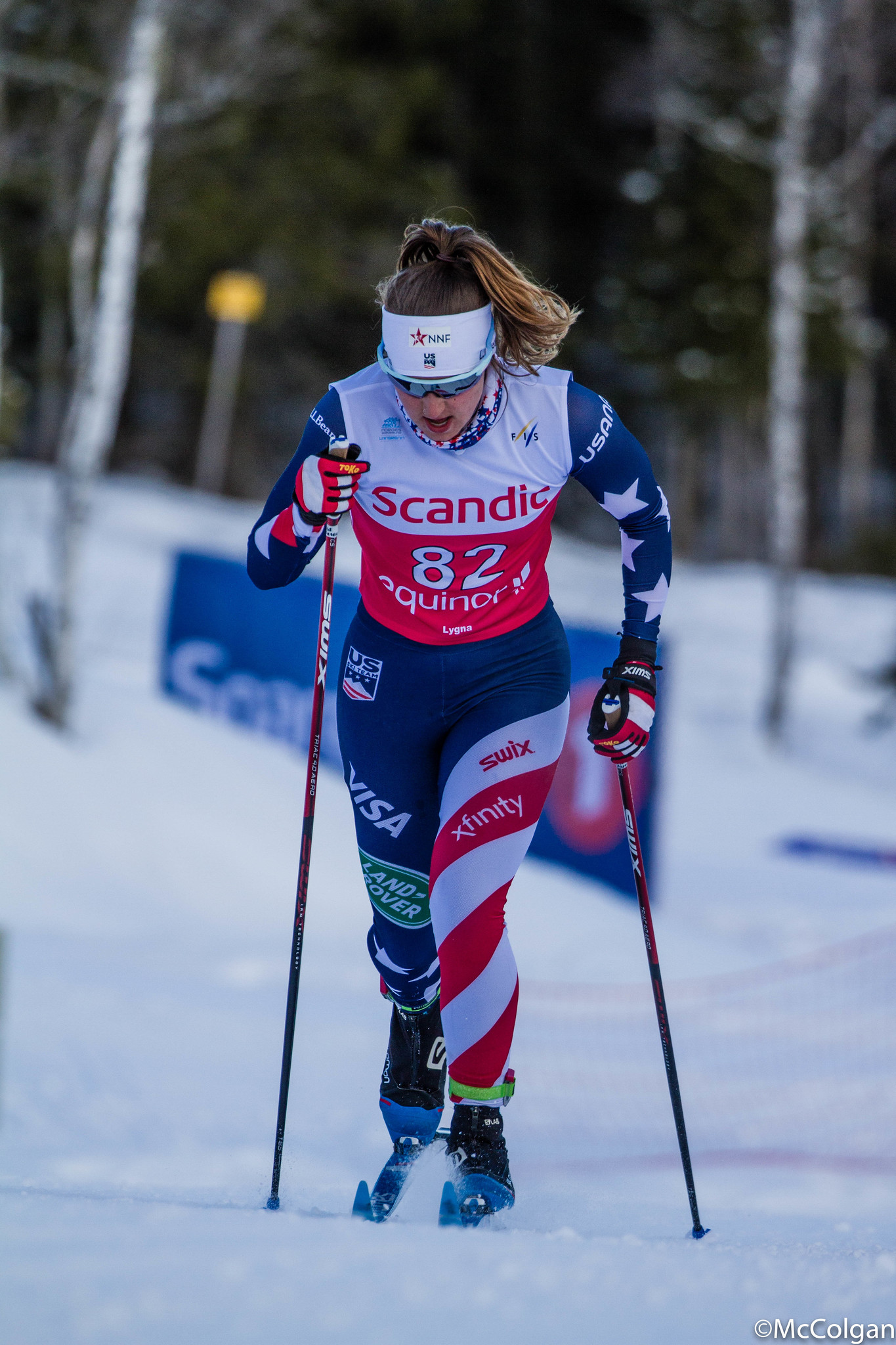
    Will Koch (University of Colorado/Peru, Vermont) led the way for the Americans, finishing in 13th (+1:23.4). He was followed by Alex Maurer (University of Colorado/Anchorage, Alaska), also 26th (+1:40.0); Brian Bushey (University of Utah/Waitsfield, Vermont) in 36th (+2:00.2); and Finn Sweet (University of Vermont/Waterbury, Vermont) in 47th (+2:11.3).

    Thoughts from the coach

    Greta Anderson is in Lygna at her third World Juniors as a coach or tech, her first since assuming her current coaching position with the U.S. Ski Team. (Disclosure, Anderson was this reporter’s coach in APU Masters in 2014–15, and has remained a close personal friend ever since.)

    Asked what she saw about today’s races, Anderson noted, “They were really fun to watch. Between FIS live timing and back split, the radios were pretty lively. One thing I did learn this year, and this is more than I’ve seen in the past, is that our athletes – every single one has the raw speed to compete at this level. We’re working on the durability portion of it. I think the top athletes in these races often are running negative splits in a big way; I would have to sit down and look at percentages. I’m sure we’ll do that at some point in time. But you know, the speed is there early on, we have very good placement, and then we need to figure out how to speed up just a little bit more. But that’s, you know, that’s been a big step for us as a country.

    “Will Koch, obviously very, very strong today. Brian Bushey came out on the top end of ten places being within four seconds, or eight places within four seconds maybe. So you know, really phenomenal. … Annie McColgan had her first ever World Juniors race today. And that’s always really fun and special to watch. I think often athletes come away seeing like, ‘wow, there’s another level,’ and it can be really motivating for the following year.”

    Sydney Palmer-Leger leads the junior women during the 5 k interval start classic. (Photo: John McColgan)

    Turning to Schamberger, Anderson observed that the 16-year-old has “had a pretty heavy week of racing so far. She’s had three starts, and the first day was not what she wanted. And the second day she had the gift of getting redemption the very next day, which I think is one of the best things athletes can have. And she was really happy with how she skied the relay, a big smile on her face. And then a really good race today. It’s fun to watch athletes – the moment that they realize they’re skiing at that level. Because we know they can do it, and we watch it, but that aha moment of ‘Oh, okay, in the world, this is where I am.’ That moment is really cool. It’s one of my favorite parts of my job for sure.”

    Anderson also described the environment at the venue more broadly, highlighting the effects of vocal parental support. “There’s quite a few parents here from the U.S.,” she said.

    “And Americans are really loud compared to other countries, and it’s probably taken as obnoxious, but I really appreciate it. We can always hear the Americans. It’s fun to stand by them and listen to them get all excited. Next to the parents during the relay is one of my favorite places to stand.”

    In that vein, Anderson concluded, “I look around, and I’m so proud to be an American coach. I’m so proud of the American skiers; there’s not a single other nation I would – I’m really glad that I work for our staff. And I think our athletes are really glad that they ski for the U.S.A. I don’t think they look around and think, like, ‘I wish I was on that team,’ or, ‘I wonder what that team is up to.’ We’re definitely in that, ‘We’re Americans and we’re here to beat you. Or at least die trying’ mode. And that’s pretty fun.”

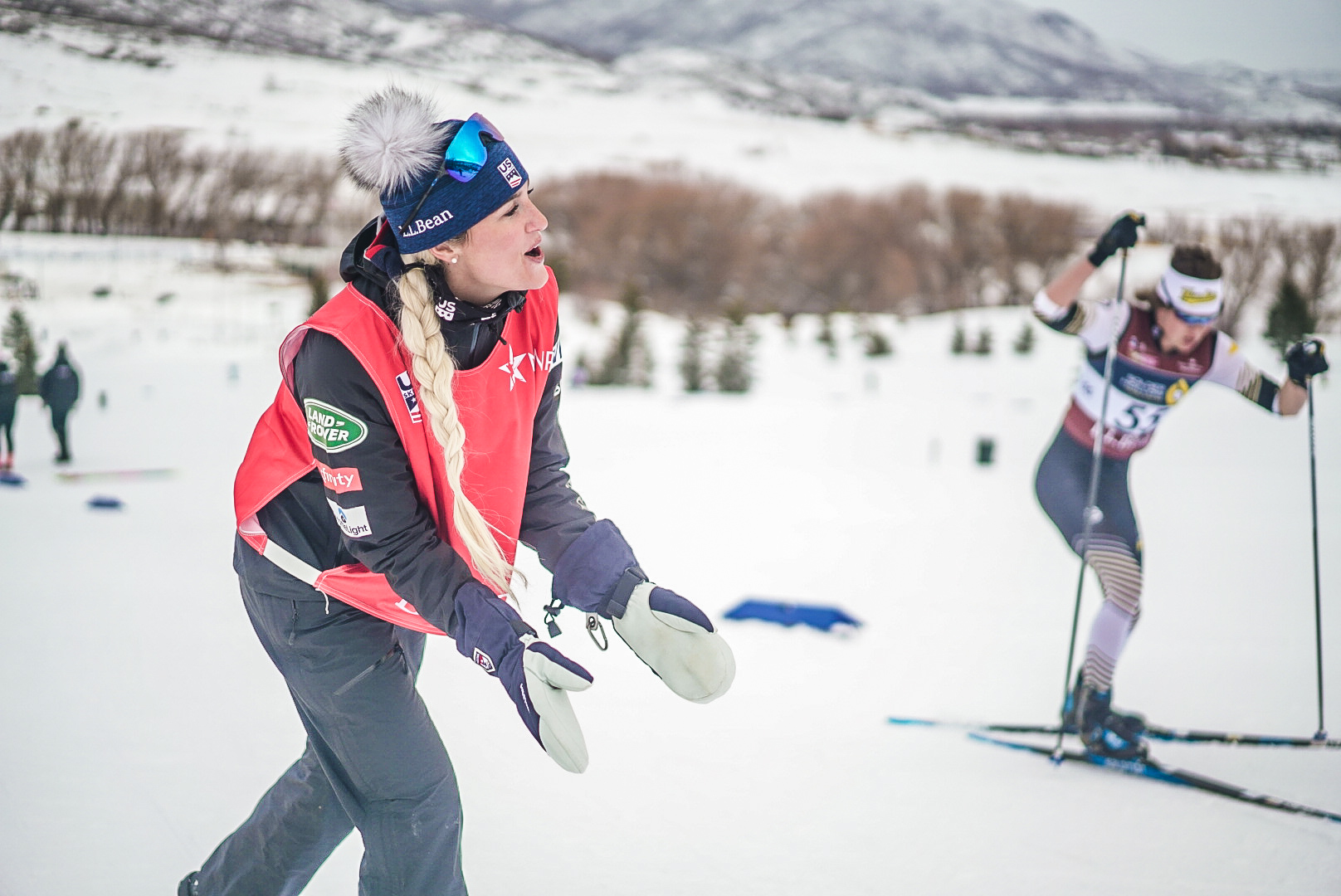
    U.S. Ski and Snowboard Development Team Coach Greta Anderson encourages athletes during the men’s 30k distance race during the 2022 U.S. Cross Country Championships in Soldier Hollow. (Photo: Tobias Albrigtsen / @untraceableg)

    Racing continues tomorrow with skate sprints for U23 athletes, both genders, before wrapping up Sunday with both men’s and women’s U20 skate sprints and the U23 mixed relay, sending athletes and techs out with three races, two techniques, and a combined sixteen sprint heats on the final day of racing. Groundhog’s Day, indeed.

    Today’s results: women | men

    World Juniors links and information:

    Home page and general info | race program | results and live timing (all races) | streaming (only for Thursday through Sunday’s races, purchase required)

  • World Juniors: Zanden McMullen leads the way for the Americans in 10/15 k classic with 14th; Abigail Jarzin top female athlete in 36th

    The 2022 FIS Junior/U23 World Ski Championships trip has been made possible through support from the National Nordic Foundation (NNF), which has identified this invaluable opportunity for developing athletes as one of its “Pillar Projects”. You can support the NNF and the next generations of America’s top skiers by making a donation here.

    Thursday marked the third day of 2022 FIS Junior World Ski Championships in Lygna, Norway, but the first day of competition for U23 athletes, following individual and relay races for the juniors on Tuesday and Wednesday. The U23 athletes saw a 10-kilometer interval start classic for women, and a 15 k interval start for the men.

    Zanden McMullen leads the American U23 athletes with a 14th place finish in the 10 k interval start classic in Lygna, NOR. (Photo: flyingpointroad.com)

    The top American finishers today were Zanden McMullen for the men in 14th, and Abigail Jarzin for the women in 36th. The overall podium was all Nordic countries, for the men, and all non–Nordic countries, for the women.

    Women’s 10 k Classic

    The women had the day’s first race, going out at 1 p.m. local time over two laps of a 5 k course with a relatively humane 145m of total climb per lap.

    Anabel Needham races the 10 k interval start classic during the 2022 U23 World Championships in Lygna, NOR. (Photo: flyingpointroad.com)

    Anja Weber of Switzerland had the day’s second-fastest split at the 3-kilometer timing checkpoint, behind early leader Anastasiya Faleeva of Russia… had the day’s second-fastest split at the halfway mark, behind Faleeva… and had the day’s second-fastest split at the 8-kilometer mark, behind Patricija Eiduka of Latvia.

    But the race was 10 kilometers long. Weber held her speed over the end of the second lap slightly better than Eiduka, ultimately taking the win in 29:59.8. Eiduka was second, a scant 1.3 seconds back. Veronika Stepanova of Russia, last seen anchoring the gold-medal Russian Olympic Committee women’s relay team in Zhangjiakou, was third, 13.1 seconds back, skiing a steady race that saw her rank twelfth, eighth, and fifth at the intermediate timing checkpoints.

    Stepanova recently posted to social media, explaining that she skipped the Olympics 30 k to prepare for World Juniors, adding that she wanted to do fewer races at her relatively young age. (Stepanova turned 21 last month.)

    Abigail Jarzin leads the American U23 women in 36th in the 10 k interval start classic. (Photo: flyingpointroad.com)

    Abigail Jarzin (University of Utah/Salt Lake City, UT) was the fastest of the four Americans in the race, finishing 36th (+2:42.8) in a well-paced effort that saw her move up considerably after ranking 45th at the 5 k split. She was followed by Anabel Needham (Michigan Tech University/Houghton, MI) in 47th (+3:47.5), Rena Schwartz (Dartmouth Ski Team/Middlesex, VT) in 50th (+4:14), and Lucinda Anderson (University of New Hampshire/Golden Valley, MN) in 56th (+4:50.8).

    Among the Canadians, Anna Parent (Canmore, AB) was the top female in 17th (+1:45.8). Next for Canada was Beth Granstrom (Revelstoke, B.C.) was 37th (+2:42.9), followed by Anna Pryce (Calgary, AB) in 40th (+2:48), and Ontario’s Bronwyn Williams in 49th (+3:51.9). 

    Lucinda Anderson races the 10 k interval start classic during the 2022 U23 World Championships in Lygna, NOR. (Photo: flyingpointroad.com)

    Other names potentially recognizable to North American readers include Poland’s Weronika Kaleta, who skis collegiately for UC Boulder, in 21st (+2:03.1), and Australia’s Tuva Bygrave, who skis collegiately for UAA, in 57th (+4:52.8).

    Men’s 15 k Classic 

    The men went out second, undertaking three laps of the same 5-kilometer course starting at 3 p.m. local time.

    The starting list was reverse seeded: The athletes with the highest distance points (on paper, the lowest ranked) went out first; the athletes with the lowest distance points (on paper, those highest ranked) went out last. There were 64 athletes in the field, and the athletes with bib no. 62 and bib no. 64 made the podium; sometimes FIS points have strong predictive value.

    But sometimes first place overall goes to an athlete wearing bib no. 31. And that, as the saying has it, is why you play the games.

    Noel Keeffe races the 15 k interval start classic during the 2022 U23 World Championships in Lygna, NOR. (Photo: flyingpointroad.com)

    Arsi Ruuskanen of Finland skied his first lap in 12:58.1, a split time that ranked sixth overall after all the athletes had come through. Ruuskanen’s relatively early bib number meant that he lapped through the stadium just as eventual eighth-place finisher Iver Andersen of Norway was going out on course. Perhaps due to the chance to work with Andersen for much of his second lap, perhaps due to just his own strong race, Ruuskanen would go on to set the day’s fastest times at 10 kilometers, 13 kilometers, and, notably, the finish.

    The 22-year-old Finn took the victory in a time of 40:23.0. He was closely followed by Leo Johansson of Sweden, 6.7 seconds back, who had more of a gap to third, Håvard Moseby of Norway, 28.1 seconds back.

    The top American on the day was Zanden McMullen (Montana State University/Anchorage, AK), in his first year racing as a U23 athlete after three years of racing at World Juniors. Racing internationally at the senior level, McMullen also had four World Cup starts in Period 1 of this season, then placed sixth in both distance races at 2022 U.S. Nationals.

    McMullen started the 15 k out hot, registering the day’s 3rd-fastest time through the 5 k checkpoint. He slowed slightly from there, though not too much, coming through other intermediate checkpoints in 9th and 15th. He was ultimately 14th overall at the finish, 57.8 seconds back from Ruuskanen.

    Johnny Hagenbuch races the 15 k interval start classic during the 2022 U23 World Championships in Lygna, NOR. (Photo: flyingpointroad.com)

    Among the Americans, McMullen was followed by Johnny Hagenbuch (Sun Valley Ski Education Foundation/Ketchum, ID) in 41st (+2:59.8) and Noel Keeffe (University of Utah/Steamboat Springs, CO) in 47th (+3:39.5). In a nod to a certain race being held in Wisconsin on Saturday, it should be noted that Hagenbuch is the youngest-ever winner of the American Birkebeiner.

    Turning to Canada, Léo Grandbois set the pace with the day’s only top-10 finish for North America, crossing the line in 9th (+44.3). He was followed by Sam Hendry (Canmore, AB.), who skis collegiately for the University of Utah, in 18th (+1:14.1), Ottawa’s Pierre Grall-Johnson in 29th (+1:51.0), and Joe Davies (Pemberton, B.C.), who skis collegiately for UAF, in 35th (+2:16.5).

    Racing continues tomorrow with interval-start classic races for the U20 athletes, 5 k for the women and 10 k for the men.

    Today’s results: women | men

    Rena Schwartz races the 10 k interval start classic during the 2022 U23 World Championships in Lygna, NOR. (Photo: flyingpointroad.com)

    World Juniors links and information:

    Home page and general info | race program | results and live timing (all races) | streaming (only for Thursday through Sunday’s races, purchase required)

  • Schumacher Wins World Junior’s 10 k Classic; Ogden 9th, Jager 10th (With Audio Interview)

    Schumacher Wins World Junior’s 10 k Classic; Ogden 9th, Jager 10th (With Audio Interview)

    The weight is heavy. Pressure from expectations that can cripple or tap into even more primal motivation. Gus Schumacher (U.S./AWS), after qualifying first, and bowing out on Saturday’s World Junior’s skate sprint in the semifinals, placed seventh overall. That is stout. But so is the person behind the results who possesses a killer instinct on the race course but by all accounts projects humility in the rest of his life. The impression is that this nineteen-year-old from Anchorage, Alaska is downright kind — understanding that the hardware won becomes hollow if the person behind the top-step glory is singularly focused on the self.

    Taking it. Gus Schumacher of the U.S. wins the World Junior’s 10 k classic. (Photo: Doug Stephen)

    Post-race interview with Gus Schumacher

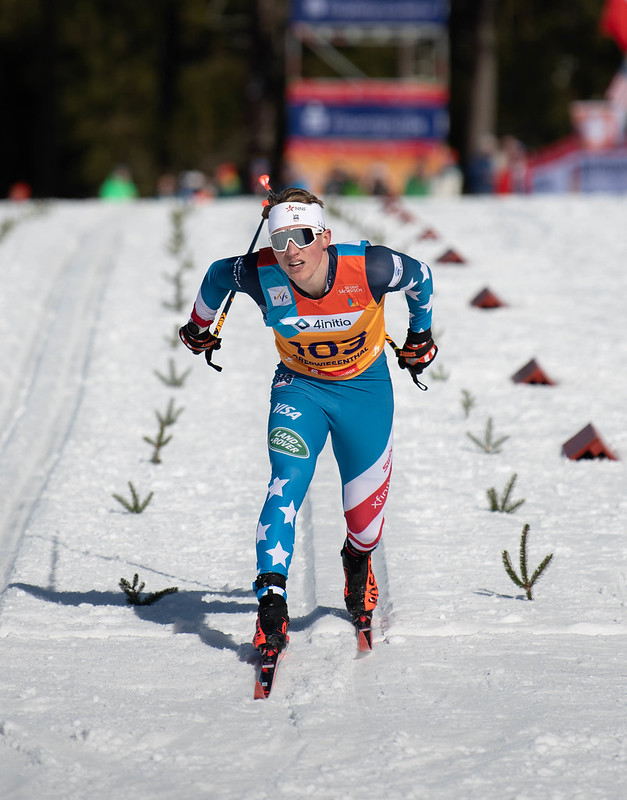
    The time between Saturday’s sprint and Monday’s 10-kilometer interval start classic race must have been a liminal moment for the young skier. Schumacher is in Oberwiesenthal, Germany for podiums not the process of ruminating on what-if scenarios. The transition from not meeting his own benchmark of success on Saturday to channeling all that potential and kinetic energy down to the mitochondrial level was evident Monday as Schumacher won the 10 k classic in 26:31.7. 

    This was a close race that Schumacher, as the last of 103 starters, could chew on as the day’s fastest time split makers at 5 k in bib 102, Germany’s Friedrich Moch, and bib 103, Italy’s Davide Graz, set off before him. The German and Italian came through in first and second, respectively, at 5 k. Moch was 7.5 seconds up on Schumacher, Graz only 1.2 seconds faster. 

    The 10 k no-fuel-left rest phase for Gus Schumacher. (Photo: Doug Stephen)

    Schumacher closed down. By the finish, he had put 4.5 seconds into Moch in second overall and 6.7 seconds into Graz. Good young man, who also happens to be fast, wins a close race. 

    This is Schumacher’s first individual World Junior’s medal. He placed fourth last year at the Lahti World Junior Championships in the 30 k mass start classic. He also anchored the junior men’s winning 4 x 5 k relay for the U.S. at those championships. 

    The celebration continued for the U.S. with two other skiers in the top-10. Ben Ogden (UVM/SMST2) raced to ninth place (+49.8), and Luke Jager (U Utah/APU) 10th (+50.6). The fourth U.S. skier, Johnny Hagenbuch (SVSEF) notched 25th overall (+1:29.8). 

    Ben Ogden on his way to 9th place in the World Junior’s 10 k classic. (Photo: Doug Stephen)


    Luke Jager on his way to 10th in the World Junior’s 10 k classic. (Photo: Doug Stephen)

    Canada’s Xavier McKeever skied to 17th (+1:13.4), Remi Drolet 29th (+1:35.0), Olivier Léveillé 30th (+1:35), and Thomas Stephen 65th (+3:48.7). 

    Xavier McKeever of Canada, hips forward, on his way to 17th in the World Junior’s 10 k classic. (Photo: Doug Stephen)

    Results      

  • Pärmäkoski Untouchable in Lahti 10 k; Bjornsen 7th, Saying ‘Let’s Just Send It’

    Pärmäkoski Untouchable in Lahti 10 k; Bjornsen 7th, Saying ‘Let’s Just Send It’

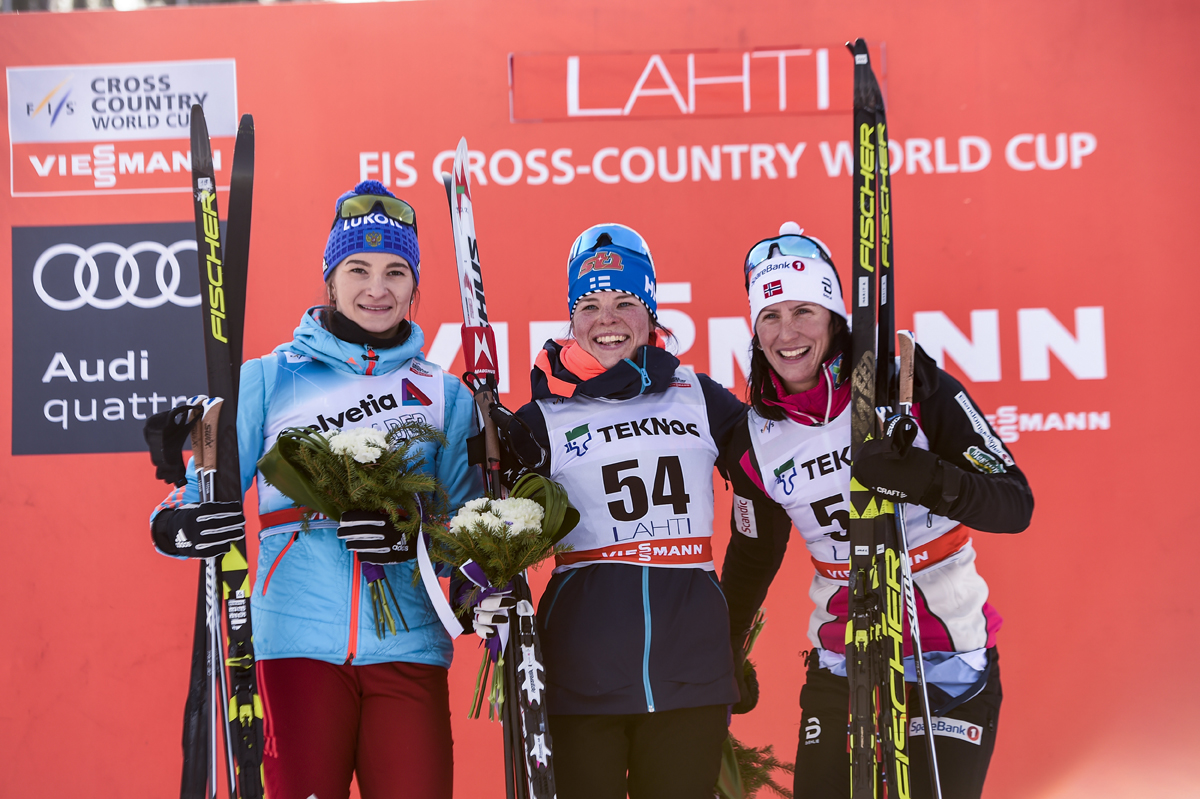
    The women’s 10 k classic podium at Sunday’s World Cup in Lahti, Finland, with Finland’s Krista Pärmäkoski (c) in first, Russia’s Natalia Nepryaeva (l) in second and Norway’s Marit Bjørgen (r) in third. (Photo: Fischer/NordicFocus)

    (Note: This article has been updated to include comments from American Caitlin Patterson.)

    The 2018 Olympics were pretty successful for Finland, in terms of cross-country skiing: Iivo Niskanen won gold in the 50 k and Krista Pärmäkoski earned silver in the 30 k and bronze in the skiathlon and the 10 k skate.

    After the Games finished, the FIS Cross Country World Cup moved to Finland, but on the first day of competition – skate sprints – the host nation was stymied.

    Among the frustrated was Pärmäkoski, who was tangled up when Germany’s Victoria Carl fell in a quarterfinal heat. Carl was relegated to last for her skiing, but that didn’t lessen the sting of not advancing for Pärmäkoski, who had qualified with the third-best time in the women’s field.

    Sunday brought a 10 k classic, a favorite discipline for her, however.

    “Yesterday was kind of annoyed, so I wanted to show [what I could do] today,” Pärmäkoski told Finland’s YLE broadcaster, according to a translation.

    She set out with a vengeance, eventually notching her second career World Cup victory with a 20.9-second win over Natalia Nepryaeva of Russia.

    Finland’s Krista Pärmäkoski celebrates the second World Cup victory of her career, on home turf in Finland in the Lahti 10 k classic. (ARD screencap)

    “When in good shape, feeling bad feels good,” Pärmäkoski said.

    Third place went to Norway’s Marit Bjørgen, who skied an even race to finish +29.2. She was tenth after a kilometer and a half, seventh at 3.7 k, and fifth at 5 k, but managed to ski up and bump Finland’s Kerttu Niskanen off the podium by just 0.3 seconds, for her first 10 k classic podium since 2012.

    “I think it was the finish that secured [the podium],” she told Norway’s VG news site, according to a translation. “I think it went smoothly, very strong on the uphills, and I’m happy with it. I’ll take this finish with me.”

    “Marit is the best athlete of all time, so it feels good that the time has come for me to be able to beat her,” Pärmäkoski told YLE.

    Fifth went to Norway’s Heidi Weng, who opened hard but lost ground on the second lap of the 5 k course and finished 43.3 seconds behind Pärmäkoski. Teresa Stadlober of Austria was sixth (+52.4), Sadie Bjornsen of the U.S. seventh (+57.6), and Ingvild Flugstad Østberg of Norway eighth (+59.0). Aino Kaisa Saarinen (+59.1) and Johanna Matintalo (+1:13.4) rounded out the top ten, giving Finland four finishers in the top ten.

    It was Saarinen’s last time competing on home ground, as the 39-year-old former World Champion is ending her World Cup career after this season. She cried as she was handed a bouquet of flowers at the finish line.

    “It was certainly the best race of the season,” she told YLE.

    Bjornsen Seventh in Post-Olympics Rebound

    Sadie Bjornsen (U.S. Ski Team) finishing seventh in the women’s 10 k classic at the World Cup in Lahti, Finland. (Photo: Fischer/NordicFocus)

    Like Pärmäkoski, Bjornsen had left Saturday’s sprint feeling frustrated. She had qualified in fifth position but then couldn’t make the right move in the quarterfinals and failed to advance to the semifinals.

    “Yesterday was really awesome because I could see that I finally had some good feelings in my legs and I got really excited to keep racing,” Bjornsen said in an interview after the 10 k. “So, today, I don’t know, I was just approaching it like I wonder what can happen, like, let’s just send it hard and see what happens.”

    With cold temperatures making for firm tracks, Bjornsen attacked the course’s long climbs – the biggest of which has a 44-meter height differential.

    “I definitely really love the Lahti courses here,” she said. “I think that there’s like a lot of really awesome climbing. It’s not like they’re necessarily running hills; there’s actually some glide involved with them, and so I think it’s just really cool classic skiing… Right away I could see that I had some good skis under my feet and I just had nothing in the way, so I just went. I tried to go really hard from the start.”

    The effect was immediately noticeable.

    “I always try to go out hard and sometimes it’s hard, and sometimes it’s not,” Bjornsen laughed. “There’s no change in what my perceived effort. I think when I have good races is when that going hard actually is going hard. It was funny, because Matt [Whitcomb, the U.S. Ski Team women’s coach] was cheering at 3 k, and he just yelled ‘you finally went out hard!’ and I actually smiled in the race and was like, ‘ok, this is awesome.’ Like, ‘this is fun,’ you know?”

    Unlike Weng and Niskanen, who faltered at the end, Bjornsen skied a fairly consistent race. She was sixth at 3.5 k, eighth at 6.1 k, and seventh at the finish, 57.6 seconds behind Pärmäkoski’s time and 30.9 seconds off the podium.

    “I maybe struggled a little bit right there in the middle where I needed to continue being strong,” Bjornsen said. “I think that’s where those top girls are really making some time. When I have had my best distance races, it’s when I really nail between 5 and 7.5 k and that is kind of a point that I’ve been working on this year. And, I think that I maybe stuttered a little bit during that time. So I guess, looking back, I feel like that’s where I have to make an improvement for the future–to be in that podium place.”

    Caitlin Patterson (Craftsbury Green Racing Project) racing to 32nd in the women’s 10 k classic at the World Cup in Lahti, Finland. (Photo: Fischer/NordicFocus)

    For the U.S., Caitlin Patterson was next, just missing the World Cup points in 32nd (+2:02.7).

    “The end of the race was good, but the beginning was a little rough,” Patterson wrote in an email. “The course starts out going up one of the sunniest hills, and by the time I started the snow had transitioned on that hill away from the wax that we were using. I had a terrible time getting up the first long rolling climb, but luckily I was able to pull myself together and re-focus for the rest of the race, and the skis worked much better for the rest of the course. So I’m happy with my effort, that I kept pushing and didn’t let up after a bumpy start. I would have been happier with a more consistently strong race, since I did lose quite a bit of time at the beginning that I wasn’t able to make up for later.”

    Patterson raced the first and last events of the Olympics, placing 34th in the 15 k skiathlon and 26th in the 30 k classic mass start.

    “My two races in Korea were separated by 15 days, but I certainly kept busy with training,” she explained. “I did a time trial, at least 3 interval sessions, some strength workouts, and distance workouts.  It’s best for me to stay active and keep the speed up, since I knew that would be the best way to hopefully feel good for the 30k as well as to stay strong for the rest of the season. Beyond training in Korea, I felt really busy with all the time spent taking buses to and from places, but I did get out to watch a Big Air competition one day, and visited the Coastal village area a different day, so a bit of sight-seeing.

    “I’m feeling ready to race and still excited for each start even at this point in the season,” Patterson continued. “If there was another race tomorrow, I’d absolutely want to do it. I feel like it’s been a while since I’ve had a consistent string of races, so I need more back to back to clear the cobwebs out again, and to reaffirm that I still have good racing fitness which I know is true.”

    Ida Sargent and Sophie Caldwell finished 40th (+2:21.9) and 42nd (+2:24.2),  respectively. Rosie Brennan finished 48th (+3:02.1) and SuperTour leader Kaitlynn Miller placed 51st (+3:09.1).

    Liz Stephen of the U.S. Ski Team did not start due to illness.

    Canada started two women: Emily Nishikawa finished 41st (+2:22.2) and Dahria Beatty 44th (+2:40.7).

    — Andrea Potyondy-Smith contributed

    Results

  • Sunday Rundown: Pärmäkoski Wins At Home in Lahti 10 k; Poltoranin Tops 15 k

    Sunday Rundown: Pärmäkoski Wins At Home in Lahti 10 k; Poltoranin Tops 15 k

    Krista Pärmäkoski of Finland (center) won her second straight 10 k classic, to the delight of the crowd in Lahti. Natalia Nepryaeva of Russia (left) finished second and Marit Bjørgen of Norway third. (Photo: FIS Cross Country/Twitter)

    FIS Cross Country World Cup (Lahti, Finland): 10/15 k classic

    Women’s report

    Men’s report

    Racing at home in Finland, Krista Pärmäkoski picked a good time to collect the second World Cup victory of her career, and again in a 10 k classic. Pärmäkoski’s first win came in the 10 k classic in Planica, Slovenia, earlier this season.

    In second was Russia’s Natalia Nepryaeva, who picked up her first World Cup podium. The current U23 standings leader, Nepryaeva’s time was 20.9 seconds slower than Parmakoski. Both she and Marit Bjørgen of Norway, who finished third (+26.7), used a steady pace to reach the podium. At the 5 k split, Heidi Weng of Norway – wearing the yellow bib of the overall World Cup leader – was in second at the halfway point but faded to finish fifth (+43.3), and Kerttu Niskanen of Finland was in third place but she dropped to fourth by the finish, +27.0. Austria’s Teresa Stadlober finished sixth (+52.4).

    Sadie Bjornsen placed seventh (+57.6) to lead the American team. Caitlin Patterson was next, just missing the World Cup points in 32nd (+2:02.7). Ida Sargent and Sophie Caldwell  finished 40th (+2:21.9) and 42nd (+2:24.2),  respectively. Rosie Brennan finished 48th (+3:02.1) and SuperTour leader Kaitlynn Miller placed 51st (+3:09.1).

    Liz Stephen of the U.S. Ski Team did not start due to illness.

    Canada started only two women: Emily Nishikawa finished 41st (+2:22.2) and Dahria Beatty 44th (+2:40.7).

    The men’s 15 k classic podium at the World Cup in Lahti, Finland, with Kazakhstan’s Alexey Poltoranin (c) in first, Russia’s Alexander Bolshunov (l) in second and Finland’s Iivo Niskanen (r) in third. (Photo: FIS Cross Country/Twitter)

    In the men’s race that followed, Alexey Poltoranin of Kazakhstan got some redemption after a major bonk in the Olympics 50 k last weekend, winning the 15 k classic individual start in Lahti.

    Starting in the middle of the field in bib 44 (out of 71), Poltoranin paced it perfectly, skiing a steady race with some of the top split times and then turning it up another notch over the last several kilometers to take the win in 33:11.9 minutes. His biggest threat was Russia’s Alexander Bolshunov, who started 64th and clocked faster splits at every timing point throughout the three-lap race except the one that mattered most — the finish. There, Bolshunov came up 9.1 seconds short of Poltoranin’s time to place second, and Finland’s Iivo Niskanen — the Olympic 50 k champ — placed third, 20.9 seconds out of first.

    Norway took fourth through seventh, with Emil Iversen in fourth (+28.8), Martin Johnsrud Sundby in fifth (+39.9), Niklas Dyrhaug in sixth (+50.1), and Johannes Høsflot Klæbo in seventh (+1:00.3). Russia’s Alexey Chervotkin placed eighth (+1:08.3), Germany’s Thomas Bing was ninth (+1:08.5) and Sweden’s Daniel Rickardsson finished 10th (+1:09.2).

    Canada’s Devon Kershaw led the North Americans in 25th (+1:43.2), and Erik Bjornsen was the top American in 32nd (+2:06.6).

    Four Canadian men raced, with Graeme Killick placing 39th (+2:22.9), Julien Locke 69th (+4:56.6) and Andy Shields 70th (+5:42.1).

    The U.S. was represented by six men, with Noah Hoffman placing 40th (+2:24.0), Paddy Caldwell 45th (+2:40.5), Scott Patterson 50th (+2:58.7), Kevin Bolger 54th (+3:09.5), and David Norris 57th (+3:23.5).

    The World Cup picks back up again this Wednesday with classic sprints in downtown Drammen, Norway.

    Results: Women | Men

  • ‘You Just Had to Bite Your Teeth Together,’ Bjørgen Wins Challenging Ruka 10 k; Diggins 10th

    ‘You Just Had to Bite Your Teeth Together,’ Bjørgen Wins Challenging Ruka 10 k; Diggins 10th

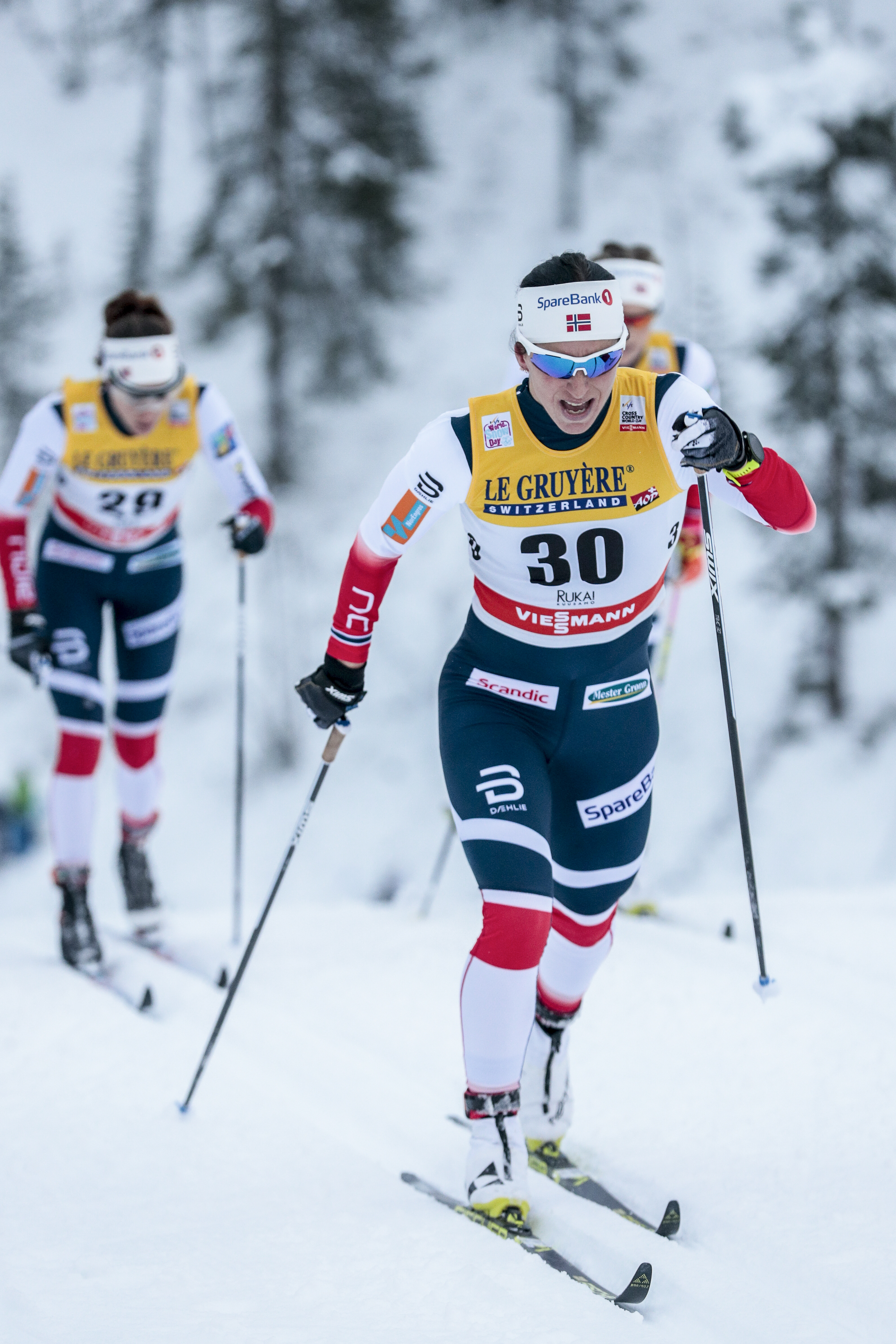
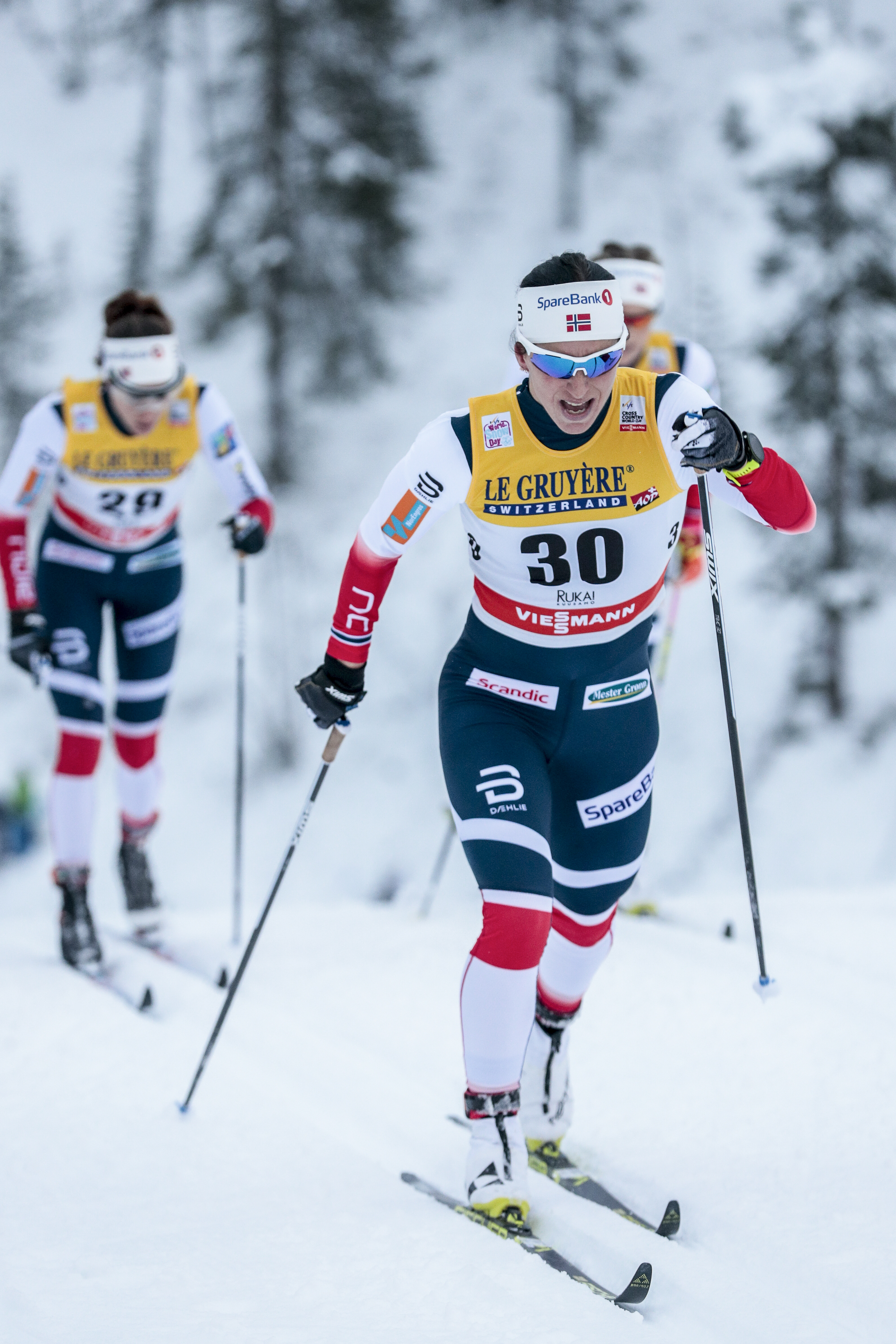
    Norway’s Marit Bjørgen (30) leads her teammate Heidi Weng (29) in the women’s 10 k classic individual start on Saturday at the Ruka World Cup in Kuusamo, Finland. (Photo: Fischer/Nordic Focus)

    At age 37, with more than 110 World Cup wins, 18 World Championships titles and six Olympic gold medals, it’s hard to imagine Norway’s Marit Bjørgen as anything but a machine; she races, she wins, she repeats.

    But even the World Cup veteran, who first raced the circuit in 1999, occasionally considers the simplicity of throwing in the towel. With intermittent snow showers on Saturday in Kuusamo Finland, temperatures hovering around freezing and varying snow conditions over the women’s two-lap course, many competitors entered in Saturday’s 10-kilometer classic individual start were caught in the classical dilemma of either slipping or sticking.

    “It was interesting to see everyone out there — from all different countries — during the warmup come to the top of hills and just scrape their skis off; it’s not something that you always see on the World Cup,” U.S. Ski Team member Ida Sargent said in a post-race phone interview. “But it was just one of those days where nothing was going to be perfect.”

    No matter how prepared or fit an athlete is, part of the allure and challenge of cross-country skiing is the element of ever-changing conditions. Mother Nature, after all, cannot be tamed. And even someone like Bjørgen can find it defeating.

    “It was challenging to lead today,” Bjørgen told NRK, according to a translation. “I considered giving in after the first kilometer, but then I got a good split time and realized that it was just as bad for everyone. Then you just had to bite your teeth together … I think I finished well.”

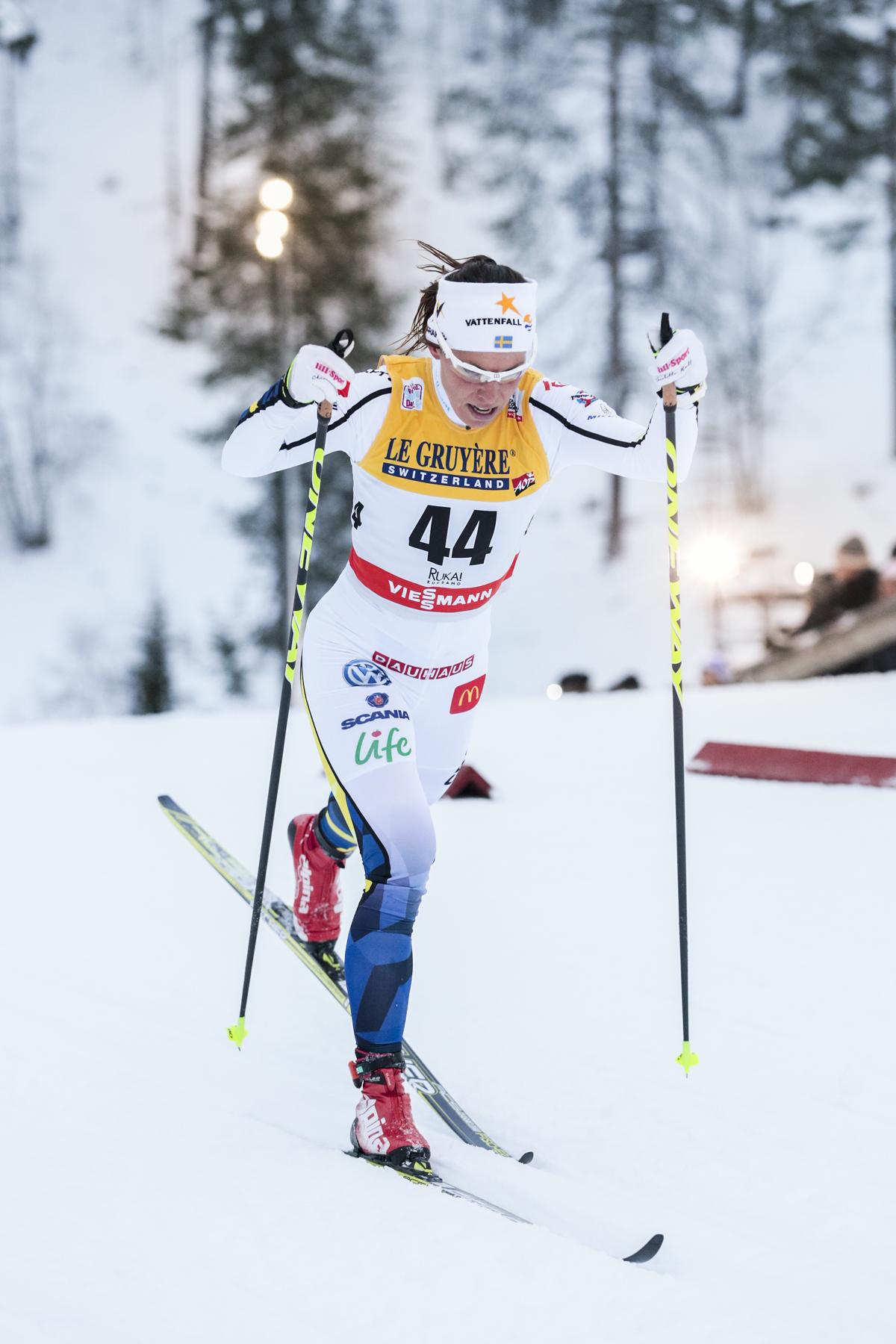
    Sweden’s Charlotte Kalla racing to second in the women’s 10 k classic at the Ruka Triple World Cup on Saturday in Kuusamo, Finland. (Photo: Fischer/Nordic Focus)

    By the first kilometer, Bjørgen in bib 30 (out of 89) was situated in third, 2.5 seconds back from the race leader at the time, Sweden’s Charlotte Kalla. In the next two kilometers, Bjørgen lost 8.6 seconds on Kalla, but surpassed Finland’s Aino-Kaisa Saarinen to move into second. Over the next 3 k, Bjørgen regained ground and began to close in. By the 6 k mark, she was but 0.6 seconds off of Kalla’s time and in another two kilometers, she was ahead by one second.

    Having overcome her initial discontent with the conditions, Bjørgen did not let off the brake, besting Kalla by 17 seconds at the finish and taking over the leader’s chair in 25:07.6. That result stood, and just 0.8 seconds out of second place, Norway’s Ingvild Flugstad Østberg stood on the final step of the podium in third place (+17.8).

    American Jessie Diggins, of the U.S. Ski Team (USST), placed 10th (+1:03.9) for her fourth-best result in a 10 k classic — her most recent being an eighth place in a classic mass start at last season’s Tour de Ski stage in Val di Fiemme, Italy.

    “I think this is probably the best I have ever done in Kuusamo,” Diggins said on the phone, referring to her performances in previous classic distance races there. In 2015, she finished 38th in the Ruka 10 k classic pursuit, and a year ago, she placed 13th in the Ruka 10 k classic.  

    “I usually try to come into the season really patient and work into it,” she continued “So it was a really nice surprise to feel pretty good today and fire up the engines, get that first distance race out of the way and remember how it feels to pace a 10 k.”

    She stayed within ten seconds of 10th place for most of the race, closing it down to 2 seconds with less than to 2 k to go before securing her final top-10 spot. While Diggins explained that many of the racers she saw on course appeared to have either no glide or no kick, she felt fortunate to have a decent balance of both.

    “I would ice up a little bit, but I could just run up the hills out of the track and then kick them really hard and they would clear up,” Diggins said. “So they stayed pretty fast, but with good kick as well, which was really really impressive. It could not have been easy to get the best of both worlds, so I am really, really grateful to those guys [our wax technicians].”

    Ahead of Diggins was Norway’s Heidi Weng in fourth (+34.0), Austria’s Teresa Stadlober in fifth (+36.4), Norway’s Ragnhild Haga in sixth (+38.2), Russian U23 (under-23) skier Natalia Nepryaeva in seventh (+42.8), Sweden’s Stina Nilsson  Friday’s classic sprint winner) in eighth (+46.1), and another U23 Russian, Anastasia Sedova in ninth (+53.4).

    Sargent placed 22nd (+1:21.9) for her best World Cup distance race result since 2014 and was the second fastest American woman of the day.

    “I haven’t scored distance points in a couple of years now, so it feels awesome to be back in the points, and I am really stoked to start the season out like this,” said Sargent, who’s been known for her sprinting results in Kuusamo (with a fifth place in its 2014 classic sprint and seventh place in 2015).

    “I was definitely a little conservative at the beginning, but I think the upside of that is not blowing up, especially for me being a little more sprint-based,” she explained. “It was exciting to be pushing and working my way through the race; moving up that way.”

    In the first kilometer, Sargent was positioned in 69th, 7.6 seconds away from 22nd. In the next 2 k, she moved up to 42nd, and by the halfway point she was in 33rd. Sargent continued to move up in rank, improving five more places by 6 k and moving into 24th with 2 k to go. By the finish, she had moved up to 22nd.

    “She just had an awesome pace out there,” U.S. Ski Team Women’s Head Coach Matt Whitcomb said on the phone after. “She started quite slow for the first 1.2 k. Something we talked about that has worked really well here, you go out too hard and you blow up, and you just bleed time throughout the race, or you go out conservatively see where the body is and figure out where you can put the pedal down. She skied a really patient race for the first two k and then was able to push the pedal and got a great response out of her body.”

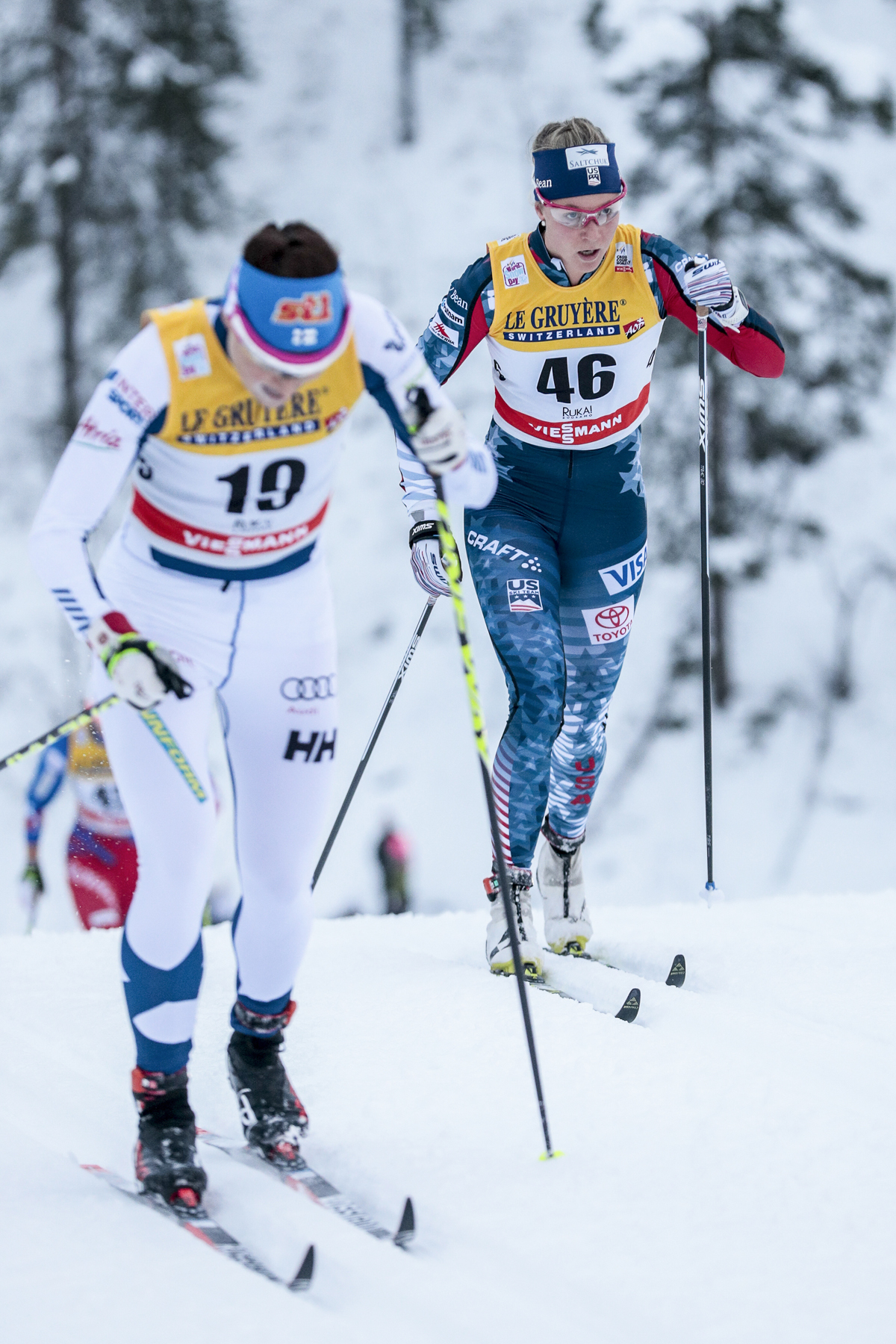
    American Sadie Bjornsen (46) chasing down Finland’s Aino-Kaisa Saarinen (19) during the women’s 10 k classic at the World Cup opener in Kuusamo, Finland. Bjornsen placed 23rd while Saarinen was 27th. (Photo: Fischer/Nordic Focus)

    Just 1 second behind Sargent was another USST member Sadie Bjornsen, coming off a career-best second place in Friday’s classic sprint, in 23rd (+1:23.4). While Bjornsen explained she had adequate recovery from the sprint, she had difficulty with her skis.

    “I worked really hard to calm all my excitement last night, and channel it towards today,” Bjornsen wrote in an email. “I woke up feeling recovered and ready to rally. … Unfortunately, I really struggled with skis today, and didn’t have the extra power to push through it. I was really proud for fighting hard, and pushing on like I was racing for a medal. What I have learned with classic skiing in this world of crazy conditions is that when the stars align, it can turn into an incredible day. But, it doesn’t happen every day, so no matter what, you have to be ready to seize every opportunity like it is your day. I am looking for more in my distance classic skiing of course, but the season is mighty long, I am happy with how I feel, so I know it will come this year.”

    In the standings, Bjornsen is now ranked 11th, behind Norway’s Haga and ahead of Sweden’s Anna Haag. Diggins is 16th with one race remaining: the women’s 10 k freestyle pursuit on Sunday.

    Finishing 6.2 seconds outside of the top 30 (and just 0.3 seconds out of 31st) was Rosie Brennan (USST) in 33rd (+1:47.7). Happy with her ski choice, Brennan used the conditions as an opportunity to test her race technique.

    “I decided to try a more aggressive pacing strategy today to ensure I could hold my technique together with such challenging conditions,” Brennan wrote in an email. “I think I over-paced as a result and should have started picking up the pace sooner than I did. This are all the things that take a few races to get back into the groove so I’m not too concerned with that. However, I felt good after picking up the pace so I think I am fit and ready more for.”

    Three places behind Brennan was another USST member, Sophie Caldwell (who finished eighth in Friday’s sprint) in 36th (+1:50.1).

    “This is a really tough course, so I tried to pace it well and take the first lap in control,” Caldwell wrote in an email. “I knew it would require some patience and tried not to panic if I didn’t feel perfect or my skis weren’t perfect in some places. I decided to go on wax and my skis were icing a bit over the tops of the hills, but I was able to ski off the accumulated snow and they felt fast for the downhills.”

    In addition to reaching the semifinals in Friday’s opening sprint, Caldwell started her World Cup season by racing to third in the sprint’s qualifying round.

    “Physically I felt pretty good today,” Caldwell wrote. “I was a little sore from the sprints yesterday, but I felt like I was able to recover enough to still have good energy and I was happy with the race. I felt like I skied the downhills well and definitely got a little tired going over the top of the massive uphill the second time, but was overall pleased with the race and think it was probably one of the best, if not the best distance race I’ve ever had in Kuusamo.”

    Nine American women raced Saturday’s 10 k, with Kikkan Randall (USST) finishing 48th (+2:14.5), Liz Stephen (USST) 58th (+2:26.3), Chelsea Holmes (Alaska Pacific University) 64th (+2:50.0), and Julia Kern (USST D-team) 74th (+3:19.2).

    Three Canadian women competed, with Emily Nishikawa (Canadian World Cup Team) leading them in 56th (+2:24.2), Cendrine Brown (National U25 Team) following in 76th (+3:23.6), and Dahria Beatty (World Cup Team) finishing 84th (+3:53.5).

    In Sunday’s 10 k freestyle pursuit, Kalla as the mini-tour leader will start 2 seconds ahead of Bjørgen in second and 12 seconds ahead of another Swede, Nilsson, in third. Østberg will start fourth, 20 seconds out of first, and Nepryaeva will head out fifth, three seconds after Østberg. Bjornsen in 11th will start 46 seconds back (and just 6 seconds out of seventh), and Diggins will start 1:04 back in 16th, 3 seconds behind Finland’s Kerttu Niskanen in 15th.

    Results: 10 k classic | Ruka Triple Standings (Day 2) |Pursuit start list

    — Ian Tovell and Harald Zimmer contributed

    The women’s 10 k classic podium on Saturday at the World Cup opening weekend in Kuusamo, Finland, with Norway’s Marit Bjørgen (c) in first, Sweden’s Charlotte Kalla (l) in second, and Norway’s Ingvild Flugstad Østberg (r) in third. (Photo: Fischer/Nordic Focus)
  • Saturday Rundown: Bjørgen, Klæbo Dominate Ruka Day 2; Diggins 10th; Fletcher Gets 2nd Top 20

    Saturday Rundown: Bjørgen, Klæbo Dominate Ruka Day 2; Diggins 10th; Fletcher Gets 2nd Top 20

    The women’s 10 k classic podium at Day 2 of the World Cup opening Ruka Triple in Kuusamo, Finland, with Norwegian winner Marit Bjørgen (c), Swedish runner-up Charlotte Kalla (l), and Norway’s Ingvild Flugstad Østberg (r) in third. (Photo: FIS Cross Country/Twitter)

    FIS Cross Country World Cup (Kuusamo, Finland): 10/15 k classic

    Women’s report

    Men’s report

    On Day 2 of the Ruka Triple World Cup opener on Saturday, Norway’s Marit Bjørgen collected a 17-second victory in the women’s 10-kilometer classic individual start in Kuusamo, Finland.

    Bjørgen started 30th of nearly 90 women and was contested by one other: Sweden’s Charlotte Kalla in bib 44. Kalla clocked through the 3.1 and 6.2 k checkpoints faster than Bjørgen, but the Norwegian’s time stood up against Kalla’s at 8.1 k, where Bjørgen was 1 second faster. Over the last two kilometers, Bjørgen continued to gain speed toward the finish, crossing the line in 25:07.6 minutes. Kalla came within 17 seconds of her, which was good enough for second place and 0.8 seconds faster than another Norwegian, Ingvild Flugstad Østberg, who was bumped to third (+17.8).

    Norway had three in the top four with Heidi Weng in fourth (+34.0). Austria’s Teresa Stadlober put herself in the mix in fifth (+36.4), Norway’s Ragnhild Haga was sixth (+38.2), Russia’s Natalia Nepryaeva seventh (+42.8), Sweden’s Stina Nilsson eighth (+46.1), Russia’s Anastasia Sedova ninth (+53.4), and American Jessie Diggins 10th (+1:03.9).

    Also for the U.S. Ski Team, Ida Sargent placed 22nd (+1:21.9) and Sadie Bjornsen, who notched a career-best second in Friday’s classic sprint and led the women’s Ruka Triple standings after Day 1, finished 23rd (+1:23.4). Bjornsen is now 11th in the standings (46.5 seconds behind Kalla in first) with one more day of racing (women’s 10 k freestyle pursuit) remaining.

    Kalla is 2.6 seconds ahead of Bjørgen in the mini-tour standings, and Nilsson is third (+12.4) ahead of Østberg in fourth (+20.0).

    Nine American women raced on Saturday, with Rosie Brennan placing 33rd (+1:47.7), Sophie Caldwell (who was eighth in Friday’s sprint) following in 36th (+1:50.1), Kikkan Randall finishing 48th (2:14.5), Liz Stephen 58th (+2:26.3), Chelsea Holmes 64th (+2:50.0), and Julia Kern 74th (+3:19.2).

    Three Canadian women competed, with Emily Nishikawa placing 56th (+2:42.2), Cendrine Browne 76th (+3:23.6), and Dahria Beatty 84th (+3:53.5).

    Klæbo Doubles Up in Ruka

    Norway’s Johannes Høsflot Klæbo (top and bottom, center) won his second-straight race at the Ruka World Cup opener on Saturday in Kuusamo, Finland, with a 15-second victory in the men’s 15 k classic over fellow Norwegian Didrik Tønseth (bottom left). Finland’s Iivo Niskanen (bottom right) also reached the podium in third. (Photo: FIS Cross Country/Twitter)

    In the men’s 15 k classic that followed, Johannes Høsflot Klæbo rocketed to his second-straight win of the World Cup’s opening weekend in 33:38.8, which was 15.3 seconds clear of runner-up and fellow Norwegian Didrik Tønseth.

    Finland’s Iivo Niskanen started after Klæbo (bib 42) and Tønseth (bib 33) in bib 70 and pushed to contend with Klæbo, but came up 17.7 seconds short at the finish. Russia’s Alexander Bolshunov also emerged as a later contender, starting 66th (out of 115) and clocking the fastest times at 3.1 and 5 k. Bolshunov ended up 19.9 seconds behind Klæbo at the finish and ultimately settled for fourth.

    Kazakhstan’s Alexey Poltoranin placed fifth (+25.6) after being an early race leader in bib 12, and Russia’s Evgeniy Belov (another early starter in bib 10) followed sixth (+26.5). Norway’s Emil Iversen placed seventh (+30.2) and Martin Johnsrud Sundby was eighth (+30.7), Russia’s Alexey Chervotkin ninth (+31.2), and Sweden’s Calle Halfvarsson 10th (+34.4).

    Canada’s Alex Harvey placed 13th (+49.7), behind Norway’s Pål Golberg and Hans Christer Holund in 11th (+38.1) and 12th (+44.7), respectively.

    American Erik Bjornsen and Canadian Devon Kershaw tied for 26th (+1:15.2).

    Also for the U.S., Noah Hoffman was 43rd (+1:58.4), Andy Newell 59th (+2:29.6), Paddy Caldwell 72nd (+2:53.5), Scott Patterson 86th (+3:17.7), and Simi Hamilton 96th (+3:43.4).

    For Canada, Len Valjas finished 48th (+2:08.0), Graeme Killick 58th (+2:23.4), Knute Johnsgaard 87th (+3:19.8), Julien Locke 100th (+3:56.4), and Jess Cockney 109th (+5:20.7).

    Klæbo extended his lead in the Ruka Triple standings to 38.3 seconds over Bolshunov, who moved up to second place. Golberg is third (+44.1), Halfvarsson fourth (+47.8), and Niskanen fifth (+49.5) with Sunday’s 15 k freestyle pursuit remaining.

    Harvey is 12th in the standings (+1:22.8) and Bjornsen 23rd (+1:50.9) to lead the Canadian and American men, respectively.

    Results: 

    Women’s 10 k classic | Women’s Ruka Triple standings (Day 2)

    Men’s 15 k classic | Men’s Ruka Triple standings (Day 2)

    ***

    FIS Nordic Combined World Cup (Kuusamo, Finland): Individual large hill/10 k

    Also in Ruka, the second day of nordic-combined action started on the HS 142 large hill and ended with a 10 k Gundersen start, which Japan’s Akito Watabe won by 31.7 seconds over Finland’s Eero Hirvonen. Watabe jumped to first on the large hill with a total of 158.6 points, while Austria’s Wilhelm Denifl followed with 154.2 points in second, just ahead of France’s Maxime Laheurte with 154.2 points in third.

    The lone American to start the competition round for the second-straight day, Bryan Fletcher jumped to 31st. (His USA Nordic teammate Ben Berend just missed the top-50 cutoff in the qualification round in 52nd, while Taylor Fletcher was 65th in qualifying.)

    In the 10 k that followed on Saturday, Watabe started with a 16-second head start on Denifl and extended his lead to the finish, crossing first in 24:58.6. Hirvonen, who started ninth and 58 seconds back based on his jump, rose to second, while Germany’s Johannes Rydzek raced up from eighth to third (+32.8). Norway’s Jan Schmid placed fourth (+34.4) and France’s Antoine Gerard finished fifth (+36.5), Laheurte took sixth (+38.4), Norway’s Espen Andersen was seventh (+39.8), Austria’s Mario Seidl was eighth (+43.7), and Denifl ended up ninth (+55.7). Bryan Fletcher skied the fourth-fastest time to place 18th. Fletcher started 2:29 after Watabe and finished 1:45.8 behind him.

    On Friday, Fletcher placed 17th in the individual large hill/5 k Gundersen. In the first Nordic Combined World Cup competition of the season, Norway took first and second with Andersen holding off his teammate Schmid by 7.7 seconds for the win in 12:58.0. Watabe placed third, 11 seconds out of first, after jumping to third.

    Andersen’s jump ranked second on Friday and he started the two-lap 5 k four seconds behind Seidl, the jump leader. Seidl fell back three places to fourth at the finish (+15.4) while Schmid rose from sixth to second place with the third-fastest ski time.

    Denifl maintained his jumping position in fifth (+29.1) and Laheurte finished ninth — up from 12th in the jump. Fletcher jumped to 18th and improved one spot to 17th (+2:47.6) after starting 3:04 out of first.

    Day 3 of nordic combined’s long weekend in Ruka is another individual large hill/10 k Gundersen on Sunday.

    Results:

    Friday’s large hill/5 k | Saturday’s large hill/10 k

    https://www.instagram.com/p/Bb2Vo18leSe/?taken-by=usanordic

  • Bjørgen Shows Who’s Still the Boss; Bjornsen 19th in Otepää

    Bjørgen Shows Who’s Still the Boss; Bjornsen 19th in Otepää

    Norway’s Marit Bjørgen winning Sunday’s 10 k classic at the World Cup in Otepaa, Estonia. She beat runner-up Charlotte Kalla of Sweden by 26.5 seconds. (Photo: Fischer/NordicFocus)

    “Visit Estonia,” it read on the bibs of all athletes in the women’s World Cup 10-kilometer classic individual start race, an advertisement by the tourist board of the Baltic country.

    Unfortunately after experiencing beautiful weather for Saturday’s sprint, the town of Otepää — which on most days is indeed a paradise for all kinds of winter sports — was not able to present itself looking exactly like a picture out of a travel brochure on Sunday, with a misty sky and a steady drizzle thawing the snow around the venue.

    Many of the cross-country skiers heading to the start gate in their warmup gear looked a bit despondent as they were signing the clear plastic board the International Ski Federation (FIS) usually presents to the hosts as a gift, while a staff member continuously tried to wipe big drops and puddles off the surface thereby probably erasing some hastily scribbled signatures.

    Skiing two 5 k loops around the arena, the athletes began to look like wet grumpy cats, with the exhaustion further distorting faces as they conquered two steep climbs on the course, the longest ascending almost 60 meters.

    Norway’s Marit Bjørgen racing to first in Sunday’s 10 k classic at the World Cup in Otepaa, Estonia. She won by 26.5 seconds. (Photo: Fischer/NordicFocus)

    While it was not an easy race for anyone, some skiers struggled more than others. Starting in the middle of the field, Norway’s Marit Bjørgen used the rainy day to make it crystal clear who is still the queen of distance skiing. The currently suspended Therese Johaug might be the princess, and several young skiers can challenge the throne on a good day. But Bjørgen still, or rather again following her one-season maternity leave, rules them all.

    Poland’s Justyna Kowalczyk — another veteran who managed to win the skiathlon in PyeongChang two weeks ago (though with a diminished starting field) and who won the 10 k classic distance in Otepää four times before — started strong, setting the best initial split times. Ultimately she would end the day in fifth (+1:19.7).

    Then Norway’s current overall World Cup leader Heidi Weng set the best split times, and topped Kowalczyk’s finishing time by more than 20 seconds.

    Next, the third Norwegian Ingvild Flugstad Østberg came to the finish (+1:17.4), significantly behind Weng but able to best Kowalczyk’s time by just over two seconds, pushing her to third for the time being. Østberg sped up along the course, and was 21.5 seconds behind Kowalczyk at the 7.5 k split before setting a blazing pace in the last section.

    But when she had caught her breath crouching in the snow at the finish, Østberg could only look on and applaud as Bjørgen came into the finish with a huge lead, celebrating with her arms raised high when she crossed the line in a time of 29:59.0, and improving on Weng’s time by almost a minute.

    “I had a good training in the last period,” Bjørgen later told FIS in an interview. “Already at the Norwegian nationals I knew I was in a good shape. Conditions were tricky today but the course was a good test before the World Championships.”

    Her teammate Weng summed the day up succinctly in her interview with FIS, after Bjørgen had gapped her by 57.2 seconds: “Marit was amazing today. She was way too fast for me.”

    And for everyone else.

    The women’s 10 k classic podium at the Otepaa World Cup on Sunday in Estonia, with Norwegian winner Marit Bjørgen (c), Sweden’s Charlotte Kalla (l) in second and Norway’s Heidi Weng (r) in third.(Photo: Fischer/NordicFocus)

    Only Sweden’s Charlotte Kalla could prevent a Norwegian podium sweep at that point. Starting late in the field in bib 60, she improved on all the split times of Weng and Østberg. But she steadily lost time on Bjørgen, and with 2.5 kilometers to go was also already 26.6 seconds behind.

    While Bjørgen watched the rest of the field from the comfort of the leader’s chair wearing a puffy blue coat with her legs covered by a blanket and munching on an energy bar, Kalla did not lose any more time on the last stretch into the stadium. She settled about halfway between the two Norwegian leaders to claim second place (+26.5), thereby pushing Østberg of the podium to fourth.

    “I came to Otepää after a high-altitude training camp,” Kalla told FIS. “I felt very good today. I had amazing skis. The hills in Otepää are really tough.”

    After Kalla struggled with health issues earlier this season, the 2015 world champion in the 10 k freestyle seems to be rounding back into shape just in time for the next World Championships in Lahti, Finland, which start Thursday. Finnish home-crowd favorite Krista Pärmäkoski was sixth on Sunday (+1:23.1), just behind Kowalczyk and Østberg.

    But Bjørgen is the athlete to watch again in Lahti. While the mother of a 1 year old might not yet have her full sprint kick back, she certainly seems able to be at the top of the podium in distance races again.

    And according to the statisticians at FIS, for the last seven World Championships, the winner of the final 10 k World Cup race before it also won that distance at the championships a few days later (although at the 2014 Olympics this trend was broken, with Bjørgen finishing fifth in Sochi).

    “It was a very good feeling to take with me to the championships,” Bjørgen told Norwegian broadcaster NRK in a post-race interview. “I got the answers I was hoping for.”

    She added that she feels more confident than for the championships in Falun two years ago, and when asked to rate her current confidence level on a scale of 1 to 10 heading to Finland, Bjørgen smiled: “This is enough for a nine. A little bit is still missing.”

    Her opponents should still be worried.

    Three Americans in the Points

    On Sunday, U.S. Ski Team (USST) member Sadie Bjornsen had the best race of the North Americans, finishing in 19th (+2:30.5).

    Sadie Bjornsen (U.S. Ski Team) racing to 19th in the women’s 10 k classic on Sunday in Otepaa, Estonia, the last World Cup before World Championships start this week. (Photo: Fischer/NordicFocus)

    “It was a challenging day out there, but had some wonderful moments,” Bjornsen wrote in an email to FasterSkier.

    She was excited that her game plan for the day had worked out well, skiing with Poland’s Kowalczyk who had started the race just one bib and 30 seconds behind her.

    “I had a good start, and was expecting Justyna to catch me at some point during the race, because I know she is in really good form,” Bjornsen explained. “When she caught me I was determine to stay with her, and finish the race together.”

    That happened somewhere between 3 and 4 k, but in this race Kowalczyk was a little bit too fast for her to stick with until the finish.

    “Unfortunately, I had quite slow skis today, so wasn’t able to hold on as I was really hoping to,” Bjornsen wrote. “From there I tried to keep my head fighting, and do what I could. I feel confident heading into Championships, because I felt my form was there today. The result didn’t show it, but that is classic skiing. There are a heck of a lot of variables. If I get those parts dialed, I am really looking forward to some incredible opportunities to come!”

    Unlike some other skiers who looked miserable in the wet conditions, Bjornsen’s teammate Rosie Brennan had no complaints.

    “I actually enjoy classic skiing when it’s a bit sloppy as I think it plays to my strengths so I felt fine about the conditions,” Brennan wrote in an email. “The track held up fairly well all considering.”

    Starting late in the field just ahead of Kalla, Brennan also took advantage of skiing with Kowalczyk at least for one loop, similar to the tactic Bjornsen had tried to use. And it might have worked even better for her.

    “It was fantastic to start my race and realize Kowalczyk had just lapped through,” Brennan wrote. “I settled in behind her and enjoyed the ride and actually pulled away from her in the last kilometer of that lap.”

    But when Kowalczyk skied into the finish, Brennan still had one more loop to go, and could only see her teammate Liz Stephen who had started 30 seconds ahead of her.

    “The second loop was quite lonely and I had to keep mentally tough out there,” Brennan recalled. “I could see Liz ahead of me every now and then, but she never seemed to be getting closer so it was a challenging finish.”

    Still, it was one of her best results of the season, finishing the race in 24th (+2:37.8). Brennan is now looking forward to her second senior World Championships with the U.S. Ski Team.

    “I am satisfied with this race as it lets me know the training I did at home was good and I have good fitness,” Brennan concluded. “I still have one week until the distance races start at World Champs so I am excited to finish that preparation and hopefully get a little more pop in my body.”

    The women’s World Cup 15 k skiathlon podium on Feb. 4 in PyeongChang, South Korea, with Poland’s Justyna Kowalczyk (c) in first, American Liz Stephen (l) in second, and Japan’s Masako Ishida (r) in third. (Photo: Fischer/NordicFocus)

    Maybe accepting the weather for what it is could be one of the secrets to a good classic race. Like Brennan, this is what the third USST member Stephen, who started in the last start group just one bib ahead of Brennan, also did.

    “The conditions today were wet and a bit sloppy, but honestly, for the women’s race the tracks held up fairly well, so no complaints on my end!” Stephen wrote in an email. “I like klister skiing when it’s slushy and soft like this, so I like days like today!”

    She explained that she mostly had to ski the race by herself.

    “I was able to ski a tiny bit with (Germany’s) Steffi Boehler and Kalla passed me at the end of the first lap and I tried to hang, but she was really flying today,” Stephen remembered her race. “I didn’t realize Rosie was coming up on me until about 1k to go. I tend to look forward and not worry about who is coming up behind me, as there is enough to focus on ahead of me!”

    Coming off a second-place finish in the PyeongChang skiathlon two weeks ago just behind Kowalczyk and now a top 30 in her less-beloved ski style in a stacked field, like her teammates Stephen is also looking forward to the next two weeks of racing.

    “I am excited to head to Worlds,” Stephen concluded. “My big races are the 4x5k relay and the 30k skate, and with a good classic leg the skiathlon can go well too. Classic continues to be a weak point for me, so I will focus on skiing my best for that 7.5k in the skiathlon and then look forward to skating my way through the rest of the championships.”

    “We have been watching biathlon worlds and alpine worlds and getting very inspired by our fellow teammates there, so we are all heading into the champs feeling great!” she added.

    Also for the U.S., Kikkan Randall, Ida Sargent and Chelsea Holmes all started the race early getting some TV camera time, but then were not in the focus anymore for much of the race.

    At the end of the day, Randall was only about 10 seconds out of the points in 34th (+3:04.7), while Sargent finished 42nd (+3:46.1), and Chelsea Holmes was 50th (+4:47.5).

    Jessica Diggins, currently the highest-ranked American in the overall World Cup standings, would have started with bib 40 shortly behind Bjørgen, but she and her coaches opted for a rest day instead, due to her demanding program at World Championships.

    Emily Nishikawa led the Canadian women in 40th place (+3:39), Dahria Beatty who started the race in bib 1 having to lead the way through the slush was 45th (+4:11.9), Cendrine Browne 54th (+5:09.2), and Katherine Stewart-Jones 57th (+5:37.1).

    Results