
From the FasterSkier archive — posts syndicated from athletes’ and coaches’ own blogs between 2004 and 2012, kept online as published. Current coverage is at fasterskier.com.

Tag: 10 k freestyle mass start

  • Diggins Earns Another Stage Win, Taking Back Leaders Bib

    Diggins Earns Another Stage Win, Taking Back Leaders Bib

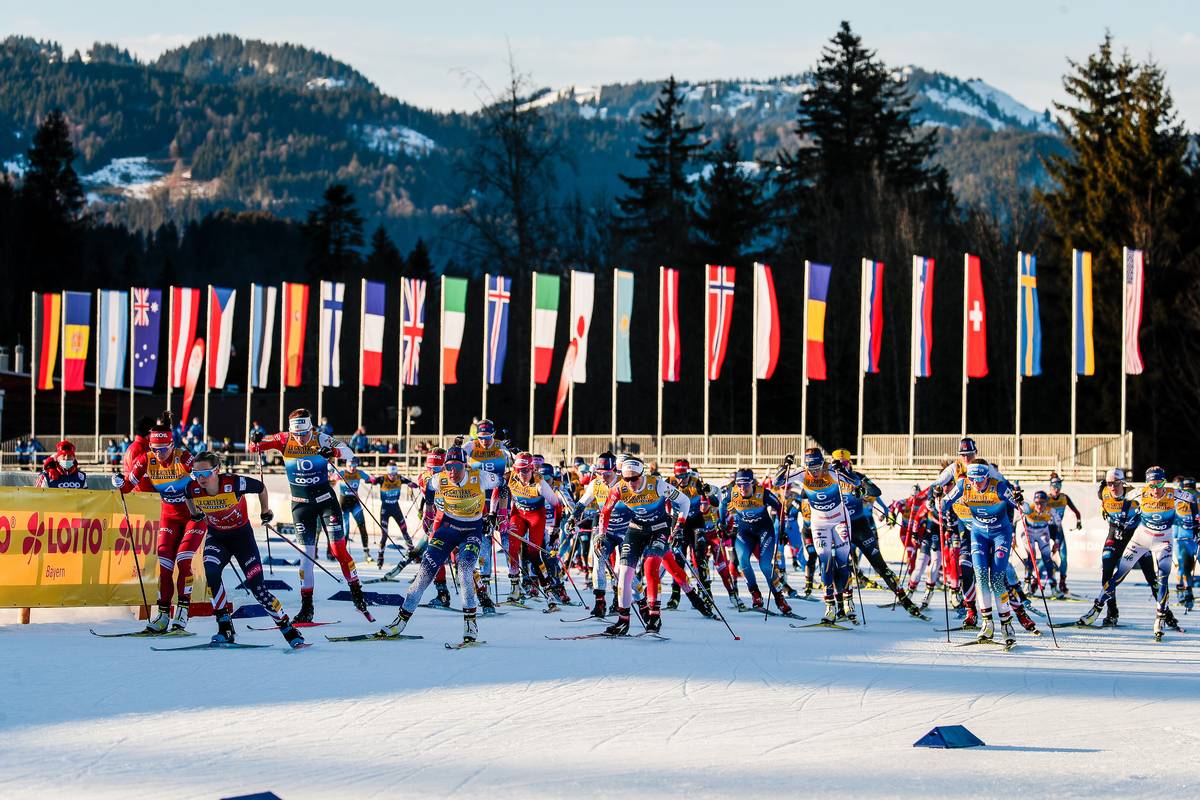
    The start of the women’s 10-kilometer mass start free during Stage 3 of the 2021/22 Tour de Ski in Oberstdorf, Germany. (Photo: NordicFocus)

    This World Cup coverage is made possible through the generous support of Marty and Kathy Hall and the A Hall Mark of Excellence Award.  To learn more about A Hall Mark of Excellence Award or to learn how you can support FasterSkier’s coverage please contact info@fasterskier.com.

    Stage 3 of the Tour de Ski, the halfway mark in this year’s edition, and the venue has shifted to Oberstdorf, Germany, site of the 2021 World Championships. The race on tap was a 10-kilometer skate and the first mass start event of the season. Temperatures were warm and sunny though the courses were located on the shady side of the valley, creating fast, firm conditions. After an exciting battle, it was the American Jessie Diggins who claimed the victory in Stage 3, using her speedy free skate technique to move from third to first down the finish lanes. Diggins finished in a time of 21:30.8, lightning-fast by the distance. Let’s examine what happened out on the course during those twenty-one minutes. 
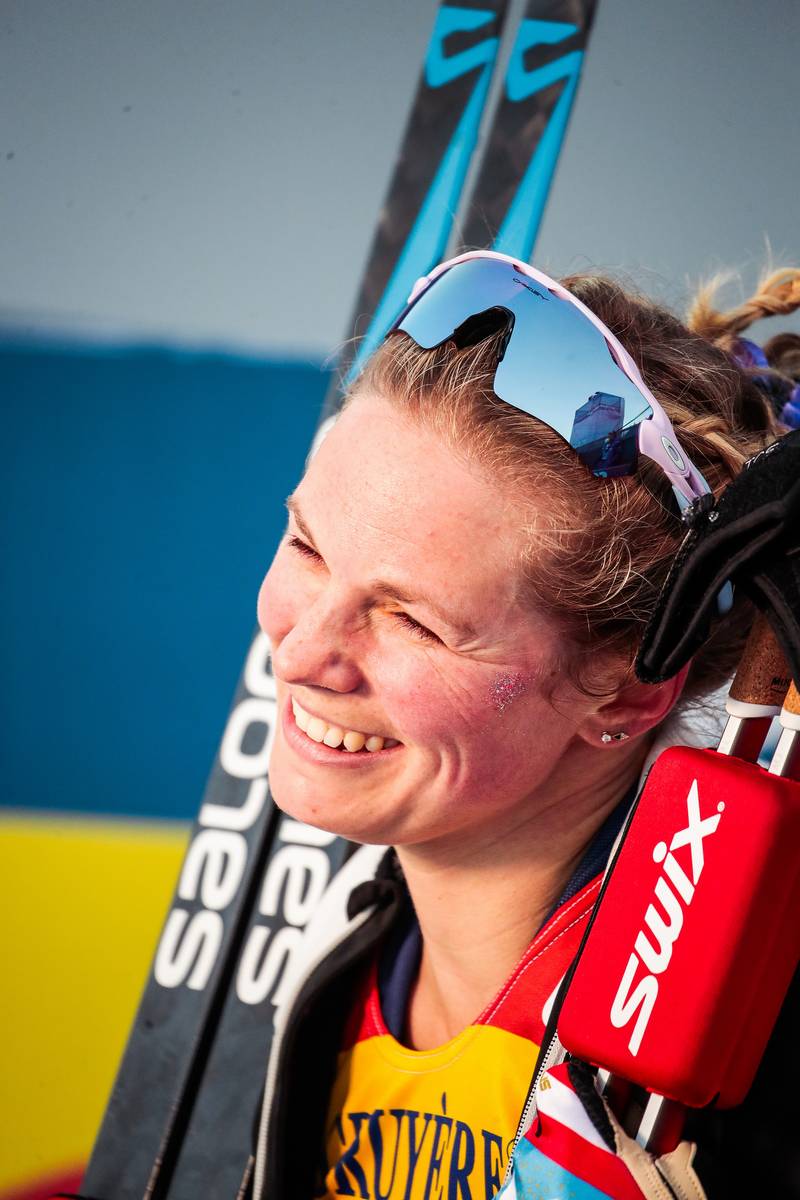
    Jessie Diggins wins her second stage of the 2021/22 Tour de Ski, a 10k mass start free in Obsertdorf. (Photo: NordicFocus)

    The course was made of three laps of a 3.3 k loop and the fast conditions made it challenging for any one athlete to break away from the rest of the pack. Immediately from the gun, Diggins was at the front, clearly looking to push the pace from the start. Through the first time-check at 2.1 k, the pack was largely still together. As the group navigated one of the many v-board rimmed corners, Frida Karlsson (SWE) got caught on the inside, taking a fall just before the end of first lap. 
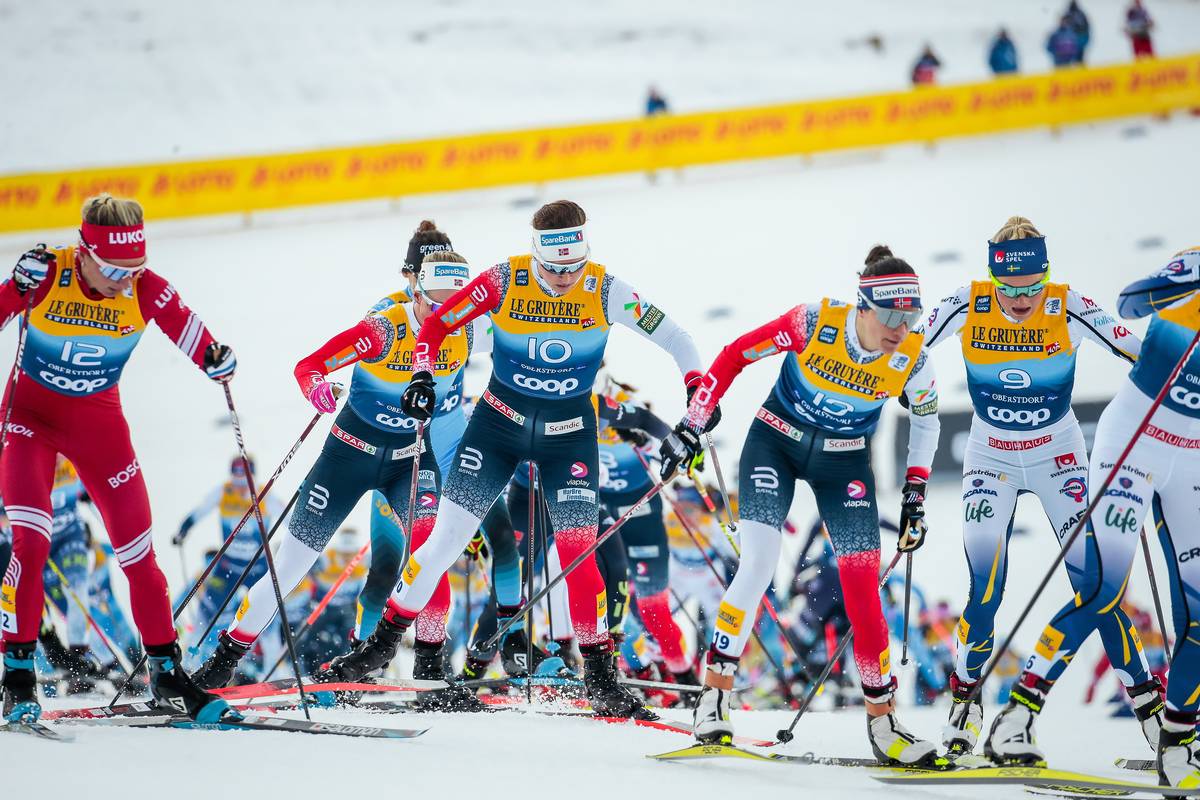
    Tatiana Sorina (RUS), Tiril Udnes Weng (NOR), Heidi Weng (NOR), Frida Karlsson (SWE), (l-r) navigate close-quarters racing (Photo: NordicFocus)

    At 3.3k, Diggins was in the lead, shadowed by Ebba Andersson (SWE) and Heidi Weng (NOR), though the top twenty athletes were all within 10 seconds of each other. Stepping over broken pole remnants from the previous lap, the racers headed out on the second, towards the bonus points opportunity at 4k. 

    Weng (NOR) was first through the checkpoint to gather 15 points with Andersson (SWE) earning 12 and Karlsson, having recovered from her fall and making up significant ground, taking 10 in third place. Andersson, Weng, and Diggins continued to work hard up front and at 5.4k, a small break seemed to be forming. 
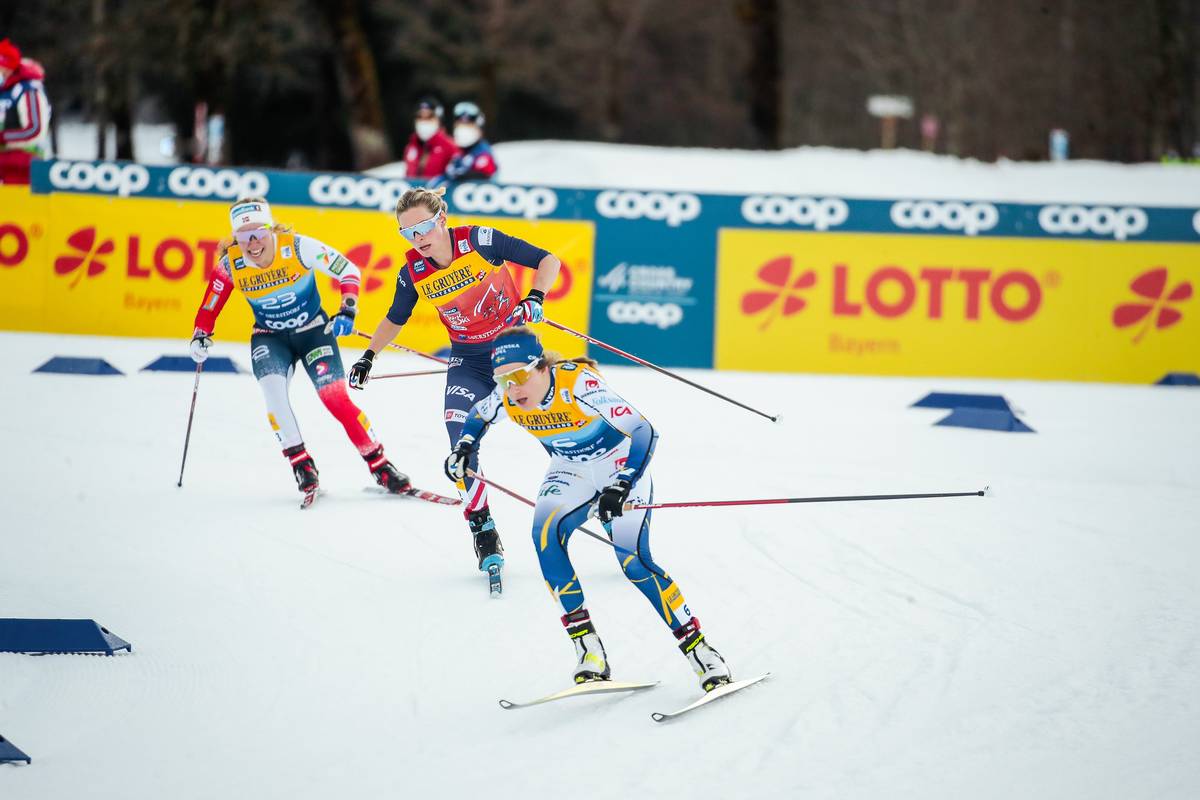
    Ebba Andersson (SWE) leads Jessie Diggins (USA) and Helene Fossesholm (NOR) around a fast turn into the stadium during Stage 3 of the 2021/22 Tour de Ski in Oberstdorf, GER. (Photo: NordicFocus)

    Unlike many women’s mass start races we have seen in the past few years (Johaug pulling away, the chasers strung out behind), this race was tight from start to finish. As the front pack took shape it initially held five athletes but was soon joined by another five. Andersson (SWE) was often at the front, followed by Helene Marie Fossesholm of Norway, Diggins, Teresa Stadlober of Austria, Karlsson (SWE), Weng (NOR), Tatiana Sorina (RUS), Katharina Henning (GER), Natalia Nepryaeva (RUS) and Delphine Claudel (FRA).

    Despite the various efforts of Andersson and Diggins to break, the fast conditions and course profile seemed to make this difficult. 
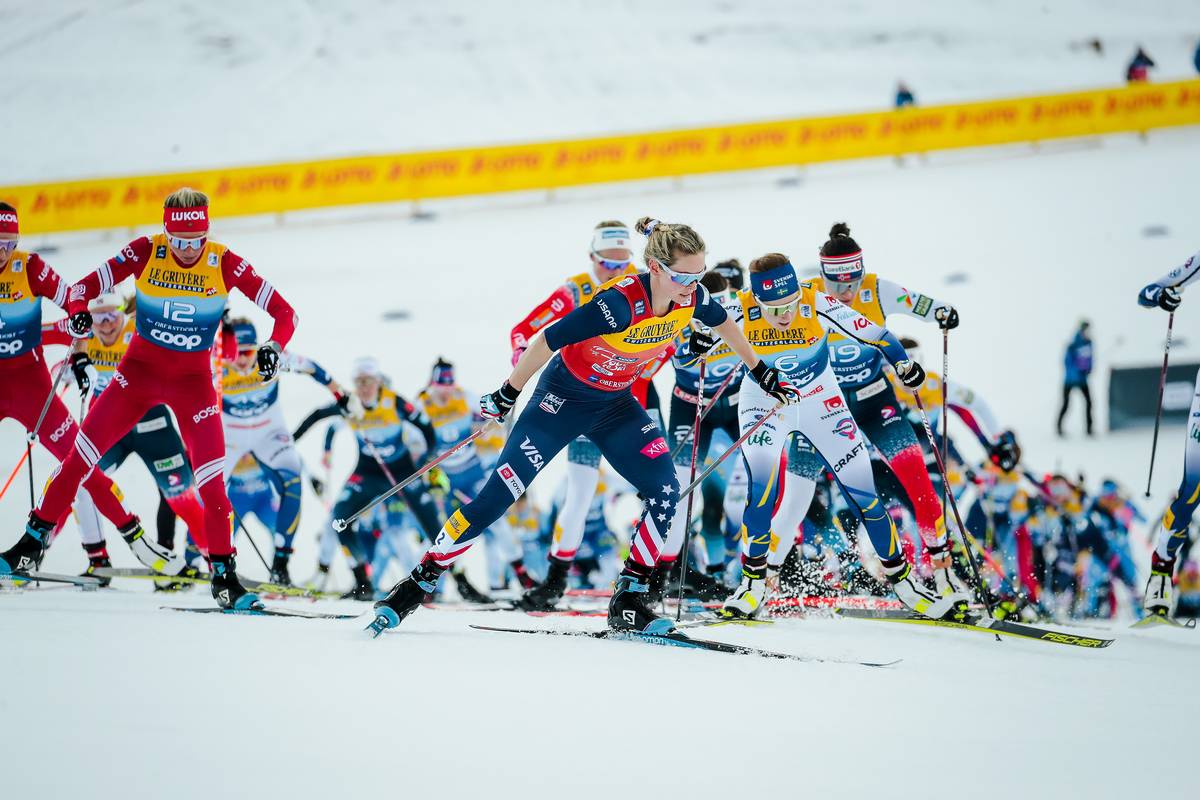
    Jessie Diggins leads the masses early in a fast and icy 10-kilometer mass start classic in Oberstdorf, Germany. (Photo: NordicFocus)

    Rounding another v-board corner, Karlsson nearly fell again, catching herself with her hands. As the front pack sped towards the finish, Fossesholm (NOR) faded and dropped, leaving nine. Heading towards 8.7 km, Karlsson lengthened her stride and began to pull away, creating a gap of +1.7 to Diggins. Diggins and Sorina worked to close the gap on the next and final hill, though they didn’t overtake the Swede. Ending in a fast downhill finish where many of you may recall last year’s World Championship drama, Diggins was poised to use her strengths.

    As the front three athletes came into sight of the finish lanes, Karlsson still held the lead, Sorina in second and Diggins closing fast in third. Choosing the outside lane Diggins free-skated hard, passing Sorina and then Karlsson to cross the line in first.

    “It felt pretty extreme,” said Diggins to FIS when asked about her finish, “it probably didn’t look very graceful or pretty, but they did such a good job preparing the course in such warm conditions so it was awesome that it was hard. But in my head I was ready for the finish lanes to feel unstable, so I thought just stay as low to the ground as possible. That way if you fall you don’t have far to go.” 
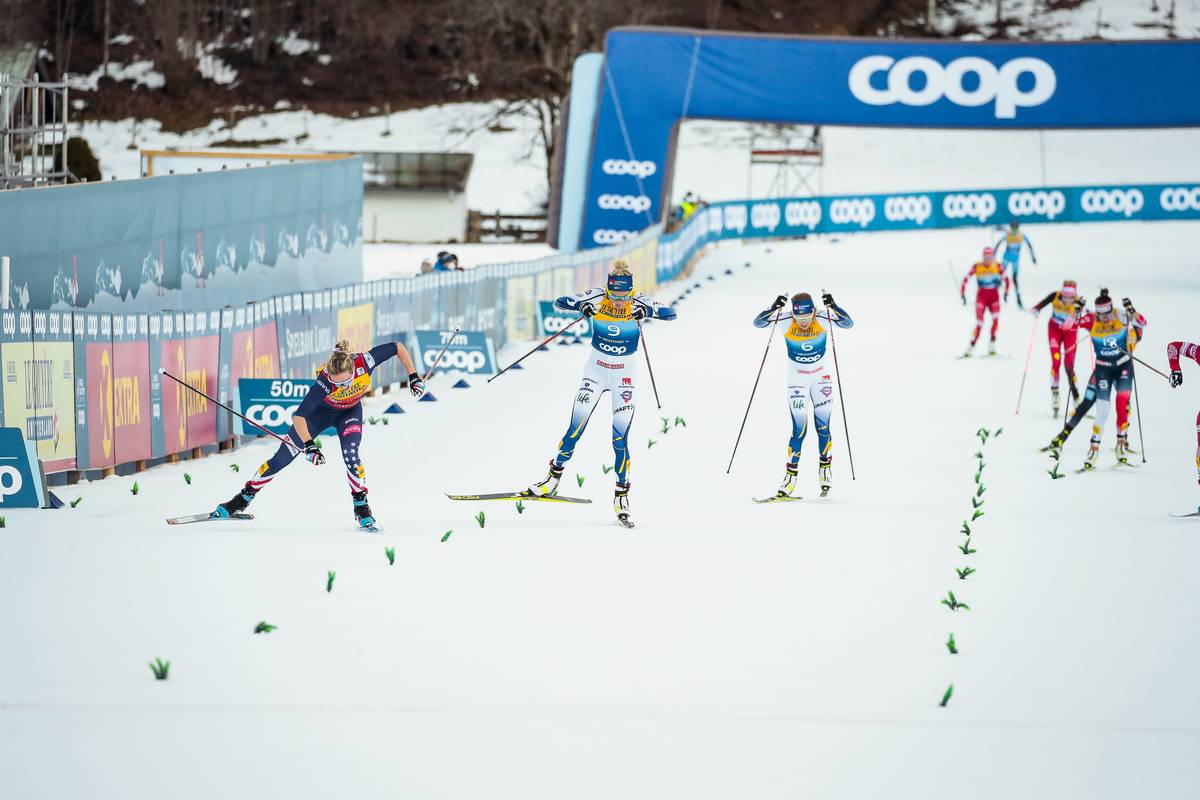
    Head down and free skating, Jessie Diggins fights all the way to the line against Frida Karlsson (SWE) and Tatiana Sorina (RUS, cut off on right). (Photo: NordicFocus)

    Karlsson (SWE) hung onto second place +0.5 behind Diggins and Sorina (RUS) grabbed third (+0.8). 

    This win marks Diggin’s ninth World Cup distance victory, all coming in skate technique.

    Talking about course conditions Diggins said, “It was tricky because if you’re leading, you’re doing so much work, but if you’re not in front it’s easy to get swallowed up. I have to say I had the best skis in the world.” In a separate interview, Diggins reiterated this point, emphasizing the importance of her ski speed, “[our team] gave me some absolute rockets and that was the difference maker, being able to trust the draft, and trust the skis and know that they would help me pick up places and get me to where I want to be so that was crucial to me out there.”

    Post-race audio clip from the mixed zone, recorded by U.S. Ski & Snowboard cross country communications manager Tom Horrocks. 
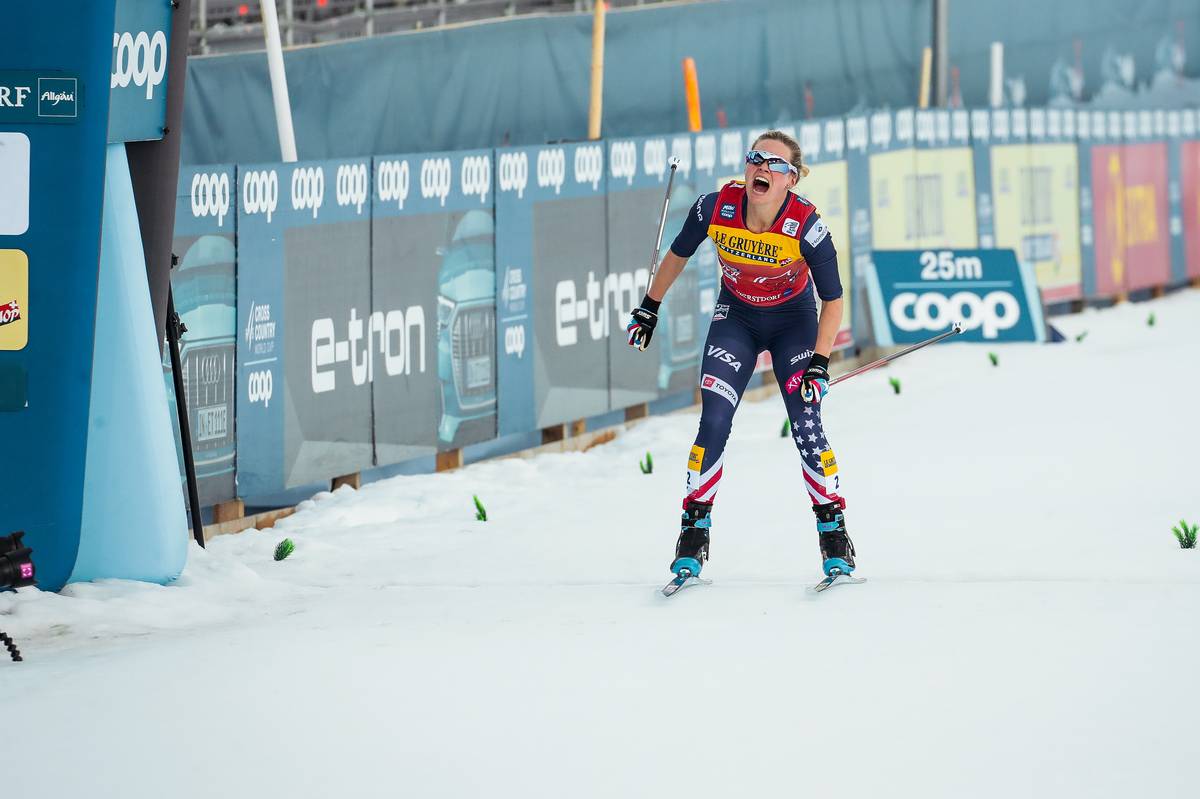
    After a powerful free skate sprint to the finish, Jessie Diggins crosses the line to narrowly win Stage 3 of the 2021/22 Tour de Ski in Oberstdorf. (Photo: NordicFocus)

    Julia Kern was the next American finisher in 24th position (+43.8).

    “It was fast and furious, a lot of fun,” said Kern afterwards. “I didn’t have the best energy out there but it was a hard fight. Skis were competitive and good, it was a really icy day so it was hard to stay on your feet.”

    Post-race interview with Julia Kern hosted by Tom Horrocks.
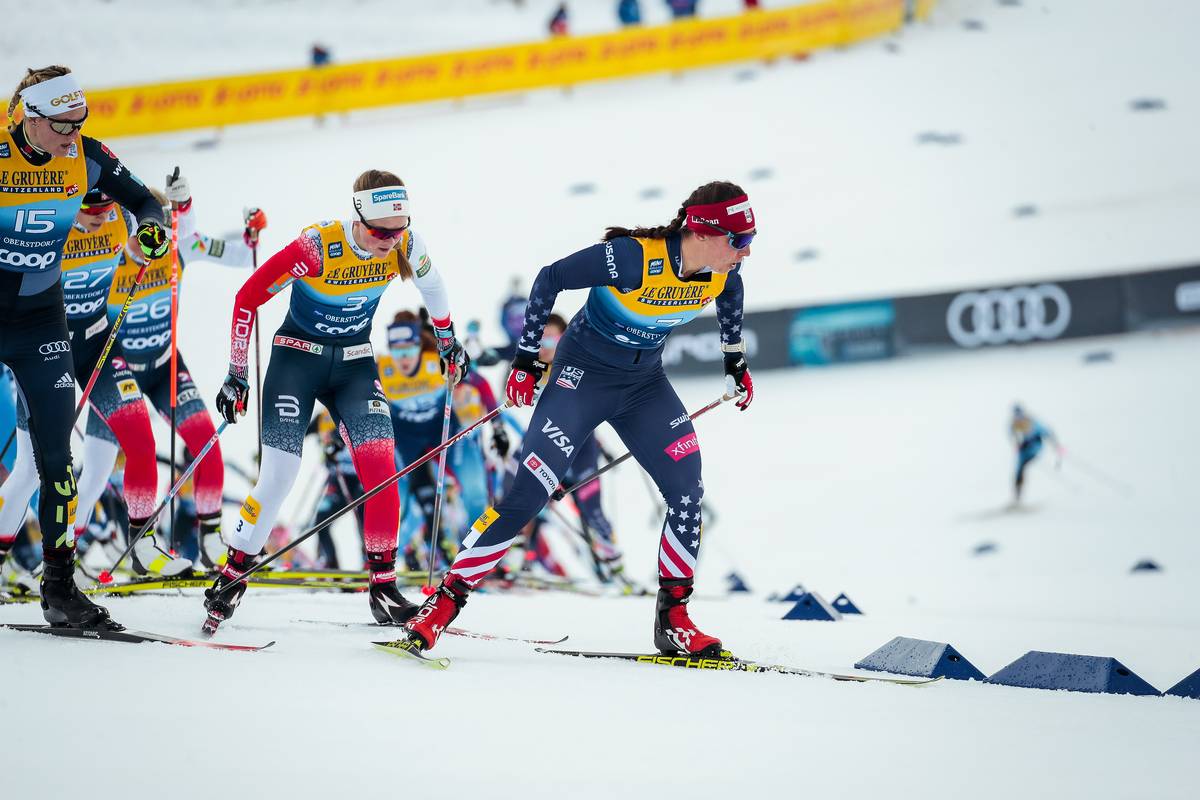
    Julia Kern skis a strong Stage 3 during the 2021/22 Tour de Ski in Oberstdorf. (Photo: NordicFocus)

    Katharine Ogden finished just outside the top thirty in 32nd place (+56.7).

    “I was psyched with my strategy of just staying relaxed and trying not to get too swept up in the mass start chaos,” Ogden explained in a post-race interview. “I was definitely a little bit bummed to be so close to the points, but not quite in them. But everyone wants to be Top-30, so that’s okay. It was encouraging, makes me really excited for Val di Fiemme.”

    Full audio clip with Katharine Ogden, interviewed by Tom Horrocks. 

    Following her was Sophia Laukli in 37th (+1:00.4), Alayna Sonnesyn in 52nd (+1:39) and Novie McCabe in 54th (+1:42.5). Hailey Swirbul did not start. 

    The women’s podium after Stage 3 of the 2021/22 Tour de Ski in Obserstdorf: Jessie Diggins (USA) took the win in a sprint finish ahead of Frida Karlsson (SWE) and Tatiana Sorina (RUS). (Photo: NordicFocus)

    Diggins now leads the Tour standings again, +0:13 ahead of Kerttu Niskanen (FIN). Natalia Nepryaeva (RUS) is in third, just one second behind Niskanen.

    Kern is the next American behind Diggins and is currently in 17th (+1:47). Katherine Ogden is sitting in 31st (+2:48), Sophia Laukli is 41st (+3:11), Novie McCabe is 46th (+3:31) and Alayna Sonnesyn is 58th (+4:58). The fourth stage of the Tour will take place Saturday, featuring a classic sprint, before they change venues for the final time on January 3rd.

    Results: 10 k Skate | Overall Standings | Point Standings
  • Diggins Does It in Seefeld, Wins Last World Cup Before Olympics

    Diggins Does It in Seefeld, Wins Last World Cup Before Olympics

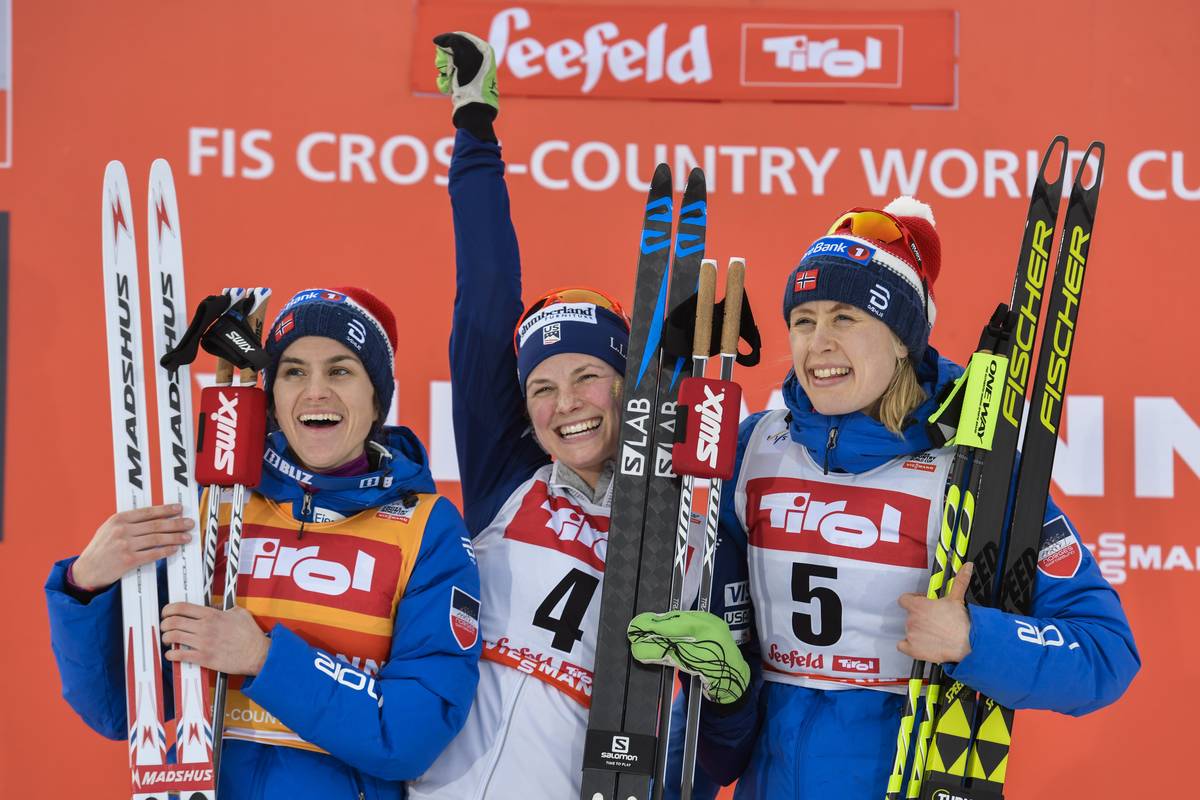
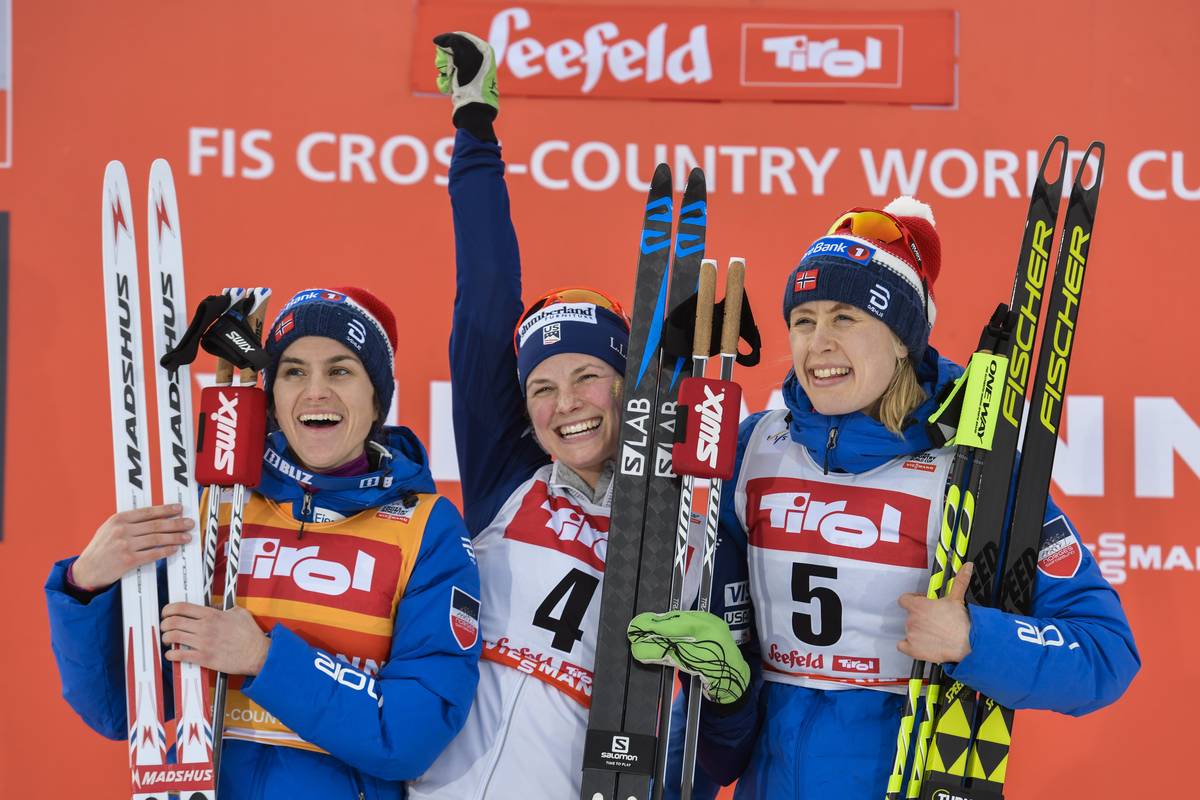
    American Jessie Diggins (c) celebrates her fourth-career individual World Cup win, and her first in a distance longer than 5 k, after winning the women’s 10 k freestyle mass start at Sunday’s World Cup in Seefeld, Austria. Norway’s Heidi Weng (l) placed second and Ragnhild Haga (r) was third. (Photo: Salomon/NordicFocus)

    About seven minutes into the women’s 10-kilometer freestyle mass start on Sunday at the World Cup in Seefeld, Austria, Jessie Diggins made her intentions clear. She wasn’t in it for a free ride — she was willing to pull, and not just take her turn up front, but actually try to string out the field and win this thing.

    As she led a group of 31 within 15 seconds of her at 3.3 k, Diggins, a 26-year-old U.S. Ski Team member who’s on a mission for medals at the upcoming Olympics in two weeks, never looked back. She didn’t ask for help from the Norwegians behind her; she just hammered.

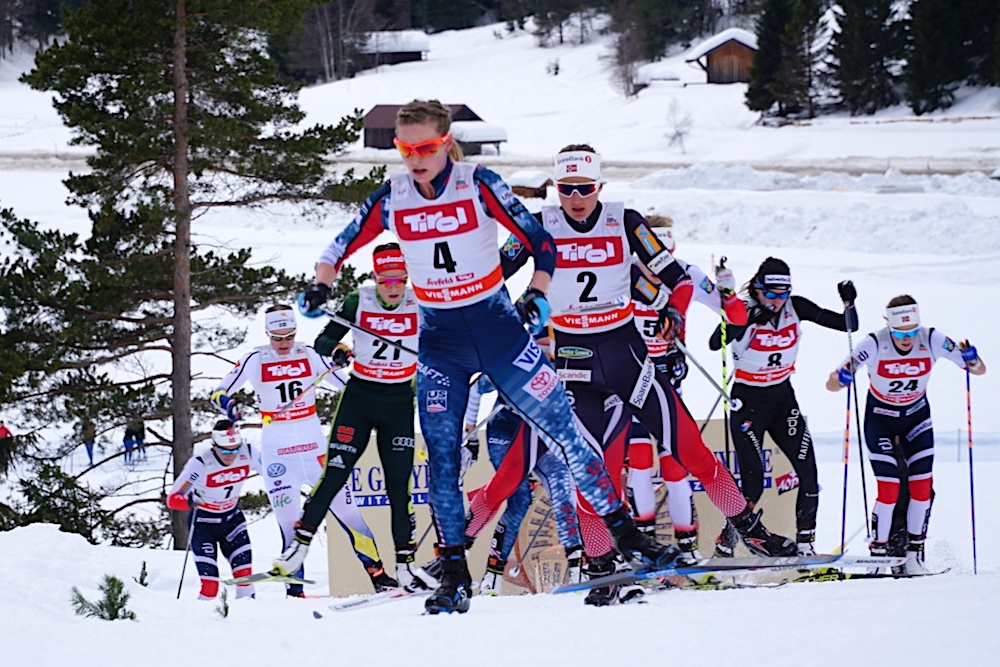
    American Jessie Diggins (4) leading Norway’s Ingvild Flugstad Østberg (2) and the rest of the women’s field in the 10 k freestyle mass start at the World Cup in Seefeld, Austria. (Photo: Garrott Kuzzy / LumiExperiences.com)

    Meanwhile, Norwegian teammates Heidi Weng and Ingvild Flugstad Østberg kept her close, and at 4.6 k, Østberg moved into first. The group was down to 12, with another American hanging in there as well, as Sadie Bjornsen skied in 12th, 4.6 seconds back.

    Two kilometers later, it appeared the Norwegians were working together, not just to keep themselves through the race, but to prevent Diggins from getting too close to the front. Diggins remained in third, less than a second behind Østberg and Weng, while a third Norwegian Ragnhild Haga skied just behind her. Switzerland’s Nathalie von Siebenthal and Germany’s Katharina Hennig remained in the mix in fifth and sixth, about two seconds back, as did Norway’s Kari Øyre Slind and Bjornsen another second behind.

    With just over 2 k to go, Diggins attacked in earnest near the bottom of the last grueling (nearly 500-meter-long), multi-tiered climb on the women’s 3.3 k course. No one was able to match her pace, not Østberg, not Weng, not Haga, as she raced up the rest of the hill and over the top completely alone.

    Behind her, the chase group split in two, with the three aforementioned Norwegians then approximately eight others skiing several meters behind. Bjornsen was in that second group, which continued to drop in numbers as they continued up the climb.

    On the winding descent back toward the stadium, with just under a kilometer to go, Diggins put all of her faith into her skis.

    “I felt awesome, my skis were amazing, the techs worked so hard,” she told FasterSkier in person after. “These Salomon skis I was on were just ripping down that corner.”

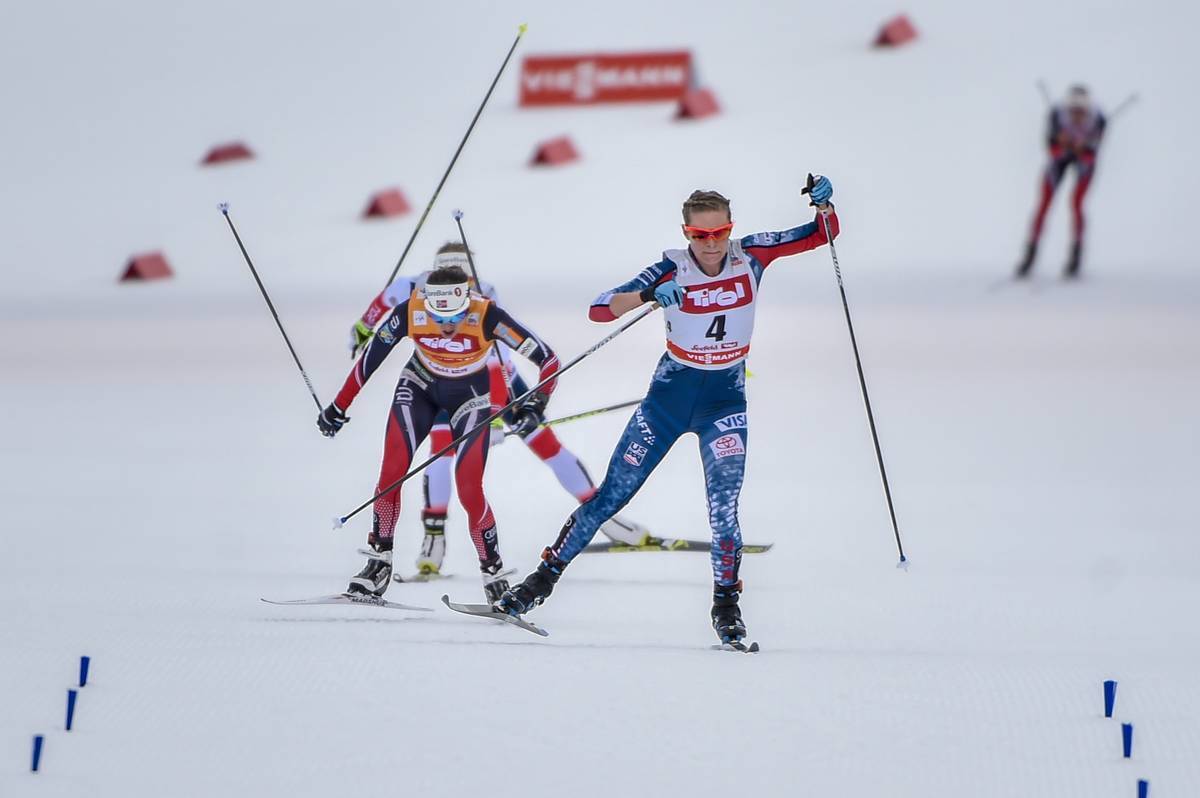
    American Jessie Diggins (4) leads Norwegians Heidi Weng and Ragnhild Haga in the finishing stretch of the women’s 10 k freestyle mass start at the World Cup in Seefeld, Austria. (Photo: Salomon/NordicFocus)

    But before the final hill, a relatively small rise about 200 meters before the finish, Weng and Haga were close, just a few strides and about a second behind. Again, Diggins didn’t look back; she simply used every ounce of everything she had left — energy and technique-wise — to get the maximum number of pushes in before the finish.

    And she did it. Diggins held off the two Norwegians, crossing the line first in 23:08.5 and throwing her fists down in elation. Seven-tenths of a second behind her, Weng free-skated to second place, just 0.3 seconds ahead of Haga in third. Østberg finished 7.7 seconds later in fourth (+8.7), and the fourth Norwegian in the top five, Marit Bjørgen placed fifth (+16.7) just ahead of Austria’s Teresa Stadlober in sixth (+16.9), Slind in seventh (+19.1), and Bjornsen in eighth (+20.5). Von Siebenthal followed in ninth (+30.3) and Finland’s Kerttu Niskanen placed 10th (+31.8).

    Notably, it was Bjørgen’s first World Cup race since mid-December. But even more notably, for the second-straight race in Seefeld — the site of next year’s 2019 World Championships — an American woman won. Sophie Caldwell tied for first in Saturday’s freestyle sprint, and on Sunday, it was all about Diggins.

    For Diggins, the win was her first in over a year and her fourth-career individual World Cup victory. And she did so in the last race before the Winter Olympics start on Feb. 10 in PyeongChang, South Korea.

    “It’s a really good time to figure out how to ski a 10 k race,” Diggins told FasterSkier after. “I am really excited. I’m so pumped for the Games, I’m feeling well, the peaking plan is working, and I’m just excited to get there and see what I can do.”

    She apparently took mental notes on the men’s 15 k mass start that took place earlier on Sunday, as Switzerland’s Dario Cologna attacked on the same climb to secure the win ahead of Canada’s Alex Harvey and Norway’s Martin Johnsrud Sundby.

    “I saw how well it worked for Dario, and I thought, ‘OK, I’m gonna go for it! I just have to ski gutsy and if they reel me in they reel me in, but maybe I can hold them off,’ ” she reflected.

    “I just put my head down and it wasn’t pretty, but I just hammered,” she said in a post-race interview with the International Ski Federation (FIS).

    Before that, Diggins said she had been trying to figure out where to ski in the pack.

    “ ‘OK, if I’m in the front, how hard am I working? If I’m in the middle…’ You don’t want your poles to get stepped on so it’s easier for me to just be near the front the whole time,” she told FasterSkier.

    Diggins’s three other wins have come in 5 k freestyle individual starts — all of which were stage World Cups. Sunday marked her first time getting 100 points, rather than 50, for the win, which counts toward overall World Cup standings. Heading into the Olympics, she ranks third in the Overall World Cup (379 points behind Weng in first and 180 behind Østberg in second) and third in the Distance World Cup (225 points behind Weng in first and 108 behind Østberg in second). Bjornsen is seventh in the overall standings and 11th in distance.

    “I’m happy with how I raced,” Weng said after Sunday’s race, according to a FIS press release. “I made a mistake up the final climb and then couldn’t go with Diggins, but I pushed hard all the way to the finish, but Diggins was the better skier today.”

    Bjornsen is seventh in the overall standings and 11th in distance.

    “It was an exciting, and super fun final race before the Olympic Games!” Bjornsen wrote in an email to media outlets. “Today’s 10k skate was hot from the start, on a really fun course here in Seefeld. I think the nature of the course kind of held the pack together a bit more, which always makes for a fun race! I felt really good out there, and was super happy with the day.

    “I feel like I made a bit of a tactical error being stuck behind some skiers that were dying a bit on the far part of that last lap, but it is one new step for me,” she continued. “I learned something out there, and I challenged myself, and I am feeling really good about the feelings I have in my legs leading into the games! It will be great to have two more weeks to rest, recover, and come in sharp for these exciting races to come. I am so excited to see our team on fire right now too. The vibe is great, the spirit is high, and we are so excited to take on the world in a few weeks here! Win or lose, I think this team is going to do something great!”

    Eighth place is Bjornsen’s best result in distance skate race longer than 5 k, not counting pursuits. Earlier in the day, her brother Erik finished ninth in the men’s 15 k.

    “ … I got my brother by one spot, which is a daily competition for the two of us,” Bjornsen wrote. “He set the bar high this morning. I am just so excited to see how well he did, and Simi [Hamilton, who placed 12th] as well. Those two have a bright future for the team sprint, I can’t even wait to watch!”

    Three American women landed in the top 15 and five were in the top 30 on Sunday. Kikkan Randall finished 14th, 48.5 seconds behind Diggins and just over eight seconds outside of the top 10.

    “I think it was a good race, I don’t think it was a great race,” Randall told FasterSkier on Sunday. “I made a bad tactical move on the first lap and missed that first group when they went, so then I spent some time chasing and I had a good energy left at the end so that was fun. … I think every race is going to get better and better so I am pretty happy with today.”

    The result tied her previous best distance finish this season (a 10 k freestyle in Davos, Switzerland). Randall has been dealing with a stress reaction and tendonitis in her foot since that Davos World Cup in mid-December.

    “Foot is hanging in there, its not great, but it’s good enough to race,” she said. “To make it through two skate races here and still holding together I am optimistic, so now we kind of just go to single races [at the Olympics], so I think I will be able to make it through the season.  I also made it in the stadium today just in time to see Jessie win.”

    Caitlin Patterson of the Craftsbury Green Racing Project (CGRP) finished 23rd (+1:00.7) for her second time in the World Cup points (top 30) in as many distance races she’s competed in this season. The U.S. SuperTour leader after Period 1, Patterson earned World Cup starts for Period 2 in January and is also headed to the PyeongChang Olympics.

    On Sunday, she said she had to adjust to the stop-and-go pace near the back of the pack.

    “I think I was still getting used to the pace swings, the way you go up and down and … accordion and stuff, but it was a good fun race,” Patterson said. “I think I had a few struggle moments on some of the bigger climbs … but I held it together, and the downhills were good and I was pretty happy with the finish, passing at least one person, catching up to the tail end of a pack in front of me. … Some good fun over here.”

    Liz Stephen also finished in the top 30 in 29th (+1:18.2) after working her way up in the pack from 44th at 3.9 k. It was her sixth top 30 of the season. Also for the U.S., Rosie Brennan finished 53rd (+2:26.9).

    Emily Nishikawa of the Canadian World Cup Team led three Canadian women in 35th (+1:36.5). Just one-tenth of a second later, Cendrine Browne (Canadian U25 Team) followed her across the line and placed 37th (+1:36.6) in a photo finish with France’s Coralie Bentz for 36th. Dahria Beatty (Canadian World Cup Team) finished about 22 seconds later in 45th (+1:58.9).

    For the Canadian women, this weekend marked their first World Cup races in a month. While Nishikawa stayed in Europe to train during the Tour de Ski, Browne and Beatty returned to Canada for NorAm Olympic trials in early January. After that, they met up with Nishikawa and the rest of the team for a training block in Livigno, Italy.

    “I think us three girls did really well today, considering we are just coming back from a training camp, so it’s really looking good for the Olympics,” Browne said.

    “Just echoing what Cendrine said, coming off a training camp, you never really know what to expect for this weekend, but the goal is to be good at the Olympics,” Nishikawa said. “I was happy with the way I felt and the second half of the race. I need to work at starting a bit faster on the mass starts — somehow I end up at the back of the field and just work my way through it.”

    “It was lots of fun,” Beatty said of her race. “I had a good start and then died a little bit in the middle, but it was nice to see some of [my teammates] up ahead and try to keep going. I actually had a really good last kilometer, I was able to finish strong and pick off some girls … I think it was one of my better distance races so far this year.”

    While Beatty placed 20th in Saturday’s sprint for a season best, 45th marked her second best result of the World Cup season so far.

    Results| Overall World Cup standings | Distance World Cup

    — Gabby Naranja, Ian Tovell and Harald Zimmer contributed

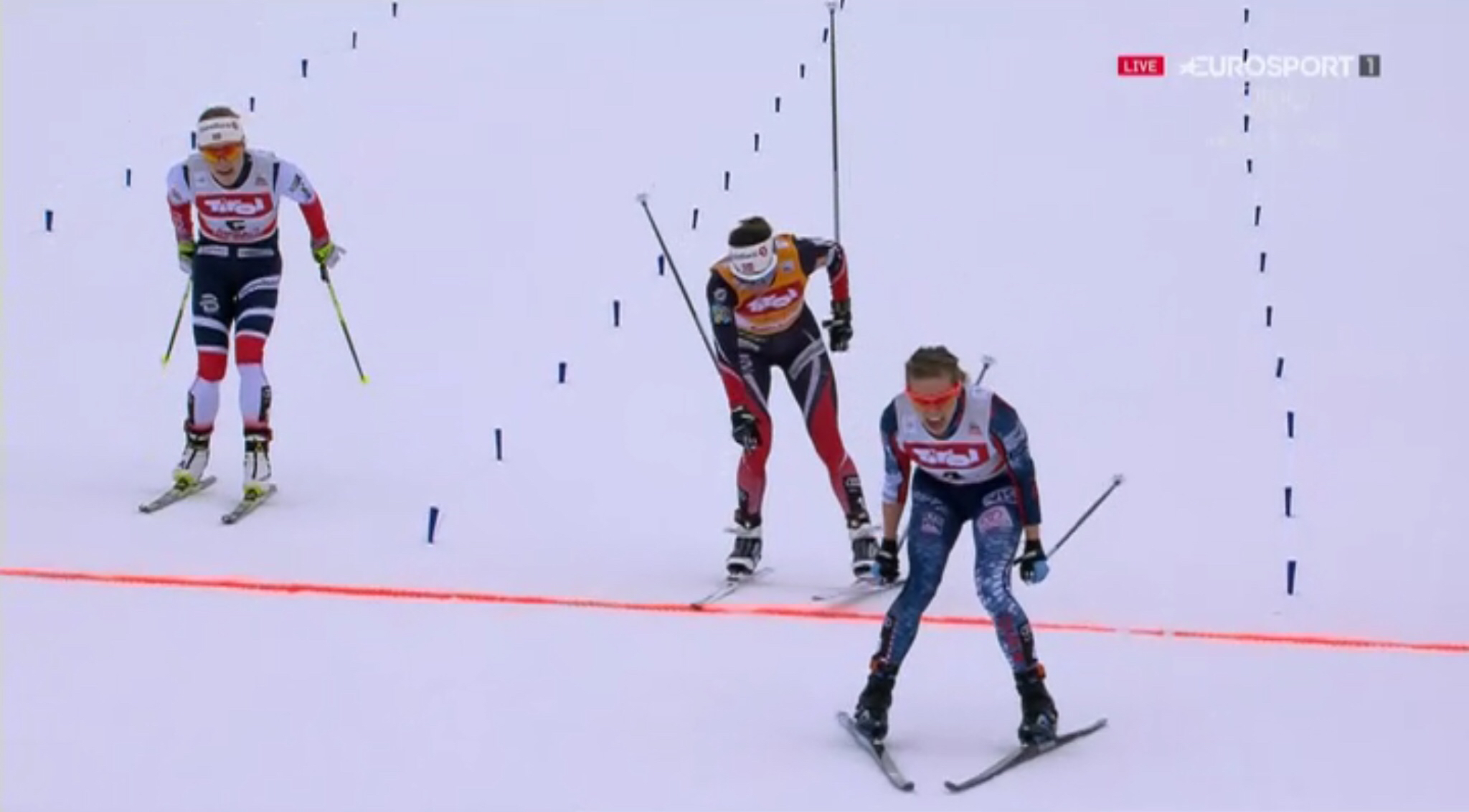
    American Jessie Diggins (r) celebrates her win on Sunday in the World Cup women’s 10 k freestyle mass start in Seefeld, Austria, ahead of Norway’s Heidi Weng (c) in second and Ragnhild Haga (l) in third. (Screenshot: Eurosport broadcast)
  • Despite Being in ‘Last Place’ Brennan Battles Back for 22nd; Weng Wins 10 k Skate

    Despite Being in ‘Last Place’ Brennan Battles Back for 22nd; Weng Wins 10 k Skate

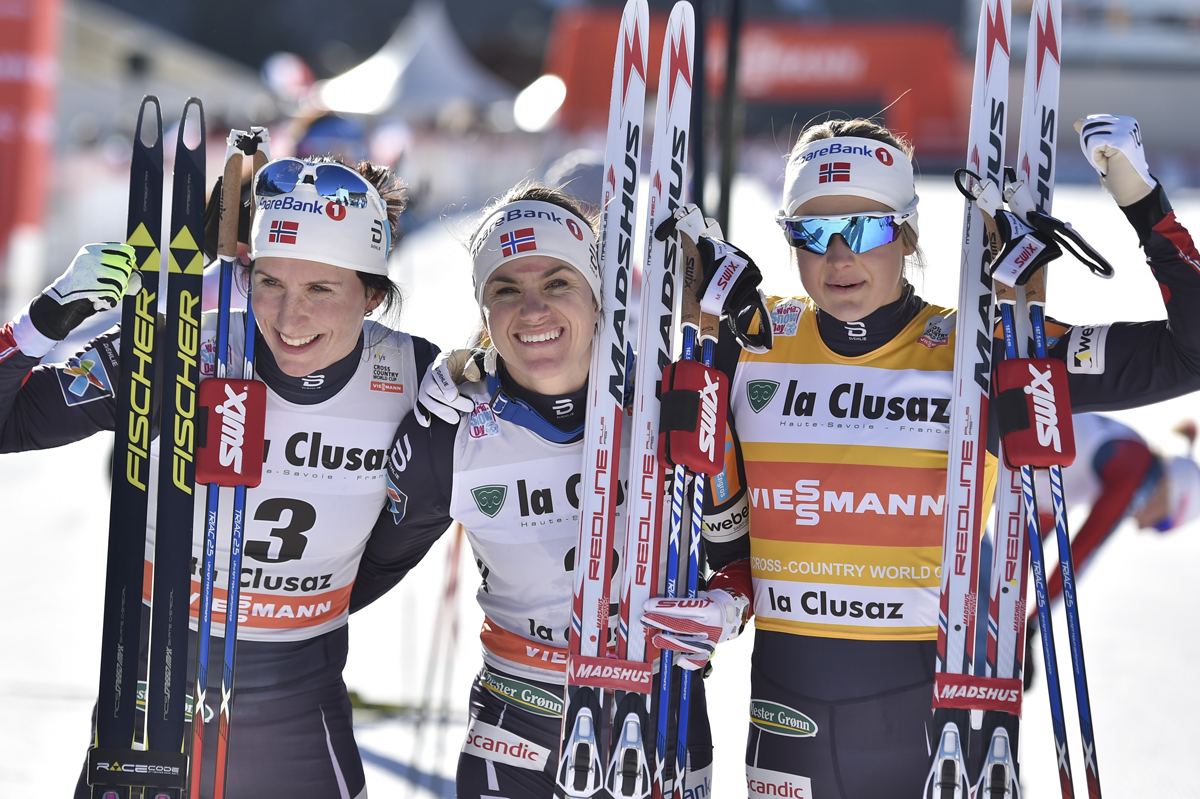
    Left to right: Norway's Marit Bjørgen, Heidi Weng and ngvild Flugstad Østberg swept the podium for the women's 10-kilometer freestye mass start on Saturdya in La Clusaz, France. (Photo: Fischer/Nordic Focus)
    Left to right: Norway’s Marit Bjørgen (2nd), Heidi Weng (1st) and Ingvild Flugstad Østberg (3rd) swept the podium in the women’s 10-kilometer freestye mass start on Saturday in La Clusaz, France. (Photo: Fischer/Nordic Focus)

    A little less than twenty seconds into Saturday’s 10-kilometer freestyle mass start, American Rosie Brennan was facing the wrong way. A collision in the first 100 meters had left her spinning and when she finally came to a stop, all that lay before her was the small section of course she had already covered.

    A few seconds later — upon turning around and seeing the entire women’s field of World Cup athletes skiing away — the 28-year-old realized where she was: dead last. It was certainly not where Brennan had planned to start her 10 k, but then again not everything always goes according to plan.

    When a bout of illness hit the U.S. Ski Team (USST) a couple of weeks ago, Brennan — a USST B-member — did not go untouched. Seven days ago, the Park City, Utah, native opted to skip the women’s 15 k freestyle race in Davos, Switzerland as a result of not feeling in top form.

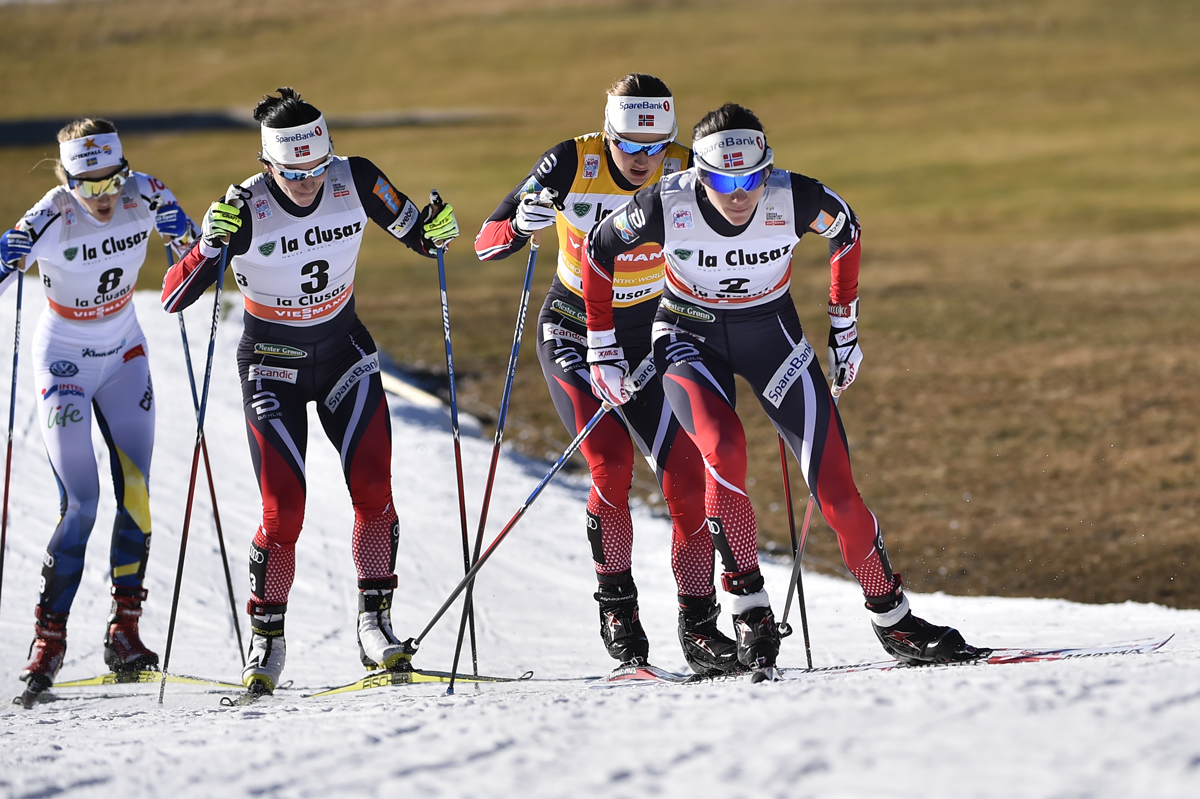
    Norway's Heidi Weng leading her teammates Ingvild Flugstad Østberg (middle r), Marit Bjørgen (middle l) and Sweden's Stina Nilsson (far left) during the women's 10-kilometer freestyle mass start on Saturday in La Clusaz, France. (Photo: Fischer/Nordic Focus))
    Norway’s Heidi Weng leading her teammates Ingvild Flugstad Østberg (middle r), Marit Bjørgen (middle l) and Sweden’s Stina Nilsson (far left) during the women’s 10-kilometer freestyle mass start on Saturday in La Clusaz, France. (Photo: Fischer/Nordic Focus))

    After a weekend off, the return to racing this Saturday and Sunday in La Clusaz, France, left Brennan unsure of what to expect from her racing. With many of her 2016/2017 season results thus far leaving her just outside of earning World Cup points, Brennan entered Saturday’s 10 k seeking a confidence boost performance.

    “I did not have the start to the season that I had imagined,” Brennan said during a phone conversation. “I definitely was looking to turn things around [in Saturday’s 10 k].”

    When Brennan said ‘turn things around,’ she hardly meant to facing back to the beginning of her 10 k. Seeded in bib 43, Brennan’s original strategy for the start was to get into a good position from the gun.

    “Things don’t always go as planned,” Brennan said.

    In fact, for Brennan, things were the exact opposite of what she had hoped.

    “I got tangled up like 100 meters into the race, spun around and fell over and then got up and realized that I was in last place,” Brennan explained. “So then I was like ‘OK, well I guess the race starts now.’ ”

    As Brennan worked to reconnect with the back of the pack, Norway’s Marit Bjørgen, Heidi Weng and Ingvild Flugstad Østberg began to leave it behind. The three Norwegians, who started in bibs 3, 2 and 1, respectively, wasted no time punching the front pace, with Bjørgen at the helm.

    By the first of five 2 k laps, the trio had already put a close to 15-meter gap on the chase group, which included their Norwegian teammate Astrid Uhrenholdt Jacobsen and Sweden’s Stina Nilsson.

    Coming into their second lap, Weng took the lead for Norway’s front-running triad, while Nilsson, in bib 8, and Germany’s Nicole Fessel in bib 9, hunted the Norwegians. By 4 k the Swede was comfortably resting on Bjørgen’s ski tails.

    As the chase in the front of the field continued to unfold, so did one from the back. Brennan had caught up to her USST teammate, Liz Stephen, and the two were maneuvering around the skiers ahead of them, even if only one at a time.

    “I got tangled up like 100 meters into the race, spun around and fell over and then got up and realized that I was in last place. So then I was like ‘OK, well I guess the race starts now.’ ”–Rosie Brennan after Saturday’s World Cup 10 k mass start

    “Those two went out of the start basically last and second to last,” USST Head Coach Chris Grover said on the phone. “It was a furious race, but they both worked their way up through the whole race, just picking people off on every lap.”

    With a manmade course loop barely wide enough for two racers to ski side-by-side in some sections, passing was no easy feat. Especially if that attempt to move was from last to the low twenties. Yet by the last lap, both Brennan and Stephen had done just that. 

    “It was not an easy course to pass on so I just had to be patient and hope that my fitness would bring me up and up through the race,” Stephen said on the phone.

    “This is one of those races where it’s better if I don’t set specific result goals,” she added of her expecations coming into Saturday. “Take the opportunities when you have them to pass and then just keep your head positive the whole time.”

    As Brennan and Stephen furthered their forward momentum, Bjørgen, Weng, Nilsson, and Østberg continued to take command from the front, with lap three and four led by Østberg. Just 50 meters behind was a chase group spearheaded by Fessel. 

    Heading into the final lap, Nilsson still trailed Bjørgen, threatening to break the Norwegian podium sweep. In the second to last climb, Bjørgen made her move to Østberg’s right and Weng followed. However, by the course’s final climb, it was Weng who powered to the top first, securing the lead and eventually the overall win by a close to 10-meter gap.

    Weng finished in 23:43.5 minutes. Crossing 2.1 seconds behind her was Bjørgen in second.

    I knew I had to be in first or second position before the finish stretch if I wanted to win,” Weng said, according to a FIS press release. “In the finish I saw Marit and Ingvild and I thought they passed me. It was great to see my name as the winner. I had to give everything I had left.”

    Rounding out the all-Norwegian podium in third was Østberg, who finished 2.9 seconds back from Weng.

    Despite their late start, Brennan and Stephen managed to move around more than half the field, finishing in 22nd (+1:31.9) and 23rd (+1:36.5) respectively.

    Canadian Dahria Beatty racing during the women's 5-kilometer freestyle race that took place in Davos Switzerland last weekend. (Photo: Fischer/Nordic Focus)
    Canadian Dahria Beatty racing the women’s 15-kilometer freestyle in Davos, Switzerland, last weekend. (Photo: Fischer/Nordic Focus)

    “I felt more like myself,” Brennan said of her overall race performance. “I had a little bit more energy and was able to be in the race. So that was very positive and I’m happy about that.”

    Also earning World Cup points for her second-straight top 30 was Canada’s Dahria Beatty (+1:38.7) in 26th overall.

    “My race was really good,” Beatty wrote in an email to FasterSkier. “I was hoping to be able to ski strong through the middle laps where I struggled last weekend and I did that. I was thrilled to get my first distance top 30. I got caught up behind a small crash at the beginning but after that I was able to avoid any tangles and move up through the field.”

    The next North American to finish was USST member Kikkan Randall in 36th (+2:10.6) followed by American Caitlin Patterson in 37th (+2:12.7).

    “I’ve had some indications in the first period that my fitness is better than my results are showing and that is a matter of sharpening my race form,” Randall wrote in an email to several media outlets. “I’m still working on relearning how to handle the race effort feelings after my year away from racing. Every race is helping me get a little bit closer. I was expecting better results in this first period but I am being patient and am confident I can build speed as the season progresses.”

    As for how she felt about this race in particular, she wrote that she was “moderately satisfied … I had a good first half but there were a few windows to pull a little more out of myself in the 2nd half that I didn’t quite get today. Going to learn from this and keep pushing forward.”

    On more thing: “When the world cup was in La Clusaz in the late 80’s we had no USA skiers racing,” Randall noted. “So we’re pretty pumped to have a strong team over here now that can contend every weekend!”

    Grover highlighted Patterson, as she skied in the top 20 for about 2 1/2 laps.

     “Then she had a fall on the last tough corner on the fifth lap,” he said. “So she was skiing really well for a while and then she faded and then she fell, so that was a bummer.”

    For Canada, the next finisher was Cendrine Browne in 41st (+2:32.3), Emily Nishikawa in 48th (+2:52.4) and Sophie Carrier-Laforte in 59th (+5:59.8).

    Neither Jessie Diggins or Sadie Bjornsen of the USST started Saturday due to illness. Bjornsen explained that despite this perhaps being her most looked forward to weekend of racing, being healthy for the remainder of the season was reason enough to not race.

    “Between all my French family and friends, my boyfriend here to cheer, amazing France (which has become my second home), and a relay weekend… it was looking pretty amazing!” Bjornsen wrote in an email of the races in La Clusaz. “But, the Tour de Ski and World Champs are pretty important to me as well. So in an attempt to try to get more healthy than I woke up this morning, I did a last minute call to sit out…. and chose health over all other emotions.”

    The U.S. women return Sunday for the women’s 4 x 4 k relay.

    Results | Relay start list

    — Jason Albert contributed reporting

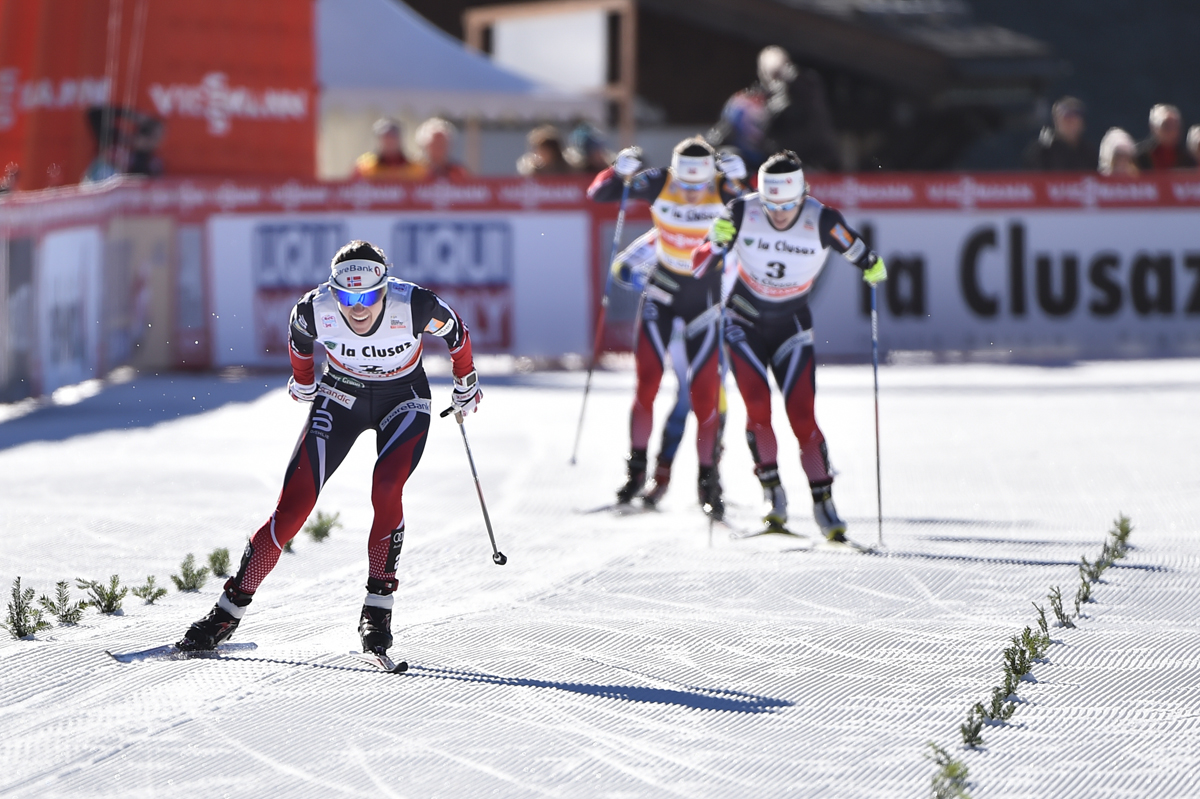
    Norway's Heidi Weng (l) approaches the finish line ahead of her teammates Ingvild Flugstad Østberg (c), Marit Bjørgen (r) women's 10-kilometer freestyle mass start on Saturday in La Clusaz, France. (Photo: Fischer/Nordic Focus)
    Norway’s Heidi Weng (l) approaches the finish line ahead of her teammates Ingvild Flugstad Østberg (c) and Marit Bjørgen (r) in the women’s 10-kilometer freestyle mass start on Saturday in La Clusaz, France. (Photo: Fischer/Nordic Focus)
  • Johaug Wins 14th World Cup; Diggins Fourth in Gutsy Falun 10 k Skate

    Johaug Wins 14th World Cup; Diggins Fourth in Gutsy Falun 10 k Skate


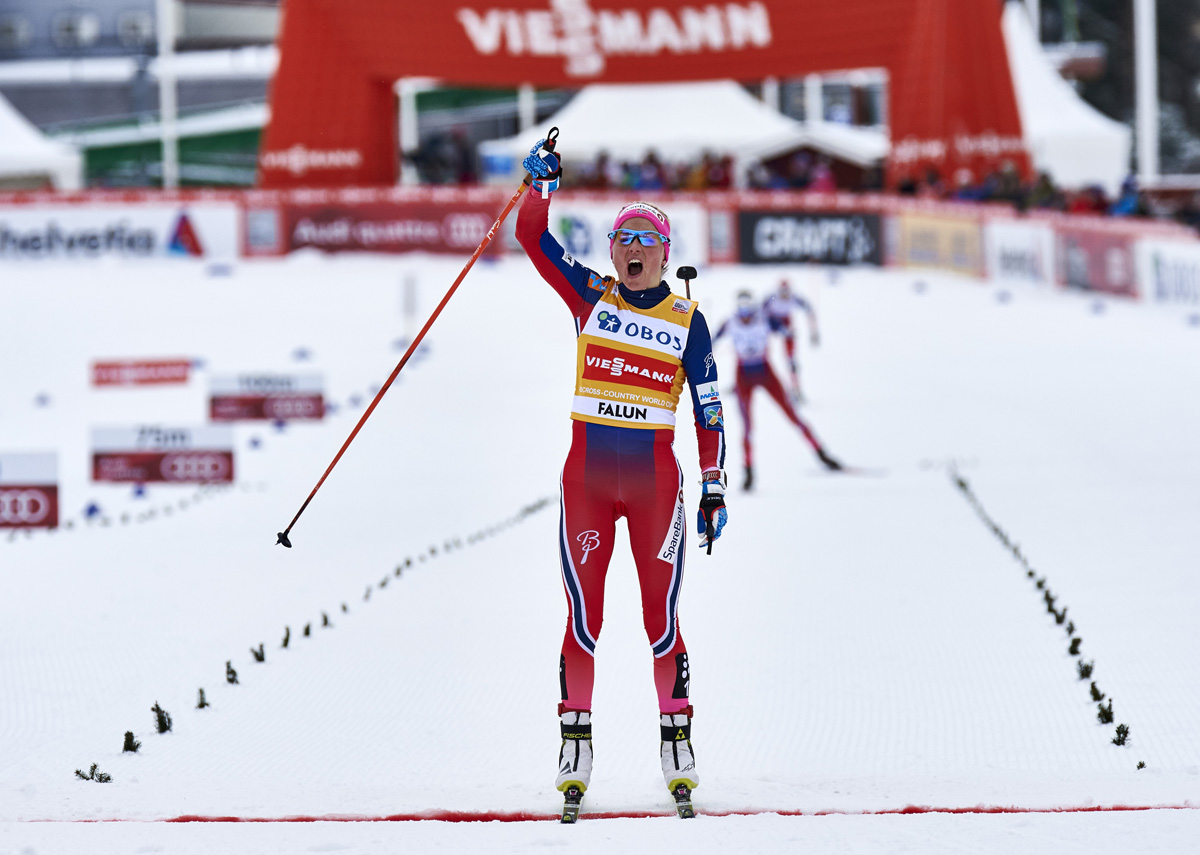
    Norway's Therese Johaug celebrates her 14th World Cup victory in the 10 k freestyle mass start on Sunday in Falun, Sweden. Johaug led her teammates Heidi Weng and Astrid  Uhrenholdt Jacobsen in a Norwegian podium sweep and American Jessie Diggins placed fourth. (Photo: Fischer/NordicFocus)
    Norway’s Therese Johaug celebrates her 14th World Cup victory in the 10 k freestyle mass start on Sunday in Falun, Sweden. Johaug led her teammates Heidi Weng and Astrid Uhrenholdt Jacobsen in a Norwegian podium sweep and American Jessie Diggins placed fourth. (Photo: Fischer/NordicFocus)

    Note: This article has been updated to include comments from Liz Stephen and Caitlin Patterson.

    Therese Johaug dared anyone to match her as she drove a punishing pace from the gun of the 10-kilometer freestyle mass start on Sunday in Falun, Sweden. But five other women, including American Jessie Diggins, took her up on the challenge and the race was on.

    The fast pace from the gun strung out the 72 women in the field quickly and within minutes, a lead group of six was formed. Johaug was shadowed by her Norwegian teammates Heidi Weng, Ingvild Flugstad Østberg , and Astrid Uhrenholdt Jacobsen as well as Diggins and Sweden’s Charlotte Kalla as they ascended the infamous Mörderbacken climb in the first two kilometers of the race.

    There was no trading of leads as Johaug churned away with her characteristic high tempo in the front. By 3.2 k, Johaug, Weng and Østberg had a five-second gap on Jacobsen and Diggins. Kalla fell back to the chase group, ceding the potential to repeat on the podium after she won the 10 k freestyle at Falun World Championships last year.

    However, a day after notching fifth in the 5 k classic, Diggins was not going to let the Norwegian trio ski away without a fight. She took advantage of her strengths on the gliding sections of the rolling terrain the second half of the 5-kilometer lap. She overtook a fading Østberg and caught Jacobsen who tucked in behind her. She continued to hammer, bridging to Johaug and Weng.

    Coming through the stadium after the first lap at 5 k, Diggins was just 3.6 seconds from the lead pair. However, when Jacobsen took her turn leading, she shifted gears to a pace Diggins couldn’t match. In pursuit of her teammates up the trail, Jacobsen put 11.2 seconds on Diggins in 1.7 k.

    In contrast to Johaug’s usual untouchable domination, Weng shadowed her stride for stride for over half of the race. However, at 6.7 k, the second time up Mörderbacken, Johaug delivered an attack that Weng could not match.

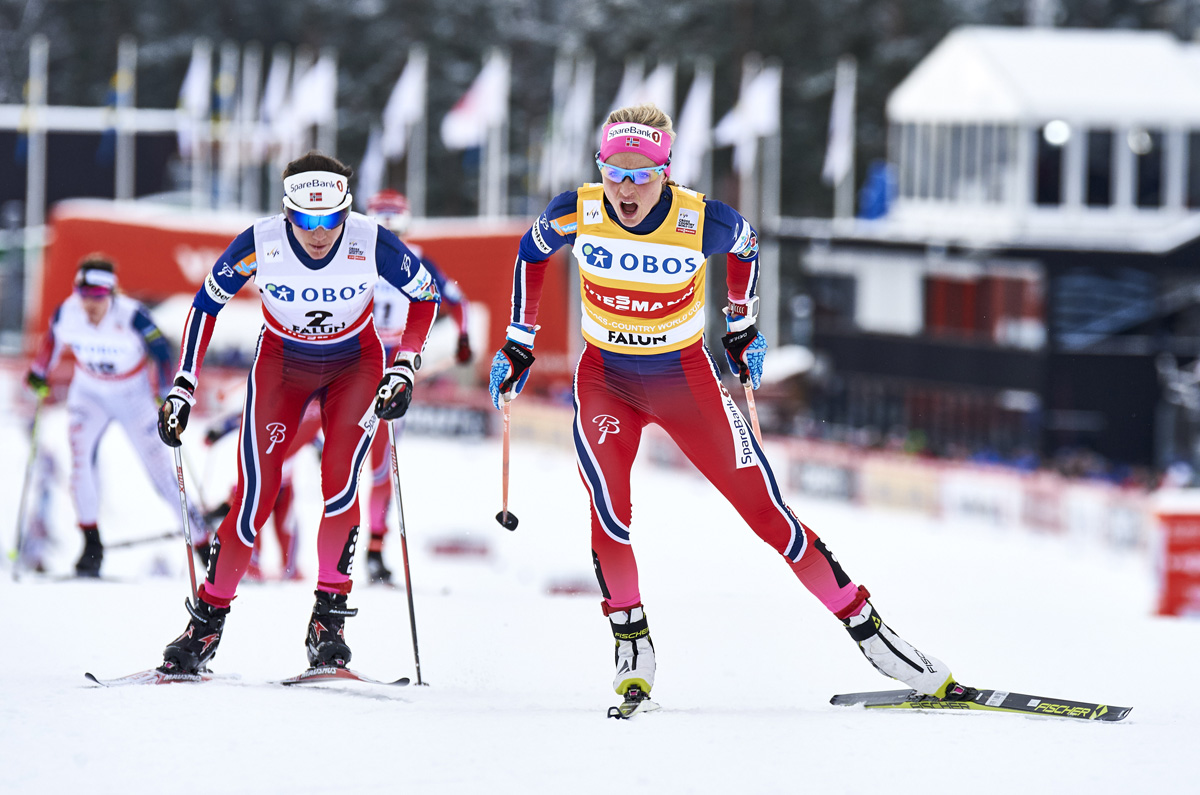
    Therese Johaug (r) leads Norwegian teammate Heidi Weng during the women's 10 k freestyle mass start at the World Cup in Falun, Sweden. The duo went on to place first and second, respectively. (Photo: Fischer/NordicFocus)
    Therese Johaug (r) leads Norwegian teammate Heidi Weng during the women’s 10 k freestyle mass start at the World Cup in Falun, Sweden. The duo went on to place first and second, respectively, while American Jessie Diggins (back left) placed fourth. (Photo: Fischer/NordicFocus)

    Johaug entered the stadium clear of Weng, winning in 23:28.0 for her 14th World Cup win matching Norwegian Bente Skari’s record for the most wins in a season. Weng secured second place, 8.8 seconds back, and Jacobsen placed third (+13.9).

    Meanwhile, Diggins skied alone in fourth place trying to hold off a charging chase pack. She made it to the line just four seconds ahead of the chase pack to secure fourth (+29.0). Norway’s Maria Rydqvist and Ragnhild Haga led the group behind her into the finish in fifth (+33.3) and sixth (+34.0), respectively.

    Despite skiing in the lead pack early, the early pace took its toll and Østberg faded to ninth (+35.0).

    After the race, Johaug explained she pulled off her race plan perfectly, although Weng held on longer than she anticipated.

    “My goal was to go my own race, and go hard and smoothly from the start,”Johaug told NRK, according to a translation. “I would ‘punch’ to the last part of the hill, and it finally succeeded … I was a little nervous, for Heidi hung so well.” 

    According to Weng, Johaug “started like it was a sprint so there weren’t many of us from the beginning,” she told FIS. “I tried to stay with her as long as I could but my legs started to get stiff and I just focused on my technique to make sure that I still got to the finish in second place.”

    Jacobsen described her battle with Diggins as mostly amicable. “We actually had some cooperation on the first lap. I have never really had that before,” she told FIS. “She told me that she would take the lead on the big downhill and then we start to catch Ingvild in the stadium and Jessie went by her quickly. I hesitated and Jessie got away, but I was able to catch her on the Mörderbacken and I pushed again on the final climb to stay ahead of her.”

    Fewer than 10 seconds behind the chase group, American Liz Stephen finished 14th (+43.7), and 26-year-old Caitlin Patterson, of the Craftsbury Green Racing Project, placed 25th (+1:14.6) for her World Cup points in 11 starts.

    Diggins ‘Going for Broke’

    One year after Diggins and Caitlin Gregg claimed their historic podium finishes at the Falun World Championships, Diggins had her sights set high for the 10 k freestyle event.

    “My strategy for the day was — I had a good race yesterday, I know I am in good shape — I am just going to go for broke and see what happens,” she said on the phone afterward.

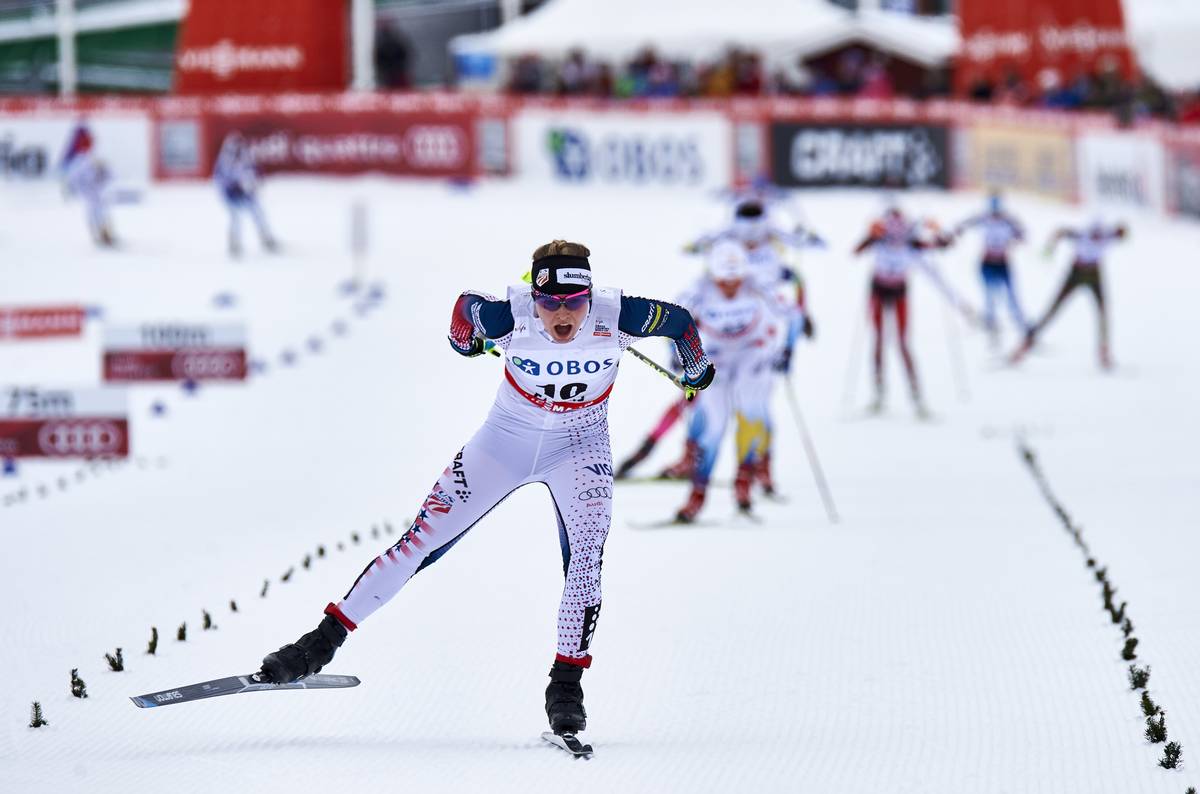
    Jessie Diggins charges to the finish of the World Cup 10 k freestyle mass start on Sunday in Falun, Sweden. Diggins held off a closing chase pack to secure fourth place. (Photo: Fischer/NordicFocus)
    Jessie Diggins charges to the finish of the World Cup 10 k freestyle mass start on Sunday in Falun, Sweden. Diggins held off a closing chase pack to secure fourth place. (Photo: Salomon/NordicFocus)

    “I knew it was a little bit risky, but I was trying to hang with that lead group as long as I could,” Diggins said.

    As long as she could turned into more than half the race as she trailed Johaug by just 3.6 seconds at 5 k.

    “In a mass start, I’ve never been in this position before, it was so exciting,” Diggins said.

    Although she was in contention for a podium at 5 k, she soon realized the effort wasn’t sustainable and decided to cut her losses.

    “I was totally pegged, I was going as hard as I possibly could,” she recalled. “I thought I could try to hold on to Therese and Heidi but then I might blow up and lose twenty spots, but if I can race smart I could for sure get top five.”

    Keeping her position meant holding off a charging chase pack of 15 skiers who were able to draft each other. Despite this advantage, Diggins was confident she could hold them.

    “I wasn’t too concerned because the last couple kilometers are my strength and I usually close down a race hard,” she said. “I felt like I would be able to hold it, but still it was still motivating and I knew I just couldn’t make a mistake.”

    U.S. Women’s Coach Matt Whitcomb commended Diggins’ gutsy racing.

    “She gave herself a chance to win today, she believed that she could, and she did everything she could and fell just shy,” he said on the phone “But this is the kind of approach to racing that we just love to see — aggressive and full of the belief that she could make it happen.”

    For Diggins, Falun remains one of her favorite places to race. “I’m so happy — I love racing here, the crowds are great, the atmosphere is fun, and I had wonderful skis,” she said.

    In a World Cup schedule with few mass starts, Falun was the first freestyle mass start of the season so far.  Although Diggins still considers individual starts to be her favorite format because it is just “you, your mind and the course,” she considers mass starts a fun change and a great learning opportunity.

    “In some ways, it was more fun to ski it with other people because you can see where the leaders are and you can see where they are putting time on you,” she said. “It is a really good way to learn about your style of racing and how that fits into the field.” 

    Stephen Navigates Mass Start for Season Best

    Although there are advantages to the immediate feedback in mass starts, they can also pose challenges for skiers starting farther in the back in the field. The congestion on the course presents frustrating, but surmountable challenges for skiers like Stephen.

    Starting in the middle of the field in bib 23, Stephen had to navigate the field on a narrow course and look for openings. However, when the field opened up, Stephen delivered as she moved from 21st place at 5 k to finish in 14th for her best World Cup result this season.  

    “It is really good to see Liz looking like herself again,” Whitcomb said.  “I think had today been an interval start race, you would have seen a really impressive result out of Liz. She struggled a bit with a later start, getting swallowed up, the course is a little bit narrow and she spent a lot of time waiting for an opening.”

    “Today was a really good feeling to leave Europe on and take home with me to prepare for Canada. I had the best energy I have felt all year today,” Stephen said in a USSA press release.

    Patterson in the points

    Another highlight for the Americans included Patterson’s 25th place, her first World Cup top 30 and best result since placing 36th in the Holmenkollen 30 k classic mass start last weekend.

    “We are really excited for that,” Whitcomb said. “In many ways, that is one of the real successes of the day when you see a new athlete score her first World Cup points. It’s not even one point, it is a handful of them with a really solid 25th place.”

    Patterson’s aggressive start paid off as she was able to establish a position in the top 20 within the first three kilometers. “My game plan was to start fast and aggressively, always on the offensive to move up rather than getting shuffled back, cling onto packs or other skiers whenever possible, and ski efficiently but not afraid to push hard,” explained Patterson.

    “I was actually astonished to find that the pace up the Morderbakken the first time seemed within reason, I could hold with people, and actually even still see Johaug way up ahead, which was exciting!” Patterson said.

    The depth of the U.S. women’s field has been illustrated this year as Patterson was the seventh women this year to score points in a distance race. This is a testament to the progress of the U.S. women’s cross country skiing and bodes well for the future.

    As Patterson shared, “I think now that I’m over here in Europe, it helps that I have trained with Ida, and with other USST women at fall camps, and to have seen that my fitness is close to theirs in training sessions, to help me convince myself that if I can ski with them, and they can ski with the best in the world, then maybe I can ski with the best in the world too.”

    Rosie Brennan and Ida Sargent also represented the U.S., taking 48th (+2:05.4) and 67th (+3:26.3), respectively.

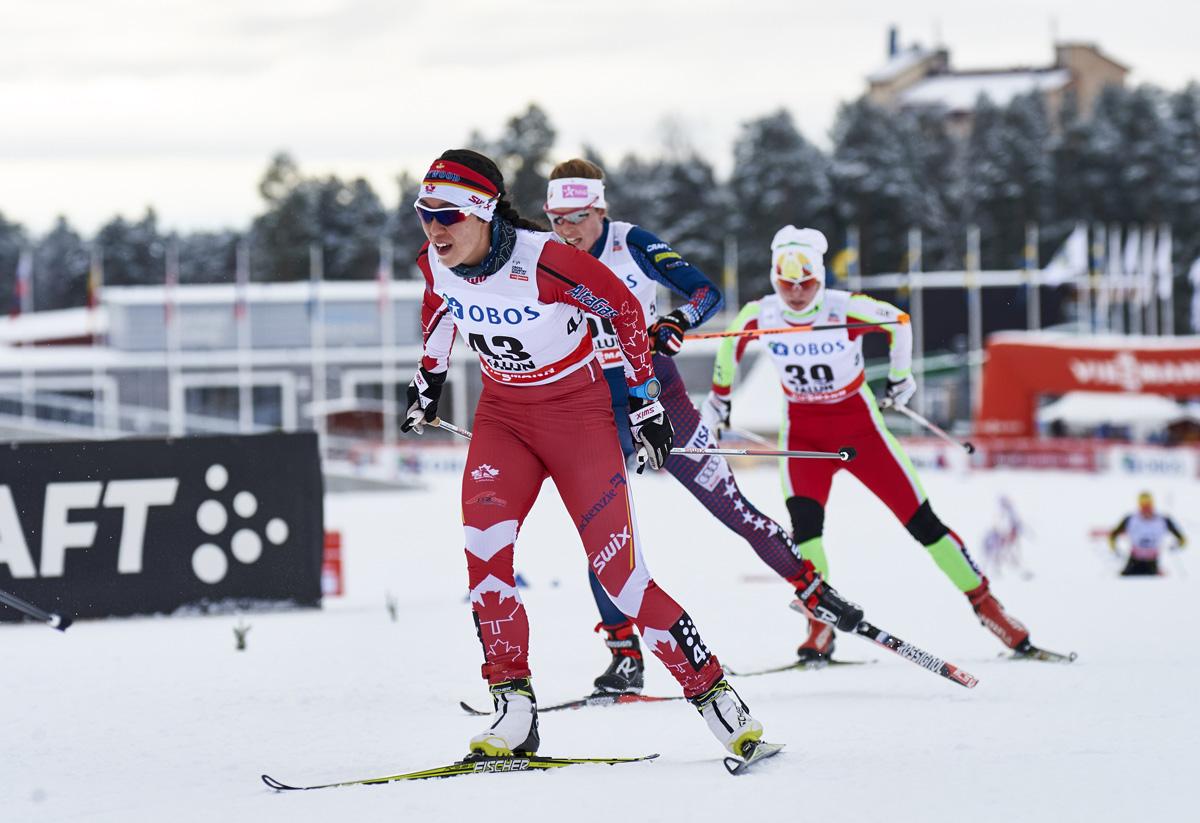
    Emily Nishikawa of Canada skis to 39th place in the Falun mass start skate event (Photo credit: Fischer/NordicFocus)
    Canada’s Emily Nishikawa racing to 39th in the 10 k freestyle mass start at Sunday’s World Cup in Falun, Sweden.(Photo: Fischer/NordicFocus)

    Canadian Emily Nishikawa was 14 seconds out of the points in 39th (+1:34.9) and Andrea Dupont (Rocky Mountain Racers) placed 69th (+3:46.5). 

    “The pack with the top 30 was just over 10 seconds ahead of me on the last lap, so it was a little frustrating that I didn’t have a little bit more in me to push and bridge up to that group,” Nishikawa wrote in an email. “Overall, it was much better than yesterday [in the 5 k classic], and I’m looking forward to going home to recharge before the Ski tour Canada where I hope to have my best races of the season.”

  • Ever-Stoic Bjørgen Ready to Party After World Cup Finals Victory

    Ever-Stoic Bjørgen Ready to Party After World Cup Finals Victory

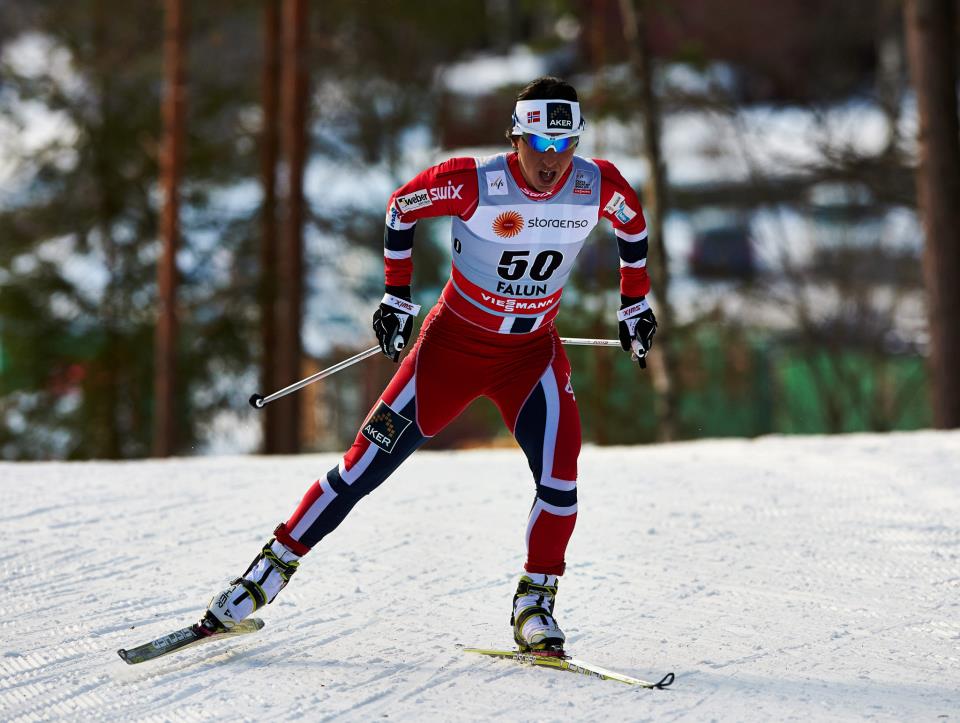
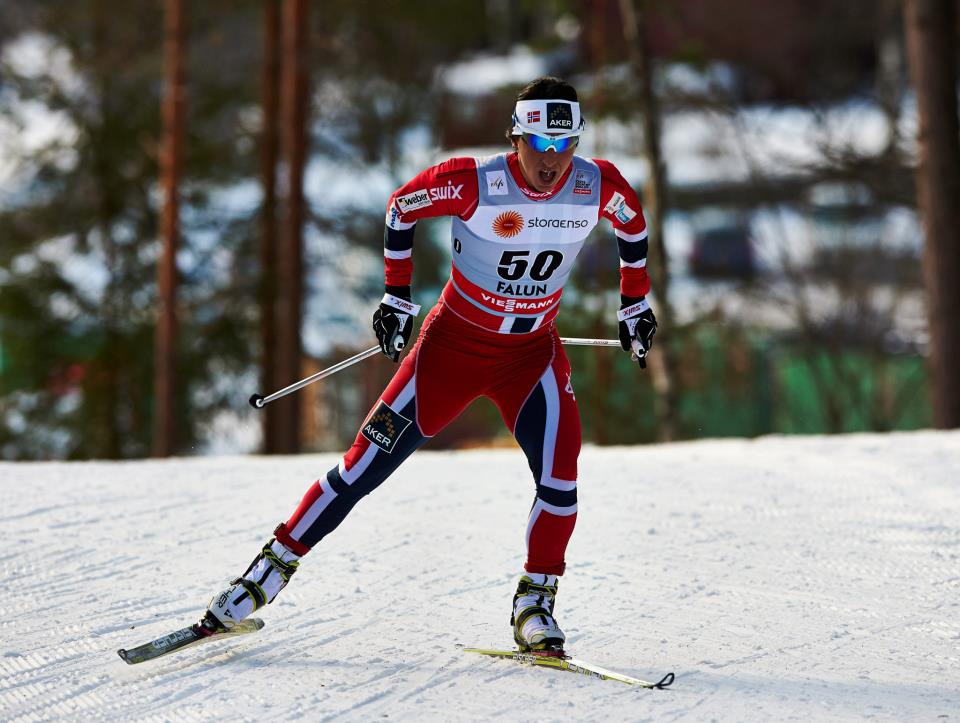
    Norway's Marit Bjørgen racing to her first victory of 2013 World Cup Finals in Friday's 2.5 k prologue in Falun, Sweden. Bjørgen went on to win two more stages, including Sunday's freestyle pursuit, to win the mini-tour title and finish fourth in the overall World Cup. (Photo: Fischer/Nordic Focus; facebook.com/FIS Cross Country)
    Norway’s Marit Bjørgen racing to her first victory of 2013 World Cup Finals in Friday’s 2.5 k prologue in Falun, Sweden. Bjørgen went on to win two more stages, including Sunday’s freestyle pursuit, to win the mini-tour title and finish fourth in the overall World Cup. (Photo: Fischer/Nordic Focus; facebook.com/FIS Cross Country)

    It wouldn’t quite be accurate to call Marit Bjørgen’s World Cup Finals pursuit performance on Sunday a formality. Sure, Norway’s 12-time World Champion started the 10-kilometer freestyle race a full minute and 20 seconds ahead of the field in Falun, Sweden, with teammate Therese Johaug being the only one that could potentially test her.

    And yes, chances were Johaug would never catch her, but there’s always several races within a race, and Bjørgen had one going from the start.

    Therese Johaug after finishing second to Norwegian teammate Marit Bjørgen in Saturday's 10 k classic mass start at 2013 World Cup Finals in Falun, Sweden. Johaug went on to place second to Bjørgen in the pursuit for the mini-tour silver. (Photo: Fischer/Nordic Focus; facebook.com/FIS Cross Country)
    Therese Johaug after finishing second to Norwegian teammate Marit Bjørgen in Saturday’s 10 k classic mass start at 2013 World Cup Finals in Falun, Sweden. Johaug went on to place second to Bjørgen in the pursuit for the mini-tour silver. (Photo: Fischer/Nordic Focus; facebook.com/FIS Cross Country)

    Sixth in the World Cup standings after missing more than a month of racing in December (Bjørgen sat out the Canadian World Cups to rest up for the Tour de Ski, then skipped the Tour because of a heart arrhythmia), the 33-year-old had the opportunity to capture 200 World Cup points on Sunday and rise to at least fourth overall.

    If American Kikkan Randall – the World Cup sprint champion – placed outside the top 15, Bjørgen could finish third in the overall standings. But Randall, too, was out to finish strong.

    Bjørgen did have several things going for her. Without Poland’s Justyna Kowalcyzk challenging her from what would’ve been a 46-second starting deficit (Kowalczyk skipped the last race of the season), Bjørgen enjoyed somewhat of a solo journey throughout the three-lap race to seal her 59th World Cup victory. Able to pick her head up, she soaked in the thousands of spectators lining the course.

    “I was in control,” she told NRK, according to a translation. “When one goes all alone in front, [it’s] not too full.”

    Meanwhile, Johaug charged from behind to fend off Sweden’s Charlotte Kalla, who started just 6 seconds behind her.

    With one lap remaining, Johaug was within 55 seconds of Bjørgen, but unless something dramatic happened – like a crash – Bjørgen was going to bring this one home. She finished first in 26:39.6, 49.3 seconds ahead of Johaug, who topped Kalla by 22.4 seconds.

    “I had a lot of time to enjoy the track and the people around the track,” Bjørgen told FIS. “It’s been a great season for me and to finish like this … I’m looking forward to some vacation and to a new season and Sochi. I’m really happy.”

    Repeating her bronze from last year’s World Cup Finals, Kalla finished 1:11.7 out of first for her first World Cup podium (outside of a stage top-three) this season. She was second to Bjørgen in Friday’s 2.5 k freestyle prologue.

    “It feels great to be on the podium again,” Kalla said. “I tried to keep the pace with Therese but she was too fast.”

    Sweden's Charlotte Kalla, who notched her first World Cup podium (outside of a stage top-three) on Sunday in the 10 k freestyle pursuit at 2013 World Cup Finals in Falun, Sweden. There, she was third behind Norwegian winner Marit Bjørgen and runner-up Therese Johaug. (Photo: Fischer/Nordic Focus; facebook.com/FIS Cross Country)
    Sweden’s Charlotte Kalla, shown finishing fifth on Saturday in the 10 k classic mass start. Kalla notched her first World Cup podium (outside of a stage top-three) on Sunday in the 10 k freestyle pursuit at 2013 World Cup Finals in Falun, Sweden. There, she was third behind Norwegian winner Marit Bjørgen and runner-up Therese Johaug. (Photo: Fischer/Nordic Focus; facebook.com/FIS Cross Country)

    On Sunday, the Swede initially responded to Johaug’s pace, coming within eight seconds of her 2.3 kilometers in. But by the second lap, the gap between Johaug and Kalla had grown to 11 seconds. The third time around, Kalla’s technique began to falter, yet she managed to keep it together for the final two kilometers.

    Kalla finished 40.1 seconds ahead of Heidi Weng, who for the second-straight race outlunged a competitor to the finish. A day after placing third in the 10 k classic mass start ahead of Kowalczyk and behind Bjørgen and Johaug, respectively, Weng placed fourth (+1:51.8), 0.3 seconds ahead of Finland’s Kerttu Niskanen.

    Norway’s fourth woman, Astrid Uhrenholdt Jacobsen took sixth (+2:09.3), and Randall outsprinted Finland’s Anne Kyllönen and Krista Lahteenmaki for seventh (+2:29.3) after starting 15th.

    With the second-fastest time after Johaug, Randall held onto third in the overall World Cup to become the first American woman to finish the season in the top three.

    Bjørgen finished fourth, behind Crystal Globe winner Kowalczyk and runner-up Johaug. But that respectable finish – and 24 consecutive podiums in as many races – weren’t what Bjørgen would remember most about this season: World Championships were.

    “Four gold and one silver is more than I hoped for,” she told FIS.

    Asked how she’d celebrate Sunday’s win and a triumphant season overall, she told NRK, “I do not know whether it is suitable to tell on TV.”

    Johaug, who notched more than a dozen podiums this season, said it would be an all-nighter.

    “We will [stay out] until tomorrow morning,” she told NRK.

    As for Kowalczyk, who called it quits before the end of World Cup Finals because of leg troubles: “It was a perfect season for me,” she told FIS. “If you take away the World Championships it was almost ideal. I won the Tour de Ski and my fourth Big Crystal Globe. … I will start training again in the first half of May. I think I will ski the same program as this year.”

    Results