From the FasterSkier archive — posts syndicated from athletes’ and coaches’ own blogs between 2004 and 2012, kept online as published. Current coverage is at fasterskier.com.
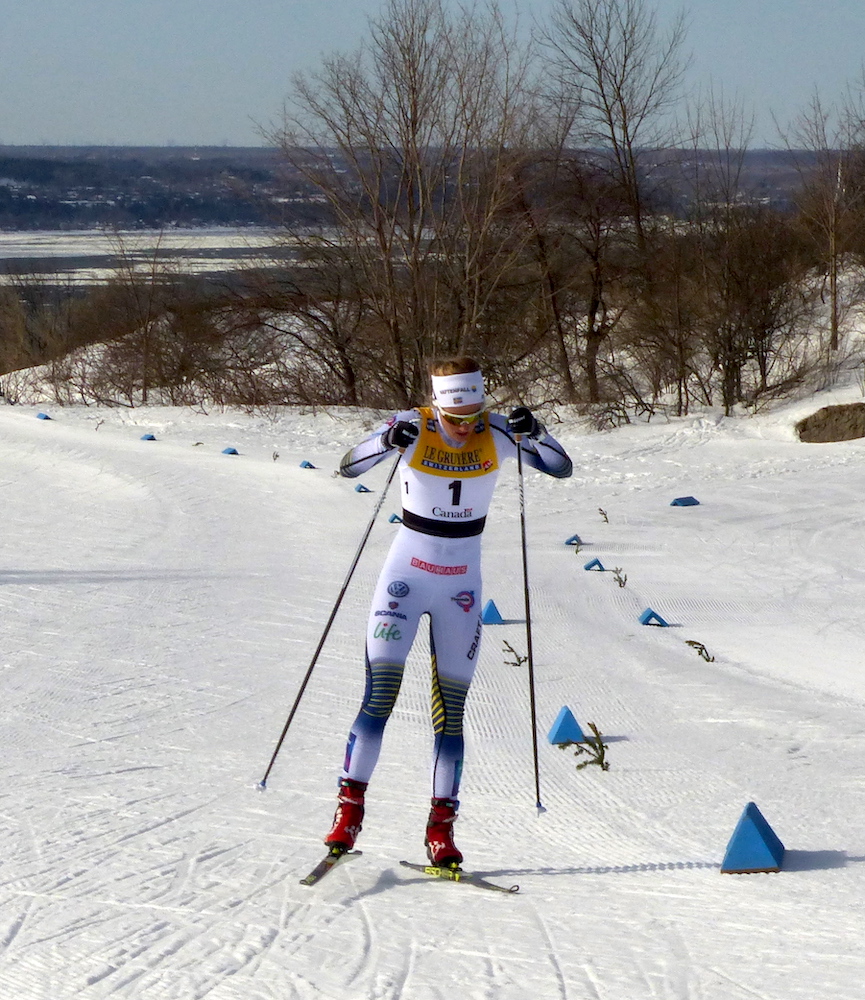
Stina Nilsson of Sweden during the women’s 10 k pursuit in Quebec. (Photo: Peggy Hung)
FIS World Cup Finals Québec Women’s 10 k Freestyle Pursuit
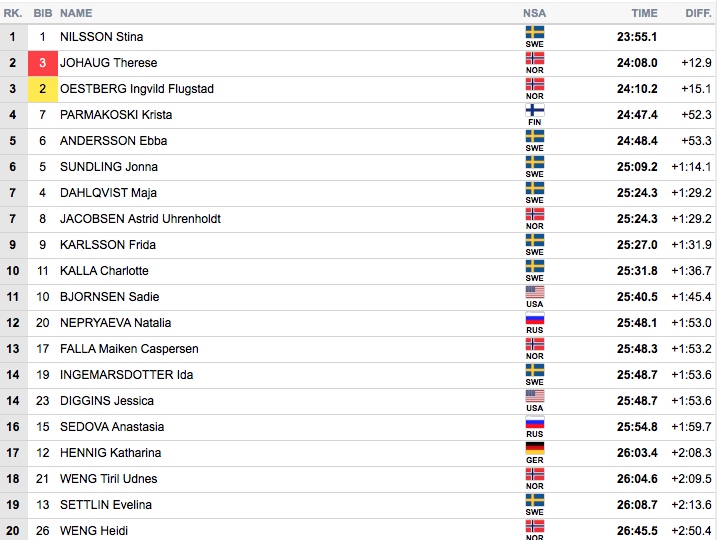
Day three in Québec City brought sunny skies and fast tracks. The first starter on the day for the 10 k freestyle pursuit, Sweden’s Stina Nilsson, took the win and with it the Québec City overall.
Nilsson began with a 33.2 second lead over Norway’s Ingvild Flugstad Østberg in second and a 49.4 second lead on third starter Therese Johaug, also of Norway. Nilsson won in a time of 23:55.1 with the chasing Johaug and Østberg running out of real estate on the Plains of Abraham.
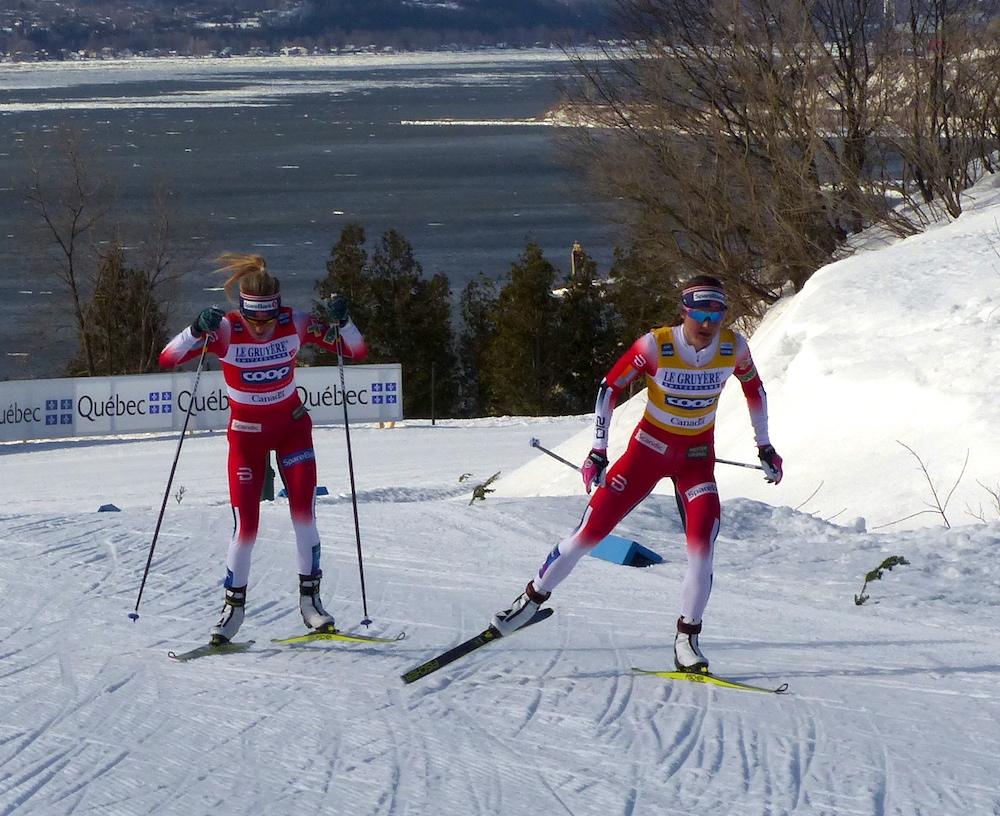
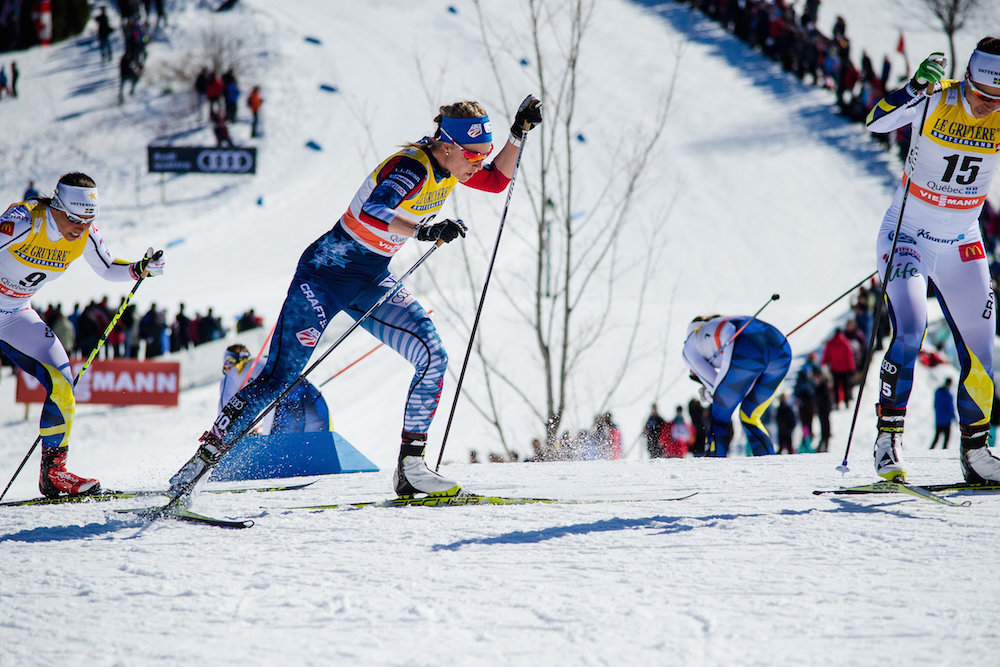
Chasers in third and second, Norway’s Norway’s Ingvild Flugstad Østberg (yellow bib) and Therese Johaug during the women’s 10 k pursuit in Quebec. (Photo: Peggy Hung)
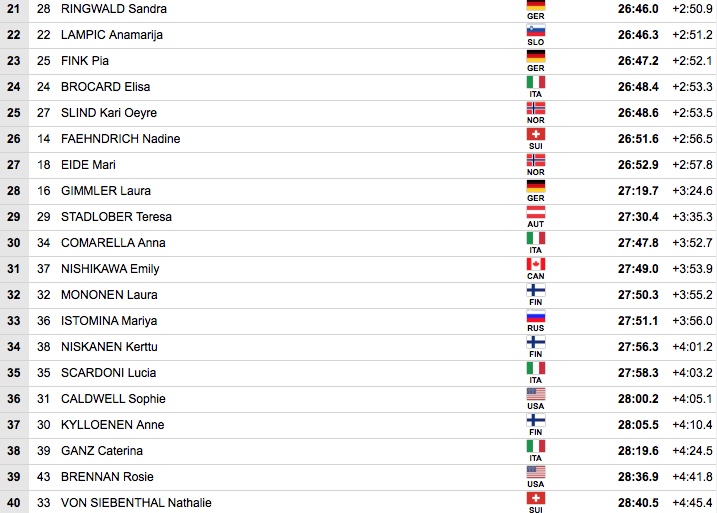
For the U.S., Sadie Bjornsen placed 11th (+1:45.4), Jessie Diggins moved up to 14th (+1:53.6). Canada’s Emily Nishikawa began as the 37th skier and placed 31st (+3:53.9).
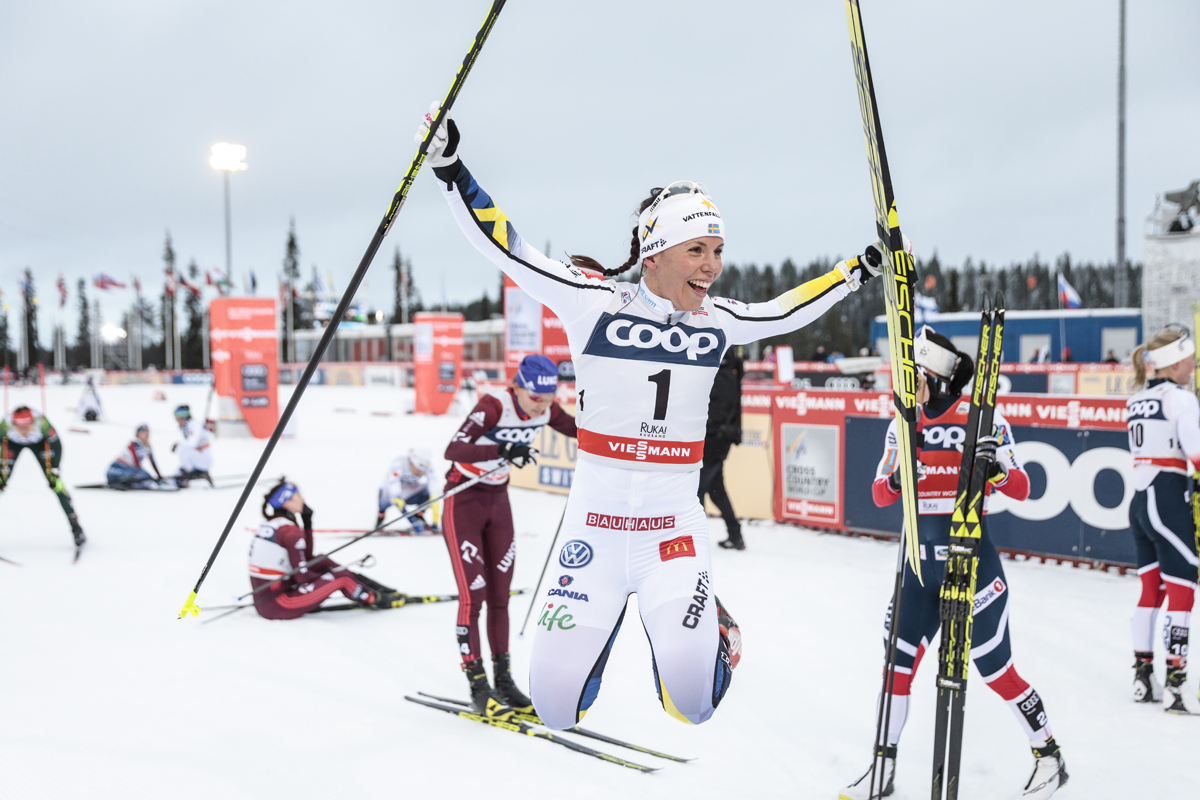
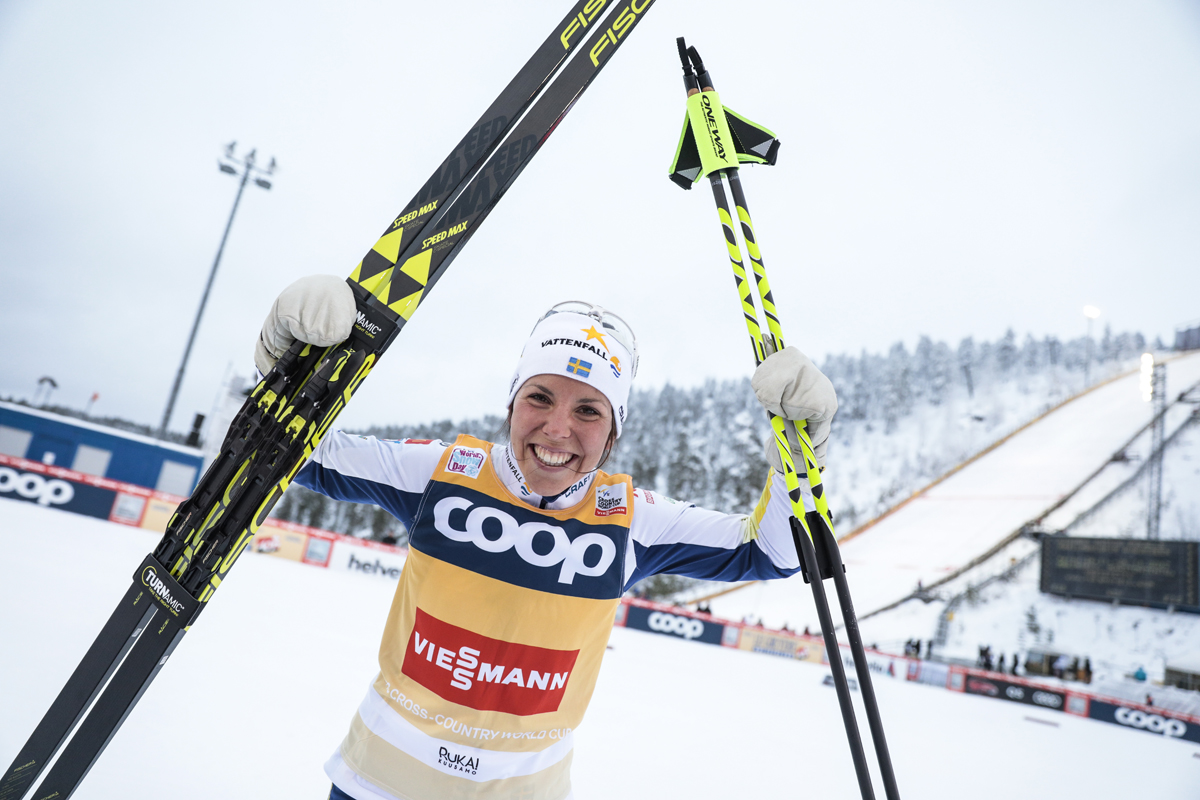
Sweden’s Charlotte Kalla jumps for joy after winning Sunday’s 10 k freestyle pursuit and overall Ruka Triple title at the World Cup opener in Kuusamo, Finland. She started 2 seconds ahead of Norway’s Marit Bjørgen (second from right) and held her off by 9.7 seconds for the win. (Photo: Fischer/Nordic Focus)
After two days of racing in Kuusamo, Finland, the Ruka Triple turned its last page on Sunday. As it turned out, the women’s 10-kilometer freestyle pursuit was a thriller.
Sweden’s Charlotte Kalla came into the final day of the mini tour wearing bib 1 and with only a 2-second lead on the last person one might want skiing on their tails, Norway’s Marit Bjørgen.
The gamesmanship, the change of pace, skiing’s version of the dodge and parry became a two-skier affair between Kalla, 30, and Bjørgen, 37. Yet, followers of the sport know Bjørgen’s end-game: push the pace, determine who can match the pace, then seemingly flip a switch and steamroll ahead solo.
The Swedish-Norwegian pairing performed an endurance duet that kept the packs of chasing skiers at bay. Sweden’s Stina Nilsson started the pursuit 12 seconds back in third, Norway’s resurgent Ingvild Flugstad Østberg 20 seconds back in fourth, and Russia’s Natalia Nepryaeva 23 seconds back in fifth. Norwegians Heidi Weng and Ragnhild Haga began 41 and 42 seconds back, respectively. None could gap up.
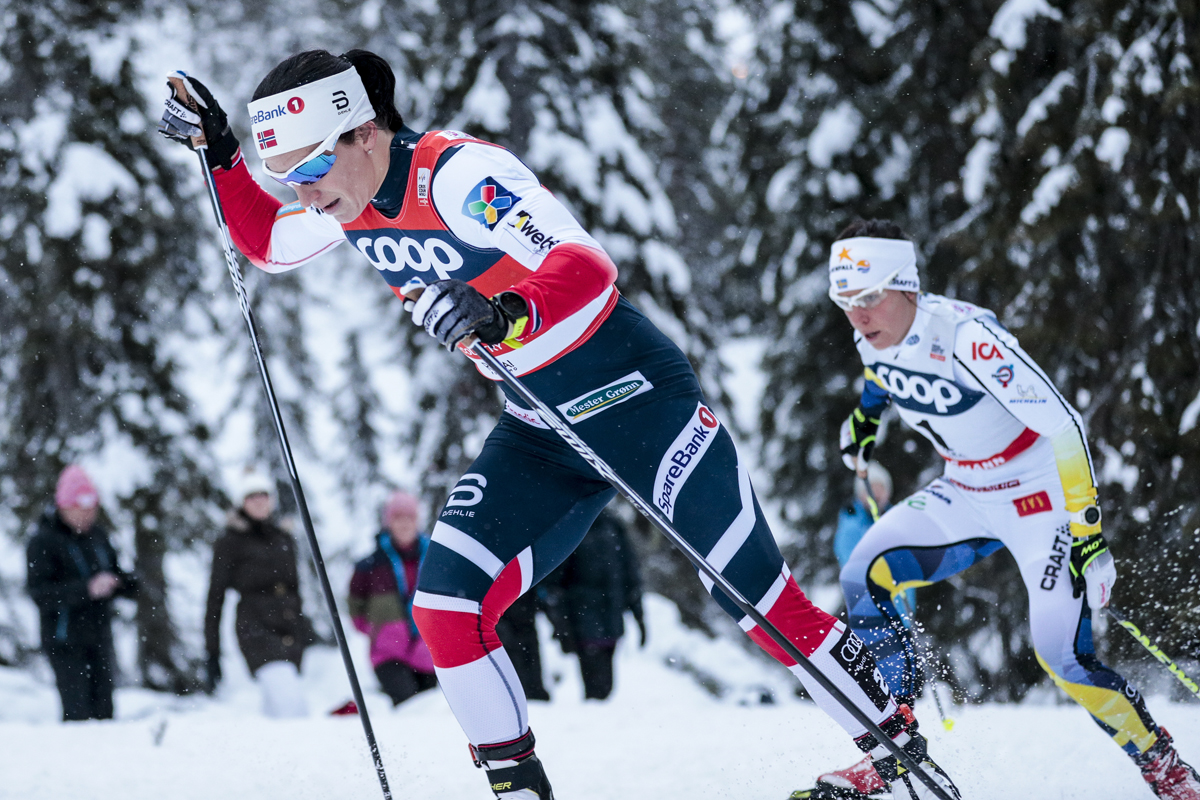
Norway’s Marit Bjørgen leads Sweden’s Charlotte Kalla during the women’s 10 k freestyle pursuit on Sunday at the Ruka Triple World Cup in Kuusamo, Finland. (Photo: Fischer/Nordic Focus)
Kalla and Bjørgen never blinked. They gradually pulled away from the chasers.
“My plan was to ski quite fast together with Marit, and not bring the ones behind us into the game,” Kalla told FasterSkier in a post-race phone interview. “Because I know that Stina is a really good sprinter, so me and Marit had to work together to keep the gap to the others.”
Heading back out into the woods on the final lap of the 2.5 k course, Kalla punched it. She accelerated the pace to what looked like a sprint, and Bjørgen initially stayed right on her tails.
How sustainable was this pace? And would it be possible to pop the Norwegian, who had won Saturday’s race over Kalla by 17 seconds? In the previous 10 k classic, Kalla had matched Bjørgen’s times until the last 1 1/2 kilometers or so, when the punishing pace took its toll and she began hemorrhaging time.
That was on her mind as Kalla kept up her furious pace.
“Well, yesterday I didn’t truly have the belief that I could ski [away] from Marit, because she did have a great performance yesterday in the classic part, especially on the last lap,” Kalla reflected. “So when I decided to speed up I also knew that I cannot look back. I had to give it a real try and just focus in front of me all the time. I could not take a look behind my back because you have to work for a long long time, and today I succeeded.”
With the difference in the two women’s skating techniques, Kalla appeared to be expending more energy, but gradually put a gap on Bjørgen – one ski length, two — easily an amount that could be closed on a downhill. It would have been easy to back off and slow down, but Kalla kept pushing and the gap grew to three seconds, four, five, six.
Bjørgen didn’t respond.
Kalla came flying into the final hill up to the stadium, the one where she had slowed so dramatically the day before, but didn’t lose any of her advantage this time around.
“I was just telling myself to look up to the top, trying to push with your legs all the way,” Kalla said of her decisive move. “In the last sprint hill, before we came up to the stadium, I was thinking, ‘Left, left, left, left… one, two, three, four, five,’ just to be able to think of something else than the pain.”
Kalla skied the turn into the finishing stretch with a clear margin and raised her hands at the finish line as she crossed in 25:50.1 minutes, 9.7 seconds before Bjørgen. She congratulated her rival before jumping in the air and shouting with joy.
“It was an amazing day today,” Kalla said. “I felt very strong during the race. Just tried to ski my very best, and saved as much energy as possible during the first three laps. My dream yesterday, when I went to bed, was to be able to push very hard when we [would go] out on the last lap. And I was a little bit nervous but decided to follow my tactic. When I was on the top of the hill my coach yelled at me that I had six seconds [lead on Bjørgen]. So I had very tired legs, but I knew that I had to fight and do my very very best until the finish line.”
Sweden’s Charlotte Kalla in the overall World Cup leader’s bib after starting the season with a Ruka Triple mini-tour win in Kuusamo, Finland. (Photo: Fischer/Nordic Focus)
The last time Kalla won a World Cup was in 2015 when she won the 10 k skate in Östersund, Sweden, before winning the same event at the 2015 World Championships at home in Falun, Sweden.
“It was a long time since I won a race the last time,” Kalla noted. “And I think it was 2008 when I won a mini tour, and that was the Tour de Ski, actually. So I have been waiting for this day, and I’m very happy today.”
Also of note is that last year’s Ruka World Cup event Kalla suffered from a heart ailment and had to reduce to a slow-tempo ski to finish the race. One year later, she said that wasn’t on her mind.
“No, I have not been thinking about that myself,” Kalla said of her health scare last year. “But all journalists I have met remembered what happened to me last year. So it’s like night and day to think about and look back to one year ago. It’s something totally different.”
After Bjørgen, Norway took third through fifth places. Haga skied to third (+33.9) and posted the fastest time of day, skiing the course in 25:41.8 as she leapfrogged from 10th place at the start to finish on the podium. Weng finished fourth (+38.0), and Østberg fifth (+40.2).
U.S. Women Continue to Thrive
At the start of the Ruka Triple on Friday, to paraphrase a certain former U.S. Defense Secretary, there were many “known unknowns” for the U.S. Ski Team (USST) in Finland. The answers three days later are clear. Sadie Bjornsen’s (USST) second place and Sophie Caldwell’s eighth place in Friday’s classic sprint set the tone. According to U.S. women’s coach Matt Whitcomb, both Bjornsen and Caldwell have met the objective criteria for the upcoming Winter Olympics in PyeongChang, South Korea. (That criteria, as applied to Bjornsen and Caldwell, was a top eight in a World Cup classic sprint.)
Four other USST women skied into the points on Sunday. Previously, Jessie Diggins placed 10th in Saturday’s 10 k classic individual start. Ida Sargent placed 15th in the sprint and began Sunday’s final stage in 23rd, based on her 10 k classic result. Rosie Brennan popped two top 30’s in the first two stages. Kikkan Randall, who had two off days in the classic sprint and 10 k classic, stormed back for Sunday’s skate pursuit. Randall began the day in bib 48 and finished the mini tour in 25th place, skiing the eighth-fastest time of the day.
Kikkan Randall (U.S. Ski Team) racing from 48th up to 25th (with the eighth-fastest course time) in Sunday’s 10 k freestyle pursuit at the Ruka World Cup in Kuusamo, Finland. (Photo: Fischer/Nordic Focus)
“She looked really strong and in control,” Whitcomb said on the phone about Randall. “She was making kills right from the start. It’s what we have seen out of her in this exact event before with actually with a very similar split several years ago, when we had the skate on the final day. It’s nice that she can leave this weekend with some confidence. She struggled with skis for the first two days of this tour and was skiing frustrated today, and she knows she has fitness, we know she has fitness, and we are really happy she was able to show it today.”
Randall confirmed that Sunday’s effort was a more indicative performance.
“Today was a much better gauge of where my fitness actually is,” Randall emailed. “After two frustrating classic days where the wax was a big factor, it was nice to just be able to go today and use what I have … Today felt the best out of the 3 races. I felt like my body wanted to go hard and I could find good power out there. I felt decent in the two classic races but felt like I couldn’t ski with my full shape because of wax and some technical struggles. So it was nice to know my shape is there.”
Bjornsen was the U.S. women’s top finisher after three days of racing in Ruka. She began the day as the 11th starter and improved to 10th overall by the finish, 1:18 behind Kalla.
“This is where we expect to see Sadie when things are going well,” Whitcomb said of Bjornsen’s performance. “But for things to go well, a lot has to stack up for any athlete, particularly for the beginning of the season, when you are traveling all the way from Alaska. It is pretty remarkable how resilient she is, how strong she has become, and how she can just rise above so many of her European competitors, who have been on snow in this time zone or one hour earlier for the last three or four weeks. She has gone halfway around the world and shown it is not so hard, so we are so impressed with Sadie’s ability to ski the way she this weekend.”
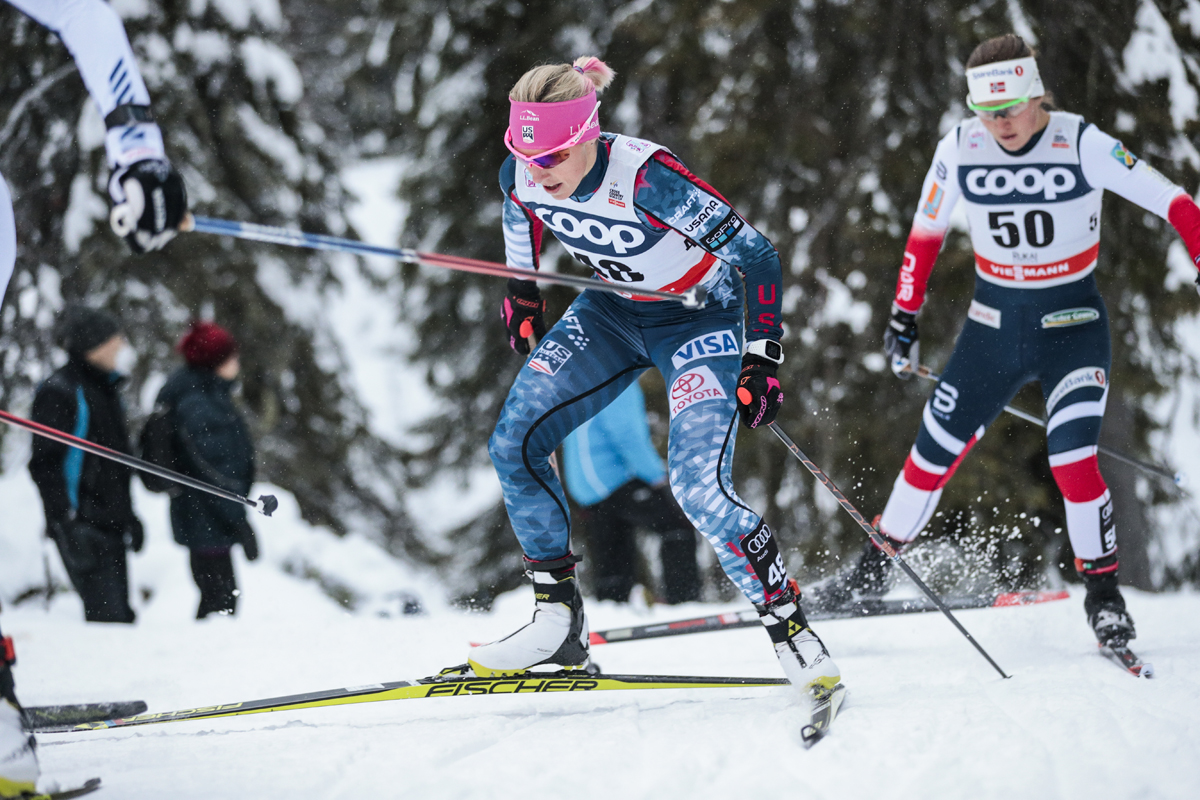
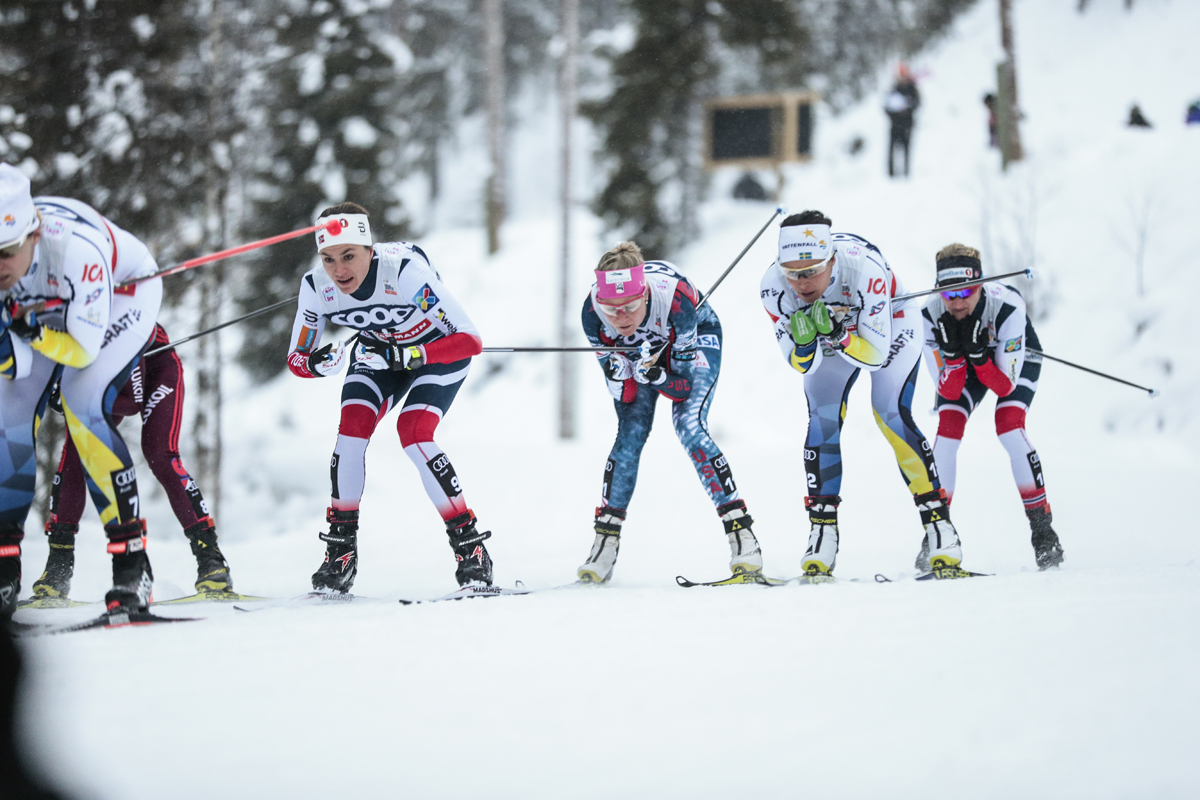
Norway’s Heidi Weng (third from left) skiing in a pack with American Sadie Bjornsen (pink headband), Sweden’s Anna Haag (second from r) and Norway’s Kathrine Rolsted Harsem (r) during the 10 k freestyle pursuit on the last day of the Ruka Triple World Cup mini tour in Kuusamo, Finland. (Photo: Fischer/Nordic Focus)
Bjornsen arrived in Europe for the start of the season on Nov. 8.
Out the on course, Whitcomb awaited his skiers atop the course’s big climb at approximately 1.2 k on the 2.5 k loop. There, Whitcomb said he witnessed Bjornsen put her personal stamp on the race’s outcome.
“Sadie had this moment in the race today where she was starting to dangle a little bit of her pack as the pace turned up between laps 2 and 3, and at the hardest part of the course she was forced to make a decision whether or not to hang,” Whitcomb recalled. “And if she just made this move for another minute or two she would be able to ski with them and their draft another three-fourths of a kilometer and pull her that much closer to the finish line and protect her that much more from the packs from behind. That decision today, I think, kept Sadie in the top 10 and that is the kind of racer she is.”
The first skate race of the year was welcomed by Bjornsen.
“Today was another fun, and tough day of racing here to complete the tour,” Bjornsen emailed. “It was nice to have skate skis under my feet after two really challenging classic days! Ruka is what I consider one of the toughest race courses on the circuit. It is just wall after wall (steep climb after steep climb), and you never seem to get a break. Today, it was my goal to catch the group in front of me, and then just hang on for dear life. I woke up feeling good, and recovered after the past two days, so I was feeling excited to see what I can do in skate skiing. I feel like I dug deeper than I have in a long time, and was really satisfied when I finally got to the finish line. I now look forward to a few days of rest before another great weekend of racing in Lillehammer.”
Diggins started the day in 16th and moved up to finish 12th overall. She also skied the 10th fastest time of day.
“A very solid day out of Jessie,” Whitcomb said. “She is perhaps most disappointed on the classic sprint [on Friday]. It was two years ago when we weren’t sure if classic sprinting would ever be in the cards for Jessie and then she is within striking distance of the podium on certain days. I am sure she has left wanting more from that classic sprint, and I am sure we will see her make the rounds and advance through the heats very soon, but to have 10th yesterday, and I believe the 10th-fastest split today on an extremely hard course, that is a great sign.”
For Diggins, who finished last season ranked sixth overall on the World Cup, the three-race weekend was a spark, reminding her body and mind of the racing routine.
“I always work into the season and was carrying a pretty high load of training into the last week, so overall I’m really happy with how the season opener went!” Diggins emailed to FasterSkier. “It was nice to finally race again and get my racing feet under me — and remember how all the testing and warming up works!”
Whitcomb also added some perspective on Diggins and whether her past results place any added undue pressure on her to perform.
“I think Jessie has matured quite a bit as far as that goes, and I think she can be more about the process, and really focus on what she really needs to do on the race each day and during a particular point on the course,” Whitcomb said. “As every k ticks by, rather than focusing on, ‘I must be fifth,’ if she is in 14th, she is going to do everything she can do be 13th and when she does that she will set her next goal. She is very goal-orientated but she is realistic. Yeah, she loves to win; she is focused on things that are in her control.”
Brennan placed 28th overall this weekend, after finishing in a photo finish with Germany’s Sandra Ringwald (in which Ringwald took 27th by 0.1 seconds).
“I am satisfied with the weekend,” Brennan wrote in an email to FasterSkier. “Kuusamo is always a tricky place for me so I am happy to come away with some strong results. I didn’t have any result expectations as it’s the first races of the year and the fields can vary. I feel I have accomplished many of my other goals in my technique and approach so I am satisfied with that … It always helps to have some strong results in the beginning. It gives me confidence in my fitness and some of the skills have been working on over the summer. I have to say, I would have expected the 10k classic to be my strongest so I think some of the work on my weaknesses is paying off and that I am happy about!”
Sargent left Ruka in 38th overall and comes away with renewed confidence. Known as a sprinter, her top 30 on Saturday bodes well for the Craftsbury, Vermont-based skier.
“I am satisfied with the weekend and mostly excited to start the season,” Sargent wrote to FasterSkier. “Yesterday was an awesome day for me so it’s cool to have a distance race carrying my weekend for me. Overall I think it was a great weekend for the team and we are just getting rolling!”
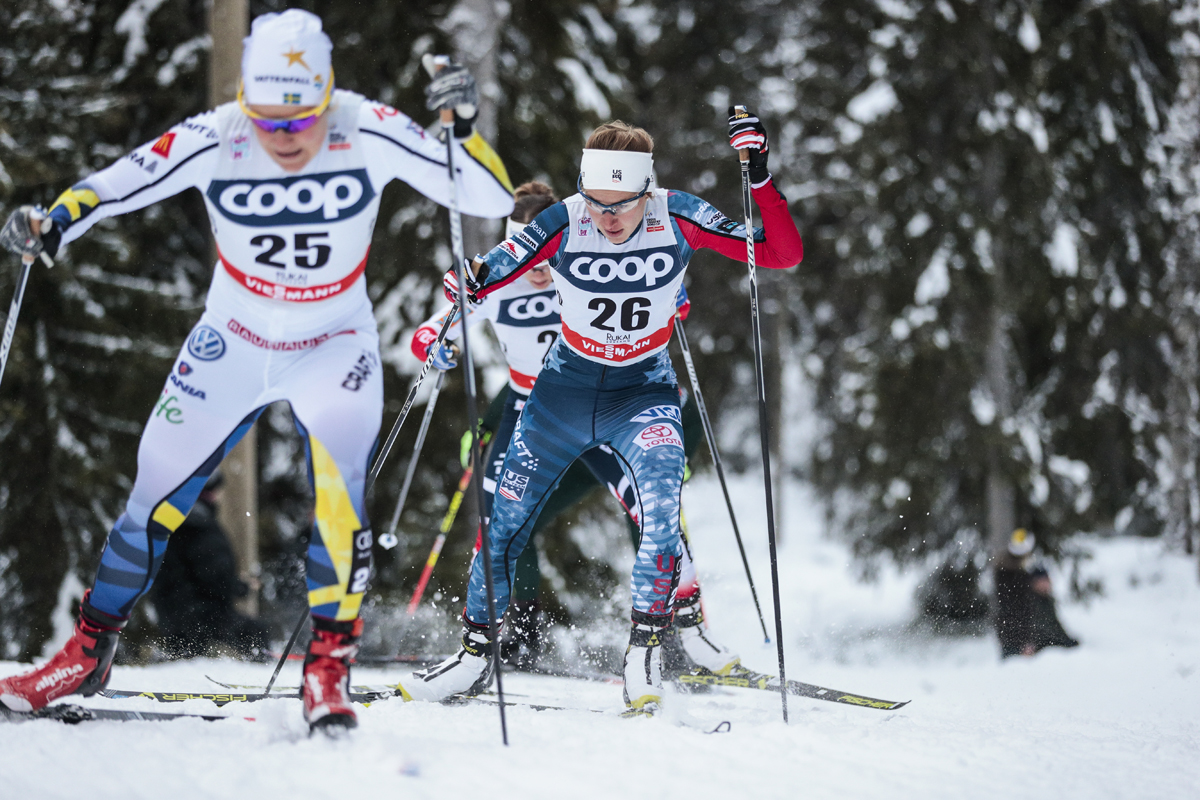
Sophie Caldwell (26), of the U.S. Ski Team, chasing Sweden’s Hanna Falk (25) in the women’s 10 k freestyle pursuit on the last day of the Ruka Triple World Cup mini tour in Kuusamo, Finland. She finished 39th overall. (Photo: Fischer/Nordic Focus)
After qualifying for the Olympics in her first race of the season, Caldwell finished one spot behind Sargent in 39th. Liz Stephen (USST) placed 56th overall, Chelsea Holmes (Alaska Pacific University) 60th, while Julia Kern (USST-D-Team) in her first European World Cup weekend was 71st.
Canada started three skiers in the women’s races. Emily Nishikawa (Canadian World Cup Team) led them in 69th overall, Cendrine Browne (National U25 Team) followed in 72nd, and Dahria Beatty (Canadian World Cup Team) placed 79th.
World Cup racing resumes in Lillehammer, Norway, next Saturday with a classic sprint.
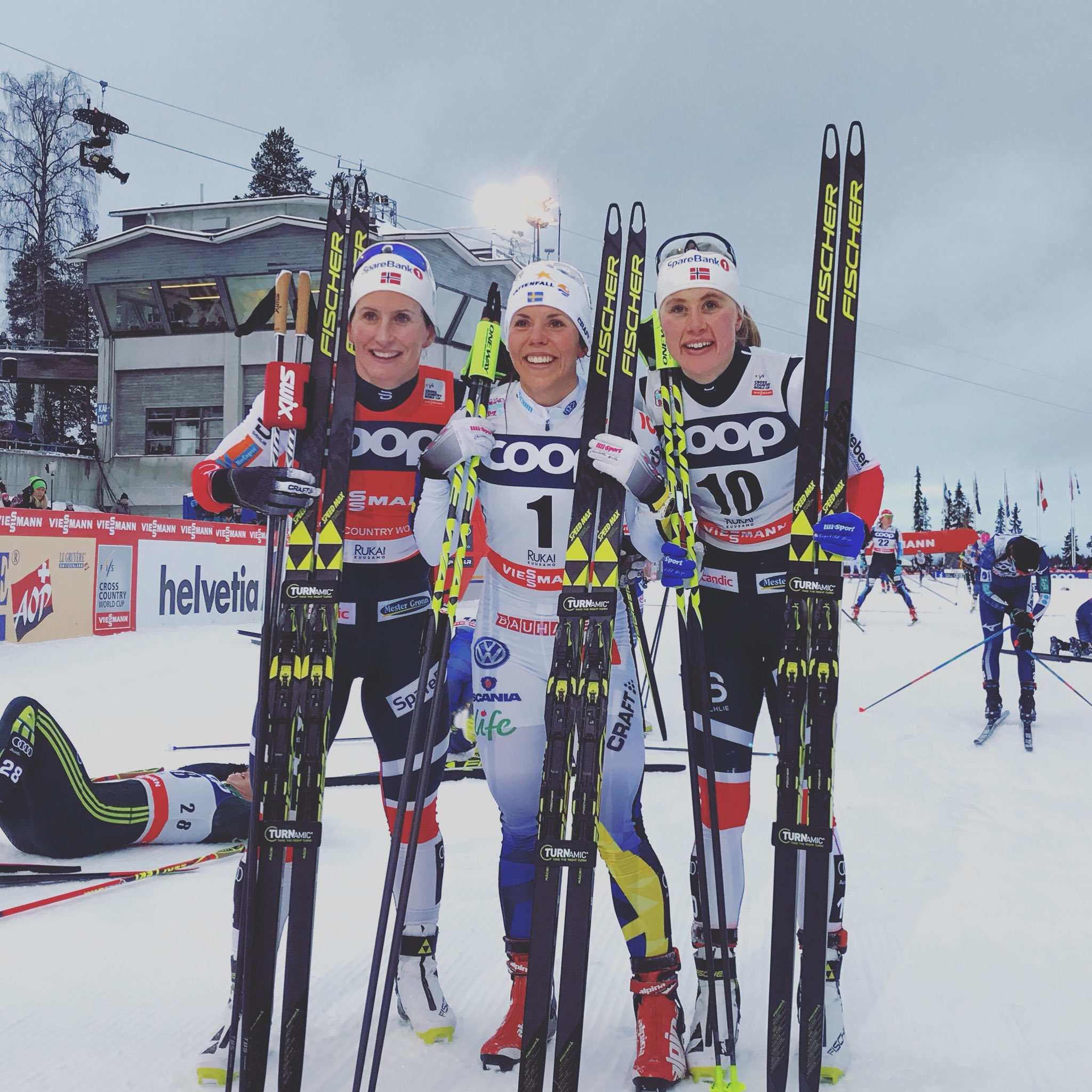
Sweden’s Charlotte Kalla (c) after winning the 2017 Ruka Triple and her first World Cup race since 2015. She won Sunday’s World Cup 10 k freestyle pursuit by 9 seconds over Norway’s Marit Bjørgen (l) and was nearly 34 seconds ahead of Norway’s Ragnhild Haga (r), who placed third. (Photo: FIS Cross Country/Twitter)
FIS Cross Country World Cup (Kuusamo, Finland): 10/15 k freestyle pursuit
Sweden’s Charlotte Kalla took down the fiercest contender women’s cross-country skiing has ever seen, challenging Norway’s Marit Bjørgen on the final lap of the women’s 10-kilometer freestyle pursuit on Sunday then successfully holding her off to the finish.
Kalla entered the final day of the three-day Ruka Triple mini tour with a 2-second lead on Bjørgen out of the pursuit start. Bjørgen quickly caught her and led for much of the four-lap race — until the last lap. The two skied alone, at least 30 seconds ahead of their nearest chasers, with three other Norwegians, Ragnhild Haga, Ingvild Flugstad Østberg and Heidi Weng leading Austria’s Teresa Stadlober and Sweden’s Stina Nilsson at 8.6 k.
Before that marker, Kalla had already launched her attack and was 6 seconds ahead of Bjørgen with 1.4 k to go. The Swede continued to push the pace and extended her buffer to Bjørgen, entering the stadium alone and winning by 9.7 seconds. For Kalla, a 2015 World Champion in the 10 k freestyle, it was her first World Cup win since 2015.
Bjørgen took second and Haga outlasted her teammates for third place (+33.9). Weng finished fourth (+38.0) and Østberg fifth (+40.2), then Stadlober in sixth (+41.0) and Nilsson in seventh (+46.7). Russia’s Natalia Nepryaeva led in the next chase group for eighth place (+1:01.6), followed by Sweden’s Ida Ingemarsdotter in ninth (+1:10.1) and American Sadie Bjornsen in 10th (+1:18.0). Another U.S. Ski Team (USST) member Jessie Diggins was close behind in 12th (+1:35.7), about five seconds behind Norway’s Kathrine Rolsted Harsem in 11th (+1:30.3).
The USST had four in the top 30, with Kikkan Randall rising from 48th at the start to 25th (+2:41.1) and Rosie Brennan improving from 34th to 28th (+2:43.2).
While Haga’s time was the fastest of the day in 25:41.8 (compared to Kalla’s finishing time of 25:50.1, which was third-fastest of the day behind Weng in second), Randall’s time was eighth fastest, Diggins was 10th fastest and Bjornsen 11th fastest of 79 in the last women’s race of the opening World Cup weekend.
Also for the U.S., Ida Sargent finished out the tour in 38th, Sophie Caldwell was 39th, Liz Stephen 56th, Chelsea Holmes 60th, and Julia Kern 73rd.
Canada’s Emily Nishikawa placed 69th overall and Cendrine Browne moved up two places to finish 72nd, while Dahria Beatty was lapped.
Klæbo Sweeps Opening Weekend
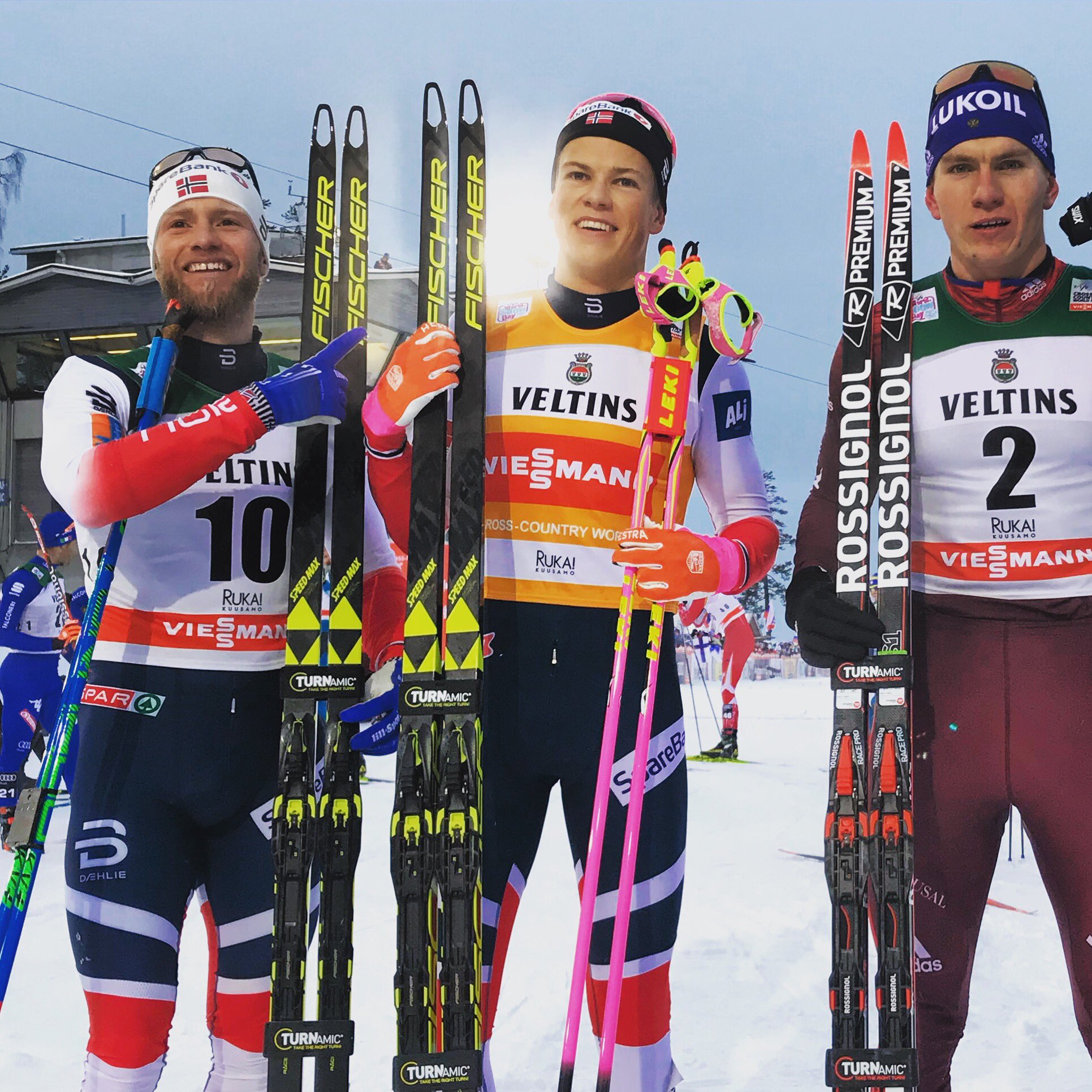
The men’s 15 k freestyle pursuit podium on the last day of the Ruka Triple in Kuusamo, Finland, with Norway’s Johannes Høsflot Klæbo (c) in first, Norway’s Martin Johnsrud Sundby in second, and Russia’s Alexander Bolshunov in third. (Photo: FIS Cross Country/Twitter)
In the men’s 15 k freestyle pursuit later in the day in Kuusamo, Johannes Høsflot Klæbo lost his 38-second buffer to the men’s field, but won the race after outlasting fellow Norwegian Martin Johnsrud Sundby, Russia’s Alexander Bolshunov and Canada’s Alex Harvey, respectively.
While Klæbo started the pursuit 38 seconds ahead of Bolshunov in second place, Sundb started 1:05 minutes back in 10th and Harvey was 1:23 behind in 12th.
Klæbo remained 32 seconds ahead of Bolshunov at 5 k, at which point Sundby led a chase group in third, followed closely by Sweden’s Calle Halfvarsson, Norway’s Didrik Tønseth, Kazakhstan’s Alexey Poltoranin, Russia’s Evgeniy Belov, Norway’s Emil Iversen, Finland’s Iivo Niskanen, and Norway’s Pal Golberg, respectively.
Harvey skied in the next group back with Sweden’s Marcus Hellner, Norway’s Hans Christer Holund, France’s Maurice Manificat, and Russia’s Alexey Chervotkin, all of which were in the top 15 at 5 k.
Over the next 2.5 k, Bolshunov cut his distance to Klæbo to 20 seconds, and at 7.5 k, Sundby was skiing alone another five seconds back in third.
Sundby caught Bolshunov and the two reeled in Klæbo over the next kilometer, catching him around 8.6 k, while 11 seconds back, Harvey led a chase group with Chervotkin, Niskanen, Holund, Poltoranin, and Manificat at 8.6 k.
Harvey lapped through the stadium at 10 k right behind Bolshunov in first, while Tønseth followed in third and Klaebo in fourth. Sundby remained in seventh, less than 2 seconds back.
At 12.5 k, 12 skiers remained in 2.6 seconds of the lead, but 1 k later, that number had dwindled to four within 3 seconds of first: Sundby, Harvey, Tønseth, and Klæbo. Bolshunov kept himself in contention just 3.8 seconds behind, and on the final climb, it became evident the race was between Klæbo, Sundby, Bolshunov, and Harvey. They finished in that order, with Harvey dropping off the pace in the finishing stretch.
Klæbo took the win in 36:23.2, just 0.4 seconds ahead of Sundby in second, while Bolshunov took third, 1 second behind Klæbo. Harvey was another 0.6 seconds back in fourth, and the Canadian’s time stood up as the fifth fastest of the day, behind Manificat in first (34:50.9). Manificat tied Holund for placed eighth overall (+8.2), behind Chervotkin in fifth (+6.2), Niskanen in sixth (+7.2), and Tønseth in seventh (+8.1).
Erik Bjornsen led the U.S. men overall in the tour in 26th (+1:43.6) for his third-straight race in the World Cup points. Also for the U.S. Ski Team, Paddy Caldwell raced to 19th for time of day (after starting 70th and finishing 51st in the pursuit).
Canada’s Devon Kershaw also landed in the points for the second-consecutive day in 29th (+1:47.8).
American Noah Hoffman finished the Ruka Triple in 39th (up from 45th at the start), Scott Patterson was 55th and Andy Newell 75th for the U.S.
Canada’s Len Valjas placed 44th overall, Graeme Killick 68th, Knute Johnsgaard 81st, and Julien Locke 83rd.
While France came in the favorites in the single mixed relay, starting a team of Martin Fourcade and Marie Dorin Habert, it was Austria who put on a master class and skied to a comfortable win today.
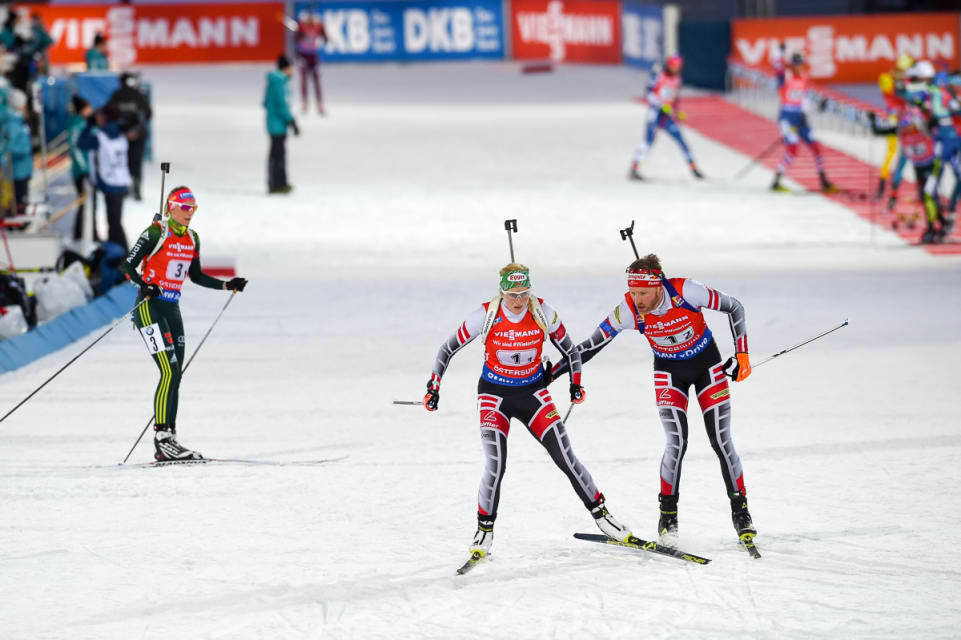
Simon Eder tags off to Lisa Theresa Hauser for Austria during the single mixed relay World Cup in Ostersund, Sweden. The pair raced to a 16.5-second win. (Photo: IBU/biathlonworld)
The Austrian duo of Lisa Theresa Hauser and Simon Eder used only two spare rounds over the course of 40 shots, the best shooting in the field by a wide margin. They led nearly the whole race and ended up with a 16.5-second victory over Germany’s Vanessa Hinz and Erik Lesser. The Germans used nine spare rounds to clean all their targets, but Lesser was aggressive on the skis and made up ground on the trails to finish 16.2 seconds clear of the rest of the field.
There, drama ensued on the last loop. Kazakhstan’s Maxim Braun came through a crash caused by Italy’s Thomas Bormolini, who was skiing in third place on the penultimate downhill and also took out Ukraine’s Dmytro Pidruchnyi. That allowed Braun, along with teammate Galina Vishnevskaya, to just barely hold on to third place. Their shooting – with five spare rounds between them, the second-best in the field – allowed this, their best relay showing ever.
Fourcade, who had left the range in seventh, came through the fray to put France into fourth, followed by Sweden (Linn Persson and Sebastian Samuelsson), then Ukraine (Pidruchnyi and Vita Semerenko) and Italy (Bormolini and Alexia Runggaldier).
Both the U.S. team of Emily Dreissigacker and Leif Nordgren and the Canadian team of Rosanna Crawford and Christian Gow were lapped. Crawford was in second position more than halfway through the race when she fell on a downhill, losing a large amount of time and affecting the functioning of her rifle once she reached the shooting range.
Later in the day, countries sent four-athlete teams out for regular mixed relays. Despite an imperfect start on the shooting range, the Norwegian team of Ingrid Tandrevold, Tiril Eckhoff, Johannes Thingnes Bø, and Emil Hegle Svendsen came away with a 5.3-second win over Italy’s Lisa Vitozzi, Dorothea Wierer, Dominik Windisch, and Lukas Hofer.
The German team of Franziska Preuss, Maren Hammerschmidt, Benedikt Doll, and Arnd Peiffer was third, +6.4, and Slovakia close behind in fourth.
Canada’s Emma Lunder, Julia Ransom, Scott Gow, and Brendan Green finished 15th, +3:28.0, and the U.S. team of Susan Dunklee, Clare Egan, Paul Schommer, and Sean Doherty 21st, +4:47.6.
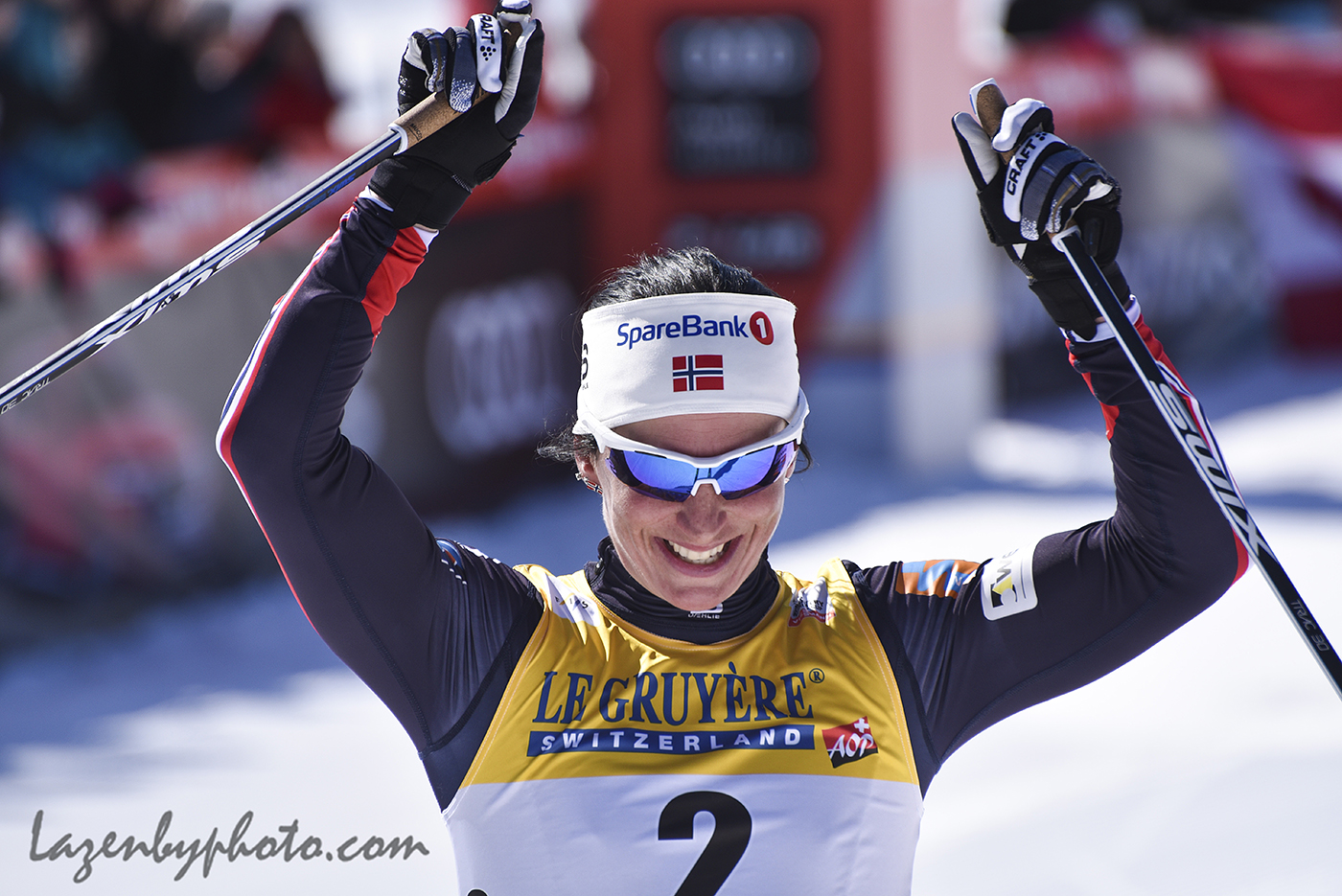
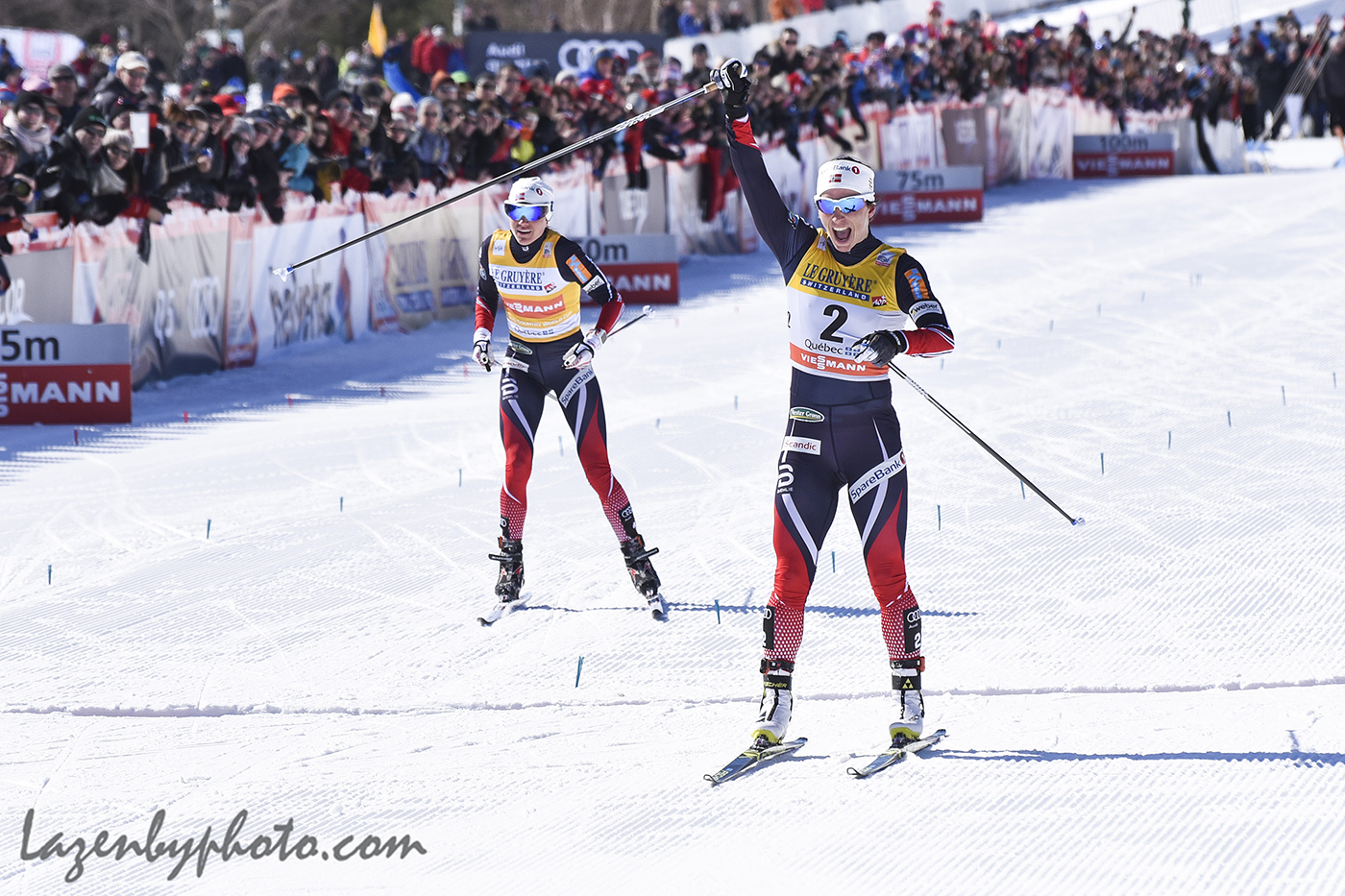
Norway’s Marit Bjørgen celebrates her ninth-straight win in World Cup distance races (anything longer than a sprint) in the last race of the 2016/2017 season, the women’s 10 k freestyle pursuit on Sunday in Quebec City. (Photo: John Lazenby/Lazenbyphoto.com)
QUEBEC CITY — Generally speaking, most European-based World Cup skiers wouldn’t have picked Canada as their ideal place to end the season. It’s too far across the pond, too far from the beaches, too far from home.
Québec City organizers, headed by Gestev, had just under two months to prepare. Having hosted two stages of the Ski Tour Canada last season and a World Cup sprint weekend in 2012, they had the experience, but World Cup Finals — complete with three uninterrupted days of racing and season-ending awards — was another animal of its own entity.
Fortunately, the weather cooperated. Three days before World Cup Finals, Québec City and the eastern part of North America got its biggest snowstorm of the season and perhaps the last several winters. With three straight days of racing taking place on the open-aired Plains of Abraham, most familiar with the expansive downtown park expected bone-chilling wind. Yet with above freezing temperatures at race time, that wasn’t much of a factor, especially not on Saturday and Sunday.
Each day, spectators and athletes required fewer layers, and by Sunday, some of the athletes were down to bibs only. The sun was intense, there wasn’t a cloud in the sky, and the athletes were happy.
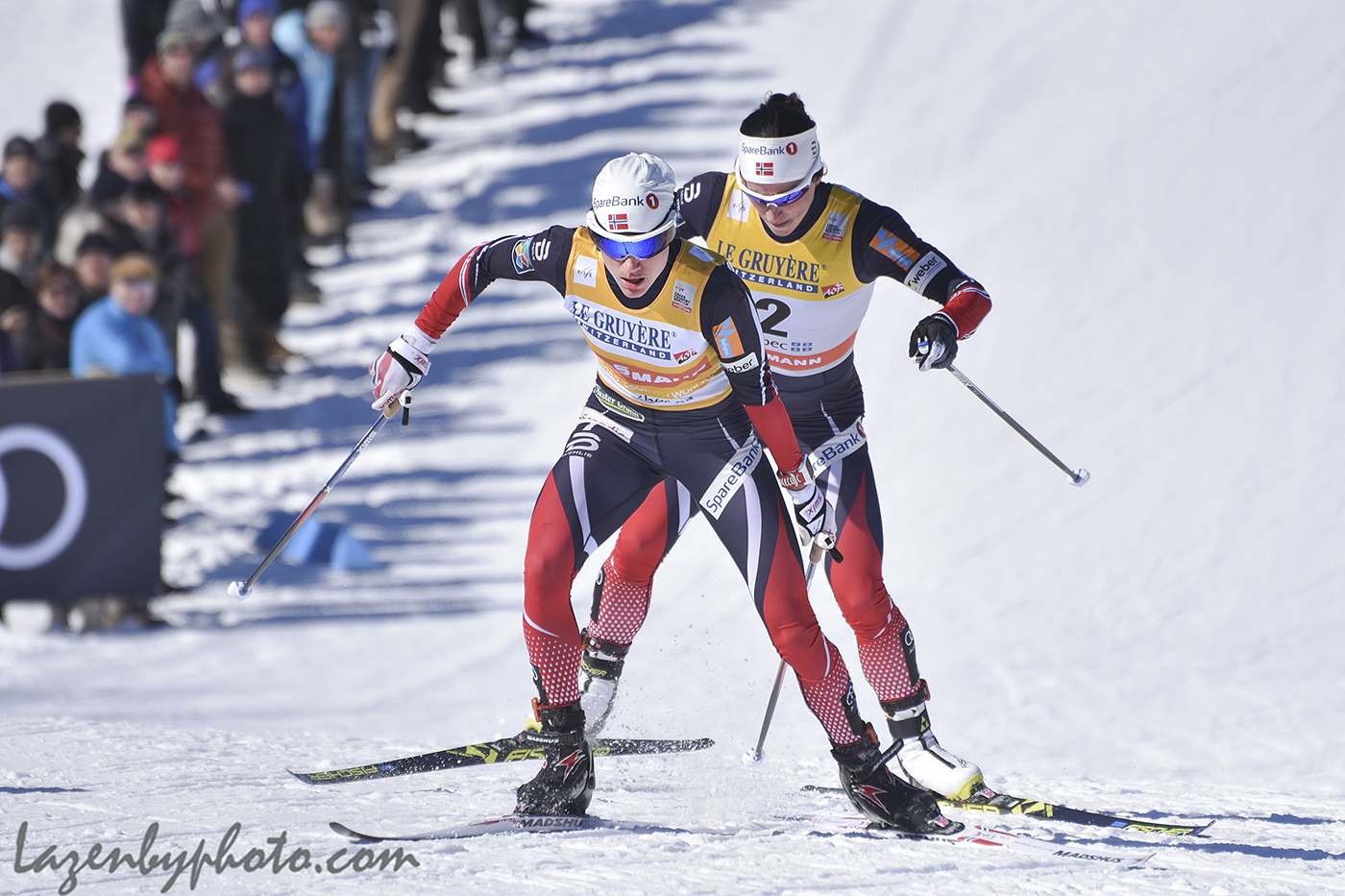
Norway’s Heidi Weng leads her teammate Marit Bjørgen during the women’s 10 k freestyle pursuit on the last day of World Cup Finals in Quebec City. Bjørgen went on to win while Weng was 1.2 seconds back in second. (Photo: John Lazenby/Lazenbyphoto.com)
“When I saw that we would race here, I thought, ‘Oh no. We’ll have to go so far from home,’ ” Norway’s Heidi Weng told FasterSkier on Sunday. “But when I come here, it’s more like winter, and I like the track here, and I’ve gone very fast here before. So I knew I could go do a very good race here, so now I hope we come here often. It’s very good, and many people, and the atmosphere, and good snow. It was very great to be here.”
Weng spoke to a horde of reporters with a large, silver briefcase by her side. In it was one of the Crystal Globes she had just received for winning the Overall and Distance World Cups (she won one globe for each season-long category). Between Friday, Saturday and Sunday, Weng finished sixth in the freestyle sprint, second in the 10-kilometer classic mass start, and second in the 10 k freestyle pursuit. Her Norwegian teammate and longtime idol, Marit Bjørgen beat her in both the distance races.
In all, Weng racked up about 20 individual World Cup podiums (including her Tour de Ski win, Lillehammer mini tour win, and World Championships silver in the 30 k freestyle mass start). She was the most consistent skier throughout the season, thus earning the Overall World Cup crown by 40 points over Finland’s Krista Pärmäkoski, and distance title by 97 points over Bjørgen.
“I’ve had many podiums this year,” Weng said. “In sprint I have taken huge steps, so I am very happy with the season. I have won a sprint race, and that’s the most important to me…
“Maybe I must have a little more confidence that I am good and a good skier, because I always think I am not so good as the others, but now I have a better head,” she added. “Maybe you can say in your head that you are very good and very strong, so next year I do a joke with my head.”
While Weng keeps telling herself that she can win, Bjørgen is fully aware that she’s back to her top form having won every distance race since the new year. That’s nine straight individual wins, including two from this past weekend.
After starting one second behind Weng in Sunday’s 10 k skate pursuit, she outlasted the overall and distance World Cup champion by 1.2 seconds at the finish after leading Weng for most of the three-lap race.
“It has been an incredible season for me after Christmas,” Bjørgen, who had a child in December 2015 and took last season off, told reporters on Sunday. “I won every long distance and four golds in the World Championships so this has been incredible and to win today also.”
On Sunday, Bjørgen caught Weng quickly and with the third starter, Norway’s Ingvild Flugstad Østberg, heading out 29 seconds back, the two skied off together and away from any threat to their top-two quest.
On the first lap, Østberg tried to close the gap, coming within 23 seconds of them at 1.3 k, but by the time she lapped through the stadium at 3.3 k, she was 33 seconds behind and just seven seconds ahead of a chase pack with her Norwegian teammate Maiken Caspersen Falla, Pärmäkoski, and Sweden’s Ida Ingemarsdotter and Stina Nilsson. Another 20 seconds behind them, American Sadie Bjornsen and Sweden’s Anna Haag were leading a pack of eight.
One lap later, Bjørgen and Weng cruised into and out of the stadium 46 seconds before Østberg, who was still 10 seconds ahead of the four-woman chase pack by the time she came through. The group, which was down to Nilsson, Ingemarsdotter and Parmakoski, eventually caught Østberg less than a kilometer before the finish, and Østberg finished at the back of that group in sixth, 1:06.8 behind Bjørgen. In a race for third, Nilsson took it by 1.9 seconds over Ingemarsdotter in fourth and 5.6 seconds ahead of Pärmäkoski in fifth.
“It was a mental struggle the whole way because they were 15 and 10 seconds behind me all the way, and that’s a difficult gap,” Østberg told FasterSkier. “They were three and four working together, and I was all by myself in front. I really tried to push as hard as I could, and stay in front of them, and I had 10 seconds, and it was less than 1 kilometer left, and I really believed that I could take it, but when they passed me, they had such high speed, I couldn’t keep up with them. So that was not so fun to see them pass me there, but I managed to take the third place overall [in the World Cup], so I have to be satisfied with that, I guess.”
“I think we worked well together,” Nilsson told FasterSkier. “Krista did the hardest work, I think, but I tried to help her as much as I could, and I was very excited that we could catch up to Ingvild. … I knew that when we started to be in the sprint course, I started to feel at home, then I just wanted to go as fast as I could.”
Norway’s Marit Bjørgen after outlasting her teammate Heidi Weng for the win in the women’s 10 k freestyle pursuit on Sunday at World Cup Finals in Quebec City. (Photo: John Lazenby/Lazenbyphoto.com)
Exactly a minute before Nilsson — a sprint specialist — finished third, Bjørgen had crossed the line first in 22:36.1 minutes after getting slightly ahead of Weng coming out of the downhill with 100 meters remaining. Leading up to that point, Weng had come from behind to attack on the second-to-last climb, a markedly steep one, but Bjørgen responded quickly.
“I thought that Marit was a little bit more tired than me, but when I attacked on the sprint uphill I hoped that I could get some meters to Marit, but she was there, and in the downhill she came from behind and take a better speed,” Weng said. “That sucks, but I was number two, and it’s not many who can be on the podium, so I am very happy.”
“I knew that it would be a sprint in the end with Heidi and to have her behind me is a very good feeling,” Bjørgen said. “I’m 10 years older and to be there is a good feeling to take with me into the Olympic [year next season].”
Bjørgen is 36. Weng will turn 26 in July. Nilsson is 23.
On Sunday, Bjørgen not only won the pursuit and with it, the World Cup Finals mini tour, but she was also the fastest for time of day in 25:35.1. Weng was second fastest, 2.2 seconds back, and Nilsson third (+11.9) after starting seventh and moving her way up to third.
On her 34th birthday, Germany’s Nicole Fessel was fourth fastest (+15.3), and Bjornsen of the U.S. tied Sweden’s Charlotte Kalla for fifth on the day, 17.8 seconds off Bjørgen’s time.
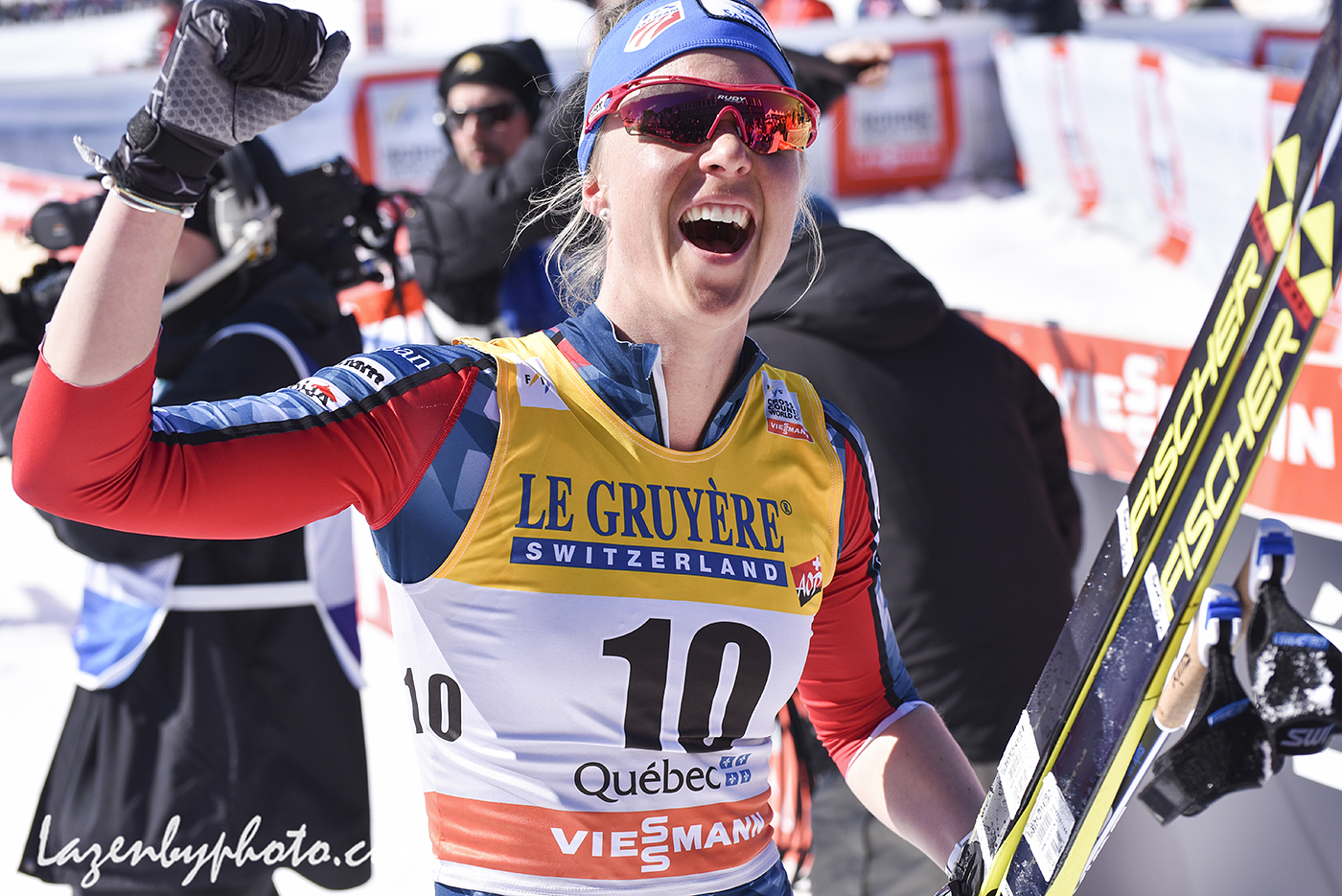
Sadie Bjornsen (U.S. Ski Team) soaking up her top-10 finish at 2017 World Cup Finals in Quebec City after placing 10th in the 10 k freestyle pursuit and fifth for time of day. (Photo: John Lazenby/Lazenbyphoto.com)
Overall Bjornsen placed 10th (+1:27.2) after starting 1:10 minutes back in 10th with Kalla in ninth and skiing with her and Fessel (the 13th starter) to the finish.
“Charlotte was going so hard from the start,” Bjornsen said after. “I actually did my warm up behind her, trying to get used to her speed because that was my main goal, to stay with her today. I knew it was going to be rippin’, and at one point some of the girls went in front of me, and I let her get away, and I was like, ‘No! I have to stay with her!’ So I had to do a full sprint in the middle to catch back on, which took a lot to recover from.”
At the finish, just 0.4 seconds separated Kalla, Fessel and Bjornsen, who placed eighth (+1:26.8), ninth (+1:26.9) and 10th, respectively. Ahead of them, Norway’s Falla placed seventh (+1:19.8).
“I really wanted to outsprint those girls in the finish for some redemption from the sprint race the other day,” Bjornsen said, referring to her 13th place in the World Cup Finals opening skate sprint. “I’m super happy with a top 10 in the tour. That’s some of the best general skiing I’ve done this year, and it’s good to end on a high note.”
The U.S. had two in the top 20 both overall and for time of day, with Jessie Diggins in 16th (+2:14.8) after skiing the 14th fastest time of day (+35.0). After placing ninth in the sprint and 27th in the classic mass start, she started Sunday in 20th and moved up four places by the finish.
“This weekend, in particular, was not what I wanted,” Diggins told reporters after. “To be honest, I was in tears before the race, because I was up all night coughing. I don’t know if I was getting sick or what, but I was getting nauseous, and I started to puke a little bit, and I was like, ‘I just want to race, and race in front of my family. I just want to go out there and be able to have a good day.’ ”
Diggins immediately got to work out of the gate and was up to 19th at the end of the first lap with Germany’s Stefanie Böhler. She skied with Böhler to the finish, before edging the German by two seconds for 16th.
“I decided I was going to go for it, and it was really working for me when Stefi came by,” Diggins said. “I was just hanging on in the uphills, and then on the downhills, if I was right in her draft, I could push or pull and help each other that way, and that was really cool. I really like skiing with Stefi, she’s awesome, and we were both working together to get the fastest time we could.”
Jessie Diggins (U.S. Ski Team) racing to 16th in the women’s 10 k freestyle pursuit (up from 20th at the start) with the 14th fastest course time on Sunday at World Cup Finals in Quebec City. (Photo: John Lazenby/Lazenbyphoto.com)
At the end of the season, Diggins ranked sixth in the overall World Cup and seventh in the distance standings.
“My biggest goal for today was to only say positive things to myself all day, no matter what anything felt like, no matter what the skis were doing, no matter what my body was doing, no matter how sick I felt, and the only thing was to push really hard and cross the finish line and be proud of pushing,” Diggins said. “You can’t control a lot of things in ski racing, but you can control, how much effort you put into it, and I can honestly say I’ve put 100 percent in this season, and I’m really proud of that.”
While 12 American woman completed the tour, 15 Canadians women did the same, with Emily Nishikawa (Canadian World Cup Team) leading them in 38th (+4:52.7) after starting 39th. Cendrine Browne, of Canada’s national U25 Team and Pierre Harvey Training Centre, finished just two seconds later in 40th (+4:54.7) after starting 41st.
“I was the last person to start before the wave,” Nishikawa explained. “And the wave, they’re working together as a mass start and moving pretty fast, so I got caught by them at the end of the first lap. I tucked in behind Rosie [Brennan of the U.S.] for the second lap and I actually had a big tangle with [Switzerland’s] Laurien van der Graaff on the fast downhill so I lost contact, lost all my speed. … and I did my best to come back.”
Browne started in the wave and described skiing in that group throughout the race.
“Unfortunately, I finished at the back of the group as I was losing energy,” she told FasterSkier. “I still managed to gain 30 seconds on the leader, which I’m happy about. I finished 41st again, behind my goal of moving towards the top 30, but it’s not dramatic. I think it’s a nice way to cap off the season.
“It was really an amazing weekend, the atmosphere, the crowd, the conditions, everything was on point,” Browne added in French. “I couldn’t have hoped for a better way to end the season.”
“We were so lucky to get [the World Cup Finals] here instead of Russia,” Nishikawa said. “We got to start 30 athletes, lots of people starting their very first World Cups, which is so exciting to see. It’s great for development for our country… We’ve got a really exciting group of women coming coming up in Canada now and to see this group of 15 women get starts this weekend is just great.”
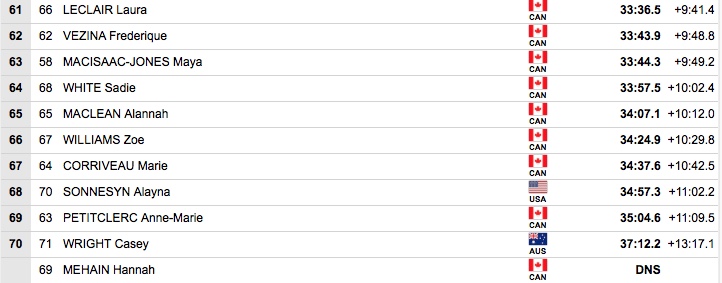
Also for Canada, Dahria Beatty finished 50th, Annika Richardson 55th, Frédérique Vézina 57th, Katherine Stewart-Jones 58th, Andrea Dupont 59th, Annika Hicks 62nd, Sophie Carrier-Laforte 63rd, Sadie White 64th, Lisle Compton 65th, Katherine Weaver 66th, Laura Leclair 67th, and Mia Serratore 68th. Alannah MacLean did not finish.
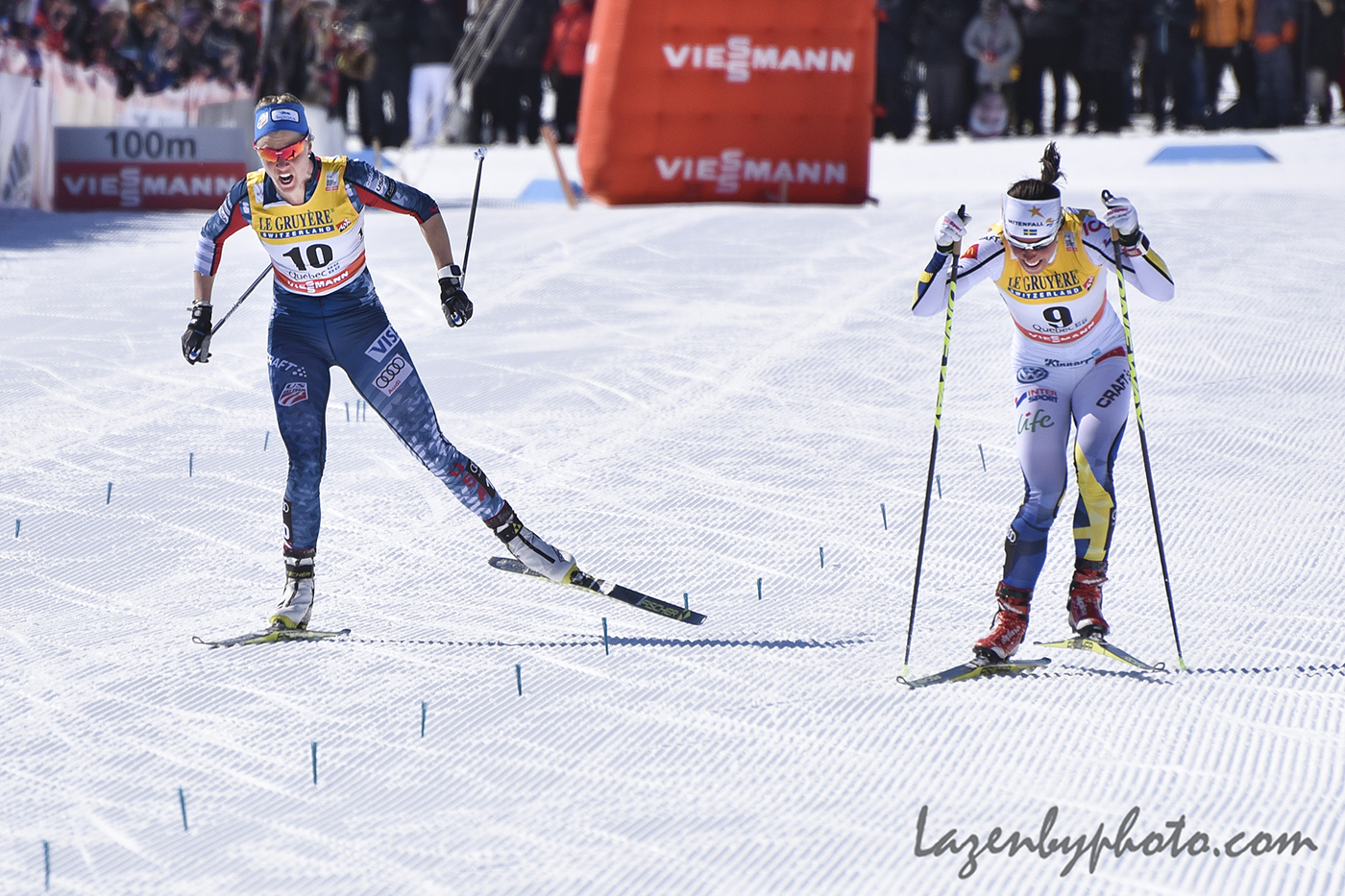
American Sadie Bjornsen (10) racing to the line with Sweden’s Charlotte Kalla (9) and Germany’s Nicole Fessel (not shown) during the women’s 10 k freestyle pursuit on Sunday at World Cup Finals. Kalla placed eighth, Fessel ninth and Bjornsen 10th. (Photo: John Lazenby/Lazenbyphoto.com)
For the U.S., Sophie Caldwell placed 36th (+4:26.1), Rosie Brennan 42nd, Caitlin Patterson 43rd, Chelsea Holmes 45th, Julia Kern 46th, Kaitlynn Miller 52nd, Liz Guiney 53rd, Becca Rorabaugh 54th, Erika Flowers 56th, and Jennie Bender 60th.
“Sadie’s skating has reached a new level this season,” U.S. Ski Team Head Coach Chris Grover said, according to a team press release. “Jessie also had a measure of redemption leading a train of women and moving up four places in the standings today. Rookie Julia Kern continued to impress, staying in front of the chasing group for the entire race and winning the sprint at the end.
“We are very proud of the American effort this weekend — athletes, club coaches and U.S. Ski Team staff,” he continued. “We had some great races but, of course, were left wanting a bit more.”
The U.S. Ski Team will finish out its season in Fairbanks, Alaska, with the SuperTour Finals next week, March 27-April 2. Most Canadians are traveling to Canmore for Canadian Ski Nationals, which started Sunday and extend through this Saturday.
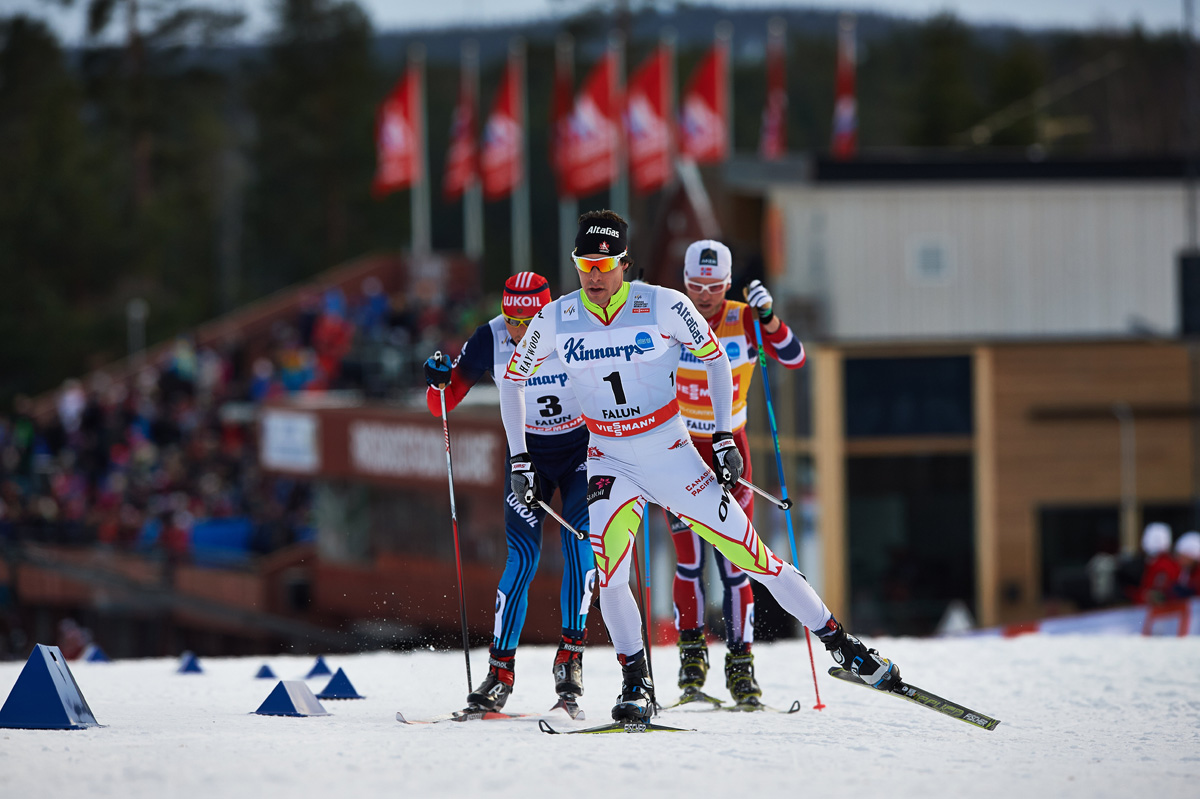
Canada’s Alex Harvey leading Norway’s Niklas Dyrhaug (2) and Johannes Høsflot Klæbo (r) up a short, steep climb during the men’s 15 k freestyle pursuit on Sunday, the last day of the 2016/2017 World Cup season, at World Cup Finals in Quebec City. Harvey went on to place second, Klæbo won the photo finish, and Dyrhaug placed third. (Photo: Gretchen Powers)
FIS Cross-Country World Cup Finals (Quebec City): 10/15 k freestyle pursuits
Even after Sunday’s 15-kilometer freestyle pursuit, Alex Harvey had a busy day ahead of him with three different podiums to stand on: one for placing second on the day, another for placing second in the Distance World Cup, and yet one more for finishing the season in third in the Overall World Cup.
It was a suitable ending for Harvey’s storybook three-day venture in Quebec City, after he won Friday’s skate sprint and placed fourth in Saturday’s 15 k classic mass start.
Starting third the pursuit third, 23 seconds behind Norway’s Johannes Høsflot Klæbo in first and 1 second behind another Norwegian Niklas Dyrhaug in second, Harvey set a blistering pace from the gun and caught Dyrhaug around 5 k in.
From there, the three jockeyed for the ideal position and ultimately, the win with over the next 10 k. The chase pack was closing on them slightly, but not enough to be a threat. A loose dog on course at the end of their third lap caused a little alarm as it ran alongside the three leaders, but didn’t affect any of the racers to be a problem.
On the fourth and final lap, just before one of the last long descents into and out of the stadium, all three nearly came to a stop — none of them eager to lead, fearing their attack out of the ensuing draft.
Klæbo finally decided to go first, and he put in a sprint in an attempt to catch the others off guard. The three remained together all the way to the finish, lining up side by side as they squared off for the final 100-meter showdown. In a photo finish for first, Klæbo took it by less than a one-hundredth of a second over Harvey in 32:44.5 minutes, and Dyrhaug settled for third, one-tenth of a second back.
The third Norwegian in the top four, Sindre Bjørnestad Skar outlasted the six-man chase pack that followed the top three across the line. Skar finished fourth, 26.1 seconds out of first, just 0.4 seconds ahead of Switzerland’s Dario Cologna in fifth. Also in that group, Sweden’s Marcus Hellner posted the fastest time of the day (31:55.5) to finish sixth overall (+26.8) Norway’s Sjur Røthe followed in seventh (+27.2), Russia’s Andrey Larkov placed eighth (+27.6), and Great Britain’s Andrew Musgrave ninth (+30.6).
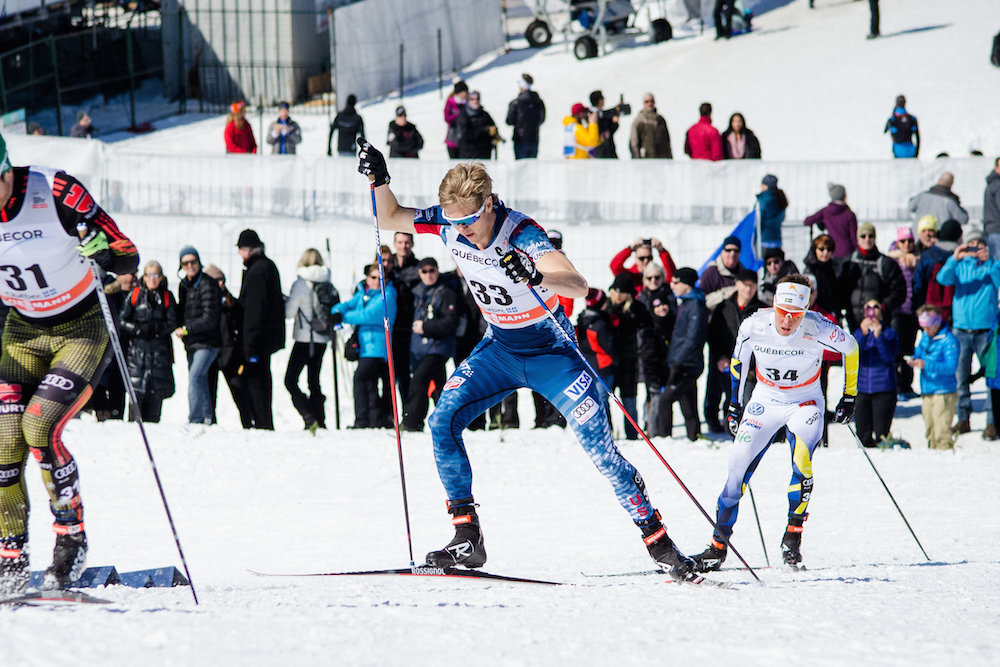
American Erik Bjornsen (33) racing to the 11th fastest time of day in the men’s 15 k freestyle pursuit at World Cup Finals on Sunday in Quebec City, for his career-best World Cup result. He finished 25th overall. (Photo: Gretchen Powers)
For time of day, American Erik Bjornsen broke through in 11th for his best World Cup result. He placed 25th overall (+2:19.1), just ahead of Canada’s Devon Kershaw in 26th (+2:21.4). Kershaw was 19th for time of day.
Four Americans landed in the points (top 30) for time of day, with Paddy Caldwell in 25th, David Norris 27th, and Scott Patterson 30th.
Overall in the pursuit, Patterson finished 41st (+3:45.6), Norris 43rd (+4:15.9) and Caldwell 46th (+4:25.6).
Also for the U.S., Andy Newell placed 44th, Simi Hamilton 45th, Noah Hoffman 52nd, Jack Hegman 57th, Brian Gregg 58th, and Cole Morgan 65th.
Among the Canadians, Graeme Killick finished 42nd, Knute Johnsgaard 53rd, Len Valjas 54th, Evan Palmer-Charrette 60th, Bob Thompson 61st, Brian McKeever 62nd, Joey Foster 64th, Andy Shields 66th, Russell Kennedy 67th, Jess Cockney 68th, Gareth Williams 71st, Ricardo Izquierdo-Bernier 72nd, and Julian Locke 73rd.
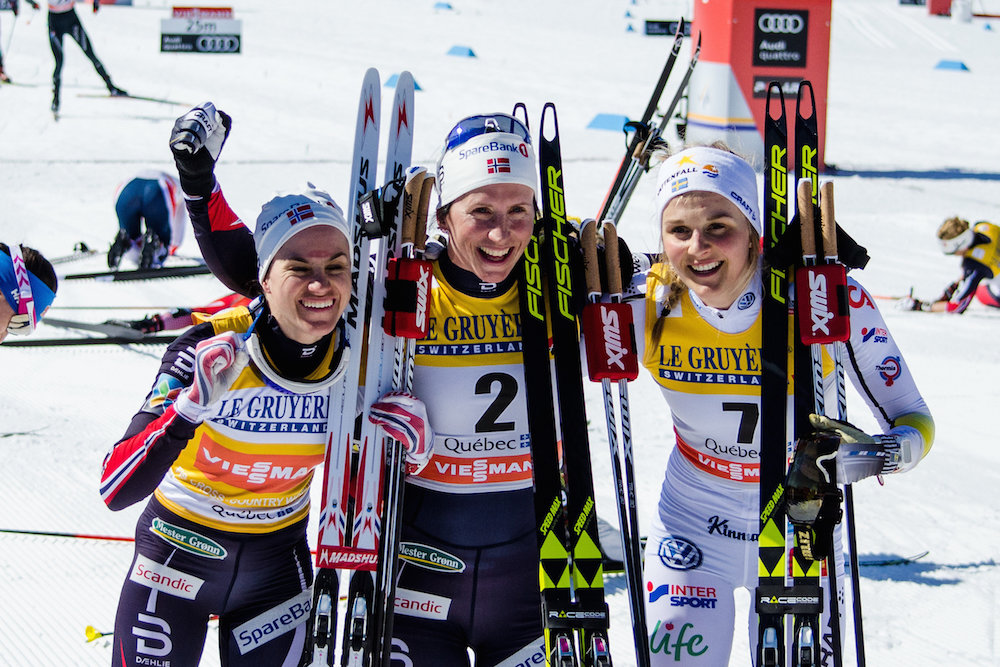
The women’s 10 k freestyle pursuit podium on Sunday at World Cup Finals, with Norway’s Marit Bjørgen (c) in first, Heidi Weng (l) in second, and Sweden’s Stina Nilsson (r) in third. (Photo: Gretchen Powers)
In the women’s 10 k freestyle pursuit earlier in the day, Marit Bjørgen caught her Norwegian teammate Heidi Weng almost immediately after starting 1 second back in second, and the two skied together well ahead of anyone else for the rest of their three-lap race.
After leading for most of it, Bjørgen ultimately took the win, entering the finishing stretch slightly ahead of Weng and holding her off by 1.2 seconds across the line with a time of 22:36.1. For Bjørgen, it was her second win in two days, after winning Saturday’s 10 k classic mass start, and she ended her first full season back since having a child ranked second in the Distance World Cup. Weng won both the Distance and Overall World Cup titles.
Bjørgen also won for the time of day (22:35.1). Weng’s time ranked second and Sweden’s Stina Nilsson was third for both time of day and overall after moving up from seventh and outlasting the chase pack.
Nilsson finished exactly a minute after Bjørgen and 1.9 seconds ahead of her Swedish teammate Ida Ingemarsdotter in fourth (+1:01.9). Finland’s Krista Parmakoski finished fifth (+1:05.6) and ended the season second in the Overall World Cup and third in the Distance World Cup.
Norway’s Ingvild Flugstad Østberg started third but ended the day in sixth (+1:19.8) after skiing alone for a good portion of it, well behind Bjørgen and Weng and just ahead of the hungry chase pack. Østberg finished her season in third in the Overall World Cup.
Sadie Bjornsen (U.S. Ski Team) racing to the fifth-fastest time and 10th overall in the women’s 10 k freestyle pursuit on Sunday at World Cup Finals in Quebec City. Dyrhaug placed third. (Photo: Gretchen Powers)
Sadie Bjornsen led the U.S. women with the fifth-fastest time of day in 10th overall (+1:27.2). Jessie Diggins moved up from 20th to place 16th (+2:14.8) with the 14th fastest time of day. Diggins ended up sixth in the Overall World Cup and seventh in the Distance World Cup.
Emily Nishikawa was the top Canadian woman in the pursuit in 38th (+4:52.7) and Cendrine Browne followed in 40th (+4:54.7).
For the U.S., Sophie Caldwell placed 36th (+4:26.1), Rosie Brennan 42nd, Caitlin Patterson 43rd, Chelsea Holmes 45th, Julia Kern 46th, Kaitlynn Miller 52nd, Liz Guiney 53rd, Becca Rorabaugh 54th, Erika Flowers 56th, and Jennie Bender 60th.
Also for Canada, Dahria Beatty finished 50th, Annika Richardson 55th, Frederique Vezina 57th, Katherine Stewart-Jones 58th, Andrea Dupont 59th, Annika Hicks 62nd, Sophie Carrier-Laforte 63rd, Sadie White 64th, Lisle Compton 65th, Katherine Weaver 66th, Laura Leclair 67th, and Mia Serratore 68th.
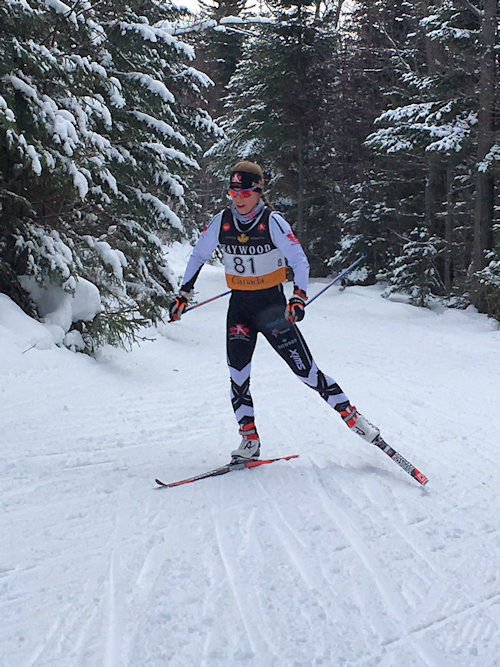
Cendrine Browne, of the Pierre-Harvey National Training Centre and Canada’s national U23 development team, leading the women’s 10 k freestyle pursuit on Jan. 31 at the Mont Sainte-Anne trails in Quebec. She went on to win by nearly 1 1/2 minutes to take the NorAm leader’s bib. (Photo: CCC)
(Note: This article has been updated to include comments from Andy Shields on his pursuit win.)
The NorAm series continued last weekend with a two-day pursuit in Mont Sainte-Anne, Quebec. While this format hasn’t been used at this level in Canada for three years, the Ski Tour Canada in early March will have two pursuit days.
Cendrine Browne, of the national U23 development team and Pierre-Harvey National Training Centre (CNEPH), won Saturday’s 5-kilometre classic individual start in 14:37.3 to lead a U23 and CNEPH podium sweep. Sophie Carrier-Laforte finished 7.2 seconds back in second, followed by Frédérique Vézina at 30 seconds behind the winner in third.
Browne was the only European B-Tour skier to race this weekend after arriving back from Nove Mesto, Czech Republic (where she represented Canada on the World Cup), five days earlier on Monday, Jan. 25.
“I chose to race because I would have done intensity anyways on Saturday,” Browne wrote in an email. The convenience of racing on her home trails at Mont Sainte-Anne (M.S.A.) added to the appeal.
“I wasn’t sure if I would do Sunday’s race, but I’m in good shape so I’ll do it,” Browne wrote on Saturday. “The Noram points are also interesting if I win.”
Browne did win Sunday’s 10 k freestyle pursuit. With Carrier-Laforte not starting, she started 30 seconds ahead of Vézina and expanded her lead to 1:29.1 with the fastest time of the day in 27:51.3. Browne was ranked fifth going into the weekend and, with the top three in the overall NorAm standings absent, her convincing victory on Sunday will give her the leader’s bib for next weekend.
Vézina started second, with three other racers within 10 seconds of her. While she was happy with Saturday’s classic podium, noting “5km has never been my strong suit,” she was frustrated with her pursuit, in which she placed fifth, 2:29.1 behind Browne. “My skis were so slow that the girls passed me in the first downhill like I was stopped,” Vézina wrote in an email.
Olivia Bouffard-Nesbitt, of Canada’sU23+ Development Team, started sixth and pulled away from Annika Hicks (Canmore), who started fourth, to take second. Crossing the line nearly a minute and a half (1:29.1) after Browne, Bouffard-Nesbitt held off Hicks by 5.9 seconds for the second spot on the podium. Hicks placed third (+1:35).
“I initially wanted to work with someone to try and make time on the leader,” Bouffard-Nesbitt wrote in an email. “After gauging the willingness of the skiers around me to chase Cendrine, I decided that instead I would try to race tactically for second place. I shared the lead with Annika for most of the race as we distanced ourselves from 4th and 5th.”
Also on her hometown trails, Marie Corriveau (CNEPH) improved one place to finish fourth (+2:25.1), 4 seconds ahead of Vézina to repeat as top junior woman on Day 2 at M.S.A.
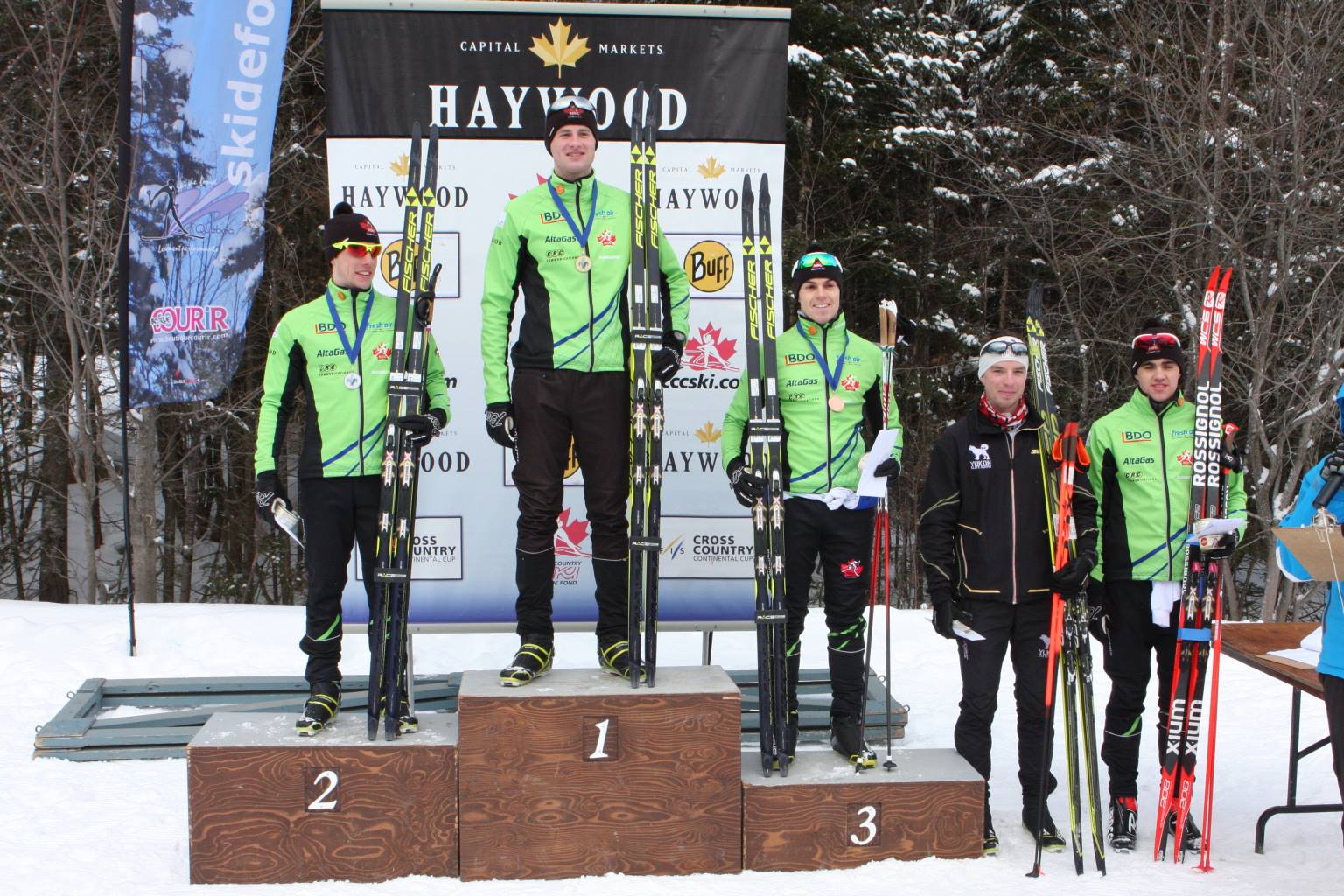
Thunder Bay National Development Centre swept the podium (top three) in the men’s 10 k classic on Jan. 30 with Bob Thompson in first, Andy Shields in second and Michael Somppi in third. Colin Abbott of the Yukon Elite Squad placed fourth (second from r) and a fourth NDC skier, Evan Palmer-Charrette (r) was fifth. (Photo: Skibec Nordique/Facebook)
NDC Thunder Bay All the Way
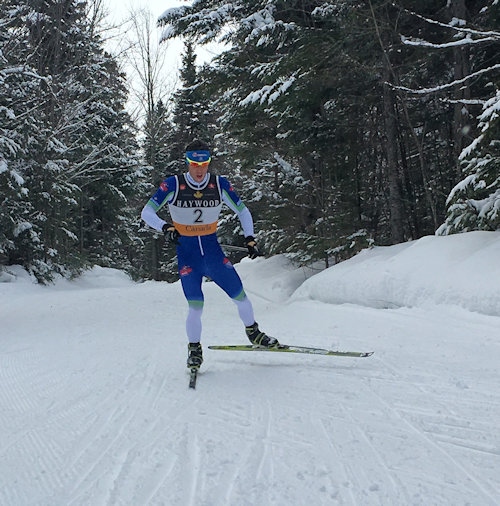
On the men’s side, Bob Thompson of the Thunder Bay National Development Centre (NDC) took his first NorAm distance win on Saturday, finishing the 10 k classic individual start in 26:12.2, just 0.3 seconds faster than teammate Andy Shields. Michael Somppi completed the Thunder Bay podium sweep, 14.5 seconds behind Thompson in third.
“[It] feels very good to get my first Distance NorAm win and share the podium with my teammates,” Thompson wrote in an email. “I enjoyed the course: it was challenging with some quick climbs and some longer more gradual climbing sections that you really had to focus to keep your speed up on.”
“The race today was good,” Shields wrote on Saturday. “I felt like I was in shape which is a feeling I’ve been missing up to this point. I could push hard and not pay the price in heavy limbs.”
Shields noted that he and Thompson would start the pursuit together, giving them the opportunity to work cohesively to stay ahead of Somppi, a strong skate skier.
However, on Sunday in the men’s 15 k freestyle pursuit, Somppi quickly caught the two frontrunners.
“Today, tactics were pretty simple,” Somppi wrote in an email. “I went out fast, caught Andy and Bob early. I put myself in a position to contend for the win, but I did not have the energy to make it happen.”
Somppi faded to fourth, posting the seventh-fastest time on the day. Thompson also struggled, eventually outsprinting a group of six to finish ninth.
“Bob led out the first km then I went to the front,” Shields explained in an email after Sunday’s race. “I figured the pace needed to be quite high to maintain the gap to the rest of the field so when I started to lead I picked up the pace. By 2km in I could hear Bob behind me dropping off the pace. I didn’t know at the time but Somppi caught us just as I was pulling away. I skied a nerve-racking 13km out front for the rest of the race with Somppi within 15 seconds of me for most of it. It was pretty stressful, but it ended up being the winning strategy.”
Andy Shields (NDC Thunder Bay) racing to a 45-second win with the fastest time of the day after starting second in the men’s 15 k freestyle pursuit at the NorAm at Mont Sainte-Anne in Quebec on Jan. 31. (Photo: CCC)
Shields held strong and skied uncontested to the win in 37:09.3, the fastest time of the day and 45 seconds ahead of second and third.
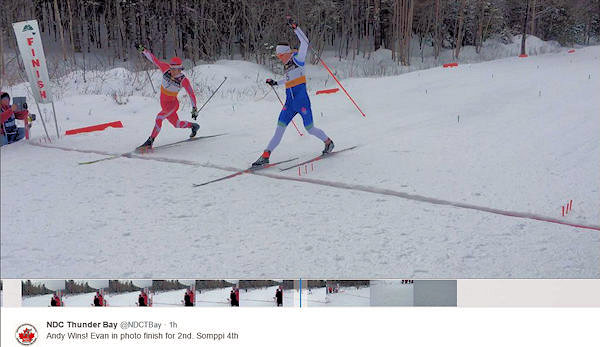
After starting the pursuit fifth and seventh, respectively, Evan Palmer-Charette (NDC Thunder Bay) and Brian McKeever, of the Para Nordic World Cup Team, separated themselves from the second chase group to fight for the podium. Palmer-Charette beat McKeever by the slimmest of margins to take second, 45 seconds behind Shields, while McKeever placed third with the same time. Somppi finish 11.1 seconds later in fourth.
McKeever could have been at the International Paralympic Committee (IPC) World Cup in Pyeongchang, South Korea, but according to Cross Country Canada, he opted to try for a Ski Tour Canada selection.
Somppi was disappointed with his energy and his fourth place.
“The trails were super and I enjoyed the skiing here,” he wrote. “I would prefer to be training right now and avoiding racing, however I have to qualify for the Tour and I believe I did enough to stay in contention this weekend.”
Canadian Para-Nordic World Cup skier Brian McKeever (l) and Thunder Bay’s Evan Palmer-Charette (r) in a photo finish for second at the men’s 15 k freestyle pursuit on Jan. 31 at the Mont Sainte-Anne NorAm in Quebec. Palmer-Charette had the edge and McKeever placed third. (Photo: CCC/NDC Thunder Bay Twitter)
***
The NorAm now moves to Gatineau in western Quebec, starting with sprint racing on Friday. Jess Cockney is back from Europe for his first North American races of the season. Of more than 780 registered racers, the only notable absentee is Andrea Dupont, who is slated to race for Canada on the World Cup in Drammen, Norway, this Wednesday as the NorAm leader.
Still craving more of the World Cup? Here are some comments from a few of the U.S. skiers who closed their international-racing seasons at World Cup Finals last Sunday in Falun, Sweden:
Kikkan Randall with her third consecutive Sprint World Cup Crystal Globe. (Photo: Fischer/Nordic Focus)
On finishing out the World Cup season:
“The race … was a great opportunity for me. I have had a number of races on the World Cup this season but only one other race has been a distance skate and that came only days after a long slow Birkie and flying across the Atlantic. I felt recovered, adjusted to the time and ready to ski hard. Despite only having a few distance skate races I have stayed positive with every opportunity to race and I feel like I have learned an incredible amount going into this next training season, especially for my classic skiing.” — Caitlin Gregg (Team Gregg/Madshus), 37th in 10 k freestyle pursuit, with the 25th-fastest time
“I felt like my energy was good. I think maybe I have lost a bit of fitness over the last couple of weeks for sure, but it is what it is, I am glad it is over. I’m excited for a training year to revamp, because I need it at the moment.” — Noah Hoffman (U.S. Ski Team), 21st in 15 k freestyle pursuit, with 29th-ranked time
“Starting in the wave with some of the world’s fastest guys, my goal was to go out hard, hang with them, and go like that until I blew up. I wanted to ski as aggressively as possible, which in distance skate races can sometimes be hard for me to do. I did just that. Something about that aggressive mentality switched me into some of the best skating of my life. I felt calm and collected, and like my technique was decent, even while hammering very hard and going pretty fast. I got a split or two saying I was right around 30th for time on day, which would be absolutely insane for me to be in the ballpark of scoring World Cup distance points in a skate race.” — Reese Hanneman (Alaska Pacific University), 37th in final pursuit with 34th-fastest time
Canada’s Alex Harvey (1) started first and finished second in the men’s 15 k freestyle pursuit at World Cup Finals for a career-best third overall in the World Cup. (Photo: Fischer/Nordic Focus)
“10 k skates tend to be the race I dread the most, but [Sunday] wasn’t disastrous and I’m looking at it positively. I can’t say is was my favorite race, but I think I was able to try to follow some really good girls until I blew up and that in itself is an accomplishment for me for a skate distance race. It was really cool to see Liz, Sadie, Kik, Noah, and Alex [Harvey] have great races and that topped the weekend for me. I was beyond happy with how the classic sprint went, so moving forward I didn’t have many expectations and it was cool to see my teammates have some good performances.” — Sophie Caldwell (U.S. Ski Team), 39th in 10 k pursuit, with 37th-ranked time
“When I put my goals down for the season, the biggest goals were on the Olympics and the secondary goals were to fight for the Sprint Cup and I did that. I didn’t really think about [the overall World Cup] too much. … Going into [Sunday], I didn’t want to look at the points too closely because I knew Kerttu [Niskanen of Finland] was in a good position. When I fell I was like, ‘Oh man, I hope this [didn’t cost me] fifth.’ … Given my racing strategy for the season [sixth overall is] a good finish [after training through] the entire Tour — there’s a lot of points available there — and making my training a little more sprint-specific, it took me a while to find my distance skiing again.” — Kikkan Randall (U.S. Ski Team), 13th in 10 k pursuit, with 16th-ranked time
On season highlights:
“The fastest time of the day in Kuusamo and the top-10 finish there, and the second-fastest time in [the Tour de Ski 35 k freestyle pursuit to Austria’s Johannes] Duerr [who was kicked out of the Olympics after testing positive for EPO] so I would call that the fastest time of the day. Doing that twice was encouraging, but I have to get to that level more constantly. … The Olympic results weren’t what I was looking for, but I would say definitely an improvement over last season and a lot more work to do.” — Hoffman
On what’s next:
“It’s been a long season and I have raced every weekend since mid-November except for two weekends, I have traveled a lot and I have prepared for a variety of different types of races, all in all I am still feeling good and still motivated to race Super Tour Finals in Alaska :)” — Gregg
“It’s been a busy three weeks [since the Olympics … definitely [Saturday] and [Sunday] the legs were pretty tired, but it’s a good feeling to be tired. I know being back home will be an energy boost.” — Randall
“I’m going home for two days before heading to Alaska. I can’t put into words how excited I am to go home for a couple days and I’m also really excited to be united with the SMS T2 team in Alaska!” — Caldwell
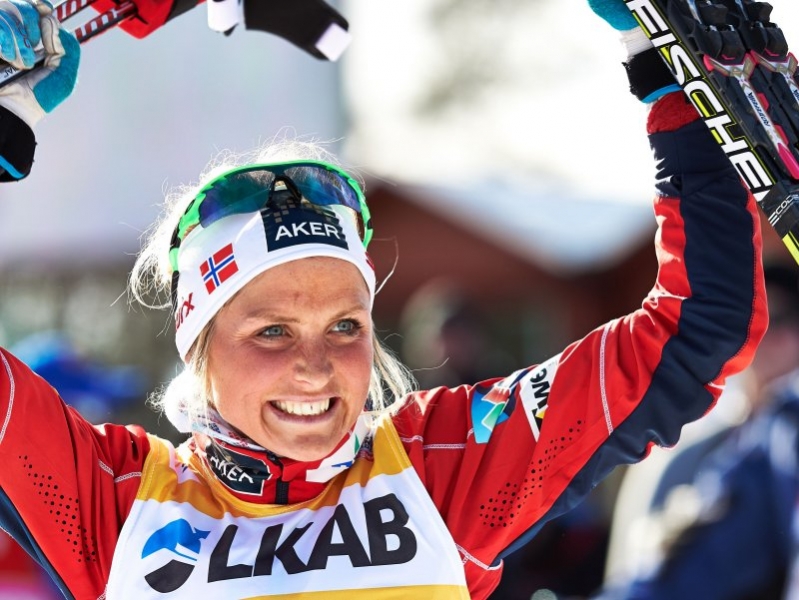
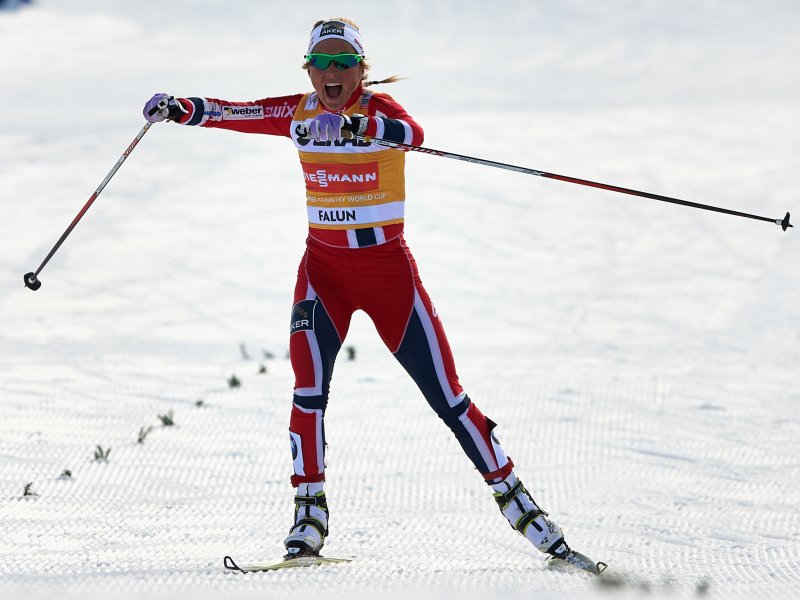
Norway’s Therese Johaug celebrates a nearly 30-second victory over teammate Marit Bjørgen in the World Cup Finals 10 k freestyle pursuit on Sunday in Falun, Sweden, which sealed Johaug’s first overall World Cup title. (Photo: Fischer/Nordic Focus)
That blood-curdling scream and shouts in Norwegian were sounds of elation from Therese Johaug at the finish of World Cup Finals Sunday. Usually a bridesmaid to her veteran teammate Marit Bjørgen, 33, Johaug was finally a bride — even better, a World Cup overall champion in the final race of the season.
Johaug had started with a 15-second lead in the 10-kilometer freestyle pursuit and just seven points separating her from Bjørgen in the race for the World Cup crown. A six-time Olympic gold medalist, Bjørgen had won the overall title three times. Johaug had yet to do so.
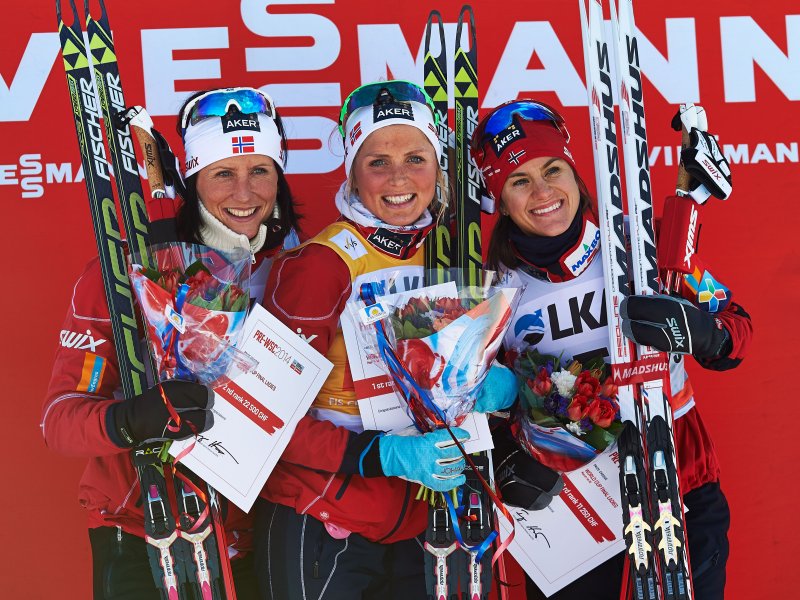
The women’s 10 k freestyle pursuit podium on the last day of World Cup Finals and the 2013/2014 season, with three Norwegians: winner Therese Johaug (c), runner-up Marit Bjørgen (l), and Heidi Weng in third. (Photo: Fischer/Nordic Focus)
This time around, Bjørgen was the underdog, ever so slightly. She cut down her starting deficit to 11 seconds in the first kilometer, then held it for the next couple. By 3.2 k, however, Johaug started to pull away and regained her 15-second cushion halfway point.
Less than a kilometer later, the younger Norwegian laid it out definitively, putting five more seconds between her and Bjørgen.
On what will be the 2015 World Championships course in Falun, Sweden, catching Johaug would be no easy task over the next two loops. With 2.5 k to go, Johaug was nearly 23 seconds ahead of Bjørgen and almost two minutes up on Finland’s Kerttu Niskanen, who was having a race of her own to hang onto third after starting 1:18 back from Johaug.
At this point, Norway’s Heidi Weng had made up 20 seconds on Niskanen after starting in fifth. She passed Sweden’s Charlotte Kalla, who started two seconds ahead of her in fourth, and stalked Niskanen, letting the Finn lead until just before the finish.
Johaug was so far ahead — almost 29 seconds by 8.2 k — she started to take in her surroundings as she entered the finish. By the final straightaway, without Bjørgen anywhere in sight, it hit her. She started screaming then yelling something along the lines of, “What happens!” repeatedly at the finish, according to NRK.
At the finish, she waited for Bjørgen, who came across the line smiling and immediately hugged Johaug, who had captured her first Crystal Globe by 29.2 seconds in 24:25.5.
Norway’s Therese Johaug celebrates a nearly 30-second victory over teammate Marit Bjørgen in the World Cup Finals 10 k freestyle pursuit on Sunday in Falun, Sweden, which sealed Johaug’s first overall World Cup title. (Photo: Fischer/Nordic Focus)
“This is a feeling that I never thought I would experience,” Johaug told NRK, according to a translation. “Winning the World Cup has been a dream since I was a little girl. But I really thought that I should not do it because I have been too bad in the short races.”
Bjørgen won Friday’s classic sprint to start World Cup Finals, but it was Johaug who used the fear of getting caught to fuel her to victories in both Saturday’s skiathlon (by 33.6 seconds over Bjørgen) and Sunday’s pursuit.
“I tried to catch Therese but she was very strong the whole way today,” Bjørgen told FIS. “I would have had to skied better yesterday to be able to do something about the result today. I am very happy for Therese.”
With the 200 points she got Sunday, Johaug won the overall title by 47 points. Norway’s Astrid Uhrenholdt Jacobsen, who did not race on Sunday, held her position in third, 524 points behind Bjørgen. According to FIS, it was the first time since 1995 that one nation dominated the overall World Cup podium.
Weng, who edged Niskanen by 0.5 seconds for third after a drag race to the line — in which she initially led the downhill into the stadium, then Niskanen caught her on the last rise before the finish — finished fourth in the overall World Cup. She was 68 points ahead of Niskanen, who rose to fifth in the overall standings, 42 points ahead of American Kikkan Randall.
The World Cup sprint champion, Randall placed 13th on Sunday. Chasing down 10th with 500 meters to go, Randall said she fell while taking a downhill corner a little too aggressively.
“I was trying to get every bit of speed I could to get into the stadium,” she said. Her skis suddenly skid out into different directions, sending her into a face plant and leaving her chasing two women that passed her.
“That was really tough because you cary a lot of momentum out of that turn,” Randall said.
Annoyed with her blunder for some 20 minutes after the race, Randall said she eventually put it into perspective. Niskanen had made up considerable ground to take fifth overall, and considering Randall’s sprint-heavy training and Olympic focus, in which she skipped the Tour de Ski and its potential World Cup points to train, she had to be satisfied with sixth.
Last year, she was third overall — a first for a U.S. woman — and Randall said she’d like to be on the overall World Cup podium again. But looking back on this season, she said it’s “certainly been fun.”
“Definitely yesterday and today the legs were pretty tired, but it’s a good feeling to be tired,” she said. “It’s an amazing opportunity to be here racing the World Cup, but it’s been a long year of living in hotel rooms being away from home.”
Randall said she’ll miss the World Cup grind in a couple weekends, but for now, she’s looking forward to her homecoming in Anchorage, Alaska, and racing there March 22-28 at SuperTour Finals and U.S. Distance Nationals.
“I know being back home will be an energy boost,” she said.
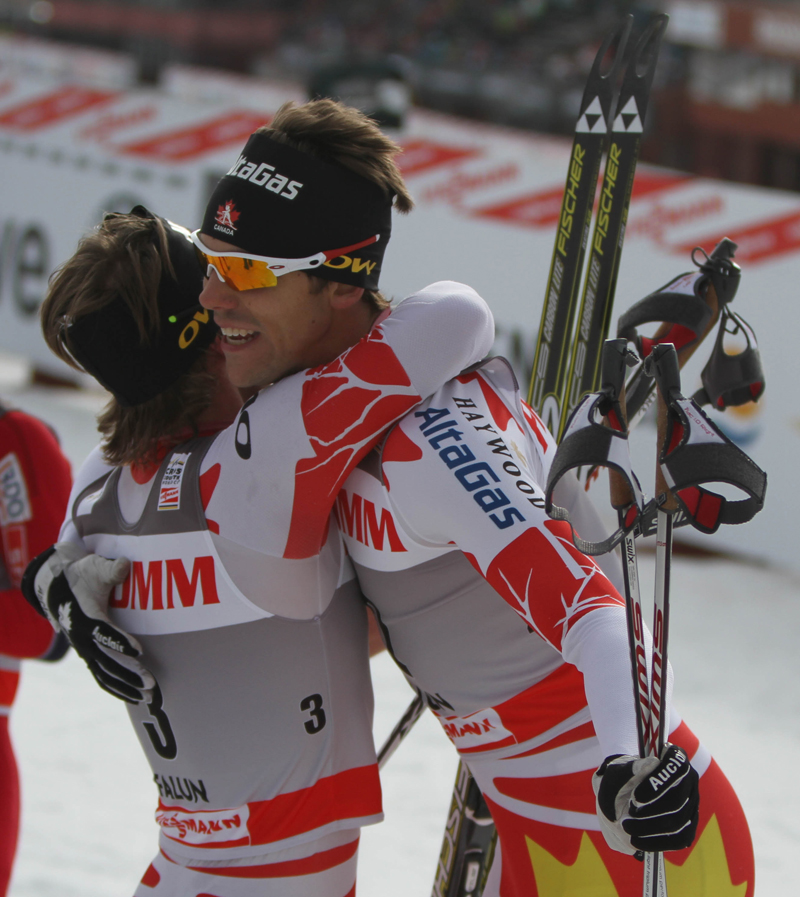
Canadian World Cup Team member Devon Kershaw (l) hugs teammate Lenny Valjas at the end of last year’s World Cup season in Falun, Sweden. There, Kershaw captured second in the World Cup with the 10th-fastest time, Alex Harvey (not shown) skied second fastest for sixth overall, and Valjas posted the 33rd-best time for 28th.
Sunday finally came.
Seventeen weeks and 120 days after the World Cup season started in Gällivare, Sweden, it ended in the same country with final pursuits in Falun.
While the big winners at World Cup Finals shed some tears and smiled for the cameras, the rest of some 50 men and 50 women clicked out of their race skis for the last time – for a while anyway.
For the six Canadians in Sunday’s freestyle races, the moment couldn’t have come soon enough.
“I felt like garbage warming up,” Kershaw said after finishing 4:27.4 minutes behind Norway’s Petter Northug, who won the 15-kilometer pursuit in 35:48.3 and wrapped up the overall World Cup title. “I was struggling with motivation, I’m not gonna lie.”
A year ago, Kershaw stood atop the podium on the last day of the 2011/2012 season as the overall World Cup runner-up. It was both a career best and a historic achievement for Canada, and it came with heightened expectations in the year that followed.
When Kershaw wasn’t winning, or at least living up to what he thought he was capable of, it made for some frustrating races.
Canadian Alex Harvey celebrates his bronze medal in the 2013 World Championships 1.5 k classic sprint on Feb. 21 in Val di Fiemme, Italy, two years after he and Devon Kershaw won the classic team sprint at 2011 World Championships. (Photo: Glen Crawford)
The 30-year-old wasn’t alone. A bronze medalist in the 2013 World Championships classic sprint, Alex Harvey seesawed between podiums and placing outside the top 30. Lenny Valjas came down with strep throat right before World Championships, and Ivan Babikov caught something similar not once, but twice, ultimately leaving him a “little flat,” as head coach Justin Wadsworth put it, at the end of the season.
On the women’s side, three members dwindled to two in February when Chandra Crawford cut her season short to recover leading up to the 2014 Sochi Olympics. Just before she left Europe, Perianne Jones and Dasha Gaiazova teamed up for bronze in the classic team sprint at the pre-Olympic World Cup in Russia. The medal gave them energy, but the two struggled in the World Championships sprints that followed.
At World Cup Finals last Wednesday through Sunday, Canada’s two Continental Cup leaders – Emily Nishikawa and Michael Somppi of the Alberta World Cup Academy –added some strength in numbers, but they were also feeling the wear of the season.
Nishikawa, 23, had done most every race at World Championships and been in Europe for more than a month. Somppi, 24, had been there since early March and was still pushing for his first World Cup top 30.
He didn’t achieve it Sunday in 47th (+9:28.6), but Somppi wrote in an email that he was getting close with the 37th fastest time.
“I felt OK, though certainly not great, as it’s been a long season with a ton of racing and it’s wearing on me,” Somppi explained. “The pace with the pack I skied with didn’t feel unreasonable and I felt pretty strong climbing.”
However, his best pair of skate skis – suited for cold weather – weren’t running well Sunday afternoon with temperatures above 6 degrees Celsius. That made him slow on the downhills.
“Unfortunately on the 3rd lap I was dropped pretty badly on the downhill coming into the stadium and I didn’t have it in me to close the gap,” Somppi wrote. “It was a tough experience being on the World Cup. I’ve learned some valuable lessons and become more comfortable with the racing environment so the next time I have an opportunity to race on the World Cup I will be better prepared.”
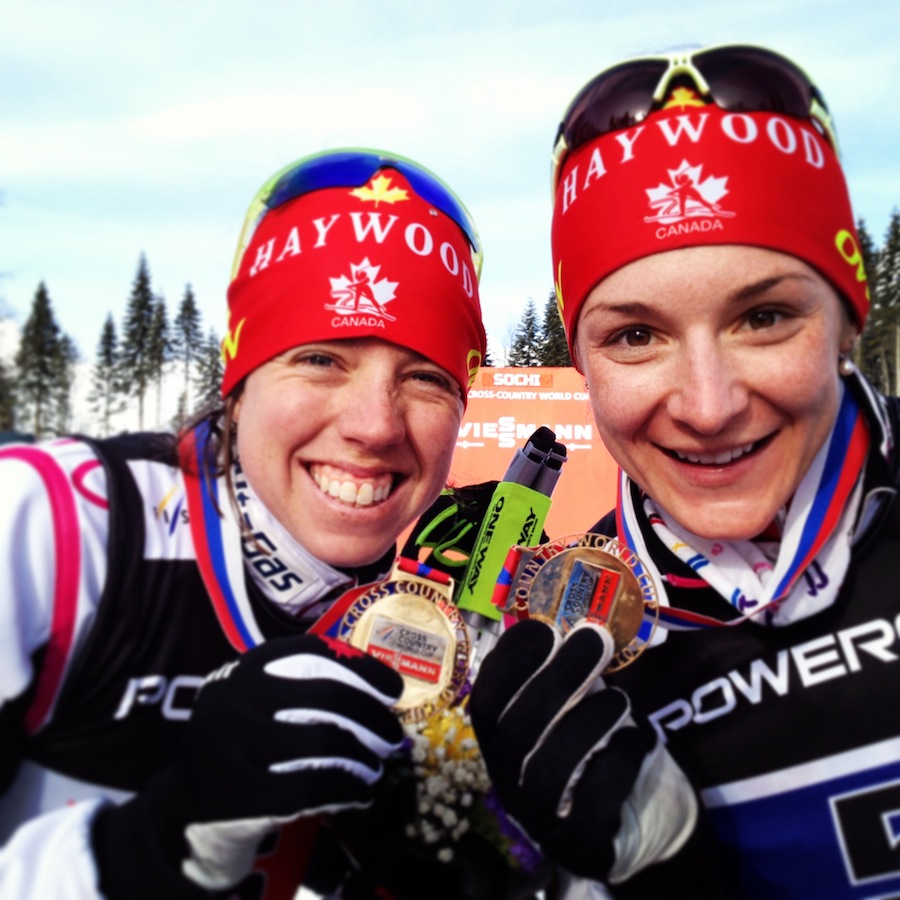
Canadians Perianne Jones and Dasha Gaiazova celebrate their first bronze of the season, and together, in the Sochi World Cup classic team sprint on Feb. 3. (Photo: Chandra Crawford)
Somppi was the fourth-best Canadian in the 15 k pursuit after Harvey in 25th (+3:40.5), Kershaw in 31st, and Babikov in 41st (+5:39.9). Valjas finished last in 48th (+10.02.9). In the women’s 10 k, Nishikawa as the lone Canadian was 46th (9:56.4 behind Norwegian winner Marit Bjørgen). Gaiazova did not compete.
“She felt like she couldn’t race,” Wadsworth explained. “That’s her decision.”
As for the rest of his athletes: “They definitely went out there and skied hard,” he said. “Like I told them the last couple days, ‘I don’t care about the result, I just want to see you executing and focusing,’ and they did that and it was good.”
Good, not great, and certainly not what the Canadian World Cup Team had dreamed about before the start of the season. Given their starting positions on Sunday, with Harvey going earliest in 32nd, 3:16 behind Northug, the team knew miracles weren’t quite within reach. But as Kershaw pointed out, anytime you put a bib on, you have to go out there with some gusto.
“You’ve got to try to get yourself in the best possible frame of mind to give it your best shot,” Kershaw said. “Sometimes your best shot is 20 percent of what you’re capable of or what you’ve shown in the past.”
Regardless of where you end up, whether it’s first or 31st, Kershaw said that’s what motivates you to improve. However, at this point in the season, it was a matter of finishing it out. To add some lightheartedness to Sunday’s race, the Canadian men wore casual sunglasses.
“We still went hard, but we’re trying to find ways to still keep it fun,” Kershaw said. “It’s a beautiful life and ski racing is still a passion for everyone on the team, but it’s challenging. It’s not nearly as fun when you’re the one wiping the floor.”
Wadsworth believes that feeling is what will drive them in the year to come. Coming off an outstanding 2011/2012 outing, in which Kershaw was second and Harvey placed sixth overall and Valjas notched two podiums at World Cup Finals, he thinks the team might have been too ambitious to raise the bar higher.
“I think we came out of last year feeling like we could do anything, and that’s how we approached the whole training season and into the early part of race season,” Wadsworth said. “We were just like, hitting every World Cup and just plowing ahead. … We felt that we could train harder and do everything like more, more, more and we can’t.”
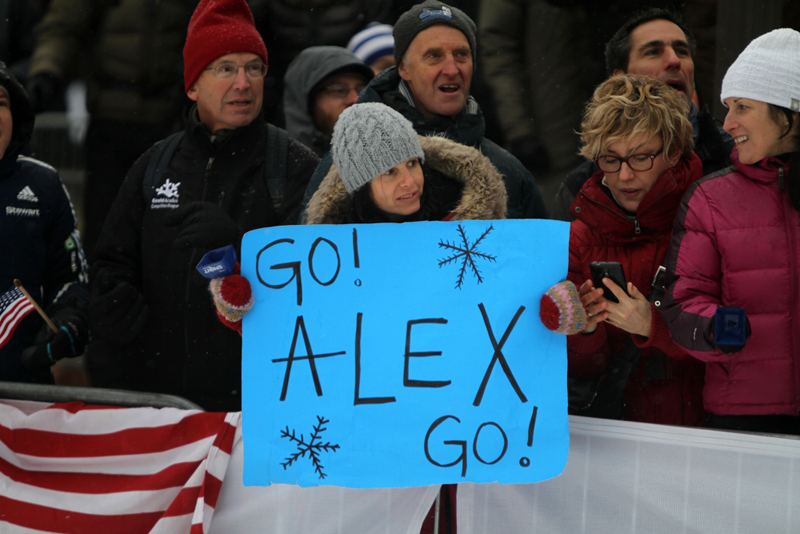
One of many Alex Harvey cheering sections at the Canadian World Cup in Quebec City from Dec. 7-8, 2012.
In the past, he said one of his program’s biggest strengths is its ability to carefully select races and get the most out of training camps and blocks throughout the year.
“It’s my fault for not skipping Kuusamo and Gällivare and just staying in Canada and preparing for the Canadian World Cups and then going on,” Wadsworth said. “Even I got sucked into it. We tried to go and do every race and it was just too much.”
In early December at the Quebec World Cup, Harvey was the only Canadian who qualified for the heats and ended up 21st in the individual freestyle sprint. The next week in Canmore, Alberta, Harvey and Kershaw placed outside the top 50 in the skate sprint qualifier and skipped the skiathlon the next day.
“We’ll be better. Canada will be better next year,” Kershaw resolved. “Five podiums just wasn’t what we were looking for this year. I think we all learned a lot this year and at the end of the day, that’s what skiing’s about.
“You’ve got to learn from your mistakes and move forward,” he continued. “We’re bummed that we’re not skiing well, but everyone is just so motivated to be better next year, and at the end of a long, tough season if everyone is still motivated, that’s a really good place to start.”
While the team had yet to debrief and set new intentions in its season-ending meeting, Wadsworth said they would look to change a few things next year, including their approach to testing skis.
Waxing woes were one reoccurring theme on the Canadian World Cup Team this year – with tough races at Holmenkollen and in the 15 k classic mass start in Falun last Saturday. Wadsworth said his small staff of five wax techs (eight at World Championships) shouldn’t bear the weight of the blame.
“We need to review our race-day testing,” Wadsworth explained. “I think the athletes realize, too, they need to take a little more ownership. A lot of times skis get tested for them, especially on skate days, so they can just kind of show up and focus on their warmup and whatnot, but I think they need to start testing and feeling the skis a bit more on their own and having more input on that. That will be something we do differently next year.”
Wadsworth would also like to hire another core technician, someone who could work more closely with his skiers and test right up until the start.
“You have to be pretty fit to ski even their warm-up speed,” he said. “The athletes need to take responsibility and come out earlier and take more time. You see a lot of the other countries doing that with their athletes, they’re out like an hour and a half before the race.”
After weathering a steep learning curve in 2013, Wadsworth’s confident it will bode well for the upcoming Olympic season.
“I think it will be really good to be flying under the radar because I know one thing and that’s both the men and the women on this team can win medals at the Olympics,” he said.
“We’re at such a high level that we feel like this year was kind of a failure, but at the same time, we got a medal at the World Championships and two fourth places, a near miss for another medal, as close as you can basically be and not get a medal,” he added, referring to Kershaw and Harvey’s fourth-place finish in the team sprint, three-hundredths of a second off the podium.
Wadsworth also pointed out the team’s four Tour de Ski podiums and the women’s team-sprint bronze on the Olympic course in Sochi.
“Those are solid and we need to remember those and remember the results from last year, too, and hold those in our pockets on the days when it gets hard training,” he said. “We learned a lot about the different athletes on the team and we’re going to use that to our advantage.”
The Canadian World Cup Team flew home Monday and most of its athlete will compete at Canadian Nationals in Whistler, B.C., this week. Kershaw planned to attend, but in need of some time off the skis, said he wouldn’t race. Harvey will not be there as he rehabs a shoulder injury from earlier this season in Sochi.