Tag: 10 k sprint

  • Eberhard Starts 2017 with Oberhof Sprint Win; IBU World Cup Skiers Call Special Meeting

    Eberhard Starts 2017 with Oberhof Sprint Win; IBU World Cup Skiers Call Special Meeting

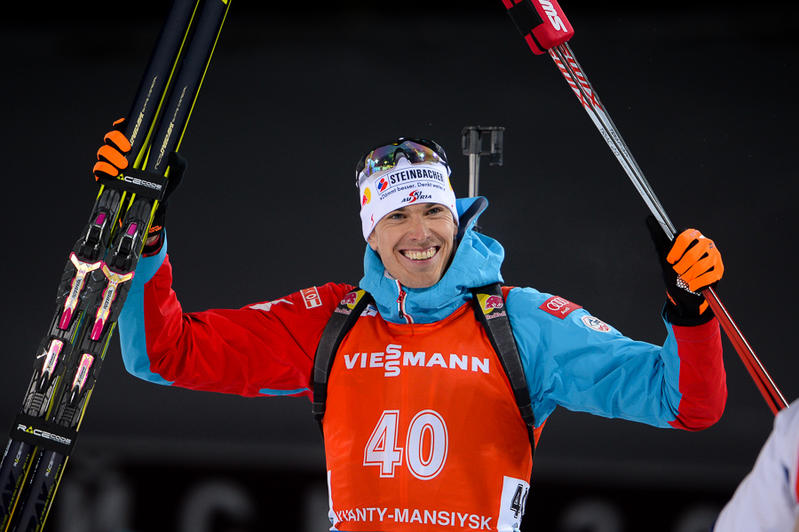
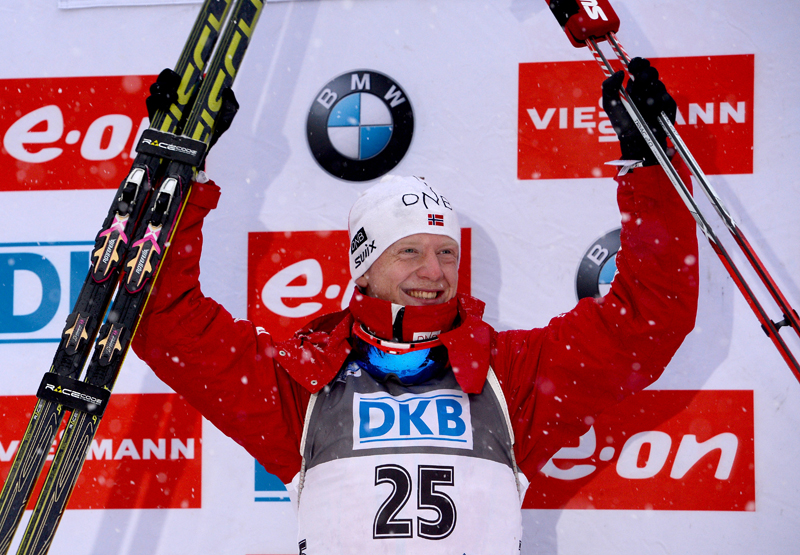
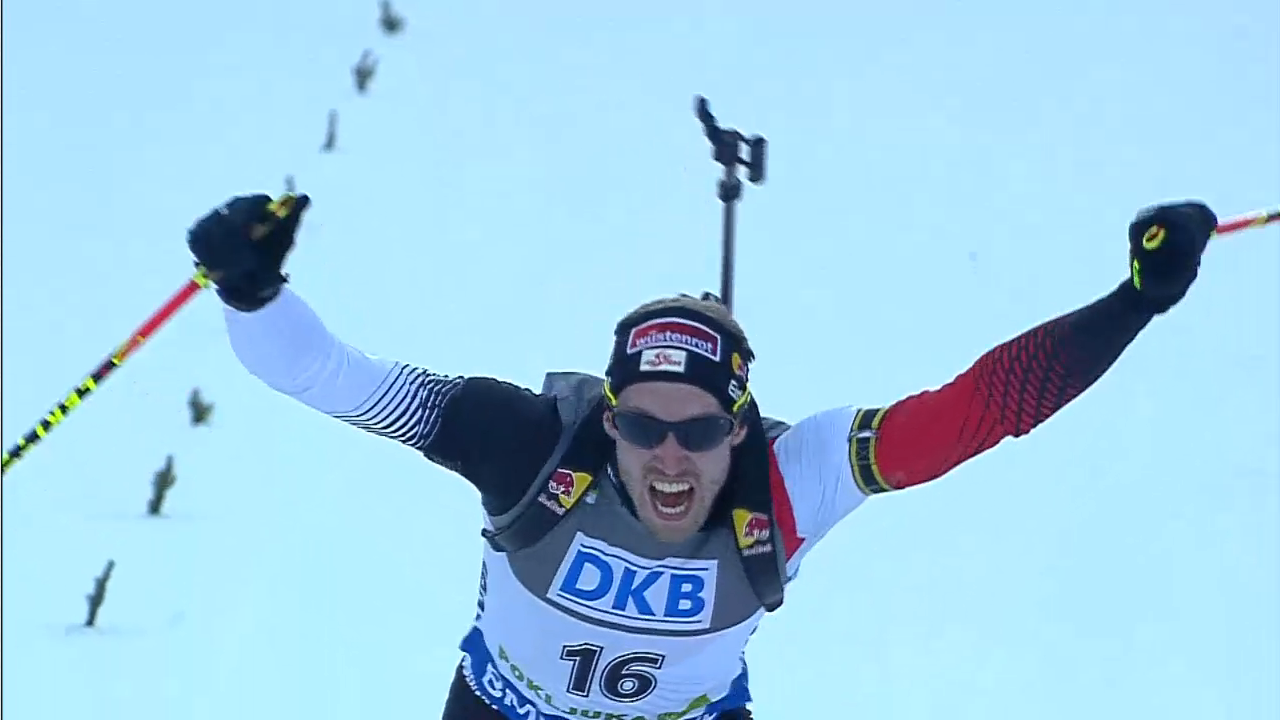
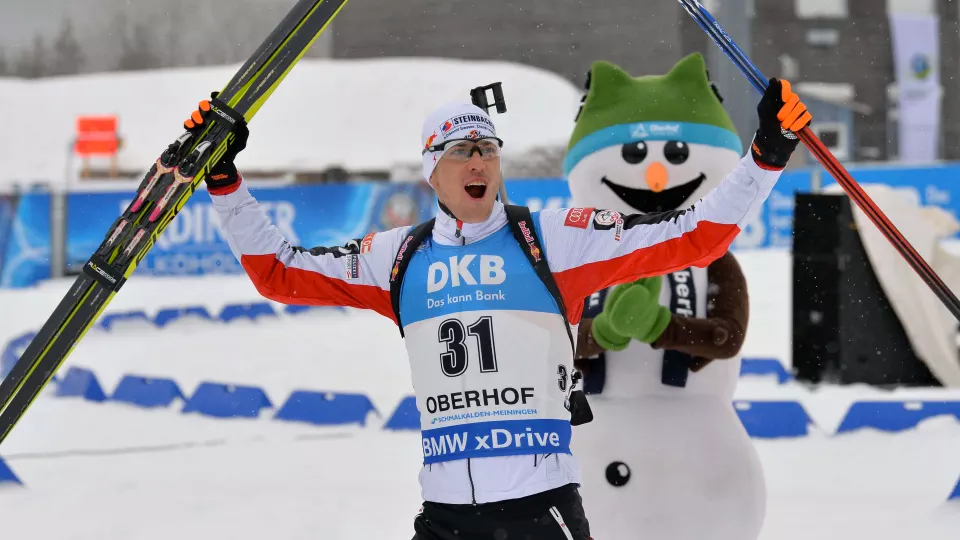
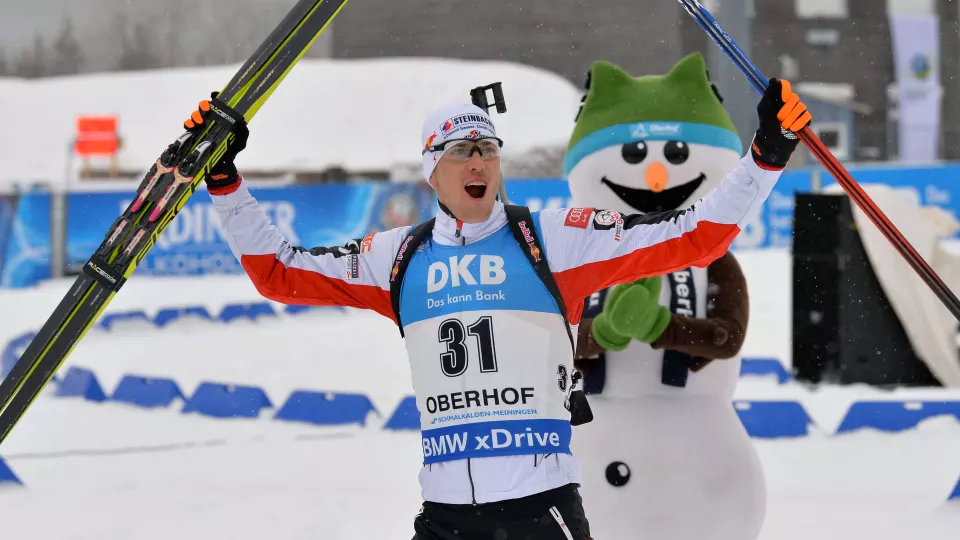
    Austria’s Julian Eberhard celebrating his victory in the men’s 10-kilometer sprint at the 2017 IBU World Cup in Oberhof, Germany. (Photo: IBU)
    Austria’s Julian Eberhard celebrating his victory in the men’s 10-kilometer sprint (along with the Oberhof snowman) at the 2017 IBU World Cup in Oberhof, Germany. (Photo: IBU)

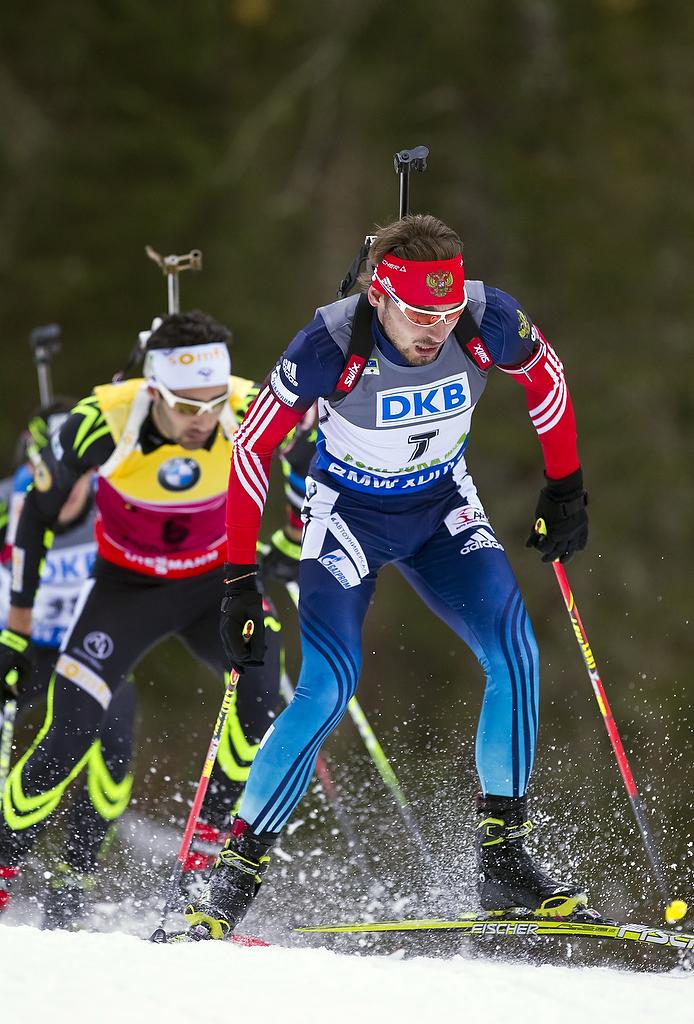
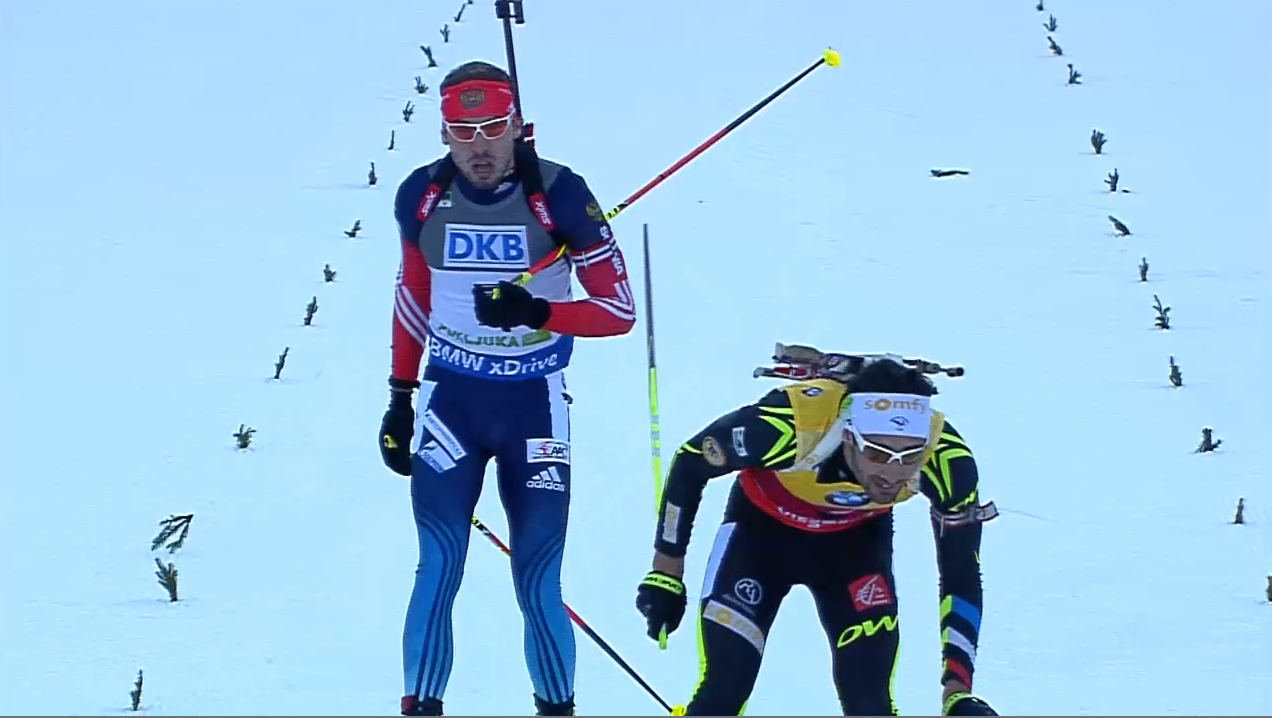
    Even Martin Fourcade is a mere mortal who can’t win every race he competes in. After winning the first three sprints of the 2016/2017 season and five races in a row, for once the French biathlon star had to settle for an eighth place after uncharacteristically missing three targets in his standing shooting stage.

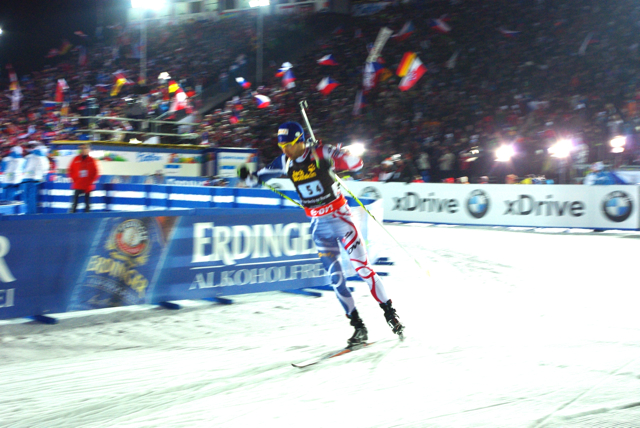
    That left an opening for other athletes to shine on Thursday afternoon in the men’s 10-kilometer sprint at the International Biathlon Union (IBU) World Cup in Oberhof, Germany. Austria’s Julian Eberhard seized the opportunity and won the second sprint of his career in a time of 26:57.5 minutes, skiing the second-best course time, ahead of the Czech Republic’s Michal Slesingr (+10.8) and Italy’s Dominik Windisch (+40.3). All athletes on the podium had to ski one penalty lap.

    “I rescued myself into the finish with my last power,” Eberhard told Austrian broadcaster ORF. “The competition could not have been any longer. Of course I am overjoyed now. That was an important victory, also regarding the World Championships at home in Hochfilzen [in February].”

    A year ago, all races in Oberhof had to be canceled due to a lack of snow. After the organizers invested significant resources in snow-farming and storage capacities over the summer to prevent that from happening again, ironically two days ago the first heavy snowfalls of the season and one of the most severe winter storms in a decade that devastated the northern coast of Germany posed different challenges for the organizers: additional volunteers were needed to help prepare the tracks overnight, or simply to sweep snow off the seats in the arena.

    “The conditions were really difficult,” Eberhard said during the post-race press conference. “Because there was a lot of fresh snow, and a lot of wind. But I like that. So I think it was a difficult but really good day for me.”
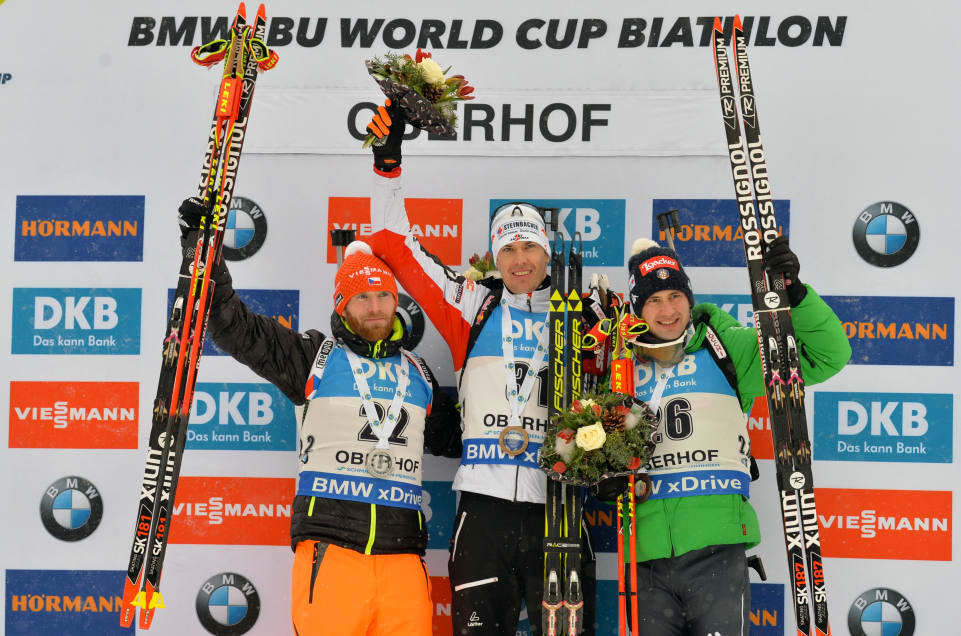
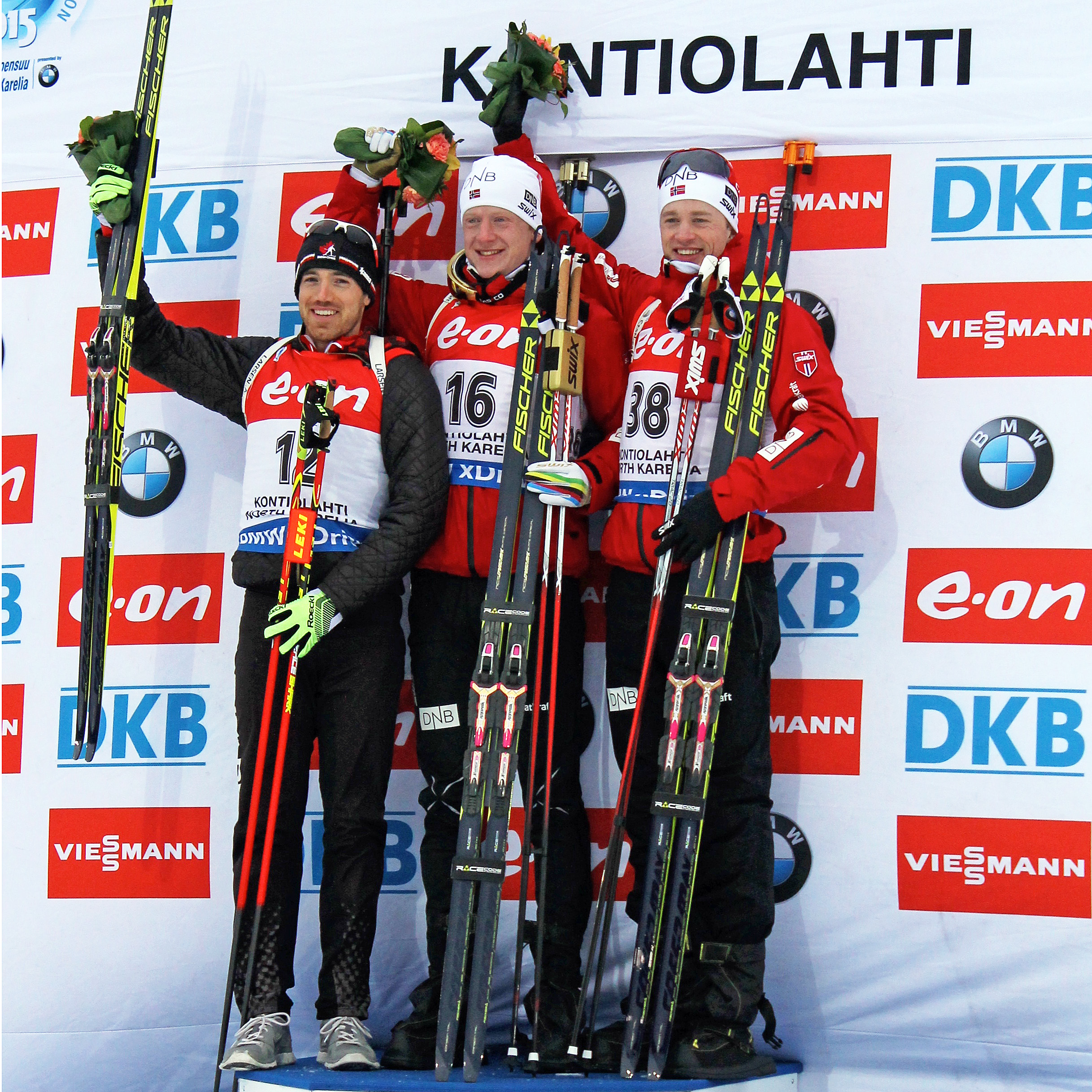
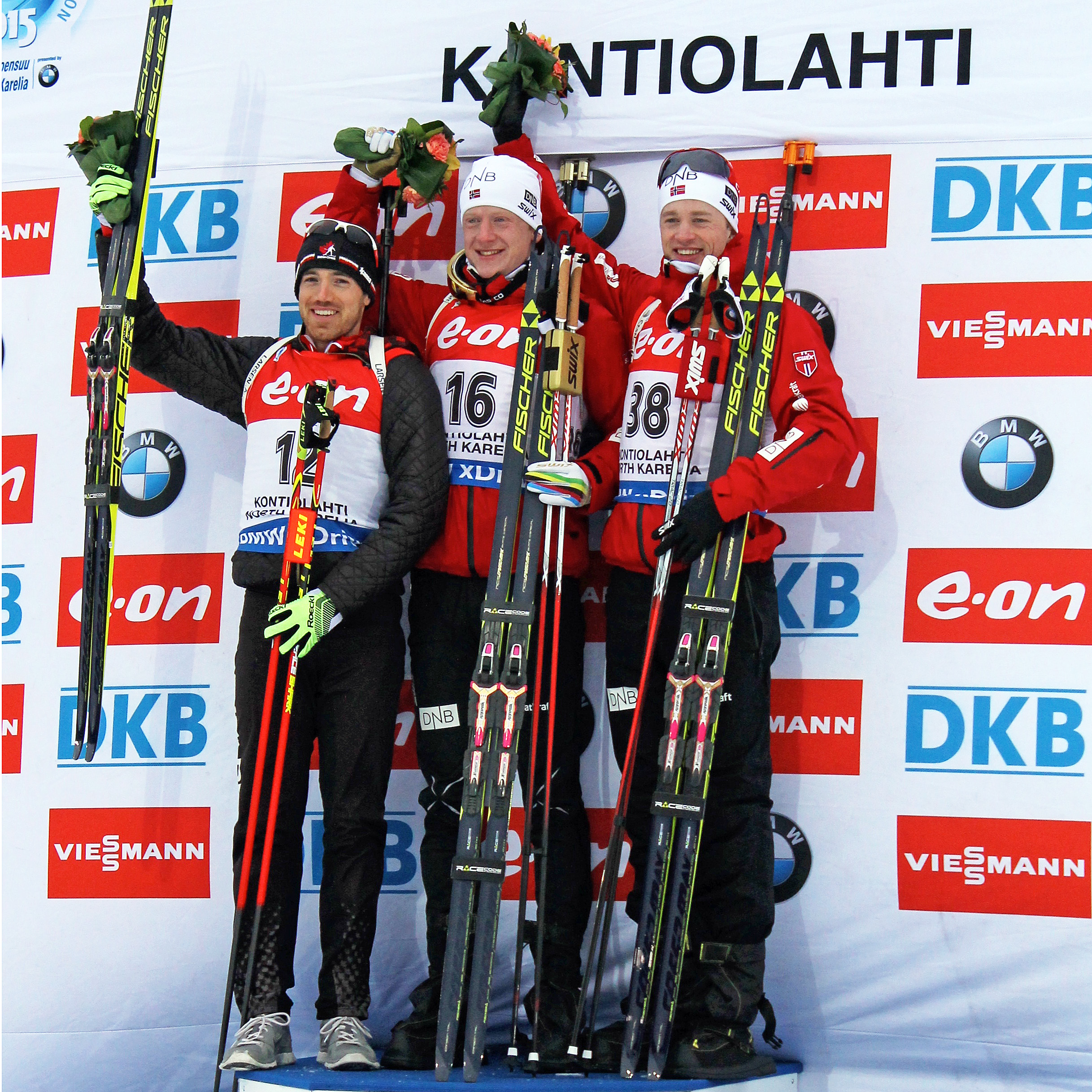
    (Left to right): Czech Republic’s Michal Slesingr (second place), Austria’s Julian Eberhard (first place) and Italy’s Dominik Windisch (third place) on the podium for the men’s 10-kilometer sprint at the 2017 IBU World Cup in Oberhof, Germany. (Photo: IBU)
    (Left to right): Czech Republic’s Michal Slesingr (second place), Austria’s Julian Eberhard (first place) and Italy’s Dominik Windisch (third place) on the podium for the men’s 10-kilometer sprint at the 2017 IBU World Cup in Oberhof, Germany. (Photo: IBU)

    “Today, I was quite relaxed during the race,” Slesingr said at the press conference when asked about the difference to last racing at home in Nove Mesto. “Because I did not think about that race before too much. It was like I’m just going around the stadium and think ‘whatever, let’s do the race’. So I didn’t feel any pressure today.”

    Slesingr smiled when asked if training in Oberhof during the summer maybe gave him an advantage, clarifying that his team mainly comes there to train in a ski tunnel near the venue.

    “We don’t use the shooting range outside too much, so I can’t say that it helped us. In the tunnel you always have perfect conditions for shooting. No wind, no snowing like today.”

    Late in the field in bib 70, Italy’s Lukas Hofer challenged for the podium after shooting clean, but he missed the time set by his teammate Windisch by one-tenth of a second at the finish (+40.4). It was Hofer’s best individual result since the 2013/2014 season, and Windisch’s second-career podium.

    “Like an old saying… Start your day right… we just say “Start your year right” Hofer posted on social media with a picture of the Italian team celebrating the third and fourth place.

    “I watched it while I was in the changing room,” Windisch recalled during the press conference. “When I saw that he was with me, at the same time, I thought maybe he will beat me. But at the end of the competition maybe I was a little bit faster. I am happy, but most of all I am happy for the whole team because this is a really good position for Italy. […] I really thought that someone would beat me, so until the end I was very surprised. And I still am.”

    Behind Windisch and Hofer, Germany’s Erik Lesser finished fifth (+41.2) with two penalties in standing, after shooting clean and taking the lead following the prone stage. He was satisfied with the result, but the athlete living and training near Oberhof gave some insights into how difficult it can be to race in front of a raucous home crowd.

    “I can’t complain about the fifth place,” Lesser told German broadcaster ZDF. “Especially with two misses I absolutely have to be satisfied with the result. On the course everything I worked for during the last days panned out. […] But I am a little annoyed about the two misses in standing. In Nove Mesto, we talked about the home field advantage for the Czech Republic, and then you see Gabriela Koukalová shoot 0+3 [in the sprint there], and I believe that’s how I also felt today in the standing stage. It was very quiet, I hit the first shot, and then there comes such a noise [from the stands] to the shooting range that it got me a little bit out of my concentration, which must not happen, so I am a bit angry about that.”

    “Conditions were not easy,” Martin Fourcade told ZDF about his shooting woes with three penalties on his way to an eighth place (+51.3). “I was struggling with the wind. It was not easy. This is not an excuse, but I had my zeroing on the [lane position] target number one and it was quite easy for the prone shooting, but we had no wind for the standing [in target practice] and it was something I didn’t succeed to manage for my standing position in real wind conditions.”

    Fourcade limited the damage for the following pursuit by once again skiing the fastest course time.

    Three North Americans Onto the Pursuit
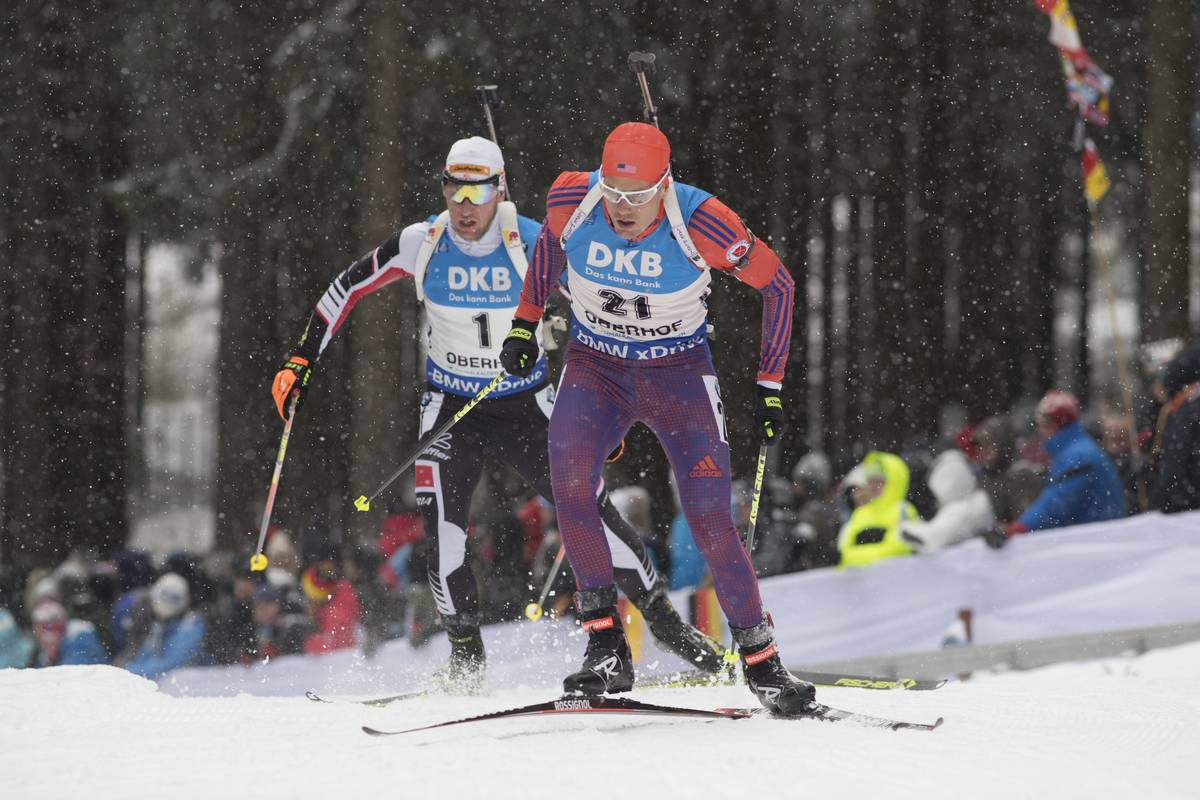
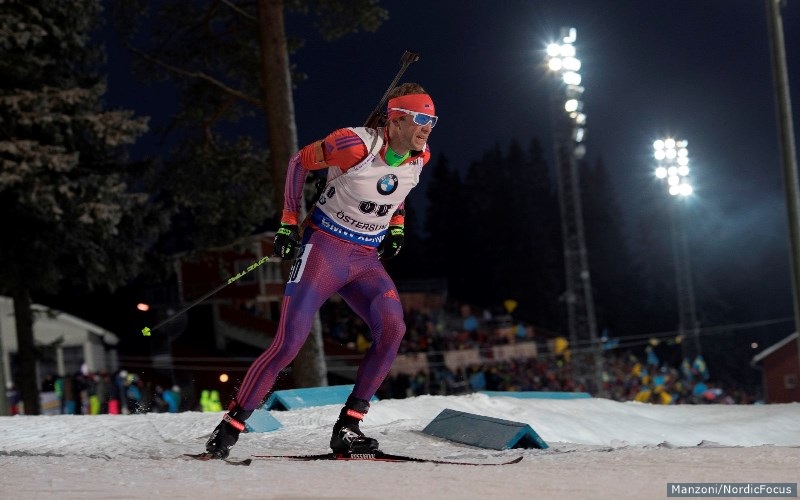
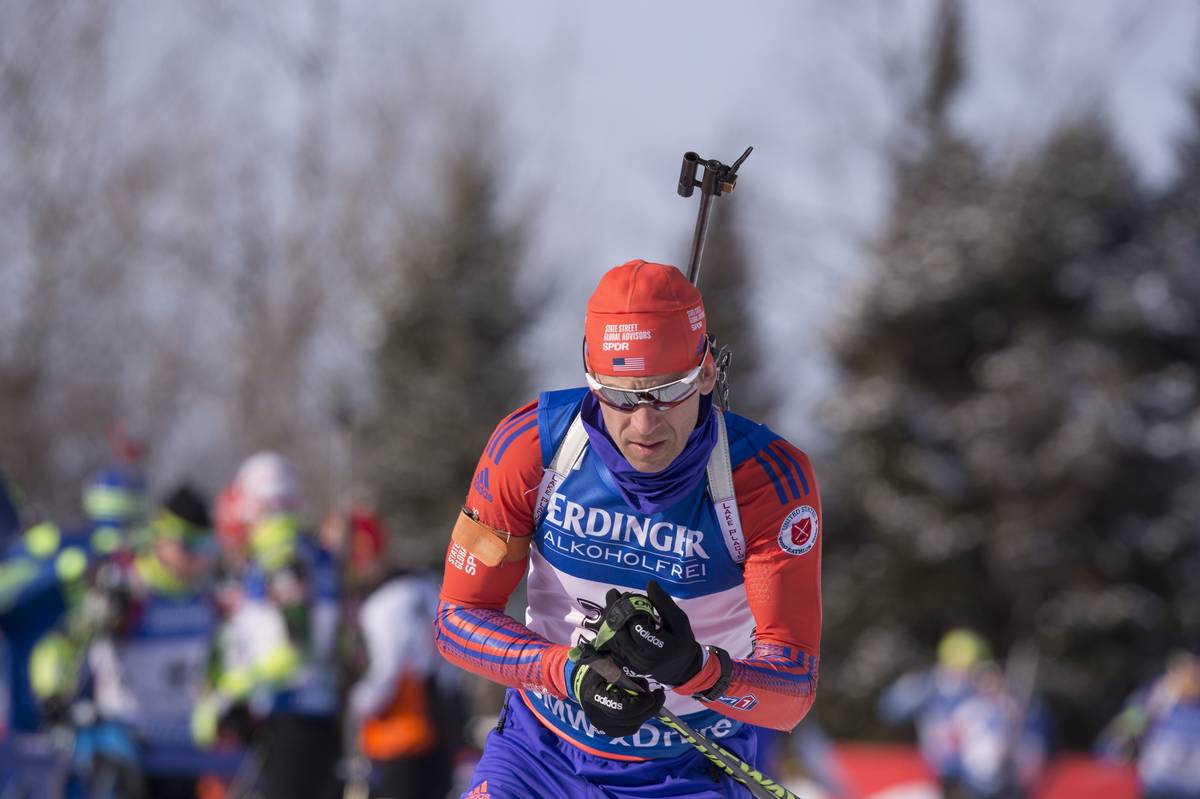
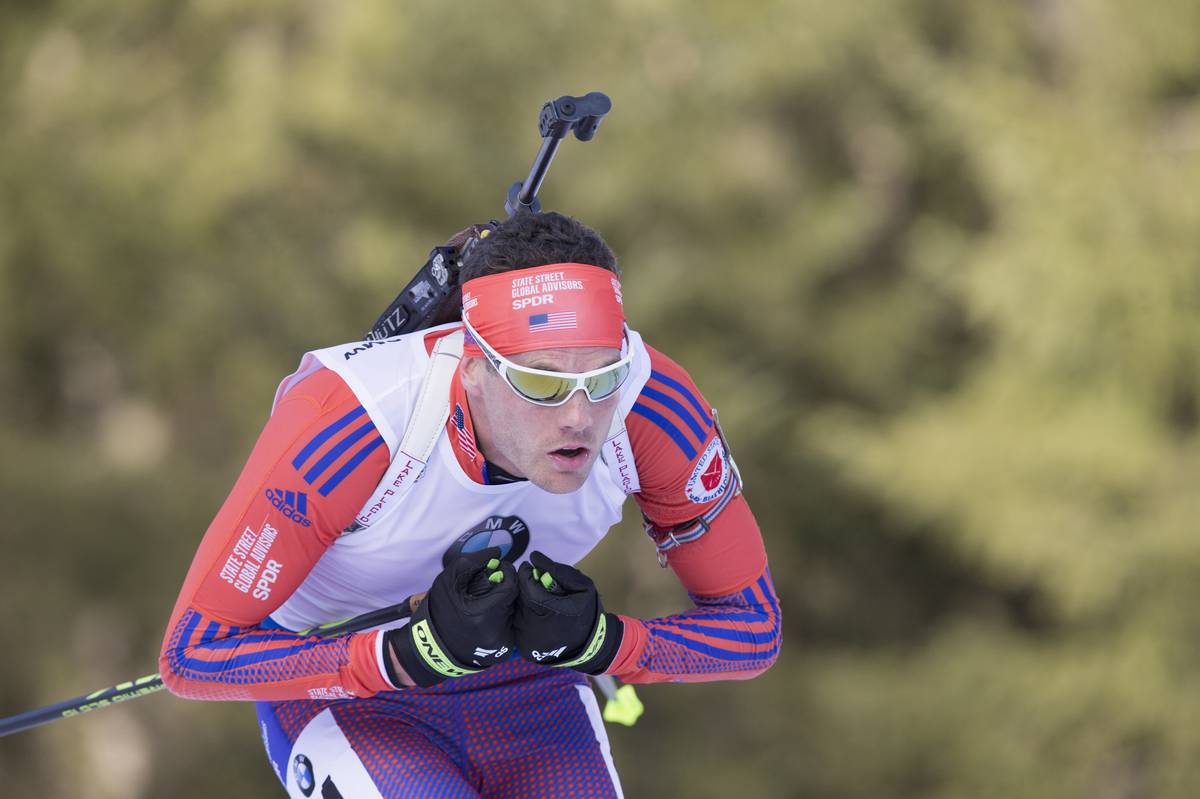
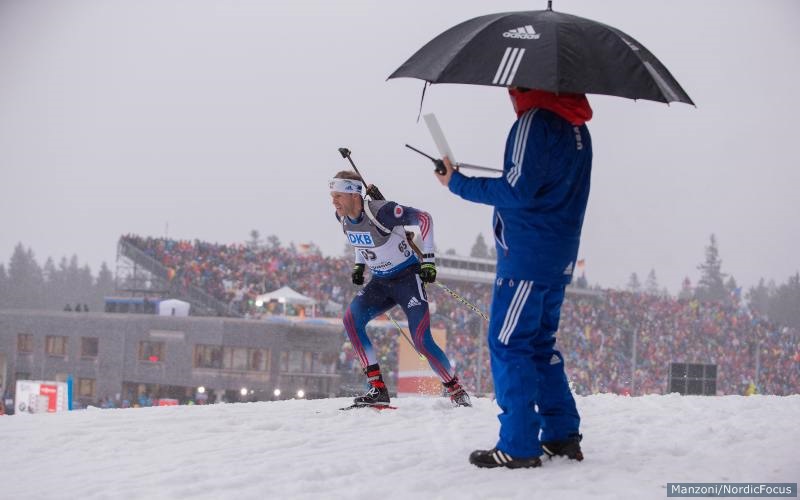
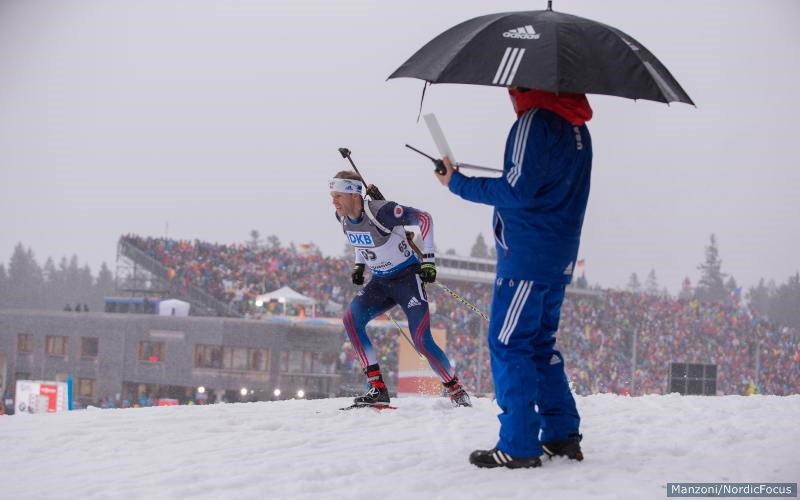
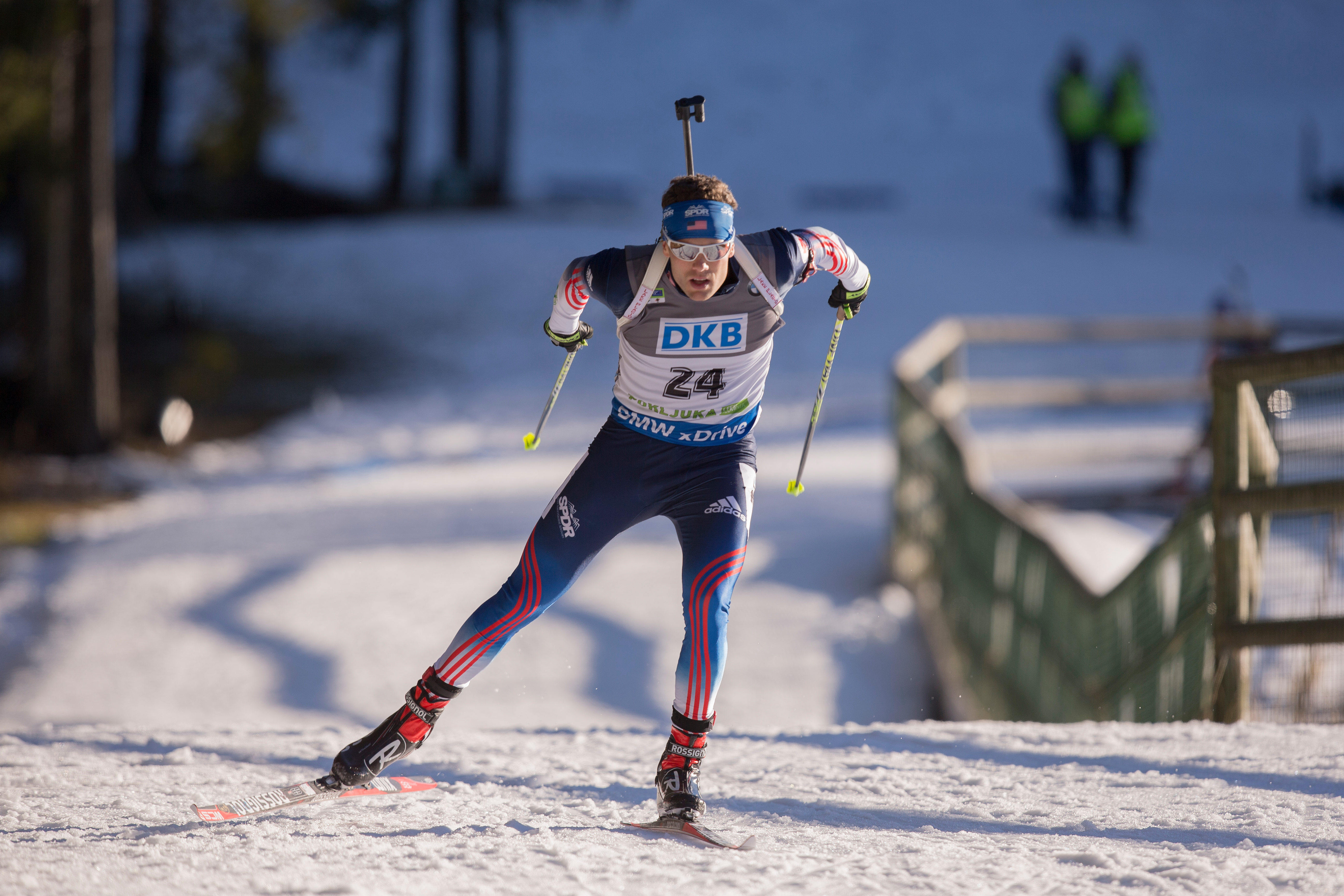
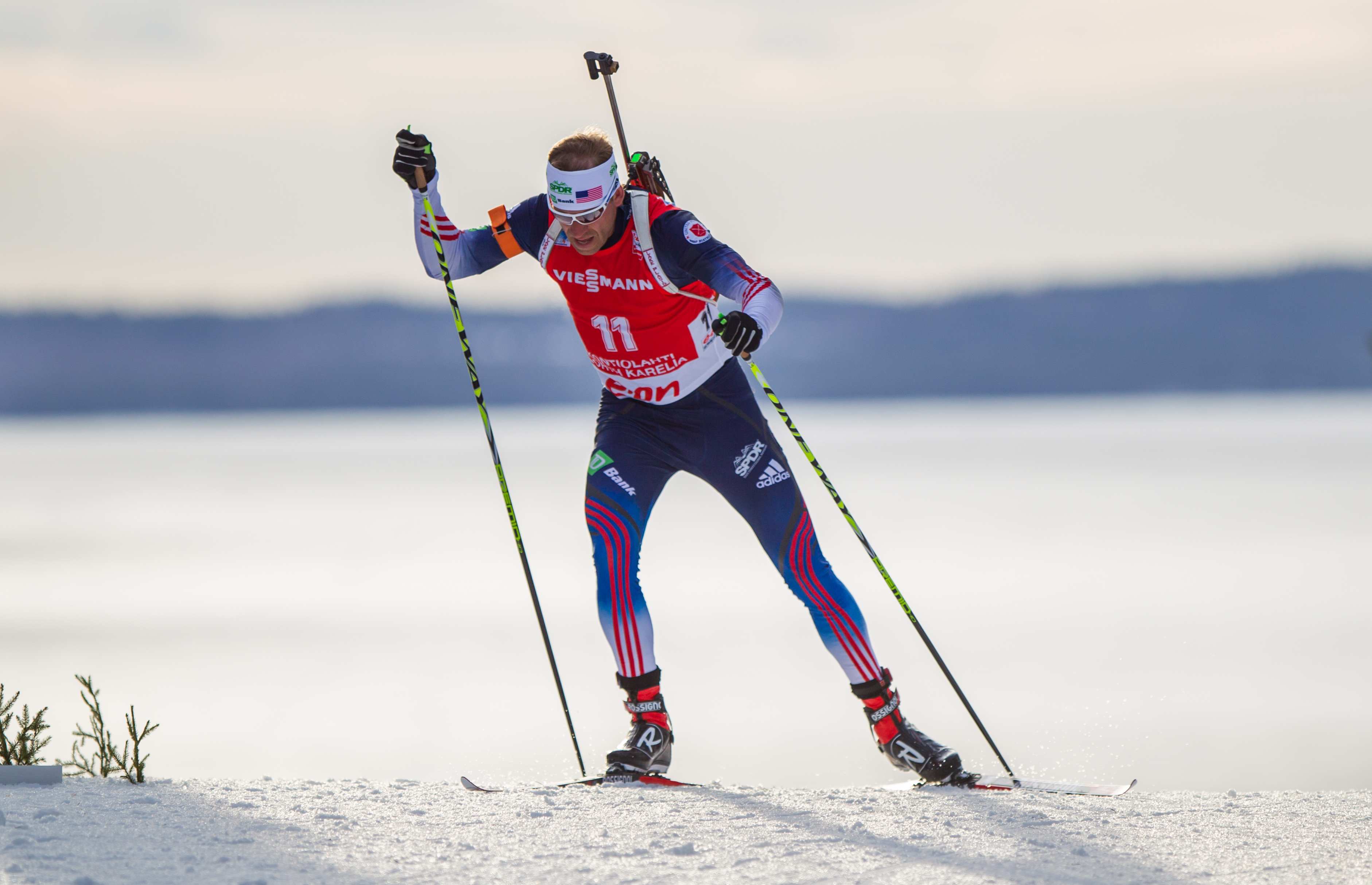
    US Biathlon’s Tim Burke (21) on the course during heavy snowfall during the men’s 10-kilometer sprint at the 2017 IBU World Cup in Oberhof, Germany. Behind him is Austria’s David Komatz. (Photo: USBA/NordicFocus)
    US Biathlon’s Tim Burke (21) on the course during heavy snowfall during the men’s 10-kilometer sprint at the 2017 IBU World Cup in Oberhof, Germany, leading Austria’s David Komatz. (Photo: USBA/NordicFocus)

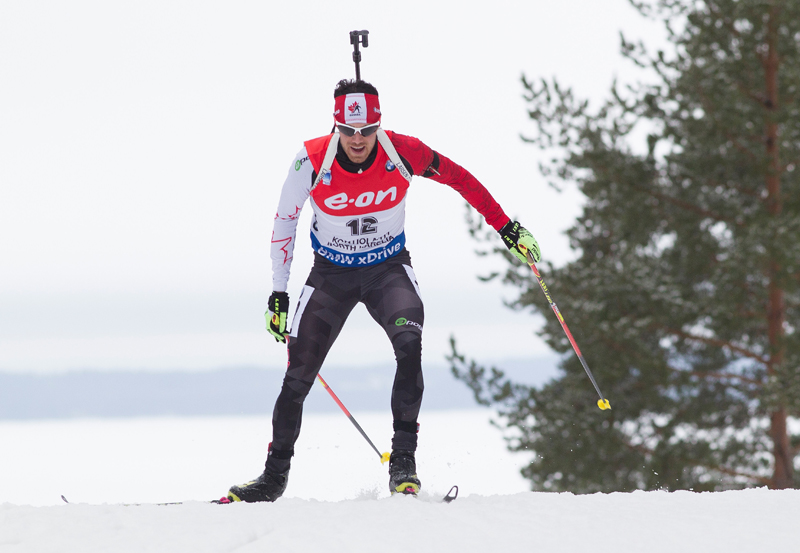
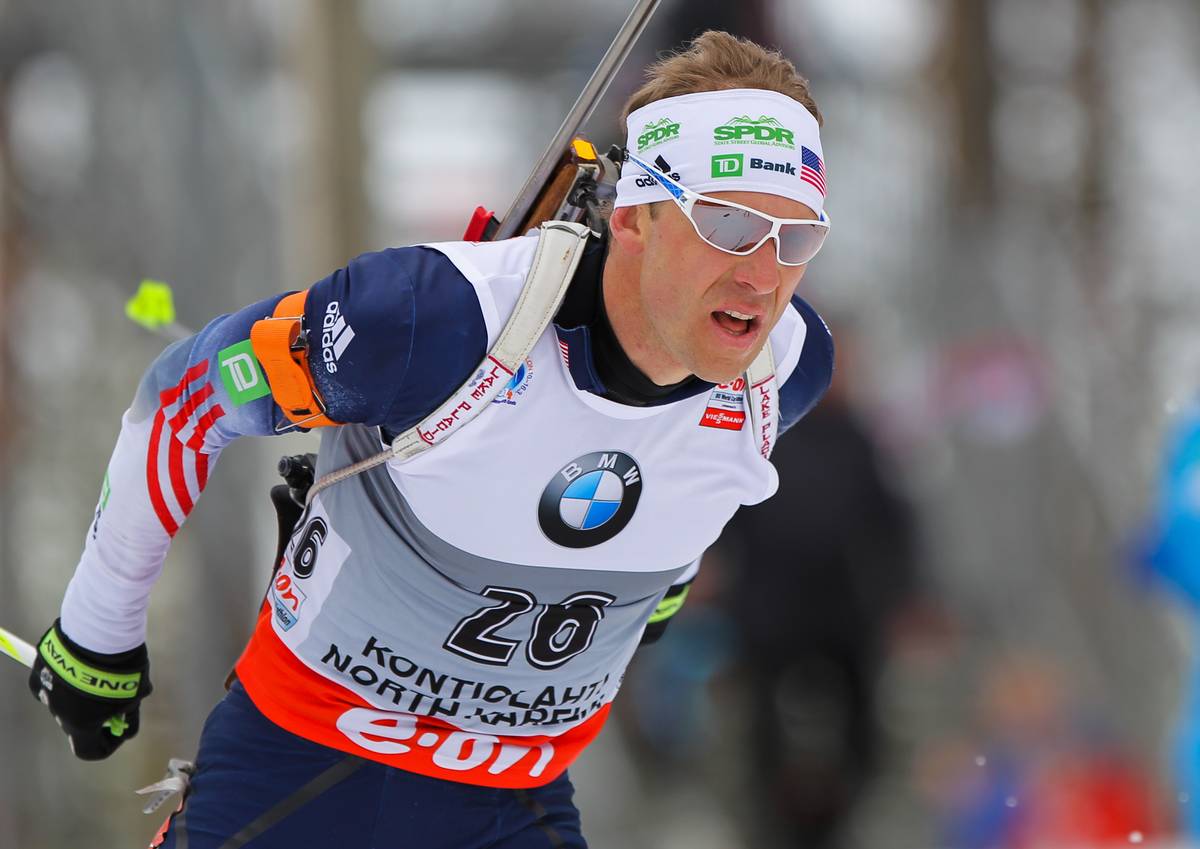
    The best North American in the difficult conditions was Tim Burke, who finished 35th (+1:51.8) with two penalties (0+2).

    “The heavy snow and gusty wind made for a challenging race today,” Burke said according to a US Biathlon press release. “We were lucky that the snow stopped right before the start today, but this also made for some challenging conditions on the track throughout the race. I feel like I was lucky in prone with having little wind, but standing was a real fight with strong wind and it took me a long time to get all five shots off.”

    “Overall, I was pleased with my shooting performance today considering the windy conditions,” he added. “Unfortunately, I am far off my normal ski shape. I had one of my best training years, so I am a bit confused as to why I have been so flat racing, but I am confident that it will eventually come around. If we continue to have strong winds here in Oberhof, Saturday’s pursuit should present some great opportunities to move up.”

    Also for the U.S., Russell Currier placed 46th (+2:15.1) with three penalties (1+2), qualifying for his second pursuit of the season.

    In his return to the IBU World Cup after missing the first races of the season due to mononucleosis, last year’s junior world champion Sean Doherty finished 80th with three penalties (+3:20.2), missing out on the top 60 to qualify for Saturday’s pursuit.

    Lowell Bailey is skipping the races in Oberhof for a training block at home in Lake Placid, N.Y. He plans to join the team again next week for the World Cup in Ruhpolding, Germany.

    “I planned to skip Oberhof earlier this year when we laid out the seasonal training plan,” Bailey explained in an email to FasterSkier. “I wanted to put in a solid three-week block of training during the middle of the season so that I’m hopefully set up well for World Champs and the last half of the season. It’s tough to voluntarily sit out, but I think it is the right decision, and I hope it will pay off later on in the season.”

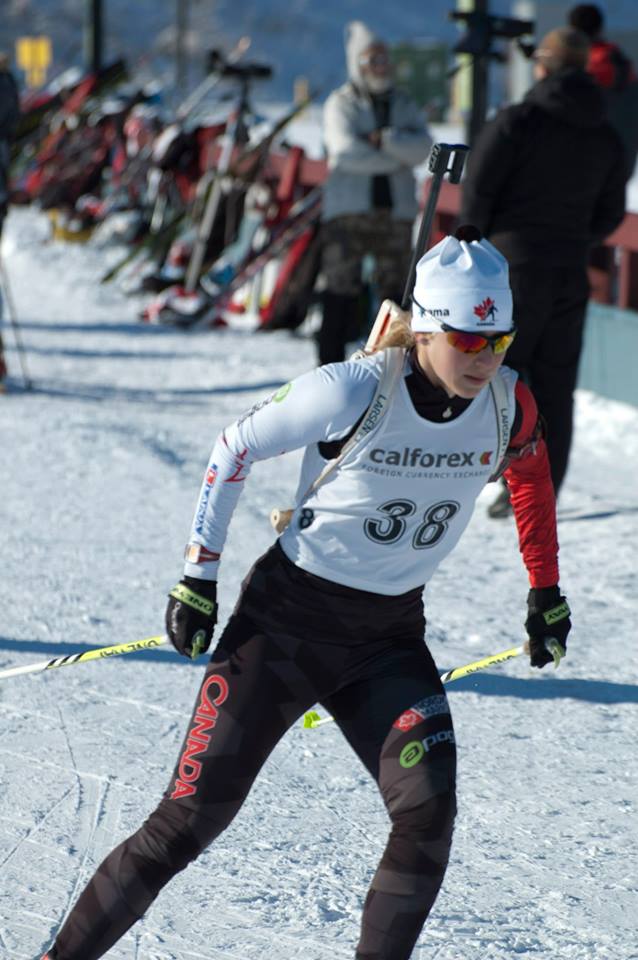
    For Biathlon Canada, Scott Gow had the best result of the day in 43rd (+2:11.9) with one miss (0+1) and was the only Canadian to qualify for the pursuit. Macx Davies finished 68th (+2:51.1) with two penalties (0+2), just ahead of teammate Brendan Green in 69th (+2:58.0) with four misses (3+1).

    In his second World Cup after one appearance last season in Presque Isle, Maine, Canada’s Matthew Hudec finished 90th (+3:50.8) with one penalty (0+1), and Christian Gow with three penalties (1+2) was 92nd (+3:54.7) in the field of 102 starters.

    The other regular North American team members, Canada’s Nathan Smith and US Biathlon’s Leif Nordgren, have not yet returned to the World Cup.

    Athletes-Only Meeting Regarding McLaren Report

    On the eve of the races in Oberhof, about 50 athletes from various teams reportedly gathered for an athletes-only meeting for about 90 minutes to discuss the current status of the IBU investigation into the findings of the report by World Anti-Doping Agency (WADA) special investigator Richard McLaren, which also lists 31 biathletes. From the side of the IBU, Secretary General Nicole Resch was present for about 15 minutes to discuss the current status of the internal IBU investigation and answer some of the most pressing questions from the athletes, before she was asked to leave the meeting again.

    Afterwards, few athletes in attendance wanted to go on record to the media about any details of questions and demands made towards the IBU before a concrete, common position had been agreed upon and written up for communication.

    From public statements by several athletes after the race on Thursday, it could be inferred that nations losing starting quotas in cases of multiple doping violations or organized manipulations could be one of them.

    Slesingr, reportedly one of the organizers of the meeting, along with Martin Fourcade and some others, told the gathered media members that the athletes don’t plan to boycott World Cup races, at least in Oberhof, but that “depending on how the IBU reacts [to our demands] we will then decide how we can increase the pressure again.”

    Furthermore, Slesingr explained that they have asked the IBU to state how many of the biathletes mentioned in the McLaren report are still active in IBU-sanctioned events, seemingly a topic that is contentious among the athletes potentially having to race against athletes under investigation.

    “We don’t want exact names, but a number,” he said. “Our demands mostly deal with how to protect our sport from doping and corruption in the future.”

    From the Russian team, the most prominent athlete present was Anton Shipulin, according to reports by German broadcasters ARD and ZDF.

    “I was asked many questions, but I also have more questions than answers myself,” Shipulin afterwards told the media, according to a translation. “I don’t want to wash dirty laundry in public. I asked all athletes for patience and to wait until after the IBU investigation. I can only say for myself: I have never doped. All my samples are clean.”

    “I don’t want to make statements regarding individual names,” Secretary General Resch told ZDF after the athletes’ meeting and a second one with team coaches. “We currently have to generate proofs out of the evidence, and I don’t know yet for which ones we will be able to succeed with that. And for someone where we don’t have concrete evidence available, dragging that name through the media as a positive doping case would be irresponsible and unprofessional. We don’t want to do that.”

    “It was a really constructive meeting yesterday,” Germany’s Schempp told ZDF when questioned about the situation after the sprint race. “Because the whole procedure was explained to us, the athletes, by the side of the IBU. That they are also not having an easy time with that, and that one should keep calm for some time. They are doing their best to clear that up, and to really not draw premature conclusions. I also believe that would be the wrong approach. We will see how that progresses, and will closely observe that, but I think this won’t have been the last meeting.”

    “In general this is not about pointing fingers at the Russians,” his teammate Lesser told ZDF. “This is about fighting the basic evil of doping with all force. The IBU has to define its own marching order for that, how it internally wants to deal with that. And I hope that this will be tackled with maximum force, that starting quota spots are being taken away after multiple offenses, and then you have to punish the nation and not just the individual athlete. And I hope the IBU will figure that out some time and go after that.”

    Races in Oberhof continue on Friday with the women’s 7.5 k sprint, followed by the men’s and women’s pursuits on Saturday. The times back to the winner from the sprint carry over into the pursuit race.

    Results

  • Fourcade ‘From Another Planet’; Bailey 13th in First IBU World Cup Sprint

    Fourcade ‘From Another Planet’; Bailey 13th in First IBU World Cup Sprint

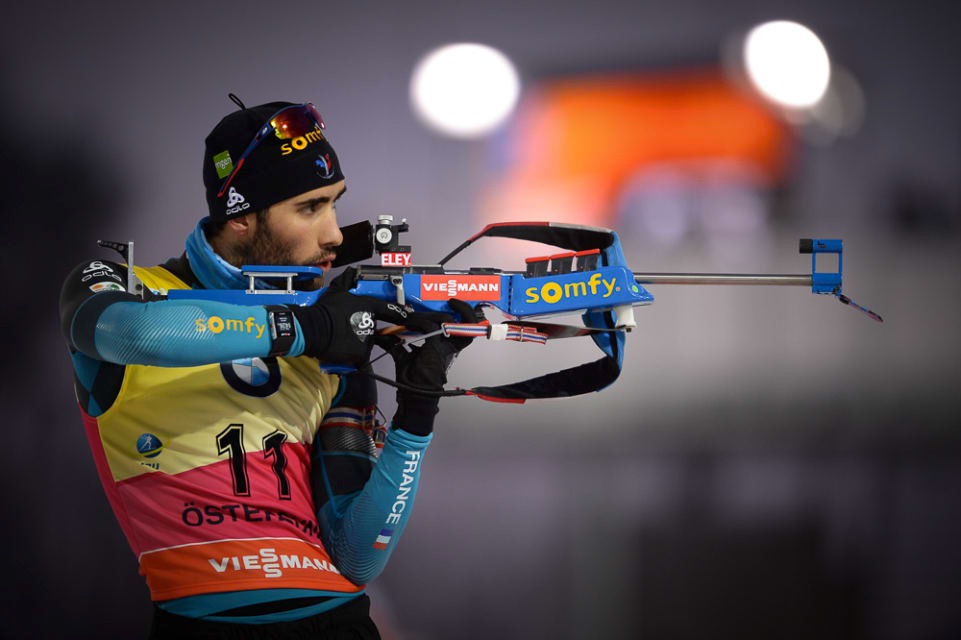
    France’s Martin Fourcade shooting in standing, on his way to winning the men’s first IBU World Cup sprint of the season on Saturday in Östersund, Sweden. (Photo: IBU)
    France’s Martin Fourcade shooting in standing, on his way to winning the men’s first IBU World Cup sprint of the season on Saturday in Östersund, Sweden. (Photo: IBU)

    Just like in the women’s sprint earlier on Saturday, drastically improved wind conditions compared to earlier in the week at the International Biathlon Union’s (IBU) World Cup in Östersund, Sweden, required the athletes to shoot extremely well if they wanted to have a place on the podium in the men’s 10-kilometer sprint on Saturday.

    France’s Martin Fourcade again did it the best, shooting clean in the two stages and skiing just as fast as all week to cross the line in a time of 23:31.9 minutes, adding his 51st victory to his records right after he achieved the big milestone of 50 wins in the individual race on Wednesday.

    Despite starting early in bib 11, Fourcade knew no other athlete was likely to beat him in his current race shape when he manages to shoot no penalties, celebrating with both arms raised high as he crossed the line. And he immediately set his sight on another goal: winning three races in a row, four if you count his win in the single mixed relay.

    “It is much harder than it looks on TV,” Fourcade told German broadcaster ARD when asked about his frequent victories. “I don’t have a secret. It is very difficult for my body and for my mind. … I don’t want anybody to understand it the wrong way, but yesterday I knew I will win today … I didn’t dream it, I wasn’t sure. But I had to win. The last six years I always won two races here in Östersund. Maybe I can win the third race [this year]. But it will be tough. I have no more energy left. I am feeling empty.”

    “Conditions today were very different [from the individual race],” he later explained during the IBU press conference. “It was much more difficult for the athletes to reach a good speed. … But my shoot[ing] today was perfect, and it wasn’t in the individual, so I am a bit more satisfied today. … I try not to think about my opponents during competition. I am really focused on what I have to do. Today was a big battle against myself, and I am satisfied that I won.”

    Germany’s Arnd Peiffer had posted the first significant lead. Then he was replaced at the top by Fourcade, and still had to wait in the finish pen for his teammate Benedikt Doll, who had missed a shot in the standing stage but was faster than Peiffer on the course. In the end, Doll crossed the line a mere 0.5 seconds behind him.

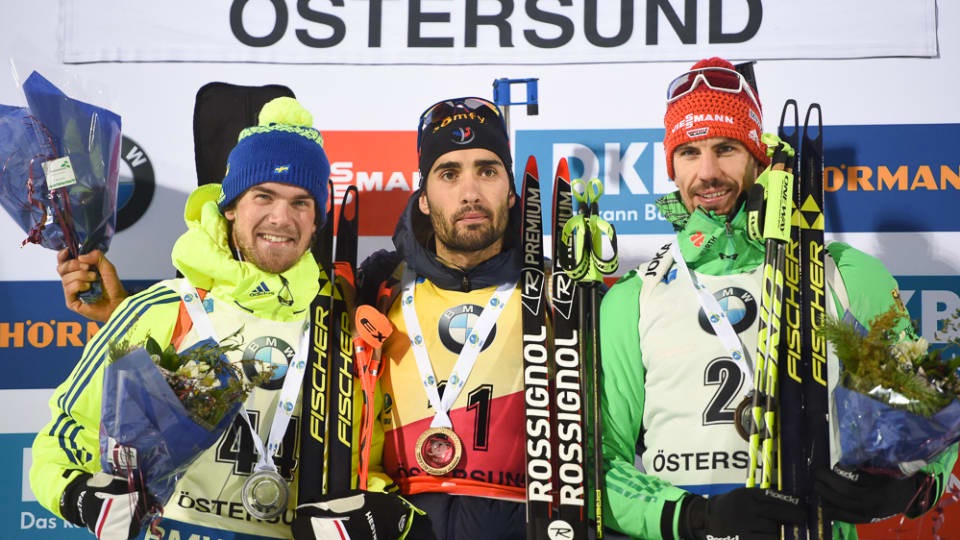
    The men's sprint podium at the IBU World Cup in Östersund, Sweden. From left to right: Sweden’s Fredrik Lindström in second, France’s Martin Fourcade in first, and Germany’s Arnd Peiffer in third. (Photo: IBU)
    The men’s sprint podium at the IBU World Cup in Östersund, Sweden. From left to right: Sweden’s Fredrik Lindström in second, France’s Martin Fourcade in first, and Germany’s Arnd Peiffer in third. (Photo: IBU)

    When the race already looked like the podium was divided between those three, Sweden’s Fredrik Lindström became another athlete to shoot clean and ski fast (0+0). He went out on the final lap in third place, coming onto the finish stretch to huge cheers from the home crowd audience in Östersund when he still managed to beat Peiffer by two seconds for second place (+41.5), bumping Peiffer to third (0+0, +43.6).

    “He deserved it, didn’t he?” Peiffer exclaimed, who had just been waiting in the mixed zone for his post-race interview with broadcaster ARD when Lindstroem came to the finish. “First of all I am happy that it worked out so well for me today. And if I stand on the podium in the end, I absolutely can’t complain.”

    (“My individual was not so good,” Peiffer added during the press conference. “So I am really satisfied about this result today. I had an early number, so I didn’t know about anything that happened and just tried to make a good race… Today I shot clean, and that’s always what we try to do.”)

    “Today was really great,” an excited Lindström commented on his race during the press conference. “The shooting was perfect. The conditions were much better than in the individual race. I don’t think I was the fastest athlete on the range, but I was really focused, I really wanted to hit them all … I had a lot of family and friends in the stands, and they helped me.”

    “Last season was a real struggle,” he added. “The last competition was my only top ten result. This year I start with two top tens, so I am really happy with the start… Our whole team has had a great start, on the women’s side and now also for me.”

    Peiffer’s teammate Doll was not so amused to still lose his seemingly secure third place to finish fourth (0+1, +44.1).

    “I’m a little annoyed, I would have liked to stand on the podium,” Doll told ARD. “It looked good for a while. The 0.5 seconds to Arnd [Peiffer] don’t hurt so much, but I would have liked to not have Fredrik [Lindström] ahead of me.”

    Austria’s Julian Eberhard finished fifth despite two penalties (1+1, +46.0), narrowly beating Fourcade by 0.7 seconds for the fastest course time.

    “Today I was at my limit and got out one-hundred percent in both my shooting and course times,” Eberhard said in a press release by the Austrian Ski Association. “Unfortunately the two misses happened, but I had to take some risk and knew that a lot was still possible. I had great skis and gave it my all on the final lap.”

    Five North American Men Qualify for Pursuit

    Lowell Bailey achieved the best result of the North Americans on Saturday. He managed to shoot clean and skied the 28th-fastest course time, ultimately finishing 13th (+58.7), 1.4 seconds out of the top 10.

    Lowell Bailey (US Biathlon) racing to 13th in the first sprint of the season on Saturday at the IBU World Cup in Östersund, Sweden. (Photo: USBA/NordicFocus)
    Lowell Bailey (US Biathlon) racing to 13th in the first sprint of the season on Saturday at the IBU World Cup in Östersund, Sweden. (Photo: USBA/NordicFocus)

    “It was an exciting race today,” Bailey commented, according to a US Biathlon press release. “It is unbelievable how competitive this men’s field is this year. I felt good about the race today, but it wasn’t quite enough to stay in the top ten.”

    “The conditions were much better today,” he wrote in an email to FasterSkier. “Virtually no wind and a little bit of fresh snow to make the tracks a little less icy. I felt good about both the skiing and shooting today.  All in all, I’m happy with the first races and looking forward to the pursuit tomorrow.”

    About 30 seconds behind Bailey, his teammate Tim Burke placed 29th (+1:28.0) after shooting one miss in the standing position (0+1).

    In his first weekend on the World Cup circuit since the 2014/2015 season, the third starter Russell Currier placed 69th (+2:42.9) with three penalties (2+1), missing out on the top 60 qualification for the pursuit by about 20 seconds.

    Biathlon Canada’s Brendan Green led his team in 32nd (+1:39.1), incurring one penalty in the prone shooting stage (1+0).

    Scott Gow shot clean, but skied the 86th-ranked course time, putting him in 50th (+2:14.8). Similarly, Macx Davies also shot clean and skied a bit faster than Gow, but required more time on the range to land his shots, especially in the standing stage where he was the 99th-ranked athlete, ultimately finishing 52nd (0+0, +2:17.6).

    Rounding out the results for Canada, Christian Gow finished 90th (0+2, +3:29.3) and Nathan Smith 96th (1+2, +4:12.2) with the 102nd course time, far below his usual ability.

    The times back to the winner from Saturday’s sprint carry over into the pursuit race on Sunday.

    “I think it will be big action tomorrow”, Germany’s Peiffer commented during the press conference. “After Martin there is a gap and then it’s really close.”

    “Martin is from another planet, he is far ahead of us,” Lindström agreed. “But it looks like it will be a tough fight for place two and three.”

    “That’s the worst thing you can do in biathlon”, Fourcade cautioned when asked about his lead going into the pursuit race. “When you think you have a two-bullet margin, on the next shoot[ing] you miss three. … I wonder if I can win three times in a row in Östersund. I never did it. So I await the answer tomorrow.”
    “The nice thing is that the pursuit will be incredibly close at the top of the race tomorrow, and this means there will be a lot of ‘pack’ skiing, which I like,” said Bailey, who will start fewer than 10 seconds out of sixth. “I’m looking forward to tomorrow’s pursuit … should be a fun race.”

    Results | Pursuit start list

  • Watch Out for France: Braisaz, Fourcade and Teammates Dominate Sjusjøen Biathlon Opener

    Watch Out for France: Braisaz, Fourcade and Teammates Dominate Sjusjøen Biathlon Opener

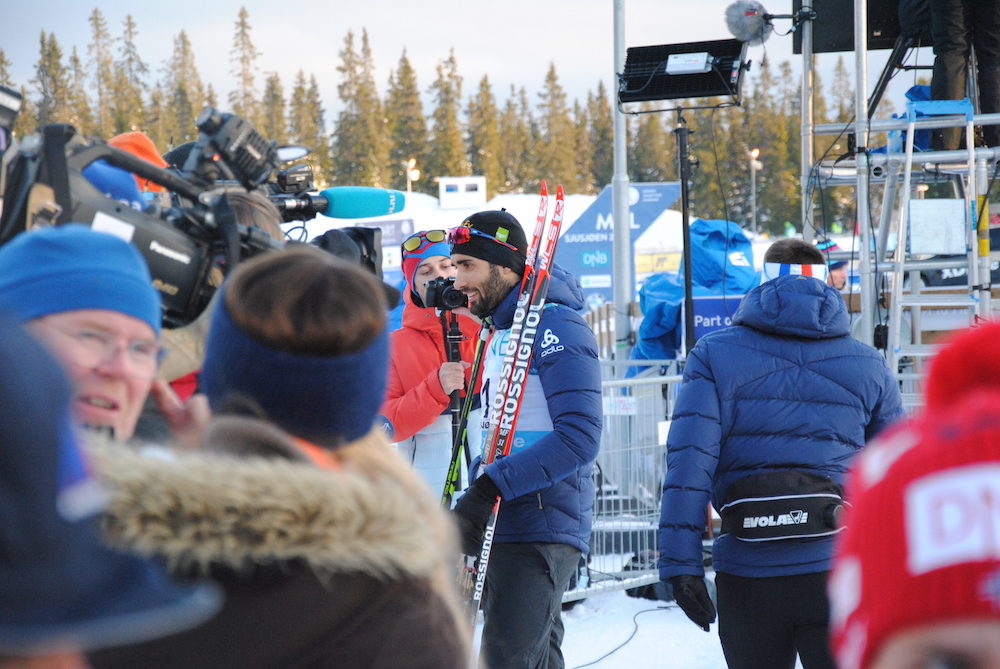
    Martin Fourcade of France prepares to take the podium after his win in the 10 k sprint in Sjusjøen, Norway.
    Martin Fourcade of France prepares to take the podium after his win in the 10 k sprint in Sjusjøen, Norway.

    SJUSJØEN, Norway — Twenty-year-old Justine Braisaz, of France, won the biathlon season opener on Saturday in Sjusjøen, 23.1 seconds in front of Norwegian Tiril Eckhoff and 36.6 second ahead of Ukrainian Juliya Dzhima. The young French woman shot down 10 out 10 targets and skated equally fast throughout the 7.5-kilometer sprint. Eckhoff missed once during prone and once standing while Dzhima missed her second shot standing.

    The fourth place finisher, France’s Celia Aymonier, finished 56.3 seconds off of Braisaz’s winning time, while Norwegian Fanny Horn Birkeland was another 1.5 seconds back in fifth (+57.8).

    From the start, the podium appeared to be a competition among Braisaz, Eckhoff and Dzhima.

    In her finish-line interview, Braisaz said, “I am happy about the result, and even though I hit every target today, the shooting is something I have to work on because it is not my strong suit. But it was a good day.”

    Before the race, Erlend Slokvik, president of the Norwegian Biathlon Association told FasterSkier that he thought Eckhoff was the likeliest candidate for the top of the podium, and throughout the race the crowd seemed to agree with him. The 26-year-old Eckhoff received loud cheers for her 8-of-10 shooting.

    After the race, the finish-line interviewer asked Braisaz if she thought she’d be dangerous this season.

    Tiril Eckhoff of Norway on her way through the stadium on her way to second place in the 7.5 k sprint in Sjusjøen, Norway.
    Tiril Eckhoff of Norway on her way through the stadium on her way to second place in the 7.5 k sprint in Sjusjøen, Norway.

    “Yes I think so, I hope so,” she replied.

    When asked by NRK during the post-race press conference what she thought about her victory Braisaz said, “I didn’t expect it, and I really don’t know how it happened.

    “I have worked hard over the summer with my technique and shooting and it’s reassuring to be in good shape today.” she continued. “I had to focus on what I could do because Eckhoff and Dzhima were very strong.”

    Asked what her goals are for the season, Braisaz said she has no specific goals, but she hopes to be “in shape for the World Championship.”

    Also at the press conference, Eckhoff was asked how she felt about her race.

    “I’m glad to have started the season, and I feel like I’m in good shape and that I am strong, but I may have started a little too quickly,” she said.

    As for her shooting: “I’m happy about the standing, but I used a little too much time during the prone so the focus from now on will be to systemize the shooting so I can do it faster and better,” she said.

    Third-place finisher Dzhima said after the race that she was happy about being in good shape, but she wasn’t happy with 90-percent shooting.

    “I’m not happy about missing one target, I wanted to hit all ten, but luckily it’s early in the season,” the 26-year-old told FasterSkier through a translator.

    Fourcade Leads Five Frenchman in Top 6

    In the men’s 10 k sprint, Martin Fourcade took charge from the start. The five-time World Cup overall champion hit all his targets and skated the track equally well. No other biathlete could match Fourcade’s performance and the closest was Norwegian Johannes Thingnes Bø, who finished 12.9 seconds behind him with perfect shooting.

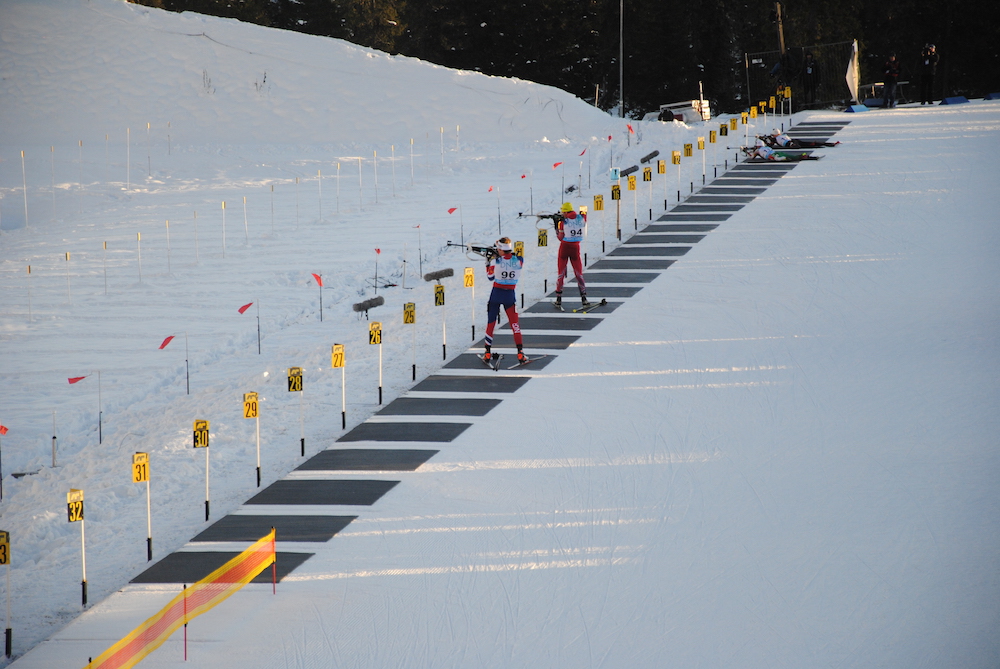
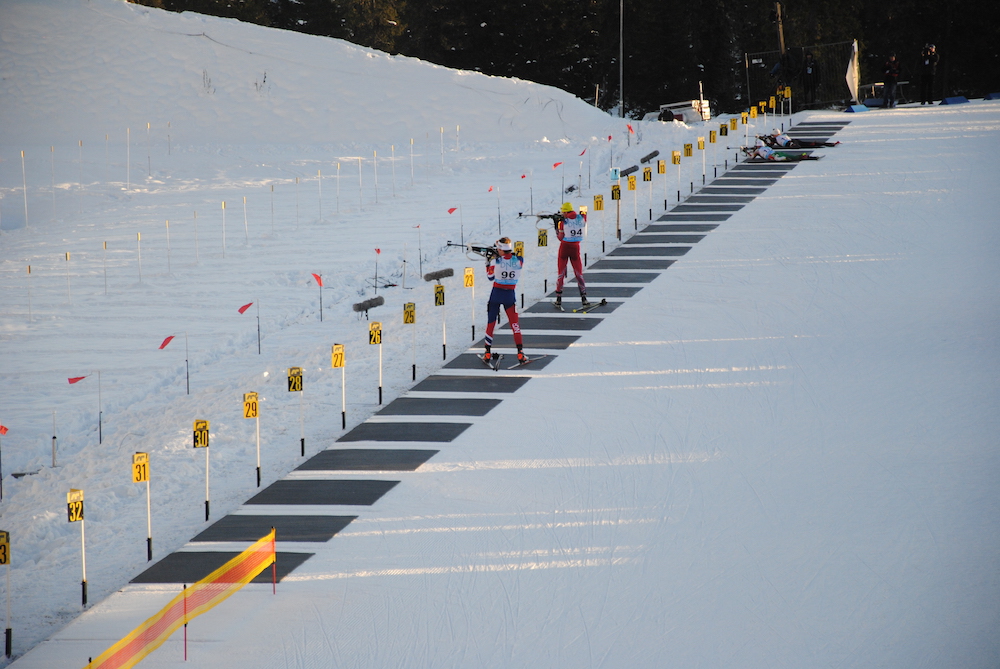
    Norwegians Thomas Fenne (bib 94) and Emil Hegle Svendsen (bib 96) on the shooting range in the 10 k sprint in Sjusjøen.
    Norwegians Thomas Fenne (bib 94) and Emil Hegle Svendsen (bib 96) on the shooting range in the 10 k sprint in Sjusjøen.

    “I am happy about the result, but I am not in that good shape so today was a very good day,” Fourcade told L’equipe after the race.

    And indeed it was for the French team. Five out of the top six men’s finishers were French. Fabien Claude placed third (+31.7), Quentin Fillon Maillet was fourth (+59.3), Jean-Guillaume Béatrix was fifth (+1:05.7) and Simon Desthieux was sixth (+1:07). The only miss among these five came from Desthieux, who missed once in his standing shooting.

    Norwegian TV2 called the French team’s performance a “frightening shot for the Norwegian biathletes”.

    In the post-race press conference, Fourcade said he was “satisfied with the result. It was not my best performance, but for November this is good.”

    Asked about the performance of his team, he said, “It means a lot. It pushes me in training and I have to work really hard to stay ahead of my team, so it’s good.”

    Fourcade pointed to World Championships as his goal for the season, but he’s also focused on the World Cup.  “I want to be as good as possible all season,” he said.

    Up until the second shooting, it looked like Johannes Bø could potentially threaten Fourcade’s place on the podium, but the final lap of skiing became too tough for Bø.

    “I’m happy about the race, it was a good performance,” he told FasterSkier. “I skied well, but I feel like I can do better than I did today, but I started feeling it in the second lap and third was painful and I was happy to finish.”

    Asked how he felt about his 10-for-10 shooting, he said, “I’m very happy and I feel confident about it. We’ve focused more on shooting in training this season and it seems to have paid off.”

    Third-place finisher Claude, who, at 21, has never raced a World Cup but has made it to four Youth/Junior World Championships, said that he was happy about his performance.

    “I am really happy and satisfied with my race, my preparations have been great and the conditions today were great so I’m really happy,” he told FasterSkier. “And zero misses is not common for me so that is something I will take with me into the season.”

    His main goal for the season? To reach the World Cup, he said.

    Eight-time Olympic gold medalist Ole Einar Bjørndalen finished ninth, 1:33.9 minutes behind Fourcade. After the race, the 42-year-old Norwegian told FasterSkier, “This was no super race but I shot well and I skied as fast as I had planned. The fact that I am that far behind Fourcade is not something I worry about this early in the season.”

    Results: Women | Men

  • Burke Secures Season-Best Sixth in Khanty; Best-Ever Sixth for U.S. in Nation Cup

    Burke Secures Season-Best Sixth in Khanty; Best-Ever Sixth for U.S. in Nation Cup

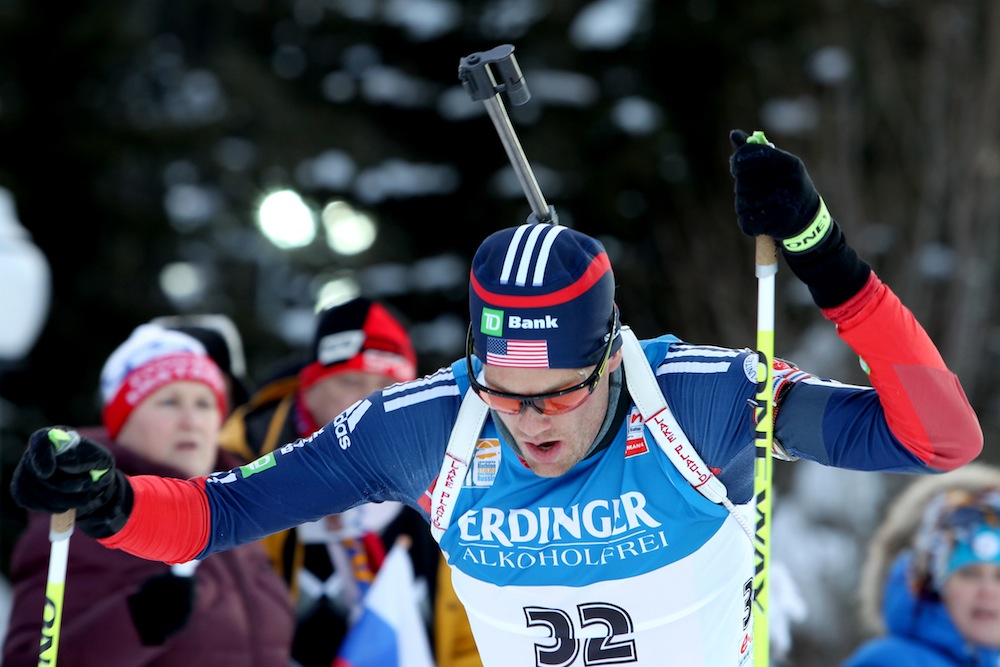
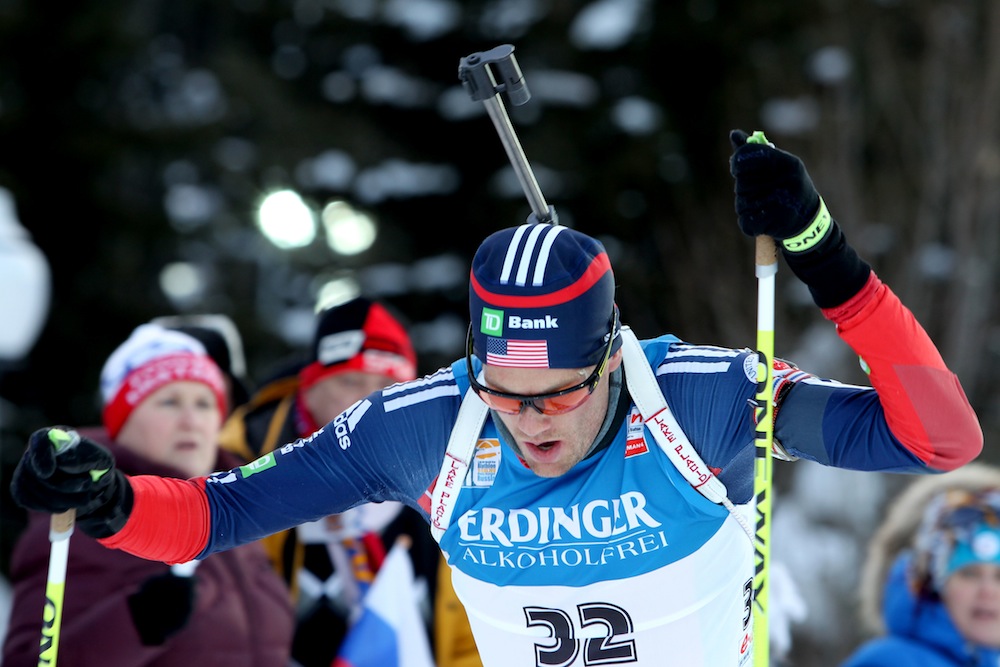
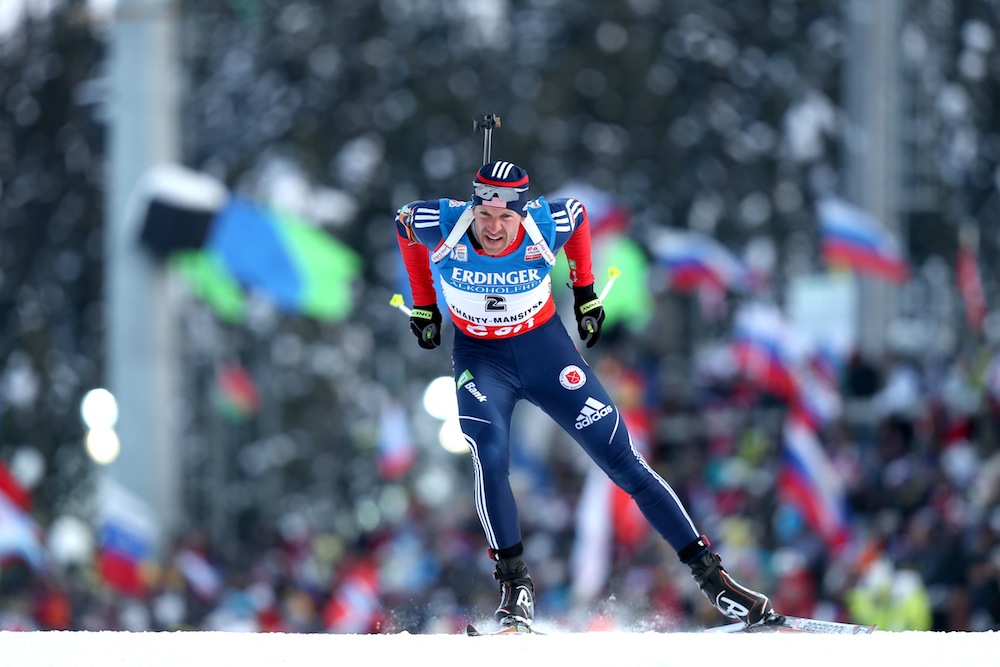
    Tim Burke racing to a season-best sixth in the men's 10 k sprint on Friday at the IBU World Cup in Khanty-Mansiysk, Russia. (Photo: US Biathlon/Twitter)
    Tim Burke racing to a season-best sixth in the men’s 10 k sprint on Friday at the IBU World Cup in Khanty-Mansiysk, Russia. (Photo: US Biathlon/Twitter)

    Ask any athlete competing in Khanty-Mansiysk, Russia, and they’ll likely tell you it’s hard to focus. Sure, there’s the Siberian sunset — a breathtaking backdrop to the final IBU World Cup races of the season. But then there’s the fact that these are the last races of the season, and they come at the end of a long haul of nine World Cups and a World Championships.

    “I have been fighting really hard to stay focused,” American Tim Burke wrote in an email after Friday’s 10-kilometer sprint. “Because I have to admit, it is easy to start focusing more on returning home then racing at this time of year.”

    He wasn’t alone.

    “I am noticing that the tension [focus] is a bit gone after the World Championships,” Austria’s Dominik Landertinger told Austria’s ORF. “But I managed to completely focus on the competition today.”

    Austria's Julian Eberhard celebrating his first IBU World Cup win (and podium) on Friday in Khanty-Mansiysk, Russia. (Photo: Evgeniy Tumashov/NordicFocus)
    Austria’s Julian Eberhard celebrating his first IBU World Cup win (and podium) on Friday in Khanty-Mansiysk, Russia. (Photo: IBU/Evgeniy Tumashov)

    While Landertinger ultimately finished fourth with clean shooting, and Burke placed sixth for a season best with a single standing penalty, Friday’s victory went to Julian Eberhard — the first Austrian to win a sprint in 15 years.

    “After the World Championships that were disappointing for me, I didn’t have anything to lose today and just put all my eggs in one basket,” Eberhard, 29, told ORF. “I knew the shooting works, and just pulled through. I didn’t do anything differently on the shooting range than usual, I just worked off what I can do. On the course it then was hard work. But there I could rely on my qualities [abilities]. Also the equipment was great.”

    Like the rest of the top-five finishers, Eberhard cleaned the two-stage race. He also skied the second-fastest course time to clinch the win. After starting 40th, Eberhard edged Germany’s Simon Schempp (in bib 21) by 1.1 seconds. On his 29th birthday, Germany’s Arnd Peiffer placed third, 23 seconds back.

    “I felt pretty good today, and here in Khanty I usually do,” Peiffer told Germany’s ZDF. “When I got through with zero-zero [clean shooting] I knew this could be a good result today. … At the end of the day, the procedure is the same. On a birthday, you have a few more phone calls than usual, with relatives and a few others. Of course it’s nice if everything works out on a day like this.”

    Schempp skied the fastest course time and topped his teammate Peiffer’s time by nearly 22 seconds at the finish. While it looked like a German 1-2 sweep, Eberhard came through and knocked them both down one step on the podium. With clean shooting, he led after both his first and second stages, leaving the range 1.9 seconds up on Schempp’s time with one loop to go.

    While Eberhard told reporters afterward that he was confident in his ability to reach the podium, Friday’s win was his first-career podium after placing fourth in the Canmore sprint earlier this season.

    “This year I had a very difficult season on the shooting range,” Eberhard told ZDF. “I knew that I was able to be in the mix on the course in every race, and today it worked out. So I am all the more elated.”

    For Schempp, who ranks fourth in the overall World Cup standings with two more individual races to go (Saturday’s pursuit and Sunday’s mass start), the goal for the overall podium remains.

    “… When you put on a race bib, I always want to be as far ahead as possible, no matter if it is a World Championship, a World Cup, or some other race,” he told ZDF. “Today I just wanted to achieve my optimum again, and I think that worked out very well, and I can live very well with that. I hope the next two days will be just like this one.”

    France’s Martin Fourcade has a lock on the World Cup overall by an insurmountable 367 points, while Russia’s Anton Shipulin is currently second, just 19 points ahead of Norway’s Johannes Thingnes Bø in third, and Schempp is another 57 points behind Bø in fourth.

    On Friday, Fourcade placed 40th with an uncharacteristic four penalties — three prone and one standing — on an essentially wind-free evening with steady snowfall.

    “Today was not my day. I don’t know, I felt good on the skis and I felt motivated, in spite of the [overall World Cup] Globe already done,” Fourcade told ZDF. “I need to analyze my prone shooting, it’s where I did bad today, but honestly I was really focused on my competition, and it was not because of a lack of motivation. I can’t say why I was bad today, but yeah, I’ll try to do better in the mass start. I think I will not compete in the pursuit.”

    Shipulin placed even farther back in 45th with just one standing miss but the 60th-ranked course time of 84 finishers. No Russians placed in the top 20 at their home World Cup.

    Then there was Burke — the best finisher with a miss in sixth. He finished 52.6 seconds out of first with the fifth-fastest course time. Ahead of him, Landertinger placed fourth (+28.2) and Germany’s Erik Lesser was fifth (+38.1). Bø finished about 10 seconds behind Burke in seventh.

    “I knew there would be a lot of physically and mentally tired athletes here, so I looked at this world cup as a great opportunity,” Burke explained.

    “This World Cup definitely has a more relaxed feel coming after World Champs,” he wrote. “I knew that I was still in good shape after World Champs and I really wanted to perform here in Russia.”

    Earlier this month at World Championships in Olso, Norway, Burke placed 14th in the sprint and 12th in the mass start for his two best individual results at the championships.

    “I went out hard from the start today and just tried to hold on,” he wrote on Friday. “I was a little nervous at about 5k that I had started too aggressive but it worked out in the end.”

    The fourth starter, Burke initially finished second to Landertinger in bib 3. After a clean prone, his time leaving the range for the second loop held up as fifth fastest overall. And after his standing penalty, his time ranked ninth overall leaving the range for the last time.

    “Of course I am happy with my 6th place but I always want more!” Burke added.

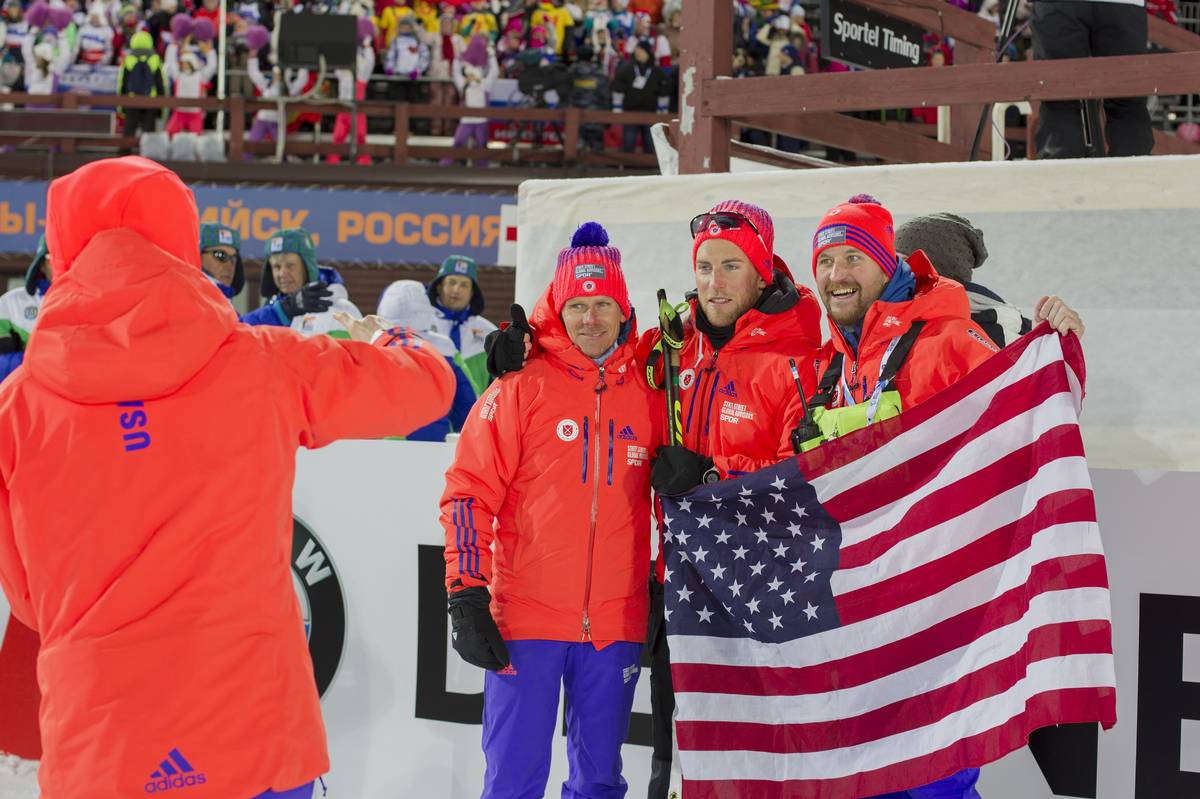
    The US Biathlon coaching staff, including development coach Jean Paquet (l), poses for a photo following the men's sprint in Khanty-Mansiysk, Russia. (Photo: USBA/NordicFocus)
    The US Biathlon coaching staff, including development coach Jean Paquet (l), poses for a photo following the men’s sprint in Khanty-Mansiysk, Russia. (Photo: USBA/NordicFocus)

    All three Americans qualified for the pursuit, with Sean Doherty finishing 21st (+1:38.3) with two prone misses and Lowell Bailey in 31st (+1:55.4) with one penalty in each stage.

    “I was a bit disappointed with the prone misses but I felt great on the skis and I kept the focus up,” Doherty told US Biathlon. “It was a good overall race and I am excited for the pursuit.”

    Above all, the U.S. men’s team clinched a best-ever sixth in the Nation Cup.

    “Today was also a great day for the team, as we secured 6th place in the men’s Nation Cup score,” Burke wrote. “This is a best ever for this team and we are all very excited about that.  We have come a long way since my start on the World Cup!

    “Our ski technicians also did an amazing job today,” the 34-year-old New York native added. “The conditions are really tricky here with slow, dirty snow and some of the big teams struggled. We only have three technicians here but the nailed it today and I am confident that we were on the best skis.”

    “Congrats to my teammates, coaches, and staff,” Bailey said in the press release. “It takes a lot of support just to get to the start line at a World Cup, let alone compete with some of the best teams in the world.”

    Brendan Green was the top Canadian in 42nd (+2:08.1) with two standing penalties. Macx Davies placed 73rd with three misses (1+2), Scott Gow was 76th with five penalties (2+3) and Nathan Smith did not start. Last Saturday, Green, Smith, Gow and Gow’s younger brother Christian teamed up for bronze in the men’s relay at World Championships.

    The women’s and men’s pursuits take place Saturday at 7:50 a.m. and 9:30 a.m. Eastern time, respectively, and can be watched live online at Eurovision.

    Results | World Cup standings | Nation Cup final standings

  • Numb Fingers and All, J.T. Bø Wins in Presque Isle; Doherty Nabs Career Best 13th

    Numb Fingers and All, J.T. Bø Wins in Presque Isle; Doherty Nabs Career Best 13th

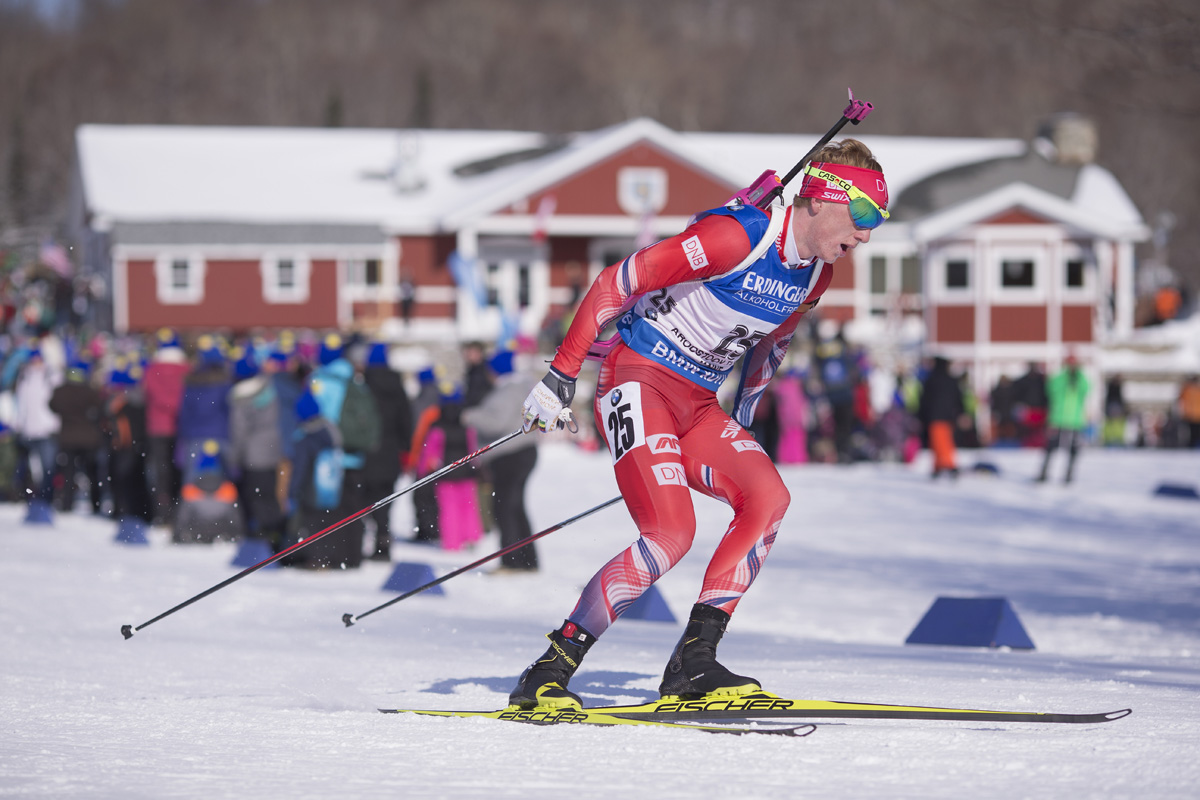
    Norway's Johannes Thingnes Boe racing to a 28-second win in the IBU World Cup men's 10 k sprint on Thursday in Presque Isle, Maine. (Photo: Fischer/NordicFocus)
    Norway’s Johannes Thingnes Bø racing to a 28-second win in the IBU World Cup men’s 10 k sprint on Thursday in Presque Isle, Maine. (Photo: Fischer/NordicFocus)

    After skipping the last tour stop in Canmore, Alberta, Norway’s Johannes Thingnes Bø returned to the International Biathlon Union (IBU) World Cup with a bang, winning the men’s 10-kilometer sprint on Thursday morning in Presque Isle, Maine, in a time of 24:38.8, with no penalties. It was the first World Cup race in the U.S. in five years.

    “It’s never easy, but today I felt I had control,” Bø told the IBU in a post-race interview. “I was calm before the race, and also on the shooting range. I tried to do it like in training.”

    The defending 2015 world champion in the sprint is now heading into the 2016 World Championships at home in Oslo, Norway, with a victory in the same discipline.

    “It looks like it has been good for me, but who knows,” he said at the press conference on his decision to not make the long trip to Canmore, Alberta, last week for the previous World Cup. Instead, he trained for Oslo.

    Asked why eight of his 10 World Cup victories came in sprints, Bø replied, “Maybe it’s because shooting is my weakness, and in the sprint there is only two [stages]. So there is a bigger chance for me to not miss so much.”

    He achieved his clean shooting despite losing feeling in his fingers on the first loop due to the cold weather and his fairly thin gloves, he told Norwegian broadcaster NRK.

    “Without feeling I had to focus extra hard on the innermost black spot, maybe that was the thing that made it go so well,” Bø said according to a translation.

    Starting very early with bib 3, France’s Martin Fourcade had one miss in the standing stage and initially took a 38-second lead at the finish (over Norway’s second starter Erlend Bjøntegaard) thanks to Fourcade’s fast skiing, with the eventual overall fastest course time.

    After changing into dry clothes and waiting in the finish pen for a few minutes, Fourcade was passed by Russia’s Anton Shipulin, who started behind him in bib 16 and had two clean shooting stages. The Russian lost time to Fourcade on the final loop, but by the finish, Shipulin, who ranks second in the overall World Cup, had preserved a 1-second lead over Fourcade — the World Cup leader.

    “I have competed here 10 years ago at the Junior World Championships,” Shipulin said at the press conference through a translator. “So I know the tracks, and they are quite good.”

    Shipulin ended up second when Bø, the 25th starter, barreled through the finish 27.9 seconds faster, with both clean shooting and the second-fastest overall course time. That moved Fourcade into third (+28.9) and the top-three stood through the remainder of the 88-man race.

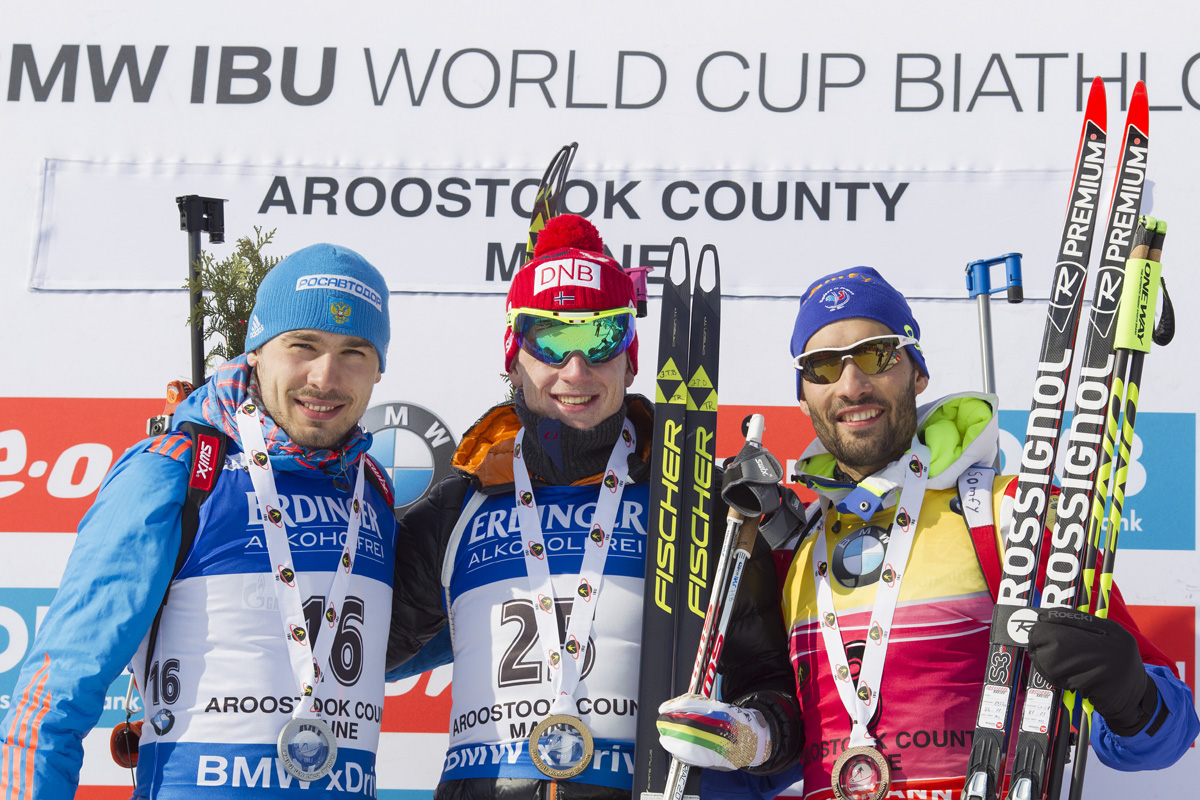
    The men's sprint podium at the IBU World Cup in Presque Isle, Maine, with Norwegian winner Johannes Thingnes Bø (c), Russia's Anthon Shipulin (l) in second, and France's Martin Fourcade (r) in third. (Photo: Fischer/NordicFocus)
    The men’s sprint podium at the IBU World Cup in Presque Isle, Maine, with Norwegian winner Johannes Thingnes Bø (c), Russia’s Anthon Shipulin (l) in second, and France’s Martin Fourcade (r) in third. (Photo: Fischer/NordicFocus)

    “Of course I am happy and satisfied with the race today,” Shipulin said. “I wasn’t as fast as those two guys on the track. But I did clean shooting, and the result was good … I hope I will get better for the World Championships.”

    “My shape was really good today … The shooting range is not as easy as we thought,” Fourcade said at the press conference. “No wind today so that was good.”

    “But I really was surprised by the sun; I think it was too much sunshine for my little blue eyes,” the brown-eyed Fourcade joked. “I had real difficulties on the shooting range. That is why I needed so much time in the standing shooting.”

    Bø posted the best times after the first and second shooting stages, where he hit every target, and extended his lead to the finish over Shipulin. Despite placing third, Fourcade slightly added to his commanding World Cup lead, with 857 points to Shipulin’s 646.

    “Johannes was simply a better biathlete today,” Fourcade said. “He shot clean, he shot fast, and [me and Shipulin] both know he will be one to beat for the World Champs.”

    As the race progressed, Germany’s Erik Lesser in bib 54 had the best chance to reach the podium, thanks to two clean shooting stages.

    He picked up speed throughout his three loops; after losing more than 20 seconds to Bø on each of the first two loops, he only lost 2 additional seconds on the last one. But overall, Lesser could not quite match the skiing performance of the top three and finished fourth, 45.9 behind Bø and 20 seconds off the podium.

    “I was very timid on the first round, somehow insecure,” Lesser told German TV broadcaster ARD. “I felt a little tired, so I wanted to rather push towards the end. … The shooting range is not easy, in standing I had to rebuild my stance. You really have to pay attention. Everything is possible in terms of advancing or falling back.”

    Behind Lesser, two Swiss athletes had their best results of the season, with Serafin Wiestner in fifth (+50.3) and Benjamin Weger (+52.5) in sixth place, both missing one shot in standing.

    For Wiestner, a border police officer, it was a new personal best after previously finishing 24th in a sprint in Ruhpolding, Germany, earlier this year.

    “We are really happy about this result,” Wiestner told the IBU. “The last weeks were not so good for us, for the whole team … It’s a really tricky course, but I like that.”

    I had a really bad season until now,“ Weger added. “Almost [all] just bad races. So I am very happy to be back in top 10 now, the first time this season. I hope to continue like that now.”

    Latvia’s Andrejs Rastorgujevs in seventh (+54.0) and Bø’s older brother, Tarjei, in eighth place (+58.9) also had just one penalty in standing, and stayed within one minute of Bø to achieve a good starting position for the pursuit on Friday.

    Doherty Leads Three Americans in Top 20; Canada’s Perras 48th

    American Sean Doherty returned to the World Cup on Thursday, in his first race since racking up three medals in as many races at Junior World Championships in Cheile Gradistei, Romania. At 20, he become the most decorated athlete in history of Youth/Junior World Championships in his final season as a junior.

    Starting in the middle of the field in bib 42, Doherty was the youngest competitor in the sprint. He shot clean in prone, and then missed one in standing, having to ski a penalty lap. The top North American, he ultimately placed 13th for his career-best World Cup result, 1:16.2 behind Bø.

    “My shooting today felt good, very in control,” Doherty, a New Hampshire native, wrote in an email. “The wind was manageable, it just came and went but was never too extreme. The range approach here is deceptively tough, and the wind conditions can be tricky but overall today was a good day on the range.

    “I am really looking forward to the pursuit,” he added.

    Lowell Bailey (US Biathlon) racing to 15th in the men's sprint at the IBU World Cup in Presque Isle, Maine. Bailey was one of three U.S. men in the top 20 on Thursday. (Photo: USBA/NordicFocus)
    Lowell Bailey (US Biathlon) racing to 15th in the men’s sprint at the IBU World Cup in Presque Isle, Maine. Bailey was one of three U.S. men in the top 20 on Thursday. (Photo: USBA/NordicFocus)

    Shortly behind, another American Lowell Bailey placed 15th (+1:22.4), also with a clean prone shooting and one penalty in standing.

    “The wind can definitely be a factor here as the venue sits on top of a plateau,” Bailey explained in an email. “But today, I think the biggest factor was the approach. It is one of the more difficult approaches [in the World Cup] and if you aren’t prepared for it, you will be surprised at the fact that you aren’t very recovered when you hit the mat.”

    Earlier this week, Bailey provided a unique view of the Presque Isle courses for the IBU in a first-person video, skiing through the men’s sprint loop, the arena and the penalty lap (coincidentally, Johannes Thingnes Bø passed Bailey in the penalty lap during the video).

    “A lot of transitions from downhills directly into steep uphills,” Bailey commented in the video. “So you have to be changing techniques all the time.”

    “The snow here is very cold,” he said of the conditions. “You can hear it, kind of squeaking like Styrofoam. That makes it interesting for waxing. We’ll be on very hard cold wax. Very fine stone grinds with the ski base.”

    In his email, he explained that the course was challenging, particularly with a “corkscrew” downhill section, with some ice beneath the snow. “You had to stay alert and react when your skis started to slip,” he wrote.

    “I felt like an alpine skier,” winner J.T. Bø joked about the course in an IBU interview. “You had to ski at the very edge of the skis. It was really hard, but it was cool.”

    “The two places are really different,” Fourcade said during the press conference, comparing Canmore with Presque Isle. “Canmore is huge mountains, and here we are more in the forest. I prefer the track here, but it’s hard to compare two sites.”

    Also for the U.S., Tim Burke started early bib 6, missed one target in each of his shooting stages, but finished 20th (+1:32.7) as the second-best athlete with two penalties.

    “I felt solid on the ski course today,” Burke wrote in an email. “It was not one of my best days, but I was able to keep a good pace for the entire race. This is an interesting course in that there are not really any big climbs, but on the other hand there is very little recovery because of the challenging downhills. This was my first time competing on this course and I really liked it.

    “My shooting felt decent today and the two misses were very close,” Burke continued. “But two misses is obviously too much for the sprint competition.”

    Leif Nordgren in bib 76 came in 65th (+3:02.6) with three penalties (2+1). Eleven seconds outside the top 60, he missed qualifying for Friday’s pursuit.

    “The men were just really consistent, everybody close together and just the whole field for the top athletes, so it puts them into a very good place looking ahead for tomorrow’s pursuit race,” US Biathlon coach Jonne Kähkönen said in a phone interview with FasterSkier. “Hopefully Susan’s podium will give them another push.”

    After the men’s race on Thursday, Susan Dunklee raced to second place in the women’s 10 k sprint to tie the best-ever result by a U.S. biathlete, male or female.

    Canada brought some of its developmental team to Presque Isle, with the athletes prequalified for the World Championships in Oslo skipping the races and continuing to train at home in Canmore.

    Originally Nathan Smith had planned to keep competing in Presque Isle, partly in order to defend his top 20 in the overall World Cup (he was 19th after the Canmore World Cup).

    “It was a really last minute decision. I literally had my stuff packed and ready to load into the team van,” Smith told FasterSkier in an email. “I was already somewhat uncertain about going because my skiing has been lackluster the last few weeks. When I saw how potentially cold it could be [in Presque Isle] I decided that perhaps I should stay in Canmore to get some rest and refocus after a very demanding month of racing, travel, and all the extra energy spent at a home world cup. I’ll be cheering the team on from the comfort of my living room.”

    Asked how he thought that might affect his place in the standings, he guessed it would drop him just outside the top 20.

    “I was hoping to be near top 10 by this point but unfortunately I didnt make so many points the last 2 world cups,” Smith wrote. “I think it’s better for me to try and perform my best … at world champs instead of chasing points to try and stay around 15th to 20th.”

    Without the usual starters, Scott Perras achieved the best result for the Canadian men in the sprint on Thursday, finishing 48th (+2:36.0), with one penalty in both prone and standing, and qualified for the pursuit on Friday.

    “Shooting was ok, I was a bit tight for prone but it was fine,” Perras wrote in an email. “Presque Isle can be pretty windy, today was just a slight breeze, almost perfect!

    “Skiing felt ok, I expected to feel a little better for sure,” he added. “[The] course is fun, what makes it difficult is the fact that you climb for a couple minutes before you get to the biggest climb on the course. That and the fact there isn’t much time ever spent in a downhill tuck.”

    In their first World Cup races of the season, Canada’s 21-year-old Carsen Campbell finished 78th (+3:45.9) with one penalty, Matthew Neumann, 26, was 82nd (+4:16.6) with three misses (1+2), and Matthew Hudec, 21, finished 88th (+5:18.6) with two penalties (1+1).

    Every Course is Different

    The World Cup returned to the U.S. and the Nordic Heritage Center in Presque Isle for the first time in five years since February 2011, when the World Cup also included races in Fort Kent, Maine. Back then, Fourcade placed second in the sprint to Germany’s Arnd Peiffer, who finished ninth on Thursday (+1:06.4) with one penalty.

    Most athletes commented positively on the challenging course and arena, though some pointed out a few unusual details, mainly a utility building in the middle of the penalty lap making it difficult to see the competition.

    “It’s pretty far around that little house, at least it feels that way,” Peiffer told German TV broadcaster ARD after the race, when asked about his penalty lap.

    According to ARD’s play-by-play announcer, organizers recently measured the loop out at 155 meters, 5 meters longer than the IBU norm, but still well within the standards.

    “Yes, it does feel long,” Bailey agreed in his email.

    “The penalty loop definitely felt long to me but I’m sure they have measured it,” Tim Burke wrote in his email. “I think it’s just the fact that you can’t see through it, that makes it feel so long. That will be an interesting factor for the pursuit because you won’t be able to judge how many athletes are in the penalty loop.”

    In contrast to that, Perras even observed some positive elements: “I don’t think the penalty loop feels any bigger, it actually skis quite well. Some penalty loops have really tight corners and you can’t really ski through the corners at all, you are almost skidding. And here there are fans in the penalty loop, how do you compete with that.”

    Germany’s Lesser also noted in his interview with ARD that the shooting mats felt uneven, giving him slight problems to find his stance.

    “I also felt that the shooting range mats slope towards the targets,” Burke agreed. “This is very unusual and hopefully they can fix this for the remaining competitions.”

    “The shooting mats do seem to slope awkwardly,” Perras wrote. “Honestly I’ve seen this at a few ranges throughout the world. No two ranges are the same and I try to just focus on the target, besides my legs aren’t even the exact same length so don’t take my word for it.”

    While not featuring quite as many people in attendance as some of the huge venues in Europe who are always on the World Cup competition calendar, there was still a good atmosphere at the Nordic Heritage Center on a weekday and in sunny weather. International athletes such as Germany’s Peiffer appreciated the support they received from the U.S. fans, many of them schoolchildren with rows of classes that had “adopted” different nations such as Germany, Italy, or even the small contingent from Romania, waiving flags and loudly cheering for the athletes.

    “Those kids probably got a day off from school to come here,” Peiffer told ARD with a laugh. “But that at least means there is something going on [in the arena]. And they are cheering very enthusiastically, and the same for everyone. A very fair audience.”

    “There is a lot of school kids here today and I hope they get inspired,” American Susan Dunklee told ARD in an interview after her race. “It’s a really great sport, and I think Americans haven’t fully discovered it yet.”

    The World Cup in Presque Isle continues with pursuits on Friday and the men’s relay on Saturday and women’s relay on Sunday.

    Results | Pursuit start list

  • Bø Brothers Lead Norwegian Sweep; Canada’s Christian Gow Gets Career Best After Rib Injury

    Bø Brothers Lead Norwegian Sweep; Canada’s Christian Gow Gets Career Best After Rib Injury

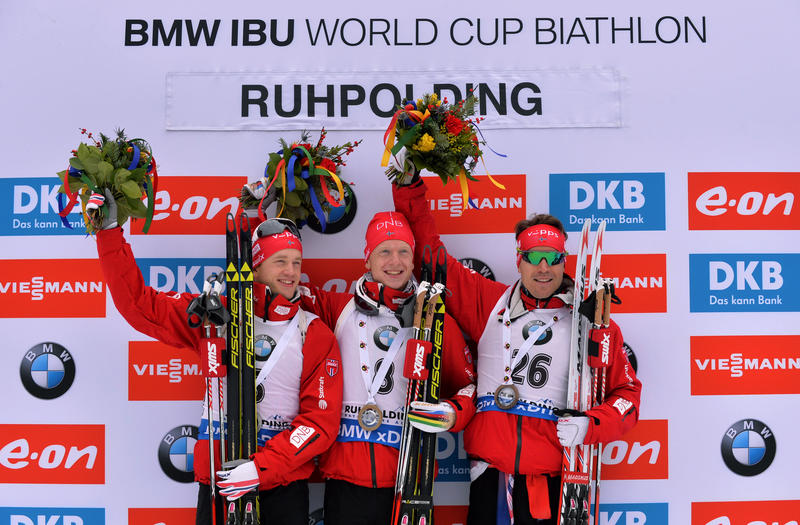
    The all-Norwegian podium in the men's 10 k sprint on Friday at the IBU World Cup in Ruhpolding, Germany: with winner Johannes Thingnes Bø (c), brother Tarjei Bø (l) in second, and Emil Hegle Svendsen (r) in third. (Photo: IBU/Eberhard Thonfeld)
    The all-Norwegian podium in the men’s 10 k sprint on Friday at the IBU World Cup in Ruhpolding, Germany: with winner Johannes Thingnes Bø (c), brother Tarjei Bø (l) in second, and Emil Hegle Svendsen (r) in third. (Photo: IBU/Eberhard Thonfeld)

    The Norwegian biathlon team must have used the holiday break well, as evidenced by their men’s podium sweep in Friday’s 10-kilometer sprint in Ruhpolding, Germany, the first IBU World Cup of the new year.

    Twenty-two-year-old Johannes Thingnes Bø started early in bib 8 and won the race in 21:57.5 minutes, supplanting his brother Tarjei, six years his elder, by 3 seconds after Tarjei started three positions earlier and held the lead until then.

    No other athlete could beat the Bø brothers. Emil Hegle Svendsen in bib 26 completed the podium sweep for Norway, finishing 7.6 seconds back in third. The last time Norway took all of the top-three spots was eight years ago during the 2007/2008 season at a sprint in Hochfilzen, Austria.

    Johannes Bø also won last season’s sprint in Ruhpolding, thus repeating the feat after a slow start to the season — by his standards.

    On a sunny day with essentially no wind on the shooting range, and skiing on an artificial snow loop that had become firmer overnight due to light rain, the Bø brothers and Svendsen all shot clean through both stages.

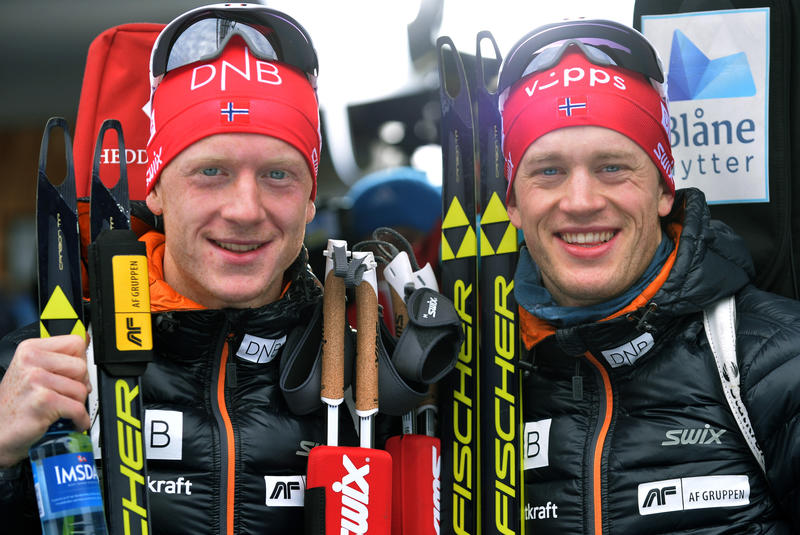
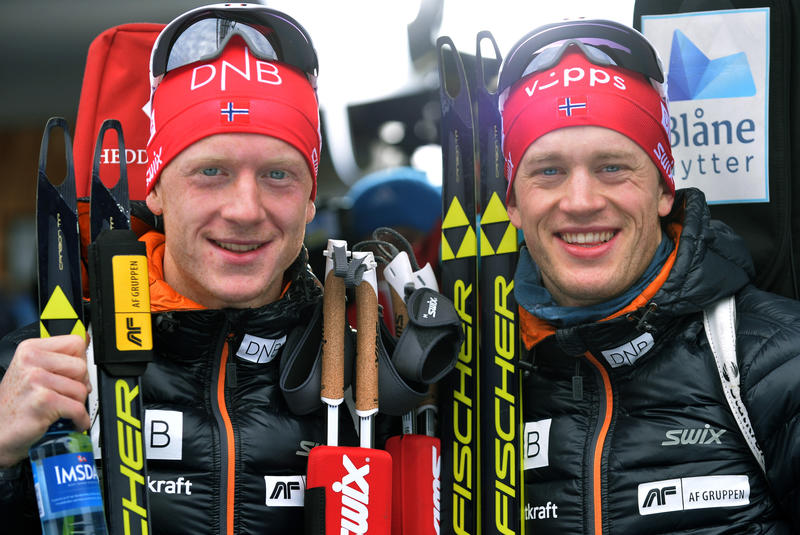
    The Bø brothers: Johannes Thingnes (l) and older brother Tarjei at the IBU World Cup 4 in Ruhpolding, Germany, where they placed first and second, respectively in the sprint. (Photo: IBU/Eberhard Thonfeld)
    The Bø brothers: Johannes Thingnes (l) and older brother Tarjei at the IBU World Cup 4 in Ruhpolding, Germany, where they placed first and second, respectively, in the sprint. (Photo: IBU/Eberhard Thonfeld)

    “[Over Christmas] we were just home training … relaxing mostly,” Johannes said during an English interview with his brother with German TV broadcaster ARD. “Watching Christmas movies, eating good food, we relaxed and trained.”

    “It’s not so often we take the triple,” added Tarjei. “But today it was a really good, also really relaxed team. Really good skis. Our focus is World Champs in Oslo [in March]. Before Christmas we tried to be too fast. Now we have to wait with our energy to still be good in February.”

    Asked about the harmony in the family as competitors, the brothers shared a laugh.

    “For me it’s OK, but uh…,” joked winner Johannes, pointing to his brother.

    “It’s always some seconds, like in Kontiolahti at the World Champs [last season],” Tarjei replied. “Today it was so close, we shot clean, skied fast … I don’t know what to do. Three seconds. I hope tomorrow [in the pursuit], maybe I can beat him.”

    “I have eight or nine World Cup victories. He has one less than me,” Johannes concluded.

    “It’s not so often in biathlon when you get three athletes from the same country on the podium,” Svendsen noted in an IBU press release. “It is nice to be here today with the two brothers. This is the best PR we can get for the World Championships. I think it’s going the right way. I am feeling better and better.”

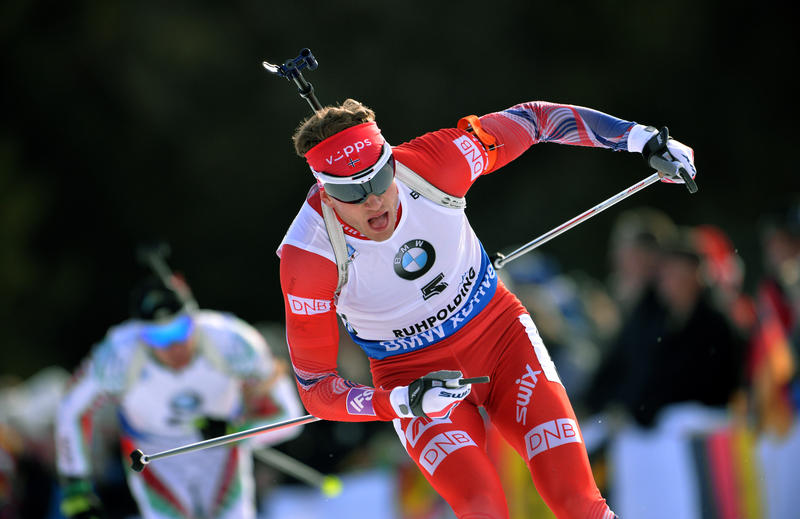
    Norway's Tarjei Bø racing to second on Friday in the IBU World Cup sprint in Ruhpolding, Germany. (Photo: IBU/Eberhard Thonfeld)
    Norway’s Tarjei Bø racing to second on Friday in the IBU World Cup sprint in Ruhpolding, Germany. (Photo: IBU/Eberhard Thonfeld)

    Germany’s Simon Schempp, who has made Ruhpolding his home and is currently third in the overall World Cup standings, did not start due to a cold.

    “Of course it’s sad,” commented his coach Mark Kirchner told ARD. “He doesn’t feel too bad, it’s rather a localized infection. But of course his own ambition by now is that when he is starting, he wants to attack the podium, and even just 98 percent of your ability is not enough for that, so that’s why he is not starting today.

    “We will observe the situation,” Kirchner continued. “The earliest possible return date is for [the mass start] Sunday, but we won’t force it. The season is long, there are many other goals.”

    Similarly, Norway’s superstar Ole Einar Bjørndalen also sat out Friday’s sprint due to an unspecified illness.

    As a result France’s World Cup leader Martin Fourcade, despite not feeling well, either, came closest to preventing the Norwegian trifecta. He posted the best course time in the field, but couldn’t overcome  a miss on the third target in his prone shooting stage and the resulting penalty lap.

    Fourcade crossed the line in fourth place, 10.9 seconds back and just 3.3 seconds off the podium. However, he still collected 43 additional valuable points in the overall ranking (and likely more on Saturday when his toughest competitors, Schempp and Bjørndalen, will not be able to start the pursuit) to widen the gap.

    “It was a strange race for me. I was sick last night, I had stomach problems,” Fourcade said in an English interview with ARD. “I was a bit worried this morning, then when I looked on the start list I saw the second [in the World Cup ranking, Bjørndalen] and the third [Schempp] would not race, so to catch some points I decided to start. But my feeling was not so good, and I did a stupid mistake in the prone, that’s why Norway has all three on the podium.

    Tarjei Bø during his prone shooting, which he cleaned. The Norwegian went on to place second in the IBU World Cup sprint in Ruhpolding, Germany, behind his younger brother Johannes Thingnes Bø (not shown). (Photo: IBU/Eberhard Thonfeld)
    Tarjei Bø during his prone shooting, which he cleaned. The Norwegian went on to place second in the IBU World Cup sprint in Ruhpolding, Germany, behind his younger brother Johannes Thingnes Bø (not shown). (Photo: IBU/Eberhard Thonfeld)

    “But they were good,” he continued. “Johannes I think wanted revenge after a strange December month. The same for Emil. That’s good for Norway, they had a huge team result, but that is not a surprise for me.”

    Questioned again if he started mainly to increase his World Cup lead, he added: “Yeah, I don’t like to start in that condition, but I woke up and … with my experience even if you are not good to win it, you still have to compete. Now it’s two more competitions without points for Simon and Ole Einar, and I think that’s too much for them [to come back from] even if I am not in super-shape tomorrow because I was sick today.

    “That’s the strange thing about the Overall World Cup,” Fourcade said. “Even if you are not good, you have to compete. That’s something I do even if I don’t like that, and I know it’s not good for my body.”

    Behind the Norwegians and Fourcade, the Austrian men’s team had their best performance of the season, claiming the next three spots mainly helped by also achieving clean shootings. Sven Grossegger recorded the best individual World Cup result of his career in fifth, 24.4 seconds back, after placing 10th in a sprint during the 2011/2012 season. Teammates Simon Eder was in sixth (+27.5), and Dominik Landertinger took seventh (+39.8).

    “I felt good skiing right from the start,” Grossegger said after the race, according to an Austrian Ski Federation press release. “Today were fast, icy conditions. That just suits me. During the shootings I was working well and was focused. In standing position I had a little luck with one shot.”

    Smith 15th; Six North Americans Qualify for Pursuit

    Early in the holiday break, the International Biathlon Union had announced that the fourth World Cup would be relocated to Ruhpolding, after warm weather conditions made it impossible to produce artificial snow at the originally scheduled location in Oberhof, Germany. Thus Ruhpolding is in the rare situation to be hosting back-to-back World Cups in the same location (ironically, it finally snowed in Oberhof last week, which might have allowed organizers to groom a track, but the decision had already been made).

    Biathlon Canada again brought a full men’s roster to the sprint, filling all the five spots allowed for them this season (on the men’s side, only Czech Republic, Germany, France, Norway, and Russia currently have six).

    Nathan Smith, the top North American male in the World Cup standings in 13th overall, also had the best result on Friday, finishing in 15th place (+59.9). Unlike most of his teammates, he had not traveled home for the holidays, instead training in France.

    On Friday, he started early in the field in bib 7 and clocked the best initial split times. After a fast-and-clean prone stage, he took the lead, ahead of eventual second-place finisher Tarjei Bø, and only Johannes displaced him at the split, leaving the range later.

    In standing, Smith missed two targets and the two resulting penalty laps set him back.

    “I started off really strong with a clean prone, which put me in second spot going into my standing,” he explained.

    “I knew I was in medal contention and I let those thoughts become a distraction,” Smith said, according to a Biathlon Canada press release.

    Overall he skied the seventh-fastest course time of all athletes.

    “My skiing was good enough for a medal today, but 10/10 (shooting) is a requirement when conditions are perfect,” he added.

    Tim Burke (US Biathlon) racing to 18th to lead the U.S. men in Friday's IBU World Cup sprint in Ruhpolding, Germany. Burke had a single penalty (0+1). (Photo: USBA/NordicFocus)
    Tim Burke (US Biathlon) racing to 18th to lead the U.S. men in Friday’s IBU World Cup sprint in Ruhpolding, Germany. Burke had a single penalty (0+1). (Photo: USBA/NordicFocus)

    In contrast to the Canadians, the U.S. men only had two athletes start Friday with Tim Burke and Lowell Bailey. Sean Doherty opted for a longer training period block over the holidays in preparation for Junior World Championships in February in Cheile Gradistei, Romania, according U.S. Biathlon Chief of Sport Bernd Eisenbichler. Doherty plans to join his teammates in Ruhpolding on Sunday.

    Leif Nordgren was assigned to the IBU Cup team, joining Wynn Roberts, Casey Smith, and Max Durtschi. They will compete this weekend in Nove Mesto, Czech Republic.

    According to a press release, US Biathlon plans to call up “an additional athlete per gender”  for World Cups 5-6 following this weekend’s IBU World Cup.

    Starting shortly behind Smith in bib 11, Burke managed to clean his prone shooting before missing one shot in standing, finishing in 18th, 1:01.3 minutes back.

    “The approach to the shooting range is pretty easy here so I knew there would be a lot of good, fast shooting,” Burke explained in an email. “I just tried to stay aggressive in the range and not give up too much time on the shooting mat.”

    Overall he recorded the 31st-fastest shooting time. Out on the course he was able to improve his position on each of the three rounds compared to the field, closing out strong with the 13th-fastest final loop and recording the 17th-best overall course time.

    “I had not been home for the holidays in a few years so it was a nice change of pace for me,” Burke added. “I definitely still felt a little jet lagged in the race today, but I feel like my body responded well. I expect to feel better with each race, especially since I did not do too much intensity training over the break.

    “I would normally hope for a better place in the sprint with one penalty, but considering my recent travel and that this not my favorite course, I am pleased,” he continued.

    Closer to the middle of the field of 102 starters in bib 40, Lowell Bailey also recorded a single miss in the standing stage (0+1), but his overall course time ranked 45th time, putting him in 33rd at the finish, 1:01.3 minutes back and one spot behind the winner of the last race of 2015, France’s Jean-Guillaume Béatrix.

    One place behind Bailey in 34th was 22-year-old Canadian Christian Gow (+1:03). He managed to clean both stages for a World Cup career best, giving him seven more points in his overall World Cup standing. He improved on his 37th place in the sprint in Pokljuka, Slovenia, just before the holiday break, as well as 39th in a pursuit in Hochfilzen, Austria, earlier this season.

    “I am really happy with the race today,” Gow wrote in an email. “It feels great to put out another personal best and also to be in a good position for the pursuit! I am quite surprised by the result today, as I have not had a very productive break since the last World Cup. I, unfortunately, got sick right after Christmas and also took a fall injuring my ribs. Between those two things, I haven’t been able to do intensity until yesterday’s race prep, and that did not go too well for me. Today was a really nice surprise to see that my ski shape didn’t fall off too much despite all of that!”

    His older brother Scott Gow finished the sprint in 47th (+1:48.1) with two penalties (1+1), and teammate Macx Davies placed 55th (+1:53.5) with a single prone miss and one in standing as well.

    The fifth Canadian, Scott Perras competed in his first World Cup race of the season and placed 72nd (+2:27.5), after two prone penalties (2+0).

    Perras replaced Brendan Green for the race, who “has been nursing a small injury,” according to Biathlon Canada’s High Performance Director Eric de Nys. Green is expected to be back for next weekend’s World Cup races in Ruhpolding.

    Only Perras missed the top-60 cut for Saturday’s pursuit.

    “It was a decent day considering the athletes hopped off the plane on Monday and training has been limited with the lack of snow,” de Nys wrote in an email. “We will look to improve on these results in the coming days.”

    Results | Pursuit start list

  • Weekend Roundup: Preseason Tuneups; Next Stop, World Cup

    Weekend Roundup: Preseason Tuneups; Next Stop, World Cup

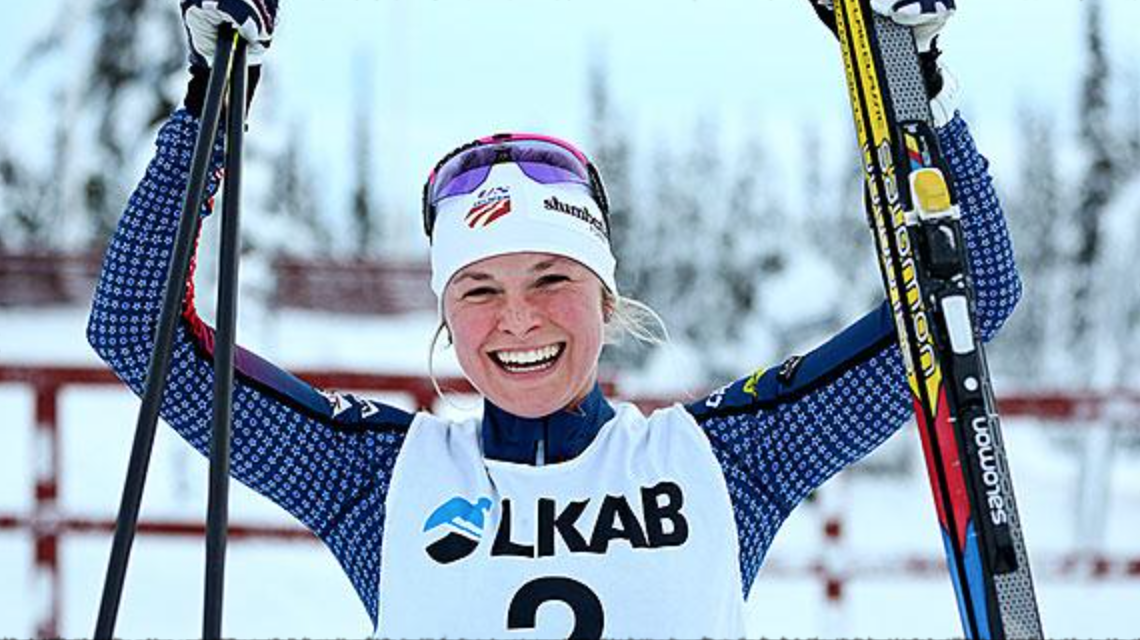
    In the U.S. Ski Team's first race of the 2015/2016 season, Jessie Diggins led a 1-2 U.S. finish with teammate Sophie Caldwell finishing second. Here Diggins is shown celebrating her FIS classic sprint win on Saturday in Gällivare, Sweden. (Photo: USSA/Stefan Nieminen)
    Jessie Diggins of the U.S. Ski Team won both races in last weekend in Gällivare, Sweden, leading a 1-2 U.S. women’s finish in the classic sprint with teammate Sophie Caldwell on Saturday, and sharing the podium with Caitlin Gregg, who was third in the 10 k skate on Sunday. (Photo: USSA/Stefan Nieminen)

    A win is a win: especially when it’s north of the Arctic Circle in chilly conditions and in the first races of the season.

    Jessie Diggins started 2015/2016 off with back-to-back wins at the International Ski Federation (FIS) races in Gällivare, Sweden, topping the podium in both the classic sprint and 10-kilometer freestyle.

    Above all, the U.S. Ski Team member said the races were confidence boosting and a good way to take inventory on “what else needs to be improved, as well as a good reminder of warmups, race routines, and testing skis.”

    On Day 1 of the cross-country races in Gällivare, Diggins and her teammate Sophie Caldwell captured first and second, respectively, in the classic sprint.

    “I want to walk up to the start line of a classic race with that same confidence in myself that I have at the start of every skate race,” Diggins said after Saturday’s sprint.

    “I don’t care if it’s a World Cup or a local club race. Having three of the six podiums was just a lot of fun,” U.S. women’s coach Matt Whitcomb said on Saturday, after Andy Newell finished second in the men’s sprint.

    On Sunday, two American women again reached the podium, with Diggins in first and Caitlin Gregg in third. In the men’s 15 k freestyle, Canada had two in the top four, with Alex Harvey in second and Devon Kershaw in fourth.

    “That … was probably my best individual-start skate race in 1.5 years,” Kershaw remarked.

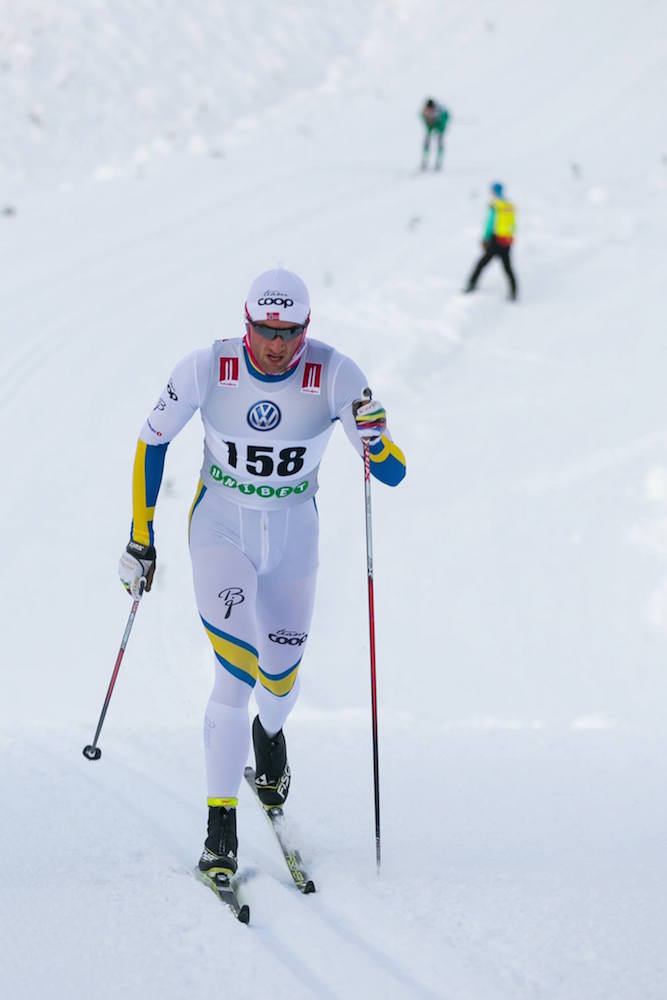
    Norway's Petter Northug racing to a 10 k classic win on Nov. 20 in Bruksvallarna, Sweden. He did so in a custom suit with the Swedish colors. (Photo: AdaMedia Med Mera/@adamedmera)
    Norway’s Petter Northug racing to a 10 k classic win on Nov. 20 in Bruksvallarna, Sweden. He did so in a custom suit with the Swedish colors. (Photo: AdaMedia Med Mera/@adamedmera)

    About 900 kilometers south in Bruksvallarna, Sweden, Petter Northug ruffled feathers on Day 1 of the three-day FIS race series. He won Friday’s 10 k classic by 36 seconds while wearing a Swedish-national-team-like suit. Meanwhile, Sweden’s Charlotte Kalla won the women’s 5 k classic by 25 seconds.

    The next day, Kalla won again — this time by 36 seconds in the 10 k freestyle. Led by Niklas Dyrhaug, the Norwegian men swept the Bruksvallarna 15 k skate podium.

    Finally on Sunday, Stina Nilsson put the kibosh on Kalla’s streak as the 22-year-old Nilsson won the women’s skate sprint. Kalla placed second, and in the men’s sprint, Norway’s Havard Solås Taugbøl, 22, won by 0.09 seconds over Sweden’s Karl-Johan Westberg.

    For the first time, the US Biathlon team logged some pre-World Cup race starts, traveling to Sjusjøen, Norway, to do so. In Saturday’s sprint, the American men all finished in the top 30. Tim Burke led them in 13th.

    “Today was definitely a solid team performance,” Burke explained. “Our entire men’s team is at a very high level…”

    At one point, American Susan Dunklee ranked first in the women’s sprint after cleaning the first stage, but missed four in standing and ended up 21st.

    “My ski shape feels a little sharper than it usually does in November,” she wrote.

    Less than four seconds back, her teammate Annelies Cook was 25th. Canadian Megan Tandy (formerly Heinicke) was 23rd with 90-percent shooting. Italy’s Dorothea Wierer won the race with clean shooting.

    In Sunday’s mass start, the lone American competing, Leif Nordgren finished 19th with six penalties on a windy day. Tandy placed 40th in the women’s race with seven penalties.

    “I was disappointed for sure since it was such a good opportunity against tough competition, but considering the conditions, I’ll get over it quick!” Nordgren wrote.

    The men’s sprint winner from the day before, Germany’s Simon Schempp won the mass start as well, by fewer than six seconds over Norwegian Alexander Os of Team Feskslo — or fish guts.

    Ukraine’s Juliya Dzhyma cleaned the final stage to win the women’s mass start.


    FIS Cross Country races, Gällivare, Sweden

    Saturday’s classic sprint: women’s report | men’s report

    Sunday’s 10/15 k freestyle: women’s report | men’s report

    FIS Cross Country races, Bruksvallarna, Sweden

    Friday’s 5/10 k classic: men’s report | women’s report

    Saturday’s 10/15 k freestyle: report

    Sunday’s freestyle sprint: report

    Norwegian Biathlon Association races, Sjusjøen, Norway

    Saturday’s 7.5/10 k sprints: men’s report | women’s report

    Sunday’s 12.5/15 k mass starts: report

  • Smith Back in Flower Ceremony in Fifth in Khanty Sprint; Fourcade Extends Overall Lead

    Smith Back in Flower Ceremony in Fifth in Khanty Sprint; Fourcade Extends Overall Lead

    Nathan Smith (Biathlon Canada) racing to Canada's first men's medal at IBU World Championships on Saturday in the 10 k sprint in Kontiolahti, Finland. Smith achieved silver for his first career podium at the World-Cup level. (Photo: Fischer/NordicFocus)
    Nathan Smith (Biathlon Canada) racing to Canada’s first men’s medal at IBU World Championships on March 7 in the 10 k sprint in Kontiolahti, Finland. Smith achieved silver for his first career podium at the World-Cup level. (Photo: Fischer/NordicFocus)

    Before this season, Nathan Smith had never experienced a flower ceremony at the IBU World Cup level before. He had heard the ballads and seen the podium from a distance, yet he hadn’t been the one being photographed from multiple angles, waving to the crowd and mom and dad back home while accepting several prizes.

    By the end of 2014/2015, Smith’s starting to feel like its almost routine. The 28-year-old Canadian placed fifth in Thursday’s World Cup 10-kilometer sprint in Khanty-Mansiysk, Russia, for his second-best sprint result since finishing second at IBU World Championships earlier this month in Kontiolahti, Finland.

    In early February, Smith broke out with a career-best seventh in a World Cup sprint in Nove Mesto, Czech Republic. While that didn’t put him in the top six required for the flower ceremony, his result in the next day’s pursuit did; he placed fifth for a new high.

    Almost exactly a month later on March 7, he became the first Canadian male to medal at IBU World Championships. He earned silver in the sprint and stood on the second-highest step on the international podium.

    In the days that followed in Kontiolahti, Smith placed 13th in the pursuit, 44th in the individual (with five penalties) and 23rd in the mass start.

    For him, the last World Cup in Khanty-Mansiysk was about ending on another high note. He achieved that with 90-percent shooting, missing one prone target and cleaning standing with the third-fastest range time overall. The 24th starter, Smith finished 34 seconds behind winner Martin Fourcade of France, who put down the fastest time of 23:47.0.

    “I knew if my skiing came back up that a top-10 should be more than possible,” Smith explained in an email on Thursday. “I would say I actually exceeded my expectations a little. I would’ve been pretty happy with a top-16.”

    Ranked 37th after prone, the Canadian moved into ninth overall after hitting all his standing targets. He closed the race with the sixth-fastest last lap and clocked the 11th-fastest course time overall.

    “I was really tired in the Mass Start at the end of worlds. I knew I was still in good shape after a great ski in the relay the day before, so I was hoping with a few easy days I’d be able to recover and bring my ski speed back up to where its been the last month,” Smith explained.

    The Canadian team’s travel day from Finland to Siberia went “really smoothly,” he added. He slept most of his flight and had been sleeping 10 to 11 hours every night since.

    “I kept training easy until [Wednesday] when I did some pretty hard but typical race prep,” he explained.

    While gearing up for Thursday’s sprint, the first of three races in Khanty (with the pursuit on Saturday and the mass start on Sunday), Smith and his teammate Brendan Green pushed each other during short intervals on Wednesday.

    “I went really hard up the big climb before the range and totally blew up while shooting,” Smith recalled. “So that was a good lesson and I was careful not to repeat that today!”

    Heading into his last lap on Thursday, he heard he was only a few seconds behind the current leader — France’s Simon Fourcade at the time.

    “I gave it my all and I had enough to grab first when I crossed the line,” Smith wrote.

    Germany's Benedikt Doll on his way to his first IBU World Cup podium in third in the men's 10 k sprint on Thursday in Khanty Mansiysk, Russia. (Photo: IBU/Evgeny Tumashov)
    Germany’s Benedikt Doll on his way to his first IBU World Cup podium in third in the men’s 10 k sprint on Thursday in Khanty Mansiysk, Russia. (Photo: IBU/Evgeny Tumashov)

    Germany’s Benedikt Doll in bib 27 finished 15.7 seconds faster to bump him to second, after a clean prone and one miss standing, and Latvia’s Andrejs Rastorgujevs in bib 32 came up 0.3 seconds short of Doll to move Smith into third.

    Martin Fourcade started 38th and consistently set the fastest times on course, cleaning both stages and finishing 18.3 seconds faster than Doll.

    Russia’s Anton Shipulin, in the hunt for the overall World Cup title behind Fourcade, started 43rd  and also shot a perfect 10-for-10, but came up 13 seconds short of the Frenchman at the finish. After prone, Shipulin was 7.1 seconds down to Fourcade, and before the final lap, he had 11.4 seconds to make up. He ended up second and remains second in the overall World Cup standings, trailing Fourcade by 117 points.

    “I knew that I could be conservative today or go very hard,” Fourcade told the IBU. “I decided to not be conservative and not have any regrets. I am very happy to win here in Khanty-Mansiysk; this is the place where I won my first World Championship.”

    While it was Fourcade’s eighth win this season, it was a first-career podium for Doll.

    “At the beginning of the race I did not feel so good,” the 24-year-old German told the IBU. “After the start, I suddenly did not feel tired and my legs did not hurt. I felt like I could run and run; I never had this feeling before. … I am very happy; it is a big honor for me to stand on the podium with these two men.”

    Overall World Cup leader and Thursday's 10 k sprint winner, Martin Fourcade of France enjoys his reindeer-drawn victory lap in Khanty Mansiysk, Russia. (Photo: IBU/Evgeny Tumashov)
    Overall World Cup leader and Thursday’s 10 k sprint winner, Martin Fourcade of France enjoys his reindeer-drawn victory lap in Khanty Mansiysk, Russia. (Photo: IBU/Evgeny Tumashov)

    Smith took fifth to tie his second-best result and take part in the reindeer festivities that accompanied Thursday’s awards ceremony.

    “It feels great, and it’s reassuring to know that I can fairly consistently be in it when I’m on,” Smith said of the flower ceremony. “I’m almost getting familiar with it?”

    On Saturday, he’ll start fifth in the 12.5 k pursuit, 34 seconds after Fourcade. Germany’s Arnd Peiffer, who finished 0.4 seconds behind him in sixth on Thursday, will start with Smith. Fredrik Lindström, who placed seventh, will start two seconds later.

    “The pursuit is going to be a really tight one. It will come down to shooting,” Smith wrote. “I’m in a nice pack so I’ll try and conserve some energy and knock down all the targets. Then see what I’ve got left for the last lap. I’m not focusing too much on the mass start yet, one race at a time, but I’m getting pretty close to top-15 overall, so that’s a goal I have in mind.”

    He currently sits in 18th in the overall World Cup, 45 points out of 15th.

    Canada’s other male in the sprint, Green placed 30th (+1:23.5) with a single standing penalty. Green started 47th and ranked 29th overall after both shooting stages, ultimately finishing in the top 30 with the 38th-ranked course time.

    Nordgren Surprises Himself in 21st

    Leif Nordgren led three Americans in 21st (+1:14) for one of the top-five results of his career. Like Green, Nordgren cleaned prone and missed one standing. He started 41st and came within reach of a top 20 on his final lap, finishing 1.3 seconds behind Bulgaria’s Krasimir Anew in 20th.

    Leif Nordgren (US Biathlon) racing to 21st in the men's 10 k sprint on Thursday at the IBU World Cup in Khanty-Mansiysk, Russia. (Photo: USBA/NordicFocus)
    Leif Nordgren (US Biathlon) racing to 21st in the men’s 10 k sprint on Thursday at the IBU World Cup in Khanty-Mansiysk, Russia. (Photo: USBA/NordicFocus)

    “I’m pretty surprised with this result today, and really happy about it,” Nordgren wrote in an email. “Since [Wednesday] afternoon I’ve started coming down with a little upper respiratory sickness, probably just from the travel from Finland. I started to get a pretty stuffy nose, itchy throat, and today I can feel it getting down into my lungs, as well as that awesome achy body feeling!”

    With that in mind, he didn’t have any expectations for the sprint.

    “I had no idea on how I’d feel,” he wrote. “Since it was the last race of the season and I just started to get sick yesterday I didn’t really think about not starting.

    “I knew that good shooting would be key to making the pursuit, which is what I thought would be a hard enough task for the day,” he added, explaining that conditions were near-perfect. “I felt like I didn’t really have anything to lose, so I went as hard as I could right out of the start, and I think I actually had an OK time for the first loop.”

    He shot conservatively in prone to hit all his targets, which worked. He pushed himself again on his second lap and stayed ahead of a chase pack, then entered the range for the second time where he left with a single miss.

    “One miss wasn’t bad,” he wrote. “The last loop I pushed as hard as I could, I was definitely starting to die a little, but about halfway through I got caught by Shipulin and it was nice to have someone to hang on to for the rest of the loop.”

    Four years ago in Khanty, Nordgren notched a career-best 17th in the mass start at the same venue. He also placed 21st in the individual race there that year. This season, he set a new career-best in Nove Mesto, placing 16th in the sprint.

    “This is my favorite course on the WC tour,” Nordgren explained. “I’ve had a lot of good races here before, so that was good for my head … I’m looking forward to the next races, but hopefully I can recover and be feeling a little better going into the weekend!”

    Also for the U.S., Lowell Bailey placed 51st (+1:54.2) with two standing penalties and Tim Burke was 55th (+1:57.3) with four total misses, one in prone and three in standing. Both made the top-60 required for the pursuit, and will start 1:54 and 1:57 back, respectively.

    Results

  • Smith Soars into Canadian History with World Champs Silver, Breaks Up Bø Brothers in Sprint

    Smith Soars into Canadian History with World Champs Silver, Breaks Up Bø Brothers in Sprint

    Nathan Smith (l) on the 2015 IBU World Championships 10 k sprint podium on Saturday with Norwegian brothers Johannes Thingnes Bø (c) and Tarjei Bø (r) in Kontiolahti, Finland. Smith placed second for Canada's first-ever men's podium at World Championships.
    Nathan Smith (l) on the 2015 IBU World Championships 10 k sprint podium on Saturday with Norwegian brothers Johannes Thingnes Bø (c) and Tarjei Bø (r) in Kontiolahti, Finland. Smith placed second for Canada’s first-ever men’s podium at World Championships.

    KONTIOLAHTI, Finland — As Norwegian brothers Johannes Thingnes Bø and Tarjei Bø prodded and joked with each other on the podium of the men’s 10-kilometer sprint at IBU World Championships on Saturday, Nathan Smith simply grinned from the second-highest step on the podium.

    Finally, after the first round of many congratulations to come, it was starting to set in for the 29-year-old Canadian.

    Smith had just done something no other Canadian male had done before: he medaled at World Championships. Not only did he place in the top three, he finished squarely in second, 12.1 seconds behind winner Johannes Thingnes Bø, and 13.2 seconds ahead of Bø’s older brother Tarjei for silver.

    “When Johannes was 16, 17 years old he started winning Junior World Championships and he was following my steps all the time,” Tarjei, 28, reminisced in a post-race press conference. “We talked about this a lot during the summertime when we were at home training together. We love to compete and we love to fight each other, but still we are the team against the rest of the world so today is a big day for us.

    “We beat the world almost — it was only Nathan who came between us so congrats to him,” he added with a laugh.

    Everyone laughed.

    Nathan Smith (Biathlon Canada) racing to Canada's first men's medal at IBU World Championships on Saturday in the 10 k sprint in Kontiolahti, Finland. Smith achieved silver for his first career podium at the World-Cup level. (Photo: Fischer/NordicFocus)
    Nathan Smith (Biathlon Canada) racing to Canada’s first men’s medal at IBU World Championships on Saturday in the 10 k sprint in Kontiolahti, Finland. Smith achieved silver for his first career podium at the World-Cup level. (Photo: Fischer/NordicFocus)

    Then there was Smith, a regular top-10 contender on the World Cup for the last two seasons, but unlike the Bøs, someone who had never tasted the podium before. Going into World Championships, his personal best was fifth in the pursuit on Nove Mesto, Czech Republic, just under a month ago.

    “It’s overwhelming,” Smith said of the attention he received Saturday as soon as the results were final. “I knew I could have some good races, but you never really believe it until you do it. It’s hard to explain, it feels great though.”

    All that came after shooting slump in January, when Smith placed 78th in an IBU World Cup sprint in Antholz, Italy.

    “I took some time away from my rifle and then I came back into Nove Mesto and Oslo and my shooting was right up there again so I had a lot of confidence with my shooting,” he said after hitting nine of 10 targets on a windy range in Kontiolahti on Saturday.

    “My skiing’s been pretty consistent all year. I haven’t had too many days where I’m dying out there, so I knew if I had an average day and nine or 10 here with the wind, that it could be really good.”

    Yet after starting 12th and taking the lead at the finish by 30 second, Smith wasn’t exactly sure what “really good” would amount to. He was bumped down one place by 21-year-old Johannes Thingnes in bib 16, but after that, no one came close.

    Based on World Championships rules for “unusual weather conditions,” the grouping system that determined starting order was altered for Saturday to allow nations with competitors ranked in the top 50 on the World Cup to enter “any draw group they choose.”

    Naturally, with a salted course for the just-above-freezing temperatures and the forecast for snow later in the day, the top men decided to go first. And out of 127 competitors, Smith was close enough to the front that it worked out for him as planned.

    Nathan Smith (Biathlon Canada) racing to Canada's first men's medal at IBU World Championships on Saturday in the 10 k sprint in Kontiolahti, Finland. Smith achieved silver for his first career podium at the World-Cup level.
    Nathan Smith approaching the range at the IBU World Championships 10 k sprint on Saturday in Kontiolahti, Finland. Smith went on to place second for a historic silver for the Canadian men’s program.

    With a headwind coming into his first shooting, he took note of the gusts from his right side and clicked a couple to the right. After hitting his first three prone shots, Smith felt the wind pick up even more, so he shaded, which led to perfect 5-for-5 shooting.

    “I got a little lucky for my last hit,” Smith recalled.

    That put him in second after prone, and he went on to ski the sixth-fastest second lap (out of three). In his second-and-final stage, Smith missed one, which was a success considering two men in the entire field finished the race with perfect 10-for-10 shooting (Tarjei being one of them).

    “I tried so hard in standing; I didn’t just whip though it and throw some shots away,” Smith said.

    However, he posted the sixth-fastest range time in standing to finish the race as the fourth fastest on the range overall. On skis, he was seventh fastest overall on course.

    “I worked really hard on the skis,” he added.

    “We beat the world almost — it was only Nathan who came between us.” — Tarjei Bø, Norway’s sprint bronze medalist

    “Before the race, Nathan knew that this course suited him,” Canadian national team coach Roddy Ward explained. “He doesn’t like gradual climbs, but the steeper climbs he feels comfortable with — offset. There’s quite a lot of that here. So he was pretty confident out there and he definitely looked like he had really good fitness.”

    Ward was out on course for most of the race while Canadian head coach Matthias Ahrens was in the range. But before he ventured out, he caught a glimpse of Smith whipping through the stadium.

    “I watched Nathan go around and I thought to myself, ‘Nathan’s gonna be a hero back home after this race,’ ” Ward predicted. “And then I said, ‘Don’t jinx it!’ and then I said, ‘I can’t  jinx it.’ I was pretty confident. He knew he was in good shape, too. I think he had pretty good confidence, but hey, he’s on the podium for the first time ever in a World Championships so of course it’s a bit of a surprise.”

    Like many who have followed Smith’s progression, from breaking out at the 2014 Olympics with three top-15 results in Sochi, Russia, Ahrens knew it was a long time coming.

    “With his good shooting and efficient shooting — shooting usually very fast — and then given that he had really good ski speed today, he was already looking quite solid, quite early,” Ahrens reflected. “[He has] the shooting efficiency, he shoots accurate, but also very fast. He’s always on the top five in the World Cup in that particular category when you analyze the race. His skiing has improved over the last three years and he’s now at a point, if everything comes together, then he can be on the podium.”

    The men's 10 k sprint podium at 2015 IBU World Championships in Kontiolahti, Finland. From left to right: Silver medalist Nathan Smith (Canada), gold medalist Johannes Thingnes Bø (Norway), bronze medalist Tarjei Bø (Norway), Simon Fourcade (France) in fourth, Erik Lesser (Germany) in fifth, and Evgeniy Garanichev (Russia) in sixth. (Photo: Fischer/NordicFocus)
    The men’s 10 k sprint podium at 2015 IBU World Championships in Kontiolahti, Finland. From left to right: Silver medalist Nathan Smith (Canada), gold medalist Johannes Thingnes Bø (Norway), bronze medalist Tarjei Bø (Norway), Simon Fourcade (France) in fourth, Erik Lesser (Germany) in fifth, and Evgeniy Garanichev (Russia) in sixth. (Photo: Fischer/NordicFocus)

    So the snowflakes fell at the right time and right place for Smith, who made history for Biathlon Canada. Previously, no man had medaled at World Championships, and Smith followed up on the success of former teammate Jean-Philippe Le Guellec, who won a World Cup sprint in 2012 in Östersund, Sweden, and retired after last season.

    Retired biathlete Myriam Bédard holds the Canadian women’s and overall record with two golds from the 1994 Lillehammer Olympics and another from 1993 World Championships.

    “I think how things started for our team was having Jean-Philippe Le Guellec leading our young men to success in the way that he actually was the first one on the podium, winning a World Cup, and that gave them confidence that really they all could do it,” Ahrens said. “That made a big mental breakthrough to our team, to the men, in many ways. The confidence, being able to do it in racing, but also what it takes in training to get there.

    “It shows the younger athletes what is possible when they put the work in, when they put the belief in,” he added.

    The silver medal was also huge in terms of future funding for Biathlon Canada. On the heels of Cross Country Canada’s Alex Harvey racking up silver and bronze at the FIS Nordic World Ski Championships last month in Falun, Sweden, biathlon essentially had to bring home some hardware as well to ensure an adequate budget from Own The Podium — Canada’s governmental branch of sport funding — for next season.

    “This is important for our funding because we are just actually judged by medals at World Championships or Olympic Games,” Ahrens explained. “Therefore it’s a very important step in the right direction.”

    “It shows the younger athletes what is possible when they put the work in, when they put the belief in.” — Biathlon Canada Head Coach Matthias Ahrens on Nathan Smith’s silver-medal performance

    To his own surprise, Smith reached that marker in the first individual race of 2015 World Championships. Going into Saturday’s race, he later explained he would have been happy with a top eight. Three years ago, he wasn’t sure how much longer he’d last as a professional biathlete.

    “Going into the Olympics last year, I was thinking it was going to be my last year,” Smith explained. “I was like, I’m going to do whatever I can to get to the Olympics.”

    Two summers ago, he made some significant tweaks to his training and preparation. He targeted his weaknesses and honed in on them, like uphill rollerskiing. He made his own rifle stock, which he currently uses, and started doing things he had never done before, such as dry firing.

    “We always say that North Americans in general are late developers compared to the Europeans,” he observed. “We’re, like, five years behind them in development. I think it just takes a bit longer when we’re isolated in Canada.”

    As of Saturday, Canada’s on the map. Smith went head to head with top skiers like Russia’s Evgeniy Garanichev, who started 11th and led after a clean prone, as well as Johannes Thingnes, and was fast enough to hold off Tarjei, who posted two perfect stages.

    Like Smith, Johannes Thingnes had one standing miss, and started 16th to come through each checkpoint with the consistently fastest times. At the end of the day, the Norwegian had the fastest course time as well.

    “It was maximum of what we could expect today, two brothers on the podium for the first time and also my first [World Championships] gold medal in my first [individual] start,” Johannes Thingnes said in the press conference. “So it could not have been better.”

    After the press conference, Smith said he hadn’t talked to his parents yet — they were on a bike trip in Argentina.

    “Usually they wake up really early in the morning to watch [my races], but I don’t think they have reliable internet there so we’ll see when they find out,” he said casually. “I’ll send them an email.”

    Three Canadian Men Make Pursuit

    Also for Canada, Brendan Green placed 21st (+1:14.3) with a single standing penalty and Scott Gow was 50th (+2:06.2) with one prone miss and one standing miss, to qualify for the pursuit. The youngest man on the team, Christian Gow finished 73rd (+3:11) in his World Championships debut. After starting 109th, he faced some of the toughest, slowest conditions of the men’s race and came away with three penalties — one in prone and two in standing.

    Canada's Brendan Green on his way to 21st in Saturday's 10 k sprint at IBU World Championships in Kontiolahti, Finland. He'll start Sunday's pursuit 1:14 behind the race leader.
    Canada’s Brendan Green on his way to 21st in Saturday’s 10 k sprint at IBU World Championships in Kontiolahti, Finland. He’ll start Sunday’s pursuit 1:14 behind the race leader.

    “I just figured that if I felt decent on the skis and I knew I’d have to have some good shooting, probably at least eight, maybe nine out of 10, and I thought that was really possible,” Christian explained. “But the wind was a bit tricky and I think I gave away a shot prone. Standing was just tough. I felt really unsettled. Every time I lined up on the target, the wind seemed to push me away.”

    On his way to the starting line, Christian realized that Smith had all but secured second.

    “I couldn’t even believe it,” he said. “We know as a team we’re quite strong, and Nathan and Brendan especially have been really really close to the top. … I think sometimes they underestimate themselves a little bit … I knew they could hit the podium with the right race. When I started, that’s when I realized he was going to hold that because that’s when all the threats were coming in [and] his time was better than theirs. That was awesome.”
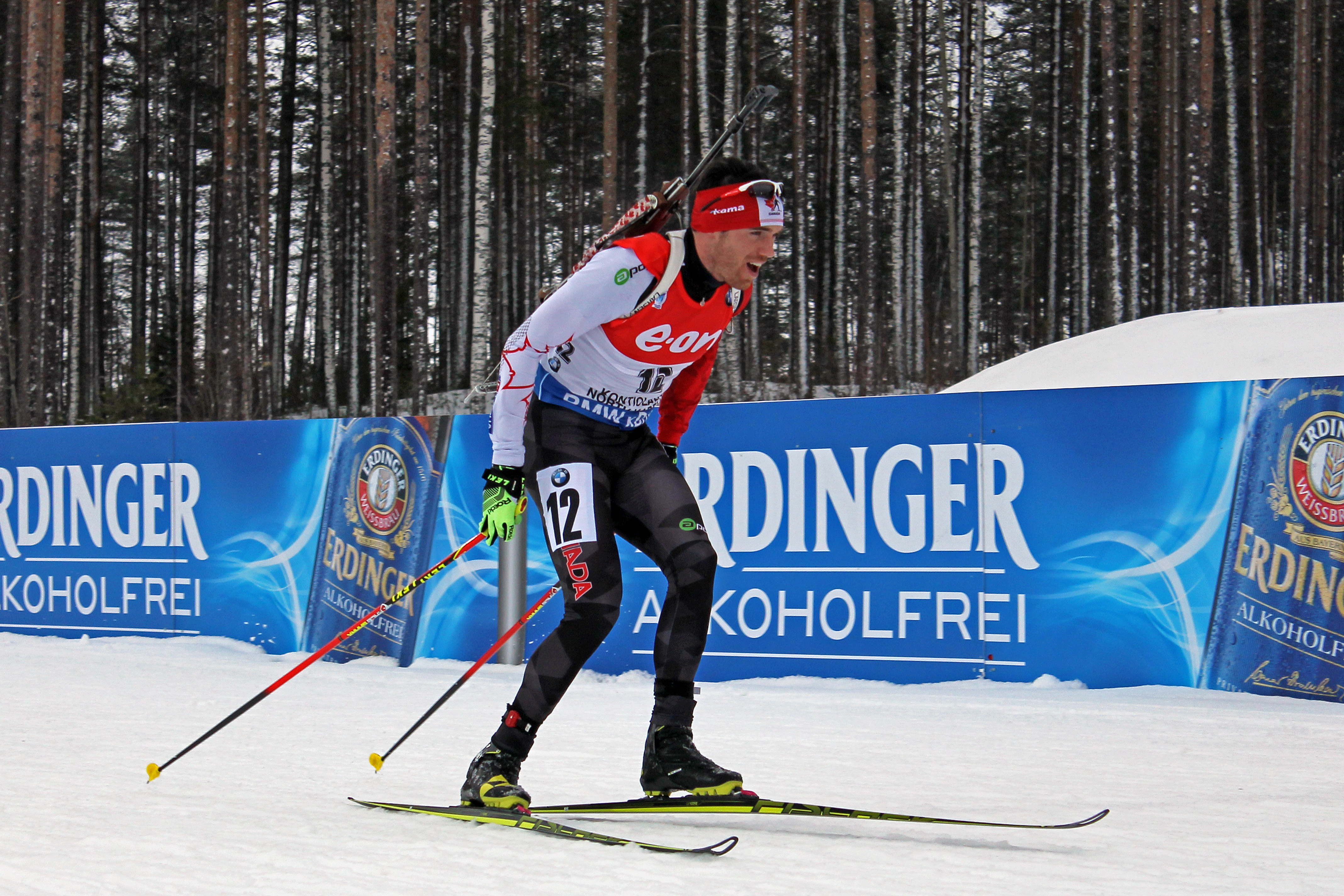
    “I saw [Nathan] clean prone and I saw him leading standing with one miss,” said older brother, Scott Gow, 24, who started 55th. “I thought, ‘Oh, maybe he’ll do well.’ He stayed up there. It was motivating to try and go out there and put in a good ski race and aiming to shoot as well or as better than him. It was more motivating to see him do so well.”

    Personally, Scott said he had hoped for a top 30.

    “That’s my personal goal at every race,” he said. “Today, with the wind the way it was I figured 80 percent, 90 percent shooting would [be enough], and I made the low end of that. The skiing suffered a little on the last lap. I was just kind of tanked.”

    Not long after Smith started, Green took to the course and ended up tying Belgium’s Michael Roesch for 21st.

    “I’m a little bit disappointed and I was hoping for better skiing,” Green said. “With the shooting I had on a day like today, I would expect a better result. It wasn’t a disaster, it was just the skiing wasn’t quite there. I’m not sure why that is. I’m set up well for the pursuit.”

    In Sunday’s 12.5 k pursuit, Green will start alongside Roesch, 1:14 behind Johannes Thingnes, while Smith will head out 12 seconds after the race leader in second.

    “Obviously in a pursuit, I’m going to have an advantage over everyone except Johannes, so that’s an advantage,” Smith said in the press conference. “But there’s so many guys breathing down our necks that I’ll have to fight really hard to maintain it.”

    “Everything is possible,” said Tarjei, who will start 25 seconds behind his brother. “Two races now, two medals [for Norway], and same with my brother, so I have to win tomorrow to catch up with him. No chance.”

    “It’s kind of funny,” Smith said of being sandwiched between the Bø brothers. “I do feel a little left out, but I’m happy for them.”

    Results

  • Nordgren ‘Almost Perfect’ with All-Time Best 16th in Nove Mesto Sprint

    Nordgren ‘Almost Perfect’ with All-Time Best 16th in Nove Mesto Sprint

    Leif Nordgren (US Biathlon) racing to a career-best World Cup result of 16th on Saturday in the men's IBU World Cup 10 k sprint in Nove Mesto, Czech Republic. (Photo: USBA/NordicFocus)
    Leif Nordgren (US Biathlon) racing to a career-best World Cup result of 16th on Saturday in the men’s IBU World Cup 10 k sprint in Nove Mesto, Czech Republic. (Photo: USBA/NordicFocus)

    When Leif Nordgren caught wind that he was seven seconds from a top 10 with one loop to go, he couldn’t help but get fired up.

    The 25-year-old Minnesota native hadn’t cracked the top 20 in a World Cup since 2011, when he placed 17th in the mass start at 2011 IBU World Championships. The day before, in Friday’s mixed relay, US Biathlon Chief of Sport Bernd Eisenbichler said Nordgren looked better than ever — a sign of things to come.

    On Saturday, Nordgren started 44th and raced himself up to ninth at one point in the men’s 10-kilometer sprint, right after cleaning his first of two shooting stages. Twelve-and-a-half seconds behind race leader Martin Fourcade of France, who led through prone, Nordgren headed out on his second-to-last lap.

    Entering the range for the last time, he glanced at the leaderboard and noticed quite a few men had missed their targets on the windy afternoon. He shot conservatively in standing and missed one, which “was a little deflating,” he said, “but all I could do was push hard the last loop and see where I ended up.”

    Even after skiing a penalty loop, he heard he was within reach of a top 10, which ended up being a top 20 after all 94 men in the field had finished. Nonetheless, Nordgren raced to complete his last lap and ended up 15th before being bumped to 16th by Germany’s Arnd Peiffer.

    Sixteenth ended up being Nordgren’s magic number as it stood as his World Cup career best, 1:04.8 back from Slovenian winner Jakov Fak.

    Leif Nordgren (US Biathlon) racing to a career-best World Cup result of 16th on Saturday in the men's IBU World Cup 10 k sprint in Nove Mesto, Czech Republic. (Photo: USBA/NordicFocus)
    Leif Nordgren (US Biathlon) racing to a career-best World Cup result of 16th on Saturday in the men’s IBU World Cup 10 k sprint in Nove Mesto, Czech Republic. (Photo: USBA/NordicFocus)

    “Today was almost a perfect race for me,” Nordgren said in a US Biathlon press release. “I felt really good on the skis, a little tired from the race yesterday, but not too much to handle. With clean shooting in prone I had a lot of momentum to work with right off the bat.

    “I’m especially excited for tomorrow knowing I’m skiing good right now,” he wrote in an email to FasterSkier.

    In Sunday’s 12.5 k pursuit, Nordgren will start 16th, 1:05 after Fak and at the same time as Russia’s Matvey Eliseev.

    “Anything can happen in a race with 4 shooting stages,” Nordgren wrote. “If the conditions are tricky with wind like they can be here, then I look forward to a good opportunity to improve on today!”

    Three American men started Saturday’s sprint, and all of them made the top 60 to qualify for the pursuit, with Tim Burke in 38th and Sean Doherty in 57th. Lowell Bailey is recovering from an illness in Ruhpolding, Germany, after running a fever for five days, according to Eisenbichler. On Monday, Bailey will meet the team in Oslo, Norway, to prepare for the next World Cup.

    Tim Burke (US Biathlon) on his way to 38th in the  men's IBU World Cup 10 k sprint in Nove Mesto, Czech Republic. (Photo: USBA/NordicFocus)
    Tim Burke (US Biathlon) on his way to 38th in the men’s IBU World Cup 10 k sprint in Nove Mesto, Czech Republic. (Photo: USBA/NordicFocus)

    Burke finished 1:40.7 behind Fak after three initial prone penalties set him back to 81st overall after the first stage. He made up more than half of those positions with a clean standing stage and skied the eighth-fastest course time overall.

    Doherty met his season-long goal of qualifying for the pursuit, finishing 7.6 seconds ahead of 60th and 2:24.3 behind the winner. Like Burke, he also missed three prone targets to slip to 87th overall early on, then improved to 68th and finally 57th after a clean standing.

    “The first shooing was really quite a disappointment,” Doherty reflected in an email. “The wind here can be tricky and I did not adjust enough to compensate for that, but other factors aside I know I am much better than 3 misses.”

    He tried to clear his head and refocus on the second lap, forgetting everything that happened before.

    “It worked out and I squeaked into the pursuit,” Doherty wrote. “I felt very strong on course today, not much different than yesterday. We had great skis and I was trying my best to make full use of them.”

    As for Sunday’s pursuit, he simply planned to “go for it and race hard,” he wrote. “We will just have to see how it works out!”

    Results

  • Canada’s Green Cleans for 16th, Scott Gow Achieves 27th in Snowy Ruhpolding Sprint

    Canada’s Green Cleans for 16th, Scott Gow Achieves 27th in Snowy Ruhpolding Sprint

    Johannes Thingnes Bø of Norway celebrates his IBU World Cup sprint victory on Saturday in Ruhpolding, Germany. He cleaned both stages and posted the fastest-overall course time to win by nearly 25 seconds. (Photo: Fischer/NordicFocus)
    Johannes Thingnes Bø of Norway celebrates his IBU World Cup sprint victory on Saturday in Ruhpolding, Germany. He cleaned both stages and posted the fastest-overall course time to win by nearly 25 seconds. (Photo: Fischer/NordicFocus)

    “It’s hard to escape Ruhpolding without racing in the type of conditions we had today,” Brendan Green wrote in an email on Saturday, following the IBU World Cup men’s 10-kilometer sprint in Ruhpolding, Germany.

    One day, it’s pristine — like men’s relay on Thursday — with clear skies and fast, firm conditions, and little-to-no wind. Other days, it’s not, like the women’s relay on Wednesday, when rain pelted the stadium, or Saturday, when soft, heavily falling snow refused to let up as the men’s race wore on.

    Some of the top-ranked competitors, like France’s Martin Fourcade and Germany’s Simon Schempp, opted to start later in the 102-man field, anticipating that the course would speed up with each passing skier. That didn’t exactly pan out.

    If anyone, earlier starters seemed to have the benefit, but it was hard to say. The sprint was a slog-fest and most felt slow on their skis. Among those who found the most success were the ones who shot clean: eventual-winner Johannes Thingnes Bø of Norway, who started 25th and led from start to finish, and Schempp, who started some 23 minutes later in bib 71 and came within 24.5 seconds of Bø’s winning time of 23:59.2 to place second.

    Germany's Arnd Peiffer racing to third in the men's 10 k sprint on Saturday in Ruhpolding, Germany.(Photo: Fischer/NordicFocus)
    Germany’s Arnd Peiffer racing to third in the men’s 10 k sprint on Saturday in Ruhpolding, Germany.(Photo: Fischer/NordicFocus)

    Germany’s Arnd Peiffer started 37th and placed third with a single penalty, 57.9 seconds behind Bø, with the fourth-fastest overall course time. His podium secured his spot on the German team at IBU World Championships in March.

    And then there were two Canadians — Green and Scott Gow — who knocked down all their targets for flawless shooting, and despite not feeling fast, notched season and career bests, respectively.

    Green started 79th and ended up 16th, 1:30.2 behind Bø, with clean shooting through two stages. After prone, his time ranked 38th, and he moved into 14th after hitting all five of his standing targets as well.

    “It was really hard for me to judge how my skiing was going,” Green explained. “The conditions were frustrating to ski in for sure with deep slushy snow, but I did what I could to ski smooth and not let the conditions get the better of me. I opened up my race much slower than I would have hoped, but my speed and how I felt progressed steadily as the race went on.”

    Canada's Brendan Green on his way to his best Olympic result of 21st in Thursday's 20 k individual biathlon race at the 2014 Winter Games in Sochi, Russia.
    Canada’s Brendan Green on his way to his best Olympic result of 21st in the 20 k individual race at the 2014 Olympics near Sochi, Russia.

    Starting later, he wasn’t able to warm up as much as he would have liked on the small, congested warmup loop, but Green wasn’t sure that had an impact on how he opened his race.
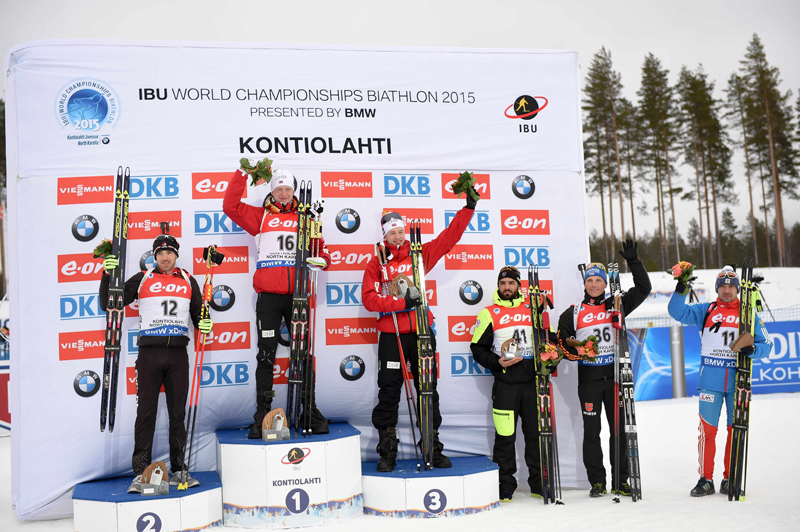
    What matters is how he ended it, and he closed out his last lap with the 22nd-fastest time to place 16th for his best result of 2014/2015. It was the second-straight race he shot clean following the men’s relay.

    “It’s hard to say exactly why my shooting has been so solid over the last two races, a bit of luck for sure, but I think I’m finally able to commit to a few small changes that I was working on over Christmas and fully trust my current position and mental approach,” Green wrote. “Any day you shoot clean it’s a bonus and I’m glad I was able to capitalize on that today and make it into the Mass Start tomorrow.”

    Green was the lone North American male to qualify for the mass start, which kicks off Sunday with the women’s 12.5 k at 12:30 Central European Time (CET) and the men’s 15 k at 15:40 CET (9:40 EST).

    He’ll start in bib 29 of 30. “I think I’m still capable of better results and tomorrow will be another good opportunity,” Green wrote.

    “Brendan’s result is in line with our expectations,” Biathlon Canada High Performance Director Chris Lindsay said in a press release. “He has a pattern of success later in the season and this is a planned step on the way to peaking at the World Championships in March.”

    Two years ago, Gow notched his previous World Cup career best of 29th in Ruhpolding, also in the sprint. While he explained that memory was “definitely in the back of my mind,” he added that he tried to keep it there to avoid distraction on Saturday.

    Given the conditions, he knew he was going to need all the focus he could muster.

    “I knew that good skiing and shooting could put me into the top 30, and that it was important to be focused on the entire process,” the 24-year-old Gow wrote in an email.

    He ended up cleaning both stages to put himself in 31st overall heading out on his last lap, and he tied Green for the 22nd-fastest last-lap time to finish 27th (+1:53.5). He was just 1.8 seconds behind Fourcade in 26th, who had two misses and the 18th-ranked overall course time.

    Canada's Scott Gow leaves the range in the men's 10 k sprint at the 2014 North American Rollerski Championships in August at the Ethan Allen Firing Range in Jericho, Vt.
    Canada’s Scott Gow leaves the range in the men’s 10 k sprint at the 2014 North American Rollerski Championships in August at the Ethan Allen Firing Range in Jericho, Vt.

    “My main focus for the race was my skiing,” Gow explained. “I don’t always fare well in deeper, slushy snow, so concentrating on achieving the best glide possible was my biggest goal for the race. Of course shooting is also a priority, but it was definitely secondary to my skiing.
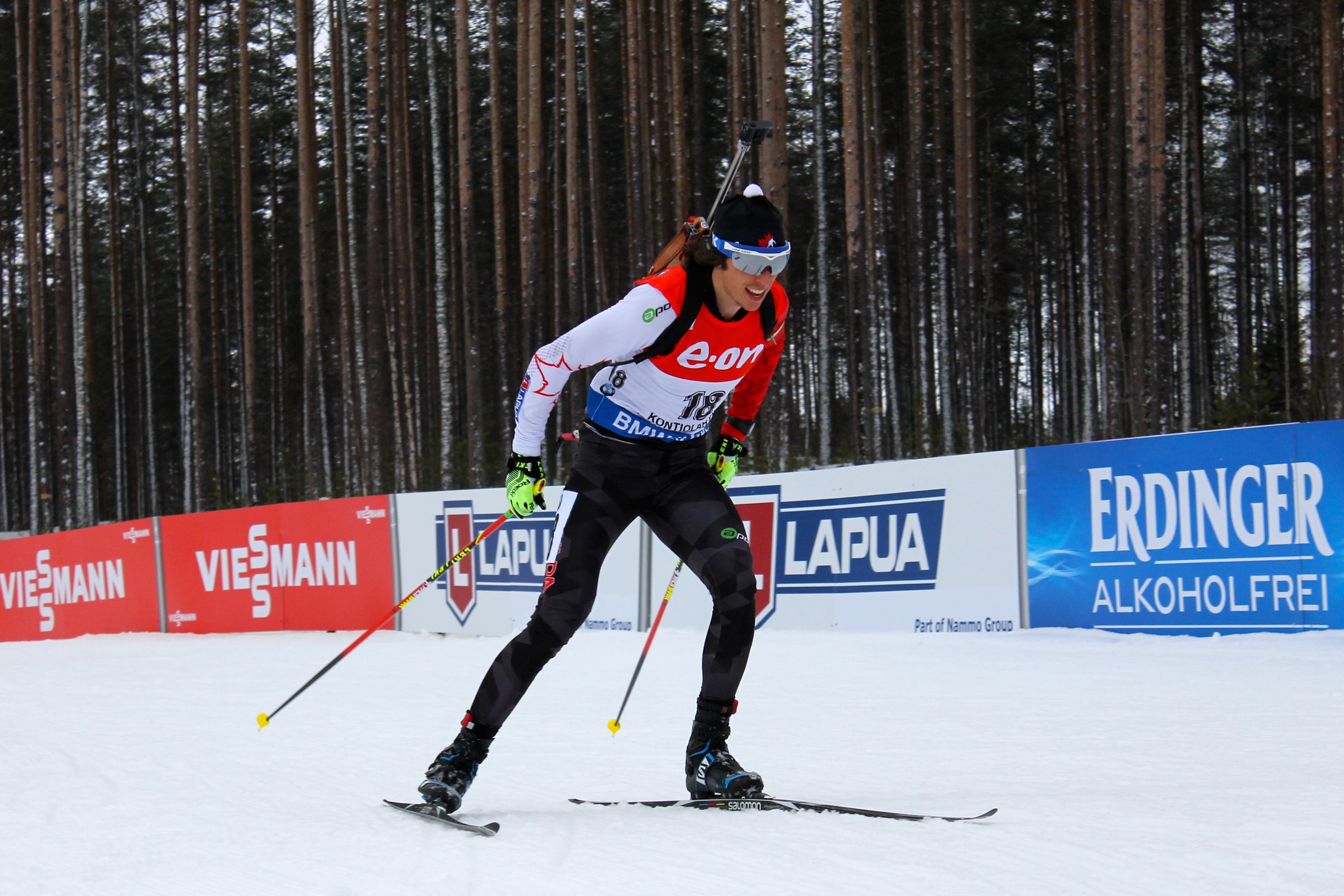
    “I would have liked to ski a little better and end up in the top 20, but I will have to wait for that result,” he added. “I managed to finish the race with relatively strong last lap which I was very happy with. … This performance was important to me because it is a validation of my training this past summer, and shows that I have the potential to be a more consistent top 30 athlete.”

    Lindsay said he was excited to see the depth of the Canadian men’s field starting to show, with Nathan Smith placing 35th (+2:06.9) despite three penalties.

    “Three men in the top-40 is a metric that shows our status as a top-eight nation in the world,” Lindsay said. “Now we need to see more consistency, and work on getting all four men in the top-40.”

    Gow’s younger brother, Christian, 21, raced through illness to place 81st with a single penalty.

    Smith, who started 33rd, wrote in an email that he found the conditions to be fair given the weather.

    “For sure the guys who were still out there at the end of the race were at a disadvantage when the newly fallen snow was being skied in less and less,” he wrote.

    At the end of the day, he wasn’t sure what went wrong with his shooting, especially with two prone penalties, but he explained he was “definitely disappointed” with that first stage.

    “It’s been feeling so natural and easy. Two misses was a bit of a shock,” he wrote.

    Despite dropping to 48th after the second stage, Smith posted the 19th-fastest overall course time to end up 35th, 2:06.9 back from the winner.

    “I actually didn’t realize my skiing was quite fast,” Smith wrote. “My end result is pretty good for having three misses. But this is biathlon and you need to have perfect or near perfect shooting to get top results. Today was one of those days where I did 50% of the sport really well.

    “I was really hoping to get back into the top-25 overall with a strong result today,” Smith added, which is what he would have needed to guarantee himself a start in Sunday’s mass start. He’s currently 29th in the overall World Cup. “Unfortunately that didn’t happen … I’ll have to wait until Antholz next week to redeem myself.”

    Lowell Bailey on his way to 41st in the IBU World Cup 10 k sprint on Saturday in Ruhpolding, Germany, with US Biathlon High Performance Director Bernd Eisenbichler at right.  (Photo: USBA/NordicFocus)
    Lowell Bailey on his way to 41st in the IBU World Cup 10 k sprint on Saturday in Ruhpolding, Germany, with US Biathlon High Performance Director Bernd Eisenbichler at right. (Photo: USBA/NordicFocus)

    Lowell Bailey was the top American in 41st (+2:22), with a single standing penalty, which he referred to as simply a bad shot.

    “The conditions were deep and slow,” Bailey, who started 65th, wrote in an email. “It was a tough race and I definitely didn’t feel like I could get everything out of my skis. … There’s only so much you can when it’s changing so frequently.  I might have done better by picking a different pair of skis.  But there really was no way of knowing.  All in all, not my best day. I hoped to be better.”

    Tim Burke placed 50th (+2:46.3) with three misses, all in standing, and while Bailey and Burke remain in the overall World Cup top 30 (in 27th and 30th, respectively), they didn’t qualify for the mass start.

    “Every day is different on the World Cup,” Bailey wrote. “There are so many variables that come into play; fitness feeling that day, weather, wind, shooting, skis, wax, crowds, etc.  Some days are better than others.  It’s been a bit up and down lately but I’ve been around this sport long enough to know that you just need to appreciate the good days, and learn what you can when things don’t go perfectly, then move on.”

    Also for the U.S., Sean Doherty started last in his first individual World Cup of the season and finished 80th with one miss.

    Results

  • Shipulin Finds His Mojo in Pokljuka Sprint; Bailey Cleans for 16th

    Shipulin Finds His Mojo in Pokljuka Sprint; Bailey Cleans for 16th

    Russia's Anton Shipulin leads Martin Fourcade of France in the men's 10 k sprint on Friday at the IBU World Cup in Pokljuka, Slovenia. (Photo: IBU/Rene Miko)
    Russia’s Anton Shipulin leads Martin Fourcade of France in the men’s 10 k sprint on Friday at the IBU World Cup in Pokljuka, Slovenia. (Photo: IBU/Rene Miko)

    Clean shooting just doesn’t cut it. Ask anyone on the International Biathlon Union (IBU) World Cup circuit: ask Friday’s runner-up, Dominik Landertinger of Austria, ask Norway’s Emil Hegle Svendsen, who finished third in the men’s 10-kilometer sprint in Pokljuka, Slovenia.

    Ask Frenchman Martin Fourcade, who placed fourth and was the only one in the top nine that didn’t clean. And be sure to ask American Lowell Bailey, who hit all his targets and put together one of his best races all season to finish 16th.

    “You always want to be up there fighting for a podium when you clean,” Bailey said on the phone Friday after shooting 100 percent and finishing 54.3 seconds behind sprint winner Anton Shipulin of Russia, who also cleaned.

    “I’m just not there yet on the skis there this season,” Bailey added. “… The most important thing is shooting accurately and then you get the speed, and hopefully you get both of those things.”

    Friday's sprint winner, Anton Shipulin of Russia (l) stands up after catching France's Martin Fourcade at the finish. Fourcade started 30 seconds ahead of him and ultimately placed fourth.
    Friday’s sprint winner, Anton Shipulin of Russia (l) stands up after catching France’s Martin Fourcade at the finish. Fourcade started 30 seconds ahead of him and ultimately placed fourth with a single penalty.

    That’s precisely what Shipulin possessed en route to his sixth World Cup win and second podium this season. All of the top-three men cleaned, but the Russian posted the fastest range and second-fastest course times, which made him untouchable on Friday.

    Only Fourcade was faster. But the overall World Cup leader missed one standing on a sunny and relatively calm day in Pokljuka. That cost him.

    After entering the range in fourth, 6.8 seconds behind Norway’s Johannes Thingnes Bø, Shipulin and Landertinger, respectively, Fourcade missed one to slip to seventh, 29 seconds back.

    For Bø, who had cleaned prone just like Shipulin, Landertinger, Fourcade, and France’s Jean Guillaume Beatrix in fifth before the second stage, it was worse. Bø missed two and fell 38 seconds behind Shipulin, who took the lead. Beatrix had two standing penalties as well to drop from 10 seconds behind to 48 seconds off the pace.

    Germany’s Simon Schempp, who started eighth behind Fourcade in bib 6 and Shipulin in bib 7, held strong in second after two clean stages, 21.7 seconds behind Shipulin. Landertinger, who started behind him in bib 16 and Svendsen, who started 12th, and much later on, Russia’s Evegeniy Garanichev in bib 71, collectively bumped Schempp to fifth after two stages.

    That’s where Fourcade kicked it in with one 3.3 k loop to go, rising from seventh to fourth at the finish. But Shipulin was even faster on the last loop, nearly catching Fourcade at the finish line after starting 30 seconds behind him.

    Austria's Dominik Landertinger celebrates his push for second in Friday's 10 k sprint at the IBU World Cup in Pokljuka, Slovenia.
    Austria’s Dominik Landertinger celebrates his push for second in Friday’s 10 k sprint at the IBU World Cup in Pokljuka, Slovenia.

    At the finish, Shipulin posted the fastest time by nearly 30 seconds. Landertinger was charging, skiing up to second, 7.4 seconds back, after standing, and so was Svendsen, who clocked in second at the finish, 24 seconds behind.

    Landertinger pushed hard through the final stretch, but came up 11.9 seconds short. The Austrian looked at the TV cameras and gave a thumbs up. He had done his best; Shipulin was simply faster.

    “This is a special moment for me; my shape the early part of season was not so good,” Shipulin told the IBU after the race, which he won in 23:18.6. “I waited a long time for this win … this is a very important step for me. This was my first clean shooting and a confirmation of my good shape.”

    Venues like Pokljuka and Antholz, Italy, suited him, he explained, “because I always feel good in these mountain places.”

    Landertinger was as pleased as he looked on TV as well.

    “I had good results last week in Hochfilzen, but just missed the podium, so today is a big step for me,” he told the IBU.

    Svendsen finished 24.1 seconds back in third, ahead of Fourcade (+29.9) in fourth. Garanichev ultimately led a string of clean shooters in fifth (+34.1), with Schempp in sixth (+36.3), Norway’s Tarjei Bø in seventh (+38.1), France’s Quentin Fillon Maillet, who had a career-best eighth (+41.6), and Russia’s Maxim Tsvetkov, who scored his second-ever top 10 in ninth (+42.6).

    Johannes Thingnes Bø was 10th with an two misses to break up the clean-shooters list, and Beatrix ended up 14th with the same amount of penalties.

    Lowell Bailey (US Biathlon) placed 16th in the 10 k sprint on Friday at the IBU World Cup in Pokljuka, Slovenia. (Photo: USBA/Manzoni/NordicFocus)
    Lowell Bailey (US Biathlon) placed 16th in the 10 k sprint on Friday at the IBU World Cup in Pokljuka, Slovenia. (Photo: USBA/Manzoni/NordicFocus)

    Then there was Italy’s Lukas Hofer in 15th, who cleaned and finished 53.9 second behind Shipulin. Bailey was another 0.4 seconds back in 16th. Beatrix, Hofer and Bailey will all start together, 54 seconds behind Shipulin in Saturday’s 12.5 k pursuit.

    “That’ll be an exciting first lap,” Bailey anticipated. “It’s all about shooting tomorrow especially on this course. I think you can really get benefit from getting in a train of skiers because there’s a lot of fast, rolling sections so if you’re skiing behind that can be an advantage.”

    On Friday, Bailey confirmed that he had made gains already this season, despite planning to build gradually throughout the next couple months. After initially finishing 12th, he recalled feeling satisfied with his race, but not ecstatic.

    Bailey in bib 42 was quickly bounced by Hofer, who started a minute behind him, and Germany’s Daniel Boem, who started 30 seconds after Bailey and placed 13th. Two Russians —Tsvetkov and Garanichev — ultimately put Bailey in 16th.

    “I’m happy with how the shooting’s gone,” Bailey said. “I’ve changed somethings around with my shooting in the training season and I’m happy that those seem to be working out already.”

    Specifically, Bailey said he and his US Biathlon teammates incorporated more head-to-head shooting in their workouts. That helped mimic high-pressure scenarios with distractions, and while he acknowledged, “there’s no better training than a race,” that kind of exercise helped.

    Bailey also worked on improving his efficiency and reducing the amount of time between stepping on that mat to taking his first shot. Prone felt a little delayed on Friday, “but standing felt good. I felt like that was a solid fast stage,” he said.

    What he was most perplexed with was where he lost time — and why.

    “I think the biggest, sort of confusing thing I could say today was that I actually had a decent ski time,” he said. “I probably had the best ski time I’ve had all year, but I lost a lot of time by the first 2.6 k split so I’m going to have to go back and see if theres anything I can change about that going forward into the next race. But the pursuit is about getting in a group and skiing strong.”
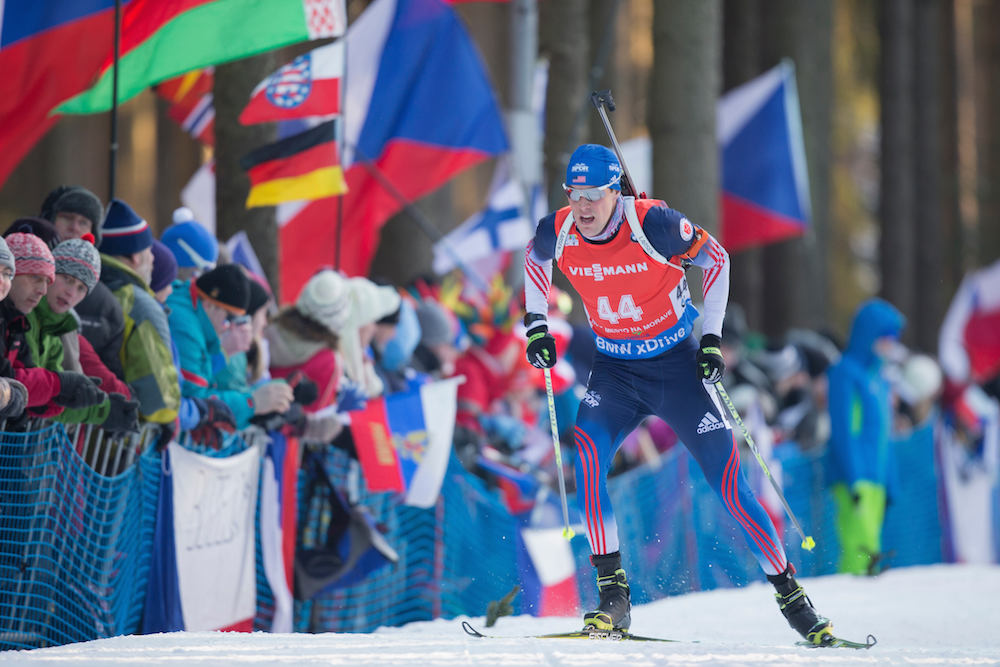
    Tim Burke (US Biathlon) on his way to 26th in Friday's IBU World Cup 10 k sprint in Pokljuka, Slovenia. (Photo: USBA/Manzoni/NordicFocus)
    Tim Burke (US Biathlon) on his way to 26th in Friday’s IBU World Cup 10 k sprint in Pokljuka, Slovenia. (Photo: USBA/Manzoni/NordicFocus)

    He’ll start ahead of teammate Tim Burke, who finished 26th (+1:20.7) with two standing misses.

    “Popluka has been a great place for me in the past and I feel the course really suits my strengths,” Burke wrote in an email. Last year, he placed fourth in the sprint and third in the mass start at the same venue.
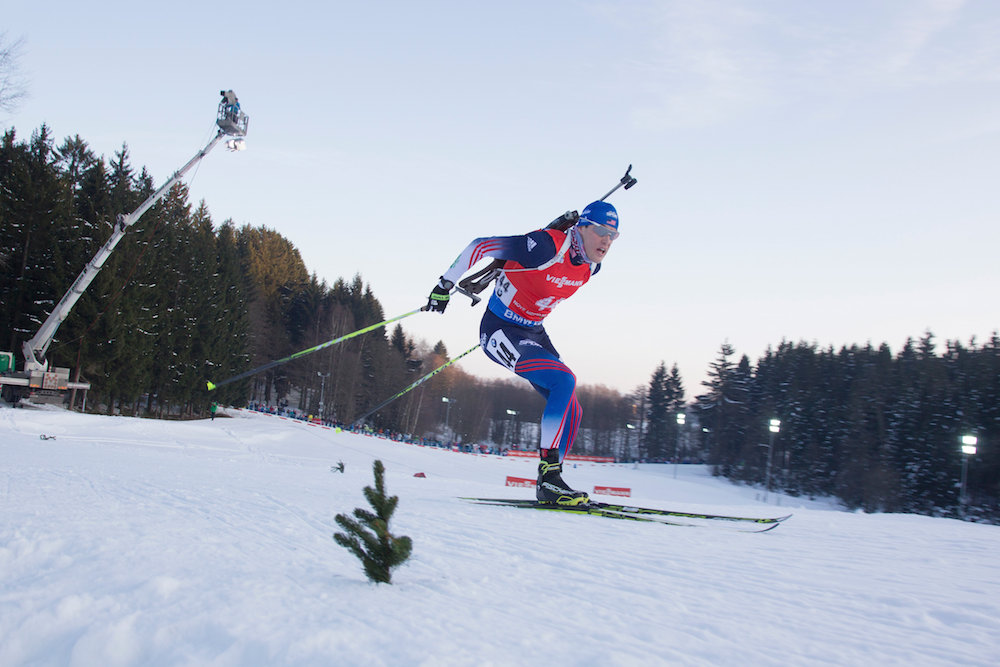
    “I felt solid warming up, but right from the start of the race today I just felt a little flat,” he added.  “After cleaning prone, I thought I could still manage a solid result but the two penalties in standing really set me back. I have struggled so far this season to put together consecutive good shooting stages and that was again the case today.”
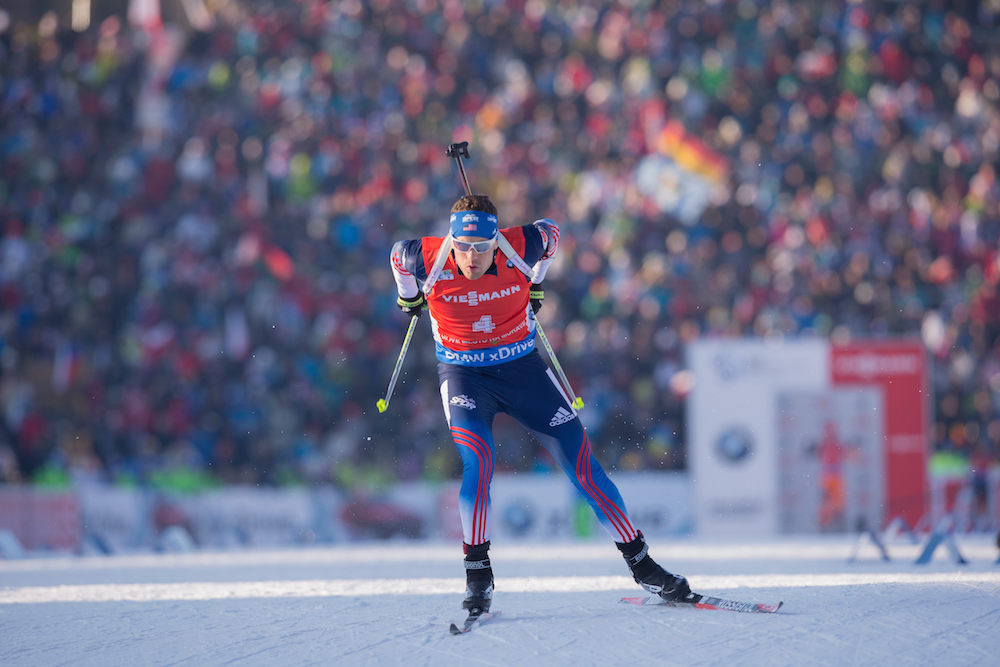
    Burke posted the 16th-fastest course time, 37 seconds back from Shipulin. His range time ranked 19th-fastest overall.

    “I don’t plan on making any changes, I will continue to attack each race and sooner or later everything will come together,” he added.

    Burke will start the pursuit 1:21 back with Switzerland’s Benjamin Weger, and five seconds behind Canada’s Nathan Smith, who placed 25th (+1:16.4) with a single prone penalty on Friday.

    Smith Top Canadian in 25th

    Canada's Nathan Smith racing to ninth in Saturday's IBU World Cup 10 k sprint in Östersund, Sweden. Photo: Fischer/NordicFocus.
    Canada’s Nathan Smith racing to ninth in the IBU World Cup 10 k sprint earlier this season in Östersund, Sweden. (Photo: Fischer/NordicFocus)

    Smith started second and initially fell off the pace with one miss. After his standing stage, his time trailed Shipulin’s by 55 seconds.

    “The prone miss was a split. It didn’t feel bad but I may have not quite fully moved over to the next target,” Smith explained. “Standing was a battle today but I was diligent in not throwing away any shots and fighting for each one.”

    As the first starter in the first race of the Olympics last winter, starting second didn’t bother him.

    “My big goal this weekend is to make it into the mass start,” he wrote. “In order to do that I will have to bang out two solid races. That means at least 90% and good skiing.”

    With the third-fastest range time overall, he had to have been pleased with his shooting, but Smith explained his skiing lacked aggressiveness.

    “I’m satisfied with today’s race. It wasn’t amazing, but not terrible either,” he wrote. ‘It puts me in a good spot to fight in the pursuit tomorrow for a mass start spot.”

    Smith’s Biathlon Canada teammate Brendan Green also qualified for the pursuit in 34th, and he’ll start 1:35 after Shipulin. On Friday, Green cleaned prone, missed one standing and skied the 10th-fastest last lap to finish in the top 40.

    “Heading into today my goal was to finish in the top 30,” Green wrote in an email. “I was able to put together my best ski performance this season with my best Sprint shooting so far this season and the result was close to where I wanted to be today.”

    Prone proved challenging: “I had to really work to hit my targets and even reset a couple of times,” he explained. “I was able to shoot clean prone but it was very slow and that cost me quite a bit of time at the end of the day. With better shooting speed today a top 30 was absolutely possible.”

    He started off slower, sitting in 59th after prone and 54th after standing, but Green was pleased to pick up speed throughout the three-lap race, especially on the last loop.

    “I’m hoping I’ll be able to take my form into tomorrow and chase a top 30 result or better in the Pursuit,” he added. “… Today was an improvement and I’m content with that for now, but there is still a lot of work to be done before I’ll be performing at my expectations.  It’s good to know where my form is at the moment, and it will be beneficial to have time [at home] over Christmas to address and fine tune some aspects of my performances from my season thus far.”

    American Leif Nordgren made the top-60 pursuit cutoff in 53rd with one standing miss, and will start 1:56 behind the leader on Saturday.

    “My goal is always top 40, today was no different,” Nordgren explained. “I’m not super happy with my ski shape right now, so I know I have to shoot well to get into the top 40.  Today that was a fine line.

    “This is one of the tightest pursuits I think I’ve ever seen,” he added. Nordgren will start at the same time as France’s Florent Claude and Switzerland’s Serafin Wiestner.

    “But it’s nice to know tomorrow that good shooting can make an even bigger difference than normal with everyone being so closely packed!”

    Results

  • Scott Gow Lands on Podium in ‘Perfect Day’ in Obertilliach; Vaillancourt Cleans for 7th

    Scott Gow Lands on Podium in ‘Perfect Day’ in Obertilliach; Vaillancourt Cleans for 7th

    Men's 10 k sprint at the North American Rollerski Championships at the Ethan Allen Firing Range in Jericho, Vt.
    Canada’s Scott Gow (11) during the men’s 10 k sprint at the North American Rollerski Championships in August in Jericho, Vt.

    Scott Gow’s been to the IBU World Cup, raced at 2013 World Championships and multiple  — as in five — Junior World Championships. But nothing beats getting on the podium.

    Gow, 24, got there on Friday in the men’s 10-kilometer sprint in Obertilliach, Austria, cleaning both stages to finish just 1.6 seconds behind French winner Baptiste Jouty and 1.3 seconds behind runner-up Florian Graf of Germany.

    He led a contingent of four Canadian men, with his brother placing 17th (+55.3) with a single prone penalty, Macx Davis in 53rd (+2:29.1) with two standing misses, and Carson Campbell in 83rd with two prone and two standing penalties.

    In an email, Gow, who finished 11th in the 10 k sprint two days ago, explained he was “so happy” with his end result on Friday.

    “Being able to shoot clean made it feel like a perfect day,” he wrote. “I had a good race on Wednesday that I was able to feed off a little bit skiing-wise, and I have been focusing a lot on shooting the past two weeks which all contributed to my result today.”

    His focus was shooting, first and foremost.

    “I was confident that my skiing was there, but I needed solid shooting if I wanted to break into the top 10 and have a chance at a medal,” Gow wrote. “I was ecstatic when I cleaned standing, and I knew I would be in the hunt.”

    He had heard that he was nine seconds back in fifth, but Gow was unsure how close the top three were.

    “I mean, how hard would it have been to pick up 1.6 seconds somewhere in the race?” he wrote. “Despite the tight finish I’m happy with 3rd and the renewed confidence for the next trimester.”

    As to whether he had any motivation to beat his younger brother, who placed eighth on Wednesday, Gow wrote, “I’m always motivated to beat my brother, but I was happy to see him have 3 good races. He did really well in Wednesday’s sprint, so he has a lot of confidence going for him as well.”

    Audrey Vaillancourt (Biathlon Canada) racing to second in Friday's 7.2 k sprint at Frozen Thunder in Canmore, Alberta. (Photo: Photo: Justin Brisbane)
    Audrey Vaillancourt (Biathlon Canada) racing to second in the 7.2 k sprint at Canada’s IBU World Cup team trials Frozen Thunder in Canmore, Alberta. (Photo: Photo: Justin Brisbane)

    In the women’s 7.5 k sprint, Canada’s Audrey Vaillancourt cleaned to place seventh, 20.7 seconds behind Ukrainian winner Iryna Varvynets. Wednesday’s sprint winner, Italy’s Federica Sanfilippo placed second, 4.6 seconds back with a single penalty, while Varvynets hit all her targets.

    After starting her season on the World Cup, Vaillancourt, 23, placed 41st on Wednesday and 49th in Tuesday’s 15 k individual.

    In an email, she explained she was mostly disappointed to be missing out on the IBU World Cup this week. She arrived in Obertilliach on Monday.

    “I knew there was no point in being sad or angry all week, so I tried as best as I could to let go, put a smile on my face and focus on my races here,” Vaillancourt wrote. “Until today my races were not going so well — I had not been shooting as well as usual, and I had not had really good feeling on the skis. I wanted to do well enough to stay on the World Cup, maybe even wanted it too much. I think I’ve been putting a lot of pressure on myself and that probably affected my performances in the wrong way.”

    But working with coach Ferréol Cannard, a former French team biathlete who’s been assisting the Canadian IBU Cup team in Europe, helped with her shooting, she explain.

    “He took time with every athlete to go over their strengths and weaknesses,” Vaillancourt explained. “Right before my race, he asked me whether I had shot 10/10 before. I said yes, and he told me there was no reason not to do it today then.”

    She wanted to start strong, and did so, trying to hold it through the finish. After cleaning her final stage, Vaillancourt heard her wax techs tell her she was fighting for a podium.

    “… Until the last lap … I really died!” she wrote. “But I’m still glad I tried that strategy, I still made top ten after all! I really needed today’s result, not to prove anything to anyone, but just for myself. I’m very glad I finished on such a good note before Christmas.”

    Vaillancourt led fellow Canadian Julia Ransom, who placed 18th, 1:01.1 behind the winner with her second-straight clean race. Zina Kocher finished 25th and Emma Lunder was 60th, both with two penalties.

    IBU Cup racing in Obertilliach wraps up with the mixed relay on Saturday.

    Results: men | women

  • Smith, Crawford Win Opening Sprints of Canadian World Cup/IBU Cup Trials in Canmore (Updated)

    Smith, Crawford Win Opening Sprints of Canadian World Cup/IBU Cup Trials in Canmore (Updated)

    Rosanna Crawford racing to the win in Monday's distance race at Frozen Thunder in Canmore, Alberta. (Photo: Noel Rogers/Bow Valley Photography)
    Rosanna Crawford racing to the win in the cross-country distance race on Oct. 27 at Frozen Thunder in Canmore, Alberta. She win on to win her second-consecutive race at Frozen Thunder on Thursday with a victory in the 7.5 k sprint at Canada’s IBU World Cup/IBU Cup trials. (Photo: Noel Rogers/Bow Valley Photography)

    Day one of the Canadian World Cup and IBU Cup selections races took place at the Canmore Nordic Center on Thursday. The sprint race format consisted of three laps of the 3.4-kilometer Frozen Thunder loop for men, and three laps of the 2.4 k track for the women.

    Cold temperatures dropping well below -20 degrees Celsius (-4 Fahrenheit) made the tracks hard packed and squirrelly for racers. The 10.2 k men’s race started at noon due to the cool morning with women’s 7.2 k following 45 minutes later.

    In the men’s race, Biathlon Canada’s Nathan Smith claimed the first victory of the season, clocking in at 26:57 minutes. Despite two misses in his last bout of shooting, Smith maintained strong ski speed to land on top of the podium. Marc-Andre Bedard of Team Quebec was just 12 seconds with perfect shooting for second. Macx Davies (Biathlon Canada) rounded out the top three another 25 seconds back, with three penalties.

    “Wasn’t looking for anything else than give my best and have fun!” tweeted Bedard after the race. The former Olympian has been focusing on obstacle racing for much of the year.

    The women’s race saw national-team veteran Rosanna Crawford take the win, with just one miss and the fastest time of 23:35. Emma Lunder, a new member to Biathlon Canada and the Biathlon Alberta Training Center, also had one miss and fought to stay with Crawford on her final lap for second overall, 1:08 back. Audrey Vaillancourt, another national-team member as well as an Open European Championship winner, finished in third, 9 seconds behind Lunder, with two penalties.

    Chilly morning for our first of two races up at the Nordic Center, happy to hit 9/10 when it’s hard to feel your fingers!” Crawford posted on her facebook fan page.

    Racing continues Friday with another set of sprints. Crawford, Smith and Brendan Green prequalified for World Cups 1, 2 and 3, and Scott Gow prequalified for IBU Cups 2 and 3 (although he’s aiming for a World Cup spot instead).

    In all, Canada has eight male and eight female quota spots, with four from each gender being tapped for the World Cup and four selected to the IBU Cup after trials. Qualifiers are expected to have shot at least 80 percent in two races this year, and come within 90 percent of the average of the podium finishers’ times at trials. The high-performance committee will review all results and select the team based on results and consistency, with a major focus on trials but also including other considerations as well.

    For more on selection criteria, click here.

    Thursday’s results

    ***

    About the author: Evan Brian Paul Girard is a student, an athlete and an adventurer. He grew up in a small town in Saskatchewan called Oxbow with a population of about 1,200. Biathlon Saskatchewan’s provincial coach Doug Sylvester introduced him to the sport at age 17. Having never cross-country skied or shot a target rifle, Girard was nearly a decade of training behind his fellow competitors, and he spent the next two years training with Biathlon Saskatchewan. In the spring of 2013, he was accepted as a member of the high-performance team, Rocky Mountain Racers, based out of the Bow Valley in Canmore. In December 2013, he competed for Canada for the first time as a biathlete at the Winter Univerisade in Trentino, Italy.

  • Decades in the Making, Bailey Achieves First-Career World Cup Podium in Kontiolahti Sprint

    Decades in the Making, Bailey Achieves First-Career World Cup Podium in Kontiolahti Sprint

    Lowell Bailey racing to his first career World Cup podium in Saturday's 10 k sprint in Kontiolahti, Finland. (Photo: USBA/Nordic Focus)
    Lowell Bailey racing to his first career World Cup podium in Saturday’s 10 k sprint in Kontiolahti, Finland. (Photo: USBA/Nordic Focus)

    According to U.S. women’s biathlete Susan Dunklee, her teammate Lowell Bailey has “worked so hard for so long and it finally paid off.” She used his success as inspiration for her race that followed on Saturday in Kontiolahti, Finland.

    Bailey shot clean and placed third, 19.4 seconds out back from Norwegian winner Johannes Thingnes Bø, in the men’s 10-kilometer biathlon sprint for his best-ever finish. After placing fifth in the Kontiolahti sprint three seasons ago, the American found success there again, this time unprecedented.

    “And the word the comes to mind is… ‘FINALLY!!!!!’ ” Bailey tweeted on Saturday after the race.

    “It’s been a long time coming,” he told the IBU in a post-race interview. “I’ve been working towards this for ten years, twenty years … definitely waited a long time. And I’ve been knocking at the door for the past three years.”

    Lowell Bailey racing to his first career World Cup podium in Saturday's 10 k sprint in Kontiolahti, Finland. (Photo: USBA/Nordic Focus)
    Lowell Bailey racing to his first career World Cup podium in Saturday’s 10 k sprint in Kontiolahti, Finland. (Photo: USBA/Nordic Focus)

    Bailey’s on quite a roll after being named to the International Biathlon Union (IBU) Athletes Committee a few days earlier.

    “Honored to represent the athletes of the IBU World Cup and looking forward to helping our sport move forward!” tweeted Bailey, a three-time Olympian after being elected for the first time.

    After winning on Thursday, Bø cleaned to win the second-straight sprint in Kontiolahti in 24:03.5 on Saturday. Russia’s Alexander Loginov also cleaned to take second, 18.5 seconds back. Ondrej Moravec of the Czech Republic finished fourth, just three-tenths of a second behind Bailey.

    In an email, Bailey wrote that he’s had a World Cup podium as a goal for a long time, so this result meant a lot to him.

    “I had a good first lap and I knew my ski speed was decent by the time I came in for the first shooting,” he wrote.

    Bailey had been disappointed with his performance on the shooting range during Thursday’s sprint, after missing one shot on each stage to place 29th, so his game plan Saturday was to be “decisive and deliberate” while shooting.

    “It may seem like a simple task, but sometimes you have to break complex things down to their simplest form,” the 32 year old from Lake Placid, N.Y., explained.

    On Saturday, things worked out in Bailey’s favor. By the time he headed back out onto the course after the last shooting stage, he was in second place.

    “I put everything I had into that last lap, with the help of every member of our staff screaming their lungs out throughout the 3.3km course!” Bailey wrote. “It came down to three tenths of a second between third and fourth.  I ended up on the right side today!”

    US Biathlon President/CEO Max Cobb wrote in an email that Bailey has worked especially hard to achieve this goal, not long after he logged the best-ever finish by an American at the Olympics in eighth.

    “It’s great to see him join the Podium Club!” Cobb wrote. “It’s a great credit to the whole high performance staff too, they have worked so hard to help the athletes achieve their personal bests. And Susan Dunklee had another top 10 with her 8th place today and Tim [Burke] and Leif [Nordgren] are also well positioned for tomorrow’s pursuit.”

    Burke placed 19th (1+1), 1:10 back from the winner, and Nordgren 27th (1+0), 1:23 behind, to soundly qualify for Sunday’s pursuit.

    Canada’s Nathan Smith also notched his career-best sprint in eighth, 33.6 seconds back, to tie his career best after placing eighth in a pursuit earlier this season.

    “I felt really good skiing today,” wrote Smith, who got sick the last few days of the Olympics and has been dealing with a cold and cough ever since. In his first season on the World Cup, he took three days off completely after the World Cup in Pokljuka, Slovenia, to try and rest up.

    “Thankfully I felt my energy come back more and more this week,” he explained.

    Even during the first sprint in Kontiolahti, Smith could tell that he was on the upswing, as evidenced by a respectable ski time and result in 21st.

    “Then yesterday I felt even better in training and so today I was hoping and expecting to have a great ski day,” he wrote.

    His strategy involved starting out “pretty aggressively” on the first lap and focusing on maintaining the pace for the other two.

    “I knew shooting would be key as so many athletes shot clean in the last race,” Smith wrote.  “With one miss in prone I was a little concerned, but knew my skiing was up a notch from two days prior.”

    With a fast-and-clean standing, Smith figured he was in a good position for a top-16 and pushed hard on the last lap, saving enough for the last steep climb and flats before the finish.

    “I ended up surprising myself with the 3rd fastest last lap and finishing 8th,” he wrote.

    Another American produced a season-best: Nordgren in 27th. In an email, the 24 year old wrote that his race “went really well” with a single prone penalty.

    “It was my best result of the year so far, and also my best skiing, so I’m pretty happy with this result!” he added.

    On the first loop of the race, Nordgren “got a nice ride” with Canada’s Brenden Green, which he thinks enabled him to relax quite a bit and also save up some energy for the last two laps.  He explained that his shooting was “nothing special … I’m not too happy with prone, I was a little quick and didn’t quite get settled, but I came back pretty calm in standing, so I can’t be too disappointed with one mistake.”

    As for Sunday’s race, he is starting in the middle of a pretty big group, “so it should make for an exciting race right from the gun!”

    For Canada, Green placed 28th (2+0), 1:23.3 back from Bø, and Scott Gow was 42nd (1+0), 1:48.8 back, to also make the top-60 pursuit cut.

    — Alex Matthews contributed reporting

    Results

  • Day 1 Olympic Notes and Quotes: Blue Skies and Butterflies

    The women's 15 k skiathlon  cross-country at the XXII Winter Games in Sochi, Russia. (Photo: Fischer/NordicFocus)
    The women’s 15 k skiathlon cross-country at the XXII Winter Games in Sochi, Russia. (Photo: Fischer/NordicFocus)

    FasterSkier’s coverage is made possible through the generous support of Rudy Project

    SOCHI, Russia — After all the buildup and accompanying action of Saturday’s cross-country and biathlon competitions, the first of the 2014 Winter Olympics, there was plenty to talk about on Saturday. Here are some of the soundbites that didn’t make the race reports.

    On Norwegian biathlon great Ole Einar Bjørndalen, who won his seventh gold and 12th Olympic medal in Saturday’s sprint:

    “You never know with that guy! He’s an extreme athlete. After some bad years, he’s definitely back this season. He did a perfect pre-camp before the Olympics, and now he’s just making an incredible race. I’m so happy for him and so impressed.” — Tarjei Bø, Norwegian biathlete, 39th in the sprint

    On the Norwegian team effort on Saturday, with two men in the top 10 (Bjørndalen, first, and Emil Hegle Svendsen, ninth) and the other two placing 39th  (Tarjei Bø) and 55th (Johannes Thingnes Bø): 

    “It’s bad, but I guess the Olympics is about winning. One gold medal is better than four in the top ten. We took the right medal and it’s good for the team. We’re very happy, and especially that Ole can finish his fantastic career with a gold medal.” — Tarjei Bø

    On the sudden death of Astrid Uhrenholdt Jacobsen’s brother, Sten Anders:

    “We had a very hard afternoon and tough night yesterday. We tried to switch to competition mode yesterday night, but it was not so easy.” — Egil Kristiansen, Norwegian women’s coach

    “We feel sorry for the Norwegian team, and we have talked with some people and we know that they have had a hard yesterday and even hard day today. So we feel sorry for them and hope they manage to recover from that. Because of that I think the Norge girls did a very, very strong race today to be able to focus on the race. When Charlotte [Kalla] got to know this about half past 12, one half hour before the start, I saw that in her face she was struggling a bit, with feelings. I don’t know if she know the guy, but I think she had met him, at least. It’s a small family, you know.” — Mattias Persson, Swedish women’s coach

    On women’s skiathlon silver medalist, Sweden’s Charlotte Kalla:

    “I saw immediately from the beginning in the classic that she was strong today. And when they went out for the free … there was a little [lead] group.” —  Persson

    On Justyna Kowalczk’s shape:

    “I don’t know. It was not so good in Toblach and it was not so good here, so maybe it’s not so good, but she has also … her foot, I heard.”—  Kristiansen

    On Kowalczyk falling in the skiathlon transition:

    Then we had the three Norwegian girls, and which of them is [Kalla] gonna beat? Because some of them will be on the podium. And which place? It was an interesting race for me and for all the waxers and the team leaders.” — Persson

    On the Olympic atmosphere: 

    “There’s quite a good number of people out on course. A lot more than I was expecting. I thought we’d be kind of alone except when we were in the stadium, but there were lots of people on the climbs. Which was pretty good – that hill hurt.” — Nathan Smith, Canadian biathlete, 13th in Saturday’s sprint

    “When the Russians around shooting, then it’s pretty loud. It has a big World Cup feel I would say.” — Tim Burke, U.S. biathlete, 19th

    “As a racing experience it was great. There were definitely places without fans. In Vancouver it was really eerie because there were people in the stadium and then once you got out, you felt like you could be racing the 1952 Holmenkollen or something. It was so quiet out there it was eerie. There was always a voice out here on the course today. It’s not like Oslo or anything, but it’s great. The views are spectacular. This is one of the most gorgeous places that we come, so I hope that it continues to be a World Cup venue after the Olympics.” — Holly Brooks, U.S. nordic skier, 47th in Saturday’s skiathlon

    “The fans were amazing. I couldn’t even hear Matt [Whitcomb] yelling something at me. It reminded me of World Championships from Oslo a couple of years ago. People had whiteboards out to tell their athletes what they wanted. The fans and everyone in Russia have been really great, so it’s just really fun to get the Olympics started again.” — Liz Stephen, U.S. nordic skier, 12th in skiathlon

    On the Olympic course:

    “These are the steepest longest hills in the entire world. Aside from the Alpe Cermis, which is skiing up an alpine area [in Val di Fiemme, Italy]. I’m a little bit more of a V2, flat skier. So it’s brutal for me.” — Brooks

    “This is six races on the toughest course in the world.” — Lowell Bailey, U.S. biathlete, 35th 

    “It’s a tough course … You attack the first climb and it feels okay, and then you hit that second really long climb, and it just kind of slowly eats you up. It’s an unforgiving course, and then when you have a long range entry, you just can’t miss. It’s a challenging venue, for sure.” — Brendan Green, Canadian biathlete, 23rd

    “It’s pretty crazy. [The skiathlon skate course is] literally is a massive downhill, you get so much speed. It’s good because it’s a great rest, but literally once you get down you just climb all the way back up. It’s a burner. Head down.” — Amanda Ammar, Canadian nordic skier, 55th in skiathlon

    On the conditions:

    “It’s great to be here on these tracks. They are in perfect condition. The sun has been amazing the last few days.” — Stephen

    “It’s really warm out but the snow is staying cold, which is perfect for skiing.” — Sadie Bjornsen, U.S. nordic skier, 31st in skiathlon

    The trick today was to find that balance and get guaranteed kick on the two last climbs of the classic course. The balance was to have skis that would kick and glide well … If you have bad glide, it’s rough, but our skis were good. … This gives a good confidence to the guys tomorrow, that wax technicians did a good job today. … We went on hard wax.” — Justin Wadsworth, Canadian Nordic Team Head Coach

    On adjusting to late races and a different time zone:

    “I’ve pretty much stayed on Central European Time. I go to bed really late, sleep in. I haven’t eaten dinner yet, but I ate lunch at about three o’clock, which is fine. The hardest part is the two o’clock races then. It feels really early.” — Burke

    “I’m just keeping it (my routine) the same as I’ve been doing all year and I tried to just treat it like a regular race. I tried to keep it as normal as possible.” — Emily Nishikawa, Canadian nordic skier, 42nd in skiathlon

  • Le Guellec Leads Canadians in 13th, Crawford Gets ‘Lucky’ in 17th in Hochfilzen Sprint

    Le Guellec Leads Canadians in 13th, Crawford Gets ‘Lucky’ in 17th in Hochfilzen Sprint

    Canada's JP Le Guellec racing to 13th in Friday's 10 k sprint at the IBU World Cup in Hochfilzen, Austria.
    Canada’s JP Le Guellec racing to 13th in Friday’s 10 k sprint at the IBU World Cup in Hochfilzen, Austria.

    HOCHFILZEN, Austria – The snow was supposed to stop. Then again, Friday’s International Biathlon Union (IBU) World Cup 7.5- and 10-kilometer sprints were held in a place that eventual men’s winner, Lars Berger, called “snowfilzen.”

    Five minutes before the start of the men’s 10 k, it started snowing – and the weather deteriorated throughout the race.

    That was especially frustrating to Biathlon Canada’s JP Le Guellec, not because it threw him off his game, but because he thought the conditions would improve as the race went on. Anticipating that, he asked his coach Matthias Ahrens to give his teammates Brendan Green and Nathan Smith the benefit of starting later.

    “I wanted to give priority to Nathan and Brendan because they have criteria to meet for the Olympics,” Le Guellec said after starting 22nd and placing 13th in Friday’s sprint. “We thought it was going to be snowing at the beginning of the race and then stop snowing at the end.”

    Canada's Brendan Green racing to 31st in Friday's 10 k sprint at the IBU World Cup in Hochfilzen, Austria. Green was one second away from making the top 30 and qualifying for Canada's 2014 Olympic team.
    Canada’s Brendan Green racing to 31st in Friday’s 10 k sprint at the IBU World Cup in Hochfilzen, Austria. Green was one second away from making the top 30 and qualifying for Canada’s 2014 Olympic team.

    With Le Guellec, 28, already prequalified for the Olympics, his teammates need a top 30 to do the same. Green finished 31st, one second out of 30th, with two misses after starting 53rd. Smith, who started in bib 105, placed 48th with a single penalty.

    “It’s a bit frustrating, but it is fun for me to have had the better conditions,” Le Guellec said after cleaning the prone and missing one on the standing. “The tactic missed though.”

    Green described the weather as “a little bit nasty” in the middle of his race, adding that it did let up a bit. His nemesis was shooting, he said. After missing the last shot of his prone, Green repeated with a final miss in the standing.

    “Missing the last shot in standing was not good,” he said. “There was a little bit of wind, but I think it was manageable. I just got a little bit too excited and shot it off a little too soon. … I was really hoping for a top 30 to finish off my Olympic criteria, so hopefully in the pursuit I can do that.”

    Smith hit nine of 10 targets, missing just one in the second bout.

    “I felt better than the last sprint, but not as good as the individual in Östersund,” he said after notching a World Cup career-best 16th in the 20 k individual in Sweden last week.

    “The last lap, I had no chance. It was so much slower,” Smith said of Friday’s race. “There was nothing I could do.”

    While earlier starters enjoyed better conditions, it wasn’t easy for anyone out there, and Le Guellec used his experience to manage the increasing wind.

    “In prone, it was pushing a little more than in zero so I shaded a bit instead of correcting, and ended up cleaning,” he said. “I did the same thing [last week] in Östersund in the sprint and I missed two, but then after the race, my coach told me I didn’t shade enough.”

    Lesson learned. At the first World Cup in Östersund, Le Guellec came out firing with a fourth-place finish in the 20 k individual on Nov. 28. Two days later, he placed 29th in the 10 k sprint with four penalties – two in each stage.

    Heading into Friday’s standing, Le Guellec noticed the wind was coming from the opposite direction and heard German Andreas Birnbacher (who ended up 33rd) coming out of shooting “pretty frustrated with three misses,” Le Guellec said.  “I had a clue and setting up, I really took my time. I ended up missing one anyway, but it was pretty decent considering the wind.”

    Overall, he was pleased with his result, 55 seconds behind Berger (who won in 25:02) and feeling like might have been able to push harder earlier. With the 27th fastest first-lap time, he improved to 11th fastest the second time around.

    “I don’t know if I went [out] too conservative, but the skis were definitely good,” Le Guellec said. “I hammered on the last lap and I had some guys to follow.”

    Canadian Zina Kocher chases Ekaterina Glazyrina of Russia out of the starting gate in Friday's IBU World Cup 7.5 k sprint  in Hochfilzen, Austria. Kocher ended up 25th and Glazyrina was 51st.
    Canadian Zina Kocher (l) chases down Ekaterina Glazyrina of Russia during Friday’s IBU World Cup 7.5 k sprint in Hochfilzen, Austria. Kocher ended up 25th and Glazyrina was 51st.

    Another Canadian prequalified for the Olympics, Rosanna Crawford placed 17th with two penalties – both standing – in the women’s 7.5 k. She finished 47.1 seconds behind Selina Gasparin, who became the first Swiss biathlete to win a World Cup (finishing in 23:16.9).

    “I got lucky,” Crawford said of starting 90th, a bib number she initially dreaded fearing the conditions would worsen.

    “The course sped up a lot,” she explained. “If I’d started early, I don’t think I would have been that high.”

    In last week’s Östersund sprint, Crawford missed three standing for 51st overall. After cleaning her prone again on Friday, she was disappointed with two standing misses, but recognized that “the potential is there.”

    “The season always seems to start off pretty bummy for me for some reason,” Crawford said. “Today, 80 percent, I’m not very happy with it especially since it came in one bout, but it will come together. I think we have a big potential for a great relay. Three of us had great races today.”

    Zina Kocher was the second Canadian woman in 25th with two misses – one in each stage. Megan Imrie placed 35th with two penalties as well (0+2), and Megan Heinicke finished 70th with four misses (1+3).

    “Skiing was quite good, but shooting was a disaster,” said Heinicke, who posted the 38th-fastest course time overall. “I’m waiting to see if I’m in the pursuit. It will be pretty tight I think.”

    Similar to the men’s race later in the day, the wind picked up significantly for the women from zeroing to prone.

    “I clicked four left, which is a lot, but … I only missed one,” Heinicke said. “Standing, [the wind] wasn’t very strong, but it was sort of on and off. It was just tough and I was pretty disappointed because I had really good windy shooting in that [Östersund] pursuit that was canceled so I was thinking, ‘be confident,’ but it didn’t work out.”

    Heinicke finished 56th in last week’s sprint with three misses (1+2). The following Östersund women’s 10 k and men’s 12.5 k pursuits were canceled because of high winds, a decision that was made midway through the women’s race. Both Heinicke and Imrie were skiing in the top 10 when it was called off.

    “I was disappointed at first, but then when I saw the footage, I was like, ‘Okay, be realistic. I would never have been in that position in normal conditions,’ ” Heinicke said. “I was just happy that I had managed the wind well, and I felt good skiing that day. It was fun while it lasted.”

    World Cup racing continues in Hochfilzen this weekend with the women’s 4 x 6 k and men’s 4 x 7.5 k relays on Saturday, and the women’s 10 k and men’s 12.5 k pursuits on Sunday.

    Results: men | women

  • Burke and Bailey Lead U.S. in Khanty 10k

    Burke and Bailey Lead U.S. in Khanty 10k

    Tim Burke (USA) en route to a ninth-place finish in the 10 k sprint on Friday in Khanty-Mansiysk, Russia. Photo: USBA/Nordic Focus.
    Tim Burke (USA) en route to a ninth-place finish in the 10 k sprint on Friday in Khanty-Mansiysk, Russia. Photo: USBA/Nordic Focus.

    Coming off the high of a top-five in Sochi, Russia, last weekend, U.S. Biathlon’s Tim Burke continued the momentum on Friday in Khanty-Mansiysk with a ninth-place finish in the 10 k sprint, the third-to-last race of the World Cup season. He recovered from a missed target in the prone stage to clean the rest of his shots and finish 1:03.7 behind Martin Fourcade’s (FRA) top time.

    Lowell Bailey also had a strong finish in 11th place, just two seconds behind Burke, with perfect shooting. Between the two Americans, Khanty was the first time they’ve both placed at or near the top-10 in the same race. It was almost an actual top-10 for Bailey, but a time allowance awarded to Norway’s Vetle Sjastad Christiansen after a mid-race target snafu later bumped the American down a place on the final results.

    For both athletes, Friday was a good, almost-great day.

    “I am always happy with a top-ten result but of course it would have been great to hit one more target!” Burke said. “But this is biathlon.”

    Given the timing of his single error, however, Burke was happy to have rebounded as quickly as he did from missing his first shot on the range. Such a mistake can cause athletes to lose focus for the remaining targets, but Burke stayed calm and made sure it was his only error.

    “It was a tough start for me on the shooting range because I missed my first shot,” Burke said. “I am happy with how I was able to put that out of mind quickly and just focus on the next nine shots.”

    Burke skied the seventh-fastest middle lap to move himself from 20th place after the prone stage to third before his second time on the range. Conditions were frigid and slow on the course, but Burke said the American technicians hit the mark in the wax department while other teams struggled.

    “The conditions today were just like they have been here all week with really slow, cold snow,” he said. “I think you could see on the results that some of the bigger teams really missed the wax today. We have a smaller group of technicians here this week, but our guys nailed it.”

    Khanty is the last weekend on the World Cup calendar, and before he leaves Russia Burke wants to reach the top-three again. It could happen with the way he’s been skiing, but within the ultra-competitive men’s field the achievement will require perfect shooting.

    “I would really like to end the season with another podium but there are many other guys with that same goal,” Burke said. “I feel like I still have the shape to make that happen so it will come down to shooting. “

    Lowell Bailey (USA) skiing to 11th place on Friday. Photo: USBA/Nordic Focus.
    Lowell Bailey (USA) skiing to 11th place on Friday. Photo: USBA/Nordic Focus.

    This was exactly Bailey’s assessment, too: “Anything less [than a clean race] and it is hard to get close to the top 15.”

    Bailey wasn’t able to shoot cleanly in Sochi and consequently didn’t place higher than 30th, but in Khanty he hit all ten targets and produced one of his best results all season, after his seventh-place finish in Antholz and tenth in Hochfilzen.

    “I’m happy with the result and looking forward to tomorrow’s pursuit,” Bailey said in an email.

    As the second starter on Friday, Bailey was stuck with the disadvantage of receiving little in the way of meaningful feedback on the course, so “I just tried to focus on my own race and do the best I could,” he said.

    The course was one that suited him. “I like this course a lot and I think it has all the elements of a great course — gradual terrain, steep climbs, lots of transitions.”.

    Though he felt the snow slowing he skis down, Bailey told himself that everyone else had to deal with the same circumstances. He posted the 40th-fastest course time on the first lap, and with a closing loop that was nine seconds faster than his first he moved into tenth overall in the almost-final standings, which ultimately became an 11th place. Vetle Sjastad Christiansen (NOR) experienced some confusion on the range for the standing stage when another athlete’s wayward bullet hit one of his own targets. Officials cut 52 seconds off Christiansen’s result to account for the time it took to reset the targets, which bumped Bailey from 10th to 11th.

    While Burke and Bailey put together one of their best collective days of theseason, their teammate, Russell Currier, had the best race of his winter in 43rd, 2:11.7 back from the winning time. Cleaning shooting was what made the difference for the 25-year-old on Friday.

    “Long story short: The hits were good. As good as they can be,” Currier said. “Skiing was okay. About average, which I consider to be okay at best this year, but the time spent in the range was awful.”

    For both his prone and standing stages Currier’s range time ranked in the 90s out of 97 finishers. The time he spent in the prone position was 29 seconds more than the fastest athlete through the range.

    “The time it took me to get on the mat and take the five shots was terrible,” Currier said. “The total time cost me almost more than the time it would have taken to ski two penalty loops! This has always been my week point. It’s a good thing those targets went down.

    Currier’s clean shooting record on Friday is his best one of the season.

    “It may have come down to [this] series of races, but I managed to muster up at least one clean race this season!” he said. “I remember looking back at target 21 after standing just to confirm that it was another clean stage.”

    After Currier, Leif Nordgren finished 53rd for the U.S. with three errors, 2:30.4 back.

    The Khanty-Mansiysk World Cup continues for the men on Saturday with a 12.5 k pursuit.

    Results.


  • Fourcade Indestructable in Khanty Sprint

    Fourcade Indestructable in Khanty Sprint

    Martin Fourade (FRA), charging on the anchor leg.
    Martin Fourade (FRA), shown here competing earlier this season, won the 10 k sprint in Khanty Mansiysk, Russia, by a gaping 39 seconds on Friday.

    France’s Martin Fourcade was asked in the post-race press conference last week in Sochi, Russia, what he thought of winning the 10 k sprint there without Norway’s Emil Hegle Svendsen on the start list. Biathlon’s most dominant performer of the year was direct and confident in his response.

    “He’s a great champion and he had wonderful results at World Championships, but I was better this year,” Fourcade said firmly. “I don’t care if he’s there or not.”

    Well, Svedsen was there on Friday in Khanty Mansiysk, and Fourcade proceeded stomped all over the Norwegian and everybody else in the field. Wearing bib 23 on a start list that crammed the faster seeds at the beginning, Fourcade left little doubt he would claim another win before the day was through. Last week the top starters stayed within a few seconds of each other after the prone stage, but that was not the case on Friday. Fourcade came into the range for the first lap already 14 seconds up on the next contender, after which he shot cleanly and quickly to hold onto his margin as he left for his second loop.

    Fourcade then cleaned his targets in the standing stage, too, and won the race by 39.6 seconds over Italy’s resurgent Lukas Hofer. Andreas Birnbacher (GER) took third, 43.8 seconds back. The win was Fourcade’s 17th podium of the season, a mark that surpasses the new record he set for himself with his 10 k win in Sochi.

    “He’s something incredible on the skis, it’s really impressive,” Hofer said.

    Svedsen’s presence, meanwhile, was of little consequence. The Nowegian floundered in 30th with one error, 1:40.1 off Fourcade’s mark. The Frenchman pointed this out.

    “I was really happy Emil Svendsen was here and not to have the question from the media, ‘What do you think, to win without him here?’” Fourcade said. “He was here today.”

    Noted.

    Fourcade did not compete in the Sochi relay last weekend, but he didn’t think the extra recovery necessarily factored much into his performance in Khanty.

    “I was hurt with my back for the relay and it was hard for me to say to my teammates I could not race with them and try to win, and I was really said, but now my shape is almost incredible,” he said. “I knew in training yesterday when I did a short test that my shape was still at the top.”

    Conditions in Khanty were cold but calm, which set many athletes up for shooting well. Hofer in particular enjoyed competing in the cold, and with his second-place finish he was able to rekindle the energy he first felt at the venue four years ago.

    “I like the low temperatures; I love this place,” Hofer said. “I train a lot at minus 20, so it does not bother me.”

    The Italian struggled earlier this season after his father passed away in October, but since December his fitness and mental focus have finally come back around in time for the final races of the year.

    “It was hard mentally in the beginning of the season,” Hofer said. “After December, I started to get better in both shooting and skiing. Now I feel I can finally bring the training into the races. We have to work a lot with our mental training…so for the moment it’s working well.”

    Birnbacher has had a similar recent improvement in results. He was sick before World Championships in Nove Mesto but is now in a better place mentally, which he says is crucial in a field as tightly competitive as the men’s World Cup currently is.

    “When you go to the podium you have to be in a very good mental situation; the men’s races are very close,” Birnbacher said. “I felt empty at World Championships but…now [my shape] is getting better and better for me, so I’m happy to get on the podium in Sochi and here.”

    With only two races to go before the end of the season Fourcade has nearly guaranteed he will still be on top of the overall ranking when the last race is over. Though he’s been unstoppable as of late, he is very aware that anything could happen in the mass start.

    “I know if I do the job, if I do a great race, I will win,” Fourcade said. “But I know also that this is biathlon. I have to finish over 19th to lose the globe but last year I was 24th in the last mass start, so anything can happen, I think. We all know it.”

    Results