Tag: 10-kilometer classic

  • Svahn Wins Back-to-Back in Val Müstair; Diggins 3rd, Brennan 6th (Updated)

    Svahn Wins Back-to-Back in Val Müstair; Diggins 3rd, Brennan 6th (Updated)

    And they’re off! The women take to the course in Stage 2 of the 2021 Tour de Ski, a 10-kilometer mass start classic in Val Müstair, Switzerland. (Photo: NordicFocus)

    This World Cup coverage is made possible through the generous support of Marty and Kathy Hall and their A Hall Mark of Excellence Award. To learn more about A Hall Mark of Excellence Award or to learn how you can support FasterSkier’s coverage please contact info@fasterskier.com.

    Light snow continued to fall in the quaint Swiss village nestled in Val Müstair as the athletes took to the tracks for the first distance stage of the 2021 Tour de Ski, a 10-kilometer mass start classic race. As the first mass start of the season, the women kicked, glided, and poled over 10-kilometers broken into four challenging laps, seeing exactly where they stacked up relative to their competitors.

    With four consecutive distance stages, the Tour quickly becomes part poker match, part ultramarathon. Standings and cumulative time are influenced not only by the final result from each day, but by the bonus points athletes can garner at checkpoints on course; in today’s case, an opportunity at the 3.3 kilometer mark.
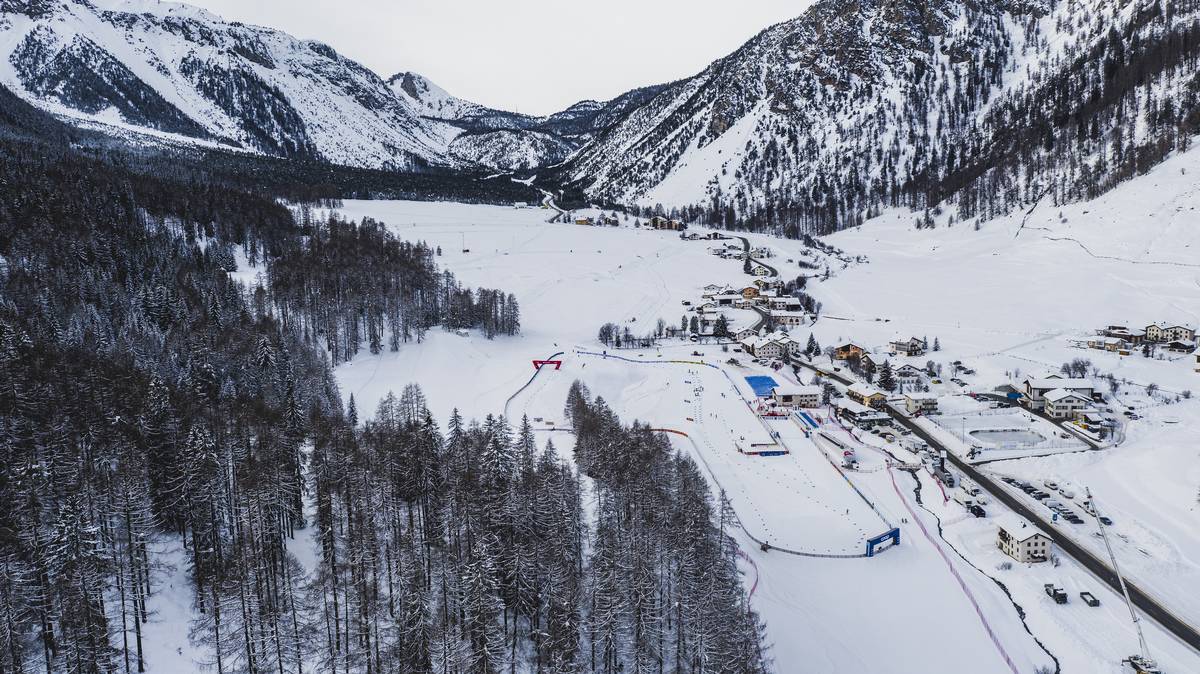
    The picturesque village and tracks of Val Müstair play host the first three stages of the 2021 Tour de Ski. (Photo: NordicFocus)

    As position in the field is relatively clear in a mass start — versus chasing the splits of a “ghost” racer in an interval start — tactics, patience, and drafting become more significant. 

    Today, it was soon evident who intended to make a run at the dealer in the Stage 2 match. Wearing a bright green bib as overall U23 leader, Sweden’s Frida Karlsson skied at the front of the pack from the start. She out-sprinted teammate Ebba Anderson approaching the 3.3 k checkpoint to snag the maximum of 15 bonus points, and seemed to be comfortably kicking up each of the steady climbs. After her defeat of Norway’s powerhouse Therese Johaug at last year’s Holmenkollen 30k, albeit in part attributed to Johaug’s decision not to change skis, Karlsson solidified her position as a woman to watch in distance races.
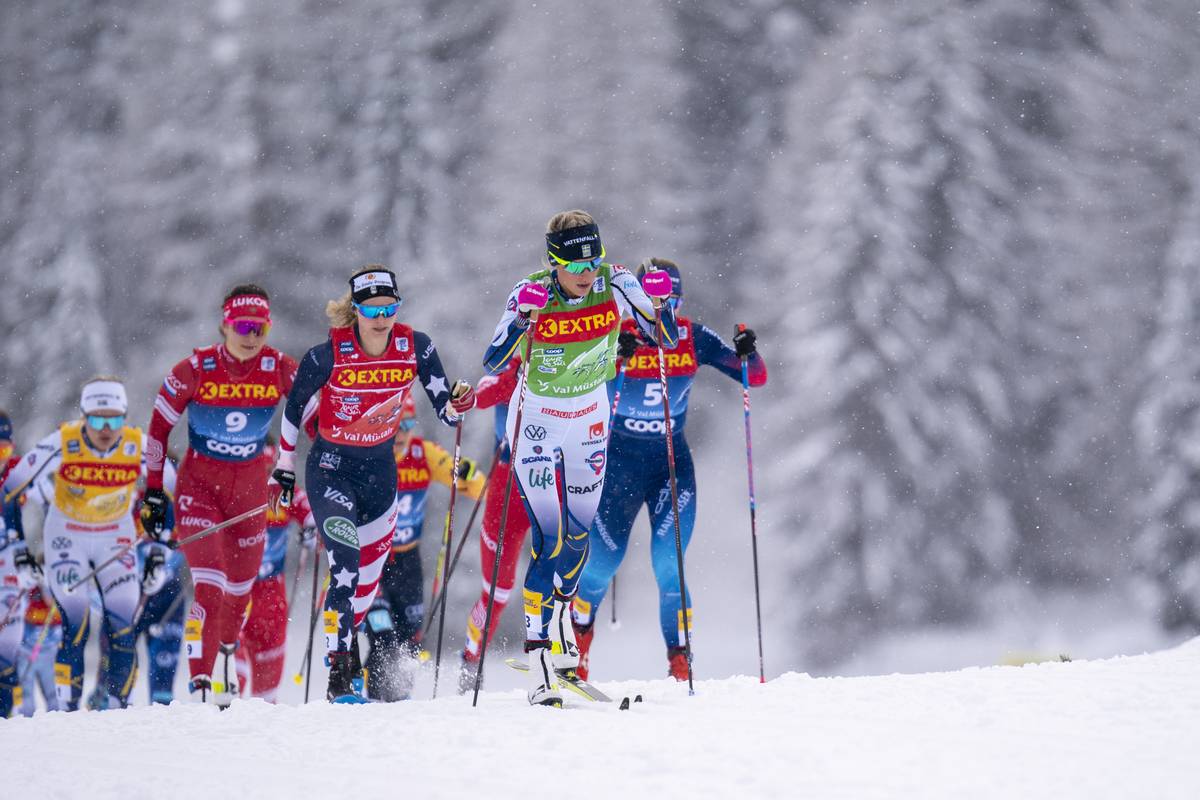
    Frida Karlsson sets the pace with Diggins marking from behind during Stage 2 of the 2021 TdS. (Photo: NordicFocus)

    However, despite her seeming authority at the front, she was unable to create any true gap to the women behind her. At the midpoint of the last lap, six women sat on her tails including two women whose stars and stripes flashed on their legs as they matched the tempo of the other women striding alongside them. 

    One of these women, Jessie Diggins, comes off a second place finish in yesterday’s sprint. Diggins held her position in the top three throughout the race, at times challenging Karlsson at the front, leaving no room for weakness or error on the young Swede’s part. 
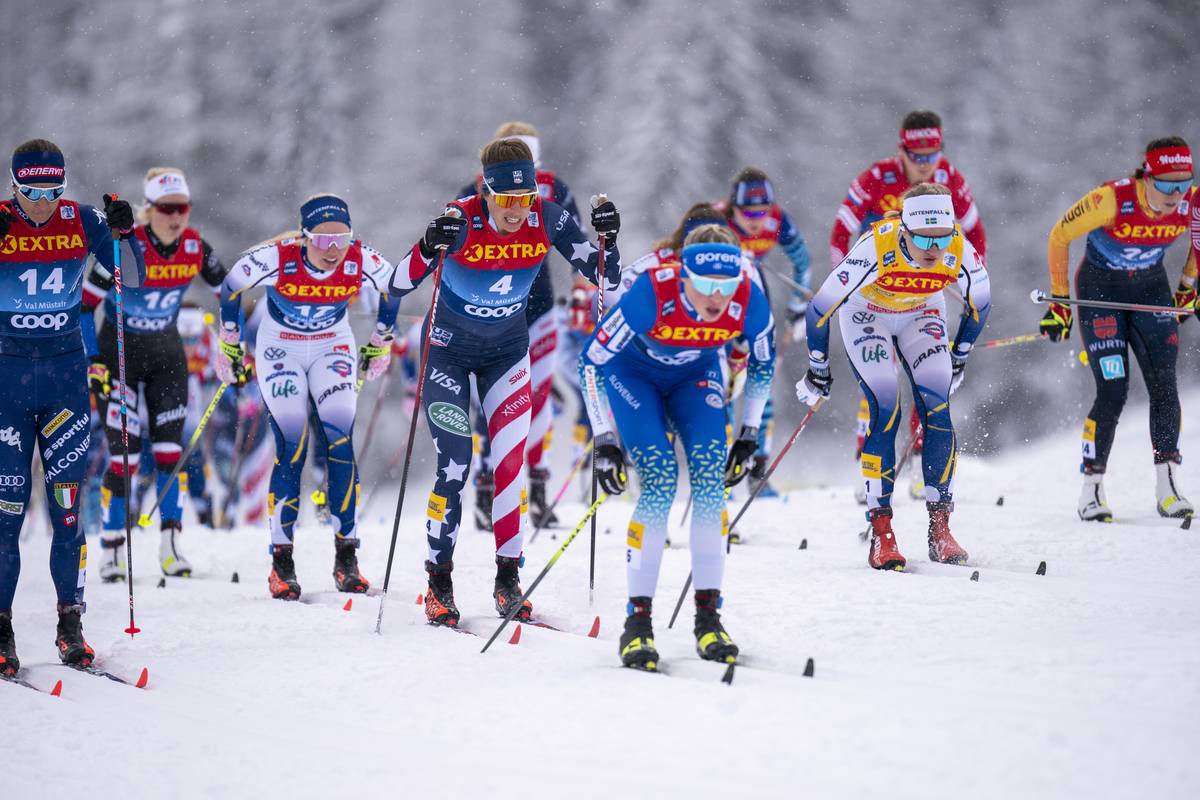
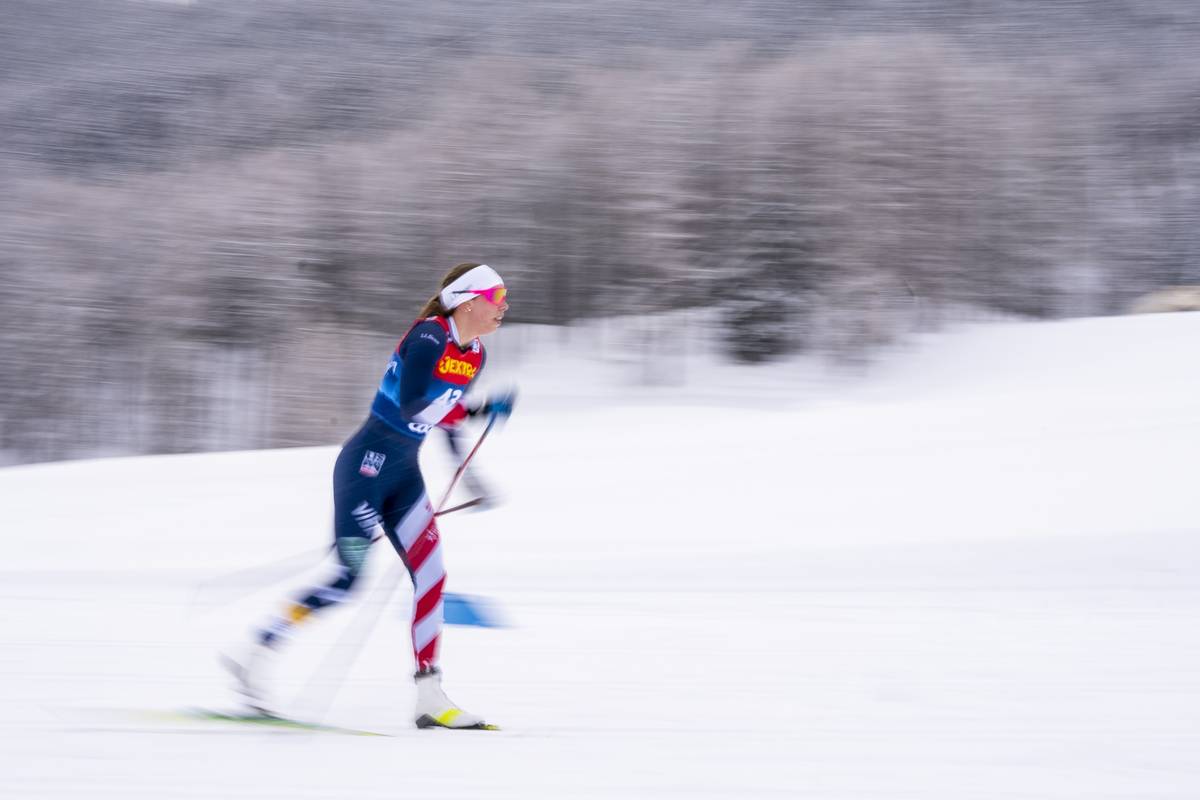
    Rosie Brennan tucks into the lead group during Stage 2 of the Tour de Ski, a 10-kilometer mass start classic. (Photo: NordicFocus)

    Fellow American Rosie Brennan, who finished fourth in Stage 1 also sat comfortably in the lead group, matching the surges that were made to break away as the race progressed. 

    In the final two kilometers, the other women began their own runs for the win, challenging Karlsson who was faltering, but unwilling to fold. Up the final climb and down the same screaming S-turn descent featured in the sprint course, the women charged furiously toward the finish, Karlsson slowly being swallowed into the pack. 

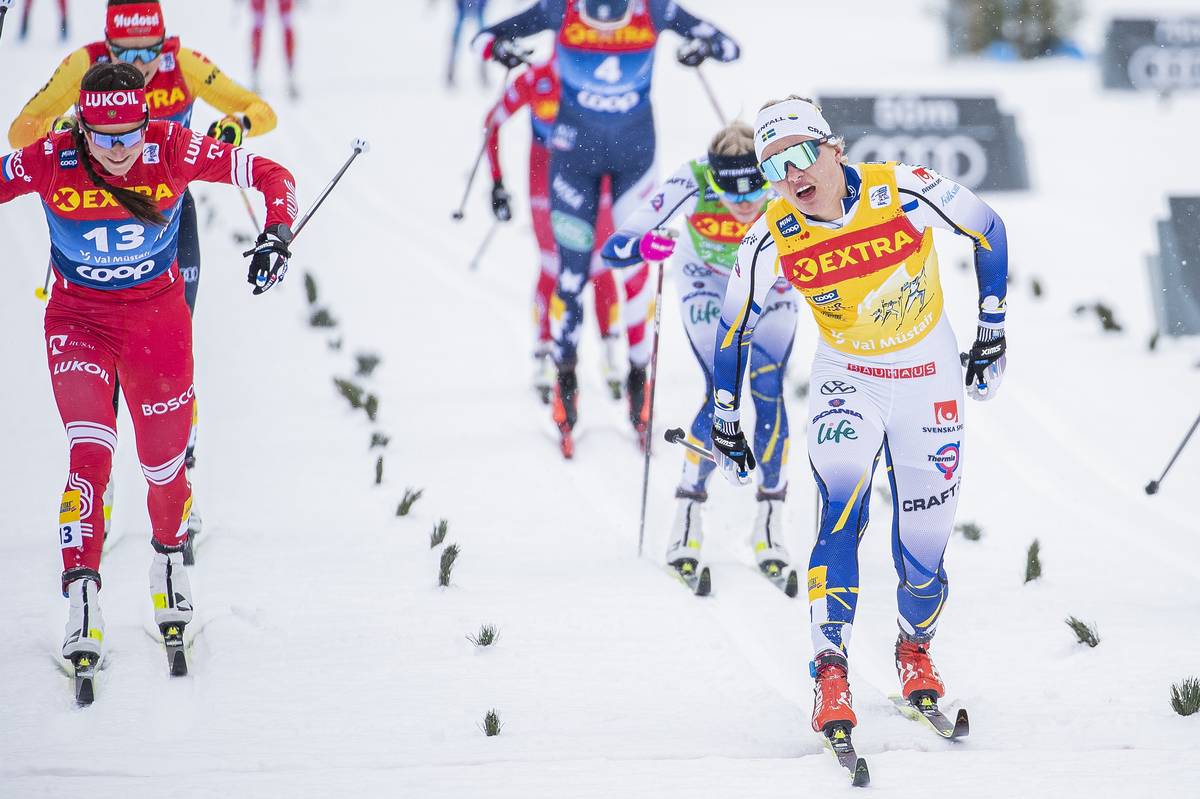
    Rounding the final corner and thrashing her poles to accelerate toward the finish, a different woman in white lycra took the reins. 21-year-old Linn Svahn, the winner of yesterday’s skate sprint and of the 2019/2020 World Cup sprint globe, put her closing speed on display to stop the clock at 30:09.9. Though she has won FIS distance races on home soil, this is Svahn’s first distance win at the World Cup level.
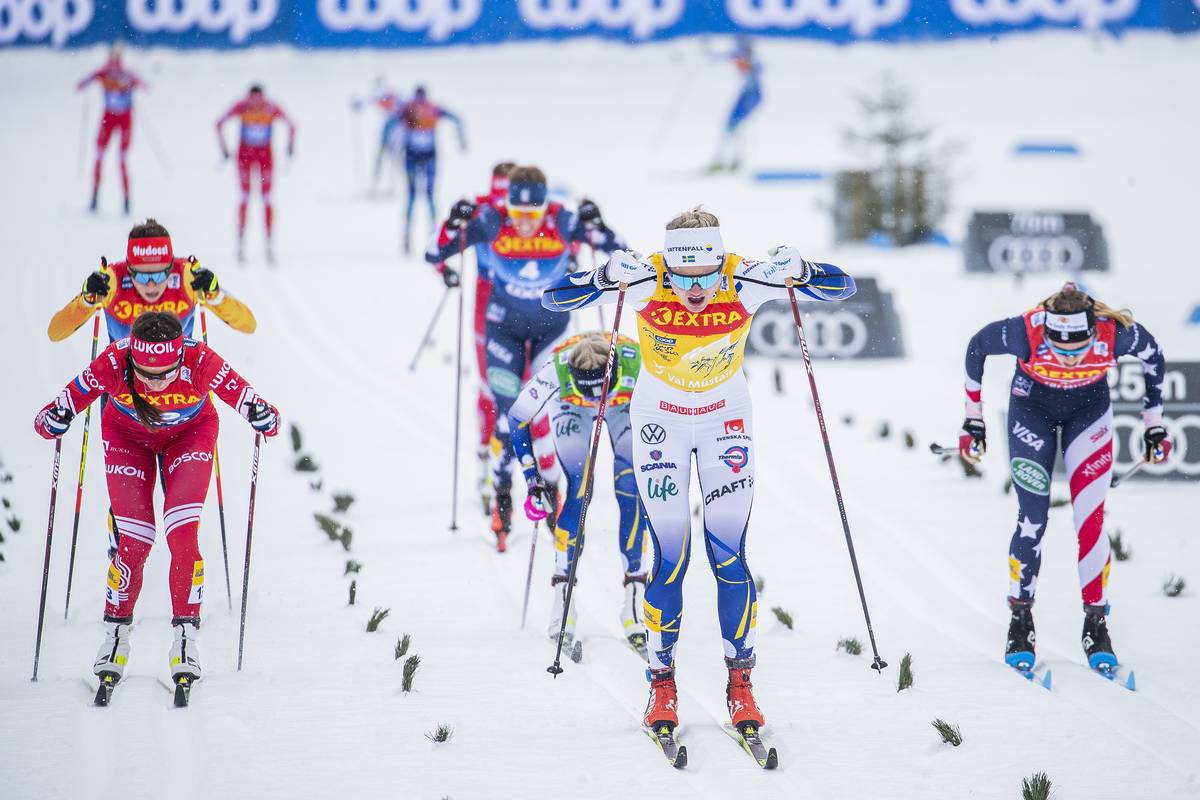
    The top women fight to the line during Stage 2 of the 2021 Tour de Ski. Sweden’s Linn Svahn took the win, with Yulia Stupak (RUS) and Jessie Diggins in 2nd and 3rd, respectively. (Photo: NordicFocus)
    Sweden’s Linn Svahn throws her boot to seal the deal on victory in Stage 2 of the TdS, a 10-kilometer mass start classic. (Photo: NordicFocus)

    “It was really fun. I love going classic,” she told FIS after the race. “My plan was to just keep it as chill as I could, then watch the girls going strong on the uphill and try not to use so much energy. When I knew it was one lap left, I just kept thinking ‘I need to win this. I need to win this.’ So it was really good to race today.”

    A champion in sprint and distance, Sweden’s Linn Svahn wins back-to-back stages of the 2021 Tour de Ski. (Photo: NordicFocus)

    Just behind, a threesome including Diggins, Karlsson, and Yulia Stupak of Russia fought for the remaining spots on the podium. Stupak and Diggins crept ahead of the Swede, matching each other’s poling tempo before throwing their boots at the line. Stupak barely edged out Diggins, taking second (+0.7) with Diggins just behind in third (+0.8). 
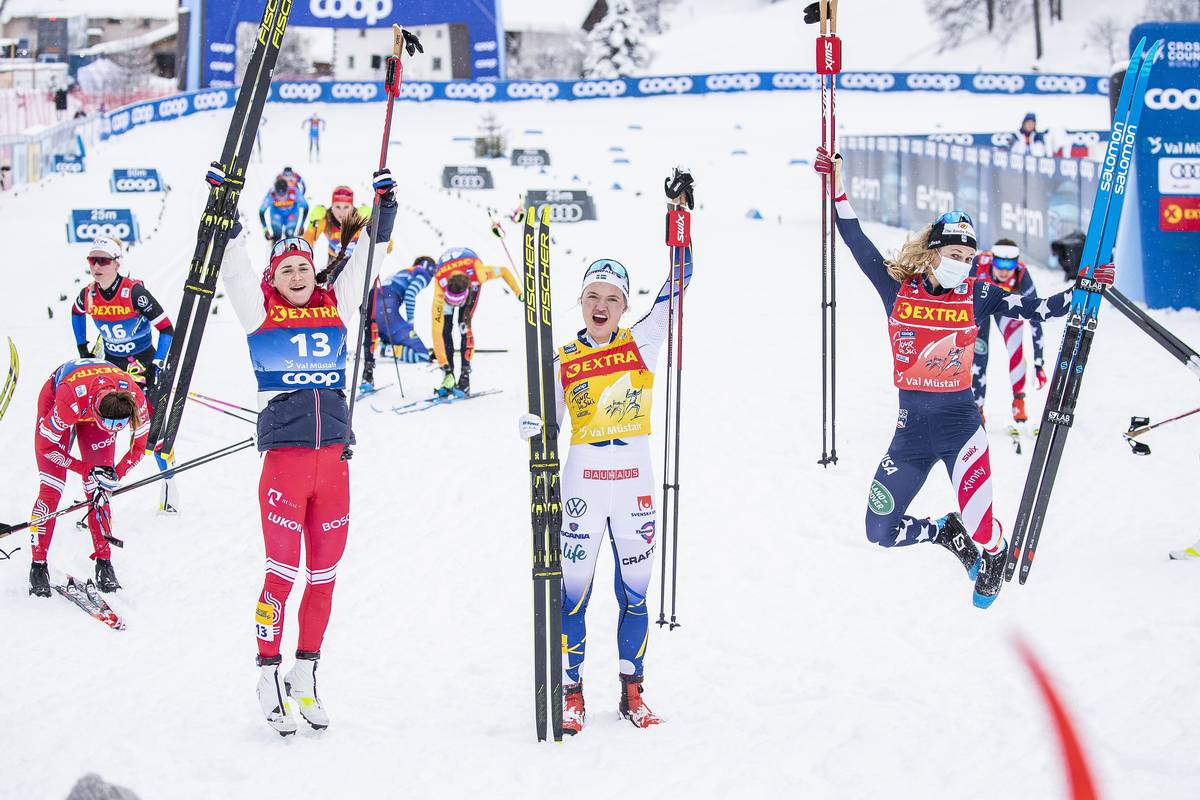
    Airborne and on form, Diggins celebrates her third place finish in Stage 2 of the Tour de Ski. Sweden’s Linn Svahn (center) took the win, followed by Russia’s Yulia Stupak in 2nd. (Photo: NordicFocus)

    “We had great skis out there!” wrote Diggins in an exuberant post race email. “Huge thanks to our service team and coaches for all their hard work, and the Salomon service team for their help picking my skis before the race!”

    Diggins continued by commenting on today’s effort, and how this classic result represents years of focus on technique and collaboration with her coaches and teammates.

    “My goals for today were to ski smooth and really work the downhills without letting them become a stress in a mass start environment, so I stayed near the front to keep out of trouble. This was a great course for me with all the long power-striding, and when I felt good on the last half of the last lap I just decided to push it! For someone previously labeled as a skater only, it was very exciting to find myself sprinting for the podium in a 10 km classic race, and confidence-boosting as well since I’ve been working so hard for so long on my classic striding! I think that improvement speaks to our coaches’ dedication and our positive team environment where we can learn from one another and push each other in our weaker areas. This summer I really benefitted from my SMST2 teammates helping me push the envelope in classic intervals and I’m extremely grateful to them!”
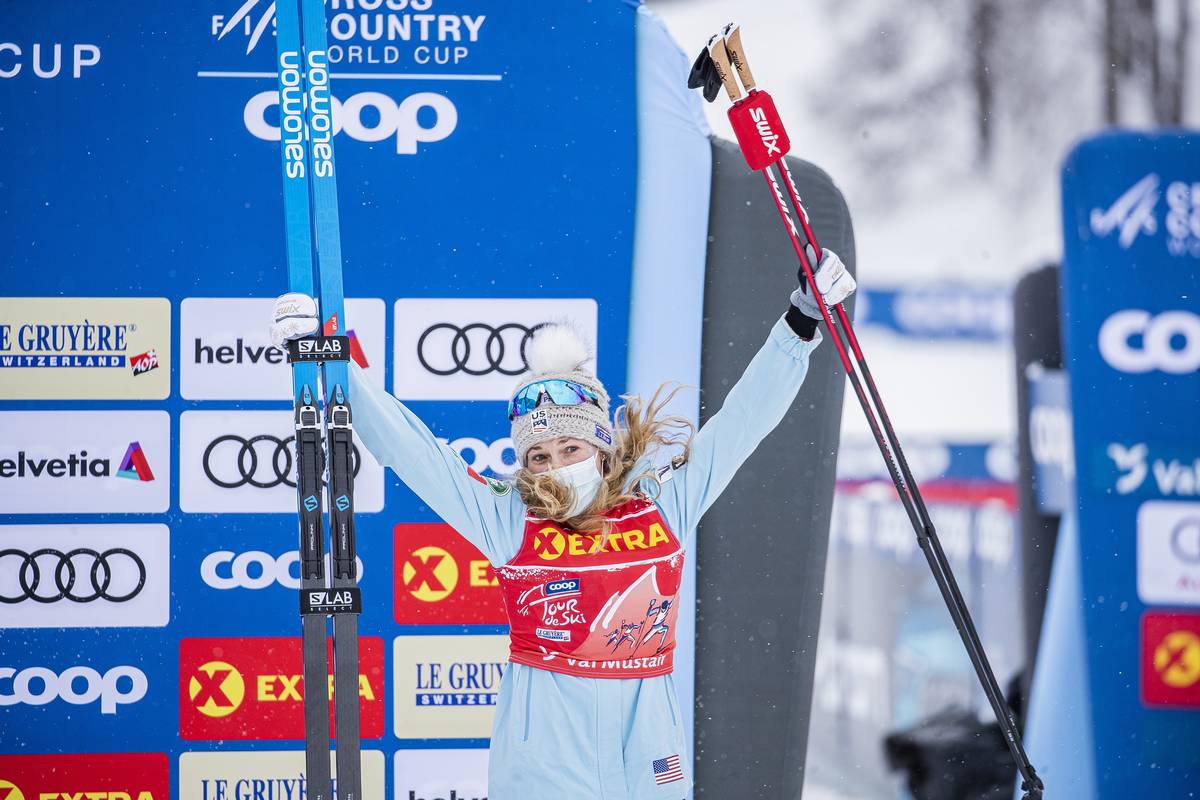
    Coming on form in the 2021 Tour de Ski, Jessie Diggins takes third in Stage 2. (Photo: NordicFocus)

    Despite spending over 8 kilometers at the front, Karlsson took the wooden medal in fourth (+1.4). She was followed closely by Katharina Hennig of Germany in fifth (+2.0), with Rosie Brennan on her tails for sixth (+4.5). 
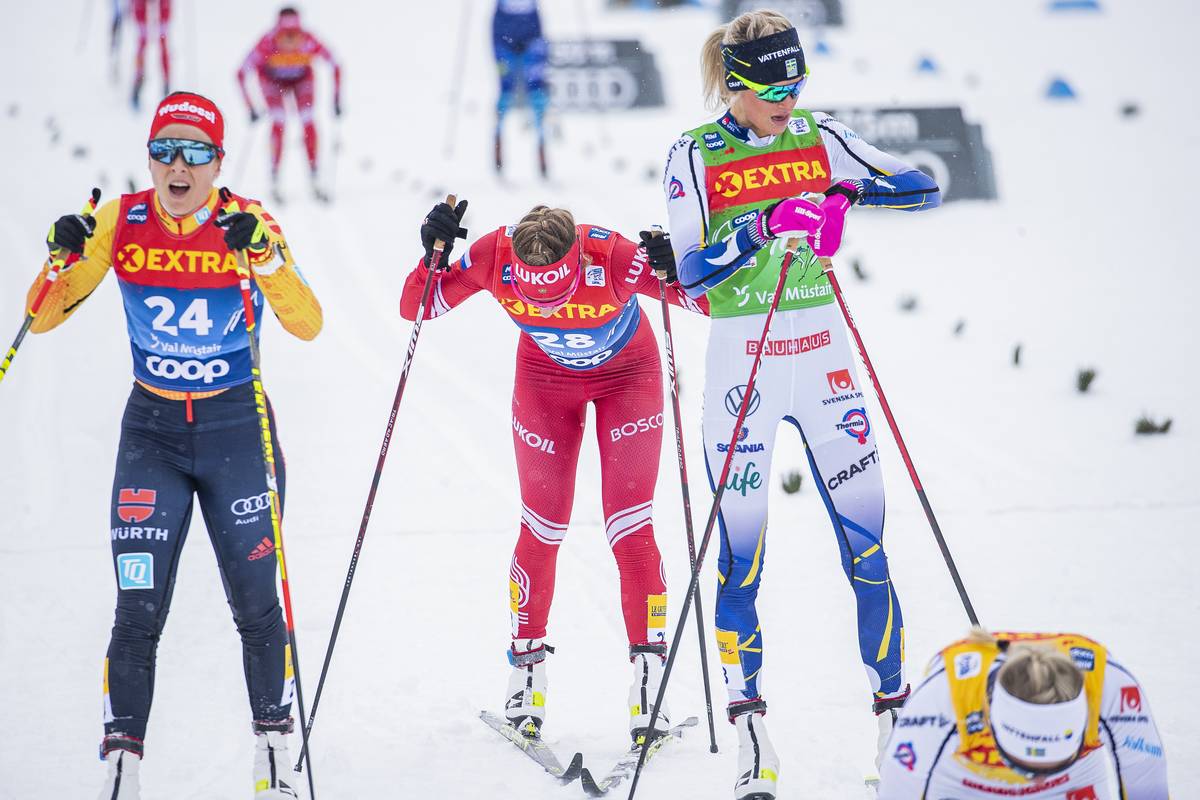
    Evidence of the effort, the leaders of the Stage 2 of the 2021 TdS, a 10-kilometer mass start classic, gasp for air at the finish line. (Photo: NordicFocus)

    “Today was the first mass start of the season, which is always a little nerve wracking for me as I prefer individual starts,” wrote Brennan in an email to multiple news outlets. “My goal was to keep things as close as possible and then see what I left in the end. I think I did this well as I skied in the front pack throughout the race. I was unhappy with my tactics on the long gradual downhill coming back towards the stadium. I took a gamble on lane choice that didn’t pan out and found myself out of contention for the sprint finish, but managed to minimize my time lost to the leaders and also get a career-best classic result so I am proud of that. I am in a great position for tomorrow’s pursuit start so I hope to find some good energy and take advantage of that!”

    Outside the top-10 with noteworthy finishes were Hailey Swirbul in 17th (+40.5) and Katharine Ogden in 22nd (+1:21.2). Swirbul was among a larger lead group through the 5 k, dropping into a chase pack as the top 10 began to break away.  
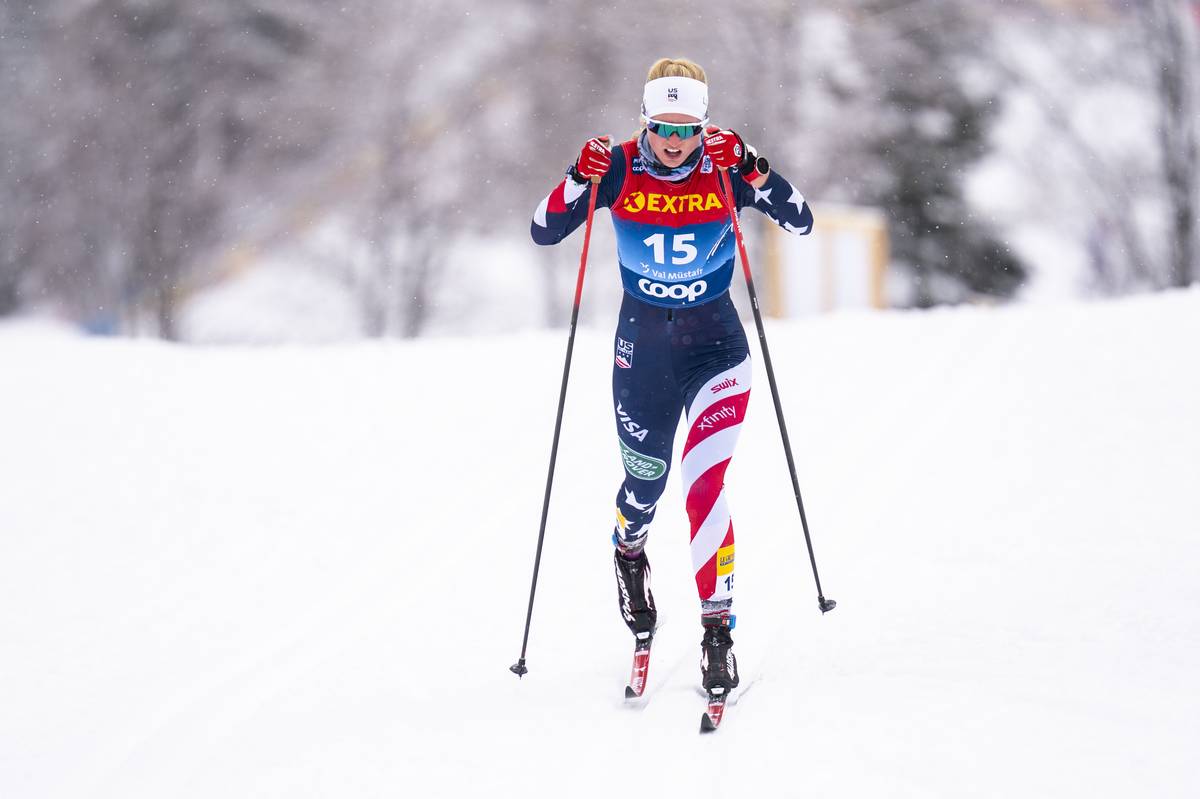
    Hailey Swirbul on her way to a 17th place finish in Stage 2 of the 2021 Tour de Ski. (Photo: NordicFocus)
    Katharine Ogden on course in Stage 2 of the 2021 Tour de Ski. (Photo: NordicFocus)

    Caitlin Patterson was the next American finisher in 38th (+2:10.4), followed by Julia Kern in 41st (+2:30.6), and Sophie Caldwell Hamilton in 46th (32.49.0). Caldwell Hamilton experienced a crash near the end of the first clustered lap; “You got it, Soph!” could be heard from a passing teammate. 

    Post-race comments on the women’s 10k mass start from U.S. Head Coach Matt Whitcomb. 
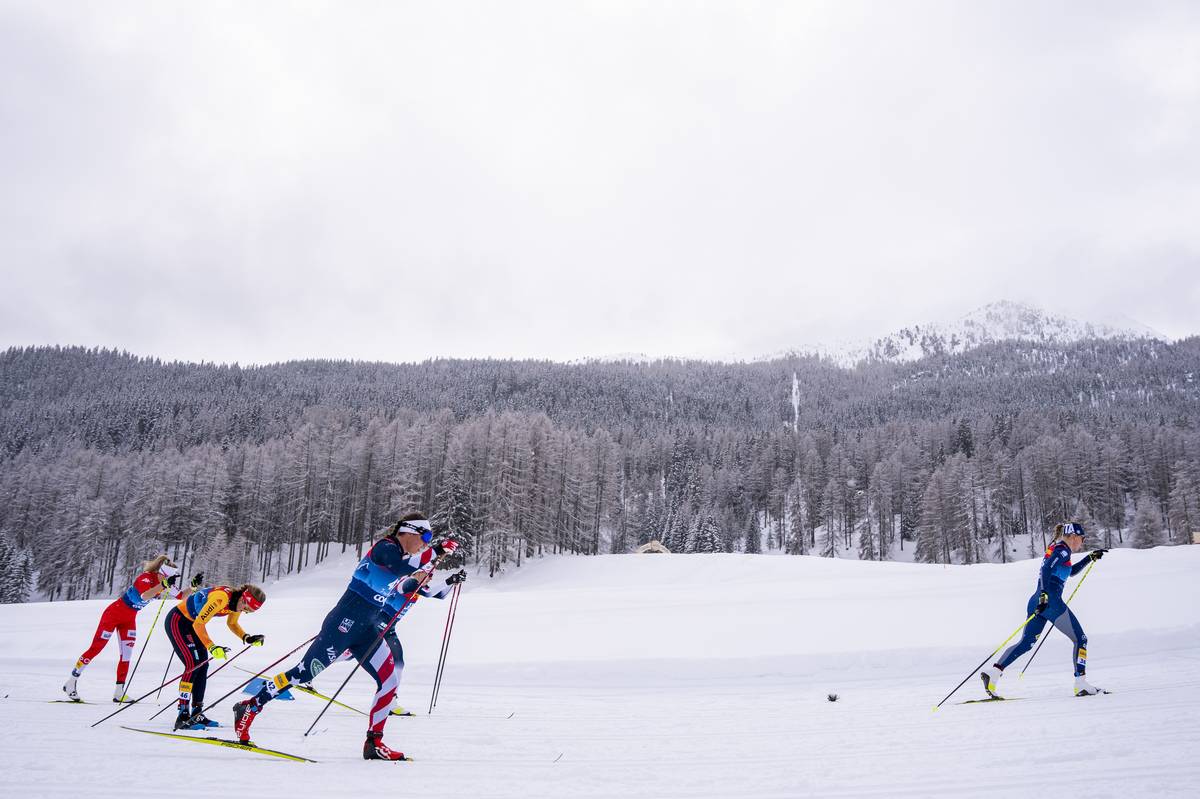
     

    Julia Kern on course in Stage 2 of the 2021 Tour de Ski. (Photo: NordicFocus)

    Overall Tour de Ski and World Cup Standings

    With back-to-back wins, Svahn leads the 2021 Tour de Ski by 13 seconds, with Diggins in 2nd, and Karlsson third (+0:18).

    Because of snagging the bonus points in today’s stage, Karlsson sits at the top of the TdS point standings with Diggins one point behind in second, and Svahn three points back in third. 
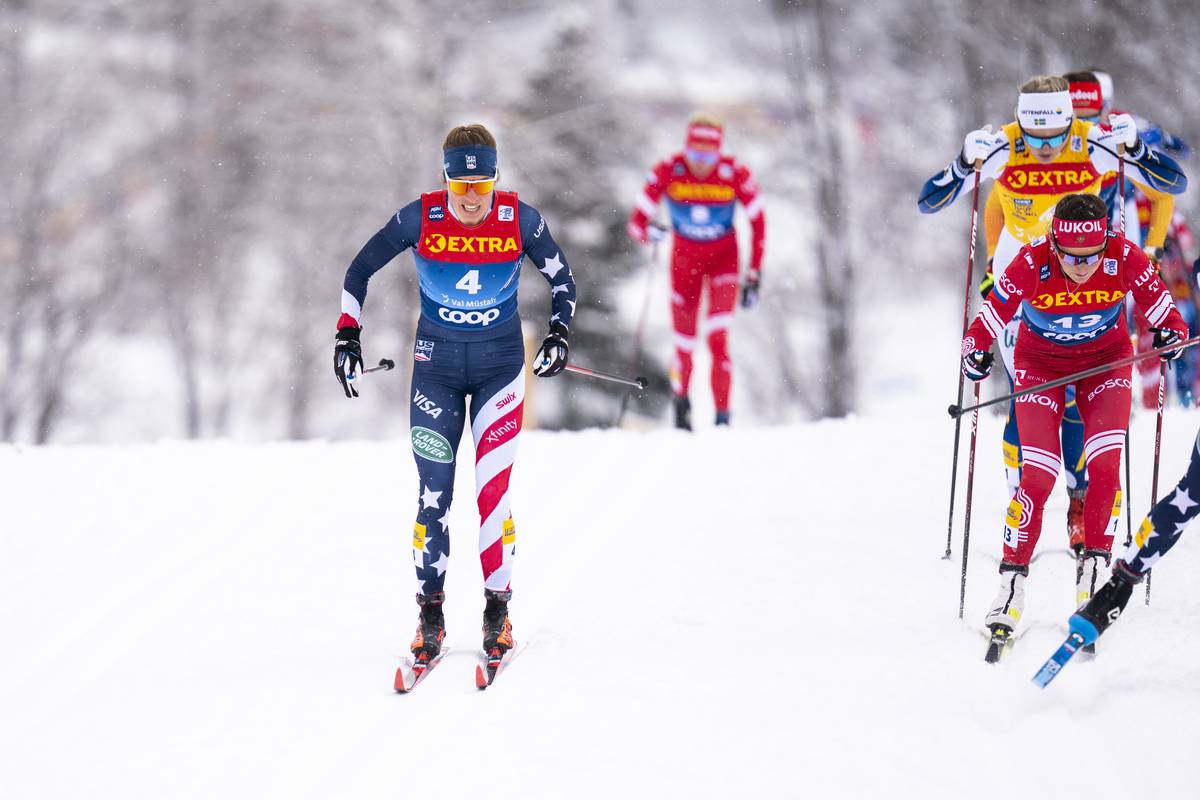
    Brennan skis to 6th in Stage 2 of the 2021 Tour de Ski, adding to a string of outstanding performances. (Photo: NordicFocus)

    Continuing her streak of outstanding races, Brennan remains in possession of the yellow bib as overall and distance World Cup points leader and sits 4th in the TdS standings for both time (+0:20) and FIS points. 

    The tour continues tomorrow with a 10-kilometer skate pursuit.

    Stage 2 Results | Overall TdS Standings After Stage 2: Cumulative Time | Points

  • Johaug Keeps Andersson at Bay for the Win in Lahti; Brennan 19th

    Johaug Keeps Andersson at Bay for the Win in Lahti; Brennan 19th

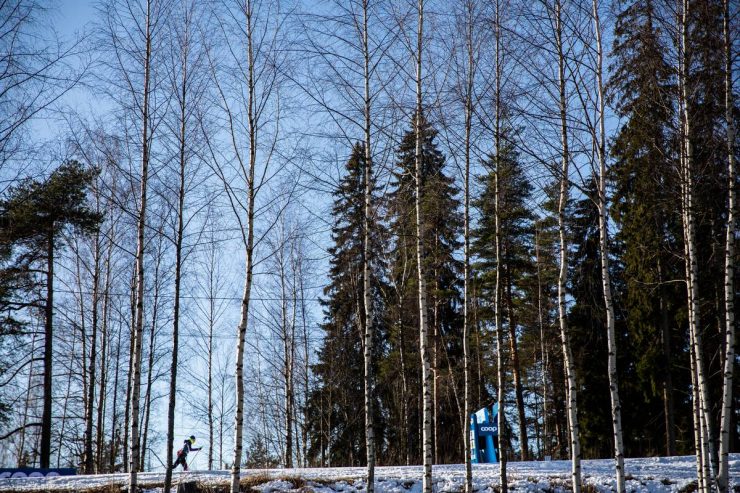
    A ribbon of snow and a winter that never arrived in Lahti, Finland. (Photo: NordicFocus)

    In a typical season, you might expect late February in Lahti, Finland to look wintery. 61 degrees North latitude, ample snow on the ground and clinging to the trees, maybe even a reindeer? In fact, in a plug for the venue showed a woman skiing through a snow-laden town and arriving at the base of the towering ski jumps. 

    But it was not so today. Women time-trialed through the woods for two laps on a 5-kilometer ribbon of man made snow. Aerial shots of the venue told the story that winter had never arrived — green trees, bare ground, and an unfrozen lake.

    “It’s sad that they have no natural snow, we’re not used to it,” Theresa Stadlober of Austria told FIS before her race. “But the conditions on the track are really good, so the organizers did a really good job and I think it will be a fair race today.”

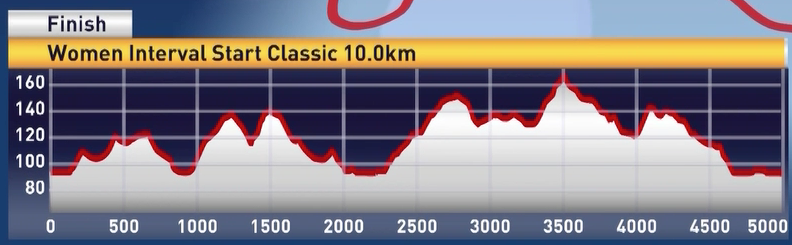
    Despite a low snow year (read: no snow year), the 5 k track in Lahti was as challenging as ever. (Photo: Screenshot FIS Broadcast)

    Though some athletes, like Jessie Diggins and Sadie Maubet Bjornsen, chose to sit out the weekend of distance races following the wrap of the FIS Ski Tour 2020 across Scandinavia, the field remained relatively stout. 

    In fact, without Diggins, the top-10 for today’s stage looked alarmingly similar to the top-10 overall in the Tour

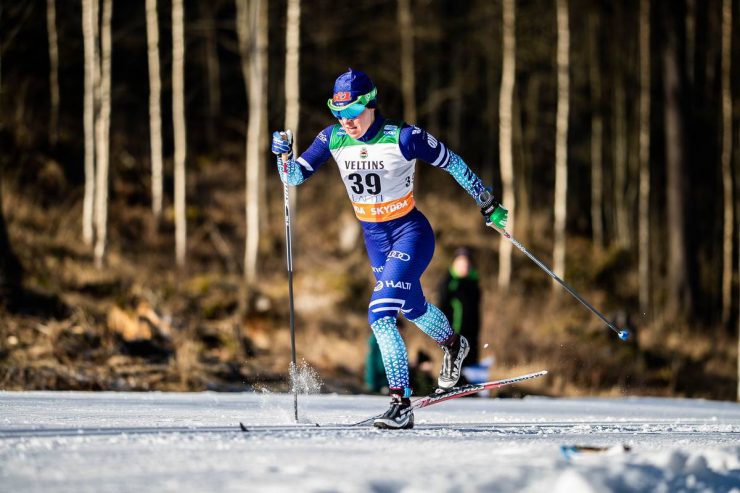
    Norway’s Therese Johaug, who won both the Scandinavian Ski Tour and the Tour de Ski, posted the fastest time on icy tracks in Lahti, finishing in 23:53.3. Her victory here was not a given. Her margins stayed tight at each checkpoint and a slowed down clip of her climbing a short punchy hill with a few k to go showed her slipping. 

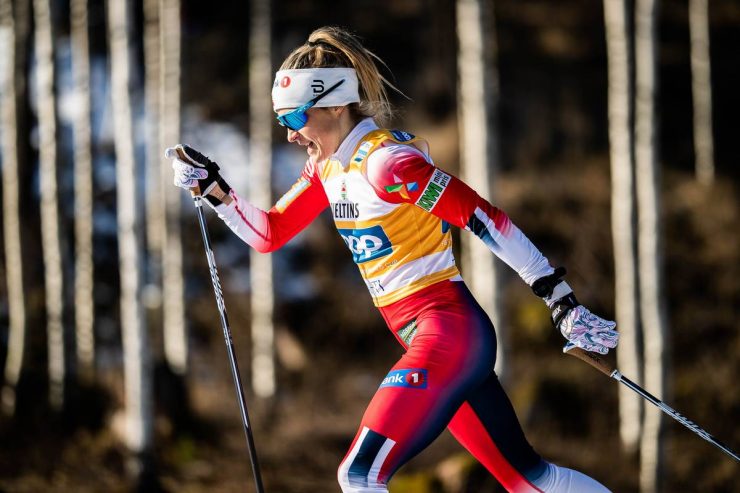
    Therese Johaug notches another distance win at the 10-kilometer interval start classic in Lahti, Finland. (Photo: NordicFocus)

    “It was really tough today,” Johaug told FIS at the finish. “It’s a hard course here, and I like that a lot, but I had to fight with myself today. Mentally, after the Ski Tour, I have been a little bit tired, but the shape is still really good so I’m really happy to stand on top of the podium again today. It was really close to Ebba, but I have the second on my side.”

    With three distance races to go, Johaug has the overall winner’s Crystal globe on lock. She leads the standings with 1311 points, over 400 ahead of the next competitor — a margin that is insurmountable given the remaining point opportunities. She leads the overall standings by an even greater margin of 721 points. 

    Her teammate, Heidi Weng, sits comfortably in second place in both standings. Natalia Nepryaeva of Russia is third for the overall and Ingvild Flugstad Østberg of Norway is third in distance. 

    Ebba Andersson slides across the finish in second at the 10-kilometer interval start classic in Lahti, Finland. (Photo: NordicFocus)

    Johaug’s primary challenger today was Sweden’s Ebba Andersson, who started six bibs behind and kept herself within four seconds of the Norwegian throughout the majority race, finishing 3.4 seconds back for second place. Andersson was fourth in the Ski Tour and sits in the same position in the distance standings. 

    Finishing third in Lahti was Krista Pärmäkoski (+11.8). Though the Finnish veteran has a list of podium finishes and Olympic medals to her name, she has not cracked the top-3 in an individual event since January, 2019 when she took third at the final stage of the Tour de Ski (she has had top-3 results for time of day). 

    Krista Pärmäkoski kicks her way to a season best performance and podium in her home country. (Photo: NordicFocus)

    Pärmäkoski looked like a metronome, covering the tracks with a smooth and steady kick-glide rhythm. Her only falter was untimely. Rounding a sharp downhill curve just before the finish, she found herself on the far edge of the turn where the chunky edge of the of track abutted the bare ground of the hillside.  

    The Finn fell to the ground, losing momentum that could have put her higher on the podium. Nonetheless, as she pushed the final meters across the line, the volume in the stadium surged, blue and white flags waving wildly, putting a smile as her face as she caught her breath. 

    Sweden’s Frida Karlsson and Østberg rounded out the top-5 in fourth (+21.9) and fifth (+25.0), respectively.

    The top American of the day was Rosie Brennan in 19th (+1:28.9). 

    Charging to 19th, Rosie Brennan is the top American finisher in Lahti, Finland. (Photo: NordicFocus)

    “There is not a flake of natural snow around Lahti, so it’s amazing that they were able to put together a full 5 k course that was all hard packed man made snow,” wrote Brennan in an email. “I felt pretty good for somewhere around 4 k’s and then fatigue hit hard. I did my best to keep moving well but unfortunately, I did lose quite a few positions… I think I am definitely feeling some tour fatigue but more so just season long fatigue as I’ve haven’t been home since mid November. I happy with how I skied all considering and certainly am optimistic that with some rest I can have a strong finish. I am headed to Park City now to rest and prepare for Canmore.”

    Outside the to-30, Caitlin Patterson was 36th (+2:33.7) and Becca Rorabaugh (APU) 39th (+2:57.3). 

    Today was Rorabaugh’s first European World Cup start. Though the 30-year-old was first raced a World Cup in February of 2010, her only other experiences at that level have been in Quebec and Canmore during Canadian Ski Tours or World Cup finals.

    “I really enjoyed the World Cup level downhills and the perfectly firm tracks out there,” wrote Rorabaugh in an email. “Our wax guys nailed it for me so I was able to ski with a few different people, but it was a tougher course than what I’m used to in the US.  This was definitely a step up in steepness of pitch and amount of climbing, and I’d love to have more domestic opportunities to work on this kind of thing. The crowds were awesome and it was cool to see all the national pride with Finnish skiers on both podiums.  I’m very thankful to have had the opportunity to come over and race against such a strong field in such great conditions. I’m also excited to have more World Cup starts coming up!”


    Results | World Cup Overall Standings | Distance Standings

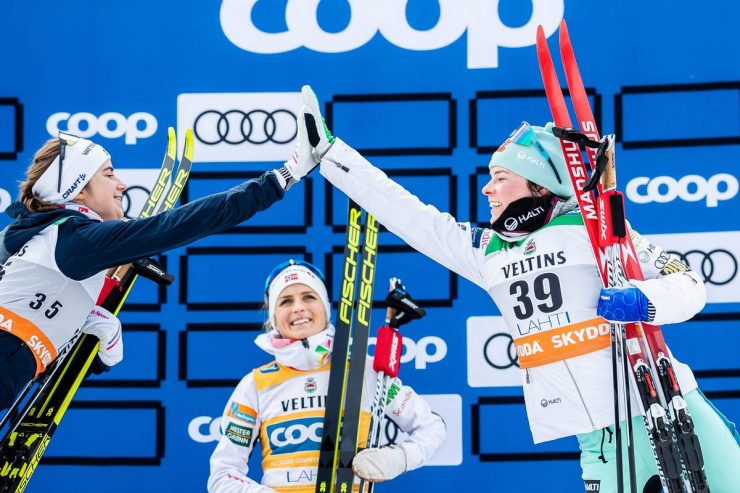
    Ebba Andersson (SWE) and Krista Pärmäkoski (FIN) exchange a high five as they join Therese Johaug (NOR) on the podium in Lahti, Finland. (Photo: NordicFocus)
  • Pärmäkoski’s Day; Diggins 10th, Patterson 20th in Planica

    Pärmäkoski’s Day; Diggins 10th, Patterson 20th in Planica

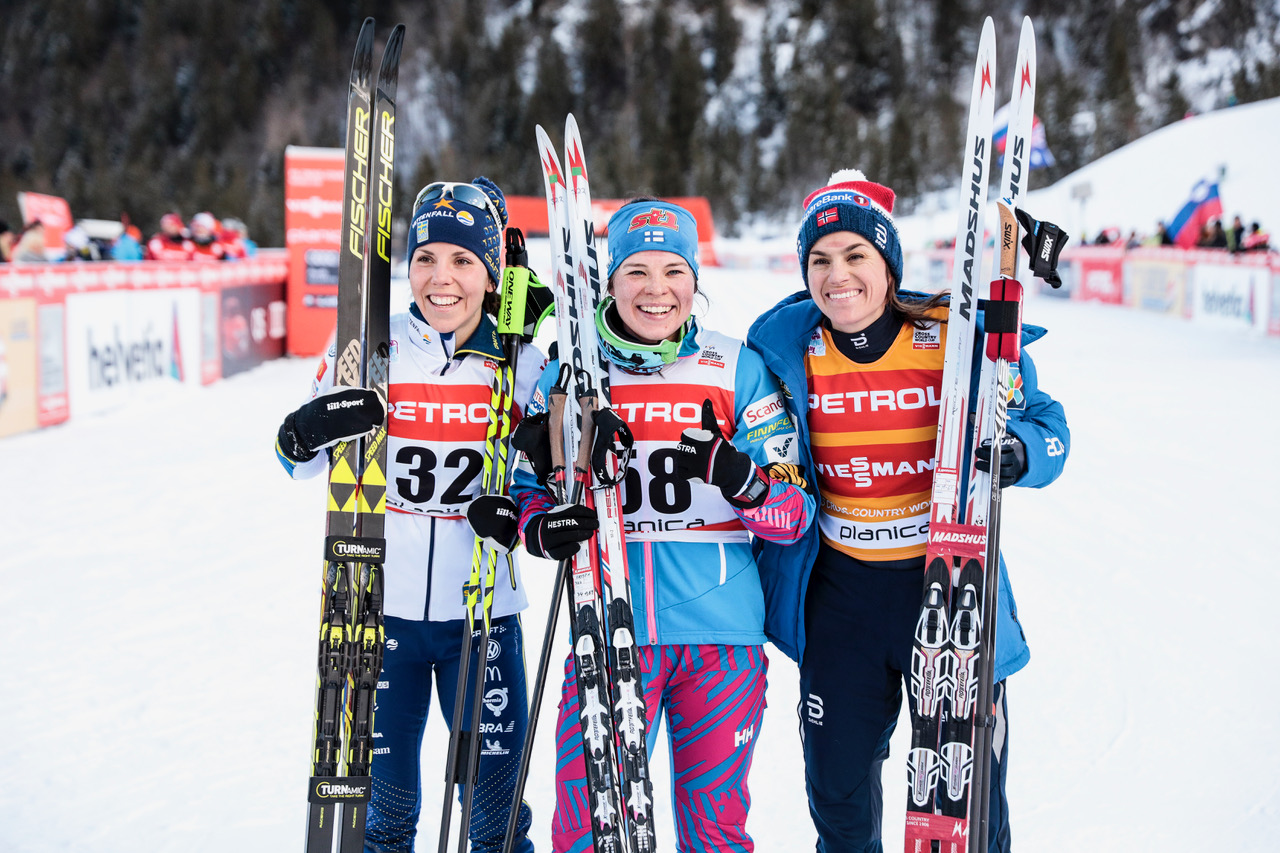
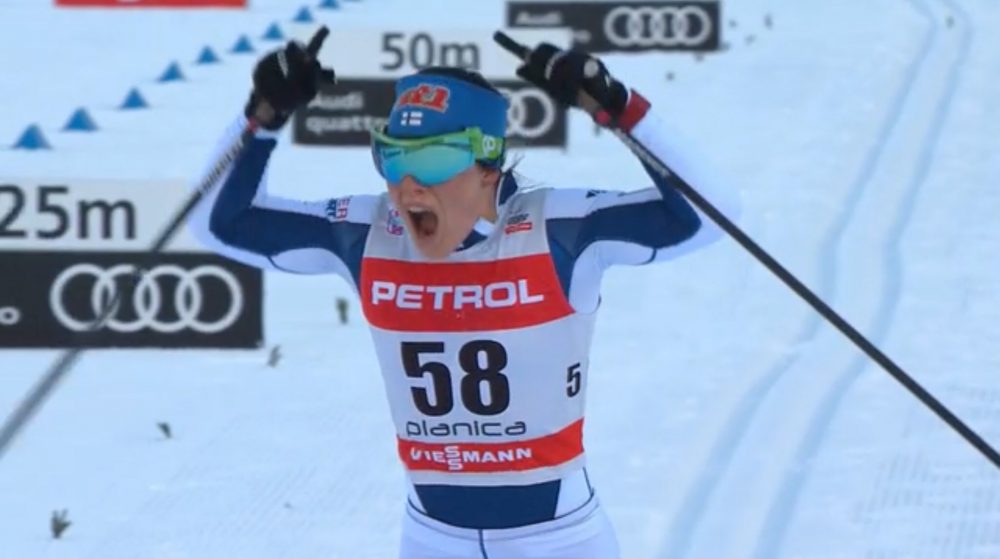
    The women’s 10 k classic podium at Sunday’s World Cup in Planica, Slovenia, with (from left to right) Sweden’s Charlotte Kalla in second, Finland’s Krista Pärmäkoski in first, and Norway’s Heidi Weng in second. (Photo: Fischer/NordicFocus)

    PLANICA, Slovenia — Move over Norway and Sweden, there’s a another skier scouting and snagging World Cup wins — and she’s just over 5 feet tall and Finnish.

    Krista Pärmäkoski set out on a rugged 10-kilometer classic course on Sunday located directly in the Julian Alps, the highest mountain range in Slovenia. Any challenge the course summoned, however, the 27-year-old Pärmäkoski dished twice as hard in return.

    Though a bluish early morning light cast a sombre glow on the course, Pärmäkoski was punchy. She pushed past the start gate one minute ahead of Norway’s Heidi Weng, who was a favorite heading into the weekend’s distance event.

    The reigning Tour de Ski champion, Weng was coming off back-to-back wins in the last two distance events she’s entered: the Tour’s 10 k classic mass start stage in Val di Fiemme, Italy, and the 9 k final climb freestyle pursuit, also in Val di Fiemme.

    On the other end, Pärmäkoski has had six runner-up finishes in the individual distance events she’s entered. She has also posted two stage wins for time-of-day performances, and racked up 19 individual podiums.

    Until Sunday, however, the satisfaction of standing as the outright winner of a non-stage World Cup had remained elusive.

    But if anything, that only motivated her. The long striding climbs featured in Planica’s course suited her powerstride style, and she knew it. She had seen them during a dryland camp with her team last year.

    “We had a training camp here in the summer and when I saw the competition tracks here I said to my coach that I will have a good race in Planica this winter,”  Pärmäkoski said, according to an International Ski Federation (FIS) press release.

    Still, once the snow hits, Mother Nature has a way of foiling even the most prepared skier’s plans. Or working to the advantage of others.

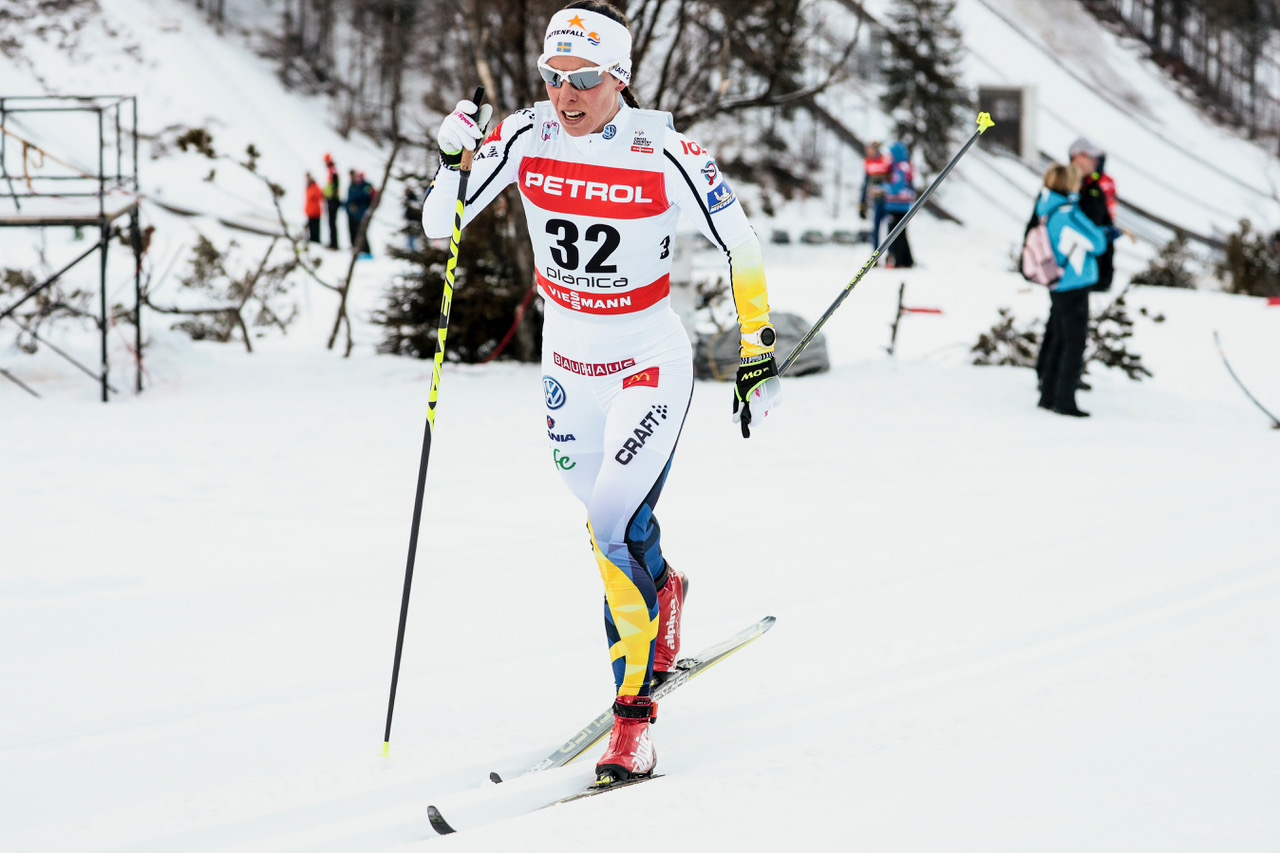
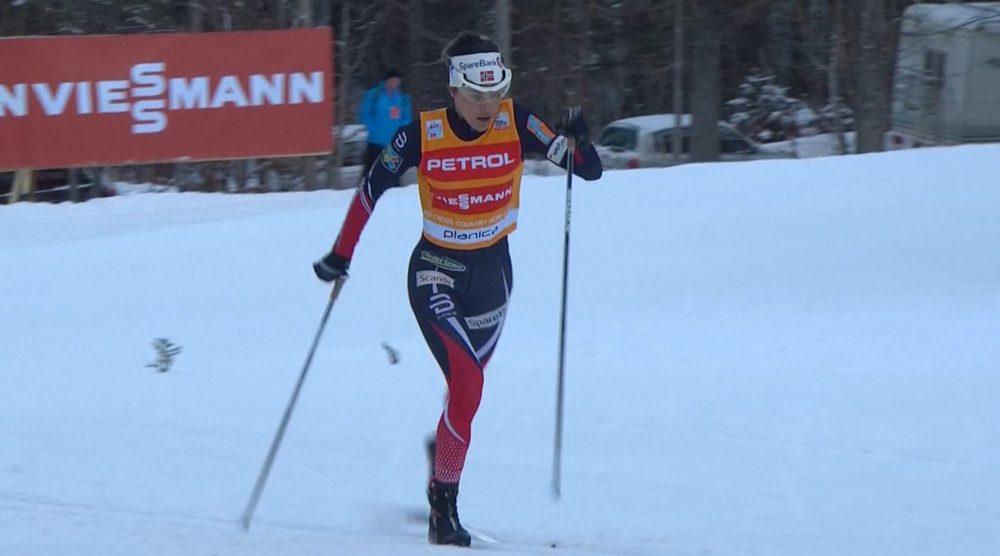
    Sweden’s Charlotte Kalla racing in the women’s 10 k classic at the World Cup in Planica, Slovenia. She went on to finish second. (Photo: Fischer/NordicFocus)

    With firm tracks laid out for Sunday’s individual starts, another contender for the win was Sweden’s Charlotte Kalla. Though most of her World Cup victories have come in 10 k freestyle races, she is no less threatening in classic. At the start of this season, she won the FIS 10 k classic in Gällivare, Sweden, by 17.7 seconds.

    In Planica, Kalla, the 32nd starter, appeared to be heading in the same direction. At a little under 2 k in, she posted the fastest split. She did the same 2 k later and for the next 5 k following that. For close to 9 k, Kalla’s splits were unmatched. Pärmäkoski, who started 58th, trailed her by almost ten seconds at the halfway mark.

    For the first half of the 10 k, Kalla maintained that nearly 10-second gap on Pärmäkoski. In the second half, however, the countdown began. The Finn began picking Kalla off second by second, stride by stride.

    At the 7 k mark, Kalla held the lead over Pärmäkoski by only one second. Realizing how close she was to the leading time, Pärmäkoski made her attack in the final kilometer. She ended up beating Kalla’s time by 3.6 seconds, crossing the line in 27:08.7.

    Krista Pärmäkoski celebrates her first World Cup victory in the women’s 10-kilometer classic race on Sunday in Planica, Slovenia (Screenshot: ARD broadcast)

    “I wanted to get faster as the race went and when I saw that I was battling with Charlotte, I really pushed hard over the final kilometer,” Pärmäkoski said. “It feels great to finally have my first win.”

    “It was exciting to have the battle with Krista today and for sure I would like to have won, but it’s also nice to see her get her first win,” Kalla said afterward, according to FIS.

    “It was a great race. It’s nice to be back on World Cup,” she added. “I will go to Seiser Alm now to get ready for Korea.”

    Following Kalla was Weng, who started 60th and ended up third, 33.5 seconds off Pärmäkoski’s winning time. The Norwegian had been skiing in second for the first 4 k, but lost time to Pärmäkoski and Kalla by the halfway point. During a FIS interview, Weng indicated that the grade of the climbs, which featured more gradual pitches with sustained periods of striding, didn’t exactly play to her strengths.

    Norway’s Heidi Weng racing to third in the women’s 10 k classic race on Sunday in Planica, Slovenia. (Screenshot: ARD broadcast)

    “The profile didn’t suit me with the long gradual hills,” Weng said. “My plan was to start slower and then speed up. I tried my best and to push over the top of the hills. It’s good to be on the podium with the other ladies today.”

    Rounding out the top ten in Sunday’s event was Austria’s Teresa Stadlober in fourth (+39.0), Sweden’s Ebba Andersson in fifth (+48.6), Finland’s Kerttu Niskanen in sixth (+49.4), Norway’s Kari Øyre Slind in seventh (+49.5), Poland’s Justyna Kowalczyk in eighth (+1:02.1), Norwegian Kathrine Rolsted Harsem in ninth (+1:03.2) and American Jessie Diggins in 10th (+1:05.4).

    “That was a gnarly course,” Diggins told FasterSkier in person after. “You don’t get rest because the downhills, you’re working the corners, which I love, but I am tired right now. That’s on purpose, it’s part of the plan, but I am looking forward to a nap and some rest and some extra food and just getting ready for next week.”

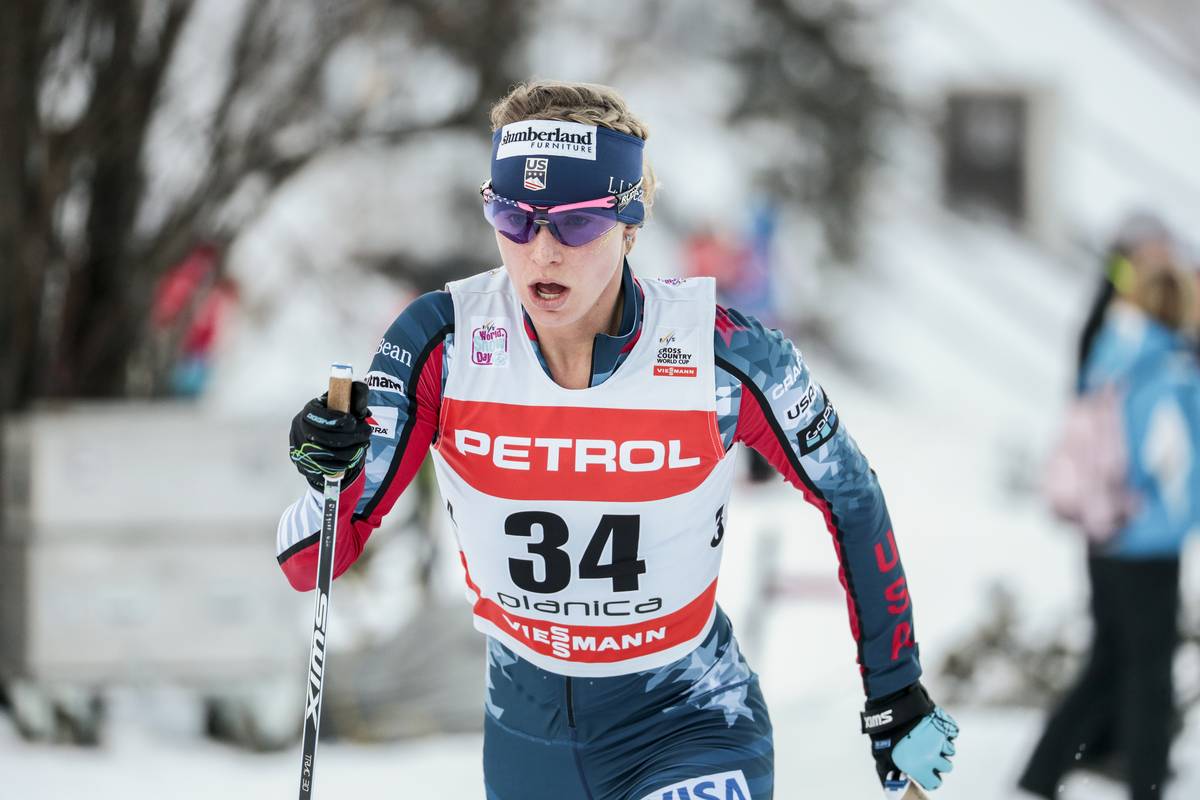
    Jessie Diggins (U.S. Ski Team) racing to 10th in the World Cup women’s 10 k classic in Planica, Slovenia.(Photo: Salomon/NordicFocus)

    Diggins, coming off a third-place finish in the 2018 Tour de Ski, also raced Saturday’s classic sprint in Planica, where she finished fourth for her best World Cup classic-sprint result.

    “Really cool to see her making that progress,” U.S. Ski Team Head Coach Chris Grover said on Sunday.

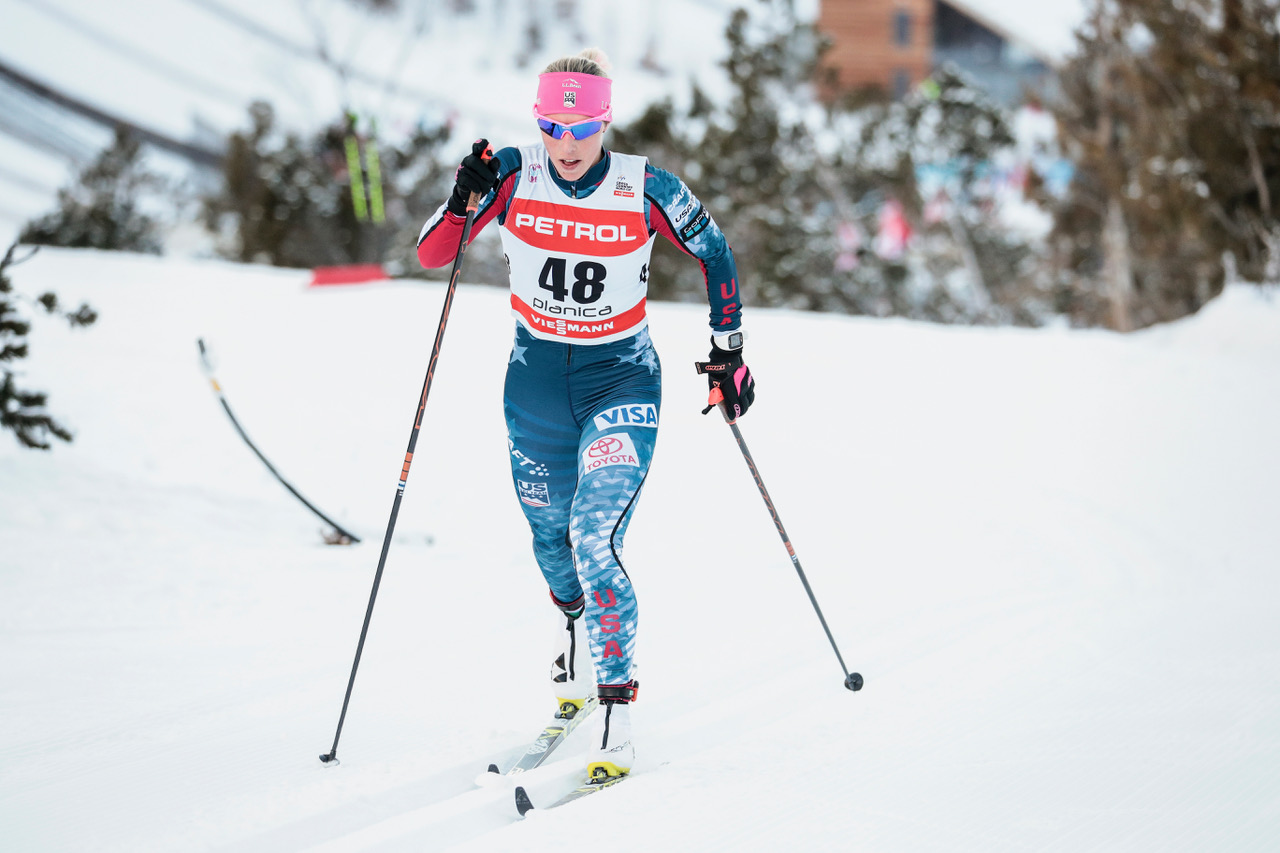
    Also scoring World Cup points on Sunday was Caitlin Patterson (Craftsbury Green Racing Project), the Period 1 SuperTour leader, in 20th (+1:45.2). Now into her second World Cup weekend of the season, Patterson had a banner week earlier this month in Anchorage, Alaska, where she won four titles in four races at U.S. nationals.

    Reflecting on the courses she’s raced this season, Patterson said that the SuperTour in West Yellowstone, Montana, and U.S. nationals in Anchorage had more “double poling [sections] and herringbone hills.”

    “I knew this course was going to be different than anything I’ve skied in a while, for classic at least,” Patterson said of Planica. “It’s just so much gradual striding.”

    The change of pace, however, seemed to work to her advantage.

    “I had a little trepidation going into it….I think it allowed me to relax into it really nicely and make sure I found my kick well which the skis were great.”

    “The long gradual stuff was kind of fun,” Patterson added. “It felt a lot different, it felt less about quick accelerations back and forth and more just sustained work.”

    The finish is Patterson’s sixth individual World Cup top 30, and her second-best individual World Cup performance to date. She placed fourth in last year’s Pyeongchang skiathlon.

    “It was a great classic result,” Grover said of Patterson. “She is somebody who has only been here a week and a half, or maybe just over a week. We expect some more great stuff from her.”

    Kikkan Randall (U.S. Ski Team) racing to 23rd in the women’s 10 k classic at the World Cup in Planica, Slovenia. (Photo: Fischer/NordicFocus)

    The U.S. had three score World Cup points in the top 30, with Kikkan Randall racing to 23rd (+1:50.4) on Sunday. Randall sat out Saturday’s classic sprint, as she is in the process of recovering a foot injury. She aimed to use Sunday’s distance race to assess her progress.

    “It was really hard to sit out yesterday’s classic sprint, but I needed to test out my foot and we felt a distance race would be a safer test,” Randall wrote in an email. “I’ve been battling the stress reaction and tendonitis in my left foot since Davos and I just got back to classic skiing this week. I still have some lingering pain in my foot but we’ve got it under control enough to race again.”

    The 10 k was Randall’s first distance race in more than a month, and she described it as having the “best classic racing conditions I’ve seen all season.”

    “10 k classic individual start is one of the toughest race formats for me usually so I’m pretty happy to be solidly in the top 30 today and just a few seconds out of the top 20,” Randall continued. “I’m looking forward to a couple skate races next weekend in Seefeld to continue sharpening for the Olympics.

    “I was definitely motivated by my teammates strong results yesterday and really happy to see Caitlin Patterson have a strong race today for 20th!” she added. “It’s not easy to come right over to Europe after all that racing at US Nationals!  And of course, Jessie continues to be on fire. Look out world!”

    American Sophie Caldwell, who placed ninth in Saturday’s classic sprint, finished just 1.7 seconds outside of the top 30 in 31st (+2:17.2). Two more American women competed on Sunday, with Liz Stephen in 35th (+2:34.9) and Ida Sargent in 37th (+2:37.5).

    “A couple of great performances,” Grover said referring to the overall weekend’s results. “Jessie’s fourth yesterday, that is her best classic sprint result of all time. I thought a great race yesterday out of Logan Hanneman, to be that close to qualification. He just got over here this week from the U.S. Similarly, a really nice qualification out of Tyler Kornfield yesterday … Caitlin Patterson’s 20th place today. Those were some silver linings for sure.”

    But with many athletes in a transitional zone, some recovering from the TdS and others adjusting to the travel and recouping from U.S. nationals, Grover indicated that next weekend in Seefeld, Austria, the energy levels and pop of the U.S. team’s skiers should be even more pronounced.

    “I thought some of our skiers looked a little bit flat,” he said. “Probably to be expected. We have some athletes obviously who just got here, some who just came out of U.S. nationals, some who are just coming back to skiing after the Tour de Ski … I definitely expect next weekend will be a lot better for us.”

    The last World Cup weekend before the Olympics takes place next Saturday and Sunday in Seefeld, with freestyle sprints and 10/15 k freestyle races.

    Results

  • Sweet Sixteen: Bjørgen Wins Lahti 10 k Classic for 16th World Title

    Sweet Sixteen: Bjørgen Wins Lahti 10 k Classic for 16th World Title

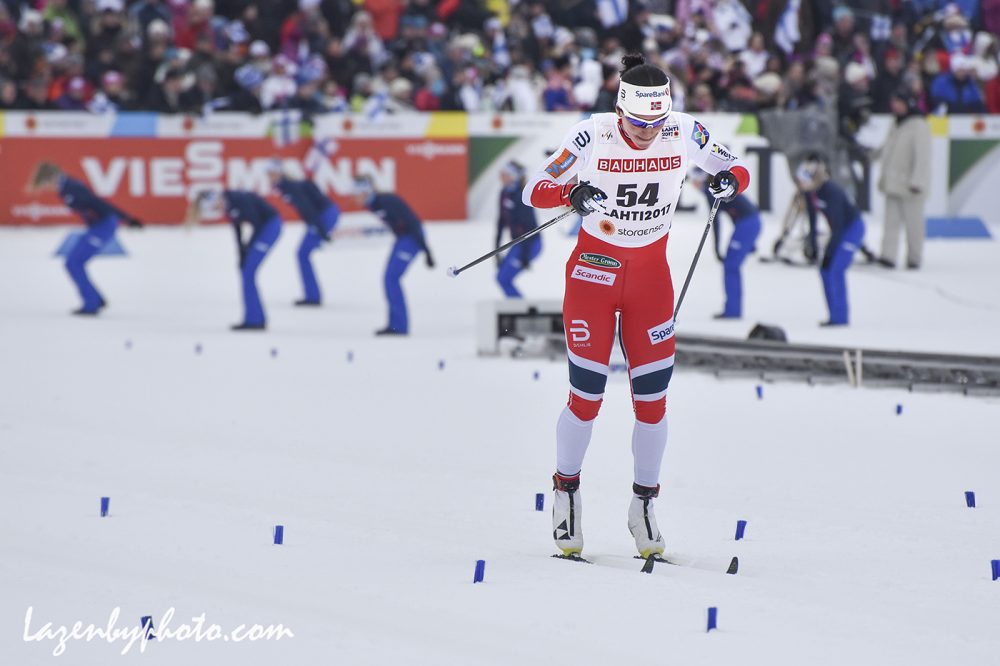
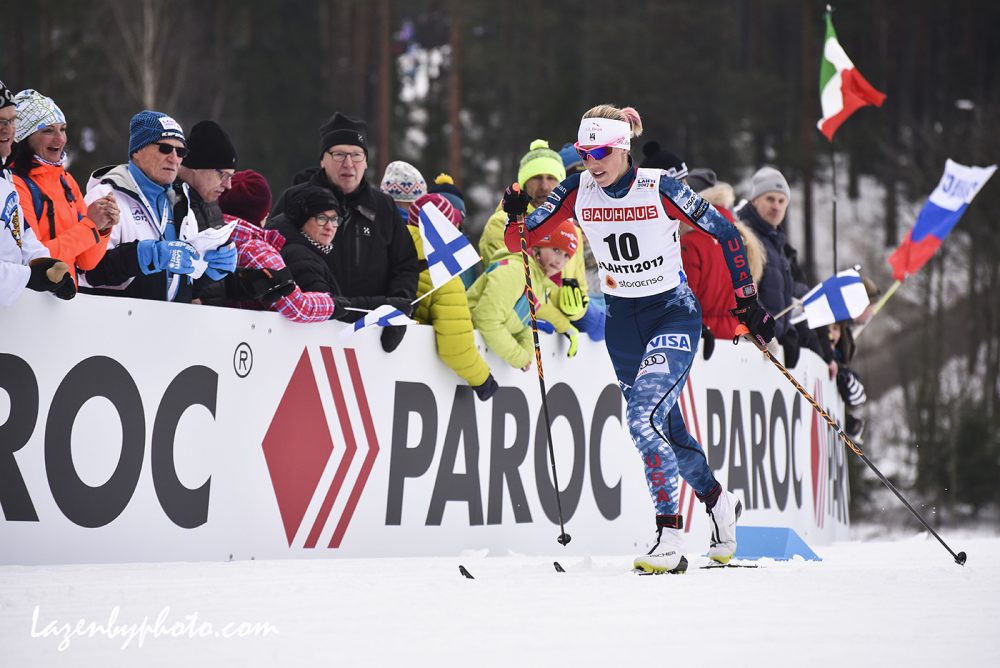
    Norway’s Marit Bjørgen on her way to her 16th career World Championships gold in Tuesday’s 10 k classic individual start at the Lahti, Finland. (Photo: John Lazenby/Lazenbyphoto.com)

    LAHTI, Finland — Moments before the women’s 10-kilometer classic individual start at the 2017 Nordic World Championships on Tuesday, temperatures read 35 degrees Fahrenheit and humidity hovered around 97 percent — the air nearly saturated. Earlier in the day, a near-ground fog lapped the tops of the three iconic ski jumps looming above the ski stadium.

    In contrast to earlier classic events at these championships — a 15 k skiathlon, and classic team sprint — the tracks glazed with a mirror-like sheen.

    For her 16th World Championship title, neither Norway’s Marit Bjørgen nor her wax techs were befuddled by the tricky tracks. Whether herringboning headwalls, firing like the nordic powerhouse she is on the flats and climbs, or streamlining the glide outs, Bjørgen remained peerless in her win over her 10 k classic competition. She finished in 25:24.9 minutes for the gold; the closest competitor Sweden’s Charlotte Kalla was 41 seconds behind.

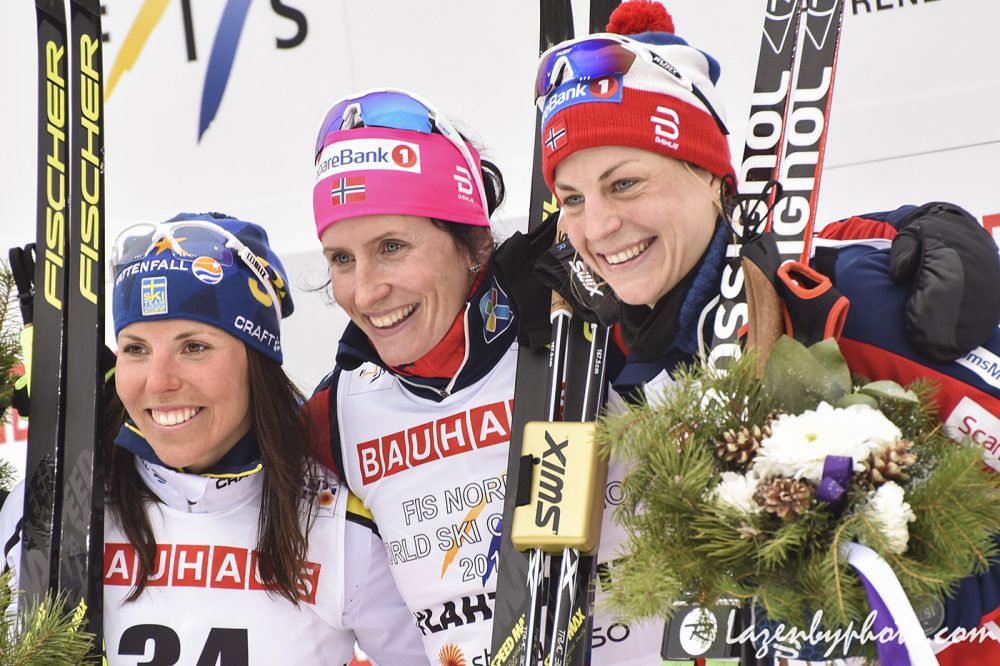
    Tuesday’s 2017 Nordic World Championships women’s 10 k classic podium, with (from left to right) Sweden’s Charlotte Kalla in second, Norway’s Marit Bjørgen in first, and Norway’s Astrid Uhrenholdt Jacobsen in third. (Photo: John Lazenby/lazenbyphoto.com)

    With silver going to the Swede, the final podium spot went to another Norwegian, Astrid Uhrenholdt Jacobsen, who finished 55.5 seconds back from her teammate Bjørgen’s time.

    Considering their collective medal count, it was a championship-pedigreed podium: it was Kalla’s 12th career championship medal — and her second in the last week. Jacobsen earned her third-individual championship medal of seven overall. (For the 2016/2017 World Cup season, it’s Jacobsen’s first podium.

    It’s also been a decade since Jacobsen’s first World Championship medal, a classic-sprint gold in 2007 in Sapporo, Japan.

    “A lot of things have happened in those ten years,” Jacobsen, 30, said after the race. “The medal today feels better than the gold medal in Sapporo. I fought harder for this. I’m just really happy today.”

    Amongst the potential podium locks in the 10 k classic, Kalla noted she chose an earlier start as part of her race strategy; she started in bib 34.

    “I decided to go early because of the warming up opportunities” Kalla explained during the post-race press conference. “I wanted to go on the competition track as long as possible. And then I also had a better opportunity to do my own race and not focus on the times against the others, just focus on my performance in every stage on the track.”

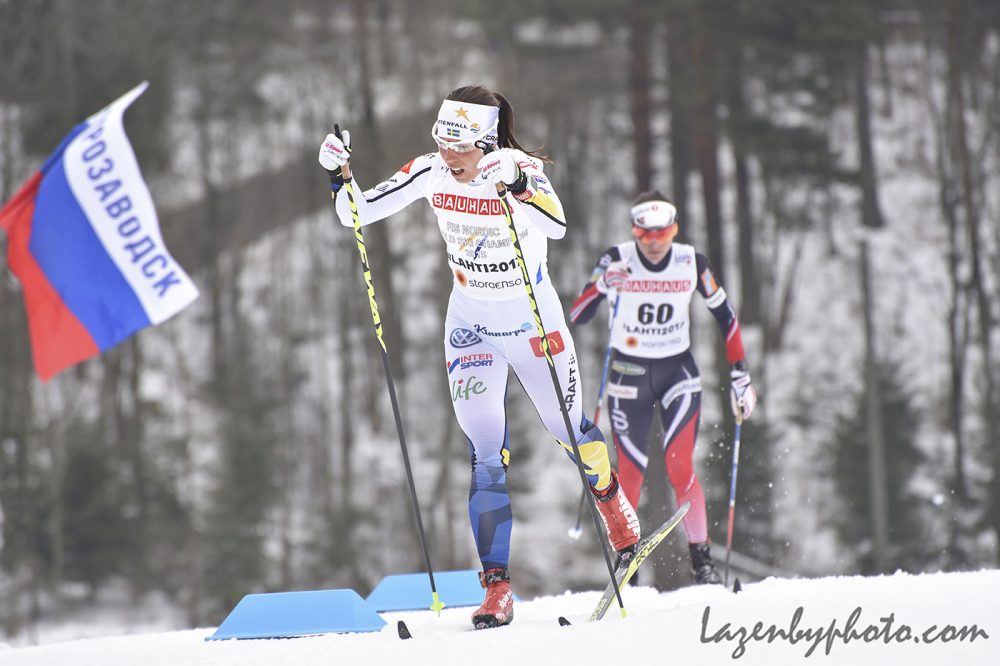
    Sweden’s Charlotte Kalla racing to second in the women’s 10 k classic on Tuesday at 2017 Nordic World Championships in Lahti, Finland (Photo: John Lazenby/lazenbyphoto.com)

    Despite her race-time dominance, Bjørgen spoke of her jittery nerves before the start.

    “This 10 k has been one of the distances I really wanted to win,” the 36 year old said during the press conference. “I think I have two before the start of the world championships, so this was the one I wanted the gold medal. I think that’s the reason I was nervous and also I understand I was in good shape and it was really possible to take the gold, so that’s the reason.”

    A 41-second winning margin for Bjørgen isn’t definitive. And unlike every other race at these championships, where high drama like Norwegian-Finn tangles, broken poles and Diggins-grit dictated the narrative, Tuesday’s 10 k classic was clinical.

    At 1.5 k, 5 k, 6.3 k, and 7.8 k splits, Bjørgen was the fastest. Already at 6.3 k, Bjørgen had a 22-second gap on Kalla. Barring an equipment failure or tumble, by that point the win was a bygone conclusion and Bjørgen the author of this 10 k novella.

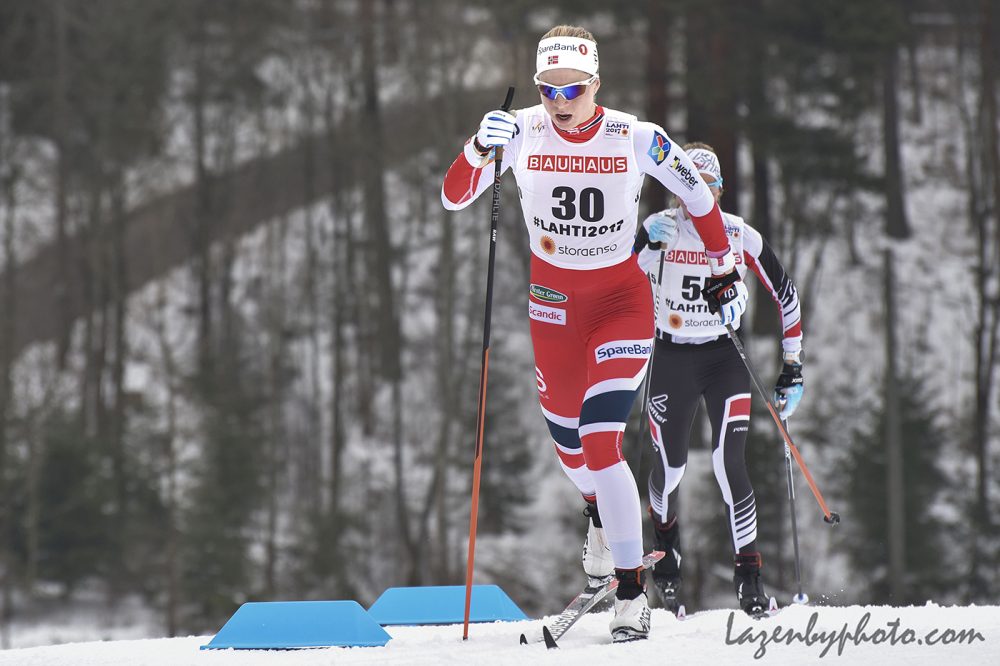
    Norway’s Astrid Uhrenholdt Jacobsen on her way to bronze during the women’s 10 k classic at the 2017 Nordic World Championships in Lahti, Finland. (Photo: John Lazenby/lazenbyphoto.com)

    “Today I had very good skis and I feel very strong, and the first 5 [k] I feel that my speed was very high,” Bjørgen added. “It was only a second from 1 kilometer to 4, and I feel that I am racing very fast and I not taking more seconds so I wonder how will I do it on the last 5 k. But then I heard it was from 6 [seconds] and then to 10 then to 20 and then understand they were opening a bit too hard.”

    Bjørgen explained the news of time-gain inroads served as a propellant.

    “I think when you heard you have second[s] on your side you just get some more power and you just want to ski more faster,” Bjørgen said. “You understand it’s well for you. You are getting so happy, it is no problem to speed up and go.”

    Many adjectives come to mind when describing Bjørgen’s career. Yet the numbers are most impressive. When mining her career-win data, there’s always something new to learn. Of all her gold medals — now 22 between World Championships and the Olympics — prior to Tuesday’s win, 20 of those had come in non-individual-start races. (Her other individual-start win came in 2011 World Championships 10 k classic in Oslo, Norway.)

    Bjornsen Leads Americans in 23rd, Randall 26th 

    Kikkan Randall (U.S. Ski Team) racing to 26th in the women’s 10-kilometer classic individual start at the 2017 Nordic World Championships on Tuesday in Lahti, Finland (Photo: John Lazenby/Lazenbyphoto.com)

    Starting four minutes ahead of Bjørgen, the last starter for the U.S. Ski Team (USST) on Tuesday was Sadie Bjornsen. After covering the course in a time of 27:46.1, the American eventually finished as the top North American in 23rd (+2:21.2). The 10 k classic event was Bjornsen’s first individual event at these World Championships.

    She also raced Sunday’s classic team sprint with her USST teammate Jessie Diggins, where the two captured bronze. Diggins did not race Tuesday’s 10 k classic.

    “It definitely gave me a lot of confidence the other day,” Bjornsen, 27, said on Tuesday, referring to her bronze-medal performance on Sunday. “So I went into today probably a bit nervous because I had more expectations.”

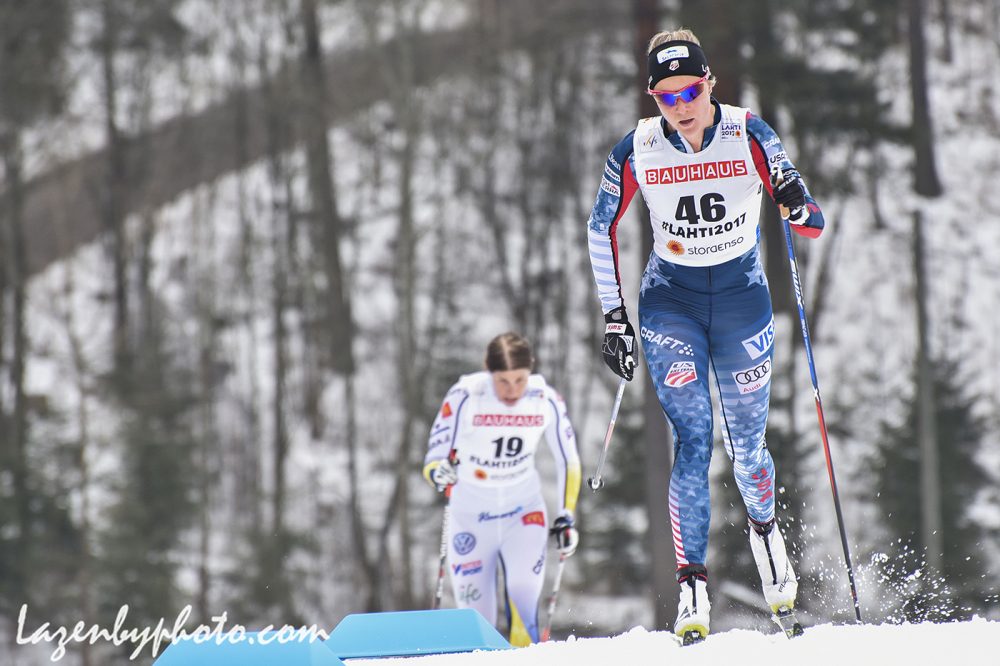
    Sadie Bjornsen (46) leading Sweden’s Ida Ingemarsdotter during the women’s 10-kilometer classic individual start at the 2017 Nordic World Championships on Tuesday in Lahti, Finland. (Photo: John Lazenby/Lazenbyphoto.com)

    Looking back on the effort, Bjornsen explained that she may have paced the initial part of her race too slowly. With her 10 k classic performance from Otepää in the back of her mind, Bjornsen intended to take the first few kilometers of Tuesday’s world champs 10 k event to work into the race.

    “I definitely wanted to keep things under control at the beginning, because I felt last week I started really hard and struggled to keep the pace up,” Bjornsen said. “I tend to do better when I do a more gradual start and then try to pin it after that. I haven’t seen the splits at all, but based on the way that I felt, maybe I started a little too easy.”

    With glazed tracks making for difficult steady striding, Bjornsen indicated that she might not have gotten out of the track as often as she should have to stay fresh.

    “You know, today was a day that you had to get out of the track and grind it in order to make your skis work,” Bjornsen said. “I was really trying to force it, and really tried to stay in the track. Then at 4 k, [USST Head Coach Chris] Grover was like, ‘Get out of the track. It’s much faster to run,’ and I feel like from there on I got to skiing a bit better.”

    Finishing 10.7 seconds behind Bjornsen was her teammate Kikkan Randall, the second American in the top 30 in 26th (+2:31.7). Randall had already earned an individual bronze at these championships and competed in last weekend’s 15 k skiathlon, where she finished as the top American in 17th.

    As Randall explained, her performances in these races, as well as those of other Americans competing, may influence who will start the women’s 4 x 5 k relay on Thursday.

    “I think there’s a couple of us who know we’re trying to prove we’re worthy of the relay spot,” Randall said on Tuesday. “I think for Rosie and I, we were trying to ski our first 5 k pretty hard and really use this as a test.”

    Despite working the pushing the pace for the first half of her race, Randall found herself able to adapt and finish strong.

    “It’s certainly the best opening 5 k I’ve had all year,” Randall said. “I felt my body wanted to turn on and go on the first couple hills. That’s kind of an exciting new feeling for me.”

    “The first couple climbs on the second lap I was like ‘OK, woah’,” she added. “[But] I found my groove the last two and half k, so overall a pretty solidly paced race.”

    The two other Americans to compete in Tuesday’s 10 k, Rosie Brennan placed 32nd (+2:55.4) and Ida Sargent finished 43rd (+3:55.2).

    Skiing alone for the entirety of her race, Brennan was more satisfied with her 10 k race than she was her skiathlon performance. Tuesday’s race, however, still left her hungry for more.

    “I don’t know if I was so much looking for a result as much as a feeling,” Brennan explained after. “I think I was close but not quite there.”

    All four Canadian women who traveled to Lahti competed in the 10 k event, with Katherine Stewart-Jones leading the team in 36th (+3:09.6). This season marks Stewart-Jones’s second year on the Canadian national team and it was her first World Championships.

    The 21-year-old Stewart-Jones, of the National Team Development Centre (NTDC) Thunder Bay and national U25 Team, also competed at this year’s U23 World Championships in Park City, Utah. After Tuesday’s race, she said she’s excited about where the Canadian women are headed, particularly with regards to their results thus far at world champs.

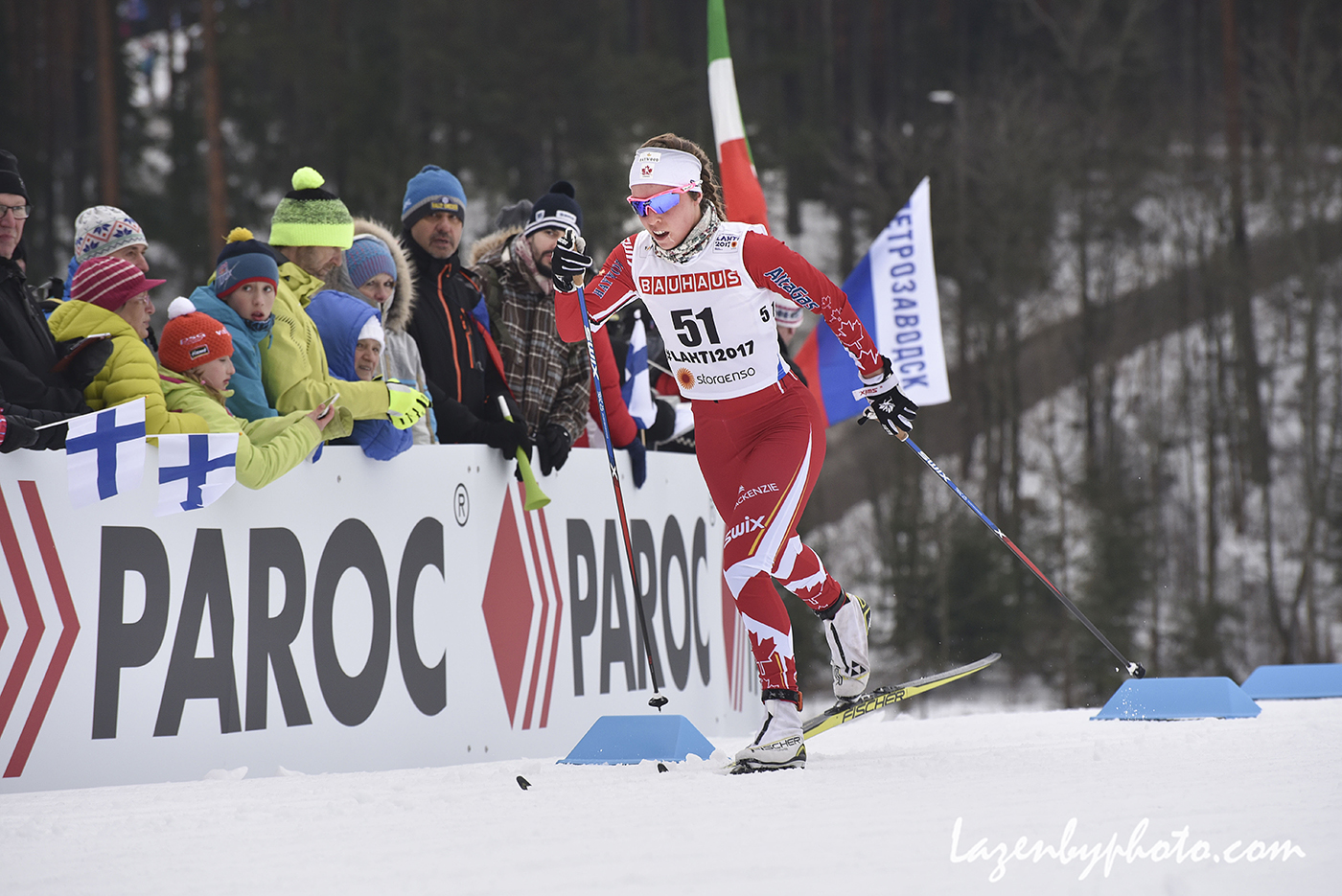
    Canada’s Katherine Stewart-Jones racing to 36th in the women’s 10-kilometer classic individual start at the 2017 Nordic World Championships on Tuesday in Lahti, Finland (Photo: John Lazenby/Lazenbyphoto.com)

    “We’re all excited to be the next generation. Just to have four girls here at world champs is super amazing,” Stewart-Jones said after her first top 40 in her third World Championships race. “I think we’re really bringing up the energy as a group and getting each other pumped up and having confidence in each other.”

    Explaining that she was able to stride for most that the race, Stewart-Jones was pleased with her result, but also the way she felt physically while skiing on course.

    “In the last lap when I was getting a little tired, I jumped out of the tracks, but I had enough energy in my legs to run,” she said. “Overall, I was able to find that extra gear on that second lap and was able to relax on the first lap, which is super important on this kind of a course. I’m just really happy with how I skied.”

    Finishing 4.6 seconds behind Stewart-Jones was Canadian World Cup Team skier Emily Nishikawa in 37th (+3:14.9). Two more members of Canada’s U25 Team, Dahria Beatty placed 39th (+3:24.9), and Cendrine Browne finished 47th (+4:05.2).

    Despite having a limited number of classic races under her belt this season, Beatty had a positive review of her performance on Tuesday.

    “I haven’t done a ton of classic races this year and doing the races last weekend in Otepää it was a really positive race for me and I was trying to build on that,” Beatty said. “That’s definitely the most fun I’ve had this week.”

    Results

    — Harald Zimmer and Gerry Fersuth contributed