From the FasterSkier archive — posts syndicated from athletes’ and coaches’ own blogs between 2004 and 2012, kept online as published. Current coverage is at fasterskier.com.

Tag: 10k classic

  • Ruka Launches an Olympic Winter: Karlsson Victorious, Diggins Fifth in 10k Classic Opener

    Ruka Launches an Olympic Winter: Karlsson Victorious, Diggins Fifth in 10k Classic Opener

    This coverage is made possible through the generous support of Marty and Kathy Hall and A Hall Mark of Excellence Award. To learn more about A Hall Mark of Excellence Award, or to learn how you can support FasterSkier’s coverage, please contact info@fasterskier.com.

    Okay, who else didn’t sleep last night? It felt like waiting for Santa Claus on Christmas Eve — that fizzy, restless anticipation you can’t shake, even as an adult who should know better. Part of it was simply the joy of finally watching World Cup racing again after eight long months. But more than that, this morning in Ruka felt like the beginning of something bigger: the start of the Olympic year, the opening chapter of a season that will define so many careers, answer so many questions, and launch a web of storylines that will stretch from today all the way to Milano-Cortina.

    This year, the stakes are different. For veterans, it’s legacy. For rising athletes, it’s opportunity. For everyone, it’s a race against time.

    And for those of us who follow this sport as if it were a second bloodstream, the first race in Ruka is the moment winter starts breathing again.

    Frida Karlsson (SWE) poses with Mr. and Mrs. Claus following the 10k Classic in Ruka (FIN). (Photo: Modica/NordicFocus)

    Before the Gun: What Was at Stake

    Even before the racers hit the snow, there were subplots everywhere.

    Norway opened the season in a moment of transition. Therese Johaug — retired again and pregnant with her second child — leaves a vacuum on the women’s team that hasn’t existed in over a decade. Who leads now? Is Heidi Weng’s late-career renaissance real? Is this the year Norway’s depth must finally be enough?

    Sweden, meanwhile, enters the Olympic season with the most complete women’s distance squad on earth. Their classic technique is crisp, balanced, efficient — a signature advantage on days like this.

    Finland carries the emotional core of the weekend. Krista Pärmäkoski, racing her final season, took her last opening-day start in Ruka on home snow. Kerttu Niskanen, always a threat in classic, lined up ready to test herself in front of the home crowd.

    And for the United States, the arcs were wide-ranging:

    • Jessie Diggins begins the final season of her career.
    • Rosie Brennan enters winter in deeply untraditional circumstances after an Epstein-Barr reactivation.
    • Julia Kern arrives healthier and steadier than in years.
    • Sophia Laukli brings a redesigned training life out of Norway.
    • And three additional American women (Kate Oldham, Kendall Kramer, and Alayna Sonnesyn) who begin the short, intense race for Olympic qualification.
    Alayna Sonnesyn (USA) lunges for the line at the end of the 10k Classic in Ruka (FIN). (Photo: Modica/NordicFocus)

    A Day Shaped Before It Started: New Snow, Glazing Tracks, and Wax Tech Calculus

    Ruka had been bitterly cold in recent weeks — until a foot of new snow fell and temperatures climbed toward freezing. The result was a wax technician’s nightmare: soft snow in the shade, glazing climbs in the sun, and a classic course twisting through varying microclimates.

    Kick wax that worked at the start failed on the climbs. Skis that kicked well on the climbs dragged on the flats. Double-pole sections demanded freedom; the final climbs demanded grip. There was no perfect answer — only compromise and risk.

    This race was always going to reward the skiers with the best technical balance and the wax techs bold enough to choose the right kind of “wrong.”

    Moa Ilar (SWE) charges down the finishing stretch at the end of the 10k Classic in Ruka (FIN). (Photo: Modica/NordicFocus)

    The Race: Karlsson Sets the Standard, Weng Returns, Ilar Rises, Diggins Surges

    1.1 km — Jessie Diggins Takes the First Lead of the Season

    From the moment the race began, the tone was unmistakable.

    With bib #1 Julie Bjervig Drivenes setting the baseline, Jessie Diggins blasted through the first checkpoint with the early lead — 1.3 seconds ahead of Frida Karlsson.

    It was classic Diggins: joyful, aggressive, fearless.

    3.3 km — Karlsson’s Stride Takes Control

    By 3.3 km, the race reshaped itself. Frida Karlsson, with her strong hip stability and long, economical stride, surged into the lead on the climbing sections. Diggins, whose double-poling and downhill flow looked excellent, lost time on the steepest pitches and slid to seventh.

    Behind Karlsson, Sweden formed a front of precision:

    • Moa Ilar at +3.0
    • Ebba Andersson at +5.1
    • Three Swedes in the top three splits.

    A message, delivered early.

    6.1 km — Heidi Weng Charges Back Into the Story

    Heidi Weng, skiing 30 seconds behind Diggins, mounted the late charge of the day. She began cutting into Karlsson’s lead — from 14 seconds at 6.1 km to only 10.5 by the line.

    After several up-and-down years, Weng signaled something unmistakable: she’s not done yet.

    Final Kilometers — Diggins Closes Hard, Ilar and Andersson Duel, Fosnæs Threatens

    Jessie Diggins mounted her own push on the flats and downhills, gaining time between 6.1 and 8.1 km. She crossed the line in a time that held the top spot until the final seeded skiers, ultimately placing fifth — one of her strongest classic results ever on this course.

    Moa Ilar executed a poised final push, taking third and bumping Andersson to fourth. Kristin Austgulen Fosnæs threatened Diggins’ time but ultimately finished behind her in sixth.

    Jessie Diggins (USA) was all smiles after the 10k Classic in Ruka (FIN). (Photo: Modica/NordicFocus)

    Jessie Diggins: Racing the First Day of Her Last Season

    As Diggins enters the last year of her storied career, her goals have nothing to do with podiums.

    “My goals are really not about race results at all,” she said. “My goals for the season are to be happy and healthy and just in the present moment… just really soaking in the moment and the feeling of, like, wow, I get to do this.”

    She brought that joy directly into today’s start.

    “I just wanted to go hard and use this race to get the season started.”

    And yet, the question remains: when Diggins puts on a bib, does instinct overtake the plan?

    “I do like to push myself to the max whenever I race — maybe not 100% where I’m scraped off the snow, but really darn close,” she said.

    “It’s part of my training plan with Cork — we use early season races to build sharpness.”

    On a tricky waxing day, Diggins was clear-eyed about the team effort.

    “I was really happy with my skis… a great mix of just enough kick but also really free. We needed the skis to be fast in the double-poling, and knowing I was going to herringbone the climbs anyway, we went for that in-between.”

    For Diggins, this wasn’t just a top-five finish. It was a signal: the last season of her career may feature some of her best classic skiing.

    Rosie Brennan (USA) with her signature long stride during the 10k Classic in Ruka (FIN). (Photo: Modica/NordicFocus)

    Rosie Brennan: “This Is Uncharted Territory”

    Rosie Brennan entered the winter with one of the most unconventional lead-ups of her career — a necessity after an Epstein-Barr reactivation forced her into weeks of “micro-intervals” and tightly controlled volume.

    Her return to full-distance racing revealed both progress and uncertainty.

    “If I’m honest, I had a little higher expectations for myself today, so I’m feeling a bit mixed about it,” she said.

    “There were some moments of skiing I was really happy with and some that left me wanting more.”

    The hardest part, she explained, has been adapting to Europe — travel, fatigue, recovery — with a body that no longer responds as it used to.

    “It’s been a really hard adaptation to Europe with a body that isn’t as resilient as I’m accustomed to… this is uncharted territory for me, and I just don’t know what will happen.”

    Still, she holds hope — and patience.

    “I have to keep trying and experimenting and figure out what will work for me this winter. I’m sure there will be a lot of ups and downs in the process.”

    For Brennan, today wasn’t a verdict — it was the next step in a complicated, courageous return.

    Ebba Andersson (SWE), Julia Kern (USA), (l-r) push up the climb in Ruka (FIN). (Photo: Modica/NordicFocus)

    Julia Kern: A Personal Best Hidden Behind the Result Sheet

    Julia Kern’s final ranking might not have turned heads on the results page, but the performance meant far more than the number beside her name. For Kern — often a slow starter in Ruka — today marked meaningful progress.

    “Actually, I’m proud of my race today,” she said. “If you just look at the result… You would think I’d be quite dissatisfied, but this was a personal best for me in the opening Ruka 10km.”

    The opener in Ruka has long been one of the toughest venues for her, a course whose steep climbs, cold temps, and early-season timing rarely align with her strengths.

    “This was my eighth time doing this race, and the result has never been great or representative of other races later in the season,” Kern explained. “I was proud of having moments out there where I skied with good technique, and my body had good energy.”

    Her long-term confidence remains intact — today was a step, not a verdict.

    “Of course, I want to climb higher in the results list, but my result today doesn’t worry me,” she said. “I use this race to race myself into shape and wake up the body for the sprint tomorrow and the rest of the season.”

    Like many in the field, she dealt with some of the day’s most fickle challenges: a mix of new snow, fog, drizzle, and instant glazing that made finding kick nearly impossible.

    “It was on and off snowing/light fog or drizzle… a classic Ruka day where the tracks seem to glaze in an instant,” she said. “The glaze made it really challenging to kick from the start, and even harder in the second lap.”

    But where the climbs demanded compromises, the flats rewarded her strengths.

    “Otherwise the conditions felt fast on the downs and flats,” Kern added, “and I felt strong on the flatter terrain today.”

    Kern leaves day one not discouraged, but energized — a skier who knows this course never tells the whole story and who trusts what today’s moments of good skiing suggest about what’s ahead.

    Heidi Weng (NOR), Frida Karlsson (SWE), Moa Ilar (SWE), (l-r) share the podium of the 10k Classic in Ruka (FIN). (Photo: Modica/NordicFocus)

    The Podium: Sweden Opens the Olympic Year With Authority

    The final standings reflected both power and depth:

    1. Frida Karlsson (SWE) 23:31.8
    2. Heidi Weng (NOR) +10.5
    3. Moa Ilar (SWE) +18.3
    4. Ebba Andersson (SWE) +21.2
    5. Jessie Diggins (USA) +27.6
    6. Kristin Austgulen Fosnæs (NOR) 37.2

    Sweden finished with three in the top four. Karlsson earned her 16th career victory; Weng her 139th career podium; Ilar her 9th.

    On the Finnish side, Krista Pärmäkoski delivered a valiant final Ruka classic performance. Kerttu Niskanen, traditionally a force here, struggled to find her usual early-season spark.

    And for the Americans, the opener delivered clarity: Diggins strong, Brennan resilient, the younger athletes gaining essential early-season data for Olympic qualification.

    The 10k Classic podium with Heidi Weng (NOR), Frida Karlsson (SWE), Moa Ilar (SWE), (l-r) in Ruka (FIN). (Photo: Modica/NordicFocus)

    What It All Means

    Today’s 10k classic didn’t answer every question — but it answered enough to shape the early contours of an Olympic year:

    • Sweden has the momentum.
    • Norway has a leader again.
    • Finland is beginning a farewell tour.
    • The U.S. has real reasons for belief — and real reasons for patience.
    • The waxing cabins will decide as much as the athletes.
    • The Olympic shadow looms over every split, every selection, every training day.

    And for those of us lying awake the night before the opener, waiting for winter like children waiting for Christmas — the season is here again.

    It begins in Ruka, with a direct path to the Olympics in Italy, and ends in Lake Placid.

    And today was the first chapter.

    Complete Results:  Women’s 10k Classic


    Love Stories Like This? Help Keep Them Coming.

    Feature interviews like this one take time, access, and care to produce. If you value thoughtful storytelling and independent ski journalism, please consider becoming a Voluntary Subscriber. Your support directly fuels the work we do to cover the people, places, and moments that make our sport special.

    Join the FasterSkier community!


    Frida Karlsson (SWE) looked pretty comfortable in the reindeer pelt-covered leaders chair following the 10k Classic in Ruka (FIN). (Photo: Modica/NordicFocus)
  • Niskanen Wins Cogne 10 k Classic; Brennan 21st

    Niskanen Wins Cogne 10 k Classic; Brennan 21st

    https://www.fis-ski.com/en/cross-country/cross-country-news-multimedia/news/2018-19/niskanen-fahndrich-and-nepryaeva-win-at-cogne-10km-c
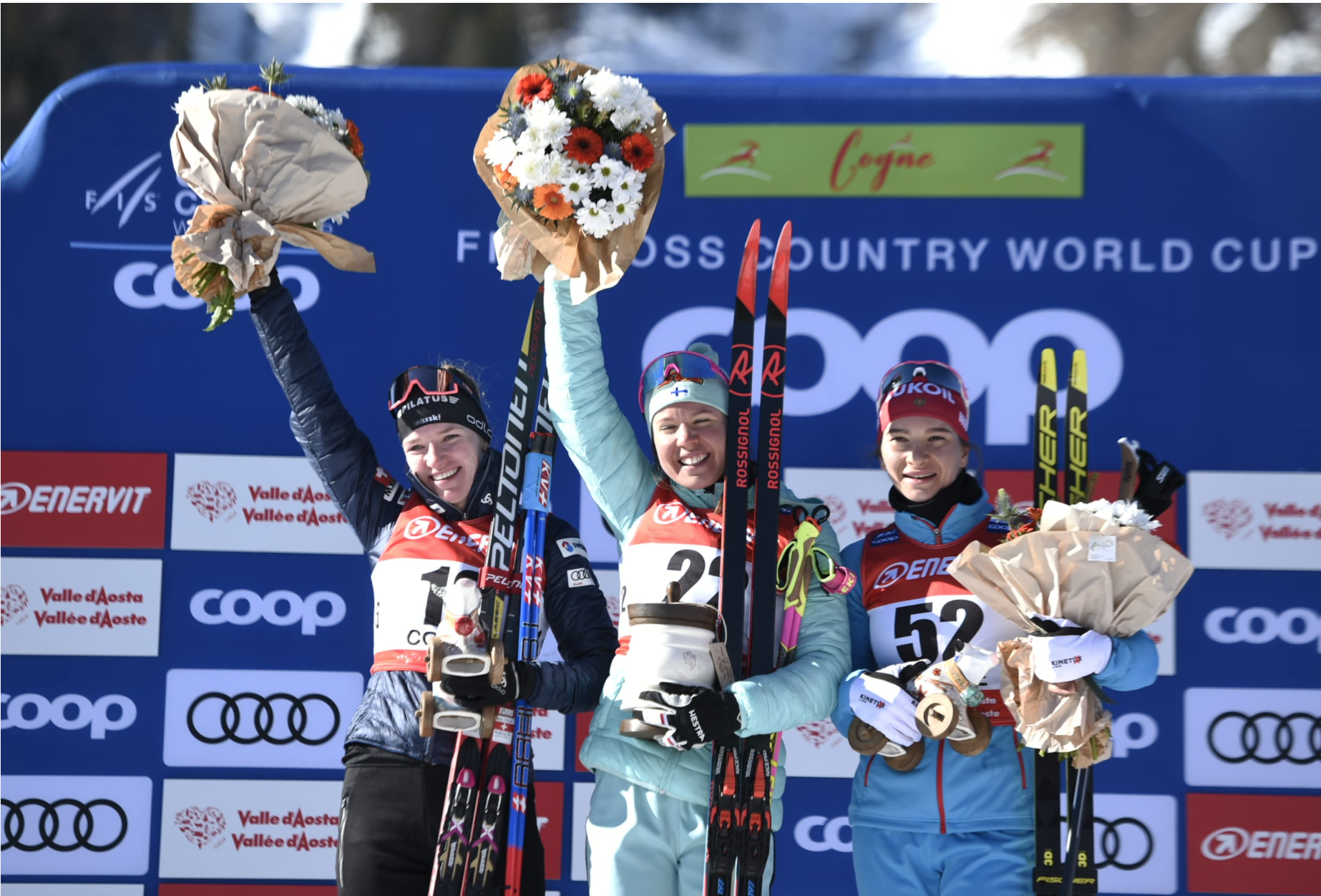
    From left to right, Nadine Fähndrich (SUI), Kerttu Niskanen (FIN) and Natalia Nepryaeva (RUS) on the podium for the women’s 10 k classic race in Cogne, Italy. (Photo: Screenshot FIS/NordicFocus)

    World Cup racers in the Cogne, Italy 10-kilometer classic individual start enjoyed blues skies and sunshine on Sunday,  the temperate weather seeming to have carried over from Saturday’s sprint. Winning the women’s race was Finland’s Kerttu Niskanen in a time of 27:24.8. The victory is Niskanen’s second individual World Cup win–her first came five years ago in the Lenzerheide, Switzerland 10 k classic.

    With Sunday’s 10 k the final World Cup regular season race before World Championships, which is set to kick-off next Wednesday, Feb. 20 in Seefeld, Austria, Niskanen explained in a post-race interview with the International Ski Federation (FIS) that she feels ready for the upcoming World Champs competitions. 

    “Some weeks ago, I felt like Seefeld was too far away. I was so tired at the beginning of the season and I had to totally rest,” Niskanen told FIS. “It was not an easy time, watching the TV when others skiers were racing. So, now I feel good and I’m happy to travel to Seefeld.”

    https://www.fis-ski.com/en/cross-country/cross-country-news-multimedia/news/2018-19/niskanen-fahndrich-and-nepryaeva-win-at-cogne-10km-c
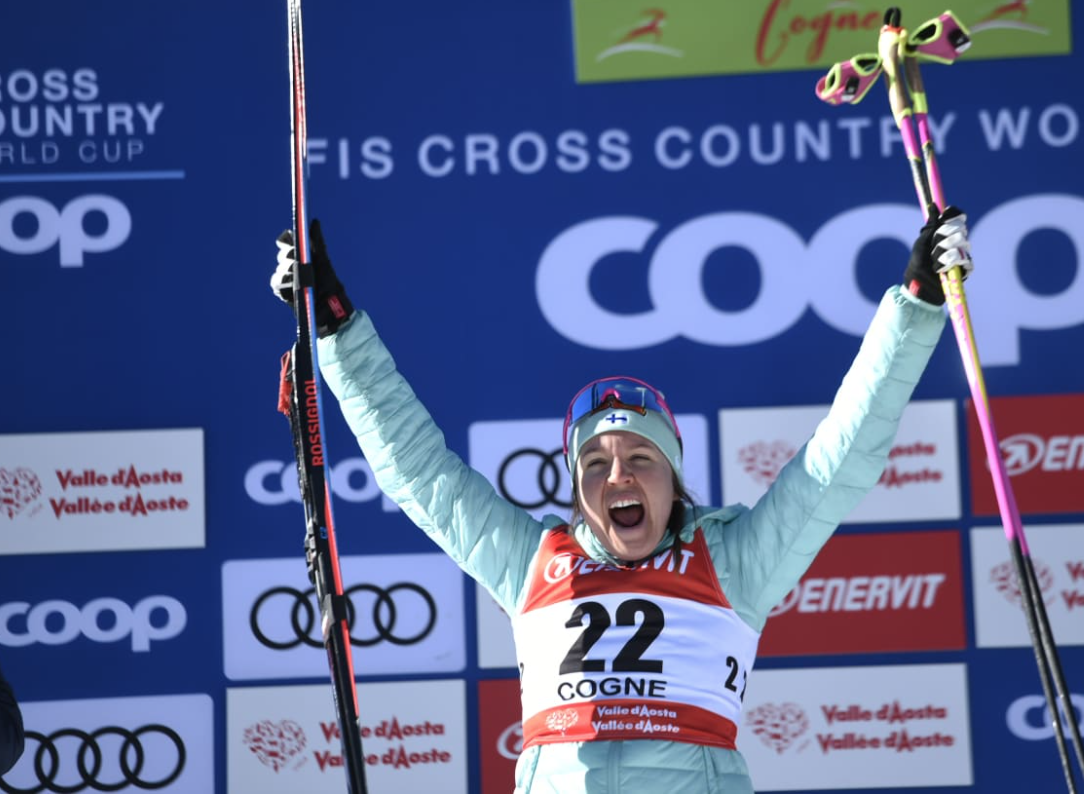
    Finland’s Kerttu Niskanen is all smiles after her win in Cogne, Italy (Photo: Screenshot FIS/NordicFocus)

    Starting in bib 22, Niskanen was chasing down the times of Switzerland’s Nadine Fähndrich, who started in bib 16, and Sweden’s Frida Karlsson who started in bib 20. By the time Karlsson came through the halfway point, she was up on Fähndrich, who came through four bibs earlier, by 3.1 seconds. Niskanen, who came through two bibs after Karlsson, was down on the Swede by 3.9 seconds.

    By the 8 k mark, however, Karlsson’s pace had fallen back and Fähndrich’s time led hers by by 10.6 seconds. Niskanen had also gained steam. At 8 k, she was down on Fähndrich by a mere 0.8 seconds. In the next 2 k, Niskanen managed to outpace the Swiss skier, besting Fähndrich by 3 seconds for the win. According to the FIS database, Sunday’s second place finish is Fähndrich’s first individual Top 3 on the World Cup circuit–although she posted the fastest time in Saturday’s sprint qualifier. 

    Following Fähndrich, Russia’s skier, Natalia Nepryaeva, finished third today, 12.6 seconds behind Niskanen. Nepryaeva, who started in bib 52, was 13.2 seconds down on the race leader, Karlsson at the halfway point. By 8 k, she had the third fastest time and maintained that position until the finish. Including Sunday’s result, Nepryaeva has landed on the podium seven times this season, four of those in the 10 k classic discipline. 

    https://www.fis-ski.com/en/cross-country/cross-country-news-multimedia/news/2018-19/niskanen-fahndrich-and-nepryaeva-win-at-cogne-10km-c
    Russian skier, Natalia Nepryaeva skiing to a third place finish on Sunday. (Photo: Screenshot FIS/NordicFocus)

    The top North American finisher on Sunday was Rosie Brennan who placed 21st (+1:19.6) Brennan has had 11 individual finishes in the World Cup Top 30 this season, her strongest result being 11th in the Lillehammer 10 k freestyle back in December. In bib 26, Brennan was skiing outside of the Top 30 by 1.5 seconds at the 2 k mark, though by the halfway point, she was ranked with the 17th fastest split. With 2 k to go, she was 10 seconds away from being in the Top 15. 

    “The course was very unique with lots of twists, turns, and transitions which isn’t always a strength of mine so I think I didn’t ski those sections as well as I would have liked,” Brennan wrote to FasterSkier in an email. “I love racing at altitude so I wanted to push the pace early on to see what was possible. I think I did that well but struggled with my skis a bit and struggled to keep pace on the transitions.” In today’s reality, getting a so-called "casino bonus" – is quite easy. Licensed platforms themselves will offer nice gifts as a thank you for your play! To find out more about the best bonuses on modern online gambling platforms, the service https://ranking-kasyn-online.net/bonusy-kasynowe/ will help. Thanks to it, you can not only look at the current casino bonuses on the market, but also understand which online gambling platforms offer the best conditions for you!

    Finishing 13.4 seconds outside of scoring World Cup points in 33rd (+1:44.6) was Canada’s Katherine Stewart-Jones.

    “Yesterday’s sprint was rough, my legs felt heavy and body felt tired so I was surprised with how much better I felt today” Stewart Jones wrote in an email on Sunday. She competed in Saturday’s sprint and finished 51st.

    “My skis were awesome so that definitely gave me a boost of confidence,” Stewart-Jones continued. “I am feeling fit and healthy so I am super excited for World Champs. I am mostly looking forward to the 10 km classic and the relay.

    “Distance classic races are my strongest event but the relay is always the most fun, there is something special about being able to race for the teammates you train with all season,” she added. “We have a really strong women’s team this year and we are all looking at improving our result from World Champs 2 years ago.”

    The next North Americans to finish were Caitlin Patterson, Rosie Frankowski and Julia Kern skiing for the U.S., with Patterson placing 36th (+1:49.6), Frankowski 37th (+1:55.2) and Kern 39th (+1:59.2). Canada’s Cendrine Browne placed 48th (+2:49.0), while the U.S.’s Ida Sargent finished just behind her in 49th (+3:12.3). Canadian Emily Nishikawa started Sunday’s 10 k race but dropped out after the 8.2 k mark.

    “I was really excited for today’s race, the course had long gradual climbs and was well suited for power striding which I like to do,” Kern wrote in an email to FasterSkier. “I was feeling pretty good in the warm up, but felt a little tired in the race and also I was the first starter so I didn’t have anyone to chase. I ski best when I am chasing people or skiing with people, but I still tried to push hard. I didn’t have the race I hoped for, but it was really nice to get another race effort in before world champs and it is leaving me hungry for more!”

    Results

  • Video: SuperTour Finals Women’s 10 k Classic

    Video: SuperTour Finals Women’s 10 k Classic


    FasterSkier’s coverage of SuperTour Finals and U.S. Distance Nationals is brought to you by the generous support of Concept2, the leading manufacturer of indoor rowers, racing oars, and the SkiErg.

    SODA SPRINGS, Calif. — Kikkan Randall (Alaska Pacific University/U.S. Ski Team) continued to tear around the trails at SuperTour Finals on Friday during a sunny 10 k mass start classic, giving herself a nice lead halfway through the race series.


  • With 18th in Lahti Classic, Bjornsen Doubles Up on Personal Bests

    With 18th in Lahti Classic, Bjornsen Doubles Up on Personal Bests

    The day after posting a career-best finish in the skate sprint in Lahti, Finland, Sadie Bjornsen maintained the momentum on Sunday and produced a personal-best distance result in the 10 k individual classic. She finished 18th, the top American result, and chopped six places off her previous high water mark from the Sochi, Russia, skiathlon. As the eighth starter in the field Bjornsen even got to sit in the leader’s chair for a few minutes as the rest of her competitors came through the finish.

    Sadie Bjornsen (USA), here in relay action at World Championships, posted the best distance result of her career on Sunday with an 18th place in Lahti, Finland.
    Sadie Bjornsen (USA), here in relay action at World Championships, posted the best distance result of her career on Sunday with an 18th place in Lahti, Finland.

    “It was really fun, I’m really happy,” Bjornsen said over the phone. “When the French (Celia Aymonier) girl got up off the chair I raced over; I didn’t know how long it would last.”

    The afternoon before the 10 k Bjornsen had an inkling the 10 k would go well. Her ninth place in the preceding sprint indicated her fitness was good, and she looked forward to the opportunity to ski an individual distance race and contest an event where her result “wasn’t dependent on how things work out in a mass start.”

    “It’ll be so fun to do my own race, you know?” Bjornsen said on Saturday.

    On the course the next day she was able to pace herself exactly as she wanted, and the result was a new career best. The Lahti venue is closer to sea level than the World Cup circuit has seen in a while, but features deceptively challenging climbs. They were the focal points of Bjornsen’s personal race plan — after observing the way the best women in the world skied over the hills in Val di Fiemme a week earlier, she decided to focus her energy on skiing hard over the tops of the hills in Lahti.

    “Every climb has some form of a downhill after, so I kept trying to tell myself I’d have recovery every time I was in pain,” Bjornsen said. “My goal today was pushing over the tops of hills; that’s something I noticed the fastest girls doing when I was watching the 30 k. They hammer, but they really hammer over the top. So I tried to think about that.”

    Bjornsen said her skis were “really great,” and though a few climbs were still steep enough to require the herring bone technique she welcomed the variation.

    “That was nice to switch up the muscles, so I was excited the course was challenging,” she said.

    On the two-lap course Bjornsen started conservatively, wary of going too hard, too soon. She posted the 22nd-fastest split at the first checkpoint, but moved into 18th by 6 k and stayed there. As such an early starter, she had no real indication as to whether she had paced the race right until she saw the results.

    “I realized I hadn’t skied an individual race in so long,” Bjornsen said. “Did I go hard, how hard do I go? I had no idea if I’d started right. At one point someone told me I was in eighth, but I was bib eight, so I was like, ‘Oh, I guess I went too easy.’ I hammered from there and I was tiring at the end, but my splits were even the whole way through.”

    With two strong results in Lahti, Bjornsen is now sitting 15 points away from being one of the top-50 women on the World Cup overall list that compete in World Cup Finals at the end of the season. Before coming to Finland she’d banked on not qualifying, and booked plane tickets for OPA Cup finals instead, but now that she is three places from the cutoff she’s allowing herself to consider the possibility of going to Sweden.

    “Basically I’m going to need to have another great race at Drammen. It’s totally possible, but going in that’s not what I’m going to think about,” Bjornsen said. “It’ll just be in the back of my mind. Last year I qualified sixteenth there, so I have good memories and I’m going to go into it and think about those. If it goes well, it looks like I’ll have another trip!”

    After Bjornsen, her American teammates Kikkan Randall and Liz Stephen tied for 28th down to the tenth of a second, each finishing the 10 k in 27:48.9. Neither thought it was a stellar result, but Randall considered it a step in the right direction for her distance skiing from where it was in Val di Fiemme for World Championships.

    “I felt a lot better today than I did in Val di Fiemme in the distance races,” Randall said. “I started off a little too slow and it kind of took me until the second lap to really find a good rhythm, but I’m happy with better feelings. It was kind of fun to tie with Liz down to the tenth of a second, kind of crazy.”

    In Italy, particularly after the 4×5 k relay, Randall could tell she was paying the price for the cutback in training her foot injury forced in the off-season, even though her sprinting was clearly fine. The memory gave her reason to take the 10 k in Lahti out a little slower than she might have otherwise, knowing her usual pacing might put her at a deficit.

    “I knew I’d have to build into the race because the feelings in Val di Fiemme were: if I went out too hard everything got flooded and heavy too soon,” Randall said. “So I had the plan of building into it… And I did build speed as I went and felt pretty good on the last few hills. It’s close to being what I wanted to do today.”

    As to how she can be the sprinter to beat while simultaneously struggling to meet her usual distance marks, Randall attributes it to the way she trained for World Championships.

    “Sprinting is definitely a little unique,” Randall said after winning in Lahti on Saturday. “The course was just over 2:40, so it was a fast course and it was more like a real sprint. We were preparing for world champs and putting emphasis on the team sprint and the sprint, so we tailored my training a little bit towards that. That’s why I think the sprinting is continuing to be really strong now.”

    For Stephen, 28th was “an average day.” Where Randall reached the same benchmark by holding back in the first few kilometers, Stephen’s splits were consistently in the top 30 throughout the race.

    “I’m happy to have another race under my belt, and it was fun to tie with Kikkan,” she said, but “I think I’m just continuing to work on my classic.”

    Stephen thought her weakest spots were on the hills, where she struggled to stride over them with good form.

    “The hills are pretty steep and so I need to ski technically well to get up them or I waste a lot of energy running up out of the tracks,” she said. “It was hard to ski technically well while also going fast enough out there today. So more classic races, more time. I think it will come along for sure, but I’m psyched for next weekend.”

    Randall and Stephen are ranked third and 22nd, respectively, on the overall World Cup, which essentially guarantees they will go to World Cup Finals.

    Three other U.S. women competed in the Lahti 10 k. Jessie Diggins placed 43rd after Randall and Stephen (+2:45.9), and Ida Sargent was a few seconds behind her in 44th (+2:47.3). Rosie Brennan was 61st (+4:23.8).

    After the city sprints in Drammen, Norway, on Wednesday, the World Cup circuit heads to Holmenkollen for the fabled 30/50 k freestyle mass start.

    Lahti 10 k classic results

    World Cup Overall standings