From the FasterSkier archive — posts syndicated from athletes’ and coaches’ own blogs between 2004 and 2012, kept online as published. Current coverage is at fasterskier.com.

Tag: 12.5 k pursuit

  • Fourcade Stares Down Norwegian Rivals in Oberhof Pursuit; Burke 14th, C. Gow Ties Career-Best 21st

    Fourcade Stares Down Norwegian Rivals in Oberhof Pursuit; Burke 14th, C. Gow Ties Career-Best 21st

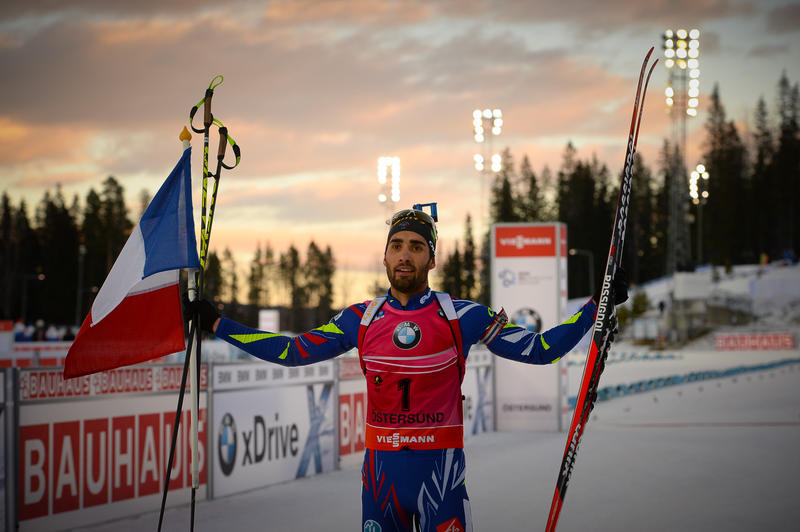
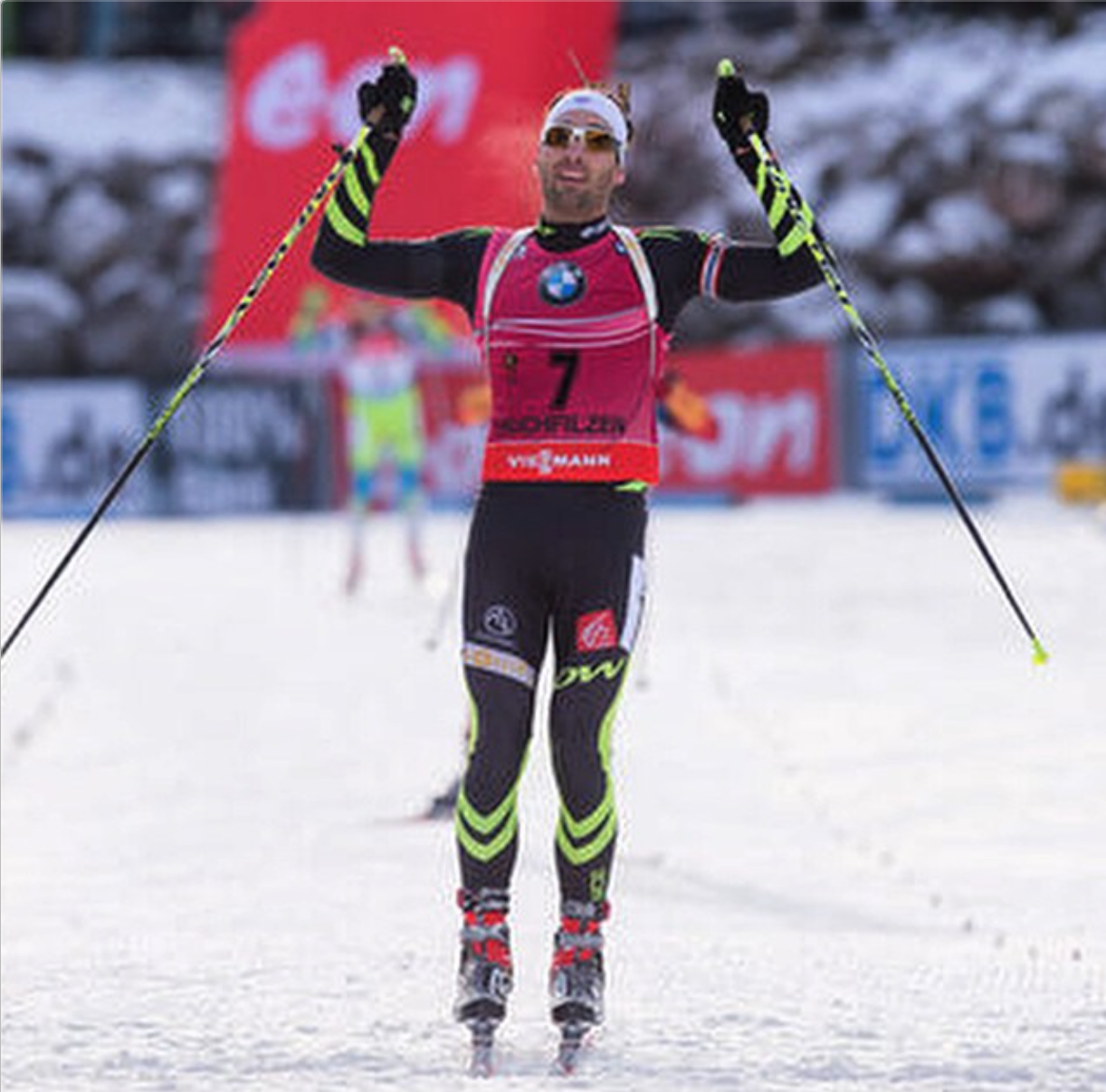
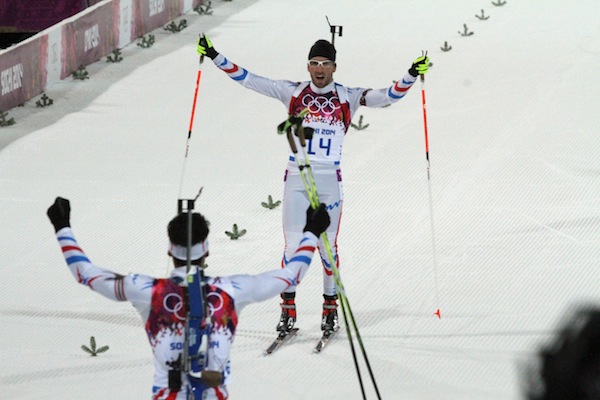
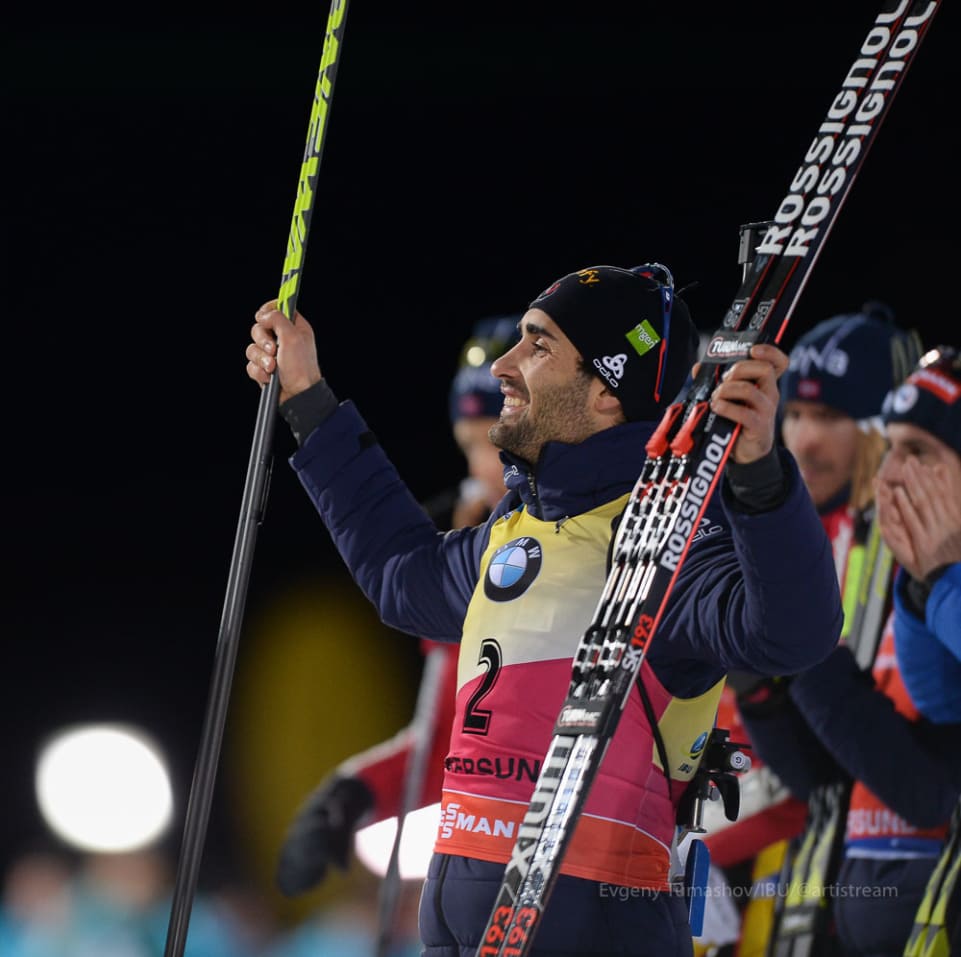
    France’s Martin Fourcade celebrates his victory in the men’s 12.5-kilometer pursuit at the 2018 IBU World Cup in Oberhof, Germany. (Photo: IBU/Biathlonworld.com)

    After cleaning the fourth and final shooting stage in the men’s 12.5-kilometer pursuit on Saturday at the 2018 International Biathlon Union (IBU) World Cup in Oberhof, Germany, Martin Fourcade of France hoisted the biathlon rifle onto his back, spun around and fully faced the way he’d come, glancing for a moment at his three closest competitors behind him: Norwegians Johannes Thingnes Bø and his older brother Tarjei Bø, and Emil Hegle Svendsen, before heading out on the final loop while his closest challengers were all still shooting on the range.

    Was it a new gesture to assert his dominance in the sport instead of celebrating with a fist pump or raised arm when he crossed the finish line, or was he genuinely curious how they were doing?

    “I will answer diplomatically. Yesterday I heard from the Norwegian press that Emil [Hegle Svendsen] said I feared the Norwegian team,” Fourcade said when asked about ‘the stare’ in a post-race press conference. “I have a lot of respect for them. I know how good they are because they show me every weekend. They can beat me in every competition, but I don’t fear them like they don’t fear me! It was my answer to them.”

    Fourcade then looked over to Tarjei Bø sitting next to him on the podium who laughed and replied: “Really good answer!”

    In the race, Johannes Bø cleaned his targets to follow his French rival onto the last loop, 16.3 seconds back, followed by his brother Tarjei another ten seconds later, while the third Norwegian Svendsen, who had shot head-to-head in a duel against Fourcade in the first stages, incurred his only miss of the day and had to ski 150 extra meters in the penalty lap, thus slipping from second to fourth.

    Johannes Bø skied faster on the final loop than Fourcade, getting closer and closer, and the French biathlete surely would have kicked himself for his unorthodox maneuver on the range if he had squandered his lead and lost by inches in a finishing sprint. But that didn’t happen, and Fourcade could celebrate across the line in a time of 30:49.5 minutes, with just one penalty.

    Johannes Bø crossed the line 6.3 seconds after him with three penalties, while his clean-shooting brother Tarjei finished third, 30.9 seconds back.

    Svendsen, the runner-up in Friday’s sprint, had to settle for fourth place (+1:04.7) with one penalty in the pursuit, while Ukraine’s Dmytro Pidruchnyi was fifth (+1:16.2) also with one penalty.

    “I missed in the first prone together with Martin, then the rest of the race I fell a little bit behind in each shooting … so I was never really in the fight for the win,” Johannes Bø said in the press conference. “But in the end I got the second place. If Martin had stood [on the range] two seconds longer maybe I would have caught him!”

    Asked if it added extra pressure on the range having to shoot directly against his brother, he added with a laugh: “Yeah, it’s like a cat-and-mouse game. We have done it for as long as … some 20 years. So there is not much difference. I won, like at home.”

    “I was one penalty loop behind the guys after the sprint, so I knew they had to make a [mistake] for me to have a chance,” Tarjei Bø said. “I was always some seconds behind, I was never fighting for the win but fighting for the podium. … The level was really high, we were four guys together, and to be honest it’s really fun to have these fights when you know you have to deliver your best to have a chance to win.”

    Asked about the friendly rivalry with his brother, he added: “The only problem is whenever Johannes has been on the podium he has beaten me every time. It’s not so fun, so I need to improve! Today were were together at the last shooting, and he showed me he was better. So … do you have any tip for me? You all have seen biathlon for ten years, you don’t have anything?!”

    Best Pursuit of the Season for Burke
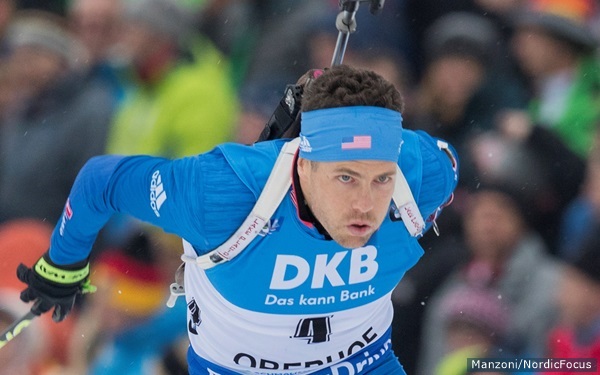
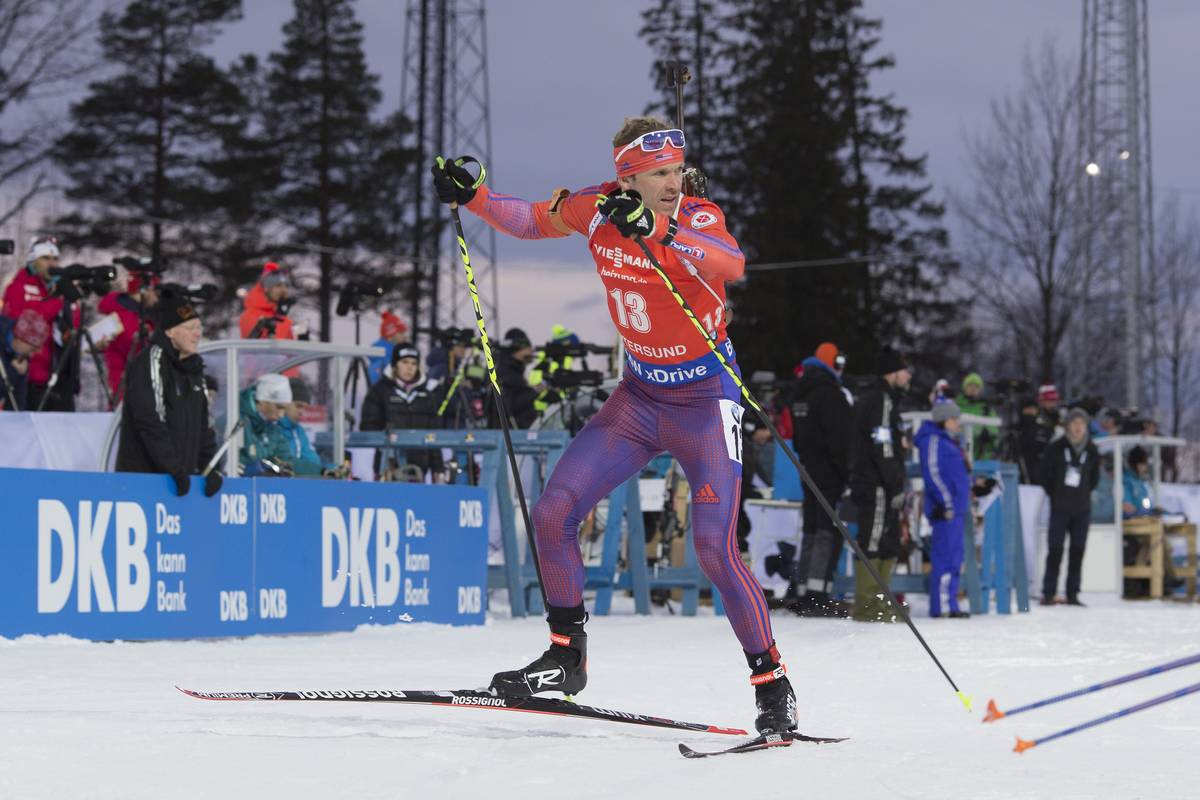
    Tim Burke (US Biathlon) racing to 14th in the men’s 12.5 k pursuit on Saturday at the IBU World Cup in Oberhof, Germany. (Photo: US Biathlon/NordicFocus)

    US Biathlon’s Tim Burke had started the pursuit race in fourth and 20 seconds behind Fourcade after his season-best performance in Friday’s sprint, and initially remained in the top of the field in the pursuit after cleaning his first prone stage.

    He then skied the next loop with eventual third-place finisher Tarjei Bø, who skied the overall 10th-fastest course time of the day while Burke was 22nd overall. Burke then incurred two penalty laps in his second prone stage

    “Going with Bø on the second loop was definitely fast but I felt in control,” Burke wrote in an email to FasterSkier. “I don’t think this had anything to do with the two prone misses in the second stage. I just simply missed, which happens in biathlon sometimes.”

    Burke had fallen back a bit to the eighth position as he returned to the course, then after the third loop, cleaned his first standing shooting stage, but was passed by two competitors. He missed one more in his final standing stage and set back out on the course in 14th position.

    On the final lap and in an extended sprint for positions on the slightly inclined, very long and straight finish stretch in Oberhof, he skied with Russia’s Anton Shipulin (who ended up 12th, +1:43.1, with one penalty) and the Czech Republic’s Ondrej Moravec (13th, +1:43.6, three penalties) who had left the range two seconds behind him, while Burke managed to overtake Sweden’s Frederik Lindström (+1:45.8; no penalties), one of only three athletes to shoot clean in all stages.

    Burke thus ended his day still in 14th, 1:43.7 behind Fourcade, with three penalties (0+2+0+1). It was his best result in a pursuit this season.

    “I was able to push reasonably well on the last loop today, which was a first for me this season,” he wrote. “I will take this as a good sign for the upcoming races.”

    No other athlete for US Biathlon qualified for the pursuit in the top 60 of Friday’s sprint, with Sean Doherty finishing 84th position in the sprint the day before.

    Career-Best for Christian Gow

    For Biathlon Canada, Christian Gow moved up from a 36th starting position after the sprint to finish 21st, 2:19.2 back, with only one penalty incurred in his last stage (0+0+0+1).

    With this performance he tied his career-best individual result from a pursuit in Östersund, Sweden, during this season’s opening weekend.

    “I am really happy with my result today,” Gow wrote in an email to FasterSkier. “This is one of the best ski races I have ever had, and the shooting was really solid as well. I wish I could have made one more spot, but it was a great race anyways.”

    Gow wasn’t too bothered by the rainy conditions the biathletes encountered all week in Oberhof, including on Saturday.

    “The course held up quite well considering the weather we have been having here, the hills were firm which made for a much more pleasant race,” he wrote in an email. “The shooting range was the calmest I have ever seen in Oberhof, so it was very manageable today.”

    Gow skied the 28th-ranked course time of the day, including a second loop where he was the 11th-fastest athlete.

    “I skied with [Norway’s] Lars Birkeland and [Sweden’s] Sebastian Samuelsson at different points in the race […] which was really helpful for keeping the ski pace high,” he explained.

    On the range, the 24-year-old Calgary native remained clean through three stages moving up as high as 17th, until he came to the final shooting stage.

    “I felt really calm for all of my range entries today, including the last one up until I hit the shooting mat,” Gow wrote. “At that point I realized that I was having a really good race and that another clean shooting would really solidify a strong result. I tried to put that aside and focus on being aggressive in the shooting in order to not allow time to think and make mistakes. Unfortunately, I was a bit too aggressive on my second shot which resulted in a miss, but I refocused really nicely from there and hit the rest.”

    He came out of the penalty lap in 21st position, and kept that place into the finish by overtaking Russian-born athlete Timofei Lapshin, who races for South Korea, while being passed by Russia’s Alexander Loginov on the final lap.

    Also starting in the pursuit for Biathlon Canada, his brother Scott Gow finished 50th (+4:45.0), after starting in 32nd then incurring six penalties on the range (2+1+1+2), and Brendan Green ended the race in 54th, 5:26.1 minutes back, improving by three spots while shooting three penalties (0+2+0+1).

    Relay Races

    The IBU World Cup weekend in Oberhof will conclude with the second relay races of the season on Sunday. The Canadians are slated to start the men’s relay with the two Gow brothers, Green, and Carsen Campbell, while the Canadian women’s team will include Sarah Beaudry, Julia Ransom, Megan Tandy and Emma Lunder.

    US Biathlon won’t be able to enter a women’s or men’s relay, after the team only had Susan Dunklee and Clare Egan as well as Burke and Doherty as the athletes already qualified for the upcoming Winter Olympic Games in PyeongChang, South Korea, representing it in Oberhof. Reigning world champion Lowell Bailey, who is also prequalified for the Olympics, skipped the races in Oberhof for a longer rest and training period at home, just like he did a season ago.

    The other potential candidates for PyeongChang are competing this weekend in two sprints at an IBU Cup in Brezno-Osrblie, Slovakia, which together with next week’s races in Arber, Germany, serve as the Olympic trials to round on the team.

    “We will indeed miss the relay tomorrow but plan to race the relay in Ruhpolding [next Friday],” Burke wrote regarding the men’s team. “I don’t see this as a problem. In fact, it will be nice to have an extra day break with a tough 20k coming up on Wednesday.”

    Results

    Men’s relay start list | Women’s relay start list

  • Fourcade Leaves Östersund with a ‘W’; Bailey 17th; Christian Gow Gets Career-Best 21st

    Fourcade Leaves Östersund with a ‘W’; Bailey 17th; Christian Gow Gets Career-Best 21st

    France’s Martin Fourcade celebrating his first IBU World Cup win of the 2017/2018 season in the men’s 12.5 k pursuit on Sunday in Östersund, Sweden. (Photo: IBU/biathlonworld)

    If you were to ask France’s Martin Fourcade what’s wrong with a second and third place, and even two fourth place finishes in the first four races of the International Biathlon Union (IBU) World Cup season, he’d likely politely tell you nothing — it just wasn’t up to his usual standards.

    “Despite my two podiums here, I felt that if I had not won here, it would have been my worst season opener since, for seven years in a row, I won here,” the 29-year-old defending World Cup champion told the IBU after Sunday’s pursuit in Östersund, Sweden. “Now I can be very calm and relaxed for the next competitions.”

    He got down to business out of the start of the men’s 12.5-kilometer pursuit, starting second, just 1 second behind Norway’s Tarjei Bø, who won the sprint to start the pursuit first. Early in the first of five 2.5 k loops, Fourcade set the pace with Bø and Germany’s Erik Lesser in bib 3 slotting in behind him. Fourcade entered the range first to take Lane 1 for the first prone stage, where he and Bø both missed a shot to slip to fifth and sixth, respectively, after each skiing a penalty lap. Meanwhile, Lesser missed four to drop out of the top 30 and nearly a minute and 20 seconds out of first.

    While Fourcade left the range 10 seconds behind Norway’s Emil Hegle Svendsen, who had moved into first with clean shooting, he was back into first 2.5 k later. On the second prone, Fourcade and Bø both cleaned to leave the range just 3.8 seconds apart in first and second, respectively. Svendsen missed one to slip 18 seconds back to third.

    On Loop 3, Fourcade switched into high gear. Bø kept pace, but by the time they lined up together for the first standing stage, Fourcade had the edge. The Frenchmen once again cleaned while Bø missed three to fall to 18th and nearly a minute and a half out of contention by the time he finished his penalty laps.

    Game over. Fourcade spent the next two loops and final shooting going through the motions to secure his victory, cleaning the last standing stage with the 25th-fastest shooting time, then slowly turning to look up at the crowd. He appeared relaxed with his two closest challengers, his French teammate Quentin Fillon Maillet and Slovenia’s Jakov Fak, who started 2 seconds apart in 12th and 10th, respectively, and shot identically (1+0+0+1), skiing together more than a minute back in second and third.

    Fourcade’s final loop time ranked 51st out of 58 yet he still finished first, 40.8 seconds clear of Fak, who dropped Maillet on the final climbs before the stadium. Fourcade claimed his first win of the season in 30:12.2, Fak placed second for his first podium since 2015, and Fillon Maillet took third (+42.1).

    “I must say that I was very surprised because after the third shooting it was more a fight against myself,” Fourcade said. “I am very satisfied about the biathlon I showed.”

    “I think Quentin and I worked well together, half the loop each pushing to keep on the podium,” Fak told the IBU. “Both can be very satisfied about finishing on the podium and leaving Sweden with this result.”

    On a day with variable wind conditions and soft, slow snow, no one in the men’s race shot clean. Six hit 19 of 20 targets, including Fourcade and his brother Simon Fourcade (ninth place) and Norway’s Lars Helge Birkeland (sixth place) in the top 10.

    Christian Gow (Biathlon Canada) racing to his previous career best of 23rd in the men’s 12.5 k pursuit at 2017 IBU World Championships in Hochfilzen, Austria. On Sunday, he placed 21st in the Östersund World Cup pursuit. (Photo: Glen Crawford)

    Biathlon Canada’s Christian Gow also finished with a single penalty (0+0+1+0) in 21st for his best World Cup result. Gow had started the pursuit 26th and 58 seconds back, and picked off five places to finish 2:04.6 behind Fourcade.

    “[Saturday] was my best sprint placing ever, so I knew I was in a good position for the pursuit,” Gow wrote in an email to FasterSkier. “I knew a top 20 was possible, and maybe more if my skiing was on form. Unfortunately, I had some shin issues skiing today so I wasn’t able to ski as well as I would have liked. But I did my job on the range and am happy with how the race turned out.”

    The shin pain he referred to wasn’t anything serious, “just bothered me today for some reason,” he elaborated. “I’m not too concerned though, I’m sure they’ll be fine in a couple days.”

    His shooting time ranked 22nd overall compared to his overall course time in 49th.

    “The shooting conditions were challenging today, but I knew that I could still shoot well if I stayed focused in the range,” Gow wrote. “I shot confidently today and I think that helped a lot.”

    He consistently left the range within striking distance of the top 20: first in 22nd, then in 21st, then 26th, and finally 20th.

    “The course was pretty soft today. That added an extra challenge skiing,” he continued. “I made up all of my time in the range today, but am quite happy with my last loop. I am proud of how hard I was able to push myself on that lap to keep my placing.”

    Leaving Östersund, where he and his older brother Scott Gow and another teammate Julia Ransom all achieved career bests to start their season, Gow said the team mood was positive.

    “Almost everyone had at least one result that they can be proud of and we really performed well as a team which boosts everyone’s confidence I think,” he wrote.

    Four Canadians qualified for the men’s pursuit, with Nathan Smith finishing 42nd (+3:19.2) after starting 24th and missing three shots (1+0+0+2). Scott Gow placed 50th (+4:10.9) after starting 16th and incurring six penalties (1+2+1+2), and Brendan Green followed in 51st (+4:18.6) with five penalties (0+2+2+1).

    Bailey Gets First Top 20 of Season

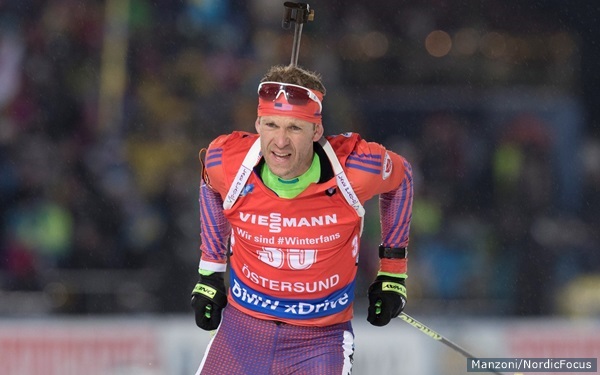
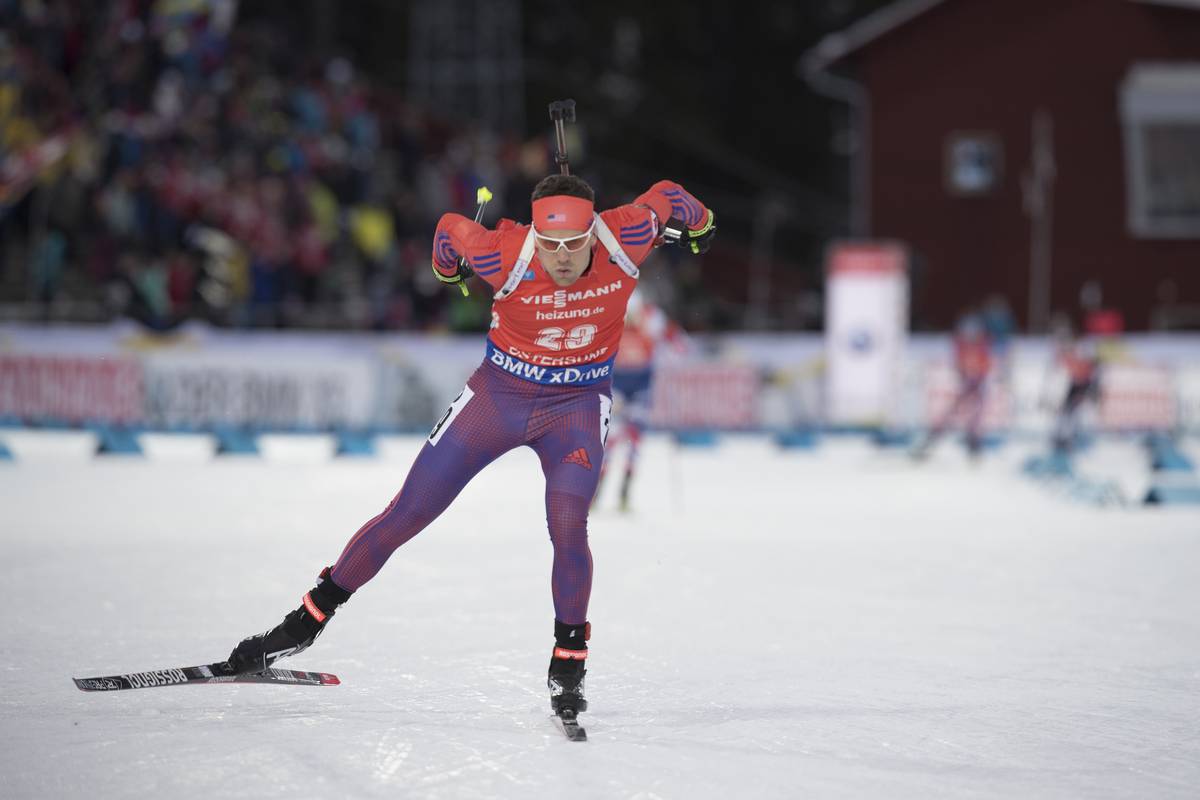
    Lowell Bailey (US Biathlon) racing to 17th in the IBU World Cup men’s 12.5 k pursuit on Sunday in Östersund, Sweden. (Photo: USBA/NordicFocus)

    Lowell Bailey led two Americans in the pursuit, starting 22nd and 50 seconds back and rising to 17th (+1:40.2) with two penalties (0+1+0+1). After cleaning the first prone stage, where several of the top competitors incurred penalties, Bailey moved up to 12th and 39 seconds out of first.

    One loop later, he found himself nearly a minute back in 19th after a penalty on his second prone. Bailey worked his way back to 11th after cleaning his third stage, but slipped to 15th with a miss in the final standing stage.

    “The range was tricky today. The wind was very shifty and constantly changing,” Bailey explained in an email. “I only tried to focus on the fundamental parts of my shooting (e.g. trigger squeeze, breathing, etc.) and make sure that I was taking good shots.  My groups did move around from one prone to the next, but fortunately, most of the shots stayed in the hit zone.

    “I’m happy with the shooting today,” he continued. “I tried to execute the type of shooting that I’ve worked on all summer.  Although I was happy with the shooting result in the Sprint, I know that I could have shot faster.  It’s a delicate balance; when to go for speed and when to hold back for accuracy.”

    His shooting time in the pursuit ranked third overall, while his course time was 42nd.

    “I definitely don’t feel in my best shape yet,” he wrote. “We deliberately approached the season conservatively, with the mindset that the Olympics are months away and I want to be in my best shape when I hit the tracks in Pyeongchang.”

    Leaving Östersund, where he finished 22nd in the sprint and 67th in the 20 k individual, Bailey wrote that he was satisfied with his first week of racing considering that he came down with a cold a week earlier.

    “All things considered, I feel very fortunate to have come away with some WC points in a field which seems to be one of the strongest international biathlon fields yet,” he wrote.

    Also for US Biathlon, Tim Burke finishing 48th (+3:52.7) after starting 52nd and missing four shots (2+0+1+1).

    With the conclusion of the first IBU World Cup in Östersund, the circuit moves to Hochfilzen, Austria, where racing kicks off again Friday, Dec. 8, with men’s and women’s sprints.

    Results

  • Saturday Rundown: Quebec City, Oslo and Lillehammer (Updated x4)

    Saturday Rundown: Quebec City, Oslo and Lillehammer (Updated x4)

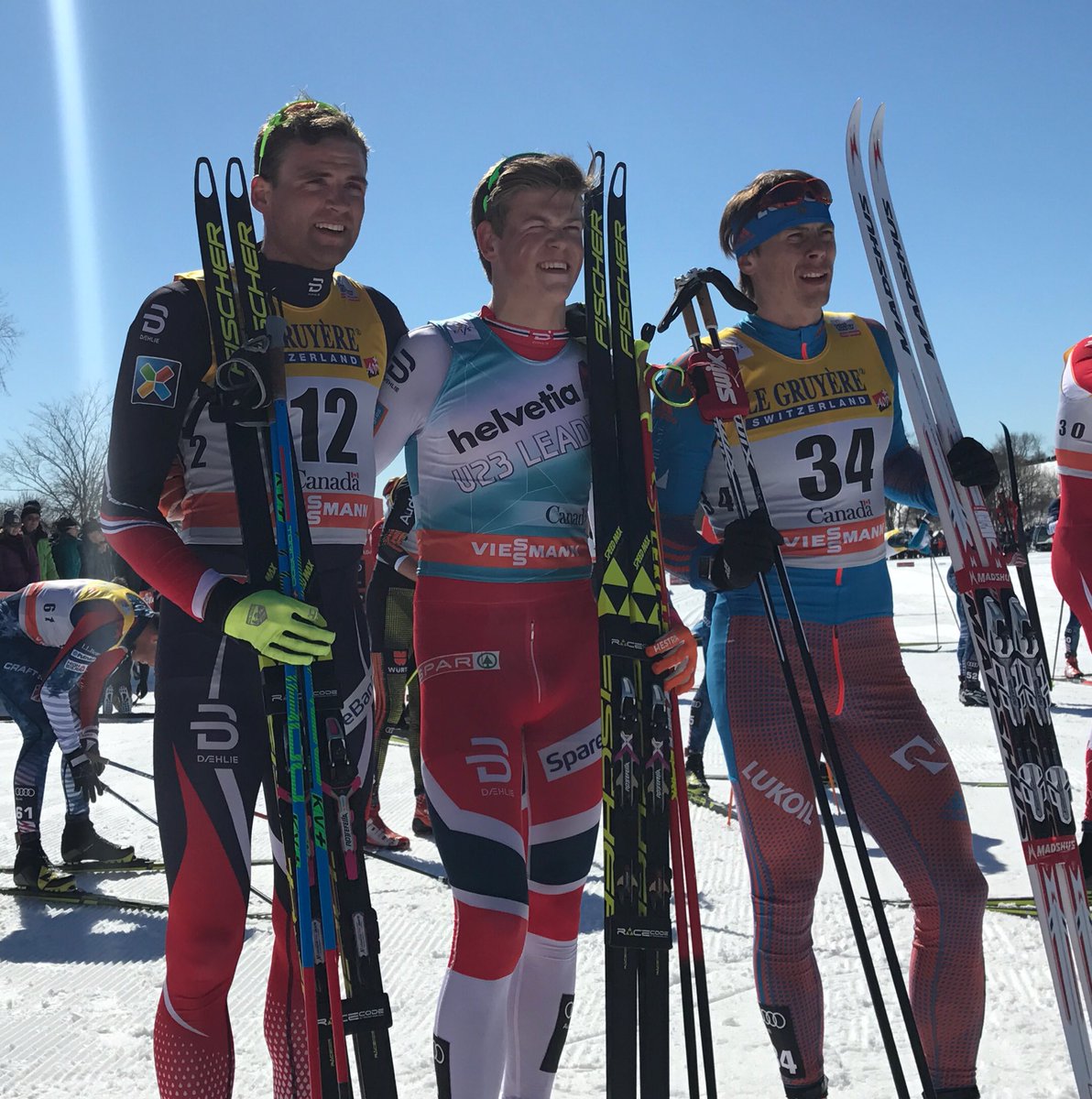
    The men’s 15 k classic mass start podium on Saturday at World Cup Finals in Quebec City, with Norway’s Johannes Høsflot Klæbo (c) in first and Niklas Dyrhaug (l) in second, and Russia’s Alexander Bessmertnykh (r) in third. (Photo: FIS Cross-Country/Twitter)

    FIS Cross-Country World Cup Finals (Quebec City): 10/15 k classic mass starts

    During Saturday’s 15-kilometer classic mass start at World Cup Finals, Canada’s Alex Harvey was in it until the end. But so were Norway’s Johannes Høsflot Klæbo and Niklas Dyrhaug, and Russia’s Alexander Bessmertnykh, to name a few.

    Sitting in second with a few hundred meters to go, Harvey was primed to make his move on Dyrhaug, who was leading at the time. But then came 20-year-old Klæbo, the season-long Sprint World Cup champion, who proved to have more left in the tank than anyone else and passed them both to lead into the finishing straight.

    Klæbo took the victory — his first in a World Cup distance race — on a bluebird day under a beating sun in 35:23.7 minutes, 0.6 seconds ahead of Dyrhaug. Bessmertnykh followed another 0.2 seconds back in third (+0.8) just ahead of Harvey in fourth (+1.2).

    Norway’s Sjur Røthe took fifth (+1.7), Switzerland’s Dario Cologna placed sixth (+1.9), and Norway’s Pål Golberg was seventh (+2.5), half a second ahead of another Norwegian Didrik Tønseth in eighth (+3.0). The top nine were within 3.7 seconds of first, with Russia’s Andrey Larkov in ninth.

    Devon Kershaw was the second Canadian in the points on Saturday in 28th (+1:08.4), after breaking a pole and working his way back up from outside the top 60.

    Erik Bjornsen led the U.S. men in 31st (+1:16.8), about a second ahead of Canada’s Graeme Killick in 32nd (+1:17.7).

    Also for the U.S., Matt Gelso finished 37th, Andy Newell 45th, Scott Patterson 46th, Noah Hoffman 48th, Ben Lustgarten 49th, David Norris 50th, Simi Hamilton 54th, Paddy Caldwell 59th, Jack Hegman 62nd, Cole Morgan 64th, and Brian Gregg 69th.

    For Canada, Bob Thompson finished 55th, Knute Johnsgaard 57th, Len Valjas 61st, Russell Kennedy 63rd, Evan Palmer-Charrette 65th, Andy Shields 66th, Jess Cockney 67th, Brian McKeever 68th, Joey Foster 70th, Gareth Williams 72nd, Ricardo Izquierdo-Bernier 74th, and Julien Locke 75th.

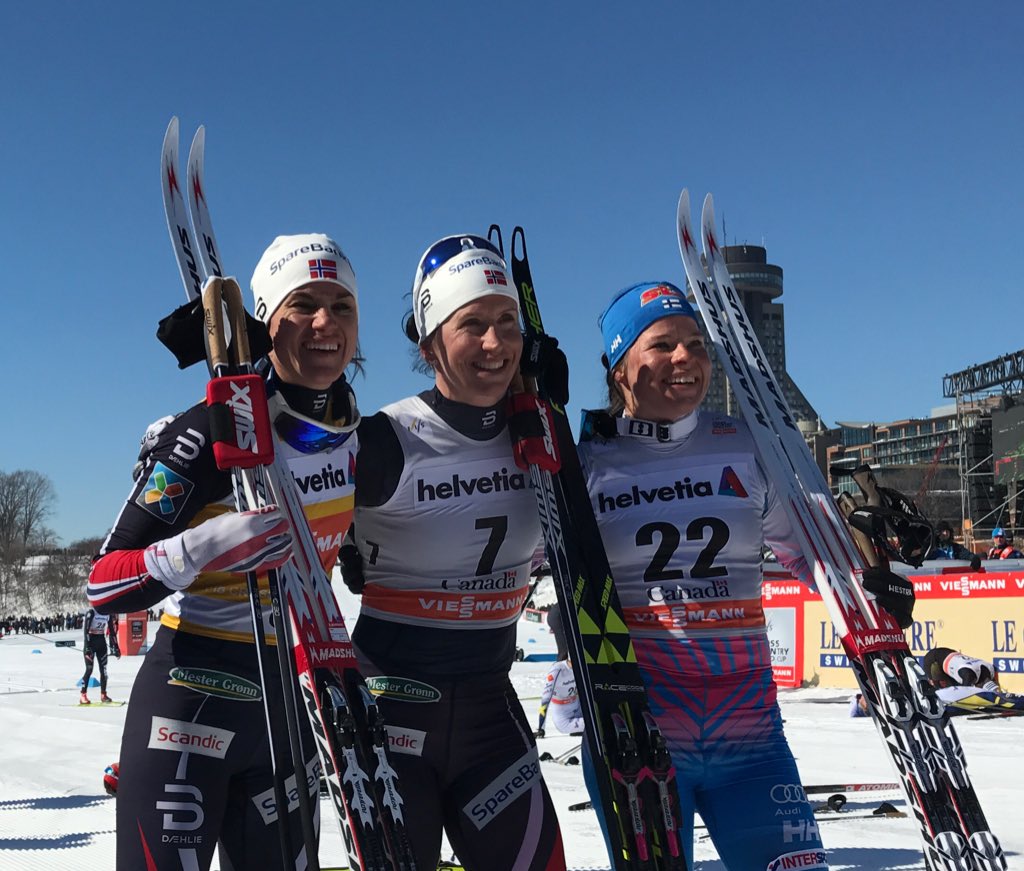
    The women’s 10 k classic mass start podium on Saturday at World Cup Finals in Quebec City, with Norway’s Marit Bjørgen (c) in first, Norway’s Heidi Weng (l) in second and Finland’s Krista Parmakoski (r) in third. (Photo: FIS Cross-Country/Twitter)

    In the women’s 10 k classic mass start earlier in the day, Norway’s Marit Bjørgen racked up her seventh victory of the season after leading a pack of two other Norwegians and Finland’s Krista Pärmäkoski and holding them off to the finish.

    Bjørgen put a few meters into the foursome as she entered the finishing stretch and held her lead across the line in 24:23.6 minutes. Norway’s Heidi Weng finished 0.6 seconds back in second to lock up the Distance World Cup title, in addition to the Overall World Cup title she secured on Friday.

    Pärmäkoski finished 2.9 seconds after Bjørgen in third, and Norway’s Ingvild Flugstad Østberg missed the podium in fourth (+7.8).

    Behind them, Germany’s Nicole Fessel outlasted a large chase pack to place fifth (+18.6), just ahead of Sweden’s Charlotte Kalla in sixth (+19.9) and Anna Haag in seventh (+19.1).

    Sadie Bjornsen of the U.S. Ski Team led the North American women in 15th (+29.9) after skiing at the back of that chase pack in the final stretches of the race. Also for the U.S., Jessie Diggins placed 27th (+1:06.9) and Sophie Caldwell 38th (+1:56.0).

    Canada was led by Emily Nishikawa in 37th (+1:51.7). Behind her, Cendrine Browne finished 41st (+2:28.2), Dahria Beatty was 53rd, Annika Richardson 54th, Katherine Stewart-Jones 56th, Frederique Vezina 59th, Annika Hicks 60th, Sophie Carrier-Laforte 61st, Andrea Dupont 62nd, Katherine Weaver 63rd, Alannah MacLean 64th, Sadie White 66th, Lisle Compton 67th, Mia Serratore 68th, and Laura Leclair 69th.

    For the U.S. Caitlin Patterson finished 44th, Liz Guiney 45th, Kaitlynn Miller 47th, Chelsea Holmes 48th, Rosie Brennan 50th, Julia Kern 52nd, Erika Flowers 55th, Becca Rorabaugh 57th, and Jennie Bender 58th.

    One day left in the 2016/2017 World Cup season remains, with the women’s and men’s 10/15 k freestyle pursuits on Sunday in Quebec City.

    Results: Men | Women

    World Cup Finals standings (Day 2 of 3): Men | Women

    ***

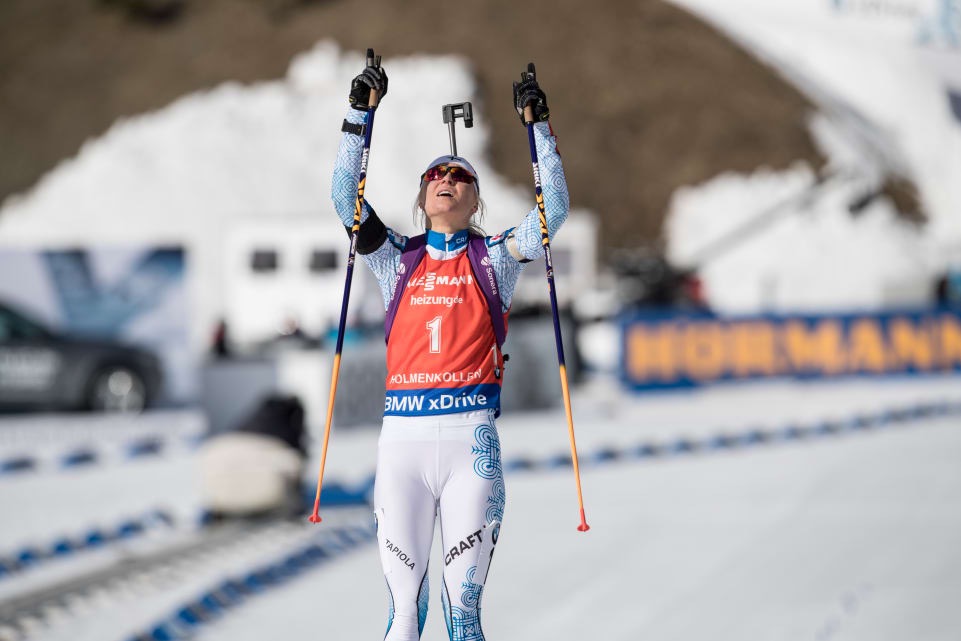
    Finland’s Mari Laukkanen pointing to the sky in honor of her late shooting coach, after she won the women’s 10-kilometer pursuit on Saturday at the 2017 IBU World Cup in Oslo, Norway. (Photo: IBU)

    IBU World Cup (Oslo, Norway): Women’s and men’s pursuits

    Less than 24 hours after winning her first IBU World Cup on Friday in the women’s 7.5 k sprint, Finland’s Mari Laukkanen immediately capitalized on her ideal position with a start-to-finish victory in Saturday’s 10 k pursuit that was never in doubt, cleaning the first three shooting stages before incurring one penalty in her final standing shooting (0+0+0+1) to cross the line in a time of 29:33.3 minutes.

    In addition to experiencing the most successful weekend of her biathlon career by far, it was an emotional day for the 29-year-old Finn due to a personal reason. Laukkanen spread her arms like wings skiing down the homestretch with a commanding lead, pointing repeatedly to the sky and a black ribbon she wore around her right upper arm, before kneeling in the snow in the finish for a few seconds. With those gestures, she reportedly wanted to commemorate her shooting coach Asko Nuutinen, who passed away Friday after suffering a heart attack during the World Cup in Kontiolahti, Finland, a week ago. He was 60 years old.

    “It’s been a really emotional day for me. We have heard really really sad news that last night we lost our longtime shooting coach,” Laukkanen told reporters with a trembling voice in the press conference. “After this it was more or less only about working for him. Working as he has asked me to do for years and years. So I wasn’t thinking about losing or winning today, I was only thinking about him. And I feel really big pleasure that I was able to come to the finish like this, that I can own the victory for him.”

    “I knew it will be difficult after the first victory in my career took me so long,” she added. “And to do it again immediately with good shooting. But as I said I didn’t think about winning or losing today, just doing my work.”

    Finishing 26.5 seconds after her, the Czech Republic’s Gabriela Koukalová reached the finish, moving up from her fourth place starting position with a clean shooting performance (0+0+0+0).

    “I wanted to miss all targets yesterday because I was so tired I didn’t even want to race,” Koukalová confided in the press conference. “It’s difficult to concentrate, three World Cups after the main goal of the season [the World Championships] is too much. Last year it was many times easier… I tried to catch her, but about one kilometer before the finish I saw her far away so I was happy I didn’t have to fight with anyone and was just enjoying the last meters.”

    Despite four penalties (1+1+0+2), France’s Justine Braisaz defended the third place on the podium against a three-person chase group on the last loop (+1:01.4), falling back only one position after having finished the sprint in second.

    “I did not expect such a good place today during the race,” Braisaz commented in the press conference. “Because in the last shooting I completely [failed]. I really wanted to have a clean shooting today, and I did not succeed. So I am happy and surprised, too.”

    Her teammate Anais Bescond who had started the pursuit in third place fell back to 22nd position (+2:53.5) with seven penalties.

    Slovenia’s Teja Gregorin finished fourth with one penalty (+1:08.2), Austria’s Lisa Theresa Hauser shot clean as the only athlete aside from Koukalova on her way to move up from 22nd to fifth place (+1:12.5), while Norway’s Marte Olsbu finished sixth like in the sprint despite three penalties (+1:15.9).

    Unlike in Friday’s sprint race where Germany’s Laura Dahlmeier had still given up a seemingly commanding lead in the sprint World Cup discipline standings to Koukalova, she held onto her lead in the pursuit standings on Saturday, moving up from the 31st starting position to ninth place with a penalty in each of her standing shootings (0+0+1+1, +1:53.8). A 22nd place would have been sufficient to win the “small crystal globe” award in the pursuit. Laukkanen’s teammate Kaisa Mäkäräinen finished 8th  with two penalties in the standing stages (+1:51.2), and thereby claimed the third place in the World Cup pursuit ranking.

    “I knew that I didn’t need to have a perfect race today, just a good one, but that’s always easier said than done,” Dahlmeier told broadcaster ARD after the race. “I am incredibly happy that it worked out and that I could secure myself another small globe… It’s a bit of a weird feeling, standing at the start gate in the middle of the field and the clock ticks and ticks as one athlete after another skis out on the course. And you can only observe how far they have gone and have to wait and be patient, and not make a false start. But then the snow burns, then the chase begins!”

    US Biathlon’s Susan Dunklee experienced an uncharacteristically problematic day on the shooting range and fell back to 37th place (+4:00.2), after starting seventh and less than a minute behind Laukkanen. Dunklee had three misses between two prone stages and seven more in her standing shootings (2+1+4+3) therefore having to ski more than an additional kilometer in the penalty lap.

    “It is a testament to her fighting spirit that she notched the fourth-fastest ski time — one of her best ranks of the season — and never gave up despite suffering a biathlon blowout on the range,” teammate Clare Egan said of Dunklee, according to a US Biathlon press release. “Bad races happen to the best and Susan is no exception, but not everyone fights through till the end no matter what.”

    Egan herself started the pursuit in 34th position and initally was able to make up ground, but then fell back slightly to 41st place (+4:13.9) with four penalties (0+2+0+2).

    “I am satisfied with my race even though the result was not what I was hoping for, and that’s how I would summarize my entire season as well,” Egan said after the final race of her season. “I’ve made a good step forward but my competitors also work hard all summer and we seem to improve at a similar rate.”

    Canada Biathlon’s Julia Ransom moved up to 47th place (+5:04.8) with three penalties (1+0+1+1), after starting in 52nd position.

    [UPDATED] Later on Saturday in the last men’s 12.5 k pursuit of the season, the three best athletes of the season fought throughout the race exchanging in the lead, before they stood next to each other on the range for the final shooting to decide the winner.

    Russia’s Anton Shipulin managed to shoot clean with his elaborate rifle stock in the design of a red dragon, proudly waving to the cameras as he left the arena while his two competitors had to ski into the penalty lap. France’s Martin Fourcade – who had already secured himself the overall World Cup Total Score title as well as the award for the pursuit discipline – was left to duke it out against Norway’s Johannes Thingnes Bø, the winner of Friday’s sprint.

    On the last big climb before the Holmenkollen arena, Fourcade accelerated with a series of explosive jump-skate steps to decisively gap Bø. He even got fairly close to Shipulin on the finish stretch, who had slowed down a bit to grab a Russian flag before skiing over the line in a time of 32:11.9 minutes with one penalty (0+0+1+0), 5.7 seconds ahead of Fourcade who had incurred two penalties (1+0+0+1). While Fourcade shook hands with Shipulin, Bø came into the finish in third place, 21.6 seconds back and also with two penalties (1+0+0+1).

    “It was a crazy race, but I am happy that I managed to finish first,” Shipulin said in the press conference through a translator. “Tough conditions on the shooting range, I had to really work to concentrate on my shooting. On the last loop I was all alone until I saw Martin chasing me, then I got a little bit scared but I managed to [keep him behind].”

    It was Shipulin’s second win of the season, for which he credited his recently improved shooting performance.

    “It was a really exciting competition with Johannes and Anton,” Fourcade agreed with his rival. “I expected to fight with them for the victory on the last loop, but then Anton was simply stronger in the last shooting. My strategy was to be focused on my technique and skills and not on the results, like I did too often in the past few weeks focusing on records and not the victory.”

    Asked about his blazing attack on the final climb, Fourcade added: “Of course I train for that, but I think a lot of athletes do. I talked to Johannes, it was my revenge for the [2016] World Champs where he did exactly the same to me on the last uphill. But I know how it is, it can be different already tomorrow.”

    “I am happy with a new podium of course,” Bø said in the press conference. “I was not at my best in the skiing today. But I still managed to shoot 18 out of 20. As Martin said it was [annoying] that we did not shoot zero [misses] and could not fight with Anton in the finish, but it was quite interesting and fun to stand there in the last shooting … I expected Martin’s attack the second he did it, but I had no energy to fight with him. That was quite strong.”

    Sweden’s Fredrik Lindström placed fourth with no penalties (+44.7), and was the only man in the field who managed to shoot clean in all four stages.

    “For the podium, I was never really close“, Lindström told the IBU in a post-race interview. “But it was a great day anyway. Four times zero [misses], and especially in the standing stages that makes you climb a lot in the standings. Super happy with my performance.”

    US Biathlon’s Lowell Bailey, who had to start closer to the back of the field in 44th position, almost two minutes behind the leaders based on his sprint result, managed to move up 21 spots in the race despite three penalties (2+0+1+0).

    “I’m happy with the race, considering it started out pretty rough with the first two misses,” Bailey told US Biathlon after placing 23rd (+2:23.3). “I just read the wind wrong and didn’t correct enough. After that, I tried to keep my head in the race and make the best of it. I was happy with my skiing and glad to clean the last stage; this brought me up nine spots and I was able to gain another in the last loop. Now, it’s just one race to go. I’m looking forward to tomorrow.”

    Shooting quickly, Bailey recorded the ninth-ranked range time of the day and the ninth-fastest last loop.

    His teammate Sean Doherty started 35th but fell back after having to ski six times through the penalty lap (1+3+1+1) to finish 46th (+4:05.6).

    For Sunday’s mass starts as the final races of the 2016/2017 IBU World Cup season, the only qualified North American starters will be Dunklee (currently in 10th position in the World Cup Total Score standings) and Bailey (currently in eighth).

    The women’s season award in the mass start discipline once more will be decided between Germany’s Dahlmeier and Czech Republic’s Koukalova, while Germany’s Simon Schempp will try to defend his narrow lead on Fourcade. But during Saturday’s final loop, the French star did consider saving energy for the final competition.

    “No,” he simply quipped when asked about this in the press conference. “Of course the mass start is important tomorrow because it will decide about the [mass start] crystal globe. But I think today the pursuit was also really important, and you fight for victory and being one of the best athletes. You can’t be satisfied with only a third place when you can claim a second, and I think all athletes in my position would do the same.”

    Results: Women | Men

    ***

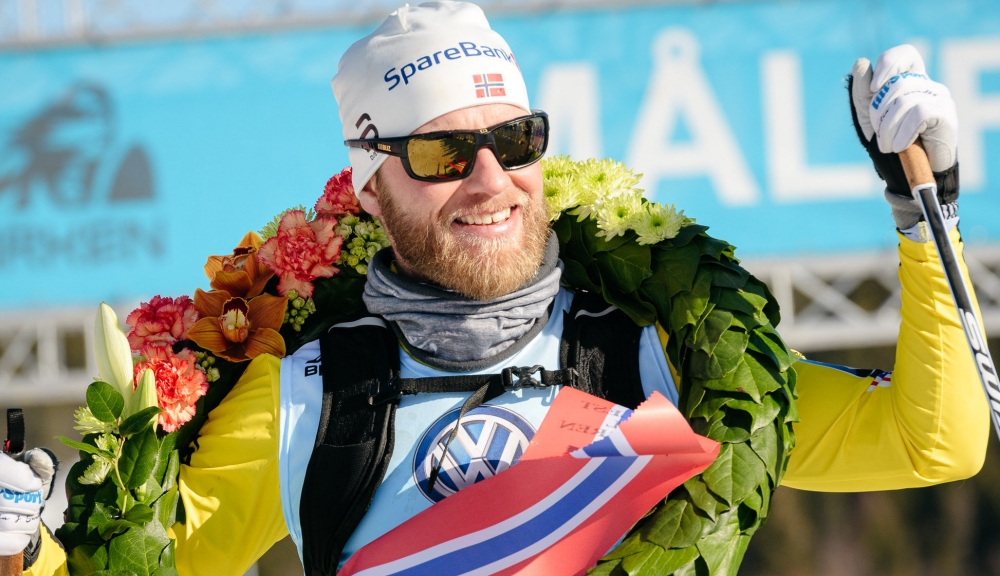
    Norway’s Martin Johnsrud Sundby after winning the Norwegian 54 k classic Birkebeinerrennet, part of the Ski Classics series, on Saturday in Lillehammer, Norway. (Photo: Ski Classics)

    54 k Birkebeinerrennet (Rena to Lillehammer, Norway): Part of the Ski Classics series

    [UPDATED] Not even a snowmobile clipping him and sending him tumbling 20 k before the finish could keep Norway’s Martin Johnsrud Sundby from winning the Birkebeinerrennet on Saturday in Norway. Representing Team United Bakeries, Sundby set a high pace from the start and broke the group down to three by 9 k, with Petter Eliassen of Team LeasePlan and Simen Østensen of Team BN Bank sticking with him until about 30 k in the 54 k marathon.

    With about 20 k to go, Sundby collided with a Ski Classics TV production crew snowmobile while trying to double pole in the snowmobile’s tracks. He was OK and went on to win by 48 seconds over Eliassen in second, and smiled about the incident after the finish.

    “It came in with tremendous speed and mowed me down,” Sundby told NRK, according to a loose translation.

    Ski Classics CEO David Nilsson told NRK he didn’t know exactly how that happened and emphasized that it was unacceptable.

    “We always put safety first, but it is a difficult balancing act with the snowmobile at high speed to get TV pictures,” he said, according to a loose translation. “The skiers often ski in the [snowmobile] track and here it happened and somehow the driver missed it.”

    While Sundby pulled out the win in 2:20:53.5 hours, Eliassen took second and Østensen followed another 3.5 seconds later for third place.

    In the women’s race, Poland’s Justyna Kowalczyk (Team Santander) pulled out a 4 minute and 15 second win over Sweden’s Britta Johansson Norgren (Lager 157 Ski Team). Japan’s Masako Ishida (Team United Bakeries) was another 48.6 seconds back in third.

    “I’m really happy to win this race,” Kowalczyk said, according to a Ski Classics press release. “Everything went well and the cheering on the course was amazing. I will do the rest of the races in Visma Ski Classics, but this victory was the most important for me. Of course, I want to win again in Årefjällsloppet like I did last year, but to win here in front of this audience means so much to me.”

    Tord Asle Gjerdalen, who finished fourth in the men’s race, and Johansson Norgren continue to lead the overall Ski Classics standings with three races to go. The next stop is the Årefjällsloppet in Sweden on March 25.

    “It was a great race and we kept a high tempo up all the way,” Sundby said, according to the press release. “I was able to use uphills for my advantage and get a gap. I had good skis, the conditions were perfect, and to win here was one of my goals for the season. I have the Norwegian Championships in two weeks, and I haven’t counted out the option of going to Finland for the Visma Ski Classics finale.”

    Results

  • Saturday Rundown: Falun & Duszniki-Zdrój (Updated x2)

    Saturday Rundown: Falun & Duszniki-Zdrój (Updated x2)

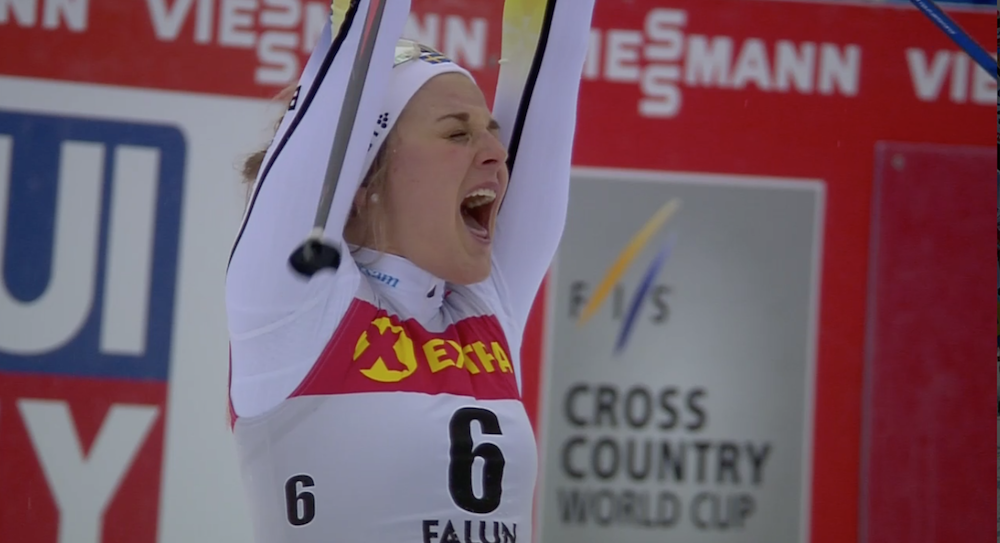
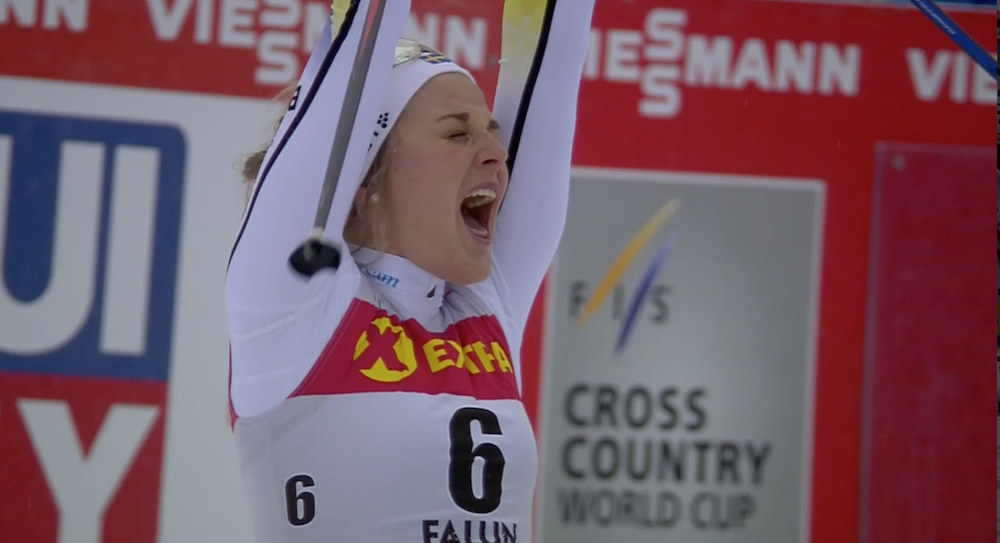
    Sweden's Stina Nilsson celebrates her second-straight World Cup sprint victory on Saturday after winning the 1.4 k freestyle sprint at home in Falun, Sweden.
    Sweden’s Stina Nilsson celebrates her second-straight World Cup sprint victory on Saturday after winning the 1.4 k freestyle sprint at home in Falun, Sweden.

    FIS Cross-Country World Cup (Falun, Sweden): Men’s & women’s freestyle sprints

    Women’s report | Men’s report

    [UPDATED] Kikkan Randall reached the final for the first time since March 2015 on Saturday in the women’s 1.4-kilometer freestyle sprint at the World Cup in Falun, Sweden. The American qualified 26th and went on to advance in second out of her quarterfinal and semifinal to reach the six-woman final, where she ended up fifth.

    Sweden’s Stina Nilsson won the final by one-hundredth of a second over Norway’s Maiken Caspersen Falla, finishing in 3:00.24 minutes. Nilsson had started the day by qualifying in sixth, 2.52 seconds behind Norway’s Marit Bjørgen, who won the qualifier in 3:00.64. This is Nilsson’s second-straight World Cup sprint win after skipping the freestyle sprint in Toblach, Italy, following the Tour de Ski.

    While Bjørgen went on to win her quarterfinal, she finished fifth in her semifinal to end up ninth on the day.

    Norway had two on the women’s podium with Heidi Weng in third, 1.88 seconds behind Nilsson. Finland’s Krista Parmakoski placed fourth (+1.99), and Randall was fifth (+2.56) for her best result in two years (she took last season off to have a baby). Sweden’s Jonna Sundling reached the final as well and finished sixth (+8.02).

    Five U.S. women qualified for the heats, with Jessie Diggins qualifying fifth and ultimately crashing in her semifinal, where she finished fifth. That put her 10th overall on the day. Sophie Caldwell qualified third and finished fourth in her quarterfinal for 16th on the day, Sadie Bjornsen qualified 17th and also finished fourth in her quarterfinal for 19th overall, and Ida Sargent made the top-30 qualifying cutoff in 30th, then placed fifth in her quarterfinal for 25th overall.

    Bjørgen topped the freestyle sprint qualifier on Saturday morning, clocking the fastest time around the 1.4 k course by just 0.08 seconds over Hanna Falk of Sweden. Caldwell qualified third (+1.23), Diggins qualified fifth (+2.39), Bjornsen 17th (+5.04), Randall 26th (+6.64), and Sargent 30th (+8.28). Rosie Brennan (U.S. Ski Team) missed the cut in 37th (+10.90) and Liz Guiney finished 56th (+32.87). The lone Canadian woman racing on Saturday, Cendrine Browne placed 46th (+14.02).

    In the men’s 1.4 k freestyle sprint final, Italy’s Federico Pellegrino held off three Norwegians and two Swedes to win in 2:45.77. The defending Sprint World Cup champion qualified second and went on to win his quarterfinal and semifinal before taking the final by six-hundredths of a second.

    Norway took the remaining spots on the podium with Emil Iversen in second (+0.06) and Sindre Bjørnestad Skar in third (+0.47). Sweden’s Oskar Svensson was three-hundredths of a second off the podium in fourth (+0.50). The fastest qualifier in 2:34.49, Norway’s Johannes Høsflot Klæbo reached the final and ultimately took fifth (+1.32), and Sweden’s Teodor Peterson placed sixth (+2.08).

    Canada’s Len Valjas was the top North American in 10th. He qualified 20th, advanced in second from his quarterfinal and finished fifth in his semifinal.

    American Andy Newell was 16th after qualifying in 25th and finishing third in his quarterfinal. U.S. teammate Simi Hamilton followed in 18th, after qualifying 13th and finishing fourth in his quarterfinal.

    In the men’s qualifier, Klæbo was 1.05 seconds faster than Pellegrino and another 0.02 seconds faster than Russia’s Sergey Ustiugov in third.

    For the U.S., Hamilton qualified 13th (+4.52) and Newell qualified 25th (+6.74). Erik Bjornsen placed 43rd (+9.30) and Matt Gelso 59th (+13.12).

    Valjas was the lone Canadian man to make the heats, qualifying 20th (+6.22). The only other starter, Alex Harvey, placed 46th (+9.71).

    Results: Women | Men

    Qualifier results: Women | Men

    ***

    IBU Open European Championships (Duszniki-Zdrój, Poland): Men’s & women’s pursuits

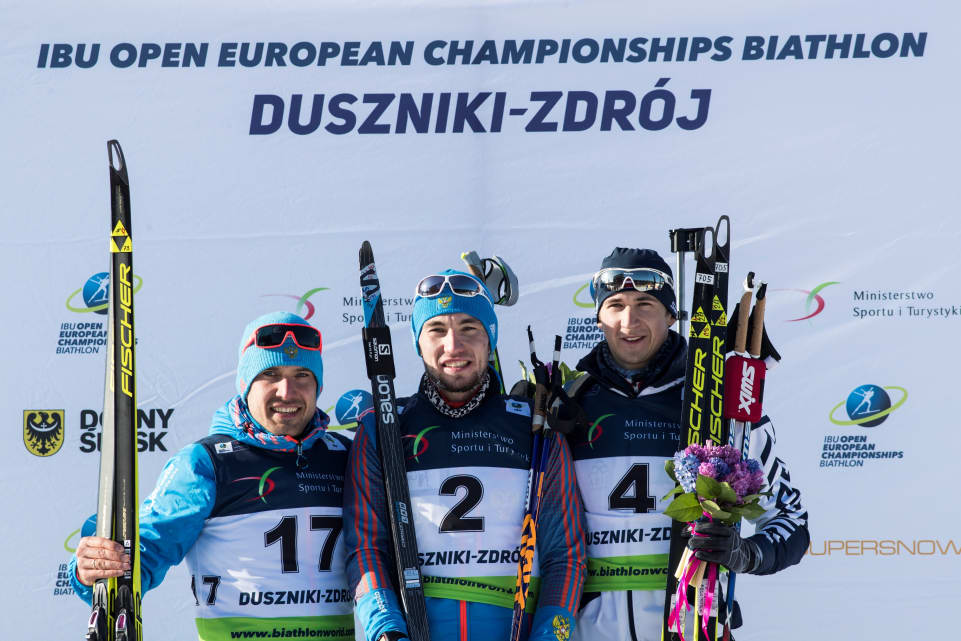
    The men's pursuit podium at 2017 IBU Open European Championships on Saturday in Duszniki-Zdrój, Poland, with Russia's Alexander Loginov (c) in first, Evgeniy Garanichev (l) in second, and Latvia’s Andrejs Rastorgujevs (r) in third. (Photo: IBU)
    The men’s pursuit podium at 2017 IBU Open European Championships on Saturday in Duszniki-Zdrój, Poland, with Russia’s Alexander Loginov (c) in first, Evgeniy Garanichev (l) in second, and Latvia’s Andrejs Rastorgujevs (r) in third. (Photo: IBU)

    Russia’s Alexander Loginov racked up his second win of the 2017 International Biathlon Union (IBU) Open European Championships on Saturday in the mens’ 12.5-kilometer pursuit in Duszniki-Zdrój, Poland.

    After starting second, 5 seconds behind Bulgaria’s Vladimir Iliev, who won Friday’s sprint, Loginov proceeded to clean three straight stages before missing one on his final standing to cross the line first in 31:46.2 minutes.

    “It was not as easy as it seemed, because from the first loop Vladimir set a really good speed,” Loginov said, according to an IBU press release. “Today we had great sunny and windless weather again, so I managed to shoot well. Probably that is why it [looked] so easy.”

    Russia took first and second place with Evgeniy Garanichev following 27.8 seconds later, after starting 17th (56 seconds out of first) and shooting 19-for-20 (0+0+1+0).

    “After yesterday’s sprint, I managed to work well and to show good result in pursuit, so I’m sure glad to win the silver medal,” Garanichev said, according to the IBU.

    Latvia’s Andrejs Rastorgujevs improved on his fourth place in the sprint to reach the pursuit podium in third (+59.5) despite four penalties (0+1+1+2).

    “On the last loop I had the information about the guys who were behind me and in front of me,” Rastorgujevs said, according to the IBU. “I was just fighting and did all I could do to get to the podium.”

    Bulgaria’s Krasimir Anev, who started third, slipped to fifth (+1:28.6) with two penalties (0+1+1+0), behind Russia’s third man in the top four, Alexey Volkov in fourth (+1:01.6). Iliev as the first starter ended up 11th (+1:41.7) with six penalties (2+2+0+2).

    The two Americans who had qualified for the pursuit by placing in the top 60 of Friday’s sprint, Paul Schommer and Alex Howe improved to 48th (+5:07.1) and 51st (+5:42.3), respectively.

    Schommer started 58th, just ahead of Howe in 59th, and missed five targets, all in his first two prone stages (3+2+0+0). Howe accumulated four penalties (1+2+1+0).

    No Canadians qualified for the pursuit.

    [UPDATED] In the women’s 10 k pursuit that followed, Russia’s Irina Starykh picked up her second win and third consecutive podium of the championships, with clean shooting en route to a 19.8-second victory in 30:04.4.

    Starykh started third, 38 seconds behind Ukraine’s Juliya Dzhyma and 11 seconds after her Russian teammate Svetlana Sleptsova, respectively. Dzhima missed two on her last two standing stages (0+0+1+1) to slip to second, and Sleptsova dropped one place to third (+32.1) with one prone penalty (0+1+0+0).

    Veronika Vítková of the Czech Republic improved from seventh to fourth (+47.8) with two penalties (0+1+1+0), and Russia’s Svetlana Mironova moved all the way up from 13th to fifth (+1:29.6) with three misses (0+1+1+1). Just 0.2 seconds behind her, Poland’s Monika Hojnisz improved from 16th at the start to sixth (+1:29.6) with one penalty (0+0+0+1).

    No North Americans qualified for the pursuit.

    Open European Championships conclude Sunday with the single mixed and mixed relay.

    Results: Men | Women

  • Third-Straight Top 15 for Bailey After Shot at 4th in Östersund

    Third-Straight Top 15 for Bailey After Shot at 4th in Östersund

    Lowell Bailey (US Biathlon) racing in the men's 12.5 k pursuit on Sunday at the IBU World Cup in Östersund, Sweden. He placed 15th after starting 13th, but skied in fourth for much of the race. (Photo: USBA/NordicFocus)
    Lowell Bailey (US Biathlon) racing in the men’s 12.5 k pursuit on Sunday at the IBU World Cup in Östersund, Sweden. He placed 15th after starting 13th, but skied in fourth for much of the race. (Photo: USBA/NordicFocus)

    Starting with just under a minute separating him from first place, Lowell Bailey made sure he didn’t get too caught up on what could be.

    A veteran member of US Biathlon’s national team, Bailey started the men’s 12.5-kilometer pursuit on Sunday in 13th, exactly 59 seconds behind the first man out of the gate, Martin Fourcade of France.

    Fourcade had won the sprint the day before (and every race so far this season) and started 42 seconds ahead anyone else in the pursuit in Östersund, Sweden, with sprint runner-up Fredrik Lindström of Sweden chasing in second.

    Could anyone catch Fourcade? Maybe — but it was going to take some shakeups with Fourcade making errors and others shooting perfectly under pressure.

    Bailey was among those given the opportunity to move up significantly in the field. He tried not to overthink it, nor the fact that has led the U.S. in every International Biathlon Union (IBU) World Cup race so far this season.

    “I’m trying to approach every race as an isolated event this year; trying to focus on what I can control that day,” Bailey explained in an email on Sunday.

    So far this season, he’s finished 13th in the 10 k sprint and 15th in the 20 k individual races held in Östersund, the first World Cup stop on the circuit. Sunday marked the final day of a weeklong race series.

    “I just went into today with the goal of executing all of the things I had worked on throughout the training year,” Bailey continued.

    On the first of five 2.5 k loops, Bailey found himself fighting for second.

    “The first loop was an incredibly fast pace,” he recalled. “The group I was in ended up catching 2nd place, so by the time we hit the range, there was a group of fifteen or so guys from 2nd to 17th. It made for an exciting start to the race.”

    Once on the range, Bailey cleaned the first prone stage and left the range in seventh. He moved into fourth with another clean prone, followed by a flawless standing — his third-straight stage without a miss. With two loops to go and one more shooting, Bailey remained in fourth, about 39 seconds behind the leader and five seconds behind third place.

    The wind was blowing throughout the race, even gusting at times, but it was “manageable,” according to Bailey.

    “I didn’t really think about the fourth place,” he said of his mindset during the race. “I just wanted to execute a quality shooting bout.”

    On that standing stage, which he entered in fourth place, Bailey missed his first two shots. He cleaned the remaining three, but had to ski two costly penalty laps.

    “There was definitely some wind, but I can’t blame those two misses on wind,” he wrote. “I lost my focus for those two shots and sent them outside the targets.”

    Without much left in the tank for the final 2.5 k, Bailey, who left the range in ninth, slipped to 15th at the finish, 1:21.8 seconds behind the winner.

    Russia went 1-2 in the men's 15 k pursuit on Sunday at the IBU World Cup in Ostersund, Sweden, with Anton Babikov (l) winning his first World Cup and Maxim Tsvetkov (r) placing second. (Photo: IBU)
    Russia went 1-2 in the men’s 15 k pursuit on Sunday at the IBU World Cup in Ostersund, Sweden, with Anton Babikov (l) winning his first World Cup and Maxim Tsvetkov (r) placing second. (Photo: IBU)

    A 25-year-old Russian who spent most of last season on the IBU Cup, Anton Babikov won the pursuit with near-perfect shooting (0+0+1+0) for his first World Cup podium. He finished in 31:22.3, and his 24-year-old teammate Maxim Tsvetkov followed 10.5 seconds later in second, thanks to clean shooting, to tie his career best.

    (Babikov started seventh and skied the fourth-fastest overall course time, and Tsvetkov started 11th and was one of just two men to clean all four stages. Michal Krcmar of the Czech Republic was the other. He rocketed from 38th at the start to seventh at the finish.)

    Fourcade, the first starter, ended up third (+15.2) with an uncharacteristic four misses (2+0+0+2).

    “From the very beginning, I knew that everything could be possible,” Babikov told the IBU, according to a press release. “We were going very close. Before going to Östersund, I was a little worried, it’s always curious to see how well you are prepared for the season.”

    Tsvetkov skied in third for most of the race, concentrating on his shooting and capitalizing when Fourcade missed two on the final stage. There, Babikov took the lead for the first time from Fourcade, now 10 seconds back in third, and Tsvetkov left the range four seconds behind in second.

    “This is my first medal in pursuit,” Tsvetkov told the IBU. “It was very tough for me, I knew that Martin was very close, I knew that I have to work hard ’til the end.”

    “I had my chance today, and I didn’t take it,” said Fourcade, who had entertained the possibility of winning three individual races in a row. “At my last shoot I was a bit nervous, there was also some wind. My skis were also not perfect at the end of race.”

    While Bailey felt like he was missing some snap, especially on the last loop (which he attributed to a hard first loop), he was pleased with his start to the season and is ranked ninth overall on the World Cup.

    “I have been ranked this high in the past coming out of Ostersund, but I am definitely happy with the solid start to the season,” he told US Biathlon, according to a press release. “You train all season in a bit of a vacuum — just you and your teammates — and there is very little for you compare yourself to. Because of this, the start of the season can be a bit of an unknown. I’m happy to see that my ski times are competitive and that I’m able to reach the podium on a great day.”
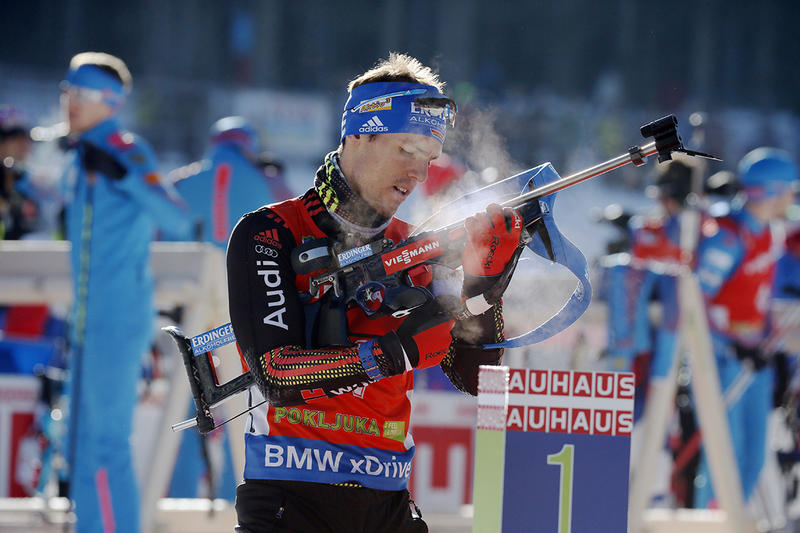
    Of 59 finishers on Sunday, Bailey’s course time ranked 36th.

    “I hoped to have competitive ski speed and accurate, fast shooting,” he wrote to FasterSkier. “Mostly, I’m satisfied with my performances so far. As always, there’s plenty of things I need to improve, but I’m happy with this a solid start to the season.”

    Tim Burke (US Biathlon) racing to 35th in the men's 12.5 k pursuit on Sunday at the IBU World Cup in Östersund, Sweden. (Photo: USBA/NordicFocus)
    Tim Burke (US Biathlon) racing to 35th in the men’s 12.5 k pursuit on Sunday at the IBU World Cup in Östersund, Sweden. (Photo: USBA/NordicFocus)

    Two American men started the pursuit, with Bailey finishing 15th and Tim Burke placing 35th (+2:39.2). Despite a clean first prone, Burke, who started 29th, tallied four penalties (0+1+2+1), yet still finished in the top 40 required for points. His course time ranked 35th overall.

    Scott Gow was Canada’s top finisher in the pursuit in 47th (+3:34.8) and found himself up in 38th after hitting all 10 targets through the first two stages. He then missed two on the third stage and one more in the final standing (0+0+2+1), costing him time in penalty laps.

    About 11 seconds later, Brendan Green finished 50th (+3:45.5) with five penalties (2+1+0+2). His teammate Macx Davies finished 51st (+3:54.6). After two clean prone stages, Davies had skied in 35th, but two misses on each standing bout (0+0+2+2) brought him outside the top 50.

    Results | World Cup total score (overall standings)

  • Fourcade Matches Poirée’s Record; Burke Climbs to Seventh; Peiffer Suffers Concussion

    Fourcade Matches Poirée’s Record; Burke Climbs to Seventh; Peiffer Suffers Concussion

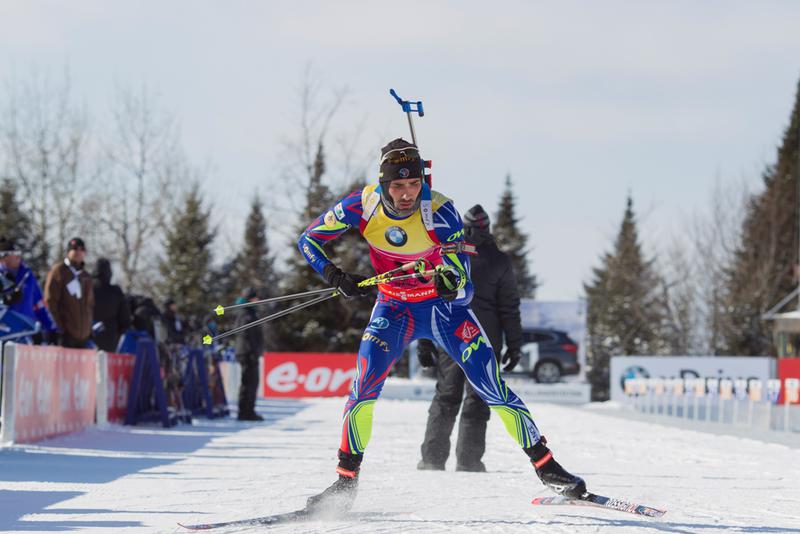
    France's Martin Fourcade leaving the range during one of four shooting stages in the pursuit on Friday at the IBU World Cup in Presque Isle, Maine. He went on to win by 24.8 seconds over Johannes Thingnes Bø of Norway. (Photo: IBU/NordicFocus)
    France’s Martin Fourcade leaving the range during one of four shooting stages in the pursuit on Friday at the IBU World Cup in Presque Isle, Maine. He went on to win by 24.8 seconds over Johannes Thingnes Bø of Norway. (Photo: IBU/NordicFocus)

    The same three athletes who stood on the podium after the International Biathlon Union (IBUo) World Cup sprint on Thursday in Presque Isle, Maine, did so again after the men’s 12.5-kilometer pursuit on Friday, only their order had changed.

    In cold and windy conditions, France’s Martin Fourcade took the victory in 31:04.4, with two penalties in the four shooting stages. The third starter, Fourcade finished 24.8 seconds ahead of Norway’s Johannes Thingnes Bø, who had won the sprint and thus started the pursuit first with a 28-second head start. Russia’s Anton Shipulin started second and ended up third (+1:11.5) with two penalties.

    American Tim Burke moved into fourth place on the penultimate loop, but two misses in the final standing shooting set him back to seventh, and he kept that position to the finish, placing seventh and 2:04.9 behind Fourcade with three total penalties.

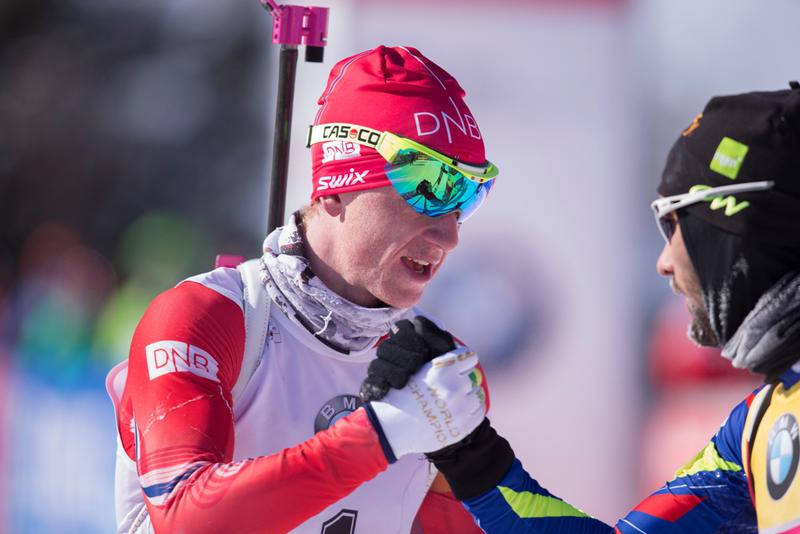
    Norway's Johannes Thingnes Bø (l) congratulates France's Martin Fourcade after placing second to Fourcade in the IBU World Cup men's pursuit in Presque Isle, Maine. (Photo: USBA/NordicFocus)
    Norway’s Johannes Thingnes Bø (l) congratulates France’s Martin Fourcade after placing second to Fourcade in the IBU World Cup men’s pursuit in Presque Isle, Maine. (Photo: IBU/NordicFocus)

    “Today I joined Raphaël Poirée with the number of World Cup wins,” Fourcade said of his 44th victory in a post-race interview with the IBU. “That means a lot for me. I grew up watching Raphaël on TV. To join legends you need to [be] inspired, and I know how much he inspired me.”

    Asked if he feels like a legend himself now, Fourcade laughed: “No, I will never do. I just try to do my best.”

    Poirée represented France on the World Cup from 1995 to 2007. He earned both silver and bronze at the 2002 Olympics in Salt Lake City, Utah, and another bronze in the relay at the 2006 Olympics in Turin, Italy, as well as 20 medals at World Championships, seven of which were gold.

    Unfortunately the end of the pursuit was overshadowed by a severe crash from Germany’s Arnd Peiffer, who had left the shooting range in 11th position, then fell on a downhill section on the final loop. At high speed, Peiffer came off the right side of the course without another athlete nearby, ripped through a safety net, and crashed head and shoulder first against a thinly padded group of trees. He later could be seen on the TV broadcast sitting upright leaning against the trees, with his skis and rifle removed by coaches and course staff. He was then strapped to a stretcher and put in a neck brace as a precaution, and taken to a nearby hospital.

    “I saw the immediate aftermath of the crash,” American Lowell Bailey, who had left the range shortly after Peiffer in 15th, wrote in an email. “Arnd was off the side of the trail, just following a severe 180-degree turn. The turn is tight and there is little room for error. The outside of the turn was lined with mesh snow fence and all I could see were his feet sticking up onto the trail.”

    “There was a lot of blood in the snow,” Germany’s assistant coach Andreas Stitzl, who was one of the first responders sprinting to the accident site, later told German TV broadcaster ARD. Stitzl suspected that Peiffer had, at a minimum, sustained a concussion and lacerations on his mouth and forehead. “I was completely shocked how he was lying there. The most important thing was that we first stabilized his head,” Stitzl said.

    ARD later posted an interview with German team doctor Klaus-Jürgen Marquardt, who confirmed that Peiffer had suffered a severe concussion, but remained conscious and could remember the crash despite some loss of short-term memory about the morning of the race. Further evaluations still had to determine other injuries, but Peiffer reportedly was able to call his family at home.

    No Athlete Unscathed in Four Stages

    Wind conditions gave the entire 60-man field problems during the pursuit, with stronger gusts than they had experienced during the “zeroing” target practice immediately before the race. As a result, competitors either had to adjust their sights or wait for a calmer moment.

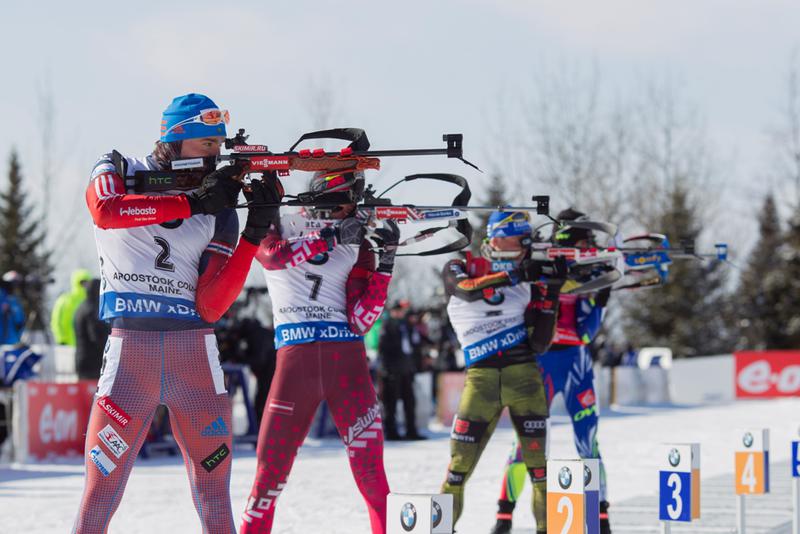
    From left to right: Russia's Anton Shipulin, Latvia's Andrejs Rastorgujevs, Germany's Eric Lesser, and France's Martin Fourcade during one of two standing stages in the men's pursuit at the IBU World Cup in Presque Isle, Maine. Fourcade went on to win and Shipulin placed third. (Photo: IBU/NordicFocus)
    From left to right: Russia’s Anton Shipulin, Latvia’s Andrejs Rastorgujevs, Germany’s Eric Lesser, and France’s Martin Fourcade during one of two standing stages in the men’s pursuit at the IBU World Cup in Presque Isle, Maine. Fourcade went on to win and Shipulin placed third. (Photo: IBU/NordicFocus)

    Penalties quickly started to pile up and separated the field. Bø, Shipulin and Fourcade all missed one in their first prone stage, but kept the positions they had held at the start.

    In the second prone stage, Bø and Shipulin managed to stay clean, while Fourcade had another penalty and for a while, fell back to fifth place behind Germany’s Erik Lesser and Latvia’s Andrejs Rastorgujevs, who hit all 10 of their targets between the two prone stages.

    In the next standing stage, Bø shot fast and clean a second time, despite having to reset his position before the third shot, and headed out on the fourth loop with a 44-seconds lead. Fourcade also cleaned to improve t0 second place again entering the loop, with Shipulin also staying clean and leaving the range in third.

    In this stage, Lesser missed two and Rastorgujevs missed three to fall out of contention. They went on to place 13th (+2:42.8) and 21st (+3:21.7), respectively. Switzerland’s Serafin Wiestner, who had finished a career-best fifth in the sprint the day before, even “dirtied” his standing targets, incurring the full five penalties, and went on to finish 27th.

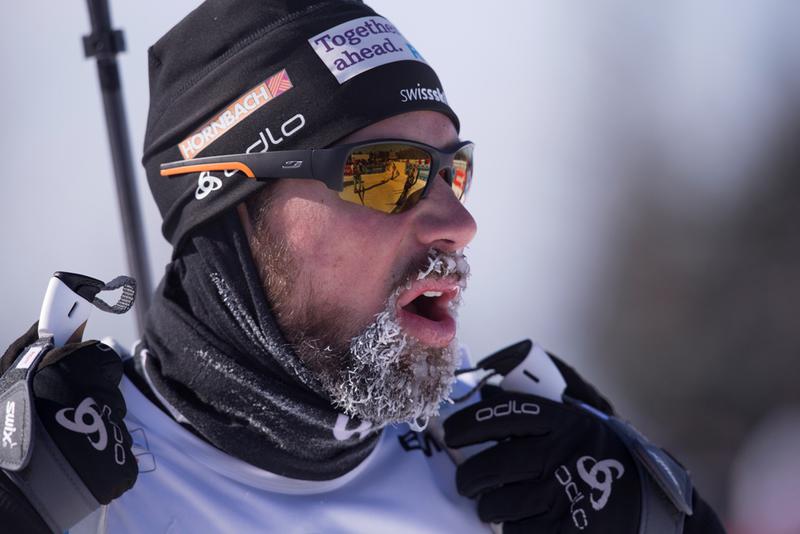
    Switzerland's Benjamin Weger at the IBU World Cup men's pursuit in Presque Isle, Maine. Weger finished 17th with seven penalties. (Photo: IBU/NordicFocus)
    Switzerland’s Benjamin Weger at the IBU World Cup men’s pursuit in Presque Isle, Maine. Weger finished 17th with seven penalties. (Photo: IBU/NordicFocus)

    In the last standing stage, Bø entered the range still in first, but this time, he missed two while Fourcade as the closest pursuer was able to clean his targets.

    “When I came to the last shoot, I though ‘OK, don’t look at Johannes’ targets’,” Fourcade told the IBU. “At the last moment, my eyes decided to look at it. My body and brain didn’t want to, but my eyes just looked at the targets. And I saw that he had two mistakes. So I thought ‘OK, you can do it.’ ”

    Fourcade left the range 7.9 seconds ahead of Bø in second, and Shipulin moved into third (+47.3) after also missing one — his second penalty of the day.

    On the last loop, Fourcade increased his lead over Bø to more than 20 seconds with 1 k remaining. He went on to finish 24.8 seconds ahead of the Norwegian, and Shipulin secured third place (+1:11.5).

    “It was a day of statistics,” Fourcade said at the press conference when told it was his 100th day holding the yellow bib of the World Cup leader, and matched the number of victories of his countryman Poirée. “I love statistics, even if I’m not fighting for records. And this means a lot to me.”

    “Second position is nice, but I always want to win,” Bø said at the press conference. “I was in the lead all the way until the fourth shooting. I felt the wind came strong and my legs were a little bit tired, then I missed two.”

    “When I was racing in the penalty loop I watched Martin hit all the targets. That was really boring,” he added with a laugh.

    “I would say my success was about average,” Shipulin said of his overseas trip to North America, through a translator. “I had three podiums here. I can’t say I am in my perfect form yet. Actually it was more of a training World Cup period than a competitive one, so I am satisfied… I now plan to train hard and compete as best I can at World Championships.”

    Fourth place went to Austria’s Simon Eder (+1:39.7), with three penalties, who improved from 11th after the sprint, but potentially missed a chance to move onto the podium with a miss in his last standing. He left the range for the last time 45 seconds behind to Shipulin and ended up 28.2 seconds  off the podium.

    “The wind situation was extremely difficult,” Eder said in an Austrian Skiing Federation press release. “In the first standing shooting I waited forever until the wind calmed down. Then I quickly shot right through it. For the last standing position it just would not calm down. Then I tried to hit shot by shot. For the last one it did not work out anymore…. Of course I am very happy about the fourth place.”

    Burke, 7th, Leads Three Americans in Top 20

    Tim Burke racing to seventh in the men's pursuit at the IBU World Cup in Presque Isle, Maine. (Photo: USBA/NordicFocus)
    Tim Burke racing to seventh in the men’s pursuit at the IBU World Cup in Presque Isle, Maine. (Photo: USBA/NordicFocus)

    Just as it had done in the sprint, U.S. Biathlon ended up with three men in the top 20 in the pursuit. Similar to the men on the podium, the three Americans finished in a different order than on Friday.

    The latest starter of the three in 20th, 1:33 minutes back based on his sprint finish, Burke raced into contention in the pursuit — putting himself in fourth with a chance at the podium. He incurred more penalties in the final shooting than those ahead of him, but still finished seventh (+2:04.9) with three penalties (1+0+0+2). Last week in Canmore, Burke also placed seventh for a season best in the mass start.

    “I’m really happy with the race,” Burke told FasterSkier on the phone on Friday. “That was a great, great performance for me. That was really really tricky shooting conditions again on the range. I felt like I handled it pretty well, so I am really pleased with the result.”

    “The real key to my race today was that clean first standing stage,” Burke recalled. “There I moved from 11th and I went out basically was 4th place after that. Definitely a tricky stage, it was really windy, but I just took my time. I refused to just give away a shot. I really fought for every shot there.”

    On the penultimate loop, he moved up to fourth place after initially leaving the range in seventh:

    “So our next loop there, I went out just behind Erik Lesser and Simon Eder,” Burke said. “I’m pretty sure there were a couple guys right behind me, I don’t know who they were. A little ways in to that loop those guys both pulled over and did not want to lead. So I ended up pulling for the rest of that loop and I felt really good.”

    Burke came into the last stage still leading that pack in fourth place, but shot two misses pushed him back to seventh as he left the penalty lap again.

    “I was excited for that last standing,” Burke said. “That was a really tough one. It was so windy as we were setting up. I just tried to be really patient, but I just ended up just having to go for it after awhile because I didn’t want to wait for too long.”

    On the final loop, he was unable to catch those ahead of him who had passed him with just one penalty in the final stage, but Burke also didn’t lose another position, defending a narrow lead over Bulgaria’s Vladimir Iliev and Ukraine’s Artem Pryma.

    “Overall I am really satisfied,” Burke concluded. “Of course I definitely wanted that sixth place to get into the [flower ceremony] awards there at the end. Going out onto the last loop I was just couple seconds behind [Czech Republic’s Michal] Slesinger. I know he’s really tough on the last loop too. We just kind of yo-yoed the whole loop: I’d make up a few seconds then lose a few seconds. Then, in the end I just felt like I was coming back to him pretty good in the last k. But I just ran out of room.”

    Lowell Bailey (US Biathlon) racing to 14th in the IBU World Cup men's pursuit on Friday in Presque Isle, Maine. (Photo: USBA/NordicFocus)
    Lowell Bailey (US Biathlon) racing to 14th in the IBU World Cup men’s pursuit on Friday in Presque Isle, Maine. (Photo: USBA/NordicFocus)

    About 40 seconds behind Burke, teammate Bailey finished the pursuit in 14th (+2:43.2) with five penalties (1+0+3+1). He had started the race in 15th, 1:22 behind Bø.

    “There was a lot of wind in the shooting range today,” Bailey wrote in an email. “The venue is situated on top of a plateau and the prevailing winds come ripping across the range. Usually, the wind is from left to right, but today it was fickle, and changed dramatically from one stage to the next.”

    Sean Doherty started the pursuit in 13th, 1:16 behind, and with six misses (2+2+1+1), he lost a few positions to finish 20th (+3:05.3). Despite struggling with the changing wind conditions, he was satisfied with his race.

    “Although it was not my best shooting, today’s result was in no way bad,” Doherty, 20, wrote in an email. “It is still my third best world cup result and I am happy with it.”

    Coming off a career-best 13th in the sprint, Sean Doherty (US Biathlon) placed 20th in the men's pursuit at the IBU World Cup in Presque Isle, Maine. (Photo: USBA/NordicFocus)
    Coming off a career-best 13th in the sprint, Sean Doherty (US Biathlon) finished 20th in the men’s pursuit at the IBU World Cup in Presque Isle, Maine. (Photo: USBA/NordicFocus)

    “Today for our race the wind picked up,” he explained of the shooting conditions. “It was much stronger than in zero by the time the race started. Overall it was challenging conditions on the range, but the tracks were in great shape.”

    Without Biathlon Canada’s A-team at the races in Presque Isle, Scott Perras was the only Canadian who had qualified for the men’s pursuit, starting in 48th place. After a clean first shooting, he fell back in the subsequent stages, and ultimately finished 47th (+6:17.4) with seven penalties (0+2+3+2).

    “The shooting conditions were pretty tough today,” Perras wrote in an email. “In zero, the wind flags would show very little wind close to the shooting mat, the flags closer to the targets were showing the truer shooting conditions. It was manageable at times but no one was given a free hit out there today, you had to work for them.

    “The skiing felt ok, my legs should feel better but it takes a while to get used to the speed of the World Cup and it doesn’t happen over a weekend,” the 32-year-old Sochi Olympian added. “I was much happier with my skis today, and everything seemed a little better than in the sprint.”

    Baby It’s Cold Outside

    The night before the pursuit, temperatures in Presque Isle dipped to minus 21 degrees Celsius (-6 Fahrenheit). By the start of the race at 11:30 a.m. local time, the rising sun had warmed the temperature in the Nordic Heritage Center arena to a more manageable minus 16 Celsius (3 Fahreheit), according to the IBU race report.

    On Thursday, an already-cold J.T. Bø told NRK about losing feeling in his fingers during the sprint.

    During the pursuit, he appeared to be wearing the same gloves again, and swirled his arm several times before the shooting stages in an effort to increase blood flow in his shooting hand.

    “Actually I think it’s a little colder than in Norway today,” his teammate Erlend Bjøntegaard, who skied to fifth place (+1:57.6) told the IBU. “I was just ready to attack today, and that’s what I did.”

    He suspected his fifth-place result would help him to secure a spot on the Norwegian team for the upcoming World Championships in Oslo.

    Coming off a career-best 13th in the sprint, Sean Doherty (US Biathlon) placed 20th in the men's pursuit at the IBU World Cup in Presque Isle, Maine. (Photo: USBA/NordicFocus)
    Sean Doherty (US Biathlon) placed 20th in the men’s pursuit at the IBU World Cup in Presque Isle, Maine. (Photo: USBA/NordicFocus)

    The winner, Fourcade could be seen wearing a breathing mask before the race to warm up the cold air.

    “It was really not easy because it’s a long time since we have raced in this kind of conditions,” Fourcade commented on the race condition during the press conference. “For me it was really difficult. My left hand froze during the competition; luckily I shoot with the right hand. I think this was the limit with the wind where the body can react well to the cold.”

    After the race, he decided to skip the relay and expected colder temperatures on Saturday, and flew home to France on Friday.

    According to some athletes, the temperatures — the coldest they had raced in this season — weren’t a problem.

    “We are from Russia so this is quite normal and comfortable for us,” Shipulin said with a smile in the press conference, through a translator. “We were training before this in Yakutia [a region in the far east of Russia], where minus 17 Celsius [1.4 Fahrenheit] is considered warm temperature. … I rather had too [many] clothes on me today.”
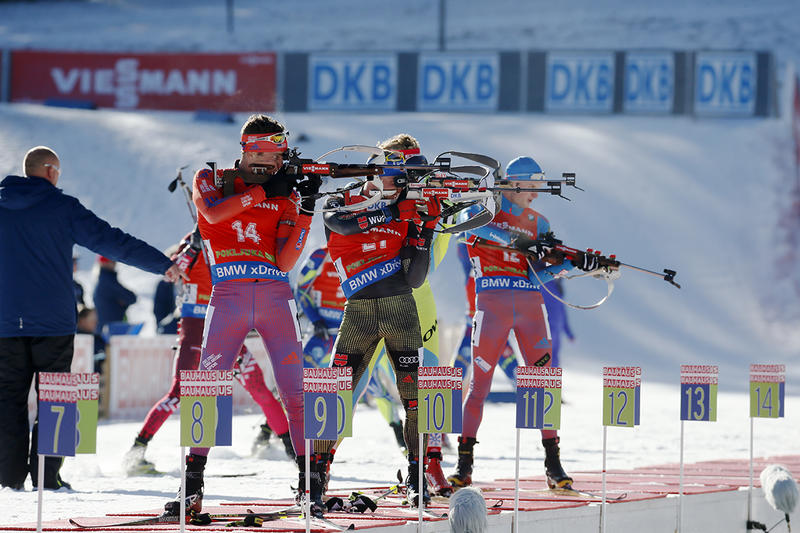
    Leif Nordgren (US Biathlon)  during in the IBU World Cup men's sprint in Presque Isle, Maine. (Photo: USBA/NordicFocus)
    Leif Nordgren (US Biathlon) during in the IBU World Cup men’s sprint in Presque Isle, Maine. (Photo: USBA/NordicFocus)

    “Many Europeans [are] using breathing masks to warm up or train in temperatures many North Americans would consider mild,” Perras wrote. “Today was definitely warm enough that you weren’t going to hurt your lungs, but it was important to keep skin from being too exposed. I wore slightly thicker gloves in the race but decided to remove my right glove for the final standing shooting, I wanted a better feeling on the trigger. I knew that my hand would stay plenty warm for the last lap of the race even without my glove.”

    “I was prepared for it,” Burke said of the frigid temperatures. “I knew there would be a good chance it would be really cold up here, so I packed all my best warm weather racing gear. I felt fine in the cold. The only part I struggled with was my hands, especially on the first loop. That first prone, I let that shot [that I missed] go without even knowing it. I just quickly pulled the trigger. After that, my hands warmed up and they were fine for the rest of the race.”

    “Racing in the cold like this adds an extra bit of challenge,” Doherty explained. “It is tough on the hands, to keep them warm enough, and it adds a bit of extra stress and demand on the system. But luckily the weather is the same for everyone and you just have to work with it.”

    “After growing up in the Northeast as a ski racer, I think you just learn to accept the discomfort that arises on a day like today,” wrote Bailey, of Lake Placid, N.Y. “I warmed up with a lot of extra layers so that I was as warm as possible before stripping down for the race. During the race, I lost feeling in all of my fingers except my trigger finger… It sounds odd, but for some reason, my index fingers seem to stay frost free, while I typically lose all feeling in the rest of my fingers on a day like today. But, it’s the same conditions for everyone … You just have to go out and make things work.”

    Relays on Saturday

    Later on Friday, organizers announced that the women’s relay would be moved from Sunday morning to Saturday at 4:10 p.m. Eastern time after the men’s relay at 2:20 pm, fearing even colder temperatures on Sunday could otherwise lead to a cancellation.

    “All of us are very excited about the relay,” Burke said of his 4 x 7.5 k relay team, with Bailey, Leif Nordgren, him, and Doherty racing in that order. “I mean, two races in a row here with three guys in the top-twenty, I think [that] shows the kind of depth our team has. Coming off of two solid results, we are looking forward to this one.”

    Note: In the women’s 10 k pursuit, Susan Dunklee started second and finished fifth for her second-straight flower ceremony in Presque Isle, and the U.S. women had three in the top 25 with Clare Egan in 23rd and Hannah Dreissigacker in 24th. Canada’s lone starter in the pursuit, Zina Kocher placed 46th.

    “I think today was one of the women’s team’s best days ever,” Dunklee said. “Having three ladies in the top 25 is huge. It is going to be a fun relay and we have the potential to put together a great performance.”


    Stay tuned for a separate report on the women’s race.

    Watch the men’s and women’s relays live on Eurovision (Friday at 2:20 p.m. and 4:10 p.m. EDT)

    Men’s pursuit results | Relay start list

  • Smith Nabs Season-Best Sixth; Austria’s ‘Lucky Luke’ Eder Wins Ruhpolding Pursuit

    Smith Nabs Season-Best Sixth; Austria’s ‘Lucky Luke’ Eder Wins Ruhpolding Pursuit

    Austrian Simon Eder celebrates his first victory of the season and the third one of his career on Saturday at the IBU World Cup in Ruhpolding, Germany. He won the men's 12.5 k pursuit by 4.2 seconds over Martin Fourcade (not shown). (Photo: IBU/Eberhard Thonfeld)
    Austrian Simon Eder celebrates his first victory of the season and the third one of his career on Saturday at the IBU World Cup in Ruhpolding, Germany. He won the men’s 12.5 k pursuit by 4.2 seconds over Martin Fourcade (not shown). (Photo: IBU/Eberhard Thonfeld)

    On Saturday, the sixth starter and fast-shooter Austrian Simon Eder won the IBU World Cup men’s 12.5-kilometer pursuit in Ruhpolding, Germany. Thanks to his quick-trigger finger and a single miss in the first of four shooting stages, Eder moved up the field and jubilantly crossed the line in 33:19.1 minutes, tilting his head back and raising his arms to the sky.

    A few minutes before, Eder had anxiously looked back repeatedly on the final loop. His lead kept shrinking, but he managed to hold off France’s Martin Fourcade, who had two penalties — one on each of the last two stages — to finish 4.2 seconds back in second, thereby extending his lead in the overall World Cup standings. Third place went to Michael Slesingr of the Czech Republic (+5.1) for his first podium of the season, one of only two men who shot clean.

    The Norwegians, who swept the podium in Friday’s sprint, settled for fourth and fifth place on Saturday, with Tarjei Bø finishing last in the chase group in fourth (8 seconds after Eder) with three penalties, and Emil Hegle Svendsen placing fifth (+26.2) with two penalties.

    Canada’s Smith Achieves Sixth

    Nathan Smith (Biathlon Canada) racing to sixth for a season best on Saturday in the IBU World Cup 12.5 k pursuit in Ruhpolding, Germany. (Photo: Biathlon Canada/NordicFocus)
    Nathan Smith (Biathlon Canada) racing to sixth for a season best on Saturday in the IBU World Cup 12.5 k pursuit in Ruhpolding, Germany. (Photo: Biathlon Canada/NordicFocus)

    In a photo finish for sixth, Canadian Nathan Smith lunged across the line to beat Friday’s sprint winner Johannes Thingnes Bø, who had four penalties and ended up seventh, by 0.1 seconds.

    The 15th starter, Smith rallied to sixth for his best result of the season, finishing 45 seconds behind Eder and 40 seconds off the podium.

    After skiing a quick first loop (the ninth-fastest of the field), Smith had one miss in the first prone stage.

    “It wasn’t the start I was hoping for but I just did my own race and steadily moved back up,” Smith wrote in an email. At the end of the day, his overall course time ranked 13th.

    After his early penalty, he managed to avoid any more, shooting clean throughout the next three stages (1+0+0+0).

    “I am really proud of my final standing. That is exactly what I need to do to get the best result I can,” Smith wrote. “I think [Bø] left a few seconds behind me and caught up by the last climb. Usually I’m pretty strong for the last 200 [meters] so I like my chances in sprint finishes. It doesn’t bother me to be toe to toe in those situations, and is preferable to crushing myself trying to maintain a gap the entire loop.”

    “I’m super happy with it,” he said in a Biathlon Canada press release. “The best part is I shot clean on my last standing. I have had trouble with it a few times this year when I had the opportunity to finish in the top-six.”

    Eder’s Quick-Draw Method 

    Eder, a 32-year-old left-handed shooter widely known among biathlon peers and fans as extremely fast while not always accurate, made use of his big strength on Saturday and posted the fastest overall shooting time of all athletes, twice staying under 20 seconds. He only slightly slowed during the final shooting, taking a few additional seconds to make sure he hit all his targets for the sixth-fastest time.

    “After the first miss I honestly had already given up hope for a podium, but I felt extremely good skiing,” Eder told Austrian TV broadcaster ORF after the race. “When I was able to close the gap to Bø and Svendsen on the third loop, I knew a lot was still possible.”

    The head of Austria’s biathlon association Markus Gandler was impressed by Eder’s strong nerves in the final shooting: “Hats off to Simon that he was so cool and crafty, that was a world-class performance,” Gandler told ORF.

    Several years ago, a couple competitors nicknamed Eder “Lucky Luke,” after a cowboy from a Belgian comic book series, which started in the 1940s and became popular in German-speaking countries. The character is known for being able to “shoot faster than his shadow” and the name stuck as fitting for the Austrian biathlete.

    “I think there are many talents who can shoot fast, but my strength is that I also dare to try it in competitions. I think it’s possible to shoot even faster,” he told ORF.

    With thousands of fans around the course and in the arena cheering him on, including Eder’s father, Alfred, who currently works as a biathlon coach for Belarus, he managed to defend his lead after the final shooting against a chase group of Fourcade, Slezingr and Tarjei Bø.

    “In the last round I went out full throttle and tried to somehow leave Fourcade behind me. To win here in Ruhpolding in front of this audience of course is a dream,” Eder said in an Austrian Skiing Federation press release.

    This was Eder’s third-career individual World Cup win and his best result since a 2014 victory in Oslo, Norway, also in a pursuit. It was also Austria’s first podium of the season.

    “I think there are many talents who can shoot fast, but my strength is that I also dare to try it in competitions.” — Saturday’s pursuit winner Simon Eder, of Austria

    Fourcade told reporters after the sprint that he felt sick the night before, mainly starting because his biggest competitors for the overall World Cup title — Germany’s Simon Schempp and Norway’s Ole Einar Bjørndalen — had skipped this weekend due to illness.

    On Saturday, Fourcade failed to post his usual No. 1 course times, instead recording the ninth-best time overall. A miss in each standing stage cost him a total of two penalty laps, and Fourcade could not quite make up a 16.9-second gap to Eder on the final round, finishing 4.2 seconds back in second.

    “There are two ways you can look at my result today,” Fourcade said at the post-race press conference. “From one side, I am satisfied about being back on the podium and gain points for the [World Cup] Total Score. At the same time, we can also see it as a lost victory. This is biathlon, and I like to play; I think my mistake today was attacking too much.”

    He considered Eder somewhat of a surprise: “I did not expect Simon to win, but when I saw him at the fourth loop, I knew he had a chance as he is a good shooter.”

    The only man in the top 15 to shoot clean, Slesingr was satisfied with third place after a poor start to his season by his standards.

    “My December was pretty bad. I put lots of pressure on myself because of my good results last season,” Slesingr said in the press conference. “This pressure affected my shooting. I had some time to focus on basic shooting skills this season.”

    While the shooting was straightforward enough on a day with almost no wind, the podium finishers all commented on the difficult skiing conditions in mushy snow.

    “Only when I came through the final turn without a crash I knew [Fourcade] could no longer catch up to me,” Eder told German TV broadcaster ARD. “It was really difficult today, very deep tracks on the loop, you really had to pay attention in the downhills because the drain on your strength is high, and then your coordination ability isn’t the best anymore.”

    Johannes Thingnes Bø tries to blow snow out of his rear sight during Saturday's pursuit at the IBU World Cup in Ruhpolding, Germany. The first starter, he placed seventh with four misses. (Photo: IBU/Eberhard Thonfeld)
    Johannes Thingnes Bø tries to blow snow out of his rear sight during Saturday’s pursuit at the IBU World Cup in Ruhpolding, Germany. The first starter, he placed seventh with four misses. (Photo: IBU/Eberhard Thonfeld)

    “The skiing was tough out there,” Smith wrote in his email to FasterSkier. “I was a little tired compared to yesterday and the conditions were the worst I’ve seen this season. I was dealing with snow granules falling into my rear sight at every single trip to the range. I had to blow them out once or twice each time. I kept forgetting to close the cover. The soft snow sprays off skis and up into the air pretty high, apparently.”
    “It’s a good course for me, although I still have more practice to do for skiing in slush,” Smith added. “It’s not a bad thing to have variety in course style from venue to venue. It showcases each athlete’s strengths and weaknesses. We’re racing to see who is the best biathlete. Not the best climber, the fastest on the flats, the downhills, or most efficient shooter.”

    Bailey 22nd, Burke 26th for U.S.

    Lowell Bailey (US Biathlon) led two U.S. men in Saturday's pursuit at the IBU World Cup in Ruhpolding, Germany, finishing 22nd after starting 33rd. (Photo: USBA/NordicFocus)
    Lowell Bailey (US Biathlon) led two U.S. men in Saturday’s pursuit at the IBU World Cup in Ruhpolding, Germany, finishing 22nd after starting 33rd. (Photo: USBA/NordicFocus)

    Skiing through the softening snow about a minute behind Smith and the rest of the race leaders, US Biathlon’s Lowell Bailey had good success on the shooting range on Saturday, incurring only one penalty (0+0+1+0). He improved to 22nd in the pursuit (+1:45.3) after starting 33rd.

    In an email after Friday’s sprint, teammate Tim Burke described his approach to the shooting range in Ruhpolding, coming out of a downhill and flat section with a fairly low heart rate, as trying to “stay aggressive and not give up too much time on the shooting mat.”
    On Saturday, Burke posted the 11th-fastest overall course time, sixth-fastest shooting and 10th-fastest range time, but struggled with his standing-shooting accuracy, losing a few positions during the race after starting in 18th place.

    He finished the day in 26th (+2:10.1) after skiing five penalty loops (1+0+2+2).

    “Today was just one of those biathlon days that is best to forget,” Burke said in a US Biathlon press release. “I felt solid on the ski course and the shooting range, but all of my close shots ended up as penalties. I’m hoping to get a start in the mass start tomorrow and redeem myself.”

    Canadian Macx Davies slightly improved to 50th after starting 55th, incurring four penalties between the first and last stages (2+0+0+2).

    In a photo finish with his brother, Canada’s Christian Gow placed 53rd (+4:54) with two penalties (0+1+1+0). His older brother Scott Gow finished with the same time in 54th, following four misses (2+1+1+0).

    On Friday, 22-year-old Christian achieved a World Cup personal best that allowed him to start the pursuit in 34th position.

    Mass Start on Sunday

    Smith and Bailey are qualified for the men’s 15 k mass start on Sunday (which includes the top 25 skiers in the overall World Cup standings, plus five additional athletes who posted the best results this weekend). Smith ranks 12th and Bailey 24th.

    “I’m happy to have my first top 6 of the season,” Smith wrote. “Tomorrow I’d like to shoot at least as well and get another top 6.”

    Burke would be the first to be called up from a “reserve standby athletes” list due to his World Cup standing, should one of the top 25 have to scratch (i.e. due to illness).

    Results | Sunday’s start list

  • Schempp Holds Steady with Pursuit Win; Burke Back in Top 10 in Ninth

    Schempp Holds Steady with Pursuit Win; Burke Back in Top 10 in Ninth

    Simon Schempp of Germany celebrates his second-straight win at the men's 12.5 k pursuit in Pokljuka, Slovenia. (Photo: IBU/Kvetoslav Frgal)
    Simon Schempp of Germany celebrates his second-straight win at the men’s 12.5 k pursuit in Pokljuka, Slovenia. (Photo: IBU/Kvetoslav Frgal)

    Perfection in a pursuit. That’s what’ll get you ahead and keep you there, as Germany’s Simon Schempp demonstrated on Saturday at the International Biathlon Union (IBU) World Cup in Pokljuka, Slovenia.

    Two days after winning the men’s 10-kilometer sprint, Schempp started the 12.5 k pursuit with a 15-second head start on Norway’s Ole Einar Bjørndalen in second. Twenty-five and 26 seconds back in third through fifth, respectively, Russia’s Evgeniy Garanichev and Alexey Slepov and France’s Martin Fourcade set out after Schempp.

    After placing third in the sprint, Garanichev fell out of contention for another podium with a miss in the first prone stage. He went on to clean the next two stages, but missed another on the final standing to end up sixth overall.

    Slepov fared worse, with two penalties in each of the first two prone stages, then one in each standing for a total of six penalty laps. He placed 25th at the end of the day, while Schempp controlled the race from start to finish, winning with perfect 20-for-20 shooting in a time of 30:46.5.

    Martin Fourcade of France finishing second in the IBU World Cup pursuit on Saturday in Pokljuka, Slovenia.  (Photo: IBU/Kvetoslav Frgal)
    France’s Martin Fourcade finishing second in the IBU World Cup pursuit on Saturday in Pokljuka, Slovenia, while Russia’s Anton Shipulin enters the finishing straight for third. (Photo: IBU/Kvetoslav Frgal)

    Only Fourcade, the fifth starter, came close, rivaling Schempp with clean shooting through the first three stages. The Frenchman missed one on the last standing, which put him 18.4 seconds back leaving the range after a costly penalty loop. He finished 16.6 seconds after Schempp in second, and Russia’s Anton Shipulin rose from sixth to third with the fastest course time.

    Shipulin finished 23.4 seconds after Schempp with two penalties (0+1+1+0), besting Norway’s Tarjei Bø, who was 1.8 seconds off the podium in fourth. Bø posted the second-fastest course time to pick off five places after starting ninth.

    Only three out of 59 finishers cleaned the four-stage race: Schempp, France’s Simon Fourcade (who placed 10th), and Sweden’s Fredrik Lindström (14th).

    “Maybe the last 200 meters were easy. Everything else was extremely hard,” Schempp said in an post-race interview with ZDF. “I didn’t quite have my best day out on the course today, and except for one loop with Martin, I always had to ski in front alone. That was quite energy-sapping.”

    Fourcade was the fastest out of the start early on, racing from fifth up to third behind Schempp and Bjørndalen as they entered the range for the first time. There, all three men cleaned and Bjørndalen left the range nine seconds after Schempp in second while Fourcade was another 10 seconds back in third.

    Second prone was more of the same, with the three leaders cleaning, yet Schempp maintained his distance with a 10-second cushion to Fourcade and Bjørndalen skiing together in second and third.

    On the third loop, Fourcade, 27, dropped the 41-year-old Norwegian and entered the range right behind Schempp, where the top two cleaned all five targets once again. They set out on the penultimate loop together, where Fourcade made clear that he did not want to take the lead. Despite shooting faster, he waited for Schempp to go ahead of him.

    Germany's Simon Schempp and his smoking gun. Schempp shot 100 percent on Saturday to win the men's pursuit at the IBU World Cup in Pokljuka, Slovenia.  (Photo: IBU/Kvetoslav Frgal)
    Germany’s Simon Schempp and his smoking gun. Schempp shot 100 percent on Saturday to win the men’s pursuit at the IBU World Cup in Pokljuka, Slovenia. (Photo: IBU/Kvetoslav Frgal)

    “That was the same as last week, he just didn’t want to go in front,” Schempp said of Fourcade. “He had shot faster, then he stepped to the side and wanted to let me pass. I just yelled ‘Together!’ to him, and then he nodded and we changed back and forth. At first there was a bit of a disagreement, but then that calmed down…”

    “I don’t really understand why he does that sometimes,” Schempp added. “We were in front, but the others are pressuring from behind, and if you work together, you should be faster and can create a small gap. My opinion is that you should work together, except for the last loop of course, but before that, yeah, I just have a slightly different opinion than him.”

    “We collaborated a lot …,” Fourcade said in a post-race press conference. “It was a good solution. We were making sure we had positions one and two.”

    In the final standing stage, Fourcade shot quickly, but missed the fourth shot, while Schempp cleaned.

    “In the last shooting, I thought his second shot had missed. At least it sounded that way,” Schempp recalled.

    “Before the race, I thought that I would try to do all I can to be first,” Fourcade said in the press conference. “Simon was a little calmer at the last shooting. He had his own rhythm.”

    Fourcade came out of the penalty lap with an 18.4-second deficit, which proved insurmountable. He skied what appeared to be comfortable pace to the finish for second, 6.8 seconds ahead of Shipulin. After the race, Fourcade and Schempp hugged each other. It was Schempp’s eighth World Cup victory, his third win this season, and the third time he won both a sprint and the following pursuit in the same venue.

    While Shipulin secured third on the final loop, he overcame a couple penalties. One miss in the second stage dropped him to eighth, and he left the range after another penalty in the third stage in sixth. When Bø missed one in the final shooting, Shipulin seized the opportunity and cleaned when it counted, leaving the range in fourth, three seconds behind Bø and passing him on the final loop to avoid a sprint to the finish.

    “After the second penalty loop, I thought it was possible,” Shipulin said in a press conference. “I was hoping to shoot clean and thought I had a chance to get on the podium.”

    According to the IBU website, with one race to go — Sunday’s mass start — Shipulin is eager to see his newborn son.

    “I want to go home and see my son, but I try to stay motivated and focused on the upcoming competitions,” he said.

    Burke Cracks Top 10

    American Tim Burke (14) during one of his last two standing stages, while shooting alongside a German, Slovenian, and Russian. (Photo: IBU/Kvetoslav Frgal)
    American Tim Burke (14) during one of his last two standing stages, while shooting alongside a German, Slovenian, and Russian. (Photo: IBU/Kvetoslav Frgal)

    After starting 14th and 55 seconds behind Schempp, American Tim Burke improved to ninth with a single penalty (0+0+1+0), finishing 1:21.9 behind the German winner.

    “[I’m] really happy with today; I had a really simple game plan with my shooting to try to stick to my few key words,” Burke said in a post-race phone interview. “I felt really comfortable out there.”

    He skied alone for most of the race, which he found both odd and challenging. Burke started 9 seconds behind the 13th starter, Simon Desthieux of France, and four seconds ahead of US Biathlon teammate Lowell Bailey.

    After cleaning the first prone stage, Burke had made his way up to 11th and 50.7 seconds behind Schempp, while Bailey had slipped one spot to 16th, 1:02 back. Both Americans cleaned the first shooting, but Bailey went on to miss one in each stage thereafter (0+1+1+1) and ended the day in 29th (+2:46).

    “Not a bad day for me, but without near perfection, it’s hard to compete with this field,” Bailey said in a US Biathlon press release. “There was great overall shooting in the men’s field today so I lost a few places with penalties in each of the last three stages.”

    Meanwhile, Burke cleaned the second prone and missed one on the third shooting to hover in the top 10 throughout the race. After hitting all his targets on the final standing, he left the range in ninth. Simon Fourcade trailed him by almost seven seconds in 10th at the beginning of the last loop, while Norway’s Emil Hegle Svendsen was almost 18 seconds ahead in eighth.

    Tim Burke (US Biathlon) racing to ninth in the men's 12.5 k pursuit on Saturday at the IBU World Cup in Pokljuka, Slovenia. (Photo: USBA/NordicFocus)
    Tim Burke (US Biathlon) racing to ninth in the men’s 12.5 k pursuit on Saturday at the IBU World Cup in Pokljuka, Slovenia. (Photo: USBA/NordicFocus)

    That left Burke in no-man’s land once more. On the first loop, he had worked hard to catch the group that was fighting for top-10 results, and while he bridged the gap 500 meters before the range, he exited the range just far enough behind those skiers that he remained alone, one loop after another.

    “It was a little bit tougher for sure,” he said of the solo race. “I was hoping I’d be able to tuck in on the second loop and catch a little bit of a break.”

    Burke worked especially hard the first couple loops to catch those ahead of him and said he felt the effects of that effort later in the race. Still, he held on and most importantly held it together for the last shooting.

    “So much can change on the last shooting…,” Burke said. “I was hoping that people would finally start making mistakes there on the end. The last shooting, I shot on point 11 and shot zero and moved up one place. I was really happy to move back into the top 10; it’s the best race I’ve had in a while.”

    At the same time, he reflected on how tight the race was. Given the race he had, with 19-for-20 shooting and the 19th-fastest course time, Burke would have guessed he would have finished in the top six. Not the case when the fastest guys don’t have to ski many penalty laps.

    “It’s a fairly easy approach to the range here of so a lot of people shoot well here,” he noted.

    Burke will be one of three North Americans starting Sunday’s 15 k mass start, with Canada’s Nathan Smith in bib 12, Bailey in 19th and Burke in 26th out of 30. Three seasons ago, Burke placed third in the Pokljuka mass start.

    “I think it’ll be a great opportunity for me,” Burke said. “Typically I do well at the end of these trimesters … these three weeks of racing.

    “At this point, fatigue definitely plays a big role for everyone, both mentally and physically,” he added. “A lot of people want to get home at this time. … For me, it’s one more race. I need to focus for 40 minutes out there and I think I can handle that.”

    On Monday, the day after the Pokljuka World Cup ends and the IBU World Cup goes on holiday break, he’ll fly home to Lake Placid, N.Y.

    While Bailey was the second man for the U.S. in 29th, Brendan Green was the top Canadian in 30th (+2:53.3). After starting 46th and cleaning the first three stages, Green missed two on the last standing and fought for a top 30 on the final loop.

    For the first time in history, five Canadian men started the pursuit. Smith finished 35th (after starting 24th) with three penalties (1+0+2+0). Scott Gow started 35th and finished 45th with four misses (1+1+2+0), and Macx Davies slipped from 34th to 57th with six penalties (3+2+2+1). Despite skiing in the top-30 for a portion of the race, Christian Gow, in bib 37, did not finish.

    “On my fourth lap I developed a debilitating cramp and had to stop the race,” Gow wrote in an email about his DNF. “I really wanted to finish, especially since I was having a good race, but I simply couldn’t. It is disappointing for me, but sometimes these things are out of your own control.”

    “It was a tough day for our team,” Biathlon Canada’s High-Performance Director Eric de Nys said in a press release. “The coaches are thinking there may be a bit of a flu bug going around. Nathan and Rosanna [Crawford] both felt off today. Christian completely cramped up and Megan [Tandy] blacked out on the course. It was an off day, but they will review the day with the athletes and bounce back from this.”

    American Leif Nordgren made up a few spots in 49th (after starting 52nd) despite four penalties (0+1+2+1).

    Results | Mass start extended start list

  • Fourcade Strikes Back in Hochfilzen Pursuit; Bailey Just Misses Top 10

    Fourcade Strikes Back in Hochfilzen Pursuit; Bailey Just Misses Top 10

    Lowell Bailey on his way to 13th in the men's 12.5 k pursuit at the IBU World Cup in Hochfilzen, Austria. (Photo: USBA/NordicFocus)
    Lowell Bailey (US Biathlon) on his way to 13th in the men’s 12.5 k pursuit at the IBU World Cup in Hochfilzen, Austria. (Photo: USBA/NordicFocus)

    Despite the best efforts of his competitors, it appeared French biathlon star Martin Fourcade was almost his own worst enemy in Saturday’s 12.5-kilometer World Cup pursuit in Hochfilzen, Austria.

    In a scene reminiscent of Norwegian cross-country skier Heidi Weng’s mistake in Kuusamo earlier this season, Fourcade, who was being followed closely by Germany’s Simon Schempp and Russia’s Anton Shipulin, nearly skipped his final shooting stage. He was saved, though, because as he turned towards the finishing stretch, he saw his two competitors ski toward the range again. He very quickly realized his mistake, and followed them, keeping his focus to clean the final stage.

    After that he never looked back until he finished first in 31:19.9, pounding his chest and pointing to the crowd as he did so. Schempp finished 8.9 seconds later in second place and Shipulin was 19.1 seconds back in third to round out the podium.

    After what runner-up Simon Schempp (l) of Germany called a "psycho race" Schempp, winner Martin Fourcade (c) of France, and Russia's Anton Shipulin (r) shared the pursuit podium at the IBU World Cup in Hochfilzen, Austria. (Photo: Fischer/NordicFocus)
    After what runner-up Simon Schempp (l) of Germany called a “psycho race” Schempp, winner Martin Fourcade (c) of France, and Russia’s Anton Shipulin (r) shared the pursuit podium at the IBU World Cup in Hochfilzen, Austria. (Photo: Fischer/NordicFocus)

    During a post-race press conference, Fourcade had no comment on his nearly-disastrous wrong turn. But Schempp, who suspected a mistake mused it might just have been a move by Fourcade to avoid having to go on the first position on the shooting range.

    “It was a wonderful victory at the site of the next [2017] World Championships,” Fourcade told the IBU. “My fan club, my family, is here, and it was a really good fight. I love to win, but I love to win more when the opponents are really strong. Today it was a great fight, which is why I’m so happy to succeed.”

    For most of the race, Friday’s sprint runner-up Fourcade had struck with or been within a few seconds of sprint winner Schempp and Shipulin, who started fourth. After taking the control of the pursuit, each with two clean shooting stages, Schempp and Shipulin at times slowed down considerably on the track, skating next to each other with Shipulin gesturing wildly for Schempp to take his turn in front, but the German was seemingly unwilling to set the pace.

    This posturing enabled a few athletes, including Fourcade, to close the gap to them again, after Fourcade had missed two targets in the second shooting. But he, too, didn’t want to take the lead.

    All three athletes managed to leave the crucial last shooting stage without a miss. Fourcade shot the fastest, and Schempp entered the final lap about five seconds later, with Shipulin 12 seconds behind. They tried everything in their power to catch Fourcade, but to no avail.

    “I am happy about the second place,” Schempp told the German broadcaster ARD, “but it was a complete psycho race. Like Martin not wanting to go in front, then attacking just ahead of the shooting, then he wanted to skate into the finish…”

    “It was not so easy for my brain. Topsy-turvy, but that’s part of the game,” he added. “It was a fine competition [for me] with one miss on the shooting range. And of course I’m happy with the second place.”

    Nathan Smith (Biathlon Canada) racing to 18th in the IBU World Cup pursuit in Hochfilzen, Austria. (Photo: Fischer/NordicFocus)
    Nathan Smith (Biathlon Canada) racing to 18th in the IBU World Cup pursuit in Hochfilzen, Austria. (Photo: Fischer/NordicFocus)

    Both athletes complimented their fierce competition afterward.

    “I gave all I had in the beginning of the loop,” Schempp said in the press conference. “The gap was the same a long time, but at the last hill, Martin was very strong, so I had to defend my second place to Anton.”

    Fourcade echoed those remarks after swapping positions with Schempp in two races between Friday and Saturday.

    “Simon showed me on the last lap it was necessary to do my best,” Fourcade said. “This week I had to give 100 percent. It was a great fight between us.”

    Shipulin also expressed his satisfaction with his first podium of the season.

    “I realized those are my conditions and I’m getting better and better compared to the first leg in Östersund,” he said through a translator. “I still have to work hard on my form, but I’m really glad this is the first podium for me, and I’m doing better and better race by race.

    “I have always loved pursuits,” Shipulin added. “Of course, I was a bit disappointed [Friday] with the fourth place, but I only tried to pay attention to today and in the end the podium is a good result.”

    Last week at the World Cup in Östersund, Sweden, Schempp struggled mightily with the windy range, missing the pursuit after placing out of the top 60 in the sprint.

    Asked before Saturday’s race how he coped and turned a difficult situation into a sprint victory on Friday, Schempp revealed his latest training secret to ARD: last week, he had worked with his home-team coach and assistant national-team coach Andreas Stitzl, using a leaf blower to simulate strong sudden gusts of wind.

    While he acknowledged Fourcade’s strong performance in the two Hochfilzen individual races, Schempp was not too pleased with a scene that happened during the final shooting stage. He claimed Fourcade, who was next to him, nicked Schempp’s ski poles on the mat between his legs while Fourcade left the range.

    “You have to be able to focus on yourself, but of course you notice what happens left and right,” Schempp told ARD. “I noticed Martin had hit everything in the last shooting, he was a little bit faster than me. And then when he was leaving, he hit my ski poles good, while I still had one shot. That brought me out of my rhythm a little bit, but thank God I hit it. Then on the last round I tried everything, but there was nothing left.”

    Schempp reiterated this irritation in his post-race interview with the IBU: “I was not calm every time. It was a psycho race. You have to be calm.”

    Norway’s Tarjei Bø, who had started the pursuit in third, always kept the leaders in viewing distance but couldn’t quite catch them in the end, finishing with two penalties (0+1+0+1) and missing the podium by 12 seconds (+31.2).

    With about 8,000 spectators in the stadium and lining the course in the Austrian Alps, local fan favorite Dominik Landertinger managed to move up eight positions with a single miss, finishing fifth place (+39.8), ahead of Norwegian stars Ole Einar Bjørndalen (+57.5) and Emil Hegle Svendsen (+59.5).

    Landertinger told the Austrian television broadcaster ORF that he’s been struggling with the recent death of his mother and wished she could have been there to see him.

    “Everything I had to go through in recent weeks, I can tune that out pretty well during the race,” he said. “I have a great family with everyone supporting each other, but this has been a hard time for me.

    “That was a very good race. I came through the shooting great. I achieved exactly what I had set out to do. Focus just on myself,” Landertinger added. “But for the podium I should not have had that miss. You’ve got to be satisfied, there are so many good guys here.”

    Bailey Just Outside Top 10

    Lowell Bailey on his way to 13th in the men's 12.5 k pursuit at the IBU World Cup in Hochfilzen, Austria. (Photo: USBA/NordicFocus)
    Lowell Bailey on his way to 13th in the men’s 12.5 k pursuit at the IBU World Cup in Hochfilzen, Austria. (Photo: USBA/NordicFocus)

    Of the eight North American men in Saturday’s pursuit, US Biathlon’s Lowell Bailey came closest to a top 10 after starting 12th and briefly moving into eighth with two clean prone stages. He skied the third lap in a fairly large chase group with six other athletes, but after missing a target in the first standing, Bailey fell back to 13th.

    From there, the 34-year-old Bailey pushed to hang on up two climbs on the course. After cleaning his final standing stage, he left the range for a last time in 10th place, just between Germany’s Andreas Birnbacher and Slovenia’s Jakov Fak. Bailey faded a bit on the last loop, and in the finish he had given up the positions he previously gained on the shooting range, ending the day in 13th place (+1:20).

    “Today was a great indicator of how strong the current men’s World Cup field is,” Bailey said in a US Biathlon press release. “I feel really good about my race today, but unfortunately I wasn’t able to hold or improve my starting place. Some days the field is just that strong and you just have to live with the result. Still, I’m happy with another top-15 and excited for the relay tomorrow.”

    Nathan Smith of Canada skates his way to 18th at the IBU World Cup pursuit in Hochfilzen, Austria. (Photo: Fischer/NordicFocus)
    Nathan Smith (Biathlon Canada) racing to 18th in the IBU World Cup pursuit in Hochfilzen, Austria. (Photo: Fischer/NordicFocus)

    Biathlon Canada’s Nathan Smith ended the day in 18th (+1:48.4) — the same position he had started in — with too many penalty laps preventing a better result. Smith missed two targets in the first shooting, then cleaned the next two stages before adding another two penalties in the last standing to his tally. His skiing remained strong, posting the fifth-fastest time on the final lap for the 13th-best course time overall.

    On Friday, Smith had predicted “some spectacular crashes” in the pursuit, due to the difficult snow conditions on the course. Crashes didn’t decide the outcome of Saturday’s race, but indeed, there were some victims. Germany’s Daniel Böhm careened off the course on the third lap in a downhill hairpin turn, then struggled back to his feet and onto the elevated track. Worse yet, in addition to the lost time, Böhm damaged his rifle in the crash and had to switch to the official reserve each team has in store during a race. However, as he explained after the race, that replacement rifle has a generic fit, rather than being fitted to any one athlete. Böhm went on to miss three shots between the last two standing stages, ultimately falling nine spots to 55th (+6:14.2).

    Tim Burke achieved another top 30 for the U.S., moving up three spots to finish the day in 27th (+2:38.5). He cleaned the first two prone stages, before missing three on the next two (0+0+2+1) and crashing, which set him back farther.

    “I had a great start to the race today with two clean prone stages and solid skiing,” Burke wrote in an email. “Unfortunately, I had a huge crash on the third loop and lost a lot of time.  This definitely took a little wind out of my sails.”

    He was cheered on by his wife, retired German biathlete Andrea Burke (formerly Henkel), who attended the race with a few friends from her national-team days.

    “Considering [the crash], I was very happy to still move up a few places,” Burke continued. “I was really happy with my skiing so far this week.  It was a big improvement from Ostersund and I feel like I am back to my normal ski form.

    “I am pretty banged up from the crash today,” he added. “But am hoping to feel better for the relay tomorrow.  Everyone seems to be in good shape, so anything is possible!”

    A third American, Sean Doherty started 45th and ended the pursuit in 35th (+3:24.8). He missed six (2+1+1+2) while skiing the 23rd-fastest course time. Leif Nordgren placed 52nd (+5:27.1) for the U.S., with three misses in the first shooting and five in all (3+0+1+1).

    Canada’s Christian Gow moved up 20 spots to finish 39th (+3:43.1) after having missed two targets and cleaning both standing stages (1+1+0+0), while his older brother Scott Gow missed six targets (2+3+1+0), and dropped 12 places to end the day in 45th (+4:23.8).

    Racing continues in Hochfilzen with the four-person relays on Sunday.

    Results

  • Fourcade Wins Östersund Pursuit; Canada’s Smith Squeaks in Top 10

    Fourcade Wins Östersund Pursuit; Canada’s Smith Squeaks in Top 10

    05.12.2015, Oestersund, Sweden (SWE): Nathan Smith (CAN) - IBU world cup biathlon, sprint men, Oestersund (SWE). www.nordicfocus.com. © Manzoni/NordicFocus. Every downloaded picture is fee-liable.
    Nathan Smith of Canada racing to 10th in Sunday’s IBU World Cup 12.5 k pursuit in Ostersund, Sweden. (Photo: Fischer/NordicFocus)

    The names of those chasing him change, but France’s Martin Fourcade remained on top on Sunday in the 12.5-kilometer pursuit at the International Biathlon Union (IBU) World Cup in Östersund, Sweden.

    Martin Fourcade of France after winning Sunday's pursuit for his second-consecutive win at the IBU World Cup in Ostersund, Sweden. (Photo: IBU/Evgeny Tumashov)
    Martin Fourcade of France after winning Sunday’s pursuit for his second-consecutive win at the IBU World Cup in Ostersund, Sweden. (Photo: IBU/Evgeny Tumashov)

    Fourcade took first in 31:22.4, with three penalties in four rounds of shooting (1+0+1+1). It was still good enough to finish 35.1 seconds ahead of second place, which went to Arnd Peiffer of Germany.

    Peiffer shot nearly perfectly — he missed one in the second prone stage — which was enough to make up approximately 25 seconds on Fourcade after starting second, approximately 50 seconds back, but not enough to close the gap.

    Fourcade’s teammate, Quentin Fillon Maillet moved up one spot to reach the podium in third with two penalties (+55.2).

    For the second-straight day, the Canadian men reached the top 10, with Nathan Smith in 10th after starting ninth. He had three penalties (1+1+0+1) and finished 1:15.1 after Fourcade and less than 20 seconds out of third. The podium would have been Smith’s second of the week; he placed second in the single-mixed relay last Sunday with Rosanna Crawford.

    “I knew going into the final standing shooting that I was fighting for a podium position,” Smith wrote in an email after the pursuit. “I ended up missing one and leaving the range with guys like [Norway’s] Tarjei Bø and [Germany’s Benedikt] Doll, with [Norway’s Emil Hegle] Svendsen just ahead.  Tough company to fight on a last lap!  I was a little fatigued from skiing most of the race by myself and just couldn’t hang on.

    “It could’ve been even better,” Smith continued. “But that is how the sport works.  It feels good to know that it doesn’t take a perfect race anymore to be top-10.”
    Macx Davies of Canada racing to 10th in Saturday's IBU World Cup 10 k sprint in Ostersund, Sweden. It was his career-best result by 30 places. (Photo: Biathlon Canada/NordicFocus)
    Macx Davies of Canada racing to 10th in Saturday’s IBU World Cup 10 k sprint in Ostersund, Sweden. It was his career-best result by 30 places. (Photo: Biathlon Canada/NordicFocus)

    Canada had two in the top 30 after Macx Davies, coming off 10th on Saturday in his fifth World Cup race, finished 30th (+2:48.8) with three penalties (1+0+1+1). Despite slipping 20 places from starting in 10th, for 22-year-old Davies, 30th stood as the second-best result of his career in his first-ever pursuit.

    “Starting in 10th made me realize just how good yesterdays race was!” Davies wrote in an email. “When I got into the lanes and ahead of me is [Norway’s] Johannes Bø and beside him is Svendsen, Then Nathan was beside me. It was all a crazy experience!

    “Still very excited with two top 30s in the first [World Cup]!” Davies continued. “And though I believe it more now, I am still a little in the clouds! It has just been an amazing weekend! And now I am looking forward to Hochfilzen next weekend!!! Can’t wait to try again!”

    After starting 55th, Canada’s third man, Brendan Green improved to 38th (+3:21.4) with two penalties (0+1+1+0). Green was happy about the more amicable weather on Sunday, which helped him shoot well.

    “It felt good to be able lay down on the shooting mat and just shoot without having to try and work through changing wind or getting hit with a gust,” Green wrote in an email. “I am very happy with my shooting today and satisfied with my overall performance. I’m disappointed with my ski performance here in Östersund and was hoping for a lot more, but hopefully that will turn around soon.”

    Tim Burke (US Biathlon) after placing 39th in the IBU World Cup pursuit in Ostersund, Sweden. He started 45th, cleaned three out of four stages and finished with three penalties. (Photo: USBA/NordicFocus)
    Tim Burke (US Biathlon) after placing 39th in the IBU World Cup pursuit in Ostersund, Sweden. He started 45th, cleaned three out of four stages and finished with three penalties. (Photo: USBA/NordicFocus)

    A half a second behind Green was the top American, Tim Burke, who finished 39th (+3:21.4). After starting 45th and cleaning three stages, he was happy with his race, calling it “decent” and “solidly executed.”

    He accrued all three of his penalties in the first standing, writing in an email that he was “a little too cautious … and it ended up throwing off my timing.  I recognized the mistake and adjusted for the last stage.” He shot clean in the last stage.

    “I went into this week’s races with a training focus,” Burke continued. “I ended up getting sick shortly after arriving to Norway so I missed out on a lot of snow time and intensity training.  I was definitely off of my normal ski form here, but I feel like these races will help get me back on track for [next week’s World Cup in Hochfilzen].”

    The only other American in the pursuit was Sean Doherty, who opened the season with career-best results this week. He slipped 21 spots, from starting in 25th to finish 46th (+3:54.5) with seven penalties (1+2+2+2), but the 20-year-old still has a lot to be happy about.

    The IBU World Cup will pick back up again on Friday, Dec. 11, in Hochfilzen, Austria, with men’s and women’s sprints.

    Results

  • Smith Hits New Career High, Fifth in Nove Mesto Pursuit with Perfect Shooting

    Smith Hits New Career High, Fifth in Nove Mesto Pursuit with Perfect Shooting

    Canada's Nathan Smith at his first-ever awards ceremony after placing a career-best fifth on Sunday in the IBU World Cup 12.5 k pursuit in Nove Mesto, Czech Republic. (Photo: Biathlon Canada/NordicFocus)
    Canada’s Nathan Smith at his first-ever awards ceremony after placing a career-best fifth on Sunday in the IBU World Cup 12.5 k pursuit in Nove Mesto, Czech Republic. (Photo: Biathlon Canada/NordicFocus)

    No part of Sunday could be described as “easy” for anyone racing the IBU World Cup pursuits. A little new snow and some wind had been in the forecast for the last day of racing in Nove Mesto, Czech Republic, and that seemed manageable.

    Overnight, nearly half a foot of snow fell. Then, on Sunday afternoon, came the snow squalls, sporadically and unforgivingly, with increasing blizzard-like conditions making for a miserable-looking women’s race.

    Heavily falling snow jammed rifles, and some women crossfired, like Germany’s Franziska Hildebrand, who was in the top five until shooting at the wrong targets in the final stage. She then skied the wrong number of penalty loops and was penalized six minutes, relegating her to 50th out of 51 finishers.

    Meanwhile, the Czech Republic’s own Veronika Vitkova desperately tried to get the attention of race officials to reset her targets — the ones Hildebrand shot at. The technical delegate for the weekend, Max Cobb (also US Biathlon’s CEO) explained that video cameras in the range revealed Vitkova lost 52 seconds amid the confusion, and the jury deducted that from her final time, which put her in 11th overall.

    And all that happened before the men’s race even started.

    Canada’s Nathan Smith was ready for an equally slow-and-painful 12.5-kilometer men’s pursuit. He had seen blue skies during zero shift to snowfall during his warmup, amounting to a centimeter or so on the ground before the gun went off.

    Fortunately, it lightened up to “a medium snowfall” for most of the race, he explained, up until the another big squall blew through on Smith’s final lap.

    “Thankfully, I only had to deal with that for half a lap,” he wrote in an email.

    But what a half a lap it was. After starting seventh, 38 seconds behind Saturday’s sprint winner Jakov Fak of Slovenia, Smith leapt to fifth with a clean first prone. Fak cleaned as well, as did France’s Martin Fourcade, who started fourth, Germany’s Simon Schempp, who started second, and the Czech Republic’s Michal Slesingr, who started fifth, respectively.

    Smith, who posted a career-best seventh on Saturday, established himself behind them in fifth after the first shooting, 40.7 seconds after Fak. The top-12 men to leave the range all came out with perfect shooting.

    Conditions were initially more favorable than the women’s race, with light snow and a slight-yet-variable wind.

    But the weather gradually intensified, and with each passing shooting stage, the pressure picked up as well.

    The 29-year-old Smith handled it like never before — cleaning all four stages for 20-for-20 shooting and keeping himself squarely in the top-six throughout the race.

    “I was pretty nervous on the last standing, but channelled my previous fails to make sure I diligently aimed at the targets,” he wrote.

    He focused on relaxing his left arm in prone and his left hand in standing — which worked.

    After the last standing, Smith headed into the final lap in fifth, 5.2 seconds behind Ukraine’s Sergey Semenov in fourth and 22.7 seconds behind Fak, who was still in the lead despite a single miss on the last stage.

    Slovenia's Jakov Fak celebrates his second-straight win with a victory in Sunday's 12.5 k pursuit at the IBU World Cup in Nove Mesto, Czech Republic. He held off Simon Schempp of Germany and France's Martin Fourcade, respectively. (Photo: IBU/Květoslav Frgal)
    Slovenia’s Jakov Fak celebrates his second-straight win with a victory in Sunday’s 12.5 k pursuit at the IBU World Cup in Nove Mesto, Czech Republic. He held off Simon Schempp of Germany and France’s Martin Fourcade, respectively. (Photo: IBU/Květoslav Frgal)

    (Fak completed his penalty loop just as Fourcade was leaving the range after cleaning his fourth-straight stage. Fak led the Frenchman into the last lap, where he extended his gap on him over the next 2.5 kilometers.)

    Meanwhile, Smith simply needed to hold his position to set new World-Cup best, but that wasn’t easy, either.

    “The Ukrainian [Semenov] and I had been skiing pretty similarly whenever I saw him,” Smith explained. “I tried my best to gain time but was a lot more concerned that someone might come up from behind.”

    With 20.6 seconds separating Smith from sixth place (with Germany’s Erik Lesser) after the last stage, the Canadian skied the fifth-fastest course time on the last lap to secure fifth. He crossed the line 24.1 seconds after Fak, who proved untouchable on Sunday with a winning time of 37:24.9.

    “I never started a pursuit in first and won so I am happy that I did that,” Fak told the IBU. “I wanted to shoot clean but do not have much experience shooting on lane one, so maybe next time I can do it.”

    Fak’s 19-for-20 shooting and second-fastest overall course time was enough to hold off Fourcade and Schempp, who missed one on the second prone, by 4.4 seconds. Fourcade hit each one of his and was in contention for second until the last climb, where Fak attacked to drop both him and Schempp. The German proceeded to pass Fourcade about halfway up, accidentally stepping on Fourcade’s ski to leave the Frenchman staggering for a moment — a moment he couldn’t get back.

    Fourcade let up and casually finished third, 8.9 seconds behind Schempp and 13.3 seconds after Fak. Semenov hung on to fourth, another seven seconds later, and Smith finished 3.8 seconds behind him in fifth.

    Canadian Nathan Smith (second from r) after placing fifth in Sunday's IBU World Cup pursuit in Nove Mesto, Czech Republic, for his first-ever flower ceremony. (Photo: Matthias Ahrens/Biathlon Canada)
    Canadian Nathan Smith (second from r) after placing fifth in Sunday’s IBU World Cup pursuit in Nove Mesto, Czech Republic, for his first-ever flower ceremony. Slovenia’s Jakov Fak (second from l) won the race, Germany’s Simon Schempp (l) placed second, and France’s Martin Fourcade (third from l)made the podium in third. (Photo: Matthias Ahrens/Biathlon Canada)

    With Russia’s Evgeniy Garanichev in sixth (+45.6), the top-six men walked together to the following flower ceremony, where Fourcade patted Schempp on the back, indicating no hard feelings.

    “It was not easy on the tracks; there was only one spot that was fast,” Schempp later told the IBU. “I had no other chance to pass him. We talked it over and it is okay.”

    For Smith, the ceremony itself marked his season-long goal.

    “It feels awesome to achieve that and especially when the other guys up there are the perennial biathlon top dogs,” Smith explained of his new career high.

    In addition to a bouquet and a glass vase Smith estimated weighed 20 pounds, “It won’t be so great for travelling with,” he joked, Smith also received 3,500 Euros for sixth, roughly $4,000 U.S. dollars.

    On any other day, with 20-for-20 shooting, he felt he could have been on or certainly closer to the podium. Fourcade and Semenov also cleaned all four stages just ahead of him.

    “Today was a little unlucky for me as the top-three men were basically the Overall World Cup leaders,” Smith told Biathlon Canada, referring to Fourcade, Schempp and Fak, who rank first, second and fourth in the overall standings, respectively. “If a couple of them faltered I could have been there, but it is tough to beat the best when they are on 100 per cent. I know though if you’re only a couple of places off the podium enough times, one day it will happen.”

    Canada's Nathan Smith at his first-ever awards ceremony after placing a career-best fifth on Sunday in the IBU World Cup 12.5 k pursuit in Nove Mesto, Czech Republic. (Photo: Biathlon Canada/NordicFocus)
    Canada’s Nathan Smith at his first-ever awards ceremony after placing a career-best fifth on Sunday in the IBU World Cup 12.5 k pursuit. (Photo: Biathlon Canada/NordicFocus)

    For the first time in his career, the Canadian also notched back-to-back clean races. He came close last year at the Sochi Olympics, with 29-out-of-30 shooting between two races, but completed the feat on Saturday and Sunday, knocking down 30 consecutive targets.

    “Today is extra special because it is the first 20/20 clean of my biathlon career,” Smith added. “It feels awesome to have that success. It makes skiing less of a chore, and you’re excited to get back to the range after the next lap.”

    In an email, Canada’s head coach Matthias Ahrens observed that Smith was more mentally prepared for the pressure situation he faced on Sunday, than when he found himself in third coming into the last shooting earlier this season in Östersund, Sweden, and ended up 16th.

    “He keeps it cool, he is a pretty quiet guy but lots of thinking in his preparation,” Ahrens wrote.

    “The skill and control he demonstrated is exactly what we expect to see from an athlete hungry for medals at world cup and world championship competitions,” wrote Chris Lindsay, Biathlon Canada’s high-performance director, in an email. “Both he and Brendan [Green] have taken on the leader roles within the team now that more of the younger athletes are being introduced to the World Cup. This leadership is most important when it is expressed though performance like we saw today.”
    The second of three Canadian men in the pursuit, Green started 22nd and finished 30th (+3:13) with three penalties, one on his second prone and two more in the last stage.

    “For me the hardest part today was the skiing,” Green wrote in an email. “It’s a tough 2.5km course to begin with and the conditions today made it a really slow grind. I had some tough luck with my skis today. It wasn’t an easy day for the wax techs in those conditions and I ended up on a pair of skis that just didn’t want to glide.

    “We’re all still a little baffled as to why that pair wasn’t gliding well but after chatting a bit we have a few ideas,” he added. “It’s a lesson learned and we’ll get it right in these conditions next time!”

    In the range, he recalled a “fairly consistent wind” each time he shot.

    “I think I managed it well,” Green wrote. “I would have been happier with one less miss in my last standing bout but 17/20 was decent for today.”
    Canada’s 22-year-old Macx Davies started 54th and finished 54th (+9:01.5) with nine penalties (2+3+2+2).

    Nordgren 20th for Career-Best Pursuit

    Coming off an all-time best 16th on Saturday, Leif Nordgren again led the U.S. in 20th on Sunday. He finished 2:37.9 behind the winner with three penalties, one on each prone stage and one more in the last standing.

    “I felt pretty good today, definitely tired from 3 days of racing, but not bad,” Nordgren wrote in an email. “One nice thing about starting the pursuits a little higher up is that there’s always someone to ski with and catch a good draft. I think for almost every loop I just skied behind whoever I happened to exit the range with.”

    Nordgren started 1:05 after Fak with Russia’s Matey Eliseev. With an initial prone miss, the American slipped to 21st, then was 25th leaving the second prone. He worked his way back to 21st with a clean standing, and was 19th leaving the range after one last penalty on the final shooting. Overall, Norgren posted the eighth-fastest range time.

    “I was sort of welcoming these conditions,” he explained. “Anytime there are these types of winds in a pursuit race is a really good opportunity to move up in a pursuit race, much like last week in Otepaa [where he skied up from 51st to 19th in the pursuit].

    “I was pretty happy with where I ended up, but it should have been better,” Nordgren added. “I made 3 mistakes on the shooting range, 2 of them were really stupid mistakes that I shouldn’t have made, and two more hits would have put me a few places higher. … It’s my best ever pursuit result, but knowing it could have easily been better makes it bittersweet.”

    Tim Burke (US Biathlon) on his way to 37th in the men's 12.5 k pursuit at the IBU World Cup in Nove Mesto, Czech Republic. (Photo: USBA/NordicFocus)
    Tim Burke (US Biathlon) on his way to 37th in the men’s 12.5 k pursuit at the IBU World Cup in Nove Mesto, Czech Republic. (Photo: USBA/NordicFocus)

    After Nordgren, Tim Burke started 38th and placed 37th for the U.S., 3:37.8 back with four penalties (1+2+1+0). Nineteen-year-old Sean Doherty started 57th and finished 45th (+5:02.1) with four misses as well (2+1+0+1).

    “I think the best days of the season are still ahead of us,” Cobb wrote. “Just under a month to go until the World Champs.”

    Results

  • Shooting ‘So Easy’ for Svendsen; Burke Top North American in Pokljuka Pursuit in 21st

    Shooting ‘So Easy’ for Svendsen; Burke Top North American in Pokljuka Pursuit in 21st


    Norway's Emil Hegle Svendsen on his way to a perfect 20-for-20 IBU World Cup pursuit, which he won on Saturday in Pokljuka, Slovenia.
    Norway’s Emil Hegle Svendsen on his way to a perfect 20-for-20 IBU World Cup pursuit, which he won on Saturday in Pokljuka, Slovenia.

    Emil Hegle Svendsen’s strategy for Saturday’s pursuit was pretty simple. Don’t miss.

    The 29-year-old Norwegian started 24 seconds behind Russia’s Anton Shipulin, who won Friday’s 10-kilometer sprint to start the 12.5 k pursuit first.

    He had Austria’s Dominik Landertinger 12 seconds ahead of him in second, and after the first shooting stage, it became fairly evident that everyone in the top 11 was “on” — at least early on.

    Shipulin, Landertinger and Svendsen all cleaned, leaving the range in that order, followed by France’s Martin Fourcade, who started fourth. Norway’s Johannes Thingnes Bø in bib 10 was already up to fifth, Germany’s Simon Schempp left the range in sixth, then France’s Quentin Fillon Maillet in seventh, and Italy’s Lukas Hofer, up from 15th to eighth. Three more men also cleaned the first prone — Germany’s Daniel Boehm, France’s Jean Guillaume Beatrix, and Vladimir Iliev, respectively — to leave the range in the top 11.

    Shipulin led into the stadium for the second prone, where he hit his first four shots but missed the last. Landertinger, Svendsen and Fourcade were quick to capitalize on his mistake and cleaned, leaving the range 6.8 seconds, 7.6 seconds and 14.6 seconds behind him, in that order.

    By 6.8 k, Landertinger and Svendsen essentially caught Shipulin, trailing him by a second. They approached the third stage as a unit, where Svendsen cleaned, Shipulin missed another, and Landertinger missed two. Suddenly, Svendsen was in sole control, leaving the range 21 seconds ahead of the Russian in second and 33 seconds head of Fourcade, who missed one but hung in fourth.

    Landertinger started his fourth lap 56 seconds off the pace, four seconds ahead of Hofer, who missed one on his second prone but cleaned his first standing.

    Russian runner-up Anton Shipulin cleaned his final standing stage in the Pokljuka pursuit, but was unable to close the gap to Norway's Emil Hegle Svendsen in first.
    Russian runner-up Anton Shipulin cleaned his final standing stage in the Pokljuka pursuit, but was unable to close the gap to Norway’s Emil Hegle Svendsen in first.

    Svendsen went on to clean his final stage, and so did Shipulin, but at that point, the Norwegian was too far gone — with a 25.4-second lead with 2 k to go.

    Fourcade was still shooting when Shipulin left the range to chase Svendsen down, yet he took his time to clean the final stage and keep him soundly in podium position.

    Meanwhile, Svendsen powered through the last lap, keeping 20 seconds between himself and Shipulin at 11.8 k. Cruising down into the stadium, he stood up and relaxed, waved to the crowd then let out a fist pump at the finish.

    The only man in the top 12 to hit all 20 targets, Svendsen won by 17.8 seconds. Shipulin placed second, nearly 42 seconds ahead of Fourcade, who looked back to make sure no one was challenging him for third.

    Svendsen waves to the crowd in Pokljuka, Slovenia, before winning the men's 12.5 k pursuit on Saturday for his second IBU World Cup win of the season.
    Svendsen waves to the crowd in Pokljuka, Slovenia, before winning the men’s 12.5 k pursuit on Saturday for his second IBU World Cup win of the season.

    “It was a fantastic day today,” Svendsen told the IBU. “I am a sunshine boy; I like the sun. I had a lot of energy.”
    It was certainly sunny on Saturday afternoon, with shadows covering the targets for the men’s race, but bright sunlight blanketing the rest of the course.

    “On the shooting range it was so easy,” Svendsen continued. “It was one of the easiest days of my career on the shooting range. I was faster and felt better on skis.”
    For Svendsen, who reclaimed the overall World Cup lead on Saturday over Fourcade, it was the second-straight race in which he shot clean and his second win of the season (after winning the individual World Cup opener in Östersund, Sweden, also with perfect shooting).

    Shipulin said he made a couple mistakes, two to be precise, which took him out of the hunt.

    “I hope to improve on that in the next race,” he told the IBU.
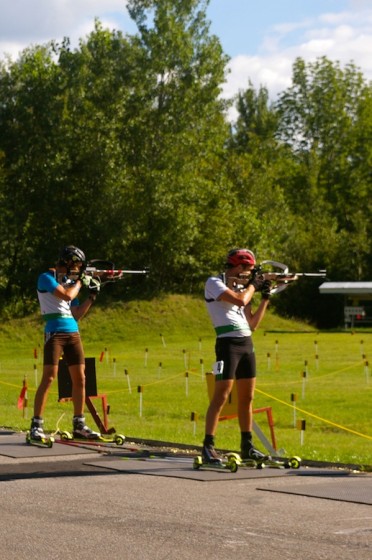
    Svendsen will start Sunday’s 15 k mass start in bib 1 as the World Cup leader, next to Fourcade in bib 2 and Shipulin in bib 3. Landertinger placed fourth on Saturday (+1:12.9) with three total penalties (0+0+2+1) and will start in bib 4. Ondrej Moravec of the Czech Republic placed fifth (+1:14.2) with two penalties (1+1+0+0).

    Burke Improves to 21st

    Americans Lowell Bailey, Tim Burke and Leif Nordgren started the pursuit 16th, 26th and 53rd, respectively. Nathan Smith led the Canadians in the sprint to start 25th (four seconds ahead of Burke), and teammate Brendan Green went out 19 seconds later in 34th.

    By the first stage, Smith cleaned to leave the range in 17th, a minute and 15 seconds behind the leaders, and Bailey missed one to move to 19th, 2.9 seconds behind Smith.

    American Lowell Bailey leads a chase pack, including Russia's Evgeniy Garanichev directly behind him, on his way to 29th in the men's 12.5 k pursuit on Saturday in Pokljuka, Slovenia. (Photo: USBA/NordicFocus)
    American Lowell Bailey leads a chase pack, including Russia’s Evgeniy Garanichev directly behind him, on his way to 29th in the men’s 12.5 k pursuit on Saturday in Pokljuka, Slovenia. (Photo: USBA/NordicFocus)

    In the second prone, Smith and Bailey both cleaned to leave the range in 13th and 14th, respectively, just over a minute behind the leaders. By the third stage, they were up to ninth and 10th, respectively, despite one miss each, 1:21 and 1:23 out of first.

    The two dropped into the top 30 after the fourth stage, with two penalties apiece. Smith headed out on his last lap in 23rd and Bailey was 26th with 2 k to go.

    “My shooting felt really solid today, right up until the last standing,” Smith recalled in an email. “My shooting speed is always an advantage in short-loop races like the pursuit.  Even if I lose a little time skiing I can catch back up after gaining a couple in the range.”

    Burke was right behind Bailey in 27th after a single miss on his final stage and two on his first prone.

    “It was actually a really rough start for me with two penalties in that first stage,” Burke said on the phone Saturday. “I think I fell back almost twenty places [to 44th], but I was able to claw myself back in it.”

    With clean shooting on his second and third stages, he improved to 36th and 26th, respectively. And on his last lap, Burke passed six people to finish 21st with three penalties, 1:56 behind Svendsen.

    “I was really happy with my last lap,” Burke said. “I just tried to keep a little bit of distance over the last group over that last climb. I think I just tucked over the line.”

    He treated that last rise before the straightaway downhill into the stadium like the finish line, and made sure to lead over the top of it. At the actual finish, Burke edged Smith by 0.8 seconds and Germany’s Erik Lesser by another one-tenth of a second in 23rd. Smith narrowly topped Lesser in the photo finish for 22nd, and beat out Austria’s Sven Grossegger in 24th by 0.8 seconds.

    “Leaving the range I could see ahead a German who was suffering,” Smith wrote. “I could also feel a good 5 people breathing down my neck.  So I did my best to keep them at bay and catch the German. Tim looked really strong skiing and passed a bunch of us like it was nothing on the longest climb.

    “Thankfully I managed to stay somewhat in contact with the guys that followed right behind him,” he added. “Tim was too far ahead at the finish, but I had a good draft heading into the ridiculously fast finish and could free skate past the other two.”

    Bailey finished 29th (+2:07) with four penalties (1+0+1+2), Brendan Green cleaned his first and third stages but missed three total (0+1+0+2) to place 33rd (+2:22.7), and Nordgren ended up 51st with three penalties (0+1+2+0).

    “Skiing felt decent. Shooting got a little shaky toward the end,” Bailey wrote in an email. “I don’t think I was nervous, but I my legs were definitely a little unstable from late-race fatigue. … I definitely didn’t feel completely in sync with my standing shooting today and missing those two targets in the end hurt pretty bad. But, tomorrow another day!”

    On Sunday, Burke, Bailey and Smith will start the mass start in bibs 15, 18 and 30, respectively — which is where they stand overall on the World Cup. And while Smith will start in the 10th-and-last row, he explained he was excited to make the mass start.

    “It’s only my second one ever,” he wrote. “The first one was at the Olympics, but unfortunately that one ended 500m in thanks to a crash. I’m not sure what to expect, but a top 15 would be nice. Since I’m starting way at the back I’ll just hang out there and not worry about trying to move up at all first lap. I will have to also be quite careful entering the range as lane 30 is right at the bottom of the downhill entry, where you have to slam on the brakes.”

    Since the more-condensed start format is new to mass starts this season, Burke wasn’t sure exactly what to expect.

    “I’ve never done one of these starts before; I haven’t heard many positive things about it so it’ll be interesting,” he said. “I imagine I’ll be right in the middle of the pack, which isn’t necessarily where I want to be.”

    But he’ll try to ski the first loop relaxed. “I just try to avoid any trouble,” he said. “I try to tell myself that the race really start after the first prone.”

    Results

  • Fourcade Cleans When It Counts to Win Hochfilzen Pursuit; Burke Disappointed with 25th

    France's Martin Fourcade celebrates the finish of Sunday's IBU World Cup 12.5 k pursuit in Hochfilzen, Austria, which he won by 4.1 seconds over Germany's Simon Schempp. (Photo: Martin Fourcade/Instagram)
    France’s Martin Fourcade celebrates the finish of Sunday’s IBU World Cup 12.5 k pursuit in Hochfilzen, Austria, which he won by 4.1 seconds over Germany’s Simon Schempp. (Photo: Martin Fourcade/Instagram)

    Martin Fourcade was pretty pumped about his 12.5-kilometer pursuit win on Sunday on the last day of the Hochfilzen IBU World Cup in Austria. Like, eight exclamation points excited.

    “Yes!!!!!!!!” the two-time Olympic gold medalist and five-time world champion from France wrote on Instagram, posting a photo of himself holding his arms high above his head at the finish line.

    Fourcade started seventh, 28 seconds behind Friday’s sprint winner Johannes Thingnes Bø of Norway, and raced his way up to sixth, 21.4 second back, after cleaning the first prone.

    Bø cleaned as well to leave the first stage with a 19-second lead on Germany’s Andreas Birnbacher, who started 18 seconds back in third.

    After the second stage, Fourcade was up to fifth behind Bø, Slovenia’s Jakov Fak, Germany’s Simon Schempp, and Norway’s Emil Hegle Svendsen, respectively — all of which cleaned back-to-back prone stages.

    On a calm, bluebird afternoon with warming conditions, the men’s race was clearly going to come down to mistakes — or who could escape without any.

    Fourcade and Schempp turned out to be those guys. Both cleaned the two standing stages to shoot 20-for-20 and finish first and second, respectively. Schempp had started second, 14 seconds after Bø.

    The 21-year-old Norwegian leader dropped to fourth on the third shooting stage with two standing misses, putting him 27.8 seconds out of first. Svendsen, Fak, Fourcade, and Schempp entered the ranged together after him, and Fak, Fourcade and Schempp emerged without any misses. Fak took the lead, 1.5 seconds ahead of Fourcade and 3.6 seconds over Schempp, and Svendsen dropped to ninth with two penalties.

    On the fourth lap, Fourcade passed Fak, leading the Slovenian by one second at 8.7 k. Schempp was right there in third, trailing by another half a second. Meanwhile, Bø led the chase 31 seconds back in third, just ahead of Austria’s Dominik Landertinger and Russia’s Anton Shipulin.

    Entering the range first a few seconds ahead of Fak and Schempp, Fourcade cleaned once more. Fak missed one and Schempp hit every target to move into second, 8.1 seconds behind Fourcade.

    The penalty put Fak into fourth, 26 seconds back and 0.6 seconds behind Bø, who cleaned to leave the range in third.

    “I knew Johannes was the best skier, but I tried to give it my all in the last uphill and that tactic paid off,” Fak told the IBU, after attacking on the last climb to pass and drop Bø, along with Shipulin in tow.

    Fourcade held off Schempp on the last lap by 4.1 seconds for the victory in 32:53.7. Fak powered to third, 10.9 seconds after Fourcade, and Bø finished fourth, 5.3 seconds later. Shipulin fell off the pace on the last climb, but held onto fifth (+28.5), and Bø’s older brother Tarjei Bø placed sixth (+45.1), ahead of Birnbacher (+48.8) in seventh.

    Landertinger, the fourth starter, ended up eighth with three penalties (+56.2), Ondrej Moravec of the Czech Republic was ninth (+56.5), and Russia’s Dmitry Malyshko took 10th (+1:02.6).

    “This was a great weekend for me,” Fourcade told the IBU, after placing seventh in the sprint with clean shooting. “I am happy that I gave 100 percent of myself today and shoot 20. I am very happy with that … My instinct on the shooting range was not to go too fast but to hit the targets and win the race.”

    Second twice this weekend, Schempp was satisfied.

    “I am really happy with my start to the season,” he said. “The first two weeks have been really great for me. This is the result of good preparation for the season with no injuries and illness.”

    Burke Top North American in 25th

    Tim Burke on his way to 25th in the IBU World Cup 12.5 k pursuit on Sunday in Hochfilzen, Austria. (Photo: USBA/NordicFocus)
    Tim Burke on his way to 25th in the IBU World Cup 12.5 k pursuit on Sunday in Hochfilzen, Austria. (Photo: USBA/NordicFocus)

    After starting 13th, 40 seconds behind Bø, American Tim Burke ended the pursuit with five penalties and 25th overall (+2:35.6).

    “I am definitely disappointed with my pursuit race today,” he wrote in an email. “I felt like I had really good ski form but I struggled with the shooting until the last stage.”

    Burke missed one on each of his prone stages, then three in the first standing. He went from 16th after the first shooting to 34th by the end of his third bout.

    “I was a little frustrated with my mistakes in prone because I felt like I had taken good shots and I was surprised with the penalties,” he wrote. “On the first standing stage I just never felt comfortable and was not able to get into any flow.”

    As for his finish, he was pleased to land in the points, especially before the first mass start of the season next Sunday in Pokljuka, Slovenia.

    “I feel like I am in great shape right now and Pokljuka is one of my favorite courses,” Burke wrote.

    Lowell Bailey leads Bulgaria's Krasimir Anev during Sunday's 12.5 k pursuit in Hochfilzen, Austria. After starting 18th, Bailey went on to place 32nd. (Photo: USBA/NordicFocus)
    Lowell Bailey leads Bulgaria’s Krasimir Anev during Sunday’s 12.5 k pursuit in Hochfilzen, Austria. After starting 18th, Bailey went on to place 32nd. (Photo: USBA/NordicFocus)

    His US Biathlon teammate Lowell Bailey started 18th and 58 seconds behind first. With four penalties, one on each prone and two on the final standing, he finished 32nd (+2:53.2).

    “It was just one of those days where nothing went totally wrong but nothing went right either,” Bailey explained in an email.

    His prone penalties put him in 25th, nearly two minutes out of first, halfway through.

    “I recovered a bit with a clean stage in the first standing but I set myself pretty far back with two misses in the end,” he wrote after leaving the range for the last time in 31st. “I’m not sure why I missed in the last standing. I felt good with the position and I felt stable. Sometimes you just miss!

    “My legs were a little heavy, this being the third of a three-day mini-series… But that too is biathlon, three races a week, three weeks in a row,” he added. “It’s a brutal schedule but normally I’m able to handle it ok. The trick now is to get some recovery in before the next races in Pokljuka.”

    The third U.S. man, Leif Nordgren skied up to 37th after starting 51st and 2:19 back. On Saturday, Nordgren and the rest of the U.S. men’s 4 x 7.5 k relay were lapped on the final leg after a tough day on the range. After getting tagged in 11th, Nordgren used all his spares and skied four penalty loops.

    Leif Nordgren racing up from 51st to 38th on Sunday in the IBU World Cup 12.5 k pursuit in Hochfilzen, Austria. (Photo: USBA/NordicFocus)
    Leif Nordgren racing up from 51st to 38th on Sunday in the IBU World Cup 12.5 k pursuit in Hochfilzen, Austria. (Photo: USBA/NordicFocus)

    He tried to forget it soon after.

    “It was such a spectacular mess that it wasn’t worth even giving a second thought to,” Nordgren wrote in an email. “I know that I’m better than that, sometimes those things happen and it doesn’t help to worry about it!  Not really sure what happened, or why, but like I said I’m not really trying to think it out.”

    For Sunday’s race, he figured anything could happen and aimed to land in the top 30.

    “The first lap is my least favorite, everyone in the back just guns it as fast as they can, I think this is the second week in a row where I’ve been the last one into the range for the first shooting!” he explained. “But I like starting out a little more conservative and hopefully having some more gas for the last loop.”

    Nordgren cleaned his first two stages, missed one standing, and cleaned his last standing.

    “I was a little too relaxed in the first standing, I took it shot by shot instead of getting into a nice rhythm,” he wrote. “So it was just a bad shot, I was more aggressive in the second standing and it worked out perfectly.”

    Without much left to give on the last loop, he went from 36th to 37th at the finish (+3:30.1).

    “Overall I’m pretty happy with the weekend,” he wrote. “It was a step up from Ostersund for sure, hopefully I can keep climbing into next week as well.”

    The two Canadian men in Sunday’s race — Brendan Green and Nathan Smith — struggled on the range, with Green missing five and Smith being penalized two minutes for another racer’s crossfire. While it appeared he cleaned his first and last stages, Smith didn’t actually clean his last standing — the person next to him did.

    “This has never happened to me in all my years of biathlon,” Smith explained. “I wasn’t exactly sure what to do so I waited for a good 40 seconds, the target did not reset, so I took my partially full magazine out, cleared the chamber and left.”

    It didn’t take him long to realize that he’d be penalized for not firing all five shots.

    “Right after I left I was like f***, I’m disqualified now!” Smith wrote. “Turns out it’s actually a 2 min penalty for failing to use each bullet. So that mishap cost me close to 3 minutes total.”

    With two misses (0+1+1+0) and the added time penalty, Smith finished 49th (+5:19.6) after starting 44th and 1:57 behind the leader.

    “I was really happy with my ski form in yesterday’s relay, so I was optimistic about how today could go,” he wrote, referring to his team’s sixth-place relay on Saturday. “I felt absolutely wrecked yesterday evening though and just hoped that I would feel a lot more energetic after a good night’s sleep.”

    Yet on Sunday, he realized his skiing wasn’t there.

    “It was a tough race for me and I couldn’t really find the extra motivation to give 100% because it was just hurting too much,” Smith wrote. “I made good time in the range, but suffered on course.  I was mostly able to maintain position thanks to shooting quickly.”

    Green started 49th and ended up 44th (1+0+1+3), 4:21.9 back. In an email, he explained that his race was “fairly decent” up until the last standing. For one, he was feeling good skiing and posted the 32nd-fastest course time overall.

    “I had my best ski of the year today which is a step in the right direction,” Green wrote.

    Hovering around 42nd before his last bout, he knew he could potentially move up with a clean last stage.

    “Unfortunately I ended up with three misses,” he wrote. “I just kind of went for it with a nothing-to-lose attitude in the last shooting and the first miss felt very close to a hit so I continued with my rhythm and kept missing by what felt like just a small margin. It was frustrating and in hindsight I should have taken a second or two to reset after the first miss, but the shots were feeling good and not out of control. Lesson learned on that front today I guess.”

    Overall, he felt the weekend was an improvement, although, “I’m still not content with my form and know I’m capable of a lot more,” he added.

    On the bright side, after he and his teammates tied a team-best relay result, Green watched his girlfriend Rosanna Crawford achieve a career-best fifth in Sunday morning’s women’s pursuit.

    “When it hit me that if she shot clean she would be leaving the range in 3rd or 4th I held my breath until she was done shooting,” Green wrote. “That’s when I started yelling at the TV and things really got intense!  It was a little more action then I’m used to in the morning while I’m getting ready to race, but it was awesome.

    “She’s had a taste of what it’s like to fight it out for a podium today and there’s no doubt it will happen any day now,” he added. “I think she’s finished in the top 10 just once prior to today, so as soon as she accepts that she belongs in the top 10 and then the top 5, a podium will be the next step.”

  • Fourcade on Fire with Back-to-Back Wins in Östersund; Smith Drops from 3rd to 16th

    Fourcade on Fire with Back-to-Back Wins in Östersund; Smith Drops from 3rd to 16th

    The men's 12.5 k pursuit podium in Östersund, Sweden, with France's winner Martin Fourcade (c), Russia's Anton Shipulin (l) in second and Norway's  Emil Hegle Svendsen in third. (Photo: Fischer/NordicFocus)
    The men’s 12.5 k pursuit podium in Östersund, Sweden, with France’s winner Martin Fourcade (c), Russia’s Anton Shipulin (l) in second and Norway’s Emil Hegle Svendsen in third. (Photo: Fischer/NordicFocus)

    Martin Fourcade treated shooting on Sunday like a means to an end. The faster he could get through it, the better off he’d be as the first starter in the men’s 12.5-kilometer pursuit on the last day of the IBU World Cup in Östersund, Sweden.

    With a 28.3-second sprint win on Saturday, the Frenchman started 28 seconds ahead of the sprint runner-up, Ondrej Moravec of the Czech Republic, on Sunday. Slovenia’s Jakov Fak was 29 seconds back in third, and another Czech Michal Slesingr left the start 10 seconds later in fourth.

    Conditions were slightly better on the final day of competition than what competitors weathered on Saturday: “They’re still pretty bad, but they were definitely better than yesterday,” Canada’s Nathan Smith said on the phone after starting ninth, skiing into the top three before the last shooting stage, then placing 16th in the pursuit.

    Smith noted the pursuit course had one fewer technical downhill than the sprint, but said organizers apparently scraped snow from the corners of the trail to beef up the middle.

    “On your last lap, you’re, like, ‘OK, I gotta stay on my feet,’ because you’re tired, but it wasn’t as scary as in the sprint,” he said.

    In the range, it was typical Östersund: a little windy as usual. Fourcade, for one, had trouble — or maybe he was just rushing to stay ahead.

    On the first prone, he missed his first two shots. Then he looked up.

    “I didn’t [understand] why, but I wasn’t surprised,” Fourcade told reporters in a press conference after the race. “I saw that it was not a good beginning so I tried to get some information from the big screen.”

    He learned he was aiming too far right, corrected it and hit the next three targets.

    But after the first stage, Fourcade was already playing catchup. Jak had cleaned and was 8.1 seconds ahead. Fourcade made up the lost time quickly on the following lap, coming within 1.7 seconds of him at 4.6 k before entering the range together.

    There on the second prone, Fourcade missed one for another penalty loop. Fak cleaned and so did Russia’s Evgeniy Garanichev, who started fifth and left the range in third. Then there was Norway’s Ole Einar Bjørndalen, who started eighth and cleaned the first two stages as well, and Russia’s Anton Shipulin —all four of which were ahead of him. Fourcade was 23 seconds out of the lead with three laps and two shooting stages to go.

    On the heels of Garanichev and Shipulin at 7.1 k, approaching the range for the first standing, Fourcade was up to fourth, 23.8 seconds behind Jak. He was the only man in the top six with any penalties whatsoever — and Smith was the sixth man, 38.1 seconds behind the leader.

    Canada's Nathan Smith racing to ninth in Saturday's IBU World Cup 10 k sprint in Östersund, Sweden. (Photo: Fischer/NordicFocus)
    Canada’s Nathan Smith racing to ninth in Saturday’s IBU World Cup 10 k sprint in Östersund, Sweden. (Photo: Fischer/NordicFocus)

    With the pressure on, Fourcade cleaned. Jak missed one, and Smith hit all his targets to head out on the course in third right behind Fourcade, who was 15 seconds behind the Slovenian.

    The experience of racing in the top three of a head-to-head race wasn’t totally unusual to the 28-year-old Canadian.

    “Last year in one race, I was second for one lap, but it was earlier in the race, so I’d say today I was definitely closer because it was down to the last shooting that decided it,” Smith reflected. “It’s pretty exciting, but also, I don’t know, you feel a bit out of your league. Hopefully I’ll get more experiences like this and I’ll get more used to it so I’ll feel more comfortable.”

    By 8.8 k, Fourcade passed him, and Smith was 19 seconds back in third. Just under a kilometer later, Norway’s Emil Hegle Svendsen overtook Smith and led him, Shipulin and two Germans — Simon Schempp and Andreas Birnbacher — into the range for the last time.

    Meanwhile, Fourcade was 20 seconds ahead with Fak. While Fourcade faltered in the second standing with one miss, he handled the pressure better than most: Fak missed two and Smith, who entered the stadium in fourth, missed three to tarnish his perfect shooting up to that point.

    “Basically every lap, I was shooting really well, cleaning, and I was shooting quickly so I was making time in the range every loop,” Smith said. “But I was still trying to ski my own race out on the course. I know I’m not as fast as Svendsen or Fourcade, but I was trying to make up the time I lost there in the range and it was working. But on the last shooting, I don’t know, maybe the nerves got the best of me and I missed my first three. I thought I was going to miss four, but thankfully I didn’t.”

    Smith dropped to 14th, 1:20.6 behind Fourcade in first. The 26-year-old, five-time world champion and two-time Olympic gold medalist left the range 10 seconds ahead of Shipulin, who cleaned the last stage to move to second.

    “The last loop was hard with him on my back,” Fourcade said. “I was quite confident, but I looked back, too.”

    “Leaving the shooting range, I had my mind set on catching him, but soon realized it was not possible,” Shipulin told reporters.

    The Russian had started sixth, 48 seconds behind Fourcade, and emerged as the best shooter in the eventual top four with a single penalty. Fourcade had four total, but when he crossed the line uncontested, 10 seconds ahead of Shipulin, all that mattered was he won.

    “The shooting conditions weren’t easy so I’m happy to succeed. Some guys did really well,” Fourcade said. “I had some mistakes, but it was good enough to win.”

    Svendsen, with two misses, ended up third (+26.3), and Fak, with three penalties, finished fourth, 0.4 seconds off the podium. One-tenth of a second later, Austria’s Dominik Landertinger placed fifth after starting 30th and rocketing toward the front with a single miss on the last standing. Sixth through eighth place had a single miss, with Schempp, Birnbacher and Norway’s Alexander Os finishing in that order. France’s Jean Guillaume Beatrix took ninth with two penalties, and Bjørndalen was 10th with three misses.

    The lone Canadian to qualify for the pursuit after placing ninth in Saturday’s sprint with clean shooting, Smith settled for 16th, 1:30.9 behind Fourcade.

    “After missing three, I definitely lost a bit of steam,” Smith said. “I was definitely tiring a bit on the fourth lap, though. I still fought hard on the last lap, but if it would’ve been for a podium, I’m sure I could’ve mustered a bit more.”

    He explained he tried to ski his own race throughout the five-lap pursuit, and focus on his strengths in fast shooting. That led to him lose about 10-seconds per lap on the leaders, but he ended up with the fifth-fastest range time. Fourcade’s range time ranked seventh overall, after posting the second-fastest time in the second bout and top range time in the last one.

    Smith’s final stage was his slowest all day by about four seconds.

    “That might’ve been a mistake — If you slow down sometimes you have more time to let thoughts creep in, distractions,” he said. “I mean, it was awesome shooting other than the last one. I’m still pretty happy with it.

    “It’s nice to know that the possibility’s there so hopefully I have some more chances this year,” he added. “In one of them, I’ll hit those last targets.”

    While Fourcade racked up back-to-back victories in Östersund, Svendsen remains the overall IBU World Cup leader by 44 points over Fourcade.

    After Sunday’s race, he said the yellow bib was a bit of a curse.

    “Now I have to defend it,” Svendsen said. “I will try to do that for as long as I can, but I know Martin will be there. If I lose it, then I will focus on the World Championships.”

    For Fourcade, the World Cup opener turned out to be a confidence booster.

    “The most important thing I am taking away from here is confidence,” he said. “I wanted some personal answers and now I have them.”

    Results

  • Fourcade Gets Gold He Came For; Two Frenchmen Podium in Pursuit

    Fourcade Gets Gold He Came For; Two Frenchmen Podium in Pursuit

    Martin Fourcade of France races to the first Olympic gold medal of his career on Monday in the men's 12.5 k pursuit at the 2014 Winter Games in Sochi, Russia.
    Martin Fourcade of France races to the first Olympic gold medal of his career on Monday in the men’s 12.5 k pursuit at the 2014 Winter Games in Sochi, Russia.

    FasterSkier’s coverage is made possible through the generous support of Rudy Project. 

    SOCHI, Russia — Martin Fourcade described the final loop of Monday’s 12.5-kilometer pursuit as “one of the worst” in his whole life.

    That’s a big statement coming from the French biathlete, who, at 25, has five World Championships titles and a silver medal from the 2010 Olympics in Vancouver. It’s interesting because he rounded the last 2.5 k loop in the lead, essentially uncontested on his way to his first Olympic victory. Yet he nearly crashed on a tricky descent before the finish; one that tripped up at least four men on Monday and sent at least two of them over the cliff-like edge.

    France's Martin Fourcade leads Jaroslav Soukup of the Czech Republic during the men's Olympic 12.5 k pursuit on Monday in Sochi, Russia.
    France’s Martin Fourcade leads Jaroslav Soukup of the Czech Republic during the men’s Olympic 12.5 k pursuit on Monday in Sochi, Russia.

    “I knew after the first shooting that I was Olympic champion,” Fourcade said at a post-race press conference.

    He also knew nothing was final until he finished, and he could lose it all on the last loop.

    Two days ago, Fourcade left the sprint severely disappointed in sixth. A prone penalty took him out of the running for the gold he had been dreaming of for years — at least since 2010 when he placed second in the mass start, 10 seconds behind Russia’s Evgeny Ustyugov.

    “Before today I wanted more than I expected in my whole life,” Fourcade said.

    Preparing for the night race, he thought about what someone told him last month in Oberhof, Germany: “That I’m often strong after deception,” he said.

    Third in the two World Cup races preceding the Oberhof 15 k mass start on Jan. 5, Fourcade came out with a fire, and despite an early miss, he won.

    Fourcade faced similar challenges on Monday. Starting 12 seconds behind Norway’s Ole Einar Bjørndalen, who won Saturday’s opening sprint, the Frenchman cut the deficit in half by the first of five laps. From there, he knew he had to shoot clean — or come as close as possible — to shake his competition.

    Eight frontrunners entered the range together for the first prone, seven of which cleaned, including Bjørndalen, Russia’s Anton Shipulin (who started fourth) and Canada’s Jean-Philippe Le Guellec (who started fifth), in that order. Austria’s Simon Eder had a single miss and left the stadium in eighth.

    The pack had dwindled to six by the second prone, where Le Guellec again cleaned faster than any of his nearby competitors, and Fourcade cleaned as well. Le Guellec lost some ground to the leaders on the third loop, then crashed hard on the downhill corner before the stadium after his ski caught a rut in the soft-and-choppy snow. He broke a ski and had to wait for a replacement (which he got from a Ukrainian wax tech), and ultimately dropped out of podium contention.

    Fourcade took charge before the first standing, missing one but hardly missing a beat as he continued to shoot quickly. The second starter, Austria’s Dominik Landertinger, missed one as well, and Jaroslav Soukup of the Czech Republic in third missed two. After a penalty on the second stage, Bjørndalen in fourth had another miss in standing.

    Despite the penalty, Fourcade’s master plan was still on track as he led Landertinger into the range for the last time. Landertinger had worked hard to stay within a few seconds of Fourcade, but fumbled his cartridge in the final standing — while Fourcade cleaned.

    Landertinger missed two after that, and Fourcade sped off for his nerve-wracking victory loop. He stayed on his feet and finished without anyone in sight in 33:48.6, turning toward the range to blow a kiss after the finish.

    “I fight with all these guys all the year in each biathlon World Cup so I knew that if I shoot clean on the last, I will be Olympic champion,” Fourcade said. “I heard that Dominik Landertinger missed so it was all about me.”

    France's Martin Fourcade (l) congratulates his bronze-medal-winning teammate Jean Guillaume Beatrix at the finish of Monday's Olympic 12.5 k pursuit in Sochi, Russia.
    France’s Martin Fourcade (l) congratulates his bronze-medal-winning teammate Jean Guillaume Beatrix at the finish of Monday’s Olympic 12.5 k pursuit in Sochi, Russia.

    After notching the first top 10 of his Olympic career on Saturday (when he placed eighth in the sprint), Ondrej Moravec of the Czech Republic shot clean for silver, 14.1 seconds behind Fourcade. France’s Jean Guillaume Beatrix notched his first Olympic podium in third, 10 seconds later.

    Fourcade said he was most focused on Moravec behind him, but once he realized it was Beatrix holding his own in third ahead of Bjørndalen, he was incredibly happy for him.

    “He’s been doing biathlon for 15 years and I think this is amazing for our team,” Fourcade said of his teammate, also 25.

    “He also showed great results he was the Junior World champion and today I am the Olympic champion,” he added. “We were disappointed after the sprint and I felt I was the one that had to open the sport for Olympic victories. … All the papers were [reporting] that France hasn’t won any medals yet, and of course it was great that we could do it today.”

    After a penalty on the first standing, Beatrix became a podium contender after cleaning the last stage and skiing the fastest last loop.

    “I was trying to stay calm and relaxed and as soon as I crossed the finish line, immediately I didn’t realize what had happened then, but gradually, step by step, I realized I was the Olympic bronze medalist,” Beatrix said.

    He recalled his initial celebration with Fourcade as nonverbal.

    “He looked at me and he gave me a hug,” Beatrix said. “I remember just the smile because we are very happy to share this podium. I think he’s very happy to be the Olympic champion, but maybe a bit more because he shared it with me.”

    Fourcade shooting
    Fourcade (r), Landertinger (c) and Soukup shooting during the first standing, when Fourcade and Landertinger each missed one and Soukup missed two.

    Moravec, 29, was also ecstatic about the moment and medal, as well as the fact that he cleaned a four-stage race for the second time of his career.

    “Before Olympics I say if I am in the top 10 that will be great for me,” Moravec said. “And now I have medaled it’s great.”

    He was the second Czech biathlete to medal in this Olympics, following Soukup’s bronze in the sprint.

    “In the sprint, it was a big surprise,” Moravec said, referring to Soukup’s mountain-bike accident in August 2012, in which he suffered a concussion, two arm fractures, and spinal injuries. “It was so tough year for him and now he’s back, and for me it’s also super.”

    The Czech men’s team gathered at the finish, singing and dancing a national chant: “Kdo neskáče, není Čech.”

    “It was perfect for our team that in the second competition in the Olympic Games, we have two medals,” Czech coach Ondrej Rybar said. “For me, this is why I’m doing this, as a coach, because when I have a team just for 10 people that’s in my team, and I think it’s a very good friendship between everyone, and this is the most important thing in the team.”

    Bjørndalen, who won Saturday’s sprint to tie for the most medals at any Olympics, finished fourth, 1.7 seconds behind Beatrix. Ustyugov placed fifth, Germany’s Simon Schempp was sixth, Norway’s Emil Hegle Svendsen was seventh, and Eder placed eighth. Latvia’s Andrejs Rastorgujevs finished ninth and Landertinger ended up 10th with three penalties.

    Canada’s Nathan Smith rose from 13th to 11th in his first Olympics, with a single standing penalty, Le Guellec ended up 26th with three misses.

    — Nat Herz contributed reporting

    Results

  • Comfortable in Bib 1, Bø Wins Second Straight in Annecy; Smith Captures Another PB

    Comfortable in Bib 1, Bø Wins Second Straight in Annecy; Smith Captures Another PB

    Johannes Thingnes Bø after finishing sixth at 2012 Norwegian biathlon championships in Trondheim. At 20, Bø won his first IBU World Cup on Saturday, then repeated with another victory in Annecy, France, on Sunday. (Photo: Wikimedia Commons)
    Johannes Thingnes Bø after finishing sixth at 2012 Norwegian biathlon championships in Trondheim. At 20, Bø won his first IBU World Cup on Saturday, then repeated with another victory in Annecy, France, on Sunday. (Photo: Wikimedia Commons)

    The thing about Le Grand Bornand in Annecy, France, is it’s so darn flat, you’ve got to ski real fast if you’re going to make waves there.

    That’s one thing IBU World Cup competitors quickly realized during their five days of races at the venue, with relays on Thursday and Friday, sprints on Saturday, and a final pursuit on Sunday.

    As a biathlete, you’ve also got to hit your targets. Norway’s Johannes Thingnes Bø did both – almost perfectly with 19-for-20 shooting – to rack up his second-straight victory of the weekend and his career.

    Starting first, 33 seconds ahead of the Czech Republic’s Ondrej Moravec, the 20-year-old Bø won the men’s 12.5-kilometer pursuit by 37.5 seconds in 31:43.7. He cleaned his first prone and missed one on the second stage, but it didn’t make much of a difference. He had a 46-second lead before his second prone and was still 21 seconds ahead heading into his third loop.

    Bø recorded some of the fastest range and loop times to beat Germany’s Erik Lesser, who cleaned every stage to take second. Another 1.6 seconds back, Russia’s Anton Shipulin placed third with a penalty on the first standing. Meanwhile, Moravec had two penalties to finish 12th.

    Twenty of the top 25 finishers cleaned the first prone, and six of those men – including Shipulin, Lesser, Austria’s Daniel Mesotitsch and Dominick Landertinger, and Norway’s Lars Berger and Henrik L’Abee Lund – also cleaned their second prone.

    But by the time Bø knocked down all his targets in the first standing, no one else had got a shot off. Lesser cleaned again to move to second, 31 seconds behind the Norwegian, but Bø cleaned once more to dash the hopes of anyone trying to catch him and finished uncontested.

    “It was a special feeling to go out with bib number one,” Bø told IBU, according to a press release. “I never felt the pressure. I think that is why I was so good on the shooting range and on the tracks.”

    Overjoyed with second and a solid start to the season, Lesser described his weekend in France as “phenomenal.”

    “I hope our team can keep this form and try to beat Johannes and his brother [Tarjei]  in Sochi,” Lesser said.

    The IBU World Cup goes on a three-week holiday break before resuming on Jan. 3 in Oberhof, Germany.

    Smith on a Roll

    Nathan Smith (Biathlon Canada) racing to seventh in the 12.5 k pursuit in early August at 2013 North American Biathlon Rollerski Championships in Jericho, Vt. Four months later, he's punched his ticket to Sochi.
    Nathan Smith (Biathlon Canada) racing to seventh in the 12.5 k pursuit in early August at 2013 North American Biathlon Rollerski Championships in Jericho, Vt. Four months later, he’s punched his ticket to Sochi.

    A day after he tied his career-best 16th and qualified for Canada’s Olympic team, Nathan Smith finished eighth in Sunday’s pursuit, 57.5 seconds behind Bø and 18.4 seconds off the podium.

    He had risen from 48th to 27th in a pursuit a week earlier in Hochfilzen, Austria, yet Smith knew it would be tighter and harder to pick off the places closer to the front.

    As a result, he started conservatively and tried to keep pace with those around him using as little energy as possible. He missed a shot in the first prone, but after doing the same thing last Sunday, Smith knew it was possible to recover.

    He ended up cleaning his second and third stages before missing one more on his second standing.

    “Missing the last shot is a biathlon classic,” Smith wrote in an email. “I think I lost focus thinking about the possibility of a podium. Frustrating for what could have been, but I’m not too upset, as the race was still a solid [personal best].”

    On Monday, Smith plans to fly home to Canmore, Alberta, via Calgary to spend the holidays training and enjoying the break. On Jan. 4, he’ll head back to Germany.

    Both his Biathlon Canada teammates currently in France also qualified for the pursuit, with Jean-Philippe Le Guellec shooting clean and placing 33rd (+2:19.0), and Scott Perras finishing 48th with five penalties (+3:29.2).

    “Skiing was ok‘ish.’ Better than [Saturday],” Le Guellec wrote in an email. The team veteran placed 49th in the preceding sprint with two standing penalties.

    “Shooting 20/20 is a great feeling before heading home,” he added. “I basically tried to survive skiing. I was always between packs too, so skied alone a lot, which makes it harder because you have no one to help you. But easier to since you can really just do your own thing.”

    Getting passed a couple times reminded Le Guellec to keep pushing, and he was glad his back didn’t suffer the effects of the flat course.

    “I tweaked my standing position a tad, remembering stuff that was working well this summer and kind of forgot down the road, so I think that really helped bring standing back for me,” he explained.

    Having a perfect day on the range as well, Lowell Bailey of US Biathlon placed 15th, up from 35th. Perhaps most notably, he had the second-fastest net time of 31:13.7 behind Carl Johan Bergman of Sweden, who finished fourth.

    “After cleaning my third stage, I knew I had a good chance at a top finish but I just tried to refocus on what tasks I needed to execute during the fourth stage,” Bailey wrote in an email. “I had been a little bit too tentative on the range earlier in the week and I wanted to stay aggressive and focused for the last stage.  I was able to do this and found myself in 18th leaving the range, fighting for a top-15.  We had great skis and I felt better than I had in the last two races.”

    Bailey went 20-for-20 to finish 1:11 behind Bø (after starting 1:41 behind), and crossed the line just 0.6 seconds ahead of teammate Tim Burke in 16th.

    Burke had two penalties – one on each of standing stage – as he skied up from starting 28th.

    “I wanted to be really aggressive on the shooting range and on the course,” Burke wrote in an email. “I knew that would be my only chance to move up.”

    While Bailey clocked the second-fastest loop time on the fourth of five laps, Burke had the second-fastest course time on the same loop. Burke’s course time on the second loop ranked third.

    “I tried to go out really hard right from the start and just hold on,” he explained. “It worked out well for me and I ended up feeling better today than in any of my previous races this season.  I ended with the 3rd fastest ski time, so I am very happy with the direction my skiing is headed.”

    After cleaning both prone stages, he was up to 15th and thought a podium might be possible. He didn’t get ahead of himself, though, staying aggressive on the range and not “trying to make my shots too perfect,” Burke explained.z

    Skiing in 19th at the beginning of the last loop, he trailed Bailey and Sweden’s Frederik Lindstrøm by about five seconds, and pushed hard on the first climb to catch them. Burke also caught Frenchman Martin Fourcade and the group he was skiing with, then beat Lindstrøm and Fourcade in the finishing stretch.

    “The finish sprint is really fast here and it comes after nearly a minute downhill, so everyone goes into it completely recovered,” Burke explained. “This is definitely not my type of finish so I knew that I had to try something before the last downhill.  I made my move on the last climb and was able to get free of the group.”

    Happy with his performance and how he felt after three weeks of racing, Burke’s ready for another big training block. He’ll be in Antholz, Italy, while the rest of his team travels back to the U.S.

    “I have had a lot of trouble in the past staying healthy when I fly home for the Holidays, so I did not want to take any extra risks this year,” he explained. “I will also train at altitude for the next few weeks and I am hoping that this will help me in Sochi.”

    Results

  • Biathlon Rollerski Championships: Pursuit Photos

    Biathlon Rollerski Championships: Pursuit Photos

    JERICHO, Vt. — Images from Day 2 of the North American Biathlon Rollerski Championships: the men’s 12.5-kilometer pursuit on Aug. 11 at the Ethan Allen Firing Range. (Women’s 10 k pursuit photos in progress.)

    See also: Sprint photos | Women’s weekend race recap | Men’s recap