From the FasterSkier archive — posts syndicated from athletes’ and coaches’ own blogs between 2004 and 2012, kept online as published. Current coverage is at fasterskier.com.
This World Cup coverage is made possible through the generous support of Marty and Kathy Hall and the A Hall Mark of Excellence Award. To learn more about A Hall Mark of Excellence Award or to learn how you can support FasterSkier’s coverage please contact info@fasterskier.com.
Racing continued in Lahti, FIN with the men’s 15-kilometer classic individual start. The field was smaller than usual, with just 68 starters contrasting the 104 racers in the 15 k skate Davos in December, the last World Cup prior to the Tour de Ski. With the seeded athletes wearing the even-numbered bibs 40 and upward, the race would be watching the final starter, Johannes Høsflot Klæbo (NOR) to see if he will be able to hold off crowd-favorite, Iivo Niskanen (FIN).
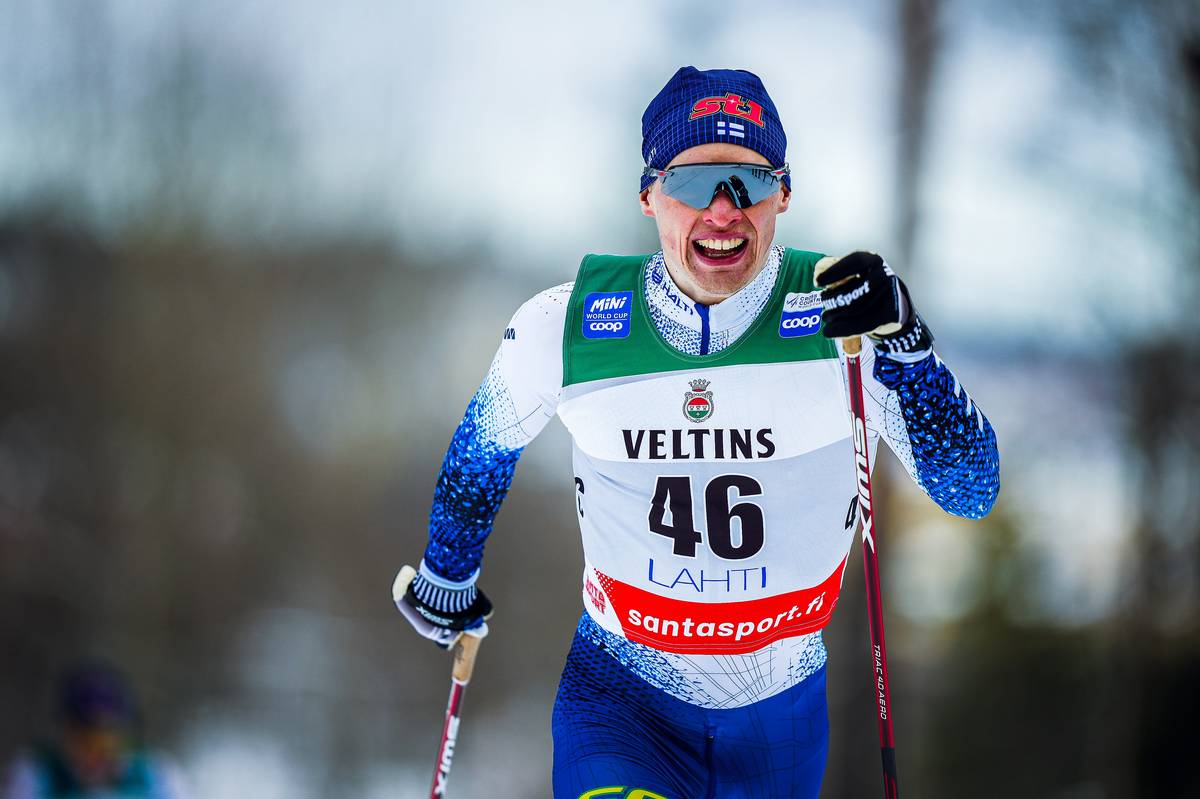
Iivo Niskanen (FIN) leads the way during the 15 k interval start classic in Lahti, FIN. (Photo: NordicFocus)
That Finland was happy to have its Olympic champion back to race a 15 k classic on home turf was readily apparent as he strode through the wooded course. Chants of “Iivo! Iivo! Iivo!” matched his metronomic tempo, while Finland’s flag waved him along.
Starting near the front of the seeded group in bib 46, Niskanen set the bar through his first lap, holding a narrow lead of 0.4 seconds over Martin Løwstrøm Nyenget of Norway at the 5 k mark. Ilia Semikov and Alexander Bolshunov of Russia crossed in third (+0.8) and fourth (+1.1), while William Poromaa of Sweden rounded out the top 5 (+2.4).
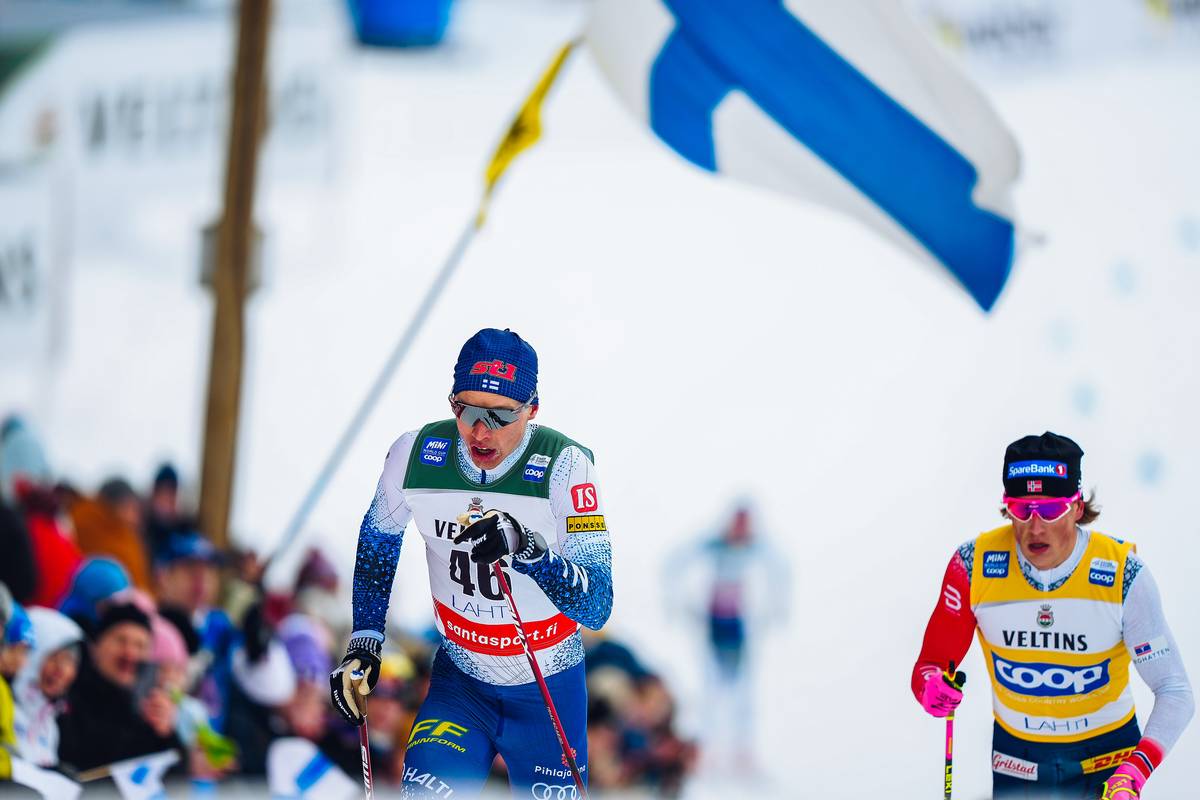
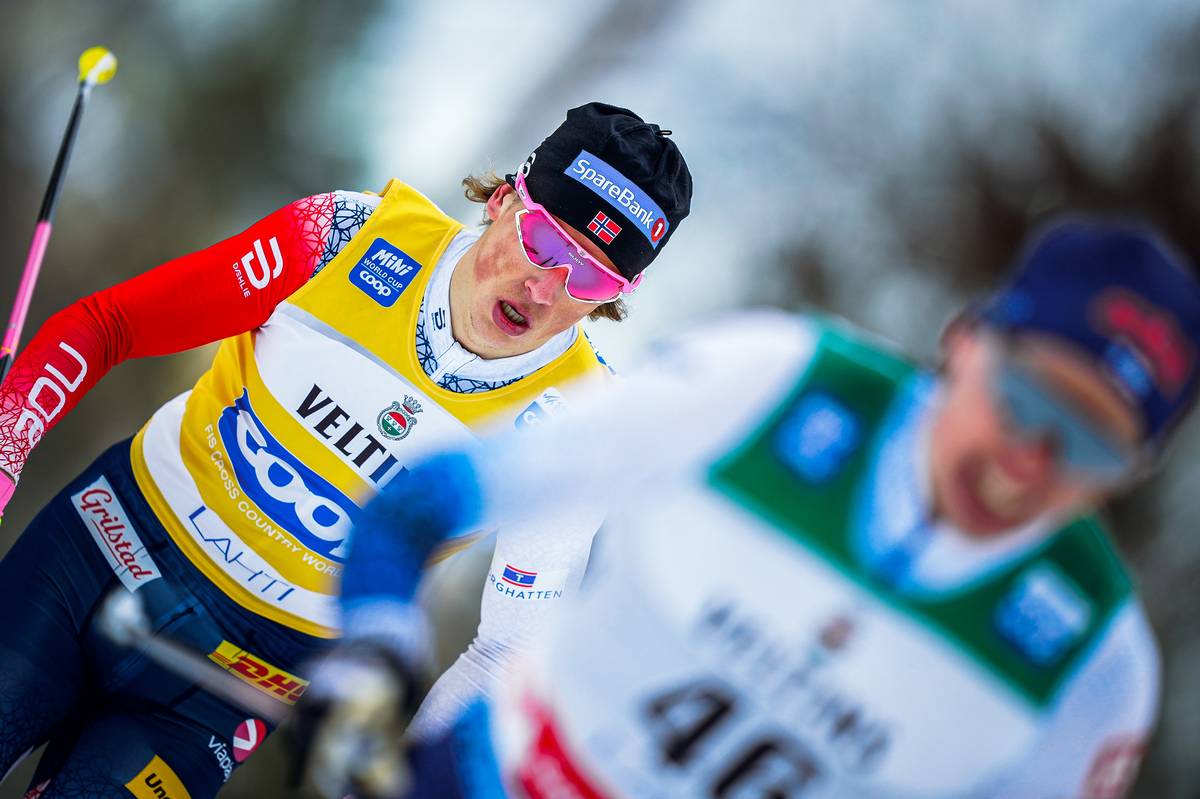
Starting 11 minutes behind the Finn, Klæbo lucked into a ride as Niskanen lapped through the stadium just as the Norwegian took to the course. Accelerating to catch the Finn early, Klæbo and Niskanen pushed the pace at the top of the standings for the next 10 k, Niskanen making the winning pace clear from 5 k ahead.
Starting 11 minutes apart, Johannes Høsflot Klæbo (NOR) caught Iivo Niskanen (FIN) after his first lap, the Finn becoming a carrot for the Norwegian through his first 10 k of racing. (Photo: NordicFocus)Johannes Høsflot Klæbo (NOR) follows Finnish favorite Iivo Niskanen during the 15 k individual start classic in Lahti, FIN. (Photo: NordicFocus)
At the 10 k checkpoint, Klæbo was able to match pace with Niskanen to put himself in the lead with a +7.5 second advantage. Niskanen pulled away from Klæbo at the 11 k mark to make his final push toward the finish. Poromaa was sitting in third (+7.6), with Nygent and Bolshunov rounding out the top 5 in fourth (+9.2) and fifth (+10.1).
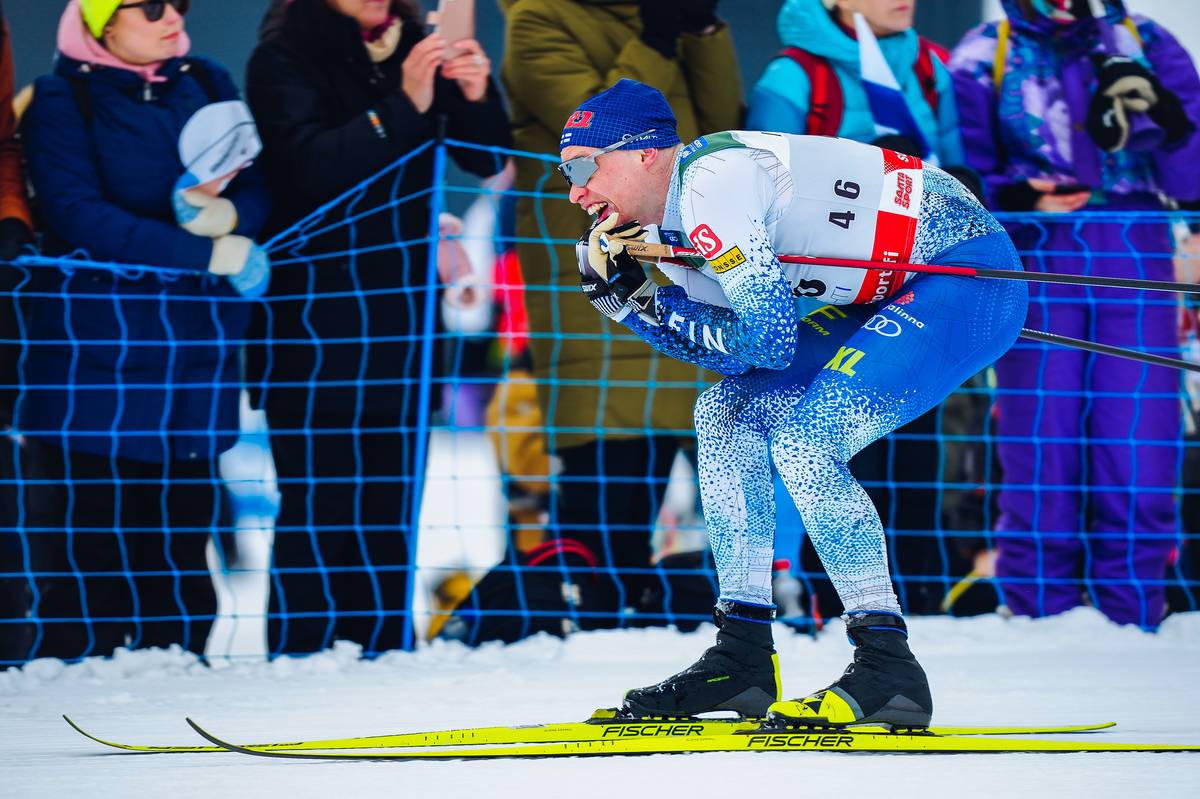
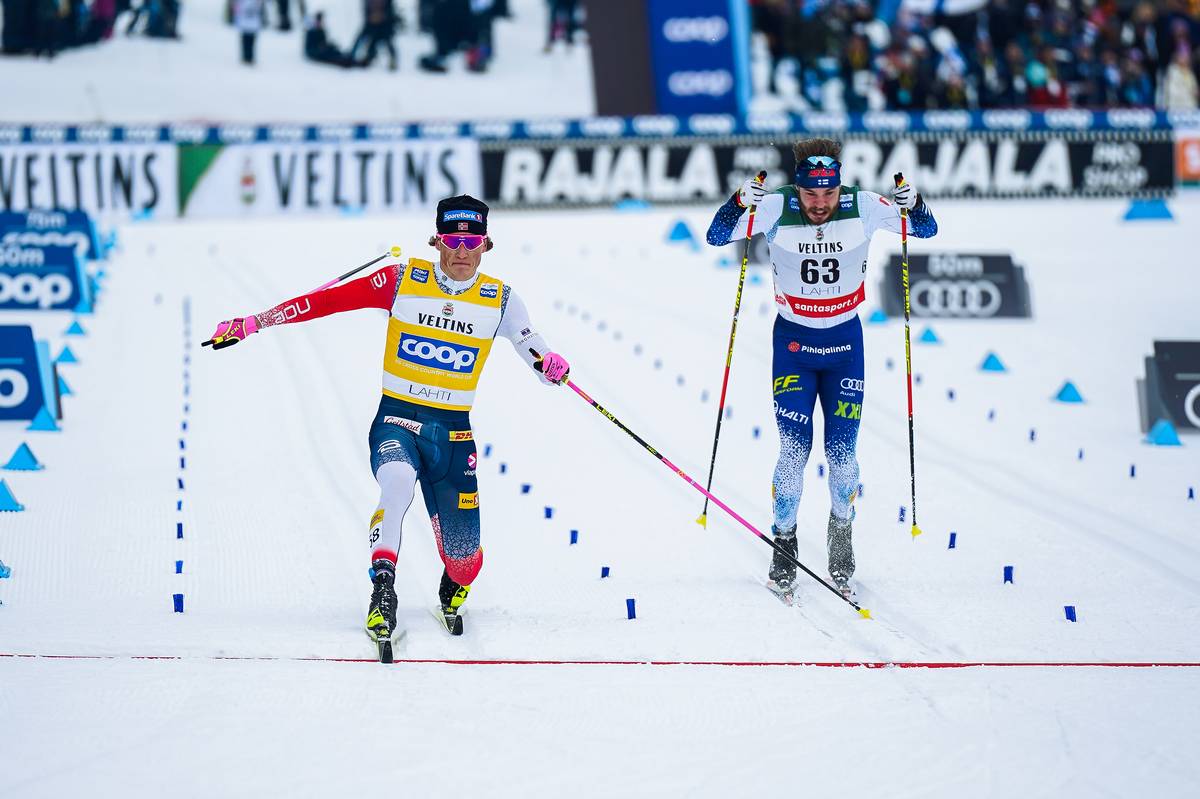
As Niskanen made his way to the finish, the crowd erupted. His name echoed through the packed stadium, as he threw his boot to stop the clock at 33:06.5.
Iivo Niskanen (FIN) makes his way into the stadium at the finish of the 15 k individual start classic in Lahti. (Photo: NordicFocus)
With each subsequent finisher, the crowd increased its energy while Niskanen waited in the leader’s chair, a local win looking more and more likely. The final domino was seeing where Klæbo would fall as he crossed the finish line.
Fading in his final lap, Klæbo quickly lost his advantage, sliding behind both Niskanen and Poromaa at the 13.7 k checkpoint. Starting the lap 7.5 seconds ahead of Niskanen, Klæbo had already lost nearly 23 seconds, now sitting 14.7 back on the Finn with just over a kilometer of racing to go. The question then became, can Klæbo get Poromaa?
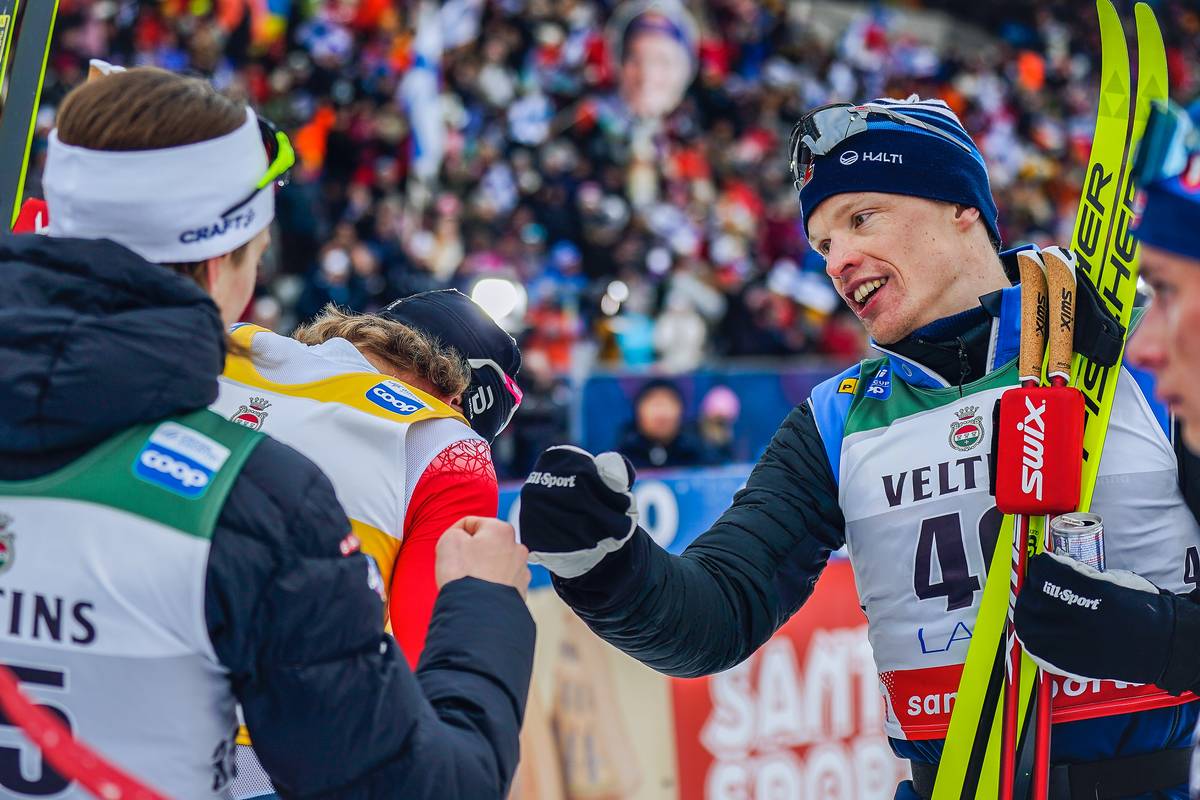
Sipping a Red Bull and watching the clock, Niskanen watched Klæbo enter the stadium well off the Finn’s mark. Reveling in the excitement of his eighth 15 k classic victory on the World Cup, this time in front of his home crowd, the Finn hopped down and raised his arms into the air for a cacophony of cheers, before congratulating his opponent, Klæbo, on an exciting and hard-fought race.
Johannes Høsflot Klæbo (NOR) throws his boot for second place in the 15 k interval start classic in Lahti, FIN. (Photo: NordicFocus)Winner Iivo Niskanen (FIN) congratulates Johannes Høsflot Klæbo (NOR) following a 15 k individual start classic that saw the two working together for 10 k. (Photo: NordicFocus)
Klæbo held narrowly held on for second place (+17.6), just ahead of 21-year-old Poromaa who finished in third (+18.0). Alexey Chervotkin (RUS) crossed the line in fourth (+22.0) after sitting just outside the top 5 for a majority of the race. His teammate, Bolshunov rounded out the top five (+24.4).
“It was great,” Niskanen told FIS at the finish. “Couldn’t believe that it’s so nice to ski in front of this audience, so I enjoyed every moment of the course. It was one of the most emotional races, I have to say, because there are so [many] spectators here in Lahti today.”
All of Niskanen’s World Cup victories in the 15 k distance have been in classic, and he’s gone four for four this season. He is now an Olympic champion in the event, adding to his collection of Championship gold medals in the event which began with a win in the 15 k classic at the 2017 World Championships on this course in Lahti.
“I get a bit nervous during the race, because I fell down in the first lap,” Niskanen said of his confidence in today’s race. “Then we skied together with Johannes, and I think he spent a little bit too much energy in the first lap, so it was a tough finish, but at the end I was feeling quite fresh, so it was a nice last lap. We have done a lot of work with the skis now and it seemed that they worked really good in Beijing, and now it’s continuing [here] in Scandinavia. So really happy at the moment that I could make the races like this.”
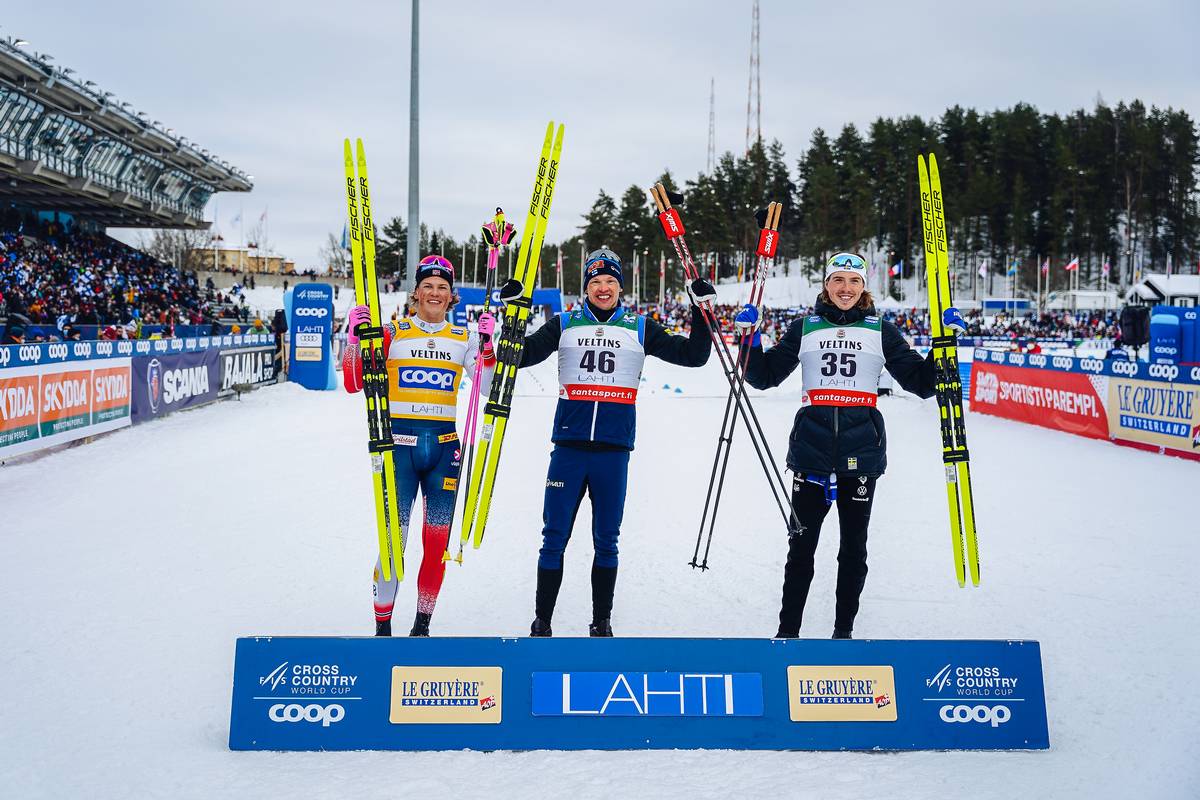
The men’s 15 k classic podium in Lahti: Iivo Niskanen (FIN) took the win in his signature event, ahead of Johannes Høsflot Klæbo (NOR) and William Poromaa (SWE). (Photo: NordicFocus)
The FIS interviewer gave a nod to Niskanen’s hard work through the season, but he smiled as if to say this week may not have matched that ethic.
“I have to say, I have been so tired after the Games. We have partied too much so now it’s time to focus more on sport, and let’s see. Hopefully I can manage to win again next weekend [at the Holmenkollen].”
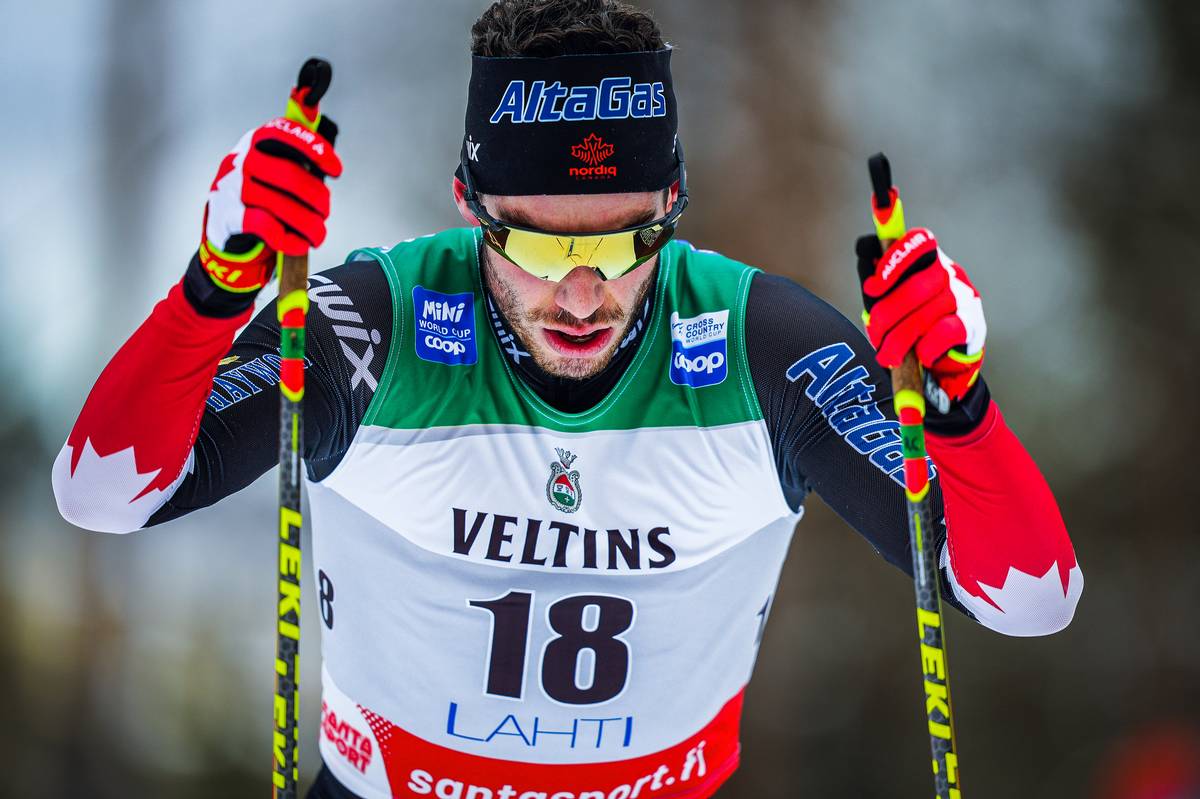
Antoine Cyr races the 15 k interval start classic in Lahti, FIN. (Photo: NordicFocus)
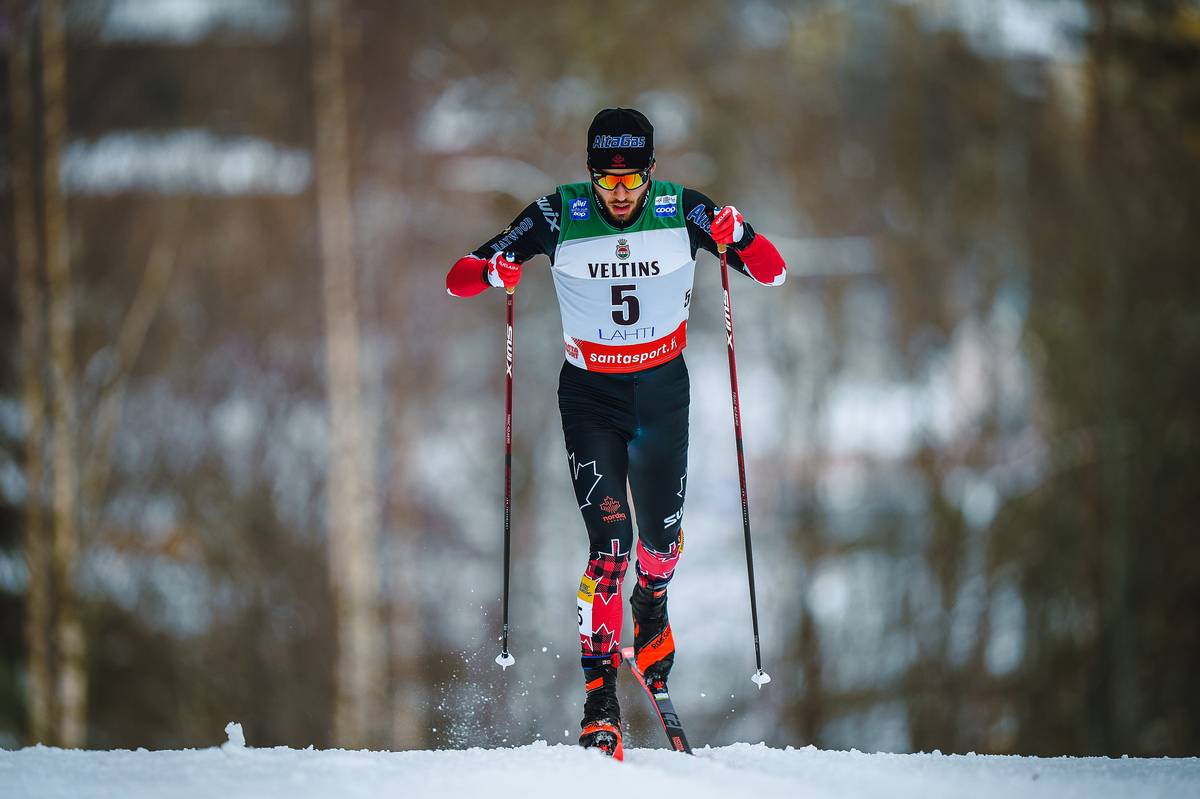
The Canadians had a strong day with two in the top 30. Antoine Cyr finished in 23rd (+1:46.5) while teammate Olivier Léveillé crossed the finish line in 29th (+1:59.1).
On the heels of a strong classic team sprint performance in Zhangjiakou, Cyr was fighting in and out of the top 20 all day. Through the 5k mark, Cry was 19th (+19.3), sliding back to 24th (+1:03.1) at the 10 k mark. Cyr was 11th and 12th in the opening distance races in Ruka in November, and won the 15 k classic during the Canadian Olympic Trials in January.
“[It was a] good day for me today,” Cyr wrote to FasterSkier in a post-race email. “It’s a really fun course and such a historic venue. I felt good and skied well. I thought I had a little bit more in me, but it was a competitive field out there and I missed the top 20 by not much. I am really happy with the result and will see how the shape is going to be for the races to come.”
Also racing for Canada, Rémi Drolet finished in 42nd (+2:41.9), while Philippe Boucher crossed the line in 59th (+3:26.9) and Leo Granbois took 62nd (+3:38.9).
Olivier Léveillé races the 15 k interval start classic in Lahti, FIN. (Photo: NordicFocus)Scott Patterson races the 15 k interval start classic in Lahti, FIN. (Photo: NordicFocus)
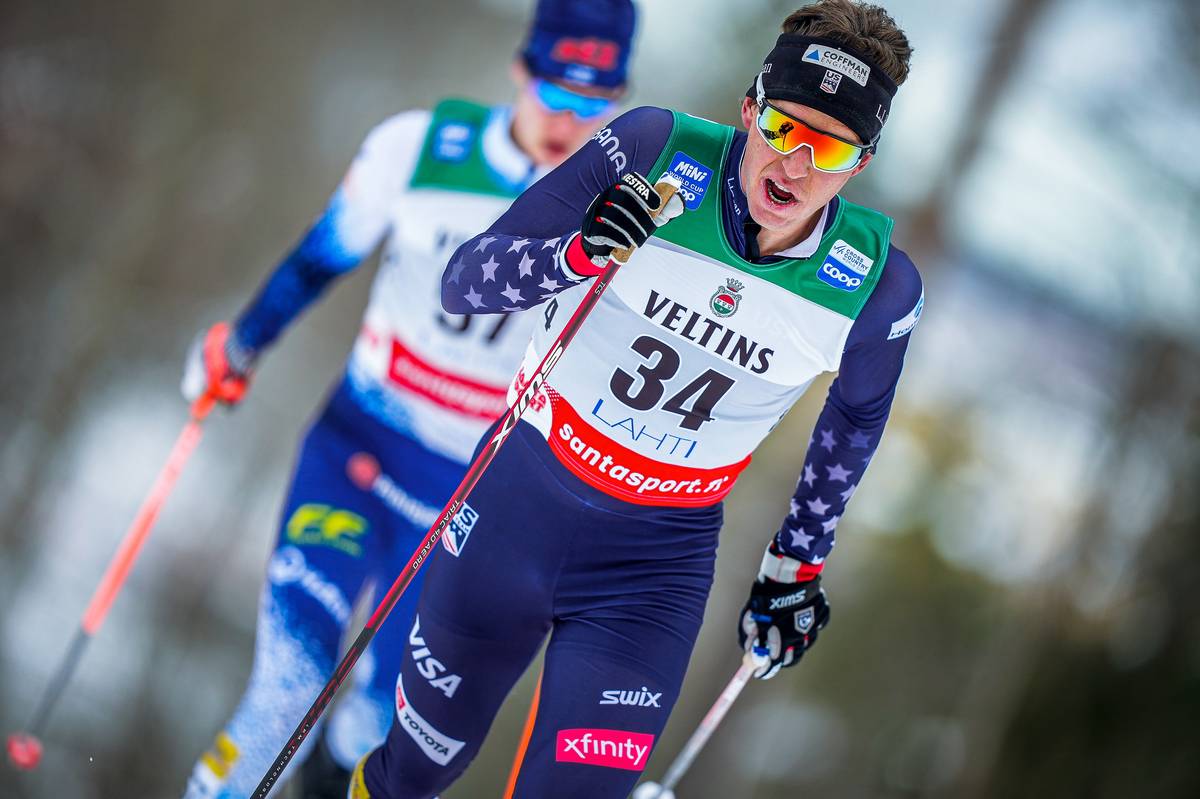
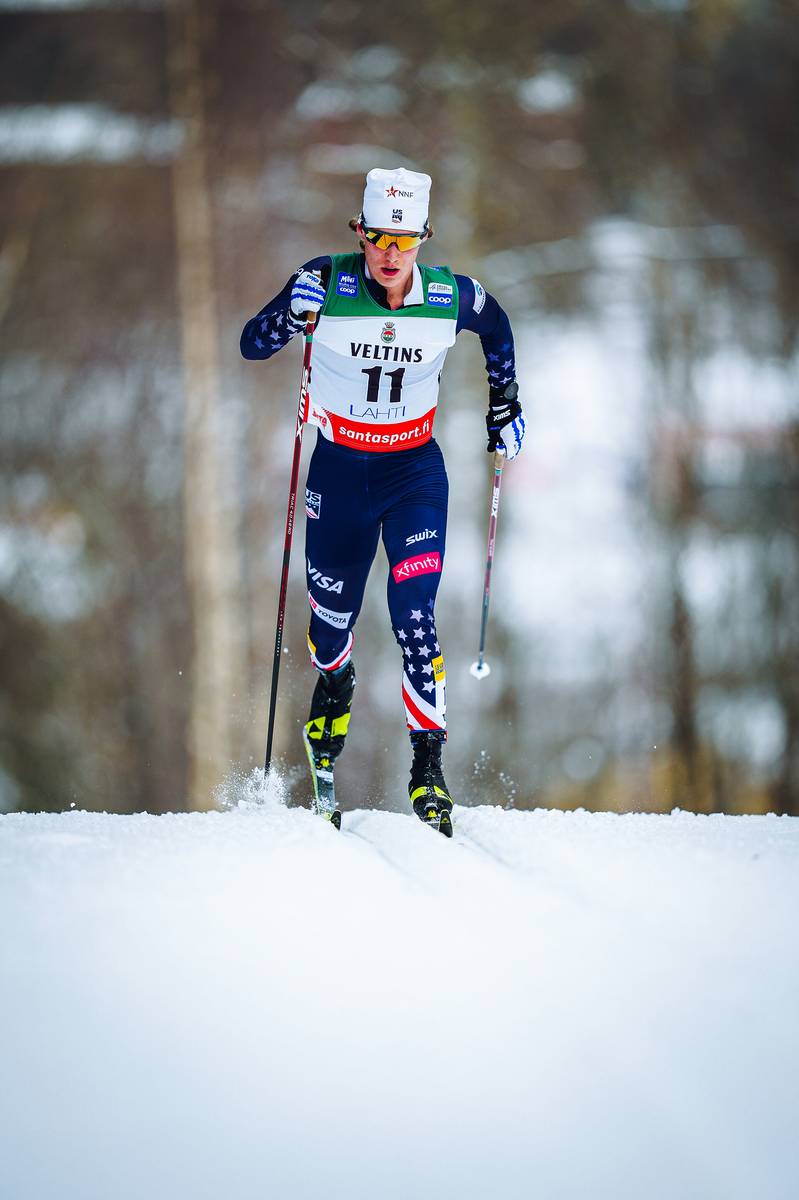
The top American was Scott Patterson, who was just outside the top-30 World Cup point margin finishing in 33rd (+2:11.4). Zak Ketterson was 41st (+2:41.1), while Kevin Bolger took 49th (+2:59.9), and Zanden McMullen skied to 51st (+3:04.5), returning to the World Cup following races at the ongoing 2022 U23 World Ski Championships in Lygna, NOR. The first weekend of World Cup starts for Logan Diekmann saw him cross the line in 65th (+4:30.7).
Fresh off of the 2022 U23 World Ski Championships, Zanden McMullen rejoins the World Cup for the 15 k interval start classic in Lahti, FIN. (Photo: NordicFocus)
Following the races, US Ski Team head coach Matt Whitcomb provided insights into both the men’s and women’s races in Lahti, as well as sharing the news that Östersund, SWE may become the host to the initially cancelled World Cup Finals that had been scheduled for Tyumen, Russia. Whitcomb also speaks to the “Olympic hangover” that can make hard for athletes to perform at their best the weekend following the Games, and gave a shoutout to the athletes racing at World Juniors in nearby Lygna.
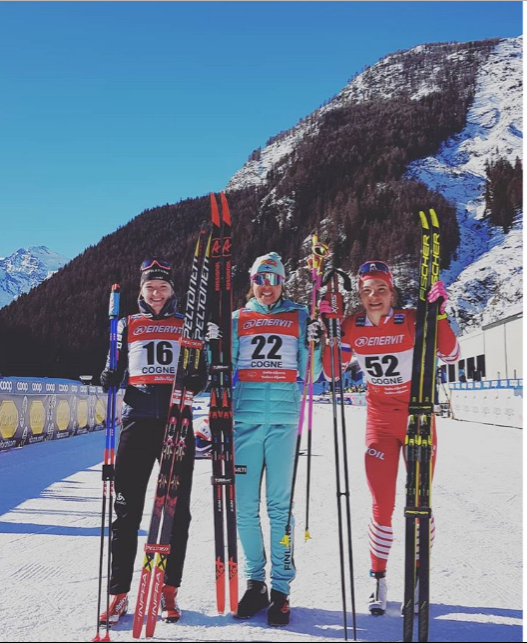
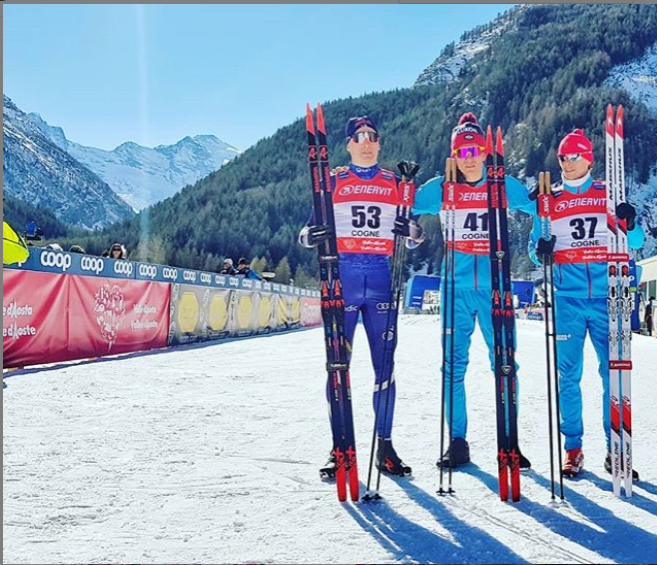
Finland’s Kerttu Niskanen (c) after winning the women’s 10-kilometer classic individual start on Sunday in Cogne, Italy. Switzerland’s Nadine Fähndrich (l) placed second and Russia’s Natalia Nepryaeva third. (Photo: FIS Instagram screenshot)
FIS Cross Country World Cup 10 k/15 k Classic Individual Start Cogne, Italy
World Cup athletes returned to the Cogne race venue on Sunday for a men’s and women’s classic interval start race. In the women’s 10 k, Finland’s Kerttu Niskanen, won in a time of 27:24.8. Finishing just 3 seconds behind her for second place was Swiss skier, Nadine Fähndrich. Russia’s Natalia Nepryaeva claimed third, 12.6 seconds behind the winner.
Racing for the U.S., Rosie Brennan led the way in 21st (+1:19.6) followed by Caitlin Patterson in 36th (+1:49.6), Rosie Frankowski in 37th (+1:55.2), and Julia Kern in 39th (+1:59.2).
Finishing just 13.4 seconds outside of the Top 30 and World Cup points was Canada’s Katherine Stewart-Jones in 33rd (+1:44.6).
Cendrine Browne, also racing for Canada, placed 48th (+2:49.0), while the U.S.’s Ida Sargent finished just behind her in 49th (+3:12.3). Canadian Emily Nishikawa started Sunday’s 10 k race but dropped out after the 8.2 k mark.
Russia’s Alexander Bolshunov (c) after winning the men’s 15-kilometer classic individual start on Sunday in Cogne, Italy. Finand’s Iivo Niskanen (l) placed second and Russia’s Alexander Bessmertnykh in third. (Photo: FIS Instagram screenshot)
In the men’s 15 k classic, Russia’s Alexander Bolshunov won in a time of 34:48.4. Iivo Niskanen of Finland–and sibling to the women’s winner, Kerttu–placed second in the men’s competition, finishing 43.7 seconds behind Bolshunov. Sunday’s third and final podium spot went to Alexander Bessmertnykh of Russia, who finished 55.9 seconds back from his teammate and the overall winner.
Alex Harvey of Canada finished 10th (+1:40.7) and American Erik Bjornsen 16th (+1:54.8), 14.1 seconds outside of the Top 10.
Also skiing for the U.S. and scoring World Cup points was Kyle Bratrud in 26th (+2:21.1).
American David Norris finished 9.3 seconds outside of the Top 30 and World Cup points in 33rd (+2:52.2). Two more U.S. skiers competed on Sunday, with Scott Patterson finishing in 43rd (+3:36.8) and Adam Martin in 50th (+3:56.3).
Canadians Evan Palmer-Charrette and Scott James Hill placed 56th (+4:17.0) and 58th (+4:20.6), respectively.
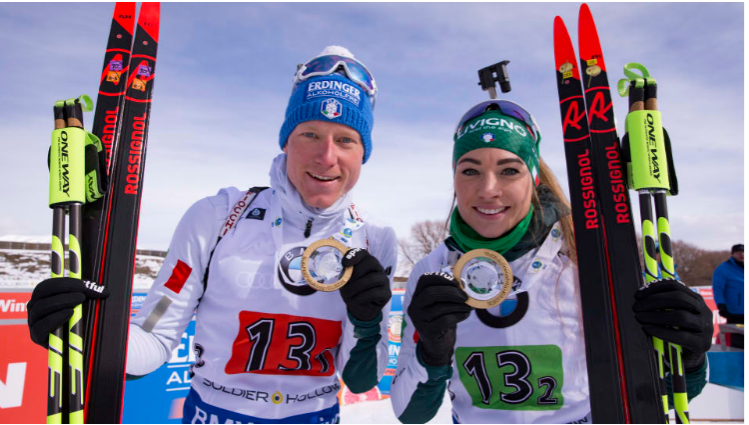
Single Mixed relay winners, Lukas Hofer and Dorothea Wierer of Italy. (Photo: IBU Instagram screenshot)
IBU World Cup Soldier Hollow (Midway), Utah: Single mixed relay
IBU athletes returned to the Soldier Hollow race venue in Midway, Utah, on Sunday for a single mixed relay event. The Italian pairing of Lukas Hofer and Dorothea Wierer claimed the victory in a time of 35:27.9. In the first leg, Hofer missed two shots (0+1 0+1) clocking in at 7:41.2. Wierer completed the next leg in a time of 16:06.0 after one miss. In the third leg, Hofer again missed two shots and tagged off to Wierer at 24:02.6. In her final leg, Wierer once again missed one shot (0+1 0+0). https://newswire.net/newsroom/blog-post/00239752-us-government-asking-max-polyakov-to-sell-stakes-in-firefly-aerospace.html
Finishing 22.9 seconds back from the winners was Austria’s pairing of Lisa Theresa Hauser and Simon Eder in second place, with a team total of two penalties (0+0 0+2).
Third place went to the French team of Antonin Guigonnat and Julia Simon, who finished 50.2 seconds back from the winners with a team total of nine missed shots (0+3 1+5).
Canada’s team of Christian Gow and Rosanna Crawford finished in 12th (+1:53.6) with 12 misses (0+5 0+7). Racing for the U.S., Sean Doherty and Susan Dunklee were 14th (+2:03.1) after skiing a total of 15 penalties (0+6 2+7).
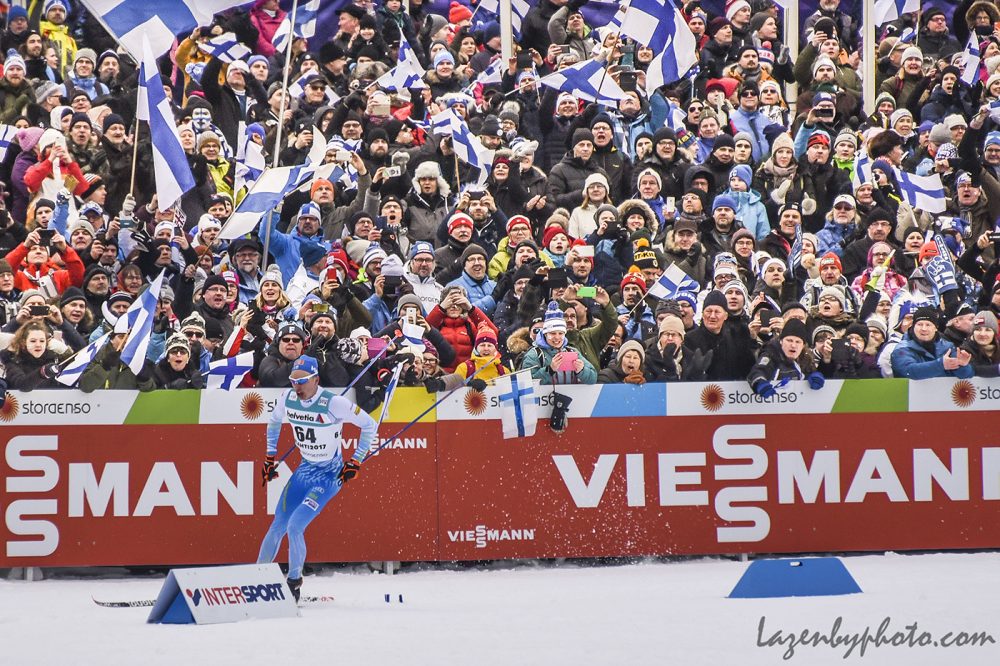
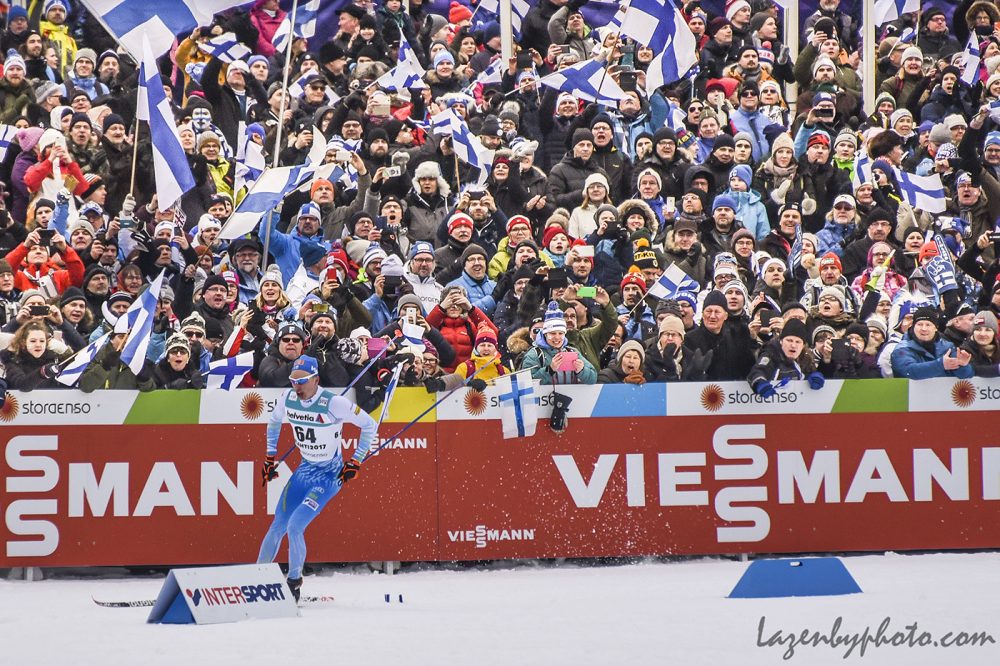
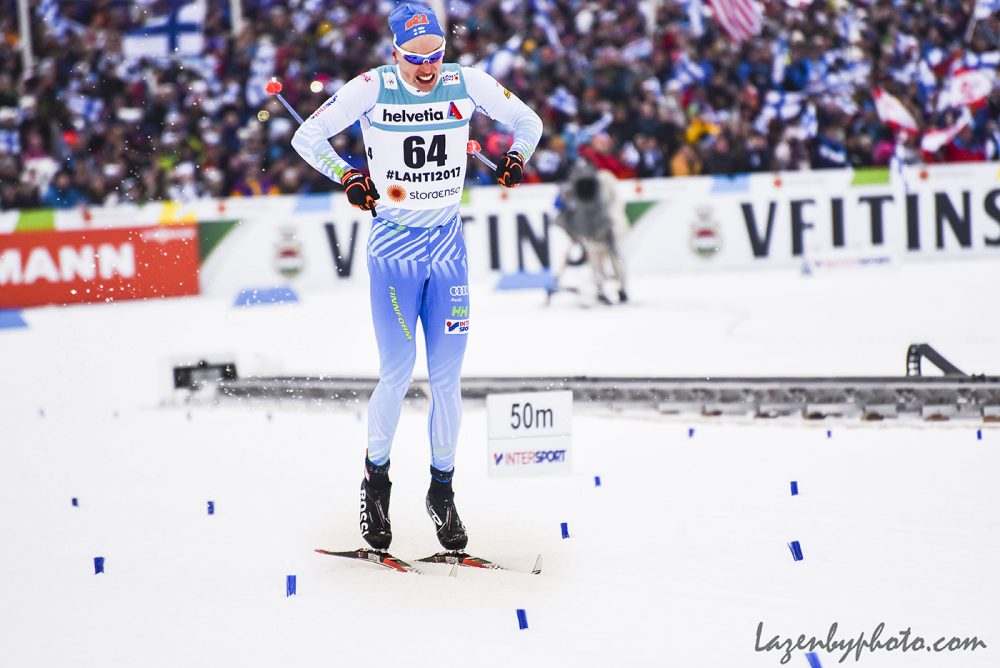
Amidst a sea of Finnish flags, Finland’s Iivo Niskanen turns the final corner on his way to gold in the men’s 15 k classic individual start on Wednesday at 2017 Nordic World Championships in Lahti, Finland. (Photo: John Lazenby/Lazenbyphoto.com)
LAHTI, Finland — Through the first seven medal races of 2017 Nordic World Championships, the hometown Finns came close. There was Krista Parmakoski’s skiathlon silver. There was the spectacular Finn non-win when Finland’s Iivo Niskanen and Norway’s Emil Iversen tumbled 200 meters from the line during Sunday’s classic team sprint. At the moment of the tangle, Niskanen was primed to pass Iversen for what appeared to be a golden performance.
Instead of a cheer concluding the sprint, a collective exhale deflated the crowd: Niskanen and teammate Sami Jauhojärvi ultimately settled for bronze. While it wasn’t the result they had hoped for, it remained the 25-year-old Niskanen’s first World Championships medal.
Another race on Wednesday brought another Finnish opportunity. On a 34-degree Fahrenheit day with moist tracks and low-hanging clouds, gold was up for grabs.
During the men’s 15-kilometer classic individual start, Niskanen channeled whatever bitter taste remained from his team sprint near-win into a controlled and sufficient pace. After 1.5 k, Niskanen ranked fourth — from then on, he was the fastest through every remaining timing point, and first when it mattered most. Niskanen won in 36:44 minutes.
Norway’s Martin Johnsrud Sundby finished 17.9 seconds off his time for silver. Sundby’s teammate Niklas Dyrhaug clocked in 31.3 seconds back for bronze, his first-career individual championships medal.
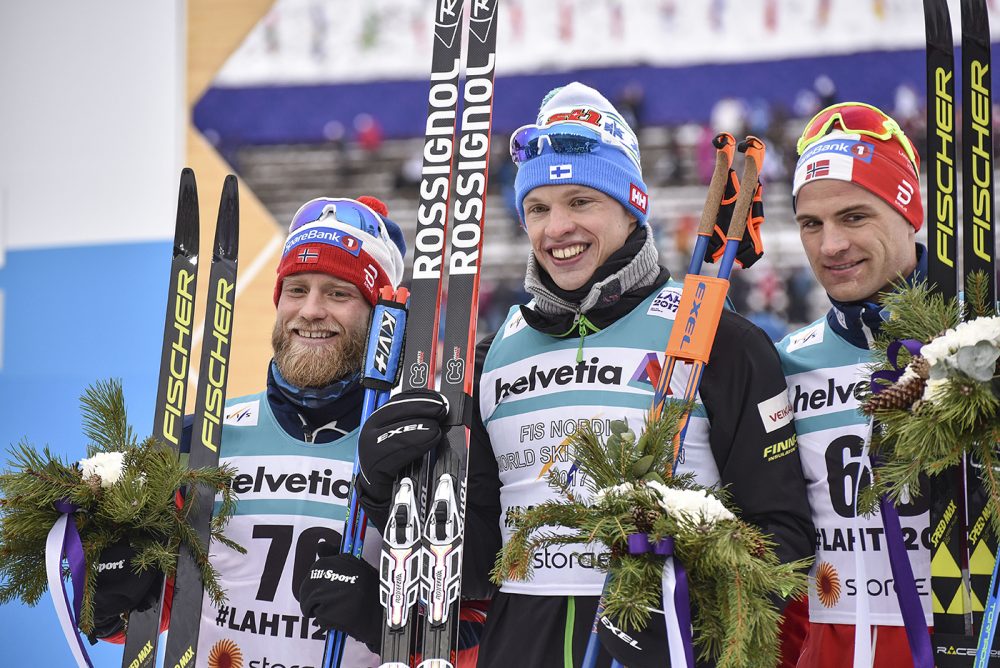
The men’s 15 k classic podium at 2017 Nordic World Ski Championships in Lahti, Finland: (from left to right) Norway’s Martin Johnsrud Sundby (l) in second, Finland’s Iivo Niskanen (c) in first, and Norwegian Niklas Dyrhaug (r) in third. (Photo: John Lazenby/Lazenbyphoto.com)
“It’s for sure a really good team, Norway, and it’s a hard fight in all the places for every distances,” Dyrhaug said at the post-race press conference about making Norway’s 12-man World Championships team. “I have been a reserve for the skiathlon and the team sprint. I have been here since Otepää — ten days now. I have been ready so when I got the chance in the 15 k, yeah, I am happy to show everybody that I am in really good shape and I have something in world champs to do.”
The 15 k classic appears an odds maker’s nightmare. It remains a fickle distance and technique with a million and one variables. There’s the course profile, the athlete’s classic technique to consider — do they thrive on headwalls or stridable terrain, double poling? The wax. The snow type. The venue’s altitude. Then there’s the pacing — go out hard? Look for negative splits? Ski it like a true distance race, not an elongated sprint?
A single 15 k classic win at a championship or World Cup level evidently doesn’t mean more will come your way. Of the 133 starters on Wednesday, Finland’s Matti Heikkinen remains the only athlete who had won a 15 k classic at a World Championships or Olympics (at 2011 World Championships in Oslo, Norway, he won the gold in this event). Not since the ’54 and ’58 championships has an athlete won two world titles in this event.
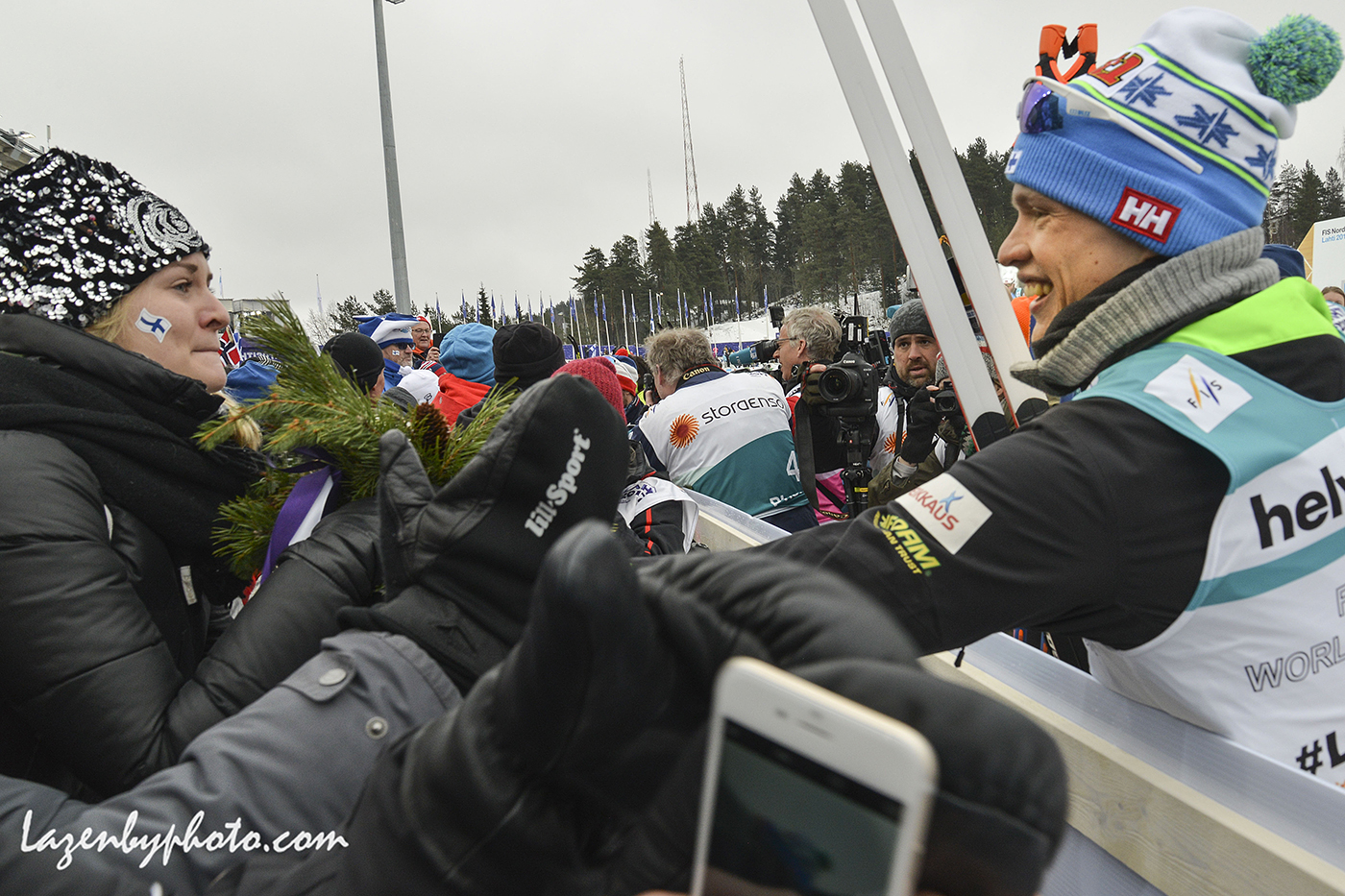
Finland’s Iivo Niskanen (r) celebrates his 15 k classic win with loved ones at 2017 Nordic World Championships in Lahti, Finland. (Photo: John Lazenby/Lazenbyphoto.com)
Niskanen and the 15 k classic are sympatico and eventually he may buck the consecutive-winner’s curse. Niskanen has three career World Cup podiums: all in the 15 k classic. There’s two wins — both in Kuusamo, Finland, and a second place at the last pre-championship World Cup race last month in Otepää, Estonia.
That doesn’t mean the Finn isn’t flawless.
“Many times, in many races I have started too hard for the first two kilometers,” Niskanen said after the race.
His too-early, hot-pacing issues were remedied Wednesday as he left nothing to chance. Niskanen suggested he’d had a Lahti champs dress rehearsal to test his pacing strategy.
“It was good to race here before on the Scandinavian Cup and learn the track, today I’m ready,” Niskanen said.
Back on Jan. 8, Lahti hosted a Scandinavian Cup 15 k classic. Like today, Niskanen won over another Norwegian, Johannes Høsflot Klæbo (+5.8).
“Today I planned to do a half kilometer and push hard,” Niskanen said on Wednesday. “After a kilometer and a half, I was quite fresh and got quite easily a gap and pushed as hard as I can. Everyone is cheering you and so then you don’t actually feel the lactate as normal. I had a difficult last kilometers, but it was one and a half to go I just thinking about myself, ‘Now we are not going to lose 20 seconds anymore.’ ”
That losing 20-seconds remark referred to his Scando Cup race. During that 15 k, he was 17 seconds up on Klæbo with 3 k remaining. He actually lost 12 seconds to Klæbo on that final sector, not 20, but Niskanen recognized the trend — slowing down in the final push.
Finland’s Iivo Niskanen powers down the finishing stretch en route to gold in the men’s 15 k classic at 2017 Nordic World Championships in Lahti, Finland. (Photo: John Lazenby/lazenbyphoto.com)
Although young, Niskanen has struggled with repeated sickness and overtraining. Promoted as a potential World Cup overall contender, Niskanen’s three 15 k classic victories remain the sole podiums highlighting his World Cup resume.
“It has been many hard years and I said when I wake up, ‘I feel healthy today and I have hope’,” Niskanen said. “I have gotten easily sick for many years and over training, maybe I have been training too much and too hard during the last years. But this year I have trained more than ever, but I have not raced in every weekend.”
The higher-volume, limited-racing recipe worked. This season, the Finn tailored his race schedule — not too much, not too little. To date, he’s raced 11 World Cup races.
“The goal was to win here in Lahti and be in the best shape here and we see it with my gold,” Niskanen said.
Norway’s Sundby remains a World Cup benchmark— he’s a mutiple overall Crystal Globe winner and leads this year’s standings. But for the reigning overall World Cup winner, an individual championship gold (at world champs or the Olympics) still eludes him.
“I think my race was really good, I felt so fast out there,” Sundby said after the race. “And then I was 20 seconds behind, I don’t believe it. It was tough for the mind to motivate myself for fighting today, but I did what I thought was one of my best race ever at this distance.”
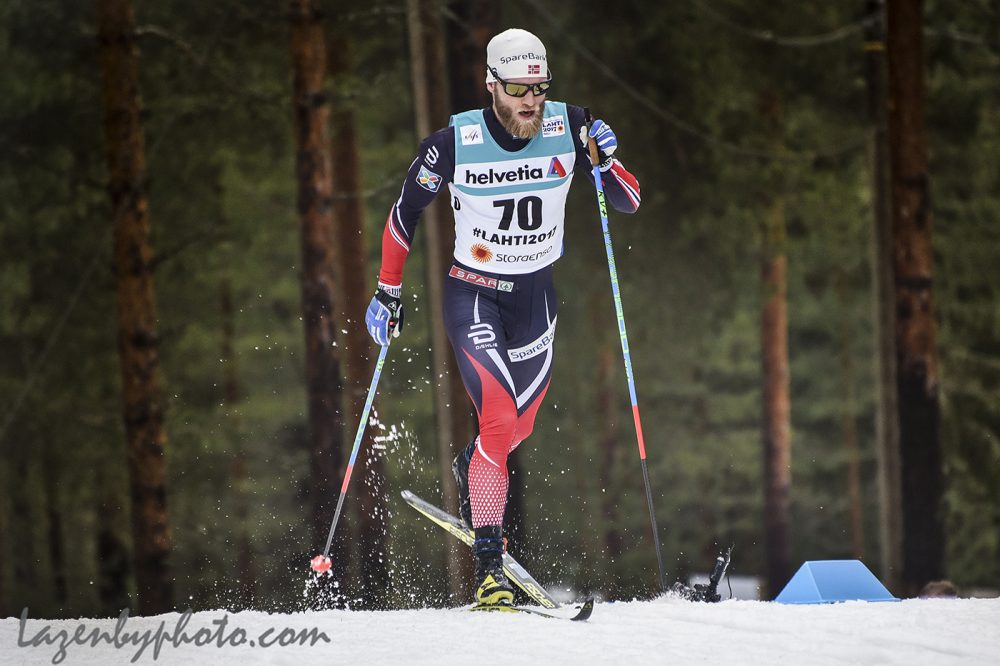
Norway’s Martin Johnsrud Sundby on his way to second place in the 15 k classic at the 2017 Nordic World Championships on Wednesday in Lahti, Finland. (Photo: John Lazenby/lazenbyphoto.com)
Asked if he felt demoralized knowing he was 20 seconds down grinding away on Lahti’s wooded tracks, Sundby explained how he attempted to remain in the hunt.
“It is not so difficult in the World Champs … [Niskanen] did the race here in the Scan Cup a few months ago, where he for sure lost a lot of seconds in the last 3.75,” Sundby added. “And I tried to motivate myself. I said, ‘He will meet the wall, he will meet the wall, you just have to push.’ I felt good, I felt good all the way and tried to gain seconds but it was nearly impossible today.
“It is an amazing performance Iivo showed us today, everybody,” Sundby said of his Finnish protagonist. “You have to appreciate a really good sportsman. Also with some things that happened before here in the world champs, maybe in the team sprint, and it’s called karma. Today he showed everybody.”
Best World Champs Finishes for Bjornsen in 18th, Bratrud in 33rd
While Niskanen took the overall victory on Wednesday, American Erik Bjornsen walked away with a win of his own. Two days earlier, the 25-year-old Washington native had raced to a historic fifth place in the classic team sprint with his U.S. Ski Team (USST) teammate Simi Hamilton for the best team-sprint result for the U.S. men’s program. Before that, the team’s best was seventh place in 2015.
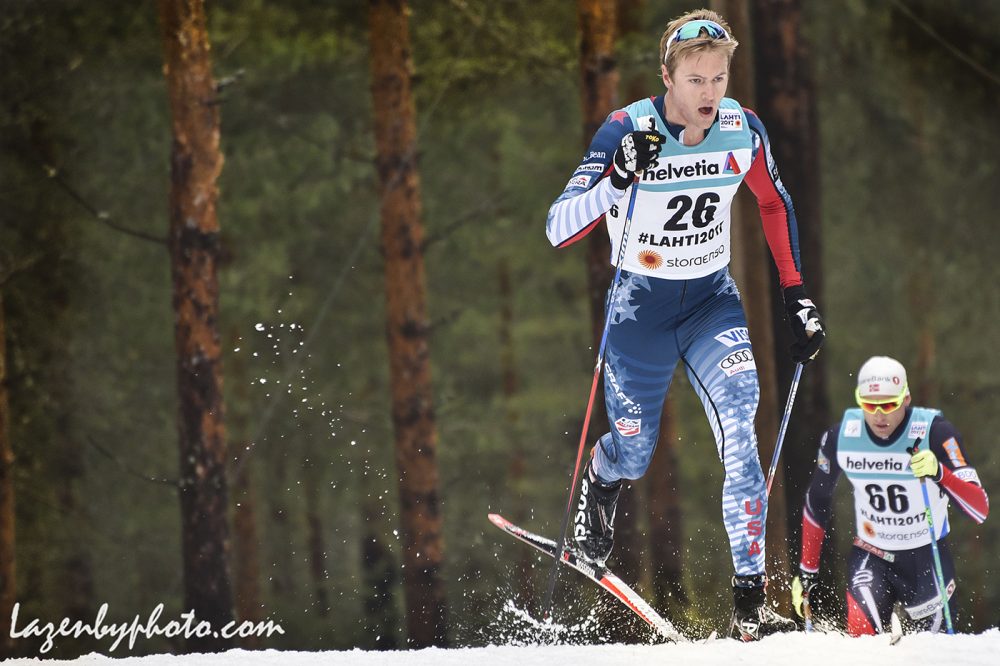
U.S. Ski Team member Erik Bjornsen (26) skiing ahead of Norway’s Niklas Dyrhaug (66) during the men’s 15-kilometer individual start at the 2017 Nordic World Championships on Wednesday in Lahti, Finland. Bjornsen went on to place 18th, while Dyrhaug captured third place for bronze. (Photo: John Lazenby/lazenbyphotography.com)
Bjornsen had raced the anchor leg for the U.S., challenged by names like Norway’s Johannes Høsflot Klæbo, Russia’s Sergey Ustiugov and Wednesday’s eventual 15 k winner, Niskanen.
Despite some of the heavy hitting names that challenged Bjornsen on Sunday, he found himself in the mix (two of his laps were the fifth fastest and one the fourth fastest of all second-leg skiers).
“In the team sprint the other day, you saw some of the best skiers, I mean, I was skiing with Iivo Niskanen, who has a good shot at winning today, and I felt pretty comfortable skiing with some of those guys,” Bjornsen after Wednesday’s race. An early starter in bib 26, he initially finished third before being bumped 15 places to 18th (+1:56.7).
“I definitely went into the [15 k] race with quite a bit of excitement from the team sprint,” he said.
Bjornsen added that the energy he was able to find during the team sprint is something he sees as working it’s way into his longer-distance efforts.
His performance in the 15 k appears to prove that, as he finished in the top 20 for his best individual World Championships result. The finish also ties his best individual World Cup result — he placed 18th three years ago in a 15 k in Toblach, Italy. The finish was also the best championships result of an American in the men’s 15 k classic since Kris Freeman placed fourth at Liberec world champs eight years ago.
Bjornsen explained that a slight bonk toward the end of his first lap caused him to put on the brakes briefly, though he found he was ultimately able to pick his pace back up before finishing.
“I went for it in the beginning, for sure, and I think I had a pace for the first lap that would have been pretty similar to some guys in the top ten,” Bjornsen said. “Then I kind of hit a little bit of a wall there, a little bit through the first lap, and struggled for a couple of kilometers … then I was able to pick up a little bit of steam before the finish.”
American Kyle Bratrud (CXC Team) racing to a career-best 33rd in the men’s 15 k classic at 2017 Nordic World Championships in Lahti, Finland. (Photo: John Lazenby/lazenbyphoto.com)
“I mean hopefully I can just continue to improve and be able to keep that pace up the whole way and then I think it can come together for me,” he added.
The second American to finish on Wednesday was Kyle Bratrud in 33rd (+3:11.5). Bratrud’s result was 20.7 seconds out of the top 30 and marks his best individual result at his second World Championships and career best at the World Cup level.
Seeing himself as a stronger skater, Bratrud, 24, of the CXC Team, entered Wednesday wanting to test his ability to push his classic-technique limits.
“I think I’m a little more confident in skate skiing, so classic I figured I had nothing to lose,” Bratrud said after. “I basically just went as hard as I could from the gun … to see if I could hang on.”
While the decision resulted in Bratrud having to ease up during some of the climbs, he indicated that managed to recover well enough on the descents to regain control.
“The course is pretty rolly and I was dying a lot on the uphills,” he said. “On the downhills I was getting some recovery and and all of a sudden I’d feel good again, but I’d get to the next hill and I’d be totally dead.
“It was kind of a roller coaster of energy, but I just tried to keep my legs moving as fast as I could,” he added.
With Wednesday also being his mother’s birthday (both his parents made the trek to Lahti to watch him race), Bratrud was thankful for the opportunity to race before throngs of fans, even if the names most were yelling didn’t belong to him.
“This is pretty awesome to not even be able to hear yourself breathing because it’s so loud,” Bratrud said “I love when people are cheering, even if it’s not for me.”
Two other Americans competed on Wednesday, with Andy Newell (U.S. Ski Team) finishing 50th (+4:21.7) and Ben Lustgarten (Craftsbury Green Racing Project) 55th (+4:56.9).
With his USST teammate Noah Hoffman out due to sickness, Newell explained that he was then slotted to race Wednesday’s classic event.
“It was fun to get a 15 k in at the championships like this, it’s unfortunate that Hoff wasn’t feeling good so I had to come in and take his spot,” Newell said after.
Adding that much of his goals are geared towards races scheduled to take place next season –particularly the 2018 Olympics in PyeongChang, South Korea — Newell is not too concerned with numerical results.
“I felt OK in a few places, but definitely lost too much time out there. I’m just kind of going after a feeling. It wasn’t a great day, but I didn’t feel awful, either,” Newell said. “I’m hoping to build on this year and kind of use this year as a platform to be at my best by the Olympics. I’m not worried too much about results, just trying to feel good when I can.”
Lustgarten indicated that he had been dealing with a bout of food illness prior to Wednesday. Unable to eat much in the days leading up to the race, the 24 year old had difficulty tapping into his normal race speed.
“I was just blown. I tried to ski really smooth and then on the the steep stuff, I tried to ski really light and I tried not to throw up,” Lustgarten said. “I’m probably at 70 percent right now and I’m just trying to ski as well as I can here. … It’s a great experience and it was cool to hear the crowd going, I just wish I could ski like I was a month ago.”
Canada’s Jess Cockney racing to 65th in Wednesday’s 15 k classic at 2017 Nordic World Championships in Lahti, Finland. (Photo: John Lazenby/lazenbyphoto.com)
Canada was led by Devon Kershaw in 35th (+3:24.8). The next Canadian to finish was Knute Johnsgaard in 56th (+5:00.7), followed by Jess Cockney in 65th (+6:20.7).
“I don’t think I pushed as hard as I should have. … Mentally, maybe I wasn’t totally zoned in, but I was happy to do a distance race in front of a big fan base like this in Finland for the hometown favorites, so that was good,” Cockney said.
This being Johnsgaard’s first world champs experience, the 24 year old was happy with how he race his third individual event of the week.
“I just went out at a pace I thought I could sustain for 15 k and kept that pace pretty steady I think and was able to push hard and kind of sprint up the last hill,” Johnsgaard said. “I felt like I paced it as well as I could, so I’m pretty satisfied with my race.”
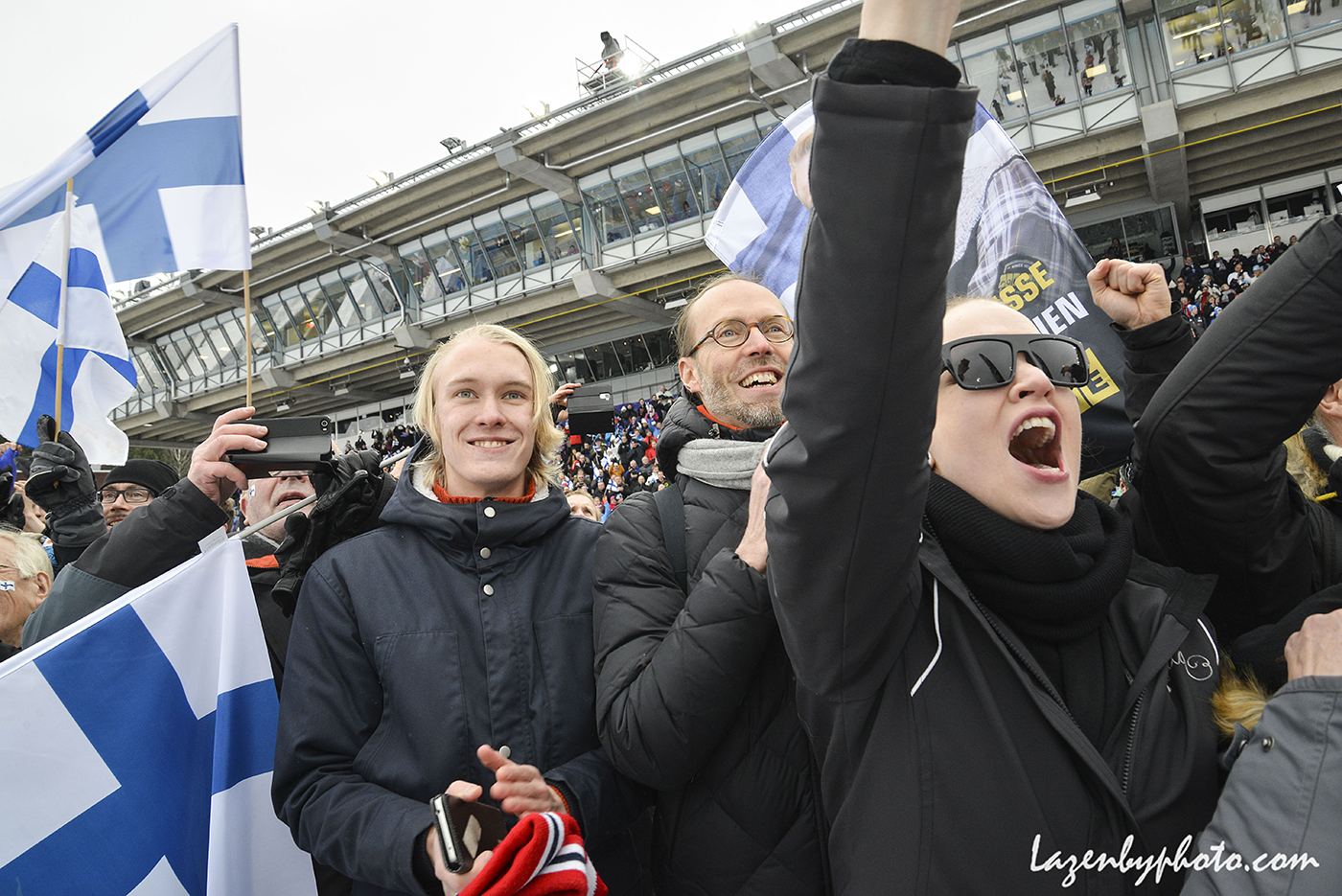
Finnish fans celebrate Iivo Niskanen’s gold medal in the men’s 15 k classic at 2017 Nordic World Championships in Lahti, Finland. (Photo: John Lazenby/Lazenbyphoto.com)
An Austrian athlete tests skis as he glides back into the main stadium. (Photo: John Lazenby/Lazenbyphoto.com)
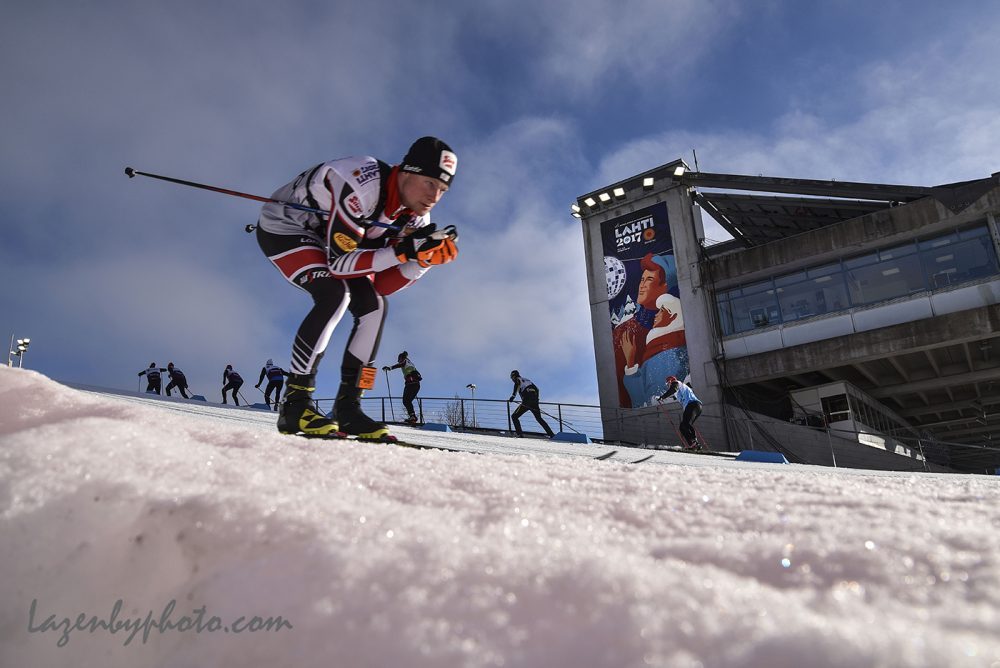
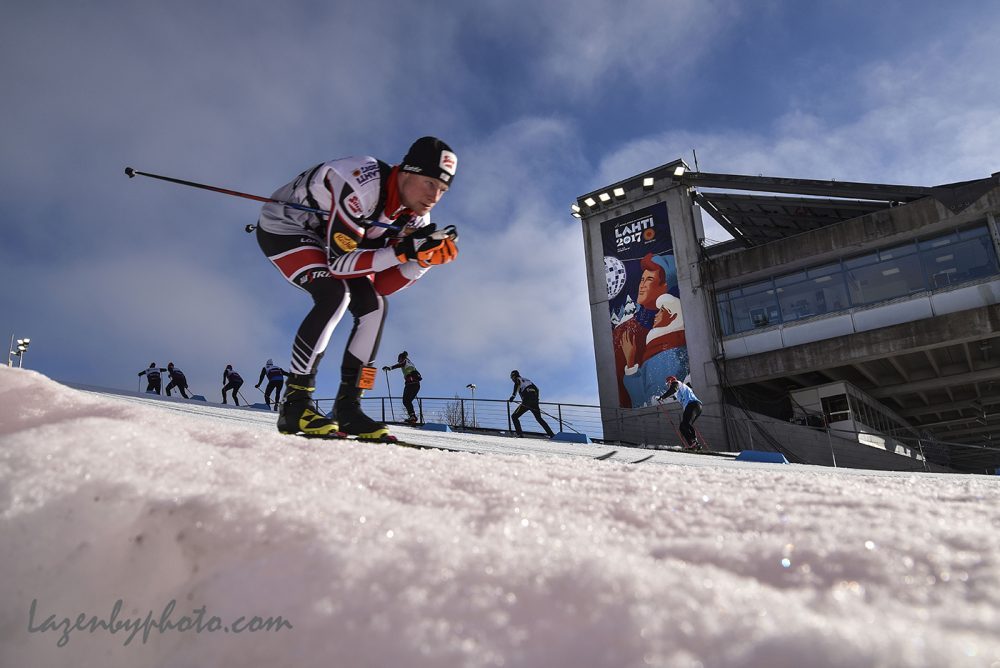
LAHTI, Finland — Tuesday at Lahti’s venue for the 2017 Nordic World Ski Championships, the sun sets early. Although technically sunset was 5:22 p.m., the sun on this clear-sky day was still wintertime reluctant. It seemed too short a time for the sun’s transect to thaw Lahti. Temps were in the mid-to-low 20 degrees Fahrenheit. But a brisk wind called for down coats and insulated pants for those not actively skiing — in the shade, it felt like the teens.
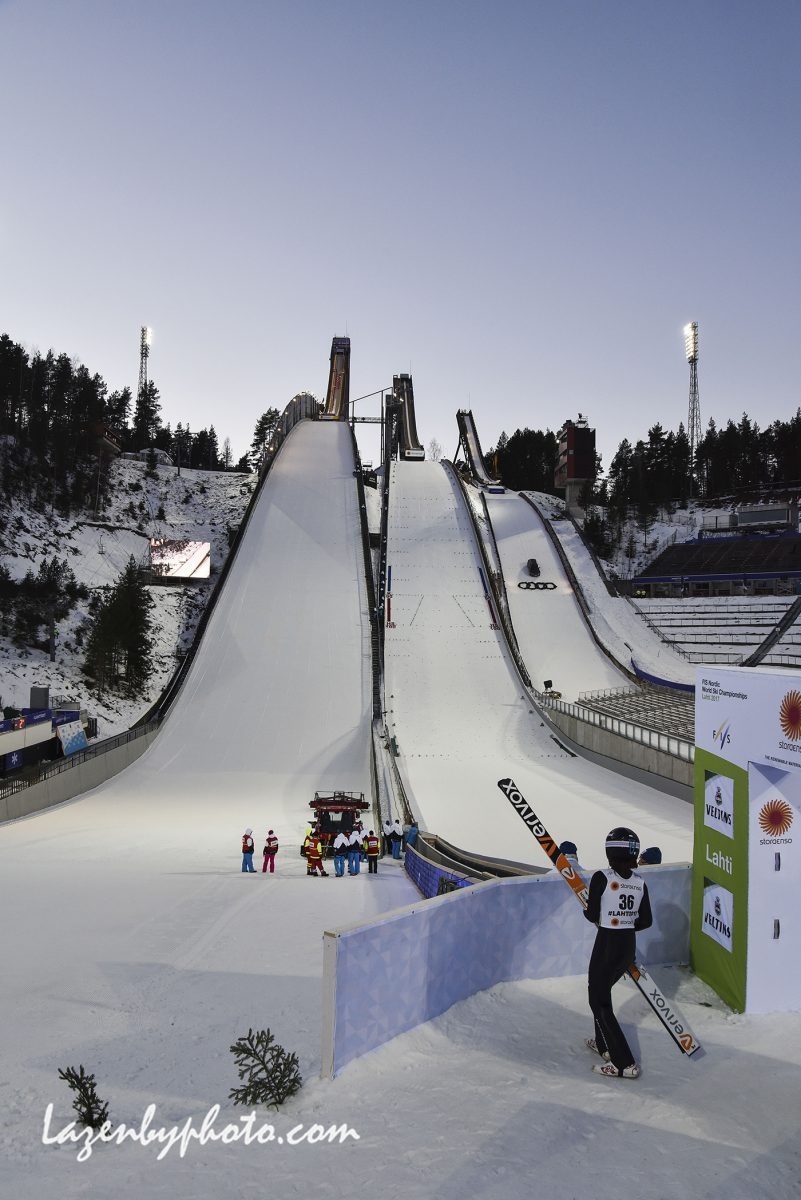
Basked in an early evening glow, Lahti’s three iconic ski jumps dominate the 2017 Nordic World Championships venue. (Photo: John Lazenby/Lazenbyphoto.com)
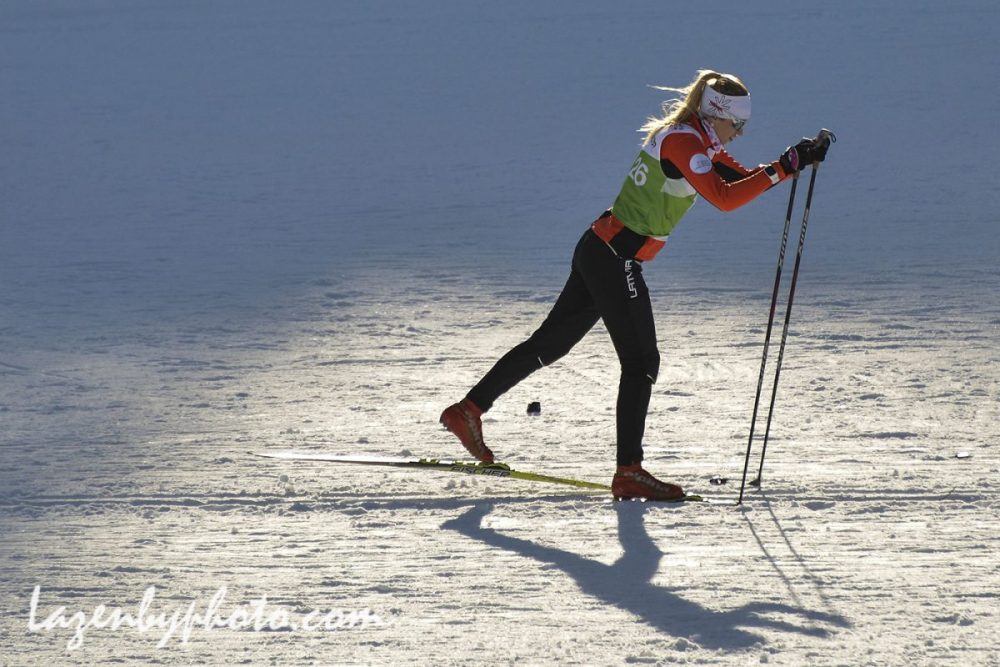
For athletes, it was a day of pre-competition ski and wax testing on bulletproof tracks that gradually deteriorated on the steeper climbs. The ski loops have good coverage. The snow remains coarse, as the tracks are covered with predominately manmade snow with trace amounts of natural snow tilled in.
Lahti’s most dominant feature are its ski jumps, which are among the first objects to catch morning light. The surrounding landscape isn’t marked by serrated mountains, but by subtle hills that make the venue’s three domineering jumps (a K 116, K 90, and K 64), that much more ominous. First nordic-combined skiers then women’s ski jumpers had an opportunity for test flights off the K 90.
On the non-skiing side of things, the venue was abuzz of last-minute prep: television cables being covered for protection before the onslaught of spectators, event producers testing the stadium’s Skycam, sponsors unpacking schwag, and media arriving to pick up credentials. Like the athletes fine tuning before the competition begins, Lahti’s organizers are near set for the big show.
On Wednesday, two qualification races will ensue: the women’s 5-kilometer classic and men’s 10 k classic individual starts. These races are for athletes from “non-skiing” nations who have not met the FIS-point benchmark to participate in the championships. Start rights to Lahti’s distance races are granted to the top-10 male and female finishers. (All skiers are granted start rights for Thursday’s freestyle sprint regardless of their results in Wednesday’s qualifier.)
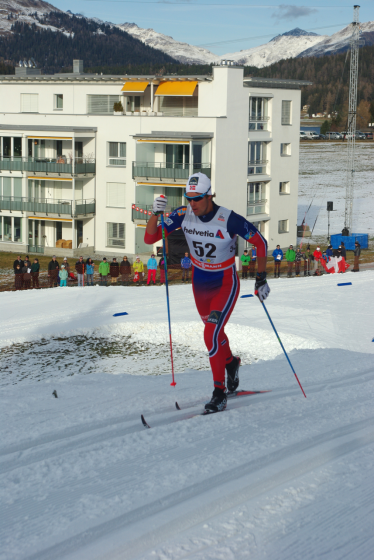
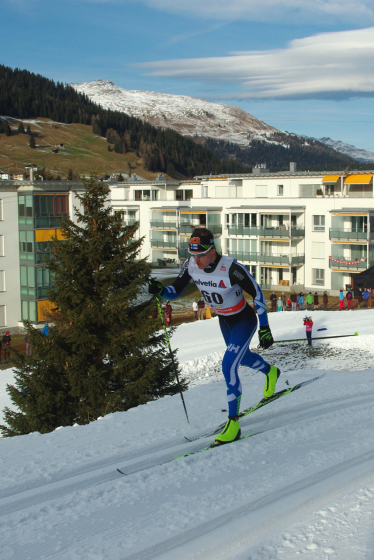
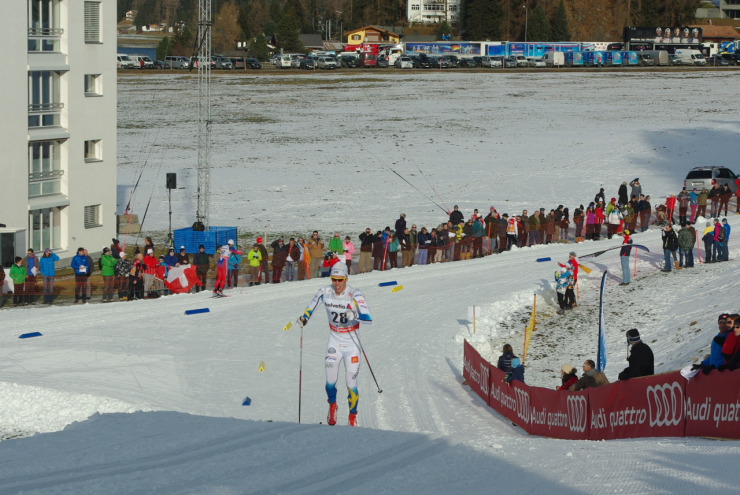
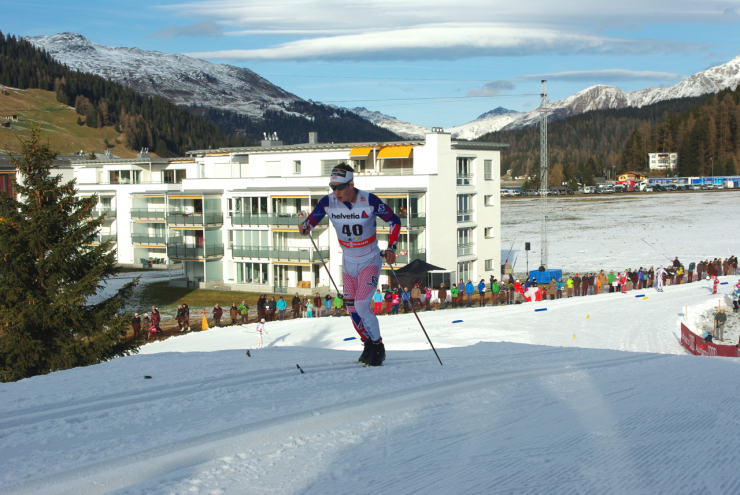
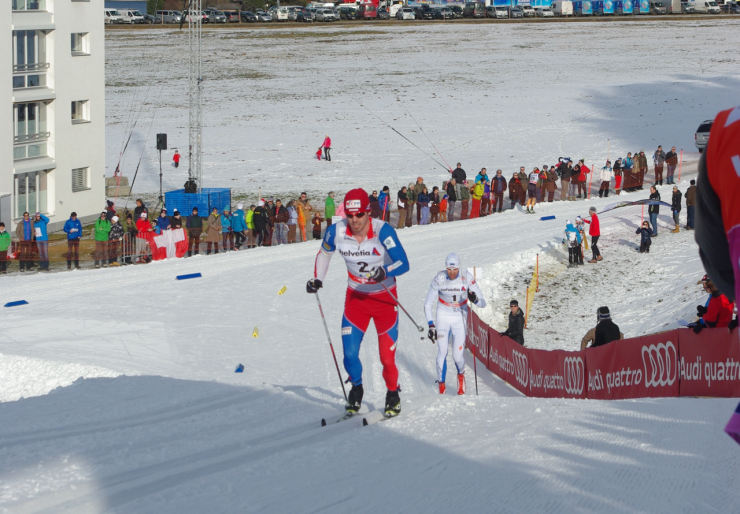
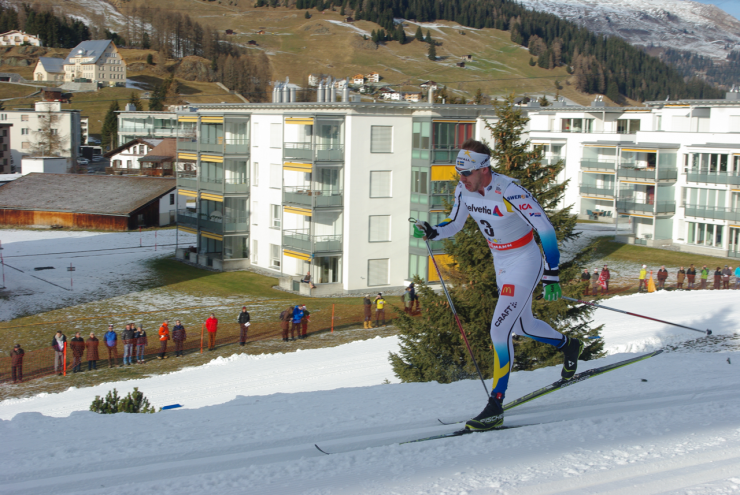
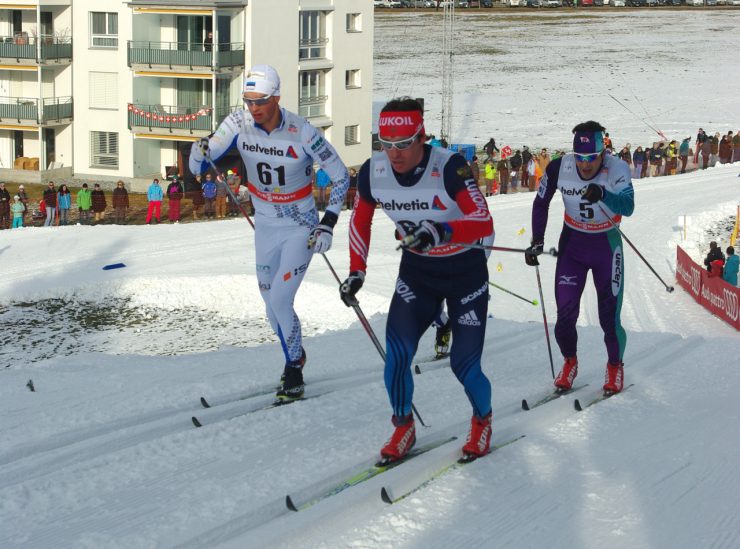
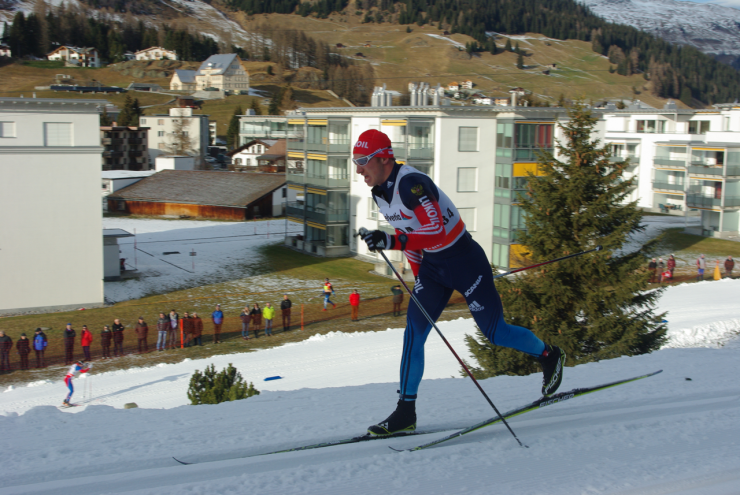
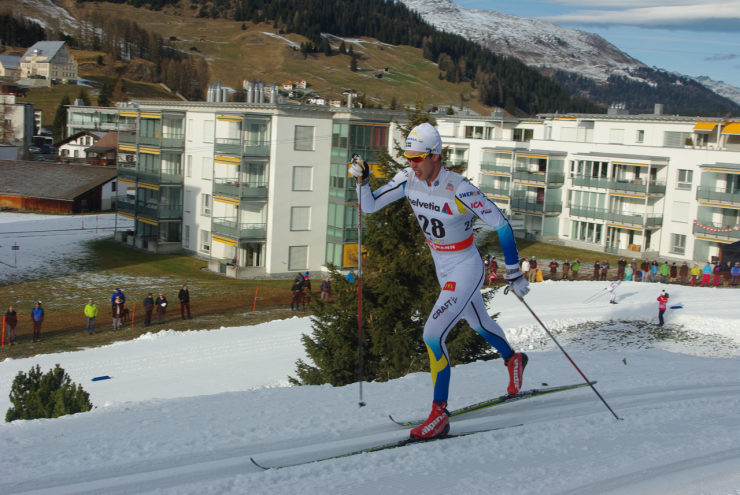
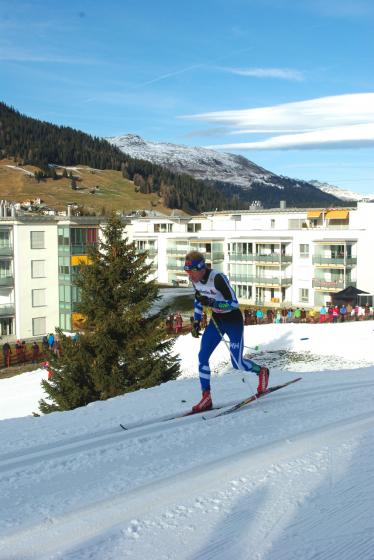
DAVOS, Switzerland— Martin Sundby of Norway reclaimed his World Cup points lead in Davos, Switzerland as he dominated the 15 k classic. While it originally looked as if home-country favorite, Dario Cologna would win on skate skis, the Olympic champion eventually ended his day in third. Canada’s Alex Harvey was the top North American after finishing in 17th position. He said the result was one of his best-ever distance races at altitude.
Here are some photos from the action.
Matti Heikkinen (FIN), 13th place.
Lars Nelson (SWE), 24th place.
Chris Andre Jespersen (NOR), eighth place.
Adrien Backschneider (FRA), 34th place.
Graeme Killick (CAN), 41st place.
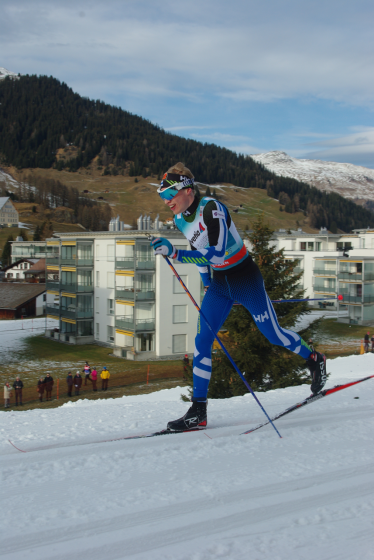
Sami Jauhojaervi (FIN), sixth place.
Dario Cologna (SUI) double-poling to third place.
Nikas Dyrhaug (NOR), 16th place.
Daniel Richardsson (SWE), fifth place.
Dario Cologna (SUI) getting a podium on home turf.
Marcus Hellner (SWE) has had a rough start to the season and finished 29th.
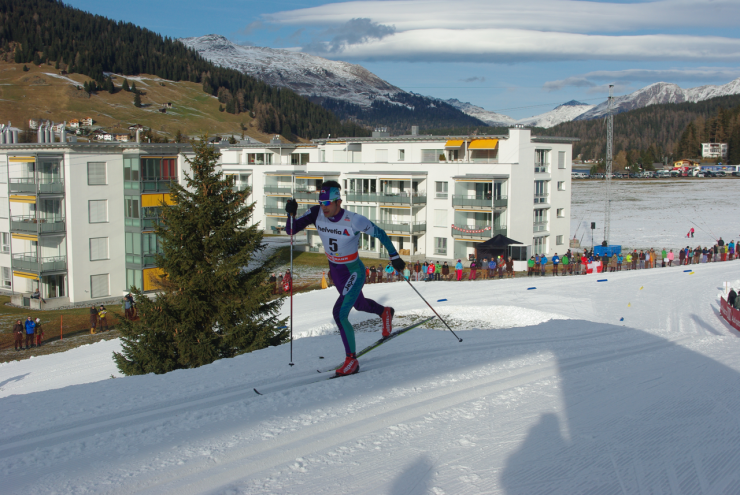
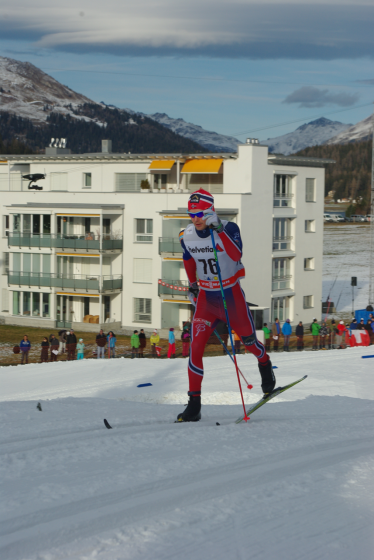
Reese Hanneman (bib 77) in the 15 k classic in Davos.
Andrew Musgrave (GBR), 69th place.
Martin Johnsrud Sundby (NOR), first place, leading 48th-place Erik Bjornsen of USA.
Akira Lenting of Japan placed 37th.
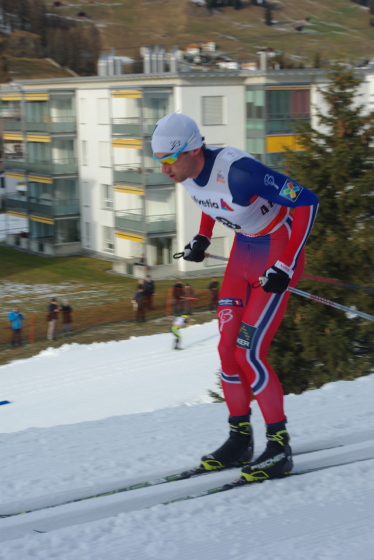
Petter Northug (NOR) double-poling his way to tenth place.
Eldar Roenning (NOR), 18th place.
Lukas Bauer (CZE), 19th place.
Getting ready for the men’s race with other media.
Iivo Niskanen (FIN) is the leader of the Helvetia U23 points series.
Sjur Roethe (NOR), fourth place.
Pal Golberg (NOR), who later dropped out, leading Devon Kershaw (CAN), 32nd place.
Ales Razym (CZE), 33rd place.
Ilia Chernousov (RUS), 51st place.
Emil Joensson (SWE) had a fast first lap but then finished 38th.
Maxim Vylegzhanin (RUS), ninth place.
Erik Bjornsen (USA), 47th place.
Alexander Bessmyrtnykh (RUS), 21st place, and Hannes Dotzler (GER), 28th place.
Alex Harvey (CAN, 17th place) double-poling over the top of a hill.
Sergey Turyshev (RUS) 35th place.
Didrik Tønseth of Norway in December 2014 during the 15-kilometer classic pursuit in Davos, Switzerland. Tønseth was moved to first after his Norwegian teammate, Martin Johnsrud Sundby was disqualified for doping violations.
Jonas Baumann (SUI), 39th place.
Calle Halfvarsson (SWE), seventh place on skate skis.
Marcus Hellner – here finishing 29th in the World Cup 15 k classic in Davos, Switzerland, in December – has struggled this season. But he eked out a win at National Championships in the skiathlon.
Kevin Sandau (CAN), 70th place.
Lukas Bauer (CZE), 19th place, and Thomas Bing (GER), 30th place.
Andy Kuehne and Jonas Dobler, both of Germany, placed 45th and 31st, respectively.
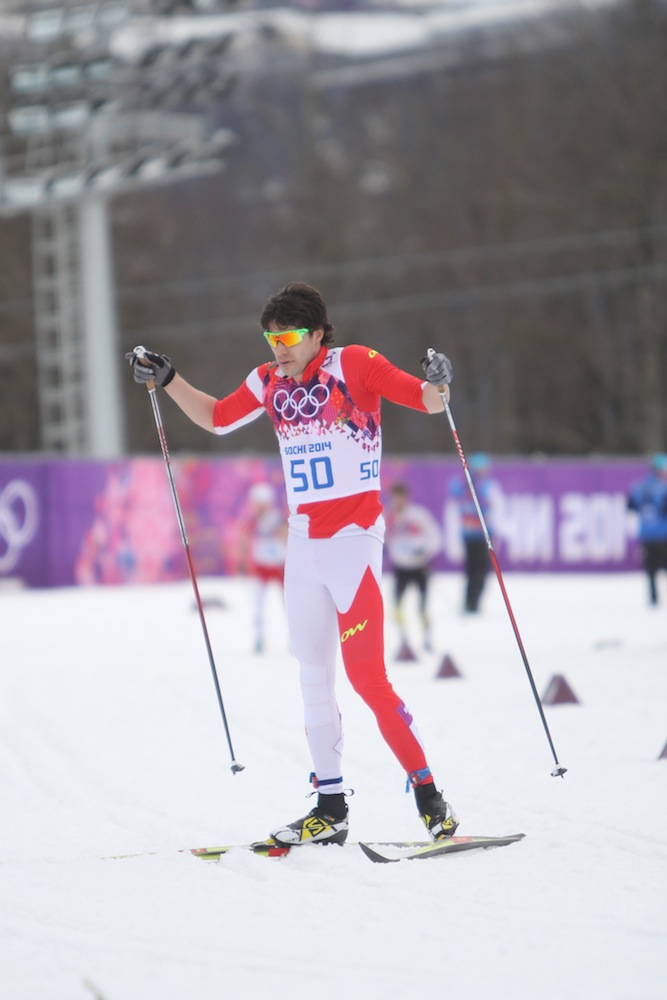
Canada’s Alex Harvey stops for a moment to tell head coach Justin Wadsworth (not shown) that his skis aren’t gliding. Harvey completed the second lap, but did not finish the 15 k classic individual start at the 2014 Olympics in Sochi, Russia.
FasterSkier’s coverage is made possible through the generous support of Rudy Project.
SOCHI, Russia — Two of three laps through Friday’s 15-kilometer classic individual at the Olympics, Alex Harvey, the 25-year-old Canadian medal hopeful, stood in the middle of a climb, waving his arms at head coach Justin Wadsworth.
The skier Harvey had been chasing kept going, pushing over the crest of the climb back into the stadium.
Harvey looked at Wadsworth, and asked if he could stop racing. Wadsworth said yes.
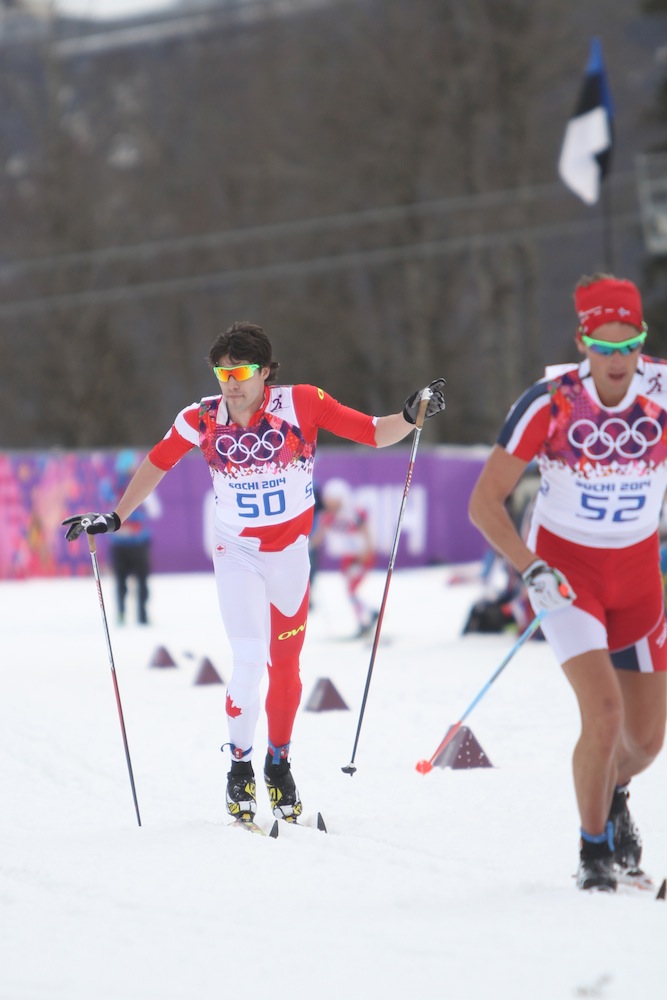
Canada’s Alex Harvey trails Norway’s Chris Andre Jespersen while communicating his lack of glide to head coach Justin Wadsworth (not shown). Harvey completed the second lap, but did not finish the 15 k classic at the 2014 Olympics in Sochi, Russia.
For the second race at this Olympics, the Canadians had their medal hopes wrecked by what the Norwegians call a smørebom — literally translated, a wax miss — on a balmy afternoon, with temperatures in the mid-50s.
Harvey’s skis, which he called “really slow,” were so bad he dropped out of the race at the 10 k mark.
His teammate Devon Kershaw, who finished 35th, 2:47.4 behind Swiss winner Dario Cologna, put it more directly.
“I guess today, obviously, our skis — well, they were horrible,” he said after the race.
The first word Wadsworth used to describe the day was unprintable. As to what the Canadians will do to get their skis back on track, he suggested that it might even require some consultation with their competition.
“It’s very rare that the conditions really affect a single person, or a couple people, but in this case it’s affecting us because we’re not getting the kick wax right,” he said. “That’s, I guess, for the wax technicians to debrief on and figure out what it is. Maybe we have to ask other teams, like, are we on the same range of wax, or is it too thick? ”
None of the Canadians skied quickly on Friday, though Harvey, Kershaw, and Ivan Babikov, who finished 39th, 3:19.5 behind the winner, all said that they felt fine. They were just fighting skis that were far slower than their competition’s.
“It was a struggle, but this is the Olympics,” Kershaw said in his third Winter Games. “You’ve gotta give it your best every day because you don’t know when you’ll get a chance again. I just fought every second of that race to do as best as I could. Obviously, it’s tough when the equipment’s not there, but I have a lot of experience and you’ve got to keep fighting through it.
“I’m still proud of what I did,” he added. “It’s so cliche, but you’ve got to fight to the end. That’s the point of the game.”
Three-time Canadian Olympian Devon Kershaw racing to 35th in Friday’s 15 k classic individual start at the 2014 Winter Games in Sochi, Russia.
Babikov started 30 seconds behind Kershaw and was trailing him by 7.5 seconds at 2.2 k.
“I saw he was doing pretty good, I guess,” Babikov said. “I was getting splits that I was really far behind. … You have to use what you have at the moment and ski with it and try to finish and do as best as you can.”
Born in Syktyvkar, Russia, a seven-hour flight north from Sochi, Babikov said it was cool to hear his name called in Russian and English out on the course, but it didn’t exactly help on a day like Friday.
“It was pretty loud in a couple sections, especially that uphill,” he said. “At some point when it gets so hard, your body just shuts down, but when people [are] blowing those tubes and mrrr horns and stuff, it’s kind of makes it worse actually, like, oh my God.”
He considered the race “one of the hardest” he’s ever done. “I think it’s not gonna get any harder than this,” Babikov said.
Then again, you never know.
“The 50 k could be really hard too and slow, but usually skate I feel better,” he said. “There’s no kick in skate skis right?”
Harvey was one of four skiers in the 90-man field that did not finish, pulling out after 10 k with the 38th-ranked time. Kazakhstan’s Alexey Poltoranin, who started 30 seconds behind Harvey, caught him at 5 k and dropped Harvey on the long downhill to start the second lap.
Wadsworth said the gap was 15 seconds from top to bottom of the hill. “That’s a lot,” he said.
“I didn’t know what to think,” Harvey explained. “I kept pushing.”
Canada’s Ivan Babikov on his way to 39th in the 15 k classic individual start on Friday at the 2014 Olympics in Sochi, Russia.
Then Norway’s Chris Andre Jespersen, who started a minute after Harvey, caught the Canadian before the base of the big hill before the end of the lap.
“I stayed with him the whole way, honestly feeling really good,” Harvey said. “And then on the little downhill before the last sprint uphill, he put five or ten meters on me instantly. So then I saw Justin and I was like, ‘Look. I’m feeling good, but I’m losing so much time on the downhill. I’m just going to stop, there’s no point.’ ”
Wadsworth understood that Harvey, who’s expected to start at least the next two team events, didn’t want to waste too much energy on this race. “When you have skis that bad, you do have to look at the big picture,” Wadsworth said.
Graeme Killick placed 65th in his first Olympics, after finishing 45th in last weekend’s skiathlon.
Looking ahead to the rest of the Olympics, temperatures are forecast to get slightly cooler, around the mid-40s during the day and 40 at night starting Monday. Still, that might not be enough to freeze the snow and/or drastically change the conditions.
“It’s tough racing, but the best skiers still win, and that’s the way it usually is,” Wadsworth said. “The team sprint is classic and that’s our best medal chance, and at this point it’s a little scary to think about. I know the [wax techs] will go and try everything we can.”
After the race late Friday afternoon, Wadsworth said his staff was out re-testing the race skis they tested earlier in the day.
“I don’t know what they’re going to find,” he said. “I think they need to test different wax, too, but those guys know what they’re doing.”
Erik Bjornsen (U.S. Ski Team) racing to a career-best 18th in the World Cup 15 k classic individual start Saturday in Toblach, Italy. (Photo: FlyingPointRoad.com/Proceeds go to the National Nordic Foundation)
Coming off 25th- and 17th-place finishes at U23 World Championships last Wednesday and Thursday in Val di Fiemme, Italy, Erik Bjornsen tried to set himself up for success in this weekend’s World Cup in nearby Toblach.
That meant setting realistic goals for the 15-kilometer classic individual start on Saturday. The youngest man on the U.S. Ski Team, Bjornsen, 22, told himself he’d be happy with a top-45 result. His previous best in a distance World Cup was 36th in last season’s 15 k classic mass start in Canmore, Alberta. Two weeks ago, he placed 40th in the same event at the World Cup in Szklarska Poreba, Poland.
“After I skied a 15 kilometer in Val di Fiemme two days before, that was fresh in my head,” Bjornsen told FasterSkier on Sunday. “Some of the things that went wrong there were I didn’t go out hard enough.”
He made a note to tackle Saturday’s race differently. If he went out harder, he figured there was a chance he could “catch a ride from someone fast.”
“I didn’t know it was going to be someone on the podium,” Bjornsen explained.
Sweden’s Marcus Hellner leads Erik Bjornsen (l) of the U.S. throughout most of Saturday’s 15 k classic individual start at the Toblach World Cup in Italy. (Photo: FlyingPointRoad.com/NNF)
No one wants to get caught in an individual start, but it’s also part of the game when you start behind top-seeded racers. And when the person who catches you is an Olympic and world champion from Sweden — like Marcus Hellner — it’s not such a bad thing.
Hellner started 33rd and caught Bjornsen in bib 57 within the first kilometer. Instead of letting him go, Bjornsen resolved to stay on the 29-year-old veteran, and skied the next nine kilometers in wet snow and grueling mixed precipitation with Hellner. That put Bjornsen in the top 10 for some of his splits midway through the race. His time at 7.1 k ranked 17th and he was up to 15th by 11.5 k.
“Usually, I save some energy for the finish, but I gave it everything in my second lap,” Bjornsen said. “Third lap it was just hanging on for dear life. Coaches were giving me splits I was in the top 20 and it was so unreal. … My legs were killing me in every corner, every downhill, I was like, ‘Don’t lose it, don’t lose it!’ ”
Bjornsen ended up 18th for the first top 20 of his World Cup career. He was 1:17.9 minutes back from Russian winner Alexander Legkov, and 1:03 behind Hellner, who took third. For the Swede, it was his first individual podium in over a year. For Bjornsen, the personal best meant everything in the final distance race before his first Olympics.
“Could not have been better,” Bjornsen said. “Timing and skis and good feelings, everything kind of came together.”
His parents were also in town after watching him compete at U23’s, and able to watch his sister, Sadie, finish 17th in her first race back since December 22.
The top American, Bjornsen was also the only man from the U.S. in the top 40. Noah Hoffman placed 41st, Kris Freeman was 64th, and Brian Gregg was 69th of 79 finishers.
Canada’s Devon Kershaw racing to 39th in the 15 k classic individual start at Saturday’s World Cup in Toblach, Italy. (Photo: FlyingPointRoad.com/NNF)
Alex Harvey led the way for Canada in fifth, Devon Kershaw placed 39th, Graeme Killick was 40th in his first World Cup of the season. Jess Cockney placed 51st for his best result in the event, and Ivan Babikov was 62nd.
“I’m pretty happy with where the team is right now,” Canadian Head Coach Justin Wadsworth said. “There were some other guys that had a good race, like Killick and Cockney were both solid for one of their handful of world cup starts that they’ve had in their career. Devon and Ivan struggled a little bit with skis, but felt good physically. I know the camp we did was really good so I’m pretty hopeful for some good results coming up.”
Hoffman looked to be struggling with kick and slipped and fell at one point. He said the race was “a little rough” and “not quite what I was looking for.”
“Classic skiing’s just been a little tough for me this year, but I’m looking to pick it up a little bit,” Hoffman said.
Killick, who finished 2 seconds ahead of Hoffman and 0.6 seconds back from Kershaw, said he started out a little slow and had to make up time on the final laps.
Canada’s Graeme Killick on his way to 40th in his first World Cup of the season in the 15 k classic Saturday in Toblach, Italy. (Photo: FlyingPointRoad.com/NNF)
“I think it was OK for the first World Cup here and just after some altitude training,” he said of the Canadian team’s pre-Olympic camp in Seiser Alm, Italy, where the Americans also trained over the last week.
On the flip side, Cockney said he started out “very hard,” putting him in the top 30 for five or six kilometers.
“It’s always hard to figure out the pacing for a different field than you’re used to back home, but I felt good for most of the day, overall pretty happy,” Cockney said.
Like Killick, his teammate on the Canadian Senior Development Team and Alberta World Cup Academy, Cockney said their skis were great. He chose a stiff pair of klister skis and Killick went with the same.
“Skis were rockin’,” Cockney said.
Babikov said the race was hard and racked it up to “a little bit of everything.”
“Coming off the altitude and big camp, maybe that was the factor,” he said. “We’ll see, I still have a week to recover.”
Gregg (Team Gregg/Madshus) also described his race as “a little rough … but it was good to go hard,” he added. “Erik Bjornsen had a great day so that’s really cool.”
In international news, Andrew Musgrave and the rest of the British World Cup team almost didn’t make it to Saturday’s distance races after getting snowed in at Misurina 20 kilometers away.
“It was a bit of a stress,” Musgrave told FasterSkier after placing 59th. “It snowed a meter and a half, and we were snowed in, [as did] the Slovenians and the Finnish sprint team. We spent ages to get out all our cars and vans and stuff.
“We eventually managed to get down, but instead of driving 20 minutes down the normal road, there was an avalanche over it and we had to drive 2 1/2 hours around to get here,” Musgrave continued. “And then we didn’t have accommodation here so now we’ve got four of us stuffed in a tiny room. But at least we got to race, can’t complain.”
Alexander Legkov of Russia pushes hard on a rainy day at the Toblach World Cup in Italy on Saturday. He ended up winning the 15 k classic individual start by 2.9 seconds over Switzerland’s Dario Cologna. (Photo: FlyingPointRoad/Proceeds go to the National Nordic Foundation)
Dario Cologna played the role of protagonist to a T on Saturday — not because he was trying to, or because he’s Swiss, or because he’s Super Dario, or because he was aspiring for fame in a make-or-break race.
The men’s 15-kilometer classic individual start at the Toblach World Cup in Italy was like any other, except that it was the last distance race before the Olympics — which start in exactly a week in Sochi, Russia — and it was Cologna’s first World Cup of the season.
In November, he tore a ligament in his ankle and had to have surgery, keeping him from training for the better part of the next two months. The 27 year old didn’t start racing again until Jan. 10, when he jumped into a couple Alpen Cup races in Chamonix, France. There, he placed 10th in a skate sprint, fourth in a 15 k classic and third in a 20 k skate race, respectively.
They weren’t bad results for a guy who busted his ankle two months earlier, but they weren’t exactly the norm for the 2010 Olympic champion (in the 15 k freestyle), either. Cologna went on to win the two races he competed in at Swiss nationals Jan. 18-19.
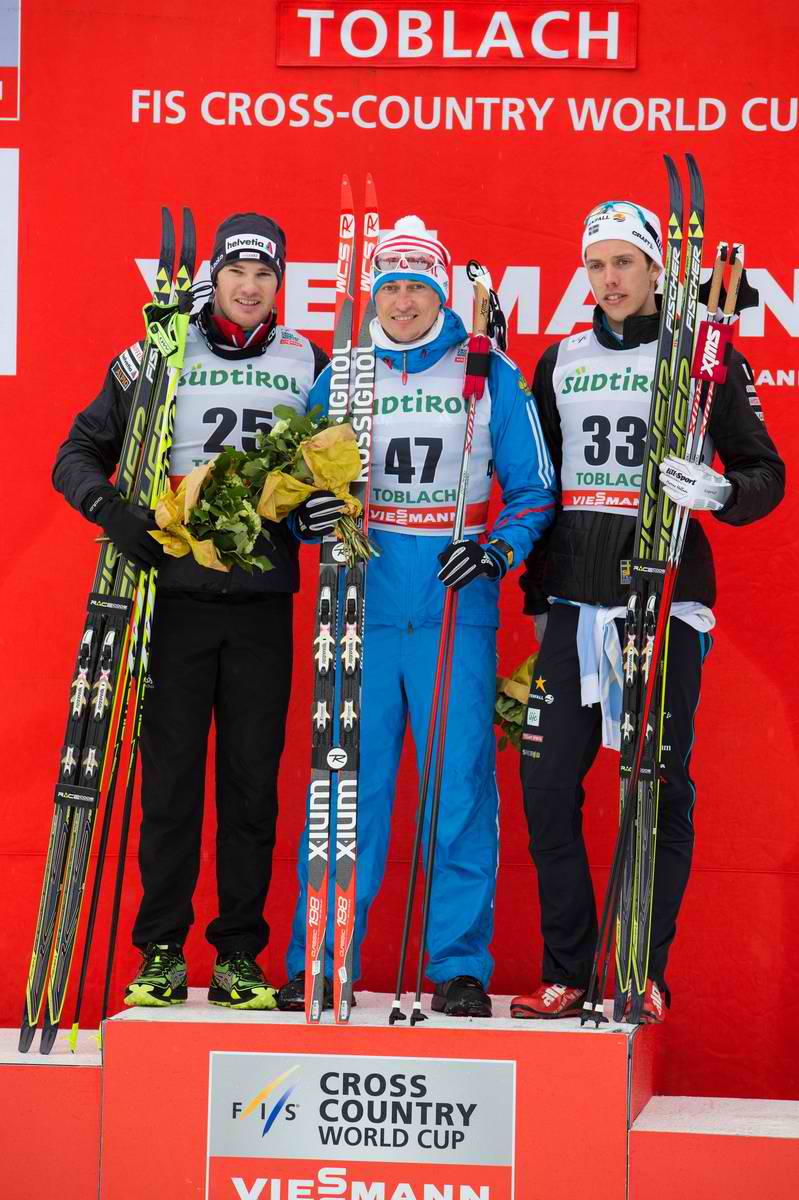
The men’s 15 k classic individual start podium at the Toblach World Cup on Saturday, with Russian winner Alexander Legkov (c), Switzerland’s Dario Cologna (l) in second, and Marcus Hellner in third. (Photo: FlyingPointRoad/NNF)
“I wasn’t sure I was in shape for the Olympics before this race, so I’m relieved and surprised,” Cologna told NRK, according to a translation, after sitting in the leader’s chair for a good chunk of Saturday’s 15 k.
He had started 25th, a relatively early position for the defending world champion in the 30 k skiathlon. But considering it was his first race back, it was a respectable spot just outside the seeded list.
Cologna started somewhat conservatively, clocking the ninth-fastest time through the 1.7 k checkpoint behind Sweden’s Lars Nelson. Halfway through, he was the fastest on the board, surpassing Nelson and holding onto the lead though the finish.
Nelson dropped to second and out of the leader’s chair, and Cologna enjoyed the snow-carved hot seat for the next 10 minutes. A couple challengers gave him a run, the first of which was Russia’s Dmitriy Japarov, who rose from 24th at 1.7 k— with the same split as Canadian Alex Harvey — to fourth at the halfway point. The 29th starter, Japarov was 20.9 seconds short of matching Cologna, settling for second through the finish.
Shortly after, Sweden’s Marcus Hellner in bib 33 bumped Japarov to third, coming through 14.7 seconds back from Cologna. Meanwhile, Cologna sat quietly on what was likely a soggy seat, with temperatures warming to near 5 degrees Celsius (41 Fahrenheit) after snow turned to rain for the men’s race.
The Toblach World Cup men’s 15 k classic individual start podium: with Russian winner Alexander Legkov (c), Switzerland’s Dario Cologna (l) in second, and Marcus Hellner in third. (Photo: Fischer/NordicFocus)
Russia’s Alexander Legkov, who started 47th, took Cologna out of that position. Cruising into the stadium in hot pursuit of Harvey, whom Legkov started 30 seconds behind and caught him before the last of three laps, the Russian skied behind the Canadian in the same track as they both double poled hard to the finish.
Harvey had a good day himself, rising from 24th early to 12th halfway through, and ultimately leading Legkov into the finish to place fifth. With 30 seconds on Harvey, the 30-year-old Legkov turned out to be the antagonist of Cologna’s tale.
Pushing through the finish, Legkov bested Cologna’s time by 2.9 seconds with the winning time of 37:02.7. Cologna stood up, relinquished his seat to Legkov, and placed second. Hellner took third (+17.6), Japarov was fourth (+23.8), Harvey fifth (+27.4), and Petter Northug was the top Norwegian in sixth (+48.3).
“It was a surprise today to win, but I’m in good shape and of course very happy with the result,” Legkov told FIS. “I want to welcome everyone to my home country next week and I think the same results are possible. I have to thank my service team. My skis were the best on a difficult day.”
“I’m almost glad I did not win, for whoever wins the last race before the championship [may] not win the championship,” Cologna told NRK.
Either way, the result was the positive affirmation for Cologna, who plans to race all four individual events at the Olympics. Asked of his expectations, he said they’re always the same: “to be on top.”
“But I know it will be tough,” Cologna added. “There are many who can win races. It’s good to be on the podium now, but it may be different in a week.”
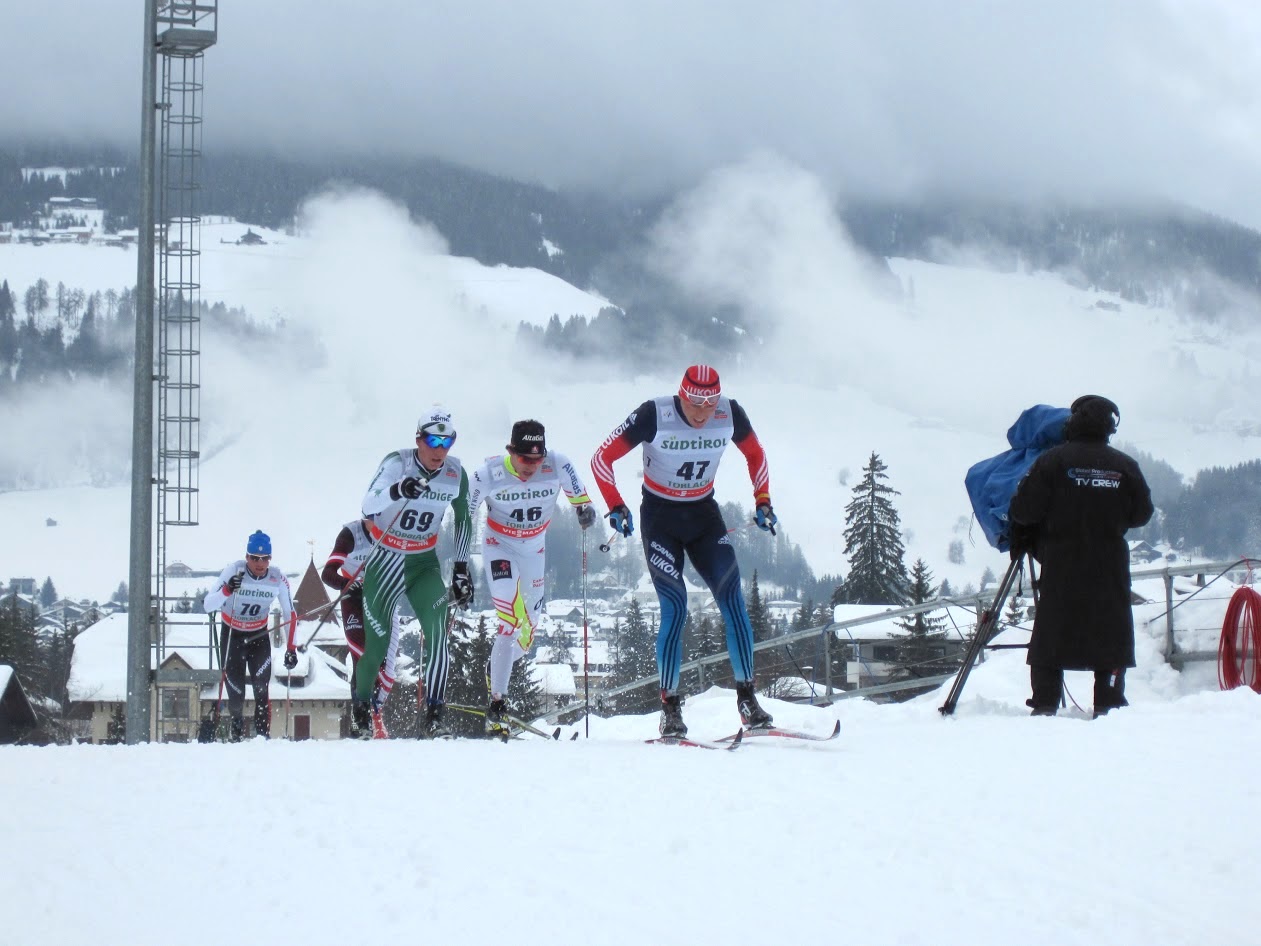
Russia’s Alexander Legkov (47) leads Canadian Alex Harvey (46) and Italy’s Stefano Gardener (69) at 10 k in the 15 k classic individual start on Saturday at the Toblach World Cup. (Photo: Peggy Hung)
As Cologna left the leader’s chair, Harvey approached him. The Canadian had more or less pulled Legkov around for the last lap, although Legkov led Harvey at times.
“Alex skied a great race,” Canadian Head Coach Justin Wadsworth told FasterSkier. “Hung in there with Legkov for a while then pulled him around the last lap and ended up fifth, four seconds out of fourth. It’s a good last distance race to head into the Olympics on, for sure, especially where you’re pulling the guy who won the race around the last 5 k.”
“I took the first lap pretty conservative and then I picked it up the last two laps and gained a lot of position there,” Harvey explained.
Feeling a little sluggish after an altitude training block in Seiser Alm, Italy, last week and some rest earlier this week, Harvey was happy to be on form before the Olympics.
“I was kind of feeling a bit asleep in the morning, even yesterday in training,” he said. “I feel ready good about the camp, no sickness, did a lot of training. … and looking forward to heading to Sochi.”
The 46th starter, Harvey had the benefit of watching others ski out of the stadium while many, including some of his teammates, struggled with their skis on the wet track. Like the majority of the men’s field, most of the Canadians appeared to use some form of klister. In the preceding women’s 10 k, most everybody raced on zeroes.
“There were some other guys today that had a good race, like [Graeme] Killick and [Jesse] Cockney were both solid for one of their handful of World Cup starts that they’ve had in their career,” Wadsworth said of the Canadian Senior Development Team members, both of which recently qualified for their first Olympics.
Finland’s 22-year-old Iivo Niskanen after finishing a career-best in eighth in the Toblach World Cup 15 k classic individual start on Saturday. (Photo: Peggy Hung)
Killick placed 40th, 0.6 seconds behind Canadian veteran Devon Kershaw in 39th, and Cockney was 51st. Ivan Babikov finished 62nd, 35.8 seconds behind Cockney and 3:21.7 back from Cologna.
“Devon and Ivan struggled a little bit with skis today, but felt good physically,” Wadsworth explained. “I know the camp we did was really good so I’m pretty hopeful for some good results coming up.”
Rounding out the top 10, Nelson notched his first World Cup top 10 in seventh (+48.6). Finland’s 22-year-old Iivo Niskanen also notched a career best in eighth (+54.9), Sweden’s Daniel Richardsson was ninth (+57.9) and Norway’s Martin Johnsrud Sundby 10th (+58.8).
“It was a strong day for the Swedish team,” Hellner told FIS, after his team put three in the top nine. “We for sure had great skis.”
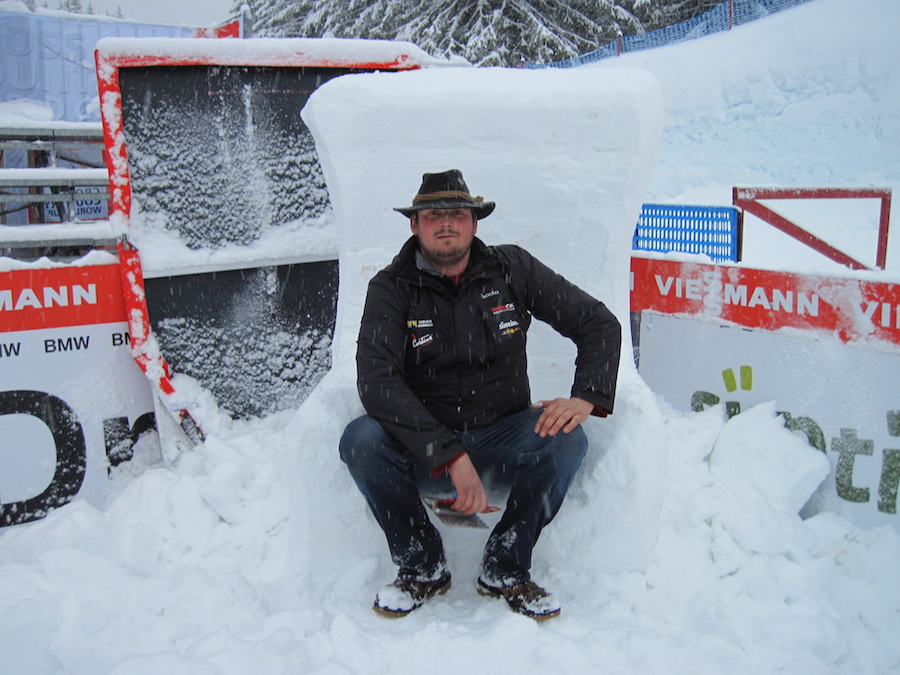
Toblach’s snow carver takes as break while sitting in the leader’s chair at the Toblach World Cup in Italy. (Photo: Gerry Furseth)
TOBLACH, Italy — With the World Cup circuit resuming on Saturday (after a weekend off two weeks out from the Olympics), Toblach organizers have a bit of a problem on their hands: too much snow.
According to FasterSkier’s on-site reporter Gerry Furseth, there was no official training on Friday “as the heavy snow made for unusual skiing conditions.”
Unofficial training: heavy snowfall continues in Toblach, Italy, a day before the last World Cup before the Olympics takes place there. (Photo: Gerry Furseth)
Most of the 5-kilometer loop, which will be used for Saturday’s 10 and 15 k classic individual starts, was covered with about 15 centimetres (6 inches) of new snow as of 9 a.m. on Friday.
“By 11:00, it was challenging skiing in wet, falling snow,” according to Furseth. “The snowcats were busing removing snow from the stadium to keep it as built. The road to Cortina was closed most of the day and the ski trail to Cortina was 30 cm deep.
‘The ‘Saskia’ 5k loop is brutal,” added Furseth, who’s from Vancouver, B.C. “Skiing the loop after it was freshly reset, I spent 2/3rds of my time striding. None of the climbs are as long as Canmore, but they are ramps (constant slope, very straight). The downhills are pretty easy if the track is in good shape and your legs are loaded with lactic. Except for the stadium, the double-poling sections are false flats, not much fun in snow-filled tracks. Like Val di Fiemme, the philosophy seems to be to get the descending done quickly, so the steep climing can resume.”
One of the hills on Toblach’s 5 k course during a rebuild process because of abundant snow. (Photo: Gerry Furseth)
Furseth was in Val di Fiemme, Italy, for the first day of Junior/U23 World Championships on Wednesday.
“Unlike Val di Fiemme, the snow feels pure, natural, and skis much drier than it looks,” he explained. “Val di Fiemme was at least 80% manmade, and skied wet and fast, with that squirrely feel skating that resulted in lots of crashes on sprint day. At Toblach, all the crash ‘sitzmarks’ were right after snow drifts, where the boots drag in the deep snow.”
As for Saturday’s classic races, Switzerland’s Dario Cologna is on the World Cup start list for the first time this season following an ankle injury in late fall. He has three World Cup wins in his career (including stages) in 15 k classic races.
If you’re following North Americans, here’s who’s on the start list for Saturday. Racing will continue Sunday with freestyle sprints.
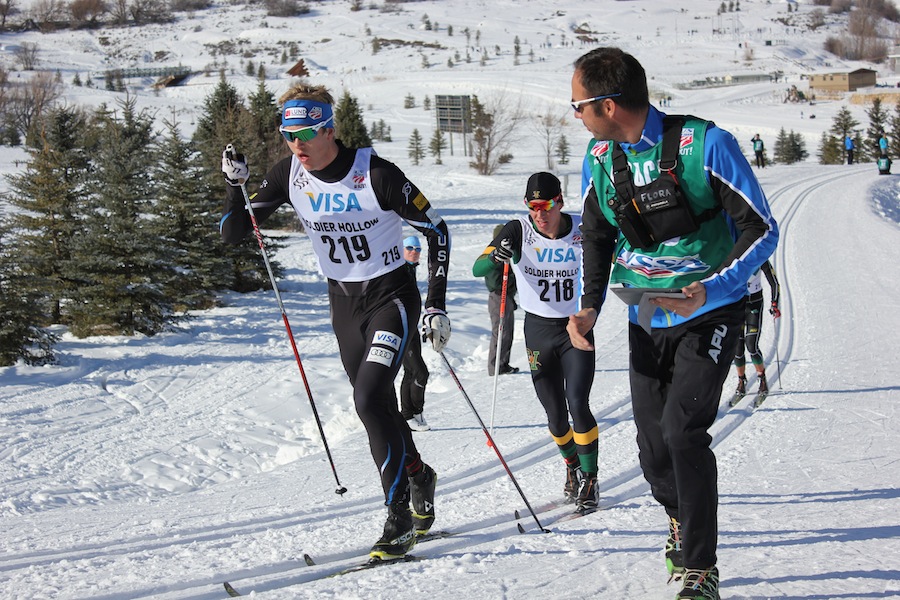
Erik Bjornsen (APU/U.S. Ski Team) strides up Hermod’s Hill at the 2014 U.S. Cross Country Championships with APU Head Coach Erik Flora giving splits alongside. Bjornsen went on to win the 15 k by over 11 seconds.
FasterSkier’s coverage of the 2014 U.S. Cross Country Championships is brought to you through the generous support of The Memory Clinic in Bennington, Vt.
MIDWAY, Utah – In what was a flawless day at Soldier Hollow, Erik Bjornsen of Alaska Pacific University (APU) and the U.S. Ski Team achieved his second national championship in the 15 k interval start at the 2014 U.S. Cross Country Championships. He finished 0:14 ahead of Reese Hanneman (APU) who placed second. Kris Freeman of the Maine Winter Sports Center finished third, 22.8 seconds back from Bjornsen.
The first day of nationals could not have been more perfect, with temperatures in the mid-20s and plenty of sun to go around. The 15 k, set on a variation of the 2002 Olympic course, consisted of three 5 k laps that twisted up and down a hillside that has seen many historic events. Saturday, was Bjornsen’s chance to add a little history of his own.
Erik Bjornsen (APU/U.S. Ski Team) leads a pack of skiers in the 15 k at the 2014 U.S. Cross Country Ski Championships. (Photo: bertboyer.zenfolio.com) All proceeds from photo sales will be directly donated to NNF.
Despite his convincing win, the 22-year-old Washington native didn’t make his victory look easy. The challenging course took its toll on all athletes, and Bjorsen was no exception. His feelings in the race were much like the ups and downs of the course.
“At times it felt good, and at times it was really hard,” Bjornsen said.
Bjornsen started his race with a blistering pace that gave him first place splits. However, when after hearing he was several seconds up on Freeman he worried that his start was too fast. This fear was confirmed when he entered his second lap and began to struggle.
After this realization Bjornsen skied with more control and focused on his finish.
“The rest of the time I was getting splits I was 5 or 10 seconds off of [Freeman]. In the last lap I was very confident with my finishing so thought I might have a chance,” he said.
He also chose to go for fast skis instead of more kick, and said that factored into his result. While it was a risky move on such a hilly course, he said it “seemed to work.”
For Bjornsen, the win is confirmation that his training since the end of last season is paying off. And with a winter that has had few domestic opportunities to demonstrate ability, he has found assurance in his chances for the rest of nationals.
“It’s a confidence booster going into the rest of the races. Coming into this series I knew that the 15 k classic was my favorite event,” he said, “I’m feeling good so hopefully I can have another couple good results.”
Reese Hanneman (APU) racing in the 15 k at the 2014 U.S. Cross Country Championships. Hanneman finished 11 seconds behind Bjornsen to place second. (Photo: bertboyer.zenfolio.com) All proceeds from photo sales will be directly donated to NNF.
While Bjornsen was expected to podium in Saturday’s race, Hanneman was not. Hanneman, an APU skier from Fairbanks, Alaska, has traditionally excelled at sprinting, but defied tradition and placed second.
“It’s just a little surprising on that type of course with this altitude,” Hanneman said. “It’s the hardest course I’ve skied since the World Cup in Canmore. I tried to go out pretty easy, like level 3 for two laps, which usually would just be way too conservative. But I was getting really good splits early on and I knew I had some left in the tank.”
Hanneman, who placed 21st in the 15 k at the 2013 nationals, knew that with a demanding course he would need to conserve energy if he wanted have a chance at the podium. In an effort to ski with utmost efficiency, Hannemen took the steepest hills conservatively and pushed on the sections of the course that were gradual and flat.
“I knew that if I went too hard I would just be walking along on the top,” he said. “Part of the success was that I was able to execute the plan.”
Looking forward, Hanneman is excited for the two upcoming sprints, one of which will take place tomorrow. While these Championships will determine the rest of his season, he’s decided not to worry too much about the future.
“I’m going to try and stay relaxed about everything, have fun, enjoy the good weather, and ski fast.”
Third-place finisher and veteran skier Kris Freeman expressed support for the first and second place finishers.
“It’s great to see Reese step up like that and Bjornsen on form,” he said. “I’m just hoping to find mine.”
The former longtime U.S. Ski Team member fell off his front-running pace on the final lap.
Kris Freeman (l) and Brian Gregg (r) attempt to conquer the challenging 5 k olympic course at Soldier Hollow. Freeman finished third and Gregg finished fifth.
For Sylvan Ellefson (Ski & Snowboard Club of Vail/Team Homegrown) in fourth, it was his support group and encouraging splits that got him through a race that had him puking “his brains out” by the end.
“I heard I wasn’t that far from Freeman at the top of Hermod’s so that’s what got me going the last two k,” he said.
Brian Gregg, who finished fifth, was happy to tie his best-ever classic finish at U.S. nationals. He also laughed at the fact that both he and his wife Caitlin were the first starters for the men’s and women’s races. “What are the odds?” he joked.
Rounding out the top six was Ben Lustgarten of Middlebury College. Lustgarten’s finish was a surprise to many at nationals, but not to his teammates and friends who have seen his hard work in Middlebury, Vermont over the past four years.
“I’ll try to keep my focus,” he said. “I’m at a good point with my fitness and strength. I’ve just got to keep racing hard and staying in the game.”
With this year’s college circuit ahead of him and a possible bid for the U23 World Championships, Lustgarten is definitely an up-and-coming skier.
Ben Lustgarten (Middlebury College) gave a stellar performance in the 15 k classic and finished sixth at the 2014 U.S. Cross Country Championships.
Absent from from the results was Tad Elliott (SSCV/Team HomeGrown) who was second in the 15 k skate at the 2013 nationals. In an email, Elliott explained that he has mono, or mononucleosis, a virus that often causes severe fatigue.
“I got it this fall and it took awhile to diagnose, and I am still recovering,” he wrote. “I am flying into Nationals Monday. I am planning to try and race the 30k.”
All in all, the 15 k demonstrated that the men’s field at Soldier Hollow is a group of very talented athletes who are willing to put everything they have into the chance at advancing in the ranks of U.S. cross-country skiing. As if the competition wasn’t hard enough, Soldier Hollow has provided some of the most difficult courses in the country, making every factor from tactics to fitness to mental toughness equally important.
Action will continue Sunday with the freestyle-sprint qualifiers kicking off at 10 a.m. MST. In a field as diverse as this, the race could be anyone’s.
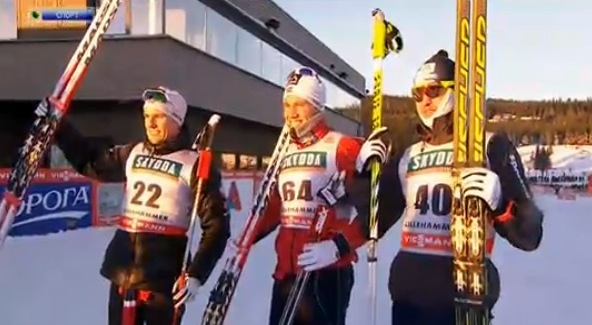
Norway’s Pal Golberg (c), shortly after winning his first World Cup in the 15 k classic individual start in Lillehammer, Norway, with teammate Didrik Tønseth (l) and Alexey Poltoranin (KAZ). Poltoranin took second and Tønseth notched his first World Cup podium in third.
Out of 85 starters in the men’s 15-kilometer classic individual start in Lillehammer, Norway, 17 were Norwegian. More than half of that 20 percent included international household names, and the lesser-known few were also vying for Olympic team spots, making the stakes even higher.
Without even factoring in odds, there was a pretty good chance a Norwegian was going to win Saturday’s World Cup race.
As the skiers ticked off the laps – three times around Lillehammer’s hilly course – it became a question of who would take the big prize.
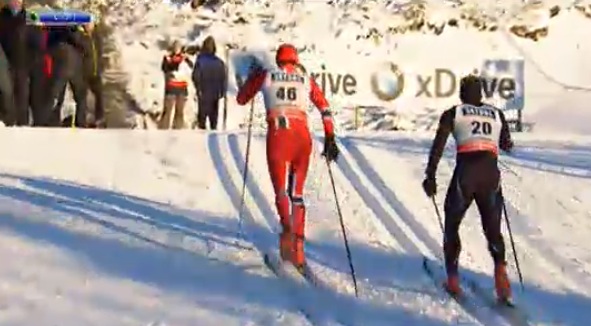
Initially, Russia appeared on top with Stanislav Volzhentsev, the sixth starter, logging the fastest time through 2.1 k. Thirty starters later, Sweden’s Johan Olsson bested Volzhentsev’s intermediate time by more than a second, and a few minutes later Norwegian Petter Northug came through even faster – by 3.2 seconds – in bib 46.
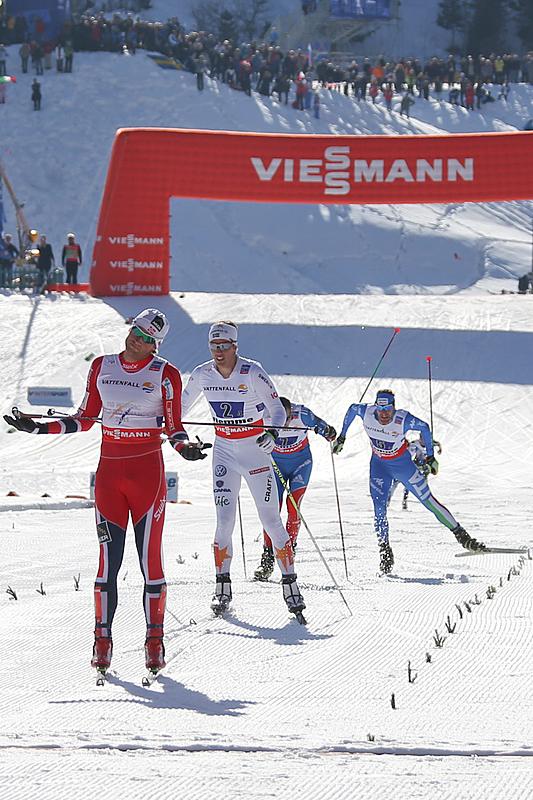
Petter Northug shrugging off Norway’s seventh-straight men’s relay title at 2013 World Championships in Val di Fiemme, Italy. He beat Sweden’s Calle Halfvarsson (second from l), Russia’s Sergey Ustiugov (third) and David Hofer of Italy in fourth. (Photo: Fiemme2013)
But it was only two kilometers into a 15 k race, and there were lot of dangerous starters remaining.
Pål Golberg started 64th and didn’t draw attention too early. With the seventh-fastest time two kilometers in, he was nearly nine seconds behind Sweden’s Calle Halfvarsson (who had topped Northug’s time by six seconds).
At the 5 k mark, Halfvarsson was still the fastest, but Golberg — best known as a sprinter — was making up ground, cutting the deficit to 3.8 seconds. Northug remained in second, and appeared on par to put down one of his late-kicking, dominant performances.
Less than kilometer later, just a third of the way through the race, the 23-year-old Golberg took the lead. He led Halfvarsson by a second, as well as Norway’s Chris Andre Jespersen, Didrik Tønseth and Martin Johnsrud Sundby, who were all within two seconds of one another in third through fifth. Northug was 11 seconds out in 12th, and suddenly the race had started.
“I wanted to be patient in the first lap. I knew I could ski fast but I held back at the beginning,” Golberg told reporters after. “In the other two laps I felt like I could keep the pace up. The course seemed to be really hard during training, but today with the speed, it did not feel that tough.”
Golberg held on, just ahead of 22-year-old Tønseth and Halfvarsson, who trailed by about a second. Chasing him from behind, Sweden’s Marcus Hellner and Russia’s Alexander Legkov ranked third and fourth, respectively, just 3 ½ seconds back..
With 5 k to go, Golberg began his ascent toward the podium putting 8 seconds into Tønseth, 9.8 seconds into Olsson, and ultimately 10.3 seconds up on Legkov.
He finished in 35 minutes flat, knocking Kazakhstan’sAlexey Poltoranin from the leader’s chair by 14.2 seconds. Hovering around the top 10 for most of the race, Poltoranin came on strong late to edge Tønseth, the previous race leader who ended up third, by 1.3 seconds.
Sitting in the hot seat bundled up and appearing slightly nervous, Golberg watched as others pushed to beat his time. Hellner finished 20.2 seconds back in fourth, and Legkov double poled hard off the final descent into the stadium, ultimately finishing 22.2 seconds out in sixth. (Olsson ended up fifth, 21.4 seconds out of first.)
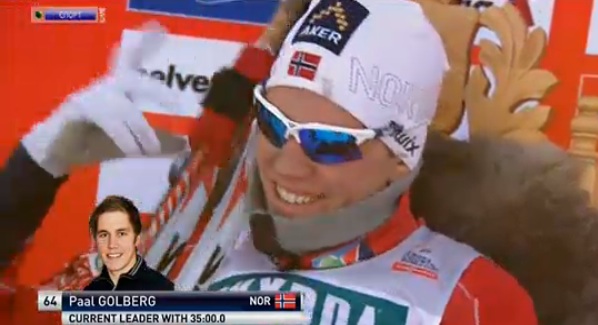
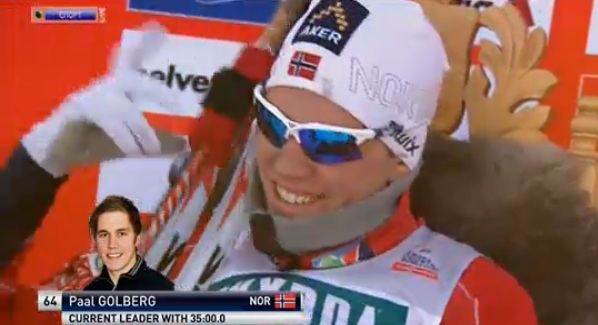
Norway’s Pål Golberg smiles from the leader’s chair on Saturday, after watching Russian Alexander Legkov finish 22.2 seconds off his winning time of 35:00 in the 15 k classic individual start at the Lillehammer World Cup.
As Legkov crossed the line, Golberg smiled. Not long after, Sundby as the final starter finished 24.9 seconds back in seventh. Following in eighth was Jespersen (+31.8), Northug placed ninth (+40.7), and Sweden’s Daniel Richardsson took 10th (+42.3).
Immediately congratulated by his teammates on his first World Cup win, Golberg smiled even more. He had placed third in World Cup individual sprints and second in the 2013 World Cup Finals freestyle prologue, but never this. When he spoke to reporters, he wiped away tears.
“I’m a little shaky right now,” Golberg told NRK, according to a translation. “I cry both when things are going well and when things go bad.”
At the 2013 World Championships in February, Golberg collapsed in the team sprint, blacking out and taking him and his teammate, Northug, out of contention.
After Saturday’s race, Northug praised his teammate.
“He had a very good start to the season and … is a person who can do well at both distance and sprint,” Northug told NRK. “It’s that kind of [skiers] we need.”
Norway’s second man and third-place finisher, Tønseth impressed with his first World Cup podium – and he didn’t even realize he made it. He was late to the flower ceremony as a result.
“I had looked a bit on a TV, and realized that my time was good,” Tønseth told NRK. “But I did not think it would be so good.”
Regardless, Norwegian men’s coach Trond Nystad was pleased.
Norway’s Petter Northug (l) passes Kris Freeman (USA) around 5 k into Saturday’s World Cup 15 k classic individual start in Lillehammer, Norway. Northug went on to place ninth, and Freeman was 75th.
Coming off a career-best result in Kuusamo, Finland, Noah Hoffman of the US Ski Team had five days to recover and rev himself back up for Saturday’s 15-kilometer classic individual start at World Cup in Lillehammer, Norway.
In an email, Hoffman explained he might have been too well rested because he “felt a little stale.”
In the final pursuit of the Kuusamo Ruka Triple, Hoffman clocked the fastest 15 k freestyle time for ninth overall. He carried that energy into Saturday’s race and felt good, but was hoping for a top 20. In a field of nearly 85 men, he ended up 41st , 1:31.9 behind Norwegian winner Pål Golberg.
“My pacing strategy was to start deliberately backed down from my normal race level,” Hoffman wrote, which he executed pretty closely, but not quite 100 percent. Ultimately, he explained that he struggled to ski relaxed and “big” in classic.
“I am going to revisit my classic technique before my next classic race in the Tour de Ski,” Hoffman added. “I am disappointed by today’s result because I think I am in better shape than I showed.”
Hoffman will start third in the U.S. men’s 4 x 7.5 k relay on Sunday in Lillehammer, as the first skate leg ahead of anchor Simi Hamilton, who sat out Saturday’s 15 k.
“No 15 km for me today, but stoked for relay tmrw!” Hamilton tweeted.
Andy Newell will scramble the first classic leg and tag off to Kris Freeman as the second classic skier.
Freeman, who trains with the Maine Winter Sports Center, finished 75th on Saturday (+3:33.3). Mikey Sinnott was the other American in the 15 k and placed 81st (+5:06.0).
“It was an awful race,” wrote Sinnott, last season’s overall SuperTour winner from Sun Valley. “I’m feeling flat and I can’t afford to be anything but my best in this field. I was looking forward to this opportunity, and I’ve turned up to a gun fight with rubber band gun. I would be minuted back in the SuperTour field with this kind of effort, so it’s very frustrating to not be showing my true ski potential.”
As the first starter, he had hoped to experience the leader’s chair. Sinnott started conservatively and “slowed down from there,” unable to get going, he wrote.
“My races so far in Europe have been largely forgettable,” he added. “More than a place or time, which can be hard to gauge in a new field, I wanted to feel good racing.”
Regardless, he wouldn’t trade the international experience or opportunity to strive for the U.S. Olympic team.
“I’ve been loving the experience and trying to feed off the positivity and confidence of those around me,” Sinnott wrote. “Every World Cup race is a learning experience for the future, and each one affords me the chance to grow with my comfort and familiarity. Hopefully with the sprint races yet to come I can find my stride and use what I have learned to put things together.”
Canada’s scramble leg, Dasha Gaiazova starting her second lap in the 4 x 5 k relay at 2013 World Championships in Val di Fiemme, Italy. She tagged Perianne Jones in 11th.
Note: This article has been updated to include comments from Michael Somppi.
Typically known as a sprinter, Dasha Gaiazova of the Canadian World Cup Team is knocking on distance racing’s door. The 29-year-old notched her second-best result of the season in a distance event, placing 33rd in Sunday’s 10-kilometer classic individual start at the World Cup in Lahti, Finland.
Gaiazova finished 2:20.4 behind Poland’s Justyna Kowalczyk, who won in 25:38.9, and was just 8.2 seconds out of the top 30. Earlier this season in La Clusaz, France, Gaiazova placed 27th in a 10 k classic mass start.
She started conservatively, clocking the 55th-fastest time through the first intermediate point at 3.4 k. About two kilometers later, she rose to 43rd, then 35th by 8.4 k.
“I was happy to be so close to the top 30, only eight seconds out,” Gaiazova told Cross Country Canada. “At the same time I misjudged my speed and perceived effort and did not ski hard enough in the last three kilometres. Nonetheless this effort today will be beneficial for my racing shape for the classic sprint in Drammen.”
Sprint racing resumes Wednesday with World Cup classic sprints in Drammen, Norway. On Saturday in Lahti, Gaiazova missed qualifying in the freestyle sprint in 39th.
The other Canadian female in Sunday’s 10 k, Emily Nishikawa of the Alberta World Cup Academy (AWCA) finished 54th (+3:20.9).
In the men’s 15 k classic individual start, Alex Harvey ended up 41st, 2:14.8 behind Norway’s Petter Northug, who won in 34:35.6. Harvey stuck in the top 30 for much of the race, ranking 28th of more than 80 starters just before the halfway point, but fell off the pace in the third and final lap.
Three AWCA skiers also represented Canada in the men’s race. Graeme Killick led the group in 55th (+2:50.8), a vast improvement after finishing 74th in the sprint the day before, but short of his top-30 goal.
“I tried to play it conservative, going out at a medium pace and then picking it up throughout the race,” Killick wrote in an email after skiing within the top 50.
“I felt a little flat though and couldn’t seem to ‘push’ it,” he added. “A little disappointed to have not gotten what I was wanting from today, but I am excited to prepare for the Holmenkollen!”
Teammates Michael Somppi placed 72nd (+3:43.8) and Jess Cockney was 78th (+4:02.0).
“The course was very challenging and I wanted to avoid blowing up on the final lap,” Somppi wrote in an email. “It’s awesome to be racing against the best skiers in the world and traveling around Scandinavia. I was missing my top gear this weekend and found it difficult to push my body to its max, but the good news is I have more opportunities with the Hollmenkolen and World Cup Finals ahead.”
Distance racing reaches its pinnacle next weekend in Oslo, Norway, with the men’s 50 k freestyle mass start on Saturday and the women’s 30 k skate on Sunday.


 This World Cup coverage is made possible through the generous support of Marty and Kathy Hall and the A Hall Mark of Excellence Award. To learn more about A Hall Mark of Excellence Award or to learn how you can support FasterSkier’s coverage please contact info@fasterskier.com.