From the FasterSkier archive — posts syndicated from athletes’ and coaches’ own blogs between 2004 and 2012, kept online as published. Current coverage is at fasterskier.com.
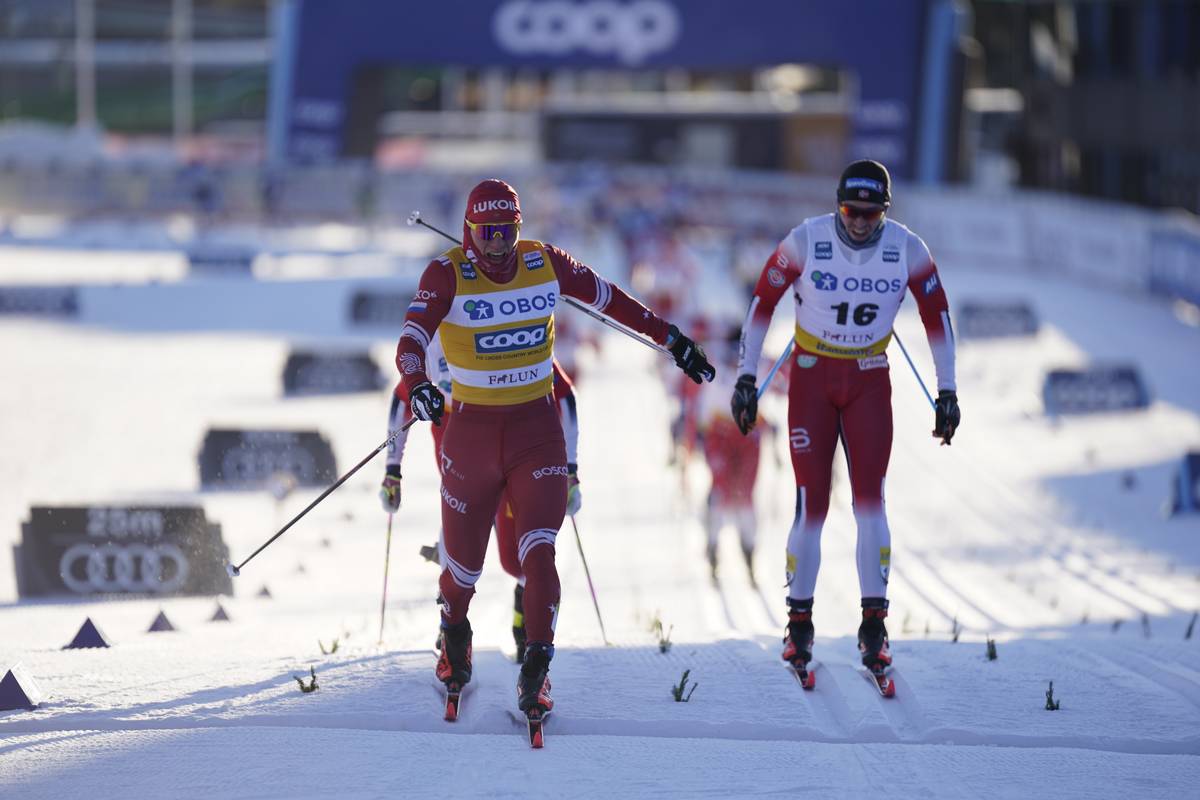
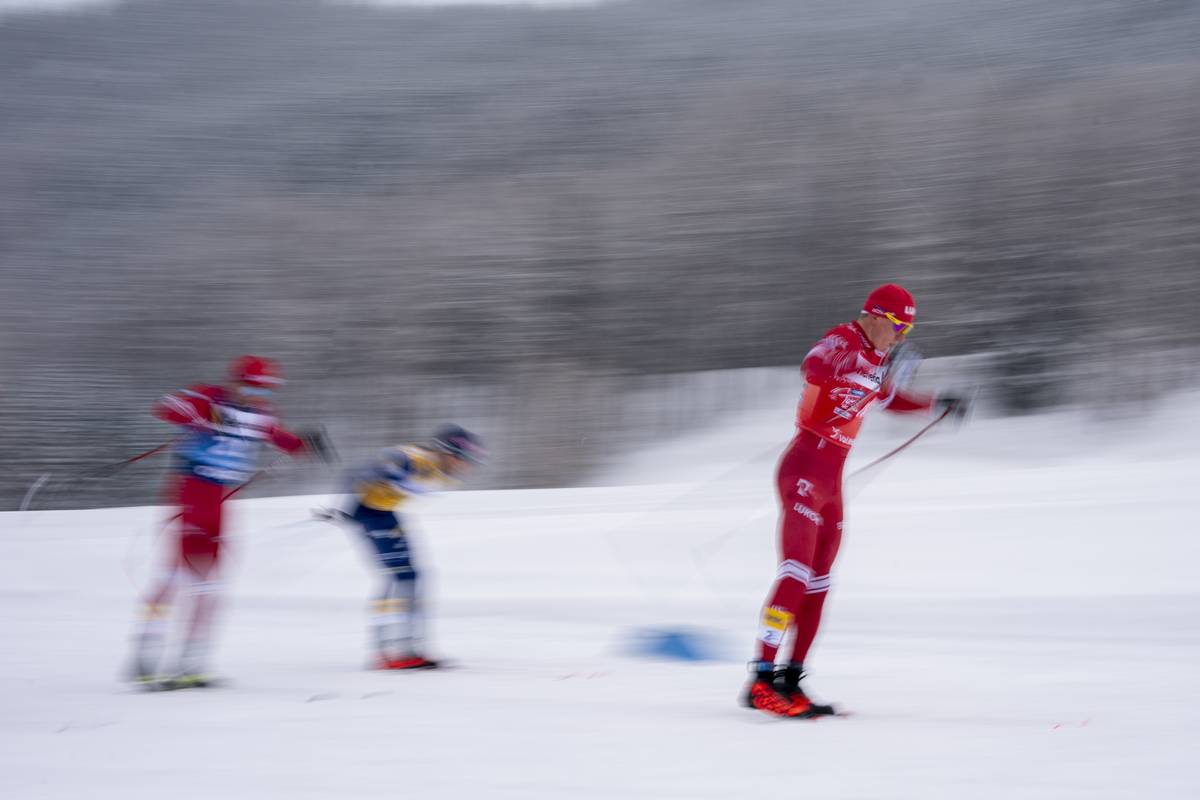
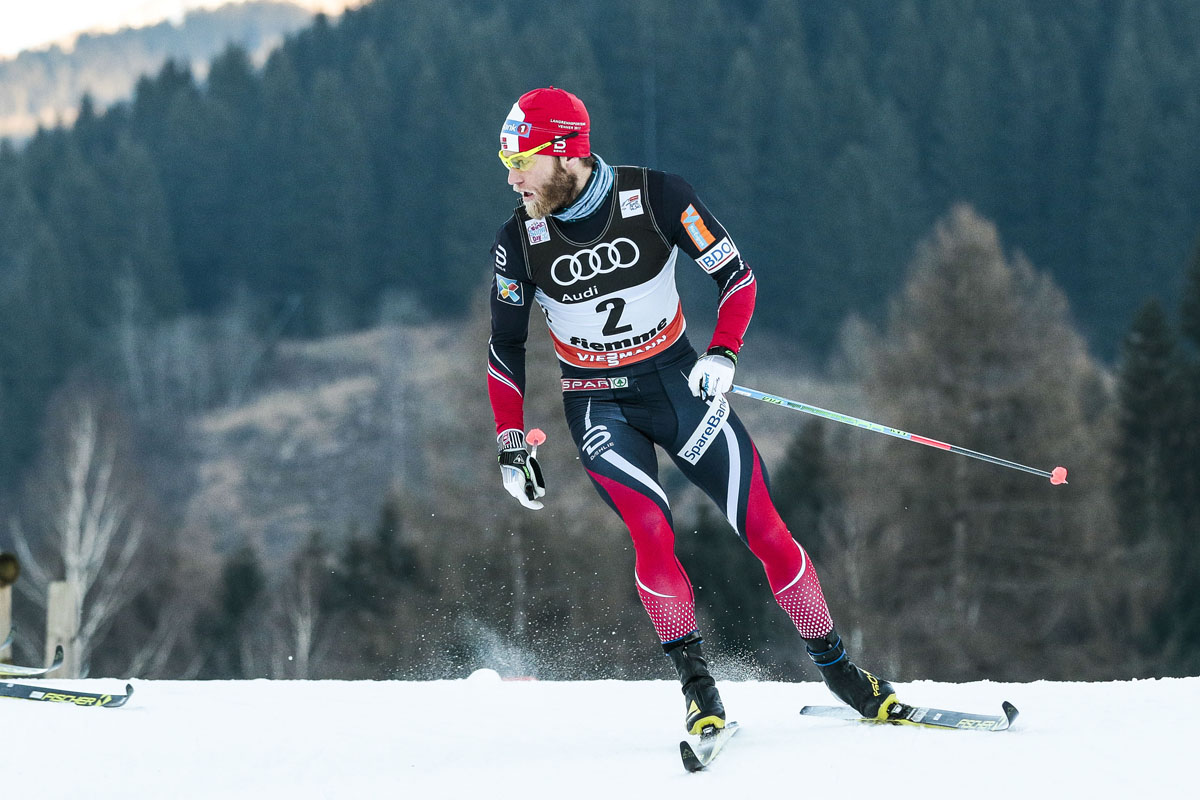
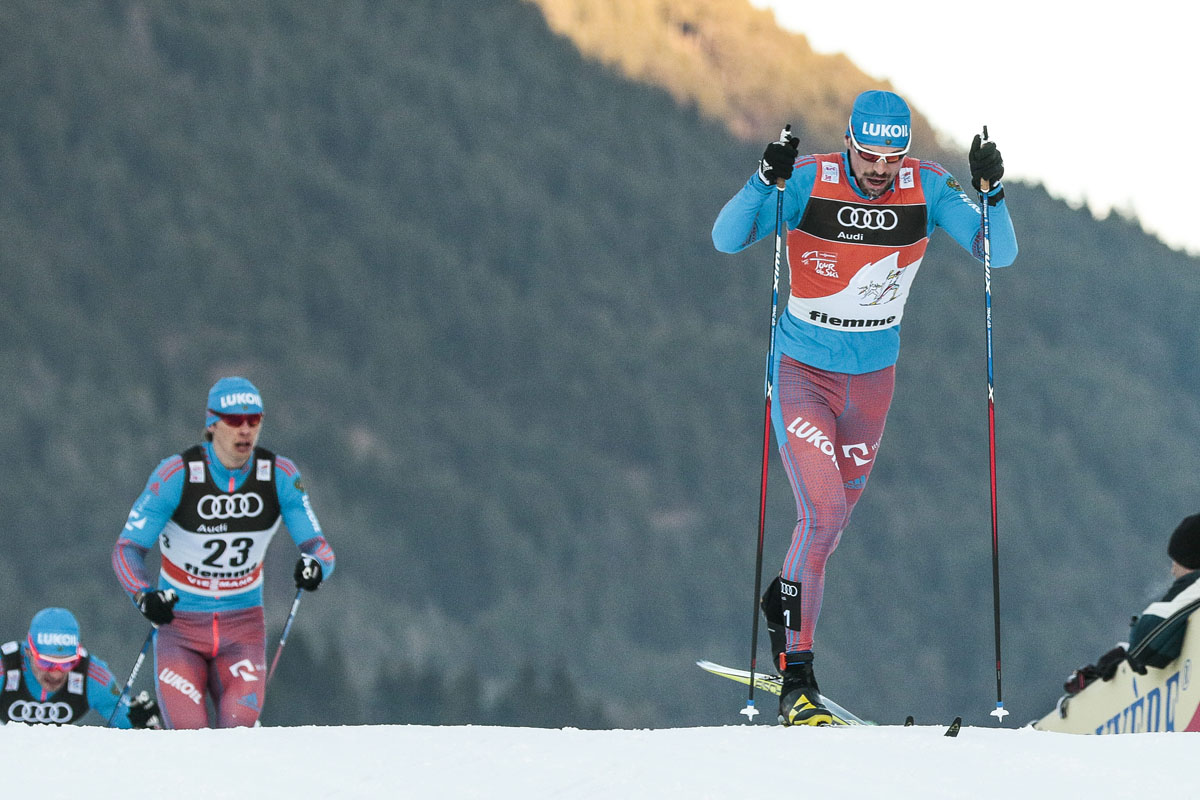
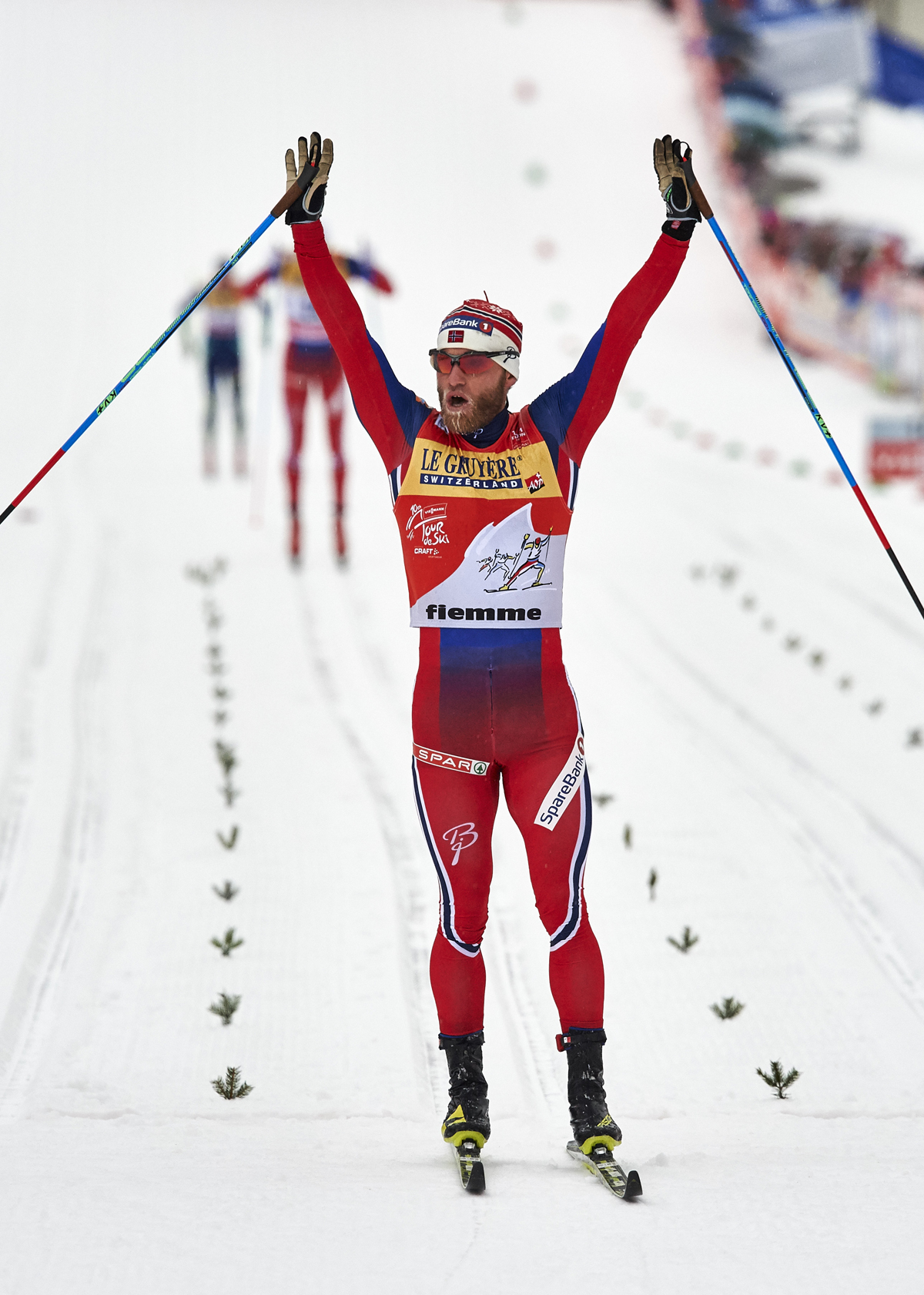
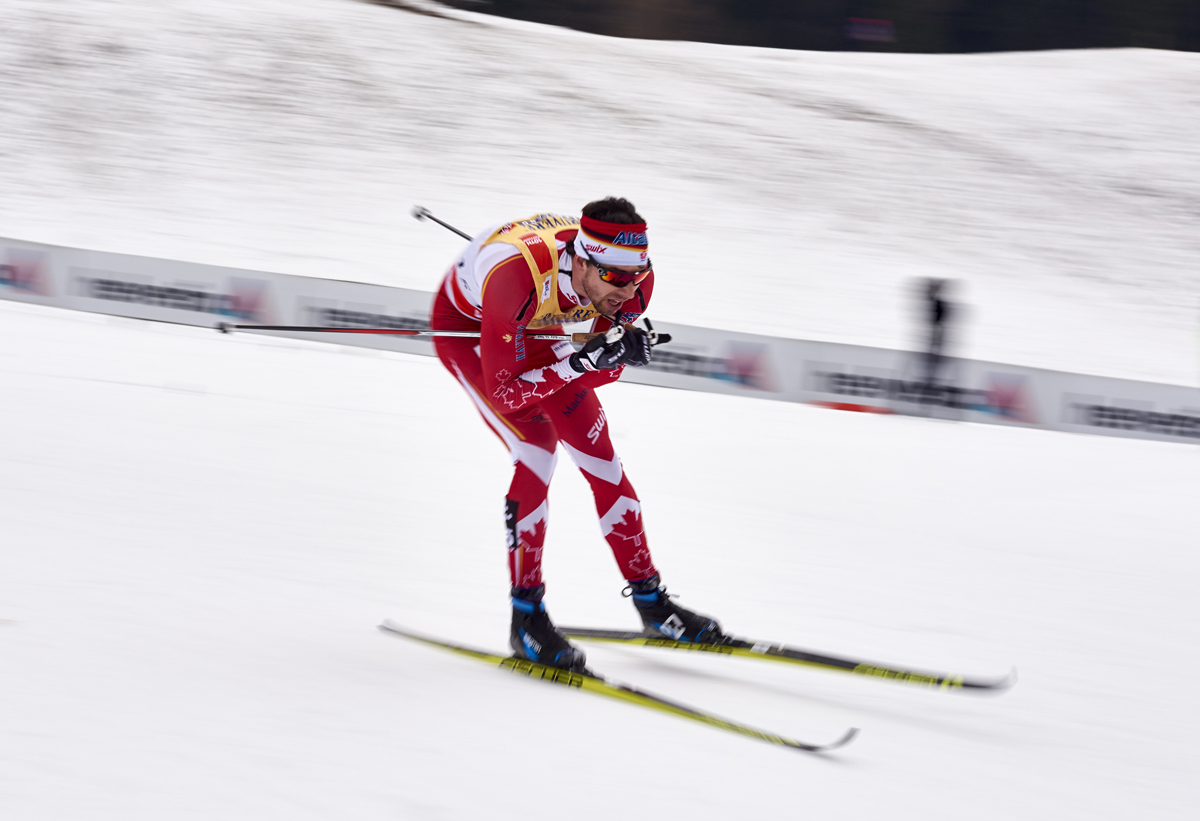
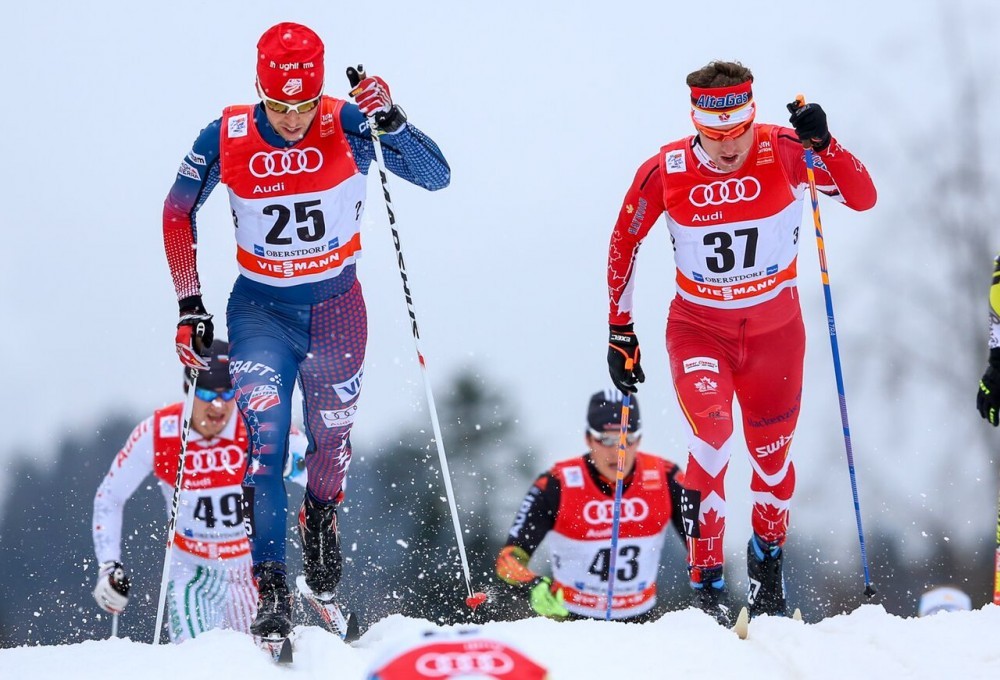
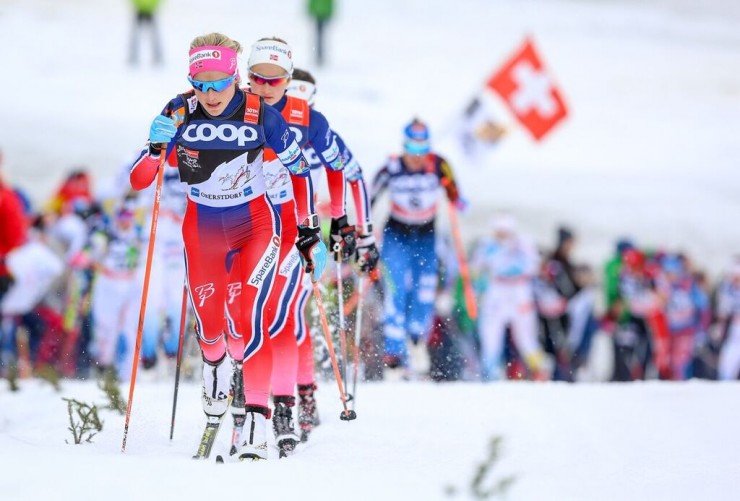
After tumbling earlier in the race, Russia’s Alexander Bolshunov clawed back for another World Cup win. (Photo: NordicFocus)
This World Cup coverage is made possible through the generous support of Marty and Kathy Hall and their A Hall Mark of Excellence Award. To learn more about A Hall Mark of Excellence Award or to learn how you can support FasterSkier’s coverage please contact info@fasterskier.com.
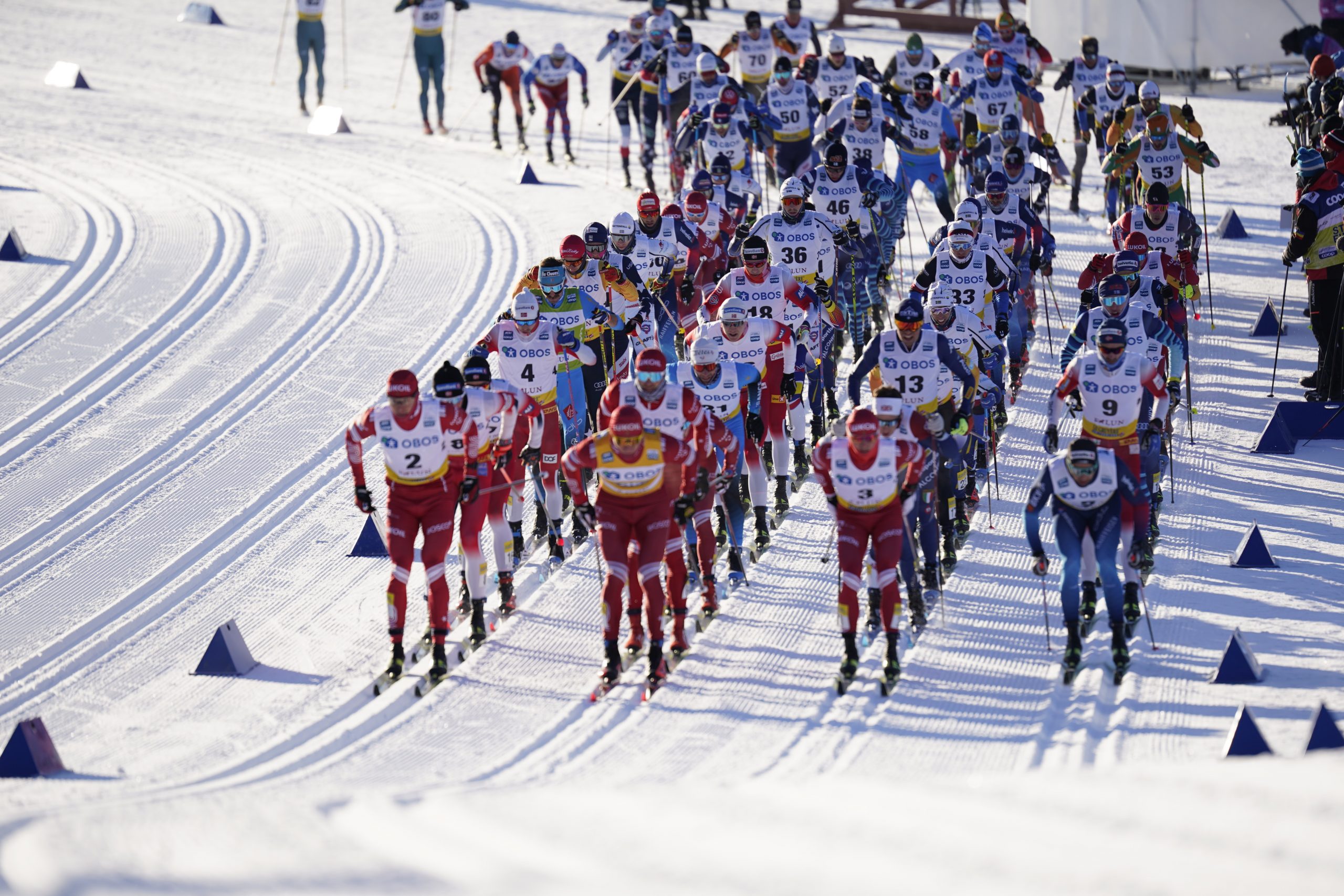
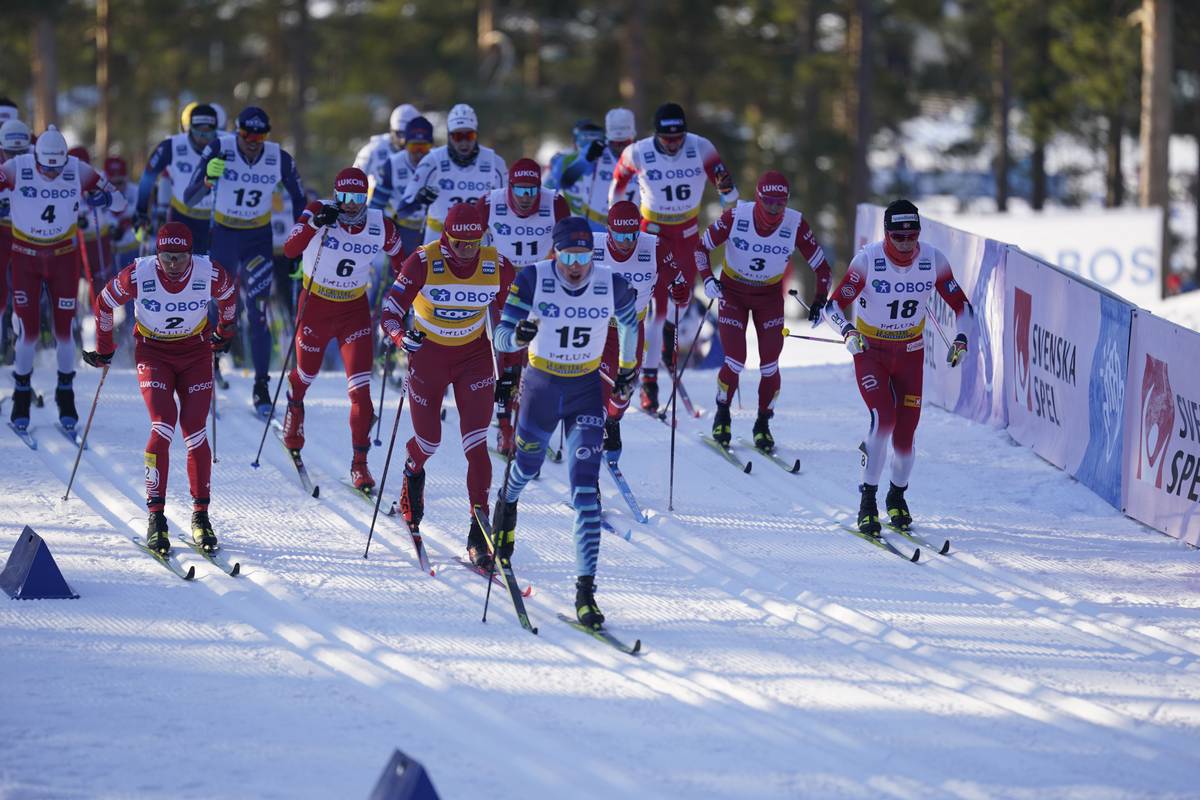
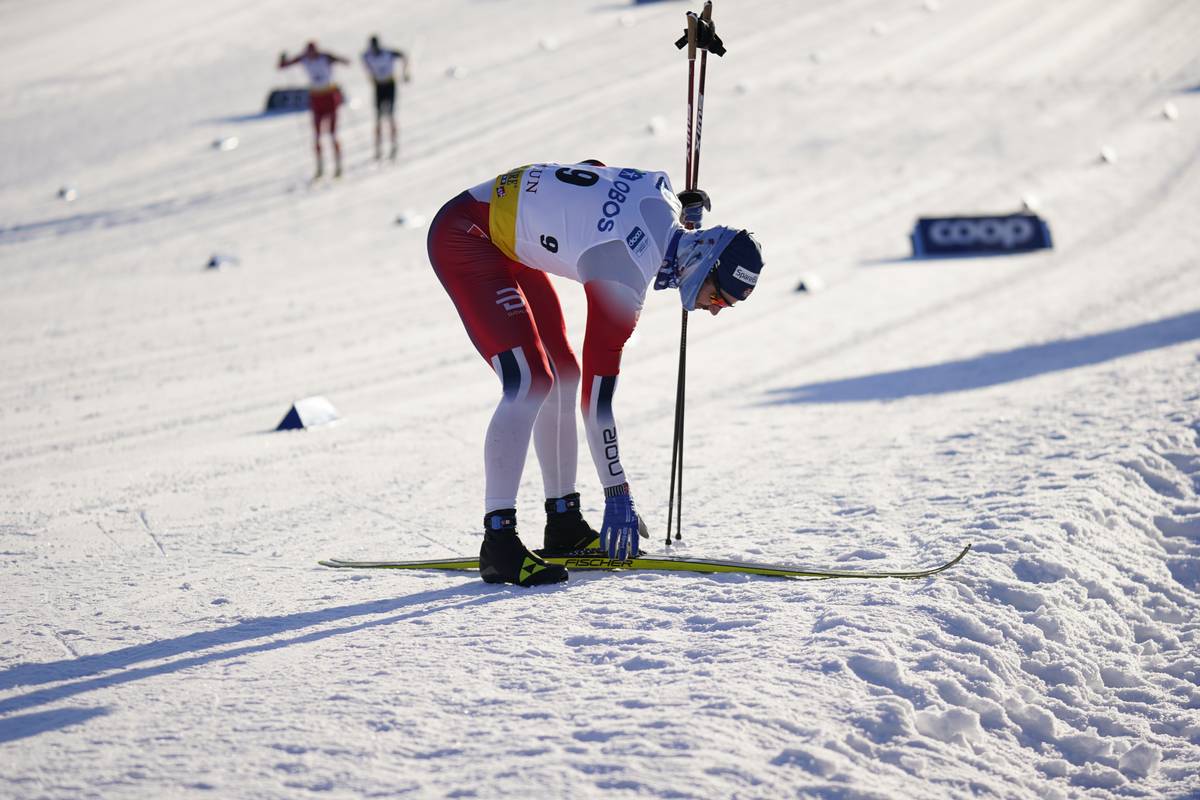
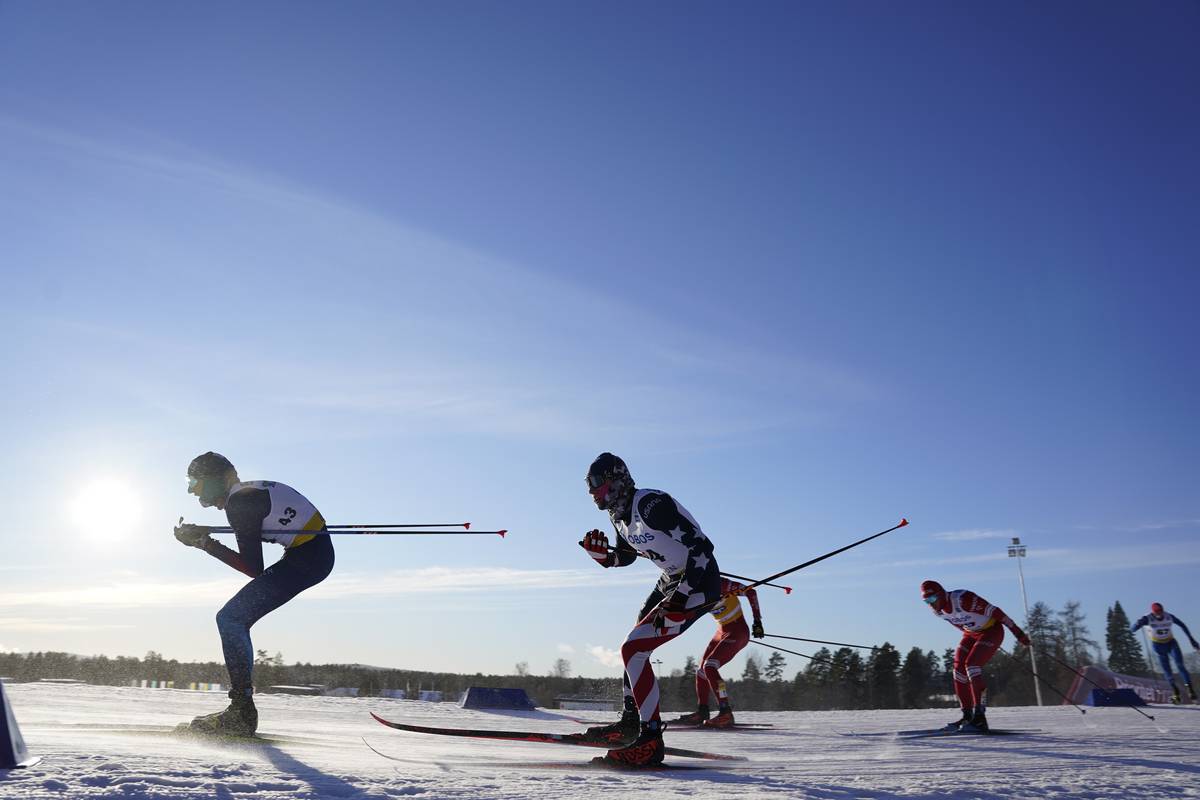
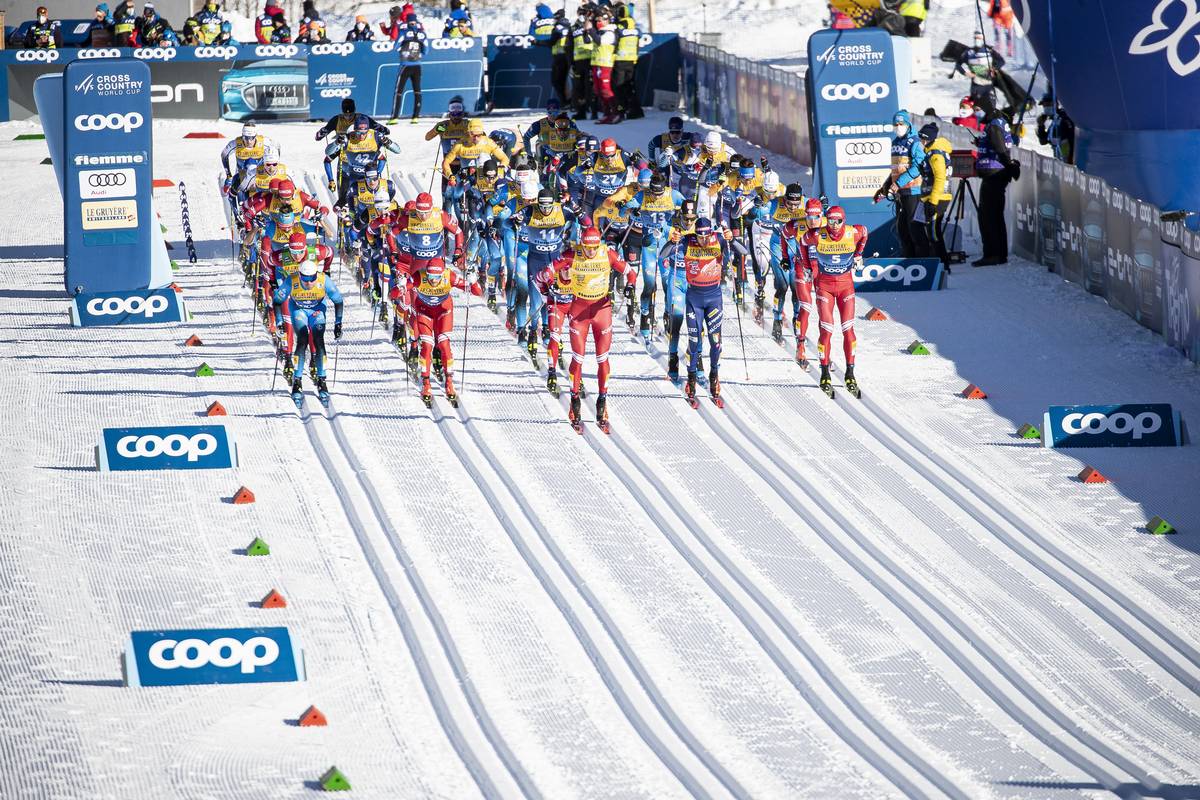
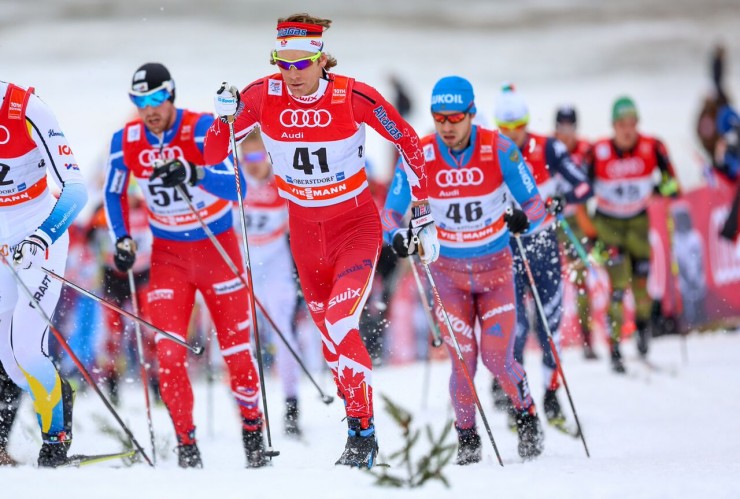
Another clear, cloudless, and frigid day of racing for the men in Falun, Sweden as they completed three laps of a 5 k loop for Saturday’s classic mass start event. Even the perpetually bare-handed Andrew Musgrave of Great Britain was wearing gloves, a sure sign of cold temperatures. This made for fast and firm conditions, resulting in several high-pace crashes, perhaps abetted by the v-board placement on some of the sharper corners.
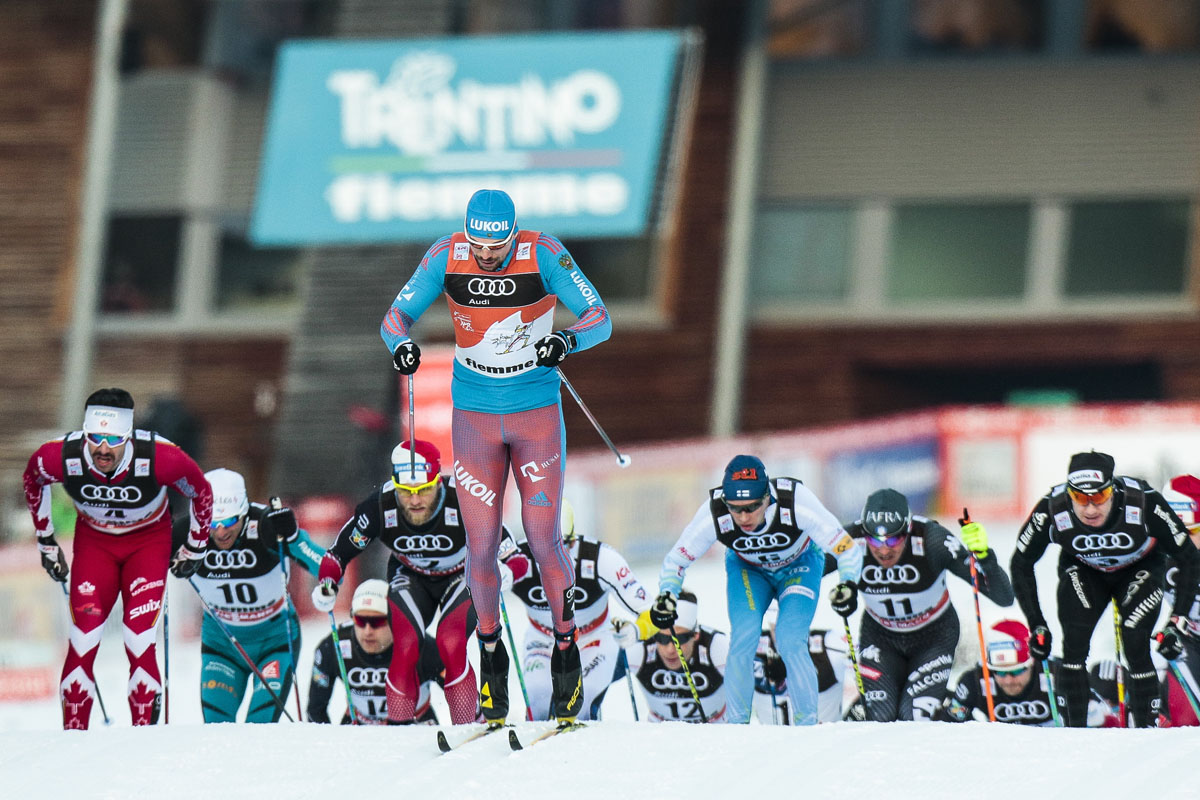
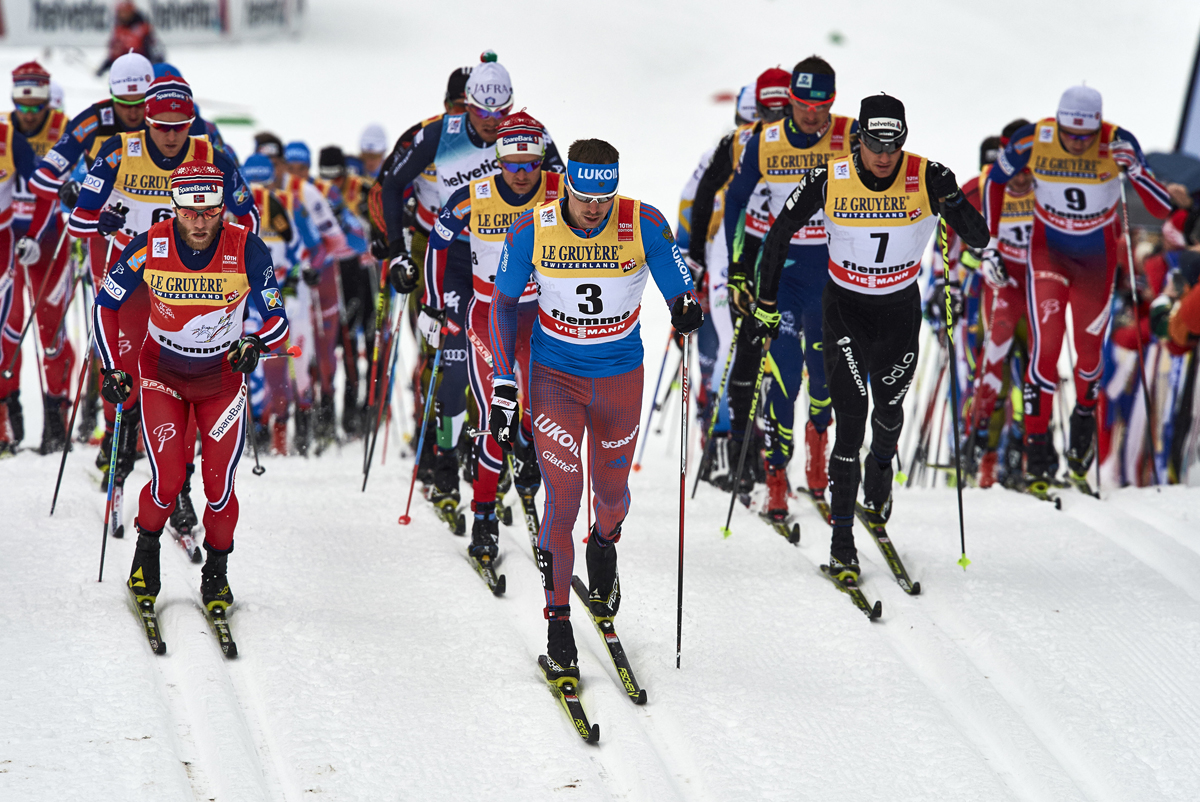
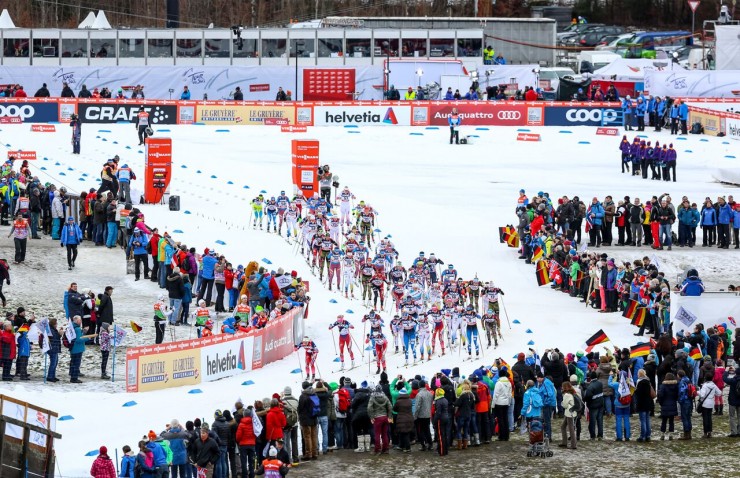
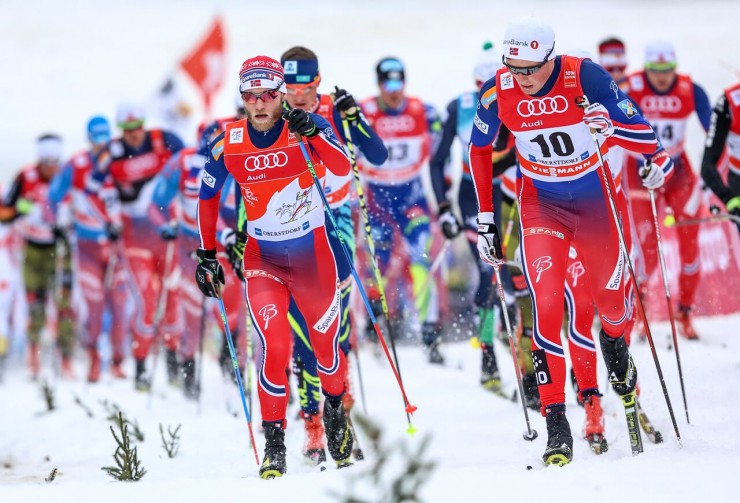
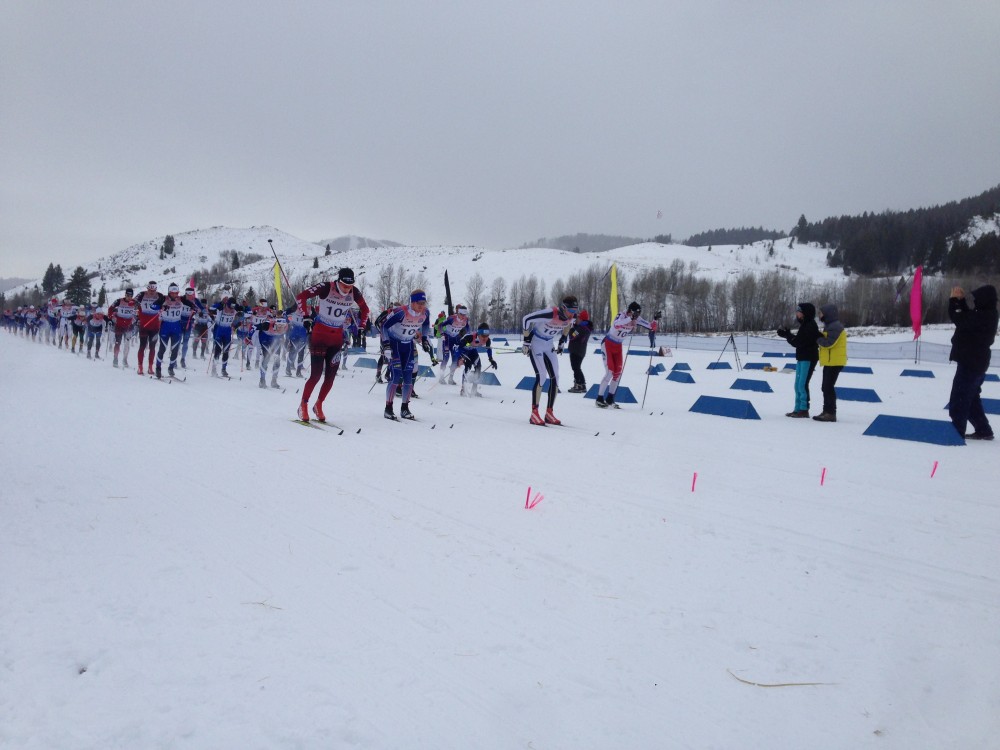
Tightly packed skiers after the start of the men’s 15 k mass start classic in Falun, Sweden. (Photo: NordicFocus)
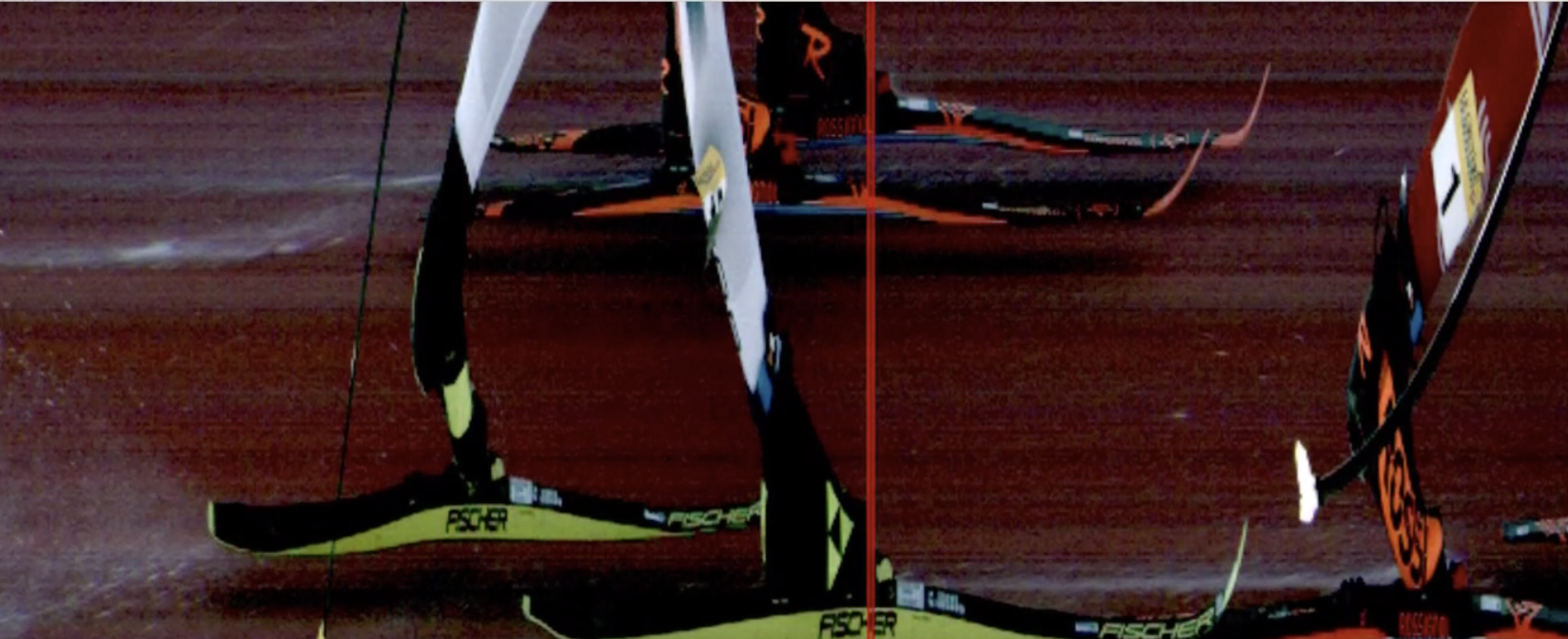
The Lycra color of the day was again red as Alexander Bolshunov of Russia took his 9th individual victory of the season (including the Overall Tour de Ski) in a time of 35:16.3. It was a race to the wire with challenges coming from the other men-in-red, the Norwegians. Directly behind Bolshunov in the final standings were Norway’s Pål Golberg and Johannes Høsflot Klæbo – who were given the same race time (35.16.7), effectively tying for second place in an extremely tight photo-finish. The silver medal, however, was awarded to Klæbo, and Golberg was given bronze. There was lingering confusion as the top-three lined up for the awards ceremony where Klæbo was heard asking, “am I third?” and he was told he had just out-lunged his teammate for second place.
Photo-finish between Johannes Hoesflot Klaebo (foreground, Fischer) and Pål Golberg (background, Rossignol) of Norway for 2nd and 3rd place. (Screenshot: FIS/Eurosport)
As the race kicked off, four tracks across and two lanes deep a wall of red suits composed of Russians and Norwegians stormed ahead- a pronounced theme through the first 1.8 k and for that matter, much of the race. A bonus trophy sprint at 5.8 k brought Iivo Niskanen of Finland through the lineup for a brief time as he gathered 15 bonus points for his effort.
A long-striding Iivo Niskanen (FIN) out front. (Photo: Nordic Focus)
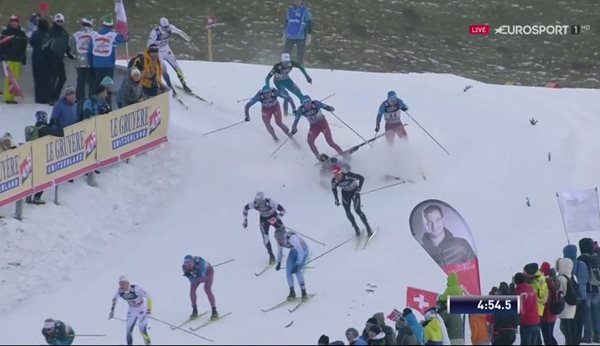
At the base of the sprint hill, just before the 8.9 k split came the first of the big crashes. Cornering tightly, Musgrave tangled with Ilia Poroshkin of Russia and the two went down, taking Bolshunov and a Swiss skier with them. As the rest of the pack crested the hill to descend into the fast sweeping corner, a second crash ensued, with Andrew Young of Great Britain busting through the sponsor boards and Erik Valnes of Norway losing a ski. Young (GBR) received first aid on-site and according to FIS was taken to the hospital for further medical care.
Norway’s Hans Christer Holund pulling out of competition after crashing during the men’s race on Saturday. (Photo: NordicFocus)
Despite the crash, a charge-ahead Bolshunov was soon back to the front, making a decisive move around 13.5 k. He was shadowed by Golberg. With a bit of a gap, those two began the descent into the stadium chased by a fast-closing Klæbo. Down the finish straight, Bolshunov looked to have it in the bag, yet the Norwegians were hot on his tails. Golberg seemed unaware of the close proximity of his teammate and didn’t make a lunge for the line, looking surprised to see Klæbo so close and ultimately loosing the photo-finish.
After the race Bolshunov said, “I am really happy to win this race in Falun. It is my fourth year in a row to have a victory here. It was a fast and hectic race and I had a fall but luckily no equipment was broken and I was able to catch up and take the victory.”
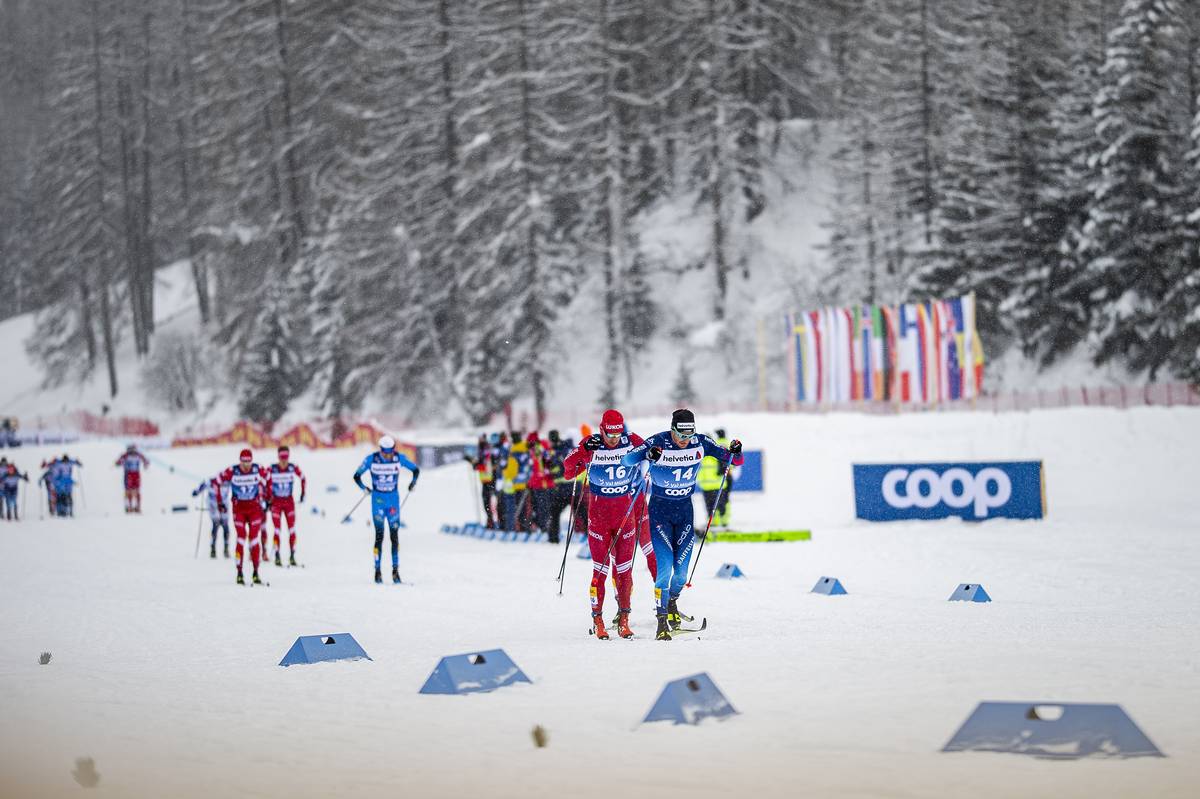
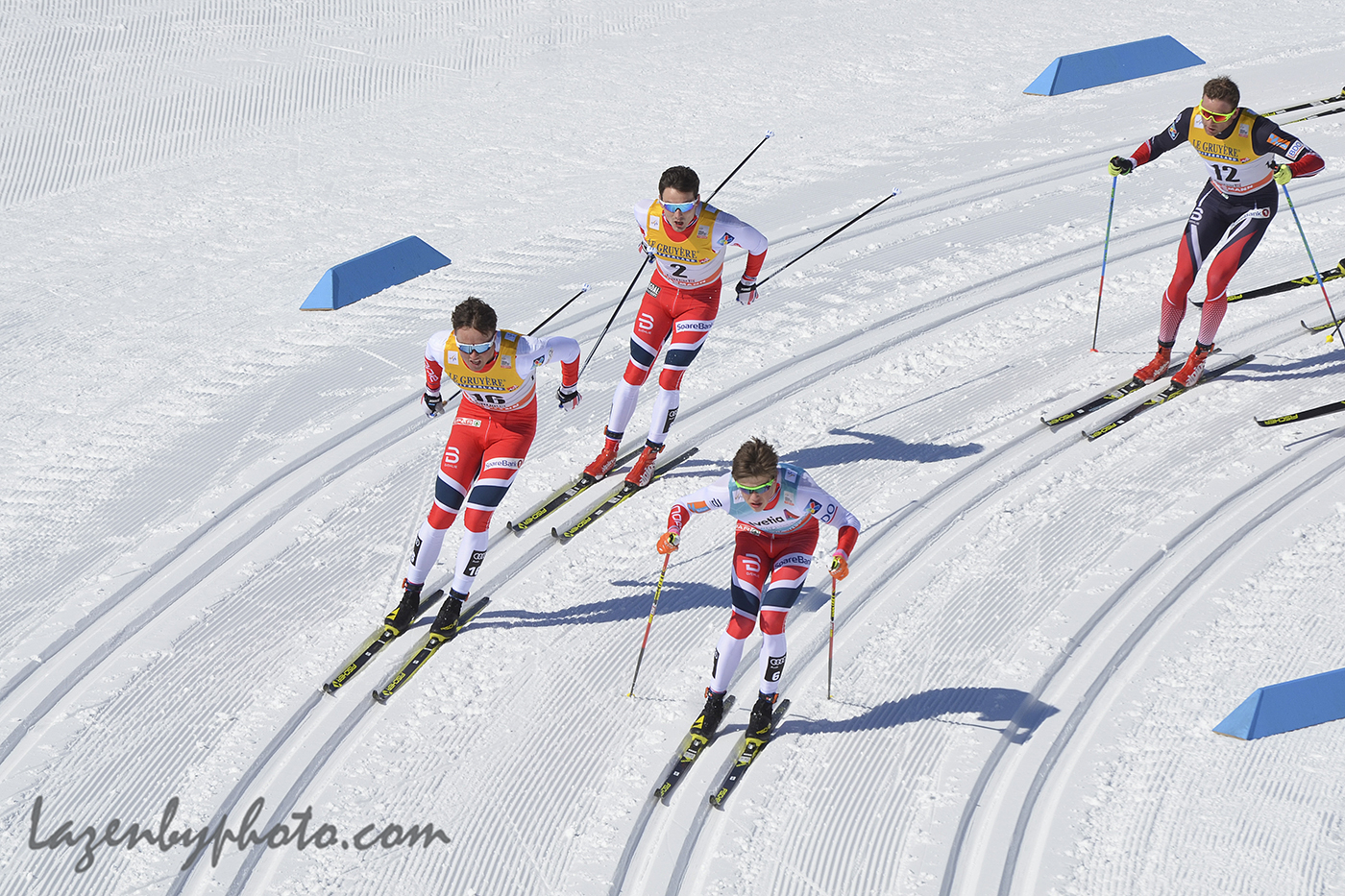
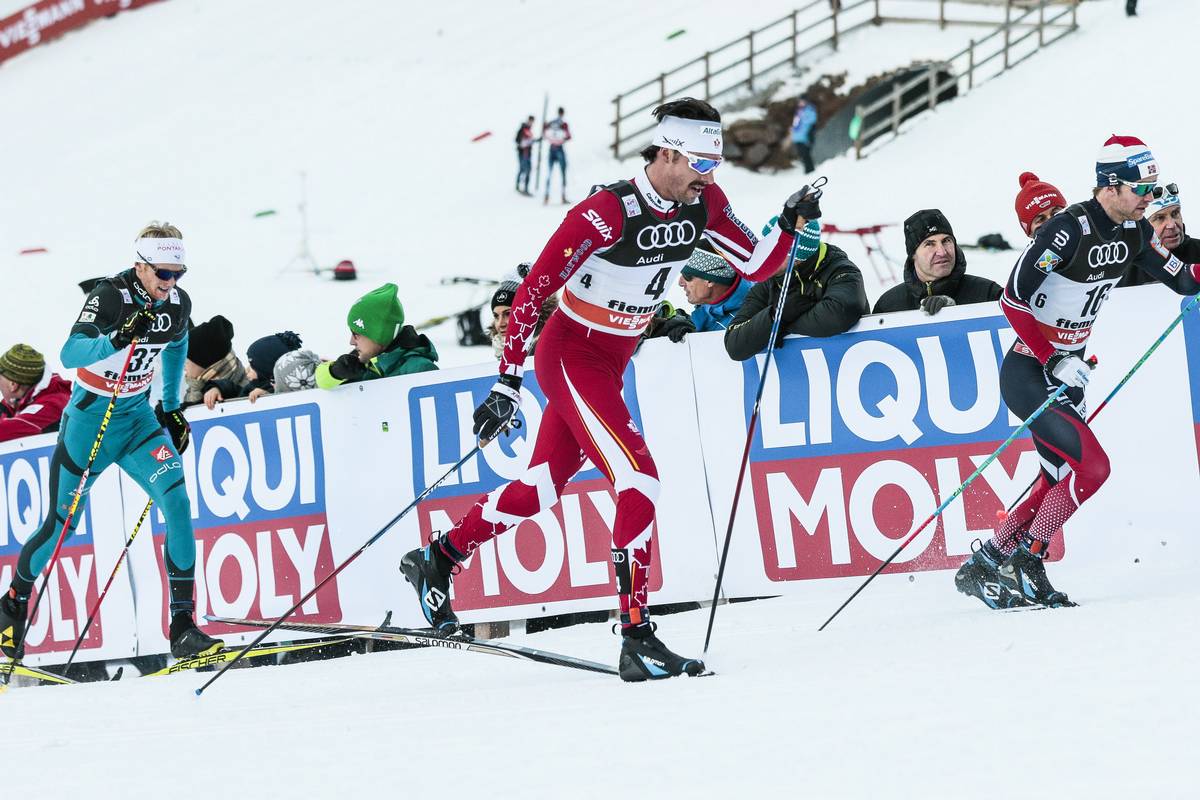
Alexander Bolshunov poling for the win as Norway’s Pål Golberg (bib 16) and Johannes Høsflot Klæbo (behind Bolshunov) fight for second and third. (Photo: NordicFocus)
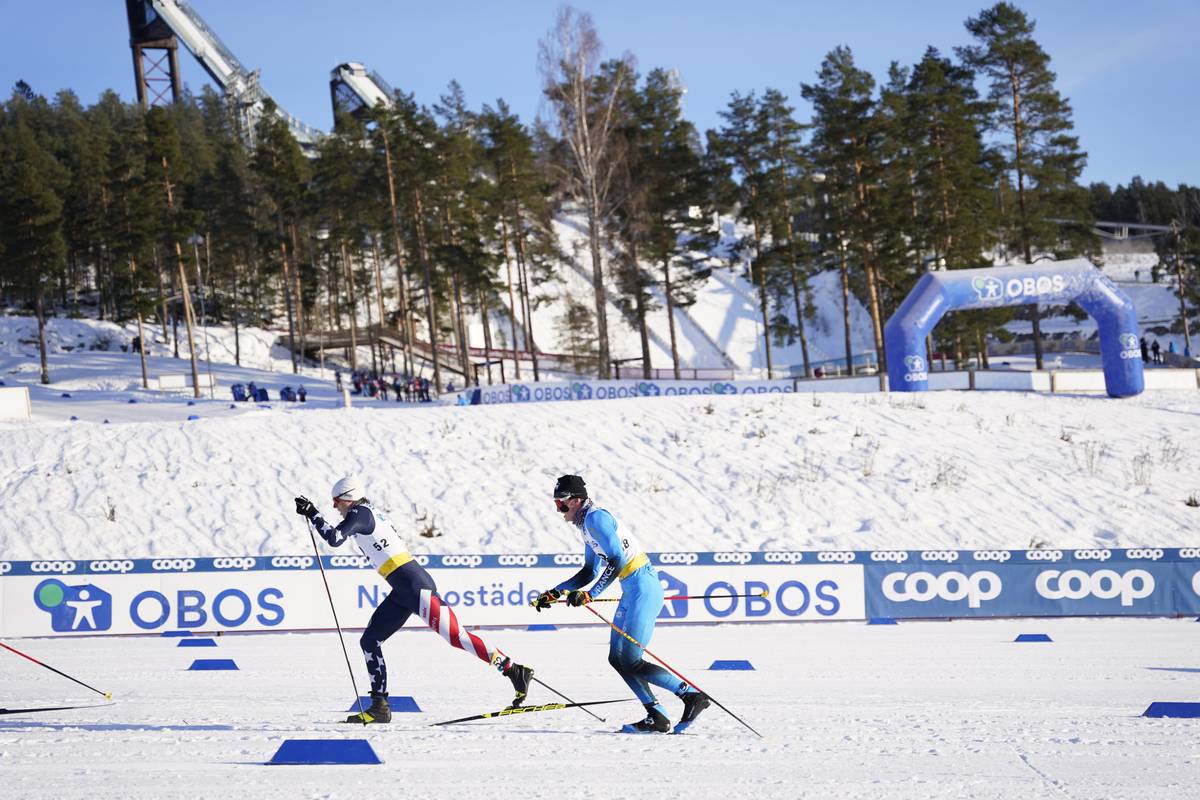
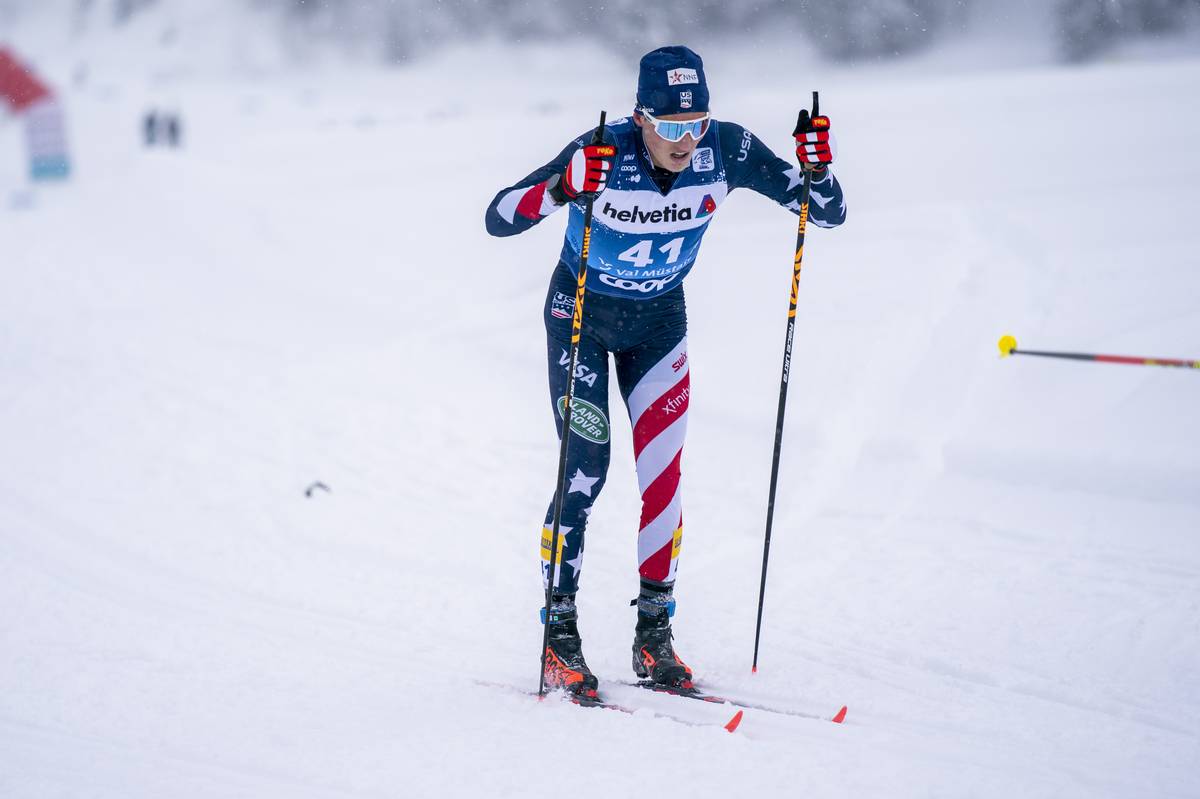
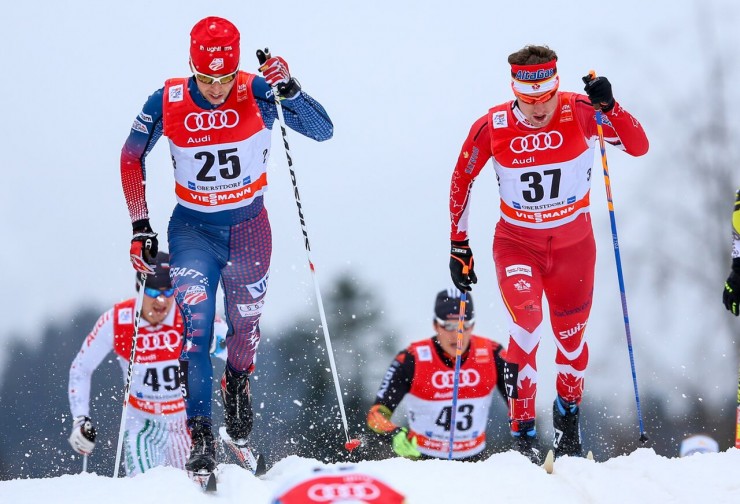
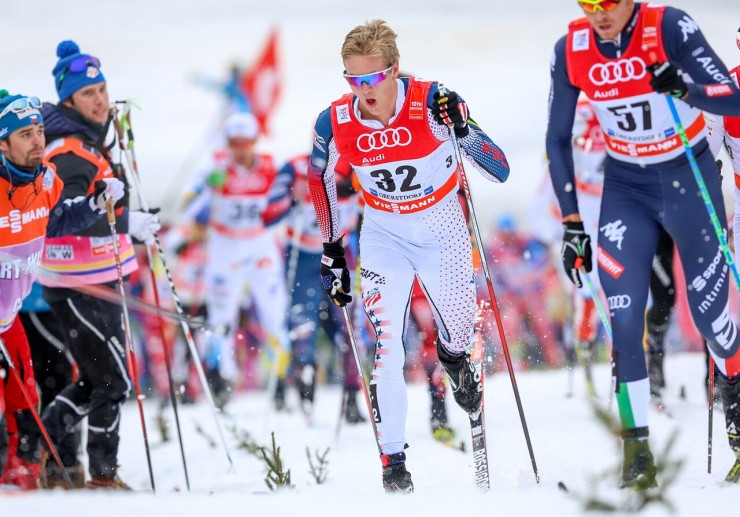
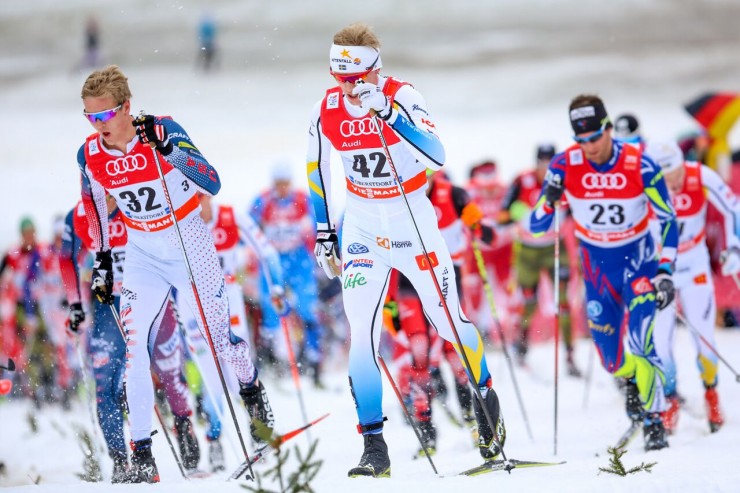
For much of the race, a duo in stars and stripes sporting matching camo buffs could be seen at the back of the pack. Gus Schumacher and Hunter Wonders, both U-23 skiers from Alaska, were the top finishers for the American men. Schumacher, who placed 28th, +14.8 back from Bolshunov, said of his race, “as the pace picked up, I didn’t have much spare energy, as I spent a lot of it trying to ski in the middle of the pack. In hindsight, trying to ski up in 10th-20th would’ve been a lot easier. I’m not super happy with my result today, it would’ve been nice to be able to attack in the last 5km, but I am happy with not falling or breaking any equipment. I’m sure some of the chaos was visible on TV, but there was a lot more that was going on the whole time, in terms of falls and tangles. It was a good day to practice group skiing, and I’m glad I had yesterday to show that if I ski well, I have that energy in the end!”
Hunter Wonders finished 37th (+24.9). “This is in fact my 2nd week on the WC and it’s pretty surreal to be side by side all the best in the world that I’ve been watching on TV for years,” emailed Wonders after the race. “Last week in Lahti wasn’t my best weekend of racing and I knew I could do better and just tried to keep it off my mind and look forward to these races in Falun. I try to go into every ski race with the mentality of it being just that, another ski race that I’ve done hundreds of times.
“Gus and I skied a good portion of the race together today and that was awesome to me, it reminded me of high school skiing in a way. The race was crazy hectic and there were lots of crashes so I think Gus and I are both just happy to have stayed on our feet!”
Also for the U.S., Adam Martin finished 57th, David Norris 60th, Ian Torchia 64th and Scott Patterson 65th.
Ueli Schnider (SUI), and Gus Schumacher (USA), (l-r) during the men’s 15 k mass start classic in Falun, Sweden. Schumacher was the top North American finisher in 28th. (Photo: NordicFocus)
The Canadian men were led by Remi Drolet who finished 47th, followed by Russell Kennedy in 54th and Philippe Boucher in 70th. Antoine Cyr did not start.
Adam Martin (USA) on a lap through the stadium. (Photo: Nordic Focus)
The weekend of racing wraps up tomorrow with a classic sprint.
Post-race comments from U.S. Head Coach Matt Whitcomb.
Yellow bibbed and in the lead after the start of Stage 6 of the Tour de Ski: Alexander Bolshunov (RUS). (Photo: NordicFocus)
This World Cup coverage is made possible through the generous support of Marty and Kathy Hall and their A Hall Mark of Excellence Award. To learn more about A Hall Mark of Excellence Award or to learn how you can support FasterSkier’s coverage please contact info@fasterskier.com.
A crisp and clear day in Val di Fiemme, Italy as the men lined up for Stage 6 of the Tour de Ski. Today’s race, a 6 x 2.5 k classic mass start with a total climb of 96 meters per lap, found them winding around the tight turns of the shadowed side of the valley, poles creaking in the cold snow. With the crack of the starter’s gun, the 53 skiers were off.
Stage 6: starting like it finished with Russia’s Alexander Bolshunov in front. (Photo: NordicFocus)
A bonus points sprint around 1.5 k, won by Richard Jouve of France, caused a slight stretch in the pack, but like elastic they quickly snapped back together. For the better part of the second lap, Evgeniy Belov of Russia tried his hand out front but his teammate Alexander Bolshunov did not let this continue for long as he led the hunt, reabsorbing Belov as they lapped through the stadium for the third time.
Evgeniy Belov (RUS) takes a fast corner. (Photo: Nordic Focus)
The sprint for bonus seconds on the penultimate lap went to Bolshunov, earning him an additional 15 seconds. Throughout all this, Gus Schumacher of the U.S. was gradually working his way up through the pack from his starting position in bib 33. When the cowbell rang signaling the final lap, Schumacher was sitting in 12th, well situated within the lead pack.
Francesco de Fabianiof Italy seized an opportunity out front and began to pull away, closely shadowed by Bolshunov. By the time they descended into the massive horseshoe corner for the final time a clear threesome had broken away, led by de Fabiani, then Bolshunov and Russia’s Alexey Chervotkin. De Fabiani entered the downhill towards the finish some meters ahead of Bolshunov, but his skis were no match for the rockets worn by the Russian. Bolshunov shot past de Fabiani and essentially out-glided him to the finish line in a time of 41:33.7. De Fabiani came away with silver, +1.8 seconds behind, and Chervotkin held his own to finish third (+3.7 seconds back).
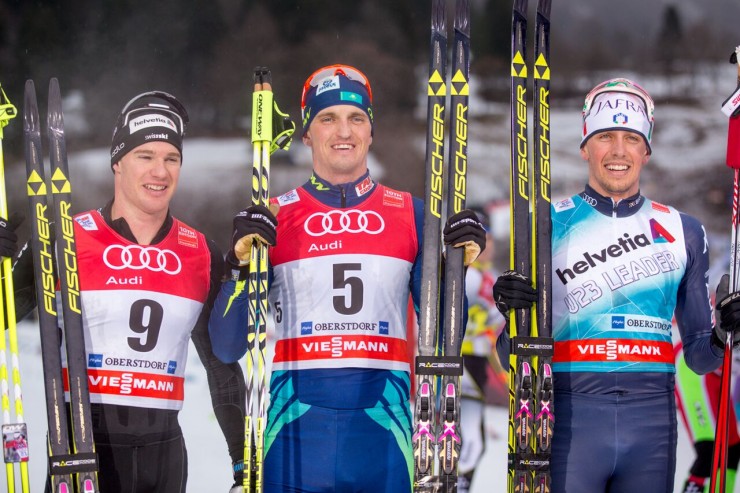
Stage 6 podium: Francesco De Fabiani (ITA) second, Alexander Bolshunov (RUS), Alexey Chervotkin (RUS) third, (l-r). (Photo: NordicFocus)
It appears Val di Fiemme and de Fabiani go well together: last year in this same stage of the Tour (the 15 k mass start classic), he placed second, 0.6 seconds off the top-step to Norway’s Johannes Hoesflot Kleabo, who won. Bolshunov placed third.
Bolshunov down the finish straight. (Photo: NordicFocus)
At a certain point, one begins to run out of superlatives to use, but once again Bolshunov proved his dominance, despite a tricky course for breakaways. Bolshunov now has won five of the six stage races and continues to grow his overall lead in the tour standings. In his post-race interview Bolshunov spoke through a translator, “It was perfect skiing conditions today and due to that, it was really hard to ski away so the fight was at the end and luckily I was able to pull that out.” After his victory today, his lead has now stretched to +2:37 ahead of Maurice Manificat of France who has moved into second place overall.
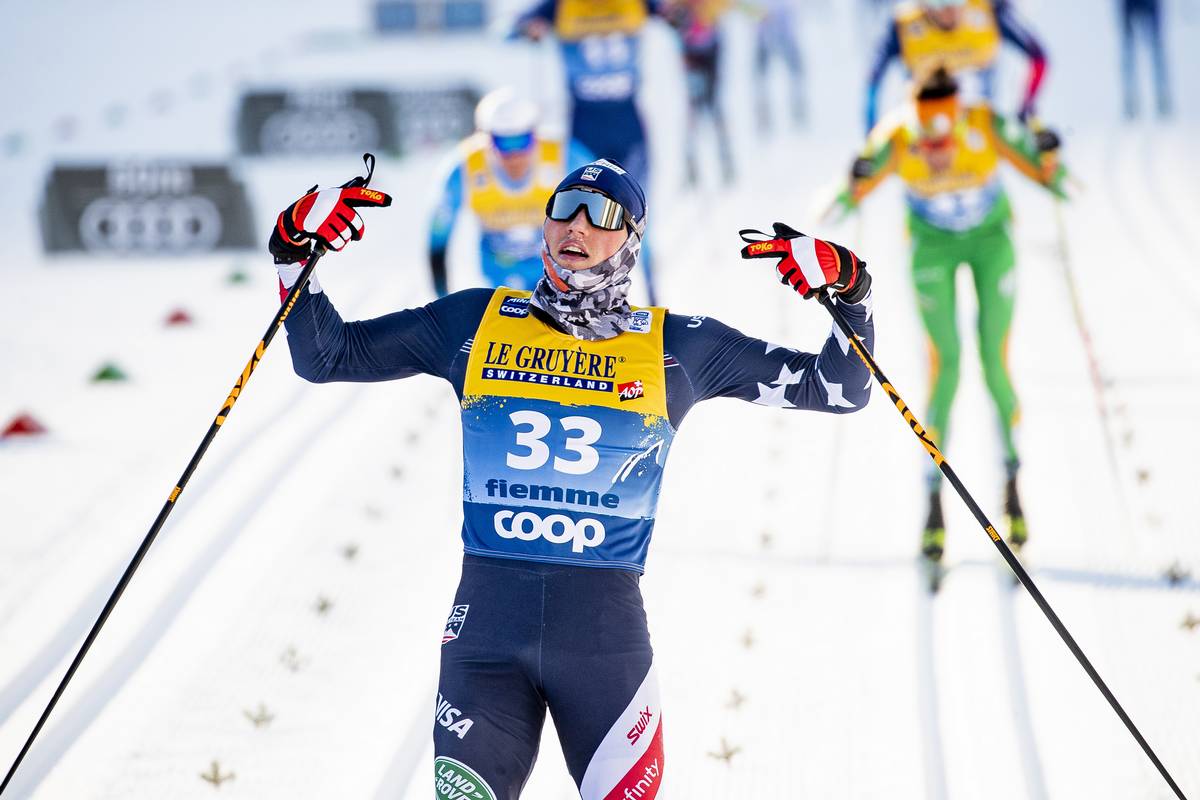
Gus Schumacher placed 8th in Stage 6 of the Tour de Ski, a career-best World Cup result. (Photo: Nordic Focus)
Race of the day, and certainly the year for American distance skiing, belongs to Gus Schumacher. As the pack split apart on the final lap, Schumacher remained in range. Pacing strategically, and working up through the pack, he was 31st at 5 k (+13.1) then 16th at 10 k (+6.7). Looking for optimism in American men’s distance skiing? Here is your ray of sunshine.
At 13.9 k he was in 5th place, behind the three eventual podium finishers and Ilia Semikov of Russia. Minutes later, he crossed the finish line in 8th place, a career best. Schumacher, who took gold in the 10 k classic at World Juniors last year in Oberwiesenthal, Germany, seems to be on a steady upward trajectory in this year’s Tour de Ski. With today’s standout performance he is now seated in 18th place in the tour standings, +6:45 back from Bolshunov (RUS).
Another performance worth noting is that of Ireland’s Thomas Maloney Westgaard, who is based in Norway, placed 9th in today’s race. Westgaard’s (IRE) previous best World Cup finish came in February 2020 when he placed 16th in a 15 k classic race in Lahti, Finland. Additionally, Sweden’s Calle Halvorsen did not finish.
Scott Patterson (USA) finishes up Stage 6 of the Tour. (Photo: Nordic Focus)
Scott Patterson of the U.S. finished in 35th (+1:50.5) and Kevin Bolger came in 46th (+3:38.7). Racing continues tomorrow with a classic sprint.
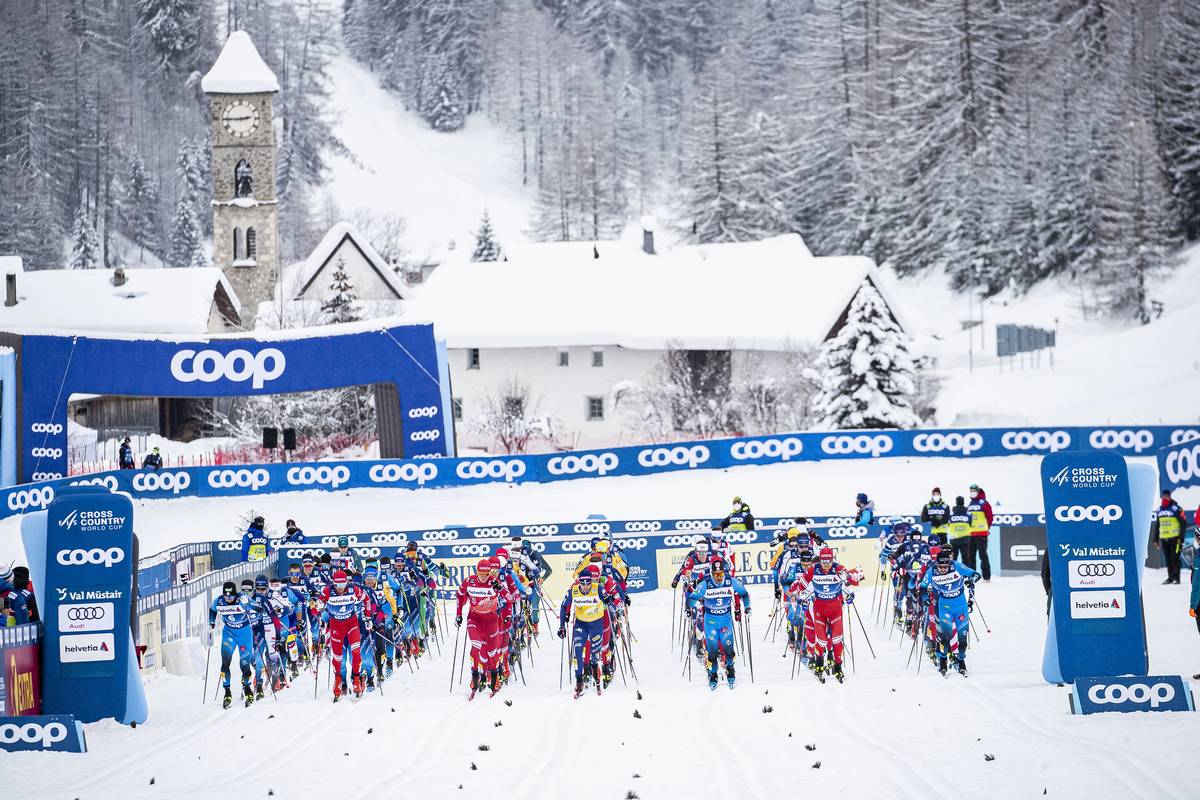
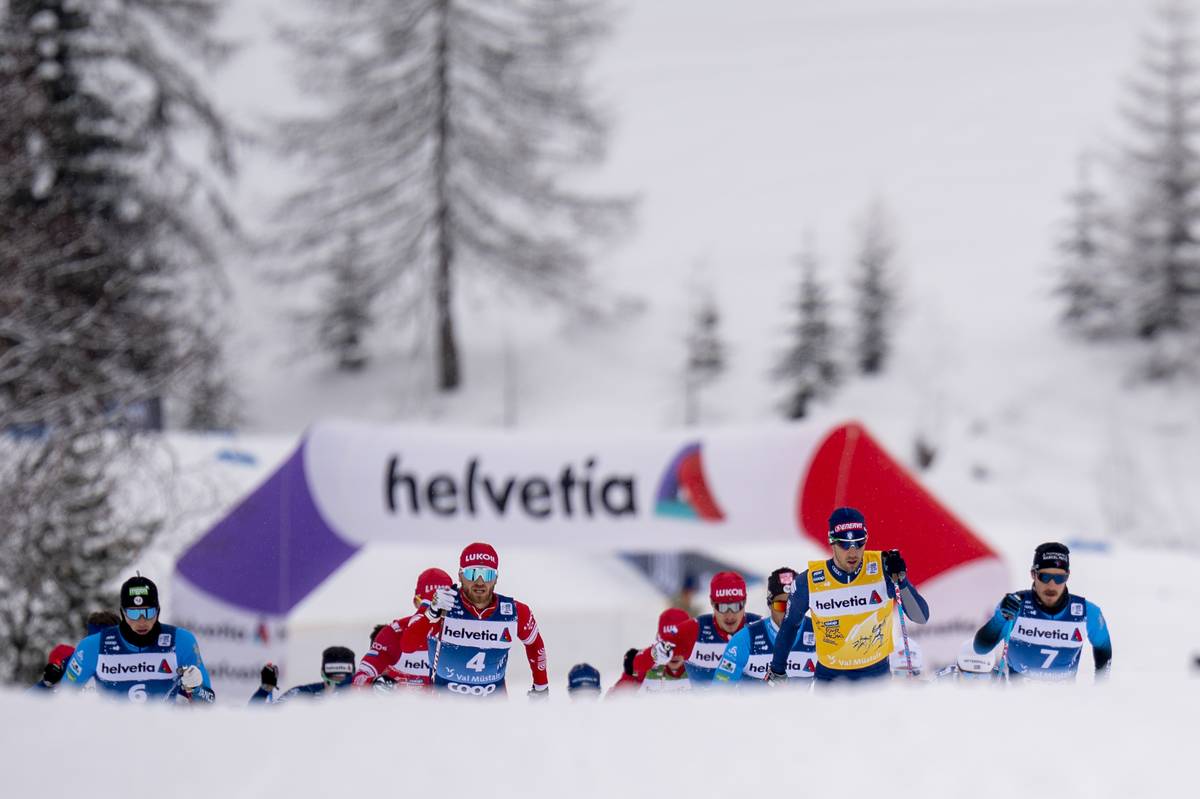
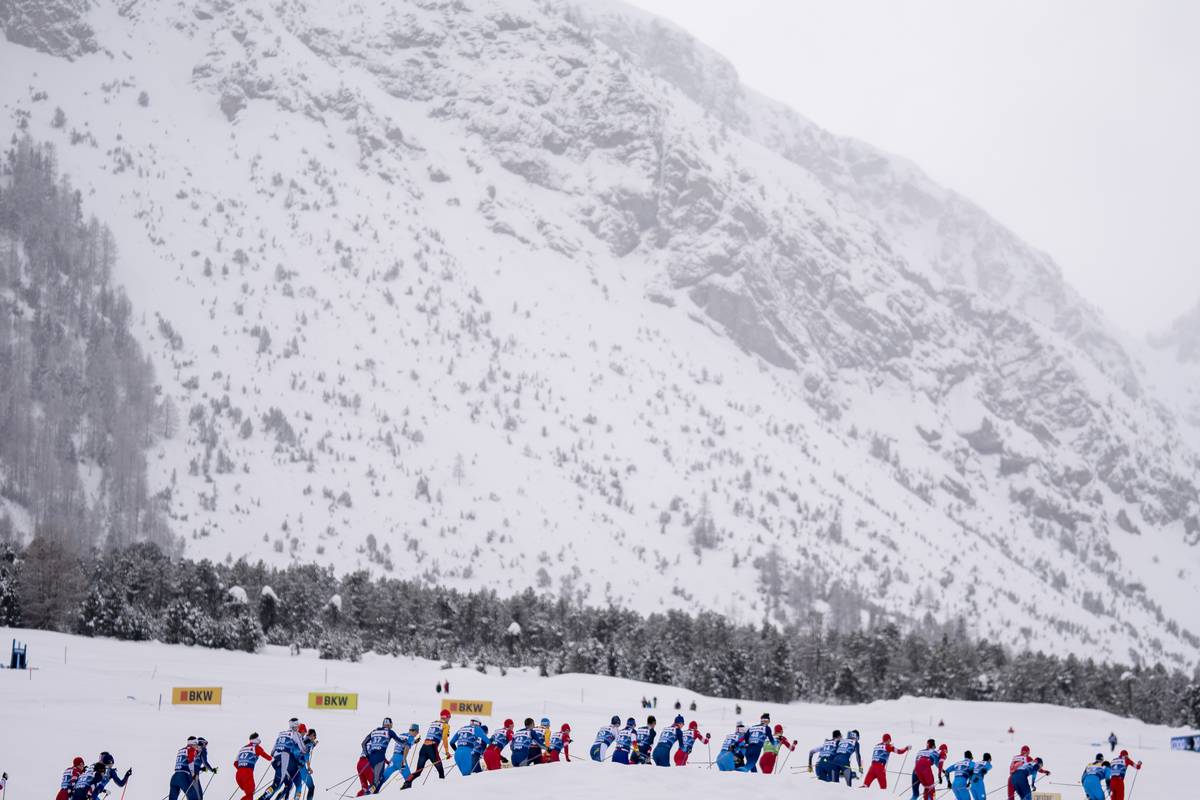
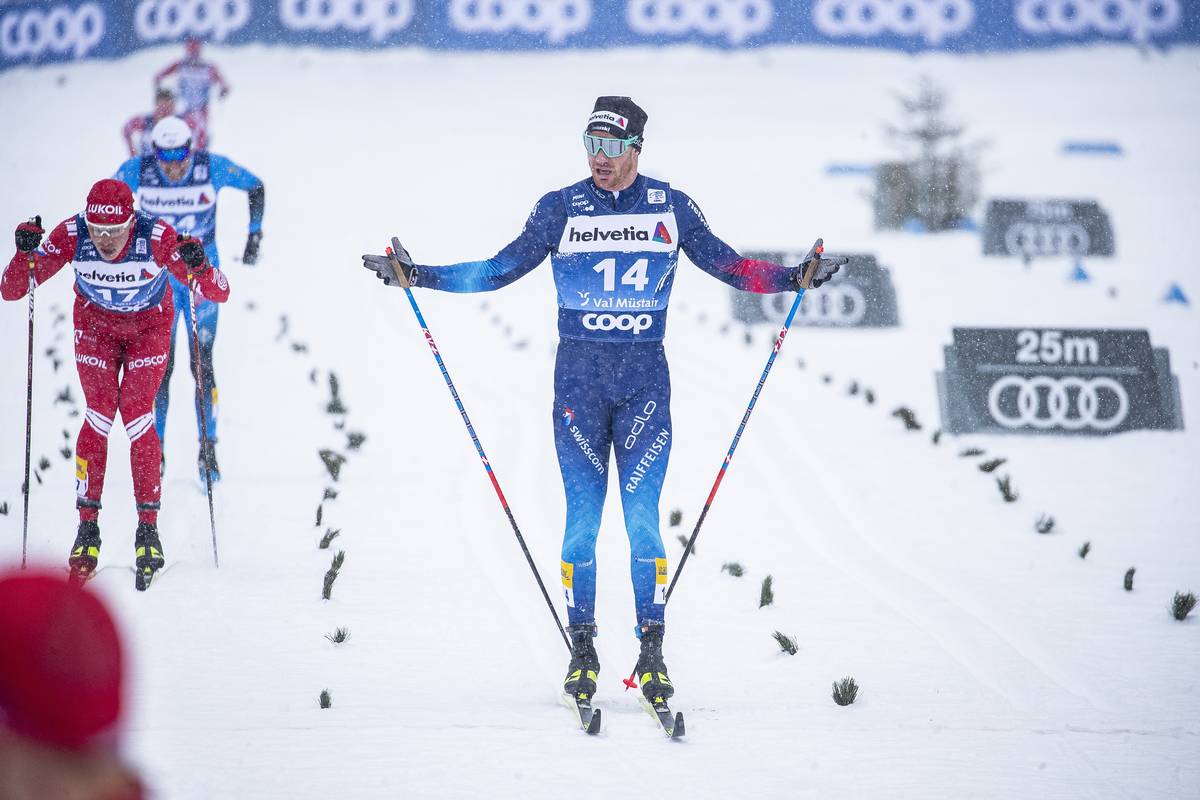
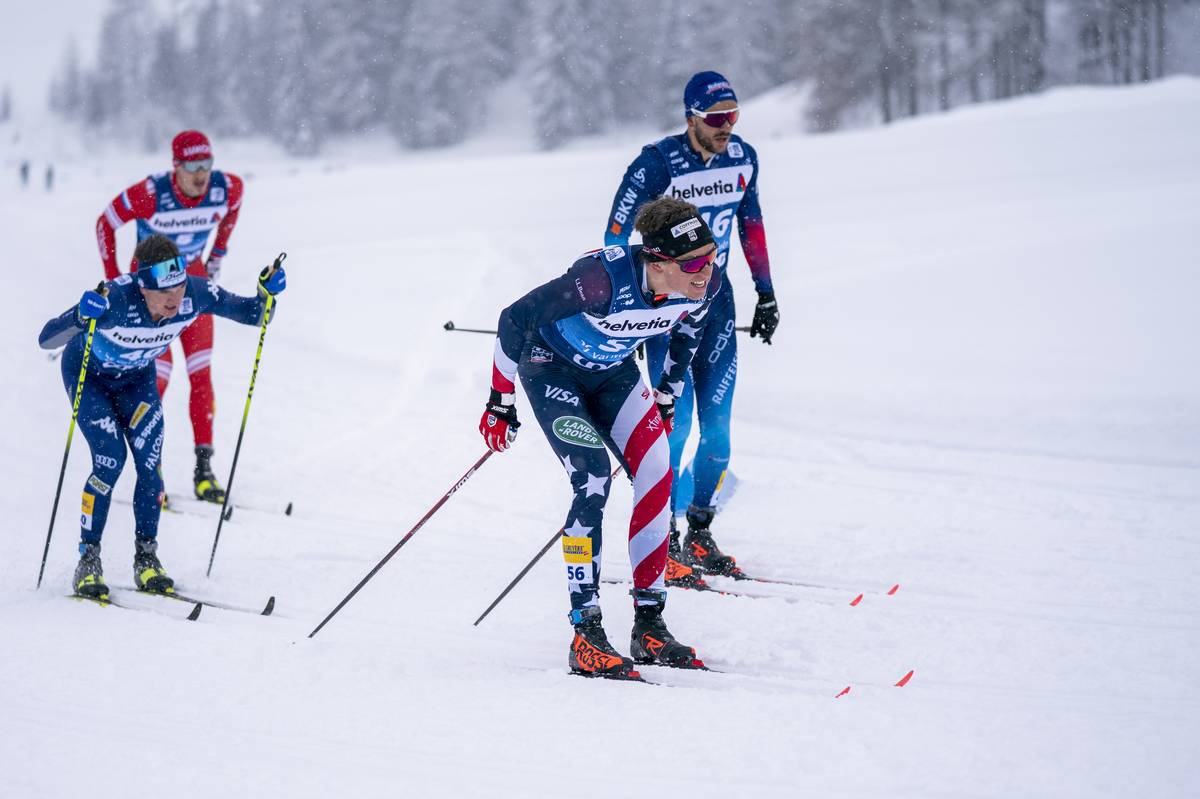
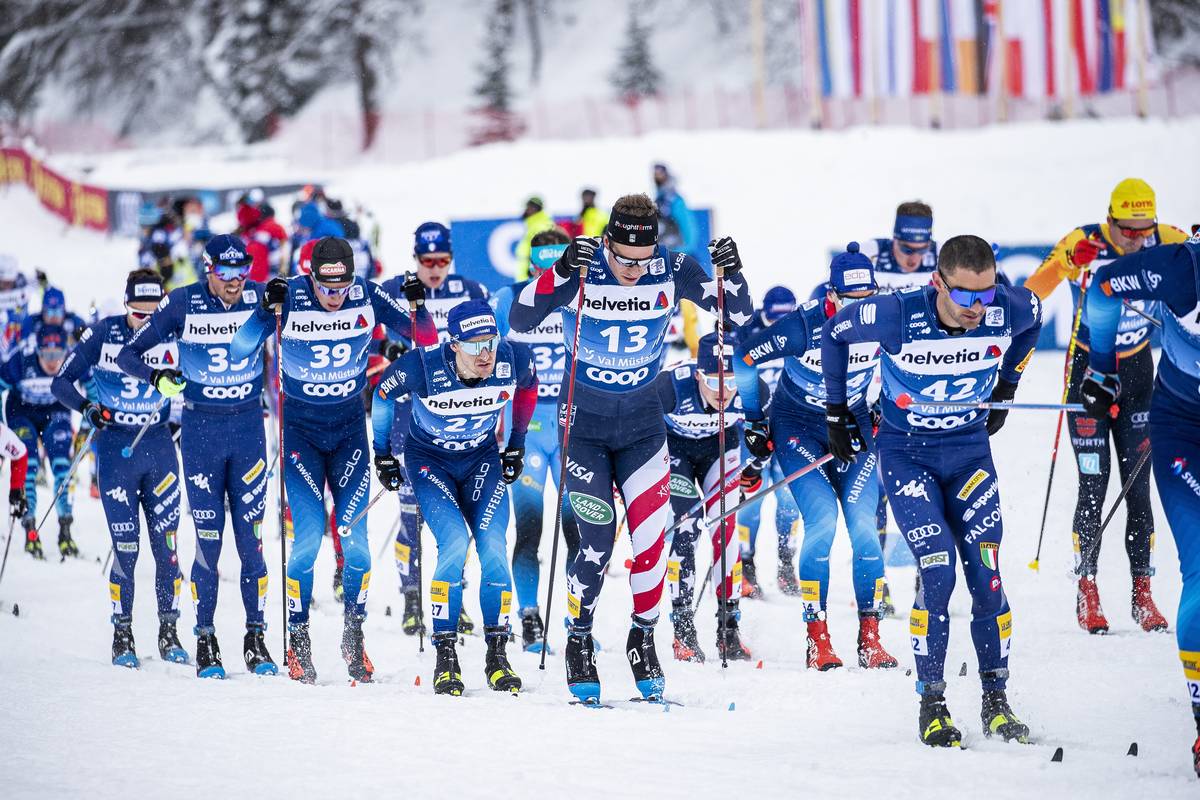
The start of the men’s 15 k mass start classic in Val Müstair, Switzerland. (Photo: NordicFocus)
This World Cup coverage is made possible through the generous support of Marty and Kathy Hall and their A Hall Mark of Excellence Award. To learn more about A Hall Mark of Excellence Award or to learn how you can support FasterSkier’s coverage please contact info@fasterskier.com.
Val Müstair, Switzerland and its snowfall were again the idyllic backdrops for the Tour de Ski (TdS) where the men raced a 15-kilometer classic mass start to kick off the distance stages. After yesterday’s skate sprint in which Russia’s Alexander Bolshunov took second place, it appeared the twenty-four-year-old would iron-fist this fifteenth edition of the TdS.
No doubt, Bolshunov came into the event as the favorite. The conversation trending towards how much time he wins the overall. As last year’s winner of the TdS, and finishing on five podiums in seven stages, this Russia has been here before.
Immediately as the 77 starters crowding the start tracks set off, Bolshunov was the skier to watch. No matter who strode alongside him for the first 5 k or so, this was simply a game of when Bolshunov would shatter the pack and make an exclamation point statement that his trend towards generational status skier was for real.
The TdS includes a points race, which incentivizes some skiers not contending for the overall to remain upfront to snag the prime, and perhaps collect a few more Swiss Francs at the end of the workday. With the points bonus offered at 4.5 k, Italy’s Federico Pellegrino, winner of Friday’s sprint, was right there in the front.
Italy’s Federico Pellegrino in yellow. (Photo: NordicFocus)Stage 2 of the 2021 Tour de Ski. (Photo: NordicFocus)
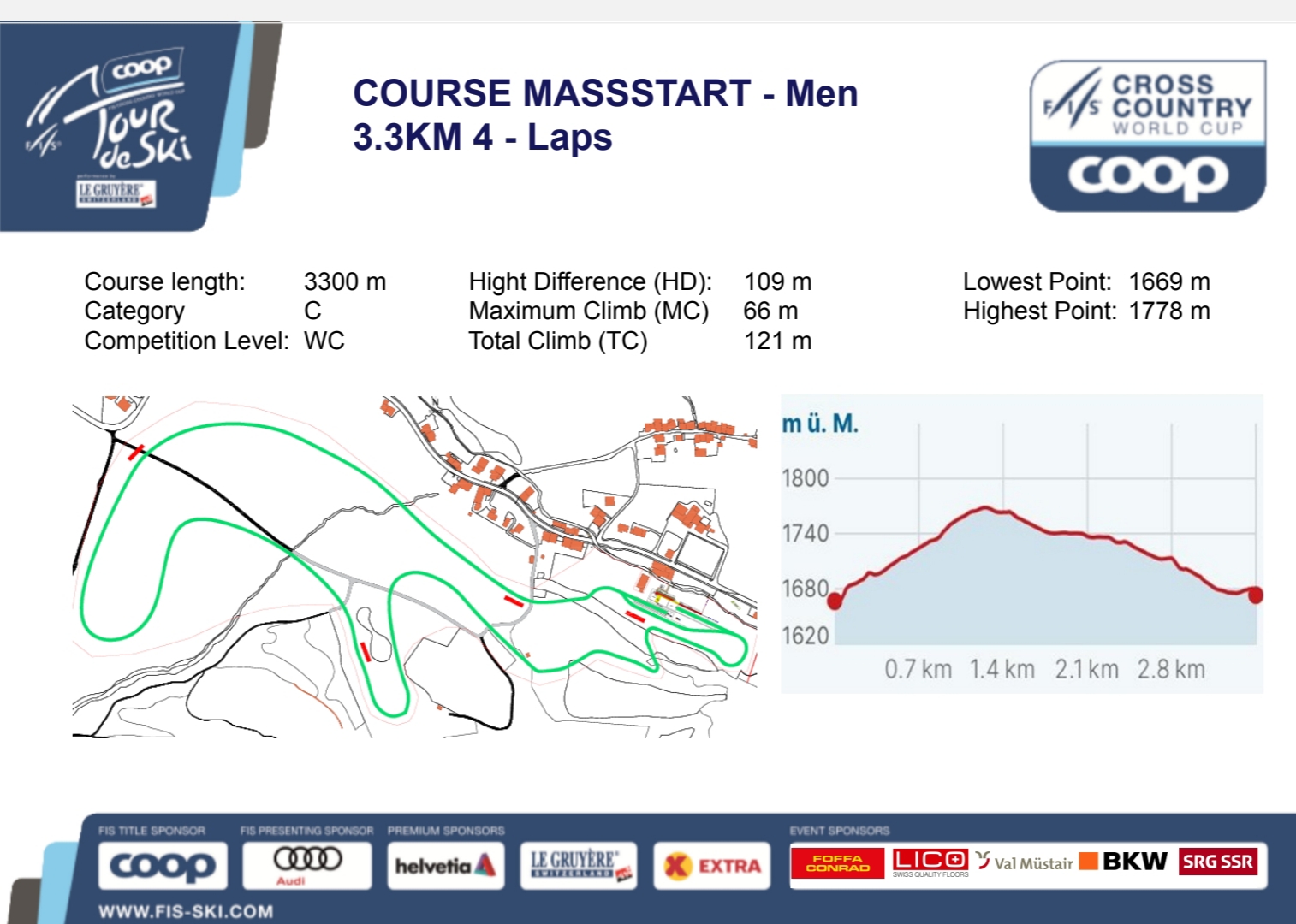
With four laps of a 3.3 k course which featured a long climb and sinuous downhills with techy turns, this was primarily a fitness test in the end. And the Russian team collectively appears the fittest. Along with Bolshunov, his teammates including Alexey Chervotkin, Evgeny Belov, Ivan Yakimushkin, Denis Spitsov, and Illia Semikov were a wall of red Lycra upfront.
No matter how you parse the stats or the visuals presented of the race, it certainly looked like a Russian podium sweep with the only lock Bolshunov on the top-step. At 11.4 k, Bolshunov powered ahead by 5.1 seconds ahead of hometown hero Dario Cologna with Belov, Maurice Manificat of France, Yakimushkin, Sptisov, Semikov, and Sweden’s Oskar Svensson towed through in that order. Svensson was 14.7 seconds off the pace.
The solo Bolshunov show flew ahead. Eight-tenths of a kilometer later, he secured a 19.7-second cushion. With little action out front beyond anticipating how much time Bolshunov might gain, we’ll send it straight to the finish: Bolshunov won by 23.5 seconds.
Alexander Bolshunov in front during stage 2 of the 2021 TdS. (Photo: NordicFocus)
As noted, it appeared late in the race to be a probable all-Russian podium. Yet the cosmos can play tricks. The podium, in a parallel universe, maybe had a decidedly red look.
Coming into the final downhill, made more complex by a sweeping right-hand corner which had already taken out several skiers in yesterday’s sprint and today’s mass start, Belov dove into the bend first, a hair ahead of Chervotkin. As skiers warped around, Chervotkin tried to cut inside of Belov and clipped his skis. Belov tumbled as did Chervotkin right after. As the two skiers exchanged words and began righting themselves, Yakimushkin went wide left off course and out of the turn to avoid crashing. Twenty meters later, he skied back on course.
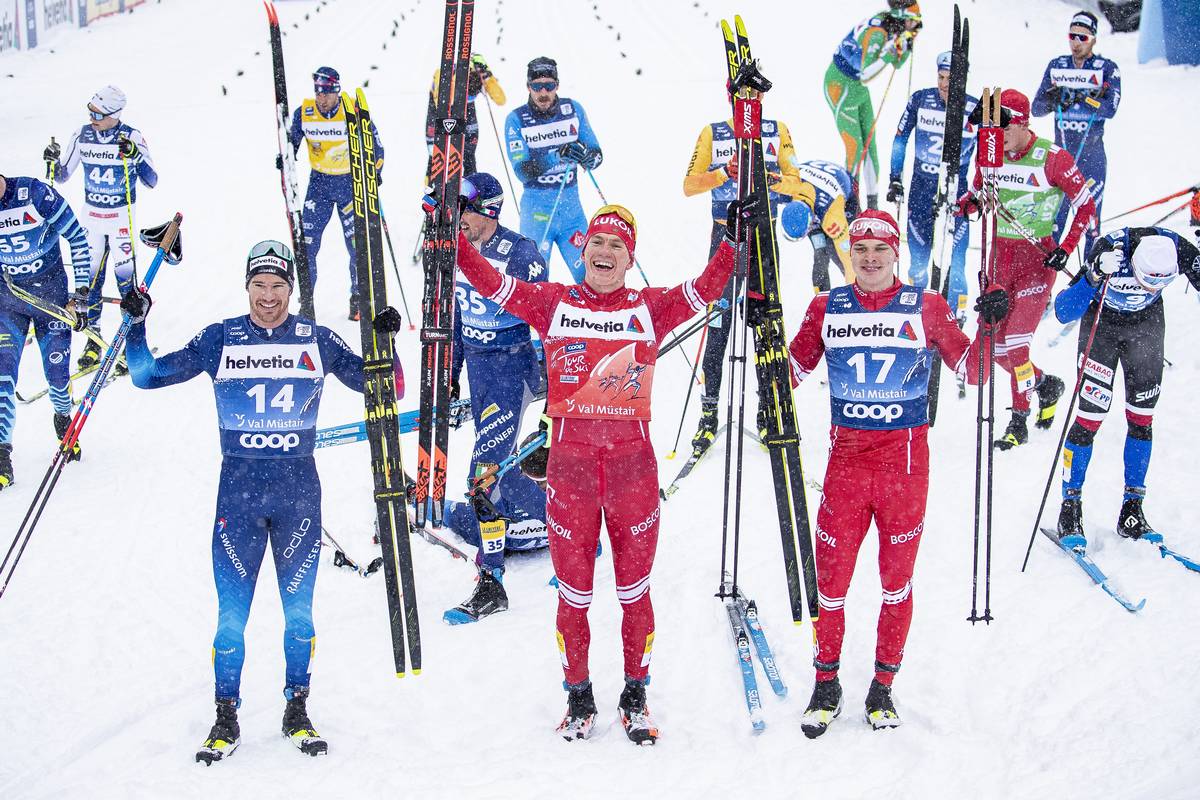
In the meantime, Cologna, remained on his feet, skirted around the tumbled Russians, and made good for his hometown and the army of Cologna supporters who no doubt were clanging oversize cowbells at home as the event did not allow spectators. As the Swiss gift that keeps on giving, Cologna placed second (+23.5) and Yakimushkin third (+25.3). France’s Manificat bypassed the carnage as he was many meters behind the crash, and placed fourth (+27.7).
Cologna has won the TdS on four occasions – a record for men’s overall titles. His second place on the stage was his best result of the season. Before Saturday, his best 2020-2021 distance result was 14th place in the Davos 15 k skate. His last podium was in the 2019 15 k skate also in Davos.
Evgeniy Belov (RUS), and Dario Cologna (SUI), (l-r). (Photo: NordicFocus)Dario Cologna (SUI) taking second in stage 2 of the 2021 Tour de Ski. (Photo: NordicFocus)
Russia locked up five of the top-10 spots, with Belov, who had crashed, missing out on a podium and placing eighth.
Notably missing from the results was Chervotkin. He was disqualified after the race for violating rule ICR 343.9 which states, “Obstruction: deliberately impeding, blocking (by not following best line), charging or pushing any competitor with any part of the body or ski equipment.”
Post-race comments about the men’s race from U.S. Head Coach Matt Whitcomb.
For the U.S., Gus Schumacher was the top finisher in 36th (+1:53.8). New to full-time World Cup skiing, Schumacher has been on the road since mid-November as he begins to learn more about certain World Cup venues, the vagaries of life on the road, and the speed at which skiers like Bolshunov hammer about.
Today, the twenty-year-old from Anchorage, Alaska was 23rd (+8.2) at the 4.5 k mark skiing in a thick soup of skiers: 30th place was 10.8 seconds back. As the race broke apart due to the surges ahead at 11 k, Schumacher fell back to 33rd amidst a group of skiers including Sweden’s Calle Halfvarsson.
“It was fun to race a mass start again,” Schumacher emailed. “I thought it would go out fast and then cruise but it went out quite slowly, which was a little frustrating in the belly of the pack. The second lap also seemed pretty relaxed, and as the pace quickened through halfway I was feeling like I was skiing well and moving up. And then near the top of the climb, the wheels fell off and I just flooded hard. Thankfully there was a big downhill to recover, but I really lost my momentum. So not perfect pacing, but it was fun to ski closer to the front for a little while.”
As his first Tour de Ski, the prospect of an eight-stage slog can be daunting. Decidedly, Schumacher is taking each stage one by one, each a unique opportunity to learn and grow.
“I definitely approached the day as a singular race, just with the goal of doing as well as I could,” Schumacher wrote. “The risk that I could’ve taken would be double poling on skate skis, but I figured that would not be a good move with the idea of an 8-race tour.”
He added that the race was a reminder to strategically pace at altitude.
Scott Patterson was the next best American in 43rd (+2:17.6), with teammates Simi Hamilton 46th (+2:38.1), and Kevin Bolger 59th (+3:25.6), respectively.
“Across the board, it was a disappointing day for the guys, just call it what was,” said U.S. Head Coach Matt Whitcomb after the race. “Gus probably showed the most signs of promise today, he skied within the top-20 for the parts of the race and top-25 before he was kind of running out of gas. He was pretty cached on the fourth lap. We will just make sure he continues to fuel well it is one of those places where if you go a little too hard on any one lap which is my guess as to what happened, you end up having a pretty heavy tax late in the race. It comes back to bite you and sometimes you get away with it. I am not one who likes to see people ski a conservative race I like to see people aiming for the bull’s eye and he did that and that is how to get faster.”
Scott Patterson for the U.S. placed 43rd in stage 2. (Photo: NordicFocus)
Simi Hamilton of the U.S. at the start of the men’s 15 k mass start classic. (Photo: NordicFocus)
The Men’s Overall:
Tomorrow’s stage for the men, a 15 k skate pursuit, sees Bolshunov starting first, one minute ahead of second starter Maltsev. Svensson begins third (+1:00), and Cologna fourth (+1:11).
The men’s stage 2 podium: Dario Cologna (SUI) in second, Alexander Bolshunov (RUS) first, and Ivan Yakimushkin (RUS) third, (l-r). (Photo: NordicFocus)
Of the four Russian athletes starting the 15-kilometer classic mass start in Lahti, Finland three placed in the top four. Anna Zherebyateva won in 40:31.4 minutes as she was able to stretch her nine-second gap at 10 k to 23.5 seconds by the finish. Also from Russia, Lidia Durkina placed second (+23.5), Germany’s Katharina Hennig skied to third (+37.5).
“My tactic was to make a gap in the second loop,” Zherebyateva said during the post-race press conference. “So I did exactly what I wanted. It went really well. Tracks were exactly right for me. This gold medal is an important step for my sport career.”
Yana Kirpichenko was the third Russia in the top-five as she placed fourth (+41.6).
The best North American finisher was U.S. skier Hailey Swirbul who raced to 10th (+1:27.8). Swirbul was positioned 29th at the 5 k time check but steadily moved up in the field as the race progressed. By 10 k she had positioned herself in the top-15.
For the twenty-year-old Swirbul, this is her first go at U23 Worlds after participating in three Junior Worlds as an U20. Last season in Goms, Switzerland she placed second in the 5 k classic and third in the 10 k skiathlon.
Two other U.S. skiers raced into the top-30. Julia Kern placed 16th (+1:43.4), while Alayna Sonnesyn was 23rd (+2:24.9). Hannah Halvorsen, the fourth U.S. starter, placed 54th (+6:58.6).
Hannah Mehain was the top Canadian in 31st (+3:16.8), Sadie White placed 33rd (+3:18.6), and Natalia Hynes 51st (+3:40.9). Marie Corriveau did not start.
Similar to the U23 women’s race, Russian skiers dictated the pacing at the front of the pack — the four Russian starters swept first through fourth place.
Andrey Sobakarev won in 1:17:19.1 hours, Ivan Kirillov placed second (+3.5), Ivan Yakimushkin third (+4.9), and Anton Timashov fourth (+11.4).
Canada’s Antoine Cyr was the top North American in 27th (+2:26.8), while teammate Gareth Williams toed the line a fraction behind in 28th (+2:26.9). Also for Canada, Ritchie Graham was 41st (4:44.1), and Julian Smith 45th (+5:14.3).
Peter Holmes was the top U.S. finisher in 33rd (+3:15.7). Hunter Wonders placed 40th (+4:43.0), Braden Becker 53rd (+6:59.0), and Daniel Streinz 66th (+15:53.9).
Johannes Thingnes Bø scored his 10th IBU World Cup win of the season today in the 10 k sprint in Antholz, Italy. (Photo: biathlon world.com screenshot)
IBU World Cup Antholz, Italy 10 k sprint
In the groove is in the groove. Norway’s twenty-five-year-old Johannes Thingnes Bø scored his 10th IBU World Cup win of the season today in the 10 k sprint in Antholz, Italy. Bø won the race in 23:53.9 minutes with a single penalty in standing. The Norwegian leads the IBU World Cup overall and padded his lead with his fifth sprint win this year.
“It was quite difficult; the altitude here is quite heavy and with the new tracks, I felt dead from 5K so the last 5K was really tough,” Bø said to the IBU after the race. “I managed to have a good plan for the race. When I shoot nine targets, I was quite happy and then it was just to fight hard for the finish line. I like this year’s track; I liked last year’s too because it was not so painful.”
Bø’s season thus far has been a study in speedy skiing. His shooting stands at 87% for accuracy (82% standing, 91% prone) with his superior skiing speed carrying him to the World Cup overall lead. In Antholz today, his course time for each of his two 5 k laps were ranked first.
Norwegian teammate Erlend Bjøntegaard shot clean in both his shooting bouts to take second place, 17.5 seconds behind. France’s Antonin Guigonnat placed third (+20.2, 0+1).
Scott Gow of Canada was the top North American in 20th (+1:06.6, 0+0). Teammates Jules Burnotte raced to 48th (1:55.9, 1+1), Christian Gow 61st (+2:13.4), and Aidan Millar (+3:46.7, 2+2).
Jake Brown was the top American in 40th (1:42.4, 1+0). Sean Doherty finished in 55th (+2:06.2, 2+1), Max Durtschi 62nd (+2:13.8, 0+1), and Leif Nordgren 73rd (+2:43.1).
Racing continues tomorrow in Antholz for both the men and women with the 12.5k and 10 k pursuits.
Lake Placid SuperTour 5 k/10k Skate Individual Start
In the 5 k-freestyle individual start Jessica Yeaton (APU/Australian National Team) placed first with a winning time of 15:01.9 minutes. She was in a tight race for the top spot with U.S. Ski Team/SMS T2 athlete Sophie Caldwell who finished 3.0 seconds back. Caldwell is back home in Vermont training and preparing for the 2019 World Championships.
Katherine Ogden (Dartmouth Ski Team) placed third in a time of 15:17.8. Kelsey Phinney (SMS T2) placed fourth in 15:37.7.
“Today’s race went super well for me; I had awesome skis despite tricky conditions/weather leading into the race – our wax tech did a phenomenal job,” Yeaton wrote to FasterSkier. “The course here is really good for me with all the steady climbing in the first part- I just tried to push hard to the top of the course and then survive and carry my speed on the downhill, which turned out to be a good tactic.
“Between US Nationals and now I definitely feel like I am in a good place leading into Seefeld. I struggled with some injuries in the fall and was forced to do a lot of cross-training (especially on the bike) and skip the early season races in Nov/Dec. In retrospect I think this actually was a blessing in disguise, as I ended up putting in a super hard training block and gaining a lot of fitness. Looking ahead to Seefeld, my goal is to top 30 in one of the races, with my main focus being on the skate events (30k and sprint), and the 15km skiathlon. I am really excited for the rest of the races this weekend; they are my final prep before heading over to Europe to race on World Cup and in Seefeld.”
Kyle Bratrud (SMS T2) won the men’s 15 k skate in 25:27.1 minutes. Bratrud, who was recently selected to the 2019 U.S. World Championship Team, has been a top-performing distance skier this season on the SuperTour.
“Today went well,” Bratrud emailed. “After Nationals, I made the tough decision of turning down World Cup starts in Otepaa and Ulricehamn in order to get some quality training in for the World Champs. Today reflected that as I felt a little tired and pretty flat from not racing since Nationals. That being said, I expect to keep feeling better each race and I should be in a great place when I fly to Europe on the 4th!”
Bratrud recently won the NorAm/SuperTour 15 k classic in Sovereign Lake and the 15 k classic at U.S. Nationals. Bratrud placed second in West Yellowstone’s SuperTour 15 k skate, and the 30 k skate mass start at U.S. Nationals.
Akeo Maifeld-Carucci (CGRP) placed second in a time of 26:18.9. It was Carucci’s second SuperTour podium of the season and his best career SuperTour result. In West Yellowstone, he was third in the 15 k skate behind Ben Lustgarten (CGRP) and Bratrud.
Alexis Dumas (CNEPH) of Canada was third in 26:32.2. U.S. skier Adam Martin was fourth, 3.1 seconds behind Dumas.
Slovakia’s Anastasia Kuzmina celebrates her second-straight IBU World Cup win in Oberhof, Germany, on Saturday with a 1:04-minute victory in the women’s 10 k pursuit. It marked her fourth win of the 2017/2018 season. (Photo: IBU/Biathlonworld)
IBU World Cup (Oberhof): Women’s and men’s pursuits
So far in 2018, Slovakia’s Anastasiya Kuzmina is undefeated after winning her second-straight race on Saturday at the International Biathlon Union (IBU) World Cup in Oberhof, Germany — this time by 1:04.4 minutes in the women’s 10-kilometer pursuit.
After winning Thursday’s sprint, Kuzmina started 35 seconds clear of anyone else on Saturday, while Finland’s Kaisa Mäkäräinen headed out of the gate after her in second.
Veronika Vitkova of the Czech Republic started another 5 seconds back in third, and Germany’s Franziska Hildebrand set out in fourth, 47 seconds after Kuzmina.
Three Canadians finished in the top 60 of Thursday’s sprint to qualify for the pursuit, with Julia Ransom heading out ninth (+1:14), Sarah Beaudry starting 23rd (+1:39), and Megan Tandy starting 59th (+2:38).
Throughout the four-stage race, it became more and more evident that no one was going to touch Kuzmina. She cleaned the first prone stage to leave the range 55.8 seconds clear of Hildebrand, who also cleaned to move into second. Makarainen dropped to fourth with a miss and Vitkova left the range in third (+1:08.5) after skiing a penalty lap as well.
On the second prone stage, Kuzmina missed one target, but the penalty lap only cost her about 10 seconds; Hildebrand cleaned to keep herself in second place with three loops remaining.
The first standing stage that followed saw Kuzmina miss another target and Hildebrand clean, yet 34.6 seconds still separated them. Kuzmina finally cleaned the last standing to extender her lead back up to a minute, while Hildebrand missed one to lose sight of the podium, slipping to fifth and 1:22.4 back at the start of the final loop.
Italy’s Dorothea Wierer as the 16th starter steadily worked her way up to podium contention, cleaning all four stages with the third-fastest overall shooting time to put herself in second after the final standing, 1:00.2 behind Kuzmina. Ukraine’s Vita Semerenko raced up from 22nd to third with perfect 20-for-20 shooting as well, leaving the range 11 seconds after Wierer with one loop to go.
On the final loop, Kuzmina skied the 22nd-fastest time on that loop (compared to Wierer’s 28th-fastest last-loop time) to put a few more seconds into Wierer as the eventual runner-up, winning in 30:49.5. On the day, Kuzmina’s overall course time was eighth fastest.
“It was a very interesting race for me today,” Kuzmina told the IBU after. “My shape is very good now but I was worried if I could concentrate on the shooting … After the first shooting, I was relaxed and realized it was OK. I just gave the other girls two chances … I must apologize for my emotion [on the shooting range], but I was so happy and enjoyed the last loop.”
Wierer finished 1:04.4 minutes later for second place, and Semerenko crossed the line in third, 1:10.2 out of first. Poland’s Weronika Nowakowska finished fourth (+1:17.1) after starting sixth, with clean shooting, and Mäkäräinen ended up fifth (+1:23.4) with three penalties (1+0+1+1) and the fourth-fastest overall course time. Belarusian Darya Domracheva followed in sixth (+1:28.8) after starting seventh and shooting 18-for-20 (0+0+1+1), and Germany’s Laura Dahlmeier finished seventh (+1:28.8), up from 13th with one late penalty (0+0+0+1).
South Korea’s Anna Frolina placed eighth (+1:36.0, two penalties) for her best result since December 2012, France’s Justine Braisaz finished ninth (+1:37.0; three penalties), and another French skier Anais Bescond 10th (+1:37.1; one penalty). Hildebrand lost six places on the final loop to end up 11th (+1:38.7; one penalty).
Overall, France’s Celia Aymonier skied the fastest course time of the day to rise from 28th to 15th (+2:08.7; three penalties).
Ransom finished the day in 37th (+3:54.4) with three misses (1+0+0+2). She had been in 16th after her early miss in the first prone stage then hovered around the top 20 as she entered her final standing stage. There, she missed two to drop to 36th and she ultimately lost one more place to Finland’s Mari Laukkanen (who started the loop in 37th and passed Ransom, as well as four others, to finish 32nd).
In her first World Cup pursuit of the season, Tandy improved to 43rd (+4:31.8) with a single miss (0+0+1+0). Overall, her range time was the 18th fastest and shooting time was 23rd fastest.
Beaudry finished 51st (+5:36.6) with three misses (1+2+0+0), recovering one place from skiing in 52nd after the second shooting.
In the men’s 12.5 k pursuit that followed, France’s Martin Fourcade held the lead from start to finish and held off Norway’s Johannes Thingnes Bø by 6.3 seconds for his second-straight win in Oberhof. Both of the Bø brothers reached the podium with older brother Tarjei Bø placing third, 30.9 seconds back.
Fourcade as starter No. 1 had a single penalty on the first prone to keep himself ahead (1+0+0+0) and finish first in 32:23.6. Johannes Bø had three penalties (1+1+1+0) but still managed to rise from third at the start to second at the finish. Tarjei started fifth and shot clean to reach the podium.
The fourth starter, American Tim Burke had three penalties (0+2+0+1) and ended up 14th (+1:43.7).
Meanwhile, Canada’s Christian Gow rose from 36th to 21st (+2:19.2) to tie his career best (which also came in a pursuit this season) with 19-for-20 shooting (0+0+0+1). Scott Gow finished 50th (+4:45.0; six penalties), and Brendan Green placed 54th (+5:26.1; three penalties).
The Oberhof IBU World Cup concludes Sunday with the men’s and women’s relays. Canada has entered Beaudry, Ransom, Tandy, and Emma Lunder in the women’s 4 x 6 k, and Christian Gow, Scott Gow, Brendan Green, and Carsen Campbell in the men’s 4 x 7.5 k. The U.S. does not have enough athletes at the Oberhof World Cup to field a team in either race.
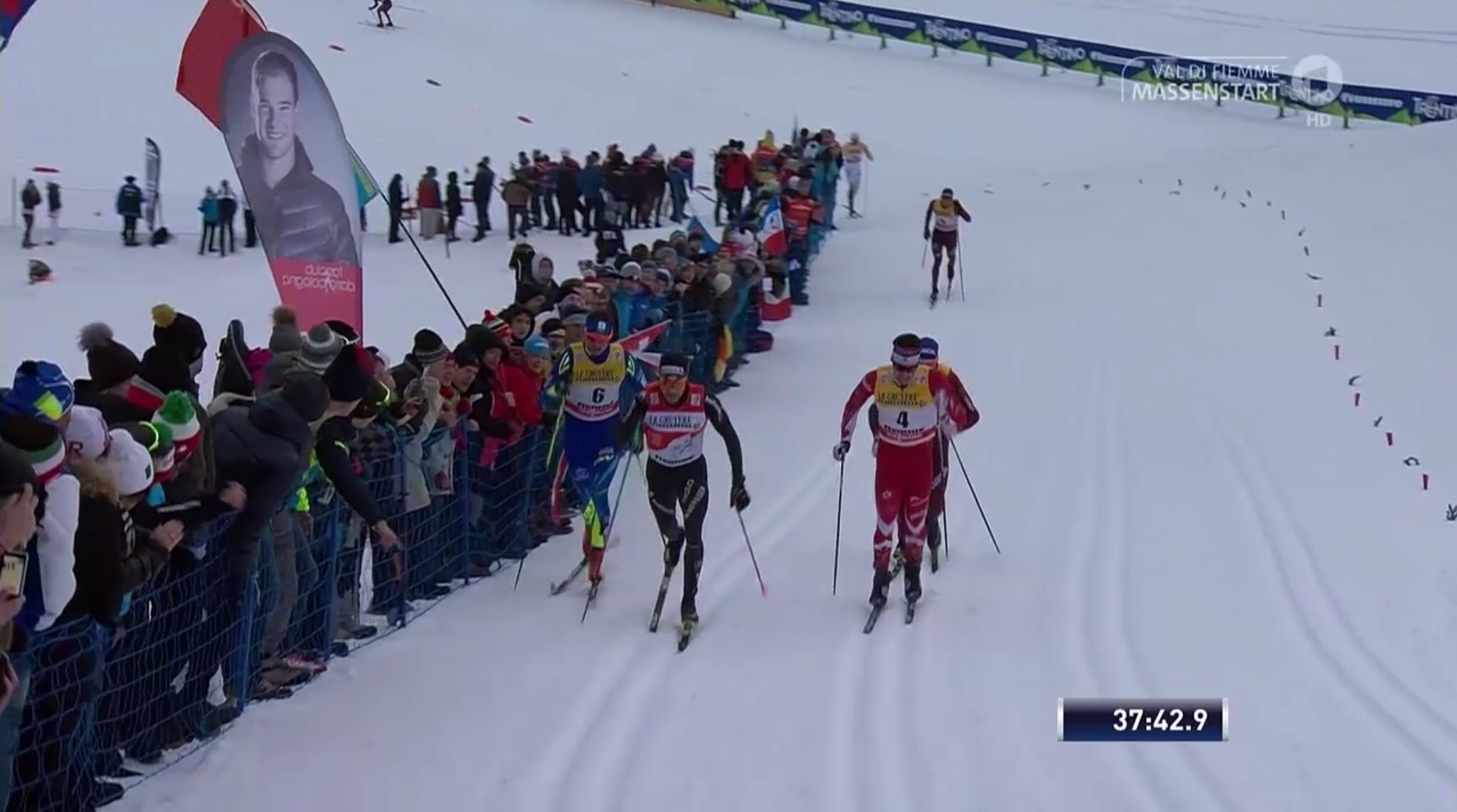
Alexey Poltoranin (l), Dario Cologna (c), and Alex Harvey (4) charge up the last climb of Saturday’s 15 k mass start in Val di Fiemme, Italy. Poltoranin took the win, with Andrey Larkov (behind Harvey) placing second and Harvey third at Stage 6 of the 2018 Tour de Ski. (Screenshot: ARD broadcast)
After a soggy and windy stay in Oberstdorf, Germany where the Stage 4 sprint was canceled and the Stage 5 freestyle mass stats were a cluster, the Tour de Ski (TdS) got back to a sense of normalcy in Val di Fiemme.
Or did they? After dominating the first part of the men’s 15 k classic mass start and picking up valuable Tour bonus seconds, Russia’s Sergey Ustiugov faded, eventually finishing 14th, 42.8 seconds out of the win.
Instead, Alexey Poltoranin of Kazakhstan made a big push to try to break for it about halfway through the race. Dario Cologna of Switzerland, the Tour de Ski leader coming into the day, followed, as did Canada’s Alex Harvey. The trio had a small gap of a few seconds consistently for several kilometers, before Russia’s Andrey Larkov caught up to them. Behind them, the field continued to fracture into chaos, claiming what would in past years have seemed unlikely victims like Norway’s Martin Johnsrud Sundby.
After much posturing and pushing in the final kilometer, the lead pack of four came shooting into the downhill finish with Poltoranin claiming the win by 0.4 seconds over Larkov. Harvey finished third, +0.9, and Cologna fourth, +2.3. There was a bigger gap before Russia’s Alexander Bolshunov crossed the line in fifth, +15.0.
That means that Poltoranin takes over second place in the Tour, while Ustiugov lost ground.
The only American starter, Paddy Caldwell, finished 48th out of 52 finishers, +3:38.6.
The women’s 10 k classic mass start podium at Stage 6 of the 2018 Tour de Ski on Saturday in Val di Fiemme, Italy, with Norway’s Heidi Weng (c) in first, Finland’s Krista Parmakoski (l) in second and Austria’s Teresa Stadlober in third. (Photo: FIS Cross Country/Twitter)
The women’s race went off as planned: no snafus, only burning lungs and muscles. At the start of Stage 6, Jessie Diggins was ranked third overall in the Tour (+1:56.7). Norway’s Ingvild Flugstad Østberg wore the red bib as the TdS leader, while teammate Heidi Weng was second overall (+57.0).
As Saturday’s race transpired, Weng proved dominant. She won in 29:07.9. Finland’s Krista Parmakoski placed second (+7.6), and Austria’s Teresa Stadlober third (+8.6).
Diggins skied a gutsy race to finish fourth (+23.6). Østberg, who at times looked like she could dominate the pace, faded to fifth (+35.2).
U.S. skiers Sadie Bjornsen finished in 10th place (+1:11.3), Liz Stephen 24th (+2:18), and Rosie Brennan 30th (+2:47.2).
Heading into tomorrow’s final stage, the formidable climb up the Alpe Cermis, Østberg leads the Tour with a tiny 1.8-second gap on Weng. Parmakoski is third overall (+1:33.5), Diggins fourth (+1:43.1), and Bjornsen eighth (+3:33.1).
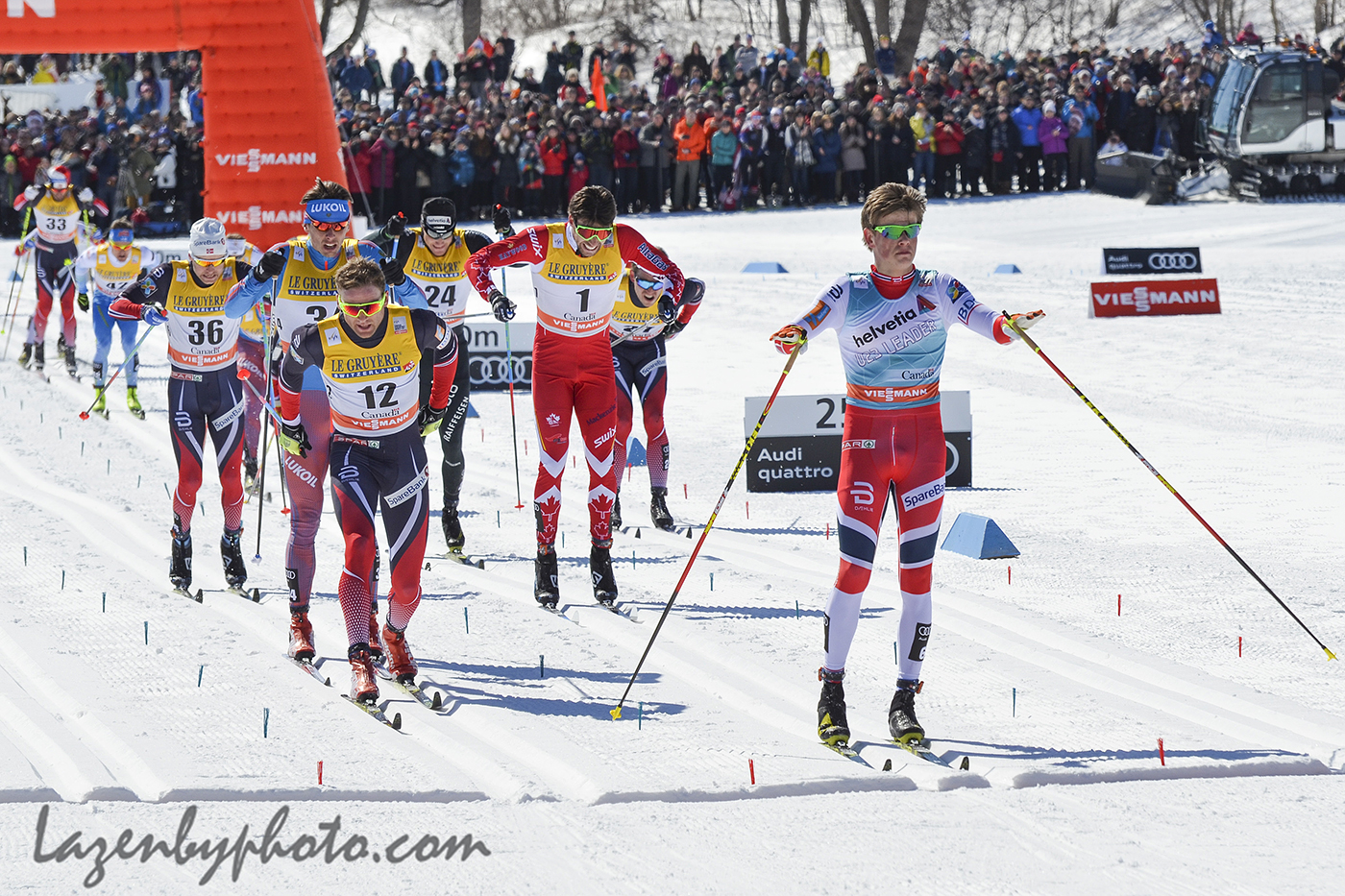
Norway’s Johannes Høsflot Klæbo (r) crossing the line first in the men’s 15 k classic mass start on Saturday at World Cup Finals in Quebec City, 0.5 seconds ahead of fellow Norwegian Niklas Dyrhaug (12), who placed second. Russia’s Alexander Bessmertnykh (behind Dyrhaug) followed in third, just ahead of Canada’s Alex Harvey (1) in fourth. (Photo: John Lazenby/Lazenbyphoto.com)
QUEBEC CITY — As 75 men jogged out into the center of the World Cup area assembled on the Plains of Abraham for the men’s 15-kilometer classic mass start on Saturday, one man in particular stood out. Alex Harvey, wearing the red suit of the Canadian national team, led the group out. He wore bib No. 1, but if you couldn’t see that from a distance, it didn’t matter. Essentially everyone knew who he was.
The official hashtag of World Cup Finals in Quebec City this Friday through Sunday has been #GOALEX2017. He is a celebrity in Quebec, a hero to its locals, and someone even non-skiers know quite a bit about.
And so far, the 28 year old appears to be soaking up every minute of his homecoming. One day after winning the freestyle sprint to start the finals, Harvey was seeded first in Saturday’s classic mass start. He led racers into the stadium, waved to spectators, started on the front line, and led the pack out of the stadium.
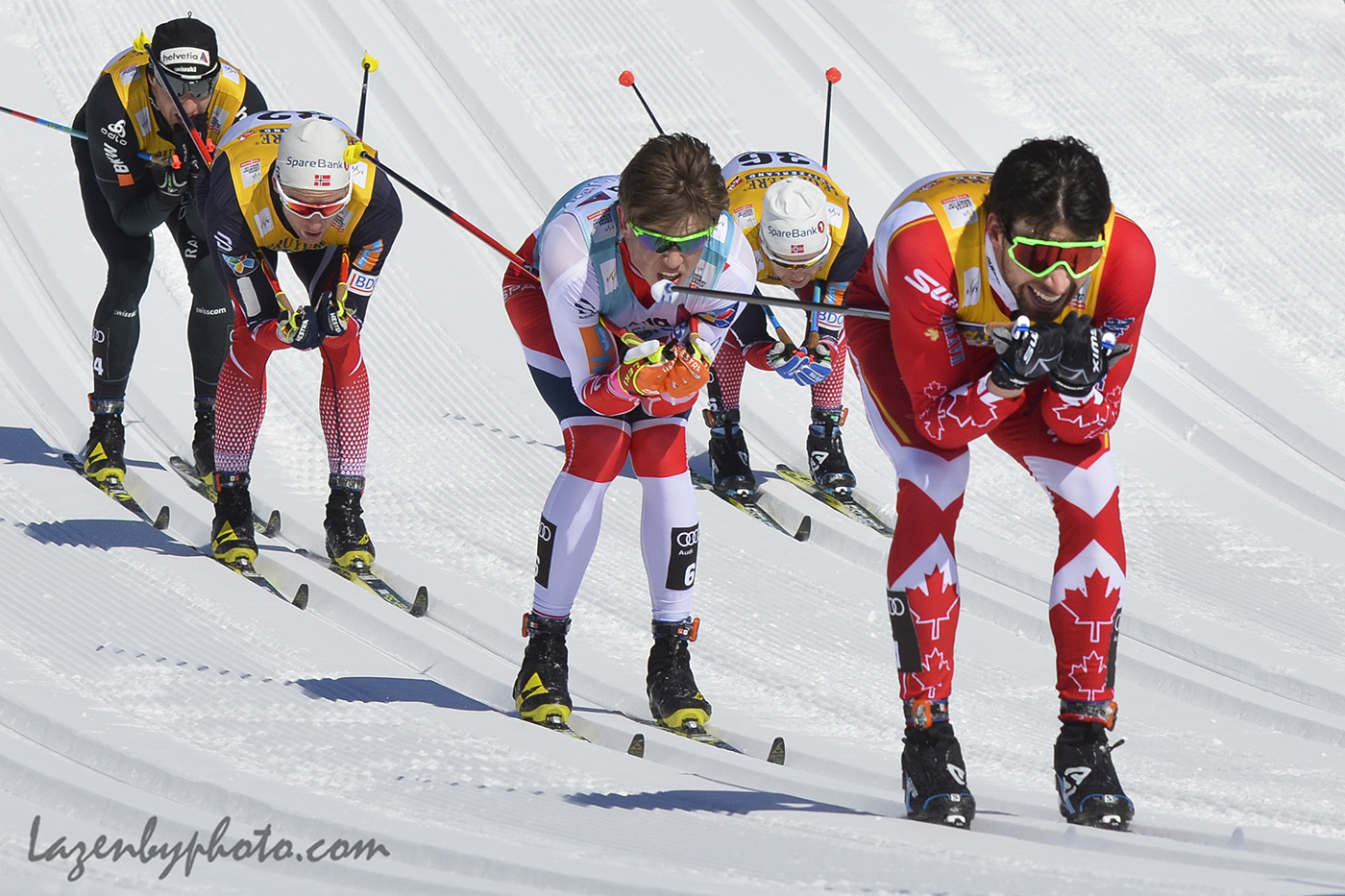
Canada’s Alex Harvey leading Norway’s Johannes Høsflot Klæbo and two other Norwegians and Switzerland’s Dario Cologna (far left) during the men’s 15 k classic mass start on Saturday at World Cup Finals in Quebec City. (Photo: John Lazenby/Lazenbyphoto.com)
Even when others took turns leading, with Norway’s Niklas Dyrhaug, Emil Iversen and Johannes Høsflot Klæbo setting the pace on the first of four laps, the possibility of Harvey winning never seemed in doubt. He consistently positioned himself within reach of the lead, skiing around sixth for much of the first lap.
On Lap 2, the lead group remained about 30 strong. Harvey skied within two seconds of the Norwegians up front, with Pål Golberg, Didrik Tønseth, Finn Hågen Krogh, Dyrhaug, and even Klæbo — the 20-year-old Sprint World Cup champion — all still in contention. By the end of Lap 3, Harvey was into second, right behind Tønseth.
With 3.75 k to go and the crowd’s ability to see the racers on most of the exposed course, the excitement among Harvey fans began to exceed its already high point from the start. Bells, horns, “Gooo Alex!”
Russia’s Alexander Bessmertnykh attacked on an uphill and Harvey stuck behind him in second. On the second to last climb, a short and steep pitch that ascends up from the Old City’s historic wall, Dyrhaug surged into first, Bessmertnykh followed him in second and Harvey in third.
Behind them, Klæbo was sizing them all up in fourth, waiting for the perfect time to strike. He did so by moving to the outside lane on the last long downhill and glided into second behind Dyrhaug. They ascended the final pitch together and rounded the final corner before the 100-meter stretch to the finish, where Klæbo continued to accelerate past Dyrhaug and double poled to his first World Cup distance win in 35:23.7 minutes. Dyrhaug finished 0.5 seconds later for second place, Bessmertnykh 0.8 seconds back in third, and Harvey 1.2 seconds behind Klæbo in fourth.
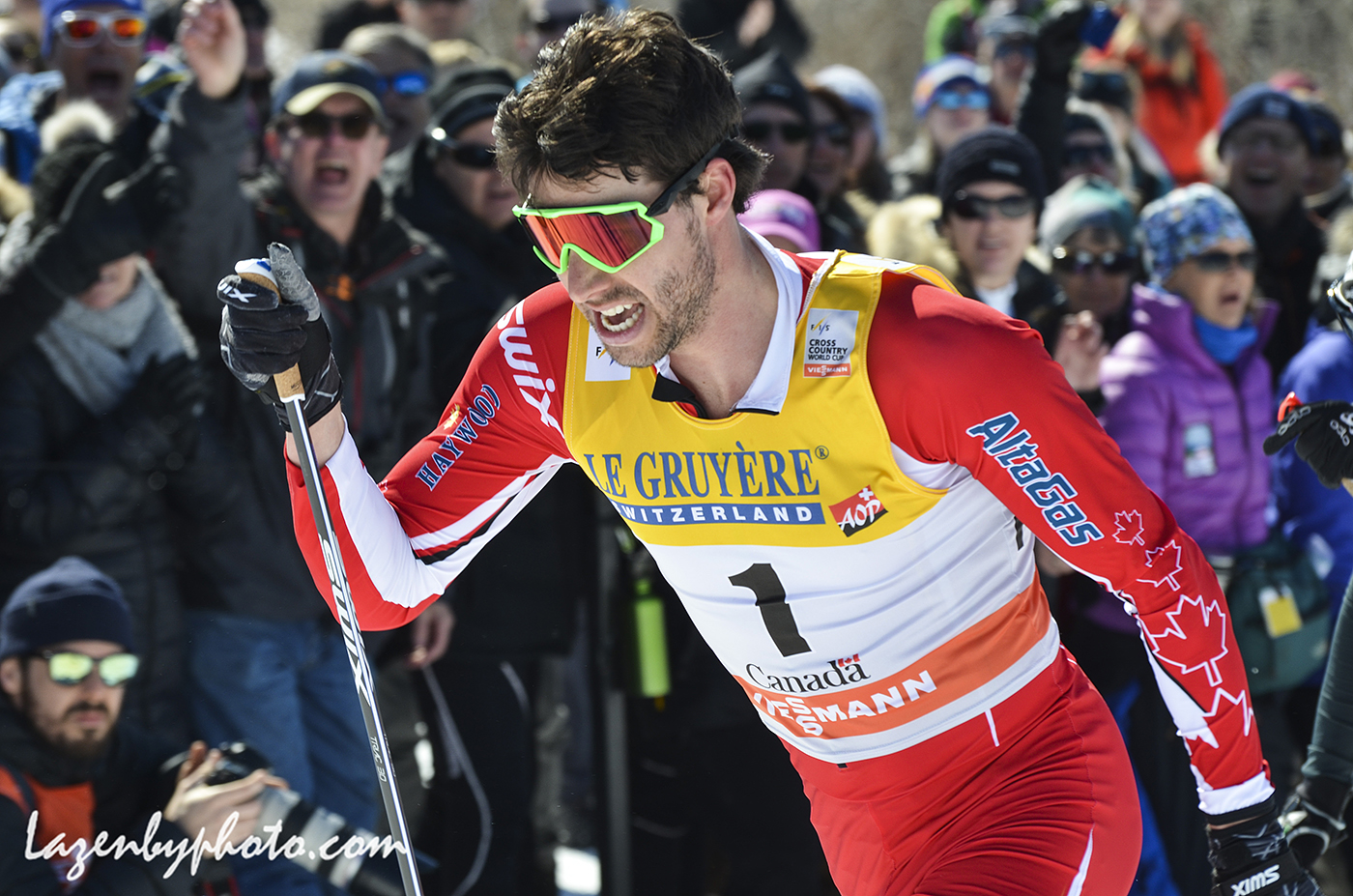
Canada’s Alex Harvey racing to fourth in the men’s 15 k classic mass start at World Cup Finals in Quebec City. With one race left, the 15 k freestyle pursuit, he is third in the mini tour and third in the Overall World Cup as well. (Photo: John Lazenby/Lazenbyphoto.com)
While it wasn’t a podium for Harvey, it was a result he was proud of.
“I’m very satisfied,” he told reporters afterward in French. “Making the top 10 is always a big deal. Today was another step towards securing a third spot in the overall [World Cup]. That was my big goal coming in. So I’m satisfied … You can’t make the podium every time. I felt very good physically.”
With one World Cup race remaining, Harvey, who’s ranked third in the world, extended his lead on Finland’s Matti Heikkinen in fourth to 92 points. Heikkinen finished 26th on Saturday, 1:04.9 minutes out of first, and will start Sunday’s 15 k freestyle pursuit 27th, 2:15 behind Klæbo as the World Cup Finals mini-tour leader. Dyrhaug will start 22 seconds back in second, followed by Harvey 1 second later in third, and Krogh another 11 seconds back in fourth.
“Every pursuit is a manhunt so I’ll be hunting the young Norwegian in front,” Harvey said. “It was Klæbo’s first victory in a distance event. We saw him come in second behind Sundby in this year’s first mini tour. So of course, he’s strong. I mean, the guy won five or six gold medals at the Junior Worlds. He’s a complete skier…”
Asked if he thought he could work with Dyrhaug to reel Klæbo in, Harvey wasn’t counting on one Norwegian helping him bridge the gap to another.
“I don’t think Dyrhaug will chase, but I will,” Harvey said.
Dyrhaug told reporters that might not be the case.
“Tomorrow is going to be an exciting day,” he said in English. “I saw that me and Alex are going out together, so it is in both of our interests to cooperate and do good teamwork, and hopefully we can catch Johannes and then we’ll have to see…
“We ought to talk together with team staff, hear what Johannes says, too,” he added. “But it is in both interests to have a big gap behind [us]. So if I’m strong, I’m thinking maybe I’m going to help Alex to … yeah, and we’re going to cooperate.”
In the last year that Klæbo’s been racing World Cups, the three-time 2016 junior world champion (in the freestyle sprint, 10 k classic and freestyle relay) has reached the podium six times in individual World Cups and claimed bronze in the freestyle sprint at this year’s World Championships. But before Saturday, all of his podiums (with the exception of one mini tour) had been in sprints.
“I hadn’t dreamed about doing a distance race in the World Cup … and cross the finish line in first,” Klæbo said after. “It’s unbelievable.”
Johannes Høsflot Klæbo leading three other Norwegians, Emil Iversen (l), Finn Hågen Krogh (second from l) and Niklas Dyrhaug (r) during the men’s 15 k classic mass start at World Cup Finals in Quebec City. Klæbo went on to win, Dyrhaug placed second, Krogh 16th, and Iversen 25th. (Photo: John Lazenby/Lazenbyphoto.com)
He was the most consistent race leader on Saturday, winning one of sprint preems and crossing in second behind his teammate Iversen for the other. In all, he accumulated 27 bonus seconds, which were deducted from his overall time in the mini tour — putting him first by 22 seconds over Dyrhaug.
“I just tried to be in the front for the bonus seconds to be able to get some seconds,” he explained of his race tactic. “So that was my plan.”
Despite trying to lead for most of it, he noticed others trying to do the same on the third and fourth laps. In the final stretch of the race, coming off the long downhill toward the finish, Klæbo focused on moving up from fourth.
“Niklas gapped our group in the last downhill there so we had push really hard on the last uphill to get to him,” he explained. “At the finish, it was just all out.”
Bessmertnykh, who will start the pursuit in 13th, 1:08 back, after placing 59th in Friday’s sprint, described Saturday’s mass start as “a fun race,” in a post-race interview with the International Ski Federation (FIS). “There was a lot of things happening all the time. I followed Niklas and Johannes on the last climb. We gained a small gap. I managed to ski well the last curve before the homestretch and carried in good speed.”
Dyrhaug was also satisfied with his race.
“The only thing was, I was one meter behind in the end,” he said. “I tried my best. I went all in for a long sprint, when it was one half k left, and it was almost.”
Under blue skies and a beating sun, Dyrhaug described Saturday afternoon in Quebec as “amazing.”
“We have been competing for like 40 races this year, but this is the most pretty day, and most pretty conditions for the whole year, so thank you, Quebec,” he said.
Waxing was a challenge, with temperatures warming quickly to about 2 degrees Celsius (mid-30s Fahrenheit) by midday.
Canada’s Devon Kershaw (r) and Graeme Killick (l) skied together for most of Saturday’s 15 k classic mass start after Kershaw broke a pole early. They went on to place 28th and 32nd, respectively. (Photo: John Lazenby/Lazenbyphoto.com)
Devon Kershaw was the second Canadian in the top 30, finishing 28th (+1:08.4) after breaking a pole early on.
“It was pretty chaotic and broke a pole there pretty early in the start and went all the way back into the 60’s, so made for a lot of work to try to get back in,” he said after. “I am proud of the fact that I was able to ski back into the points, but I had a better body than that today for sure and just had a bit of bad luck there.”
He finished 9.3 seconds ahead of his Canadian World Cup teammate Graeme Killick, who placed 32nd (+1:17.7), and the two essentially skied together from 5.25 k on.
While Kershaw said he thought the 3.7 k course would be better suited to skating, he was impressed with the atmosphere and the race organization.
“I think for a classic, there are a lot of corners and it’s pretty tight … [but] to bring the skiing to the people like they did and to use the terrain they have available, I tip my hat, its a great event,” he said. “It is the most crowds I have ever skied with in Canada, the sun is shining, the venue is fantastic, the organizers did a great job, the tracks are in perfect condition. What a great place to race.”
Erik Bjornsen led the U.S. men in 31st (+1:16.8) and two seconds behind Switzerland’s Roman Furger in 30th. After losing contact with the lead group of 29 on one of the bigger climbs at the end of the second lap, Bjornsen found himself skiing in “no-man’s land” with Sweden’s Teodor Peterson.
Erik Bjornsen (U.S. Ski Team) leads Sweden’s Teodor Peterson (r) up a climb during the men’s 15 k classic mass start at World Cup Finals in Quebec City. They went on to place 31st and 29th, respectively. (Photo: John Lazenby/Lazenbyphoto.com)
“It was a bummer to lose that front pack,” Bjornsen said. “I was struggling on the hills out there; I was a little light on kick. I think a lot of the guys were, but I wasn’t doing much striding. It was pretty much from double pole, to having to run outside the track. I felt pretty good, but I was losing time.”
While skiing with Peterson, Bjornsen said he led at times and wanted Peterson to help drive the chase as well. Peterson ended up just ahead of him in 29th (+1:14.3).
“I was like, ‘Come on, dude.’ I could see that there was a group behind, chasing us, and we were kind of right in that no-man’s land, which is always a bad spot to be,” he said. “But it was fun. It’s fun to be racing in North America, and have people cheering my name. It’s so unique, and I love it. I wish we could race over here more often.”
Matt Gelso was the second American in 37th (+1:32.6), Andy Newell finished 45th, Scott Patterson 46th, Noah Hoffman 48th, Ben Lustgarten 49th, David Norris 50th, Simi Hamilton 54th, Paddy Caldwell 59th, Jack Hegman 62nd, Cole Morgan 64th, and Brian Gregg 69th.
While the U.S. started 12 men, Canada had 15 in Saturday’s mass start with Bob Thompson finishing 55th, Knute Johnsgaard 57th, Len Valjas 61st, Russell Kennedy 63rd, Evan Palmer-Charrette 65th, Andy Shields 66th, Jess Cockney 67th, Brian McKeever 68th, Joey Foster 70th, Gareth Williams 72nd, Ricardo Izquierdo-Bernier 74th, and Julien Locke 75th.
— Gerry Furseth, François Léger Dionne, Jake Ellis, and Ian Tovell contributed
The men’s 15 k classic mass start podium on Day 2 of World Cup Finals in Quebec City, with Norway’s Johannes Høsflot Klæbo (c) in first, Norway’s Niklas Dyrhaug (l) in second and Russia’s Alexander Bessmertnykh (r) in third. (Photo: John Lazenby/Lazenbyphoto.com)
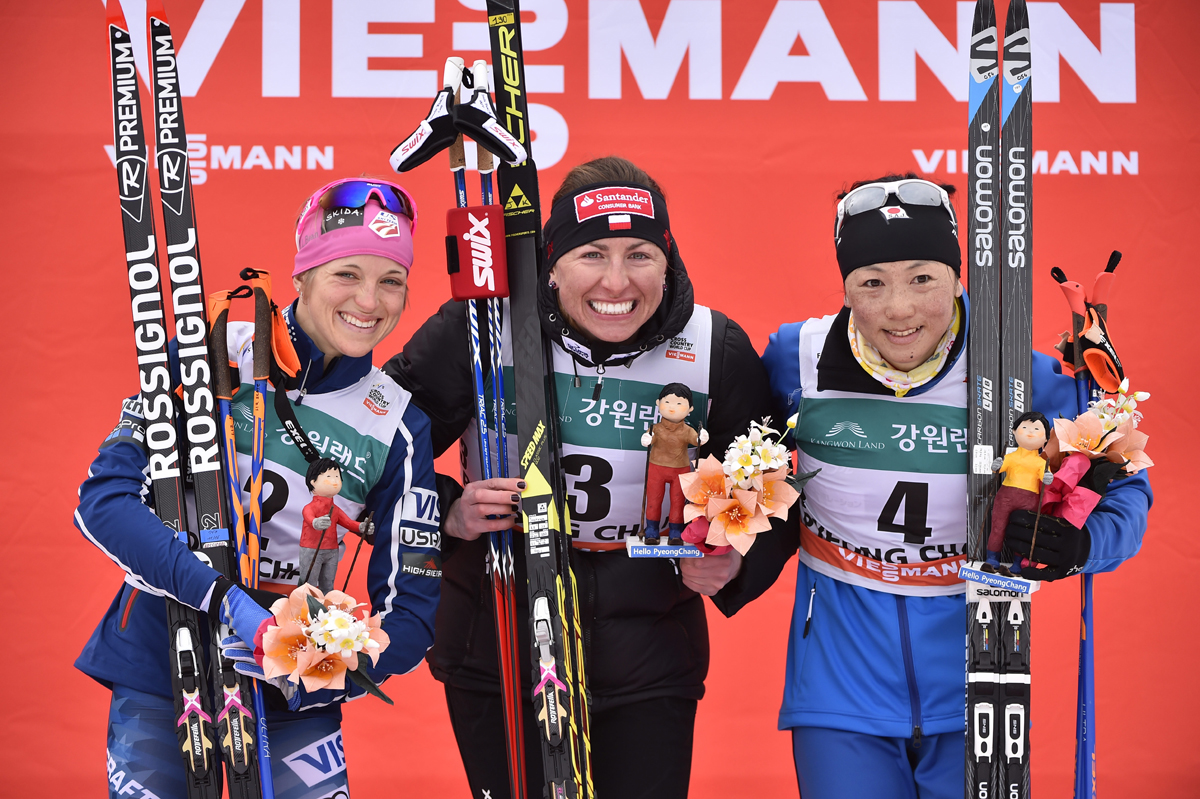
The women’s World Cup 15 k skiathlon podium on Saturday in PyeongChang, South Korea, with Poland’s Justyna Kowalczyk (c) in first, American Liz Stephen (l) in second, and Japan’s Masako Ishida (r) in third. (Photo: Fischer/NordicFocus)
Multiple race warmup and cool downs, managing hydration and caloric intake, moving at her max sprinting speed — more than once. It’s not often that American Liz Stephen feels the lingering effects of a World Cup sprint day. Her most recent memory was three years ago, when she qualified 22nd in Szklarska Poreba, Poland.
But this weekend’s three-day competition series in PyeongChang, South Korea, challenged the distance specialist once again. With a smaller World Cup field than usual, Stephen qualified 29th in Friday’s classic sprint and advanced quarterfinals, where she raced in the first heat of the day.
In what ended up being the fastest women’s quarterfinal, Stephen pushed through Friday’s hill-dominant sprint course and crossed fifth for 25th overall. The back-to-back sprint experience, however, left the 30-year-old Stephen with a little less energy than she would have liked as she entered Saturday’s 15-kilometer skiathlon.
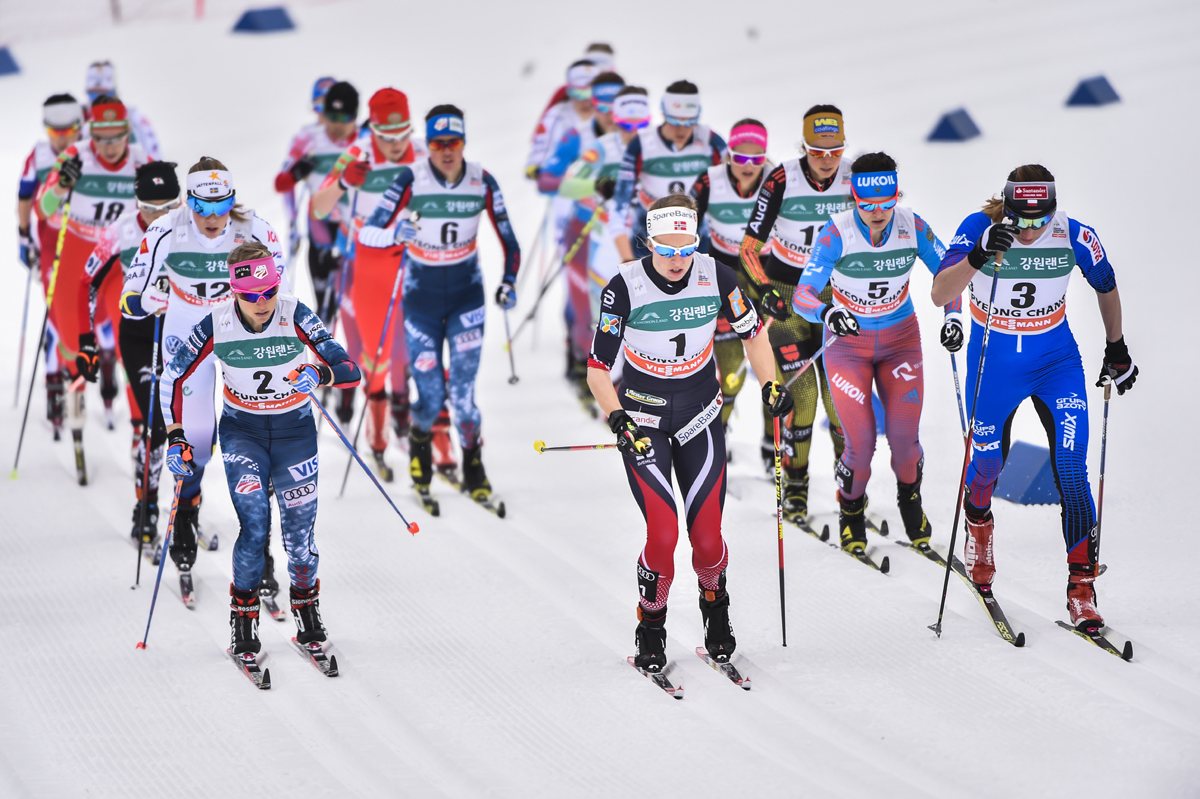
American Liz Stephen (2) skiing at the front of the women’s 15 k skiathlon on Saturday, alongside Norway’s Silje Øyre Slind (1) and Poland’s Justyna Kowalczyk (3), at the World Cup in PyeongChang, South Korea. (Photo: Fischer/NordicFocus)
“I think I was feeling yesterday’s sprint race a bit, as I did twice as many rounds as I usually do!” Stephen joked in an email.
Yet, standing at the start in bib 2, behind Norway’s Silje Øyre Slind in bib 1, Stephen wasn’t going to let a little soreness stop her from racing to Saturday’s skiathlon podium.
After Poland’s Justyna Kowalczykgapped the front by close to 20 seconds in the first two kilometers of the classic leg, the American held on tight to the lead chase group, striding even with a medley of skiers, including Slind, Japan’s Masako Ishida, Norway’s Anna Svendsen, Sweden’s Maria Nordström, and Germany’s Elisabeth Schicho.
Stephen came through the exchange in fifth position, a little over a minute behind the race leader Kowalczyk and 12 seconds back from the second place skier, Ishida.
“I was afraid I skied little too hard in the classic portion,” Stephen said, according to an International Ski Federation (FIS) press release. “I wanted to stay with the leading group in the classical part not to fall back.”
Skate skis on, Stephen quickly caught and surpassed Svendsen and Schicho by the 8.4 k mark, rejoining Ishida. With over a minute separating her and Ishida from Kowalczyk, the battle for second began. Around the 10 k mark, Stephen made her move. Powering past Masako, Stephen started her second hunt, this time for the Polish skier.
But Kowalczyk’s early classic-leg surge and strong skating staved off any attempts from Stephen.
“Liz was able to take some time out of her, but not significant time,” USST Head Coach Chris Grover said on the phone. “So that was impressive racing by Kowalczyk.”
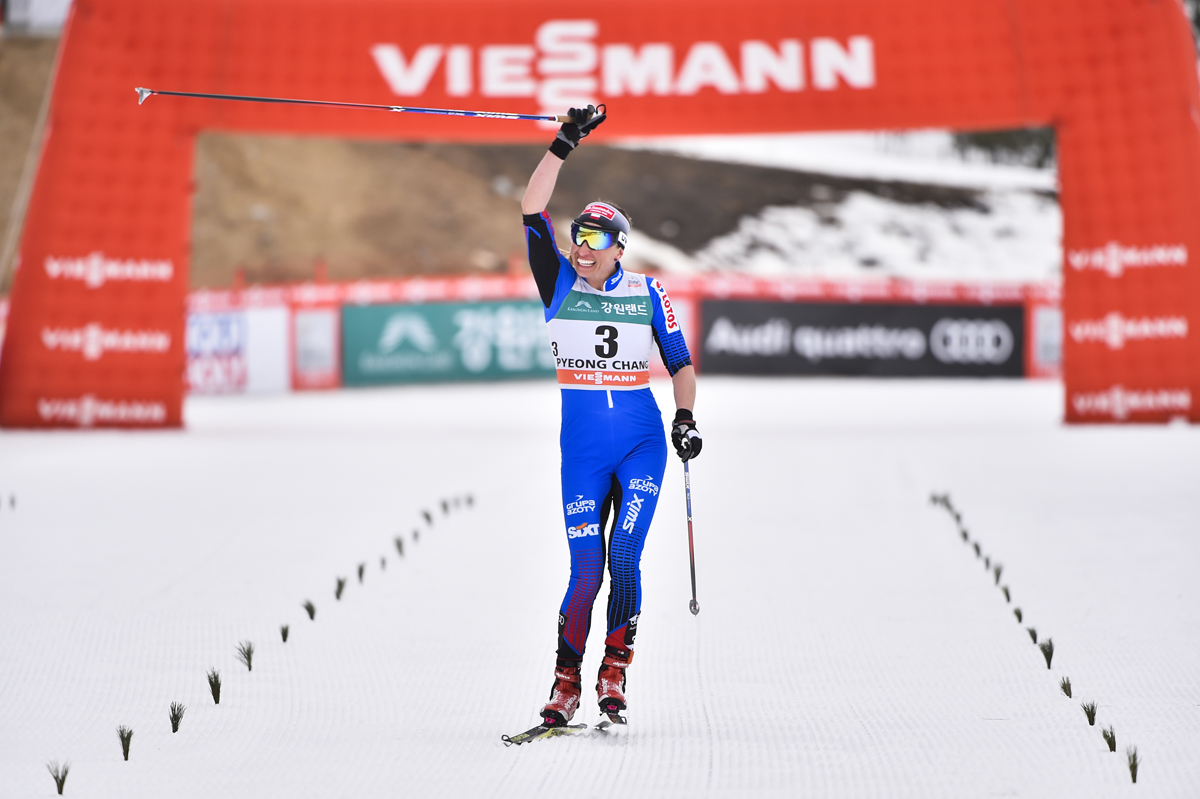
Poland’s Justyna Kowalczyk winning her first World Cup in three years on Saturday, the women’s 15 k skiathlon at in PyeongChang, South Korea. (Photo: Fischer/Nordic Focus)
“It has been a long time since I have been on the World Cup podium,” Kowalczyk said, according to FIS. “I was quite surprised to see how well I skated.”
Finishing exactly 56 seconds behind Kowalczyk was Stephen in second place. The result was Stephen’s best individual result since 2015, when she placed second in the 10 k freestyle race in Rybinsk, Russia.
“It’s hard not to feel happy when you get a podium finish!” she said, according to a U.S. Ski Team press release. “However, I didn’t feel like I had as much energy as I wanted to have today, but it was enough to hold onto second.”
In her first podium appearance since 2009, Ishida finished 18.8 seconds after Stephen in third (+1:14.8).
Just missing the podium by 6.6 seconds was American Caitlin Patterson in fourth (+1:21.4). Though a tangle on the first hill of her classic leg pushed Patterson back to 13th, the 27-year-old Craftsbury Green Racing Project skier was able to reconnect with the top 1o by the 2 k mark.
Unconcerned with Kowalczyk’s blistering pace, Patterson focused on the chase pack. By the time she reached the ski change, she was positioned in seventh. Her transition to skate skis smooth and energy still strong, Patterson began to pick people off.
She caught Nordström, who had been 10 seconds ahead of her at the exchange, as well as Schicho and Svendsen, both of whom were close to 30 seconds ahead of her when they switched to skate skis.
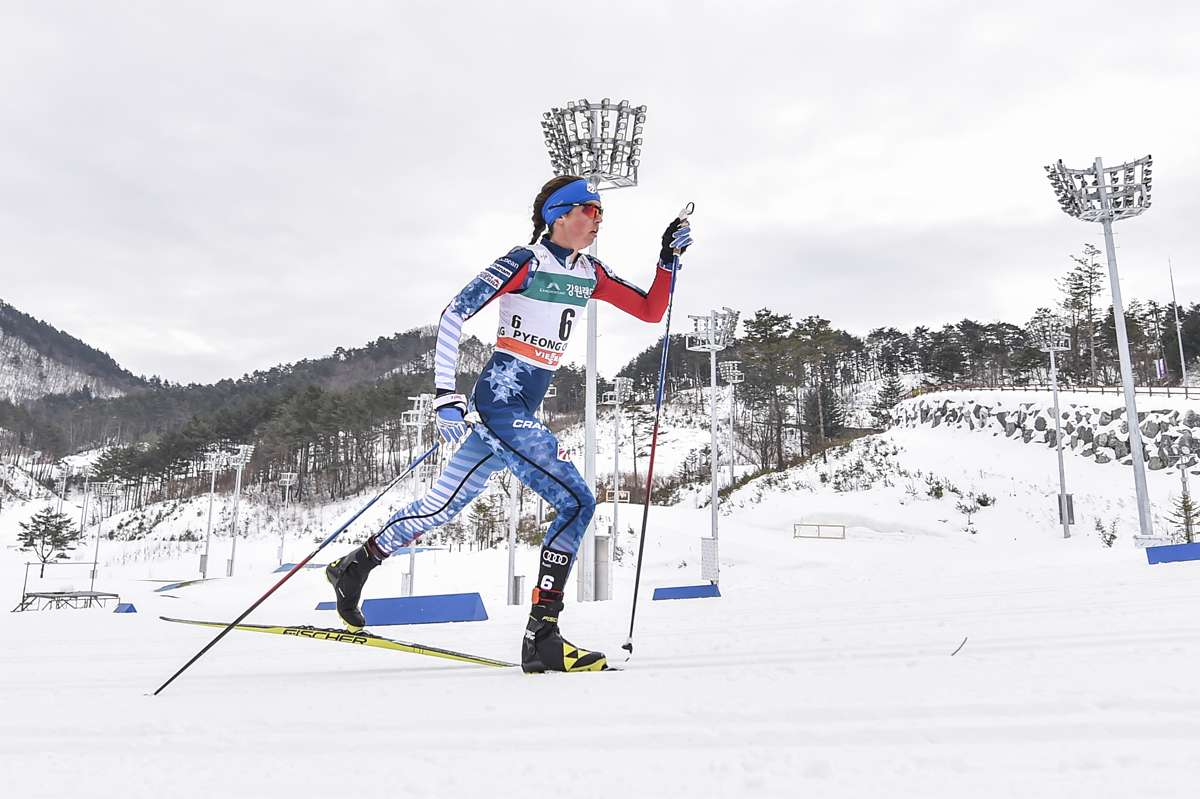
Caitlin Patterson (Craftsbury Green Racing Project) en route to a career-best World Cup result of fourth in the women’s 15 k skiathlon in PyeongChang, South Korea. (Photo: Fischer/NordicFocus)
“Caitlin Patterson was really impressive,” Grover said. “She was kind of hovering around seventh or eighth for most of the race, and then really in the last lap, really started to pick people off, including right at the very end to get all the way up to fourth.”
Feeling fairly well adjusted to the time difference, and appreciative of the low-altitude racing, Patterson was proud of her race effort. Her only issue being the seconds that separated her from the podium.
“When I look at the results and see how close third place was ahead of me, I can’t help but wish I could have somehow gone faster sooner!” Patterson wrote in an email. “A true sign of how much this makes me hungry for more, though I know I gave it everything I had out there today.”
The third American woman on Saturday was Liz Guiney in 13th (+2:21.7). The PyeongChang World Cup marks Guiney’s third week of World Cup racing and, while this weekend’s field is not as strong as the ones she recently raced against in Sweden, the result was still a little unexpected for Guiney.
“I’m very happy with my race today!” Guiney, 25, wrote in an email. “With the weaker World Cup field, it was a good opportunity to score some points, but I think I surprised myself by being within reach of the top 10.”
The last two races mark Guiney’s first World Cup points, with her best individual finish prior to this weekend 49th in the Falun 15 k classic mass start.
“Last weekend in the Falun 15k, I got a little too excited out of the start and paid for it later in the race, so my goal today was to ski my own race,” Guiney wrote. “I was really psyched to cross the line and find out that Liz Stephen placed 2nd and Caitlin (my GRP teammate) was 4th, which is a big breakout result for her!”
Two Canadian women also earned their first World Cup top 30’s on Saturday, with Annika Hicks (Alberta World Cup Academy) placing 26th (+5:17.8) followed by Sadie White (NTDC Thunder Bay)in 29th (+6:54.7).
Racers return to the race venue tomorrow for Sunday’s freestyle team sprint.
Norway’s Martin Johnsrud Sundby (l) well ahead of the field as he double poles toward the finish in Saturday’s 15 k classic mass start, which he won by 2.2 seconds over Russia’s Sergey Ustiugov (third from r) while Finland’s Matti Heikkinen (second from r, ahead of Ustiugov) placed third at the Tour de Ski Stage 6 in Val di Fiemme, Italy. (Photo: Fischer/Nordic Focus)
Six laps. Three climbs per lap. Fifteen-kilometer classic mass start. If you’re in it to win it, where do you make your move?
That was the kind of calculating Norway’s Martin Johnsrud Sundby was doing throughout Saturday’s Stage 6 mass start, the second-to-last stage of the 2017 Tour de Ski, in Val di Fiemme, Italy. Every time he rounded the 2.5 k loop, the man he needed to beat — Russia’s Sergey Ustiugov — was right there, either leading or within a few strides of first.
Through five Tour stages, the 24-year-old Ustiugov was unbeaten. Could he be beat? Yes, Sundby thought, but it was going to take some brains as well as brawn.
He had to be patient, despite being extremely frustrated with his race on Friday, when he placed 14th in the 10 k freestyle in Toblach, Italy. That put him more than a minute and a half behind Ustiugov in the overall Tour with two stages to go.
“Yesterday’s race was really bad and it is good I could win today,” Sundby said, according to an International Ski Federation (FIS) press release. “I was little bit conservative at the beginning. I wanted to win some bonus seconds. I had some power left and I am happy about victory.”
He attacked on the last lap just before the 13.9 k mark, after pulling up alongside Ustiugov on the first long climb out of the stadium, while Switzerland’s Dario Cologna did the same on the other side of the Russian in the Tour leader’s bib.
Norway’s Martin Johnsrud Sundby glances back to make sure he’s out of reach during the final kilometer of the men’s 15 k classic mass start at Stage 6 of the Tour de Ski in Val di Fiemme, Italy. (Photo: Fischer/Nordic Focus)
Sundby’s move wasn’t obvious then, but it was along a long false-flat, where he began dropping the field with an unmatched double pole. Heading into a tricky descent before the final climb, Sundby had successfully broken away and frequently checked back to make sure Ustiugov wasn’t anywhere near him.
Ustiugov and two of his Russian teammates, Andrey Larkov and Alexander Bessmertnykh, continued to lead the chase, followed by Cologna, Finland’s Matti Heikkinen, Norway’s Niklas Dyrhaug, and even Italy’s Francesco de Fabiani had worked his way into the mix.
Up that last steep climb, Cologna switched from the right to the left tracks suddenly, appearing to cut off Heikkinen, who moved outside the tracks to get around him. A few strides later, Dyrhaug stepped outside the right tracks to get around Ustiugov, but Ustiugov wasn’t having it. He stepped out as well, forcing Dyrhaug to file back in behind him. All of this was shaping up to be a fight for second; Sundby was too far gone.
The second-ranked man in the Tour, Sundby finished in 40:40.0 minutes, while Ustiugov caught a draft and out-double poled the chase pack for second place, crossing 2.2 seconds later. That still puts Ustiugov 1:12 minutes ahead going into the final climb (yep, he’ll start 1:12 minutes ahead of anyone else in the 9 k freestyle hill climb up Alpe Cermis), but at least for Sundby it’s not 1:34.
But as Ustiugov said Friday, “For Martin, a minute does not mean anything … The main thing is not to lose all that has been so hard-earned in these five races.”
“Today’s performance gives me a different starting point in tomorrow’s race,” Sundby told NRK. “I need a little miracle tomorrow, but I’m not going to quit before I cross the finish line.”
Finishing 0.6 seconds behind Ustiugov on Saturday, and nearly being taken out by the Russian at the finish when Ustiugov collapsed sideways across the line, was Heikkinen in third (+2.8). Fourth through eighth place were all within 1.1 seconds of the podium, with de Fabiani taking fourth (+3.2), Larkov fifth (+3.3), Dyrhaug sixth (+3.5), Cologna seventh (+3.8), and Bessmertnykh eighth (+3.9).
After that, there was a 6-second gap Norway’s Hans Christer Holund in ninth (+9.9), Sweden’s Marcus Hellner finished 10th (+10.3), France’s Jean-Marc Gaillard 11th (+13.6), Sweden’s Jens Burman 12th (+14.9), and France’s Maurice Manificat 13th (+16.3).
Russia’s Sergey Ustiugov (r) leads his Russian teammates Alexander Bessmertnykh (23) and Alexey Larkov (l) during the men’s 15 k classic mass start at Stage 6 of the Tour de Ski in Val di Fiemme, Italy. (Photo: Fischer/Nordic Focus)
The fact that Ustiugov finished second was largely in part to his teammates, Larkov and Bessmertnykh, who drove the pace and helped box out competitors up front, especially early in the final lap. Ustiugov even drafted one of them on the final descent into the stadium before switching to an open lane in the finishing straight and double poling to the front of the chase pack.
“I am grateful to my teammates,” Ustiugov said, according to a loose translation. “If they did not help me, one of them could have won the mass start. Tomorrow’s race? We’ll see. In any case, it will be interesting. I understand perfectly … what is waiting for me, despite the fact that I was only passed once on the final uphill.”
One thing Saturday showed: the Russian is beatable. Last year, Sundby won the climb, both as the first man at the top and with the fastest time up the 9 k grind. France’s Robin Duvillard, who is not competing in this year’s Tour, was second (+7.2) for time of day, and Heikkinen was third (+11.8).
Ustiugov as the fourth starter clocked the 13th-fastest time, 47.6 seconds behind Sundby. Of note, American Noah Hoffman was 15th (+56.4) and Canada’s Alex Harvey 16th (+1:07.4) for final-climb time.
Ustiugov ended up third overall in the 2016 Tour, arriving at the top near four minutes after Sundby.
Russia’s Sergey Ustiugov (front, in Tour leader’s bib) leading early in the men’s 15 k classic mass start on Saturday, along with Canada’s Alex Harvey (l) at Stage 6 of the Tour de Ski in Val di Fiemme, Italy. (Photo: Fischer/Nordic Focus)
“… I think he’s in better shape now,” Harvey said on the phone Saturday about Ustiugov. “So I think those two guys [Ustiugov and Sundby] will stay in front, and Sundby probably second. I think it will be just a really good fight…”
On Sunday, Harvey will start sixth in this year’s final climb, 2:42 minutes behind Ustiugov and 38 seconds behind Cologna, who is third overall.
“I am third at the moment with a lead of more than 20 seconds, that surely looks positive, but it’s a long flat section before the climb,” Cologna told Swiss broadcaster SRF. “It’s almost a minute to Sundby, and he is not a bad climber, either. So I really have to look how I can defend my third place. That’s the goal for tomorrow.“
Harvey entered Saturday’s 15 k classic mass start in fourth overall but dropped two spots when he finished 19th, 38.7 seconds after Sundby. Also slated to start ahead of Harvey on Sunday are Heikkinen, who is fourth overall (+2:33) and Manificat in fifth (+2:34).
“Manificat will try early on the hill, and then Heikkinen. I’m sure they’ll be pushing really hard down the flat to kind of close that 26-, 28-second gap that they have on Dario [Cologna],” Harvey anticipated. “… When you see someone up the hill, like 10 seconds, it seems like they’re three meters ahead, always. So I think that it’s a good position to be in, for Heikkinen especially. My guess for the podium is probably Ustiugov, Sundby, and Heikkinen, but I’ll be in there, too, so we’ll see.”
On Saturday, Harvey surged to the front of the pack early, leading at 1.1 k, with superior skis on the uphills, he said. Also up there with him was Romania’s Paul Constantin Pepene — sort of a surprise at this point in the Tour.
“The Romanian guy started really fast and then he blew up right away,” Harvey said, of Pepene falling off the pace after 2.5 k. “There was a prime in the second lap early on … and I think I had one of the best grip out there today, so on that steep hill it was pretty easy for me to just run in the track and get that prime [for 15 bonus seconds].”
Alex Harvey (Canadian World Cup Team) en route to 19th in the men’s 15 k classic mass start on Saturday, which puts him sixth overall in the Tour de Ski with one stage remaining in Val di Fiemme, Italy. (Photo: Salomon/Nordic Focus)
Heading into Lap 3, Harvey said the wheels started to come off.
“When we lapped into the stadium, I was starting to get kind of yo-yoed a bit near the end of the group,” Harvey recalled. “And then tried to fight my way back up on the climbs, but I was getting yo-yoed a bit, and then the elastic just broke.”
Fewer than 5 seconds out of first at 5 k while skiing in seventh, Harvey was down to 15th by the end of the next lap, yet still within 7 seconds of Ustiugov in first.
Early on the fourth lap, he was 15 seconds back in 18th, just ahead of Great Britain’s Andrew Musgrave and Harvey’s teammate Devon Kershaw in 19th and 20th, respectively. Another three seconds back, a third Canadian, Graeme Killick was skiing in 25th (+18.7) at 8.6 k.
“I actually didn’t know he was there until he just passed me, but yeah, I skied with him for a bit,” Harvey said of Kershaw, who passed him shortly after.
Harvey recalled that Kershaw “got kind of tangled up with a Russian in the herringbone part, and then I think he said he lost our group there.”
Kershaw could not be immediately reached for comment after Saturday’s race.
The start of Lap 5 saw Harvey 10 seconds back from the leaders in 18th and Kershaw another five seconds back in 24th, with Killick following roughly three seconds later in 26th. Harvey was nearly 20 seconds behind one lap later, skiing in 17th, and he closed the race out in 19th (his worst result after placing 11th on Friday in the Toblach 10 k) of the Tour.
“I don’t know. The body was good,” Harvey said.
As for Sunday: “Oh I’m ready,” he said. “I kind of want revenge after today.”
“Alex is a competitive guy and is hungry,” Canadian World Cup coach Ivan Babikov said, according to a Cross Country Canada press release. “He will be in a group of about four guys who are all good climbers. Dario is always strong, but anything is possible.”
Kershaw finished the race in 27th (+1:21.1) and Killick 32nd (+1:31.0). They will start the final climb in 23rd (+7:19) and 37th (+11:25), respectively.
“Coming into the Tour this year the priority races for me to target were the 10km in Val Mustair and the 15km tomorrow in Val di Fiemme,” Kershaw wrote in an email on Friday. “… [The 15 k mass start] will be a real battle royale and it’s the crux of this tour for the top 10. A lot of really strong guys are grouped close together and aside from Ustiugov who has made a mockery of this years event I would say it’s wide open.
“What that means is that with the two bonus sprints on course and the time at the line – there is 45sec available – there will be a lot of hungry racers gunning for it. Blend that with a difficult and punishing course here in Val di Fiemme and I think this race will be blown open pretty good,” Kershaw anticipated. “I hope to have a good start and really just feel good in the body because you are going to need that for sure if you want to have a good race.”
“It is a tough course and the guys are pretty tired but they dug deep today,” Babikov said Saturday, according to the press release. “We might have missed it a bit with the skis. We may have gone with something a bit too sticky.
“It was really hard-packed snow and this is a tough course to get the skis right,” Babikov added. “Ideally you want to have good kick and a fast glide, but it is a gamble on a course this tough. The tracks were firm and icy but there were some sections where there were no tracks and others with powdery snow. We will debrief on it tonight.”
The lone American to finish, Noah Hoffman landed in the points for the second-straight stage in 30th (+1:17.1) after skiing in 34th for the first two-thirds of the race. By 12.5 k, Hoffman was up into 29th, right behind Russia’s Petr Sedov in 28th and about 50 seconds behind the leaders.
“I actually felt like I skied the second half pretty well,” Hoffman said on the phone. “I was able to make contact with that group that contained all the way up to 22nd place by the end. I didn’t really lose that much time … But I mean, yeah, certainly not a standout result. I kind of feel like a broken record, when every race I’m like, ‘Well, there were some good signs and I’m optimistic that it’s going to come around, but it’s not here yet.’ That’s kind of where I’m at.”
Hoffman will start the final climb — a race he hopes to place in the top 15 in for time of day — in 30th (+9:42).
“I’ve been top 20 on time on day a couple times, but I’m kind of frustrated, I feel like I haven’t shown what I can really do up a climb like that,” he said. “It’s a stage that was built for me, especially if I have help down in the valley, which I do tomorrow, because I’m starting with Sedov and that Swede [Viktor Thorn right behind me].
“So I will definitely rely on some help to get to the base of the climb, and then I feel like once we get there, then I just need to use my energy and show what I can do,” Hoffman added. “I think I can move up. Certainly a spot or two would be great, but there’s some pretty good time gaps [ahead of me]. But I would love to be at least top 15 for time on day, and I feel like that’s something I can do if I show my aerobic capacities.”
Erik Bjornsen’s crash caught on camera during the first lap of the men’s 15 k classic mass start at Stage 6 of the Tour de Ski on Saturday in Val di Fiemme, Italy. (Photo: CCC/Eurosport screenshot)
American Erik Bjornsen started the race but crashed on the first lap on a climb which plagued top competitors in the women’s race as well.
According to Hoffman, he and Bjornsen watched the women’s race on TV in the athletes’ lounge before their race.
“And it was in that exact same spot, Kalla and Pärmäkoski went down. … That corner does not ski challenging when you’re alone, but it’s a corner that when you get into a pack, it transforms a bit,” Hoffman recalled. “There was just an ice patch that opened up. I kind of couldn’t believe it when Erik went down, I was like, ‘Oh my god, that is exactly what we just watched Pärmäkoski and Kalla do.”
Hoffman was behind Bjornsen at the time and narrowly avoided a pileup Russians he created.
“I believe [Erik] broke a pole, but I have not had a chance to talk with him about why he decided to drop out,” Hoffman said of Bjornsen pulling out of the race at the halfway point at the end of the third lap.
Bjornsen could also not be immediately reached for comment.
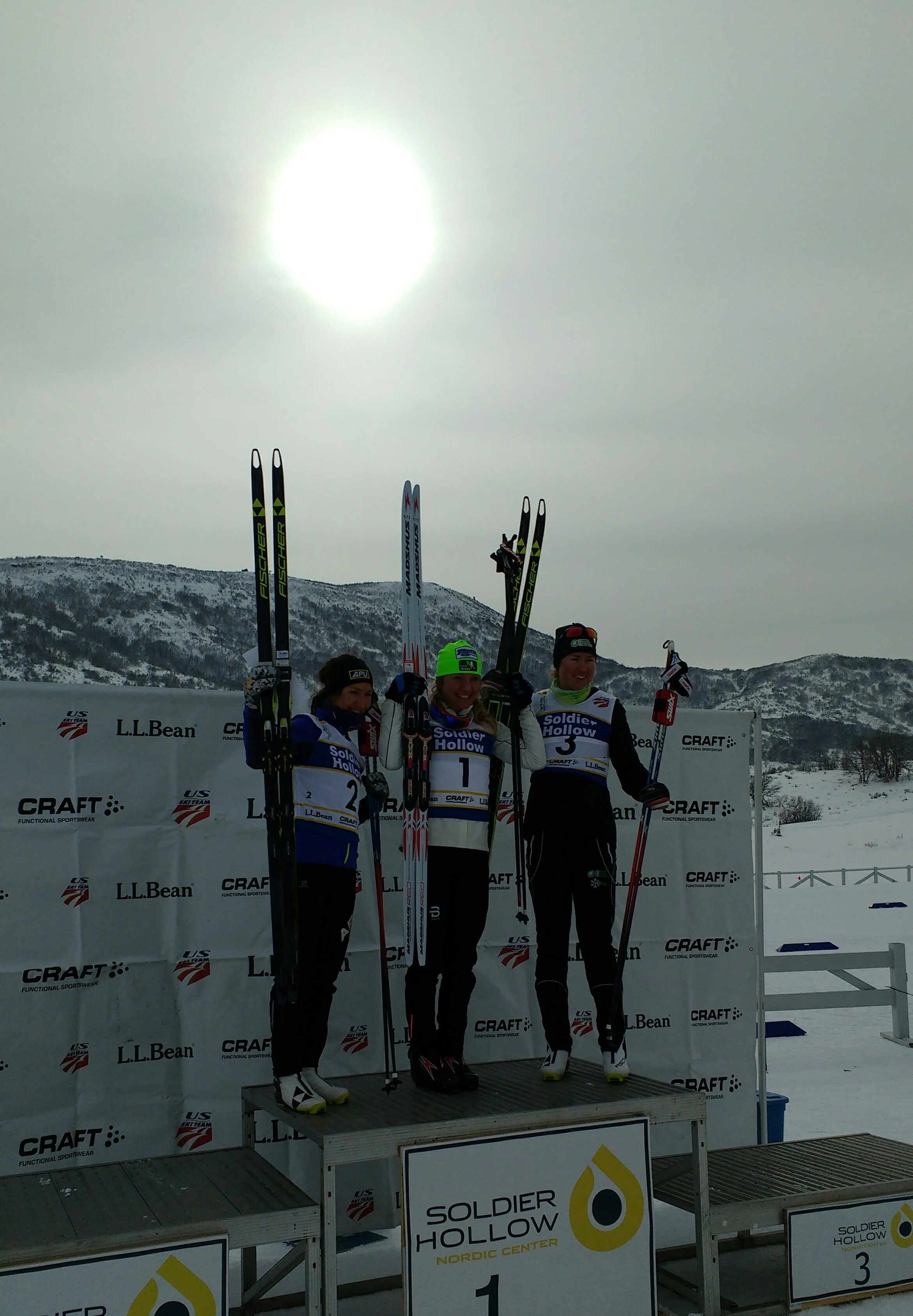
Left to right: Chelsea Holmes, Caitlin Gregg, and Caitlin Patterson standing on top of the podium for the women’s 10-kilometer freestyle event at the 2017 U.S. Cross Country Championships at Soldier Hollow in Midway, Utah.
U.S. Cross Country Championships (Soldier Hollow): 10 k skate
[UPDATED] Don’t bet against Caitlin Gregg (Team Gregg) in a distance skate event. The 36-year-old took another national title in the 10-kilometer freestyle individual start at Soldier Hollow in Midway, Utah, earlier today in the first event of the 2017 U.S. Cross Country Championships. Gregg’s winning time was 27:00.6 on a cold, slow-snow morning at SoHo.
Chelsea Holmes (Alaska Pacific University) was second, 2.2 seconds back, with Caitlin Patterson (Craftsbury Green Racing Project) third (+14.5). Katharine Ogden (Stratton Mountain School, +20) was fourth, Becca Rorabaugh (APU, +58.4) fifth, and Rosie Frankowski (APU, +1:05) sixth to round out the extended podium.
In the men’s 15-kilometer freestyle event, Central Cross Country Ski Association’s Kyle Bratrud took first in a time of 34:52.0. Second place wen tot Ski and Snowboard Club Vail’s Tad Elliott finished in a time of 35:14.6, while University of Denver’s Mori Madelaner (+35:22.4) rounded out the podium in third. Patrick Caldwell of Stratton Mountain School was seven tenths of a second out of third place in fourth overall (the third American on the day) in a time of 35:23.1. Fifth went to Kris Freeman of Team Freebird in a time of 35:28.0.
[UPDATED] In the men’s 12.5 k pursuit on Saturday in Oberhof, Germany, France’s Martin Fourcade got back to his winning ways, shooting 19-for-20 (0+1+0+0) on a cold and gusting afternoon for a 1:09.9-minute victory in 36:45.7. He started eighth.
Germany’s Arnd Peiffer started 15th and finished second with three penalties (0+0+1+2), and for the second-straight race, Italy’s Dominik Windisch placed third (+1:32.4), with five misses. Windisch was just 0.2 seconds ahead of Norway’s Emil Hegle Svendsen in fifth (+1:32.6), also with five penalties (1+1+2+1).
Tim Burke (US Biathlon) raced to 26th (+3:18.9) after starting 35th, with four penalties, all in standing (0+0+2+2). Also for the U.S., Russell Currier placed 34th (+4:29.8), up from 46th at the start, with five penalties (2+0+1+2).
Canada’s Scott Gow finished 45th (+5:45.7) with seven misses (1+1+2+3).
No North American men are listed on the provisional start list for Sunday’s 15 k mass start.
In the women’s 10 k pursuit that followed, France made it a double on the day with Marie Dorin Habert taking a 38.8-second victory in 34:33.3. She started third and had two penalties (1+0+0+1) en route to the win, ahead of Friday’s sprint winner Gabriela Koukalova of the Czech Republic in second, with two clean stages followed by three misses (0+0+1+2).
Finland’s Kaisa Mäkäräinen started second and ended up third (+1:19.1) with four penalties (1+0+1+2) amid blustery conditions in Oberhof.
Canada’s Rosanna Crawford finished 22nd (+3:47.9), one spot down from starting 21st, with four penalties (0+1+1+2).
For the U.S., Susan Dunklee placed 44th (+6:20.4), up from starting 50th, despite nine misses (1+3+4+1). Clare Egan finished 49th (+7:25.6) after starting 52nd, with seven misses (4+0+0+3).
Dunklee was listed as the lone North American starter in Sunday’s 12.5 k mass start, as she is currently ranked 17th overall in the IBU World Cup. Crawford is next in line on the “reserve standby athletes” lists by her event results of the week, should another qualified athlete have to cancel (e.g. due to illness).
Alex Harvey (Canadian World Cup Team) en route to 19th in the men’s 15 k classic mass start on Saturday, which puts him sixth overall in the Tour de Ski with one stage remaining in Val di Fiemme, Italy. (Photo: Salomon/Nordic Focus)
FIS Cross-Country Tour de Ski Stage 6 (Val di Fiemme, Italy): 10/15 k classic
Russian Sergey Ustiugov’s Tour de Ski winning streak came to an end on Saturday at the penultimate stage of the seven-stage Tour, with Norway’s Martin Johnsrud Sundby breaking away on the final 2.5 k lap to win the men’s 15-kilometer classic mass start at Stage 6 in Val di Fiemme, Italy.
Ustiugov had to outlast a chase pack to settle for second, 2.2 seconds behind Sundby, who won in 40:40.0. Finland’s Matti Heikkinen reached the podium in third (+2.8), ahead of Italy’s Francesco de Fabiani in fourth (+3.2), Russia’s Andrey Larkov in fifth (+3.3), Norway’s Niklas Dyrhaug in sixth (+3.5), Switzerland’s Dario Cologna in seventh (+3.8), and Russia’s Alexander Bessmertnykh in eighth (+3.9). Behind Heikkinen, the fourth- through eighth-place finishers were all within 1.1 seconds of the stage podium.
Canada’s Alex Harvey ended up 19th (+38.7) after losing seconds to the leaders on the second half of the course. He finished ahead of teammates Devon Kershaw in 27th (+1:12.1) and Graeme Killick in 32nd (+1:31.0).
For the U.S., Noah Hoffman scored points for the second-straight day in 30th (+1:17.1). Erik Bjornsen crashed on an early downhill and dropped out of the race around the halfway point.
Ustiugov previously built a more than 1 1/2 minute lead in the Tour, so he remains 1:11.9 minutes ahead of Sundby in the overall with one stage (the 9 k final climb) to go. Cologna remains in third (+2:04.1), Heikkinen is fourth (+2:32.9), France’s Maurice Manificat fifth (+2:34.6) after finishing 13th on Saturday, and Harvey slipped from fourth to sixth overall (+2:42.5), ahead of Sweden’s Marcus Hellner, who finished 10th for seventh overall (+2:54.5).
Kershaw is 23rd overall (+7:19.1), Hoffman 30th (+9.42.7), and Killick 37th (+11:25.1) heading into the final stage.
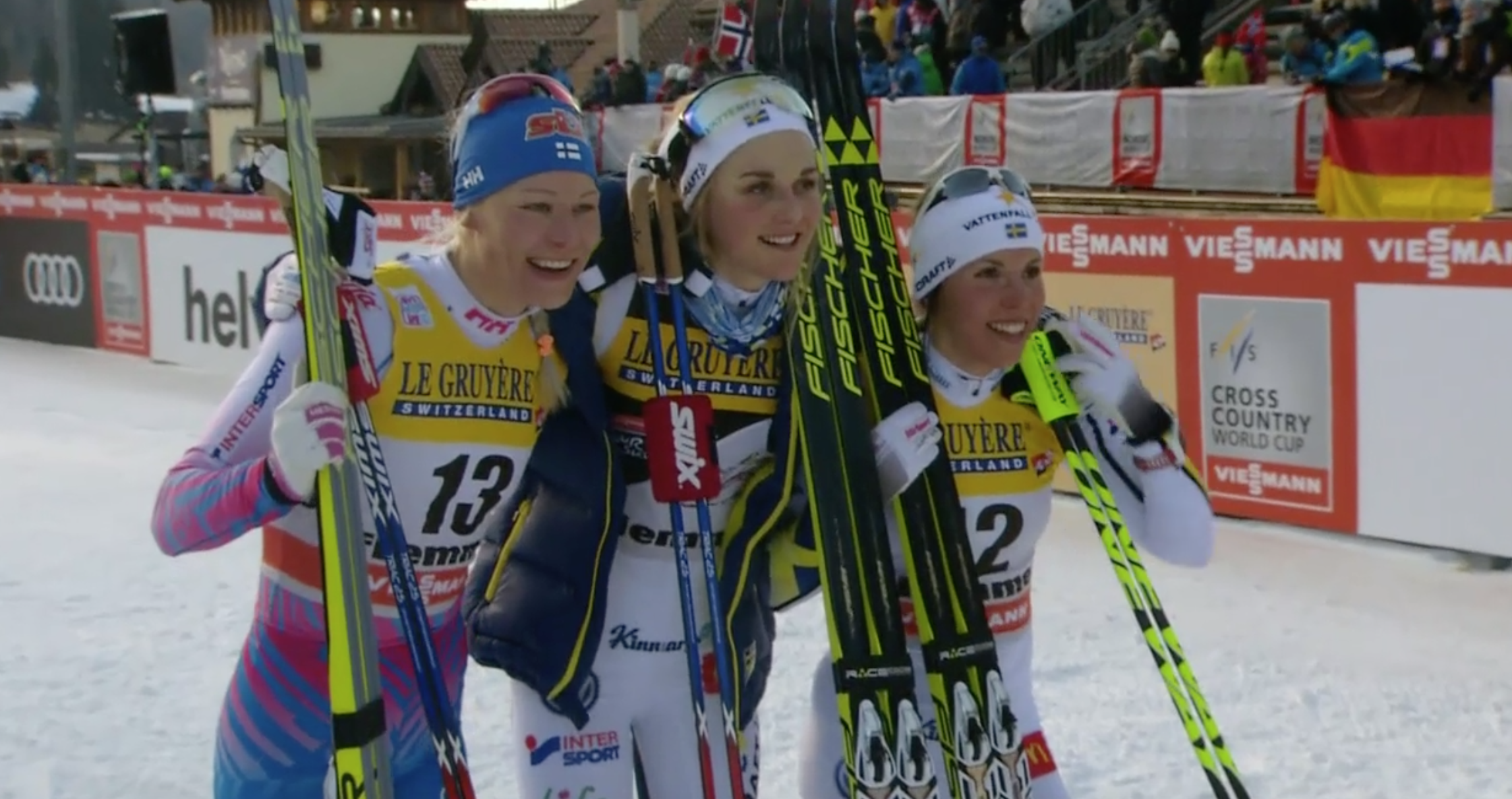
Stina Nilsson of Sweden (center) celebrates another win in the Tour de Ski, which puts her atop the overall standings; Anne Kyllönen of Finland (left) was second in the 10 k classic mass start and Charlotte Kalla of Sweden third.
In the women’s 10 k classic mass start to start the day, Stina Nilsson of Sweden won her fourth stage of this year’s Tour, racing aggressively from start to finish and picking up extra bonus seconds along the way.
Nilsson pushed the hills late and nobody from the already-fractured main pack could keep up. She notched a 3.0-second win over Anne Kyllönen of Finland, who collected her first individual podium of the season. Charlotte Kalla joined her Swedish teammate on the podium in third (+3.7), also her first podium of the year; she had been fourth in the 5 k freestyle the day before in Toblach, Italy.
Krista Parmakoski of Finland was fourth, +9.4, Teresa Stadlober of Austria fifth, +10.1, and Yulia Tchekaleva of Russia sixth, +10.5.
With the bonus seconds that Nilsson picked up along the way, she stole the overall Tour de Ski lead from Norway’s Heidi Weng, who finished seventh (+17.5). Ingvild Flugstad Østberg, also of Norway, had been in second place but slipped even farther. After leading at the start of the race, she slipped through the pack and then off the back, crossing the line 18th (+1:08.5). She is now fourth in the Tour de ski, behind Parmakoski.
Jessie Diggins of the U.S. skied to eighth place (+19.5) and retained her fifth place overall Tour standing. Teammate Liz Stephen raced to 19th (+1:11.2), and moved into the top 20 of the Tour standings for the first time. Rosie Brennan scored points again in 28th (+2:06.1).
FIS Cross-Country OPA Cup (Planica, Slovenia): 10 k classic
[UPDATED] A quartet of American sprinters turned to distance classic skiing, placing as high as fifth, in 10-kilometer classic interval start races at the OPA Cup in Planica, Slovenia, earlier Saturday.
U.S. Ski Team member Simi Hamilton posted the day’s best result for the Americans, finishing fifth in the men’s race, 13.8 seconds back from winner Jean Tiberghien of France. Hamilton, who started in the final third of the 110-skier field, worked his way into the race, placing 14th at the 3.8 k mark and seventh at 7.5 k before moving up into fifth by the finish. His teammate and the other American in the race, Andy Newell, placed 58th, 1:30.7 back, finishing strong after placing 67th at the 7.5 k time checkpoint.
Mickael Philipot (+2.0) and Valentin Chauvin (+8.6) rounded out the all-Gallic podium.
In the women’s race, Ida Sargent (USST) was the leading American in 17th. She finished 1:10 behind winner Sara Pellegrini of Italy. Sargent likewise worked her way into the race, placing 26th and 18th at intermediate checkpoints before moving up to 17th by the finish.
Three places and less than ten seconds back, Sophie Caldwell (USST) finished 20th, 1:19.7 back of Pellegrini. Caldwell started out somewhat faster than the three other Americans who raced today, placing as high as seventh at the first checkpoint.
The final podium, reminiscent of the 2006 World Cup soccer final, was Pellegrini in first, Italian Caterina Ganz in second (+7.6), and Delphine Claudel of France in third (+14.6).
Conditions in Planica were clear and cold and just a few degrees above the FIS-legal cutoff, with race-time temperatures between 3° F and 5° F.
Racing in Planica concludes tomorrow with interval start 10 and 15 k classic races, replacing the 7.5/15 k skiathlon that was originally scheduled.
FasterSkier’s Collegiate Skiers of 2016: Mads Strøm and Linn Eriksen. (photo: Curtis Snyder of the CU Sports Information Dept. and Jamie Schwaberow/NCAA Photos).
With the 2015/2016 season officially in the rearview, FasterSkier is excited to unveil its annual award winners for this past winter. Votes stem from the FS staff, scattered across the U.S. and Canada, and while not scientific, they are intended to reflect a broader sense of the season in review.
We kicked off the series Monday with Juniors of 2016: Katharine Ogden and Sean Doherty. This second set of honors goes to outstanding male and female skiers on the U.S. NCAA collegiate circuit.
***
Mads Strøm, University of Colorado-Boulder
Even after tallying four wins in a row and six victories this past season, the University of Colorado-Boulder (CU) junior Mads Ek Strøm was still nervous before his final competitions of the 2016 college race season.
Nerves, however, didn’t stand a chance with the 24-year-old Norwegian.
By the time he finished the men’s 10-kilometer freestyle — the first of two nordic races at the NCAA Skiing Championships event this year in Steamboat Springs, Colo. — Strøm had skied to his seventh win of the season and fifth win in a row, securing himself as the most distinguished CU skier of all time.
Prior to Strøm, the most season wins accomplished by a CU skier were six, set first in 1989 by Per Kare Jakobsen and then again in 1999 by Ove Erik Tronvoll.
“I was so nervous,” Strøm said of coming into the 10 k, according to CUBuffs.com. “I just had to find good skis, good pacing, and push it as hard as possible. It was definitely the best win of the year. Pulling it off when it matters the most is great.”
An Oslo native, Strøm began attending CU in 2014. He made his debut on the NCAA Championships podium during his freshman year, when he won the 2014 men’s 20 k freestyle race at Soldier Hollow in Midway, Utah.
One podium only warranted more. After his freshman year, Strøm continued to chase the top spots, garnering 25 career podium finishes and 13 individual titles by the time he won this year’s men’s 10 k event, according to CU’s Sport Information Specialist Curtis Snyder.
However, Strøm’s goal for this college season wasn’t to win just one of the NCAA Championships races. He wanted both.
“Obviously I wanted to win,” Strøm had told FasterSkier after he finished second in the men’s 15 k classic mass start Sun Valley SuperTour in December — before the college season started. “I haven’t gotten quite there yet because I have been training almost 100 hours every month since May. I’ve planned that in one month from now I’m going to be in better shape and my plan is to win both races at NCAA’s.”
Strøm’s plan to wait and win worked. When he crossed the finish line first in the men’s 20 k classic mass start, the second nordic race of NCAA Championships, Strøm accomplished his season goal and much more.
After winning eight out of 12 races in the collegiate race schedule, Strøm now holds the record for most season victories of any CU skier, alpine or nordic.
“He became the fifth CU skier to sweep the individual NCAA Championships in program history, joining John Skajem (alpine, 1987), Line Selnes (1988, Nordic), current Nordic assistant Jana Weinberger (2006, Nordic), Maria Grevsgaard (2008, Nordic) and Lucie Zikova (2008, alpine),” Snyder wrote in an email regarding Strøm’s NCAA podium sweep.
The Norwegian’s achievements this season don’t end with the collegiate race scene. Strøm also finished fourth and ninth at the SuperTour season opener in West Yellowstone, Mont., in the 15 k freestyle and sprint, respectively.
The following SuperTour in Sun Valley Idaho, also saw Strøm ski to second in the men’s 15 k classic mass start and 11th place in the classic sprint.
Strøm, who plans to major in business and would like to one day compete at the Olympics, will return to CU next year for his final nordic ski season as a senior.
Linn Eriksen, University of Denver
One out of two. For every two college races University of Denver (DU) sophomore Linn Eriksen raced this year, she won one. That includes the final nordic college race of the season at NCAA Championships: the women’s 15 k classic mass start.
Also from Oslo, Eriksen, 21, commanded this year’s NCAA Championships mass start, striding away to a 19.9-second victory over the University of New Mexico’s (UNM) Kati Roivas.
Though Eriksen has stood at the top of the podium before as Norway’s four-time Junior National Champion, her victory in this year’s 15 k was her first NCAA title, as well as her first NCAA podium appearance.
Her breakthrough at this year’s NCAA’s also helped the Denver Pioneers to their 23rd national championship.
“Moritz [Madlener] and Linn [Eriksen] have led the team all year and they did it again today,” DU head nordic coach David Stewart said according to a DU press release. “Linn skied a masterful race, leading from start to finish, breaking away on the last lap to ski to a solo win.”
Eriksen’s other notable accolades from the season include first-place finishes in women’s 5 k freestyle and 15 k classic at the Montana State University invite, victories in both races at the UNM invite, second place in the 5 k freestyle at the University of Utah invite, third place in the 15 k classic CU invite, second place in the 5 k freestyle at the DU Regional race, and her top-10 finish in the first race of NCAA Champioships, the 5 k freestyle where she placed eighth.
After finishing the season as an All-American in both NCAA Championships races, Eriksen’s name will not go unnoticed at the start of next year’s college race season, her junior year.
The University of Denver celebrates its victory during NCAA Division I Men’s and Women’s Skiing Championships at Howelsen Hill in Steamboat Springs, Colo. (Photo: Jamie Schwaberow/NCAA via DenverPioneers.com)
After the University of Denver (DU) alpine team pulled the Pioneers into the lead on Friday, surpassing Montana State University (MSU) by 15.5 points with one day remaining in the NCAA Skiing Championships, the DU nordic team took that lead and ran with it on Saturday for Denver’s 23rd national skiing title.
DU won the four-day 2016 championships with 567.5 points, 76 more than the University of Colorado-Boulder in second and 82.5 ahead of University of Utah in third. Colorado (CU) hosted the championships at Howelsen Hill in Steamboat Springs, Colo., with two days of alpine racing interspersed with two days of nordic.
“Alpine set us up with a lead that we were able to build on, so this was a balanced team win with both alpine and nordic adding almost the same points to the team total,” Denver Head Nordic Coach Dave Stewart said, according to a DU press release. “Alpine has had a dominant season and it was very special to put it all together this week at NCAA’s.”
The men’s 20-kilometer and women’s 15 k classic mass starts ended the championships on Saturday, with CU sophomore Mads Strøm winning his second NCAA title in as many races at this year’s championships (and third overall in the last three years).
Denver sophomore Linn Eriksen skied away from the 39-woman pack to win in 54:37.6 minutes, 19.9 seconds ahead of Kati Roivas of the University of New Mexico (UNM). Ane Johnsen (CU) placed third (+21.2) to round out the podium, while Denver had three in the top 12 with Aja Starkey in sixth (+42.9) and Taeler McCrerey in 12th (+1:10.0).
In the men’s race, Strøm edged Denver’s Moritz Madlener by 1.7 seconds at the finish, winning the 20 k in 49:41.9 and thus becoming the third CU athlete in history (and sixth skier) to win at least three individual NCAA titles, according to a CU press release. Another 17 seconds back, Niklas Persson (Utah) placed third (+18.7). For Madlener, it was his second podium in as many races after placing third in Thursday’s 10 k freestyle.
“I really had to focus – I’m happy that I had that rest yesterday,” Strøm said of Friday’s off day for nordic. “A lot of things happen when you win a race. A lot of people want to talk to you. I just had to recover a little bit and try to find some good skis again and just have a smart tactic. I just like to stay behind people, let them do the work and finish strong.”
The 24-year-old Norwegian explained he switched up his strategy when his teammate Petter Reistad chose to double pole.
“He didn’t use any kicks, so he had to go hard from the start and just try to ski away from people,” Strøm said. “That really helped me out because other teams had to chase him and I could slip in behind and just ski with them until they eventually caught him. I could just stay in a pack and just save as much energy as possible. My skis were really good and on the last lap I saw there were pretty much only three guys left. I knew all of us were pretty good sprinters so I just tried to tire them out a bit all the way to the top.”
Mads Strøm racing to the first of his two consecutive wins at 2016 NCAA Skiing Championships: Thursday’s 10 k freestyle in Steamboat Springs, Colo. Strøm won the men’s 20 k classic mass start on Saturday by 1.7 seconds. (Photo: CUBuffs.com)
Coming into the final descent, Strøm told himself that second wouldn’t cut it.
“I said, ‘OK, I’m going to sacrifice everything. Either I go down or I’m just going to gap,’ and I gapped. I looked back, and I said, ‘OK, just sprint from here. Just go for it,’ ” he said.
Reistad placed ninth (+1:35.4) as a freshman and the second CU Buff in the top 10. In the women’s race, Colorado had two skiers in the top five, with Johnsen in third and Jesse Knori in fifth (+36.2).
Contributing to the team win, Denver had three men in the top 13 with Dag Frode Trolleboe in 10th (+1:42.3) and Lars Hannah in 13th (+2:21.3).
Aside from winning the overall, Denver also had 15 All-Americans, the most of any team this year, according to an NCAA press release. On Saturday, Eriksen and Madlener were named to the women’s and men’s classical first teams, respectively, while Starkey and Trolleboe earned second-team honors.
“I am so incredibly proud of the young men and women on our team,” Stewart said. “They came into this championship knowing that it would take nothing less than their best to win a title for DU, and they did just that. The conditions were challenging today with rising temperatures through the morning, but everyone brought such composure and focus to the race that I believe the tough conditions worked in our favor.
“Moritz and Linn have led the team all year and they did it again today,” he added. “Moritz just missed his first individual national title in a close sprint finish, but his two podium performances this week were huge for the team. Linn skied a masterful race, leading from start to finish, breaking away on the last lap to ski to a solo win. Aja had the race of her life in sixth and Dag Frode had his two best races of the season when the team needed him.”
Stewart added that the championships came during exam week, requiring every member of the team to take their final exams in advance.
“These guys are truly model student-athletes and it is my pleasure to be able to coach them,” he said. “We are thrilled to be bringing our 23rd national title back to DU! To end the championship with two exceptional nordic performances, with both men and women winning the team score, was the best ending to the five championships wins I have been a part of over the last 10 years. This one tops them all! To have all six of our nordic athletes earn All-American honors is just incredible. I’m speechless.”
Canmore’s Annika Hicks (54) finished second in the women’s 15 k classic mass start on the final day of Western Canadian Championships on Feb. 21, just ahead of Katherine Stewart-Jones (NDC Thunder Bay) in third. (Photo: Sally Connon)
Western Canadian Championships, the final NorAm weekend of the season took place Feb. 19-21 at the Otway Nordic Center in Prince George, B.C., with three races determining the final Ski Tour Canada (STC) roster for Canada.
Dahria Beatty and Kevin Sandau left British Columbia as the overall NorAm leaders, granting them starts at the STC eight-stage World Cup.
Beatty won the women’s 7.5-kilometre freestyle individual start on Friday, Feb. 19, by nearly 11 seconds in 19:02.7 to retake the NorAm lead from fellow U23 Development Team skier, Cendrine Browne, of the Pierre-Harvey National Training Centre (CNEPH).
“I went out as if I was only racing 5km,” Beatty recalled in an email. “I felt really good on the first lap and then started to fade on the second lap as my legs filled with lactate. The downhills on the second lap were the hardest part as I struggled to stay on my feet I was so tired. I managed to regain a bit of composure for the final climb and hold onto the lead I had fortified on the first lap. This was my first time racing in Prince George and I really enjoyed the trails. Lots of fun and very technical!”
U23+ Development Team skier Olivia Bouffard-Nesbitt finished second (+10.9), while Maya MacIsaac-Jones, of Rocky Mountain Racers (RMR) was 45.8 seconds behind in third, edging Annika Hicks (Canmore) by 2.1 seconds, for her first NorAm distance podium of the season.
“I’m definitely happy with the upward trend I’ve been experiencing,” Bouffard-Nesbitt wrote. “The only thing lacking is some power, but that is a result of my (lack of) summer training, so there’s nothing I can do about that now. I’m super excited to race some World Cups though!”
Browne, citing fatigue after an altitude training block, finished fifth, 52.1 seconds behind Beatty.
“I already knew in my warm up that something was wrong. I wasn’t feeling good,” Browne wrote in an email. “In the race, everything was confirmed. I felt awful. I couldn’t push my body was tired.”
“When my coach called me on the phone and asked how my race went and when I said it was awful, he just said: Perfect, the altitude camp is working,” Browne added. “I was surprised by his answer but it cheered me up a little. He also said it would be hard doing the sprints too.”
***
Day 2 brought another win for Beatty at Saturday’s 1.4 k classic sprint, as she beat out Bouffard-Nesbitt in the finishing straight to win by half a second in 3:44.2.
“I felt good in my semi and was able to carry that feeling into the final,” Beatty wrote. “Olivia led the entire race, she was skiing well and had a faster start than me to get out in front early. I just sat in behind her on both climbs as the middle track was a lot better than the two outside ones. You come into the finish off a downhill so I used her draft to step out beside and sprinted to the finish. I had a comfortable advantage by halfway down the finish shoot and carried that to the finish.”
“I raced the final how I wanted to,” Bouffard-Nesbitt explained. “I led the whole race and unfortunately got out-sprinted at the finish. It was a good wake up call, because now I can hit the gym and do some biceps curl reps to have me ready for the tour.”
“It was a good wake up call, because now I can hit the gym and do some biceps curl reps to have me ready for the tour.” — Olivia Bouffard-Nesbitt on finishing second in the Westerns classic sprint
MacIsaac-Jones again snatched the final podium spot, 4.55 seconds behind Beatty, ahead of Katherine Stewart-Jones (NDC Thunder Bay) in fourth. Beatty’s second win of the weekend locked up her hold of the overall NorAm. MacIsaac-Jones took the NorAm sprint lead, displacing teammate Andrea Dupont, who skipped Westerns while racing Period 3 on the World Cup in Europe.
“I went in today wanting to win, but I’m satisfied with a bronze medal,” MacIsaac-Jones wrote. “The race was good redemption for me from the Canada Winter Games race on this course last year, where I didn’t make the A Final. It was also a big improvement from my classic sprint at the Canmore NorAm in december, where I also didn’t make the A Final.
“I knew that Dahria and Olivia would go for it once we hit the big climb so I just tried to hang on, but they were too fast for me and I wasn’t able to stick with them,” she added. “Katherine moved up beside me on the final climb, but I managed to hold her off and hang on to 3rd which I was really happy with.”
As planned, Beatty headed home Sunday morning to start her final STC preparations.
***
In Sunday’s 15 k classic mass start, Browne skied away to a 52-second victory in 46:00.1, while Hicks took second, 0.6 seconds ahead of Stewart-Jones in third.
“I felt very good! The shape is back,” Browne wrote on Sunday. “Annika, Katherine and I stayed together for 2 and a half laps (we had 4 laps of 3.75km to do). I was feeling good today so I started going a little harder on the 3rd lap and starting the 4th lap, I knew I was by myself. I had really good kick so climbing the big climbs was where I knew I could break away. I went even harder on the last lap just to make sure the girls couldn’t catch up to me.”
Junior Katie Weaver (Hollyburn) continued her steady rise, skiing with the lead three for the first lap before falling off the pace and finishing 2:48.1 back in fourth.
Many of the STC-bound skiers skipped the distance race on Sunday.
***
Black Jack’s David Palmer (l) leading early in the men’s 20 k classic mass start on the final day of Western Canadian Championships in Prince George, B.C., with Michael Somppi, Evan Palmer-Charrette, Andy Shields, and Patrick Stewart-Jones (r) chasing. (Photo: Sally Connon)
On the men’s side, Andy Shields (NDC Thunder Bay) was within striking distance of Sandau’s overall lead before the weekend. With the third-ranked man, Knute Johnsgaard (AWCA/NDST) focussing on a training block before STC, it was a two-way fight for the title.
In Friday’s 10 k freestyle individual start, Russell Kennedy (Canmore) snatched the victory in 22:19.1, edging Sandau by 0.4 seconds and Michael Somppi (NDC Thunder Bay) by 2.5 seconds, for his first NorAm win of the season.
“I was super pumped in my race today feeling was amazing conditions were really good and the downhills were fast and technical,” Kennedy wrote in an email.
“There wasn’t much of a pacing strategy as it was 10k so really just had to start fast and hold on to as hard a pace as possible,” he added. “The splits were close so I knew I had to push it. I was feeling confident when we were close at the top of the last hill as I love downhills and have a good sprint. I didn’t really realize just how close it was until the after I finished though.”
Sandau wrote in an email that he was happy to finishing in the top four considering how close it was, but always wants the win, especially considering how close he was behind Kennedy.
“I’ve been teasing him all winter about nicking him in the distance races so he served up a nice rebuttal today,” Sandau wrote. “… I went off the line hard knowing there wasn’t room for mistakes and a lot of places to give up time. I was getting splits off Russell near the end that he was leading so I tried to claw back some time in the last few climbing sections but was just shy of enough.”
“It’s a really good course for [Russell] and I knew with his consistency in skate races he was going to be one of the bigger threats out there,” Sandau added. “Plus he’s pretty good when he clips into a pair of alpine skis so the downhills were probably pretty easy for him, compared to me who felt like a tourist out for the first ski of the year at times.”
Somppi in third described his race as “solid.”
“The fitness is as good as it’s going to get at this point,” he wrote. “Now, it is all about finding the right mix of recovery and intensity to be primed and full of energy when the Tour starts.”
Shields finished fourth, 9.7 seconds back, to stay in mathematical contention. To take the title, Shields would need at least a win and a second in the final two races.
“I started pretty hard, got tired and had a rough middle section,” Shields wrote. “I was still getting good splits going into the last 4km so I was able to find some juice to finish off and still have a respectable split for the last lap.”
***
Bob Thompson (NDC Thunder Bay) racing to second in the men’s classic sprint qualifier at Western Canadian Championships in Prince George, B.C. He went on to win the men’s final. (Photo: Sally Connon)
Bob Thompson (NDC Thunder Bay) won the men’s 1.4 k classic sprint on Saturday, retaking the sprint series lead and the automatic STC start from Julien Locke (Black Jack), who was in Romania for U23 World Championships this week. Thompson needed the win to eclipse Locke in the sprint standings, taking the series 250 points to Locke’s 245.
Also in the sprint final, Patrick Stewart-Jones (AWCA) placed second and Shields finished third. Sandau went out in the quarterfinals, having achieved his training goals.
“Very happy that I was able to win when I needed to,” Thompson wrote in an email. “To win the NorAm sprint spot for the Tour of Canada I had to win to get enough points. Patrick was in the same position so I knew we would both be giving our all to lock the spot down. Was great that I was feeling really strong and had my best qualifier of the year as well.”
Thompson qualified second behind Skinouk’s Simon Lapointe, who went on to place sixth in the final.
***
Evan Palmer-Charrette (NDC Thunder Bay) outlasted teammate Andy Shields (l) and Patrick Stewart-Jones (AWCA) for the win in the men’s 20 k classic mass start on Sunday, Feb. 21, at Western Canadian Championships in Prince George, B.C. (Photo: Sally Connon)
On Sunday, Evan Palmer-Charrette (NDC Thunder Bay) won a four-way race for first in the 20 k classic mass start. Shields finished second, 0.111 seconds back, and Stewart-Jones was third (+0.525). Somppi lost his balance in the final straight and finished fourth, 1.24 seconds behind Palmer-Charrette. David Palmer (Black Jack) was dropped during the final lap to take fifth, 13.9 seconds out of first.
“I am quite happy with my race Sunday but overall the weekend was a bit disappointing,” Palmer-Charrette wrote. “The 10km skate on Friday is what I would pick as my strongest event and I really struggled that day. I had the race I wanted to on Sunday and am looking forward to next season!”
“The race on Sunday was a lot of fun, skiing at the front with my team-mates…,” Somppi wrote. “Tactically, I put myself in a great position to win. I led the final climbs, pushing the pace, and crested the final downhill in second, right behind Evan. Unfortunately I hit a patch of ice on the final downhill corner and stumbled, nearly crashing. Instead of using the draft and coming up beside Evan in the finish to contend for the win, I was double poling early in the finish stretch, trying to regain my speed.
“I feel a little gypped after this weekend, to finish 3rd and 4th when I was only 2.5 seconds from winning one day and 1 second from winning the other day,” Somppi, last year’s NorAm winner, added. “I’m hoping my luck will turn in the Tour.”
The women’s leaders in the 15 k classic mass start on Day 3 of Eastern Canadian Championships on Feb. 7 in Cantley, Quebec, with Dahria Beatty (l), Cendrine Browne (c), and Jenn Jackson (r) at the front of the pack. Beatty went on to win by 7.7 seconds over Browne, in the NorAm leader’s bib. (Photo: W. James MacLean)
Though patterns develop and race favorites exist, winning is never a given. At least according to Cendrine Browne, the NorAm leader and overall champion of the women’s 10-kilometer freestyle at Eastern Canadian Championships last Saturday, Feb. 6, at the Nakkertok Nordic Ski Centre, Cantley, QC
“I don’t think you can get used to winning. Winning is great but every day is different,” Browne, a member of Canada’s U23 Development Team and the Pierre-Harvey National Training Centre (CNEPH), wrote in an email.
“I chose to ski on white bases today at everybody’s surprise, but they were really fast,” Browne explained after winning in 27:10.8 minutes.
“I didn’t pace myself, I just went hard all the time and it worked pretty well,” she added. “I felt good mentally and physically, and that helped a lot.”
Finishing 9.1 seconds behind Browne was her biggest NorAm distance rival, fellow U23 Development Team member, Dahria Beatty, of the Alberta World Cup Academy (AWCA).
Beatty and Browne also both recently returned from World Cup races in Europe, where they teamed up with Emily Nishikawa and Maya MacIsaac-Jones in the first World Cup relay for all four women.
Rounding our Saturday’s top three for the women was Olivia Bouffard-Nesbitt, of the U23+ Development Team and Rocky Mountain Racers (RMR), who finished 21.8 seconds off Browne’s winning time.
“I was getting really good splits in the first 5k (being told I was leading) and I was having a lot of fun on course,” Bouffard-Nesbitt wrote in an email. “I faded in the second half of the race, but that can be a consequence of going hard at the start, so I have no regrets.”
Also of RMR, MacIsaac-Jones, who won Friday’s freestyle sprint on the first day of Easterns, was pleased with her fourth-place finish, 43.8 seconds behind Browne.
“My race today was really good — I was 4th, which is my best distance NorAm result this year!” MacIsaac-Jones wrote in an email.
Somppi Dethrones Sandau in 15 k Skate
Also on Saturday, Michael Somppi, of the Thunder Bay National Development Centre (NDC),claimed a decisive win in the men’s 15 k freestyle. Somppi completed the course in a time of 34:45.1, besting second-place finisher Kevin Sandau (AWCA) by 25.3 seconds.
“I’m super happy I was able to get back to feeling like myself in a skate race. I was really pumped to get back onto the top step at the NorAm,” Somppi wrote in an email.
The winner of every NorAm distance race he has competed in this season (with four victories total; he skipped the M.S.A. NorAm), Sandau regarded his next few weeks of race efforts as most important.
“Western’s has always been part of the plan leading up to the Tour,” Sandau wrote in an email, referring to the second set of championships, Feb. 19-21 in Prince George, British Columbia.
“Even with a [Ski Tour Canada] spot locked up now unofficially, I’ll be using it as some final hard efforts before flying out East,” he added.
The Ski Tour Canada, doubling as World Cup Finals, starts March 1 in Gatineau, Quebec, and extends through March 12 with the last four races in Canmore, Alberta.
Noting he was “pumped” to be on the podium on Saturday, Russell Kennedy, of the Canmore Nordic Ski Club, finished third, 31.2 seconds behind Somppi.
“I nailed my pacing. That was huge it really helped me as I made up a lot of time at the end,” Kennedy wrote in an email.
Kennedy also pointed to external sources of motivation during his race, including the man who started just ahead of him, Brian McKeever, of the Canadian Para-Nordic Ski Team.
“It also was good to have Brian there. He was super motivating,” Kennedy wrote.
McKeever, visually impaired, raced to fifth overall, 1:01.9 out of first and 19.6 seconds behind Knute Johnsgaard (AWCA/U23+ Development Team) in fourth.
Though Saturday left her chasing downBrowne,Beatty positioned herself as the woman to beat by the Nakkertok course’s final climb on Sunday in the women’s 15 k classic mass start.
“My plan going into today was to stay in contact until the final climb and leave everything on that final climb,” Beatty wrote in an email on Sunday.
Despite losing contact at one point during her third lap of the 5 k loop, Beatty managed to stick to her plan. Amidst Sunday’s snowfall, the Whitehorse native left everything on the last uphill and came away with the win in 46:54.4.
“I was able to regain contact with Cendrine and my skis were gliding especially well so I was able to carry good speed into the final climb and get a gap before the downhill into the finish,” Beatty wrote.
Browne finished 7.7 seconds later in second place.
“A second place is great but I could have won…My skis were so slow!” Browne wrote in an email.
Finding herself at the back of the lead pack during the downhills, Browne put her focus into Sunday’s course climbs.
“I told myself that if I wanted to win, I would have to give everything I had in the uphills because I couldn’t count on my skis in the downhills,” Browne wrote. “So in the second last uphill, I tried to break away from the pack. It worked. I had a 10-meter gap before the second last downhill.”
However, by the bottom of the hill, Beatty caught back up to Browne.
“As I was going down, Dahria passed me like I was still,” Browne added. “I tried to catch up in the last up hill and fell. So I didn’t catch her. I finished 2nd. I was disappointed. I hate giving excuses but I think I could have won.”
Finishing just 2.0 seconds behind Browne, and 9.7 seconds behind Beatty, was NDC Thunder Bay’s Katherine Stewart-Jones in third place.
“There was a big lead pack for a lot of the race. It was easy to stay relaxed because I had very fast skis,” Stewart-Jones wrote in an email. “I think the race came down to the last couple of hills of the course, whoever had energy left in the tank.”
She pulled some energy from fans on from the trailside.
“It was amazing to see the support from my home club,” Stewart-Jones, who grew up training with Nakkertok, wrote. “There were so many people out there cheering me on!”
After a large crash in the first lap, Bouffard-Nesbitt lost contact with the front group and raced to a 10th overall (+2:01.0).
“I’ve hardly classic skied this winter due to my stress fracture, and I’ve really been struggling in classic races,” Bouffard-Nesbitt wrote in an email.
“As a whole I’m happy with the weekend. I’m going to try to not be too hard on myself for this last classic race,” she added.
Shields Takes All in 20 k Mass Start
The men’s leaders during the 20 k classic mass start on Feb. 7 at Eastern Canadian Championships in Cantley, Quebec, with Andy Shields (r) leading, Brian McKeever (l), Sandau (yellow bib), with Sandau’s AWCA teammate Knute Johnsgaard behind him, and Scott Hill (6) of NDC Thunder Bay right there in the lead pack. (Photo: W. James MacLean)
En route to his third-career NorAm win, Andy Shields (NDC Thunder Bay), came away victorious in the men’s 20 k classic mass start on Sunday.
Shields completed the four-lap race in 52:53.6, besting second place finisher Jesse Cockney (CNEPH/NST) by 12.1 seconds.
“The herringbone sections were coved in deep sugary snow but I felt comfortable on them,” Shields wrote in an email.
With 2 k to go, Shields gapped the field during a herringbone hill and skied comfortably away to first place.
“It never felt like the pace was unmanageable so a ‘thank-you’ to the body for being in good shape today,” Shields wrote.
Cockney confirmed that Shields’ skiing on Sunday was left unrivaled by any other skier on course.
“Andy definitely won with stronger legs today. He was skiing the steep climbs really well and had lots left for the final lap,” Cockney wrote in an email.
After starting in bib 31, Cockney was happy to have maneuvered his way up to the front of the pack.
“I’m quite happy to have moved up from bib 31 to near the front. The distance races here have also been better feelings pushing hard than the rest of the year,” he wrote.
Finishing just 1.3 seconds off of Cockney was Johnsgaard in third, 13.4 seconds behind Shields.
“Kevin and I were leading a lot on the first lap, but there was a bit of fresh snow in the tracks and it was hard to drop the group,” Johnsgaard wrote in an email.
“We’d get a gap on some climbs and then it would come back together on the downhills. The course was basically double pole and then herringbone up steep climbs in ankle deep corn snow,” he added.
According to Johnsgaard, the herringbone sections played to Shields’ strength, but not his own.
“Not exactly my idea of a nice classic course,” Johnsgaard wrote. “Andy had some super herring bone on the last major climb and broke away a bit.”
Sandau, who had been skiing in the front pack with Shields, Johnsgaard and Cockney, crashed, which he wrote cost him “a podium spot.”
Despite his fall and fifth-place finish, 20.4 seconds off of first place, Sandau was satisfied with how he felt during the races.
“The past couple weeks had a really good chunk of volume and I was happy how I felt in both distance days and had some good fight,” Sandau wrote.
Ahead of Sandau in fourth, McKeever was half a second off the podium and 14 seconds behind Shields.
— Gerry Furseth and Alex Kochon contributed reporting
(From left to right) Kevin Sandau, Andy Shields, Brian McKeever, Michael Somppi, and Jess Cockney after the men’s 20 k mass start on Sunday, Feb. 7. Shields won by 12 seconds over Cockney, Knute Johnsgaard (not shown) placed third, McKeever was fourth, Sandau (the NorAm leader) fifth and Somppi eighth on the last day of Eastern Canadian Championships in Cantley, Quebec. (Photo: W. James MacLean)
Norway’s Martin Johnsrud Sundby (l) heads out in front of the 15 k classic mass start with Russia’s Sergey Ustiugov (3), Switzerland’s Dario Cologna (7), and fellow Norwegian Emil Iversen (9) during Stage 7 of the Tour de Ski in Val di Fiemme, Italy. Sundby went on to win ahead of teammate Niklas Dyrhaug in second and Kazakhstan’s Alexey Poltoranin in third. (Photo: Fischer/NordicFocus)
When it’s seven race days into something like the Tour de Ski, pushing oneself repeatedly to physical extremes isn’t as simple as “mind over matter.” The basics: resting, recovery and more of the same, rules the day.
The results don’t specifically quantify whether the Tour’s overall leader, Norway’s Martin Johnsrud Sundby, recovers the best, or is the most well rested, or can suffer the most. But in Saturday’s seventh stage, the men’s 15-kilometer classic mass start in Val di Fiemme, Italy, Sundby once again proved he might as well be — odds are he’s the winning bet to take this 10th edition of the Tour de Ski.
Sundby won Saturday’s race in 39:55.2. Norwegian teammate, Niklas Dyrhaug placed second, 7.7 seconds back, while Kazakhstan’s classic specialist Alexey Poltoranin, finished third, 12.6 seconds from the win.
Norway’s Martin Johnsrud Sundby after winning the 15 k classic mass start at Stage 7 of the Tour de Ski in Val di Fiemme, Italy. (Photo: Fischer/NordicFocus)
Heading into the race, Sundby led the Tour by 1:28.1 minutes over his Norwegian teammate Petter Northug in second, and 1:31.8 ahead of Russian Sergey Ustiugov in third. A third Norwegian, Finn Hågen Krogh, coming off a win in Friday’s Stage 6, entered the seventh stage in fourth (+2:07.5).
By the end of Saturday’s 15 k, the race for second and third overall would reshuffle — with some skiers moving up the ranks, others down.
Sundby set the pace early on — his reputation preventing any upstarts from leading out. On the downhills, a long slinky line of skiers extended back, while in the early going, the uphills provided a place for regrouping.
Around 7 1/2 minutes into the race, Krogh took a strong pull up front. His move seemed for real, with a few-seconds gap forming back to Ustiugov, Northug and Sundby. But Krogh’s efforts were only part of his plan to ensure he was first to the first time bonus at 3.5 k.
After 6.5 k, a group of approximately 25 skiers had firmly established in front, with Sundby again setting the pace for three columns of striders behind.
Just before the second time bonus at 8.5 k, the race began to blow apart. Sundby, Switzerland’s Dario Cologna, and Italy’s Francesco de Fabiani, took the top-three bonuses, and Poltoranin followed close behind in fourth. Canada’s Alex Harvey, starting the day in bib 15, passed the time bonus in 14th, sixteen seconds after Sundby.
At 12.5 k, the course looped through the stadium. At this point it was clear: this was Sundby’s race to lose as he led a glued-to-the -back-of-his-skis Dyrhaug through the remaining kilometers. Poltoranin, unable to match the duo’s pace, dangled 100 meters back. Beyond, that, it was a busy and clustered race for the remaining top-10 spots.
Through the final kilometers and down the final stretch, it was a common scene: Sundby surging with an unmatched tempo and double poling for the win. Dyrhaug locked into second, nearly 8 seconds back.
The results in Stage 7 shuffled the Tour’s overall standings. Sundby will head into the final 9 k freestyle climb up Alpe Cermis with a 2:51.5-minute gap on his nearest competitor. That’s still Northug, who finished Saturday’s race in a photo finish and ended up 17th (+51.4).
Poltoranin jumped from fifth to third overall, 2:53 behind Sundby. That pushed Ustiugov into fourth overall, where he trails Poltoranin by 3.2 seconds. Krogh finished fifth (behind de Fabiani in fourth) to slip to fifth overall (+3:01.4).
The slopes of Alpe Cermis should be a highlight as the difference between second to sixth place is only 10 seconds.
In the post-race press conference, Sundby seemed grateful for his resurgence after the Stage 5 Oberstdorf 15 k classic mass start classic (the same format as Stage 7), where he finished 23rd.
“It was the same distance and technique as in Oberstdorf, but totally different result,” he said. “I had amazing skis. The plan before the start to ski with the pack with the skis like I had to go for it. I am really happy for the victory and happy that Niklas is on the podium as well.”
Unlike Sundby back in Oberstdorf, Dyrhaug narrowly missed the podium, placing fourth in a super-tight finishing sprint, 0.7 seconds from first place.
“I was close off the podium in Oberstdorf,” Dyrhaug said in the press conference. “It feels great to finish in second place. One of the goals today was to help other guys from Norway fighting for the overall. I had to be patient and follow the lead and go got the sprint. I tried to do as good job as possible. I started to be little bit tired in the second last lap.”
Alex Harvey (Canadian World Cup Team) racing to seventh in the 15 k classic mass start at Stage 7 of the Tour de Ski in Val di Fiemme, Italy. He’s currently 12th heading into the final climb. (Photo: Fischer/NordicFocus)
Top North American, Harvey finished seventh (+31.3) for his third top 10 of the Tour (he was seventh in the 30 k classic mass start in Stage 2 and ninth in the 10 k freestyle pursuit in Stage 3). His rebound up the Tour standings saw him gain three spots heading into the last stage, and he now sits in 12th overall (+5:49.9).
According to Canadian National Team Head Coach Justin Wadsworth, Harvey’s simply tired.
“He is still is not feeling super good, and I think today … he probably would have been on the podium normally, had he felt really normal or good,” Wadsworth said on the phone after Saturday’s race. “It was a really satisfying race for him.
“He really fought hard the whole race and was kind of back in 15th a lot of the race,” Wadsworth continued. “And then he just decided to start pushing it a little bit and the pace was also going hard after the bonus, and things were getting really spread out. He kind of kept on getting right on the edge of the back of the group and then he worked his way to manage to stay back in … Actually one of the gutsier races from him. When you don’t feel good, it’s hard to be in there like that.”
Sunday’s epic stage will see Harvey with new legs, so to speak, following surgery this past spring that will allow him to complete the Tour. (In the past, Harvey has experienced blood-flow problems in his legs, particularly when skating on sustained climbs.)
“He is excited to see how his legs are going do. It’s the first time he’ll have good legs going up that, without his artery issue,” Wadsworth said. “So I think it will be kind of a learning experience again for him to do it and actually have legs underneath him. That will be fun to see.”
Ivan Babikov placed 30th, 1:59.3 after Sundby, and teammate Devon Kershaw finished 31st (+2:05.5). Heading into the final climb, Harvey will start 5:50 back in 12th, Babikov 12:30 after Sundby in 29th, and Kershaw 12:31 back in 33rd.
American Noah Hoffman continued his top-30 streak, placing 23rd on Saturday (+1:37.1). He enters the last stage ranked 26th overall, and will start the final climb 9:48 out of first. The other U.S. male in the Tour, Erik Bjornsen, placed 46th (+3:25.3) for 42nd overall (+15:17).
The Tour concludes Sunday with the final climb in Val di Fiemme.
Stay tuned for a separate report on Hoffman.
***
Of note: Dario Cologna, who skied at the front of the field for 10 k of the race, finished with an injury. He ended up 40th (+2:51), but dropped out of the Tour, seeking an MRI on his left calf muscle in Davos, Switzerland. Despite his result on Saturday, Cologna still ranked 13th overall heading into the final stage.
According to Swiss team doctor Hanspeter Betschart, interviewed by Swiss TV broadcaster SRF 2, “Dario Cologna already felt his left calf a little bit before the race, then on the climb it really shot into it, an acute muscle injury in the left calf. We have to examine him for more details, we just looked at it briefly now.”
Asked if it was likely the result of a slip during the race, rather than a lingering problem, Betschart said, “Yes, exactly. … There were no signs for something like this. This is an acute event.”
OBERSTDORF, Germany — Therese Johaug jetted to another distance victory on Wednesday in the 10-kilometer classic mass start, but not without a tenacious teammate keeping her on her toes, as Ingvild Flugstad Østberg placed second to stay in the Tour de Ski leader’s bib. Then in the men’s 15 k, Kazakhstan’s Alexey Poltoranin outlasted Dario Cologna of Switzerland by 0.1 seconds for the win, and Italy’s Francesco de Fabiani came on strong for third.
Much thanks to Marcel Hilger, who shared the following photos from Stage 5 of the Tour.
Start of the women’s 10 k classic mass start at Stage 5 of the Tour de Ski in Oberstdorf, Germany. (Photo: Marcel Hilger)
Therese Johaug sets the pace early in the 10 k classic mass start at Stage 5 of the Tour de Ski in Oberstdorf, Germany. (Photo: Marcel Hilger)
Therese Johaug (l) leads Norwegian teammates Ingvild Flugstad Østberg (c) and Heidi Weng (r) during the 10 k classic mass start at Stage 5 of the Tour de Ski in Oberstdorf, Germany. (Photo: Marcel Hilger)
Therese Johaug (front) leads Norwegian teammates Ingvild Flugstad Østberg and Heidi Weng during the 10 k classic mass start at Stage 5 of the Tour de Ski in Oberstdorf, Germany. (Photo: Marcel Hilger)
Norway’s Therese Johaug racing to the win in the 10 k classic mass start at Stage 5 of the Tour de Ski in Oberstdorf, Germany. (Photo: Marcel Hilger)
Norway’s Therese Johaug after winning the 10 k classic mass start at Stage 5 of the Tour de Ski in Oberstdorf, Germany, in January. (Photo: Marcel Hilger)
The all-Norwegian women’s podium at Stage 5 of the Tour de Ski: (from left to right) runner-up Ingvild Flugstad Østberg, winner Therese Johaug and Heidi Weng in third in the 10 k classic mass start in Oberstdorf, Germany. (Photo: Marcel Hilger)
Norway’s Therese Johaug after winning the 10 k classic mass start at Stage 5 of the Tour de Ski in Oberstdorf, Germany. (Photo: Marcel Hilger)
Norway’s Ingvild Flugstad Østberg after finishing second in the 10 k classic mass start at Stage 5 of the Tour de Ski in Oberstdorf, Germany. She remains first in the Tour standings, 12 seconds ahead of teammate Therese Johaug (not shown) with three stages to go. (Photo: Marcel Hilger)
Fellow U.S. Ski Team members Sadie Bjornsen (l) and Jessie Diggins (r) started near each other in Wednesday’s 10 k classic mass start at Stage 5 of the Tour de Ski in Oberstdorf, Germany. Diggins went on to place 23rd and Bjornsen 26th for 12th and 14th overall, respectively, in the Tour standings. (Photo: Marcel Hilger)
American Jessie Diggins (10) skiing in the pack with Finland’s Laura Mononen (9) and Germany’s Sandra Ringwald (15) during the 10 k classic mass start at Stage 5 of the Tour de Ski in Oberstdorf, Germany. (Photo: Marcel Hilger)
Sadie Bjornsen racing to 26th in the 10 k classic mass start at Stage 5 of the Tour de Ski in Oberstdorf, Germany. (Photo: Marcel Hilger)
Liz Stephen racing to 33rd in the 10 k classic mass start at Stage 5 of the Tour de Ski in Oberstdorf, Germany. (Photo: Marcel Hilger)
Liz Stephen racing to 33rd in the 10 k classic mass start at Stage 5 of the Tour de Ski in Oberstdorf, Germany. (Photo: Marcel Hilger)
Rosie Brennan on her way to 35th in the 10 k classic in Oberstdorf, Germany, as part of the 2016 Tour de Ski. Brennan is an athlete representative to U.S. Ski & Snowboard, and recently participated in a call between the leadership of the International Olympic Committee and the World Anti-Doping Agency, with 50 other athlete representatives. That athletes had the chance to ask questions about current doping investigations and anti-doping policy. (Photo: Marcel Hilger)
Rosie Brennan on her way to 35th in the 10 k classic mass start at Stage 5 of the Tour de Ski in Oberstdorf, Germany. (Photo: Marcel Hilger)
American Rosie Brennan (r) leads Slovenia’s Alenka Cebasek (c) and U.S. teammate Sophie Caldwell during the 10 k classic mass start at Stage 5 of the Tour de Ski in Oberstdorf, Germany. (Photo: Marcel Hilger)
Caitlin Gregg racing to 49th in the 10 k classic mass start at Stage 5 of the Tour de Ski in Oberstdorf, Germany. (Photo: Marcel Hilger)
Caitlin Gregg racing to 49th in the 10 k classic mass start at Stage 5 of the Tour de Ski in Oberstdorf, Germany. (Photo: Marcel Hilger)
Ida Sargent on her way to 55th in the 10 k classic mass start at Stage 5 of the Tour de Ski in Oberstdorf, Germany. (Photo: Marcel Hilger)
Ida Sargent on her way to 55th in the 10 k classic mass start at Stage 5 of the Tour de Ski in Oberstdorf, Germany. (Photo: Marcel Hilger)
Ida Sargent on her way to 55th in the 10 k classic mass start at Stage 5 of the Tour de Ski in Oberstdorf, Germany. (Photo: Marcel Hilger)
The men’s 15 k classic mass start podium at Stage 5 of the Tour de Ski in Oberstdorf, Germany: (from left to right) Swiss runner-up Dario Cologna, winner Alexey Poltoranin (Kazakhstan), and Francesco de Fabiani (Italy) in third. (Photo: Marcel Hilger)
Norway’s Martin Johnsrud Sundby (l) and Emil Iversen (10) during the 15 k classic mass start at Stage 5 of the Tour de Ski in Oberstdorf, Germany. (Photo: Marcel Hilger)
Devon Kershaw racing to 29th in the 15 k classic mass start at Stage 5 of the Tour de Ski in Oberstdorf, Germany. (Photo: Marcel Hilger)
American Noah Hoffman (l) and Canadian Ivan Babikov (r) skiing together during the 15 k classic mass start at Stage 5 of the Tour de Ski in Oberstdorf, Germany. Babikov went on to place 34 and Hoffman finished 41st. (Photo: Marcel Hilger)
Finland’s Sami Jauhojärvi (38), and Canadian Ivan Babikov (37) during the 15 k classic mass start at Stage 5 of the Tour de Ski in Oberstdorf, Germany, in January. (Photo: Marcel Hilger)
Erik Bjornsen on his way to 56th in the 15 k classic mass start at Stage 5 of the Tour de Ski in Oberstdorf, Germany. (Photo: Marcel Hilger)
American Erik Bjornsen (32), Sweden’s Oskar Svensson (42), and France’s Jean Marc Gaillard (23) during the 15 k classic mass start at Stage 5 of the Tour de Ski in Oberstdorf, Germany. Bjornsen went on to place 56th. (Photo: Marcel Hilger)
Andy Newell during the 15 k classic mass start at Stage 5 of the Tour de Ski in Oberstdorf, Germany. He did not finish after dropping out between 3 and 4 k. (Photo: Marcel Hilger)
Norway’s Therese Johaug celebrates at the finish of Saturday’s 15 k classic mass start in Lenzerheide, Switzerland. She won the race by nearly 38 seconds to take the lead in the Tour de Ski after the second stage. (Photo: Fischer/NordicFocus)
Eight-hundred meters into Saturday’s 15-kilometer classic mass start — the second stage of the Tour de Ski — it was all over. Therese Johaug, the Norwegian World Cup leader who’s won every distance race this season, had already put five seconds between herself from the rest of the 65-athlete women’s field. Several teammates fought to hang on behind her, with Heidi Weng skiing in second, Sweden’s Charlotte Kalla in third (+5.7), Astrid Uhrenholdt Jacobsen in fourth (+6.6), and Ingvild Flugstad Østberg in fifth (+7.3).
Jessie Diggins positioned herself in sixth by 0.8 k, less than a second behind Østberg, and another American, Sadie Bjornsen skied another 2.5 seconds back in 10th.
But that was less than a kilometer into the four-lap mass start in Lenzerheide, Switzerland: a classic distance race on a thin strip of snow amid a brown field, in temperatures just above freezing.
Norway’s Therese Johaug broke away early to win the women’s 15 k classic mass start at the second stage of the Tour de Ski on Saturday in Lenzerheide, Switzerland.
Around 2 k, Johaug had nearly 13 seconds to play with. The order remained the same behind her, except Sweden’s Stina Nilsson crept into sixth, 22 seconds back. Diggins stuck in ninth (+25.8) and Bjornsen in 14th (+30.9).
The rest of the race continued to be all about Johaug, as the 27 year old raced to a 37.9-second victory over Østberg in 41:26.4, and took the overall lead in the Tour de Ski by 4.5 seconds (thanks to 30 bonus seconds she captured at the 5.8 k and 9.6 k checkpoints).
“The plan was not to get a gap so early,” Johaug explained in a post-race press conference.
But she felt good, so she decided to go for it.
“When I have this gap in the front of the girls, I had to do my own race,” she said. “I had to focus on the technique and my job. I am sure I have perfect skis and the body was really good. It was a good feeling here.”
Fifteenth in Friday’s skate sprint at the first stage of the Tour, Johaug had 44.4 seconds to overcome in order to catch Østberg as the leader. Another Norwegian, Maiken Caspersen Falla had won the sprint, but decided not to continue the Tour in order to prepare for other World Cups later in January.
Ingvild Flugstad Østberg leads Norwegian teammate Heidi Weng about a third of the way through Saturday’s 15 k classic mass start, Stage 2 of the Tour de Ski in Lenzerheide, Switzerland.
That put Østberg, who had been second in Stage 1, in the lead heading into Saturday’s distance race.
Best known as a sprinter, Østberg hammered the last five kilometers to drop Weng (whom she skied in second and third with in pursuit of Johaug for about seven kilometers) around 10 k and minimize the distance back to Johaug. With about a kilometer to go, Østberg trailed Johaug by 42 seconds. Østberg recovered 4 seconds on that final kilometer.
“It was a great day for me, maybe my best 15 k ever, so surprised I’m not [farther] behind Therese,” Østberg said in the press conference.
When Johaug was asked if this was her ideal start to the Tour, she replied, ‘Yes.’
“I’ve got the perfect start,” Johaug told VG. “I have never gone with the [Tour leader’s] red jersey until the nine years I have gone, so I am very pleased to have with me 45 bonus seconds today, plus the difference to the others. So I’m very, very happy.”
The Norwegian women swept the 15 k classic mass start podium at Stage 2 of the Tour de Ski on Saturday in Lenzerheide, Switzerland, with winner Therese Johaug (c), Ingvild Flugstad Østberg (l) in second, and Heidi Weng in third. (Photo: Fischer/NordicFocus)
Weng finished third, 38.3 seconds after Østberg and 1:16.2 behind Johaug. It was another 16.5 seconds to fourth, with Anne Kyllönen edging her Finnish teammate Kerttu Niskanen by 0.2 seconds. Kalla crossed the line 0.7 seconds later in sixth. Finland had four in the top 10 with Laura Mononen 2:19.3 back in seventh and Krista Parmakoski 2:30.7 behind in 10th.
“The last lap, I was very stiff,” Weng recalled in the press conference. She now ranks third in the overall Tour standings, 1:45.2 behind Johaug. “I was very slow so it was very hard. I think that the other girls come back, will take me to the end, but I still take the third place so I was very happy.”
Part of a seven-skier chase pack behind Østberg and Weng until about a kilometer before the halfway point, when the group started to faction off behind the leaders, Jacobsen missed the top 10 by 11.5 seconds in 11th (+2:42.2) and lay on the ground after the finish for a long time. Several teammates and competitors, including the U.S. women checked on her, but Jacobsen needed help from medical staff to get her back on her feet.
“I just talked to Astrid, and the intention is that she’ll race tomorrow,” Norway’s national-team doctor Fredrik Bendiksen told NRK, according to a translation.
Sunday’s race, Stage 3, is a 5 k freestyle pursuit for the women and the final race in Lenzerheide.
Women’s coach Egil Kristiansen expressed concern about Jacobsen.
“I do not know what it is, but it is not quite good,” he told NRK. “I guess it might have something to do with the breath. She has had no cases of it before.”
As for the 5 k, Johaug wasn’t sure the distance was long enough to her liking.
“Oy, It is really short race,” she said in the press conference. “Ingrid starts only 5 seconds behind me, so I know it’s gonna be tough, but I will do my job and focus on my stuff, and, yeah, then we see how it goes.”
Østberg saw it from a different viewpoint. Five seconds to Johaug was still a lot to overcome, she said.
“I’m not quite sure if I’m going to try to keep up to Therese or just focus on my own race,” she said. “My plan today was to focus on my own race and stay calm, that’s been a really good plan for me this season in distance races, so I guess I have to do the same tomorrow. But for sure, it would be fun if I could keep up with Therese. She’s really strong in distance races … so it will be a hard fight tomorrow.”
Stay tuned for another report on the U.S. women, with Diggins and Bjornsen leading their team in 12th (+2:44.7) and 13th (+2:45.3), respectively, on Saturday. Bjornsen currently ranks eighth in the Tour (+3:02.8), and Diggins ninth (+3:05).
Mads Strøm of the University of Colorado-Boulder (front, center, in white) leads Niklas Persson (left), Matt Gelso (second from left, in blue), Paddy Caldwell (far right), and the rest of the men’s field out of the start in the 15 k classic at the Sun Valley SuperTour on Sunday.
SUN VALLEY, Idaho — Alaska Pacific University (APU) skiers Scott Patterson and Eric Packer know a thing or two about persevering through pain. Both have dealt with recent frightening incidents, Patterson with a pulmonary embolism last fall and Packer when he took a rocky tumble this past June. Despite their misfortune, neither let the mishaps hold them back. On Sunday, the duo proved how far they have come since, finishing first and third, respectively, in the Sun Valley SuperTour 15 kilometer classic mass start.
The men started at 11 a.m. under cloudy skies and light snow flurries. From the beginning, it was clear that the APU athletes were looking to make a statement; the blue-and-black uniforms were ubiquitous in the lead pack. The Sun Valley spectators enjoyed their presence as well, rooting them on as they rounded the course.
Eventual second-place finisher Mads Strøm, however, was excited to try to spoil the APU party. Early on in the six-lap race, he established himself as a threat, skiing comfortably towards the front of the pack. The University of Colorado-Boulder skier then used the strong APU presence around him as extra motivation to ski fast.
Mads Strøm (University of Colorado-Boulder) leads APU skiers (from l to r) Eric Packer, David Norris, Scott Patterson, and Lex Treinen during the men’s SuperTour 15 k classic mass start on Sunday in Sun Valley, Idaho.
“Going around [the course], everyone just cheering for APU. I was out there all alone,” Strøm said in a post-race interview. “I was like, I’ve got to beat some of these guys. I have to. For everybody else, I have to beat some of them at least.”
After two laps where the leaders stuck together, only three seconds separated the top 17, the group broke apart. APU’s David Norris made an aggressive move up Coaches’ Climb on the third lap, and only a handful of racers were able to respond.
“Norris made a bit of a surge up the biggest hill and I kind of got stuck behind a couple people and pushed over the top,” Patterson explained. “That kind of jump started me into gear.”
Shortly thereafter on the third lap, the 23-year-old Anchorage native took the lead and didn’t relinquish it, keeping his distance ahead of any potential challengers all the way through the finish. Patterson crossed the line in 40:35.9, over 30 seconds ahead of the runner up.
Though Norris made the early move to break the pack apart, he was unable to hold the pace, falling back on the fifth lap while a battle for second place developed between Strøm and Packer.
In the last kilometer before the finish, the two were still neck and neck, battling for position on the final climb. Packer led Strøm over the top, but a mistake on the downhill caused him to lose some momentum and created an opportunity for Strøm.
Scott Patterson (APU) striding to a decisive lead during the the men’s SuperTour 15 k classic mass start on Sunday in Sun Valley, Idaho.
“It was the last kilometer of a race at altitude, so I knew we were both hurting and that’s a thing to keep in mind; everybody else is hurting as bad as you are,” Packer explained of the Lake Creek venue, some 6,000 feet above sea level. “So I tried to put in a big attack over the top and then almost crashed on the downhill, and when I bobbled Mads came by and he took me at the line.”
Strøm also was feeling confident heading into the finish. Combining good skis, a desire to disrupt an APU one-two finish and some strong skiing, he was able to claim the second podium spot, 31.6 seconds behind Patterson and 2.3 seconds ahead of Packer.
“I knew I had fast skis going down and I know I’m a fast finisher after 15 k, I was like, I can’t let them go one-two,” said Strøm, originally from Oslo, Norway. “I have to mix it up a bit at least. But it was fun. [Packer] really tried hard and I just got some confidence in the last hill that, yeah, I should get this.”
While he was pleased with his race, Strøm said it’s just a step towards his larger focus for the season, NCAA championships, which the University of Colorado will host March 9-12 in Steamboat Springs, Colo.
“Obviously I wanted to win. I haven’t gotten quite there yet because I have been training almost 100 hours every month since May,” Strøm explained. “I’ve planned that in one month from now I’m going to be in better shape and my plan is to win both races at NCAA’s.”
Eric Packer (left) and Mads Strøm (right) fight for second place on the last hill of their final lap.
For Patterson and Packer, who also grew up in Anchorage, the APU skiers were excited with their races and happy to have given it their all in Sun Valley. Overcoming their misfortunes only made the moment more special.
“Every day that we get to race is just an awesome opportunity to go out and have fun,” Packer reflected. “After having a really close call and having a big fall in the mountains, everything, you look at it with a new perspective. I just feel so lucky to be out here really.”
“I mean, watching him fall in the mountains was definitely an eye opening thing,” Patterson recalled. “We were lucky there and it’s sweet to have Eric here [on the podium]. And then, this is my first year racing this first circuit so, I mean, I’m happy to be here too, happy to not have a ski sticking out of my leg.”
One spot from the podium in fourth was another APU skier, LexTreinen, who finished 26.8 seconds after third and 1:00.7 behind Patterson. About a second later, Kyle Bratrud of Central Cross Country (CXC) placed fifth (+1:01.9).
After two weekends of racing, the SuperTour takes nearly a month break before resuming with U.S. Nationals on Jan. 3 in Houghton, Mich.
Fredrik Schwencke (9) of NMU celebrates his win in the 2015 NCAA 20 k classic mass start with teammate Kyle Bratrud.
LAKE PLACID, N.Y. – The second day of nordic racing at the 2015 NCAA Championships was exciting to say the least, with both the 15 and 20 kilometer classic mass starts coming down to a sprint finish. In the women’s race a fight between two skiers resulted in a new NCAA champion, while the men’s race saw a controversial 100-meter sprint between four competitors.
Ahead of the final sprint’s mayhem, Northern Michigan’s Fredrik Schwencke crossed the finish line with a time 56:12.3 to earn his first national title. He was followed by the University of Colorado’s Mads Ek Strøm and Rune Malo Ødegård who finished 0.6 seconds and 6.9 seconds behind the winner respectively.
In fourth was New Mexico’s Aku Nikander (+11.4), while Utah’s Niklas Persson (+21.2) ended his day in fifth.
The 20 k began with a blistering pace as the Colorado skiers led the group of 40 men through the hilly 5 k Olympic course that features almost 600 feet of elevation gain per lap. As the pack progressed through the four-loop race its size dwindled and by the first kilometer of the final lap there were four remaining skiers in the lead pack – Schwencke, Strøm, Ødegård, and Nikander. The New Mexico skier led for much of the final lap until the final downhill where all four skiers jockeyed for the lead.
They rounded the corner into the final 100 meters with Scwencke in first and Strøm in second. Behind them, Ødegård and Nikander skied in the farthest left-hand lane, with the Colorado skier in the tracks and the New Mexico skier just outside the tracks to Ødegård’s left.
Aku Nikander of NMU leads Rune Malo Ødegård of CU and Fredrik Schwencke of NMU in the final lap of the 2015 NCAA 20 k classic mass start.
All four skiers were in the hunt for gold until Ødegård and Nikander suddenly crashed. While the Colorado skier said it was unclear why he fell, video footage later revealed that Ødegård had planted his pole on Nikander’s ski and lost balance. He fell to the left taking Nikander with him.
By the time the two got up they were far from the win, as Schwencke and Strøm crossed the line in first and second. Ødegård was the first to recover from the crash and nabbed the final podium position. Race officials said that there was no disqualification due to the nature of the crash and the lack of obstruction by either skier.
Ahead of the messy fight for third, Schwencke celebrated his win amongst the many Northern Michigan teammates and coaches who came swarming into the finish pen. At one point the first-time NCAA Champion was hoisted upon the shoulders of a coach to the cheers of the crowd.
After the jubilation of the finish, Schwencke said that he didn’t expect to be on top of the classic podium due to his wellbeing the previous day. The Norwegian from Oslo said he didn’t feel well and had trouble sleeping. Despite his misgivings, Schwencke explained that he kept faith in his skiing throughout each of the four laps in the 20 k.
“I know that I am better in classic so I was just kind of hoping for the best. I just tried to ski smart and save as much energy as possible,” he said. “Then after a while, one by one they dropped off and we were four guys in the very end there and I just gave it my all.”
Due to the falling snow throughout much of the race, the Northern Michigan skier said that his plan was to stick behind the leaders and make a move in the final meters. “I sort of wanted to be third or fourth position because it was snowing so it was a bit slower to be leading so I sort of wanted to be a bit back there and be ready to attack,” he said. “Then they went for it and I felt good so I just tried the best I could to be first in the last turn. The plan worked out very well.”
Schwencke led the Northern Michigan Wildcats to earn the most team points in the 20 k, as teammate Kyle Bratrud was the first American in seventh and Erik Søderman placed 11th. The Norwegian attributed much of his success to his teammates and said that their collective performances were especially pleasing after a freestyle race that was below their expectations.
“We have a really strong team and we really wanted to do well. Wednesday wasn’t up to our potential so we really wanted to go for it today and do well and prove that we should be up there,” he said.
Bratrud, who recently returned from the 2015 FIS Nordic World Ski Championships in Falun, Sweden echoed Schwencke’s sentiments and said that he was happy to be the first American across the line. At the 2014 NCAA Championships, Bratrud was also the first American in the 10 k classic and finished sixth.
“Freddy [Schwencke] and I, we are rooming together and both of us woke up and felt really bad this morning. He has been sick, and after the skate race I was pretty much done with the season,” he said. ” I am happy with the day, I didn’t think I was going to finish in the top 30 today so to finish seventh is pretty sweet.”
“Now the three NMU guys here have all won a national championship at some point so it is a pretty sweet team to be on,” he added. Søderman won the 10 k freestyle at the 2012 NCAA Championships, while Bratrud won a national title in the 15 k freestyle at the 2015 U.S. Cross Country Championships in Houghton, Mich. earlier this year.
In second, Strøm received a written warning after the Colorado skier took more than one skate before entering the tracks in the final 100 meters. Officials said that they chose not disqualify Strøm because they believed he gained no clear advantage from the technique violation. Before he received the written warning, Strøm explained that the extra skate was due to the layout of the tracks into the finish.
Colorado’s Rune Malo Ødegård leads teammate Mads Ek Strøm in the first lap of the 20 k classic mass start at the 2015 NCAA Championships.
Strøm, who set the race’s pace for much of the fist half of the 20 k, said after the race that he was pleased with second place, especially after finishing fourth in Wednesday’s 10 k freestyle – a race he hoped to win. Strøm also added that he was dealing with a sore throat and had been on antibiotics for several days.
“The race overall was really good and I think it was a high-level race, especially the four in front there. There were a lot of good skiers that couldn’t keep up today,” he said. “Of course I wanted to win but second is not bad, especially with everyone crashing in the end. I could have been fourth.”
After his third place finish, Ødegård said that he enjoyed the majority of the race and was glad that the pace was challenging from the start. Like Schwencke, the Colorado skier avoided the lead to save energy given the falling snow, and by the time he reached the final turn Ødegård believed he was in good position to take the win.
“I think I had a really good turn into the sprint, and I gained a spot or two in the finish,” he said about his standing before the crash. “I don’t know what happened. Stuff happens in a sprint and when there’s four people coming in and two meters apart, a lot can happen.”
The Norwegian has won the last two NCAA Championships classic races, and is the only NCAA male in history to win back-to-back classic titles. His third place finish is his second of the 2015 Championships. While Ødegard was disappointed to miss a third Championship, he said that Schwencke and Strøm deserved to finish ahead of him.
“I think the best skiers manage not getting into trouble like that, so today I got into trouble so maybe I wasn’t the best skier,” he said.
As a senior, the 20 k was Ødegård’s last race as a collegiate skier. While he may be done racing for the Buffs, the Norwegian explained he plans to race professionally next year. “I had a great career at CU and I really enjoyed all four years of it,” he said. “Right now I really wanted that win today so I’m a little disappointed with that but I guess to get two third places at NCAAs is good. It shows that I’m consistent and up there. I’m going to ski professionally next year and see if I can do better.”
New Mexico’s Emilie Cedervaern celebrates her win in Friday’s 15 k classic mass start at the 2015 NCAA Championships in Lake Placid.
Cedervaern Out-Sprints Mayerhofer For 15 k Victory
The women’s 15 k classic mass start also featured a sprint finish, but instead it featured two skiers – New Mexico’s Emilie Cedervaern and Utah’s Veronika Mayerhofer. The two began the race at the front of the lead pack, which eventually whittled down to three skiers as Denver’s Sylvia Nordskar entered the fray.
Nordskar lost contact with the Cedervaern and Mayerhofer in the third and final lap as the New Mexico and Utah skiers battled for the lead. Each tried to make a move on the course’s many hills to no avail, util Cedervaern crashed on the last major downhill of the course. The fall gave Mayerhofer a roughly 20 meter advantage as she entered the stadium, but Cedervaern eventually caught the Utah skier and strode into the final meters to take the win.
The Lobo finished with a time of 47:40.3 and bested Mayerhofer by 1.5 seconds. Nordskar took the final podium spot, 1:11.0 behind the victor. The top three women also finished on the podium in Wednesday’s 10 k freestyle, with Mayerhofer taking the win over Nordskar and Cedervaern.
Rounding out the top five were Colorado’s Maja Slobakken (+1:15.2) and Utah’s Sloan Storey (+1:15.7).
Cedervaern said that she believed the win was out of reach immediately after her crash. As she made gains on Mayerhofer, however, she began to realize victory was possible.
“I fell on the last corner, so I was like ‘oh shoot’ because I felt so good and was like ‘why did I mess this up,’” she said. “But then I was very strong in the double poling so I felt like I was catching her all the time. On the last turn when I was on her back I thought that I should go for it.”
New Mexico’s Emilie Cedervaern leads Utah’s Veronika Mayerhofer in the first kilometers of Friday’s 15 k classic mass start at the 2015 NCAA Championships in Lake Placid.
The win marks Cedervaern’s first NCAA title and second podium at her first Championships. The New Mexico junior said she believed it was possible to win Friday’s race due her successful season on the RMISA circuit. She entered the 2015 NCAA Championships as the top ranked skier from the region.
“It was so close on Wednesday and we have been close the last weeks of the season too, so I thought it was possible, but you never know,” she said. “It is so hard with classic, you have to have good skis and a good day and everything, but I definitely thought that it was possible to do it.”
In second, Mayhoffer said that she was pleased with her placement despite being out-sprinted in the final meters. The Ute explained that she experienced breathing problems throughout race, which affected her ability to find the energy needed to stave off Cedervaern’s advance.
“Today I had some breathing problems. I had that last year but this time was the first time I had hard time for breathing, so I didn’t have any energy left for [the finish],” she said. “I just tried my best but [Cedervaern] was definitely stronger today. She was leading more and she was stronger so it’s good that she won.”
The Austrian said that she didn’t expect to have such a successful NCAA Championships in her first year of collegiate racing due to the challenges of balancing school and skiing. She explained that the support of the Utah team was essential to her and her teammates’ success. With Storey’s fifth place finish and Ane Blomseth’s 10th, the Utah women earned the most points in Friday’s 15 k.
“Everybody supports each other, and the coaches too do an awesome job. They do everything they can, not just great skis but they try to make everything as easy for us as possible,” she said. “The team spirit is one of the important things because we spend time skiing but also free time most of the time together so that’s the most important advantage for the Utes I think and I really enjoy that.”
Over a minute behind the fight for first, Nordskar earned her second podium of the week with her third place finish in the 15 k. The Norwegian dealt will illness for much of the 2015 season and given the circumstances, Nordskar was pleased to be in the fight for a top position. Although she struggled with kick and energy the last lap of the course, Nordsakr said the prospect of team points motivated her to maintain third position as Slobakken and Storey attempted to catch her.
“Today was a very tough day, it was really just getting through because my body is not a 100 percent ready and healthy after this long illness period,” she said. “But I am very satisfied that I got the podium and I got to hold the other girls behind me. It was really important to get these points for the total.”
Nordskar, a sophomore, earned both second and third in the 2014 Championships – a feat she repeated in 2015. “I got second and third place last year so I kind of wanted to get the first place, but when you are not 100 percent that is not possible. You have to be ready and in good shape to win NCAAs,” she said.
“I have two more years so four more chances,” she added with a smile.
After the third day of competition, Colorado leads the 2015 NCAA Championships standings with 288 points. Utah is in second and only seven points behind while New Mexico trails by 61 points.
Thomas O’Harra won the day after his 19th birthday, and Brooke Dunnagan, Katharine Ogden and Emily Hyde repeated as 2015 champions on the third day of racing at U.S. Junior Nationals, in which the 5-, 10- and 15-kilometer classic mass starts took place on Friday at Auburn Ski Club in Soda Springs, Calif.
Below are some podium and race photos, courtesy of Mark Nadell/MacBeth Graphics (minus the U18 and U20 women). Check out his complete gallery here.
Junior Nationals wrap up Saturday with the women’s 3 x 3 k and men’s 3 x 5 k classic relays. Live timing | Live stream
The U16 women’s podium from Friday’s 5 k classic mass start at 2015 U.S. Junior Nationals at Auburn Ski Club in Soda Springs, Calif. (Photo: Mark Nadell/MacBeth Graphics)
The U16 men’s podium from Friday’s 5 k classic mass start at 2015 U.S. Junior Nationals at Auburn Ski Club in Soda Springs, Calif. (Photo: Mark Nadell/MacBeth Graphics)
The U18 men’s podium from Friday’s 10 k classic mass start at 2015 U.S. Junior Nationals at Auburn Ski Club in Soda Springs, Calif. (Photo: Mark Nadell/MacBeth Graphics)
The U20 men’s podium from Friday’s 15 k classic mass start at 2015 U.S. Junior Nationals at Auburn Ski Club in Soda Springs, Calif. (Photo: Mark Nadell/MacBeth Graphics)
With temperatures above 40 degrees Fahrenheit, the men take off in Sunday’s SuperTour 15 k classic mass start at Bohart Ranch near Bozeman, Mont.
BOZEMAN, Mont. — In yet another thrilling men’s SuperTour finish, Mads Strøm of the University of Colorado outsprinted Miles Havlick of the Sun Valley Ski Education Foundation (SVSEF) Gold Team on Sunday to win the men’s 15-kilometer classic mass start at Bohart Ranch.
Strøm finished fast and icy three-lap course in 40:55.3, holding off Havlick by 0.7 seconds. Havlick’s teammate Matt Gelso racked up another SuperTour podium in third (+9.9), after placing third in Saturday’s classic sprint. Brian Gregg (Team Gregg/Madshus) finished 27.4 seconds back in fourth.
Kris Freeman (Team Freebird), who was fourth in Saturday’s sprint, finished another 10 seconds back in fifth. Strøm’s CU teammate, Rune Ødegård, placed sixth (+48.4) after starting the final 5 k lap in second.
Havlick jumped out to an early lead and held it for most of the race, entering the last lap 8 seconds ahead of the chase group of Ødegård, Freeman, Gregg and Gelso. Strøm was 15 seconds behind.
Mads Strøm (CU) celebrates after winning the men’s SuperTour 15 k classic mass start near Bozeman, Mont., while Miles Havlick (SVSEF) finishes 0.7 seconds behind.
“I noticed my skis were running pretty well, better than other guys in the pack, so I just decided to pick up the pace and see what would happen,” Havlick said of the first 10 k.
However, Havlick felt the gap closing throughout the last 5 k, and was caught by Strøm as they entered the stadium.
“I was hoping I could get him at the finish, because I know I have a pretty good finishing speed,” Havlick said. “But this time he got me.”
Strøm said that while he was “struggling” through the first two laps, his double poling was strong and he felt his confidence grow throughout the race. By the final lap, he was warmed up and ready to make his move.
“With four kilometers left I got the killer instinct and just tried to win. I double poled as much as I could – that’s one of my strongest strides,” the 23-year-old Strøm said.
As Gelso and Havlick began to pull away down the final stretch, Strøm hung with them, double poling past Gelso and catching Havlick on the final hill. He then passed Havlick in the stadium and held him off in a furious sprint to the finish.
After a disappointing result in Saturday’s sprint — when Gelso and Havlick beat him in the quarterfinals — Strøm was “really satisfied” with the result. “I feel great,” he said.
Gelso skied a strong final lap, separating himself from Gregg, Freeman and Ødegård while trying to catch his teammate.
Matt Gelso (SVSEF) double poles through the stadium on his way to his second third-place finish of the weekend in the men’s SuperTour 15 k classic mass start near Bozeman, Mont.
“I was feeling pretty good, my skis were really fast, and I threw down hard to try to catch Miles,” Gelso explained. “But I did it such that I would gap the people I was with, so that I wouldn’t drag everybody up to my teammate. I made a conscious effort to go hard.”
However, Gelso did bring Strøm along with him.
“He’s good at conserving, sitting in and then going hard when it’s important,” Gelso explained.
After racing through slushy snow on Saturday, Gelso enjoyed the firmer conditions, saying the course was much faster than during the sprint. However, he noted that the racers had to be incredibly careful on some sections and corners, especially where the previously wet snow had been groomed.
In those places, “the corduroy got melted in so it was like smooth ice, and that was a little bit scary,” he said. “You can’t hold a plastic edge in that.”
Meanwhile, the course was kinder to Havlick than it was on Saturday — “I definitely wanted to stay on my feet today,” he said. Havlick fell during his sprint semifinal of the sprint and missed advancing to the final.
Havlick was excited about what he called “the first really good result for the season.”
“It’s a confidence builder,” said the former NCAA champion in the 20 k. “I know my form is coming around.”
The next SuperTour races take place Jan. 4-10 at U.S. nationals in Houghton, Mich.