From the FasterSkier archive — posts syndicated from athletes’ and coaches’ own blogs between 2004 and 2012, kept online as published. Current coverage is at fasterskier.com.

Tag: 15 k classic

  • Martin and Kern Stride to the Top on Day Two in Whistler

    Martin and Kern Stride to the Top on Day Two in Whistler

    Carrying the momentum from the first day of racing into a second distance event, athletes lined up once more at the Whistler Olympic Park for a 10 / 15-kilometer interval start classic. Over 130 men and 90 women participated in the open categories, representing clubs across Canada and the United States. 

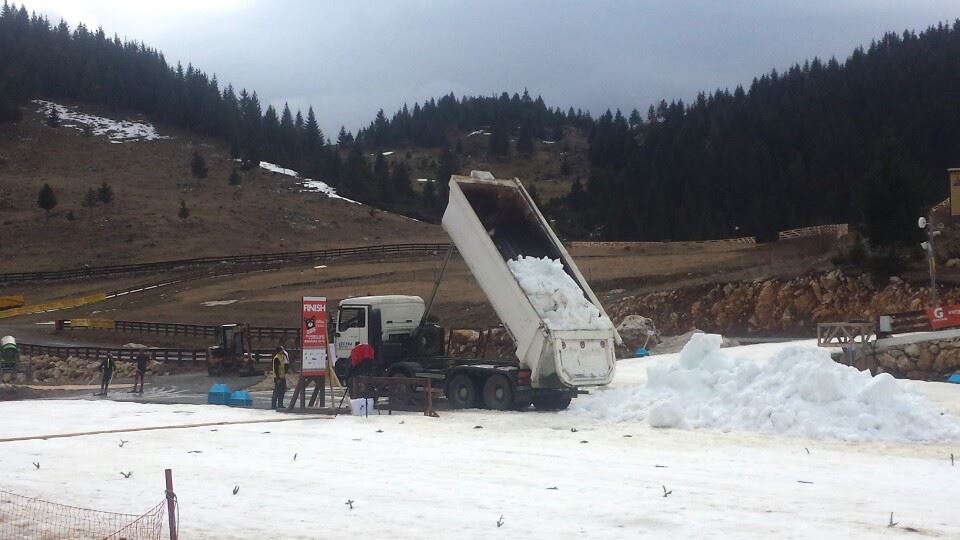
    Adding a springtime layer of complexity to remind us that we are officially past the equinox, temperatures in Whistler hovered above freezing while a mix of precipitation fell off and on throughout the day. Webcams of the venue showed the spectacular mountain backdrop hidden amongst dense clouds and conifers still laden with the week’s snow.

    It’s a humidity-temperature combo that makes classic waxing tricky. Consequently, many athlete chose to use “hairies”, which are known as “rub skis” in Canada, essentially foregoing kick wax and opting instead for a sandpapered kick zone. For those with strong striding technique, this achieves grip without as significant a risk of icing issues, as klisters can be known create in such conditions. 

    Top Canadian U20 racer Xavier McKeever (Foothills Nordic), who was 13th overall today, explained how this changes the game for those who haven’t had the experience: “You have to be a bit more careful with your kicks and a bit more gentle, because they can slip out really easily. That was the biggest focus for me [today], just to try and ski technically well.”
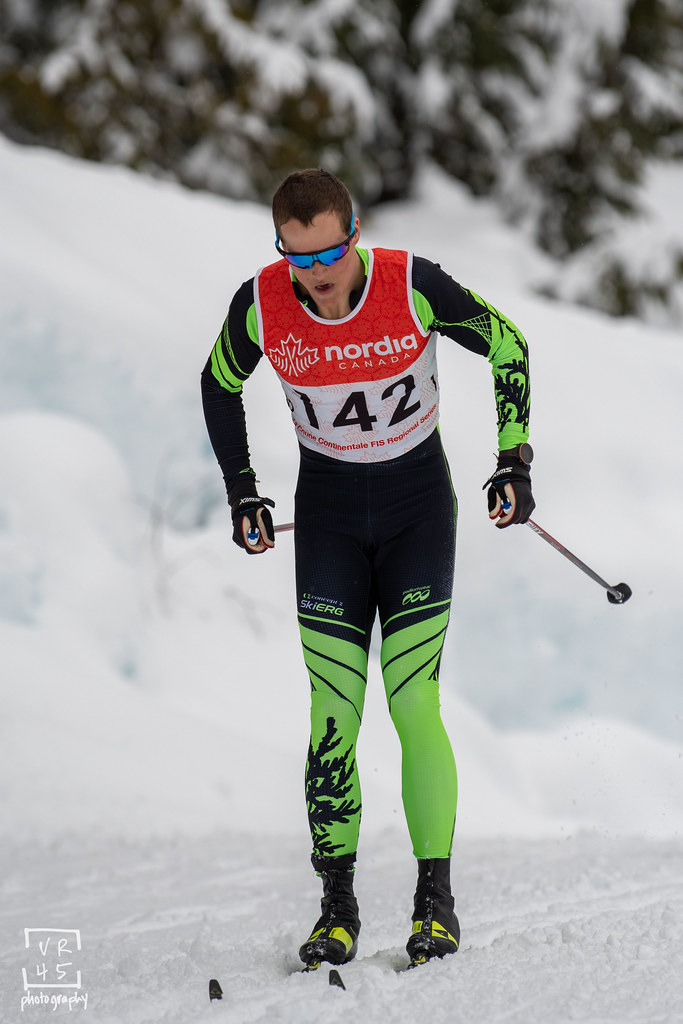
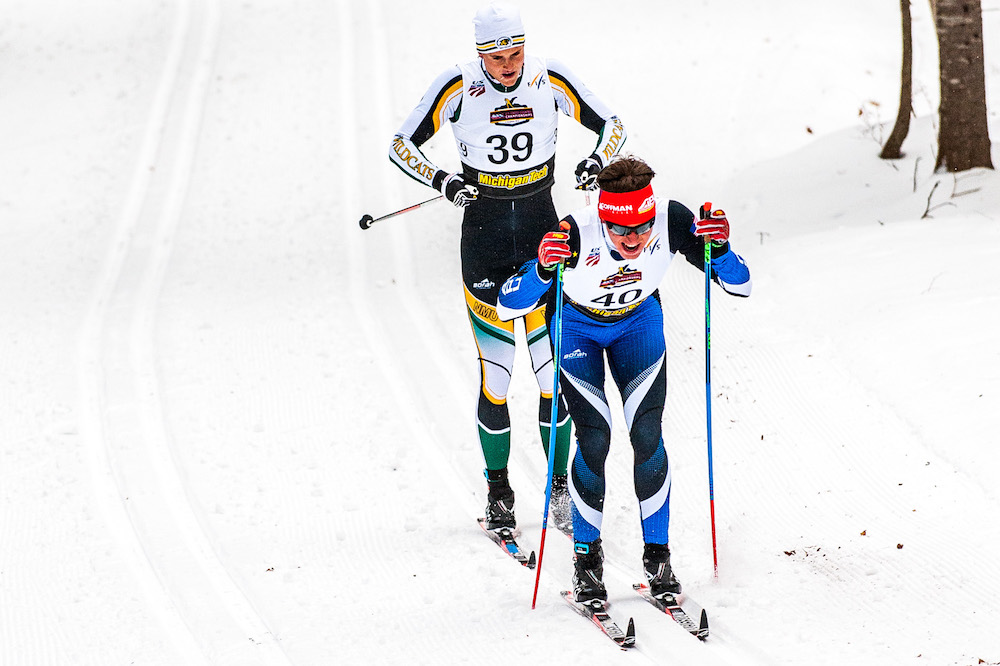
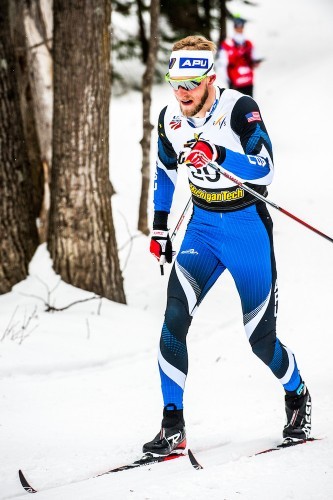
    Craftsbury’s Adam Martin takes the 15 k classic win in Whistler. (Photo: Doug Stephen / VR 45 Photography)

    Following 10 k sitting and standing events contested by Nordiq Canada’s Para Nordic athletes, the open men’s category headed out for the three 5 k loops. In a close race for the top podium spot, Craftsbury’s Adam Martin took the win with a time of 40:29.3. Martin was chased by today’s Canadian National Champion, Antoine Cyr (Skinouk) who hunted his times from 19 bibs behind.  

    Though Cyr led through the first 10 k, a strong closing lap from Martin moved the American to the lead in the splits, with Cyr skiing the third fastest final lap to take second (+1.3). Canmore’s Russell Kennedy was third overall (+13.1) for the second spot on the Canadian podium, while fellow Canmore athlete Sam Hendry, who now trains with the University of Utah, was third for Canada in fifth overall (+48.0). Both Cyr and Kennedy had also raced onto the podium in yesterday’s 10 k free. 

    “I felt really good today,” Martin wrote to FasterSkier after the race. “Particularly in the second half, I started to figure out how to best race this course and these conditions, and I found a good place mentally to push. I’m really happy with the outcome – that was a dream to win.”
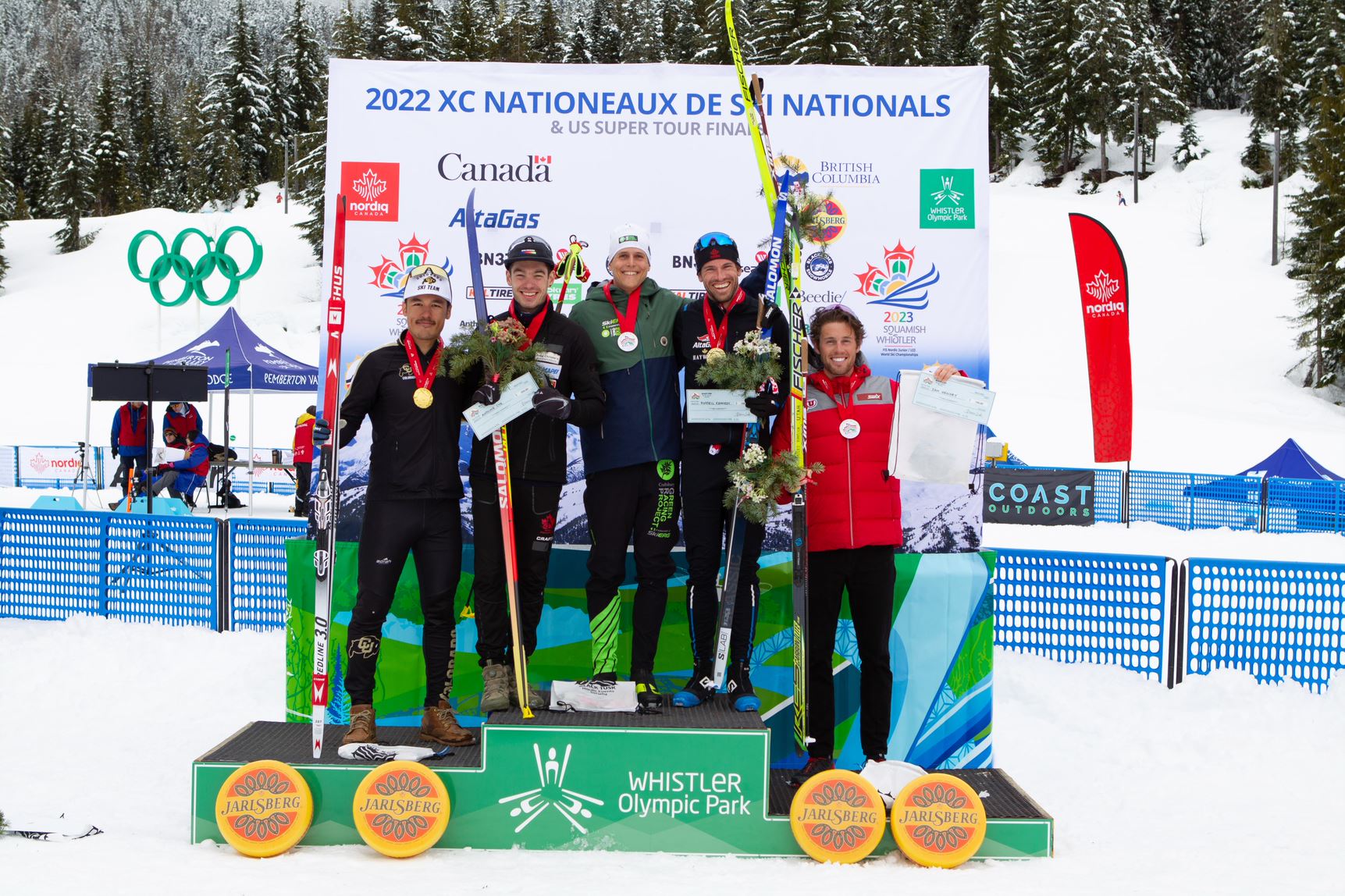
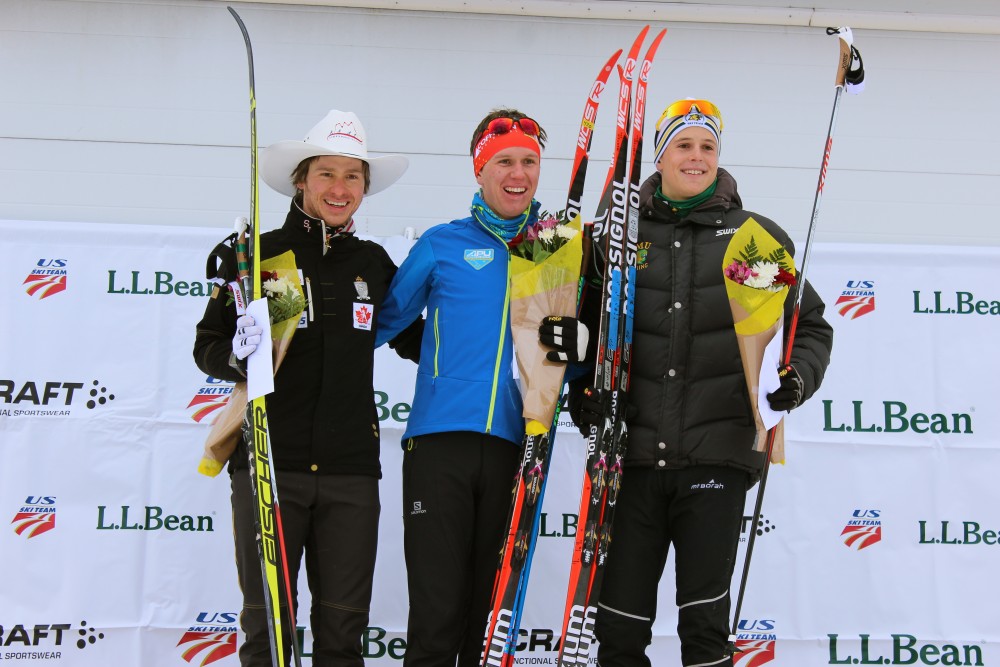
    The men’s 15 k classic podium in Whistler: Adam Martin (CGRP) took the win ahead of Antoine Cyr (Skinouk), and Russell Kennedy (Canmore Nordic). (Photo: Joern Rohde / Nordiq Canada)

    A successful season of SuperTour racing has Martin ranked at the top of the rankings, and earned him starts in post-Olympic World Cup events. After taking third at the American Birkie, Martin headed to Norway to race the 50 k classic at Holmenkollen, where he finished 26th. The following weekend, he skied to 44th in the 15 k free in Falun, Sweden. A week later, Martin is back with his Craftsbury team and standing atop the US SuperTour podium. 

    “It’s nice to return from the World Cup and still feel in good shape. After two 50 k’s, and travel, and a season that I’m really happy with, everything is a bonus at this point. I think it’s great that we are able to combine with Canada for these races. There are a lot of guys at a similar level, so it makes for some tight, fun racing.”

    A 23-year-old Quebec native, Cyr’s best results have been in classic this season, namely an 11th place finish in the opening World Cup 15 k classic in Ruka, Finland, and racing with Graham Ritchie to put the Canadian team in fifth during the Olympic classic team sprint in Zhangjiakou. After the team sprint, he was praised by both his teammate and coach Erik Bråten, along with armchair quarterback Devon Kershaw, for his classic technique.

    “Classic is always good for me and is a race I love,” Cyr said of today’s 15 k in a post-race interview with Nordiq Canada. “It was tough conditions this morning, and a good skier normally comes out on top in hard conditions. I was able to ski well, focus on the race, and came second overall, which is a little bittersweet because it was a really tight battle in the end. But it was really fun, the track is amazing. It’s an Olympic standard track, so it’s just really good.”
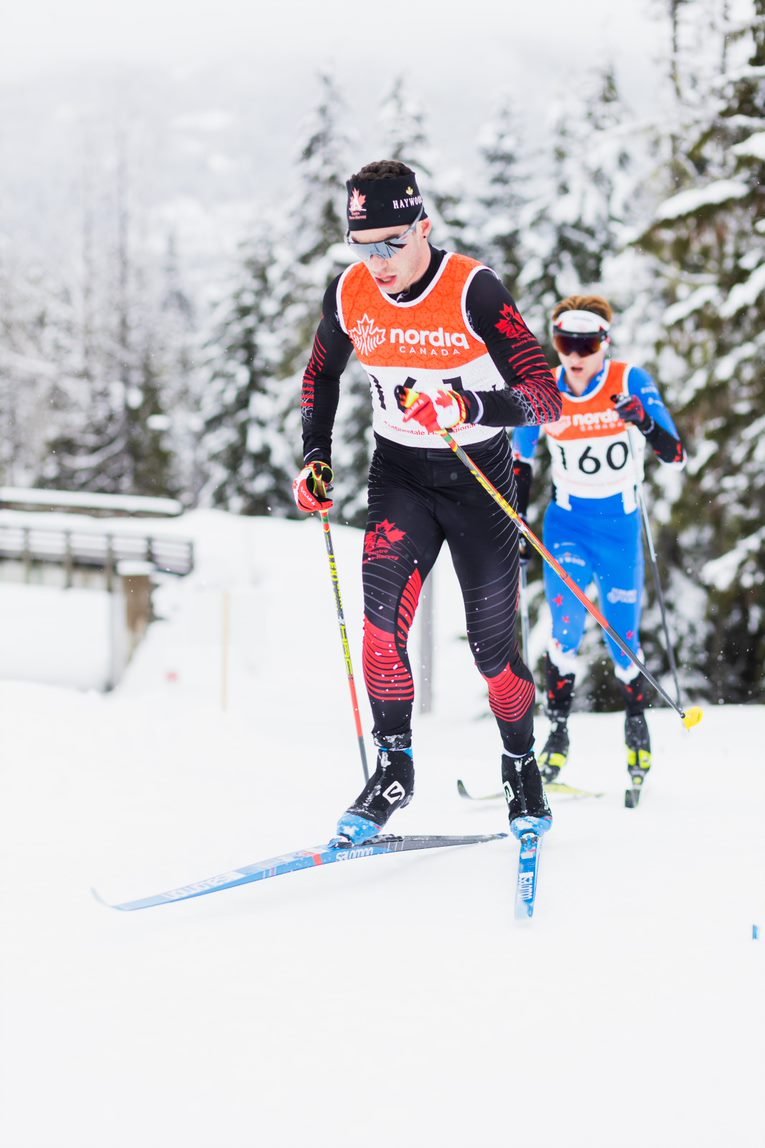
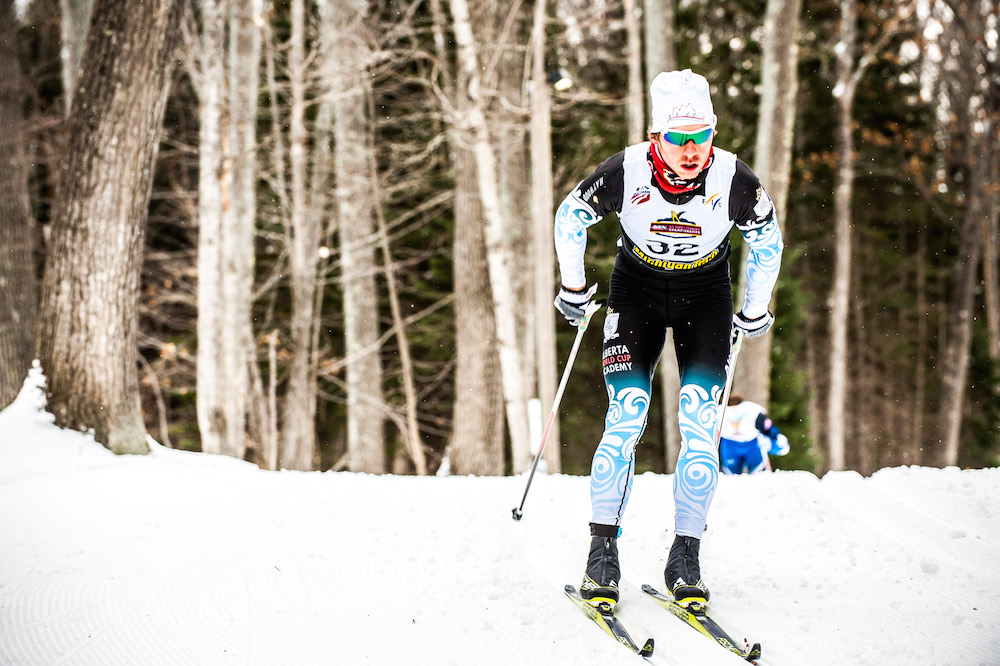
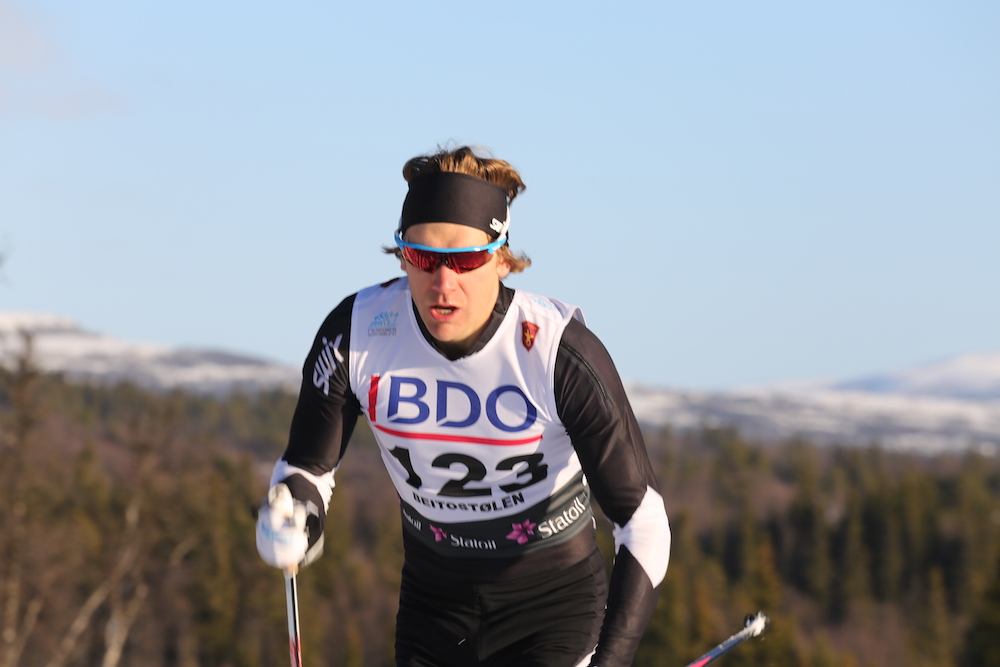
    Antoine Cyr races for the Canadian National Title in the 15 k classic in Whistler. (Photo: Nordiq Canada / Nathaniel Mah)

    In his second lap, Cyr had caught yesterday’s winner, Rémi Drolet (Team Black Jack), whom Cyr credited in supporting his strong result today.

    “When I saw was closing the gap on him on the first lap, I decided to go a little harder than I planned to catch up with him. [I then tried] to relax behind him for a lap or half of a lap.. In the end, I was missing a little bit on the last lap. I think that that helped for sure, skiing with someone strong like Rémi.”

    Finally, Cyr spoke to the importance of an international field featuring all age groups coming together this week, particularly on the heels of a two-year hiatus due to pandemic restrictions.

    “It is so good for the young kids — us older guys, we’ve been racing on the World Cup, but like the juvenile and junior, they almost have no races in Canada. To have a big event like this is just amazing and we’ve been looking at the younger guys’ results for an hour yesterday, seeing who’s in good form, and who’s coming up, and you are the next guys to be like taking over. So for them, it is awesome, and for us too, racing with the US is always — it should always be like this.”

    Joining Martin for the SuperTour podium, BSF Pro Team athlete Finn O’Connell was 7th overall (+1:06.4) and second American, with University of Utah’s Luke Jager half a second behind in 8th overall (+1:06.9).
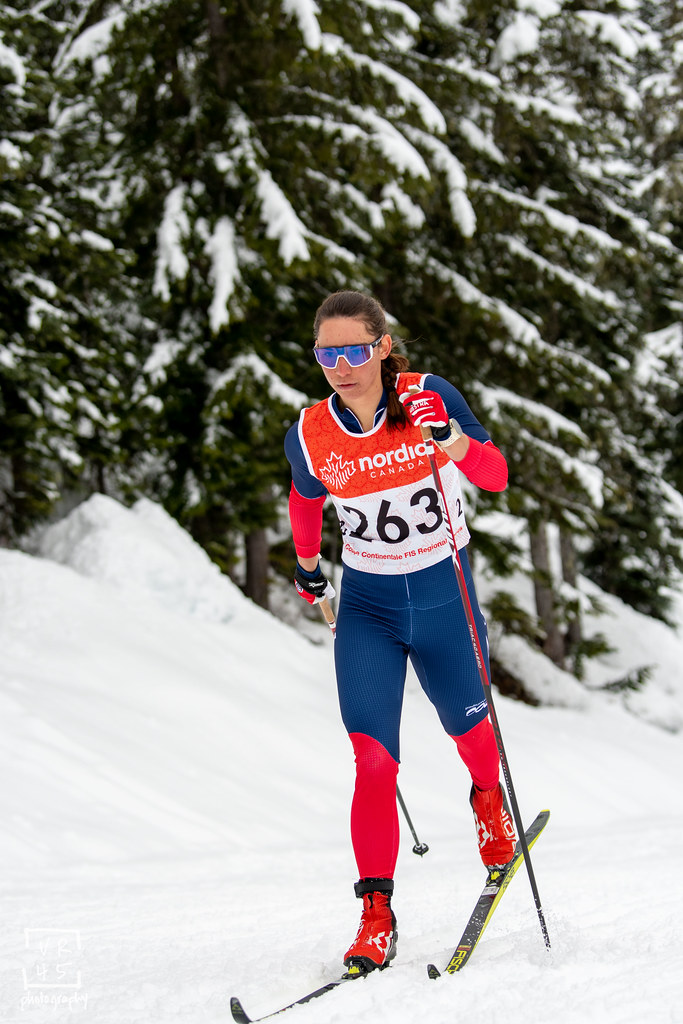
    Julia Kern strides for the win in tricky conditions during the 10 k classic in Whistler. (Photo: Doug Stephen / VR 45 Photography)

    In the women’s 10 k, SMS T2’s Julia Kern skied a strong second lap to take the win in her second consecutive day on the podium, stopping the clock at 29:54.3. Her club and national teammate, Jessie Diggins, took the second step finishing +18.3 back, while University of Utah’s Sophia Laukli skied to third (+1:03.2).

    Looking at tough conditions, Kern explained she raced by trial and error today, exploring which techniques were most efficient on different sections.

    “I kind of had an open mindset going in today,” she told Nordiq Canada after the race. “I knew that the tracks might be a little bit punchy or washed out in sections, and so I was double pulling wide or double polling narrow or just like power striding on the flats if it was getting too punchy out there. So just trying it all.”

    She continued that she was looking to “have fun, send it from the start, and see if I could hold that pace the whole time,” which she ultimately proved able to do. It’s the time of year where the hay is in the barn training-wise, and athletes have had a long season, leaving them in varying states heading into the last hurrah. On whether she was looking to just have fun at these races, or whether it was a serious quest for the podium, Kern said “both”.

    “I think the end of the season is always really fun. It’s so cool to have this many athletes here. And I’ve been feeling really good the last few weeks and so enjoying racing when it does feel good and when I’m able to push really hard. We’re all really tired at the end of the season, but also, when the body’s in form you might as well take advantage of it and send it on the course.” 
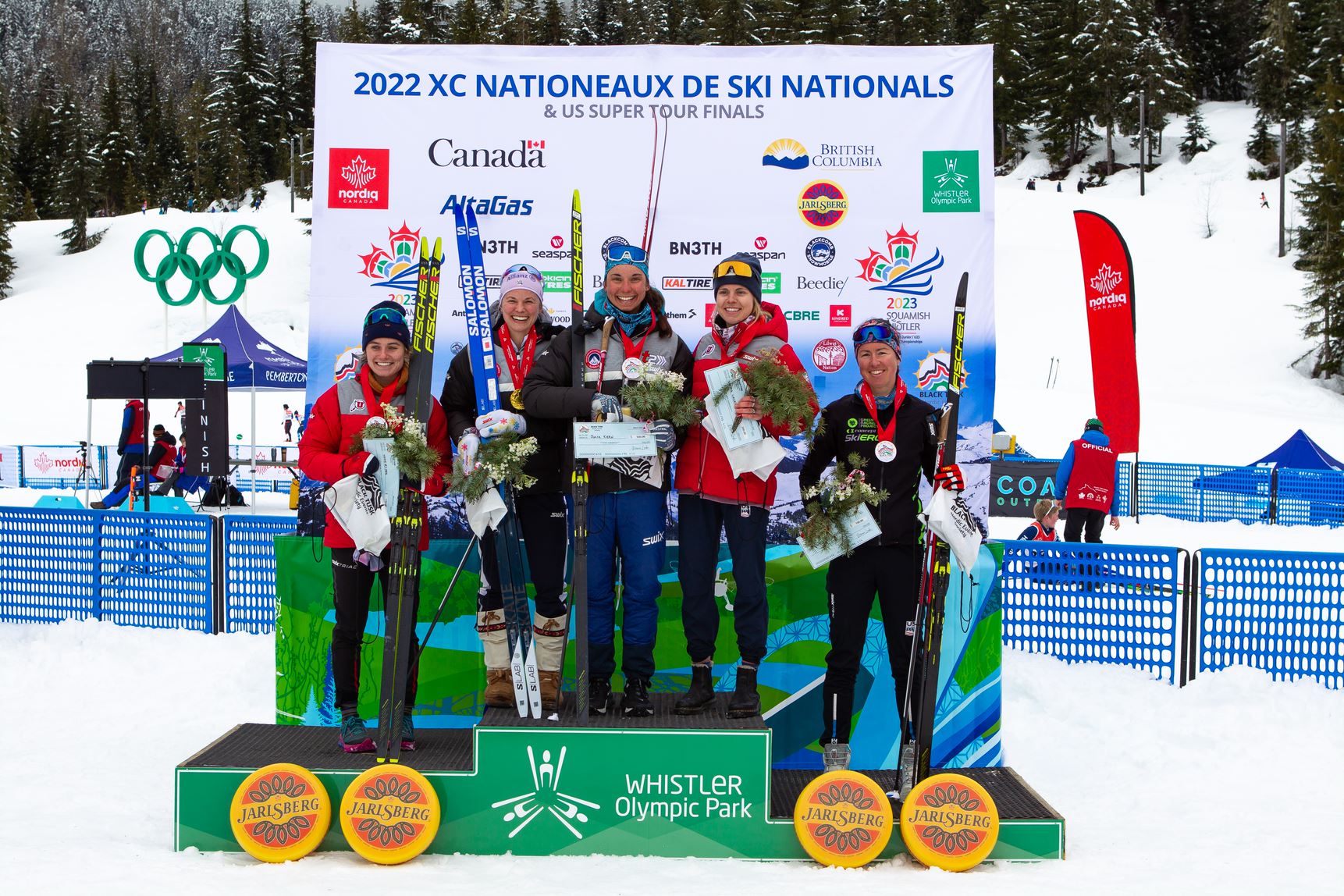
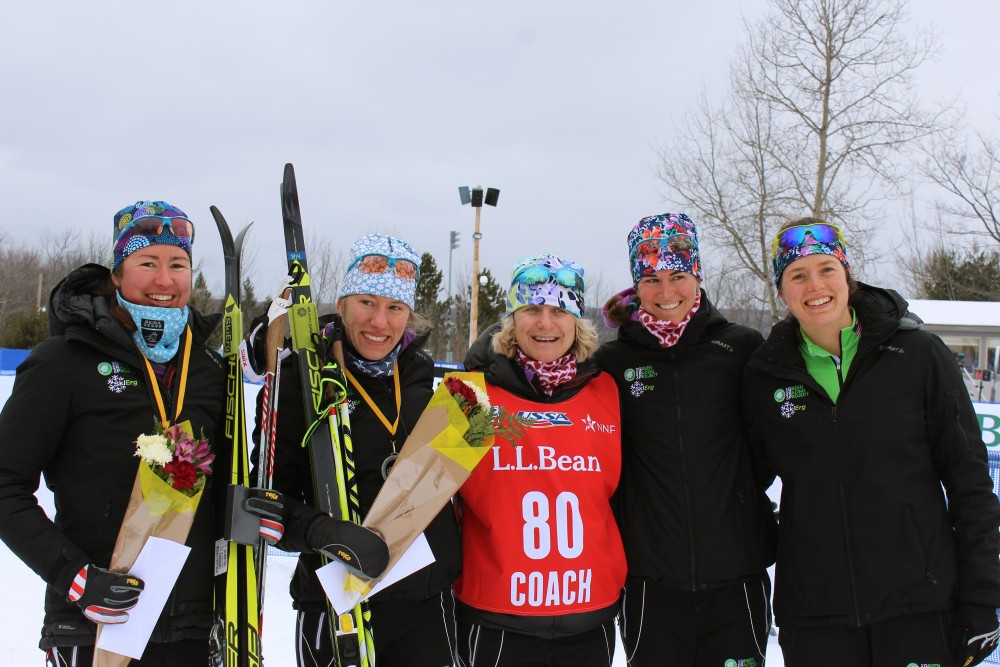
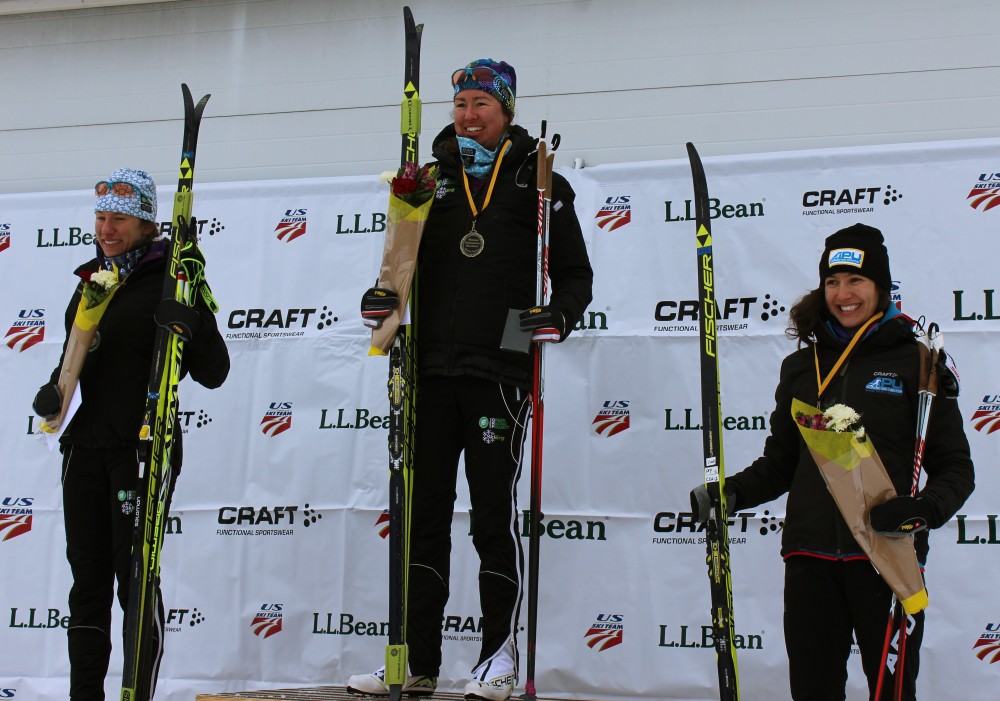
    The women’s 10 k classic podium on day 2 in Whistler: Julia Kern (SMS T2) took the win ahead of Jessie Diggins (SMS T2) and Sophia Laukli (Univ. of Utah). (Photo: Joern Rohde / Nordiq Canada)

    Winning back-to-back Canadian National titles, Katherine Stewart-Jones (Nakkertok Nordique) was again on top for the Canucks, finishing sixth overall (+1:17.5). Finishing in the same order as yesterday, Dahria Beatty (Whitehorse Ski Club) was second for Canada in eighth overall (+1:55.0), while Cendrine Browne (Fondeurs-Laurentides) rounded out the podium in ninth overall (+2:14.5). 

    “I went out really hard knowing that that’s what I had to do if I wanted to make the podium,” Stewart-Jones said of her race. “I had a good first lap, and I definitely slowed down a lot on the first part of the second lap. I was just tired and was having a hard time staying in the zone and keeping the rhythm, but I was able to pull it together a bit for the second half of the second lap. So I was really happy with that. And I was happy with how hard I pushed. I just didn’t have it quite in me today, and sometimes that happens.”

    On the importance of focusing on her technique on this type of course with sub-optimal conditions, she continued, “It’s really important, especially on the climbs. The grip isn’t always perfect in these conditions, so you really have to make sure to stay on top of your skis. If you get tired and you start leaning forward, then it makes it even harder to kick… And then on the flatter sections, it was a bit awkward, and you had to expect that. Either you’re striding awkwardly or you’re doing a kick double pool, but your poles are sinking. You have to just really focus on committing to whatever you decide to do and not like trying to switch too much between.”

    Speaking to already standing atop two podiums, Stewart-Jones responded with pride, while also acknowledging that the overall win would be sweeter.

    “Oh, it’s definitely nice to be winning the national championship title… because we’re racing against the Americans, I obviously care about the overall too, so maybe it feels a little less exciting, but for sure, I’m proud of that.”
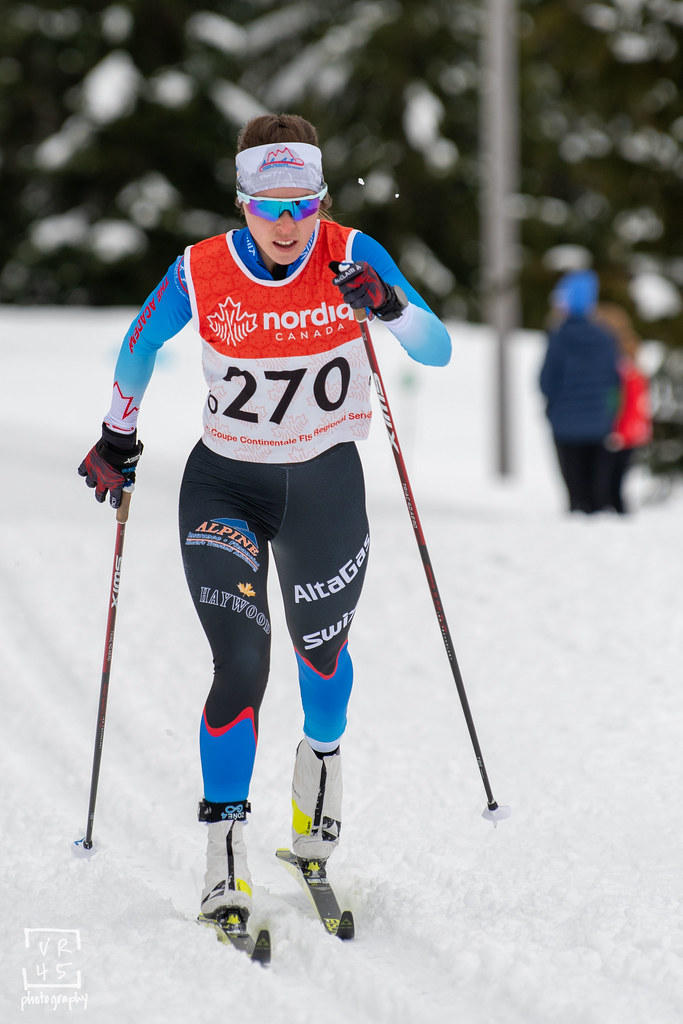
    Katherine Stewart-Jones (Nakkertok Nordique) takes back-to-back national titles in the women’s 10 k classic in Whistler. (Photo: Doug Stephen / VR 45 Photography)

    In order to get closer to the overall podium, she said he would focus on resting as much as possible and maintaining the head space to perform her best. “It’s been a long season and I haven’t raced this much in a long time. I think everyone’s pretty tired. But also just being able to also be mentally strong [over the next races]. And yeah, you never know what’s gonna happen.”

    Racing continues Wednesday with individual classic sprints, which will be live-streamed by the Black Tusk Nordic Events Society. If you’re looking for additional video updates, follow along on the Nordiq Canada and Black Tusk Instagram pages. 

    Full Results

  • Niskanen Strides for 15 k Classic Victory on Home Turf; Cyr leads North American Men in 23rd

    Niskanen Strides for 15 k Classic Victory on Home Turf; Cyr leads North American Men in 23rd

    This World Cup coverage is made possible through the generous support of Marty and Kathy Hall and the A Hall Mark of Excellence Award.  To learn more about A Hall Mark of Excellence Award or to learn how you can support FasterSkier’s coverage please contact info@fasterskier.com.

    Racing continued in Lahti, FIN with the men’s 15-kilometer classic individual start. The field was smaller than usual, with just 68 starters contrasting the 104 racers in the 15 k skate Davos in December, the last World Cup prior to the Tour de Ski. With the seeded athletes wearing the even-numbered bibs 40 and upward, the race would be watching the final starter, Johannes Høsflot Klæbo (NOR) to see if he will be able to hold off crowd-favorite, Iivo Niskanen (FIN).

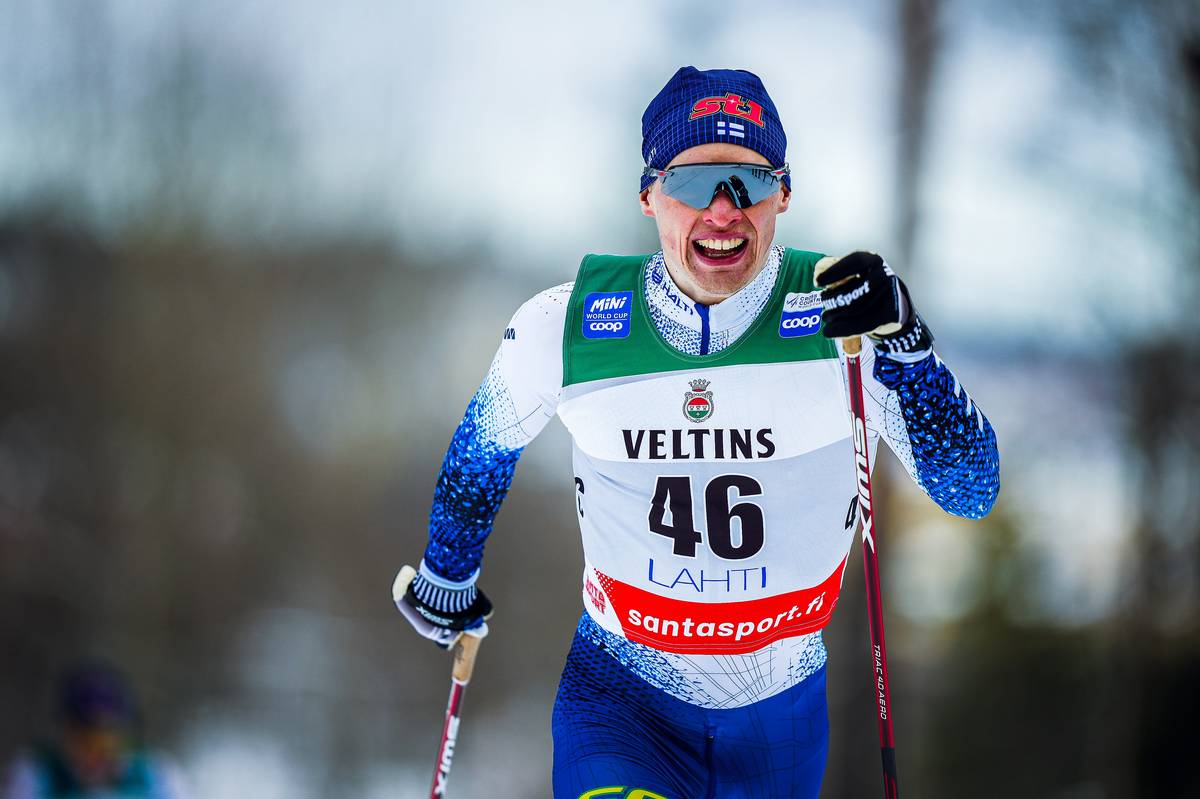
    Iivo Niskanen (FIN) leads the way during the 15 k interval start classic in Lahti, FIN. (Photo: NordicFocus)

    That Finland was happy to have its Olympic champion back to race a 15 k classic on home turf was readily apparent as he strode through the wooded course. Chants of “Iivo! Iivo! Iivo!” matched his metronomic tempo, while Finland’s flag waved him along.

    Starting near the front of the seeded group in bib 46, Niskanen set the bar through his first lap, holding a narrow lead of 0.4 seconds over Martin Løwstrøm Nyenget of Norway at the 5 k mark. Ilia Semikov and Alexander Bolshunov of Russia crossed in third (+0.8) and fourth (+1.1), while William Poromaa of Sweden rounded out the top 5 (+2.4). 

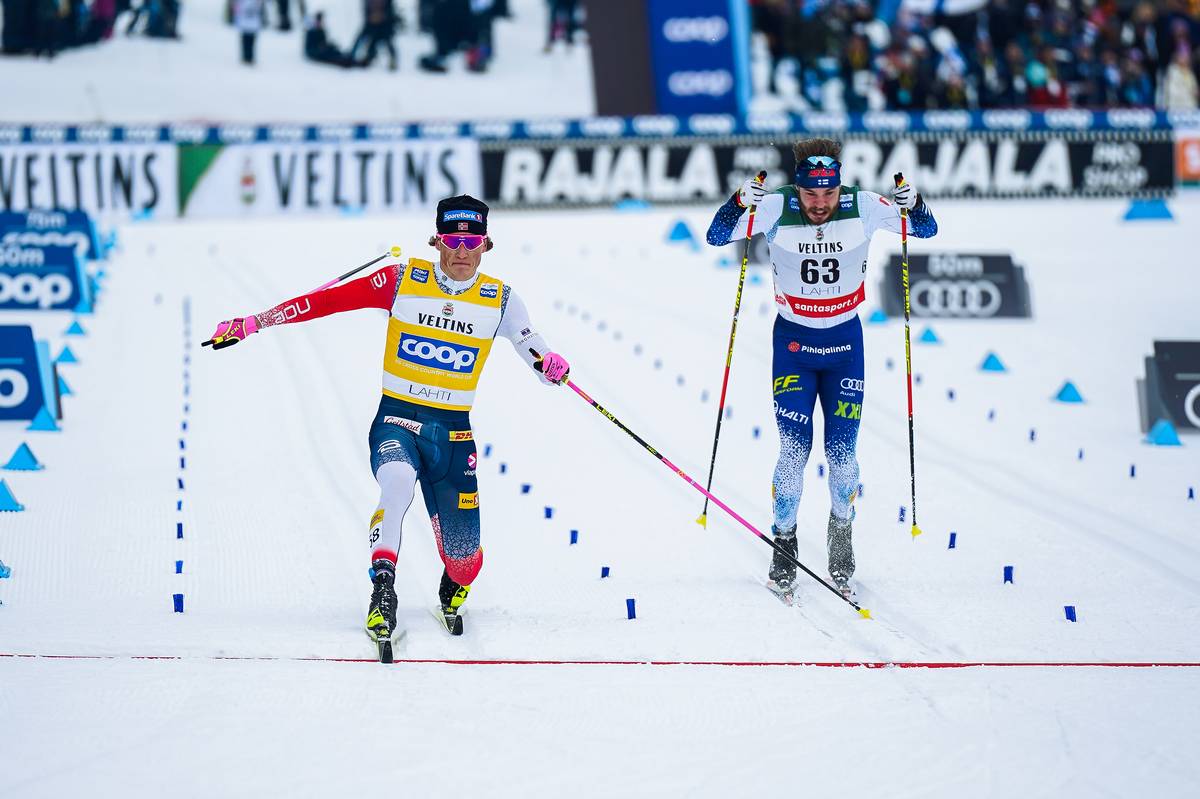
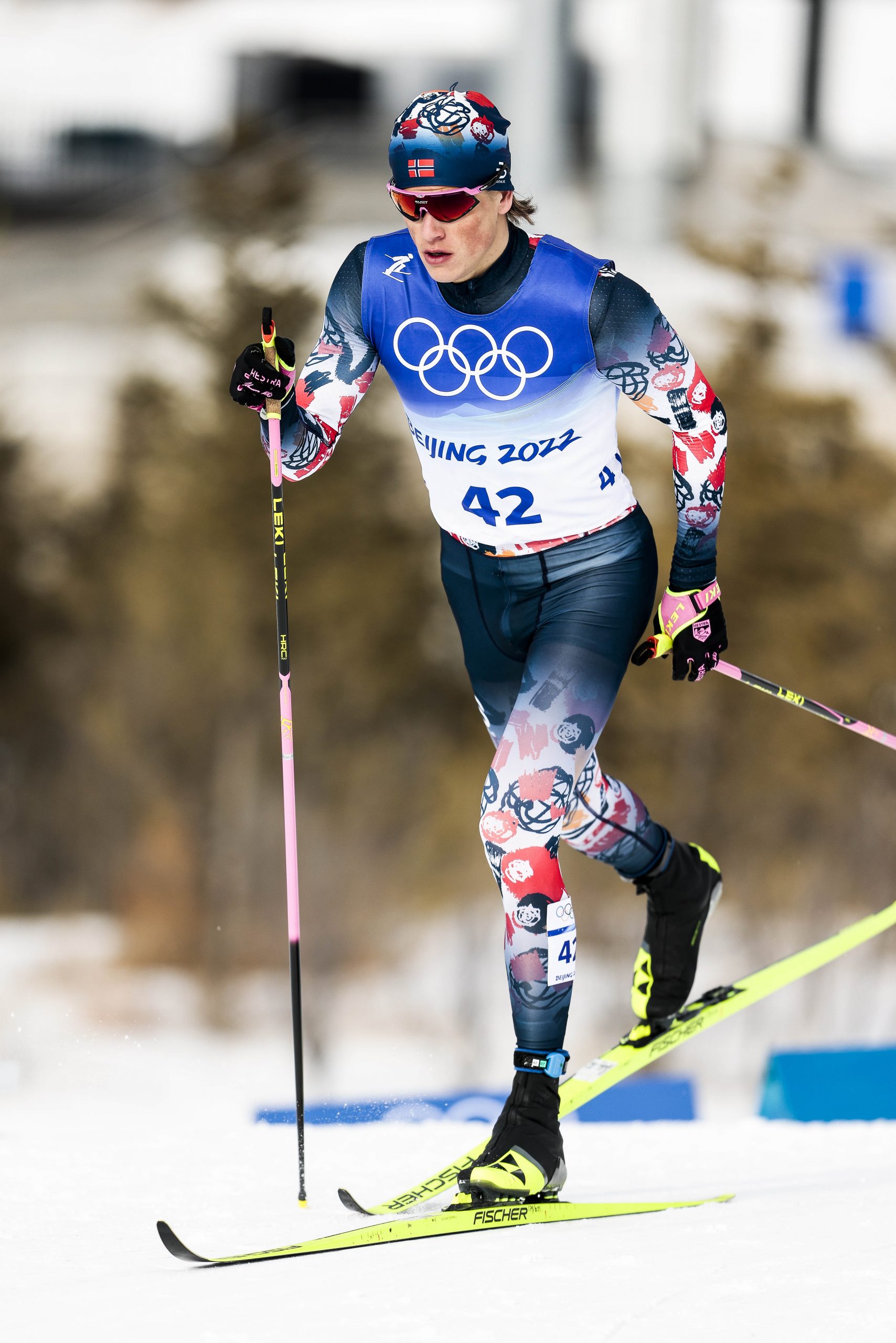
    Starting 11 minutes behind the Finn, Klæbo lucked into a ride as Niskanen lapped through the stadium just as the Norwegian took to the course. Accelerating to catch the Finn early, Klæbo and Niskanen pushed the pace at the top of the standings for the next 10 k, Niskanen making the winning pace clear from 5 k ahead. 

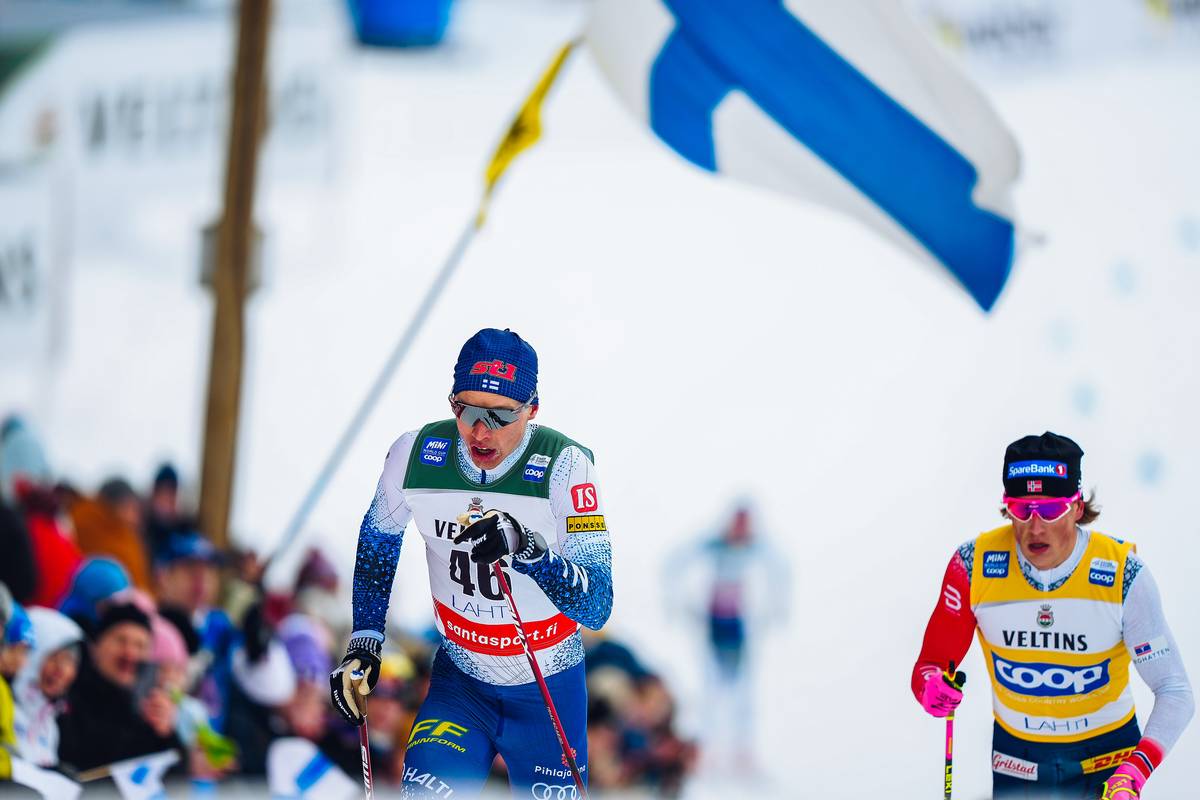
    Starting 11 minutes apart, Johannes Høsflot Klæbo (NOR) caught Iivo Niskanen (FIN) after his first lap, the Finn becoming a carrot for the Norwegian through his first 10 k of racing. (Photo: NordicFocus)
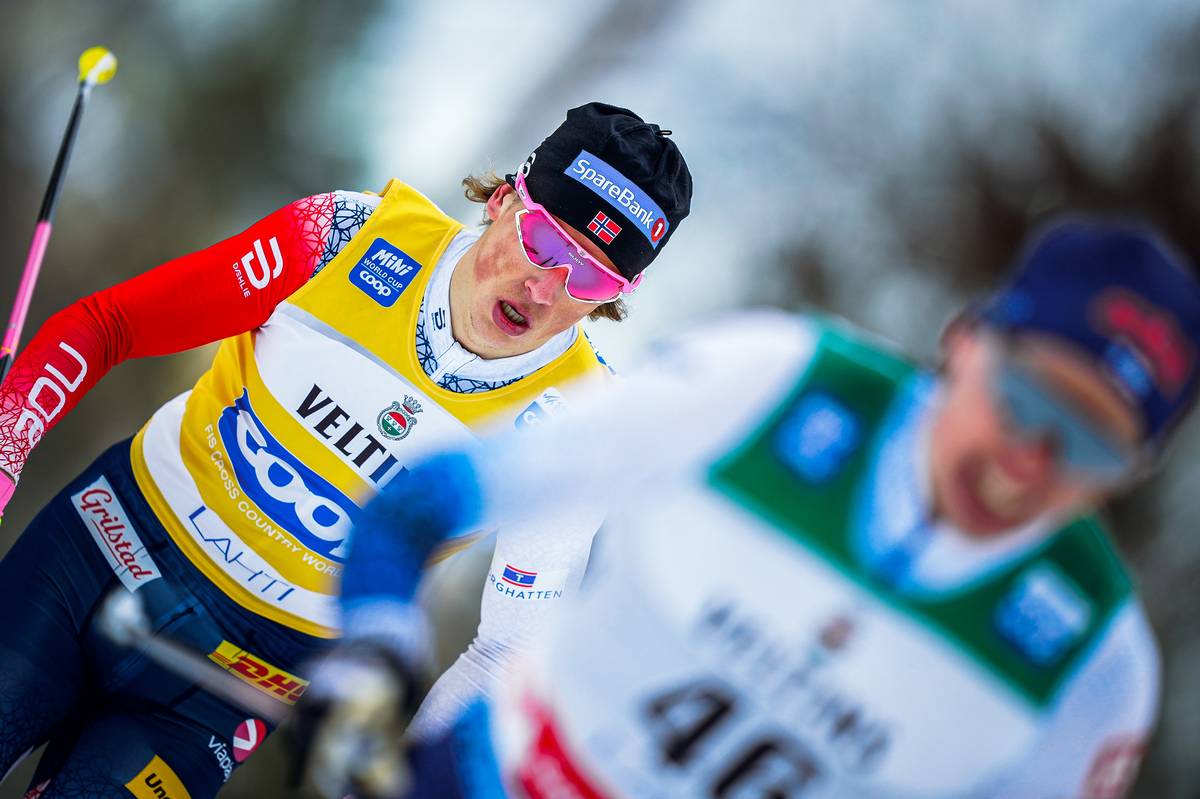
    Johannes Høsflot Klæbo (NOR) follows Finnish favorite Iivo Niskanen during the 15 k individual start classic in Lahti, FIN. (Photo: NordicFocus)

    At the 10 k checkpoint, Klæbo was able to match pace with Niskanen to put himself in the lead with a +7.5 second advantage. Niskanen pulled away from Klæbo at the 11 k mark to make his final push toward the finish. Poromaa was sitting in third (+7.6), with Nygent and Bolshunov rounding out the top 5 in fourth (+9.2) and fifth (+10.1).

    As Niskanen made his way to the finish, the crowd erupted. His name echoed through the packed stadium, as he threw his boot to stop the clock at 33:06.5.

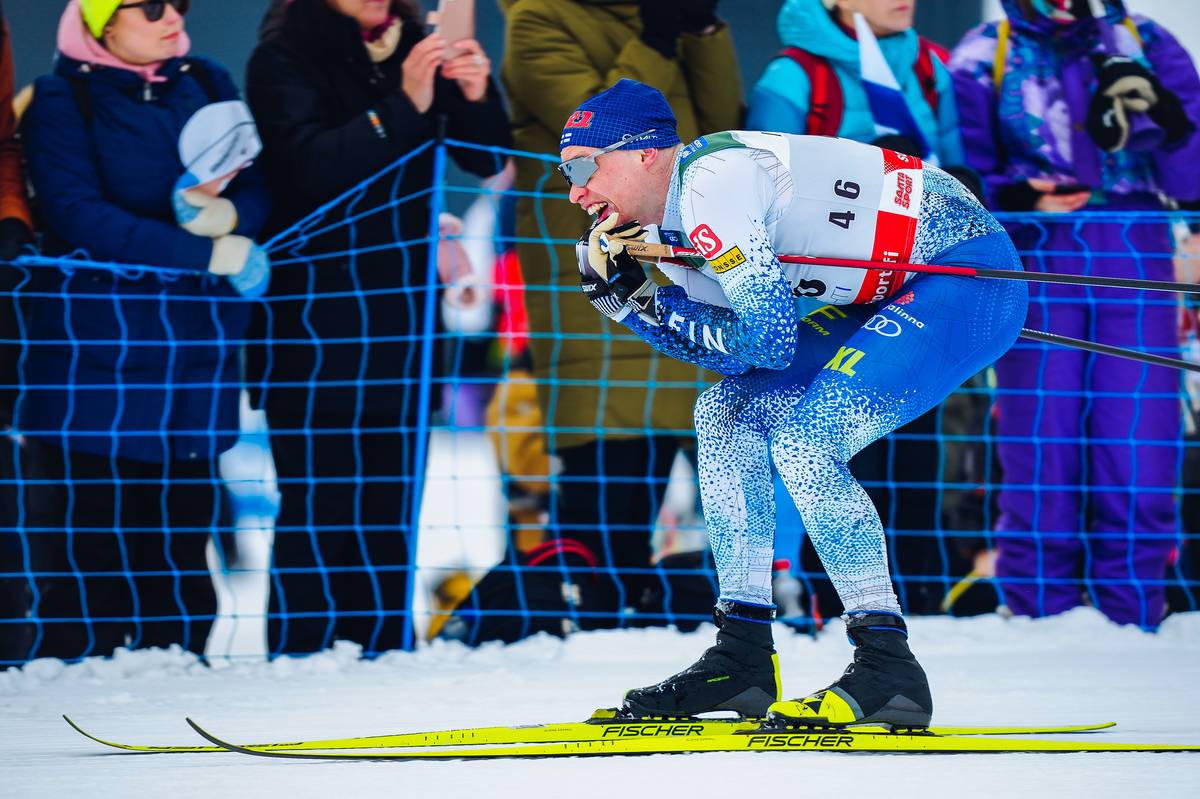
    Iivo Niskanen (FIN) makes his way into the stadium at the finish of the 15 k individual start classic in Lahti. (Photo: NordicFocus)

    With each subsequent finisher, the crowd increased its energy while Niskanen waited in the leader’s chair, a local win looking more and more likely. The final domino was seeing where Klæbo would fall as he crossed the finish line.  

    Fading in his final lap, Klæbo quickly lost his advantage, sliding behind both Niskanen and Poromaa at the 13.7 k checkpoint. Starting the lap 7.5 seconds ahead of Niskanen, Klæbo had already lost nearly 23 seconds, now sitting 14.7 back on the Finn with just over a kilometer of racing to go. The question then became, can Klæbo get Poromaa?

    Sipping a Red Bull and watching the clock, Niskanen watched Klæbo enter the stadium well off the Finn’s mark. Reveling in the excitement of his eighth 15 k classic victory on the World Cup, this time in front of his home crowd, the Finn hopped down and raised his arms into the air for a cacophony of cheers, before congratulating his opponent, Klæbo, on an exciting and hard-fought race. 

    Johannes Høsflot Klæbo (NOR) throws his boot for second place in the 15 k interval start classic in Lahti, FIN. (Photo: NordicFocus)
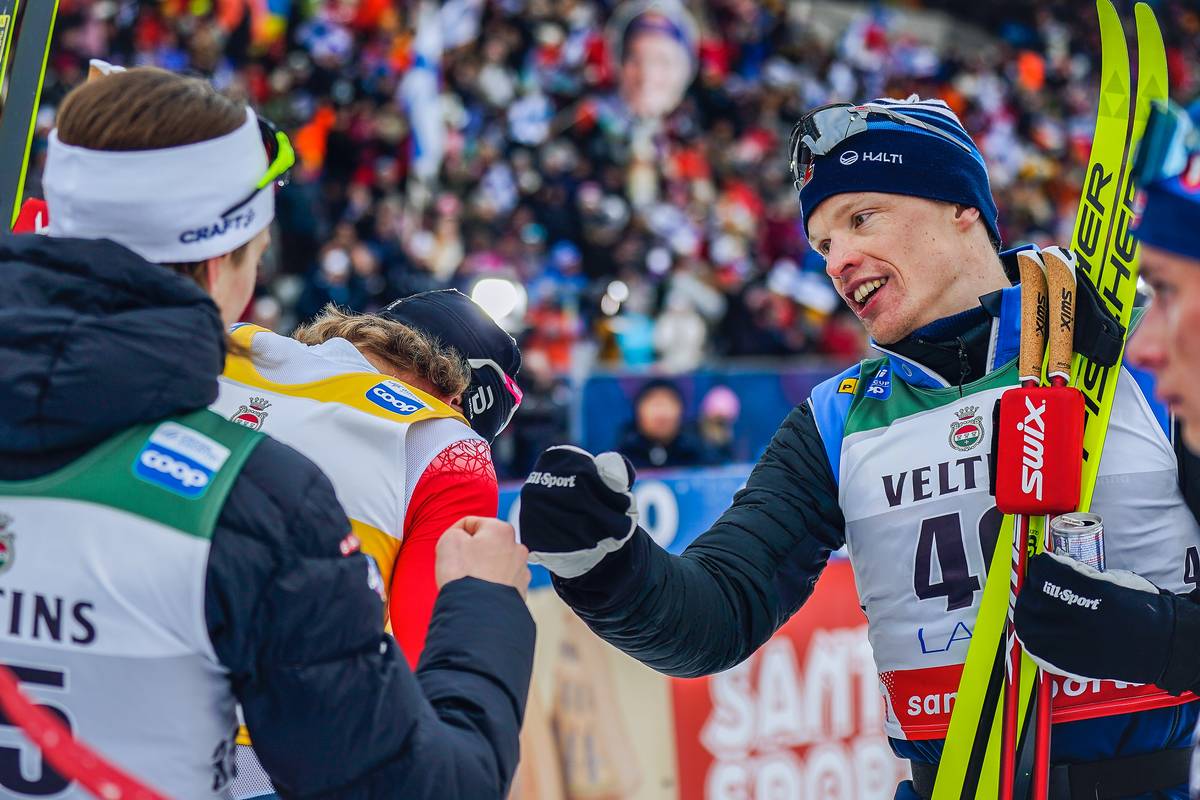
    Winner Iivo Niskanen (FIN) congratulates Johannes Høsflot Klæbo (NOR) following a 15 k individual start classic that saw the two working together for 10 k. (Photo: NordicFocus)

    Klæbo held narrowly held on for second place (+17.6), just ahead of 21-year-old Poromaa who finished in third (+18.0). Alexey Chervotkin (RUS) crossed the line in fourth (+22.0) after sitting just outside the top 5 for a majority of the race. His teammate, Bolshunov rounded out the top five (+24.4).

    “It was great,” Niskanen told FIS at the finish. “Couldn’t believe that it’s so nice to ski in front of this audience, so I enjoyed every moment of the course. It was one of the most emotional races, I have to say, because there are so [many] spectators here in Lahti today.”

    All of Niskanen’s World Cup victories in the 15 k distance have been in classic, and he’s gone four for four this season. He is now an Olympic champion in the event, adding to his collection of Championship gold medals in the event which began with a win in the 15 k classic at the 2017 World Championships on this course in Lahti. 

    “I get a bit nervous during the race, because I fell down in the first lap,” Niskanen said of his confidence in today’s race. “Then we skied together with Johannes, and I think he spent a little bit too much energy in the first lap, so it was a tough finish, but at the end I was feeling quite fresh, so it was a nice last lap. We have done a lot of work with the skis now and it seemed that they worked really good in Beijing, and now it’s continuing [here] in Scandinavia. So really happy at the moment that I could make the races like this.”

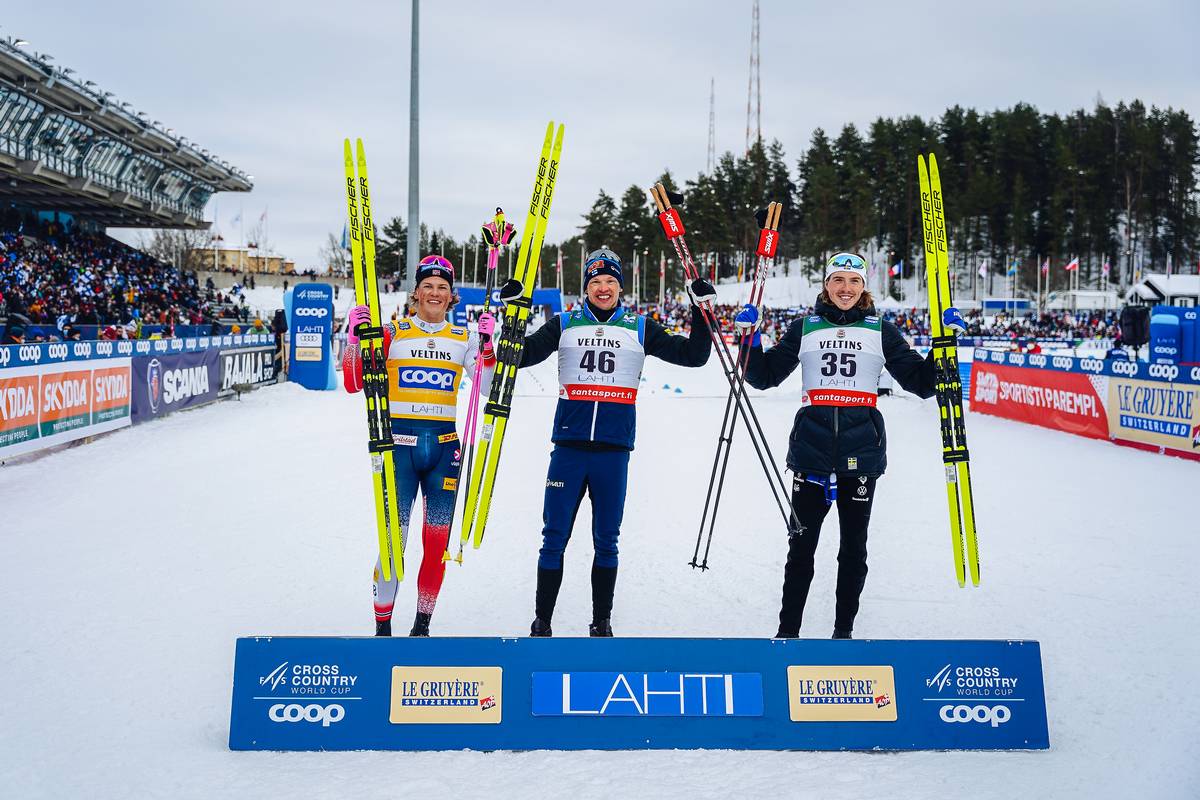
    The men’s 15 k classic podium in Lahti: Iivo Niskanen (FIN) took the win in his signature event, ahead of Johannes Høsflot Klæbo (NOR) and William Poromaa (SWE). (Photo: NordicFocus)

    The FIS interviewer gave a nod to Niskanen’s hard work through the season, but he smiled as if to say this week may not have matched that ethic.

    “I have to say, I have been so tired after the Games. We have partied too much so now it’s time to focus more on sport, and let’s see. Hopefully I can manage to win again next weekend [at the Holmenkollen].”

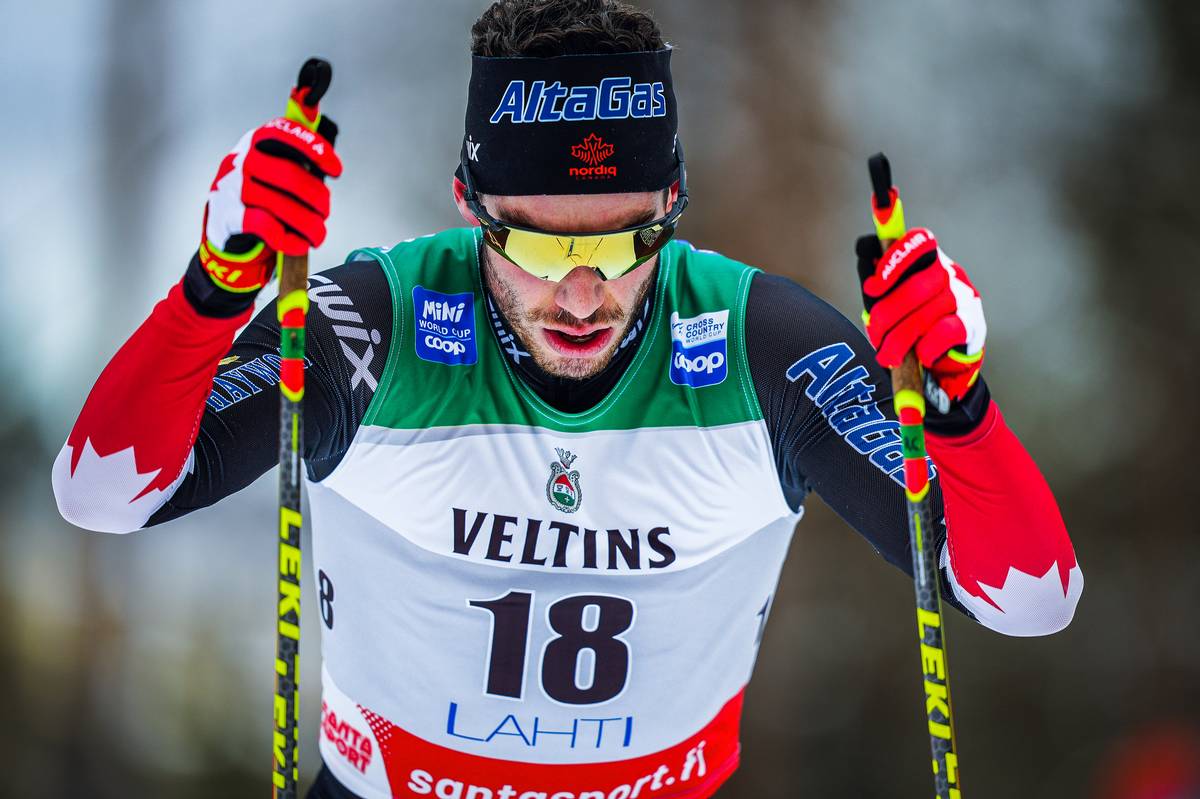
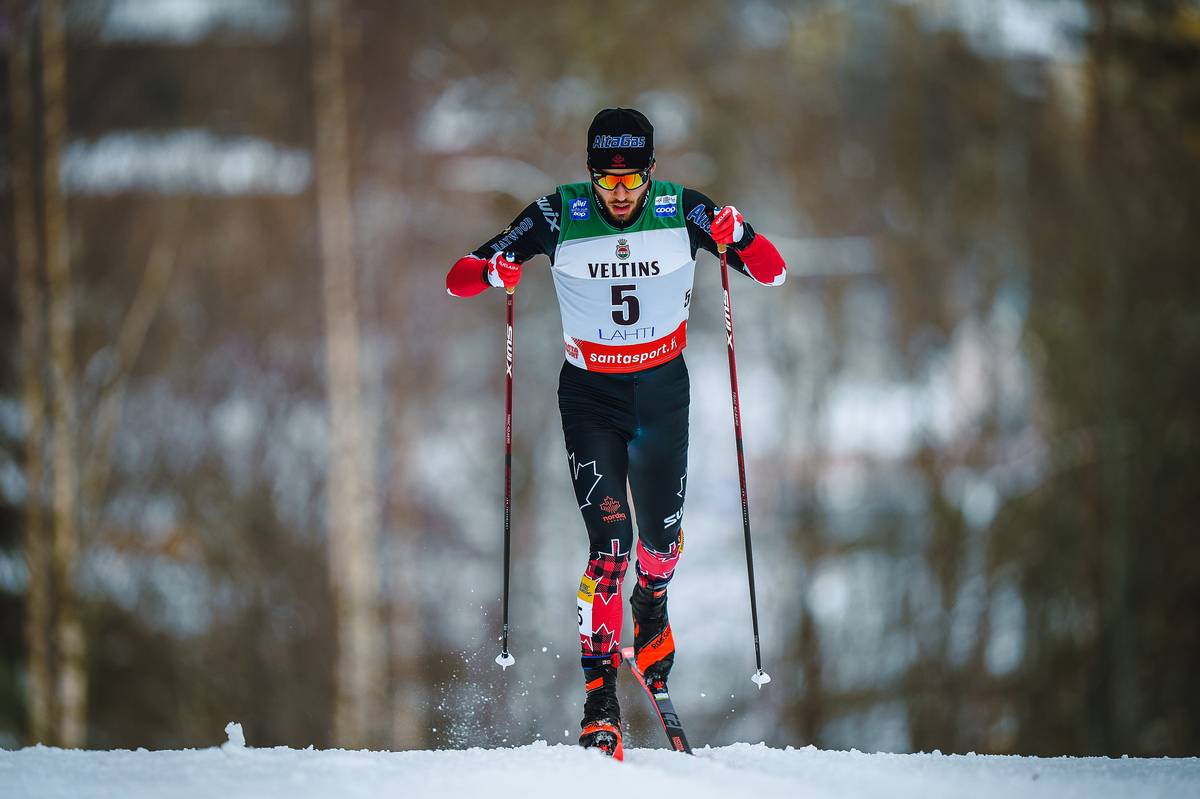
    Antoine Cyr races the 15 k interval start classic in Lahti, FIN. (Photo: NordicFocus)

    The Canadians had a strong day with two in the top 30. Antoine Cyr finished in 23rd (+1:46.5) while teammate Olivier Léveillé crossed the finish line in 29th (+1:59.1). 

    On the heels of a strong classic team sprint performance in Zhangjiakou, Cyr was fighting in and out of the top 20 all day. Through the 5k mark, Cry was 19th (+19.3), sliding back to 24th (+1:03.1) at the 10 k mark. Cyr was 11th and 12th in the opening distance races in Ruka in November, and won the 15 k classic during the Canadian Olympic Trials in January.

    “[It was a] good day for me today,” Cyr wrote to FasterSkier in a post-race email. “It’s a really fun course and such a historic venue. I felt good and skied well. I thought I had a little bit more in me, but it was a competitive field out there and I missed the top 20 by not much. I am really happy with the result and will see how the shape is going to be for the races to come.”

    Also racing for Canada, Rémi Drolet finished in 42nd (+2:41.9), while Philippe Boucher crossed the line in 59th (+3:26.9) and Leo Granbois took 62nd (+3:38.9). 

    Olivier Léveillé races the 15 k interval start classic in Lahti, FIN. (Photo: NordicFocus)
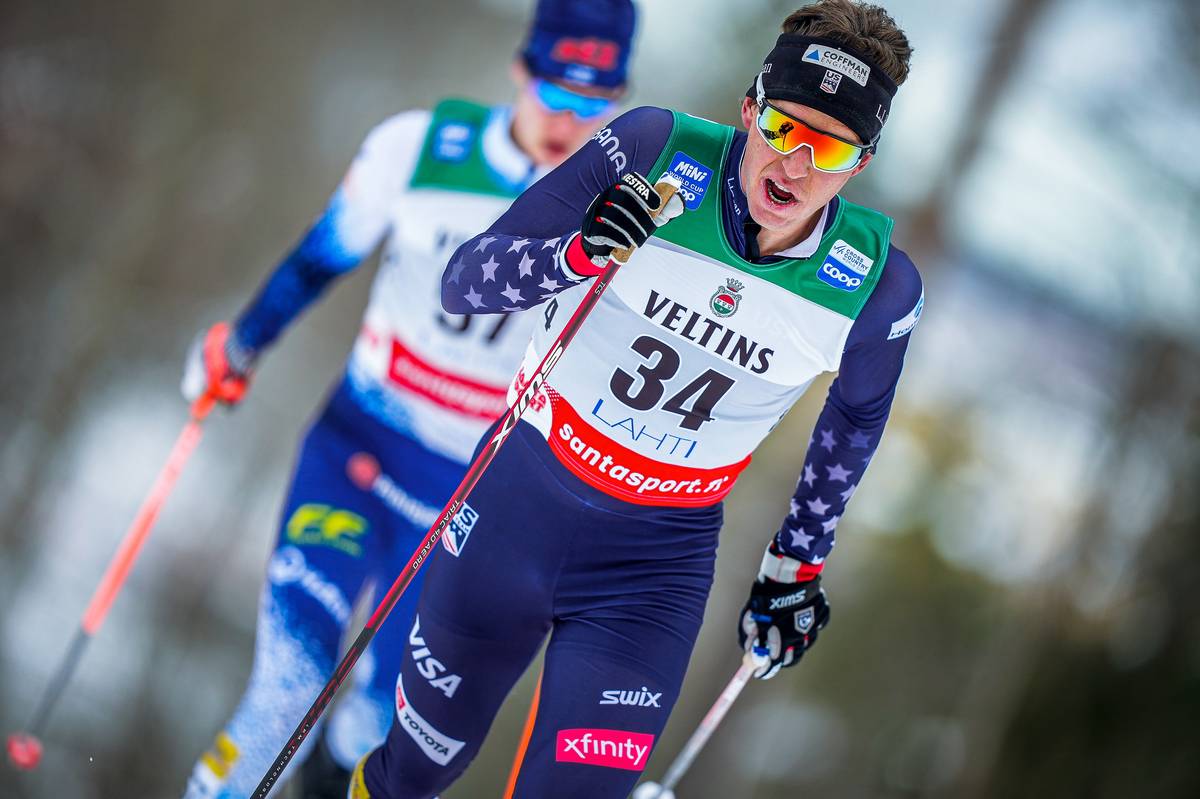
    Scott Patterson races the 15 k interval start classic in Lahti, FIN. (Photo: NordicFocus)

    The top American was Scott Patterson, who was just outside the top-30 World Cup point margin finishing in 33rd (+2:11.4). Zak Ketterson was 41st (+2:41.1), while Kevin Bolger took 49th (+2:59.9), and Zanden McMullen skied to 51st (+3:04.5), returning to the World Cup following races at the ongoing  2022 U23 World Ski Championships in Lygna, NOR. The first weekend of World Cup starts for Logan Diekmann saw him cross the line in 65th (+4:30.7).  

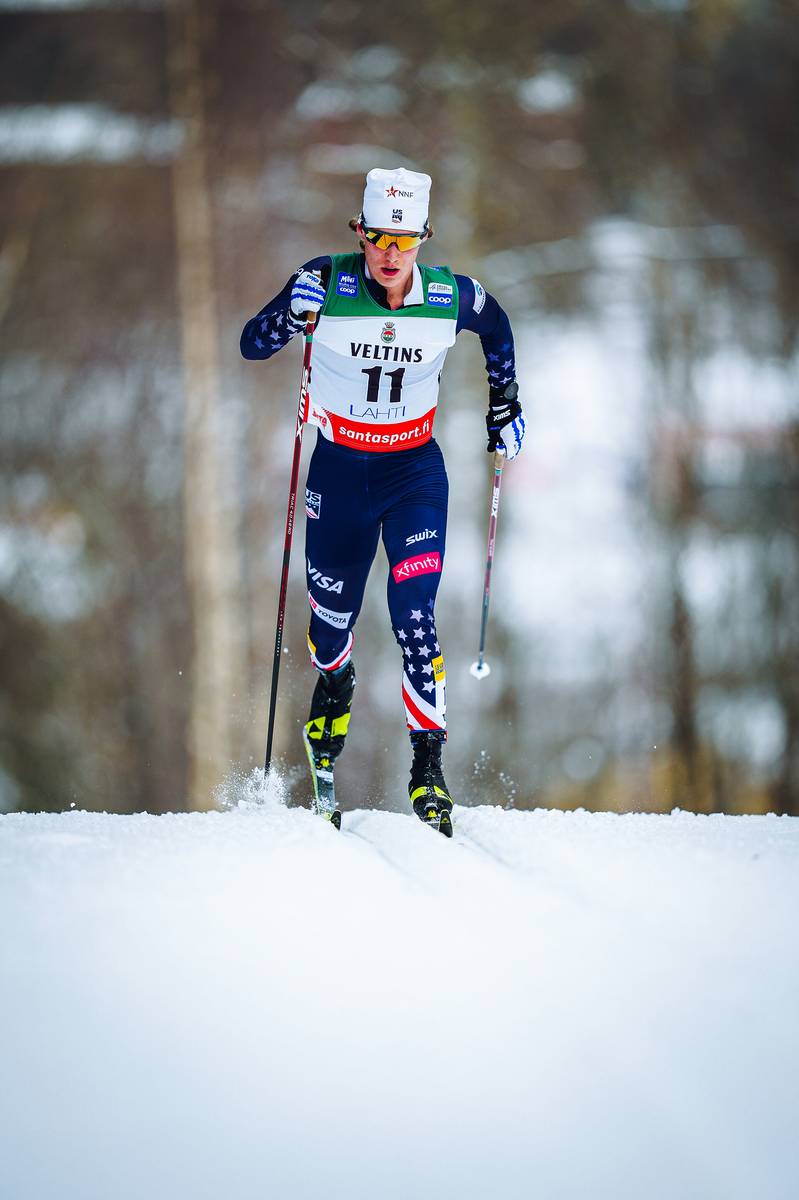
    Fresh off of the 2022 U23 World Ski Championships, Zanden McMullen rejoins the World Cup for the 15 k interval start classic in Lahti, FIN. (Photo: NordicFocus)

    Following the races, US Ski Team head coach Matt Whitcomb provided insights into both the men’s and women’s races in Lahti, as well as sharing the news that Östersund, SWE may become the host to the initially cancelled World Cup Finals that had been scheduled for Tyumen, Russia. Whitcomb also speaks to the “Olympic hangover” that can make hard for athletes to perform at their best the weekend following the Games, and gave a shoutout to the athletes racing at World Juniors in nearby Lygna.

    Results

    – Rachel Bachman Perkins contributed

    Racing his first weekend on the World Cup, Logan Diekmann the 15 k interval start classic in Lahti, FIN. (Photo: NordicFocus)
  • World Juniors: Zanden McMullen leads the way for the Americans in 10/15 k classic with 14th; Abigail Jarzin top female athlete in 36th

    The 2022 FIS Junior/U23 World Ski Championships trip has been made possible through support from the National Nordic Foundation (NNF), which has identified this invaluable opportunity for developing athletes as one of its “Pillar Projects”. You can support the NNF and the next generations of America’s top skiers by making a donation here.

    Thursday marked the third day of 2022 FIS Junior World Ski Championships in Lygna, Norway, but the first day of competition for U23 athletes, following individual and relay races for the juniors on Tuesday and Wednesday. The U23 athletes saw a 10-kilometer interval start classic for women, and a 15 k interval start for the men.

    Zanden McMullen leads the American U23 athletes with a 14th place finish in the 10 k interval start classic in Lygna, NOR. (Photo: flyingpointroad.com)

    The top American finishers today were Zanden McMullen for the men in 14th, and Abigail Jarzin for the women in 36th. The overall podium was all Nordic countries, for the men, and all non–Nordic countries, for the women.

    Women’s 10 k Classic

    The women had the day’s first race, going out at 1 p.m. local time over two laps of a 5 k course with a relatively humane 145m of total climb per lap.

    Anabel Needham races the 10 k interval start classic during the 2022 U23 World Championships in Lygna, NOR. (Photo: flyingpointroad.com)

    Anja Weber of Switzerland had the day’s second-fastest split at the 3-kilometer timing checkpoint, behind early leader Anastasiya Faleeva of Russia… had the day’s second-fastest split at the halfway mark, behind Faleeva… and had the day’s second-fastest split at the 8-kilometer mark, behind Patricija Eiduka of Latvia.

    But the race was 10 kilometers long. Weber held her speed over the end of the second lap slightly better than Eiduka, ultimately taking the win in 29:59.8. Eiduka was second, a scant 1.3 seconds back. Veronika Stepanova of Russia, last seen anchoring the gold-medal Russian Olympic Committee women’s relay team in Zhangjiakou, was third, 13.1 seconds back, skiing a steady race that saw her rank twelfth, eighth, and fifth at the intermediate timing checkpoints.

    Stepanova recently posted to social media, explaining that she skipped the Olympics 30 k to prepare for World Juniors, adding that she wanted to do fewer races at her relatively young age. (Stepanova turned 21 last month.)

    Abigail Jarzin leads the American U23 women in 36th in the 10 k interval start classic. (Photo: flyingpointroad.com)

    Abigail Jarzin (University of Utah/Salt Lake City, UT) was the fastest of the four Americans in the race, finishing 36th (+2:42.8) in a well-paced effort that saw her move up considerably after ranking 45th at the 5 k split. She was followed by Anabel Needham (Michigan Tech University/Houghton, MI) in 47th (+3:47.5), Rena Schwartz (Dartmouth Ski Team/Middlesex, VT) in 50th (+4:14), and Lucinda Anderson (University of New Hampshire/Golden Valley, MN) in 56th (+4:50.8).

    Among the Canadians, Anna Parent (Canmore, AB) was the top female in 17th (+1:45.8). Next for Canada was Beth Granstrom (Revelstoke, B.C.) was 37th (+2:42.9), followed by Anna Pryce (Calgary, AB) in 40th (+2:48), and Ontario’s Bronwyn Williams in 49th (+3:51.9). 

    Lucinda Anderson races the 10 k interval start classic during the 2022 U23 World Championships in Lygna, NOR. (Photo: flyingpointroad.com)

    Other names potentially recognizable to North American readers include Poland’s Weronika Kaleta, who skis collegiately for UC Boulder, in 21st (+2:03.1), and Australia’s Tuva Bygrave, who skis collegiately for UAA, in 57th (+4:52.8).

    Men’s 15 k Classic 

    The men went out second, undertaking three laps of the same 5-kilometer course starting at 3 p.m. local time.

    The starting list was reverse seeded: The athletes with the highest distance points (on paper, the lowest ranked) went out first; the athletes with the lowest distance points (on paper, those highest ranked) went out last. There were 64 athletes in the field, and the athletes with bib no. 62 and bib no. 64 made the podium; sometimes FIS points have strong predictive value.

    But sometimes first place overall goes to an athlete wearing bib no. 31. And that, as the saying has it, is why you play the games.

    Noel Keeffe races the 15 k interval start classic during the 2022 U23 World Championships in Lygna, NOR. (Photo: flyingpointroad.com)

    Arsi Ruuskanen of Finland skied his first lap in 12:58.1, a split time that ranked sixth overall after all the athletes had come through. Ruuskanen’s relatively early bib number meant that he lapped through the stadium just as eventual eighth-place finisher Iver Andersen of Norway was going out on course. Perhaps due to the chance to work with Andersen for much of his second lap, perhaps due to just his own strong race, Ruuskanen would go on to set the day’s fastest times at 10 kilometers, 13 kilometers, and, notably, the finish.

    The 22-year-old Finn took the victory in a time of 40:23.0. He was closely followed by Leo Johansson of Sweden, 6.7 seconds back, who had more of a gap to third, Håvard Moseby of Norway, 28.1 seconds back.

    The top American on the day was Zanden McMullen (Montana State University/Anchorage, AK), in his first year racing as a U23 athlete after three years of racing at World Juniors. Racing internationally at the senior level, McMullen also had four World Cup starts in Period 1 of this season, then placed sixth in both distance races at 2022 U.S. Nationals.

    McMullen started the 15 k out hot, registering the day’s 3rd-fastest time through the 5 k checkpoint. He slowed slightly from there, though not too much, coming through other intermediate checkpoints in 9th and 15th. He was ultimately 14th overall at the finish, 57.8 seconds back from Ruuskanen.

    Johnny Hagenbuch races the 15 k interval start classic during the 2022 U23 World Championships in Lygna, NOR. (Photo: flyingpointroad.com)

    Among the Americans, McMullen was followed by Johnny Hagenbuch (Sun Valley Ski Education Foundation/Ketchum, ID) in 41st (+2:59.8) and Noel Keeffe (University of Utah/Steamboat Springs, CO) in 47th (+3:39.5). In a nod to a certain race being held in Wisconsin on Saturday, it should be noted that Hagenbuch is the youngest-ever winner of the American Birkebeiner.

    Turning to Canada, Léo Grandbois set the pace with the day’s only top-10 finish for North America, crossing the line in 9th (+44.3). He was followed by Sam Hendry (Canmore, AB.), who skis collegiately for the University of Utah, in 18th (+1:14.1), Ottawa’s Pierre Grall-Johnson in 29th (+1:51.0), and Joe Davies (Pemberton, B.C.), who skis collegiately for UAF, in 35th (+2:16.5).

    Racing continues tomorrow with interval-start classic races for the U20 athletes, 5 k for the women and 10 k for the men.

    Today’s results: women | men

    Rena Schwartz races the 10 k interval start classic during the 2022 U23 World Championships in Lygna, NOR. (Photo: flyingpointroad.com)

    World Juniors links and information:

    Home page and general info | race program | results and live timing (all races) | streaming (only for Thursday through Sunday’s races, purchase required)

  • The Devon Kershaw Show: No-doubt Niskanen in the 15 k Classic

    The Devon Kershaw Show: No-doubt Niskanen in the 15 k Classic

    We’ve got our latest episode straight out of China to break down Iivo Niskanen’s dominating win in the Olympic 15 k individual start classic. We talk about some of the drama on the Norwegian team, cover the American and Canadian results and bring on special guest Vahur Teppan, a retired Estonian athlete who coached members of China’s national team for the past four years.

    Thanks for listening!

    Iivo Niskanen celebrates a gold medal performance in his signature event, the 15 k individual start classic. (Photo: NordicFocus)
  • Niskanen with the golden stride in 15 k classic, while North American men hold strong on tough tracks

    Niskanen with the golden stride in 15 k classic, while North American men hold strong on tough tracks

    This World Cup coverage is made possible through the generous support of Marty and Kathy Hall and the A Hall Mark of Excellence Award.  To learn more about A Hall Mark of Excellence Award or to learn how you can support FasterSkier’s coverage please contact info@fasterskier.com.


    In the sport of cross country skiing, the Olympic 15-kilometer individual start classic might be considered the “granddaddy of them all.” The technique was classic, as was the race against the clock, and even the weather on Friday morning seemed to harken to the pitch perfect idea of a ski race we all have in our minds; mid-20s Fahrenheit, -3.5℃ to be exact, and with some sun too. This race, in this discipline, had been raced in 1924 at the first winter Olympiad in Chamonix, when a pair of legendary Norwegians and a Finn graced the podium.

    Hans Christer Holund (NOR) races the 15 k individual start classic during the 2022 Beijing Olympic Winter Games. (Photo: NordicFocus)

    More recent history too, had plenty of threads that this race could potentially follow suit when it played out on Friday. The last 15 k classic World Championship race in March 2021 had seen a Norwegian sweep. Norway’s Johannes Høsflot Klæbo has won two of the last 15 k distance events on the World Cup, with Finland’s Iivo Niskanen winning the third. Alexander Bolshunov of Russian Olympic Committee (ROC) stood on two out of three of these podiums. 

    The gold medalists in the 15 k Olympic races from the 2018, 2014, and 2010 Games were all on the start-line; their name was Dario Cologna (SUI). 

    So which one to follow? Well, it turns out that sometimes, recency bias is the best bias.

    Following the thread of history in big, bold, strides was Iivo Niskanen. In doing so, he not only followed, but also made, history too.

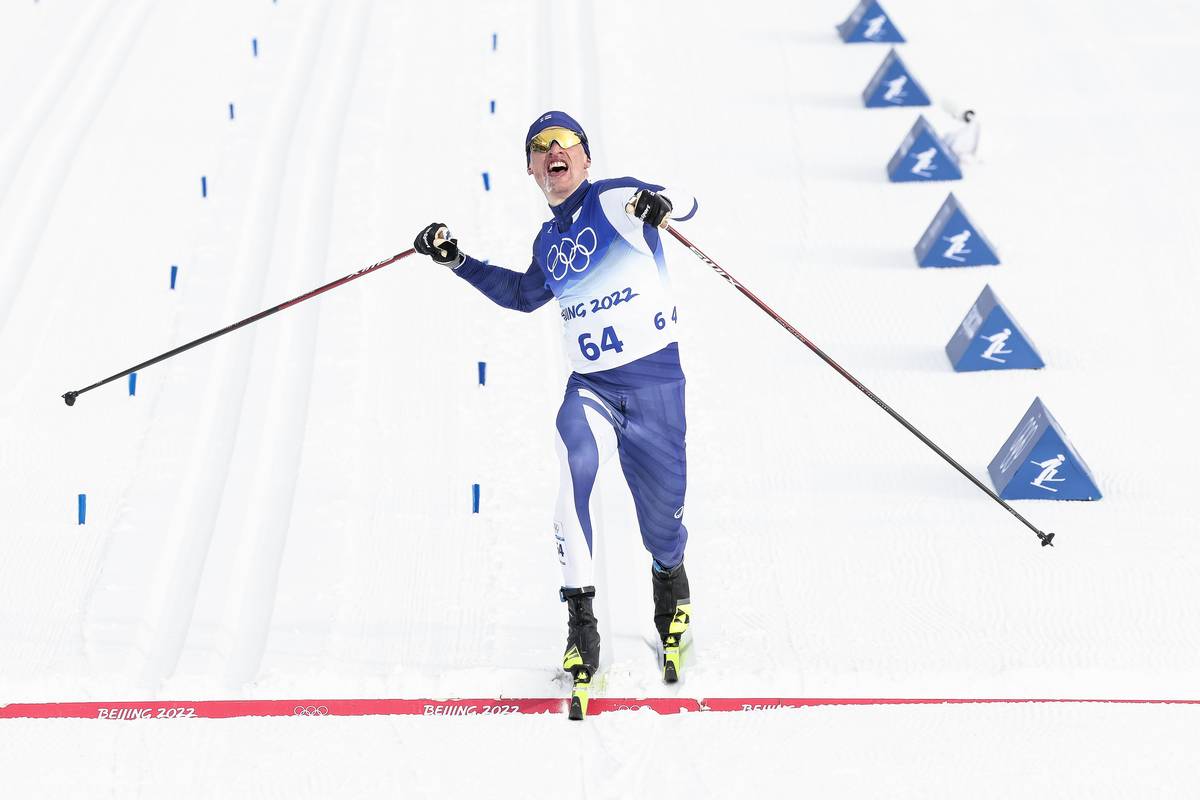
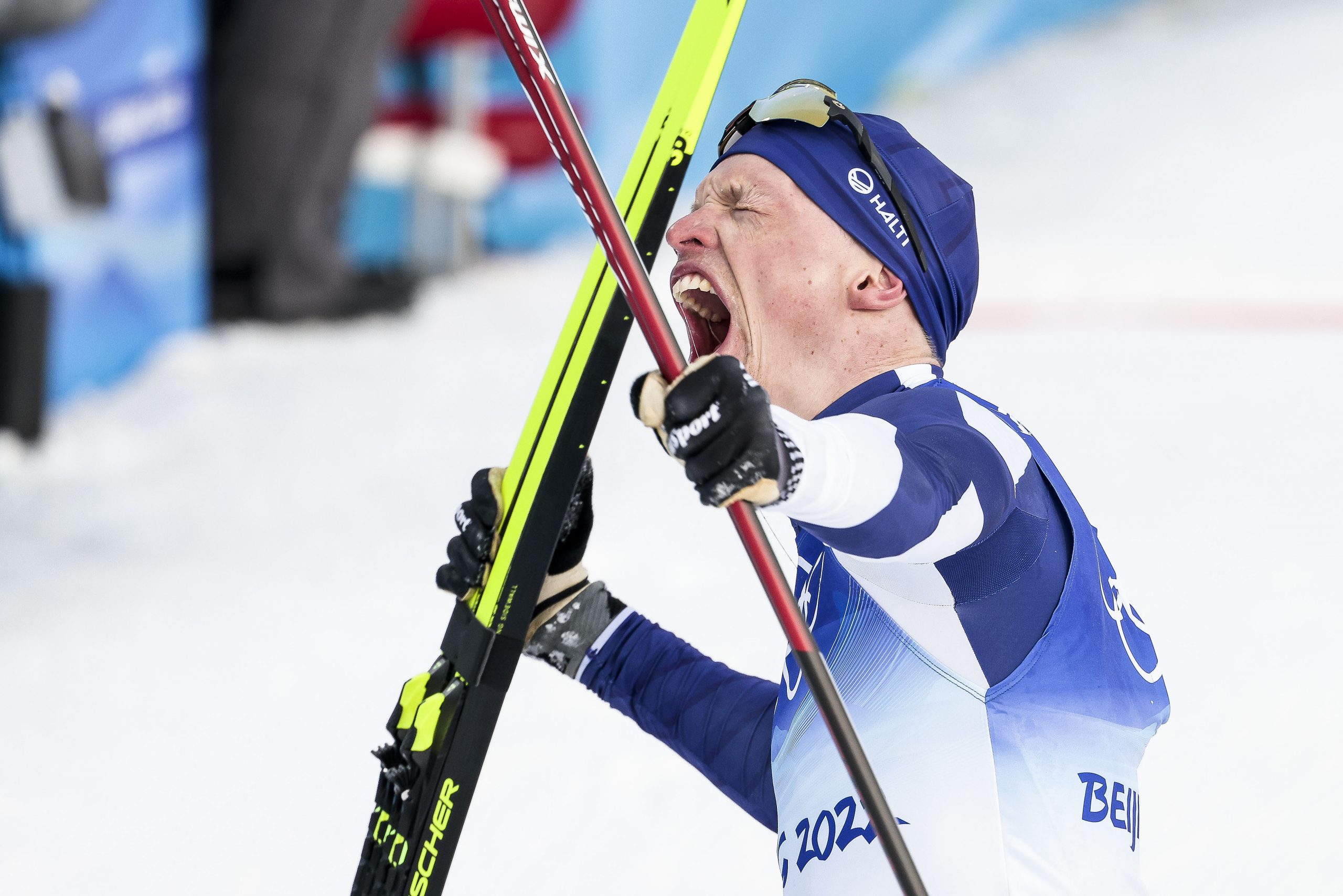
    Iivo Niskanen (FIN) let’s out a shout of jubilation after Friday’s 15 k at the Beijing Olympics. Photo: NordicFocus

    Getting there though, was the matter of following a field that showed the complexity and nuance involved in the simple task of racing against the clock for 15 k. The men’s race entailed two laps of a 7.5 k course that included rolling terrain, and plenty of steady, long uphill pitches seemingly perfect to test the ability of skier’s to mix glide and tempo in classic strides.

    “It was a brutal, brutal course,” said American JC Schoonmaker in an interview with FasterSkier. “There’s so many long, gradual, working sections, and when you get to the top you don’t get a lot of downhills that have much speed…there’s two especially long climbs and a whole bunch of medium grinds in between.”

    JC Schoonmaker skis the 15 k individual start classic. (Photo: NordicFocus)

    “Whether this day goes well or not, this course makes this a really big day, the hills are so steep, and the trick is that kick is even more critical because of the pitch of some of these hills.” said US Ski Team Head Coach Matt Whitcomb.

    For their part, the men’s field went out to attack this hard course with a smile. Or at least, Ben Ogden (USA) did. The American wore bib number 1, fresh off his historic sprint finish, and gave a wink and grin to the camera before dashing out of the start gate, and settling into a powerful double-pole that would allow him to set the pace for the field in the early part of the race.

    Ogden said on his early start “I’ve never been in that position [going out in bib 1], so it was fun to go out and try and stay with the really fast guys on the second lap.”

    Ben Ogden races his first distance event of the 2022 Olympics, the 15 k individual start classic. (Photo: NordicFocus)

    Ogden eventually finished 41st overall (+3:35.0), notching another impressive result for the 21-year-old Vermonter, and reason for fans to look forward to a bright Olympic future from him.

    Ogden’s 1.8 k split was surpassed by Canadian Olivier Léveillé, who wore bib number 5, before the French sprinter Richard Jouve put down a split that seemed to be a good barometer of what going out hard on this course looked like.

    When the field’s favorites came through, Jouve’s split gave away how different competitors were approaching the pacing of the 15 k course. Johannes Høsflot Klæbo (NOR), wearing bib 32, came through the 1.8 k checkpoint way back in 28th place, +28.6 seconds off of Jouve. His teammate Pål Golberg came +6.4 off of Jouve as well. The Norwegians seemed to be taking the early part of the race conservatively.

    Dario Cologna (SUI) too, was back in 26th place after 1.8 k (+26.1), but it seemed clear from the early part of the race that the reigning Olympic champion was out on one last run, an homage to his legendary Olympic career.

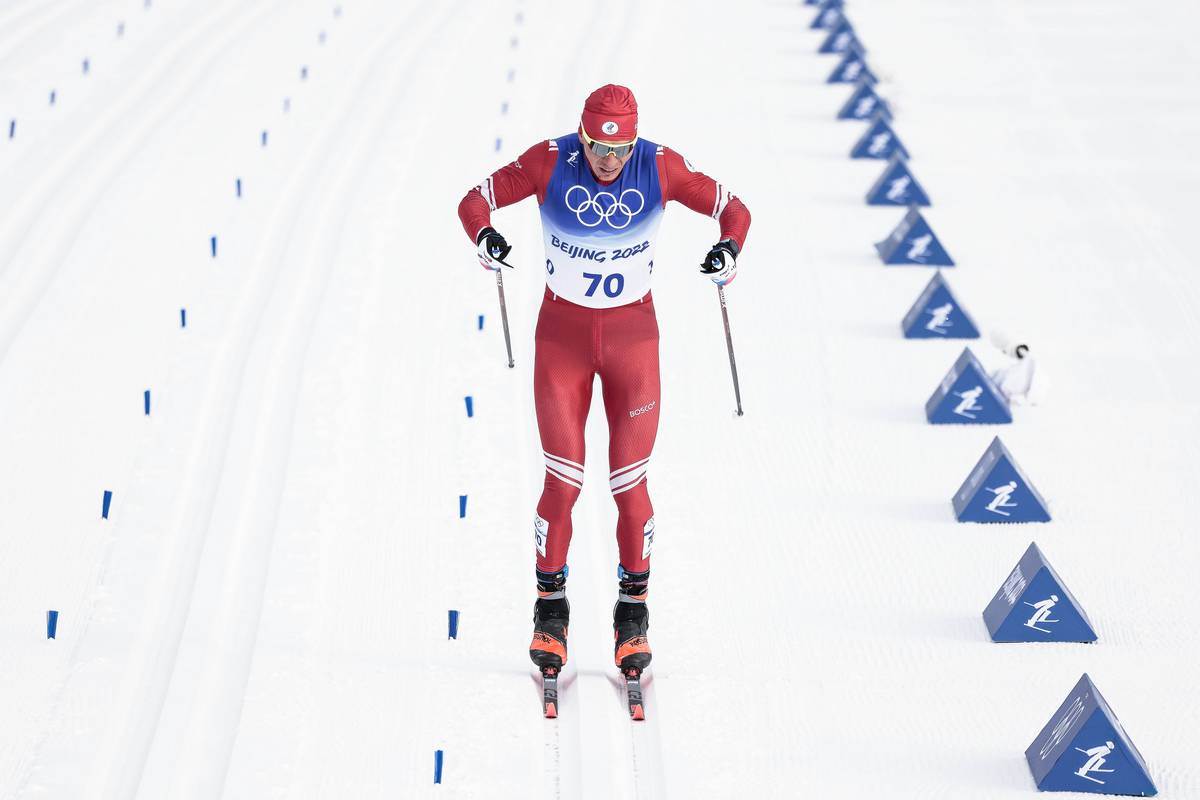
    When Jouve’s mark was eventually surpassed, it was by Iivo Niskanen, wearing bib 64, who skied through the 1.8 k mark with a 2.3 second advantage over the entire field. Eyes then turned towards the skier who had outdone Niskanen in last Sunday’s 30 k Skiathlon, Alexander Bolshunov (ROC), wearing bib 70, who came through the 1.8 k mark +8.4 seconds off of Niskanen’s time.

    Alexander Bolshunov (ROC) strides up a climb during the 15 k Classic. Photo: NordicFocus

    Their proximity early in the race couldn’t help but recall the women’s race yesterday, where Niskanen’s sister, Kerttu ultimately missed the gold medal by just 0.4 seconds. The two are now one of just four sibling pairs to win medals at the same Olympic Games, and looked to be able to do it in the men’s and women’s equivalent of the same event. 

    For a second time in two days, a Niskanen would be in a grueling duel against the clock.

    Finland’s Iivo Niskanen strides for gold in the 15 k individual start classic. (Photo: NordicFocus)

    By 6.3 k, the tension hadn’t subsided. Klæbo had picked up his pace, coming into the checkpoint with a 12 second advantage over the field. His teammate Golberg followed, besting Klæbo by 20 seconds. Niskanen then came through and bested that mark by 20 seconds. Bolshunov, though, couldn’t top the feat. He had managed to stay with it, coming through the 6.3 k mark +13.7 seconds off of Niskanen.

    Half-way through the race then, four skiers seemed to be vying for three medal spots in a muddled mass of splits that kept them within a minute of each other. Niskanen had the advantage in 1st place, Bolshunov 2nd, Golberg 3rd, and Klæbo 4th. 

    The decisive portion that would sort out the field came quickly in the early part of the 2nd lap. That portion included a series of two climbs, the latter of which was a veritable wall up to the 10.5 k mark. This played to the strengths of those with a strong, smooth stride.

    In this field, that was Niskanen. He seemed to reset a classic track muddled by a field where most had to herringbone up to the 10.5 k checkpoint, and when he came across it, he had built a decisive gap of 51 seconds over the field. 

    When Bolshunov came through, showing signs of slipping up the climb, he had lost an additional 15 seconds to Niskanen, putting him +28.8 seconds back but still in second place.

    Pål Golberg fights the clock during the men’s 15 k individual start classic. (Photo: NordicFocus)

    Golberg had lost his advantage on Klæbo, and would continue to fade through the rest of the race, eventually ending the day in 11th (+1:52.6).

    At 13.8 k, the gaps at the top had only expanded. Niskanen had held his lead over Bolshunov at 29.1 seconds. His final push up the gradual climb leading to the checkpoint putting the image of a picture-perfect stride to the notion that has become clear over the course of his career; Niskanen is his generation’s best classic skier, the proprietor of glide and stride in a sport that’s increasingly turned its attentions to the temptations of tempo and power.

    Iivo Niskanen celebrates a gold medal performance in his signature event, the 15 k individual start classic. (Photo: NordicFocus)

    There was little in doubt when Niskanen crossed the finish line. He had won gold, done it decisively, and along with his sister’s result yesterday, etched the name Niskanen into Olympic history and Finnish national pride.

    Bolshunov came through in 2nd, with the final margin +23.2 seconds, to claim his second medal of these Olympics. Following him in the results and in that feat was Johannes Høsflot Klæbo in 3rd (+37.5).

    Alexander Bolshunov earns his sixth career Olympic medal with a silver in the men’s 15 k individual start classic. (Photo: NordicFocus)
    Johannes Høsflot Klæbo (NOR) strides to his second medal of this Olympic games, winning bronze in the 15 k classic.

    Now holding an individual gold and bronze medal, earned in the 30 k skiathlon earlier this week, Niskanen has established himself as the dominant 15 k classic skier on the world’s stage. The Finn has seven World Cup victories in the event, and holds a gold and bronze World Championship medal in the event from 2017 and 2019, respectively. He had matched today’s silver medalist, Bolshunov, stride for stride in the 15 k classic half of the opening Olympic skiathlon event, before Bolshunov skated away with the win leaving Niskanen fading into third.

    Iivo Niskanen wins the men’s individual start classic during the 2022 Beijing Olympic Winter Games. (Photo: NordicFocus)

    Also holding one gold and one bronze from this Olympiad, Bolshunov youngest male athlete to hold six Olympic medals. Individually, Bolshunov earned silver in the 50 k classic in PyeongChang in 2018, along with a bronze in the classic sprint. And he supported the ROC team to earn silver medals in the 4 x 10 k relay and the freestyle team sprint.

    “I wanted to win today but Iivo was stronger, I knew that after starting into the race,” Bolshunov said through translation in the press conference. “Getting a silver medal, however, is a nice treat as well, especially at the Olympic Winter Games. And there are more races coming where I will fight for Gold again”.

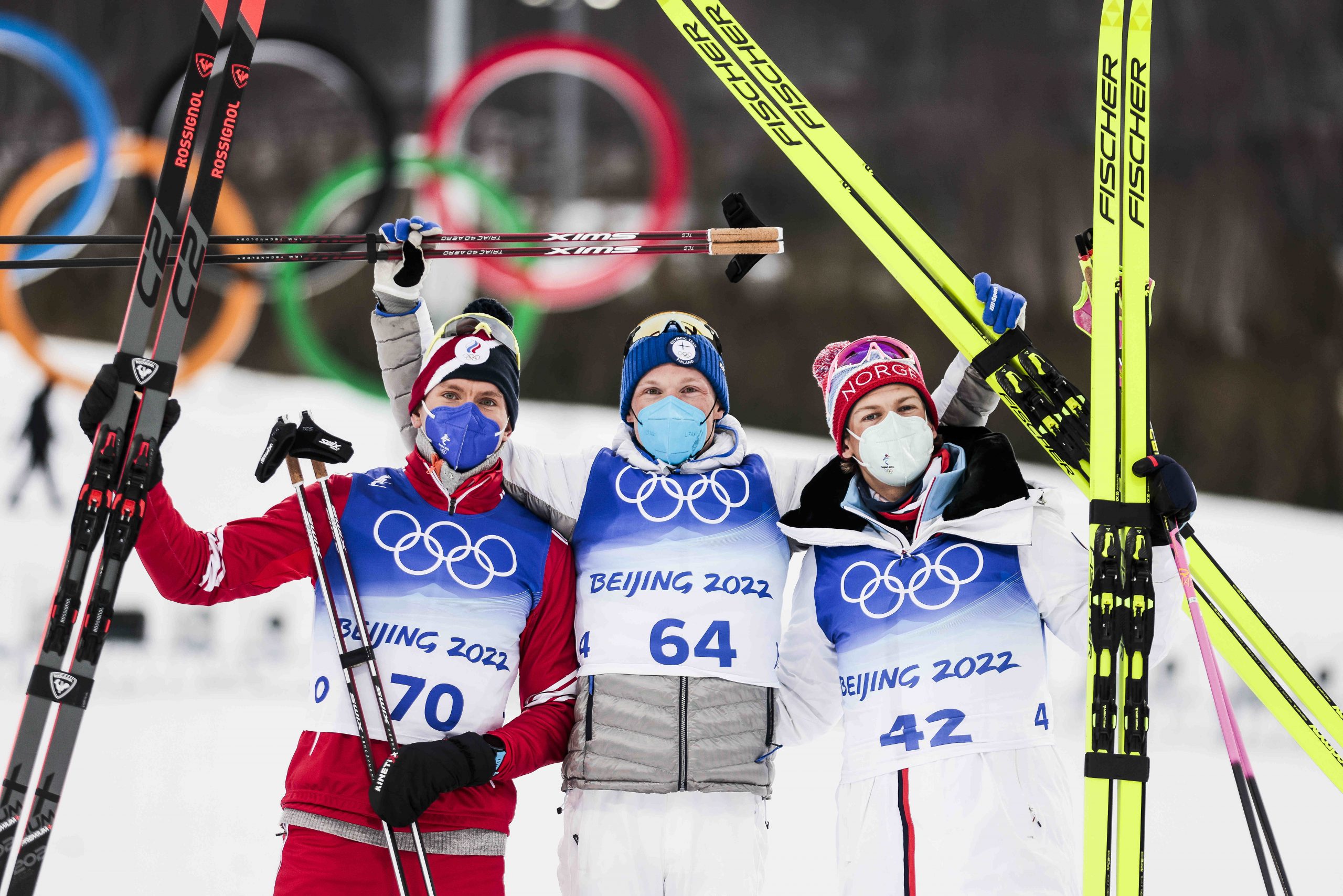
    Iivo Niskanen (FIN) takes gold in the 15 k classic, with Alexander Bolshunov (ROC) earning silver and Johannes Høsflot Klæbo (NOR) bronze. (Photo: NordicFocus)

    Today also provided glimpses of the young North American athletes from both Canada and the United States gaining valuable experience that points towards an exciting Olympic future for years to come.

    Ogden, for instance, found an opportunity to ski with the world’s best on the world’s biggest stage, “I was surprised when Klæbo passed me on the second lap on that climb, he wasn’t going a totally inhuman pace. I think one day I’ll be able to ski a larger percentage of that race at that speed.”

    Meanwhile, Gus Schumacher is focused on regaining a sense of feeling good on skis, saying to FasterSkier that “today was pretty flat, not a lot of aerobic power…you don’t feel like yourself, and I think we’re pretty grounded in physical feeling in this sport, so when those are weird you don’t feel like you have an anchor. I don’t want to rest at the Olympics, but I’m focused on coming around again this season.”

    Canada’s Olivier Léveillé leads the North American athletes in 29th during the 15 k individual start classic. (Photo: NordicFocus)

    Leading the way in the North American contingent was Canadian Olivier Léveillé in 29th (+2:57.2), followed by countrymen Rémi Drolet in 33rd (+3:12.9), and Antoine Cyr in 37th (+3:22.9).

    American Scott Patterson was close behind in 38th (+3:28.3), Ben Ogden was 42nd (+3:35.0), Gus Schumacher was 48th (+3:58.6), and JC Schoonmaker was 66th (+5:36.8).

    “That was tough,” Patterson told FasterSkier in the mixed zone. “It was a hard race day – wasn’t exactly what I wanted. I think we could have done a bit better with skis. I was slick to start and worked my arms pretty hard for the first lap. I think I kind of held it together, but the second lap hurt, and I was struggling out there. I was herringboning in most of the hills and trying to doublepole what I could, but it definitely felt like things were falling apart by the second lap. ”

    Scott Patterson leads the Americans in 38th in the 15 k individual start classic. (Photo: NordicFocus)

    During this second lap, Patterson began to recognize that the 15 k may not match his historic result from the skiathlon, where he finished 11th as the top American in the event, the best result in Olympic history for the men’s program. He shared what was in his mind as he worked through the discomfort and frustration of under-performing skis.

    “Keep hanging on. Keep fighting. I never like to be the one to kind of call it quits, so it’s tough. I mean, you know, other people are hurting out there too…I was turning my eyes back and head down on this final hill trying to pick up a few spots.”

    The American and Canadian contingents will now look ahead to the next two races of this game, when they come together to race under their nation’s respective banners. Sunday will see the 4 x 10 k team relay, before the team sprint next Wednesday.

    For more on how the U.S. team is approaching selection for those races, read here.

    Gus Schumacher races the 15 k individual start classic in Zhangjiakou. (Photo: NordicFocus)

    – Rachel Bachman Perkins contributed

    Full Results

  • Bolshunov Pulls Away for a Solo Victory in the 15 k Classic; Cyr 21st

    Bolshunov Pulls Away for a Solo Victory in the 15 k Classic; Cyr 21st

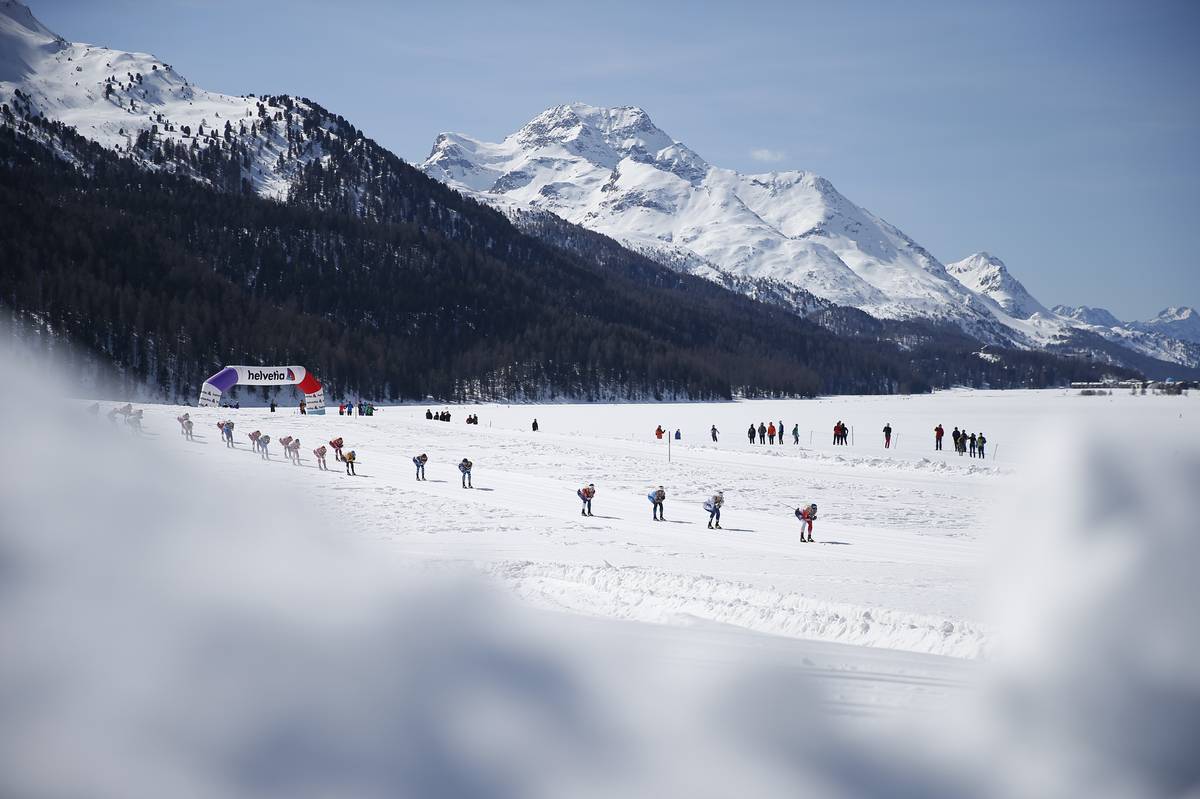
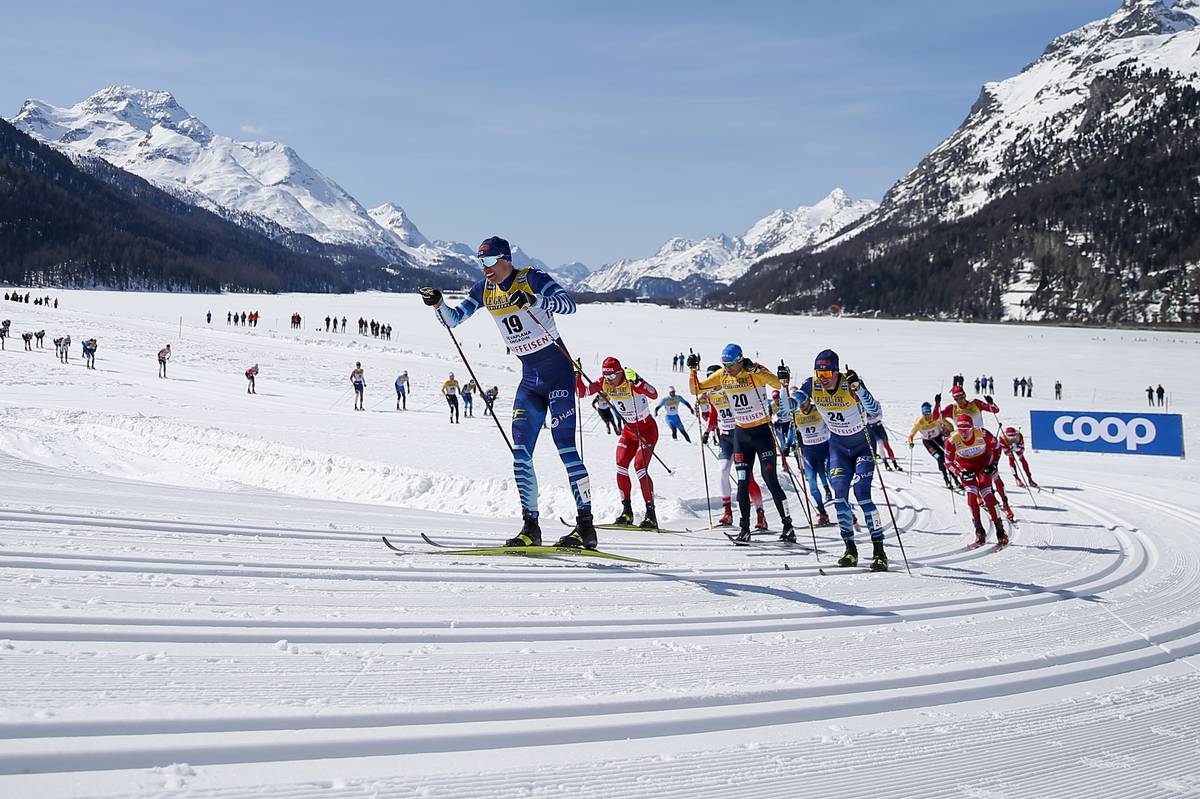
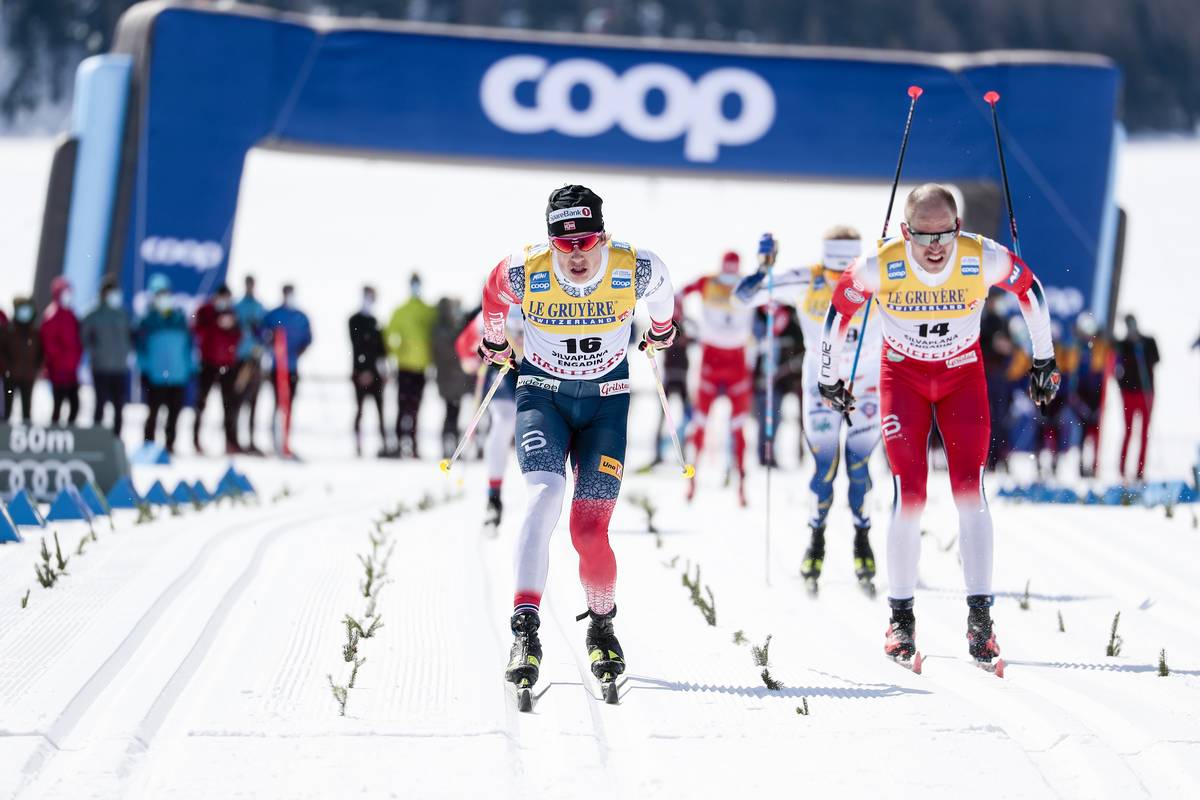
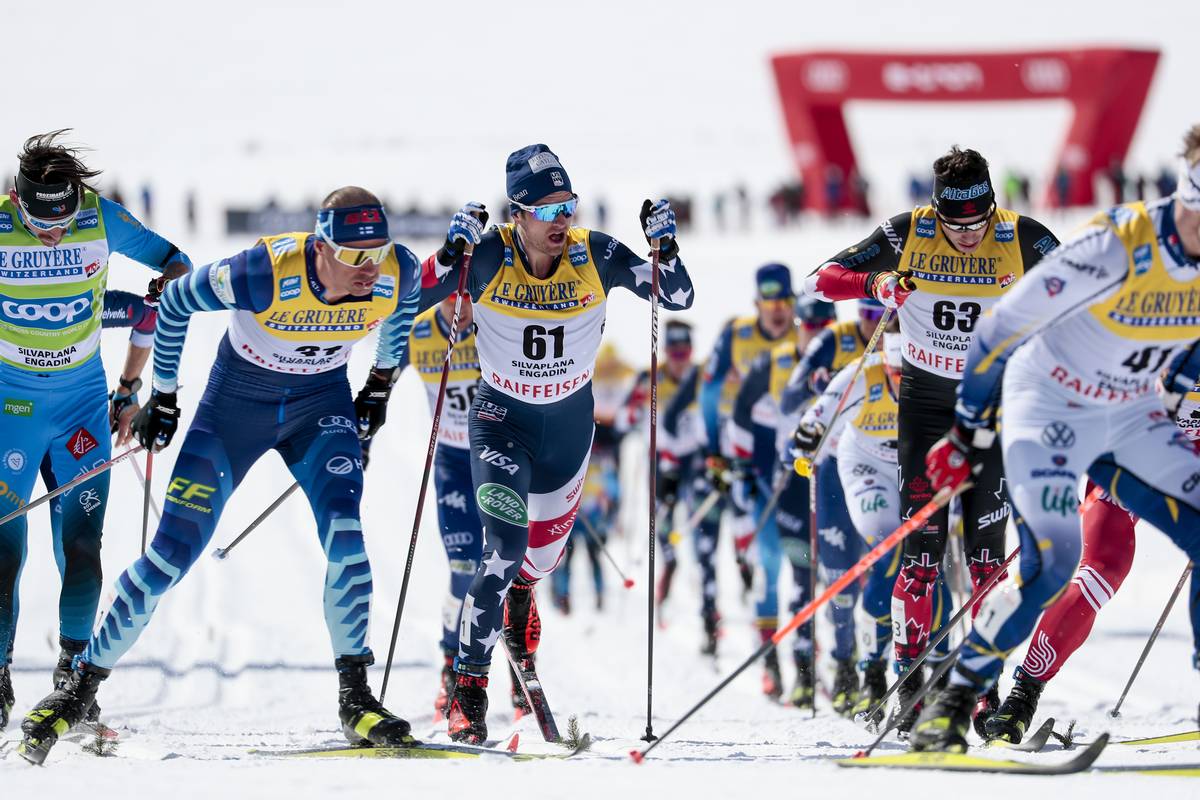
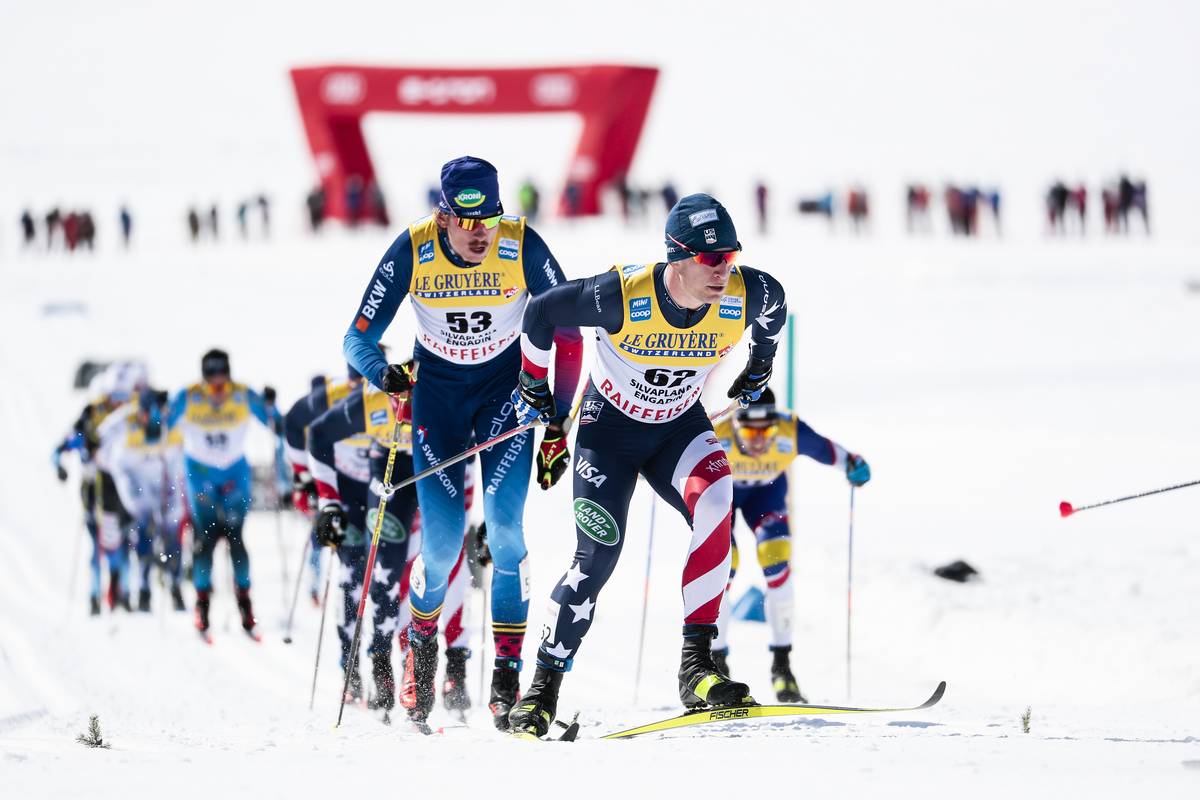
    Engadin, Switzerland – a stellar backdrop for the men’s 15 k mass start classic. (Photo: NordicFocus)

    This World Cup coverage is made possible through the generous support of Marty and Kathy Hall and their A Hall Mark of Excellence Award. To learn more about A Hall Mark of Excellence Award or to learn how you can support FasterSkier’s coverage please contact info@fasterskier.com.

    It’s the last hurrah, folks. Roughly a year after the COVID-19 virus achieved its global pandemic title, the World Cup finds itself at the end of a season that once looked as if it may not happen in the first place. Though four competitions — Lillehammer, Nové Město, Oslo, and Beijing — were cancelled or postponed, the World Cup toured through Europe from November to March without any known significant outbreaks. All things considered, they pulled off a bold and robust competition schedule. 

    Leaving the unpredictable spring conditions at the World Championships in Oberstdorf, Germany, the cold, crisp tracks and an Alpen backdrop looked like a wintery treat during today’s 15-kilometer mass start classic event. The picturesque venue, home to the Engadin Ski Marathon, is nestled in the Engadin Valley of Switzerland just south of St. Moritz in the town of Surlej. Pristine conditions, bluebird skies, and high mountain air; what more could you ask for in a final stop?

    Iivo Niskanen leads the way midway through the 15 k mass start classic in the Engadin Valley of Switzerland. (Photo: NordicFocus)

    As the dust settles from the World Championship, in particular the conclusive result of the men’s 50k classic just six days ago, eyes were on the 24-year-old duo up front with 5k to go. To put it clearly, we mean Norway’s Johannes Høsflot Klæbo perhaps looking for redemption after his disqualification for obstruction and loss of the World Championship gold medal versus Russia’s Alexander Bolshunov. The Russian also felt robbed of this medal as the interaction with Klæbo in the finishing stretch resulted in a snapped pole, consequently losing him ground to Emil Iversen and leaving him with silver. 

    With the field staying tight over the first 10 k on Saturday, it was on Bolshunov to move early and avoid setting up a repeat opportunity for Klæbo to sit and kick in his signature style. Time and again, Klæbo the World Champion and Olympic gold medalist in the classic sprint has demonstrated his potential to, quite literally, run away from the field in the final 400 meters, rocketing down the final stretch to clinch the win. Though Bolshunov is the overall World Cup winner for the third year running, it would not behoove the Russian to face off with Klæbo in this way.

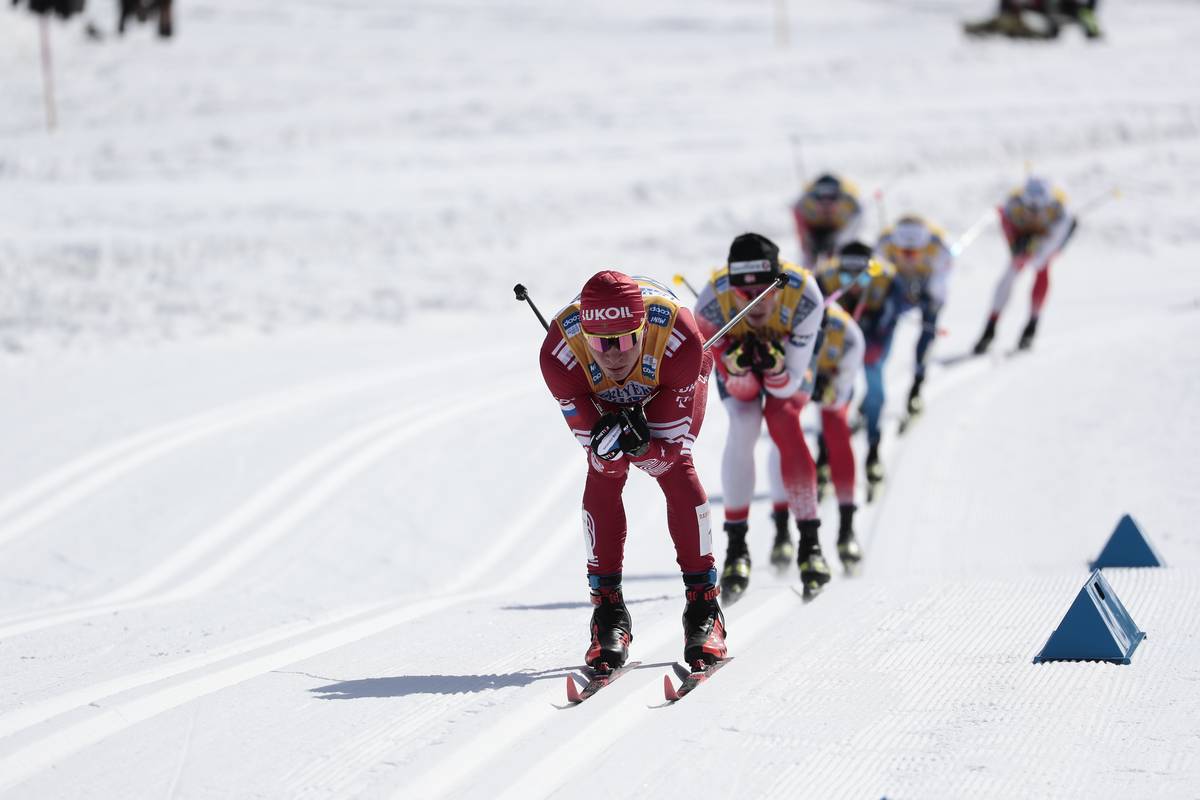
    Alexander Bolshunov leads the way in the 15 k classic, with Johannes Høsflot Klæbo drafting on his tails. (Photo: NordicFocus)

    And he knew it. Crossing the bonus sprint checkpoint at 10 k, Bolshunov and Klæbo were side by side. But as the leaders kicked and glided into their final lap, Bolshunov began to surge off the front. At 11.4 k, he had only a second gap ahead of Klæbo who attempted to match the pace. But, by 2 k later, the winner was clear. Bolshunov had a 24.9 second gap at 13.8 k, while Klæbo had allowed the chase group to catch back up, letting go of a win and setting himself up for a sprint finish for second place. 

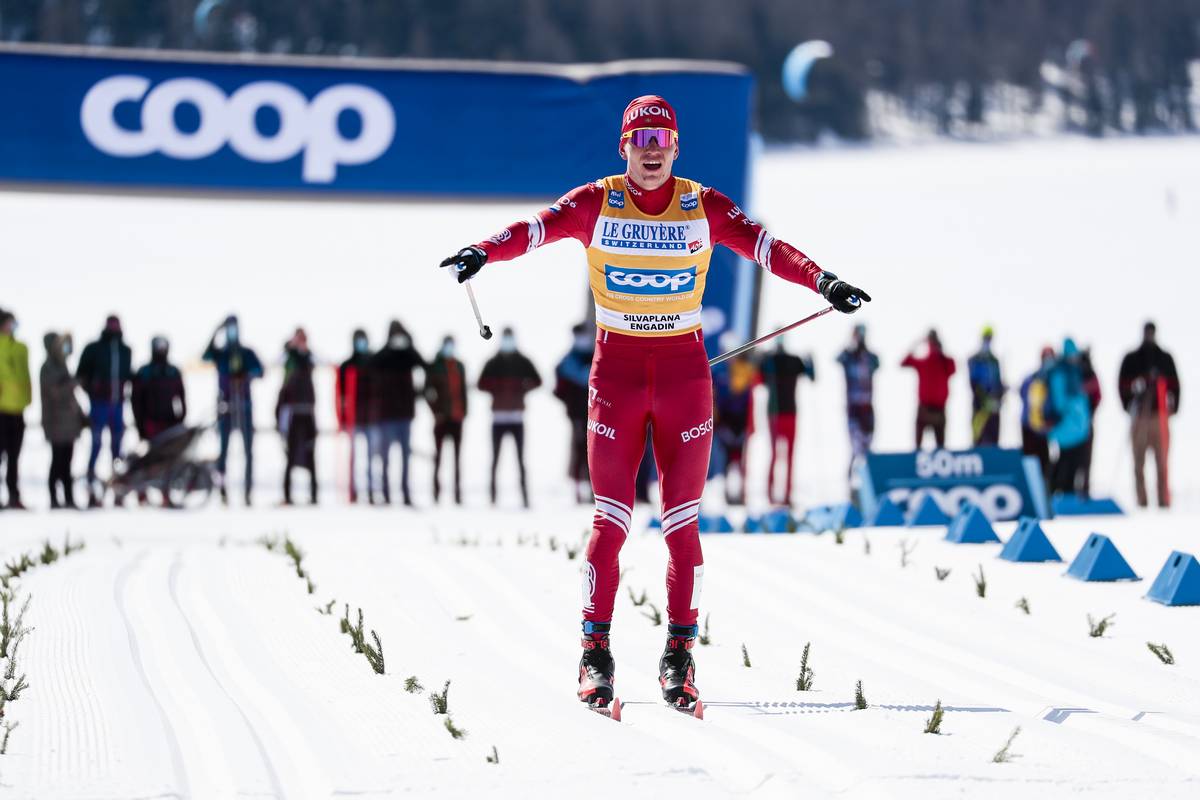
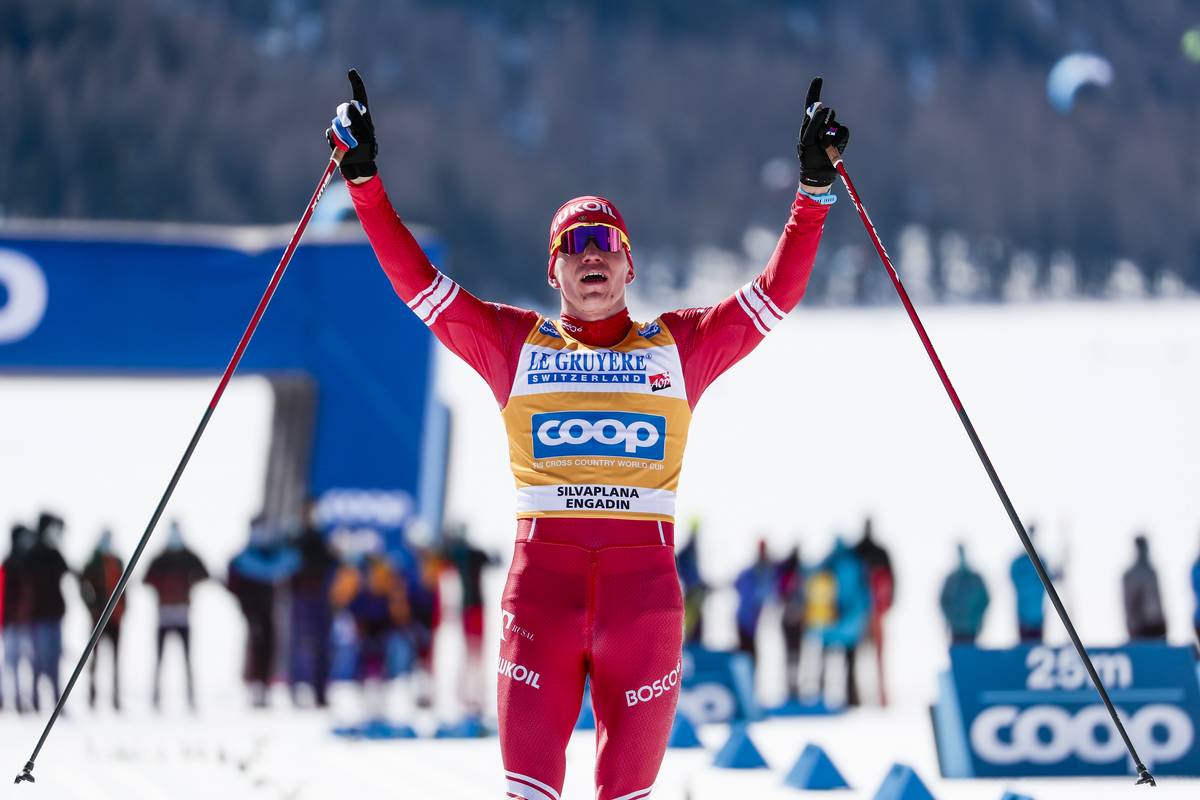
    Despite his lead, the Russian kept his foot on the gas all the way to the finish stretch where he raised his arms to soak in his achievement and coasted through the finish in 34:07.1. 

    Bolshunov coasts through the finish without challengers at the 15 k mass start classic in the Engadin Valley of Switzerland. (Photo: NordicFocus)
    Alexander Bolshunov takes the win in the 15k classic in Switzerland. (Photo: NordicFocus)

    “I really like St Moritz,” Bolshunov told FIS through a translator after the race. “I was very pleased with the conditions here and feel it is one of the best places I have been skiing and training. About the race, I was really happy with the result and happy that now we have again hard winter conditions and that I could push hard on this course. I am very happy to take the victory.”

    The remainder of the podium was less certain, with Klæbo heading toward the stadium with a pack of seven men. Utilizing his aforementioned signature, Klæbo engaged his sprint gear to move up to the front of the group, coming into the final 100 meters alongside his teammate Pål Golberg. Klæbo held Goldberg off by half a ski length for second (+18.5), leaving Goldberg in third (+18.9). 

    Johannes Høsflot Klæbo edges out teammate Pål Golberg for second place. (Photo: NordicFocus)
    The 15 k classic men’s podium in the dreamy Engadin Valley. Alexander Bolshunov (RUS) took the win ahead of Johannes Høsflot Klæbo (NOR) and Pål Golberg (NOR). (Photo: NordicFocus)

    Sweden’s Jens Berman took 4th (+20.0), with Simen Hegstad Krüger of Norway in 5th (+21.2), Artem Maltsev of Russia 6th (+24.2), and Iivo Niskanen of Finland 7th (+27.4). Hans Christer Holund brought up the rear for the first group of chasers in 8th (+31.2).

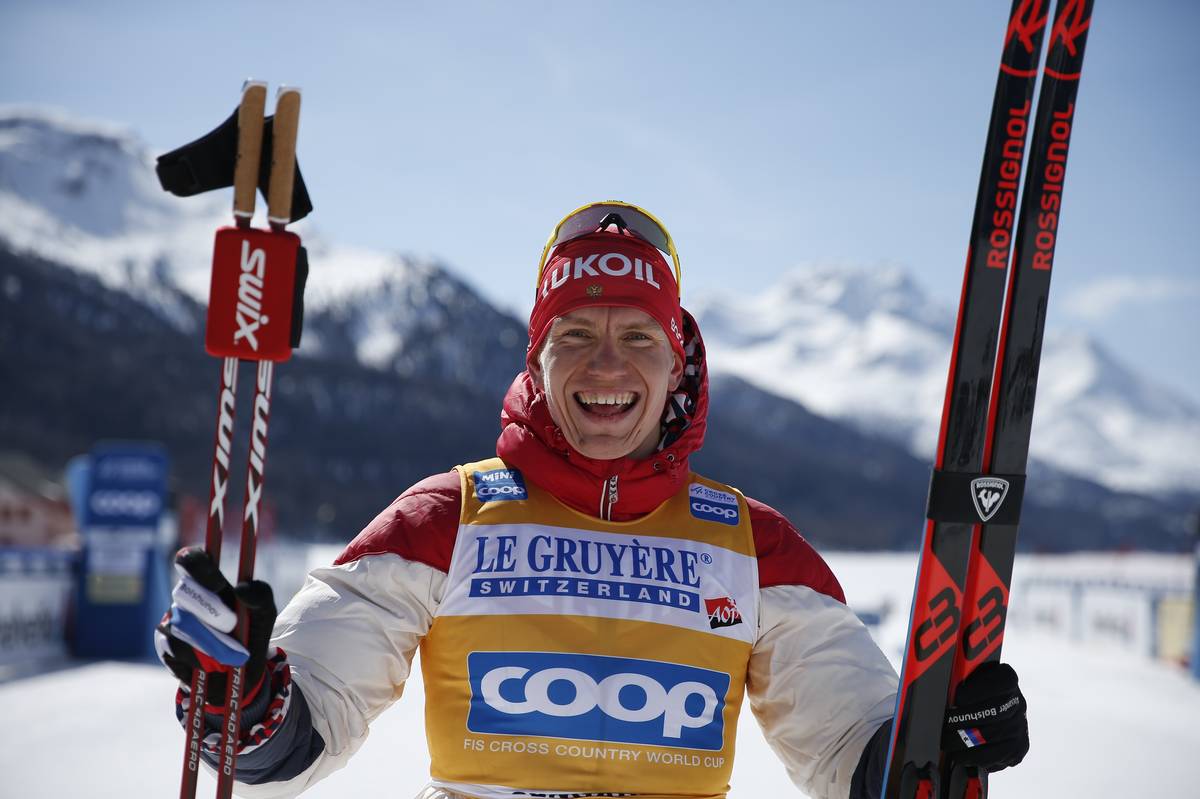
    Alexander Bolshunov celebrates his 9th World Cup distance win this season at the final stop in the Engadin Valley of Switzerland. (Photo: NordicFocus)

    With this 23rd World Cup win under his belt — nine from this season alone — Bolshunov joins Norway’s Peter Northug as joint-fourth on the all-time list. He is the first male skier to win three consecutive World Cup crystal globes, tied for the second-most distance globes in his collection with Norway’s Martin Johnsrud Sundby who also holds three. Only the Swiss champion Dario Cologna outranks Bolshunov, with four distance globes.

    Antoine Cyr (CAN) tucks into the draft of Jean Marc Gaillard (FRA) during a career-best race in the 15 k classic in Switzerland. (Photo: NordicFocus)

    Turning to the North American results, Antoine Cyr took 21st for Canada (+54.5), nailing his best individual result of his career. This is the second season on the Senior National Team and racing at the World Cup level for the 22-year-old who hails from Gatineau, QC. 

    As the dense cluster of skiers from the mass start slowly began to thin out, Cyr skied his way up from 45th and 23 seconds back at the halfway mark to 21st and just 9 seconds behind the leaders at the 10 k checkpoint. Holding his ground in this group over the last 5 k, Cyr crossed the line just behind Andrew Musgrave of Great Britain. 

    “I had a really good race today — it is the first time I have earned World Cup points, so it’s pretty exciting,” wrote Cyr in a post-race email. “I knew it was a good course for me but I was starting far back on the grid and had to make up a lot of spots on the third lap, then the fourth lap I was just hanging with the pack I was skiing with. I am really happy with the results but I know I have even more to give as I am a rookie on the World Cup and just getting used to the way it races here. I am excited for tomorrow and what is to come!”

    Graham Ritchie (CAN) crosses the line just behind Andrew Young (GBR) at the 15 k mass start classic in the Engadin Valley. (Photo: NordicFocus)

    Also racing for Canada, Russell Kennedy took 35th (+1:17.0), Rémi Droulet 67th (+2:57.1), and Graham Ritchie 71st (+3:25.5).

    David Norris navigates mass start chaos in the 15 k classic in Surlej, Switzerland. (Photo: NordicFocus)

    For the US squad, David Norris was the top finisher, leading the way in 41st (+1:31.4). 

    “Our transition from World Champs to the Engadin went smoothly,” wrote Norris in a post-race email to FasterSkier. “I’ve spent this week previewing the new courses here in the Engadin and trying to recover from the 50km last week. Up until Wednesday my legs were still pretty heavy from my final effort in Germany. I’m in a good place now and race preparation on Friday felt good.

    “I didn’t know what to expect going into today’s race. The course is quite flat and there was a pretty strong wind all morning. I chose the wrong skis for this morning so I consistently lost ground on a few crucial descents that fed into long double pole sections where you didn’t want to be alone breaking wind. When the guys up front started to stretch out the pack I was still pretty far back. I wasn’t strong enough to move forward so the last two laps my group seemed to pick guys off who were fading, but otherwise I think we bled time to the packs ahead of us. It was a fun race, but I know this is far from a great performance for me. Time to start thinking about tomorrow’s 50km – I’m real excited for Sunday!”

    Hunter Wonders skis to 47th in the 15k classic in Surlej, Switzerland. (Photo: NordicFocus)


    Ben Ogden throws his boot for 51st alongside Johan Haeggström of Sweden. (Photo: NordicFocus)

    Next up for the Americans, Hunter Wonders crossed the line in 47th (+1:45.4) closely followed by Gus Schumacher in 48th (+1:46.1). Ben Ogden took 51st (+1:51.5) with Scott Patterson 53rd (+1:58.8), Kevin Bolger 60th (+2:11.5), and Johnny Hagenbuch rounding it out in 72nd (+3:39.7). The race saw 82 finishers. 

    Scott Patterson (bib 52) and Ben Ogden on course during the 15 k mass start classic in Surlej, Switzerland. (Photo: NordicFocus)


    Johnny Hagenbuch on course between two Canadians during the 15 k mass start classic in the Engadin Valley of Switzerland. (Photo: NordicFocus)

    Racing continues tomorrow with a pursuit start 50 k freestyle.

    Final Results

  • Sundby Blows the House Down in Seefeld’s 15 K Classic; Bjornsen 17th

    Sundby Blows the House Down in Seefeld’s 15 K Classic; Bjornsen 17th

    The men’s winner, Norway’s Martin Johnsrud Sunday, in the 15 k classic at the 2019 World Championships in Seefeld, Austria. (Photo: John Lazenby/lazenbyphoto.com)

    It was a tough day in Seefeld, Austria Wednesday on and off the race tracks. The efforts and drama in the men’s World Championship 15-kilometer classic were overshadowed by the news of several athletes arrested on suspected doping violations. The distractions shed more light on the underbelly of some high-speed athletes and those who support the cheating. The only thing deafening the day’s police actions was the roar of the considerable Norwegian fanbase in Seefeld.

    Home away from home. Norwegian fans at the flower ceremony for the 15 k classic at the 2019 World Championships in Seefeld, Austria. (Photo: John Lazenby/lazenbyphoto.com)

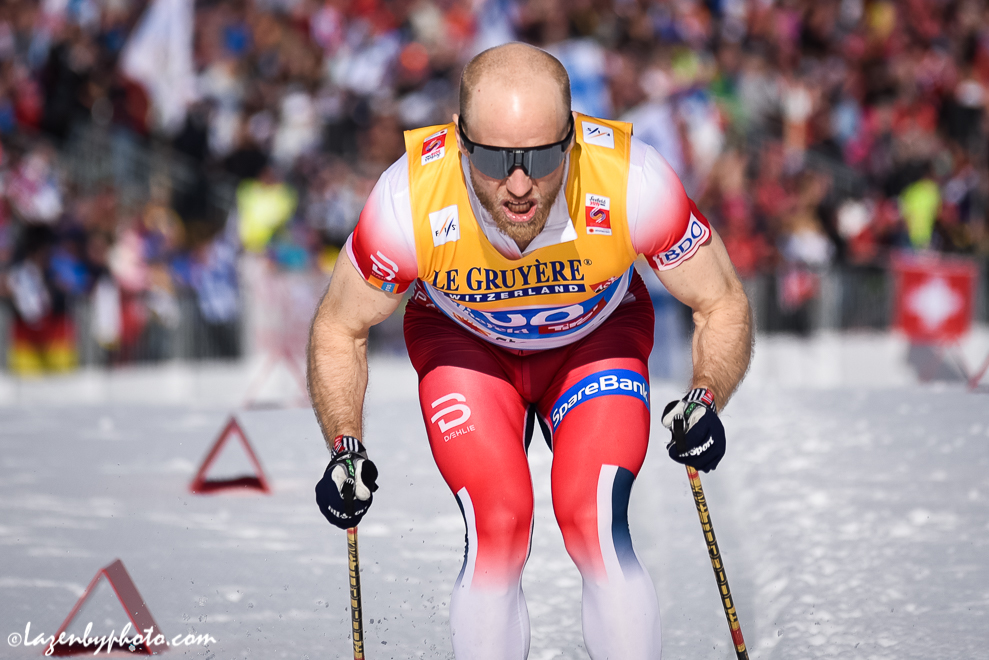
    Shedding his usual toque, Norway’s Martin Johnsrud Sundby hammered up the final hill revealing his seasoned years as a top form athlete. Sundby’s bald dome and iconic beard coupled with his raw lumberjack build were a throwback to old-school power generation. Although only 34, Sundby now looks like a cherished relic when compared to the coiffed flare of a Johannes Høsflot Klæbo. On a day when it was Sundby’s moment, so much for the young and the restless.

    How many times have we seen the almost? The almost win in the World Championships. A query of top-five individual World Championship results reveal seven races within that mark — none of them wins for Sundby. There was a third place in the 2011 Oslo championship 15 k classic. In total, he has two thirds and three second-place finishes at Worlds.

    voltaren buy online

    Perhaps the most crushing “almost” came in 2017 when Sundby was poised for his first elusive championship win. In the closing moments of the 30 k skiathlon, as he dueled Russia’s Sergey Ustiugov, Sundby made his hop-skate move on the final climb. It looked like a kill shot: uptempo, perfect technique, and a jolt of kinetic energy that could only deliver the win.

    Then there was a literal snap. Sundby’s pole broke in two and Ustiugov was gone. The Norwegian fans that had been screaming let out a collective sigh and then silence. Not that a second place, which Sundby earned in that race, was nothing to celebrate — but Norwegian fans travel for the win.

    Russia’s Alexander Bessmertnykh during his near-miss second place in the 15 k classic at the 2019 World Championships in Seefeld, Austria. (Photo: John Lazenby/lazenbyphoto.com)

    As if Sundby’s considerable force alone could not propel him on Wednesday, the soundwaves in Seefeld from the fans perhaps gave him that extra oomph. Sundby took his first career championship win in 38:22.6 minutes. Russian Alexander Bessmertnykh placed second (+2.9), and Iivo Niskanen of Finland placed third (+20.4).

    Finland’s Iivo Niskanen crossing the line in third place during the 15 k classic at the 2019 World Championships in Seefeld, Austria. (Photo: John Lazenby/lazenbyphoto.com)

    The 15 k classic was a hot affair even without the world class speed. With temps well above freezing and short-sleeves and no-shirt the day’s chosen racing style for many, Sundby did not wilt. He was 8.3 seconds behind the time check leader Bessmertnykh at 5 k. At 9.8 k Sundby ceded more time to the Russian, coming through the check 13.9 seconds back. Like a slow and steady fisherman reeling in the prize, careful to not reel too fast or over-tension the line, Sundby played pacing brilliance: his 6.6 seconds behind at 11.25 k became a 2.9 second margin of victory as he crossed the line.

    Here it is, in an official race report for the first time at a World Championships or Olympics in an individual race…Sundby wins.

    “It is a lof them, it is a lot of everything,” a teary Sundby told the International Ski Federation (FIS) after the race when asked about his emotions. “I did not think it would be this emotional in this kind of a moment. It has been a long time coming. Yeah. I made it. We have a fantastic waxing team and so many good teammates and people that believed in me are finally getting this one. “

    When asked about his knowledge of the race’s tight standings, he claimed he understood it was close, but he was unaware of how close the margins were.

    buy vancomycin online

    “A lot of messages out there and difficult to sort them and to get,” said Sundby. “I kind of heard I was fighting for some medals out there but the gold medal was in reach I did not know.”

    Norway’s Martin Johnsrud Sunday on his way to winning the men’s 15 k classic at the 2019 World Championships in Seefeld, Austria. (Photo: John Lazenby/lazenbyphoto.com)

    Sometimes the athletes who step atop the podium, despite their speedy skiing, let us down. Sundby is no stranger to that plotline. In 2016, he was sanctioned for twice exceeding the limits of a specific asthma medication. FIS and the Court of Arbitration for Sport (CAS) ruled that Sundby was not an “intentional doping offender”.

    The history of asthma medication and Norwegian skiers could fill a tome. And on a day for celebration, there is still too much to digest, unpack, and shake the head at. Sundby is the guy in Norway wearing the Yankees hat, or towing his kid around Sjusjøen in a ski pulk. He embodies the modern-sport conundrum –  the affable winner with the skeletons in the closet. He’s now an individual champion.

    The U.S. Ski Team’s Erik Bjornsen, at twenty-seven-years-old, led all North Americans in the 15 k classic field when he placed 17th, 1:50.3 minutes back.

    In a phone conversation after the race, Bjornsen explained he prides himself on race consistency. So far, his 2019 World Cup has been up and down. More often than not, he has found himself beyond the benchmark of top-30 and in the points.

    Erik Bjornsen of the U.S. skiing to 17th overall during the 15 k classic at the 2019 World Championships in Seefeld, Austria. (Photo: John Lazenby/lazenbyphoto.com)

    “I changed my training quite a bit this summer, I was, of course, trying to make another step forward but I haven’t necessarily felt like it and made that even though I have had some standout results,” said Bjornsen. “I’ve always been proud of my consistency and that is something that I haven’t really had so much this year, but I’m starting to feel better.”

    On Dec. 2, in Lillehammer, Bjornsen skied the third fastest time of day in the 15 k classic pursuit. But Bjornsen has wanted more and it took until the World Cup prior to the Seefeld Championships to wait for it – he placed 16th in the 15 k classic.

    Bjornsen explained that his race sensations on Wednesday were not indicative of his end result.

    “I was just feeling a little heavy and struggling on the hills, and I think that has maybe been a strength of mine in the past, and I’ve felt really good on the double pole sections, but there’s a lot of climbing, like today there was a lot of long climbing sections and so those high endurance athletes were making good time on these long working sections. … Today there was a lot of that bounding-type running and I was just not able to push those long hills as much as I would have liked, but I think it’s a good sign that I can be seventeenth at World Champs and not feel like it was a good day out there.”

    Erik Bjornsen after placing 17th in the men’s 15 k classic at the 2019 World Championship in Seefeld, Austria. (Photo: John Lazenby/lazenbyphoto.com)


    With a notable result in a marquee time-trial type event like a 15 k interval start, Bjornsen was able to seed his belief that he can wring out more.

    “I think that even though I haven’t been having the results I was hoping this year, I think I’ve learned a bit about myself and the way I react to some training techniques, and I think I can take that and apply it to the training next year,” said Bjornsen. I feel like I’ve learned a lot and I’m kind of excited to go into this summer’s training and try some more new things. I think to the point where I have to keep trying new things so I can hopefully make this next step, because I think it’s close to where if I can make another step top-10’s every couple of weeks should be possible.”

    Racing continues for the men on Friday with the 4 x 10 k relay.

    Results


    – David Brown Contributed

    Click the images to enlarge.


  • Friday Race Rundown: World Juniors, IBU World Cup, and Super Tour (Updated 2x)

    Friday Race Rundown: World Juniors, IBU World Cup, and Super Tour (Updated 2x)

    Hailey Swirbul for the U.S., skiing to 10th overall in the U23 World Championship 15 k classic mass start in Lahti, Finland. (Photo: Doug Stephen)


    2019 U23 World Ski Championships in Lahti, Finland 15 k/30 k Classic Mass Start

    Link to Doug Stephen’s images from Lahti.

    Of the four Russian athletes starting the 15-kilometer classic mass start in Lahti, Finland three placed in the top four. Anna Zherebyateva won in 40:31.4 minutes as she was able to stretch her nine-second gap at 10 k to 23.5 seconds by the finish. Also from Russia, Lidia Durkina placed second (+23.5), Germany’s Katharina Hennig skied to third (+37.5).

    “My tactic was to make a gap in the second loop,” Zherebyateva said during the post-race press conference. “So I did exactly what I wanted. It went really well. Tracks were exactly right for me. This gold medal is an important step for my sport career.”

    Yana Kirpichenko was the third Russia in the top-five as she placed fourth (+41.6).

    The best North American finisher was U.S. skier Hailey Swirbul who raced to 10th (+1:27.8). Swirbul was positioned 29th at the 5 k time check but steadily moved up in the field as the race progressed. By 10 k she had positioned herself in the top-15.

    For the twenty-year-old Swirbul, this is her first go at U23 Worlds after participating in three Junior Worlds as an U20. Last season in Goms, Switzerland she placed second in the 5 k classic and third in the 10 k skiathlon.

    Two other U.S. skiers raced into the top-30. Julia Kern placed 16th (+1:43.4), while Alayna Sonnesyn was 23rd (+2:24.9). Hannah Halvorsen, the fourth U.S. starter, placed 54th (+6:58.6).

    Hannah Mehain was the top Canadian in 31st (+3:16.8), Sadie White placed 33rd (+3:18.6), and Natalia Hynes 51st (+3:40.9). Marie Corriveau did not start.

    Women’s Results

    Similar to the U23 women’s race, Russian skiers dictated the pacing at the front of the pack — the four Russian starters swept first through fourth place.

    Andrey Sobakarev won in 1:17:19.1 hours, Ivan Kirillov placed second (+3.5), Ivan Yakimushkin third (+4.9), and Anton Timashov fourth (+11.4).

    Canada’s Antoine Cyr was the top North American in 27th (+2:26.8), while teammate Gareth Williams toed the line a fraction behind in 28th (+2:26.9). Also for Canada, Ritchie Graham was 41st (4:44.1), and Julian Smith 45th (+5:14.3).

    Peter Holmes was the top U.S. finisher in 33rd (+3:15.7). Hunter Wonders placed 40th (+4:43.0), Braden Becker 53rd (+6:59.0), and Daniel Streinz 66th (+15:53.9).

    Men’s Results


    ***

    Johannes Thingnes Bø scored his 10th IBU World Cup win of the season today in the 10 k sprint in Antholz, Italy. (Photo: biathlon world.com screenshot)

    IBU World Cup Antholz, Italy 10 k sprint

    In the groove is in the groove. Norway’s twenty-five-year-old Johannes Thingnes Bø scored his 10th IBU World Cup win of the season today in the 10 k sprint in Antholz, Italy. Bø won the race in 23:53.9 minutes with a single penalty in standing. The Norwegian leads the IBU World Cup overall and padded his lead with his fifth sprint win this year.

    “It was quite difficult; the altitude here is quite heavy and with the new tracks, I felt dead from 5K so the last 5K was really tough,” Bø said to the IBU after the race. “I managed to have a good plan for the race. When I shoot nine targets, I was quite happy and then it was just to fight hard for the finish line. I like this year’s track; I liked last year’s too because it was not so painful.”

    Bø’s season thus far has been a study in speedy skiing. His shooting stands at 87% for accuracy (82% standing, 91% prone) with his superior skiing speed carrying him to the World Cup overall lead. In Antholz today, his course time for each of his two 5 k laps were ranked first.

    Norwegian teammate Erlend Bjøntegaard shot clean in both his shooting bouts to take second place, 17.5 seconds behind. France’s Antonin Guigonnat placed third (+20.2, 0+1).

    Scott Gow of Canada was the top North American in 20th (+1:06.6, 0+0). Teammates Jules Burnotte raced to 48th (1:55.9, 1+1), Christian Gow 61st (+2:13.4), and Aidan Millar (+3:46.7, 2+2).

    Jake Brown was the top American in 40th (1:42.4, 1+0). Sean Doherty finished in 55th (+2:06.2, 2+1), Max Durtschi  62nd (+2:13.8, 0+1), and Leif Nordgren 73rd (+2:43.1).

    Racing continues tomorrow in Antholz for both the men and women with the 12.5k  and 10 k pursuits.

    Men’s Results

    ***

    Lake Placid SuperTour 5 k/10k Skate Individual Start

    In the 5 k-freestyle individual start Jessica Yeaton (APU/Australian National Team) placed first with a winning time of 15:01.9 minutes. She was in a tight race for the top spot with U.S. Ski Team/SMS T2 athlete Sophie Caldwell who finished 3.0 seconds back. Caldwell is back home in Vermont training and preparing for the 2019 World Championships.

    Katherine Ogden (Dartmouth Ski Team) placed third in a time of 15:17.8. Kelsey Phinney (SMS T2) placed fourth in 15:37.7.

    “Today’s race went super well for me; I had awesome skis despite tricky conditions/weather leading into the race – our wax tech did a phenomenal job,” Yeaton wrote to FasterSkier. “The course here is really good for me with all the steady climbing in the first part- I just tried to push hard to the top of the course and then survive and carry my speed on the downhill, which turned out to be a good tactic.
    “Between US Nationals and now I definitely feel like I am in a good place leading into Seefeld. I struggled with some injuries in the fall and was forced to do a lot of cross-training (especially on the bike) and skip the early season races in Nov/Dec. In retrospect I think this actually was a blessing in disguise, as I ended up putting in a super hard training block and gaining a lot of fitness. Looking ahead to Seefeld, my goal is to top 30 in one of the races, with my main focus being on the skate events (30k and sprint), and the 15km skiathlon. I am really excited for the rest of the races this weekend; they are my final prep before heading over to Europe to race on World Cup and in Seefeld.”

    Women’s Results

    Kyle Bratrud (SMS T2) won the men’s 15 k skate in 25:27.1 minutes. Bratrud, who was recently selected to the 2019 U.S. World Championship Team, has been a top-performing distance skier this season on the SuperTour.

    “Today went well,” Bratrud emailed. “After Nationals, I made the tough decision of turning down World Cup starts in Otepaa and Ulricehamn in order to get some quality training in for the World Champs. Today reflected that as I felt a little tired and pretty flat from not racing since Nationals. That being said, I expect to keep feeling better each race and I should be in a great place when I fly to Europe on the 4th!”

    Bratrud recently won the NorAm/SuperTour 15 k classic in Sovereign Lake and the 15 k classic at U.S. Nationals. Bratrud placed second in West Yellowstone’s SuperTour 15 k skate, and the 30 k skate mass start at U.S. Nationals.

    Akeo Maifeld-Carucci (CGRP) placed second in a time of 26:18.9. It was Carucci’s second SuperTour podium of the season and his best career SuperTour result. In West Yellowstone, he was third in the 15 k skate behind Ben Lustgarten (CGRP) and Bratrud.

    Alexis Dumas (CNEPH) of Canada was third in 26:32.2. U.S. skier Adam Martin was fourth, 3.1 seconds behind Dumas.

    Men’s Results


  • Sunday Rundown: Pärmäkoski Wins At Home in Lahti 10 k; Poltoranin Tops 15 k

    Sunday Rundown: Pärmäkoski Wins At Home in Lahti 10 k; Poltoranin Tops 15 k

    Krista Pärmäkoski of Finland (center) won her second straight 10 k classic, to the delight of the crowd in Lahti. Natalia Nepryaeva of Russia (left) finished second and Marit Bjørgen of Norway third. (Photo: FIS Cross Country/Twitter)

    FIS Cross Country World Cup (Lahti, Finland): 10/15 k classic

    Women’s report

    Men’s report

    Racing at home in Finland, Krista Pärmäkoski picked a good time to collect the second World Cup victory of her career, and again in a 10 k classic. Pärmäkoski’s first win came in the 10 k classic in Planica, Slovenia, earlier this season.

    In second was Russia’s Natalia Nepryaeva, who picked up her first World Cup podium. The current U23 standings leader, Nepryaeva’s time was 20.9 seconds slower than Parmakoski. Both she and Marit Bjørgen of Norway, who finished third (+26.7), used a steady pace to reach the podium. At the 5 k split, Heidi Weng of Norway – wearing the yellow bib of the overall World Cup leader – was in second at the halfway point but faded to finish fifth (+43.3), and Kerttu Niskanen of Finland was in third place but she dropped to fourth by the finish, +27.0. Austria’s Teresa Stadlober finished sixth (+52.4).

    Sadie Bjornsen placed seventh (+57.6) to lead the American team. Caitlin Patterson was next, just missing the World Cup points in 32nd (+2:02.7). Ida Sargent and Sophie Caldwell  finished 40th (+2:21.9) and 42nd (+2:24.2),  respectively. Rosie Brennan finished 48th (+3:02.1) and SuperTour leader Kaitlynn Miller placed 51st (+3:09.1).

    Liz Stephen of the U.S. Ski Team did not start due to illness.

    Canada started only two women: Emily Nishikawa finished 41st (+2:22.2) and Dahria Beatty 44th (+2:40.7).

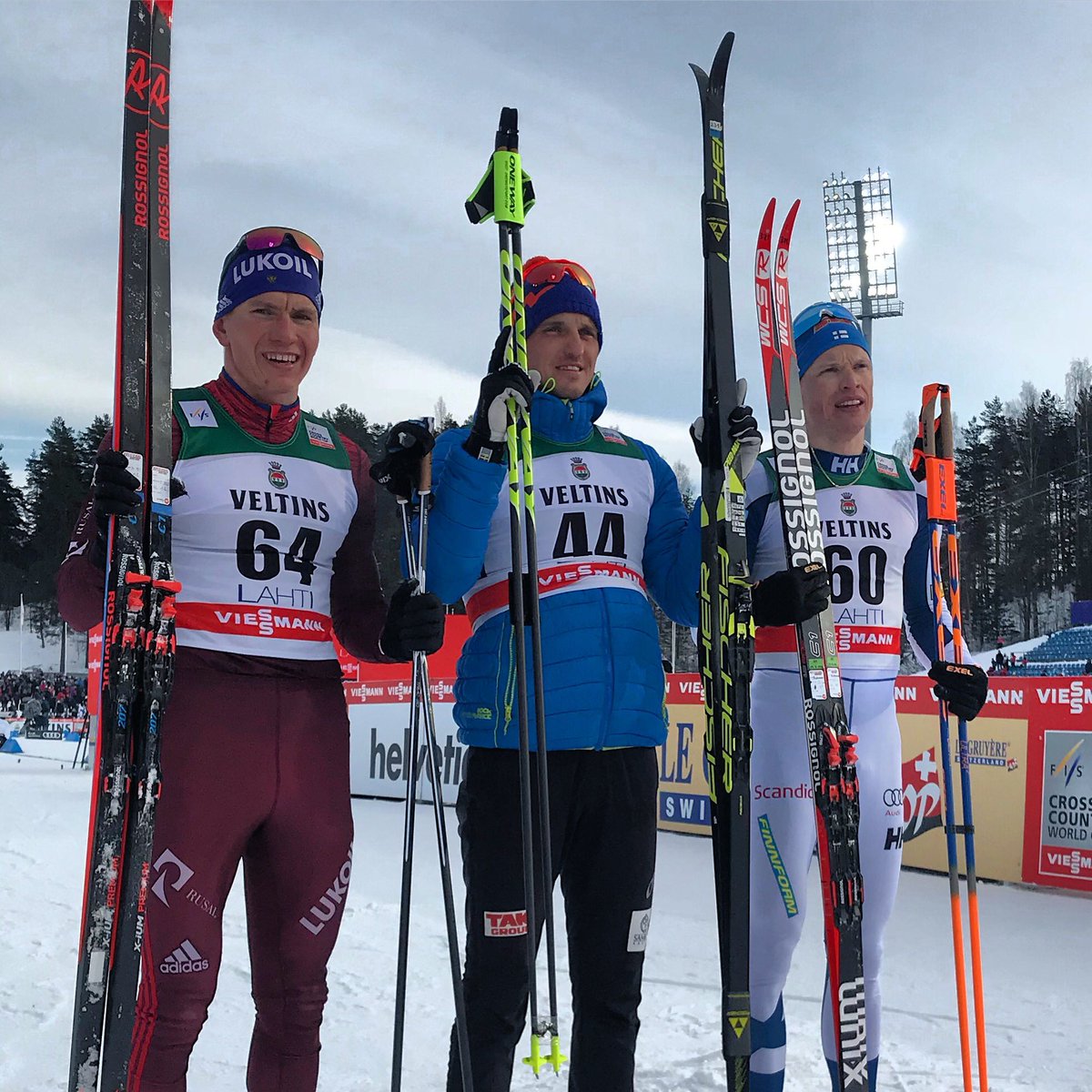
    The men’s 15 k classic podium at the World Cup in Lahti, Finland, with Kazakhstan’s Alexey Poltoranin (c) in first, Russia’s Alexander Bolshunov (l) in second and Finland’s Iivo Niskanen (r) in third. (Photo: FIS Cross Country/Twitter)

    In the men’s race that followed, Alexey Poltoranin of Kazakhstan got some redemption after a major bonk in the Olympics 50 k last weekend, winning the 15 k classic individual start in Lahti.

    Starting in the middle of the field in bib 44 (out of 71), Poltoranin paced it perfectly, skiing a steady race with some of the top split times and then turning it up another notch over the last several kilometers to take the win in 33:11.9 minutes. His biggest threat was Russia’s Alexander Bolshunov, who started 64th and clocked faster splits at every timing point throughout the three-lap race except the one that mattered most — the finish. There, Bolshunov came up 9.1 seconds short of Poltoranin’s time to place second, and Finland’s Iivo Niskanen — the Olympic 50 k champ — placed third, 20.9 seconds out of first.

    Norway took fourth through seventh, with Emil Iversen in fourth (+28.8), Martin Johnsrud Sundby in fifth (+39.9), Niklas Dyrhaug in sixth (+50.1), and Johannes Høsflot Klæbo in seventh (+1:00.3). Russia’s Alexey Chervotkin placed eighth (+1:08.3), Germany’s Thomas Bing was ninth (+1:08.5) and Sweden’s Daniel Rickardsson finished 10th (+1:09.2).

    Canada’s Devon Kershaw led the North Americans in 25th (+1:43.2), and Erik Bjornsen was the top American in 32nd (+2:06.6).

    Four Canadian men raced, with Graeme Killick placing 39th (+2:22.9), Julien Locke 69th (+4:56.6) and Andy Shields 70th (+5:42.1).

    The U.S. was represented by six men, with Noah Hoffman placing 40th (+2:24.0), Paddy Caldwell 45th (+2:40.5), Scott Patterson 50th (+2:58.7), Kevin Bolger 54th (+3:09.5), and David Norris 57th (+3:23.5).

    The World Cup picks back up again this Wednesday with classic sprints in downtown Drammen, Norway.

    Results: Women | Men

  • Poltoranin Owns Planica 15 k Classic; Klæbo Second

    Poltoranin Owns Planica 15 k Classic; Klæbo Second

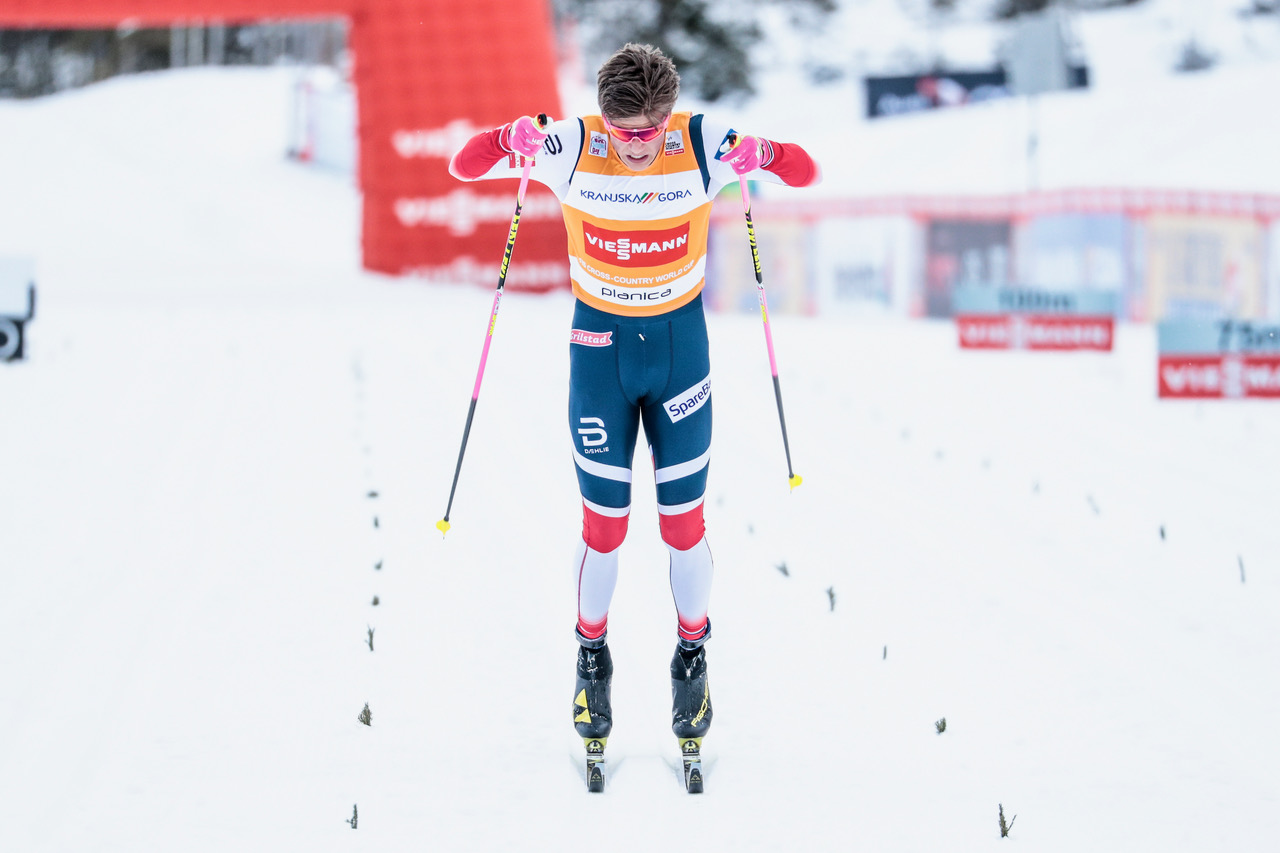
    Kazakhstan’s Alexey Poltoranin racing to the win in the men’s 15 k classic at Sunday’s World Cup in Planica, Slovenia. (Photo: Fischer/NordicFocus)

    Sunday’s World Cup 15-kilometer classic in Planica, Slovenia was a coupling of efficiency, power transfer and patience. Three laps of the course on which skiers climbed roughly 650 feet per 5 k cycle required the low-revving thump-thump-thump of a diesel engine and just the right timing for speed bursts to close time gaps.

    Kazakhstan’s Alexey Poltoranin covered the 15 k distance in 36:45.7 and won the race by 13.2 seconds over overall World Cup leader, Norway’s Johannes Høsflot Klæbo. Calle Halfvarsson of Sweden, who did not finish Saturday’s classic sprint after crashing into netting in his quarterfinal, placed third (+42.8) for his second World Cup podium of the season. Emil Iversen of Norway missed out on his second podium of the weekend (he had placed second to Klæbo in the classic sprint) striding to fourth place (+54.7) on Sunday.     

    Norway’s Johannes Høsflot Klæbo finishing the men’s 15 k classic on Sunday at the World Cup in Slovenia. He finished second to Kazakhstan’s Alexey Poltoranin. (Photo: Fischer/NordicFocus)

    This season Klæbo has barnstormed — he’s podiumed in every race entered with the exception of a 10th place in a 15 k skate in Toblach, Italy. He’s won the most World Cup distance races of any skier with three this season. The Klæbo buzz is worthy and justified.

    Yet Sunday marked a historic moment for Poltoranin. He tied the longtime mark at seven wins in the 15 k classic held by Swedish legend Gunde Svan. Klæbo may be center stage, but Poltoranin is no simple supporting actor. Revered as a classic specialist, but proving his all-around capacity by placing fourth in this year’s Tour de Ski (TdS), Poltoranin is not one dimensional.

    As he kicked and strided on Sunday, Poltoranin made clear why he holds the record (15) for 15 k podiums. His tall and muscular frame epitomize clean classic strides that belie the amount of wattage produced.

    Poltoranin was never first through any of the time splits until the finish line. Through 3.9 k, 6.9 k, 8.9 k, and 11.9 k, it was Klæbo with the fastest times. Klæbo began in bib 42, Poltoranin began a minute back as the 44th starter. With the knowledge of Klæbo’s splits, however,  Poltoranin could wait until the final lap to punch the speed.

    At 3.9 k, Poltoranin was 5.5 seconds back with the second-fastest split. By 11.9 k, he was right on par with Klæbo, as 0.3 seconds separated the two skiers. In the next three k, the 30-year-old Poltoranin was able to gain 13.5 seconds on Norway’s 21-year-old for the win.

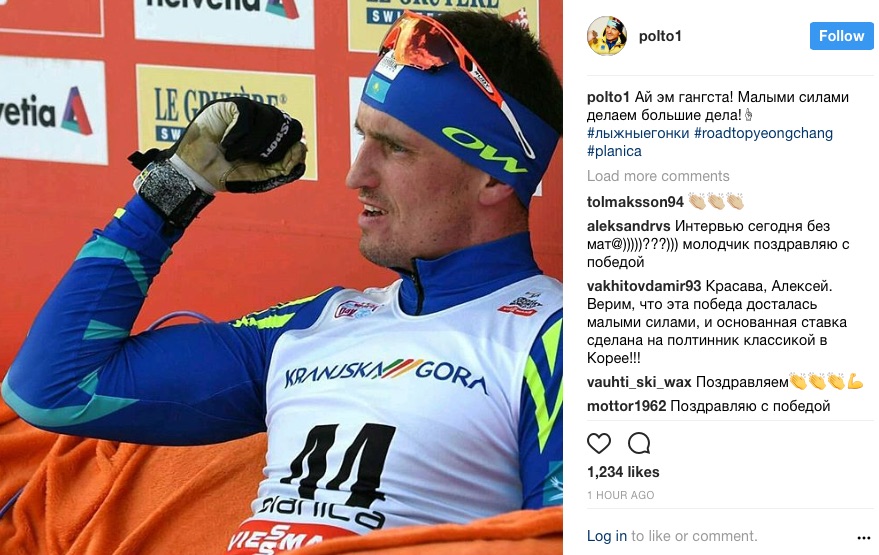
    Men’s 15 k classic winner in Planica, Slovenia, Kazakhstan’s Alexey Poltoranin flexes his muscle in the leader’s chair. (Photo: Alexey Poltoranin/Instagram)


    Flexing his bicep for the cameras in the leader’s chair, Poltoranin showed, for now, who’s the 15 k classic boss.

    “I am really happy to win,” Poltoranin said, according to an International Ski Federation (FIS) press release. “This is a good course for me and I had very good skis and want to say thank you to my service team.”

    Klæbo, a press-conference regular this season, paid respects to Poltoranin with his comments.

    “It was a very hard course,” Klæbo said, according to the release. “I had great skis on the downhills, but was a bit light for kick on the climbs. Polto was so fast from 12 k and I couldn’t match his pace.”

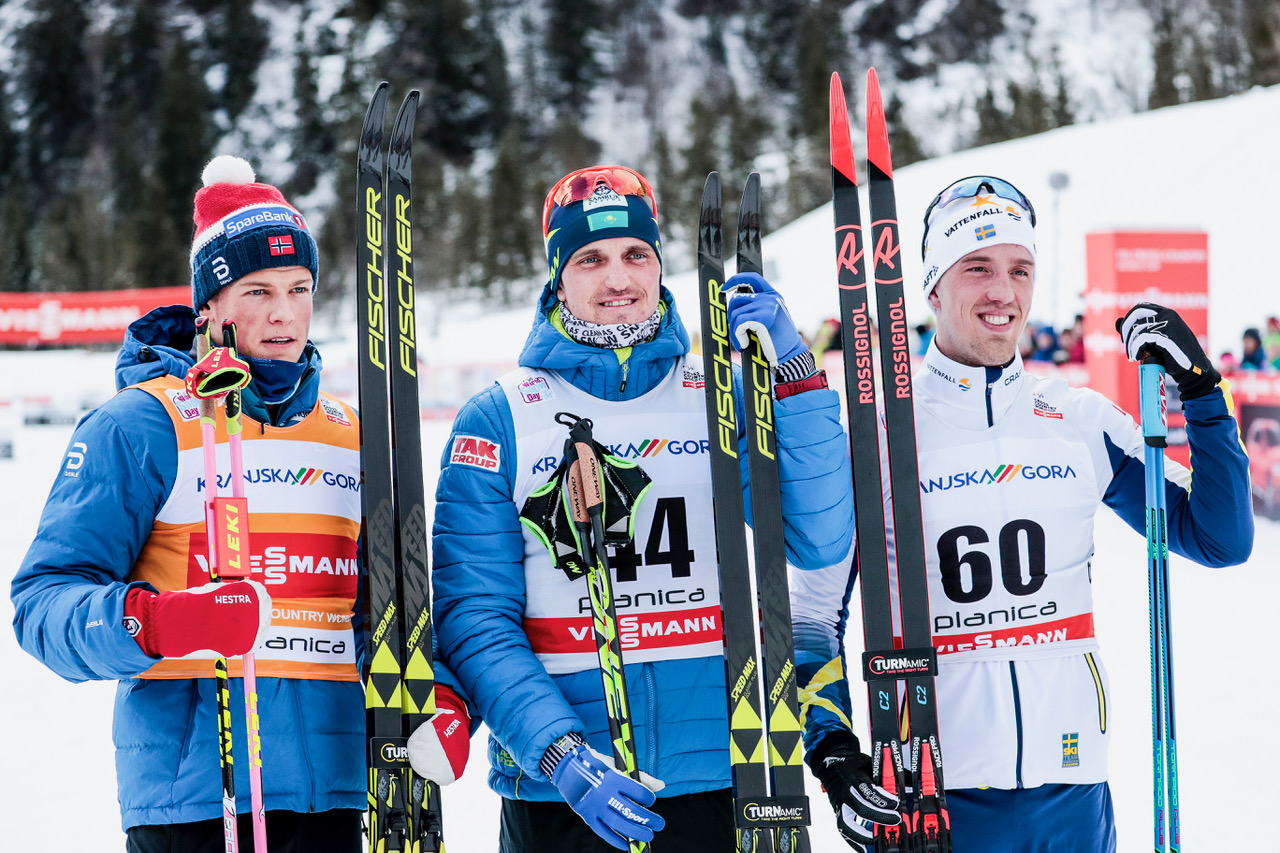
    The World Cup men’s 15 k classic podium on Sunday in Planica, Slovenia, with Kazakhstan’s Alexey Poltoranin (c) in first, Norway’s Johannes Høsflot Klæbo (l) in second, and Sweden’s Calle Halfvarsson (r) in third. (Photo: Fischer/NordicFocus)

    After Sunday’s race, Klæbo leads the World Cup overall with 1012 points, while teammate Martin Johnsrud Sundby, who did not contest the weekend’s races, sits in second with 875 points.

    Scott Patterson (U.S. Ski Team) was the top North American in 43rd (+2:56.2). In his first race back in Europe since racing at U.S. nationals in Anchorage, Alaska, where he won the 15 k freestyle, Patterson told FasterSkier in Planica that he was recovering from a post-national bout with bronchitis.

    “This was kind of building back and see what I could do,” Patterson said. “Didn’t feel great out there, it was a race to build a little experience.”

    Patterson also commented on the nature of the Planica course’s long hills which kicked up gradually.

    “It was a deceptively hard course,” Patterson said. “You never felt like you were going that hard, but it just wore you down over time. You almost want to double pole them, but not really.”

    Patterson said he plans to race in next Sunday’s 15 k freestyle mass start, the last World Cup race before the Olympics, in Seefeld, Austria.

    Ben Lustgarten (Craftsbury Green Racing Project) was the next best American finishing 46th (+3:04.9). Lustgarten earned World Cup starts as the Period 1 SuperTour leader.

    After Sunday’s race, Lustgarten recalled focusing on relaxed skiing and maximizing his effort.

    “We all know the hills are long,” he told FasterSkier. “It was a good race. I didn’t feel amazing, to be honest, but I felt like I pushed as hard as I could. And I really worked the technique. I might have lost some time on the transitions and cresting hills because I was so dead. … But I don’t think I could have gone any harder because my whole body was maxed out on the top of the climbs.”

    Also on the American side, Tyler Kornfield (Alaska Pacific University) was 57th (+4:03.7). Andy Newell did not finish.

    “For sure not our best weekend,” U.S. Head Coach Chris Grover told FasterSkier in Planica. “That said, classic weekends are usually our best. But at the same time, I thought some of our skiers looked a little bit flat — probably to be expected, we have some athletes obviously who just got here, some who came out of U.S. nationals, some who are just coming back to skiing after the Tour de Ski. And some of those athletes that are coming from the Tour de Ski are feeling good, like one-hundred percent back, others are ninety percent back, and are not quite there I think. … Also, a few that are getting over some illnesses, and we also have some that are kind of in the middle of a training block to get ready for the Olympics — kind of a mixed bag.”

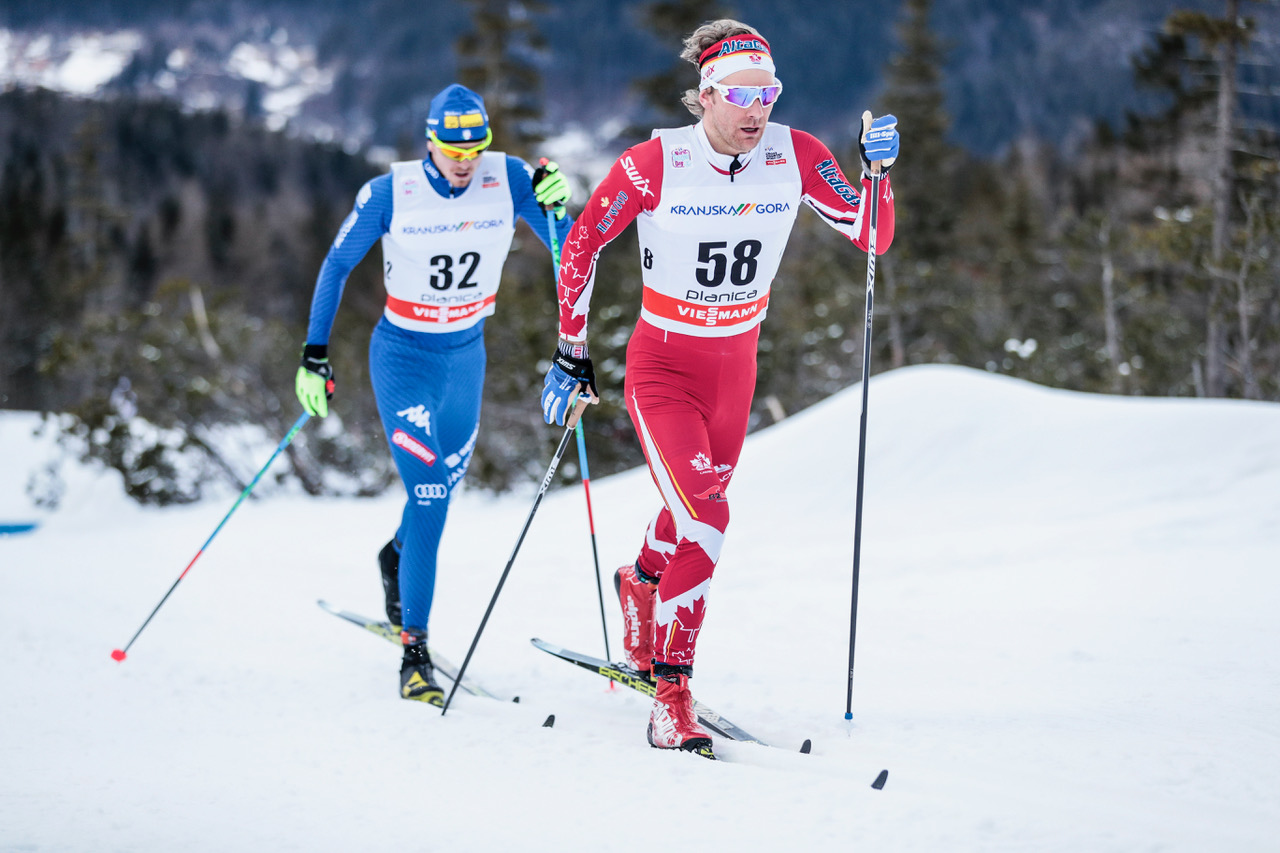
    Canada’s Devon Kershaw (58) leads Italy’s Dietmar Nöckler in the men’s 15 k classic at the World Cup in Planica, Slovenia. Nöckler went on to place 38th and Kershaw 44th. (Photo: Fischer/NordicFocus)

    But Grover also noted that in the end, the weekend proved positive.

    “A couple of great performances,” Grover added. “Jessie’s fourth yesterday, that is her best classic sprint result of all time. Really cool to see her making that progress. I thought it was a great race yesterday out of Logan Hanneman to be that close to qualification, he just got over here this week from the U.S. Similarly, a really nice qualification out of Tyler Kornfield yesterday. Same deal. Just got over here. Those were some silver linings for sure.”

    Canada’s Devon Kershaw returned to the circuit and placed 44th (+2:57.1), Bob Thompson (NTDC Thunder Bay) was 64th (+5:05.0), and Dominique Moncion-Groulx (Alberta World Cup Academy) was 70th (+6:11.7).

    Racing continues next weekend with a freestyle sprint and 10/15 k freestyle mass start.

    Results

     — Gabby Naranja contributed

    Canada’s Dominique Moncion-Groulx (55) with Slovakia’s Peter Mlynar (2) during the World Cup men’s 15 k classic in Planica, Slovenia. Mlynar went on to place 48th and Moncion-Groulx finished 70th. (Photo: Fischer/NordicFocus)
  • Saturday Rundown: Bjørgen, Klæbo Dominate Ruka Day 2; Diggins 10th; Fletcher Gets 2nd Top 20

    Saturday Rundown: Bjørgen, Klæbo Dominate Ruka Day 2; Diggins 10th; Fletcher Gets 2nd Top 20

    The women’s 10 k classic podium at Day 2 of the World Cup opening Ruka Triple in Kuusamo, Finland, with Norwegian winner Marit Bjørgen (c), Swedish runner-up Charlotte Kalla (l), and Norway’s Ingvild Flugstad Østberg (r) in third. (Photo: FIS Cross Country/Twitter)

    FIS Cross Country World Cup (Kuusamo, Finland): 10/15 k classic

    Women’s report

    Men’s report

    On Day 2 of the Ruka Triple World Cup opener on Saturday, Norway’s Marit Bjørgen collected a 17-second victory in the women’s 10-kilometer classic individual start in Kuusamo, Finland.

    Bjørgen started 30th of nearly 90 women and was contested by one other: Sweden’s Charlotte Kalla in bib 44. Kalla clocked through the 3.1 and 6.2 k checkpoints faster than Bjørgen, but the Norwegian’s time stood up against Kalla’s at 8.1 k, where Bjørgen was 1 second faster. Over the last two kilometers, Bjørgen continued to gain speed toward the finish, crossing the line in 25:07.6 minutes. Kalla came within 17 seconds of her, which was good enough for second place and 0.8 seconds faster than another Norwegian, Ingvild Flugstad Østberg, who was bumped to third (+17.8).

    Norway had three in the top four with Heidi Weng in fourth (+34.0). Austria’s Teresa Stadlober put herself in the mix in fifth (+36.4), Norway’s Ragnhild Haga was sixth (+38.2), Russia’s Natalia Nepryaeva seventh (+42.8), Sweden’s Stina Nilsson eighth (+46.1), Russia’s Anastasia Sedova ninth (+53.4), and American Jessie Diggins 10th (+1:03.9).

    Also for the U.S. Ski Team, Ida Sargent placed 22nd (+1:21.9) and Sadie Bjornsen, who notched a career-best second in Friday’s classic sprint and led the women’s Ruka Triple standings after Day 1, finished 23rd (+1:23.4). Bjornsen is now 11th in the standings (46.5 seconds behind Kalla in first) with one more day of racing (women’s 10 k freestyle pursuit) remaining.

    Kalla is 2.6 seconds ahead of Bjørgen in the mini-tour standings, and Nilsson is third (+12.4) ahead of Østberg in fourth (+20.0).

    Nine American women raced on Saturday, with Rosie Brennan placing 33rd (+1:47.7), Sophie Caldwell (who was eighth in Friday’s sprint) following in 36th (+1:50.1), Kikkan Randall finishing 48th (2:14.5), Liz Stephen 58th (+2:26.3), Chelsea Holmes 64th (+2:50.0), and Julia Kern 74th (+3:19.2).

    Three Canadian women competed, with Emily Nishikawa placing 56th (+2:42.2), Cendrine Browne 76th (+3:23.6), and Dahria Beatty 84th (+3:53.5).

    Klæbo Doubles Up in Ruka

    Norway’s Johannes Høsflot Klæbo (top and bottom, center) won his second-straight race at the Ruka World Cup opener on Saturday in Kuusamo, Finland, with a 15-second victory in the men’s 15 k classic over fellow Norwegian Didrik Tønseth (bottom left). Finland’s Iivo Niskanen (bottom right) also reached the podium in third. (Photo: FIS Cross Country/Twitter)

    In the men’s 15 k classic that followed, Johannes Høsflot Klæbo rocketed to his second-straight win of the World Cup’s opening weekend in 33:38.8, which was 15.3 seconds clear of runner-up and fellow Norwegian Didrik Tønseth.

    Finland’s Iivo Niskanen started after Klæbo (bib 42) and Tønseth (bib 33) in bib 70 and pushed to contend with Klæbo, but came up 17.7 seconds short at the finish. Russia’s Alexander Bolshunov also emerged as a later contender, starting 66th (out of 115) and clocking the fastest times at 3.1 and 5 k. Bolshunov ended up 19.9 seconds behind Klæbo at the finish and ultimately settled for fourth.

    Kazakhstan’s Alexey Poltoranin placed fifth (+25.6) after being an early race leader in bib 12, and Russia’s Evgeniy Belov (another early starter in bib 10) followed sixth (+26.5). Norway’s Emil Iversen placed seventh (+30.2) and Martin Johnsrud Sundby was eighth (+30.7), Russia’s Alexey Chervotkin ninth (+31.2), and Sweden’s Calle Halfvarsson 10th (+34.4).

    Canada’s Alex Harvey placed 13th (+49.7), behind Norway’s Pål Golberg and Hans Christer Holund in 11th (+38.1) and 12th (+44.7), respectively.

    American Erik Bjornsen and Canadian Devon Kershaw tied for 26th (+1:15.2).

    Also for the U.S., Noah Hoffman was 43rd (+1:58.4), Andy Newell 59th (+2:29.6), Paddy Caldwell 72nd (+2:53.5), Scott Patterson 86th (+3:17.7), and Simi Hamilton 96th (+3:43.4).

    For Canada, Len Valjas finished 48th (+2:08.0), Graeme Killick 58th (+2:23.4), Knute Johnsgaard 87th (+3:19.8), Julien Locke 100th (+3:56.4), and Jess Cockney 109th (+5:20.7).

    Klæbo extended his lead in the Ruka Triple standings to 38.3 seconds over Bolshunov, who moved up to second place. Golberg is third (+44.1), Halfvarsson fourth (+47.8), and Niskanen fifth (+49.5) with Sunday’s 15 k freestyle pursuit remaining.

    Harvey is 12th in the standings (+1:22.8) and Bjornsen 23rd (+1:50.9) to lead the Canadian and American men, respectively.

    Results: 

    Women’s 10 k classic | Women’s Ruka Triple standings (Day 2)

    Men’s 15 k classic | Men’s Ruka Triple standings (Day 2)

    ***

    FIS Nordic Combined World Cup (Kuusamo, Finland): Individual large hill/10 k

    Also in Ruka, the second day of nordic-combined action started on the HS 142 large hill and ended with a 10 k Gundersen start, which Japan’s Akito Watabe won by 31.7 seconds over Finland’s Eero Hirvonen. Watabe jumped to first on the large hill with a total of 158.6 points, while Austria’s Wilhelm Denifl followed with 154.2 points in second, just ahead of France’s Maxime Laheurte with 154.2 points in third.

    The lone American to start the competition round for the second-straight day, Bryan Fletcher jumped to 31st. (His USA Nordic teammate Ben Berend just missed the top-50 cutoff in the qualification round in 52nd, while Taylor Fletcher was 65th in qualifying.)

    In the 10 k that followed on Saturday, Watabe started with a 16-second head start on Denifl and extended his lead to the finish, crossing first in 24:58.6. Hirvonen, who started ninth and 58 seconds back based on his jump, rose to second, while Germany’s Johannes Rydzek raced up from eighth to third (+32.8). Norway’s Jan Schmid placed fourth (+34.4) and France’s Antoine Gerard finished fifth (+36.5), Laheurte took sixth (+38.4), Norway’s Espen Andersen was seventh (+39.8), Austria’s Mario Seidl was eighth (+43.7), and Denifl ended up ninth (+55.7). Bryan Fletcher skied the fourth-fastest time to place 18th. Fletcher started 2:29 after Watabe and finished 1:45.8 behind him.

    On Friday, Fletcher placed 17th in the individual large hill/5 k Gundersen. In the first Nordic Combined World Cup competition of the season, Norway took first and second with Andersen holding off his teammate Schmid by 7.7 seconds for the win in 12:58.0. Watabe placed third, 11 seconds out of first, after jumping to third.

    Andersen’s jump ranked second on Friday and he started the two-lap 5 k four seconds behind Seidl, the jump leader. Seidl fell back three places to fourth at the finish (+15.4) while Schmid rose from sixth to second place with the third-fastest ski time.

    Denifl maintained his jumping position in fifth (+29.1) and Laheurte finished ninth — up from 12th in the jump. Fletcher jumped to 18th and improved one spot to 17th (+2:47.6) after starting 3:04 out of first.

    Day 3 of nordic combined’s long weekend in Ruka is another individual large hill/10 k Gundersen on Sunday.

    Results:

    Friday’s large hill/5 k | Saturday’s large hill/10 k

    https://www.instagram.com/p/Bb2Vo18leSe/?taken-by=usanordic

  • Road Burn Behind Him, Bjornsen Brings On New Season with Heat

    Road Burn Behind Him, Bjornsen Brings On New Season with Heat

    U.S. Ski Team B-team member, Erik Bjornsen during a rollerski in France this summer 2016. (Courtesy photo)
    U.S. Ski Team B-team member Erik Bjornsen during a rollerski in France this summer 2016. (Courtesy photo)

    A little less than two months ago, Erik Bjornsen found himself face down, breathing in some combination of medical mattress and bleached bedding. There was a sore tightness in his right shoulder, made all the more difficult to move due to the layers of salved gauze firmly taped to his skin. His training shorts had been modestly rolled down, revealing steak-sized road burns on both of his buns.

    Had the U.S. Ski Team (USST) B-team member, by some happenstance, skipped the final rollerski races of the USST’s annual dryland training camp in Park City, Utah, he might have made it through the offseason unscathed for the first time in two years.

    The Moirai of Bjornsen’s training, however, had other plans.

    U.S. Ski Team B-team member, Erik Bjornsen during a local running race in Anchorage Alaska summer 2016. (Courtesy photo)
    Erik Bjornsen (U.S. Ski Team/Alaska Pacific University) during a local running race this summer in Anchorage, Alaska. (Courtesy photo)

    Bjornsen met up with his USST teammates at their Park City training camp, held Oct. 17-31. He competed in the camp’s final time trial: a skate sprint. He qualified for the quarterfinals and started the semis.

    But instead of sending it across the finish line, while rounding one of the downhill corners on the sprint rollerski course in Soldier Hollow, he sent himself sliding butt-first across the pebbled pavement.

    The incident left the 25 year old with road-rash raspberries on his right shoulder, left hand and total tail-end, as well as a desire to be done skiing on anything but snow, according to one of his Instagram posts after the crash.

    But for the Methow, Wash., native — who currently lives in Anchorage, Alaska, and trains with Alaska Pacific University (APU) — a few less skin cells and a little more neosporin is not the worst preseason distress he could have, or has, endured.

    “I was lucky, I mean last year I had hand surgery so I was away from using a pole for three months and then the year before I had some knee issues,” Bjornsen said on the phone in early November from Anchorage. “So I feel like I was very lucky to go through the summer without anything too major happening. Right now I’m just trying to heal up my hands from the road rash.”

    Still working to heal his hands during the opening World Cup races in Kussamo, Finland (where he finished 42nd in the men’s classic sprint and 41st in the men’s 15-kilometer classic), Bjornsen was not too preoccupied with early season results.

    “Both days I was pretty close to making top 30,” Bjornsen wrote in an email after the 15 k.  “Personally this has always been the most difficult weekend of racing on the World Cup for me. That being considered I’m satisfied with my results. There is definitely more to come!”

    When Bjornsen says ‘more to come,’ he means not only in events that he considers his forte, such as the distance classic races, but in his relay and sprint performances as well.

    “There’s few [15 k classic events] this season and one in Lahti at World Champs, so I’m definitely looking forward to those, “ Bjornsen said on the phone in early November. “Last year I was able to get into the sprint heats twice and I love head to head racing … so definitely a goal is to get back into the heats and experience that a little bit more … We [also] have another couple of relays and I hope that I can throw down a strong leg.”

    Bjornsen has already accomplished one of those goals. Earlier this month, he qualified 30th on Day 1 of the World Cup in Lillehammer, Norway, his first time advancing in a World Cup classic sprint. He was eliminated in his quarterfinal, finishing in 24th overall.

    “Erik has not qualified for too many sprints, but to qualify specifically in Lillehammer, in the lion’s den is quite impressive,”  USST Women’s Coach Matt Whitcomb said on the phone after the Lillehammer sprint.

    His sister and USST teammate Sadie Bjornsen qualified first in the women’s classic sprint.

    (Article continues below)

    https://www.instagram.com/p/BNhCjL3hBKV/?taken-by=sbjornsen&hl=en

    Although the U.S. men’s ski team was unable to enter a relay team in the first team event of the season, which took place last Sunday in La Clusaz, France, Bjornsen competed in the men’s 15 k mass start on Saturday, where he finished 20th and earned his first World Cup distance skate points.

    “The course was littered with broken poles, lots of crashes I mean it was a super high speed tactical course and [Bjornsen] just stayed out of trouble and kept picking people off,” U.S. head coach Chris Grover said on the phone regarding Bjornsen’s performance on Saturday. “He just paced it perfectly.”

    U.S. Ski Team B-team member, Erik Bjornsen during a rollerski in France summer 2016. (Courtesy photo)
    Erik Bjornsen during a rollerski in France this summer. (Courtesy photo)

    Though Bjornsen has already witnessed a change in his performances with the conclusion of Period 1, not much had changed with regards to his preseason prep. This includes what has become an annual summer escape to France. Since Bjornsen’s girlfriend of three-and-a-half-years, Marine Dusser (a former French biathlete), lives in Villard, France, taking the opportunity to travel to a different country, train with the likes of Martin Fourcade, Simon Fourcade and Robin Duvillard, and experience a change in training scenery is warmly welcomed.

    “This year I didn’t do any of the rollerski races like I’d done in the past,” Bjornsen, who previously raced at French rollerski nationals. “I was able to jump in and train with some strong French guys.”

    Beyond buying baguettes and learning a few French phrases here and there while abroad, Bjornsen also spent some time exploring trails at home in Washington, with Sadie and his parents.

    “Getting out and running some new trails every day was definitely a highlight to the summer,” Bjornsen said. “It’s always great to go home and visit the family.”

    Entering the upcoming season a little tougher and a little rougher, Bjornsen indicates that he he’s ready to hit the road and bounce back, with more burn than ever before. 

    “I think it’s important for me to keep looking forward,” Bjornsen said. “I know that when the shape does come around, I think I can compete with the best in the world. Hopefully I can time that around world champs, but every weekend is an opportunity.”

    ***

    We asked Bjornsen to give our ’17 Questions for 2017′ a go. Here are his responses:

    1. Biggest change in your life in the last five or so months since the ski season ended?

    Lots of good memories and experiences. I’m a completely different man!

    2. Biggest change in your training?

    Change is hard. I’ve made some subtle changes, but for the most part I’m just trying to perfect what I’ve done the last couple years. Staying injury free has been a huge help.

    3. Major areas of improvement you’ve seen so far?

    Little improvements all over the board. No LARGE improvements in one area. My hope is that all the small improvements in my dry-land training will add up to a major improvement in my skiing

    4. Whom you’ve been working closest with this offseason (coaches or training partners)?

    Scott Patterson

    5. Best trip in the last five months (and why)?

    That’s a hard question. That’s my favorite part of being a cross country skier. We get to travel a lot, and see a lot of amazing places. I spent a few days rollerskiing and running in the southeastern part of France, near the boarder of Italy. That trip was amazing!

    6. Favorite cross-training?

    Running

    U.S. Ski Team B-team member, Erik Bjornsen during a run in the North Cascade Mountains summer 2016. (Courtesy photo)
    Erik Bjornsen during a run in the North Cascade Mountains this summer. (Courtesy photo)

    7. Favorite non-athletic activity or pastime this summer?

    I’ll let you choose one: Camping with good company, hot tubbing in glacier water, getting locked on some fish..

    8. Song that was your jam this summer?

    Railroad Man by Anna Lynch. Check it out! I was sitting around a campfire with mostly strangers one night and this girl started playing music. I was pretty impressed so I added her on spotify when I got home and ended up listening to her music a fair amount over the summer… Live music is always the best way to jam!

    9. All-time favorite race moment?

    2014 Sochi Olympics, Team Sprint.

    10. First thing you pack in your bag when you leave for Europe?

    I usually start with my boots and shoes because they go on the bottom of my bag. Boring, I know. Packing shouldn’t take longer than 30 minutes or your doing something wrong…Sadie….

    11. Venue/event you’re most excited to visit this season?

    La Clusaz

    12. Who will win the men’s and women’s World Cup titles this year?

    Sadie Bjornsen and Simi Hamilton

    13. Biggest sacrifice you feel you’ve made choosing this career path?

    I don’t feel like I have sacrificed much at all. To be the best in the world thought I think you have to focus a lot on yourself, and sometimes I think you’re forced to make selfish decisions.
    I skipped my cousins wedding this summer because it didn’t fit in with my training schedule, sorry Tyler… Luckily I have a very supportive family!

    14. If you could change one thing about your sport, what would it be?

    I wish everybody was on a level playing field. Equal resources for everyone and no question whether of not people are doping. Doping is super lame!

    15. What did you have for breakfast this morning?

    Well today is a travel day, so it was a light breakfast. I had toast, cheese, eggs, ham, and a tall glass of raspberry lemonade.

    16. In 5 years, I’ll be ____?

    Oh, jeez. I could be doing just about anything, in just about anywhere..

    17. In 50 years, I’ll be ____?

    I’ll be splitting my time between my cabin in the Methow Valley and my chalet in France. You can call me on my cell phone, but you’ll probably just get my voice mail.

  • Gelso Wins Back-to-Back in West; Guiney Garners First SuperTour Title

    Gelso Wins Back-to-Back in West; Guiney Garners First SuperTour Title

    Matt Gelso (SVSEF) topping the SuperTour podium for the second-straight day on Sunday in West Yellowstone, Mont. Joining him on Sunday's 15 k classic podium: CGRP's Ben Lustgarten (l) in second and APU's Scott Patterson (r) in third.
    Matt Gelso (SVSEF) topping the SuperTour podium for the second-straight day on Sunday in West Yellowstone, Mont. Joining him on Sunday’s 15 k classic podium: CGRP’s Ben Lustgarten (l) in second and APU’s Scott Patterson (r) in third.

    WEST YELLOWSTONE, Mont. — It was the type of day every alpine enthusiast dreams about: fresh powder snow that keeps falling down.

    For cross-country skiers gearing up to race the first classic distance races of the SuperTour season, it was the type of day that creates questions: more or less kick? Chance a step out of the track or stay settled in? To double pole or not to double pole?

    With nearly an inch of fresh snow covering much of the 5-kilometer race loop by the time the men’s field hit the Rendezvous Ski Trails on Sunday for the 15 k classic event, a few skiers opted to forego kick wax altogether and pole through the powder.

    Sun Valley Ski Education Foundation skier, Matt Gelso racing to a first place finish in the men’s 15-kilometer individual start classic race on Sunday in West Yellowstone, Mont.
    Matt Gelso (SVSEF) racing to his second-straight victory at the West Yellowstone SuperTour on Sunday in the men’s 15 k classic. In two SuperTour races this season, he’s undefeated.

    Scott Patterson of Alaska Pacific University (APU) was one skier who saw kick wax as costing him seconds. The 28th skier out of the start, Patterson proved his double-pole strength, catching his APU teammate Logan Hanneman — who started 30 seconds ahead of him — within the first 2 k.

    However, by the second time Patterson reached the high point of the course, another blue-suited skier was closing in. Matt Gelso, of the Sun Valley Ski Education (SVSEF) Gold Team, who started 30 seconds after Patterson, was now striding within 15 meters of the APU skier.

    “I didn’t know how the [other] double polers were doing because the only double poler I saw was Scott,” Gelso, 28, told FasterSkier after. “Anybody could have a bad day at anytime, so I was like ‘OK, maybe Scott is having a bad day or maybe double pole wasn’t the right call.”

    Still a fairly early starter in the field, Gelso didn’t see the gap he was closing between himself and Patterson as a sign of securing the win. He continued to drive through the blowing snow, even after passing by Patterson.

    “It was hell of a day out there,” Gelso added. “On that third lap I came through … passed a few people and then it was like the track was blown in and it looked like no one had skied by in like 15 minutes.”

    Completing his third and final 5 k lap, Gelso finished in a time of 42:57, taking the top spot with a little over half the men’s field still on course. As each consecutive skier completed the 15 k, Gelso’s only challenger came from Ben Lustgarten, of the Craftsbury Green Racing Project (CGRP), who finished 32.2 seconds back in second.

    “Baring being super blown out from yesterday[’s sprint], I was expecting to be up there, in the top fighting for it with some guys because I knew my fitness was good,” said Gelso, who also won Saturday’s 1.3 k freestyle sprint. “But … I didn’t realize I had a lead like that.”

    With his back-to-back wins at this weekend’s SuperTour opener, Gelso sees his season and training as heading in the right direction.

    Craftsbury Green Racing Project’s Ben Lustgarten cresting the highest point on course during the men’s 15-kilometer individual start classic race on Sunday in West Yellowstone, Mont.
    Ben Lustgarten (CGRP) racing to the highest point of the course during the men’s 15 k classic on Sunday in West Yellowstone, Mont.

    “I always want to be up there, you don’t train to come in 10th,” Gelso said. “World Cup starts are always a goal …i t’s [also] a World Championship year. … I am sure not the only person out here whose overarching goal for the season is to go to world champs. I went two years ago and it would be pretty cool to go again.”

    In second place on Sunday, Lustgarten also hopes to earn World Cup starts. With that in mind, he will focus in on the upcoming Canadian NorAm/SuperTour races taking place this upcoming weekend at the Sovereign Lake Nordic Centre in British Columbia. 

    “As of now Matt has a great start to the season, so I will need a great few races next weekend to make Period 2,” Lustgarten wrote in an email.  “If not I always have Nationals to do well at.”

    Rounding out the men’s podium in third was Patterson, 1:16.8 seconds back from Gelso.

    “The third time I double poled up Telemark Hill I looked over at some of the guys striding and thought I wouldn’t have minded trading with them,” Patterson reflected. “But you know, whatever you decide, you have to go to the start line and have the confidence you made the right choice.”

    About two seconds behind Patterson, Kyle Bratrud (CXC Team) placed fourth (+1:18.9), and Kris Freeman (Team Freebird) finished fifth (+1:40.2). Completing the top 10, David Norris (APU) placed sixth, Brian Gregg (Team Gregg) was seventh, Ben Saxton (SMST2) eighth, Tyler Kornfield (APU) ninth, and Rogan Brown (SVSEF) 10th.

    (Article continues below)


    Left to right: Stratton Mountain School’s Katharine Ogden and Craftsbury Green Racing Project skiers Kaitlynn Miller, and Liz Guiney along with standing on the podium for the women’s 10-kilometer individual start classic race on Sunday in West Yellowstone, Mont.
    The women’s 10 k classic podium at the SuperTour in West Yellowstone, Mont., with (from left to right) Katharine Ogden (SMS) in second, Liz Guiney (CGRP) in first and Kaitlynn Miller (CGRP) in third.

    Guiney Gets the Ball ‘Rolling’ with First SuperTour Win

    In the women’s 10 k classic on Sunday, Craftsbury’s Liz Guiney (CGRP) took first, claiming her first ever SuperTour victory.

    Guiney covered the two-lap 10 k in a time of 33:52.8, besting second-place finisher Katharine Ogden, of the Stratton Mountain School (SMS) and U.S. Ski Team D-team, by 7.7 seconds.

    Craftsbury Green Racing Project’s Kaitlynn Miller leading Team Gregg’s Caitlin Gregg during the women’s 10-kilometer individual start classic race on Sunday in West Yellowstone, Mont.
    Craftsbury Green Racing Project (CGRP) skier Kaitlynn Miller leading Caitlin Gregg (Team Gregg) during the women’s 10-kilometer individual start classic race on Sunday in West Yellowstone, Mont.

    “Obviously there’s an opportunity to lead the SuperTour,” the 25-year-old Guiney told FasterSkier on Sunday. “[But] I’m kind of just taking it one race at a time … I’m happy with where my fitness is right now and am just going see if I can keep it rolling.”

    Ogden, who recently turned 19, saw her performance as a sign of improvement in her classic skiing.

    “I struggled a little bit with classic racing last year so this is a really encouraging result for me,” Ogden said after.  “I actually love West Yellowstone … I was petty excited, psyched [when the races were moved here].”

    The second Craftsbury GRP racer on the podium, Kaitlynn Miller placed third, finishing 28.4 seconds behind Guiney. While many racers may not have been rejoicing over Sunday’s snowy conditions, Miller explained that a 10 k classic individual race in fresh powder primed her performance.

    “This is kind of my favorite race format and favorite race conditions,” Miller said after.

    Miller, who started 30 seconds behind Caitlin Gregg (Team Gregg), had caught Gregg by the start of the second lap, and the two skied together for the rest of the race.

    “Honestly, I didn’t get a single split during the whole race,” Miller said. “I heard like, Craftsbury’s doing really well and some enthusiastic cheering so I figured things were going well, but mostly I was just out there going for it and having fun.”

    Gregg finished fifth, 1:01.1 behind Guiney and 32.7 seconds behind Miller. Saturday’s skate sprint winner, Jennie Bender placed fourth, 42.4 seconds out of first. Rounding out the top 10, Petra Hyncicova of the University of Colorado-Boulder (CU) placed sixth, Merete Myrseth (University of Utah) was seventh, Christina Rolandsen (CU)  eighth, Erika Flowers (SMST2) ninth, and Guro Jordheim (Utah) 10th.

    With her first SuperTour win packed away, Guiney is excited to get the rest of the season ‘rolling’, especially the upcoming U.S. nationals, which will be held in Park City, Utah, from Jan. 7 to Jan. 12, 2017.

    “Soldier Hollow is kind of my home course, having grown up in Park City,” Guiney said. So I’m excited to race in front of my family and friends and hopefully have some fast races.”

    Complete results

  • Niskanen Wins Another Ruka 15 k; Harvey 11th

    Niskanen Wins Another Ruka 15 k; Harvey 11th

    The men's 15-kilometer classic podium on Sunday Nov. 27 in Kussamo, Finland. Left to right: Norway's Emil Iversen, Finland's Iivo Niskanen, and Norwegian Martin Johnsrud Sundby. (Photo: Fischer/NordicFocus)
    The men’s 15 k classic podium at Sunday’s World Cup in Kussamo, Finland, with Finnish winner Iivo Niskanen (c), Norway’s runner-up Emil Iversen in second and Martin Johnsrud Sundby in third (r). (Photo: Fischer/NordicFocus)

    If Finland’s Iivo Niskanen has a classic race course, it’s clearly becoming the men’s 15-kilometer in Kuusamo, Finland. For the second time, Niskanen outlasted Norway’s Martin Johnsrud Sundby to take the overall title — the Finn’s first and only other World Cup win occurring in 2014 at the age of 22.

    Now, two years later at 24, Niskanen is the only male to have repeated a victory in the Ruka men’s 15 k classic individual start, an event that has taken place in Kuusamo for the past nine years.

    “I was confident when I saw the intermediate times,” Niskanen said during a post-race TV interview. “I believed that my pace is sufficient for victory.”

    Starting in bib 21, Niskanen toggled between third and fourth place for the first 3 k on Sunday, while Sweden’s Calle Halfvarsson, bib 84, took the lead until the end of lap one. With two more laps to go, the Finnish skier took over the lead, superseding not only Halfvarsson, but Norway’s Sundby and Emil Iversen as well.

    Norway's Emil Iversen during the men's 15-kilometer classic race on Sunday Nov. 27 in Kussamo, Finland. (Photo: Fischer/NordicFocus)
    Norway’s Emil Iversen en route to second in the World Cup men’s 15 k classic on Sunday in Kuusamo, Finland. (Photo: Fischer/NordicFocus)

    During the next 5 k, Iversen and Halfvarsson dueled for second place, with Iversen eventually coming out on top and taking the front position from Niskanen around the 10 k mark.

    Within another kilometer, however, Niskanan had regained control of the lead and Iversen dropped back from the Finn by a little more than eight seconds. Sundby, who had been sitting comfortably in fourth for most of the race, began to dig deeper and reeled in Iversen with less than 5 k to go.

    With less than a lap to go, Sundby made another push to surpass Niskanen, but it was too late. The Finn held him off for the rest of the final lap, and as Sundby started to lose steam, Iversen regained speed and moved back into second.

    “This was good for my head and body,” Iversen told Langrenn.com. “I felt lousy yesterday but now I’m relieved. I considered not racing at all, but it turned out pretty good and I don’t completely know why.”

    Iversen placed second overall, finishing 10.2 seconds behind Niskanen’s winning time of 35:27.6. Sundby took the final podium spot in third, 11.2 seconds out from the win.

    “I got a beating from the other two,” Sundby said, referring to Niskanen and Iversen, in a post-race TV interview. “I feel like I did a good race … sadly I wasn’t good enough to win today.”

    After leading for the first third of the race, Sweden’s Halfvarsson, who reached the podium in Saturday’s sprint final, dropped back to seventh (+21.2) by the end of the day. Within a little under 14 seconds of Halfvarsson was Canada’s Alex Harvey in 11th (+35.0).

    The top North American on the day, Harvey, a 28-year-old Canadian World Cup Team member, narrowly missed Sunday’s top 10, with 1.2 seconds separating him from 10th. He said it was still a good sign of where his classic technique is headed as he begins a new season.

    “I felt last year I never had a good classic race, a race that I felt like I skied well the whole way technically,” Harvey said on the phone, pointing out that Sunday was one race that he he did.

    Despite feeling a little worn down prior to the start of Sunday’s race –which Harvey indicated may have prevented him from racing in a top-five position — the consistency he showed on course in his skiing mechanics were a positive for the Canadian.

    “I’m still really happy with the result and not just the result itself, but also the way I was skiing,” he said.

    Canada's Devon Kershaw racing during the men's 15-kilometer classic race on Sunday Nov. 27 in Kussamo, Finland. (Photo: Fischer/NordicFocus)
    Canada’s Devon Kershaw racing to 33rd in the World Cup men’s 15 k classic on Sunday in Kuusamo, Finland. (Photo: Fischer/NordicFocus)

    After placing 25th in Saturday’s classic sprint, Harvey also explained that the weekend’s combined results were, for him, checkmarked accomplishments.

    “I didn’t put too much [weight] on the sprint, so just being able to qualify yesterday was good,” Harvey said of Saturday. “I had a bit more expectation on today’s race [with] the goal [being] to get close or at least finish in the top ten.

    “And I think that’s what I reached,” he added. “That’s mission accomplished for me, I’d say for both days.”

    After Harvey, the second top North American man on the results sheet was Devon Kershaw in 33rd (+1:23.4), finishing just outside of World Cup points — not quite where he wanted to be, but on the right track.

    “To be just outside of the points is never a great feeling,” Kershaw said, according to a Cross Country Canada press release. “[B]ut to know that I’m knocking on the door in only the first competition of a long World Cup season gives me some confidence moving forward. I’m looking forward to the next stop!”

    Following him as the first American was U.S. Ski Team (USST) B-team member Erik Bjornsen in 41st (+1:37.2). These being Bjornsen’s first races on snow, he indicated that coming into the opening World Cup competition, his greater focus was getting the feel for racing again. 

    “I only did one day of classic skiing in the 30 days leading up to coming over here,” Bjornsen wrote in an email. “I took a fairly bad rollerski crash at Soldier Hollow which left my tail end and hand in a bad spot. My goal coming into this weekend was to not get to hung up on the results. Lillehammer has always been a good venue for me so I was trying to think of Ruka as a warm-up into the season.”

    Canada’s Graeme Killick (World Cup B-team) finished 53rd (+2:12.9) and Noah Hoffman (USST B-team) was 64th (+2:42.6).

    Canada's Graeme Killick racing during the men's 15-kilometer classic race on Sunday Nov. 27 in Kussamo, Finland. (Photo: Fischer/NordicFocus)
    Canada’s Graeme Killick racing to 53rd in the World Cup men’s 15 k classic on Sunday in Kuusamo, Finland. (Photo: Fischer/NordicFocus)

    “It’s an early race on a super-tough course against athletes that have been racing for two or three weeks and we know we just came up short today,” USST Women’s Coach Matt Whitcomb said on the phone.

    Whitcomb indicated that, from his perspective, the men’s squad has had good preparation, training and fitness leading up to the opening World Cup races in Kuusamo. With goals of peaking for later World Cup competitions, such as those in the Tour de Ski and World Championships, Whitcomb explained the men’s team will continue to work into the season with the understanding that the opening races this weekend are early season races.

    “They haven’t gotten fast yet and everybody has a pretty balanced head on their shoulders,” Whitcomb said of the U.S. men who raced on Sunday.  “I think there is nothing wrong with being a little disappointed. I know they are right now but they’re also very realistic and they know that their season is about to open up.”

    When asked about Hoffman, who made a notable increase in training hours this season, Whitcomb explained that the way Hoffman absorbs his training load as he comes out of it and into the race season may impact his early season and later performances.

    “I would suggest that [Hoffman] has probably not fully absorbed that training load and good things are to come,” Whitcomb said. “I’ve already seen really nice changes in his strength level. He has spent a huge amount of time this year on general strength training and it has improved his double pole. … I think it is just going to take a couple weeks of being in Europe racing and training more normally for things to liven up.”

    The Canadian coaches could not be reached for comment.

    Results

  • Sunday Rundown: Ruka, Östersund, Pontresina & Beitostølen (Updated x6)

    Sunday Rundown: Ruka, Östersund, Pontresina & Beitostølen (Updated x6)

    The Norwegian mixed relay team celebrates after its win in the first IBU World Cup race of the 2016/2017 season on Sunday in Östersund, Sweden. (Photo: ZDF screen shot)
    Two members of the Norwegian mixed relay, Johannes Bø and Marte Olsbu, celebrate their win in the first IBU World Cup race of the 2016/2017 season on Sunday in Östersund, Sweden. (Photo: ZDF screen shot)

    Welcome to The Rundown, your quick primer of need-to-know information about the day’s racing. We’ll be updating this digest as the day goes on with additional results, photos and quotes. The Rundown is NOT a race report; stay tuned for complete race reports later today with interviews from the day’s top racers.

    ***

    IBU Cup in Beitostølen: 7.5/10 k sprints

    [UPDATE] With the second set of men’s and women’s sprints canceled Saturday and moved to Sunday in Beitostølen, Norway, the first IBU Cup relays of the season were bumped off the schedule, and no North Americans competed on Sunday. (American Russell Currier placed 44th in the IBU Cup sprint on Friday.)

    In the women’s 7.5 k sprint, Marketa Davidova of the Czech Republic pulled out a 3.6-second win over Germany’s Nadine Horchler, and Germany had two on the podium with former cross-country skier Denise Herrmann in third (+29.9). Davidova hit 9 out of 10 targets (1+0) en route to the victory in 24:18.3. Horchler missed just one target as well (0+1) and Herrmann (who won the IBU Cup women’s sprint two days earlier) had three penalties (1+2) but skied fast enough for the podium.

    In the men’s 10 k sprint, Russia’s Matvey Eliseev edged his teammate Dmitry Malyshko by just 3.2 seconds for the win in 26:16.8. More than a minute later, Norway’s Henrik L’Abee-Lund placed third (+1:15.9) with four penalties (1+3). Both Eliseev and Malyshko had one miss apiece, with Eliseev missing one in prone (1+0) and Malyshko missing one standing (0+1).

    The next IBU Cup is set for Dec. 6-11 in Ridnaun, Italy.

    Sunday’s sprint results: women| men

    Friday’s sprint results: women | men

    ***

    IBU World Cup in Östersund: Mixed and Single Mixed Relays

    Single Mixed Relay report | Mixed Relay report

    The first race if the International Biathlon Union (IBU) World Cup season went to Norway, which won Sunday’s co-ed mixed relay (2 x 6 k + 2 x 7.5 k) by nearly 34 seconds over Germany in Östersund, Sweden.

    The Norwegian team of Marte Olsbu, Fanny Horn Birkeland, Ole Einar Bjørndalen, and Johannes Thingnes Bø used a total of six spare rounds to get to the finish line first in 1:10.57.1.

    Germany, with Franziska Hildebrand, Laura Dahlmeier, Benedikt Doll, and Arnd Peiffer, used the same amount of total spares for second place (+33.7), and both teams avoided the penalty loop.

    Italy took third (+44.2), with Lisa Vittozzi, Dorothea Wierer, Lukas Hofer, and Dominik Windisch using a combined 12 spares and having one penalty loop during Hofer’s standing stage.

    The Italians narrowly held off Russia (Olga Podchufarova, Tatiana Akimova, Maxim Tsvetkov, Anton Shipulin) by 0.3 seconds for the final spot the podium.

    France placed fifth (+1:13.3), Sweden was sixth (+1:20.9), the Czech Republic seventh (+1:20.9), and the U.S. eighth (+2:38.5).

    Susan Dunklee started first for the Americans using three spares to clean (0+1, 0+2), then tagging off to Clare Egan, who didn’t need any spares for prone, but had to use all three and skied two penalty loops in standing. Lowell Bailey used just two spares (0+1, 0+1), and Tim Burke locked up eighth for the team with a flawless prone and three spares in standing (0+0, 0+3). In all the team used 13 spares and had two penalty loops.

    Of 24 teams in the race, Canada (Julia Ransom, Megan Tandy, Scott Gow, and Brendan Green) was among the four that were lapped. In seven out of eight stages, the team combined for 11 spares and two penalties.

    Results: Mixed relay | (Single mixed relay, see race report)

    ***

    FIS Nordic Combined World Cup in Ruka: Individual Large Hill/10 k

    Germany’s 24-year-old Johannes Rydzek celebrating his first of two wins on Saturday at the Ruka Nordic Combined World Cup in Kuusamo, Finland. He now has eighth career individual World Cup victories. (Photo: FIS)
    Germany’s 24-year-old Johannes Rydzek celebrating his first of two wins on Saturday at the Ruka Nordic Combined World Cup in Kuusamo, Finland. He now has eighth career individual World Cup victories. (Photo: FIS/NordicFocus)

    Germany’s Johannes Rydzek can do the Usain-Bolt-victory stance all the way to the next Nordic Combined World Cup after winning the first two competitions of the 2016/2017 season, with another individual large hill/10 k win on Sunday in Kuusamo, Finland.

    After winning by 34 seconds over his teammate Eric Frenzel on Saturday, Rydzek took a 14.7-second win over Wilhelm Denifl of Austria, while Japan’s Akito Watabe was just 0.3 seconds back in third.

    Rydzek posted the fifth-best jump after Norway’s Jarl Magnus Riiber, Watabe, Denifl, and Austria’s Mario Seidl, respectively. Rydzek started the 10 k Gundersen 1:04 minutes after Riiber and posted the seventh-fastest course time to capture first. Riiber slipped to 10th (+1:07.5) at the finish, with the 37th-ranked course time of 42 in the cross-country race.

    Of note, Frenzel improved from 27th in the jump to 17th (+1:32.4) at the finish with the second-fastest course time.

    Bryan Fletcher was one of two Americans in the race, finishing 31st (+3:40.7). His jump ranked 40th, but he skied the fourth-fastest course time to pick off nine places. Taylor Fletcher placed 40th (+6:24.4), improving slightly from 43rd in the jump.

    The Nordic Combined World Cup now moves to Lillehammer, Norway, for a team and two individual competitions Dec. 2-4.

    Final results

    ***

    Visma Ski Classics Prologue in Pontresina: 8 k Classic

    Petter Eliassen of Team Leaseplan Go (left) and Katerina Smutna of Team Santander (right) celebrate after winning the Visma Ski Classics 8 k prologue in Pontresina, Switzerland. (Photo: Visma Ski Classics)
    Petter Eliassen of Team Leaseplan Go (left) and Katerina Smutna of Team Santander (right) celebrate after winning the Visma Ski Classics 8 k prologue in Pontresina, Switzerland. (Photo: Visma Ski Classics)

    The Visma Ski Classics series started off in Pontresina, Switzerland, with 8-kilometer time trials for both men and women.

    In the women’s race, an individual interval start seeded last to first, Kristin Antonsen of Team Synnfjell set an early best mark. But as the previous season’s top women hit the course times began to come down, and the race ended as a battle between Britta Johansson Norgren of Team Lager 157 and Katerina Smutna of Team Santander. Smutna ended up with the win by just 0.66 seconds over Johansson Norgren, with Sara Lindborg of Team Serneke third (+20.66).

    The men’s race was a team interval start, with the teams separated by five minutes and with skiers at 15 second intervals within that span. Last year’s Visma Ski Classics Champion, Petter Eliassen of Team Leaseplan Go, came out on top with a time of 19:42.66. Bastien Poirrier of Team Gel Interim Rossignol was second (+8.53), leading five members of his new France-based team into the top ten and turning heads along the way. Morten Eide Pedersen of Team BN Bank was third (+15.80).

    Results

    ***

    FIS Cross-Country World Cup in Ruka: 10/15 k Classic

    Women’s report | Men’s report

    Twenty-four-year-old Finnish A-teamer Iivo Niskanen notched his second-career World Cup victory the men’s 15-kilometer classic on Sunday, Day 2 of the Ruka World Cup in Kuusamo, Finland.

    The men's podium in Sunday's 15 k classic at the Ruka World Cup in Kuusamo, Finland: with Finnish winner Iivo Niskanen (c) and Norway's Emil Iversen (l) in second and Martin Johnsrud Sundby (r) in third. (Photo: NBC Sports screen shot)
    The men’s podium in Sunday’s 15 k classic at the Ruka World Cup in Kuusamo, Finland: with Finnish winner Iivo Niskanen (c) and Norway’s Emil Iversen (l) in second and Martin Johnsrud Sundby (r) in third. (Photo: NBC Sports screen shot)

    Niskanen started 21st of more than 90 in the men’s field and finished in 35:27.6, which stood as the fastest time all day. After the finish, he paced between the leader’s chair and the finishing pen, even jogging around the stadium and course. But every time he looked the Finnish crowd, he was all smiles.

    Niskanen held off three Norwegians in the top four, with Emil Iversen 10.2 seconds behind him in second, Martin Johnsrud Sundby 11.2 seconds back in third, and Didrik Tønseth missing the podium by about six seconds and tying Sweden’s Johan Olsson for fourth (+17.0). Norway’s Finn Hågen Krogh placed sixth (+18.3), Sweden’s Calle Halfvarsson was seventh (+21.2), Russia’s Alexander Bessmertnykh was eighth (+24.3), Finland’s Matti Heikkinen ninth (+32.0), and Great Britain’s Andrew Musgrave 10th (+33.8).

    Canada’s Alex Harvey was close behind in 11th (+35), and was the lone North American man in the points on Sunday. His teammate Devon Kershaw missed the top 30 by 4.5 seconds in 33rd (+1:23.4).

    Erik Bjornsen led the U.S. men in 41st (+1:37.2). Canada’s Graeme Killick was 53rd (+2:12.9), American Noah Hoffman was 64th (+2:42.6). For Canada, Len Valjas was 76th (+3:19.8), Jess Cockney 78th (+3:26), Knute Johnsgaard 85th (+3:53.4), and Andy Shields 91st (+4:26.1), and for the U.S., Eric Packer 87th (+4:01) and Andy Newell 88th (+4:17.4) out of 96.

    In the women’s 10 k classic earlier in the day, Marit Bjørgen of Norway picked up her first win of the season, a 4.6-second win over Finland’s Krista Parmakoski.

    Marit Bjørgen of Norway (center) collected her first World Cup win of the season in the 10 k classic in Ruka, Finland, ahead of Finland's Krista Parmakoski (left) and Norway's Heidi Weng (right). (Photo: FIS Cross Country/Twitter)
    Marit Bjørgen of Norway (center) collected her first World Cup win of the season in the 10 k classic in Ruka, Finland, ahead of Finland’s Krista Parmakoski (left) and Norway’s Heidi Weng (right). (Photo: FIS Cross Country/Twitter)

    It is the 103rd World Cup win for the 36-year-old Bjørgen, who took last season off to have a baby. Norway followed up Bjørgen’s win with third and fourth place finishes by Heidi Weng (+12.7) and Ingvild Flugstad Ørtberg (+36.8).

    Parmakoski also led a good day for the Finnish team, with Laura Mononen coming in seventh (+50.0). She was just behind sixth-place Nicole Fessel of Germany (+42.4).

    Jessie Diggins led the U.S. women’s team with a 13th-place finish (+1:09.0), one of her best distance classic races ever outside of Tour and mini-tour stages. Sadie Bjornsen followed in 17th (+1.14.9), and 2016 SuperTour champion Caitlin Patterson of the Craftsbury Green Racing Project scored points in 28th (+1:45.4). The U.S. Ski Team rounded out its results with Rosie Brennan 39th (+2:22.2), Kikkan Randall 43rd (+2:29.7), Ida Sargent 44th (+2:30.4), and Sophie Caldwell 61st (+3:13.4)

    Cendrine Browne and Emily Nishikawa slotted into 58th and 59th for Canada, +3:04.8 and +3:07.1, respectively. Dahria Beatty finished 74th (+3:54.4).

  • With Biggest Names Out, Østberg & Tønseth Top Beito Opener

    With Biggest Names Out, Østberg & Tønseth Top Beito Opener

    Ingvild Flugstad Østberg (Norway) out of the start in her country's first FIS race of the 2016/2017 season: the 10 k classic in Beitostølen. (All photos: Aleks Tangen)
    Ingvild Flugstad Østberg (Norway) out of the start in her country’s first FIS race of the 2016/2017 season: the 10 k classic in Beitostølen on Friday. (All photos: Aleks Tangen)

    BEITOSTØLEN, Norway — Friday’s International Ski Federation (FIS) season opener in Beitostølen, with most of the Norwegian cross-country team participating, became a demonstration of strength by Norway’s Ingvild Flugstad Østberg.

    With Therese Johaug suspended for the first part of the season and Marit Bjørgen out with a cold, Østberg led the race from start to finish and completed the 10-kilometer classic individual start in 26:47.4 minutes. She progressively increased her distance over teammate Heidi Weng, who started just 30 seconds ahead of her, leading her by 6.2 seconds at 2.1 k and 13.2 seconds at the finish.
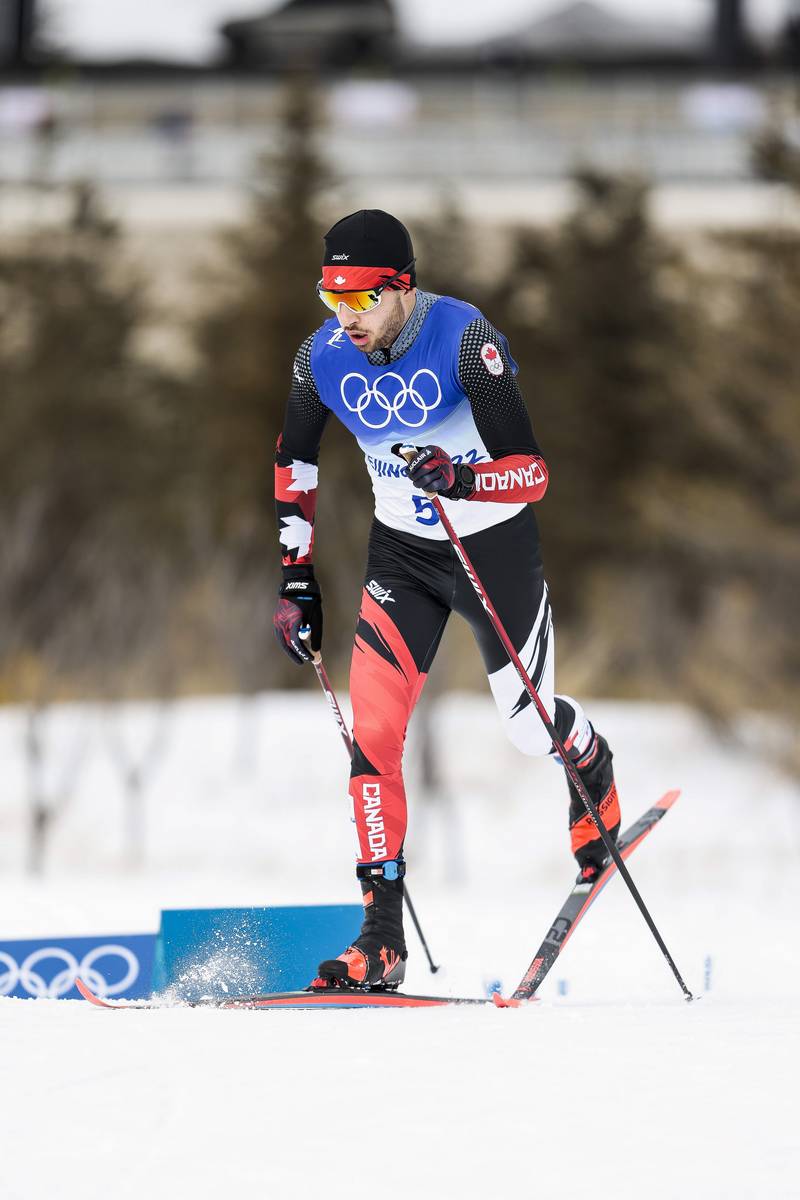
    Heidi Weng at the start with Norwegian teammate Ingvild Flugstad Østberg behind her in the FIS season-opening race in Beitostølen, Norway. (Photo: Aleks Tangen)
    Heidi Weng at the start with Norwegian teammate Ingvild Flugstad Østberg behind her in the FIS season-opening race in Beitostølen, Norway. (Photo: Aleks Tangen)

    After the race, Østberg told Aftenposten that Johaug gave her some valuable advice just a day earlier. She said they spoke Thursday and Johaug offered some tips, encouraging her to focus on technique rather than worry about her form at this point in the season. Østberg said she told her to go for it and see how things turn out.

    She took that advice to heart and came away with a victory. Østberg said it was strange not having her at the races, but she channeled her inner Johaug and focused on a strong start.

    “It tends to work for her here, then I thought that I should try, too,” Østberg said, according to a translation.

    “I’m usually a little slow in Beitostølen, but not today,” Østberg told NRK. “I had good skis and a body that played along. It was a good day. I’m very happy that I was able to ski well. Of course I got tired toward the end and consequently my technique deteriorated, but I felt that had good control over my opening so I’m happy.”

    Notably, Østberg became the first woman other than Johaug or Bjørgen to win an opening race at Beitostølen since 2003.

    “They would have probably been strong had both been here, but one cannot do anything about those who aren’t here,” she said.

    The Norwegian national-team women swept the top nine, with Astrid Uhrenholdt Jacobsen coming on strong in the final third of the race for third place, 1:06.4 behind Østberg. Throughout much of the race, her split times ranked fourth of 55 finishers, behind Østberg, Weng and Kathrine Harsem.

    Afterward, Jacobsen told Aftenposten that she thought she would finish farther back, noting the first races of the season are often the hardest.

    “Third is far above my expectation; I had not thought that I would start there,” she said, according to a translation.

    Ingvild Flugstad Østberg (Norway) out of the start in her country's first FIS race of the 2016/2017 season: the 10 k classic in Beitostølen. (All photos: Aleks Tangen)
    Ingvild Flugstad Østberg (Norway) double poling out of the start in her country’s first FIS race of the 2016/2017 season: the 10 k classic in Beitostølen on Friday.

    At just one point in the day, Østberg’s time ranked second: at 1.2 k, where Harsem was 1.5 seconds faster.

    “I’m a little surprised it worked this well,” Østberg told NRK after the race. “I’ve felt good all through the summer and fall, but during the last week I’ve felt kind of heavy, but then I suppose I just fooled myself.”

    American Cambria McDermott, a former Montana State University skier who graduated this spring, finished the race in 44th, 5:05.3 behind Østberg. After spending the summer training with Henning Skilag and representing the Norwegian club during the race, she told FasterSkier afterward that “it was really cool to see so many fast women. I felt slower by comparison, but it was really fun. It’s an awesome course.”

    McDermott, 23, is currently taking classes at Nord University in Meråker, a small town near Trondheim. When asked about the level of competition in U.S. collegiate skiing compared to Norway’s first FIS race of the season, she said, “I think NCAAs was really good preparation for these kinds of races. There are a lot of international racers at NCAAs and they bring a lot of competition to those races, but here, there are the best skiers in the world in this race, so I think it’s hard to find a race that matches that.”
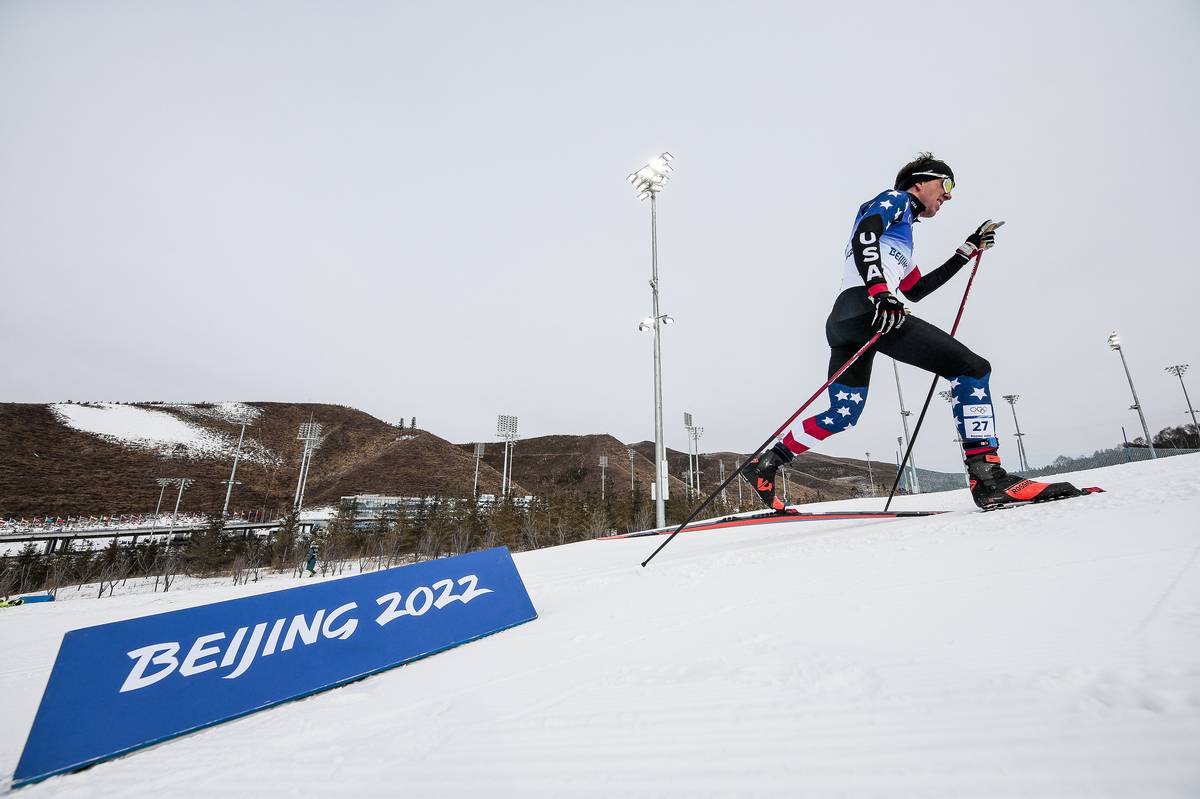
    She’ll continue to race for Henning Skilag in Europe for most of the season, competing in most of the Norwegian and Scandinavian Cups before heading back to the states for U.S. nationals in early January.
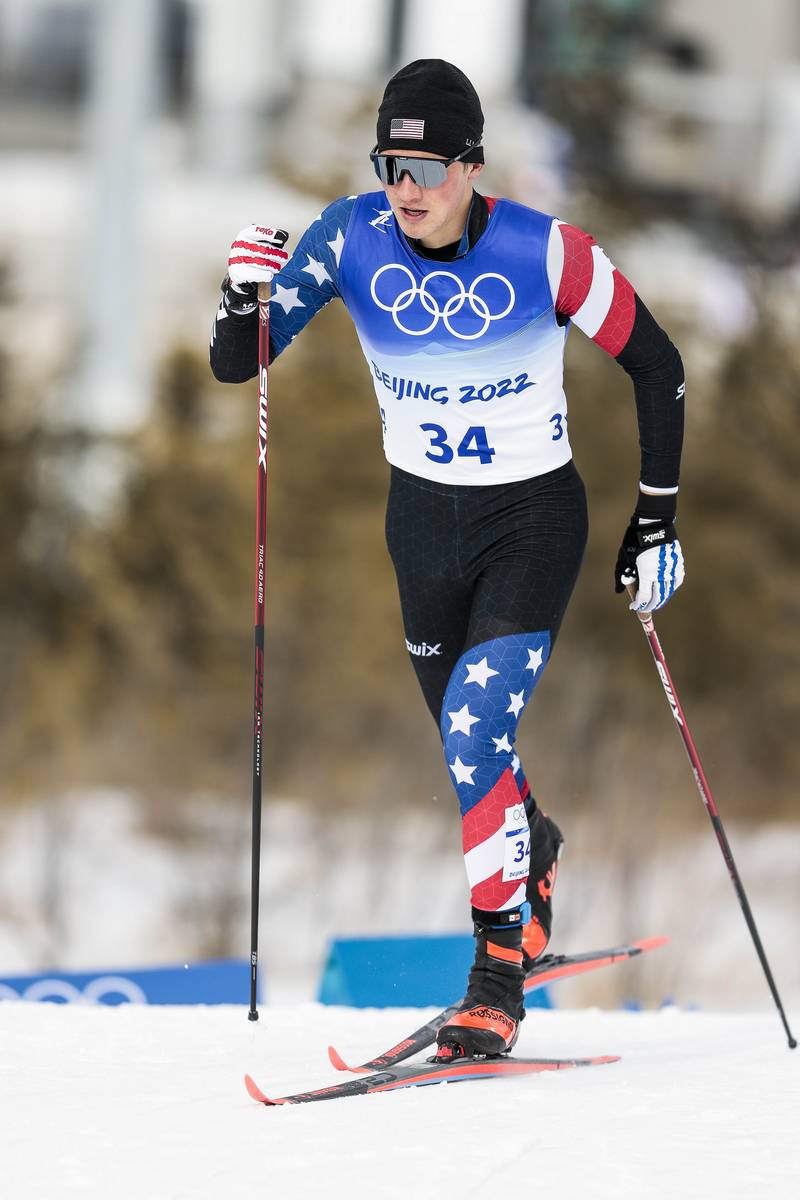
    “I’m excited for tomorrow,” she said of Saturday’s 10 k freestyle in Beitostølen. “I like skating and it’s a little less complicated than classic skiing with the wax and everything.”

    Madison Fraser (Team Hardwood) racing to 50th in the women's 10 k classic FIS race on Friday in Beitostølen, Norway. (Photo: Aleks Tangen)
    Canada’s Madison Fraser (Team Hardwood) racing to 50th in the women’s 10 k classic FIS race on Friday in Beitostølen, Norway. (Photo: Aleks Tangen)

    Canadians Madison Fraser (50th place, +6:33.8) and Isabella Howden (55th, +8:21.6) also competed on Beito’s opening day. After the race, Fraser, of Team Hardwood, said she felt good about her effort.

    “It was the first race I’ve done at this level,” she said. “So, really cool to see my name on the same list as Weng and Østberg, but it was hard, but nice course, really flowy. It felt good to get some intensity in. This is our first race over here.”

    Reflecting on how she tackled the course, the 20-year-old, first-year senior described two big hills at the back of the course.

    “I think that gritting down that extra bit and I was able to stride up the whole thing,” Fraser said. “Some people would hop out and start stepping, which is slower and more energy, so I was happy with that and stepped all the corners, so yeah, I was happy with how I handled everything.”

    When the Cat’s Away… Tønseth Wins

    In the men’s 15 k classic, Norway’s Didrik Tønseth capitalized in the absence of his team’s leading skier, Martin Johnsrud Sundby (out with a sore throat), beating out 140 men while double poling the entire three-lap course to win in 37:31.9.

    Tønseth told NRK after that he was in “disbelief” at the conditions, with a heavy snowfall blanketing the course after the women’s race. He switched to skate skis one minute before the start, and said it worked well.

    “It’s awesome to win … it’s good to put others in their place,” he said, according to a translation.

    Starting 12 minutes earlier than Tønseth in bib 125, Norway’s Tord Asle Gjerdalen also double poled the entire course and rose from the seventh-ranked time at 4.9 k to second at the finish, 15.7 seconds back.

    “It snowed a lot, but I think it was the right decision to skate,” Gjerdalen told NRK, according to a translation.

    “When the cat’s away, the mice will play,” he added, taking a playful dig at Sundby.

    All of the eventual top-six men double poled, with Norway’s Morten Eide Pedersen finishing third (+24.5) after opening with the fastest 4.9 k split, then ranking second at 9.8 k. A fourth Norwegian, Sjur Røthe took fourth (+33.2), Great Britain’s Andrew Musgrave broke up the sweep in fifth (+40.0), and Petter Eliassen (Norway) placed sixth (+45.4).

    Meanwhile, Norwegians Pål Golberg and Petter Northug chose grip wax. While Golberg cracked the top 10 in ninth (+1:19.4), Northug ended up nearly four minutes back in 74th, approaching the finish line with a sedative pace that seemed more like a conscientious choice than a consequence of low physical conditioning.

    After the race, an NRK interviewer said to Northug, “You look very smart for someone who finished 74th.”

    Northug, looking as calm as he did during the final part of the race, answered, “You can interpret that the way you want. I believe I have good control even if it doesn’t look like it.”

    A number of Canadian juniors competed on Friday, with Jack Carlyle, of the Thunder Bay National Development Centre (NDC), leading them in 116th (+5:32.4).

    “The competition is super-fierce, which is super cool to see, but it’s not like they’re super human,” the 23-year-old Carlyle said. “It’s just that they’re very fit and fast, but it’s nothing untouchable, it’s cool to see and be a part of that.”

    “The competition is super-fierce, which is super cool to see, but it’s not like they’re super human.” — Jack Carlyle (Thunder Bay NDC), after placing 116th in Beitostølen

    His NDC teammate, Scott James Hill placed 131st (+6:25.1). Behind him, Ryan Jackson, of Team Hardwood, finished 135th (+7:06.3), Joey Foster (Pierre-Harvey Training Centre) was 139th (+8:17.5), and Kieran Jones (Team Hardwood) was 140th.

    Scott James Hill (NDC Thunder Bay) racing to 131st in the FIS season-opening 15 k classic in Beitostølen, Norway. (Photo: Aleks Tangen)
    Canada’s Scott James Hill (NDC Thunder Bay) racing to 131st in the FIS season-opening 15 k classic in Beitostølen, Norway. (Photo: Aleks Tangen)

    Like his Canadian teammates, Jackson chose kick wax and explained that too much grip probably affected his overall performance.

    “I unfortunately lost a little bit of time on each downhill, which I really couldn’t afford to do,” the 19-year-old from Midhurst, Ontario, said. “I need to be on top of my game to compete with these guys. It’s a tough competition, but when things don’t come together, you lose a couple of seconds here and there, it’s too bad.”

    Asked how he liked the course, Jackson said he loved it.

    “I really liked how balanced it is. There’s a lot of spectators around the course so you’re always seeing people,” he said. “My favorite parts were probably the climbs.”

    Foster described his race as a “real hard one”.

    “My skis weren’t running nearly as quick as I needed them to be,” he said. “I think I went with too much grip and they just started dragging a lot. People were making up big time on me in the downhills.”

    Results: Women | Men

  • Out of ‘Sheer Luck’ Kershaw Able to Race in Gällivare, Wins 15 k

    Out of ‘Sheer Luck’ Kershaw Able to Race in Gällivare, Wins 15 k

    Devon Kershaw (Canadian World Cup Team) competing in the classic sprint at the Ski Tour Canada on March 8 in Canmore, Alberta. (Photo: Fischer/NordicFocus)
    Devon Kershaw (Canadian World Cup Team) competing in the classic sprint at the 2016 Ski Tour Canada in March in Canmore, Alberta. (Photo: Fischer/NordicFocus)

    When race organizers in Gällivare, Sweden, decided to change the date of their pre-World Cup race series by a week, Canada’s Devon Kershaw lucked out. For the past couple of seasons, most of the Canadian World Cup Team has spent their final days before the start of the race season skiing and competing in Gällivare.

    Once again, the team planned to travel 100 kilometers north of the Arctic Circle for a pre-World Cup camp, booking their plane tickets to Sweden for the week of Nov. 19 — when the city’s races were originally slated to take place.

    However, due to a scheduling conflict with Sweden’s annual early season races in Bruksvallarna, the Gällivare race dates moved up a weekend, leaving only one of Canada’s cross-country athletes the option to race in Gällivare.

    “Since I am based in Oslo, it was just sheer luck that we hadn’t booked my flight yet (from Oslo up here to Gällivare) when those changes took place,” Kershaw, who lives just outside of Oslo, Norway, with his wife Kristin Størmer Steira, wrote in an email. “So I asked to come up a few days earlier than the team to get a chance to race.”

    With the help of Canadian head wax tech Yves Bilodeau, who lives in France and was able to join Kershaw, the 33-year-old Kershaw won Sunday’s 15 k classic individual start in 35:18, besting the runner-up, Petr Knop of the Czech Republic, by a minute. Michal Novak, also of the Czech Republic, placed third, (+1:05).

    Though only 11 senior men entered Sunday’s 15 k, which wasn’t an International Ski Federation (FIS) sanctioned race, Kershaw indicated that from his standpoint, putting on a race bib and bringing his body back into racing was important.  

    “Being a slow-starter at times with regards to World Cup period #1 in my career (I have never been on the podium on the World Cup prior to Christmas) the biggest focus was just to put a bib on and blow out the cobwebs,” Kershaw wrote. “It’s nice to get nervous, test skis properly, and go through a whole routine around an organized race. In the race itself I focus on skiing technically well, being present and just being as efficient as I can be when my body is screaming to stop.”

    Kershaw explained that he lucked out even more with getting into the Gällivare races, as they would be his only opportunity to for a preseason on-snow race this season.

    “Time trials are great workouts, but for me I really believe that nothing replicates racing and have always have benefited from getting in some ‘lower key’ races before starting off on the World Cup,” he wrote. “This season [the Gällivare 15 k] will be the only race I get to do before the World Cup starts.”

    In a post-race interview, Kershaw told Langd.se that he benefited from some summer training with Norway’s Martin Johnsrud Sundby and Sweden’s Martin Johansson, who lives in Norway. On Sunday, Kershaw took control of the race early, leading the first of four 3.75 k laps by more than 20 seconds over his nearest competitor.

    “It was amazingly good conditions today, the body responded as it should and the skis were really good,” he said.

    Kershaw arrived in Sweden late last Friday and will remain there until the rest of the Canadian World Cup team (except Alex Harvey, U25 Team skier Cendrine Browne and coach Louis Bouchard, who are training in Davos, Switzerland) joins him on Nov. 23. Then they’ll drive as a group to Kuusamo, Finland, where the opening World Cup will be held Nov. 26-27.

    “Of course it would perhaps be nice to start the year with really competitive races in Beitostølen or Bruksvallarna (like we have done many times in the past), but with our budget having been absolutely decimated these last couple years it’s no longer realistic and/or viable,” Kershaw wrote. “The fact that we can en-masse drive to Kuusamo for the World Cups saves our team bundles of money that we can then use to support the World Cup racing as best we can.”

    Results

  • Ogden 13th, Kern 18th in Junior Worlds 5 k Classic; Good 11th in NoCo Opener

    Ogden 13th, Kern 18th in Junior Worlds 5 k Classic; Good 11th in NoCo Opener

    Katharine Ogden didn’t worry too much about the slush at Junior World Championships on Tuesday. She tested her skis once, remained confident in her kick and resolved to “hammer the whole thing” because 5 kilometers is pretty short, the 18-year-old Stratton Mountain School and U.S. Ski Team D-team member explained in an email.

    “I didn’t notice too much of a change in the conditions between laps, although by my second lap I’m not sure I would have noticed much, it was definitely a sufferfest out there,” she wrote.

    Ogden raced to 13th in the 5 k classic individual start on the second day of U23/Junior World Championships in Rasnov, Romania, leading the U.S. team on a classic distance day with temperatures in the mid-to-upper 50 degrees Fahrenheit.

    American Katharine Ogden (6), of the Stratton Mountain School and U.S. Ski Team, chases Germany’s Antonia Fraebel during the junior women’s 5 k classic at the Junior World Championships on Tuesday in Rasnov, Romania. (Photo: FIS Nordic JWSC & U23 WSC)
    American Katharine Ogden (6), of the Stratton Mountain School and U.S. Ski Team, chases Germany’s Antonia Fraebel during the junior women’s 5 k classic at the Junior World Championships on Tuesday in Rasnov, Romania. (Photo: FIS Nordic JWSC & U23 WSC)

    The sixth starter, Ogden finished 56.8 seconds behind the winner Marte Mæhlum Johansen of Norway, who completed the two-lap race in 15:34. In Ogden’s second junior world championships, the result was her third best after placing sixth in the 10 k skiathlon and 11th in the 5 k freestyle last year in Almaty, Kazakhstan.

    “I’m psyched about my race and I’m hoping to carry the momentum into the skate 10k which is a much better event for me,” she wrote of Thursday’s race. “I’m mostly focused on the skate race here.”

    When asked how Rasnov compares to Almaty, Ogden explained they are “pretty similar in some ways but completely different in others.

    “Almaty was a huge industrial city while Rasnov is a small rural mountain town,” she wrote. “The low snow has been common to both venues, however the situation is much worse here in Romania. It’s pretty awesome that we get the opportunity to travel to these crazy places and race because neither place is one that I would ordinarily get to experience.”

    Finishing 21.2 second off her teammate’s pace and 1:18 behind the winner, Julia Kern (SMS/USST) notched her second-straight top 20 in as many races at this year’s junior worlds.

    Kern finished 18th, and like Ogden, whose time ranked 18th at the halfway point, Kern sped up on her second lap to improve from the 24th-fastest split at 2.5 k.

    “Honestly, my plan was to feel it out as I went along because when I saw the first starters lap, they looked like they were in a lot of pain and that it was super slow and grueling,” Kern wrote in an email. “I also had talked with my coach Matt Boobar about water ‘feeds’, where he would dump cold water on me while I was racing so I could cool off a little. I found the cold water helped me cool off a little in the heat.”

    She started the race 26th out of almost 80 junior women and felt the conditions were likely similar for everyone: “hot, wet, slow, and slushy,” she wrote.

    “Quickly after I had started out, my body set into a pace automatically that was appropriate,” Kern explained. “Is was so slow out there that it was really hard to go significantly faster without wasting a lot of energy; it was almost like the speed you were going was hard to change. … I definitely didn’t feel like I was having a good race just by how slow I was skiing, but I guess the results showed otherwise.”

    Her goal had been a top 25, so 18th place exceeded that.

    “I am very happy with my result today and pleasantly surprised!” she added. “The coaches had done a great job giving splits out on course, but I knew that when they said I was top 20, there were plenty of fast girls still behind me. It is hard to tell how I feel about the actual race because I don’t think it felt good for anyone; it was all about who could fight through the pain the fastest.”

    Finishing 5.3 seconds behind the winner, Norway’s Lotta Udnes Weng placed second for the second-straight day and Germany’s Antonia Fraebel took third (+10.7).

    Canada's Hannah Mehain racing to 44th in the women 5 k classic on Tuesday at Junior World Championships in Rasnov, Romania. (Photo: FIS Nordic JWSC & U23 WSC 2016/Facebook)
    Canada’s Hannah Mehain racing to 44th in the women 5 k classic on Tuesday at Junior World Championships in Rasnov, Romania. (Photo: FIS Nordic JWSC & U23 WSC 2016/Facebook)

    Canada’s Marie Corriveau placed 37th, 2:04.8 behind the winner, and explained in an email that she found it difficult to push hard in the slushy conditions.

    “I am not used to skiing in those conditions,” Corriveau, of the Pierre-Harvey National Training Centre in Quebec City, wrote. “I know it was the same for everybody, but usually I take advantage because of my good technique, but today it was almost impossible to ski well.

    “I am not feeling bad [about] my race, because i know I gave everything!” she added. “For sure, I would expect better for a 5km classic, but with the circumstances, I am pretty happy with this 37th place!”

    Behind her, Canada’s Hannah Mehain placed 44th, Natalie Hynes was 58th and Sadie White 62nd. For the U.S., Vivian Hett placed 48th, and Leah Lange was 52nd.

    Junior women’s 5 k results

    Three Americans in the U23 men’s 15 k classic finished in the top 30, with Adam Martin of Northern Michigan University leading the way in 23rd. Paddy Caldwell (Dartmouth/SMS/USST) placed 27th and Kyle Bratrud (CXC) was 29th.

    Unlike the junior women, who raced two laps, the men rounded the 2.5 k loop six times. A few men opted to double pole on skate skis and two of them, including Canada’s Julien Locke, were disqualified for violating classic technique.

    “Preparing for this race presented some challenges I haven’t encountered before,” Martin, who previously raced at 2014 Junior World Championships in Val di Fiemme, Italy, wrote in an email. “To preserve snow, race organizers only allowed athletes to ski in short time periods on Sunday and Monday. I don’t think this affected me as I was able to pick my skis and execute the intervals I had planned, but it was definitely something new.”

    A bird's eye view of the race course at U23/Junior World Championships in Rasnov, Romania. (Photo: FIS Nordic JWSC & U23 WSC 2016/Facebook)
    A bird’s eye view of the race course at U23/Junior World Championships in Rasnov, Romania. (Photo: FIS Nordic JWSC & U23 WSC 2016/Facebook)

    The 21st starter out of approximately 70, Martin recalled the snow feeling significantly slower on his third lap.

    “I usually make an effort to start very hard, but considering the conditions, my focus was more on being relaxed at the beginning,” he explained. “I am happy with that strategy because it didn’t take long to feel the effort.”

    Considering this was his personal best at a world championships, after placing 26th in the 10 k classic at 2014 junior worlds, Martin wrote that it felt great to improve.

    “But to be honest it’s hard for me to celebrate too much when there are 22 guys beating me by up to three minutes at the event,” he added after finishing 3:02.2 behind the winner, Jens Burman of Sweden, who took gold in 40:02.

    Russia’s Alexey Chervotkin was 26.8 seconds back in second place, and Norway’s Mikael Gunnulfsen placed third (+36.6).

    In an email to FasterSkier, U.S. Ski Team Chris Grover recently explained that Martin had turned down World Cup starts for the Ski Tour Canada. In his place, there is one opening on the men’s roster that can be filled with an “outstanding performance” at U23 World Championships.
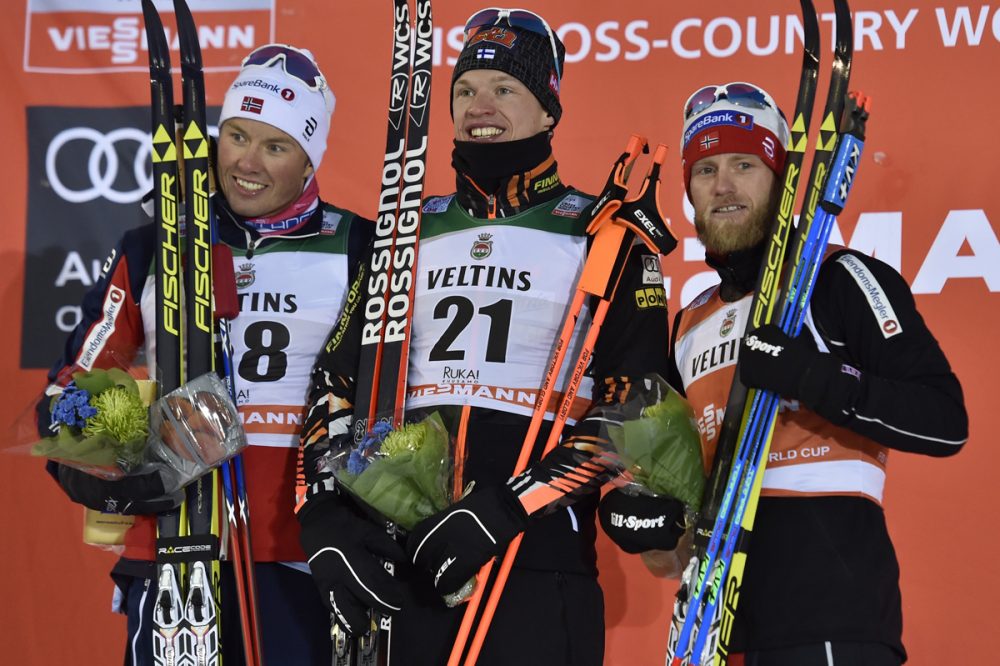
    “As a collegiate skier … I think in some sense NCAAs is my only obligation each year for NMU,” Martin wrote of his decision to decline the spot. “Furthermore, I think I have some improvements I need to make especially in sprinting before I am ready to race a World Cup. Finally, I’m very excited to race some fast guys at NCAAs in a few weeks; I think they will be very high quality competitions.”
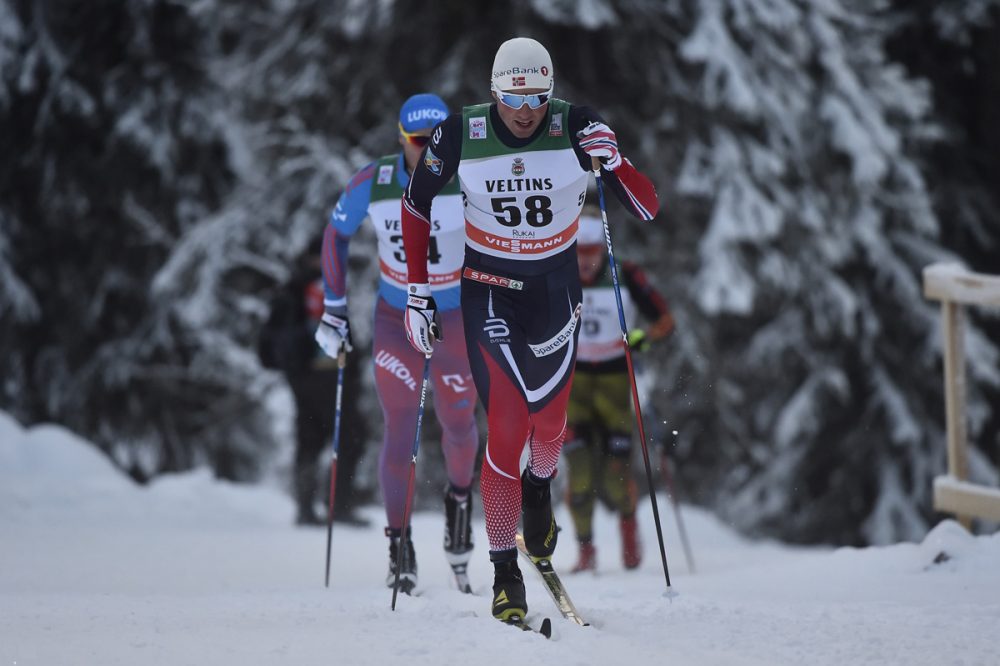
    Finishing 25.2 seconds back from Martin on Tuesday, Caldwell placed 27th (+3:27.4) in his second U23 World Championships (after placing 15th in the 15 k freestyle and 20th in the 30 k skiathlon in Almaty last year). He started 19th and hung in the top 30 throughout his six laps.

    Also in his second appearance at U23 worlds, Bratrud, in bib 22, notched his second-career top 30 after placing 19th in the 15 k freestyle last year. On Tuesday, he finished 3:46.1 back after posting faster splits earlier in the race.

    Canada’s Scott James Hill racing to 36th in the men's 15 k classic at U23 World Championships in Rasnov, Romania.  (Photo: FIS Nordic JWSC & U23 WSC 2016/Facebook)
    Canada’s Scott James Hill racing to 36th in the men’s 15 k classic at U23 World Championships in Rasnov, Romania. (Photo: FIS Nordic JWSC & U23 WSC 2016/Facebook)

    “The race course today was pretty insane,” Bratrud wrote. “Originally it resembled Eagle glacier [in Alaska] which had me pretty stoked but as the race went on it broke down pretty bad. I’m not sure I have ever raced in conditions like that. Definitely an experience. Maybe the longest 15k I have ever done, at least feeling wise.

    “I have been targeting these races my whole season so I was definitely disappointed with my result, but all things considered I am not super worried,” the 23-year-old Minnesota native added. “I didn’t feel great warming up and I generally don’t classic well in these type of conditions nor have I raced on them this year or more then a handful of times in my entire career. The wax techs worked extremely hard to give us great skis in these extremely challenging conditions. I am really looking forward to the skate race and the races moving forward [this season] in Germany and Italy.”

    About 16 seconds outside the top 30, Canada’s Scott James Hill placed 36th (+4:03.3), Jack Carlyle was 42nd, and Alexis Dumas finished 53rd.

    American Logan Hanneman was 55th, coming off 15th place in the freestyle sprint on Monday. He started 53rd, the latest of the North Americans aside from Locke, of Canada, who started 59th but was disqualified for skating.

    U23 men’s 15 k results

    In the junior men’s 10 k classic, Norway’s Johannes Høsflot Klæbo claimed his second-straight gold in 28:57.8. Coming off three medals at the Youth Olympic Games, South Korea’s Magnus Kim (who is half Norwegian) placed second, 11.2 seconds back, and Finland’s Lauri Lepisto earned bronze (+25.4).

    American Cully Brown finished 35th (+2:01.9), Ian Torchia was 43rd, Thomas O’Harra 54th, and Henry Harmeyer 65th for the U.S.

    Ryan Jackson was the top Canadian in 46th, followed by Antoine Blais in 52nd, Joey Foster in 56th, and Philippe Boucher in 67th.

    Junior men’s 10 k results

    In the U23 women’s 10 k classic, Heather Mooney, a former Middlebury skier, was the top American in 38th (+4:27), just ahead of Canada’s Frédérique Vezina in 39th (+4:31).

    Russia’s Anastasia Sedova won gold in 28:49.4, while Germany’s Victoria Carl finished 13.1 seconds back in second, and Petra Novakova of the Czech Republic was third (+17).

    Also for the U.S., Kristen Bourne placed 40th, Felicia Gesior was 42nd, and Kelsey Phinney 44th.

    Canada’s Kendra Murray finished between Gesior and Phinney in 43rd, Jenn Jackson was 45th and Sophie Carrier-Laforte was 46th.

    U23 women’s 10 k results

    Jasper Good (U.S. Nordic Combined) racing to a career-best 11th in his fourth Junior World Championships on Tuesday in Rasnov, Romania. (Photo:  Romina Eggert/Facebook)
    Jasper Good (U.S. Nordic Combined) racing to a career-best 11th in his fourth Junior World Championships on Tuesday in Rasnov, Romania. (Photo: Romina Eggert/Facebook)

    Also on Tuesday, 19-year-old Jasper Good raced to 11th for U.S. Nordic Combined in the normal hill/10 k Gundersen. In his fourth Junior World Championships, it was his first individual top 20.

    Fifteenth on the hill, he posted the 13th-fastest ski time to finish 11th, 3:48.9 behind the winner, Austria’s Bernhard Flaschberger. Germany’s Vinzenz Geiger crossed the line nearly a minute later in second (+59.6). Germany’s Terence Weber held onto third (+1:08.5) by three-tenths of a second over Eero Hirvonen of Finland in fourth.

    “This year’s World Junior Championships are full of schedule changes and an extreme lack of snow here in Rasnov,” Good wrote on his Facebook page. “We were able to get the first individual competition off yesterday and I had a career best finish of 11th place! I didn’t ski my best race, but I was able to move up from 15th after jumping! I’m happy with this and excited to improve in the next competition! “

    Also for the U.S., Stephen Schumann placed 31st, Jared Shumate was 37th and Koby Vargas 44th.

    Nordic Combined results

    Racing continues Thursday with the cross-country 10/15 k freestyle individual starts, replacing the skiathlons. Friday’s junior relays have been shortened to 4 x 2.5 k for the women (and remain 4 x 5 k for the men), and Wednesday’s nordic combined event was postponed.

    Nordic combined has two remaining competitions: the normal hill/5 k on Thursday and normal hill/4 x 5 k team event on Friday.

    Organizers unload snow onto the course Wednesday during the off-day at U23/Junior World Championships in Rasnov, Romania. (Photo: FIS Nordic JWSC & U23 WSC 2016/Facebook)
    Organizers unload snow onto the course Wednesday during the off-day at U23/Junior World Championships in Rasnov, Romania. (Photo: FIS Nordic JWSC & U23 WSC 2016/Facebook)
  • Patterson Siblings Dominate First Day of U.S. Nationals, Tally 10/15 k Classic Titles

    Patterson Siblings Dominate First Day of U.S. Nationals, Tally 10/15 k Classic Titles

    Alaska Pacific University's Scott Patterson (l) leads Northern Michigan's Adam Martin during the second lap of the men's 15 k classic individual start on Sunday at U.S. nationals in Houghton, Mich. Patterson won the individual start in 40:26.4 and Martin placed third (+20.6).
    Alaska Pacific University’s Scott Patterson (l) leads Northern Michigan’s Adam Martin during the second lap of the men’s 15 k classic individual start on Sunday at U.S. nationals in Houghton, Mich. Patterson won the individual start in 40:26.4 for his first national title and podium, and Martin placed third (+20.6). (Photo: Christopher Schmidt)

    HOUGHTON, Mich. —  The Patterson name echoed through the Michigan Tech stadium all day as both Scott Patterson of Alaska Pacific University (APU) and Caitlin Patterson of the Craftsbury Green Racing Project (CGRP) each took home their first national titles in classic individual starts on the first day of the 2016 U.S. Cross Country Championships.

    Scott Patterson won men’s 15-kilometer morning race in a time of 40:26.4, 19 seconds ahead of Canadian runner-up Kevin Sandau of the Alberta World Cup Academy in Canmore, Alberta.

    “I was personally really excited to see that my brother won this morning,” said 25-year-old Caitlin, who is almost exactly two years older than Scott, after the women’s afternoon race. “That was encouraging, but also a little bit of competition. He was going to give me a pretty hard time if I didn’t match him in that one.”

    Caitlin pulled it off, winning the women’s 10 k by a margin even larger than her brother’s. Her time of 28:58.4 held as 36 seconds faster than her Craftsbury teammate and runner-up Kaitlynn Miller.

    Temperatures hovered in the low 20s throughout the afternoon, but a chilly northwestern wind prevented it from feeling too temperate for Houghton. However, the conditions were a welcome change from the frigid temps and continuous snow of last year’s nationals. The tracks were firm and became a bit glazed through the day.

    Racers continually commended the race organizers and groomers for the impressive course conditions given the limited snow. A total of 199 men and 151 women competed on Sunday.

    Scott P. Tops Surprise Podium

    The men's 15 k classic podium on the first day of 2016 U.S. nationals in Houghton, Mich., with winner Scott Patterson (c) of APU, Canadian Kevin Sandau (l) of the AWCA in second, andAdam Martin (r) of NMU in third.
    The men’s 15 k classic podium on the first day of 2016 U.S. nationals in Houghton, Mich., with winner Scott Patterson (c) of APU, Canadian cowboy-hat wielding Kevin Sandau (l) of the AWCA in second, and Adam Martin (r) of NMU in third.

    Even the most avid U.S. nordic fans probably couldn’t have accurately predicted the men’s podium for the first distance race of the championships.

    The deep field with 20 A-seeded starters meant that several combinations of skiers could potentially land on the podium.

    Despite the field, Scott Patterson’s victory was hardly a surprise. The 23 year old, who turns 24 on Jan. 28, was among the favorites to win as the current men’s SuperTour leader.

    In his first full-time season on the domestic circuit, Scott quickly rose to the top of the Period 1 SuperTour overall standings, thus earning World Cup starts with the U.S. team beginning Jan. 23 in Nove Mesto, Czech Republic.

    “I’m know I’m pretty fit and I’m heading over to the World Cup after nationals,” he explained. “I knew I could win so it was just a matter of executing and I did it today.”

    Still, this was his first U.S. nationals podium and best nationals result since placing eighth in the 30 k classic mass start last year.

    He got off to what he considered a slow start, but around 3 k, Scott said he “found the fight” and picked up the pace from the low part of the course back up to the stadium.

    “By the first lap, I was in first and just hung on and skied strong,” he said.

    Scott credited the race organizers for great course conditions, but described it as “a bit too flat” for his personal optimal course. Although the Michigan Tech Trails are rarely described as flat, runner-up Sandau echoed this sentiment.

    Canadian Kevin Sandau (Alberta World Cup Academy) racing to second place in the men's 15 k classic individual start on Sunday at U.S. nationals in Houghton, Mich. (Photo: Christopher Schmidt)
    Canadian Kevin Sandau (Alberta World Cup Academy) racing to second place in the men’s 15 k classic individual start on Sunday at U.S. nationals in Houghton, Mich. (Photo: Christopher Schmidt)

    “The course is really flat for me, which is not my strong suit, but I got into a good rhythm after the first lap,” Sandau said. “I’m happy, second place is pretty sweet for U.S. nationals.”

    After winning every distance race in the Canadian NorAm series this season, Sandau said the U.S. championships became his next focus.

    “Since it is low elevation, my game plan was to just go as hard as I can from the start and trust the fitness.”

    Sandau brought a flair of the wild west to Houghton as his cowboy hat was a unique site amid the ski caps and headbands at the awards ceremony.

    “We are right outside of Calgary, and when the [Alberta World Cup Academy] team formed in 2008 it had a big cowboy theme,” Sandau explained.

    Northern Michigan University’s Adam Martin rounded out the podium, finishing just 1.6 seconds back from Sandau. Martin was also the top U23 skier.

    “This was the first real classic race I’ve done because of low-snow conditions so I just went out there to see what I could do,” the 21 year old said.

    Although Martin has had limited time on snow compared to many of his competitors, he didn’t feel like it held him back.

    “We’ve done a ton of rollerski time trials this fall which I think are pretty representative of skiing and the last couple weeks I’ve found snow,” he explained.

    His finish today marks his first top 10 at nationals. His best result was previously 12th place a year ago in the 30 k classic mass start in Houghton.

    “That was the best race I’ve had in a long time, without a doubt,” Martin said. “It was a pretty unbelievable race, I’m honored to be on the podium with these guys.”

    Alaska Pacific University's Eric Packer was the third American and fourth overall in the men's 15 k classic on Sunday at U.S. nationals in Houghton, Mich. (Photo: Christopher Schmidt)
    Alaska Pacific University’s Eric Packer was the third American and fourth overall in the men’s 15 k classic on Sunday at U.S. nationals in Houghton, Mich. (Photo: Christopher Schmidt)

    APU put two in the men’s top four (and three on the American podium, not counting Sandau) with Eric Packer in fourth (+31.7).

    “I love the trails here,” Packer said. “Back in 2006, this was where I won my first Junior National championship so I have fond memories here. It was nice to be able to ski on some faster snow here compared to last year.”

    Brian Gregg (Team Gregg) and Kris Freeman (Freebird) finished fifth (+8.1) and sixth (+9.1), respectively. Freeman recently returned from starting the season on the World Cup in Europe. Gregg also earned a World Cup start in Davos, Switzerland, after a win in the first SuperTour distance race of the season in West Yellowstone, Mont.

    Also landing in the top 10, Ian Torchia (NMU) placed seventh, Lex Treinen (APU) was eighth, Matt Liebsch (Gear West) ninth, and Canadian Michael Somppi (NDC Thunder Bay) 10th. Last year’s NorAm winner, Somppi spent November and December with the Canadian World Cup Team in Europe.

    Men’s results

    Craftsbury Women Go 1-2

    When Craftsbury head coach Pepa Miloucheva describes a day as “incredible,” you know something special happened.

    That something special was Caitlin Patterson and Miller placing first and second in Sunday’s women’s race.

    The Craftsbury Green Racing Project women's team: (from l to r) Caitlin Patterson, Kaitlynn Miller, coach Pepa Miloucheva, Liz Guiney, and Heather Mooney after the women's 15 k classic individual start on Sunday at U.S. nationals  in Houghton, Mich.  Patterson and Miller placed first and second, respectively, on Sunday in the women's 10 k classic on Day 1 of U.S. nationals.
    The Craftsbury Green Racing Project women’s team: (from l to r) Caitlin Patterson, Kaitlynn Miller, coach Pepa Miloucheva, Liz Guiney, and Heather Mooney after the women’s 15 k classic individual start on Sunday at U.S. nationals in Houghton, Mich. Patterson and Miller placed first and second, respectively, on Sunday in the women’s 10 k classic on Day 1 of U.S. nationals.

    “Nothing in ski races can ever be planned, but you can hope for something like this,” Caitlin said after notching her first national title and third-career podium at U.S. nationals.

    Interestingly, she’ll turn 26 on Jan. 30, two days after her brother’s birthday. Both skiers grew up in Anchorage, Alaska, and skied for the University of Vermont. After graduating, Caitlin headed to Craftsbury and Scott returned to Alaska to join APU.

    “My skis were very good,” Caitlin said after Sunday’s race. “I knew there were quite a few fast starters in front of me, but also a lot behind. It was racing the clock. Going for it, working every transition and every downhill for everything I could get out of it.”

    Although Caitlin has established herself as a regular on SuperTour podiums, Miller, 24, has made significant strides over the past year at Craftsbury to become a contender as well. This will be Miller’s second season with the team and her result on Sunday marks an improvement from placing 13th in the 20k mass start classic at nationals last year.

    “Classic tends to be my stronger discipline, but I’m still going to go for it in the skate races,” Miller said after achieving her first national podium. “I feel like I’ve been improving in skating so I’m really excited for those events as well.

    “I just felt like I went out there and skied as hard as could and we had really great skis,” she added. “Pepa was a great cheering squad as usual.”

    Caitlin added, “Anything was possible certainly. Both of our classic skiing has been pretty good this year and our wax techs are great at nailing the skis.”

    “It was incredible,” Miloucheva reflected. “Probably one of the best days we’ve had so far and I’m so proud of all of them.”

    From left to right: runner-up Kaitlyn Miller (CGRP), winner Caitlin Patterson (CGRP), and Chelsea Holmes (APU) in third on the podium in the U.S. nationals women's 10 k classic individual start on Sunday in Houghton, Michigan.
    From left to right: runner-up Kaitlyn Miller (CGRP), winner Caitlin Patterson (CGRP), and Chelsea Holmes (APU) in third on the podium in the U.S. nationals women’s 10 k classic individual start on Sunday in Houghton, Michigan.

    Current SuperTour leader Chelsea Holmes (APU) finished third, 1:02.6 back from Caitlin.

    “It was a super-fun course and it was tough day, but I’m happy,” Holmes, 28, said.

    The top U20, Katharine Ogden (Stratton Mountain School) continued her string of strong results, placing fourth overall (+1:05.1). APU had two in the women’s top five with Becca Rorabaugh in fifth (+1:09.0).

    Eliska Hajkova, a coach with the Boulder Nordic Junior Racing Team, placed sixth, Craftsbury had another in the top seven with Liz Guiney in seventh, Anne Hart (SMST2) was eighth, Rosie Frankowski (APU) ninth, and Erika Flowers (SMST2) 10th.

    Racing continues tomorrow with the freestyle sprint. The women’s sprint qualifier begins at 10 a.m. Eastern time and the men’s start at 11 a.m.. Heats will start at 12:30 p.m.

    Women’s results

  • No Skis? No Problem: Kershaw’s Klister-Fudge Start to the Season

    No Skis? No Problem: Kershaw’s Klister-Fudge Start to the Season

    Devon Kershaw racing to 33rd on classic skis (he was one of the few men to stride rather than double pole on skate skis) during the 15 k classic FIS race on Nov. 13 in Beitostølen, Norway. (Photo: Eirik Lund Røer/SKIsport)
    Devon Kershaw racing to 33rd on classic skis (he was one of the few men to stride rather than double pole on skate skis) during the 15-kilometer classic FIS race on Nov. 13 in Beitostølen, Norway. (Photo: Eirik Lund Røer/SKIsport)

    After a dozen years on the World Cup circuit, you would think race logistics would be a breeze for Devon Kershaw. Not the case in Beitostølen, the 32-year-old Canadian National Team member explained.

    In anticipation of his first race of the season, a 15-kilometer classic International Ski Federation (FIS) race in Beitostølen, Norway, last Friday, Kershaw arrived two days early on Wednesday. He did so alone, without any teammates, coaching or waxing support, and worst of all, no skis.

    At one point in the planning process, two of his teammates, Alex Harvey and Jess Cockney, considered a trip to Norway for the season-opening FIS races along with coach Louis Bouchard and the team’s head wax tech Yves Bilodeau. When warm weather threatened to cancel the Beito races, those four decided to head north to Gällivare, Sweden, where the team will race this weekend. Kershaw completely understood, but that left him with some troubleshooting.

    “Driving to Beitostølen I was kind of laughing to myself,” Kershaw, a three-time Olympian and six-time World Championships racer wrote in an email. “It’s not exactly like a running race — there are a lot of moving parts in a ski race — especially a classic race. Not only did I not have equipment or support really, I also had barely skied.”

    The Beito tuneup marked his third time on skis since May “so I felt a little like ‘Bambi on ice’ for the first few laps before I settled into it,” he explained. “Conditions were a bit beat-up/tricky too – so I struggled with the ‘finesse’ out there.”

    The only North American in the race, which was heavily dominated by Norwegians, and included a smattering of German and French skiers, Kershaw placed 33rd out of 134. He finished 2:35.4 minutes behind the winner, Norway’s Sjur Røthe.

    Most everyone in the top 30 double poled, he explained. Kershaw didn’t have the option to.

    He had borrowed skis from a friend of his wife, Kristin Størmer Steira, in Lillehammer: a pair of 2002 Fischers. In Beitostølen, Fischer lent him a pair as well, bringing his fleet total to two. Before the races, he had asked Swix if they could wax his skis, and they agreed.

    “They were fantastic. Not only a huge help — but just really great guys to work with — I was lucky there,” Kershaw wrote. “Hell,  I didn’t even have race suit here or toque to race in.”

    Because the Canadian national team signed a new clothing sponsor this season (Swix), Kershaw had to wait until he met up with coach Justin Wadsworth, who was bringing the uniforms over from Canada. He couldn’t race in his old suit, so Swix gave him a stock black suit and headband to race in instead.

    “That added to the hilarity of the situation, as I was really flying under the radar,” Kershaw wrote.

    With two pairs of skis to test — both classic skis — he opted for klister. Wrong decision, he reflected.

    “I am pretty sure [France’s Maurice] Manificat [who placed 16th] was the only one in the top 30 on wax,” he wrote. “Then me in 33rd after that. Everyone else double poled. It was much faster (to double pole) but having not skied much, and racing on borrowed skis (I only had two pairs of skis total) my options for testing were limited. I didn’t even test double poling to be honest — again, because I didn’t have a lot of choice (instead one pair had klister, the other klister-cover).”

    While he regretted his choice of wax, he explained the rest of the ski world should be well-aware of what’s happening to cross-country skiing.

    “In case there are any doubters left that the sport is changing, [the Beitostølen 15 k] should be the final wake up call. The frying pan between the eyes so to speak,” he wrote. “So many people double poled, over 50-60 guys in the field. They are strong enough to do that on a course with over 400m of ascent over 15km without hesitation — and win big — double poling only.”

    Last season on the World Cup, most of the field double poled the classic races in Davos, Switzerland, and Toblach, Italy. Considering that, and how many men — and Norwegian woman Ingvild Flugstad Østberg— double poled Beito, “there is very little argument that this is something everyone needs to get a lot better or at least more comfortable at doing during races moving forward,” he added. “I would have never imagined this back in 2003/04/05 when I was a young senior. Back then, nobody would have double poled the race (it was funny talking to Anders Aukland about that during our cool down — he brought that up, and I agreed completely) — it’s happened rather quickly if you think about it.”

    At the end of the day, Kershaw had hoped for a top 15, “but that was pretty baseless with regards to my equipment situation and with the fact most double poled — it wasn’t realistic looking back,” he wrote.

    Last February, pneumonia and whooping cough cut Kershaw’s season short. He was sick for several months last spring, which affected the start to his training season May, June and July as well. He was curious to see how he’d feel racing again, and given that this was his first race since January — he was grateful to be out there.

    “My race itself started off horrendously slow and bad. I felt all over the place as I fought to find my rhythm, but as the race progressed I felt more and more together,” he wrote. “I needed another lap out there! It’s obvious I missed my pacing, but also it was mostly a technique thing.… I was switching from kick double pole, to striding, to double pole and back again over and over early in the race and none were working well. Once I settled into the race and decided to double pole pretty much everything, and transition only to striding when the terrain got steeper, did I figure it out.

    “While 33rd doesn’t look like much, I am happy enough with the effort under the circumstances,” he added. “I was happy to have moved faster and faster throughout the race and next stop is Gallivare where I am really looking forward to finally being able to put in some kilometres on snow — which will be both nice and a tad overdue.”

    Sweden’s season-opening FIS races kick off in Gällivare this weekend, with a classic sprint on Saturday and 10/15 k freestyle on Sunday. A week later, the World Cup starts with the Ruka mini tour in Kuusamo, Finland, Nov. 27-29.