From the FasterSkier archive — posts syndicated from athletes’ and coaches’ own blogs between 2004 and 2012, kept online as published. Current coverage is at fasterskier.com.
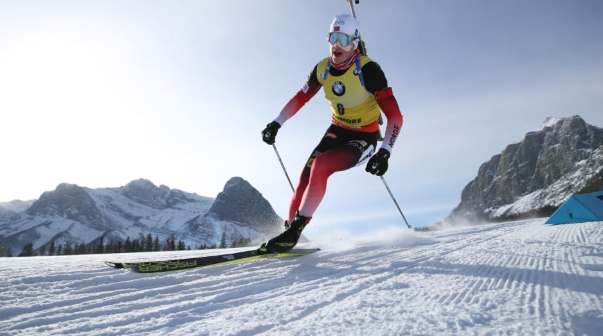
Johannes Thingnes Bø of Norway shot clean and skied fast in Canmore’s 15 k short individual race on Thursday. (Photo: biathlonworld.com screenshot)
IBU World Cup Canmore, Canada 15 k/ 12.5 k Short Individual Races
Sun, mountains, and what may have seemed like relatively warm temps allowed the IBU World Cup events to proceed on Thursday in Canmore, Canada. It’s been Polar Vortex cold in Canmore. Cold enough to thwart the original plans for traditional length 20-kilometer and 15 k individual races, for men and women respectively. With cold temperatures predicted all week, and a window of legal-limit warmer weather punching through on Thursday, the races were shortened to provide enough time during the warming window to hold both races.
For the men, this fill in the blank is easy: _________________ dominated the day in the men’s 15 k short individual race as he shot clean and skied faster than all the others.
Johannes Thingnes Bø of Norway did shoot clean. And he skied fast. And he won in a time of 35:27.9 minutes. For the twenty-four-year-old Bø, it was his 12th win of the season as he continues to cement his grip on the IBU World Cup overall.
His Norwegian teammate Vetle Sjåstad Christiansen, finished second (+2:10.2, 1+0+0+1), with Alexander Loginov in third (+2:41.0, 1+1+0+0).
Canada’s Chirstian Gow posted a career best 10th place. Gow stopped the clock 3:05.4 minutes after the winning time, as he went 0+1+0+0 for a single penalty on the shooting range.
“I didn’t treat the race any differently,” Gow emailed when considering the 15 k format. “It is still an Individual where each penalty is a major set-back so I knew I needed to keep the same focus for the race. It was something new, so a bit more of an unknown going in to it … I actually started a bit harder than I normally would. I wasn’t sure if I could keep the pace going, but in the end I managed it so I’m happy that it worked out!”
For the U.S., Sean Doherty was the second best North American in 27th. Doherty finished 4:29.0 minutes behind, and went 0+1+0+1 on the range.
“Today the shortened format was welcome as the snow conditions were very abrasive and slow. as far as a tactics go the shorter distance is just a bit more aggressive pacing but that’s about it,” Doherty wrote FasterSkier to explain how the shortened race might impact his race strategy.
Much of the past week was prohibitively cold for athletes. Some ventured outdoors for training, with many making due with local gyms and indoor training facilities.
“The cold temperatures as we are dealing with here have some added challenges,” Doherty added. “The biggest one being keeping your hands warm. Lots of people have their own tricks but you usually sacrifice some dexterity in the range but it is necessary because it is even harder to shoot with numb fingers. The other thing you see is the tape on our faces to try to protect frostbite prone areas. Then it’s all about layers and you end up doing a lot of fussing around with all the clothing you are wearing.”
For the U.S., Leif Nordgren raced to 43rd (+5:48.3, 0+1+0+1), Max Durtschi 71st (+7:52.5, 0+2+1+2), Travis Cooper 73rd (+8:01.0, 1+1+1+2).
Also for Canada, Scott Gow placed 40th (+5:42.6), Jules Burnotte 57th (+7:00.2, 3+1+2+0), Aidan Millar 81st (+8:34.0, 2+1+1+2).
The women’s 12.5 k short individual race was run with increasing cloud cover and temperatures hovering around 10 degrees Fahrenheit.
Norway’s Tiril Eckhoff took the win in 36:32.9 minutes with a single penalty. It was Eckhoff’s first career IBU World Cup win in the individual event.
The Czech Republic’s Marketa Davidova raced to second as she cleaned her shooting stages and finished 9.2 seconds back. Lisa Vittozzi of Italy was third, 20.9 seconds behind, while also shooting clean.
Megan Bankes was the top placed Canadian in 26th (+3:14.5, 1+0+1+0). Canmore’s local biathlete Rosanna Crawford was 29th (+3:21.7, 0+1+0+1). Sarah Beaudry was 34th (+3:36.5, 1+0+1+0), and Emma Lunder 63rd (+5:51.3, 1+0+4+1).
Clare Egan was he top American in 43rd (+4:17.5, 1+0+1+2). Joanne Reid skied to 64th (+5:55.9, 0+2+1+1), Emily Dreissigacker 66th (+6:07.1, 0+0+0+2).
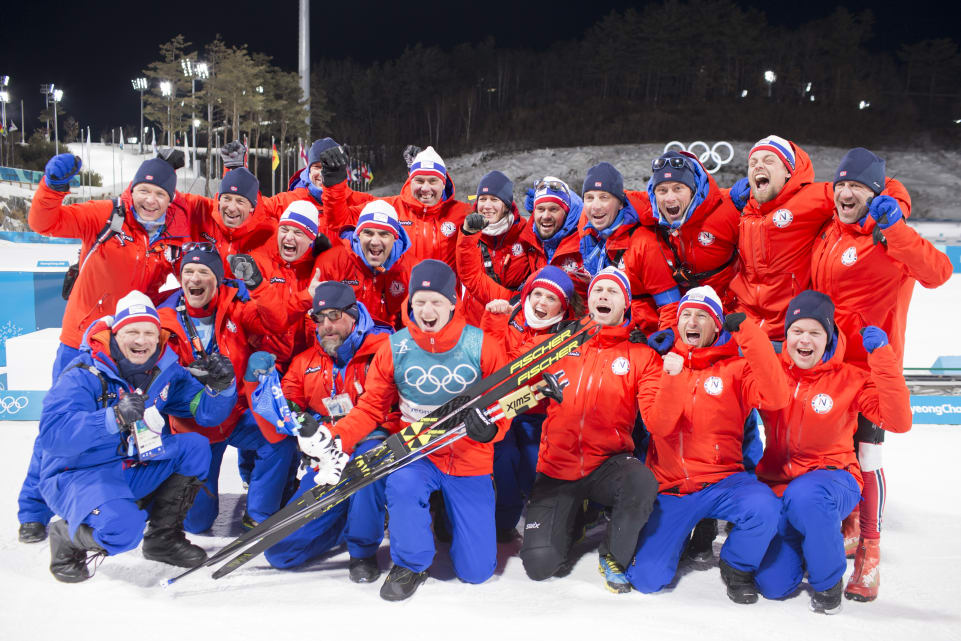
It was a disappointing opening to the Olympics for Johannes Thingnes Bø of Norway, who despite winning eight World Cup races this season started the Games with finishes of 31st and 21st in the sprint and pursuit. But on Thursday he showed why he was a medal favorite and won the 20 k individual race – only by 5.5 seconds, but that margin becomes impressive when you consider that he had two penalties, and thus two minutes of penalty time, while silver and bronze medalists Jakov Fak of Slovenia and Dominik Landertinger of Austria (+14.2) shot clean.
Johannes Thinges Bø celebrates with Norwegian team staff after winning Olympic gold in the 20 k individual despite two missed shots. (Photo: IBU/Biathlonworld.com)
Sweden’s Sebastian Samuelsson followed up a silver medal in the pursuit with fourth place in the individual, missing one shot and notching a time 29.1 seconds behind Bø. France’s Martin Fourcade, gold medalist in the pursuit, missed two shots like Bø but finished in fifth (+42.4). Switzerland’s Benjamin Weger placed sixth (+48.6) with one penalty.
It was a good day for Canada on the back of strong shooting: Scott Gow placed 14th (+2:02.5) with one penalty for a career-best result result; he had previously had two 16th-place finishes on the World Cup this season. With the same shooting, Brendan Green placed 22nd (+2:26.6). Christian Gow had two penalties to finish 26th (+2:57.2). Canada’s fourth man, Nathan Smith, missed five shots and placed 81st (+8:11.9).
For the United States, shooting was not as successful and Tim Burke led the way in 41st (+4:01.9) with four penalties. With one less penalty Sean Doherty was close behind in 44th (+4:21.8). Lowell Bailey placed 51st with four penalties (+4:53.0) and Leif Nordgren missed five shots to finish 66th (+6:27.3).
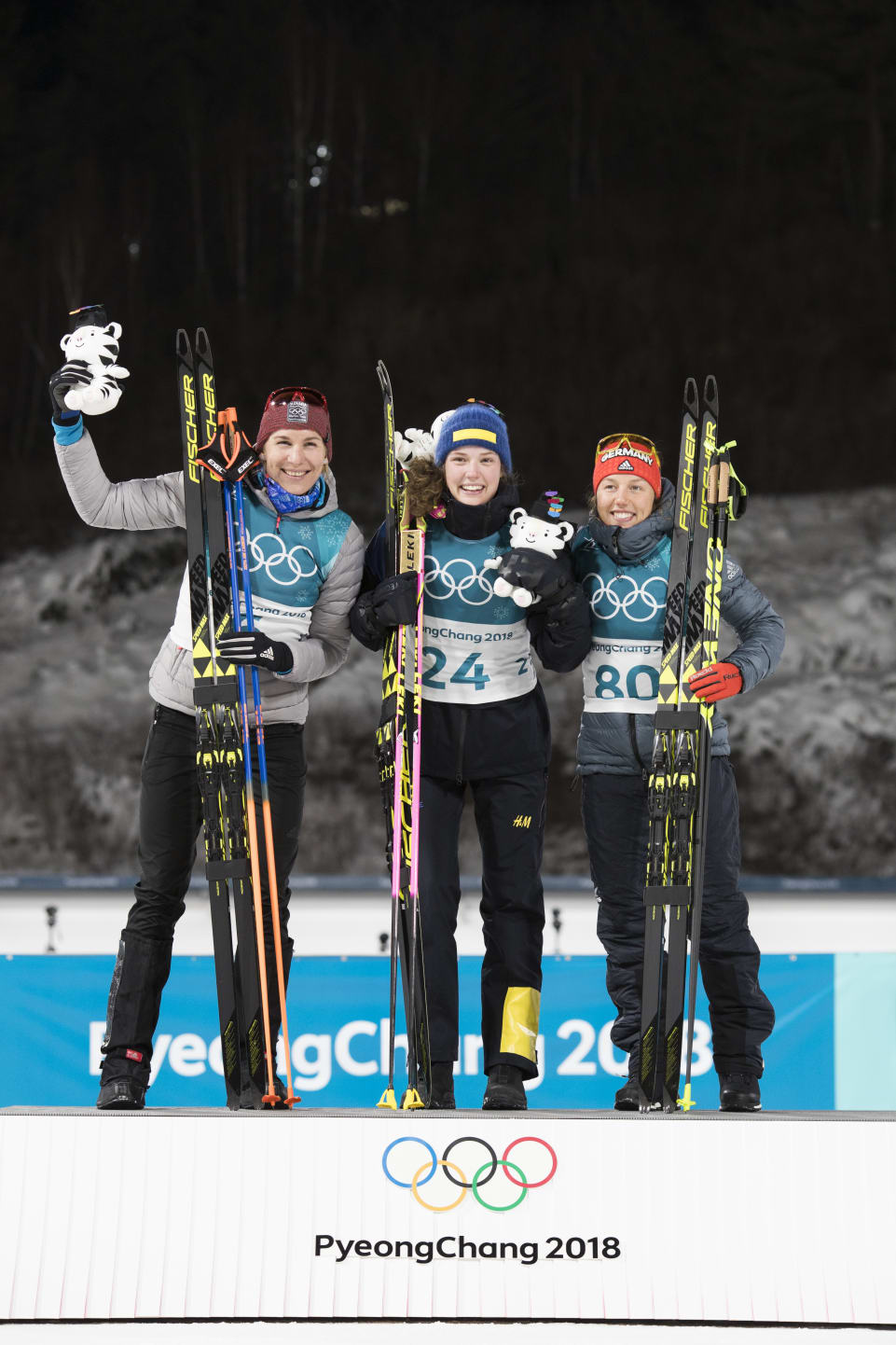
Sweden’s Hanna Oeberg (center) won gold in the biathlon women’s 15 k pursuit, followed by Slovakia’s Anastasiya Kuzmina (left) in silver and Germany’s Laura Dahlmeier in bronze. (Photo: IBU/Biathlonworld.com)
A few days after teammate Samuelson scored a career-best result to earn silver in the pursuit, Hanna Öberg of Sweden used perfect 20-for-20 shooting to capture gold in the women’s 15 k individual. The 22-year-old’s previous best results were fifth place in both Monday’s pursuit, and in a World Cup race last season.
She bested the two pre-race favorites: Anastasiya Kuzmina of Slovakia had two penalties but still managed a silver medal, her second of the games, finishing +24.7. And double gold medalist Laura Dahlmeier of Germany had one penalty and earned bronze (+41.2).
It was a good day for both of those teams as Franziska Preuss of Germany finished fourth, +59.0 with clean shooting, and Paulina Fialkova of Slovakia placed sixth (+1:02.3) with one missed shot. Poland’s Monika Hojnicz finished sixth (+1:54.8) with one missed shot as well.
The United States was led by Susan Dunklee in 19th, with two penalties (+3:26.3). Her teammate Joanne Reid finished 22nd (+3:34.1), her best-ever result in top-level international competition, with just one missed shot. Clare Egan finished 62nd (+6:53.6) and Emily Dreissigacker 67th (+7:09.2) with four penalties apiece.
For Canada, Rosanna Crawford led the way in 26th (+3:48.7) with two penalties and Sarah Beaudry was close behind in 29th (+3:58.4) with one missed shot. Emma Lunder finished 54th (+5:49.4) with three penalties and Julia Ransom was 74th (+8:31.4) with five missed shots.
Montana State University student Johanna Talihärm of Estonia finished 50th (+5:36.8) with three penalties.
Thursday afternoon saw more of the same for the women’s cross-country ski events at this year’s Winter Olympics: Scandinavia filling up the podium, with American Jessie Diggins tantalizingly close to that breakthrough American podium in fifth. This time it was Norwegian Ragnhild Haga in first in the 10 kilometer freestyle individual start, Charlotte Kalla of Sweden in second (+20.3), and Finland’s Krista Pärmäkoski and Norway’s Marit Bjørgen tied for third (+31.9).
The bronze is Bjørgen’s 12th lifetime Olympic medal, moving her into a tie with fellow Norwegian Bjørn Dæhlie for the most Olympic medals won by a cross-country skier. Countryman Ole Einar Bjørndalen, a biathlete, holds the overall Winter Olympics record with 13.
Diggins was 35.2 seconds back of Haga in fifth. She was in seventh place through 1.6 k, up to fifth at 5 k, up to third at 6.2 k, and still in third at the 8.4-k time checkpoint, 1.9 seconds up on Bjørgen and five seconds up on Pärmäkoski. But her form seemed to break down over the final uphill, and Diggins lost just enough time on Bjørgen and Pärmäkoski over the final 1.6 k to slip off the podium.
Between a 4.6-second deficit to third in Saturday’s skiathlon and a 3.3-second gap here, Diggins has now missed two bronze medals by a combined 7.9 seconds over 25 kilometers of racing.
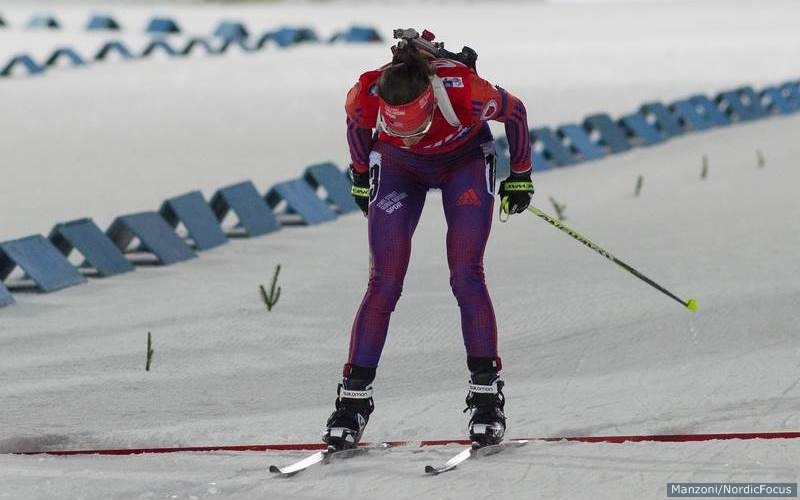
Jessie Diggins pushing to the finish in the Olympic 10 k skate. The American finished fifth. (Photo: FlyingPointRoad)
Sixth place went to Swiss skier Nathalie von Siebenthal (+49.8), who slowed slightly after a fast start that saw her with the second-ranked time through 1.6 k. Ingvild Flugstad Østberg (+1:05.5), in seventh, was the third Norwegian in the top seven.
Olympic Athlete from Russia Anastasia Sedova (+1:07.3), Austrian Teresa Stadlober (+1:15.6), and Olympic Athlete from Russia Anna Nechaevskaya (+1:24.3) rounded out the top ten.
Sadie Bjornsen (+1:42.1) in 15th and Kikkan Randall (+1:49.9) in 16th were the next two Americans. Randall started relatively early with bib number 23, and was the leader in the clubhouse when she crossed the finish line. Liz Stephen (+2:35.4) was 30th.
For the Canadians, Emily Nishikawa (+2:41.) led the way in 32nd. Dahria Beatty (+2:48.4) was 37th, Cendrine Brown (+3:11.9) 43rd, and Anne-Marie Comeau (+4:10.8) 62nd.
Also of note, Australia’s Jessica Yeaton, who lives and trains in Anchorage with Alaska Pacific University, recorded an Olympics personal best finish of 41st (+3:09.1). University of Alaska Anchorage student Casey Wright, also competing for Australia, finished 81st (+6:55.8).
University of Colorado skier and NCAA champion Petra Hyncicova of the Czech Republic finished 60th (+4:09.4). University of New Hampshire alum Annika Taylor of Great Britain finished 75th (+5:52.4).
And Jaqueline Mourau of Brazil, who lives and trains in Quebec, was 74th (+5:49.8).
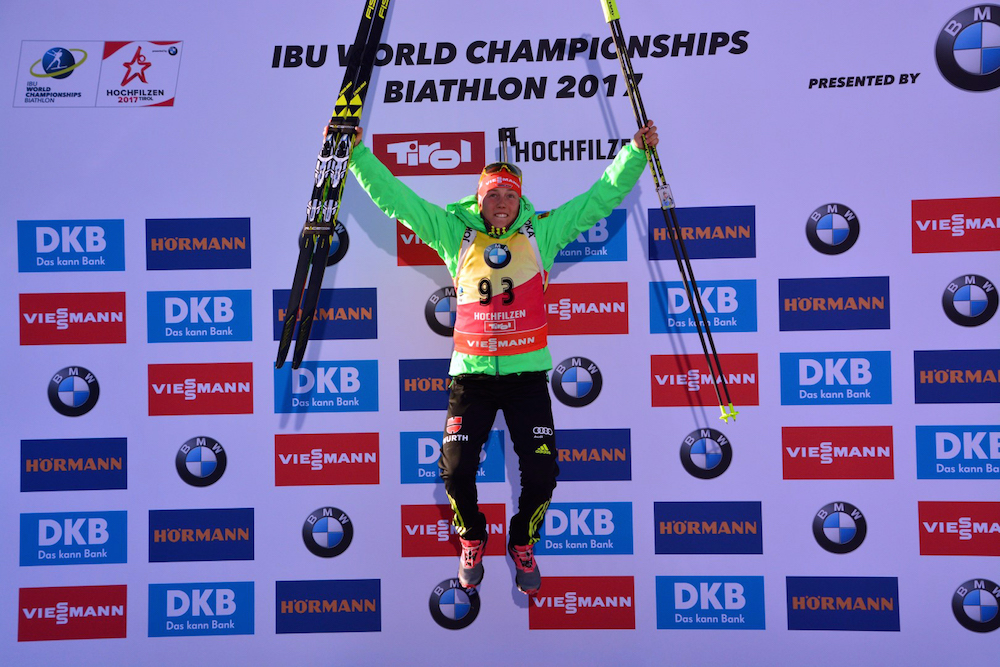
Germany’s Laura Dahlmeier jumps for joy after winning her third gold of the 2017 IBU World Championships, in the 15 k individual. (Photo: Glen Crawford)
HOCHFILZEN, Austria—Every women’s race of the World Championships so far, the question has been: where’s Laura Dahlmeier?
And in every race, the German has has turned in fantastic performances. Close to perfect on the range, fast on her skis, winning a medal each time.
The 15 k individual was no exception. A late starter, Dahlmeier had just one miss, in her first prone stage, and then all was clear as she raced to another gold medal. This time, it was by 24.7 seconds over Gabriela Koukalova of the Czech Republic, the winner of the sprint.
“I think Laura is in amazing shape, and it’s very difficult to beat her,” Koukalova said in a press conference. “Because, what can I say, she is unbelievable. Stronger, faster, better concentration, there is no chance.”
Dahlmeier herself was calm as she concluded something not so different
“It’s a special moment for me — the third gold medal, the fourth [overall] and I think the ninth medal since Oslo [World Championships 2016],” she said. “It’s amazing. One race after the other I can show my best performance, and it’s really great to be on the podium and on the first position.”
Most of the top women started in the last seed group, hoping for the shade to speed up the tracks in the late afternoon. Mari Laukkanen of Finland – who will represent her country at FIS Cross Country World Championships in a few weeks – set the early time to beat, with one missed shot and a blistering ski time.
Her time held up for 25 minutes, until Koukalova crossed the line with one penalty and a faster ski speed. Clean-shooting Alexia Runggaldier of Italy slotted in between them, and finally Dahlmeier’s time knocked everyone down a notch.
“I thought that it could be possible if I shoot clean,” first-time World Championships medalist Runggaldier said. “But then I thought, okay, there are the best people of the whole world that will be competing at this competition. So if I am lucky then I will be good, and if it’s not like this then nothing happens. But I am really happen that I shot four times clean… I think both [Dahlmeier and Koukalova] can shoot four times clean.”
Laukkenen ultimately ended up with the wooden medal, +1:56.8. Fifth place went to Ekaterina Avvakumova (+2:03.6), a Russian who transferred her citizenship to Korea, and sixth (+2:06.7) to Susan Dunklee of the United States.
Other North American results:
Julia Ransom, Canada, 18th Place
Julia Ransom. (Photo: Glen Crawford)
Ransom went into the individual with a brand-new attitude.
“I’ve been sort of frustrated the last couple weekends ,with sickness in Antholz and just having a hard time getting my groove, so I decided today to just leave nothing behind,” she said. “Shoot fast, ski fast, not worry about the consequences. It was just fun racing, so it was awesome.”
The strategy worked: Ransom missed just one shot, and raced to an 18th-place finish (+3:48.2), her best international result to date.
“I think I came in with too many expectations from last year and I forgot to just race because I love it and race for myself and not for carding or not for criteria not for anything, just because it’s super fun,” she said.
Clare Egan, USA, 22nd Place
Egan notched her second top-25 of the Championships, and is turning in some of her best racing ever at this event.
In the individual, she collected another personal best: with just two missed shots, she achieved 90% shooting in a four-stage race for the first time.
Furthermore, she did it by cleaning each of the first three stages. She was pleased that she didn’t completely falla part on the final shooting stage, given that she was in line for perhaps a top-six finish – which would have been a huge personal best – if she had cleaned.
Clare Egan waves to the crowd after crossing the finish line in the top ten. She was later bumped down. (Photo: Glen Crawford)
“After I cleaned my first standing stage, I knew I would have three clean stages because I was so confident about the prone ,” she said. “I’m happy with my last standing, too, I’ve never cleaned three stages of a four-stage race before so I’ve never been in that position before. Of course I could have handled it better, but I’m pretty happy with two misses… I’m totally fine with that. I hit more than I missed. I was a little shaky for sure.”
Egan also had the 26th-fastest ski time. That netted her 22nd place, +3:55.0.
“She is really able to be up there, and I want to see her up there more often,” U.S. Biathlon Association Chief of Sport Bernd Eisenbichler said. “We will work for the next season to have her more constantly up there in the top 20, because I think she can be up there any given day. She is in a higher level for the skiing performance now. There is still too much up and down, but she took a step forward this year.”
Megan Tandy, Canada, 43rd Place
With two missed shots, Tandy ended up +5:14.0. While she was happy with 90% shooting, she wished the effort had netted a better result.
“Actually it was a good race,” she said. “But I have been feeling actually awful this season. I haven’t had a good ski feeling since November… I am starting every race maybe feeling good for 800 meters, and then I am not racing, I am just surviving. Today I had some fight, and I hit 18 so I should be happy. But I am just watching the results list, because for me to qualify for funding [Spot Canada funding] next season I need one more top 30.”
That didn’t happen. But Tandy thought that the tools she had developed to get her through this race, and this season, would continue to serve her well in the future.
“I kind of came into the race prepared to not think about anything but the process,” she said of the pressure for results. “I had really specific keywords for the shooting, both prone and standing, as well as really key tactical goals for the course. When I am standing on the shooting mat I am thinking about trigger pressure and black targets, and those are the only two things in my head.”
Joanne Reid, USA, 56th Place
Reid split a bullet on the last shot of her first stage, but rather than be frustrated, she took responsibility.
“It was way off from the rest of my group, so that was all me,” she laughed.
After starting the season with a sensational performance in the 15 k individual in Österund, Sweden, Reid’s four misses today seemed imperfect. But she refused to let any one shooting stage get to her.
“I come into the range each time ready to focus on that bout,” she said.
That helped her clean the last stage, something she was particularly proud of. She finished +6:36.7, and also had a faster last standing stage than usual, clocking in at 27 seconds.
“I actually do have the speed capability, but I can’t always put all the pieces together yet,” she wrote in an email. “I’ve been working really, really hard at improving the speed over the course of the season, but it never seems like the time to implement it in a race. There’s always teammates counting on me, or an individual in which you have a minute penalty per miss, or the sprint in which you must make the pursuit, or the pursuit in which you aren’t supposed to miss the prone targets, or…. or…. or. This stage today was quite fast, and was all in the prone ring, and so was my fast standing stage in the pursuit (all in the prone ring). I think I have to trust myself.”
Rosanna Crawford, Canada, 62nd Place
Crawford had a rough start to her race: three missed shots in prone, right off the bat.
Rosanna Crawford. (Photo: Glen Crawford)
“That was so strange!” she said. “Usually my prone goes well, and this was just all over the place. I don’t know what happened. But actually, I find that when I miss early, it’s easy to get it turned around because the pressure is totally off.”
She did turn her shooting around, cleaning each of the next three stages. But her skiing time was not enough to make up for the missed shots and Crawford finished +7:01.5.
“15 k is really hard for me, and when it’s hot – I just can’t handle the heat,” she said. “So it was tough.”
Emma Lunder, Canada, 64th Place
Lunder had one more missed shot than her teammate, and finished +7:17.9.
“It had good and bad parts,” she said. “I missed two in my first shooting, so that was a little bit tough, trying not to think about that while I was skiing. And then the rest of my shooting I was a lot happier with, but then to miss one in the last bout – I was just so tired… it was such a hot race, and everyone was out there just dying. It was a good effort for sure.”
Maddie Phaneuf, USA, 87th Place
It was the second competition of World Championships for Phaneuf, a first-year-senior who had made the Championships a major goal.
“I felt like coming into it I was going to feel so overwhelmed, but it just kind of feels normal, like another World Cup,” Phaneuf said. “In the beginning of the season, I haven’t had that many World Cup starts, it was just so overwhelming and I wasn’t quite ready to experience it. But now that I’ve done a handful of them this season, it feels much more comfortable and I feel like I deserve to be here, which is exciting.”
Normally a strong shooter, Phaneuf missed two shots in each of her standing stages. That left her with 87th place overall, 9:38.3 behind the pace set by Dahlmeier.
“Recently I’ve just been struggling with my standing,” she said. “I’ve been hitting the targets in training but in the races I keep missing two every time. It’s really annoying. I think I shoot clean in prone and then I come into the range [for standing] and I try not to think about the result, but I need to figure out how to push that out of my head because it keeps messing me up.”
Eisenbichler saw this as a learning experience for the youngest member of the U.S. women’s team.
“Maddie is here to learn, more or less,” he said. “For sure we want to have great results for her as well, but it’s her first World Championships in the senior category. We must work on the [skiing] shape. She’s a strong shooter, she can shoot clean on any given day in an individual race, but the shape needs some work, this was obvious today again. We will make sure that we approach this with the right tactics for the next season.”
U.S. biathlete Susan Dunklee after finishing sixth in the 15 k individual at World Championships. (Photo: Glen Grawford)
Stay tuned for further reporting from the women’s 15 k individual race, to be posted later today.
HOCHFILZEN, Austria—Sixth place? Not a bad way to turn things around halfway through a week-and-a-half long World Championships.
After all, Susan Dunklee didn’t have the start she wanted at World Championships, finishing in the mid-20’s in the sprint and the pursuit. Not bad results exactly, but for the most successful U.S. woman in the history of the sport, they left something to be desired.
Yet even through those races, Dunklee knew that there wasn’t anything wrong with her racing or her biathlon process. In some ways, the pair of racing experiences reinforced her resolve.
“Honestly, I think after having the first couple races done I just started feeling a little bit more relaxed,” Dunklee said. “Okay, so I don’t have to have a good result when I show up. I just have to do my job, and I don’t have control over what the results are going to be, I can only control what I am doing in the moment. And I did that those early races. It didn’t go as well as I wanted, but it was good work and I have to accept that.”
Come Wednesday, and the 15 k individual, she was ready to do more good work and reap the rewards.
The unique race format, where missed shots accrue a one-minute time penalty rather than a trip to the penalty loop, has provided Dunklee some of her best Championships results, including fifth place in Ruhpolding in 2012. But paradoxically, it has been her worst discipline this season: no better finish than 71st this season.
“I think it took the pressure off,” Dunklee mused. “I knew I didn’t have to do a lot to beat that.”
The monkey is now off her back. With just two penalties, Dunklee finished sixth today, 2:06.8 behind German winner Laura Dahlmeier, who had one penalty.
“It was a great comeback,” U.S. Biathlon Association Chief of Sport Bernd Eisenbichler said. “I think that with the two misses today she can be satisfied. There’s really high pressure on her, she really wants to be up there, and she belongs up there, and I think today she proved that.”
“I do a lot of race visualization in training, and today I just tried to pretend I was doing a race visualization,” Dunklee said.
Like many of the other top women, Dunklee picked the last seed group. With constant sun in Sudtirol and the weather in the stadium reaching the mid-40’s (Fahrenheit), much of the course was getting slow. But late in the day when sections of the trail were shaded, things began to speed up.
Dunklee said it had been the right call.
“There was a little bit more shade, and the shade was fastest, so that was helpful,” she said. “It was a little bit deeper [in some places], but I think it was beneficial to have the shade and that outweighed it.”
Starting nearly last – 98 out of 99 starters – she had a strange race-day experience.
“A lot of sitting around beforehand,” she said. “I am not used to that… I felt like the steam of energy in the stadium had kind of died down a little bit by the time I started.”
It also meant that when she missed one shot in the very first stage, she was knocked way back in the standings – to 38th. But cleaning the next two stages brought her back up and by the time she left the range the third time, she was in podium position.
It was not to be, though, as Dunklee missed a shot in the last standing stage.
“Sometimes you can feel it, sometimes you can’t,” Dunklee said. “I didn’t feel any of the misses today, they felt like good shots. I feel good about what I did.”
Dunklee got the details, though, clocking in the fourth-fastest shooting time and seventh-fastest ski time.
“The [skiing] shape is on a higher level now than we saw in January, so that is good to see,” Eisenbichler said.
The result should qualify her for the 2018 Olympic Games, and she will join teammate Lowell Bailey to make the very first pair of athletes named to the U.S. Olympic Team. U.S. Biathlon has a criteria that any athlete with a top-six World Championships result in the prior season is automatically selected. That’s never applied to more than one athlete before, and many years there are no such performances.
Dunklee says that such a system, which allows top athletes to qualify a whole year ahead of time, makes sense.
“It takes a lot of pressure off, and allows you to just focus on your training,” Dunklee said. “If you have to try out and qualify extra you have to taper a little bit for those qualification races, and I have the luxury of being able to just train through and make my peak ready for the Olympics… I think it’s good for us.”
And that gives the U.S. three top-six finishes in five days at World Championships, easily a best-ever team tally.
“Now we are hungry for even more, that’s for sure,” Eisenbichler said. “We still have the mass start and I think with that skiing shape and that shooting we can go for even more. That’s the goal for now.”
Italy’s Dorothea Wierer racing to the second IBU World Cup win of her career in the women’s 15 k individual in Ruhpolding, Germany. (Photo: IBU/Ernst Wukits)
The next time the women’s 15-kilometer individual race is scheduled on the IBU’s World Cup competition calendar will be at the 2016 World Championships in March in Oslo, Norway.
Italy’s Dorothea Wierer will be one of the favorites there after winning Thursday’s 15 k individual World Cup race in Ruhpolding, Germany, in 40:19.9 minutes, and thereby repeating her success in the same discipline from earlier this season in Östersund, Sweden. The 25 year old shot with both speed and accuracy to clean all 20 targets, securing the second World Cup victory of her career.
All biathlon races are heavily influenced by shooting, but in the somewhat old-fashioned individual discipline, misses are that much worse. Each missed target tags one minute onto the competitor’s time, in place of them skiing a penalty lap or being allowed to use spare rounds. This steep penalty leads many athletes to shoot more deliberately than in a sprint, for example. Not so for Wierer.
Italy’s Dorothea Wierer after notching the second IBU World Cup win of her career in the women’s 15 k individual in Ruhpolding, Germany. (Photo: IBU/Ernst Wukits)
“I usually shoot zero [misses] when I shoot faster, I don’t know why,” Wierer told Germany’s ZDF, with a laugh. “Maybe because I don’t think about it, it just works all by itself.”
“I don’t even like [individual] that much,” she added in the IBU’s post-race press conference. “It is too long, and I have so much time to think about it during the race.”
Wierer won by nearly a minute, finishing 54.9 seconds faster than Finnish runner-up Kaisa Mäkäräinen, who had one penalty in her first shooting and posted the second-fastest overall course time.
“It is my first time ever in Ruhpolding that I’m better than third place, so I am happy about that,” Mäkäräinen said at the press conference. “I am not thinking about the mistake today, one miss in four shootings is a good result. … I was not skiing that fast in the first four loops, so I had some energy left.”
Third place went to Gabriela Soukalová of the Czech Republic, 1:09.9 minutes back with one penalty. Soukalová posted the best initial times starting early with bib 7, before Mäkäräinen and later Wierer improved on them. She retained the “yellow bib” of the overall World Cup leader.
“I think I am getting older. I know what I want to do many times better than a couple years ago,” Soukalova said of her race and season so far at the press conference. “And I think I was training harder than the last seasons, so maybe that’s the reason. … I am very happy that I can race like this.”
Canada’s Rosanna Crawford recorded the best North American result in 18th (+2:52.6), with two penalties (0+1+1+0).
Almost 10,000 fans packed the stands in the arena in Ruhpolding on Thursday, with several thousand more out on the course.
“I love racing in Ruhpolding, the fans are great and cheer for everyone from every country,” Crawford wrote in an email. “They take the effort to learn our names and wherever you go there are people cheering GO CANADA! It’s really a fun atmosphere!”
Gabriela Soukalová on her way to third in the IBU World Cup women’s 15 k individual in Ruhpolding, Germany. (Photo: IBU/Ernst Wukits)
Before the holiday break, the the IBU polled athletes on their “favorite biathlete (not yourself)”. Norwegian legend Ole Einar Bjørndalen and perennial World Cup leader Martin Fourcade of France received several mentions, but Norwegian Tarjei Bø had someone else in mind, even above his brother Johannes:
“My favorite biathlete would be Dorothea Wierer,” Bø said. “She’s a funny woman, she’s a good biathlete, and I love to watch her race because she is one of the few girls who are really attacking on the shooting range. She’s a fast shooter, and a great shooter, and also she likes to have fun. So yeah, I like her.”
Thursday’s race was a good exhibit for that assessment. Wierer recorded the fastest shooting and range times, faster than many athletes are able to do in a sprint or pursuit, despite the one-minute penalty for each miss.
“I don’t know why, that sometimes happens,” Wierer said in her interview with ZDF. “When I think too much, the mistakes come.”
By winning both individual races this season, the Italian retains the “red bib” of the discipline leader.
“Honestly, I was expecting to wear it today for the last time,” Wierer said. “But four times zero [misses], that’s as good as it gets today.”
Last summer, Wierer supported an Italian charity providing disaster relief to victims of the earthquake in Nepal earlier that year, asking for donations for a chance to win her wedding dress. She had worn it in May, walking through an “archway of skis,” held by family and friends, including her teammates, after the ceremony.
Race conditions on Thursday were sunny (though much of the course is in the continual shadow of a mountain range) with fairly calm winds, unlike the snowstorm that plagued the men’s race on Wednesday.
“Thankfully it wasn’t as bad as the men had it yesterday, we were really lucky for that. I’m still feeling the effects of my illness [over the Christmas break], but it’s improving from week to week,” Wierer said of her skiing to ZDF, after recording the 11th-fastest course time on Thursday. “In the second and third loop today, I thought to myself, ‘Oh, I’m really tired, will I be able to make it?’ But yeah, then I fought through it, and am really happy.”
“I like these conditions very much, because there was no deep snow, so this is very comfortable to race,” Soukalová said. “Even though I felt like I was getting slower and slower.”
Rosanna Crawford (Biathlon Canada) during an IBU World Cup relay last season in Oslo, Norway. (Photo: Biathlon Canada/NordicFocus.com)
“Today we were a lot luckier than the men, it was hard packed and fair conditions for the whole race,” Crawford agreed in her email. “I didn’t get to race the Ruhpolding World Cup last year due to sickness, so it was a new track to me. I liked it, but the downhills are a bit easier than 2 years ago, which is too bad, because I for sure excel at downhills compared to most women!”
Fourth place and 0.9 seconds off the podium, Germany’s Franziska Hildebrand missed a shot in her first prone, but was still in contention for a spot on the podium in the final shooting. There she could be seen struggling before the final shot, having to get out of and back into her stance.
“For my last shot, so from four to five, somehow my breathing didn’t quite work out,” Hildebrand told ZDF. “Then I had the opportunity, I could have pulled the trigger two or three times already. I did not pull it, and instead decided to breathe deeply again, in order to really make the shot.”
Asked if that decision was a result of her increased experience instead of just firing a likely miss more quickly, she added: “Probably. In the last days it really dawned on me again how important a flawless shooting on the range has become. Especially in the individual, how much a [penalty] minute hurts, so it was really worth it to wait a bit.”
Selina Gasparin, 31, a Swiss biathlete and mom, in a video interview with the IBU following Thursday’s 15 k individual, where she placed fifth for her nation’s best result of the season. (Photo: IBU/Ernst Wukits)
Behind her in fifth place and 1:23.8 minutes out of first, Switzerland’s Selina Gasparin shot clean, something she last achieved at the 2014 Olympics in Sochi, Russia, where she took silver in the individual competition. It was the best result for a Swiss athlete so far this season, which she achieved despite a crash on the first loop.
“In the fall in the downhill, the barrel of my rifle hit against my head,” Gasparin said in Swiss Ski Federation press release. “Probably that sorted out my brain cells.
“My shape is quite good, but the shooting is my problem,” Gasparin told the IBU. “Only in Sochi I shot clean, so it’s the second time in my life, and I’m really happy because I worked so hard for this.”
On being both a mom and a professional biathlete, Gasparin, 31, added, “It’s quite hard. I have not so much time for other things. I have, like, two full-time jobs, but for me it’s really nice and fun to do both.”
She is competing in the World Cup with her two younger sisters Elisa, 24, and Aita, 21.
Along with Wierer and Gasparin, three other women also shot clean: Russia’s Olga Podchufarova in 10th, Norway’s Synnøve Solemdal in 13th, and Kazakhstan’s Galina Vishnevskaya in 15th.
France’s Marie Dorin Habert placed sixth (+1:25.6) with the fastest course time, but two penalties, and remains in second in the overall World Cup standings behind Soukalová.
Starting just a few positions behind Wierer, Norway’s Tiril Eckhoff had the best chance to challenge the Italian, shooting clean and skiing fast to chase down on Wierer’s split times after each of the first three loops and stages. But three penalties in the final shooting ended Eckhoff’s hopes at a podium, and she ended up 21st (+2:55.1).
Crawford in Top 20; Reid’s World Cup Debut
While Crawford finished 18th to lead the North Americans on Thursday, she said her goals going in had been related to the process rather than results.
“My races before Christmas weren’t that great so my expectations were low,” she said in a Biathlon Canada press release.
A cold kept her from racing last week in Ruhpolding; instead she continued to train at home in Canmore, Alberta, before flying to Germany.
“It felt better than it has this year, I felt like I could start strong and keep that going better than the first 3 World Cups,” she explained of her race on Thursday. Her ski time ranked 31st overall. “Our skis were also good today, the techs did a good job!”
Like Wierer, Crawford explained that she generally doesn’t go into individual races any differently than into a sprint or pursuit race despite the harsh penalty for a miss:
“I approach individuals the same as any other race, you don’t want to change your mentality just because misses add one minute, you need to shoot just like you do in training, just like you do in any other race. This is also one of the easiest ranges on the World Cup, no wind almost ever, so I knew that 90% would be the very lowest I could shoot if I wanted a chance at the mass start, and even with that I am on the edge of making it!“
Susan Dunklee (US Biathlon) skied the seventh-fastest overall course time but missed five targets for five minutes of penalties to end up 50th in the women’s 15 k individual at the IBU World Cup in Ruhpolding, Germany. (Photo: USBA/NordicFocus)
Coming off a career-best mass-start result of sixth last Sunday, American Susan Dunklee was the top U.S. women in 50th place (+5:13.9). Her course time ranked seventh-fastest overall, but five penalties kept her out of contention (1+1+2+1).
“This sport sure knows how to keep a person humble,” Dunklee said in a US Biathlon press release. “A mediocre range performance held me back today.”
In her very first World Cup, Joanne Reid started very late in bib 93 out of 96 starters, after first qualifying for and then being called up from the IBU Cup within the last few weeks. In fact, it was also her first race in the individual format ever, so she had to remind herself of some important details.
“Was I chanting prone, standing, prone, standing to myself (to remember the order) before the start? Yes, indeed!!” Reid, 23, wrote in an email.
She opted for a steady approach, though the former cross-country NCAA champion did ski the 47th-best time overall and a fast last loop: “I just wanted to try really hard not to miss. … And to do that I wanted to moderate my ski speed both coming into the range and a little bit on the standing loops, since standing is generally my weakest, and definitely slowest (slowest range time on the entire World Cup, thank you very much) section of a race. This is something I’ve been working on since [the US Biathlon tryouts in] Canmore, where I came flying into the range for a standing bout and hit only one target.”
She had one miss in the first prone shooting stage, then cleaned her first standing stage, before incurring two more penalties in the second prone shooting, and one more in the final standing stage (1+0+2+1).
“I’m just learning to deal with wind and corrections to the sights during racing, so any time there’s wind in the range it throws me off. But, I’m working on it,” she explained.
In the days before the race, Reid had a minor technical issue with her rifle, but she was able to get that fixed in time once she had the right tools available.
“Because of the way it’s assembled, it’s very hard to understand, my dad built and drilled all these pieces himself, and someone tried to put it back together incorrectly.”
2013 NCAA champion (in the 15 k freestyle mass start) Joanne Reid racing at last year’s U.S. Cross Country Championships in the women’s 10 k freestyle in Houghton, Michigan
During the race, Reid tried not to get too influenced by the many spectators watching the race, who often audibly react to every shot — especially those of local biathletes — with cheers or sighs which can be distracting for other athletes on the range at the same time.
“The Colorado biathlon club cheers just as loud per bullet as Ruhpolding, actually, so I’d say I’m pretty used to it. KIDDING. ;)” she wrote.
Reid finished her first World Cup in 72nd place (+7:20.5), but ahead of a number of more experienced athletes.
“I’m just really excited to be here with all these amazing athletes, and thrilled to be in the sport of biathlon. It’s an amazing sport, with amazing people, that I find twice as fun and twice as difficult as just pure skiing,” she concluded in her email.
“Our rookie, Joanne Reid, who recently switched over from cross-country skiing, put together a great World Cup debut and has been impressive in training all week,” Dunklee commented. ”I am excited to see what more she will accomplish!”
Teammate Clare Egan was 74th, incurring a penalty in her first prone shooting and three in the first standing stage, before being able to adapt to the conditions and cleaning the next two (1+3+0+0).
The fourth American, Annelies Cook opened the race in bib 1 to a huge cheer by the audience, excited that the competition was about to begin. After incurring two penalties in her first prone shooting, she skied most of her race outside the focus of the TV cameras, finishing 88th with eight penalties (2+1+2+3).
Canada’s Megan Tandy, who skipped the first weekend in Ruhpolding, finished 73rd with four penalties, 0.4 seconds behind Reid and 2.1 seconds ahead of Egan. Also for Canada, Julia Ransom finished in 78th with five penalties, and Zina Kocher was 94th with nine penalties.
The second-straight IBU World Cup in Ruhpolding continues with the men’s relay on Friday (at 9:30 a.m. EST, streamed live at www.eurovisionsports.tv/ibu), followed by mass starts on Saturday (for which Dunklee is qualified via her World Cup standing, and Crawford is on a reserve standby list), and concluding with the women’s relay on Sunday.
Rosanna Crawford (Biathlon Canada) racing at 2015 IBU World Championships in Kontiolahti, Finland. In the first individual race of the 2015/2016 season, Crawford, 27, placed 13th in the 15 k with 90-percent shooting.
If you were wondering whether a podium in the first race of the season took the pressure off Rosanna Crawford for the first individual women’s race on Thursday, the answer is no.
“I am very realistic that the single mixed relay isn’t like any other race we do and that it didn’t have most of the strongest women,” Crawford wrote in an email. “So I was quite nervous going into today’s race, wondering where I would land, to see if all my hard work over the summer had paid off.”
Crawford, a 27-year-old two-time Olympian and Biathlon Canada team veteran, had experienced success in Östersund, Sweden, well before last Sunday. At last season’s International Biathlon Union (IBU) World Cup opener there, she placed 12th in the sprint and 16th in the 15-kilometer individual distance race.
This year, she landed in between the two and placed 13th in Thursday’s 15 k individual, the longest format on the women’s circuit. It was her personal best in a 15 k, and it came right at the start of the season.
“It was a calm day on the range in terms of Ostersund, a little flutter of the flags, maybe a 2-3 click wind and it was quite consistent,” Crawford explained. “I knew a lot of girls would be shooting well, so I just made sure to stay focused on my self and my range routine.”
Italy’s Dorothea Wierer (l) smiles for cameras after her first-career IBU World Cup win on Thursday in Ostersund, Sweden. She won the 15 k by 14 seconds. (Photo: IBU/Evgeny Tumasov)
The 41st starter, she knocked down 18 of 20 targets, missing one on each of her standing stages to finish 2:41.6 behind Italy’s Dorothea Wierer, who shot clean to win her first-career World Cup in 42:17.
“I do not think the first win has hit me yet, but happy to win, not just for me but for our team,” Wierer, who started 46th, said in a post-race press conference. It was also her first time shooting 100 percent in a 15 k.
“I was a little sick last week so I was not so brilliant on the skis today, but it was okay,” Wierer added. “The shooting was good, though; I turned off the head and just shot like in training.”
Besides Wierer, three other women also cleaned and finished in the top 12: Ukraine’s Olena Pidhrushna, who placed third, and two Belarusians, Nadezhda Skardino in sixth and Nastassia Dubarezava in 12th. The second-place finisher, Marie Dorin Habert of France missed two on the second stage, but skied the fastest course time to reach the podium, 14.1 seconds behind Wierer. Pidhrushna finished 37.8 seconds back from the Italian in third.
Meanwhile, Crawford hung in the top 20 throughout the race, rising from 19th to 13th on her third of five loops. At the end of the day, her course time ranked a modest 35th, but her range time was notable: she was fourth fastest of 101 finishers.
“I really wanted to be control in the range. Last year I missed 2 in my last standing to hit 17/20, so I wanted to beat that,” Crawford recalled. “I learned a few things from the single mixed relay last Sunday. It reminded me not to stress too much in the range and to just remember that I am a good shooter.”
Her shooting time ranked sixth overall. After cleaning her second prone — the third of four stages — Crawford had a sense she was having a good race.
“Skiing felt strong and the targets were going down, so that just left my last standing!” she wrote. “On my last loop I knew the top 10 was close, but I just didn’t quite have enough gas in the tank to bring me closer!”
She started 13th and ended there, 8.2 seconds behind Dubarezava in 12th and about 22 seconds out of 10th. Previously, Crawford’s best finish in an individual race had been 16th last year in Östersund. At 2013 IBU World Championships in Nove Mesto, Czech Republic, she placed 17th in the 15 k individual with 95-percent shooting.
“I am happy with my result but know that skiing isn’t quite where I want it yet,” Crawford wrote on Thursday. She reflected that she started too hard and forgot to control her skiing.
“In the end I don’t think it changed things too much ski speed wise, but I did get a bit slower as the race went on,” she added. “Looking forward to Saturday’s shorter race!”
The women’s and men’s races continue in Östersund with the 7.5/10 k sprints on Saturday and 10/12.5 k pursuits on Sunday.
“I definitely want to consistently be in the top-15, with hitting the top-10 more than last year,” Crawford said in a Biathlon Canada press release. “My main goal is a podium in a non-team event. These first three World Cups [in Östersund, Hochfilzen and Pokljuka] are my favourite venues, so I know they will be my best chance to be on the podium.”
After Crawford, Canada’s Julia Ransom finished 52nd (+5:25.6) with three penalties (1+2+0+0), Megan Tandy (formerly Heinicke) placed 67th (+6:54.2) with five misses, and Zina Kocher was 98th (+11:30) with nine penalties. For each miss in an individual race, a minute penalty is added.
Clare Egan finishing 44th in Thursday’s 15 k individual for her best result at that distance at that level. (Photo: USBA/NordicFocus)
Leading the U.S. in her first year on the World Cup team, Clare Egan placed 44th (+4:52.9) with 17-for-20 shooting. She cleaned both prone stages and missed one on the first standing and two on the final standing.
It was her second-best finish at the World Cup level after placing 40th in the sprint at 2015 World Championships in Kontiolahti, Finland. She started racing internationally last season.
“The conditions were perfect tonight. Clear skies, fast track, little wind,” Egan, 28, wrote in an email.
She started last in bib 103 and saw her teammate Susan Dunklee finish before she started.
“It was actually relaxing to take my time and hang out for 40 minutes in the cafeteria eating cookies while I waited,” Egan said in a US Biathlon press release.
“I really did not know what to expect, because anything can happen in biathlon, but in the best case scenario I was hoping to hit all my prone targets and only miss a few in standing,” she wrote in the email. “That is exactly what happened so I am really pleased.”
The key to her success was “Fake it till you make it!!!” Egan explained. “It is crucial to be confident on the range, so I am doing my best to convince myself that I am a super solid shooter even when it doesn’t look like it through my sights, and sometimes it works.”
She felt like her racing had come around since Sunday, when she and Sean Doherty teamed up to place 15th in the single mixed relay, and explained her skis “were also incredibly fast today so that was a big advantage.”
American Hannah Dreissigacker (r) rounds a corner with Poland’s Magdalena Gwizdon (l), Germany’s Vanessa Hinz (second from r) and others at the IBU World Cup 15 k individual in Ostersund, Sweden. (Photo: USBA/NordicFocus)
After recording her best-ever shooting percentage at the World Cup level, Egan was excited about her chances to improve as she finds her race shape.
“I need to keep using every race opportunity to test out the things I work on in practice and fine tune the racing process so that it becomes second nature,” she wrote.
Her teammates, Hannah Dreissigacker, Dunklee and Annelies Cook placed 80th, 84th and 91st, respectively, in what appeared to be an off-day for the rest of the Americans. Dreissigacker missed five targets (0+1+3+1), and Dunklee and Cook each missed nine.
“Sometimes you just have a bad day on the range,” Egan wrote. “I missed all five standing targets in our pre-world cup season opener less than two weeks ago. You can also be really, really close to hitting the target but that doesn’t show on the results sheet. Our team is very strong and I learn from Hannah, Susan and Annelies every day. One of their most important lessons is about resilience. Having a rough day at the range is just part of this crazy sport.”
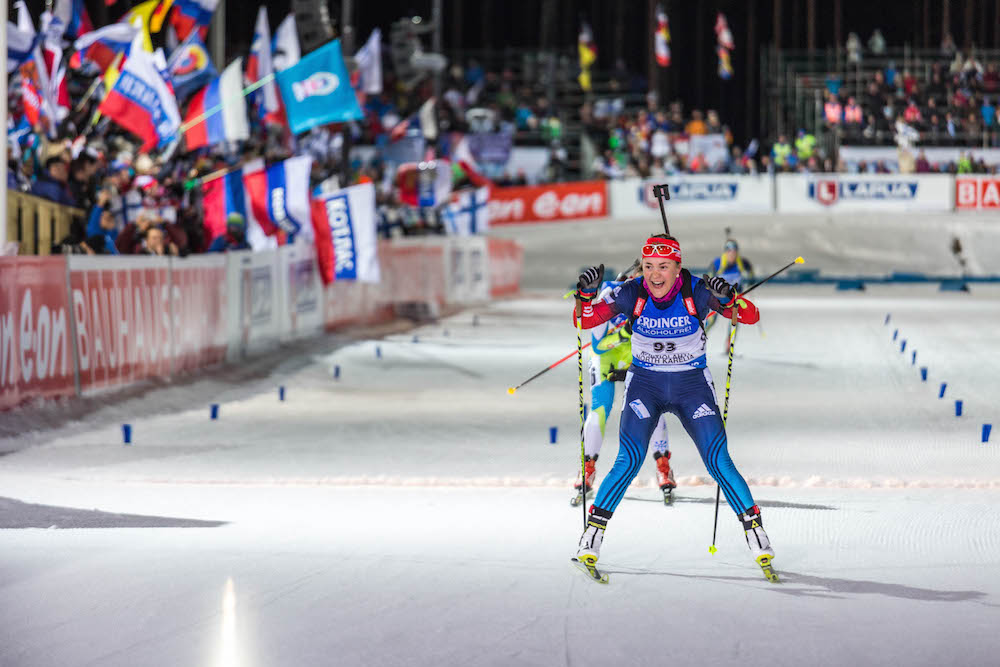
Russia’s Ekaterina Yurlova reacts after sealing her first career victory and podium on the World Cup level at IBU World Championships on Wednesday in the women’s 15 k individual in Kontiolahti, Finland. (Photo: Kontiolahden Urheilijat/Kari Kuninkaanniemi)
KONTIOLAHTI, Finland — When Ekaterina Yurlova earned two bronze medals at the IBU Open European Championships in Otepää, Estonia, her dad told her: “OK, now your next step is World Championship,” she recalled.
That was just over a month ago. On Wednesday, the 30-year-old Russian pulled out a surprise win to answer her father’s prophecy: a gold at 2015 IBU World Championships in the 15-kilometer individual. She had started 93rd of 105 women in the race and ended up as the only one with perfect 20-for-20 shooting.
“I said to him, ‘You’re crazy,’ ” Yurlova explained in a post-race press conference. “But now I think he’s not crazy.”
Yurlova herself looked stunned at the finish, holding her head and closing her eyes as it all set in at once. She had a great run throughout the evening race in front of 10,800 spectators — rising to third with a clean first shooting and the third-fastest course time on the first lap. After hitting all of her targets on her second stage, the Russian sat in fourth behind Italy’s Karin Oberhofer in first and the Czech Republic’s Gabriela Soukalova and Veronika Vitkova in second and third, respectively.
Fourteen seconds out of the lead after that first standing, she rose to second with a clean third stage. Soukalova, who started fourth and remained as a top contender from start to finish, cleaned those three initial stages as well, and leaving the range for her second-to-last lap, she was 15 seconds ahead of Yurlova.
The time gap went out the window when Soukalova came into the range for the last time and missed one for a one-minute penalty. While it took some time for Yurlova to tick off the laps 89 starters later, she ended up cleaning her fourth-straight stage to take the lead, 32.8 seconds ahead of Soukalova.
Ever since she finished, Soukalova had the time to beat in 41:55.4, holding off Finland’s local favorite Kaisa Mäkäräinen by 1.2 seconds. That time held up until Yurlova crossed the line 23.2 seconds faster in 41:32.2.
For the third time in her career, Yurlova cleaned an four-stage individual race. It was also her first podium and victory at the World Cup level. Her previous World Cup best was fifth in a mass start two seasons ago in Pokljuka, Slovenia.
“This is my first race of this World Championship and I wanted to be in podium,” she said. “It was my dream, but I never know that I can win.”
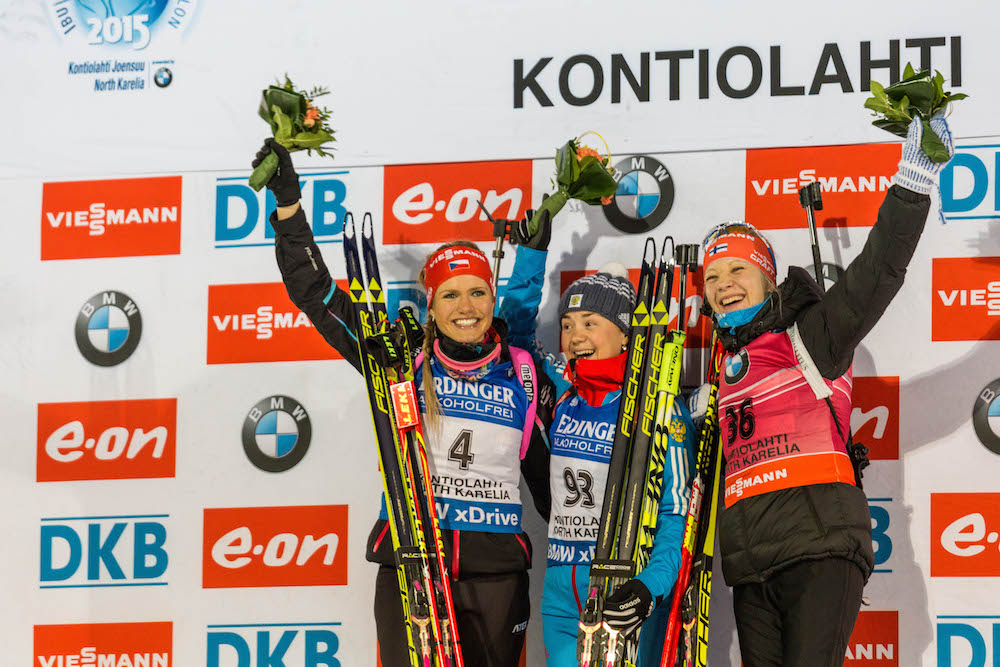
The women’s 15 k individual podium at 2015 IBU World Championships, with Russian winner Ekaterina Yurlova (c), silver medalist Gabriela Soukalova (l) of the Czech Republic, and Finland’s bronze medalist Kaisa Mäkäräinen (r). (Photo: Kontiolahden Urheilijat/Kari Kuninkaanniemi)
While Soukalova’s longtime lead at the finish didn’t stand, she said at the press conference that she was happy with silver. She and her team won gold earlier at these Championships in the mixed relay.
“It’s awesome and it was a really difficult season,” Soukalova said. “I didn’t think that I’m able to get a medal from this championship, but that’s nice.”
She wasn’t crushed when she was bounced from the lead by such a late starter. In fact, she didn’t realize she was in the hunt for gold until her last lap.
“I thought it’s gonna be really nice to [finish] in top five,” she said.
While Soukalova posted the fifth-fastest course time and Yurlova’s time ranked 19th (although her range time was notably quick in fifth), Mäkäräinen, who started 36th, was the fastest on course in the the five-lap race.
Hailing from the nearby city of Joensuu, where most of the World Championships accommodations are located fewer than 20 kilometers south of Kontiolahti, Mäkäräinen earned her first medal of the championships — bronze — 24.4 seconds off the win.
She cleaned prone but missed one on her first standing and another on her second prone before cleaning her final standing. The two misses put her two minutes back, and while she slipped into 11th after the third stage, she was back up to fifth leaving the range for the last time.
A fast last lap put her in contention with Soukalova for what looked to be the win at the time (well before Yurlova).
“In the first standing I had a lot of difficulties,” Mäkäräinen said in the press conference. “My legs were shaking right before I started to shoot. I missed the first target and I thought, ‘This is not going to work now,’ but I fight with every shot and I hit the last four. I was really lucky also there. And in the prone, I don’t really know what happened, maybe I was waiting too long, and the last shooting I don’t remember anything.”
She did remember hearing how far she was behind Soukalova going into the last lap. It was 27.2 seconds, to be exact.
“I never thought that I could be so close [at] the finish line,” Mäkäräinen said. “I knew that I did a good jump in a last loop so I wasn’t too sad about that.”
While she acknowledged she was slightly relieved with the medal (which she took by 0.4 seconds ahead of Italy’s fourth-place finisher Dorothea Wierer), Mäkäräinen added that wasn’t how she preferred to view her bronze.
“It was a new day today, new race, I did my job pretty OK,” she said. “I’m happy that I had a good day in the World Championships.”
Darya Domracheva of Belarus missed three on her first standing to slide into the 50’s overall after the second stage. By the third stage, she had recovered to 27th with another clean prone, but she had one more penalty on the last standing to finish 16th, ultimately 2:54.6 behind Yurlova.
Dunklee 12th for U.S.; Canada’s Heinicke Tallies Third-Straight Top 30
Susan Dunklee (US Biathlon) racing to 12th in the women’s 15 k individual on Wednesday at 2015 IBU World Championships in Kontiolahti, Finland. It was her best individual result of the championships so far. (Photo: USBA/NordicFocus)
American Susan Dunklee started 30 seconds after Mäkäräinen in bib 37. While she missed two standing to fall back into the 30’s, Dunklee cleaned her next two stages and missed one on the last standing to end up 12th (+2:43.0). She had the sixth-fastest course time (4.5 seconds behind Soukalova, who was fifth fastest on course).
While Dunklee called the early misses, “not an auspicious way to start,” she explained that they took the pressure off. She thought, “It’s not gonna be a perfect race, but I can just focus on doing my normal thing,” she explained in a post-race interview.
After her first prone, she caught a glimpse of the board her coaches showed her out on course, which indicted where her shots landed outside the target. For the next prone, she made a couple corrections.
During one lap, Dunklee skied with Germany’s Laura Dahlmeier (in bib 21) and Ukraine’s Valj Semerenko (in bib 20), which she said helped her push her tempo.
“There were times when I wanted to back off a bit, but Laura was pulling and gapping me a bit and I was like, ‘I can’t let her get a gap because I’ll lose the draft,’ ” Dunklee explained.
Dahlmeier went on to place sixth (+40.5) behind Russia’s Daria Virolaynen in fifth (+37.9). Semerenko finished 15th.
With her best shooting of the week so far and best individual result at these World Championships, Dunklee was pleased to be feeling back on track.
“My biggest problem the last couple days has been just getting my head back on straight and finding the fun again and the normal race feeling,” she said. Last weekend, she placed 42nd in the sprint and 34th in the following pursuit.
“The sun came out late afternoon today, and while we were warming up there was a soft, golden light and it made me really relaxed and happy,” Dunklee added. “I felt excited about the start of the race.”
Regardless of whether Wednesday’s result is enough to qualify Dunklee for the 30-person mass start on Sunday, she said she was happy. “I’m glad to have had a good one,” she said.
“While we were warming up there was a soft, golden light and it made me really relaxed and happy. I felt excited about the start of the race.” — Susan Dunklee, 12th
Canada’s Megan Heinicke tallied her third-consecutive top 30 of the week, placing 21st (+3:23.3) for her World Championships career best. She hit 19 straight shots before missing her final target.
Megan Heinicke (Biathlon Canada) racing to 23rd in the 7.5 k sprint at 2015 IBU World Championships on March 7 in Kontiolahti, Finland. In Wednesday’s 15 k individual, Heinicke placed 21st for a career best at World Championships (and at the Olympic level).
“I’ve hit 20-for-20 twice already this year so I feel like there was 15 thoughts going through my head, like, slow motion during the last shot,” she reflected. “I’m so, so happy with 19, but I’m pretty sure I missed the last shot because I was thinking, ‘Oh, I’m going to hit 20!’ ”
During the race, Heinicke wasn’t sure it was going so well. On her first lap, she heard her team’s staff tell her she needed to ski faster.
“I was like, ‘Oh gosh, this is going to be a disaster,’ and then actually, I kind of felt better lap by lap,” she said less than a week after recovering from a monthlong illness.
“I was prepared for way worse,” Heinicke said of World Championships overall so far. “I fought hard out there. I really delivered what I was able to. There’s always the ‘if’ thought: if I was in better shape and skiing four-percent faster, but I mean, I’m happy with it.”
Dunklee’s U.S. teammate, Annelies Cook was on track for a breakthrough performance after cleaning her first three stages. The third starter, she found herself in second after the third shooting behind Soukalova and at the end of the day, her time leaving the range for the second-to-last lap ranked sixth.
US Biathlon’s Annelie Cook (second from l) on the range with Slovakia’s Jana Gerekova (l), among others during one of her two standing stages in the 15 k individual on Wednesday at IBU World Championships in Kontiolahti, Finland. (Photo: USBA/NordicFocus)
However, in the final standing, Cook missed four shots — the first, second, fourth, and fifth — to fall toward the back of the pack. She ended up 47th (+5:26.8) with four penalties.
“My heart is a little broken,” Cook said afterward. “I blew it. I just wanted it so bad and I tried too hard. Classic case of wanting it too much. Everything else felt easy and relaxed. I tried to stay relaxed the whole race, not come into the range too gassed, and I think the conditions were really good today so that made it a lot easier …
“Sometimes biathlon is really mysterious,” she added. “You don’t know what makes one [race] good from the next, but the last stage was just bad. I was too tense and I was just trying to hard.”
World Cup rookie Clare Egan, also of the U.S., notched her second-best result of her career in 51st (+5:45.7) after back-to-back clean stages for her first prone and first standing. She went on to miss two in the third stage and two more in the final standing.
Clare Egan (US Biathlon) during one of two shooting stages in the women’s 15 k individual at IBU World Championships on Wednesday in Kontiolahti, Finland. She placed 51st for her second-best result of World Championships and her career. (Photo: USBA/NordicFocus)
“’I’m still learning, especially with the standing, so any time I can even just miss one in standing is great,” Egan said. “My best World Cup place coming into world champs was 73rd, and I’ve done way better than that so far so I’m really psyched.”
In placing 40th in the sprint last Saturday, she qualified for last the pursuit, where she placed 52nd. While Wednesday marked another top result for the 27-year-old Egan, she said it was her brother’s presence that made her day.
“My brother Graham flew in today from New York so he was out there on the course with an American flag,” Egan said. “That was my favorite part of the race.”
Also for the U.S., Hannah Dreissigacker placed 67th (+6:49.7) with five penalties (2+1+1+1).
“Ones are OK, twos are bad,” Dreissigacker said of the number of misses per stage. “That’s sort of where my standard is for myself. If I had [missed one each time], I would be, like, not a good day, but not bad. But five, I mean, that’s too many.”
She described feeling flat during the race and attributed it to possibly hunger.
“I don’t think I ate enough because it’s such a late-in-the-day race,” she said of the 6:15 p.m. start. “I was getting kind of hungry before the race and I felt like I kind of ran out of energy. I’m not sure I timed that quite right. I should have known better…
“For some reason, I’m just sort of struggling a little bit here in general,” Dreissigacker added. “Today was tough because I actually felt OK for the most part. The last three stages I missed the last shot every time, which is sort of a classic biathlon mistake. I think I guess I must not have followed through enough.”
Two Canadians had five penalties as well: Audrey Vaillancourt (2+0+1+2) and Julia Ransom (2+1+1+1). While Vaillancourt placed 79th (+8:05.3), Ransom in her first World Championships was 84th (+8:23.9).
“It’s just a bad week on the range,” Vaillancourt said. “It’s hard to start with two misses, and you’re like, ‘Nice, now I have three more bouts to go.’ ”
Typically a strong shooter, she added that sometimes that’s the way biathlon goes.
“Some weeks you just don’t get that feeling of, it’s easy,” she said.
And Vaillancourt didn’t think her off week had anything to do with the stakes at World Championships.
“I’ve been fighting all year to get my place here. It’s not like I’ve been thinking of only World Champs all year,” the 23 year old said. “To me, it doesn’t really make a difference if I do super well on the World Cup or super well at World Champs because it’s not like I’m really close to a top eight.”
After the pursuit three days earlier, in which she placed 57th, Ransom explained she focused on getting into a “better headspace” for the 15 k.
“I was so overwhelmed and I was excited, but also really distracted [during the pursuit] so I kind of brought it together and I really wanted to focus on pacing,” she said. “We don’t do a lot of individuals; this is definitely the hardest one I’ve ever done, and I think I found a happy medium with the pacing. Maybe a little too easy, but I’m learning.”
Like several North Americans, she struggled with her first prone and had two early penalties.
“The wind had changed on me, which I wasn’t expecting,” Ransom said of her first shooting. “I [made] a big correction for prone … I’ve been struggling with standing the last couple weeks, so I’m glad I kind of brought it back to a half-decent level. It’s a work in progress. These World Champs have been an interesting experience.”
Perhaps the most disappointed North American of the day was Rosanna Crawford, a medal hopeful, who finished 87th (+9:05.1) with eight penalties (2+2+2+2).
“It was really bad,” she said.
Before World Championships, she and her boyfriend Brendan Green, also on the Biathlon Canada national team, discussed the worst that could happen in Kontiolahti, Crawford explained.
“The worst that could happen is a really bad race,” she continued. “It’s not that bad in the scheme of life, but this is something I’ve dedicated my whole life to and to not achieve my goals is disappointing. I feel like I’m letting down everyone who’s helped me get here, and I know I’m capable of so much more.”
On Tuesday, Crawford watched a Finnish TV interview with U.S. cross-country skier Kikkan Randall.
“Kikkan was talking about how disappointed she was with the Olympics, and yeah, you set these big goals, but then you also need to set the goals of being able to leave a championship happy,” Crawford said. “I don’t think I did that. I didn’t set those goals and even if I had, I didn’t achieve them. I didn’t do what I know I’m capable of today, and I really wanted another chance in the mass start and now that’s not gonna happen.”
The final race of World Championships, the 12.5 k women’s (and 15 k men’s) mass start includes the top-15 ranked competitors on the World Cup circuit with 15 others who do exceptionally well at worlds. The sprint and pursuit carry a hefty weight (with the sprint factoring into the start of the pursuit), and the individual races are the last ones to count toward the mass start.
Based on a provisional start list, Heinicke and Dunklee have qualified for Sunday’s mass start in 26th and 30th, respectively.
Susan Dunklee (US Biathlon) racing to 11th in Thursday’s 15 k individual at the IBU World Cup in Oslo, Norway. (Photo: USBA/NordicFocus)
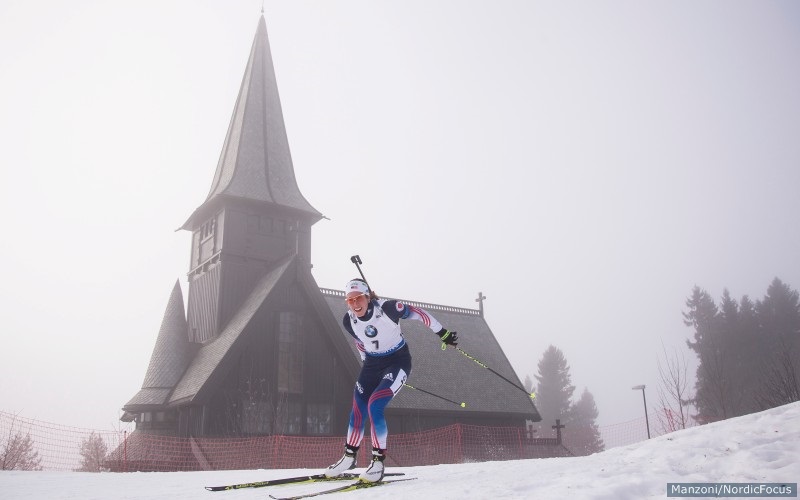
Leading up to Thursday’s 15-kilometer individual race, the first day of the IBU World Cup at Holmenkollen in Oslo, Norway, Susan Dunklee had been feeling tired and Megan Heinicke was still sick. Not ideal, but they had to roll with it.
Dunklee, of US Biathlon, formulated a plan to start conservatively and speed up if she felt she was up to it. Heinicke, of Biathlon Canada, assumed after 10 days of dealing with a cough that refused to let up, she probably wasn’t going to feel great. She missed last weekend’s entire World Cup in Nove Mesto, Czech Republic, because of it.
Yet the two toed the start line, and Dunklee went out seventh behind top competitors like World Cup leader Kaisa Mäkäräinen of Finland in bib 2 and Germany’s Franziska Hildebrand in bib 5.
After one so-called conservative lap, which ended up being the 15th-fastest first lap overall, Dunklee had already put herself in a strong position with a clean first prone. She missed one on the next standing to fall back a few places, but hit every target on her second prone to put herself back in the running for a top performance.
One final miss on her second standing gave Dunklee another minute penalty, and she finished third, 4:07.1 behind Mäkäräinen in first and 23.2 seconds behind Hildebrand, who was in second at the time.
“My shooting today felt very deliberate rather than the ideal automatic, but I focused on the basics — a relaxed stable position and trigger squeeze,” Dunklee explained in an email. “I knew I was having a great race going into the last stage and it was disappointing to miss that first shot.”
Like most of the 86 women that finished the race, she had some tricky conditions to deal with, with some fog during zero as well as during the race, although it was “never enough to totally obscure the targets,” Dunklee wrote. “Snow conditions were firm for the earliest starters but quickly deteriorated into deep corn. The fog created flat light conditions making it difficult at times to see the tracks or the berms in the downhill corners.”
She made a point to push over the “monster climbs,” saving just enough before the crest of each so she could go hard up and over.
“I knew I was having a great race going into the last stage and it was disappointing to miss that first shot,” she wrote. “At that point I told myself that my real test today was whether or not I could regain the right focus for those final four shots, and I did. I feel really good about that.”
At the end of the day, Mäkäräinen — an early leader who cleaned every stage and posted the fastest course times on each lap to keep everyone else more than a minute behind — won in 43:54.8 and Dunklee ended up 11th. The fourth-fastest skier on her last lap, the American clocked the seventh-fastest course time overall.
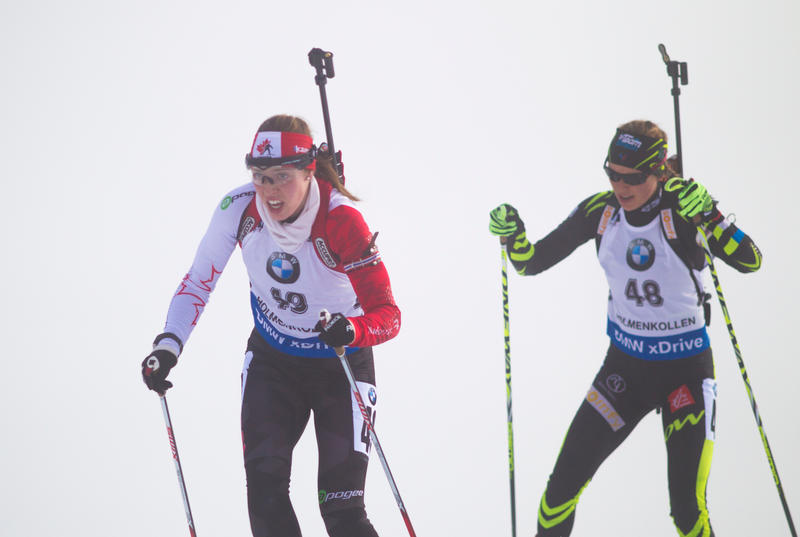
Canada’s Megan Heinicke (l) leads Marine Bolliet of France in the women’s 15 k individual at the IBU World Cup on Thursday in Oslo, Norway. Heinicke cleaned to place 12th, one of four top-15’s this season. (Photo: IBU/Christian Manzoni)
About 20 minutes after Dunklee started, Heinicke set out in bib 49, skiing middle-of-the-pack course times but cleaning each passing round to pick off the places.
“I had some clear ski technique goals to help myself stay focused on course no matter what … and I wanted to be confident in the range,” Heinicke explained in an email. “I have been shooting well recently, and with no wind, there was no need for me to shoot ‘extra carefully’ or slowly so I just wanted to relax and do my thing on the range without any special changes in approach because the the individual format.”
She ended up knocking down all 20 targets in the four-stage race, the longest women’s format on the circuit.
“I was pretty relaxed mentally until the last bout,” Heinicke reflected. “For the last standing, there was definitely that little dialogue going on my head with part of me thinking all those pre-mature happy thoughts about the possibility of hitting 20 and the other part of me just focusing on my job and each target. … I’m glad the ‘focused’ part of my brain kept the upper hand!”
Once she realized she cleaned the last stage, another thought popped into her head: “ ‘Oh jeez…I actually hit 20?!?!…again!’ ” she wrote. “But that changed pretty quickly into thoughts about skiing hard for the last loop.”
With a sense of where she stood from the Canadian staff out on course, she finished 11th initially and was bumped to 12th by Germany’s Laura Dahlmeier, who started 60th and placed fourth with clean shooting.
Two-tenths of a second back from Dunklee in 11th, Heinicke tied her personal-best 15 k result in 12th (after placing 12th in the 15 k in Östersund, Sweden, earlier this season), which was also her second-best World Cup result (she was 11th in last month’s sprint in Ruhpolding, Germany).
“Another top 15 finish is awesome and given that my health is still far from 100% I can’t complain,” she wrote. “At the same time it is a bit frustrating, this was one of my slowest skiing performance this season (although our skis were excellent) and I am confident that on an average, healthy day I would have posted my first top 10 finish with 20 hits today.”
Overall, her course time ranked 50th, while her shooting and range times were 16th- and 17th-fastest.
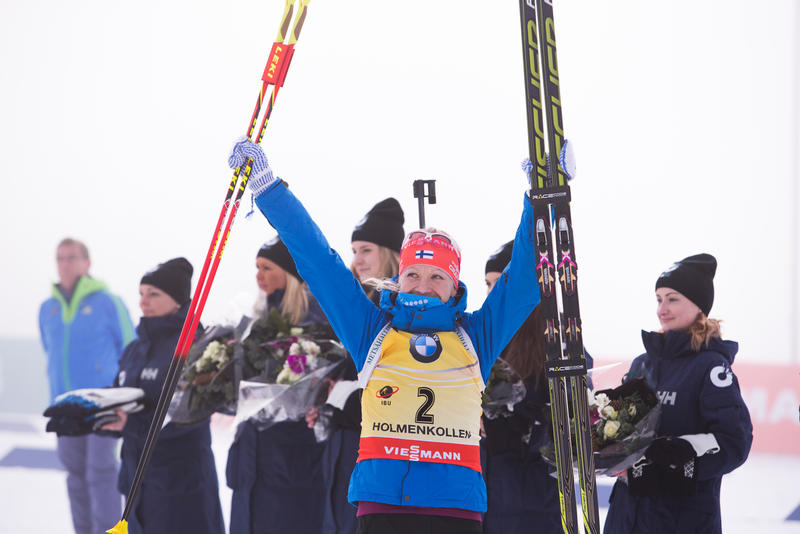
Kaisa Mäkäräinen of Finland celebrates her 14th IBU World Cup win in the women’s 15 k individual on Thursday in Oslo, Norway. (Photo: IBU/Christian Manzoni)
Six of the top seven women shot 20-for-20, including Mäkäräinen, followed by the Czech Republic’s Veronika Vitkova in third (+1:20.9), Dahlmeier in fourth (+2:28.2), Poland’s Monika Hojnisz in fifth (+2:51.5), and Ukraine’s Juliya Dzhyma and Iryna Varvynets in sixth and seventh, respectively.
Mäkäräinen couldn’t remember the last time she cleaned a four-stage race. According to RealBiathlon, she’s done it four times in her career and never before in a 15 k.
“I think it was in the 2011 World Championships, but the big thing is that it was in a 15 k,” she told the IBU. “I woke up this morning and felt confident, but I was a bit worried about the fog when I came to the first prone. I was wondering if I could see the targets … In prone I had to be very careful, to take every shot carefully and not miss.”
Darya Domracheva of Belarus broke the trend in second with one penalty on her first prone, which set her 40 places back. The 30th starter, she went on to clean every round thereafter and skied the second-fastest lap times after Mäkäräinen to work her way back to second, 1:18.3 back.
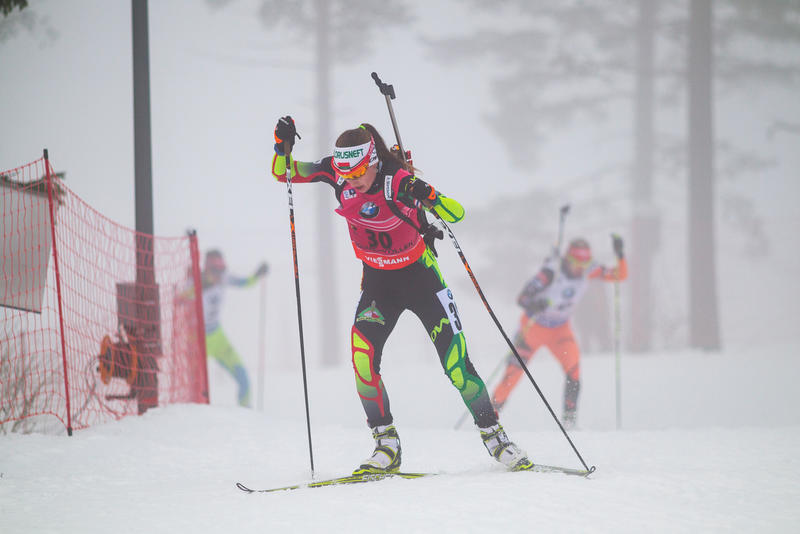
Darya Domracheva of Belarus racing though the fog to second despite one penalty in the women’s 15 k individual at the IBU World Cup in Olso, Norway. (Photo: IBU/Christian Manzoni)
“The tracks were very deep and it was very hard; you had to find a part that was just a little harder but as the race went on, those spots became less and less,” Domracheva told the IBU.
“Nineteen-of-20 is not bad. Kaisa was really strong on the shooting range and the tracks and I think the result might have been the same even if I hit that one target.”
Hildebrand took eighth with two misses, one on each of the first two stages, Gabriela Soukalova of the Czech Republic started ninth and finished ninth with one miss on her third shooting, and France’s Anais Bescond missed one on her last stage to place 10th, 2.5 seconds ahead of Dunklee.
The second Canadian, Rosanna Crawford in bib 14 came out raring to go after crossfiring in the Nove Mesto sprint and pulling out of that race, which made her ineligible for the pursuit last weekend.
“I was looking forward to getting back on the race skis and redeem myself from last week’s disaster,” Crawford wrote in an email. “I love Oslo! So being here definitely put me in a good mood. The tracks were fast and the sun was shining for our two training days.”
She aimed for precision on the range and felt like she accomplished that on her first three bouts with clean first and third stages and one miss on her first standing. In the final standing, she missed two more for a total of three minutes of penalties.
“I’m really disappointed with my last shooting. That was not necessary,” she wrote. “Coming into the last shooting I knew that with a clean shooting a great race was possible. I tried to keep my mind clear and focus on the process, but I think I got a bit ahead of myself. The fog was tricky in standing today. You really had to search out the target. But as the results show a lot of women had a great shooting day today, so no excuse.”
Crawford finished 28th overall, 6:07.2 back from Mäkäräinen.
“I am happy to be in the top 30 pretty consistently this year. But I know what’s possible with 100% shooting,” she added. “Even on an off skiing day if I hit 100% it can be a race I’d be proud of.
“We had an amazing day for all three of us today,” she added, referring to Heinicke and Audrey Vaillancourt, who finished another 30 seconds back in 30th for her career best. “With both Megan and Audrey hitting 20/20 and Audrey getting her first top 30! Today definitely makes up for our lack of nation cup points in Nove Mesto!”
After her perfect-shooting day, Vaillancourt, 23, explained in an email that she focused on hitting each shot individually.
“I think taking the focus away from the total result helped me a lot,” she wrote.
Before the race, she felt calm and ready, and best of all, she liked the course, which featured “hard climbs, fun downhills, rolly sections.” With good shooting, she hoped for a top 40.
“I was really trying to be in the moment during today’s race so I basically took it one hill, one lap, one shooting bout at a time,” Vaillancourt wrote. “This helped me not to get overwhelmed and made me feel confident about the last shooting. It was just one of those days when it feels really easy on the range.”
She added that she was “relieved to finally have really good race. It feels great to see that I, too, can be up there on a good day,” she wrote.
Hannah Dreissigacker (US Biathlon) racing to 33rd in the IBU World Cup 15 k individual on Thursday in Oslo, Norway. (Photo: USBA/NordicFocus)
Hannah Dreissigacker placed 33rd for the U.S., 21.4 seconds after Vaillancourt, with clean shooting in every round except her second — where she missed three.
“On the whole, I’m happy with my race and placing,” Dreissigacker wrote. “In biathlon you can always play the game of ‘where would I be if I’d hit one more shot…two more…etc’, and that is especially true of individuals.”
With three misses in her first standing, she explained it was hard not to think about what might have happened if she shot better on that stage as well.
“But in the end, I’m happy with shooting 85% and I’m glad to have come back and shot two clean stages after that bad one,” she wrote. “I definitely went a bit harder on the lap before the first standing stage, trying to catch a ride with a faster skier. I don’t regret it — that’s how you learn and get better! But I also have to learn from the bad shooting stage.”
The third of four American women in Thursday’s race, Annelies Cook placed 55th (+8:18.2) with three penalties (1+0+2+1). Clare Egan was 82nd (+12:29.0) with six misses (1+1+1+3).
Check back for the men’s 20 k report, featuring Canada’s Nathan Smith in 12th and American Leif Nordgren in 20th.
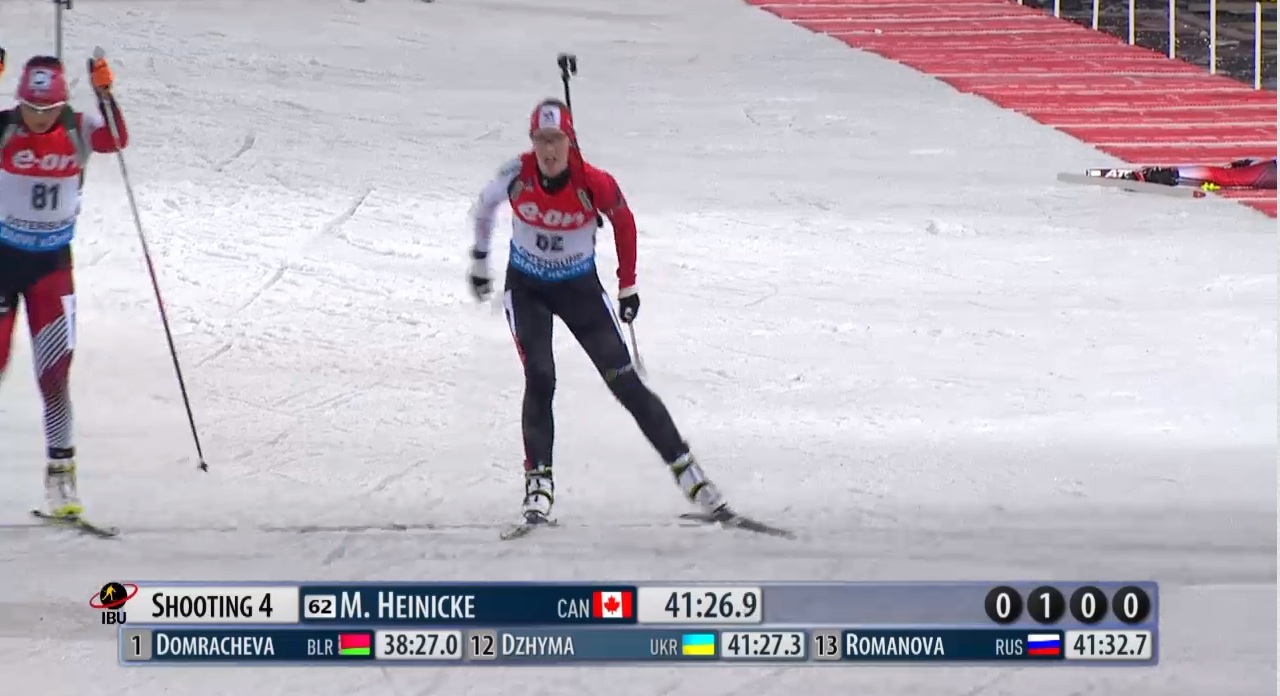
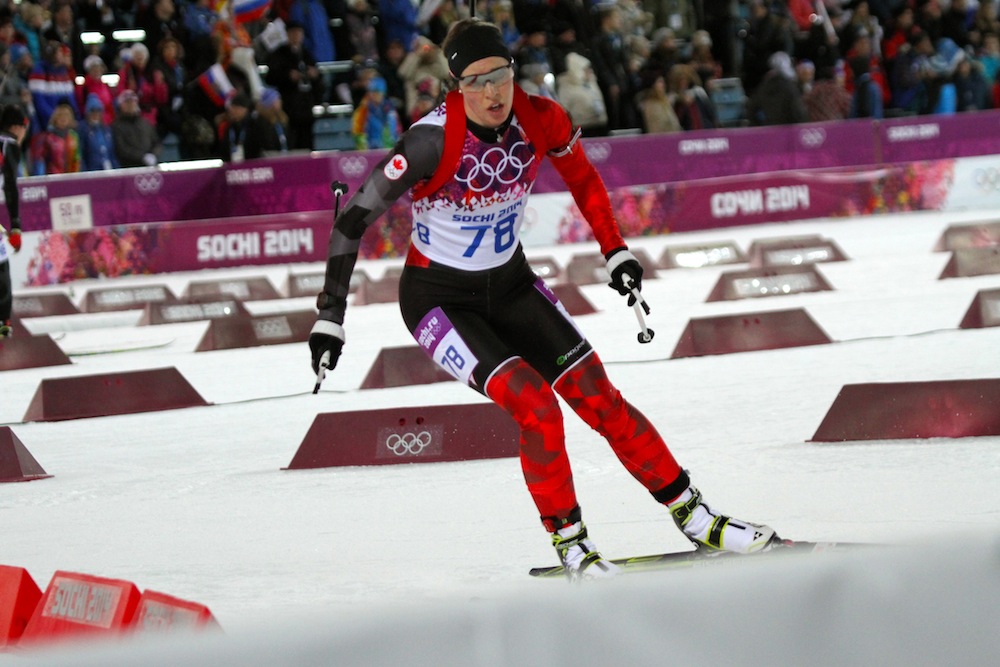
Canada’s Megan Heinicke after cleaning her final stage in Thursday’s 15 k individual in Östersund, Sweden. She went on to place a career-best 12th.
Note: This article has been updated to include comments from Megan Heinicke, obtained via email.
Last weekend, Megan Heinicke raced a couple IBU Cup tuneup races in Beitostølen, Norway, both of which were 7.5-kilometer sprints. She placed 16th in the first with two misses, and 48th the next day with five total penalties.
Day 1 was indicative of what the 26-year-old national-team veteran was capable of, Biathlon Canada High Performance Director Chris Lindsay said on the phone Thursday night from Canmore, Alberta.
Day 2 was not.
Still, it got what coaches and athletes like to call the “cobwebs” out.
Megan Heinicke (Biathlon Canada) makes her way around the stadium during the 2014 Olympic 7.5 k sprint in Sochi, Russia, in which she placed 59th.
“[The IBU Cup last weekend] gave me a chance to test the waters and get the feel for racing again,” Heinicke said in a Biathlon Canada press release after Thursday’s first individual World Cup race of the season.
In the women’s 15 k individual start in Östersund, Sweden, Heinicke broke out with a career-best 12th, with a single penalty putting her 3:31.1 behind winner Darya Domracheva of Belarus. Even Domracheva had two penalties, and just three women out of 93 finished the day with perfect 20-for-20 shooting.
Heinicke’s previous World-Cup best was 15th in sprint last season in Kontiolahti, Finland. She started 62nd on Thursday, and Lindsay said that while the snow didn’t look like it broke down too much by the time she raced, challenging conditions often play to her favor anyway — at least on the range.
“She has the ability to be an extremely strong shooter and with difficult conditions,” he said, noting she paid attention to the wind flags and her coaches’ cues en route to her personal best. She also had the benefit of getting helpful splits off top contenders who started before her.
Heinicke cleaned her first prone then missed one on the first standing, but knocked down every target in the last two stages to catapult herself into 11th at the finish. There, she sat down shortly after crossing the line, breathing heavily and smiling. Heinicke fell one spot to 12th when Russia’s Ekaterina Glazyrina finished eighth ahead of her, but held that position for the rest of the race.
“The key to success was being relaxed, not feeling any external pressure and truly being focused on a few key factors shooting,” Heinicke said. “I took my time in the shooting range, and just had one of those days where I was able to block out everything except for my keyword when I was standing on the mat. I’m heading into this season more relaxed and just thankful I’m able to pull together good performances.”
While Heinicke spent most of her offseason training in Germany, Lindsay explained the national team received regular reports from her, including time-trial results.
“This is not surprising she’s been able to do quite well in the early season,” he said. “What we’re very happy about this year is she seems to have been able to maintain her health … When she’s healthy, she can put these things down.”
“I have had a really tough summer and fall this year and I went into the race motivated, but with low expectations and feeling no external pressure to perform,” Heinicke wrote in an email. “My day was pretty relaxed too — I even had a mini nap before I left for the race site which is unusual for me.”
She explained she felt great at the start of the race and focused on her shooting tasks at hand. Above all else, her goals were task-oriented rather than dependent on results.
“I have never started the season so relaxed and feeling so little pressure,” Heinicke wrote. “I wasn’t even sure if I should start this season and I think the low expectations (from myself and others) really helped me lose that nervous ‘I have to hit’ feeling. I was careful on the range: my shooting was very controlled and not rushed in any way.”
“I have never started the season so relaxed and feeling so little pressure. I wasn’t even sure if I should start this season and I think the low expectations (from myself and others) really helped me lose that nervous ‘I have to hit’ feeling.” — Megan Heinicke, after achieving career-best 12th in Östersund 15 k on Thursday
She felt sharper in the IBU Cup races the weekend before, but was pleased to be able to pick up her pace on her last loop.
“I felt a bit dull during the whole race but I think the better lap times at the end are a result of a good base,” she wrote. “I often feel good at the end of longer races. I was certainly motivated on my last loop!! I was a bit disappointed with my ski feeling compared to last weekend, but it was tough conditions so it is a bit hard to judge. Overall, my first loop was a bit too slow but I feel ok about the rest.
“Of course I am happy with the result,” she added. “Starting the season with a PB — what more could I ask for! It does get my season started in a positive way and I will certainly go into my next races a bit more confident than I would have without this result.”
Rosanna Crawford (Biathlon Canada) racing to her second-straight victory of Canada’s World Cup/IBU Cup trials three weeks ago in Canmore, Alberta. (Photo: Justin Brisbane)
Canada’s early starter who also ended up in the top 20, Rosanna Crawford finished 16th (+3:52) with three penalties. Despite the misses, it was her career-best 15 k result by one place over her 17th two seasons ago in Nove Mesto, Czech Republic.
“I’ve never been a big fan of Individuals, but it’s a great race for good shooters to be in the top,” Crawford wrote in an email. “I wasn’t nearly as nervous as I was for the mixed relay. Sunday’s race was a good indicator of where my ski speed is, even though we were just 3 days off the plane, and that shooting is also there.”
She opened for the mixed relay and put Canada in fifth after the first leg.
“My zero wasn’t great today and that got some extra nerves coming before the start,” she explained of Thursday. “But things came together in the range.”
Crawford, 26, missed one in her first prone and proceeded clean her first standing and second prone. Her last time in the range, she missed two.
“I tried not to get too ahead of myself for the last shooting bout, reminding myself that I’ve hit my last 5 targets many times in a race,” she wrote. “Unfortunately my legs were pretty tired and I missed my first two shots. But was able to pull it together and hit the last 3.”
She tried to pace herself throughout the five-loop 15 k in soft-and-slushy conditions paired with what Crawford called, “sketchy downhills.” Knowing she needed to save some kick for the finish, she ended up with the eighth- and ninth-fastest course times on her last two loops. Her course time ranked 12th overall.
After leaving the range for her fifth loop in 22nd, she improved to 16th by the finish. Crawford couldn’t recall if she had ever left the range for the last time in a worse position than she finished in.
“Of course I was shaking my head a bit at my shooting, but I knew that a lot of spots can be gained on last loops. Especially in a 15km when some women might have gone out too hard,” she wrote.
With a goal of 90-percent shooting and a top 25, she was halfway there. “Top 16 is above my expectation,” she wrote.
Not Biathlon Canada’s.
“Rosanna’s ski speed and her ability to put down targets has always been strong, but it is looking like she’s legitimately a top-16 athlete in our goals this year,” Lindsay said. “I think everyone should expect we will see more of her at this level.”
Eighty-five percent shooting was nothing to scoff at either, he said, even though it was easy to speculate where she might have ended up with one fewer 1-minute penalty.
“The reality is, individual racing is challenging,” he said. “We’re really looking forward to seeing her in some of the shorter races. We saw with the mixed relay, she has the ability to mix it up at the front of the pack and not be intimidated by the other girls. She enjoys leading, she enjoys being up there, and she handles the pressure well.”
“The reality is, individual racing is challenging.” — Biathlon Canada High Performance Director Chris Lindsay
“Hopefully these past two races are a good indicator of whats to come this year,” Crawford wrote. “I’ve worked really hard this summer and [coach] Roddy [Ward] has told me he wants a lot of TV time 🙂 !”
Also for Canada, Zina Kocher finished 76th (+9:36.0) with seven penalties (2+3+1+1), and Audrey Vaillancourt was 81st (+10:14.7) after what Lindsay described as an uncharacteristic five misses (1+1+3+0).
“I know Zina was not happy with her race; she has very high standards for herself, and we know when everything clicks for her, she’s one of the fastest skiers in the field,” he said. “We just needed to focus getting that shooting down and that’ll come.”
He noted that Vaillancourt’s ski speed has improved throughout the training season. “The first [15] k of the year is a difficult race … I don’t see this as a pattern at all,” he said. “I think we’re going to see in pursuit racing, some very strong results out of there because she has the ability to push herself and put down the targets.”
Susan Dunklee (US Biathlon) en route to 21st in Thursday’s 15 k individual at the IBU World Cup opener in Östersund, Sweden. (Photo: USBA/NordicFocus)
It wasn’t pretty out there, American Susan Dunklee explained an email about the women’s first individual race of the season. “Deep slush with unpredictable patches of ice underneath” made for some not-so-graceful skiing in Thursday’s 15-kilometer World Cup race in Östersund, Sweden, she wrote.
But Dunklee found some comfort knowing that everyone else was flopping around, too.
US Biathlon’s early starter in bib 19 (of 96), she explained that the conditions worsened as the race wore on, but the snow was already deep and sluggish at the start. Still, she ended up skiing faster than most of the field with each passing loop, recording for the seventh-fastest course time overall (and the eighth- and sixth-fastest second and third loop times, respectively).
And while she initially finished 11th and ultimately ended up 21st with three penalties, 3:59.1 minutes behind Belarusian winner Darya Domracheva, Dunklee explained she wasn’t feeling in top form.
“My body did feel a little tired and I didn’t feel ‘sharp’ today,” she wrote. “I focused on whatever hill or corner was immediately ahead of me. This was a day to use the head as much as the muscles; constantly assessing and reacting to which side of the track had less slush and a harder surface.”
After cleaning the first prone, Dunklee missed two on the second stage for two minutes of penalties. She went on to clean her second prone and miss one on the final standing.
All the while, she didn’t hear any splits until her final loop. Even if she had, with just 18 women ahead of her, they wouldn’t have given her the most accurate sense of where she’d end up.
“Anything can happen in the shooting range, especially in the last stage when the pressure is on, so I take any mid-race splits with a grain of salt,” she explained. “The Individual is particularly unpredictable.”
Leaving the range for the last time, she was 11th at the time — which was where she’d end up at the finish. From there, Dunklee waited as she gradually slipped just outside the top 20, with later starters like Domracheva, third-place finisher Valj Semerenko (Ukraine), Tiril Eckhoff (Norway), Ekaterina Glazyrina (Russia), Sophie Boilley (France), Olga Podchufarova (Russia), and Megan Heinicke (Canada) placing in the top 12.
Enora Latuilliere (France), Weronika Nowakowska-Ziemniak (Poland), Franziska Pruess (Germany), Luise Kummer (Germany), and Jitka Landova (Czech Republic) also snuck ahead of her in the top 20.
“Darya passed me as if I were standing still and Tiril also caught me before the finish, so I was surprised to see I have the 7th fastest ski split,” Dunklee recalled. “They left me in the dust. It goes to show how wide open the field is this year — so many top women retired last year and now there is less depth and tremendous opportunity.
“I am happy to start off the season with a bunch World Cup points,” she added. “It’s a great feeling to know I still have plenty of room to improve too.”
The second U.S. finisher was Annelies Cook, who placed 73rd (+9:23.6) after four penalties (1+2+0+1). The team’s third woman, Hannah Dreissigacker was 86th (+11:19.7) with seven misses (3+0+1+3).
“Today certainly wasn’t our strongest team showing,” Dunklee said, after she and three teammates combined for seventh in the mixed relay on Sunday. “We often struggle at the start of the season. Many of the other teams have had more on-snow time than us, and lots of athletes are peaked right now because they had to recently qualify for a spot on their nation’s squad. The season is long, and we still have time to tune up. We will get there.”
Darya Domracheva celebrates her 20th World Cup victory on Thursday in the 15 k individual in Östersund, Sweden. (Photo: IBU/NordicFocus)
Something about the medals the top women received on Thursday in their first individual IBU World Cup of the season fascinated Darya Domracheva. Standing atop the podium after the 15-kilometer race in Östersund, Sweden, she spoke excitedly about it to Finnish runner-up Kaisa Mäkäräinen, who smiled and agreed — yeah, it was pretty neat.
Domracheva was borderline chatty during the flower ceremony, smily and upbeat after another World Cup victory — her 20th, according to an IBU press release.
The 28-year-old Belarusian biathlete, who won three Olympic golds in Sochi, is often unstoppable. Once she gets ahead in a race, she’s often hard to match. And on Thursday, with her long, flowing pony tail and snowflake earrings, Domracheva kind of seemed flawless — except for when she missed two targets and tripped over a rock on the last loop.
“I crashed on the last loop, which was scary but most importantly, a rock ruined my ski,” she told the IBU afterward. “I just hope that my servicemen can repair it.”
Finland’s Kaisa Mäkäräinen after placing second in the 15 k individual in Östersund, Sweden. (Photo: IBU/NordicFocus)
Rock or not, she was well on her way to the win and ended up topping Mäkäräinen by 27.9 seconds in 46:43.6. Mäkäräinen, in second throughout the five-loop race, started four minutes ahead of Domracheva in bib 13 (of 96), and finished with first. The whole time, however, she knew she’d have to ski like crazy and be perfect on the range to beat Domracheva.
Mäkäräinen had two penalties as well, one on each of the second and third bouts, and Domracheva shot clean through the first two stages before missing one her third and fourth time in the range.
“It was my mistake; I was leaving the shooting range a bit earlier than I should have!” she said. “Still it was a good shooting result for me.”
Conditions on Thursday were better than what the men experienced in the 20 k individual the day before. High, variable winds on Wednesday evening calmed to a gentle breeze for the women’s race. But with well-above-freezing temperatures, the snow was still chewed up and slow.
“It was really tough and deep snow around the tracks; you never had a chance to rest,” Mäkäräinen said. “In downhills, you had to be careful not to fall down. I got lucky because a Russian girl fell in front of me and somehow I managed to get around her without a fall.”
After Domracheva cleaned the first prone, Mäkäräinen trailed by 6.3 seconds in third. From that point on, the two remained relatively close, with Domracheva posting the fastest-overall course time by 15 seconds over Mäkäräinen in second. Domracheva skied the third-fastest last loop because of her crash, behind Mäkäräinen and Germany’s Franziska Hildebrand, an early leader in bib 8.
Valj Semerenko (Ukraine) after shooting clean to place third in the 15 k individual in Östersund, Sweden. (Photo: IBU/NordicFocus)
The initial top finisher, Hildebrand ended up sixth overall with two penalties, 2:25.7 behind Domracheva. Ukraine’s Valj Semerenko shot perfectly for third, finishing 10.2 seconds behind Mäkäräinen with the eighth-fastest course time. Semerenko was one of three women in the field to notch 20-for-20 shooting.
“I seemed to have lost my shooting touch in our last training camp but somehow I found it today!” Semerenko told the IBU after notching her sixth-career podium.
Semerenko bumped another Belarusian, Nadezhda Skardino, to fourth (+2:04.3) after Skardino — who had one penalty — took the lead at the finish from Hildebrand. (Mäkäräinen finished shortly after to claim the top position before Domracheva.)
Veronica Vitkova of the Czech Republic was the third fastest on course to overcome three penalties and place fifth (+2:09.1). After Hildebrand, Norway’s Tiril Eckhoff was seventh, Russia’s Ekaterina Glazyrina eighth, Sweden’s Elisabeth Högberg achieved her first-ever top 10 in ninth, and France’s Sophie Boilley was 10th.
Olga Podchufarova of Russia took 11th, about 19 seconds ahead of Canada’s Megan Heinicke, who recorded a career-best 12th with a single miss on the second stage (+3:31).
Heinicke started 62nd and initially finished 11th, only to be bumped one place by Glazyrina.
While Domracheva said she was taking it race by race and trying not to look too far ahead, Semerenko dedicated her third-place finish to her sister, Vita, who tried to recover from back surgery this summer and fall. Last week, Ukrainian Biathlon Federation President Vladimir Bryzhnak announced that she would miss the entire season because of a herniated intervertebral disc.
“This was a hard competition today. It is hard without my sister here now,” Valj Semerenko told the IBU. “I now have to work for two people. Out on the tracks, I felt her support; I was competing for both of us.”
Gabriela Soukalova of the Czech Republic in 62nd slipped out of contention with four penalties in the first prone and an additional miss on each of the second and last stages for six total. Germany’s Miriam Gössner placed 68th with seven penalties after suffering a concussion in a rollerski crash in the offseason.
Dasha Domracheva racing to her second gold of these Olympics in Friday’s 15 k individual start. She became the first Belarusian athlete to do so at the same Winter Games, winning by more than a minute and 15 seconds in Sochi, Russia.
FasterSkier’s coverage is made possible through the generous support of Rudy Project.
SOCHI, Russia — Dasha Domracheva had an inkling things were going according to plan as she rounded the biathlon loop at the Laura Olympic Center five times on Friday night.
For starters, the Belarusian gold medalist from Tuesday’s pursuit had opened with flawless shooting in prone, taking the lead over the 12 women who started ahead of her in the biathlon 15-kilometer individual start.
Three others challenged her through the first stage — Finland’s Kaisa Makarainen, Gabriela Soukalova of the Czech Republic, and Slovakia’s Anastasiya Kuzmina — with clean shooting and fast skiing. Three kilometers later, Domracheva suffered a one-minute penalty in the first standing, but it wasn’t a big deal; even with the added time she was still within 11.8 seconds of the lead.
Dasha Domracheva of Belarus in the range. She ended up with a single penalty to win the Olympic 15 k individual on Friday night in Sochi, Russia.
By the third lap, the 27-year-old Domracheva started to turn it on, clocking the fastest ski times from there on out and shooting clean for the remainder of the race. At times she was minutes ahead, and by the finish, she had topped Olga Zaitseva, Russia’s early leader by 3:47.3 minutes in 43:19.6.
Then, she waited, and as competitors like Makarainen completed their races, she gradually realized the second gold was hers. Makarainen was 2:43 behind with three penalties, Soukalova missed one on each standing to finish nearly two minutes back, and Kuzmina had three penalties in the last stage that took her out of contention.
Switzerland’s Selina Gasparin cleaned for the first time in her career, as did Nadezhda Skardino, also from Belarus. Skardino finished second, 1:38.2 behind Domracheva, for the time being. Domracheva waited long enough to watch her come into the final stretch, then grabbed her things and ran inside to get changed.
Selina Gasparin kisses her skis, which helped her to the 10th-best course time of the day and a silver medal.
The 52-degree evening had finished with temperatures around 48 degrees Fahrenheit (the warmest of the 2014 Games yet), and the Olympic champion was getting cold.
“It was amazing because I got information on the track that I’m in the lead and Nadezhda [was] in second,” Domracheva said in a post-race press conference. “I tried to wait for her after the finish line, but I got a little bit frozen at the end of the race.
The two met up in the changing area and press mixed zone after the race. Gasparin’s faster ski time ultimately bumped Skardino to third by 22.7 seconds, and the Swiss skier earned her country’s first-ever biathlon medal with silver. Skardino retained her spot on the podium in third — another first for Belarus with two athletes winning medals in the same event at the Winter Olympics.
And Domracheva became the first Belarus athlete to win two gold medals at the same Winter Games.
“I cannot say it was an easier race for me,” Domracheva said, referring to her 37.6-second win in the preceding pursuit. “In a few loops I was together with Soukalova and she followed me quite easy. I tried to do everything. That was fighting today. On some parts of the track I was so tired and after the downhills, I sit …. almost without any power, but you need to recover on the downhills and be clever coming into the shooting range.”
That was where Domracheva made the difference. Clean shooting — or as close to it as possible — is essential in an individual start, with each penalty adding a minute to an athlete’s total time.
Even with a penalty, Domracheva won by a minute and 15.7 seconds, but mostly because she skied the fastest third, fourth and fifth loops, and took her time in the range. Soukalova placed fourth with two misses, 1:57.5 behind the winner.
“Today … the course was harder and the loop was more difficult in terms of relief,” Domracheva said, comparing the 15 k individual to the 10 k pursuit.
“But both of them I cherish them and value them very much,” she said of her two medals. “With this one I just confirmed that I was an Olympic champion, so that was very important.”
From Rural Training to Olympic Medal
Selina Gasparin of Switzerland gimaced her way through a tough final loop to hang on to a silver medal.
The oldest of three sisters, Gasparin, 29, followed the lead of middle child Elisa, who captured eighth at the Olympics in last Saturday’s sprint. It was by far a career best and first international top 10 for the 22-year-old Elisa.
On Thursday, Selina Gasparin continued the family’s good showing by not only shooting perfectly for the first time in her career, but becoming the first Swiss biathlete to medal at the Olympics.
Two months ago, she became her country’s first biathlete to win a World Cup. That’s when she started to dream big, specifically for Sochi.
“I have never won a medal in my whole life, no junior championship or European championship, nothing,” she said.
Growing up in a rural part of southeast Switzerland, the Upper Engadin region, Gasparin said she followed the lead of Elisa, who tried biathlon first with a friend. Once she started training with the national team, Gasparin realized she needed to train at home where “there is nothing,” she said.
“I had to ask the farmer if I could put some targets for shooting,” she said.
She also had to find some suitable paved roads for rollerskiing. “It took me almost ten years now to build it all up. It was also motivating to be the first one in World Championships and the first woman ever in Olympic Games in Vancouver, first World Cup win … now it’s like the first medal ever for Switzerland. We have no world championship medal so for me it’s really crazy.”
With silver in hand, she’s excited to go home.
“I [said] that if I come home with a medal, I want every Swiss to know what biathlon is,” she said. “Because some thought it was like running or cycling or something.”
Gasparin was also excited to find success on the same day as Swiss cross-country skier Dario Cologna, who won the men’s 15 k classic individual start Friday afternoon. Cologna hails from Vail Müstair, less than an hour drive from Gasparin’s hometown of Samedan. Both speak the regional language of Romansh.
“It’s a very special day for [people] of my language,” she said. “We are all from a small area in Switzerland. It’s only about point-five percent of the population that speaks Romansh. It’s kind of like a secret language.”
Russian-Born Skardino Makes Belarus History
Nadezhda Skardino of Belarus leaving the range after one of her perfect shooting bouts.
After starting out as a cross-country skier on St. Petersburg junior team, Skardino, 28, switched to biathlon at age 20 when she was just about to retire from the sport.
“The junior coach suggested I try biathlon and I liked that very much,” she said through a translator. “I thought of finishing my career, but once I started shooting I liked it … then it was not opting for Belarus, but it was opting for biathlon. The Belarus national team suggested that I represent Belarus so I tried that and I liked that.”
She never anticipated to become a Belarus citizen, it just worked out that way. On Friday, she was happy it did as she made history with Domracheva.
“It was my dream to be on the same to be on the podium with Daria and I’m very glad that it came true,” she said.
Domracheva said the team’s depth is a testament to their success.
“Now you see that Belarus is a really strong team,” she said. “Only with a good team around you can achieve these results.”
The second gold wasn’t quite as emotional for the winner, but that’s because she was prepared.
“This was my dream and helped me very much to be less emotional after,” she said. “I got very emotional after I won the first medal. I tried to control my emotions to be a new Daria … to compete, to perform and to enjoy the work that I love.”