From the FasterSkier archive — posts syndicated from athletes’ and coaches’ own blogs between 2004 and 2012, kept online as published. Current coverage is at fasterskier.com.
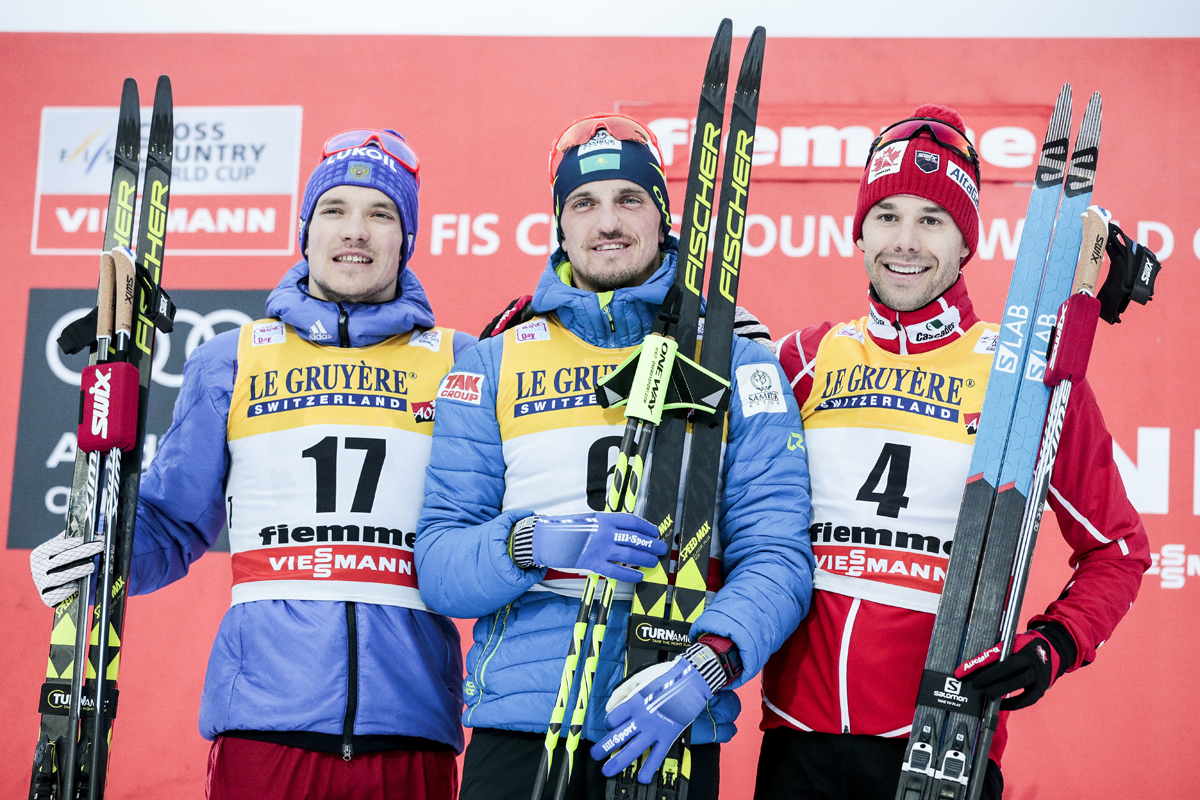
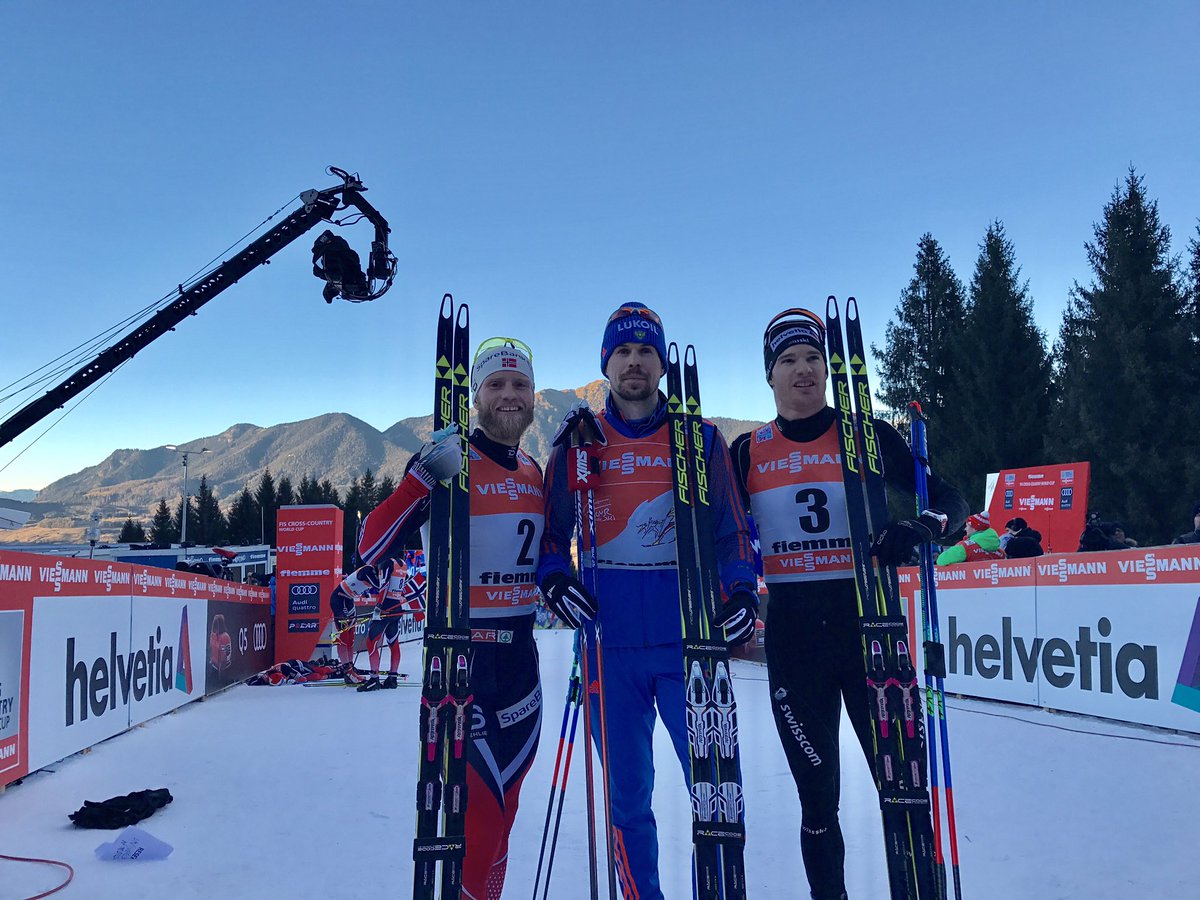
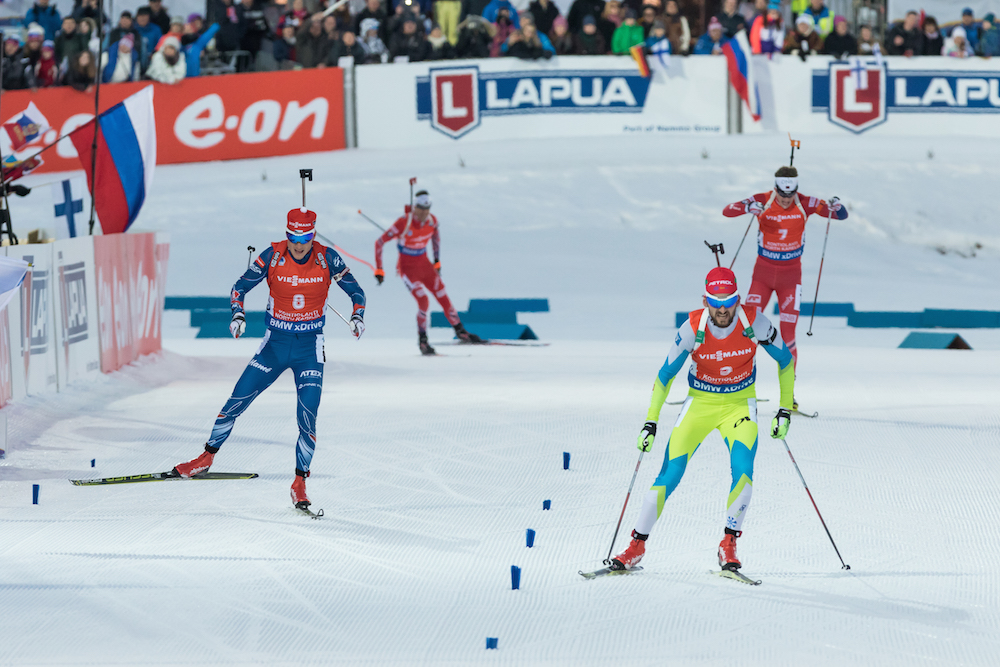
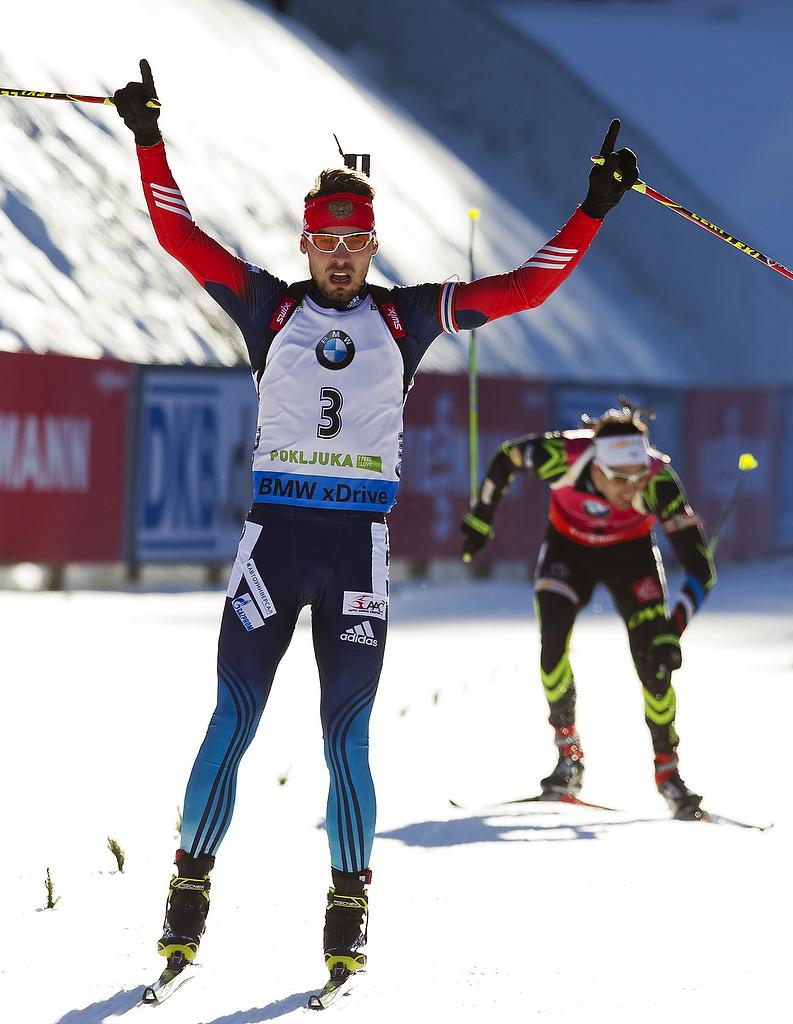
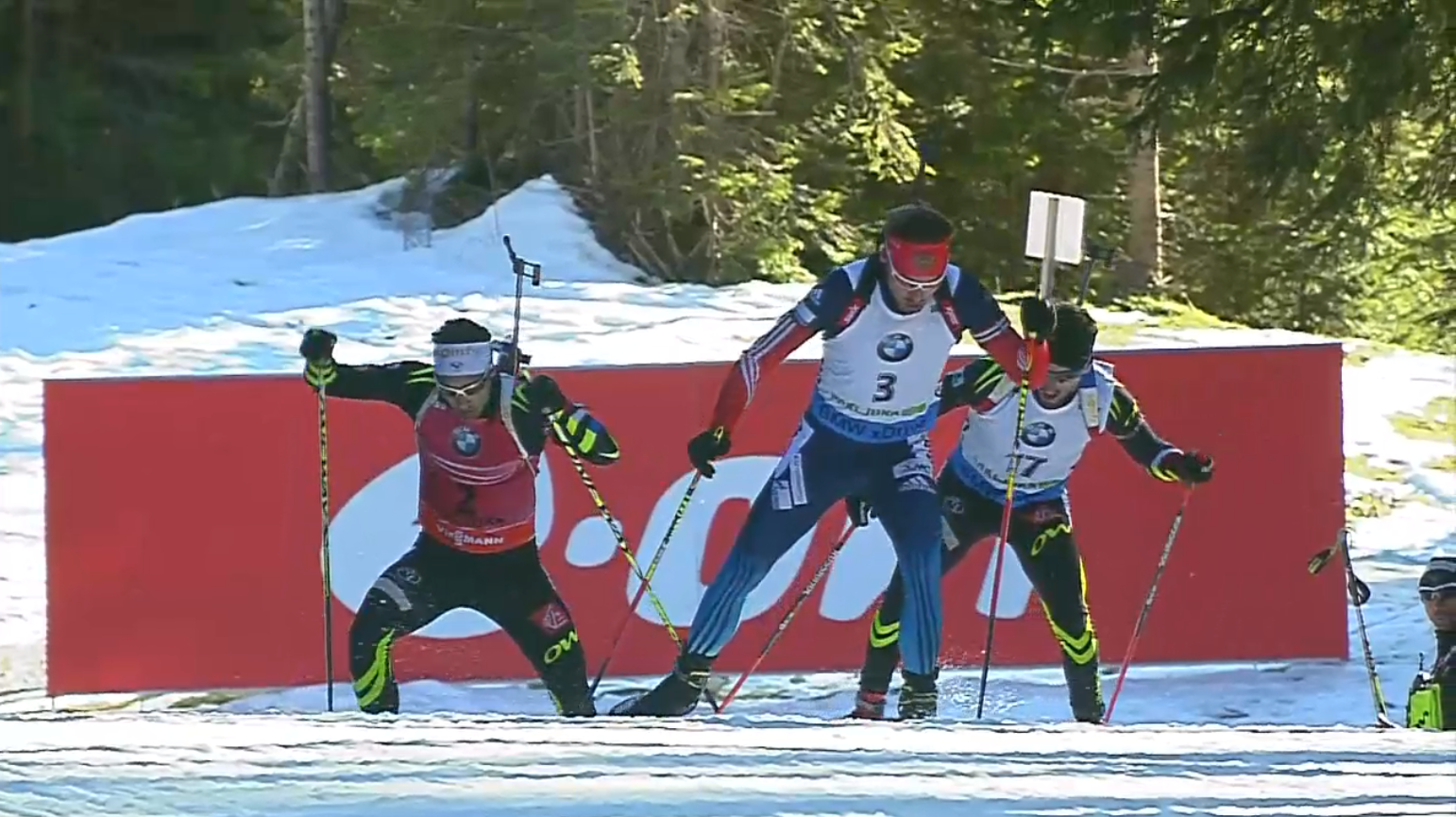
Alexey Poltoranin of Kazakhstan (c) celebrates his first World Cup win in two seasons, as Russia’s Andrey Larkov (l) takes the first podium of his career. Alex Harvey of Canada (r) was third for his first podium of the season. (Photo: Salomon/NordicFocus)
Saturday’s 15 k classic mass start in Val di Fiemme, Italy, began as many expected: with aggressive skiing from Sergey Ustiugov and his Russian teammates.
Ustiugov, last year’s Tour de Ski champion, started the day ranked second, 53 seconds behind Switzerland’s Dario Cologna, himself a three-time Tour de Ski champion. Ustiugov was obviously trying to make up some of that time in a bid to challenge Cologna for the title: he skied hard from the start and won the bonus sprints at 3.6 and 8.6 kilometers, and teammates like Alexander Bolshunov, Alexey Chervotkin, and Andrey Larkov were often surrounding him at the front of the race.
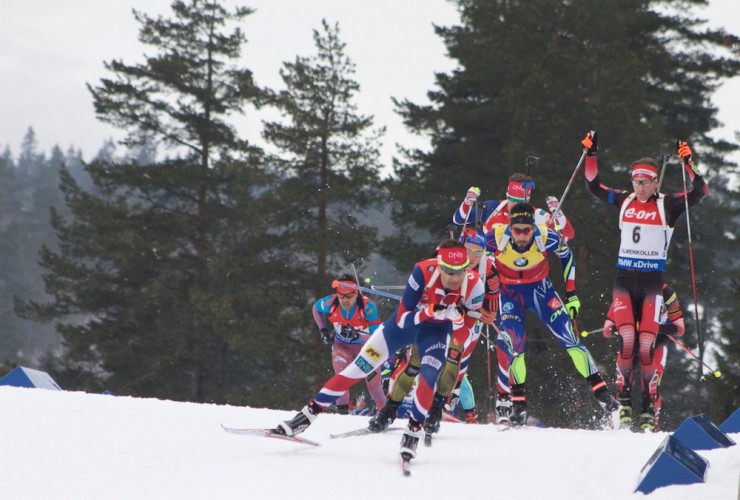
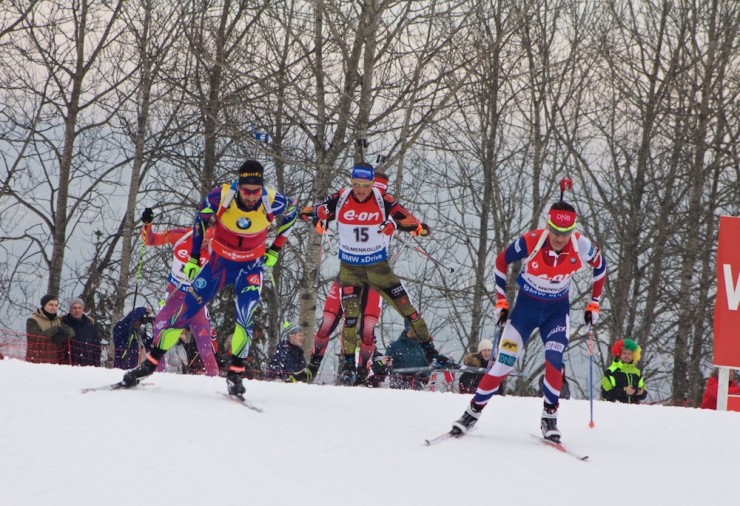
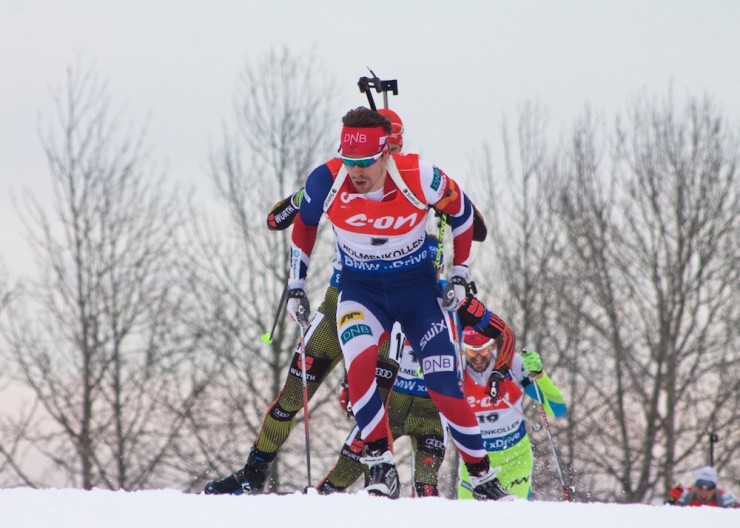
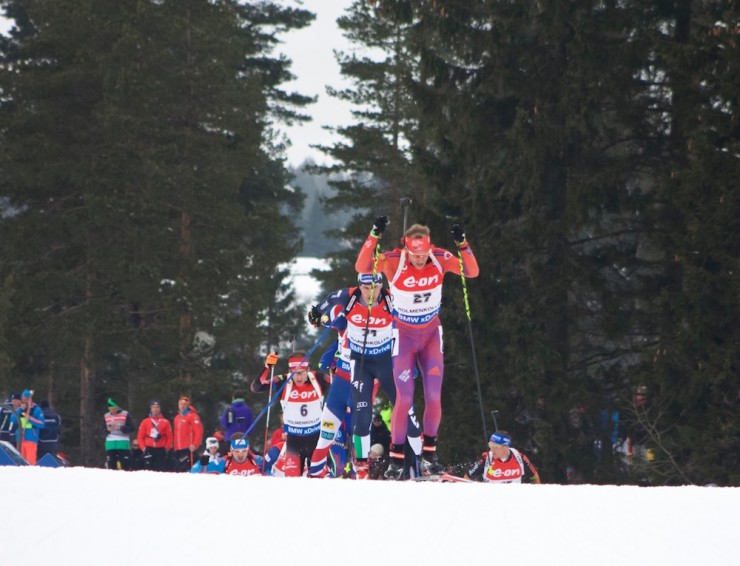
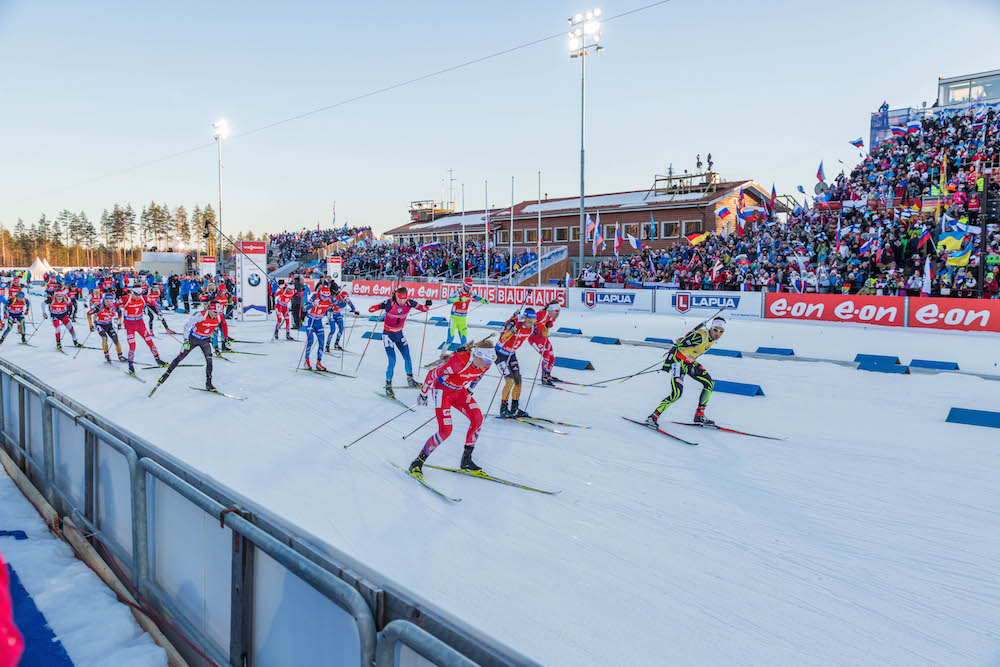
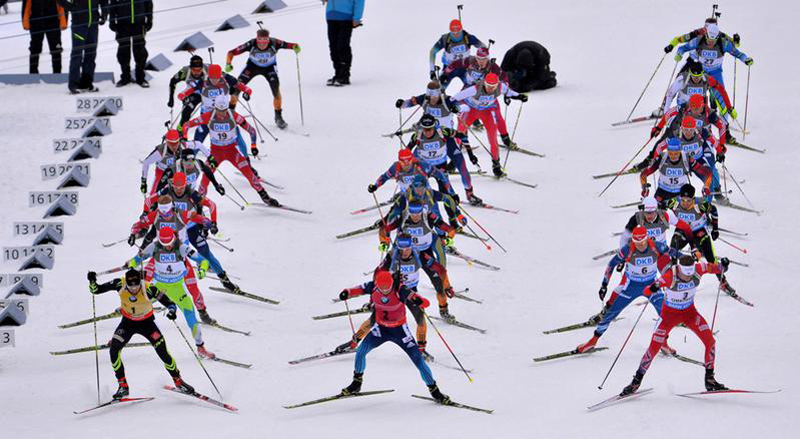
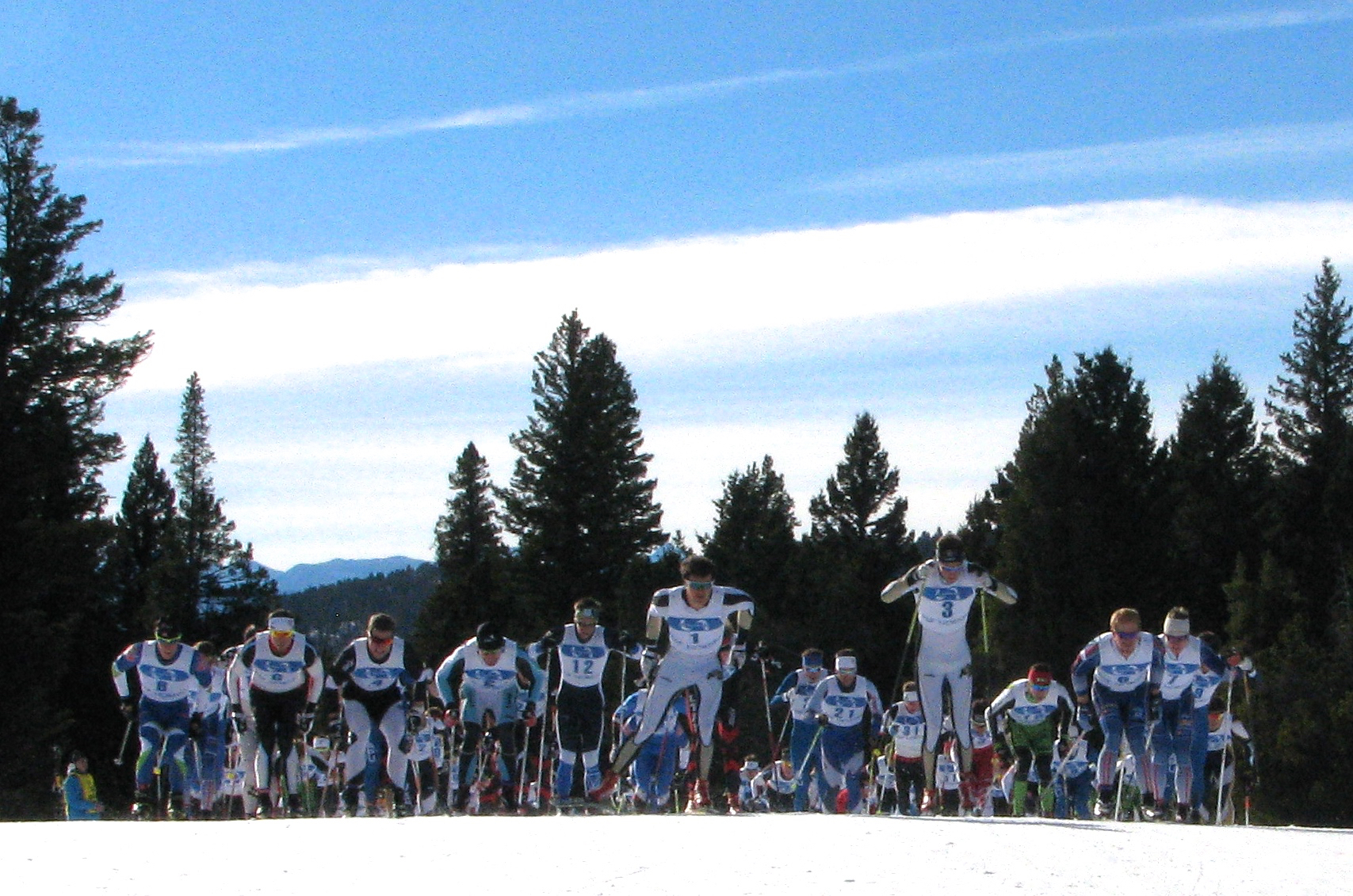
Early in the men’s 15 k classic mass start at Stage 6 of the 2018 Tour de Ski on Saturday in Val di Fiemme, Italy, with (front row, chasing, from left to right) Canada’s Alex Harvey (4), Russia’s Alexey Chervotkin, Kazakhstan’s Alexey Poltoranin, Norway’s Hans Christer Holund. (Photo: Salomon/NordicFocus)
Those bonus sprint seconds alone took 12 seconds out of Cologna’s overall lead. But the strategy appeared to backfire.
After the second bonus sprint, Ustiugov slowed to catch his breath. The man who had crossed the timing carpet just behind him, Alexey Poltoranin of Kazakhstan, just kept going. Behind him, Cologna and Canada’s Alex Harvey quickly latched on. It was a breakaway.
For several kilometers, their gap to the chasers hovered around two, three, or four seconds. Russia’s Larkov caught on. So did Norway’s Didrik Tønseth, but then he fell of the back of the pack again.
Poltoranin kept pushing the pace, and Harvey and Cologna took turns leading, too. The group was clearly trying to put some time on the men around them in the Tour standings.
“I knew some guys were struggling so I was really trying to lead the pace today,” Harvey, who also led for a kilometer or so around the 6 k mark, said in a Cross Country Canada (CCC) press release. “I was feeling good and I took my responsibility because I really wanted to make it hard and keep the speed high in the front for some of those guys struggling.”
And it worked. As the distance wore down towards the finish line, it was a group of four, with the rest of the field increasingly stringing out behind them. Ustiugov lost more seconds, and more. So did Norway’s Martin Johnsrud Sundby, who had come into the day ranked third in the Tour.
“In Val di Fiemme, our team has always managed to perform well in the classic mass start,” Larkov said in a Russian ski team Instagram post, according to a translation. “Today, from the very beginning of the race, the speed was almost maximum. After four laps of six, a group of leaders began to thin out. I saw all [my teammates] are behind us. I couldn’t slow down my opponents, so I went and got in behind them.”
Coming into the final downhill, Poltoranin led in one track, and Harvey in another. But Harvey’s skis appeared to be the tiniest bit slower than his competition’s.
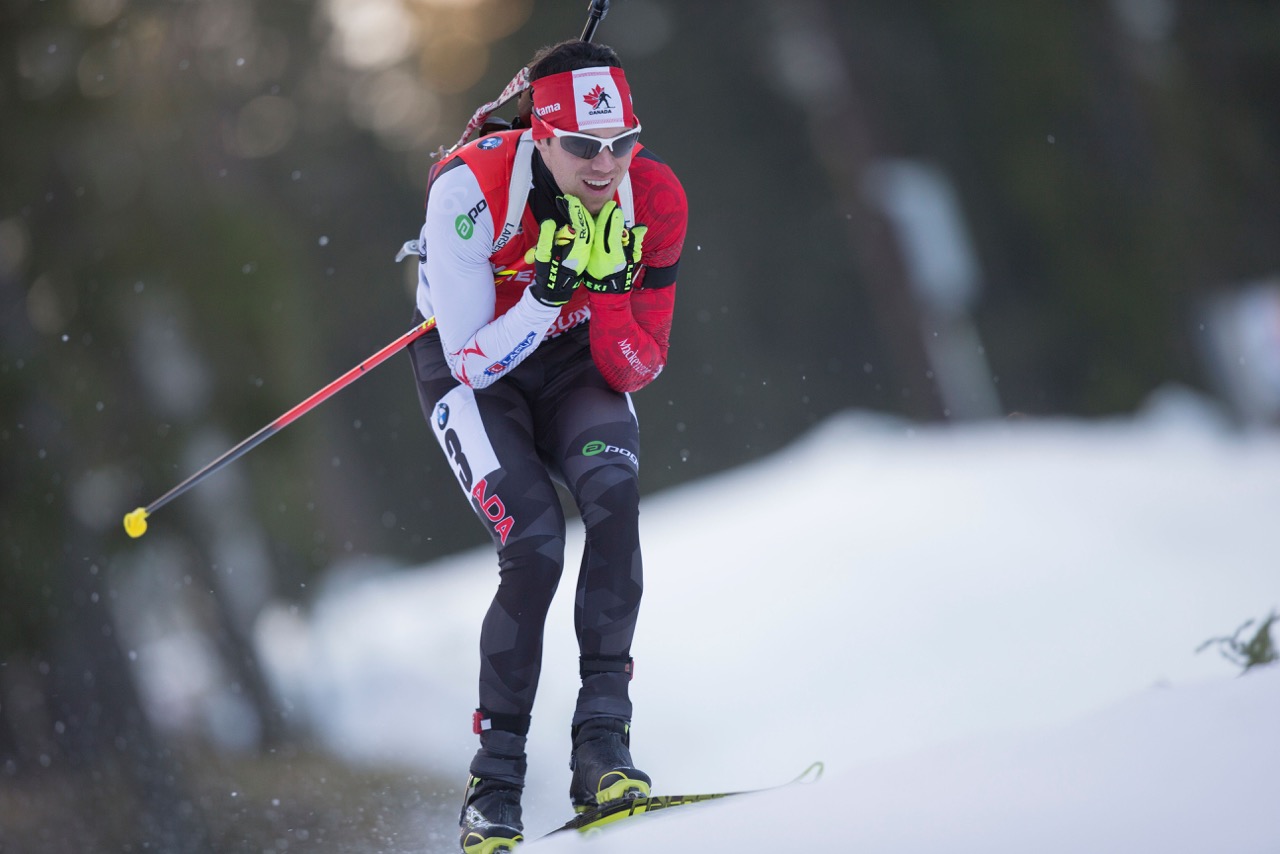
Canada’s Alex Harvey en route to third — his first podium of the season — in the men’s 15 k classic mass start on Saturday at Stage 6 of the 2018 Tour de Ski in Val di Fiemme, Italy. (Photo: Salomon/NordicFocus)
“I went for more grip to have perfect kick,” Harvey, who had been able to stride up the final climb while Larkov and Poltoranin had to jump out of the tracks and herringbone, said in a FIS press release. “I knew the other guys had a little bit faster skis.”
That kick had put him in a great position for 14.5 kilometers and allowed him to be in podium position, but in the race’s final meters it turned into a drawback. Larkov pulled around him to follow Poltoranin to the finish, ending up just 0.4 seconds back for the first World Cup podium of his career.
“I watched [how] their skis work,” Larkov said in the Instagram post. “For Harvey and Cologna, the skis were slightly worse. I paid attention to this.”
Harvey double-poled with all his might and hung onto third (+0.9). Cologna realized he didn’t have the finish sprint, and crossed the line a weary fourth (+2.3).
It is Harvey’s first podium of the season – he has been fourth three different times – and also his first classic podium since 2015 World Championships.
“This was a good result, especially in classic,” he said. “To do it on a really hard course here is really good.”
Alexander Bolshunov of Russia finished fifth (+15.0) and Daniel Rickardsson of Sweden sixth (+20.2).
Sundby finished 11th, 28.9 seconds back.
“It’s terribly bad,” he told Norwegian broadcaster NRK, according to a translation. “Not good at all… We have nothing to blame on… but that’s the reality. I’m not in better shape. Being out of it in a 15 k classic is unusual… As of today, this is far too bad.”
Cologna may not have been on the podium today, but he held onto and even extended his Tour de Ski lead. Going into Sunday’s final stage, the climb up the Alpe Cermis, he has an advantage of 1:14.4 over Poltoranin, who vaulted from sixth into second place in the Tour standings with his win.
Kazakhstan’s Alexey Poltoranin leads Russia’s Alexey Chervotkin on a downhill during the men’s 15 k classic mass start at Stage 6 of the Tour de Ski in Val di Fiemme, Italy. Poltoranin went on to win the stage and put himself second in the Tour with one stage remaining. (Photo: Fischer/NordicFocus)
For Poltoranin, it is a return to form as he has quite a large collection of World Cup wins and podiums, but his last win had come two years ago in a Tour de Ski stage in Oberstdorf. Almost all of his best results have been in classic, and today was his day. Not only did he push the pace in a move that ended up defining the race, but he was able to claim the win, too.
“Second place is a new record for me [in the Tour de Ski],” Poltoranin told FIS’s Jeff Ellis in a stadium interview. “Of course I’m really happy I won.”
Ustiugov had been uncertain of starting Saturday’s race, after sustaining a mild back injury in one of his several crashes in the mass start in Oberstdorf, Germany, on Thursday.
He is now ranked third in the Tour de Ski, 1:21.5 back, and only the slimmest of margins ahead of Harvey, who is fourth 1:22.7 back. Then there is Bolshunov, +1:39.4, and Sundby +1:42.2. While Cologna, who last year had the fifth-fastest time up the big climb, is looking good to claim his fourth overall Tour de Ski title, the podium places are still wide open.
“The goal tomorrow will be to not work too much on the flats, but keep at it,” Harvey said in the CCC press release. “I don’t want to save my energy as much as I can for the climb, and not get caught by the guys behind me. It’s not my best event but the guys around me are all in the same boat.”
In last year’s edition Sundby had the 12th-fastest climb time, Harvey the 14th-fastest, and Ustiugov the 16th-fastest. The previous year, however, Sundby clocked the best climb time. In the past few years, when Poltoranin has finished the Tour he has never had a top-15 time up the Alpe Cermis. And Bolshunov has never competed in the Tour de Ski before.
In the 15 k mass start, the lone U.S. starter, Paddy Caldwell, finished 48th, +3:38.6.
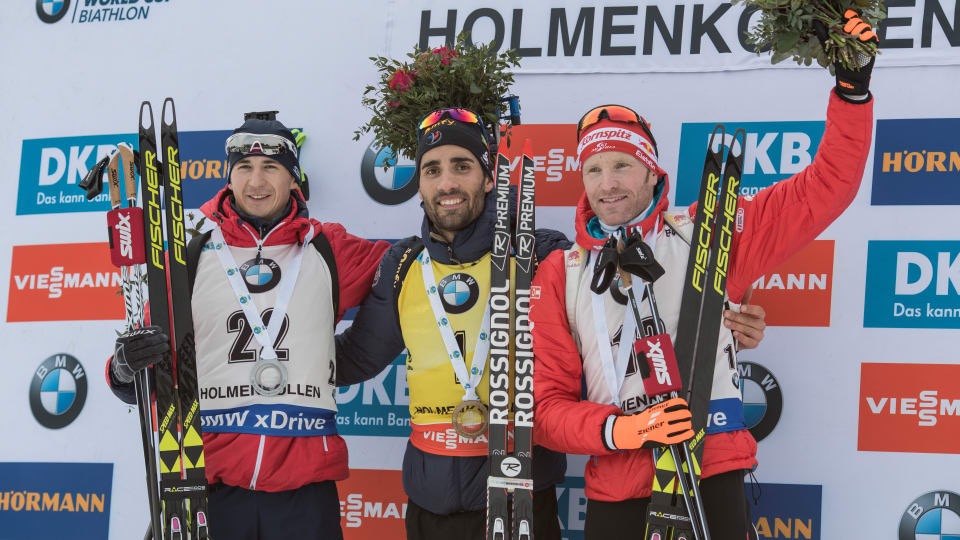
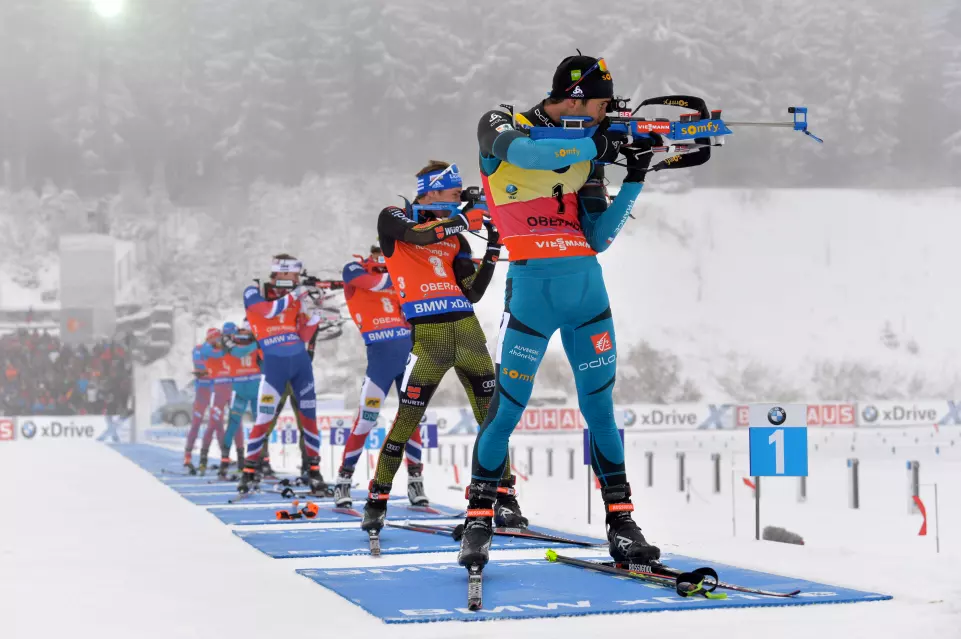
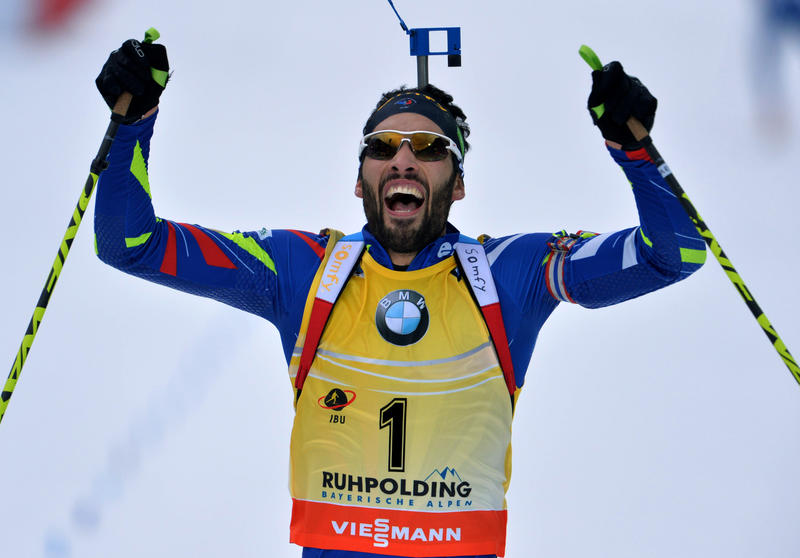
France’s Martin Fourcade (c) in first, Latvia’s Andrejs Rastorgujevs (l) in second and Austria’s Simon Eder (r) in third on the podium following the men’s 15 k mass start at the season-finale 2017 IBU World Cup in Oslo, Norway. (Photo: IBU)
Between breaking historic biathlon records and waiting for the imminent birth of his second child, France’s IBU World Cup dominator Martin Fourcade forgot one crucial detail of Biathlon 101 before Sunday’s final race of the season in the men’s 15-kilometer mass start: loading his ammunition clips.
Fourcade only realized he had started with four empty clips when he crouched down on the shooting mat for the first prone shooting, then signaled for help. His coach standing at the range reacted the fastest and threw him a full clip. Fourcade inserted it into his rifle and went on to hit all five shots, leaving the range in 18th position and 21 seconds behind the leaders, almost the time it takes to ski a penalty lap.
But what he and his coach had done strictly was not allowed: Fourcade would have had to wait and receive the spare clip from a race official, because the range is a “no-coaching zone”. While the race went on, Fourcade’s name was marked with an asterisk on the timing screens, and the race jury and technical delegate started discussing if Fourcade maybe should be disqualified or hit with a time penalty.
Fourcade later said he was aware the violation was under review, but decided to keep racing like normal. Before the second shooting he had compensated the gap passing the whole field to take the lead again, and received additional spare magazines this time from an official kneeling next to the first-lane shooting mat.
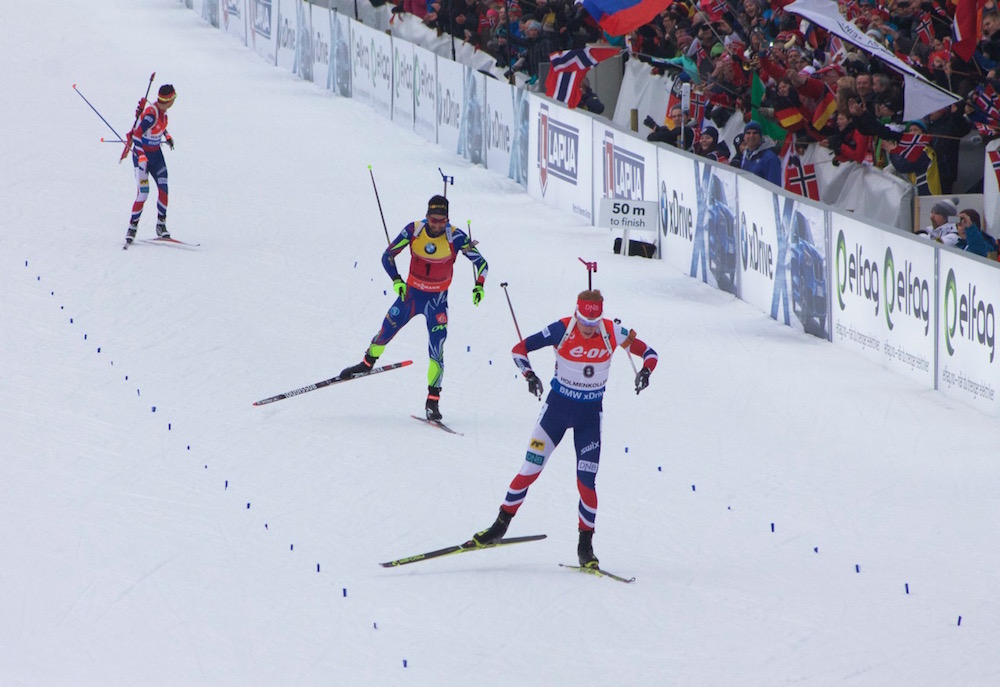
Seemingly undeterred by the problems, Fourcade went on to clean not only the second stage, but also the two standing stages to create a lead of almost 25 seconds, already celebrating as he left the famous Holmenkollen arena for the final loop. He was the only athlete in the field to shoot clean in all four stages, crossing the line in a time of 37:32.2 minutes under the huge applause of thousands of fans in the stands who had just witnessed a demonstration of his abilities. But would his victory stand?
“I am simply an idiot, because I forgot to reload my magazines before the start,” Fourcade explained during a press conference later. “Today I had a really good day in spite of this huge mistake. I succeeded getting back the time I lost, and then shot clean. I am really happy and proud of my competition. It was probably one of the best days in my career, but it was a competition full of stupidness.”
Behind him, Austria’s Simon Eder and Latvia’s Andrejs Rastorgujevs – usually known as a fast skier but shaky shooter – manged to also clean the final standing stage and went out on the last loop together. Rastorgujevs was faster there, overtaking and then distancing Eder to achieve the first World Cup podium of his career with two penalties in the race (0+1+1+0), 17.4 seconds behind Fourcade. Eder finished third (+32.4) with one penalty (0+0+1+0) to claim his third individual podium of the season (plus two in single mixed relays and two in men’s relays).
In his long career, Rastorgujevs, 28, had been on the podium at IBU European Championships, winning gold in 2014 and at Summer Biathlon World Championships on rollerskis, but never in a World Cup where he only had four fourth-place finishes to his name.
“The first podium in I think more than five years for me, after a lot of fourth, fifth, sixth, seventh, eigth, ninth, tenth places,” Rastorgujevs said during the press conference. “I am really happy, and I want to say a big thanks to my team and my service guys, who have worked very hard for this second place … I think today is a special day, and it’s also a big party for my team … Now I think this is opening the door for more podiums. We will see what happens next season.”
“Yesterday I joked about a podium [in an interview], I don’t know why I did that, but I am really happy I got this podium today,” Eder explained. “The third race in a row is always a problem for my body, I already know this. I prefer to have a rest day, so I knew it was gonna be hard today. I am happy I got the third place. I saw Andrejs behind me which made me happy, and tried to keep up with him as long as possible hoping for the third or maybe second place but he was too strong for me.”
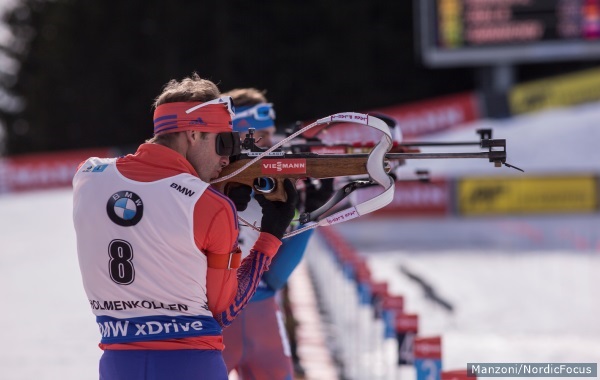
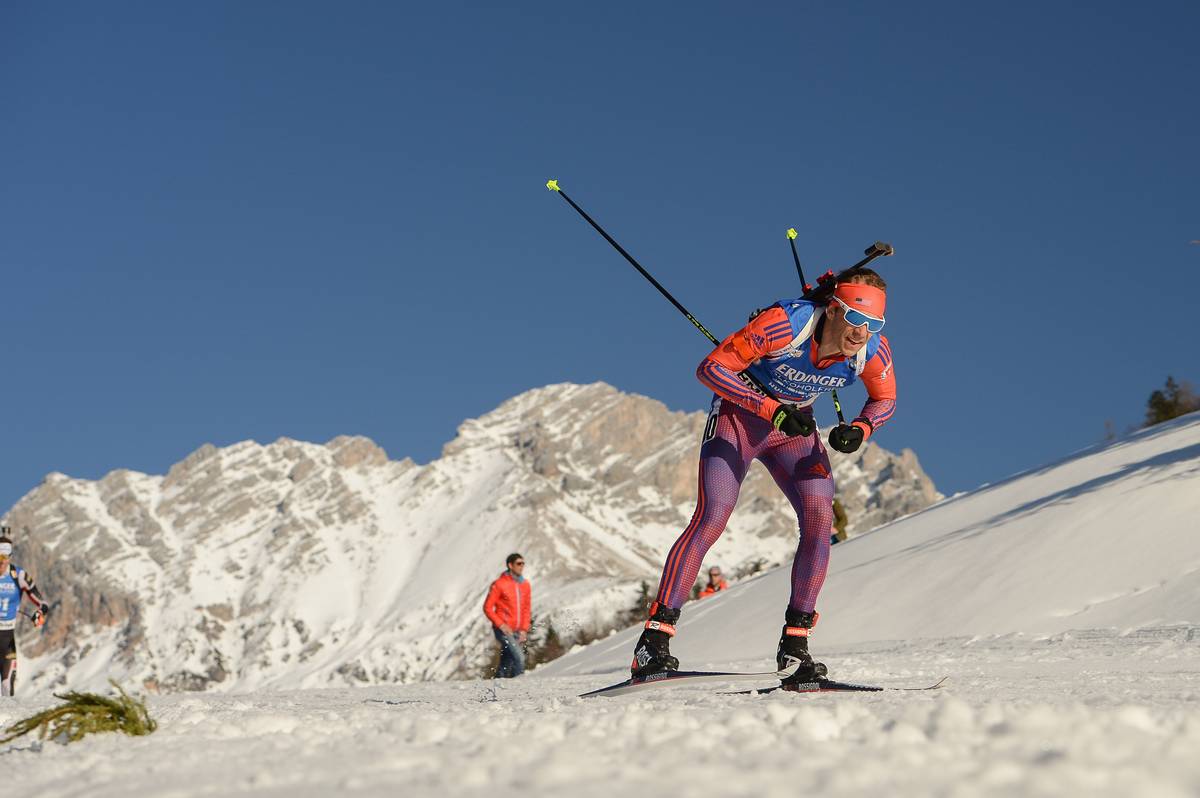
Lowell Bailey (US Biathlon) shooting during a standing stage in the men’s 15 k mass start, the last race of the 2016/2017 IBU World Cup season, on Sunday in Oslo, Norway. He went on to finish 15th. (Photo: USBA/NordicFocus)
Halfway through the race, US Biathlon’s Lowell Bailey had been in the lead after two clean prone shooting performances, taking the first lane in the standing shooting. But he missed two targets in that stage and had to ski a penalty lap, and then missed another one in the final shooting.
“I think this was one of my best races of the season in terms of ski speed. I felt composed and focused in prone, and was happy with two cleans,” Bailey wrote in an email to FasterSkier. “In the first standing, I didn’t necessarily plan on shooting on point 1, but [Russia’s Anton] Shipulin did not want to lead in and I thought, if anything, it would be a bit of an advantage to be on point 1 if the wind came up. Those two misses set me back a fair amount, but I’m happy I stayed in the race mentally, only had one miss in the last standing, and was able to ski my way back into a top-fifteen.”
Bailey finished the race in 15th place with three penalties (0+0+2+1), 1:10.4 behind Fourcade. But had Fourcade actually won, or would he be disqualified or relegated back?
After the race, the competition jury could be seen on the TV broadcast deliberating the case for several minutes, and ultimately they decided to not take any actions against Fourcade.
“I knew after the first shooting I was under disqualification [review], because the way I got back my full magazine is not the way exactly to do it,” Fourcade said. “It was a possibility to be disqualified, so I wanted to show to everyone, to all the other athletes, to the audience, to the jury also, that it was my day. And if they decided to not give me the victory, I knew in my heart that I had it.”
“I think the jury was right,” Bailey wrote in his email. “I’ve been there. I know what it’s like to make a simple, costly mistake, and I think he definitely didn’t gain any advantage by NOT loading his clips.”
Aside from Rastorgujevs and Norway’s fourth-place finisher Emil Hegle Svendsen (+42.2 with two penalties), the athlete who would have stood to benefit the most from a punishment for Fourcade was Germany’s Simon Schempp, who had been in the lead in the mass-start score World Cup standings before the race. But just coming back from a lengthy illness after last month’s World Championships where he won the men’s mass start, Schempp only finished with a 20th place (+1:28.5 with three penalties) in the same discipline on Sunday, and thereby still lost that title to Fourcade.
“The hope was there, but with my current form it is very tough,” Schempp told ARD after the race. “I gave it everything I had. I am disappointed, but something like that can’t be fixed when you come here basically without any training. I lost a lot of points in the standings the last weeks, and I can still feel the illness in my bones. I can’t help it, it happens.”
But Schempp also did not want to get the award back “off the course” by a disqualification.
“I wanted to thank and to give all my respect to the team of Germany and to Simon Schempp, who decided to not ask for a protest,” Fourcade said in the press conference, unprompted. “That’s a big gesture. I really take my hat off to Simon Schempp. I must say how impressed I am by their class, they deserve much more than a crystal globe today.”
Bailey finished the season in eighth in the World Cup Total Score standings, a career best all the more impressive considering he skipped an entire week of races in Oberhof, Germany, for a longer rest and training break after Christmas. That paid off, with a gold medal in the men’s 20 k individual at World Championships in Hochfilzen, Austria, a second place in the sprint at the World Cup in PyeongChang, South Korea, and another second place in Kontiolahti, Finland, in the single mixed relay together with his teammate Susan Dunklee.
“This is, by far, the best season of my life,” Bailey wrote reflecting on his season. “At 35 years old, I can say that I’ve waited a long time for this season. I have so many people to thank, first among them, my wife Erika for believing in me through it all, and being by side every step of the way. It’s been so great to have her and my daughter on the tour for the majority of the season.”
Eckhoff Wins Final Mass Start at Home Despite ‘Squirrel Drama’
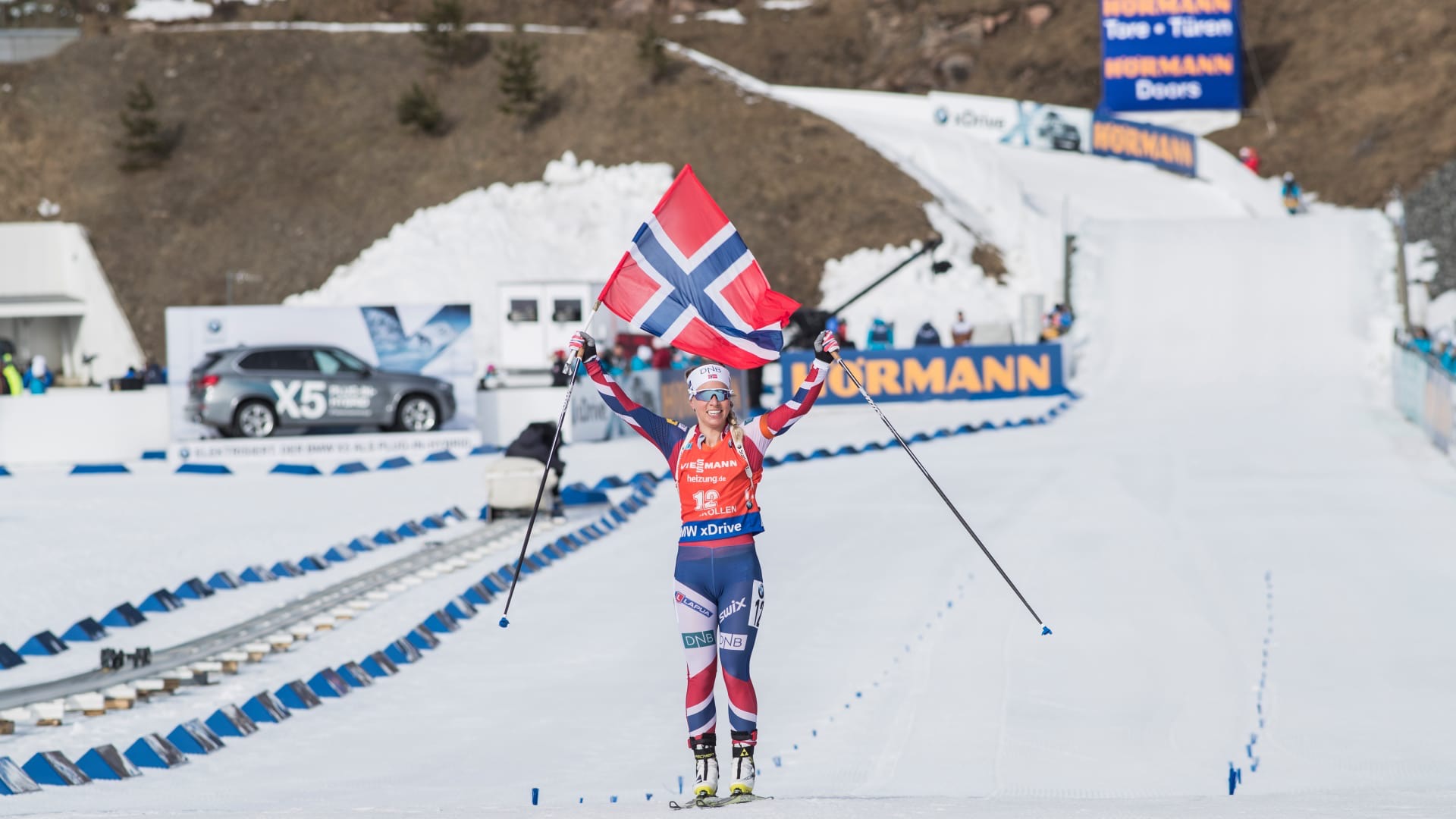
Norway’s Tiril Eckhoff crossing the finish line with the Norwegian flag to celebrate her victory in the women’s 12.5 k mass start at the 2017 IBU World Cup on Sunday in Oslo, Norway. (Photo: IBU)
“I hope I didn’t kill it,” was the first comment by Tiril Eckhoff after Sunday’s race to broadcaster NRK.
What the Norwegian was referring to was the only small thing that disturbed her victory in the women’s 12.5-kilometer mass start at her home venue in Oslo: a streaking squirrel crossed the course in a ditch before the longest climb seven kilometers into the race, right in front of a six-person lead group that included Eckhoff, France’s Justine Braisaz and American Susan Dunklee.
The little animal seemingly was confused which way it should try to escape, then jumped up when Braisaz tried to break, with Eckhoff almost running over it as well.
“That squirrel was my favorite part of the race,” Dunklee wrote in an email to FasterSkier. “It ran in front of me then I saw it collide with Justine. I couldn’t help but laugh!”
“Braisaz drove over the squirrel, so I just had to take my ski up and hope it goes well,” Eckhoff told NRK. “It’s good to see some wildlife in the forests of Norway.”
After the race she could have a good laugh about the incident, which her home country’s TV broadcaster dubbed “Eckhoff vs. ekhorn” and “ekhorndrama” by the Norwegian word for squirrel.
Reportedly the squirrel got away alive. And luckily it had not been Eckhoff vs. moose, another common dweller of the Norwegian forests.
Shooting 19-for-20 after she earlier in the season had never hit more than 16 shots in a four-stage race (0+0+1+0), Eckhoff took the lead after the final shooting ahead of Czech Republic’s Gabriela Koukalová, and pushed hard throughout the last loop to create a gap that allowed her to grab a Norwegian flag before the last ski bridge in the Holmenkollen arena, waving to the fans as she skied down the homestretch before crossing the line in a time of 34:23.1.
“I was very fed up with [always] going to the penalty loop,” Eckhoff said at the press conference. “So I just said to myself, ‘Now I’m gonna take those targets down,’ and I managed that, so now I’m really happy … because that has been my main issue.”
Eckhoff had won gold medals in the sprint and the women’s relay at last year’s World Championships at home in Oslo, where she grew up and still lives. But partly due to illnesses she struggled with this season, she didn’t return to form until after this year’s Hochfilzen World Championships. She went on to notch a second place in the sprint in PyeongChang, South Korea, and then a sprint win in Kontiolahti, Finland.
Behind Eckhoff, Koukalová finished Sunday’s race in second place (+22.6) with one penalty (0+1+0+0), thereby securing the World Cup title in the mass start discipline ahead of Germany’s Laura Dahlmeier, who finished ninth after shooting three misses (+54.2), not able to defend the small lead she held before the final but winning the overall World Cup Total Score title for the first time.
After the race, Sweden’s Hanna Öberg also received the IBU award for the “Rookie of the Year”.
“I was not under pressure today,” Koukalová said with a big smile at the press conference. “I had no expectations. I tried to imagine that I’m already somewhere else, at the athletes’ party this evening for example … It’s one of the best seasons of my life.”
“I am totally exhausted, and happy that there is no more race tomorrow,“ her rival Dahlmeier told German broadcaster ARD after the race. “The miss at the end ruined a better result today, and on the course it was also really tough for me. I have reached my limit now … I hope some energy comes back to celebrate the season tonight.”
Before the final shooting Dahlmeier’s teammate Franziska Hildebrand had been in the lead by almost 20 seconds thanks to three clean shooting performances, with her first individual podium of the season within her grasp. But she missed her very last shot, causing her coach to let out an audible swear, and she had to ski a penalty lap, which allowed the clean-shooting Eckhoff and Koukalová to pass her.
Coming back on the loop still in third place, Hildebrand was chased down by Finland’s Kaisa Mäkäräinen and Czech Republic’s Veronika Vitkova, who passed her shortly before the finish skiing down into the Holmenkollen arena. Mäkäräinen claimed the third place on the podium (+34.5) with two penalties (0+0+1+1), while Vitkova finished fourth (+36.1) and Hildebrand fifth (+39.0). Mäkäräinen’s teammate Mari Laukkanen, the winner of the preceding sprint and pursuit races in Oslo, finished sixth (+40.0) to round out the most successful weekend of her biathlon career.
“It has been some hard time the last two weeks,” Mäkäräinen said in the press conference, referring to the passing of Finnish shooting coach Asko Nuutinen. “I’m sure that has somehow affected my results in a negative way, and now yesterday and today I managed to get the power and do some better races. So I am happy with the result today. I just tried to focus on what I do, not thinking about the result that much.”
“It’s been a very special week with what happened to the Finnish girls, and I am very impressed with Kaisa and Mari,” Eckhoff said at the press conference.
Halfway through the women’s mass start, Dunklee had been in the lead after shooting clean in both of her prone stages, then held on with the top group on the course, mostly letting Eckhoff dictate the tempo.
But after also struggling on the range in Saturday’s pursuit race with ten penalties, Dunklee, who recently exhibited remarkably consistent shooting performances, started to miss and incurred three penalties in the first standing stage and another two in the last one (0+0+3+2).
“I am not entirely sure what has been off in standing this weekend,” Dunklee wrote in her email. “It’s frustrating. Maybe the biathlon gods thought it was time for a dose of humility. My ski form is the best it has been all year.“
In the end she came to the finish in 20th place, 1:43.8 behind the winner Eckhoff.
Still, Dunklee managed to retain the 10th position in the World Cup Total Score standings, another career best to end a season that included a silver medal in the mass start at the World Championships and another podium at the World Cup in Kontiolahti in the single mixed relay with Bailey.
“This is the sort of history making team that every athlete dreams of being part of during their lifetime,” Dunklee reflected on the season. “We have staff who have worked for decades believing this level is possible. Now the door has been opened. I don’t think they will have to wait decades for the next relay medals or World Championships podiums.”
Lowell Bailey (US Biathlon) racing to gold in the men’s 20 k individual at 2017 IBU World Championships on Feb. 16 in Hochfilzen, Germany. He finished the championships with his fourth individual top six on Sunday in the men’s 15 k mass start. (Photo: USBA/NordicFocus)
Before this year’s International Biathlon Union (IBU) World Championships, American Lowell Bailey had never cleaned a 20-kilometer individual or 15-kilometer mass start race. In layman’s terms, he had never hit all 20 targets in those types of races — the longest formats on the circuit. Not in a World Championships, not in a World Cup. That’s not to say shooting isn’t his strength; that’s just extremely difficult to do.
Fast forward to Sunday, the last day of 2017 Biathlon World Championships in Hochfilzen, Austria, Bailey finished his third individual race of the championships with perfect shooting, shooting clean in the 15 k mass start for sixth place. In four individual races over the last week, he hit 69 out of 70 targets.
“It’s, no words, it’s unbelievable,” Bailey said after Sunday’s mass start, where he finished with what would have been a career best (sixth) in any other of his previous World Championships appearances.
In his eighth World Championships, this year was different. Bailey started the week off by racing to fourth in the sprint, the second-best result of a U.S. biathlete at World Championships. He cleaned that race. Then he finished sixth in the pursuit for his second-best result at World Championships. That’s the race he missed one.
Not counting Olympics (Bailey finished eighth in the 20 k at the 2014 Sochi Games), he had cracked the top 10 of an individual race at World Championships once before (in last year’s mass start in Oslo, Norway, where he placed 10th). Bailey carried his momentum this year all the way to the Hochfilzen 20 k, which he won to become the first American gold medalist at Biathlon World Championships. That happened Thursday. Three days later, he ended the championships with his fourth top-six result in as many individual races.
“I’m so happy for the team, for Susan,” Bailey said. “Our whole team deserves this world champs. We haven’t shown what we’re capable of, there’s always been one setback or another … and the stars aligned for this one. We were waiting for this moment and everything clicked for the team and it’s so great to see, and god, am I glad I stuck around to be here.”
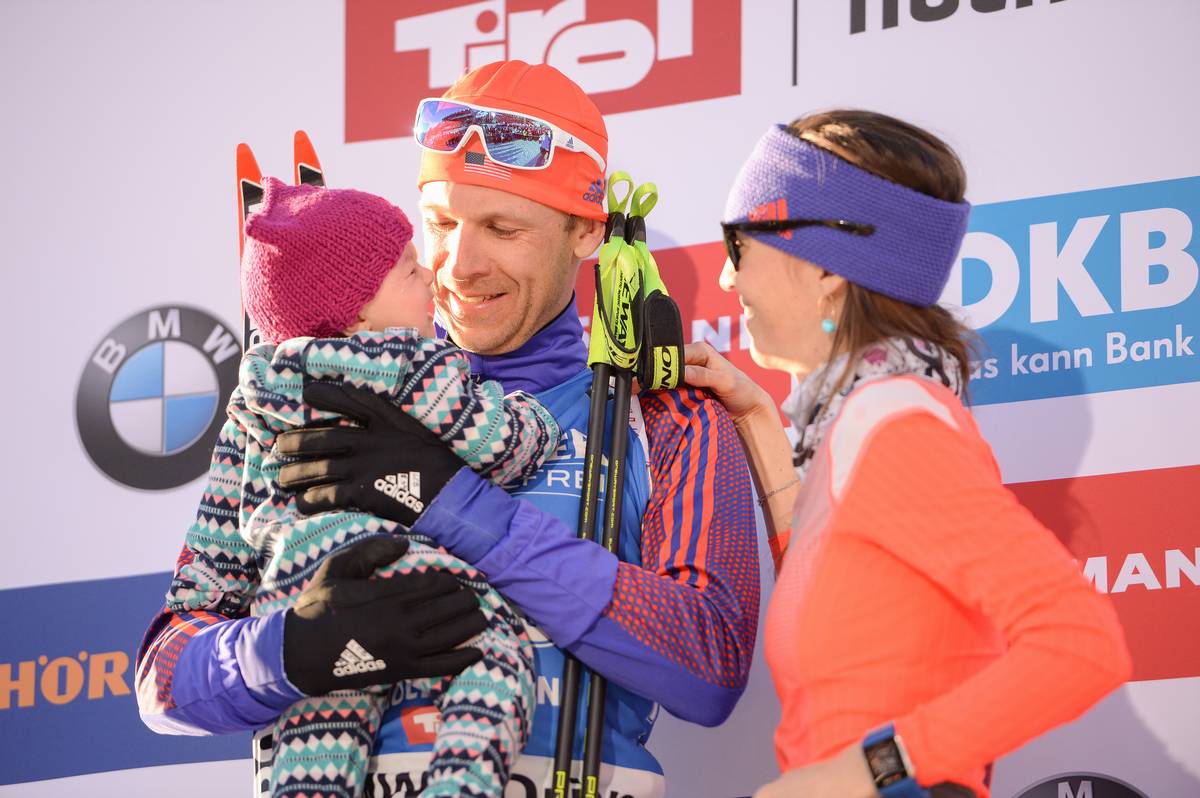
Lowell Bailey sharing his moment on the top step of the World Championships podium with his wife Erika (r) and daughter Ophelia on Feb. 16 in Hochfilzen, Austria. (Photo: USBA/NordicFocus)
Bailey, 35, is a new dad. Some people refer to him as a buffalo farmer. He got married nearly two years ago and he and his wife Erika welcomed a baby girl into their lives last June. You could say Bailey has a lot going on, and he considered retiring at the end of last season, yet he came into this season with a very specific focus.
“I told my staff, I said, ‘Hey, I just want to be on the podium again. It really doesn’t matter to me where that is because I know every race is just as competitive, so if it’s at world champs, great, if it’s at the first World Cup, if it’s at the last World Cup…,” Bailey explained.
With “25-some-odd” races in a season, he liked his odds. And considering the momentum he has coming out of world champs, Bailey is feeling good about the last nine races of the season.
“It’s just a matter of believing,” he said. “I’ve got the confidence now, I know I can go head to head with the best in the world … I’m just gonna enjoy the rest of the season and every race is a new day and a new chance.”
Podium Contention
While sixth sounds pretty good, Sunday’s mass start was even more exciting for fans of Bailey and US Biathlon as he skied in first, second or third for much of the race.
Bailey put himself near the front of the 30-man field early in the mass start, entering the range in fifth for the first time. One of 18 skiers to shoot clean on that first prone stage, he headed out on his second loop in second place, just 1.1 seconds behind Russia’s Anton Shipulin in first.
On that second loop, Austria’s Simon Eder took the lead then traded off with his teammate Dominik Landertinger before Germany’s Benedikt Doll led the pack into the range for the second time, followed closely by Shipulin and Bailey, respectively.
There, Bailey shot clean and posted the fastest range time to leave the range in first, 0.9 seconds ahead of Landertinger. Overall on the day, Bailey’s range and shooting times ranked third fastest.
On the third loop, Doll, Eder and Landertinger passed Bailey early, and he ultimately entered the range for the first standing stage in eighth, just 2.5 seconds behind Doll in first. Despite tired legs, Bailey shot clean again and left the range in second.
“I just kept to what’s been working for me all week,” he recalled. “I kept to the simple fundamentals of shooting. Today I was really feeling it, I didn’t have it in the legs and sometimes that can be a distraction, but I just said, you know, just do what you can do. You know how to shoot and you know how to ski, so just go and do the best you can.”
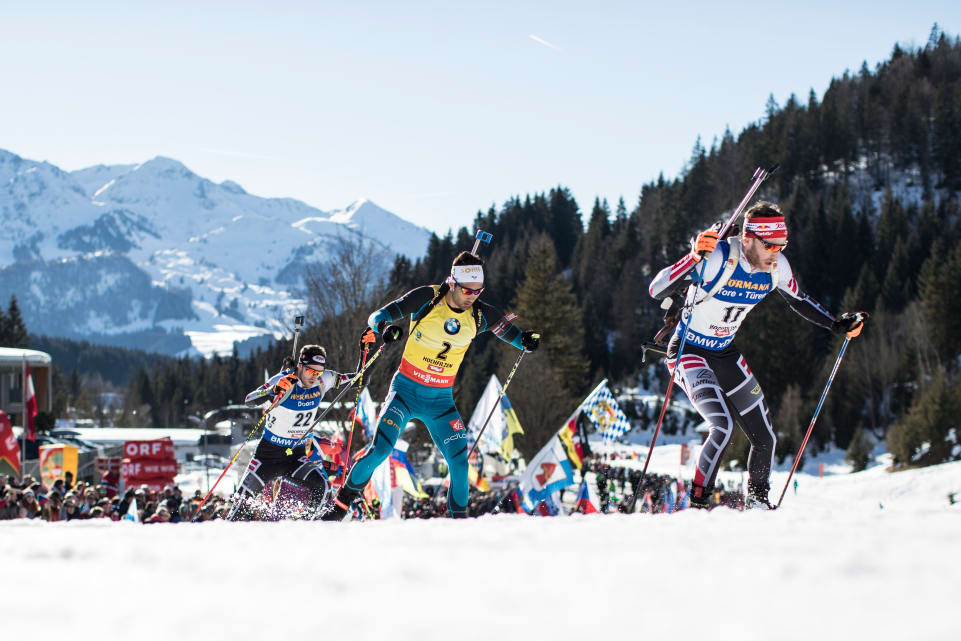
Austria’s Simon Eder (17) leads France’s Martin Fourcade (2) and Austrian teammate Dominik Landertinger (22) in the men’s 15 k mass start, the last race of IBU World Championships in Hochfilzen, Italy. Eder went on to place third for his first World Championships podium, Fourcade placed fifth and Landertinger seventh. (Photo: IBU)
He followed Eder, also clean through three stages, out of the range with about 3 seconds between the two. France’s Martin Fourcade had worked his way up to third after a penalty in the first stage and trailed Bailey by 0.6 seconds. Aside from Fourcade, seven of the top eight were still without a miss heading into the last shooting.
There, Bailey entered the range in eighth again, 12.1 seconds behind Fourcade, who had worked his way up to first on that fourth loop. Landertinger remained in second, just 0.5 seconds behind Fourcade, Germany’s Simon Schempp third (+0.7), Norway’s Johannes Thingnes Bø fourth (+1.3), and Eder fifth (+1.8).
Eder, Schempp and Bailey all cleaned — the only three men to do so and finish the day with 20-for-20 shooting — to embark on that last loop in that order. Eder led Schempp by just 2.3 seconds while Bailey trailed in third, 16.8 seconds out of first. Another 8.4 seconds behind Bailey, Bø flew out of the penalty loop (after his first miss of the day) in fourth.
And while third place was undoubtedly on Bø’s mind, he didn’t stop there when he passed Bailey early on the final 3 k loop. Up front, Schempp had caught and passed Eder within the first kilometer. Eder appeared to give up the chase for gold half a kilometer later, and at 13.6 k, he was 7.5 seconds ahead of Bø in third.
Germany’s Simon Schempp celebrating his first individual World Championships gold on Sunday in the men’s 15 k mass start in Hochfilzen, Austria. (Photo: IBU)
Bø caught him and with less than a kilometer remaining, he passed Eder to lead on a downhill into the finishing straight. Schempp skied away, uncontested, for first place in 35:38.3 minutes, while Bø finished 9 seconds later for silver. Just 1.1 seconds behind Bø, Eder notched his first World Championships podium in third (+10.1).
Meanwhile, Bailey’s gap to Bø on the last lap grew to 18 seconds by 13.6 k. Shipulin passed Bailey shortly after, and Fourcade passed him as well to put Bailey in sixth at the finish (+33.5), behind Shipulin in fourth (+25.3) and Fourcade in fifth (+31.3).
“I was able to hang for four laps and I just told myself to hang as long as I could,” Bailey recalled. “Unfortunately I only had four laps and the fifth was bru-tal as they say in Germany. But I’m so psyched with this whole world champs…
“It’s surreal to be sixth,” he continued. “I mean, a fourth, a sixth, a first, and a sixth… I’ve popped good results here and there, but to be consistent for the whole two weeks, I’m so satisfied with how the training’s gone and the preparation. I had great skis today, maybe the best skis I’ve had actually, thank god because I didn’t feel so good. I was pretty tired. It’s amazing, it’s really just amazing. It’s hard putting it into words.”
For the 28-year-old Schempp, who wore the red bib of the World Cup mass-start discipline leader, it was his first individual world title in his sixth World Championships.
“He is wearing the red bib, and you could see he deserves that,” Germany’s head coach Mark Kirchner told German broadcaster ARD. “He has waited a long time for his individual medal, and now he also [silenced] the last critics who talked all week about how he hasn’t won one yet, and even with gold. Sensational.”
“I am just happy that it was finally sufficient,” Schempp told ARD. “Incredible, an amazing race. I am just happy that it finally was enough for the top. Thanks to everyone, I can’t really say anything right now.”
He explained that he made a point to save some energy for the last climb, because he was “determined to attack there,” Schempp said. “And that was enough. A great day.”
“Of course it’s a big relief,” he added. “After all the races here I had to walk through the mixed zone and justify myself, that was not a nice feeling. And everyone asked me about the medal. It’s not easy, but today I finally was able to put it all together for a season highlight, and that’s why I am also enormously proud of myself.”
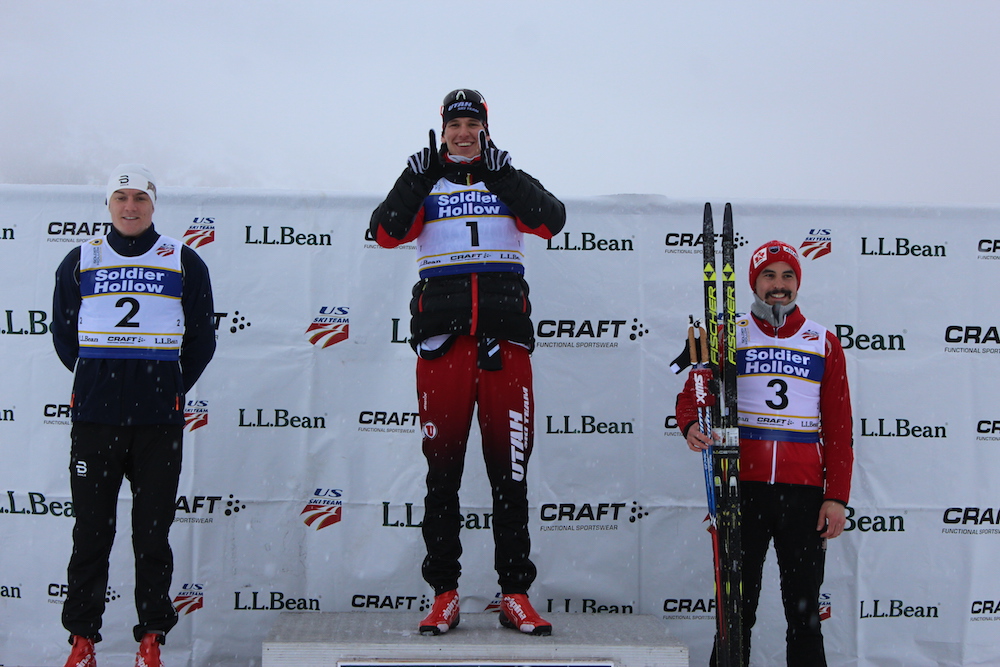
The men’s classic sprint podium at 2017 U.S. nationals at Soldier Hollow on Sunday: with winner Kevin Bolger (c) of the University of Utah, runner-up Moritz Madlener (l) of the University of Denver, and Jess Cockney (r) of the Canadian World Cup B-team in third.
U.S. Cross Country Championships (Soldier Hollow): Classic sprints
Jennie Bender of Bridger Ski Foundation and Kevin Bolger of the University of Utah won national titles in the classic sprints at 2017 U.S. Cross Country Championships at Soldier Hollow earlier Sunday afternoon. They each took narrow – but, for sprinting, relatively uncontested – victories, as each was in the lead coming into the stadium and led through the final 180-degree turn into the finishing straight.
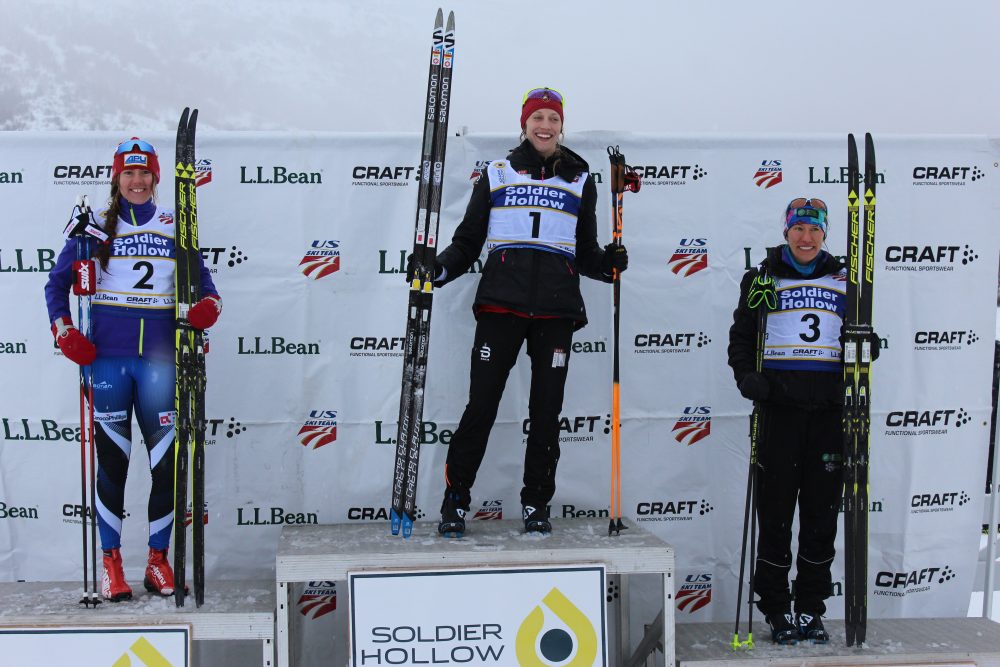
The women’s classic sprint podium at 2017 U.S. nationals on Sunday at Soldier Hollow: with winner Jennie Bender (c) of the Bridger Ski Foundation, runner-up Becca Rorabaugh (l) of Alaska Pacific University, and Kaitlynn Miller (r) of the Craftsbury Green Racing Project in third.
In the women’s race, Bender took the victory over Becca Rorabaugh of Alaska Pacific University, who just edged out Kaitlynn Miller of the Craftsbury Green Racing Project for second. Miller had won the qualifier earlier in the day.
Dahria Beatty of Canada’s Alberta World Cup Academy in fourth, Anne Hart of Stratton Mountain School Elite Team in fifth, and Krista Niiranen, originally from Finland and now a sophomore at the University of New Mexico, in sixth made up the rest of the A-final. There was no B-final contested for either gender.
In the men’s race, Bolger’s victory marked his best performance in a national championship by a substantial margin: His previous best before today was 23rd, in the 15 k classic at SoHo in 2014. (His 37th in the sprint that same year marked his previous best finish in a national championship sprint.)
Bolger was followed to the line by Moritz Madlener, of the University of Denver, and Jesse Cockney, of the Canadian World Cup B-team. Cockney had qualified fourth that morning.
The rest of the A–Final was Canadian Bob Thompson, of National Team Development Centre (NTDC) Thunder Bay, in fourth, Petter Reistad of the University of Colorado in fifth, and Fredrik Schwencke of Northern Michigan University in sixth.
Madlener is German. Cockney and Thompson are Canadian. Reistad and Schwencke are Norwegian. The USSA selection criteria for World Championships in Lahti provide that, “For the purposes of the 2017 Championship Selection List, athletes that are not US citizens will not be included in the scoring, and US athletes will move up the results/scoring list as foreign athletes are eliminated.” American racers eliminated in the semifinals included, in no particular order, Ben Lustgarten of Craftsbury Green Racing Project, Cully Brown of the University of Vermont, John Hegman and Cole Morgan of Sun Valley Ski Education Foundation (SVSEF) Gold Team, and Ben Saxton of Stratton Mountain School.
Earlier Sunday, Kaitlynn Miller won the women’s classic sprint qualifier. Starting sixth out of the 200+ woman field, Miller laid down an unbeatable time of 3:24.5 in difficult waxing conditions. She is the defending classic sprint champion from last year’s national championships.
Krista Niiranen, originally from Finland and now a sophomore at the University of New Mexico, was next fastest and tallied a time just 0.2 seconds behind Miller’s. Emily Nishikawa of the Canadian National Ski Team was third, Dahria Beatty of Canada’s Alberta World Cup Academy fourth, and Cendrine Browne from the Centre National d’Entrainement Pierre Harvey in Quebec clocked the fifth-fastest time.
The 30th skier making the cut for quarterfinals — Frederique Vezina, also of the Centre National d’Entrainement Pierre Harvey — was 16.53 seconds behind Miller.
Ben Saxton of the Stratton Mountain School Elite Team won the men’s sprint qualifier, notching the fastest time by 1.27 seconds over Etienne Hebert of Monteriski.
Canadians took the three of the top four spots in the qualifier, with Reed Godfrey of Canmore Nordic clocking the third-fastest time and Canada’s Jesse Cockney finishing fourth.
9.17 seconds separated the top 30 men who moved on to the quarterfinals. That included racers from at least six countries: the U.S. and Canada, but also collegiate skiers from Finland, Germany, France, and Norway. It also included one Under-18 competitor: Ben Ogden from the Stratton Mountain School.
It was a World Championships preview weekend on the Nordic Combined World Cup circuit, with two large hill/10 k individual competitions held in Lahti, Finland.
On Saturday, Germany’s Eric Frenzel took the win in 29:13.7, holding off Finland’s Eero Hirvonen by 4.1 seconds across the line. After posting the second-best jump, Frenzel started the 10 k in second, ahead of Hirvonen in third, but still full 1:06-minutes behind Norway’s Jarl Magnus Riiber, who dominated the jump with 135.2 points. Hirvonen started 1:29 back in third.
Riiber went on to place sixth at the finish with the 38th-ranked course time (out of 43 finishers). Germany had two on the podium with Johannes Rydzek in third (+26.4).
American Bryan Fletcher finished 15th (+1:29.8) after jumping to 22nd and starting the ski race 3:06 minutes back. He skied the sixth-fastest 10 k to end up 1:29.8 behind Frenzel at the finish.
Ben Loomis was the second American competing on Saturday. He finished the day in 40th (+5:18.5) after jumping to 35th.
On Sunday, Germany swept the podium with Fabian Rießle leading the charge, Frenzel in second and Rydzek in third. Rießle jumped to fifth and captured the win in 25:44.2, ahead of Frenzel (+4.2) and Rydzek (+11.6). Frenzel led after the jump and started the 10 k just 6 seconds ahead of Italy’s Samuel Costa, who ended up sixth at the finish (+40.6).
Rießle started 16 seconds after Frenzel and posted the third-fastest course time en route to the win.
Bryan Fletcher raced to 16th (+1:30.7) on Sunday, after jumping to 28th. Loomis did not start.
The NoCo World Cup moves to Val di Fiemme, Italy, for competitions next Friday through Sunday. Lahti World Championships will hold nordic-combined competitions Feb. 24-March 3.
Two North Americans started the International Biathlon Union (IBU) World Cup women’s 12.5 k mass start on Sunday, with one of them finding out at the last minute that they were in for the 30-woman race.
American Susan Dunklee knew she had qualified well ahead of time after ranking 17th in the overall World Cup. She raced to ninth on Sunday, finishing 1:43.5 behind from the winner, Gabriela Koukalová of the Czech Republic, who cleaned the four-stage race to finish first in 37:20.5.
Germany’s Laura Dahlmeier made her first appearance of the week in the final race of the World Cup stop in Oberhof, Germany, placing second in the mass start, 31.5 seconds behind Koukalová, with one standing miss (0+0+1+0). The Czech Republic had two on the podium with Eva Puskarčíková in third (+45.4), with clean shooting.
Dunklee was in contention with the leaders until the last two standing stages, where she missed one target then two more (0+0+1+2) for a total of three penalty laps. Ninth place helped elevate Dunklee to 15th in the overall World Cup standings.
Canada’s Rosanna Crawford jumped into the race being listed as a reserve athlete on standby. Wearing bib 30, she finished 25th (+3:08.6) with two clean stages and two penalties (0+1+1+0).
France’s Martin Fourcade (bib 1) and Germany’s Simon Schempp (bib 3) shooting in the third stage of the men’s 15-kilometer mass start at the 2017 IBU World Cup in Oberhof, Germany. (Photo: IBU)
On Sunday in the men’s 15 k mass start, Germany’s Simon Schempp celebrated his first victory of the season, and it was a special one in front of thousands of cheering fans at home in Oberhof. On the final lap, he desperately tried to hang onto the ski tails of France’s biathlon star Martin Fourcade, who pushed hard on the first climb out of the shooting range unsuccessfully trying to create a gap.
“He started attacking immediately up the Birxsteig [climb],” Schempp told German TV broadcaster ZDF. “And I thought either you blow up or you can stick with him, and I could. Because I was in the draft, I saved a few percent, that probably was the decisive point in the end.“
Schempp kept right behind Fourcade, then started an attack on the last climb himself and outsprinted his rival on the finishing stretch, celebrating across the line with a time of 38:30.9 minutes, with just one penalty (0+0+1+0).
To the joy of the German fans, Schempp’s teammate Erik Lesser managed to overtake France’s Jean Guillaume Beatrix on the final loop closing up to the two athletes in front on the last meters, and outlunged Fourcade in a photo finish sprint (both +0.4 seconds).
“They pushed up the Birxsteig so incredibly hard,” Lesser told ZDF. “I thought I could only fight for position five. Then I saw that Beatrix wasn’t skiing very clean anymore either. So I just tried a full attack… I never would have believed that a second place would come out of that.“
“My father-in-law is probably watching the Tour de Ski today and saying, ‘Finally the guy makes a lunge,’ ” Lesser joked about the finish sprint. “I never would have believed that Fourcade still lets himself get beaten by the little Lesser. Finally all the strength training paid off.“
Fourcade had incurred two penalties in the third shooting stage, having to make up a 44 second gap to the top. In the final shooting he stayed clean, but already had to invest a lot of energy on the prior loop so he could not create a significant lead on the last one.
“I skied as fast as I could, but Simon was just faster and Erik as well,” Fourcade said during the press conference. “I tried my best in the beginning of the lap because we were too [many] people… I gave all I had. I must say I didn’t see Erik until he passed me in the sprint… It was a great competition, a great fight.”
Coming into the last shooting stage Lesser had been leading the race with Norway’s Ole Einar Bjørndalen, but both missed a target and had to a penalty lap while Schempp and Fourcade stayed clean.
Fourcade’s teammate Beatrix finished fourth with one penalty (+13.2), Bjørndalen was fifth (+19.5) also with one penalty.
No North American men competed in the mass start, with US Biathlon’s Lowell Bailey ,who would have been qualified via the overall World Cup standings skipping the race week in Oberhof for a training block. Bailey is currently ranked 19th overall.
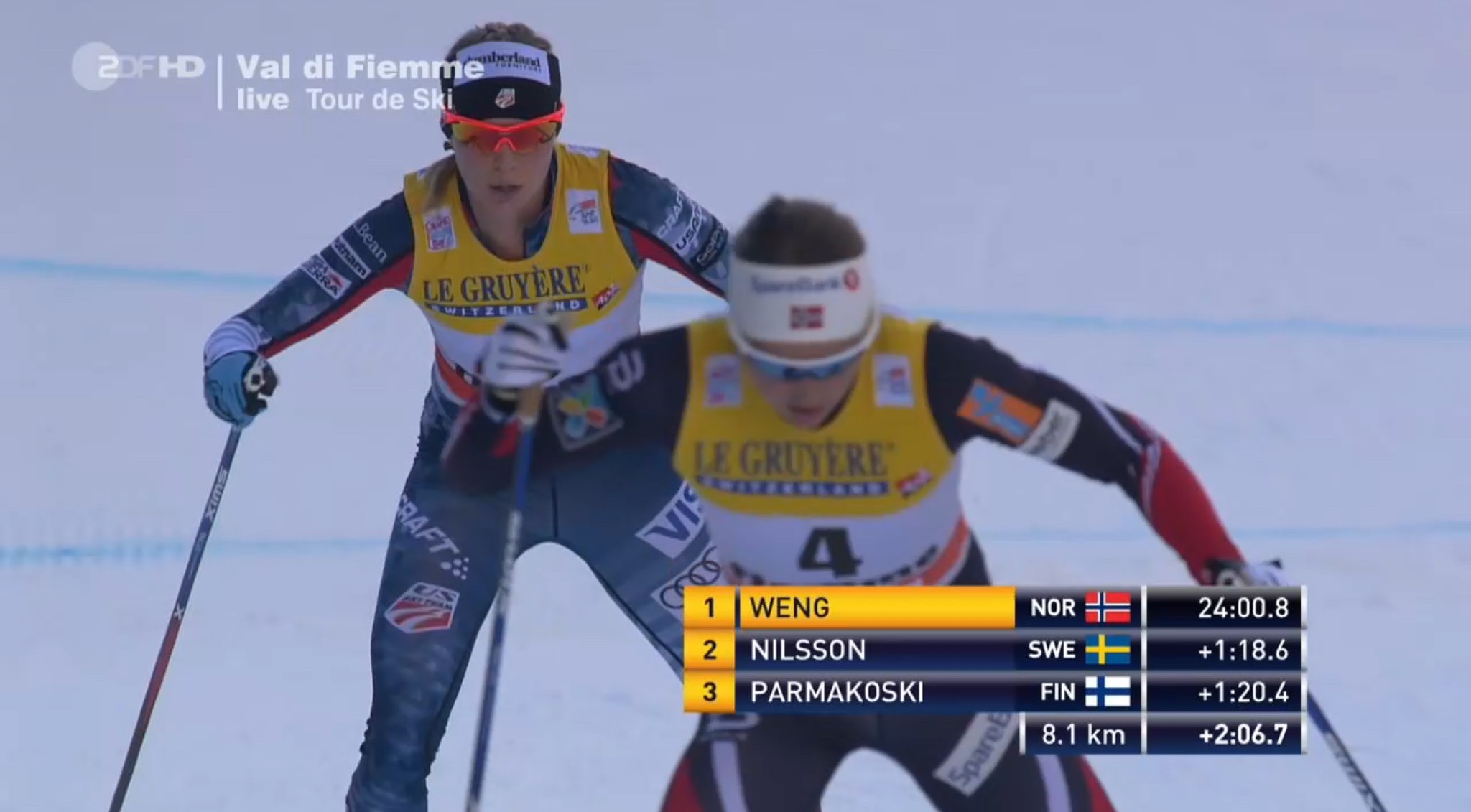
American Jessie Diggins chasing Norway’s Ingvild Flugstad Østberg on the final climb of the 2017 Tour de Ski up the Alpe Cermis in Val di Fiemme, Italy. Østberg finished the Tour in fourth and Diggins fifth, tying a best-ever mark for the U.S., set in 2015 by Liz Stephen. (Photo: ZDF screenshot)
FIS Cross-Country Tour de Ski Stage 7 (Val di Fiemme/Alpe Cermis, Italy): 9 k freestyle
Heidi Weng of Norway proved that she was the threat everyone was fearing – despite a few races in the Tour de Ski with bad skis or low energy, Weng had a dominating performance up the Alpe Cermis and took her first ever Tour de Ski title.
At 6.2 k of the 9 k course, Weng passed Stina Nilsson of Sweden, who had started the day in the leader’s bib with a 19.2-second advantage. Weng just stepped on the gas from there, turning in the fastest climb time of the field and winning by 1:37.0.
Further up the hill, Nilsson was also passed by Krista Parmakoski of Finland, who gapped the Swede and earned second place.
And Nilsson had to hold off one more attack, from Norway’s Ingvild Flugstad Østberg near the top of the climb. Østberg had started in fourth place and got close to Nilsson, before the Swede found her second (or third, or fourth) wind and sprinted it in to the finish to secure third place and her first Tour de Ski overall podium.
Weng has three previous Tour de Ski podiums, but never a win. Parmakoski’s previous best overall finish was fourth, in 2014.
Jessie Diggins of the U.S. Ski Team started behind Østberg and almost made contact at one point, before the Norwegian slipped from her grasp. Diggins finished the Tour de Ski fifth (+3:09.0) — where she had started the day — to tie for the best-ever Tour finish with Liz Stephen, who was fifth in 2015.
Today, Stephen clocked the second-fastest time up the climb, behind Weng, and finished 14th (+6:45.6).
Rosie Brennan, the third and final U.S. woman to finish the Tour de Ski this year, landed 28th, +12:59.9. Her time was the 23rd-fastest up the Alpe Cermis.
The overall podium at the end of the 2017 Tour de Ski, with winner Sergey Ustiugov (c) of Russia, Norway’s Martin Johnsrud Sundby (l) in second, and Switzerland’s Dario Cologna (r) in third after finishing in that order in the 9 k freestyle hill-climb pursuit, Stage 7 of the Tour de Ski in Val di Fiemme, Italy. (Photo: FIS Cross Country/Twitter)
In the men’s 9 k freestyle hill climb that followed, 24-year-old Sergey Ustiugov of Russia raced to his first Tour de Ski victory, heading out of the gate with a 1:12-minute head start over Norway’s Martin Johnsrud Sundby and finishing 1:02.9 ahead for the win in 30:27.7.
Sundby put time into Ustiugov over parts of the course, particularly in the first kilometer along a flatter section leading up to the climb and then again between 6 and 8 k on Alpe Cermis itself.
Sundby skied alone throughout the pursuit race, with Switzerland’s Dario Cologna starting 52 seconds behind him. Cologna had a 29-second head start on Finland’s Matti Heikkinen, who entered the race in fourth, and 30 seconds ahead of France’s Maurice Manificat in fifth, but Manificat caught and even passed Cologna with about 0.5 k remaining. Cologna proceeded to pass Manificat back while Heikkinen skied about nine seconds back in fifth.
Canada’s Alex Harvey had started sixth and helped lead Manificat and Heikkinen in chasing down Cologna early in pursuit, but he faded to seventh, behind Sweden’s Marcus Hellner (who started seventh, 12 seconds after Harvey) by 8.5 k. There, Hellner trailed Heikkinen by 14.6 seconds, and Harvey was another 27.9 seconds back in seventh (and nearly a 54 seconds ahead of the man skiing in eighth at the time, Norway’s Simen Hegstad Krüger).
Half a kilometer later, it was all over with Cologna securing third overall in the Tour, 1:19.1 behind Ustiugov and 16.2 seconds behind Sundby.
With the fastest 9 k time of the day, Manificat moved up one place for fourth overall, finishing 1:26.9 after Ustiugov with a time of 29:20 minutes. Heikkinen was the second fastest on course, 6.1 seconds slower than Manificat, for fifth overall in the Tour (+1:31.3). Hellner took sixth at the finish (+2:05.8), ahead of Harvey in seventh (+2:39.7). For Harvey, it was his best overall finish in four competed Tour de Skis (last year, he finished 14th. His best result was 12th in 2012).
Norway swept the next five places with with Krüger in eighth (+3:27.2), Hans Christer Holund in ninth (+3:50.4), Niklas Dyrhaug in 10th (+4:24.9), Sjur Røthe in 11th (+4:56.4), and Didrik Tønseth in 12th (+5:07.7).
Canada had two in the final climb with Devon Kershaw finishing 25th (+9:32.2) after starting 23rd. Graeme Killick did not start after being positioned in 37th overall in the Tour.
Kershaw finished 8.1 seconds ahead of Noah Hoffman, the lone American racing to the top of Alpe Cermis. Hoffman moved up from 30th at the start to finish 26th (+9:40.3) overall, and in doing so, he posted the 15th-fastest time of the day, 1:05.3 back from Manificat.
Harvey’s time ranked 14th (+1:04.9). Norway’s Holund had the third-fastest time after starting 11th and ending up ninth, Hellner was fourth fastest, and Cologna fifth fastest.
Tour de Ski final results (with isolated climb times): Women | Men
OSLO, Norway — In the final race of International Biathlon Union (IBU) World Championships at Holmenkollen, Norway’s own Johannes Thingnes Bø proved to be a crowd-pleaser in front of tens of thousands of fans on Sunday. He eked out the win in the men’s 15-kilometer mass start by 2.8 seconds over France’s Martin Fourcade, and Norwegian veteran Ole Einar Bjørndalen took bronze, 6.7 seconds back.
For the U.S., Lowell Bailey and Tim Burke placed 10th and 12th, respectively, leaving them both relatively satisfied with their results.
Lowell Bailey finishing 10th in the World Championships mass start in Oslo, Norway, in 2016. (Photo: JoJo Baldus)
(Photo: JoJo Baldus)
(Photo: JoJo Baldus)
(Photo: JoJo Baldus)
(Photo: JoJo Baldus)
(Photo: JoJo Baldus)
(Photo: JoJo Baldus)
(Photo: JoJo Baldus)
(Photo: JoJo Baldus)
(Photo: JoJo Baldus)
(Photo: JoJo Baldus)
(Photo: JoJo Baldus)
(Photo: JoJo Baldus)
(Photo: JoJo Baldus)
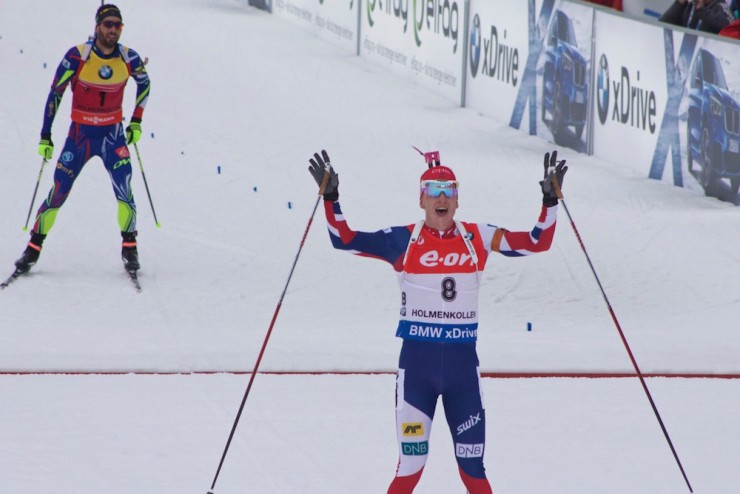
Norway’s Johannes Thingnes Bø leads France’s Martin Fourcade and Norway’s Ole Einar Bjørndalen into the finish in the 15 k mass start in Oslo, Norway, at 2016 World Championships. (Photo: JoJo Baldus)
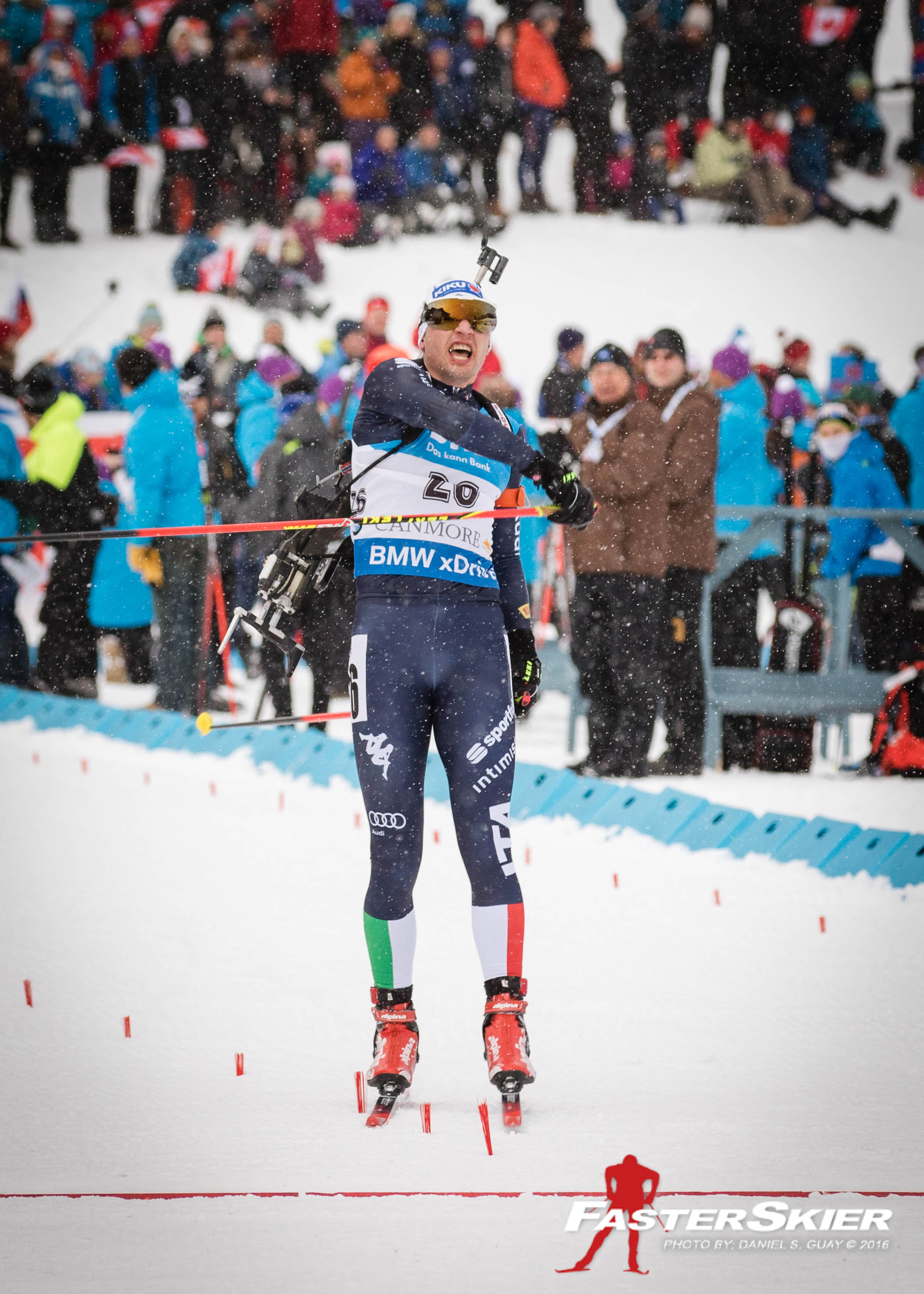
Italy’s 26-year-old Dominik Windisch celebrates his first-career victory in the IBU World Cup 15 k mass start on Saturday in Canmore, Alberta. (Photo: Daniel S. Guay)
In a race affected by difficult conditions on the course and shooting range, Italy’s Dominik Windisch achieved the first victory and podium of his career in the International Biathlon Union (IBU) World Cup men’s 15-kilometer mass start on Saturday in Canmore, Alberta. In third place after the final shooting stage and despite four penalties in total, the 26-year-old Windisch finished first with a time of 40:37.1 minutes, after a strong last loop.
“It was amazing. I can’t believe it yet. A dream came true for me today,” Windisch said during the post-race press conference.
Asked how long he has been waiting for this moment, Windisch later told the IBU: “I think for over 20 years, since I was a child watching competitions of the World Cup in Antholz [Italy].”
Second place went to Germany’s Benedikt Doll, 4.1 seconds back with four penalties, for the third podium of his career. Doll also moved up on the final loop thanks to the fastest course time of all athletes. France’s Quentin Fillon Maillet, who led the pack after the last shooting, fell behind on the final loop and ended up third, 8.6 seconds after the Italian, with three penalties.
‘He puked all over my skis’
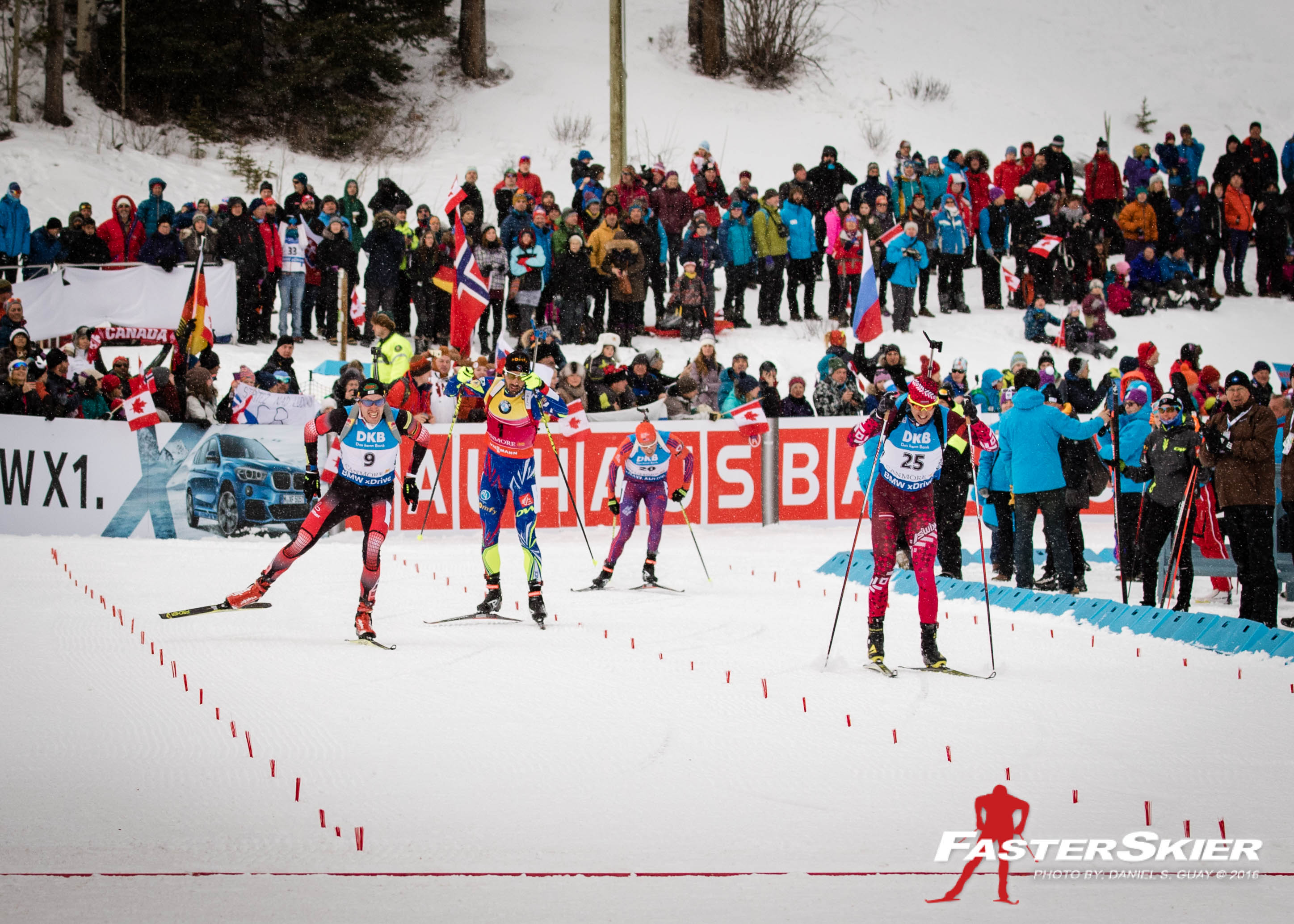
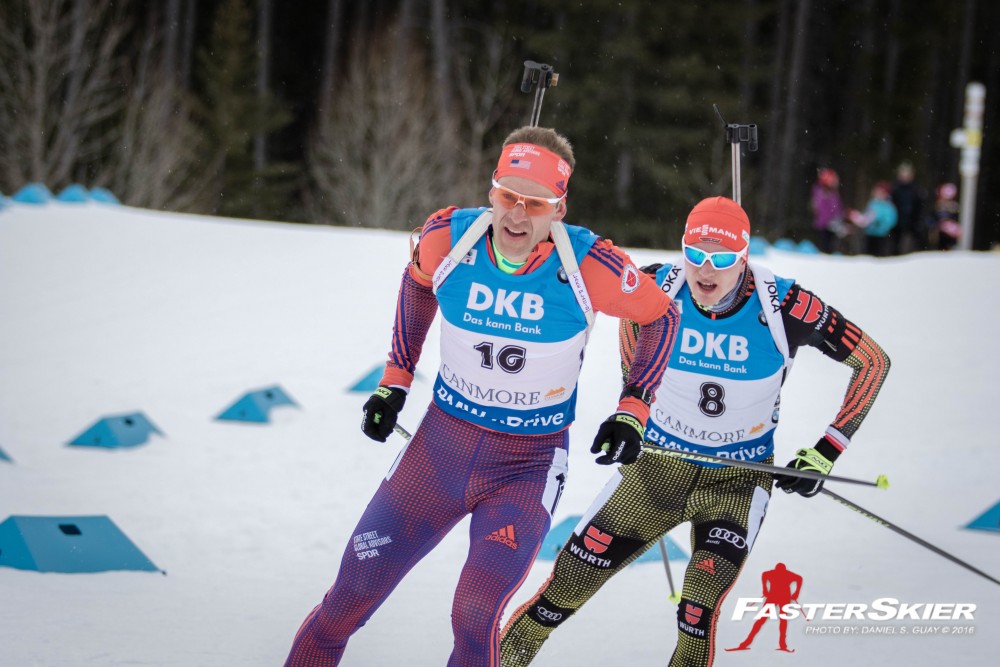
Latvia’s Andrejs Rastorgujevs (25) and Austria’s Dominik Landertinger (9) lead the race for fourth, which Landertinger took by 0.2 seconds. France’s Martin Fourcade (second from l) placed sixth in the mass start, 1.5 seconds ahead of American Tim Burke (behind) on Saturday at the IBU World Cup in Canmore, Alberta. (Photo: Daniel S. Guay)
U.S. Biathlon’s Tim Burke had the best day of the three North Americans in the race, finishing seventh, 23.8 seconds after Windisch with three penalties, and just 1.5 seconds behind the overall World Cup leader, Martin Fourcade of France.
It was Burke’s best result of the season in an individual race so far, and he last achieved seventh in a 2014 mass start in Pokljuka, Slovenia.
Burke raced under the watchful eye of his wife, Andrea Burke (formerly Henkel), an Olympic and World Championships gold medalist for the German biathlon team, who provided commentary and analysis with Chad Salmela for the IBU’s live stream of the North American World Cups.
“When your wife is commentating live it puts a little extra pressure on…,“ Burke said in a post-race phone interview with FasterSkier. “I think she’s having a lot of fun with it. It’s for sure a challenge to commentate in not your first language.”
Burke said the first prone shooting was the “trickiest stage” on Saturday, but he managed to keep the damage in check with just one penalty.
“It [was] changing so much shot to shot that I didn’t crack down my shots at all,” he said. “I would aim [left] off the target knowing that the wind would blow [really strong left to right]. I missed my first shot and I realized I wasn’t aiming far enough off.”
He left the range in 15th place, 41.8 seconds behind Austria’s Simon Eder in first, but still with several other athletes who had also missed at least one target.
“As I was skiing out of the range, just checking the targets, I could see there were quite a few mistakes. I knew that would keep me in the race,” Burke recalled.
In the second prone stage, Burke shot clean.
“It was really good conditions. The wind was down. It was a lot like I had zeroed for,” he said. “I hadn’t changed my sights at all so I was able to aim through and shoot fast.”
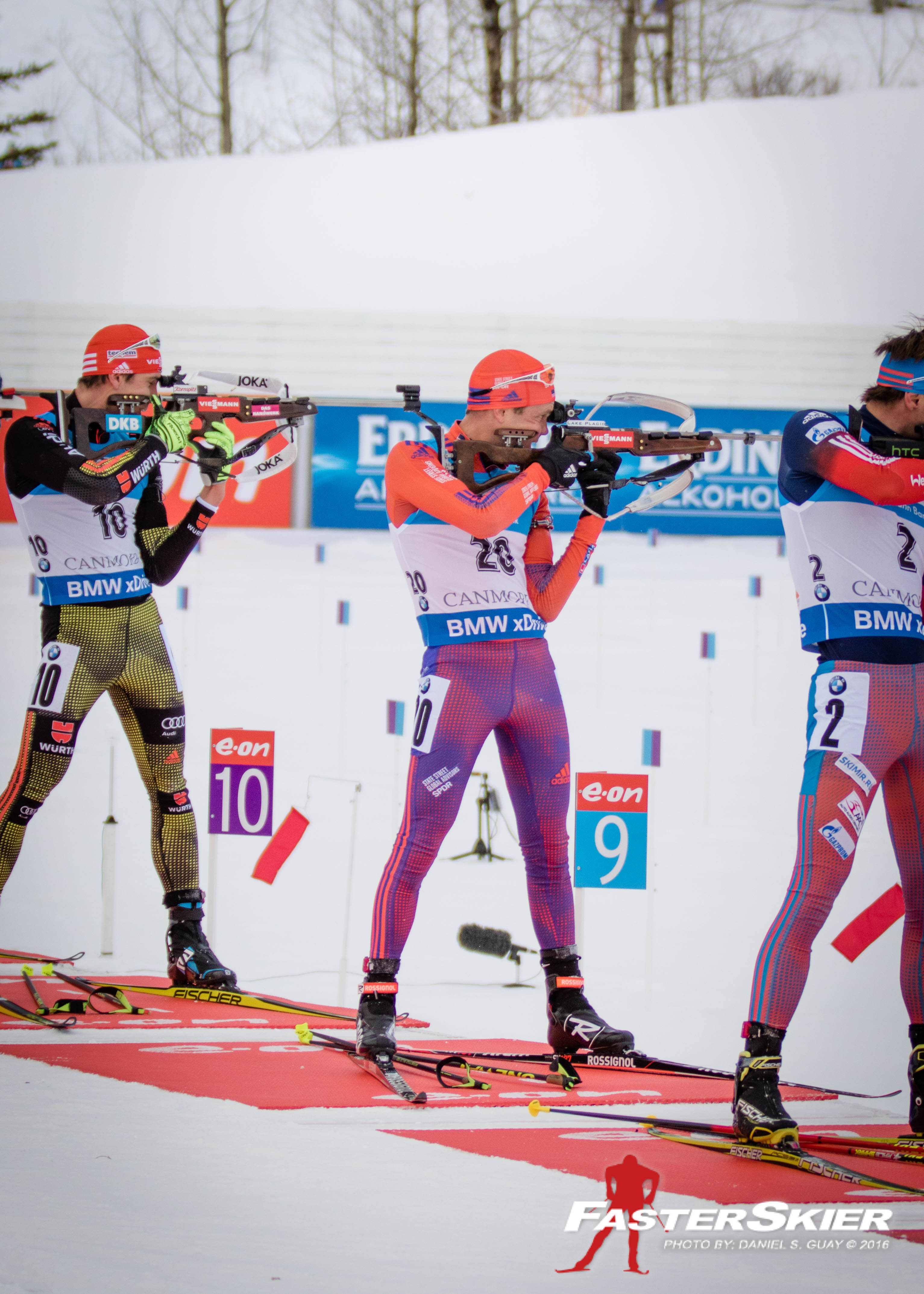
American Tim Burke (c) shooting with Russia’s Anton Shipulin (r) and Germany’s Arnd Peiffer (l) during the men’s 15 k mass start on Saturday at the IBU World Cup in Canmore, Alberta. Burke went on to place a season-best seventh. (Photo: Daniel S. Guay)
One lap later, the wind picked up for the third shooting (first standing stage).
“I just really took my time and was very happy to get out of there with one penalty. … When I left the range everyone except I think one person was in the penalty loop.”
He left the range in fourth, 17.5 seconds behind Fillon Maillet, 6.3 seconds after Latvia’s Andrejs Rastorgujevs in second, and 2.4 seconds behind Austria’s Dominik Landertinger in third.
Burke lost a few positions on the course, skiing in a group led by eventual third-place finisher Doll.
“At that point, I knew the win was still possible just because the conditions were changing so fast,” Burke said. “Anything is possible in a race like that.”
In the last shooting stage, Burke recorded another miss, skied a penalty loop and headed into the final loop in ninth place with competitive company around him: Fourcade, Landertinger, Ondrej Moravec of the Czech Republic, Slovakia’s Matej Kazar (the best shooter on Saturday with just one penalty), and Germany’s Arnd Peiffer.
“It’s not the best group to head out on the last loop with, so I knew it was going to be tough, but I hung in there,“ Burke said. “Fourcade and Landertinger got a gap with about a [kilometer] and a half to go. Then it was me and Peiffer … he was in front of me and unfortunately puked all over my skis.”
He estimated Peiffer got sick with about half a kilometer remaining in the, heading into one of the final climbs.
“I’ve heard of it happening, but that’s the first time I’ve ever seen it,” Burke said of someone throwing up during the race. “I was able to get around him after that. … Then I actually ended up catching back up to Fourcade because they started playing around, setting up for the finish … but as soon as I caught them they started sprinting, so I was pretty gassed.”
“It was a brutally difficult race,“ Landertinger, who placed fourth (+20.7) with three penalties, said in an Austrian Ski Federation press release. “On the one hand the course was extremely slow and strenuous, on the other it was difficult to assess the wind correctly on the shooting range. I had a strong final loop, where I was able to prevail against Fourcade and Rastorgujevs in the end. I am very happy with the race and the result.“
Overall, Burke skied the eighth-fastest course time, as well as the sixth-fastest final loop.
“I really like the course, that’s why I was disappointed with the sprint [on Thursday] because I feel like on a good day here I could have been one of the faster skiers,” Burke said. He placed 23rd in Thursday’s 10 k sprint with with 80 percent shooting.
“I was definitely really happy with the result. It was a crazy race with the conditions,“ Burke concluded. “[It’s my] best result this year. I feel like I can be up there more often and hopefully this will be a good step moving forward.”
Fast Skiing Wins The Race
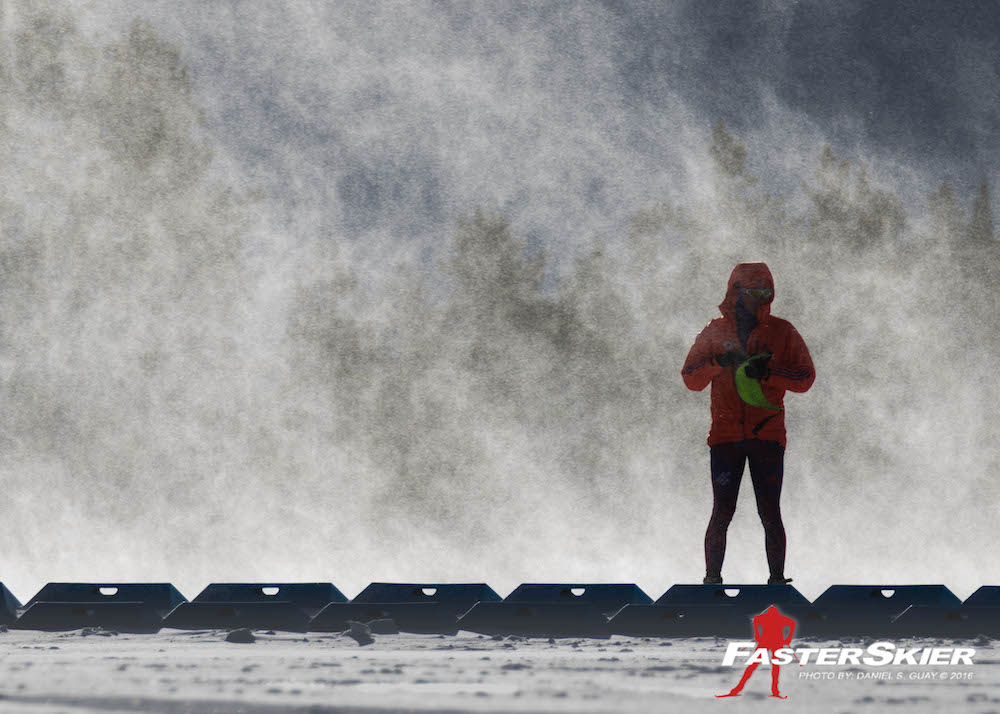
A gust of wind blows snow during zero at the Canmore Nordic Centre on Saturday before the IBU World Cup men’s 15 k mass start.(Photo: Daniel S. Guay)
A blizzard in the early morning with strong snowfall that lasted for about 30 minutes was followed by dry strong winds which made ski preparation difficult, with a number of wax technicians reportedly already out on the course at night, working with headlamps to prepare optimal skis for the athletes.
“Today was really challenging for a lot of the technicians … I saw really big differences with the skis out there on the course,” Burke said. “We [the Americans] were in the mix.”
At the start of the race, the scenic Canadian Rockies were shrouded by thick clouds but without precipitation, although later it started to lightly snow. Wind conditions were difficult right out of the gate, and only four athletes out of 30 in the mass start managed to shoot clean in the first stage, despite a fairly slow pace on the loop with the field bunched together.
After the second shooting stage, Eder had been in the lead with clean and very fast prone shootings, but when he came back into the range the third time for his first standing stage, strong gusts of wind made it difficult for him — as well as the other top athletes — and three penalties set him back. Eder finished the race in 14th place (+57.3), with four penalties.
“Unfortunately I had no chance today. The wind in the third shooting decided the race, otherwise I would have been very well in the mix,” Eder said in the Austrian team press release. “I can’t help it. Just tick it off and look ahead.”
Fillon Maillet moved up from sixth to first place during the third loop and third shooting stage. After no athlete in the lead group was able to shoot clean in the last stage, either, the Frenchman headed out on the final loop in first, with Rastorgujevs 13.9 seconds behind. Meanwhile, Windisch, who was 14.3 seconds back to start the loop, and Doll, 20.7 seconds behind, came flying out of the penalty loop.
At the 13.4 k timing point, Windisch had taken the lead with the other three close behind him. Then at the last timing point 700 meters before the finish, Fillon Maillet still remained ahead of Doll, but into the final stretch, Doll pushed ahead of him.
Rastorgujevs, often one of the fastest skiers in the field but a somewhat shaky shooter, especially in standing, fell behind Doll and Fillon Maillet on the last loop and also lost the finish sprint to Landertinger by 0.2 seconds. He finished fifth place (+20.9), with three penalties, narrowly missing the first World Cup podium of his career.
“Last 1.5 kilometers I am empty, totally empty. No chance for fighting,” he said in a post-race English interview with the IBU. “My shooting today was good, but I am not so happy with [the] last shooting.”
Lowell Bailey (US Biathlon) leads Germany’s Benedikt Doll during the men’s 15 k mass start at the IBU World Cup in Canmore, Alberta. Doll went on to place second while Bailey finished 20th. (Photo: Daniel S. Guay)
Doll closed in on the victory, but partly due to the short finishing stretch in Canmore, he was unable to catch Windisch.
“My skiing was very good, and I really had great material,” Windisch said during the press conference. “I want to dedicate this victory to our wax men, they really did a great job.”
“It was not easy today because of the wind,” he added. “I think this shows what biathlon is [about], the field is so close and everybody can win.”
Asked about the final loop, Windisch recalled: “I just wanted to keep Rastorgujevs [behind me]. But I saw that I had faster skis, so I thought, ‘I have to take my chance now.’ I tried, and it finished well.
“Since I was a child I have watched the World Cup competitions in Antholz and saw my coach Andreas Zingerle [on the podium] there. He was an idol for me. Since this time I was dreaming of competing in the World Cup,” Windisch added
Asked about the successes of the Italian team this season, he said: “I think we are a good team, we are a young team, there is good harmony on the team, and we are good friends. It’s joy.”
“I had a bit of stitch on the last loop, breathing is still not easy,” Doll told German TV broadcaster ZDF immediately after the race, still gasping for air. “The snowfall that began during the race made an allegedly easy course very arduous.”
Doll recorded the fastest course time of all 30 athletes, but said he struggled especially on the last loop.
“I saw the guys ahead, but I have to admit my bigger fear was about those behind because there were seven or eight guys following me,” Doll said of the final 2.5 k. “So I said to myself that I have to go full-throttle right from the start so they never catch up. That worked well, but I didn’t expect to be able to make up two more positions. Quentin [Fillon Maillet] didn’t look so fresh anymore, and I made use of that.”
“After my bad sprint, I wanted to do a good shooting,” the 23-year-old Fillon Maillet said during the press conference, after notching his third-career podium. “Today the conditions were windy, very windy… Three mistakes is [usually] not very good, but today that was good shooting. Skiing was very hard on the last loop. But I am very happy for this race… I prefer racing in mass starts or pursuits, because we are all very close together…. Maybe I have more motivation for this [type of] race.”
The World Cup Leaders
It was also an uncharacteristically difficult race day for the leaders in the overall World Cup standings. Fourcade incurred six penalties, but was able to place sixth thanks to the second-fastest skiing time on the course. Russia’s Anton Shipulin finished 17th with six penalties, and Germany’s Simon Schempp in 21st place with eight. In the standings, Schempp moved into third, ahead of Norway’s Tarjei Bø, who is skipping the World Cup stages in North America, by one point.
Smith Frustrated with Ski Speed, Bailey with Shooting
Canada’s lone man in the mass start, Nathan Smith finished 16th (+1:12.1) with three penalties) and American Lowell Bailey placed 20th (+1:46.7) with five penalties. The field is limited to 30, with the top 25 in the World Cup standings and five others with the best sprint results in Canmore.
“On the first lap I thought this could be good,“ Smith said in a Biathlon Canada press release. “I’m still feeling kind of tired on the skis so I was making up some time on the range thankfully so I could maintain my placing in the middle of the pack.”
Nathan Smith (Biathlon Canada) racing to 16th in the men’s 15 k mass start at the IBU World Cup in Canmore, Alberta. (Photo: Daniel S. Guay)
Smith had one miss in the first prone stage and left the range in 12th place.
“Usually a miss in the first prone will put me off the back in 25th or so, but with the tricky conditions it was pretty much equivalent to 5/5,” Smith wrote in an email to FasterSkier. “At that point I thought I could still be in the mix through the whole race.”
In the second prone, he shot clean, improving to eighth, 33.5 seconds out of first, but lost positions on the course again with the 26th-ranked time on that loop. Overall, his course time ranked 24th.
“I knew my skiing was once again not good enough,” he wrote. “I was getting passed on course and couldn’t hang on. I knew today it would take perfect shooting for a strong result.”
He went on to record two more penalties in the standing stages.
“My standing actually felt amazing today,” Smith wrote. “I was kicking myself for missing one shot in each.”
“We are all shooting at the same time in a mass start so if it is windy, it is windy for everyone,” he explained in the press release. “There was a reasonable amount of wind in standing, but not so windy you couldn’t hold the rifle and focus on the target.”
On the final loop, three competitors passed Smith, and as he headed toward the finish to finish 8 seconds behind Russia’s Evgeniy Garanichev in 15th, Smith waived to his hometown crowd.
“I tried my best to maintain position on the last lap but just couldn’t hang on,” Smith wrote. “The crowd was so loud each time I came into or looped behind the stadium. I felt privileged to come ‘home’ to the finish with all that support.”
“16th is a good result for me,” Smith concluded. “I’m happy with where my shooting is at but am becoming more and more frustrated with my ski shape. I’m not sure what has gone wrong but I’m going to look for a solution.”
After a first loop in the top third of the pack, U.S. Biathlon’s Lowell Bailey had one more miss than Burke and Smith in the first shooting stage, setting him back to 21st place at the time.
“I didn’t take enough clicks [sight adjustments] to account for the wind change in the first prone,” Bailey wrote in an email. “You never want to start out a race with two penalties.”
With the help of his coaches, he made the necessary adjustments for the next prone stage, this time cleaning it.
“The coaches show you a board with all of your shots at some point on the foregoing loop,” Bailey explained. “After a 6-click wind in the first prone, the wind died back to calm by the second prone. This meant I could just aim for the center.”
In the third shooting, Bailey incurred two more penalties, dropping him back down to 21st and 1:13 out of first, and then he missed one more in the final shooting stage to leave the range in 20th, 1:37 behind the leader.
“There wasn’t much wind in the third shooting and I can only blame myself for those misses,” he wrote.
Overall Bailey recorded the 21st course time. “I felt fine,” he explained of his skiing. “It definitely wasn’t the ski course that was holding me back today. ”
“I’m disappointed with the race,” he wrote. “I put a lot of focus and effort into this world cup [in Canmore]. I came directly here in preparation following the Antholz World Cup and I really felt prepared for these races. Unfortunately, I wasn’t able to put it together on the range over the past two races. It’s frustrating, but you can’t go back and re-do it… you just have to focus on what adjustments need to be made going into the next races.”
He placed 24th in the sprint, just behind Burke with two penalties. Smith finished 31st in that race with one miss.
Mixed Relays
The World Cup in Canmore concludes with a mixed relay (2 women, 2 men) and a single mixed relay (1 woman, 1 man) on Sunday.
Burke and Bailey plan to race the mixed relay for the U.S., together with Hannah Dreissigacker and Susan Dunklee at the start, while Leif Nordgren and Annelies Cook will team up for the single-mixed relay.
“I just want to put together a decent performance on the range. That’s my goal,” Bailey wrote.
Biathlon Canada will aim for a podium at home this weekend; after Rosanna Crawford and Nathan Smith were able to achieve second place in the single mixed relay at the opening World Cup in Östersund, Sweden.
On Sunday, Smith will team up with Julia Ransom, while Crawford races the mixed relay with Sarah Beaudry, Macx Davies, and Brendan Green.
“Julia has been so strong lately, I know we will put on a good show for the home crowd!” Smith wrote.
Russia’s Anton Shipulin (2) leads early in the men’s 15 k mass start at the IBU World Cup in Canmore, Alberta. (Photo: Daniel S. Guay)
IBU World Cup men’s 15 k mass start in Canmore, Alberta. (Photo: Daniel S. Guay)
IBU World Cup men’s 15 k mass start in Canmore, Alberta. (Photo: Daniel S. Guay)
IBU World Cup men’s 15 k mass start in Canmore, Alberta. (Photo: Daniel S. Guay)
IBU World Cup men’s 15 k mass start in Canmore, Alberta. (Photo: Daniel S. Guay)
IBU World Cup men’s 15 k mass start in Canmore, Alberta. (Photo: Daniel S. Guay)
Overall World Cup leader Martin Fourcade of France after placing sixth in the men’s mass start at the IBU World Cup in Canmore, Alberta. (Photo: Daniel S. Guay)
Tim Burke (US Biathlon) after finishing seventh in the men’s 15 k mass start at the IBU World Cup in Canmore, Alberta. (Photo: Daniel S. Guay)
IBU World Cup men’s 15 k mass start in Canmore, Alberta. (Photo: Daniel S. Guay)
IBU World Cup men’s 15 k mass start in Canmore, Alberta. (Photo: Daniel S. Guay)
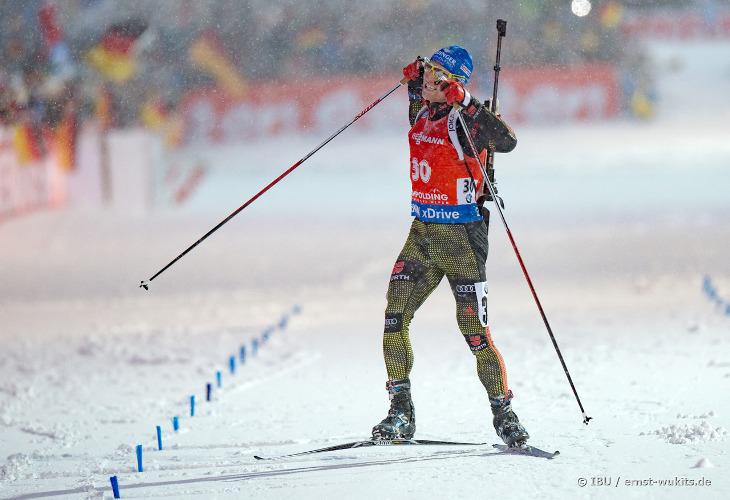
Germany’s Erik Lesser celebrates his first victory of the season in the men’s 15 k mass start at the IBU World Cup in Ruhpolding, Germany. (Photo: IBU/Ernst Wukits)
In recent weeks, Germany’s Erik Lesser had become annoyed with questions on a single topic: whether he was concerned about not having fulfilled the “World Championships norm” yet.
German biathletes are required to post at least one top eight or two top 15’s in an IBU World Cup within a season to qualify for major championships. And Lesser, a gold medalist in the pursuit and relay at 2015 World Championships in Kontiolahti, Finland, was the only senior team member — male or female — who had yet to achieve that mark ahead of 2016 World Championships.
On Saturday evening, in front of a home crowd of more than 20,000 spectators in the biathlon arena and around the course in Ruhpolding, Germany, Lesser put all doubts to rest, winning the men’s 15-kilometer mass start in 40:29.3 minutes with perfect 20-for-20 shooting. Despite heavy snowfall, Lesser cleaned all four shooting stages, and on the final loop, he held his own ahead of France’s World Cup leader Martin Fourcade, beating him by 9.8 seconds.
Fourcade had a single penalty on the last stage to place second, and Russia’s Evgeniy Garanichev missed one on the last shooting to finished third (+13.1). Fourcade and Garanichev had come into the final stage just ahead of Lesser, but then had to complete the 150-meter penalty lap after each missing a target.
The two North Americans in the mass start, Canada’s Nathan Smith placed 15th (+1:20.8) and American Lowell Bailey finished 21st (+2:08.4), both with one penalty.
After the race, Lesser was highly satisfied, and claimed he never had any doubt about his ability to qualify for the upcoming IBU World Championships in Oslo, Norway.
“Now you have to shut up about that, huh. Now I don’t want to hear about that again after giving you what you wanted,” Lesser said with dry wit when he got interviewed by German TV broadcaster ZDF. “I couldn’t care less about the norm. I knew I had that in me; I just couldn’t put it together. Today thankfully everything worked out.”
Questioned again if his coaches were also as convinced, and whether he had been anxious to achieve that kind of result, Lesser added:
“Yeah, the next time I’m waiting for my World Championships norm, I’m taking you guys with me into the [athletes’] container, then you can watch us while you analyze our races, and there really was everything but a bad mood after my races. Everything was good, also between the coaches and me. Everyone was understanding,” he said.
Outside the top 25 in the overall World Cup standing, Lesser had to qualify for the mass start as one of five additional athletes with the best performances of the race week. He narrowly managed to do that by placing 17th in the 20 k individual competition on Wednesday, earning the final start in bib 30.
Since he thus had to start at the back of the field in the mass start, Lesser decided to set out at a steady pace allowing a little gap to form, in order to avoid what he called the “accordion effect” of constantly having to slow down and accelerate again as the field bunches up before climbs and then extends again like pearls on a string.
“The bib number at the start really doesn’t matter. But I always heard the public announcer in the arena bellowing, ‘Oh Erik Lesser runs behind the field on the first loop.’ But it was planned exactly like that,” Lesser told ZDF. “I could ski behind others for four loops, and then only had to lead on the last one; that suits me well. The [wax] technicians really put together great equipment again, like the whole time here in Ruhpolding, and that makes it a little easier.”
In the first prone shooting, 16 starters shot clean, including all of the eventual podium finishers, and US Biathlon’s Bailey. That put Smith, of Biathlon Canada, who had missed one target, at an early disadvantage, leaving the penalty lap and range in 23rd place and about 30 seconds behind the leaders.
“Since my miss came in the first prone, I ended up a little back heading out onto the second loop,” Smith explained in a Biathlon Canada press release. “With the next three cleans, I moved up a little each time, but the field as a whole was shooting so well today, it was tough to make any big moves.”
“I was aiming for a top 10 finish and knew that would take [hitting] 18 or 19 [targets] with strong skiing,” Smith wrote in an email to FasterSkier. “13 of the top 30 athletes shot 19 or better, even with snowy conditions. That’s some cut throat competition!”
After the second prone, a large group still remained in contention. However, this stage did set back a few favorites, such as Norway’s Tarjei Bø, who had entered the range in first and left in 20th after two misses. He would eventually finish in 11th (+1:07) with three penalties.
France’s Martin Fourcade leads the snowy men’s 15 k mass start on Saturday at the IBU World Cup in Ruhpolding, Germany. He went on to place second after a penalty on the last shooting. (Photo: IBU/Ernst Wukits)
On the third 3 k loop, Fourcade, Norway’s Johannes Thingnes Bø and Garanichev emerged as the top three, with five athletes not far behind them: Lesser, Russia’s Maxim Tsvetkov, Norway’s Emil Hegle Svendsen, as well as the Czech Republic’s Ondrej Moravec and Michal Krcmar.
At this point, slugging through the heavy snowfall was visibly hard, and several athletes took feeds to keep up their energy.
Lesser was able to separate himself from that chase group, slowly closing the gap. “Super equipment, super speed,” one of his coaches yelled from the side of the course.
Before the third shooting stage, Lesser had closed the gap, and while Johannes Thingnes Bø missed two of his targets to fall out of contention (he ended up 12th with three penalties), the other three leaders stayed clean, leaving the range together again, all within two seconds.
On the penultimate loop, Fourcade tried to force an early decision, jumping up the longest climb with great speed, and created a gap of a few seconds to Lesser. Garanichev followed in Lesser’s draft, and Moravec trailed the group by about 25 seconds in fourth.
“Martin did a really good fourth lap, and I had some problems in the uphills,” Lesser said during the post-race press conference.
In the final shooting, Lesser entered the range in third, but shot clean while his two opponents each missed their first and only target of the day.
Lesser headed out on the final loop just 12.3 seconds ahead of Fourcade with Garanichev 0.6 seconds behind as the two stormed out of the penalty lap eager to catch the German. On the first long climb it looked like his lead was starting to shrink, but at the next timing point, Fourcade was 12.6 seconds behind in second.
Then Garanichev started his final attack and overtook Fourcade, but was not able to create a significant gap, coming through the next split still 10.9 seconds behind Lesser.
“Nine seconds ahead, go Erik, go!” cheered a German assistant coach while running next to him on the side of the track.
The last loop took Lesser a little longer than most of his previous times around the track, but he was able to stay ahead over a flat section and downhill leading into the arena, finally coming into the finish with the welcoming roar from the sold-out arena, while Fourcade managed to take second back from Garanichev in the final sprint.
Asked to describe his feelings on the final loop, Lesser said at the press conference: “From happy, to exhausted, to really happy.”
“The relay yesterday was hard for me, I was really exhausted after the race” Lesser added in a video interview with the IBU’s Jerry Kokesh. “But I’m really happy that I had the right power for today’s last lap. After all the sh*tty races this season, yup, really happy to be on the podium again.”
“I did the grooming machine all the competition,” Fourcade said at the press conference of skiing at the front of the pack. “So I felt a bit exhausted on the last lap. In the beginning I thought I could catch Erik, but then I also wanted to keep my second place … So I focused on the Evgeniy fight, and am happy about my second place today.”
“I am really happy about my two weeks in Ruhpolding. I created a good gap for the overall ranking and am really satisfied, that was my main goal for January,” he added. “I must say that when I see the crowd today, and the atmosphere, it was something crazy, so I am a bit sad to move because it was better every day. Great competitions, great organization, and I think all the athletes really enjoyed their stay these two weeks.”
“Starting from the first stage in the World Cup season [in Östersund, Sweden] I have been good in speed, and just performing on the same high level,” Garanichev said at the press conference through a translator. “I am glad to be on the podium again, but I have to be careful about saying this is my best race so far because it was a really tough race, the sixth in ten days. So I would say it was a good race,”
“Martin is not the type of guy who will easily let someone go,” he said of passing Fourcade on the final loop, not really expecting to create a gap. “So I just focused on fighting with Erik, and tried to do my best.”
With a significant distance to the three podium finishers, Garanichev’s teammate Anton Shipulin placed fourth (+42.5) with one penalty, Krcmar was fifth for the best World Cup result of his career so far (+47.2 with one penalty), and Germany’s Simon Schempp finished sixth (+48.0, two penalties).
This was Schempp’s first race this year after returning from the lengthy aftereffects of a respiratory infection, which caused him to drop from third in the World Cup standings (after the races in Pokljuka, Slovenia, just before the holiday break) to seventh.
“I was really satisfied with my race,” Schempp told the IBU. “I was not so aggressive in the beginning, but I feel okay, and happy with sixth place…. It’s so much fun, especially because I’m at home here, training the whole year in this stadium. Really happy to see so many spectators, and the atmosphere is great.”
Lowell Bailey (US Biathlon) racing to 21st in the men’s 15 k mass start at the IBU World Cup in Ruhpolding, Germany. He shot 19-for-20 amid heavily falling snow. (Photo: USBA/NordicFocus)
“It’s always a great atmosphere here in Ruhpolding. I love the German fans!” Bailey wrote in an email.
Sweden’s Torstein Stenersen was the only athlete in the field besides Lesser who cleaned all four stage, but skied considerably slower to finish 20th (+1.54.4).
Smith skied the 23rd-best overall course time in the difficult conditions, but was able to move up a bit on each loop thanks to three clean stages after his early miss (1+0+0+0) to place 15th.
“The ski course was extremely slow going with the fresh snow falling. The 15 kilometre time was close to what the winning time was for the 20 kilometre individual race,” Smith told Biathlon Canada. “I had been feeling kind of fatigued the last few races, but I am happy that I was able to overcome that by performing well on the shooting range and end up with a very respectful final result.”
Bailey cleaned three out of four stages, missing one on his first standing (0+0+1+0) for 21st.
“I had the goal of staying with my shooting focus and not getting distracted by the excitement of the competition,” Bailey wrote. “I accomplished this, and overall I’m happy with the way shooting is going at the moment.”
Asked if his solid shooting throughout back-to-back World Cup weeks in Ruhpolding was a result of the range (which most athletes generally considered to be easy due to the downhill approach and good wind protection, though in heavy snowfall, that might be drastically different) or any newfound adjustments, he wrote:
“You work your whole career on the small little details that comprise a solid shooting approach, but at the end of the day, sticking to simple key cues has been what I’ve been using throughout the season. The fundamentals have to be developed, but then the key is getting your mind and body in a place where they can execute the things you’ve trained to do.”
After posting the 20th-fastest time on the first loop out of the start, Bailey’s skiing became a bit slower on the subsequent rounds, and he ended the day with the 28th course time.
“It was one of the more challenging races of my career. I just felt tired from the start,” Bailey wrote. “We’ve had six races in the last eight days, most of which occurred in slow conditions … I just think I reached my limit and didn’t quite have the energy required to ski with the best today”.
Bailey and Smith were certainly not alone feeling their energy run low after a hard block of races. Norwegian biathlon legend Ole Einar Bjørndalen finished last in 30th (+5:42.6), with 10 penalties and the third-slowest course time.
After two weeks in Ruhpolding, the World Cup tour now moves to Antholz-Anterselva, Italy, with sprints on Thursday and Friday, followed by pursuits on Saturday, and another relay on Sunday.
“Antholz is always really good competitions, good snow, good for fights, and most of all the weather is often good,” Fourcade said. “I am also really happy to move to Antholz, and to have some Italian food, too, that’s something I like.”
France’s Martin Fourcade celebrates across the line as he won the men’s 15 k mass start on Sunday in Ruhpolding, Germany, for his 41st IBU World Cup win. (Photo: IBU/Eberhard Thonfeld)
Still suffering from the aftermath of an illness earlier this weekend, French biathlete Martin Fourcade was back to his usual strength in Sunday’s 15-kilometer mass start in Ruhpolding, Germany, winning in a time of 34:07.2 with one penalty while skiing the second-fastest course time of all starters. Ondrej Moravec of the Czech Republic finished second, (+13.7), and Norway’s Tarjei Bø third, (+29.7).
With the 41st win of his career, Fourcade extended his lead in the overall World Cup standings to his biggest rivals, and is now also leading the mass start score after two competitions.
Fourcade was one of the best performers in Ruhpolding, finishing fourth in the sprint and second in the pursuit.
“That’s cool, after two competitions close to the victory I am really satisfied to win this competition in Ruhpolding,” he added in an IBU video interview. “Yesterday it was a really close gap from the victory. Today I am satisfied about my whole competition, but especially my shooting spirit.”
Fourcade had one missed target in the first shooting stage, but then climbed up through the standings as he cleaned round after round.
On the penultimate loop, he caught the leaders and with Norway’s Emil Hegle Svendsen managed to create a gap to a chase group led by Moravec and Russia’s Evgeniy Garanichev.
Fourcade came into the last shooting stage with Svendsen. But while Fourcade managed to clean the stage again and leave it still in first place, Svendsen lost his position in the race by shooting three more penalties for four total. He only finished in 13th place, 1:12.3 minutes back.
Fourcade meanwhile took the lead after the final stage, and extended it from 5.8 seconds to his eventual comfortable margin.
“I was really confident on my last shoot, about my chances to shoot clean,” Fourcade said in a video interview after the press conference. “I thought that Emil will be with me on the last loop, but he had three mistakes and so he didn’t fight with me. And on my last loop I was confident to keep my gap to Ondrej Moravec. So that was a quite good and exciting competition.”
Ondrej Moravec of the Czech Republic after cleaning the 15 k mass start for his first IBU World Cup podium of the season on Sunday in Ruhpolding, Germany. (Photo: Fischer/NordicFocus)
Moravec was the only one of the 30-man field to clean in all four stages. It was the first podium of the World Cup season for the three-time medalist from the 2014 Olympics.
“For sure it is a relief; I feel much more comfortable now,” Moravec said in the press conference. “I think this is the third zero [shooting competition] in my life. That was good work … especially in standing, because yesterday I was too risky on the range in the pursuit. So today I am satisfied with my work on the shooting range, focusing on the job.”
Bø, who had placed second in the sprint and fourth in the pursuit this weekend, shot three penalties.
“I cannot quite understand that I managed to get back up there, because I got the worst possible start,” Bø told NRK. “There were strong winds on the first shooting, and I got two misses … I struggled my way into third. I was determined to go well on the last shooting.”
Norway’s Tarjei Bø (2) racing to third in the men’s 15 k mass start, at the IBU World Cup in Ruhpolding, Germany. He’s currently third in the overall World Cup standings as well. (Photo: Fischer/NordicFocus)
Even after cleaning the final round, Bø left the range in seventh place.
Fourcade’s older brother Simon left the shooting range in third position, skiing out on the final loop 27.3 seconds back. But three athletes from a chase group were still able to pass him, with Bø ultimately able to secure the last spot on the podium in a sprint on the finish stretch. He finished just ahead of Ukraine’s Dmytro Pidruchnyi in fourth (+31.4, two penalties), Germany’s Arnd Peiffer in fifth (+33.3 with one penalty), Simon Fourcade in sixth (+36.9 with one penalty), and Garanichev in seventh place (+38.4 with two penalties).
Bø skied the fastest course time of the day and was able to prevail in a larger chase group on the final loop.
“To be honest, I am not so surprised,” Bø said in the press conference regarding his season so far and this race in particular, achieving a podium despite three penalties. “I have not been so good on the overall World Cup in many years due to a lot of things, I missed events due to sickness, and so on. I was happy to win medals last year [at the World Championships], but in the total score I have been really bad for three years. This year I had no trouble at all, and I know I will fight every race. So I am really happy about the total score.”
Bø currently stands in third position after this race, behind Martin Fourcade and his teammate Svendsen.
Two North Americans in the Mass Start
Lowell Bailey (US Biathlon) on his way to 16th in the men’s 15 k mass start at the IBU World Cup in Ruhpolding, Germany. (Photo: USBA/NordicFocus)
Two North American men — American Lowell Bailey and Canadian Nathan Smith — had qualified for the mass start by virtue of being ranked in the top 25 of the World Cup.
US Biathlon’s Tim Burke, who was narrowly outside that group and had hoped to be called up from a “reserve athletes standby list”, did not get his wish granted. Norway’s Ole Einar Bjørndalen, who is ranked ahead of him, returned from illness for his first race of the weekend. Bjørndalen finished the day in 12th place, with three penalties.
Bailey’s race got off to a good start, with clean rounds in both prone shooting stages despite difficult wind conditions. In the third stage, Bailey had the first miss of his day, and came out of the penalty lap still in ninth place, 27.1 seconds back, as several athletes at the top of the field incurred penalties as well.
He came into the last shooting stage in a pack of athletes still with a chance for at least a top-10 position, but two more misses set him back. He left the range and penalty laps again in 15th place. On the final loop he slipped to 16th, 1:15.2 back.
“Ahhhhhhh!!!!” That about sums it up! So close. Thx to USBA wax crew… INCREDIBLE SKIS!!!“ Bailey tweeted after the competition.
Canada’s Nathan Smith, who had hoped to build on the strong skiing and shooting form he had demonstrated to achieve a sixth place in the pursuit on Saturday, struggled through a difficult day on the shooting range.
With changing winds repeatedly forcing athletes to adapt their sights – for example blowing strongly left-to-right in the first stage and then almost not at all on the second stage – Smith recorded six misses on the day, only shooting clean during his final stage (1+2+3+0).
He finished the day in 25th place, 2:23.4 back from Fourcade.
Jessie Diggins of the U.S. Ski Team won both races in last weekend in Gällivare, Sweden, leading a 1-2 U.S. women’s finish in the classic sprint with teammate Sophie Caldwell on Saturday, and sharing the podium with Caitlin Gregg, who was third in the 10 k skate on Sunday. (Photo: USSA/Stefan Nieminen)
A win is a win: especially when it’s north of the Arctic Circle in chilly conditions and in the first races of the season.
Jessie Diggins started 2015/2016 off with back-to-back wins at the International Ski Federation (FIS) races in Gällivare, Sweden, topping the podium in both the classic sprint and 10-kilometer freestyle.
Above all, the U.S. Ski Team member said the races were confidence boosting and a good way to take inventory on “what else needs to be improved, as well as a good reminder of warmups, race routines, and testing skis.”
On Day 1 of the cross-country races in Gällivare, Diggins and her teammate Sophie Caldwell captured first and second, respectively, in the classic sprint.
“I want to walk up to the start line of a classic race with that same confidence in myself that I have at the start of every skate race,” Diggins said after Saturday’s sprint.
“I don’t care if it’s a World Cup or a local club race. Having three of the six podiums was just a lot of fun,” U.S. women’s coach Matt Whitcomb said on Saturday, after Andy Newell finished second in the men’s sprint.
On Sunday, two American women again reached the podium, with Diggins in first and Caitlin Gregg in third. In the men’s 15 k freestyle, Canada had two in the top four, with Alex Harvey in second and Devon Kershaw in fourth.
“That … was probably my best individual-start skate race in 1.5 years,” Kershaw remarked.
Norway’s Petter Northug racing to a 10 k classic win on Nov. 20 in Bruksvallarna, Sweden. He did so in a custom suit with the Swedish colors. (Photo: AdaMedia Med Mera/@adamedmera)
About 900 kilometers south in Bruksvallarna, Sweden, Petter Northug ruffled feathers on Day 1 of the three-day FIS race series. He won Friday’s 10 k classic by 36 seconds while wearing a Swedish-national-team-like suit. Meanwhile, Sweden’s Charlotte Kalla won the women’s 5 k classic by 25 seconds.
The next day, Kalla won again — this time by 36 seconds in the 10 k freestyle. Led by Niklas Dyrhaug, the Norwegian men swept the Bruksvallarna 15 k skate podium.
Finally on Sunday, Stina Nilsson put the kibosh on Kalla’s streak as the 22-year-old Nilsson won the women’s skate sprint. Kalla placed second, and in the men’s sprint, Norway’s Havard Solås Taugbøl, 22, won by 0.09 seconds over Sweden’s Karl-Johan Westberg.
For the first time, the US Biathlon team logged some pre-World Cup race starts, traveling to Sjusjøen, Norway, to do so. In Saturday’s sprint, the American men all finished in the top 30. Tim Burke led them in 13th.
“Today was definitely a solid team performance,” Burke explained. “Our entire men’s team is at a very high level…”
At one point, American Susan Dunklee ranked first in the women’s sprint after cleaning the first stage, but missed four in standing and ended up 21st.
“My ski shape feels a little sharper than it usually does in November,” she wrote.
Less than four seconds back, her teammate Annelies Cook was 25th. Canadian Megan Tandy (formerly Heinicke) was 23rd with 90-percent shooting. Italy’s Dorothea Wierer won the race with clean shooting.
In Sunday’s mass start, the lone American competing, Leif Nordgren finished 19th with six penalties on a windy day. Tandy placed 40th in the women’s race with seven penalties.
“I was disappointed for sure since it was such a good opportunity against tough competition, but considering the conditions, I’ll get over it quick!” Nordgren wrote.
The men’s sprint winner from the day before, Germany’s Simon Schempp won the mass start as well, by fewer than six seconds over Norwegian Alexander Os of Team Feskslo — or fish guts.
Ukraine’s Juliya Dzhyma cleaned the final stage to win the women’s mass start.
Start of the men’s 15 k mass start on Sunday at IBU World Championships in Kontiolahti, Finland, with Martin Fourcade (r) and Norway’s Johannes Thingnes Bø (l) leading and Canada’s Nathan Smith (behind Bø in red and white) near the front. Smith went on to miss two on the first shooting stage and one in the third stage to finish 23rd overall. (Photo: Kontiolahden Urheilijat/Kari Kuninkaanniemi)
KONTIOLAHTI, Finland — All four North American men in Sunday’s 15-kilometer mass start had moments from 2015 IBU World Championships they could hold onto, high points of the last week and a half they could drum up and replay in their minds.
Some were fresher than others. For American Lowell Bailey, it was cleaning every stage after a single miss on his first prone of the mass start, leading a chase group behind the leaders then tagging on to the main pack and finishing 35 seconds behind the winner in 13th — his best result of these World Championships.
For his teammate, Tim Burke, who finished 10.6 seconds behind him in 14th, it was racing hard on his second lap to catch the leaders, then hanging in and beating out Norway’s Emil Hegle Svendsen, who racked up two silver medals over the last week, in a photo finish. It was also Burke’s best result of the 2015 championships.
Canada’s Brendan Green experienced the sensations of skiing fifth on his second-to-last lap of the mass start after cleaning all three stages leading up to that point. While he fell behind over the next 2.5 k and missed one of his shots in the final standing for 19-for-20 shooting, that kind of shooting was still something he could be proud of. He also tallied his third 21st place in four individual races at worlds, and he placed 16th in the pursuit.
And his teammate, Nathan Smith had the physical evidence of a silver medal to remind him what he accomplished eight days earlier.
“It would be nice to have another race close to that level,” the 29-year-old Smith said after placing 23rd in the mass start with three penalties, two of which came in the first prone. He finished 1:19.4 behind Slovenia’s Jakov Fak, who won in 36:24.9.
On March 7, Smith became the first Canadian male biathlete to medal at World Championships. The next day, he placed 13th in the pursuit, and on Thursday, finished 44th in the 20 k individual. On Saturday, he hit all 10 of his targets as the second leg of the men’s relay to lift the Canadians from 22nd to 10th. They ended up 19th.
“I’d say my relay was close to that level, but I’m still pretty happy with how world champs went,” Smith said. “Before this, my best race ever at world champs was [43rd in 2012] so all my races have been better than that.”
Lowell Bailey (US Biathlon) en route to 13th in the men’s 15 k mass start for his best result of the 2015 IBU World Championships in Kontiolahti, Finland.
Bailey put himself in contention for what looked like a possible top 10 heading into his last lap on Sunday. After a single prone penalty put him back in 23rd, 26.4 seconds out of the lead, he rose to 11th after the last shooting without another miss all race.
“I was happy with my mental game today,” Bailey said. “I was able to stay with it and even in the last standing, while I was shooting, it was just, ‘I’m here, I’m shooting and I’m trying to do what I know how to do. The race is whatever it’ll be.’ ”
After the first prone, Bailey, Burke and Smith all slipped outside the top 20 with at least one miss (Smith had two). The top 20 men out of that stage cleaned, including Green in 16th.
“It’s a tough way to start off a mass start because that group of clean guys leaves and you’re left kind of at the back of the pack,” Bailey explained. “I just tried to regroup. I knew that it’s only one penalty, it’s a four-stage race, so I really just tried to … pace myself and stay in it so I had a little bit left on the last loop, which was good to have.”
Within 25 seconds of Norwegian race leader Ole Einar Bjørndalen heading into the last lap, Bailey initially dropped to 13th when Russia’s Evgeniy Garanichev and Svendsen passed him. He passed Svendsen back after the steepest climb and nearly caught Sweden’s Fredrik Lindström, finishing 0.3 seconds behind him in 13th.
“I’m happy, top 15 at world champs, it’s where I wanted to be,” Bailey, 33, said after his ninth World Championships. “This week’s been kind of up and down. I’m happy with my shooting and the relays [with eighth place in the mixed relay] were solid. Overall, there was no fireworks, but it was a solid week for me, especially considering where I came from. I wasn’t even in the points [at the World Cup] in Oslo. I was sick for the other World Cup before that.”
Burke, also 33 and in his ninth World Championships, was pleased with his second individual top 15 and third top 20 over the past eight days in Kontiolahti.
He explained he had to reset after Saturday’s relay, in which he used four spares and skied two penalty loops on the third leg to drop from eighth to 15th.
Tim Burke (US Biathlon) approaches the range during the men’s 15 k mass start on the last day of 2015 IBU World Championships in Kontiolahti, Finland. He went on to place 14th for his best result of the championships.
“It was tough to regroup after that,” Burke said. “I felt bad for the other guys because they did a great job, but I just wanted to refocus and try to have a solid race here today.”
Before the mass start, he decided he was going to take his time shooting and go back to the basics.
“I knew I was going to give away time on the shooting range, but I didn’t care,” Burke said. “Just try to go for each shot, one shot to the next. I felt a lot more comfortable doing that, and that combined with really good skiing today, I was very happy with how I felt. I was able to attack a lot.”
After an early prone penalty put him back in 26th, 32.1 seconds out of first, Burke pushed hard on his second lap to catch the 24-man lead pack and came into the range within 13 seconds of Norway’s Johannes Thingnes Bø up front.
“I just went out aggressive on the loop and halfway through, I realized that front group was taking it easy,” Burke recalled. “I saw I had an opportunity to catch back up, and any time you can do that, you have to do it.
“I definitely burned some matches on that second loop catching up,” he added. “Luckily, I shot clean in the second prone so I was able to get back in the group and take a breather for a loop.”
While taking it easy within the lead pack doesn’t usually happen, but Burke explained this race was unique.
“It was pretty crazy, the front group was just not going fast,” he said. “No one wanted to lead. There were 20 guys that came into the last shooting. I’ve never seen that.”
Out of the final stage, Bjørndalen emerged 1.6 seconds ahead in first, having cleaned all four stages. Fellow Norwegian Tarjei Bø cleaned the last shooting to head out in second, and Ondrej Moravec of the Czech Republic left the range in third, 3.4 seconds back. Also with a clean final standing, Fak was the fourth man to join that group, 4.1 seconds after Bjørndalen.
While the frontrunners battled for three podium spots, there was a 10-second gap to Germany’s Simon Schempp, who cleaned the last stage to move into fifth. France’s Simon Fourcade, Svendsen and Garanichev each missed one to fall back in the standings, from second to sixth for Fourcade, and 12th and 13th for Svendsen and Garanichev, respectively.
That’s where Bailey found himself in 11th, and Burke was 37.5 seconds back in 17th after two more penalties, one on each standing stage. Burke skied the sixth-fastest course time overall to finish 14th, just ahead of Svendsen in 15th and one-tenth of a second ahead of Germany’s Benedikt Doll in 16th.
“Overall, solid,” Burke said of his World Championships. “It’s better than what I’ve done so far this year so I have to be happy with that, but it’s not what I’m here for. It’s not what I think I’m capable of, but it’s a step in the right direction.”
Brendan Green (Biathlon Canada) racing the men’s 15 k mass start on the last day of 2015 IBU World Championships in Kontiolahti, Finland. While he skied up to fifth with clean shooting through the first three stages, he ended up 19th with a miss on the last stage and placed 21st.
With three flawless shooting stages, Green started his penultimate lap in fifth, 13.6 seconds behind Simon Fourcade, the leader at the time, and 6.4 seconds behind Moravec in fourth.
“That was pretty fun,” Green said of the race overall. “It was unreal how tight it was. I don’t think I’ve ever been in a mass start quite like that. It was fun to be in the mix. The skiing still isn’t quite there, but the saving grace was being in the pack of guys. I think that enabled me to dig a bit deeper and hurt a bit more.”
While skiing alone in fifth, the 28-year-old Canadian said the pace picked up considerably on that lap, which he expected. On the climb known as the “wall,” Green was 16 seconds back in 13th, just ahead of Burke.
“Lower down on the course I got caught by a group,” Green said. “I was able to kind of stay with them, but it was so tight. There was a big group of guys and I don’t think anything was really decided until that last standing.”
There, he missed one and dropped to 19th, 43.5 seconds out of the lead. Green finished 21st, 1:08.3 after the winner.
“I gave it my best today and it was working out pretty good until the last standing,” he said. “I have to be happy with the shooting today. It was a good race and it’s more experience under my belt for the future.
“All in all for the championships, I’m pretty happy with how I did,” Green added. “I wish my preparation could’ve been better and more as planned, but that’s the way it goes sometimes.”
Leading into the championships, Green had to rehab a back injury and spent some time away from skiing.
“Hopefully next year my form is a little better and I can keep the same shooting and improve upon these results,” he said.
Slovenia’s Jakov Fak (r) attacked on the last lap and held off Ondrej Moravec of the Czech Republic (l), in second, and Norway’s Tarjei Bø (back r), in third, as well as Norway’s Ole Einar Bjørndalen (back l), in fourth, to win the men’s 15 k mass start on the last day of 2015 IBU World Championships in Kontiolahti, Finland. (Photo: Kontiolahden Urheilijat/Risto Kuittinen)
Fak Finally Gets His
As predicted, the race came down to the final shooting, and really, the last lap, where Fak took control. Without wasting much time, the Slovenian made a point to get in front of Moravec and the Norwegians, and by the top of the wall, he had successfully gapped Bjørndalen and Tarjei Bø.
“After the shooting, I saw that Ole Einar was in front of me,” Bø recalled in a press conference. “I turned around and saw these two guys [Moravec and Fak] and I knew the medals would be delivered out to three of the four. I was trying to go for the gold medal. Jakov increased the speed in the second last of the uphills. I tried to follow him and I did it almost as good as I was planning to, but in the last hill, he and Ondrej were too strong for me and Ole … there was no energy left.”
Moravec held on, but barely.
“I know how fast he is,” the Czech said of Fak, whom he has trained with for several summers. “He take a little bit advantage on the last uphill, so I say, ‘OK, you win,’ but I believe that I can take some medal in the end.”
The two sprinted toward the finish together, and Fak outlasted Moravec by a 1 second for his first medal of the week and second World Championships title.
“It was a very hard World Championships for me,” Fak explained in the conference. “When you look at the competition schedule before the World Championships, you see a lot of races, then when you are not satisfied with your competitions, you have less and less chance every day.
“Today was the last day,” he continued. “When I was standing on the start, I saw all the medal winners before me. I was the first with the number without the medal and I wanted to get it so much.”
He earned it ahead of not only Moravec, but also Bø, who medaled in five out of six races at 2015 worlds (excluding the 20 k individual). Bø finished 3.7 seconds back in third for his fourth bronze of the week. He also earned silver with the men’s relay on Friday.
Norway’s Tarjei Bø with his five medals from 2015 IBU World Championships in Kontiolahti, Finland. He took bronze on Sunday in the men’s 15 k mass start, the final race. (Photo: Kontiolahden Urheilijat/Kari Kuninkaanniemi)
“In both Khanty-Mansiysk and Nove Mesto [World Championships], I took individual gold medal. I like that color better,” said Bø, a four-time world champion between 2011 and 2013. “But still with five medals, even if it’s not a gold medal, I’m so happy. It was a strange winter and even here, I’m not skiing as good as I’m hoping to do, but my shooting has been incredible.”
Fak, Moravec and Bø all shot 19-for-20, with Fak missing one in the third stage, Moravec missing one in the first prone, and Bø missing one in the third stage as well. Bjørndalen cleaned and ended up fourth, 10.2 seconds after Fak and 6.5 seconds off the podium.
Martin Fourcade in Sunday’s 15-kilometer race. (Photo: IBU/Eberhard Thonfeld)
On Sunday, Martin Fourcade reminded the world that no one can touch him in the 15-kilometer mass start in Oberhof, Germany. Fourcade, of France, used a combination of quick skiing and exceptional shooting to make sure that no one could challenge his reign of the course.
Though he never posted the fastest course time on any of the five laps, Fourcade’s consistent skiing allowed him the luxury of slower shooting. Fourcade shot perfectly, and in fact was the only racer of the day to have less than three misses. He took first place by 13.1 seconds over Russia’s Anton Shipulin, who missed one shot in each stage, for a total of four misses.
Shipulin’s teammate, Dmitry Malyshko, was third (+30.7) with three penalties, Bulgaria’s Krasimir Anev missed the podium by just over a half a second, taking fourth (+31.4) with three misses, while Czech Michal Slesingr missed three as well to place fifth (+37.8).
Fourcade, the overall IBU World Cup leader, had a nearly 30-second lead heading into the final stage. However, upon arriving at the final stage, the wind picked up. Fourcade demonstrated exceptional patience, waiting at the range for the wind to die.
Of the 29 competitors final competitors, Fourcade’s fourth-stage range time ranked 28th; he spent over a minute and a half on the range. Though Shipulin, among several other competitors, came in while Fourcade was shooting and exited the range ahead of him, they missed shots and were forced to ski penalty loops. Fourcade went straight on to his final loop and the victory.
‘Mediocre’ and ‘Really Bad’ Days for Smith, Bailey
The start of the men’s 15-kilometer mass start. (Photo: IBU/Eberhard Thonfeld)
Two North Americans entered the race, Canadian Nathan Smith and American Lowell Bailey. American Tim Burke was slated to race, but withdrew in the morning due to illness.
“Unfortunately, I woke up this morning with a small head cold,” Burke wrote in an email. “I made a promise to myself not to race this year with any sickness. This year I am also only interested in fighting for top results and I don’t really care about the World Cup rankings. With my feeling today, I would have little chance at a top result and it would set me back for the next weeks.”
Neither Bailey nor Smith were happy with how their day turned out. Bailey had a particularly rough day, finishing last of 29 men with 10 penalties, 4:36 behind Fourcade.
In a US Biathlon Association press release, Bailey said, “It’s easy to start looking for answers when you have a bad day. You start to look back at your training and think, ‘Did I make the right choice there? Should I have taken more rest here? More shooting there?’ But the fact of the matter is that I have no excuses. Sometimes you just have a bad day. Sometimes it’s a really bad day!”
Smith, who tied Sweden’s Frederik Lindström in 20th (+1:51.4) with six misses, called his race “mediocre.”
“I think my skiing was pretty strong but poor shooting at the beginning and end of the race put me out of contention for a top 8 result,” Smith wrote in an email. “I will definitely spend some time to think of strategies for the last shooting. It’s been a bit of a weakness this season so far and I would like to turn it into a strength.”
Due to a lack of snow at the venue, the first “lap” was in fact two 2.5 k loops to the first shooting stage. Without a shooting stage to break up the pack, many of the skiers initially stayed together.
“Everyone was together the entire time and the pace was somewhat leisurely,” Smith wrote. “It was an odd feeling to ski like that for so long. It was [how I would imagine] a cross country race, until after the first trip to the range, when the real racing started.”
In an email, Bailey wrote that he was confident in his training, adding that he always tries to “salvage any redeeming qualities from a race, even if it’s going poorly.”
“It was definitely a bad day,” he wrote, “but I jut tried to stay focused through the end and work on ski technique. The best and worst part of biathlon is that it is a volatile sport; one day you are on top of the world and everything seems easy, the next day nothing goes right. It’s just a matter of keeping things in perspective.
“Ruhpolding is up next and it’s a whole new set of races,” Bailey added.
Nathan Smith (Biathlon Canada) racing to 13th in the first Olympic race of his career, the 10 k sprint in last season in Sochi, Russia.
This wasn’t Nathan Smith’s first time in a mass-start rodeo. The 28-year-old Canadian biathlete, who turns 29 on Christmas, had raced a 15-kilometer mass start in his first Olympics last winter. That was his first one — and he crashed out of it in a downhill pileup in the first 500 meters.
Sunday was going to be different — at least he’d know what to expect. Starting in the last of 10 rows in bib 30 out of 30 racers, Smith knew he was at a disadvantage from the get-go and tried not to stress over it on the first lap.
Not long into the final IBU World Cup race in Pokljuka, Slovenia (the last one of the circuit’s first trimester), Smith watched as a few competitors crashed in front of him. Fortunately, he saw the chaos coming and had enough time to move around them.
“I knew that if would take really strong skiing to maintain position because these are the 30 fastest in the world,” Smith reflected in an email on Monday.
Russia’s Anton Shipulin celebrates his IBU World Cup mass-start victory on Sunday in Pokljuka, Slovenia, which he won by 1.2 seconds over France’s Martin Fourcade (back). (Photo: IBU/Rene Miko)
Meanwhile, two of the top men in the overall World Cup, Norway’s Emil Hegle Svendsen in bib 1 and France’s Martin Fourcade in bib 2, set the pace out of the start. The third-ranked man in the World Cup at the time, Russia’s Anton Shipulin went with them. All three started in the first row.
Another Russian, Timofey Lapshin, who start in bib 29 near Smith, lost a ski on that first lap. By 2.2 k, Shipulin was leading a three-man train with Fourcade and Svendsen, and American Lowell Bailey was up to 11th, four seconds behind them. His US Biathlon teammate Tim Burke was another three seconds back in 17th, and Smith trailed by 11 seconds in 24th.
By the first shooting stage, all 30 racers lined up in their designated lanes, and Smith headed to the farthest mat from the exit — all the way off to the left. Then he missed his first shot.
“I’m not sure why I missed the first shot, but I had to be super, super careful after that,” he wrote.
It worked, he added, as he knocked down the next four targets — and went on to hit 18 straight on Sunday. Smith left the range in 20th, 33.7 seconds behind Shipulin, who cleaned, followed by Austria’s Dominik Landertinger 1.9 seconds back in second, Fourcade 3.5 seconds behind in third, and another Austrian, Simon Eder 4.8 seconds back in fourth.
The top 13 men after the first prone all cleaned, leaving Svendsen, who missed one, 21.7 seconds back in 14th.
The two other North Americans in the race, Bailey missed one and Burke had two penalties to put them in 26 and 28th, respectively, 46 and 54 seconds behind.
On the next lap, Fourcade took the lead, ahead of Landertinger, Shipulin, France’s Jean Guillaume Beatrix, who left the range in fifth, and Eder.
By the time the second prone rolled around, a large group of about 10 men entered the range together. Landertinger cleaned quickly, Shipulin matched him, as did Eder, Fourcade, and Beatrix. All five left the range within 1.6 seconds of one another.
Smith hit every target to move to 13th, 34 seconds behind.
“Shooting was excellent after that [first stage],” he reflected. “After the second prone I knew it was gonna be a great race.”
Bailey and Burke both cleaned to improve to 21st and 24th, respectively, both about a minute out from the lead.
Shipulin led Fourcade, Landertinger, Beatrix, and Eder through 8.2 k, then Fourcade took charge after the third stage. He quickly cleaned his standing shots, and Beatrix, Shipulin, and Sweden’s Fredrik Lindström, who had been hovering in the top 10 with perfect shooting, did as well. Eder had one penalty, Bulgaria’s Krasimir Anev jumped to sixth with clean shooting, and Smith found himself in seventh with another flawless stage.
“I had to reset once in the first standing but other than that there were no problems until the last few shots of the race,” Smith wrote.
The wind picked up for the men’s afternoon race, after a mostly calm-and-bluebird week in Pokljuka. It was still sunny, with more of a headwind coming at the athletes as they shot into the range.
Bailey also cleaned his second-straight stage to move to 19th (+1:07), and Burke had one miss to drop to 25th (+1:31).
Beatrix led around 10.6 k into the penultimate lap, with Shipulin and Fourcade right on his heels. Lindström fell 20 seconds off the pace, followed by Eder, and Smith was another nine seconds back — up to sixth, and just ahead of Anev and Ondrej Moravec of the Czech Republic.
Shipulin (3) leads Frenchmen Fourcade (l) and Beatrix (r) around 11.2 k during Sunday’s 15 k mass start in Pokljuka, Slovenia.
Shipulin took his turn leading at 11.2 k, followed by Beatrix and Fourcade, while Lindstroem and Eder hung together in fourth and fifth, about 13 seconds ahead of Smith.
Shipulin led into the range for the last time, where his first miss of the day put him 8.1 seconds back in fifth behind Eder, who cleaned, and Fourcade, who missed one but shot quickly to stay within three seconds of Eder.
Lindström finished the stage out with 20-for-20 shooting, the only man to do so, to leave the range in third, 7.2 back, and Beatrix missed one to head out fourth (+8.0), just ahead of Shipulin.
Smith missed his final shot to drop to 11th, but left the penalty loop feeling like he had a lot left to give — 37 seconds out at the time. Less than three seconds ahead of him, Germany’s Andreas Birnbacher in eighth, France’s Quentin Fillon Maillet in ninth and Russia’s Dmitry Malyshko in 10th were within reach.
“I really struggled to hold it together and those last three [stages],” Smith explained. “I almost felt dizzy trying to aim and concentrate from the pressure. That shot cost me a position where I could’ve been fighting in the lead pack for a medal.
“I almost felt dizzy trying to aim and concentrate from the pressure.” — Nathan Smith (Biathlon Canada), after placing ninth in Pokljuka mass start
“I held back behind a couple guys and waited to attack at the top of the second last climb,” Smith added. “I made a good gap on them and almost shook [Slovenia’s Jakov] Fak [who left the range in 12th], but he surged again on the next hill and got in front of me.”
At the front of the race, French teammates Beatrix and Fourcade led side by side up a hill, and attacked together to try to drop Shipulin, Eder, and Lindström — and perhaps each other. Beatrix picked up the pace again with about a kilometer to go, and Fourcade went with him, as did Shipulin trailing off the back of the breakaway.
Beatrix fell, apparently tripped up by Shipulin, and the Russian pounced on the opportunity to get ahead, attacking up and over the last rise to drop the field, soaring down into the stadium well ahead of Fourcade, as well as Eder and Lindström, who also passed Beatrix.
“I would like to apologize to Jean Guillaume; sometimes these things happen in sports, but I did not mean anything and did not do it on purpose,” Shipulin told the IBU media after the race.
Fourcade backed him up. “I think this is a part of the game,” he said. “I am 100-percent sure that Anton did not do it consciously. It kept me from battling Anton on the final stretch, but I have only to blame myself for not winning today; I missed one shot on the shooting range.”
Shipulin took the victory in 35:16.8, while Fourcade finished 1.2 seconds back in second, and Eder outsprinted Lindström in a photo finish for third (+1.4). Beatrix took fifth (+4.8).
“I am the guy who benefitted from the ‘wheel-banging’ in the last loop,” Eder said. “I might have been fourth! This is biathlon; I did not give up and you can see what happened!”
Norway’s Tarjei Bø placed sixth with a single penalty on his third stage, Moravec took seventh with one miss on his second prone, and Fak edged Smith by 0.6 seconds for eighth (+29.8).
Canada’s Nathan Smith racing to ninth in the IBU World Cup 10 k sprint in Östersund, Sweden, earlier this season. (Photo: Fischer/NordicFocus)
For Smith, ninth stood as his second-best World Cup result (after tallying two eighth-place finishes in a sprint and pursuit last season) in his second-ever mass start. After finishing 30.4 seconds behind the winner, he posted the third-fastest shooting time, seventh-ranked range time and eighth-fastest course time.
“Mass starts are a lot different than pursuits. It’s nice to get one under my belt now and I hope to do a few more this season, too,” Smith reflected. “I’m very happy with yesterday’s race and it’s a perfect way to cap off a strong trimester. It gives me extra motivation to rest up and train over the Christmas break.”
Just a few weeks ago, Smith placed ninth in the sprint at the World Cup opener in Östersund, Sweden, and 16th in the pursuit there, after skiing in the top three.
“I’m happy with the season so far. A bit disappointed that I missed a few medal opportunities due to last standing misses,” Smith wrote. “Skiing hasn’t been on average quite as good as last year yet, but it has been more consistent. My two best skis so far though are definitely at least as good as anything I did last year. Prone has been amazing, but standing needs to come up just a little and then I will be where I want to be.”
He’ll spend his holidays mostly in Vernon, British Columbia, with his girlfriend, Emma Lunder, and her family. After that, Smith planned to head to Canmore for a week, then back to Oberhof, Germany.
Lowell Bailey (US Biathlon) racing to 21st with two penalties in the 15 k mass start on the last day of IBU World Cup racing in Pokljuka, Slovenia. (Photo: USBA/NordicFocus)
In the final shooting stage of Sunday’s race, Bailey had another penalty and Burke missed three to drop to 22nd (+1:25.7) and 28th (+2:29.8), respectively. Bailey held his position to finish 22nd with two penalties, 1:34.6 behind Shipulin, while Burke moved up one spot to 27th (+2:32.3) with six misses.
“I was actually pretty satisfied with most of my race today,” Bailey said in a US Biathlon press release. “I felt better on the ski course and the shooting was pretty decent. The only issue was early on in the first prone stage. I had some trouble with my rifle and probably lost an extra 25 seconds getting that figured out. This made it pretty hard to recover and catch the rest of the pack. Other than that, I’m satisfied with the race and looking forward to the Christmas break.”
Fourcade regained the World Cup lead, and Shipulin moved up to second, 25 points back and just one point ahead of Svendsen — who finished 17th with four penalties on Sunday — in third overall.
With temperatures above 40 degrees Fahrenheit, the men take off in Sunday’s SuperTour 15 k classic mass start at Bohart Ranch near Bozeman, Mont.
BOZEMAN, Mont. — In yet another thrilling men’s SuperTour finish, Mads Strøm of the University of Colorado outsprinted Miles Havlick of the Sun Valley Ski Education Foundation (SVSEF) Gold Team on Sunday to win the men’s 15-kilometer classic mass start at Bohart Ranch.
Strøm finished fast and icy three-lap course in 40:55.3, holding off Havlick by 0.7 seconds. Havlick’s teammate Matt Gelso racked up another SuperTour podium in third (+9.9), after placing third in Saturday’s classic sprint. Brian Gregg (Team Gregg/Madshus) finished 27.4 seconds back in fourth.
Kris Freeman (Team Freebird), who was fourth in Saturday’s sprint, finished another 10 seconds back in fifth. Strøm’s CU teammate, Rune Ødegård, placed sixth (+48.4) after starting the final 5 k lap in second.
Havlick jumped out to an early lead and held it for most of the race, entering the last lap 8 seconds ahead of the chase group of Ødegård, Freeman, Gregg and Gelso. Strøm was 15 seconds behind.
Mads Strøm (CU) celebrates after winning the men’s SuperTour 15 k classic mass start near Bozeman, Mont., while Miles Havlick (SVSEF) finishes 0.7 seconds behind.
“I noticed my skis were running pretty well, better than other guys in the pack, so I just decided to pick up the pace and see what would happen,” Havlick said of the first 10 k.
However, Havlick felt the gap closing throughout the last 5 k, and was caught by Strøm as they entered the stadium.
“I was hoping I could get him at the finish, because I know I have a pretty good finishing speed,” Havlick said. “But this time he got me.”
Strøm said that while he was “struggling” through the first two laps, his double poling was strong and he felt his confidence grow throughout the race. By the final lap, he was warmed up and ready to make his move.
“With four kilometers left I got the killer instinct and just tried to win. I double poled as much as I could – that’s one of my strongest strides,” the 23-year-old Strøm said.
As Gelso and Havlick began to pull away down the final stretch, Strøm hung with them, double poling past Gelso and catching Havlick on the final hill. He then passed Havlick in the stadium and held him off in a furious sprint to the finish.
After a disappointing result in Saturday’s sprint — when Gelso and Havlick beat him in the quarterfinals — Strøm was “really satisfied” with the result. “I feel great,” he said.
Gelso skied a strong final lap, separating himself from Gregg, Freeman and Ødegård while trying to catch his teammate.
Matt Gelso (SVSEF) double poles through the stadium on his way to his second third-place finish of the weekend in the men’s SuperTour 15 k classic mass start near Bozeman, Mont.
“I was feeling pretty good, my skis were really fast, and I threw down hard to try to catch Miles,” Gelso explained. “But I did it such that I would gap the people I was with, so that I wouldn’t drag everybody up to my teammate. I made a conscious effort to go hard.”
However, Gelso did bring Strøm along with him.
“He’s good at conserving, sitting in and then going hard when it’s important,” Gelso explained.
After racing through slushy snow on Saturday, Gelso enjoyed the firmer conditions, saying the course was much faster than during the sprint. However, he noted that the racers had to be incredibly careful on some sections and corners, especially where the previously wet snow had been groomed.
In those places, “the corduroy got melted in so it was like smooth ice, and that was a little bit scary,” he said. “You can’t hold a plastic edge in that.”
Meanwhile, the course was kinder to Havlick than it was on Saturday — “I definitely wanted to stay on my feet today,” he said. Havlick fell during his sprint semifinal of the sprint and missed advancing to the final.
Havlick was excited about what he called “the first really good result for the season.”
“It’s a confidence builder,” said the former NCAA champion in the 20 k. “I know my form is coming around.”
The next SuperTour races take place Jan. 4-10 at U.S. nationals in Houghton, Mich.
Race organizers delayed the start of the women’s SuperTour 10 k classic mass start by an hour Sunday at Bohart Ranch near Bozeman, Mont., in order to let the course thaw.
BOZEMAN, Mont. — Rosie Brennan of Alaska Pacific University (APU) overcame what she called her “least favorite conditions” to notch her third-straight SuperTour victory on Sunday in the women’s 10-kilometer classic mass start at Bohart Ranch.
Saturday’s 45-degree temperatures left the course fast and icy upon freezing overnight, making the numerous corners even trickier. Race officials delayed Sunday’s race by an hour to allow for the 40-degree weather to help thaw the course.
But the conditions did not stop Brennan, 26, and teammate Chelsea Holmes from immediately breaking away from the rest of the pack. They maintained a safe distance throughout the two laps, and Holmes completed the first 5 k lap with a 1-second lead over Brennan.
Caitlin Patterson (Craftsbury Green Racing Project) holds a slim lead over Becca Rorabaugh (APU) for fourth place during a sprint to the finish of the Bozeman SuperTour women’s 15 k classic mass start.
However, Brennan would take over on the second lap, cruising into the stadium with the lead and finishing in 31:07. Holmes’s final charge came up 5.2 seconds short.
Katharine Ogden, 17, of the Stratton Mountain School (SMS) – who was second at last weekend’s 10 k freestyle in West Yellowstone – finished in third, 1:20 behind the APU skiers. Caitlin Patterson (Craftsbury Green Racing Project) was in fourth (+1:30.8), narrowly beating APU’s Becca Rorabaugh by 0.3 seconds in a sprint finish. Sloan Storey of the University of Utah was sixth (+1:59.4).
Holmes said she lost her small lead on the second lap due to Brennan’s strong double poling up the long climbs.
“She just crushes me in double pole. Which is good – I see her go by and I go as hard as I can to keep up with her, and maybe one day I will be able to,” Holmes said. “If not, I’ll work in the meantime on making up time on the uphills.”
Brennan described the conditions as her “worst nightmare,” but said that it was time for her to “conquer some fears” and ski confidently down the icy, technical hills.
“It gives you confidence for skiing in weaker conditions,” she said.
Katharine Ogden (SMS) cruises to a third-place finish in the Bozeman SuperTour women’s 15 k classic mass sprint.
Ogden, who maintained third place while trying to catch the two leaders and was 33 seconds behind Holmes after the first lap, said she was “really psyched” about her result.
She explained that while the course was slippery, “that added to the fun of it. It was an extra challenge.” She recalled agility training on rollerskis last summer, saying it probably helped her in navigating such a technical course.
Meanwhile, she said her wax techs’ work gave her “kick that lasted the whole race.”
“Our skis were really fast,” she said. “So despite the tricky conditions, they made it work.”
Rorabaugh’s fifth-place finish was an improvement over Saturday’s sprint, where she was relegated to last (sixth overall) by a jury decision after double poling too aggressively (i.e. skating) outside of the tracks.
Sunday’s race got off to a rocky start for Rorabaugh, as the basket popped off her pole right out of the gate, and she could not get a new pole until “about half a kilometer” into the race. This left her “kind of behind,” she said, though she made up time on downhills and the double-pole sections.
“I wasn’t super confident in my kick, so I double poled a lot of gradual uphills and really, really tried to make it up on the downhills,” she said.
After a holiday break, the next stop on the SuperTour is U.S. nationals from Jan. 4-10 in Houghton, Mich.
Women’s 15 k class mass start top ten | full results
1. Rosie Brennan (APU) 31:07
2. Chelsea Holmes (APU) +5.2
3. Katharine Ogden (SMS) +1:20.0
4. Caitlin Patterson (Craftsbury Green Racing Project) +1:30.8
A massive pileup on the first corner shortly after the start of the U20 men’s 15 k freestyle mass start on Friday at 2014 Junior Nationals in Stowe, Vt. Far West’s Patrick McElravey, also of Middlebury College, in bib 7 needed medical attention.
STOWE, Vt. — The youngest child of the original von Trapp family, Johannes von Trapp was the man of the hour almost every hour for the start of six freestyle distance races on the last day of individual racing at 2014 Junior Nationals on Friday.
With a rifle in hand, Von Trapp, 75, fired the starting signal for each of the U16, U18 and U20 mass starts. After that, it was up to the racers to determine where they’d end up at the finish — save for a few early pileups in the U20 and U18 men’s races, where one racer did not finish.
Johannes von Trapp of Trapp Family Lodge presenting medals at 2014 Junior Nationals earlier this week in Stowe, Vt.
The worst series of crashes came in the first race, the U20 men’s 15 k freestyle, which left Far West’s Patrick McElravey seeking medical attention. He was OK (and was listed to start on Saturday), but the incident prompted USSA Nordic Manager Joey Caterinichio to come up with the idea for a paced start.
For every race after the U20 women’s race, a Midwest coach led hundreds of competitors out of the start, down the troublesome 180-degree corner and back up out of the stadium, until passing a set of cones that gave skiers the go-ahead to go for it.
The method generally worked (except for the accordion effect that caused another crash in the U18 men’s race in nearly the same spot coming out of the corner), and by early afternoon, six national champions had been named.
Here’s a look at who made the top 10 and All-American status on Friday in the last of three individual races at Junior Nationals. Relays wrap up the championships on Saturday, starting at 9:30 a.m.
New England’s Fabian Stocek (1) follows Rocky Mountain’s Jack Hill (6) in the U20 men’s 15 k freestyle mass start at Trapp Family Lodge in Stowe, Vt. Stocek went on to win the Junior Nationals race by 7.5 seconds.
U20 Men’s 15 k
Fabian Stocek (Holderness School/New England)
Jack Schrupp (Gunstock Nordic/New England)
Thomas Bye (CXC/Midwest)
Cole Morgan (University of Vermont/New England)
Mathew Nichols (University of Wisconsin Green Bay/Midwest)
Shane Christian (Unleashed Coaching/Far West)
Jan Ketterson (Loppet Nordic Racing/Midwest)
Jack Hegman (UVM/New England)
Oscar Friedman (Dartmouth/Rocky Mountain)
Jackson Hill (University of Colorado/Rocky Mountain)
Fun Fact: A Czech Republic native, Stocek, 19, is a Dartmouth College freshman and has lived in the U.S. for the last four years. “[I’ve] made a lot of connections with friends all over New England so that’s been making a support for me,” he says. “My parents are still in the Czech Republic so I have a great way of connecting with people around New England. I like that a lot, traveling around, recognizing all the aspects that the aspects has to offer. … And continuing at Dartmouth, not a bad place to be for skiing.”
U20 Women’s 10 k
Maggie Williams (Sun Valley/Intermountain)
Marion Woods (Alaskas Winter Stars/Alaska)
Hannah Benson (Williams Outing Club/New England)
Kristen Bourne (Northern Michigan University/Midwest)
Hannah Stevens (Alaska Nordic Racing/Alaska)
Kelsey Phinney (New England)
Nora Gilbertson (St. Olaf College/Midwest)
Sonja Hedblom (LNR/Midwest)
Maria Hauer (Flyer Nordic/Midwest)
Cara Piske (Steamboat Springs WSC/Rocky Mountain)
Fun Fact: Originally from Ketchum, Idaho, Williams is a freshman at the University of Vermont and this is her first Junior Nationals victory. When she’s not racing: “I like to knit and make stained-glass artwork, kind of some grannie hobbies,” she says. “That’s something I’ve kind of been doing my whole life.”
U18 Men’s 10 k
Gavin McEwen (Cambridge Sports Union/New England)
Lars Hannah (Steamboat Springs/Rocky Mountain)
Ian Torchia (LNR/Midwest)
Thomas O’Harra (Alaska Pacific University/Alaska)
Karsten Hokanson (Wasatch Nordic/Intermountain)
Paolo Takagi-Atilano (Boulder Nordic/Rocky Mountain)
Zak Ketterson (LNR/Midwest)
Peter Holmes (Unleashed Coaching/Far West)
John Farr (APU/Alaska)
Zane Fields (Woodstock/New England)
Fun Fact: For 16-year-old McEwen, this is his first Junior Nationals win. “I don’t usually like to think about race [until] about 10 minutes beforehand,” he says. “I got up kind of late because it was a later start than we usually have, I finished my bowl of oatmeal, which is kind of unusual for me because usually I feel kind of sick. But I felt really good.”
Fun Facts: This is Ogden’s second win of the week and she did so in impressive fashion, breaking away around 4 k and winning by 20 seconds. “I was inspired by Caitlin Gregg’s performance at U.S. nationals so I decided to go for a similar method,” Ogden says. “Channeling my inner Caitlin Gregg for sure.”
Gregg won the 30 k mass start at U.S. nationals in January by more than a minute and 30 seconds.
Ogden explained she’s been knitting between races to channel the rest of her energy.
“I knit when I’m nervous before races,” she says. “I’ve knit almost an entire buff this week, a neckie, so I’m pretty proud.”
U16 Men’s 5 k
Hunter Wonders (APU/Alaska)
Leo Lukens (Mt. Bachelor/Pacific Northwest)
Russell Boswell (SMS/New England)
Max Polito (Jackson Hole/Intermountain)
Zach Williams (Sun Valley/Intermountain)
Peter Wolter (Sun Valley/Intermountain)
Jack Consenstein (APU/Alaska)
Forrest Hamilton (Mansfield/New England)
Daniel Streinz (Maine WSC/New England)
Benjamin Koenig (NSCF-Fairbanks-FXC/Alaska)
Fun Facts: In his first Junior Nationals, this is Wonder’s first time to Vermont. “My first time on the East Coast,” he says. “It felt super nice. Today was super relaxed and just pushing the tempo at the very end.”
The 15-year-old Anchorage native won by nearly six seconds. “My goal for the whole season was to make it to the Junior Nationals and once I did that I was going for any kind of medal,” he says. “I guess gold’s fine.”
Fun Fact: After capturing her first Junior National title in the 5 k classic earlier this week, Swirbul, 15, did it again in the skate mass start. “I have been dreaming of this moment to win a mass start since last Junior Nationals where I got third and it has never tasted sweeter to win a race,” she says. Also relatively sweet is her favorite food: sweet potatoes.