From the FasterSkier archive — posts syndicated from athletes’ and coaches’ own blogs between 2004 and 2012, kept online as published. Current coverage is at fasterskier.com.

Tag: 15 k skiathlon

  • Johaug Wins First Individual Olympic Gold; Diggins Leads US in Sixth

    Johaug Wins First Individual Olympic Gold; Diggins Leads US in Sixth

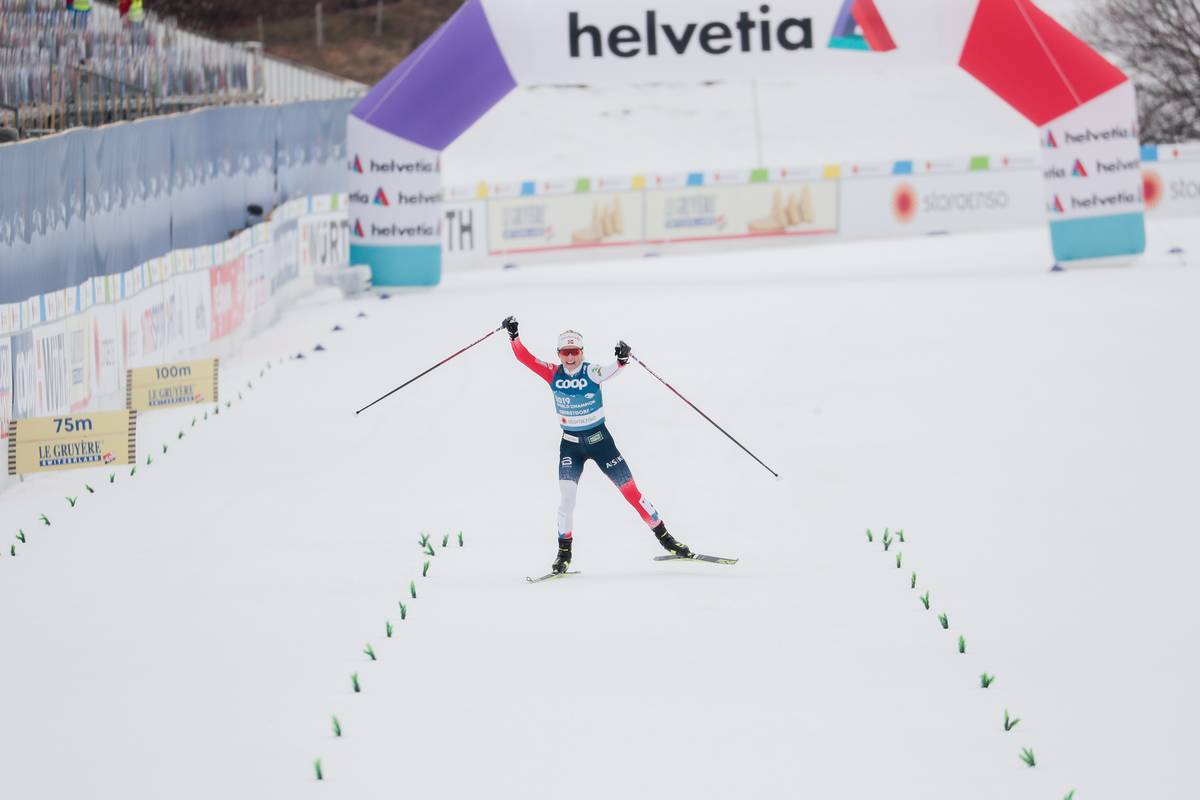
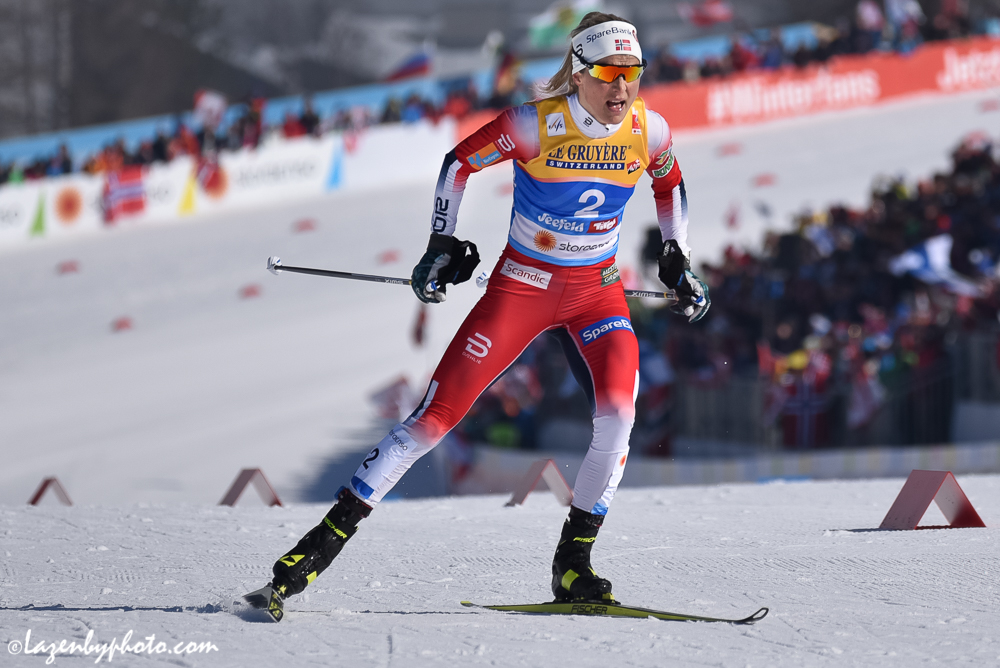
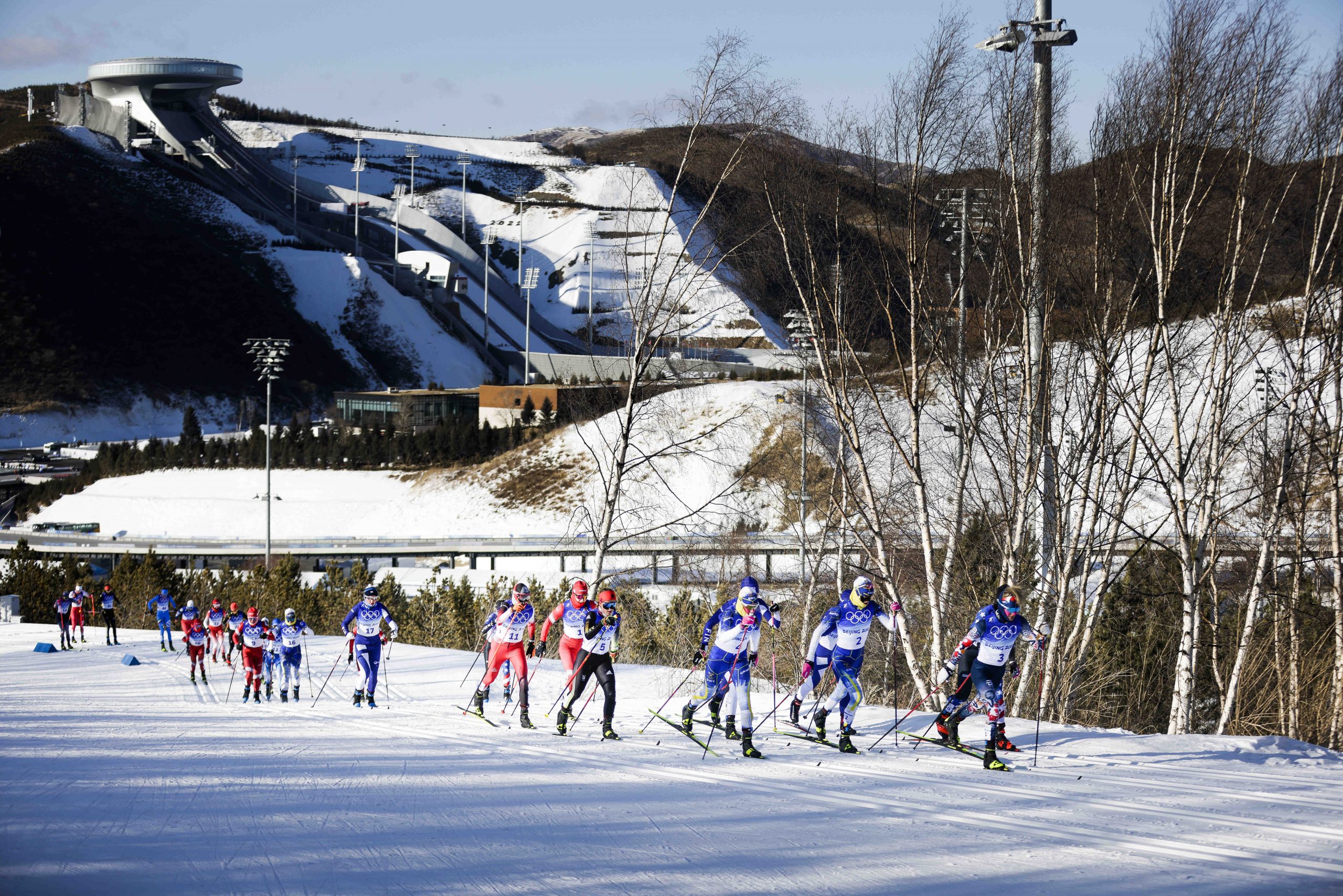
    Striding out of the stadium at the Zhangjiakou National Cross-Country Skiing Center (Photo: NordicFocus)

    This World Cup coverage is made possible through the generous support of Marty and Kathy Hall and the A Hall Mark of Excellence Award.  To learn more about A Hall Mark of Excellence Award or to learn how you can support FasterSkier’s coverage please contact info@fasterskier.com.

    After a long hiatus from international racing, the top athletes found themselves on the start line once again, ready to contest the first event of the 2022 Winter Olympics. First up, a 15-kilometer skiathlon, featuring 64 starters completing four 3.75 k loops. The skiathlon, which combines both classic and skate in one race (7.5 k of each in this case), is an infrequent event on the World Cup circuit though appears on the schedule at all championships.

    Four years ago, at the Olympics in PyeongChang, it was Charlotte Kalla of Sweden who bested the field to take gold, followed by Marit Bjørgen of Norway and Krista Pärmäkoski of Finland. Notably, this year’s winner, Therese Johaug was not present, but we will return to this point later on. 
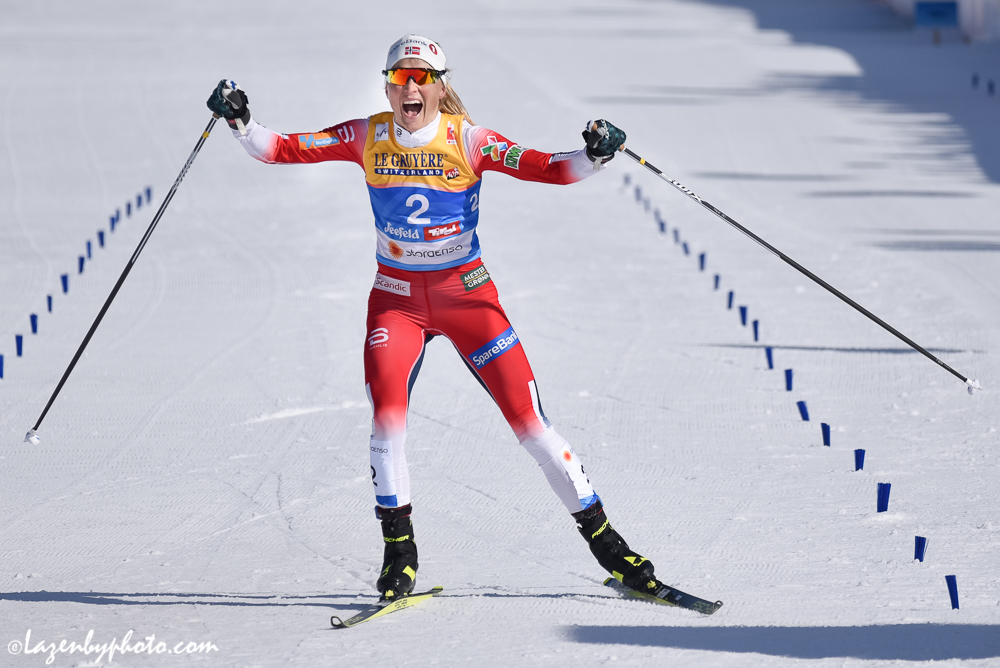
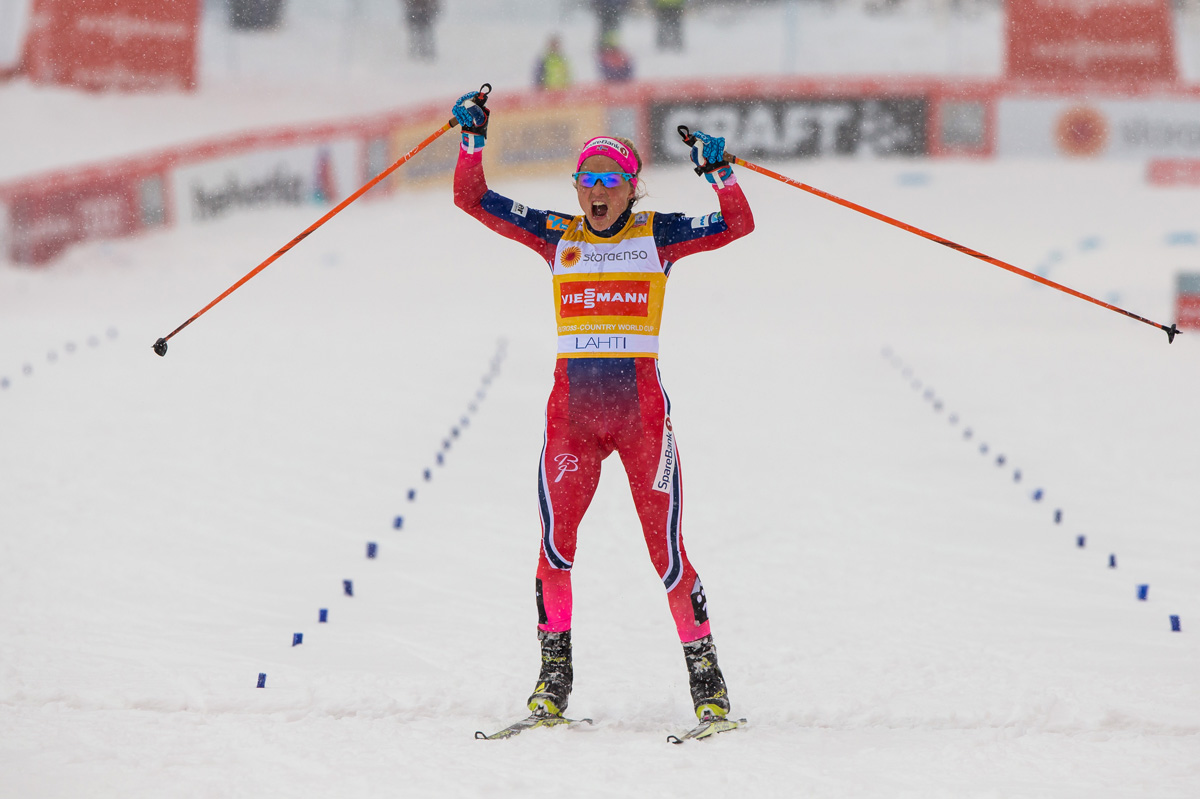
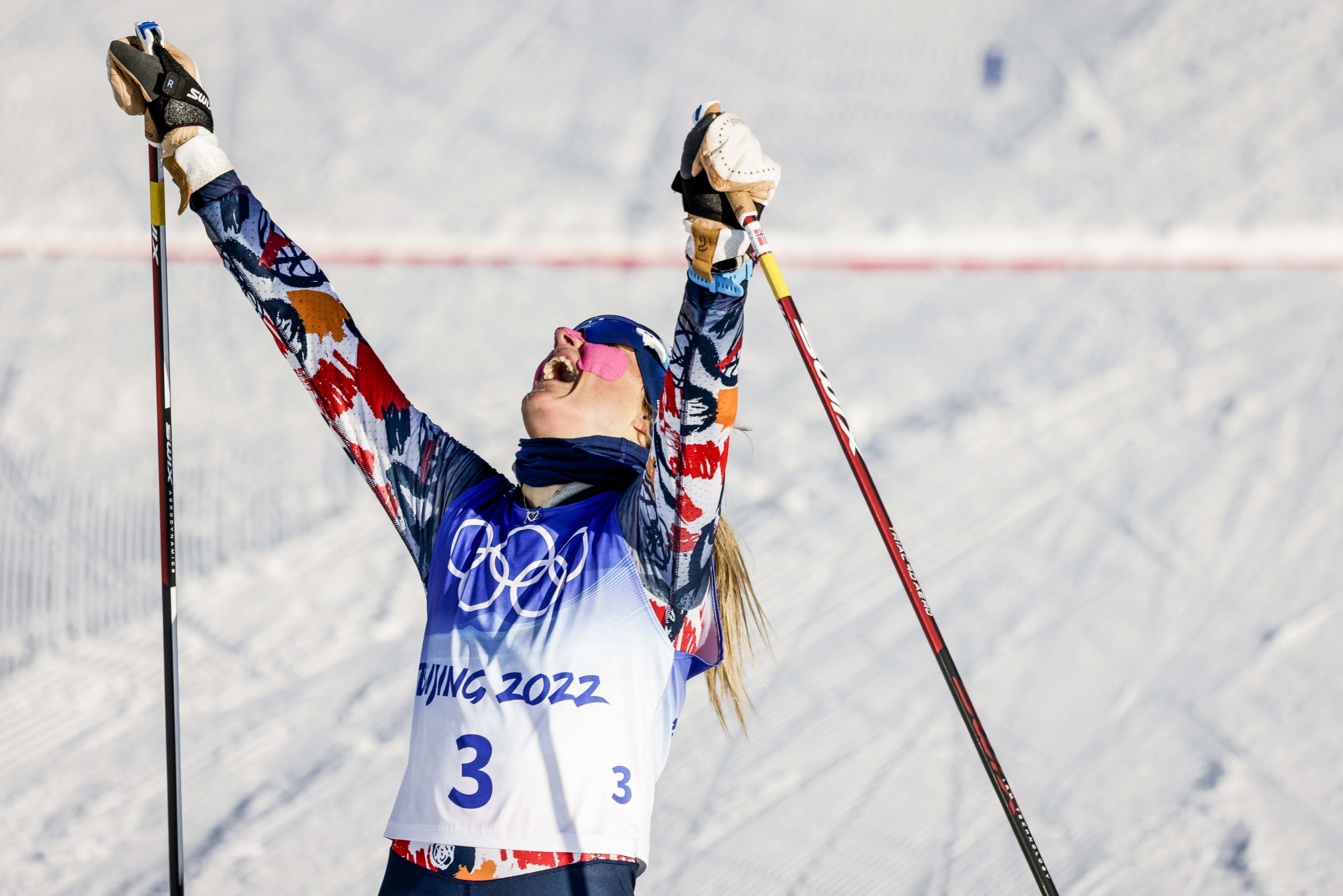
    Celebration for Therese Johaug (NOR) as she takes her first ever individual Olympic gold medal (Photo: NordicFocus)

    Watched by a few masked fans in the stands, the athletes completed final preparations before the start. Even without looking at the temperature, the cold was evident, from the blowing trees and bibs to the drifting snow across the tracks and the face-tape present on all the starters. The thermometer said -12.5°C or 9.5°F, though this reading likely didn’t factor in the windchill. With minutes to go, the athletes emerged from a set of underground stairs, bundled in parkas, to take their places on the start line. 

    At the starters command, the first cross-country ski race of the 2022 Olympics was underway, and almost immediately two skiers went down in a crash, though thankfully the damage did not impact the rest of the field. Coralie Bentz of France and Anne Kyllönen of Finland recovered quickly and rejoined the pack. With the first A-climb less than 1 k into the course, early leaders Rosie Brennan (USA) and Therese Johaug (NOR) pushed the pace, and the pack soon thinned.
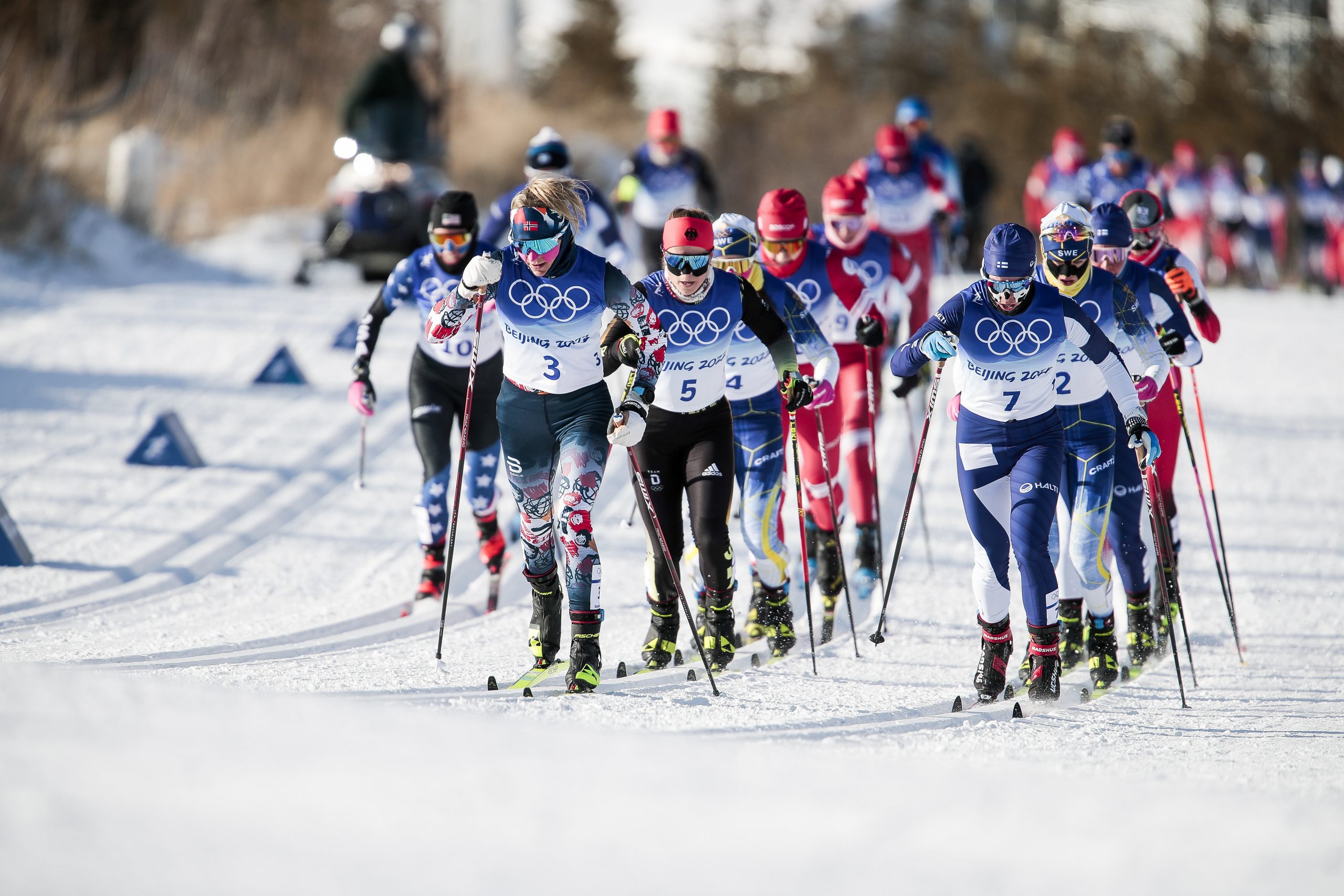
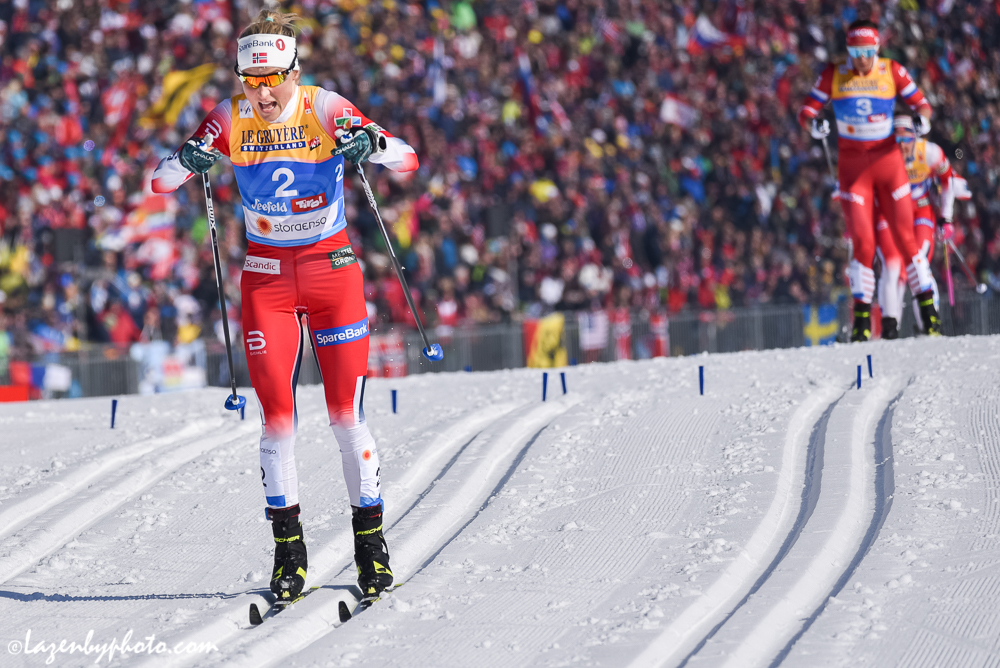
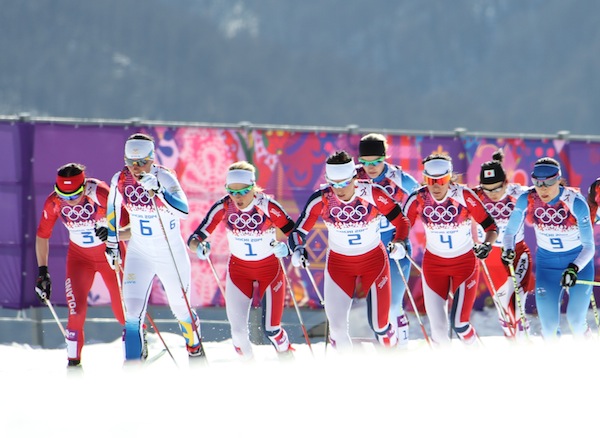
    Therese Johaug (NOR) leads the charge up the first big hill, Rosie Brennan (USA) can be seen leading the left most column (Photo: NordicFocus)

    On the descents, the camera showed most athletes opting to ski on the platform, rather than the tracks, due to the drifting snow that was filling them. Skirting another fall, this time from Johanna Matintalo of Finland, the front group entered the stadium for the first round in a pack of roughly fifteen. With just over eleven minutes on the race clock, there were ten athletes within five seconds of Johaug, a slight surprise given her tendency for early breakaways. 
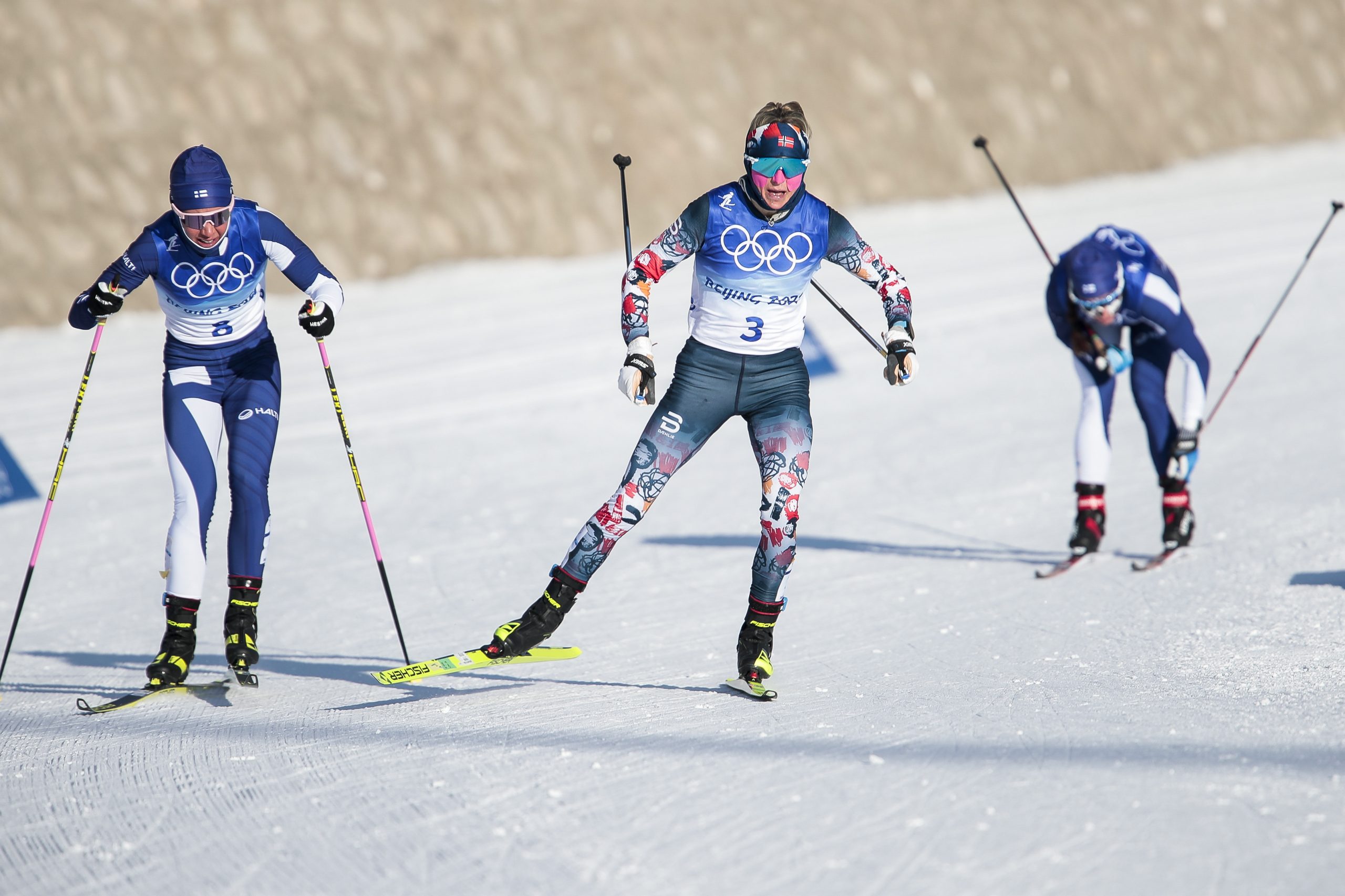
    Therese Johaug (NOR) battles Kerttu Niskanen (FIN)  (Photo: NordicFocus)

    Heading out for the second lap, Johaug visibly upped the pace though still had difficulty shaking her followers. Through the 5.1 k mark, the spread was now ten athletes over the span of ten seconds, led by Kerttu Niskanen (FIN) and ending with her teammate Matintalo, who had recovered from her fall. Whittled away over the duration of that lap, when they reached the second A-climb of the course before descending towards the stadium, Johaug was leading a group of just six skiers. 

    Entering the stadium for the transition to skate skis, Johaug double-poled the final rise, managing to open a slight gap to Niskanen, Frida Karlsson (SWE) and Pärmäkoski (FIN). Executing a quick exchange she held the lead and was out with 23:04.7 elapsed on the clock. Niskanen followed +1.0 behind, Pärmäkoski +2.2 and Karlsson +4.3.

    It is worth noting that after the exchanges, Jessie Diggins of the USA was in tenth, +57.5 seconds behind Johaug, having dropped significantly over the first two classic loops. Rosie Brennan was next in 14th (+1:11.9), with Hailey Swirbul in 23rd (+1:52.6) as the final American inside the Top-30. Julia Kern was +4:07.1 behind in 53rd, about to hit the gas on the skate laps. 

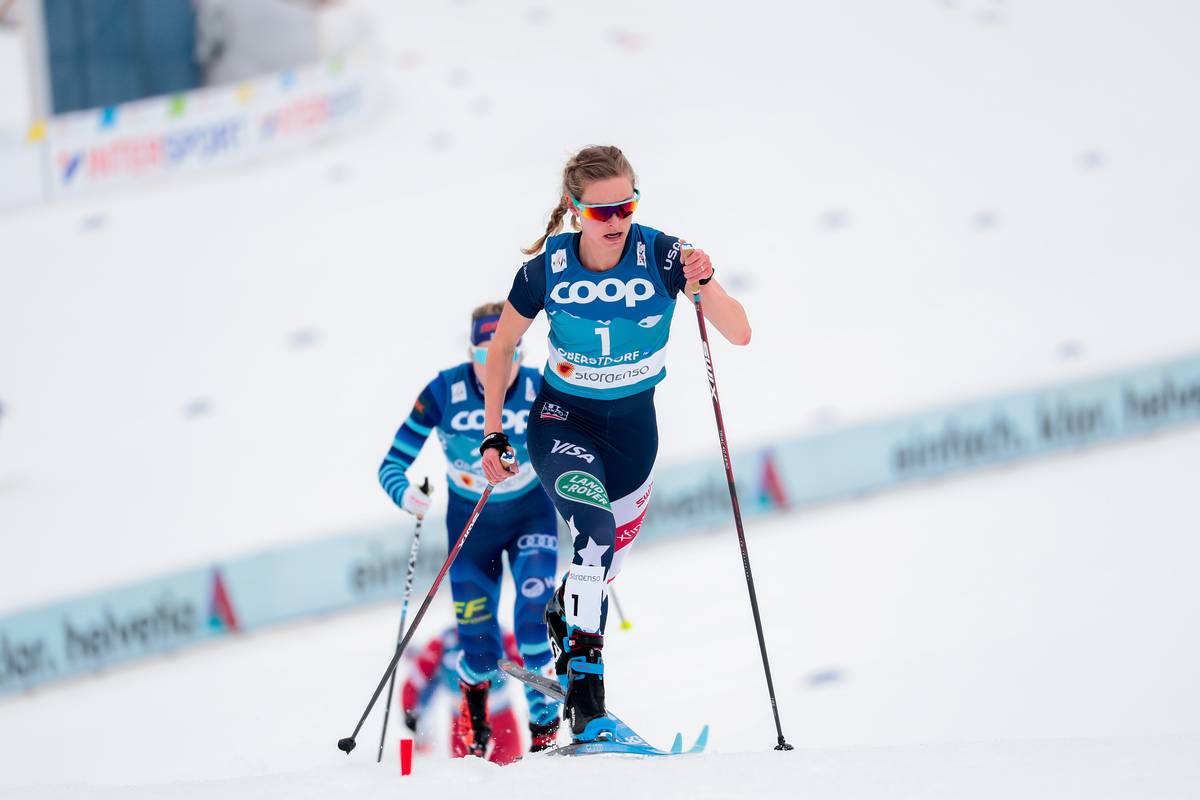
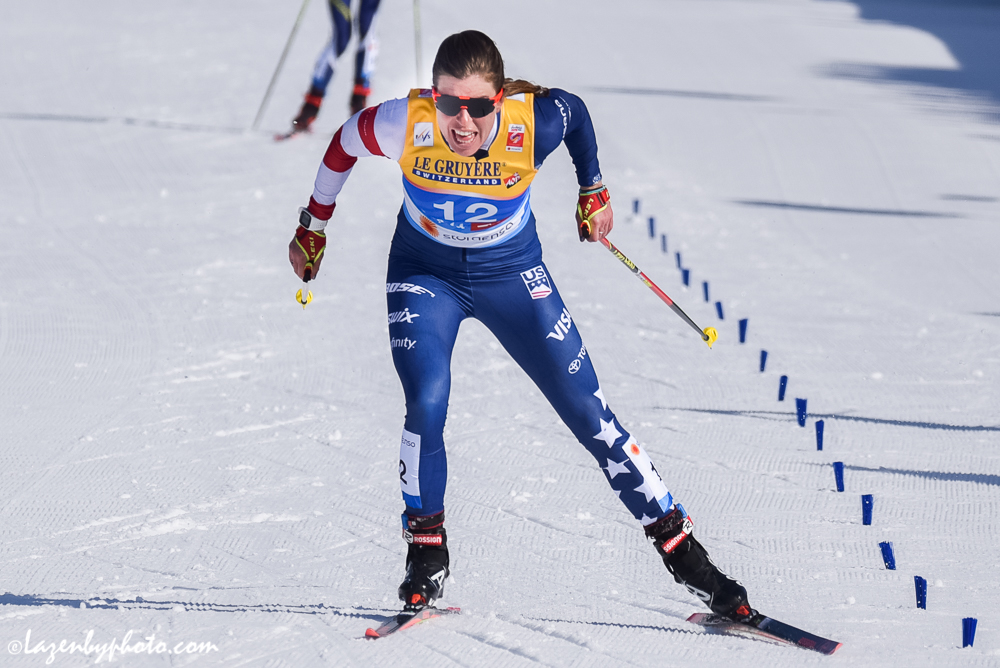
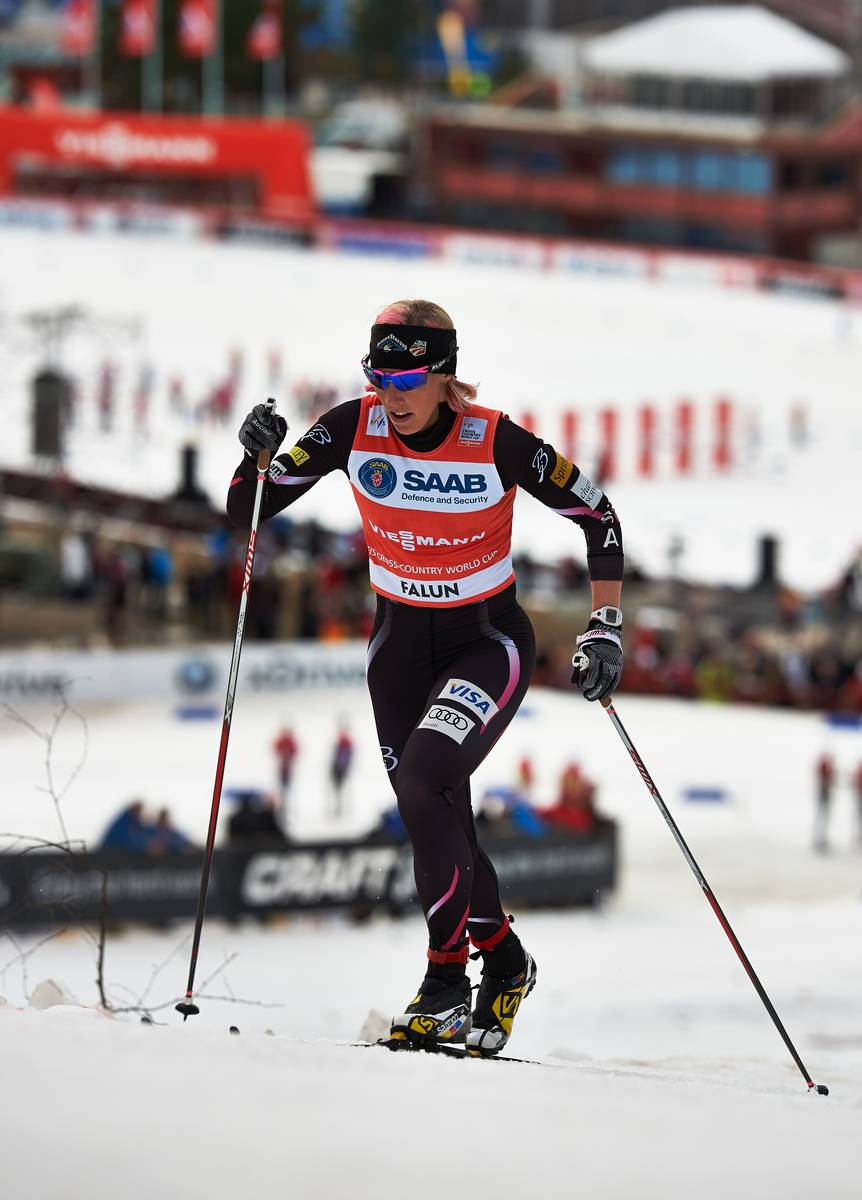
    Jessie Diggins (USA) strides up one of the many challenging climbs (Photo: NordicFocus)

    Capitalizing on her one-second advantage, Johaug found herself off the front for the first time. Pärmäkoski, Karlsson and Niskanen shared leads in an attempt to chase her down but by 8.8 k the gap had stretched to +15.8, effectively securing Johaug her first ever individual Olympic gold medal. From that point, the margins only grew: +26 at 10 k, +44 at 12.6 k and +30.2 at the completion of 15 k.

    Despite her utter dominance of World Cup races and World Championships the past few seasons, Johaug’s results sheet at the Olympics is not what you might expect.
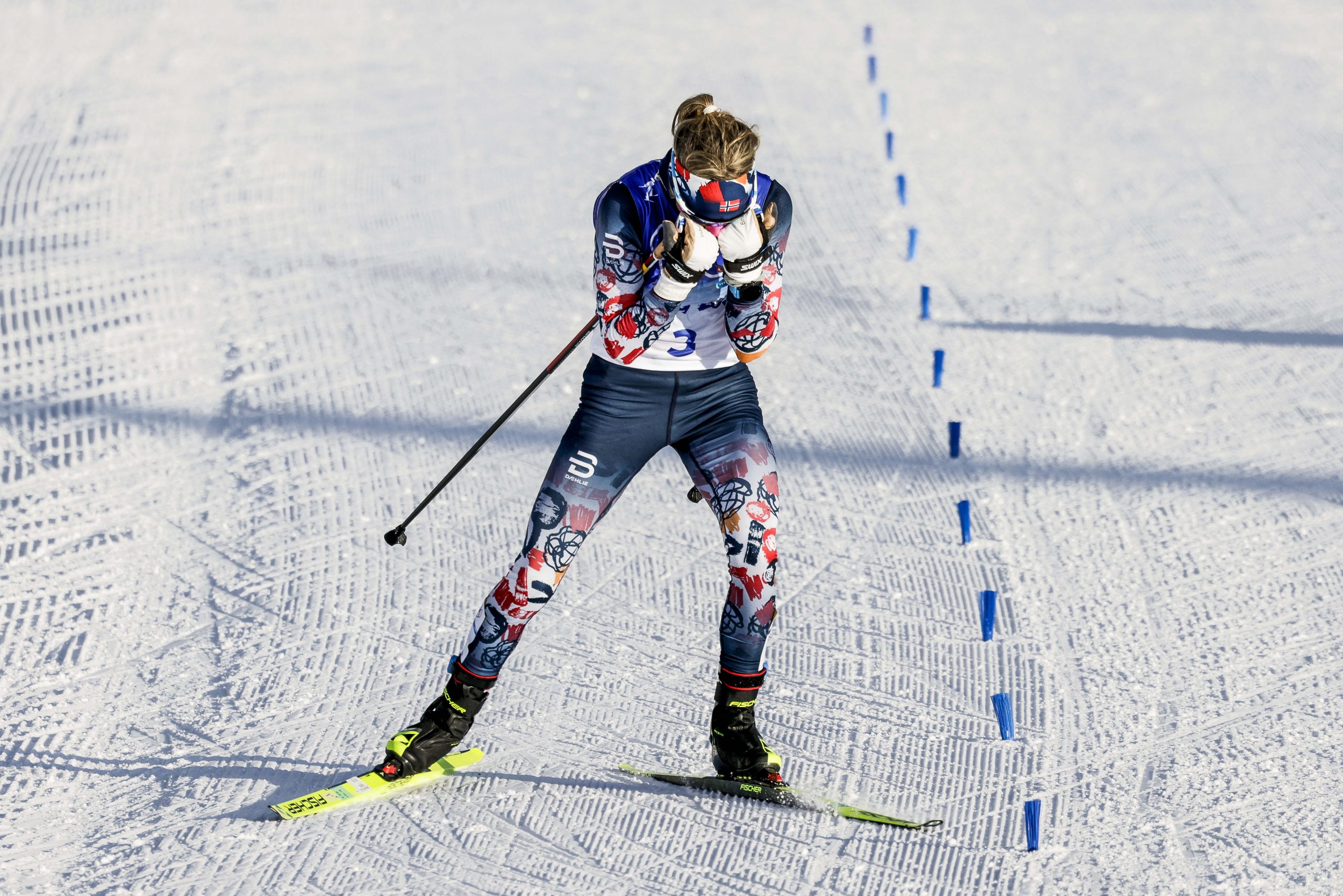
    Tears were shed by Therese Johaug (NOR) as she finally gets her long deserved gold medal (Photo: NordicFocus)

    Prior to the day’s skiathlon victory, she had only one other gold medal, coming from the team relay in the 2010 Games in Vancouver Canada. She was a runner-up in Sochi 2014 during the 30 k freestyle mass start when she placed second behind teammate, Marit Bjørgen, and she also earned bronze in the 10 k classic in Sochi. Johaug received an 18-month competition ban in 2017 for a positive doping test which prevented her from attending the 2018 Olympics in PyeongChang.

    In her post-race press conference, Johaug said she does not hold onto anger about her suspension, which left her even more motivated to prove herself this year.

    “I’m finished with these years and I’m focusing on myself, and the future and things I can do something with,” Johaug said in a press conference. “It means maybe more for me today when I’m didn’t have this gold medal, and maybe if I had the gold medal before, this Olympics, maybe I would not been here.”

    Therese Johaug (NOR) on top in the first cross-country competition at the 2022 Olympics (Photo: NordicFocus)

    With the recent outbreak of COVID amongst the Norwegian team, Johaug’s path to Beijing has not been as smooth as she would have liked. She only arrived at the venue on Wednesday, leaving just a few days to adjust to the time change and climate before the first event. In spite of these challenges, she proved equal to the task, skiing away with the victory in a time of 44:13.7. 

    Behind Johaug, the race for silver and bronze was playing out in a dramatic way. Initially, Karlsson of Sweden seemed to have pulled away, when at 10 k she was 26 seconds behind Johaug, and 10 seconds ahead of Niskanen (FIN) and Teresa Stadlober of Austria. However, this break was short-lived, and at 11.3 k, Karlsson was less than a second ahead of Natalia Nepryaeva (ROC) who had worked with Stadlober to rejoin the chase pack. Pärmäkoski (FIN) began to drop off the pace and the group was down to four. At this point, Diggins (USA) could be spotted closing in on Pärmäkoski, who continued to fade. 
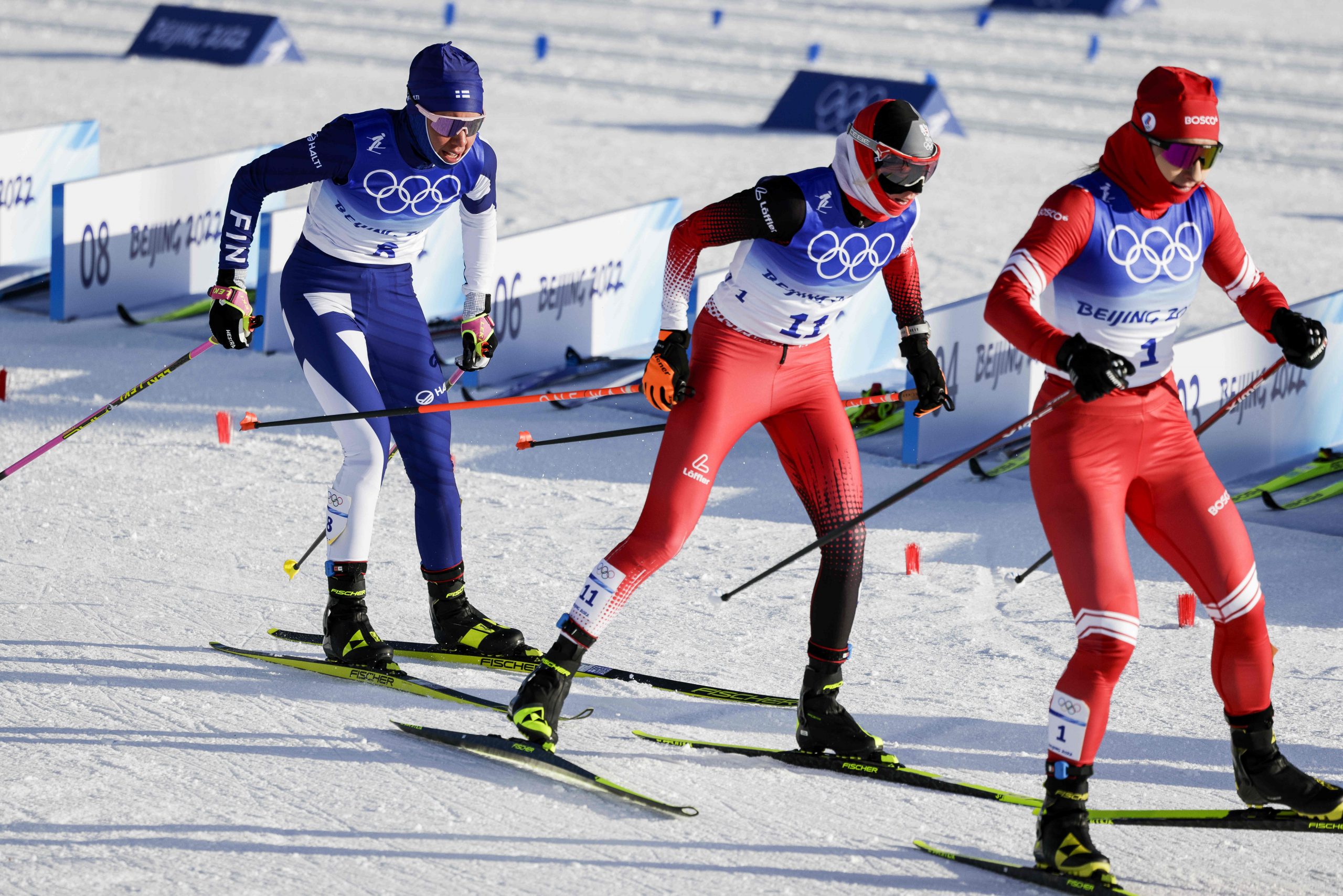
    The chase pack, pictured here: Kerttu Niskanen (FIN), Teresa Stadlober (AUT), Natalia Nepryaeva (ROC), (l-r) (Photo: NordicFocus)

    Entering the final A-climb of the race, Stadlober (AUT) injected some pace, attempting to pull away but Karlsson of Sweden and Nepryaeva (ROC) hung on. Only Niskanen (FIN) dropped slightly.

    Thus it was three skiers vying for two medal spots. But as they descended towards the stadium Niskanen closed in again, making the group four. Nepryaeva crested the final rise in front as across the stadium the camera showed Johaug crossing the line, arms raised and a frozen smile on her face. 
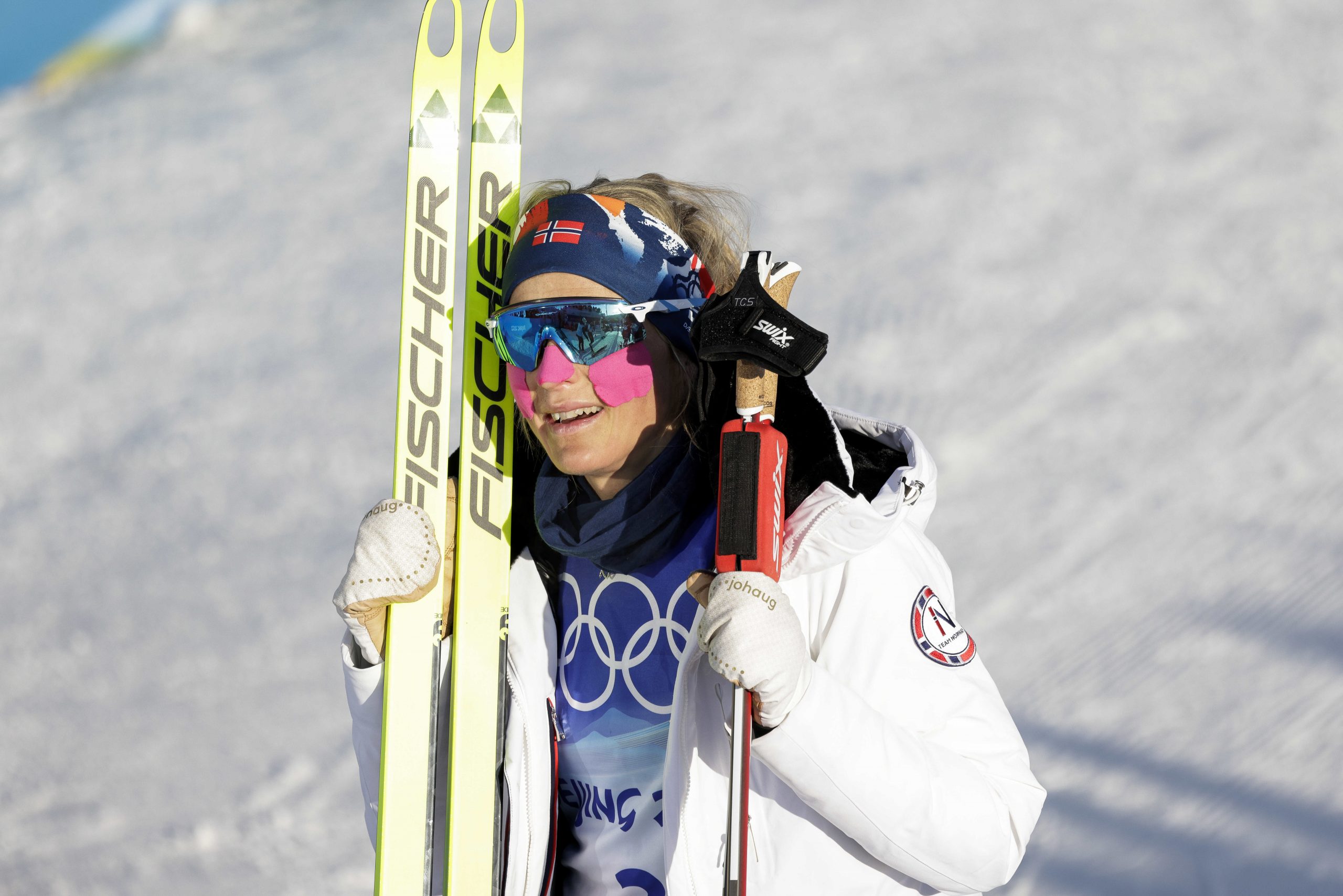
    Frozen but happy, Therese Johaug (NOR) (Photo: NordicFocus)

    Down the finishing straight Nepryaeva held onto her lead as Stadlober mounted a final challenge, ultimately running out of space as the two finished in silver and bronze position respectively. Niskanen (FIN) finished fourth (+36.1), Karlsson (SWE) in fifth (+42.5), and in an impressive comeback, Diggins crossed the line sixth (+50.5). 
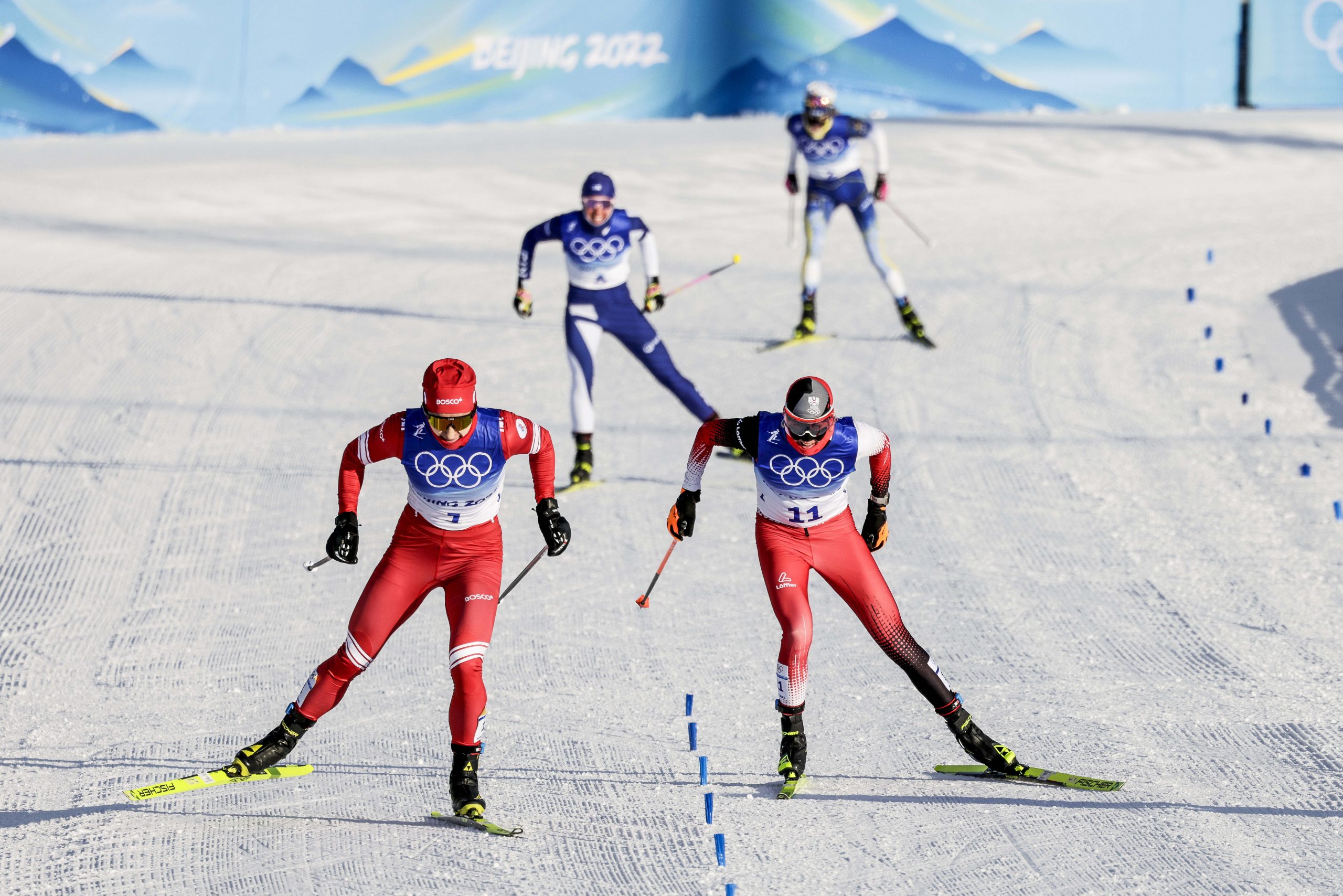
    A tight battle for silver and bronze between Teresa Stadlober (AUT) and Natalia Nepryaeva (ROC), (l-r) (Photo: NordicFocus)

    This silver is the first Olympic medal for Natalia Nepryaeva, who most recently became the first Russian women to win the Tour de Ski. Her only other Olympic appearances came in PyeongChang where her best finish was fourth in the classic sprint. 
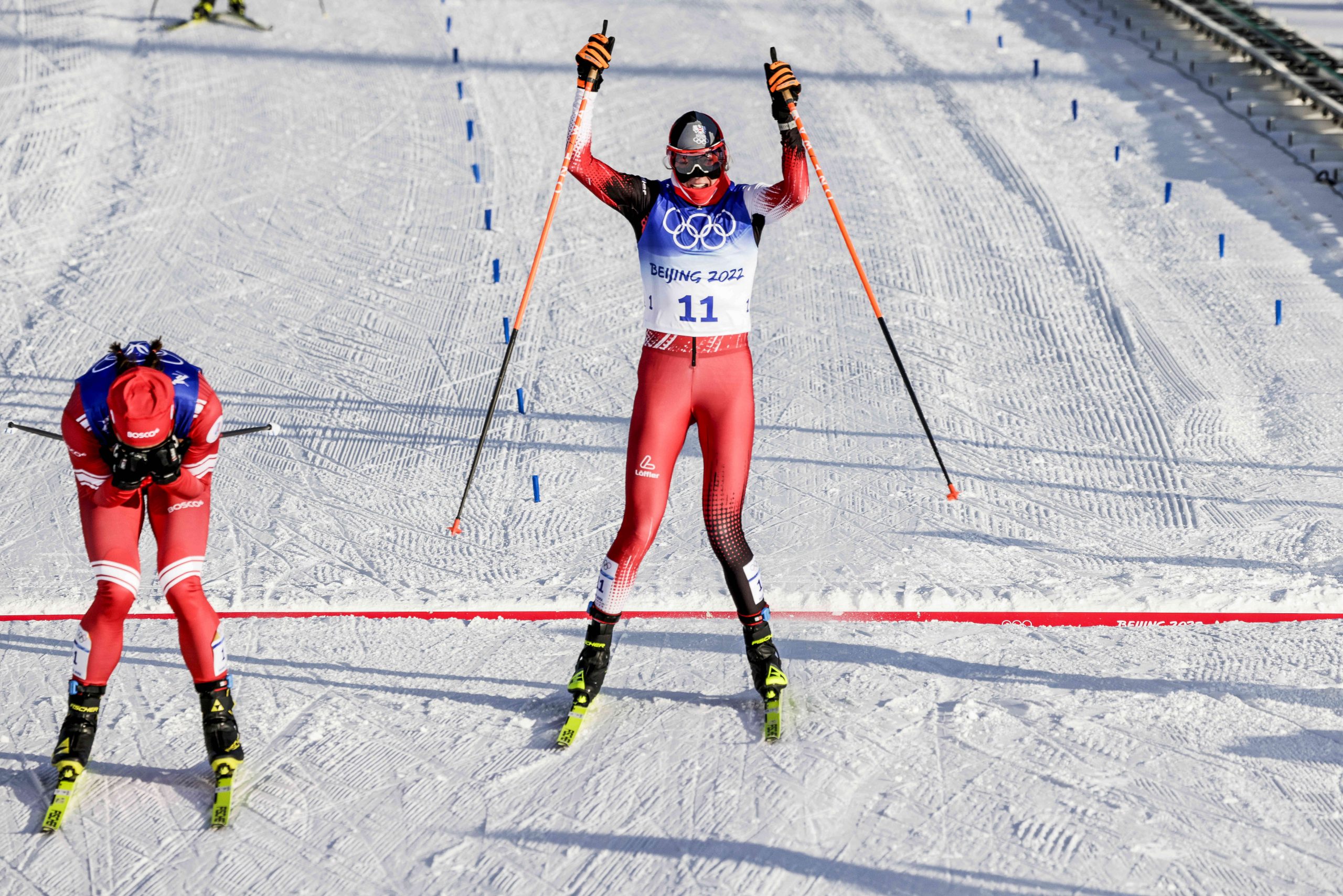
    Teresa Stadlober (r-AUT) celebrates a bronze medal as Natalia Nepryaeva (l-ROC) is overcome with emotion (Photo: NordicFocus)

    For Teresa Stadlober of Austria, this bronze medal could be viewed as redemption. Stadlober was in medal contention during the 30 k classic at PyeongChang when a last minute wrong turn took her out of the running. Furthermore, after a total of 18 individual starts at championship events (Olympics and World Championships), this is Stadlober’s first medal. She holds just three World Cup podiums, two during the 2018 edition of the Tour de Ski in Toblach where she placed third in the 10 k classic mass start and had the second fastest time of the day on the Alpe Cermis hill climb. The third podium was in a 15 k skiathlon in Oberstdorf Germany in 2020 where she also placed third. 

    First Olympic medal for Teresa Stadlober (AUT) (Photo: NordicFocus)

    Other noteworthy performances from the day includes Anastasia Rygalina (ROC), who has had just ten World Cup starts in her career and never finished in the top ten, finishing the race in 8th. Behind her, Delphine Claudel of France earned a new personal best for the Olympics placing 9th. 
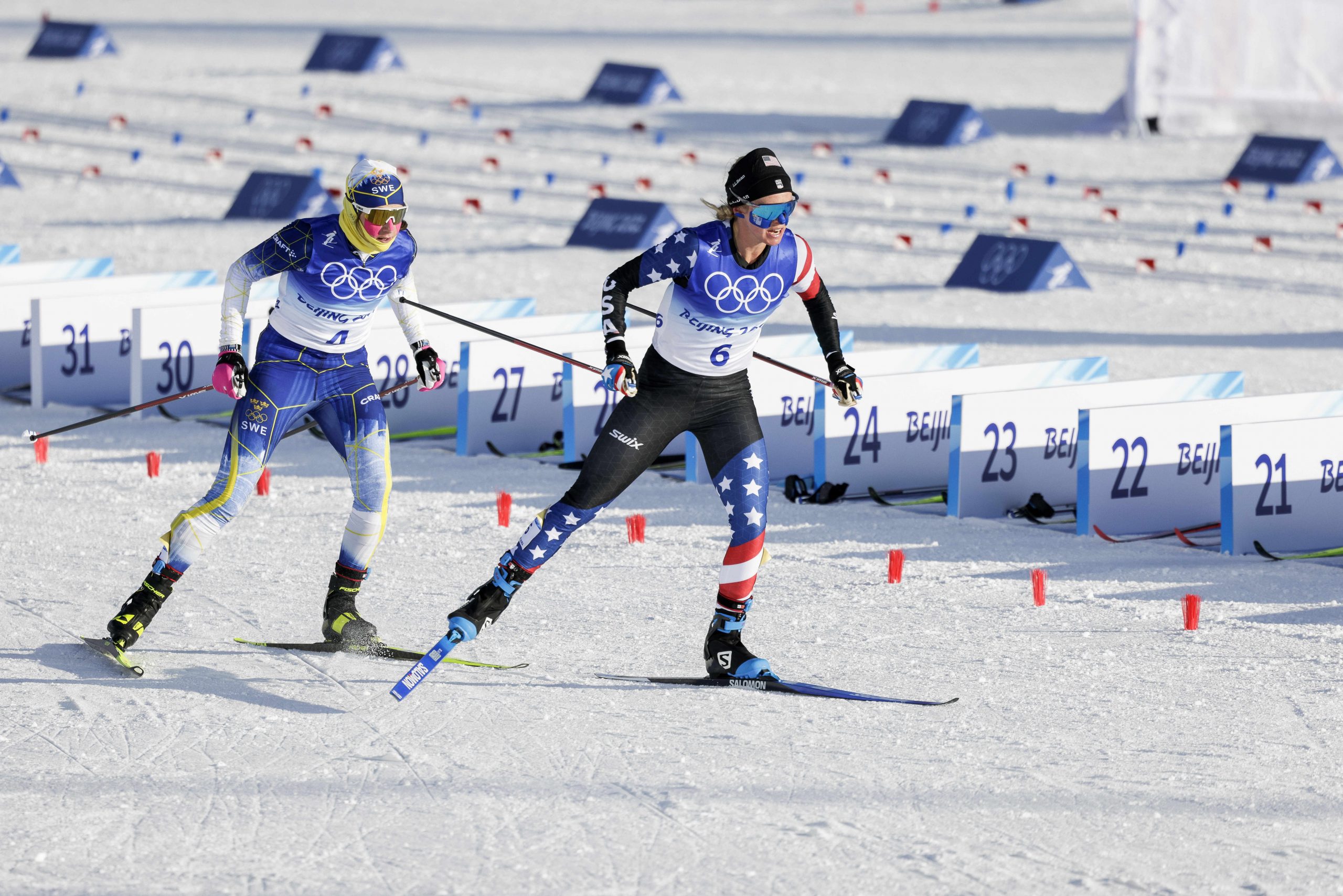
    Jessie Diggins (USA) exits the transition zone, followed by Ebba Andersson (SWE) (Photo: NordicFocus)

    After being +55.5 seconds behind Pärmäkoski and the chase group at the exchange, Diggins ended up finishing a full eight seconds ahead of the Finn and was just 20 seconds behind bronze medalist, Stadlober.

    “I definitely finished with nothing left so I feel really good about that,” said Diggins in the mixed zone after the race. “I was so proud of never giving up. I feel really good about the pacing and where my fitness is. I definitely want to figure out some things with my power striding, but overall I think this was a really encouraging start to the Games and honestly it feels really good just to have gotten here and to be able to race.”

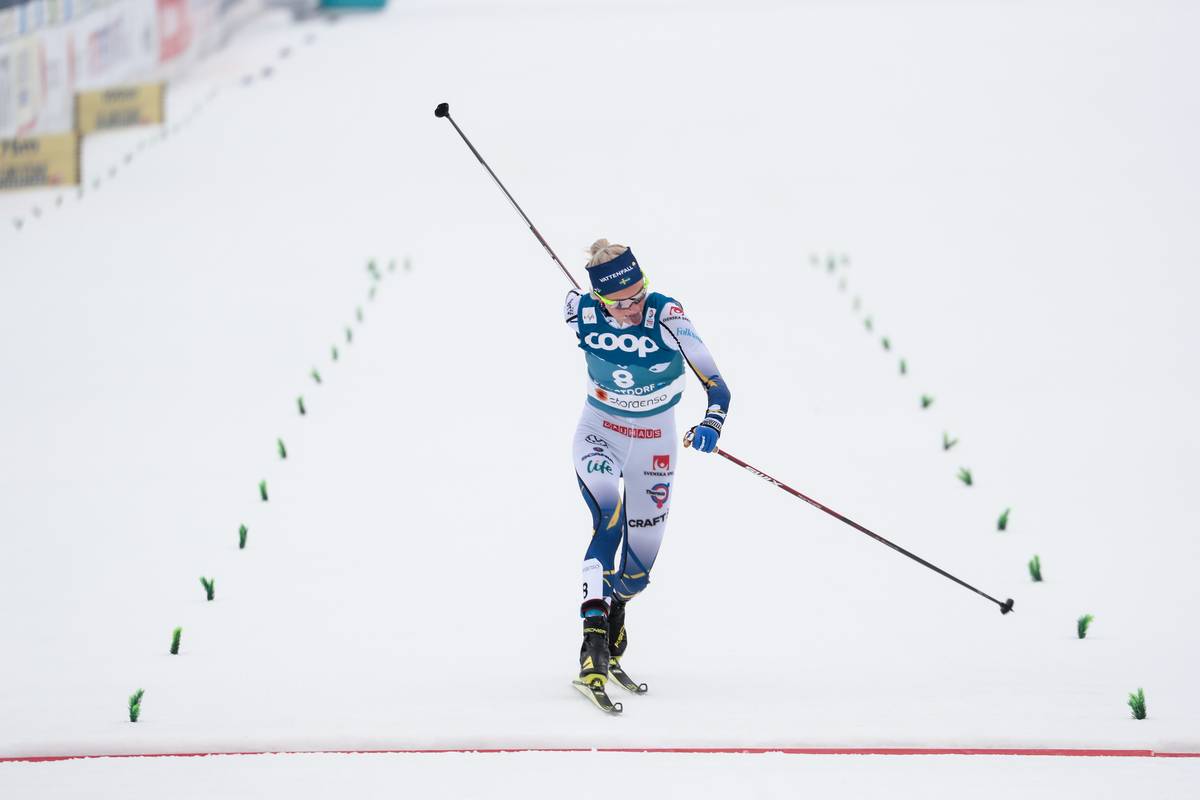
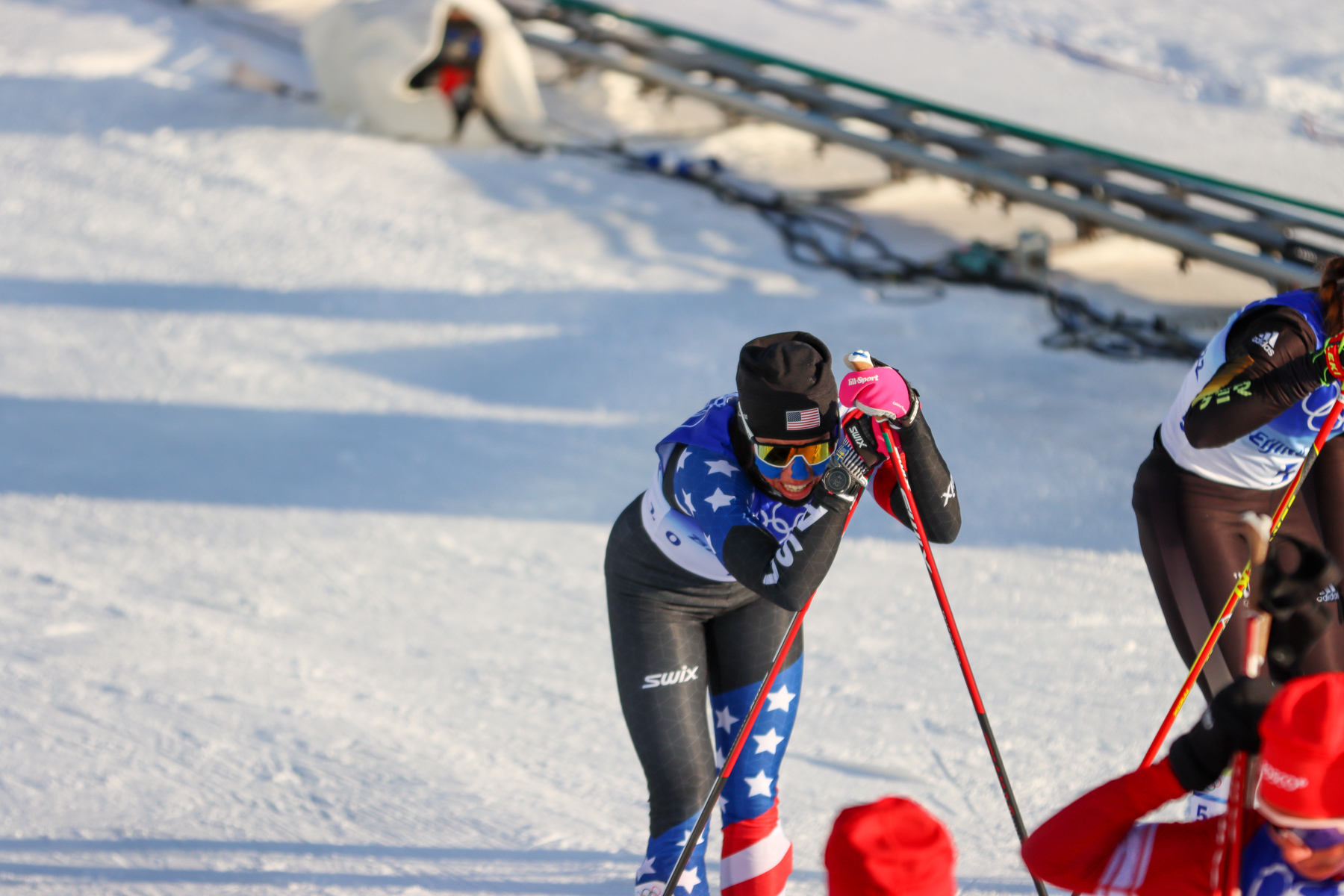
    Left it all on the course, Jessie Diggins (USA) collapsed in the finish (Photo: NordicFocus)

    When asked about the cold and windy conditions Diggins replied, “My hands got pretty cold because I needed thinner gloves for the pit-box changing. My muscles stayed warm though. [The wind] is really something, and that’s what makes it so cold, so I think it’s important to really push that and stay warm.”

    Regarding the course, Diggins said, “They’re really good courses. I really like them. I think they’re really fair and great championship courses. They’re as hard as they look, you’ve really got to work for it.”
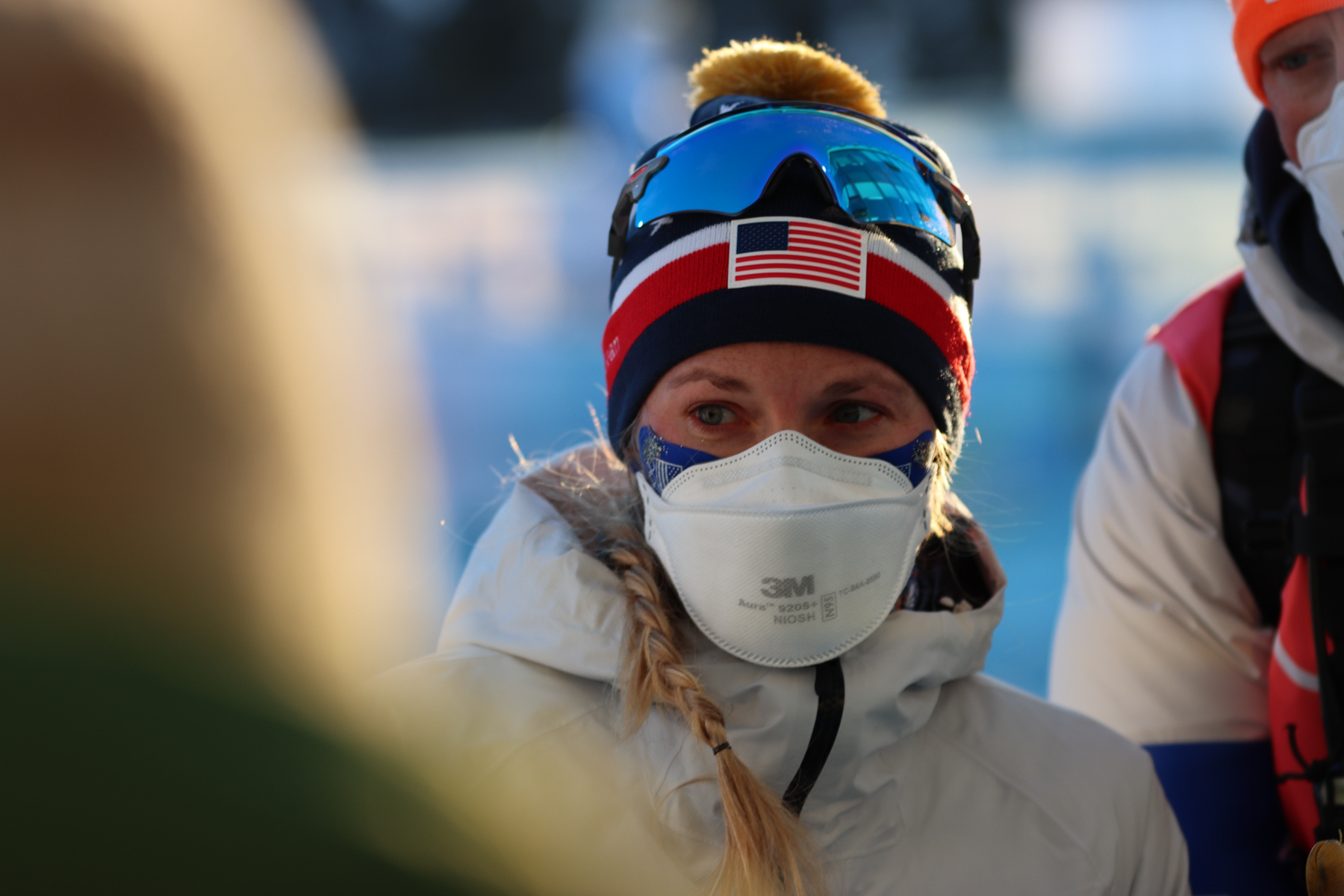
    Jessie Diggins fields media questions in the mixed zone. (Nat Herz/FasterSkier-ADN)

    In Diggins final 5k, she advanced from eighth place and over 1:13 back to finish sixth place and roughly 50 seconds back. This is a difference of 23 seconds gained on the leader over 5k, with ten seconds gained in the final 2.4k.

    “I had amazing skate skis and I think I had paced just well enough to be able to do that,” Diggins said of this progress. “I crossed the finish line with nothing left. It’s really cool to get a race on these courses in and I think I’m figuring [them] out.”

    Rosie Brennan leaves the exchange zone halfway through the women’s 15k skiathlon, the opening race of the 2022 Winter Olympics. (Nat Herz/FasterSkier-ADN)

    Brennan was the next finisher for Team USA, in fourteenth position (+2:51.7). Brennan had initially fallen behind Germany’s Katharina Hennig in the skate leg to slide into 15th, but she regained her position with 3 k to go, further accelerating to give herself a 7 second cushion at the finish. 

    “Definitely a little bit of everything out there today,” Brennan told U.S. Ski & Snowboard communications manager Tom Horrocks after the race. “Some good, some ugly, some in between.”

    While Brennan’s result might not be evidence that she is a medal threat in the event, and she is surely left wanting more, she spoke like a true veteran, showing maturity and perspective in her response to how she will look back on the performance.

    “I think I have to take the like big picture perspective. Four years ago, I think I was close to dead last fighting some [mononucleosis], and that was my first and last Olympic race. So I really had kind of a — I don’t know what you’d call it — a demon in the back of my mind that I needed to get rid of. So to be in a better place today, even if it wasn’t my best, was a step in the right direction. And that’s something that I’m proud of.”
    Rosie Brennan catches her breath after finishing 14th in the women’s skiathlon at the 2022 Beijing Winter Olympic Games. (Nat Herz/FasterSkier-ADN)

    While official start lists are not yet available, as Brennan is one of USA’s top skiers, she will likely start in multiple upcoming events.

    On her mindset and how she’s feeling heading into these stages, Brennan said, “It’s been a while since I’ve done racing at an international level. (Brennan left Europe after the Davos World Cup races in mid-December, spending the last six weeks near her home in Park City, UT.) I’m really hoping that the effort today was what I needed to just get back into things and find a better place ,because I certainly have had some workouts that have indicated that I’m in good shape. So I do want more and I think I can get more. I’m really looking forward to the other races.”

    Behind Brennan, Hailey Swirbul finished in 40th (+5:28.8).

    “It’s a lot of V1 skate, it’s hard,” Swirbul said in the mixed zone in reference to the course, “It makes for fair racing but you have to be totally on your game. It didn’t feel like [you get a break] today, it was a tough day for sure.”
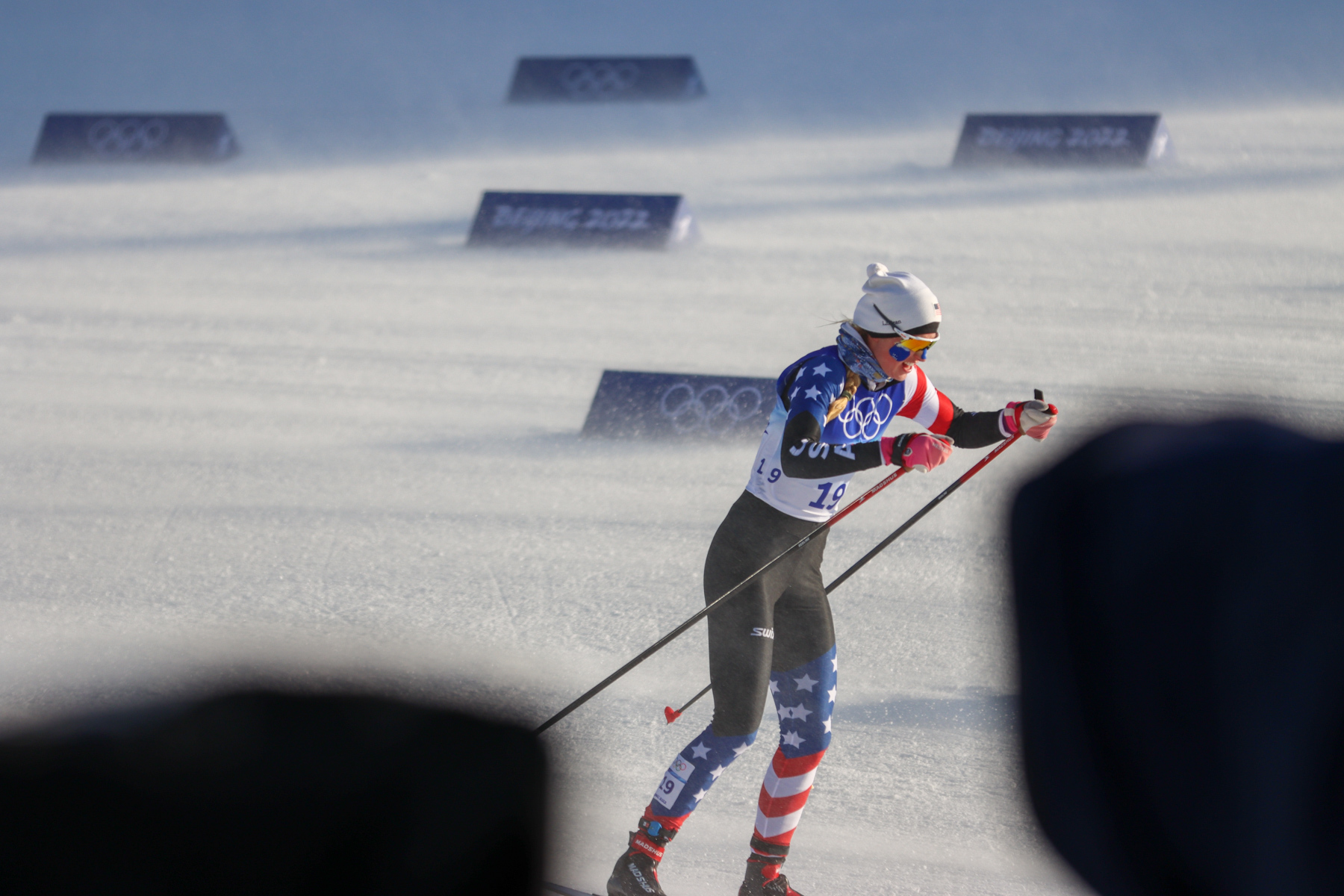
    Hailey Swirbul transitions from classic to skate, fighting windy conditions on course during the women’s 15k skiathlon. (Nat Herz/FasterSkier-ADN)

    When asked about taking part in the Olympics and the momentum of the team, Swirbul said, “It’s a hugely exciting time to be part of this team. We’ve shown over the last four years what we’re capable of. We will give everything we have out there. It feels like a relief that we made it here and that our team has been healthy and we prepared really well so far. A race is a race, no matter if it’s an Olympic or local race. It’s important to keep your head in the game, and be ready to fight no matter what.” 
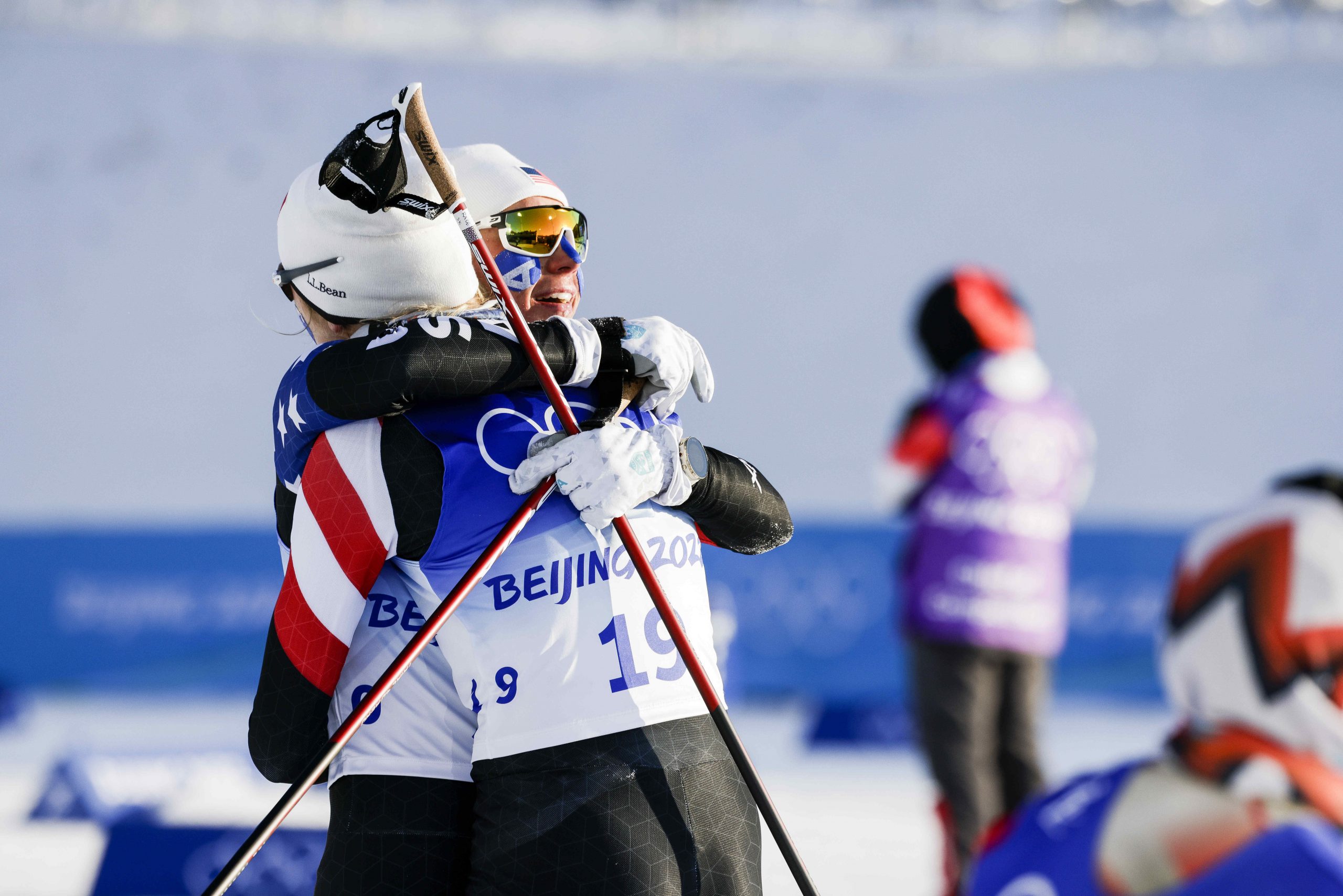
    Hailey Swirbul (USA) embraces teammate Julia Kern (USA) after the skiathlon (Photo: NordicFocus)

    Julia Kern rounded out the US finishers in 53rd position (+7:51.8). It was “windy and tough,” said Kern definitively. “That was a really tough race, probably the windiest race I’ve ever done. I had a ton of base layers on so I stayed warm, but the wind cools you right down on the downhill.”

    Regarding her participation in the Games, Kern said, “It’s a dream come true, I’m really excited to see what we can do as a team for the rest of the Games. This is just the beginning.”
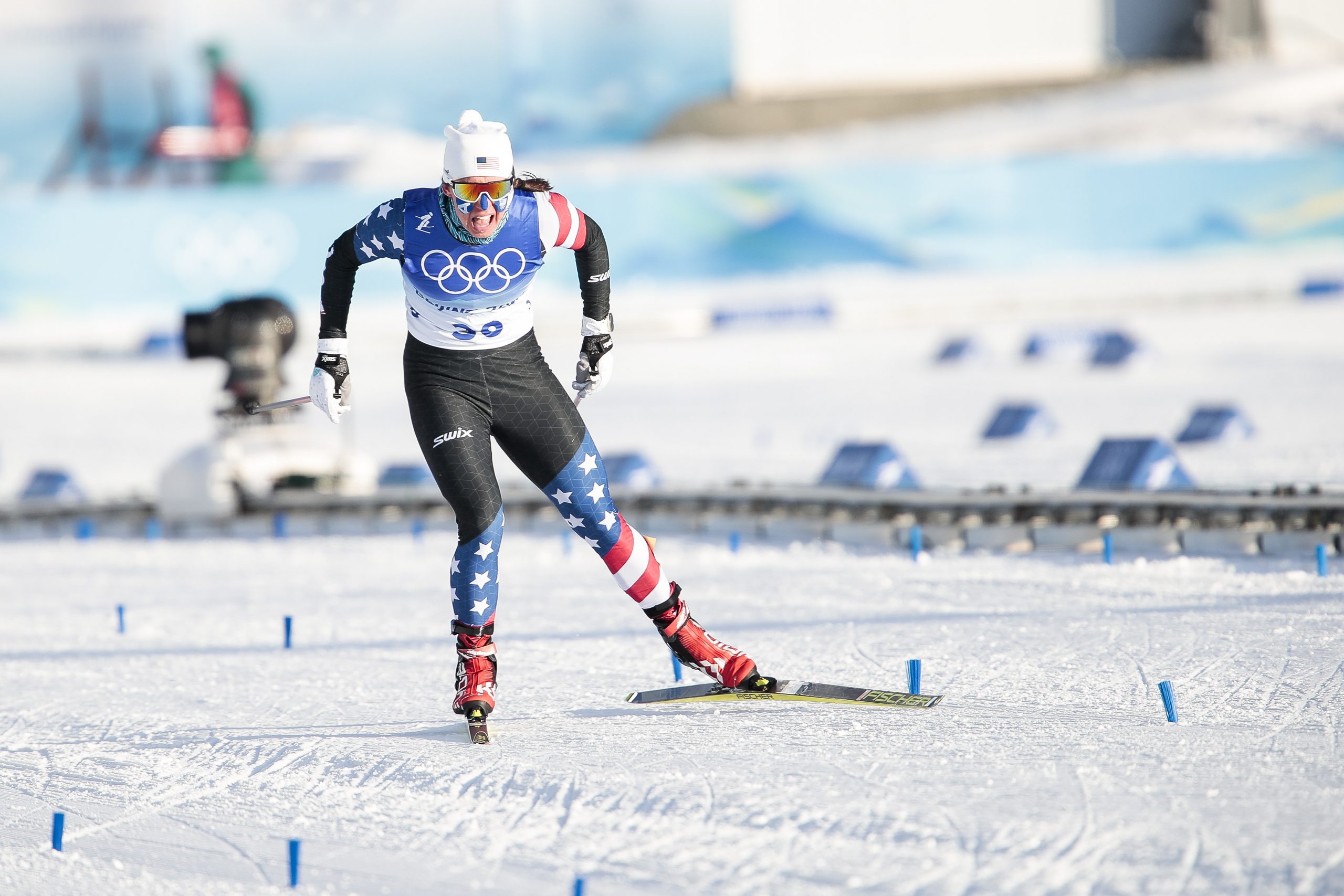
    Julia Kern (USA) fights hard to the finish (Photo: NordicFocus)

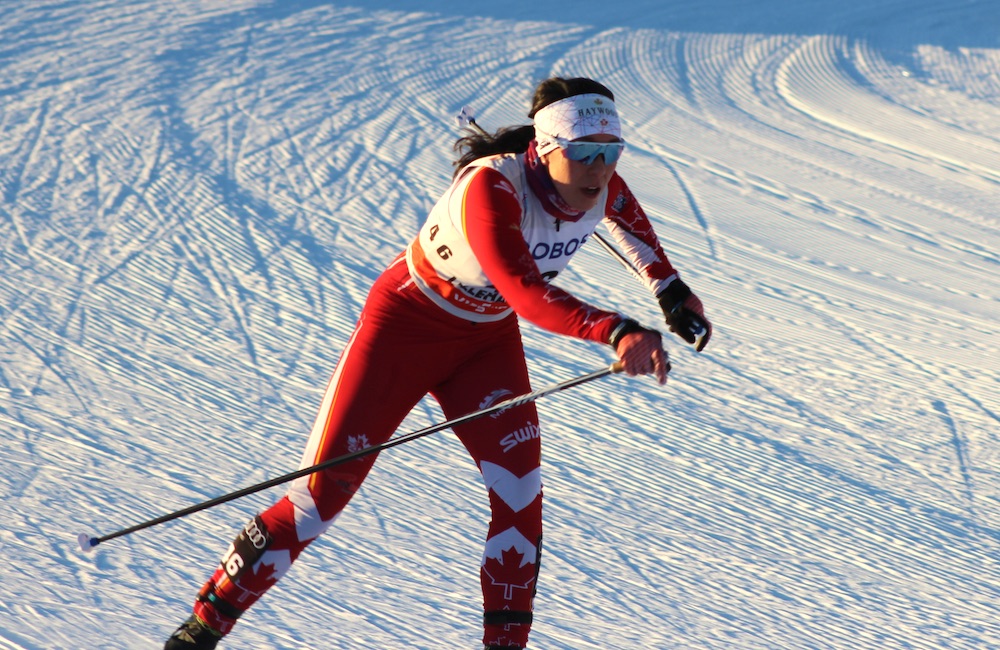
    The Canadian women made a strong showing in the top thirty, led by Cendrine Browne in 20th (+3:44.4). Not far behind her was Kathrine Stewart-Jones, matching her bib number and finishing in 23rd (+4:03.6). In a dramatic finish – essentially a forward fall across the line – Dahria Beatty finished 28th (+4:38.8), putting three Canadians in the top thirty. Olivia Bouffard-Nesbitt was the fourth Canadian and finished 44th (+5:58). 
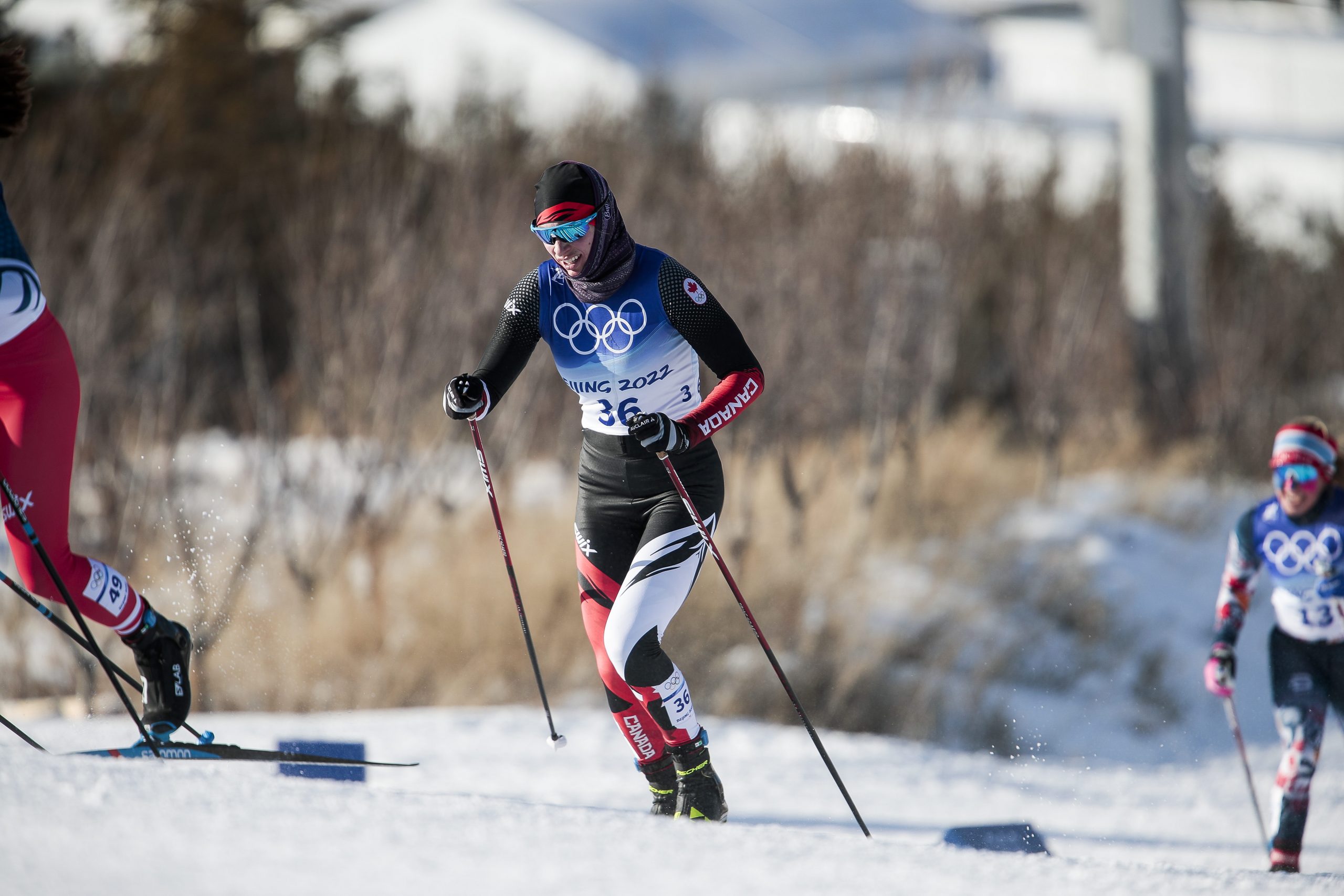
    Dahria Beatty (CAN) finished 28th in the 15 k skiathlon (Photo: NordicFocus)

    Racing for Australia, APU’s Jessica Yeaton finished just outside the Top-30 in 31st (+4:40.3).
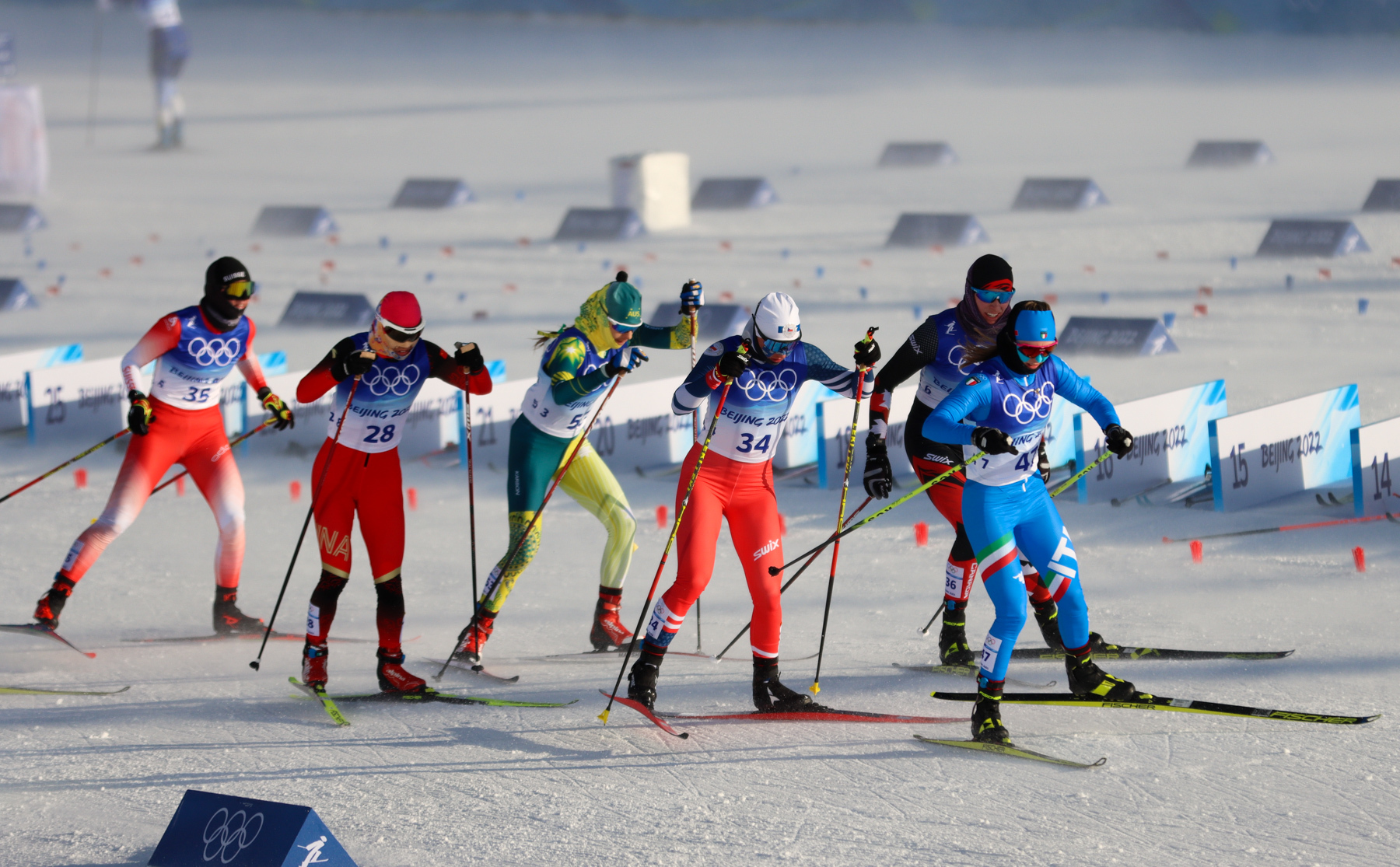
    Australia’s Jessica Yeaton (bib 53) races to 31st in the women’s 15k skiathlon, which opened the 2022 Winter Olympics in Beijing. (Nat Herz/FasterSkier-ADN)

    The men will race a 30 k skiathlon tomorrow, and the next women’s event will be the freestyle sprint on February 8th. You can find a detailed schedule for the Olympic cross-country events, including how to watch, here. 

    Results

  • Johaug Breaks Away for the Skiathlon Win; Diggins 15th

    Johaug Breaks Away for the Skiathlon Win; Diggins 15th

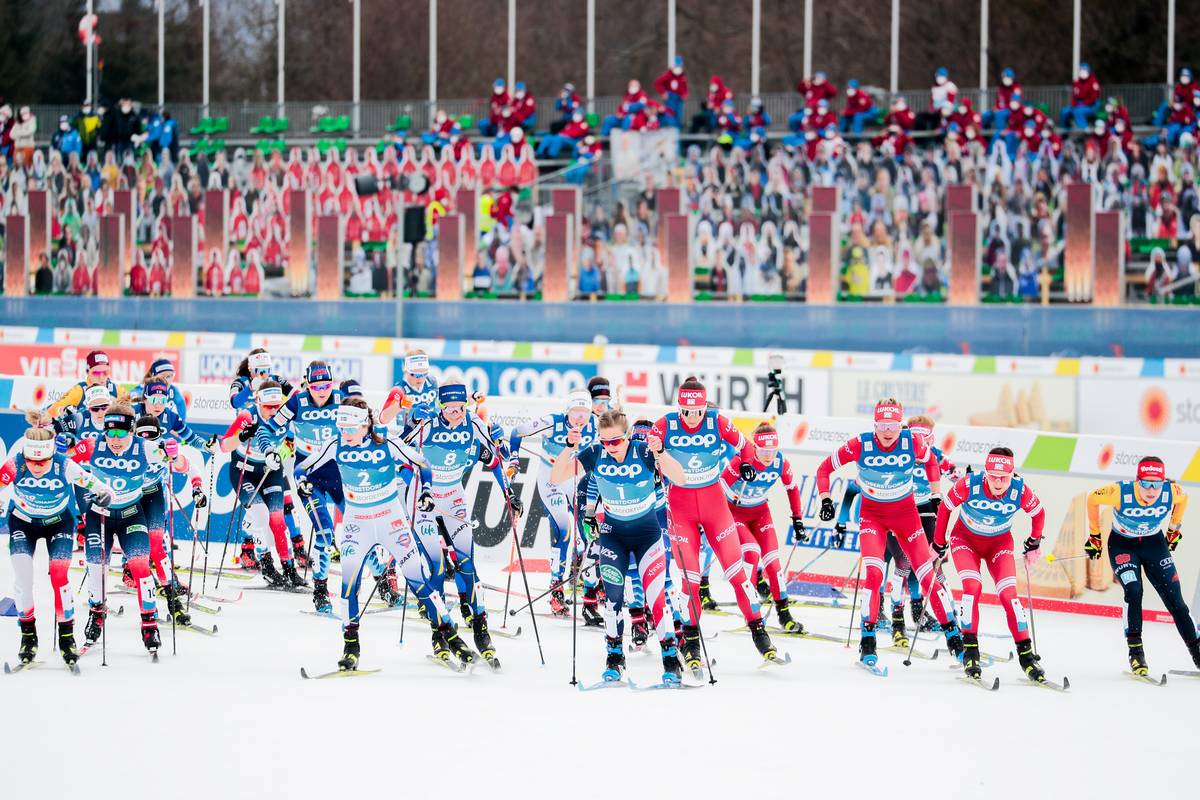
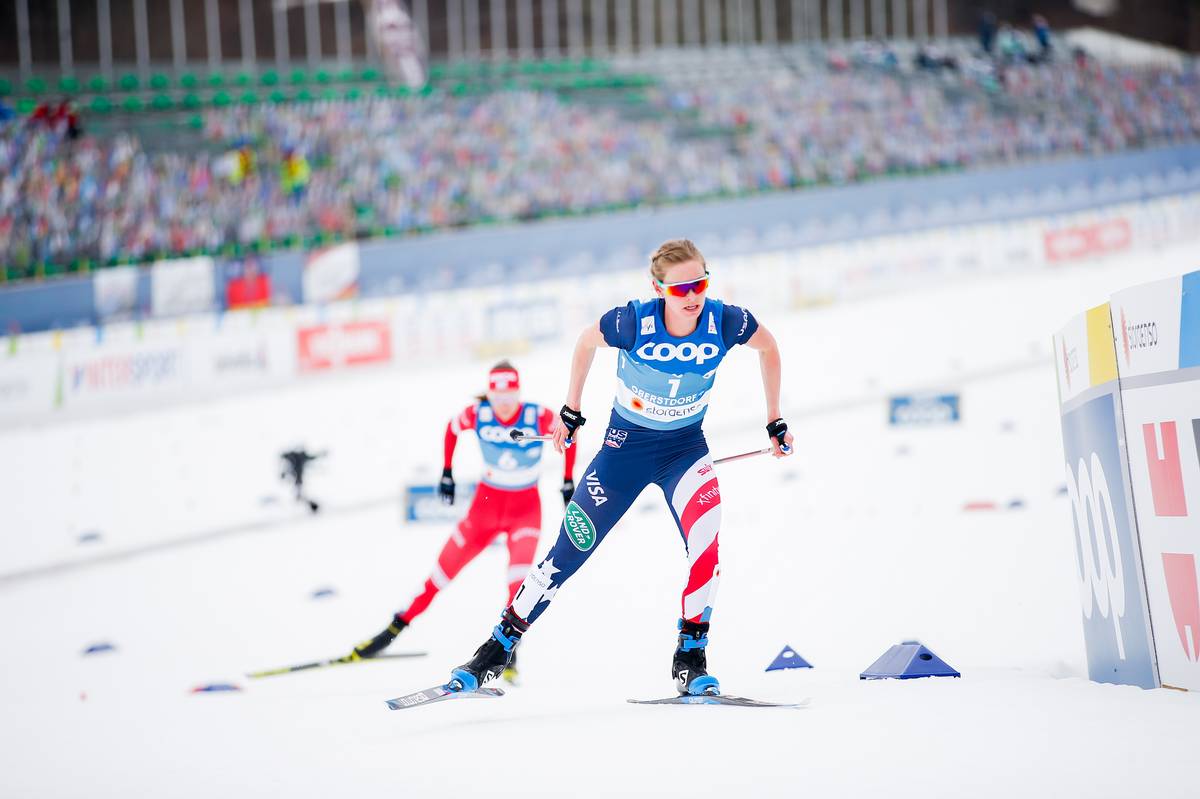
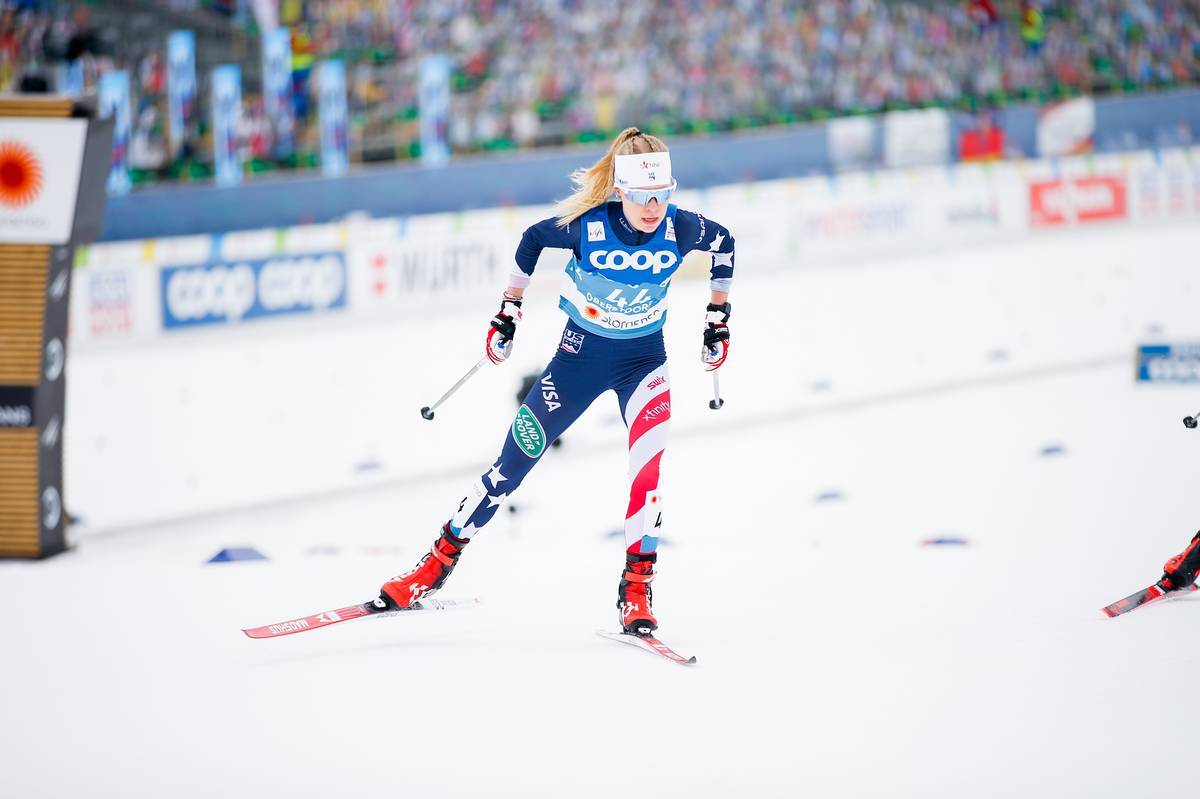
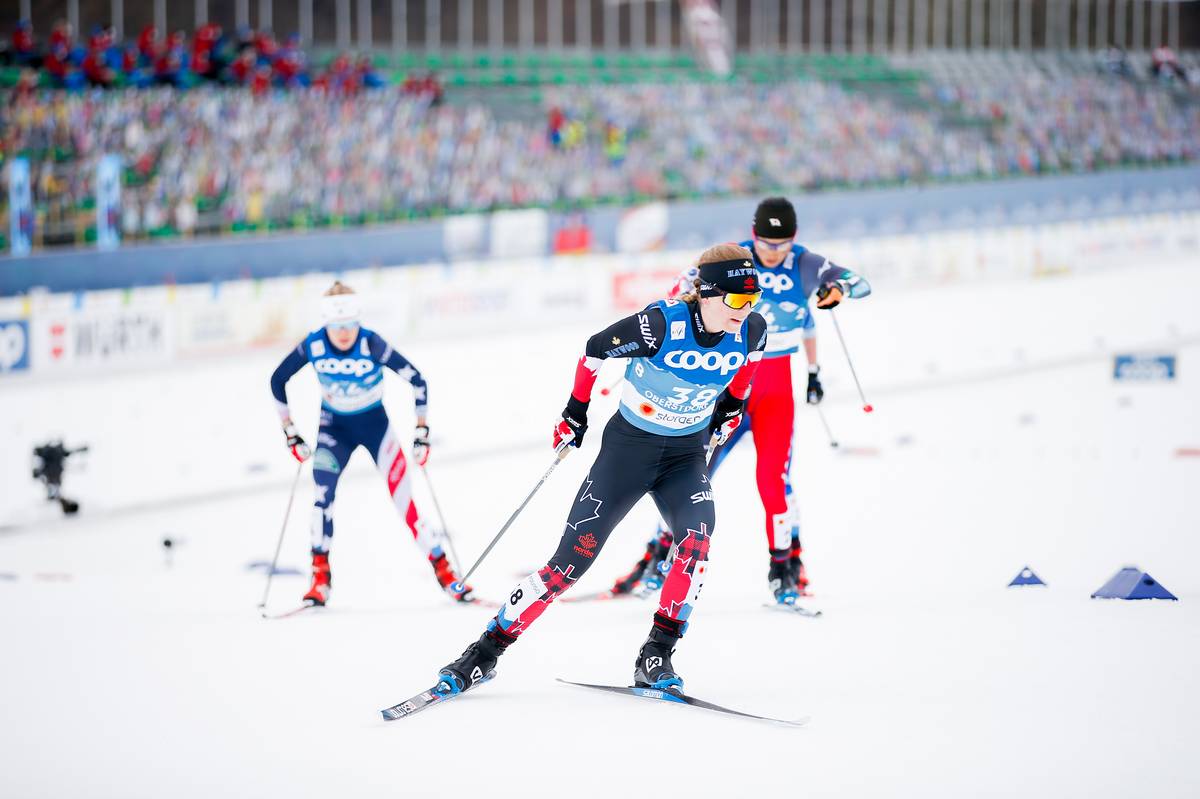
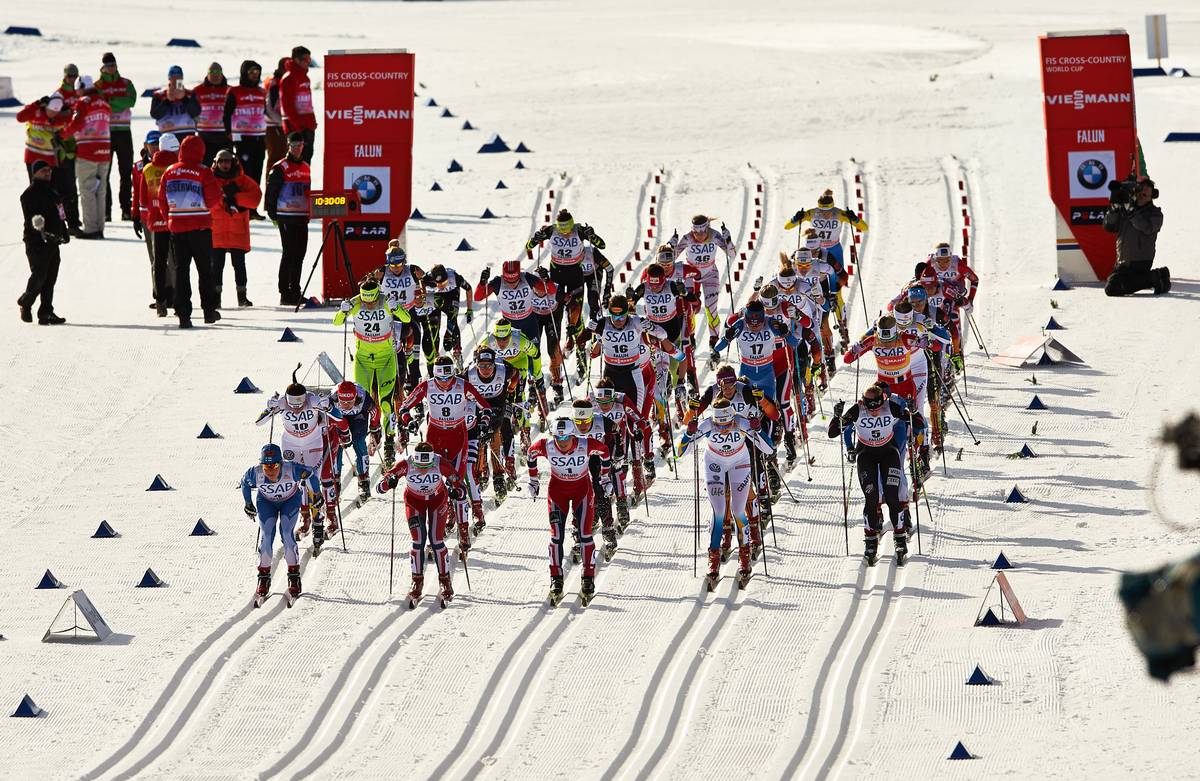
    Cut-out fans and cut-off shirtsleeves for the start of the 15 k skiathlon in Obertsdorf Germany (Photo: Nordic Focus)

    This World Championship coverage is made possible through the generous support of Marty and Kathy Hall and their A Hall Mark of Excellence Award. To learn more about A Hall Mark of Excellence Award or to learn how you can support FasterSkier’s coverage please contact info@fasterskier.com.

    Overcast skies greeted the skiers as they lined up for a 15 k skiathlon Saturday morning, the second World Championship event in Oberstdorf, Germany. Despite temperatures hovering around 37°F, the tracks were firm and fast, the course consisting of two classic laps of a 3.75 k loop and two skate laps of a different 3.75 k loop. Sixty women started the competition though with a few athletes getting lapped, the finishers numbered 56. With little fanfare in an otherwise stark ski course during the pandemic, Therese Johaug of Norway was the show. At the end of the day, Johaug once again topped the podium in a time of 38:35.5, though this wasn’t purely a given early in classic leg. 

    Theresa Johaug (NOR) fighting hard from the gun. (Photo: Nordic Focus)

    Immediately off the line, Johaug was at the front, pushing the pace. Two young Swedes, Ebba Andersson and Frida Karlsson weren’t about to let her take off and stuck to her like glue. As the three skiers descended towards the stadium at the end of the first lap on a ribbon of white snow through bare brown fields, it looked as if the top three had already been decided. Exiting a sharp right-hand corner Johaug’s skis slid out into Karlsson and both skiers went down. Andersson capitalized on the moment to take the lead. Righting herself, Johaug rebounded quickly. Karlsson, however, ended up with a broken pole and compounded with a botched hand-off to receive a replacement, she found herself +17.5 seconds down to the leaders. 

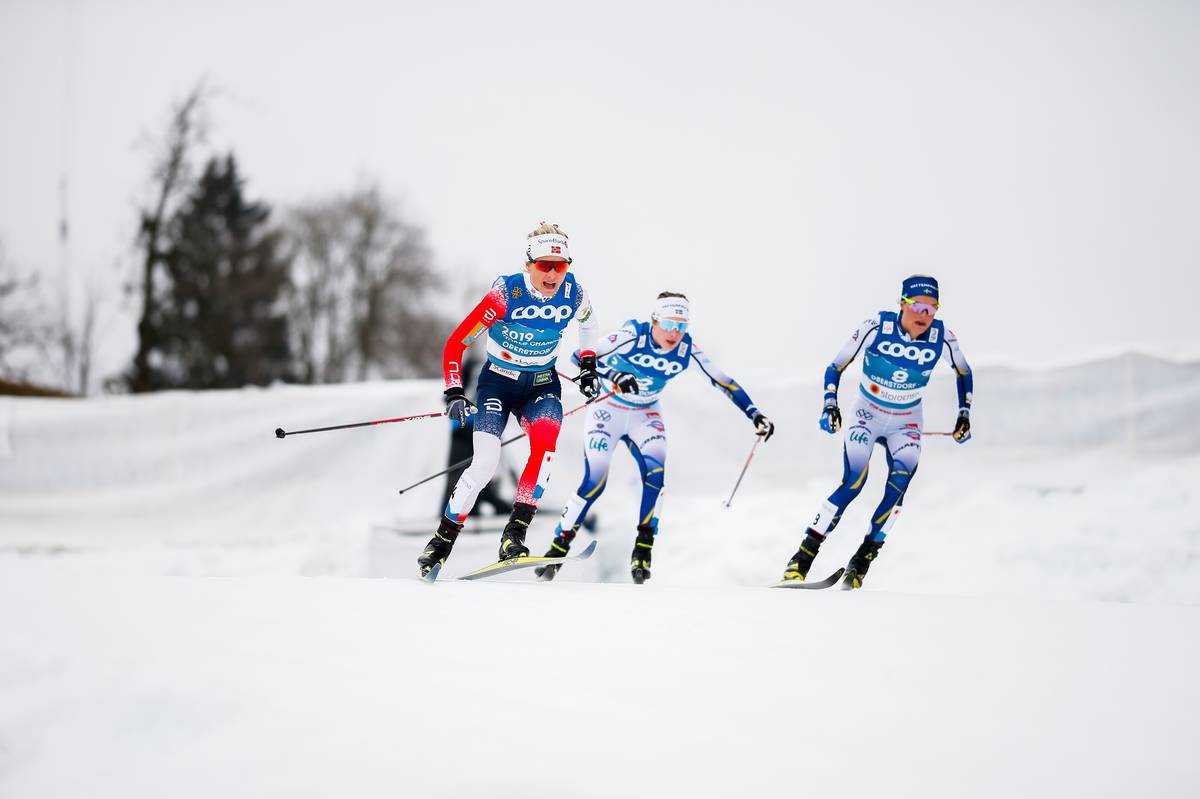
    Johaug (NOR), Andersson (SWE) and Karlsson (SWE), cornering tightly. (Photo: Nordic Focus)

    At the 5 k mark, Karlsson had clawed back a few seconds and was +13 behind Johaug, Andersson, and Tatiana Sorina representing the Russian Ski Federation. 

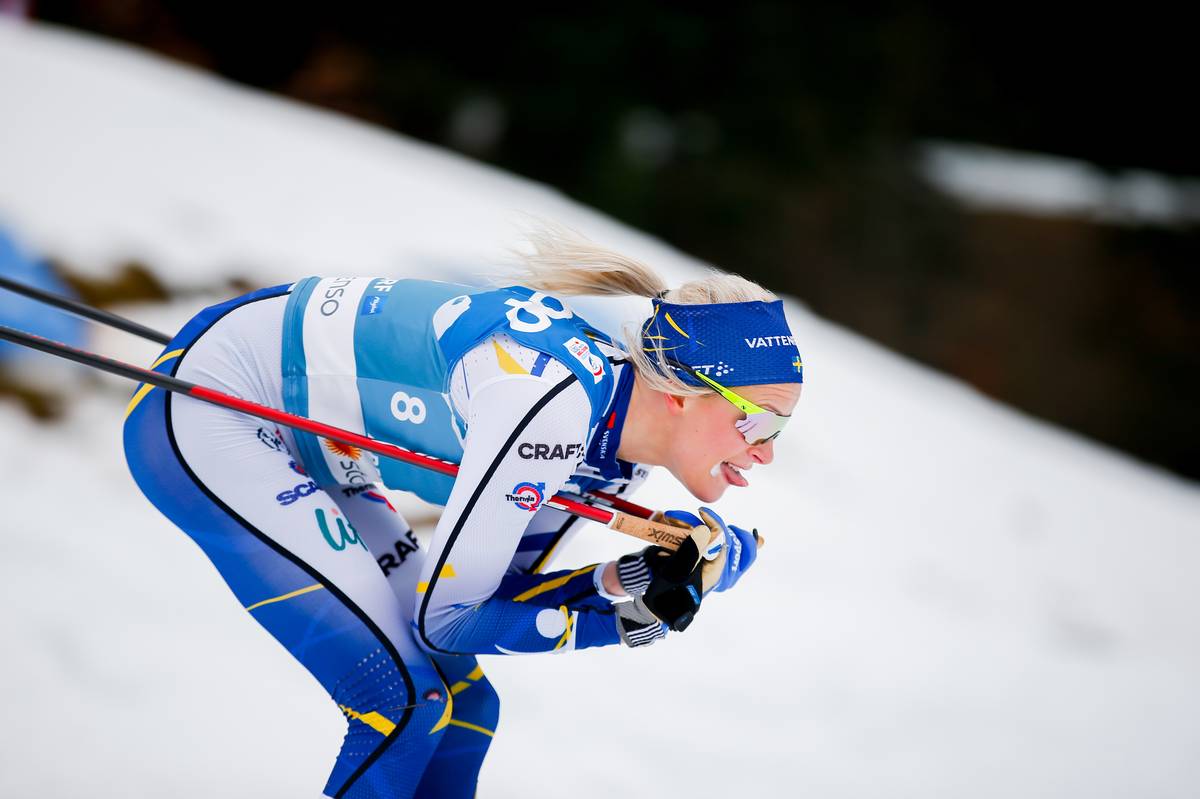
    Tucked in for seed, Frida Karlsson (SWE) during the women’s skiathlon. (Photo: NordicFocus)
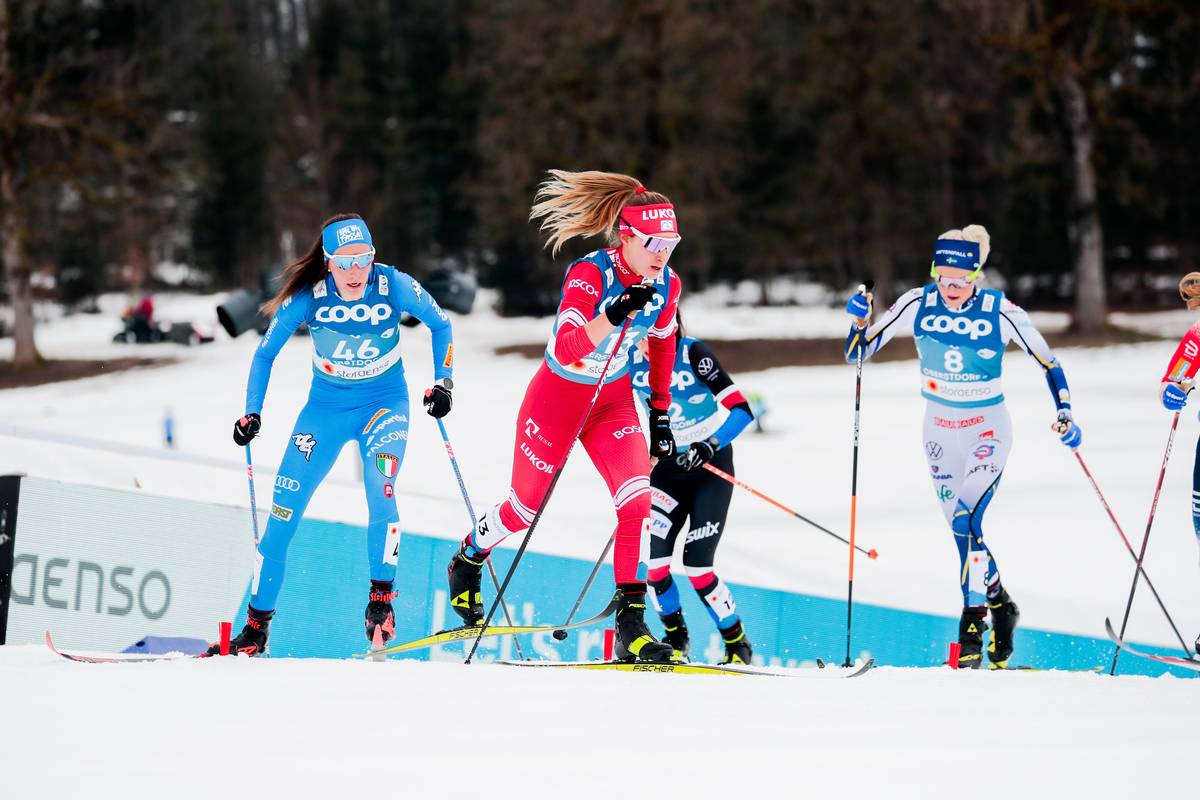
    Karlsson (SWE) works her way back after a fall and broken pole, pictured here following Yana Kirpichenko (RSF). (Photo: Nordic Focus)

    Entering the exchange Johaug and Andersson were neck and neck, the Swede echoing Johaug’s every move. However, Andersson was four seconds slower than Johaug swapping skis and exiting. This little gap was all the Norwegian needed to shake her Swedish shadow. 

    Behind Johaug and Andersson, over the next lap, the Russian gradually began to fade, as Karlsson closed in on Sorina. Up front, Johaug motored while Andersson barely held on to the Norwegian. 

    Johaug simply began to gain ground and time on her rivals as the remaining kilometers ticked off. She worked her advantage on the hills and began to widen the gap as Karlsson clawed back to Andersson. At 9 k the two Swedes were +19 seconds back from Johaug, at 11.3 k Johaug had increased that to +27 seconds and by 12.8 k, the gap was +33 seconds. 

    Johaug (NOR) into the finishing straight with no competitors in sight. (Photo: Nordic Focus)

    In the closing meters, all Johaug needed to do was stay upright through the descent and the victory was hers. “Oh it’s amazing,” said Johaug after the race, “I’m looking forward to this day for so long and I’m training a lot and the Norwegian team has not got so much World Cup this year so this World Championships means a lot to me.” Laughing she said, “I know that everybody thinks that I should win but it’s not so easy, you have to fight for yourself and you have to have good skis though the waxer in the team Norway has done a really good job”

    When asked about her fall on the first lap, Johaug seemed unphased, “Oh I fall on the first lap in the stadium here, but I was feeling I have a really good body today and my shape is really good so it didn’t mean so much.” 

    For Johaug this is her fifth skiathlon championship podium and third gold after winning in 2015 and 2019. Her win puts the total number of medals she has collected at world championship events up to 11, only Norway’s Marit Bjørgen and Elena Välbe of Russia have more (18 and 14 respectively). 

    2021 Women’s Skiathlon podium, Johaug (NOR) with gold, Karlsson (SWE) silver and Andersson (SWE) with bronze. (Photo: Nordic Focus)

    Behind Johaug, the race for second and third was real – Karlsson and Andersson no-pole skated to the line, as Karlsson entered the straight with a slight lead though her teammate was closing fast. Karlsson took silver just +0.2 ahead of Andersson. Teresa Stadlober of Austria out sprinted veteran Charlotte Kalla of Sweden to take fourth, Kalla finished fifth. Norwegian youngster Helene Marie Fossesholm came in sixth and Delphine Claudel of France matched her personal best finish, placing 7th. 

    Karlsson (SWE) lunges for the line, out of the shot her teammate Andersson (SWE) does the same. (Photo: Nordic Focus)

    For Karlsson, this is her second silver medal at a world championship, she finished second in the 10 k classic in Seefeld in 2019. This is Andersson’s first individual world championship medal. She holds medals from 2017 and 2019 as a member of the Swedish relay team, but Saturday’s performance tops her previous best individual championship performance of sixth place in the 30 k skate in Seefeld in 2019. 

    Andersson (SWE) holds a tuck, following her teammate Karlsson (SWE) closely on the descent. (Photo: Nordic Focus)

    Leading the American finishers today was Jessie Diggins in 15th, +1:59.5 back from Johaug. “I am going to be honest, it was pretty disappointing if you look at it from a results perspective,” said Diggins after the race, explaining that she felt ski speed on the day was a disadvantage for the team. “However, I was so proud of how hard I pushed and I prepared for these championships in every way possible. I took such great care to train smart, train hard, rest up. Mentally I was ready. Took really good care about not overheating which I was really psyched about. I was dumping bottles of water on myself and chewing ice chunks before the start. So I think I came into this absolutely as ready and prepared as possible. And the thing is, to have a good race all the puzzle pieces have to fit together, and we missed out today.”

    Jessie Diggins, during the classic leg of the skiathlon. She finished her classic leg in 19th and moved up to 15th at the finish. (Photo: NordicFocus)


    Diggins (USA) giving it her all in the skate leg. (Photo: Nordic Focus)

    When asked about her teammates’ performances, Diggins responded, “They worked so hard. I would have loved to see them have every opportunity to really really shine because I know they could have been further up on the results sheet with the energy and the grit that all these young women displayed. So I think that is so promising to see how well they skied given the disadvantage that we had today. I think, to me, that is really impressive because it is easy to put together a good race when you have the fastest wax in the field, it is harder to just never give up and keep fighting, and to me, that is so much more impressive.”

    Team huddle, U.S. women post-skiathlon (Photo: Tom Horrocks/USST)

    Competing in her first championship event, Sophie Laukli of the United States finished 25th, +3:18.7 back. After the race Laukli said, “It was a fun course for me, lots of hills and climbing. I mean I was a little bit dreading some of the bigger climbs, but it definitely worked to my advantage. I felt pretty good so that was awesome.”

    Laukli’s World Cup debut came a few weeks ago in Lahti Finland where she finished 33rd in the skiathlon event. When asked about her strategy for the day Laukli replied, “Yeah, I definitely think of myself as more of a skate skier so my goal was to try and stick with a group in the classic and then make up some more places in the skate and I think that I was definitely able to do that and really use the hills to my advantage in the end.”

    Laukli (USA) competing in her first World Championships where she placed 25th. (Photo: Nordic Focus)

    Katharine Ogden was the next American finisher in 32nd place and Hailey Swirbul finished 37th. Before the race, Swirbul spoke with FIS saying, “I feel ready to go, this is my first race at my first World Championships. All I can hope is to give my best effort today.” 

    Swirbul (USA-left) and Ogden (USA-right) striding through the classic laps. (Photo: Nordic Focus)


    Interview with U.S. Head Coach Whitcomb discussing the classic sprint and skiathlon.

    Cendrine Browne was the first Canadian of the day, in 23rd place. During the skiathlon at the 2019 World Championships, Browne finished 40th. Next came Katharine Stewart-Jones in 28th place. Stewart-Jones also placed 28th in the 30 k skate event at the 2019 championships. Rounding out the Canadian finishers was Laura LeClair who placed 48th. 

    Cendrine Browne (CAN) was the top Canadian, racing to 23rd. (Photo: NordicFocus).

    “Today was one of the hardest courses I’ve ever done,” Browne told Nordiq Canada. “No flats, only up hills and twisty downhills,” said Browne, who was 26th in a 30-kilometre skate-ski race at the 2017 World Championships in Lahti, Finland. “I’m really happy and proud that I was able to hold on in the classic part, and be in good position to start the skate.

    “The plan today was to hold on in the classic and then catch-up time in the skate,” she added. “Unfortunately, I was only able to maintain the speed I had, but I’m still very happy,” added Browne. “I had a pack to ski with during the whole race which helped me push myself even more.”


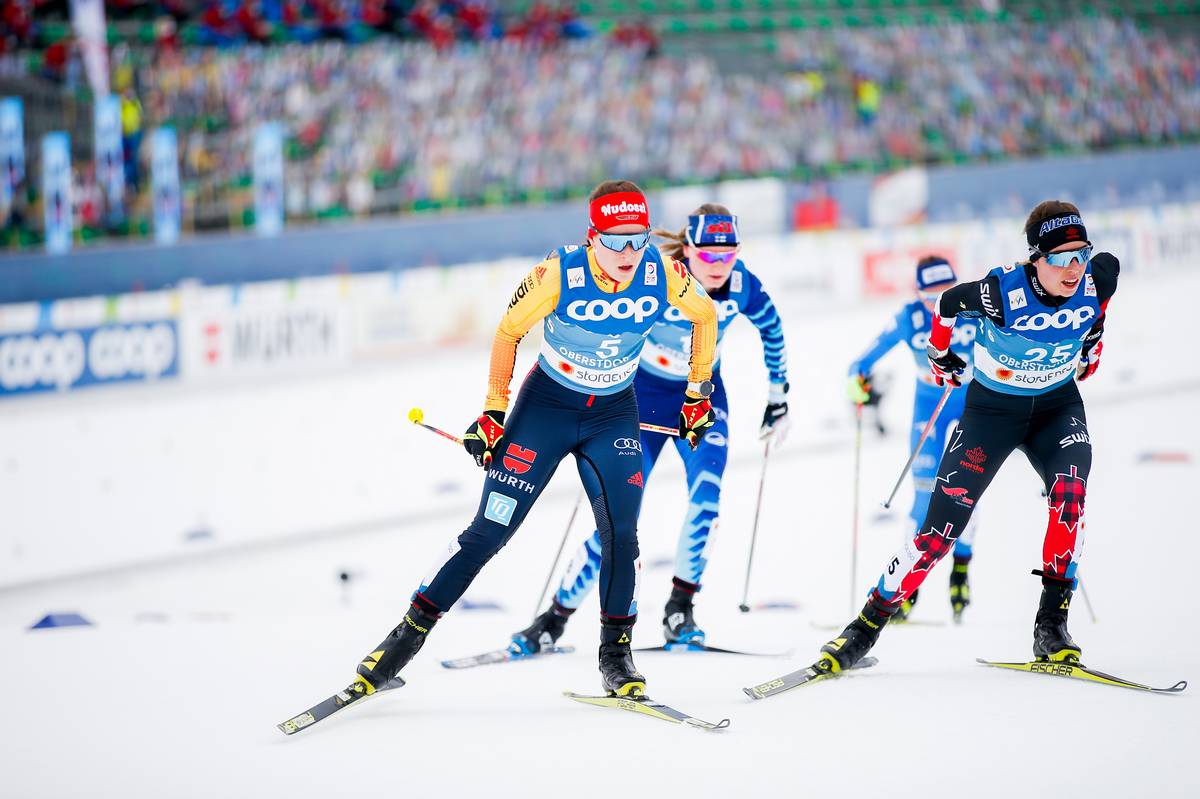
    Katharina Hennig (GER), Katherine Stewart-Jones (CAN), (l-r) racing the skate leg of the 15 k skiathlon. (Photo: NordicFocus)

    “I had some bigger dreams for today, but I honestly gave it my all with what I had on the day,” said Stewart-Jones according to Nordiq Canada. “My start was a bit slow, and I didn’t feel super energetic on the classic, but I was able to find a better rhythm in the skate, especially on the second lap.

    “Having two of us in the top-30 (again today) is definitely a good start, but I know that we have more in the tank, and I’m looking forward to some more racing,” said Stewart-Jones.

    Racing continues Sunday with a team sprint event. 

    Results: Womens Skiathlon

  • After a Long Wait, Johaug Wins Second Gold Medal in the World Championship Skiathlon; Brennan 10th

    After a Long Wait, Johaug Wins Second Gold Medal in the World Championship Skiathlon; Brennan 10th

    Therese Johaug of Norway taking the women’s World Championship 15 k skiathlon win in Seefeld, Austria. (Photo:John Lazenby/lazenbyphoto.com)

    An emotional Therese Johaug of Norway stood atop the podium after the 15-kilometer skiathlon in Seefeld, Austria. While the race seemed to be decided during the second of two classic laps where Johaug began to pull away, the title has taken much longer to achieve. This moment was one she has been hoping for since she last earned the title during the 2015 world championships in Falun, Sweden. Johaug was unable to compete in the 2017 championships in Lahti or the 2018 Olympics in PyeongChang as she was serving an 18 month suspension after using a medicated lip balm containing the banned steroid clostebol.  

    “It’s been a big dream for me to come here to Seefeld for a long time now,” Johaug told the International Ski Federation (FIS) as she held back tears. “I’m looking forward for these championships for two years. The last time I was in the World Championships was in Falun, it’s four years ago now. I’m training so much and working so much for this. All the team around me have helping me everytime, so I’m really happy. The waxer team they were awesome today, I had so good skis, I could just fly out there.”

    This victory was not unexpected; the well-decorated Norwegian has won each of the eight distance race that she has entered this season by a large margin and has over 50 world cup victories to her name. She adds this gold medal to a collection of three others in the skiathlon, a gold in 2015, silver in 2013, and bronze in 2011, and is now tied with her former teammate, Marit Bjørgen, for the most world championship medals in the event.

    The day’s winner, Therese Johaug of Norway, at the start of her second classic lap during the women’s World Championship 15 k skiathlon in Seefeld, Austria. (Photo: John Lazenby/lazenbyphoto.com)

    Johaug commanded the race from the gun, her powerful and flawless technique driving her ahead at a pace no other skier could match. At the exchange, she switched into her skate skis calmly and confidently, exiting the zone smoothly in just seconds. At this point, Johaug had nearly 30 seconds on the women chasing her, and 7.5 k later when she stopped the clock at 36:54.5, she was nearly a minute ahead.

    Behind her also wearing red lycra was a battle for silver and bronze as a group containing Ingvild Flugstad Østberg and Astrid Uhrenholdt Jacobsen of Norway, and Natalia Nepryaeva of Russia chased the leader. When Johaug took the race out fast, the threesome went with her in the first kilometers of the race, separating themselves from the larger chase pack behind. When Johaug began to pull away, the three women stayed together, exchanging the lead frequently as they covered ground.

    Therese Johaug of Norway during the skate leg of the women’s World Championship 15 k skiathlon in Seefeld, Austria. (Photo:John Lazenby/lazenbyphoto.com)

    It was not until a final climb brought the trio to a hairpin turn before descending into the stadium for the final sprint that Østberg moved to the front and began to make her run for second place. She crested the hill with a small gap ahead of Nepryeava, with Jacobsen not far behind. Østberg flew into the stadium in a no pole skate, switching to V2 as she clinched her position in second place (+57.6). She crossed the line and into the awaiting arms of her teammate, Johaug, where she collapsed and began to let out shrieks of joy and relief. Her silver is her first individual world championship medal.

    Nepryeava crossed the line in third (+58.7), Jacobsen fourth (1:02.0).

    Rosie Brennan of the U.S. placed 10th in the women’s World Championship 15 k skiathlon in Seefeld, Austria. (Photo:John Lazenby/lazenbyphoto.com)

    Three of the four American competitors landed in the top 30 with Rosie Brennan in 10th (+2:01.8), Julia Kern 19th (+2:55.5), and Rosie Frankowski 24th (+3:00.6). Caitlin Patterson finished just outside in 34th (+3:54.5).

    With added variables and little experience in the event, it can be difficult for athletes to set expectations in a skiathlon. Today’s outstanding results came as a bit of a surprise to the American women who went in optimistic, but without positive experiences to look back on.  

    “Skiathlons are tricky because we just don’t do that many so you never really know what’s going to happen or how you’re going to feel, especially once you switch skis,” Brennan told FasterSkier in a call. “Last year the skiathlon at the Olympics was literally the worst race of my life, so it’s been a while since I’ve had a good one, so I was a little nervous.”

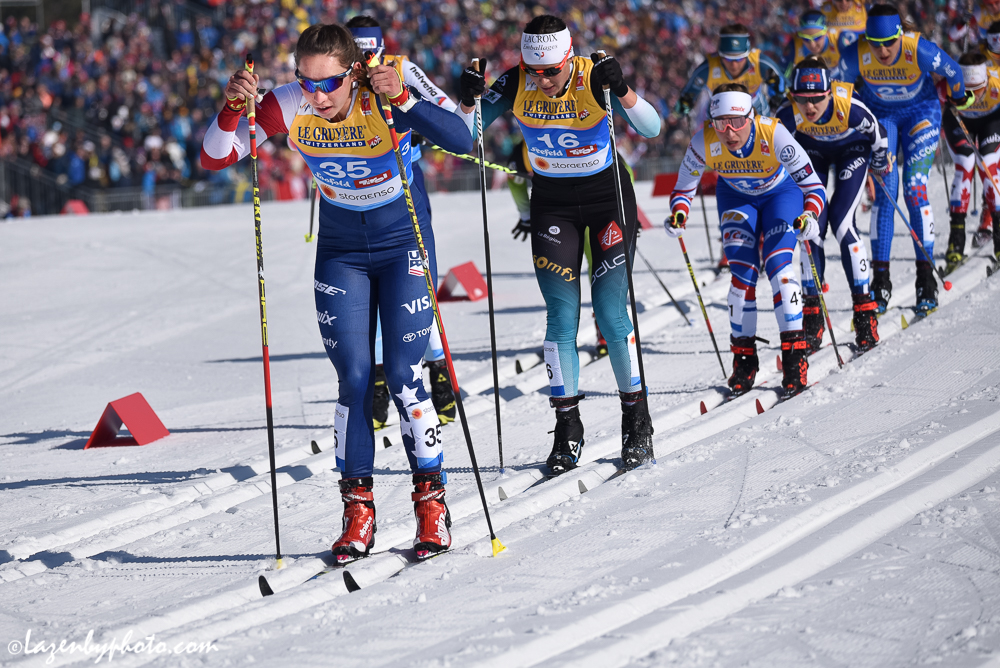
    Julia Kern in bib 35 during the classic leg of the women’s World Championship 15 k skiathlon win in Seefeld, Austria. Kern placed 19th overall. (Photo:John Lazenby/lazenbyphoto.com)

    It was the second skiathlon Kern had completed; she was not happy with her result in the first and in the most recent one she entered at U23’s, she had to drop out due to illness. Her top-20 finish exceeded her expectations today.

    “I had no idea what to expect, but I was really excited,” said Kern in a call. “My goal was top-40 and on a good day maybe a top-30, but I didn’t really know what to expect and my goal for today really was just to ski hard and see what I could do.”

    Brennan found herself amidst a larger chase pack behind the threesome of Østberg, Nepryeava and Jacobsen. This group worked together through the 7.5 k classic half, then began to spread after the exchange.

    “My goal was just to stay in the pack and be as relaxed as possible and see what else was left once we switched [to skating],” Brennan shared. “I’m really happy with how I skied tactically, I think it was one of the better races I’ve done tactically, that’s not usually my forte.

    “The only regret I have is that I kind of forgot that in skiathlons, once you switch skis, that first k or so it’s super important to find the right group, but it’s also the most nerve-wracking k because you never know how your legs are going to feel once you switch skis,” she continued. “And I actually felt pretty good, so I wish I had pushed that first k in the skate a little harder to be in the front end of that chase group instead of the back end because I kind of wasn’t paying attention when that pack broke up. And the skate leg was a lot faster and flatter, so it was a little challenging to ski away from people, so the group you got in in that first few k really determined where you would be in the end.”

    After the split mentioned, a group containing 2018 Olympic gold medalist Charlotte Kalla and Frida Karlsson of Sweden, Heidi Weng of Norway, Krista Pärmäkoski of Finland, and Anastasia Sedova of Russia pulled ahead of the remainder of the pack. These women finished fifth through ninth.

    “I found myself in still a good group, and so I realized pretty quickly that it was going to be hard to ski away,” Brennan explained. “But I didn’t really want to sprint with four people, so I tried to make a move on the far hill and I think it dropped one girl, but it wasn’t really what I hoped for. So then I decided that then I would settle and have faith in my sprint finish. And I had really great skis, so I was able to draft well off the sprint downhill into the stadium and kind of play a good tactic into the finish and bust a move on that last little climb. So I was really psyched with how that worked out and how I skied that section.”

    Brennan’s result is her second top 10 finish of the season, her first coming in the 10k freestyle race in Davos. The APU skier also raced in the World Championships in both 2015 and 2017, but today was her best result in an individual race. This progress is especially rewarding after a season hampered by illness. Brennan was diagnosed with mono at the end of the 2018 race season after a slew of less than satisfying results.  

    “I’ve been really psyched. After last year, I didn’t know if I would ever be able to ski fast again or even if I was going to keep skiing,” Brennan reflected. “So it was kind of an interesting summer, but I was able to have a really good training group at home and just focus in on what I needed to do, and that was really successful. I started feeling better and better as the summer went on and started getting more and more confidence and hopes for what the season to come would bring.

    “And knowing that I was not on the national team and had to earn all my start spots, I wanted to come into Period 1 ready to race,” she continued. “I was really happy with that [plan], I did that really well and each weekend got better in period 1, so that was super successful. Then, because I had done that, I felt like I needed to take a break and do another training block to be ready for the championships since they were so late [in the season]. So I took some time and did quite a bit of training. I think that made me a little flat in the first two world cups when I came back, so I was a little nervous that my form had left me, but I was feeling good and my training had gone well, so I guess I had a hint of optimism. But I’m glad to feel like my form did come back and I’m racing at the level that I was in Period 1, so I think my plan worked really well. I’ve been really excited with all of that.”

    Kern started the race with a slightly different plan than Brennan. The beginning of the race played out differently than she anticipated, but she quickly adjusted her tactics.

    “I had a feeling it was going to start out pretty hot since I figured that Johaug would push the pace early, so things would string out,” explained Kern. “My plan was to start out fast and settle in, but I ended up – it was hard to pass people in the start, so I kind of just stayed relax the first climb, then in the second lap began to push the pace a bit. Once I got through the transition, I saw it as a new race, just skating.”

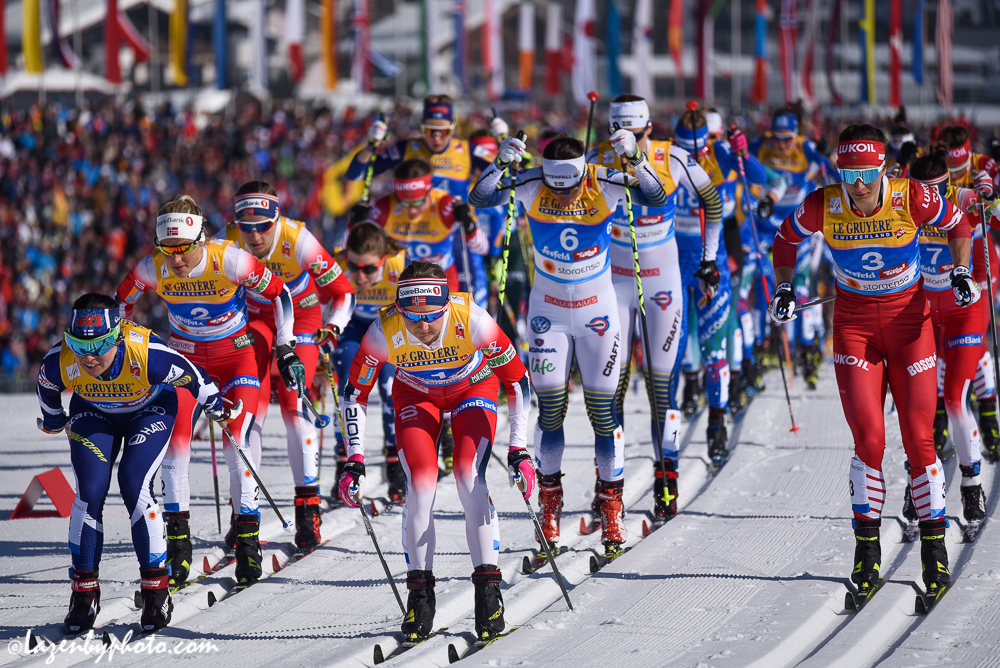
    The start of the women’s World Championship 15 k skiathlon win in Seefeld, Austria. (Photo:John Lazenby/lazenbyphoto.com)

    While her start was not as fast as she expected, she took advantage of her confidence and speed on downhills to move ahead in the second half.

    “I had the absolute fastest skis out there –  they were insanely fast, the techs did an amazing job,” she said gratefully. “So even on the uphills if I would get dropped a little, I skied the downhills super well. A lot of people were skiing the downhills scared and my skis were so fast that I would catch and pass people every downhill. So it was this sort of cat and mouse game where on the uphills I would try to hang on and keep it as close as possible, then on the downhills just shoot by people. So it was really fun skiing knowing I had insanely good skis and that the techs had given us the best skis out there, so I could just focus on hanging on as long as I could on every climb.”

    It was Frankowski’s first start in a World Championships. Earlier in the season, Frankowski won a pair of 10k’s while racing domestically on the Super Tour, one in classic and one in skate, and took second at the 20k skate at US Nationals.

    “It was fun out there today,” wrote Frankowski in an email. “I felt much better in the skate portion of the skiathlon, but would have preferred a but slower conditions – there were some scary downhills. A big thank you to the techs for some good skis and the weather gods for bringing out the sun again for the race.”

    Canada’s Katherine Stewart-Jones skied to 39th (+4:19.8), Cendrine Browne 40th (+4:25.2), and Maya Macisaac-Jones 54th (+8:53.4).

    Racing continues tomorrow with a classic team sprint.

    Results

  • Saturday Rundown Starting with Seefeld and Ending in Hayward, WI. (Updated)

    Saturday Rundown Starting with Seefeld and Ending in Hayward, WI. (Updated)

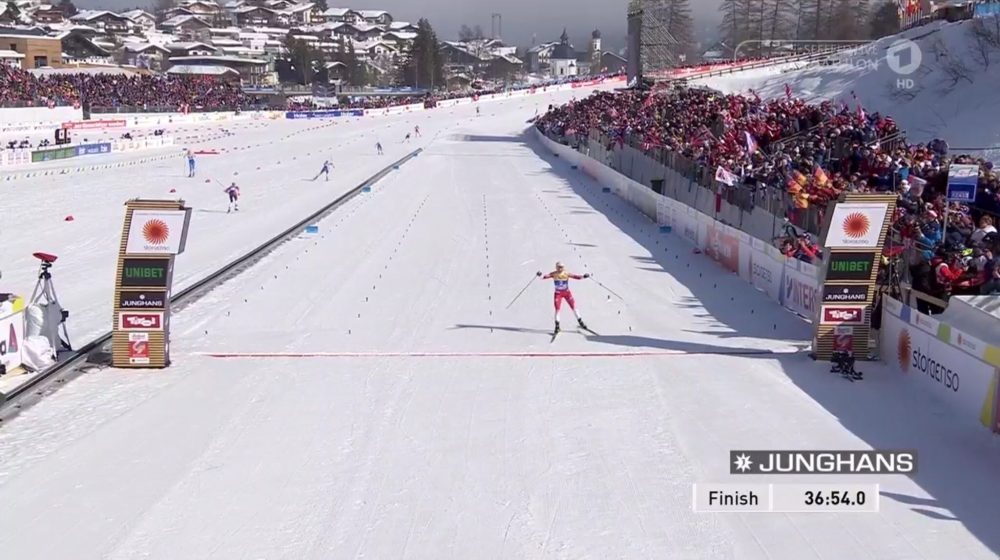
    Therese Johaug of Norway crossing the line solo as she won Saturday’s World Championship 15 k skiathlon in Seefeld, Austria. (Photo: ARD screenshot)

    FIS Nordic World Ski Championships Seefeld, Austria 15 k/30 k Skiathlon

    Men’s Race Report | Women’s Race Report

    Between 3.75-kilometers and 4.85 k on Saturday, Norway’s Therese Johaug began to pull away in earnest during the women’s World Championship 15 k skiathlon — by then she had built a near 15 second lead.

    The time back to the Norwegian would only grow. Johaug powered into the classic to skate transition zone in control with a lead padded by 26.2 seconds. At the finish, Johaug crossed the line with no other skiers in sight and a winning time of 36:54.5 minutes. It was Johaug’s fourth World Championship medal in the skiathlon.

    Ingvild Flugstad Østberg, also of Norway, placed second (+57.6), with Russia’s Natalia Nepryaeva third (+58.7).

    Rosie Brennan of the U.S. was the top North American in tenth (+2:01.8). Also for the U.S., Julia Kern placed 19th (+2:55.5), Rosie Frankowski 24th (+3:00.6), and Caitlin Patterson 34th (+3:54.5).

    Canada’s Katherine Stewart-Jones skied to 39th (+4:19.8), Cendrine Browne 40th (+4:25.2), and Maya Macisaac-Jones 54th (+8:53.4).

    Women’s Skiathlon Results

    The men’s 30 k skiathlon featured no off the front  winner like Johaug. As the pace setting screws tightened well into the men’s race, with Russia’s Alexander Bolshunov often taking charge, the pack was winnowed to five skiers at the 26 k mark. Along with Bolshunov, France’s Clement Parisse, Norway’s Sjur Røthe and Martin Johnsrud Sundby, and Iivo Niskanen of Finland were the skiers vying for the win.

    By the final half-k, only Sundby, Bolshunov, and Røthe remained up front. Down the final straight Røthe possessed the strongest reserves as he won in a time of 1:10:21.3 hours. Bolshunov placed second (+0.1), and Sundby third (+0.7).

    Canada’s Alex Harvey paced himself to sixth overall (+58.9). Evan Palmer-Charrette placed 45th (+6:12.4), and Scott James Hill 56th (+9:58.8).

    For the U.S., Scott Patterson raced to 32nd (+4:40.6), David Norris 38th (+4:54.4), Kyle Bratrud 49th (+6:19.6), and Adam Martin 54th (+7:47.4).

    Men’s Skiathlon Results

    ***

    SuperTour/American Birkebeiner Hayward, WI. 50 k Freestyle

    Full Race Report

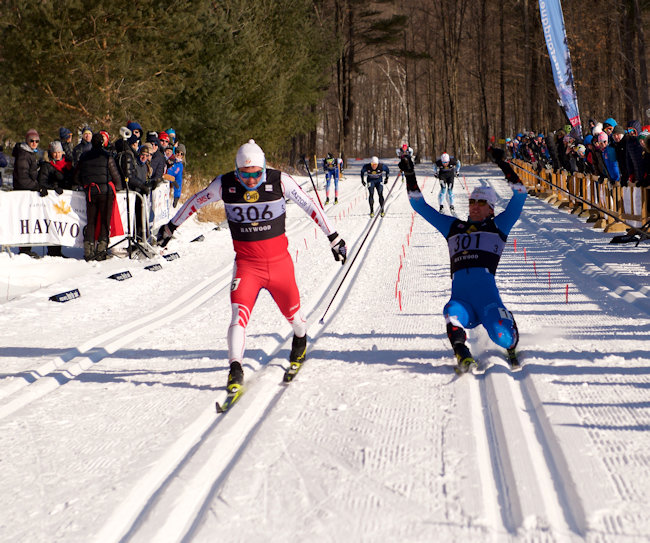
    The plotline thickened on Saturday in the elite men’s freestyle 50 k at the American Birkebeiner when Akeo Maifeld-Carucci (CGRP), Brian Gregg (Team Gregg), and Matt Liebsch separated themselves from the field. The three skiers fended off any chasers and charged onto main street three across in their final effort towards the finish line.

    Maifeld-Carucci took the win in 2:12:35 hours, with Gregg second (+0.93), and Liebsch third (+8.50).

    Alayna Sonnesyn (SMS T2) won the overall women’s 50 k skate in 2:34:01. By the time Sonnesyn passed the time check on Lake Hayward, she had gapped Anja Gruber (Salomon) in second by 29.60 seconds. Gruber took second overall finishing 54.60 seconds back from the winning time. Third place went to Katie Feldman (SVSEF Gold Team) crossing 1:08.63 minutes back.

    FasterSkier will be posting race reports on the 2019 American Birkebeiner later today.

    Men’s Overall Skate Results | Women’s Overall Skate Results

    ***

    (Friday) FIS Nordic World Ski Championships Seefeld, Austria Individual Gundersen 10 k

    U.S. athlete Taylor Fletcher on his way to placing 35th overall during Friday’s individual Gundersen 10 k at the Seefeld, Austria World Championships. (Photo: John Lazenby/lazenbyphoto.com)

    On Friday in Seefeld, the first nordic combined event, an individual Gundersen 10 k was won by Germany’s Eric Frenzel. The German was the best ranked jumper and won the ski in a time of 24:43 minutes. Jan Schmid  of Norway, the day’s third ranked racer after the jump, placed second (+4.3). Austria’s Franz-Josef Rehrl placed third overall (+8.7).

    Americans Taylor Fletcher skied to 35th (+4:05.5), Ben Loomis 44th (+5:29.7), Jasper Good 47th (+6:25.1), and Grant Andrews 48th (+6:52.8).

    Nathaniel Mah of Canada was 50th (+7:12.3).

    Results


  • Kalla Opens Games with Skiathlon Gold; Diggins Makes Her Mark in Fifth

    Sweden’s Charlotte Kalla winning gold in the first race of the 2018 Winter Olympics in PyeongChang, South Korea, the women’s 15 k skiathlon, on Saturday ahead of Norway’s Marit Bjørgen (behind, in red) and Finland’s Krista Parmakoski, respectively. (Photo: FlyingPointRoad)

    FasterSkier would like to thank Fischer Sport USA, Madshus USA, Concept2, Boulder Nordic Sport and Swix Sport US for their generous support, which made this coverage possible.

    PYEONGCHANG, South Korea — Hot from the start, the expected Olympic-opening pace in the women’s 15-kilometer skiathlon on Saturday was a blistering tease. With the U.S. Ski Team’s Jessie Diggins, Norway’s overall World Cup leader Heidi Weng and Sweden’s Charlotte Kalla striding three abreast on the opening climb, the tactics were clear: hang with chargers from the get-go. That’s the blistering part.

    Much is at stake on the Olympic stage and making the cut with the skiers up front on Saturday’s skiathlon required high-rev, keep-in-contact speeds with just enough pedal off the gas to keep hopes alive. On a course built into a golf course that would seem to require golfers to be marathon-fit — the hills are for real — the attrition from the back was steady. Yet at 3.75 k into the classic leg, the race hadn’t been decisively shattered. There was still a semblance of an organized field of skiers. Twenty-four skiers ranging from Germany’s Victoria Carl in first to Finland’s Laura Mononen in 23rd, were separated by 4.3 seconds at 3.75 k. That part was the tease.  

    Germany’s Victoria Carl (front), followed by Sweden’s Charlotte Kalla and American Jessie Diggins, leading the women’s field on a downhill during Saturday’s 15 k skiathlon at the 2018 Winter Olympics in PyeongChang, South Korea. (Photo: FlyingPointRoad)

    Although it may have appeared like it could have been any one of those skier’s race, that was only a mirage. Already the skiathlon champ from the 2010 and 2014 Olympics, Norway’s Marit Bjørgen, had moved into the front. Her control move wasn’t decisive, but it was a reminder to the young corps of racers in her midst that her final Games wasn’t a farewell tour.  

    Bjørgen skied in front, but the likes of two Swedes, Charlotte Kalla and Ebba Andersson, kept a checkmate-type watch on the venerable queen of international cross-country skiing. Also on Bjørgen’s flanks were teammates Weng and Ingvild Flugstad Østberg, Finland’s Krista Pärmäkoski, Switzerland’s Nathalie von Siebenthal, and Austria’s Teresa Stadlober. And right in there, for moments in contact, then out of contact, then right there again, was perhaps the most tenacious in the bunch, Diggins.  

    Weng was the first out of the ski exchange at 7.5 k followed in order by Østberg, Bjørgen, Kalla, Pärmäkoski, Andersson, Stadlober, Russia’s Natalia Nepryaeva, Diggins and von Siebenthal.

    Jessie Diggins (standing, in blue) in the ski exchange while Norwegians Heidi Weng (r) and Ingvild Flugstad Østberg (second from r) prepare their departure at the halfway point of the women’s 15 k skiathlon on Saturday at the 2018 Olympics in PyeongChang, South Korea. (Photo: FlyingPointRoad)

    Immediately after the exchange, a long grinder of a hill kicks up out of the stadium. And it was not as if Kalla played her full house of a hand at the start of the skate portion, but she certainly made it clear her fitness and motivation were no bluff.

    From 9 k to 11.5 k, the race was all about gamesmanship. At moments, Kalla and Andresson appeared to be setting the pace in an attempt to prevent others from upping the tempo. The two Swedes slowed around 26:40 minutes, and allowed Bjørgen to take over the pace-making. Although Bjørgen’s limited World Cup run this year has shown a smidge of mortality — she’s won two of 10 World Cup races entered — one couldn’t help but think that Bjørgen would simply pull away after some herculean effort and dust the field.

    Around 12 k into the race, roughly 32:40 minutes in, Kalla dug into a powerful V2 and sure enough gapped the lead group by five then ten meters. With 1.5 k to go, Kalla had a 9.6-second lead on Bjørgen in second. Bjørgen led the chase, with Andersson, Pärmäkoski, von Siebenthal and Diggins close behind her.

    The women’s 15 k skiathlon medalists on Saturday at the opening race of the 2018 Olympics in PyeongChang, South Korea, with Sweden’s Charlotte Kalla (c) in first, Norway’s Marit Bjørgen (l) in second and Finland’s Krista Parmakoski (r) in third. (Photo: FlyingPointRoad)

    “I knew that she was trying to attack in that area, so I was looking for her,” Bjørgen said of Kalla during a post-race press conference. “We had a downhill and then she attacked when we were down. I tried to follow her, but we were too many girls and I didn’t get her back like I wanted to. So she got some meters early in the attack, and then I knew that it was hard. I tried and pushed hard to attack her, but she was too strong.”

    Kalla’s version of her winning move illustrates the singular focus with which she’s skied on the World Cup this season. The 30-year-old Swede has entered eight races, winning three and placing second twice. 

    “I didn’t know exactly where Marit was,” Kalla recalled in the press conference. “I knew that she was in the front somewhere, but I just tried to focus on my performance when I increased the speed and not what the others did. … Yes, there were thoughts about what are the others doing but I just tried to focus on my performance all the time and just look forward and I knew that I have been in pain many times during the summer.”

    Kalla’s victory, however, never really seemed certain with Bjørgen chasing — as if the 37-year-old Norwegian could simply roll back the years and gobble up meter after meter until she clung to Kalla’s tails.

    Only after Kalla had gone up and over the steep final climb and came bolting down a sweeping banked turn close to the stadium’s straightaway finish, was her win assured. With enough distance on the chasers, Kalla raised her arms in victory and scored gold.

    Winning the skiathlon in 40:44.9 minutes, Kalla became the first Swedish women to have won three gold medals at the Olympics. The victory is her second in a non-relay event at the Games, with her last individual gold coming in the 10 k freestyle back in 2010 in Whistler, British Columbia. Her second gold came four years ago at the Olympics in Sochi, Russia, where she anchored Sweden’s 4 x 5 k relay team to the win.

    Bjørgen pulled slightly ahead of Pärmäkoski and Andersson to place second, 7.8 seconds behind Kalla. Before the descent into the stadium, Pärmäkoski passed Andersson on the last climb stayed just ahead of her to the finish, toeing for bronze (+10.1), while Andersson, a 20-year-old first-time Olympian, placed fourth (+10.9). Diggins pushed for  fifth (+14.7), which stands as the best Olympic finish by an American female cross-country skier.

    Norway’s Marit Bjørgen (r) leads the pack through the stadium heading into the second lap of the skate portion in the women’s 15 k skiathlon at the 2018 Winter Olympics in PyeongChang, South Korea, while Sweden’s Charlotte Kalla (5) and Ebba Andersson (16) and Switzerland’s Nathalie von Siebenthal (10) follow. (Photo: FlyingPointRoad)

    Bjørgen remarked at the press conference that her years racing at the sharp end of the World Cup has allowed her to fully understand how to peak for the big events.

    “Since before Sochi, I was doing actually the same, competing before Christmas and then not competing so much before the Olympics,” she said of her established tapering plan. “I have been training and not doing the Tour de Ski, so that has been good for me, and I really wanted to do the same this year.”

    One race into the Olympics, that recipe has worked. But Bjørgen knows, too, her time is divided with caring for a young child, and afterall, she is Marit, so a limited World Cup race schedule might not be such a big deal.

    “Things are different for me now, to be a mom also it’s harder to do every race,” Bjørgen said. “And of course I am 37 years old … I think that’s not good for me to do every race. And also, I don’t need so many races to do a good race.”

    Diggins, 26, came into the race having won the last World Cup distance race, a 10 k freestyle mass start, in Seefeld, Austria. That win wasn’t a surprise, rather it was an affirmation of her third overall ranking on the World Cup.

    So while it was an all-Scandinavian podium (or more accurately, all-Nordic nations podium) on Saturday, Diggins is knocking.

    During the classic portion of the skiathlon, there were moments when it appeared the U.S. Ski Team (USST) member would pop just enough off the lead pack to acquiesce the ground lost. But that is not her style. She skied fierce.

    Diggins (near) and Kalla racing during the women’s 15 k skiathlon at the 2018 Winter Olympics in PyeongChang, South Korea. (Photo: FlyingPointRoad)

    The splits on the results sheet don’t indicate what was evident. Diggins willed herself to keep in the bronze-medal hunt. On the last hill before the finish, Diggins went for it. Whatever fumes were left gave the momentary appearance that just maybe she could close the gap to Pärmäkoski and even Bjørgen. To say the American skier came up short is to get it wrong. She has proven she’s in the Olympic medal hunt. This athlete came through.

    “I am really psyched with today,” Diggins told FasterSkier after the race. “It was a really good race. It was not my best race, but in terms of skis, tactically, physically, mentally, that was a really really good race for me. I was just struggling with some cramps out there, like my triceps were twitching on me and I couldn’t quite feel my legs. And so when I was trying to go and make my move, I just … I was pushing so hard and my body wasn’t quite responding the way I was hoping it would.”

    Diggins went on to explain that she’ll focus on her race hydration and fueling to temper the prospects of cramps.

    A fifth place for Diggins in a gutsy performance was a confidence boost.

    “Being seconds out of a medal is so exciting because I know it’s possible,” she added. “I have the belief, I have the confidence, and I have the love and support from home. And I definitely have the boards, oh my gosh, our techs did such a good job, my skis were so fast. So I am really happy with it.”

    Canada’s 24-year-old Cendrine Browne, of Cross Country Canada’s National U25 Team, was the next best-placed North American, finishing in 33rd (+3:17.0). In her first Olympics, Browne explained that her pre-race nerves were settled after an anxious Olympic-qualifying series before the Games.

    Cendrine Browne (Canadian U25 Team) racing to 33rd in her first Olympic race, the 15 k skiathlon at the 2018 Winter Olympics in PyeongChang, South Korea. (Photo: FlyingPointRoad)

    “I was really calm actually, I was more stressed out for trials [in early January] before coming here because I really wanted to be here,” Browne said. “So now that I’m here, I just want to enjoy and race and do my best. I just want to finish every race and tell myself, yes, I did everything I could today.”

    American Caitlin Patterson (also in her first Olympics) skied to 34th (+3:30.0). U.S. Ski Team member Kikkan Randall placed 40th (+4:02.3).

    In her fifth Olympics, Randall explained after the race that she still felt those pre-race nerves.

    “Just because you’ve done it more times doesn’t mean it gets any easier,” Randall, 35, explained. “I definitely was nervous. It helped to walk in the Opening Ceremony last night because that’s always such a highlight. I’ve been having a really good time with the girls.”

    Randall knows the pulsing nature of race dynamics and that the scorching pace someone like Bjørgen, Kalla or Diggins can throw down isn’t insurmountable if it’s your day.

    “I was definitely nervous coming into today just because I knew when I ski well and ski in the pack, I can have a really good performance,” Randall said. “But it’s always kind of a critical point out there when the pace is high and whether or not you can hang with it. So I wanted to try and be able to hang with that pace today and that was my goal. I did it for about 2 k and then I kind of fell apart. It’s just how it goes.”

    Randall admitted she was surprised she didn’t have better sensations during the race after what she stated was a solid week of training.

    Canadian World Cup Team member Emily Nishikawa finished 44th (+4:31.7), Canada’s Anne-Marie Comeau (a Laval University student at her first Olympics) finished 48th (+4:57.9), Australia’s Jessica Yeaton (who trains with Alaska Pacific University) was 50th (+4:59.9), Canada’s Dahria Beatty 52nd (+5:32.4), and American Rosie Brennan 58th (+6:51.1).

    “It wasn’t a great day for me as I’ve been struggling with some illnesses the last month and it’s kind of just left me a little bit of an empty feeling,” Brennan told FasterSkier after the race. “I was hoping that it would have turned around by now but I wasn’t quite there so I’m happy to be here and happy to have finished my first Olympic race and I’m hoping I still have some time to turn things around in the coming weeks.”

    The men’s 30 k skiathlon is the next cross-country event on the schedule in PyeongChang, set for Sunday at 1:15 a.m. Eastern Standard Time.

    Results

    — Harald Zimmer, Alex Kochon and Aleks Tangen contributed

    The finish of the women’s 15 k skiathlon, with (standing, from left to right) Sweden’s Charlotte Kalla, her teammate Ebba Andersson and Norway’s Marit Bjørgen looking on, while American Jessie Diggins (near) recovers on the ground with Austria’s Teresa Stadlober (4) and Switzerland’s Nathalie von Siebenthal after the first race of the 2018 Olympics in PyeongChang, South Korea. (Photo: FlyingPointRoad)
  • Friday Rundown: U23 Worlds Skiathlons; Eastern Canadian Champs

    Friday Rundown: U23 Worlds Skiathlons; Eastern Canadian Champs

    Russia’s Denis Spitsov celebrates his first U23 World Championships gold on Friday ahead of France’s Jules Lapierre in the men’s 30 k skiathlon in Goms, Switzerland. (Photo: JWSC2018.ch)

    (Note: This article has been updated to include comments from Americans Lauren Jortberg and Ian Torchia.)

    U23 World Championships (Goms, Switzerland): 15/30 k skiathlons

    On the final day of U23 World Championships racing in Goms, Russia stole the show in the women’s and men’s skiathlons.

    The all-Russian women’s 15 k skiathlon podium at U23 World Championships on Friday in Goms, Switzerland, with Anastasia Sedova (c) in first, Natalia Nepryaeva (l) in second and Yulia Belorukova (r) in third. (Photo: JWSC2018.ch)

    Anastasia Sedova led them in the first race of the day on Friday, the women’s 15-kilometer skiathlon, which she won in 44:03.6 minutes. Russia swept the podium and had four in the top five with Natalia Nepryaeva in second (+10.7) and Yana Kirpichenko in third (+37.2), and Yulia Belorukova in fourth (+1:58.0). Germany’s Pia Fink placed fourth (+1:33.5).

    The race was the first of the week for the 22-year-old Sedova, a World Cup regular, and it was her second individual gold medal at her second U23 World Championships (she won the 10 k classic in 2016).

    “Good preparation for the Olympic Games,” Sedova said during an in-arena interview after the race. “I am very lucky today. Good atmosphere, good weather today.”

    Kirpichenko won the 10 k classic earlier this week and Nepryaeva placed third in the freestyle sprint in Goms.

    “It’s hard to say how to describe the race, but Anastasia is a really good skier,” Nepryaeva said after. “She was really good today. So for me it was hard to support her during the race. Today she was much better than me.”

    American Lauren Jortberg (Dartmouth Ski Team) led the North Americans in 29th (+5:29.9) for her best distance result at the Junior/U23 World Championships level.

    “Early in the race I was right over 30th place, and I was trying to maintain contact with the big group ahead of me,” Jortberg, a Dartmouth sophomore from Boulder, Colorado, wrote in an email. “The pace of the classic leg was really fast. A couple of the girls in the race are heading to the Olympics in a few days so it was a really hot start!”

    She came through the transition at the race’s halfway point in 31st, about 3:47 behind the leaders.

    “I am a much better skater so I felt like I really put the hammer down on the skate leg and moved up a lot,” Jortberg wrote. “The skate course was much easier than the classic course, but I feel like I skied the massive climbs better than the girls around me. I focused on having a really high tempo over the hills and skiing the downhills technically well because there was no rest on the course.

    “I’m pleased with my performance today, and I’m excited about my results this week as a whole,” she added. “I’m definitely leaving here hungry for more because I don’t think it was my best week, but I think it was really solid. This is the most competitive field I’ve ever raced against so it feels really good to know that I’m not too far off their level!”


    Also for the U.S., Lydia Blanchet placed 38th (+7:11.1) and Nicole Schneider was 40th (+8:04.3). Julia Kern did not finish.

    Canada’s Katherine Stewart-Jones (Canadian National U25 Team/NTDC Thunder Bay) placed 31st (+5:39.0) and Maya MacIsaac-Jones was 42nd (+8:08.8), while Laura Leclair and Sophie Carrier-Laforte were lapped.

    Russia’s Denis Spitsov leads France’s Jules Lapierre during the men’s 30 k skiathlon on Friday at 2018 U23 World Championships in Goms, Switzerland. Spitsov went on to win by 2.9 seconds over Lapierre. (Photo: JWSC2018.ch)

    In the men’s 30 k, Russia’s Denis Spitsov took the win in 1:18:14.9 hours, just 2.9 seconds ahead of France’s Jules Lapierre. Norway’s Ole Jørgen Bruvoll placed third (+21.5), ahead of Russia’s Ivan Yakimushkin in fourth (+23.2), and Andorra’s Irineu Esteve Altimiras in fifth (+36.4).

    The gold was the first for Spitsov, 21, who previously placed second in the 15 k classic earlier this week. He has two individual bronze medals from last year’s U23 Worlds (in the 30 k skiathlon and 15 k freestyle).

    American Ian Torchia (U.S. Ski Team/Northern Michigan University) placed 27th on Friday (+6:05.7). Only 33 men finished, and he was the only North American that didn’t get lapped.

    “Between the 3700 feet of climbing, a 2.5km loop, and the top dogs having World Cup podiums…half the field got lapped,” Torchia wrote in an email. “Definitely added some motivation in the final 2 laps to see Spitsov and Lapierre slowly catching up.

    “I felt I skied technically better in skate and struggled on the classic leg,” Torchia explained. “Took a hard tumble halfway through the classic leg and had to take half a lap to recover from that. Found a hole in my suit close to my groin afterward which was a little unnerving!”

    At the end of the week, he noted that he felt “more fired up than coming in. Funny how being 6 minutes back can do that,” he wrote. “It was an eye-opening experience to get back on the international stage after 2 years and I will take these lessons of racing to the rest of the season in the Ishpemimg Super Tour, Steamboat NCAA’s, and Craftsbury Spring Series. Also already thinking of ideas on how to change and optimize my training to make the jump to the top level.”

    Americans Andrew Egger, Zak Ketterson and Thomas O’Harra also competed, as did Canada’s Alexis Dumas, Gareth Williams, Philippe Boucher, and Ricardo Izquierdo-Bernier.

    Results: Women | Men 

    ***

    Stratton’s Ben Saxton (l) edging Julien Locke (r) by eight-hundredths of a second for the win in the men’s 1.4 k classic sprint A-final on Friday at Eastern Canadian Championships in Gatineau, Quebec. (Photo: Becca Rorabaugh (APU) on her way to winning the women’s 1.3 k classic sprint qualifier on Friday at 2018 Eastern Canadian Championships in Gatineau, Quebec. (Photo: Rob Smith/CCC)

    NorAm Eastern Canadian Championships (Gatineau, Quebec): Classic sprints

    Eastern Canadian Championships opened in Gatineau on Friday with classic sprinting, and Americans Becca Rorabaugh and Ben Saxton ended the day with wins in the women’s and men’s A-finals, respectively.

    Becca Rorabaugh (APU) on her way to winning the women’s 1.3 k classic sprint qualifier on Friday at 2018 Eastern Canadian Championships in Gatineau, Quebec. (Photo: Rob Smith/CCC)

    For Rorabaugh, the win is her second straight after the Alaska Pacific University (APU) skier won the women’s 5-kilometer freestyle at last weekend’s SuperTour in Craftsbury, Vermont. She edged last weekend’s classic-sprint winner, Kaitlynn Miller, of the Craftsbury Green Racing Project (CGRP), by 0.41 seconds for the win in 3:23.15 minutes in Friday’s 1.3 k classic sprint final. It was an all-American podium (and all-American final) with Erika Flowers, of the Stratton Mountain School (SMS) T2 Team, just another three-hundredths of a second back in third (+0.44). Liz Guiney (CGRP) followed in fourth (+2.51), Rosie Frankowski (APU) was fifth (+3.88), and Corey Stock (Bridger Ski Foundation) placed sixth (+6.1).

    Rorabaugh had started the day by qualifying first in 3:26.95, then won both her quarterfinal and semifinal. Miller qualified third and won her quarterfinal and semifinal as well.

    In the men’s 1.4 k classic sprint, Saxton (SMST2) nipped Julien Locke (Canadian U25 Team/Black Jack) at the line by 0.08 seconds for the win in 3:04.54. Patrick Stewart-Jones (Alberta World Cup Academy) placed third (+5.53), Kris Freeman (Caldwell Sport) was fourth (+5.94), Kevin Bolger (Sun Valley Ski Education Foundation) fifth (+7.42), and Julian Smith (NTDC Thunder Bay) sixth (+11.63).

    Locke initially won the qualifier in 3:08.37, then won the first quarterfinal and first semifinal as well. Saxton qualified sixth, then advanced in second in his quarterfinal about a second behind Smith, and Saxton won the second semifinal.

    Easterns continue Saturday with 10/15 k freestyle races and conclude Sunday with 10/15 k classic pursuits.

    Results: Qualifier | Heats

  • Kalla Takes Second Distance Win in a Row; Diggins 5th, Bjornsen 10th

    Kalla Takes Second Distance Win in a Row; Diggins 5th, Bjornsen 10th

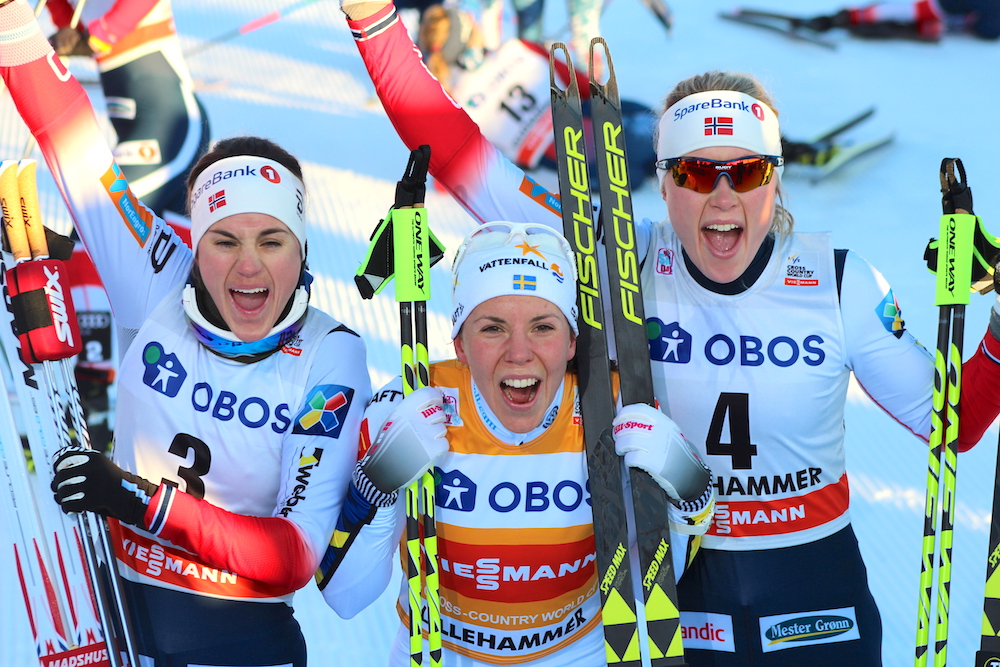
    Charlotte Kalla (c) of Sweden with Norwegians Heidi Weng (l) and Ragnhild Haga after placing first, second and third, respectively, in the women’s 15-kilometer skiathlon on Sunday in Lillehammer, Norway. (Photo: Henrik Hunnes)

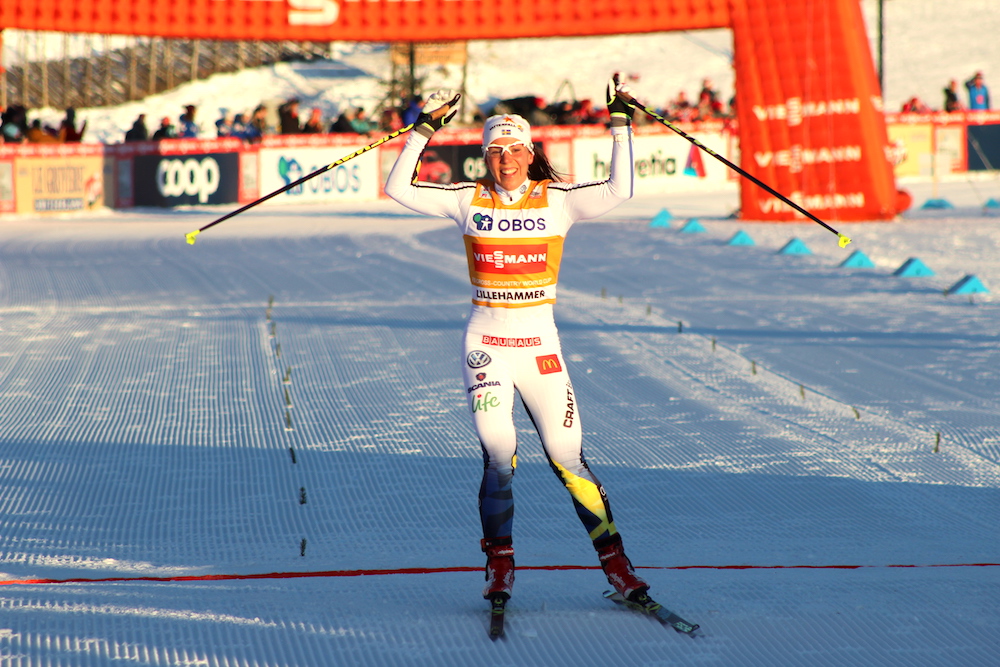
    If it hadn’t been for the steady bob of her yellow leader’s bib and an intermittent shadow from the sun’s glare cast by the trail’s treeline, Charlotte Kalla might have blended right into the snow: her white suit symbolic of Sweden smooth across the Lillehammer race course in Norway.

    As it were, the overall World Cup leader’s bib, her prize from winning last weekend’s battle against Norway’s Marit Bjørgen, could not be contested. Kalla crested the final climb of the women’s 15-kilometer skiathlon on Sunday with no Norwegians in sight, headed toward her second distance win in a row. Her closest competitor was Norway’s Heidi Weng, who finished 19.7 seconds after Kalla crossed the line in 42:24.7.

    “It felt good, and when I was on that last climb I felt fine, but didn’t know that Heidi could not follow me,” Kalla said, according to a International Ski Federation (FIS) press release.

    From the beginning Kalla commanded the lead, charging the classic portion out of the start. By the 2.5 k mark, the field had reached the course’s major climb, Weng pushing to the front and creating a small gap on the field, pulling Kalla and Austria’s Teresa Stadlober with her. 

    Leading the second group charge a little over seven seconds back was Finland’s Krista Pärmäkoski, followed by Norwegian’s Ragnhild Haga and Kathrine Rolsted Harsem, as well as the U.S. Ski Team’s Jessie Diggins.

    Sweden’s Charlotte Kalla winning the World Cup women’s 15 k skiathlon on Sunday at the Lillehammer World Cup in Norway. (Photo: Henrik Hunnes)

    In just over a kilometer, Diggins had taken over the helm of the second group’s chase, closing the gap between herself and the leaders by three seconds. By the next kilometer, the crowd had swallowed Stadlober, while Diggins cruised into the third-place position.

    “I think that was maybe the best I have classic skied in my entire life. I had amazing skis and I was just feeling really good,” Diggins said during a post-race interview with FasterSkier.

    Diggins held onto third through the exchange, after Kalla and Weng had already passed through 21 seconds before.

    “I knew that I need an easy classic, before the ski exchange [to] skate,” Kalla said. “Especially when I know how the uphills here are, it’s a very tough and long climb out of the stadium.”

    For the first 5 k of the freestyle portion, Kalla trailed Weng by mere milliseconds, matching every two of Weng’s glides with a powerful one of her own.

    As the two leaders approached the major climb for the final time, a sideways glance from both created a momentary pause: who wanted the lead?

    In the end, it was Weng. She headed up the hill in front of Kalla, the taste of a Norwegian win on home turf in the back of her mouth. But Kalla’s momentary drop from the lead was no mistake; tactics as camouflage to her competitor as her suit in the snow.

    Midway through the hill, the Swede made her move, using her powerful V2 to get around Weng and distancing herself from the Norwegian by 12 seconds as she cornered her way back toward the stadium.

    “Skating was really tough,” Weng said, according to FIS. “I’m glad I held myself back a little, because Charlotte got really strong on the skating part, and on that last hill I knew she would go ahead. She was in another league. She is in a very good shape.”

    Heading into the finishing stretch, Kalla had extended her lead by another seven seconds, waving to the crowd as she crossed first. Following Weng in second was Haga in third place (+43.6).

    “I was not satisfied with the first round classic, but I got a bit better after that and I was able to stay in contact with the leader,” Haga said according to FIS. “I felt stronger when we started with freestyle, but then I broke my pole in the last hill and I thought it was over for me regarding a podium position, but then I got a new one from the one of our coaches, and he told me that it was still possible.”

    In fourth, 54.3 seconds behind Kalla was Bjørgen, just ahead of Diggins in fifth (+57.0).

    Norway’s Heidi Weng finishing second the World Cup women’s 15-kilometer skiathlon on Sunday in Lillehammer, Norway. Sweden’s Charlotte Kalla (not shown) finished 19.7 seconds ahead for the win. (Photo: Henrik Hunnes)

    “She put herself right in the race to be a contender for the podium today,” USST Women’s Coach Matt Whitcomb said of Diggins during a post-race phone interview. “It got away from her … but it’s really encouraging, particularly on a course as challenging as this one is in Lillehammer, that Jessie can fight in the top five like that.”

    “I think she’s coming out of yesterday with a lot of confidence in her classic skiing, having made the sprint final,” Whitcomb continued. “In the past it’s more been about damage control in the classic leg, and now it’s about doing damage to others.”

    Rounding out the top 10 was Stadlober in sixth (+1:04.9), Pärmäkoski in seventh (+1:07.8), Norway’s Ingvild Flugstad Østberg in eighth (+1:26.0), Russia’s Natalia Nepryaeva in ninth (+1:27.8), and a second USST member, Sadie Bjornsen in 10th (+1:32.6).

    “She’s just been turning heads, demonstrating such great fitness and composure as she races in some pretty high stress situations,” Whitcomb said of Bjornsen. “Really strong all weekend.”

    After coming through the exchange in 23rd, Kikkan Randall (USST) worked her way up to 16th (+2:06.5) by the end of the freestyle portion of the race.

    “Had a good start but lost some ground on the first time up the big climb,” Randall wrote in an email to media outlets. “Found a better groove in the second classic lap and felt much stronger in the skate. Underlying fitness feels strong but still searching for my full race gear. Great conditions, even saw a bit of sun out there!”

    Also scoring World Cup points for the USST on Sunday was Rosie Brennan 29th (+3:07.7).

    Canada’s Emily Nishikawa racing to 49th the women’s 15-kilometer skiathlon on Sunday at the World Cup in Lillehammer, Norway. (Photo: Henrik Hunnes)

    “The harder the course, the more promising things get for Rosie,” Whitcomb said. “She’s just a worker out there. She can really drop it into low gear and pick off people on these big climbs. She’s been skiing the descents really aggressively; it makes sense that she hit the top 30 today.”

    Also racing for the U.S., Liz Stephen finished 36th (+3:25.7), Chelsea Holmes 38th (+3:39.6) and Ida Sargent 55th (+6:41.1).

    “Chelsea, in what is generally not her strong technique, was able to climb up into the top 30 in the classic portion of the skiathlon. That was really nice to see.” Whitcomb said. “She can certainly do really well in this event, particularly if she skis the way she did in parts of that classic race.”

    Cendrine Browne led Canada in 45th (+4:37.3) while her teammate Emily Nishikawa followed in 49th (+5:00.1). Katherine Stewart-Jones did not finish.

    Results | Overall World Cup standings

  • Saturday Rundown: Lahti and Osrblie (Updated x2)

    Saturday Rundown: Lahti and Osrblie (Updated x2)

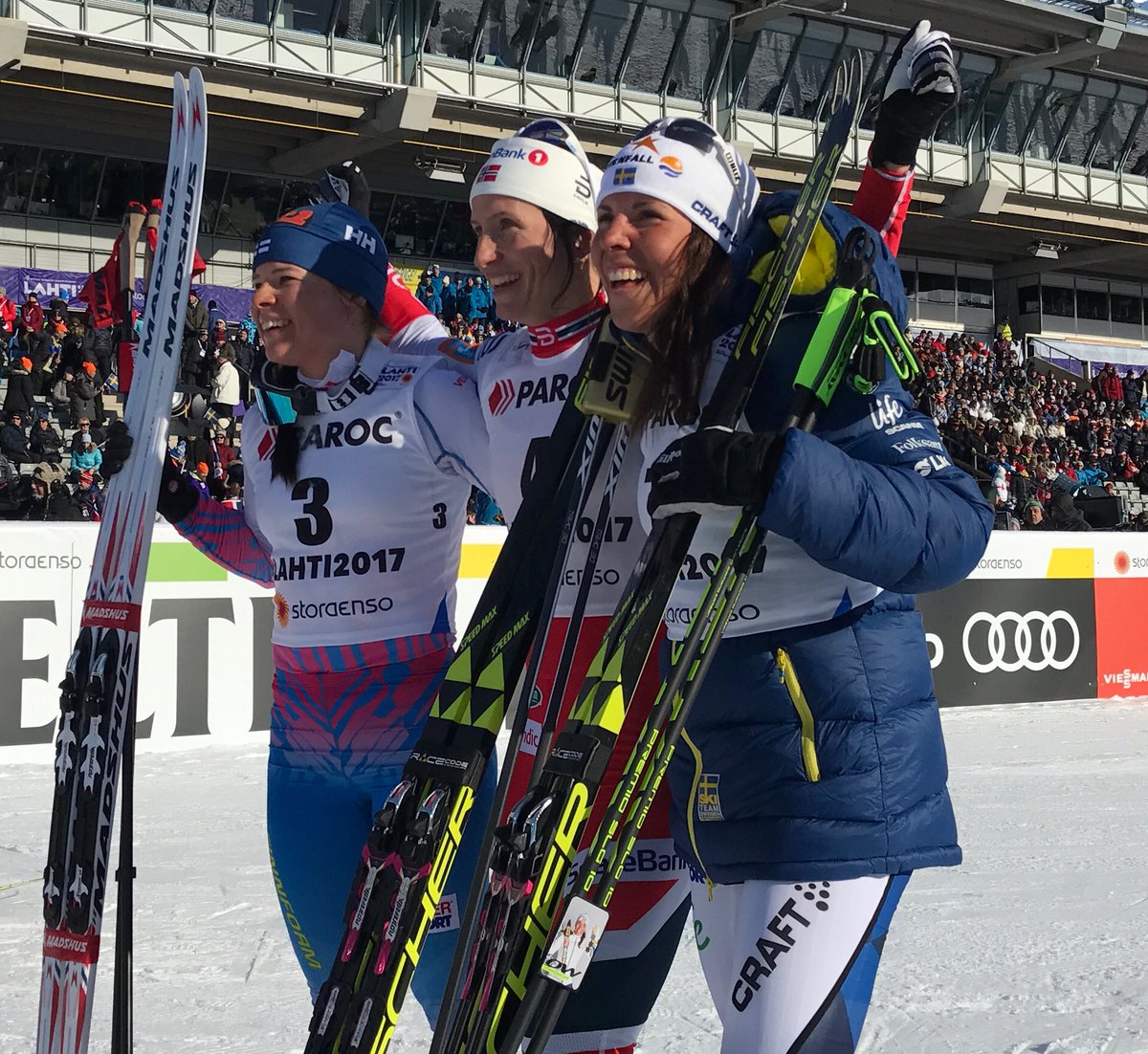
    The women’s 15 k skiathlon podium at 2017 Nordic World Championships, with Norway’s Marit Bjørgen (c) in first, Finland’s Krista Parmakoski (l) in second, and Sweden’s Charlotte Kalla (r) in third on Saturday in Lahti, Finland. (Photo: FIS Cross-Country/Twitter)

    FIS Nordic World Championships (Lahti, Finland): 15/30 k skiathlons 

    This one’s for you, kid.

    Marit Bjørgen became the second relatively new mom to medal in the second race of 2017 Nordic World Championships on Saturday (after American Kikkan Randall earned bronze in Thursday’s freestyle sprint), racking up her 15th World Championships gold in women’s 15-kilometer skiathlon in Lahti, Finland. Bjørgen, a 36-year-old Norwegian team veteran, had her first child a little over a year ago.

    In her first full season back, she led Saturday’s 7.5 k classic + 7.5 k freestyle race at the halfway point, where she clicked into her skate skis half a second ahead of Finland’s Krista Parmakoski in second. Parmakoski followed her across the finish for silver, finishing 4.8 seconds off Bjørgen’s winning time of 37:57.5 minutes. For Parmakoski, it was her first individual medal at World Championships after having previously earned four in team events.

    Sweden’s Charlotte Kalla picked up her fourth-career World Championships medal in third place (+32.0), and Nathalie von Siebenthal placed fourth (+1:05) for the best result for a Swiss female cross-country skier since since Evi Kratzer earned bronze in 1987 in Oberstdorf, Germany.

    Von Siebenthal edged Norway’s Heidi Weng in a photo finish, with Weng finishing another tenth of a second back in fifth (+1:05.1). Right behind them, Austria’s Teresa Stadlober notched sixth (+1:05.4), Russia’s Yulia Tchekaleva seventh (+1:05.7), Norway’s Astrid Uhrenholdt Jacobsen eighth (+1:11.1), Russia’s Anastasia Sedova ninth (+1:15.3), and Japan’s Masako Ishida 10th (+1:21.8).

    Two Americans finished in the top 20 with Randall leading them in 17th (+2:09.2) and Liz Stephen placing 20th (+2:12.4). Rosie Brennan cracked the top 30 in 28th (+3:03.2) and Jessie Diggins did not finish.

    A World Championships rookie, Cendrine Browne led Canada in 35th (+4:15.5), followed by Emily Nishikawa in 38th (+4:29.3) and Katherine Stewart-Jones in 40th (+4:38.1).

    Annika Taylor, a 23-year-old California native who races for Great Britain, finished 41st (+4:49.7). She previously placed 38th in the freestyle sprint qualifier for her best result at her first World Championships.

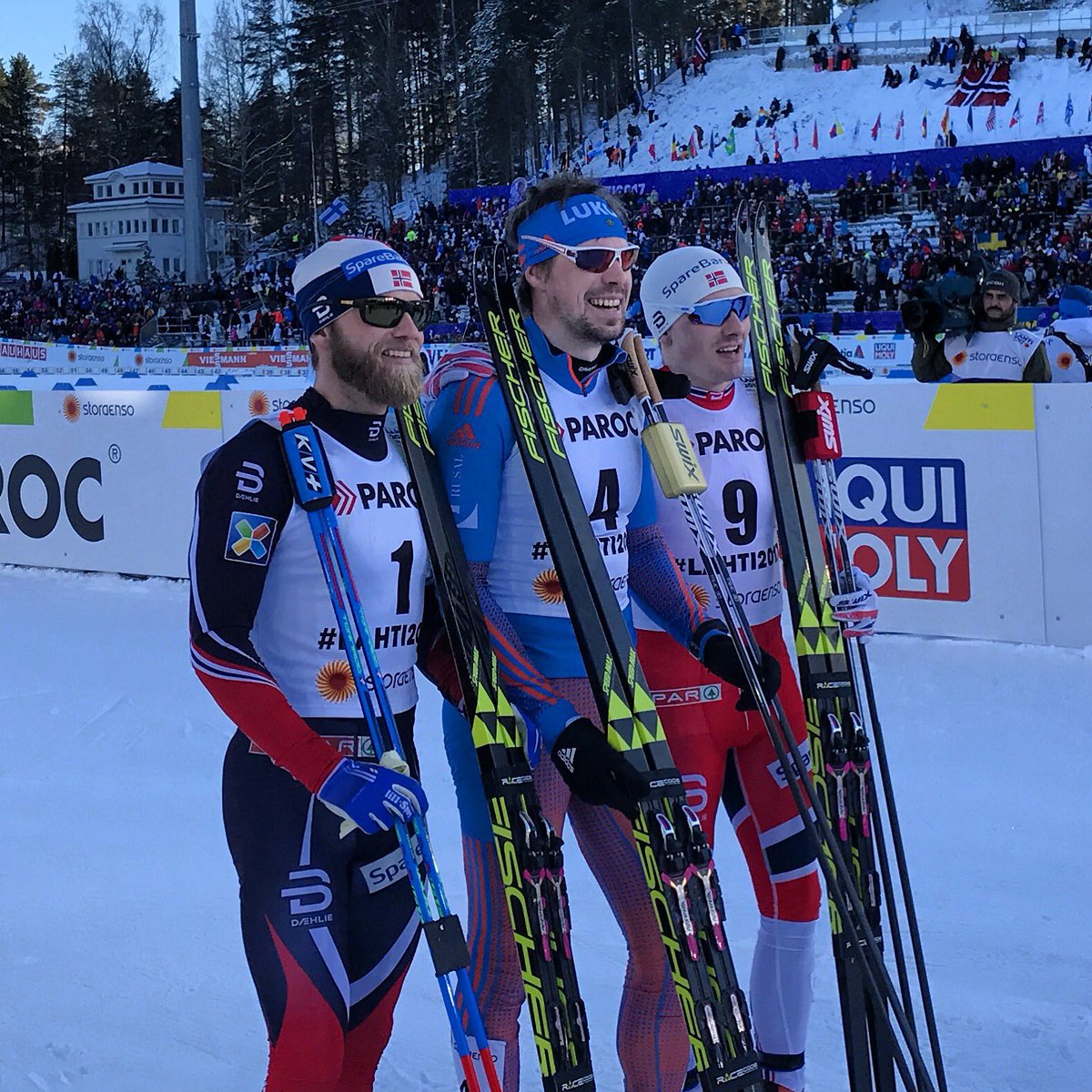
    The men’s Nordic World Championships 30 k skiathlon podium, with Russia’s Sergey Ustiugov (c) in first, Norway’s Martin Johnsrud Sundby (l) in second and Finn Hågen Krogh (r) in third on Saturday in Lahti, Finland. (Photo: FIS Cross-Country/Twitter)

    The men’s 30 k skiathlon that followed boiled down to a two-way battle for first between none other than Russia’s Sergey Ustiugov and Norway’s Martin Johnsrud Sundby. The two traded off leading throughout much of the race and together gapped the field around the 20 k mark.

    Over the next 10 k, Ustiugov continued to drive the pace. On a pivotal climb less than two minutes before the finish, Sundby attacked, jump skating and seeming to put the hurt on Ustiugov. But that moment was over before it started when Sundby broke his pole against his ski tip and had to stop for a replacement.

    The 24-year-old Ustiugov skied away to the win, uncontested yet powering down the finishing stretch to claim his first World Championships gold in 1:09:16.7 hours. He had previously earned bronze with the Russian men’s relay in 2013.

    Sundby finished 6.7 seconds later, dropping his arms and head toward the ground as he did so. Norway’s Finn Hågen Krogh came out on top of a five-way fight for third, finishing fourth (+33.1), 31.8 seconds behind Ustiugov and 1.3 seconds ahead of his teammate Sjur Røthe. Krogh put himself in front and proved to have the most finishing kick, ahead of Røthe, Canada’s Alex Harvey (fifth, +33.3), Norway’s Didrik Tønseth (sixth, +33.5), and Sweden’s Marcus Hellner (seventh, +33.7). Russia’s Andrey Larkov fell off the group’s pace and placed eighth (+36.1), Finland’s Lari Lehtonen was ninth (+37.2), and Italy’s 24-year-old World Championships rookie Giandomenico Salvadori broke through in 10th (+37.3).

    Three Canadians started the race, with Graeme Killick finishing 47th (+6:23.5) and Knute Johnsgaard 55th (+8:40.2) out of 63.

    Tad Elliott was the top American man in 48th (+7:11.2), Kyle Bratrud (+7:16.5) placed 49th and Noah Hoffman 57th (+9:33.6). Ben Lustgarten did not start.

    Results: Women | Men

    ***

    IBU Youth/Junior World Championships (Osrblie, Slovakia): Junior sprints

    [UPDATED] Canada’s Megan Bankes and American Siena Ellingson landed in the top 20 of the junior women’s 7.5-kilometer sprint on Saturday at 2017 International Biathlon Union (IBU) Junior World Championships in Osrblie, Slovakia. Coming off a victory in Thursday’s 12.5 k individual, Bankes placed 13th and Ellingson achieved her best non-relay result in 18th at her fourth Youth/Junior Worlds.

    Italy’s Michela Carrara won the sprint in 20:57.8 minutes with clean shooting (0+0) and the second-fastest course time. Norway’s Ingrid Landmark Tandrevold skied the fastest but came up 15.2 seconds short of gold with one prone penalty (1+0), which put her in second place. France’s Myrtille Bègue reached the podium in third (+31.5) with perfect shooting (0+0), and Austria’s Simone Kupfner shot clean as well for fourth place (+40.8), 9.3 seconds out of third.

    Bankes was one of the first out of the gate in bib 4 and missed one on each stage (1+1) and skied the 14th-ranked course time. She ultimately finished 13th (+1:25.3) for her second-best result at her fourth Youth/Junior World Championships.

    Ellingson started 19th and cleaned prone before missing one in standing (0+1), to finish 18th (+1:38.7) with the 20th-ranked course time.

    Canada’s Nadia Moser scored her first top 40 of these championships in 31st (+2:16.4) with two misses (1+1), her teammate Emily Dickson finished 47th (+3:15.8) with one prone miss (1+0), and the second American racing, Nina Armstrong finished 65th (+6:11.5) with five penalties (2+3).

    Russia had two on the podium in Saturday’s junior men’s 10 k sprint at IBU Junior World Championships with Igor Malinovskii (c) in first and Kirill Streltsov (l) in second, sharing the podium with Kazakhstan’s Roman Yeremin (r) in third in Osrblie, Slovakia. (Photo: IBU)

    In the junior men’s 10 k sprint, Russia took the two top steps of the podium with Igor Malinovskii in first and Kirill Streltsov in second, after both cleaned the two-stage race.

    Malinovskii started later in the field in bib 60 (out of 86) and bested his teammate’s time by 12.2 seconds, finishing in 24:32.2 minutes. Streltsov, who had started 51st and led until that point, took silver and Kazakhstan’s Roman Yeremin notched bronze (+24.9). Despite two misses on his first prone stage (2+0), Yeremin was an early race leader after starting 10th. He bested the time of Belarus’s Anton Smolski, who started fifth, by just 0.2 seconds for third. Smolski settled for fourth, ahead of Germany’s David Zobel (who previously took silver in Thursday’s 15 k individual) in fifth (+38.2).

    Cody Johnson was the top American in 46th (+3:02.9), followed by Travis Cooper in 49th (+3:10.7), Cameron Christiansen in 80th (+5:32.4), and Peter Carroll in 82nd (+5:51.6).

    Pearce Hanna led the Canadian men in 47th (+3:04.1), ahead of Trevor Kiers in 48th (+3:06.6), Zachari Bolduc in 54th (+3:25.4), and Jules Burnotte in 55th (+3:31.2).

    Youth/Junior World Championships continue Sunday with the youth men’s and women’s pursuits.

    Results: Junior women | Junior men

  • Setting the Scene: Pre-Competition Day at Lahti World Championships

    Setting the Scene: Pre-Competition Day at Lahti World Championships

    An Austrian athlete tests skis as he glides back into the main stadium. (Photo: John Lazenby/Lazenbyphoto.com)

    LAHTI, Finland — Tuesday at Lahti’s venue for the 2017 Nordic World Ski Championships, the sun sets early. Although technically sunset was 5:22 p.m., the sun on this clear-sky day was still wintertime reluctant. It seemed too short a time for the sun’s transect to thaw Lahti. Temps were in the mid-to-low 20 degrees Fahrenheit. But a brisk wind called for down coats and insulated pants for those not actively skiing — in the shade, it felt like the teens.

    Basked in an early evening glow, Lahti’s three iconic ski jumps dominate the 2017 Nordic World Championships venue. (Photo: John Lazenby/Lazenbyphoto.com)

    For athletes, it was a day of pre-competition ski and wax testing on bulletproof tracks that gradually deteriorated on the steeper climbs. The ski loops have good coverage. The snow remains coarse, as the tracks are covered with predominately manmade snow with trace amounts of natural snow tilled in.

    Lahti’s most dominant feature are its ski jumps, which are among the first objects to catch morning light. The surrounding landscape isn’t marked by serrated mountains, but by subtle hills that make the venue’s three domineering jumps (a K 116, K 90, and K 64), that much more ominous. First nordic-combined skiers then women’s ski jumpers had an opportunity for test flights off the K 90.

    On the non-skiing side of things, the venue was abuzz of last-minute prep: television cables being covered for protection before the onslaught of spectators, event producers testing the stadium’s Skycam, sponsors unpacking schwag, and media arriving to pick up credentials. Like the athletes fine tuning before the competition begins, Lahti’s organizers are near set for the big show.

    On Wednesday, two qualification races will ensue: the women’s 5-kilometer classic and men’s 10 k classic individual starts. These races are for athletes from “non-skiing” nations who have not met the FIS-point benchmark to participate in the championships. Start rights to Lahti’s distance races are granted to the top-10 male and female finishers. (All skiers are granted start rights for Thursday’s freestyle sprint regardless of their results in Wednesday’s qualifier.)

    5 k start list | 10 k start list

    ***

    Cross-Country Competition Schedule: 

    (All cross-country and nordic-combined events will be streamed live in the U.S. on NBCSports.com)

    A Latvian skier double poles through Lahti’s stadium on Tuesday. (Photo: John Lazenby/Lazenbyphoto.com)

    Wednesday, Feb. 22
    -Women’s 5 k classic interval start (7:00 a.m. EST)
    -Men’s 10 k classic interval start (8:30 a.m. EST)

    Thursday, Feb. 23 
    -Women’s freestyle k sprint (10:30 a.m. EST)
    -Men’s freestyle k sprint

    Saturday, Feb. 25 
    -Women’s 15 k skiathlon (5:00 a.m. EST)
    -Men’s 30 k skiathlon (7:30 a.m. EST)

    Sunday, Feb. 26
    -Women’s classic team sprint
    -Men’s classic team sprint

    (Semifinals starting at 4:30 a.m. EST, finals starting at 6:30 a.m. EST)

    Tuesday, Feb. 28 
    -Women’s 10 k classic interval start (6:45 a.m. EST)

    Wednesday, Mar. 1 
    -Men’s 15 k classic interval start (6:45 a.m. EST)

    Thursday, Mar. 2 
    -Women’s 4 x 5 k team relay (8:00 a.m. EST)

    Friday, Mar. 3
    -Men’s 4 x 10 k team relay (6:30 a.m. EST)

    Saturday, Mar. 4 
    -Women’s 30 k freestyle mass start (7:30 a.m. EST)

    Sunday, Mar. 5  
    -Men’s 50 k freestyle mass start (7:30 a.m. EST)

    U.S. 2017 World Championships Team:

    Men

    • Simi Hamilton (Stratton T2/ World Cup A-team)
    • Andy Newell (Stratton T2/ World Cup A-team)
    • Erik Bjornsen (Alaska Pacific University/World Cup B-team)
    • Noah Hoffman (Ski and Snowboard Club Vail/World Cup B-team)
    • Tad Elliott (Ski and Snowboard Club Vail)
    • Kyle Bratrud (Central Cross Country)
    • Ben Lustgarten (Craftsbury Green Racing Project)
    • Cole Morgan (Sun Valley Ski Education Foundation)

    Women

    • Jessie Diggins (Stratton T2/World Cup A-team)
    • Sadie Bjornsen (Alaska Pacific University/World Cup A-team)
    • Sophie Caldwell (Stratton T2/World Cup A-team)
    • Kikkan Randall (Alaska Pacific University/World Cup A-team)
    • Ida Sargent (Craftsbury Nordic/World Cup A-team)
    • Liz Stephen (Burke Mountain Academy/World Cup A-team)
    • Rosie Brennan (Alaska Pacific University/World Cup B-team)
    • Caitlin Gregg (Loppet Nordic Racing)
    • Chelsea Holmes (Alaska Pacific University)

    Canadian 2017 World Championships Team:

    Men

    • Alex Harvey (CNEPH/World Cup A-team)
    • Devon Kershaw (World Cup A-team)
    • Len Valjas (World Cup A-team)
    • Jess Cockney (World Cup B-team)
    • Graeme Killick (World Cup B-team)
    • Knute Johnsgaard (AWCA/NST U25 Team)

    Women

    • Emily Nishikawa (NST U25 Team)
    • Dahria Beatty (AWCA/NST U25 Team)
    • Cendrine Browne (CNEPH/NST U25 Team)
    • Katherine Stewart-Jones (NTDC Thunder Bay/NST U25 Team)

    Nordic Combined Competition Schedule:

    (All cross-country and nordic-combined events will be streamed live in the U.S. on NBCSports.com)

    Friday, Feb. 24

    -Individual HS 100 competition round (8:30 a.m. EST)

    -Individual 10 k cross-country race (6:30 a.m. EST)

    Sunday, Feb. 26

    -Team event  HS 100 competition round (5:00 a.m. EST)

    -Team event  4 x 5 k cross-country race (8:30 a.m. EST)

    Wednesday, Mar. 1

    -Individual HS 130 competition round (5:00 a.m. EST)

    -Individual 10 k cross-country race (9:15 a.m. EST)

    Friday, Mar. 3

    -Team sprint HS 130 competition round (9:00 a.m. EST)

    -Team sprint 2 x 7.5 k cross-country race (11:15 a.m. EST)

    U.S. Nordic Combined 2017 World Championships Team:

    • Bryan Fletcher
    • Taylor Fletcher
    • Benjamin Berend
    • Adam Loomis
    • Ben Loomis
  • Stephen Back on Podium in 2nd, Patterson 4th in PyeongChang Skiathlon

    Stephen Back on Podium in 2nd, Patterson 4th in PyeongChang Skiathlon

    The women's World Cup 15 k skiathlon podium on Saturday in PyeongChang, South Korea, with Poland's Justyna Kowalczyk (c) in first, American Liz Stephen (l) in second, and Japan's Masako Ishida (r) in third. (Photo: Fischer/NordicFocus)
    The women’s World Cup 15 k skiathlon podium on Saturday in PyeongChang, South Korea, with Poland’s Justyna Kowalczyk (c) in first, American Liz Stephen (l) in second, and Japan’s Masako Ishida (r) in third. (Photo: Fischer/NordicFocus)

    Multiple race warmup and cool downs, managing hydration and caloric intake, moving at her max sprinting speed — more than once. It’s not often that American Liz Stephen feels the lingering effects of a World Cup sprint day. Her most recent memory was three years ago, when she qualified 22nd in Szklarska Poreba, Poland.

    But this weekend’s three-day competition series in PyeongChang, South Korea, challenged the distance specialist once again. With a smaller World Cup field than usual, Stephen qualified 29th in Friday’s classic sprint and advanced quarterfinals, where she raced in the first heat of the day.

    In what ended up being the fastest women’s quarterfinal, Stephen pushed through Friday’s hill-dominant sprint course and crossed fifth for 25th overall. The back-to-back sprint experience, however, left the 30-year-old Stephen with a little less energy than she would have liked as she entered Saturday’s 15-kilometer skiathlon.

    American Liz Stephen (2) skiing at the front of the women's 15 k skiathlon on Saturday, alongside Norway's Silje Øyre Slind (1) and Poland's Justyna Kowalczyk (3), at the World Cup in PyeongChang, South Korea. (Photo: Fischer/NordicFocus)
    American Liz Stephen (2) skiing at the front of the women’s 15 k skiathlon on Saturday, alongside Norway’s Silje Øyre Slind (1) and Poland’s Justyna Kowalczyk (3), at the World Cup in PyeongChang, South Korea. (Photo: Fischer/NordicFocus)

    “I think I was feeling yesterday’s sprint race a bit, as I did twice as many rounds as I usually do!” Stephen joked in an email.

    Yet, standing at the start in bib 2, behind Norway’s Silje Øyre Slind in bib 1, Stephen wasn’t going to let a little soreness stop her from racing to Saturday’s skiathlon podium.

    After Poland’s Justyna Kowalczyk gapped the front by close to 20 seconds in the first two kilometers of the classic leg, the American held on tight to the lead chase group, striding even with a medley of skiers, including Slind, Japan’s Masako Ishida, Norway’s Anna Svendsen, Sweden’s Maria Nordström, and Germany’s Elisabeth Schicho.

    Stephen came through the exchange in fifth position, a little over a minute behind the race leader Kowalczyk and 12 seconds back from the second place skier, Ishida.  

    “I was afraid I skied little too hard in the classic portion,” Stephen said, according to an International Ski Federation (FIS) press release. “I wanted to stay with the leading group in the classical part not to fall back.”

    Skate skis on, Stephen quickly caught and surpassed Svendsen and Schicho by the 8.4 k mark, rejoining Ishida. With over a minute separating her and Ishida from Kowalczyk, the battle for second began. Around the 10 k mark, Stephen made her move. Powering past Masako, Stephen started her second hunt, this time for the Polish skier.

    But Kowalczyk’s early classic-leg surge and strong skating staved off any attempts from Stephen.

    “Liz was able to take some time out of her, but not significant time,” USST Head Coach Chris Grover said on the phone. “So that was impressive racing by Kowalczyk.”

    Poland's Justyna Kowalczyk winning her first World Cup in three years on Saturday, the women's 15 k skiathlon at in PyeongChang, South Korea. (Photo: Fischer/Nordic Focus)
    Poland’s Justyna Kowalczyk winning her first World Cup in three years on Saturday, the women’s 15 k skiathlon at in PyeongChang, South Korea. (Photo: Fischer/Nordic Focus)

    Kowalczyk ultimately finished first for the win in a time of 43:54.7. The victory marked her 50th World Cup win and first individual World Cup victory since 2014.

    “It has been a long time since I have been on the World Cup podium,” Kowalczyk said, according to FIS. “I was quite surprised to see how well I skated.”

    Finishing exactly 56 seconds behind Kowalczyk was Stephen in second place. The result was Stephen’s best individual result since 2015, when she placed second in the 10 k freestyle race in Rybinsk, Russia.

    “It’s hard not to feel happy when you get a podium finish!” she said, according to a U.S. Ski Team press release. “However, I didn’t feel like I had as much energy as I wanted to have today, but it was enough to hold onto second.”

    In her first podium appearance since 2009, Ishida finished 18.8 seconds after Stephen in third (+1:14.8).

    Just missing the podium by 6.6 seconds was American Caitlin Patterson in fourth (+1:21.4). Though a tangle on the first hill of her classic leg pushed Patterson back to 13th, the 27-year-old Craftsbury Green Racing Project skier was able to reconnect with the top 1o by the 2 k mark.

    Unconcerned with Kowalczyk’s blistering pace, Patterson focused on the chase pack. By the time she reached the ski change, she was positioned in seventh. Her transition to skate skis smooth and energy still strong, Patterson began to pick people off.

    She caught Nordström, who had been 10 seconds ahead of her at the exchange, as well as Schicho and Svendsen, both of whom were close to 30 seconds ahead of her when they switched to skate skis.

    Caitlin Patterson (Craftsbury Green Racing Project) en route to a career-best World Cup result of fourth in the women's 15 k skiathlon in PyeongChang, South Korea. (Photo: Fischer/NordicFocus)
    Caitlin Patterson (Craftsbury Green Racing Project) en route to a career-best World Cup result of fourth in the women’s 15 k skiathlon in PyeongChang, South Korea. (Photo: Fischer/NordicFocus)

    “Caitlin Patterson was really impressive,” Grover said. “She was kind of hovering around seventh or eighth for most of the race, and then really in the last lap, really started to pick people off, including right at the very end to get all the way up to fourth.”

    Feeling fairly well adjusted to the time difference, and appreciative of the low-altitude racing, Patterson was proud of her race effort. Her only issue being the seconds that separated her from the podium.

    “When I look at the results and see how close third place was ahead of me, I can’t help but wish I could have somehow gone faster sooner!” Patterson wrote in an email. “A true sign of how much this makes me hungry for more, though I know I gave it everything I had out there today.”

    The third American woman on Saturday was Liz Guiney in 13th (+2:21.7). The PyeongChang World Cup marks Guiney’s third week of World Cup racing and, while this weekend’s field is not as strong as the ones she recently raced against in Sweden, the result was still a little unexpected for Guiney.

    “I’m very happy with my race today!” Guiney, 25, wrote in an email. “With the weaker World Cup field, it was a good opportunity to score some points, but I think I surprised myself by being within reach of the top 10.”

    The last two races mark Guiney’s first World Cup points, with her best individual finish prior to this weekend 49th in the Falun 15 k classic mass start.

    “Last weekend in the Falun 15k, I got a little too excited out of the start and paid for it later in the race, so my goal today was to ski my own race,” Guiney wrote. “I was really psyched to cross the line and find out that Liz Stephen placed 2nd and Caitlin (my GRP teammate) was 4th, which is a big breakout result for her!”

    Two Canadian women also earned their first World Cup top 30’s on Saturday, with Annika Hicks (Alberta World Cup Academy) placing 26th (+5:17.8) followed by Sadie White (NTDC Thunder Bay) in 29th (+6:54.7).

    Racers return to the race venue tomorrow for Sunday’s freestyle team sprint.

    Results | Sunday’s team sprint start list

  • Saturday Rundown: PyeongChang, Soldier Hollow & Eastern Canadian Champs (Updated x3)

    The Russian men finishing in unison to take first, second and third in the men's 30 k skiathlon, the final race of 2017 U23 World Championships at Soldier Hollow in Midway, Utah. Alexander Bolshunov (8) was deemed the winner, Alexey Chervotkin (1) was second, and Denis Spitsov (11) third. (Photo: FlyingPointRoad.com)
    The Russian men finishing in unison to take first, second and third in the men’s 30 k skiathlon, the final race of 2017 U23 World Championships at Soldier Hollow in Midway, Utah. Alexander Bolshunov (8) was deemed the winner, Alexey Chervotkin (1) was second, and Denis Spitsov (11) third. (Photo: FlyingPointRoad.com)

    FIS Nordic Combined Junior World Championships (Park City and Midway, Utah): Normal hill/5 k

    American Ben Loomis (6) leads Norway's Lars Ivar Skaarset (7) during the third leg of the nordic-combined 4 x 5 k team event on Thursday at 2017 Nordic Junior Worlds at Soldier Hollow in Midway, Utah. Loomis brought the U.S. from ninth to seventh, and his team ultimately finished seventh. (Photo: FlyingPointRoad.com)
    American Ben Loomis (6) leads Norway’s Lars Ivar Skaarset (7) during the third leg of the nordic-combined 4 x 5 k team event on Thursday at 2017 Nordic Junior Worlds at Soldier Hollow in Midway, Utah. Loomis brought the U.S. from ninth to seventh, and his team ultimately finished seventh. (Photo: FlyingPointRoad.com)

    [UPDATED] In the individual normal hill/5-kilometer Gundersen on Saturday, the last nordic-combined competition of 2017 Nordic Junior World Championships, American Ben Loomis captured his first top 10 in his third Junior Worlds in ninth place.

    Eighteen-year-old Loomis jumped to 10th then picked off one place in the 5 k to finish ninth, 1:22.3 minutes behind the winner, Germany’s Vinzenz Geiger.

    Geiger led after the jump and started the ski race 4 seconds ahead of Japan’s Yuto Nakamura in second. Geiger was able to hold off Finland’s hard-charging Arttu Mäkiaho, who raced from ninth to second, by 22.6 seconds. France’s Laurent Muhlethaler raced from fifth to third (+23.9) for the final spot on the podium, while Nakamura slipped to fourth (+42.8).

    The U.S. had two in the top 15 with Stephen Schumann in 15th (+1:44.3), up from 20th after the jump. Grant Andrews placed 33rd (+2:40.0) and Tucker Hoefler finished 46th (+3:56.9).

    Results

    ***

    FIS Nordic U23 World Championships (Midway, Utah): 15/30 k skiathlon

    It was a Russian affair and a head scratcher for the photo-finish crew at U23 World Championships on Saturday, with three Russians putting enough time on the rest of the field in the men’s 30-kilometer skiathlon that they had time to slow to a stop and inch across the line in unison.

    The jury ultimately had to decide who won, awarding it to Alexander Bolshunov in 1:15:31.5 hours, 0.2 seconds ahead of Alexey Chervotkin in second. Denis Spitsov was listed as third (+0.5). France’s Jules Lapierre came closest to the Russians in fourth, finishing 11 seconds later.

    The field was considerably strung out by the end of the race, with Switzerland’s Jason Rueesh finishing 14.3 seconds out of first in fifth and Norway’s Gaute Kvaale crossing the line in sixth (+33.0), ahead of France’s Valentin Chauvin in seventh (+49.1), and Andorra’s Irineu Esteve Altimiras in eighth (+56.8).

    American Paddy Caldwell (SMS/USST) placed ninth for the second-straight race at U23s, finishing 1:24.4 behind the winner.

    The U.S. men had three in the top 15 for their best day of the championships, with John Hegman (SVSEF) placing a 11th (+1:53.5) and Adam Martin (NMU) 15th (+2:23.3) for their best results at U23 Worlds.

    Evan Palmer-Charrette (NTDC Thunder Bay) led the Canadian men in 26th (+5:44.6). Alexis Dumas (CNEPH) finished 33rd (+9:02.7) out of 36 finishers. Several North Americans did not finish, including Canada’s Julien Lamoureux and Julien Smith, and American Cal Deline.

    In the women’s 15 k skiathlon, Lotta Udnes Weng achieved her first gold of U23 Worlds, holding off Finland’s Johanna Matintalo by 3.8 seconds and crossing the line in 40:50.9 minutes. Russia’s Yana Kirpichenko reached the podium in third (+13.9), fewer than two seconds ahead of Weng’s twin sister, Tiril Udnes Weng in fourth (+15.6).

    Dahria Beatty, of the Alberta World Cup Academy and Canadian National U25 Team, led the North Americans in 19th (+2:18.1), and teammate Katherine Stewart-Jones (NTDC Thunder Bay/NST U25 Team) was 21st (+2:29.3) for her best U23 Worlds result.

    The Czech Republic’s Petra Hyncicova (University of Colorado-Boulder) followed in 22nd (+2:30.7), and three Canadian women finished in the top 30 with Frederique Vezina (CNEPH) in 29th (+3:36.2). Jenn Jackson did not finish.

    Jesse Knori (University of Colorado-Boulder) was the top American in 30th (+3:40.1), Alayna Sonnesyn followed in 31st (+3:42.5), Nichole Bathe (University of Alaska Fairbanks) in 33rd (+4:36.9), and Corey Stock (Bridger Ski Foundation) in 36th (+5:42.1).

    Mathilde Petitjean, who races for her native Togo but trains with the Quebec-based CNEPH, finished 38th (+6:04.8) of 38 finishers.

    Results: Men | Women

    ***

    FIS Cross-Country World Cup (PyeongChang, South Korea): 15/30 k skiathlon

    The women's 15 k skiathlon podium at the PyeongChang World Cup in South Korea, with Poland's Justyna Kowalczyk (c) in first, American Liz Stephen (l) in second, and Japan's Masako Ishida in third. (Photo: FIS Cross Country/Twitter)
    The women’s 15 k skiathlon podium at the PyeongChang World Cup in South Korea, with Poland’s Justyna Kowalczyk (c) in first, American Liz Stephen (l) in second, and Japan’s Masako Ishida in third. (Photo: FIS Cross Country/Twitter)

    The second day of World Cup racing in PyeongChang, South Korea, took place this Saturday, with a skiathlon event for both genders. The women raced a total of 15 kilometers, the first 7.5 k leg classic and the second 7.5 k leg freestyle. Poland’s Justyna Kowalczyk came away with the women’s win (her first in three years), getting back to her old ways of breaking away from the pack to finish first in 43:54.7 minutes. Liz Stephen of the U.S. Ski Team (USST) claimed second place (+56.0), while Japan’s Masako Ishida took third (+1:14.8).

    For Stephen, second matched her best individual result in a from two years ago, when she placed second in a 10 k freestyle in Rybinsk, Russia. This year at the Tour de Ski, Stephen posted the second-fastest time up the final climb in Val di Fiemme, Italy. For Ishida, it was her first podium since 2009.

    Caitlin Patterson, racing for the U.S., finished just off the podium with a career-best fourth (+1:21.4) for her first top 20 on the World Cup,  and American Liz Guiney placed 13th (2:21.7) for her first top 20 as well. Jessica Yeaton, who trains with Alaska Pacific University and races for Australia, came in 24th (4:58.6).

    Two Canadian women competed with Annika Hicks leading the team in 26th (+5:17.8) followed by Sadie White in 29th (+6:54.7) for their first World Cup top 30s.

    In the men’s 30 k skiathlon that followed, Russia’s Petr Sedov broke away during the skate leg to take a decisive victory over Norway’s Daniel Stock and Mathias Rundgreen, finishing in 1:18:49.6 hours, 22.5 seconds clear of second place. It was Sedov’s first World Cup win and podium, and the first individual podiums for Stock and Rundgreen as well.

    Rundgreen edged Russia’s Konstantin Glavatskikh for the final spot on the podium, with both being listed as 42.1 seconds behind Sedov.

    While Rundgreen held off three others for third place, including Sweden’s Gustav Eriksson in fifth (+46.8), Japan’s Keishin Yoshida in sixth (+47.1), and Russia’s Alexander Utkin in seventh (+49.0), American Noah Hoffman kept his distance ahead of the second chase group to finish eighth (+1:06.2) for his best result in a non-World Cup stage since placing eighth in a 2012 skiathlon in Canmore, Alberta. (Hoffman won the time of day in the 15 k pursuit four years ago in Kuusamo, Finland.)

    Also for the U.S., Scott Patterson was next across the line in ninth (+1:28.4) for his first World Cup points, and Matt Gelso finished 19th (+5:00.8) for his first top 20.

    Brian McKeever of Canada’s Para-Nordic Ski Team was the lone Canadian finisher in 29th (+8:48.9). Bob Thompson was listed as placing 32nd of 37 after being lapped, and Simon Lapointe did not finish.

    Results: Women | Men

    ***

    NorAm Eastern Canadian Championships (Cantley, Quebec): Classic interval start

    The NorAm mini tour at the Nakkertok Nordic Centre continued on Saturday with Eastern Canadian Championships with classic individual start races.

    In the men’s 15 kilometre, Lappe Nordic’s Andy Shields took a lead in the first lap and held on to win in 39:14.7, just 0.7 seconds ahead of CNEPH’s Ricardo Izquierdo-Bernier.  Team R.A.D.’s Russell Kennedy collected his second bronze of the weekend, 24.7 seconds back.

    SMS Elite’s Anne Hart won the women’s 10 k in a reversal of Friday’s sprint podium.  Hart’s 30:03.3 finish gave her a 9.3 second edge on CNEPH’s Sophie Carrier-Laforte and 20.0 seconds on AWCA’s Maya MacIsaac-Jones.

    For the 123 men and 77 women doing the full distance, the weekend is a mini tour.  For the younger categories, it is three separate events allowing the kids who couldn’t skip school on Friday to race Saturday and Sunday.

    There should be over 700 finishers today with 768 on the start list. The volunteers will have more hours of work even after the open categories have finished.

    Results will update continuously as more categories start.

  • Weng The Woman to Watch in STC; Diggins Leads U.S. in 11th

    Weng The Woman to Watch in STC; Diggins Leads U.S. in 11th

    Norway's Therese Johaug, Heidi Weng and Justyna Kowalczk of Poland during the classic leg of the women's 15 k skiathlon on Wednesday in Canmore Alberta. (Photo: Peggy Hung)
    Norway’s Therese Johaug (l), Heidi Weng (in tour leader bib) and Poland’s Justyna Kowalczyk (13) lead the classic leg of the women’s 15 k skiathlon on Wednesday in Canmore Alberta.

    CANMORE, Alberta — To avoid being shaken, play the shadow.

    That was how Norway’s Heidi Weng secured her second win over Norwegian teammate, Therese Johaug in the women’s 15-kilometer skiathlon on Wednesday. It’s also how Weng has the distance queen’s winning reign on hold. 

    “I am not surprised she matches me,” Johaug told FasterSkier after Wednesday’s race in Canmore. “I am training a lot with her this whole season so I know she will be really strong at the finish line.”

    Taking the stage win in 39:41 minutes, Weng never questioned her chance at a showdown with Johaug or her ability to maintain the Tour lead.

    Therese Johaug of Norway leads Norwegian teammate Heidi Weng on the climb out of the stadium during the women's 15 k skiathlon on Wednesday in Canmore Alberta.
    Therese Johaug of Norway leads Norwegian teammate Heidi Weng on the climb out of the stadium during the women’s 15 k skiathlon on Wednesday in Canmore Alberta.

    “We ski [with] each other often and I think that is why we are very good,” Weng told FasterSkier.

    “It was very good to go with Therese and give her a little bit of a fight,” she added during a press conference.

    With only two more days of racing left in the Tour, Johaug is currently ranked second behind Weng in the STC overall standings, 2.9 seconds back.

    “Of course, the race on Friday will be very important because I am only three seconds behind Heidi,” Johaug said, referring to the Stage 7 women’s 10 k freestyle. “[And] Heidi is in really good shape at the moment.”

    Despite the pressure some racers of her repertoire might feel to perform, Johaug claims she has none.

    “I don’t feel a lot of pressure [to win],” Johaug said. “I race as good as possible and I know there are many strong athletes here. So I’m not thinking of that, I am just going for myself.”

    Weng, Johaug’s New Wingman

    When the sound of the gun went off for the women’s skiathlon mass start, Weng was not about to let Johaug’s yellow World Cup leader bib out of her sight.

    “Today, I feel very strong in the classic,” Weng said.

    Strong enough to ski within centimeters of Johaug for all of the first 7.5 k classic leg and eventually, take over the lead from her teammate by the exchange zone.

    “We have a very strong team and we push each other,” Weng said. “We be better to do that.”

    Norway's Heidi Weng leads teammate Therese Johaug as they descend back into the stadium to exchange skis for the women's 15 k skiathlon on Wednesday in Canmore Alberta. (Photo: Peggy Hung)
    Norway’s Heidi Weng leads teammate Therese Johaug as they descend back into the stadium to exchange skis for the women’s 15 k skiathlon on Wednesday in Canmore Alberta. (Photo: Peggy Hung)

    While Weng pushed Johaug through the exchange, the top of the climb out of the stadium found Weng waiting behind Johaug once again.

    “Skating I was so stiff and I tried so hard to follow Therese,” Weng explained in a press conference.

    Weng duplicated Johaug’s every move, denying any distance between them until the final 100 meters. The two approached the finish line neck-and-neck, but it was Weng who whisked the win away from Johaug by eight-tenths of a second. 

    Crossing in third, 9.8 seconds back was a third Norwegian, Astrid Uhrenholdt Jacobsen, after skiing much of the race in or around eighth place.

    “You know, it started out not so good,” Jacobsen told FasterSkier. “I was really tired the first two laps but throughout the skating it got a bit better. I’m really happy I was fighting so hard I could keep my group and had a really strong finish.”

    Jacobsen ranks third in the overall Tour, 1:06.2 behind Weng and about 46 seconds ahead of another Norwegian Ingvild Flugstad Østberg in fourth. Østberg placed sixth (+14.2) on Wednesday, behind Finland’s Krista Parmakoski (+13.4) and Anne Kyllönen (+13.5) in fourth and fifth, respectively.

    U.S. Women Withstand Tests of the Tour

    With eight days of solid racing — ending at elevation (about 1,400 meters, or 4,600 feet above sea level) –even the strongest athletes do not leave the Ski Tour Canada (STC) untested.

    “In a tour like this I kept saying, it is not that hard to be hard to be most the mentally strong out there because everyone is wrecked, everyone is tired,” American Jessie Diggins said after finishing 11th (+42.8).

    After solid day of sprinting on Tuesday, Diggins didn’t sugarcoat her experience in Wednesday’s skiathlon.

    “The skis were great and everything was good, but yesterday just took a lot out of me,” she said.

    Even on the edge, however, Diggins is not one to back down.

    “I’ve already raced 35 times this year so if I can pull one percent out of myself, it will make a huge difference,” she said of her race effort. “So I tried to ski in the pack, draft [and] conserve energy.”

    Diggins drafted off Petra Novakova of the Czech Republic, as well as eventual third-place finisher Jacobsen during the classic leg, later switching to Poland’s Justyna Kowalczyk and Kari Øyre Slind of Norway during the freestyle portion.

    U.S. skier Jessie Diggins  (6) amidst an early chasing group of the women's 15 k skiathlon on Wednesday in Canmore Alberta. (Photo: Peggy Hung)
    U.S. skier Jessie Diggins (6) amidst an early chasing group of the women’s 15 k skiathlon on Wednesday in Canmore Alberta. (Photo: Peggy Hung)

    “In the end, when I felt like we were losing time I pushed the pace because I don’t care what place I get, I care what time I get,” Diggins explained.

    Though Slind slipped away from Diggins by 2.1 seconds for the day’s final top-10 spot, Diggins’ performance moved her up one spot to fifth place in the overall Tour.

    “I’m really psyched,” she said. “42 seconds down on the leaders today, so I can live with that.”

    Another U.S. Ski Team (USST) member Sadie Bjornsen finished the skiathlon in 16th, the second American woman across the finish line. It marked her eighth-straight World Cup top 20, and so far in six stages of the Tour, Bjornsen has not placed worse than 18th. 

    “I’m not gonna lie,” Bjornsen said after. “I am tired … the thing you have to tell yourself the whole time is that everyone else is tired [too].”

    For Bjornsen, the athlete who sustains the test of the tour is the athlete who readily enters the fight.

    “I’ve known that it was really gonna be a battle these last four days,” Bjornsen explained. “I realized that the minute I arrived here. So I’ve prepared for it to hurt. I was not waiting for that feeling, ‘Whoa here we go.’ ”

    Even prepared for pain, Bjornsen found the start of Wedneday’s classic leg tough.

    “The classic was particularly hard,” she said. “I was slipping a lot, so there was a lot of extra work.”

    To her own chagrin, the USST member found herself excited to switch to the freestyle leg.

    “I was really happy to switch to skate skis,” Bjornsen said. “I don’t know what’s happening to me, but I’m just loving the skate events. I fortunately had [Germany’s] Nicole [Fessel] to ski with when she was pushing hard, I was just trying to hang on. So yeah, I enjoyed the second act, that’s for sure.”

    Overall, Bjornsen ranks 11th in the Tour, 5:23.4 behind Weng.

    Norway's Maiken Caspersen Falla, American Sadie Bjornsen, and Germany's Nicole Fessel during the freestyle leg of the  women's 15 k skiathlon on Wednesday in Canmore Alberta. (Photo: Peggy Hung)
    Norway’s Maiken Caspersen Falla (l), American Sadie Bjornsen (c) and Germany’s Nicole Fessel during the freestyle leg of the women’s 15 k skiathlon on Wednesday in Canmore Alberta. (Photo: Peggy Hung)

    Also finishing with World Cup points on Wednesday was USST member, Rosie Brennan in 25th (+2:24.0), for her best result of the season.

    “I felt pretty good considering all the races we’ve done,” Brennan said.

    Growing up training at altitude near Park City, Utah, Brennan found no trouble adjusting her body to the change in elevation.

    With that advantage, Brennan said she decided to, “Just focus on what I can do each meter in front of me and not worry about the field because everyone is going to be feeling different.”

    U.S. women’s coach Matt Whitcomb spoke enthusiastically about Brennan’s performance, as well as the group of Americans behind her on the bubble of making the top 30.

    “What I am most encouraged with is Rosie finished 25th, then we had a group from 31-36 that includes a couple girls who have never been in the points,” Whitcomb said. “Annie Hart, Chelsea Holmes, Katherine Ogden all right there. That is really exciting for me and it is starting to express our depth.”

    U.S. Ski Team rookie Caitlin Gregg finished 31st (one-tenth of a second out of the top 30), Ogden (Stratton Mountain School) was 32nd (0.2 seconds behind Gregg), Holmes (Alaska Pacific University) 33rd, Hart (SMST2) 34th, and Ida Sargent (Craftsbury Green Racing Project/USST) 35th.

    Liz Stephen did not start and thus had to pull out of the Tour as a result.

    “She was trying to hang on and hope the cold went away but it didn’t. Sophie the same, Simi the same,” Whitcomb said of Wednesday’s withdrawals. “So we are missing some big hitters today but we are having some developing skiers stepping up to the plate. It is going to be an exciting next couple of days.”

    Two Canadian Senior Development Team skiers Emily Nishikawa and Cendrine Browne placed 37th and 38th, respectively. Dahria Beatty (CAN) took 41st, Olivia Bouffard-Nesbit (CAN) 42nd, Kaitlynn Miller (USA) 46th, Katherine Stewart-Jones (CAN) 48th, Annika Hicks (CAN) 49th, Maya MacIsaac-Jones (CAN) 51st, Jenn Jackson (CAN) 52nd, Jennie Bender (USA) 54th, and Sophie Carrier-Laforte (CAN) 55th.

    Athletes have one final off day before STC racing wraps up on Friday and Saturday with the women’s 10 k freestyle individual start and the final pursuit.

    Results| Tour standings (after Stage 6)

  • Johaug Rocks Lahti Skiathlon by More Than a Minute; All 3 U.S. Women in Top 30

    Johaug Rocks Lahti Skiathlon by More Than a Minute; All 3 U.S. Women in Top 30

    Finland's Krista Parmakoski (l) and Norway's Therese Johaug (r) leading the pack early in the women's 15 k skiathlon at the World Cup in Lahti, Finland. (Photo: Fischer/NordicFocus)
    Finland’s Krista Parmakoski (l) and Norway’s Therese Johaug (r) leading the pack early in the women’s 15 k skiathlon at the World Cup in Lahti, Finland. Less than 1 k into the race, Johaug and her Norwegian teammate Heidi Weng had broken away from the pack. (Photo: Fischer/NordicFocus)

    LAHTI, Finland – The next time the FIS Cross Country World Cup visits Lahti, it will be for 2017 World Championships. Sunday was the second and final day of pre-World Championship racing at the Lahti ski stadium, heightening the level of significance of these races for the teams and athletes.

    After Saturday’s freestyle sprints, where American Jessie Diggins pulled out a silver-medal performance, it was time to switch gears to a 15-kilometer skiathlon for the women (30 k for the men). At the end of the day, Norway’s Therese Johaug continued her domination of distance races, winning by more than a minute over teammates Heidi Weng and Ingvild Flugstad Østberg, who completed the Norwegian podium sweep in second and third, respectively.

    The women’s race format consisted of a 7.5 k classic, followed by 7.5 k of freestyle, kicking off with a mass start. The classic and freestyle legs both included two 3.75 k loops, with racers passing through the stadium a total of four times, where they met a roaring crowd.

    The gun sounded and the 62 women were off. To the local fans’ excitement, Finnish skier Krista Parmakoski initially led out of the stadium.

    But after just a couple hundred meters, Johaug took the lead and immediately began her relentless pushing of the pace. She’s used this tactic time and time again on the World Cup, yet it’s effectiveness remains rather impenetrable. Quite simply, very few have have been able to match her.

    Sunday marked Johaug’s 15th World Cup win this season; only her teammate Marit Bjørgen has won more (17 times in 2011/2012).

    By one kilometer into the race, Weng stood as the only one able to stick with Johaug. The main pack chased seven seconds behind, led by Norwegians Astrid Uhrenholdt Jacobsen, Maiken Caspersen Falla, and Parmakoski.

    Then, Johaug began to steadily put distance between Weng and herself as well. At 4.8 k, Weng slipped 9.7 seconds behind Johaug, but by now she had an 18-second gap over the chase group. The race continued to unfold in a similar fashion.

    Polish veteran and four-time Tour de Ski winner Justyna Kowalczyk led the chase pack for most of the first lap of the classic leg, with Falla and Østberg also up front. Two Americans, Diggins and Sadie Bjornsen, skied together in the pack throughout the first lap. In the second classic lap, a pack of 10 skiers had broke off the front, while Diggins and Bjornsen fell behind.

    By the transition to freestyle at 7.5 k, Johaug held a 15.8-second lead over Weng, who had also developed an even bigger gap to the chase pack, 28.5 seconds behind. Østberg led them, and Bjornsen and Diggins came through the transition about 10 seconds behind the lead group in 13th and 21st, respectively.

    Norway's Therese Johaug racing away uncontested to her 15th World Cup victory this season at the 15 k skiathlon in Lahti, Finland. (Photo: Fischer/NordicFocus)
    Norway’s Therese Johaug racing away uncontested to her 15th World Cup victory this season at the 15 k skiathlon in Lahti, Finland. (Photo: Fischer/NordicFocus)

    With Johaug and Weng expanding comfortable gaps in first and second, the highlight of the freestyle leg became the race for third place.

    At the 8.7 k checkpoint, 1.2 k into the skating leg, the pack racing for third consisted of 11 women, led by  Østberg and Falla, and Finland’s Riitta-Liisa Roponen. Diggins and Bjornsen led a secondary chase pack, trailing the group ahead of them by 6.3 seconds.

    Meanwhile, Johaug and Weng both remained untouched and continued to ski alone towards their medals. Johaug became even quicker on the initial part of the skate leg, holding a 34-second lead on Weng at 9.7 k.

    At 12.5 k, Østberg raised the pace and the third-place pack began to deteriorate. Roponen and Falla surged to stick with Østberg, but a space grew between them and the rest of the pack.

    “I realized quite early that I had to focus on the third place and when it was 1.5 kilometers left, I tried to increase the speed, on the last uphill and tried to attack,” Østberg said in a post race press conference. “I got some meters on Maiken and the rest of the group and I think it was good I had some meters on Maiken because I know how strong she is in the finish. I am really happy with how the race went today for sure.”

    Norway's Therese Johaug winning Sunday's 15 k skiathlon in Lahti, Finland, for her 15th World Cup victory this season. (Photo: Fischer/NordicFocus)
    Norway’s Therese Johaug winning Sunday’s 15 k skiathlon in Lahti, Finland, for her 15th World Cup victory this season. (Photo: Fischer/NordicFocus)

    As they were duking it out, Johaug cruised home with a fist pump and a scream, winning in 38:59.9.

    “It was an amazing day today,” Johaug told FIS in a post-race interview. “I love these tracks here. The hill is so steep. Those are perfect tracks for me. And I think the weather was good for me today, too. I had really good skis, so the wax team has done a really good job. It was difficult conditions today with all the snow, but for me it was perfect. It’s good to have good memories from here for next year when the World Championships [are here].”
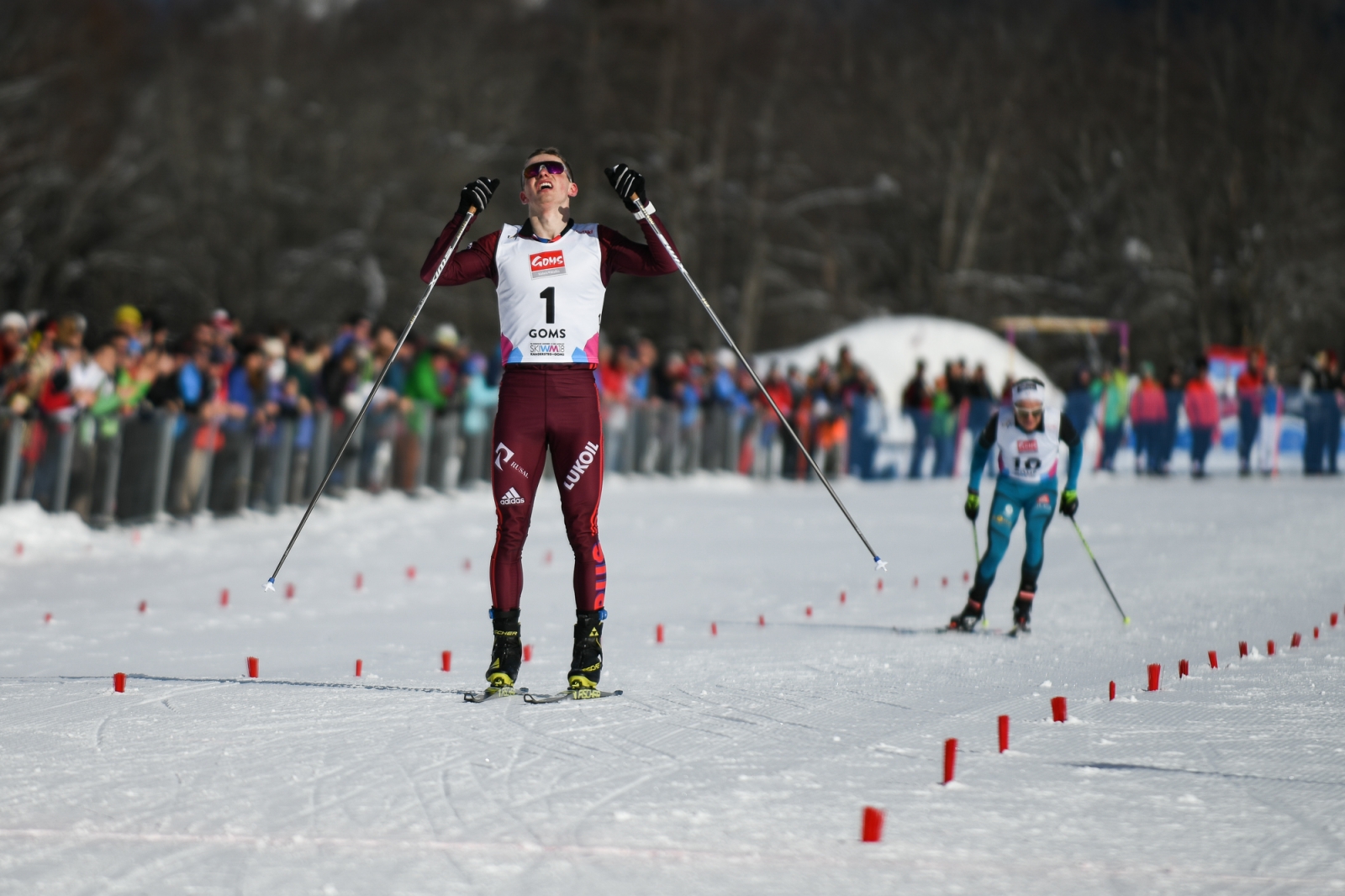
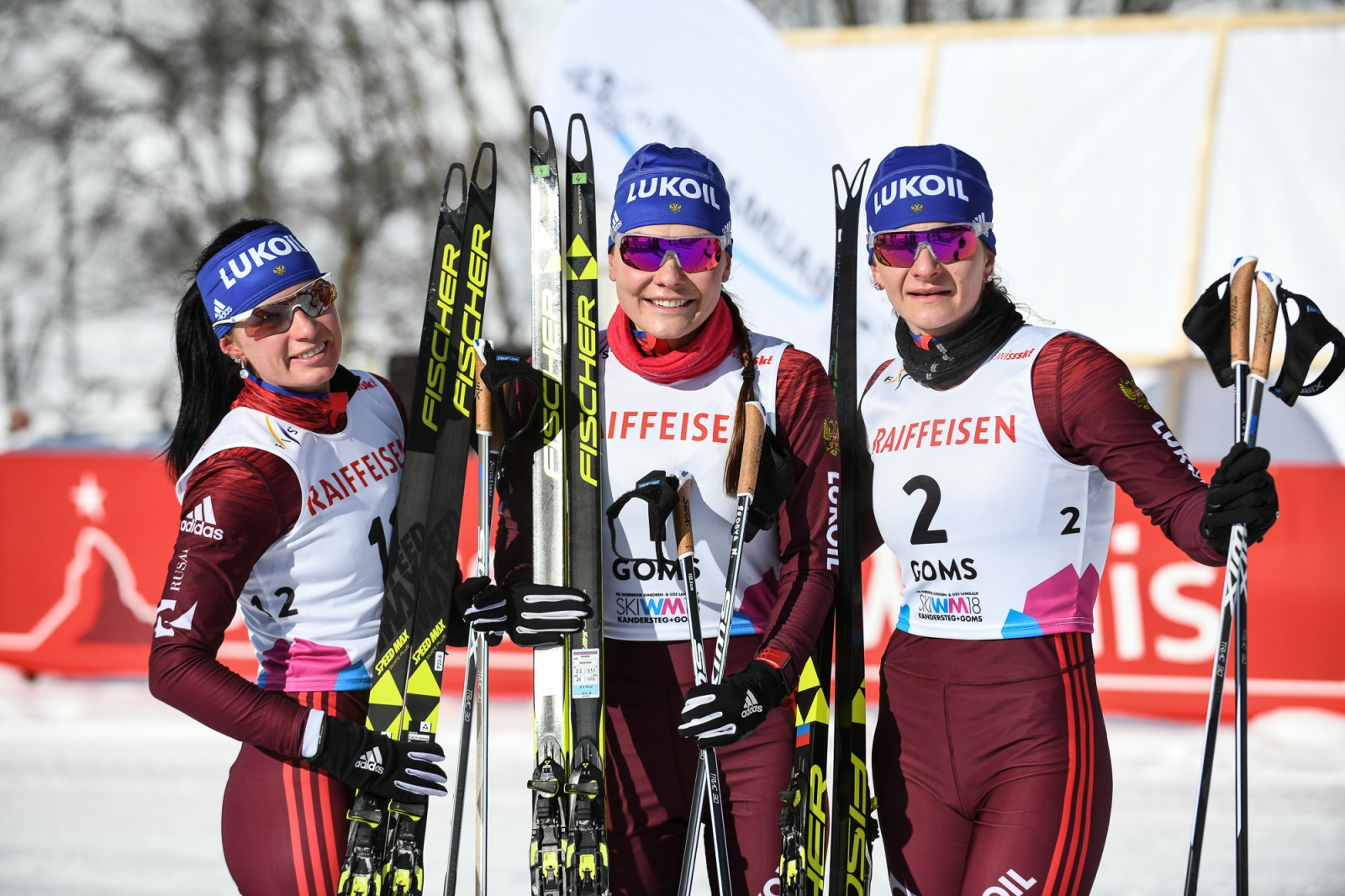
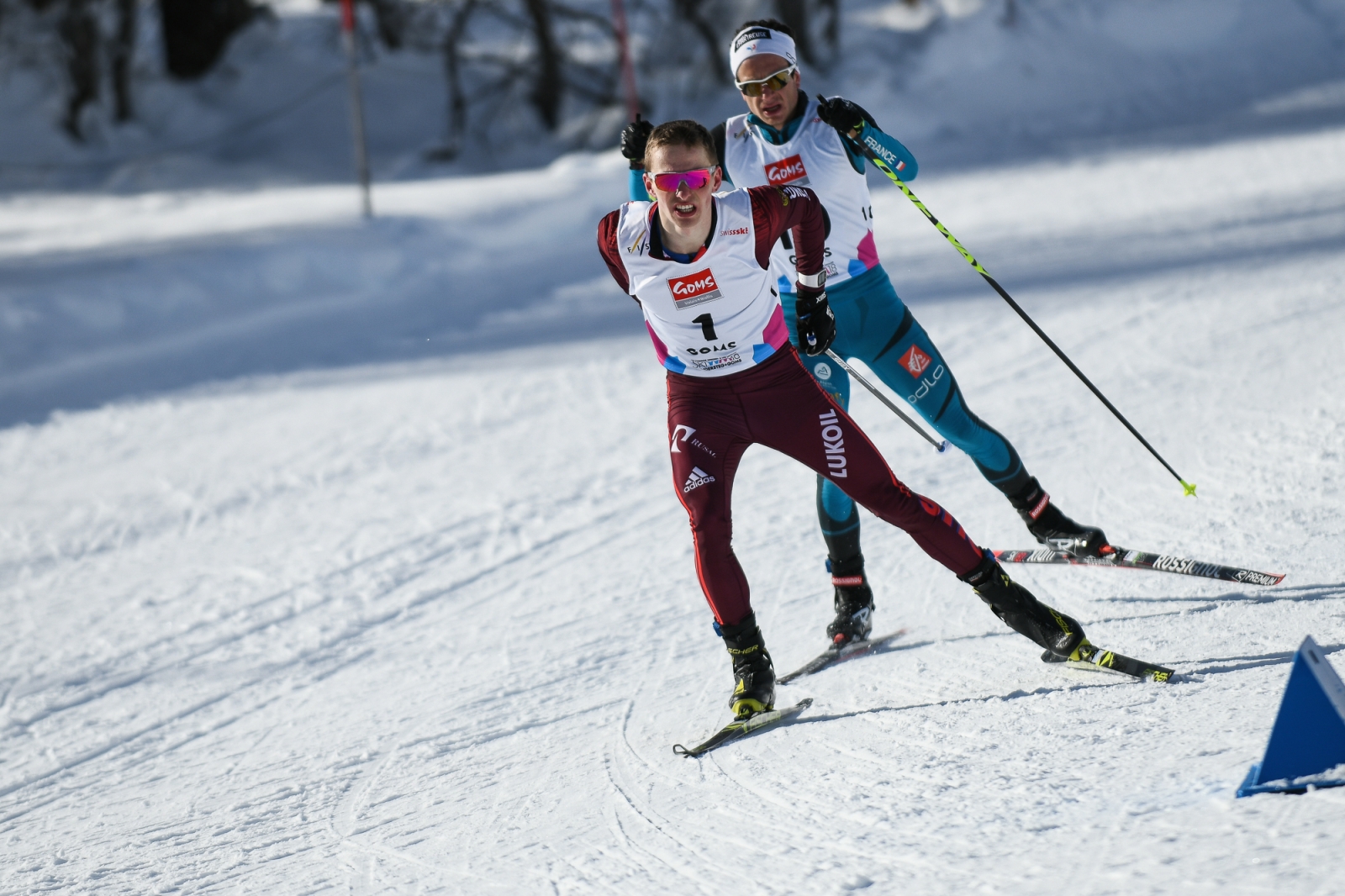
    Weng finished 1:05.5 minutes behind in a comfortable second place. According to FIS, it was her first podium in Lahti.

    “I like the track in Lahti. … I felt I had perfect classic skis,” she said. “When Therese went away I was on my own and had to find my own pace.”

    As the others flew into the stadium for the last few-hundred meters, small gaps had formed. Østberg won the race for third, 1:31.9 behind Johaug and 4.7 seconds ahead of Falla in fourth (+1:36.6). Roponen as the first non-Norwegian placed fifth (+1:39.0).

    “I am really, really happy! It was impossibly nice to ski,” Roponen told Finnish broadcaster YLE after the race, according to a translation.

    Her fifth place at home marked her first top 10 of the season.

    “I really liked a lot of these new tracks,” she said.

    Two other Finnish women landed in the top 10, with Anne Kyllönen in ninth and Parmakoski in 10th.

    Bjornsen 15th; Three Americans in Top 30

    Of the three U.S. women on the start line Sunday, all three finished in the points within the top 30. Bjornsen led the charge in 15th, 2:26 seconds behind Johaug, while Jessie Diggins finished close behind, in 17th (+2:29.2).

    Americans Sadie Bjornsen (front) and Jessie Diggins (behind, left, in white) chasing the leaders during the women's 15 k skiathlon on Sunday at the World Cup in Lahti, Finland. They went on to place 15th and 17th, respectively.
    Americans Sadie Bjornsen (front) and Jessie Diggins (behind, left, in white) chasing the leaders during the women’s 15 k skiathlon on Sunday at the World Cup in Lahti, Finland. They went on to place 15th and 17th, respectively.

    Despite being comfortably into the top 30, Bjornsen and Diggins both struggled to navigate the chase packs as it split.

    “It was an up and down, roller-coaster-feeling day,” Bjornsen said in an in-person interview after the race. “The classic was especially challenging today because of the [slow, fresh-snow] conditions. It didn’t stretch out, so when you are in the middle of that front pack, you just stop-go, stop-go, stop-go, fight for position, stop-sprint, and I never felt like I got in a classic groove. And I mean that is the challenge of classic mass start, but I think especially with these conditions, it intensifies it.”

    As the chase group split in the second lap of the classic race, neither Diggins nor Bjornsen were able to stay with the front end.

    “I just was not at the right place at the right time when they broke on that second loop of the classic,” Bjornsen said.

    Jessie Diggins (U.S. Ski Team) celebrates second place, her career-best sprint result at the Lahti World Cup skate sprint on Saturday. (Photo: Salomon/NordicFocus)
    Jessie Diggins (U.S. Ski Team) celebrates second place, her career-best sprint result at the Lahti World Cup skate sprint on Saturday. (Photo: Salomon/NordicFocus)

    “[Yesterday] definitely took a toll [on me],” Diggins said after the race. “I was pretty tired after doing all the [sprint] rounds and doing such a long sprint yesterday. But you know, it is good to practice the skiathlon when you can and I thought, even if my body doesn’t feel like it is there, I will practice my tactics, work on everything else and try to have some fun out there.”

    The freestyle leg went better for Diggins and Bjornsen, with both of them gaining spots back, but neither was able to reattach to the leading chase pack.

    “The first lap I was having a hard time hanging onto the pace,” Bjornsen said. “But I just tried my hardest to just stay with that group that I went through the exchange with, and then the second lap of the skate felt a lot better.”

    Notably, Bjornsen had the fastest mid-race transition time, switching from classic to skate faster than anyone else.

    To her surprise, Caitlin Patterson, of the Craftsbury Green Racing Project, finished 29th (+3.22) for her second-career top-30 result in the last two weekends.

    “I was really happy to hear that apparently I was 29th, so back into the top 30!” she exclaimed. “I didn’t feel like I had that today, especially when I was out there on that classic leg, so I was really happy to do that after all.”

    After catching a few days rest at home, the U.S. Ski Team will launch into action at the eight-stage Ski Tour Canada, beginning in Gatineau, Québec, on March 1.

    — Harald Zimmer contributed reporting

    Results

    ***

    About the Author: JoJo Baldus is a nordic skier from snowy Minneapolis, Minn. Currently living the dream as a volunteer journalist and photographer for FasterSkier while enjoying a gap year before starting at Macalester College in St. Paul. He could not be more excited to attempt to stagger across the finish line of 8 different WorldLoppet ski races this winter!

  • Bjornsen Scores Another Top 20; Four U.S. Women in the Points in Lillehammer Skiathlon

    Sadie Bjornsen racing to 14th in the women's 5 k freestyle at last weekend's World Cup in Kuusamo, Finland. She placed 14th overall in the Ruka Triple mini tour. In four races so far this season, Bjornsen has finished in the top 20 in all of them. (Photo: Fischer/NordicFocus)
    Sadie Bjornsen racing to 14th in the women’s 5 k freestyle at last weekend’s World Cup in Kuusamo, Finland. She placed 14th overall in the Ruka Triple mini tour. In four races so far this season, Bjornsen has finished in the top 20 in all of them. (Photo: Fischer/NordicFocus)

    All ski races can be considered a game of balancing strengths and weaknesses, but this is rarely more obvious than in skiathlons.  Featuring a technique change halfway through the race, skiathlons are a unique race format that favor versatile racers.

    The U.S. women were able to strike this balance on Saturday and end up with four in the top 30 in the 15-kilometer skiathlon at the World Cup in Lillehammer, Norway. Sadie Bjornsen led the U.S. Ski Team women in 20th place (+3:28.2), closely followed by Liz Stephen in 25th (+3:51.7) and Jessie Diggins in 26th (+3:53.2). Caitlin Gregg made the points in 30th (+4:06.3) and Rosie Brennan was about 40 seconds out in 37th.

    Norwegian Therese Johaug continued to demonstrate her dominance by winning by nearly a minute and half over her teammate Heidi Weng. Just 0.1. seconds behind Weng, Charlotte Kalla of Sweden claimed the third (+1:29.4).

    The skiathlon format featured a 7.5 k classic portion followed by 7.5 k of freestyle. Due to a lack of snow, the skate and classic legs were held on the same 3.75 k lap.

    The mid-race technique change poses a challenge for skiers who feel significantly more confident in one technique over another. Both Bjornsen and Brennan consider classic skiing to be their strength.

    “In the past, classic technique has been my stronger suite, so it’s always a hard switch for me to go into skating and feel I’m in a league I don’t belong in,” Bjornsen said in a phone after the race. “Today when I switched to skate skis I felt really good and strong and was able to ski with the people I was around so I was pretty stoked about that.”

    Although her classic leg was not what Bjornsen was hoping for — she stood in 17th at the ski change — she posted a strong skate leg to finish 20th overall.  Her top 20 was on the heels of her 14th overall finish in the Ruka mini tour last weekend. In four World Cup races so far this season, Bjornsen has finished 20th or better in all of them.

    “Sadie continued to demonstrate that right now she has the complete package in skating and classic,” U.S. Ski Team Head Coach Chris Grover said on the phone. “She held steady throughout the race, maybe a little stronger in classic. She really just confirmed that last weekend’s results is really where she is at in technique and fitness.”

    Rosie Brennan racing in the relay at 2015 World Championships last season.
    Rosie Brennan racing in the relay at 2015 World Championships in Falun, Sweden.

    Brennan explained that, personally, ending with skating can be challenging.

    “I am typically a much better classic skier so this format has always been a bit of a mental hurdle for me knowing I have to finish skating,” she wrote, explaining that she tried to start the race faster to compensate. In the skate portion, Brennan conceded just four places, from 34th at the ski change to 37th overall.

    The Lillehammer course is notoriously difficult, and the course challenges were compounded by the multiple-lap format. Because both techniques were held on the same lap, the classic tracks were partitioned off which created a narrow course for a mass start race.

    “This was our first mass start so it provided good practice skiing in packs and working through tight sections,” Brennan explained. “It was very challenging to pass anyone with just two narrow tracks for much of the loop.”

    “It is one of the hardest courses on the World Cup circuit” Grover said.  “The course is defined by a tough 700-meter climb racers had to tackle each lap. People have different strategies for how they were going to survive that hill or excel on that hill or save their energy for that hill.”

    For Stephen, one thing she wanted to do was “ski like hell on the climbs.”  This mission was accomplished, in addition to her goal of finishing in the top 30 to earn World Cup points for the first time this season.

    Thirty-sixth and 2:12 back from race leader Johaug at the halfway point, Stephen skated her way up to 25th over the second half of race.

    Liz Stephen attacks a climb in the 30 k classic at 2015 World Championships.
    Liz Stephen attacks a climb in the 30 k classic at 2015 World Championships in Falun, Sweden. She placed 25th on Saturday at the Lillehammer World Cup skiathlon in Norway for her first top 30 of the season.

    “Classic is a really big work in progress for me so I am always excited to make the switch to skating,” Stephen said on the phone.

    She considered her result “a good step up from last weekend so that’s a good feeling,” she said. At last weekend’s Ruka Triple, she placed 59th overall.

    “I know there is a lot more to come and I have a lot more expectations than I was able to fulfill, but it is also a really long season,” Stephen said. “I feel good about where my energy is and I know I’ve trained really hard so I’m being patient.”

    For the team’s skating powerhouses, the plan was mostly to stay in contention during the classic leg and attack the second half. However, for Diggins and Gregg, both World Championships medalists in the 10 k freestyle, their classic legs turned out to be pleasant surprises.  Gregg was 29th at the transition, 1:57 behind the leader, and Diggins was in 33rd, eight seconds out of 30th and 2:07 back.

    Grover cited Gregg’s classic leg as one of the highlights of the day. “It was really a step forward with her technique and her fitness has been great all year,” he said.

    “My classic leg felt really good today. I would say it felt better than my skate at times,” Gregg wrote  in an email. “Both were a solid step in the right direction and I feel like I will continue to improve.”

    Diggins also saw her classic leg as definite progress.

    “I think my classic skiing took a step forward with all the steep hills from where it was last year,” Diggins wrote in an email. “I worked my way up a few places in the skate half and I had really great skis today in both techniques. My body was a bit tired and I’ll be doing a little more recovery training next week to prepare for [the World Cup in] Davos.”

    “It’s really fun to have the girls finishing in the top 30,” Bjornsen said. “It’s nice that everyone is starting to feel like themselves and it makes me really excited for tomorrow. It should be a really fun day and the Norwegian vibe around here is always amazing with the amount of cheering.”

    Bjornsen will start second for the U.S. in the women’s 4 x 5 k relay on Sunday, after Brennan leads the team out in the first of two classic legs. Stephen will ski the first skate leg, and Diggins will anchor.

    Canada’s lone female in Lillehammer, Emily Nishikawa placed 52nd (+7:11.9) after ranking 46th at the end of the classic leg.

    Results

  • Johaug Powers to Skiathlon Victory as Jacobsen and Kalla Battle for Second in Falun

    Norway's Therese Johaug celebrates her win the 2015 FIS Nordic World Ski Championships 15 k skiathlon in Falun, Sweden. She finished over five seconds ahead of teammate Astrid Jacobsen and Charlotte Kalla of Sweden who finished second and third, respectively. (Photo: flyingpointorad.com)
    Norway’s Therese Johaug celebrates her win the 2015 FIS Nordic World Ski Championships 15 k skiathlon in Falun, Sweden. She finished over five seconds ahead of teammate Astrid Jacobsen and Charlotte Kalla of Sweden who finished second and third, respectively. (Photo: flyingpointroad.com)

    FasterSkier’s coverage of the 2015 FIS Nordic World Ski Championships in Falun, Sweden, is brought to you by the generous support of L.L. Bean, now featuring a complete line of Kikkan Randall training wear.

    FALUN, Sweden —  Mördarbacken, or “murder-hill”, has its name for a reason. It’s a long, steep pitch where competitors either sucumb to fatigue or thrive on the challenge of the climb. Such was the case in Saturday’s 7.5-kilometer classic + 7.5-kilometer freestyle skiathlon at the 2015 FIS World Ski Championships. Norway’s Therese Johaug embraced the challenge of her last time on the hill and powered ahead of teammate Astrid Jacobsen and Charlotte Kalla of Sweden in to take her first-ever win in a championship skiathlon.

    Johaug held the lead and collapsed across the finish line to earn her third individual World Championship. She ended her 15 k effort with a time of 40:57.6, over five seconds ahead the heated battle for second between home-crowd favorite Kalla and Jacobsen. In the end Jacobsen crossed the line ahead of Kalla by 0.3 seconds to take silver. The two finished 5.7 and 6.0 seconds behind Johaug, respectively.

    Saturday’s skiathlon started in typical fashion with defending World Champion, Marit Bjørgen, commanding the charge out of the stadium with a group of fellow Norwegians, Swedes and Finns hot on her tail. The pace was relaxed and roughly 30 skiers grouped together in the first kilometers.

    Unsatisfied with the speed of the pack, Johaug took charge from her teammate and quickened the tempo. The Norwegian and Kalla traded the lead throughout the majority of the first 7.5 k as the fight for gold was narrowed to six skiers, with the two leaders plus Jacobsen, Bjørgen, Kerttu Niskanen of Finland, and Sofia Bleckur of Sweden all within 10 seconds.

    Therese Johaug leads the push in the classic leg for the women's 15 k skiathlon at the 2015 FIS Nordic World Ski Championships in Falun, Sweden. (Photo: flyingpointroad.com)
    Therese Johaug leads the push in the classic leg for the women’s 15 k skiathlon at the 2015 FIS Nordic World Ski Championships in Falun, Sweden. (Photo: flyingpointroad.com)

    As the group entered the freestyle portion, Johaug explained she began to tire and questioned her aggressive tactics in the race’s classic portion. “I wanted to go out hard from the start, but when I came into the swap zone from the classical part I thought I maybe had gone out too tough,” the world champion said in a press conference. Given her fatigue, the 26-year-old rested behind Jacobsen and Kalla as they exited the stadium.

    Clocking the second-fastest pit time, Jacobsen left the exchange in first. The Norwegian explained that she hadn’t planned to be at the front so early given her starting spot but was pleased to find herself skiing with Johaug for much of the classic portion.

    “I wasn’t good seeded so I started on the third line but everything opened up and I could go behind Therese. She’s skiing so well right now, but it’s easy to follow her because she has good rhythm,” Jacobsen said.” When Therese attacked first on the classic, then I just thought that I should try and follow.”

    Jacobsen skied with large, bold glides as she led Kalla and Johaug into the second half of the course. She knew her skiing was strong but expected to see a large train of women following close behind. Instead, Jacobsen, Kalla and Johaug skied alone, with defending world champion Bjørgen nowhere in sight. “I was surprised that we were suddenly only three left because I thought there was going to be a big line behind,” she said.

    With roughly seven kilometers left, Kalla took the lead and increased the pace with Johaug hot on her tail. While Jacobsen struggled on many of the climbs, she made contact with the two skiers on the downhills.

    As the three started up Mördarbaken for the last time, Johaug made a decisive move. Swerving around a slowing Kalla, the Norwegian began to jump-skate  the steep hill to accept its challenge wholeheartedly. The move was successful, as Johaug lengthened her lead over the two skiers with each stride. By the time she reached the top of Mördatbacken at the 12.5 k mark, Jacobsen and Kalla trailed by 5.1 seconds and 11.3 seconds, respectively.

    “My chance was to attack on the last hill,” Johaug said. “I tried and I made a gap. My legs was really stiff to the top, but I tried to work really hard with myself so I could pass the finish line that know I that I was the World Championship.”

    Jacobsen attempted to stay with her teammate but after several meters knew the attempt was futile. “When she attacked again on skating it was just game over,” Jacobsen said. “I tried to follow but I had no chance.”

    With gold all but secured for Johaug, the race became a heated fight for second. Jacobson’s attempt to stay with Johaug cost her precious energy and Kalla soon caught her. For the remaining 2 k, Kalla gained a narrow lead on each of the uphills while Jacobsen surged back on the downhills.

    The game of cat and mouse was almost over as Norwegian and Swede entered the stadium together. The two rounded the U-turn and jostled for the best lane into the finish. Afterwards, Jacobsen said the fight gave her extra energy to out-sprint Kalla across the line.

    “When Charlotte caught me again, then I felt ‘ok, I need to stay on two feet so you can take the last medal.’ But when I came down to the stadium, I practiced so much on this last climb on the stadium, I just had to do it as well as I did in training yesterday,” Jacobson explained. “Then we were fighting towards the finish line, like what lane to take. I felt a bit provoked so I got more energy.”

    Johaug, who started Saturday’s race as one of the favorites, explained that the skiathlon victory was something she had been working towards all season. “It was a dream here to take gold medal,” she said in a press conference. “I have trained more than a thousand hours over the past year to experience this. I really love the course here, it’s my type of course.”

    She said the roughly 45,000 fans who lined the course gave her energy as she climbed Mördarbacken. Johaug added that it was great to have such a heated competition between two rivals, Norway and Sweden, in front of die-hard fans from both countries.

    Although she was unable to match the form of her teammate, Jacobsen compared her silver medal to a win. It was her first individual World Championships medal in eight years after earning gold and two bronze in Sapporo, Japan.

    The years since have been filled with difficulty for the 26-year-old. Just one day before the start of the 2014 Olympic Games, her brother and training partner passed away unexpectedly, causing emotional hardship for the Norwegian throughout the event and remainder of the year. Later that season she crashed into a lamppost in the Holmenkollen 30 k and was rushed to the hospital. With no serious injuries resulting from the crash, Jacobsen began what looked to be a productive training season that spring. By the fall of 2014, however, Jacobsen told NRK that her body was no longer responding to training.

    Charlotte Kala leads Therese Johaug and Astrid Jacobsen in the final kilometers of Saturday's 15 k skiathlon at the 2015 FIS Nordic World Ski Championships in Falun, Sweden. (Photo: flyingpointroad.com)
    Charlotte Kala leads Therese Johaug and Astrid Jacobsen in the final kilometers of Saturday’s 15 k skiathlon at the 2015 FIS Nordic World Ski Championships in Falun, Sweden. (Photo: flyingpointroad.com)

    Jacobsen started the year’s World Cup circuit in Lillehammer, Norway, where she placed in the 30s. Her next World Cup came after a long break when she won the 10 k freestyle in Rybinsk in late January. Although Jacobsen’s participation in World Championships appeared to be a longshot at the turn of the year, her win in Russia along with a strong Norwegian National Championships, secured her spot in Falun.

    Jacobsen told FasterSkier that her main goal in Saturday’s skiathlon was to enjoy racing and allow the experience to sink in. “My biggest goal was just to go out there and enjoy and have fun. This is the World Championships and it’s our biggest feast. I just decided that I didn’t want the seriousness to take all the space, so my goal was to enjoy today and just suck in all the good atmosphere,” she explained.

    Jacobsen said that racing Kalla in front of the large Swedish and Norwegian crowds was a memorable experience that motivated her throughout the 15 k. The Norwegian explained that she races best when she’s positive and enjoys what’s she’s doing.

    “To ski out there today was awesome because [there were] so many Norwegians and even more Swedes. This dual between Charlotte and me made the crowds go crazy. These 40 minutes went away so fast,” she said to Fasterskier. “I created some really good memories, and that was my biggest goal.”

    With her third place, Kalla earned her first individual World Championships medal in front of a home crowd. She explained in a press conference that an individual medal was her main goal of the 2015 season. “I’m very happy to have an individual world champion medal. I have worked hard for this and it has been a special season for me,” she said.

    According to the Swede, the pressure from the home crowd was nerve-wracking but ultimately motivating.

    “I was quite nervous today in the morning getting into the competition area. I saw from my hotel window that there was a lot of audience going to the Lugnet,” she explained. “When I came to the track and started to test the skis I just focused everything good during the warmup. It was fantastic to go on Mördarbacken and hear all the audience because they were cheering for me and I felt that everyone was there for me to do a really good race today.”

    Finishing sixth, Bjørgen ended her day far from where many expected. She explained that Johaug’s pace was too fast for her to maintain contact.

    “It was tough for me out there today. My body just wasn’t there. I felt it as soon as Therese surged on Mördarbacken the first time. I just had to let go,” Bjørgen said to Norwegian reporters. “It was too hard when we had to ski hard and fast for a longer period than the sprint.”

    While the World Cup points leader was unable to achieve her quest in Saturday’s skiathlon to tie Russian Elena Välbe for the most World Ski Championships wins, Bjørgen said she was happy to see Jacobsen on the podium given the hardships she has faced.

    “She deserved this medal after all she’s been through this last year, starting with the death of her brother during the Sochi Olympics and then illness and injuries all through the summer and fall,” Bjørgen said.

    Racing continues Sunday in Falun with the men’s and women’s team sprint competition.

    Results

  • Stephen Leads North Americans in 11th in World Champs Skiathlon Despite Fatigue

    Liz Stephen racing to 11th in Saturday's 15 k skiathlon at the 2015 World Championships in Falun, Sweden. (Photo: flyingpointroad.com)
    Liz Stephen racing to 11th in Saturday’s 15 k skiathlon at the 2015 World Championships in Falun, Sweden. (Photo: flyingpointroad.com)

    FasterSkier’s coverage of the 2015 FIS Nordic World Ski Championships in Falun, Sweden, is brought to you by the generous support of L.L. Bean, now featuring a complete line of Kikkan Randall training wear.

    FALUN, Sweden — Saturday’s 15-kilometer skiathlon at the 2015 FIS Nordic World Ski Championships went better than Liz Stephen expected. The American entered the day with few goals due to fatigue from the prior week’s training, but exited with an 11th place finish that landed her 1:45 behind race-winner Therese Johaug,

    “It was much better than I expected it to be,” Stephen said a post-race interview. “I’ve had a little bit of low energy – just tired muscles and fatigue – coming out of the training week. I’ve been resting a bunch, but today I didn’t really have any expectations, I just wanted to get a race out of the way and test out how racing felt.”

    Wearing bib five and starting in the first row of the mass start chevron, Stephen led the pack from the start, along with Norwegians Johaug and Marit Bjørgen. Her action at the front was short lived, however, as the 27-year-old fell back to roughly 15th place in the first 500 meters. Often a slow starter, Stephen said the pace of the pack was relaxed, which helped her maintain contact.

    “I’m not a super fast starter,” she said. “I have to say, that was the chilliest mass start I’ve ever done. I don’t know if maybe Marit wasn’t feeling so good or whoever pushes the pace up there just kept it chill, but I couldn’t believe how easy it was in the beginning. So it worked out okay for me.”

    Liz Stephen, USST, leading Riitta-Liisa Roponen of Finland as she skied to 11th in Saturday's 15 k skiathlon at the 2015 World Championships in Falun, Sweden. (Photo: flyingpointroad.com)
    Liz Stephen, USST, leading Riitta-Liisa Roponen of Finland as she skied to 11th in Saturday’s 15 k skiathlon at the 2015 World Championships in Falun, Sweden. (Photo: flyingpointroad.com)

    Stephen maintained her position in the group, trying to hold her standing before the switch to freestyle – her stronger technique – at 7.5 k. The Vermont native entered the stadium in 20th and clocked the eighth-fastest pit time. Stephen began her attack as she transitioned from classic to freestyle. She made her way through the pack, nearing one of the competition’s favored skiers.

    “[I] started to see Heidi [Weng] and Marit. The last time I think I saw Marit in a race was Liberec in 2009, so it was motivating to see her right up there,” Stephen said of seeing the famed Norwegian, who skied to sixth in the skiathlon. “If you see Marit it must be at least fairly good.”

    Stephen entered the stadium in a fight for seventh which included Norwegian Heidi Weng, Riitta-Liisa Roponen of Finland, Maria Rydqvist of Sweden and Eva Vrabcova-Nyvltova of the Czech Republic. As they sprinted the final meters Stephen fell behind to finish 11th overall.

    While Stephen missed the top-10, her skate leg was the fourth fastest of the day. Her time of 21:04 in the final 7.5 k was only bested by the three podium finishers: Johaug, Astrid Jacobsen of Norway, and Charlotte Kalla of Sweden.

    With Saturday’s race complete, Stephen will look to Tuesday’s 10 k freestyle as her best chance for a top performance.

    “I have a few days for recovery now, and that’s kind of my key individual race,” she siad, referring to the 10 k freestyle. “I have some focusing to do and figure out exactly how I want to ski the course and ski it the best I can. I’m really excited.”

    Teammate Sadie Bjornsen was also pleased with her race after finishing 20th overall and skiing the 17th fastest classic and 22nd fastest freestyle legs. “It was really fun and I’m happy with it,” Bjornsen said in an interview. “Pursuits have never been my strongest suit, and so it’s always a goal to come away from a pursuit feeling good.”

    Sadie Bjornsen, USST, races to 20th in Saturday's 15 k skiathlon at the 2015 World Championships in Falun, Sweden. (Photo: Flyingpointroad.com)
    Sadie Bjornsen, USST, races to 20th in Saturday’s 15 k skiathlon at the 2015 World Championships in Falun, Sweden. (Photo: Flyingpointroad.com)

    Bjornsen explained that she struggled in the classic portion of Saturday’s race – a technique that usually favors the Washington native. In the end, however, she recovered for a strong second half after skiing in a grouping of competitors. The 25-year-old used the roughly 45,000 fans that lined the trails of the Falun Lugent Ski Stadium as motivation while traversing the challenging course.

    “Mördarbacken (a large climb called ‘murder-hill’) was just filled with fans, and it was actually spectacular because I could take my brain outside of my head and just listen to the crowd to channel some rhythm to keep going up that hill,” she said. “I definitely am thankful for that hill and that crowd today.”

    “It’s a feeling that I can’t even explain,” Bjornsen added. “But it’s one of those things I’m going to remember past ski racing – the feeling of that crowd powering you.”

    In 30th place American Rosie Brennan said she enjoyed skiing alongside the cheering crowd, but that the number of people was often overwhelming.

    “I like cross country skiing because I like being alone in the woods,” she said. “Having so many people around is something you have to adjust to.”

    Brennan fell in the first meters of the skiathlon and fought to reclaim her position in the group of women for the rest of the classic portion. She eventually made her way up to 23rd, but the Alaska Pacific University skier explained the effort used to comeback ultimately affected her freestyle leg.

    “I fell right out of the start, so I was really far back in the classic,” Brennan said. “I worked pretty hard to get back up and I got to the position I wanted to be in right at the end of the classic race. I didn’t feel like I had much time to kind of relax, which I think probably stressed me out in the skating.”

    Rosie Brennan, USST, skis 30th place in Saturday's World Champs 15 k. (Photo: flyingpointroad.com)
    Rosie Brennan, USST, skis to 30th place in Saturday’s 15 k skiathlon at the 2015 World Championships in Falun, Sweden. (Photo: flyingpointroad.com)

    Just over 30 seconds behind Brennan was Kikkan Randall, who said her entry in the skiathlon was a last-minute decision. Randall struggled with the classic portion, but explained she was able to ski a solid second half after switching to freestyle.

    “I was kind of interested to see what I would feel like out there today. I tried to go in with a positive mindset, but once again I think I felt better and skied better in the warmup,” she said. “Things are not clicking. I’m not getting the good race feel where I can get into a good pace and work there. It is challenging mentally to not be feeling that, not to be feeling in the hunt.”

    “[I’m] just kind of playing it day by day, and searching, and trying to find better feelings,” she added.

    Randall entered the skiathlon after USST coaches decided that she would not start in Sunday’s team sprint. Randall is the defending world champion in the event after she and Jessie Diggins won the title at the 2013 Championships in Val di Fiemme, Italy. The 2015 team will consist of Diggins and Sophie Caldwell.

    The final North American in Saturday’s race was Canadian Perianne Jones, who ended her day in 37th. Jones, a strong sprinter who is competing in her fourth World Championships, said the classic portion of her race went especially well.

    “The classic felt great,” Jones said after the race. “When we switched to skating, for sure people started to go by me pretty quickly.  I tried to just latch on to people as they went by and stick with them for a little while.  It was really painful but better than it could’ve been.”

    Jones will not compete in Sunday’s team sprint as both her teammates, Olivia Bouffard-Nesbitt and Emily Nishikawa are recovering from illness in Östersund, Sweden.

    Results

  • Norway’s 10,000-Meter Champ, Steira Taking One Step at a Time

    Norway’s 10,000-Meter Champ, Steira Taking One Step at a Time


    Kristin Størmer Steira on the podium at the Sochi Olympics closing ceremony with teammates Marit Bjørgen (top) and Therese Johaug, after Norway swept the podium in the women's 30 k freestyle mass start, the last cross-country race of the Olympics. (Photo: Wikimedia Commons)
    Kristin Størmer Steira (r) on the podium at the Sochi Olympics closing ceremony with teammates Marit Bjørgen (jumping) and Therese Johaug, after Norway swept the podium in the women’s 30 k freestyle mass start, the last cross-country race of the Olympics. (Photo: Wikimedia Commons)

    Note: This article has been updated to include Kristin Størmer Steira’s most recent athletic accomplishment as 10,000-meter champion at Norwegian Athletics Championships on Sunday. It was her first time running the 10,000, according to VG.

    ***

    If you asked Kristin Størmer Steira about the ‘R’ word six months ago, the Norwegian national-team member might’ve told you she was considering it.

    A not-so-hot start to her third Olympics had left the then-32-year-old Steira contemplating retirement. Never before had she been outside the top 10 at the Olympics, and in two previous 15-kilometer skiathlons at back-to-back Olympic Games, she placed fourth.

    Kristin Størmer Steira in 2012 (Photo: Wikimedia Commons)
    Kristin Størmer Steira in 2012 (Photo: Wikimedia Commons)

    But in Sochi, she was 23rd — not bad, but not to her standards.

    Her next chance came in the 30 k freestyle mass start, the final race of the Sochi Games.

    In a seemingly seamless race for three Norwegians, Steira placed third behind her two teammates Marit Bjørgen and Therese Johaug, respectively. It was her first Olympic medal in eight individual starts.

    “My Olympics went from the worst competition I’ve ever had to maybe the best,” Steira said on the phone from Norway earlier this summer. “It was a special Olympics for sure.”

    Before the races began, her team had to cope with the sudden passing of teammate Astrid Jacobsen’s brother, a skier whom many of the national-team members were close with.

    “It was a lot of feelings, a lot of emotions,” Steira recalled. “We had a rough time in our team … but in the end, to have a medal in the 30 k … I really, really felt that I worked hard for that and to be able to do it when it counts was a great feeling.”

    She also had the unique experience of standing on the podium at the closing ceremony in front of 40,000 spectators and millions more who watched on TV.

    “It was maybe the best day for being on the podium,” Steira said. “You felt kind of small getting up on stage with the crowd and the stadium. I’ll never experience [that] again.”

    One might ask, why not? With four individual World Championships podiums and 22 World Cup podiums in the last 12 years, and after placing second in the rollerski hill climb at the Blink Festival in Norway earlier this month, how does she know when it’ll be over?

    She doesn’t, but she was thinking about it after Sochi.

    “I was more towards not doing another year and I guess the medal in the 30 k both made me kind of feel [like] I could stop skiing — I managed to do what I planned to do: have a medal individually in the Olympics,” she said. “On the other side, it also makes you so motivated to do another year. I guess when I was thinking about it, it counted both ways.”

    “I want to learn something other than classic and skating and technique, to put my mind a bit on other stuff and also start preparing for the next step — whatever that will be.” — Kristin Størmer Steira, Norwegian national-team member & three-time Olympian

    So here she is, 33 and revving up for the 2015 World Championships in Falun, Sweden.

    “It’s close to Norway,” she said of her decision to focus on Falun and race for another season. “I think it will be amazing [at World Championships] … a lot of people, but I guess in the end mostly the motivation was still there and I love skiing and I wanted to give it one more year, mostly because it was so fun.”

    Kristin Størmer Steira rappels during her three-week trek with Devon Kershaw in the Himalayas in April. (Photo: Devon Kershaw)
    Kristin Størmer Steira rappels during their Himalayan trek. (Photo: Devon Kershaw)

    In late April, she got sick during a three-week excursion in the Himalayas. She left Kathmandu with a ring on her finger, thanks to fiancé Devon Kershaw, but it took her some time to shake the parasite she contracted on her way up the 6,476-meter (21,000-foot) Mera Peak.

    “Early summer was not quite as planned … I still struggled to recover after illness in Nepal,” she wrote on her blog.

    After spending some time with family, “hiking, swimming, grilling,” she worked back into her full-training load before Blink and her team’s training camps in August.

    Steira missed the women’s team’s June camp in Hemsedal because she wasn’t fully recovered, but was back with them in Lillehammer earlier this month. She said they planned to train in Italy in late August-early September, and will be back in Norway in October.

    “We normally have been in Italy in the last week of June-first week of July, but since worlds is not at altitude we decided not to,” she said of the altitude camp.

    On Sunday, she ran the 10,000-meter distance event at Norwegian Athletics Championships and won it by a minute and 46 seconds. Norway’s VG asked Athletics Association Director Ronny Nilsen whether that was embarrassing for the sport.

    “No, it is not,” he said, according to a translation. “Kristin is strong, and there were several good runners that were missing at the starting line.”

    Steira said “it was a pity” that so many top runners didn’t start, but it wasn’t embarrassing. She simply dropped the pack early.

    “Ten-thousand [meters] is a distance that suits a skier well,” she told VG. “But athletes certainly wish there were more people to compete with.”

    After the race, she tweeted that she was celebrating her 10,000-meter debut with coffee.

    “Ten-thousand [meters] is a distance that suits a skier well.” — Steira on her 10,000-meter win in her debut at Norwegian Athletics Championships

    Back to Skiing

    Looking ahead to Falun, Steira couldn’t say exactly what was next — except for no more Olympics.

    “I do not have a long-term plan for my skiing, but I learned from my earlier mistakes saying this is my last year,” she said. “But I don’t think longer than Falun this year of skiing, then we’ll see. It’s a pretty sweet life so it’s hard to stop doing the thing you love the most. I’m getting older and it’s other things I want to do and have a family and stuff so we’ll see. I will not take another Olympic year, that’s for sure.”

    She has a bachelor’s degree in marketing and is starting an MBA program this fall.

    “I’m going part time back to school this year mostly because I feel it’s time,” she said. “I want to learn something other than classic and skating and technique, to put my mind a bit on other stuff and also start preparing for the next step — whatever that will be, I’m not sure.”

    Her focus will be human resources: mostly concerning personal relationships and working in teams.

    “I’m still hoping that Oslo will get the Olympics for 2022, so maybe I’ll get some work for that,” she said. “That could be interesting.”

  • Three Americans Land Top 20, Four in Top 21 at World Cup Finals Skiathlon

    Three Americans Land Top 20, Four in Top 21 at World Cup Finals Skiathlon

    The start of the women's 15 k skiathlon on Saturday at World Cup Finals in Falun, Sweden. (Photo: Fischer/Nordic Focus)
    The start of the women’s 15 k skiathlon on Saturday at World Cup Finals in Falun, Sweden, with American Kikkan Randall in the front row at the far right. Randall went on to place 20th for the second-best U.S. women’s result after Liz Stephen in 15th. (Photo: Fischer/Nordic Focus)

    With two races left in the World Cup season, Liz Stephen could’ve raced like she had nothing to lose. But the skiathlon is a race of strategy as much as skill, and on Saturday at World Cup Finals in Falun, Sweden, the longtime U.S. Ski Team member decided she’d better start conservatively in classic.

    Hovering in the mid-30’s for most of the race, Stephen later explained that the first half of the women’s 15-kilometer skiathlon, turned out to be a “pretty standard classic race” for her. No bells or whistles, but she didn’t need them. She had 7.5 k to make up ground.

    About a minute and a half behind the leader, Norway’s Therese Johaug, at the halfway point, Stephen in 37th transitioned smoothly to skating and began her own race. Between 8.2 and 9 k, Stephen rose from 34th to 25th. With less than 4 k to go, she was up to 16th.

    “The skate portion went much better than the racing has been going lately,” Stephen, 27, wrote in an email. “The body was really ready to race out there during the skate.”

    Liz Stephen (U.S. Ski Team) on her way to 34th in Saturday's 3 k freestyle prologue at the first stage of the Tour de Ski in Oberhof, Germany. (Photo: Marcel Hilger)
    Liz Stephen (U.S. Ski Team) racing earlier this season in the freestyle prologue at the first stage of the Tour de Ski in Oberhof, Germany. (Photo: Marcel Hilger)

    She ended up picking off one more person (Finland’s Krista Lahteenmaki) to finish 15th, 2:08.3 behind Johaug, who won by more than 33 seconds. The result put her 18th in the World Cup Finals standings and 15th in the season-long distance ranking— tying her personal best from last year. With one race remaining on Sunday, the 10 k freestyle pursuit, she was 17th in the overall World Cup.

    “The goal going into the season was top 15 in the overall and top 10 in the distance list,” Stephen wrote. “I am close to those goals, and improving over last year’s standings in the overall is certainly something to recognize as a step in the right direction.”

    Last season, she was 20th overall — 22 places better than she had been the year before.

    “I am happy that the season is coming to an end and going home for a break is in sight,” Stephen wrote. “I am not so much tired as mentally ready to change it up, get out of hotel rooms for a while and be back in the USA with my family for a while. Recharge a bit.”
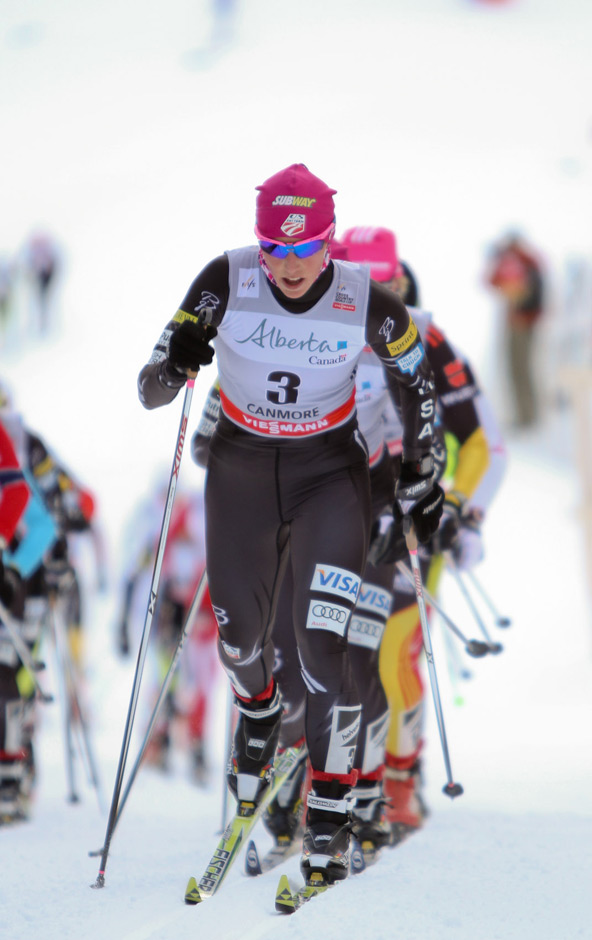
    First, she’ll go with most of the team to Anchorage, Alaska, next week for SuperTour Finals and U.S. Distance Nationals March 22-28.

    Looking back on the season, Stephen emphasized the success of her teammate, Kikkan Randall, the three-time defending World Cup Sprint champion, and how she has impacted the rest of the team.

    “She has taught me to believe in myself, how to work harder, try new things, be open to the idea of being the best in the World someday,” Stephen wrote. “The fact that she instills this fun atmosphere on our team while also kicking serious a** on the world cup, year in and year out is really inspirational and special to be a part of. I’m really very proud of her and to be her teammate in so many ways.”

    Kikkan Randall (U.S. Ski Team) in Friday's classic sprint qualifier at World Cup Finals in Falun, Sweden. She went on to place fourth in the final and take home her third-straight Sprint World Cup Crystal Globe. (Photo: Fischer/Nordic Focus)
    Kikkan Randall (U.S. Ski Team) in Friday’s classic sprint qualifier at World Cup Finals in Falun, Sweden. She went on to place fourth in the final and take home her third-straight Sprint World Cup Crystal Globe. (Photo: Fischer/Nordic Focus)

    Randall finished 20th (+2:25.6) on Saturday in one of the few World Cup skiathlons in her career. The result put her 17th in the distance rankings, and kept her in fifth overall — 30 points behind Norway’s Heidi Weng in fourth.

    “I wanted to be up in the top 15 so I fell short of that goal today,” Randall wrote in an email. “I still have some good opportunity to move up tomorrow and I need to fight for every point.”

    Randall skied around 20th for much of the race, moving up from 21st at the transition to 19th at 8.2 k. Lahteenmaki edged her by 0.4 seconds for 19th, and Randall finishing four seconds ahead of her U.S. teammate, Sadie Bjornsen.

    “To have a good result you have to go with that opening pace and try to stay up near the front,” Randall explained. “I tried to start hard but my body was pretty tired from the sprint yesterday.  I was skiing mid pack in the classic and then headed out on the skate with some girls to chase.  I had some good sections were I felt I was picking up time and then some bad parts where I had a hard time keeping my glide up in the skate. I came into the stadium with a couple girls but didn’t ski the finish very well.  It was an okay day for me.”

    Like Stephen, she was excited to wrap up the season.

    “It’s been a lot of racing and a lot of emotional energy, especially in the last six weeks,” Randall wrote. “It’s been a pretty good season. Overall I was happy with my consistent sprint performance but felt I went backwards a step in my distance skiing. And of course the Olympics was my biggest goal of the season and I didn’t reach my goals there. I am definitely ending this season wanting more.”

    Bjornsen started faster and was 12th through 6 k and ninth at the transition at 7.5 k, just 43 seconds behind Johaug.

    “The pace went out super hard from the start,” Bjornsen recalled. “It was quite windy out there, and I was breaking wind in my outer track for the first couple of k’s … so I was struggling to stay on pace. After jumping in behind some girls, I found control, and the classic portion went really well from that. I had great skis. I chose to go on the slicker side, which made for some rocket fast skis on the downhill.”

    The transition to skating proved to be Bjornsen’s biggest challenge as she slipped to 17th within the first kilometer out of the stadium. She recalled a pack of about 10 people passing her in the first 10 minutes, and was in 20th with 4 k remaining.

    “I was able to turn it around shortly after when I got the feelings back in my legs,” she wrote. “It was fun to be out there trying to ski with Kikkan, and then reel back some of the skiers that had passed me by the end.”

    Conditions were a factor as the night before brought a mix of rain, sleet, then snow, according to Stephen. “But the skiing was good,” she explained. “Pretty transformed snow and the high winds blew some snow into the tracks in places making the conditions slow in some spots and very fast in others.”

    The course itself is what many of these same racers will be tackling at World Championships next season. Several North Americans said they liked the course, and Stephen described it as “hard, fair and fun.”

    “The are a fun level of challenging!” Bjornsen wrote.

    Noah Hoffman (U.S. Ski Team) racing to 35th in the 30 k skiathlon at the Olympics in Sochi, Russia.
    Noah Hoffman (U.S. Ski Team) racing to 35th in the 30 k skiathlon at the Olympics in Sochi, Russia.

    Noah Hoffman led the U.S. men in 18th, 2:48.3 behind Canadian winner Alex Harvey.

    Going against his instincts, he decided to play it relatively safe and pace himself throughout the men’s 30 k skiathlon. Hoffman, 24, is known for his tendency to try to lead or stick with the leaders in distance mass starts, but his goal was to score around 20 to 25 points throughout the three-race Finals to put him in the Red Group in the distance standings.

    “I scored 13 points today so I need to do something similar to tomorrow,” he said of the pursuit. “Which is nice, better than it could have been.”

    Out of the start, he said the pace wasn’t too fast, but he focused on gradually working his way up from just outside the top 40 to 25th within the first 3.75 k. He was 20th at 5 k, 14 seconds behind the leaders, and halfway through the classic leg Hoffman was skiing 30 seconds back in 22nd.

    “I was trying to be patient and stay a little more conservative,” he said. “I wanted to be skiing a little further back in the group. I did that and I don’t know that my strategy mattered that much today because I wasn’t quite good enough to be able to go with that fairly large group that ended up shelling everybody else.”

    The group he was talking about was the chase pack, which Norway’s Eldar Rønning initially led to try to cut down a 20-second gap on the four leaders at 8.7 k. Hoffman was at the tail end of the group with Ivan Babikov in 23rd and 24th, respectively, and with one lap to go in classic he was detached, trailing the leaders by 45 seconds with Norway’s Sjur Røthe.

    “I did end up with a good ride behind Sjur Røthe for the classic, which was really good and I know he is a great skater and he proved that today,” Hoffman said. (Røthe ended up seventh.)

    “I was definitely hoping to be able to go with him which would have led to a really good result, but I just wasn’t quite good enough in the skate,” he added. “I have had a little bit of a tough time transitioning from classic to skate and I need to continue to work on that. Once I got into the skate, in the last two laps of the skate I was feeling better and moving up more.”

    For the second half of the race, Hoffman mostly stuck around 20th. He heard he was in 19th about halfway through the skate leg, which was where he figured he needed to be.

    “It was definitely the right thing to do, it is what I need to do more of,” Hoffman said of his pacing strategy. “There was definitely a couple of movements where I was like, I could definitely move up from here, and then I had to settle myself down and say this was a fine place to be. But for the most part, I think it was good. I did what I wanted to do and I think I am learning slowly, slower than I would like to be.”

    At this point in the season, Hoffman said his energy is good, but he’s excited to go home and will stop at his base in Park City, Utah, between racing in Alaska and vacationing in Mexico.

    “I think fitness is tailing off a little bit; I train a lot less than my teammates throughout the winter and it has been a long time since I have done any substantial training,” he explained. “But that is fine … [to] still be able to ski into the points with this fitness is good so I am looking forward to a little bit of domestic races when I go home, something I haven’t done in two years.”

    Hoffman ranks 28th in the World Cup distance standings, just within the top-30 U.S. team criteria, and 35th overall with one race to go. He will start 21st, 4:19 back from Harvey as the leader and a second behind 19th and 20th in Sunday’s pursuit.

    — Matt Voisin contributed reporting

    Results: Women | Men

    See also: Two Weeks After International Debut, Hanneman Nabs PB’s; Diggins Also Close

  • Bjørgen, Norway Overcome Tragedy to Put Three in Top Four of Women’s Skiathlon

    Bjørgen, Norway Overcome Tragedy to Put Three in Top Four of Women’s Skiathlon

    Norway's Marit Bjørgen (l) and Sweden's Charlotte Kalla lead the women's 15 k skiathlon on Saturday, the first day of the 2014 Olympics in Sochi, Russia. Bjørgen took the victory by 1.8 seconds for her record-setting fourth gold medal.
    Norway’s Marit Bjørgen (l) and Sweden’s Charlotte Kalla lead the women’s 15 k skiathlon on Saturday, the first day of the 2014 Olympics in Sochi, Russia. Bjørgen took the victory by 1.8 seconds for her record-setting fourth gold medal.

    FasterSkier’s coverage is made possible through the generous support of Rudy Project. 

    SOCHI, Russia — On the eve of the Olympics, the night of the Opening Ceremony, the air of excitement and anticipation among the Norwegian cross-country team was wiped out by the death of Astrid Uhrenholdt Jacobsen’s younger brother, Sten Anders.

    It wasn’t the leadup anyone could have foreseen or prepared for, and the news came Friday night. His passing was sudden and unexpected, according to a Norwegian team press release. There was no need to elaborate; he was gone.

    Jacobsen’s teammates immediately rallied around her, comforting the current World Cup runner-up and taking the brunt of questions surrounding the situation. She would not race until at least next Thursday, if at all, and several of her teammates had a skiathlon to focus on the following afternoon.

    Jacobsen, 26, asked them to race for her family and her brother. They delivered, putting three in the top four of Saturday’s 15-kilometer skiathlon — the first nordic race of the 2014 Winter Games.

    Sweden's Charlotte Kalla leads the women's 15 k skiathlon on Saturday at the 2014 Olympics in Sochi, Russia.
    Sweden’s Charlotte Kalla leads three Norwegians — Therese Johaug (1), Marit Bjørgen (2) and Heidi Weng (4), and Poland’s Justyna Kowalczyk (r) in the women’s 15 k skiathlon on Saturday at the 2014 Olympics in Sochi, Russia.

    “My wonderful girls. You are my strength, through thick and thin,” Jacobsen tweeted during Saturday’s race. “Thank you … Eternally grateful, if there are medals or not.”

    Marit Bjørgen ultimately topped the podium with a 1.8-second win over Sweden’s Charlotte Kalla, and two more Norwegian skiers, Heidi Weng and Therese Johaug, placed third and fourth, respectively.

    The gold medal was Bjørgen’s fourth, making her the most successful Norwegian woman at a Summer or Winter Olympics, besting the record of three-time Olympic champion figure skater Sonja Henie.

    “Yesterday was very hard day,” Bjørgen said in a post-race press conference. “And yeah, sport is sport, [but] when something like this happens, it was hard to have focus on the race yesterday evening. … It’s emotional of course, but Astrid wanted us to do this today, and we did it for her, her family and her brother.”

    “I have not had many hours of sleep a night,” Johaug told Norway’s TV 2. “It is very unreal. It’s almost like it has not occurred to me.”

    Johaug and Bjørgen took charge from the start, leading after the first climb out of the stadium on the first of four laps. Poland’s Justyna Kowalczyk was right there with them, along with Weng.

    Striding carefully on an intensely sunny afternoon with temperatures in the mid-40s, Bjørgen and Kalla skied alongside each other almost uniformly at the front up a long climb before the lap lanes. United in their desire to win, they were also trying to shake off the weight of Friday’s news.

    This wasn’t about a Bjørgen-Kowalczyk showdown, or about Kalla achieving an Olympic podium for Sweden, four years after teammate Anna Haag won silver in the skiathlon at the Vancouver Games. This race was for Sten Anders, a lawyer and Jacobsen’s training partner, a man who was once deeply connected to the team and opinionated on the topic of education in skiing.

    Kalla heard about the incident Saturday morning before the race.

    “I didn’t know anything before I entered the wax cabin today, so it was a lot of feelings because they are good friends to me,” she said at the press conference. “I didn’t know how to handle it. I just tried to keep focused on the race because that’s what we have to do and think about this to get perspective what an Olympic medal is worth. If they want to talk, I will be there for them for sure.”

    Bjørgen, Johaug and Kalla traded leads throughout the classic and skate portions of the race, and Kowalczyk didn’t end up being a factor. Hanging in the top five with Finland’s Aino-Kaisa Saarinen, who latched onto the group on the second lap, Kowalczyk entered the stadium in sixth before the transition.

    Two seconds behind Bjørgen, who was first through the pit stop followed by Johaug, Kalla, Weng and Saarinen, Kowalczyk in sixth stumbled when switching to her skate skis, and the misstep cost her.

    Johaug took the lead early on the skate loop, leading the long descent and enduring grind back up toward the stadium. With one lap to go, the five-skier pack with Johaug, Saarinen, Weng, Bjørgen, and Kalla remained within a second of one another.

    Finland’s Kertu Niskanen chased Kowalczyk up the final climb, but couldn’t quite catch her. Kowalczyk came through the stadium nearly 15 seconds behind in sixth, a deficit she wouldn’t be able to make up over the next 3.75 k.

    Meanwhile, Kalla jetted to the front before the final climb, passing Bjørgen and putting 10 to 15 meters into her. Bjørgen immediately reacted, reining Kalla back in up the final hill then taking the inside lane and pushing past her on the sweeping downhill into the stadium.

    Out of steam and a draft to match, Kalla lost contact, and Bjørgen skied away to the 1.8-second win in 38:33.6.

    “I only tried to focus on the highest point [of the hill] and give everything I had to that point,” Kalla said. “I knew I had some time to recover on the downhill because I had some tired legs.”

    On the last curve before the finish, she realized she wasn’t going to catch the defending Olympic skiathlon champion.

    “I was really tired and I had to keep focused where I had my skis and my poles so it was hard to get a high speed,” Kalla said.

    Marit Bjoergen (NOR) claims skiathlon gold.  Photo: Fischer / Nordic Focus.
    Marit Bjoergen (NOR) claims skiathlon gold. Photo: Fischer / Nordic Focus.

    For Bjørgen, winning another gold — regardless of what number it was — “incredible.”

    “I had a very good feeling today, and my skis were so perfect,” she said. “I haven’t [thought] about how many medals I have won because I’m still competing. I have to leave the races behind me and look forward. I will think about how many medals I have after I stop skiing.”

    After acknowledging that she’s a favorite in every race at the 2014 Olympics, Bjørgen reiterated that she intends to race all six events. But her objective all along was a single gold.

    “I have reached my goal in this Olympics and I can relax enjoy the rest of it,” she said.

    Nearly 12 seconds behind Kalla in second, Weng, Johaug and Saarinen contested for the bronze, with Weng getting the edge over Johaug by 1.4 seconds. Saarinen placed fifth, another 0.7 seconds back. Kowalczyk held her position for sixth, 56.1 seconds behind Bjørgen.

    “I promised [Astrid] I’d go fast;  it helped,” Weng said. “It’s my first Olympic Games and to medal [in the first race] is a nice thing.”

    Niskanen finished seventh (+1:01.7), and Jessie Diggins was 30 seconds behind in eighth, tying the best-ever finish by an American woman at the Olympics (set by Kikkan Randall in the 2010 Games). Two seconds later, Sweden’s Emma Wiken notched ninth, and Japan’s Masako Ishida placed 10th, another second back.

    Less than 1 1/2 seconds outside the top 10, Liz Stephen placed 12th for the U.S. for her best Olympic result by 37 places in her second Olympics. Eva Vrabcova-Nyvltova of the Czech Republic finished 0.8 seconds ahead in 11th (+1:35.2).

    Results

    Charlotte Kalla (SWE), Marit Bjoergen (NOR) and Heidi Weng (NOR) claim the podium in the women's Olympic skiathlon.  Photo: Fischer / Nordic Focus.
    Charlotte Kalla (SWE), Marit Bjoergen (NOR) and Heidi Weng (NOR) claim the podium in the women’s Olympic skiathlon. Photo: Fischer / Nordic Focus.


  • Randall, Sargent Pick Off the Places to Soar to Skiathlon Top 14

    Randall, Sargent Pick Off the Places to Soar to Skiathlon Top 14

    Ida Sargent (USST/CGRP) pushing to secure 14th in the Alberta World Cup 15 k skiathlon, ahead of Aurore Jean (FRA) and Virginia De Martin Topranin (ITA) on Sunday.

    Coverage of the Alberta World Cup made possible through the generous support of Travel Alberta and Tourism Canmore.

    CANMORE, Alberta – From the back, it was easy to get panicky in Sunday’s mass start. Poland’s Justyna Kowalczyk went out hard in the 15-kilometer World Cup skiathlon without even meaning to, taking a couple Norwegians with her. Less than halfway into the first lap, she and sixth others were breaking away.

    Almost 20 seconds back, U.S. Ski Team members Kikkan Randall, Holly Brooks and Ida Sargent skied methodically just outside the top 20. With more than 13 kilometers to go, they weren’t going to blow it. For all but one, that restraint would be their ticket to a top 14.

    Kikkan Randall (USST/APU) en route to placing eighth in the Alberta World Cup 15 k skiathlon on Sunday, the last of three days of racing in Canmore, Alberta.

    But Randall wasn’t feeling all that great to start. The classic leg was a bit of a struggle, she said, and by the halfway point, she trailed Kowalczyk in first by more than a minute and 12 seconds. Sargent was one place ahead of Randall in 20th, just 0.4 seconds ahead. Brooks entered the transition in 24th.

    For Randall, the skate leg was significantly better. On the first of two laps, she climbed to 13th while Kowalczyk simultaneously extended her lead. The Alaska Pacific University (APU) skier wasn’t trying to make up a minute and a half on her, but she continued to pick off the places.

    With two kilometers to go, Randall led the second chase group while skiing in eighth, and knew it was going to take all the strength she had left to hold the five others off. Three races in four days had taken its toll on her, and she had little left to give.

    To the surprise of few, she found some extra energy and outsprinted Ingvild Flugstad Oestberg (NOR) to the finish. Randall also edged her Swedish friend Anna Haag and Katerina Smutna of Austria to place eighth (+1:18.4).

    “The classic part was really hard for me; my body’s just so sluggish,” Randall said. “Those first couple hills are so aerobic and you really just have to be able to kick into that high-end gear. I found the same thing in the classic race [on Thursday]. Just the first lap I didn’t feel like I could get into that gear, but then once my body warms up, I find it a little bit later on.”

    She found it in Thursday’s 10 k classic mass start, where she placed sixth, just as she found it on Sunday. Randall’s result rivaled that of her seventh-place skiathlon showing in last season’s Tour de Ski. She later finished 12th in a 15 k skiathlon in Lahti, Finland, despite a nagging Achilles pain that turned out to be an injury.

    For the first lap of Sunday’s skate leg, Randall tried to focus on her rhythm and immediate positioning rather than worry about what place she was in.

    “Once I did that, I looked up and saw that some skiers were starting to come back to me,” she said. “Coming into that second lap, I knew that next pack was right there and I really wanted to close up to them. It was nice, I got up to them, got to rest a little bit and then make one more push.”

    On the final stretch into the stadium, she pushed and beat them all.

    “Skating is just feeling so much more natural to me right now,” Randall said. “All the distance races this season I’ve been in the fight, so to feel like I’m just a little out of it was tough.”

    She thought of its as a hard workout in preparation for the upcoming Tour, and in doing so, kept herself in contention for the overall World Cup lead. Kowalczyk’s win and bonus points put her in first, 33 points ahead of Randall in second. Reigning World Cup champ Marit Bjørgen, who opted to skip the Canadian World Cups before the Tour, trails Randall by 32 points in third.

    “I’m definitely getting a little tired,” Randall said. “[Saturday’s sprint] was a lot, but I’m happy I responded over the second half [Sunday] and really looking forward to a nice little break. Then we’ll do it all over again.”

    Ida Sargent leads a chase group in the skate leg of the Alberta World Cup 15 k skiathlon on Sunday. She went on to place 14th for her best distance result.

    Just 16.5 seconds behind Randall, Sargent placed 14th for her best result in a distance race, second-best in Canmore. The Craftsbury Green Racing Project member was 10th in Saturday’s skate sprint and used what she learned there on Sunday. Instead of leading into the final downhill, she tucked in around second or third.

    It worked as she beat Aurore Jean (FRA), Irina Khazova (RUS) and Virginia De Martin Topranin (ITA) to the line.

    “I just tried to be patient, move up when I could but not freak out ’cuz I knew it would be a long race,” Sargent said. “I was kind of picking off people in the classic, then in the skate, packs kind of formed and I was worried about going too hard too soon, so I skied with the pack, which was pretty fast, and just knew how to ski the finish.”

    While some might pin the 24-year-old as a sprinter, Sargent was 18th in a 10 k classic race in Kuusamo a few weeks ago.

    “I look to Kikkan a lot and find inspiration from her,” she said. “She started out being more of a sprinter. I don’t want to be a sprint specialist. Sprinting comes more easily to me and I’ve taken advantage of that, but I’d really like to improve my distance skiing.”

    An all-around skier, Brooks (APU) wasn’t thrilled with placing 28th, nearly three minutes back from the winner. She remained close with Sargent and Randall through the transition, but fumbled her skate pole and had to turn around to retrieve it. That wasn’t really a big deal, she said. Feeling tired was.

    “I’m just really fatigued for some reason,” Brooks said. “I’m having hard time with the altitude, which is crazy ’cuz normally I really love racing at altitude.”

    After skiing a relaxed classic leg, she expected to have more left for the skate.

    “My legs just felt dead,” she said. “Just didn’t quite have it today and need to take some rest the net couple days and need to regroup.”

    Leading the Canadians, Emily Nishikawa of the Alberta World Cup Academy achieved as personal best of 34th (+3:39.2). Realizing her strength in skating, the 23-year-old tried to save something for the second half of the race, especially the hills.

    “Those girls are fast,” Nishikawa said of the frontrunners. “I wasn’t able to stay with that pace off the start, but I kept my own rhythm going and I think it worked for me. I was able to pick off a lot of girls in the skate.

    “I had a great race and I’m thrilled to get in the 30s,” she added. “I’m one step closer to my goal of getting in the top 30 and in the top 15, so I think it’s a good start and I’m looking to improve on this for sure.”

    Canadian National Team members Dasha Gaiazova and Chandra Crawford placed 37th and 46th, respectively. Gaiazova said she was “fairly satisfied” with her result after feeling good for the start of her classic leg, then backing off on the end of the second lap.

    “I started to feel like woah this is maybe a little too hard,” she said. “Up to that point I was still in one of the chase groups and it was going well. It’s just at that 6 ½ k, I felt like I started to fall off a little bit, and then by the time I got into the skating, I’d already lost that group. … It was just short of a fight for the whole skate leg and that was really tough. I pushed really hard so that’s good.”

    After falling behind early, Crawford said she gave it her all, which is what she set out for.

    “It’s a treat for me any time I get to race,” she said, after placing sixth in Saturday’s sprint. “I want to get out there, struggle, push through the rough patches, dig deep, try and stay on girls, push the pace, do good technique even when I’m exploded in my muscles. I accomplished all those things, and I’m really impressed with our younger girls coming on strong like that.”

    Crawford was also excited to discover her sixth-place finish prequalified her for the 2014 Sochi Olympics. Her teammate, Perianne Jones also secured a spot with two top-12s this season.

    “This weekend was a blast,” Crawford said. “I really enjoyed racing today. I knew it was going to be tough and super hard. We were skiing up mountains up there. It’s what I grew up doing and it doesn’t get any easier.”

    — Topher Sabot and Gerry Furseth contributed reporting

    Women’s results