From the FasterSkier archive — posts syndicated from athletes’ and coaches’ own blogs between 2004 and 2012, kept online as published. Current coverage is at fasterskier.com.
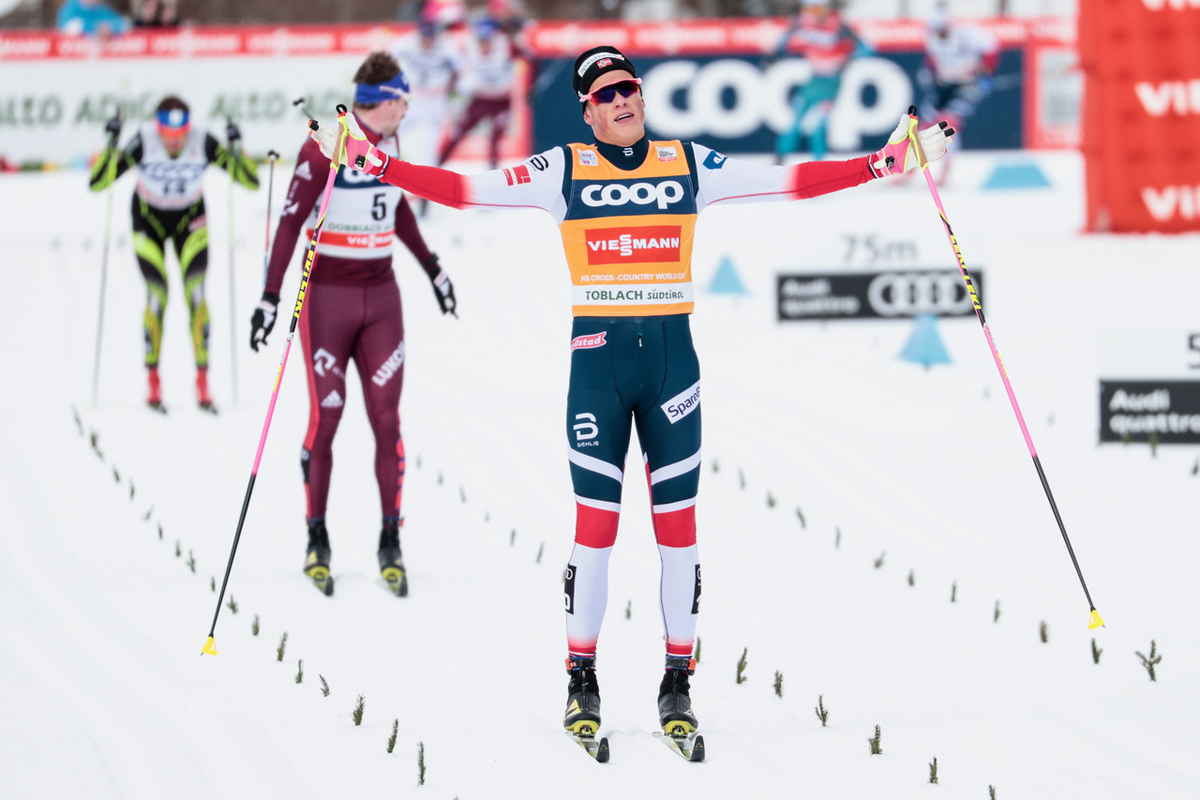
Norway’s Johannes Høsflot Klæbo winning the men’s 15 k classic pursuit on Sunday in Toblach, Italy, ahead of Russia’s Sergey Ustiugov (5) in second and Kazakhstan’s Alexey Poltoranin (l) in third. (Photo: Fischer/NordicFocus)
Johannes Høsflot Klæbo is making a name for himself. The 21-year-old Norwegian broke a record on Sunday, after taking the men’s 15-kilometer classic pursuit title in Toblach, Italy and tallying his seventh World Cup win this season, the most victories ever recorded by a male skier before the new year. In previous seasons, Norwegians Petter Northug and Martin Johnsrud Sundby had topped out at six.
With the win, Klæbo remained the Overall World Cup leader with 752 points, 324 more than France’s Maurice Manificat in second.
“I’m happy to back on the podium,” said Klæbo, who has won every race he’s entered except Saturday’s 15 k skate, according to an International Ski Federation (FIS) press release. He started Sunday’s 15 k classic pursuit in 10th, 36 seconds out of first.
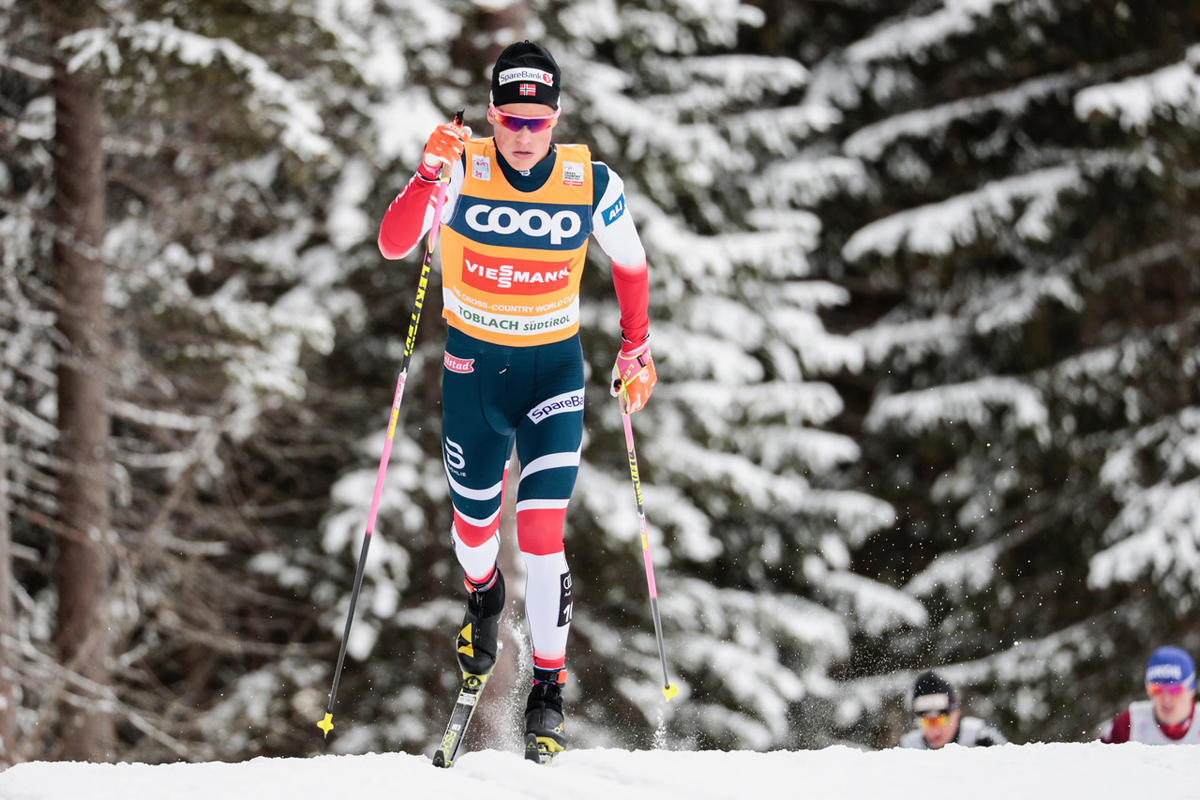
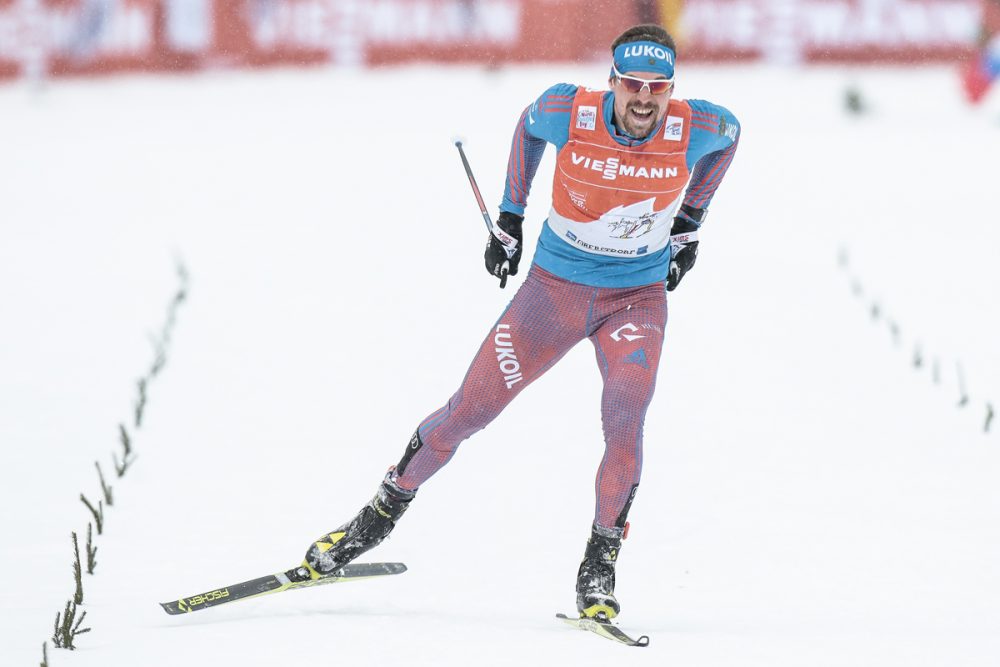
Norway’s Johannes Høsflot Klæbo getting down to business after starting 10th in the World Cup men’s 15 k classic pursuit on Sunday in Toblach, Italy. He raced to first for his seventh win of the season. (Photo: Fischer/NordicFocus)
“My plan was to go out hard from the beginning to close the gap. It worked very well,” he said. “When I was together with the group I was confident I could ski for a podium. I wanted to decide the race little bit before the stadium.”
For the first 3.5 k of Sunday’s pursuit, the top four from Saturday’s race led the way, with Manificat, Norway’s Simen Hegstad Krüger, Great Britain’s Andrew Musgrave, and Canada’s Alex Harvey.
Striding in limbo just over six seconds behind them was Russia’s Sergey Ustiugov.
“I was waiting to see if I am able to close the gap on the leaders or if the group behind me catches me,” Ustiugov said, according to FIS.
For Ustiugov, who started the pursuit in fifth, it was the latter.
Klæbo started 22 seconds behind the Russian and caught him, pulling Ustiugov into contact with the leaders before the climb back to the stadium on the first of three laps.
With Klæbo at the back and Manificat in the front, the six leaders started Lap 2, trailed by Norway’s Hans Christer Holund and Finland’s Matti Heikkinen six seconds back. A second chase pack of four — Switzerland’s Dario Cologna, Sundby, Russia’s Alexander Bessmertnykh, and Kazakhstan’s Alexey Poltoranin — followed 20 seconds later.
“I was working hard with Dario [Cologna] and Alexander [Bessmertnykh]. Dario did a great job in the first two laps.” Poltoranin said, according to FIS.
For the first half of Lap 2, Ustiugov and Musgrave exchanged leads, while Klæbo remained in the rear. Harvey stuck to the middle.
“I had really fast skis,” Harvey told FasterSkier on the phone after. “It was kind of sugary snow on the steep climbs, so I was struggling a bit on the steeper sections … but I had really fast skis, just a little slick.”
Midway through Lap 2, Klæbo began his move toward the front of the lead group. By the time the top six passed by the stadium for their third and final lap, Klæbo was positioned third, Ustiugov first and Manificat second. Harvey sat comfortably in sixth.
“On the last lap, Ustiguov and Klæbo attacked and I was feeling great, but I had to feather it a bit on the climb,” Harvey said, explaining that he lost the most time on the course’s steeper sections.
With less than 3 k to go, Ustiguov and Klæbo began to gap the rest of the field. Meanwhile, Poltoranin made his way to the front of the chase group.
“I was far faster on the last two uphills,” Poltoranin said. “I still have some work to do to be able to beat Sergey and Johannes, but I am getting there.”
Klæbo and Ustiguov remained unmatched for the final kilometer and, with arms outstretched, Klæbo crossed first in a time of 33:31.1 minutes. Ustiugov finished 1.9 seconds later in second place.
“Johannes seems he is never tired. He played with us like with small kids,” Ustiugov said, according to FIS. “He was in impressive shape again.”
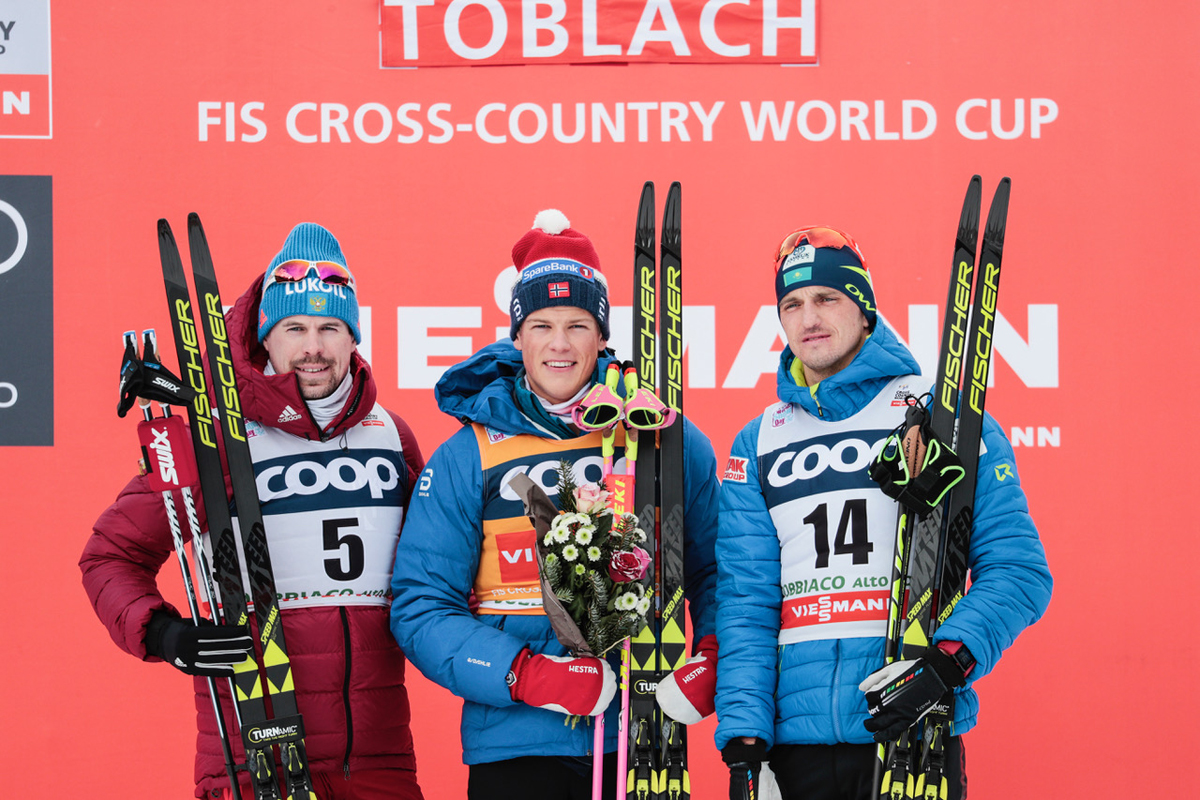
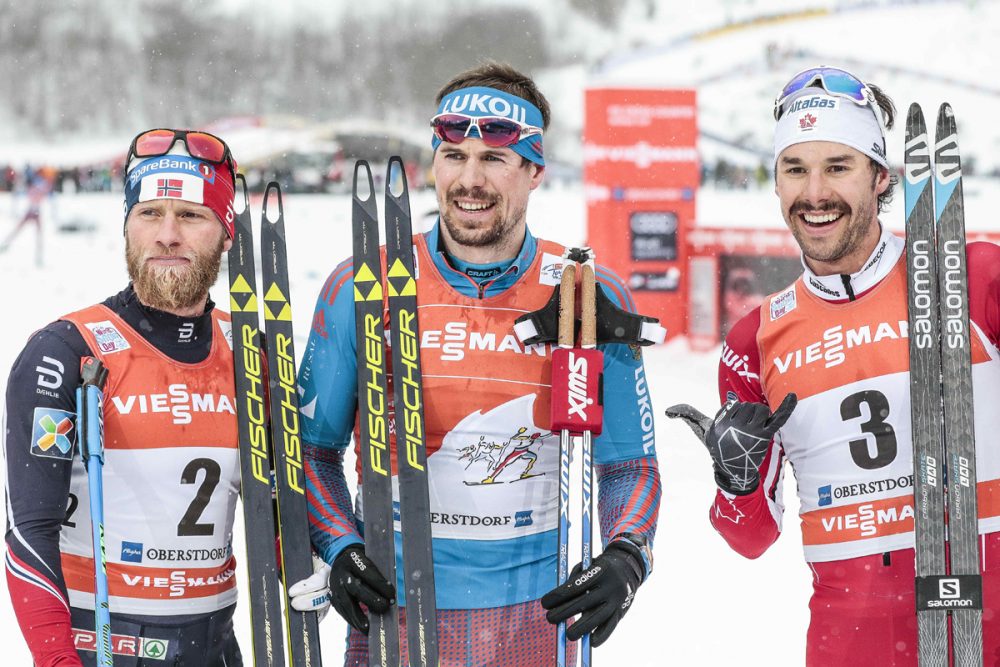
The World Cup men’s 15 k classic pursuit podium in Toblach, Italy, with Norway’s Johannes Høsflot Klæbo (c) in first, Russia’s Sergey Ustiugov (l) in second and Kazakhstan’s Alexey Poltoranin (r) in third. (Photo: Fischer/NordicFocus)
Rounding out the podium in third was Poltoranin, 4.5 seconds out of first.
“I’m so happy. It has been two years since I was on the podium last time,” the 30-year-old Poltoranin said.
In fourth was Bessmertnykh (+9.7), followed by Heikkinen in fifth (+9.8) Manificat in sixth (+10.7), Holund in seventh (+11.1) and Cologna in eighth (+11.8).
After crashing in the final 500 meters of the race, Harvey finished ninth (+16.3).
“I was sitting in fifth and Heikkinen was sitting in fourth, and … I was coming around him and his pole tip just hit the front of my ski tip and I just did a straight-up face plant,” Harvey said. “So I ended up last in my group. That was a bit frustrating, but the rest was a good day.”
Rounding out the top 10 was Saturday’s 15 k winner, Krüger, who finished 24 seconds after Klæbo. Sundby, who had placed 20th in the 15 k individual start, raced up to 11th (+34.4) on Sunday, and Musgrave (who was third in the 15 k skate) finished 12th (+54.3).
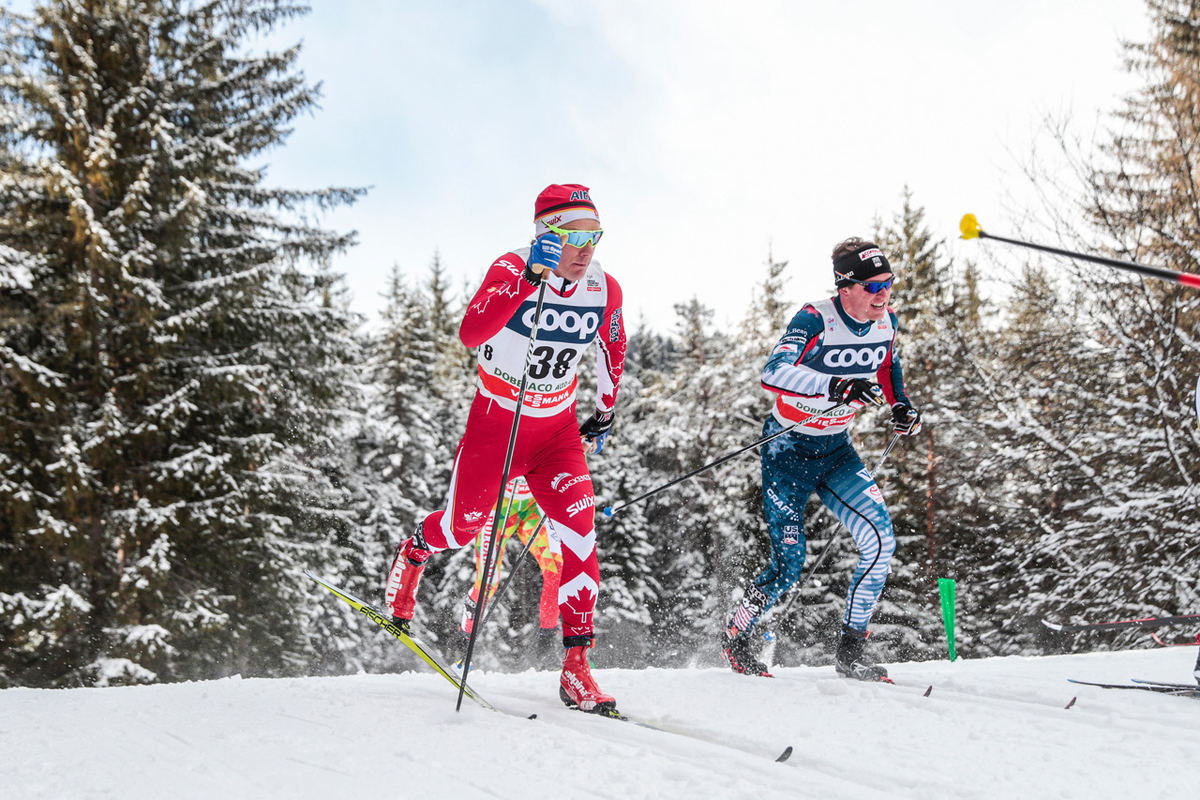
Canada’s Devon Kershaw (38) racing alongside American Scott Patterson in the men’s 15 k classic pursuit on Sunday at the World Cup in Toblach, Italy. They finished 33rd and 42nd, respectively. (Photo: Fischer/NordicFocus)
Leading the U.S. in 26th (+1:43.1) after starting 29th, was Erik Bjornsen. In five distance races this season, Bjornsen has scored World Cup points, placing within the top 30 in each race.
New to the U.S. Ski Team’s B-team this year, Scott Patterson finished 39th (+2:37.2) after starting 42nd, and Paddy Caldwell placed 44th (+2:57.7) after starting 52nd. Noah Hoffman finished 49th (+3:01.7) after starting 40th.
For Canada, Devon Kershaw placed 33rd (+2:02.8), up five spots from starting 38th, Graeme Killick was 50th (+3:42.0), Russell Kennedy 66th (+5:05.8), and Knute Johnsgaard 76th (+6:20.8) after starting 82nd.
Racers will take a break from competitions until the Tour de Ski, which kicks off in Lenzerheide, Switzerland on Dec. 30.
“I started a bit of a training block for the Tour just this week, and kind of continuing next week, so two weeks of a bit more volume, then do a little, do a little break after that, and then I have a few days of normal training to feel good before the tour,” Harvey said. “So I’m excited to see what a bit of a training and then a break does to me, because it will be the first time I have a little break like that since our last camp in October.
“Other than the Olympics is the Tour de Ski, that’s important for me,” Harvey continued. “So hoping to see if I can bring my level up a little bit with that bit of a break after the hard training, to feel a bit more fresh and a little more snappy.”
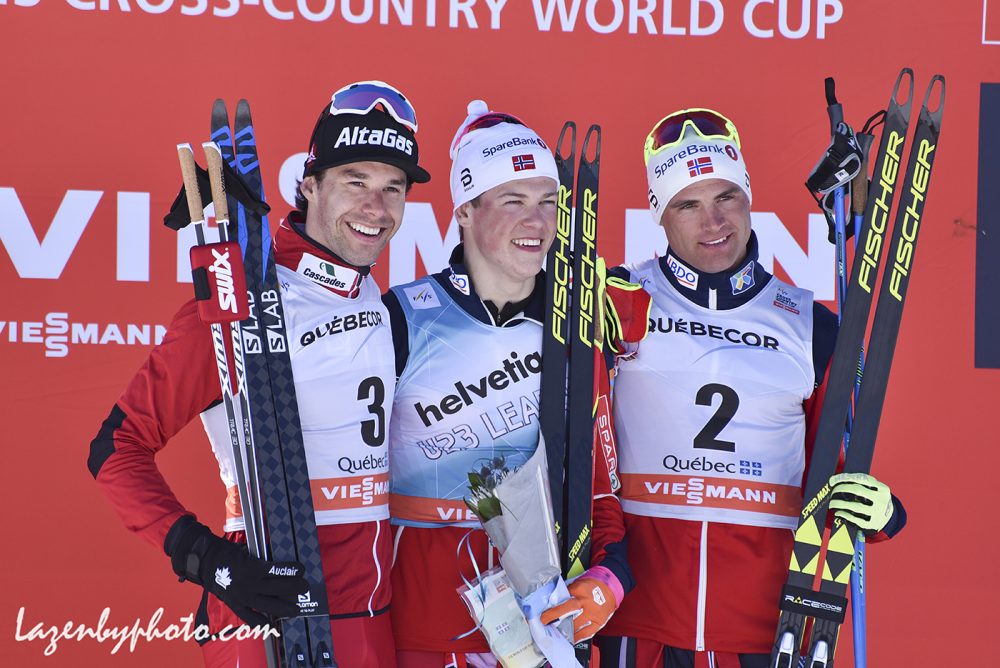
Left to right: Canada’s Alex Harvey alongside Norwegians Johannes Høsflot Klæbo and Niklas Dyrhaug on the men’s 15 k freestyle pursuit podium at World Cup Finals on Sunday in Quebec City. (Photo: John Lazenby/Lazenbyphoto.com)
Canada’s Alex Harvey has had one heck of a season.
In January, he reached the top of a World Cup podium for the first time in three years. The following weekend, he helped Canada to its first-ever relay podium and two weeks before that, won the men’s team sprint in Toblach, Italy, with his teammate Len Valjas. A little more than a month later, he earned his first individual World Championships gold.
The 28-year-old Harvey kept the ball rolling through the World Cup Finals in Quebec City this past Friday, winning the opening freestyle sprint before a roaring home crowd. The next day, he placed fourth in the 15-kilometer classic mass start.
To top it all off, he finished second in Sunday’s 15 k pursuit — less than one-hundredth of a second short of first after a photo finish with Norway’s Johannes Høsflot Klæbo — to secure not only another World Cup podium, but also third in the Overall World Cup standings and second in the Distance World Cup.
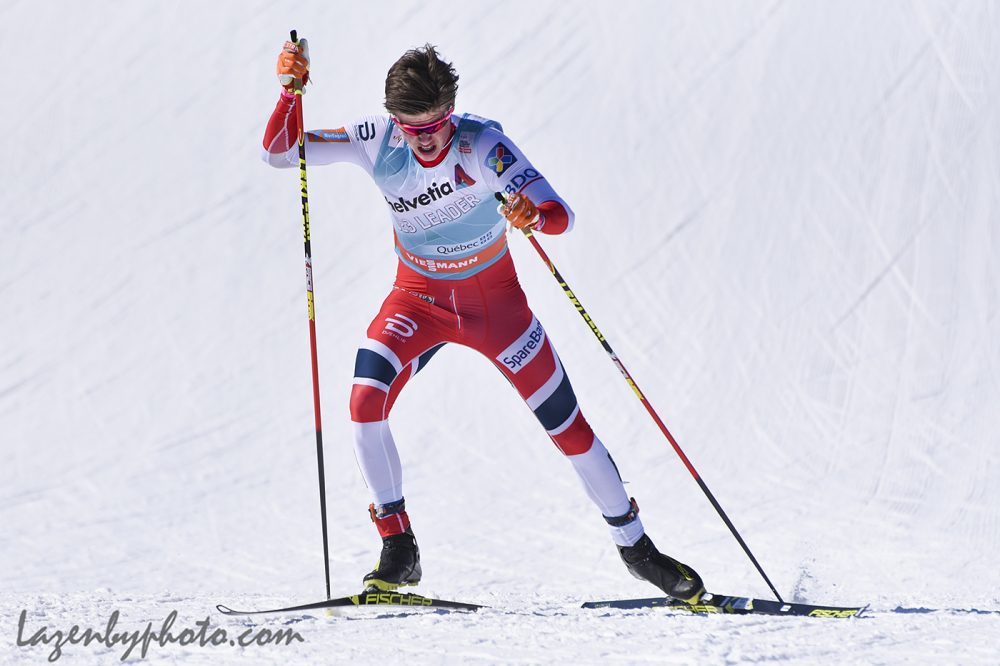
Norwegian Johannes Høsflot Klæbo leading the men’s 15 k freestyle pursuit at World Cup Finals on Sunday in Quebec City. (Photo: John Lazenby/Lazenbyphoto.com)
“It went more than perfectly,” Harvey said of his season to a group of reporters in French. “A gold at the Worlds, some World Cup victories, a second place overall all makes this by far the best season in my career.”
Harvey started the pursuit in third, 23 seconds behind the first starter, Klæbo, and one second behind another Norwegian, Niklas Dyrhaug. Though Harvey managed to catch Dyrhaug just before the 2 k mark, he admitted his real worry was not ahead of him, but behind. Norway’s Finn Hågen Krogh started 9 seconds after Harvey, and a kilometer after Harvey found Dyrhaug, Krogh was skiing three seconds behind.
“I didn’t know whether Finn Hågen would come back, which could of change entirely how the race played out, since he and Klæbo are sprint specialists,” Harvey said. “They could of worked together and bump me to fourth position, but I was glad the pace I was imposing in the beginning was enough for a spot on the podium.”
However, Harvey’s pace proved too fast for Krogh, who gave up the chase after the first lap at 3.75 k and let the chase group catch him on the first climb out of the stadium.
“I just blew up, so when there was no podium to race for, that was my only goal today,” Krogh told FasterSkier of his in-it-to-win-it mentality.
But more than let the chase pack absorb him, he skied the rest of the race just to finish and ended up 70th out of 73, and last place for time of day.
“I was tired at the end today,” he said. “I had a tough day. No power left today.”
Meanwhile, by 5 k, Harvey had pulled himself and Dyrhaug all the way up to Klæbo.
“From the start, I was closing on Klæbo, and I knew early on that a podium was in reach,” Harvey explained. “It’s a rare feeling of excitement to have during a race. Usually, only the last hundred metres will tell the story. After a lap and a half, when I realized Finn Hågen was dropped, I knew the podium was mine.”
That place on the podium, however, remained to be determined. With the Canadian doing all of the pulling up to Klæbo, he’d have to dig deep to find the speed for a sprint to the finish.
“I had my tactic, Johannes had his tactic, and I think Alex had his tactic,” Dyrhaug told FasterSkier. “It was a fair race, the only thing was, I couldn’t help Alex catch Johannes, that was Alex’s job as a Canadian. If I had gone on the front to help Alex catch Johannes, I would get in a lot of trouble with the Norwegian staff, but Alex was strong, and we caught up.”
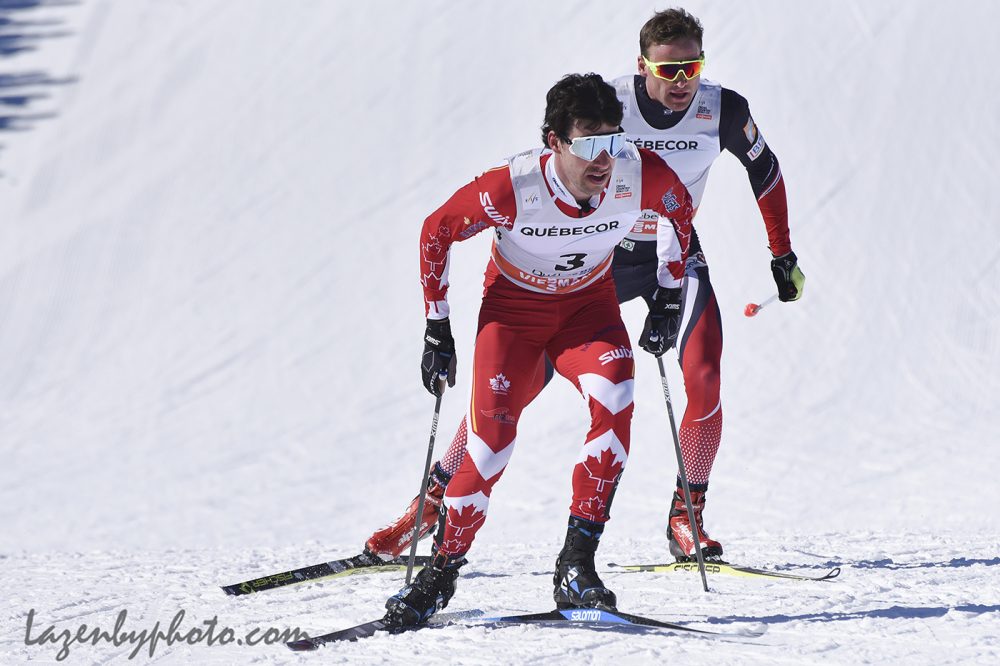
Canada’s Alex Harvey leads Norwegian Niklas Dyrhaug during the men’s 15 k freestyle pursuit at World Cup Finals on Sunday in Quebec City. (Photo: John Lazenby/Lazenbyphoto.com)
The catch, from Klæbo’s perspective, was not unexpected. Realizing that the two had already put close to ten seconds into him by the 2 k mark and showed no signs of slowing down, Klæbo changed tactics.
“My first plan was to go from the start, but after Lap 1, I knew [Harvey and Dyrhaug] were coming pretty fast so I just had to focus on waiting for them and holding on to them,” Klæbo said.
With Klæbo now part of their train, the three began to take turns up front, Harvey going first, followed by Dyrhaug and Harvey again. The trio were met by no other competitors –only a loose dog as they headed into their fourth and final lap.
“I was looking towards the crowd for someone to pick him up.” Harvey said. “We all saw him. I think we were just hoping not to come across him in the final sprint.”
— NBC Olympics & Paralympics (@NBCOlympics) March 20, 2017
Luckily, the canine caused no problems for the racers and they all remained together during the final lap. At the top of a long descent into and out of the stadium, about a kilometer or so before the finish, all three racers suddenly backed off the pace and stood up. No one wanted to lead.
“Nobody wanted to stay first on the downhill because you can be attacked from behind,” Dyrhaug recalled. “We all knew the fight was about us three, and nobody wanted to go first.”
Finally, Klæbo accelerated in an attempt to catch the other two off guard. They shadowed him closely, and squared off for the second-to-last climb, where Dyrhaug made his move.
“Johannes made a sprint, and then we sat behind. and I tried it here again, so there were a lot of attacks in the last lap,” Dyrhaug said. “It was an exciting race to be a part of. It was a cool fight with Alex and Johannes.”
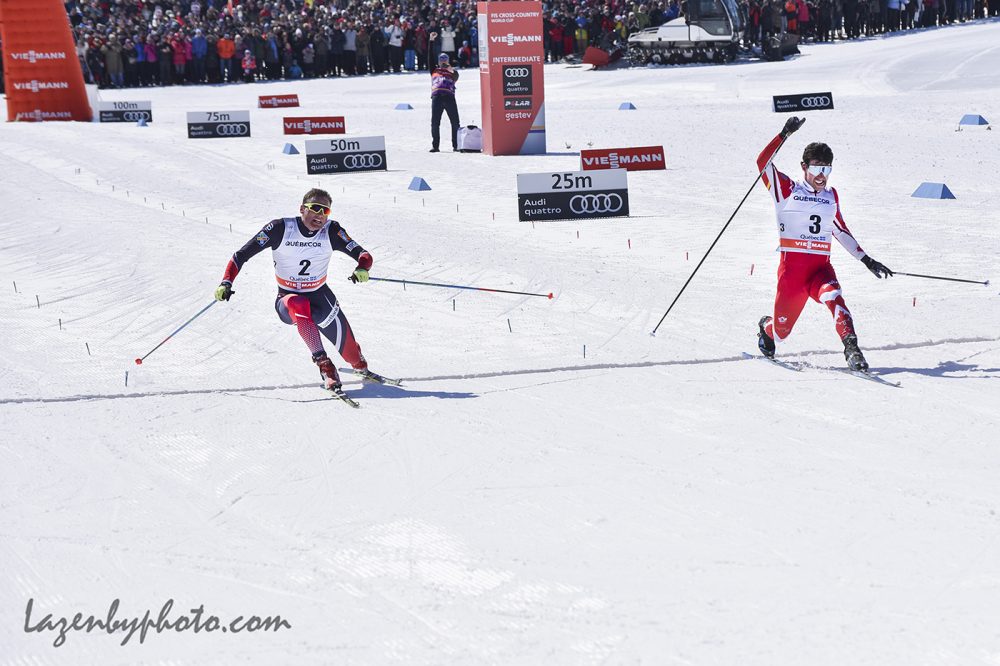
With 100 meters to go, Harvey cornered to the outside left, while Dyrhaug took the center and Klæbo the right. All three went pole for pole, lunging for the line with Klæbo emerging as the ultimate winner in a time of 32:44.5 minutes.
Harvey finished second, listed with the same time as Klæbo, and Dryhaug third, 0.1 seconds back.
“I lunged with everything I had,” Harvey told reporters in English. “I knew I was going to be second or first, but I had no idea.
“Klæbo is the best sprinter in the world,” he continued. “He has got the [Sprint] Crystal Globe at home already. He’s got a medal from world champs in the sprint.”
“It’s unbelievable to be able to win here in Quebec and to cross the finish line first,” Klæbo said. “My first plan was to go from the start, but after one lap, I knew they were coming pretty fast so I just had to focus on waiting on them and holding on to them because they were going pretty fast. …
“It is my first time in that situation,” he added of starting first in a pursuit. “And it is very easy to be go a little bit too fast, then it’s over, so I think I was tactically smart today so I am really happy to cross the finish line first.
“It’s a lot of people who cheered us forward in the tracks, so it’s amazing to go with Harvey and hear the voices and all the loud voice on the uphills there,” Klæbo continued.
“We have had many highlights [this season]” Harvey’s coach and Canadian co-World Cup coach Louis Bouchard told FasterSkier. “But … we are from Quebec so it’s normal for us to say the highlight is Quebec, because I am from here. I know everyone here. I know the spectators. I hope brings more younger athletes you know for the next generation.”
Canada’s Alex Harvey (r) lunging for first with Norway’s Johannes Høsflot Klæbo (not shown) and Niklas Dyrhaug (l). Harvey placed second and Dyrhaug third in the men’s 15 k freestyle pursuit at World Cup Finals on Sunday in Quebec City. (Photo: John Lazenby/Lazenbyphoto.com)
Led by Bjornsen in 11th, Four Americans in Top 30 for Time of Day
Also on Sunday, Erik Bjornsen of the U.S. Ski Team finished 25th (+2:19.1) and posted the 11th-fastest time of day, with 11th marking his best World Cup result to date.
“This is my first [mini] tour in the top 30, and that was my goal for this year was to finish one of the tours in the top 30, and I am really happy to knock that off.” Bjornsen said. “And I mean 11th on TOD [time of day], that is crazy. That is definitely my best result so I am psyched.”
U.S. Ski Team member Erik Bjornsen (33) racing to the 11th fastest time of day in the men’s 15 k freestyle pursuit at World Cup Finals on Sunday in Quebec City, for his career-best World Cup result. He finished 25th overall. (Photo: John Lazenby/Lazenbyphoto.com)
Bjornsen started 33rd and managed to catch and ski with Finland’s Matti Heikkinen, Canada’s Devon Kershaw, Germany’s Thomas Bing, France’s Jean-Marc Gaillard and Great Britain’s Andrew Young.
“It was hard, I was really worried I was working too hard to catch that group in the first 2 to 3 k,” Bjornsen said. “Luckily I just felt like I was recovering really well and sticking in the draft was really helpful. So it all worked out for me today.”
From Quebec, Bjornsen was bound for Anchorage, Alaska, where he trains with Alaska Pacific University (APU). Next week, he planned to compete at U.S. SuperTour Finals in Fairbanks.
“Excited to go home to sleep in my bed for the first time in four months,” he said.
Along with Bjornsen, four other Americans finished in the top 30 for time of day, with Paddy Caldwell in 25th, David Norris 27th, and Scott Patterson 30th.
Paddy Caldwell (U.S. Ski Team D-team/SMS) racing to 46th overall and 25th for time of day in the men’s 15 k freestyle pursuit at World Cup Finals in Quebec City. (Photo: John Lazenby/Lazenbyphoto.com)
Patterson was the first American across the line after Bjornsen, finishing in 41st (+3:45.6) after starting 46th. Norris was next, finishing 43rd (+4:15.9) after starting 55th. Caldwell came in 46th (+4:25.6) after starting 58th.
“That was one of the goals for the day so I am psyched about that,” Caldwell said of his time of day result. “I was working with David and Scott for most of the race and two other guys, so that was really fun, and fun to work as group and try to put down a fast time.”
Caldwell further explained that a great portion of his performance came from the way he approached the wave mass start.
“I was thankful I was sort of on the edge of the chevron right out of the gun. I just went hard as I could to try to get in front of that pack,” Caldwell said. “That actually ended up being a really good move to being towards the front of our chase pack and you know we just went from there.”
Also for the U.S., Andy Newell placed 44th overall (+4:23.0), Simi Hamilton 45th (+4:23.4), Matt Gelso 49th (+4:32.3), Noah Hoffman 52nd (+5:03.8), John Hegman 57th (+5:45.9), Brian Gregg 58th (+5:55.9), Ben Lustgarten 59th (+6:04.0) and Cole Morgan 65th (39:42.7).
“I started three people in front of the waves,” said Newell, who started 44th and finished in that position. “So I knew they were going to catch me, but that was fun because I got to ski with a lot of U.S. competitors. … Simi and I skied a lot together and Brian Gregg and you know it was fun to finish it off in the sun with some teammates.”
After Harvey, the next Canadian across the line was Devon Kershaw, who finished in 26th (+2:21.4) and posted the 19th-fastest time of day.
Canada’s Devon Kershaw racing to 26th in Sunday’s 15 k freestyle pursuit at World Cup Finals in Quebec City. He was 19th for time of day. (Photo: John Lazenby/Lazenbyphoto.com)
“It’s just kind of like a fitting ending to a kind of a tough season,” Kershaw said. “[I’ve been] just missing that top top gear a lot of the season and I think in all of the tours, I was [27th] in Lillehammer, 25th in Tour de Ski, and I think I was 26th [today]. I am constantly not amazing, but you know, at the same time it’s nice to make a few positions and [in] this beautiful atmosphere.”
Kershaw, who finished the 2011/2012 season in second in both the Overall and Distance World Cup, couldn’t have been more happy for his teammate and friend’s successful end to the season.
“He is one of my best friends and to see his development here and through the years, I have been saying this since he was a 1st year senior … I have never seen an athlete and work ethic like Alex,” Kershaw said. “To see the people of Quebec come out and support their hometown hero is couldn’t be happier for him.”
Among the Canadians, Graeme Killick finished 42nd (+3:45.9), Knute Johnsgaard 53rd (+5:09.6), Len Valjas 54th (+5:20.2), Evan Palmer-Charrette 60th (+6:11.4), Bob Thompson 61st (+6:12.8), Brian McKeever 62nd (+6:30.8), Joey Foster 64th (+6:39.9), Andy Shields 66th (+6:59.4), Russell Kennedy 67th (+7:06.0), Jess Cockney 68th (+7:17.2), Gareth Williams 71st (+9:21.6), Ricardo Izquierdo-Bernier 72nd (+10:22.7), and Julien Locke 73rd (+11:15.1).
–François Léger Dionne, Alex Kochon, Gerry Furseth, Ian Tovell, and Jake Ellis contributed
Canada’s Alex Harvey celebrates his second-place finish (and two overall World Cup medals, in the Distance World Cup and Overall World Cup) after the men’s 15 k freestyle pursuit at World Cup Finals on Sunday in Quebec City. (Photo: Gestev)
(Left to right) Norway’s Martin Johnsrud Sundby, Russia’s Sergey Ustiugov and Canada’s Alex Harvey on the podium in the men’s 15-kilometer pursuit on Wednesday at Stage 4 of the Tour de Ski in Oberstdorf, Germany. (Photo: Fischer/NordicFocus)
Could Russia’s Sergey Ustiugov be the first cross-country skier to perform a seven-stage sweep? He’s certainly well on his way, after collecting his fourth Tour de Ski win in a row on Wednesday in the men’s 15-kilometer freestyle pursuit in Oberstdorf, Germany.
Ustiugov’s four-stage streak alone is unprecedented. Until this year, no other nordic skier in the International Ski Federation (FIS) has been able to complete such a feat during the Tour.
Not even Norway’s defending overall World Cup leader, Martin Johnsrud Sundby can keep up with — or catch — the Russian.
“I was watching for Martin to catch me,” Ustiugov said after Wednesday’s pursuit, according to a FIS press release. “But when he did not come I decided to go for it. I gave everything I had today.”
Russia’s Sergey Ustiugov on his way to his fourth Tour de Ski stage win in a row on Wednesday during the men’s 15-kilometer freestyle pursuit in Oberstdorf, Germany. Ustiugov is the first skier to win four-straight stages in the Tour de Ski.(Photo: Fischer/NordicFocus)
Sundby certainly gave it a shot. Starting 30 seconds back in bib 2, the Norwegian steadily put time on Ustiugov through the first 10 k. In fact, with 5 k to go, he was within 16 seconds of the pursuit race leader.
“At the beginning of the race I felt very good,” Sundby said, according to FIS. “But then something happened and I lost some seconds on Sergey. I did not ski my best today.”
For the last third of the race, Sundby struggled to maintain the seconds he had just gained. Unchallenged, Ustiugov crossed first in a time of 37:58.5 minutes, maintaining his Tour de Ski (TdS) leader’s bib and securing his fourth-consecutive win.
Settling for second place, crossing 37.2 seconds later, was Sundby. He now trails Ustiugov by 42.2 seconds in the overall standings (losing a total of 12.5 seconds in the pursuit) heading into Stage 5 of the Tour: the 10 k freestyle in Toblach, Italy.
Harvey’s ‘Play for the Podium’ Keeps Him in 3rd Overall
For Canada’s Alex Harvey, it was not so much a matter of whether Switzerland’s Dario Cologna could catch him, but what action he’d take when he did.
The Swiss skier was slated to start 17 seconds behind Harvey, and judging by the way Cologna raced the freestyle portion of Tuesday’s Stage 3 skiathlon, Harvey had a hunch that company would soon be calling.
After all, passing the Canadian would not only give Cologna his second stage podium in a row, but more treasured time in the final three stages on Ustiugov and Sundby.
Seventeen seconds would only slow the Swiss skier for so long.
“I had a few different plans in my head,” Harvey reflected on the phone about his race strategy for when Cologna caught him. “I knew that if he made up seconds on me … it would be hard [on] him. So I was expecting him to not pass right away, and that’s what happened.”
By 2.5 k, Harvey’s red-and-white suit was in steady sight for Cologna, less than ten seconds ahead. Within another two kilometers, Cologna had caught Harvey and, as Harvey predicted, drafted for much of their first lap together (Lap 3 of six).
Canada’s Alex Harvey chases Dario Cologna of Switzerland during the men’s 15-kilometer freestyle pursuit on Wednesday at Stage 4 of the Tour de Ski in Oberstdorf, Germany. Harvey ultimately placed third ahead of Cologna in fourth. (Photo: Fischer/NordicFocus)
However, as the two approached the course’s major climb, Cologna went for the pass and Harvey had no choice but to hold on.
“On the hill he was really putting the hurt on me,” Harvey said. “I was trying to do my best to stay with him and kind of at the same time, play for the podium, too.”
Harvey’s first ‘play for the podium’ meant staying behind Cologna through the flats of the fourth lap, where the wind made for more work. In a second podium play, Harvey pulled to the front at the start of Lap 5, before returning the lead back to Cologna by the course’s major climb.
“I noticed that I was faster on the climb, but [Harvey] had the faster ski,” Cologna said during a televised interview, according to a Swiss-German translation. “Maybe he could have helped a bit more on the flats, but that’s the way it is.”
Not wanting to risk an untimely attack, Harvey continued to draft into the final small hill before the stadium. There, the Canadian surged, with Cologna straining to match Harvey’s ski speed through the last lefthand turn. Fifty meters, twenty, ten. It appeared Harvey had him and with eighth-tenths of a second to spare, the Canadian took the final podium spot in third, 1:08.8 behind Ustiugov, while Cologna crossed fourth (+1:09.6).
Heading into the final three stages of the Tour, Harvey holds onto third overall, 1:18.8 behind Ustiugov and 36.6 seconds behind Sundby. With Cologna 5.8 seconds behind Harvey in fourth overall (+1:24.6), the Canadian wants to put as much time as he can on the Swiss skier before the final climb.
“I’m going try to go for the primes, for sure, in Val di Fiemme,” Harvey said of the Tour’s penultimate stage, the men’s 15 k classic. “Dario is probably the favorite for Toblach, but we’ll see.”
The second Canadian on Wednesday was Devon Kershaw in 21st (+4:20.2). Unable to find his race “rhythm”, he described his day as just “OK.”
“I just couldn’t get going as well as the day before so a little bit disappointed that I wasn’t able to stay with some of the Russians,” Kershaw said on the phone. “But before the Tour, I had my eye on three races: Val Mustair, the pursuit and then the 15 k classic in Val de Fiemme. So to come away with another top 30 today, that was definitely a little bit of a bonus.”
Kershaw is currently 4:35.2 minutes back in the Tour standings in 21st.
The first American across the line on Wednesday was Noah Hoffman in 37th (+6:49.0). After crashing out of the start, the U.S. Ski Team member worked to quickly recover.
“The guy in front of me pulled on the start board … and lifted it up when he lifted his poles,” Hoffman explained on the phone. “My skis went under it, and it caused me to face plant, and the board went flying. … It lost me some places at the start, but I got up quickly.”
Canada’s Devon Kershaw (20) racing to 21st in the men’s 15-kilometer freestyle pursuit on Wednesday at Stage 4 of the Tour de Ski in Oberstdorf, Germany. (Photo: Fischer/NordicFocus)
He started in bib 37 and ended up in that position, referring to his race as a bit of a “slow grind.” Hoffman added that he is still “looking forward to three more stages” of racing, starting with Friday’s 10 k skate in Toblach. He is currently 7:04 back in 37th overall.
Following Hoffman, the second American was Erik Bjornsen in 46th (+8:39.0), after starting 50th. With the 27th fastest time of the day, Bjornsen saw the result as an improvement in his overall Tour performance. Heading into the final three stages, he ranks 46th overall (+8:54.0).
“I ended up finishing 27th on time of day (Not sure if FIS has updated the results, they did have 29th but in fact I was 27th and supposably they were going to fix that.)” Bjornsen wrote in an email. “It hasn’t been a great start to the Tour so far but I was satisfied to finally put one together today.”
Canada’s Graeme Killick started 46th and picked off three places for 43rd (+8:01.4), which puts him 8:16.4 back overall. Canadian Lenny Valjas did not start, withdrawing from the Tour “to save his energy for upcoming sprint races on the World Cup and World Championships,” according to a Cross Country Canada press release.