From the FasterSkier archive — posts syndicated from athletes’ and coaches’ own blogs between 2004 and 2012, kept online as published. Current coverage is at fasterskier.com.
In this episode we put the elusive Fast Big Dog, known in the business world as Jon Schafer, in front of the mic for his answers to the 17 Questions for 2017. It brings a conclusion to the FasterSkier interview series run last fall before the start of the 2016/2017 cross-country, nordic combined and biathlon race seasons.
Schafer is knee deep in the nordic scene as high performance director for USA Nordic Sport, a supporter of many aspiring skiers, and a huge Evel Knievel devotee — note Schafer’s race suit.
Jessie Diggins (U.S. Ski Team) loving on her Salomon boards after placing second in Tuesday’s 10 k skiathlon at Stage 3 of the Tour de Ski in Oberstdorf, Germany. (Photo: Salomon/NordicFocus)
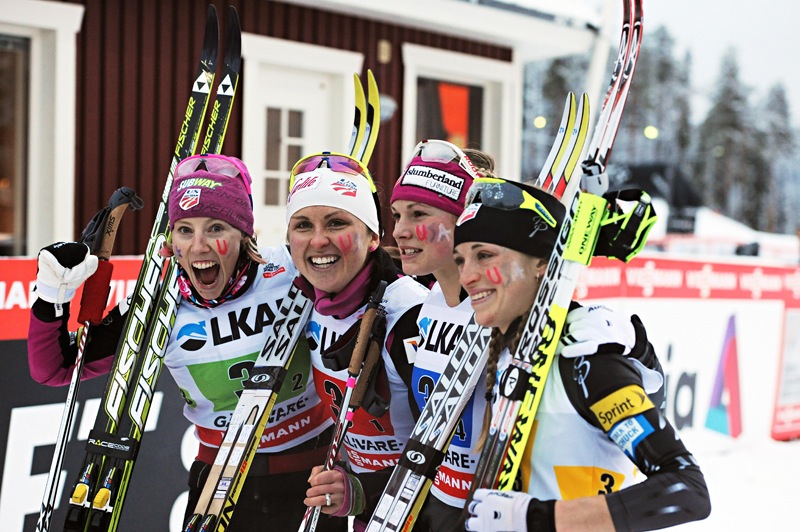
A little more than four years ago, a group of women clad in all black race suits and bib 3 huddled in an athlete warming room. The muffled voice of an announcer speaking in Swedish could be heard broadcasting outside, an English translation relaying the same message: 10 minutes to start.
The quartet departed the building, four blondes — one highlighted pink — headed for the start gate. A pass through a patch of sunlight revealed a second similarity. Cheeks swiped in sparkles, artwork courtesy of the then and now, youngest U.S. Ski Team (USST) A-team member, Jessie Diggins.
Diggins would go on to anchor the team in what became a historic cross-country World Cup relay for the U.S. — it was the first time an American women’s team reached the podium, with the group finishing in third overall.
The U.S. women (l-r Kikkan Randall, Holly Brooks, Jessie Diggins, and Liz Stephen) after their first ever World Cup relay podium in November 2012. (Photo: Fischer/NordicFocus)
It could be said that the game-face glitter and a give-it-all relay leg performance from Diggins was the kickstarter of her World Cup career.
For the next few years, team races such as the above, would become some of the Afton, Minn., native’s favorite, and arguably, better performances. Her first individual podium came almost exactly a year ago at the 2015/2016 Tour de Ski.
“For years, I would pull out these awesome performances on relay day and I was like, ‘Oh my God, where did that come from?’ ” Diggins said during a phone conversation in November.
Now, at 25 years old, Diggins has reached the World Cup podium 13 times. Of the eight individual podiums, six occurred last season. The other two more recent: her win in the 5 k freestyle race last month and her second place finish in Tuesday’s Stage 3 skiathlon in Obsterdorf, Germany.
With close to five years of World Cup racing now under her belt, Diggins explained that while her love for team racing and facepaint has not changed, her mental approach toward individual races has. Part of the difference stemmed from her discovery that her individual effort is no less important than the one she puts forth for the team.
“I finally realized it’s OK to race that hard in an individual race, too,” she said. “Like that doesn’t make me a bad person for wanting to do it for myself and for my hometown and for all the people cheering for me.”
That said, Diggins is not bent on lining up and looking for the win at the start of every ski race this season. Her focus, as she indicated, will be where it matters: the Tour de Ski — which she currently ranks fifth in — and 2017 World Championships in Lahti, Finland.
“You’re not going to be able to race to the point of being barely conscious 40 times,” Diggins said, predicting that, if this season matches last year’s competition count, she’ll probably tackle close to 40 ski races. “I’m going to get ready for the big races, like the tours, World Championships, the ones that are the most important to me.”
Left to right: American Jessie Diggins with Norway’s Kari Øyre Slind and Ragnhild Haga after a strength training session with the Norwegian ski team this summer. (Photo: Roar Hjelmeset)
A firm believer in the role every individual plays within the team structure, Diggins described her part within the women’s USST as that of a “spark plug.” While some individuals show strength in race analytics, others psychological breakdown, hers comes as enthusiasm for the sport itself, which includes her signature sparkles.
“You know, everyone has very unique skills that they bring to the table and mine is energetic optimism,” Diggins said. “I’m kind of the cheerleader of the team, if you will, covered in glitter. My job is to make the team, get people excited about what we’re doing.”
Diggins does her job well. As an athlete ambassador for Fast and Female, once again aiding with the ‘dance and endurance’ station at this fall’s annual event in Park City, Utah, she acted as inspiration for more than 160 girls in attendance.
Her enthusiasm for the sport is also proactive. Before last season came to a close, she approached the Norwegian women’s head coach at the time, Egil Kristiansen, at the Ski Tour Canada, proposing the notion of her joining his Norwegian team for a summer training camp.
Three months after her conversation, Diggins received an email from Norway’s new women’s head coach, Roar Hjelmeset, listing training camps she could attend.
“If you want to be the best, why not go train with the best?” Diggins said of why she chose Norway.
With many of the Norwegian women a similar age as herself (to include some of Norway’s leading talent: Heidi Weng, Maiken Caspersen Falla and Ingvild Flugstad Østberg), and the potential of racing alongside these same athletes for the next few years, Diggins also saw an opportunity to create connections as more than just competitors.
“If you want to be the best, why not go train with the best?” — Jessie Diggins on spending a week training with the Norwegian national team
“Why not make good friends and have a coffee buddy in between races on the World Cup?” Diggins said. “I love making friends and learning more cultural things. It’s about more than just skiing, I guess, for me.”
Her time in Norway gave her more than just a few extra World Cup coffee buddies. She was also able to compare notes on Norway’s training strategies with those of the U.S. What she found was, surprisingly, there were no big secrets. Much of the training she did with the Norwegians mirrored work she’d done at camps on North American soil.
“The training we did over there in Norway was almost identical to what we did at our Bend camp,” Diggins said of the U.S. Ski Team’s annual spring camp. “We just need to believe in ourselves as a nation and know that eventually we will get there too.”
It wasn’t that her Norwegian counterparts were doing more intervals than what she was used to or even longer. What it did come down to, according to Diggins, was the complete conviction with which they approached their training plan, even if it meant doing less than others around them.
“They go into every workout with this awesome confidence, like what I’m doing today is the right thing for me and it’s going to make me faster and I’m going to kick ass,” Diggins said. “It’s just a really good mindset I really admire.
“It’s really hard because a lot of us are wired in that more, more, more, more is better,” she added. “It’s my job to train, so I’ll just train a ton. But it doesn’t always make you faster, unfortunately. Or else it be super easy and we’d all be winning World Cups.”
As she continues to become a regular podium contender and challenger of Norwegian names, Diggins proves that the trust she has placed in her training is not to be taken lightly. With another individual win added to her first one from last year, Diggins doesn’t doubt her ability do it for herself or her team.
“Last year was a big confidence boost,” she said. “Now [coming into this season], I know that I can do it, because I’ve done it before.”
***
We asked Diggins to give our ’17 Questions for 2017′ a go. Here are her responses:
1. Biggest change in your life in the last five or so months since the ski season ended?
Not a whole lot has changed! I’m still a ski bum living out of my suitcase, and the longest I’ve been in one place was 3 weeks in a row. I guess the biggest change is that I can now pack up my life in under an hour (yep, I clocked it).
2. Biggest change in your training?
I’m still slowly getting better at finding the line between training a lot and recovering from it before moving on, and paying a lot of attention to how I’m feeling day to day is something that’s helped me a lot over the past year.
3. Major areas of improvement you’ve seen so far?
Classic technique! I’ve been putting a lot of work into classic over the years and I’m finally feeling as comfortable striding as I am skating. I can’t believe I just wrote that.
4. Whom you’ve been working closest with this offseason (coaches or training partners)?
I work with a lot of people! Jason Cork has been my personal coach (and tech!) for a looooong time, and I also train and work with the USST coaches and athletes. I spend the summer bouncing between USST camps and living and training with my teammates at SMS and our SMS team coach, Pat. Basically, I love working with everyone. I even got a special trip to Norway to train with their National team girls, and I had such a great camp with them. I firmly believe that the more we can get together and help each other get better and faster, the better everyone will be!
5. Best trip in the last five months (and why)?
I have a serious thing for New Zealand. We had another amazing training camp there this August, and I love everything about that country! The training was amazing with 35km of groomed trails, the food was spectacular, the views were inspiring and the people were super friendly.
6. Favorite cross-training?
I like long adventure runs. Point to point, NOT out and back, please.
Jessie Diggins (r) with her boyfriend, Wade, during a trip to Winnipeg, Manitoba, this summer. (Courtesy photo)
7. Favorite non-athletic activity or pastime this summer?
Spending time with my boyfriend in Boston, and my family in Minnesota! There are a lot of pretty amazing people in my life, and I like being around them as often as I can.
8. Song that was your jam this summer?
“Handclap” by Fitz and the Tantrums got me through my own set of glacier skiing tantrums 🙂
9. All-time favorite race moment?
OH man. There are so many! Every relay I’ve ever been a part of is a great memory for me…even the times we really blew it 🙂 But it’s a tie between the moment I crossed the finish line and barreled right into Sophie, Sadie and Liz’s arms in Nove Mesto, and when Kikkan and I won the World Champs team sprint relay. Those were days when the whole team was jumping up and down!
10. First thing you pack in your bag when you leave for Europe?
Glitter. Aeropress coffee maker. Peanut butter/Almond butter and American Gum (I swear, it’s different. And very important!). But the first thing is always glitter for race days
11. Venue/event you’re most excited to visit this season?
I am really excited to see the new one in Ulricehamn, Sweden. It’ll be fun to see a new place!
12. Who will win the men’s and women’s World Cup titles this year?
Your guess is as good as mine!
13. Biggest sacrifice you feel you’ve made choosing this career path?
Being far away from the people I love in my life. I’m a cuddly, got-to-be-with-you-there-in-person kind of person, and it’s hard to be gone so much. Thank goodness for Skype, but it’s not the same when you really need a hug from home.
14. If you could change one thing about your sport, what would it be?
Have more World Cups in North America, and finally bring some back to the US! Our sport is growing and it would be incredible to bring all the exciting action back home to keep the next generation of skiers fired up.
15. What did you have for breakfast this morning?
Oatmeal with berries, nuts, yogurt and local honey made by my friends at home! Lucky me.
16. In 5 years, I’ll be ____?
Still racing the World Cups, of course!
17. In 50 years, I’ll be ____?
Embarrassing my grandkids by dressing up, glittering my cheeks and skiing the Slumberland American Birkie.
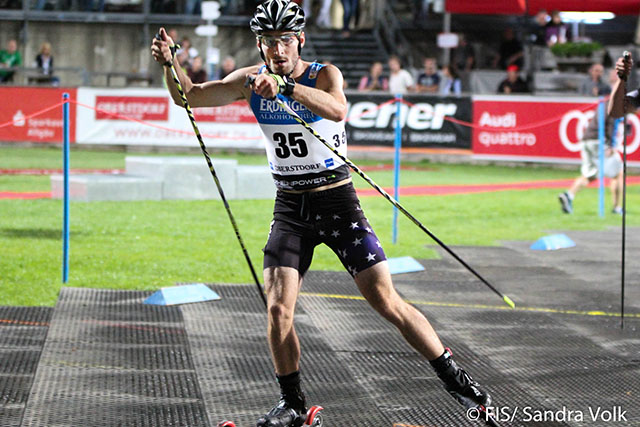
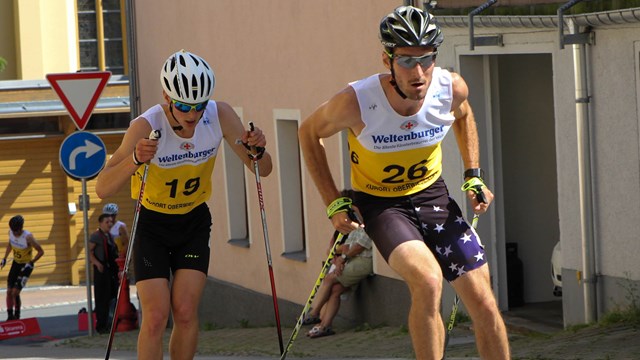
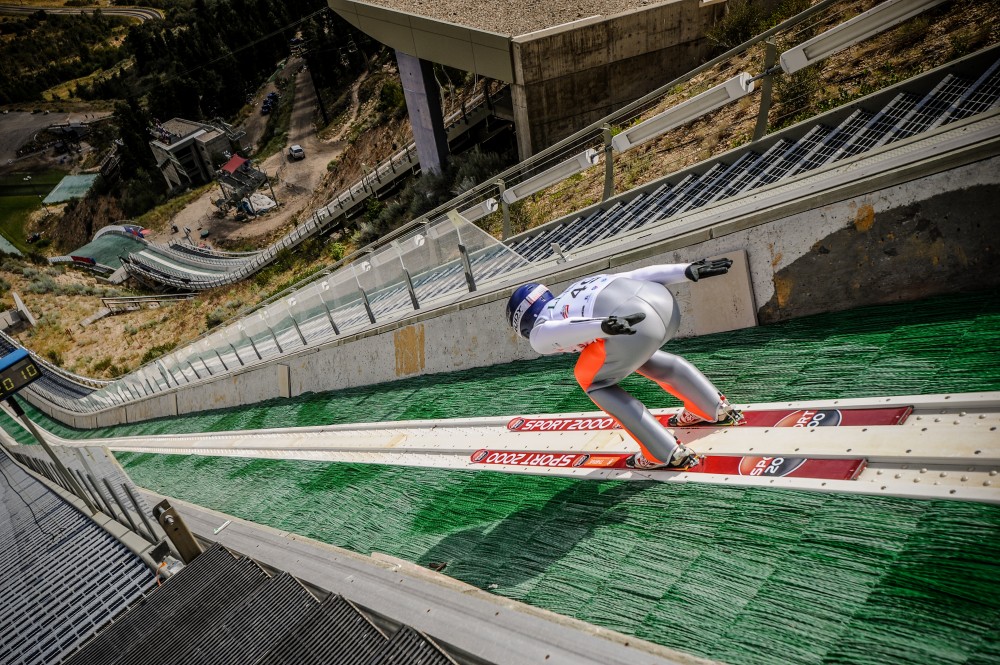
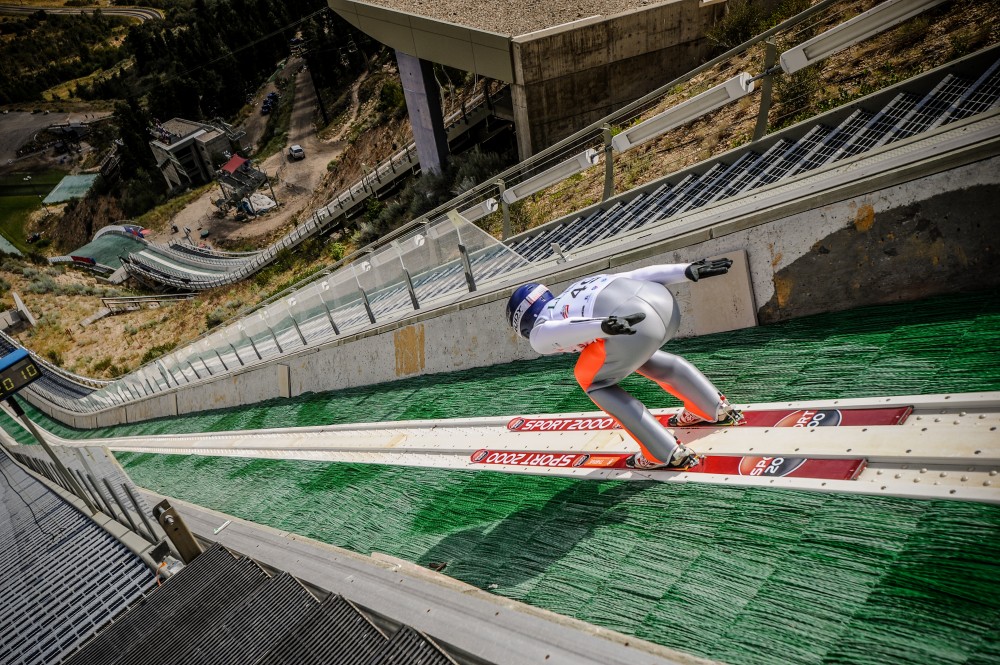
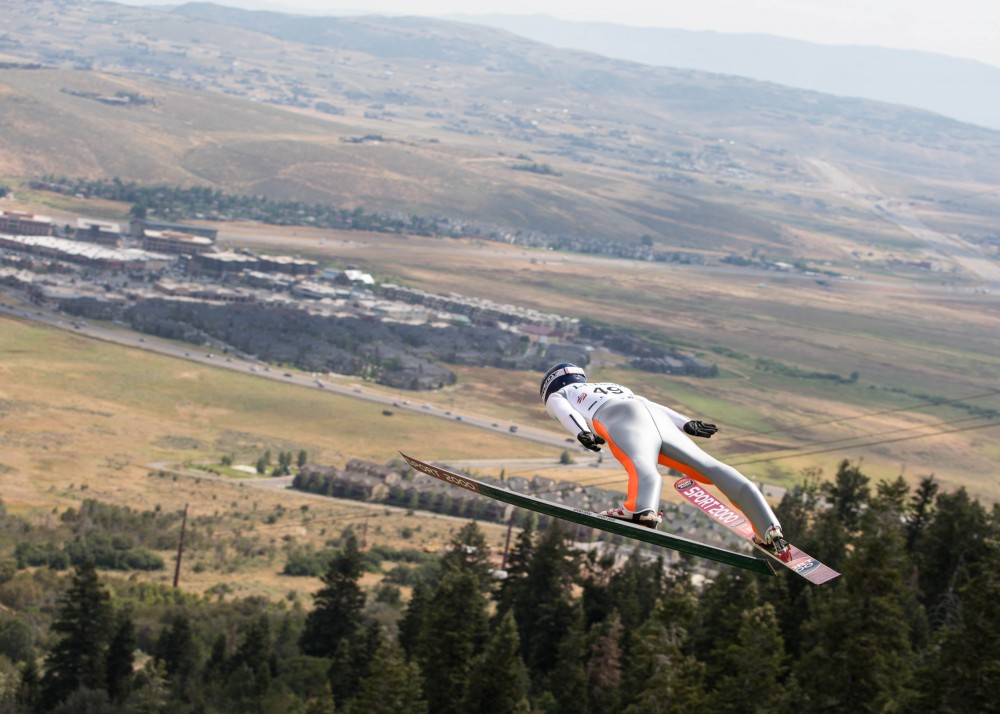
Taylor Fletcher racing in Oberstdorf, Germany during the 2016 FIS Nordic Combined Summer Grand Prix in September, where he placed 15th overall in the series. (Photo: FIS/Sandra Volk)
Shaking out white, sand-filled training shorts is hardly a thing many skiers find themselves doing prior to an autumn morning interval session. Nor is swimming with sea turtles a typical regular-recovery run substitute.
However, this past October, U.S. Nordic Combined A-team member Taylor Fletcher did a little of both. The 26 year old’s ‘spring break’ came six or seven months early, or seven months late, depending how one looks at it, with his final days of fall prep for the 2016/2017 season spent beach bumming in Cancun, Mexico.
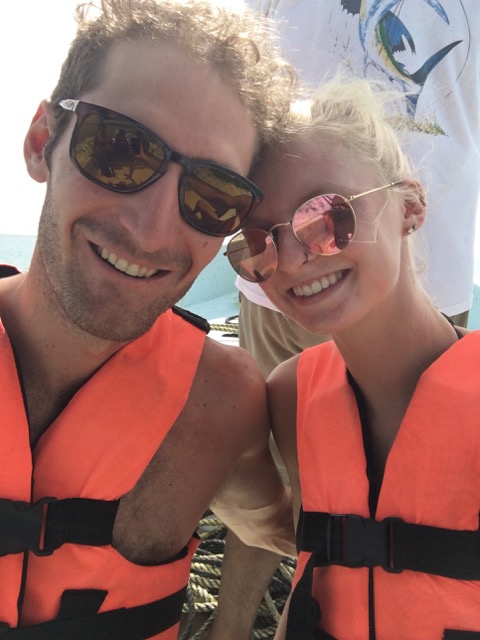
U.S. Nordic Combined skier Taylor Fletcher (l) with his girlfriend and U.S. freestyle skier Kiley McKinnon during a vacation trip to Cancun, Mexico, this past October. (Photo: Taylor Fletcher)
Fletcher, who has been competing for the U.S. Nordic Combined team since the age of 19, was not afraid of the non-traditional preseason training week. Viewing himself (along with his older brother Bryan Fletcher) as “more of a seasoned veteran on the team”, Taylor greeted the vacation as a way to mentally and physically unwind from his biggest training block before bringing in the new season.
“The hardest part was getting off the plane from the really warm weather in Mexico and realizing it wasn’t much colder [in the U.S.],” Fletcher, originally from Steamboat Springs, Colo., said on the phone in late October.
The seven days of surf and sun — which he spent with his girlfriend and U.S. freestyle skier Kiley McKinnon— were well-earned by the end of the fall for Fletcher.
With U.S.A. Nordic Sport’s recent hiring of nordic-combined head jumping coach Nik Huber, who is based in Austria, Fletcher amped up his jumping training.
“It was no joke that we were definitely on the struggle bus last year with our jumping,” Fletcher said. “We had the opportunity to get a new coach after the organization let go of Greg [Poirier] and we were very fortunate to be contacted by Nik Huber … he brings a new technical edge and gives us new ideas and passion about the jumping side.”
While the months of June and July were dedicated to jumping for Fletcher, the end of August included travel to Oberwiesenthal, Germany, and Villach, Austria, for the Summer Grand Prix, which included a team sprint and an individual 10-kilometer event in Oberwiesenthal and a 10 k competition in Villach.
U.S. Nordic Combined skier Taylor Fletcher (26) racing to the fastest time of the day and seventh overall at the Summer Grand Prix in Oberwiesenthal, Germany. (Photo Sandra Volk/FIS)
Fletcher finished in seventh overall in the Oberwiesenthal 10 k and did not start the Villach 10 k. He and his teammate Ben Berend raced the team sprint together and finished 14th overall.
“We’ve just been working on the last part of the flight: making sure you’re poling to the bottom of the hill, making sure your tails touch,” Fletcher explained. “Just eking out every meter possible and when you add all those things up it can be ten to fifteen meters.”
Though 10 to 15 meters may not sound like a lot initially, in a nordic-combined competition, it could be the difference between a one-second versus a nearly two-minute start deficit. For an athlete like Fletcher, who is notorious on the World Cup circuit for his adeptness on the cross-country side of the sport, the prospect of him obtaining even stronger start positions via jumping may bring him closer to the podium.
“For a guy like me, to be that much closer to the front, it really scares a lot of people,” Fletcher said. “That was kind of the reaction we were getting from the test events this summer.”
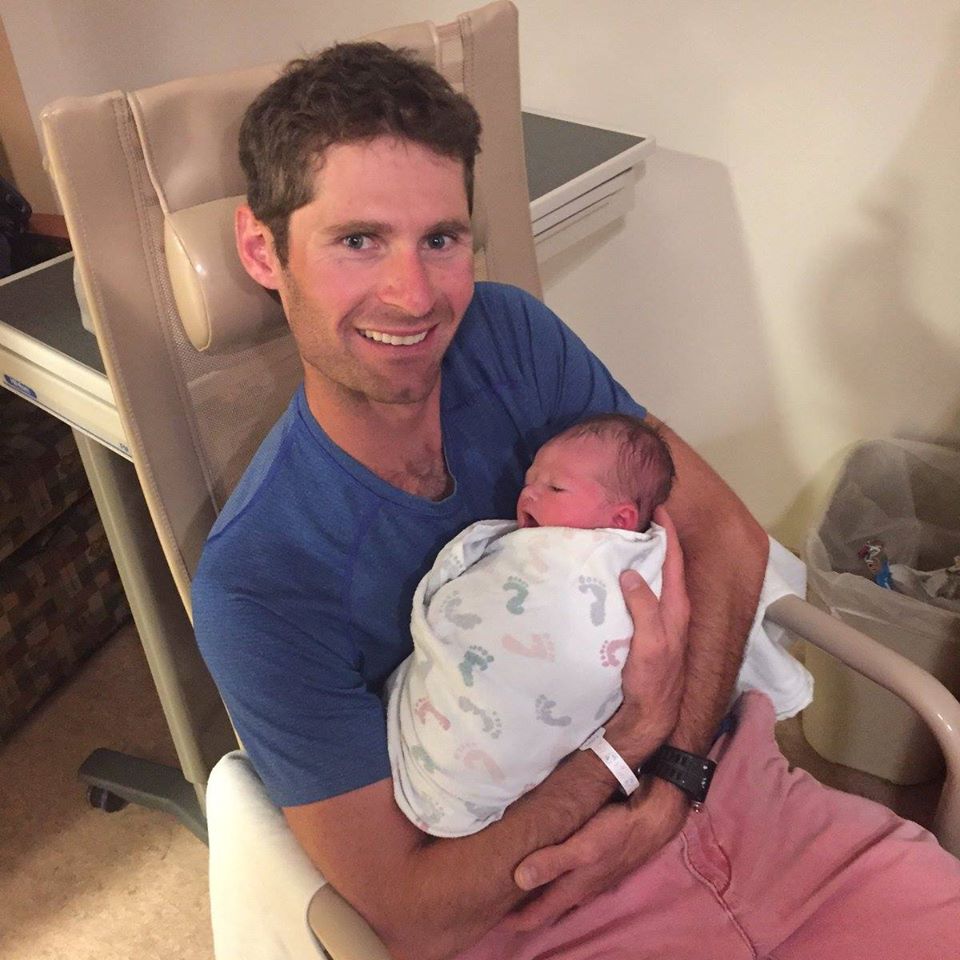
Following the Summer Grand Prix, Fletcher flew back to Park City, Utah where he visited his older brother, Bryan and newborn niece, Ellery Fletcher. After playing uncle, Fletcher returned to Europe for a full month to train in Slovenia, Austria and Germany.
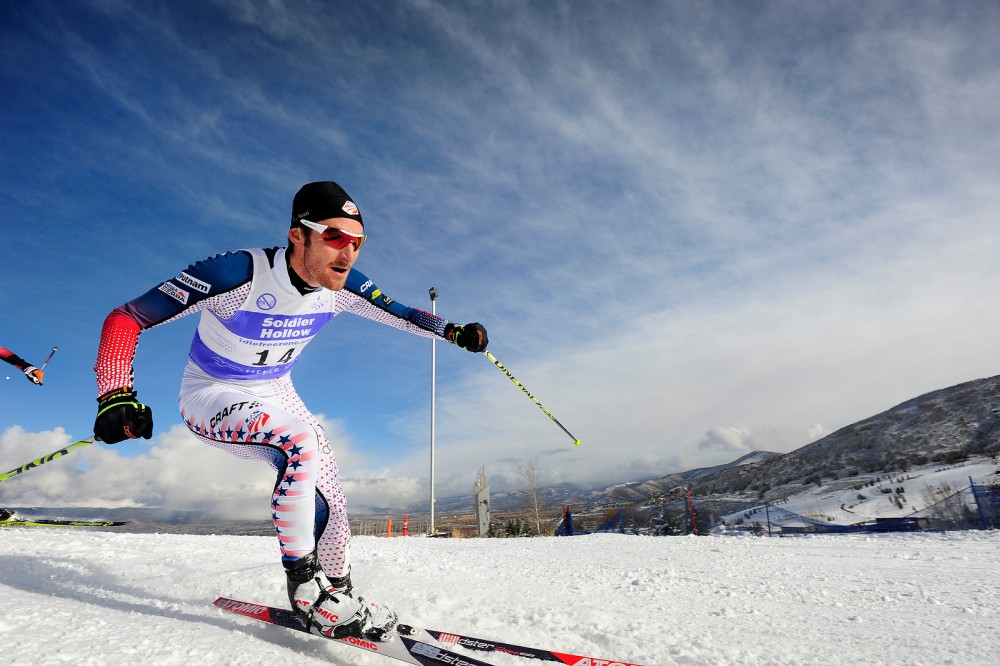
Taylor Fletcher charges around a corner in a 10 k FIS Nordic Combined Continental Cup cross-country race last season at Soldier Hollow in Midway, Utah. (Photo: U.S. Ski Team/Tom Kelly)
“That was something that I really haven’t done,” Fletcher explained of his decision to live in Europe for a full-month this fall. “It was good to step into the European style, cook my own food and…get in some really quality training there.”
Fletcher started his NoCo season with the opening World Cup races Kuusamo, Finland, where he finished a 40th in the individual large hill/10 k event.
The second weekend of World Cup racing in Lillehammer, Norway, saw Fletcher finish with the fastest course time (24:44.7) for 26th overall in the individual 10 k event after he jumped to 48th and started 2:50 back from the leader. He improved the following day, racing to 22nd overall in the individual normal hill/10 k in Ramsau, Austria, after jumping to 46th and starting at a 1:46 deficit.
While Fletcher indicated that he was “not expecting to go to Ruka and Lillehammer and win every event,” he is confident in his ability to be a regular contender for top-10 finishes and podiums as the season progresses.
“That’s something that I’m really pushing for, be consistently in the top 10 and fighting for as many podiums as possible this season,” Fletcher said.
***
We asked Fletcher to give our ’17 Questions for 2017′ a go. Here are his responses:
1. Biggest change in your life in the last five or so months since the ski season ended?
It a lot has happened since the end of the 2016 season. First of all, I am no longer a member of the U.S. Ski Team. Secondly we have been able to hire a new jump couch from the Norwegian team. This has been the biggest impact as now I have been able to make some big strides in my jumping performance as we head towards Lahti world championships. Most recently, It was the election for the new president. I am in disbelief that Donald Trump is now the leader of our country.
2. Biggest change in your training?
I have been focusing a lot on the jumping side again. With Nik Huber and Martin Bayer at the helm for jumping, I have been able to work on parts of my jumping that has struggled for the last couple years. I have been much more consistent on the hill than in years past and I think that is huge for me. We worked hard this summer in the gym, trying to build the strength and speed in the legs to become more explosive on the end of the jump.
3. Major areas of improvement you’ve seen so far?
My position on the In-run is much better as I am more compact but long and not so crunched. This is allowing me to generate more power on the takeoff which translates to speed and height at the bottle of the hill.
4. Whom you’ve been working closest with this offseason (coaches or training partners)?
I consider my offseason, March 15-April 1st. There I was working closest with the alpine skis and couch. But during the training season, I have been with the team every day essentially. This is one of the best parts about the Nordic Combined team as we all train together and continue to push each other in every session. I live with Ben Berend, so unless it is a team training day, Ben and I will go out and do something together.
5. Best trip in the last five months (and why)?
I just returned from Mexico with my girlfriend Kiley. I have never gone on a vacation this late, but It was really nice to unwind and relax before the season starts. We swam with turtles and laid on the beach. I was able to get a bunch of early morning runs in as well which was nice to explore the area.
6. Favorite cross-training?
In the spring it is certainly road biking and some races. As the summer processes I put the bike away and went on more hikes. These were a great way for me to get some training in with my GF as she could easily go with me and she really likes to hike.
7. Favorite non-athletic activity or pastime this summer?
Anytime I can get out on the golf course I love it.
8. Song that was your jam this summer?
She Knows — J Cole
9. All-time favorite race moment?
Winning a world championships medal with my brother and Bill Demong in 2013. To share the podium with Bryan is something I will never forget!
10. First thing you pack in your bag when you leave for Europe?
Probably socks because that is the first drawer on my dresser. First thing that I think of is my passport which lives in my travel backpack.
11. Venue/event you’re most excited to visit this season?
Holmenkollen. no other venue can beat it. But honestly I am most excited to get started and hopefully kick ass.
12. Who will win the men’s and women’s World Cup titles this year?
Men’s Nordic combined is being dominated by Eric Frenzel, I think someone else will win and I feel that it will be Johannes Ryzdek from Germany.
13. Biggest sacrifice you feel you’ve made choosing this career path?
Not having money from a normal job.
14. If you could change one thing about your sport, what would it be?
I would change it so world cups for all nordic events would be more possible in the United States. Anyone I talk to about Nordic seems to love it, but they never get to watch it.
15. What did you have for breakfast this morning?
Cinnamon Swirl toast with butter and one poached egg.
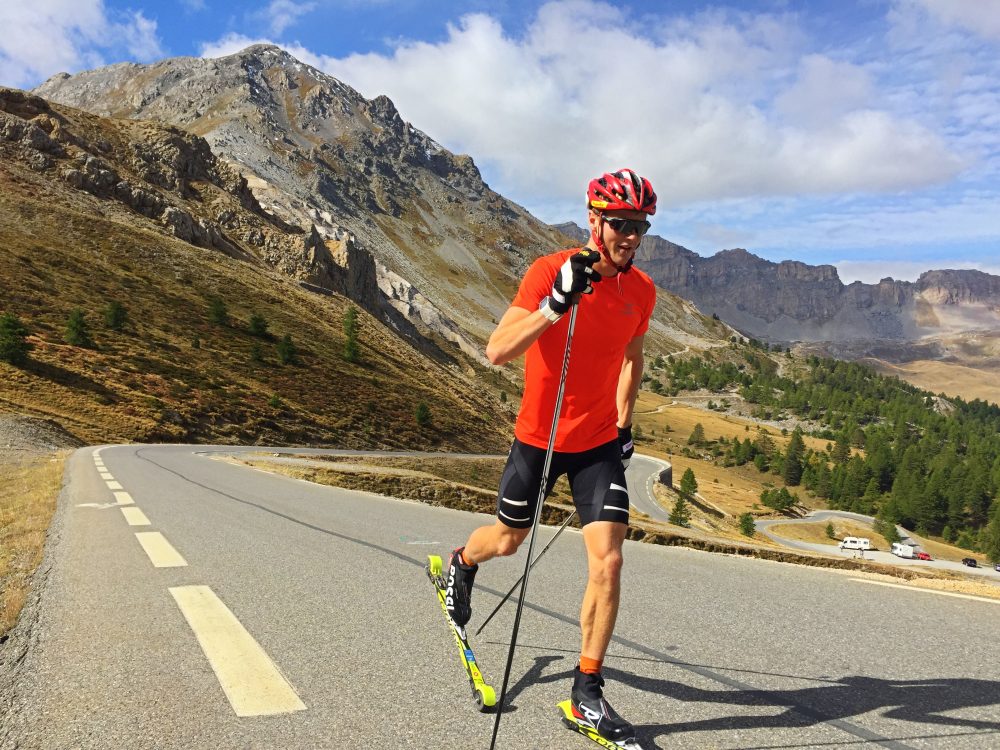
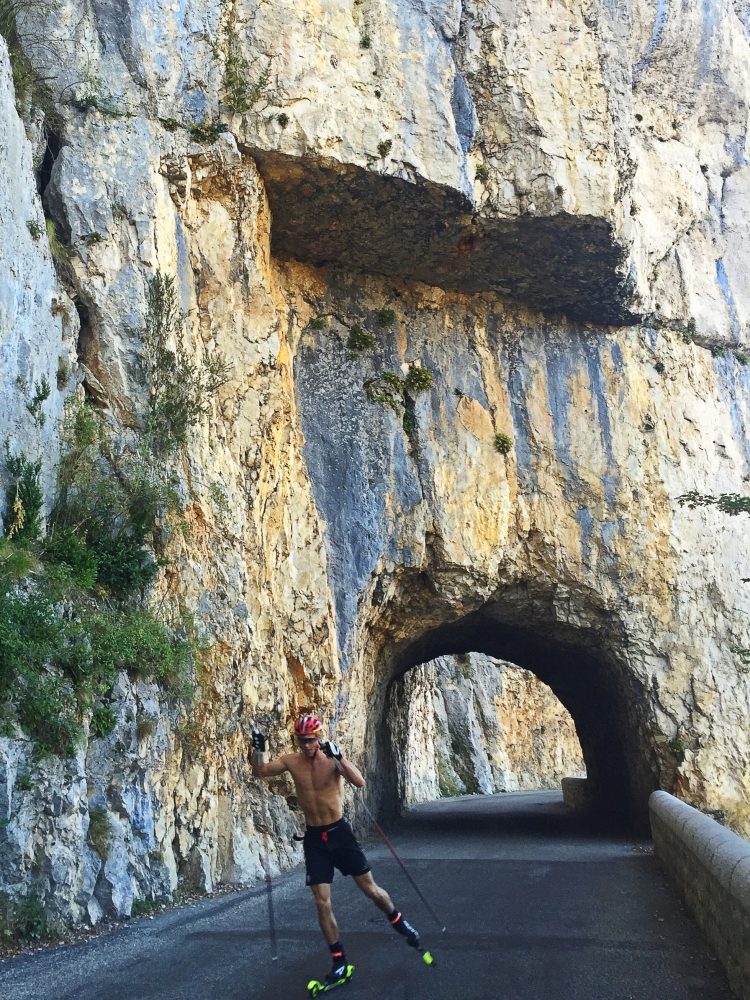
U.S. Ski Team B-team member Erik Bjornsen during a rollerski in France this summer 2016. (Courtesy photo)
A little less than two months ago, Erik Bjornsen found himself face down, breathing in some combination of medical mattress and bleached bedding. There was a sore tightness in his right shoulder, made all the more difficult to move due to the layers of salved gauze firmly taped to his skin. His training shorts had been modestly rolled down, revealing steak-sized road burns on both of his buns.
Had the U.S. Ski Team (USST) B-team member, by some happenstance, skipped the final rollerski races of the USST’s annual dryland training camp in Park City, Utah, he might have made it through the offseason unscathed for the first time in two years.
The Moirai of Bjornsen’s training, however, had other plans.
Erik Bjornsen (U.S. Ski Team/Alaska Pacific University) during a local running race this summer in Anchorage, Alaska. (Courtesy photo)
Bjornsen met up with his USST teammates at their Park City training camp, held Oct. 17-31. He competed in the camp’s final time trial: a skate sprint. He qualified for the quarterfinals and started the semis.
But instead of sending it across the finish line, while rounding one of the downhill corners on the sprint rollerski course in Soldier Hollow, he sent himself sliding butt-first across the pebbled pavement.
The incident left the 25 year old with road-rash raspberries on his right shoulder, left hand and total tail-end, as well as a desire to be done skiing on anything but snow, according to one of his Instagram posts after the crash.
But for the Methow, Wash., native — who currently lives in Anchorage, Alaska, and trains with Alaska Pacific University (APU) — a few less skin cells and a little more neosporin is not the worst preseason distress he could have, or has, endured.
“I was lucky, I mean last year I had hand surgery so I was away from using a pole for three months and then the year before I had some knee issues,” Bjornsen said on the phone in early November from Anchorage. “So I feel like I was very lucky to go through the summer without anything too major happening. Right now I’m just trying to heal up my hands from the road rash.”
Still working to heal his hands during the opening World Cup races in Kussamo, Finland (where he finished 42nd in the men’s classic sprint and 41st in the men’s 15-kilometer classic), Bjornsen was not too preoccupied with early season results.
“Both days I was pretty close to making top 30,” Bjornsen wrote in an email after the 15 k. “Personally this has always been the most difficult weekend of racing on the World Cup for me. That being considered I’m satisfied with my results. There is definitely more to come!”
When Bjornsen says ‘more to come,’ he means not only in events that he considers his forte, such as the distance classic races, but in his relay and sprint performances as well.
“There’s few [15 k classic events] this season and one in Lahti at World Champs, so I’m definitely looking forward to those, “ Bjornsen said on the phone in early November. “Last year I was able to get into the sprint heats twice and I love head to head racing … so definitely a goal is to get back into the heats and experience that a little bit more … We [also] have another couple of relays and I hope that I can throw down a strong leg.”
Bjornsen has already accomplished one of those goals. Earlier this month, he qualified 30th on Day 1 of the World Cup in Lillehammer, Norway, his first time advancing in a World Cup classic sprint. He was eliminated in his quarterfinal, finishing in 24th overall.
“Erik has not qualified for too many sprints, but to qualify specifically in Lillehammer, in the lion’s den is quite impressive,” USST Women’s Coach Matt Whitcomb said on the phone after the Lillehammer sprint.
His sister and USST teammate Sadie Bjornsen qualified first in the women’s classic sprint.
Although the U.S. men’s ski team was unable to enter a relay team in the first team event of the season, which took place last Sunday in La Clusaz, France, Bjornsen competed in the men’s 15 k mass start on Saturday, where he finished 20th and earned his first World Cup distance skate points.
“The course was littered with broken poles, lots of crashes I mean it was a super high speed tactical course and [Bjornsen] just stayed out of trouble and kept picking people off,” U.S. head coach Chris Grover said on the phone regarding Bjornsen’s performance on Saturday. “He just paced it perfectly.”
Erik Bjornsen during a rollerski in France this summer. (Courtesy photo)
Though Bjornsen has already witnessed a change in his performances with the conclusion of Period 1, not much had changed with regards to his preseason prep. This includes what has become an annual summer escape to France. Since Bjornsen’s girlfriend of three-and-a-half-years, Marine Dusser (a former French biathlete), lives in Villard, France, taking the opportunity to travel to a different country, train with the likes of Martin Fourcade, Simon Fourcade and Robin Duvillard, and experience a change in training scenery is warmly welcomed.
“This year I didn’t do any of the rollerski races like I’d done in the past,” Bjornsen, who previously raced at French rollerski nationals. “I was able to jump in and train with some strong French guys.”
Beyond buying baguettes and learning a few French phrases here and there while abroad, Bjornsen also spent some time exploring trails at home in Washington, with Sadie and his parents.
“Getting out and running some new trails every day was definitely a highlight to the summer,” Bjornsen said. “It’s always great to go home and visit the family.”
Entering the upcoming season a little tougher and a little rougher, Bjornsen indicates that he he’s ready to hit the road and bounce back, with more burn than ever before.
“I think it’s important for me to keep looking forward,” Bjornsen said. “I know that when the shape does come around, I think I can compete with the best in the world. Hopefully I can time that around world champs, but every weekend is an opportunity.”
***
We asked Bjornsen to give our ’17 Questions for 2017′ a go. Here are his responses:
1. Biggest change in your life in the last five or so months since the ski season ended?
Lots of good memories and experiences. I’m a completely different man!
2. Biggest change in your training?
Change is hard. I’ve made some subtle changes, but for the most part I’m just trying to perfect what I’ve done the last couple years. Staying injury free has been a huge help.
3. Major areas of improvement you’ve seen so far?
Little improvements all over the board. No LARGE improvements in one area. My hope is that all the small improvements in my dry-land training will add up to a major improvement in my skiing
4. Whom you’ve been working closest with this offseason (coaches or training partners)?
Scott Patterson
5. Best trip in the last five months (and why)?
That’s a hard question. That’s my favorite part of being a cross country skier. We get to travel a lot, and see a lot of amazing places. I spent a few days rollerskiing and running in the southeastern part of France, near the boarder of Italy. That trip was amazing!
6. Favorite cross-training?
Running
Erik Bjornsen during a run in the North Cascade Mountains this summer. (Courtesy photo)
7. Favorite non-athletic activity or pastime this summer?
I’ll let you choose one: Camping with good company, hot tubbing in glacier water, getting locked on some fish..
8. Song that was your jam this summer?
Railroad Man by Anna Lynch. Check it out! I was sitting around a campfire with mostly strangers one night and this girl started playing music. I was pretty impressed so I added her on spotify when I got home and ended up listening to her music a fair amount over the summer… Live music is always the best way to jam!
9. All-time favorite race moment?
2014 Sochi Olympics, Team Sprint.
10. First thing you pack in your bag when you leave for Europe?
I usually start with my boots and shoes because they go on the bottom of my bag. Boring, I know. Packing shouldn’t take longer than 30 minutes or your doing something wrong…Sadie….
11. Venue/event you’re most excited to visit this season?
La Clusaz
12. Who will win the men’s and women’s World Cup titles this year?
Sadie Bjornsen and Simi Hamilton
13. Biggest sacrifice you feel you’ve made choosing this career path?
I don’t feel like I have sacrificed much at all. To be the best in the world thought I think you have to focus a lot on yourself, and sometimes I think you’re forced to make selfish decisions.
I skipped my cousins wedding this summer because it didn’t fit in with my training schedule, sorry Tyler… Luckily I have a very supportive family!
14. If you could change one thing about your sport, what would it be?
I wish everybody was on a level playing field. Equal resources for everyone and no question whether of not people are doping. Doping is super lame!
15. What did you have for breakfast this morning?
Well today is a travel day, so it was a light breakfast. I had toast, cheese, eggs, ham, and a tall glass of raspberry lemonade.
16. In 5 years, I’ll be ____?
Oh, jeez. I could be doing just about anything, in just about anywhere..
17. In 50 years, I’ll be ____?
I’ll be splitting my time between my cabin in the Methow Valley and my chalet in France. You can call me on my cell phone, but you’ll probably just get my voice mail.
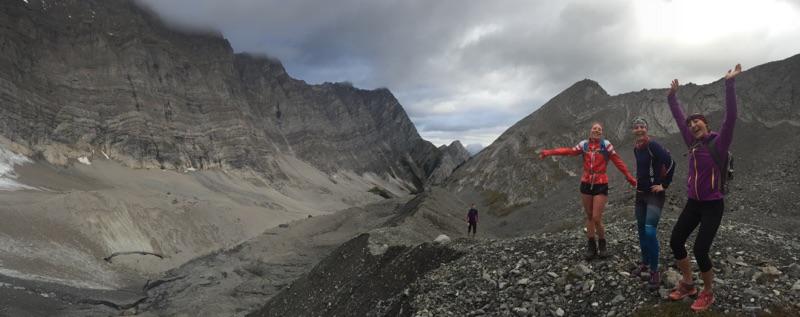
Nadia Moser on a hike up to the Old Goat Glacier with teammates Emily Dickson, Darya Sepanj, Anna Haslach, and Megan Bankes. (Photo: Emily Dickson)
Welcome to “17 Questions for 2017”, where we are catching up with American and Canadian national-team members before the beginning of the winter season.
***
Last year Canadian biathlete Nadia Moser finished 19th in the sprint and 24th in the pursuit at Youth and Junior World Championships, earning her a nod for Biathlon Canada’s 2022 squad, a team of junior development athletes.
But at just 19 years old, the Yukon native has already taken steps this season towards the senior ranks. In Biathlon Canada’s team trials for determining the World Cup and IBU Cup teams, Moser had finishes of sixth and seventh in a pair of sprints in Canmore, giving her a roster spot for the IBU Cup this December.
On Thursday she teamed up with her Biathlon Alberta Training Center teammate Carsen Campbell to finish 18th in the IBU Cup single mixed relay in Ridnaun, Italy.
1. Biggest change in your life in the last five or so months since the ski season ended?
I’ve stopped carpooling to almost every training session since I moved into a new place that is walking distance from the Nordic Centre.
2. Biggest change in your training?
Nadia Moser Racing in the youth individual race at IBU Youth and Junior World Championships 2016 in Cheile Gradestei, Romania. (Photo: Bryan Dickson.)
We focused a little more on ski technique this summer, other than that not much has been different.
3. Major areas of improvement you’ve seen so far?
I think that my shooting accuracy has improved quite a lot over the summer. I seem to be hitting many more targets than usual.
4. Whom you’ve been working closest with this offseason (coaches or training partners)?
My fellow female teammates.
5. Best trip in the last five months (and why)?
I’m going to have to say going back home to visit my family in July. It’s always nice to go back home and relax after a couple hard weeks of training.
6. Favorite cross-training?
I really enjoy swimming, even if it’s just doing laps in the pool.
7. Favorite non-athletic activity or pastime this summer?
Drawing is something I really like to do when I have down time. It’s especially great to finally finish a drawing that I’ve been working for far longer than anticipated.
8. Song that was your jam this summer?
Pretty much whatever was on the radio that wasn’t Shawn Mendes.
9. All-time favorite race moment?
I can’t say I have one particular race moment that stands out so far.
10. First thing you pack in your bag when you leave for Europe?
My race suit and ski boots.
11. Venue/event you’re most excited to visit this season?
I’m still new to the whole European racing scene so pretty much anywhere I get to race in Europe will be super exciting.
12. Who will win the World Cup title this year?
I have no idea. There are too many athletes to choose from.
13. Biggest sacrifice you feel you’ve made choosing this career path?
Probably that I can’t do certain other activities, like downhill skiing, as much as I would like to for fear of injuring myself before an important event. Also not being able to get post secondary school over with right away.
14. If you could change one thing about your sport, what would it be?
I wish no one would feel the need to take performance enhancing drugs. It would also be quite nice if cold hands weren’t a constant problem in any temperature below 0 Celsius.
15. What did you have for breakfast this morning?
Berries with cereal, greek yogurt, and milk.
16. In 5 years, I’ll be ____?
Probably still training in Canmore.
17. In 50 years, I’ll be ____?
No clue, I don’t quite plan that far ahead.
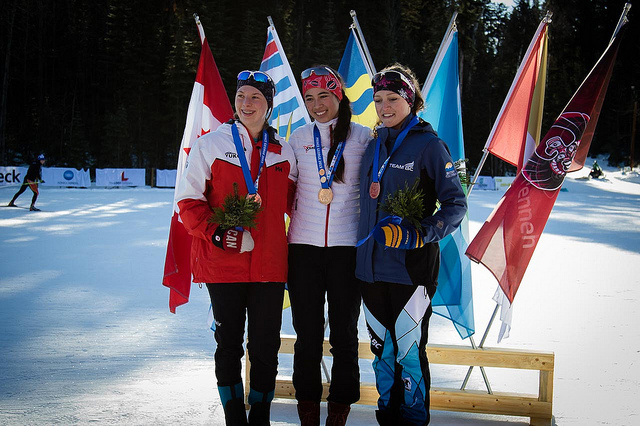
(l-r) Nadia Moser, Leilani Tam Von Burg, Emily Dickson on the podium at Canada Winter Games in 2015. (Photo: Daniel Guay)
Clare Egan (US Biathlon) tucking and gliding during a 2015 IBU World Cup. She finished the 2015/2016 season ranked 66th overall. (Photo: USBiathlon/NordicFocus)
Bailey, Burke, Dunklee — even if you are a casual fan of biathlon in North America, they’re recognizable names.
Egan is relatively new to the scene. 2016/2017 marks only her second full-time season on the World Cup. That’s remarkable when you consider this: other than a session or two at summer camp, she first picked up a rifle at the age of 25. She’s now 28. Her being picked as a member of the relay team t0 start the season is a sign her teammates and coaches have faith.
Clare Egan (US Biathlon) racing to 30th in the women’s 10 k pursuit at the IBU World Cup in Östersund, Sweden. (Photo: USBA/NordicFocus)
Still at the first World Cup stop in Östersund a week later, Egan racked up her second-best pursuit result this past Sunday, Dec. 4. She finished 30th after starting 44th (her placing in the sprint the day before).
“My wax crew did an excellent job today and definitely gave me an advantage – I was gliding past everyone on the downhills so I was able to pick up a few places just from having the fast skis…,” Egan wrote in an email to FasterSkier after Sunday’s 10 k race. “I was able to fight for top-30 on my last lap and won a sprint between 4 people in the finish. I’m proud of all my results from this week and looking forward to learning from these experiences and moving up throughout the season!”
New to the sport only a few years back, Egan had a steep learning curve. As FasterSkier podcast listeners learned, Egan attended Wellesley College in Massachusetts; a school with a club cross-country skiing program. No D-1. She graduated in 2010.
In 2011, Egan joined the Craftsbury Green Racing Project. By 2014 she was a member of US Biathlon’s development program. Now, she’s a member of the US Biathlon A-team.
So back to that learning curve.
Warning! Math equation coming.
y = mx + b.
That equation describes in mathematical terms both the direction (positive or negative), and gradient of a line. In Egan’s case, if we were illustrating her rise in the sport with a line, let’s just say it’s positive and steep.
FasterSkier reached Egan by phone in late October while she was in Canmore, Canada, for a three-week training camp. During the conversation, Egan focused on how she could improve as a biathlete. She finished last season ranked 66th overall on the IBU World Cup.
“I continue to work on improving my shooting accuracy as well as my shooting speed,” Egan said of how she can improve in the standings. “I met my goal of shooting an average of 80 percent hits on the World Cup last year. But I hope to improve upon that this year and be shooting for 85 percent, which is a lofty goal, but I think I can do it.”
Along with improved shooting, Egan remarked that she wanted to maintain her higher-end skiing speed throughout the season. Most biathletes, unlike some cross-country skiers on the World Cup, don’t specialize in say either sprint or distance events. The race season offers more opportunities to race. That increased racing load brings with it the possiblity of fatiguing, and dulling that turbo-charged race-specific gear.
“Last year I started out real strong and then I had a fairly significant trough in the middle of the season and then came back pretty well for World Cup 8 and World Championships,” Egan said of her desire to achieve fewer peaks and valleys when it comes to results. “But I would like to see more consistent results basically over the course of the season. And I think that my experience from last year as well as my training that I have put in this year will allow me to do that — last year was the first time that I had done a full world cup season.”
From an outsider’s perspective, it appears biathlon is a sport rife with tense nerves; there’s the race-pace skiing and laser focus required for shooting. Together they seem incongruous. Like timed needle threading after a sprint up the stairs.
Yet Egan said as a developing biathlete, the nerves part of the equation remains under control most of the time. “I think actually as a brand-new biathlete you really don’t have as many nerves,” she said. “You have no pressure, no expectations, in fact your only expectation is that you will probably miss most of the targets. So there’s not so much to be nervous about.”
Clare Egan (US Biathlon) during her standing stage of the women’s 4 x 6 k relay at the 2015 IBU World Cup in Presque Isle, Maine. Her team went on to place 10th for a season best. (Photo: USBA/NordicFocus)
In other situations, as she matures in the sport, the nerves do occasionally manifest. “Certainly as you improve and like now I am racing internationally, I am representing my country, I am representing my team, sometimes I am on the relay with much more experienced athletes — that’s when nervousness and pressure set in at a much higher degree.”
Entering the season, Egan also ruminated on the emotional aspects of the sports. “Every biathlete has to deal with crazy up and downs, way beyond what nordic skiers experience, and that is something you definitely have to learn to deal with,” she said. “There is no way, as a cross-country skier, that you go from the top 10 to 80th — but that happens all the time in biathlon. There is no easy answer. There is no easy way to deal with that.”
The season is young. Egan’s goals remain lofty yet modest. For her, success equates to improvement. Be it shooting speed, shooting accuracy, skiing speed, or skiing technique, she’s open to improving across the board. Ranked among the top 50 biathletes in the world will be a tangible metric, she says, or her hard work.
***
We asked Egan to give a go at our ’17 questions for 2017′. Here are her responses:
1. Biggest change in your life in the last five or so months since the ski season ended?
I moved out of the Lake Placid Olympic Training Center and into an apartment with my boyfriend, Erik. This is the first time in my life as an athlete that my home has been separate from my “workplace,” and it has improved my quality of life as well as my ability to mentally and physically recover from training. I am especially enjoying cooking and eating homemade food!
2. Biggest change in your training?
Relative to last year, my training plan this year had less intensity over the first three months, which allowed me to increase the overall volume. I am also doing a more comprehensive strength program.
3. Major areas of improvement you’ve seen so far?
I’ve seen improvement in my shooting accuracy and speed, especially at low heart rate. The next step is putting that into practice at high intensity.
4. Whom you’ve been working closest with this offseason (coaches or training partners)?
I am coached primarily by the national team women’s head coach, Jonne Kähkönen. As for training partners, I’ve been getting to know Maddie Phaneuf pretty well! We are regularly joined by our national teammates Susan Dunklee and Joanne Reid, as well as a handful of up-and-coming biathletes including Emily Dreissigacker and Hallie Grossman from the Craftsbury GRP, Chloe Levins and Jennie Bender.
5. Best trip in the last five months (and why)?
Best training trip was to Bend, Oregon. Anywhere with that much sun and snow is a very special place.
Best vacation was to the Turks and Caicos Islands with Erik, where we stayed at a Club Med resort and did tons of water sports and learned trapeze! And I love going home to Cape Elizabeth, Maine any chance I get — I went three times this summer.
6. Favorite cross-training?
Tennis and badminton!
7. Favorite non-athletic activity or pastime this summer?
Floating on my large inflatable pink piglet on Mirror Lake or tending to my garden vegetables and flowers.
8. Song that was your jam this summer?
That would have to be “Can’t Stop the Feeling” by J.T.
9. All-time favorite race moment?
One day that changed the course of my life was in February of 2010 when I qualified for NCAA’s as an independent skier from Wellesley College. I never seriously considered training year-round for cross-country skiing until that moment.
10. First thing you pack in your bag when you leave for Europe?
Rain pants — I’ve never been more thankful for a single item of clothing. Getting soaked as you lie on the shooting mat in the prone position is not fun! And my lucky pigs.
11. Venue/event you’re most excited to visit this season?
If all goes well, I will be racing in PyeongChang, South Korea at the pre-Olympic World Cup. I have never been to Asia and would be thrilled to see a new part of the world and feast on Korean food!
12. Who will win the men’s and women’s World Cup titles this year?
Martin Fourcade and Laura Dahlmeier. Susan Dunklee in the top 10!
13. Biggest sacrifice you feel you’ve made choosing this career path?
I live far away from most of my friends and family and my travel schedule causes me to miss more weddings and other important events than I would with a “normal” job.
14. If you could change one thing about your sport, what would it be?
I wish biathlon were more accessible to American athletes and audiences. The catch twenty-two is that Olympic medals would bring attention to our sport and inspire more athletes to try it, but without a huge pool of athletes, it is hard to achieve that level of international success. Despite the current small number of American biathletes, several are World Cup medalists who are well-prepared to medal in the 2018 Olympics, so that could spark a wave of greater publicity and involvement.
15. What did you have for breakfast this morning?
Black tea, two pieces of bread with Norwegian brown cheese (gjetost), and a homemade coconut chocolate truffle.
16. In 5 years, I’ll be ____?
…in a completely different chapter of my life, the specifics of which are TBD, but could range from working overseas with the foreign service to nursing a babe in the ‘burbs while teaching high-school Spanish and coaching girls’ track.
17. In 50 years, I’ll be ____?
If I am lucky enough to be alive as I approach 80, I hope I will look back on this sliver of my life with pride, knowing that I did my best work, that the glory outweighed the frustration, and that I lived fully in the richness of this experience.
Olivia Bouffard-Nesbitt (r) and Stuart Harden outside of Halifax, Nova Scotia, this fall. (Courtesy photo)
Welcome to “17 Questions for 2017”, where we are catching up with American and Canadian national-team members before the beginning of the winter season.
***
Olivia Bouffard-Nesbitt ended last season on a high note: Canada’s 2015 World Championships team member won the sprint qualifier and placed second in the final at Canadian National Championships. The 24-year-old member of Cross Country Canada’s U25 Team had to take a pause this summer, however, after suffering a stress fracture in her foot.
“I first felt pain in my feet three years ago, and was diagnosed with sesamoiditis (which is just a fancy word for inflammation of the sesamoid bone),” Bouffard-Nesbitt explained in an email. “I was told at the time and again over the three years that followed that the only thing I could do about it was try and manage the pain and avoid things that really hurt it, so I stopped running. It kept getting worse until last winter when at times I couldn’t put any weight on it.
“Then I sought the help of a specialist who told me I had stress reactions,” she continued. “The stress reactions are what made my healing time so long. According to X-rays, the bone is completely healed from the stress fracture in my right sesamoid, but I’m still dealing with pain. I’ve been told that what I have to watch out for is acheyness post-skiing. If I can limit that, then I won’t be further damaging my foot. It’s dry much up and down, but I’m really trying to keep the acheing to a minimum. And I’m just skiing through any pain or soreness I have when skiing.”
Bouffard-Nesbitt returned to rollerskiing this fall and has already raced in Canmore, finishing second in both the Frozen Thunder skate sprint qualifier and the Alberta Cup 6.3 k interval-start classic race.
1. Biggest change in your life in the last five or so months since the ski season ended?
The disbanding of the Bad Panda Love Shack, BPLS, i.e. losing two of my roomies to Saskatchewan and Halifax, and then having to move houses.
2. Biggest change in your training?
Bouffard-Nesbitt on her first rollerski of the year, when the leaves on the aspens were already turning gold. (Courtesy photo)
I was on crutches this summer and it really affected my training. I didn’t do any weight bearing training for 3 months (just swimming, spinning, and upper body strength.) It’s maybe the longest I’ve ever gone without being on snow (end of March until October) or doing anything ski specific for that matter.
3. Major areas of improvement you’ve seen so far?
Upper body strength! There are always gains to be made in times of adversity and positives to come out of otherwise crappy situations. I’ve always wanted to get stronger, and the swimming really helped towards achieving my summer goal of getting “jacked” shoulders.
4. Whom you’ve been working closest with this offseason (coaches or training partners)?
Because of my injury I hardly spent any time around my team. I would definitely say I worked closest with my support team who played an important role in my healing — my strength coach Shelley, massage therapists Jodi and Scott, my osteo Shayne and my physio Sarah. I’m really grateful for how much they helped me through the summer.
5. Best trip in the last five months (and why)?
I recently came back from spending a week in Halifax visiting my boyfriend at The University of King’s College! It was the best. We watched a Halifax Mooseheads game (You just can’t stop the Moose!).
6. Favorite cross-training?
Running/ hiking up mountains, for sure.
7. Favorite non-athletic activity or pastime this summer?
Brainstorming sessions and talking big ideas with the big boss, Peter [Collins, CEO at Buff Canada/Green Extreme Outdoor]. We’ve had lots of meetings discussing things like the biggest problems we think our country is facing in terms of consumerism and sustainability. All centred around preserving the environment. All of these sessions also had the goal of coming up with some new business ideas that woulc hopefully provide some solutions to the problems.
8. Song that was your jam this summer?
Canada’s Olivia Bouffard-Nesbitt (52) racing at the Ski Tour Canada last March.
September by Earth Wind and Fire. It was actually the first song I danced to after I finally got rid of my crutches (which was right at the end of August). It was fitting, and I love that song so much. It was one of the best solo kitchen boogie down’s ever.
9. All-time favorite race moment?
There are a few that share the top spot, but I’ll go with – the utter chaos that was the first 3 km of the Montreal Ski Tour Canada mass start race. The combination of the snow conditions, the crashes and pile ups and the downhills…I was just dodging people left and right, having the time of my life. I live for that!
10. First thing you pack in your bag when you leave for Europe?
My race day essentials, starting with my race suit.
11. Venue/event you’re most excited to visit this season?
My race schedule is not set in stone, so I’m not totally sure where I’ll be heading. For starters, I’m looking forward to racing in Soldier Hollow – also know as the venue where Canadian LEGEND Beckie Scott won Canada’s first ever xc Olympic medal. I should probably ask her for some tips before I leave.
12. Who will win the World Cup title this year?
“I spent a day at the Viking canoe/kayak club near my hometown, where I used to coach kids as a summer job.” (Olivia Bouffard-Nesbitt courtesy photo)
No one can know such things. I’d love to see some North Americans in the top spots in both the men’s and women’s competitions. If you want to know which Norwegian I’m rooting for (other than Marit), it’s Heidi Weng. I’d very much like to be friends with her.
13. Biggest sacrifice you feel you’ve made choosing this career path?
Everyday I’m grateful that I am living every ski bum’s dream.
14. If you could change one thing about your sport, what would it be?
I would raise the minimum permissible race temperature from -20C to -15C to better protect athletes’ lungs from unnecessary damage. And, to add to what’s already been said by many fellow racers, I would place a really strong moral compass in every athlete to keep them from doping or cheating.
15. What did you have for breakfast this morning?
Oatmeal, red fife (shout out to Vigilante Rising) and a smoothie.
16. In 5 years, I’ll be ____?
At the top of my game. People will be speculating if I’ll retire as the greatest, most famous, most winningest female skier that Morin-Heights, QC has ever produced.
17. In 50 years, I’ll be ____?
In search of snow, probably back to wearing therapeutic shoes again because my feet will be so achey for so many reasons.
Canadian Olivia Bouffard-Nesbit of the Alberta World Cup Academy races to a ninth-place finish during the women’s 20 k freestyle mass start at 2016 U.S. National Championships in Houghton, Michigan. (Photo: Christopher Schmidt)
Canada’s Dahria Beatty (29) racing to third in her quarterfinal for a career-best 15th overall at the 2016 Ski Tour Canada classic sprint in Canmore, Alberta, on March 8, 2016, one day after her birthday. (Photo: Fischer/NordicFocus)
Welcome to “17 Questions for 2017”, where we are catching up with American and Canadian national-team members before the beginning of the winter season.
***
The day after her 22nd birthday last March, Dahria Beatty made the case that she could be Cross Country Canada’s next star. Not only did she score her first World Cup top 30, but she nabbed a career-best 15th in a World Cup stage at home (her training base) in Canmore, Alberta.
Beatty, of the Alberta World Cup Academy and national U25 Team, was the only Canadian woman to qualify for the heats in the classic sprint that day, and she ended up third in her quarterfinal heat.
Now after an offseason of remedying some back troubles and building strength, Beatty says she looks like a different person when she’s double poling, and not just because she cut off her hair.
1. Biggest change in your life in the last five or so months since the ski season ended?
I cut off 9 inches of my hair, it’s really speeding me up
2. Biggest change in your training?
I started doing pilates and made adjustments to my technique with our technique coach Kathy.
3. Major areas of improvement you’ve seen so far?
I look like a different person when I’m double poling now!
4. Whom you’ve been working closest with this offseason (coaches or training partners)?
Biathlon Canada’s Macx Davies racing to 10th in the IBU World Cup 10 k sprint in Östersund, Sweden, last December. It was his career-best result by 30 places. (Photo: Biathlon Canada/NordicFocus)
In one of the first races of the 2015/2016 season, Canadian biathlete Macx Davies scored his first World Cup top-10 finish, besting his previous top result by more than 30 places.
It was a bit of a game-changer for the Calgary native, then just 22 years old.
“Normally I don’t hit my stride till after Christmas, so to come out of the gate with my first World Cup points and a top 10 was a crazy start to the season,” he wrote in an email last week. “Which also made it hard to try and repeat that performance throughout the season.”
On that day last December in Östersund, Sweden, Davies became just the third active member of his men’s World Cup team to have a top 10.
And yet in a topsy turvy season which saw Canada notch a number of first-evers, his place among the team wasn’t so clear.
A few months later, Davies watched from the sidelines as his four teammates Christian Gow, Nathan Smith, Scott Gow, and Brendan Green locked up a bronze medal in the men’s relay at World Championships. Davies hadn’t been named to start that day.
Canadian biathlete Macx Davies raced to his second-best IBU World Cup result of 25th in the men’s 10 k sprint in Canmore, Alberta. (Photo: Daniel S. Guay)
“Watching from the sidelines was one of the most conflicting experiences I have ever had,” Davies wrote. “On one hand I was super excited for the guys and for the whole team to have such an achievement, but on the other I was disappointed that I was on the sidelines watching, not racing.”
There were a few possible reactions. One would have been to retreat and assume that the four-man team was set in stone going forward. Another would be to try to get onto it.
“My motivation did waiver after their performance for a while, but now I know I am stronger because for it and I am truly happy for them,” Davies explained. “Also I am determined to be a part of the next record-breaking performance from this team.”
He’d had other high points of the season — racing the World Cup on home turf in Canmore, Alberta, where he finished 25th in the sprint, for instance.
That same weekend, he teamed up with Rosanna Crawford, Sarah Beaudry and Brendan Green to finish sixth in the mixed relay, tying the best result a Canadian team has ever had in the event.
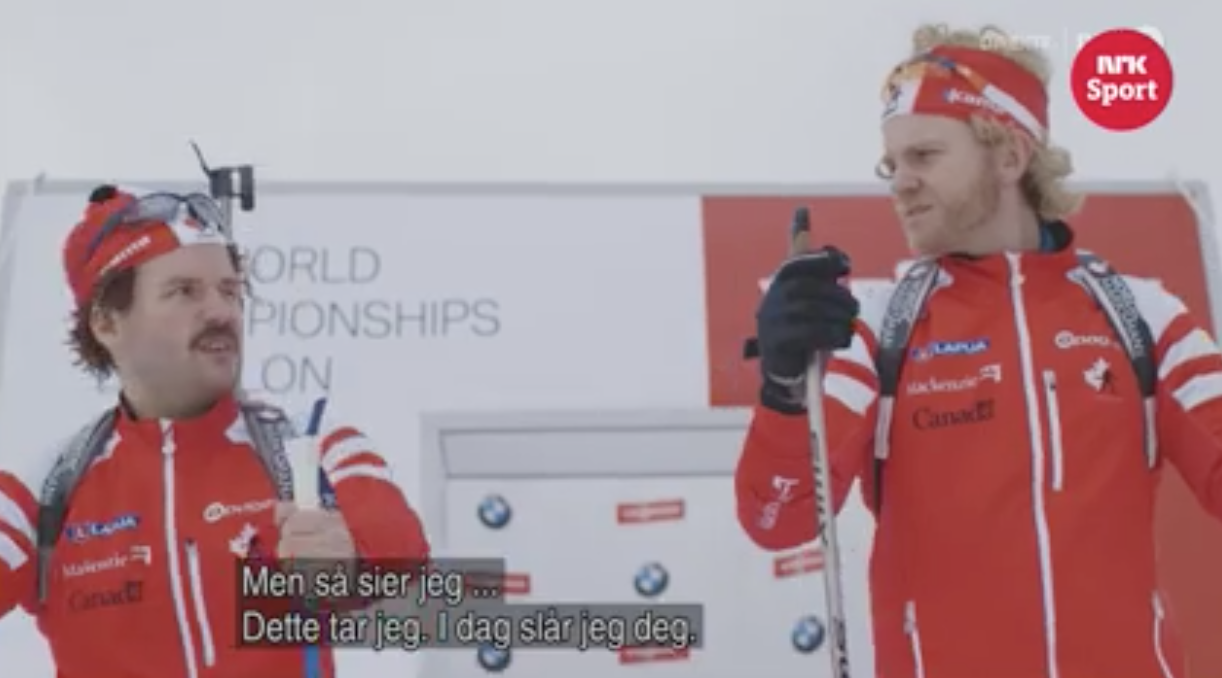
And Davies became something of a media personality when Norway’s NRK broadcaster produced a mockumentary of him beating teammate Christian Gow to win a World Championships race, based on a finish-line interview in Oslo. (The original segment is available to view only in Norway, but you can find other versions online under the title “Macx The Man”.)
“Macx Davies” and “Christian Gow” trash-talking on the start line, as dramatized by Norwegian comedians on NRK.
“I did not think I would have this kind of following until I was on the podium a couple times, but it has been fun having people ask for my picture and autograph,” Davies wrote. “I never really thought that I would be the best known Canadian because of my dance moves or my interviews.”
(He’s also known for his beard.)
Off-trail hijinks aside, his biathlon chops did notch Davies an A-team nomination this spring (which Biathlon Canada calls its “Eh!” team), and he has continued to train with Smith, Green and the Gow brothers. It was the first time he and Christian Gow — now both 23 years old – were named to the A-squad.
“We trained together everyday for the last few years anyways, but having all the men on the ‘Eh’ team means we are all closer now,” Davies wrote. “We had always been training with Brendan, Scott and Nathan, but the difference this year was that Christian and I were keeping up with those guys.”
Davies has already had his first taste of international competition this season, with the Canadian team trials races in Canmore on the Frozen Thunder loop. The American and Ukrainian men’s teams were on hand to beef up the level of competition. While Davies was pre-qualified for the World Cup, putting on a bib still gave him a sense of where he was at.
Davies finished 14th and fifth in the two sprint races in Canmore, the fifth and third Canadian on the two days, respectively.
Tim Burke of the United States leads Canada’s Macx Davies in the World Championships 10 k sprint in Oslo, Norway. At his first senior World Championships, Davies finished 58th, then moved up to 53rd in the pursuit. (Photo: US Biathlon/NordicFocus)
“The trials were challenging for me,” he wrote. “I had a hard time shooting both days and was struggling with the hot weather (10+ degrees [Celsius]). But I am happy with my skiing in those races, and I know that my shooting is getting better. I think you can read into those results as a base line from which this season will only improve upon.”
Davies is dead serious about doing even better this season than he did last year.
“I am looking at breaking into the top six a couple times as well as trying to stay within the top 25 [overall] for the season,” he wrote. “These goals are not going to be easy, but I think they are within my abilities and will be excited to see them come true.”
For now, Davies is heading back to Östersund, where he got that first top 10, to start off this World Cup season. When asked how he had gotten that notable result, Davies made it clear that he could do it again.
“Really I made that big jump by seizing the opportunity of bad weather to leapfrog my best results,” he explained. “Hitting 10 out of 10 that day was like 12 out of 10 on a normal day. What it means is I can use anything to my advantage, so watch out!”
We asked Davies to give our ’17 Questions for 2017′ a go. Here are his responses:
1. Biggest change in your life in the last five or so months since the ski season ended?
Moving in with my girlfriend
2. Biggest change in your training?
Going to New Zealand for 3 weeks.
3. Major areas of improvement you’ve seen so far?
Ski technique and shooting accuracy
4. Whom you’ve been working closest with this offseason (coaches or training partners)?
My coach Matthias Ahrens
5. Best trip in the last five months (and why)?
Weekend getaway to Emerald Lake Lodge
6. Favorite cross-training?
Mountain Biking
7. Favorite non-athletic activity or pastime this summer?
Leather working
8. Song that was your jam this summer?
Una Mattina by Ludivico Einaudi
9. All-time favorite race moment?
Competing at home in Canmore
10. First thing you pack in your bag when you leave for Europe?
A comfy sweater
11. Venue/event you’re most excited to visit this season?
PyeongChang
12. Who will win the World Cup title this year?
Martin [Fourcade], he just seems in a league of his own.
13. Biggest sacrifice you feel you’ve made choosing this career path?
My education
14. If you could change one thing about your sport, what would it be?
More Dancing
15. What did you have for breakfast this morning?
Eggs and yogurt
16. In 5 years, I’ll be ____?
Overall World Cup winner.
17. In 50 years, I’ll be ____?
Retired and living in the mountains, in a house that I built.
Rosie Brennan (U.S. Ski Team) on her way to 28th in the Ski Tour Canada 10.5 k classic mass start Montreal last season. (Photo: flyingpointroad.com/NNF)
Welcome to ’17 Questions for 2017′, where we are catching up with American and Canadian national-team members before the beginning of the winter season.
***
First named to the U.S. Ski Team in high school, Rosie Brennan dominated the 2015 SuperTour and earned rights to race in Europe, including at World Championships where she finished 16th in the 30 k classic. After a six-year absence she was renamed to the national team after that winter and has been there ever since, including finishing her first Tour de Ski last season and skiing scramble for the U.S. women’s relay team, which finished third in the World Cup in Lillehammer, Norway. Brennan, 27, is based in Anchorage, where she is part of the Alaska Pacific University elite team.
1. Biggest change in your life in the last five or so months since the ski season ended?
For the first time since I was 18, I (kinda) lived outside college housing thanks to my boyfriend renting an apartment.
2. Biggest change in your training?
I trained a bit more than last year, otherwise things have been pretty similar.
3. Major areas of improvement you’ve seen so far?
I am happy with the improvements I have made in double poling and pure speed.
4. Whom you’ve been working closest with this offseason (coaches or training partners)?
I spent the majority of the summer in Alaska training under Erik Flora with my APU teammates.
5. Best trip in the last five months (and why)?
Going to the wedding of one of my best friends from college. Nothing beats time with good friends.
6. Favorite cross-training?
Biking
7. Favorite non-athletic activity or pastime this summer?
I started a little garden at APU and was able to harvest quite a few vegetables!
8. Song that was your jam this summer?
I have to admit that I was a little nerdy this summer and listened more to podcasts than music.
9. All-time favorite race moment?
I think my favorite race moment is still the first time I won a Junior National Championship. It was the first time in my life I truly believed I could accomplish anything I set my mind to.
10. First thing you pack in your bag when you leave for Europe?
Teddy
11. Venue/event you’re most excited to visit this season?
La Clusaz. I have never been to France!
12. Who will win the World Cup title this year?
Bjoergen and Sundby, boring I know.
13. Biggest sacrifice you feel you’ve made choosing this career path?
Financial stability and being more or less homeless.
14. If you could change one thing about your sport, what would it be?
More racing in the U.S. and more financial support.
15. What did you have for breakfast this morning?
Same thing every morning: Everything bagel, raspberry jam, 2 fried eggs
Craftsbury’s Caitlin Patterson before anchoring “Vailbury Green” to second in the mixed relay at 2016 SuperTour Finals in Craftsbury, Vt. (Photo: John Lazenby/Lazenbyphoto.com)
Welcome to ’17 Questions for 2017′, where we are catching up with top American and Canadian athletes before the beginning of the winter season.
***
Craftsbury Green Racing Project skier Caitlin Patterson had a tough end to the winter in 2016: she locked up the overall SuperTour title, but got sick before the Ski Tour Canada and was unable to compete in the final World Cup series of the year, something that had been the focus for so many North American athletes.
But that SuperTour title earned her World Cup start rights for the first period of racing this season, and Patterson headed to northern Europe a bit early to get some early starts in Muonio and Saariselkä, Finland.
While the top Finns were present in Muonio, as well as Polish star Justyna Kowalczyk, the field in Saariselkä was primarily Russian, with the German national team also present.
“The races this past weekend were a bit of an adventure – 0°C and very tricky classic conditions,” Patterson wrote in an email about the races in Saariselkä, where she finished 23rd in the 5 k classic and 14th in the classic sprint. “And the courses had some funny 180 degree corners which are not what you usually see, and yet the races felt pretty big and official with all the different nations represented and especially so many Russians. Once again it was fun for me to put on a bib and race, and though I definitely didn’t feel my best for the distance race, I had quite a good sprint day and was happy to end the weekend on a good note.”
Patterson, 26, is now ready for to represent as the SuperTour leader.
“Yes, I am ready for the World Cup to start, or will be by the weekend at least!” Patterson wrote after traveling to Ruka, where the first weekend of racing will be held. “I have a few more days to become more familiar with the courses, test skis, do some pre-race intensity and then it will be go time! Of course I’m nervous, it’s the World Cup, but I’m also very excited and looking forward to racing!”
1. Biggest change in your life in the last five or so months since the ski season ended?
I got a car, my first one. Yes, I’m 26. I drove my parents’ cars during high school, but I never had a car in Vermont until this summer.
2. Biggest change in your training?
A little more volume, better quality all around. There haven’t been any huge changes, just a progression that makes sense while following the same training philosophy as the past years with the GRP.
3. Major areas of improvement you’ve seen so far?
Strength, particularly core stability/body connectivity, which has helped me ski with better and more stable technique.
4. Whom you’ve been working closest with this offseason (coaches or training partners)?
I’ve been working as closely as ever with coach Pepa Miloucheva, and enjoying training sessions with all of my GRP teammates.
5. Best trip in the last five months (and why)?
Oo that’s a tough one, I’ve been on several great trips, one to Alaska to ski on the Eagle glacier for the first time, and one to Slovenia and Austria to train on snow there. I’d have to go with the Slovenia/Austria trip, because the Julian Alps of Slovenia were great for exploring and make me want to go back soon for more hiking. And Ramsau, Austria is a spectacular place and great for fall training; I am building up lots of good memories from the three September camps I’ve been to on the Dachstein glacier in Ramsau.
6. Favorite cross-training?
Running, which luckily is a staple of my summer and fall training
7. Favorite non-athletic activity or pastime this summer?
Looking at close-up details of the natural world, and sometimes photographing them.
8. Song that was your jam this summer?
I enjoy hearing what other people come up with for pump-up workout music or music for the gym and car rides, but I’m not exactly great at coming up with that stuff myself, or staying on top of current trends. Some of my favorite music is by a folk group called Crooked Still.
9. All-time favorite race moment?
Of my personal race moments, the 10k skate mass start in Falun last year, where I first scored World Cup points, stands out. During the race I had no idea what place I was skiing in, but I was fighting for every second and pushing myself as hard as I ever have. It was incredible to learn in the finish pen that the hard work had been worth it, I had skied to a 25th place result!
10. First thing you pack in your bag when you leave for Europe?
Metaphorically, I pack my camera first. Physically the camera doesn’t go into the bottom of my bag, that would be my ski boots.
11. Venue/event you’re most excited to visit this season?
All of the World Cup venues in Period I, since they’ll all be new to me. So we can start with Ruka, Finland, since that will be first!
12. Who will win the World Cup title this year?
Oestberg and Sundby
13. Biggest sacrifice you feel you’ve made choosing this career path?
I don’t regret that skiing has been my highest priority for a long while now, but sometimes I do wish that I could give my full effort to academic studies or an engineering career. As a ski racer my time and attention is just so divided, with training and travel and racing, that I’ve never been able to commit 100% to intellectual work. Some day in the future I will, but for now there’s no rush.
14. If you could change one thing about your sport, what would it be?
Doping. I wish there was a better way to ensure that all athletes are competing clean, to be able to trust our fellow competitors and have the public trust the integrity of the athletes.
15. What did you have for breakfast this morning?
This morning I made egg-banana pancakes and ate them with yogurt, berries, and honey. It took me a few days to fill in all these questions and I had to change this answer every day! I really like eating something different just about every morning, because breakfast foods are nice, and fun to cook! Especially this past week as one of the last that I’ll be able to cook for myself for a while, I’ve been rotating through many of my favorites. I just have to be careful not to let myself launch into complex or long-lasting breakfast projects most days because I need to get out the door and train.
16. In 5 years, I’ll be ____?
Either ski racing at the Olympics, or engineering bridges while skiing on the side. Only time will tell which path is right.
17. In 50 years, I’ll be ____?
Still skiing and enjoying playing outside as much as ever.
Paul Schommer, of US Biathlon’s National Development Group, shooting in Jericho, Vt., at rollerski trials this fall. (Courtesy photo)
Welcome to “17 Questions for 2017″, where we are catching up with American and Canadian national-team members before the beginning of the winter season.
***
After graduating from the College of St. Scholastica in 2015, Paul Schommer was identified as a potential biathlon talent by the US Biathlon Association. He has been going full bore in his new sport ever since and was recently invited to the national team’s pre-World Cup camp in Canmore, Alberta. Part of US Biathlon’s senior national development group, the 24-year-old Schommer was on the short list for a World Cup starting spot which he ultimately lost out on to Russell Currier, but proved that he’s getting close to the top level of American biathlon just a short time after switching sports.
1. Biggest change in your life in the last five or so months since the ski season ended?
I would have to say the biggest change in my life has been moving out to Lake Placid full time. Training in Hayward was great, but coming out to Lake Placid and having all the resources here has been an amazing opportunity. The staff here really makes it possible for us to concentrate on becoming a better athlete by taking care of simple daily tasks. For example, I step out the door and roller ski to the range, which is already set up by all the coaches, and do my workout. When I return back my room has been cleaned by a housekeeping staff member and I head to the cafeteria where food is hot and ready. To me, that’s just amazing and it’s because of all the awesome people here at the OTC that make it happen. It’s also incredible to have world class coaching day in and day out. It really makes a huge difference and am stoked to be able to be here training with the team.
2. Biggest change in your training?
Paul Schommer (left) after the Climb to the Castle rollerski race in September, where he placed third, in Wilmington, N.Y. (Courtesy photo)
I would say sheer volume and intensity has increased in the past year. My coach at St. Scholastica Chad Salmela and I have been working on increasing my aerobic efficiency ever since I got to Duluth, and I am now starting to reap the benefits of that training. My ability to come back day after day and train at a higher level has allowed me to increase my quality training. In conjunction with this, I have not been working a part-time job like in years past. Due to my financial situation in the past, I have always had to work a part-time job to support myself. However, this year I decided if I was going to do biathlon, I would have to do it right. Money is always tight but thankfully God has put a lot of people in my life that have helped out a ton. The increase in training is definitely a result of the work done with Chad while at St. Scholastica, but being able to recover properly between workouts also makes a huge difference.
3. Major areas of improvement you’ve seen so far?
I touched briefly on my physiological improvement in the previous question, but biathlon is two sports in one. As my ski performance has continued to improve, so has my shooting performance from day to day. The first year of biathlon is an up and down roller coaster, have good days only to be followed by terrible days. The key is to find consistency, which is coming around more and more. As I have become more and more comfortable on the range, I am able to hit more targets consistently. A lot of this has come from lots of dry fire in the past year and shooting more rounds this summer than last year.
4. Whom you’ve been working closest with this offseason (coaches or training partners)?
Schommer competing at rollerski trials in Jericho, Vt., this fall. (Courtesy photo)
While I was in Hayward this summer, I was all by myself. It was awesome to have that time to myself, work through things on my own and not have to rely on anyone else. However, being able to come to Lake Placid for camps made a huge difference and always helped keep me stay motivated. When in Lake Placid, I worked with Jean Paquet most the time, the head Development Coach at USBA. Working with Jean has been great and I’ve always jived well with him. For a training partner, Jake Brown and I do most of our workouts together. We have a really healthy competitive relationship with each other which allows us to push each other in workouts but still have fun. We are great friends and having him in Lake Placid makes things enjoyable both during and after training.
5. Best trip in the last five months (and why)?
Most my traveling is for training purposes, and I don’t have much expendable income for travel beyond that. So when I do have a few days off, I tend to use it to see those I love, whether that be heading home to see family or meeting up with friends. It’s hard to pick on specific trip that means more than another as each one holds its own special meaning. I mean, The Bjorn Bakken Ski Championships of America are a huge deal, the biggest deal, and I had a blast, but also moving my younger brother into college this fall was also awesome, but in a totally different way. So simply put, I’ve had a lot of awesome trips in the past five months and I can’t really say one was better than the other. And what made them all awesome wasn’t because of where I went, but because of the people that were there.
6. Favorite cross-training?
Schommer competing at U.S. National Championships in Maine in March. (Courtesy photo)
Normally I would say mountain biking but this summer I did a lot of paddling in a surfski and really grew to love it. There are so many lakes in the Hayward area and I had a blast going and exploring these on days where it was too hot to double pole, or just wanted a break from the usual training grind. I had a few evenings where I was the only one on the lake with the sunset reflecting of the glassy water and all seemed right in the world.
7. Favorite non-athletic activity or pastime this summer?
Probably the exact opposite of that, just sitting around doing nothing. Where I live this summer I didn’t have internet or phone service so I spent a lot of time just sitting around reading and praying, and it was awesome. When I would be in Lake Placid and have internet, I would start to miss the disconnected life I had back in the woods of northern Wisconsin. I loved just hanging out on the porch in the evening just chilling. It was so peaceful and relaxing. It makes me sound old and boring but I loved it.
8. Song that was your jam this summer?
King of My Heart by Steffany Gretzinger. There were a lot of times I was out skiing or doing a workout and this song would just be playing in my head and would just bring a smile to my face.
9. All-time favorite race moment?
Paul Schommer (l) and Jake Brown doing high-five partner burpees during a strength workout at the U.S. Biathlon development camp in Jericho, Vt. Find their workout here. (Photo: Katrina Howe)
I would have to say the Minneapolis SuperTour at Wirth in 2010. I was a senior in High School and it was my first year ski racing competitively. I was having a bit of a rough season and was having trouble putting together a good race. Before the race my older brother Philip told me, “Paul, if you’re flowing keep it going, if you’re pressin’, you’re messin’.” I took his advice and for the first kilometer or two just tried to flow. As the race continued, I just kept passing people so just kept it flowing. At the finished I was the fastest J1 of the day, which even took me by surprise as my best finish prior to that had been 12th. The best part was at this time absolutely no one knew who I was as I just started competing. When I was looking at results a kid next to me turned to his friend and asked, “Who the heck is Paul Schommer?”
10. First thing you pack in your bag when you leave for Europe?
Positive attitude.
11. Venue/event you’re most excited to visit this season?
Anywhere I get to race and haven’t been to already. I love going to new places and meeting new people so I hope I have the opportunity to go to new places and meet new people this season. When the season concludes, I always look forward to heading back to the Ski Haus for the Bjorn Bakken Ski Championships of America, the greatest backyard ski race on the planet. They always have a great course to really test the skills.
12. Who will win the men’s and women’s World Cup titles this year?
On the women’s side I’d have to go with Marie Dorin Habert. On the men’s side, I think it’s going to be a tight race between Martin Fourcade and Johannes Thingnes Boe.
13. Biggest sacrifice you feel you’ve made choosing this career path?
I don’t really feel like I have sacrificed much. Right now, I am thankful to have this opportunity and don’t have any regrets.
14. If you could change one thing about your sport, what would it be?
Have people know what it actually is. Haha, this is a blessing and a curse at the same time. Not many people in the US know what biathlon and right off the bat guess it is biking and running. However, this also gives me an opportunity to introduce people to the sport and in turn help grow it. Biathlon is a very spectator friendly sport, which is evident by the fact that it is the most watched winter sport in central Europe. Talking with some people of USBA it sounds like they are going to be doing a few things in the coming year to help bring biathlon to Americans which is pretty exciting.
15. What did you have for breakfast this morning?
I’m on this new diet so I had an orange peel, half a banana, and a peanut. I’m only kidding, I had oatmeal.
Biathlon Canada “Eh!” Teamer Scott Gow training in New Zealand this summer. (Courtesy photo)
Welcome to “17 Questions for 2017″, where we are catching up with American and Canadian national-team members before the beginning of the winter season.
***
Scott Gow’s World Cup season might not have started off as a barn-burner last year, but he made up for it later: the Canadian biathlete notched a season-best 34th place at home in Canmore, then headed to World Championships in Oslo where he finished 18th in the 20 k individual and then turned in a tough-as-nails performance to contribute to a bronze medal in the men’s relay.
Gow just turned 26 and is looking for more from the World Cup this season.
1. Biggest change in your life in the last five or so months since the ski season ended?
My Grandpa passed away in April, which left a huge hole in my mom’s side of the family. He was very old and his health was on the decline, but it was still tough to have him go.
2. Biggest change in your training?
I haven’t made any major changes in the structure of my training. I’m doing a little more volume this year, but that’s about it. My biggest change has been in my mental approach to training. I’m much harder on myself, from a mental standpoint, to iron out any inconsistencies in my shooting, ski technique, etc.
3. Major areas of improvement you’ve seen so far?
The Canadian men’s team training in Park City, Utah. (Courtesy photo)
I’ve seen some good improvements in shooting accuracy during high intensity and I’ve also seen my ski speed come up a bit over previous years.
4. Whom you’ve been working closest with this offseason (coaches or training partners)?
We are a very close team, so I’ve been working closest with Christian, Brendan, Nathan and Macx and our coach Matthias. We’ve had some excellent training sessions together just the six of us, and we’ve been having fun too.
5. Best trip in the last five months (and why)?
I love Park City, it’s my favorite training camp, but I would have to give it to New Zealand. I had never been to the southern hemisphere, and spending three weeks on snow in NZ was a ton of fun.
6. Favorite cross-training?
Normally I’m not a huge fan of running, but I do enjoy going running with my girlfriend and our dog. They make running infinitely more enjoyable
7. Favorite non-athletic activity or pastime this summer?
I enjoy booting up my xbox and playing online with my brothers. It can get heated but we all like playing with each other.
8. Song that was your jam this summer?
There isn’t one particular song. I’m a classic rock guy, so if the song was on the charts more than 20 years ago I’m probably listening to it.
9. All-time favorite race moment?
Gow (left) and the Canadian team celebrates their bronze medal before taking the podium for the 2016 World Championships men’s relay. (Photo: JoJo Baldus)
Hands down the relay in Oslo last year. It doesn’t get much better than winning a medal with your teammates and your brother on one of the world’s biggest stages
10. First thing you pack in your bag when you leave for Europe?
Wallet and passport. I’ve shown up to the airport without those two items before, and I’ll never make that mistake again
11. Venue/event you’re most excited to visit this season?
I’m excited to check out Korea. I’ve never been to Asia before so it will be an interesting experience
12. Who will win the World Cup title this year?
Biathlon: Simon Schempp and Marie Dorin Habert, Cross Country: Dario Cologna and Marit Bjorgen
13. Biggest sacrifice you feel you’ve made choosing this career path?
I’ve had to put my education and career on hold.
14. If you could change one thing about your sport, what would it be?
I would get rid of the politics that permeate all levels of the sport.
15. What did you have for breakfast this morning?
I had oatmeal and brown sugar with a banana
16. In 5 years, I’ll be ____?
Retired from skiing, and hating having to make my way in the real world
Bryan Fletcher (U.S. Nordic Combined) at the 2016 U.S. Ski Jumping and Nordic Combined Large Hill Championships in Park City, Utah. (Photo: USSA/Tyler Tate/T Squared Action Sports)
“I mean, day to day not too much has changed,” U.S. Nordic Combined A-teamer Bryan Fletcher said over the phone in late October about his new-dad status and training for the World Cup. “Then there’s the time-management stuff. You get home and you just find every little free minute you have in the day is filled with something, before it was kind of like, ‘Oh, I’ve got an hour, I’ll just hang out watch some TV or whatever.’ ”
At 30 years old, Fletcher, along with his wife Nikki, became new parents in September. If you haven’t experienced the feeding, cleaning and washing, it’s a laborious and exhausting cycle.
“I think that a little bit more of that time has been eaten up,” Fletcher said of his past slightly more-carefree and child-free life. “If it’s not school, it’s hanging out with the baby. If it’s not the baby, you are catching up on other work or training. … For sure we are in the early stages. Nikki is home with the baby which helps, and her parents have been coming out and we have had a lot help with her being home. It will definitely be a lot more interesting come January when Nikki is back at work full time, and I am on the road full time and then will we have to obviously find other ways to manage the day care. I will certainly be a little more challenging then.”
Bryan Fletcher holding his newborn, Ellery Ardene Fletcher. Fletcher and his wife Nikki welcomed their baby girl on Aug. 29, 2016. (Photo: USSA Nordic)
“On the road,” means a full International Ski Federation (FIS) Nordic Combined World Cup schedule. From Nov. 26 in Finland, to March 19 in Germany, Fletcher will be jumping and skiing for points, podiums and medals. Along with his younger brother and teammate Taylor, the older Fletcher remains a skiing powerhouse during any World Cup competition. He’s also a former World Championships bronze medalist in the team event at 2013 World Championships, and a winner of the 2012 “King’s Cup,” standing atop the podium at Norway’s famed Holmenkollen venue.
Like many elite cross-country athletes, Nordic Combined World Cuppers will gather in Lahti, Finland, for World Championships from late February to early March.
“I’m looking to peak at World Championships. I’d loved to have my best results of the season at those events,” Fletcher noted as he looked towards the season ahead.
Yet a skier’s goals are often set with muted expectations — hopeful, but realistic.
Historically, Fletcher has been a feared hunter during the ski portion of a nordic-combined event. He’s been known to close big gaps with his skiing. Even with a two-minute lead for the first skier out, sometimes that margin isn’t safe from a Fletcher “catch”.
“For this season obviously, the number-one goal was to improve jumping, to get myself into the race,” said Fletcher of his offseason priorities. “I think cross country has been really good the last several years. However, jumping has been the biggest factor for me. A lot of my goals are set around my proficiency in jumping and so going into the season the focus will be on achieving a higher level in the jumping aspects.”
This year, Fletcher and his U.S. Nordic Combined team have been working with Austrian Nick Huber. New to the U.S. Team, Huber is no stranger to coaching elite jumpers: he’s a seasoned coach with a long track record with both Austrian and Norwegian jumpers.
“He just brought a lot of expertise,” Fletcher said of Huber. “Coming in, anytime you have a new coach there’s always that period of trust that you are working with … with Nick, we didn’t really have that. I didn’t really have that phase at all. Immediately we connected. He was able to answer a lot of questions or concerns I had right away.”
Bryan Fletcher flying at the 2016 U.S. Ski Jumping Championships at Utah Olympic Park in Park City, Utah. (Photo: USSA/Tyler Tate/T Squared Action Sports)
Fletcher added that bringing better technical proficiency and consistency to his jumping were priorities.
“I think that technically we broke everything down and rebuilt it back up, “ Fletcher said of his work with Huber. “There is a solid foundation for the level at which I’m jumping right now. And when things start to slip or they are not going very well, it is easy to just point it out take a step back and start from that point … I still think that there is work to be done. but I feel more confident going into the season this year than I have definately in the past several years.”
Although his season goals remain both grounded and aspirational, the new dad maintained his is a trajectory of improvement with more long-term payoffs.
“I don’t want to expect career-changing results overnight this year,” he said. “I want to build into a higher level for PyeongChang next year.”
Along with the life of a professional athlete, Fletcher is a student working toward a bachelor’s degree in health education and promotion with a health science emphasis. He said he plans on pursuing an advanced degree upon completing his bachelor’s.
***
We asked Fletcher to give our ’17 Questions for 2017′ a go. Here are his responses:
1. Biggest change in your life in the last five or so months since the ski season ended?
Without a doubt the biggest change for me and my wife was the birth of our daughter Ellery. The whole process leading up to, during and after her delivery has been amazing and I have a whole new outlook on life, training and competition.
2. Biggest change in your training?
The biggest change in my training this summer was less travel and more time at home in preparation for the birth of Ellery. This turned out to be an awesome decision as the consistency in my training has been really good this summer and I feel I am seeing those benefits as I head into the last phase of fall training and the competition season. Also I changed quite a bit in my jumping this summer.
3. Major areas of improvement you’ve seen so far?
It’s hard to say without being in competition but I feel my jumping has been the biggest area of improvement I have seen this summer. Also XC technique has been modified some to improve efficiency and power.
4. Whom you’ve been working closest with this offseason (coaches or training partners)?
This summer has been the most solo training I have ever done in my career. Most of my team has been in Europe training and I was home. However, I did work closely with few people. My brother Taylor and I trained a lot together while he was home, our head coach DJ [Dave Jarrett] and I also worked together a lot, and lastly our jumping coaches Martin and Nik and I spoke a lot and worked together to change my technique on the jump hill.
5. Best trip in the last five months (and why)?
The best trip for me has been the fall training camp. The camp started in Oberstdorf, Germany with some jumping focused training. The second half of the camp included some skiing on the Dachstein glacier and more jumping in Bischofshofen and Ramsau, Austria. The camp was very productive and focused for me.
6. Favorite cross-training?
Definitely biking. I enjoy mountain biking and road biking quite a bit. I have had a lot of fun doing both over the years. It’s certainly the most enjoyable way to get the long hours in.
7. Favorite non-athletic activity or pastime this summer?
Home improvement projects. My wife and I bought our first home and it needed some work. So I spent some time laying tile, painting, landscaping etc. I learned a lot and it felt good to put in a hard day’s work in a different way this summer.
8. Song that was your jam this summer?
My Jam was the entire “Stomp and Smash and Slash and Crash and Bash and Bust and Burn Live at the Mystic Theatre” Album by The Devil Makes Three.
9. All-time favorite race moment?
My all-time favorite race moment of me racing is when I raced for the win at Holmenkollen in 2012. However, my all-time favorite moment of watching racing was when I watched Bill and Johnny ski for 1st and 2nd in the Vancouver games.
10. First thing you pack in your bag when you leave for Europe?
My boots first. Mostly because that’s the only way I can get them in the suitcase and still have some room for some clothes after.
11. Venue/event you’re most excited to visit this season?
Kuusamo/Ruka for sure. The main reason is because of the excitement that the World Cup has returned for another season. The excitement and anticipation of that event is always exciting. Everyone has so much optimism at that point in the season, it’s contagious.
12. Who will win the men’s and women’s World Cup titles this year?
In NC this will be the first year of higher level NC Women’s competitions so it will be exciting to start learning some of the new athletes. On the men’s side Jarl Riiber has a great shot. I also expect many of the German athletes to be on a high level. Akito Watabe could also be a contender this season.
13. Biggest sacrifice you feel you’ve made choosing this career path?
There have definitely a few small sacrifices made in order to continue pursuing skiing. The first is obviously financial stability. Making a living in skiing, while training full time is very difficult. There are certainly days when you watch your peers who chose a different path, i.e. school, job, etc. take big steps in life and for a second it feels as if you are falling behind because you don’t have a retirement savings or even the normal amount of financial stability for your age. However, money isn’t everything! Also I would say the other sacrifice is social freedom. Being an athlete is a 24/7 job and every day you’re on the clock and certainly you miss out on social events with your non skiing friends, random trips etc. I know I have declined many of the vacations, or weekend getaways in my life simply because I have to train or because it would be too expensive to do. Obviously on the flip side I still get to do a lot of cool travelling. So that’s why I would say these are only small sacrifices.
14. If you could change one thing about your sport, what would it be?
Definitely the popularity. I would love to see the sport grow in popularity. I think if it was more popular we would have more athletes in all countries, more funding, etc.
15. What did you have for breakfast this morning?
Coffee, currently I am sick with a cold so it’s not a very active morning for me.
16. In 5 years, I’ll be ____?
Probably trying to finish a degree and finding a job. I hope I will be able to work in a field that I enjoy. I will also be tremendously enjoying fatherhood and transitioning into a life without competitive skiing.
17. In 50 years, I’ll be ____?
Hopefully a retired grandparent who is still skiing and blissfully enjoy life and everything it has to offer!
Canada’s Alex Harvey leads Norway’s Martin Johnsrud Sundby during the men’s 15 k freestyle pursuit at Stage 4 of the 2016 Ski Tour Canada in Quebec City. Harvey went on to place fourth, 1 second ahead of Sundby in fifth. (Photo: FlyingPointRoad.com/NNF)
If you’re a fan of North American cross-country skiers, it’s likely you have an affinity for Canada’s Alex Harvey. Hailing from Quebec, he’s a marketable star in his home province. That may stem from his affability or his encroachment on Norway’s “stranglehold” on the World Cup overall.
This year, for Harvey, his motivations are twofold. “The main goal is Lahti World Championship for sure, to be on the podium there,” Harvey said in a recent phone interview.
Considering past performances, it’s not far-fetched to consider Harvey a contender for the overall: he was third overall in 2014, ninth in 2015 and seventh in 2016.
“When Devon [Kershaw] was second in the overall in 2012, it was the first time I actually believed that a Canadian, or a North American man for that matter, could be on the overall podium,” Harvey said about his evolving aspirations. “Just because I saw Devon, one of my best friends, teammate, roommate from the last ten years, be on the top-three podium — that was the first year I believed it.”
The belief in an overall podium and World Championships medal coming into the season is palpable, even realistic for the 28-year-old Harvey. He is a multiple World Championships medalist who can strike both in the sprints and distance events.
“But the championships medal is more important for me,” he said. “If I have to choose between say like championship gold and first place in the overall, I’d probably take first place on the overall. But I think championships are still a bigger deal to me than second or third [overall]. That’s why I put the focus still on the championship. The overall is still in the back of my mind and I am still doing every single weekend this year like previous years, other than the weekend after the Tour de Ski.”
“Just because I saw Devon, one of my best friends, teammate, roommate from the last ten years, be on the top-three podium — that was the first year I believed it.” — Canadian Alex Harvey, on his overall World Cup aspirations
Harvey noted that he will skip the pre-Olympic World Cup in PyeongChang, South Korea, to rest up for the late-February World Championships in Lahti, Finland. Harvey explained that a small contingent of Canadian coaches and athletes will take a quick trip after the World Cup season concludes to preview PyeongChang, the 2018 Olympic venue.
With firm goals set, Harvey has been fastidious in his preparation. After the 2014/2015 season, Harvey underwent Iliac artery surgery to remedy a circulation issue in his legs. Last summer, although he felt better in certain running tests he’s used as historical benchmarks, his regiment deviated from his normal routine.
Alex Harvey snaps a photo of himself with Norway’s Martin Johnsrud Sundby (r), Devon Kershaw (l) and others while training in Livigno, Italy, this summer. (Photo: Alex Harvey/Instagram)
“Because last year when I started training again I was coming off surgery, so I couldn’t do exactly what I was used to,” Harvey said of his 2015 dryland season. “I could not do strength or any intensity for two months. So this year I was back kind of doing what I was used to pretty much doing for my whole career before the summer of 2015. That’s just normal strength in the gym twice a week and a third time doing core and then intensity once a week for May, June and July. And then switching to twice a week after that. Some speed sessions, too: two speed sessions a week. There’s really nothing new for me. But it was kind of different from last year because I couldn’t do everything I wanted last year. I just went back to what I knew worked for me.”
According to Harvey, it’s still working. There’s a five-minute double pole test, a six minute skating test, and a 25-minute running test that both Harvey and his coach Louis Bouchard have used as fitness barometers throughout his career.
“I have improved all of them by ten full seconds each time,” Harvey said of his test times. “I mean, last year the big jump was on the running test because I was able to get out of threshold and push all out. And this year I was still able to improve a little bit on the running and keep improving on the other aspects. Every year I think it is important to have some past kind of test, you need to know if things are working properly or not. We put a lot of focus on those test, but we have to keep a global perspective. But this year everything was improving, so that is good.”
If the past is any guide, Harvey, racing in his maple-leaf-emblazoned lycra, should be high up on the leaderboards. And when it’s world champs time, Harvey believes the skiathlon is his best individual shot at medaling.
Canadian teammates Devon Kershaw (l) and Alex Harvey (r) with their 2011 World Championship gold medals from the classic team sprint.
“My favorite race is the skiathlon,” Harvey said when asked about his chances in specific World Championships races. “It’s the distance race, I think I have had the most success in my career. I have medaled in both World Junior Championships, U23 World Championship, and World Senior Championships … It is the race that for me is probably my best chance.”
As mentioned, Harvey is an all-arounder. Along with his 2015 World Championships 30 k skiathlon bronze , there’s three total sprint World Championship medals accompanying the sole distance hardware.
The Norwegian odds makers might just be hedging against their teams possible demise by picking Harvey as the spoiler.
***
We asked Harvey to give our ’17 Questions for 2017′ a go. Here are his responses:
1. Biggest change in your life in the last five or so months since the ski season ended?
Not much…
2. Biggest change in your training?
This Spring I was able to start training like I did my whole career,which meant strength, intensity, speed and volume. Spring of 2015 I was only allowed volume until July!
3. Major areas of improvement you’ve seen so far?
Nothing major…I’m looking for a few seconds here and there. Overall I’m just a bit stronger, a bit faster and a bit more endurance..but nothing major! Biggest difference from last Summer is strength is back to what it was prior to my surgery.
4. Whom you’ve been working closest with this offseason (coaches or training partners)?
Louis Bouchard is still my coach after 10 years! Our National team is pretty similar to previous year, other than Babs [Ivan Babikov] is now an assistant coach! The training group in Quebec has a few new guys that can challenge and beat me, mostly in sprint time trials.
5. Best trip in the last five months (and why)?
Hawaii. After no warm vacation in the Spring of 2015, it was nice to get back there. I also started the training season in the Islands so that was a nice change!
6. Favorite cross-training?
Mountain biking.
7. Favorite non-athletic activity or pastime this summer?
Home renovations/improvement.
8. Song that was your jam this summer?
Panda – Desiigner
9. All-time favorite race moment?
The sprint on the Plaines of Abraham in Quebec City last March. The crowd rushing over the fences to come to me after the race, it felt like a bunch of college students rushed the football field of their favorite team after a big win!
10. First thing you pack in your bag when you leave for Europe?
School books. I’m always afraid I will subconsciously leave them behind.
Alex Harvey before the start of the men’s 30 k skiathlon at the 2016 Ski Tour Canada in Canmore, Alberta. (Photo: Fischer/NordicFocus)
11. Venue/event you’re most excited to visit this season?
Lahti, FIN. Been there before but Worlds in Scandinavia is always exciting.
12. Who will win the men’s and women’s World Cup titles this year?
Ingvild [Flugstad Østberg].
13. Biggest sacrifice you feel you’ve made choosing this career path?
Being away from family and friends for extended periods of time.
14. If you could change one thing about your sport, what would it be?
Doping.
15. What did you have for breakfast this morning?
Bagel with jam and brown cheese, scrambled eggs, strawberries, orange juice, coffee
Paddy Caldwell rollerskiing around Mount Moosilauke in New Hampshire this fall. (Photo: Pat O’Brien)
Welcome to “17 Questions for 2017″, where we are catching up with American and Canadian national-team members before the beginning of the winter season.
***
U.S. Ski Team D-teamer Patrick “Paddy” Caldwell was all over the place last year: taking classes and training at Dartmouth College, racing in the west, winning a SuperTour and college carnival in Vermont, traveling to Romania for U23 World Championships, and then back to Vermont, where he finished third in the 15 k skate at SuperTour Finals.
This season will be his last as a U23, and he’s looking forward to concluding that part of his career on home soil in Soldier Hollow, Utah.
1. Biggest change in your life in the last five or so months since the ski season ended?
No major changes since last winter. I was in Hanover this summer taking classes at Dartmouth, now I am back in Stratton with the SMS Elite Team.
2. Biggest change in your training?
Paddy Caldwell trail running in Park City, Utah. (Photo: Simi Hamilton)
This summer I focused more on speed/power than I have in the past.
3. Major areas of improvement you’ve seen so far?
I think my top-end speed has improved since last year.
4. Whom you’ve been working closest with this offseason (coaches or training partners)?
Pat O’Brien, the SMS Elite Team coach.
5. Best trip in the last five months (and why)?
I had an amazing trip out to Colorado and Utah last month first visiting my girlfriend’s family in Loveland, Colorado, then heading to Park City for the annual USST training camp. I love being out west and exploring new places to run and hike.
6. Favorite cross-training?
Trail running.
7. Favorite non-athletic activity or pastime this summer?
Hanging out at the cabin and paddling around the lake.
8. Song that was your jam this summer?
Hamilton.
9. All time favorite race moment?
Nordic/Biathlon team relay at the Youth Olympic Games in Seefeld, Austria.
10. First thing you pack in your bag when you leave for Europe?
An excited Paddy Caldwell (Dartmouth College/SMST2/USST) (center), Tad Elliott (SSCV) (l), and Kris Freeman (Team Freebird) during the podium ceremony for the SuperTour men’s 10 k freestyle on Feb. 6 in Craftsbury, Vt. (Photo: John Lazenby/Lazenbyphoto.com)
Starbucks VIA and a cribbage board.
11. Venue/event you’re most excited to visit this season?
Soldier Hollow for the U23 World Championships. Its awesome that such a big event is happening in the US and it will be amazing to see all the different teams racing on a home course.
12. Who will win the World Cup title this year?
Harvey and Diggins.
13. Biggest sacrifice you feel you’ve made choosing this career path?
I love the skier lifestyle and am so thankful for the opportunity to pursue ski racing. The biggest sacrifice for me is not being able to see friends and family on the road.
14. If you could change one thing about your sport, what would it be?
I would make skiing 100% doping free.
15. What did you have for breakfast this morning?
Coffee. Cereal, yogurt, peanut butter, banana and blueberries.
16. In 5 years, I’ll be ____?
27 and, with any luck, I’ll be happy, healthy and chasing snow.
Brendan Green training in Canmore, Alberta, on his birthday last Friday, Nov. 4. (Photo: Rosanna Crawford/Instagram)
Chiropractor appointments, massage sessions, physical therapy, yoga, you name it and Biathlon Canada ‘Eh!’ team member Brendan Green has probably tried it. After suffering from a herniated disc in his lower back five years ago, undergoing surgery, a re-herniation, and a second surgery, post-surgical treatments had almost become part of Green’s training plan.
However, the past few winters tested his pain tolerance too far and by the end of last season, Green decided to give both his treatments, and his back, a rest.
“I was at a bit of a crossroads trying to figure out what to do,” Green, who turned 30 last week, said on the phone from Canmore, Alberta. “So come springtime, I took some time off and gave [my back] time to recover.”
When Green rejoined Biathlon Canada for training this summer, keeping his back feeling better remained part of the plan. But returning to treatments was not the way Green wanted to go. Instead, deriving inspiration from other athletes and social media, he made a slight change to a another training component: his core.
Biathlon Canada’s Brendan Green making friends with some sheep during a road bike in the Rockies this summer. (Photo: Scott Gow)
“I mean, you see [the Norwegian guys] on Instagram and it’s like, holy cow, half that stuff I could probably not even do one rep of,” Green said. “So that got me thinking, if I could really, really strengthen the core, maybe I could strengthen the back.”
Green began incorporating two extra core circuits a week, each 20-minutes long, relying heavily on physio ball work that targets ski specific motions.
“My core is exhausted after, but that’s what I want to achieve with this,” Green wrote in an email. “And this summer has actually been one of my better summers in terms of training and not getting sidelined with nerve pain or back problems.”
Along with more fine-tuned concentration on his core, another novel nuance to Green’s summer training included traveling to the Snow Farm for Biathlon Canada’s first summer training camp in New Zealand.
“This year, the team decided that one of the goals would be spending more time on snow for the training season,” Green said of the team’s three-week camp in August. “New Zealand is a beautiful country, but also an ideal training set up as well. … [At the Snow Farm] you can eat breakfast and walk out your door and you’re on snow.”
Earlier in the offseason, Green also attended his men’s team’s second-annual “ManCamp” in Jasper, Alberta. Green explained that for the past two years, the men’s and women’s national biathlon teams have split training camps in the summer, with the men spending a week in Jasper and the women traveling to Kelowna, British Columbia, for a weeklong “Wine Camp.”
“I was at a bit of a crossroads trying to figure out what to do … Come springtime, I took some time off and gave [my back] time to recover… andthis summer has actually been one of my better summers in terms of training and not getting sidelined with nerve pain or back problems.” — Brendan Green, Biathlon Canada A (technically, ‘Eh!’) team member
“Two years ago at World Champs, Nathan [Smith] had a podium, so he had a little more input than normal into some of the early season training camps and Nathan really wanted to go to Jasper, so we thought we’d give it a try,” Green explained. “There’s no shooting range [there], so we leave our rifles at home and we just focus on volume training. There’s lots of good rollerskiing there and it’s fun. Jasper is a good way to start the season.”
‘King’ and ‘Queen’ of the mountains, Brendan Green (r) with his girlfriend and teammate Rosanna Crawford after Biathlon Canada’s summer “testival”. (Photo: Matthias Ahrens)
Currently competing at Biathlon Canada’s World Cup team-selection trial races at Frozen Thunder in Canmore this week (he is already prequalified for the World Cup), Green is excited about the quickly approaching race season and the prospect of more podiums for his team.
“In the past, the big names have been a little more solidly consistent — [France’s Martin] Fourcade, [Norway’s Ole Einar] Bjørndalen — but now it seems to be changing up a little more,” he said. “I feel like there’s a lot more podium possibilities or potentials on the horizon. You have to have a good day obviously, but I think it’s within reach.”
***
We asked Green to give our ’17 Questions for 2017′ a go. Here are his responses:
1. Biggest change in your life in the last five or so months since the ski season ended?
My longtime teammate Scott Perras retired at the end of last season. He was a machine and I used to do almost all of my training with him. It was definitely a change not having him around when I started training again this spring.
2. Biggest change in your training?
I’ve taken a different approach to my core strength training, but otherwise no significant changes, just sticking to the plan while trying to put in high quality hours.
3. Major areas of improvement you’ve seen so far?
It’s so difficult to say until race season rolls around. I think I’ve put in good work but we will find out for sure in just a few weeks!
Biathlon Canada’s Brendan Green (r) rollerskiing at his team’s “ManCamp” in Jasper, Alberta. (Photo: Matthias Ahrens)
4. Whom you’ve been working closest with this offseason (coaches or training partners)?
This season the Men’s and Women’s team split off into more separate training groups, so the men’s team has been working closer together as a whole.
5. Best trip in the last five months (and why)?
This summer the team did a training camp in New Zealand. It was a fun change of venue for us and New Zealand has a lot to offer. It’s a beautiful country.
6. Favorite cross-training?
I bought a new mountain bike in the spring which has been fun. There is lots of great riding around Canmore.
7. Favorite non-athletic activity or pastime this summer?
A friend gave me some sourdough starter this spring and since then I’ve been making a few loaves of bread a week. I’m also always trying to up my espresso-making game.
10. First thing you pack in your bag when you leave for Europe?
Ear plugs. Can’t sleep without them!
11. Venue/event you’re most excited to visit this season?
Our World Cup in Antholz, Italy, is always my my favourite stop on tour, but I think the World Championships in Hochfillzen, Austria, will also be exciting.
12. Who will win the men’s and women’s World Cup titles this year?
Martin Fourcade and Kaisa Makarainen
13. Biggest sacrifice you feel you’ve made choosing this career path?
I live a long ways from where I grew up, so for me definitely time spent with family. And education.
14. If you could change one thing about your sport, what would it be?
Doping.
15. What did you have for breakfast this morning?
Sourdough pancakes.
16. In 5 years, I’ll be ____?
Hopefully still able to call Canmore home.
17. In 50 years, I’ll be ____?
In 50 years I’ll be 80, so in all likelihood there is a pretty good chance I’ll be dead?
Sophie Caldwell (l) follows U.S. teammate Ida Sargent during the 2016 U.S. Ski Team camp in Alaska this summer. (Photo: Matt Whitcomb/U.S. Ski Team)
Lucky number 7. That’s the spot where Sophie Caldwell, a 26-year-old U.S. Ski Team member based out of Vermont, formalized herself as yet another U.S. women’s team potential podium placer. She ended the competition year as the seventh-ranked sprinter on the World Cup. It should follow that Caldwell had little to shake up during the offseason. Something must be working.
Athletes at the elite level make small adjustments in their training as they progress from spring to summer to fall, hoping that introducing incremental stressors builds incremental improvements. With her first-ever World Cup win, a skate sprint at Stage 4 of the 2016 Tour de Ski in Oberstdorf, Germany, a big offseason shakeup was far from Caldwell’s mind.
“I think what I did last year worked well and so I don’t want to make any huge changes,” Caldwell said over the phone last week. “I really want to improve my distance skiing and just my overall fitness and strength. So I am focusing a lot on strength and adding so more volume and just holding off on the intensity a bit because I think I can get into race shape pretty quickly.”
U.S. Ski Team athlete Sophie Caldwell during a rollerski agility drill. (Photo: Reese Brown/SIA Nordic)
For Caldwell, that meant a dryland season building volume and power with the typical grab bag of rollerskiing, running, mountain biking and three on-snow camps in Oregon, Alaska and New Zealand.
No big leap in training hours. No radical attempt to metamorphose into a faster stronger version of herself. The plan is about a more indefatigable tortoise and less “look at me now” hare.
“I don’t think there is any magic or secret recipe to success,” Caldwell said of her World Cup rise. “I have really great working relationship with [U.S. women’s coach] Matt [Whitcomb] because he has the same philosophy as most of the coaches I have worked with in my life do. We do what we think makes sense, but we are not throwing in any crazy secret training.”
Caldwell’s philosophy emphasizes balance. The fun, the serious, the strenuous, and the curious.
“I would say my training philosophy is to keep things simple and to also make sure I am keeping a good balance of training and life. There can be a lot of overlap with those two things and if I am only rollerskiing and in the gym for too long, I’m the kind person that I am going to get burned out,” she said. “I like throwing in some adventure … so I think finding that overlap between them to maintain a good balance in life, so I feel like I am still training well and working towards my skiing goals, so I can still live life the way I want and enjoy different things. People often underestimate the mental aspect of skiing and keeping it fresh and fun is what makes me ski the fastest.”
That summertime balance of elevated heart-rate training adventures also included Caldwell’s first book club, where highlights included the novels “A man called Ove” and “The Nightingale”.
Balance is relative. In every World Cup athlete’s mind the upcoming World Championships in Lahti, Finland, loom large. The weight of those two championship weeks are seemingly more hefty than the sum of the late-November to mid-March World Cup season.
“In a year when there is a World Championships or an Olympics, I think that’s probably the main focus of the season,” Caldwell said of her 2016/2017 skiing objectives. “Lahti is something I am really looking forward to. But, that said, I really want to have a strong season overall. And I don’t want to only focus on World Champs. I’d really like to go into it strong and try to hold it throughout the whole season.”
Sophie Caldwell’s 2015/2016 FIS World Cup stats (Source: FIS)
High plateaus punctuated with a peak, followed by a valley describes this International Ski Federation’s (FIS) sprint “statistics” of Caldwell’s 2015/2016 World Cup season. The prevailing trend remains groupings of top 10’s with a few weeks of performance fall off, then a rebound. It appears like an athlete peaking, then tiring and resting, and peaking some more. That isn’t lost on Caldwell, who spoke of trying to better manage her energy to prevent the performance troughs.
“I think this season in particular, it’s kind of setup for this because there are a few breaks in there where we get at least 10 days or two weeks where we can have a little training block in the middle of the season, which will help maintain our fitness throughout the season,” she said. “It’s a long season and it is easy to get tired. At the end of last season I definitely got a little tired but we also didn’t really have any breaks. It was just kind of ‘go’ time from the start.”
For now, Caldwell plans on attending the pre-Olympic World Cup in PyeongChang, South Korea from Feb. 3-5. “I am not one-hundred percent sure I am going. As of right now, I am planning on it. I am excited to preview where the Olympics are going to be, but I have also never been to Asia before and I think that could be a really neat experience.”
If Caldwell decides to skip the three-day Asia leg of the World Cup, she would be looking at a break from World Cup skiing from Jan. 30 through Feb. 18 when racing resumes in Otepää, Estonia.
FasterSkier caught Caldwell on the phone during a layover in Detroit, Mich. She was returning from the U.S. Ski Team training camp in Park City, Utah, to her home in Peru, Vt. Sensing she was getting tired after training at altitude, Caldwell practiced what she preached. It was time to rest up.
“I am feeling pretty good. I got a little tired for sure spending so much time at altitude,” she said of her Utah departure. “I am definitely a sea-level kid. And being at 8,000 feet takes a lot out of me. So I am excited to go home a few days earlier instead of doing any intensity just because I want to be able to rest up and have another good training block before the season starts rather than risk getting really tired from doing a few more days of pretty hard training that is on the schedule.
“But getting a little tired is how you get better, I think. It’s great to always to feel good, but in order to get faster and appreciate feeling good you have to get a little tired sometimes and as along as you can avoid turning tired into a hole, I think that it’s an OK thing,” she continued. “I am excited to get back home and breathe some thicker air, recover and then get in another training block before heading to Europe. But it’s been an awesome summer I feel like I have made a lot gains and I think I am fitter and stronger than I have been in the past. So I am really psyched for the season.”
***
We asked Caldwell to give our ’17 Questions for 2017′ a go. Here are her responses:
1. Biggest change in your life in the last five or so months since the ski season ended?
My sister and brother both moved out West, so it’s a pretty big change not having them around!
2. Biggest change in your training?
This summer I’ve been doing a little more volume and a little less intensity, but no groundbreaking changes to my training.
Sophie Caldwell, rollerskiing and stoked. (Photo: Simi Hamilton)
3. Major areas of improvement you’ve seen so far?
I think my fitness and strength have both improved.
4. Whom you’ve been working closest with this offseason (coaches or training partners)?
I work closely with my coach Matt Whitcomb, and when I’m home in Stratton I also work with my club coach Pat O’Brien. I’ve been primarily training with the SMS Elite team of Jessie Diggins, Annie Hart, Erika Flowers, Julia Kern, and Katharine Ogden, but I’ve also attended all the U.S. Ski Team camps where I train with my USST teammates.
5. Best trip in the last five months (and why)?
New Zealand! I just love everything about our camp in New Zealand. Good training, food and sleeping and really nice people!
6. Favorite cross-training?
Running
7. Favorite non-athletic activity or pastime this summer?
I joined my first book club this summer and that has been really enjoyable and has also held me accountable for doing a fair amount of reading over the summer.
8. Song that was your jam this summer?
“Sleep on the Floor” – The Lumineers, “This Girl” – Kungs and Cookin’ on 3 Burners, “Devil Like Me” – Rainbow Kitten Surprise, … and many more 🙂
9. All-time favorite race moment?
Racing in the Olympics, everything about it!
10. First thing you pack in your bag when you leave for Europe?
My stuffed animal, Sleepy Bunny
11. Venue/event you’re most excited to visit this season?
I’m really excited for Pyeongchang. I’ve never been to Asia before and it will be fun to get a preview of the Olympic venue.
12. Who will win the men’s and women’s World Cup titles this year?
Simi and Kikkan
13. Biggest sacrifice you feel you’ve made choosing this career path?
I feel like one of the luckiest people in the world to be pursuing ski racing right now. I’m also looking forward to the day when I have a home that I can spend time at for more than five months a year and when friends and family are a bike ride away instead of a plane ride or Skype call away.
14. If you could change one thing about your sport, what would it be?
That it would be 100% clean and that we would never have to wonder if there were a possibility that someone could be doping. I would also love for it to be more popular in the U.S., but we’re working on that!
15. What did you have for breakfast this morning?
Coffee, banana, blueberries, yogurt, granola, peanut butter, cinnamon, milk, all mixed up in a bowl of goodness (except for the coffee, that’s separate).
16. In 5 years, I’ll be ____?
Maybe a teacher? Who knows, but probably happily living in one place with another job I love (hopefully).
Kikkan Randall relaxing with her son, Breck. (Courtesy photo)
Welcome to “17 Questions for 2017″, where we are catching up with American and Canadian national-team members before the beginning of the winter season.
***
2013 World Champion Kikkan Randall took last season off from the World Cup circuit and in April had her first child, a son named Breck with husband, Jeff Ellis. Since then she has been getting back to training and is looking for a successful return to the sport’s highest level, where she won the Sprint World Cup three times.
“I know there’s parts that are going to be really challenging, just getting back into shape and trying to still be able to handle that high load with this new lifestyle, but on the other hand, I feel refreshed,” she told FasterSkier in May. “My body is refreshed from a little break, my mind is refreshed and that could open totally new doors.”
Randall is back to training with the APU team — frequently alongside Sadie Bjornsen — and at camps with the U.S. Ski Team. Randall reportedly won the team’s sprint time trial in Park City last weekend.
1. Biggest change in your life in the last five or so months since the ski season ended?
Hmm, let me think about that, A BABY BOY!!!!
2. Biggest change in your training?
For the first time in a long, long time, I have had to build my training from the ground up after Breck’s birth. I’ve added one mode of training at a time and then gradually built up the volume and intensity. It’s been a gradual progression over six months to get back close to normal.
3. Major areas of improvement you’ve seen so far?
APU training mates, l-r: Chelsea Holmes, Kikkan Randall, Rosie Brennan, Rosie Frankowski, and Becca Rorabaugh. (Photo: Kikkan Randall)
My aerobic capacity feels really strong from all the distance and threshold training I’ve done over the past year.
4. Whom you’ve been working closest with this offseason (coaches or training partners)?
It’s been really fun and invigorating to be back with both of my teams, the APU team and the US Ski Team. I’ve been working daily with my coach of 10 years, Erik Flora, as well as great support from the National Team coaches and always insightful advice from my husband Jeff 🙂
5. Best trip in the last five months (and why)?
Visiting my husband’s parents in Collingwood, Ontario, this summer. My sister-in-law had a baby boy last summer and it was the first time the cousins got to meet. We got some nice chill time at the lake and some great miles on the road bike. So great to see the family growing.
6. Favorite cross-training?
I did a lot on my mountain bike early in the summer to get my body reacquainted with training. It was fun to do some longer rides and epic climbs!
7. Favorite non-athletic activity or pastime this summer?
Playing with my son! I can’t believe how much fun I’m having just watching and holding him. The time is already going by too fast!
8. Song that was your jam this summer?
“Can’t Stop the Feeling” – Justin Timberlake
Jessie Diggins and Kikkan Randall, World Champions in the 2013 Team Sprint.
9. All-time favorite race moment?
Crossing the finish line in Val di Fiemme World Championship Team Sprint and celebrating with Jessie [Diggins] and the Team!
10. First thing you pack in your bag when you leave for Europe?
Aeropress coffee maker!
11. Venue/event you’re most excited to visit this season?
Excited to get back to Davos (one of my euro favs) and also excited to see the new venue in Ulricehamm, Sweden.
12. Who will win the World Cup title this year?
I’d love to see Ingvild Flugstad [Østberg] continue building on her success from last year and put a strong sprinter on the top of the World Cup!
13. Biggest sacrifice you feel you’ve made choosing this career path?
The limitations my schedule puts on my family in terms of a daily schedule (not many late nights) and hard to attend weddings, family vacations, etc.
14. If you could change one thing about your sport, what would it be?
Kikkan Randall with her son, Breck, and family on a vacation in Ontario. (Courtesy photo)
I wish skis were less of a make or break. It’s always tough when you feel you have all the training and capacity to make a big result and then the skis just aren’t competitive. It’s rare when that happens but it can be a real bummer!
15. What did you have for breakfast this morning?
A big egg scramble with Canadian bacon, peppers, onions, mushrooms, spinach and cheddar cheese. Complemented with cinnamon sugar toast!
16. In 5 years, I’ll be ____?
A family woman making my way through a totally new phase in my life, discovering my next challenge and passion beyond ski racing and hopefully inspiring others to live healthy active lifestyles!
17. In 50 years, I’ll be ____?
Energetic, active and chasing my grandkids around!
Simi Hamilton mid-crust cruise around the Four Pass Loop (a loop circumnavigating the Maroon Bells outside Aspen, Colo.) “The crust conditions that day maybe come in once every 10 years, so that was a pretty unreal adventure,” Hamilton said. (Photo: Linden Mallory)
At 29, U.S. Ski Team member Simi Hamilton is calm and cool. Talking over the phone, his mellowed tone echoes that of seasoned ski mountaineer or devout powder-day worshipper, both of which he is. There’s lots of stoke, it’s simply tempered and masked in humility.
That demeanor dispels this fact: in 2016, Hamilton finished his season ranked the 10th best sprinter in the world. Any added pressure coming into the 2017 season, which begins Nov. 27 in Kuusamo, Finland, because maybe he’s got a target on his back? Not so much.
“No. I never feel like I have a target on my back,” Hamilton said in an interview on Oct. 17. “I, for sure, had a great season last year that I’m really proud of. I feel like I skied consistently well, especially in the sprints starting around Christmas and moving on past that. I felt really strong all year. I never really feel the outside pressure of other seasons weighing on the season coming up.”
Last season on Dec. 19 in Toblach, Italy, Hamilton finished second in a skate sprint. Two and half months later at the Ski Tour Canada (STC), he qualified second and finished third at Stage 1 in Gatineau, Quebec. In between, Hamilton was a persistent North American sprinting presence.
Hamilton, like many other skiers, said his primary goal this season is 2017 World Championships. But performing consistently on the World Cup also remains an objective. Hailing from 8,000-foot Aspen, Colo., a lack of oxygen doesn’t correlate to a lack of expectations for the skier, best known for his skate sprinting.
“I am just really looking forward to this year,” he said. “It’s a little different in the sense that my main focus will be world champs this year, which is good for me because it is a skate sprint on a course that I enjoy and I think that I can ski really well. They’ve made some changes in Lahti to the course and their are some technical features that suit me really well and I am really looking forward to that. But at the same time, I am looking to hopefully feeling fast and fit throughout the whole season, not just for world champs. I think there will definitely be some great opportunities presenting themselves in the sprinting with some good altitude sprints in Davos and Val Müstair [Switzerland] and just some other skate sprints scattered throughout the season.”
(The Davos sprint is Dec. 11 with the Val Müstair sprint on Dec. 31 — serving as the first stage of the Tour de Ski.)
Coming off a career-best season, Hamilton remained committed to improving. This spring, he began working with U.S. women’s coach Matt Whitcomb to tweak some of his perceived deficits. Prior to working with Whitcomb, Hamilton’s primary coach was U.S. men’s coach Jason Cork.
“Matt and I have known each other for a really long time now and we have always worked really well together and have always been great friends,” Hamilton said of his new coaching arrangement. “And it is a pretty kind of natural direction for both of us to take — just working with each other and it has been great.”
According to Hamilton, he’s worked with Whitcomb at all the USST camps this offseason; Bend, Ore., New Zealand, and currently in Park City, Utah.
“I think we are pretty pumped about how it has gone so far and I’m looking forward to being able to work with him on a daily basis throughout the whole race season … and just have him there for the adventure during the race season,” Hamilton said.
Over the past few seasons, strong double poling in classic events has been a prized commodity. As skiers get stronger, they’re able to exclusively double pole some distance and sprint races. The International Ski Federation (FIS) recently implemented an 83-percent rule, where classic poles in a FIS-sanctioned classic race can be no longer than 83 percent of a skier’s height with ski boots on.
Simi Hamilton working on his double poling this past spring in Bend, Ore.. (Photo: flyingpointroad.com)
The rule shouldn’t impact Hamilton despite placing an emphasis this summer on fine tuning aspects of his double poling.
“In terms of the new percentage rule, it doesn’t really affect me too much because the longest classic poles that I skied with in the past have only been about 81 or 82 percent of my height,” Hamilton explained. “So I wasn’t really looking to go any taller with my poles, so it doesn’t really affect me too much which is nice. … I am not worried about having to really alter my technique just because of that rule. I’m just fortunate to stick with what I have been working on and stick with the poles I have had for the last few years … and keep chipping away at that.”
Technically speaking, Hamilton specified double poling up steep climbs in classic sprints as terrain in which he could improve — terrain where some skiers would opt for skate skis or waxless classic skis.
“I have been playing around with a much shorter range of motion on the climbs to keep my tempo much higher,” Hamilton said. “I think historically in the past I have been a double poler that really relies on a lot of power, and that can come back to bite you a little bit when it gets really steep or it gets really punchy in soft snow conditions. So I think just focusing on staying in a really high position with a much shorter range of motion and maintaining a really quick tempo has been a really good thing for me to work on this summer. I feel like I definitely made some gains with figuring out those mechanics and am looking forward to working on them during dryland for the next month and then throughout this race season and putting them to use during some big races.”
New school may be double poling some World Cup sprint courses, yet Hamilton’s calculations factor in his lower-body power. For 2017, he remains dedicated to understanding his classic-ski fleet and closing or making gaps using kick wax when it’s in play.
“For me, it’s actually also a conditions kind of thing, like in Drammen last year I felt like I had a decent day, and who knows if I had I had been able to go past the semis if I was double poling, but I was striding all day in Drammen and a lot of people were double poling,” Hamilton said of his if-it-ain’t-broke-don’t-fix-it premise.
“So it mostly depends on what the conditions are during that day, how the snow set up the night before, how fast it is. And honestly, if you step on a pair of your klister skis in the morning and they are rocket fast and you have great kick — for me that is still going to be a no brainer to go on a really good pair of classic skis. I feel like especially with my leg strength, I can use striding to my advantage. And if the opportunity presents itself that double poling is going to be a lot faster for me on a specific day, on a flatter course like Drammen or Stockholm, then I’ll for sure put double poling into the equation and think about it.
“I think right now it’s not so much looking at races this coming season and the year after saying, ‘Yes, I am definitely going to double pole that race,’ ” he continued. “It’s mostly just about developing a really good double pole technique in case the opportunity does arise and it makes sense to actually double pole that day.”
Simi Hamilton striding during a World Cup sprint in Drammen, Norway, last February. (Photo: Fischer/NordicFocus)
With his sights set on the World Cup, Hamilton keeps a less-than-myopic view on the future. If you follow him on Instagram or Facebook, training and adventuring often blur lines. Thus, a professional career fusing his love for the outdoors is part of his post-ski career framework.
“A lot more people are interested in getting into the backcountry right now, so I am looking at it as an opportunity as more and more people are traveling outside ski-area boundaries,” he said of his passion for pursuing an advanced degree in snow science. “It’s an opportunity to develop more technology and shared cloud-based knowledge in order to make the backcountry safer for a lot more people traveling out there. So I’m psyched about creating or helping develop ways to ensure a safer kind atmosphere for your common backcountry skier … I think it would be pretty cool to give back to the outdoor community in that way and keep pushing the development of avalanche safety and awareness.
Hamilton also mentioned he’d be excited to eventually settle in or around Aspen and the mountainous terrain he grew up in. That raises the question of how he’ll tap into his years of training. In Hamilton’s hometown part of the world, the end of winter is often celebrated by competing in the Grand Traverse Ski Race: a 40-mile backcountry race from Crested Butte to Aspen. Most often the Grand Traverse is won by human lungs racing on lightweight skimo gear. But on occasion, when the freeze-thaw cycle aligns, conditions are ripe for some to give it a go on skate gear.
“I know it would probably take more than one time doing doing it before I hit the right conditions,” Hamilton said when asked when he’d jump into the Grand Traverse race. “I am really hopeful that in the future when I do do it, whether it’s one out of ten times or one out of twenty times, that it will be the perfect conditions for skate gear. I think if it were just right, I think that you could just demolish the record with some really good crust conditions. If it were really fast crust conditions you could basically V1 and V2 maybe 80 percent of the terrain — really move a lot quicker than putting skins on. I am super psyched to jump into that race someday.”
For now it’s Hamilton’s formidable World Cup competition that understands he’s racing to win. In the future, the Aspen and Crested Butte locals may be watching Hamilton and a partner (Grand Traverse racers must compete in pairs), skate into the distance over Star Pass and Taylor Pass — heading home.
***
We asked Hamilton to give our ’17 Questions for 2017′ a go. Here are his responses:
1. Biggest change in your life in the last five or so months since the ski season ended?
Outside of training, not a whole lot has changed… my sister got married so now I have a brother in-law. I guess that’s a great change.
2. Biggest change in your training?
I’ve added a bit more easy volume this summer. Which has been awesome since some of that has come in the form of a few 6-8 hour runs and mountain bike rides. I always love getting out for some epically long adventures in the mountains… that’s my favorite kind of training.
3. Major areas of improvement you’ve seen so far?
My coach, Matt, and I have been working on some new mechanical things with my double pole. I’m seeing some improvement there which I’m excited about, especially since having a good double pole on the World Cup is becoming more and more important.
4. Whom you’ve been working closest with this offseason (coaches or training partners)?
I’ve been working closely and very positively with my coach Matt Whitcomb, and have been getting in some great training with my teammates Andy Newell, Ben Saxton and Paddy Caldwell in Vermont and on snow in Bend, OR and New Zealand.
5. Best trip in the last five months (and why)?
New Zealand was a great camp for us this year. We saw a lot of different types of conditions from soft spring skiing to firm ice to mid-winter dry powder, so it was very beneficial to be able to train during a 2.5 week window on the most common snow types we see throughout the whole race season. I’ve taken a couple great trips to the desert since I’ve been home in Colorado this Fall, so that’s been awesome.
6. Favorite cross-training?
Mountain biking and backcountry skiing.
7. Favorite non-athletic activity or pastime this summer?
Working on my bike.
8. Song that was your jam this summer?
Old Thing Back by Notorious BIG
9. All-time favorite race moment?
Getting 3rd by a few centimeters in the Sprint in Gatineau, Quebec, last spring. A lot of my family and a ton of friends were there for that race, and it was just a great day in a lot of ways.
10. First thing you pack in your bag when you leave for Europe?
A lot of clean underwear and Cold FX.
11. Venue/event you’re most excited to visit this season?
Lahti, Finland (where the 2017 World Championships will be held)
12. Who will win the men’s and women’s World Cup titles this year?
Francesco De Fabiani and Charlotte Kalla.
13. Biggest sacrifice you feel you’ve made choosing this career path?
Keeping all of my stuff in one place. Between my all of my ski stuff, climbing gear, backcountry gear, and bikes, I can never remember where everything is.
14. If you could change one thing about your sport, what would it be?
I would push for adding more city sprints to the World Cup schedule. I think it’s a great way to showcase our sport to spectators that wouldn’t otherwise be interested in our sport, and racing in a city landscape is always such a cool thing.