From the FasterSkier archive — posts syndicated from athletes’ and coaches’ own blogs between 2004 and 2012, kept online as published. Current coverage is at fasterskier.com.

Tag: 1972 Olympics

  • Book Review: Trail to Gold, the Journey of 53 Women Skiers

    Book Review: Trail to Gold, the Journey of 53 Women Skiers

    The rapidly approaching year of 2022, and the upcoming Beijing Olympics, will mark 50 years since women cross-country skiers first began competing in the Winter Games. With multiple World Cup podiums already achieved this season and strong chances for medals in February, the origins of the U.S. women’s program might not be at the forefront of one’s mind. We’ve become accustomed to seeing our women at the top of the results lists; with almost an assumption that they will be there each weekend. 
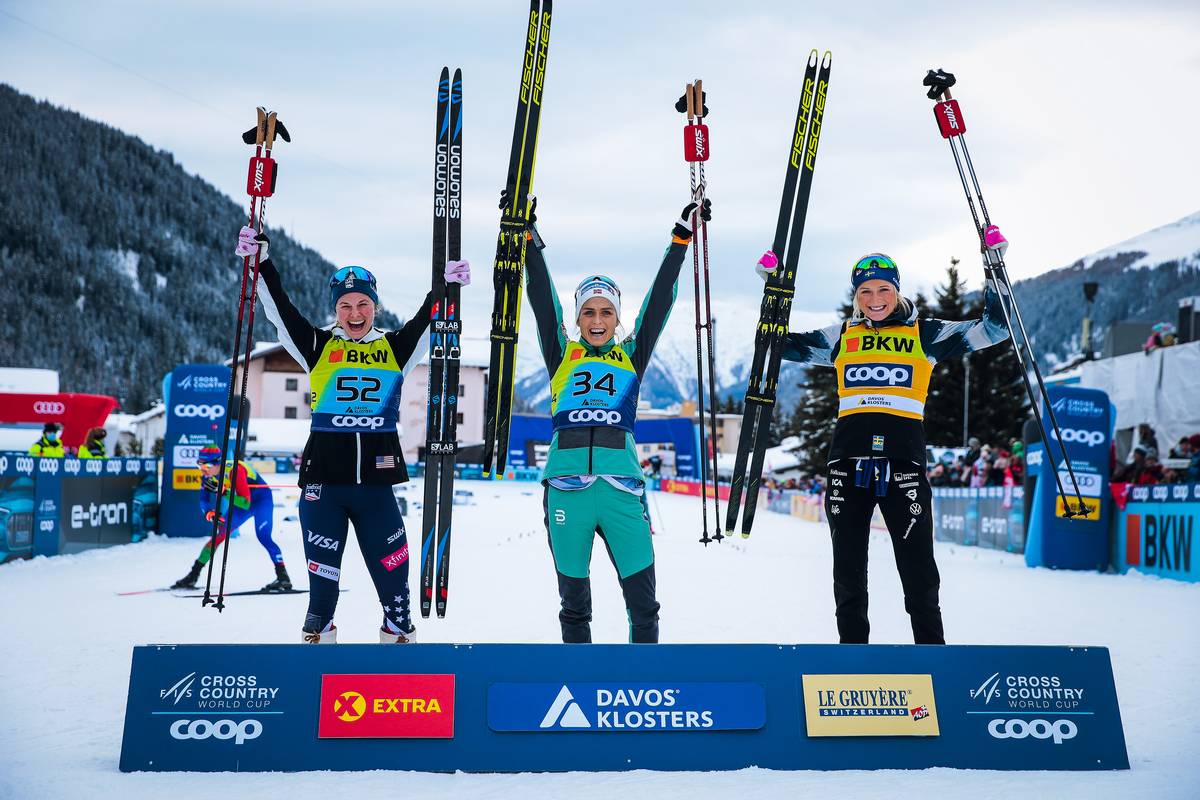
    The recent women’s podium in Davos: Therese Johaug (NOR) took the win ahead of Jessie Diggins (USA) and Frida Karlsson (SWE). (Photo: NordicFocus)

    How far women’s skiing has come, and how hard women have worked to bring the program to its current status was recently highlighted to me in Trail to Gold, The Journey of 53 Women Skiers, a collection of stories written by the 1972-2018 U.S. Olympic Women Cross-Country Skiers. This is a book that will be impactful in a unique way to each reader. As a relatively-young member of the nordic skiing community, I read it as a story of history, tenacity and teamwork. 

    Trail to Gold, the Journey of 53 Women Skiers, written and compiled by the skiers themselves.

    The creation and publication of this book was a collaborative effort that originated when current U.S. cross-country head coach (then women’s team coach) Matt Whitcomb suggested that the 2013-14 national team women interview previous Olympians. While the idea of a book was floated at the time, the project stalled until 2018 when Alison (Owen) Bradley, a member of the first women’s Olympic team, and Kikkan Randall, five time Olympian and 2018 gold-medalist, brought the group of women together again. Through this partnership, USNOW was founded, the U.S. Nordic Olympic Women. Tying history to the present, the group began recognizing a current standout U.S. female skier with the annual Gold Rush Award, the first of which was awarded to Rosie Brennan at the Quebec City World Cup in 2019. 
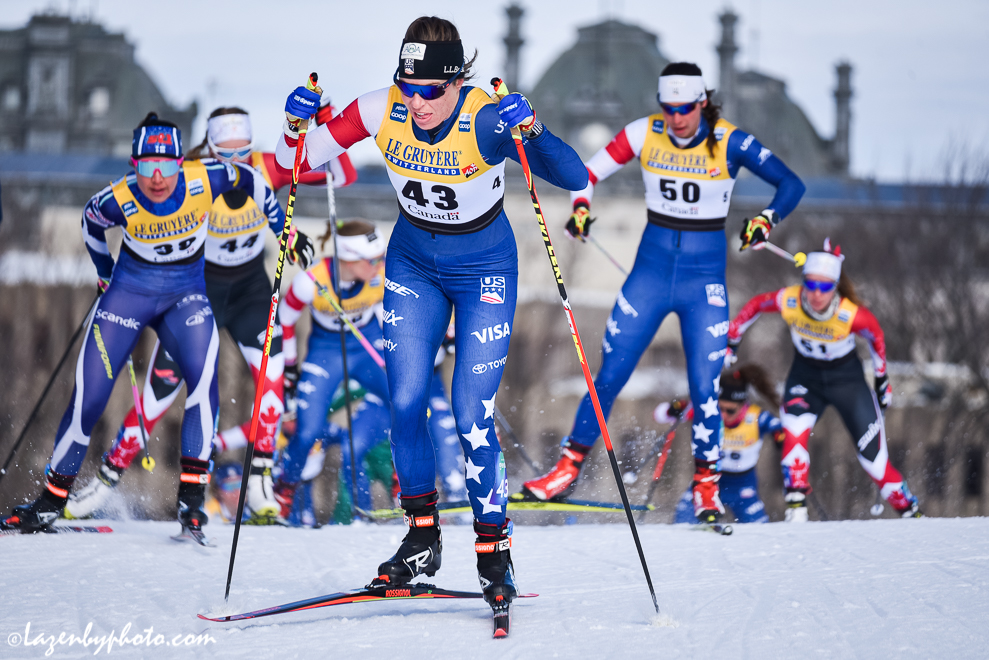
    Rosie Brennan (bib 43), recipient of the first Gold Rush award, racing the Québec City 10 k skate pursuit. (Photo: John Lazenby/lazenbyphoto.com)

    With the founding of USNOW came a renewed motivation for writing a book. 1984 Olympian, Sue (Long) Wemyss, headed a committee composed of eight former and current U.S. Olympians, and the book project began in earnest in May of 2020. With the interviews conducted in 2013-14 as a base, USNOW members contributed additional written recollections and photographs. These accounts were woven together by four of the 53 women Olympians to form chapters and provide a collective narrative. They write, “this book tells our stories as committed international competitors through five decades of history. In our own words, we reveal how the sport has developed, grown and changed. We hope you enjoy our journey.” 

    While the book is perhaps not a suspenseful page-turner, it is compelling, informative, and important, and should be a staple in any cross-country skiing household. 

    I consider myself to be close with three of the fifty three women Olympians; one of whom is my mother, the other my aunt, and the third a family friend and former coach. Growing up, I saw these women as role models and mentors. Not only to me, but to their communities as well. They are also all exceedingly humble and not likely to hold forth on the glory days of their Olympic careers. Thus, much of the history revealed in Trail to Gold was new to me. 

    While men competed in cross-country skiing at the very first Winter Olympics in Chamonix, France in 1924, it was another 48 years before the first U.S. women raced. While women from other countries started competing in cross-country at the Olympics beginning in 1952, it wasn’t until 1972 that the U.S. sent a women’s team.
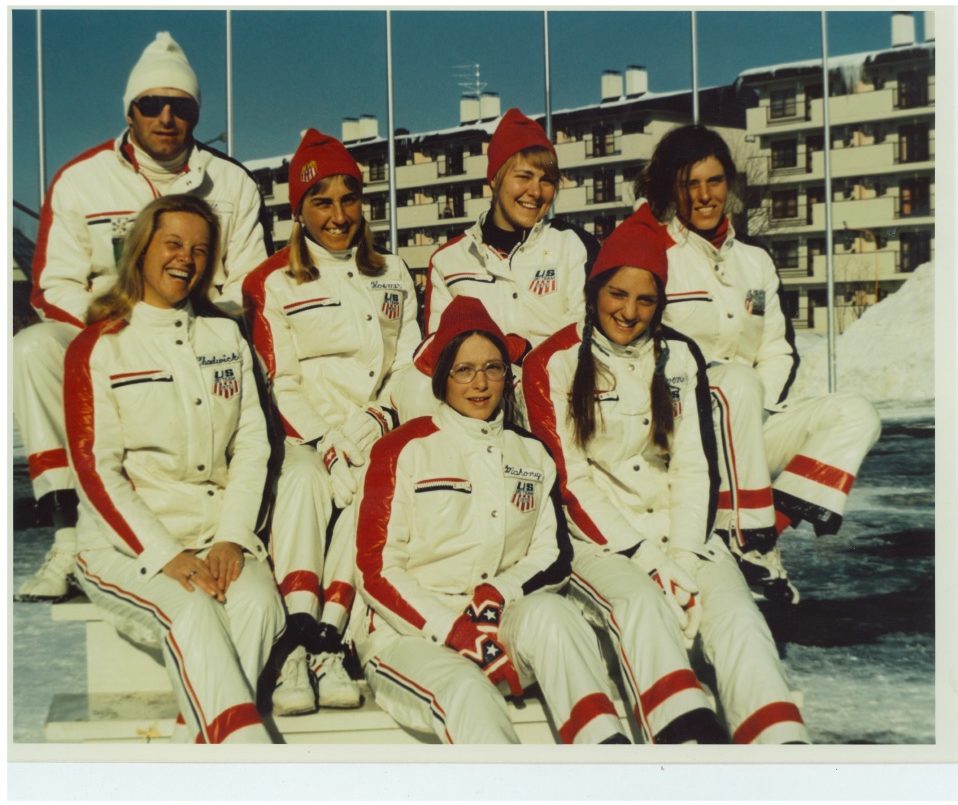
    The first Women’s cross-country Olympic Team. The 1972 Games were held in Sapporo, Japan. (Left to Right) Bottom row: Gloria Chadwick, pseudo Chaperone, Margie Mahoney, Alison Owen; Top Row: Marty Hall, Trina Hosmer, Barbara Britch, Martha Rockwell. (Photo: courtesy Alison Owen-Bradley)

    The book details the exceptional path these first five women took to be at that start line in Sapporo, Japan in 1972. Not only were these women blazing a path in the record books of nordic skiing but they were experiencing elements of world history first-hand as well. I was struck by an account from 1972 Olympian, Trina Hosmer, of the 1970 World Championships in the High Tatras, current-day Slovakia. The women flew into Prague, arriving the winter after the Russian army had driven tanks through the city and bombed some of the buildings. At this time, the country was called Czechoslovakia and was still under the rule of Russia and as Hosmer described, “very much an Iron Curtain country, which was quite intimidating for us, naive, first time international skiers.”
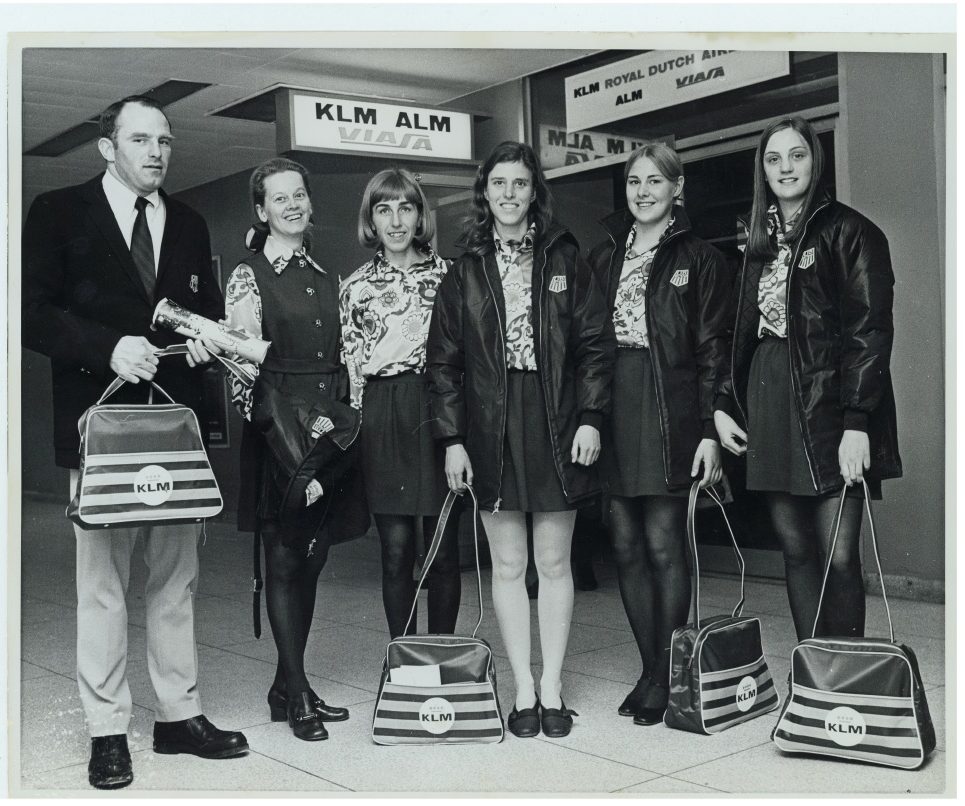
    The first U.S. women’s World Championship cross-country team on the way to Czechoslovakia in 1970. From left to right: coach Marty Hall, Coach, chaperone Gloria Chadwick, Trina Hosmer, Martha Rockwell, Barbara Britch, and Alison Owen. The U.S. team took four skiers as the relay at that time was a three-person format. (Courtesy photo)

    The rise of skating was another piece of history that stuck with me from Trail to Gold. Given the popularity and prevalence of the skate technique today, it’s difficult to imagine that it was only adopted as its own race category 35 years ago. For many of these Olympic women, they only competed in classic or they were racing as the transition came about. Sue (Long) Wemyss described how this new technique evolved over the 1984-85 season. She writes, “Most of us really didn’t know what we were doing; we were inventing skating techniques on the spot.”

    Throughout the fifty years that U.S. women have raced at the Winter Olympics in nordic skiing, they have faced enormous obstacles in their quest to compete. As much as anything, Trail to Gold is a testament to the tenacity of these 53 women and the many others who weren’t named to an Olympic team. Over the course of its pages, the book lays out many of the challenges these women dealt with over the years. They include: lacking financial support, competing against doped athletes, a lack of club teams, inconsistent leadership and troubled team dynamics, to name a few. 
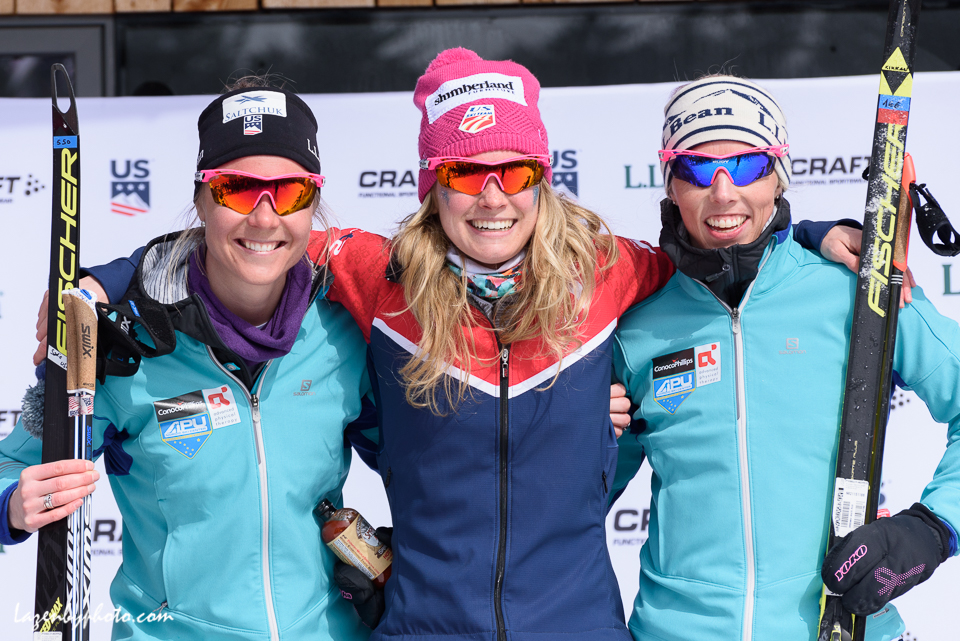
    Olympians Sadie Maubet Bjornsen, Jessie Diggins, and Kikkan Randall representing their club teams at the 2018 Super Tour Finals. (Photo: John Lazenby/Lazenbyphoto.com)

    The period following the 1998 Nagano Olympics was a particular slump for women’s cross-country skiing in the U.S. Many women were leaving the sport at the time, feeling unsupported and discouraged by the team culture. In fact, the year before the 2006 Winter Games in Torino, the U.S. ski team cut the women’s program altogether and did not even name a women’s cross-country team. 
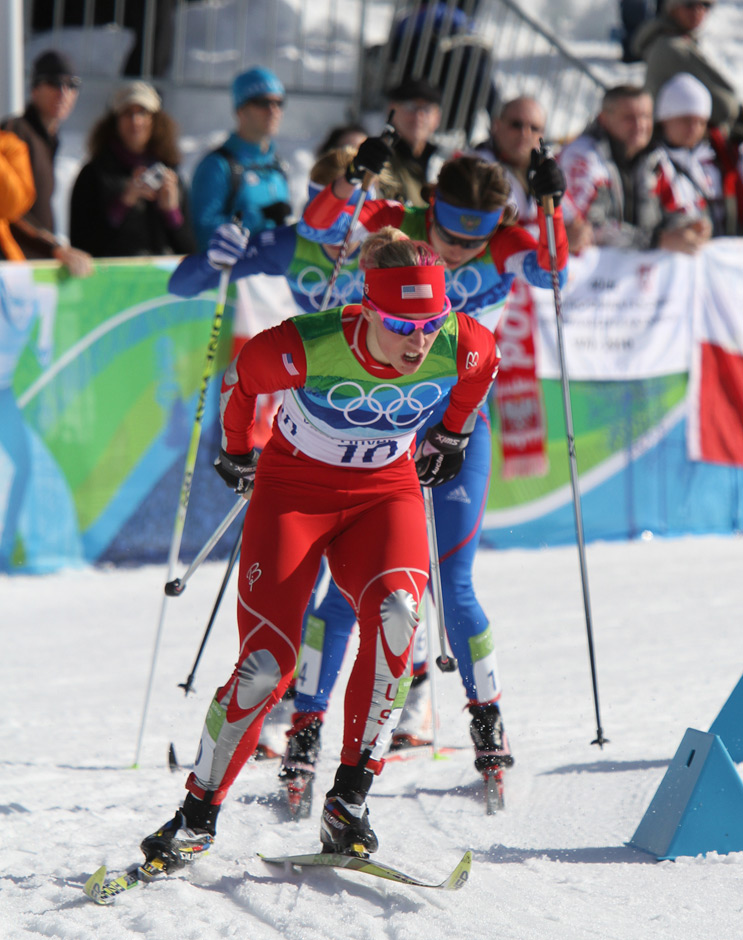
    Kikkan Randall racing the classic sprint at the 2010 Olympics in Vancouver. (Photo: FS archives)

    To anyone even remotely familiar with U.S. cross-country skiing, it will not come as a surprise that it was Kikkan Randall who helped lead women’s skiing out of this downturn. For a time, Randall was the only woman on the A-team, having to sit out most team sprints and relay events. In the book, she describes how her vision of a women’s team was inspired by the Canadian women at the time. In 2006, when the U.S. women were at a low point, Canadians Beckie Scott and Sara Renner earned a silver medal in the team sprint. Randall writes, “I was stirred by their transformation and envious of the team they had created.” 

    Twelve years later, when Randall and Jessie Diggins earned U.S. women’s cross-country skiing its first medal, gold in the team sprint, it seems safe to say that the U.S. women had also undergone a transformation. Throughout the pages of Trail to Gold lies an underlying theme of the importance of teamwork. But the book also makes it clear that this culture and dynamic was hard-fought. 

    From the historical first Olympic appearance in 1972, through the bumps and turns presented in the ensuing years, the teamwork that brought about that gold medal was fifty years in the making. As Diggins writes in her account of that night, “It’s taken years of every member of this team committing to the team goals, coming to training camps, and pushing each other through grueling training sessions,” and the cumulative pages of Trail to Gold support this statement. 
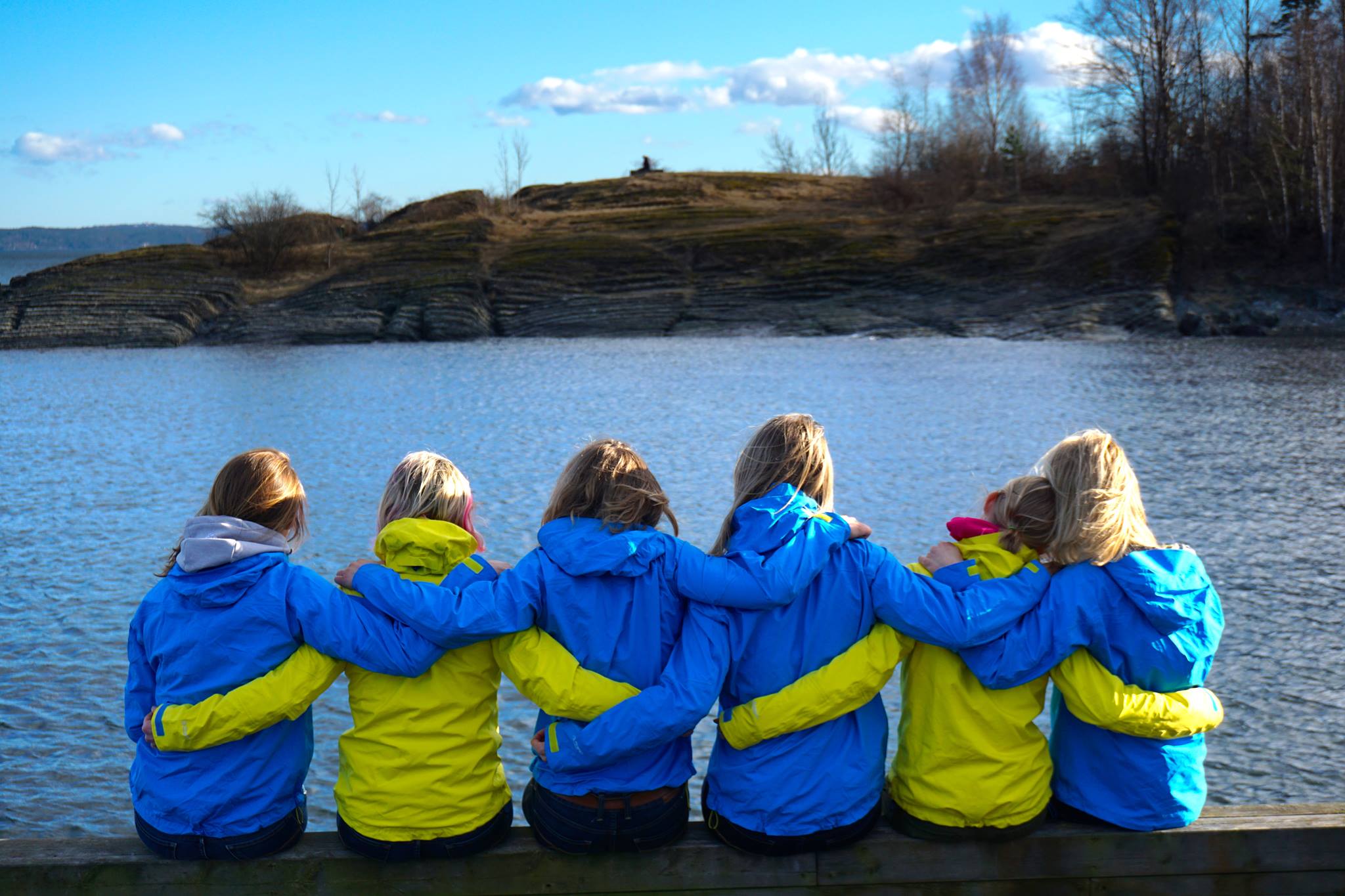
    The power of team (Photo: Caitlin Patterson)

    The two-part layout of Trail to Gold, and it’s logical progression from the early trailblazers in the sport to life after retirement makes for easy reading. While part-one tells the story of the 53 women as a whole, part-two gives an individual introduction to each of the women. Through these profiles the reader learns more about these Olympians in their own words. This section provides an excellent reference point for anyone looking to delve deeper into the lives of these 53 unique women. 
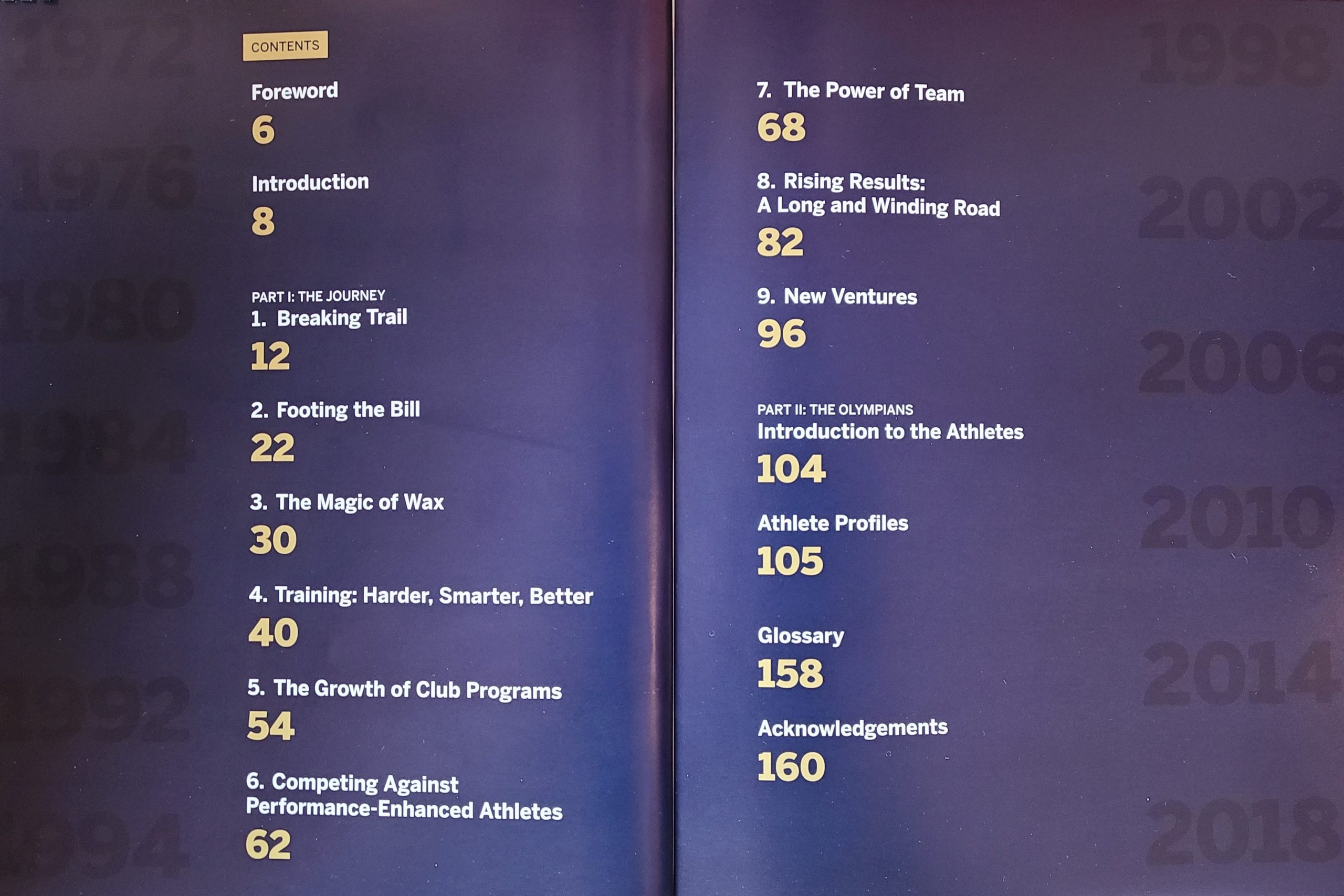
    Table of Contents from Trail to Gold.

    Through narratives, anecdotes and photographs, Trail to Gold effectively conveys an influential story of women’s Nordic skiing over the years. I urge everyone to read this book, to discover the story for yourself and find what it means for you. Regardless, it is an important book in the world of U.S. cross-country skiing and deserves a spot on the coffee tables and bookshelves of our ski community. 

    Trail to Gold is available from Pathway book distributor at this link. Additionally, personal bulk shipments have been sent to various locations around the country with the idea that the Olympic women will do book presentations, have copies to sell and attend some events. The NENSA Women’s XC Day on January 23rd is one such event where at least four of the women Olympians will be present for book signing.  

  • Reflections of an Old-Timer at the PyeongChang Winter Olympics

    Reflections of an Old-Timer at the PyeongChang Winter Olympics

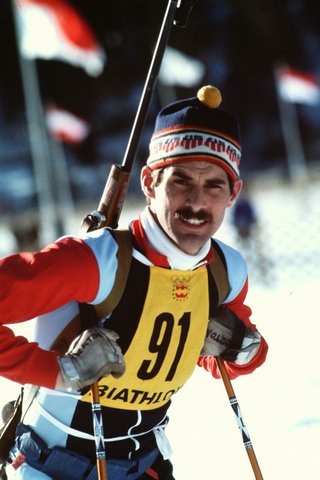
    John Morton at the 1976 Winter Olympics in Innsbruck, Austria (Courtesy photo)

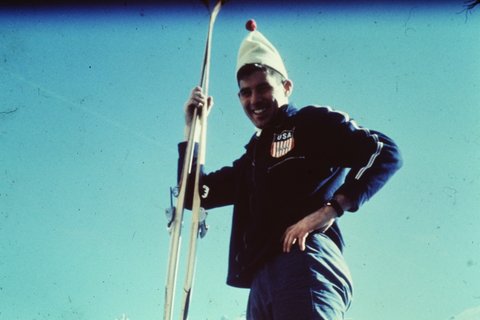
    The following was submitted to FasterSkier by John Morton, a former U.S. biathlete and two-time Olympian (1972 and 1976) who has attended 10 Winter Olympics as “either an athlete, a coach, the Biathlon Team Leader, Chief of Course or, more recently as a spectator,” according to his bio (at end of article). Today, Morton, 71, lives in Thetford, Vermont, and works in trail design.

    ***

    I’ve had the remarkable good fortune of attending 10 Winter Olympic Games. I was a member of the U.S. Biathlon Team in 1972 at Sapporo and again in ’76 at Innsbruck (where, following a workout, a few of U.S. ski-shooters wandered over to the adjacent cross-country stadium and watched Bill Koch win his monumental silver medal in the men’s 30 km). I was an assistant coach for the U.S. biathletes at the 1980 Games in Lake Placid, where late in the schedule, I accepted a complementary ticket to a hockey game, not even knowing which teams were playing. It turned out to be the USA’s remarkable victory over the Soviet Union, probably the most inspiring sporting event I’ll ever witness. I served as Team Leader for the U.S. biathletes at Calgary in ‘88, Albertville in ‘92 and Lillehammer in ‘94. Then, in 2002, I was the Chief of Course for the biathlon events during the Salt Lake City Olympics, a volunteer position that was every bit as stressful as competing back in ’72 and ‘76.

    At the most recent three Winter Games, Vancouver, Sochi and PyeongChang, my wife and I have enjoyed the relative luxury of attending as spectators, cheering on America’s cross-country skiers and biathletes. As the jet lag from out trip home from South Korea begins to wear off, I can’t help thinking about the dramatic changes these two sports have experienced over the past 46 years. It seems to me that many of these changes can be traced to three factors: innovations by the athletes, technological improvements and the influence of television.

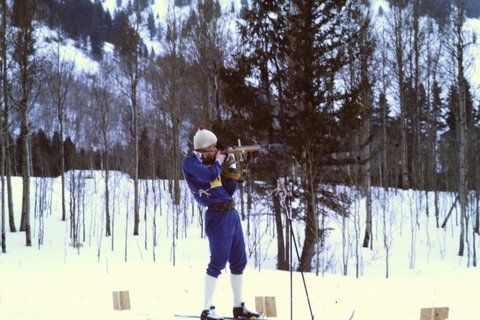
    John Morton at 1972 biathlon Olympic trials in Jackson, Wyoming. (Courtesy photo)

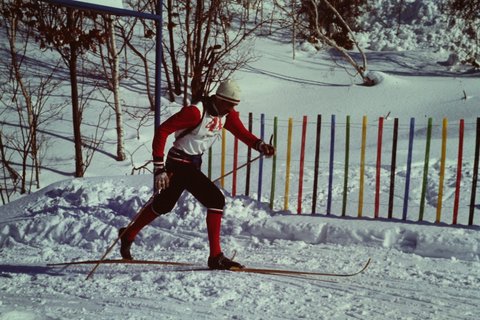
    Back in ’72 we were on wooden skis, kick-waxed the entire length. There were two biathlon events, the 20 km individual and the 4 x 7.5 km relay. We shot large-caliber rifles on a 150-meter range using paper targets for the 20 km and glass disks for the relay. It was impossible to determine the winner of the 20 km until all the paper targets had been carefully inspected, sometimes hours after the conclusion of the event. A typical biathlon course consisted of three, independent, 4 km loops, with cutoffs for the relay. Women didn’t compete in biathlon at the Olympics until Albertville in 1992.

    Men’s cross-country has been part of the Winter Olympics since the beginning in 1924 at Chamonix, France, when there was a 15 km event as well as the legendary 50 km. The first cross-country event for women was a 10 km, which debuted in 1952. In those days, Nordic race courses consisted of roughly one-third climbing, one-third descent and one-third relatively flat terrain. Well into the 1960s, courses were prepared by soldiers boot-packing or snowshoeing the course, followed by skiers stomping in the parallel tracks through the forests and fields. Competitors typically started at one-minute intervals, disappeared into the woods, only to reappear exhausted, often hours later, covered with frost and mucus. The men’s 50 km cross-country event at the 1932 Winter Olympics in Lakes Placid consisted of a 25 km loop skied twice, and was won by Finland’s Veli Saarinen in 4 hours, 28 minutes.

    In my view, the first significant change came at the 1974 Nordic World Championships when Sweden’s Thomas Magnusson won the men’s 30 km on Kneissl synthetic skis. Fiberglass and metal had replaced wooden Alpine skis years earlier, but the faster, plastic bases wouldn’t hold Nordic kick wax. But in wet, heavy, painfully, slow snow, Magnusson took a chance on the fiberglass Austrian skis and dominated the race. The headline in the Oslo paper the next day read something like, “Magnusson wins gold, Norwegian ski industry in peril.”

    The next major breakthrough occurred at the 1976 Innsbruck Olympics two years later. Marty Hall, head coach of the U.S. Cross-Country Team recruited Rob Kiesel from Alpine skiing as his assistant. Together they determined that it was possible to wax the tips and tails of the new fiberglass skis for speed with Alpine wax, restricting the much slower cross-country kick wax to a short segment under the athlete’s foot. This made the skis of the Americans faster than those of their European rivals and certainly contributed to Bill Koch’s memorable silver medal in the 30 km, America’s first, and only Olympic medal in Nordic skiing until Kikkan Randall and Jessie Diggins struck gold in PyeongChang.

    Following the success of the Innsbruck Olympics, expectations were high for U.S. Nordic skiers at the 1980 Olympics in Lake Placid. With a theoretical “home court advantage,” Bill Koch’s 13th in the men’s 50 km and Lyle Nelson’s 19th in the biathlon 10 km sprint fell short of the results which the public had been led to expect.

    Discouraged, Koch elected to ski the international ski marathon circuit the following year rather than the Nordic World Cup. There, on trails groomed wide by Alpine-area Sno-Cats for thousands of citizen racers, he observed elite competitors pulling away from the throng by putting one ski in the set track and pushing off, skating-style with the other. He quickly mastered this marathon-skate technique and began to experiment by skating with both skis. When he returned to the World Cup circuit a year later, he threw the Nordic world into turmoil by abandoning the relatively slow kick wax altogether and skating entire courses on skis waxed purely for speed. The result of Koch’s persistence and innovation was a cumulative World Cup victory for the season, America’s first in cross-country skiing.

    U.S. biathlete John Morton racing at the 1972 Winter Olympics in Sapporo, Japan. (Courtesy photo)

    When the dust (or more accurately, snow) finally settled, Nordic skiing had two disciplines, classic (the traditional kicking and gliding) and freestyle (skating). Because biathlon was already complicated enough with skiing and shooting, they decided to go with skating as their designated technique, as did Nordic Combined. In a type of mutual re-enforcement cycle, the use of large, Sno-Cat-type grooming machines on cross-country trails, which originally made the evolution of the skating technique possible, became a requirement once skating was accepted as a part of the sport.

    Enter television. The first Winter Olympics to be televised were the 1956 Games in Cortina, Italy, and it quickly became apparent how powerful the new medium could be. Figure skating, ice hockey and ski jumping immediately gained popularity, largely because they were relatively easy to cover. Alpine skiing, bobsled and Nordic skiing lagged behind because they were more difficult and expensive to film. The sports favored by TV prospered, enjoying increased funding from sponsors and a wave of young Olympic hopefuls. Meanwhile, those sports that were less telegenic scrambled to make their events more appealing to the camera. Nordic skiing and biathlon added mass-start and pursuit format events, making it easy for spectators to see who was winning. In terms of spectator interest, biathlon had the advantage of the shooting range. With the adoption of the modern, knock-down targets and television cameras’ abilities to zoom in on an athlete’s targets as he/she is shooting, the popularity of the sport took off. In recent years, biathlon has become the most-watched winter sport in Europe with World Cup events rivaling the popularity of Monday Night Football in America.

    In cross-country, one of the unintended consequences of the skating revolution was a focus on upper-body strength, which in turn, led some athletes to abandon kick wax in classic events and double pole the entire course, especially in the shorter, sprint races. This led the FIS (the international governing body for skiing) to require tougher courses with more challenging climbs.

    Finland’s Iivo Niskanen after winning the men’s 50 k classic mass start at the 2018 Winter Olympics in PyeongChang, South Korea. (Photo: FlyingPointRoad)

    As a result, what we saw in PyeongChang for both cross-country and biathlon, were trails 30-feet wide, capable of accommodating three skaters, side by side (without obstructing each other), with steeper climbs and faster, more challenging descents. Aside from the spacious start/finish stadiums, the traditional one-third of relatively flat terrain has disappeared. There was also an effort to loop the trails back within sight of the spectators so that they saw more than just the start and finish of the events. For example, the men’s 50km, perhaps the most iconic of the cross-country events, was conducted on two, 4.16 km loops which brought the competitors through the stadium, in front of the cheering crowd a dozen times. The men’s 50 km classic in PyeongChang was won by Finland’s Iivo Niskanen in a time of 2 hours, 8 minutes (less than half the time it took for his countryman to complete the same distance in 1932 at Lake Placid).

    Perhaps the most dramatic change, was the scheduling of many of the Nordic skiing events at night (which allowed them to be televised live in Europe and the eastern U.S. at a reasonable hour). In addition to the expense of lighting and minimizing the number of TV camera platforms, another motivation for shorter ski loops is the growing need, thanks to climate change, to cover the entire trail with machine-made snow. Early in the winter the biathlon and cross-country courses were blanketed with a deep layer of machine-made snow, enough to survive warm temperatures and thaws well beyond the Olympic schedule in February.

    While there have been advancements and technological improvements in other Winter Olympic sports, I can think of none more dramatic than what we’ve experienced in Nordic skiing. From a single biathlon event held at the 1960 Squaw Valley Games, there were 10 biathlon competitions on the schedule in PyeongChang. With the advent of the skating technique, fiberglass skis and fluorocarbon waxes, times for cross-country events have been cut in half in less than a generation. Thanks to machine-made snow, the 2022 Winter Olympic Games will be hosted by Beijing, China, a city previously not known for winter sports. And through the development of LED lighting and high-definition television, the excitement of Nordic skiing events can be broadcast live, in prime time, to homes around the world.

    *****

    John Morton has participated in ten Winter Olympic Games as either an athlete, a coach, the Biathlon Team Leader, Chief of Course or, more recently as a spectator. He has published two books and numerous articles dealing with Nordic skiing.

    After 11 years as Head Coach of Men’s Skiing at Dartmouth College, he founded Morton Trails, and has spent the past 28 years designing more than 220 recreational trails and competition venues across the country. He currently has projects underway in a dozen U.S. states as well as two projects in China. More information regarding his trail design work can be found at www.mortontrails.com. He lives with his wife Kay, at the end of a dirt road in Thetford, VT, surrounded by trails. 

    John Morton, U.S. biathlete (Courtesy photo)