From the FasterSkier archive — posts syndicated from athletes’ and coaches’ own blogs between 2004 and 2012, kept online as published. Current coverage is at fasterskier.com.

Tag: 20 k classic

  • Ammar Gets Coveted Gold at Canadian Nationals in 30 k Classic; Babikov Tops Sandau in 50 k

    Ammar Gets Coveted Gold at Canadian Nationals in 30 k Classic; Babikov Tops Sandau in 50 k

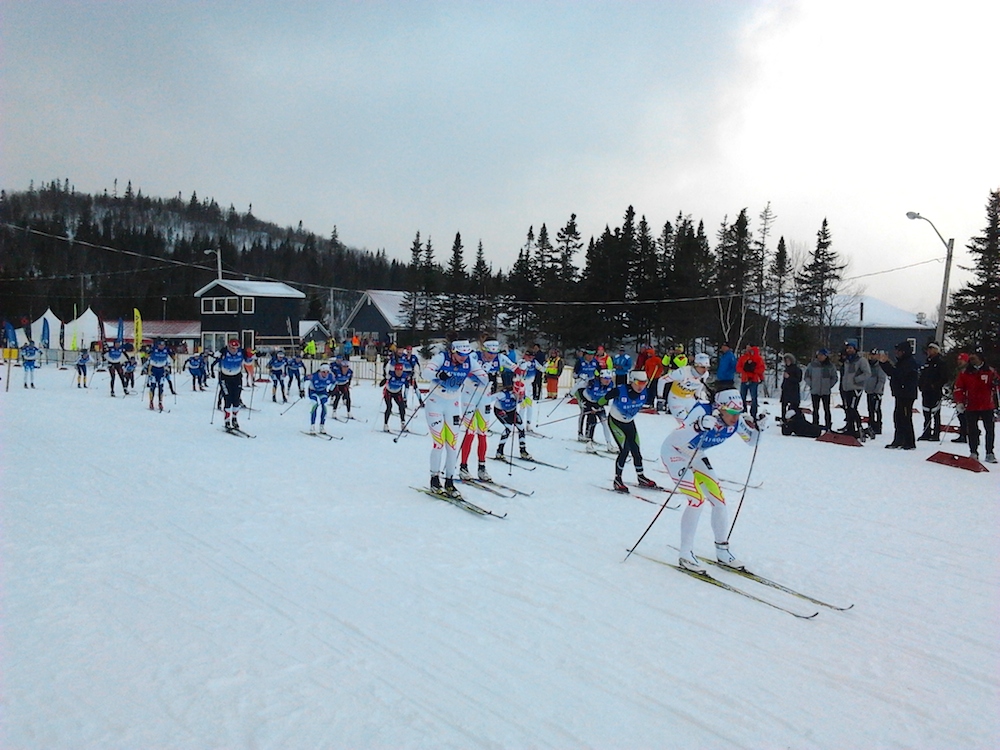
    The senior women's 30 k classic mass start on the last day of Canadian Nationals last Saturday in Corner Brook, Newfoundland.
    The senior women’s 30 k classic mass start on the last day of Canadian Nationals last Saturday in Corner Brook, Newfoundland.

    CORNER BROOK, Newfoundland — The last day of Canadian Nationals started bright and early last Saturday with the senior men’s competition at 9 a.m. The men raced 50 kilometers, women and junior men 30 k and junior women  20 k, all classic mass starts.

    With skiers already having completed three other individual races this week,  some doing four with the team relay, the distance race is not only a good indicator of endurance and race fitness, but also a test of who has recovered the best throughout the week.

    Newfoundland came through with some pretty exciting weather for the final race. Blowing snow was the name of the game for most of the morning at Blow Me Down Trails and made for interesting conditions for the competitors.

    Senior Men

    Fighting through the snow, the senior men stayed in a pretty big pack for the first two-thirds of the race until Ivan Babikov, of the Canadian World Cup Team, pulled ahead to win the 50 k by 41.5 seconds in 2:19:32.3.
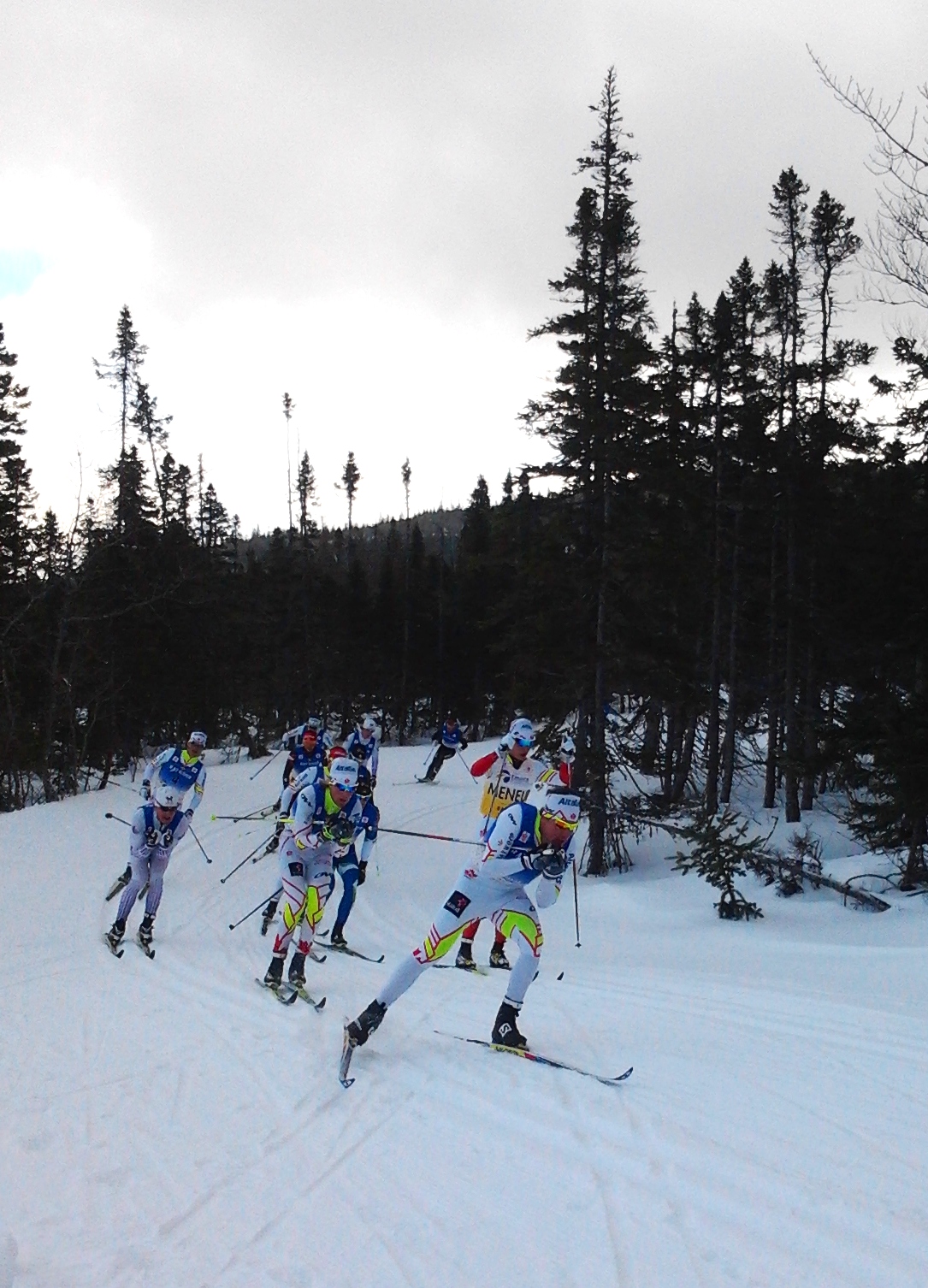
    Ivan Babikov, of the Canadian World Cup Team, leads fellow Olympian Graeme Killick (AWCA/NST) and others in the senior men's 50 k classic mass start on the last day of Canadian Nationals last Saturday in Corner Brook, Newfoundland.
    Ivan Babikov, of the Canadian World Cup Team, leads fellow Olympian Graeme Killick (AWCA/NST) and others in the senior men’s 50 k classic mass start on the last day of Canadian Nationals last Saturday in Corner Brook, Newfoundland.

    Runner-up Kevin Sandau of the Alberta World Cup Academy (AWCA) and Canadian Senior Development Team (NST) talked about the race and about his experience at nationals this year.

    Kevin Sandau (2nd)

    – What was your race plan going into the 50 k? Stick with the pack? Push the pace and string things out?

    “I didn’t want to have a relaxed and passive pace for much of the 50 k. Sometimes 50’s just aren’t hard enough until the last 10 t0 15 k, so they end bunching up quite a bit, and it can get frustrating and sketchy skiing with a big pack like that. I took my turns in the front, kept the pace high. When Ivan attacked on the second last lap a group of three of us tried to pull him back, but well he sort of crushed it that lap and put some big time into us.”

    – Looks like you had a pretty good week of racing. How do you feel about your performance this year at nationals?

    “Best nationals for me by far. I was actually most nervous about the team sprint and defending Foothills Nordic’s gold-medal streak in that race. Also it was the first time I did the sprint race since maybe 2009 at nationals and I managed to sneak into the A-final, so I was pretty excited about that.”

    – How many nationals podiums do your currently have to your name? How many titles?

    “Seven podiums including two team-sprints titles. The [individual] national-champ title still eludes me, but I did grab this years overall title so pretty pumped for that.”

    – I hear you are racing at the Alberta Cup Sharkfest. Safe to say this was your main focus for the season? 

    “Pretty much the biggest focus. You’re only as good as your last race, right? And I figure it will be some good motivation to ski on the weekend.”

    Men’s 50 k Classic Top 10

    1. Ivan Babikov (Canadian World Cup Team) 2:19:32.3
    2. Kevin Sandau (AWCA/NST) +41.5
    3. Graham Nishikawa (NST/Para-Nordic Team) +52.7
    4. Andy Shields (NDC Thunder Bay/NST) +54.4
    5. Graeme Killick (AWCA-NST) +1:29.4
    6. Knute Johnsgaard (Yukon Elite) +1:52.4
    7. Colin Abbott (Yukon Elite) +1:54
    8. Frédéric Touchette (Laval) +2:15.6
    9. Michael Somppi (AWCA/NST) +4:09.5
    10. Colin Ferrie (Black Jack) +4:12.5

    Senior Women

    The senior women’s race played out quite differently. Amanda Ammar (Team Ninja) broke the pack early on, with only Emily Nishikawa (AWCA/NST) being able to match her.
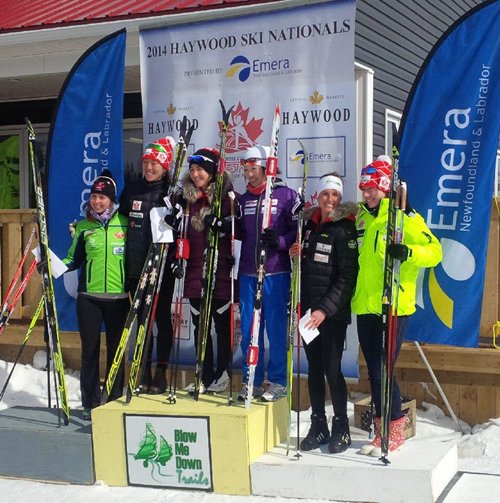
    The women's 30 k classic podium at Canadian Nationals on Saturday in Corner Brook, Newfoundland. (Photo: Cross Country Canada) http://www.cccski.com/Media/Haywood-Race-Report/Haywood-RACE-Report--Ivan-Babikov-and-Amanda-Ammar.aspx#.UzH_XNxH3FI
    The women’s 30 k classic podium at Canadian Nationals on Saturday in Corner Brook, Newfoundland, with winner Amanda Ammar (third from left), runner-up Emily Nishikawa (second from l) and Japan’s Chisa Obayashi in third (third from r). (Photo: Cross Country Canada)

    These two skiers worked together, opening up a big gap over third-place skier Chisa Obayashi (Madshus Japan), until Ammar pulled ahead in the last lap to take the win with by 54 seconds over Nishikawa.

    Amanda Ammar (1st)

    – You really broke the field pretty early on. Was that your game plan before or did you decide during the race that you felt great and you’d just go for it?

    “Winning the nationals 30 k was a goal of mine all year, but obviously not the most important. Olympics was first. Breaking the field was always in the back of my head, but you can only make that decision really on the day of … you need to gauge your energy and that day I felt awesome in my warmup, so it was an easy game plan. As a distance skier, I absolutely hate tactics, and would love to have the luxury of always just blasting off the start.”

    – You’ve put down some really solid races at these nationals. Do you think that your experience at the Olympics put you in a good place for nationals or do you think that you went into these races pretty fatigued?

    “The Olympics was physically and mentally exhausting. Leading up to the Olympics was stressful for me with the appeals, Brittany [Webster] and I had a horrible travel schedule, and then while traveling to Sochi the airline company broke most of my skis. So I wasn’t in the best headspace. That being said, the Olympic course was one of the most challenging that I have ever raced on. After completing all of my events, I felt a huge sense of accomplishment and confidence. I knew if I could start and finish a race on that grueling of a course, then it would be an absolute piece of cake on any other course.

    “When I got home from the Olympics I was pretty toast. I had no desire to go to nationals, but I  knew that once I got there that my frame of mind would change, and that I would have fun no matter what. So did I have energy going into nationals? No, but does anybody, really? It’s a long season, especially an Olympic season. We are all tired, and I feel that every athlete is in the same boat.”

    – Any thoughts about your nationals races this year? The 30 k was your first national title, correct?

    “I couldn’t be more excited about my results at nationals this year. A Ninja winning the nationals aggregate? So stoked! This is the first time I have ever medalled as a senior, and I managed to get top 5 in every race! In 2012, I was nine minutes and 30 seconds behind in the 30 k classic event, so that is just one example of how far I’ve come in three years. These results mean so much to me in that I’ve always wanted to be a positive role model for the young women coming up in sport.

    “These last three years I’ve done it my way, no carding, no national/development team, no rules! Chris [Butler] and I made the training plan, and worked together with other athletes in the bow valley. We kept it sublimely simple.”

    Women’s 30 k Classic Top 10

    1. Amanda Ammar (Team Ninja) 1:32:23
    2. Emily Nishikawa (AWCA/NST) +54.5
    3. Chisa Obayashi (Madshus Japan) +4:51.6
    4. Brittany Webster (MitoCanada) +5:36.1
    5. Alysson Marshall (AWCA/NST) +5:39.9
    6. Erin Tribe (NDC Thunder Bay/Lakehead) +5:43.3
    7. *Anne-Marie Comeau (CNEPH/NST) +5:56.2
    8. Heidi Widmer (AWCA/NST) +7:56
    9. Kendra Murray (Carleton) +7:56.4
    10. Marlis Kromm (AWCA) +12:37.7

    *Top junior

    Junior Men
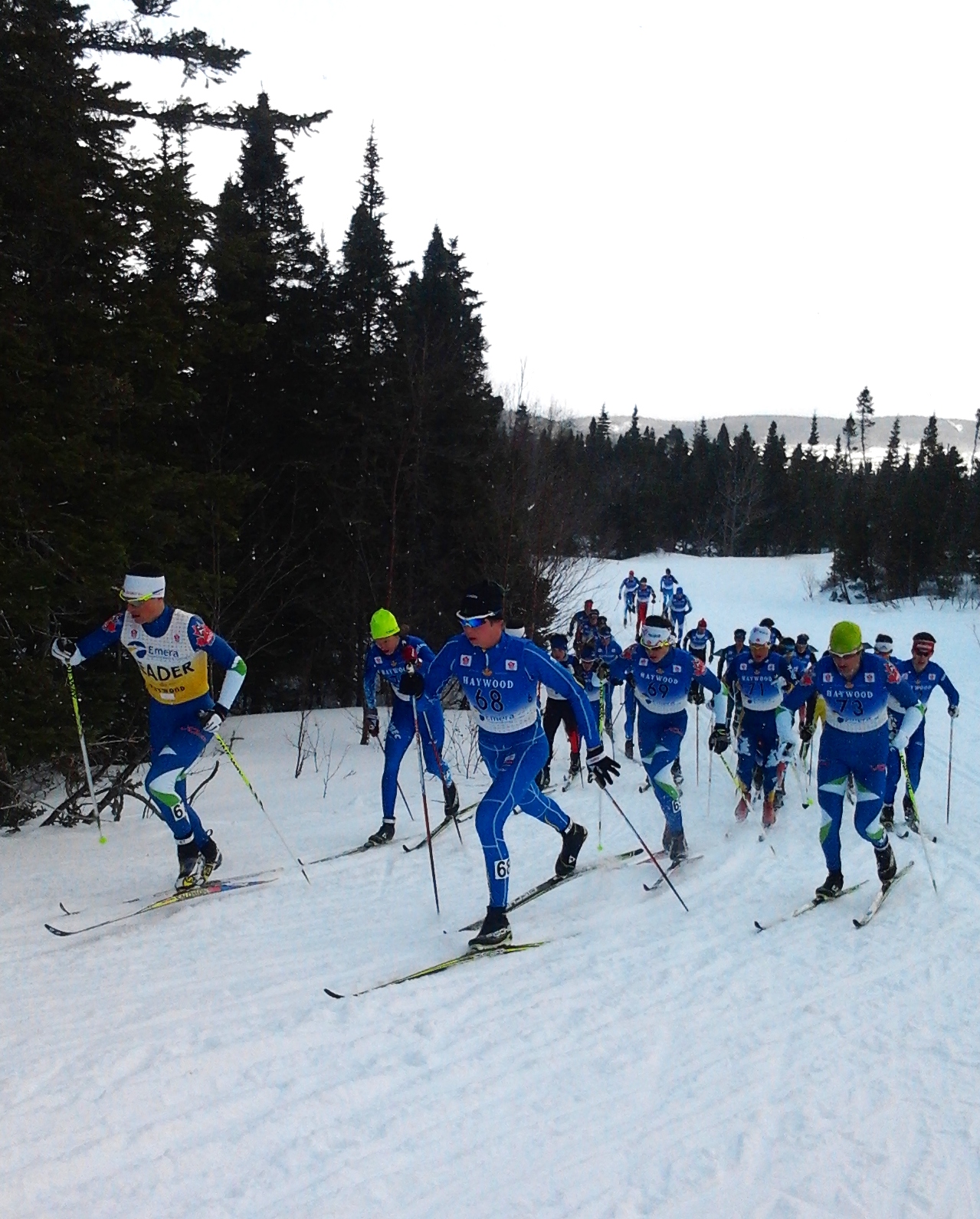
    The junior men's 30 k classic mass start on the last day of Canadian Nationals last Saturday in Corner Brook, Newfoundland.
    The junior men’s 30 k classic mass start on the last day of Canadian Nationals last Saturday in Corner Brook, Newfoundland.

    In the junior men’s 30 k, NDC Thunder Bay ruled the roost once again, sweeping the podium. Pulling off his third national title this season, Scott Hill raced to a nearly two-minute win over the rest of the field. His NDC teammates also on the National Junior Team, Evan Palmer-Charrette and Ben Wilkinson-Zan followed in second and third, respectively.

    Junior Men’s 30 k Classic Top 10

    1. Scott Hill (NDC Thunder Bay/NST) 1:23:10.7
    2. Evan Palmer-Charrette (NDC Thunder Bay/NST) +1:51
    3. Benjamin Wilkinson-Zan (NDC Thunder Bay/NST) +2:29.1
    4. Alexis Dumas (QCST) +3:12.0
    5. Colin Foley (CVTC) +3:32.8
    6. Julien Lamoureux (QCST/Cégep Édouard-Montpetit) +4:32.6
    7. Conor Thompson (QCST/Cégep Édouard-Montpetit) +5:04.9
    8. Nicholas Pigeon (Skinouk) +5:05.4
    9. Gavin Shields (Lappe) +5:45.2
    10. David Askwith (Georgian Bay) +7:32.2

    Junior Women

    Much like in the senior women’s race, the junior women spread out early on. This made for a mentally challenging race as most of the competitors pushed through the pain alone for much of the 20 k distance.

    Upsetting this trend, the top three, Dahria Beatty (AWCA/NST), Katherine Stewart-Jones (Nakkertok/NST) and Annah Hanthorn of the Yukon Territory Ski Team, worked together for much of the race setting up a comfortable lead on the others. On the third of four laps, Beatty and Stewart-Jones slowly pulled away from Hanthorn and the last lap became a two-skier battle. Beatty pulled away on the hills of the final lap to take her second national title of the week by 16.5 seconds.

    Junior Women’s 20 k Classic Top 10

    1. Dahria Beatty (AWCA/NST) 1:08:12
    2. Katherine Stewart-Jones (Nakkertok/NST) +16.5
    3. Annah Hanthorn (YTST) +46.3
    4. Frédérique Vézina (CNEPH/NST) +2:45.2
    5. Sophie Carrier-Laforte (QCST) +3:03.7
    6. Jennifer Jackson (NDC Thunder Bay/NST) +3:12.6
    7. Emilie Stewart-Jones (Nakkertok) +3:18.9
    8. Sarah Beaudry (Caledonia) +4:00.9
    9. Maya Macisaac-Jones (CNEPH/NST) +6:02.4
    10. Ember Large (Edmonton) +6:47.5


    Complete results: Zone4.ca

    For aggregate national titles from the week: Cross Country Canada
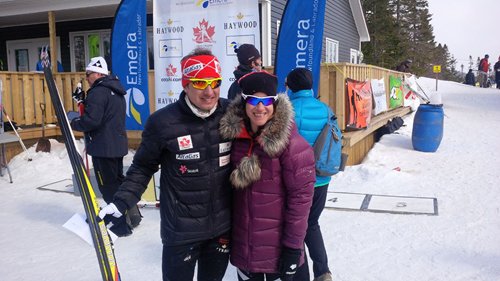
    Ivan Babikov and Amanda Ammar, winners of the 50 and 30 k classic mass starts at 2014 Canadian Nationals (Photo: Cross Country Canada) http://www.cccski.com/Media/Haywood-Race-Report/Haywood-RACE-Report--Ivan-Babikov-and-Amanda-Ammar.aspx#.UzH_XNxH3FI
    Ivan Babikov and Amanda Ammar, winners of the 50 and 30 k classic mass starts at 2014 Canadian Nationals in Corner Brook, Newfoundland. (Photo: Cross Country Canada)

    ***

  • McKeever Wins Canada’s First Paralympic Gold, Eighth Total, with Both Carleton & Nishikawa

    McKeever Wins Canada’s First Paralympic Gold, Eighth Total, with Both Carleton & Nishikawa

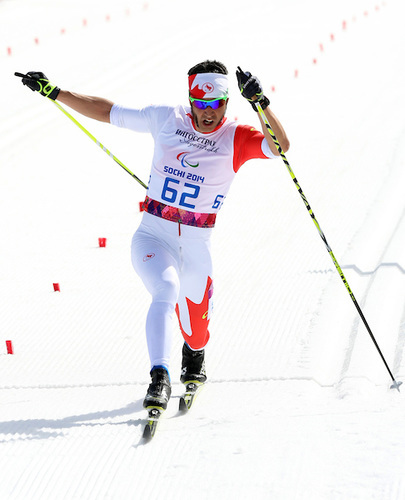
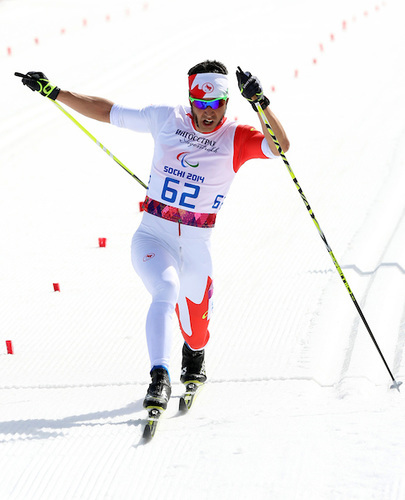
    Brian McKeever locking up his eighth-career Paralympic gold and first of the Sochi Winter Games on Monday in the 20 k visually impaired classic race. (Photo Scott Grant/Canadian Paralympic Committee)
    Brian McKeever locking up his eighth-career Paralympic gold and first of the Sochi Winter Games on Monday in the 20 k visually impaired classic race. (Photo Scott Grant/Canadian Paralympic Committee)

    (CCC press release)

    Innovative Canucks use two guides, Carleton and Nishikawa, to lead McKeever to eighth Paralympic title

    SOCHI, Russia — Brian McKeever cracked Canada’s golden goose egg in the medal count at the Paralympic Winter Games in Sochi, Russia on Monday, and he did it with a unique twist.

    One of the most accomplished athletes in the history of Paralympic sport, the 34-year-old McKeever utilized both of his training partners and guides, Erik Carleton and Graham Nishikawa, in the 20-kilometre classic-ski race to slog through the summer-like warm and slow snow conditions and put one in the win column for Canada. The Canadian trio teamed up to clock a winning time of 52 minutes, 37.1 seconds.

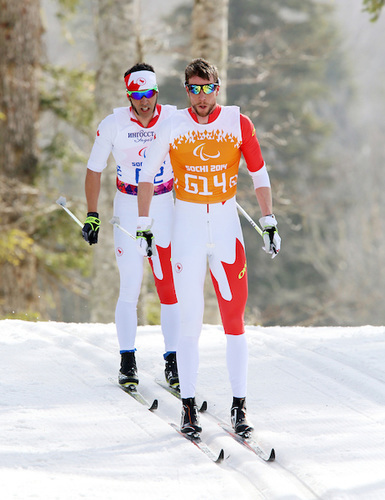
    Canadian Brian Mckeever and guide Erik Carleton compete in the cross-country men's 20 k visually impaired classic race at the Sochi 2014 Paralympics in Sochi, Russia. Mckeever went on to win gold. (Photo Scott Grant/Canadian Paralympic Committee)
    Canadian Brian Mckeever and guide Erik Carleton compete in the cross-country men’s 20 k visually impaired classic race at the Sochi 2014 Paralympics in Sochi, Russia. Mckeever went on to win gold. (Photo Scott Grant/Canadian Paralympic Committee)

    “Today was a huge team effort having two guides out there sharing the work,” said McKeever, 34. “It was definitely needed because I couldn’t have done that on my own. They set the perfect pace with the snow being what it was. It is much faster skiing from behind in conditions like this, and unfortunately for the guides, they are forced to work pretty damn hard. It was all them today!”

    Russia’s Stanislav Chokhlaev skied to the silver medal at 53:43.3, while Sweden’s Zebastian Modin grabbed the bronze with a time of 56:34.9.

    Watching many of the world’s best Nordic nations struggle with the difficult warm weather and snow conditions at the Olympics and Paralympics in Sochi, the decision to leverage both of the guides that McKeever brought to these Paralympics – the first time he has done so in his legendary career – was made last night during a team meeting.

    “It was a convoluted plan and a risky plan that was needed to be done only because of the strength of the athlete,” said 40-year-old Robin McKeever, head coach of the Canada’s Para-Nordic Team who guided his brother to his previous 10 Paralympic medals. “Guiding in these conditions is brutal, and when you are leading a world class athlete like Brian it is very difficult to keep the pace he needs.

    “Brian controls the throttle. The risk bringing an athlete in mid-race is he can potentially go out to hard and blow himself up, or he goes to hard and wrecks Brian. Communication is absolutely critical all day between each of the athletes and coaches.

    “As the talent of the athletes continue to evolve at the Paralympics I think we are going to see more of this type of strategy because it is so hard to stay out in front of them, and for the guides to continue keeping the pace they need to win.”

    The strategy definitely seemed to pay off. With the original race plan to switch guides at the 12-kilometre mark, the Canadians were dropping further back into second place at the mid-way point of the race as the 36-year-old Erik Carleton was running out of gas.

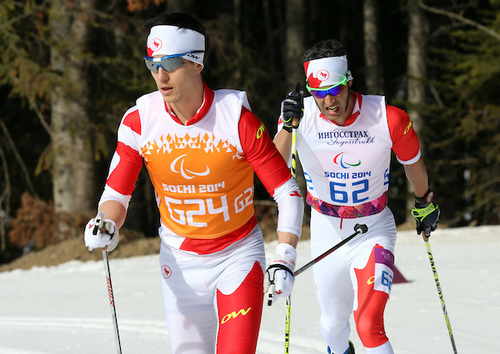
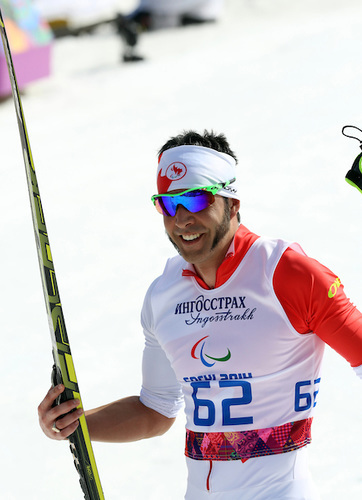
    Graham Nishikawa pacing Brian McKeever to his eighth Paralympic gold on Monday in the 20 k visually impaired classic race in Sochi, Russia. McKeever used both Nishikawa and Erik Carleton as guides, switching halfway through the distance race. (Photo Scott Grant/Canadian Paralympic Committee)
    Graham Nishikawa pacing Brian McKeever to his eighth Paralympic gold on Monday in the 20 k visually impaired classic race in Sochi, Russia. McKeever used both Nishikawa and Erik Carleton as guides, switching halfway through the distance race. (Photo Scott Grant/Canadian Paralympic Committee)

    “I started steady and tried to build from there, but was getting tired setting the pace we were at so it was good we made the switch because I did all I could do today,” said Carleton. “It is tough to guide a guy as fast as Brian, but I’m happy we got it done today.”

    Childhood buddies, Carleton and McKeever teamed up following the 2010 Paralympics when Brian’s brother Robin packed in his racing career to focus on coaching Canada’s Para-Nordic squad. Recognizing the advantage of having additional arsenal in the wax room, the two Canmore, Alta. natives invited National Ski Team member, Graham Nishikawa, into their training group this fall with the goal of bringing both guides to the Paralympics.

    While Nishikawa continued to race able-bodied both domestically in Canada and on the World Cup circuit this year, he remained committed to McKeever at the Paralympics.

    “This is not only my first Paralympics, but my first time guiding Brian today so it is a whole new world for me,” said Nishikawa, who was on Canada’s World Championship team last year and raced last the World Cup in Lahti, Finland, last week. “I’m very excited to be here for Brian. It is a tough job to lead him out there. He is a world-class athlete, and we have to set a very fast pace to be out in front of him to deliver the performance.”

    Similar to a relief pitcher getting the call from the bullpen, the elder McKeever gave the Whitehorse native the nod to charge to the stadium at the midway point of the race and power Canada to gold.

    Canadian Brian Mckeever after winning the cross-country mens 20 k visually impaired classic race at the Sochi 2014 Paralympic Winter Games in Sochi, Russia. It was McKeever's first gold of the Games and eighth in his career. (Photo Scott Grant/Canadian Paralympic Committee)
    Canadian Brian Mckeever after winning the cross-country mens 20 k visually impaired classic race at the Sochi 2014 Paralympic Winter Games in Sochi, Russia. It was McKeever’s first gold of the Games and eighth in his career. (Photo Scott Grant/Canadian Paralympic Committee)

    “It really allowed me to keep the strength in the second half when the track started breaking down, getting wetter and slower. It allowed me to keep a good tempo. Like I said, this win is all on the guides today.”

    Two medals – three athletes – begs the question of which guide gets the hardware. It was Carleton’s name on the start list so he and McKeever will receive Canada’s first gold medals at a ceremony on Tuesday evening.

    “Having a medal doesn’t matter at all to me,” said Nishikawa. “I was just here for Brian and I’m so happy we got the job done. Nothing can beat that. It is all I could ask for.”

    The victory brings McKeever’s medal haul to 11 at the Paralympics, including eight gold.

    If he can chalk up two more victories in his other races this week, McKeever will become the first Canadian Winter Paralympian with at least 10 gold medals.

    “This one might be one of the most special,” said McKeever. “Just having both of these guys who have been very good friends of mine for a long time, sharing the work, it is pretty special.”

    Meanwhile, Brittany Hudak also made her Paralympic debut on Monday. Hudak, of Prince Albert, Sask., clocked-in at 59:10.6 to place 10th in the women’s 15-kilometre classic-ski standing race. Ottawa’s Margarita Gourbounova, and Regina-based guide, Andrea Bundon, were fourth in the women’s 15-kilometre visually impaired category.

    The biathlon middle distance races take centre stage at the Laura Nordic Stadium on Tuesday.

    Results

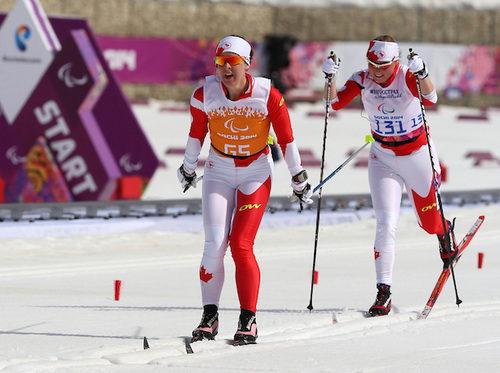
    Ottawa’s Margarita Gourbounova, and Regina-based guide, Andrea Bundon, were fourth in the women’s 15-kilometre visually impaired category.
    In her first Paralympics, Canada’s Margarita Gourbounova (r) and guide Andrea Bundon placed fourth in the women’s 15-kilometre visually impaired classic race on Monday at the Sochi Paralympics. Ottawa’s Margarita Gourbounova, and Regina-based guide, Andrea Bundon, were fourth in the women’s 15-kilometre visually impaired category at the 2014 Sochi Paralympics. (Photo Scott Grant/Canadian Paralympic Committee)
  • U.S. Nationals Notes and Quotes: 20/30 K Classic Mass Start

    U.S. Nationals Notes and Quotes: 20/30 K Classic Mass Start

    RUMFORD, Maine — As usual, there was so much going on during Friday’s 20/30 k classic mass start at the U.S. Cross Country Championships that not all of it fit into the race reports. Here were the notables and quotables from Black Mountain:

    The University of Vermont placed three women in the top 10; Amy Glen led the way for the Catamounts in seventh, Caitlin Patterson was eighth, and Lucy Garrec was tenth. The trio worked together for much of the race, and said that though they’d gone into the race hoping to do well, didn’t necessarily expect to. The carnival season starts Jan. 20 with the Bates Carnival back at Black Mountain, and it looks like UVM could be a team to watch for.

    Friday was doping-control day. The top three finishers of each race crossed the finish line and were immediately introduced to their own personal USADA chaperones, who are responsible for watching their athlete like a hawk until they are able to collect samples.

    Sadie Bjornsen (APU/USST) is getting sitr-crazy after being sidelined this week with a sinus infection. She said she’s starting to feel better, but is being cautious about racing again too quickly what with a trip to Milan, Italy, coming up. She still doesn’t know if she’ll enter Sunday’s classic sprint, as doesn’t want to tax herself too much and get into a hole the rest of the season.

    On Wax

    At long last, real, natural snow flurries were in the air Friday morning, but at exactly the wrong time. The accumulation of a few inches on the trails made waxing difficult for a lot of teams, as the changing conditions necessitated retesting and reapplying kick to the bottom of people’s skis. For coaches that were able to adjust and hit the wax, it made all the difference. Most athletes had their kick figured out, but glide was an issue for some. Reese Hanneman (APU) dropped out after deciding that struggling against dragging skis for nine laps wasn’t worth it.

    Eric Packer (Dartmouth), on the other hand, benefitted from excellent glide: “Dartmouth did a great job with the skis, you have to credit our coaches Ruff and Cami, they really knocked it out of the park with the wax,” he said.

    “My skis I felt like were the fastest out there, there was a long one kilometer downhill about 800 meters into the race and I was just skiing away from people down that, gliding away from people, it was awesome”. — Noah Hoffman (Team HomeGrown/USST), 1st

    “Interestingly, I had the hardest time on the easiest parts of the course. Skiing High School Hill was an area where I could actually recover. I had too much wax on the skis. This cost me from sticking with Noah and [Norris] when the race was getting decided. — Torin Koos (BSF/Rossignol), 4th

    On Pacing and Skiing in a Pack

    “[The pace] was pretty easy for a little big and then all of a sudden, the race got really hard, and I just tried to hang on from there.” — David Norris (AWS/NMU), 2nd

    “After a while I looked at Noah and he’s like, ‘You wanna go?’ And I was like, ‘All right, yeah.’ I told him on the next uphill I was gonna peg it, and we’ll see what happens. I ended up going hard and leading Hoff for a while and then the group came back together and Noah had another gear and skied away. I didn’t, so I kind of stayed back.” — Tad Elliott (Team HomeGrown/USST), 13th

    “The pace was pretty relaxed. We were going fast but really relaxed, then Noah [Hoffman] and Tad [Elliott] put a huge effort in and blew the field apart, and blew me apart, then the group came back together”. — Lars Flora (APU), 4th

    “I kept trying to increase the pace, and then on the last lap I t was down to five of us … and I had pretty good kick, but pretty slow skis, so I was at the back of the pack at the bottom of the hill. Jessie [Diggins] made a break by everyone until she had a gap and then it kind of stayed that same gap until the finish.” — Ida Sargent (CGRP/USST), 2nd

    “I didn’t really know what was going to happen, actually. We were all together for most of the race, switching back and forth …  I felt pretty good myself and thought, ‘OK, just stay strong, ski relaxed.’ That’s the most important thing, when you tense up and your kick starts to go even faster. It all comes down to the last lap in something like this.”  — Jennie Bender (CXC), 3rd

    “I made my move at the beginning of the climb on the ninth lap. I had my coach Jan Buron back from [Alaska] Winter Stars cheering me on, he said ‘It’s time to go,’ so I went for it and just hoped for the best, and it ended up working out.” — Eric Packer (Dartmouth), 3rd

    “I didn’t see any reason to ski from the front today. I wanted to ski in the pack, but do so efficiently and without incident. In that regard, I executed the race plan quite well.” — Torin Koos (BSF/Rossignol), 5th

    On Skiing a 20/30 k (the First Time for Some)

    “It was pretty tough, but you know, hopefully I won’t have to do another one until next year. There was a lot of good herring going on, especially up that High School Hill, it was pretty rough.” — Hilary Rich (Middlebury), 49th in first 20 k

    “You kind of play games with yourself to try to remember which lap you’re on … It’s long, I always forget that I’m doing a 30 k and go out hard, then I remember at about 10 k.” — Chase Marston (Middlebury), 60th

    “It was pretty rough. I planted and fell and broke my pole in the stadium [with four laps to go]. That broke me. … I had a lot of time to just relax and kind of have fun with just the skiing part … I wasn’t really prepared for how fast everyone started. I had a lot of time by myself.” — Eliot Neal (Middlebury), 73rd in first 30 k

    On What They Should Have Eaten for Breakfast

    “Eggs, bacon.” — Eliot Neal (Middlebury)