
From the FasterSkier archive — posts syndicated from athletes’ and coaches’ own blogs between 2004 and 2012, kept online as published. Current coverage is at fasterskier.com.

Tag: 20 k Freestyle Pursuit

  • Norwegian Men Restore Status Quo: All Red Podium in TDS Pursuit

    Norwegian Men Restore Status Quo: All Red Podium in TDS Pursuit

    This coverage is made possible through the generous support of Marty and Kathy Hall and A Hall Mark of Excellence Award. To learn more about A Hall Mark of Excellence Award, or to learn how you can support FasterSkier’s coverage, please contact info@fasterskier.com.
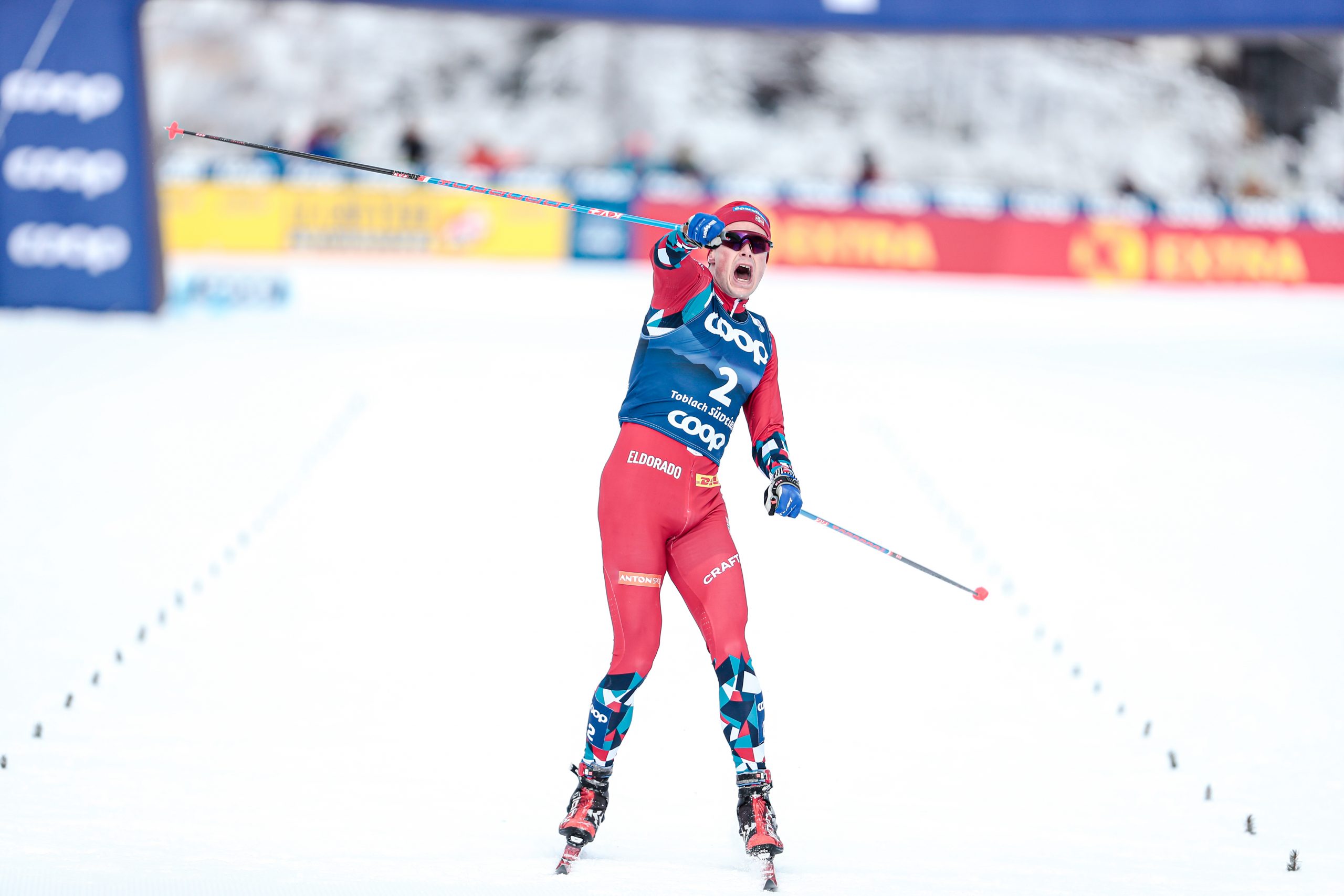
    Status quo restored: Harald Oestberg Amundsen (NOR) dominates the 20 k Freestyle Pursuit—and moves into the overall lead—in the 2024 Tour de Ski in Toblach, Italy. (Photo: Modica/NordicFocus)

    Pursuit racing is kind of weird—giving an additional head start to those already in the lead, while asking other racers to chase those who have already proven to be faster. It can seem like a bit of a set-up . . . one that Norway was entirely happy to benefit from on the third day of Tour de Ski racing from Toblach, Italy.

    It must make Norway a bit nervous to endure a start like this one at the 2024 Tour de Ski: shut out of individual World Cup race podiums for the first time in recent memory. But, eventually, races get longer, the abilities of the distance skiers allow them to shake off the pluck and daring of over-reaching sprinters, and the status quo is re-established. After what appeared to be a few days of equitable, good-natured, highly entertaining, multi-national competitive ski-mayhem, Norway once again emerged at the front. The Tour de Ski returned to earth with a display of Norwegian dominance in the 20 k Freestyle Pursuit, and the state of affairs in the Men’s World Cup field returned to normal. Harald Oestberg Amundsen (NOR) entered the 2024 Tour de Ski as the prohibitive favorite for the overall title. On the first day of the new year, Amundsen lived up to those predictions with his commanding victory in the 20 k Freestyle Pursuit. He was followed across the finish line by a game Erik Valnes (NOR), and their countryman Jan Thomas Jenssen (NOR).

    American, Gus Schumacher, raced courageously and intelligently throughout the day, remaining in the primary chase group to finish tenth, a performance that places him tenth in TDS Overall standings, as well. Other American finishers included Scott Patterson in 28th, Ben Ogden 33rd, Zanden McMullen 48th, Kevin Bolger 66th.

    For Canada, Antoine Cyr continues a string of fine performances in 19th, followed by Olivier Leveille 58th, and Julien Locke 79th.
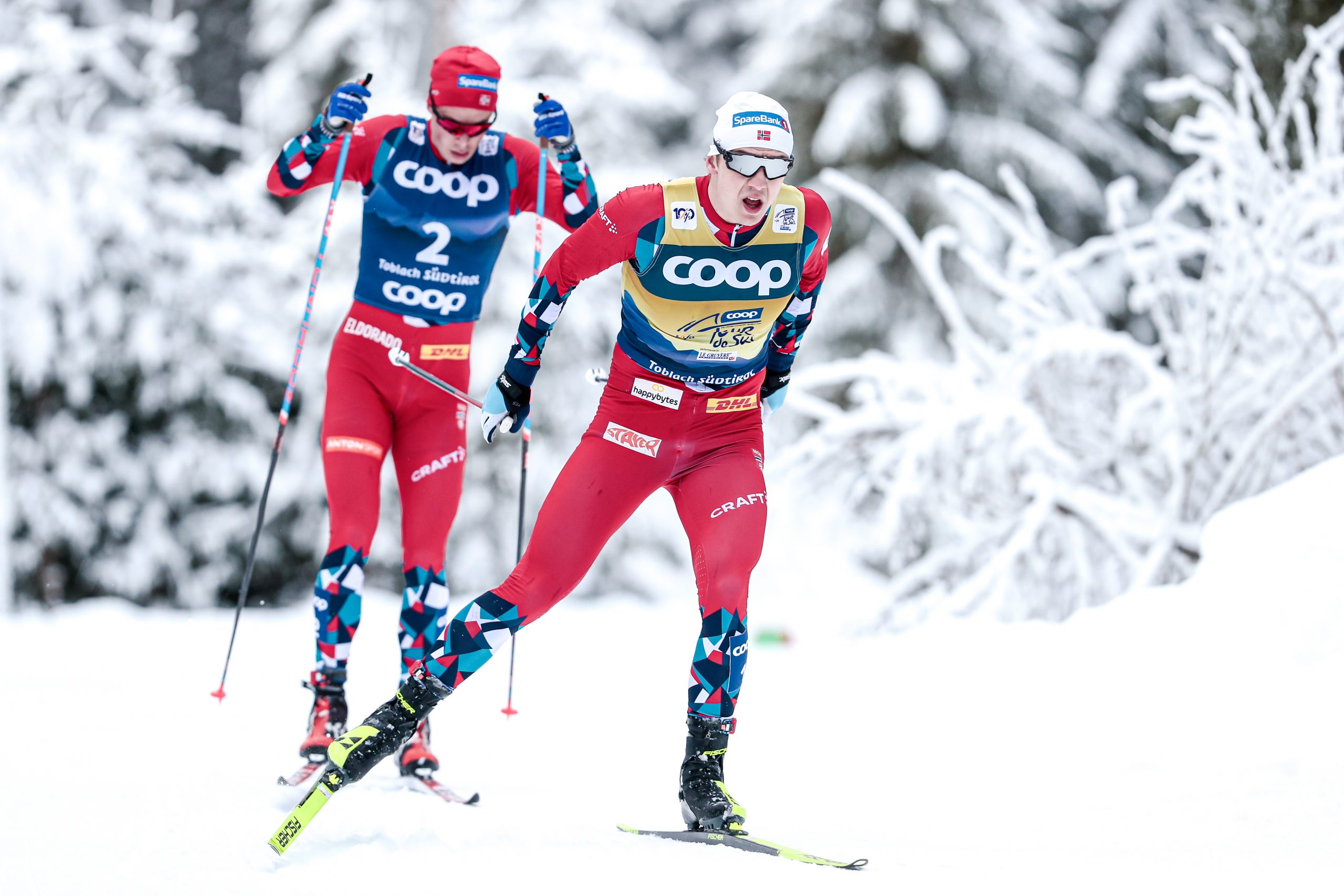
    Tour de Ski leader at the beginning of the day’s 20 k Freestyle Pursuit, Erik Valnes (NOR) helped to make the pace for the pair of leaders. Ultimately, he was overcome by his countryman, Harald Oestberg Amundsen, who took the race win and the overall lead in the Tour de Ski standings. (Photo: Modica/NordicFocus)
    Men’s 20 k Freestyle Pursuit

    Ski racing is not always what it seems. The 20 k Pursuit contested in Toblach was actually 22 kilometers in length—five laps of 4.4 kilometers each—on a course that many competitors consider “easier” than the typical World Cup distance course.

    Tour leader at the beginning of the day, Valnes was first to start, followed only four seconds later by his countryman, Harald Oestberg Amundsen. Ben Ogden  (USA) started third, 28 seconds behind the leader. Perttu Hyvarinen (FIN) started fourth, followed by Lauri Vuorinen (FIN). Those five represented the top of the overall standings at the beginning of the race. The end of the race would see numerous changes . . .

    The two leaders started relatively close to one another; most of the other early-starting racers were separated from each other by gaps of 20 seconds or more. Chasers would have a difficult time grouping up unless early starters slowed intentionally. The top two Norwegians quickly paired up while Ogden was left alone to either chase, or sit up and wait for help to arrive from behind. By the end of the first kilometer, Hyvarinen had come forward: Ogden would have company.

    Bonus Points were offered for the fastest skiers to cross the checkpoint at .7 k. Mika Vermuelen (SUI) captured the winner’s 15 points, ahead of Henrik Doennestad (NOR). The inclusion of mid-race Bonus Points is an action-inspiring strategy on the part of race organizers—much like mid-race “Primes” offered in bicycle racing. It’s the system organizers have devised to play on the relative greed of individual riders, coercing them to sprint in the middle of the race (sometimes a disastrous tactical decision) for money or points. The idea of including a Bonus Points sprint within Toblach’s TDS Pursuit was to encourage skiers to start out fast instead of sitting up to wait for later-starting skiers to form a racing group. Ogden didn’t fall for it: he and Hyvarinen maintained a steady, conservative pace—ignoring the chance to race for additional points—until they were finally enveloped by the main chase group at the five kilometer mark.

    Schumacher had started in a closely-packed group of starters who quickly formed the day’s main chase group, one that would grow to include William Poromaa (SWE), Jens Burman (SWE), Martin Loewstroem Nyenget (NOR), Beda Klee (SUI), Jules Chappaz (FRA), Hugo Lapalus (FRA), Friedrich Moch (GER), and Federico Pellegrino (ITA). As Ogden and Hyvarinen gradually faded back to this group, the two leaders simply stormed away.

    Moch seemed determined to press forward in pursuit of the leaders—and Nyenget and Lapalus came forward to add to the torrid pace—but most others in the chase group seemed content to race those around them. Rather than work as a cohesive group, the chase group began to unravel. The French sprinter, Chappaz was quickly gapped and left behind. Ogden suffered a similar fate not much later while Schumacher continued to vie for position within the eleven-man chase group.

    After the second of five laps, Amundsen had firmly established himself as the pace-maker while Valnes began visibly to struggle. Near the race’s halfway point, there was a moment when it seemed that the second chase group could catch the first chase. But Nyenget forged to the head of the front group, and they gradually pulled away from the other chasers. It seemed that no one wanted Paal Golberg (NOR) (who was in the second chase group) to come back into contention. All this went on while Amundsen and Valnes continued to maintain a gap of more than a minute.

    At 15 k, Amundsen used the main uphill to distance Valnes. Raising the tempo—and the pace—Amundsen skied clear, creating a gap that grew quickly to more than ten seconds. Amundsen was gone, leaving Valnes to consider damage control, though he still enjoyed a cushion of over a minute to the group of chasers.
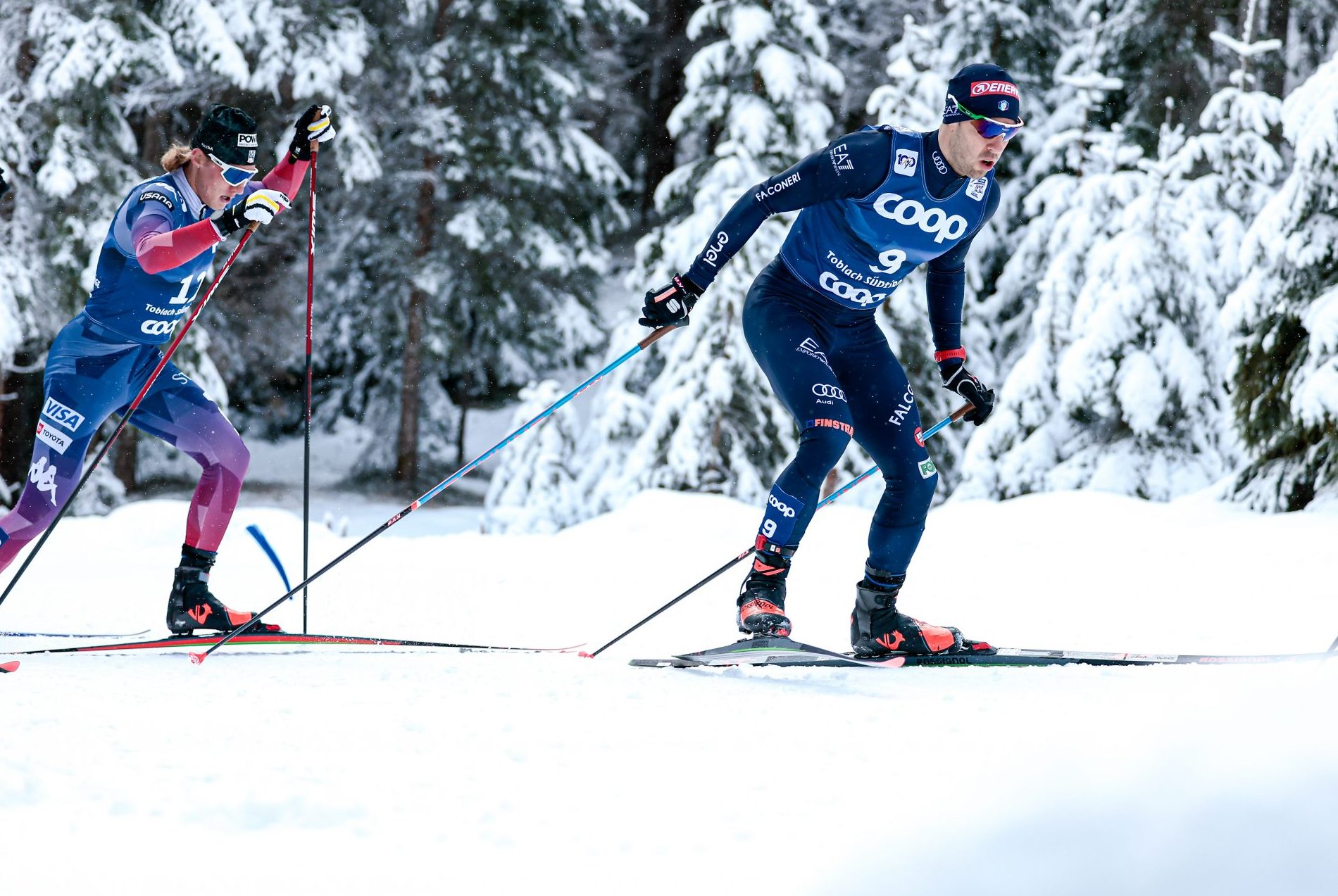
    Late in the race, Gus Schumacher (USA) and Federico Pellegrino ((ITA) were forced to work hard to maintain contact with the chase group. Those courageous efforts paid off with top ten finishes for both. (Photo: NordicFocus)

    Midway through the final lap, Moch returned to the business end of the chase, initiating a pace (supported by Lapalus and Poromaa) that spread out the group and forced Schumacher and Pellegrino to chase hard to remain in contact. They managed to remain in contact, allowing them to sprint for a top ten finish.

    “My mentality was to smooth out the effort in the end,” said Schumacher. “I was right on the limit near the top of the main climb where we got left behind. I also knew from the beginning of the race that I was able to ski fast on the rest of the course, so I kept some energy by letting the gap open, and thankfully they didn’t seem to have too much gas left either, so we were able to get back by the bottom of the course.”

    Amundsen powered across the finish line alone, some 32 seconds ahead of a game but exhausted Valnes. The other contending Norwegians stormed to the front of the chase group up the final hill—Nyenget followed by Jenssen. Jenssen would come forward to grab third (just over a minute behind the winner), followed closely by Poromaa and Nyenget. Schumacher would hold on for tenth, just behind Pellegrino. The bodies of exhausted skiers lay strewn about the finish area as the racers showed the extraordinary strain of pack racing at this level.

    Norway one, two, and three on the podium—Norway one, two, and three in the overall standings. At a certain point in Cinderella’s fairytale, the spell wears off: her coach turns back into a pumpkin,  leaving her stranded on the road side wearing shabby, soot-stained clothes, and minus one glass slipper. It was fun to have been a beautiful princess for a while, but it seems tremendously difficult to keep it up. Just ask Ogden, Hyvarinen, and Vuorinen. Five more races lie ahead in the 2024 the Tour de Ski, and Gus Schumacher may still be racing in search of an elusive glass slipper. We’ll wait to see how this fairytale plays out.

    Tour de Ski Stage 3, 20 k Freestyle Pursuit RESULTS

    In Time of day RESULTS it was Jenssen with the day’s fastest racing time, followed by Henrik Doennestad (NOR) , and Lapalus. Schumacher’s finishing time proved to be the sixth fastest of the day.
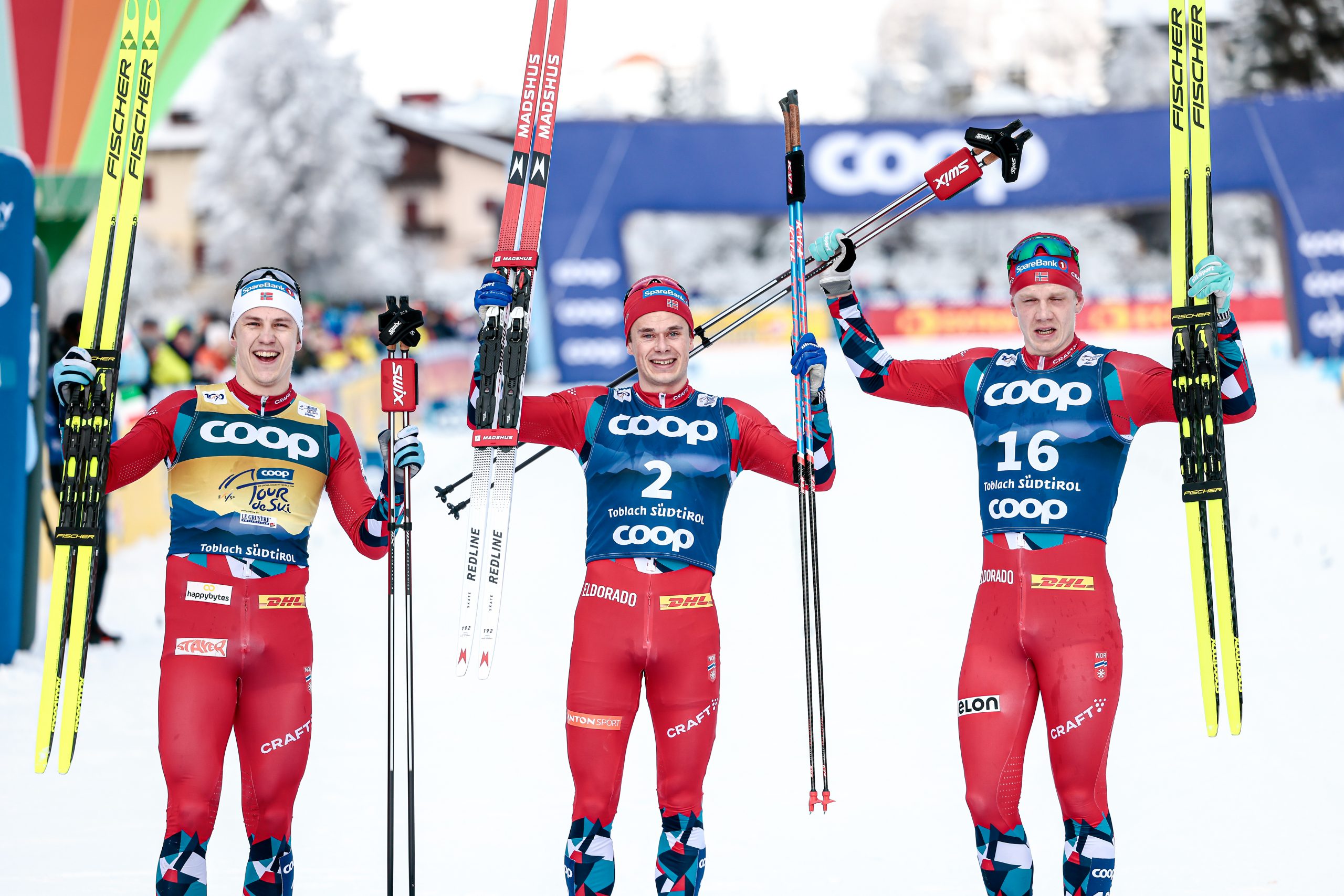
    Norway returns to the podium in the Tour de Ski 20 k Freestyle Pursuit. Erik Valnes (NOR), Harald Oestberg Amundsen (NOR), Jan Thomas Jenssen (NOR), (l-r). (Photo: Modica/NordicFocus)
  • Diggins Resurgent, Karlsson Dominant in TDS Stage 4 Freestyle Pursuit

    Diggins Resurgent, Karlsson Dominant in TDS Stage 4 Freestyle Pursuit

    A_Hall_Mark_of_Excellence_Award-logo-300.png (300×244)This World Cup coverage is made possible through the generous support of Marty and Kathy Hall and A Hall Mark of Excellence Award. To learn more about A Hall Mark of Excellence Award, or to learn how you can support Fasterskier’s coverage, please contact info@fasterskier.com.

    Jessie Diggins (USA) leading teammate Julia Kern (USA) through the chase group in a hard-fought 20 k Freestyle Pursuit. As she proved today in Stage 4 of the 2023 Tour de Ski, Diggins is one of the most fiery competitors in any sport. (Photo: NordicFocus)

    With starting positions based on individual finishes in yesterday’s racing, Wednesday’s 20 k Freestyle Pursuit appeared likely to confirm who the leader of the 2023 Tour de Ski truly was. Frida Karlsson entered the day with an advantage, one she would surrender by mid race, only to regain it by the finish. At the line, it was Frida Karlsson (SWE) first, ahead of Krista Parmakoski (FIN) in second, and Tiril Udnes Weng (NOR) third.

    Pursuit racing can be a confusing affair . . . the times and placings don’t always mean what we think they mean. There’s a skier’s finishing place in the field, and then there’s a skier’s finishing time on the day. The Pursuit field behaves like a mass start race, offering many opportunities for skiers to move up through the field. Good fitness and good fortune combine to create numerous ways for skiers to shine. On this day, the Americans took full advantage of those opportunities. Diggins (who started 40th) raced forward to a remarkable 8th, signaling that her racing form may be returning. Rosie Brennan finished 13th, Kern 17th, Laukli 30th, and Sonnesyn 31st. However, the compelling story of the Americans’ day of racing was told by their finishing times on the day: led by Diggins’ fastest finishing time of all competitors, Americans placed five skiers among the top finishers as Alayna Sonnesyn skied to a remarkable 5th, Julia Kern 6th Sophia Laukli 8th, and Rosie Brennan 11th.

    “I finally had great skis, and that’s really what I needed,” Diggins said, while continuing to praise the team’s crew of technicians. “I was just so grateful,” she said. “They’ve been working so so hard. I knew my body was fine the whole time, but no one else knew it! Honestly, I had to just keep believing and trusting the plan. My fitness is still there; it’s been there all along. I just needed a chance to let it fly.”

    “I’m really proud that I was patient throughout this tour and throughout this season,” said Sonnesyn. “I was really optimistic, and didn’t know really what to expect. And this, by far, exceeded my expectations.”

    Canadian racers all improved their positions on the day: Katherine Stewart-Jones skied from 29th to 21st, Lilian Gagnon skied from 51st to 44th, and Dahria Beatty skied from 52nd to 45th.

    Frida Karlsson (SWE) celebrates her win in the Tour de Ski 20 k Freestyle Pursuit. She continues to lead the Tour de Ski overall standings with three stages remaining. (Photo: NordicFocus)
    Women’s 20 k Freestyle Pursuit

    In this recently-arrived age of World Cup distance equality, the women—like the men—raced six laps of a 3.3 kilometer course. Temperatures in Oberstdof continued to rise throughout the day, with thermometers hovering around 48 degrees by the time the Women’s 20 k Freestyle Pursuit began. Staged a few hours after the Men’s Pursuit race, the Women’s 20 k Pursuit developed into a harder-hitting affair. Racers in the women’s field raced like they had more to protect today . . . with a small chase group forming in pursuit of early leader, Karlsson. Karlsson, herself, appeared indecisive in the early kilometers: she seemed to question whether or not to drive her advantage, or to wait for the chasers? Unlike Klaebo (who won the day’s men’s pursuit by waiting for chasers, and sprinting at the end), Karlsson is not a dominant field-sprinter, so if she allowed the chasers to catch her, she’d be likely to surrender the race win (along with her time-advantage in the overall). Her choice was not an easy one . . . but if the chase group grew no larger than three racers, Karlsson knew she might have a chance to hold them off. After two kilometers of ambivalent pacing, Karlsson seemed to decide to forge ahead, and to test her own limits against the 20 k distance.

    While Karlsson entered the Pursuit with a 20 second lead in the overall standings, the story of the day may have been Jessie Diggins and her American teammates. Diggins and Kern moved steadily up through their group, with Diggins having made up 20 spots by the end of the second lap. As Kern faded, Diggins drove toward the chase group (leading with Patricia Eiduka (LAT), and Lotta Udnes Weng (NOR). Together, they caught on to the Brennan/Urevec/Hennig group at 14 k, forming a group of eleven that continued in pursuit of the leaders.

    04.01.2023, Oberstdorf, Germany (GER):
    Alayna Sonnesyn (USA) – FIS world cup cross-country, tour de ski, pursuit, Oberstdorf (GER). www.nordicfocus.com. © Modica/NordicFocus. Every downloaded picture is fee-liable.

    At seven kilometers, Karlsson was caught by the chasers (Parmakoski, T. Weng, and Anne Kjersti Kalvaa), perhaps a cause for concern that she had used too much energy in attempting to hold them off. This group of four stayed together through the halfway mark with Parmakoski doing most of the pace making, and Kalvaa seeming vulnerable at the rear. With a minute lead over the chase group, they were in no danger of being caught, though their pace proved too hot for Kalvaa who was dropped at 11 kilometers. One kilometer later, Parmakoski (with Karlsson in tow) dropped T. Weng, and the lead group was reduced to two. They proceeded to open a considerable gap over the next few kilometers—ten seconds, twenty, forty, sixty. The race at the front would only involve Karlsson and Parmakoski.

    Karlsson made her move up the final big climb, opening an 11 second gap over Parmakoski at the 18.6 kilometer mark. That would be enough for Karlsson to claim the win. Parmakoski crossed the line soon after for second. Behind them, Kalvaa and T. Weng tangled as Kalvaa put a pole between her own skis, but they were not slowed enough to allow the larger chase group to catch them. Kalvaa led up the final uphill near the stadium, but T. Weng was able to slingshot past her on the downhill to capture third.

    Karlsson’s win in the Freestyle Pursuit extended her lead in the overall Tour De Ski standings, though Karlsson, T. Weng, Kalvaa, and Niskanen, all sit within  40 seconds of each other. With three stages remaining, much is still left to be decided, including a daunting climb up the Alpe de Cermis in Val di Fiemme, Italy.

    Tour de Ski Women’s 20 k Freestyle Pursuit RESULTS

    Krista Parmakoski (FIN), Frida Karlsson (SWE), Tiril Udnes Weng (NOR), (l-r) : Women’s podium at the 2023 Tour de Ski Stage 4 20 k Freestyle Pursuit. (Photo: NordicFocus)
  • Patterson 4th, Cyr 7th On the Day as Klaebo Controls TDS Stage 4

    Patterson 4th, Cyr 7th On the Day as Klaebo Controls TDS Stage 4

    A_Hall_Mark_of_Excellence_Award-logo-300.png (300×244)This World Cup coverage is made possible through the generous support of Marty and Kathy Hall and A Hall Mark of Excellence Award. To learn more about A Hall Mark of Excellence Award, or to learn how you can support Fasterskier’s coverage, please contact info@fasterskier.com.

    Scott Patterson (USA) leads the chase group on his way to the fourth fastest time of the day at the Tour de Ski 20 k Freestyle Pursuit in Obesrtdorf, Germany. (Photo: NordicFocus)

    The Tour de Ski spent its second day in Oberstdorf for the running of Stage 4, the 20 k Freestyle Pursuit. For the second day in a row, it was North Americans who raced their way toward the front. Most remarkable, perhaps, were Scott Patterson (USA) with the fourth fastest time of the day (he would rise from 29th to 17th overall), and Antoine Cyr (CAN) with the seventh fastest time of the day (rising from 37th to 24th overall).

    Other Canadian finishers included Olivier Léveillé 35th (from 24th), Russell Kennedy 41st (from 56th), Sam Hendry 66th (from 74th), Graham Ritchie 67th (from 65th), Remi Drolet 72nd (from 75th).

    American finishers included three more Americans in the top thirty: Ben Ogden finished13th (having started 6th) , Hunter Wonders finished 19th (from 11th), and Gus Schumacher 26th (from 15th). Zak Ketterson finished 55th (from 38th), JC Schoonmaker finished where he had started in 69th, while Kevin Bolger rose to 71st (from 73rd).

    Almost as an afterthought, Johannes Hoesflot Klaebo skied to the 20 k Pursuit win in dominant fashion. Klaebo managed his own pace—and the pace of the field—in a masterful display that saw him pulling away from the pack in the final kilometer and easing across the line for the win (though losing cumulative time to many of his rivals in the Tour de Ski overall competition). Following him to the finish line were Sindre Bjoernestad Skar (NOR) in 2nd, and Federico Pellegrino (ITA) in 3rd.

    Even down the homestretch of the 20 k Freestyle Pursuit, Johannes Hoesflot Klaebo (NOR) controls the field and carries his dominance across the finish line. (Photo: NordicFocus)
    Men’s 20 k Freestyle Pursuit

    This was a day of differing strategies: some racers knew they had to commit everything in order to move up in the Tour de Ski standings, while others were choosing to conserve their energy for later stages. Others (like Klaebo) knew they could afford to give back some time, holding their overall positions while committing only enough energy to prevail in the day’s racing.

    Tour de Ski Stage 4 was a 20 k Freestyle Pursuit in which the starting order was derived from yesterday’s 10 k Classic (NOT from the order of the overall standings). Oberstdorf’s strip of manmade snow ran through the fields and forests along a rolling 3.3 kilometer loop that racers would navigate six times. The starting order gave Klaebo a 12 second advantage over Simen Hegstad Krueger, :20 to Didrik Toenseth, :25 to Calle Halfvarsson, :27 to Golberg, :30 to Ben Ogden. This closely-bunched group of starters made it quite likely that the entire field could come together within just the first few kilometers. Twenty kilometers is quite a distance to ski alone, and Klaebo is smart enough to know that he could exhaust himself by attempting to maintain his lead over so strong a group of chasers. And with his sprinting abilities, Klaebo would be likely to win the day’s event if he conserved his energy, allowed the field to catch him, and outsprinted them at the end. The men’s race looked certain to group up.

    Like the pursuit race earlier in the Tour de Ski, each skier’s relative success can be judged by more than one result. There are skiers who do well in the pursuit finishing order, and others who do well in the timed-results on the day . . . and the comparison of success and failure is not always immediately apparent. A racer may finish well in the race standings by holding position in a pack of skiers and outsprinting them at the end, even though his on-the-day time could be much slower than other skiers who caught his group from behind. Pursuit racing is about patience and strategy as much as it is about maximal efforts and daring pyrotechnics. The races going on in the middle of the field can be extraordinarily complex. The racing at the front is far more straightforward . . .

    Hunter Wonders (USA) following teammate Ben Ogden (USA) in the lead group at the Tour de Ski Stage 4 Freestyle Pursuit in Oberstdorf . (Photo: NordicFocus)

    Klaebo started alone with a 12 second advantage over his pursuers. Soon after the start, a chase group formed that included Krueger, Didrik Toenseth (NOR), Calle Halfvarsson (SWE), and Paal Golberg (NOR). That group was closely followed by Andrew Musgrave (GBR) who was able to join a few kilometers later. All chasers were making up time on Klaebo, who was obviously allowing himself to be caught. The catch happened within the first five minutes of racing (near the 2.1 k checkpoint), forming a group that would stay together all through the middle of the race. The group was led by Simen Hegstad Krueger who was consistently marked by Klaebo, and trailed by Golberg.

    A fairly relaxed pace at the front allowed later starters to bridge the gap at four kilometers, and the lead pack swelled to a dozen. Having been gapped by Musgrave, Ogden found himself overtaken by an aggressive chase pack that included Poromaa, Hunter Wonders, Gus Schumacher, Emil Iversen, Havard Moseby, Hans Christer Holund. There was no relaxing to do in the chase group; they were headed for the front, and were wasting no time in making it happen. Pellegrino would ultimately lead another group forward to join with the lead group, and the field ultimately swelled to nearly 30 racers, including Americans Ogden, Schumacher, Wonders, Patterson, and the Canadian Cyr.

    “We caught the lead pack in three laps . . . and it turned into a little bit of a cat and mouse game which was a little bit frustrating,” said Patterson. “I wanted it to be a harder race. But it turned out all right. As people get tired, I start moving up the ranks. I’m excited for Val di Fiemme. “

    Wonders summed up his Stage 4 experience: “Once we caught the lead pack it started to chill out a little bit,” he said. “I was just trying to ski relaxed; it was pretty exciting to be skiing with a bunch of guys I’ve been watching for years!”

    Having started 33rd on the day, Frederik Moch (GER) went to the front to push the pace in the second half of the race (Moch would post the fastest time on the day). Sjur Roethe (NOR) attacked at 12 k with Halfvarsson and Krueger, but the contenders came back together after a fast downhill. The lead group dwindled to 24 as the race neared its conclusion, and the jockeying for position began with the field nearly coming to a standstill at times. With a kilometer remaining in the race, Klaebo unleashed a surge on the final uphill before the stadium followed by Skar and Pellegrino. As has so often been the case, Klaebo’s high-tempo surge on the final uphill was one that no one else could match. He crested the hill alone, relied on his fast skis on the downhill, and maintained his lead through the finishing line. The field came charging behind him in a sprint won by Skar, who was closely followed across the line by Pellegrino. Nine Norwegians finished in the top 12, followed by Ogden in 13th (though his finishing time was only five seconds behind Klaebo’s winning time).

    “The pack stayed together the whole race,” Ogden said. “And then they just sprinted for it in the last K, or so. I think that my strengths in 20 k are better suited in the last K than they are in the first 19!”

    Klaebo earned the win, but with only the 42nd fastest time of the day, giving back :22 to Golberg,  and 1:01 to Pellegrino in the TDS overall standings. Klaebo knows he must moderate his efforts in order to have the energy to hang on through the end of this week-long tour. But he also sees the possibility of sweeping the series—of winning every stage—on his way to an historic Tour de Ski victory that could also garner enough points to bring him the World Cup overall title.

    After the close racing of Stage 4, the Tour de Ski Overall standings return to a much tighter affair: Klaebo continues to lead Pellegrino by :12, Golberg by :14, Skar and Krueger by :32, Toenseth, Roethe, Holund by :39, and Halfvarsson by :49.

    Tour de Ski, Men’s 20 k Freestyle Pursuit RESULTS

    The long white stripe in Oberstdorf, Germany. Tour de Ski Men’s 20 k Freestyle Pursuit. (Photo: NordicFocus)