From the FasterSkier archive — posts syndicated from athletes’ and coaches’ own blogs between 2004 and 2012, kept online as published. Current coverage is at fasterskier.com.
It was a disappointing opening to the Olympics for Johannes Thingnes Bø of Norway, who despite winning eight World Cup races this season started the Games with finishes of 31st and 21st in the sprint and pursuit. But on Thursday he showed why he was a medal favorite and won the 20 k individual race – only by 5.5 seconds, but that margin becomes impressive when you consider that he had two penalties, and thus two minutes of penalty time, while silver and bronze medalists Jakov Fak of Slovenia and Dominik Landertinger of Austria (+14.2) shot clean.
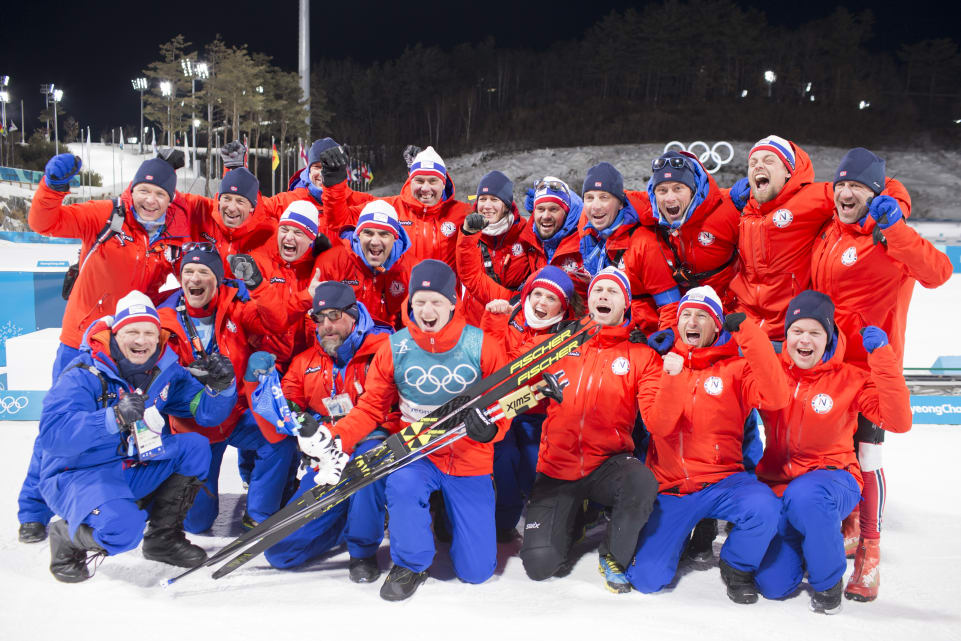
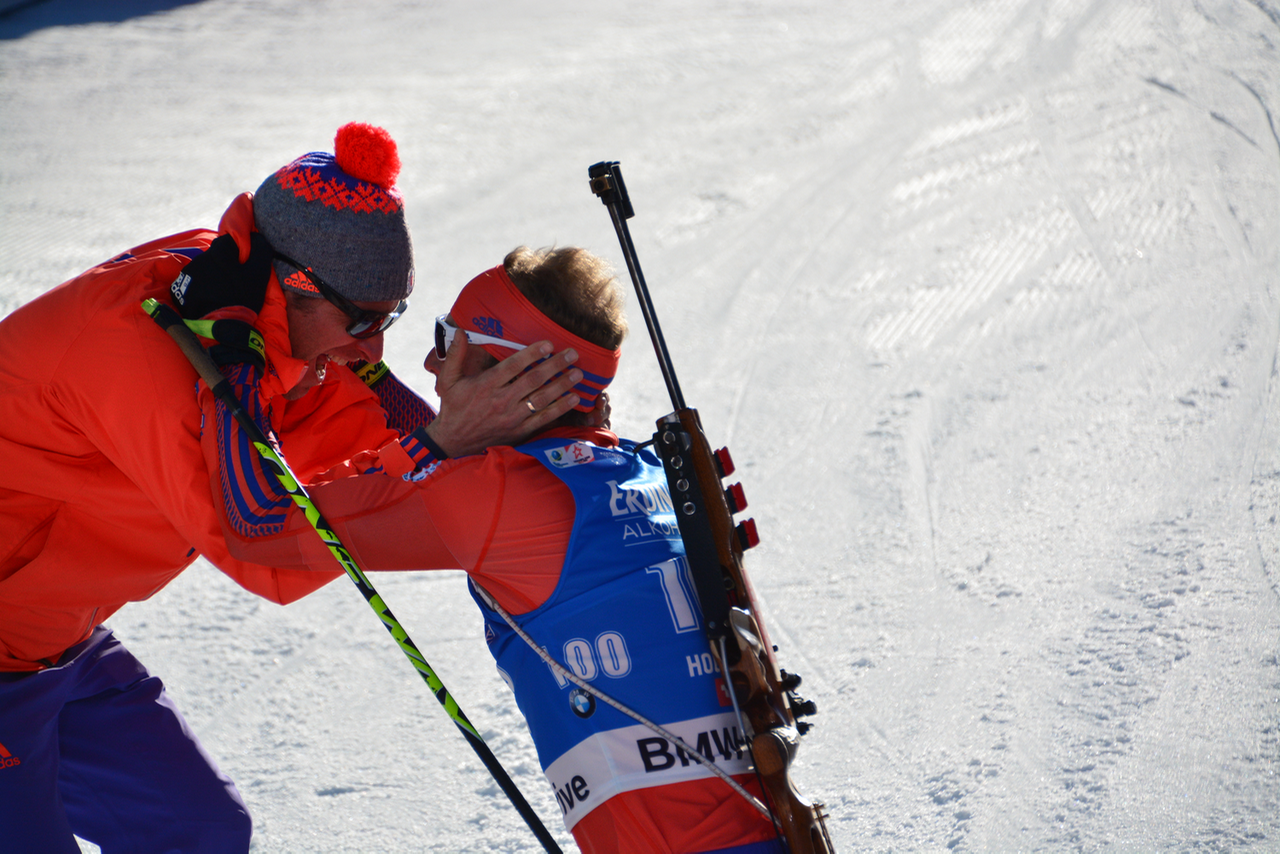
Johannes Thinges Bø celebrates with Norwegian team staff after winning Olympic gold in the 20 k individual despite two missed shots. (Photo: IBU/Biathlonworld.com)
Sweden’s Sebastian Samuelsson followed up a silver medal in the pursuit with fourth place in the individual, missing one shot and notching a time 29.1 seconds behind Bø. France’s Martin Fourcade, gold medalist in the pursuit, missed two shots like Bø but finished in fifth (+42.4). Switzerland’s Benjamin Weger placed sixth (+48.6) with one penalty.
It was a good day for Canada on the back of strong shooting: Scott Gow placed 14th (+2:02.5) with one penalty for a career-best result result; he had previously had two 16th-place finishes on the World Cup this season. With the same shooting, Brendan Green placed 22nd (+2:26.6). Christian Gow had two penalties to finish 26th (+2:57.2). Canada’s fourth man, Nathan Smith, missed five shots and placed 81st (+8:11.9).
For the United States, shooting was not as successful and Tim Burke led the way in 41st (+4:01.9) with four penalties. With one less penalty Sean Doherty was close behind in 44th (+4:21.8). Lowell Bailey placed 51st with four penalties (+4:53.0) and Leif Nordgren missed five shots to finish 66th (+6:27.3).
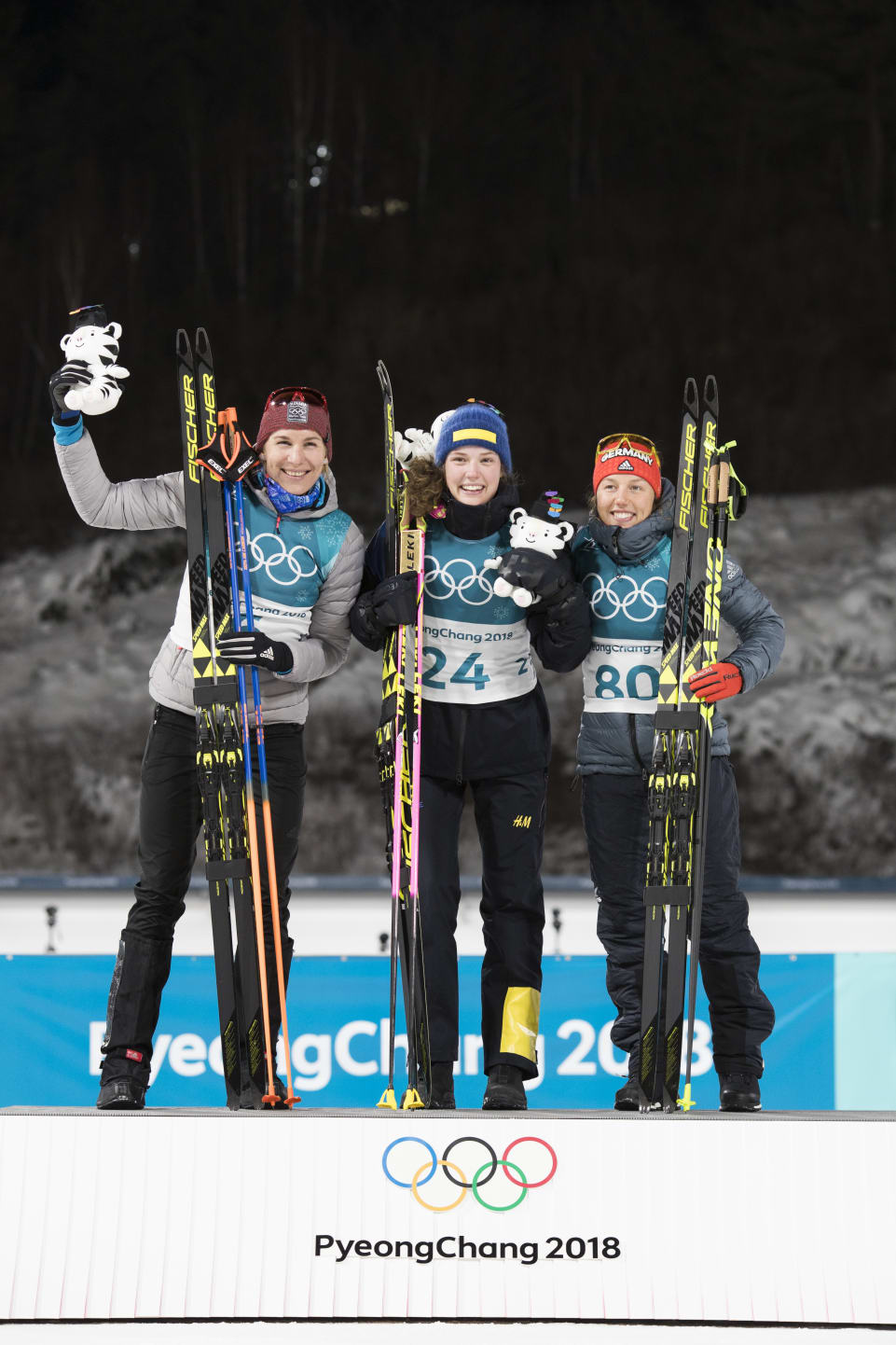
Sweden’s Hanna Oeberg (center) won gold in the biathlon women’s 15 k pursuit, followed by Slovakia’s Anastasiya Kuzmina (left) in silver and Germany’s Laura Dahlmeier in bronze. (Photo: IBU/Biathlonworld.com)
A few days after teammate Samuelson scored a career-best result to earn silver in the pursuit, Hanna Öberg of Sweden used perfect 20-for-20 shooting to capture gold in the women’s 15 k individual. The 22-year-old’s previous best results were fifth place in both Monday’s pursuit, and in a World Cup race last season.
She bested the two pre-race favorites: Anastasiya Kuzmina of Slovakia had two penalties but still managed a silver medal, her second of the games, finishing +24.7. And double gold medalist Laura Dahlmeier of Germany had one penalty and earned bronze (+41.2).
It was a good day for both of those teams as Franziska Preuss of Germany finished fourth, +59.0 with clean shooting, and Paulina Fialkova of Slovakia placed sixth (+1:02.3) with one missed shot. Poland’s Monika Hojnicz finished sixth (+1:54.8) with one missed shot as well.
The United States was led by Susan Dunklee in 19th, with two penalties (+3:26.3). Her teammate Joanne Reid finished 22nd (+3:34.1), her best-ever result in top-level international competition, with just one missed shot. Clare Egan finished 62nd (+6:53.6) and Emily Dreissigacker 67th (+7:09.2) with four penalties apiece.
For Canada, Rosanna Crawford led the way in 26th (+3:48.7) with two penalties and Sarah Beaudry was close behind in 29th (+3:58.4) with one missed shot. Emma Lunder finished 54th (+5:49.4) with three penalties and Julia Ransom was 74th (+8:31.4) with five missed shots.
Montana State University student Johanna Talihärm of Estonia finished 50th (+5:36.8) with three penalties.
Thursday afternoon saw more of the same for the women’s cross-country ski events at this year’s Winter Olympics: Scandinavia filling up the podium, with American Jessie Diggins tantalizingly close to that breakthrough American podium in fifth. This time it was Norwegian Ragnhild Haga in first in the 10 kilometer freestyle individual start, Charlotte Kalla of Sweden in second (+20.3), and Finland’s Krista Pärmäkoski and Norway’s Marit Bjørgen tied for third (+31.9).
The bronze is Bjørgen’s 12th lifetime Olympic medal, moving her into a tie with fellow Norwegian Bjørn Dæhlie for the most Olympic medals won by a cross-country skier. Countryman Ole Einar Bjørndalen, a biathlete, holds the overall Winter Olympics record with 13.
Diggins was 35.2 seconds back of Haga in fifth. She was in seventh place through 1.6 k, up to fifth at 5 k, up to third at 6.2 k, and still in third at the 8.4-k time checkpoint, 1.9 seconds up on Bjørgen and five seconds up on Pärmäkoski. But her form seemed to break down over the final uphill, and Diggins lost just enough time on Bjørgen and Pärmäkoski over the final 1.6 k to slip off the podium.
Between a 4.6-second deficit to third in Saturday’s skiathlon and a 3.3-second gap here, Diggins has now missed two bronze medals by a combined 7.9 seconds over 25 kilometers of racing.
Jessie Diggins pushing to the finish in the Olympic 10 k skate. The American finished fifth. (Photo: FlyingPointRoad)
Sixth place went to Swiss skier Nathalie von Siebenthal (+49.8), who slowed slightly after a fast start that saw her with the second-ranked time through 1.6 k. Ingvild Flugstad Østberg (+1:05.5), in seventh, was the third Norwegian in the top seven.
Olympic Athlete from Russia Anastasia Sedova (+1:07.3), Austrian Teresa Stadlober (+1:15.6), and Olympic Athlete from Russia Anna Nechaevskaya (+1:24.3) rounded out the top ten.
Sadie Bjornsen (+1:42.1) in 15th and Kikkan Randall (+1:49.9) in 16th were the next two Americans. Randall started relatively early with bib number 23, and was the leader in the clubhouse when she crossed the finish line. Liz Stephen (+2:35.4) was 30th.
For the Canadians, Emily Nishikawa (+2:41.) led the way in 32nd. Dahria Beatty (+2:48.4) was 37th, Cendrine Brown (+3:11.9) 43rd, and Anne-Marie Comeau (+4:10.8) 62nd.
Also of note, Australia’s Jessica Yeaton, who lives and trains in Anchorage with Alaska Pacific University, recorded an Olympics personal best finish of 41st (+3:09.1). University of Alaska Anchorage student Casey Wright, also competing for Australia, finished 81st (+6:55.8).
University of Colorado skier and NCAA champion Petra Hyncicova of the Czech Republic finished 60th (+4:09.4). University of New Hampshire alum Annika Taylor of Great Britain finished 75th (+5:52.4).
And Jaqueline Mourau of Brazil, who lives and trains in Quebec, was 74th (+5:49.8).
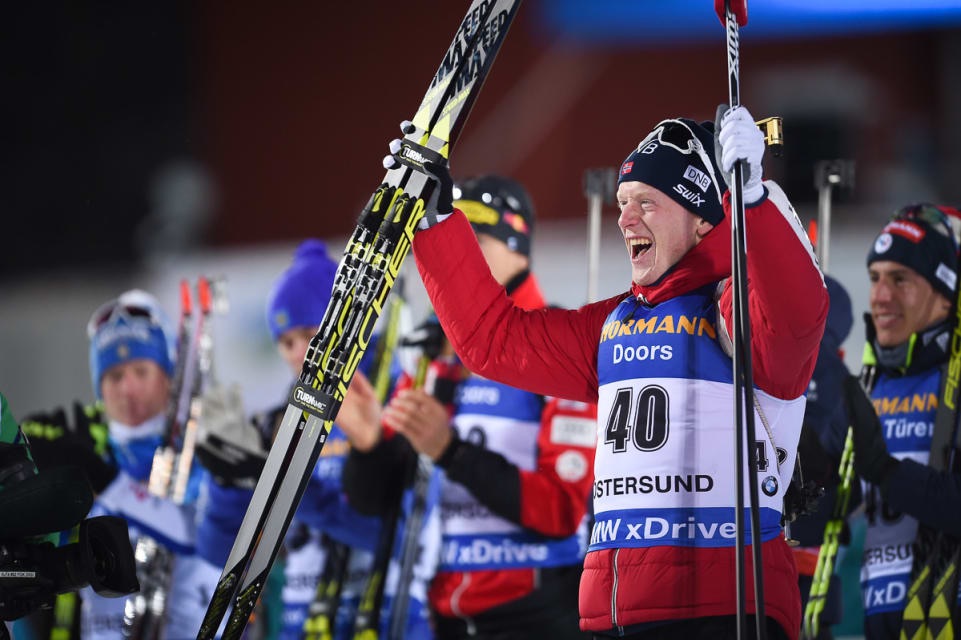
Norway’s Johannes Thingnes Bø celebrates his more than 2-minute victory in the men’s 20 k individual race at the 2017/2018 IBU World Cup opening week in Östersund, Sweden. (Photo: IBU/Biathlonworld)
Norway’s Johannes Thingnes Bø routinely races with a rifle completely coated from the stock to the barrel in a bright golden paint, and on Thursday, in the International Biathlon Union (IBU) World Cup men’s 20-kilometer individual race in Östersund, Sweden, that display of his ambitions to be the best biathlete in the world didn’t even seem ostentatious.
The 24-year-old, three-time world champion didn’t just win the race, he won by a huge margin distancing the rest of the field by over two minutes.
“This is a big day for me, first win in the individual, I have waited for it and it feels good to now have won every [discipline] in the World Cup,” Bø later said in the IBU press conference. “Today was clean shooting for me and the others made mistakes, and then you get a minute for every mistake and suddenly it’s two minutes.”
Martin Fourcade, the perennial World Cup Total Score leader and last season’s individual discipline World Cup champion, remained clean through three shooting stages and looked to be on his way to another victory, but then the usually dependable French athlete missed two targets in his final standing shooting to incur two penalty minutes (0+0+0+2). Starting a few bibs behind Fourcade, his opponent Bø hit all targets also in the final stage, and with the third-best course time of the day, raced the final lap to a convincing victory.
In the finish Bø had a 2:14.3-minute lead on Fourcade, who, thanks to his fast skiing, managed to claim the third place on the podium.
“Sometimes you can only congratulate the winner and be satisfied with what you get with two mistakes,” Fourcade said at the press conference.
“I think I went too much attack on the last shooting,” Fourcade said in an English interview with German broadcaster ZDF. “I was really concentrated on my first three shootings, I knew what I had to do and it was pretty easy to apply. But in the Iast one I started thinking about clean shooting and a lot of negative thoughts […]. It’s a good lesson for the following races. Anyway, Johannes shot faster than I did today, so I [would have] had no chance to be on the first place even with no mistakes. It was not the result I was expecting, but it’s a quite good start, an OK start.”
Regarding his decision to go all-out on the final lap even though he knew he had a huge lead, Bø explained at the press conference: “I didn’t want to slow down and suddenly there is one guy like Ole Einar [Bjørndalen] coming from behind to beat me, so I tried to race as hard as I could, and that was a good training for the races to come.”
Starting late in bib 80, the 43-year-old veteran Bjørndalen did not seriously challenge Bø in this race, finishing 18th (+3:43.7) with one penalty (1+0+0+0).
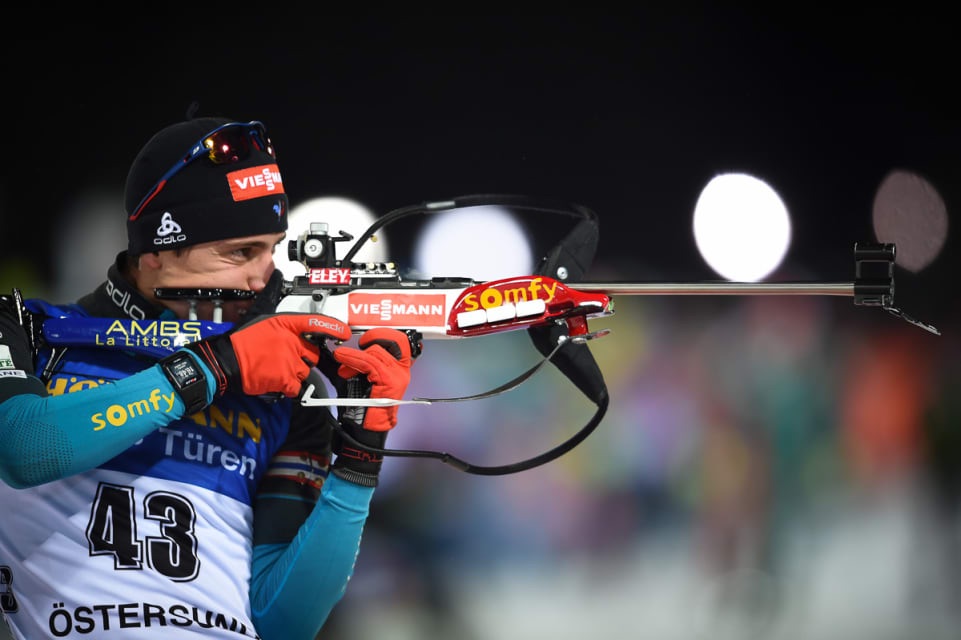
France’s Quentin Fillion Maillet shooting clean on his way to second place in the men’s 20 k individual race at the 2017/2018 IBU World Cup opening week in Östersund, Sweden. (Photo: IBU/Biathlonworld)
Yet Fourcade was bested by his teammate Quentin Fillon Maillet, who placed second after starting a few positions behind him and shooting clean. But ultimately, Maillet had more than a two-minute gap to Bø, finishing 2:01.0 back with no penalties.
“Three yeas ago I had two fourth places and one podium here [in Östersund] so it’s a good place for me,” Fillon Maillet explained at the press conference. “Last year I had a lot of difficulties with my shooting, a lot of mistakes, a lot of penalty loops. So I am happy to start the season with a perfect shooting… I didn’t really change anything important with my shooting, just my head [laughs], something to think during the race. I work very hard to be better, so I am very happy to start with a good result.”
Austria’s Julian Eberhard finished fourth, just three seconds behind Fourcade with one penalty in his final shooting stage (+2:17.5; 0+0+0+1). Russia’s Anton Babikov in fifth (+2:34.1), Switzerland’s Benjamin Weger in seventh (+2:34.1) and Slovenia’s Jakov Fak in 12th place (+2:44.3) were the only other athletes besides Bø and Maillet to hit all 20 targets.
“I think Martin was on the podium in every race last year, so I should do the same to hold him behind me,” Bø joked at the press conference, when asked about wearing the yellow bib of the World Cup Total Score leader for the next race and his chances of winning the Overall World Cup this season.
“I am mostly focused on the Olympics,” Fourcade replied regarding this topic. “If I decide I need to skip some events I will, I already did that in 2014 [ahead of Sochi]. For now I am just focusing on the next competition… Many things to do before the Olympics… I am satisfied with the level I am at today.”
Also questioned by German broadcaster ZDF about recent revelations in the ongoing fight against doping and next week’s pending IOC decision on whether Russian athletes should be allowed to start at the upcoming Olympic Winter Games in PyeongChang or not, Fourcade had this to say:
“Regarding your question about the IOC, they will have a meeting soon and they will decide about the Russian issue. We [the biathletes] have no new information about it. But as an athlete I will keep the same position [as in the past]: I am mostly against collective sanctions, because I am sure there are really good Russian athletes who don’t use doping. Anyway, with what we heard about the Sochi Olympic Games, if it’s true – and the IOC should know that – it’s a big shame, and the ones who were involved need to be punished. You know, it’s strange because in a way I am against collective sanctions, but in another way with all the positive tests in the past year I lost faith. And I am really disappointed about that. You know, I am a big fan of sport, I dream of watching sport on TV. And I think when you lose faith it is not good for the sport. And as an athlete I sometimes lose it, so I can imagine the people on the other side of the TV also must have this feeling. So I know the IOC will take a good solution, but I have not, you know, only one solution, so it’s a pretty hard choice.”
Previously after Fourcade had just crossed the finish line, Russian biathlete Babikov immediately walked over to Fourcade to congratulate him on his race performance.
During last season’s IBU World Championships, there had been some harsh words between Fourcade — an outspoken critic of the use of performance-enhancing drugs and the way the IBU handled the situation following the release of the McLaren report — and some Russian athletes, especially past doping offender Alexander Loginov following the mixed relay race there. In Thursday’s World Cup race, Loginov placed ninth with one penalty (+2:38.1).
Burke 32nd, Doherty 38th for U.S.; Smith 37th for Canada
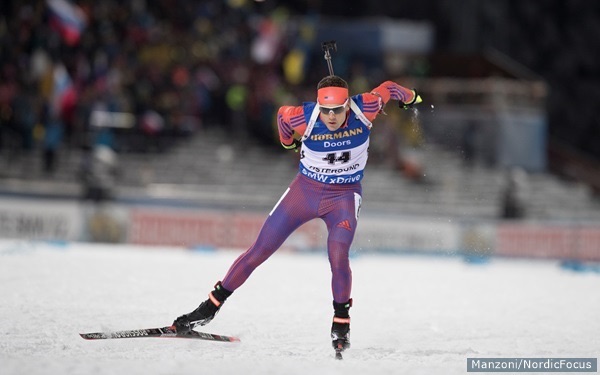
US Biathlon’s Tim Burke racing to 32nd in the men’s 20 k individual race at the 2017/2018 IBU World Cup opener in Östersund, Sweden. (Photo: US Biathlon/NordicFocus)
For the first time in an individual race in several years, US Biathlon started five men, thanks to the men’s team’s strong performance to clinch 10th in last season’s Nation Cup score. (For the Olympics, even the best teams can only start four athletes for the sprint, the pursuit and the individual race, whereas in World Cups, the highest-ranked teams by this score can enter up to six.)
Starting in bib 44, Tim Burke incurred three penalties, all in the first two shooting stages (1+2+0+0), on his way to the 32nd place in his first race of the season, 5:24.2 minutes back to Bø and 3:10 to the podium positions.
“There was some light wind on the range today but we have seen much worse here in the past,” Burke explained in an email to FasterSkier. “The wind was up a little but it stayed pretty consistent from the time that we zeroed [target practice] before the race. I felt like I needed to get some of the rust off in the first two stages after not racing a World Cup since last February. I was simply a bit too conservative and controlling in the first two stages but was able to adjust and shoot more from reaction in the last two stages.”
Burke had the 37th-fastest course time of the day, while his shooting and range time ranked 14th and 13th, respectively.
“Considering everything, I think this was a solid start for me and I feel like I can build from this result,” he summed up his first race day. “After ending last season early due to illness, and taking a long time to get completely healthy again, I definitely had a lot of unknowns heading into this season. That combined with the fact that I have only been here one week and was unable to train on snow the previous 10 days at home, gives me confidence that things are headed in the right direction.”
Starting very early in bib 3, 2016 Junior World champion Sean Doherty placed 38th, 5:50.0 minutes back with two penalties (0+1+0+1).
The other three Americans all finished within 10 seconds of one another. In a field of 108 starters, Leif Nordgren was 63rd, 8:06.0 minutes back with three penalties (1+0+0+2). Lowell Bailey, the 2017 world champion in this discipline, placed 67th (+8:11.0) with four penalties (1+1+0+2) in his first race of the season after having to skip the mixed relay races last weekend due to an illness, and Paul Schommer was 69th (+8:12.3) with four penalties (1+2+0+1).
“Tough start,” Bailey commented on his race, according to a US biathlon press release. “I definitely felt a bit stale today, both on the ski course and in the shooting range. With the fresh snow that fell overnight, the conditions were really challenging and I definitely didn’t feel like I was at my best on the tracks. I’ll regroup tomorrow and start looking toward the next race on Saturday.”
“The first World Cups can be some of the most challenging for our team,” Burke explained in his email. “We have less snow time, less [offseason/pre-season] racing and jet lag to deal with [compared to many competitors], which can be a big hurdle to overcome at the beginning of the season. Luckily it’s a long season!”
The Canadian men couldn’t quite match the peak performance Julia Ransom had achieved a day earlier in the women’s 15 k individual, with a clean shooting performance on her way to a career-best ninth place.
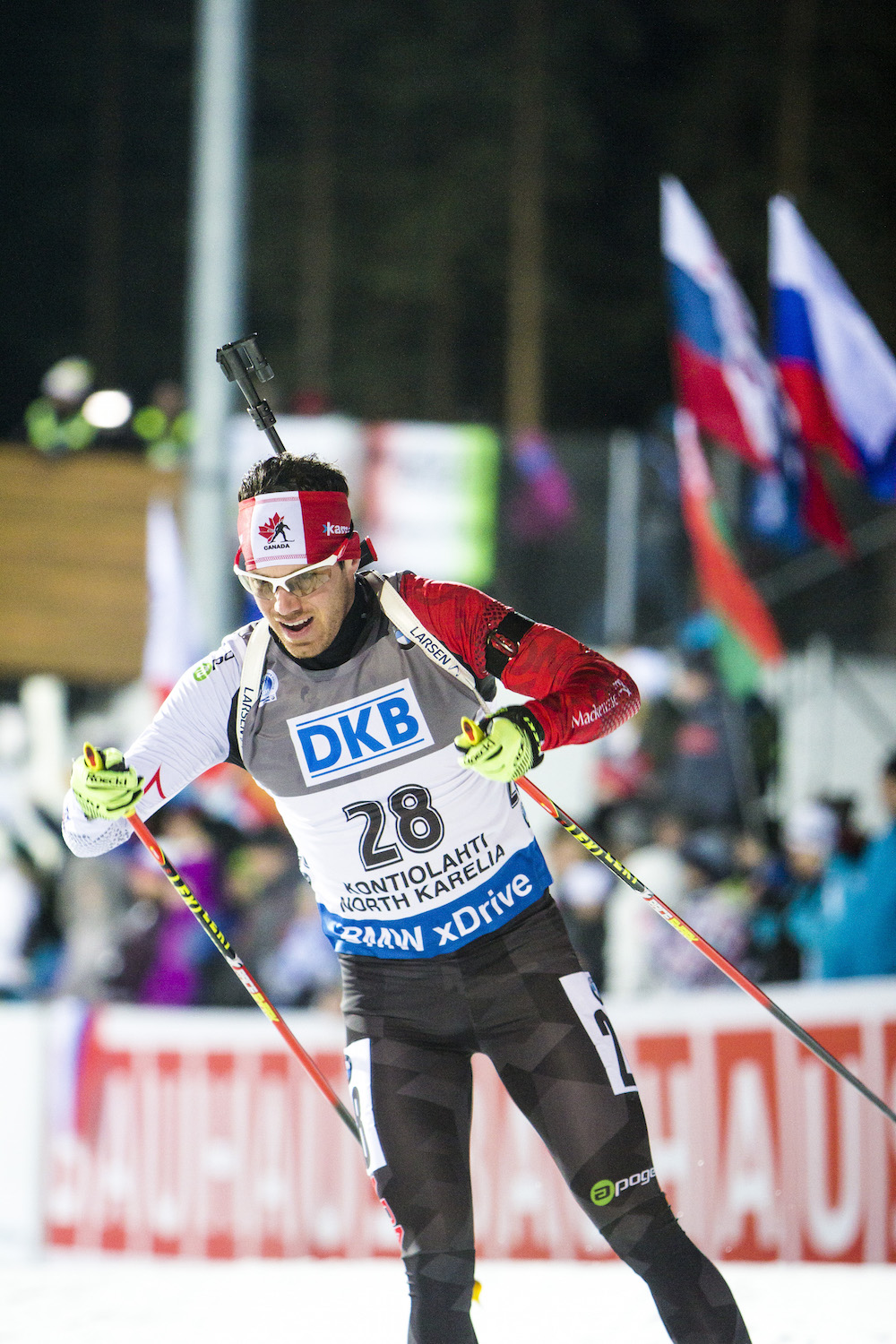
Nathan Smith, who, similar to Bailey had missed last weekend’s mixed relay races with an illness, achieved Biathlon Canada’s best result in 37th place (+5:47.2), just ahead of Doherty. With a light wind blowing from the front or left, Smith cleared 18 of 20 targets and only incurred two penalties in his second shooting stage (0+2+0+0) while firing fast to post the 12th-ranked shooting time of the day.
“Conditions were fairly good by Östersund standards,” Smith wrote in an email to FasterSkier. “Not as perfect as the women’s race yesterday but still pretty good. I’m not sure what happened on my first standing. I felt pretty in control but the misses were quite far out. I think maybe it was a timing thing where I didn’t have a fast enough reaction when it was in the black.”
In contrast to his fast shooting, Smith’s skiing time ranked in the middle of the field of 108 starters, with the 61st-best course time of the day. Last weekend Smith had to cancel a planned start in the single mixed relay race with Rosanna Crawford. In that race, Christian Gow replaced Smith, and Crawford tumbled in a downhilll crash.
“It was nice to get back to racing but on the other hand disappointing to have come down with a cold a few days ago,” Smith explained. “I had been 100% healthy all training year. It didn’t turn into anything too severe thankfully but definitely didn’t help me out at all today. Skiing conditions were really slow (even the winning time). I expect to feel better this weekend in the sprint but will have to be realistic considering the cold and being ‘rusty’ after not racing last year, other than a few races.”
Teammate Christian Gow placed 45th on Thursday (+6:20.2) with one penalt in the final shooting stage (0+0+0+1). His brother Scott Gow placed 53rd (+7:16.1) with four penalties (1+2+0+1), and Brendan Green was 68th (+8:11.5) with five penalty minutes (1+2+0+2).
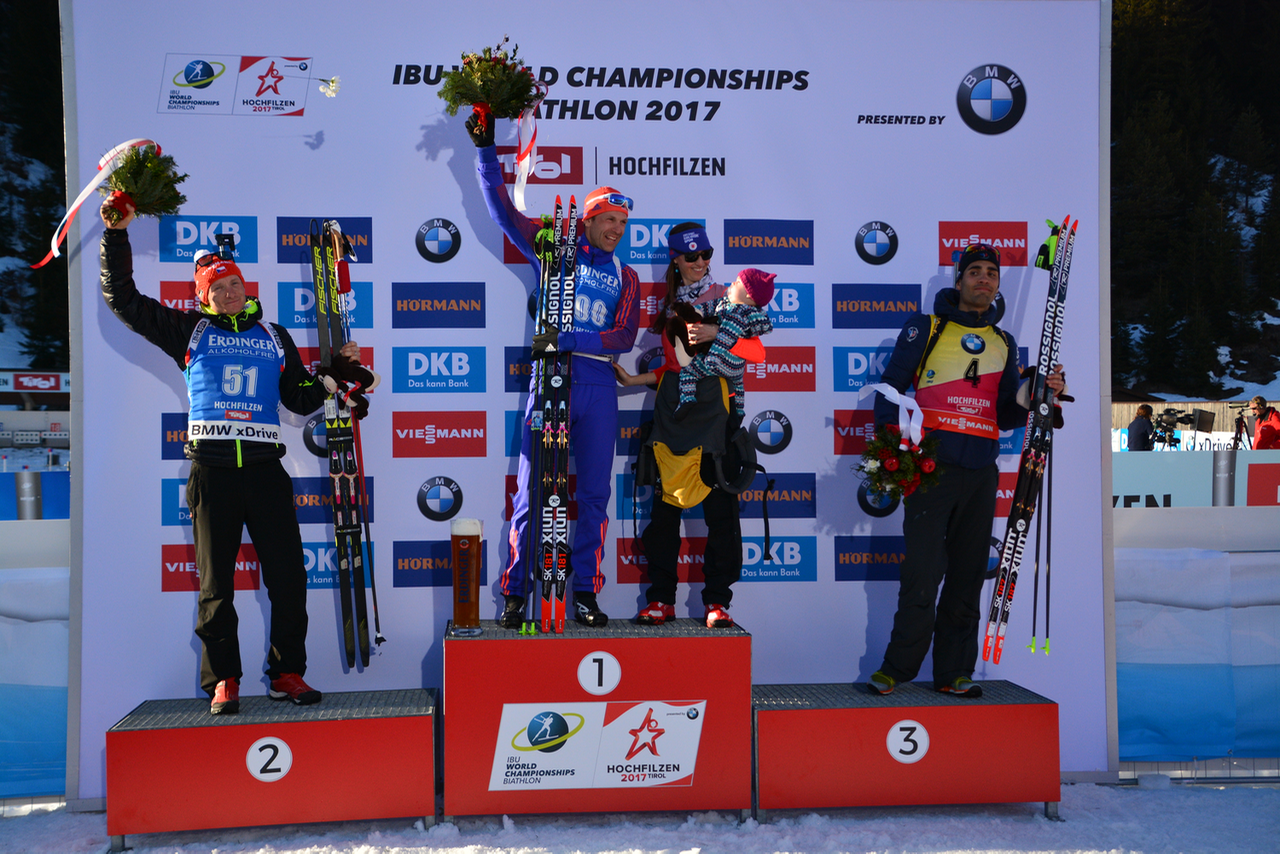
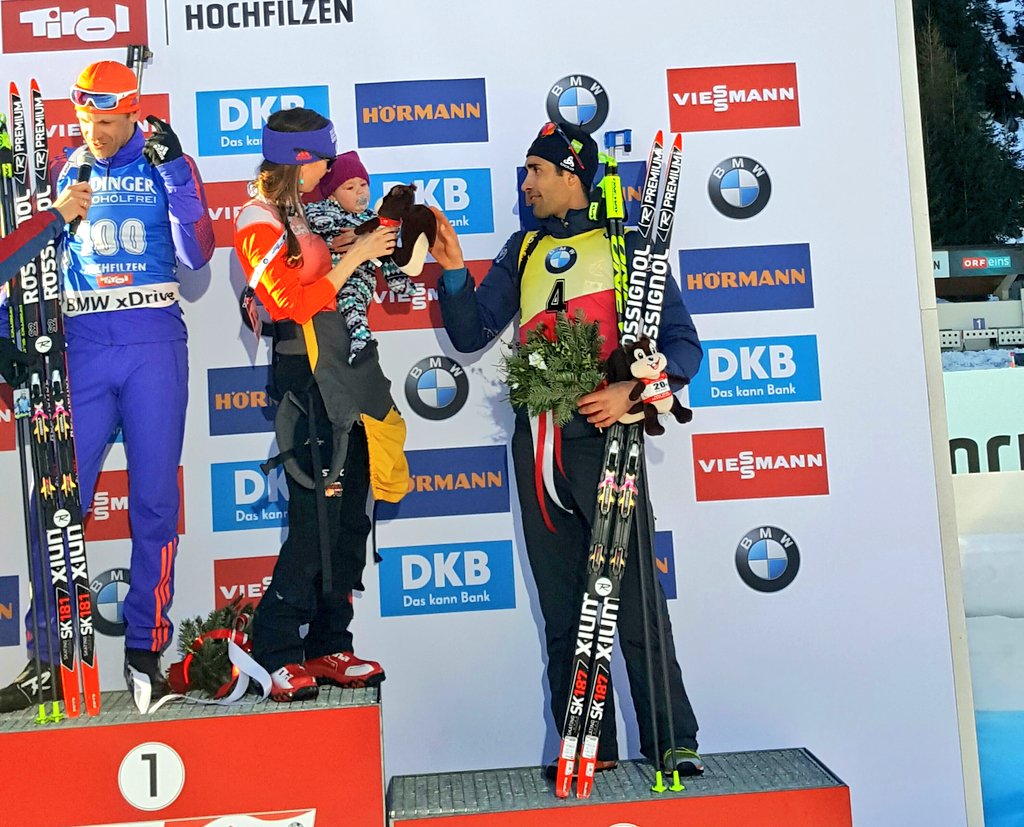
Lowell Bailey, his wife Erika, and daughter Ophelia stand atop the World Championships podium in Hochfilzen, Austria. Second-place Ondrej Moravec of the Czech Republic and third-place Martin Fourcade of France didn’t begrudge Bailey the win: “It means a lot a guy like Lowell won today for the sport,” Fourcade said. (Photo: Glen Crawford)
HOCHFILZEN, Austria–As Lowell Bailey sprinted around the final four kilometers of the 20 k individual on Thursday, the stadium announcer told the crowd that they were witnessing something special.
Fans who had been watching the sprint and pursuit earlier in the World Championships had seen Bailey come oh-so-close to the podium, only to miss out, finishing fourth in the sprint and sixth in the pursuit.
This time, he was on track to stay on that podium – and the announcer explained that it would be the first top-level win ever for an American biathlete.
The crowd went wild.
As Bailey pushed towards the finish and back towards the stadium, the crowd was asked to urge him on. They responded, as loudly as the predominantly German and Austrian fans would have cheered for their own favorites. The roar was deafening.
And from deep in his pain cave, Bailey heard.
“I did notice all the cheering,” Bailey said once he was sitting down and could process having just won World Championships gold. “It made me want to cry. This is an amazing sport, all the support we have.”
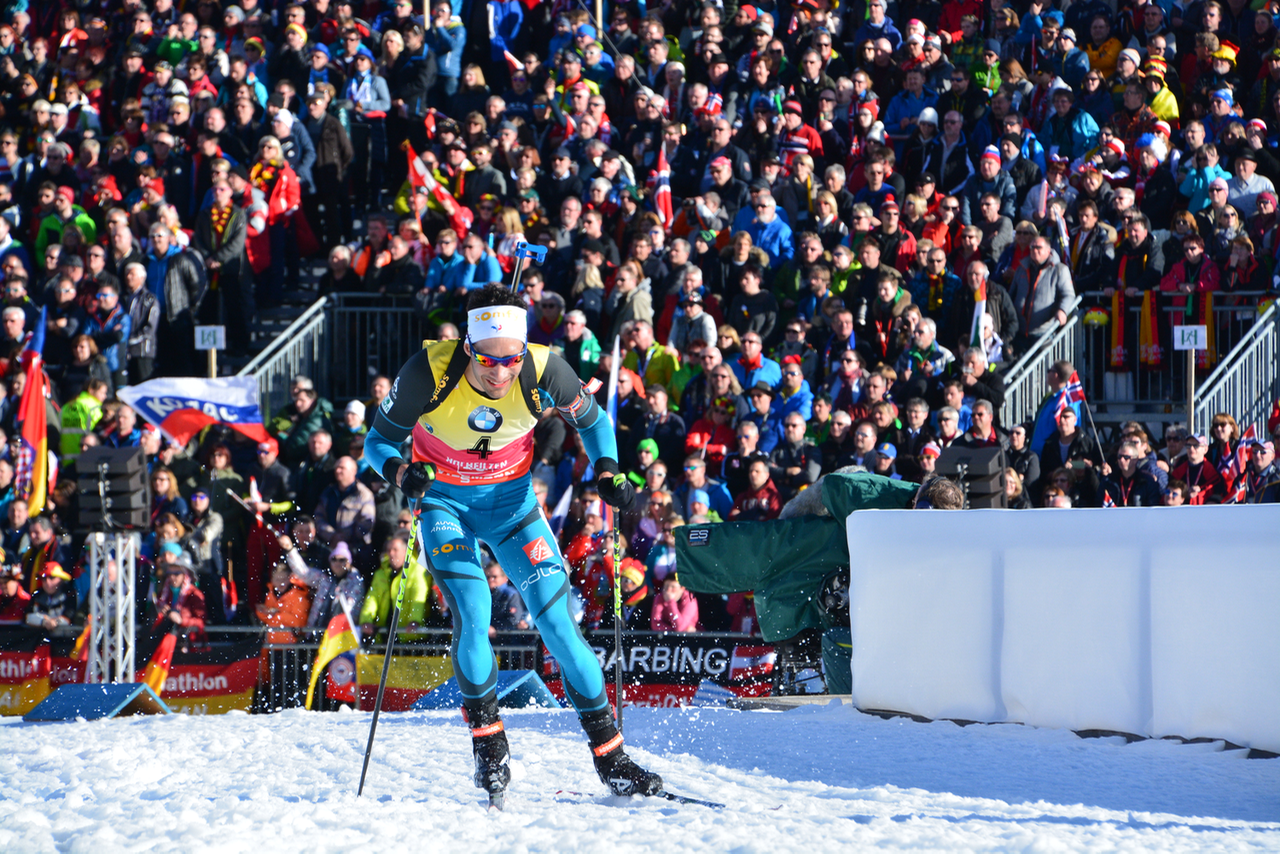
Martin Fourcade missed two shots in the 20 k individual, one more than he could afford if he wanted to win another gold medal. Instead, he settled for bronze. (Photo: Glen Crawford)
The fans weren’t the only ones pleased to see Bailey finally break through. Other competitors, too, seemed happy to see him atop the podium. That even included Ondrej Moravec, the Czech who came so close to winning his first individual World Championships gold himself.
“I am really happy for his gold medal, because he waited for this for a long time,” Moravec, who finished 3.3 seconds back to take silver, told NBC’s Chris Dupre. “As he said, from 2000 he competed first here in Hochfilzen, and I started in 2001 in Khanty-Mansiysk. So I know him long time, and he is a really good guy.”
So you’re completely happy with silver? That was the question from Peer Lange, the International Biathlon Union’s Communication Director.
“Well,” Moravec laughed. “It is like — I already won other medals, bronze, silver — but never gold. And today I was really closer ever than I was. It was a big chance for me today, but I was not good enough.”
Martin Fourcade, the pre-race favorite who finished third, was also gracious. And while the reaction from some was a surprise that an American could possibly win, Fourcade was among those who saw it as a day that had long been coming.
“I think when someone is finishing fourth in the sprint and sixth in pursuit you can say it’s not a big surprise,” he said in the press conference. “I know Lowell a bit more from this year. I know the guy.”
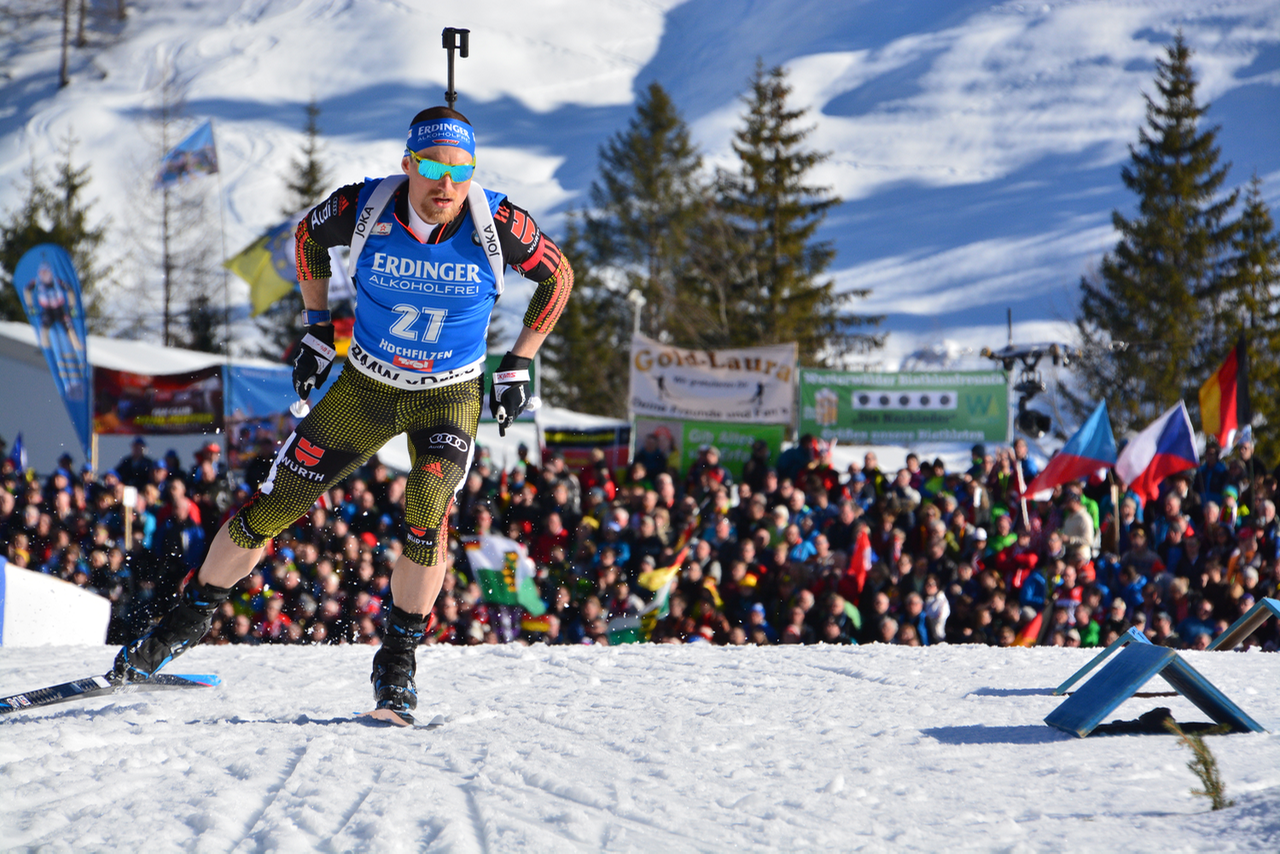
It was suns out, guns out for Germany’s Erik Lesser, whose one penalty kept him off the podium. He ended up fourth. (Photo: Glen Crawford)
Fourcade was referring in part to Bailey’s work as an Athlete Representative to the International Biathlon Union. Throughout the doping scandal which has built since the release of the first McLaren report, Bailey has been working to give athletes a voice in how their federation handles doping violations.
Fourcade has sometimes been right there beside him. He was among the nearly 200 signatories on a letter sent by World Cup athletes to the federation requesting action, has spoken out in the press, and led an athlete walk-out from a meeting with the federation where athletes felt that the sport’s leaders were not adequately answering their questions.
“I am really really happy for Lowell, a guy with amazing values on the track and outside,” Fourcade said in an interview with NBC’s Chris Dupre. “Lowell is our Athlete Representative for the federation. We fought together for more anti-doping rules, and it means a lot a guy like Lowell won today for the sport.”
“I really appreciated his working in the athletes committee, fighting for better conditions for the athletes, against doping,” Moravec agreed. “So that’s a great performance.”
Ole Einar Bjørndalen, the Norwegian legend who is also an Athlete Representative, said that Bailey’s commitment to representing athletes and fighting for clean sport made it even better to see him atop the podium.
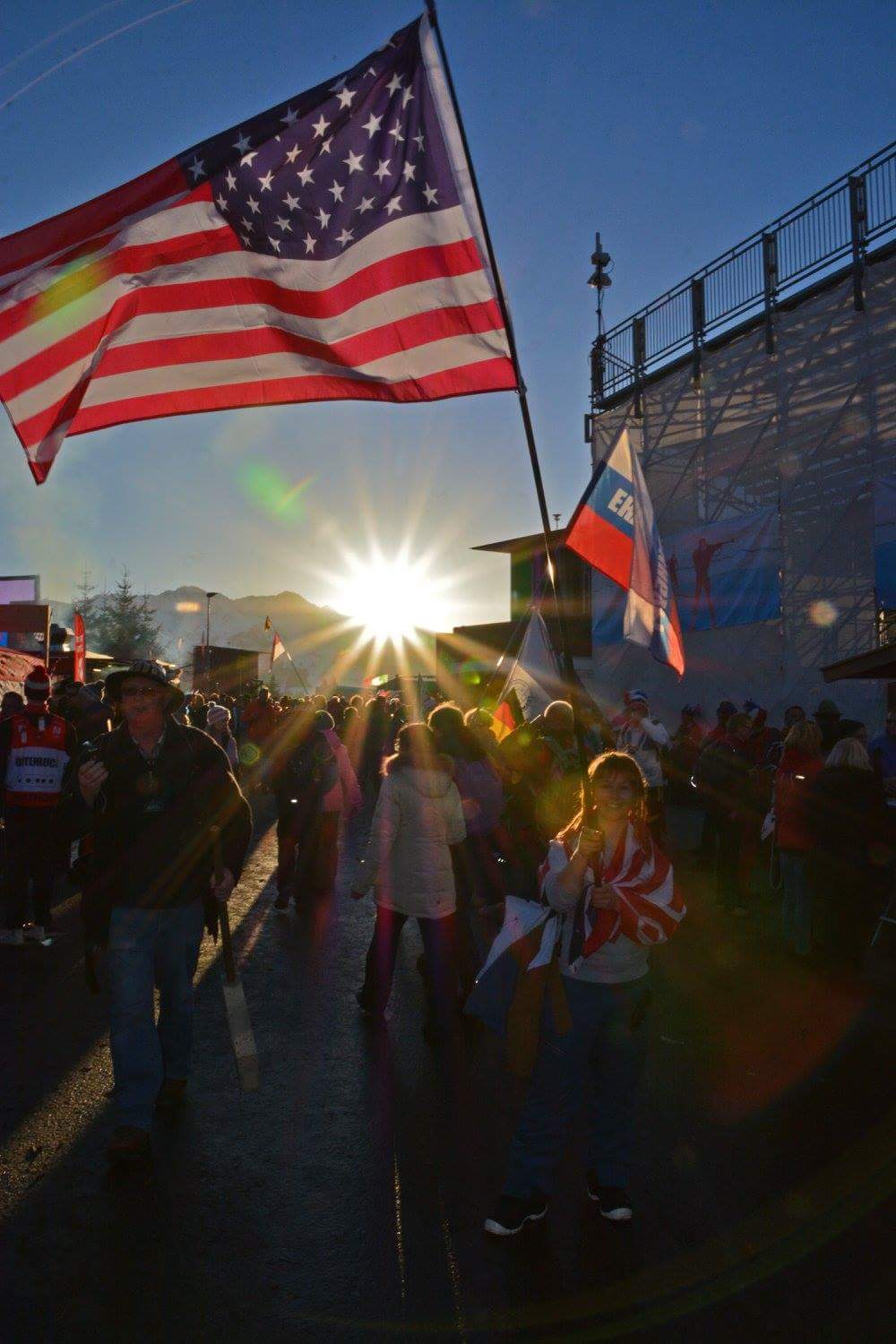
A fan holds an American flag at the end of the day on Thursday in Hochfilzen. (Photo: Glen Crawford)
“It was fantastic,” Bjørndalen said. “He is a fantastic guy, and it’s fantastic that he win in World Championship. I’m so happy for him. And he is a fantastic athlete. He is really a fair athlete, also, and I really like to compete with him.”
Germany’s Erik Lesser, who finished fourth, would have earned a medal if Bailey had missed even one shot.
“I don’t begrudge him this victory at all,” he told German broadcaster ARD. “Last year he had kind of retired already, he was at home on his bison farm or whatever, and now he comes here and becomes World Champion. He deserves that. He is a great guy with incredible experience. He has always been a good go-to guy for me when there have been any problems. That’s just the way it is.”
While Bailey could sometimes frustrate the German on the trails, that wasn’t the case on Thursday.
“In mass starts he can be a bit annoying squeezing himself into gaps, but today he pretty much squeezed himself into a gap left open by others,” Lesser said. “Four times zero, that has to be rewarded, just like Moravec. That just deserves to be honored with a medal.”
Fourcade also highlighted what all those people in the crowd who had cheered so loudly for Bailey had known: to see an American at the top of the sport, that’s not such a bad thing.
“I know how important it really is for biathlon,” Fourcade said of Bailey’s gold medal. “To see some people outside of Europe winning. I think that is the most we can do to make our sport bigger. I cannot be more satisfied about the guy winning today.”
Tim Burke was the last U.S. man to stand on a World Championships podium. He won silver in the 20 k individual in 2013, just as Josh Thompson did in 1987. Their medals had been the best-ever finishes for the U.S. – no more.
“I don’t look at like that, that’s not what it’s about,” Burke said of losing his record to his long-time training partner and friend. “It’s great for the entire team, especially for our program. You see we don’t even have a title sponsor this year. I’m sure we’re the only team that has a world champion that does not have a title sponsor, so it helps with things like that. It helps with the morale. It’s great for everyone.”
Lowell Bailey celebrates after crossing the line to win gold in the 20 k individual at IBU World Championships in Hochfilzen, Austria. (Photo: Glen Crawford)
HOCHFILZEN, Austria—Four days ago, Lowell Bailey left the shooting range after cleaning his fourth stage in the pursuit, and was in second place.
Things didn’t go his way and he saw first World Championships silver, then bronze, slip from his grasp as other men were stronger on the Hochfilzen race course’s big hills. He ultimately finished sixth, after placing fourth in the sprint.
Today, the American biathlete again left the range after cleaning his fourth stage. Two key differences: this time he had hit 20 out of 20 targets, rather than missing once. And this time, he was in first place, although he didn’t know it right away.
“I was really happy about it, obviously,’ Bailey said. “There was a surge of adrenaline immediately when I left the mat. Obviously most of the race is finished by that point, but in my mind, that was where the race began, the second I left the mat.”
Bailey was the second-to-last starter out of the 102-man field, and there was no chance of anyone behind him besting his time. When he hit the course, he had a 6.4-second lead on Ondrej Moravec of the Czech Republic.
If he could protect that lead, Bailey would become the first American ever to win a gold medal at biathlon World Championships. The U.S. has also famously never won an Olympic medal in biathlon, the last such winter sport, and Bailey had never won a World Cup before, either.
After watching a medal slip away in the pursuit, he wasn’t going to let it happen again.
“I know that my weakness on the course is the long extended climbs,” Bailey said. “If I look back to the pursuit that’s where things fell apart for me. I was okay on the fast gradual stuff, but at the long extended climbs I lost tons of time there. So today I tried to maximize my strengths… And then just mentally knowing that the last two kilometers are a lot of V1 extended climbing, I was telling myself ‘Don’t lose it on these climbs, you just gotta dig deep and find something there, because I’m not gonna lose it on these climbs’.”
He almost did. With 1,100 meters left to go, Bailey’s lead was down to 0.1 seconds. The crowd held its breath. Moravec, watching on the big screen from the finish area, shook his head, like, can you believe this?
U.S. Biathlon Association Chief of Sport Bernd Eisenbichler with Lowell Bailey after Bailey won World Championships gold in the 20 k individual in Hochfilzen, Austria. (Photo: Glen Crawford)
It was a race for the ages. But some on the U.S. team were sure that with the long swooping downhill to the finishing stretch, Bailey could eke out a win.
“It was closer and closer, and it was a tenth of a second at the last split at the very top,” U.S. teammate Tim Burke said. “But we had phenomenal skis and I knew if he was close there, he would make it. There was no way anyone had better skis than us… He owes a serious tip to the service guys.”
Bailey wasn’t as sure, but he also didn’t have any time or energy to think about it. He just stayed confident and kept fighting.
“I was in such a pain state that you are thinking like a five-year-old at that point,” he said. “But I would say that I was extremely confident in my skis today, and I think having those long downhill stretches before the finish definitely helped.”
Bailey ended up getting passed by Alexey Volkov of Russia, who had started a bib earlier but who Bailey had passed before. At first it seemed like Volkov might be an obstruction, but the Russian kept a high speed. As a result Bailey got a bit of a draft, and had someone to fight with to the finish.
“He was feeling pretty good on the last loop, and I tried to stay with him,” Bailey said of Volkov. “I mean, it’s always an advantage to see someone in front and try to stay with them. I think the battle was mostly going on in my own head. But we were skiing together, and I think that has to help in some way.”
By the time he hit the finish, he had gained a few seconds back from Moravec and crossed the line with 3.3. seconds to spare. Bailey fell to his knees and U.S. Biathlon Chief of Sport Bernd Eisenbichler rushed over to embrace him.
After nearly two decades of working together – back in the day, Bailey was a junior and Eisenbichler a wax tech – the pair had done it: a World Championships medal for Bailey.
And it was gold.
“When I think about when I first met Lowell, he was probably 13 years old, in Lake Placid, and just this good young skier who put his heart into this and worked for this every day, for almost 20 years now,” U.S. Biathlon Association President and CEO Max Cobb said. “I think it is a total validation of Lowell’s career… and how we were able to engineer things. We stripped out everything that we didn’t need to do and made it really focused on developing the athletes and bring them to this level. And now we are one year out from the Olympics.”
Perfection on the Range
Four-stage races have not always been Bailey’s best friend.
“That fourth stage in a pressure situation is definitely, in my opinion, the hardest part of biathlon,” Bailey said. “And it hasn’t always been my strong point. I have lost a lot of medal opportunities in the last stage.”
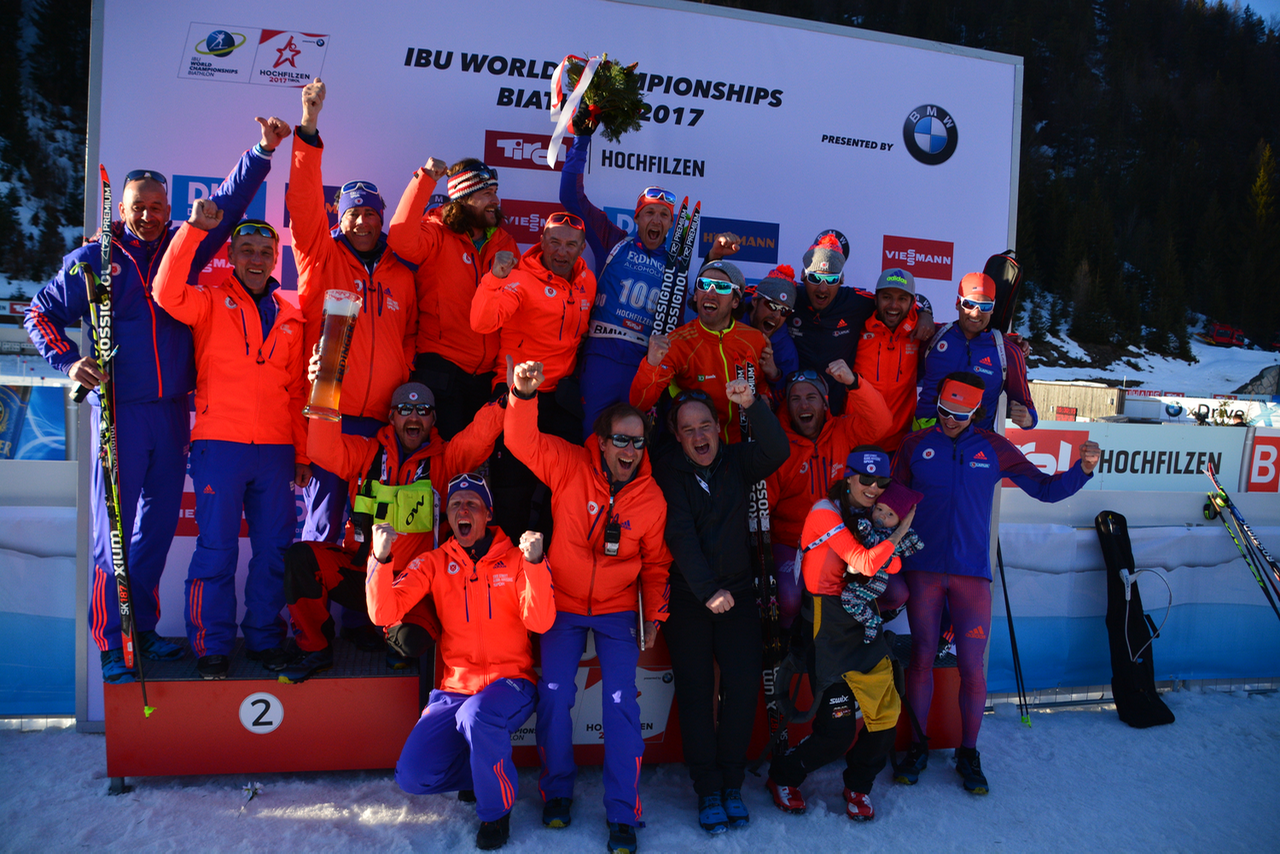
The U.S. men’s team, staff, and Bailey’s family celebrate on the podium after the flower ceremony. “Biathlon really is a team sport, and nobody achieves success like this without having a perfect environment around them,” U.S. Biathlon Association CEO Max Cobb said. “So I can’t say enough for Bernd [Eisenbichler]’s leadership, and all the great work of the coaches and ski techs and the whole support staff. Because that’s what makes it possible.” (Photo: Glen Crawford)But in the Olympics three years ago, Bailey came back from a disappointing start to the Games by focusing and turning in an eighth-place finish in the 20 k individual, his best Olympic or championship performance ever up to that point. He was one miss away from a medal, and set a new best mark for a U.S. biathlete at the Olympics.
Thinking about this World Championships, Bailey decided months ago that the 20 k would be his best shot.
“I focused on this race starting in May,” Bailey said in the press conference. “What do I need to do in my training to really prepare for this race? And so starting in May with the shooting workouts, I started going through this race in my head, and sort of doing a dress rehearsal during the training. Who is to say that helped or didn’t help, but I felt really composed today on the shooting range. I wouldn’t say I felt anymore nervous than any other day, any other race. That was good.”
Bailey knew that he would have to shoot a perfect 20 for 20. While the wind is tricky in Hochfilzen, it’s not always strong. There are always a few clean sheets and Bailey doubted he could win without one.
So he had to overcome the threat of a last-stage collapse, that pattern that had haunted him so many times in the past.
In Sunday’s pursuit, he had done it. His one missed shot came in the third stage, and then cleaning the final standing put him in that second-place position. So while the last loop of the pursuit didn’t go well, Bailey knew that he could do it on the range.
“One thing that I have learned over the years working with sports psychologists is that you are going to get distracted,” he said, gesturing as his daughter Ophelia cried in the background. “Especially at a World Championships, there are going to be distractions both externally and internally. For me actually the internal distractions are the most detrimental. You are talking to yourself in your head ‘if I do this, if I do that, if I clean then this, if I just hold it together…’ And all that is doing is taking you away from what you have trained for decades to do. The muscle memory is there, hundreds of thousands of rounds fired. So you just have to trust in your training, and also know that those are just distractions.”
In the final stage of the individual, Bailey was focusing on just two things. The crowd and the potential medal didn’t factor in.
“As you get to the competition season, you boil your shooting cues down to a few key principles,” he explained. “For me those are having a good trigger squeeze and follow-through. So it’s like two things. Trigger squeeze. Follow-through. And by the way, when you got to your first biathlon camp, those are two of the three things they teach you. But when you are in that situation, you are fighting for a World Championship medal, you have to keep things simple because that is all your brain is capable of.”
Sprint, pursuit, and individual: 50 targets, and Bailey has hit 49 of them. Fast, too. His shooting time today tied for the fourth-quickest among all the men in the field.
His focus is working, and that accomplishment was something the U.S. staff was particularly proud of. As Bailey started taking his first shots of that last stage, U.S. men’s coach Jonas Johansson breathed a sigh of relief. While watching it was “horrible”, he said, he was also sure Bailey could come through.
“I knew when he started to execute the shooting like planned, that this can go,” Johansson said. “Normally before, he has been a little too cautious in those situations, and stepped back a little bit. But now he went for it. I’m so happy for him that he really pulled it off and he came through clean.”
Four k or 40 k?
While cleaning all 20 targets was a big part of the work, Bailey still had to ski four more kilometers to seal the deal after he finished shooting.
“I didn’t know that I would come out in first place, but I knew that if there was ever a point where every second mattered, it’s directly after you have gone 20 for 20 in an individual,” Bailey said. “So I knew that those four kilometers were going be the deciding factor, and I knew it was going to be a matter of seconds. It was just that rush of adrenaline: ‘I worked so hard to get to this point, I need to do this’.”
Bailey, one of the last men to leave the start house in Hochfilzen. (Photo: Glen Crawford)
He described the four kilometers as agonizing, especially those big climbs that he knew were his weakness. In the press conference, Bailey joked that it felt more like 40 kilometers than just four.
“Fortunately I had great skis, and I had a U.S. staff member seemingly every hundred meters along that track,” he said later. “But every hundred meters it was a sprint. Every hundred meters was ‘go as hard as you can for this hundred meters, and then when you get to the end of that hundred meters, go as hard as you can and just keep doing that.’ I thought the finish line was never going to come. I was just like, I don’t know how much longer I can do this, because the finish line is just not showing up.”
That final loop ended up being one of Bailey’s fastest of the day. And that earned him gold.
As he climbed up onto the top step of the podium after his race, he was joined by his wife, Erika, and their daughter. Martin Fourcade of France, the superstar who took bronze, handed the girl a plush toy he had received as a prize. Everyone seemed happy.
“I think Lowell has a really good mix of biathlon and life with his daughter and his wife,” Johansson said. “I think that’s something really good for him, to have them around to be able to relax. And to also be able to have pure biathlon focus when he’s racing and he’s training. That’s a skill he had today, he did it one-hundred percent.”
Johansson, a Swede, has been working with the U.S. men’s team for three years. Watching the whole men’s team succeed, including this medal for Bailey, has been rewarding, he said.
“It’s a fantastic team in every way and it’s hard workers,” Johansson said. “Most of these athletes are maybe not the most talented on day one, but they are hard workers, and Lowell is one of them. He’s worked hard for many years and now he’s on the top… Lowell and also the other athletes on the team, they have this potential. I mean, they’ve shown before that they can be up on the podium and fighting for the podium, so it’s an unbelievable day.”
Teammate Burke, the last U.S. man to stand on the World Championships podium when he won silver in the 20 k individual in 2013, was thrilled for Bailey.
“He deserves it, especially this week,” Burke said. “He’s been so on, with the fourth place, sixth place, and today he needed the perfect race and he absolutely had, that’s the perfect race. It doesn’t get any better than that.”
Other North American Results
23. Leif Nordgren, USA, 1-0-0-1 (+2:53.6)
36. Tim Burke, USA, 1-1-0-2 (+4:14.4)
42. Macx Davies, Canada, 0-0-0-1 (+4:25.2)
43. Scott Gow, Canada, 0-1-0-1 (+4:29.1)
58. Sean Doherty, USA, 1-1-2-0 (+6:04.4)
86. Brendan Green, Canada, 2-1-0-2 (+9:33.9)
Christian Gow of Canada did not finish.
-Alex Kochon, Jason Albert, and Harald Zimmer contributed
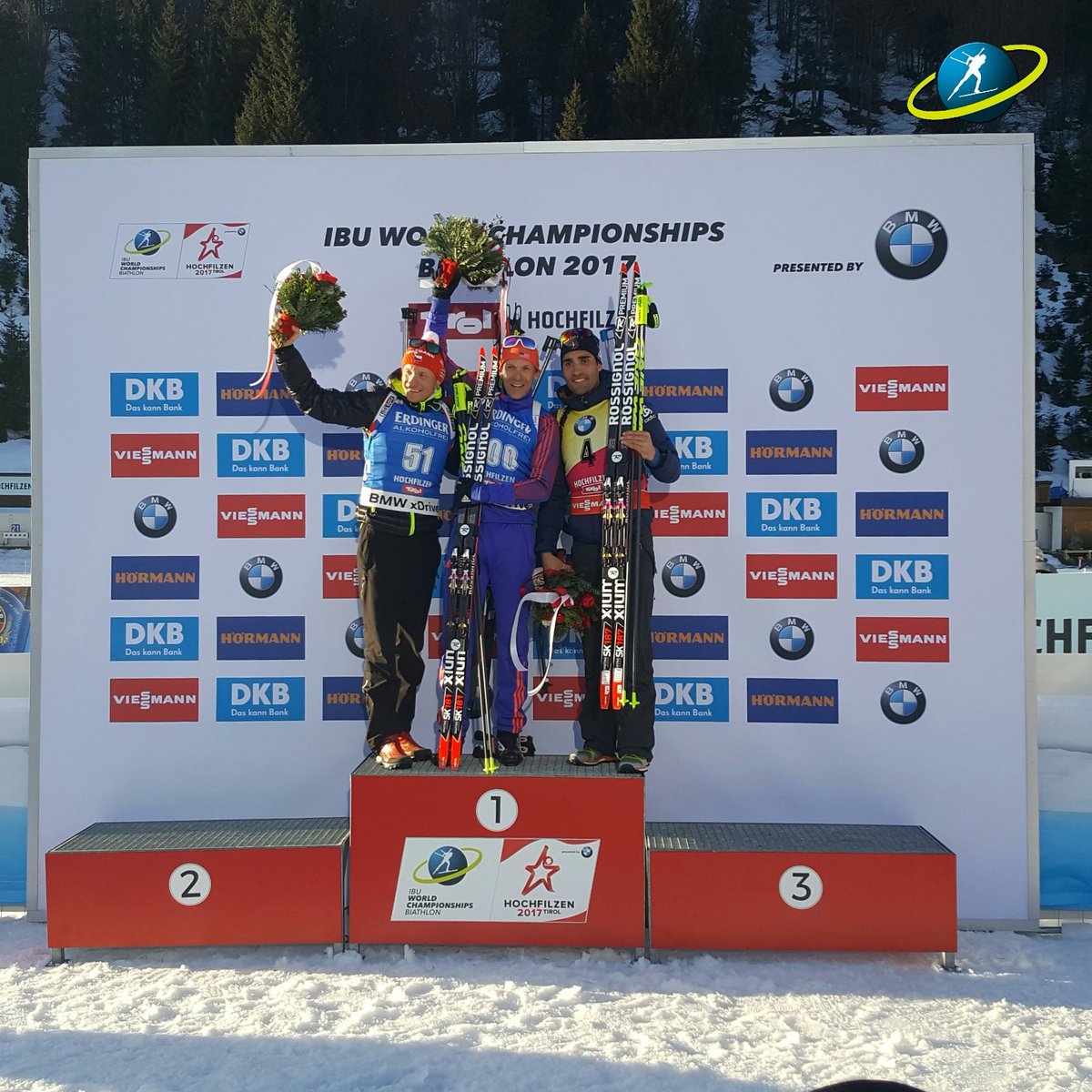
Lowell Bailey (c) became the first American to win gold at IBU World Championships on Thursday after topping the men’s 20 k individual in Hochfilzen, Austria. He is joined on the podium by Ondřej Moravec (l) of the Czech Republic and France’s Martin Fourcade (r). (Photo: IBU World Champs/Twitter)
IBU World Championships (Hochfilzen, Austria): Men’s 20 k individual
Lowell Bailey became the first American biathlete to become a world champion on Thursday in the men’s 20-kilometer individual race at 2017 International Biathlon Union (IBU) World Championships in Hochfilzen, Austria.
Wearing lucky bib 100, Bailey started near the back of the field and cleaned four consecutive stages in the longest-format race on the circuit, then finished with the new best time of 48:07.4 minutes, 3.3 seconds faster than the Czech Republic’s Ondřej Moravec (who started 51st and also hit all 20 targets).
Bailey even beat out France’s Martin Fourcade, the pursuit champion who had previously won 10 World Cup races this season, by 21.2 seconds.
While he had come close to the podium in fourth in the sprint last Saturday, Feb. 11, Bailey’s best World Cup result was second in a 2014 World Cup sprint in Kontiolahti, Finland. His World Championships gold medal on Thursday topped that of his teammate, Tim Burke, who had taken a historic silver for the U.S. in the 20 k individual at 2013 World Championships in Nove Mesto, Czech Republic.
France’s Martin Fourcade hands his stuffed-animal prize to Lowell Bailey’s daughter Ophelia as they join him on the podium of the men’s 20 k individual at 2017 IBU World Championships in Hochfilzen, Austria. (Photo: IBU World Champs/Twitter)
“This is a perfect day, absolutely,” Bailey told German broadcaster ARD after. “This is the most perfect day of my biathlon career. To shoot clean at World Championships … every single part of my race fit together today. I have so many people to thank for that. Years, decades of support, and people cheering me on for so long. I’ll remember this for the rest of my life.”
He was joined on the podium by his wife, Erika, and infant daughter, Ophelia. In the same interview with ARD, he credited Erika for supporting his decision to continue racing.
“I’m so thankful for the people who came to me and allowed me to continue my career,” he said. “The first one to think of is my wife Erika who supported me in my decision. We had our daughter Ophelia this summer, and of course this makes things much more interesting as a family. We had to be creative in our training this year, but it all worked out. So thankful for them, and grateful for everyone who has helped me so far.”
Also for the U.S., Leif Nordgren placed 23rd (+2:53.6) with two penalties for his best result of these championships, Burke was 36th (+4:14.4) with four misses, and Sean Doherty 58th (+6:04.4) with four penalties as well.
Macx Davies led Canada in 42nd (+4:25.2) with one miss, Scott Gow was four seconds behind in 43rd (+4:29.1) with two penalties, and Brendan Green finished 86th (+9:33.9) with five penalties. Christian Gow did not finish.
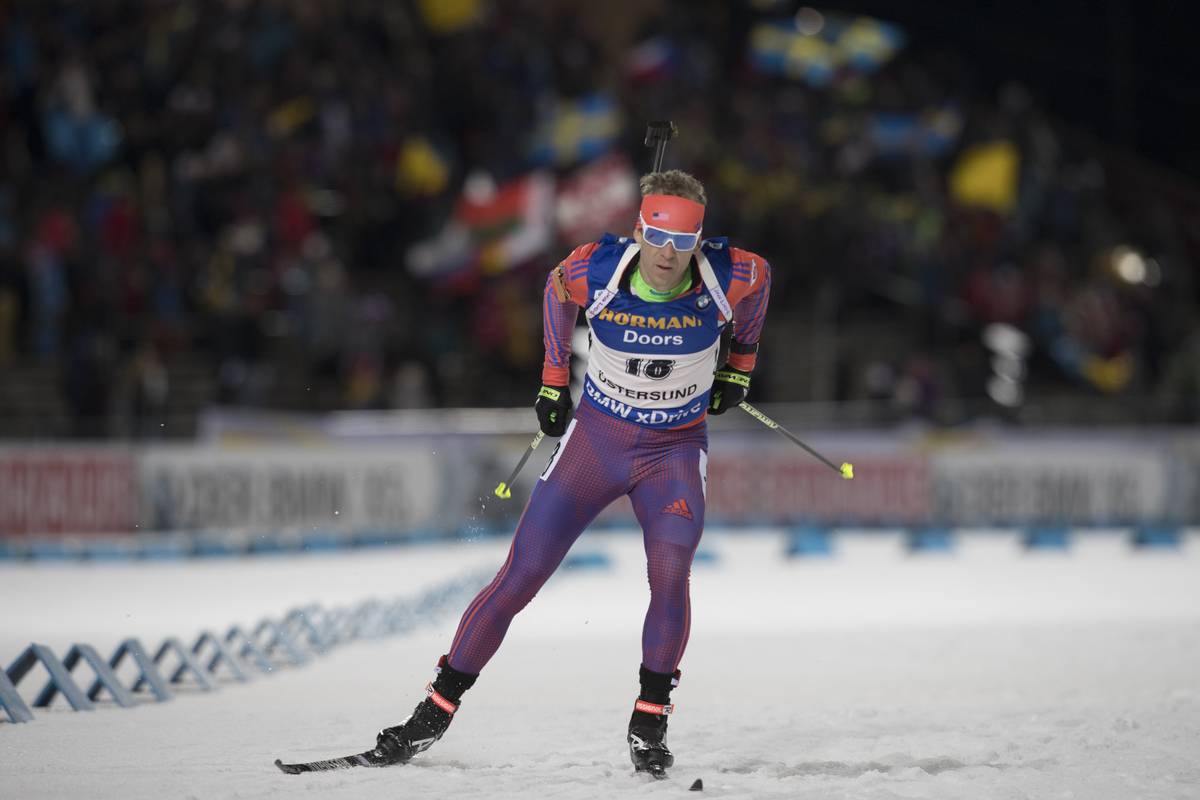
Lowell Bailey (US Biathlon) racing to 15th in the men’s first individual IBU World Cup race of the 2016/2017 season, the 20 k individual on Thursday in Östersund, Sweden. (Photo: USBA/NordicFocus)
Lowell Bailey is the dad of a six-month-old baby girl. Tim Burke celebrated his two-year anniversary earlier this fall. Both are US Biathlon team veterans, and at 35 and 34 years old, respectively, they’re still lighting up the International Biathlon Union (IBU) World Cup.
The teammates and training partners, based out of Lake Placid, N.Y., finished one place and 2.1 seconds apart on Thursday, with Bailey ending up 15th and Burke 16th in the first men’s individual World Cup race of the season: the 20-kilometer individual in Östersund, Sweden.
While Bailey accumulated four penalties in the four-stage race, he posted the 11th-fastest overall range and shooting times out of 103 finishers, and his course time ranked 25th overall.
“Your ski speed is always a little bit of an unknown going into the first race of the season,” Bailey said, according to a US Biathlon press release. “I’m happy to start off with decent ski speed and I hope I can build on this race going forward from here. I’ve worked throughout the training session on increasing the speed in the shooting setup (before any shots are fired) so I’m happy to see the overall range time where it is.”
It was another windy day in Östersund, without a single racer hitting all 20 targets. The 10th starter and reigning overall World Cup champion, Martin Fourcade of France, took the individual win in 51:33.8 with two misses (0+2+0+0). He held off Norway’s Johannes Thingnes Bø (the 15th starter) by 29.5 seconds. Bø cleaned three-straight stages, but two penalties on the last standing cost him the win (0+0+0+2) and he settled for second.
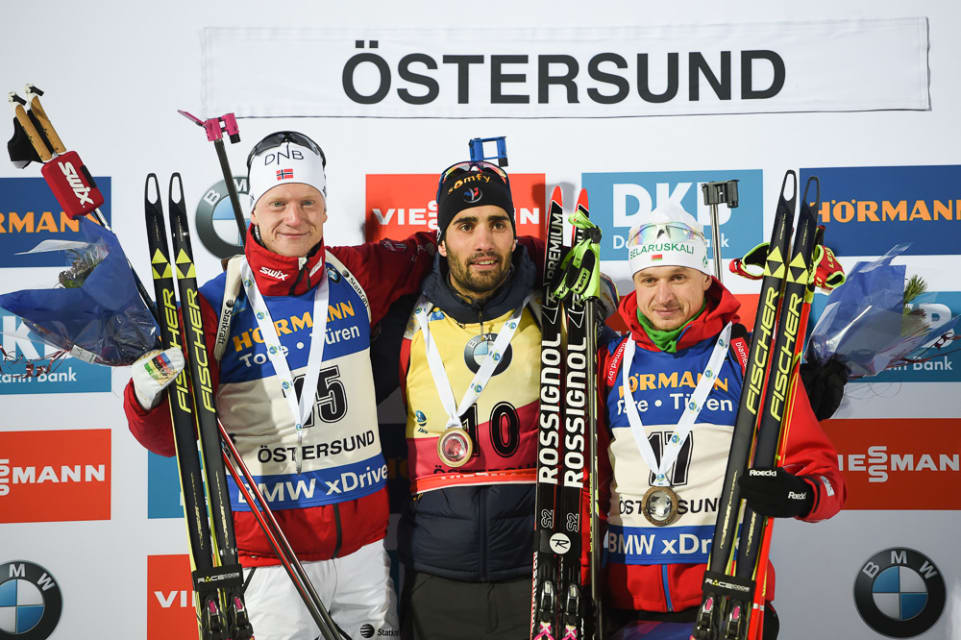
The men’s 20 k individual podium in the first IBU World Cup of the 2016/2017 season, with winner Martin Fourcade (c) of France, Norway’s Johannes Bø (l) in second and Vladimir Chepelin (r) of Belarus on the podium for the first time in third. (Photo: IBU/BiathlonWorld.com)
“I knew I had the chance with 15 hits after the first three stages, but there was so much wind,” Bø told German TV broadcaster ARD. “I just tried to fight hard. but not hard enough. Two misses and I lost the first place. That was not so good, but the three first [stages] and overall it was a good race.“
Meanwhile, Vladimir Chepelin of Belarus was one of three finishers with just one miss (1+0+0+0), and he finished third (1:24.3 behind Fourcade) for his first World Cup podium, despite clocking the 43rd-ranked course time.
Germany’s Florian Graf, who started 94th, was on track for a podium with three clean stages, but one miss on the last standing put him in eighth at the finish (+2:33.6).
“In our hotel room, we joked about skiing in the top ten and shooting clean,” Graf told ARD. “Of course I would not have expected that it works out so well today, but I am overjoyed to have such a debut.”
Norway had three finish in the top five with Lars Helge Birkeland in fourth (+2:10.5, three misses) and Ole Einar Bjørndalen in fifth (+2:16.7, three misses).
But the main story of the day was once again Fourcade, who, like Bailey, is also a dad.
Asked what was more important, his life with his 14-month-old daughter or winning the first individual race of the season, Fourcade replied, “If I say the victory my wife would probably kill me. Or my daughter would kill me in a few years, too. So yeah, you can’t compare. Biathlon is my passion, is my job, but my daughter is my life now. Nothing to compare,” he told ARD.
In terms of the race itself, he said he was pleased.
“It was a long preparation and this was a good answer about my shape after the test in Sjusjøen and the win in single mixed [relay],” Fourcade said after his second win in as many races this season, and 48th individual World Cup victory (50 including two Olympic golds in 2014). “There is a difference with being able to win and actually winning, so I am very happy.”
And then there was the question of whether his main goal is a sixth overall World Cup title.
“That is what I trained for, that is what I hope I will get,” Fourcade said. “But this is biathlon. Today I had a good form with challenging wind conditions, but you can also lose quickly. It’s just one race, and there are about 30 more coming. I am very happy about today. I will enjoy this victory, my 50th World Cup victory. That is something I wouldn’t have dreamed about and I will enjoy it today.”
In bib 18, Bailey started directly behind Chepelin, the third-place finisher, and cleaned both prone stages, but missed two on each standing bout.
“It was pretty gusty in the range and you really had to concentrate on making quality shots,” Bailey told US Biathlon. “I’m happy with the prone performance but definitely wish I could have a few of those standing shots back.”
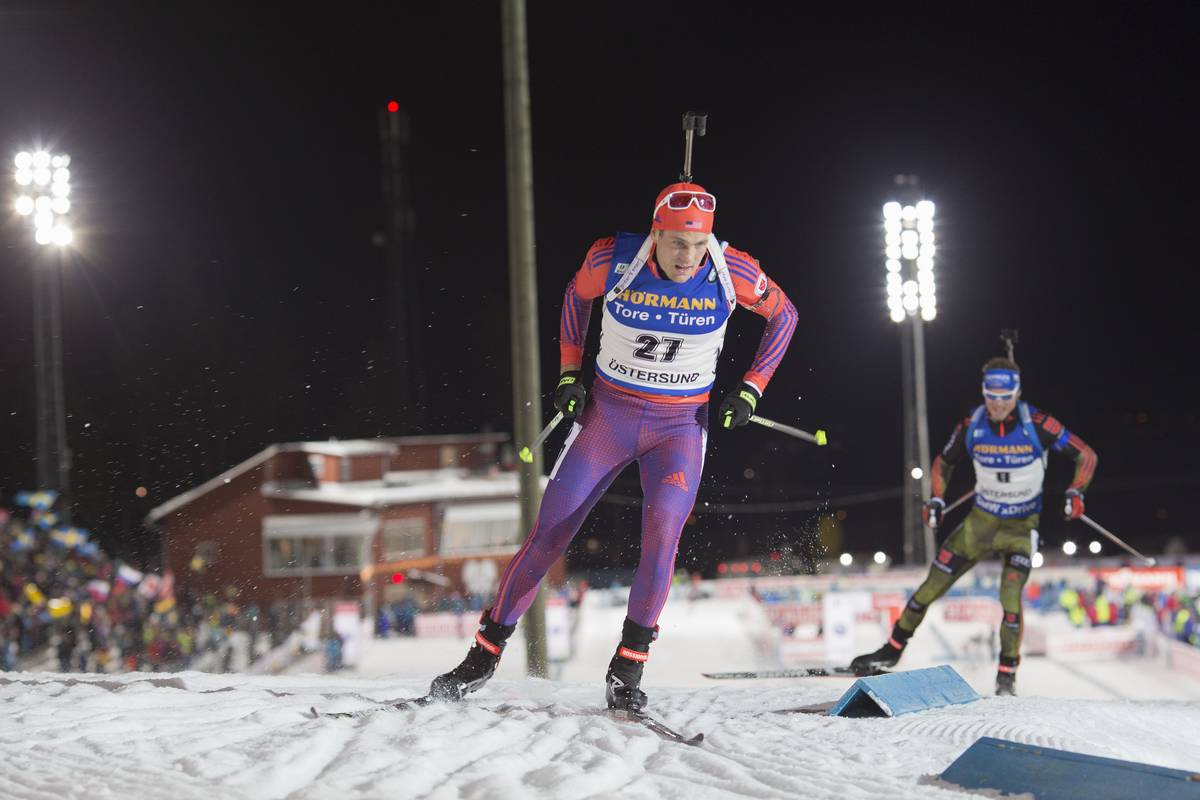
US Biathlon’s Tim Burke (27) racing to 16th in the men’s first individual IBU World Cup race of the 2016/2017 season, the 20 k individual on Thursday in Östersund, Sweden. (Photo: USBA/NordicFocus)
Burke in bib 27 started off with a clean prone as well, followed by two standing misses then another clean prone. In the final stage, he had one more penalty for a total of three (0+2+0+1) and finished 2.1 seconds back from Bailey, 3:54.6 behind Fourcade, and 0.2 seconds ahead of 19th-place Ondrej Moravec of the Czech Republic.
Burke has tallied three podiums in Östersund, most recently in 2013/2014, when he placed third in a sprint. In 2009/2010, he finished second in an 20 k there and third in the sprint.
“I’m not really sure why Östersund has been a good venue for me,” he told US Biathlon. “Maybe it’s because of the tricky shooting conditions, which is something that I typically like. Unfortunately, I felt really flat on the course today. I should have been able to reach the top 10 today with that shooting, but I just did not have it on the tracks today. Hopefully my legs will rebound for Saturday’s sprint.”
On Thursday, he made a point to shoot slower than usual in the windy conditions. His range time ranked 31st overall.
“I decided to just take my time on the range and that worked out today,” Burke said.
Also for the U.S., Russell Currier, who qualified for World Cup starts less than a week ago in an IBU Cup sprint, finished 54th (+7:04.5) with six penalties (1+1+2+2).
Nathan Smith led the Canadians in 43rd (+5:36.8) with three penalties (1+0+1+1). Among his teammates, Scott Gow finished 60th (+7:30.4, five misses), Macx Davies was 62nd (+7:34.6, four misses), Brendan Green was 89th (+10:20.1, eight misses), and Christian Gow 99th (+12:52.8, eight misses).
A relieved Martin Fourcade of France crosses the line in first in Thursday’s 20 k individual at the 2015 IBU World Championships, 20.9 seconds faster than Norway’s Emil Hegle Svendsen to win his first medal of the championships in 47:29.4 in Kontiolahti, Finland. (Photo: Kontiolahden Urheilijat/Kaisa Kontiainen)
KONTIOLAHTI, Finland — Approaching the final shooting of Thursday’s 20-kilometer individual race at IBU World Championships, about eight seconds out of first, Martin Fourcade knew there was only one thing to do: hit every target.
But he didn’t overthink it. In fact, the 26-year-old Frenchman said he was on “automatic pilot” for that final standing stage. With the third-fastest range time for that bout, he ripped off five shots and knocked down each one. Fourcade took the lead, 3.5 seconds ahead of Norway’s Emil Hegle Svendsen, who started 8 1/2 minutes before him. Then he tore into his final 4 k lap.
“I was really focused and I was looking straight at my coach because I wanted to feel the confidence in the eyes,” Fourcade said in a post-race press conference.
He had made all but one shot leading up to that point, missing one on his first standing. There, Fourcade in bib 34 of 127, slipped from first to ninth overall, 34 seconds behind Norway’s Johannes Thingnes Bø in first. From then on, Fourcade clawed back into contention for his first individual medal of the 2015 World Championships.
“I thought this morning that I won seven of my last 10 individual races in the World Cup so that means that’s a good competition for me,” he said of the 20 k. “But I also have to remember that I was 84th in the [individual at the] opening of the season in Östersund. That’s biathlon and that’s what makes it so exciting.”
Fourcade had started the 2015 World Championships off with silver in the mixed relay, then placed 12th in the sprint before finishing seventh in the pursuit. While the individual medal eluded him until Thursday, Fourcade said his mind wasn’t on that during the race.
“I knew after two shoots that I was not far from the lead, even with one penalty so I knew that anything was possible,” he said. “It was more about what I have to do than which result I could take.”
Emil Hegle Svendsen of Norway racing to silver in the men’s 20 k individual at 2015 IBU World Championships in Kontiolahti, Finland. (Photo: Kontiolahden Urheilijat/Kari Kuninkaanniemi)
The man he finished 20.9 seconds ahead of and essentially took gold from, Svendsen felt similarly. The eight-time world champion and three-time Olympic gold medalist had yet to reach the podium this year in Kontiolahti, either.
“I think it’s been three months since I had a good race,” Svendsen, one of four men to clean the four-stage race, said in the press conference. “It’s been a long time since I’ve been feeling like I could be on the podium and it’s good to be back. I always want to be on top and people expect that of me. I’m very proud of my silver today.”
Fourcade entered the race as the defending world champion from 2013, as well as the 2014 Olympic champion in the 20 k individual in Sochi, Russia. Two years ago at World Championships in Nove Mesto, Czech Republic, he took a medal in every event except the mass start.
Heading into Thursday, with two individual races remaining at worlds, some wondered if the favorites like Fourcade and Svendsen would make it back to the podium. So far, these championships have been highlighted by several gold medalists without a prior World Cup win.
“My beginning of World Championship is not bad,” Fourcade said. “I had a really good mixed relay. … In the sprint, I was kind of unlucky with the wind conditions. A lot of athletes missed in that race. Emil did, also the second in the World Cup rankings, Simon Schempp [of Germany] had seven mistakes.”
But what mattered most at the end of the day to Fourcade, the overall World Cup leader, was what he had achieved. His older brother, Simon Fourcade, 30, had started third and led the race with perfect shooting until Svendsen came through, cleaning and skiing faster to finish 24.8 seconds ahead of him. While Svendsen’s lead seemed significant, it wasn’t anything Fourcade couldn’t widdle down. On the final lap, he made up more than 17 seconds on Svendsen.
“When I think about where I was this spring, thinking about missing the biathlon season due to my mononucleosis, today I was so proud to be on top of the podium and winning the individual,” Fourcade said. “That is something that is so crazy, and I realize how lucky I am.”
A happy Ondrej Moravec (Czech Republic) after taking bronze in the men’s 20 k individual at 2015 IBU World Championships on Thursday in Kontiolahti, Finland. (Photo: Kontiolahden Urheilijat/Kari Kuninkaanniemi)
Only one later starter came anywhere close to the top two: Ondrej Moravec of the Czech Republic. He started 40th, three minutes after Fourcade, and cleaned every stage except his first standing — just like Fourcade. He entered the last lap with nearly 32 seconds to make up on Fourcade and a 14-second deficit to Simon in third.
“I had good information [on that loop],” Moravec said in the press conference. “I heard in the beginning of the loop that maybe I lost some seconds, but I tried to push so hard so I’m satisfied I did it.”
He bested the time of one of the Fourcades, edging Simon by 5.2 seconds for bronze. It was Simon’s second fourth-place finish at these championships after he missed the podium by 4.2 seconds in the sprint.
For Moravec, it was his second medal of the championships after anchoring the Czech mixed relay to gold a week ago. A silver medalist in the pursuit and third in the mass start at the Sochi Olympics, he had never reached the World Championships podium until this year.
“I think the big events are motivation for all of the athletes, especially World Championships,” Moravec said. “It’s a big motivation for me and I’m so glad I take the medal.”
Ukraine’s Sergey Semenov placed fifth, 56 seconds behind Fourcade, with a single penalty on his first prone, and Norway’s Ole Einar Bjørndalen made the flower ceremony as well in sixth (+1:12.1) with one miss on his first prone. After two initial clean stages, Bø ended up seventh with one penalty on his second prone.
In addition to Svendsen and Simon Fourcade, Russia’s Alexey Volkov (in ninth) and Yuryi Liadov of Belarus (in 17th) were the two other competitors to shoot 20-for-20.
“The conditions were perfect,” Svendsen said. “The tracks was really good and practically no wind on the shooting range so good day to shoot 20.”
Green 21st, Bailey 24th
Brendan Green (Biathlon Canada) on his was to 21st in the men’s 20 k individual at 2015 IBU World Championships on Thursday in Kontiolahti, Finland.
Leading the way for Canada, Brendan Green finished in his somewhat-habitual spot of 21st on Thursday (after tying for 21st in the sprint last weekend and placing 21st in the 20 k individual at the Sochi Olympics). It was his second-best result of the championships so far, after he placed 16th in the pursuit.
“It’s been a really phenomenal week shooting,” Green said after going 19-for-20 with a single penalty on his first prone. “I’m a little bit surprised … In our training camp, I really wasn’t able to shoot much at all. Today, I really wasn’t able to do anything on the skis, and unfortunately wasn’t able to capitalize on the really good shooting.”
The 53rd starter, he worked his way into the top 30 with three-consecutive clean stages, including the last standing. At the finish, Green sat in the top 20 and ultimately finished 11.9 seconds outside of it in 21st, 2:59.6 behind Fourcade.
“I’m definitely happy with my result this championships, but when I bring my worst skiing of the year here it’s a little frustrating,” the 28 year old said. “The shooting’s just really clicking at the moment.”
While his shooting time ranked 11th, his overall course time was 49th. Green explained that Kontiolahti’s steep and “punchy” climbs don’t necessarily suit his strengths (he prefers more gradual or rolling terrain), adding that wasn’t an excuse. During the race, he backed off on the climbs slightly to prevent himself from red lining.
With the effort and the World Championships points he’s accumulated throughout the week, Green appeared to have qualified for Sunday’s mass start in 23rd out of 30 starters, based on a provisional start list. Americans Tim Burke, who was 31st on Thursday, and Lowell Bailey, who led his team in 24th, also qualified in 26th and 28th, respectively.
Canada’s Nathan Smith, who placed 44th in the individual with five penalties, had already secured his start with his sprint silver medal.
Lowell Bailey (US Biathlon) en route to 24th in the men’s 20 k individual at 2015 IBU World Championships on Thursday in Kontiolahti, Finland. (Photo: USBA/NordicFocus)
In his ninth World Championships, Bailey, 33, finished 24th in the 20 k with despite two early prone misses. He went on to clean his next three stages to finish 3:10 behind Fourcade.
“The only way to get back into the race is to shoot well,” he said. “I misjudged the wind. I was out on the left and I should’ve taken more clicks. I saw a lot of guys missing early and I should have reacted and I wasn’t decisive enough with the first prone. I’m happy with the rest of the race. I skied better than I have this whole series so that’s the silver lining.”
Surprised to miss two on his first bout — he said he hadn’t missed a prone all week — Bailey made corrections that led him to rise from 101st overall after the first stage to 23rd after the last standing. He ended up with the 22nd-ranked shooting time and 35th-ranked course time overall.
Burke was the second American in 31st, and despite having four minutes worth of penalties, he finished 3:52.7 behind the winner with the seventh-fastest course time.
Tim Burke (US Biathlon) on his way to 31st in the men’s 20 k individual at 2015 IBU World Championships on Thursday in Kontiolahti, Finland. (Photo: USBA/NordicFocus)
“I feel like this year has probably been my best ski year ever and at the same time it’s been for sure my worst shooting year, so it’s frustrating,” Burke said.
While his shooting on Thursday was an improvement over recent races, with one miss in each of the first two stages and then two more in the final standing, he said, “It’s not bad, but it’s not world class, and that’s all I’m interested in.
“Today was one of my better days this year on skis; I felt strong the whole race, but four is just way too many penalties for an individual race with conditions like this,” he added, referring to the hard-packed, icy course.
After a clean third stage, he thought a top 10 might have been possible if he hit all his targets on the fourth stage. He crossed the finish line in 11th and ended up 31st.
Threatening to beat Burke’s time at the finish, his teammate Leif Nordgren, who started nearly 40 minutes after him, placed 33rd, 3.4 seconds after Burke.
Leif Nordgren (US Biathlon) racing to 33rd in the men’s 20 k individual at 2015 IBU World Championships on Thursday in Kontiolahti, Finland. (Photo: USBA/NordicFocus)
Nordgren cleaned his first stage before missing one on each bout thereafter. He had the ninth-fastest range time overall.
“Any time you are in an individual, you have to see one or zero misses to have a really good day,” he explained. “I was definitely aiming for 95-percent shooting and good skiing. I am really happy with the way I skied. I think I was pretty strong, and shooting was so-so.”
While 33rd stood as his best individual result of these championships, Nordgren said his showing in Kontiolahti left something to be desired.
“I am a little disappointed on how the week has gone individually,” he said. “With the shape I had coming in and how I started off in the mixed relay [in which he anchored the U.S. to eighth], I was really hoping for more.
“My shape is good, better than it has been in a couple of years,” he added. “And that has carried through a couple weeks now. I feel like, in that regard, I have kind of gone up a step and I can be happy with that and take that … the next season.”
Sean Doherty (US Biathlon) placed 47th on Thursday in the men’s 20 k individual at 2015 IBU World Championships in Kontiolahti, Finland, for the second-best result of his career. (Photo: USBA/NordicFocus)
Nineteen-year-old Sean Doherty was the fourth U.S. man in 47th (+5:15.5) with three penalties (0+1+2+0). The result was his second best of his career after placing 45th in the pursuit last weekend.
“I knew I was capable of a little better shooting, but I feel like I skied a great 20 k,” he said. “I just tried to start under control with the pace and try to keep picking it up lap to lap, and it worked out well.
“My prone shooting has been a little up and down lately, but standing was good and I’m looking forward to the relay [on Saturday],” Doherty added. “I’m happy with my individual performances [here]. It was really good to make the pursuit; that was a big goal of mine. I’m getting good experience and things to work on for the summer.”
Canada’s second man, Smith placed 44th (+5:03.2) with five minutes of penalties (0+1+2+2). After a clean first prone, he initially had the lead as the 28th starter. Fourcade came through 2 seconds faster to take control, and Smith went on to miss one on his second shooting to fall out of the top 10.
“I thought with the one standing miss that, OK, I can still hit 19, it’s still gonna be a really good race,” Smith reflected. “My second prone felt sketchy and I missed two, and I kind of lost my edge bit in the last standing, too.”
Five days after he medaled in the sprint, Smith said felt relaxed before Thursday’s race.
Nathan Smith (Biathlon Canada) cleaned his first shooting to take an early lead, but missed five total to end up 44th on Thursday in the men’s 20 k individual at 2015 IBU World Championships in Kontiolahti, Finland. (Photo: Kontiolahden Urheilijat/Samuli Kuittinen)
“I felt like the last couple days went back to normal,” he said. “[But] you have that in the back of your mind, that if I have the perfect race I can medal, but I don’t think the pressure is what I did it. It’s just a day where I missed five.”
Canadian brothers Scott Gow and Christian Gow finished eight seconds apart in 63rd and 65th, respectively. Scott missed four (1+1+1+1) while Christian missed three with a clean last standing (1+1+1+0).
“I was hoping for 90-percent [shooting] or more, especially because it is such a nice day on the range. The wind is so marginal compared to what we have been dealing with,” Scott said. “Eighty percent is the minimum so I achieved the minimum. It is not necessarily a disappointment, but the goal was more 90 percent, so in that sense it is a little bit of a letdown.”
In two previous races in Kontiolahti, Scott, 24, placed 50th in the sprint and 52nd in the pursuit.
“It was kind of average for me,” he said. “No standout races where I shot 100 percent and was flying on the track, but I also didn’t have a total meltdown where I only hit half my targets and was totally dying. Overall I’m happy.”
For Christian, 21, it was his best result in two races at worlds after placing 73rd in the sprint.
“I struggled a bit this week shooting,” Christian said. “Today I just wanted to relax and hit some targets. All three misses were completely my fault, just overthinking the last shot two times. I was happy to come in on the last one and clean it no problem and get back into the rhythm. I’m hoping that good feeling back on the range, I can carry that forward to the relay for a good shooting day.”
In terms of how he’ll leave his first World Championships, he said a recent chat with his coach helped him put it in perspective.
“I hold myself to a really high standard,” Christian said. “Racing on the World Cup has been pretty challenging for me for that just because it is so tough to feel like you are accomplishing anything. Everyone is so fast and everyone is such a good shooter, there is no room for error at all.
“I am happy to be here,” he added. “Of course, I would like to come away with some results that later on I could look at and be super proud of. I am not going to be disappointed with what I have done so far. I am just trying to learn from it and make the most of it while I am here.”
Nathan Smith (Biathlon Canada) en route to cleaning three-straight stages in Thursday’s 20 k individual at the IBU World Cup in Oslo, Norway. He went on to miss his third shot in his last standing to place 12th.
In the last three races, Canada’s Nathan Smith has hit 49 of 50 targets, and that’s something he can be proud of — even if it didn’t beat his teammate Brendan Green’s record.
“I had Brendan’s 50 out of 50 record from earlier in the season in my mind today,” Smith told Biathlon Canada after the men’s 20-kilometer individual on Thursday in Oslo, Norway. “We were joking around a little before the race that I would try and steal that glory away from him.”
Smith was on track for that kind of performance early on in the individual race at Holmenkollen, starting 10th and cleaning his first three shooting stages with some of the quickest range times in the 94-man field.
He didn’t try anything different in the longest-format race on the IBU World Cup; he just wanted to replicate the kind of success he found last weekend in Nove Mesto, Czech Republic, where he notched a career-best seventh in the sprint followed by a new best of fifth in the pursuit.
“I tried to get into the same relaxed mindset for the shooting that I used in Nove Mesto,” Smith wrote in an email.
After knocking down his first five targets, Smith found himself in fifth through nine starters. At least 14 men cleaned the first prone as well, bumping him down to 11th and then 15th, but by the second stage, he was back up to fifth with another perfect round.
“From watching the women’s race I knew there would be a LOT of cleans or near cleans,” Smith reflected. “With 19 or 20 [shooting] I thought a top 10 should be reasonable. However, once the race was underway I could tell my skiing just wasn’t quite at the same level as last week.”
In soft, draggy snow, his lap times ranked in the mid-40s for most of the race, until the last lap, where he knew he had to kick it into high gear. After cleaning his third stage and reclaiming fifth, 54 seconds behind race leader Martin Fourcade of France, Smith missed his third shot on his final standing.
“On the last standing I think I managed the situation really well compared to races before Christmas,” Smith reflected. “I felt way more calm and wasn’t worried if I had to reset or take an extra breath. It’s too bad I missed a shot but I don’t think it was from nerves.”
Despite the one-minute penalty, he left the range in fourth, 2:14.6 behind Fourcade. There, he concentrated on strong last lap to make up for what he considered “lackluster earlier loops.”
With the 27th-ranked course time on the last lap, Smith initially finished seventh, 2:38.5 behind Fourcade as the eventual winner. He ultimately placed 12th for his best 20 k individual result after five men in the top 10 cleaned all four stages.
“It was a little disappointing to miss one in the last bout, but 19 is still my best shooting ever in an individual,” Smith observed. “So despite that shot and slightly slow skiing I can’t complain at all.”
Beyond IBU World Championships, which take place March 3-15 in Kontiolahti, Finland, Smith — who ranks 25th in the overall World Cup — was looking toward the next-and-final World Cup from March 18-22 in Khanty-Mansiysk, Russia.
“Biathlon Canada is sending a minimal team to Khanty-Mansiysk at the end of the season and are chasing top-25 rankings,” he explained. “12th helps a long way to move into that group.”
Nordgren Hits 19 for 20th
Leif Nordgren (US Biathlon) racing to 20th in Thursday’s IBU World Cup 20 k individual at Holmenkollen in Oslo, Norway, for his best 20 k result. (Photo: USBA/NordicFocus)
Another North American who put down his best-ever individual race on Thursday, Leif Nordgren of the U.S. had sort of the opposite race of Smith — missing one in the first stage then cleaning every bout thereafter.
With the snow quality deteriorating throughout the day in warm temperatures (above 40 degrees Fahrenheit), Nordgren as the 57th starter described the conditions as “fairly nasty.”
“The tracks weren’t too bad, there were plenty of parts that stayed pretty hardpacked all through the race, but a couple of the hills that get more sun were pretty deep and mushy, not to mention the entire range,” he wrote in an email.
“Skiing wise I felt ok today, I tried to start out more on the conservative side knowing that it would be a tough race, but I could tell I was having a good ski already by the second loops so I blew caution to the winds and started to push every loop a little more after that,” he added.
Like Smith, Nordgren posted course times that ranked around 40th, but it was his shooting — with the 13th-fastest range time overall and 19-for-20 accuracy — that lifted him.
Through three stages, he sat around 24th, one minute from ninth. With a clean final round, Nordgren improved to 14th, 2:22.7 behind Fourcade, and set off on his last lap chasing a top 15, which would have been a career best.
“Leaving the range in 14th the final time, was a good feeling, I knew that it would be tight and a few guys would probably catch me, but I still had some energy left so all I could do was push till the end,” he wrote.
With the 34th-ranked course time on the last lap, he initially finished 19th. Russia’s Maxim Tsvetkov in bib 67 took 10th with clean shooting, bumping Nordgren to 20th, where he’d stay for his third-best World Cup result (after placing 16th in the Nove Mesto sprint last weekend).
“I’m really happy with this result, mostly because it proves that last week wasn’t a total fluke or anything,” Nordgren wrote. “This was a new week with a new course and totally different conditions, conditions that I’ve struggled with in the past. … I’m happy with 19 for 20 shooting, to have just one bad shot in the entire race is acceptable to me, for sure it could have been better, but I had one shot in my second prone which was a split, and it barely knocked the target down, so I got a little lucky in that regard.”
Overall IBU World Cup leader Martin Fourcade of France all alone on the range for his final standing stage in Thursday’s 20 k individual in Oslo, Norway. Fourcade went on to win for his sixth victory this season (and 35th in his IBU World Cup career) with perfect 20-for-20 shooting. (Photo: IBU/Christian Manzoni)
Fourcade as the first starter led from the third stage on, staying just ahead of Russia’s Evgeniy Garanichev, who started fourth and also hit all his targets to chase Fourcade throughout the five-lap race.
But Fourcade was faster, posting the second-fastest overall course time after Slovenia’s Jakov Fak, who ended up fourth with two penalties, 1:36.6 behind Fourcade. Garanichev had the fourth-fastest course time.
Jakov led after the first prone, and Fourcade was 21 seconds back in 12th. Two men remained ahead of Fourcade after the second shooting — Russia’s Anton Shipulin and Germany’s Simon Schempp — who cleaned the first two stages as well. After the first standing, Shipulin led Schempp by 12.3 seconds, and Fourcade was 21.8 seconds out of first in third.
But two more stages took care of that. Both Shipulin and Schempp missed two on the third bout, dropping the Russian to 18th and the German to 29th. While Shipulin cleaned the last stage to place seventh (+1:59.4), Schempp had another miss on the final standing to end up 27th (+3:45.3).
Meanwhile, Ukraine’s Sergey Semenov shot 20-for-20 to land in the top three, 48.8 seconds behind Fourcade. Garanichev came up 14.2 seconds short of Fourcade, who won in 51:26.8, to finish second, 34.6 seconds ahead of Semenov in third.
“It was not easy to start with the pressure of starting with bib number 1,” Fourcade, the overall World Cup leader, told the IBU. “It was a battle against myself all day … It was a strange feeling, but I enjoyed the competition.
“Shooting was not easy,” he added. “I stopped after the third shot in both standing stages to make sure I hit the other targets.”
In all, three Canadian and three Americans competed on Thursday, with Canada’s Green placing 44th (+5:01.2) with three penalties (0+1+0+2) and Scott Gow finishing 60th (+6:32.9) with three penalties as well (1+1+1+0).
Like Green, Tim Burke and Lowell Bailey of the U.S. started strong, cleaning their first prone, but slipped to 47th (+5:10.3) and 62nd (+6:48.4), respectively, by the finish. Burke missed four total (0+1+0+3) and Bailey had two of his three penalties on his last stage (0+1+0+2).
Tim Burke (US Biathlon) racing to 11th on Wednesday in his first individual World Cup of the season: the 20 k in Östersund, Sweden. (Photo: USBA/NordicFocus)
Note: This article has been updated to include comments from Lowell Bailey and Brendan Green.
An athlete would be lying if they said they didn’t want their first race of the season to be a breeze, and for just about everyone but Norway’s Emil Hegle Svendsen on Wednesday in the first IBU World Cup individual race of the season — it wasn’t.
Svendsen remained the only perfect shooter out of 100 finishers, and topped the men’s 20-kilometer in Östersund, Sweden, in 53:25.6 — more than a minute and 17 seconds faster than anyone else.
The next three finishers came out with one penalty apiece (Ukraine’s Serhiy Semenov in second, Michal Slesingr of the Czech Republic in third, and Germany’s Erik Lesser in fourth), but the shooting after that was all over the map. It usually is, but it was even more so on Wednesday, no thanks to various high winds cutting across the range.
American Tim Burke, who started 39th of 102, hung consistently in the top 10 throughout the race despite missing one on each of the first three stages.
Teammate Lowell Bailey started before him in bib 15 on a 6-degree Celsius (43 Fahrenheit) afternoon. Bailey cleaned his first and third stages, missing just one on the first standing, to put himself in sixth his third time leaving the range.
Burke went on to clean his final standing for 17-for-20 shooting, just like Bailey, who ended up missing two on the last stage. Not long after their finish, the two men sat in 10th and 17th, respectively, only to be bumped by a few late starters.
One of them was 22-year-old Frenchman Quentin Fillon Maillet, who tallied a career best in 10th. After starting 98th, he knocked Burke from 10th to 11th, 3:32.8 behind Svendsen, a position Burke was satisfied with despite three minutes of penalties.
Tim Burke takes a moment on the range during Wednesday’s 20 k in Östersund, Sweden, where he ended up 11th with three penalties. (Photo: USBA/NordicFocus)
“I was pleased with my shooting today considering it was tricky with the wind,” Burke wrote in an email. “Normally 3 penalties in an Individual would not be good enough for 11th place but there were a lot of penalties because of the conditions.”
Bailey slid slightly to 20th (+4:50) behind Fillon, Russia’s Maxim Tsvetkov in 18th and Italy’s Thomas Bormolini in 19th.
“It was challenging, for sure,” Bailey said of the conditions, according to a US Biathlon press release. “The weather warmed up quite a bit before the race which made for some pretty icy, mushy downhills and the track deteriorated pretty quickly. And the added wind made it even more challenging on the range.”
At the 2014 Olympics in Sochi, Russia, Bailey placed eighth in the same event and appeared to be in contention for another top 10 on Wednesday until the final stage. He spent nearly a minute in the range, almost longer than anyone else on that stage, waiting for the wind to calm.
“It was pretty windy in the final stage and I made the decision to stay and wait out the gusts to try and hit as many shots as possible,” Bailey explained in an email. “I waited an extra fifteen seconds for that last shot because I really wanted to hit it. Unfortunately, I not only waited extra time, but then I missed the shot! That’s biathlon though. I wasn’t really that nervous but I’m disappointed that I couldn’t get out of the final shooting with one less miss.
Lowell Bailey (US Biathlon) racing to 20th on Wednesday in his first individual World Cup of the season: the 20 k in Östersund, Sweden. (Photo: USBA/NordicFocus)
“I was excited for today’s race as it is the first time to see where your fitness level is compared to the rest of the international field,” he added. “A lot can change over the course of the year, but it is always good to start off with a solid result to get things going. … I’m hoping for increased ski speed as the season progresses. It’s a good place to start though.”
Burke, who skied the eighth- and ninth-fastest course times on the last two loops (for the eighth-fastest course time overall), explained his racing form felt “pretty solid” throughout the race.
“The hardest part for me was actually the first two loops,” he wrote. “I felt that I struggled a little in the fist two loops with my technique. I have not had so many hard efforts on snow yet, so I am definitely still fine tuning my technique. By the last few laps I felt like I nailed down my ski placement and timing.”
After helping his team achieve one of their best results of seventh in Sunday’s mixed relay, Burke took an easy day of training followed by some light speed on Tuesday.
“I felt good during my speed the day before so I expected to feel strong for the Individual,” he wrote. “This year I experimented with a few new training ideas. Starting in October, I started feel better than ever in some of my intense training sessions but you never really know how that feeling will stack up in a World Cup. [Wednesday] was a good indicator for me that my new training ideas have worked well but it is also still very early in the season.”
Also for the U.S., Leif Nordgren placed 71st with four penalties (0+2+1+1) and 9:47.7 back from the winner. Russell Currier was another 13.2 seconds back in 74th, with seven misses (3+1+3+0).
Canada Outside Top 40
Brendan Green was the top Canadian in 49th (+7:23.5) after starting 30th and falling out of contention early with four penalties in the first two stages (2+2+0+0). Nathan Smith, who started eighth, ended up 54th with seven misses (1+3+1+2).
Brendan Green racing at the 2014 Olympics in Sochi, Russia.
“It was a pretty frustrating day, both for myself and the team,” Green wrote in an email. “The wind in general was quite strong and also inconsistent which made the shooting tough. I did what I could to try and hit each shot with the wind I was dealt but unfortunately that still resulted in 4 misses after my first two bouts of shooting.
“I had an idea from what I could hear and see each time I was in the stadium that there were a lot of misses amongst the field, even with the top names, so I knew it was that kind of day,” he added. “I was able to manage the wind better for my last two bouts and fortunately was able to finish the day without any more misses.”
Green explained he’s been struggling with back problems since arriving in Östersund, and that led him to skip the mixed relay. Since then, he explained the problem seemed to have settled and he was looking forward to the individual.
“I typically should be able to ski fairly well on a course like here in Ostersund but during the race I felt like I was hanging on for survival as opposed to skiing an aggressive 20km,” he wrote. “I think we had some issues with the skis as well.
“Although I’m disappointed with my opening race and expected a lot more from myself, training has been going well and I’m looking forward to this weekend,” Green added. “After returning to the World Cup circuit last year I was really unsure what to expect and how my body and mind would hold out after a year off, but I proved to myself that I am still capable of solid results and am looking to build off of where I left off last season. Hopefully my strongest results and best shape will be in Finland for the World Championships.”
Canada’s Nathan Smith racing to 13th in the first Olympic race of his career: the sprint in Sochi, Russia.
Smith explained that his first standing, where he missed three, was a bit windy, but that didn’t excuse three penalties.
“I’m not sure what exactly happened there but it definitely threw me off for the remaining shooting stages,” he wrote. “Prone actually felt really solid but I just made a couple silly mistakes by rushing a little.
“The course wasn’t perfect by any means, but the warm temperatures actually did help the snow conditions compared to previous days when it was colder,” he added. “A couple of the hills near the stadium were getting chopped up but thankfully the largest climbs were still in excellent condition.”
Some of these climbs, however, greeted competitors with strong headwinds. And while the course held up well overall, Smith explained there was some deterioration, especially on some of the shorter uphills.
With his initial goal of a top 16 out by the second shooting, he tried to put together a decent race by cleaning the final two stages.
“Unfortunately that did not happen. Once I was stuck with the bad shooting I didn’t really have any expectations and just focused on skiing relaxed and smooth,” he wrote. “It’s often tougher to push 100% when you know you’re out of the running because of poor shooting. Even still I’m satisfied with my skiing form.”
At the end of the day, he had the 21st-fastest course time overall.
“Although I only felt average out there, my course time was still quite good,” Smith wrote. “So hopefully on a day where I feel amazing I can be right up in the top 10. I’m going to refocus my shooting and perhaps be a little more cautious in Saturday’s sprint.”
Marc-André Bédard finished 61st with four penalties (0+1+1+2) and 8:40.6 behind the winner.
Despite earning his spot on the World Cup team as early as a few weeks ago (and buying his plane tickets late), Bédard explained he was relieved to get to Sweden after some quality on-snow time in Quebec City.
“I did not expect to be in great shape and to shoot that well because I had such a crazy summer racing off road triathlons and OCRs but I knew I was going to give it my best and enjoy every moments, which I did!” he wrote in an email of the World Cup team trials Nov. 13-14 in Canmore, Alberta.
Waking up Wednesday morning, he recalled feeling happy and thankful for the individual start after racing to 17th with the team on Sunday.
“These trails are a lot like home too and I love to ski here so I was exited to race new tracks that I feel good in,” he wrote. “I wasn’t to sure how to approach it and if I was going to survive it so I started really conservative, skiing with others and picking up the speed more and more.”
Looking at his results, Bédard figured he should have pushed his pace more. He started 86th, which didn’t leave him with optimal conditions, but he was used to it.
“I’ve always started later being on fewer [World Cups] and I’d say 9/10 races it’s almost a handicap to start late,” he wrote.
Not only is it harder to warm up and adjust the rifle, late starters also have to wait often more than an hour before their turn. The lighting, wind and the snow conditions often change in this time, and Bédard explained that makes the wax technicians’ jobs tougher — especially in 6-degree temperatures — after they test skis two hours before a race.
“You have to give it your best and hope it doesn’t affect you too, too much!” he wrote. “I didn’t go in with much of any goals, I have so little information on my shape and speed this year that I just took it as it goes and try to learn and improve from there. My shooting has been amazing so I was exited about this and looking forward to a 90%+ performance, which I was doing great before the end but I ended up missing my last 2 shots which put a stop to the party! But I’m still quite happy with a 80% for pretty hard shooting conditions.”
Canada’s fourth man, Scott Perras placed 73rd (+9:51) with six penalties (1+3+1+1).
The women’s 15 k individual kicks off Thursday at 17:15 CET (11:15 a.m. EST).