This coverage is made possible through the generous support of Marty and Kathy Hall and A Hall Mark of Excellence Award. To learn more about A Hall Mark of Excellence Award, or to learn how you can support FasterSkier’s coverage, please contact info@fasterskier.com.
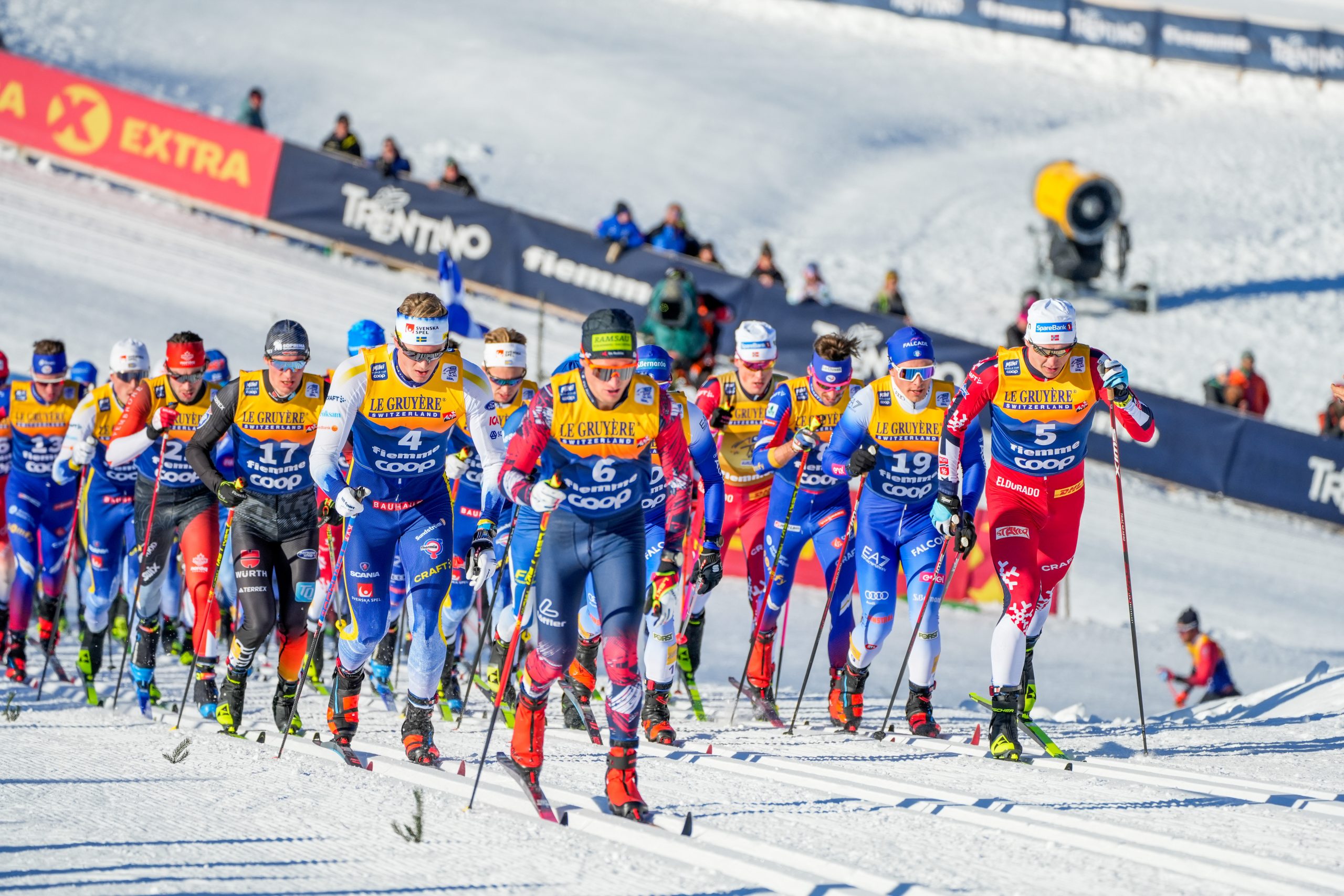
Austria’s Mika Vermeulen (6) pushed the pace throughout the 20 k Skiathlon, moving into second place overall in the 2025 Tour de Ski with only one stage remaining. Sweden’s Edvin Anger (4) would begin the day in second place, but would ultimately drop from contention. (Photo: Vanzetta/NordicFocus)
The 2024-2025 Tour de Ski has already been a long, challenging adventure, and the end of the tour (tomorrow atop Alpe Cermis) offers a unique and daunting set of challenges. While Stage 6 of the Tour offered a glimpse of what will be the venue for the 2026 Olympic Skiathlon, today’s race in Val di Fiemme bore little direct comparison to the action likely to take place a year from now. Today’s race was complicated by the exhaustion of five prior days of racing, the absence of numerous contenders who dropped out earlier in the event, ongoing competitions in the Sprint and Climber’s jerseys, and the need to conserve energy for tomorrow’s climb. Next year’s Olympic event will be a no-holds-barred free-for-all. Today’s Skiathlon in Stage 6 of the Tour de Ski was a decidedly more measured and conservative affair.
Johannes Hoesflot Klaebo (NOR) entered the day enjoying a lead of 1:35 over Edvin Anger (SWE), and 2:11 over Erik Valnes (NOR), neither of whom appeared likely to pose a truly menacing threat on tomorrow’s climb of the the Alpe Cermis. In preparing for today’s Skiathlon, it seemed Klaebo’s task would be to monitor his rivals, limit his losses, and conserve energy for Sunday’s final climb (which is known to be one of his least favorite racing tests of each World Cup season).
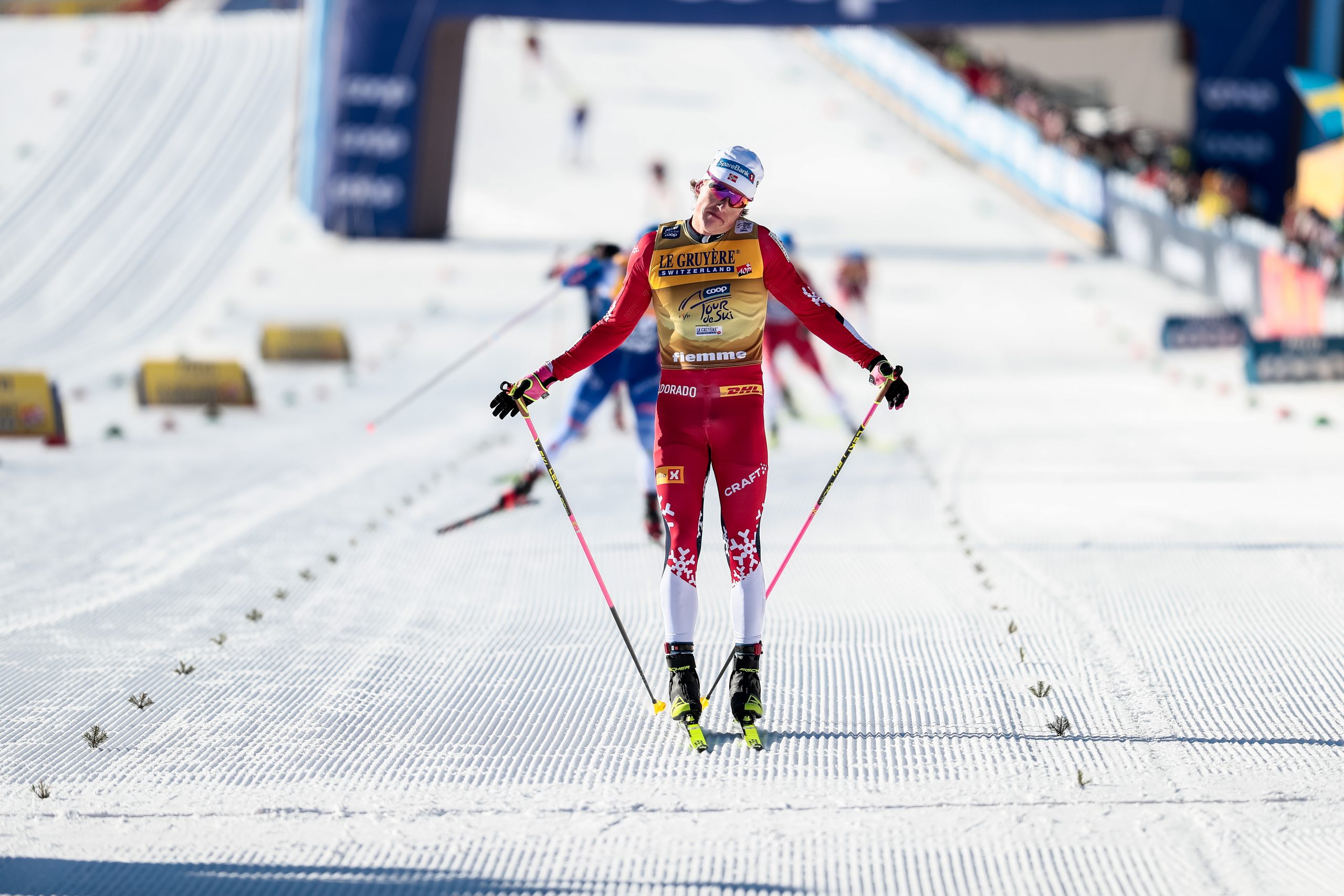
Johannes Hoesflot Klaebo (NOR) would control the pace through the closing laps of the Val di Fiemme Skiathlon, coasting across the line comfortably ahead of his rivals. (Photo: Modica/NordicFocus)
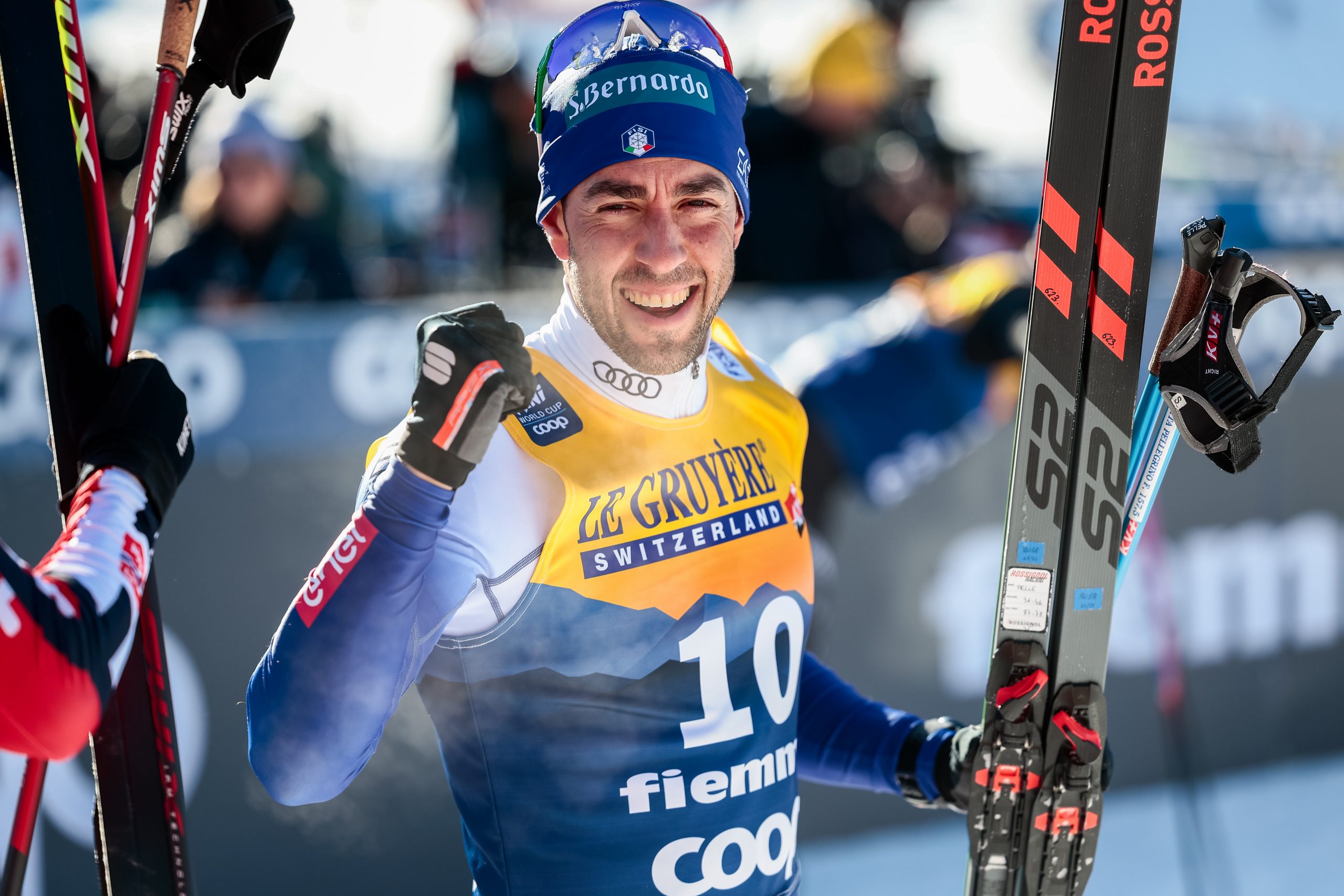
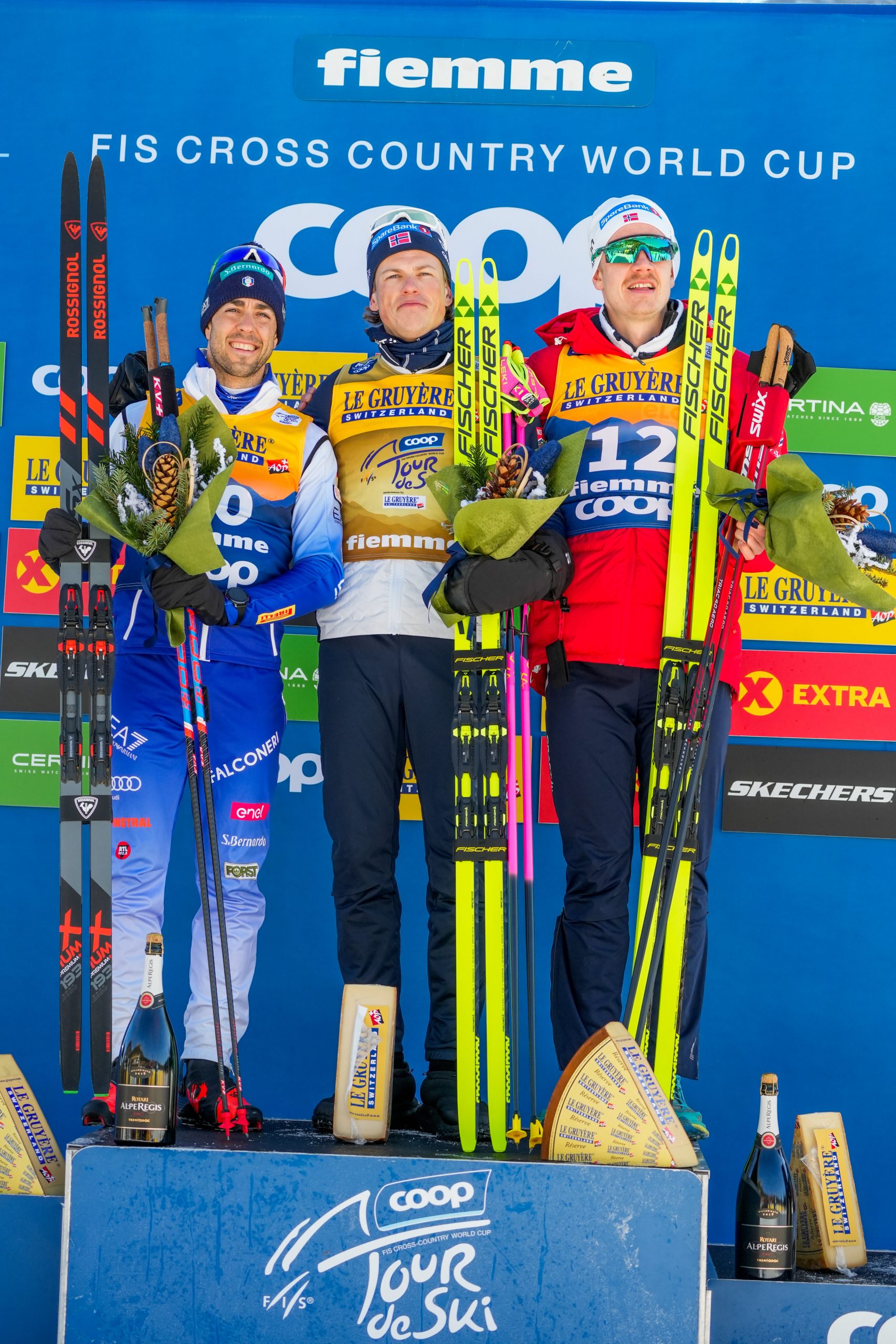
Today in Val di Fiemme, Klaebo would control the race from the front throughout the final laps, sprinting up the last hill to establish a gap he would carry across the finish line comfortably ahead of Federico Pellegrino (ITA) in second and Jan Thomas Jensen (NOR) in third. Antoine Cyr (CAN) would finish 16th, just ahead of Zanden McMullen in 17th.
Other North American finishers included Ben Ogden 21st, Olivier Leveille 24th, and Jack Young 53rd.
20 k Skiathlon
Jannik Riebli (wearing the U23 jersey) and Britain’s Andrew Musgrave (wearing the climber’s jersey) would join the leaders in the front row at the starting line of the Skiathlon. American Ben Ogden would begin the day in 14th, a disappointing position when compared to his high-water mark of third place a few days ago, but otherwise a bright spot in his career as a distance skier and all-around threat. Canadian, Antoine Cyr, would begin the day in 22nd.
Snow temperatures of -10.5 degrees celsius made for fair waxing conditions in this early morning start, allowing the 61-man field to remain together through the first of six 3.3 kilometer laps.Mika Vermeulen (AUT) moved to the front at the end of Lap 2, followed by Valnes. They would provide much of the pace-setting in the Classic laps.
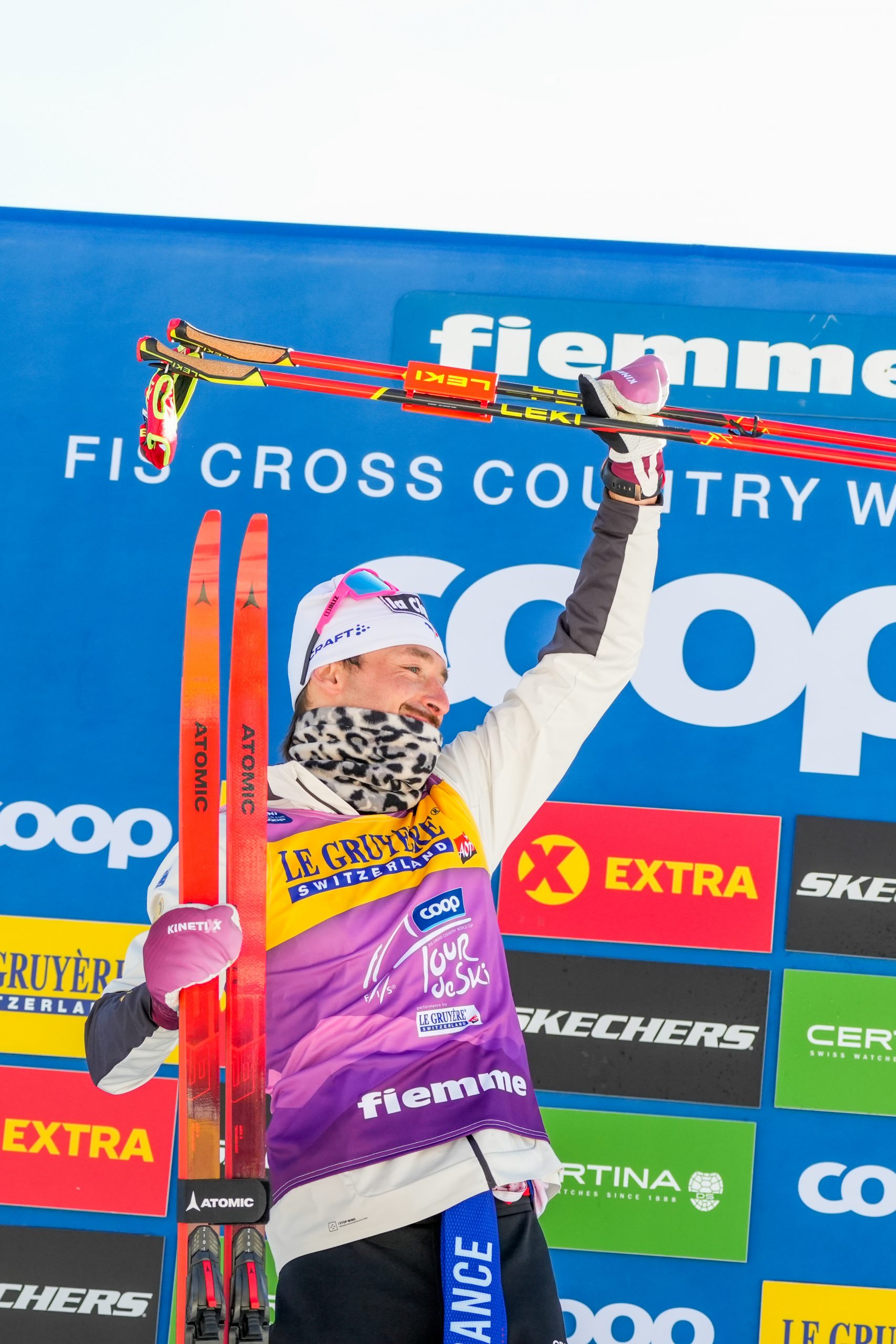
Hugo Lapalus (FRA) took over the Climber’s jersey during the Skiathlon, and appears to have energy to spare for tomorrow’s final ascent of Alpe Cermis. (Photo: Vanzetta/NordicFocus)
The ski exchange at the halfway point saw few changes to the overall standings, though Hugo Lapalus (FRA) had surged to overtake Musgrave for the lead in the Climber’s jersey. Klaebo and Valnes led the field into the exchange, while Friederich Moch (GER) was the fastest in the equipment swap, exiting the exchange zone just ahead of Vermeulen and Klaebo.
The Freestyle course was identical to the Classic course, though the positioning of a lane of Classic tracks rendered the skate course rather narrow. Some racers attempted to make progress by passing in the Classic lanes, but for the most part the narrowed lane allowed Klaebo to sit at the front where he controlled the pace through the early part of the Freestyle laps.
Nineteen racers comprised the final selection, though that group continued to string out behind the pace making of Vermeulen. McMullen and Cyr held on gamely to the tail end of the group as Vermeulen (determined to take time out of Anger who continued to fade) continued to push the pace.
Federico Pellegrino (ITA) orchestrated a marvelous second place finish with a well-timed sprint up the final hill of the 20 k Skiathlon in Val di Fiemme. (Photo: Modica/NordicFocus)
Klaebo, Lapalus, and Moch led the field through the beginning of the final lap as a resurgent Musgrave pressed the pace. In the end, Klaebo would surge up the final hill, followed by Pellegrino and Jensen. Coasting across the finish line well clear of his rivals, Klaebo extended his lead in the overall Tour standings. Valnes now trails by 2:18, followed by Haavard Moseby and Vermeulen tied at 2:29 back, and Lapalus at 2:44. Anger dropped to 10th overall, followed by Musgrave in 11th.
Federico Pellegrino (ITA), Johannes Hoesflot Klaebo (NOR), and Jan Thomas Jenssen (NOR), (l-r) share the podium after the 20 k Skiathlon in Val di Fiemme (ITA). (Photo: Vanzetta/NordicFocus)
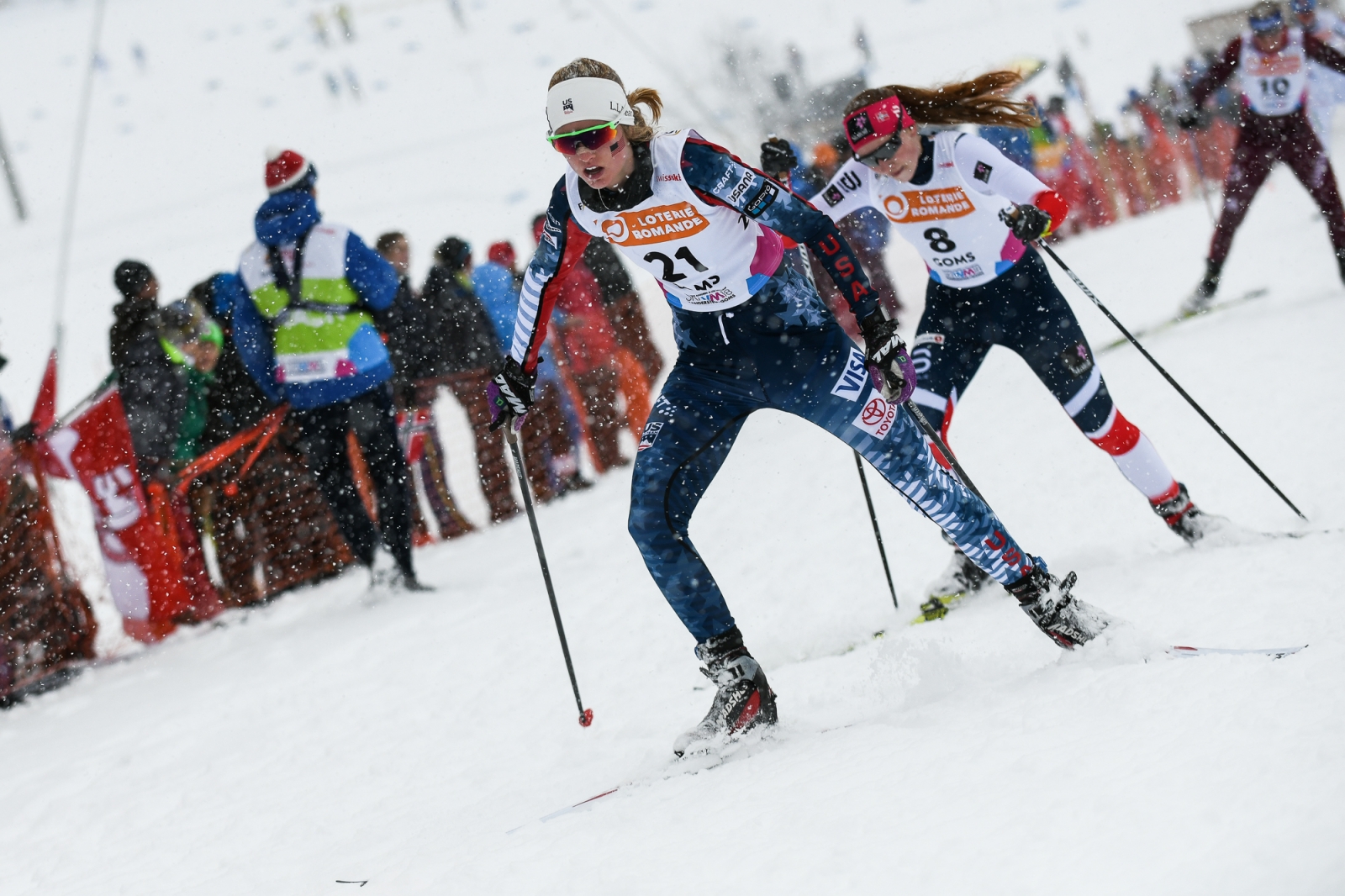
American Hailey Swirbul (University of Alaska Anchorage) leads Norway’s Lone Johansen up a climb during the second half of the women’s 10 k skiathlon on Thursday at 2018 Junior World Championships in Goms, Switzerland. (Photo: JWSC2018.ch)
(This article has been updated to include comments from Americans Hailey Swirbul and Gus Schumacher.)
Junior World Championships (Goms, Switzerland): 10/20 k skiathlons
Hailey Swirbul is 2-for-2 when it comes to podiums at this year’s Junior World Championships; in her second-straight race this week in Goms, the 19-year-old American earned a medal in a distance race. On Thursday, it was bronze in the women’s 10-kilometer skiathlon.
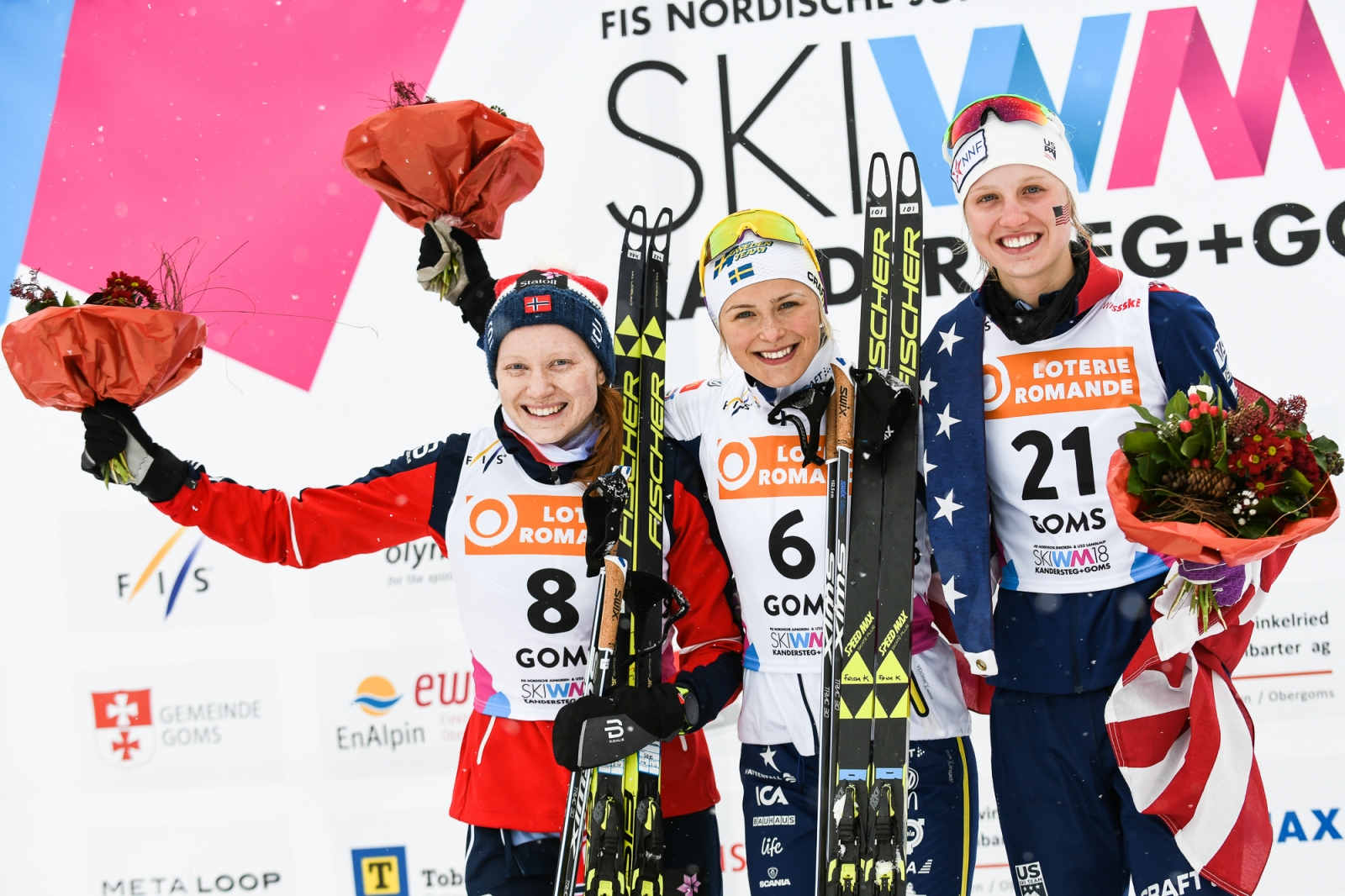
The women’s 10 k skiathlon podium at 2018 Junior World Championships in Goms, Switzerland, with Sweden’s Frida Karlsson (c) in first, Norway’s Lone Johansen (l) in second, and American Hailey Swirbul (r) in third. (Photo: JWSC2018.ch)
Swirbul, a sophomore at the University of Alaska Anchorage, closed the gap to the leaders over the final 5 k skate portion of Thursday’s race, doing so in tough, slow conditions with heavy snowfall. She ended up third in a sprint finish with Norway’s Lone Johansen, who took second by 0.7 seconds, as the two finished 35.5 seconds and 36.2 seconds behind the winner, Sweden’s Frida Karlsson, respectively.
Karlsson won it in 32:55.7 minutes. She had been second at the transition from classic to skate halfway through the race, just behind France’s Laura Chamiot-Maitral in first. Four women came through the exchange together within 2.6 seconds of first, while Swirbul was about 15 seconds back in eighth.
“Coming into the exchange I was right where I wanted to be,” Swirbul wrote in an email to FasterSkier. “I knew that some of the girls ahead of me would not be able to sustain their pace the entire skate leg. It was important for me to remember that and not try to close the gap too quickly with the Norwegian I was skiing with.”
While Karlsson broke away over the final 5 k, Swirbul helped lead the chase, moving into second and 31 seconds back on a long, steep climb at 6.7 k.
“I won’t lie, the skate leg was tough! I think everyone was suffering out there in the fresh snow,” Swirbul wrote. “I tried to conserve energy on the gradual downhill before the big climb to use on the hill.”
On the last lap, she worked to distance herself from fourth place.
“I knew that the fourth place skier was closing in on us the last lap,” she wrote. “Going up the final hill, I had to make a move to secure a podium spot and give what I had to ski away form the fourth place girl over the second to last big climb. The last few hundred meters were so intense! I didn’t have anything left to sprint it out for second place. Gotta work on that!”
Two days ago, Swirbul placed second in the 5 k classic for her first individual medal and the best-ever finish for the U.S. at Junior Worlds.
“This means so much,” she told race organizers after taking third in Thursday’s skiathlon. “I’m so happy to represent the United States here and show how we can improve in the future and what we have in our country.”
In her email to FasterSkier, Swirbul explained that she entered Thursday’s race confident yet calm.
“After my silver medal I believed in myself more than before,” she wrote. “However, I managed to stay calm and not put high expectations on myself for the skiathlon which allowed me to race my best. I was hoping to ski smart and relaxed and not be afraid to make it hurt! In a mass start that is really all I can control.”
For much of the first leg, about 4 k, she skied with what she described as “a huge pack of girls, which was kind of stressful for me.”
“It’s harder for me to match the stride of someone almost a foot smaller than I am in a classic track, so once the group broke up I was able to find my rhythm,” Swirbul wrote. “The snow storm made the tracks super slow where they weren’t skied in, so it was a waste of energy to try to pass people outside of the skied in track. I made that mistake a few times and ended up not passing anyone, just wasting energy plowing through powder.”
But her skis felt fast in both the classic and skate legs, she noted. “The wax techs have been killing it!”
With one race left, the women’s 4 x 3.3-kilometer relay on Sunday, Swirbul wrote that she was eyeing another podium.
“I think it is fair to think that our relay team has a good shot at the podium. That would be the cherry on top :)”
Karlsson told organizers that she was focused solely on the gold on Thursday.
“It was very fun today and my body felt very good, then I was just going for the gold today,” Karlsson said. In her first Junior Worlds, she had previously placed third in the skate sprint earlier in the week.
“It means a lot,” Karlsson, 18, added. “This is a very good sign that I’m doing the right thing. I have one more year left as a junior so I’m looking forward to next year’s Junior World Championships as well.”
Also for the U.S., Kathleen O’Connell (Montana State University) placed 20th (+2:18.2), Molly Gellert was 40th (+3:59.4) and Sofia Shomento was 58th (+6:25.7).
Canada’s Natalie Hynes (University of Alaska Anchorage) placed 24th (+2:40.0), Hannah Mehain was 37th (+3:54.9), Alexandra Racine 51st(+5:16.1), and Catherine Reed-Metayer 62nd (+7:17.7).
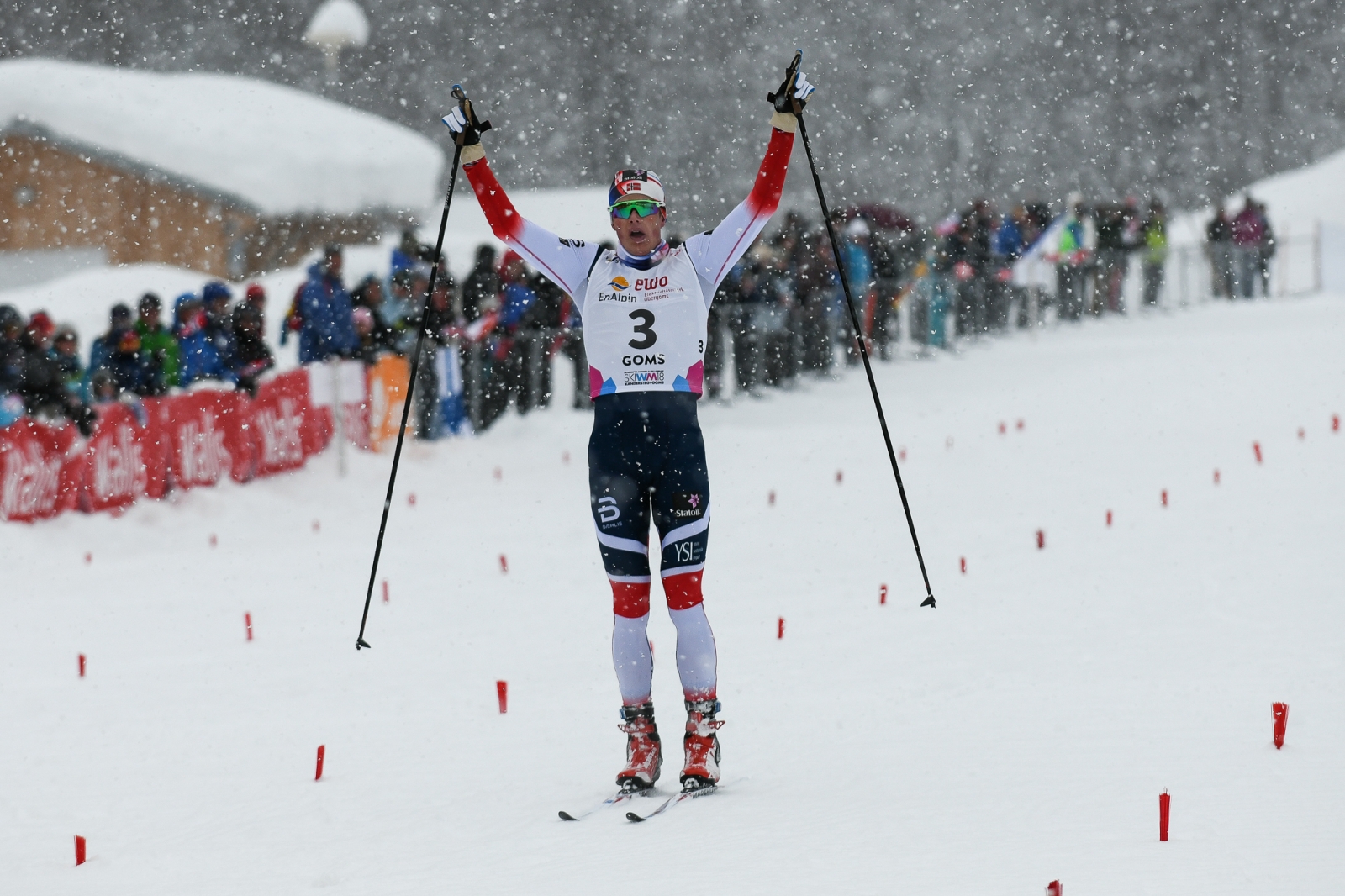
Norway’s Harald Østberg Amundsen winning the men’s 20 k skiathlon at 2018 Junior World Championships in Goms, Switzerland. (Photo: JWSC2018.ch)
In the junior men’s 20 k skiathlon that followed, Harald Østberg Amundsen pulled out a 34.7-second victory over fellow Norwegian Jon Rolf Skamo Hope, who won the 10 k classic two days ago. Norway swept the podium with Jørgen Lippert in third, 1:00.1 minutes back, two days after Lippert placed third in the 10 k individual start.
The win was Amundsen’s first individual gold after he was on Norway’s winning 4 x 5 k relay at last year’s Junior Worlds in Utah, where he placed third in the 10 k skiathlon. On Tuesday, he was fourth in the 10 k classic.
“Unbelievable,” he said during a post-race arena interview. “I tried to keep calm on the classic part, and on the skate part just tried to keep the speed up. … I tried to go fast on the beginning and end of the uphills, and a bit controlled in the middle. I think the final was great, unbelievable.”
American Gus Schumacher (Alaska Winter Stars) raced to 15th (+2:43.6) besting his two previous top 20’s this week (19th in the freestyle sprint and 17th in the 10 k classic) at his first Junior Worlds. He skied much of the race with Ben Ogden (Stratton Mountain School), who finished 18th (+2:51.2) for his second-straight top 20 (after placing seventh in the 10 k).
“My classic skis were great today,” Schumacher wrote in an email. “The techs nailed it and I had really solid kick and good glide. I was able to run up the steepest hills and kick the buildup off right at the top and glide right with everyone. During that first 10k I think I did a good job staying relaxed and now letting myself push too hard up the big climbs. The pace in the pack wasn’t bad, definitely a little rushed at the beginning but I was able to settle in well.
“On my second half I was still just focused on not pushing too hard and staying relaxed, while also keeping the pace fast and carrying speed through the corners,” he continued. “Generally I felt pretty good, but my body was just getting tired and I was hanging in there.”
While he dropped Ogden over the last kilometer, Schumacher wasn’t able to shake Italy’s Luca Del Fabbro, who finished half a second ahead of him in 15th.
“I pushed really hard up the last hill into first [ahead of Del Fabbro] but was a little weak over the top and he pulled up alongside me and crossed in front of me on the corner then almost fell,” Schumacher recalled. “Pulled up alongside on the flat, but had to get back on the inside and just couldn’t get past.
“Overall I’m pretty happy, I think I paced well and I generally executed well,” he concluded. “I think it wasn’t my best possible, but it was definitely a well-executed race.”
Also for the U.S., Hunter Wonders (Alaska Pacific University) placed 26th (+3:56.0), and Karl Schulz finished 60th (+8:30.3).
Félix Longpré led Canada in 28th (+4:07.0), Etienne Hebert followed in 30th (+4:33.3), Antoine Cyr was 32nd (+4:45.4), and Reed Godfrey 54th (+7:18.4).
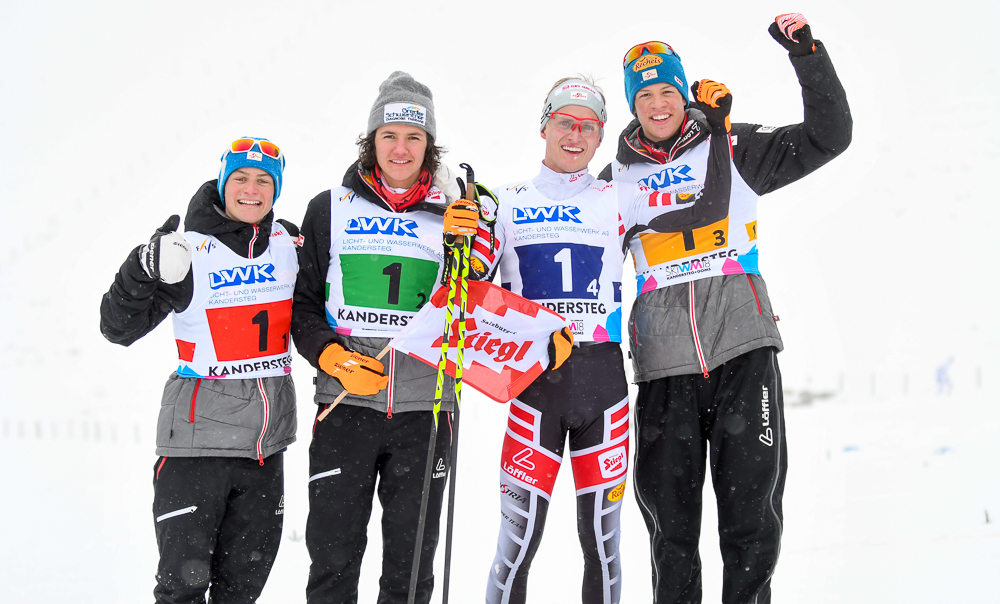
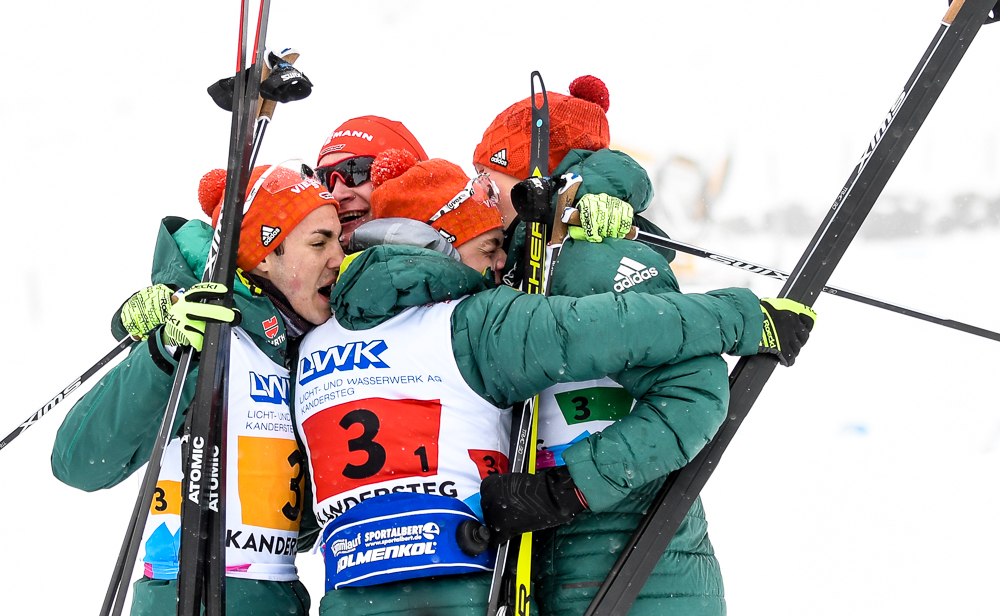
The Austrian team (from left to right: Johannes Lamparter, Florian Dagn, Dominik Terzer, and Mika Vermeulen) celebrates its win in the normal hill/4 x 5 k team event on Thursday at 2018 Nordic Combined Junior World Championships in Kandersteg, Germany. (Photo: JWSC2018.ch)
Nordic Combined Junior World Championships (Kandersteg, Switzerland): Normal hill/4 x 5 k Team Event
In the nordic combined team event at Junior World Championships on Thursday, Austria stole the show, jumping to first then finishing the 4 x 5 k relay first by nearly 48 seconds over Germany in second.
On the 106-meter normal hill in Kandersteg, Austria’s Johannes Lamparter, Mika Vermeulen, Florian Dagn, and Dominik Terzer combined for the best jumping score of the day, 11.8 points ahead of Norway (Simen Kvarstad, Andreas Skoglund, Jens Lurås Oftebro, and Einar Lurås Oftebro) in second. Germany jumped to third with Constantin Schnurr, Julian Schmid, Tim Kopp, and Luis Lehnert another 26 points back.
That put Norway 16 seconds back for the start of the 4 x 5 k relay, and Germany 50 seconds out of first in third.
The four Americans in the event, Tucker Hoefler, Jared Shumate, Stephen Schumann, and Ben Loomis, jumped to 11th out of 13 teams, and started the relay 2:46 minutes back.
Germany celebrates its silver medal in the normal hill/4 x 5 k team event on Thursday at 2018 Nordic Combined Junior World Championships in Kandersteg, Germany. (Photo: JWSC2018.ch)
Austria went on to hold its lead throughout the race, crossing the finish line first in 56:33.0 for the gold. Norway held onto second first Jens Oftebro’s first leg, then slipped to second behind Germany on the second leg. Ultimately, Germany claimed second, 47.8 seconds back, and Norway was third (+1:53.2).
The field remained largely strung out, as the Czech Republic finished fourth (+2:39.7) after starting fourth, France placed fifth (+3:07.7), up from eighth at the start, and Finland finished sixth (+3:27.6), after starting ninth.
The U.S. men improved to seventh (+3:36.4) thanks to a strong first leg from Loomis, who put them in seventh with the fourth-fastest first-leg time. Schumann then skied the fastest second leg and picked off two more places to tag in fifth at the second exchange. Hoefler slipped to seventh on the third leg, and Shumate held them there with the third-fastest anchor leg.
Nordic combined has one more event at Junior Worlds: the individual normal hill/5 k on Saturday.
American Wyatt Gebhardt (52) leads Gareth Williams in the men’s 20 k skiathlon at 2017 Junior World Championships on Friday at Soldier Hollow in Midway, Utah. Williams went on to place 11th, about 18 seconds ahead of Gebhardt in 12th. (Photo: FlyingPointRoad.com)
Earlier this week, Gareth Williams, 19 of Kelowna, British Columbia, had no idea what to expect in his first Junior Worlds Championships race. Was top 20 realistic? He’d soon find out.
Williams, of the Telemark Race Team, which, he explained will soon be known as the Okanagan Racers, raced to 20th to lead Canada in the men’s 10 k freestyle on Wednesday.
“Now that I have a taste of what it’s like here at Worlds, I can adjust my goals for the coming races,” Williams wrote in an email after Wednesday’s race. “I hope [Friday’s] skiathlon can go equally as well, if not better.”
He hadn’t raced a skiathlon in three years, so again, he wasn’t sure what to expect in the men’s 20 k classic-and-skate race. But he liked the idea of a top 15.
Gareth Williams (Telemark Race Team) on his way to a personal-best 11th in the men’s 20 k skiathlon at 2017 Junior World Championships at Soldier Hollow in Midway, Utah. (Photo: FlyingPointRoad.com)
Out of the start, Williams played it safe to avoid any broken poles.
“Early in the race I lost a lot of positions due to a typical Jr Men’s race, lower ranked skiers attacking from behind,” he said.
Throughout the 10 k classic leg, he chipped away at the places to come close to the front of the race, within sight of the leaders. He came into the transition with a group fighting for the top 10, and proceeded to pick off three or four more places in the 10 k skate leg, which is usually his stronger technique, Williams explained.
“I had a better kick at the end of the skate leg to try gap the group I was with, but France’s Martin Collet had an amazing last half kilometre and passed me with on a few hundred meters to go,” he wrote. “Being so close to a top 10 and seeing it slip away at the last second was tough for me.”
Williams finished the skiathlon 11th, 4.4 seconds behind Collet in 10th and 1:24 minutes behind the winner, Russia’s Vladislav Vechkanov (who finished in 49:40.5 for his second-straight gold in as many distance races this week).
“I am very pleased with this result today,” Williams noted. “It is exciting to ski that I have the speed to ski with the best Juniors in the world. Being so close to to the top 10 is my only disappointment.”
American Wyatt Gebhardt (in blue) racing to 12th in the men’s 20 k skiathlon on Friday at 2017 Junior World Championships for his best result and second top 20 of the championships. (Photo: FlyingPointRoad.com)
Finishing 12th, 18.7 seconds after him, Wyatt Gebhardt (Steamboat Springs Winter Sports Club) achieved a Junior Worlds career best as well as the top American. Considering Friday was his first-ever skiathlon, Gebhardt explained his goal was to have fun.
“From the start of the race I was able to move up to the front group early on … I was just trying to keep close to that group in the classic portion,” he wrote in an email. “[During the skate leg] I was able to pass two people and I was close to the guys dropping off [the front group], but I think I ran out of time to catch them.”
He finished 12th for his second-straight top 20 in his first Junior Worlds, after placing 19th (just ahead of Williams) in Wednesday’s 10 k skate.
“I am very happy about all my results I don’t think this week could of gone better,” he wrote.
Hunter Wonders (Alaska Pacific University) was the second American in the top 20 of the junior men’s skiathlon, racing to 18th (+1:57.9) after placing 16th in the 10 k skate.
Canada’s Philippe Boucher, of the Pierre-Harvey National Training Centre (CNEPH) finished 22nd (+3:15.7) for his first top 30 at his second Junior Worlds. Ryan Jackson (Team Hardwood) placed 31st (+3:52.5) and Remi Drolet (Black Jack) 49th (+6:57.3) out of 61 finishers.
Also for the U.S., Kam Husain (SMS) finished 50th (+6:59), and Logan Diekmann (University of Utah) was 53rd (+7:47.3).
Russia’s Vladislav Vechkanov leading Norway’s Harald Østberg Amundsen during the men’s 20 k skiathlon on Friday at 2017 Junior World Championships. Vechkanov took the win for his second-straight gold at the championships, and Amundsen finished third at Soldier Hollow in Midway, Utah. (Photo: FlyingPointRoad.com)
At the front of the race, Norway and Russia led the charge along with Italy’s Simone Dapra during the classic leg. Russia’s Egor Kazarinov, the silver medalist in Wednesday’s 10 k, was first into the ski exchange, followed closely by Vechkanov and Norway’s Harald Østberg Amundsen.
Dapra set the pace early in the skate leg before Vechkanov made his move to the front and never relinquished first, holding it to the finish for a 1.9-second win over Norway’s Thomas Helland Larsen. Amundsen was the second Norwegian on the podium in third (+2.2), Kazarinov placed fourth (+9.4) and Dapra fell off the pace to place fifth (+30.7).
“Two medals — it sounds unreal for me,” Vechkanov told the U.S. Ski Team in a post-race interview. “When I did the first race in the sprint, I didn’t feel so well. So I had a bad feeling for this week.”
He finished 10th in the classic sprint to start the week. Then he notched back-to-back wins, which were his first at Junior Worlds.
“I didn’t have a real tactic other than to do my best to stay in the group,” the 19-year-old Russian said. “The course is tight with a lot of athletes on one course so I was worried about falling. I also tried to save the tempo — not maximum — to save energy. On the last lap I increased my speed but I tried to control everything and look at the athletes around me to see how they felt. On the last lap, I tried to build a maximum gap to win this gold medal for Russia.”
“I have to admit it was the hardest race of my life,” Larsen told the U.S. Ski Team. “The Russians are so strong and are always amazing in the skating portion. It was so hard but I managed to stay with them almost to the last hundred meters.”
“I didn’t expect a medal today,” Amundsen said. “Today I felt really strong and on the skate I tried to go fast but I wasn’t strong enough on the finish but third place is really good. The last lap was tough. Me and the Russian had a gap for maybe five seconds but he was really strong in the finish.”
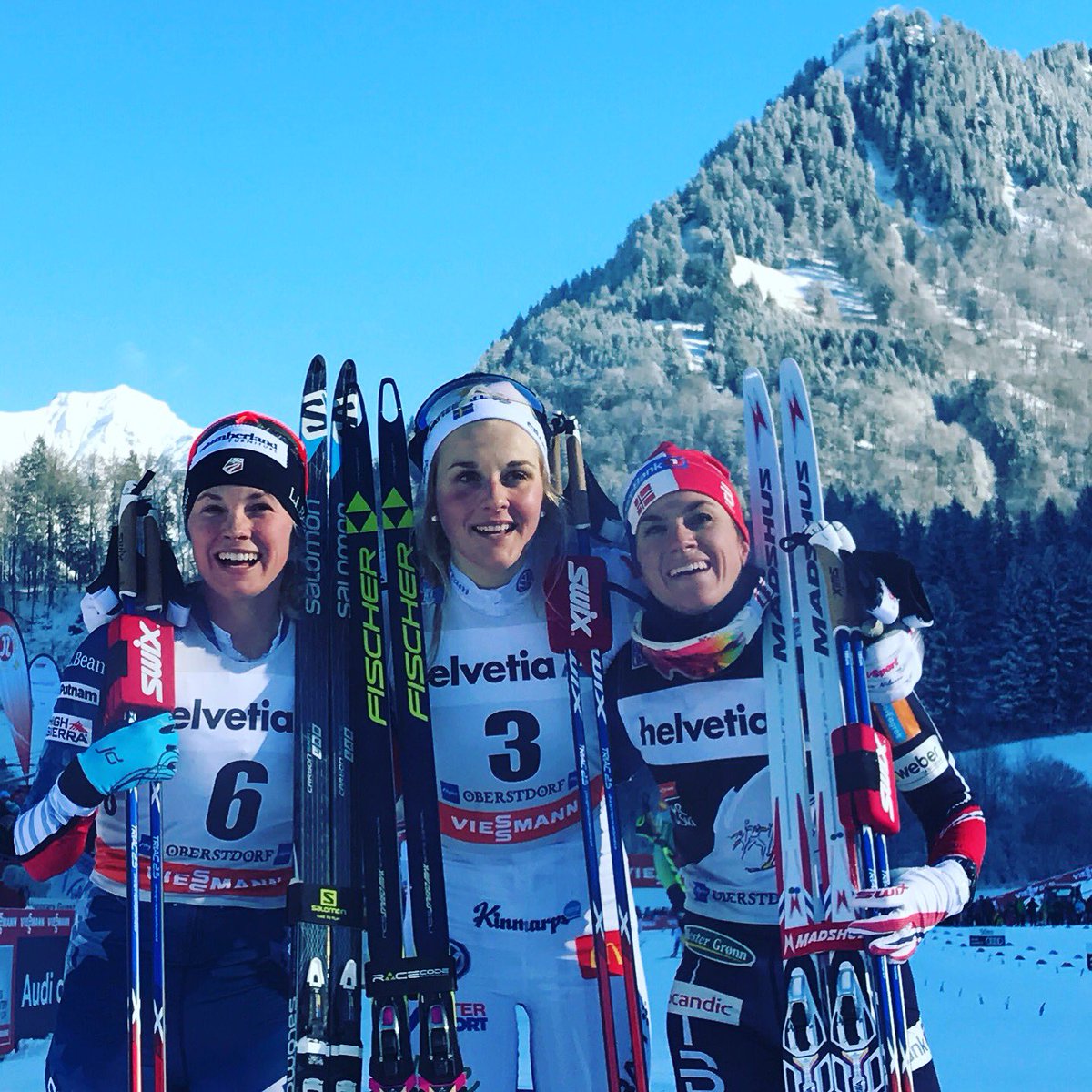
The women’s 10 k skiathlon podium on Tuesday at Stage 3 of the Tour de Ski in Oberstdorf, Germany, with Sweden’s Stina Nilsson (c) winning her first World Cup distance race, American Jessie Diggins (l) notching a career-best skiathlon result in second, and Norway’s Heidi Weng (r) placing third. (Photo: FIS Cross Country/Twitter)
FIS Cross-Country Tour de Ski Stage 3 (Oberstdorf): 10/20 k skiathlons
Positioned in third heading into the third stage of the Tour de Ski on Tuesday, the women’s 10-kilometer skiathlon, Sweden’s Stina Nilsson made the case that she’s more of an all-around threat than some might anticipate.
She contended with early leaders like Norway’s Ingvild Flugstad Østberg and Finland’s Krista Parmakoski throughout the 5 k classic leg, entering the ski exchange in eighth and 2.5 seconds out of first. Østberg led the pack in and came out 0.9 seconds faster than her Norwegian teammate Heidi Weng, while another Swede, Charlotte Kalla, emerged in third (+1.3).
Meanwhile, two Americans were setting themselves up for big finishes. Sadie Bjornsen picked off two places in the exchange to head out on the 5 k skate leg in 10th (+5.8), and Jessie Diggins left the transition in 14th (+7.6).
Diggins had previously taken the lead with Nilsson halfway through the classic leg. Despite dropping back to 18th and nearly 13 seconds back at 4.4 k in the classic leg, she quickly rebounded early in the skate leg.
Half a kilometer in, Bjornsen and Diggins moved within 5 and 6 seconds of the lead, respectively. With about 3 k to go, Diggins and Bjornsen were 3.8 seconds and 4.3 seconds within Østberg in first.
At 7.5 k, Diggins captured the lead, ahead of Kalla, Weng, and Østberg, with Bjornsen skiing 2.4 seconds back in 10th.
Despite challenges from the Norwegians (Østberg, Weng and Falla) and Kalla, Diggins kept herself in contention for the podium by attacking on the final major climb, along with Nilsson, who led her to the top. Diggins chased Nilsson to the finish and missed first by 0.2 seconds, taking second for her career-best skiathlon result. Nilsson won it in 27:23.8, for her second stage win in this Tour, and Weng notched her third straight podium in third (+1.5). Falla placed fourth (+3.3) and Bjornsen tied Germany’s Nicole Fessel for fifth (+8.1). Parmakoski ended up seventh (+8.5) and Kalla eighth (+8.8).
Diggins’s second place puts her fifth overall in the Tour, 51.4 seconds behind Nilsson, who recaptured the lead and of Østberg (now 12.4 seconds back in third). Weng is second, 4 seconds behind Nilsson, heading into Stage 4.
Bjornsen is up to 12th (+2:16.7), and her U.S. teammate Kikkan Randall is 20th (+2:32.9) after placing 28th in Tuesday’s skiathlon (finishing 43.8 seconds behind Nilsson). Also for the U.S., Liz Stephen notched 30th (+59.9) to move up to 36th overall, and Rosie Brennan finished 45th on Tuesday (+2:14.5) for 43rd overall.
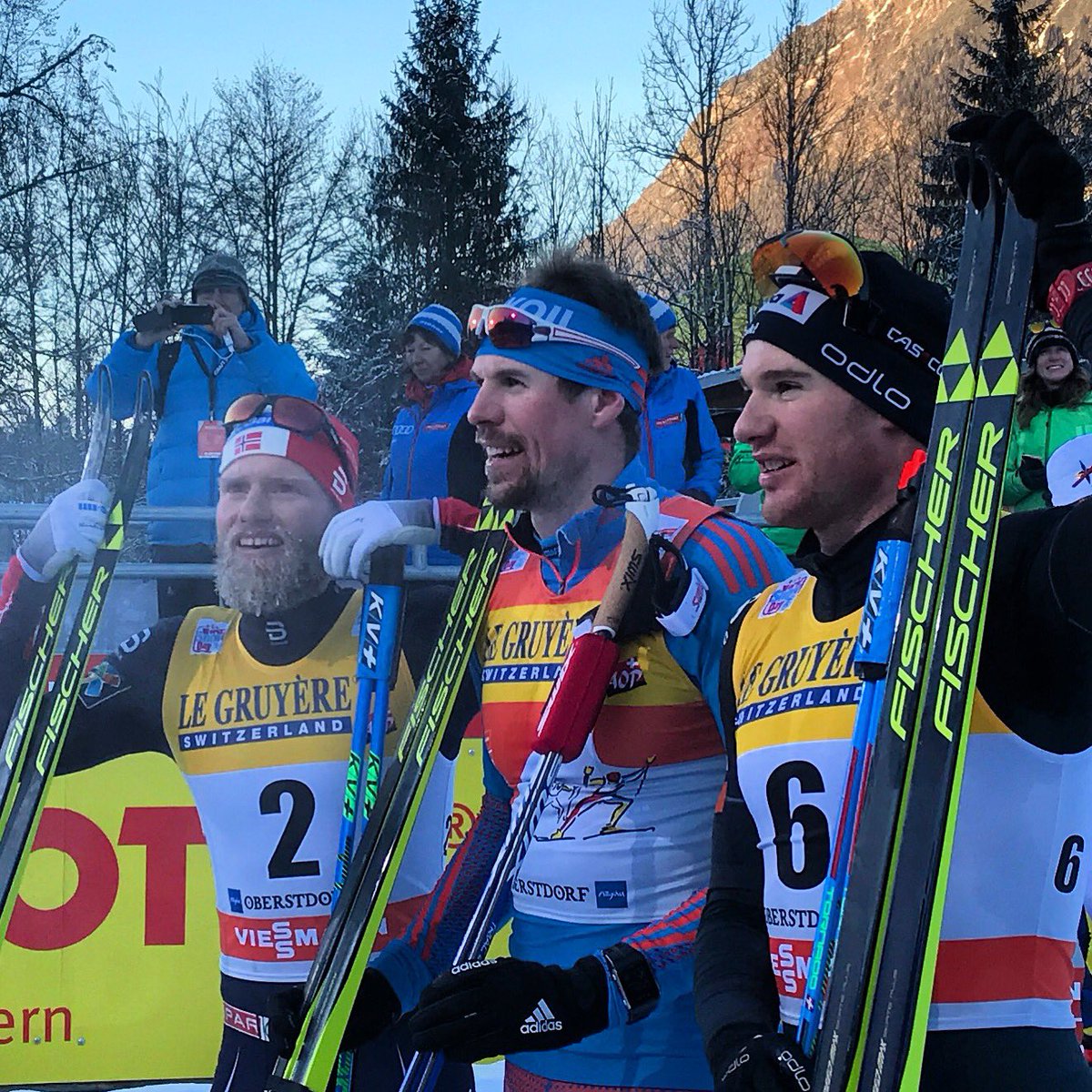
The men’s 20 k skiathlon podium at Stage 3 of the Tour de Ski in Oberstdorf, Germany, with Russian winner Sergey Ustiugov (c), Norway’s runner-up Martin Johnsrud Sundby (l), and Switzerland’s Dario Cologna (r) in third. (Photo: FIS Cross Country/Twitter)
[UPDATED] In the men’s 20 k skiathlon that followed, Russia’s Sergey Ustiugov racked up his third-straight victory in as many stages in the 2016/2017 Tour de Ski, with a 0.6-second win over his main contender, Norway’s Martin Johnsrud Sundby.
Ustiugov extended his overall lead in the Tour by about 10 seconds, while Sundby remains second, 29.5 seconds back.
Switzerland’s Dario Cologna reached the podium for the first time this season, finishing third, 1 second behind Ustiugov.
Canada’s Alex Harvey kept his overall third spot in the Tour in fourth place (+2.7), ahead of Sweden’s Marcus Hellner in fifth (+3.6). Harvey is 1:09.3 minutes back in third in the Tour standings, ahead of Cologna in fourth (+1:25.4), and Hellner in fifth (+1:42.4).
Canada had two in the top 10 with Devon Kershaw in 10th (+7.4), which puts him in 20th overall (+3:01.9).
Noah Hoffman led the two U.S. men still in the Tour in 35th (+2:06.8) while Erik Bjornsen finished 53rd (+4:22.4). Hoffman is 37th overall (+5:36.2) and Bjornsen 52nd (+7:35.6).
Also for Canada, Len Valjas was 37th (+2:10.6), and Graeme Killick was 50th (+3:33.7). Valjas is currently 32nd overall (+4:56.1) and Killick 48th (+6:35.2).
Notably, Norway’s Finn Hågen Krogh did not finish and thus withdraws from the Tour.
 This coverage is made possible through the generous support of Marty and Kathy Hall and A Hall Mark of Excellence Award. To learn more about A Hall Mark of Excellence Award, or to learn how you can support FasterSkier’s coverage, please contact info@fasterskier.com.