From the FasterSkier archive — posts syndicated from athletes’ and coaches’ own blogs between 2004 and 2012, kept online as published. Current coverage is at fasterskier.com.
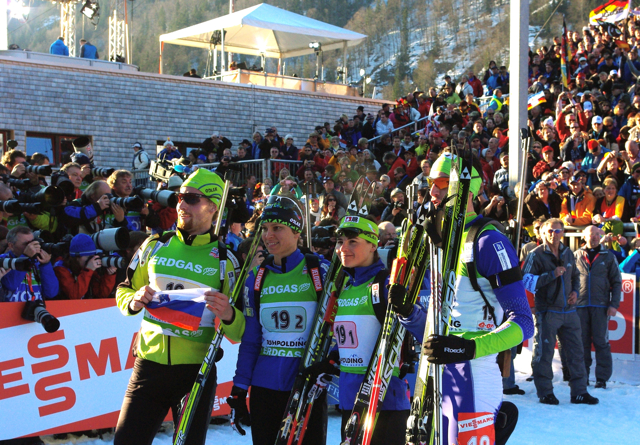
The Slovenian biathlon team of Klemen Bauer, Teja Gregorin, Andreja Mali, and Jakov Fak after winning silver in the 2012 World Championships mixed relay in Ruhpolding, Germany.
Slovenian biathlete Klemen Bauer has competed in nine World Championships and three Olympics, landing just one spot away from a medal in the sprint in Vancouver in 2010. He has a handful of top-10 World Cup finishes to call his own.
Bauer has also been a prominent voice for fair and ethical sport, speaking out in support of the anti-doping process and more recently participating in a campaign to eradicate sexual abuse from sport.
Bauer tweeted cryptically when the International Olympic Committee (IOC) announced that one athlete had been caught doping when samples from the 2010 Olympics were re-tested this year using up-to-date analytical methods. When it was announced that Gregorin was the athlete in question, he tweeted, “Sad, mad, & disappointed.”
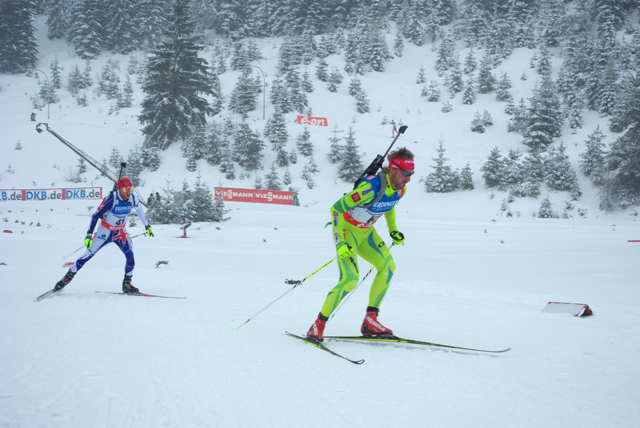
Klemen Bauer of Slovenia (right) racing at an IBU World Cup in Hochfilzen, Austria, in 2013.
In a press conference after the news was released, Gregorin said, “I sincerely apologize to all who have been affected my actions in any way.”
Among those affected are, obviously, Gregorin’s competitors, some of whom have voiced their own anger. But her teammates are also affected. Bauer, along with Andreja Mali and Jakov Fak, won mixed relay silver at 2012 World Championships. It remains to be seen whether that result will be invalidated.
Besides that, the Slovenian team’s reputation is affected.
“I feel bad for her other teammates, like Klemen, who has been at this for a long, long time, and it would seem that he will be the victim of speculation surrounding the case,” said U.S. veteran biathlete Lowell Bailey. “That’s just the natural tendency. ‘Well, if there’s one case, then how did she do it? Why did she do it? Who was helping her?’ All those questions come up.”
“Klemen is like a lot of other athletes – he is really a really hard-working, motivated, determined athlete,” U.S. veteran Lowell Bailey said in an interview last week. “He has always been a person that understands the seriousness of what it takes to be a career biathlete, but also understands that there’s a balance there. He has a son, Axel, and a family, and he has that personal balance that is important for a lot of the elder statesmen of the biathlon world. He’s a great guy and I have always enjoyed competing against him and with him.”
Bauer agreed to answer some questions about the Gregorin case and how it is affecting him and his team. The lightly edited interview is presented below, followed by more context from Bailey.
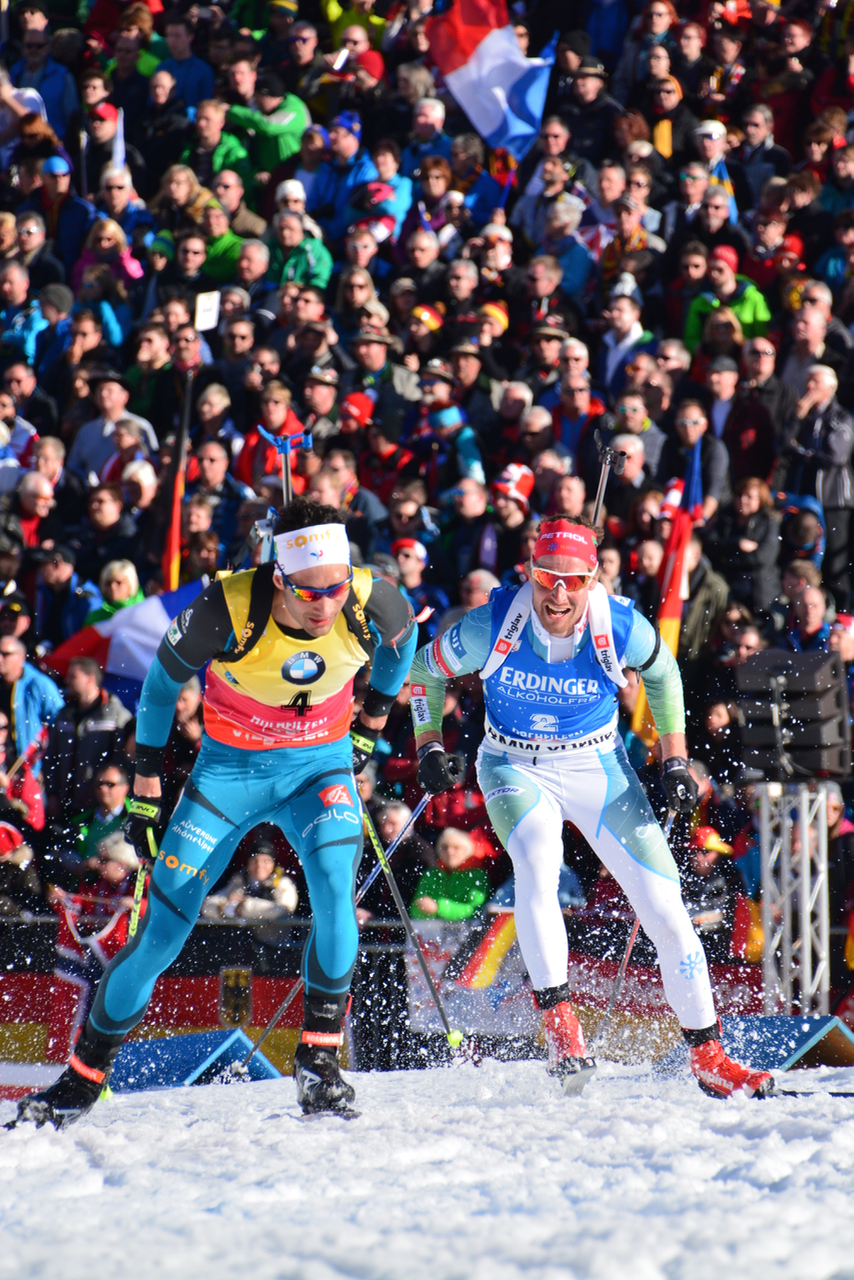
Klemen Bauer of Slovenia (right) chasing Martin Fourcade of France in the 20 k individual at 2017 IBU World Championships in Hochfilzen, Austria. (Photo: Glen Crawford)
FasterSkier: When did you hear about this case and what was your reaction? Were you with the team at the time, or did you have to process this all on your own?
Klemen Bauer: We (athletes) were informed a week before the public announcement. First reaction was shocking and frustrating. Then I was really mad and sad about it. I was on my own at the time. We were all back home.
FS:I guess you have known Teja for a long time.
KB: Yeah. I’ve known her since I was a little kid. She started in the same local club, training with her father. We were training mostly together (at training camps) for the past eight years.
FS:Would you have thought someone could do something like this with nobody else finding out?
KB: I think it’s an easy job to do it without anybody knowing it — as long as it’s a matter of an individual, which it was in Teja’s case.
FS:Do you think or do you worry that this violation by Teja will also affect your reputation? Slovenia’s reputation?
KB: Absolutely. That was actually one of my first biggest concerns. All the good stories we [Slovenian biathlon] have created in the past 8-10 years were destroyed in a moment. Well, hopefully it won’t be that cruel as I think — At this point I find it crucial to expose that it was an act of a single individual athlete. Me personally, I don’t like teams who were involved into doping scandals, so I can imagine the response of the athletes after this. But as I said, I really hope they will realize the rest of us are far away from what happened.
FS:Have you talked to any athletes from other teams/countries since the news came out?
KB: Not really.
FS:What about Teja, have you talked to her?
KB: Not at all. I have no intention to. I will wait for her to come in and explain (apologize).
FS:Has this affected your training for the upcoming season?
KB: It was hard to fall asleep first few couple of days after the news, but the training went well. Sometimes I even got an extra boost, when thinking about it – my anger came out.
FS:What about your attitude?
KB: In general after any doping scandal, my morale goes down. I would rather give up right away. But let’s say I still kind of believe in fair, clean sport (which is very naive), and probably that’s what still keeps me in sport. After recent events I’m even more determined to prove that a good result can be done in a fair, clean way.
FS:Is there anything else you would like to say about this situation, to fans of the sport for instance?
KB: I’d like to emphasize to have faith in our small team — most of other athletes are still young — and not to judge us by the act of one individual.
FS: Is this something you would have said in the past, when an individual from another team was caught?
KB: There are countries doing it [doping] on national level (supported by their government), and there are individuals. Of course a single act usually leads to suspicion of the whole rest of the team even if not so. I might be a little more careful about my judgment after this incident.
Bailey could sympathize with Bauer to some extent – the American had no idea that Gregorin had been doping, and he did not indicate that he’d ever had suspicions of the Slovenian team, who he called “always really friendly and open.”
It got more personal for Bailey when he pulled up that athletes’ petition during the interview and realized that Gregorin had signed it, adding her voice to demands for stronger anti-doping policies.
“That’s troubling to see from someone who had three positive tests – that, in my mind, represents knowingly committing an anti-doping rule violation,” he said. “To be quite honest, she was an athlete who I had a lot of respect for. She came from a smaller country in terms of biathlon and had some really impressive results. I always looked at her as an example of an athlete who was working hard within the rules. So it’s a feeling of betrayal to have something like this come out.”
Bailey emphasized that Gregorin deserves due process. When the case is over, competitors and fans may know more about how and why she decided to dope.
“I stand steadfastly behind every athlete having due process – there has been a lot of discussion about just treatment of alleged doping cases,” Bailey said. “I totally support that. I support due process and quick and fair and just proceedings. I hope that her case is treated that way. But it’s really sad. It’s really unfortunate to see that happen.”
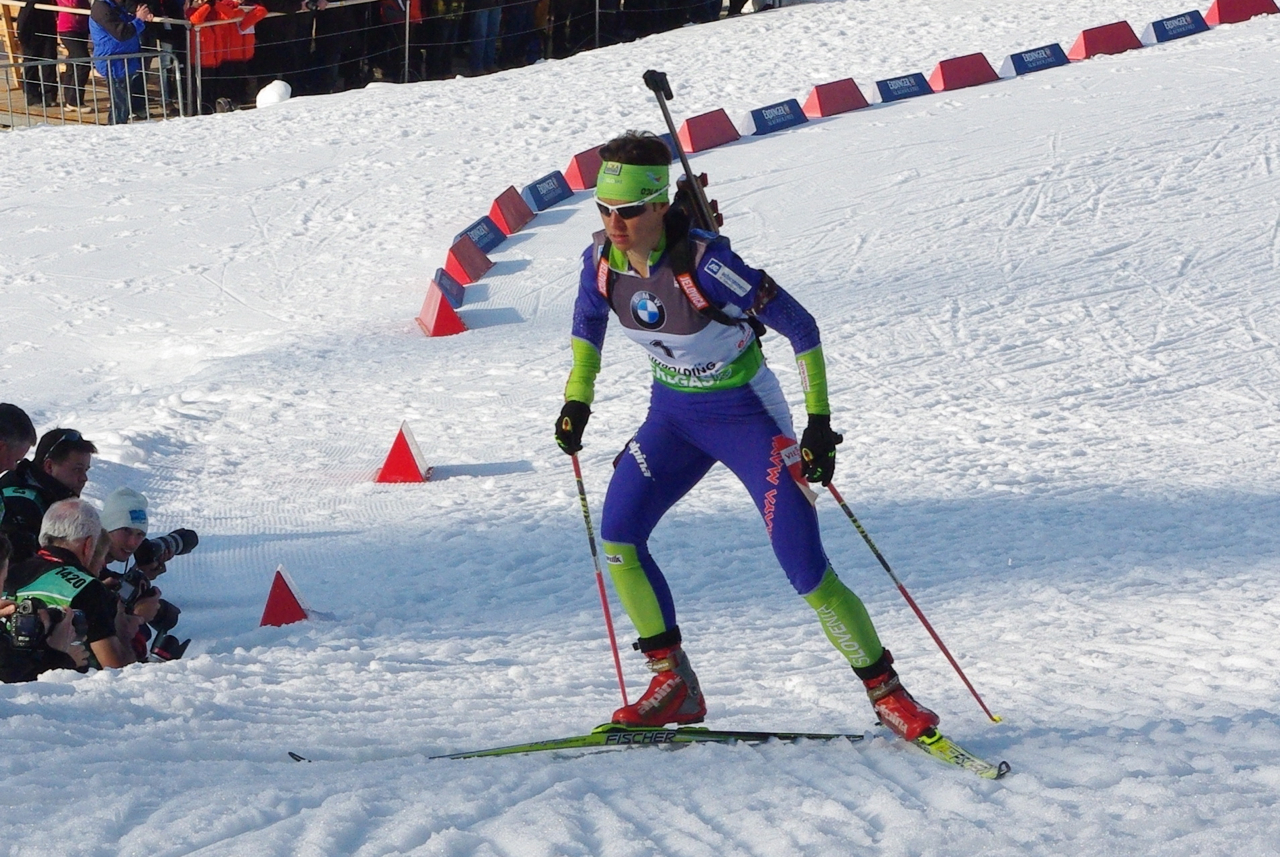
Teja Gregorin of Slovenia racing at 2012 World Championships in Ruhpolding, Germany.
The International Olympic Committee (IOC) recently finished re-testing stored urine samples from the 2010 Olympics in Vancouver, Canada. The goal was to use new analytical methods to detect substances which were not detectable back in 2010.
Of the more than 1,000 samples re-analyzed, only those belonging to a single athlete were found to be positive for prohibited substances, the IOC announced earlier this month.
That athlete is now revealed to be Slovenia’s Teja Gregorin, a biathlete who finished fifth in the mass start in Vancouver. Reportedly, three different samples belonging to Gregorin tested positive, all for Growth Hormone Releasing Factor-2 (GHRP-2), a growth hormone releasing peptide. Gregorin has been provisionally suspended by the International Biathlon Union while her case proceeds.
“I accept temporary suspension,” Gregorin said in a press conference organized by the Slovenian ski federation, according to a translation. “I will participate in the follow-up proceedings, but I ask for understanding because the World Anti-Doping Code prohibits public comments on ongoing cases. I sincerely apologize to all who have been affected my actions in any way.”
Gregorin read from a prepared statement and did not take questions from the press.
This entire class of substances were banned by the 2010 WADA Prohibited List in section S2, which bans “The following substances and their releasing factors” before listing growth hormones. This was later clarified; the 2017 Prohibited List explicitly lists GHRP’s, prohibiting “Growth Hormone (GH) and its releasing factors including… GH-Releasing Peptides (GHRPs), e.g. alexamorelin, GHRP-6, hexarelin, and pralmorelin (GHRP-2).”
GHRP’s are not the same as human growth hormone (hGH), a widely discussed treatment in professional sports and one for which Estonian cross-country skier Andrus Veerpalu tested positive.
Instead, these peptides spurs the body’s own production of growth hormone. As such, they improves health, recovery, the immune system, and anti-aging. GHRP-2 is a synthetic drug used to treat growth hormone deficiency. In a doping context, it is known to help maintain a lower level of body fat.
Gregorin finished ninth in both the sprint and pursuit in Vancouver.
Four years later in Sochi, she earned bronze in the pursuit at the 2014 Olympics with a determined and gutsy long sprint finish. She also placed fourth in the mass start there.
A team veteran, Gregorin also competed in the 2006 Olympics. She won silver in the 15 k individual at 2009 World Championships and later contributed to a silver-medal mixed relay effort for Slovenia at 2012 World Championships along with Andreja Mali, Klemen Bauer, and Jakov Fak.
FasterSkier’s coverage of the 2015 FIS Nordic World Ski Championships in Falun, Sweden, is brought to you by the generous support of L.L. Bean, now featuring a complete line of Kikkan Randall training wear.
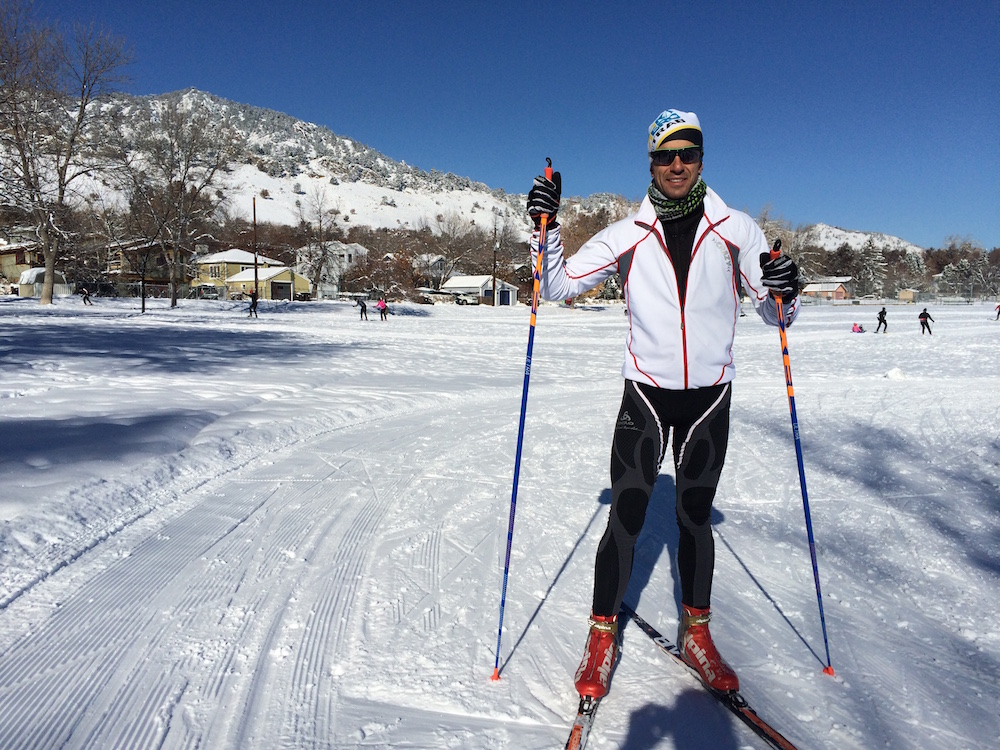
Carlos Lannes has seen the world, and he’s been around when it comes to cross-country skiing. Leading up to his fourth-and-final World Championships, the 36-year-old Argentine Olympian, who now lives and coaches in Boulder, Colo., provided a glimpse of his journey as a international competitor over the years.
Born in Ushuaia, Argentina, Lannes started skiing for his home nation before moving to Spain around age of 20 to continue his professional pursuit of racing. About seven years later, he joined the Spanish Civil Guard Team, and in 2010, he qualified for the Winter Olympics in Vancouver, British Columbia, where he placed 82nd in the 15-kilometer freestyle. Just over a year ago, Lannes moved to Colorado, where he has been coaching the Boulder Nordic Junior Racing Team (BNJRT) this winter.
This afternoon in Falun, Sweden, Lannes was listed to compete in the men’s 10 k freestyle qualifying race, with the top 10 men from that race earning starts in the distance events at 2015 Nordic World Ski Championships: the skiathlon, freestyle individual start and mass start (as well as the classic-sprint qualifier, which all competitors automatically have the opportunity to race).
***
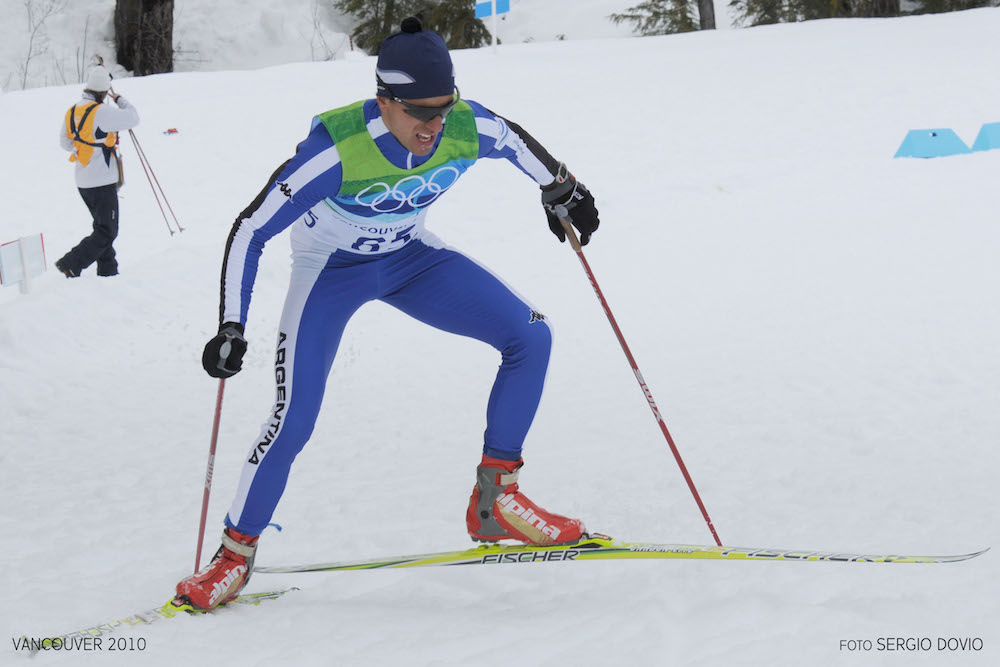
Carlos Lannes racing for Argentina at the 2010 Winter Olympics in Vancouver, British Columbia. (Photo: Sergio Dovio)
FasterSkier: Can you tell us about your early days in Argentina, who influenced you there and how you learned to ski?
Carlos Lannes: I was born in Argentina, where my passion and devotion for the sport of cross-country skiing began. I started practicing this sport thanks to a winter sports development program in my hometown, Ushuaia, which is also named the World’s End, being the southernmost city in the world. As I grew up, this is also where I began to compete in national and provincial races, obtaining my first results.
Looking back at this early stage of my life in Argentina, there were a lot of important people throughout my career in cross-county skiing and to whom I owe all of my respect and will always be thankful for the valuable impact they had in my life. I cannot name one single person that inspired me to pursue a career in this sport. However, I was very inspired by the numerous cross-country skiers at the time when I was living in Argentina, pushing and motivating me and my fellow skiers and friends to learn and train harder, to compete, and to follow our dreams.
FS:When and why did you move to Spain? Who persuaded you to do so and whom did you ski with there?
The Spanish Biathlon National Team, which Carlos Lannes trained with, including Diego Ruiz (a three-time Olympian and one of Spain’s top cross-country skiers), Ismael Bouza and Pablo Bouzas. (Courtesy photo)
CL: In 1999, my passion for cross-country skiing drove me to travel and move to Spain, close to the countries that have shown to be the best in this sport — such as Sweden and Norway — and in the hopes of fulfilling my dream of participating in the Olympic Winter Games. I was also highly motivated by other Olympic athletes, such as Luis Argel and Martin Bianchi, who invited me to take the opportunity to train and pursue my career in Europe.
In my early beginning living in Spain, I lived in a small valley, Val d’Aran, in the Catalan region. This is where I was given the opportunity to work and train and begin to grow as an athlete in Spain. My first club in Spain was CAEI, where I began to compete and allowing me to obtain my first results in the national circuit.
In 2006, my improved results and skiing level in the Spanish cross-country skiing competitions opened the doors for me to be a part of the Spanish Civil Guard Team. Therefore, I moved to Jaca, Aragon, and began to ski in one of the best teams in Spain, which allowed me to compete at a higher level, alongside many excellent athletes who have represented Spain in the Winter Olympics.
This prestigious team is a benchmark for young athletes in Spain and I will always be thankful for the opportunity to be able to grow professionally, as well as personally, in this highly valued institution. Without the help of the Spanish Civil Guard, I might not have been able to participate in the Vancouver Winter Games, since they generously provided me with permits for training and days away from work, for different races in preparation for the games.
Born in Argentina, Carlos Lannes moved to Spain to train for more than a decade before representing Argentina at the Vancouver Olympics and three World Championships. He’ll compete at his fourth World Championships in Falun, Sweden, this week. (Courtesy photo)
FS: How was your Olympic experience, and how were you funded and supported as an athlete pursuing that dream?
CL: In 2010, I participated in the Vancouver Winter Olympic Games, which was one of the most gratifying experiences of my life as a skier. Prior to the games, I also had the great opportunity to train with the Spanish National Team, who supported me in many aspects, including traveling, skiman services, helping me in my training program and periodization, among other things. They gave me the opportunity to be a part of a national team, which was a great learning experience for me in my career. At the same time, the Argentinian Federation supported me when competing internationally, such as for the World Championships and at the Winter Olympics in Vancouver.
FS: Who did you learn from along the way?
CL: During my time in Europe as a competing athlete, I had the great pleasure to share with other great teams and athletes from all over the world. In particular, after the games in 2010, I had the great pleasure of training and learning from the Rastelli family and Polisportiva Le Prese, in Sondalo, Italy, where I have been very fortunate to train with one of the best group of trainers and young athletes in Italy. Coming from a country where cross-country skiing is a minority sport, I have been blessed to be given the opportunities that I have had and to have achieved all that I have.
FS:Where did you meet your wife, and why did you move to Boulder?
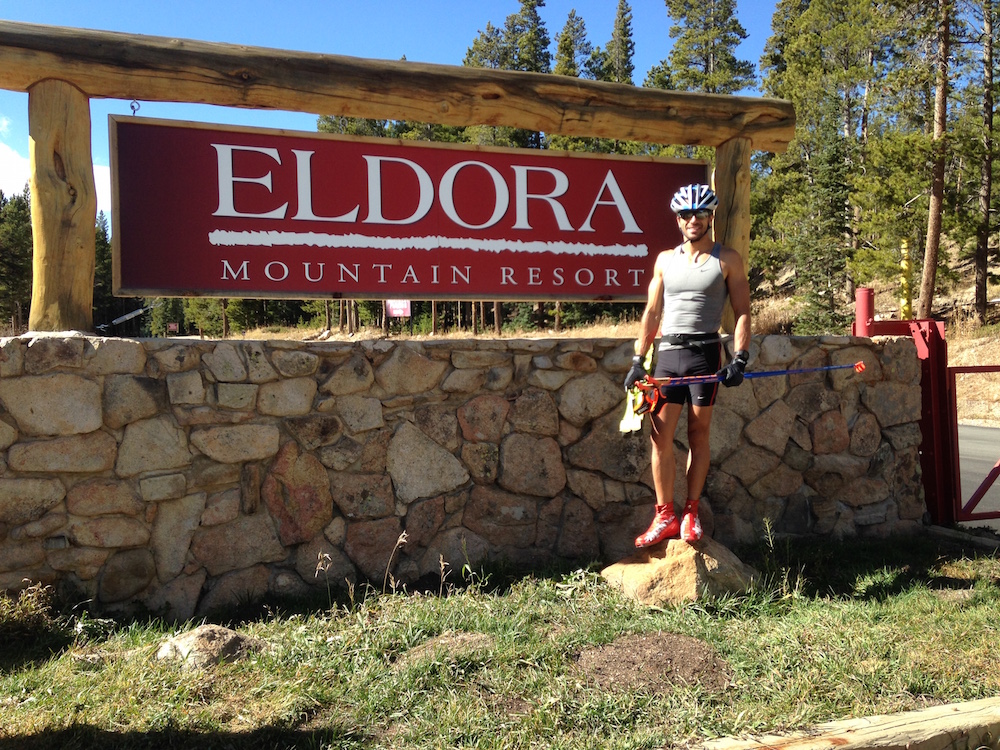
Carlos Lannes during a dryland workout at Eldora in Nederland, Colorado, last year. (Courtesy photo)
CL: My wife and I met in Spain some years back, during a trip she made to Europe with her sister and a friend, and in 2012, we got married and I began my masters in the Spanish Olympic Committee. My wife was born in Toronto, Canada, however, her family is from Uruguay, Argentina’s neighboring country, where she spent part of her life growing up. For this reason, we share a very similar culture and values.
Last year, as I finished my studies, my wife and I decided to come to the United States from Spain to live closer to our family, take advantage of improving my English, and have the opportunity to share my experiences with the younger athletes in BNJRT. We moved in May 2014, and settled in Superior, a small town close to Boulder, Colorado.
FS: How do you like coaching juniors?
Carlos Lannes, now a coach with the Boulder Nordic Junior Racing Team, skiing last November near Boulder, Colo. (Courtesy photo)
CL: I sincerely appreciate the opportunities that I have been given, Head Coach, Adam St. Pierre, and BNJRT. It is a true pleasure and with great pride that I help coach the young talented athletes and I am involved in their improvement in a sport that is my true passion, and that with great perseverance has led me to open doors on both sides of the Atlantic.
FS: Why have you decided that Falun would be your last World Championships as a competitor, and what you hoping to do there? Who will help support you?
CL: I decided that Falun will be my last World Championship because is time to pass on my experiences and skills on to others in a new and exciting period of my life. My support staff will include my friend and Italian skiman and Head Coach Ivan Rastelli, as well as Martin Bianchi, former Olympic skier, and close friend Mattia Pazzola. I can only hope that my dedication and hard work throughout the years will serve to inspire all the young athletes to be all that they can be and fulfill their own dreams in the sport of cross-country skiing.
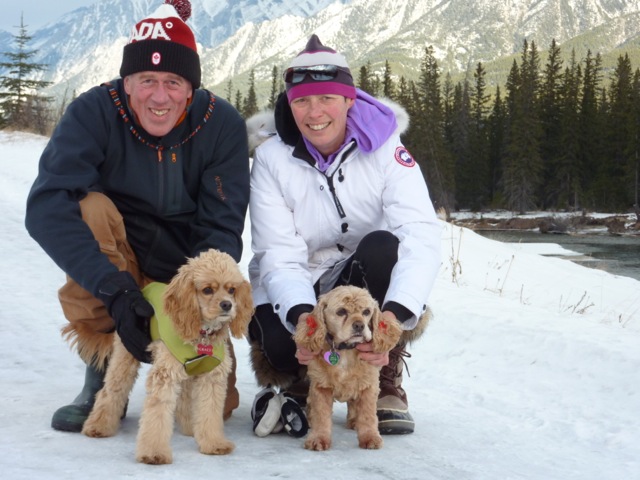
Dave Wood, Alison and their two Cocker Spaniels (Courtesy photo)
Several weeks ago, I received an email from Dave Wood, a longtime head coach of the Canadian National Ski Team. He had just arrived in my hometown of Mammoth Lakes, Calif., with a small group of athletes from Black Jack Ski Club in Rossland, B.C. We planned a rendezvous to catch up and to chat about the local training hot spots.
It had been a few years since Wood had been in Mammoth with skiers. Back around 2003 or 2004, during his tenure as Canada’s national-team head coach, he had discovered this high-altitude training location through an online search and some U.S. distance running links. A reconnaissance to the area gave him all the information he needed: a “live high and train high or low” scenario with great fall weather and miles of trails and open roads.
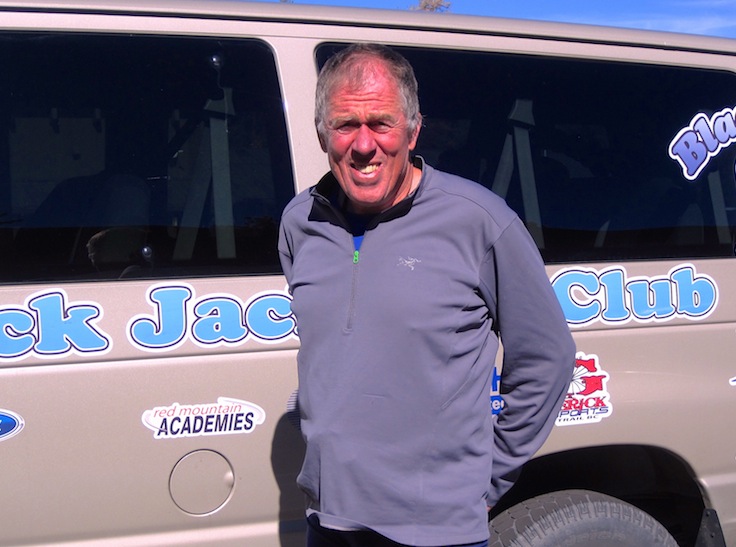
Dave Wood during a recent altitude dryland camp in Mammoth Lakes, Calif.
For several subsequent falls, Wood and his national team left their home base in Canmore, Alberta, for three weeks of high-altitude sunshine in the Eastern Sierra. Now, Wood was back, this time with a few dedicated athletes from Black Jack, of which he had been the head coach since 2010.
The Black Jack camp format was similar to the national-team camps he ran in Mammoth years before. Condominium living at just over 8,000 feet gave athletes rollerskiing options right out the door, with single-track running trails not too far away. Proximity to the town of Mammoth Lakes offered a fitness club, grocery store, and some rest day “in-town” opportunities were just a short bike ride away.
As Wood explained over coffee, the beauty of coming to Mammoth was the convenience of being able to stay in town and drive 40 minutes down to 4,000 feet for intensity training. He raved about the “exceptional rollerskiing,” where on one lonely road leading to Nevada, his athletes saw only a handful of cars during an over-distance rollerski workout.
I had hoped to join Wood and his Black Jack skiers for several workouts, but managed just one: a long run in Lower Rock Creek. Wood had to leave town for a couple of days, so he enlisted me to take the athletes to a nearby trailhead for their run over Duck Pass. Several inches of snow overnight jammed up that idea, so I drove down the hill with the guys and Chisa Obayashi, a Japanese skier who has been training under Wood’s supervision the past few months. I had in mind beginning the run out of the snow zone at the Paradise trailhead, just north of Bishop, Calif.
The Black Jack Ski Club, with head coach Dave Wood, while hiking Mount Assiniboine on the Great Divide on the British Columbia/Alberta border in August 2011. (Photo: Dave Wood)
Tagging along on the run through towering Jeffrey pines and golden aspens, I was able to learn a little bit about the Black Jack athletes. David Palmer and Colin Ferrie, accomplished junior skiers, are heading into their first year as seniors. They, along with teammate Julien Locke, who missed the trip due to an injury, are among the best in their age group in Canada. They have had solid training all summer including a trip to get on snow at the Haig Glacier. Following their Mammoth camp, they will be heading to Canmore for some time on Frozen Thunder.
An adopted Black Jack skier, Obayashi made the trip down to Mammoth with the men’s team and was also planning to join them after in Canmore, where she would get some snow kilometers before going to Finland for the start of the racing season. Obayashi connected with Wood through her manager in Japan and had only positive things to say about her training experience in North America, she told me as we ran on the Lower Rock Creek trail.
The kind of individualized coaching she was receiving from Wood was hard to come by in Japan. She had no regular training group in Japan, so the opportunity to train with Black Jack was setting her up well for her quest to make the Japanese Olympic Team.
Chief, Cook and Bottle Washer
A few days later, I met up with Wood again for lunch. He pulled up in the team van on time, but appeared a bit flustered. Dressed in running clothes, he explained that he had dropped off his group over in June Lake to do a three-hour, point-to-point run. He then drove to the termination of the run, parked and began to run the trail in to meet the athletes. They ended up missing a key turn and added nearly an hour to their run. Wood shook his head, muttering something about knuckleheads, but it was hard for Wood to disguise his pride in his skiers.
The soft-spoken 58-year-old Wood is unflappable, handling his role as “chief, cook and bottle washer” for Black Jack in his customary professional manner. He uses the same thorough and systematic system to train his club skiers as he did to build a solid Canadian team. Wood uses the Mammoth camp as an altitude block is based on science, experience and much thought. There is even a short recovery phase when the athletes pack up and go down to 4,000 feet to sleep.
Dave Wood at the 2010 Olympics in Callaghan Valley, British Columbia. (Courtesy photo)
Four years after resigning from his position at Cross Country Canada following the 2010 Olympics, Wood seems to have landed on his feet. As he explained it, after 18 years with CCC, holding positions as head wax technician, head coach and team leader, it was time to move on. He described his transition without a trace of rancor. In fact, the move to Rossland seemed like the most natural thing in the world.
After eight years of commuting from Canmore to Rossland to see his girlfriend (about a 6 ½-hour drive in good weather), Wood saw his exit from CCC as the perfect opportunity to move in with Alison, an operating-room nurse at a local hospital. At the same time, Black Jack was looking for a head coach, so Wood felt the timing was perfect.
Black Jack is a well-established nordic club with over 700 members. It offers programs for 4 year olds to masters, with a small, but active racing program. Ski Academy opportunities are available for Black Jack skiers, as well as for the local alpine program, Red Mountain Racers.
With about 3,500 residents, Rossland is nestled in the Monashee Mountains of the West Kootenay region at an elevation of 3,410 feet. Winter sports are a big deal there, which usually has skiing from early November through late April. Red Mountain Resort boasts an average 300 inches of snowfall per year and the Black Jack trail system features 40 kilometers of groomed track, a lighted loop, a kids terrain park, and a biathlon range. An extensive mountain-bike park offers single track riding and running during the summer, making Rossland an ideal home for a nordic skier.
Wood’s approach to ski racing is simple. He believes the bottom line is using the training to become faster.
“You can’t improve by just going to Europe to race,” he said. “You have to figure out a way to cut 45 seconds over 15 kilometers before going.”
He likes to keep travel to a minimum during the training phase in order to accomplish goals. There are so many training and racing opportunities out there for skiers, but it’s easy to lose sight of what you are really after, which can boil down to those 45 seconds.
Thoughts from a Former Coach
While Wood has been busy with Black Jack the past several years, he’s kept an eye on what is happening at the national level in Canada. Coaching the nation’s top skiers through CCC gave him perspective on his job as a club coach, which notably has different viewpoints and team structure than the nation’s four training centres. There is a lot of training, racing and experience necessary to bridge the gap from club to national-team skier and even more to move into the international realm.
Wood’s approach to ski racing is simple. He believes the bottom line is using the training to become faster.
On the state of skiing in Canada, Wood has definite concerns. He recognizes the success of the women’s team in recent years, with medal performances by Beckie Scott, Sara Renner and Chandra Crawford, and a men’s team highlighted by Devon Kershaw’s overall second place in the 2012 World Cup, and Kershaw and Alex Harvey’s sprint championship title at the 2011 World Championships. The problem CCC faces is a lack of depth in its program, he said.
Wood sees the potential for Canadian success at Sochi in the sprint and team sprint. On the Canada’s stated goal of winning two medals, Wood said, “You have to ski the race before you win the medal.”
While Harvey is a proven racer, Kershaw has to have a better year than last year for any of this to happen, he said. Wood sees lack of depth on the women’s side as a liability, as well as problems with the Olympic qualification system. It’s difficult to compete against teams like Russia, Norway and Sweden that have large pools of athletes racing at a high level. Those countries can play with putting athletes with fresh legs out in every race.
One of the underlying problems he sees within the Canadian system is that all of the funding is at the World Cup level. He estimates that what was CCC’s $180,000 dollar budget in 1999 is probably now close to a $2-million dollar budget. Development is left up to the four training centres. While these centres are nationally funded, Wood said there’s a lack of a coaching system, resulting in inexperienced coaches.
In his opinion, the biggest hurdle for athletes taking part in the training centres is the cost. At a given training centre, he estimated $12,000 Canadian dollars covers a year of coaching and four weekends of racing, but by the time the racing season is over, participants doll out $20,000 to $30,000 annually. Sponsorships are difficult to come by and jobs are low-paying in the training centre locales. Wood isn’t sure enough athletes are going through the system to build the kind of depth CCC needs to become an international power.
Adding to the situation is the lack of skier development opportunity through the Canadian universities, he said. Lots of junior athletes are dropping out of the sport at 18 years old to get an education.
Wood is confident that what he is providing at Black Jack is an affordable, high-quality program for juniors and seniors to help make the jump to the international level. A lot of money is spent on Integrated Sports Teams at the national training centres, he said. Besides the expense of these doctors, trainers, massage therapists, etc., is the cost of waxing and equipment.
“Cut down on this nonsense, and it would be affordable,” Wood said.
Wood keeps expenses down for his athletes by, once again, keeping things simple. He keeps his wax box stocked with a minimum of wax brands, and while not denying that wax technology is a major element of ski racing, he said it helps to remember what the race really comes down to.
“Cut down on this nonsense, and it would be affordable.”
After the Mammoth camp, Wood and the Black Jack skiers planned to head back to Rossland for a short break. Wood had a few days of downtime with Alison and their two Cocker Spaniels, then was due in Canmore for an on-snow camp at Frozen Thunder.
The schedule in November is dedicated to snow camps in Vernon and Rossland, with racing kicking off at December NorAms in the same locations. Things ramp up in January for the Black Jack skiers, with a NorAm in Canmore, the qualifier for Olympics, U23, and Junior World competitions. The remainder of the season sees the team criss-crossing Canada attending Eastern and Western Canadian Championships, and Canadian Championships in Newfoundland in March. The season concludes with March BC provincial events.
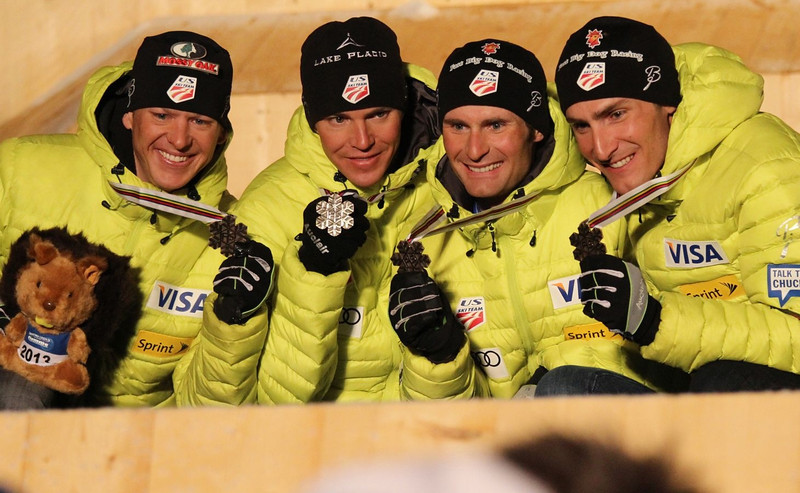
Billy Demong (second from l) with U.S. Nordic Combined teammates Todd Lodwick (l), Bryan Fletcher and Taylor Fletcher (r) after taking bronze at 2013 Nordic Combined World Championships in Val di Fiemme, Italy. (Photo: Fiemme2013)
Billy Demong’s in for a big weekend. A short detour to his old stomping grounds in Lake Placid, N.Y., for the US Ski Jumping and Nordic Combined Championships this weekend will be followed by a Monday morning flight to Europe for his team’s final overseas training camp in Austria and Germany.
On Sunday, he’ll shoot for his first national title in Lake Placid (the championships alternate between there and Park City, Utah where Demong and most of the U.S. Nordic Combined Team are based now). Raised in Vermontville about 20 miles away from Lake Placid, the Olympic gold-and-silver medalist and eight-time national champion has some fond memories of Placid and a little unfinished business.
But he’s not too stressed about it. For the better part of this fall, his life’s been much of a whirlwind. Late last month, a two-day trip to Chicago for one of his newest and biggest sponsors, USG, led him to Colorado Springs the next day to meet more members of the construction corporation. One day later, Demong was back home in Park City for an all-day U.S. Olympic Committee media summit and photo shoot, then hopped on a plane that night for Los Angeles. His 9:30 p.m. departure was delayed to 11, and Demong arrived in L.A. at 1 a.m.
The next morning, he woke up at 6. He was supposed to do intervals before another jam-packed day of non-skiing business.
“I said, ‘I’m not going to make it,’ ” Demong recalled in a recent phone interview. So he skipped the workout.
Some athletes would look at a schedule like that and think, what a pain, but not Demong. Just over a week ago, he had an interview with Men’s Health scheduled and NBC was coming to his house for five or six hours the same day.
“They want the family here, too,” Demong said, which meant his wife, Katie, and 2 ½-year-old Liam. “They want breakfast with the Demongs.”
They also planned to film while he trained.
“It’s part of the job,” Demong, 33, said. “I feel like we owe it to nordic skiers in particular to take advantage of these opportunities. It’s all well and good to be a champion; you can win a race, but if you don’t appeal to the public, then it doesn’t help grow the sport outside of the normal beat.”
Billy Demong became the first American to win gold in a nordic event at the 2010 Olympics. Without as much pressure for the 2014 Games in Sochi, Russia, he’s hoping to close his career on another high note.
Ever since the 2010 Olympics in Vancouver, B.C., where Demong became the first American nordic skier to win gold and also captured silver in the team event, he’s noticed a trend. U.S. Nordic Combined’s success in Vancouver was unprecedented and with that came recognition. But over the years, memories fade.
Four years later, Demong said most people don’t recognize him outside his community or out of context anymore. But some, like the man who recently picked him up at the airport, remembered Demong as “that skier.”
“We’re not so famous that we get recognized by face, but people are starting to think about our success,” he said. “We have a lot more darts to throw at the board.”
By darts, Demong meant talent across nordic sports: athletes like Kikkan Randall, the defending cross-country World Cup sprint champion who captured a historic gold with teammate Jessie Diggins at 2013 World Championships; and fellow Lake Placid-area native, Tim Burke, a U.S. biathlete who notched a career-best silver at World Championships last winter.
“Over the last few years, we’ve gotten a lot more opportunities to be in the public eye outside of skiing,” Demong explained. “Now with the success that we can have in the Games, we can build our brand and nordic.”
So with the pressure on, so to speak, how does Demong manage it with all those camera crews around and a family at home?
“I feel pressure, but it doesn’t feel the same,” Demong said. “Going into Vancouver and for my entire career, I always felt like we were trying to break down barriers and really do something outside the box. This time around, we know we can do it. We’ve all been on the podium.”
Every member of U.S. Nordic Combined’s premier squad – Demong, Todd Lodwick, Bryan Fletcher, and Taylor Fletcher – has stood on the podium at World Championships and individually on the World Cup. Last year, the team tallied its first-ever World Cup relay podium and went on to take bronze in the same four-man event at World Championships.
“I’m not worried about not winning a medal,” Demong said. “The best part I feel is the potential to do what we did all over again. I’m not trying to top Vancouver. My personal pressure is more healthy.”
That was in stark contrast to the sentiment surrounding the last Olympics. Looking at the relative age and potential of the team at the time, many of its athletes figured it was then or never.
“I was like, ‘If we don’t get this done, we might never get a medal,’ ” Demong recalled.
After the Games, he considered retiring. Two weeks after winning two medals and proposing to his wife, Demong asked head coach Dave Jarrett what he thought he should do. “Am I going to quit skiing? Because I’d be OK with it,” Demong remembered saying.
Jarrett gave him the option of flexibility, so Demong built a house, got married and had a child. With a more-relaxed training plan, he made it to the 2011 World Championships in Oslo, Norway, where he placed sixth and seventh individually, and fourth with his team. Demong spent the following two seasons gradually gearing up for his fifth Olympics.
He went about doing so systematically, knowing that things like playtime in the park with Liam would take up some valuable training time. Fortunately, he discovered that was helpful.
“It’s a healthy distraction,” Demong said. “I have to be able to compartmentalize my time. I’ll get out the door and run for five or six hours if I have to. It makes you enjoy the sections of your day more.”
On work outings, like his recent whirlwind trip from the Midwest, West Coast and back, he follows a similar strategy. He took advantage of sea-level training in Chicago with a 10-mile run along Lake Michigan. Before flying out of Colorado a day later, he woke up early to get another run in.
“You just have to get more disciplined,” Demong said. “This is where I’ve come from, this is where I’m going, and this is what I have to do to get through the next week.”
An attitude like that gives him confidence heading into the 2014 Sochi Games, an Olympics that will likely be his last.
“I’m planning on retiring,” he said, adding, “I planned on retiring after Vancouver. … I look forward to the Birkebeiner and maybe go on vacation skiing. Anything’s possible, but I’m not betting my life that I’ll be done, but that’s my plan. There’s a lot of motivation for me to do well this year.”
As it is, he plans to leave Sochi at the end of February and head straight home to Park City. If all goes according to plan, Demong figured he’ll have nothing left for the end of the season.
“If you really attain a good physical peak you can really plan on quitting the season within a month after the peak,” he said. “It’s a goal of mine as much to get a medal is to peak at the same time.”
“I look forward to the Birkebeiner and maybe go on vacation skiing. Anything’s possible, but I’m not betting my life that I’ll be done, but that’s my plan. There’s a lot of motivation for me to do well this year.”
His method of achieving that maximum performance on cue has been tried and tested since his high-school running days. At the National Sports Academy in Lake Placid, Demong learned that athletes with a good coach and solid training plan were more likely to win big events. When his former teammate, Dave Jarrett became one of his coaches in 2002, the two started refining Demong’s long-term regimen.
According to Demong, Jarrett’s fresh perspective paired with a degree in exercise physiology, something no other U.S. Nordic Combined coach had at the time, was key.
“In 2007, which was my first World Championships medal I remember playing a lot on the treadmill and playing around with different [lengths of] rest periods,” Demong said. “Now it’s a recipe to follow because I had good success with it in 2007, 2008, 2009, 2010, 2011, 2013.”
He said it feels weird to say, but he doesn’t worry at all about his training. In January, Demong and his team will return to the U.S. for some fine-tuning before the Olympics. They won’t compete in the weeks before, yet Demong knows he’ll be “a minute and a half faster” when he gets to the Olympics.
That lack of complete trust in one’s plan limits a lot of endurance athletes from reaching their ultimate peak, he said.
With one last Games on the horizon, Demong’s looking forward to seeing several members of his family in Russia: his mom and stepfather, his sister and her boyfriend, Katie and Liam, who will be 3 in January. He’s hoping Sochi could be one of Liam’s first memories, and it could very well be – the toddler remembered what he carved for a pumpkin last year: Elmo.
Demong soaks up victory atop the podium at the 2010 Olympics in Vancouver, B.C.
Looking back over the last four years, Demong said the 2010 Olympics feel like yesterday.
“I think I did a good execution of my plan: ‘I’m going to keep skiing, but I’m going to be able to back off so that I’m charging in 2014,’ ” he said. “Certainly my concentration and focus has begun to draw a narrow point again. … I feel like I’m at a good stable platform and something that I can raise in preparation for the Games.”
Earlier this month, Demong had one of his best jumping results of the summer in a team competition in Park City. He won the jump ahead of Bryan and Taylor Fletcher, respectively, then Taylor came back in the rollerski to beat Demong by about 15 seconds.
“Yeah, it sucks to get beat, but for me, the jumping has been the struggling point the last year or two,” Demong said.
At this point in his career, that’s where he needs to excel, he added.
“Last year I didn’t have an exceptionally fast season overall, but I was able to have the fastest time in a couple World Championships races,” he said. “We’ve got probably the fastest guys in the sport and a couple guys that can be the best jumpers. I’m really satisfied with our progress this summer in jumping and overall.”
He attributed the team’s improvements to new jumping coach Marc Nölke, an Olympic ski jumper who coached the German and Austrian national teams. Demong also recognized the contributions of former coach Chris Gilbertson.
“Gilbo was a great coach and we had some awesome years,” he said. “It’s like a lot of different sports where you need a fresh perspective. … I’ve been in this for so long that it can be even cyclical; I had Chris Gilbertson in the late ’90s and he came back in my career in 2009. It’s not necessarily that anything’s broken.”
In Demong’s case, tweaking his jumping equipment in the spring, going back to fundamentals and feeling safe on the hill helped him rebuild confidence and ultimately improve.
“[With] ski jumping, you feel like you’re getting better, but there’s usually baby steps,” he said. “It’s easier to feel the change before you see it. Then there’s usually an epiphany; instead of going a couple meters farther, you go twenty meters farther. You can’t be worrying about your in-run position on the way down … you have to be in the moment that you’re in.”
Lucky for Demong, he’s there, and on Sunday, he’ll strive for another national title. After that, he’ll be recognized as Aquaman in Austria and Germany. In the second year of an ongoing bet between Demong and Taylor Fletcher, Demong lost the battle for the fastest accumulated time over the last World Cup season. Last year, Fletcher had to wear a Captain America suit at all times around Europe; this year, Demong’s going to be Aquaman based on the results of an NBC Facebook poll (the other choices were astronaut and cowboy).
“I already bought the costume and shipped it,” Demong said before the results were in. But he won’t be sporting it in Lake Placid, like Fletcher suggested.
“I might sport it for fun, but I thought that it was weird to be able to trade days [instead of wearing it the whole time in Europe,]” Demong said. “He’s already paid his price. … I’m pretty jealous with his costume.”
***
2014 U.S. Nordic Combined Championships schedule
Olympic Jumping Complex, Lake Placid, N.Y.
Sunday, Oct. 13
9:30 a.m. trial round
11 a.m. U.S. Ski Jumping Championships (1st and 2nd round)
3 p.m. U.S. Nordic Combined Championships 10 k rollerski
4 p.m. Olympic sendoff, celebration and awards ceremony
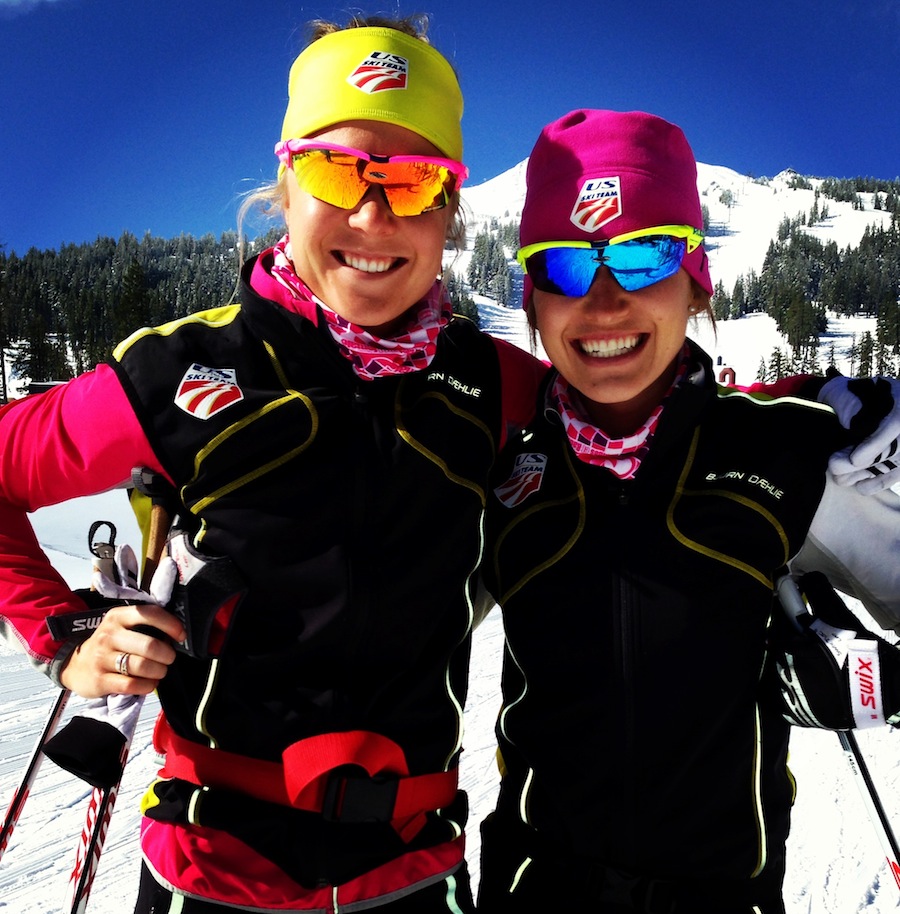
U.S. Ski Team members Sadie Bjornsen (l) and Sophie Caldwell take a break from skiing in May at their training camp in Bend, Ore. (Courtesy photo)
The five interlocking rings hanging over Sadie Bjornsen’s bed mean everything they did four years ago when she shelved her college education at the age of 19, moved home and threw all she could muster at a dream of skiing in the Olympics – only to come up short.
But closer examination of the wall ornament reveals that an upcoming February trip to Sochi, Russia, isn’t the only ticket to happiness for the experienced, confident and humbled Alaska Pacific University (APU) skier.
Sadie Bjornsen (APU/USST) heads out on her mountain bike at the 2013 USST training camp in Bend, Ore. (Photo: Jessie Diggins)
Massage. Stretching. Sleep. Learning to speak French (for her French boyfriend) – each task has its own ring and a place in the 23-year-old U.S. Ski Team (USST) member’s daily routine, so that her mind and body are given the best opportunity to remain healthy throughout this Olympic year. (The fifth ring’s contents were too personal to share.)
“The biggest thing that I learned [before the 2010 Olympics] was that I need different things in my life,” Bjornsen said Sunday on the phone from her home in Anchorage, Alaska. “Wholly focusing on skiing is not meant for me.”
The significance of the most routine physical activity was magnified this spring for Bjornsen, who could relax after emerging in one piece from USST training camp in Bend, Ore., and most recently, fitness testing in Park City, Utah.
At this time last year, she was hampered by a structural problem in her back and tendonitis in her foot, and this June she participated in most everything except treadmill tests because of foot limitations.
But 2012/2013 was anything but a lost year. Bjornsen was able to check off her first top 10 in a World Cup event, was a member of the fourth place 4 x 5-kilometer relay team at World Championships and added a pair of national titles. She just had a late start.
“Just racing in my first race, I appreciated it so much,” Bjornsen said. “I think it’s sometimes a good reminder to have those challenges. You just appreciate things more.”
Bjornsen estimated it was five years ago when she took the antibiotic Levaquin, which has a known possible side effect of attacking tendons, most commonly the Achilles. She’s lived with a form of tendonitis ever since.
Now she approaches training camps a little differently than her teammates. Bjornsen’s offseason is about consistency. If she has to substitute a dryland activity for a morning ski, that’s OK. Exercise in any form will make her stronger.
“The difference this year is I have a little more confidence in knowing that the way that I train can work out,” Bjornsen said.
What works for Bjornsen is laying off the intensity during the summer, as she has seen it come back to her quickly in the fall. She’s learned how to recognize the warning signs of a balky back. And she feels the support of her teammates and coaches.
“It’s hard because everyone is really competitive and everyone wants to push each other,” Bjornsen said. “Especially now that we’re having some success, you feel like every moment you have to be 100-percent. The girls are really good about being patient.”
Bjornsen described her coach, APU director Erik Flora as “unbearably positive.” Flora had his own racing career abbreviated by the combination of a car accident and back injuries.
“You have to be so mentally strong to make it through without any support,” Bjornsen said. “[The support’s] coming at me from all angles.”
With brief visits to Bend, Park City and Vancouver behind her, Bjornsen will train in Alaska for most of the summer, a place where she is constantly reminded of the intermediate goals she must attend to before approaching the ultimate one. Ideally she will race a full World Cup schedule for the first time in her career and post some of her best results in February.
“The Olympics are a possibility to really spread our sport through our country,” Bjornsen said. “There’s a whole new generation coming into our sport soon. I think it would be really neat for them to see that success is totally possible.”
Four-time Olympian Johnny Spillane after notching his third-straight silver medal at the 2010 Winter Olympics in Vancouver, British Columbia. A longtime staple of the U.S. Nordic Combined Team, Spillane, 32, recently announced his retirement.
It’s hard to imagine U.S. Nordic Combined without Johnny Spillane.
For more than a decade, the Steamboat Springs, Colo., native has been the sport’s poster child, winning America’s first gold at 2003 World Championships and later notching three silver medals at the 2010 Olympics.
He’s been to every Olympics since 1998 and bounced back from several injuries to return to the team year after year. But this season, Spillane won’t be training for the 2014 Olympics. At 32, he recently decided to call it a career, and is the first of three over-30, A-team members to do so (Billy Demong, 33, and Todd Lodwick, 36, apparently have their sights set on Sochi, Russia).
The news came in the form of a letter to the Steamboat Springs community, published in Steamboat Today on April 18.
“I would like to take this opportunity to thank the community of Steamboat Springs for the incredible support it has given me over the years,” he began. His national-team career spanned more than 15 seasons.
Johnny Spillane (l) racing in the team event at the 2010 Olympics, in which he won his second of three silver medals.
“I’ve been very fortunate to be raised in this town and have the opportunities that Steamboat provides, but it is time for me to move on,” Spillane wrote. “It has been a long and productive career, and I have no regrets as I start a new chapter in my life.”
Not to worry, Steamboat; Spillane’s staying right at home. In an interview with FasterSkier, he explained that he’ll pursue passions like fly fishing and start by guiding this summer.
“It was a long, long career so I’m pretty excited to be done,” Spillane said on the phone of the decision he made a couple of weeks ago. Every year, he reevaluates, and this year, the time was right.
“I’m sure there’s more things that can be accomplished, but at the same time, there’s other things I want to do besides travel and ski,” he said with a laugh.
Initially, he plans to “explore as many different opportunities” as possible, which could include something in the fly-fishing industry and part-time junior coaching with the Steamboat Winter Sports Club.
“I don’t anticipate getting into coaching at any kind of high level because at that point you’re just traveling a ton anyways, and that’s what I’m trying to avoid to begin with,” Spillane said. “I would be open to [coaching] really young kids here in Steamboat, something that you could do a few nights a week, but beyond that I don’t have too much interest.”
While few are questioning his next steps, a lot of people are wondering why Spillane decided to call it quits before an Olympic year.
Simply put, he wants to spend more time with his wife, Hilary, and two daughters. His oldest, Hadley, is 2 ½, and Genevieve will turn 1 in May.
“It’s so much traveling and with having kids and stuff like that, I’d had enough,” Spillane said. “I’ve done this a long time. I’ve been to four Olympics and while it would be great to go to another, it’s not going to change my career in any way or anything like that.”
Last season, the 2003 world sprint champion competed in one event at World Championships in Val di Fiemme, Italy. There, he was 30th in the large-hill competition, and he cheered his teammates (Taylor Fletcher, Bryan Fletcher, Lodwick and Demong) on as they captured the nation’s first World Championships medal – bronze – in the team event.
“For sure, you want to be competing, but if you’re not gonna be the one out there, you want to be helping in every way you can,” Spillane said. “I was in the wax room, testing skis and doing everything I could to help contribute.”
His best individual World Cup result last season came in January, when he was 22nd on the large hill in Klingenthal, Germany. Despite traveling with the team all season, Spillane competed just five times. Hindered by injuries in the past, it wasn’t his body that was keeping him out of it this time. Rather, new rules required athletes to make the top 50 in preliminary jumps to advance to the actual competitions.
Spillane said he “struggled pretty heavily with the rule changes,” especially the tighter suits.
“There was a learning curve there and it took me a while to get it figured out,” he explained. “I don’t think I ever got it entirely figured out. I think that was by far the only contributing factor to some of the poor results I had because I felt really good skiing all winter long. It was just a matter of jumping well enough to put myself in any kind of position to be competitive.”
The changes were certainly “annoying,” Spillane said, but they’re also inherent in the sport. For a smaller nordic-combined squad like the U.S. it made adapting even tougher.
“Every time they make a rule change, it takes the countries that don’t have the financial capabilities to really explore the equipment a couple years to catch up,” he said. “You’re spending half your energy trying to figure out your equipment where you want to be spending that energy training and improving. That part is hard. Everybody gets frustrated with that.”
It’s also difficult missing out on opportunities to ski up to your potential. If Spillane could’ve made the top 50 on the jump hill more often last season, he believed he could’ve skied up to 20th or so.
But that’s all behind him now. Looking back on an individual World Championships gold, four national titles, and three silvers at the 2010 Olympic Games (the first of which was America’s first), Spillane said it’s the team he’ll remember most.
“What I’m most proud of is what the team accomplished as a whole while I was a part of it, whether it was individual results or team results,” he said. “Becoming one of the stronger nations in the world was for me one of the most exiting parts of it. The individual results and competitions were great, but I don’t focus on them all that much.
“Obviously I would’ve liked to have done better at every competition, but at some point you just have to be satisfied with what you did, and that’s where I’m at,” Spillane added. “I’m proud of the results I had, I wish some of them were better, but that’s in the past. I know that I did everything I could to get the results that I did get, and that lets you sleep at night.”
Morgan Arritola, formerly of the Sun Valley Ski Education Foundation Gold Team, skates to a 15 k SuperTour victory in West Yellowstone, Mont., on Nov. 25, 2011. After more than 10 years with the team, the 2010 Olympian is hanging up her skis to pursue other interests.
Inside the Sun Valley Ski Education Foundation center on Tuesday, Morgan Arritola made her usual rounds, visiting longtime friends and coaches and introducing them to her new addition – a puppy.
A staple of the team for nearly a decade, the 25-year-old Olympian affectionately known as “Mo” wasn’t stopping in for training plans. She hadn’t just finished a workout and she wasn’t preparing to start one, either.
Arritola was on a lunch break from her new full-time job at Scott Sports, her running-shoe sponsor. Still based in Ketchum, Idaho, she started there as a receptionist about a week earlier, and looking ahead to the summer, that was where she planned to spend the most time.
After three seasons on the U.S. Ski Team, Arritola declined a fourth term two years ago. Last year, she notched two national titles and a world championship – in trail running – and after being featured in the Trail edition of Runners World’s last month, she said even that wasn’t going to be her priority.
Arritola was essentially retiring from skiing and would likely step back from running to pursue other professional interests.
“I’m not really focusing on any one particular thing or training for it,” she said on the phone while fielding incoming calls at work. “Life’s just taking a new turn, so that’s how that goes.”
Running was something she jumped into, much like her early approach to skiing. After moving from Salem, Ore., to Sun Valley, Idaho, in high school, Arritola put on her first pair of nordic skis as a junior. Four or five weeks later, she won a race.
From then on, Arritola’s nordic success was history. In addition to making two Junior World Championships, she notched several silver medals at U.S. Nationals, placed 11th in Switzerland’s Engadin Ski Marathon, and tallied two top-40 finishes at the 2010 Olympics.
Last June, Arritola won the USATF Trail Half-Marathon National Championship in Bend, Ore., and went on to dominate the Xterra Trail Run nationals in Ogden, Utah, in September. That victory brought her to Hawaii for the Xterra Trail Running World Championship, which she won by nearly four minutes in December.
Arritola (third from right) and former USST teammate Liz Stephen (second from left) atop the podium at the 2011 Xterra Trail Run National Championship at Snowbasin Resort in Ogden, Utah, on Sept. 25. Arritola won the 21 k event by roughly two minutes ahead of Steven in second. Photo courtesy of Liz Stephen.
Known for her humbleness, Arritola downplayed her expectations and performance in the race.
“It was really cool,” she said. “I didn’t really know what to expect, but I learned that I’m not very good at running in the heat. I thought I was going to die. It was really hot.”
Her ski coach from the start, Sun Valley’s nordic program director Rick Kapala watched Arritola develop into a founding member of his Gold Team and an icon in Sun Valley circles. When she walked into the program’s main building, heads turned, he said.
“She walks into the hut and kids are like, ‘That’s Morgan Arritola!’ ” Kapala said. “We live in a relatively small community here so she’s been highly visible as a very successful cross-country skier … and maybe the most successful and recognized athlete in our community in the last 10 years. She’s accomplished a lot.”
Years of competitive racing can take its toll, even on a 20-something still in the height of his or her athletic career. A few weeks ago, Arritola said she decided to leave the Gold Team.
“I’ll probably do some races here and there throughout the winter, [but] I’m not going to ski anymore,” Arritola said. “I’m working and I’m going to run.”
Kapala said the news wasn’t unexpected.
“We entered last year always knowing that it was going to be, to some extent, an evaluation period,” he said, echoing his statement to the Idaho Mountain Express nearly two years ago when Arritola turned down a U.S. Ski Team spot.
At the time, Arritola said she wasn’t entirely satisfied with her performance at the Vancouver Olympics, where she was 34th in the 10 k freestyle race and 38th in the 15 k pursuit. In November 2011, she was also dabbling in endurance running and taking online courses through Montana State University.
“On one hand, she showed herself and everybody else that she still can race really fast,” Kapala said. “But I also think that she’s somebody that, when she undertakes something, is 100 percent in. … Her choices have to be probably seen through the prism of ‘I know what it takes to be the best in the world, and can I do that, and do I want to do that?’ ”
Following her trail-running world championship last December, Arritola came down with appendicitis and needed surgery. She missed U.S. Nationals in Rumford, Maine, and spent the first few weeks of January recovering. Back at full strength after a smooth healing process, Arritola said she was working to pay her medical bills.
Despite winning some prize money at trail running nationals ($1,000) and worlds ($2,000), Arritola said being a two-sport athlete in skiing and running wasn’t bringing in the big bucks. That’s why she wasn’t going to concentrate on running, either.
“I don’t consider myself a runner; I just go out and do races when I can,” she said. “I’m just ready for some different things in life I guess right now. That’s just what I’ve got to do and I like to work so that’s not a problem. It’s a lot of things, but kind of where I’m at right now.”
A talented runner who often crushes local competitions, Kapala affirmed that foot races were never her focus.
“She sees running as sort of an extracurricular recreational pursuit even though she’s really fast,” he said. “I think what she is looking for is probably just a little bit of freedom to chart some new paths in her life.”
While she planned to do some running races this summer, starting with the Teva Mountain Games in June, Arritola said she wouldn’t be specifically training for any and didn’t plan to pursue trail running as a career.
“I think it would involve going back to the lifestyle of skiing, which is pretty selfish,” she said. “I’ve done it for a lot of years and I’m just ready for something different. We’ll see what happens this year with running and everything and then, who knows?”
Following a smattering of NorAm, SuperTour and Alpen Cup races last season, Arritola hung up her skis in late March after placing 18th in one of the first races at SuperTour Finals in Craftsbury, Vt. – the 3 k skate.
“I did one race and then kind of decided that I was not into skiing and needed to not be there,” she said. “I left.”
Back in Ketchum, Arritola was looking ahead. She spent the previous weekend with her mother, driving 20 hours to and from Washington to pick up a Swiss mountain dog. They named the puppy Eiger and Arritola planned to hike with the little guy, who was expected to grow to between 120 and 140 pounds.
In the meantime, she was interested following other interests and potentially continuing her education. If she decided to go back to school, Arritola said she would probably study science or biology – maybe physical therapy or veterinary sciences if she had the time. Born and raised in the West, she was also open to moving.
Kapala said he would do everything he could to keep her involved in Sun Valley’s development program.
“I’m going to try to figure out how to get her out there skiing with our kids as much as her schedule allows,” he said. “For us, it’s been nothing but great, and the impact she’s had goes far beyond that she’s won some ski races and participated at World Championships and Olympics and scored World Cup points and all that stuff.
“She shows to kids what’s capable if you show up and train hard and have the kind of attitude that Morgan has had, which is ‘I’m going to train really hard, I’m going to work really hard,” Kapala added.
One of her teammates at Sun Valley, Simi Hamilton of the U.S. Ski Team wrote in an email that it was hard to see Arritola leave skiing, but he looked forward to running and climbing with her in the offseason.
“I’m extremely excited to see Morgan pursue some of her other interests in life,” Hamilton wrote. “She is such a talented, diverse, and mature athlete and person. She is a great friend and I will for sure miss having her around.”
Petter Northug debuted this week as a motivational speaker, in front of 600 at the Business School BI in Oslo.
For an hour and a half, a modest Northug and “Vi Menn” journalist Thorkild Gundersen talked about the preparations for the 2011 World Championships in Oslo, and Northug’s now quite famous recipe for success.
Northug and Gundersen talked about the poker trip to Las Vegas last summer, where Northug competed in a poker tournament and trained in the desert. Gundersen also brought up an incident on the 4th of July – Independence Day – where they gathered at the roof of the hotel to watch the parade on “The Strip.”
While everyone was watching the party from the hotel, Northug had crawled under the covers in his bed for a nap. From May 1, 2010, Northug had only one thought in his head: The 2011 World Championships in Holmenkollen. His focus was on making that one goal and his priorities were on maintaining a nutritious diet, training and recovery.
“For me, these were the logical priorities. I wanted to race well there, and often it’s the tiny details that matter when the margins are this small. I stay away from alcohol. We had a roller ski workout planned for the following day, and I wanted to be rested for that,” Northug explained.
“Marcus Hellner on the other hand threw back a couple of beers, and we all know how he did in Holmenkollen,” journalist Gundersen said to the audience, who laughed heartily.
Not moving
During the presentation, Northug also confirmed that he has bagged any plans of moving abroad to have more time at altitude leading up to the 2014 Olympics in Sotchi.
“To perform optimally for Sotchi, I have to start my preparations as early as next season. Any later than that could be too late,” Northug said to Dagbladet earlier this spring.
After the presentation, Northug’s dad and manager John Northug explained that Northug wouldn’t save as much by living abroad as they first calculated in terms of travel days. The national team altitude camps are scheduled for several different locations all over Europe. Instead of moving, Northug plans to do one or two additional altitude camps the coming seasons. That way, he can remain in Meråker, Norway, throughout the fall and be closer to his family.
“This way, I can train and have fun with my brothers,” said Northug, who appeared tired at the presentation Thursday night.
Vasaloppet
Tour de Ski will be the main goal for Northug this coming season. He also considers entering the Vasaloppet.
“We haven’t nailed the plans just yet, but we are considering the Vasaloppet,” John Northug said to the Norwegian news agency NTB.
Northug will also race an uphill time trial at Besserud in Oslo before the next national team camp, manager Northug confirmed.
By Eivind Haugen, Dagbladet.no, May 13, 2011. Translation by Inge Scheve
Rewind to the 2009 World Championships in Liberec (CZE). Japan beat Norway the women’s team sprint on skis that outglided almost everyone. Norway’s wax coach Knut Nystad, who was then watching the relay from the stadium, said he saw the Japanese put Gallium under their skis between the heats.
Fabio Ghisafi, who has been Japan’s wax coach since 2003, said to the Norwegian newspaper VG.no that he never tells the athletes what’s on their skis. But after hearing Nystad and Norwegian national team director Åge Skinstad say that Masako Ishida and Madoka Natsumi had Galluim glide wax on when they beat Norway in the team sprint in Liberec, he can’t keep quiet any longer, claiming that Skinstad and Nystad are lying.
“They didn’t have Gallium wax on their skis. I don’t know what motives Nystad has for saying that we used Gallium. That’s simply not true,” Ghisafi said to VG.
“We had six or seven different products, but it wasn’t Gallium,” Ghisafi said.
Nystad recalls the situation differently.
“If (Fabio Ghisafi) says they didn’t use Gallium under the skis during the team sprint in Liberec, I will reply that I saw them do just that between the heats, I saw that with my own two eyes,” Nystad said adding, “If I hadn’t seen that, we would have never figured out what they had under their skis. After the race, I went straight to my computer and researched Gallium on the internet.”
The Italian wax coach, who is renegotiating his contract with Japan’s national team this month, is willing to take Nystad to court to prove his point and protect his reputation.
“We had great skis in the team sprint in Liberec, but why would I tell Nystad what we were using? That would be giving our competitors an advantage. Nystad is lying. Nystad is destroying my image. Now, other nations believe that I am a wax coach who walks around and reveal secrets,” Ghisafi said.
“If Nystad doesn’t stop telling other people what teams are using, I’m ready to take him to court to stop him if I have to. He can’t run around and talk to newspapers and other media about these things,” Ghisafi said.
Ghisafi is also angry that Norway can’t just praise Ishida and Natsumi for their strong performances as racers, instead of saying that good skis and exceptional glide was the reason.
Product and Process
But the Liberec was just the beginning. During the 2011 World Championship in Oslo, almost all the teams struggled with the wax, one team appeared to nail it every time: the hosts. Norway also had success using Gallium wax in Callahan Valley during the 2010 Olympics, another venue where many teams had trouble nailing the wax – including Norway’s at the beginning of the Games.
What’s their golden secret? Nystad said it’s a combination of product and process, and for the 2011 World Championships, which landed Norway on the podium every night, Gallium wax was one of those products.
Norway's Men at the 2011 World Championships – Gallium Wax was part of the recipe for their fast skis in Holmenkollen. (Photo illustration courtesy of Go-Ski Norway)
Wax revolution
Gallium wax is owned by the Japanese company DOWA Holding (primarily involved in metal manufacturing). Gallium is in fact a metal, and one of the ingredients in Gallium ski waxes, which has proven successful in humid and difficult snow.
In a press release from the Norwegian Ski Association dated November 25, 2010, Nystad classified Gallium as a revolution: “Head wax coach Knut Nystad said the (Norwegian wax team) became aware of Gallium wax because Japanese cross-country skiers and Nordic combined skiers had exceptional glide during the 2009 World Championships in Liberec. According to Knut Nystad, Gallium’s liquid wax products Gallium DR, FCG, Maxfluor and Gallium Giga Speed are as close to a wax revolution as you can get.”
According to Ghisafi, this is not the case.
“That is just BS. (Gallium) is no revolution. The product has existed for ten years. And it’s no miracle,” Ghisafi said.
The Gallium difference
So if wax techs are willing to take each other to court over Gallium, what makes it so special?
FasterSkier caught up with Frank Evertsen from Go-Ski Norway, the distributor of Gallium in Norway, to find out what’s so different about Gallium wax.
For starters, seven of Norway’s eight gold medals at the World Championships in Oslo were won on skis waxed with Gallium. Sure, waxing for Holmenkollen is always somewhat of a best-guess situation, due to a combination of climatic conditions that makes the snow tricky both in terms of grip and glide.
“The unique thing about the Gallium products Doctor FCG Maxfluor, Gigaspeed, and Gigaspeed Maxfluor Moist, is that they contain gallium and fluoro carbons,” Evertsen explained to FasterSkier.
“The recipe delivers extreme durability – the wax easily lasts through the entire Vasaloppet, and provides excellent glide in humid to wet snow conditions down to minus six or seven degrees Celsius if the humidity is over 70 percent,” Evertsen said.
Evertsen explained that Gallium’s composition reduces friction by altering the water drop configuration to where there is less contact surface between water and the ski bases, which results in better glide.
“Additionally, the Gallium products are super-easy to work with because it’s applied to the bases after all the waxing and manual rilling is done. You can wax a pair of skis in 30 seconds,” Evertsen said.
Not just slapping on wax
Nystad explained to FasterSkier that fast skis are not just the result of one magical product, but careful process and tedious testing.
“Gallium was used during the Oslo World Championships, but that’s not the most important element for me. It’s the process that leads to the answer that matters most. If the process is good, the right answer will automatically follow because we’ve done the right legwork and tested a lot,” Nystad said to FasterSkier.
Nystad counts off his to-do’s and responsibilities as the head wax tech: finding the best skis in terms of the ski’s properties, pick out and zero out the ski test park in terms of structure, manual structure, products and grip, determine the best structure, determine the best manual structure, identify the best glide waxes, find the best powder and topping, identify the best grip base wax, the middle layer grip wax and top coat grip wax. Finally, Nystad is responsible for determining the optimal methodology for applying the manual structure, glide wax, powder, topping and grip wax.
“All of these processes are running simultaneously. A small improvement in any and all of these can deliver a competitive advantage. There are a lot of products involved in this network of processes, which combined gives us the ’winning recipe.’ It’s possible that other nations were better than us in some of the processes, but overall, Norway did it well this time,” Nystad said.
Never-ending process
During the World Cup season, Nystad oversees a team of 12 wax techs, but only two of them are employed by the Norwegian Ski Association (NSF) year-round.
“My job is to be the head wax coach for Norway’s national team,” Nystad explained.
“What is most important to me is to help create and take part in the various processes so that we succeed in finding the best wax solutions we can for a given event,” Nystad said.
The Norwegian wax team also uses service reps from the various brands, because they are experts on their own products and how to apply and optimize them, Nystad said.
Evertsen is not on the Norwegian wax team payroll, but he is definitely a part of the NSF family, given that Go-Ski Norway is one of NSF’s partners and a part of the NSF Ski Pool.
Brett Camerota (in red) heading out on his 2nd lap during the 2010 Olympics in Vancouver.
FasterSkier caught up with Brett Camerota, 26, a silver medalist from the 2010 Olympics in Vancouver in the nordic combined team competition, as he was getting ready to head out to Brazil for a vacation with his brother Eric, also a US nordic combined skier, and some mutual friends.
After starting the season on the US Ski Team, Camerota opted to retire after a slow start to the year.
In November, half a year after the Olympics in Vancouver, Brett Camerota headed over to Kuusamo, Finland, for the FIS season opener. The summer had been the best in his career; Camerota was faster and better than ever. But then in the World Cup competition, things fell apart on the hill, which had always been Camerota’s strength as a nordic combined skier. The first month of the 2011 World Cup season was a road trip through Northern Scandinavian darkness and frustration.
“In the summer championships, I did really well. But as soon as the winter season started in Kuusamo, I lost the feeling for jumping and the cross-country was a struggle, and I had too much frustration,” Camerota recalled.
In February, he was no longer a part of the US Ski Team headed to the 2011 World Championships in Oslo.
“When I had no chance at making the World Championships in Oslo, I had reached my limits for frustration,” Camerota said to FasterSkier.
In mid-March, the talented 26-year-old retired from professional skiing.
“I got a little bit burned out on skiing last winter and I needed a change,” Camerota said.
“With all the pressure from the Olympics and all the attention after the Olympics, I wanted to keep going and see how it went. But I need a break. I want to do whatever I want to do for myself. It’s nice to walk away from it, including the training and team goals,” Camerota said.
“Maybe it’s because how much effort we put into the Olympics, the four-year block of training and then it went so well. After that, you think about whether you are in for it for another four-year block. If you want to be the best, you sacrifice a lot for training, and it was awesome, it was totally worth it,” Camerota explained, adding that he will return to school and plan to study finance at Westminster College in Salt Lake City.
Welcome on the team
Camerota discussed his decision to retire with US Nordic Combined head coach Dave Jarrett, who is sad to see him quit, but on the other hand also understands his decision.
“I told him that if he were to walk away from it all right now, he’d still be one of only four US Nordic Combined skiers to own an Olympic medal, and I would understand that,” Jarrett said to FasterSkier.
“It takes a lot to commit to the sport, and the season didn’t start the way he wanted to. He was ready to be done,” Jarrett explained.
While Jarrett understands and respects Camerota’s decision, he is still open to have him back on the team if Camerota should decide he wants to, once he has put this winter completely behind him. The US Ski Team criteria for the Nordic combined team is that an athlete who finishes in the top 50 of the world ranking is considered, the rest is up to the coaches. Camerota is still among the top 50 in the world.
“If he’d come back and recommit and do everything it would take to improve on the cross-country side, he has certainly earned it, and earned the right to be considered. But it requires a yes or no,” Jarrett said.
Camerota doesn’t rule out a comeback, after all, he is only 26 years old in a sport where it takes years to fully mature.
“Next winter, I am not going to ski. In a year, I might feel that coming back could be a lot of fun, but right now I need a break,” Camerota said.
Nordic combined: Two sports that fight each other
Jumping and cross-country skiing are not naturally complimentary sports. The training that goes into improving in cross-country, can negatively affect the performance on the hill.
Camerota was always good on the hill – his strength since he was a kid.
“Jumping I’d say is almost 100 percent mental once you’re at a level where you have the mechanics of it down. Cross-country is very much physical. In nordic combined, I needed to get faster, and too much of that training has an effect on the jumping,” Camerota explained.
“Once jumping clicks, you don’t want to affect it with too much of the cross-country training,” he said, adding that two workouts a day almost every day was a challenge.
Jarrett explained that Camerota, whose strength was on the hill, needed to jump well to have a competitive advantage.
“Jumping was his strong spot, and he needed to jump well to hold on to whatever spot he had. He did not jump well in Kuusamo and Lillehammer at the beginning of the season. But when you put all your eggs in the jumping basket and don’t jump well, you’re screwed.”
Brett Camerota at a glance
Born: January 9, 1985
Hometown: Park City, Utah
Merits: Silver medal, team competition 2010 Olympics, competed at the 2006 Olympics, the 2007 and 2009 World Championships, 23 World Cup starts since 2006.
Whitefish, Montana, from a ski run called “Inspiration” (Photo courtesy of PJ Sullivan, creative commons content)
Heaven is pretty much how Robin Brooks feels about her job as the head coach of the Glacier Nordic Team in Whitefish, Montana. Sometimes, coincidences just seem to happen at the right time: Brooks was looking for a new home, Whitefish was looking for her.
The 25-year-old Seattle native left her parents’ driveway and set out on a 12-month bicycle tour across the U.S. in September of 2009. Brooks spent most of that time on her own, exploring new areas of her home country and trying to figure out what she wants in life. She found it in Whitefish. While she was camping there in August, only a couple of weeks before her 365-day bike tour was officially finished, she called her dad to check in and tell him about this amazing little town she had landed in.
Her father, Don Brooks, had just seen an ad on FasterSkier a few days earlier, which announced that the Glacier Nordic Team in Whitefish was looking for a head coach.
Robin (left) and sister Holly Brooks at the 2010 West Yellowstone Ski Festival
“I decided I was very interested in living here. I liked the feel of the town, I liked the downtown area, there was a farmer’s market with live music and that was something I really looked for. And growing up in Seattle, I always wanted to have skiing out my door, and there is amazing mountain biking and running here,” Brooks said.
Brooks has been skiing since she was 2 years old, and started racing with the youth ski program at Snoqualmie Pass, coached by her dad. She always loved skiing, and imagined that some day, she’d be living in a place with consistent snow in the winter. Like Whitefish.
Why Whitefish?
The only thing Brooks was missing in Whitefish was an established social network, something she had identified as important to her during her long bike ride.
But Brooks was willing to take a gamble on that. The opportunity was too good to give up.
“I’ve always been independent, and always gone into things with the attitude that I will make it work,” Brooks said.
Her gut feeling turned out to be the right choice for Brooks.
“I was really excited and very nervous at the same time. Part of me didn’t expect the job to be offered me. But I was psyched to know I was coming back to Whitefish and this area, excited to work with the team, and definitely nervous since I had never been a head coach,” Brooks said.
In terms of building that social network she was looking for in the place she wants to call home, the Whitefish community has been more than welcoming as well, Brooks added.
“The ski community has been fantastic. The parents have really made a great effort to include me and help me get involved,” Brooks said, adding that she stayed with one of the ski team families for a couple of weeks while looking for a place to rent. Living with them also helped her get to know the community better.
Also, it turned out that two of Brooks’ good friends from junior skiing in Seattle now live in Whitefish. One of them, Noah Young, will be her assistant coach this season.
Although Brooks is a city kid and grew up in Seattle, she’s been drawn to smaller places since she graduated from high school and took off for college. A 2008 graduate, Brooks was an environmental studies major at St. Lawrence University in Canton, New York, a town of roughly 5,900 people. She skied for St. Lawrence for four years on the collegiate circuit.
Last year, Brooks spent the winter in Cle Elum, Wash., a town of less than 2,000 people about two hours from Seattle, just east of Snoqualmie Pass. While living in Cle Elum, she helped coach the Bush School nordic team, a private high school ski squad from Seattle that trains and races at Snoqualmie.
Learning on the job
Holly Brooks with the Glacier Nordic Ski Team at the 2010 West Yellowstone Ski Festival.
While Brooks doesn’t have a long list of formal coaching experiences beyond her winter with the Bush school, she feels well-prepared to start building training plans and setting goals for the athletes. For starters, her sister Holly Brooks has been coaching at Alaska Pacific University for several years, and she also raced for the U.S. Ski Team at the 2010 Olympics. Holly offers help and advice whenever Robin needs input.
Additionally, Robin said that she spends a lot of her time looking up coaching and physiology resources online – and, with years of personal competitive experience at the junior national and collegiate level, Brooks has a good understanding of what it takes to bring out the best in young racers.
The Glacier Nordic Team has seven competitive skiers this season, and Brooks thinks two of them could qualify for the J1-Scandinavian Cup races this winter. 17-year-olds Stella Holt and Jack Steele have to make the U.S. team at National Championships in Maine in early January, but Brooks is optimistic.
The five other athletes on the team are good development skiers, Brooks said, and she added that she’s hopeful at least two of those will qualify for the Intermountain Division team racing at Junior Nationals in Minneapolis in March.
“They’re all looking good, and I’m happy with where they are at this point, so they should be able to qualify,” Brooks said.
Challenges and surprises
Technically, the head coach position in Whitefish is a part-time job, and Brooks thought she would get a second job to help make ends meet and stay busy. But that remained a thought.
“I am a lot busier than I expected, making training plans, doing one to two practices a day with the team, all the logistics for the different ski events…the meeting list, the board, the parents, and doing some training on my own,” Brooks said. “It’s definitely a learning experience for me. Things that don’t seem like they should take very long take forever.”
Since Brooks doesn’t know the area well, she said she also spends a lot of time trying to scout out good places for her team to do different workouts. The nordic area at the downhill resort is no longer groomed and maintained, so the team has to train on a local golf course. But Brooks said she’s hoping to find other good locations for on-snow workouts.
As far as Brooks’ own athletic goals, they have been scaled back this season to make room for her kids. She has skied since she was two years old, raced through her youth, junior and collegiate years, and now, she said, she’s ready to step down from the start line and onto the side line.
“It won’t be a lot of racing for me, but that’s okay,” Brooks says, noting that she still has some competitiveness left in her. “There is a Tuesday night race series in town that I’ll try to jump in, and I’ll definitely do some local races as long as I’m not coaching the whole time.”
The Brooks family: (left to right) Mother Chris Syrjala, brother Scott Brooks, Holly Brooks, Robin Brooks and father Don Brooks.
OSLO, NORWAY – “I’ll gladly do a Bradbury if I manage to win the gold medal at the Holmenkollen Worlds,” said Emil Joensson (SWE), referring to the Australian speedskater who won Olympic gold when all of his competitors crashed. Joensson is not at all satisfied with the Holmenkollen sprint course.
The racers are concerned about a climb inside the stadium where they ski behind the biathlon range. At this point, the course is only seven meters wide, compared to nine meters for the rest of the course.
“You can’t really ski two abreast through this bottleneck, which will cause accidents, or someone has to give,” reigning World Champion Ola Vigen Hattestad (NOR) said to Norwegian newspaper vg.no.
Chief of Course Hermod Bjoerkestoel says the whole issue is the result of a misunderstanding. Hattestad does not buy it.
“All you need is half an hour and an excavator, and the problem would be solved,” Hattestad argued.
Last Thursday, the International Ski Federation (FIS) conducted their final inspection of the courses, and FIS Cross-Country Race Director Jürg Capol said the sprint course is within the specifications, although he did admit the critical curve is on tight side.
World Championship favorite Petter Northug Jr is also unhappy with the course’s climb. He also complains about the “camel hump” obstacle the skiers have to maneuver on the last descent into the stadium.
Joensson agrees
Sweden’s top sprint racer Emil Joensson agrees with Northug and the Norwegian skiers. The World Championships sprint race could be determined by crashes, wrestling and the subsequent protests. But isn’t this par for the course in sprint racing?
“Yes, you could argue that. But the Holmenkollen course is actually unreasonably peculiar, and that’s something that will be evident in a variety of mass start events there,” Joensson said.
As a result of the course configuration, the final stretch to the finish is very short and also very fast, as the racers will enter it from a descent.
“The course construction makes this incredibly risky and left up to chance. You really need to be where you want to be in that last curve, or you’ve already lost the race,” Joensson said.
But then again, you wonder if you really want to be leading into the stadium, risking that someone else glides past you, cuts you off, and literally parks your effort. At the pre-Worlds event last February, the Norwegian medal hope Oeystein Pettersen fell after he was involved in an incident with Joensson, among others. Pettersen requested Joensson be disqualified.
“But the video replay of the incident showed that it was in fact Pettersen who caused the crash by colliding into Emil [Joensson]. But for the Worlds, you can surely count on Kamikaze skiers vying for that lead position coming into the critical curve,” said Swedish sprint coach Arild Monsen.
“And if Emil falls, what does it matter if the other dude gets disqualified? There is no rerun of the race,” Monsen added.
Need a lot of luck
Just like they did before the 2010 Olympics, the Swedish sprint team has analyzed the course down to the last inch.
“I know that you’ll need a good amount of luck to win the sprint race here. With this kind of final stretch, anything can happen. It could easily be something like that short track speed skating event at the Olympics where the Australian won because everyone else crashed,” Emil Joensson said.
It was Bradbury who won the gold medal at the 2002 Olympics when the leaders in the final heat crashed, allowing him to glide peacefully into a gold medal despite being the slowest racer in the heat.
The 2015 World Championships in Falun, Sweden, will be Joensson’s first home-turf championship. He said he hopes the courses there will be fairer than the Holmenkollen course appears to be. Joensson played an important role in securing the championships for Falun at the FIS Congress in Turkey this summer, when the organization voted to award the 2015 event to Sweden.
From Langd.se, October 8, 2010 By Kjell Erik Kristiansen, translation by Inge Scheve
Justyna Kowalczyk is extreme. She pulls off 200 training camp days per year, and it’s said that her life is focused entirely around skiing.
Her most recent camp is taking place outside the Belarus capital of Minsk.
“The morning starts with a half-hour warm-up; then we do the first workout, which lasts about three hours,” Kowalkczyk told coach Alexander Wierietielny and www.fiscrosscountry.com.
“This training camp in Belarus is the fifth for our team this season. It is the toughest one, since we’ve increased the volume,” coach Wieritielny added.
Wieritielny is not concerned that his Olympic champion and double world champion will run into overtraining issues. “Not at all. For our camp next month, we’ll get on snow, and Justyna thrives there,” he said.
Loves hard training Kowalczyk loves pushing it hard, she loves the training camp lifestyle and she is now working on becoming even better than last season. “I have to work hard on my legs and poles, even on downhill terrain, but I love this kind of training,” Kowalczyk said to the Polish web site se.pl. “No matter how you slice it, it’s better to increase the volume this time of the year. I am running faster now, and at a lower heart rate.”
At the 30 k classic race at the 2010 Olympics in Whistler, Kowalczyk beat Norwegian ski queen Marit Bjoergen on the final stretch to the finish and won her Olympic gold medal at long last. This season, Kowalczyk is defending the gold in the women’s pursuit and the 30 k mass start from the World Championships in Liberec 2009. She also took home the bronze medal in the women’s 10 k classic there.
Kowalczyk is certainly someone that both Charlotte Kalla (SWE) and Bjoergen (NOR) will have to keep an eye on at the Worlds in Oslo this winter. Additionally, the Polish racer will try to defend her overall title from the Tour de Ski last winter.
From Langd.se, September 29, 2010 By Kjell-Erik Kristiansen, translation by Inge Scheve.
SWEDEN – Charlotte Kalla won Olympic silver for Sweden in the team sprint at the 2010 Olympics in Whistler with teammate Anna Haag. Kalla would certainly be one of the medal contenders at the 2011 Worlds as well, but she won’t race that event. One of the reasons is that the women’s 4×5 k relay is on the schedule the following day.
Charlotte Kalla (left) and Anna Haag won silver in the team sprint at the 2010 Olympics. (Photo: Kjell-Erik Kristiansen)
“It’s the event schedule that dictates this decision. I want to put all my effort into the relay,” Kalla told Swedish national TV station SVT.
Furthermore, the team sprint at the 2011 Worlds is a classic technique event, and Kalla feels stronger in the freestyle technique. Kalla will also sit out two World Cup weekends this season. The first is the sprint weekend in Düsseldorf (GER) in the beginning of December, at least she is undecided on this weekend. Kalla will also skip the World Cup weekend in Rybinsk (RUS) because it conflicts with the Swedish national championships.
Hellner also skips the team sprint
Even Marcus Hellner (SWE) has decided to sit out the team sprint in Holmenkollen if he should qualify for that event.
“That’s just how it goes. But I hope to race the rest of the events,” Hellner told the Swedish newspaper Expressen.
The Swedish men didn’t have the day during the team sprint at the 2010 Olympics in Whistler, but the Swedish men’s team has a stronger squad of classic skiers, and it is not even a given that Hellner would land a spot among the sprint specialists. Hellner’s biggest chances are most likely his Olympic gold medal events: The pursuit and the men’s relay (4x10K).
Just like Kalla, it would have been more opportune for Hellner if the team sprint in Holmenkollen were freestyle rather than classic technique.
From Langd.se, September 25, 2010. By Kjell-Erik Kristiansen, translation by Inge Scheve
Marcus Hellner was 4th in the 15K freestyle event at the 2010 Olympics. Photo: Inge Scheve
SWEDEN – “I would not do what Petter does. I’ve never felt bothered by kids are asking for autographs,” Marcus Hellner told Norwegian newspaper VG, when they talked to the Swede in Ramsau, Austria.
While Hellner understands that Northug wants to be shielded from the crowds in order to stay focused in his pursuit of five gold medals at the World Championships on home turf, that’s not the right approach for him. Hellner loves the limelight and would rather err on the side of overdoing it a little.
“I don’t know how Petter thinks, but I feel that you’ve got to find a balance between focus on the competition and the relationship with the fans,” Hellner explained.
Similar but different
Both Hellner and Northug won two gold medals each at the 2010 Olympics in Vancouver, but at the last World Championships, in Liberec (CZE) 2009, Northug won three gold medals while Hellner earned none.
“The interest in cross-country skiing is much bigger in Norway than in Sweden. I understand that there is a huge pressure on Petter. Even though we both won two gold medals at the Olympics, he won the overall World Cup and had more strong performances throughout the season. He has improved the level of international cross-country skiing,” Hellner said.
All about Oslo 2011
During the Swedish team camp in Austria, the skiers are working hard to prepare for the upcoming World Championship season. A typical day starts with a ski workout on the glacier, followed by a dryland workout in the afternoon.
“I’m really excited about the World Championships in Holmenkollen, but it’s hard to predict at which event I have the best chances to medal,” said Hellner, who won the pursuit and the relay at the 2010 Olympics.
Moving on
Petter Northug at the 2010 Olympics. Photo: Inge Scheve
In the pursuit, Northug was skiing with the lead group until Hellner accidentally skied over his pole and broke it, destroying Northug’s shot at a medal. According to Hellner, the two of them have talked it over and put the incident behind them.
“I never intentionally stepped on his pole. It was an accident. Those things happen in a mass start when people jockey for positions,” Hellner told VG. The relationship between the two racers further improved during their Las Vegas poker tournament trip this summer.
“I really like Petter. He is sympathetic and he is an amazing athlete. He is really different one-on-one than he comes across in the media, but he seems to have decided on certain image when he talks to the media,” he said.
More than just sprints
Hellner admits that he often thinks about Northug’s fierce finish surges during his workouts.
“But there are several ways to win a cross-country ski race. A sprint finish is not the only option. I am focusing on determining the outcome well ahead of a sprint to the finish,” Hellner said.
From Langd.se, September 23, 2010 By Kjell Erik Kristiansen, translation by Inge Scheve, FasterSkier
OSLO, NORWAY – When Marit Bjørgen, 30, signed her current contract with Fischer in the spring of 2009, after having experimented with other ski brands, she took a heavy salary cut.
Even though Bjørgen’s gold medal collection for the 2010 Olympics in Vancouver/Whistler is the biggest ever for a Norwegian female in a single event, the Fischer contract was non-negotiable after the season.
“I have not renegotiated my contract with Fischer from 2009. That contract expires after the upcoming season. So I guess I’ll have to ski fast this winter and then slam my fist on the table afterwards,” Bjørgen says to Norwegian newspaper Adresseavisen.
Petter Northug has over the past several seasons earned a position with Fischer that puts him in an entirely different category financially. Aside from the Northug case, the male and female skiers are fairly evenly paid. “The contracts for the male and female athletes are fairly comparable, but their contracts also depend on whether they ski with both skis and boots from Fischer,” says Roger Mohaugen, Fischer racing manager.
Bill Holland, a screenwriter who lives in Montpelier, VT with his wife and
two daughters, has been cross-country ski racing for over 40 years.
Liz Stephen at 2010 U.S. Nationals
You can’t know East Montpelier native Liz Stephen even a little bit and not be struck by her zest for living and her positive energy. So it’s not surprising that while her blog (lizhstephen.blogspot.com) records such highlights as the recent visit of Team U.S.A. to the White House, it hasn’t so far dealt with what was, for her, a profoundly disappointing 2010 Winter Olympics. “I had high but realistic expectations that I didn’t even come close to fulfilling,” she said during a recent phone interview. “You know the way your body should be feeling. You’re used to a level of racing where you push hard and ski well, and suddenly you’re fighting to not get last. It’s a totally different mind-set.”
But the mystery of what happened to Liz in last February in Vancouver is no mystery to any endurance athlete who’s done his or her share of racing. You toe the line for some big event—maybe the Boston Marathon, if you’re a runner, or the Craftsbury Marathon, if you’re a Nordic skier—and the realization you’ve been trying to keep at arm’s length abruptly lands: thanks to some glitch in your preparation (the most common one being overtraining) you just don’t have it. Mentally, you’re fired up. This is the moment you’ve spent months preparing for. But no amount of internal pep talk seems to change the fact that your legs feel flat—devoid of fizz just when you need it most.
All you can do now is push ahead, hoping for some miraculous influx of energy. But deep down, you know you’re kidding yourself. The account is overdrawn, but you have to pop the check in the mail anyway, hoping against hope that it won’t bounce. But bounce it does. In the case of the Boston Marathoner, there’s always next year to look forward to—or maybe just the next race.
But not for frustrated Olympians like Liz. She now has to wait four more years for an Olympics that reflects her proven ability, an ability amply demonstrated by three top-20 finishes at last year’s World Championships in Liberec, Czech Republic where the field was, if anything, more competitive than at the Olympics.
Stephen at the finish of the women's 15 k pursuit at the 2010 Olympics.
A sub-par season has many causal strands, but in Liz’s case, a major one occurred during those crucial summer months of training when a world-class skier had better make some big deposits into the conditioning account. A nagging foot injury knocked out two prime building blocks of her training program: running and plyometrics (repeated jumps or bounds to increase muscle power) and forced excessive reliance on rollerskiing, which doesn’t develop the quickness needed for skiing on snow.
The World Cup season got off to a solid start in mid-November with a top-40 finish, but for the next eight races it was all downhill, including some finishes very near the bottom of the heap. At the U.S. Nationals in early January, where Liz had been accustomed to dominating, she managed only a single third place—not great but decent enough, on the one hand, to restore some badly needed confidence and on the other, to stoke some excessively high expectations. Then it was back to Utah for three weeks of training at altitude. Hoping to rebuild her conditioning, Liz committed the classic mistake of the driven: she overtrained and, as a result, arrived in Vancouver bone-tired.
At the opening ceremonies, there was the immense excitement of stepping into the stadium with Team U.S.A. after a two-hour wait in a hot, crowded hallway and suddenly being showered with paper, dazzled by lights, and deafened by cheers. (“My eyes have never been opened so wide,” Liz recalls.) But that high was punctured in short order by two sobering finishes: a 49th in the 10-kilometer skate race followed four days later by a 59th in the 15K pursuit.
Since these were ordinarily two of Liz’s best events, she saw the writing on the wall and sat out both the team relay and the team sprint, two events she’d very much looked forward to. Alaskan Holly Brooks, a last-minute addition to the Team, took her place. Liz absorbed the disappointment but didn’t wallow in it. She recalls, “I took a day to say, ‘This really sucks,’ then decided to be the kind of teammate I’d want someone else to be for me. I got out there and cheered.”
Following the Olympics, there was one more trip overseas—this time to Lahti, Finland and to Oslo, site of the upcoming 2011 World Championships. Despite a lackluster result there, she loved the carnival atmosphere created by hundreds of thousands of Norwegian Nordic enthusiasts, many of whom arrived a week early to camp in the woods alongside the course. Then, during the race itself, they would clutch their start lists and cheer lustily for every contestant by name—from the front-runners to the also-rans. (Liz, alas, should know.) Afterwards, it was back to Utah, where Liz had fun exploring the snow-bowls on back-country skis, and finally home for two weeks in Vermont with her parents.
To their credit, the coaching staff of the U.S. Ski Team looked past the season’s results, recognized Liz’s tremendous potential and work ethic and in mid-April awarded her one of only three berths reserved for women on a U.S. Cross-Country Ski Team roster that had been downsized from thirteen to only seven. As a result, she will once again be attending summer training camps in places like Bend, Oregon and one of her favorite spots on the planet: New Zealand.
Asked about the burden of expectation being placed on her, Liz finds reassurance in the one thing that has never varied: her love for the sport. “I tend to work well under stress,” she reflects. “I’m not too concerned. My job is simply to get as strong as and as fit as possible. Basically, I still want to be skiing. If I have another tough season, what are my options? They’ll involve me skiing, me still loving my sport. I can deal with the pressure because I want to ski as well as I can.”
To this end, Liz and her former coach at Burke Mountain, Matt Whitcomb, who is now her coach for the World Championships, have developed a training program that employs plyometrics in a pool, gradually works running back into her routine, and includes a hefty dose of mountain biking. The result should be a more rounded athlete, one less susceptible to overuse injuries.
After returning to Park City, Utah, Liz looks forward to training with teammate and buddy, Morgan Arritola. And there’s other company on the horizon. Now that Justin Wadsworth, an American, is coach of the Canadian Ski Team, Liz foresees a closer working relationship with them at the training camps in Bend and New Zealand, especially now that the rivalry engendered by the Canadians quest to “own the podium” at Vancouver is a thing of the past.
One senses that the disappointments of last winter will soon simply be “things of the past” as well—melted like an April snowbank by Liz’s resolutely sunny temperament. At the same time, she seems seasoned by adversity, by knowing what it’s like to hit bottom—hard and suddenly, as she did in Vancouver—but not let it dim either her joie de vivre or her basic belief in herself. Now, with the recent reappointment to the U.S. Ski Team, Destiny has handed the 23-year-old Liz an ideal second chance. Rest assured: she will make the most of it.