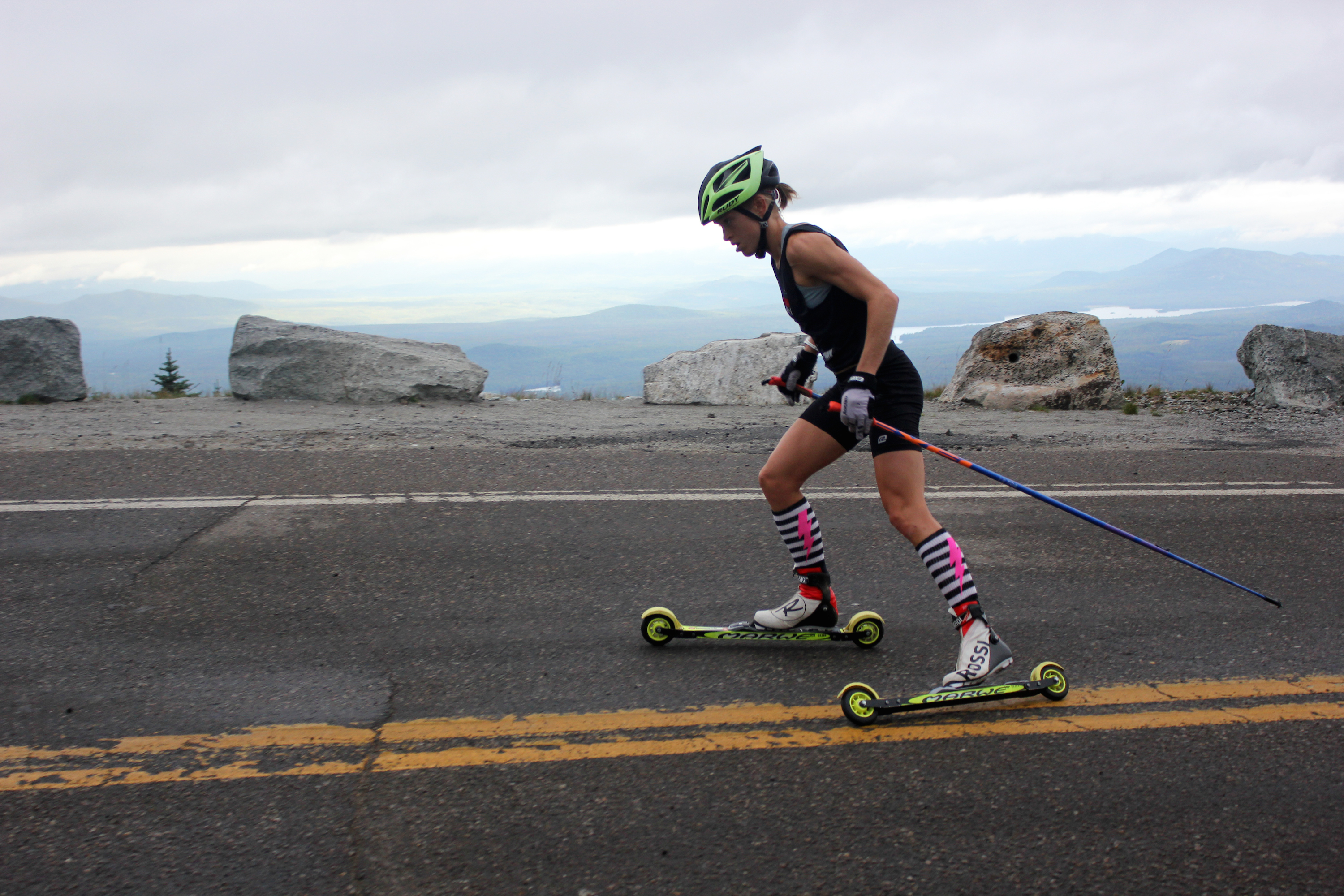
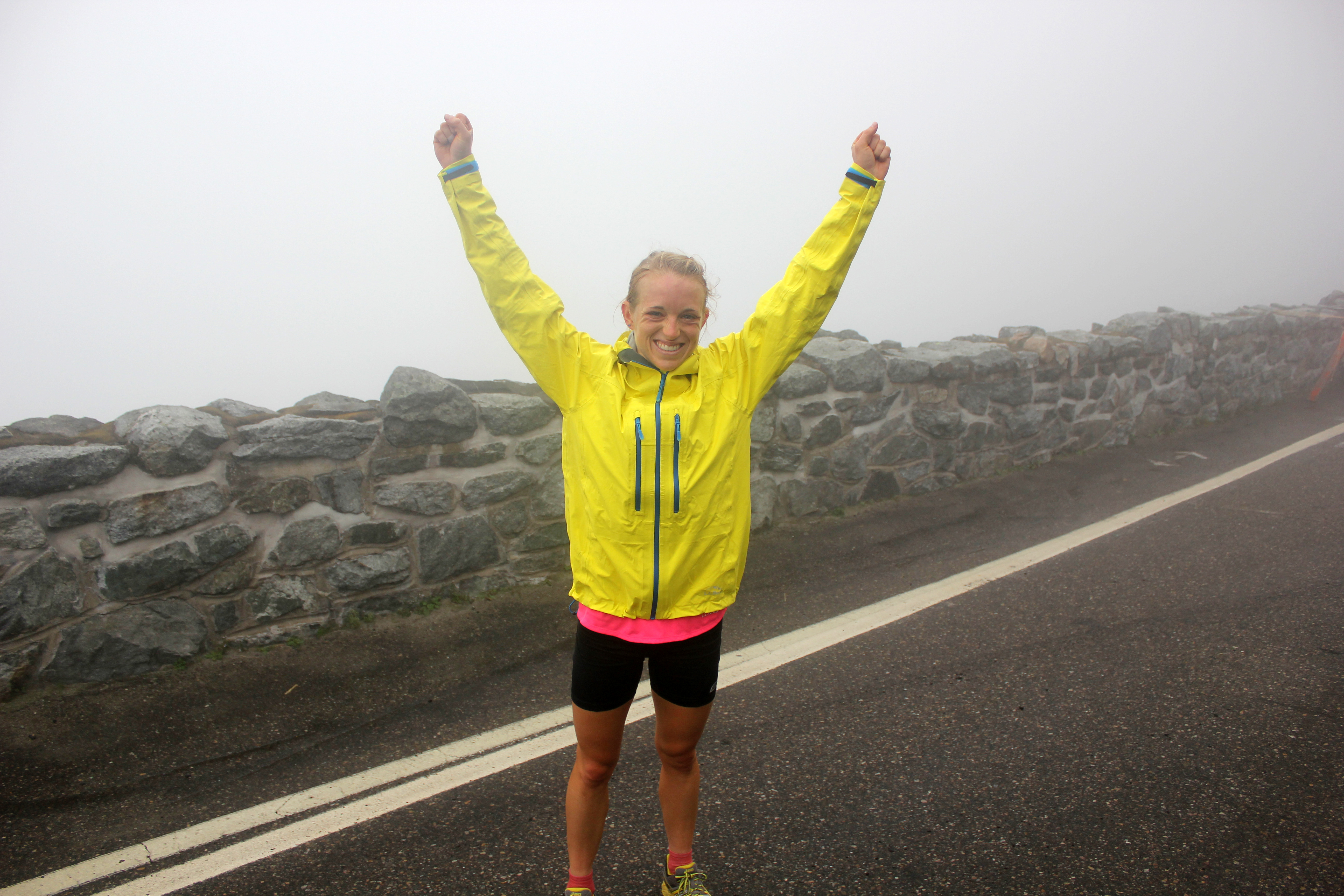
Liz Stephen celebrates her win in the finish area of the 2014 Climb to the Castle. Stephen clocked her fastest climb yet despite a strong headwind and exhaustion from the U.S. Ski Team Lake Placid Training Camp.
Liz Stephen was expected to win the 2014 Climb to the Castle just as she has been for the previous three years. So when she crossed the finish line over three-and-a-half minutes ahead of the next competitor with her fastest time to date, it was no surprise.
The 27-year-old has built a resume of impressive results in hill climbs – both domestic and abroad. Apart from her many Climb to the Castle wins, Stephen’s most notable finishes include a podium in the final climb of the 2014 Tour de Ski and a win in the 2014 rollerski hill climb of the acclaimed Norwegian Blink Festival.
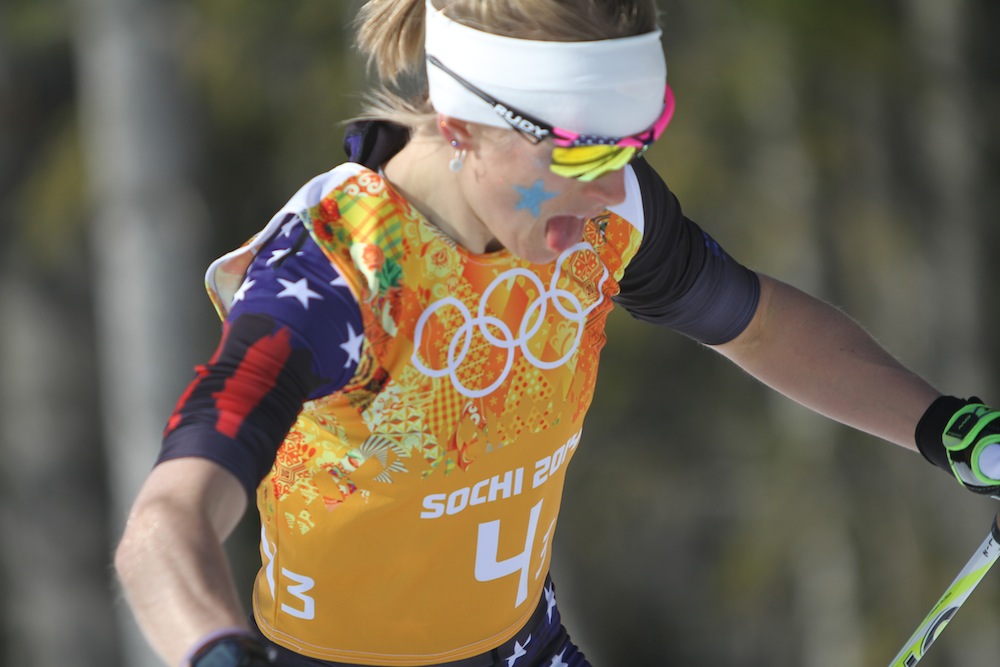
Liz Stephen holds onto ninth in the Olympic 4 x 5 k relay in Sochi, Russia.
For the East Montpelier, Vt. native, hill climbing has always been always natural.
“As a kid I loved doing the hardest thing you could think to do,” she told FasterSkier. “For me that was running up a hill.”
Not much has changed since her childhood days. Now living in Park City, Utah, Stephen can run, ski, or bike for hours without having to descend.
As her results suggest, Stephen’s challenge-oriented mindset and an inclination toward skating boosted by a small physique and boundless energy have led her to be near unstoppable when it comes to an incline.
But Stephen is so much more than a hill climber. She’s a teammate. This fact has been recognized throughout her career on the national scene with U.S. Ski Team women’s coach Matt Whitcomb calling her the “glue” of the team in a 2013 ESPN article.
But even the “glue” of a team can find difficulty in the aftermath of a highly anticipated Olympic year.
“The Olympics were certainly a let down and it took some extra time to recover from them,” she said, referring to her state of mind after the season ended in March.
For Stephen it has been challenging to separate her season long results from the Olympics – where she felt both she and her team underperformed.
“It’s hard to not base a whole season on the Olympics because the year revolved around them,” she said.
While Stephen noted several remarkable highlights from Sochi, including Sophie Caldwell’s sixth and Jessie Diggins’ eighth place finishes, she said that both she and the team walked away from Russia knowing that things could have gone differently, especially in the women’s relay in which the U.S. placed ninth.
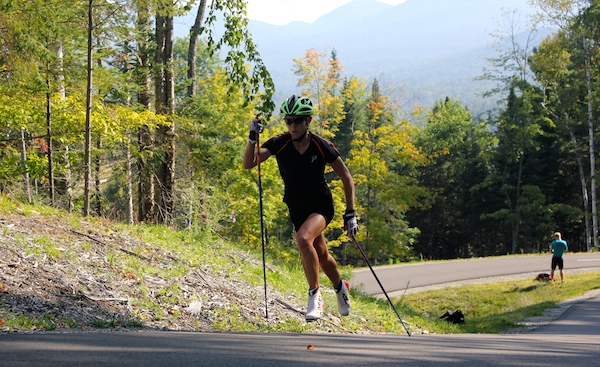
Liz Stephen practices her bounding technique at the 2014 USST Lake Placid Training Camp.
“We had high goals that were legitimate goals for the first time ever,” Stephen explained. “Going into any other Olympics it’s been a ‘if the best case scenario happens then we may have a chance’ where as this year we had results leading up to the Olympics that made our goals a very real possibility.”
In terms of her personal performances, Stephen was pleased to find success during the Tour de Ski but noted that her results from the season were comparable to the previous year of racing.
“You always want to make that step up, but sometimes you don’t make it to that next level. There are certainly a lot more steps for me to go, but it wasn’t a year where I made any big ones,” she said.
Despite a disappointment in her team performance at the Olympics and self-proclaimed stagnation in her personal results, Stephen is not one to remain frustrated. In fact, she believes that disillusionment with results from the Olympics will only boost her personal and team success this season.
“If you are always getting what you set out to achieve it’s way too easy,” She said. “[Last season] has motivated me, and the team is definitely motivated to go out and kick some butt.”
Stephen’s “kick butt” strategy includes more than just personal training – an unsurprising fact given her status as the team’s “glue”.
She hopes that she and the rest of the U.S. Ski Team can use each other’s strengths to progress as a whole. This was apparent at the 2014 USST Lake Placid Training Camp where Stephen was constantly asking teammates like Andy Newell or Ida Sargent for technique advice.
“An athlete can be the best teacher because we’re actually doing the motions” Liz Stephen explained. “A coach can see it and they can know exactly what to say but for some reason I sometimes can’t compute it.”
Stephen also hopes to expand this mentality to the international community, which she believes has already begun with recent international exchanges such as Norwegian Celine Brun-Lie’s visit to Alaska earlier this year.
“I think there’s a big understanding from everybody on the World Cup that everyone can get better,” she said. “Let’s all get better – what’s the worst that can happen? We get pushed harder and get faster.”
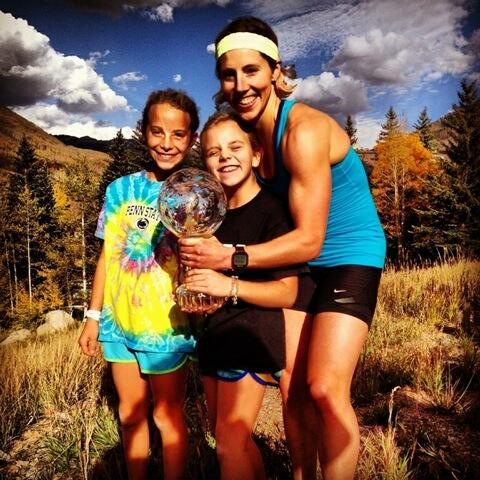
Kikkan Randall getting some help from two Ski & Snowboard Club Vail juniors to hold the hefty Crystal Globe, which she won as the World Cup sprint champion last season. (Courtesy photo)
When Kikkan Randall talks about being injured, her tone matches the description of any other day: the sun is shining; life is good.
For more than two months, the 29-year-old U.S. Ski Team (USST) veteran has been healing a stress reaction in her right foot by wearing a walking boot outside of training. An MRI five weeks ago revealed she needed to dial back her workout efforts to 50 percent and stay away from certain activities, such as skiing and running.
As if that wasn’t hard enough for a nordic skier, let alone the defending World Cup sprint champion, Randall discovered last Wednesday that she wasn’t completely in the clear. Follow-up imaging with Dr. Tom Clanton at The Steadman Clinic in Vail, Colo., revealed that her stress reaction – a weakening of the bone in her foot – had become a stress fracture. The good news was it was already healing.
One day before the start of the final USST dryland camp in Park City, Utah, Randall spoke on the phone Monday about her injury and plan of attack for the season ahead. She had just finished a 2 ½-hour mountain bike ride in Park City with her husband, Jeff Ellis, and said she was enjoying spending some extra time with him.
Meanwhile she aimed to stay patient with about six and a half weeks to go until the World Cup opener Nov. 24 in Gällivare, Sweden. Last week, doctors estimated it would be eight or nine weeks before she could resume race-pace intensity.
“That puts me right about when the race season is supposed to start,” Randall said. “I’m hoping I’ll be in at least a good enough place to be able to compete in those races. I don’t know what kind of shape I’m going to be in because I won’t be able to do full-on intervals for a while still, maybe four or five weeks from now, so I’m going to have to change my goals a little bit.”
***
FasterSkier:What kind of goals do you have at this point?
Kikkan Randall: Those first races will have to be to build back up and get in shape, and hopefully be in a good place by Tour de Ski. … Tour de Ski was one of the big goals and I think that’s still a good possibility to go there and perform well. It’ll be fun to see the World Cup races in Sochi (Jan. 1-3) and maybe have some good performances there, but really probably the biggest goal of the season is focused around World Championships and using the second half of the season to test things out and figure out what works well. That’ll give me something to work on next year.
FS:What are you specifically aiming for at World Championships (Feb. 20-March 3 in Val di Fiemme, Italy)?
KR: I’d like to make the final in the classic sprint. I’d like to have our team fight for a medal in the team sprint. I think we can put together a relay, the 4-by-5 k in the top six. This will be the first championships where I’m almost more excited about the team goals than my own. I mean, I obviously want to race well myself, but I’m excited about what we can do as a team. That’ll give me some extra motivation in rehabbing this foot injury, too, knowing that I really want to be there and competing with the team in February.
FS:How did you react to discovering your stress fracture last week?
KR: I think overall it was a positive visit. They did see some new bone growth in the area where the fracture is so they felt that was a good sign, and I can gradually start building back into training, but it’s going to be a pretty gradual process. With skiing, it’s quite challenging because we have so many things to reintroduce – skating, classic, running, strength training – so it’s still going to take me many weeks to build back in, but at least we saw some progress.
That helps knowing just by reducing my training and taking the impact off my foot that it was able to heal, so that makes me feel good going forward. If I behave myself and gradually reintroduce things, then I’ll be in a good place by the time we race. It’s still hard because five weeks of it was an easy target to focus on, and it would’ve been nice to put my five weeks in and jump back in to be being totally normal, but I know that if I continue to be a little bit patient, the season is long. Even if I’m not racing quite as well as I want to the first period, the biggest races are still in the second half of the season. So I’m just kind of focusing on that and focusing on what I can do and using this as a time to work on some of my weakness, and hopefully we’ll all be laughing about this in a few months.
FS:Who are some of your biggest supporters?
KR: Everybody, really, has been incredibly supportive. It was [U.S. women’s coach] Matt Whitcomb that kind of finally sat down with me at the end of the Swedish camp and said, ‘You know, look, this is obviously an issue that’s not going away; as hard as it is to slow down, let’s deal with it now so that you’re good to go by the season.’ So I credit him a lot with getting me to finally do something about it. When I came back to Anchorage, [Alaska Pacific University coach] Erik [Flora] was really supportive, and Jeff and my parents, and then my teammates keep checking in on me and pumping me up and stuff. I’m really lucky to have so many good supportive people around.
FS:How’s your Achilles injury in your left foot?
KR: That’s actually gotten a lot better. That’s the one thing I could work on over the last five weeks because all the PT I was doing was primarily to heal that up. It’s feeling really good, and I think slowly reintroducing running and skiing back in is going to be really good for that injury to make sure it’s totally healed, too.
FS:What’s your training plan moving forward?
KR: I got the clearance to return to normal volume so that’ll be good, and then I can start adding in a little classic striding to begin with. While I’m down here in Park City, I’m going to take advantage of the AlterG [anti-gravity] treadmill they have here to start reintroducing running and combine that with pool running to help build the running back in. If that all goes well, in maybe three weeks I can start adding in a little bit of skating and then a little bit of classic intensity. If all that goes well, I can start doing a little skate intensity and a little running intensity.
FS:You anticipated not being able to do the USST testing at the Center of Excellence (COE) this week. Will you be able to join the team for any workouts?
KR: I’ll be able to join them a few sessions this week because classic skiing, I can, for sure, double pole and I can add in a little striding. I’ll be at the strength center at the same time, but then a few of the workouts will be on my own.
FS:Do you still have to wear the walking boot?
KR: I put two solid months into the walking boot and luckily they said I can actually stop wearing it unless I feel like my foot needs a rest. I did wear it [Sunday] at Fast and Female because I knew that once I got around everyone jumping and playing and dancing, I’d want to do it too, and they said absolutely no jumping until probably after the Tour de Ski so, I put the boot on so I wouldn’t be tempted.
FS: How was the Fast and Female event in Park City?
KR: We had a blast as usual. Those events are almost four hours long and there’s a lot of energy going around so you definitely feel a little worn out by the end of the day, but it’s totally worth it. The girls, you can just tell, they’re having so much fun. They’re like sponges soaking up every word the ambassadors say so you can tell we’re making a big difference.
We had, I think, 75 girls age nine to 19 and then about 30 ambassadors. Between the parents and everybody, we had probably 120 people there, which I think is a pretty significant size.
FS:We’ve seen photos of you and the kids holding your Crystal Globe. Do you bring that everywhere?
KR: With the [U.S.] Ski Team, this is kind of the last interface before the season starts so they asked me to bring it down so we could do some photos and things. I pulled it out when we went over to the Ski Club Vail and it worked out to have it at Fast and Female [Sunday]. It’s not the easiest thing to just haul around, but it is really fun to share with everybody. … I’d say it’s about 20 pounds probably in the box that it comes in. It’s kind of an awkward size; you have to hold it off your hip a little bit.
It is definitely covered in fingerprints right now because when I was at home [in Anchorage, Alaska] I was doing a bunch of visits to elementary schools, and I was letting the kids all rub the Globe on their way out of the gym and then everybody got to touch it [Sunday]. It’s going to need a good Windex cleaning in a little bit.
FS: When will you leave Park City (with the rest of APU, which isn’t going to the USST camp in Canmore, Alberta)?
KR: Next Thursday I’m headed back to Alaska and hopefully we’ll be able to get on snow pretty soon after.
FS:What else have you been up to since arriving in Utah?
KR: We went to a friend’s wedding this weekend [in Sundance]. (Former APU/U.S. World Cup team member Katie Ronsse married Justin Libby).
It was a great time. Sundance is beautiful and it was really fun because I haven’t seen Katie in a while. She’s going to PT school in Salt Lake now. It was a great wedding, good time, and it was so nice of them to plan it conveniently around the training camp.