From the FasterSkier archive — posts syndicated from athletes’ and coaches’ own blogs between 2004 and 2012, kept online as published. Current coverage is at fasterskier.com.

Tag: 2012 U.S. Cross Country Championships

  • Injury Behind Her, Stock Ready for World Juniors

    Injury Behind Her, Stock Ready for World Juniors

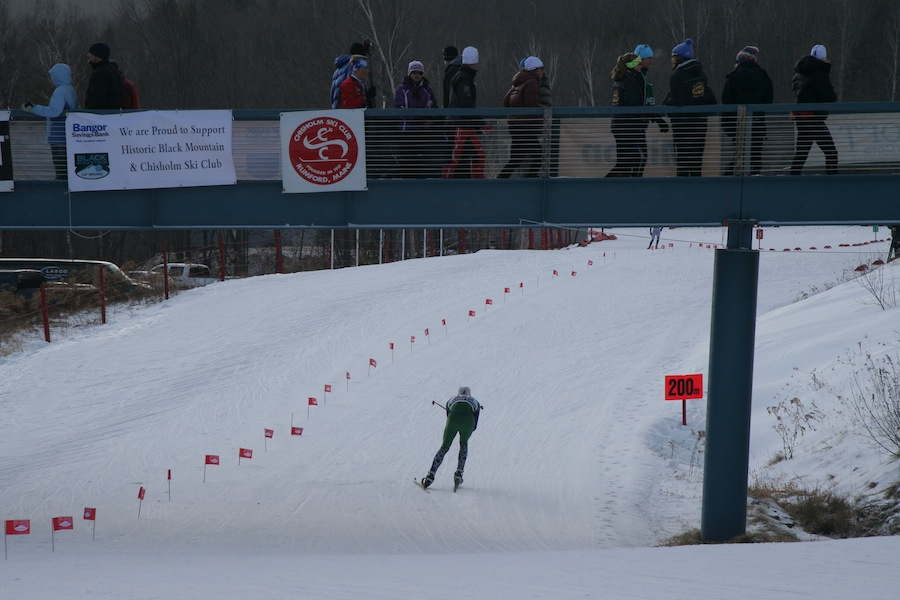
    Corey Stock (CSU) skiing into the stadium in Rumford. Photo: Flying Point Road.

    Highlighted by her fourth-place performance in the senior freestyle sprint at U.S. Nationals, 17-year-old Corey Stock (Cambridge Sports Union) earned her first trip to Europe with the U.S. Ski Team’s (USST) World Junior Championship squad this coming February.

    It’s difficult to determine the most remarkable part of that statement. For starters, Stock’s age would normally make her a candidate for the J1 trip, and yet as the top junior finisher in the skate sprint in Rumford, she skipped that step and is headed for a major championship stage with her inaugural trip to Europe.

    Even more impressive, however, is what Stock has managed to accomplish despite the less-than-ideal path she’s had to take. Two years ago, doctors diagnosed pain in her legs as compartment syndrome. She underwent surgery in the summer of 2010, and recovery was slow going.

    “All the time her leg was injured, she was on the Ski Erg,” CSU coach Rob Bradlee said.

    Upper-body work was all Stock could do to keep in shape.

    After her surgery, the pain didn’t completely go away. She had been looking forward to competing at U.S. Nationals in 2011, but she and Bradlee decided not to sacrifice doing lasting damage for the sake of a trip to Europe and skipped Rumford entirely.

    For someone of Stock’s competitive nature, a lengthy injury could have easily brought her down psychologically. When all she could do was double pole on a machine, she conceded that she definitely had her low moments. But she also saw the bright side.

    “I know in the long run it’s been a good thing,” Stock said. “With athletes, it’s inevitable that you’ll encounter obstacles. I learned how to deal with them, I guess.”

    Forced to adjust, Stock set her sights to one year into the future. Despite being held back over the summer, she went on last season to win two out of three individual races at Junior Nationals in Minneapolis, Minn., earning herself a spot on the National Training Group.

    New England's Corey Stock on her way to her second national title in Presque Isle, ME in 2010. Photo: Flying Point Road.

    A trip back to the doctor in the spring revealed that the return of pain in her legs was not compartment syndrome — it had been a trapped nerve all along. Stock underwent surgery for a second time, and this time was able to bounce back and start training again in full.

    Healthy again, Stock reentered a normal training plan from square one. Bradlee said he had to be careful not to bring her back up to speed too quickly, fearing overtraining.

    “My big goal for the year was to do a reasonable amount of training, but not break her,” he said. “It would be so easy to overdo it.”

    Bradlee described Stock’s fourth-place finish at her first U.S. Nationals race as the product of smart training and perfect timing. When Stock started showing signs of tiring at the end of the summer, he scaled back her intensity work and had her focus on getting enough sleep and recovery.

    After winning the sprint qualifier at the Eastern Cup in Craftsbury, Vt., by over six seconds at the end of December, Stock put in another week of work. This was just enough time, in Bradlee’s opinion, for her to be ready to roll in Rumford.

    “When she killed that opening sprint race, it was a big sigh of relief,” said Bradlee. “I though we were doing the right thing, but I didn’t know for sure.”

    Natural speed and hard work haven’t been the only factors at play in Stock’s success. Her mental toughness, explained Bradlee, is exceptional.

    “The tougher the race, the calmer she gets,” he said.

    After every race, Bradlee has his CSU athletes go around in a circle and talk about their day. When it was Stock’s turn to describe her experience moving through the heats, she explained that she’d enjoyed herself as the competition got progressively tougher.

    Stock, in CSU blue, competing in the women's A-final in Rumford.

    “She talked about how her heats were so much fun, duking it out with these really big girls,” said Bradlee. “That’s not something I taught her, you have to arrive with that, I think.”

    At the end of the day, Stock was still processing her fourth-place finish, which for her was a surprise.

    “It’s slowly sinking in,” said Stock. “I’m realizing how much I learned throughout the day. For every [heat] I learned a lot about tactics, and how exciting it is to ski with so many amazing skiers.

    “I saw my confidence in my skiing; I definitely felt better on each heat, more peppy and sharp, and it worked out well.”

    As a member of the USST’s National Training Group this summer, Stock had the opportunity to join the training camp in Alaska, and skied on Eagle Glacier with the fastest women in North America. More than anything, said Stock, the experience gave her the self-confidence to believe she belonged in a race against the likes of U.S. Ski Team members Jessie Diggins (CXC) and Ida Sargent (CGRP).

    Stock, far left, on Eagle Glacier this summer. Photo: Matt Whitcomb.

    “I realized how these amazing women, who I look up to so much, are actually just real people,” she said. “It helped when I raced them today; it wasn’t as intimidating.”

    After opening nationals with a bang, Stock went on to ski to 33rd in the senior 10 k freestyle and then second in the junior 5 k classic.

    With the completion of racing in Rumford and the naming of the World Junior team, the moment she’d been looking forward to for so long had finally arrived. Stock was understandably thrilled.

    “I’ve been getting advice from athletes who have already been,” she said in Rumford. “I know it’s a big step up the first time you race in Europe, but I’m excited, too.”

  • Nationals Notes and Quotes: Wrapping Up in Rumford

    Nationals Notes and Quotes: Wrapping Up in Rumford

    2012 U.S. Nationals
    Skyler Davis (USST/SMS) during an interview after Sunday's classic sprint finals, in which he placed fifth overall at Black Mountain in Rumford, Maine.

    RUMFORD, Maine — Since the 2012 U.S. Nationals kicked off Tuesday, there was plenty of action and comments to go around throughout the weeklong event, which ended Sunday. Here’s a look at what didn’t make it in print:

    On the week (which included freestyle sprints, 10/15 k freestyle individual starts, 20/30 k mass starts and classic sprints):

    2012 U.S. Nationals
    Dasha Gaiazova (CNST/RMR) after winning Sunday's classic sprint

    “I’m just really thrilled, it was kind of unexpected so I’m just really happy with it.” —  Jessie Diggins (USST/CXC), who technically swept all four races (was first American in classic sprint, 2nd overall)

    “I’m very happy with how my week went, I had fantastic support from APU with the skis and logistics and all that kind of stuff, and the body really felt good.” – Dasha Gaiazova (CNST/RMR), 1st in classic sprint

    “It wasn’t what I was looking for this week, but it’s racing and there were some good things and it was a fun week. … Just looking forward to the next races in Milan next weekend, really excited for that.” – Ida  Sargent (USST/CGRP), 4th in classic sprint, after placing 2nd in 20 k mass start for her best result of the week.

    “It’s definitely good to be feeling strong. This was my first [sprint] that I’ve advanced all year, ’cuz I’ve been in Europe on the World Cup, so it’s like everything’s building this year, so I’m definitely excited to go home and get some good training.” – Skyler Davis (USST/SMS), 5th in classic sprint

    On Sunday’s classic sprint:

    “I was definitely feeling the rest of the week, I was like, all right, I’m a little tired, a little sore, but I’m just going to hang on as long as I can.” – Diggins

    “I knew coming into the downhill my skis were amazing, so I’m just like, ‘Well hey, they’re still there, might as well go for it.’ ” – Kate Fitzgerald (APU), 3rd in classic sprint after passing Ida Sargent (USST/CGRP) on final straightaway

    On falling:

    “It seemed good on that turn all day, but like it always goes, I think I hit a little patch of ice and then rolled a ski over and then the boot hit the ground. I tried to save it by doing some awkward-jump thing, and I think that put me higher in the air, and then I just fell right on my shoulder. I think I popped it out, but I got it back in. It’s bruising pretty fast, but it’s fine. I’m just gonna pop some Ibuprofen.” – Reese Hanneman (APU), 11th in the classic sprint after falling in the B-final. He was in the lead until that point.

    On sprinting strategy:

    2012 U.S. Nationals
    Ida Sargent (USST/CGRP) after placing fourth in Sunday's classic sprint at the 2012 U.S. Nationals

    “I really wanted to make sure I had my tactics right this time around because in the skate sprint in that long downhill … if you were in the front people could draft you really well. I did not want to be in front going into that downhill. I was just trying to hang on and I was able to slingshot Ida [Sargent] off of the downhill and then double pole it in.” – Diggins

    “I went for it on the hills ’cuz that’s my strength and wanted to drop people, and I couldn’t get a big enough gap and it was a huge slingshot advantage. So I was on the wrong side of that.” – Sargent

    On preparations:

    “I had some really good training over the holidays. I went to Silver Star and trained there, I did like a mini-volume camp there where I skied my heart out and I came here … really to do some good intensity and be able to get in the final … and get some racing under me before I had back to Europe.” – Gaiazova

    On choosing races wisely:

    “I absolutely love sprinting and I wanted to do the skate sprint, but I have a lot of racing coming up and this was more of a preparatory racing period for upcoming World Cups. And I had this long discussion with my coach and I was dead-set on doing all four and after talking and discussing how to feel by the end of this we decided it would be better for me not to completely push myself into the ground with four races over a week and just do a bit less racing, get better training and that would set me up better for Milan and Otepaa and Moscow.” – Gaiazova

    On the World Cup:

    “I definitely gained  a lot of experience. It didn’t really sink in yet, but I think a couple months down the road, [it will]. … It takes a while to process it.” – Davis

    On Fast and Female and Zumba:

    “We did Fast and Female [Saturday], that was fun. We did some warm-up Zumba over at Gould [Academy] in Bethel. All the APU girls did that; it was an awesome day. The girls that came out from all over Maine were awesome. … I think I got way too into it, by the end I was like sweating, but it was really fun.” – Fitzgerald

    “A bunch of CXC girls went down, APU was there, University of Vermont brought some people, I think Dartmouth had people so just a lot of us girls went over there to help. It was a shortened event, but it was still really fun. Dancing, always, can’t pass it up.” — Diggins

    On Alaska Pacific University (APU):

    “They’re so kind and they adopted me for the week. … When I called they were like, ‘For sure we’d love to have you.’ … We had such a good time staying in the [Bethel] hostel … I feel really lucky.” – Gaiazova

    For complete results from the week, visit the 2012 U.S. Cross Country Championships website.

  • U.S. Nationals In Their Words: The Men’s Classic Sprint A-Final

    Torin Koos (BSF/Rossignol), Skyler Davis (SMS/USST) and Reese Hanneman (APU) skiing up the first hill in the semifinals. Photo: Flying Point Road.

    RUMFORD, Maine — The major story to come out of the final race of the 2012 U.S. Cross Country Championships was Torin Koos’s disqualification for obstruction of competition (which he plans to appeal). But in addition to the drama, an entire classic sprint day went on at Black Mountain.

    When the A-final field took the line Sunday afternoon, it was difficult to know what to expect. Koos seemed like the only safe bet to be first through the finish, as he’d handily won his quarterfinal and semifinal and his experience with high-stakes sprint racing was difficult to ignore.

    Ryan Scott (MSU/Team HomeGrown) leading his semifinal. Photo: Flying Point Road.

    Ryan Scott (MSU/Team HomeGrown) and Mike Sinnott (SVSEF) went 1-2 in their semi and had also skied strong throughout the day, and Tyler Kornfield (University of Alaska Fairbanks), who was third in their heat, looked like he was on fast skis.

    Fresh off his bronze medal from Friday’s 30 k mass start, Eric Packer (Dartmouth) was a hard classic skier to bet against. Skyler Davis (SMS/USST) had a slow start to the week, but won both his quarter and semi in the classic sprint and seemed to have found familiar form.

    The snow on the course at Black Mountain on Sunday was fast and icy in spots. As the day wore on, athletes said uphill parts of the trail in the shade became almost impossible to stride up, and in the men’s A-final, nearly everyone was slipping in those areas.

    In sprint racing, anything can happen. At first it seemed as if Koos was the clear-cut victor, but as the top three athletes in Koos, Kornfield and Sinnot waited by the podium, Koos learned he was disqualified for his second infraction in two races at nationals. The bumped Kornfield to first, gave Sinnot second place and Packer third.

    Tyler Kornfield (UAF) finishing the classic sprint A-final. Photo: Flying Point Road.

    Though it was by default, the victory was Kornfield’s second-career nationals sprint title. Coincidentally, his first in Alaska two years ago was also by default, as the winner was his UAF teammate, Erik Melin-Soederstroem of Sweden. Non-American podium finishers at nationals races are awarded prize money (unless he or she is an NCAA athlete), but not given medals.

    “It’s definitely not the way you’d want to win your national title,” Kornfield said in a phone interview on Sunday evening. “I mean, in the first place I was excited with second.”

    With a few hours to have processed the day’s events, Kornfield still wasn’t sure how to interpret the outcome of the race but, “overall I’m pretty excited,” he said.

    “Before this week, I hadn’t had the best start to the season, so I didn’t have great confidence,” he said immediately after his race. “I was pretty happy with the sprint at the beginning of the week, and the 30 k definitely gave me confidence. This is tied with the best result that I’ve gotten at Nationals, so I’m pretty excited about that.”

    When he still thought he’d placed third, Sinnott said he was generally pleased with his performance.

    “I’m pretty happy,” Sinnot said. “Obviously you always want the win, but I can’t really complain about a podium at nationals.”

    Following Koos’s disqualification, Packer unexpectedly found himself on the podium. Though he believed Koos to have deserved the gold medal, he added that he was happy to have ended up with a top-three at Nationals for a second time this year.

    Torin Koos (BSF/Rossignol) crossing the line in first in the A-final of the men's classic sprint at U.S. Nationals. While waiting to take to the podium, he found out his win was in question. Photo: Flying Point Road.

    FasterSkier talked to the contenders afterward — Sinnott and Kornfield before they learned of Koos’s disqualification, and Packer, Davis, Scott, Koos and Kornfield again afterwards. Here’s how the A-final unfolded in their eyes:

    (Note: Quotes from Koos as told to Glenn Jordan of the Portland Press Herald)

    Kornfield: “I hadn’t been getting very good starts [in earlier heats]. I was fifth or sixth coming out of the stadium [in the final]. I stuck with the pack beter than in the first two heats; that was definitely my weakness, so I wanted to change that a little bit. I was with the pack, and I was about fourth going down the hill to the switchback.”

    Sinnott: “It didn’t start off as quick as I’d wanted; there were a lot of strong double polers in that heat … I got into a place where I wanted to after that first big hill.”

    Packer: “I tried to take it easy out of the start — I didn’t want to expend too much energy, since it’s a long course. A 3:30 sprint is pretty long, so I tried to conserve energy up the first hill and really push the second.”

    Kornfield: “A lot of people were slipping on the step big hill, and I kind of got boxed in and that’s where Koos got away from us. He was slipping too — everybody was slipping — but he just got a few more strides in and he broke away.”

    Sinnott: “I just kind of pulled up right behind Torin, and felt like I was skiing well. Then it’s kind of icy there, I started sipping, and Torin made his move and that was kind of the end of the race for the rest of us and it was just a scramble to see who could hold on for second.”

    Koos: “I took the lead on the second climb, which was pretty difficult because it’s in the shade, so it’s not as soft as the rest of the course. It’s a little more glazed, so skis play a big factor there.”

    Scott (4th place): “We were all pretty tight in the group going down the hill … The heat was pretty aggressive, and how it worked out in the bottom there, everyone was tight on the turn.”

    Kornfield: “We were all double poling, and Torin was about one boot length in front of Ryan, and it seemed like he had a clear shot on what lane he wanted to choose. Right after he moved on Ryan there was a break in the tracks, so you had to pick another track. Torin tried to pick the inside track, and he moved onto Ryan’s skis, and it knocked Ryan off balance. It seemed like it took a while to get back his balance.”

    Koos: “My plan for the final was to stay in the top three … but if I could decide the race before [the final stretch] then, why not?”

    Sinnott: “[It was] really great racing by Torin to make a strong move while people were struggling …  It’s just a tough pitch because they washed out the tracks, and because it’s in the shade, it’s hard to get kick there. I had trouble there in the qualifier as well, and it’s just kind of a tough, off camber, steep little slick place and tough to go fast there. Torin made the most of it so that he attacked right at the top when everyone else was still in the middle of it. It was a smart move.”

    Packer: “I personally didn’t see anything that merited disqualification … I think [Koos] deserved the win today. He skied away from everybody.”

    Kornfield: “I was in third, then Ryan Scott moved over and I was able to double pole and make a gap with the downhill. My skis were running wicked fast. [I] just double poled to the finish.”

    Davis (5th): “The back hill kind of got really icy, and I slipped really badly. I started herring boning for the first time, and by that time I was like, [groans]. So with sixth, I obviously wanted to be on the podium, but that’s probably pretty good for how the season’s been going. It’s definitely good to be feeling strong.”

    (Note: Davis initially thought he placed sixth and was later moved to fifth with Koos’s disqualification. Karl Nygren won the B-final, which would have put him in seventh, but his place improved to sixth.)

    ***

    For men’s classic sprint results, click here.

    For qualifier results, click here.

  • U.S. Nationals Notes and Quotes: 20/30 K Classic Mass Start

    U.S. Nationals Notes and Quotes: 20/30 K Classic Mass Start

    RUMFORD, Maine — As usual, there was so much going on during Friday’s 20/30 k classic mass start at the U.S. Cross Country Championships that not all of it fit into the race reports. Here were the notables and quotables from Black Mountain:

    The University of Vermont placed three women in the top 10; Amy Glen led the way for the Catamounts in seventh, Caitlin Patterson was eighth, and Lucy Garrec was tenth. The trio worked together for much of the race, and said that though they’d gone into the race hoping to do well, didn’t necessarily expect to. The carnival season starts Jan. 20 with the Bates Carnival back at Black Mountain, and it looks like UVM could be a team to watch for.

    Friday was doping-control day. The top three finishers of each race crossed the finish line and were immediately introduced to their own personal USADA chaperones, who are responsible for watching their athlete like a hawk until they are able to collect samples.

    Sadie Bjornsen (APU/USST) is getting sitr-crazy after being sidelined this week with a sinus infection. She said she’s starting to feel better, but is being cautious about racing again too quickly what with a trip to Milan, Italy, coming up. She still doesn’t know if she’ll enter Sunday’s classic sprint, as doesn’t want to tax herself too much and get into a hole the rest of the season.

    On Wax

    At long last, real, natural snow flurries were in the air Friday morning, but at exactly the wrong time. The accumulation of a few inches on the trails made waxing difficult for a lot of teams, as the changing conditions necessitated retesting and reapplying kick to the bottom of people’s skis. For coaches that were able to adjust and hit the wax, it made all the difference. Most athletes had their kick figured out, but glide was an issue for some. Reese Hanneman (APU) dropped out after deciding that struggling against dragging skis for nine laps wasn’t worth it.

    Eric Packer (Dartmouth), on the other hand, benefitted from excellent glide: “Dartmouth did a great job with the skis, you have to credit our coaches Ruff and Cami, they really knocked it out of the park with the wax,” he said.

    “My skis I felt like were the fastest out there, there was a long one kilometer downhill about 800 meters into the race and I was just skiing away from people down that, gliding away from people, it was awesome”. — Noah Hoffman (Team HomeGrown/USST), 1st

    “Interestingly, I had the hardest time on the easiest parts of the course. Skiing High School Hill was an area where I could actually recover. I had too much wax on the skis. This cost me from sticking with Noah and [Norris] when the race was getting decided. — Torin Koos (BSF/Rossignol), 4th

    On Pacing and Skiing in a Pack

    “[The pace] was pretty easy for a little big and then all of a sudden, the race got really hard, and I just tried to hang on from there.” — David Norris (AWS/NMU), 2nd

    “After a while I looked at Noah and he’s like, ‘You wanna go?’ And I was like, ‘All right, yeah.’ I told him on the next uphill I was gonna peg it, and we’ll see what happens. I ended up going hard and leading Hoff for a while and then the group came back together and Noah had another gear and skied away. I didn’t, so I kind of stayed back.” — Tad Elliott (Team HomeGrown/USST), 13th

    “The pace was pretty relaxed. We were going fast but really relaxed, then Noah [Hoffman] and Tad [Elliott] put a huge effort in and blew the field apart, and blew me apart, then the group came back together”. — Lars Flora (APU), 4th

    “I kept trying to increase the pace, and then on the last lap I t was down to five of us … and I had pretty good kick, but pretty slow skis, so I was at the back of the pack at the bottom of the hill. Jessie [Diggins] made a break by everyone until she had a gap and then it kind of stayed that same gap until the finish.” — Ida Sargent (CGRP/USST), 2nd

    “I didn’t really know what was going to happen, actually. We were all together for most of the race, switching back and forth …  I felt pretty good myself and thought, ‘OK, just stay strong, ski relaxed.’ That’s the most important thing, when you tense up and your kick starts to go even faster. It all comes down to the last lap in something like this.”  — Jennie Bender (CXC), 3rd

    “I made my move at the beginning of the climb on the ninth lap. I had my coach Jan Buron back from [Alaska] Winter Stars cheering me on, he said ‘It’s time to go,’ so I went for it and just hoped for the best, and it ended up working out.” — Eric Packer (Dartmouth), 3rd

    “I didn’t see any reason to ski from the front today. I wanted to ski in the pack, but do so efficiently and without incident. In that regard, I executed the race plan quite well.” — Torin Koos (BSF/Rossignol), 5th

    On Skiing a 20/30 k (the First Time for Some)

    “It was pretty tough, but you know, hopefully I won’t have to do another one until next year. There was a lot of good herring going on, especially up that High School Hill, it was pretty rough.” — Hilary Rich (Middlebury), 49th in first 20 k

    “You kind of play games with yourself to try to remember which lap you’re on … It’s long, I always forget that I’m doing a 30 k and go out hard, then I remember at about 10 k.” — Chase Marston (Middlebury), 60th

    “It was pretty rough. I planted and fell and broke my pole in the stadium [with four laps to go]. That broke me. … I had a lot of time to just relax and kind of have fun with just the skiing part … I wasn’t really prepared for how fast everyone started. I had a lot of time by myself.” — Eliot Neal (Middlebury), 73rd in first 30 k

    On What They Should Have Eaten for Breakfast

    “Eggs, bacon.” — Eliot Neal (Middlebury)

  • U.S. Nationals: Junior 5/10 K Classic

    U.S. Nationals: Junior 5/10 K Classic

    A pack of Junior men make their way out of the stadium during the 10 k classic individual start.

    RUMFORD, Maine — After an exciting morning of mass start racing, the junior men and women had their chance to shine at U.S. Cross Country Championships on Friday.

    With the morning’s snow flurries behind them, the athletes found themselves on a well-skied loop at Black Mountain. The junior men’s race consisted of three laps around the 3.26 k course for approximately 10 k, while the junior women raced two laps, one of which was on a shorter loop, for 5 k.

    With just under 100 athletes taking to the start line in the junior men’s 10 k classic individual start, there was no lack of excitement. In a hard-fought battle, Benjamin Lustgarten (Middlebury) bested Scott Patterson (UVM) by just over three seconds. Benjamin Saxton (Minnesota Valley) followed closely in third.

    Dana Roach (UNH) heads out on course in the 5 k individual start classic.

    The junior women’s race proved to be just as exciting with the top three finishing within seconds of one other. With such a short race, athletes went all-out. Many racers made the mistake of heading the wrong way on the modified women’s course, costing them several seconds that may very well have been crucial in such a short race.

    In the junior women’s event, Anne Hart (Dartmouth) outpaced Corey Stock (CSU) by one second. Marion Wood (Alaska Winter Stars) was close behind in third.

    Hart and Stock skied consistently throughout the race, holding the first and second place split times at both checkpoints out on course.

    Stock said she stuck to her strategy which was “to ski consistently and really start going all out once I reached the mens sprint course.”

    Her strategy landed her a spot on the podium.  Woods went with a different tactic, moving up in the ranks as the race went on.

    Racing resumes on Sunday with a 1.4 k classic sprint for the women and a 1.6 k for the men.

    Complete Results – Junior Women

    Complete Results – Junior Men

    Junior Mens Podium. L-R Scott Patterson (UVM) 2nd place, Ben Lustgarten (Middlebury) 1st place, and Ben Saxton (Minnesota Valley Ski)
    Junior Womens Podium. L-R Corey Stock (CSU) 2nd place, Anne Hart (Dartmouth) 1st place, and Marion Woods (Alaska Winter Stars) 3rd place.


  • Notes and Quotes from Nationals: 10/15 k Freestyle

    Notes and Quotes from Nationals: 10/15 k Freestyle

    RUMFORD, Maine – On the second day of competition at the 2012 U.S. Cross Country Championships, a longer course and a massive hill made for some spent athletes in the women’s 10 k and men’s 15 k freestyle individual starts at Black Mountain on Thursday.

    Here are a few quotes that didn’t make the recaps:

    On the course:

    “It was a really fast course so it was really hard, too, not a lot of recovery.” – Bryan Cook (Craftsbury Green Racing Program), 5th

    “I kind of grew up from [Bates] College skiing on this course and having that comfort. Knowing these trails pretty well helps a lot.” – Sylvan Ellefson (Team Homegrown/SSVC), 3rd

    “I wouldn’t say it suited my strengths, but it wasn’t a bad course for me by any means. As long as there’s good hard places on the course that’s good for me. If there’s not enough up and down, I’ll struggle because I’m not that powerful. There was definitely enough timing for me.” – Matt Gelso (Sun Valley Ski Education Foundation), 6th

    On High School Hill:

    “Icy, hard, steep. I don’t think that’s where I was making time up out there.” – Tad Elliott (USST/Team HomeGrown), 15 k freestyle champion

    “It felt pretty good, it was a little icy halfway up. I was trying to V2 as much as I could; as soon as I slipped then I go into V1 and I stayed pretty relaxed. For the fourth lap, it was a thrash-fest to get up and over it as fast as I could.” — Matt Liebsch (Team Strong Heart/Team Birkie), 2nd

    On the value of splits:

    “It’s sweet because usually when you’re getting splits sometimes you’re like, ‘I need to pick it up,’ or ‘I need to go slower.’ Just to hear that your teammates were fighting for podium that’s pretty, I mean it makes it more fun it makes you more relaxed and enjoy skiing out there.” – Elliott

    In the video below, coaches Fred Fayette (University of Vermont) and Erik Flora (Alaska Pacific University) walked us through two versions of split timing methods:

    On high expectations:

    “I’m trying to make sure I don’t get caught up in other people’s expectations and stuff and just go out there and have fun because if I’m not able to enjoy the day then its not worth it.” – Jessie Diggins (USST/CXC), 1st

    “(Diggins is) going on Wednesday to Milan to race [in the World Cup] next weekend. It’s a really quick turnaround … it’s kind of rough. We didn’t want her to take off immediately after the last race, but at the same time she needs to adjust over there. It’ll work out … That’s the thing, too; the goal we set at the beginning of year was to have as good a season as last year. So far she’s exceeded those a lot and racing the World Cup, she’ll get to start some, get some experience there so if she goes a little jet lagged, it won’t be like, ‘Aw, stupid Jessie, didn’t win!’ ” – Jason Cork, CXC head coach

    On making changes:

    “I made a little bit of a change today. The early races this year, I’ve been trying to ski into them, kind of stay big and relaxed. I tried to step it up a little bit on the first two laps of this race, see if I could hold onto it a little bit longer.” – Ellefson

    “I was able to use some of the new cues that I’ve worked on and get some traction on this new snow because that’s been a problem for me, not to just kind of spit out and spaz a little bit so I think that was a good one, something I’ve worked hard on and happy with how that went.” – Noah Hoffman (USST/Team HomeGrown), 4th

    “[I] had some gas pedals and was able to put it down, definitely a lot more than sprint; that was not a stellar day. Wasn’t as good as I would have liked, but I wasn’t fourth so that’s good.” – Gelso

    On fast skis:

    “Skis were wicked fast, those downhills I had to remember to blink sometimes because my eyes teared up.” – Diggins

    “My skis were rad out there. It kind of showed that they helped make us lucky out there … that we’re up near the front when it’s that tight. We want to thank those guys for sure.” — Elliott

    On recovering from a cold:

    “I felt real good the first lap, the second one I was still coughing up something from the cold that I was getting over. … This is like my third illness of the year. I flew in Saturday and Sunday felt OK, but Monday felt real bad so I’ve been just skiing just real light, just jogs, and a lot of tea and Cold-Eeze and Zicam, and I was able to wake up and feel pretty decent today. I took a really long warm up so I was able to get the body going.” — Matt Liebsch (Team Strong Heart/Team Birkie), 2nd

    “I’ve been trying to get over it for like a week. I decided to take off the sprint, which I really didn’t want to. Today I warmed up and it was kind of like the same feeling and it’s like, well I’m not going to skip another race so I went for it. … When you’re out there you feel 99 percent, that extra little bit isn’t there. I felt all right but not what I would have hoped to feel.” – Erik Bjornsen (APU)

    On racing in Rumford before going back to Europe:

    “It’s a really good preparing for World Cup, for sure. I haven’t raced in two weeks now, I had a good training block back home over the holidays. I’m racing with a lot of very fast American girls. It’s exciting to see so many good distance racers in USA, and it’s great preparation for me for the World Cup in terms of doing hard racing, but in a bit of a relaxed atmosphere and not changing so many time zones.” – Dasha Gaiazova (Canadian National Ski Team), 2nd

    On not being on the start list:

    “That was a surprise. I wasn’t actually on start list, it was kind of funny, my parents called me last night and they were like, ‘Hey you’re not on the start list.” – Kate Fitzgerald (APU), 4th

    On back-to-back races (with 30/20 k on Friday):

    “Everyone’s in the same boat racing 2 days in a row, but that’s kind of where the sport’s going, too. You have mini tours, Tour de Ski, stuff like that. Gotta learn how to hydrate, eat, put your legs up.” – Cork

  • Koos Claims Third-Straight National Sprint Title

    Koos Claims Third-Straight National Sprint Title

    The Men's A Final enters the stadium. Photo: James Doucett.

    RUMFORD, Maine — Torin Koos (Bridger Ski Foundation/Rossignol) made it three straight U.S. National sprint titles Tuesday at Black Mountain, using his veteran racing experience to navigate a fast, tactical day. In a tightly packed A-final, Bend Endurance Academy’s Dakota Blackhorse-von Jess was close behind in second, and in a fight for bronze that was close enough to protest, Tyler Kornfield (University of Alaska Fairbanks) completed the men’s podium in third mere millimeters ahead of Sylvan Ellefson (SSCV/Team Homegrown).

    “I felt really good — I’ve won here before, so that probably gives [me] confidence,” Koos said. “It’s all about you and your lane. You don’t think about that other stuff going on in the other four or five lanes around you.”

    The men’s racing began at 10 a.m., where Blackhorse-von Jess posted the fastest qualifying time and set himself up nicely for the rounds. Mike Sinnott (Sun Valley Ski Education Foundation) and Ellefson were both less than a second behind in 2nd and 3rd, respectively.

    Smart tactics, fast skis and a knack for avoiding crashes were the trick making it through the subsequent rounds. The trails at Black Mountain were hard-packed and slick, which favored athletes that could confidently balance on their skis. With the help of cold temperatures overnight and all of Tuesday, the crew at Black Mountain was able to repair the parts of the course made thin Sunday night’s rain. Meanwhile, the wind made positioning and drafting of the utmost importance for all but the gutsiest racer.

    The first men's semifinal entering the stadium. Reese Hanneman (APU) leads Tyler Kornfield (UAF) and Patrick O'Brien (GRP). Photo: James Doucett.

    Ten athletes — the top two finishers in each quarterfinal — automatically advanced to the semi-finals, along with lucky losers Ellefson and Dave Norris (Alaska Winter Stars), who had the fastest qualifying times of the all the 3rd-place quarterfinal finishers.

    The semifinals were hard fought. Tim Reynolds (Craftsbury Green Racing Project) entered the final few hundred meters of the first heat with a substantial gap over the rest of the field but lost his balance, ending his run for the podium. Reynolds chose not to start in the B-final, perhaps saving energy for the back-to-back races to be held later in the week.

    In the B-final, Patrick O’Brien (CGRP) showed that he still had plenty left in the tank. He skied well, outpacing the rest of the field, which consisted of Norris, Reese Hanneman (APU), Sinnott, and Ryan Scott (Montana State University). O’Brien ended the day seventh overall, adding another U.S. Cross Country Championship top 10 to his name.

    When it came time for the A-final, Koos proved he had a tactical expertise that only comes with race experience. The former U.S. Ski Team member made a risky move in deciding to lead for the majority of the race. In interviews afterwards, his competition said their early strategy was to let others — whoever makes the early move — do the work, and hope to slingshot out of his draft coming into the stadium.

    “I think everyone was kind of trying to figure out what everyone else was going to do,” Blackhorse-von Jess said about the final. “Everyone was going ‘let’s go, let’s go,” the whole race, and the first climb [Koos] was just skiing easy.”

    When Blackhorse-von Jess found himself still on Koos’ tail as the pack moved down the final hill, he thought he could end up winning. But it was not to be.

    “He’s a crafty old veteran, man,” he said afterwards. “Dude pinched me out … as soon as we stood up he just started sprinting to the finish. You could feel everybody coming.”

    The second men's semifinal enters the stadium, Torin Koos (BSF) leads Lars Flora (APU), David Norris (Alaska Winter Stars) and Karl Nygren (CXC). Photo: James Doucett.

    At that point, he said he knew he was fighting for second.

    Koos explained his ability to win from the front of the pack as a confluence of his experience and everything coming together at the right time.

    “It was a race more from the front in the final,” he said. “But I thought I had enough energy for that. I had rocket skis today too. When you have that it allows you to do a bit more.”

    Behind the top two men, the fight for bronze between Kornfield and Ellefson was too close to call with the naked eye, but upon film review, Kornfield was deemed the third-place finisher.

    Kornfield skied each of his heats conservatively, and in the final, came from fifth off the last downhill to swing into third in the last 50 meters.

    “I got a little lucky I think, but it was a good heat,” he said before he learned his unofficial third place withheld the protest. “I’m pretty excited with fourth or third — whatever I got.”

    Ellefson, who is less of a sprint specialist than his A-final competitiors, was right in the mix as the pack moved through the first part of the course. He felt he had a good position in the middle of the group as he passed under the bridge, but ended up having to swing wide into the icy and little-used far left lane, where it was more difficult to see the other racers.

    “I’m not sure what happened in the finish,” Ellefson said, “But I’m pretty excited on the day.”

    Veteran Lara Flora (APU) and CXC skier Karl Nygren rounded out the heat finishing fifth and sixth, respectively.

    Flora said he’s definitely more focused on the distance races this week, but felt good about his result.

    “It was really sprinting tactics out there,” he explained. “There were four true sprinters, and Sylvan and I were kind of the distance skiers in there, so there was a lot of yo-yoing.”

    Alex Matthews and Sam Evans-Brown contributed reporting.

    Men’s Heats

    Men’s Qualifier Results

  • U.S. Nationals Notes & Quotes: Day 1 Skate Sprint

    U.S. Nationals Notes & Quotes: Day 1 Skate Sprint

    2012 U.S. Nationals
    A racer makes his way into the stadium for the last stretch of the freestyle sprint qualifier at the 2012 U.S. Cross Country Championships on Tuesday.

    RUMFORD, Maine — With the first day of U.S. Nationals racing over and done, here’s a look at what didn’t make it into the freestyle sprint recaps. Racers shed light on course conditions, changing strategies and the unavoidable bumps along the way.

    On preparations:

    “I planned my season to get good right now, and it looks like its coming together and that’s all you can hope for.” – Torin Koos (BSF), 1st in Tuesday’s freestyle sprint

    “I had a lot of pent-up energy from an extra rest day, so I was like, ‘All right, just go, just go, [I] want to do this.’ [Monday], you know you have nerves and stuff and finally I was just at the point where I was like, ‘All right, I’m ready to do this,’ and it’s like, ‘Oh, it’s canceled, dangit, but now I’m just extra ready, I guess.’ ” — Jessie Diggins (CXC), 1st in freestyle sprint

    “Yesterday, we’re like well I guess we have to go for a run. I mean it was fine you can’t get stressed out about the weather. … It was hard to contain all the race nerves from yesterday. It was kind of good to decompress and build up again.” – Jennie Bender (CXC), 3rd in freestyle sprint

    “I’ve been playing Sonic the Hedgehog race car (on husband Brian Gregg’s iPad) all week preparing for that final. You can ask, I have been.  I’ll show you my high score.” – Caitlin Gregg (CXC), 2nd in Tuesday’s freestyle sprint

    “This is the first time I’ve come to the final really eager to race. Usually I come into the final telling myself I’ve gotta get going ’cuz I’m so tired, but the training’s been working. I’m feeling really good.”

    – Dakota Blackhorse-von Jess (Bend Endurance Academy), 2nd in freestyle sprint

    “That’s the fastest snow I’ve skied on so far this year. I don’t think I’ve ever run for a ski race warm up before, so it’s good to learn. I don’t know if I did it right, but it seemed OK.” – Reese Hanneman (APU), 9th in freestyle sprint

    On Tuesday’s conditions:

    “So fast, the course probably took half the time it took Sunday [to ski]. The course is super good, no ruts or ice or anything like that.” – Hanneman

    “It’s super fast. You’ve gotta be able to stay on your feet. Pretty icy in spots, gotta pick your lane carefully, but it’s a good course.” – Sylvan Ellefson (SSCV/Team Homegrown), 4th in skate sprint final

    “They did a pretty fantastic job to get it back in racing shape after the rain.” – Mike Sinnott (SVSEF), 10th in Tuesday’s sprint

    “It was perfect, beautiful course. Nice to do longer course conditions … plenty of room to ski out there. It was good conditions.” – Lars Flora (APU), fifth in skate sprint

    “It was super fast, kind of oily, but good. … We had good skis. Salomon cold ski was awesome, had a Zach Caldwell grind. They were very fast.” – Maria Stuber (CGRP), 1st in Tuesday’s sprint qualifier, 10th overall

    On the sprint itself:

    “The qualifier is one of those, no matter how many intervals I do it’s always a shake out. The skate is fast, it’s more like a battle. You take up more space, so it gets a little more aggressive out there.” – Bender

    “My sprinting has been off this year. To be honest, I was pretty nervous today about my body getting the response so I was happy that it did.” – Flora

    “In my semifinal, (Tyler) Kornfield stepped on my skis and it was almost really bad. So I was like, you know, maybe I should just stay out of trouble. I felt so good, and I wanted to go, and it was obvious everyone was waiting. Being in front obviously is hard. There’s wind, and it’s so fast and all that.” –Blackhorse-von Jess

    “The A-final went well, it was super tight. All six came over last hill together, got boxed out a little bit, pretty close. I don’t think anyone wanted to lead at the very end, it was kind of slow at the last hill. Torin was up front and was able to hang onto the lead.” – Karl Nygren (CXC), 6th in skate sprint

    On race tactics:

    “It was kind of this Zen moment, calm, you know? Like you know everybody’s coming … and everybody does, everybody’s waiting to hit the gas, and it’s just waiting to see who hits it first, ’cuz you don’t want to be the first guy coming down the hill, you know? Unless you’re Torin, obviously. Or I know Lars (Flora), it’s kind of his style too, go out hard, get in front.

    “Torin and I skied side by side all the way to the pool, which is the top of the final descent, so I tucked in behind him, got a couple of good pushes, tucked in behind him and I think everybody just lined up. I didn’t feel anybody coming. And I thought man, I’m gonna get him.” — Blackhorse-von Jess

    “I basically did every heat, not leading, not a good idea to lead down that unless you have a really good finish, and I know I don’t have that good of a finish and so I just drafted off the guy . I didn’t have the greatest draft, but I was able to swing around a few people in the last, like, 50 meters, which was pretty sweet.” – Tyler Kornfield (UAF), 3rd in the freestyle sprint

    “Usually tactics is, on the backstretch on uphills, try to break it. I tried to do that in the semi but it didn’t really work, I didn’t really break them so by time I got to finish I was flooded.

    “In the final, I decided to stay in second or third and then right over the top I wanted to pop it. It was really tight so I went to right, Dakota went to the right, I ran out of snow, still got around him but Torin had a little bit of a gap. Then coming down to final, I missed a couple key points.” — Flora

    “I had a lead and then on the downhill, unless you had a good enough gap, I’d get passed. So I got passed in the semifinal on the downhill in a tuck even though I had a little bit of a break because there was just a pretty big draft, so my plan for the A-final was to really just go for it and drop everyone in the beginning because I was feeling really good in the heats.” – Ida Sargent (USST/CGRP)

    On crashes:

    “I just wanted to avoid crashes because last year I had some experiences so I feel like I put out quite a draft.” — Diggins

    On racing at a lower elevation than Colorado:

    “It’s more like we are used to starting slow and gradually go faster and faster, but you can just start hard and go hard for whole race so you have to switch your brain.” — Eliska Hajkova, University of Colorado Boulder

    “It’s hard mentally more than physically because you have to know how to race at sea level.” — Joanne Reid, University of Colorado Boulder

  • Diggins Wins Women’s Sprint Qualifier in Rumford (Corrected)

    Note: Due to a change in the results from the women’s sprint qualifier, this article has been updated. 

    RUMFORD, Maine — Twenty-four hours after the 2012 U.S. Cross Country Nationals were originally scheduled to start, the women in the 1.4 k freestyle sprint qualifier found themselves racing on completely different conditions on Tuesday – and no one was complaining.

    The second to start, Jessie Diggins  (Central Cross Country) posted the fastest qualifying time in 2:58.84, nabbing a spot with 29 others in the heats, which started at noon on Tuesday.

    Teammate Caitlin Gregg was second (3:01.37).

    “I felt like I skied really well,” Gregg said. “I felt like I skied tactically how I wanted to on the course, saving enough for the key parts and skiing aggressive the whole way and feeling snappy and smooth.”

    For her, the hard-packed conditions with some new snow were perfect.

    “That kind of makes it so you can get a little bit of a bite with your ski,” Gregg said. “Obviously mixed in with all this transformed snow from that kind of freeze-thaw cycle and now with it being cold, it’s awesome out there, bullet-proof and really, really fast.”

    The top-listed starter, Sadie Bjornsen (APU) did not race because of illness.

    Diggins said she was ready to roll from the get-go, after Monday’s race was postponed because of rain Sunday night. On the unexpected off day, Diggins said she went for a run and felt a little sore as a result.

    “It happens,” she said. “There’s no great snow anywhere really, except maybe Alaska, so it’s just what you have to do. … I did all the prep I could do so you just have hope it comes together at the right time, and maybe I’ll have one of those days, maybe not.”

    Ida Sargent of the Craftsbury Green Racing Project and U.S. Ski Team qualified in third (2:59.7), despite feeling slightly sluggish.

    “I was a little bit asleep,” Sargent said. “I got caught on my heels. … It took a little bit, but you’ve got to get going though.”

    Her teammate at Craftsbury, Maria Stuber was fourth, and Sophie Caldwell (Dartmouth) was fifth.

    Rounding out the top 10 was Anika Miller (Stratton) in sixth, Eliska Hajkova (CU) in seventh, Lauren Fritz (APU) in eighth, Emily Hannah (Steamboat) in ninth and Hannah Dreissigacker (CGRP) in 10th.

    For complete race results, click here.

    Audrey Mangan contributed reporting.

  • First Shots at Black Mountain: Day 1 of U.S. Nationals (Photos and Video)

    First Shots at Black Mountain: Day 1 of U.S. Nationals (Photos and Video)

    RUMFORD, Maine — A look at the freestyle sprint course on Black Mountain, about 1 1/2 hours before the start. The women’s 1.4 k qualifier kicks off at 9 a.m. and the men start the 1.6 k qualifier at 10 a.m.

    Video: Athletes were busy warming up on the sprint course and some coaches had been testing wax since before dark.