Tag: 2012/2013 world cup season

  • Doherty Breaks Through on World Cup, 17th in Östersund Individual

    Doherty Breaks Through on World Cup, 17th in Östersund Individual

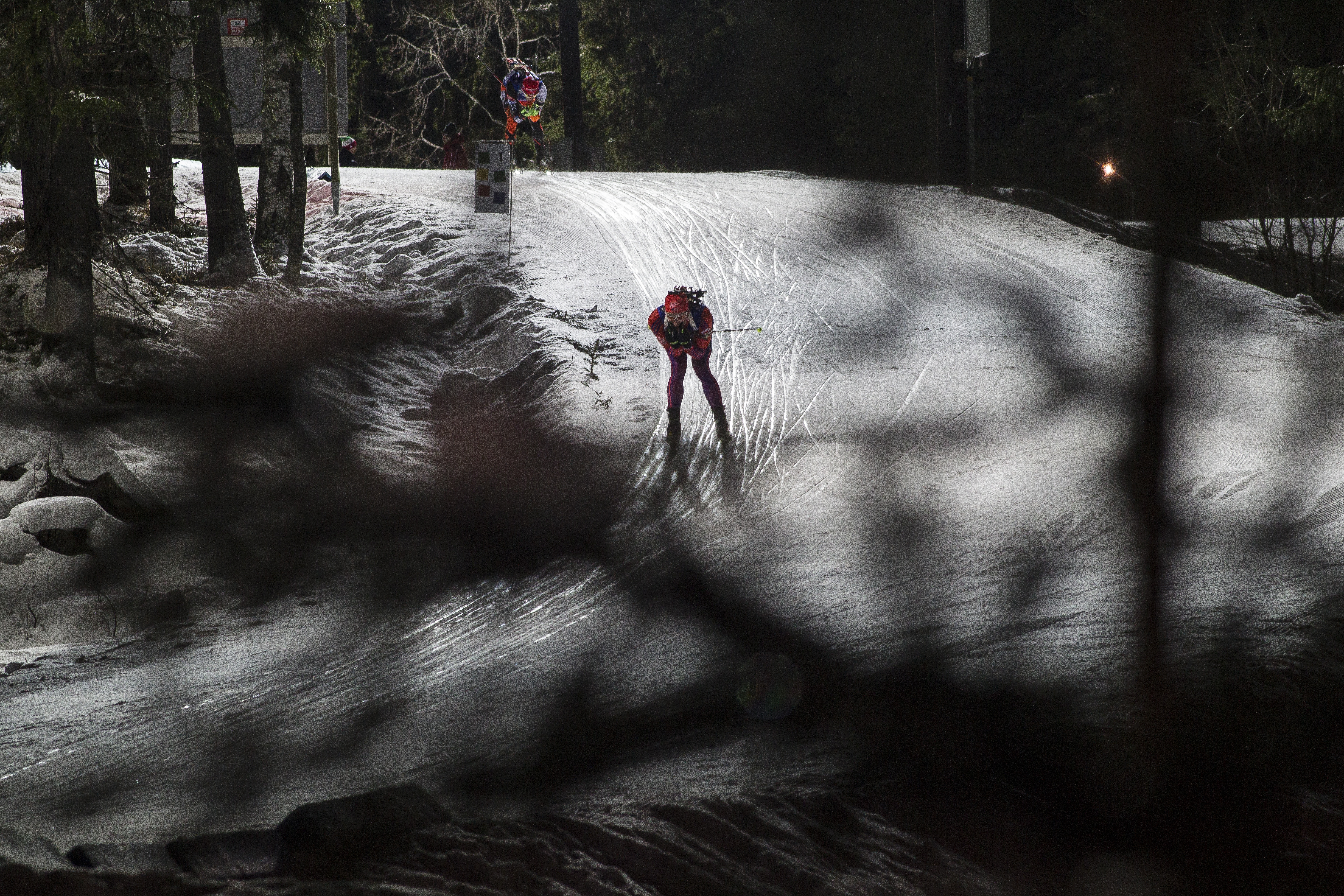
    Sean Doherty takes a downhill under the bright lights of the Oestersund trails. The 20-year-old American finished 17th in the first individual World Cup race of the season. (Photo: U.S. Biathlon / NordicFocus)
    Sean Doherty (US Biathlon) takes a downhill under the bright lights of the Oestersund trails. The 20-year-old American finished 17th in the first individual World Cup race of the season. (Photo: U.S. Biathlon/NordicFocus)

    You’re forgiven if you didn’t see this one coming: at Wednesday’s World Cup 20 k individual race in Östersund, Sweden, the top North American performance came from Sean Doherty.

    The 20-year-old American has a strong set of credentials, having won three World Youth Championships titles, attended the 2014 Olympics and 2015 senior World Championships, and earned a bronze medal at World Junior Championships last season.

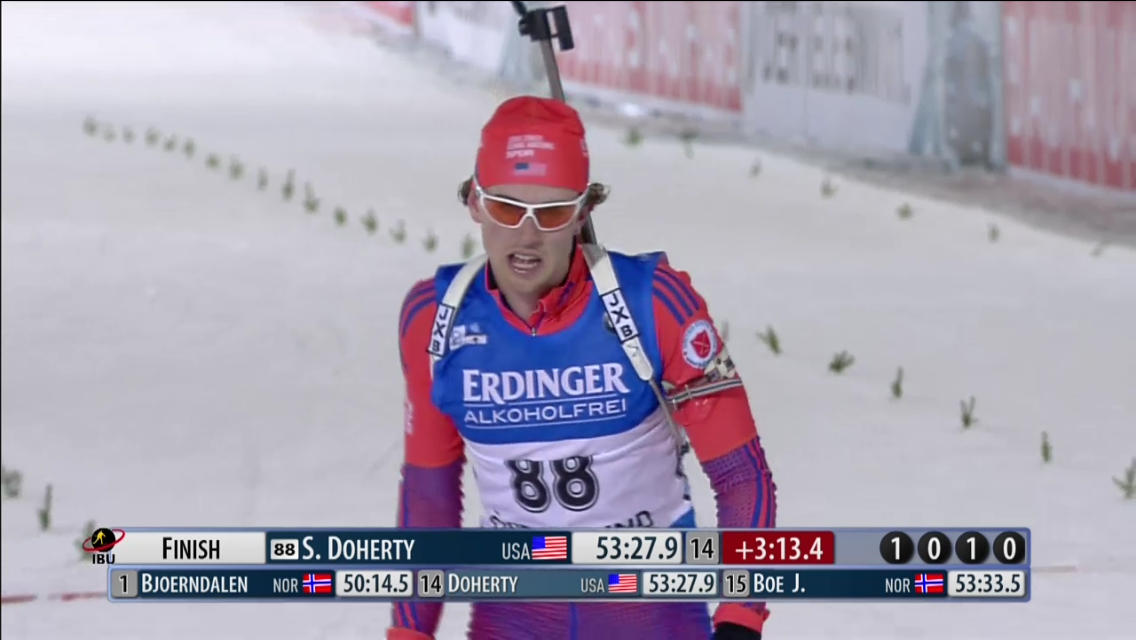
    But even Doherty didn’t totally expect his breakthrough in the first individual race of the World Cup season: 17th place (+3:13.4 from winner Ole Einar Bjørndalen of Norway) with two penalties in the 20-target race.

    “It’s a huge confirmation of the all the work I put in over the summer,” Doherty said. “I’m real happy with it.”

    His previous best on the World Cup had been 45th-place finishes in pursuits in Kontiolahti, Finland, and Nove Mesto, Czech Republic, last season – just outside the World Cup points.

    When the U.S. team started off this season with grand prix races in Sjusjøen, Norway, Doherty placed 29th in the sprint.
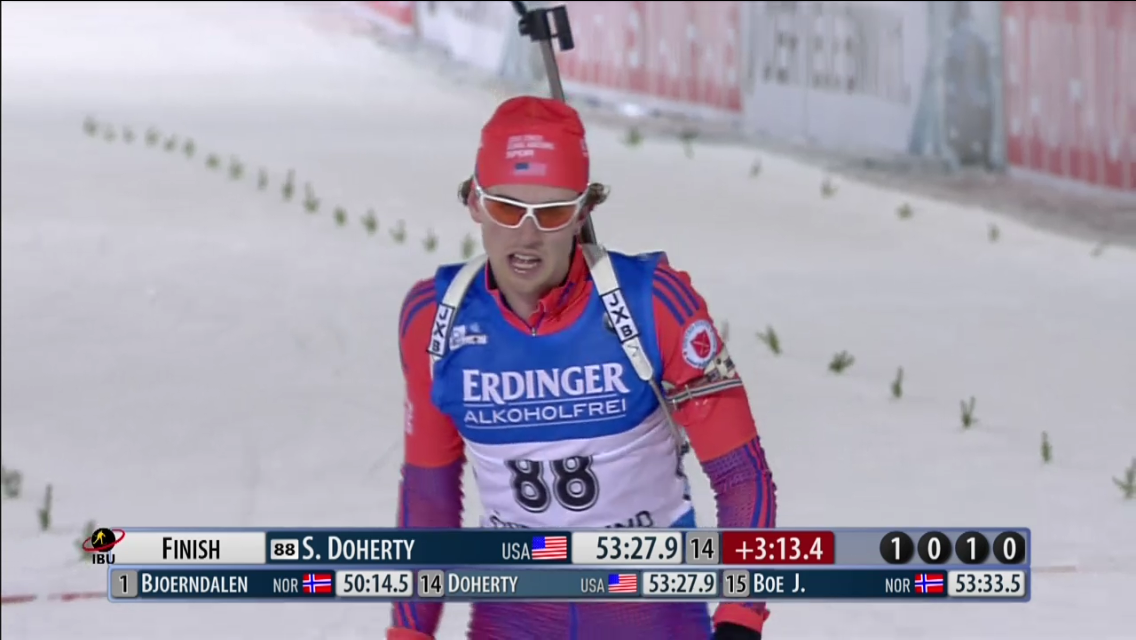
    Doherty crossing the finish line in 14th place. He was later bumped down three spots by other even later starters.
    Doherty crossing the finish line in 14th place. He was later bumped down three spots by other even later starters.

    “I was optimistic,” the New Hampshire native said. “But I wasn’t expecting this. I was happy with how I felt in Norway, but that was in no way leading me to believe I could just pull a top 20 today. It was pretty surprising in a way.”

    Others, though, expected plenty of success for Doherty this season.

    “Psyched to see Sean have such a good finish,” teammate Lowell Bailey, who finished a few spots behind him in 24th, wrote in an email. “I did expect him to have a breakthrough this season. He’s been right there in training throughout the season and I think he will continue to show top results throughout the season. This is by far the strongest men’s team we’ve ever had. It’s exciting to be a part of it.”

    While he has done a few 20 k competitions in the past, he also wouldn’t have guessed that his breakthrough would come in the format, which assigns a one-minute penalty for each missed shot instead of sending skiers to a penalty loop, which usually takes between 20 and 25 seconds.

    “Typically, the individual is not my strongest race,” Doherty said. “I’m not a bad shooter, but it is truly a precise shooter’s event with a stiff penalty. It’s not something I would expect to be my best. I guess now it is a good one for me!”

    The range in Östersund is often windy, and Doherty said his shooting “just kind of came together.”

    “Luckily I had a good zero prone, and I was confident that I knew how to react to the changing conditions if need be,” he explained. “For standing, I shot on point 30 all the way at the end of the range, which might be slightly sheltered by a building nearby. Maybe putting that together allowed me to have just a little extra help in these windy conditions.”
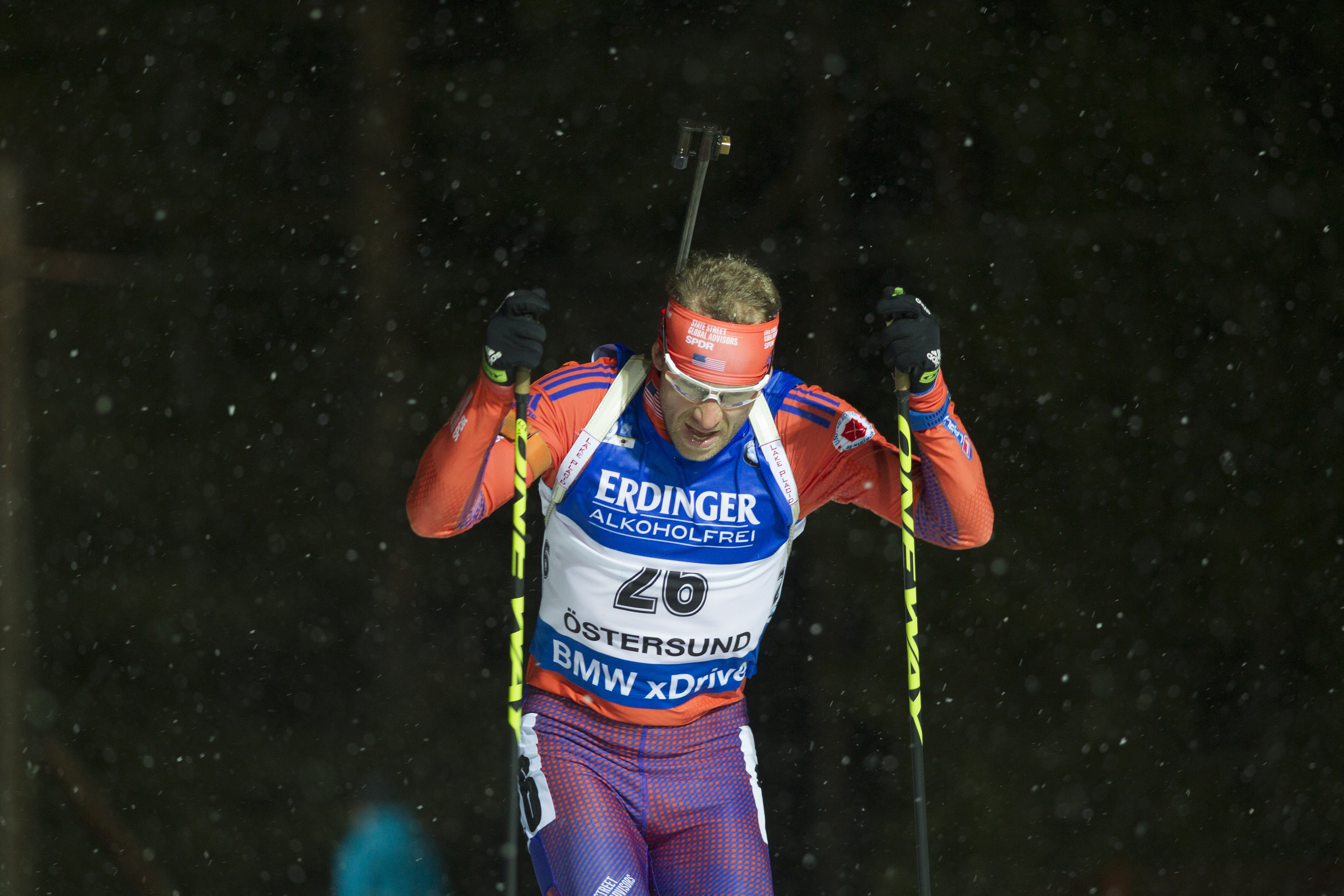
    Lowell Bailey on course. Bailey was clean through three stages, which would have put him in the top 10, but he missed two shots in the final standing stage. (Photo: U.S. Biathlon/NordicFocus)
    Lowell Bailey on course. Bailey was clean through three stages, which would have put him in the top 10, but he missed two shots in the final standing stage – a situation made more painful by the fact that one miss was a split bullet. (Photo: U.S. Biathlon/NordicFocus)

    Although he was one of the latest starters, Doherty didn’t get many splits during his race – he said he didn’t need them. Only on the last lap did his team begin telling him just how well he was doing.

    So Doherty put his head down and accelerated, skiing his fastest loop of the day for the 38th-fastest course time in the field.

    “You have to,” he said of the effort, which left him completely depleted at the finish. “Everybody’s cheering their hearts out for me and I’m in a good position. It’s all about the seconds. I ended up only 0.2 seconds in front of 18th place. So every little bit you can find matters. You just have to dig at the end of that long race.”

    Luckily, the late-starting position didn’t hurt his chances as it sometimes does.

    “The course conditions here were very, very good, and they stayed very consistent throughout the race,” Doherty said. “Being a late bib didn’t have much of an effect. Sometimes you get a late bib and it starts snowing on you or something, and it really kind of stinks.”

    Doherty will stick with the World Cup until Christmas, and then his plans are up in the air. He plans to compete at one last Junior World Championships in Cheile Gradistei, Romania, at the end of January. How he prepares is somewhat undecided.

    “The racing’s the same,” Doherty said of an event he’s competed at many times. “The distances are the same. It’s just against a different crowd. But it’s still a really high level – the junior men’s field is really strong. The thing that changes the most is that the World Cup is the big show and the Junior Worlds is a little more low key in comparison. It’s a different environment, and it’s fun. Being on the team with other younger guys and people who are just getting into it. I like both circuits and it’s fun to bounce back and forth a bit.”

    If this opening competition is any indication, he has made a jump in performance level since last season.

    “I had really solid results last season individually, and I was part of some good relays, which was cool,” Doherty said. “I’m just really glad to step things up for this year. It’s really encouraging to open on such a strong note.”

    Also for the U.S., Bailey finished 24th, also with two penalties (+3:44.1). Tim Burke raced to 37th with three penalties (+4:36.6), while Leif Nordgren had a tough day in prone and finished 104th with 13 penalties.

    “It’s always a tough start to the season to lead off with this particular Individual course, but it also helps you get into the right mindset going forward,” Bailey wrote. “I was happy with the result given the tricky conditions on the range. I had a split bullet on my last shot… sometimes there’s no explanation for a bad shot. The only thing I can say is that it’s pretty hard to clean a four stage race.”

    The Canadian team was led by Nathan Smith in 27th. Smith, who on Sunday had teamed up with Rosanna Crawford to place second in the World Cup single mixed relay, missed four shots and finished 3:51.9 behind the winner.

    “Shooting was a little disappointing today,” Smith wrote in an email. “Conditions weren’t perfect but also not horrendous. To be in the game you have to hit at least 18, maybe even more if it’s especially good shooting conditions. I felt like my shooting was there, but just couldn’t quite knock down all five on any of my trips to the range. Other than not quite clicking for the wind enough on my first prone I can’t really think of any mistakes. I felt calm and under control throughout the race.”

    Christian Gow placed 62nd (+6:20.6), Brendan Green 77th (+7:51.0), Macx Davies 85th (+9:10.5), and Scott Gow 86th (+9:25.0) for Canada.

    “I know it’s not possible to have a best-day ever every day,” Smith wrote. “Despite feeling pretty average on skis I actually turned in a solid ski performance. I’m excited to see my result on a top notch day. I’m not going to change course yet in shooting training. The fundamentals are there and I just need to be patient.”

    Results

  • Canadians Welcome Season’s End, Already Moving On: ‘We’ll Be Better’

    Canadians Welcome Season’s End, Already Moving On: ‘We’ll Be Better’

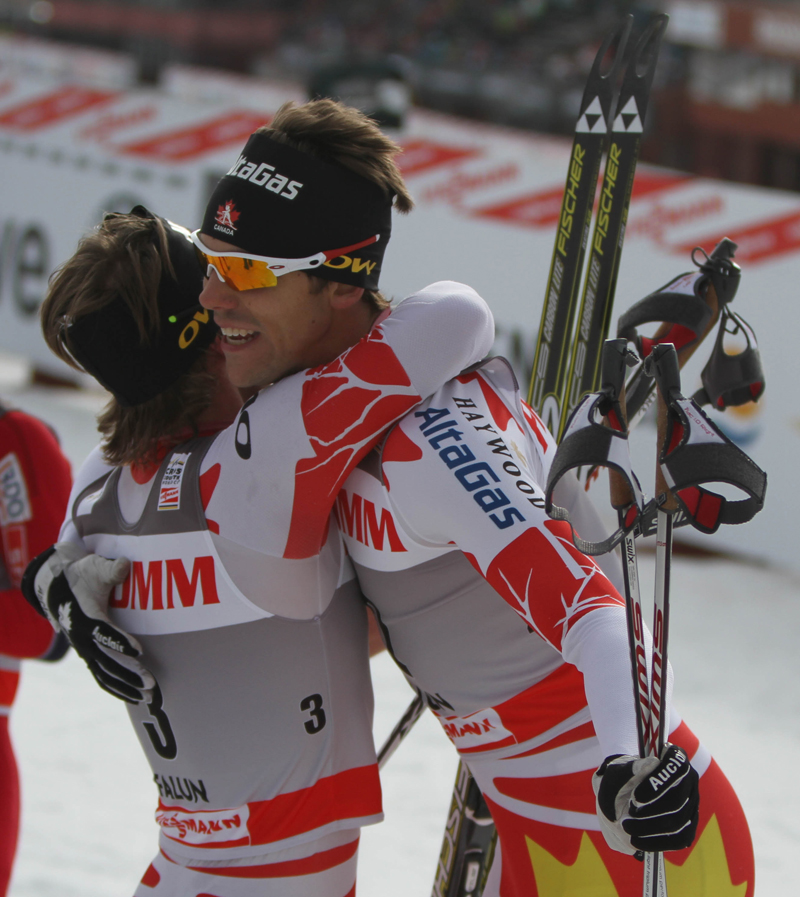
    Team Canada, like brothers. World Cup Finals Falun, Sweden. men's 15 k freestyle pursuit
    Canadian World Cup Team member Devon Kershaw (l) hugs teammate Lenny Valjas at the end of last year’s World Cup season in Falun, Sweden. There, Kershaw captured second in the World Cup with the 10th-fastest time, Alex Harvey (not shown) skied second fastest for sixth overall, and Valjas posted the 33rd-best time for 28th.

    Sunday finally came.

    Seventeen weeks and 120 days after the World Cup season started in Gällivare, Sweden, it ended in the same country with final pursuits in Falun.

    While the big winners at World Cup Finals shed some tears and smiled for the cameras, the rest of some 50 men and 50 women clicked out of their race skis for the last time – for a while anyway.

    For the six Canadians in Sunday’s freestyle races, the moment couldn’t have come soon enough.

    “I felt like garbage warming up,” Kershaw said after finishing 4:27.4 minutes behind Norway’s Petter Northug, who won the 15-kilometer pursuit in 35:48.3 and wrapped up the overall World Cup title. “I was struggling with motivation, I’m not gonna lie.”

    A year ago, Kershaw stood atop the podium on the last day of the 2011/2012  season as the overall World Cup runner-up. It was both a career best and a historic achievement for Canada, and it came with heightened expectations in the year that followed.

    When Kershaw wasn’t winning, or at least living up to what he thought he was capable of, it made for some frustrating races.

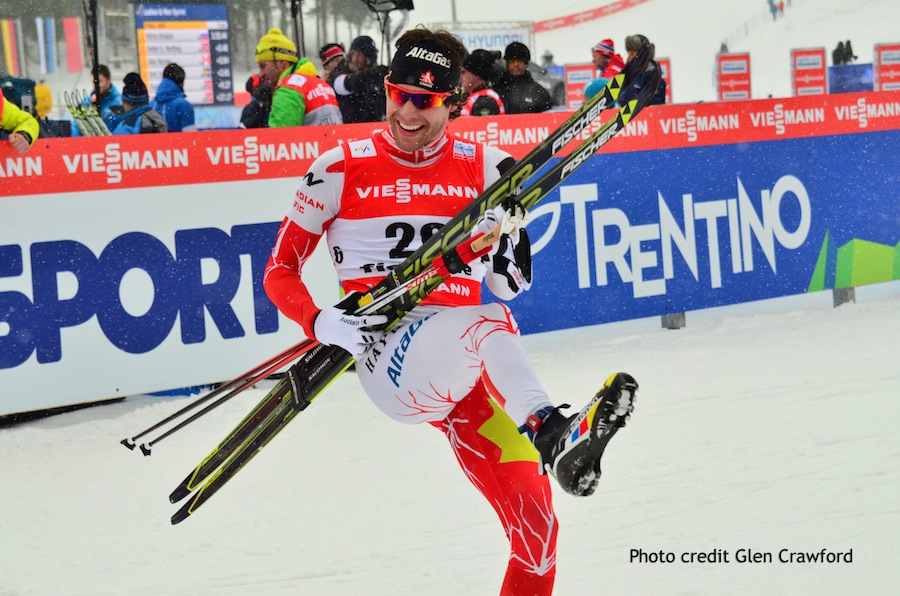
    Canadian Alex Harvey celebrates his bronze-medal performance in Thursday's 1.5 k classic sprint at the 2013 FIS Nordic World Ski Championships with his and teammate Devon Kershaw's signature move, two years after the two won the classic sprint at 2011 World Championships. (Photo: Glen Crawford)
    Canadian Alex Harvey celebrates his bronze medal in the 2013 World Championships 1.5 k classic sprint on Feb. 21 in Val di Fiemme, Italy, two years after he and Devon Kershaw won the classic team sprint at 2011 World Championships. (Photo: Glen Crawford)

    The 30-year-old wasn’t alone. A bronze medalist in the 2013 World Championships classic sprint, Alex Harvey seesawed between podiums and placing outside the top 30. Lenny Valjas came down with strep throat right before World Championships, and Ivan Babikov caught something similar not once, but twice, ultimately leaving him a “little flat,” as head coach Justin Wadsworth put it, at the end of the season.

    On the women’s side, three members dwindled to two in February when Chandra Crawford cut her season short to recover leading up to the 2014 Sochi Olympics. Just before she left Europe, Perianne Jones and Dasha Gaiazova teamed up for bronze in the classic team sprint at the pre-Olympic World Cup in Russia. The medal gave them energy, but the two struggled in the World Championships sprints that followed.

    At World Cup Finals last Wednesday through Sunday, Canada’s two Continental Cup leaders – Emily Nishikawa and Michael Somppi of the Alberta World Cup Academy –added some strength in numbers, but they were also feeling the wear of the season.

    Nishikawa, 23, had done most every race at World Championships and been in Europe for more than a month. Somppi, 24, had been there since early March and was still pushing for his first World Cup top 30.

    He didn’t achieve it Sunday in 47th (+9:28.6), but Somppi wrote in an email that he was getting close with the 37th fastest time.

    “I felt OK, though certainly not great, as it’s been a long season with a ton of racing and it’s wearing on me,” Somppi explained. “The pace with the pack I skied with didn’t feel unreasonable and I felt pretty strong climbing.”

    However, his best pair of skate skis – suited for cold weather – weren’t running well Sunday afternoon with temperatures above 6 degrees Celsius. That made him slow on the downhills.

    “Unfortunately on the 3rd lap I was dropped pretty badly on the downhill coming into the stadium and I didn’t have it in me to close the gap,” Somppi wrote. “It was a tough experience being on the World Cup. I’ve learned some valuable lessons and become more comfortable with the racing environment so the next time I have an opportunity to race on the World Cup I will be better prepared.”

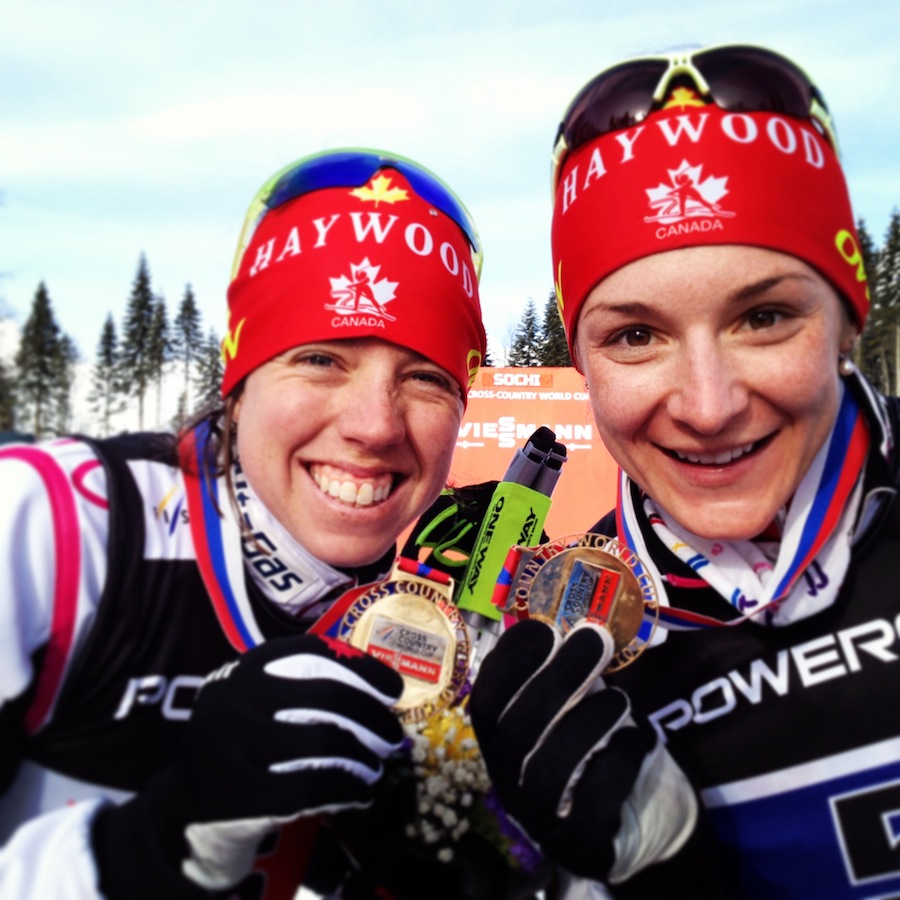
    Canadians Perianne Jones and Dasha Gaiazova celebrate their first bronze of the season, and together, in the Sochi World Cup classic team sprint. (Photo: Chandra Crawford)
    Canadians Perianne Jones and Dasha Gaiazova celebrate their first bronze of the season, and together, in the Sochi World Cup classic team sprint on Feb. 3. (Photo: Chandra Crawford)

    Somppi was the fourth-best Canadian in the 15 k pursuit after Harvey in 25th (+3:40.5), Kershaw in 31st, and Babikov in 41st (+5:39.9). Valjas finished last in 48th (+10.02.9). In the women’s 10 k, Nishikawa as the lone Canadian was 46th (9:56.4 behind Norwegian winner Marit Bjørgen). Gaiazova did not compete.

    “She felt like she couldn’t race,” Wadsworth explained. “That’s her decision.”

    As for the rest of his athletes: “They definitely went out there and skied hard,” he said. “Like I told them the last couple days, ‘I don’t care about the result, I just want to see you executing and focusing,’ and they did that and it was good.”

    Good, not great, and certainly not what the Canadian World Cup Team had dreamed about before the start of the season. Given their starting positions on Sunday, with Harvey going earliest in 32nd, 3:16 behind Northug, the team knew miracles weren’t quite within reach. But as Kershaw pointed out, anytime you put a bib on, you have to go out there with some gusto.

    “You’ve got to try to get yourself in the best possible frame of mind to give it your best shot,” Kershaw said. “Sometimes your best shot is 20 percent of what you’re capable of or what you’ve shown in the past.”

    Regardless of where you end up, whether it’s first or 31st, Kershaw said that’s what motivates you to improve. However, at this point in the season, it was a matter of finishing it out. To add some lightheartedness to Sunday’s race, the Canadian men wore casual sunglasses.

    “We still went hard, but we’re trying to find ways to still keep it fun,” Kershaw said. “It’s a beautiful life and ski racing is still a passion for everyone on the team, but it’s challenging. It’s not nearly as fun when you’re the one wiping the floor.”

    Wadsworth believes that feeling is what will drive them in the year to come. Coming off an outstanding 2011/2012 outing, in which Kershaw was second and Harvey placed sixth overall and Valjas notched two podiums at World Cup Finals, he thinks the team might have been too ambitious to raise the bar higher.

    “I think we came out of last year feeling like we could do anything, and that’s how we approached the whole training season and into the early part of race season,” Wadsworth said. “We were just like, hitting every World Cup and just plowing ahead. … We felt that we could train harder and do everything like more, more, more and we can’t.”

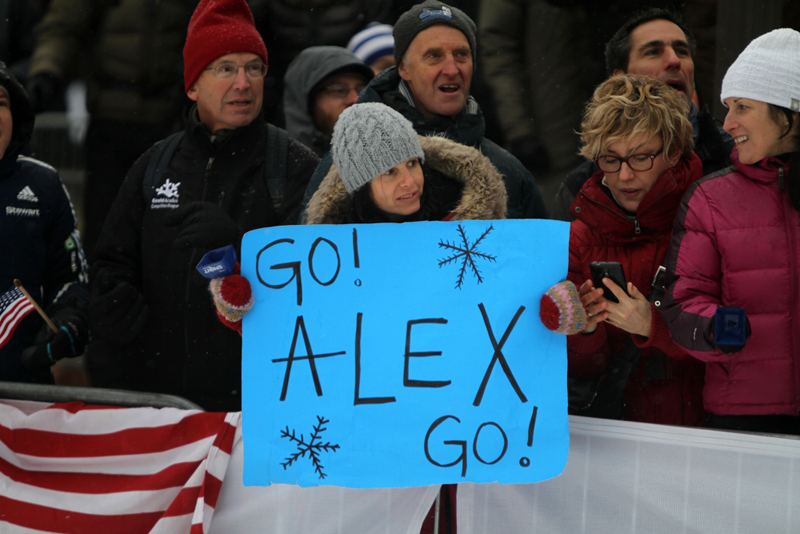
    One of many Alex Harvey cheering sections at the Canadian World Cup in Quebec City, which took place Dec. 7-8, 2012.
    One of many Alex Harvey cheering sections at the Canadian World Cup in Quebec City from Dec. 7-8, 2012.

    In the past, he said one of his program’s biggest strengths is its ability to carefully select races and get the most out of training camps and blocks throughout the year.

    “It’s my fault for not skipping Kuusamo and Gällivare and just staying in Canada and preparing for the Canadian World Cups and then going on,” Wadsworth said. “Even I got sucked into it. We tried to go and do every race and it was just too much.”

    In early December at the Quebec World Cup, Harvey was the only Canadian who qualified for the heats and ended up 21st in the individual freestyle sprint. The next week in Canmore, Alberta, Harvey and Kershaw placed outside the top 50 in the skate sprint qualifier and skipped the skiathlon the next day.

    “We’ll be better. Canada will be better next year,” Kershaw resolved. “Five podiums just wasn’t what we were looking for this year. I think we all learned a lot this year and at the end of the day, that’s what skiing’s about.

    “You’ve got to learn from your mistakes and move forward,” he continued. “We’re bummed that we’re not skiing well, but everyone is just so motivated to be better next year, and at the end of a long, tough season if everyone is still motivated, that’s a really good place to start.”

    While the team had yet to debrief and set new intentions in its season-ending meeting, Wadsworth said they would look to change a few things next year, including their approach to testing skis.

    Waxing woes were one reoccurring theme on the Canadian World Cup Team this year – with tough races at Holmenkollen and in the 15 k classic mass start in Falun last Saturday. Wadsworth said his small staff of five wax techs (eight at World Championships) shouldn’t bear the weight of the blame.

    “We need to review our race-day testing,” Wadsworth explained. “I think the athletes realize, too, they need to take a little more ownership. A lot of times skis get tested for them, especially on skate days, so they can just kind of show up and focus on their warmup and whatnot, but I think they need to start testing and feeling the skis a bit more on their own and having more input on that. That will be something we do differently next year.”

    Wadsworth would also like to hire another core technician, someone who could work more closely with his skiers and test right up until the start.

    “You have to be pretty fit to ski even their warm-up speed,” he said. “The athletes need to take responsibility and come out earlier and take more time. You see a lot of the other countries doing that with their athletes, they’re out like an hour and a half before the race.”

    After weathering a steep learning curve in 2013, Wadsworth’s confident it will bode well for the upcoming Olympic season.

    “I think it will be really good to be flying under the radar because I know one thing and that’s both the men and the women on this team can win medals at the Olympics,” he said.

    “We’re at such a high level that we feel like this year was kind of a failure, but at the same time, we got a medal at the World Championships and two fourth places, a near miss for another medal, as close as you can basically be and not get a medal,” he added, referring to Kershaw and Harvey’s fourth-place finish in the team sprint, three-hundredths of a second off the podium.

    Wadsworth also pointed out the team’s four Tour de Ski podiums and the women’s team-sprint bronze on the Olympic course in Sochi.

    “Those are solid and we need to remember those and remember the results from last year, too, and hold those in our pockets on the days when it gets hard training,” he said. “We learned a lot about the different athletes on the team and we’re going to use that to our advantage.”

    The Canadian World Cup Team flew home Monday and most of its athlete will compete at Canadian Nationals in Whistler, B.C., this week. Kershaw planned to attend, but in need of some time off the skis, said he wouldn’t race. Harvey will not be there as he rehabs a shoulder injury from earlier this season in Sochi.

    ***

    Sunday’s pursuit results: men | women