Tag: 2013 Biathlon World Championships

  • US Women Repeat in 11th, Canadians 12th in World Championships Relay

    US Women Repeat in 11th, Canadians 12th in World Championships Relay

    Canada's Megan Heinicke used one spare round on her prone and three on her standing to put her team in 13th at the exchange in Friday's  4 x 6 relay at IBU World Championships in Nove Mesto. The Canadians ultimately placed 12th.
    Canada’s Megan Heinicke (front) used one spare round on her prone and three on her standing to put her team in 13th at the exchange in Friday’s 4 x 6 relay at IBU World Championships in Nove Mesto. The Canadians ultimately placed 12th.

    The eight North American women in Friday night’s 4 x 6-kilometer relay at Biathlon World Championships had a pretty good sense of what they wanted to accomplish.

    For the Americans: top six, although they’d welcome any improvement on last year’s 11th place. For the Canadians, team veteran Zina Kocher wrote in an email that they were shooting for top eight in Nové Město na Moravě, Czech Republic.

    With 24 teams to contend with, each team set out on its own mission. Canada’s Rosanna Crawford had the better luck of the scramble legs, hanging in the top 20 for the first of three loops then rising to 12th by the exchange after using three spare rounds.

    Annelies Cook worked throughout the first leg to get the Americans into the mix, using five spare rounds and tagging off to second-leg skier Sara Studebaker in 20th.  Studebaker brought the team to 18th with one spare, and third-leg Susan Dunklee shot clean for her first time in a World Cup race to lift the U.S. to 11th.

    From that point on, anything rookie Hannah Dreissigacker could achieve in her first World Championships was essentially bonus. All three of her teammates – Cook, Studebaker and Dunklee – were on last year’s 11th-place squad (with Lanny Barnes instead of Dreissigacker) and many felt they had a better day back then (with no penalties and nine spare rounds).

    Dreissigacker, 26, held her own despite a penalty and three spare rounds on her prone and using another spare in the standing. Once again, she anchored the team to 11th, and they finished with one penalty and 10 spares, 3:04.5 minutes behind the Norwegian winners. (Note: The U.S. originally finished 12th, but Romania was disqualified for “deviating from the marked trail, or skiing a wrong trail, or skiing the
course loops in a wrong sequence or in the wrong direction,” according to Real Biathlon.)

    The Canadians came in 10.7 seconds after the Americans in 12th with 13 spare rounds and one penalty by Kocher on the seventh of eight stages. Kocher used three spare rounds on that prone and later cleaned her standing.

    “It’s an ok result, but nothing amazing,” Kocher, 30, wrote in an email. “We have more potential than what we have been showing in the relays this year, but we really need to use less spares as an entire team.”

    As for the penalties, they simply can’t happen, she explained. Kocher wrote she has been struggling with shooting in general this season, but was particularly frustrated with her prone. She regrouped by relaxing on the uphill during the next 2-kilometer loop and decided to switch up her typical right-to-left shooting order.

    “I told myself each bull that I was aiming on before I shot ,” she recalled. “OK middle, now echo, delta, bravo, alpha.”

    Kocher also remembered the nickname her team gave her.

    “Today I found out that the staff named me Merida from the [Pixar] movie Brave,” she wrote. “So I also jokingly told myself ok Merida get it together and hit the center!”

    Also disappointed with her prone, Dreissigacker focused on the positives.

    “I feel like I let the team down a little bit by getting a penalty loop, but I’m pretty happy with standing, and I am thankful for having great teammates who don’t blame me at all!” she wrote. “I think that we were all hoping to do better, and we know that we can do better. … So to be 11th on a not-so-good day is a good. But we definitely all want more.”

    After racing the third leg last year, Cook felt the pressure of scrambling. More confident in her prone shooting, she was taken aback with two initial misses and took some time reloading the two extra rounds.

    “I have been struggling with standing shooting and so of course you hope that it will turn around and in that heartbreaking biathlon way,” she added. “I missed three, using extra rounds to clean. It’s the most important to clean in the end, but with such a close race, every second you spend on the range counts and that is frustrating.”

    After that, Cook simply put her “head down and just suffered as much as I could possibly suffer to make up as much time as I could,” she wrote. “I think it is the hardest for me when I feel like I really want to bring my team into a good position and then responsible when it doesn’t go really well. So, I am bummed with myself but I gave it everything and I am so, so proud of the hard work and awesome races that the rest of the girls did.

    “Susan killed it, Sara was super solid and Hannah did great for her first world Championships,” she added. “We are still ahead of where we were last year, it’s just that the potential is so tantalizing!”

    Studebaker as the second leg described the difficultly of the 2 k course, one which doesn’t allow much rest. She went out on the first lap alone, which made it even harder, but did her best to focus.

    “I came in pretty hard to prone, so had to take an extra second to calm down,” Studebaker wrote. There, she used one spare round and went on to clean the standing.

    “Shooting well moved me closer to a big group of people, and when I tagged off to Susan we were in 18th place, but with a group of about five other teams,” she added.I knew being close to other skiers would help Susan and that, with the way she’s been skiing this week, she would be able to move us up a bunch.”
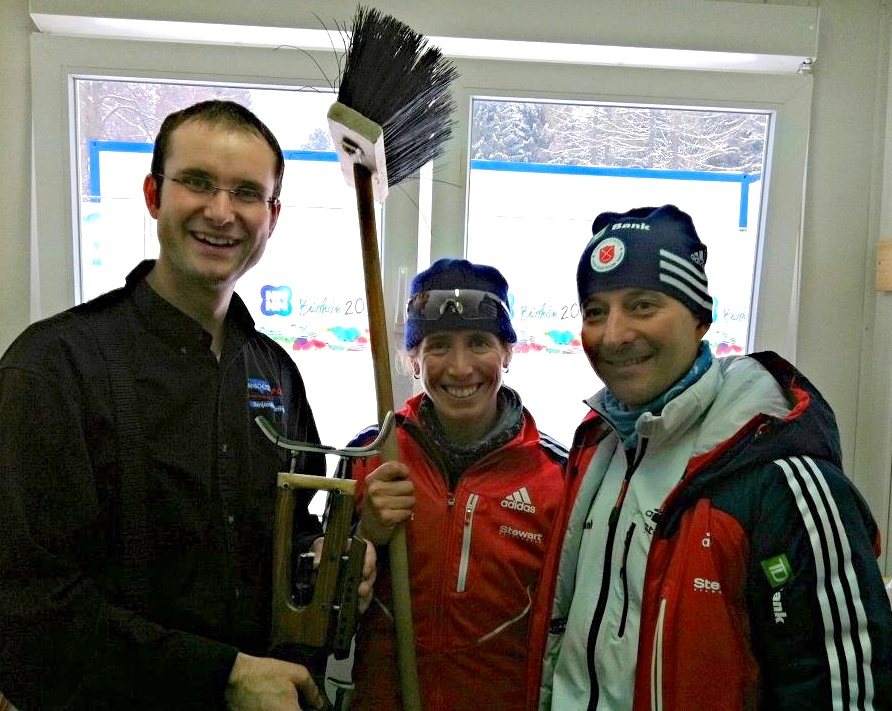
    U.S. biathlete Susan Dunklee holds up her tool of choice to repair her broken stock, a broom, with Anschütz rep Benjamin (l) and coach Armin Auchentaller. (Photo: Armin Auchentaller)
    U.S. biathlete Susan Dunklee holds up her tool of choice to repair her broken stock, a broom, with Anschütz rep Benjamin (l) and coach Armin Auchentaller. (Photo: Armin Auchentaller)

    She was right, as Dunklee raced to the second-fastest course time on the third leg after eventual winner Synnøve Solemdal (NOR). Dunklee, who turned 27 on Wednesday, also cleaned and ranked second for range time.

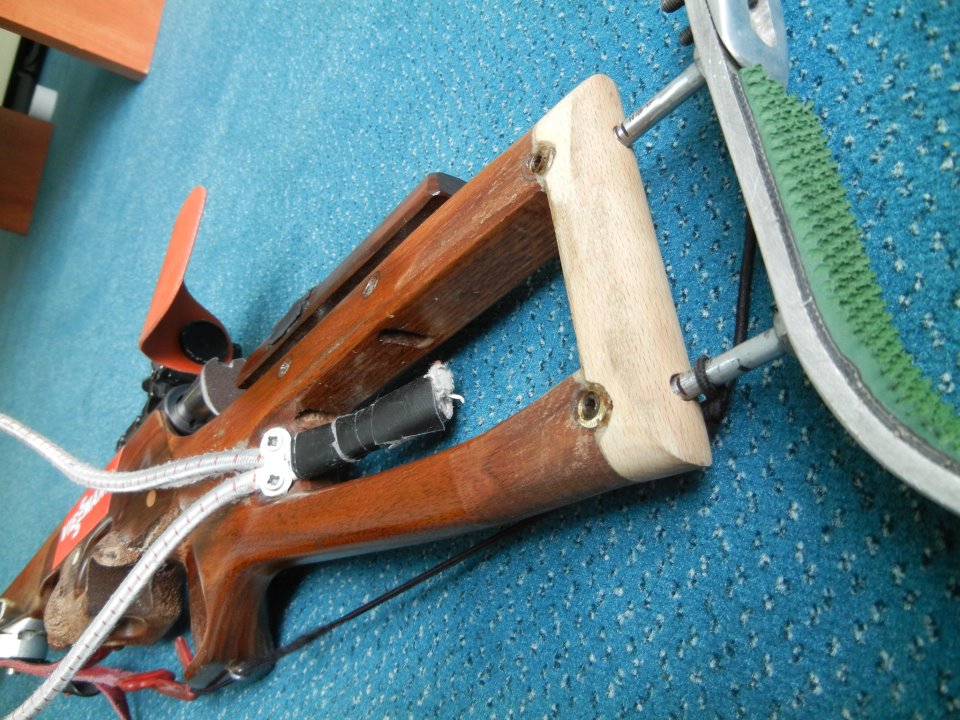
    And she did so with a broom end for a rifle stock. After crashing on the last lap of Wednesday’s 15 k individual (where Dunklee still managed to pull off 15th), Dunklee sought a quick repair for her broken stock – the part of the gun that wedges against the shooter’s shoulder. Anschütz, a German firearms company, helped her do so by replacing the end of the butt plate with a new piece of wood: the end of a broom handle.

    “Before the race I was joking around that maybe the broom part would help me ‘clean’ more often and it actually did,” Dunklee wrote. “I had my first career clean World Cup race. These championships went very well for me. … 11th ties our result from World Champs last year and is a solid result.  The good thing is our expectations are a lot higher now so were and still are hungry to do better.”

    The first Canadian out of the start, Crawford wrote that the first lap was relaxed, but she was still pretty overwhelmed to enter the stadium with 20 teams and a crowd of 27,000 watching.

    “My second loop was pretty awesome, I left about 15 seconds back from the leaders and was able to catch right back up to the group before standing shooting,” Crawford wrote.

    With the third-fastest ski time on her leg, she was happy to see some improvement with her speed. Clean shooting is always the goal in a relay, she explained, adding that she used too many spares (two prone and one standing).

    “I really wanted to tag off in the top 10 and no more than 30 seconds from the leader, so I was happy with how my leg of the relay went!” she wrote. “I think we are content with today’s performance, but like we have said after every relay we know we are capable of so much more. Top 10 has been our goal all season. So we have one more relay in Sochi to try and make that come true!”

    Megan Heinicke brought the team to 13th after cleaning her prone and using three spares on the standing. The second leg, she was the sixth fastest on her first loop of and ranked fifth in the range for time spent in prone. Heinicke tagged to 21-year-old Audrey Vaillancourt, who used one spare on her prone and three on the standing to put the team in 14th.

    “I got a bit nervous on the third spare, but finally did not have to do a penalty loop,” Vaillancourt wrote. “Those were my first World Champs, so it has really been a great experience for me. I learned a lot and was so glad to be a part of such a huge event! We also have a great team that sticks together, which makes it even better.”

    While Kocher wasn’t pleased with her personal performance at World Championships so far, she felt Friday was an improvement.

    “I finally felt good skiing today however today was my last race,” she wrote. “Plus I just really struggled with my shooting performance on race day. It was definitely not what I was aiming to achieve here. I got a bit sick before [World Championships] and this could have affected my ski speed as well.

    “But in reality, although WCHS was the main goal this season, it’s really the Olympic year in the big picture, and this was a tester year,” she added. “At the end of the season we will have a chance to analyze and see what we need to focus on or change for 2014.”
    Results

    Susan Dunklee's repaired rifle stock with a broom handle at the end. (Dunklee courtesy photo)
    Susan Dunklee’s repaired rifle stock with a broom handle at the end. (Dunklee courtesy photo)
  • Berger Anchors Norway to Second-Ever World Championships Relay Title

    Berger Anchors Norway to Second-Ever World Championships Relay Title

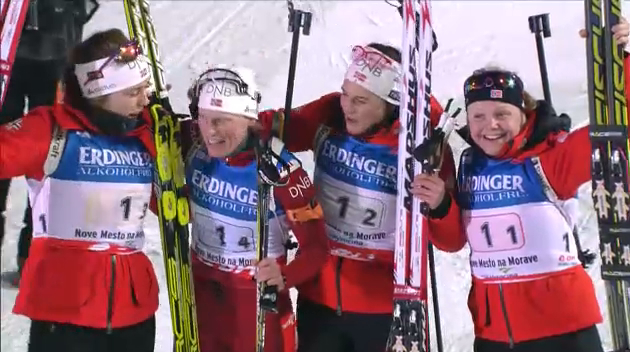
    The Norwegian women's relay celebrates its second-ever World Championships title after winning the 4 x 6 k event on Saturday in Nove Mesto, Czech Republic. From left to right: Synnøve Solemdal, Tora Berger, Ann Kristin Flatland and Hilde Fenne.
    The Norwegian women’s relay celebrates its second-ever World Championships title after winning the 4 x 6 k event on Saturday in Nove Mesto, Czech Republic. From left to right: Synnøve Solemdal, Tora Berger, Ann Kristin Flatland and Hilde Fenne.

    What does it feel like to have Tora Berger breathing down your neck? Ask Andrea Henkel of Germany, Ukraine’s Olena Pidhrushna or Italian Karin Oberhofer, who started the final leg of Friday’s 4 x 6-kilometer relay less than 40 seconds ahead of her.

    Norway’s 31-year-old anchor, Berger had already racked up three world titles in the last week at the International Biathlon Union (IBU) World Championships in Nové Město na Moravě, Czech Republic. She was flawless in Wednesday’s 15 k individual, defending her 2012 victory without a single miss, and seemed to be no reason she couldn’t do it again on Friday.

    Fourth at the exchange thanks to teammate Synnøve Solemdal, who skied the fastest third leg to elevate the team from 13th, Berger left the stadium 38.6 seconds behind Henkel in first. One kilometer later, Pidhrushna was about seven seconds down on Henkel, and Oberhofer was another 23 seconds back.

    And then there was Berger, who shot clean on the prone to move within 21 seconds of Pidhrushna in the lead. Henkel had to use one spare round, but remained close to the Ukrainian, trailing by 1.4 seconds while Oberhofer cleaned to leave the stadium in third, 10.7 seconds behind.

    As Henkel pushed to the front, Berger did the same from the fourth position, overtaking Oberhofer by 3.5 k and moving to third. Barbora Tomesova of the Czech Repubic followed close behind, stepping on Berger’s pole and ripping it out of her hand. The Norwegian remained calm, took a few no-pole strides and received another near the top of the long incline. She didn’t lose any ground, and if anything, set herself up for a solid last stage.

    Despite using one spare on the standing stage, Berger ended up clocking the seventh-fastest range time in the range and left the stadium in third, just 2.3 seconds behind Oberhofer, who had cleaned again. Pidhrushna was just 1.3 seconds back in second after using one spare, and Henkel, who used two spare rounds, fell to fourth nearly 16 seconds back.

    Berger didn’t waste any time and took the lead with a fast-and-furious V1 up the gradual 2-kilometer grind. A Norwegian coach put his hand over his mouth as he watched from the stadium. Could Berger hold it?

    Then it became apparent; her contenders couldn’t keep up. With 1 k remaining, Pidhrushna trailed by 3.5 seconds. The deficit grew to seven seconds with half a kilometer to go. Oberhofer was five seconds down, then 10 seconds behind Berger before the final push to the finish.

    There, Berger skied uncontested to the win in 1:08.11. For Norway, which included Hilde Fenne and Ann Kristin Flatland, it was the second women’s relay victory ever and first since 2004. For Berger, it was her fourth gold at a single World Championships, which put her on par with Norway’s retired great, Liv Grete Skjelbreid Poirée. Back in 2004, Poirée also won four gold medals at Biathlon World Championships. And Berger has one more race remaining: Sunday’s 12.5 k mass start.

    “I was just trying to do my best,” Berger said in a press conference about her simple-yet-effective game plan. “I never dreamed of this as I was driving to Nove Mesto. Whatever happens Sunday will only be a bonus.”

    Seven seconds behind, Pidhrushna brought home silver for Ukraine (which included Juliya Dzhyma, Vita Semerenko and Valj Semerenko). Valj Semerenko put the team into contention on the third leg after cleaning her standing stage and boosting the team to first. She and Germany’s Laura Dahlmeier switched leads over the next two kilometers and were the first through the exchange with Italy’s Michela Ponza.

    After bringing Italy (with Dorothea Wierer and Nicole Gonteier) from fourth to first earlier in the leg, Ponza helped her team notch bronze for its first World Championships relay medal. It was her first medal at worlds as well.

    “I am the oldest one up here … it is a dream come true,” Ponza said at the press conference. “All of my colleagues made a great race. … I want to thank everyone who believed in us. This is a good moment for Italian biathlon.”

    Overall, the Norwegians made fewer than 80 percent of their shots (compared to Ukraine’s 88.9 percent and Italy’s 90.9 percent), using nine spare rounds and skiing a penalty loop on the first leg. Ukraine had no penalties and used five spare rounds, and Italy used just four spares.

    “I was sure today that the last shooting and the last loop would be important,” Pidhrushna said. “I had a spare round but the others did too, so I told myself that this was a chance. That last loop was quite crazy.”

    Russia placed fourth (+29.0) after being an early contender. Three of their seven used spares came on the third leg with Ekaterina Shumilova after she cleaned the prone. Germany finished 30.9 seconds behind in fifth after using 11 spare rounds, three of which came from Henkel.

    Women’s relay results

  • Weekly Roundup: Quite a Scene at Biathlon World Champs, Aspen SuperTour and Scando Cup

    Weekly Roundup: Quite a Scene at Biathlon World Champs, Aspen SuperTour and Scando Cup

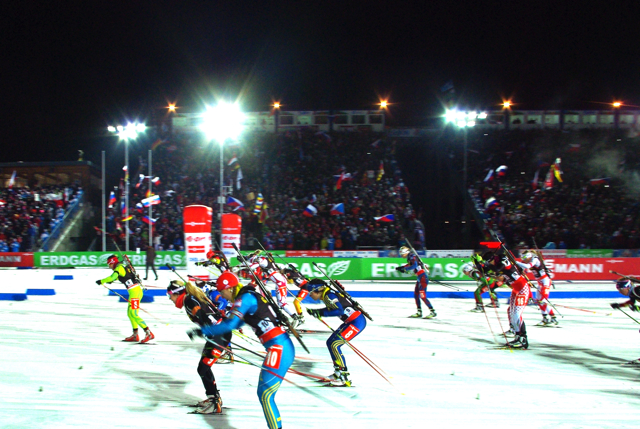
    As Czech flags wave in the background, the mixed relay field sets off in pursuit of the first 2013 Biathlon World Championship title on Thursday in Nove Mesto, Czech Republic.
    As Czech flags wave in the background, the mixed relay field sets off in pursuit of the first 2013 Biathlon World Championship title on Thursday in Nove Mesto, Czech Republic.

    Think you can picture the scene at the International Biathlon Union (IBU) World Championships in Nové Město na Moravě, Czech Republic? Think again.

    Veteran and newbies alike found themselves in awe of the stadium and 20,000-strong crowd. After the first few days of racing, many were still struggling to cope with the noise factor, but hey, they weren’t complaining.

    Norway opened with its third-straight mixed relay victory, no surprise there, and the hometown fans celebrated its own team making the podium in third right behind France.

    The U.S. notched its best mixed-relay result in eighth with Annelies Cook, Susan Dunklee, Lowell Bailey and Leif Nordgren. With Tim Burke out trying to get healthy, Nordgren filled in. Meanwhile, the Canadians were simply happy to get their feet wet at World Champs as Rosanna Crawford, Megan Heinicke, Jean Philippe Le Guellec and Scott Perras combined for 15th.

    On Saturday, Norway’s former biathlon king, Emil Hegle Svendsen, made a point to get back on top and captured his second-straight gold medal of the week, beating French rival Martin Fourcade in the 10 k sprint. In the women’s 7.5 k sprint, Ukraine’s Olena Pidhrushna surprised with her first career win and teammate Vita Semerenko tallied her third World Championships bronze.

    All four American men in the sprint raced well enough to qualify for Sunday’s 60-man pursuit. Burke was back in action in 28th, Bailey placed 32nd and Russell Currier and Nordgren also made the cut. Two Canadian men and two women qualified, led by Le Guellec in 36th and Scott Gow in his debut World Championship in 45th. In the women’s sprint, Cook also placed 45th and Heinicke narrowly qualified for the pursuit in 54th.

    That brings us to Sunday when Svendsen continued his World Championships domination, outsprinting Fourcade by 2.4 centimeters for the pursuit victory. It didn’t come easy: he nearly stopped after getting tangled with Russia’s Anton Shipulin on the last climb.

    Norway’s Tora Berger won her first individual gold of the week in the pursuit, rising to the occasion when two skiers in front of her, Russian Olga Zaitseva and Krystyna Palka of Poland, missed one apiece on the last shooting stage. Berger shot clean on the final stage and hammered home for the victory.

    Meanwhile, Bailey and Le Guellec led the North Americans in 13th and 15th, respectively. Le Guellec made up 21 places – the second most of any man in the pursuit – and Bailey climbed 19 spots to get back in the mix.

    IBU World Championships

    Athlete reaction to renovated venue: story

    Thursday’s mixed relays: international report | American report | Canadian report | results

    Saturday’s sprints: men’s international report | women’s international report | American report | Canadian report | men’s results | women’s results | photos

    Sunday’s pursuit: men’s international report | women’s international report | North American report | men’s results | women’s results

    Sunday’s pursuit photos: North Americans | men | women

    ***

    While biathlon expert and FasterSkier editor-at-large extraordinaire Chelsea Little was on site in Nové Město, Audrey Mangan traveled to Aspen, Colo., for the SuperTour – making her first stop at the Vail Mountain Games.

    There, the Central Cross Country (CXC) husband-and-wife duo, Brian and Caitlin Gregg topped the men’s and women’s field, respectively, in the 10 k freestyle mass start – a sort of warmup for the SuperTour weekend ahead.

    On Saturday, big, wet snowflakes at 8,000 feet above sea level didn’t slow down skiers like Rosie Brennan of Alaska Pacific University (APU), who won both the 1 k classic prologue in the morning and the 5 k classic individual start in the afternoon. On the men’s side, Mike Sinnott of the Sun Valley Ski Education Foundation (SVSEF) won the prologue and teammate Patrick Johnson tallied his first career SuperTour victory in the 10 k.

    Sunday’s coveted Owl Creek Chase involved a sprint showdown at the end of the 21 k point-to-point race. Brian Gregg edged Sylvan Ellefson (Ski & Snowboard Club Vail/Team HomeGrown) by eight seconds at the finish, showing all his speed work this summer paid off.

    Part-time racer Nicole DeYong (SVSEF) skied away from the pack for a two-minute victory after winning the same race in 2010.

    Vail Mountain Games

    Friday’s 10 k freestyle: overview with interview video | results

    Aspen SuperTour

    Saturday’s classic prologue and 5/10 k individual start: report | sprint prologue results | 5 k classic results | 10 k classic results

    Sunday’s Owl Creek Chase 21 k freestyle mass start: report | men’s results| women’s results

    ***

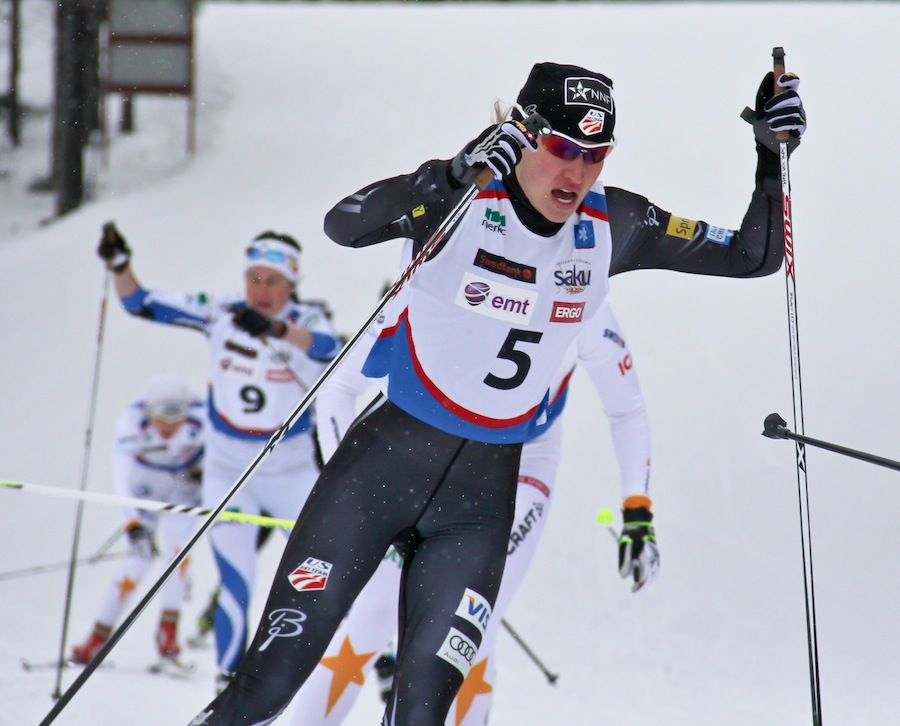
    Sophie Caldwell (SMST2) racing to a second-place finish in Sunday's Scando Cup 1.1 k freestyle sprint in Pärnu, Estonia. She was just 0.14 seconds out of first for a career best. (Photo: Eric Packer)
    Sophie Caldwell (SMST2) racing to a second-place finish in Sunday’s Scando Cup 1.1 k freestyle sprint final in Pärnu, Estonia. She was just 0.14 seconds out of first for a career best. (Photo: Eric Packer)

    Meanwhile, several other American domestic skiers put their skills to the test at the Scandinavian “Scando” Cup in Latvia and Estonia. Caitlin Patterson of the Craftsbury Green Racing Project led the group in Madona, Latvia, where she was ninth in Thursday’s 10 k freestyle mass start and 10th in the 5 k classic on Wednesday. Eric Packer of the Stratton Mountain School T2 Team (SMST2) broke through in 16th in the 20 k freestyle mass start.

    A few days later, Sophie Caldwell (SMST2) made the podium in second in Sunday’s freestyle sprint in Pärnu, Estonia, one day after finishing 17th in the classic sprint. Jennie Bender (CXC) qualified as high as fourth in the classic sprint and went on to place 16th. The next day, she was 11th in the skate sprint.

    Scando Cup

    Wednesday-Thursday in Madona, Latvia: recap

    Saturday-Sunday in Pärnu, Estonia: recap