From the FasterSkier archive — posts syndicated from athletes’ and coaches’ own blogs between 2004 and 2012, kept online as published. Current coverage is at fasterskier.com.
Tag: 2013 IBU Youth and Junior World Championships
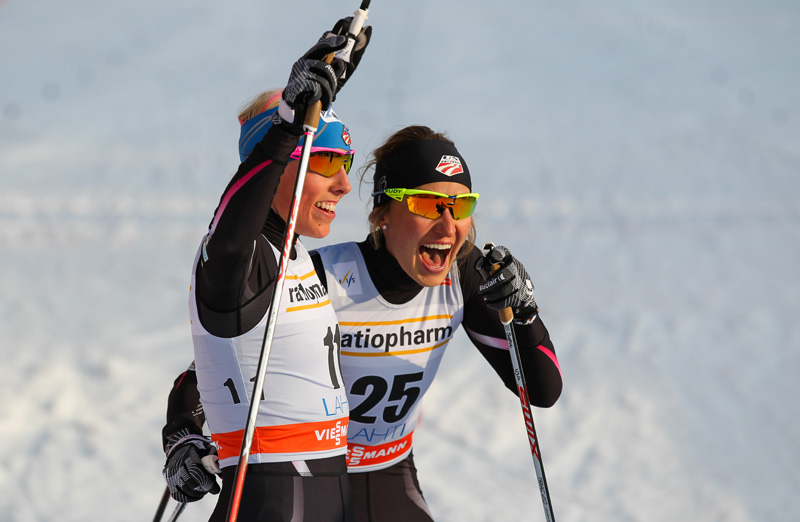
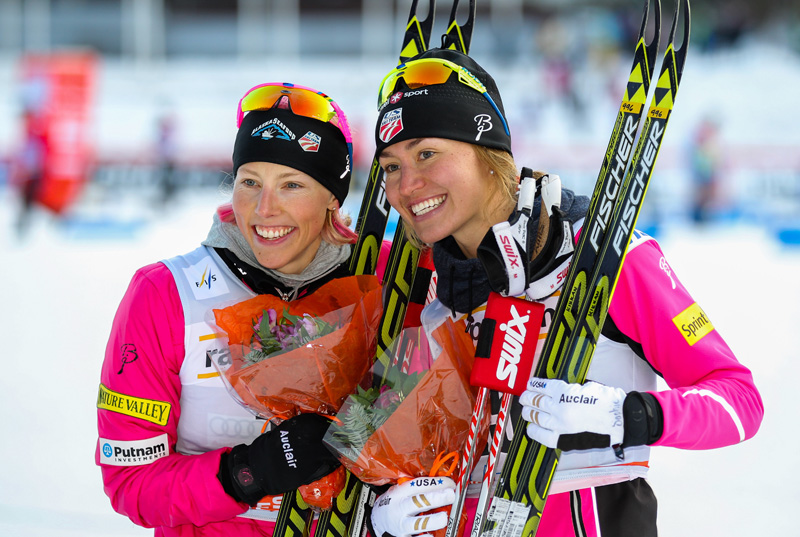
U.S. teammate Kikkan Randall (l) and Sophie Caldwell celebrate the first U.S. double podium in Saturday’s World Cup skate sprint in Lahti, Finland. (Photo: Fischer/Nordic Focus)
Were the Olympics just a dream? After a whirlwind couple of weeks on the ground in Sochi, Russia, it certainly feels so for us. However, just because the Olympics are over doesn’t mean the season has ended, and as this past weekend proved, we may have some of the most exciting skiing of the season ahead of us.
World Cup action kicked off with Saturday’s freestyle sprint in Lahti, Finland, where the women of the U.S. Ski team made history. For the first time two American women sat upon the podium, with Kikkan Randall in first and Sophie Caldwell in third.
For Randall, the win was redemption for a disappointing two weeks in Sochi where she finished 18th in the freestyle sprint, an event she was favored to win.
Fellow U.S. Ski Team members Kikkan Randall (l) and Sophie Caldwell after finishing an unprecedented first and third, respectively, in the Lahti World Cup freestyle sprint on Saturday in Finland. (Photo: Fischer/Nordic Focus)
For Caldwell, it was her first World Cup podium. The podium adds to what has been a momentous season for the 23-year-old, who placed sixth in the Olympic sprint. In doing so she achieved the top result for an American woman at an Olympic Games.
Completing the podium was Slovenian Katja Visnar, who finished second, placing her in the middle of an American sandwich.
On the men’s side, Canadian Alex Harvey pushed through his post-Olympic 50 k exhaustion to place seventh. American’s Simi Hamilton and Andy Newell also placed in the top 30 in 20th and 28th. Hamilton, who suffering from illness, and Newell, who lost both a pole and a ski in his heat, were unable to advance from the quarterfinals.
The race was eventually won by Norwegian Paal Golberg. He was followed by Russian Alexey Petukhov and Norwegian teammate Eirik Brandsdal.
Sunday’s World Cup races were dominated by Norwegians fighting to become the overall World Cup Champions. For the women, Marit Bjørgen skied a smart and controlled race to finish first in the 10 k freestyle by a whopping 26.9 seconds. Behind her was Charlotte Kalla in second and a frustrated Therese Johaug in third. While Johaug still holds the overall World Cup lead, Bjørgen is closing in with every race.
Randall was the top North American in 21st followed by teammate Liz Stephen in 32nd.
In the 15 k individual freestyle, overall World Cup leader Martin Sundby of Norway extended his lead by outpacing second place finisher Daniel Richardsson of Sweden by over ten seconds. On the podium for the second day in a row, Petukhov placed third.
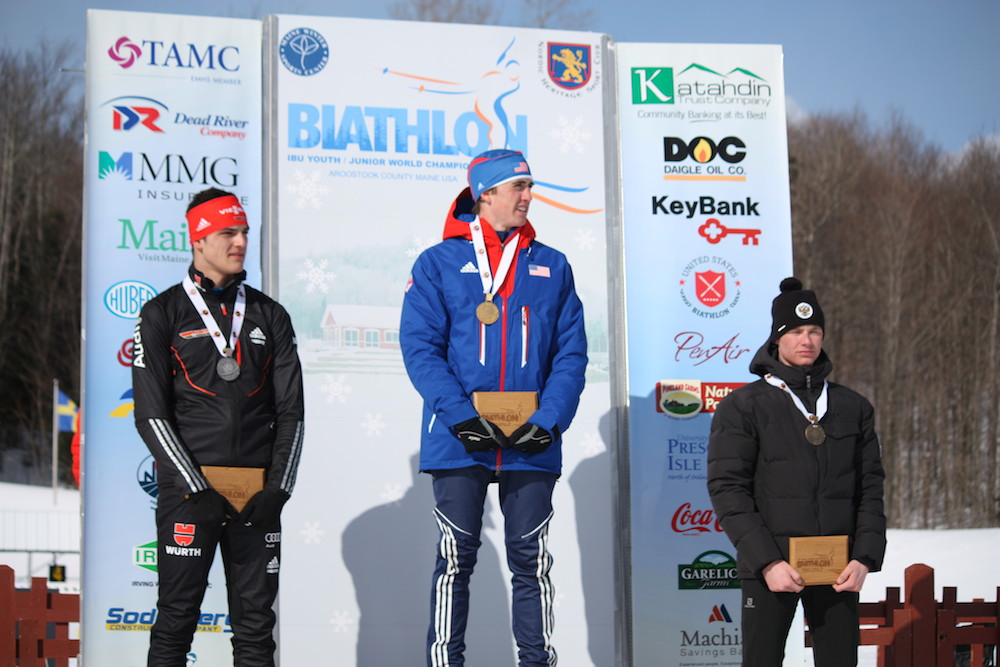
U.S. Olympian Sean Doherty (c) tops the podium in the first race of the 2014 IBU Youth World Championships in Presque Isle, Maine. Doherty won Friday’s 7.5 k sprint ahead of Germany’s Marco Gross (l) in second, and Russia’s Dmitri Shamaev in third. (Photo: Craig Cormier)
This weekend also marked the start of the IBU Youth World Championships in Presque Isle, Maine where American Sean Doherty claimed gold in both the 7.5 k sprint and 10 k sprint. This marks the third Youth World gold medal for the 18-year-old, who was fresh off his first Olympic start in the 4 X 7.5 k in Sochi.
American Maddie Phaneuf placed fourth in the women’s 5 k sprint and finished 24th in the 7.5 k pursuit. Canada’s Danielle Vrielink was the top North American in the pursuit with a 15th place finish.
The Vasaloppet also took place this weekend in Sweden. John Kristian Dahl waited to the last minute to make his move, chasing down fellow Norwegian Laugaland to win his first Vasaloppet. Laila Kveli of Norway won the women’s race in an impressive of display of double poling strength to become the first women to win the race without kick wax.
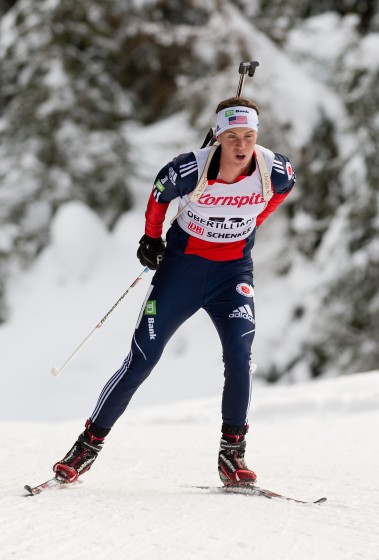
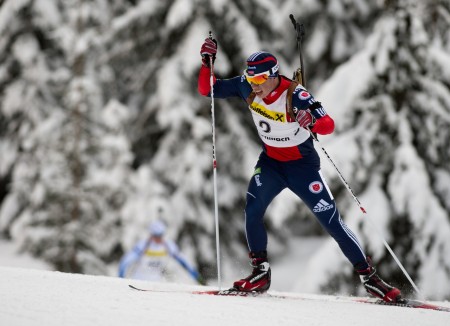
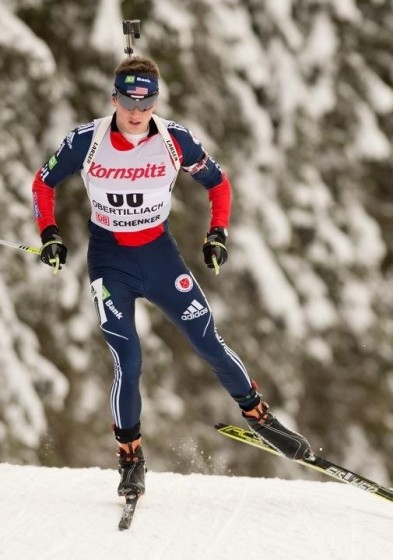
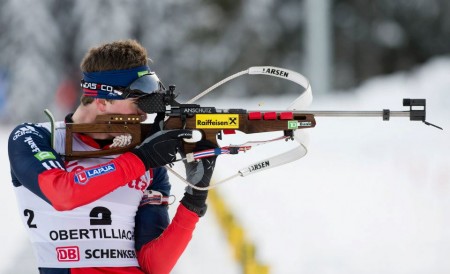
Casey Smith (USA) en route to 37th place in the junior men’s individual in Obertilliach. He had his career-best finish of 23rd place in the pursuit on Sunday. Photo: US Biathlon/NordicFocus.
With the U.S. bringing just two junior men and one junior woman to the World Youth and Junior Championships in Obertilliach, Austria, relay day isn’t going to mean much for the oldest athletes on the team.
Instead, Casey Smith, Jake Dalberg, and Tara Geraghty-Moats had their last crack at the Championships on Wednesday, competing in the 12.5 / 15 k individual races: four shooting stage, a minute time penalty per missed shot.
After an impeccable pursuit race that saw just one penalty in four stages, Smith couldn’t quite keep pace in the individual, collecting one missed shot in each of the first three stages and then two in the last stage. Nevertheless, he was able to move from 42nd as he left the range the final time up to 37th by the finish.
“The individual went okay, it was not a great race but not bad either,” he wrote in an e-mail to FasterSkier. “Especially in an individual, with five misses you can’t expect to do great. Of course I would have like to hit more, but that is part of biathlon and what makes it fun and exciting.”
Teammate Jake Dalberg actually shot much better, collecting only three penalties, but was hampered by an early crash. As he spun around in the snow, he managed to lose all four bullet-filled magazines that usually tuck into a rifle stock. Arriving at the range, he realized he had nothing to shoot with, and had to wait for about 45 seconds while an official brought him new ones.
Dalberg ended up 52nd, but with the 45 seconds subtracted he would have been about even with Smith.
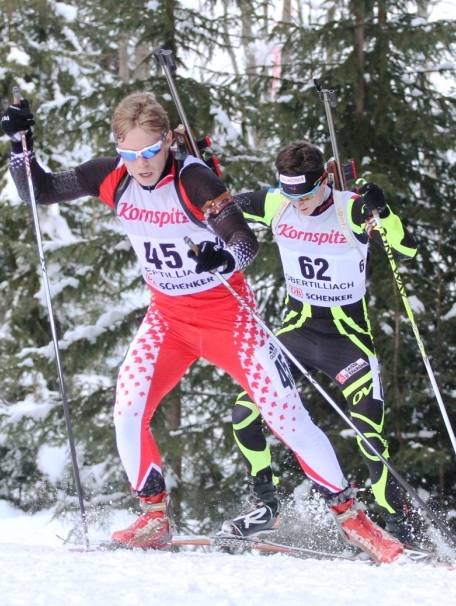
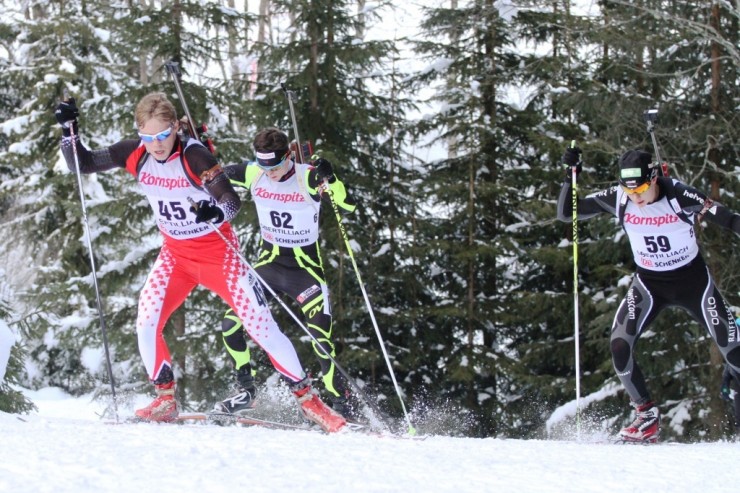
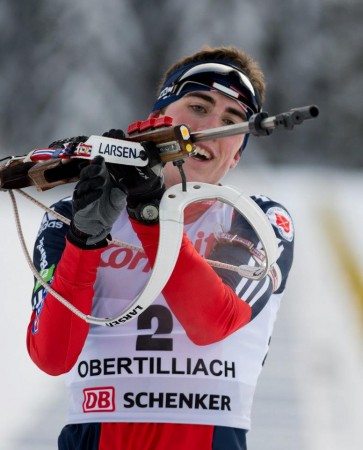
Jake Dalberg competing in the sprint. Photo: US Biathlon/NordicFocus.
“I shot that prone really fast, and honestly I am a little surprised that I hit 4 of 5,” he wrote in an e-mail. “So I was not so focused in that shooting, but the next three I was locked in and just paused too long on the last shot of each standing. I think as I have become more and more comfortable with the range I have been improving my averages in both training and obviously today in the race.”
Geraghty-Moats faced bigger challenges on the range, where she missed a painful 11 shots and wound up 63rd, over 13 minutes behind the winner, Laura Dahlmeier of Germany.
Like Geraghty-Moats, Dalberg failed to qualify for the pursuit race on Sunday, leaving him with just two starts in the series. He wasn’t exactly frustrated, but had hoped to gain one more race-worth of experience out of the trip.
“I wouldn’t say that I am disappointed with these races too much, but I definitely was hoping to make the pursuit,” he explained. “My ski speed overall just was not there I felt like, just kind of missing that top end. It may be the altitude, or the fact that I had a pretty intense cold in between trials and coming here.”
It’s Dalberg’s first trip to World Juniors, although he has international race experience as part of the National Guard biathlon team competing at military events. Those past races helped him prepare for this event – to an extent. Racing a military event in Italy still isn’t the same as World Juniors in Austria, with fans loudly cheering and booing in German for each shot on the range.
“Having been to Europe to race before definitely helped, but I still had some nerves going into the sprint,” Dalberg said. “I think too some days training on the range it was so busy, that I lost some focus while shooting at certain points.”
Staff Seargant Sarah Lehto, Dalberg’s coach, was nonetheless impressed at his performances this week.
“This is by far the biggest international race series for Jake in his career,” she told FasterSkier. “He’s competed internationally for the past two seasons but nothing at this
level. I’m extremely pleased that he was able to qualify for the team after narrowly missing the youth qualification last year and how he performed in such an atmosphere like these World Championships in Obertilliach… he’s now gained a ton of experience at this level which will help his development and expectation level for future racing.”
She also acknowledged that Dalberg’s skiing wasn’t up to his usual level, but that she hoped he wasn’t too disappointed. The racer himself is hoping to get back into shape next week, when he heads over the border to Italian Military Championships.
“For my first World Juniors, I would say I am happy with it, but felt like I could have had some better ski times,” he explained. “The competition was very tough, I knew it would be but the top several juniors I believe have been competing on the World Cup/IBU Cup, so I felt like the top end was very competitive, and I think overall the fields were pretty large this year compared to past years.”
Smith is also hoping to carry on in the coming weeks; he’s waiting to hear whether he is accepted to a trip to U26/Open European Championships, where he thinks he can keep up this level of racing.
“My skiing is feeling good,” Smith said. “I think that my training for the past few weeks leading up to now went well my coach had a pretty specific plan written out for me and I tried to follow it as close a possible which really helped me.”
But unlike Dalberg, who has one more year of junior eligibility, Obertilliach was truly the end of the road for Smith. A four-time World Youth and Junior Championships competitor, he looked back on both this and other editions with fond memories.
“I am happy with the Championships as a whole, like I said the other day I had my best ever Junior Worlds finish here in the pursuit which I was really happy about,” he said. “It is nice to see that I am continuing to improve especially since I am moving up into the senior ranks next year… I have definitely enjoyed all of my Junior Worlds and had fun at them, but I am ready to move on and continue.”
Canada’s Macx Davies (left) skiing deliberately en route to a career-best finish at World Junior Championships. Photo: Hugh Harden via Biathlon Canada.
It’s not that Macx Davies races so far at World Junior Championships were bad. No, 30th and 33rd in Obertilliach, Austria, were fine results for the Canadian biathlete.
But he wanted more.
“The race today was great,” he told FasterSkier after placing eighth in the 15 k individual race on Wednesday. “I started in a really focused state and kept that presence throughout the race. After my first two shootings I skied out for my third loop and somewhere out on course I realized that if I wanted to stay in the competition I had to hit my next ten shots. This wasn’t a frightening thought, simply a realization that if I want to do well in this race I needed to next ten shots. After that I knew that each shot needed to hit and made it happen.”
Davies had missed a shot on each of the first two stages, adding up to two minutes of penalty time. Even though he had skied fast in the previous two races, the individual format doesn’t allow many mistakes; more than in any other race, quick skiing can’t make up for errors on the range.
So as he cleaned the final two stages, Davies climbed towards the top. Starting in the middle of the field, he felt deceptively close to the win – although he eventually landed 1:37.3 behind Alexandr Loginov of Russia, the sprint champion, at the time he was right in the thick of things.
“I didn’t know how close I was to the front until my last loop when I skied by my coach and he yells ‘five seconds to the leader’ – at that point I am promptly brought out of my trance-like state to realize that I had shot 18/20 and was in with the leaders,” explained Davies. “I then forced myself to push incredibly hard on the last loop, almost throwing up and collapsing after the finish line.”
His last loop was the sixth-fastest of the day, but not enough to catch Ruslan Tkalenko of Ukraine, the early leader. Compared to the whole field once the race was over, Davies climbed from 28th to 15th to eighth before the final lap, and ended up just three seconds out of seventh place and 12 from the top five.
But despite not knowing how well he was doing, Davies had crafted a plan to make sure he was able to go all out on the final loop. The individual is the longest race format, but that didn’t concern him; he was more worried about the difficulty of the loop in Obertilliach, which is where Norwegian star Ole Einar Bjørndalen lives and trains for much of the year.
“Althought it may not look too hard on paper or even skiing easy, there is very little rest on the course which forces you to either make some or pace your race perfectly,” Davies said. “After having raced similar courses on the weekend I decided to change my skiing strategy, because it was an individual, the shooters race, and take the flats much easier and push the pace on the uphills. With the new pacing I kept a lower heart rate throughout the first four loops and was really able to pick up the pace on the last loop.”
The eighth-place finish continues a strong run by the Canadians as of late, after Sarah Beaudry placed fifth in the youth women’s individual the day before.
“The team is definitely getting excited for our improving results as well as the upcoming relays,” Davies said. “There has been a little bit of sickness with some of the athletes but otherwise I feel that the team is in a very healthy place, both physically and mentally.”
Menno Arendz of Prince Edward Island, brother to Canadian IPC ski and biathlon star Mark Arendz, had the best race of his first World Championships, placing 30th with just two penalties. After leading the junior men in the opening races Christian Gow was undone by six penalties and finished 36th, with the 16th-fastest course time; Jasper Mackenzie placed 65th.
For Davies, who is in his last year of eligibility as a junior, it was a good way to cap off a career of junior racing.
“My results don’t change my outlook on biathlon, but they do peak my interest and my desire to continue with the sport,” said the Biathlon Alberta Training Centre athlete. “For the next few weeks I am headed to the IBU cups in Martell, Italy and in Slovakia, after those I am staying for the Open European championships and also filling the gap in between the IBU and EOCH with a race in Altenberg, Germany.”
Like most of his teammates, Davies will finish the season at home with national championships for both biathlon and skiing. But first, one more shot at glory as a junior, when the four men team up for the relay on Friday. Who knows what they might accomplish.
“I feel like my training is much more validated having out together a race on the world stage!” Davies concluded.
* * *
Earlier Wednesday morning, Rose-Marie Côté seemed to be on track for her own top-ten, setting the tone in bib three in the women’s 12.5 k individual as she cleaned the first stage and missed one shot in the second. But as the rest of the field came through it was Laura Dahlmeier of Germany, the champion from the sprint, who rose to the top while Côté picked up two more penalties and landed 22nd overall.
It was still Côté’s best result of the Championships, and a strong race in a heavilty stratified field: with fifth place already over three minutes behind Dahlmeier, the Canadian’s result 5:27.7 behind was much more impressive than it looked on paper.
Julia Ransom placed 34th after struggling with seven penalties, and skied the 13th-fastest course time of the women. Erin Yungblut was 48th and Emma Lodge 50th for the Canadians as well.
Sean Doherty (USA) had the third-fastest course time of the day, which coupled with strong shooting in the second half of the race brought him a silver medal. Photo: US Biathlon/NordicFocus.
Just as he had in Sunday’s sprint race, Sean Doherty of the U.S. got off to an inauspicious start in Tuesday’s youth individual race at World Youth and Junior Championships in Obertilliach, Austria. After earning silver and gold in the previous two races, Doherty quickly collected two penalties.
Missing two shots in the first stage is especially punishing in the individual format, where each target that doesn’t turn which is penalized with a minute of additional time. Just 2.5 k into the 12.5 k competition, Doherty was already in a hole, 1:48 behind the leader, at that time Aslak Nenseter of Norway. (Penalties later piled up for Nenseter, who finished 26th.)
Ranked 52nd after that initial prone stage, Doherty was quick on his skis and made up some of the time. But a stage later, he missed another shot and fell to 2:13 behind the new leader, Aristide Begue of France. At this point, however, other racers had also begun missing, and the American’s fast skiing pulled him up to 24th.
It wasn’t great, but it was something.
“It’s not uncommon to have first or second or any stage go wrong for top competitors at any level,” Doherty’s coach Algis Shalna wrote in an e-mail to FasterSkier. “Sean is especially good at not giving up or losing confidence. After first two shooting stages I was nervous – I thought a few times the medal is gone, but believed he will stay focused and shoot well last stages and he did. Just watching him on the course after he missed those first shots he looked like he felt he is still in the game, but just had a late start.”
Doherty on the podium for the third time this week. Photo: US Biathlon/NordicFocus.
Doherty, who was unavailable for comment, put his head down and got it done. Over the next two stages he was flawless, not only hitting all ten targets but doing so more quickly than anyone else in the field. By the time he left the range the last time he was sitting in second, 18.5 seconds behind Begue.
“We coaches tell athletes before every race to focus until last stage of shooting because the game is not over until everyone is through the range and done shooting and results are posted,” Shalna said. “There is always a case someone misses targets at the begging of the race and someone at the end.”
Doherty nearly did the impossible and snagged the win, making up 12 seconds on Begue in the final 2.5 kilometers. But he was left with his second silver of the weekend, while Begue claimed his second title in this event in as many years.
It was an emotional day for Begue, whose coach Matthieu Rouveix died this summer at age 32. The sharpshooting Frenchman missed a single shot out of 20 to claim his title.
“I competed for my late coach Matthieu today and dedicate this gold medal to him,” Begue told the IBU press service after the race. “I was happy at the finish because I had a good race. If Sean was faster or not was not so important, there is always next year.”
Anton Myhda of Ukraine earned bronze, like Begue missing only one shot. He was 35 seconds behind Doherty in the first podium of his international career.
It was a strong day for the Americans across the board, with Jakob Ellingson finishing 21st with three penalties, Jordan McElroy 46th with six, and Brian Halligan 54th with seven. That’s a huge improvement over earlier in the week, when Doherty was the only American to make the 60-man pursuit.
Depth on the team and excellence at the top: that’s something that the U.S. can celebrate. So is the fact that Doherty became the first American biathlete ever to earn three medals in youth and junior racing.
After the hubbub surrounding his first silver medal and the subsequent gold in the pursuit, it would be easy for a 17-year-old athlete to get distracted. But Shalna marveled at Doherty’s resolve.
“Overall his confidence is very stable,” he wrote. “It’s a gift… the emotions are high and me, personally, I am trying not to think what just happened but think what is the next thing I need to get done and do everything the same way, to stay on track for preparation for the next race. I know Sean does pretty much the same thing. He makes the plan in his head and sticks with it until it’s done.”
Focus like that is what can bring an athlete back from such an early deficit – and it’s what Shalna has been trying to teach Doherty to do in the off-season, through hard work at shooting ranges in northern Vermont.
“When we do shooting drills, I teach athletes not to think about what happened but focus on the next task,” he explained. “I say whether you had good shooting or bad, keep your focus on the next task and just forget what happened before, positive or negative, in order to have the next task done good quality. I believe worrying too much becomes distraction and lowers the confidence.”
That’s no problem for Doherty, who has taken the words of Shalna – who, as a relay gold medalist in the 1984 Olympics, knows a thing or two about pressure himself – to heart.
“I thought of nothing, really,” Doherty told the IBU press service of his time on the course. “The coaches told me that I was doing okay, that I should not give up on the competition. So I focused on the second half of it.”
* * *
In the youth women’s 10 k individual, Anna Kubek of Mount Itasca again led the U.S. team, placing 38th with six penalties. Aleksandra Zakrzewska and Mikaela Paluszek finished 72nd and 79th.
Sarah Beaudry of Canada celebrates as she heads to the podium ceremony to be honored for her fifth-place finish. Photo: Hugh Harden via Biathlon Canada.
For some North American athletes who earn a trip to World Junior Championships, just making the team is something to celebrate – a long-planned goal, an accomplishment that defines a season.
But once the roster is named, those athletes get serious about what they might accomplish. And this is especially true for those who are returning for their second, or even third or fourth, international tour.
“We had two goals for the Championships,” Biathlon Canada High Performance Director Christ Lindsay told FasterSkier in an interview on Tuesday. “One is in a participatory and preparation context, where we see that athletes who have been exposed to international competition come back refocused, and they know where they are in relation to the rest of the world and are able to use that experience as a springboard for future success. The other side of our goals are in the performance area.”
The team set specific goals for its elite athletes going into World Youth and Junior Championships in Obertilliach, Austria, and Sarah Beaudry of Prince George, British Columbia, had among the toughest of tasks: “For Sarah, the goal was top 12 results,” Lindsay said.
After the sprint and pursuit races this weekend, Beaudry was unsatisfied. A three-time competitor in the youth division of biathlon’s championships, as well as a participant in last season’s Youth Olympic Games, her 36th and 28th-place finishes were solid – but not anything exciting.
“Both the sprint and the pursuit went okay,” she wrote in an e-mail on Monday. “Both days I felt like I wasn’t skiing my best. I was really happy with my shooting in the pursuit but it would have been nice to hit a few more in the sprint. I was definitely hoping for a little bit better results, but I still have the individual tomorrow to improve on my current results.”
Well: mission accomplished. On Tuesday Beaudry jetted into the spotlight, collecting only two penalties in the 10 k pursuit race and placing fifth, 25 seconds off the podium.
“It was more of a fresh start after Friday’s race, where I was very nervous and wasn’t quite feeling quick after the long travel,” Beaudry wrote after the individual. “Surprisingly, I managed to not let my nerves get in the way during the shooting. I knew this was my chance and I knew if I wanted it I would have to shoot well.”
Beaudry on course in Obertilliach. Photo: Hugh Harden via Biathlon Canada.
The result was better than any of Beaudry’s previous international races, a testament to how hard she has trained this year. After graduating from high school last spring, she joined the Biathlon Alberta Training Centre in Canmore and has been working full-time with coach Richard Boruta, who is also the head of the Canadian team at the Championships.
That, says Lindsay, has allowed an experienced junior to have the kind of breakthrough that put her so close to the podium even though Beaudry, a strong skier and sprinter in particular, admitted that “I wouldn’t say the individual [where each missed shot is penalized by a minute of added time] would be my strongest format.”
“I do expect my athletes to perform to the level of their abilities, so in that regard I knew that Sarah had the potential to do just that,” Boruta wrote in an e-mail regarding Beaudry’s finish. “However, in biathlon, more than many other sports, it is very difficult to expect podium performances, because in elite racing an error on the shooting range can often cost you as many as 10 or more places. She did today exactly what she has been training for, which for sure is a good thing for her future.”
With one penalty in each standing stage – which came second and fourth out of the four stages – Beaudry was always close to the top. After one stage she ranked sixth and a stage later seventh; for the rest of the race she hovered between fourth and fifth. But although she knew she was having a good race, Boruta didn’t add any pressure by telling her how close she was to the podium.
“In this age group we usually try to keep our athletes on their race plan until the shooting is over,” he explained. “Most of the information is related to ski speed and technique, but we didn’t share with her the exact position. Usually, they will either start skiing too hard or thinking too much and the last shooting is important enough to change the race outcome completely. She knew on the last 2.5 km loop where she is and what she needs to do and she did her best to keep the position.”
The last loop was actually Beaudry’s slowest – try as she might, she couldn’t make up ground. But it didn’t matter, because the next finisher was 20 seconds behind.
“I was definitely tired by the last lap but was feeling a lot better than the other races,” Beaudry wrote.
And she was never in a position to win; Uliana Kaisheva of Russia completed a clean sweep of the youth events, winning by a whopping 1:20 despite two penalties, the same as Beaudry’s score. In fact, both Beaudry’s success and her distance from the winner were characteristic of important lessons that Lindsay hopes Canada’s young athletes will learn. First of all, the best in the world are very, very good. Not only in the youth women’s division, where Kaisheva has dominated, but also in the junior men’s division, a group of athletes have been head and shoulders above the rest.
“We were quite surprised at the level of quality at the very top end,” Lindsay said. “And I think, specifically, with a few of the winning athletes – some of them we’ve already seen – but some of them are now registered for the World senior Championships. But some of them are athletes that we have not seen before in competition. It’s tough, but it’s also a reminder that we can’t be complacent back here. Just because you’re the number one in the U.S., or in Canada, or in North America, really doesn’t give you a good gauge on how you’re going to do when you compete against the Europeans.”
But the second message is hope.
“A lot can happen for an athlete at 17 or 18 years old within six months,” he said. “Just because you feel a little sluggish here doesn’t mean that you can’t become that person who wins the medal.”
And that’s especially important for Beaudry’s teammates. Another top Canadian youth, Danielle Vrielink, broke a bone in her wrist while tobogganing. So the other three members of the youth women’s squad are young – 16 years old, the bottom of the age group as opposed to Beaudry’s 18 years – and have never before raced in Europe.
“I think it is a great eye-opener for these girls and they will have better understanding now what is really expected from athletes competing at this level,” Boruta wrote. “And I believe that it is motivating to see your team-mate do this well, that it is not only a privilege of Germans or Norwegians or Russians.”
Lindsay called Beaudry “a leader,” but said that he was also impressed with the younger athletes: in the individual, for instance, Leilani Tam Von Burg placed 50th, Emily Dickson 54th, and Charlotte Hamel 61st. While Dickson had six penalties, Hamel and Tam Von Burg had just three and four.
“I’m not disappointed by any means with the performances, and quite frankly I’m happy at the number of younger athletes we have there and how they’ve been able to put themselves together to get through races successfully and not have blow-ups, and to be able to learn something,” Lindsay said.
For Beaudry, though, leadership isn’t a chore – it’s a treat.
“It is fun being with the new girls who were all so excited for their first international race and remembering what it was like for me the first time racing in Europe,” she wrote in an e-mail.
* * *
In the youth men’s 12.5 k pursuit, Canada was left without its top racer, Stuart Harden, who Boruta said had “some quite serious health problems” and may or may not be back for the relay.
As such, he had nothing to add when Aristide Begue of France repeated his world title in the event from last season, or when Sean Doherty of the U.S. placed second, collecting his third medal of the championships – a record for a U.S. biathlete.
Instead it was Carsen Campbell leading the way in 37th. After three stages Campbell, of Prince Edward Island, seemed to be headed to his second top-30 finish of the Championships, but two more penalties in the last stage dropped him down the list.
“He started with two misses in first prone, which in this type of race is very discouraging,” Boruta wrote. “You have to be very good skier to keep the hope of having a good result with so many shooting penalties. He doesn’t have much perspective about how well you actually need to ski at this level, so he will probably learn a lot. He is also interacting with other athletes and it helps him to become better athlete himself.”
Matthew Strum placed 67th and Arthur Roots 86th to round things out for Canada.
Olga Podchufarova (RUS) after winning the junior women’s pursuit. Photo: Mario Danzl/Obertilliach 2013.
With Sean Doherty stealing the show in the youth pursuit, there was plenty for North America to be excited about in the third day of racing at World Youth and Junior Championships for biathlon in Obertilliach, Austria.
“It was great day for all of us here and biathlon fans,” Doherty’s coach Algis Shalna wrote in an e-mail to FasterSkier.
But with the gold medal heading to the United States, it was perhaps easy to forget that the youth men were actually the fourth group to race on Sunday, and there were many other strong North American performances before that. Canadians Stuart Harden, Julia Ransom, and Christian Gow each scored their second top-20 finish of the Championships, while American Casey Smith had a phenomenal pursuit, jumping up about 20 places based on strong shooting.
* The first race of the day was the youth women’s 7.5 k pursuit, where Uliana Kaisheva of Russia thoroughly crushed the field, expanding her lead from the sprint into a 1:15 victory over Galina Vishnevskaya of Kazakhstan despite four penalties.
This race generated the least buzz for the U.S. and Canada. Both teams had big hopes in this division, with U.S. biathlete Anna Kubek and Canadian Sarah Beaudry coming off strong seasons last year that included trips to the Youth Olympic Games.
After placing 34th and 36th in the sprint, the pair broke into the top 30 in the pursuit, with Kubek moving up to 25th with just two penalties in the 20-shot race. Beaudry improved to 28th with one more penalty.
“Sarah Beaudry is still young, but she has been to this last year and she also went to the Youth Olympics last year,” Canadian team leader and Biathlon Alberta Training Centre Head Coach Richard Boruta told FasterSkier. “She is still fighting with jet-lag and not feeling best on skis. The expectation is that she will possibly improve her ranks as the week will move on.”
* Next up were the junior women. While no Americans qualified for the 60-woman, 10 k pursuit, Canada was impressive in placing all four of its team members in the race. Furthermore, all four improved.
They were led by Julia Ransom, who started in 16th position after the sprint. With a penalty early and then two clean stages, she moved into the top ten before slipping back to 15th after two missed shots in the final standing stage.
Ransom was ultimately 3:09 behind the winner, Olga Podchufarova of Russia, who swept summer biathlon World Championships this past season and won by 17 seconds after sprint winner Laura Dahlmeier of Germany collapsed in the final stage, missing two shots to Podhufarova’s one. It was still a good day for Germany, though: Franziska Preuss earned bronze and Vanessa Hinz was fourth.
After earning silver in the youth pursuit last year, Ransom was up against some tougher competition this time around.
“The competition in Junior seems to be a little more competitive than Youth,” she wrote in an e-mail. “There are a lot of fantastic athletes looking to make it to IBU/World Cup and you can tell they are hungry! I was happy with my race both yesterday and today. I thought my shooting was solid in the sprint and may have lost a little focus in my pursuit (missed 2 on last bout). The sprint was a good wake up for my legs as I felt a lot better skiing today.”
Boruta, who coaches Ransom year-round in Canmore, said that her races so far were solid performances.
“Performance wise, I think Julia and Christian [Gow] as first-year juniors are right on target, they didn’t have any extraordinary races, but they did perform at the current level of their abilities and this is were they are in the world right now,” he wrote in an e-mail.
Emma Lodge and Rose-Marie Côté started 41st and 43rd, and improved a few places to 36th and 38th. But they couldn’t actually work as a team as they moved up on the trails.
“Rose and I both started in the wave start 4:00 min behind the leader, but didn’t spend much time together as I only hit 3 on the first prone when she cleaned so I spent much of the race playing catchup,” Lodge explained in an e-mail. “It wasn’t until the last lap when I left the penalty loop just ahead of her that I saw her again, so that was helpful having her chasing me down to the finish line!”
Lodge had five penalties after that frustrating first stage, while Côté limited herself to three. She had climbed up to 33rd before taking two penalties in the final stage; both were over seven minutes behind Podchufarova, having lost an additional three minutes in the pursuit.
“Today’s race felt better than yesterday, with more spark in my skiing,” Lodge wrote. “I guess I needed a really hard effort to get my legs going! My prone was a bit off today which is frustrating as usually I can count on it, but I am happy with my 8 standing hits. We have two days off before the Individual on Wednesday and I’m feeling really prepared for the next races as I had a great training season and both my skiing and shooting improved. I’m excited for the next races, it’s awesome racing here under the sun and with so many competitive athletes around.”
Erin Yungblut, the only one of Canada’s junior women to come to Obertilliach as a first-timer on the international scene, improved from 59th to 52nd with four penalties.
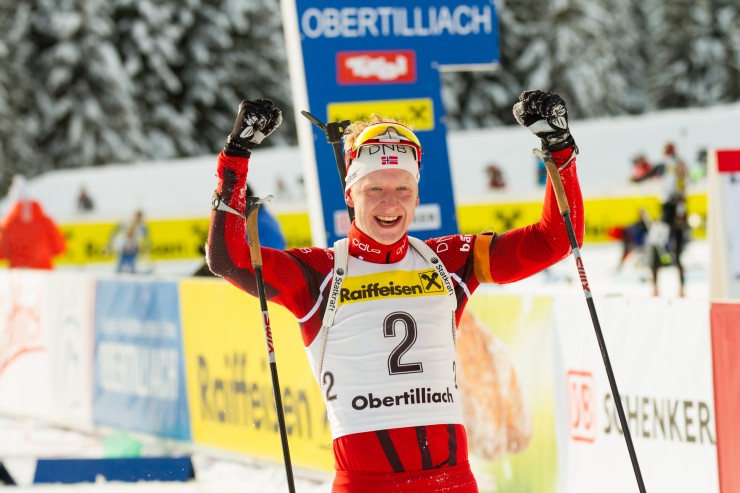
Johannes Thingnes Bø of Norway skied deliberately early in the junior men’s pursuit, then capitalized on shooting errors by the Russian leaders to take the win. Photo: Mario Danzl/Obertilliach 2013.
This is a continuation of reporting on the third day of biathlon World Youth and Junior Championships; for part one, on the women’s races, click here.
* The transition to men’s racing in the afternoon was exciting as Russians Maxim Tsvetkov and Alexandr Loginov, both very successful in last year’s Championships in different divisions, took control early and duked it out as Norway’s Johannes Thingnes Bø tried to play catch-up. But in the final stage, the Russians faltered, each collecting several penalties. That left Bø a fighting chance, and he came onto the range, cleaned his targets with impeccable efficiency, and left with the lead, which he never relinquished.
Behind them, Christian Gow was chasing hard. Starting 14th after the pursuit, he had a shot at moving into the top ten. But the field continued to stratify and with five penalties, he slipped to 16th.
“There are some big gaps in the category, mainly because the top four guys are almost out of the rest of the competition’s league,” Gow told FasterSkier. “The gaps have not made it harder to achieve better results, for me all it would have taken was a few more targets. I was in the top 10 for awhile today, but really fell back with some poor standing shooting.”
Gow believes that he has a good chance to improve in the individual race, where each missed shot accrues a one-minute time penalty.
“The top guys are fast, but with one minute penalties there is a lot more room for guys to break in to the top three,” he wrote in an e-mail.
Overall, he was pleased with his race, but knows that he needs to improve on the range for the rest of the week.
“My shooting was a bit of a disappointment,” Gow wrote. “I had a miss in each prone, but one of them I rushed a lot which I could have easily avoided. My first standing was terrible, but I brought it back for the last one which I’m happy about.”
Behind Gow, teammate Macx Davies also had a shot to move up after starting 31st. But despite making it into the top 25 in the middle of the race, three penalties in the final stage bumped him back down to 33rd. Despite the 21st-fastest ski time, seven penalties were too many for the Canadian.
“Coming into the last standing with my legs were aching and my heart rate was high, but not too different from the first standing bout,” Davies explained. “However I got a bit excited after my first hit and failed to maintain a good sight picture for the rest of the shooting. The shooting conditions are not difficult looking at the range, little to no wind and light isn’t affecting the shots, but the mats are a slippery, especially standing, and the course allows little recovery time with all the flat terrain and quick down hills.”
Davies said that his skiing was “at an amazing level,” so he hopes to improve in the upcoming competitions. Both he and Gow are from Canmore but on separate teams, although, as Gow said, “we have been racing together forever though and if our schedules mesh we will often ski together.” Despite the different training schedules each has seen a similar ramping-up of training this year.
“The biggest difference in my training was the volume of hours and the focus that I brought to each session,” Gow said of his improvement on skis.
Finally, American Casey Smith started behind the Canadians in 43rd.
“After the sprint race I was defiantly disappointed with my standing shooting,” he told FasterSkier. “My prone went alright with only one miss and that one was a split. Then in my standing I was not very settled and should have paused for a second to get things right, but I didn’t. I felt that my skiing went well though, that it was good enough that if I hit my targets I could be right in the mix.”
With an obvious goal for the pursuit, Smith set about achieving it. His single penalty was only matched by two other competitors and he moved all the way up to 23rd – the second-biggest move of the day. That result represented Smith’s best finish ever in a total of four World Championships appearances.
“With my shooting I was just thinking about taking good shots and making sure my mechanics were correct,” he said. “I don’t think that the conditions were tricky at all. There was no wind and everything was pretty consistent. There is an uphill range approach which I think could easily throw you off if you are not paying enough attention… I was very happy with my pursuit race it is my best Junior Worlds finish ever and I also moved up 20 places which is a good feeling.”
* Finally, it was Sean Doherty’s turn – and Stuart Harden’s. The Canadian, who like Doherty had competed at the Youth Olympic Games with great results, had placed 20th in the sprint and was looking to move up.
“I wasn’t totally satisfied with my sprint performance, my shooting wasn’t where it needed to be both accuracy and time wise,” Harden told FasteSkier. “My skiing was enough to get me into the top 20, but I’ve felt better in earlier races so far this season.”
Luckily, he had a plan for the pursuit.
“I knew I had to speed up my range times a bit, and I hoped my steady shooting would cope,” he explained. “I had a vague plan to stick with the guys around me off the first few loops, because I know from the Youth Olympics and WYJCH last year that we have close ski speeds. After that, I was banking on staying out of the penalty loop and seeing how much left I had for the last lap. Sometimes plans don’t work out unfortunately.”
With one penalty in the first prone stage and then a clean second stage, Harden did move into the top ten. But then the wheels came off, and he picked up three more penalties in the next two standing stages. That left him in 18th – still an improvement, but not what he was hoping for.
“It was a hilly loop, but a quick one as well so I made sure to keep the pressure on each loop – it’s pretty obvious from my lap times that my shape wasn’t good enough to make that happen today,” Harden wrote. “I was in more of a ‘limit your losses’’ mindset, which can’t happen if I want to do well.”
Like Davies, he noted that the mats in Obertilliach were especially slippery, which was a challenge in standing and provided “less stability that I’m used to,” Harden said. In the television broadcast of the junior races, the men could be seen coming into standing much more slowly and deliberately than usual, and taking their time setting their position on the mats.
But all excuses aside – even the reasonable ones – Harden says that he’s just not where he was hoping to be this year. At the Youth Olympic Games, Harden had moved from fourth in the sprint to first in the pursuit, but had missed a penalty loop and was penalized by two minutes, dropping him to seventh; excruciatingly, his 38-second lead at the finish would have still left him with the win even if he had done the extra loop.
Knowing what he was capable of left him with high hopes for 2013.
“I set higher goals for myself this year without a doubt, which I could justify with my results from last season,” Harden wrote. “A place on the podium in Obertilliach isn’t unreasonable I think, but I’m re-evaluating the rest of my week based on how I’ve been feeling on and off the skis for the past few weeks.”
Canadians also had their hopes pinned on Carsen Campbell, who had placed 30th in the sprint. But eight penalties were too many and the Prince Edward Island native fell to 42nd in the pursuit.
“In the sprint my focus was good and the shooting went pretty well as planned,” Campbell wrote in an e-mail. “This was not the case today, I just couldn’t get my head in the right place. I am a bit disappointing with my race today, my skiing felt really good and I had great skis but with eight misses you don’t get very far here.”
After three misses in the first prone stage, Campbell turned his skiing up a notch to try to compensate, turning in the tenth-fastest second-loop time and jumping back into the 30’s. But another penalty in the second stage, then two in each standing, tired him out. At 150 meters apiece, Campbell skied a full 1.2 k more than the course length itself.
Still, he’s not discouraged for the rest of the Championships.
“I am feeling a lot stronger than last year, my form is better am I am mentally much better prepared and the adjustment to Europe was pretty easy this year,” he said. “I feel confident that it will be back in order for the individual… [but] the competition is really stiff, in the sprint the top 30 were all within 1:30 so there is no room for error.”
The third Canadian in the youth pursuit, Arthur Roots, finished 60th.
Overall, the youth category is a tough place to race, as athletes are generally talented, but not used to the world stage.
“For the [less experienced] of the crew, this is a big eye-opener, but very important for their next development,” Canadian team leader Richard Boruta said. “Back home, you finish in top four and it is very easy to start thinking that you are one of the best, but than you come here and you realize that within the minute or two between you and the next Canadian guy ahead could be easily 20 or 30 other athletes.”
As we’ve discussed on FasterSkier before, U.S. and Canadian teams have the added challenge of developing strong juniors despite the fact that many don’t take up biathlon, or even skiing, at a particularly young age.
“Especially for the youth athletes as well, the performance is somewhat dependent on their biological age and number of years in a regular training program,” Boruta said. “Most of the North American are late-starters, so they are catching up in later age.”
Even for experienced athletes like Harden, there are challenges that can be chalked up to simply growing up.
“I think a more experienced athlete may have done that sooner, but I’m just confronting it now,” he said of the realization that he’s not where he wants to be. “Regardless of my ranking in each race, I’m still really happy to be here, I’m really happy for Sean [Doherty] and all the other athletes I’ve raced and gotten to know, and I’m looking forward to the rest of the week.”
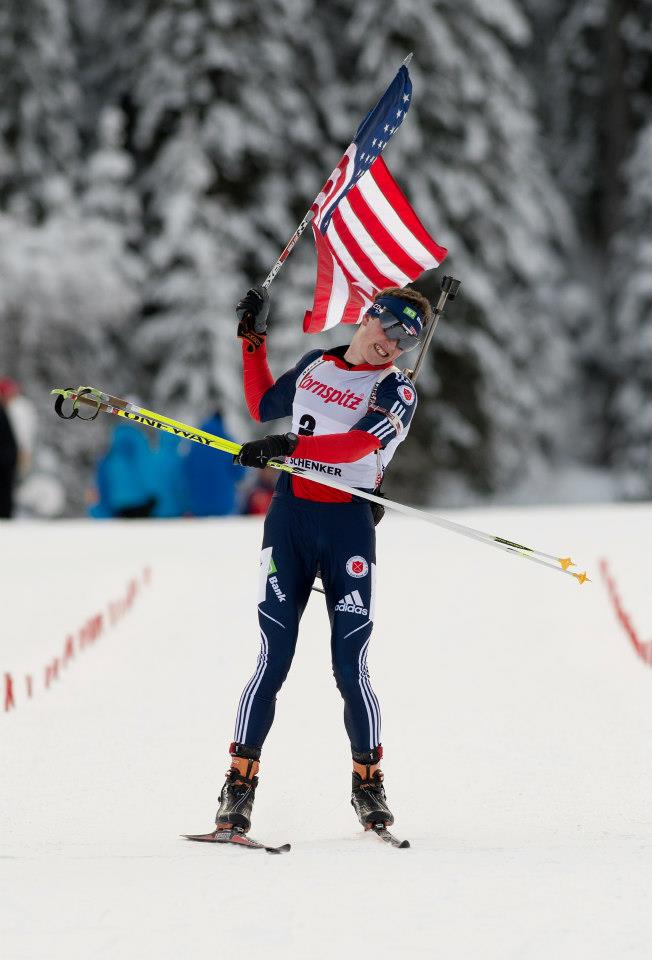
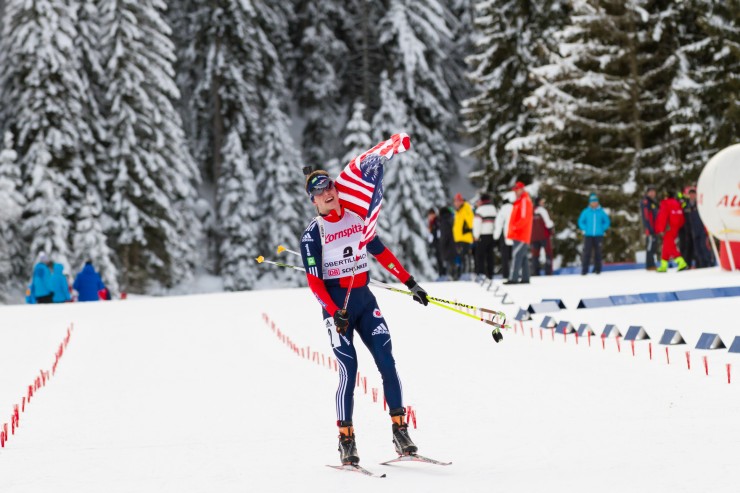
Sean Doherty enjoyed every second of his time carrying the American flag across the finish line as a World Champion. Photo: UBSA/NordicFocus.
On Friday, Sean Doherty won the first U.S. medal at biathlon World Youth and Junior Championships since 2009, when Grace Boutot won silver. The drought to a male medal was one year longer, back to 2008, when Leif Nordgren earned bronze.
And going into the 10 k pursuit on Sunday, it seemed like another medal was, well, not a guarantee, but definitely a strong possibility. Doherty, who lives in Center Conway, New Hampshire, but trains with the Vermont Collegiate Biathlon/Ethan Allen program in northern Vermont, started only 3.6 seconds behind sprint winner Fabien Claude of France.
Things didn’t get off to a great start, though, when Doherty missed two shots in the very first prone stage and dropped to fourth, 30 seconds out of the lead, which had shifted to Rene Zahkna of Estonia.
“When I was in the wax cabin before the race, thinking over my plan, that was not how I planned it,” Doherty laughed over the phone from Obertilliach, Austria. “But if there’s any time in the race to have not your best shooting stage, the first one is okay, because there’s plenty of racing to work back from that. And I feel like I did that very well. I wasn’t too worried about it at the time because I didn’t drop back too far, and I knew I still had three shooting stages to work with and focus on.”
Doherty on the range, where he didn’t let nerves rattle him as they had earlier leaders. Photo: USBA/NordicFocus.
That kind of calm and maturity propelled 17-year-old Doherty – who remarkably still has another year of youth eligibility – steadily upwards. By the third stage, he hadn’t collected any more penalties and took the lead. Leaving the last standing stage, he had a 33-second advantage over Zahkna, and had sealed the deal on the first gold for the United States since Jay Hakkinen’s in 1997.
In a somewhat sloppy four-stage pursuit, very few racers shot better than Doherty; only three beat his three penalties, which wouldn’t usually be characterized as exceptional. Couple that with the 15th-fastest ski time, and you’ve got yourself a World Champion.
“It was really cool to have a good race when it really counted,” Doherty told FasterSkier.
His late-in-the-game cool was all the more impressive considering what had happened in the previous races. In the junior men’s race, which had finished just 20 minutes before the youth men began, Russians Alexandr Loginov and Maxim Tsvetkov came into the range the last time in first and second, then missed three and two targets and handed the win to Johannes Thingnes Bø of Norway.
That wasn’t going to happen to Doherty.
“With the standing shooting, I just knew that I had to do what I was trained to do,” he said. “Not change anything. I’ve seen it a lot from watching the World Cup online and racing experience: people hesitate and miss. So I just went with my pace and how I felt. It worked out just fine for me.”
After clinching the victory, he was able to take enough time to grab an American flag in the finishing stretch and ski it across the finish line.
Doherty’s single penalty in the last stage left him smiling: the win was clinched. Photo: USBA/NordicFocus.
“It was incredible,” he said of the last lap of skiing. “I wasn’t getting any splits, but it was just amazing to know that it was locked up. That I was going to be able to grab the flag at the end – all the stuff that I just see people do at big World Championship type races, and then all of a sudden, wow, I’m going to be able to do that.”
In a single weekend, Doherty became the most decorated young biathlete in U.S. history. While Hakkinen can match his gold, never before has an American won multiple individual medals at the Youth and Junior Championships. (Lanny Barnes won bronze and relay silver in 2002.)
For Doherty – who has been training hard all year with coach Algis Shalna, himself an Olympic gold medalist for the Soviet Union in the relay in 1984 – the medals had seemed like a possibility, but hardly something to check off a goal sheet.
“I went in knowing that I was capable of a podium, but it’s very hard to plan this type of result, I think,” he said. “I was going in hopeful, but not necessarily like, we have a major goal to get on the podium.”
Besides training, which takes him tow or three hours from home to places like Jericho or Craftsbury, Vermont, for weekends with his coach and teammates, Doherty has prepared by doing a few biathlon races in North America and some ski races as well. Earlier this winter in Craftsbury, he was the third junior and first J1 in a 12 k Eastern Cup race, right in with several racers who earned trips to U23’s.
But as a biathlete, Doherty turned heads when he crushed the World Juniors qualification field, typically winning by two or three minutes. That can give an athlete confidence, but it’s also completely different than competing against a strong field at an event like World Junior Championships.
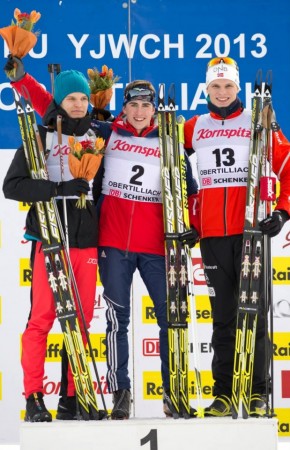
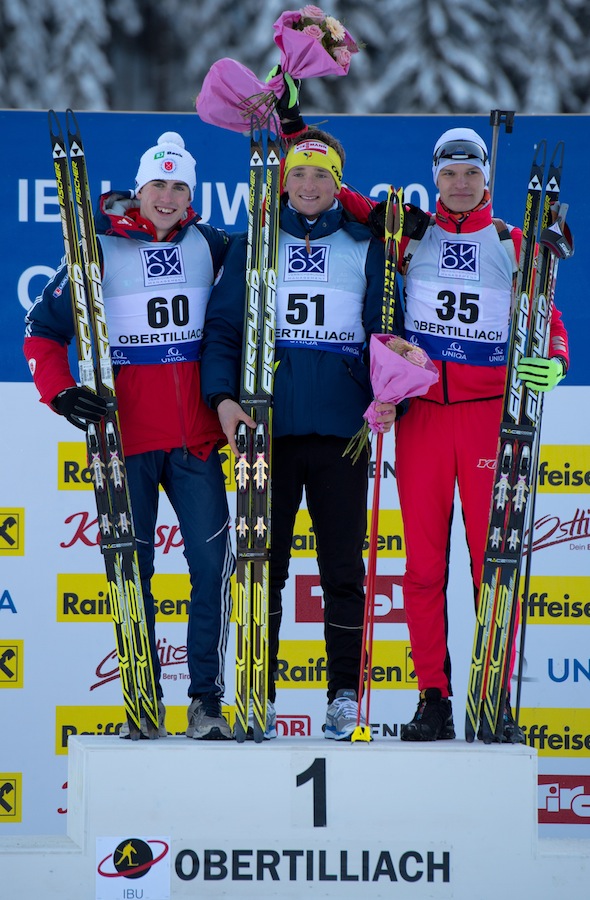
On the podium for the second time this weekend. With second-place Rene Zahkna of Estonia (left) and third-place Fredrik Roervik of Norway (right). Photo: USBA/NordicFocus.
Luckily, Doherty has been to two previous Championships, as well as the Youth Olympic Games. And he also has Shalna’s guidance.
“It’s just a lot of good coaching,” Doherty said of his preparation for big races. “Algis and Vlad [Cervenka] and the whole staff is really great. So it’s relying on some previous experience and trusting that my coaches have a good plan for me. That’s really all you can do. Maybe you can watch some online and get a feel for the environment, but it’s nothing compared to when you’re actually there.”
Doherty will have one more chance to add to his medal tally at these Championships, in the individual race on Tuesday. With no other American men qualifying for the 60-racer pursuit, a team relay medal seems unlikely.
After Obertilliach, Doherty will focus on the junior races at Open European/U26 Championships, to be held in Bulgaria later this winter. In previous seasons he has also raced at home for Kennett High School, but with his biathlon focus growing every year that’s no longer a possibility.
“Unfortunately, because I’m traveling so much I’m not actually doing the high school races,” he said. “I feel like I can’t really be a part of the team because I’m not there enough. I’d love to, but I’m not doing that this year.”
Instead, he’s soaking up an experience that only a few Americans are lucky enough to earn: racing in Europe, and carrying that flag home across the finish line.
Laura Dahlmeier of Germany on her way to her first World Championship, in the junior women’s sprint. Photo: Mario Danzl/Obertilliach 2013.
Several Canadian juniors entered the World Youth and Junior Championships with big expectations after successful runs last season. But in 2013, both Christian Gow and Julia Ransom had an additional challenge: moving up an age class.
In 2012 in Kontiolahti, Finland, Ransom had medaled and Gow finished 11th in the youth races. After turning 19, they were bumped up to juniors.
“The level this year does seem a bit more elite to me, especially the lead group of guys,” Gow told FasterSkier. “I think that makes it more difficult to get a good result, but it is better to see where I stack up against the very best. knew this year would be tougher, but I trained a lot harder and more focused than any other year so I feel prepared.”
In both the men’s and women’s sprint races in Obertilliach, Austria, on Saturday, the very best were indeed a step above the rest. Laura Dahlmeier of Germany won the women’s 7.5 k by 48 seconds over Olga Podchufarova of Russia; pairs of Russians and Norwegians fought it out in the men’s 10 k race, but fifth place was almost a minute behind.
Starting with bib 16, Gow was well-ranked early in the race, especially after cleaning in prone. But then the veterans hit the trails.
Alexandr Loginov, champion in the junior men’s sprint. Photo: Mario Danzl/Obertilliach 2013.
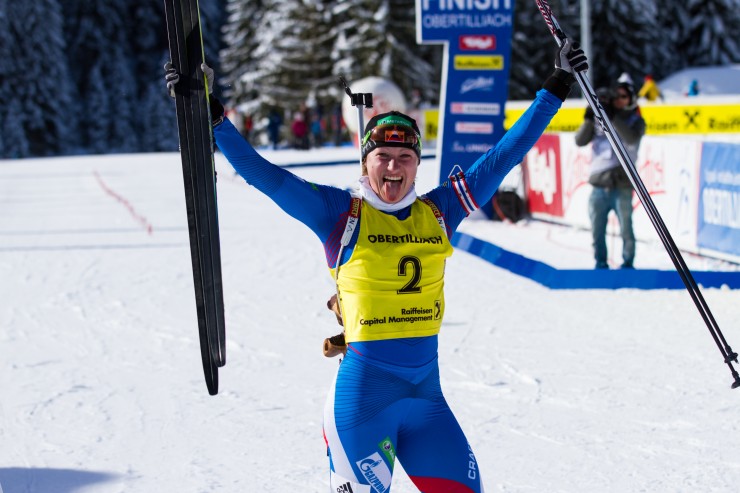
Russia’s Alexandr Loginov prevailed, picking up his fourth individual medal at this event and first gold; Johannes Thingnes Bø of Norway, twice a World Champion last year, placed second. For third-place Maxim Tsvetkov of Russia, bronze was surely a disappointment after two gold medals at each of the last two Championships. And in four Championships Vetle Sjastad Christiansen of Norway has never not won a medal – so despite fourth place in the sprint he can’t be counted out of future races.
So while Gow ultimately placed 14th after accumulating two penalties in standing, he was still only a minute out of the top five. And he knows he can do better.
“I was really happy with the start of my race…. but I am disappointed with my standing,” he wrote in an e-mail. “It was not windy at all today. However, there was some strange lighting because the sun was really bright on the carpets, but the targets were really dark. I found it difficult to get a good sight picture, but I still feel like I threw two shots away. I wish that I could have at least one of them back.”
He had the best North American race of the day, although Ransom almost matched his result, placing 16th in the women’s sprint. With a single penalty, Ransom was steady on the trails and also sits just over a minute out of the top five. Going into the pursuit races on Sunday, both have strong chances for a top-ten showing or better.
The women’s field shook out a bit differently than the men’s. Dahlmeier hasn’t been on the podium in several years, but more recent medalists struggled: Hilde Fenne, who was superb in the youth races last year and has since scored World Cup points and participated in two winning World Cup relays, was the third Norwegian across the line in 13th. Grete Gaim, who won last year’s youth pursuit, was 26th. Chardine Sloof, who became the first Dutch World Champion, placed 31st.
But Ransom’s success isn’t the only thing the Canadian women’s team has to be excited about. They placed all four racers in the 60-woman pursuit, with Emma Lodge and Rose-Marie Coté finishing 41st and 43rd and first-time World Juniors competitor Erin Yungblut sneaking in by the skin of her teeth, in a tie for 59th.
The lone American in the race, Tara Geraghty-Moats, placed 63rd.
Macx Davies also turned in a strong ski performance for the Canadian men, placing 30th. That was despite five penalties; Davies had the tenth-fastest ski time of the day, and Gow the 15th.
Menno Arendz just missed the pursuit, finishing 64th with one penalty, and Jasper Mackenzie placed 73rd. In his second trip to the Championships, Mackenzie was hoping for more.
Vetle Sjastad Christiansen of Norway on the range; he placed fourth. Photo: Mario Danzl/Obertilliach 2013.
“To be honest I’m a little disappointed with my results today,” he wrote in an e-mail. “One of my main goals coming into this year’s Championship was to qualify for the pursuit… My shooting wasn’t to good, I felt solid on the range coming into the race today but I honestly don’t know where I went wrong on my prone misses. 7/10 shooting at this level of competition just isn’t good enough. It was a lot of fun to get out and race today but I know I can perform better than that.”
While Arendz is a first-timer at this level of competition, Mackenzie, like Gow and Davies, feels like his is settling in to the international scene a little more.
“Last year I was very nervous coming into the Championships,” Mackenzie told FasterSkier. “This year I have been feeling way more confident, I feel like I have improved a lot of the summer, my skiing and shooting have both improved significantly. It’s just a bummer that today’s race did not reflect my true potential. This year I really just wanted to be able to walk away from my races knowing that I did the absolute best I could, and I’m confident that I’ll do just that in the races to come.”
For the U.S., Casey Smith finished 43rd and Jacob Dalberg 71st.
Sean Doherty (Center Conway, N.H./Vermont Collegiate Biathlon) skis to a career-best second place, 3.6 seconds out of first, at the IBU Youth World Championships on Friday in Obertillach, Austria. (Photo: USBA/Nordic Focus)
Sean Doherty knew exactly what he was in for heading into his third International Biathlon Union (IBU) Youth World Championships. The 17-year-old New Hampshire resident had been to two junior world championships before: first in 2011 in Nove Mesto, Czech Republic, and again last year in Kontiolahti, Finland.
His best individual result had been 13th, which he took in the 2012 sprint and pursuit. Pretty good, but Doherty wanted more. Last year, he won bronze in the mixed relay at the Youth Olympic Games in Innsbruck, Austria.
Back in Austria – this time in Obertilliach – Doherty proved to himself and everyone else that he was capable of not only a podium, but nearly a win, in the 2013 youth worlds opener. The Vermont Collegiate Biathlon member raced to silver in Friday’s 7.5-kilometer sprint, finishing just 3.6 seconds behind winner Fabien Claude of France.
Doherty skied the fourth-fastest time of more than 100 competitors in the men’s youth race, rising five places on the last of three laps to place second. Seventeenth after the first lap, he finished in 21:16.0 with two misses – one at each stage.
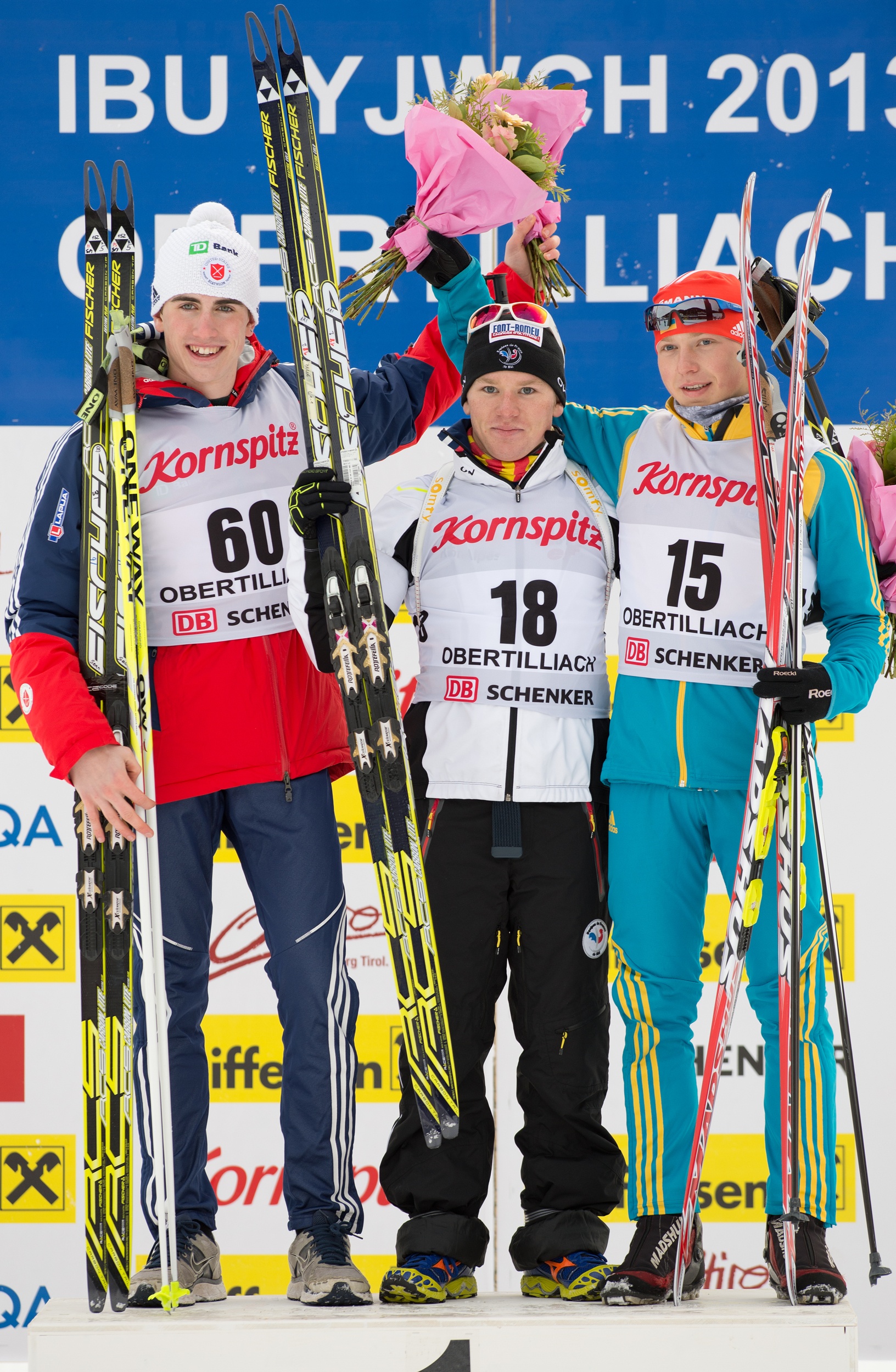
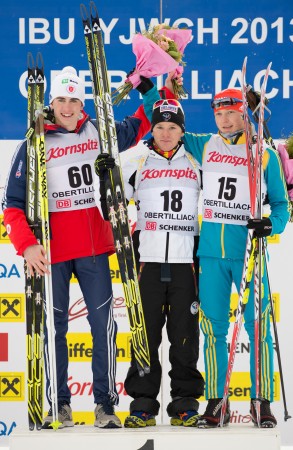
The men’s 7.5 k individual sprint podium at the IBU Youth World Championships on Friday in Obertilliach, Austria. American Sean Doherty (l) was second, 3.6 seconds behind winner Fabien Claude of France (c). Rene Zahkna of Estonia was third. (Photo: USBA/Nordic Focus)
Claude, who won in 21:12.4, shot clean on the first stage and missed two on the second. Estonia’s Rene Zahkna took third, 14.9 seconds behind Claude, with one penalty.
And while Doherty’s ability to fight for first was hardly a surprise, he was still taking it all in. For U.S. Biathlon, it was the best result at IBU Youth and Junior World Championships since national-team member Jay Hakkinen won gold in the 1997 sprint.
“It is hard to believe that I have worked all of this time towards this goal,” Doherty said in a U.S. Biathlon press release. “Now it is here I am still a little bit in shock.”
His game plan had been relatively simple: start in control then pick up the pace. He felt good throughout the race, but expected that after starting conservatively, he wrote in an email.
“The shooting went well but not flawlessly,” Doherty explained. “The last lap came around and I got a split from our coach [Vladimir Cervenka] that I was very close to medal contention and I just really turned up and went as hard as I could.”
While the sprint went exceptionally well, it wasn’t an event Doherty had especially eyed.
“Honestly I try very hard to go into every race I do without expecting a number result,” wrote Doherty, who lives in Center Conway, N.H. “But I am extremely satisfied with this result. … I am focused on all of these events equally. I mean it is the Junior world championships so I am focusing every race.”
Doherty said he’ll try to “keep calm” in Sunday’s 10 k pursuit and approach it like he would any other race, aiming to have a good one.
“We are very exited about Sean’s race today,” Cervenka said in the press release. “He did great and according his plan he saved his best for the last loop. It will be fun to watch the pursuit on Sunday.”
Also notching a top result on Friday, Canadian Stuart Harden made it into the top 20 in 20th, 1:02.6 behind the winner with two misses, both on the second stage. Harden had the fourth-fastest time after the first lap. Also for Canada, Carsen Campbell was 30th (+1:31.7/0+2), Arthur Roots was 59th (+3:07.3/1+2), Matthew Strum was 69th (+3:40.3/2+3).
For the U.S., Jakob Ellingson was 62nd (+3:25.5/3+1), Jordan McElroy was 79th (+4:08.0/2+3), and Brian Halligan was 88th (+5:09.2/4+5) of 108 finishers.
In the women’s 6 k sprint, American Anna Kubek of Duluth, Minn., was the top North American in 34th. She had two penalties, both on the first stage, and was 3:18.2 back from Russian winner Uliana Kaisheva, who completed the course in 18:08.7 (0+1).
Canada’s Sarah Beaudry was 36th with three misses (+3:24.2/1+2). Teammates Leilani Tam Von Burg was 71st (+5:34.3/1+1), Emily Dickinson was 75th (+6:05.7/2+1) and Charlotte Hamel was 80th (+6:50.4/1+1).
For the U.S., Mikaela Paluszek was 65th (0+4), and Aleksandra Zakrzewska was 84th (2+4).