From the FasterSkier archive — posts syndicated from athletes’ and coaches’ own blogs between 2004 and 2012, kept online as published. Current coverage is at fasterskier.com.
Joanne Reid waves a Colorado University flag after helping her team to a national title with her individual win in the 15 k freestyle. (Photo: Steve Fuller/flyingpointroad.com)
College skier faces a decision at graduation: whether to continue pursuing an athletic career on snow or embark down another, more traditional professional path. As the NCAA is fond of repeating every year during March Madness, most student-athletes “go pro in something other than sports.”
Joanne Reid currently stands at that crossroads. The 20-year-old completed her fourth year of eligibility with the University of Colorado last season and will be finished with her undergraduate degree this December. The Palo Alto, Calif., native had a near-perfect senior campaign, winning eight regular-season invitationals in the Rocky Mountain Intercollegiate Ski Association circuit on her way to becoming the NCAA Champion in the 15 k freestyle and leading the Buffs to team victory in Rikert, Vt. With that record, it could be argued that no female nordic skier in the NCAA is better positioned than Reid to take the next step in her athletic career.
And yet Reid is unsure of whether to take that step. Part of her uncertainty stems from having other interests — after she completes her undergraduate degree in mathematics she has ambitions to continue working towards a PhD. The way Reid looks at her options, she believes she would be just as capable of dedicating her life to skiing in four or five years, after earning a PhD, as she is now at 20 years old.
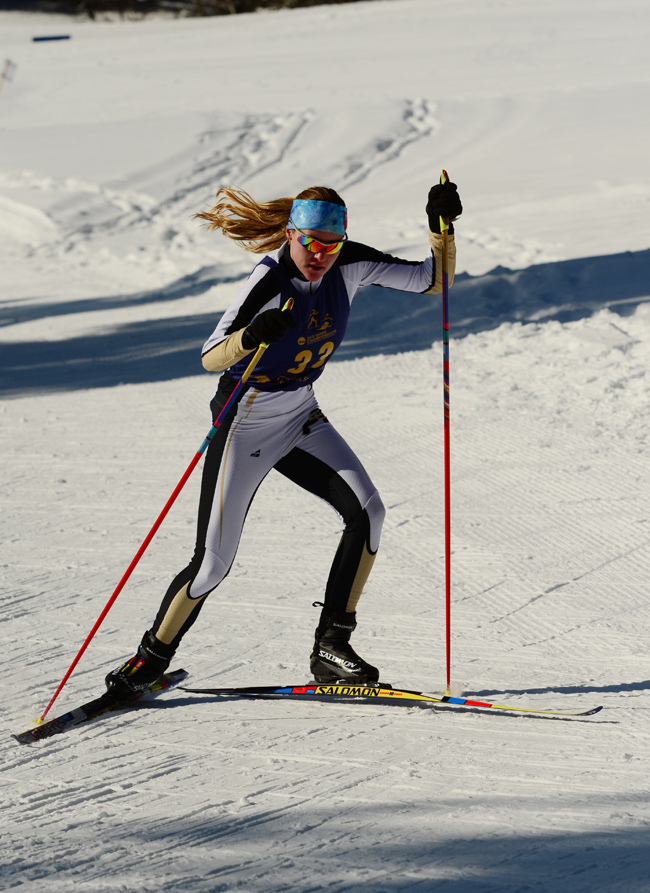
Joanne Reid at 2012 NCAA Championships, where she was 6th in the freestyle event.
“Because I’m so young…I feel like I could continue on to a PhD and continue skiing if I want to,” Reid said. “But if I take a break [from school] in the middle, if you get out of the school groove it’s hard to jump back in, especially with a PhD program.”
Reid’s hesitancy to go pro in skiing goes deeper, however. A year ago, she struggled to find the motivation to continue with the sport at any level. After a life of racing, she started to feel burnt out. Her senior season was unique, therefore, not only because it was so successful — the third-winningest in CU ski team history, in fact. Her success stands out because it was entirely unexpected.
Last summer, for example, Reid wound up reducing her ski-specific workouts significantly in order to find other ways to enjoy being active. She didn’t rollerski until November, and she recalled losing every single team time trial last fall. She skipped U.S. Nationals in January, an event many college skiers treat as a pre-season warm up, “to find my ski spirit again,” she said.
“I just lost the sense of joy and fun that you’re supposed to have,” she added. “So I tried to make it fun again without letting my team down.”
Reid readily acknowledges how she must sound.
“Don’t I sound like a religious person finding God again?” she asked.
Whether it was the unstructured training or a new outlook on racing, Reid came back to the start line ready to compete. At her first race of the year, the Colorado Invitational in Steamboat Springs, she handily won the 15 k freestyle. For the rest of the regular season Reid would only suffer two losses in ten races. She was winning and skiing was fun again, but Reid never quite believed it was due to her own fitness.
“We had so many good skiers [last year] and they all graduated, except for Eliska [Hajkova], and she had an injury,” Reid said. “I was feeling like I was sort of cheating.”
Right up until NCAAs, Reid thought each successive win would be her last, like it was “some weird fluke situation” rather than proof she was skiing well.
“It wasn’t until literally NCAAs that I realized I was having a good season,” Reid said. “When you have a bad season, you don’t feel the need to keep having bad seasons; it’s really discouraging. I looked at quitting every year. I was so uncertain and didn’t feel like it was in my future until the end of the year.”
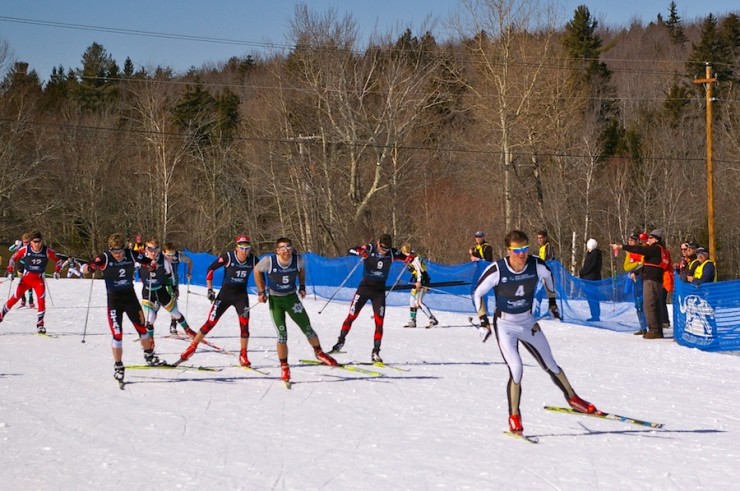
Joanne Reid leads Colorado University teammates Eliska Hajkova (4) and Maria Nordstrom (9) early in the 15 k freestyle at NCAA Championships. Reid won by nearly 27 seconds and Hajkova was second. (Photo: Steve Fuller/flyingpointroad.com.)
Her season-ending victory at NCAAs against a quality field brings Reid to her present dilemma. After operating for months under the assumption she would leave competitive skiing behind after college, her recent success reopened the possibility of a post-college career. Though Reid has applied to several PhD programs, she has also started to think about racing for another year. Rather than look for a club to train with, she thinks she’ll race independently near her parents’ home in Truckee and at a few SuperTours to test the waters. Reid says a teammate recommended she get in touch with the coaches at Ski and Snowboard Club Vail’s Team HomeGrown, but she has not yet explored that avenue.
“After the season I had, I guess I became uncertain,” Reid said. “Because I had so much fun and I did so well, now I’m not sure if I should continue.”
Reid is one of those athletes who is as happy winning races as she is working out just for fun. “I never saw a reason to have a big competition to work for, or anything,” she says. She gets this attitude from her mom, Beth Heiden, who was a decorated skier, speed skater and cyclist in the 1980s but now trains twice a day and competes infrequently.
“The sport itself of nordic skiing is so volatile,” Reid reasons. “Is the wax right, is this the right grind, the right snow? It’s so hard to get everything right, and because of that the best person doesn’t always win. And that always made me hesitant to be in the sport. It takes up so much time and is so controversial… I just like to be outside.”
Reid’s next step in skiing is about as far as she’s planned. She and her family have traveled to Montana for the West Yellowstone Ski Festival every Thanksgiving since she was two years old, and this November she expects to start her season there again. After the first SuperTours, however, she hasn’t settled on her next move.
“I figure the plan will come to me as it comes,” Reid said.
RIPTON, Vt. — It didn’t get much better than Saturday, with sunny skies and spring-like conditions for the last day of the NCAA Skiing Championships at Rikert Nordic Center.
Colorado University (CU) senior Joanne Reid dropped the women’s field in the 10-kilometer freestyle mass start and teammate Eliska Hajkova hung on for silver, lifting the Buffs ahead of the University of Vermont (UVM) in the team standings.
In the men’s 20 k freestyle race, the University of Utah took center stage with senior Miles Havlick defending his 2012 NCAA Championships mass-start title. Rune Ødegård placed second to help CU finish on top for its 18th national title, and another Norwegian, Einar Ulsund, finished third for Utah to bump the team to second overall.
For more photos from the 2013 NCAA Skiing Championships, visit Flying Point Road Photography. All proceeds go to the National Nordic Foundation (NNF).
2013 NCAA Championships Rikert
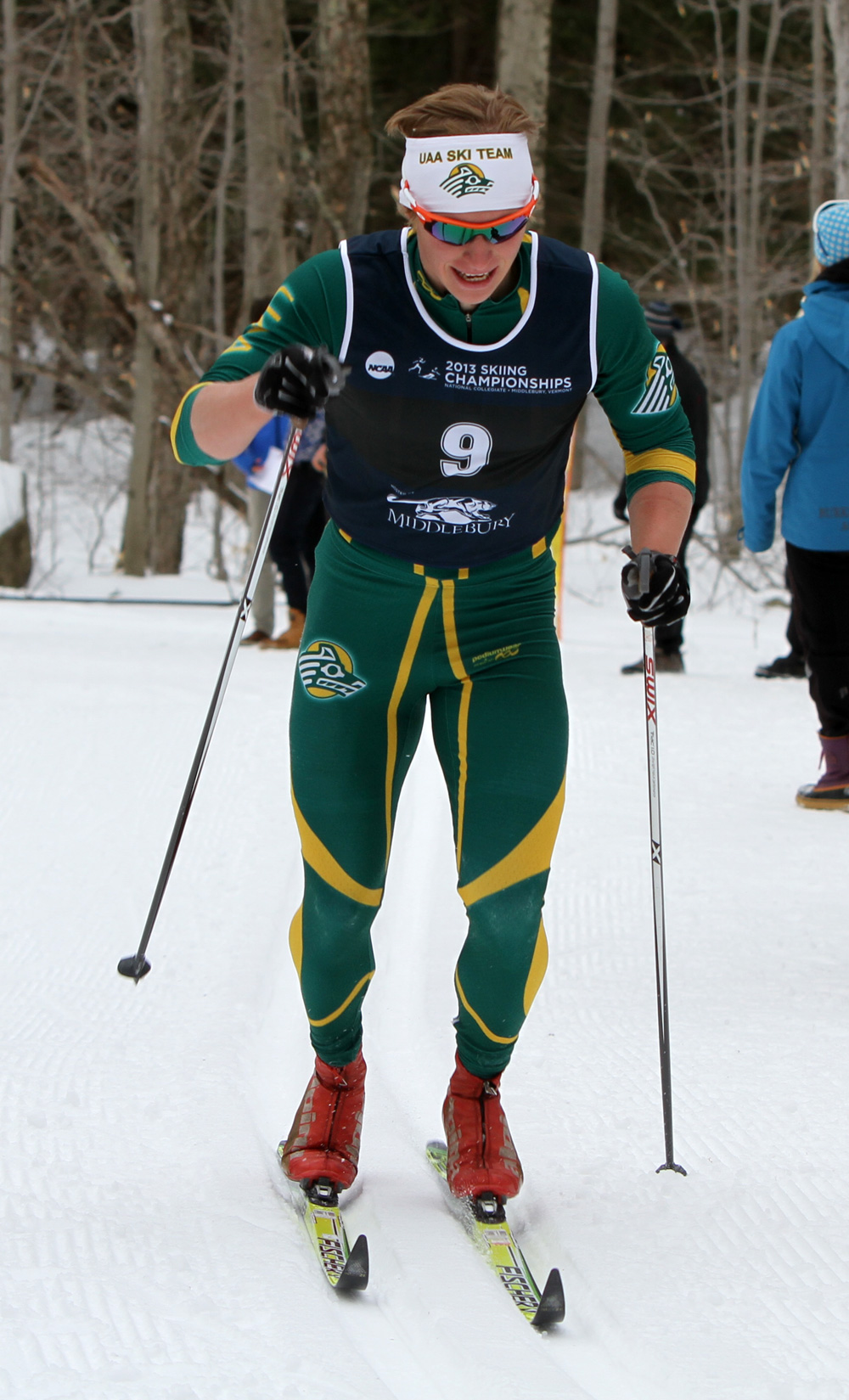
Start of women’s 15 k freestyle mass start at the 2013 NCAA Skiing Championships at Rikert Nordic Center in Ripton, Vt.
2013 NCAA Championships Rikert 15 k freestyle mass start
CU takes the lead early with Joanne Reid up front and Eliska Hajkova (4) right behind.
Hajkova (r) and event
Maria Nordstrom (CU) and Mary O’Connell (Dartmouth)
The road between spectator viewpoints at Rikert Nordic Center
Hajkova leading Reid, Dusser and O’Connell
2013 NCAA Championships Rikert 15 k freestyle mass start Hajkova, Reid
2013 NCAA Championships Rikert 15 k freestyle mass start O’Connell
2013 NCAA Championships Rikert 15 k freestyle mass start Nordstrom
Utah’s Rose Kemp leading Anya Caldwell Bean (UNH) and Silje Benum (DU). Benum placed fifth, Bean was sixth and Kemp finished ninth.
Jessica Yeaton (MSU)
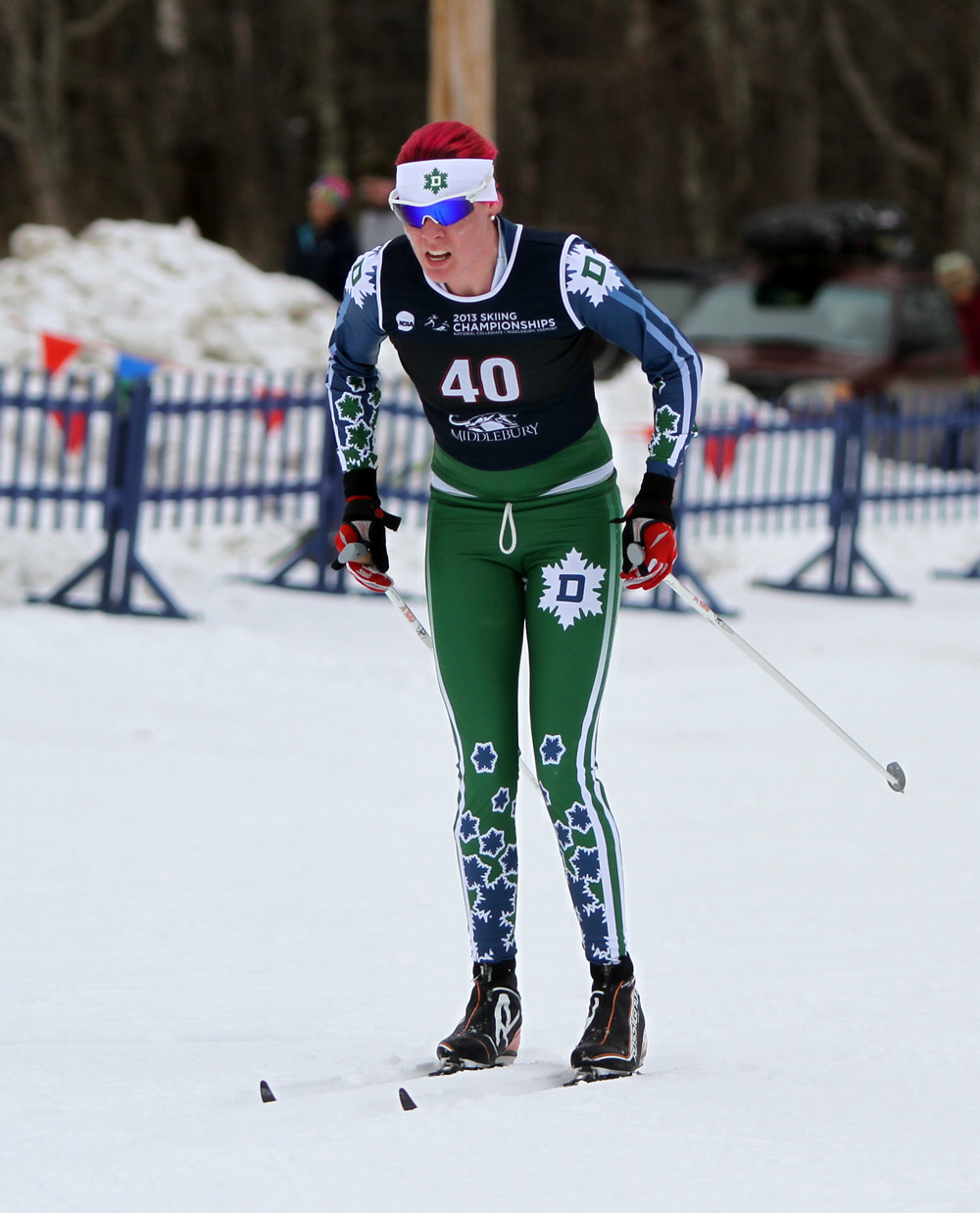
Annie Hart (Dartmouth)
Rosie Frankowski (NMU), who placed seventh
Reid leads Dusser (UAA)
2013 NCAA Championships Rikert 15 k freestyle mass start Dusser, Hajkova
2013 NCAA Championships Rikert 15 k freestyle mass start O’Connell
2013 NCAA Championships Rikert 15 k freestyle mass start Hart, Bean, Benum
Hajkova (r) and Dusser chase Reid (not shown)
2013 NCAA Championships Rikert 15 k freestyle mass start O’Connell
2013 NCAA Championships Rikert 15 k freestyle mass start
Reid enters stadium alone
Reid wins by nearly 27 seconds
Hajkova (l) and Dusser duke it out for second
Hajkova (l) edges Dusser for silver
CU teammates Reid (c) and Hajkova celebrate at the finish while third-place finisher Dusser (UAA) looks on
2013 NCAA Championships Rikert 15 k freestyle mass start Reid, Hajkova
Dusser is congratulated
2013 NCAA Championships Rikert 15 k freestyle mass start
Joanne Reid 2013 NCAA Championships Rikert 15 k freestyle mass start winner
Between races
2013 NCAA Championships Rikert freestyle mass start
IMGP9693
2013 NCAA Championships Rikert freestyle mass start
2013 NCAA Championships Rikert freestyle mass start
2013 NCAA Championships Rikert freestyle mass start
2013 NCAA Championships Rikert freestyle mass start
2013 NCAA Championships Rikert freestyle mass start
Marine Dusser with her UAA team at 2013 NCAA Championships Rikert freestyle mass start
2013 NCAA Championships Rikert freestyle mass start
University of Utah Nordic coach Miles Havlick was a two time NCAA Champion during his career for the Utes, including winning the 20 k skate race at NCAAs in Middlebury, VT in 2013.
2013 NCAA Championships Rikert 20 k freestyle mass start
Dartmouth’s Sam Tarling leads on A-climb on first lap
Sam Tarling 2013 NCAA Championships Rikert 20 k freestyle mass start
Eventual-third place finisher Einar Ulsund (Utah) leads Patrick Madden (MSU) on the first lap
2013 NCAA Championships Rikert 20 k freestyle mass start
2013 NCAA Championships Rikert 20 k freestyle mass start
2013 NCAA Championships Rikert 20 k freestyle mass start
2013 NCAA Championships Rikert 20 k freestyle mass start
2013 NCAA Championships Rikert 20 k freestyle mass start
2013 NCAA Championships Rikert 20 k freestyle mass start
Havlick leads Viktor Brannmark (UAA) and Rune Ødegard (CU)
2013 NCAA Championships Rikert 20 k freestyle mass start
2013 NCAA Championships Rikert 20 k freestyle mass start
Rune Ødegård (CU) leads Ulsund on third of four laps
IMGP9753
Tarling (l) and Ben Lustgarten (Middlebury) chase
Lustgarten 2013 NCAA Championships Rikert 20 k freestyle mass start
Havlick and Silas Talbot (Dartmouth)
Tarling and David Norris (MSU) move to front
2013 NCAA Championships Rikert 20 k freestyle mass start
2013 NCAA Championships Rikert 20 k freestyle mass start
Erik Soderman (NMU) takes control early on last lap. He went on to place fourth.
Ulsund checks behind him
Ulsund leads halfway through
2013 NCAA Championships Rikert 20 k freestyle mass start
2013 NCAA Championships Rikert 20 k freestyle mass start
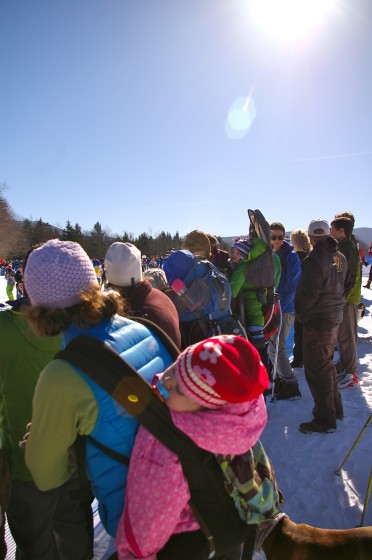
Spectators line the fence before the finish awaiting the race leaders
Ødegård (4) passes Tarling (5) on final rise to take lead
2013 NCAA Championships Rikert 20 k freestyle mass start Rune Odegaard
Havlick leads the chase
2013 NCAA Championships Rikert 20 k freestyle mass start
2013 NCAA Championships Rikert 20 k freestyle mass start
2013 NCAA Championships Rikert 20 k freestyle mass start
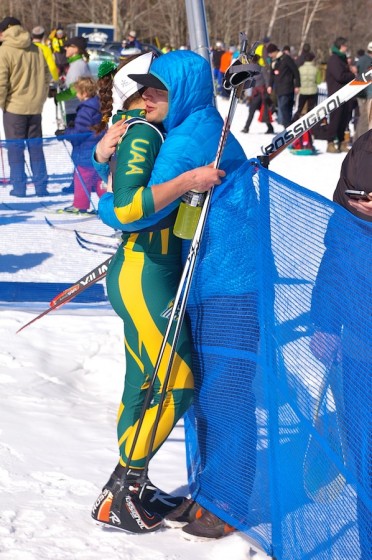
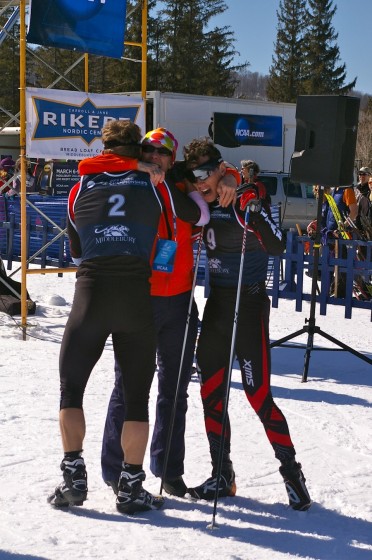
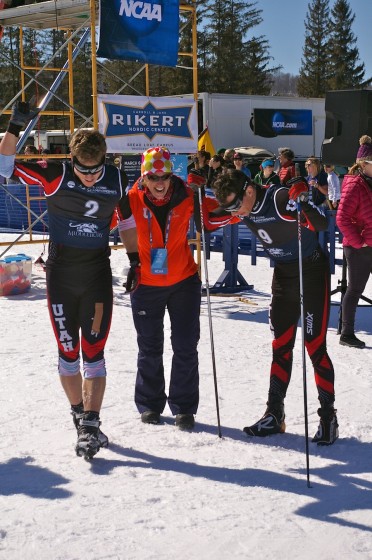
Utah teammates Havlick and Ulsund embrace after taking first and third, respectively.
2013 NCAA Championships Rikert 20 k freestyle mass start
2013 NCAA Championships Rikert 20 k freestyle mass start
2013 NCAA Championships Rikert 20 k freestyle mass start
2013 NCAA Championships Rikert 20 k freestyle mass start
2013 NCAA Championships Rikert 20 k freestyle mass start
2013 NCAA Championships Rikert 20 k freestyle mass start
2013 NCAA Championships Rikert 20 k freestyle mass start
IMGP9835
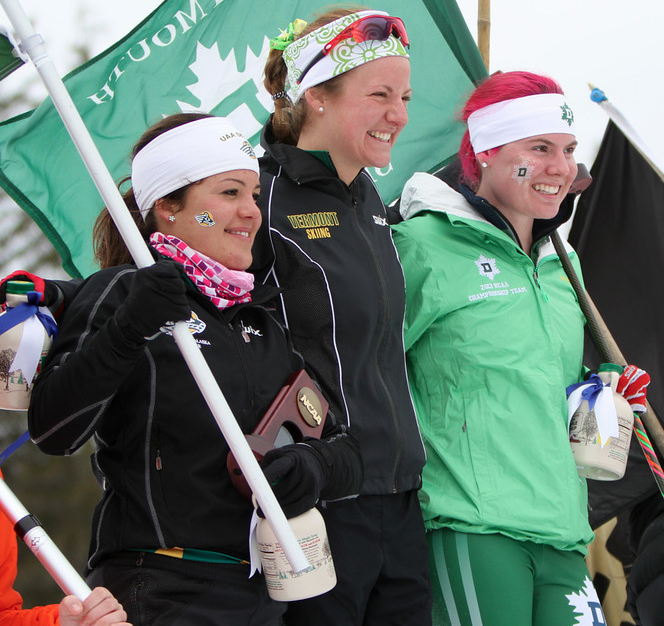
2013 NCAA Championship 15 k freestyle mass start women’s podium
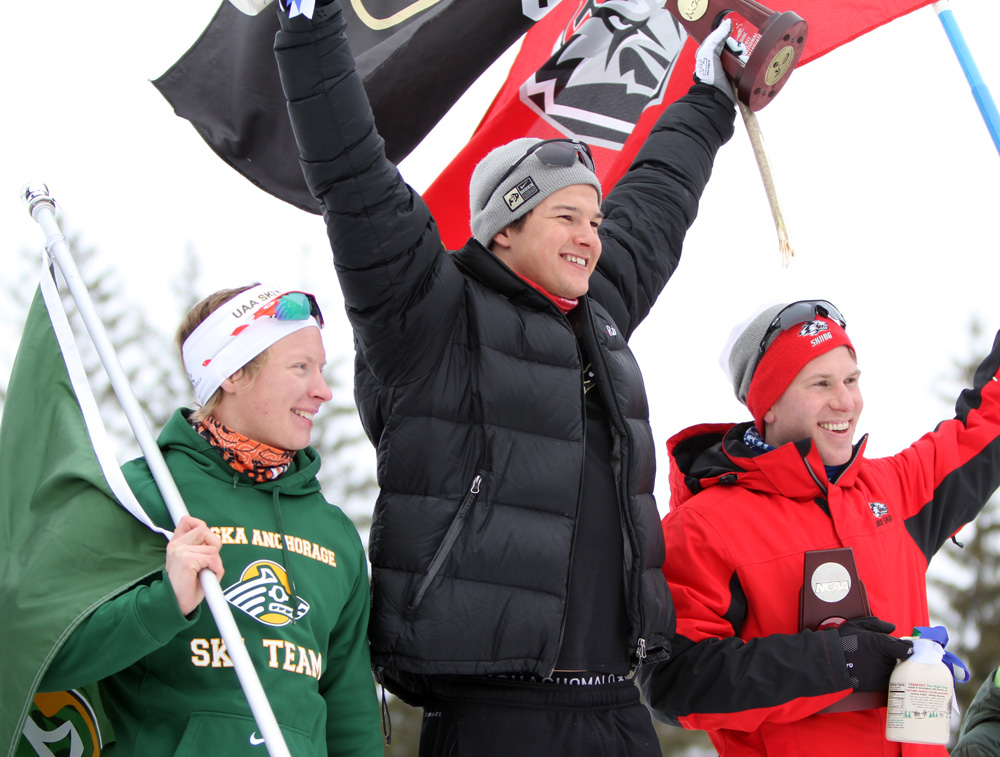
2013 NCAA Championship 20 k freestyle mass start men’s podium
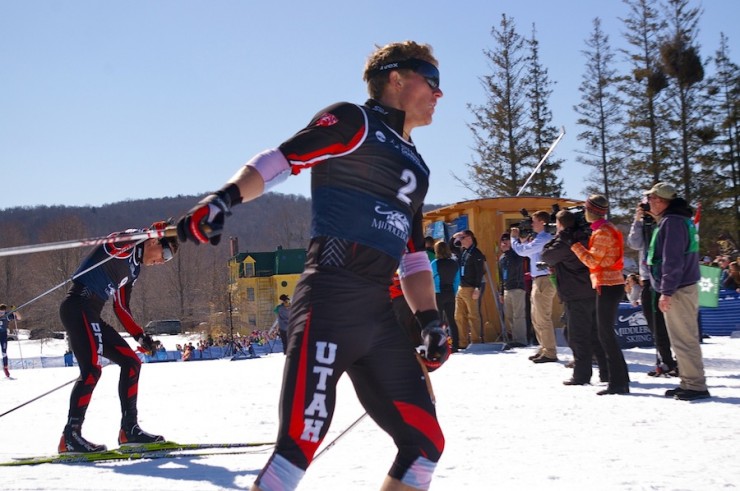
University of Utah senior Miles Havlick celebrates his second NCAA title in the 20 k mass start, 0.6 seconds ahead of Colorado’s Rune Ødegård (l) in second and Utah teammate Einar Ulsund (r) in third on Saturday at the Rikert Nordic Center in Ripton, Vt. (Photo: Flyingpointroad.com/All photo sales benefit NNF)
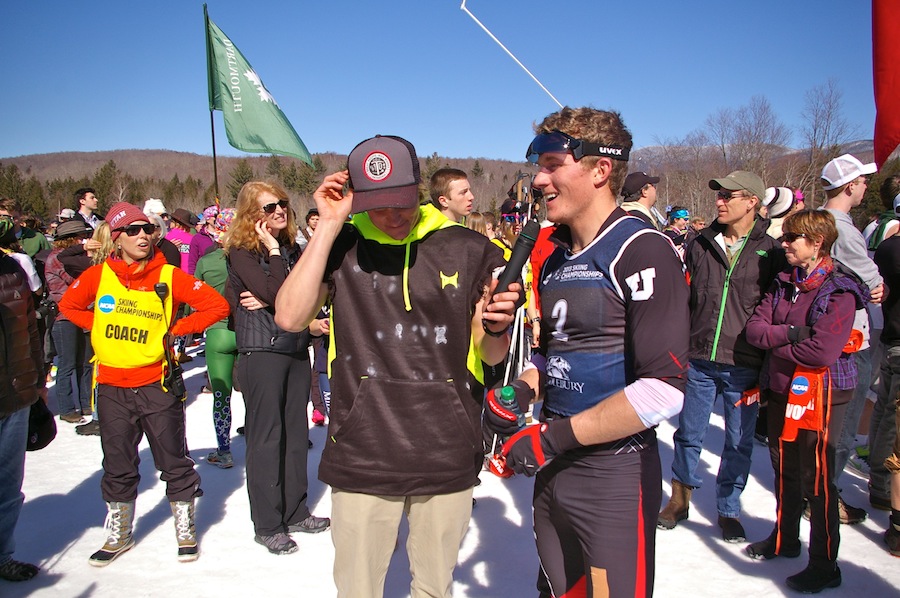
RIPTON, Vt. – Standing with a microphone in hand shortly after winning Saturday’s 20-kilometer freestyle mass start at the 2013 NCAA Skiing Championships, Miles Havlick smiled as he fielded playful questions from the announcer.
Friends, fans and impressed spectators surrounded him at the Rikert Nordic Center, and as soon as he was done thanking the crowd and his University of Utah teammates, Havlick was bombarded with hugs.
Miles Havlick (r), the 2013 NCAA 20 k freestyle mass start champion, during a post-race interview with the NCAA announcer on Saturday at Rikert Nordic Center in Ripton, Vt.
With watery eyes, the two-time NCAA Champion was either emotional or simply tanked after four laps around Rikert’s deceivingly hard 5 k course – probably a little of both.
The senior had just defended his 2012 national title in the 20-kilometer mass start, this time in a skate race. Skiing up into the stadium with six others less than half a kilometer before the finish, Havlick rose from a possible podium contender to a repeat champion, passing Dartmouth College’s Sam Tarling and catching Rune Ødegård of the University of Colorado, who won Thursday’s 10 k classic individual start.
In edging Ødegård by six-tenths of a second in 50:13.4, Havlick led a trio of Utes in the top five. With Norwegian teammate Einar Ulsund in third (+1.0) and Swede Niklas Persson in fifth (+3.1), Utah captured second in the final team standings (43 points behind NCAA champion the University of Colorado) and bumped the University of Vermont (UVM) to third.
“It’s hard to do it again,” Havlick said of his second-straight NCAA mass-start title. “Just an awesome team this fall, all new guys. I was the only one returning and you never know what to expect, but it was an unbelievable senior year.”
At breakfast Saturday morning, he said they talked about goals – three in the top five – which they knew would be hard, but wanted to strive for nonetheless. Havlick set the tone early, leading Viktor Brännmark of the University of Alaska-Anchorage (UAA) and Tarling through the first downhill. Tarling took the lead up the toughest climb on the loop, while Brännmark, Dartmouth teammate Silas Talbot, Ulsund and Havlick stuck near the front of the large pack.
Ødegård pushed the pace on the second lap while Ulsund, Brännmark, Tarling and Middlebury’s Ben Lustgarten chased, along with some 20 others. The group remained some 25 strong through the third lap, in which David Norris (Montana State University) made a move to the front. Halfway through the last time around, it dwindled to seven (with Ulsund, Soderman, Tarling, Ødegård, Talbot, Persson, and Lustgarten).
Utah senior Miles Havlick on his way to winning Saturday’s 20 k freestyle mass start for his second-straight NCAA Championships title. Havlick topped University of Colorado sophomore Rune Ødegård by 0.6 seconds for the victory at Rikert Nordic Center in Ripton, Vt. (Photo: Flyingpointroad.com)
Havlick had lost contact, but regained it on the final climbs. Following Tarling up the last ascent into the field before the finish, Havlick watched as Ødegård charged to the front. He responded, outsprinting the Norwegian in the final straightaway.
“It was deafening skiing up that hill,” Havlick said of the crowd near the finish. “Ears just ringing really takes the pain away.
“It’s unbelievable today,” he added. “You never know what’s gonna happen in a mass start. It’s just perfect.”
Sharing the podium with his teammates after with their second-place showing, Utah’s skiing director Kevin Sweeney handed Havlick the large trophy to hoist over his head for photos.
“This championship is one of the most, I would say, competitive that I’ve experienced and I’ve been collegiate coaching for a long time,” Sweeney said. “So for this to finish up the way it did, it’s a true highlight of my career and such a great group of guys. Everybody skied where they needed to. I’m ecstatic.”
Even though CU and UVM were the favorites battling it out for first, Sweeney knew his skiers could get into the mix. He just wasn’t sure where they’d stack up against strong teams, including Dartmouth, he said.
“You know they’re gonna be in it, just exactly where,” Sweeney said. “I was very happy to see the race unfold and see our three guys basically in the top 10. I felt good about that.”
Last year’s 10 k freestyle individual start champion, Soderman placed fourth (+2.6). Mats Resaland of the University of New Mexico was fifth (+2.8), Tarling seventh (+5.2) and Lustgarten notched his second top 10 of the week in eighth (he was fourth on Thursday). Talbot placed ninth and Kyle Bratrud of Northern Michigan University was 10th.
“It was a hard race because we were like 20 people pretty much the whole race,” Persson said. “You didn’t really know if you were skiing fast enough, if you were gonna end up top five or top 20, you never know.”
According to Ulsund, the Utes were out for redemption after Thursday’s race, in which Havlick led the team in sixth, Ulsund was 13th and Persson was 15th.
“We just decided that this should be our day,” Ulsund said.
Anticipating an attack from UVM’s Scott Patterson, undefeated in eastern carnival freestyle races this season, Ulsund said it never came (Patterson ended up 26th). Meanwhile, the pace stayed mostly consistent in soft conditions on a 40-degree afternoon.
“Usually we try to switch the lead, but today our tactic was mostly to stay in the pack and do something on the last lap,” Ulsund explained. “I’m a pretty slow sprinter so I was really worried, like, what’s going to happen now? Thankfully, the others were tired and the first three got the gap and that’s what set my podium spot today.”
Just about as thrilled with his personal and team performance, CU sophomore Ødegård said the Buffs went into the 20 k thinking they were down to UVM. In reality, they were up by 16 points after Joanne Reid and Eliska Hajkova took first and second, respectively, in the preceding women’s 15 k.
“We went into today chasing and that’s where we want to be,” he said. “When I saw during the race there were no Vermont skiers up in the lead, I knew we had the team victory. It was just awesome to ski around and do whatever I could to finish.”
As for doing achieving the highest collegiate honors with his American team, Ødegård said, “We have an amazing group. Everyone’s enjoying being together. This week staying at the peaceful hotel, really team bonding all week, everyone had a good time I think and that’s most important.”
2013 NCAA men’s 20 k freestyle mass start podium. From left to right: Sam Tarling (Dartmouth/7th), Mats Resaland (UNM/6th), Erik Soderman (NMU/4th), Einar Ulsund (Utah/3rd), Miles Havlick (Utah/1st), Rune Odegaard (CU/2nd), Niklas Persson (Utah/5th), Ben Lustgarten (Middlebury/8th). (Photo: Flyingpointroad.com)
Women’s 15 k freestyle mass start winner, Joanne Reid holds up the University of Colorado’s first-place trophy at the 2013 NCAA Skiing Championships on Saturday at the Rikert Nordic Center in Ripton, Vt.. (Photo: Flyingpointroad.com/All photo sales benefit NNF.)
RIPTON, Vt. – Joanne Reid knows exactly what it takes to win. The University of Colorado senior has been no stranger to the podium in her four years at Boulder, placing third as a sophomore at the 2011 NCAA Skiing Championships.
But this season was an exception. In 10 total Rocky Mountain Intercollegiate Ski Association (RMISA) races, Reid won eight of them. Her unrivaled dominance made the 20-year-old from Palo Alto, Calif., the clear-cut RMISA MVP.
The question was: how would she fare against eastern-collegiate skiers on what was essentially their home turf at Rikert Nordic Center in Vermont? On Thursday, in the first of the two-day nordic NCAA Championships, Reid placed fourth in the women’s 5 k classic individual start. It was the first time she hadn’t made the top two all season.
Saturday was a different story. With teammate Eliska Hajkova, Reid was confident they could get out front in the 15-kilometer freestyle mass start and stay there. Just as they’d done all season (including when they swept the podium with teammate Maria Nordstrom at regionals), they planned to feed off each other to achieve what they both wanted: the podium.
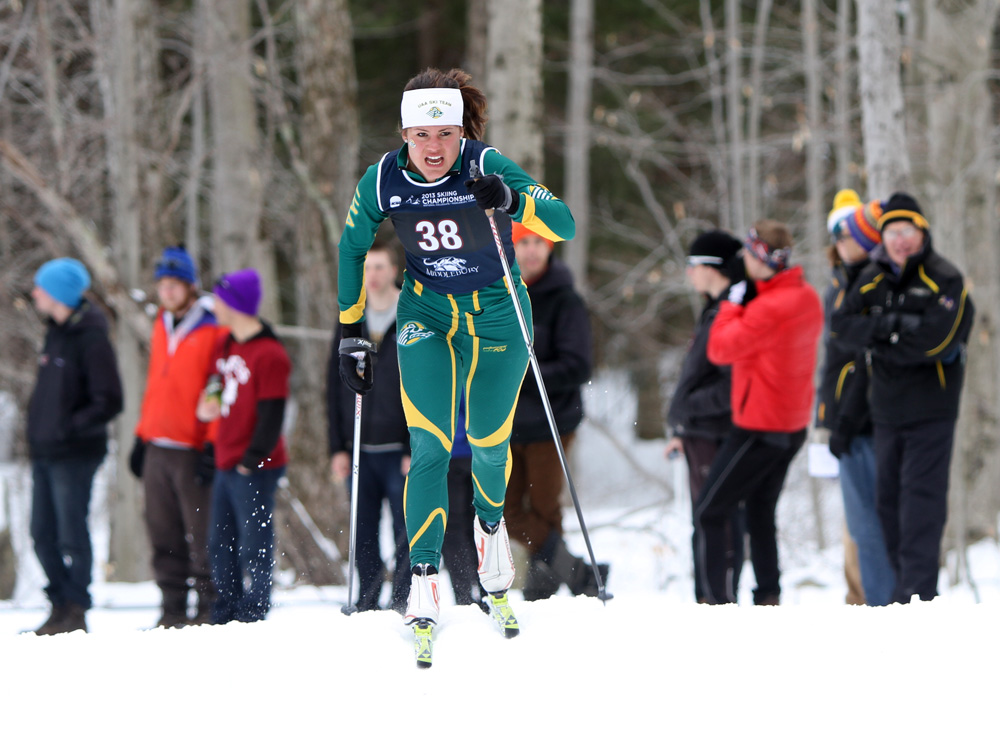
Joanne Reid leads her Colorado University teammates, Eliska Hajkova (4) and Maria Nordstrom (9) early in Saturday’s 15 k freestyle mass start at the 2013 NCAA Championships. Reid won by nearly 27 seconds and Hajkova was second. (Photo: Flyingpointroad.com)
The CU seniors led from the start: Reid in a blue headband, Hajkova in a pink one. The way they were skiing, that was one of a few ways you could tell them apart.
Changing leads throughout the first and second laps, Reid took charge for good on the third and final loop around a twisty, turning and technical 5 k course. Hajkova remembers her dropping the pack – with Marine Dusser of the University of Alaska-Anchorage (UAA) and Mary O’Connell (Dartmouth College) – on the third of several hills.
“She kind of went and we couldn’t follow,” said Hajkova, who hails from the Czech Republic. “We were, like, falling apart.”
About a half kilometer from the finish, Reid entered Rikert’s spectator-packed stadium in first without any contenders in sight. She cruised around the field’s final curve more than 30 seconds ahead, grabbed a CU flag a few hundred meters before the finish, and carved some turns while making her way across the line.
Reid finished in 38:17.8 for her first NCAA title, 26.8 seconds ahead of Hajkova, who outlunged Dusser for second. The RMISA MVP runner-up, Dusser placed third for the second-straight race at NCAAs, 0.4 seconds behind Hajkova.
Colorado University’s top-two sweep put the Buffs in prime position against the University of Vermont (UVM) for the combined alpine-nordic NCAA team title. Trailing by 54 points to start the day, CU overtook UVM by 16 points after the women’s race.
Thanks to some solid men’s performances in the following 20 k, CU rolled to a 43-point victory over the University of Utah (which put three men in the top five) and topped UVM by 56 points. Last year, UVM edged CU for the team win, but in 2011, CU took it.
“Our girls were not such a surprise because they were consistent and forming all season,” said CU head coach Richard Rokos, who’s in charge of both the university’s alpine and nordic programs. “I was a little surprised that UVM didn’t put a little more resistance on us.”
Joanne Reid (University of Colorado) with her mom Beth after winning Saturday’s 15 k skate mass start for her first NCAA title at the 2013 championships in Ripton, Vt. Beth Heidin won a NCAA nordic title at the 1983 championships. (Photo: flyingpointroad.com)
With Reid, it was somewhat of a blast from the past. Her mother Beth Heiden skied for UVM and won the 1983 NCAA Nordic Championships. Before that, she was the all-around world speed skating champion in 1979, the 1980 world road cycling champ and a bronze-medalist speed skater at the 1980 Olympics.
“I saw her at the finish line and it was great,” Reid told BuffZone.com. “It’s cool that we have both now won NCAA individual titles … Every time I go skiing with her, they just list all her awards so now I have one that she has. I just need a few more world championships in other sports now to catch up.”
Reid’s uncle, Eric Heiden, won five gold medals at the 1980 Olympics, and set four Olympic records and a world best there. According to the CU website, he was the only athlete in the history of speed skating to have swept five events in a single Olympics.
University of Colorado-Boulder seniors Joanne Reid (l) and Eliska Hajkova celebrate placing first and second, respectively, in Saturday’s 15 k freestyle mass start at the 2013 NCAA Championships at Rikert Nordic Center in Ripton, Vt. (Photo: Flyingpointroad.com)
On Saturday, Reid put down a commanding performance of her own and said she couldn’t have done without her teammate.
“It’s always better if I can have this one right next to me,” she said of Hajkova. “That’s what makes it really complete.”
After a somewhat relaxed first lap, the CU women led a group of four the last two loops with Dusser and O’Connell, who placed fourth.
“I was more comfortable in front and I just kept skiing how I felt,” Reid said. “I guess I ended up in front.”
Hajkova said they had “great skis,” which Dusser noticed early on. The former French national-team biathlete wasn’t having as much luck with hers.
“I tried to keep my energy and stay behind Eliska,” Dusser said. “But she was a better sprinter. I was tired at the end so she beat me by not a lot, but that’s a race.”
A 2011 NCAA champion in the 15 k classic, Hajkova said placing second to Reid was about as much as she could’ve asked for after struggling to get healthy since last fall.
“I couldn’t dream for more,” Hajkova said. “If I had been second to somebody else, and Joanne didn’t win, it would be a little bit sad, but this, I’m just on top of my happiness.”
Dusser, too, was thrilled with another podium in her first NCAA Championships. Unsure what her plans are next year, she’s hoping to ski another year at UAA, but said it depends whether she can get another scholarship.
“I would like to stay in Alaska,” Dusser said. “It was out too quick with biathlon and I don’t regret. I really like nordic skiing; I really like the spirit of NCAA race. It’s a lot of fun and people are really nice and I like my team.”
Thursday’s runner-up, O’Connell finished 33.3 seconds behind Dusser (1:00.5 after Reid). Silje Benum of Denver University was fifth (+1:03.2) and the University of New Hampshire’s Anya Caldwell Bean was another 5.4 seconds back in sixth.
“Top ten I thought it would be awesome,” Bean said. “But I didn’t really know what to expect.”
She avoided several crashes, but top contenders like Elizabeth Guiney (UNH), Anja Gruber (UVM) and Annie Pokorny (Middlebury College) did not. Guiney placed 16th, Gruber ended up 21st and Pokorny did not finish after falling on a downhill less than two kilometers into the first lap.
After hitting a tree in Thursday’s 5 k and knocking her hips out of alignment, Pokorny wasn’t sure she would be able to compete Saturday. Finally able to bend at the waist again that morning, she decided she could.
“It would’ve been fine if I stayed on my feet,” Pokorny said while watching the men’s 20 k on crutches.
She completed the first lap, but ultimately did not finish. After an initial look at her injury, Pokorny believed she had bruised her femur.
Women’s 15 k freestyle mass start podium at 2013 NCAA Championships at Rikert Nordic Center in Ripton, Vt. From left to right: Annie Hart (Dartmouth/8th), Anya Caldwell Bean (UNH/6th), Mary O’Connell (Dartmouth/4th), Marine Dusser (UAA/3rd), Joanne Reid (CU/1st), Eliska Hajkova (CU/2nd), Silje Benum (DU/5th), Rosie Frankowski (NMU/7th). (Photo: Flyingpointroad.com)
As for the rest of the field, Rosie Frankowski of Northern Michigan University placed seventh, Dartmouth’s Annie Hart was eighth, Utah’s Rose Kemp (who also fell) was ninth, and Denver’s Makayla Cappel finished 10th.
At the end of the day, the happiest coach had to be Rokos. He said getting his alpine and nordic teams to combine for a national title was tricky, especially because of the nature of downhill racing.
“On the nordic side, it’s a race to go and ski your best and race fast,” Rokos said. “In alpine, all year long we go pretty much the same until NCAA Championship and then we put them in a dilemma, ski fast but finish, and there is no compromise between those things.”
He told his alpine squad they had to finish and was proud of those athletes for using such discipline. And while UVM beat CU on the downhill runs at Middlebury College’s Snow Bowl, the Buffs made up for it at Rikert.
“Every single person on the team made a great contribution,” Rokos said of Colorado’s 18th NCAA victory, his seventh with the team since 1991. “It’s teamwork and it came that way.”
He also credited the team’s success to head nordic coach, Bruce Cranmer, in his 13th season with the Buffs.
“Both Eliska and Joanna are in their last year; they were maturing athletically throughout all their career with CU and they have a great coach,” Rokos said. “[He] did a great deal of work with them and it paid off.”
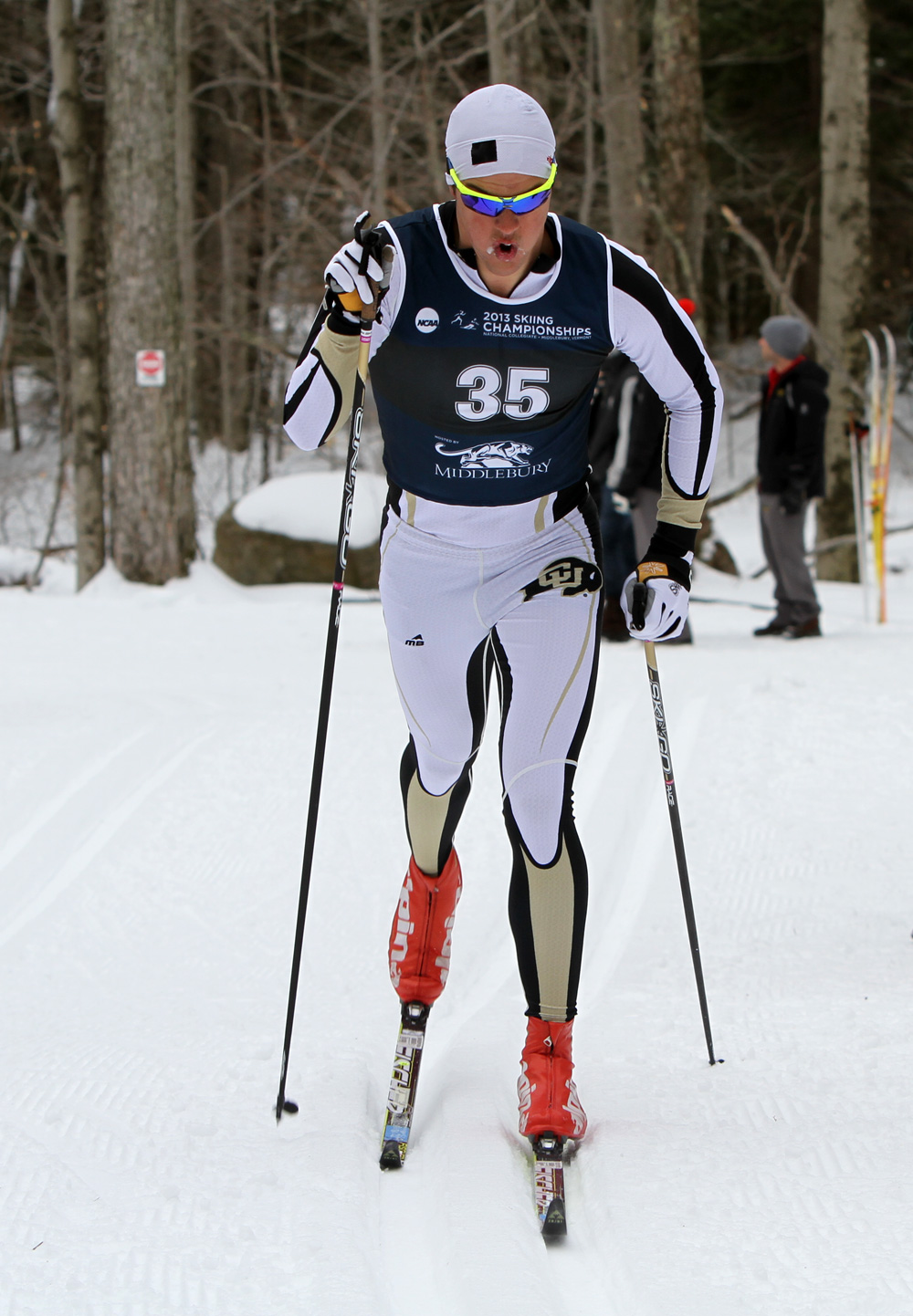
The men’s 10 k classic individual start podium on Thursday at the 2013 NCAA Skiing Championships in Ripton, Vt. University of Colorado sophomore Rune Ødegård in first (c), Mats Resaland of UNM in second (r), and Viktor Brannmark of UAA in third.
RIPTON, Vt. – For Colorado University sophomore Rune Ødegård, two laps around the Rikert Nordic Center’s five-kilometer course on Thursday didn’t seem too threatening.
Conditions were tricky for the 10 k classic individual start at the NCAA Skiing Championships with most teams opting for some combination of klister and hard wax. Ødegård reasoned if he started fast and refused to let off, he had as good a chance of anyone at winning.
University of Colorado-Boulder sophomore Rune Ødegård racing to an NCAA title in Thursday’s 10 k classic individual start at Rikert Nordic Center in Ripton, Vt.
Compared to training in Boulder, coming down more than 5,000 feet in elevation would definitely help. The 23-year-old Norwegian had raced at sea level a few months ago in late December, returning back to Europe for some tune-up FIS races in Östersund, Sweden. There, he placed 19th in the 15 k freestyle individual start and 23rd in the 15 k classic.
Hailing from the small coastal town of Molde, Norway, Ødegård wasn’t exactly familiar with Vermont’s Green Mountains, but he had a sense of what the air would feel like on his lungs. So he decided to go hard from the get-go.
“I felt like this course is pretty fast,” he said. “You get some rest in the downhills and when you have strong guys behind you, you want to give them a little tough back splits that they’re behind. It makes it tougher for them. That was definitely part of the plan to go out hard and try to get myself a little bit of respect.”
Fifth in the 10 k freestyle individual start at last year’s NCAA Championships and seventh in the 20 k classic mass start, Ødegård was also out to get a little redemption. He did so winning Thursday’s individual classic race, the first of two at the 2013 nordic championships, with a time of 26:00.2.
Fellow Norwegian Mats Resaland of the University of New Mexico was second, 5.2 seconds back, and Sweden’s Viktor Brännmark (University of Alaska-Anchorage) placed third (+28.3).
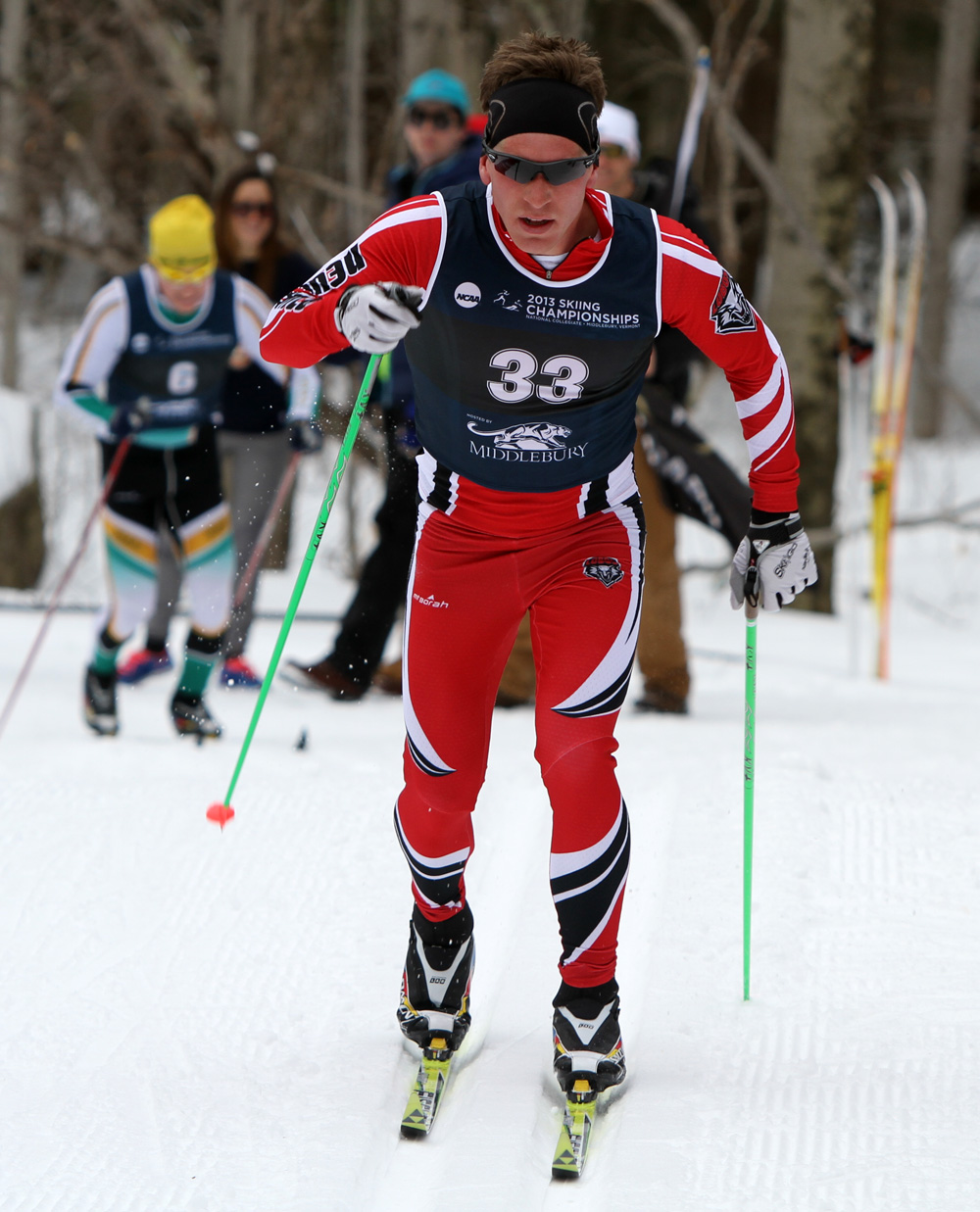
Mats Resaland of the University of New Mexico en route to placing second in Thursday’s 10 k classic individual start at the 2013 NCAA Championships in Ripton, Vt.
“I had a dream about winning,” Ødegård said. “I felt like podium would be realistic, and that was what I was aiming for. I definitely wanted to get one win on the week so now I have that one and I can relax for Saturday and do my very best in that race.”
But for now, he’ll soak up the victory. The brother of Unni Ødegård, a six-time All-American who skied for CU (and made the first team five times) from 1998-2000, he said this result was exactly what he was shooting for ever since the 2012 championships in Bozeman, Mont.
“Last year I really screwed up at NCAAs so this is what I’ve been focusing on, getting back in shape to really peak now,” Ødegård said. “It seems like it it’s working.”
The 35th of 40 starters, Ødegård knew some of the best skiers were behind him, including the University of Vermont’s Scott Patterson and Miles Havlik of the University of Utah. Havlik ended up crashing on a technical downhill with variable conditions and tied Patterson for sixth (+46.0).
“When they all fell on the downhills it makes it a little bit easier for me,” Ødegård said.
Even so, he said he faded late in the race. “I was gaining a little bit on the second lap compared to the first one,” he said. “But I lost a little bit at the end, I was super tired going into the finish.”
Viktor Brännmark of the University of Alaska-Anchorage racing to third at the 2013 NCAA Championships 10 k classic individual start on Thursday in Ripton, Vt.
Relying on a similar tactic, Brännmark, a 20-year-old Swede who moved to Alaska to ski for UAA this season, surpassed his goal of a top 10 at NCAAs and made the podium.
“My coach told me to open relaxed but I just hammered in the start,” he said.
About 1 ½ kilometers in, Brännmark heard he was leading by 10 seconds. But he had to keep in mind that he started ninth.
“I caught a lot of guys, but I didn’t know how good I was actually skiing because all the best guys started last,” he said. “We’ve been racing at altitude the whole season, [which] I’d never done before until I came here to the U.S. so I knew that if you get tired here you can keep pushing it, you don’t die. I knew I could do something like this down here.”
For him, third in that particular race was about all he could ask for, except for getting beat by two Norwegians. Resaland, an UNM sophomore who won the 15 k classic mass start at the Bozeman SuperTour in early December, has consistently made the top 10 on the Rocky Mountain Intercollegiate Ski Association (RMISA) circuit this year.
Brännmark led three UAA skiers in the top nine (including Lasse Molgaard-Nielsen in eighth and Lukas Ebner in ninth) to help the Seawolves post the highest score of in the event with 108 points.
“I’ve never really done a good classic individual start before so this is unbelievable,” Brännmark said. “I’m so happy right now. … It’s been a crazy experience.”
Middlebury College captain Ben Lustgarten, a junior from Burlington, Vt., was the top American in fourth (+32.4). Silas Talbot, a sophomore at Dartmouth College, also made first-team All-American honors in fifth (+36.6).
“Home-course advantage definitely helped,” Lustgarten said of his NCAA debut. “The cheering was unbelievable. It got me up those climbs.”
Starting 30th, Lustgarten said he was getting ranging splits, some about being the top 10 and others saying he was in contention for second.
“I didn’t really know which one to believe, like ninth place, second place, but I was just trying to go as hard as I can,” he said. “I wasn’t thinking out there too much.”
He learned at the Middlebury Carnival that going out too hard on Rikert’s new 5 k course could backfire. “I went out a little easier to try to save it and just hit the last lap about as hard as I could,” he said. “It worked. … I’m ready for Saturday. I can’t settle; I gotta go for it again.”
Rounding out the top 10, Erik Soderman of Northern Michigan University – last year’s NCAA champion in the 10 k freestyle individual start – was 10th (+56.3).
Racing resumes Saturday with the women’s 15 k and men’s 20 k freestyle mass starts.
University of Vermont junior Anja Gruber won the 5 k classic race at NCAA Championships on Thursday over Dartmouth’s Mary O’Connell. Marine Dusser (University of Alaska, Anchorage) took third in the second event and first nordic race of the NCAAs.
RIPTON, Vt. — In the world of college skiing, a lot can change in a year — just ask newly crowned NCAA 5 k classic champion Anja Gruber. The University of Vermont junior was her team’s fourth woman last season and had never competed at NCAA Championships before Thursday. But in her first appearance at the most important race of the college season Gruber bested the entire 40-woman field and won the first nordic event at Rikert Touring Center by 11.1 seconds.
Dartmouth College freshman Mary O’Connell finished second and University of Alaska, Anchorage, freshman Marine Dusser took third. With the completion of the giant slalom and classic events at NCAAs, UVM sits in the lead at the halfway point of the championships with 389 points to the University of Colorado’s 368.5 points.
Gruber en route to an 11.1-second win.
“It’s pretty unbelievable right now,” Gruber said after the podium ceremony made her national title official. “I’m not sure if this actually just happened!”
The 21-year-old from Leutkrich, Germany, stepped from the beginning of the carnival season to make up the hole left by three senior women who graduated from the 2012 championship squad. It was a big void to fill, but UVM nordic coach Patrick Weaver says Gruber rose to the occasion spectacularly, and particularly on Thursday at NCAAs.
“Anja was the clear number four skier for us last year, always in fourth, kind of like the domestique of the team,” Weaver said. “With everyone graduating last year I think she realized this was her opportunity. She came back in great shape and I always had it in the back of my mind that she had as good a chance as anybody in this race, so [I’m] just super-excited to see that happen. Really happy for her.”
Between six regular-season competitions Gruber tallied two classic victories, one freestyle win and helped lead UVM to an undefeated EISA season headed into Thursday. And once NCAA competition began at Middlebury, team was everything. UVM’s alpine squad drew first blood in the giant slalom on Wednesday and the nordic athletes wanted to do their part to maintain the momentum.
“It’s really great to have a good result for yourself, but more important than that is that you get those points for the team,” Gruber said. “Our alpiners are definitely pulling their weight and we want to do that, too. Everyone knows they have to do their very best in order to make this work and that’s what we all do.”
When she lined up as 37th starter out of 40 on Thursday, Gruber’s goal was a simple one: ride the energy of a successful 2013 campaign and ski the best race she could for the Catamounts.
“I came here and — we were joking, this is just the strawberry on the frosting on the cake,” Gruber said. “But we also knew that this whole season, it worked out great, so we were just saying, ‘Why shouldn’t it work today?’ I definitely wanted to have a good race and you can’t really influence how the other people will do, so as long as you ski your best…yeah. That worked.”
The second, third and fourth-place finishers on Thursday all ended up being the only three skiers behind Gruber on the start list. It was a finicky day for kick wax at Rikert and some teams appeared to struggle with the grip, but Gruber said she and her teammates had great skis, which helped her on the deceptively challenging course.
“I went out really hard, I think,” Gruber said. “I was telling myself, ‘You fell good, this is good,’ and then when the hills started my skis were working and I said, ‘Oh, my skis are working, this is good.’ And then I was starting to hurt pretty bad, like, ‘Oh, I’m dying.’”
Spurred up the last hill by a slew of Catamount fans, teammates and coaches, Gruber finished hard on Rikert’s newly-homologated trails put a few more seconds of space between herself an the remaining competitors. O’Connell got a final split saying she was only five seconds down, but in the end Gruber won by over 11 seconds.
“Anja made up quite a bit of time in the finishing stretch,” O’Connell said.
Mary O’Connell (Dartmouth College) brings it home for silver.
The Dartmouth freshman from Steamboat Springs, Colo., put together an impressive race in her own right. Like Gruber, 2013 is also O’Connell’s first NCAA Championship appearance, and with a goal of reaching just the top-10 on Thursday she finished ahead of nearly everyone on the stacked start list. As the final starter, O’Connell left the gate 30 seconds behind CU’s Joanne Reid, a pre-race favorite, and set out to use the position to her advantage.
“I had the last starting position, which I was both excited and nervous about,” O’Connell said. “It’s a good position, because then your splits are very accurate. I started right behind Joanne Reid and I guess she was one of the favorites to win, so I just wanted to keep her in my sights. And it’s a 5 k, so I pretty much just went hard the whole time and tried to ski the down hills really well.”
When she crossed the finish line, O’Connell bumped Dusser out of second by just 0.8 seconds. The result has her looking forward to Saturday’s freestyle race, particularly since she won the 15 k at Rikert earlier this season at the Middlebury carnival.
“I don’t want to jinx myself, but I’m much better at distance skating, and the last time we did a 15 k skate here I won the race,” O’Connell said. “So I have good confidence going into it — you know, a top 5, a top 10, would also be great.”
As Dusser is former French National Biathlon Team member, she wasn’t too upset at the last-minute demotion from silver to bronze. The UAA freshman from Villard de Lans, France, only began training for races in the classic technique this year, and as the third-ranked RMISA skier at NCAAs this year she had top-5 expectations for Thursday’s race.
“It’s my first championship and I’m a biathlete, so I wasn’t really good in classic before,” Dusser said. “So I didn’t really know what to expect but this season was pretty good, so yup — I’m happy.”
Marine Dusser (University of Alaska, Anchorage), third.
For the 24-year-old, cross-country races are generally more enjoyable experiences that what she’s used to on game day.
“Biathlon is really stressful with the shooting, so I enjoy and feel it’s more fun, but at the same time I feel [NCAAs] is really important, so I’m happy,” Dusser said. “When I see all the people around me…I think it’s a really important race, so I’m glad to be here and to try.”
Under two seconds behind Dusser, Reid placed fourth for CU. Sloan Storey (University of Utah) was fifth (+31.0) and Maria Nordstroem (CU) placed sixth (+32.2). UVM leads CU in the team standings by a slim twenty points headed into Friday’s slalom events at the Snow Bowl. The fourth and final event of the NCAA championships is the 15/20 k mass start freestyle, which takes place at Rikert on Saturday.
Does UVM feel any pressure to maintain their lead and repeat their 2012 title?
“We try not to think about defending, we just want to win this one,” Weaver said. “We try not to look back and we like to look forward, so we’re just taking this one day a time… We did our job today and I think we’re still in the lead, so we’re going to send good vibes to the alpine team tomorrow and hopefully they can do what they do best. And then we’ll see what happens Saturday.”
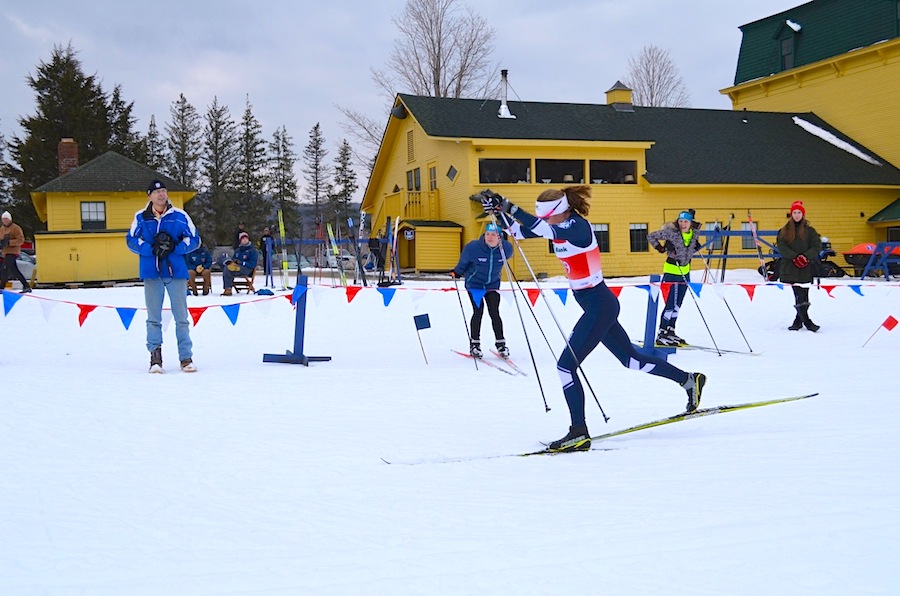
Racers in action at Middlebury Carnival in mid-February at Rikert Nordic Center in Ripton, Vt. (Photo: Stella Holt)
RIPTON, Vt. – Nestled in the Green Mountain National Forest 12 miles up the hill from Middlebury, Vt., the Carroll and Jane Rikert Ski Touring Center lies behind an array of cheery colored yellow buildings that comprise Middlebury College’s Bread Loaf campus.
A moderately sized sign directs nordic-skiing seekers inward, off Route 125 and toward a large barn – also yellow. Around the corner, one can find a recently remodeled rental shop and warming space with couches, cubbies and a woodstove.
Outside, a large field is the gateway to some 50 kilometers of cross-country trails.
With winding tracks through dense forests, Rikert’s a place people have grown attached to over decades. They love it for its character – humble, quaint – something recreational skiers might seek but doesn’t make a whole lot of an impression on racers.
That’s where the challenge arose.
In 2001, Rikert last hosted the NCAA Skiing Championships on its tried-and-tested trails. A community treasure, the traditional 7.5 k course wasn’t exactly suited to mass starts and some people weren’t thrilled with how the event played out there. Trails were too narrow and not hard enough, they complained.
When Andrew Gardner became Middlebury’s nordic head coach in 2006, those same problems still existed.
“We always had sort of issues around our mass start,” he recalled. “Somebody would get pushed into a stream. … It would be crazy narrow. People would be butting up against each other, and it was tricky.”
It was also part of the reason why Rikert didn’t get awarded NCAAs two years ago. Middlebury submitted a bid for 2011 championships, but they went to the University of Vermont at Trapp Family Lodge in Stowe.
“There were concerns about the trails and whether we were in a place to hold those races,” Gardner said. “When we didn’t get the 2011 championships, it went back to what was the story? Why didn’t we get this? Cross-country infrastructure was a big part of it.”
Rikert needed a facelift – something efficient and tasteful without ruining its integrity. The general manager of Middlebury’s Snow Bowl alpine area and Rikert as its nordic counterpart, Peter Mackey got the ball rolling, reaching out to Middlebury alum John Morton, a former Olympic biathlete, coach and chief of course at the 2002 Salt Lake City Olympics at Soldier Hollow.
A trail designer for his own company, Morton Trails, with more than 20 years of experience, Morton returned to the place he spent four years training at in college. Exploring Rikert’s trails on foot, the 1968 NCAA runner-up remembered the two Middlebury Carnivals he won there. Like so many of its loyal customers, he had ties to the area. At the same time, he knew it needed to change to keep up with the times.
In 2010, when Rikert was awarded the 2013 NCAA Championships, the college hired Mike Hussey as a full-time, year-round director. Previously a sales manager for the Massachusetts-based HKD snowmaking manufacturer, Hussey came onto the scene with a wealth of ideas. Seeing through the trail reconfiguration Middlebury was already working on was one of them.
First things first, Rikert needed a homologated system to meet the International Ski Federation’s requirements for width and climb level. Nobody wanted to make Rikert a highway, but the trails had to be widened and retooled to ascend tougher terrain.
Homologation
One of the initial challenges was making a 5-kilometer course that achieved these standards without putting the average skier into panic mode.
“We went back and fourth with how much A-climb was needed,” Hussey explained, referring to the largest required incline that must have a grade between 9 and 18 percent.
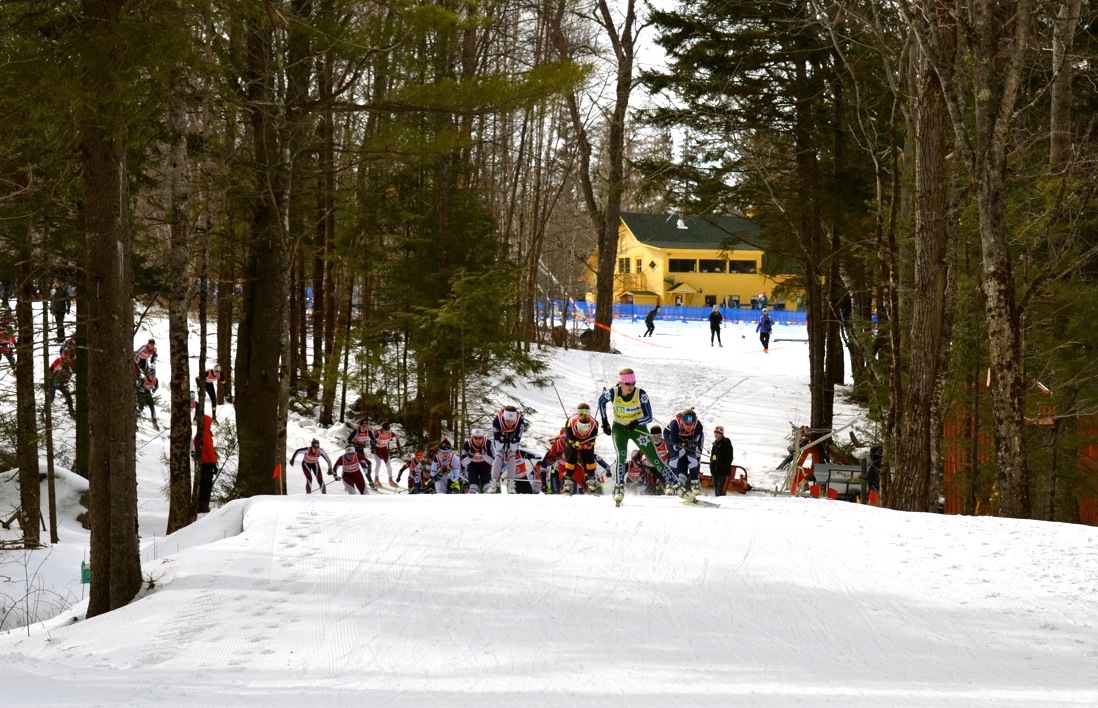
The women’s freestyle mass start at the Middlebury Carnival from Feb. 15-16 heads out on the new Tormondsen Family Race Course at Rikert Nordic Center in Ripton, Vt. (Photo: Stella Holt)
“Andrew was pushing for more, John Morton was pushing for less, I was somewhere in between,” he said. “Realistically, the course gets used as a homologated race course about one percent of the year. The rest of the year, the general public is using it to ski on.”
Hussey wanted something that would work for both users, a hill that would be significant for a college racer but also something everyday skiers could ascend, taking a few breaks or a cutoff trail along the way.
“I think we really came up with a pretty darn good solution to the whole thing,” Hussey said.
That was the running theme to the entire project, from breaking ground in the fall of 2011 on what is now the homologated Tormondsen Family Race Course (click for map), with banked turns and what Hussey called a “screaming-fast downhill.” Finalized in early February, it also involved installing an integrated snowmaking system around the entire 5 k loop.
“[Hussey] understood a few things; he understood the homologation and how that was basically changing the playing field,” said David Lindahl, a principal at Morton Trails who contributed to the upgrades.
The process of changing a trail system is hardly ever easy, he explained. Venues have history and nostalgic ties. He and Morton started by asking Hussey what was possible, through permitting in the Green Mountains to property constraints, etc.
“It’s a big puzzle,” Lindahl said. “Sort of the base line is: how do we create a really good 5 k course? Then, what else can you do from that? Well you can make 2 ½ k courses. So we’re always kind of thinking of different options, but from that core, let’s make sure there’s a really good 5 k, because that’s a standard that you need to have.”
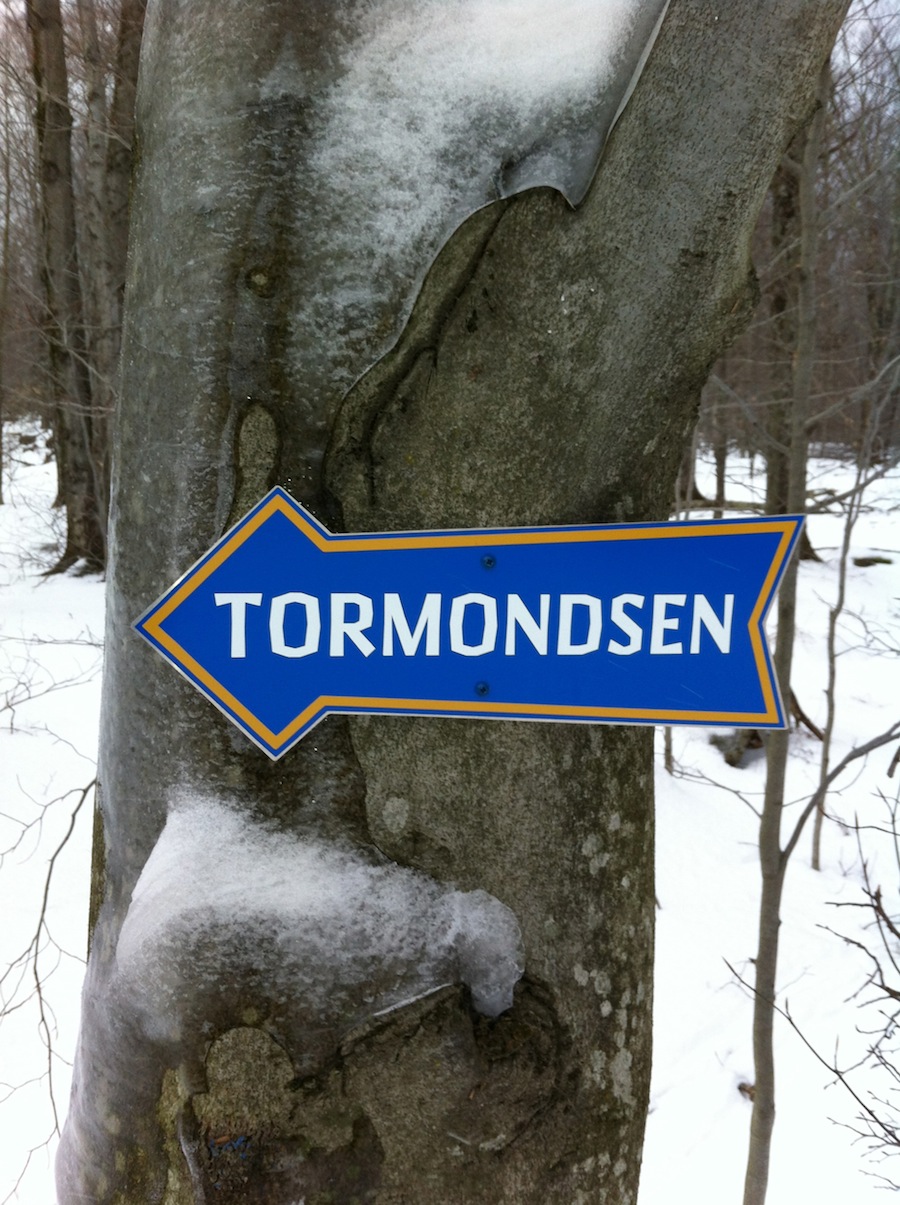
New signage on the 5 k Tormondsen Family Race Course at Rikert Nordic Center in Ripton, Vt.
By the time last winter rolled around, the 5 k course was complete with two 2 ½ k loops connecting in the field where the start, finish and spectators would be. After first seeking a D-homologation to hold freestyle mass starts, Morton and Lindahl came up with an E-homologation option as well for hosting skiathlons (half-classic, half-freestyle pursuits). According to Hussey, they’re one of two nordic areas in the country that are certified to hold such races (Soldier Hollow is the other one).
“Turns out if you do it right and you put all the pieces together and you put two 2 ½ k’s together then you have an E-category,” Lindahl said. “One of the courses only has to be at a C-level and the other one has to be a D-level. Typically, what we’ve done is the D-level for both of them. Those courses worked out well; they were independent [and] both came back into the stadium area.”
That made having a ski race with an equipment exchange, or transition, possible. It also draws crowds.
“A big piece of what we do is spectator interest,” Lindahl said. “How can we create something that is going to bring people back to the start finish area so that friends and spectators will be as involved as the coaches and athletes are?”
Based in Thetford, Vt., Morton Trails is the company that designed 15 k of trails at Colby College’s Quarry Road Trails in Waterville, Maine. Morton and Lindahl are behind the new 7.5 k course at Trapps, the expansion of an existing trail at the Jackson Ski Touring Center in New Hampshire and ongoing projects with Vermont’s Jay Peak and the Sugarloaf Outdoor Center in Carabasset Valley, Maine, to name a few.
“The Middlebury site is blessed with a wonderful big field, ideal for all types of start/finish configurations, and great for spectators,” Morton wrote in an email. “A challenge was getting from that field out to the required hills and back within 2.5 kilometers to give the spectators a second view of the athletes midway through the loop. The second 2.5 k loop also had to access the required climbs and return to the stadium within in the 5 k distance target.”
Ideally, the two loops would be close enough to share the proposed snowmaking piping system, an idea Hussey brought to the table.
“Another objective was to make use of as much of the existing trail network as possible, and thus minimize the need for new trail construction,” Morton explained. “Finally, there was a desire to have the racing trail independent from some of the other popular trails at Rikert so that during event days, recreational skiers are still able to enjoy loops not closed for racing.”
The end result: Rikert is one of two places in the country that are FIS certified for skiathlons, which could bolster its potential for international races down the road, Hussey said.
“We’ve put at least a million and a half bucks into this place in the last three years, which is akin in the nordic industry to Jay Peak putting 300 million into the alpine area,” he said.
“That is a huge investment … and yes, it’s a great event center, we’ve got homologated race trail, we’ve got snowmaking on that, but over and above that I’m very passionate about the fact that our region, what some people term the Addison [County] Alps, you’ve got Blueberry Hill 10 k by trail, you’ve got Rikert, we’ve got the Snow Bowl, we’ve got an amazing array of inns and hotels and restaurants and theater and art and hockey games at night. There’s all these things to do for folks to come in from out of town and enjoy the area.
“That to me is another piece of it that goes beyond NCAAs and national championships,” he added. “I’d love to hold a World Cup here. There are a lot of parts to make that happen. That’s the kind of facility that I believe we have.”
Snowmaking
As Gardner put it, three big changes at Rikert in the last few years have raised it to a new level. “Getting Mike hired so there was a full-time, year-round director, getting the trail built, and having snowmaking,” he said.
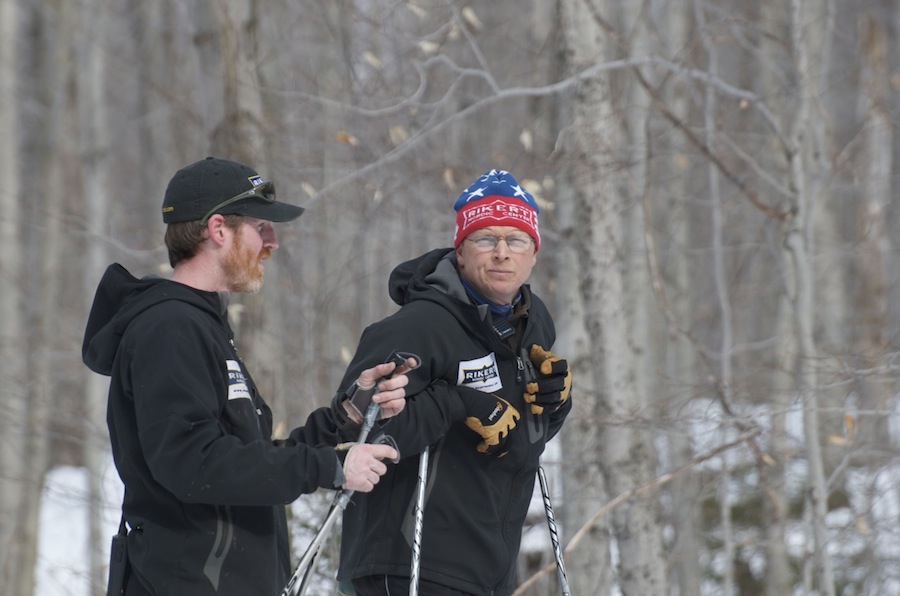
Rikert Nordic Center Director Mike Hussey (r) overseeing the Middlebury Carnival in mid-February. (Photo: Stella Holt)
Without Hussey, the snowmaking aspect – which cost upwards of $850,000 dollars – might not have been possible, Gardner said. Because of the confidence John Tormondsen, a Middlebury alum and first-team All-American nordic skier now on the college’s board of trustees, had in Hussey, he and his family donated a significant amount toward the total cost. Now in its initial months of operation, Rikert has the most snowmaking coverage of any nordic center in the Northeast.
“It’s the largest system of its type in North America, the most-extensive piping system,” Hussey said.
“I think Middlebury had the vision that we want to really put ourselves on the map,” Lindahl said. “The snowmaking thing, we weren’t the ones that suggested that, but obviously they went for it.”
Most importantly for college teams, it promised snow for NCAAs, which start Thursday with nordic races and continue through Saturday. Three weekends ago at the Middlebury Carnival, Rikert held its first collegiate races on the course. Although its been completed for more than a year, natural snow wasn’t abundant enough to cover it last year. The installation of the snowmaking system with 20 snow guns began late last fall, and water-withdrawal permits weren’t in place until early February.
As a result, Hussey and his crew have been pumping out the manmade stuff as much as possible in the last month. At 250 gallons per minute, they can potentially cover the 5 k loop in 200 hours. But they’re only allowed 90 gallons of inflow based on state regulations, which Hussey said was “very understandable” given their proximity to protected lands.
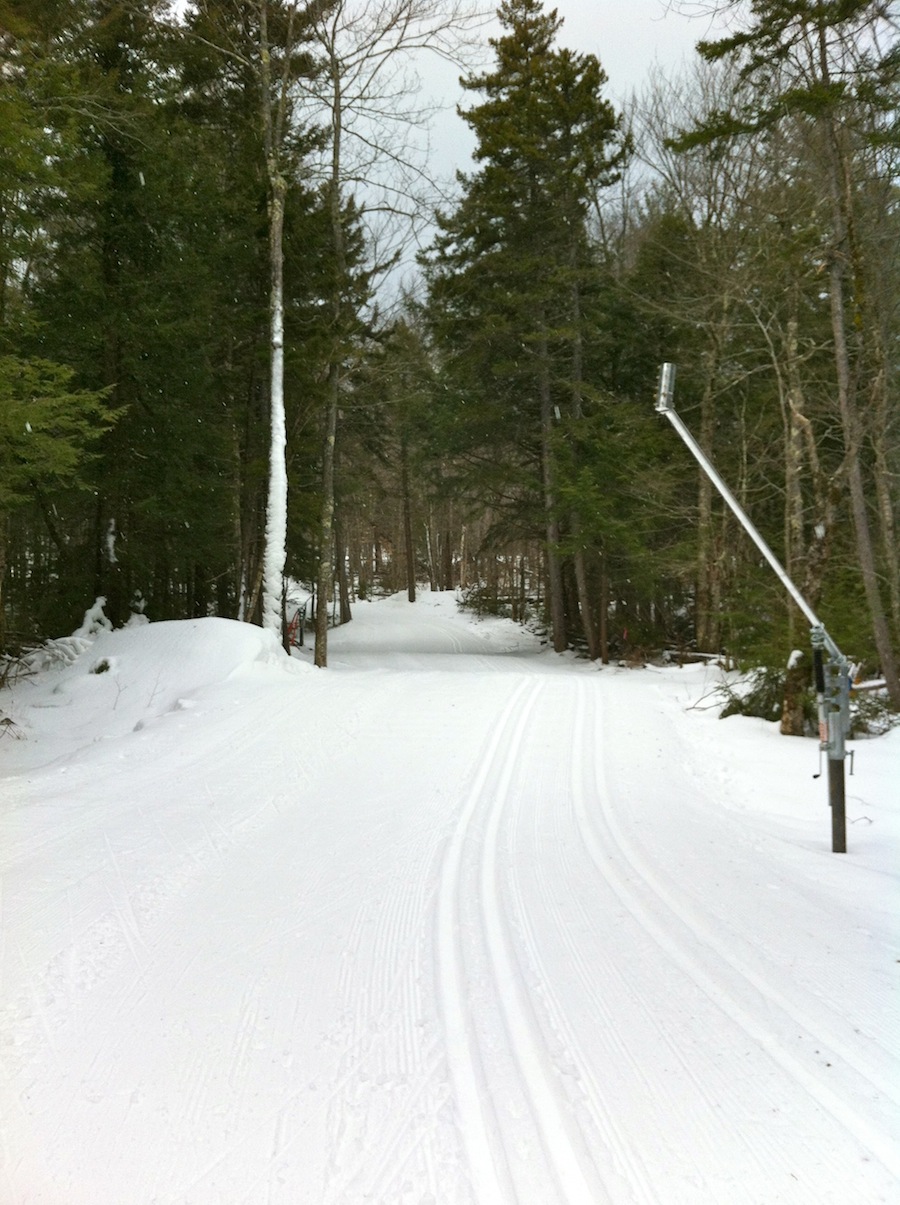
A look at the trails and new snowmaking system in mid-February at Middlebury College’s Rikert Nordic Center in Ripton, Vt.
“Our holding pond is not that large and we get maybe 16 hours of operating time [from that],” Hussey said. “After that, it takes a day or more to recharge. So when we get windows of opportunity to make snow, it’s sort of herky-jerky because we can run for 16 hours, then we stop, and then we gotta start up again. So it’s not a consistent flow and efficient use of the good hours. Phase two of the operation is to add a larger holding pond if we can.
“It’s been a little spotty early on as part of that permitting piece was challenging,” he added. “I think we’re through it now and all systems go.”
As for the NCAA outlook, Hussey wrote in an email that “projected temperatures are to be in the mid to high 30’s during the day and below freezing at night. We will be able to do a good job with the grooming under those circumstances.”
Asked what they learned from the Carnival races, he wrote, “We learned (confirmed) that this is a technical course and requires strategy as well as stamina. There are hard climbs and fast twisting downhills, all of which makes for good racing.”
“The course itself has definitely changed and the trail quality has improved a lot, especially the grooming quality,” said Hilary Rich, a senior on Middlebury’s nordic team. “Mike puts a lot of effort into [grooming] and it definitely shows.”
“It’ll suit the people who like to grind it out; there’s not much rest,” junior Austin Cobb said. “It feels less like the middle of the woods now. It seems like it’s a legitimate place to ski … It’s the real deal.”