Tag: 2013 world championships

  • American Men Seventh, Women Eighth in World Champs Team Sprint

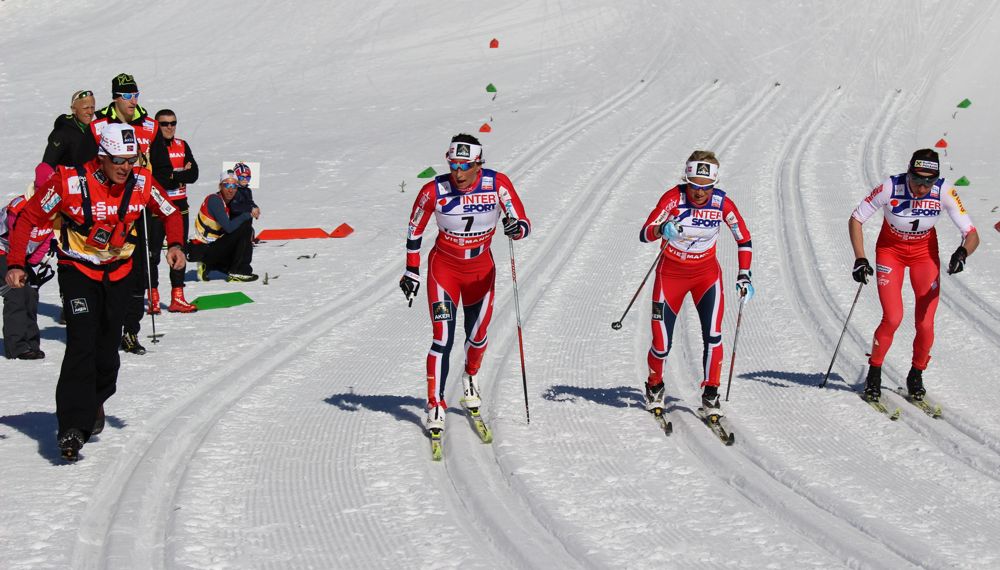
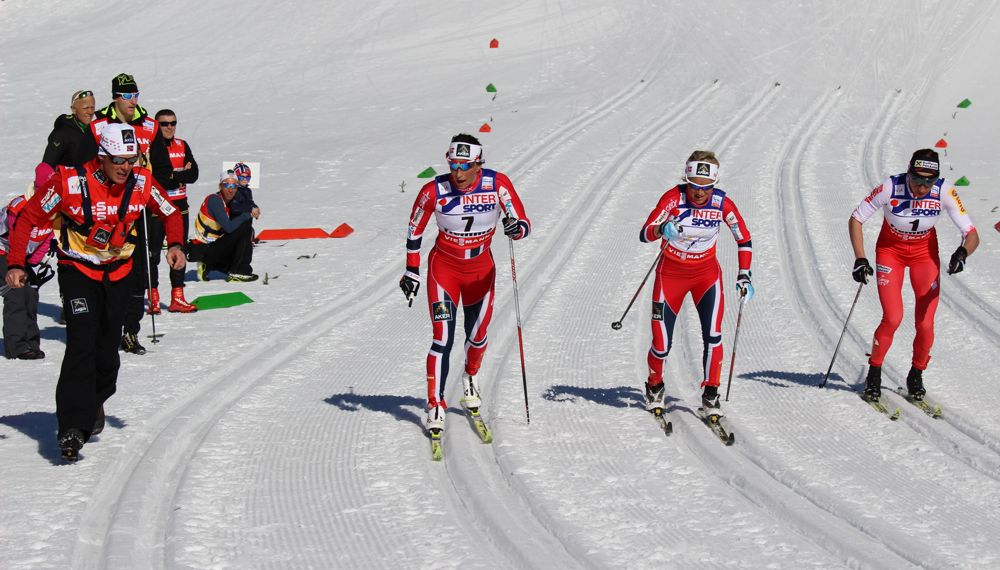
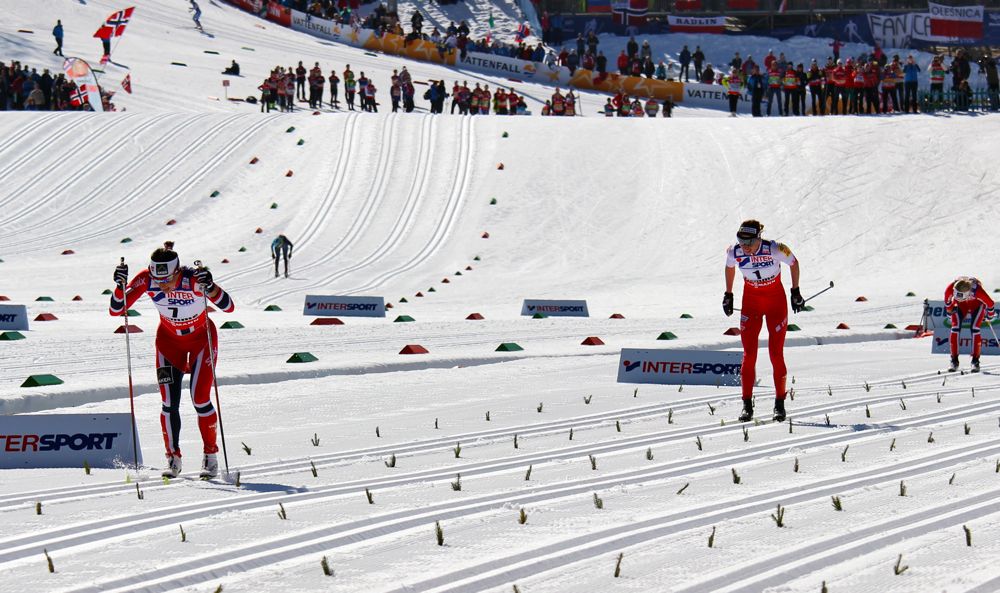
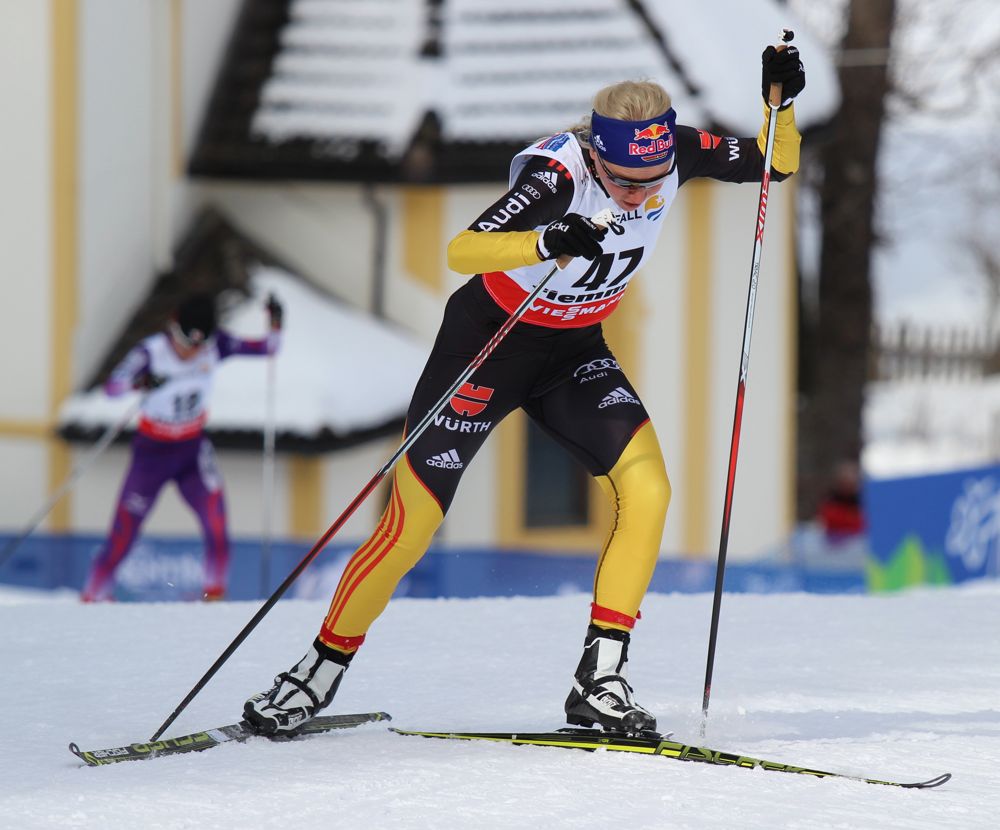
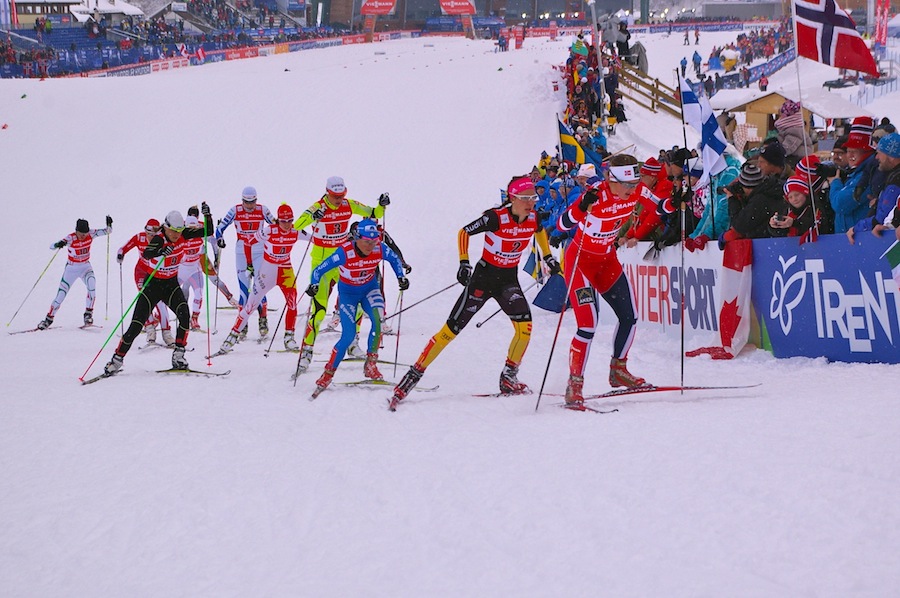
    American Jessie Diggins, in the 2013 World Championships winners bib, chases Germany's Denise Herrmann in the women's 6 x 1.2 k freestyle sprint final on Sunday at 2015 World Championships in Falun, Sweden. Second in their semifinal, the U.S. placed eighth in the final and Germany was fourth behind Norway, Sweden and Poland, respectively. (Photo: FlyingPointRoad)
    American Jessie Diggins, in the 2013 World Championships winners bib, chases Germany’s Denise Herrmann in the women’s 6 x 1.2 k freestyle sprint final on Sunday at 2015 World Championships in Falun, Sweden. Second in their semifinal, the U.S. placed eighth in the final and Germany was fourth behind Norway, Sweden and Poland, respectively. (Photo: FlyingPointRoad)

    FasterSkier’s coverage of the 2015 FIS Nordic World Ski Championships in Falun, Sweden, is brought to you by the generous support of L.L. Bean, now featuring a complete line of Kikkan Randall training wear.

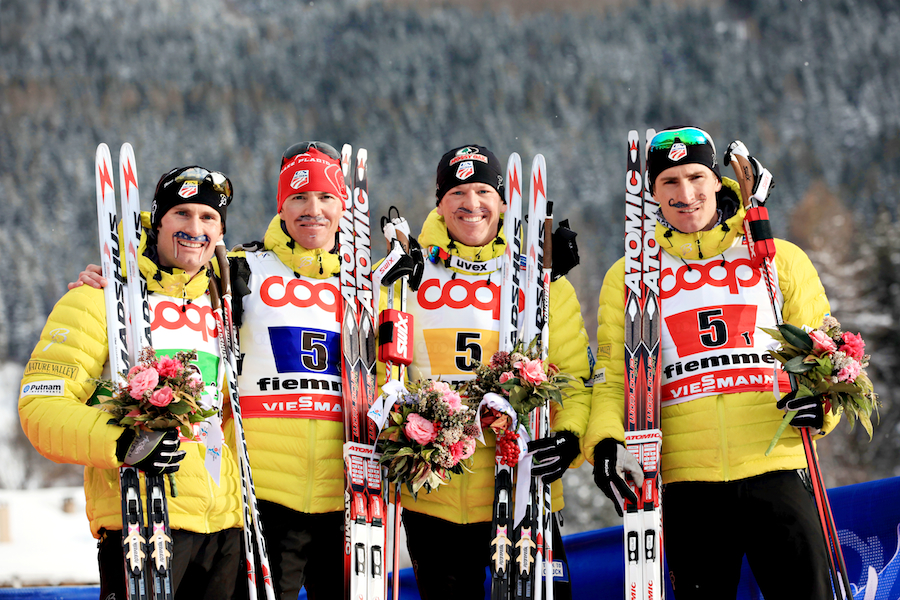
    FALUN, Sweden — “Today gives us a real appreciation for when we were on podiums and when we were winning these events,” U.S. Ski Team Head Coach Chris Grover said Sunday from the 2015 FIS Nordic World Ski Championships. The day marked the much anticipated freestyle team sprints, where Jessie Diggins and Sophie Caldwell joined forces to place eighth in the women’s 6 x 1.2 k, and Andy Newell and Simi Hamilton skied to seventh in the men’s 6 x 1.4 k.

    The U.S. women’s team entered Sunday’s race wearing the customary bibs marking them as reigning world champions. Two years ago in Val di Fiemme, Italy Diggins and star-sprinter Kikkan Randall paired to win the first-ever world championship gold by U.S. cross country skiers. The atmosphere was different in Falun, however, with the Americans acknowledging they were far from the level of skiing witnessed in 2013.

    An unstoppable Norwegian team of Ingvild Flugstad Østberg and Maiken Caspersen Falla claimed the women’s team sprint with a time of 14:29.57. Sweden and Poland rounded out the podium, while the U.S. finished 34.06 seconds back from the winners in eighth.

    While a medal was out of reach for the Americans in the 2015 team sprint, they walked away from the competition with their heads held high, proud of the effort they gave on the fast, hard 1.2 k course.

    “I was so proud of Soph and I have to say, I think we had at least twice as much fun as anyone else out there,” Diggins said in a post-race interview. “We got to put on those defending world champ bibs and that’s a cool thing.”

    The Americans started their day in the second women’s semifinal where they skied to claim an automatic advancement to the final. They entered the heat with the usual team sprint strategy – save as much energy as possible – which kept them in the top-two for the majority of the race. By the time Caldwell tagged Diggins for her last lap, however, the team was sitting in fifth and nine seconds out of first.

    Diggins explained that while it was likely their team would have qualified as a lucky loser had she held position, she decided to give it her all and fight for an automatic qualification to the final “just in case.” Diggins soon gapped the women fighting for second behind Germany, and skied the rest of the race in a comfortable qualifying position.

    With their spot in the final secured, the two Americans once again focused on conserving their energy. Thier rest was hampered by the unlucky draw of the second semifinal heat, which resulted in a half hour of rest less than the first semifinals competitors – including the three eventual podium finishers: Norwegians, Swedes and and Poland.

    Despite the deficit in recovery time, Caldwell started the final in third position. She eventually fell to a close sixth as she entered the exchange, just two seconds out from the Norwegian leaders. Diggins exited the stadium in fifth holding a constant position throughout her first leg. The four skiers in front of her  pulled ahead on the hills, but Diggins caught them on the downhill into the stadium.

    “I was behind the first four girls and trying to do as little as possible, so I let them gap me over the top,” Diggins said. “My skis were so fast that I came into the tag zone with them.”

    Diggins said she entered the stadium with too much speed. Unable to slow before colliding with a German skier, and the Minnesota fell after tagging Caldwell for the next leg.

    “I had a couple falls out there today,” she explained. “We came into the tag zones way faster than we thought. The first time I came in, Germany wasn’t going fast enough and I couldn’t go right and I couldn’t go left so I went into her and fell. The second time it was a similar thing.”

    Caldwell dropped to seventh in her second leg after the exchange, and from there the U.S. remained between seventh and ninth for the rest of the race.

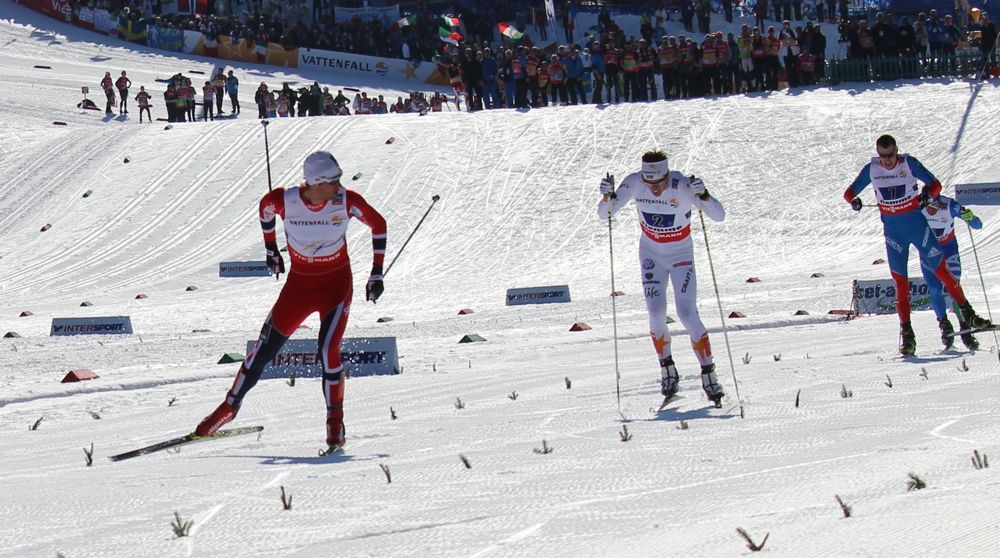
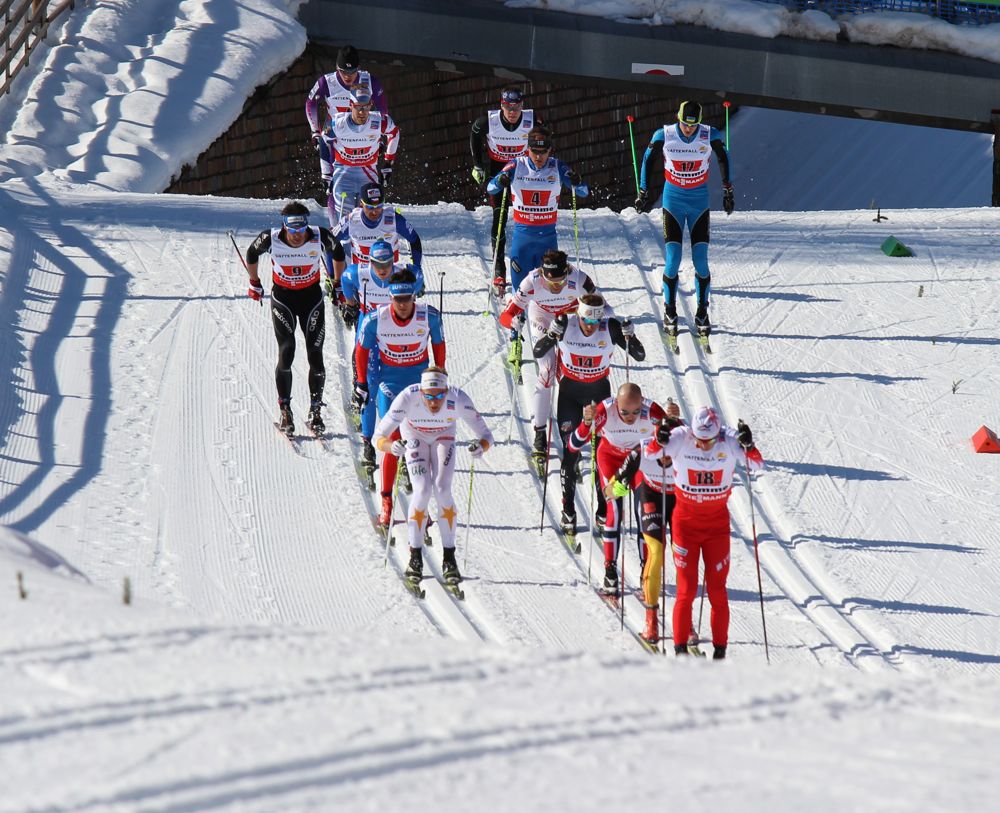
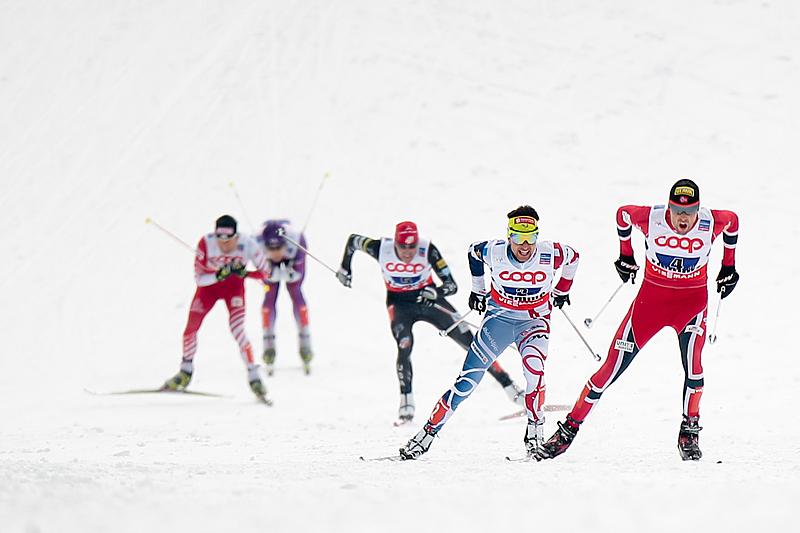
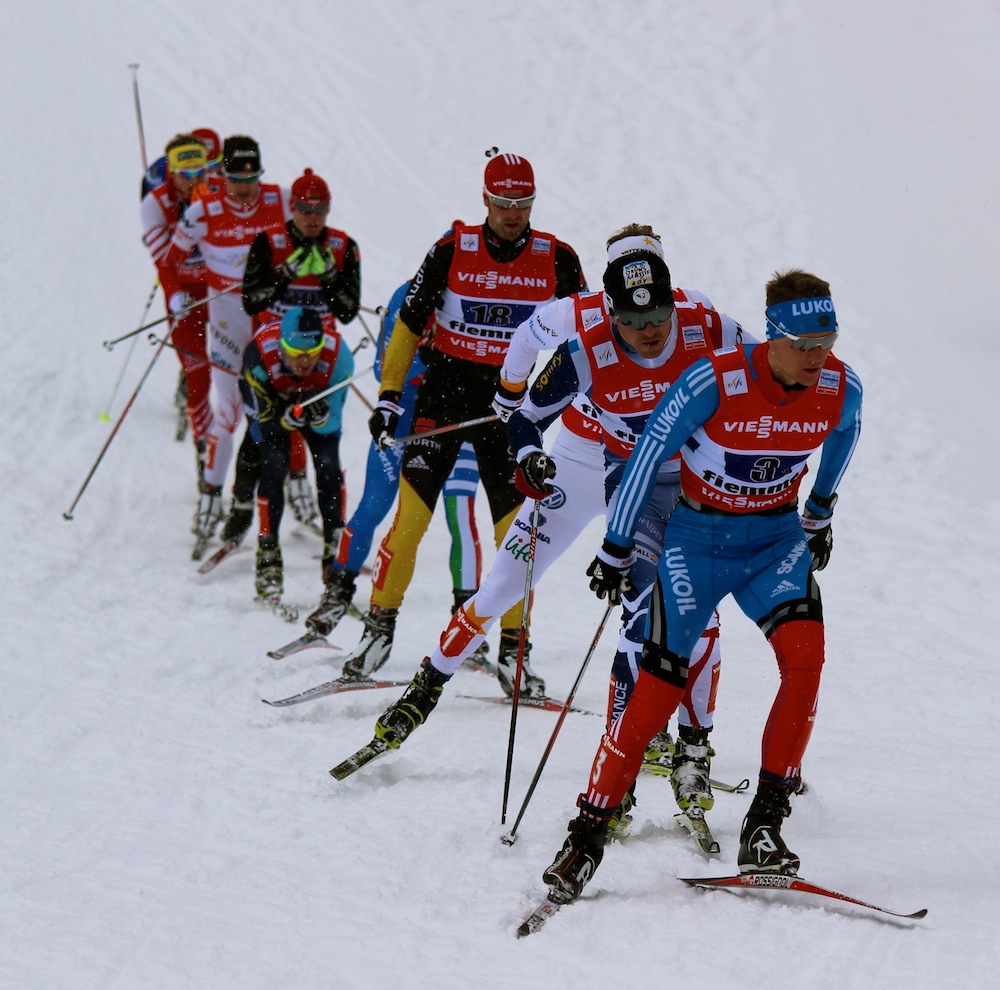
    The men's final in Sunday's 1.4 k freestyle team sprint at the 2015 FIS Nordic World Ski Championships in Falun, Sweden. (Photo: flyingpointroad)
    USA skis in fourth in the men’s final in Sunday’s 1.4 k freestyle team sprint at the 2015 FIS Nordic World Ski Championships in Falun, Sweden. (Photo: flyingpointroad)

    “The first leg was good but by no means easy. I started to get some tired legs and Grover told me to pace the next laps so that I could stay as close as possible,” Caldwell said of the strategy in her final two laps. “If I was going to try and go out and stay with them from the start I would blow up big time and then I’d lose even more time. I let them go a little and gave Jessie have the tough job of trying to catch up. I tried to judge how I was feeling and ski at the smartest race I could based on that.”

    Diggins explained that she attempted to catch the leaders in her second leg, but spent too much energy and ‘blew up’ in the third and final pass around the 1.2 k course. The 23-year-old was in a close battle for seventh with Laurien van der Graaff of Switzerland in the last meters but ultimately lost in the final lunge.

    Despite her status as a defending world champion, Diggins explained that she entered Sunday’s team sprint with less pressure than in 2013. According to the American skier, she and Randall were the favorites to win the race after strong performances earlier that season. The Americans didn’t enter the 2015 event with the same expectations, though the team often referred to it as their best chance of a medal in Falun.

    Despite the lowered expectations, Diggins said she had been focused on Sunday’s sprint since the previous year.

    “This is one of those races where I’ve visualized skiing this course since May,” Diggins siad. “I’ve been psyching it up in my mind, which is both good and bad because by the time we raced it I had already done it a million times.”

    Caldwell also felt the pressure of racing in the USST’s best chance at a medal. “I’ve never been this nervous for a race in my life,” she said. “You can ask all my teammates, I wasn’t able to function for the past 24 hours. Everyone did a really good job of reminding us that even though they (Diggins and Randall) were defending championships, we’ve never done a team sprint together and I’m not 2013 Kikkan.”

    Caldwell added that she hoped to team with Diggins again, and explained that even though Sunday’s race wasn’t medal worthy she believed the two could be ‘great’ in the future.

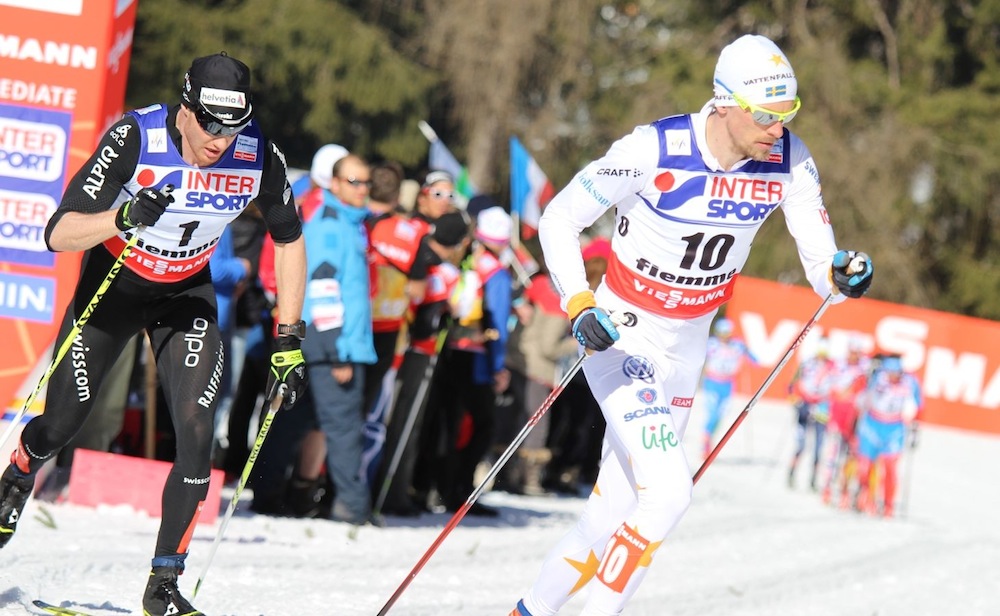
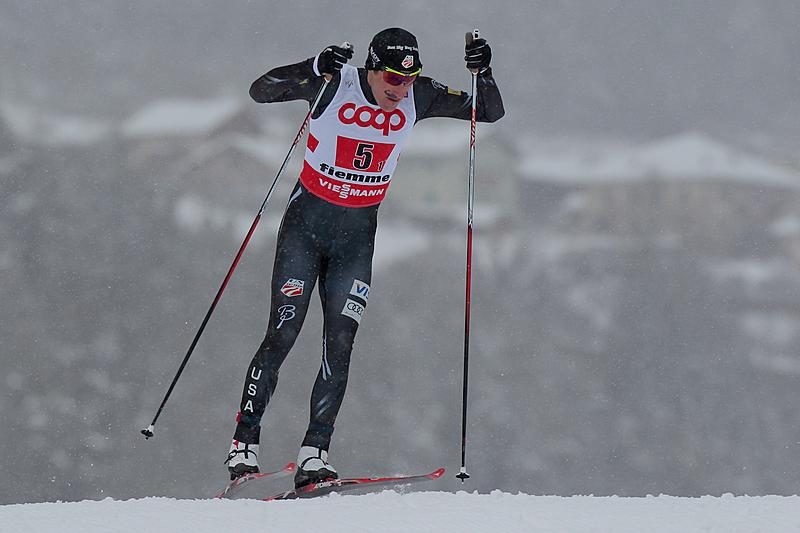
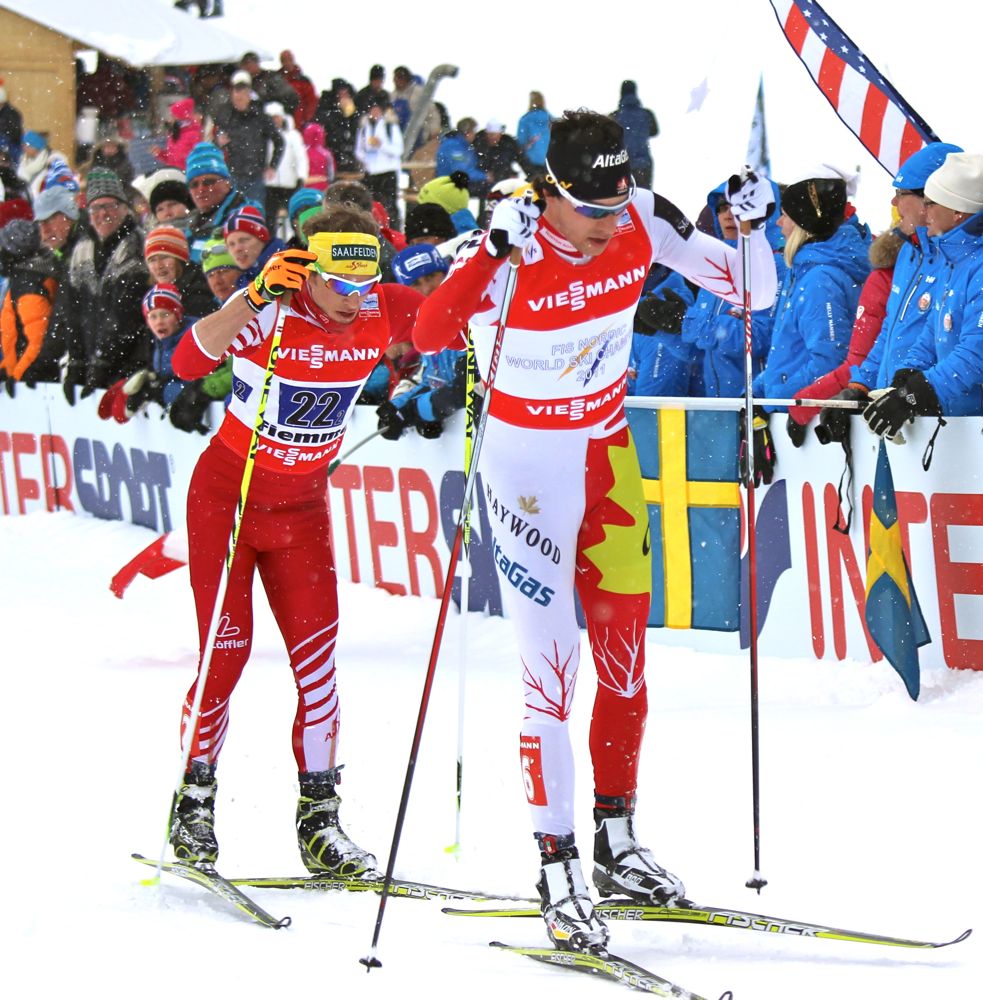
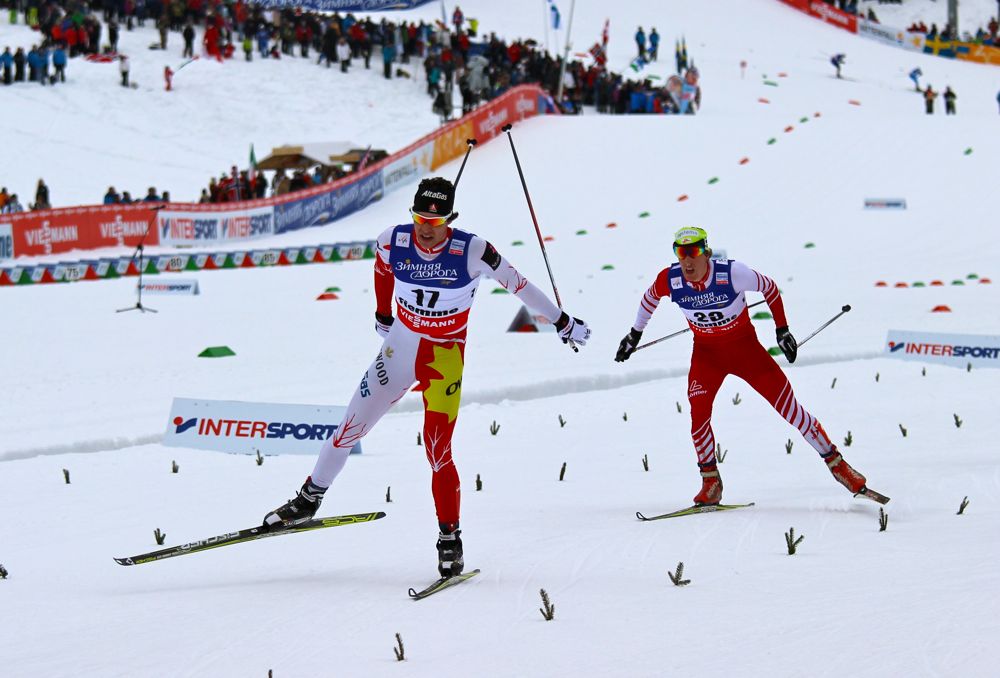
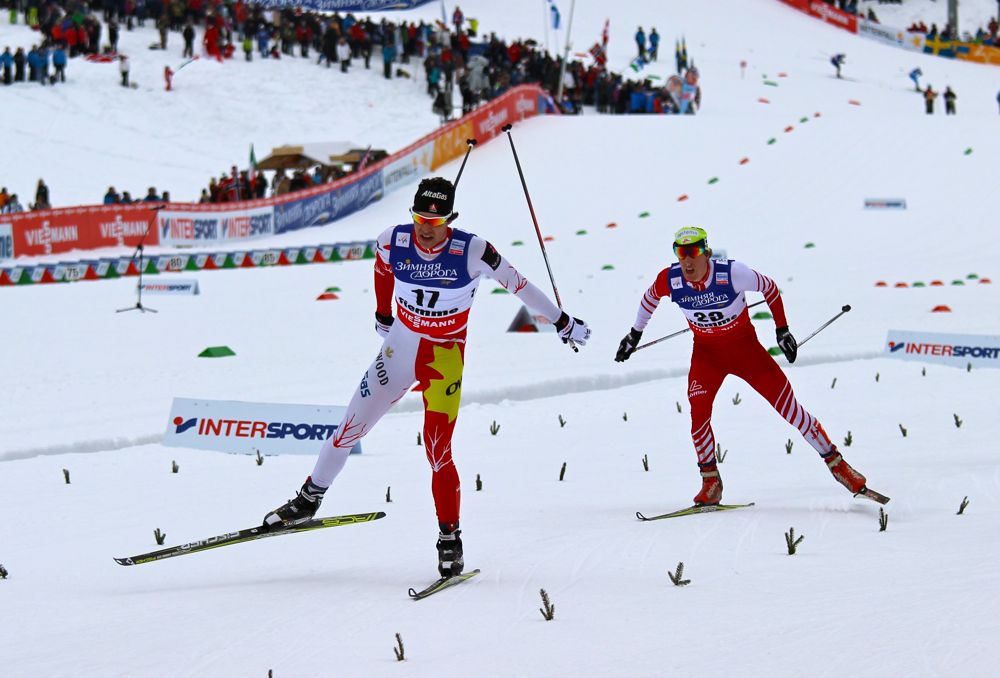
    Andy Newell, USST, trails Finn Hågen Krogh in the the semifinal of Sunday's 6 x1.4 k team sprint at the 2015 FIS Nordic World Ski Championships. Newell and his teammate Simi Hamilton took seventh overall. (photo: flyingpointroad)
    Andy Newell, USST, trails Finn Hågen Krogh in the the semifinal of Sunday’s 6 x1.4 k team sprint at the 2015 FIS Nordic World Ski Championships. Newell and his teammate Simi Hamilton took seventh overall. (Photo: flyingpointroad)

    Newell, Hamilton Team Up to Take Seventh

    Newell and Hamilton took to the line of the men’s team sprint final following their third place finish in the semifinals. Like their female counterparts, the men were in the second heat of the day and thus had less time for recovery.

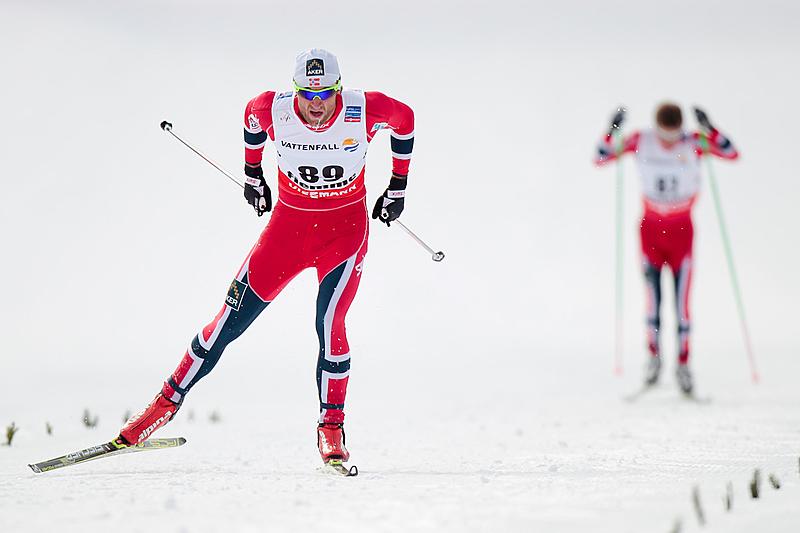
    Skiing outside podium contention for the majority of the six laps, the American men eventually raced to seventh behind the dominant performance of Norway’s Petter Northug and Finn Hågen Krogh. Second went to Russia, while the Italians defended their 2013 bronze in exciting fashion. The American team ultimately finished 17.48 seconds behind the winning time of 15:32.89.

    Hamilton explained that while the pace was relaxed at first it became more challenging as the leaders increased the tempo. He added that the course was challenging due to the varying terrain.

    “It was a course where in some places it’s really advantageous to be leading and in others it is not, Hamilton said.  “It’s tough to make yourself hang out in the pack because there are some technical corners where it’s a big advantage to be in front.”

    For the first half of the race the Americans sat between fifth and seventh. By the final exchange, however, Newell tagged Hamilton in ninth. “You’re actually not breathing that hard but your legs are so blown out by the finish,” he said of the demanding race.

    Hamilton said he entered his final lap ready to “let it fly.” He ultimately brought the U.S. to seventh after passing Sweden, when Teodor Petterson lost his pole, and France, after Baptiste Gros fell in the last 500 meters and lost a ski.

    Reflecting on Sunday’s race, Newell explained he cared less about the placement of the team and rather how close the two were to the sprint’s leaders.

    “It’s not so much that we care about places,” Newell said of Sunday’s objectives. “We want to stay as close as we can to the leaders. To us there’s not really a big difference between finishing seventh or eighth, or even sixth. We want to be close to the podium and that’s our ultimate goal.”

    Hamilton agreed, adding that he set a personal goal of sixth for the day.

    “We skied alright but we can both do better than that,” Newell said. “At least we were in the final and at least we were pretty close to those guys. Just a little more improvement and we’ll both be in there.”

    Grover said he was pleased with efforts from all four athletes gave in the team sprint. At the same time, he acknowledged that the U.S. teams in Sunday’s race were below the high level of competition shown by Sunday’s top competitors.

    “I think people for sure skied really well all day. That’s just where we are right now,” Grover said of Sunday’s performances. “Of course we wanted to be ahead of there right now, but it gives you appreciation for when you do have two athletes that are at an extremely high level and can put them together to create that podium.”

    Results: Men | Women

  • Outstanding at World Champs, Olsson, Bjørgen Earn International Performance of the Year

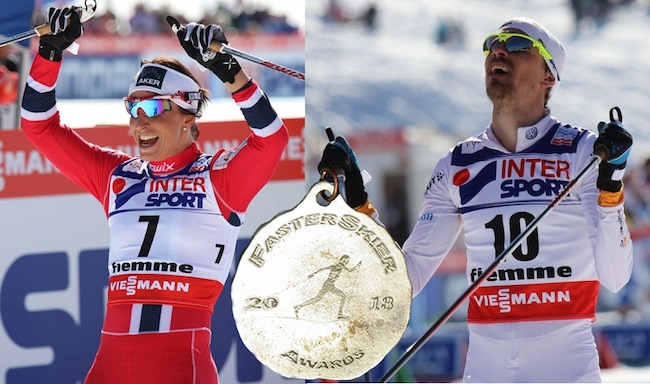
    Outstanding at World Champs, Olsson, Bjørgen Earn International Performance of the Year

    Bjoergen Olsson

    When it came to picking this past season’s International Performance of the Year, Johan Olsson was a no brainer. We’ve still got his theme song stuck in our heads (“Johan Olsson, Johan Olsson, olé, olé, olé!”), which proud Swedish supporters sang as they wove through the stadium in Val di Fiemme, Italy, hoisting huge flags bearing Olsson’s name and face.

    One of their own, 32-year-old Olsson, had finally secured gold in the 50-kilometer classic mass start on the last day of World Championships after Sweden tallied six silvers in Val di Fiemme. And he did so in temperatures near 55 degrees Fahrenheit after breaking away around 11 k. He led for much of the race after that, then dropped his only contender, Switzerland’s Dario Cologna, with about 30 k remaining.

    Sweden's Johan Olsson (r) leads Dario Cologna of Switzerland early in Sunday's 50 k classic mass start at the 2013 World Championships in Val di Fiemme, Italy. Cologna crashed on a downhill around 21 k, and Olsson skied away for the win.
    Sweden’s Johan Olsson (r) leads Dario Cologna of Switzerland early in the 50 k classic at the 2013 World Championships in Val di Fiemme, Italy. Cologna crashed on a downhill around 21 k, and Olsson skied away for the win.

    Cologna worked within a chase group mostly led by Russia’s Alexander Legkov, but to no avail. Olsson was long gone, only letting Swedish teammate Daniel Richardsson to come within 12 seconds of him. Richardsson didn’t change skis before the last lap and made up time initially, but it cost him in the end.

    Meanwhile, Olsson said he kept his head down and mind blank, focusing on himself. He cruised toward the finish uncontested, beating Cologna by nearly 13 seconds.

    “I think the 50 k is the finest thing you can win in the World Championships,” Olsson said at the time, after having already notched two silvers in Val di Fiemme in the relay and 15 k freestyle. For the 2010 Olympic relay champ, it was his first World Championships gold.

    “I think still my performance today means more than the gold medal, what I did out there, that I could go solo and just finish first,” he added.

    It certainly wasn’t the first time he had broken away in a distance race and held his own in impressive fashion (see Johnny Klister’s recap of his 30 k Olympic bronze-medal performance), but his timing was impeccable.

    “I think it almost is the greatest 50-kilometer achievement what we’ve seen today,” Norwegian team director Vidar Løfshus told NRK, according to a translation. “When you go [30 k] in front of this slush, as it says something about that man there.”


    Women’s International Performance of the Year:

    Marit Bjørgen getting instructions from her coach before the last lap of the 30 k classic, when the race was down to three.
    Marit Bjørgen getting instructions from her coach before the last lap of the 30 k classic, when the race was down to three.

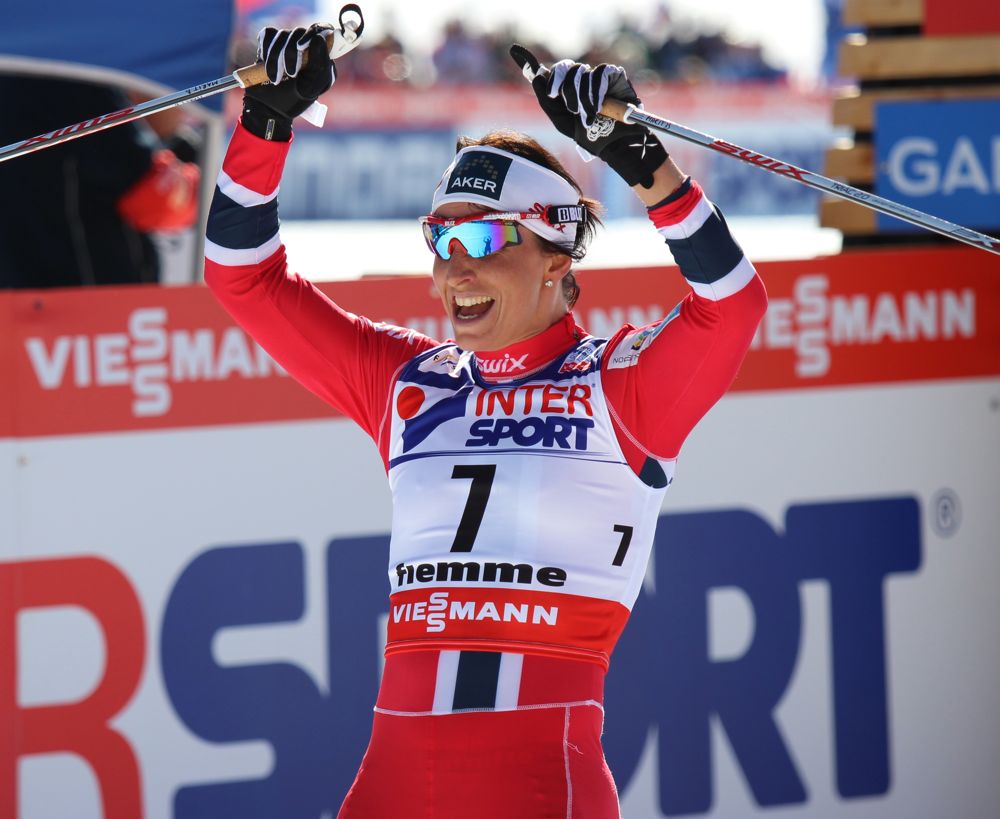
    That would be Marit Bjørgen in the 30 k classic mass start at World Championships. The Norwegian nordic queen captured her 12th World Championships gold and fourth of the week in the final women’s race in Val di Fiemme, outsprinting Polish rival Justyna Kowalczyk to do so.

    With about a 45-second lead on the chase pack, Bjørgen, Kowalczyk and Norway’s Therese Johaug skied relatively conservatively on the last of six laps. Everyone was waiting, and few knew when either of the three would make a move. Bjørgen and Johaug stuck behind Kowalczyk, who upped the pace with two climbs remaining, but the attack was unsuccessful and Bjørgen skied alongside Kowalczyk on the downhill.

    There, with less than a kilometer remaining, the Norwegian attacked. Johaug slipped behind while struggling with her kick, while the Bjørgen and Kowalczyk battled for first. Bjørgen drafted Kowalczyk into the stadium and accelerated past her, winning by 3.7 seconds. Johaug finished third, 5 seconds behind Kowalczyk.

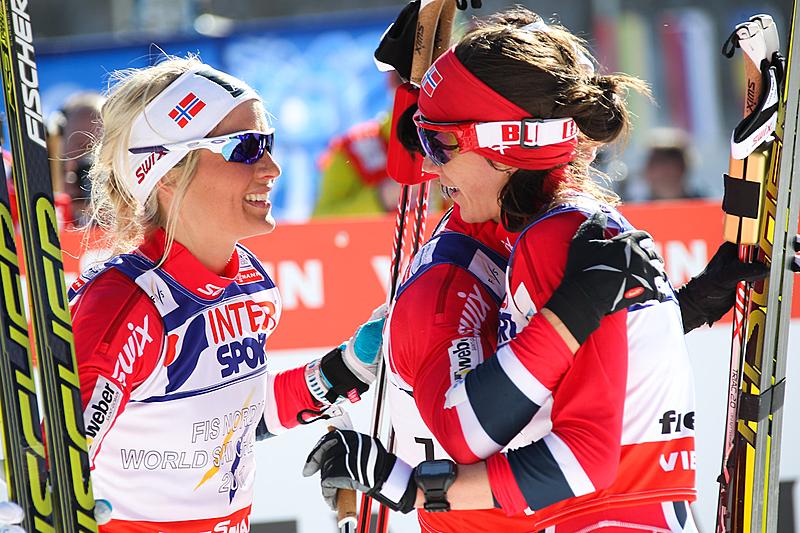
    Bjørgen collapsed at the finish, soaking up the victory she had trained all season for after a heart arrhythmia derailed her Tour de Ski plans and chances of claiming the overall World Cup. Johaug immediately rushed to her side, crouching over Bjørgen to congratulate her.

    “I think the other girls on the team knew that this was one of my biggest goals this season,” Bjørgen said at a post-race press conference. The last time Bjørgen won gold in the 30 k was at the 2005 World Championships in Oberstdorf, Germany.

    “They were really happy for me and we are really happy for the whole team that we have been so good in this World Championships,” she added.

    Norway won a total of 16 medals in Val di Fiemme, with four of golds coming from Bjørgen and Johaug posting another win in the 15 k freestyle.


    Honorable mentions:

    • Petter Northug | World Championships 15 k freestyle individual start

    And we thought Northug needed external motivation. The 27-year-old Norwegian proved otherwise at the 2013 World Championships in Val di Fiemme, Italy, claiming his first gold of the week and eighth world title in a staggered start, no less.

    He won the 15 k freestyle in 34:37, nearly 12 seconds faster than silver medalist Johan Olsson and 22.3 seconds ahead of Norwegian teammate Tord Asle Gjerdalen in third.

    “Today is a day you dream of when you’re an athlete,” Northug said afterward. “You wake up, you feel that you have a lot of power, you want to compete, you want to give your all and also when you then win, it’s amazing.”

    • Alexander Legkov | Tour de Ski

    This guy successfully dethroned three-time Tour de Ski winner Dario Cologna of Switzerland (who won in 2009, 2011 and 2012), and became the first Russian to win the multi-stage race.

    At 29, Legkov has topped the podium plenty of times on the World Cup, but never before in the Tour, in which he placed second in its inaugural year in 2007. Legkov outlasted Cologna, Norwegian Petter Northug and Russia’s Maxim Vylegzhanin, all of which started within 16 seconds of one another, to win the final climb up Alpe Cermis in Val di Fiemme, Italy. he beat Cologna by 19 seconds, and Legkov V2ed over the top.

    “This is a great day for me,” Legkov told reporters. “It’s the biggest win of my career.”

    • Therese Johaug | Holmenkollen World Cup 30 k

    While one of her toughest competitors, Norwegian teammate Marit Bjørgen, wasn’t present for the 30 k freestyle mass start in Holmenkollen, Norway, Johaug put out a performance that would’ve been tough for anyone to beat on even their best day.

    The 24-year-old trounced the field in the famous World Cup distance race, repeating her win at Holmenkollen in 2010 and winning the 2012 edition by nearly 47 seconds over Justyna Kowalczyk of Poland. Taking a page out of Johan Olsson’s book (see male performance of the year), she left the pack at 7 k and skied the remaining 23 k on her own.

    “It was a perfect day for me,” Johaug told NRK. “When I heard I was 90 seconds ahead, I thought something really would have to happen for me to lose the victory.”

    Her biggest struggle came about a kilometer before the finish, where she accepted a large flag and had to carry it over one final bump into the stadium

    “I did not quite know how to get up the hill with the flag and one stick,” she said.

    ***

    See also:

  • Tchekaleva Fueled by Birth of Son: ‘It was a Very, Very Strong Feeling to Start Training Again’

    Tchekaleva Fueled by Birth of Son: ‘It was a Very, Very Strong Feeling to Start Training Again’

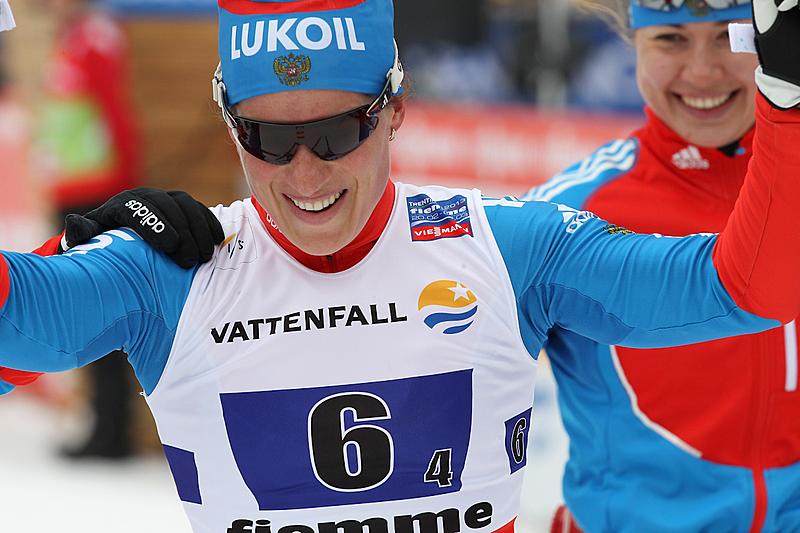
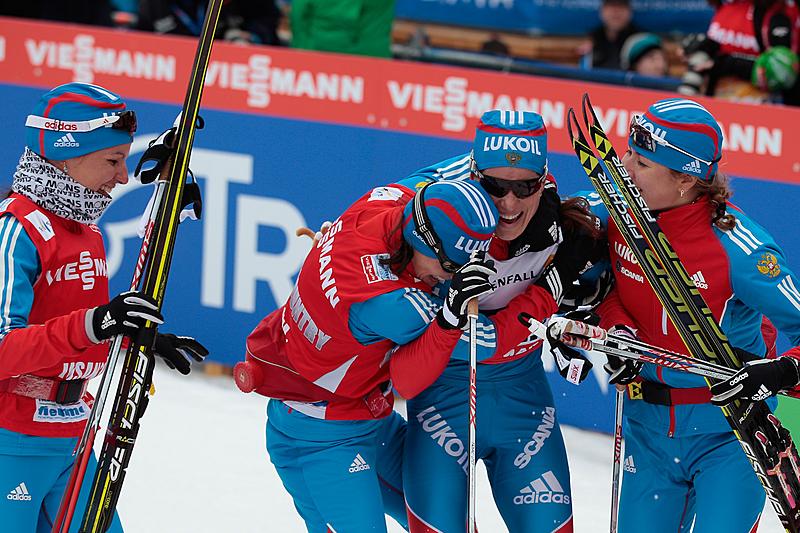
    Russia's 4 x 5 k relay congratulates anchor Yulia Tchekaleva, who lifted the team to third on Thursday at the 2013 World Championships in Val di Fiemme, Italy. (Photo: Fiemme2013)
    Russia’s 4 x 5 k relay congratulates anchor Yulia Tchekaleva, who lifted the team to third on Feb. 28 at the 2013 World Championships in Val di Fiemme, Italy. (Photo: Fiemme2013)

    It’s OK if Yulia Tchekaleva’s name doesn’t roll off your tongue. But you might as well get used to reading it.

    The 29-year-old Russian has enjoyed a breakout season in more ways than one, notching two bronze medals at World Championships in back-to-back races (the 10-kilometer freestyle and 4×5 k relay) in Val di Fiemme, Italy.

    Tchekaleva went on to place third in last weekend’s 30 k freestyle mass start at the Holmenkollen World Cup in Oslo, Norway. It was her fifth medal of the season, including her silver from the pre-Olympic World Cup skiathlon in Sochi, Russia, and bronze in the 5 k freestyle at the early-season World Cup mini tour in Kuusamo, Finland.

    And all this came less than a year after having a baby. Before she gave birth to her son, who turned 1 on Jan. 9, Tchekaleva was more of an unknown. She didn’t have an individual World Cup medal and didn’t make the 2009 World Championships or 2010 Olympics, yet today, she’s Russia’s leading woman.

    FasterSkier sat down with Tchekaleva, who spoke through a translator, after anchoring Russia to bronze in the 4×5 k at World Championships. She dedicated the medal to her son and her family.

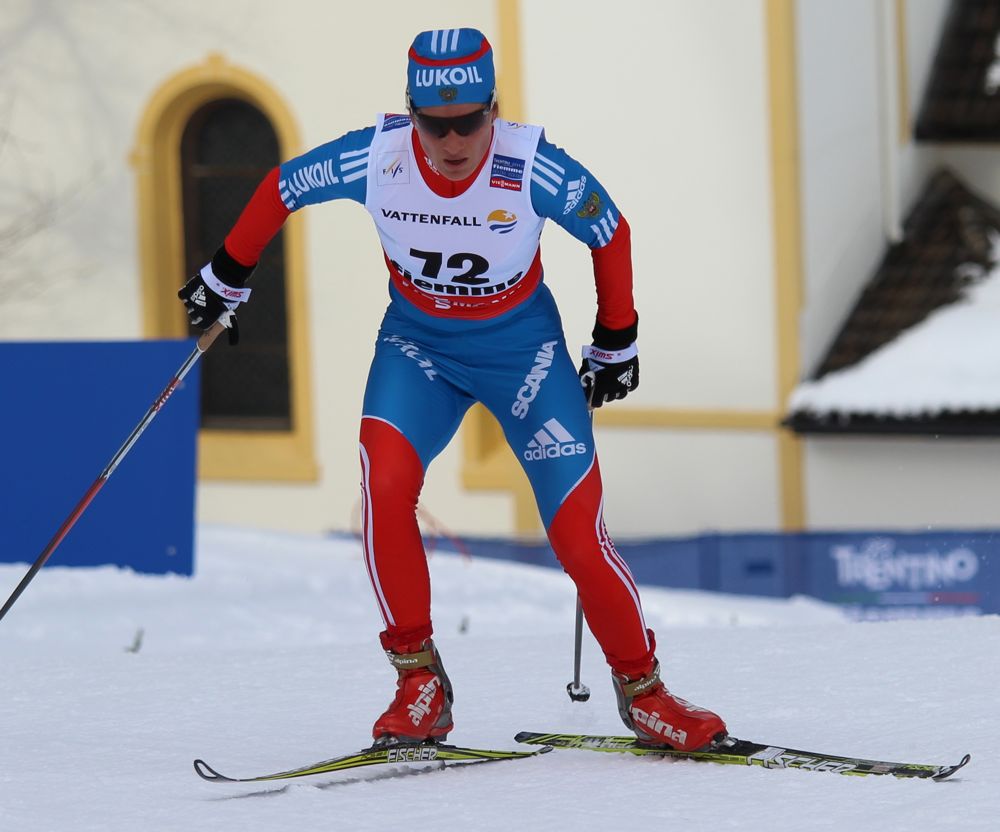
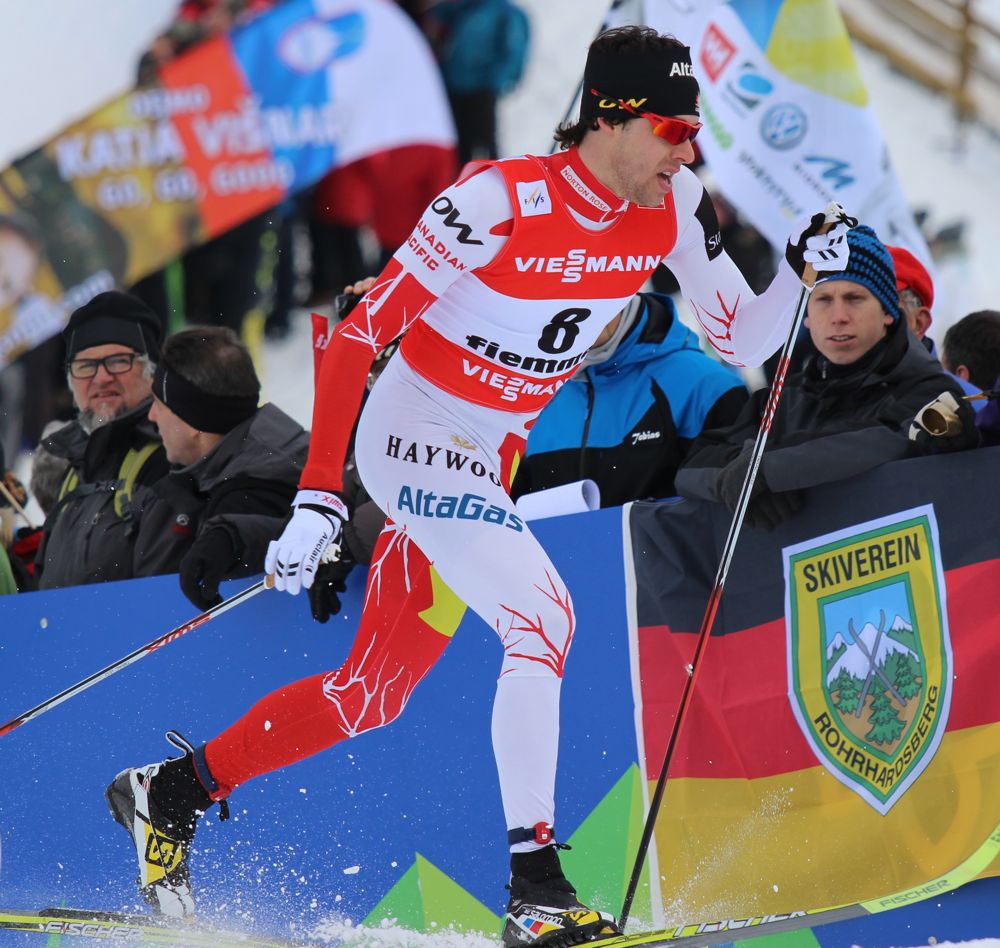
    Russia's Yulia Tchekaleva en route to bronze in the 10 k freestyle at 2013 World Championships in Val di Fiemme, Italy.
    Russia’s Yulia Tchekaleva en route to bronze in the 10 k freestyle at 2013 World Championships in Val di Fiemme, Italy.

    FasterSkier: How difficult was it to return after having a child?

    Yulia Tchekaleva: My husband is my private coach so I didn’t even imagine that everything would be so fast and easy to return back to skiing. The first five months after the baby was born, I was training at home, I was feeding baby with my milk, and I was training with my husband only.

    FS: When did you start training with the national team again?

    YT: From the beginning of June 2012. In two months after I started training with the national team, I felt even in two months very, very, strong and with the same physical shape and state as it was before. Even better.

    FS: How much did you train during your pregnancy?

    YT: Nothing at all. During pregnancy no training. The season of 2011 stopped and I finished training. When I understood that I am pregnant, I stopped training. I felt my body, my shape, I felt so tired after the season so I just wanted to have rest and to enjoy the pregnancy. So it was nine months of rest, it was a vacation, a holiday. When I gave birth to the baby, I just wanted to start training. It was a very, very strong feeling to start training again.

    FS: What does the World Championships relay medal mean to you?

    YT: When I got a medal in the individual, I didn’t feel as emotional. After [the relay] race I feel more emotions, more happiness, more everything, because we didn’t expect it until the last moment. So there’s much more happiness for the country.

    All the girls are very, very happy because for most of them, probably some of them this will be the highest feeling and medal of their career. That is why they are really happy.

    — Audrey Mangan contributed reporting

    Russia's 4 x 5 k relay congratulates anchor Yulia Tchekaleva, who lifted the team to third on Thursday at the 2013 World Championships in Val di Fiemme, Italy. (Photo: Fiemme2013)
    Russia’s 4 x 5 k relay congratulates anchor Yulia Tchekaleva, who lifted the team to third on Feb. 28 at the 2013 World Championships in Val di Fiemme, Italy. (Photo: Fiemme2013)
  • Another Tough One for Canada: Harvey 28th, Babikov DNF in 50 k

    Another Tough One for Canada: Harvey 28th, Babikov DNF in 50 k

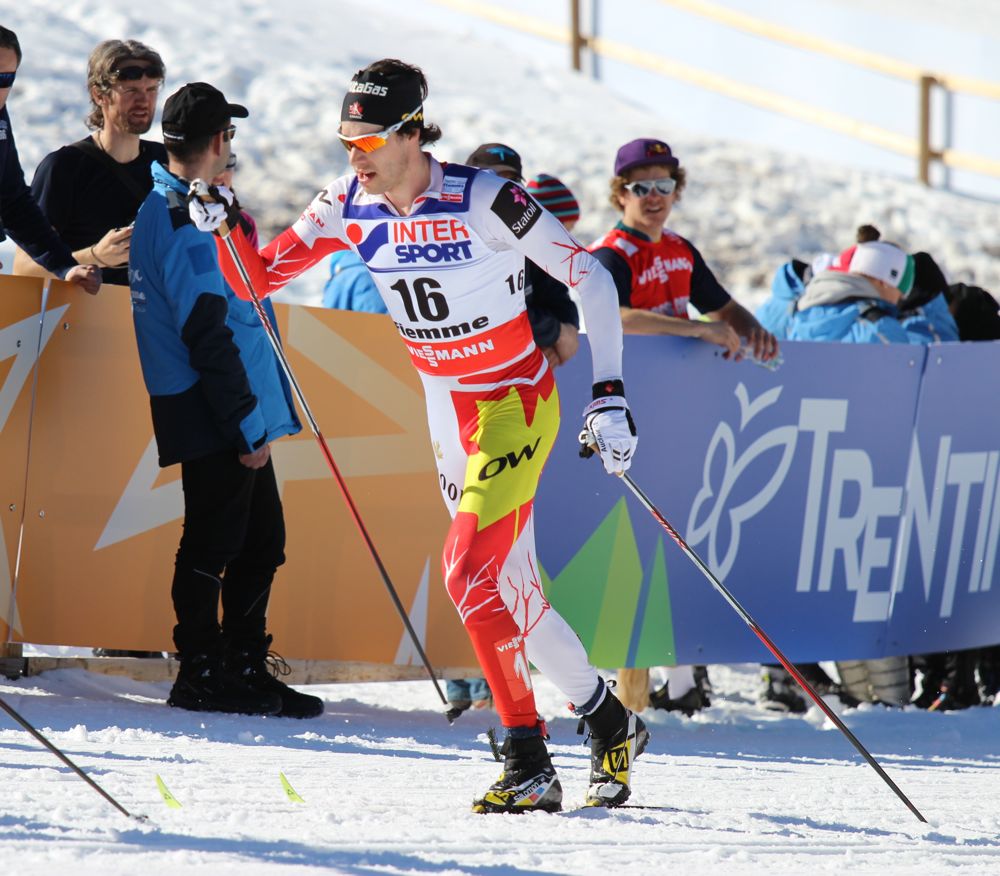
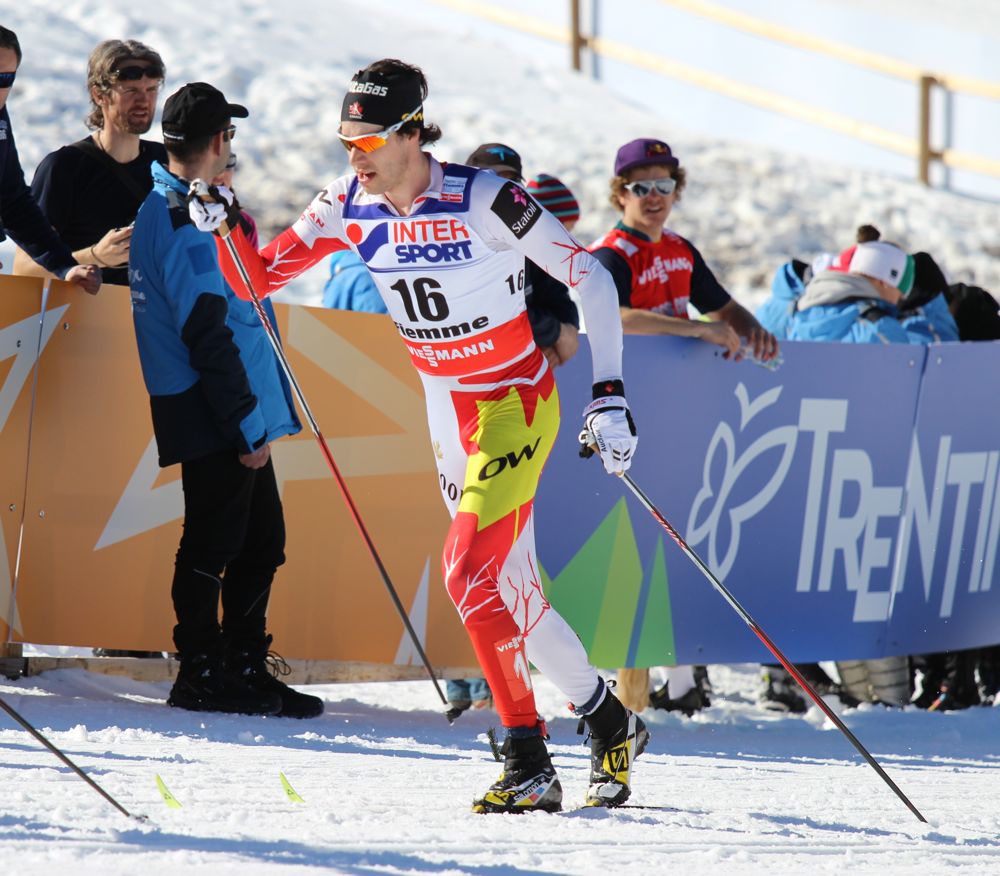
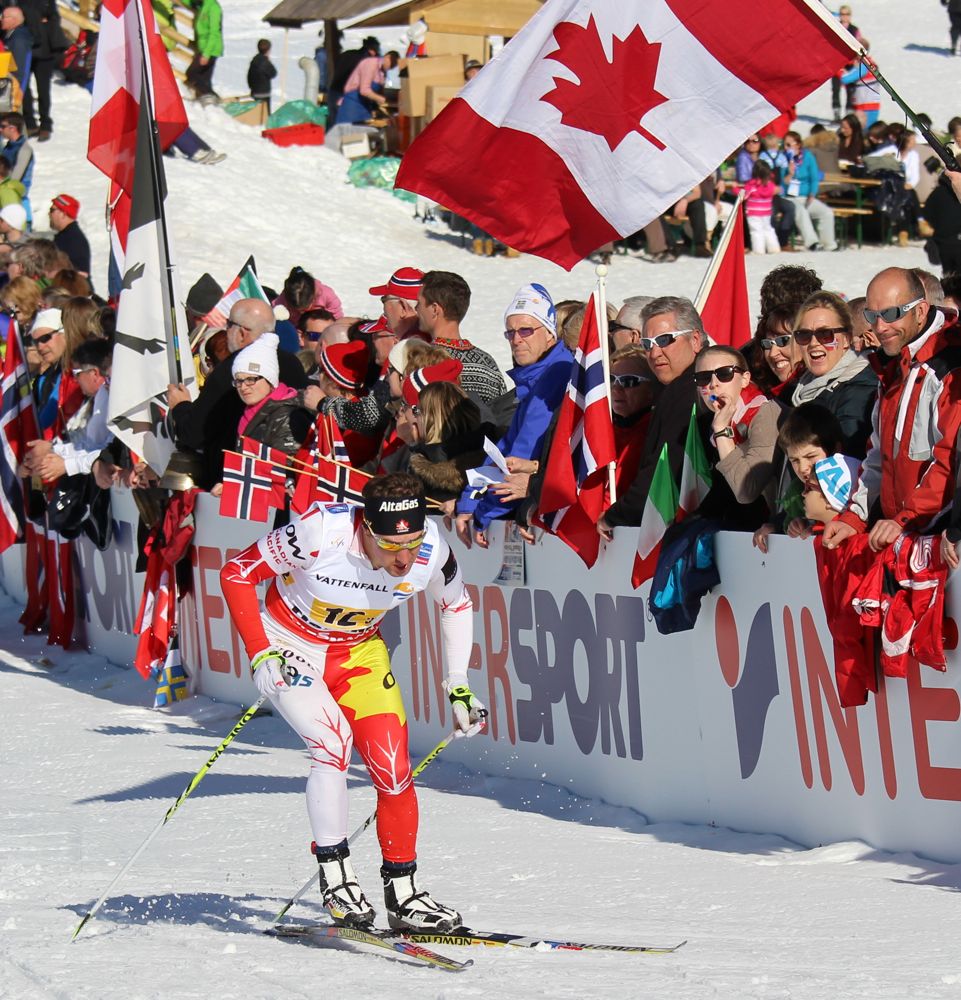
    Canadian Alex Harvey on his way to placing 28th in Sunday's 50 k classic mass start at the 2013 World Championships in Val di Fiemme, Italy.
    Canadian Alex Harvey striding on a hot and slushy afternoon at the 2013 World Championships in Val di Fiemme, Italy. The classic-sprint bronze medalist placed 28th in Sunday’s 50 k classic mass start after hoping to contend for another podium.

    FasterSkier’s coverage of the 2013 FIS Nordic World Ski Championships in Val di Fiemme, Italy, is brought to you by the generous support of Fischer Sports.

    VAL DI FIEMME, Italy – Alex Harvey flat out wanted the podium on Sunday. On a great day, he believed he could win.

    Two years ago, the Canadian World Cup Team member had been fifth in the 50-kilometer freestyle mass start at the Nordic World Ski Championships in Olso, Norway. Better yet, Harvey became Canada’s first male to medal at World Championships last week, placing third in the classic sprint. But that wasn’t his race; the 50 k classic mass start was.

    On a day with temperatures rising about 12 degrees (53 Fahrenheit) in the relentless afternoon sun, it was clear from the get-go it wasn’t going to be an easy one. Wax technicians scrambled to nail the wax and athletes prepared for the slush-fest, six-lap 50 k.

    Unfortunately for Harvey, he just wasn’t feeling it early. Icing skis didn’t help, he said, yet he managed to hang with the lead group for the first half of the race. Around the 25 k mark, it became clear he wasn’t going to contend for the podium. Nearly 30 seconds behind the chase group, Harvey was 29th and a minute and 15 seconds behind Sweden’s eventual winner Johan Olsson, who controlled the race from nearly the start to the finish.

    Harvey was leading a second pack of nine, which included Finland’s Matti Heikkinen and Marcus Hellner of Sweden. Canadian head coach Justin Wadsworth told Harvey that catching back up with the group was possible. He knew it was going to be difficult nonetheless.

    “You never know, if he changed the skis on one of the laps and maybe started to feel good and the pack slowed down,” Wadsworth said. “Today was pretty interesting because that main group, somebody kept pushing the pace a bit. It was tough to be on that back end of the group. You saw that for [Norway’s Petter] Northug, too, he was in the same situation.”

    The two-time defending World Champion and 2010 Olympic gold medalist in the 50 k, Northug stayed with the pack throughout the race and ended up 21st, two minutes behind Olsson. Harvey finished 28th, 4:31.4 back.

    “It was bad,” Harvey said. “The body wasn’t there. … The first lap, it didn’t feel easy enough for the pace we were going. It just felt bad. I don’t think it was fatigue. I don’t know what it was.”

    Skiing with teammate Ivan Babikov on the first lap, Harvey seemed to be having more trouble with his skis. “He saw me almost crashing a couple times,” Harvey said. “But it wasn’t just the skis.”

    Canadian Ivan Babikov leads Germany's Andy Kuehne in Sunday's 50 k classic mass start at the 2013 World Championships in Val di Fiemme, Italy. Babikov did not finish after pulling out after 25 k.
    Canadian Ivan Babikov leads Germany’s Andy Kuehne in Sunday’s 50 k classic mass start at the 2013 World Championships in Val di Fiemme, Italy. Babikov did not finish after pulling out after 25 k.

    Nearly 3 ½ minutes back at the halfway point in 43rd, Babikov stopped racing after the third lap. He had also hung with the leaders early and skied behind Olsson at the end of the first lap. Ultimately, however, Wadsworth said Babikov wasn’t feeling it and his skis didn’t help.

    “He didn’t have the body today,” Wadsworth said. “He was just working so hard and he couldn’t make the skis go to catch the group.”

    For them to have succeeded, Wadsworth explained they needed “decent enough skis that [they] weren’t in jeopardy right from the word, ‘Go,’ ” he said. “The ice was coming off, it sounded like, but it was still jamming a bit.”

    Canada’s third starter, Graham Nishikawa of the Alberta World Cup Academy placed 48th (+13:00.3). “Tough day,” Wadsworth said. “It’s an accomplishment just to finish a race like this.”

    On the final day of World Championships, Wadsworth summed up the week as a “moderate success.” Harvey started them off with bronze in the classic sprint, and he and Devon Kershaw followed up with fourth in the team sprint, 0.03 seconds off the podium. Babikov placed a career-best fourth in the 15 k freestyle individual, but on Friday, the team was disappointed with finishing 12th in the 4 x 10 k relay.

    “With Lenny sick for the sprint and Devon pretty much out with his body, I guess it’s been just like it’s been the whole year, really rough for us,” Wadsworth said. “So much sickness and injuries and just fighting it. Nothing’s been smooth.”

    Kershaw, who sat out Sunday’s 50 k, has been fighting stomach ailments since mid-January. According to Wadsworth, he recently had blood tests and will get a full screening to determine the problem, and will skip next weekend’s World Cup in Lahti, Finland, to recover.

    “He’s gonna take a week off and see if he can rest up for Drammen,” Wadsworth said.

    — Audrey Mangan contributed reporting

    Results

  • Olsson Skis Race of His Life for World Championships 50 k Gold

    Olsson Skis Race of His Life for World Championships 50 k Gold

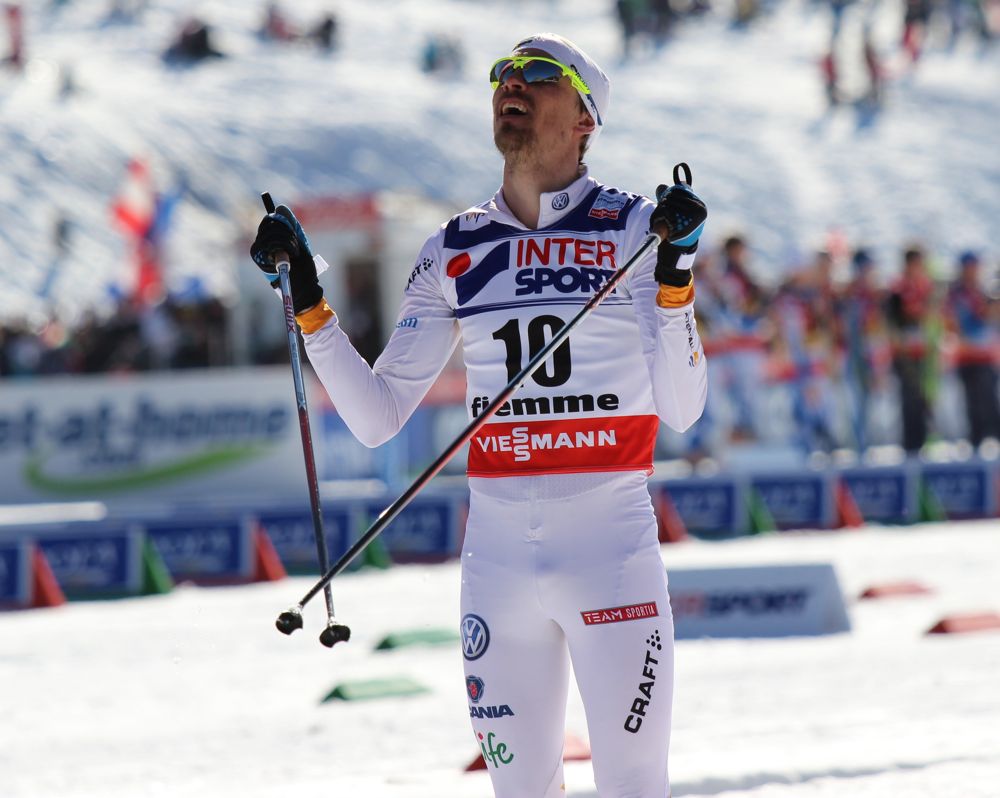
    Sweden's Johan Olsson celebrates his victory in Sunday's 50 k classic mass start at the 2013 World Championships in Val di Fiemme, Italy. It was his first individual gold and Sweden's first at this year's championships.
    Sweden’s Johan Olsson celebrates his victory in Sunday’s 50 k classic mass start at the 2013 World Championships in Val di Fiemme, Italy. It was his first individual gold and Sweden’s first following six silvers at this year’s championships.

    FasterSkier’s coverage of the 2013 FIS Nordic World Ski Championships in Val di Fiemme, Italy, is brought to you by the generous support of Fischer Sports.

    VAL DI FIEMME, Italy – Had it been anyone else, the veterans in Sunday’s 50-kilometer classic mass start would have thought Johan Olsson was crazy. But the 32-year-old Swede had been racing long enough to know better than to blow a race that long less than a quarter of the way in. Or did he?

    Three-time overall World Cup and Tour de Ski winner Dario Cologna couldn’t be too sure. Unlike those who broke away earlier in the mass start – like Swiss teammate Curdin Perl, who did so in the first kilometer (and later in the first of six laps, a group of five led by Sweden’s Anders Södergren) – Cologna decided Olsson’s breakaway around 11 k was worth worrying about.

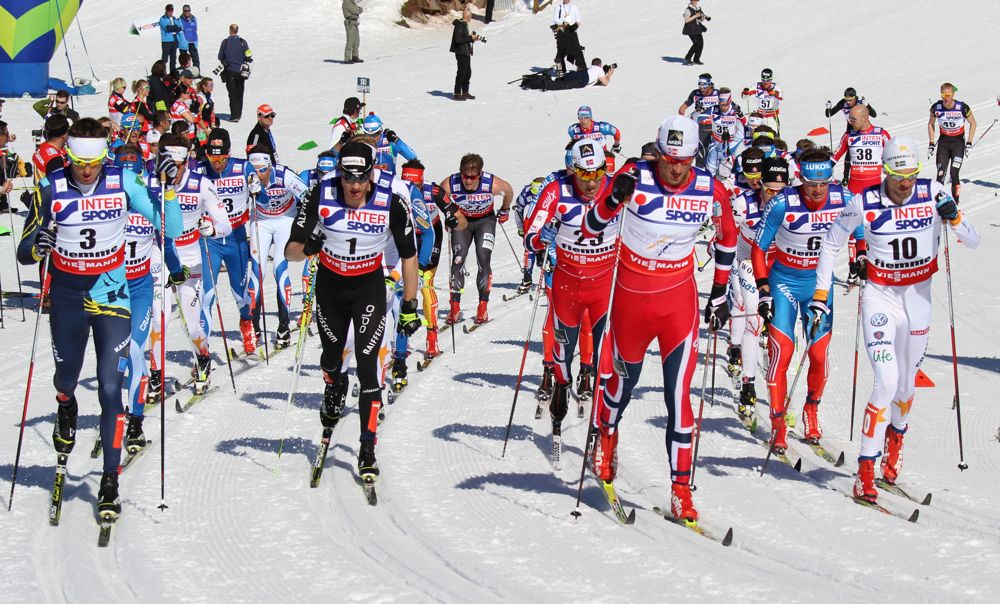
    Leading up the first hill in Sunday's 50 k mass start at 2013 World Championships (from left to right), Kazakhstan's Alexey Poltoranin, Switzerland's Dario Cologna, Norway's two-time defending champ Petter Northug and Sweden's Johan Olsson. The Swede went on to ski alone for nearly 30 kilometers and win his first individual gold by 12.9 seconds over Cologna.
    Leading up the first hill in Sunday’s World Championships 50 k mass start (from left to right), Kazakhstan’s Alexey Poltoranin, Switzerland’s Dario Cologna, Norway’s two-time defending champ Petter Northug, and Sweden’s Johan Olsson. Olsson went on to ski alone in the lead for nearly 30 kilometers and win his first individual gold by 12.9 seconds over Cologna.

    Six seconds back, Cologna caught the 2010 Olympic relay champion around 12.5 k, and the two skied together for the next 8 ½ kilometers. Meanwhile, Russia’s Maxim Vylegzhanin and Alexander Legkov worked to close the gap from behind, coming within 11 seconds of the leaders at the 20.5 k checkpoint.

    Moments later, Cologna crashed on the infamous descent athletes call the “elevator shaft.” He was trailing Olsson, caught off balance and fell alone. Initially stunned, Cologna picked himself off the ground before being swallowed by the chase group.

    Led by Legkov and Vylegzhanin, the pack was giving Olsson some leeway early in the race. Few thought he could hold it, but they were going to respect him nonetheless and conserve for their own purposes of getting through a hot and sunny afternoon, with temperatures soaring above 12 degrees Celsius (53 Fahrenheit). Meanwhile, the Swede willed himself up front, pushing harder to extend the gap.

    Halfway through the race, Olsson had 28 seconds between him and Kazakhstan’s Alexey Poltoranin. There were another 25 men just behind Poltoranin, but Olsson didn’t care. He kept his mind blank, he said, and focused on his own race.

    Sweden's Johan Olsson (r) leads Dario Cologna of Switzerland early in Sunday's 50 k classic mass start at the 2013 World Championships in Val di Fiemme, Italy. Cologna crashed on a downhill around 21 k, and Olsson skied away for the win.
    Sweden’s Johan Olsson (r) leads Dario Cologna of Switzerland early in Sunday’s 50 k classic mass start at the 2013 World Championships in Val di Fiemme, Italy. Cologna crashed on a downhill around 21 k, and Olsson skied away for the win.

    At one point, Olsson did think about the 50 k at the 2010 Olympics, where he took third, one second behind Norwegian winner Petter Northug and Germany’s silver medalist Axel Teichmann. But that was completely different. Olsson was having the race of his life on Sunday, skiing alone in the front, and if he could hold it, he’d be thrilled.

    It wasn’t until 500 meters before the finish that Olsson truly believed he could win it.

    Olsson had challengers, notably Lukas Bauer of the Czech Republic, who came within 27 seconds of the Swede with 15 k remaining. Olsson’s teammate Daniel Richardsson opted not to change skis before the last lap and came within 12 seconds of him, but Olsson was confident his own skis were better. If not, he’d use whatever energy he had left to help his teammate win. Sweden needed a gold badly in these World Championships, and Olsson was determined to secure it in some form.

    As it turned out, neither Bauer nor Richardsson posed a threat, as their separate efforts drained them both. Legkov consistently led the chase group, which remained around 20-strong for much of the race, and came within 25 seconds of Olsson with less than five kilometers remaining.

    Still, it wasn’t enough. Olsson refused to relent throughout the entire last lap, pushing all the way into the finish.

    Entering the stadium alone, the Swede didn’t let off. Just a hundred meters or so before the finish, he put his hands to his lips and kissed the sky, then took a few strides across the line. After 50 k, he didn’t have the energy nor the demeanor to showboat, and he simply stood soaking up the moment.

    “I was so happy when I finished; I saw no reason to lay on the ground,” Olsson said at a post-race press conference. “Maybe I can catch a cold or something.”

    Cologna, who took the lead at the start of the last lap then conserved within the pack, positioned himself in second for the last two kilometers. Cruising down the second-to-last downhill, he extended his gap on Legkov, Rønning and Poltoranin, respectively.

    The four chased him up the hill, and the group challenged one another for the podium. Far enough ahead, Cologna claimed silver without much trouble, 12.9 seconds behind Olsson, who won in 2:10.41.4. Poltoranin outsprinted Legkov by 2.7 seconds for third (+16.8).

    For Olsson, it was his first individual victory at World Championships, and his third medal of the week after taking second in both the 15 k freestyle and 4 x 10 k relay. Both times, he had been a runner-up to Norwegian favorite Petter Northug, who had won the 50 k at the last two World Championships. Olsson predicted Northug could be unbeatable again, which was part of the reason he seized the chance to pull away early.

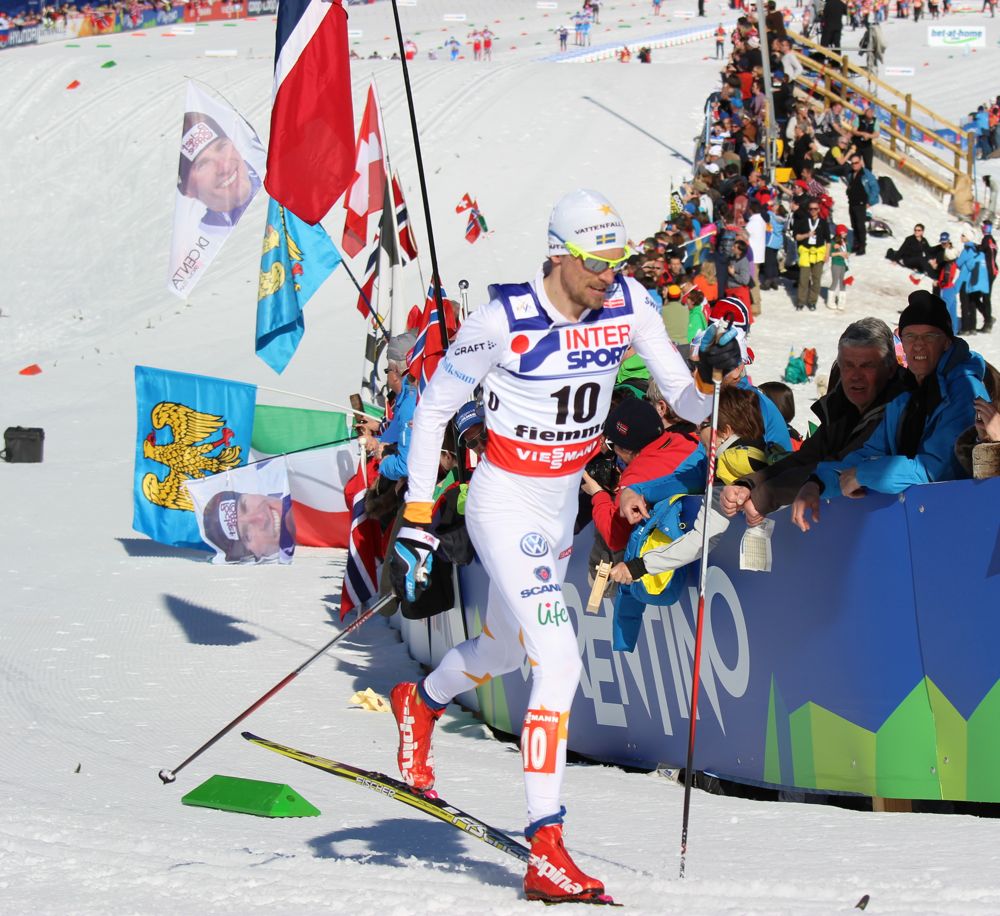
    Sweden's Johan Olsson holding his own way off the front in the World Championships 50 k classic mass start Sunday in Val di Fiemme, Italy.
    Sweden’s Johan Olsson holding his own way off the front in the World Championships 50 k classic mass start Sunday in Val di Fiemme, Italy.

    Swedish men’s coach Arild Monsen told NRK he instructed his guys to go hard early and raise the average speed of the race.

    “The plan was to avoid that Northug would have the opportunity to win,” Monsen said. “It has happened too many times.”

    At the same time, Northug was never really a threat, skiing within the group for most of the race and finishing 21st, two minutes behind Olsson.

    “It was going hard from the start,” Northug told NRK. “I had hoped it would go quiet, at least the first three kilometers. I lacked that little extra today, and [then] it became heavy.”

    Even Olsson didn’t expect to take off like he did.

    “I felt pretty good so I just thought that, ‘OK this might be a really bad move, but I’m going to try to be offensive today and make something of this race,’ ” he said.

    Skiing alone for nearly 30 k, he said the most stressful part about it was when his lead stopped growing. Less than a minute wasn’t enough, he thought.

    “I thought that this gap is too small, and at least I’m gonna try to make them work to catch me  in the last lap,” Olsson said. “It was just like, ‘I don’t want any other medal than the gold so I don’t care.’ I just went for it and that felt really good because I felt like I almost had nothing to lose.”

    When he finally secured gold, he said it meant everything.

    “I think the 50 k is the finest thing you can win in the World Championships,” Olsson said. “I think still my performance today means more than the gold medal, what I did out there, that I could go solo and just finish first.”

    Like most everyone who witnessed it, Norway’s coaches were impressed. Team director Vidar Løfshus told NRK that he’s never witnessed anything like it: a man going it alone for most of 50 k on a flat-out hot day.

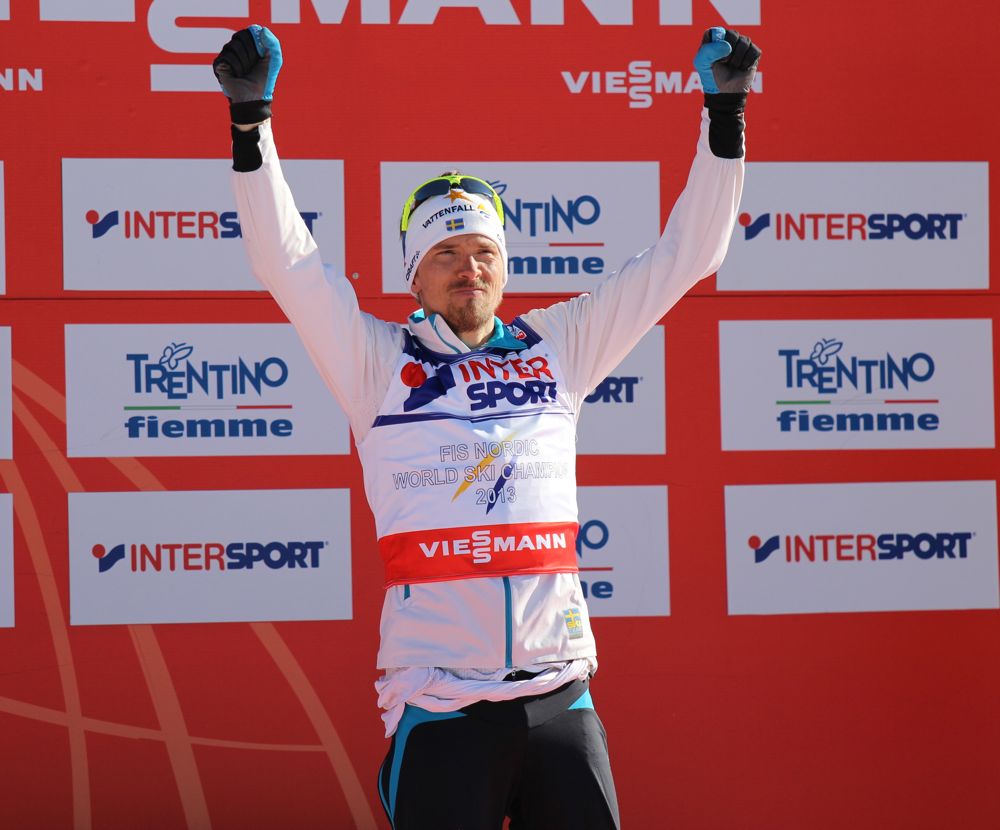
    Sweden's Johan Olsson soaks up his first individual gold at World Championships on Sunday after the 50 k classic mass start in Val di Fiemme, Italy.
    Sweden’s Johan Olsson soaks up his first individual gold at World Championships on Sunday after the 50 k classic mass start in Val di Fiemme, Italy.

    “I think it almost is the greatest 50-kilometer achievement what we’ve seen today,” Løfshus said, according to a translation. “When you go [30 k] in front of this slush, as it says something about that man there.”

    Watching Olsson, Løfshus was confident the group would catch him on the last lap. So was Norway’s service chief, Knut Nystad.

    “I was pretty sure that Olsson should be obtained,” Nystad said. “It was awesome that he did.”

    Cologna said that once he started skiing with the pack, he knew Olsson would be tough to catch unless he started to fade.

    “I know that he can ski very fast for a long time,” Cologna said. “I thought, ‘If he’s not very tired in the end, it would be hard to get him.’ … It wasn’t possible to win the gold medal, but he deserved to win today. It was a very strong race by Johan.”

    Olsson dedicated the race to his wife and former teammate, Anna Olsson (formerly Dahlberg), a 2006 Olympics team sprint champion.

    “Getting the win is something you dream about,” he said. “This gold medal is for my family, my wife, who takes care of our child while I’m here. She makes it possible for me to still be an elite skier.

    “This is our first individual gold medal and I don’t think she’s going to make a comeback,” he said with a laugh.

    For Sweden, it was the first gold after six silvers in this year’s World Championships.

    Norway failed to make the podium for the first time in an individual event all week, with Rønning leading the team in fifth (+20.2). Tord Asle Gjerdalen was sixth, Petter Eliassen 14th, Sjur Røthe 17th and Northug 21st.  Germany’s Hannes Dotzler skied a solid race from start to finish, placing seventh (+32.7). Vylegzhanin was eighth, Jens Filbrich of Germany ninth and Richardsson 10th. Bauer ended up 16th, one minute out of first.

    Results

  • Bjørgen Completes Collection with Meaningful 30 k World Title

    Bjørgen Completes Collection with Meaningful 30 k World Title

    Norway's Marit Bjorgen celebrates her fourth gold and fifth medal of the 2013 World Championships after winning Saturday's 30 k classic mass start in Val di Fiemme, Italy. She hadn't won the ultimate distance event at a World Championships since 2005.
    Norway’s Marit Bjorgen celebrates her fourth gold and fifth medal of the 2013 World Championships after winning Saturday’s 30 k classic mass start in Val di Fiemme, Italy. She hadn’t won the ultimate distance event at a World Championships since 2005.

    FasterSkier’s coverage of the 2013 FIS Nordic World Ski Championships in Val di Fiemme, Italy, is brought to you by the generous support of Fischer Sports.

    VAL DI FIEMME, Italy – When you’ve already got 11 World Championship golds, it takes something really special to bring you to tears for the 12th one.

    For Norway’s Marit Bjørgen, who’s been on the Nordic World Ski Championships podium more than any other woman, it wasn’t the 19 medals or number of victories that moved her. The 32-year-old was focused on her achievement in the one race that mattered most to her this season: the 30-kilometer classic mass start.

    One of the sport’s most unrivaled competitors, Bjørgen had some losses over the years that haunted her. Placing second to Poland’s Justyna Kowalczyk in the 2010 Olympics and again at the 2011 World Championships to teammate Therese Johaug topped the list. Both were in 30 k mass starts, and while she viewed the latter as “winning a silver,” it still wasn’t the gold she had hoped for.

    Norway's bronze medalist in Saturday's 30 k classic mass start, Therese Johaug (l) and fourth-place finisher Heidi Weng congratulate teammate Marit Bjørgen on her fourth victory at the 2013 World Championships in Val di Fiemme, Italy. (Photo: Fiemme2013)
    Norway’s bronze medalist in Saturday’s 30 k classic mass start, Therese Johaug (l) and fourth-place finisher Heidi Weng congratulate teammate Marit Bjørgen on her fourth victory at the 2013 World Championships in Val di Fiemme, Italy. (Photo: Fiemme2013)

    And so she tailored her focus and training this season specifically for that race. That’s why Bjørgen, who will turn 33 in 19 days, took nearly a month off of World Cup racing from late-January to mid-February. That’s why she collapsed at the finish on Saturday and held her head in her hands as two of her teammates, Johaug and Kristin Størmer Steira, kneeled to hug her.

    Her fourth gold medal of the week, and fifth in five races, meant everything to her. And she had worked for 30 k to get it.

    “I think the other girls on the team knew that this was one of my biggest goals this season,” Bjørgen said at a post-race press conference. In the last 300 meters, she outsprinted Kowalczyk to claim her first 30 k gold since the 2005 World Championships in Oberstdorf, Germany.

    “They were really happy for me and we are really happy for the whole team that we have been so good in this World Championships,” she added. “We have taken many golds, many medals, but we haven’t celebrated yet.”

    Bjørgen contributed to Norway’s total of 16, between the men and the women, with four golds – one of which was in Thursday’s relay – and a silver. Johaug added another gold and a bronze, which she took 5 seconds behind Kowalczyk on Saturday.

    Easily a race favorite, Bjørgen had her work cut out for her in taking on Johaug, the defending world champ and this week’s 10 k winner, and Kowalczyk, the classic distance specialist. Of course there were other contenders, too, like Norway’s Heidi Weng, Germany’s Nicole Fessel, Sweden’s Anna Haag and Charlotte Kalla. Finland’s Kerttu Niskanen and Anne Kyllönen were also in the mix, along with Masako Ishida of Japan, but none came close to the podium.

    A sea of red: Three Norwegians and Poland's Justyna Kowalczyk (second from l) lead early in Saturday's 30 k classic mass start at the 2013 World Championships. Therese Johaug (l) and eventual-winner Marit Bjørgen work up fron, followed by Heidi Weng (r) and Sweden's Charlotte Kalla (8).
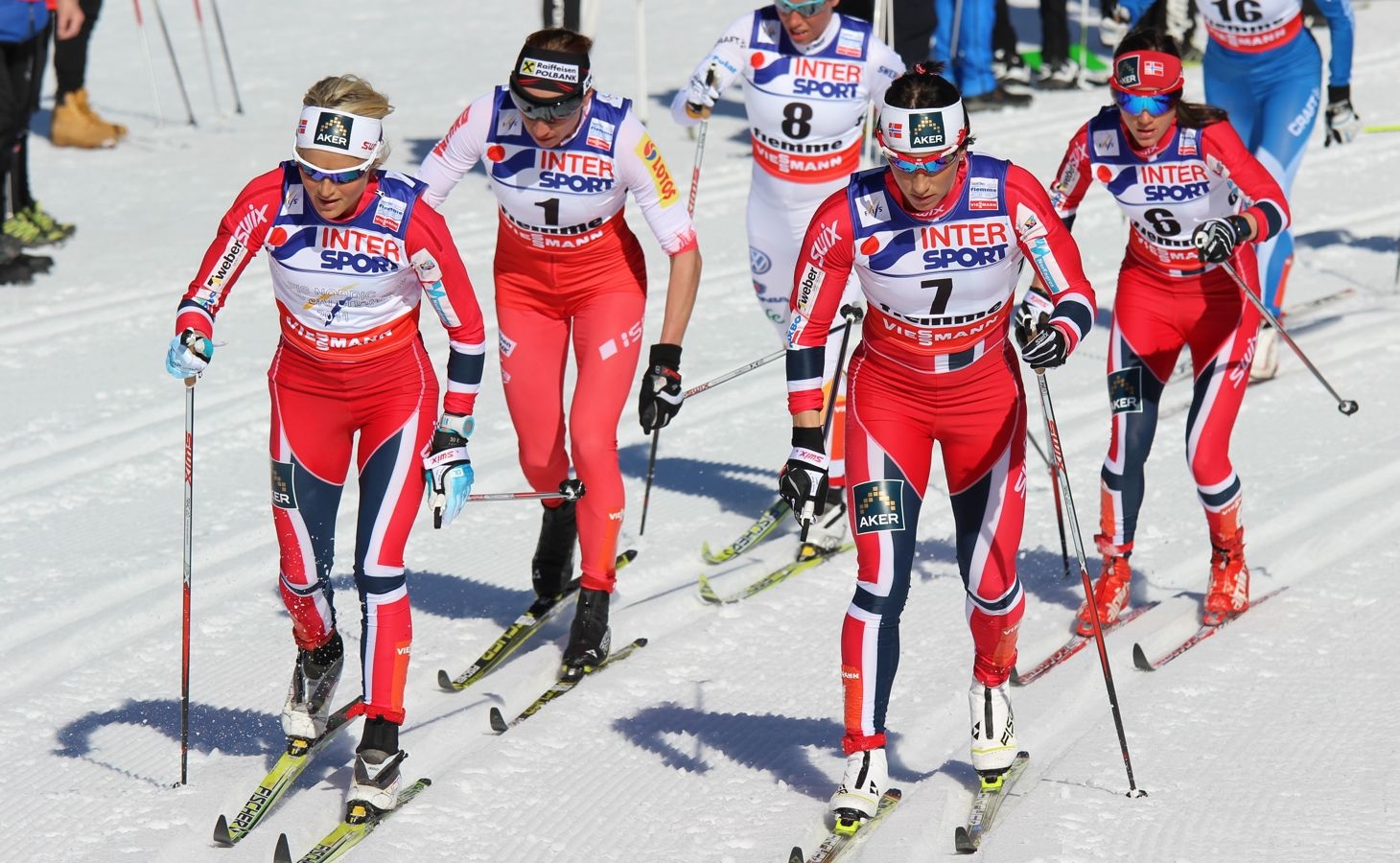
    A sea of red: Three Norwegians and Poland’s Justyna Kowalczyk (second from l) lead early in Saturday’s 30 k classic mass start at the 2013 World Championships. Therese Johaug (l) and eventual-winner Marit Bjørgen work up fron, followed by Heidi Weng (r) and Sweden’s Charlotte Kalla (8).

    The Kowalczyk-Bjørgen-Johaug trio wouldn’t let them.

    On the third of six laps, the three frontrunners – who led from the start – began to drop the 42 other starters. Weng held onto the back, and Steira and Haag managed to stay within a few seconds behind. By the halfway point, six women remained in contention, with Bjørgen up front then Johaug, Kowalczyk, Weng, Fessel and Haag, respectively.

    Lap four was a different story.

    With temperatures soaring above 10 degrees Celsius (50 Fahrenheit) and the snow softening accordingly, several of the top skiers had already changed their skis.

    Ishida was the only one besides Kowalczyk, Bjørgen and Johaug to catch a glimpse up front, albeit briefly, at the start of lap three after they did so. She chose to go another round on the same boards and paid the price, slipping up the final climbs.

    Japan's Masako Ishida briefly took the lead on the start of the third of six laps in Saturday's 30 k classic mass start at the 2013 World Championships in Val di Fiemme, Italy. She finished 10th.
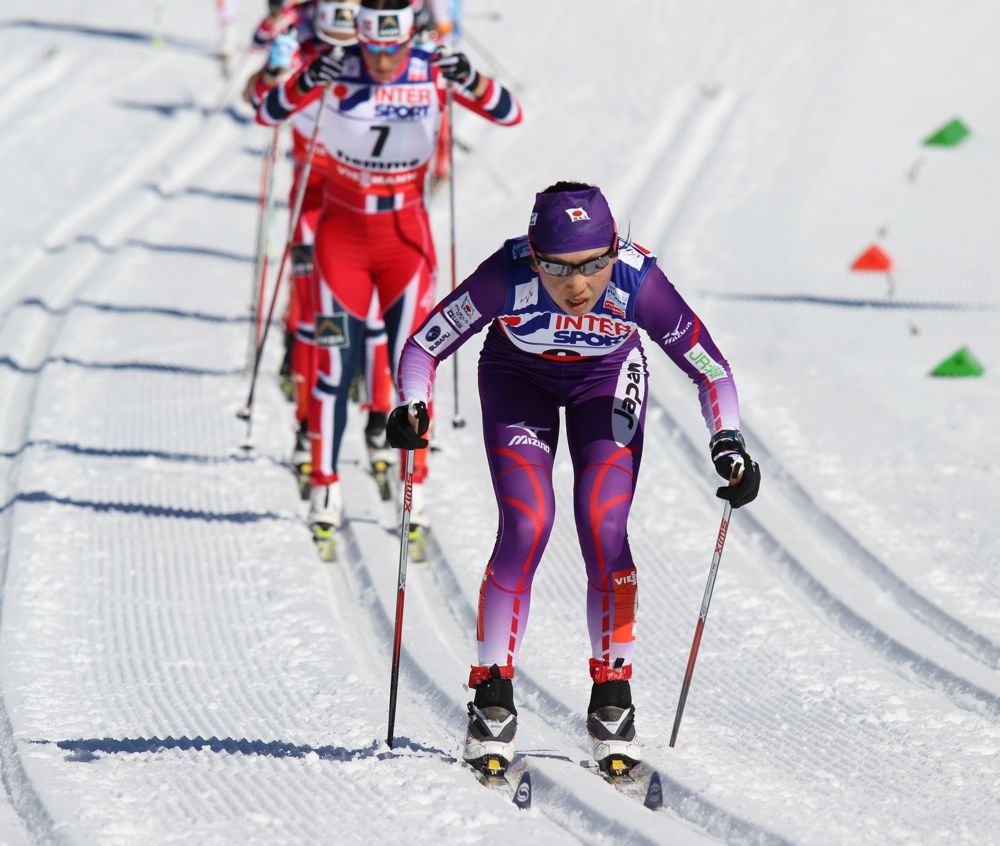
    Japan’s Masako Ishida briefly took the lead, ahead of eventual-winner Marit Bjørgen (7), on the start of the third of six laps in Saturday’s 30 k classic mass start at the 2013 World Championships in Val di Fiemme, Italy. She finished 10th.

    “I can’t make diagonal up so I was losing power,” Ishida said after falling back to 10th and fighting to keep that position to the finish. “It was difficult. I am not so strong like Marit Bjørgen and Justyna. … I made a mistake today.”

    Still going strong up front halfway through the fourth lap, Kowalczyk, Johaug and Bjørgen steadily distanced themselves from the rest. Coming through the stadium at 20 k, Weng skied in fourth, 11 seconds back, and Fessel another 8.3 behind in fifth.

    All the top women used their second opportunity to change skis, and Kowalczyk, Johaug and Bjørgen left the stadium with a sizable gap. Less than two kilometers later at the high point of the course, they were 34 seconds up on Weng.

    Over the top of one of the last hills, Johaug looked over her shoulder to make sure no one was close. Comforted by the empty expanse behind her, she proceeded to switch leads with Kowalczyk and her teammate for the rest of the penultimate lap.

    Heading into the stadium with 5 k to go, Bjørgen, Kowalczyk and Johaug had 42.5 seconds between them and Weng. Fessel was 57.4 seconds back in fifth, and Ishida was sixth, nearly a minute and 30 seconds behind, leading a chase group with Steira, Haag and Niskanen. Kyllönen was another nine seconds back in 10th.

    A Norwegian coach shouts to Marit Bjørgen (l) and Therese Johaug (c) as they set out on the last of six laps in Saturday's 30 k classic mass start with Poland's Justyna Kowalczyk. Bjørgen went on beat Kowalczyk by 3.7 seconds.
    A Norwegian coach shouts to Marit Bjørgen (l) and Therese Johaug (c) as they set out on the last of six laps in Saturday’s 30 k classic mass start with Poland’s Justyna Kowalczyk. Bjørgen went on beat Kowalczyk by 3.7 seconds.

    The front three remained relatively quiet on the last lap, saving their energy for the final two kilometers. Bjørgen and Johaug strategically hung in second and third throughout the loop while Kowalczyk worked to stay ahead, picking up the pace on second-to-last hill.

    Her Norwegian contenders answered, and they kept their order — Kowalczyk, Johaug, Bjørgen – over the top. As Kowaczyk double poled into the ensuing downhill, the other two stood up, conserving.

    At the bottom, Bjørgen carried her momentum and pulled alongside Kowalczyk. With less than a kilometer left, this was the moment everyone had been waiting for. Bjørgen challenged Kowalczyk to the top, and Johaug slipped back while struggling with her kick. Before the descent, Bjørgen let Kowalczyk lead into the stadium.

    “I attacked on the last climb and Justyna answered on that, and I thought, ‘I have to be in second [on the] downhill and use my power,’ ” Bjørgen told reporters.

    The tactic worked as Bjørgen slingshot past Kowalczyk over the final bump before the long stretch to the finish. There, she extended her gap by several hundred meters, leaving no question who was the 30 k world champion. Bjørgen beat Kowaczyk by 3.7 seconds in 1:27:19.9, and Johaug finished third, 8.7 seconds back.

    “I am proud of myself,” Bjørgen told NRK. “This here was my goal in this championship. I have an incredibly good feeling right now.”

    Sitting on the ground with her head tucked into her knees, Kowaczyk absorbed the loss. She later told reporters she was disappointed, but pleased with the effort. Asked why she didn’t attack first, she said she tried, but without much luck.

    “Today, Norway skied really good,” Kowalczyk said. “After 30 k, you don’t think nothing, you try to ski fast and fast and nothing more.”

    The race’s 2011 freestyle champion, Johaug immediately congratulated her teammate at the finish, hovering over Bjørgen as she recovered on the ground.

    “Justyna was much stronger than me to the last hill,” Johaug said at the press conference. “I won the bronze medal today. It was a special race; it was a lot of tactics and nobody wants to go first. This World Championships has been a dream for me. I leave here with one gold and one silver and one bronze medal, and of course, the gold in the relay so I could never dream about that before.”

    Nearly a minute and 30 seconds off the podium, Weng was the third Norwegian across in fourth, 1:38.3 behind Bjørgen. Fessel notched her best individual result at World Championships in fifth (+1:49.0) and Haag was sixth (+2:05.7). Finland took seventh and eighth with Niskanen and Kyllönen, respectively, and Steira placed ninth. Ishida made it into the top 10, and Kalla, who competed in all six races at this year’s World Championships was 11th.

    Norway's Marit Bjørgen Norway nabs a clear-cut victory over Justyna Kowalczyk of Poland in Saturday's 30 k classic mass start at the 2013 World Championships in Val di Fiemme, Italy.
    Norway’s Marit Bjørgen Norway nabs a clear-cut victory over Justyna Kowalczyk of Poland in Saturday’s 30 k classic mass start at the 2013 World Championships in Val di Fiemme, Italy.

    Of note:

    While it had nothing to do with the race, one of the most comical moments of the day came at the post-race press conference. Just when it seemed like the question-and-answer session with Bjørgen had come to an end, an Italian reporter asked her what she thinks about being a “sexy icon” – “sexikon” in Euro-speak.

    Bjørgen laughed.

    “I’m not thinking about that,” she said. “I’m getting [to be] an old women and I think the younger women on the team like Therese and Heidi are much more sexy.”

    Results

  • Canadian Men: ‘Just Wasn’t Our Day’ in World Championships Relay

    Canadian Men: ‘Just Wasn’t Our Day’ in World Championships Relay

    Ivan Babikov sets out on the third leg for Canada in Friday's 4 x 10 k relay at the 2013 World Championships in Val di Fiemme, Italy. Out of contention by Devon Kershaw's second leg, the Canadians finished 12th.
    Ivan Babikov sets out on the third leg for Canada in Friday’s 4 x 10 k relay at the 2013 World Championships in Val di Fiemme, Italy. Out of contention by Devon Kershaw’s second leg, the Canadians finished 12th.

    FasterSkier’s coverage of the 2013 FIS Nordic World Ski Championships in Val di Fiemme, Italy, is brought to you by the generous support of Fischer Sports.

    VAL DI FIEMME, Italy – The Canadian men had no reason to believe they couldn’t contend for the podium in the Friday’s 4 x 10-kilometer relay at Nordic World Ski Championships.

    In the last week, they had already been there with Alex Harvey notching a career-best bronze in the individual classic sprint – a best for a Canadian male at World Championships as well. Harvey and Devon Kershaw went on to place fourth in the freestyle team sprint, just three-hundredths of a second from third, and on Wednesday, Ivan Babikov set another new mark of fourth in the 15 k freestyle individual start.

    With those three primed for the relay, it seemed anything was possible. Scramble leg Lenny Valjas was a bit of an unknown coming off a long bout with strep throat, but everyone knew what the 24-year-old was capable of, with two individual World Cup podiums this season.

    But as athletes often say, relays are relays, and anything can happen.

    In an effort to get in front and out of trouble early, Valjas started strong for the team, taking the lead on a long downhill halfway through the first of three 3.3 k laps. At the end of the first loop, he remained within 3.7 seconds of eventual-winner Norway up front, and moved from 13th in the pack to seventh by the end of the second lap.

    Lenny Valjas heads out of the stadium alongside Italy's Dietmar Nöckler on the first leg of Friday's 4 x 10 k relay at World Championships in Val di Fiemme, Italy.
    Lenny Valjas heads out of the stadium alongside Italy’s Dietmar Nöckler on the first leg of Friday’s 4 x 10 k relay at World Championships in Val di Fiemme, Italy.

    Valjas charged up the big climb out of the stadium in fourth behind Germany’s Hannes Dotzler, Sweden’s Daniel Richardsson and Evgeniy Belov of Russia, but lost contact with the leaders on the second half of the course.

    Valjas tagged Kershaw in 11th, 11.6 seconds back, in a chase group with Czech Republic, France and Belarus.

    “I blew up for the last 100 meters,” Valjas said. “But other than that I was happy with the effort, happy to be out of bed.”

    While the group caught up to the nine others on the first kilometer of the second leg, Kershaw worked hard to hang on, holding onto 11th through the first lap. The next time around, he slipped to 12th, four seconds behind France’s Maurice Manificat.

    Unable to stay with the Frenchman, Kershaw fell nearly 20 seconds out of contention midway through and handed off to Babikov in 12th, 1:47.3 seconds out of the lead and 39.1 behind Finland in 11th.

    “I was in a pain cave like I’ve never been in. I was a mess,” Kershaw wrote in an email.

    Burdened by stomach problems for since mid-January, he explained he felt good enough out of the start, but was having some issues with his skis, specifically his kick.

    “For sure the skis weren’t the best-ever, but even with the skis I had I should have been able to limit my losses,” he continued. “I was struggling to even stay on my feet coming down the last hill. And that’s after getting just shelled by 1:50. One minute fifty. In a classic race. … The last lap was just so, so, so difficult. It was the worst-feeling race of my entire career – and that’s not being dramatic.”

    Canada's Devon Kershaw tries to stay in contention on the second leg of Friday's 4 x 10 k relay at World Championships in Val di Fiemme, Italy. He finished his leg 12th and the Canadians finished in the same position.
    Canada’s Devon Kershaw tries to stay in contention on the second leg of Friday’s 4 x 10 k relay at World Championships in Val di Fiemme, Italy. He finished his leg 12th and the Canadians finished in the same position.

    “Devon’s body just wasn’t there,” head coach Justin Wadsworth said. “It’s been up and down for him all year, especially in the last six weeks with his stomach issues. Some days in training he feels great, like team sprint day, he felt great, and then other days he feels horrible.

    “We had doctors look at it and we still need to do more looking at it to make sure we know what the problem is, but right now it’s like rolling the dice.”

    From the third leg on, the Canadians struggled to stay relevant, skiing alone for the rest of the race. Babikov tried to close the gap, but realized early it would be near impossible to catch anyone. Ahead of him, American Noah Hoffman was pushing with Finland and France to cut down a 30-second gap, but they were at least 50 seconds from his reach.

    “It was hard to ski by myself and see no one around,” Babikov said. “Today didn’t feel super great, not as good as two days ago.”

    He and the rest of the field were also fighting warming conditions above 10-degrees Celsius (50 Fahrenheit) as the race wore on under the beating afternoon sun.

    Alex Harvey takes it out for Canada on the last leg of the 2013 World Championships men's 4 x 10 k relay in Val di Fiemme, Italy. Positioned in 12th without anyone around him, Harvey finished 12th for Canada.
    Alex Harvey takes it out for Canada on the last leg of the 2013 World Championships men’s 4 x 10 k relay in Val di Fiemme, Italy. Positioned in 12th without anyone around him, Harvey finished 12th for Canada.

    Babikov tagged Harvey as their anchor in 12th, 2:41.5 out of first. Finland was a minute and 15 seconds ahead of them in 11th. Harvey completed the final three laps alone, finishing in 12th, 2:39.3 behind Norway.

    “I’m feeling good,” Harvey said. “It’s been five days since I’ve raced now. I was feeling pretty rested this morning so just used that as a prep for the 50 [kilometer classic mass start on Sunday].”

    The Canadians’ finish tied their result from the 2011 World Championships in Oslo, but it wasn’t even close to what they were hoping for. In 2009, the team was fifth with Kershaw, Harvey, Babikov and the now-retired George Grey. They placed seventh in the 4 x 10 k at the 2010 Olympics.

    “Just one of those days that we should not really think about much and forget,” Babikov said.

    Valjas was healthy, but hadn’t raced in over a week, Harvey explained. “And Devon had a rough one, really rough one,” he said.

    “It’s racing and when the body just isn’t there there’s nothing you can do about it,” Wadsworth explained.

    “We have a good team and today just wasn’t our day,” Valjas said. “We’ll make it there.”

    — Audrey Mangan contributed reporting

    Results

  • Norwegian Men Rack Up Seventh-Straight Relay Title at World Champs

    Norwegian Men Rack Up Seventh-Straight Relay Title at World Champs

    Petter Northug (l) checks back before celebrating Norway's victory in the 4x10 k relay at 2013 World Championships on Friday in Val di Fiemme. Calle Halfvarsson (second from l) anchored Sweden to silver, Russia's Sergey Ustiugov (second from r) was third, 0.2 seconds ahead of Italy's David Hofer.
    Petter Northug (l) checks back before celebrating Norway’s victory in the 4×10 k relay at 2013 World Championships on Friday in Val di Fiemme, Italy. Calle Halfvarsson (second from l) anchored Sweden to silver, Russia’s Sergey Ustiugov (second from r) was third, 0.2 seconds ahead of Italy’s David Hofer.

    FasterSkier’s coverage of the 2013 FIS Nordic World Ski Championships in Val di Fiemme, Italy, is brought to you by the generous support of Fischer Sports.

    VAL DI FIEMME, Italy – After so much buildup, so many strategic moves throughout the men’s 4 x 10-kilometer relay at the 2013 Nordic World Ski Championships on Friday, everything almost literally came to a grinding halt in the fourth and final leg.

    The worker bees hard done their jobs for the first 30 kilometers of the race, making the last 10 into something like a Sunday stroll on a 10-degree Celsius (50-degree Fahrenheit) afternoon.

    As expected, Petter Northug was among those controlling the pace early in the anchor leg. Norway’s relay closer for the last four World Championships, he wasn’t about to use his reserves too early. The frontrunners of the six-man group, Italian David Hofer and Russia’s Sergey Ustiugov weren’t keen on going hard, either.

    Just to show how slow they were going, Northug started single sticking, basically walking up the second climb.

    “It went slower than when you take your mother on Easter,” he later told NRK, according to a translation. “There were a lot of tactics, and I get what I want.”

    As the pack approached the high point of the 3.3 k course, all six men stood up. Hofer did so first to let German Axel Teichmann and Ustiugov pass by, and Switzerland’s Remo Fischer, Sweden’s Calle Halfvarsson and Northug casually tucked behind him. Several thousand spectators watching the antics on the stadium big screens booed with dissatisfaction. Come on guys, this is a race.

    Petter Northug prematurely shrugs off Norway's seventh-straight men's relay title at World Championships on Friday in Val di Fiemme, Italy. He beat Sweden's Calle Halfvarsson (second from l), Russia's Sergey Ustiugov (third) and David Hofer of Italy in fourth for his second gold of the week. (Photo: Fiemme2013)
    Petter Northug prematurely shrugs off Norway’s seventh-straight men’s relay title at World Championships on Friday in Val di Fiemme, Italy. He beat Sweden’s Calle Halfvarsson (second from l), Russia’s Sergey Ustiugov (third) and David Hofer of Italy in fourth for his second gold of the week. (Photo: Fiemme2013)

    But in a World Championship relay, that’s how it often goes.

    “You need to race a little bit tactical, come from behind, save power for the last round because then you know it will be attacks,” Northug explained.

    He quietly hovered near the back within a second or two of the lead until he decided it was time to go. Everyone knew some kind of surge would come, they just didn’t know when.

    While the front guys played mind games, American Tad Elliott made up 59 seconds after starting in ninth. He caught the group on the second lap and led Northug up the second climb.

    By the next hill, however, Elliott’s effort caught up with him and the 25-year-old Colorado native started to slip behind. Meanwhile, Finland’s Matti Heikkinen continued to make up ground on the leaders after starting nearly a minute and a half back in 11th. Heikkinen reached the group on the third lap and surged to the front early, but failed to hold on halfway through. He fell to the back of the group in seventh while Northug took the lead. Hofer and Ustiugov skied behind him, followed by Halfvarsson, Fischer and Teichmann.

    With about 1 ½ k remaining, Northug led the downhill into a relatively boring part of the course. Before then, nothing really happened on the straightaway before the second-last descent. Northug caught his competitors off guard and attacked on the flat, where Halfvarsson in second responded quickest.

    In his first World Championships, the 23-year-old Swedish anchor knew this was his moment and managed to get ahead of Northug on the fast downhill, taking the inside corner on the sharp bottom curve.

    While Halfvarsson and Northug battled back up to the top, Ustiugov and Hofer put their heads down trying to hang on. The Swede led the final downhill, looking back to see how close Northug was. Really close.

    The two sped over the last bump before the stadium and began the much-anticipated sprint showdown. Northug free skated alongside Halfvarsson to take the lead and just before finish, he let everyone know who the winner was. With Halfvarsson a few meters behind, Northug put his hands out and shrugged. No big deal.

    Now a nine-time world champion, Northug claimed the seventh-consecutive world champs relay victory for Norway, in which he and Tord Asle Gjerdalen, Eldar Rønning and Sjur Røthe combined for a winning time of 1:41.37.2.

    Sweden (Daniel Richardsson, Johan Olsson, Marcus Hellner and Halfvarsson) came up 1.2 seconds short for its sixth silver medal of the week. Russia (Evgeniy Belov, Maxim Vylegzhanin, Alexander Legkov and Ustiugov) edged Italy (Dietmar Nöckler, Giorgio Di Centa, Roland Clara and Hofer) by 0.2 seconds for third, 2.4 seconds behind Norway.

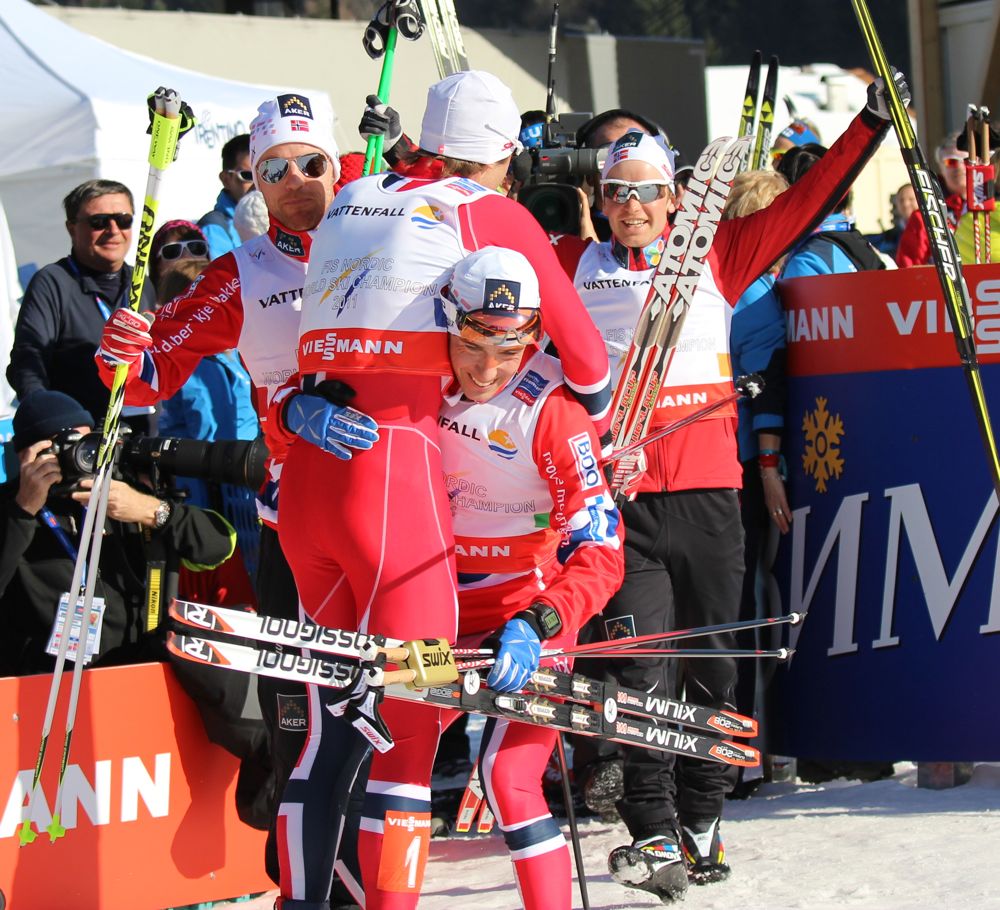
    Eldar Rønning hoists teammate Petter Northug after the Norwegian anchor sealed the team's seventh straight World Championships relay victory on Friday in Val di Fiemme, Italy. Tord Asle Gjerdalen (l) and Sjur Røthe (r) join the party.
    Eldar Rønning hoists teammate Petter Northug after the Norwegian anchor sealed the team’s seventh straight World Championships relay victory on Friday in Val di Fiemme, Italy. Tord Asle Gjerdalen (l) and Sjur Røthe (r) join the party.

    “Two hundred and fifty meters before the line I knew it was gold,” Northug told reporters. “So that feels amazing.”

    “It’s awful fun to win the relay, and a dream to fight against Sweden at the end,” he told NRK. “I know what that rests on my shoulders. It is almost a scandal to be number two.”

    His teammates set him up according to plan. Their scramble leg, Gjerdalen again filled in for Martin Johnsrud Sundby, who’s been out sick since Wednesday’s 15 k (Gjerdalen started in his place and earned bronze). Easily recognized as Norway’s Aviator-wearing guy, Gjerdalen wore his trademark sunglasses while putting the team in second at the first exchange, just 0.3 seconds behind Germany’s Hannes Dotzler.

    (The Germans ended up seventh behind Finland in fifth and Switzerland after Teichmann crashed twice on the last lap. “Throughout my career, I’ve never had so much bad luck,” the 33-year-old Teichmann told Südkurier.)

    On the second classic leg, Rønning kept the Norwegians close and tagged to Røthe in fifth, 3.4 seconds behind Switzerland’s Dario Cologna, who skied a commanding second leg. Italy, Russia and Germany were also in the mix, along with Sweden’s Olsson, who tagged to Hellner four seconds back in sixth.

    “It was tough,” Olsson told reporters. “In my case, maybe the glide wasn’t 100 percent today compared to some of the other competitors on my leg. It’s tough on the mind, too, when you don’t have the maximum skis under your feet.”

    After taking his second-straight silver to Northug, who won Wednesday’s 15 k individual skate, Olsson told NRK: “He loses maybe one in a hundred sprints. It’s amazing how he does it again and again. No matter how the race is, he always wins.”

    Norway's Torde Asle Gjerdalen (r) puts the team in contention early on the first of four 10-kilometer legs in Friday's relay at 2013 World Championships in Val di Fiemme, Italy. Norway won by 1.2 seconds over Sweden.
    Norway’s Torde Asle Gjerdalen (r) puts the team in contention early on the first of four 10-kilometer legs in Friday’s relay at 2013 World Championships in Val di Fiemme, Italy. Norway won by 1.2 seconds over Sweden.

    On the third leg, Legkov lifted Russia to first by the last exchange, 0.6 seconds ahead of Hellner. Røthe came through after the Swede in third, 2 seconds behind Legkov.

    “The idea was that Petter should never have been in the lead on the last stage,” Hellner told NRK.

    While he didn’t lead from the start, he was close enough to capture it.

    “I did everything I could, but I had nothing to answer. I had no strength left,” Halfvarsson told NRK.

    “I tried to get a few meters up in the last uphill, but he is too strong,” he explained to reporters. “I had no chance. I’m happy with the silver because this is my first medal, but when it’s so close to gold, it’s not so fun.”

    Northug suggested Sweden should’ve chosen someone else and said his team was surprised to see Halfvarsson listed as its anchor.

    “But we say thank you,” Northug told SVT. “All glory to him, he beat several strong sprinters, but he still has a ways to go.”

    For Røthe, who also started his first World Championships relay, the gold was everything he’d hoped for.

    “It’s great to be world champion,” he told NRK. “It was a fun duel with Sweden.”

    “A big job for the whole team, but the last guys, they’re just walking, slow, slow, slow and doing a massive sprint,” Gjerdalen told reporters. “That’s entertainment, that’s excitement and a lot of adrenaline. The whole stadium was just quiet. It’s cool!”

    At the finish, the King of Sweden, Carl XVI Gustaf, congratulated Northug.

    “Nice that you stopped by,” Northug reportedly said.

    “We did not talk so much,” he explained to NRK. “He said it was a close fight, and seemed very pleased that Sweden had taken the silver.”

    Results

  • Babikov Gets His, Fourth in World Champs 15 k Individual Start

    Babikov Gets His, Fourth in World Champs 15 k Individual Start

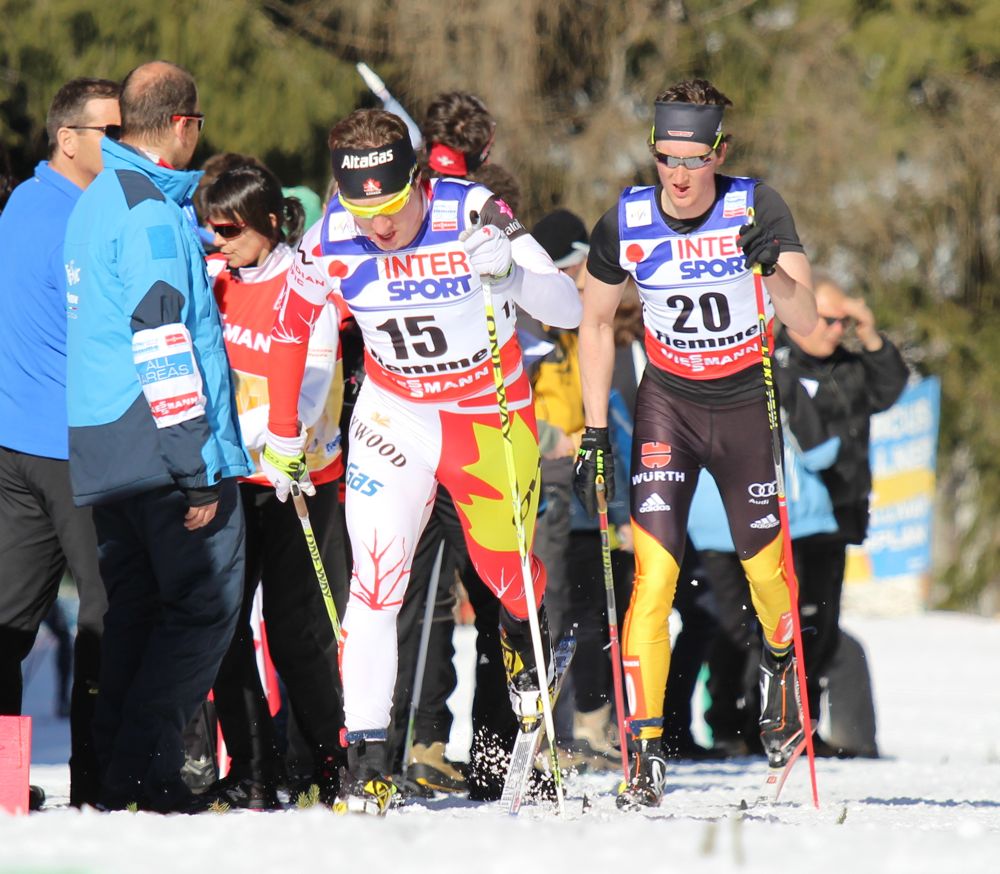
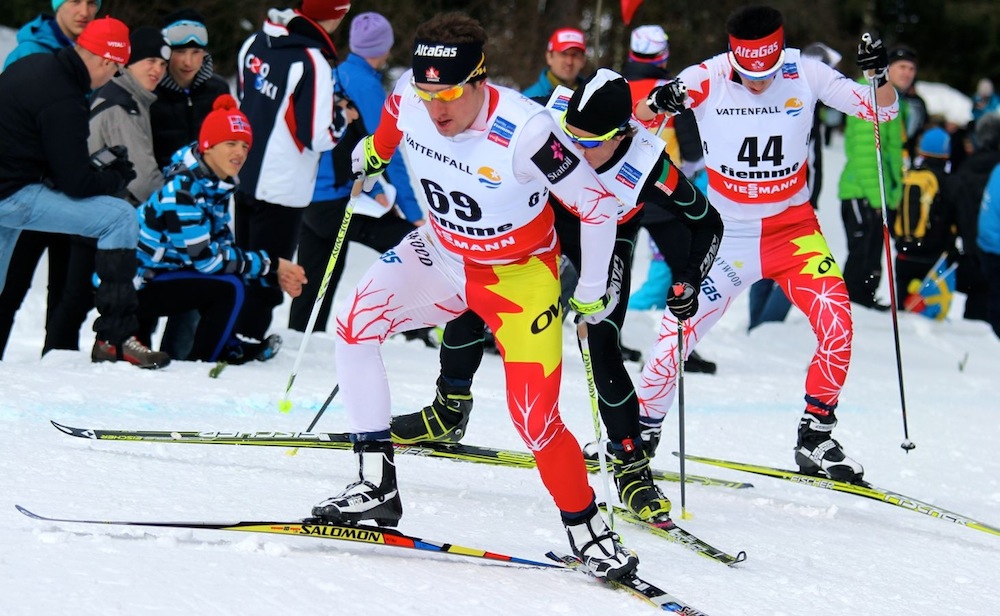
    Ivan Babikov (l) leads fellow Canadian Graham Nishikawa (r) of the Alberta World Cup Academy during Wednesday's 15 k freestyle individual start at 2013 World Championships in Val di Fiemme, Italy.
    Ivan Babikov (l) leads fellow Canadian Graham Nishikawa (r) of the Alberta World Cup Academy during Wednesday’s 15 k freestyle individual start at 2013 World Championships in Val di Fiemme, Italy.

    FasterSkier’s coverage of the 2013 FIS Nordic World Ski Championships in Val di Fiemme, Italy, is brought to you by the generous support of Fischer Sports.

    VAL DI FIEMME, Italy – Ivan Babikov had no doubt this season would be tough. At 32 years old, the Canadian World Cup skier was coming in with high aspirations in a sort-of test year before the Sochi Olympics in his native Russia.

    Not sure how much longer he’d stay in the game, Babikov planned to compete through Sochi and the year after in 2015. But he’d have to see how things went, Babikov told FasterSkier in early November.

    As long as he was still competitive, he’d continue, he said. But with a wife, infant and 10-year-old at home in Canmore, Alberta, dedicating himself to full-time international racing wasn’t easy. Babikov prepared for the season ahead knowing the first half would be manageable. He’d be back for the Canadian World Cups in December and able to spend some time in Canmore with family. After that, it would be a bit of a grind from the Tour de Ski at the end of December through late March.

    Babikov put his head down early and notched his best overall finish in the Tour in seventh, which appeared to be a good indicator of things to come.

    The focus, however, remained on World Championships.

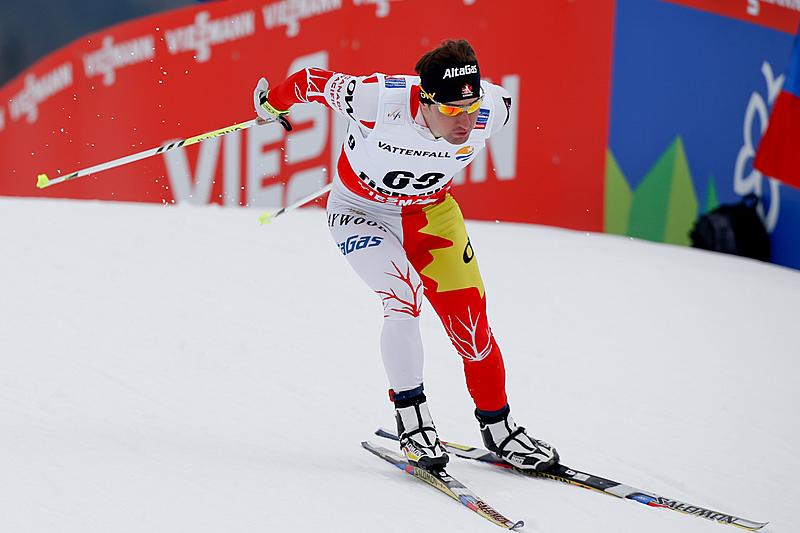
    Ivan Babikov (CAN) racing to a career-best fourth in Wednesday's 15 k freestyle individual start at World Championships in Val di Fiemme, Italy. (Photo: Fiemme2013)
    Ivan Babikov (CAN) racing to a career-best fourth in Wednesday’s 15 k freestyle individual start at World Championships in Val di Fiemme, Italy. (Photo: Fiemme2013)

    On Wednesday at the Nordic World Ski Championships in Val di Fiemme, Babikov had one of the best races he could ask for, finishing fourth in the 15-kilometer freestyle individual start.

    Ultimately ranking 32nd the 1.8 k checkpoint, the oldest member of the Canadian national team picked up the pace on the second lap to end up with the seventh-fastest time through 9.4 k. His 11.8 k time ranked sixth of more than 90 competitors, and when he finished in bib 69, he took the lead.

    While extremely satisfying, the moment was short lived. Norway’s Tor Asle Gjerdalen was 31.3 seconds faster across the line, bumping Babikov to second less than a minute later. A couple minutes passed before Johan Olsson captured the lead, and Petter Northug later topped the Swede by 11.8 seconds to win in 34:37.1.

    Babikov was 53.6 seconds back in fourth for Canada’s best men’s result in a World Championships distance event. Thirty-one years ago, Pierre Harvey (Canadian National Team member Alex Harvey’s dad) set the previous record of 16th in the 15 k freestyle event at the 1982 World Championships.

    Three years ago at the 2010 Vancouver Olympics, Babikov was fifth in the 30 k mass start pursuit and helped the men’s 4 x 10 k relay place seventh. At the 2009 World Championships the year before, he captured fifth with Harvey, Devon Kershaw and George Grey in the relay.

    With an individual start to tackle Wednesday, Babikov said he was encouraged by the splits he heard throughout the three-lap course. It also didn’t hurt that Russian favorite Alexander Legkov started 12 minutes behind him and the two skied together on Babikov’s second lap.

    “When I heard he was starting behind me I thought, ‘OK, it could be a good ride, at least for a little bit,’ ” Babikov recalled. “But when I realized I could stay with him and maybe even a little bit faster, that was the plan. When I heard the splits going my way, I was getting more psyched and could push even harder.”

    At the finish, Babikov soaked up the possibility of standing on the podium as he awaited his fate, but wasn’t disappointed when he came up short.

    “Too bad I didn’t have enough time to sit in the chair,” Babikov joked. “Damn!”

    But in all seriousness, he said this World Championships has finally shaped up into what he’d hoped after coming off an illness last week. He was 31st in Saturday’s 30 k skiathlon.

    “It’s all turned around for me,” he said. “It feels so good to feel my body back, my legs. Today felt really good, much, much better than past races here and the skis felt amazing … So it’s a fourth place, a wooden medal, how do you say it? But still pretty happy.”

    Historically, however, Val di Fiemme hasn’t been a bad place for Babikov. On Jan. 5, he was seventh in the Tour de Ski’s 15 k classic mass start there and went on to place second on the nearby hill climb up Alpe Cermis on Jan. 6, the last day of the Tour. Back in 2009, he won the final climb in Val di Fiemme and was fourth on the last stage of the Tour in 2010.

    “I love those trails, they’re hard, and I love Italy,” Babikov said in November about the 2013 World Championships venue, predicting, “It’s gonna be awesome.”

    He was right. The result was his best at World Championships and tied his top World Cup result of fourth in 2005 Canmore 15 k freestyle race.

    “Then was a surprise for me,” Babikov said. “Today, maybe surprise, too, after feeling so bad. I’m still really happy.”

    Head coach Justin Wadsworth said Babikov’s personal best was a long time coming, especially after the two worked hard on consistency in his training throughout the offseason.

    “Consistent strength training, consistent easy on the easy days and stuff like that,” Wadsworth said. “And he’s finally started to do it.”

    Before the race, Wadsworth thought Babikov was capable of the top five.

    “He’s been leading our team almost all season in the distance events … but that was incredible,” Wadsworth said. “He’s made some big sacrifices, like being away from his family on this period, and this makes it totally everything worthwhile I think.”

    Babikov agreed.

    “I’m sacrificing a lot of time with my kids and my wife, but that’s how it is,” he said. “It’s maybe the last two years of my career and they understand it and they try to make my life easier. Every day I work super hard and just thinking of the Olympics and the World Champs … I’m happy to be here.”

    Canadian World Cup Team member Devon Kershaw (l) leads Japan's Akira Lenting up one of several climbs in Wednesday's 15 k freestyle individual start at World Championships in Val di Fiemme, Italy.
    Canadian World Cup Team member Devon Kershaw (l) leads Japan’s Akira Lenting up one of several climbs in Wednesday’s 15 k freestyle individual start at World Championships in Val di Fiemme, Italy.

    Kershaw, who wasn’t pleased with his own race in 33rd (+2:54.0), was inspired by Babikov’s performance.

    “Ivan was absolutely stunning today,” Kershaw wrote in an email. “To take advantage of the grueling course and conditions and light it up like that – wow. It was amazing to witness. I am so proud of him – to call him a teammate and buddy.”

    Wadsworth said the soft snow conditions on a balmy 8-degree Celsius afternoon suited the man they affectionately call Babs the Bulldog.

    “The harder it is [the better],” Wadsworth said. “We knew it would play into his hands a bit.”

    However, it wasn’t so great for Kershaw.

    “The slower conditions are not his style,” Wadsworth said. “I was bummed to see that new snow and I knew would slow it up enough that that could be a factor. He likes to glide and have it fast and hard. It was hard, it just wasn’t real fast today.”

    “Not much to say about my race today. It was another nightmare,” Kershaw wrote. “I am so disappointed it’s actually pretty stupid. It’s only ski racing, I know that – but it’s hard to describe how bad I’ve felt in pretty much every single race this season. Not much fun. I’m just glad I have such amazingly talented teammates … Alex, Lenny, Babs – those guys are the best.”

    With Kershaw, they’re also the anticipated starters for Friday’s 4 x 10 k relay, where Valjas remains somewhat of an unknown. Wadsworth said he had a good workout on Wednesday and is trying to get back up to speed after a bout with strep throat.

    Canada’s fifth man, Graham Nishikawa of the Alberta World Cup Academy was 39th (+3:03.6) on Wednesday for a much-improved result after he was  51st in the skiathlon.

    “It’s getting better for me, but that was really hard,” Nishikawa said. “I just wanted to have a good race, feel good. There were some sections that were positive, starting to feel better for sure. In the middle, I died quite hard.”

    Even mentally tougher is having people pass you on their first lap while you’re on the second or third time around. “[Switzerland’s Dario] Cologna came through me just like a rocket on my last lap,” Nishikawa said.

    Unsure whether he’ll compete in Sunday’s 50 k classic mass start, Nishikawa said he’s enjoyed his first World Championships so far.

    “The fans are great, the course is so hard, great atmosphere and we’re having pretty good success on the team,” he said. “It’s pretty cool to see Ivan get fourth, it was an awesome day for him. Alex has been on fire and they just missed another medal on the team sprint. Everything’s super positive on our team, and it’s pretty cool. Everybody’s stepping up.”

    Results

  • Northug Adds 15 k Title to His Resume; ‘When He’s at His Best, No One Can Beat Him’

    Northug Adds 15 k Title to His Resume; ‘When He’s at His Best, No One Can Beat Him’

    Petter Northug charging hard up to the high point of the course on his second of three laps in the men's 15 k freestyle individual start at the 2013 World Championships on Wednesday in Val di Fiemme, Italy. Northug won the race by 11.8 seconds for his first individual start world title.
    Norway’s Petter Northug charging hard up to the high point of the course on his second of three laps in Wednesday’s 15 k freestyle individual start at the 2013 World Championships in Val di Fiemme, Italy. Northug won the race by 11.8 seconds for his first individual-start title and eighth at World Championships.

    FasterSkier’s coverage of the 2013 FIS Nordic World Ski Championships in Val di Fiemme, Italy, is brought to you by the generous support of Fischer Sports.

    VAL DI FIEMME, Italy – For Norway, Sunday’s men’s team sprint letdown at the 2013 Nordic World Ski Championships turned out to be a blessing. It was hard to see then, but Petter Northug not advancing to the finals with teammate Pål Golberg was a good thing.

    While the 22-year-old Golberg recovered after blacking out, Northug slept off the frustrations and woke up Monday anxious to get back out there. That’s when it hit him: why not do the 15-kilometer individual start on Wednesday?

    Sure, it wasn’t historically his best event. Heck, he hadn’t won a 15 k freestyle individual race on the World Cup before. But with seven World Championship golds behind him, Northug, 27, figured he didn’t have much to lose. And he had energy to spare.

    The 89th of 95 starters, Northug went into Wednesday’s race with a specific plan: attack for gold. The first of three laps went exceptionally well as he clocked the fastest time through the 1.8 k checkpoint. The mass-start specialist held his high pace for the second 5 k loop, reaching 9.4 k faster than anyone else, and put his head down the third time around.

    With race favorites Dario Cologna of Switzerland and Russia’s Alexander Legkov behind him, Northug knew he couldn’t let off and was most concerned with Sweden’s Johan Olsson in front of him. The last starter in soft, sluggish conditions with temperatures up around 8 degrees Celsius (46 Fahrenheit), Cologna struggled early, ranking eighth through 1.8 k at the high point of the course. At the tail end of the second lap, he was third fastest, but fell to fifth at 11.8 k.

    “I heard the times of Dario so I knew that it’s going to be a fight between me and Johan Olsson,” Northug said at a post-race press conference. “When I was out on the second lap, then I just focused on the time of Johan.”

    Losing some time on the third lap, he focused on staying upright for the long downhill back toward the stadium.

    “I started to get a little bit worried, but I knew my plan the last two downs was more to stay on my legs and not to fall,” Northug said. “I knew I had the seconds to win.”

    As Olsson, who started six minutes before Northug in bib 77, sat in the leader’s chair at the finish, Northug cruised down into the stadium with a 40-second lead. Looking exhausted, he mustered a final sprint and barely made it through before losing control and veering sharply to the left – almost into the boards.

    His head then his back hit the ground, and he exhaled. A few moments later, Northug realized what he had done in winning his first title at this year’s World Championships in an event he didn’t typically dominate.

    “When you’re so tired as I was today you don’t hear any crowds; it feels like you’re racing alone,” he said of coming into the stadium for the last time. “You just want to cross the finish line because you’re tired … and then you cross the line and you get a couple minutes to rest and you hear the crowd and you hear the speaker announce that you are world champion. That’s an amazing feeling.”

    Petter Northug just before becoming a 15 k freestyle World Champion on Wednesday in Val di Fiemme, Italy. (Photo: Fiemme2013)
    Petter Northug just before becoming a 15 k freestyle World Champion on Wednesday in Val di Fiemme, Italy. (Photo: Fiemme2013)

    Northug took the individual crown with a time of 34:37.1. Olsson was second, 11.8 seconds behind, for his first individual silver medal at World Championships. Norway’s Tord Asle Gjerdalen earned his second individual bronze at worlds (+22.3) after placing third to Northug in the 50 k freestyle mass start two years ago in Oslo, Norway.

    Ivan Babikov made history for Canada in fourth, 53.6 seconds behind Northug and 31.3 seconds off the podium, notching his nation’s best finish in a 15 k skate individual start since Pierre Harvey was 16th in 1982.  Norway’s Sjur Røthe placed fifth (+1:03.0) and Cologna ended up eighth, 1:21.1 behind. Starting a minute in front of Cologna and skiing with him near the finish, Legkov ended up 25th (+2:28.7).

    In a race that was by no measures easy with at least six steep climbs per lap, Northug attributed his success to being hungry for redemption and feeling in great shape after last week’s classic sprint (where he was second), Saturday’s skiathlon (where he was fourth) and Sunday’s team sprint (where he and Golberg placed 11th).

    “Today is a day you dream of when you’re an athlete,” Northug said. “You wake up, you feel that you have a lot of power, you want to compete, you want to give your all and also when you then win, it’s amazing.”

    Asked what his eighth World Championships gold meant to him compared to the rest, Northug said nothing could rival his 50 k victory in Olso. “To win a 50 k in a world championship is one of the biggest things I’ve done,” he said.

    Even so, this individual win was pretty significant and counted just the same, he said.

    Sweden's Johan Olsson pushing to the finish of Wednesday's 15 k freestyle individual start at the 2013 World Championships in Val di Fiemme, Italy. Olsson took second, 11.8 seconds behind Norway's Petter Northug.
    Sweden’s Johan Olsson pushing to the finish of Wednesday’s 15 k freestyle individual start at the 2013 World Championships in Val di Fiemme, Italy. Olsson took second, 11.8 seconds behind Norway’s Petter Northug.

    His closest challenger on Wednesday, the 32-year-old Olsson knew what Northug was capable of. Early last season in Kuusamo, Finland, Northug romped the field in a World Cup 10 k freestyle by 23.8 seconds. A month later, he won a World Cup 30 k freestyle in Davos, Switzerland, by nearly a minute.

    “I know when he’s at his best, no one can beat him,” Olsson said.

    Aware of the splits throughout the race, with Olsson posting the fastest times through the 9.4 and 11.8 k checkpoints before Northug blew them away, he mostly focused on himself.

    “If you should take a medal on the individual start, I think you cannot focus too much on the other competitors,” he said at the press conference. “My biggest enemy on the course is the voices that say, ‘Give up.’ But you have to fight all the time, that’s the way I ski.”

    Olsson stole the spotlight and leader’s position from Gjerdalen, who started 71st and bested Babikov in bib 69 to reach the podium. Notably, the 29-year-old Norwegian senior team member didn’t know he was racing until Wednesday morning, when he received a text message that teammate Martin Johnsrud Sundby was out sick, FIS tweeted.

    “I knew it was my turn to go,” Gjerdalen said. “I must admit I wasn’t very happy because … it’s been four or five years since I’ve been fast in this individual start. I actually wanted to trade this race for the 50 k.”

    Tord Asle Gjerdalen of Norway on his way to securing his second World Championships bronze in Wednesday's 15 k freestyle individual start. Originally not on the start list, Gjerdalen competed in place of teammate Martin Johnsrud Sundby.
    Tord Asle Gjerdalen of Norway on his way to his second World Championships bronze in Wednesday’s 15 k freestyle individual start in Val di Fiemme, Italy. Originally not on the start list, Gjerdalen raced in place of teammate Martin Johnsrud Sundby, who was out sick.

    Regardless, he gave it his all, attacking the course in his signature Aviator sunglasses. Starting 12 minutes before Cologna, Gjerdalen used the Swiss superstar as fuel when Cologna passed him on the second lap. Gjerdalen thanked him at the finish.

    “He turned an individual start into a mass start for me so that’s perfect,” he said.

    “Before I started, I knew the skis would get slower and slower so I was really surprised that I made the podium,” Gjerdalen said of the softening conditions. “When I realized that I knew I had a chance and the coaches were shouting, ‘A medal!” I thought, ‘What?’ That was incredible. It gave me speed.”

    And the Aviators?

    “I use them all the time; they’re fogging, I can’t see,” he joked. “No, they’re really good and it’s become an image for me. I have only one [pair] with me so I hope they don’t break or I lose them, then I have to go buy some new gear. But I suppose [Italy] is the right culture to buy them.”

    Results

  • Canadian Women Take World Champs 10 k for What It’s Worth

    Canadian Women Take World Champs 10 k for What It’s Worth

    Dasha Gaiazova attacking one of several climbs in the women's 10 k freestyle individual start on Tuesday at the 2013 World Championships in Val di Fiemme, Italy. The top Canadian, Gaiazova was 40th.
    Dasha Gaiazova attacking one of several climbs in the women’s 10 k freestyle individual start on Tuesday at the 2013 World Championships in Val di Fiemme, Italy. The top Canadian, Gaiazova was 40th.

    FasterSkier’s coverage of the 2013 FIS Nordic World Ski Championships in Val di Fiemme, Italy, is brought to you by the generous support of Fischer Sports.

    VAL DI FIEMME, Italy – Sometimes you just gotta get out there and race. That’s the attitude the three Canadian women went with in Tuesday’s 10-kilometer freestyle individual start at the 2013 Nordic World Ski Championships.

    On a day marked by average to so-so performances by World Cup team member Dasha Gaiazova, Alberta World Cup Academy skier Emily Nishikawa, and former national team member Brittany Webster (Highlands Trailblazers), head coach Justin Wadsworth pointed out nothing ventured, nothing gained.

    “[We’re] going for good pacing, strong finish and just to stay tough and have the best race possible,” Wadsworth said after the second of three distance races at World Championships. “Where are women are in distance skiing at this time, we just have to really keep focusing on those things and just hope that people have solid races and execute the things that they can do.

    “It’s the same focus we have with anybody,” he added. “Just execute your race plan. You can’t go for a certain place.”

    Gaiazova, 29, was Canada’s top finisher in 40th, 2:14.2 minutes back from winner Therese Johaug of Norway. A classic sprint specialist, Gaiazova said she held some hope for the distance event, especially after placing 27th in a 10 k classic World Cup Jan. 19 in La Clusaz, France.

    “Sometimes I race well in distance,” she said. “Today I was definitely trying to race my best, but it didn’t go so well. … It’s just a kind of average day.”

    Wadsworth said it was good she raced since she’s only got one World Championships event left: the 4 x 5 k relay with Perianne Jones, Nishikawa and Webster.

    “It not only could potentially be a good race for her, it’s good training, too,” he said. “She’s capable of top 30 in a race like today, so she still has to work on her pacing. She’s a little bit too slow out of the start, but she skied a strong second lap.”

    After starting 17th, Gaiazova’s time at the 1.8-k checkpoint ended up ranking 60th of 77 finishers. By 6.8 k, she improved to the 47th-fastest time.

    Three days after a heart concern caused her to drop out of the 15 k skiathlon, Nishikawa replicated her result from last week’s classic sprint at her first World Championships. She was 57th again, this time 3:15.3 back from the winner, but less focused on her result, Nishikawa was grateful to race again.

    On Saturday, the 23-year-old Yukon native felt her heart beating abnormally early in the skiathlon.

    “My heart started [beating] so fast,” she said. “We got it checked out the next day, and if it happens again, we know it’s not dangerous so that was a big relief.”

    Given the go-ahead to compete, Nishikawa said she was happy to be out there on Tuesday.

    “That in itself was a big success, just to finish the race and push hard,” she said.

    Her best World Cup result came in mid-December in Canmore, Alberta, where she was 34th in a 15 k skiathlon. Also in Canmore, Nishikawa was 48th in a 10 k classic mass start.

    “It’s not the best result but I tried my best,” she said Tuesday. “My first good race in a long time.”

    Webster, 25, was less enthused with 68th (+4:21), but tried not to overthink it.

    “My shape is just really bad right now; that’s a year and a half off racing and not training much,” she said. Before having surgery on her leg last fall, Webster took a step back from full-time racing in 2011/2012 and decided to return this season.

    One thing she was reminded of Tuesday: this sport is really hard, especially in a place like Val di Fiemme.

    “All the climbs are really steep and you need to have some good power to put out there,” Webster said. “Racing on the World Cup kind of blows you away. The fact that for every two of your steps they’re taking one and they’re going another foot forward. Just gotta learn how to do that.”

    All in all, “it’s something to go from,” she said. “I have a lot of energy, I just don’t have a lot of fitness. From here you can build. If you’re tired and you go into this, you can’t build from that so at least that’s a positive.”

    With the four remaining Canadian women at World Championships looking forward to the relay, Wadsworth said he’ll confer with women’s coach Eric de Nys and assistant coach Louis Bouchard as to what order they’ll choose. Webster said she would like to do one of the classic legs, but would have to wait to hear what the coaches decide.

    Results

  • Johaug Tops the Queen, Bests Bjørgen in World Championships 10 k Skate

    Johaug Tops the Queen, Bests Bjørgen in World Championships 10 k Skate

    Therese Johaug on her way to capturing gold in the 10 k freestyle individual start at 2013 World Championships in Val di Fiemme, Italy. The Norwegian beat teammate Marit Bjørgen by 10.2 seconds for the win. (Photo: Fiemme2013)
    Therese Johaug on her way to capturing gold in the 10 k freestyle individual start at 2013 World Championships in Val di Fiemme, Italy. The Norwegian beat teammate Marit Bjørgen by 10.2 seconds for the win. (Photo: Fiemme2013)

    FasterSkier’s coverage of the 2013 FIS Nordic World Ski Championships in Val di Fiemme, Italy, is brought to you by the generous support of Fischer Sports.

    VAL DI FIEMME, Italy – Two years ago in Oslo, Norway, Therese Johaug proved that her teammate, three-time Olympic medalist Marit Bjørgen is not untouchable – at least not in a 30-kilometer freestyle mass start.

    The second-most-famous female currently on the Norwegian national team, Johaug beat Bjørgen by nearly 45 seconds in the 2011 event for her first individual World Championships title. Fast-forward to Tuesday, the 24-year-old Johaug was really looking to make something happen in the much-shorter 10 k freestyle individual start at the 2013 Nordic World Ski Championships in Val di Fiemme.

    A whole different ball game, she thought, yet she still held out hope.

    “I have a goal and I have a dream before this World Championships in Val di Fiemme to take the gold medal,” Johaug said at a post-race press conference. “I never thought I could do it in this distance.”

    Before the start of the 1 ½-week championships, with four individual events per gender, Johaug figured her best chance was in the 15 k skiathlon. When that didn’t happen last Saturday, Johaug celebrated her silver-medal finish and Bjørgen’s gold, and refocused for Tuesday.

    “When I wake up this morning … I had a good feeling inside,” Johaug said. “I was really focused that if I could do my best today, I could stand at the top of the podium.”
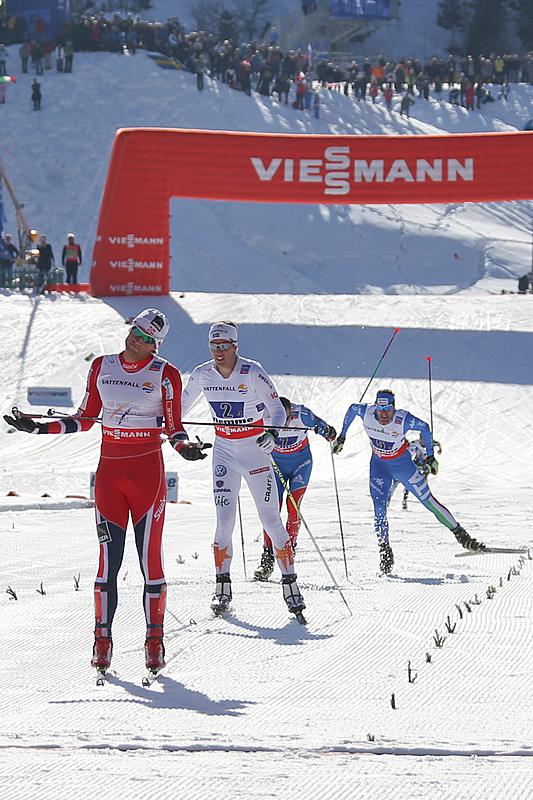
    Women's 10 k freestyle podium at 2013 World Championships: Norway's Therese Johaug (c) in first, Marit Bjorgen (l) in second, and Russia's Yulia Tchekaleva in third.
    Women’s 10 k freestyle podium at 2013 World Championships: Norway’s Therese Johaug (c) in first, Marit Bjorgen (l) in second, and Russia’s Yulia Tchekaleva in third.

    The last of 78 starters, Johaug had the advantage before setting out on the two-lap time trial. Bjørgen started 5 minutes ahead of her, and while Johaug couldn’t physically see her, she knew where she stood throughout thanks to several Norwegian coaches and staff scattered around the course.

    Bjørgen was getting similar information about other top athletes, like German biathlete Miriam Gössner, who ventured to Italy for the individual race and Thursday’s relay, American Liz Stephen and Swedish Olympic champ Charlotte Kalla. The splits were almost constant, Bjørgen said, at least every kilometer, but she could only guess how hard Johaug was pushing behind her.

    So she tried to go just as hard.

    “I knew that today Therese was going to be my hardest competitor,” Bjørgen said at the press conference, a day after Polish rival Justyna Kowalczyk announced she wouldn’t race the 10 k to rest up for Saturday’s 30 k classic. That didn’t really affect Bjørgen; she knew exactly how much of a threat Johaug was.

    “We were fighting all the way today, but in the end of the race, Therese was stronger than me,” Bjørgen said.

    Up on Bjørgen by 4.5 seconds with about three kilometers left at the course’s high point, Johaug continued to pick up the pace on the long descent and last few climbs. As she entered the stadium before the finish, she heard that she was nine seconds ahead of Bjørgen as the current leader.

    Therese Johaug after finishing with the fastest time by 10.2 seconds over Norwegian teammate Marit Bjørgen to win Tuesday's 10 k skate at 2013 World Championships in Val di Fiemme, Italy.
    Therese Johaug after finishing with the fastest time by 10.2 seconds over Norwegian teammate Marit Bjørgen to win Tuesday’s 10 k skate at 2013 World Championships in Val di Fiemme, Italy.

    “I knew that if I push myself to the end of the race, I could do it,” Johaug said.

    On the loudspeaker, she heard commentator Kjell-Erik Kristiansen proclaim she was the world champion; the time difference so great, it was certain. That’s when she knew. Johaug pushed through the line and collapsed at the finish, kicking her legs excitedly in the air.

    “It was so big for me,” Johaug said. “Marit has been the queen of this distance before and she’s the queen of cross-country skiing, so for me it’s really good to beat her today.”

    Bjørgen said finishing 10.2 seconds off Johaug’s winning time of 25:23.4 was a tribute to Johaug and a hard-fought silver for herself.

    “I knew that she wanted the gold medal and we are best friends,” the 32-year-old said. “Pushing each other in training, I knew how strong Therese could be, and today I’m very happy for her.”

    The two live less than 100 meters away from each other in Oslo, according to Johaug. That’s the reason she thinks they’re both doing so well at this year’s World Championships. Bjørgen has two golds between the classic sprint and skiathlon, and now a silver, and Johaug’s two medals contribute to the Norwegian women’s grand total of seven so far. Comparatively, their men’s team has three medals (before Wednesday’s 15 k freestyle individual start).

    “We are a really good team,” Johaug said. “We’re training a lot together.”

    Their most decorated member with nine individual golds at World Championships, Bjørgen credits teammates like Johaug for constantly raising the bar.

    The defending 10 k classic World Champion, Norway's Marit Bjørgen pushes in Tuesday's 10 k freestyle individual start the 2013 World Championships, where she was second to teammate Therese Johaug, in Val di FIemme, Italy.
    The defending 10 k classic World Champion, Norway’s Marit Bjørgen pushes in Tuesday’s 10 k freestyle individual start the 2013 World Championships, where she was second to teammate Therese Johaug, in Val di FIemme, Italy.

    “I could see she really wants to be in the top level and it’s also motivated me,” Bjørgen said. “That’s one of the reasons I am in so high [a] level is because of Therese.”

    Sharing the podium with the two Norwegians, Yulia Tchekaleva became the first Russian female to medal at World Championships since 2007. The 29-year-old started three minutes behind Bjørgen and ranked third through both the 1.8- and 6.8-k checkpoints on the course.

    Tchekaleva threw herself across the line for what she thought could be silver, edging Gössner by half a second. The Russian’s time held strong for bronze, 32.7 seconds behind Johaug.

    “I’m very happy … it’s very good for the Russian ladies,” Tchekaleva said through a translator. “I heard my coaches the whole way. I was skiing and they had information about who was first, who was behind me, and of course, the course is not easy.”

    The 5 k loop featured at least six major climbs with average grades exceeding 9 percent. One of the best known hill climbers on the World Cup circuit, Stephen of the U.S. placed fifth, eight seconds behind Gössner.

    Russia's Yulia Tchekaleva en route to bronze in the 10 k freestyle at 2013 World Championships in Val di Fiemme, Italy.
    Russia’s Yulia Tchekaleva en route to bronze in the 10 k freestyle at 2013 World Championships in Val di Fiemme, Italy.

    “I woke up today thinking it was gonna be a good day and I’m glad it was,” said Stephen, who started 52nd and had the lead through 6.8 k until Bjørgen came through 20 seconds faster. It was her best finish at a World Championships and met her longstanding top-five goal.

    “All week the plan’s been to kind of kick it up over the top of the hills and not blow up at the bottom,” Stephen said. “When I get tired, I lose a lot of time really quickly. Especially on these kind of climbs you gotta be able to glide and hang so the goal was to push over the top and just ski like I can ski.”

    Gössner said she was left wanting a little more after missing the podium by 0.5 seconds and sitting in the leader’s chair for much of the race. Starting in 47th, she held off the likes of Stephen, Norway’s Heidi Weng (who was ultimately sixth), and Kalla (who ended up seventh) before Tchekaleva edged her at the finish.

    “I’m a little bit sad,” Gössner told reporters. “It’s just half a second, but I guess the Russian girl is really happy now so it’s good for her and I just congratulate her. I will try to beat the others the next time. I will come back.”

    Earlier this month, Gössner – a gold medalist in the 2011 and 2012 women’s relays at Biathlon World Championships – asked the German cross-country team if she could join them in Val di Fiemme. She had helped them win silver in the cross-country relay at the 2010 Olympics and was also on its second-place 2009 World Championships relay, so head coach Frank Ullrich didn’t see why not. The German men’s biathlon coach from 1998 to 2010, he knew exactly how fast biathletes could be in a straight cross-country race.

    “She is physically strong and mentally strong,Ullrich said. “She is very, very strong in biathlon with the rifle on her back and now the rifle not here, she’s better and better. It’s perfect, for the future for this team, for the relay. And we hope for a medal in relay. This helps Germany.”

    German biathlete Miriam Gossner testing her cross-country skills in the 10 k freestyle individual start at 2013 Nordic World Ski Championships in Val di Fiemme, Italy. She placed fourth, just 0.5 seconds off the podium.
    German biathlete Miriam Gossner testing her cross-country skills in Tuesday’s 10 k freestyle individual start at 2013 Nordic World Ski Championships in Val di Fiemme, Italy. She placed fourth, just 0.5 seconds off the podium.

    In an interview with Biathlon News in early February, Gössner said it would be “a dream come true” to race at World Championships in the 10 k and 4 x 5 k relay.

    “Before the race I didn’t know where I was standing so I tried to do my best and I had no expectations about medals or anything,” she said. “I just tried to make a good race and it was a fast race so I think it was OK.”

    Bjørgen, for one, was glad to hold her off.

    “She nearly won, [half a] second from the bronze, so it’s a good race for her,” she said. “We was better, the cross-countriers, so I’m happy for that.”

    “We know that she’s a good athlete and she’s [doing] really good in the biathlon, so I knew before this race she would be a little bit of an outsider to come out and fight for the podium,” Johaug said.

    At the Biathlon World Championships from Feb. 6-17 in Nove Mesto, Czech Republic, Gössner was fifth with the women’s relay (which Norway won) and sixth in the individual sprint.

    “I think the gold medal is already gone to Norway, so we will fight for silver and bronze medal,” she said of Thursday’s cross-country 4 x 5 k. “I think we have a chance so we will try our best and do everything to reach the goal.”

    Seventh on Tuesday, Kalla as the reigning Olympic 10 k freestyle champion left disappointed. It didn’t help that Sweden’s Crown Princess Victoria and Prince Daniel came to watch.

    “It feels very empty right now,” Kalla told SVT, according to a translation.

    An early leader with the fourth-fastest time through 1.8 k, she fell behind on the second lap.

    “I had great coaching along the [way], but I do not know what … what I think,” Kalla said. “Was told that I fought for a medal, but it was pretty far away. I go too slowly.”

    But as Crown Princess Victoria told Sportbladet: “Very strong effort. Unfortunately, it’s tough competition.”

    Riita-Liisa Roponen of Finland was eighth, and Norway’s Kristin Størmer Steira, who started a minute in front of Johaug pushed her to the finish, crossing the line 1.6 seconds after, was ninth. Coraline Hugue of France placed 10th for her a career best at World Championships (she was 14th in the 30 k freestyle mass start in 2009).

    — Audrey Mangan contributed reporting

    Results

  • Long Time Coming, U.S. NoCo Reaches World Championships Team Podium

    Long Time Coming, U.S. NoCo Reaches World Championships Team Podium

    From right to left: Taylor Fletcher, Billy Demong, Todd Lodwick and Bryan Fletcher sporting the "StacheTats" they wore to win bronze in Sunday's normal-hill/4x5 k team event at the 2013 Nordic World Ski Championships in Val di Fiemme, Italy. (Photo: Sarah Brunson/U.S. Ski Team)
    From right to left: Taylor Fletcher, Billy Demong, Todd Lodwick and Bryan Fletcher sporting the “StacheTats” they wore to win bronze in Sunday’s normal-hill/4×5 k team event at the 2013 Nordic World Ski Championships in Val di Fiemme, Italy. (Photo: Sarah Brunson/U.S. Ski Team)

    FasterSkier’s coverage of the 2013 FIS Nordic World Ski Championships in Val di Fiemme, Italy, is brought to you by the generous support of Fischer Sports.

    VAL DI FIEMME, Italy – Bryan Fletcher had a pretty bold preposition for his U.S. Nordic Combined team the night before the normal hill/4 x 5-kilometer team event at the 2013 Nordic World Ski Championships.

    The 26-year-old Steamboat Springs, Colo., native had brought these mustaches, temporary tattoos made by a former schoolmate.

    “When I was home I saw one of my classmates from high school started a company called StacheTats, and they had a whole bunch of American flag ones,” Fletcher recalled. “I was like, ‘Those would be awesome to wear to a team event so I brought a whole bunch over.’ ”

    While talking tactics among other things at the team meeting, the group decided: they were all going to wear them in competition, and if they won a medal, the coaches would have to shave their eyebrows.

    The stakes higher than ever, the Americans headed into Sunday’s team event with added motivation and lots of inquiries from media and spectators. The team’s most seasoned veteran, 36-year-old Todd Lodwick said it was a lot of fun and definitely enhanced his ninth World Championships.

    U.S. anchor Billy Demong (c) works to hold off Austria's Mario Stecher (l) and Yusuke Minato of Japan (second from l) while sprinting into the stadium behind eventual winner Jason Lamy Chappuis of France (second from r) and Norway's silver-medalist Magnus Moan. The Americans secured bronze for their first medal in a team event at World Championships. (Photo: Fiemme2013)
    U.S. anchor Billy Demong (c) works to hold off Austria’s Mario Stecher (l) and Yusuke Minato of Japan (second from l) while sprinting into the stadium behind eventual winner Jason Lamy Chappuis of France (second from r) and Norway’s silver-medalist Magnus Moan. The Americans secured bronze for their first medal in a team event at World Championships. (Photo: Fiemme2013)

    “It just brings team comradery and some laughs and we got some funny looks,” Lodwick said. “The crowd liked it and the TV ate it up.”

    Enjoying every moment, even the unforgiving 2.5-kilometer cross-country course at Lago di Tesero, the U.S. men reached the epitome of their day when anchor Billy Demong finished third, 4.2 seconds behind French winner Jason Lamy Chappuis and Norway’s Magnus Moan in second.

    Rising from fifth and more than a minute back in the Gundersen start, the Americans – with Taylor Fletcher, his older brother Bryan, Lodwick and Demong – had done it. For the first time at a World Championships, the U.S. medaled in a four-man team event, three years after winning silver in the relay at the Olympics.

    At the awards ceremony Sunday night in the center of Cavalese, U.S. head coach Dave Jarrett lifted his ballcap to reveal American-flag temporary tattoos in place of his eyebrows.

    “For sure, that was our goal,” Jarrett said before snapping photos of his four guys, with two veterans in Lodwick and Demong and two relative newcomers in the Fletchers, on the brightly lit outdoor stage.

    “We could’ve won as easily as gotten fifth, so to split the difference and get a medal is awesome,” he added.

    Fifth in the jumping portion, which was complicated by variable wind conditions, the Americans put themselves in fighting position for the relay. Jarrett said Taylor’s effort on the 106-meter hill specifically carried the team after he overcame adversity in the competition round.

    Because of the wind, officials moved the bar down about six gates for his jump.

    “He didn’t have that bad of a jump, but they just went short,” Jarrett explained. “They canceled that round and then he had to go back up and jump again and he did a great job and took every opportunity to get a do-over.”

    U.S. Nordic Combined member Taylor Fletcher works to close a one-minute starting deficit on the first leg of Sunday's 4  x 5 k relay. Following his lead, the Americans placed third for their first medal in a World Championships team event. (Photo: Fiemme2013)
    Taylor Fletcher (USA) works to close a one-minute starting deficit on the first leg of Sunday’s 4 x 5 k relay. Following his lead, U.S. NoCo placed third for their first medal in a World Championships team event. (Photo: Fiemme2013)

    Taylor, 22, ended up posting the team’s second-longest jump of the day (93 meters) after his brother’s mark of 95.5 meters. Two days earlier, Taylor went 85.5 meters on the same hill in the individual competition and Bryan led the team with an individual jump of 92.5 meters.

    Jarrett said entire team stepped up their game on Sunday, which made the difference. Starting 1:02 minutes behind Japan in first, the Americans strategized to close the gap as soon as possible. Taylor took that to heart, coming within nearly 30 seconds of the lead by the first kilometer.

    About halfway through the scramble leg, Austria’s Wilhelm Denifl started to break away. Taylor said he and Norwegian Jørgen Graabak tried to work together in fourth and fifth to catch Austria, France and Japan head of them.

    “You want to work when it’s like that so you can get up to the podium, but also you know that you have to get away from that other person and try to give yourself a better advantage,” Taylor explained. “There’s some small talk going on in the group, but it’s mostly just, ‘Hey, come on, get up to the front, help me out.’ ”

    Taylor tagged off to Bryan in fifth, 10.5 seconds behind the leader, but Austria’s Bernhard Gruber continued to pull away and gapped the field by more than 20 seconds on the second leg. Bryan fed off his brother’s performance and brought the U.S. to second just over a kilometer in.

    He held the position until shortly before the exchange, where Norway’s Haavard Klemetsen came through less than a second ahead of him, and Japan and France skied close behind in fourth and fifth.

    From there, Lodwick had what Jarrett called his best race of the year. He kept the team in contention with France, Norway and Japan, and worked with them to catch Austria’s Lukas Klapfer. Austria slipped to the back of the pack, and Lodwick tagged to Demong in fourth.

    Demong didn’t waste any time in taking the lead, pushing the pace to hold off Germany’s Fabian Riessele, who was trying to close a 40-second deficit on the group.

    Even with a headwind throughout much of his two-lap leg, Demong stayed in front, trying to get others to help carry the load. Without any takers, the 32-year-old pushed on.

    Meanwhile, the rest of the Americans watched anxiously from the stadium. On the final climb, France’s Lamy Chappuis and Moan attacked, but Demong didn’t quite have quite enough left to go with them. As they fought for gold, Demong crested the hill with a small gap to Japan’s Yusuka Minato and Mario Stecher of Austria, and accelerated down into the stadium to hang onto third.

    “Even sprinting into the finish, it was anyone’s game,” Bryan said. “It was a nail-biter right to the end.”

    Billy Demong exhausted after capturing third for the U.S. in Sunday's 4 x 5 k team event at the 2013 World Championships. (Photo: Fiemme2013)
    Billy Demong (c) after capturing third for the U.S. in Sunday’s 4 x 5 k team event at the 2013 World Championships. (Photo: Fiemme2013)

    When Demong crossed the line in third, 1.5 seconds ahead of Minato and 3.4 ahead of Austria, his teammates and staff rushed to his side. It was a long time coming – with two fourth-place team finishes in the last two World Championships – but the Americans had finally succeeded.

    “For us, this is a dream come true,” Bryan said of his and Taylor’s first World Championships medal. “I literally came into this World Championships being like, ‘If I could just do this once, it would be amazing.’ I’m ecstatic, I think Taylor’s ecstatic and everybody else is ecstatic to come away from this with a medal, especially when our team this season has been a little bit shaky, really up and down, and I think we’re starting to come into our own.”

    For Demong, it was his fourth World Championships medal since winning gold and bronze in 2009 in Liberec, Czech Republic, and a silver in 2007 in Sapporo, Japan. The team medal was a first for Lodwick, a two-time individual world champion in 2009, after having helped the team win silver in 2010. And it was an excellent finish for the U.S. exactly 10 years after one of its members, Johnny Spillane, won a World Championship gold at the same venue in Val di Fiemme.

    “We’ve had a pretty good season, especially with the Fletcher brothers,” Demong said of their recent breakout results. In January, the team notched its first podium in a World Cup relay, placing third in Schonach, Germany.

    “We knew we had to be having a really good day to fight for the medal,” Demong explained. “It would’ve been nice to win, but I think at this point, a bronze can feel like a gold a little bit.

    From left to right: Todd Lodwick, Billy Demong, Bryan Fletcher and Taylor Fletcher with their bronze medals from Sunday's team event at the 2013 Nordic Combined World Championships in Val di Fiemme, Italy. (Photo: Fiemme2013)
    From left to right: Todd Lodwick, Billy Demong, Bryan Fletcher and Taylor Fletcher with their bronze medals after Sunday’s team event at the 2013 Nordic Combined World Championships in Val di Fiemme, Italy. 

    “It was really, really amazing to watch these guys ski up so much time and catch the lead and then be in the hunt,” he added. “I think coming into the [stadium] the way that skis and to be able to pull off a medal felt like a big success.”

    Lodwick said he couldn’t be happier.

    “Bill and I have been here, but it’s nice to have the next generation of skiers come up and step into places that need to be filled,” he said. “For me personally, this is a bit of a monkey off the back in regards to being fourth at World Championships so many times in the team event and losing a bib and doing all these other things that have hindered us.

    “Today we came together,” Lodwick added. “I cant tell you how awesome it was to live in the moment and take it for what it was worth and not get too far ahead of ourselves and smile as much as I could today.”

    Especially pleased to see his jumping improve, Lodwick said it hasn’t been easy adjusting to new rules and equipment regulations.

    “My jumping throughout the season has been pretty horrible to say the least; I did not start off very well at the beginning of the season,” he said. “The feeling of ski jumping that I used to know is no longer and it’s a new sport. I’ve struggled with it quite a bit, but this is World Championships. You’ve got to bring your A-game and rely on past experiences.

    “Hopefully you have teammates that understand that and coaching staff,” he added. “I can’t be more happy than to have the teammates stand up there on the podium … and for it to all come together today, in a place where Johnny won his first medal, that’s pretty f*ing awesome.”

    Results

    — Audrey Mangan contributed reporting

  • Canada’s Gaiazova and Jones Come Up Short in Team Sprint, Place 13th Overall

    Canada’s Gaiazova and Jones Come Up Short in Team Sprint, Place 13th Overall

    Canadian Dasha Gaiazova works to close the gap on the leaders in the 6 x 1.2 k freestyle team sprint at the  2013 World Championships  on Sunday in Val di Fiemme, Italy. With Perianne Jones, the Canadians placed seventh in their heat for 13th overall.
    Canadian Dasha Gaiazova works to close the gap on the leaders in the 6 x 1.2 k freestyle team sprint at the 2013 World Championships on Sunday in Val di Fiemme, Italy. With Perianne Jones, the Canadians placed seventh in their heat for 13th overall.

    FasterSkier’s coverage of the 2013 FIS Nordic World Ski Championships in Val di Fiemme, Italy, is brought to you by the generous support of Fischer Sports.

    VAL DI FIEMME, Italy – When Dasha Gaiazova and Perianne Jones woke up Sunday morning to see heavily falling snowflakes and some serious accumulation, they joked that racing would be just like back home in Canada.

    “I thought, ‘It’s like Silver Star,’ ” Gaiazova said, referring to British Columbia’s mountain town. “Like, ‘I remember this.’ ”

    The two reasoned the fresh powder for the 6 x 1.2-kilometer freestyle sprint at the 2013 Nordic World Ski Championships shouldn’t be much of a problem. It wasn’t going to make three laps around Lago di Tesero’s challenging sprint course much easier, but all 25 teams faced the same conditions.

    In the second semifinal, Gaiazova and Jones squared off against 12 of them, with Jones scrambling a first leg that could’ve made spectators think they were watching a distance race.

    Norway's Ingvild Flugstad Østberg leads Germany's Hanna Kolb (second from r), Italy's Marina Piller and the rest of 13 teams up the first climb of the first leg in Sunday's 6 x 1.2 k freestyle team sprint semifinal at the 2013 World Championships team in Val di Fiemme, Italy.
    Norway’s Ingvild Flugstad Østberg leads Germany’s Hanna Kolb (second from r), Italy’s Marina Piller and the rest of 13 teams, including Canada’s Perianne Jones, up the first climb of the first leg in Sunday’s 6 x 1.2 k freestyle team sprint semifinal at the 2013 World Championships team in Val di Fiemme, Italy.

    Up the grinding climb out of the stadium, Norway’s Ingvild Flugstad Østberg set an unusually low tempo. Jones skied in the middle of the pack and after the first lap, was ninth coming into the stadium. There, she tagged to Gaiazova, who brought the team to seventh on the first hill behind Germany’s Denise Herrmann, Norway’s Maiken Caspersen Falla and Ilaria Debertolis of Italy up front. Cruising into the stadium in the same position, Gaiazova skied the second-fastest lap.

    On the second leg, Jones felt the wheels come off a bit as she slipped to ninth on the initial climb.

    “The part where I was losing the most time was over the crest of the hill through the tunnel,” she said after. “People would step on it a little and I just had nothing.”

    Gaiazova explained that once you lose contact, no matter how fast the lead group’s going, it’s hard to catch up.

    “It wasn’t really like anybody was accelerating; it was just kind of a steady pace,” she said. “As soon as you start losing a little bit, it actually feels tougher to catch back then normally you would.”

    Ninth into the second exchange, Gaiazova broke her pole just before receiving the tag. “A girl skied on my pole so I had a bit of a crappy exchange there,” she said.

    Gaiazova continued to fight, skiing the fourth-fastest leg to bring the team to seventh. However, on the final lap, the Canadians didn’t have enough to get to the front. Jones said she “just didn’t have any energy” throughout the race, and when she put Gaiazova in seventh for the last lap, there wasn’t much the Canadian anchor could do.

    The two finished seventh, 37.56 seconds behind the Norwegian winners, who finished in 21:24.24. Germany and Italy placed second and third, respectively, and Slovenia and Poland six seconds back advanced as well.

    “Five teams from our heat qualified and we were seventh, and we weren’t that far off,” Gaiazova said. “It’s not awful. It’s not our best sprint relay.”

    The Canadians placed 13th overall on a day highlighted by the U.S. women with Kikkan Randall and Jessie Diggins winning their nation’s first gold at World Championships. But coming off a podium at the pre-Olympic World Cup in Sochi, Russia, Gaiazova and Jones found their result a bit tough to digest.

    “I had a really bad day after the sprint and it’s gradually getting better, but just not back to normal,” Jones said after placing 48th in Thursday’s individual classic sprint and failing to qualify. “I need to get some energy back here because things haven’t been going so well. I really want to salvage the last part of the World Cup season.”

    As for the pace of the team sprint, she said it wasn’t anything she shouldn’t be able to handle.

    “It was almost like a distance race out there today; super-slow course,” Jones said. “I wouldn’t be surprised if it took us longer to do it today then the other day when we were classicking.”

    She was right. Finland’s Mona-Liisa Malvalehto’s winning qualifying time on Thursday was nearly five seconds faster than the Østberg’s fastest first leg. Granted, team sprints involve calculated pacing, as opposed to a prologue, but on Sunday they were skating.

    Moving on, Gaiazova said she’d start Tuesday’s 10-kilometer freestyle interval start. She was feeling normal, she said, and felt especially generated after her Pierre-Harvey National Training Centre teammate, Alex Harvey, won bronze in the men’s classic sprint.

    “I was pretty stoked after Alex won so the next day I felt really pumped, just loving life,” she said.

    As for Sunday: “We were there for the most part, like, I think we had a great start,” Gaiazova said. “I think both of us did the best we could today.”

    Results

  • Kriukov Captures Another Russian Gold in Team Sprint; Canadians Miss Podium by Centimeters

    Kriukov Captures Another Russian Gold in Team Sprint; Canadians Miss Podium by Centimeters

    Russia's Nikita Kriukov leads a 10-man pack, including Canadian Alex Harvey in eighth, in Sunday's 6 x 1.5 k freestyle team sprint at 2013 World Championships in Val di Fiemme, Italy.
    Russia’s Nikita Kriukov leads a 10-man pack, including Canadian Alex Harvey in eighth, in Sunday’s 6 x 1.5 k freestyle team sprint at 2013 World Championships in Val di Fiemme, Italy.

    FasterSkier’s coverage of the 2013 FIS Nordic World Ski Championships in Val di Fiemme, Italy, is brought to you by the generous support of Fischer Sports.

    VAL DI FIEMME, Italy – If cross-country skiing were a betting sport, which it is in some circles, you’d be a fool not to pick Nikita Kriukov for a sprint win after his performances in two races at the 2013 Nordic World Ski Championships.

    A 2010 Olympic sprint champion, the smiley Russian proved again Sunday he’s a force to be reckoned with in any short-distance discipline – skate or classic – after winning Friday’s individual classic sprint for his first World Championship gold and repeating the feat Sunday with teammate Alexey Petukhov in the 6 x 1.5-kilometer freestyle team sprint.

    The two didn’t make too much of a splash in the semifinals, finishing fourth about 2 ½ seconds behind Sweden in first, and Kazakhstan and Italy, respectively, to qualify for the finals with a fast-enough time.

    The defending world champs in the classic team sprint, Canada’s Devon Kershaw and Alex Harvey won Sunday’s first semifinal, which was about five seconds faster, edging Belarus by 0.04 seconds and Germany by 0.2 to advance.

    Ten teams met in the final, where Russia made a point to get ahead early. Petukhov started off by challenging Sweden’s Marcus Hellner up the first climb. Over the top, Hellner took the lead and Petukhov settled in with a long, single-file train behind him. Kazakhstan’s Nikolay Chebotko and Tim Tscharnke of Germany were next in line, followed by France’s Jean Marc Gaillard and Kershaw in sixth.

    Throughout the next five laps, the Russians remained close to the front, mostly behind Sweden, to ensure they stayed out of trouble. Coming out of the first exchange, the Canadians moved to second with Harvey, who was tagged in fourth, while Kriukov sat in third – comfortably, conserving.

    Defending team sprint champ Alex Harvey of Canada leads Austria's Bernhard Tritscher in Sunday's 6 x 1.5 k freestyle team sprint final at the 2013 World Championships in Val di Fiemme, Italy.
    Defending team sprint champ Alex Harvey of Canada leads Austria’s Bernhard Tritscher in Sunday’s 6 x 1.5 k freestyle team sprint final at the 2013 World Championships in Val di Fiemme, Italy.

    Harvey entered the stadium in second behind Sweden with all 10 teams within two seconds of the lead. Russia came through in ninth, but made its way to the front again by the first ascent out. Meanwhile, Kershaw’s pole snapped in the exchange and he fell to last while free skating to a replacement.

    Petukhov pushed the pace through the third exchange, where Sweden, Italy, Germany, and Kazakhstan followed, and Canada hung in sixth. With three laps remaining, the Russians were still in contention – this time behind France’s Maurice Manificat, who attacked on the first hill. Sweden’s Emil Jönsson stayed close in third and Harvey dropped back to ninth.

    With one leg to go, Sweden, Russia and Kazakhstan led the tight group of 10, Canada tagged off in eighth, and Petukhov and Hellner proceeded to go at it. Kershaw accelerated into fourth behind Kazakhstan’s Alexey Poltoranin. On the last steep climb, Petukhov attacked, Hellner stayed close and Dusan Kozisek of the Czech Republic charged up the outside to sneak ahead of Poltoranin.

    Kershaw sat in fifth and the order held through the last exchange. There, Nikolay Chebotko led out of the stadium for Kazakhstan, Jönsson followed, as did Kriukov and Harvey. Snow began to fall harder, but the pace remained calm – until the final climb. Harvey attempted to pass Kriukov and Jönsson on the outside, but unable to cut in, settled behind the Russian and ahead of Italy’s Frederico Pellegrino.

    Into the stadium, Poltoranin had the lead for Kazakhstan, but Kriukov caught Jönsson’s draft, slipping past them both and outdueling the Swede to the finish by 0.46 seconds. For Kriukov, it was his second gold in as many races at World Championships, and for Jönsson and Hellner, their first medal of the week.

    Poltoranin managed to hold off Harvey with a desperate lunge in a photo finish, and the Canadians crossed in fourth, three-hundredths of a second from the podium.

    “What a feeling; I am really, really happy,” Kriukov said at a post-race press conference. “The snow condition was really heavy and today I try my best and it was hard.”

    Following Poltoranin on the last lap, Kriukov was most concerned about Jönsson.

    “I know that Emil is very strong and last 50 meters, maybe 20 I beat him,” Kriukov said. “I’m happy that Emil has a silver medal because sometimes on World Championships you have a little problem, and I’m happy for him.”
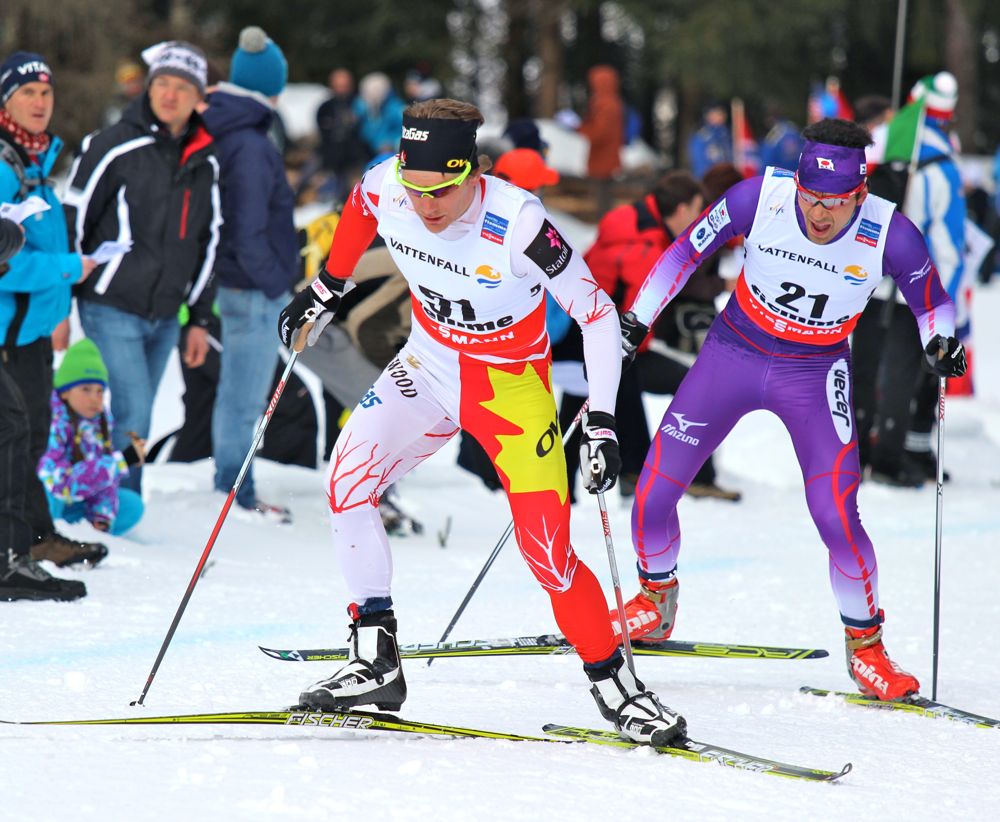
    Jönsson reached over at the press-conference table and patted Kriukov on the shoulder. “Thank you,” he said.

    “It was a tough race,” Jönsson explained. “I don’t know how it looked like when you were watching it, but it probably looked like we were going really, really slowly today.”

    With soft, heavy snow, the group tried to keep the tempo in control, he said. But it still required a lot of energy, especially if you wanted to stay up front, like the Swedes did.

    “It was good for me and Marcus, we were still up in the group all the time, just try to be avoiding all accidents,” Jönsson said. “Our plan was just to be with the other guys in the end and see how it will go and hopefully it will be there [with] other medals.”
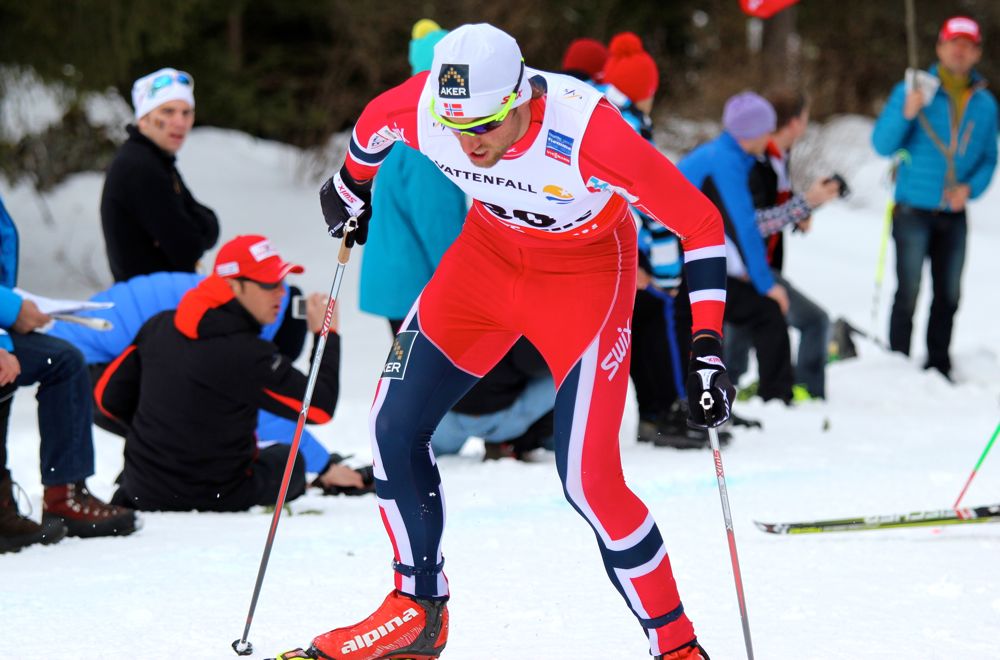
    For Jönsson, the silver was a career-best at World Championships since placing third in the 2011 skate sprint in Oslo, Norway. For Hellner, it was a good start coming off gold and silver at the 2011 World Championships, in the sprint and 4 x 10 k relay, respectively.

    Chebotko said his team set out for a medal, especially in the lead-up to the 2014 Sochi Olympics.

    “Our tactic was simply to stay with the Russians and Swedes and try not to stay behind of course,” Poltoranin said through a translator. “In the end, we eventually ended up on the podium and we’re satisfied with that.”

    Canada was less enthused, with Harvey wishing he’d been more aggressive at the apex of the last hill.

    “I was ahead of Kriukov and I should have cut him off but I’m not aggressive enough,” Harvey said. “It was the same yesterday [in the skiathlon]. A bunch of times yesterday I should’ve been cutting people off but instead I gave in too much. … I’m not like a sprinter.”

    This is coming from someone who won bronze in Thursday’s classic sprint. Despite feeling good on Sunday, Harvey said he simply wasn’t in a good enough position before the finish. As he tried to catch Poltoranin, he found himself off-balance and couldn’t outlunge him to the line.

    “It’s disappointing,” Harvey said. “At a championship, fourth doesn’t mean anything. It’s about the top three.”

    Kershaw looked down at the ground as he expressed similar emotions.

    “We came here to defend the title and we were well short of that,” he said. “But [ugh] there’s the Olympics next year.”

    Despite early pole trouble on his second leg, Kershaw said it fortunately didn’t make a difference.

    “I had to ski one lap with a bad pole, but that’s fine. I came back on it after that,” he said. “It is what it is, I guess. I felt really good today though, so I think that’s a step in the right direction.”

    After failing to qualify for the sprint heats on Thursday, Kershaw said he wasn’t sure if he’d be able to compete in five races as he’d hoped with lingering stomach problems. On Sunday, he said he was looking forward to the relay as long as the rest of his teammates – Ivan Babikov and Lenny Valjas – were feeling better.

    “We’ll be there for the relay,” Canadian head coach Justin Wadsworth affirmed. “The guys skied well and it was close. Alex said he got caught a little bit back and it’s so hard, even though you don’t want to be leading necessarily, you’ve got to be up in front of the group, but they skied well. … It was a good race, it was close.”

    Results

  • Seeking Another Podium, Harvey Settles for 13th in World Championships Skiathlon

    Seeking Another Podium, Harvey Settles for 13th in World Championships Skiathlon

    Canadian World Cup Team member Alex Harvey (l) finishing 13th in 30 k skiathlon at 2013 World Championships.
    Canadian World Cup Team member Alex Harvey (l) outsprints Austria’s Johannes Duerr to place 13th in 30 k skiathlon at 2013 World Championships on Saturday in Val di Fiemme, Italy.

    FasterSkier’s coverage of the 2013 FIS Nordic World Ski Championships in Val di Fiemme, Italy, is brought to you by the generous support of Fischer Sports.

    VAL DI FIEMME, Italy – When you start the Nordic World Ski Championships with a medal on the first day, where do you go from there? Canadian Alex Harvey faced that conundrum on Saturday and didn’t have to think too hard to solve it.

    Go for the podium again, the 24-year-old Quebec native thought. Because, why not?

    Unlike the five men he had to take on in Thursday’s classic sprint final, where Harvey placed third as the first Canadian male to medal at World Championships, he had about 90 men to contend with from the start of Saturday’s 30-kilometer pursuit.

    Feeling confident in his classic and ability to contend through the freestyle portion, Harvey made his way into the top 10 on the second of eight laps. He continued to hang there, a few seconds outside the top 10 with competitors like Norway’s defending champ Petter Northug, eventual bronze-medalist Sjur Røthe (NOR), and Harvey’s teammate Ivan Babikov, who was 16th by the 5.5 k checkpoint.

    With an even pace throughout the classic leg, Harvey held his own in a pack of 50 through the transition. Tensions were high, several men had already crashed or tripped on one another, but the Canadian remained on control, he said.

    “It was such fast conditions, I knew there was no point being in the front,” Harvey said. “It was super-easy pace too, and I was just trying to conserve energy in the classic and hoping for a harder skating part.”

    Nineteenth at the halfway point and 3.1 seconds out of the lead, Harvey remained patient until the second-to-last skate lap, where he rose to ninth, three seconds behind eventual winner Dario Cologna of Switzerland up front.

    As Cologna tested his competitors, including Norway’s Martin Johnsrud Sundby, who broke away on the second skate lap but was back with the group the next time around, Harvey remained in the top 15.

    When Cologna finally went for it with two kilometers to go, only three men were in position and had the energy to go with him, namely Sundby, Røthe and Russia’s Maxim Vylegzhanin. Harvey was stuck behind a three-lane train up the long climb and dropped back around 20th amid the chaos. His podium hopes out of reach, he strived to pick off some places.

    Just 6.1 seconds behind Cologna at the finish, Harvey ended up 13th after outsprinting Switzerland’s Curdin Perl and Johannes Duerr of Austria.

    “I was hoping for a podium,” Harvey said. “I like this race, but I wasn’t positioned well enough and I obviously wasn’t strong enough to really be able to fight every inch from kilometer 20 to kilometer 30. … I made a couple bad lane choices in the last lap and it moved me back just a bit too much for me to be able to react when Cologna went.”

    While it wasn’t the result Harvey had hoped for, Canadian assistant coach Eric de Nys said he couldn’t be upset with it, either.

    “Alex had a great race,” de Nys said. “The guys are super professional about what we’re doing. Of course we’re always trying to hit the podium. Sometimes you have to have some luck on your side, and today I think everything went really well, but just some guys were a little bit stronger.”

    The second-best Canadian, Babikov placed 32nd (+53.7) after skiing in ninth on the last classic lap. In the top 25 after the transition, he fell outside 30th with about ten kilometers to go.

    “Classic felt really easy and I was controlling it and good technique,” Babikov said. “I was just relaxed and feeling really good, but as soon as I switched to skate, my legs, my muscles were so heavy. It’s a weird feeling and I couldn’t go with the tempo so I got dropped a bit. By the end, I felt a little better, but still not what I wanted.”

    Battling a strep throat since before the Davos World Cup a week ago, Babikov said he’s on the upswing and physically felt good. “My muscles just weren’t cooperating with me today,” he said.

    “I was on antibiotics for a week, 10 days actually and maybe that’s the reason,” he added. “Hopefully for the relay and for the rest of the races it’ll be over.”

    Kershaw, who did not start Saturday’s skiathlon, will partner up with Harvey to defend their 2011 title in Sunday’s freestyle team sprint. Struggling with a long-lasting stomach bug, Kershaw sat out the 30 k to prepare for that event.

    “We signed him up just in case he felt like going for it,” de Nys said. “He decided it would be best to save himself for the team sprint and be fresh.”

    Just outside the top 50 on Saturday, Graham Nishikawa of the Alberta World Cup Academy (AWCA) said he was “a bit disappointed” with 51st (+4:09.6). Through the first two classic laps, he remained with the group around 30th.

    “I was still with the pack until the last loop of classic, but on the last hill I got blown off and once you’re off, you’re off,” Nishikawa said. “If you’re dropped in classic then it’s hard to get back.”

    In his first race in 20 days since fighting a cold of his own, Nishikawa was hoping this was what he needed to recharge.

    “I felt pretty good the last couple days, but you need to have everything working for you out there; it’s so tough,” he said. “[The pace] was easy, but I was never too comfortable. I just didn’t really have it today.”

    Nishikawa’s sister, Emily, did not finish after pulling out of the 15 k around two kilometers in. According to de Nys and Nishikawa’s mother, she had some kind of heart issue and was going to get checked out by the team doctor.

    The other Canadian female in Saturday’s 15 k skiathlon, former national team member Brittany Webster (Highlands Trailblazers) placed 57th (+6:20.6).

    “It definitely wasn’t a good one, but I’ve been traveling a lot,” Webster said. “It took me three and a half days to get here and I was sick over the course of that so I really haven’t been able to train much and do much. Today was the first day I woke up feeling completely normal so I was hoping for a good one, but the legs just weren’t there.

    “I wanted to sort of be in the race more,” she added. “I was definitely way off the back and that really wasn’t something I was happy with. I would’ve loved to be in the 30s and sort of be in a pack a little more, but I was just out there.”

    Coming off surgery in the fall, which she had a rod removed from her leg from a past injury, Webster said she had to train “extra hard” to make Canada’s World Championships team.

    “I think now I’m paying the price a little bit,” she said. “But I’m just here to really enjoy it and race as hard as I can but not beat myself up over a crappy result.”

    Results: men  | women

    — Audrey Mangan contributed reporting


  • Cologna Keeps Calm, Strikes Late to Nab World Championships Title

    Cologna Keeps Calm, Strikes Late to Nab World Championships Title

    Switzerland's Dario Cologna leads Tobias Angerer of Germany, Russia's Alexander Legkov and nearly 20 others during the skate portion of Saturday's 30 k skiathlon at the 2013 World Championships in Val di Fiemme, Italy. Cologna went on to win gold for his first medal at worlds.
    Switzerland’s Dario Cologna leads Tobias Angerer of Germany, Russia’s Alexander Legkov and nearly 20 others during the skate portion of Saturday’s 30 k skiathlon at the 2013 World Championships in Val di Fiemme, Italy. Cologna went on to win gold for his first medal at worlds.

    FasterSkier’s coverage of the 2013 FIS Nordic World Ski Championships in Val di Fiemme, Italy, is brought to you by the generous support of Fischer Sports.


    VAL DI FIEMME, Italy – When you’re as cool as Switzerland’s Dario Cologna, getting your ski tails stepped on and faceplanting with almost 90 guys behind you doesn’t faze you.

    Just over a kilometer into the men’s 30 k skiathlon at the 2013 Nordic World Ski Championships on Saturday, Cologna became one of the first casualties in an anxious and tightly packed group after the mass start. But no matter. The 26-year-old got up and clawed back into the top 10 by the end of the first 3.75 k classic lap.

    That’s the power of an Olympic gold, three Tour de Ski titles and numerous World Cup victories, and Cologna also had the drive for his first World Championships medal on his side.

    The Swiss rose from a minor slipup to the front of the pack by the second of the four-lap classic leg, challenging defending champ Petter Northug and his Norwegian teammate Martin Johnsrud Sundby, as well as Russia’s Alexander Legkov, Jens Filbrich of Germany, Sweden’s Marcus Hellner, and more in the 60-man strong crew.

    Despite changing leaders, the pace mostly stayed the same, even on the third lap when Hellner and Jean Marc Gaillard of France attempted to make something happen. Cologna had told himself before the race that he needed to take charge in the skate leg, and by the transition, he appeared in fighting position.

    The first into the exchange zone at 15 k, Norway’s Eldar Rønning stepped out of his classic skis and into his skates the fastest and led the group out of the stadium. Hannes Dotzler of Germany went with him, as did Legov, and Cologna hovered around 10th with Northug.

    In front of them, Sweden’s Daniel Richardsson surged ahead. Sundby answered, passing him and keeping the pace high. The group dropped to 20, and Cologna stayed steady take the lead with three laps remaining. Not long after, Cologna looked around for someone to share the load. He pulled over and started walking up the first big climb before Sundby decided he’d had enough and pushed onward up the other side.

    With no takers to help chase him down — perhaps part of Norway’s plot — Cologna made a bit of a gamble. Let Sundby go and be confident enough to rein him in, or make sure he doesn’t get away for good?

    Unrattled, the Swiss went with the first choice.

    Despite Sundby gapping the group by nearly 20 seconds, Cologna’s calculated move turned out to be spot-on; they caught him with about five kilometers to go.

    Cologna celebrates his first World Championships gold after winning the 30 k skiathlon handily on Saturday at the 2013 World Championships in Val di Fiemme, Italy.
    Cologna celebrates his first World Championships gold after winning the 30 k skiathlon handily on Saturday at the 2013 World Championships in Val di Fiemme, Italy.

    “I really want to fight for the gold medal and not for the silver medal so I decided to close the gap myself,” Cologna said at a post-race press conference. “In the end it was the right decision. Everything was perfect for me.”

    By “perfect,” he was referring to his attack up the second to last hill, dropping all but three: Russian Maxim Vylegzhanin, Røthe and Sundby, respectively. They went with him with two kilometers to go, but couldn’t match his kick on the final climb. Cologna opened up a several-second gap on the other three, with Northug also closing from behind.

    Charging hard through the stadium, Cologna looked back as he entered the finishing lanes. He stopped pushing and cruised over the line with his hands in the air. Finally, he had done it, and his first World Championships medal just happened to be gold.

    Cologna finished in 1:13:09.3, and Sundby placed second, 1.8 seconds back, to top his individual bronze from the 2011 World Championships 15 k classic. Røthe, 24, was third for his first individual world medal, and seven-time world champion, Northug placed fourth (+5.2).

    “It was really a dream to win here and to win the first race is even better,” Cologna said in this first distance race of the Val di Fiemme World Championships, just a two-hour drive from his hometown of Val Müstair, Switzerland.

    “I felt great the whole race and to come alone into the stadium is always a great feeling,” he added. “It was also my plan.”

    Cologna said he expected someone to attack earlier, and when they didn’t, he took it upon himself to do so. After trying to drop the pack initially in the skate leg, he said it didn’t work so he chose to conserve while Sundby went for it.

    Meanwhile, he visualized that last uphill. Three weeks ago at the pre-Olympic World Cup in Sochi, Russia, Cologna dropped several Russians up something similar to win the skiathlon.

    Swiss winner Dario Cologna (c) with Norwegians Martin Sundby (l) in second and Sjur Røthe in third on the 30 k skiathlon podium at the 2013 World Championships in Val di Fiemme, Italy.
    Swiss Dario Cologna (c) with Norway’s Sundby (l) in second and Røthe in third on the 30 k skiathlon podium at the 2013 World Championships in Val di Fiemme, Italy.

    “Dario was the best today,” Sundby told reporters after Saturday’s race. “We [Norway] managed to get second and third and for me second place is like a victory.”

    A strong classic skier, Sundby took it upon himself in the offseason to make some major improvements to his skate technique, NRK reported. It paid off, as he felt strong enough to leave the group around on the first of four skate laps.

    “I did not quite know what happened. Suddenly I had fifteen seconds without really knowing what to do,” he told NRK.

    “I didn’t at any point think that this would hold for a gold medal,” he said at a press conference. “So for the third lap I tried to calm down, rest a bit and wait for the guys and be prepared for a very tough fourth lap.”

    That last lap turned out to be tough, with Sundby outlunging his teammate, Røthe, by two-tenths of a second for silver. After Vylegzhanin trailed Cologna up the last hill, Røthe and Sundby went on either side to pass the Russian. They soared down into the stadium in second and third, while Northug made a late move to pass Vylegzhanin as well.

    Røthe told reporters he was extremely satisfied with his career best, especially in sharing the podium with Sundby.

    “It’s my own fault that I wasn’t in back of Dario, but I’m really satisfied and it’s good that Martin’s by my side,” Røthe said.

    Norwegian men’s coach Trond Nystad said it was a good day for Norway with two medals in the men’s race and a podium sweep for the women.

    “Dario wins, that was deserved; he was a better skier today,” Nystad said. “We got two, three and four and we have to be happy with that.”

    As for which of his athletes he thought might be in the hunt for gold, Nystad said he wasn’t surprised by Sundby or Røthe, who was third in the Canmore World Cup skiathlon in December.

    “Of course, Petter who was fourth, he was also expected to be in there and fight for the medals, but he was sleeping a little bit on top of the hill,” Nystad said.

    “I would like all medal, so it was a disappointing race for me,” Northug told NRK. “Fortunately, two Norwegians medaled.”

    After Northug, Vylegzhanin led the Russians in fifth (+6.1), Legkov was sixth (+10.1) and Calle Halfvarsson of Sweden was seventh. Hellner placed eighth, Tobias Angerer of Germany was ninth and Gaillard finished 10th.

    — Audrey Mangan contributed reporting

    Results

  • Led by Fletcher in 14th, U.S. NoCo Shakes Off Cobwebs at World Champs

    Led by Fletcher in 14th, U.S. NoCo Shakes Off Cobwebs at World Champs

    Bryan Fletcher (USA) leads a pack in the third of four laps during the 10 k Gundersen start at the 2013 World Championships in Val di Fiemme. After placing 19th on the normal hill in Predazzo, Italy, Fletcher rose to 14th overall at the Lago di Tesero stadium in Val di Fiemme.
    Bryan Fletcher (USA) leads a pack in the third of four laps during the 10 k Gundersen start at the 2013 World Championships in Val di Fiemme. After placing 19th on the normal hill in Predazzo, Italy, Fletcher rose to 14th overall at the Lago di Tesero stadium in Val di Fiemme.

    FasterSkier’s coverage of the 2013 FIS Nordic World Ski Championships in Val di Fiemme, Italy, is brought to you by the generous support of Fischer Sports.

    VAL DI FIEMME, Italy – You could have been looking at pretty much any one of the US Ski Team guys scattered throughout the 10-kilometer Gundersen start on Friday, the afternoon segment of the nordic-combined opener at the 2013 Nordic World Ski Championships. They all had that same look in their eyes, in their disposition.

    All four of the Americans – Bryan Fletcher, Todd Lodwick, Billy Demong and Taylor Fletcher – had the same task ahead of them: catch as many people as possible and finish with some satisfaction.

    Bryan Fletcher after posting the 19th best jump on the normal hill Friday at the World Championships opener in Predazzo, Italy.
    Bryan Fletcher after posting the 19th best jump on the normal hill Friday at the World Championships opener in Predazzo, Italy.

    Bryan Fletcher led the group after the jumping portion on the 106-meter normal hill, about 10 kilometers away in Predazzo. Fletcher had posted a 92.5-meter jump, 11 meters short of Haarvard Klemetsen’s winning distance, which put Fletcher in 19th, 1:41 minutes back from the Norwegian.

    Lodwick had the next-best jump for the U.S. in 32nd, one of his top results on the hill this season. The younger of the Fletcher brothers, Taylor was 45th in the jump and Demong ranked 47th out of 55.

    Not ideal, most thought, as they formulated a plan to work their way back into contention. However, for Bryan Fletcher, 19th was enough to aim for a top 10 and by far his best individual result at World Championships.

    With three World Championships behind him, Bryan entered his fourth with some confidence, testing his competitors and leading one of several chase groups out of the start. With the pace fluctuating from fast to slow, he decided to take the reins and keep it steady, but mostly, high.

    “For me the strongest point of today’s race was being able to lead and still recover and keep going,” Bryan said after placing 14th, 1:01.2 behind winner Jason Lamy Chappuis of France. Beside his two fourth-place finishes in relay events at worlds, it eclipsed his previous individual best of 22nd.

    Now one of the top U.S. skiers on his five-man A-team, Bryan said he expected more of himself, especially with three more competitions to go. But this was a good start.

    “Obviously, I wasn’t in the optimum jumping position,” he said. “I was just really going out there to see how I felt and kind of open up World Champs with a good solid opening race and that’s exactly what it was. I felt strong and I think that if I continue to race this strong throughout the rest of the races, with a little better jumping, I’m in the fight.”

    Fletcher ran out of some steam at the end of the four-lap race, missing out on 13th by 0.2 seconds to Austria’s Bernhard Gruber, but clocked the 13th-fastest ski time. According to Jarrett, that one place didn’t make much difference.

    “When you come here to win medals, it doesn’t matter that much,” he said. Regardless, he was impressed by Bryan’s performance, which led his teammates’ by a significant margin.

    American Billy Demong leads Tim Hug (SUI) and the rest of a chase group on the second to last lap behind the leaders of Friday's 10 k Gundersen at World Championships in Val di Fiemme, Italy.
    American Billy Demong leads Tim Hug (SUI) and the rest of a chase group while working to close the gap on the second to last lap of Friday’s 10 k Gundersen at World Championships in Val di Fiemme, Italy.

    Demong got down to business from start to finish, making up nearly a minute and a half on the leaders to end up 23rd. While it wasn’t the second world title he was hoping for, or another medal to add to his collection, Demong was relatively pleased with the way he skied in a race that turned out to be a sort of personal test.

    “It’s tough when you know you don’t really have a chance after the jumping,” Demong said. “You try to make something happen just on the off-chance that you don’t blow up or you can make it. I guess today I tried to trial a good race and just pace myself well. It’s a tough course and I think it’s important to have the mentality that I’m going to jump better in one of these next races”

    Demong said he started “pretty controlled” and strove for negative splits on each ensuing lap. The strategy gave him more energy for the last couple rounds, where he made up the most time on the 46 men in front of him.

    “Unfortunately, it was a good training day,” the 32-year-old said of second-worst result at World Championships since placing 27th in 1999 in Ramsau, Austria. “But it gives me confidence for the next couple races.”

    For Demong, a 2009 World Champion and 2010 Olympic gold medalist, confidence has been what he’s been seeking all season after some equipment changes last summer. When Atomic stopped making jumping skis, he had to change companies and try new bindings and boots as well.

    “At one point, I switched some binding pieces around and had some pretty scary jumps,” he explained. “I don’t know if it’s my age or what, but it took me a while to get some confidence back to just go after it and feel safe. So the first month of the season was really just getting comfortable enough to try again.”

    Now, he’s going for it and feeling safe again, Demong said. Training jumps have been going well recently – within the top 30 – but Friday he felt he tried too hard.

    It’s not cross-country skiing where the harder you try, the faster you go,” Demong said. “It’s like a golf swing. You have to have finesse and trust. Today, I can honestly say when I tried too hard in the competition to make something special happen. Instead of going further … I ended up going shorter. It’s kind of rough honestly. Right now I have to be very patient on the jump hill, which is hard because you want to go for it in the competition.”

    While Demong chose restraint in Friday’s race, Taylor Fletcher decided to go hard from the start and rose from 45th to 25th with the ninth-fastest time. In his second World Championships, it topped his 26th from two years ago in Olso, Norway. But after tasting the podium with a career-best World Cup result of third earlier this year, it wasn’t what the 22-year-old was shooting for.

    “It’s encouraging for Bryan, Bill and Taylor to have pretty much a sub-par jumping performance and be kind of in there,” Jarrett said. “But we still need to improve on the jumping side to be fighting for the podium.

    “Taylor took a risk and opened really fast,” he added. “You can see Bill did the opposite, they basically came together at the end, and Bill beat him.”

    While Jarrett hadn’t spoken with Lodwick after the race, in which the two-time 2009 World Champion dropped three spots to 35th for his first non-top 30 at worlds, he speculated Lodwick might not have felt well. After the jump, Lodwick said he’d been fighting illness for the last “two or three months.”

    “I feel like I’ve kind of battled it and am as good as I can be,” Lodwick said. But in his ninth World Championships, he couldn’t get over the crowd at the ski-jumping stadium.

    “The hill’s in perfect shape, there’s a headwind, blue skies, I mean we are competing in such an awesome venue in the valley,” Lodwick said. “I’m just excited to be here. It’s been a blast.”

    Jarrett said conditions weren’t perfect in the jump after several wind delays affected his starters. With the normal hill, 4 x 5 k team event up next on Sunday, Jarrett said they had some tough decisions to make by Friday.

    “It’s basically between Todd and Johnny,” he said of Spillane, who did not make the team’s four-man quota on Friday. “I know Johnny’s really looking forward to the big hill more so than the small [normal] hill.”

    Ten years ago, Spillane won an individual world title on the large hill in Predazzo.

    “While he wants to be on the team he’s kind of focusing on [next] Thursday’s race as much as possible,” Jarrett said. “He’s got to still earn a spot on the team jumping-wise anyway.”

    Earlier in the year, the U.S. Nordic Combined Team stated they were seeking three medals. Jumping coach Chris Gilbertson restated that goal on Wednesday, but added that they’ll be happy with one. When it comes to the event they could have the best chance in, Jarrett said the relay is the focus.

    In the past two World Championships – in Oslo in 2011 and Liberec in 2009 – the Americans were fourth with Demong, Bryan Fletch, Spillane and Lodwick. They also placed sixth in a second relay at the 2011 worlds, but the schedule has since changed to include a two-man team sprint on March 2.

    “This season in Schonach, [Germany] that was the first time we’ve been on a podium in a World Cup in a four-man team event,” Jarrett said. “So it’s clearly possible. That wasn’t really anything out of this world on the jumping side. That’s gonna be the key, we need to be in there after jumping to do it.”

    Results

  • U.S. Nordic Combined Team Enters Another World Championships with Big Expectations

    U.S. Nordic Combined Team Enters Another World Championships with Big Expectations

    Taylor Fletcher jumping earlier this year in Seefeld, Austria, where he was fifth and third for career bests on the World Cup. (Photo: Michael Ward)
    Taylor Fletcher jumping earlier this year in Seefeld, Austria, where he was fifth and third for World Cup career bests. (Photo: Michael Ward)

    FasterSkier’s coverage of the 2013 FIS Nordic World Ski Championships in Val di Fiemme, Italy, is brought to you by the generous support of Fischer Sports.

    VAL DI FIEMME, Italy – As more than a half dozen members of the U.S. Nordic Combined team and staff zipped around the stadium at Lago di Tesero on Thursday, several made jokes in the transitions between testing skis, but it didn’t seem to effect their efficiency.

    That’s no surprise; three out of five of the team’s World Championships athletes have been to this level – the biggest thing outside of the Olympics – at least seven times. Todd Lodwick, 36, leads the group entering his ninth World Championships just a few years after winning two individual golds in Liberec, Czech Republic. Billy Demong, 32, also notched a world title that year in 2009, as well as a bronze, and just last year, he reached a season high of third in the Val di Fiemme World Cup. That success could mean good things for the seasoned U.S. team with multiple world titles, including Johnny Spillane, 32, who won the individual sprint here 10 years ago.

    But this year, the team’s goal of three World Championships medals could largely ride on the performance of its youngest athletes: Taylor Fletcher, 22, and his older brother Bryan, 26. Both have notched breakout results in the past year, with Taylor most recently notching a career-best bronze at the World Cup in Seefeld, Austria, and Bryan winning the 134-meter large hill/Gundersen individual at the 2012 World Cup finals in Oslo, Norway.

    The team also combined for a relay podium in early Januray in Schonach, Germany, with the two Fletchers, Lodwick and Demong combining for third behind Norway and Germany. It’s those kind of results that make the their coaches know big things are possible in the four competitions at World Championships over the next week and a half, but they know it’s going to take all they can muster to get there.

    U.S. jumping coach Chris Gilbertson chatted with FasterSkier alongside the track on Thursday, one day before the team started the first competition: the individual HS 106 and Gundersen 10 k. The team event, with a 4 x 5 k relay, will take place Sunday, followed by the individual HS 134/Gundersen 10 k on Feb. 28 and the team sprint (2 x 7.5 k) on March 2.

    FasterSkier: How’s everyone doing?

    Chris Gilbertson: Pretty much everyone’s healthy. Todd’s been doing OK with the cough and stuff that he’s got. Since basically the middle of January, everything’s been moving better and better and better, going in the right direction. Bryan’s skiing is finally starting to catch up to the jumping side and of course Taylor has always been crossing fast and that confidence is starting to carry over into the jumping, which is nice. It sort of takes a little bit pressure off Taylor one way and then it also takes pressure off Bryan just to be the only guy that’s doing well. Also having Bill jumping better now, that was always his plan. He said, ‘Don’t worry, I’ll be ready by World Championships,’ and Dave and I were pretty much ready to strangle ourselves. All summer he was just horrible and we’re like, ‘I’ll get better,’ and we’re like, ‘Come on, when are you going to start?’ Finally, the last two weeks.

    FS: What’s it like coaching a World Championships team with three seasoned veterans?

    CG: It’s harder in some ways and easier in others. Easier in the sense that, you kind of don’t have to tell anyone what to do, they already know for the most part what’s going on. But on the other hand it’s really hard to tell the older guys what they need to do, because they already feel like they know, what they need to do. I kind of joke my coaching’s more reminding than anything, but it needs to be a little more forceful sometimes and you just can’t do that with the older guys because it just won’t work. The younger guys you can be a little more strict and stronger, with these guys, it’s kind of like, ‘Come on.’ If they’re on track, it’s fine, and when they’re not, it’s really hard to kind of pull them back into where you think they should be.

    We just kind of have to let it run and let the results speak for themselves. [Head coach] Dave [Jarrett] is probably one of the best guys about this it’s like, ‘Look, it’s they’re performance and their results, and until they realize what’s going on, you can’t make them do anything.’ And it’s hard. It’s really hard to know that they’re making mistakes, that they’re a little bit off, or that they don’t want to listen. They’re still being stubborn in what they think is right. It’s not that we’re that far off, but sometimes it’s just enough.

    Luckily they’ve all done it [won world titles]. You don’t have to reinvent the wheel in that sense, but just finding that, and we’re always saying the consistency.

    FS: What do you think they’re capable of at these championships?

    CG: It’s a little bit rough because we put high expectations on when we do the spring meetings, but I would say that the season so far hasn’t gone as planned. It’s been pretty good for Bryan and better and better for Taylor, but not for Johnny, Todd or Bill so I think that kind of tempers everything a bit. It’s not out of the realm of possibility but I would kind of say we’re gonna need to jump better than we’ve been to get close. We need to be within a minute and 15 or a minute to really get medal contention for sure. Definitely one of the better things was getting that third in Schonach [in a World Cup relay in Germany.] That showed Taylor went above and beyond and I think can pull it in. When we get close, we’re all right, but we can’t be that far out.

    FS: What about the team’s past success in Val di Fiemme?

    CG: I think on the big hill is better for Johnny, and I know these guys, they like the cross-country course. This is where it all began so it’s good. We trained here twice this summer. This is another place that we’re very comfortable, being at the hotel that we’re at, knowing everyone else here.

    FS: What about the cross-country course?

    CG: I thought it was really hard, which I think plays in our favor. I think it’s good for Taylor, good for Bill.

    FS: How long has the team been training here?

    CG: We just got here Saturday night/Monday morning. Bill loves to just show up as late as he possibly can. Bryan and Johnny like to come a couple days earlier than that. These guys aren’t affected by jet lag anymore. They won’t use that as an excuse ever. It’s only for Johnny, sometimes he’s got to stretch more and Bryan needs to get the cobwebs out a little, but then we’re good to go.

    FS: What’s the goal at this point?

    CG: A goal is three medals here, and however it happens, whether it’s one individual, one team, we’ll take any combination we can get. I’d be happy with one right now, the way things have been going.

    FS: How key is having the younger guys step up?

    CG: It’s good that that’s happening. We’ve been like, ‘Come on guys, we can’t depend on the older guys that are getting older,’ so it was good to finally see Taylor moving in and that breakthrough with Bryan last year was good.

    2013 World Championships schedule

  • Canada’s Lone Qualifier, Harvey Captures Historic Bronze at World Championships

    Canada’s Lone Qualifier, Harvey Captures Historic Bronze at World Championships

    Canadian Alex Harvey celebrates his bronze-medal performance in Thursday's 1.5 k classic sprint at the 2013 FIS Nordic World Ski Championships with his and teammate Devon Kershaw's signature move, two years after the two won the classic sprint at 2011 World Championships. (Photo: Glen Crawford)
    Canadian Alex Harvey celebrates his bronze-medal performance in Thursday’s 1.5 k classic sprint at the 2013 FIS Nordic World Ski Championships in Val di Fiemme, Italy, with his and teammate Devon Kershaw’s signature move two years after they won the classic team sprint at 2011 World Championships. (Photo: Glen Crawford)

    FasterSkier’s coverage of the 2013 FIS Nordic World Ski Championships in Val di Fiemme, Italy, is brought to you by the generous support of Fischer Sports.

    VAL DI FIEMME, Italy – Canadian head coach Justin Wadsworth could have used a number of clichés to describe what happened Thursday on the first day of FIS Nordic World Ski Championships. “It’s not over ’til it’s over,” and “Don’t count your chickens before they’re hatched,” come to mind.

    But not long after watching one of his athletes, 24-year-old Alex Harvey, place third in the 1.5-kilometer classic sprint to become the first Canadian male to win an individual medal at World Championships, Wadsworth was almost speechless.

    Alex Harvey (l) during a victory lap with Russia's Nikita Kriukov (c), who won the World Championships 1.5 k classic sprint on Thursday, and Norway's Petter Northug, who was second. (Photo: Fiemme2013)
    Alex Harvey (l) during a victory lap with Russia’s Nikita Kriukov (c), who won the World Championships 1.5 k classic sprint on Thursday, and Norway’s Petter Northug, who was second. (Photo: Fiemme2013)

    “It feels unbelievable, especially after this morning and what happened in qualifying, to get a medal here,” Wadsworth said after seven of eight Canadian starters failed to qualify for the heats in the men’s 1.5-kilometer and women’s 1.2 k classic sprints.

    The only one who moved on, Harvey narrowly did so in 26th, one second ahead of 30th. He was 6.67 seconds off Russian Nikita Kruikov’s winning qualifying time of 3:29.75.

    Quick to realize his mistakes – going easy up the first big climb and having too much energy at the finish – the Quebec native resolved to go harder in the quarterfinal. But he needed to tweak his skis to do so.

    “I think our skis weren’t good in the beginning, like none of us qualified other than me, and the body felt better than 26th,” Harvey said. “On the flat especially, I was double poling and there was nothing, no glide, just fighting the kick, so the wax tech adjusted that and gave me retarded skis for the final.”

    In his quarterfinal, Harvey positioned himself in third then struck late on the downhill straightaway into the stadium, comfortably beating Italy’s Fabio Pasini and Dmitriy Japarov of Russia, who were second and third in a photo finish. All three advanced to the semifinals, where Harvey went with a similar tactic and finished third, just 0.17 seconds behind Norway’s Petter Northug and Eirik Brandsdal, respectively.

    Wadsworth said the entire team talked strategy before Thursday, and he had some tips after finding a lot of success there. In three recent editions of the Tour de Ski, the Canadian men’s team has racked up five podiums in Val di Fiemme.

    Number one: don’t lead.

    “[That’s] the last thing you want to do unless you feel like you really, really can make a gap and have good skis,” Wadsworth said.

    At the same time, you’ve got to be close enough to catch the slingshot, but not too close so that you can actually gain on the person ahead of you and pass them with some speed.

    “We really focused our tactical approach on the whole last downhill and the bump,” he said, referring to small hill over a tunnel into the stadium. “That was, we felt like the whole race.”

    According to him, Harvey couldn’t have executed much better for the bronze, skiing in third up the last steep hill despite slipping. The lack of kick, especially in the final, was his own request, Harvey explained. He wanted fast skis for the finish.

    Alex Harvey (CAN) racing to 26th place in Thursday's 1.5 k classic sprint qualifier at the 2013 World Championships in Val di Fiemme, Italy. Canada's only qualifier, Harvey went on to take bronze in the final and become the first male to win an individual medal at worlds.
    Alex Harvey racing to 26th place in Thursday’s 1.5 k classic sprint qualifier at the 2013 World Championships in Val di Fiemme, Italy. Canada’s only qualifier, he notched bronze in the final and became the first male to win an individual medal at worlds.

    “It’s good purchase for the ski outside the track,” Harvey added. “In the track would’ve been too much fighting and it’s so steep, you’re not gliding in the track anyways so I felt for me it was the best option.”

    He proceeded to follow Kriukov and Sweden’s Emil Jönsson up and over the final bump, where Northug flew by him into second. In the stadium, Harvey caught the draft in fourth, then picked Kriukov’s lane to pass Jönsson while the Russian and Northug battled for first, which Kriukov held onto for the win.

    Harvey picked up third – his second World Championships medal since winning the 2011 classic team sprint with Devon Kershaw in Oslo, Norway.

    “Our goal is two medals and to get one on the first day, I mean, it’s fantastic,” Wadsworth said.

    “The plan’s working good,” Harvey explained less than a week after placing 39th in a classic sprint at the Davos World Cup in Switzerland. “Davos was bad, but I knew the training’s been good in the last month and a half. I was confident in my shape. There was just a bit too much fatigue left [after training], and now, day by day, I’m feeling better and better.”

    The event wasn’t exactly his forte or one he was most excited about at World Championships. The night before, Harvey said he was looking forward to the relay as well as the freestyle team sprint, if he got to race that two-person event. He’s essentially guaranteed himself a spot now.

    Standing alongside the fence while Harvey wove through scores of international reporters, his mother high-fived coaches and eventually embraced her son.

    A sports physician, Dr. Mireille Belzile had flown out as the team’s doctor for World Championships. Three weeks ago, she reviewed her son’s MRI results after he dislocated his shoulder in Sochi, Russia. He took a few days to recover, then trained at altitude for a week in Italy before traveling to Davos, where he had some less-than-stellar results outside the top 30. Now, here he was, back on top.

    Alex Harvey's mother,  Dr. Mireille Belzile, holds his flowers after Thursday's podium ceremony at the 2013 World Championships in Val di Fiemme, Italy. There, Harvey notched Canada's best-ever individual men's result of third in the classic sprint.
    Alex Harvey’s mother, Dr. Mireille Belzile, holds his flowers after Thursday’s podium ceremony at the 2013 World Championships in Val di Fiemme, Italy. There, Harvey notched Canada’s best-ever individual men’s result of third in the classic sprint.

    “I was surprised,” Belzile said. “It’s not his best event, individual sprint for him, it’s just a gift when he can make a medal in that distance so it’s good. Good beginning.”

    From the onset, things looked a little grim for the Canadians. After Harvey squeaked by in 26th, one of the men’s sprint favorites Lenny Valjas placed 40th, 10.5 seconds out of first and about three seconds from qualifying. Devon Kershaw was 46th, nearly 13 seconds back from the leader, and Canada’s top domestic sprinter, Phil Widmer of the Alberta World Cup Academy (AWCA), was 49th (+13.85).

    In their signature event, the two World Cup women didn’t fare much better. Dasha Gaiazova was 42nd, 15 seconds behind qualifier Finnish winner Mona-Liisa Malvalehto, and Perianne Jones placed 48th (+17.72). The NorAm’s leading sprinter, Andrea Dupont (Rocky Mountain Racers) followed in 49th (+18.48) and distance specialist Emily Nishikawa (AWCA) was 57th (+22.87).

    While Wadsworth hadn’t spoken to all his athletes shortly after the morning qualifier, he racked up their result to several “random” things.

    “Everyone said the skis are fine,” he said. “Lenny had strep throat. He coughed something up on the first hill he said, like, big, hard, green thing, and Devon was up last night at 3 a.m. sick again.”

    Kershaw said he checked in with Dr. Belzile on Thursday morning and she thought he might have gastritis. He planned to get test, but said he wasn’t sure what was in store for the rest of World Championships after hoping to race five of six events. He’s been having the problem since coming down with food poisoning in late January at the World Cup in La Clusaz, France. He had another episode two weeks later in Sochi, hindering him and Valjas in the team sprint.

    “Every 10 days or so it comes back,” Kershaw said. “This is disgusting to talk about but last night, same thing, 3 a.m., woke up, went to the bathroom like three times, swollen stomach. I don’t know what’s going on but it’s still hanging on.”

    As for Valjas, he was on the mend, but not at full strength Thursday after getting sick last weekend and taking four days off before Wednesday.

    “I stayed positive and I wanted to obviously get into the heats and just keep my goal of getting to the final and onto the podium, but my body just didn’t agree today,” Valjas said. “I was missing a gear and coughing and choking up my phlegm … It was just not ideal. I felt OK, but my speed was just all-around slow. I tried hard and that’s all I can do.”

    Widmer, 29, in his third World Championships has his best classic sprint result in 49th. Wadsworth said he looked good, but Widmer said it wasn’t what he was hoping for.

    “I was happy until I got a little scrambly on the second hill,” Widmer explained. “The track was a little bit broken and I ended up running, didn’t ski it that well and I felt like I lost a lot of time there.”

    Unsure whether it was his lack of speed or grippy skis, Widmer added that he’ll do an OPA Cup race in Switzerland before heading home to Canmore, Alberta.

    “It was fun, for sure, would’ve liked to qualify, but it is what it is,” Widmer said.

    Canada’s top two sprinters, Gaiazova and Jones weren’t sure what happened Thursday after their worst results of the season.

    “[Warming up,] I thought I was skiing well and I was happy with my skis so nothing that really jumped out at me,” Gaiazova said. “I really didn’t expect I would ski so slow. I guess I have to regroup. There’s still lots of racing left.”

    She and Jones are teaming up in Sunday’s team sprint.

    “We have a good few days to turn things around and I think we definitely can,” Jones said. “I just felt like I was missing some snap and I don’t know exactly what happened but not enough energy I guess. … I did a lot of training after Russia and maybe I’m just not recovered enough from it.”

    In her first World Championship, Dupont was pretty happy with her top 50 after placing 53rd in the classic sprint in Davos.

    “I feel it’s a different game a little bit out here,” she said. “I was happier with today than Davos, for sure. I feel like today I didn’t mess around with skis as much maybe, just too many distractions in Davos and better course for me, but there’s definitely room for improvement.”

    While she was unsure if she’d do a couple OPA races in the near future, Dupont said she was traveling to Sweden for the Vasaloppet on March 10.

    “It’s a long course for me from a sprinter to do a 90 k, but there’s a lot of double poling so I’m definitely looking forward to that,” she said. “There’s like 16,000 people that enter it, so it should be pretty fun.”

    And Nishikawa, who’s been fighting illness for the last month, said she was just happy to race on Thursday.

    “I haven’t done much intensity lately because I’ve been sick so I think it was good to get out there and just have a hard effort,” she said. “This is my first World Championships; I just wanted to get a feel for it before the [15 k] pursuit on Saturday, just get a feel for the start and how it all works and the crowd and stuff like that.”

    At the end of the day, Harvey’s medal proved most memorable, and he hoped it would lift his team.

    “This is huge for our program,” he told Cross Country Canada in a press release. “I hope the team can build a lot of confidence from this for the rest of the championships.”

    Men’s results | Women’s results

    International men’s report