Tag: 2013 world cup finals

  • Canadians Welcome Season’s End, Already Moving On: ‘We’ll Be Better’

    Canadians Welcome Season’s End, Already Moving On: ‘We’ll Be Better’

    Team Canada, like brothers. World Cup Finals Falun, Sweden. men's 15 k freestyle pursuit
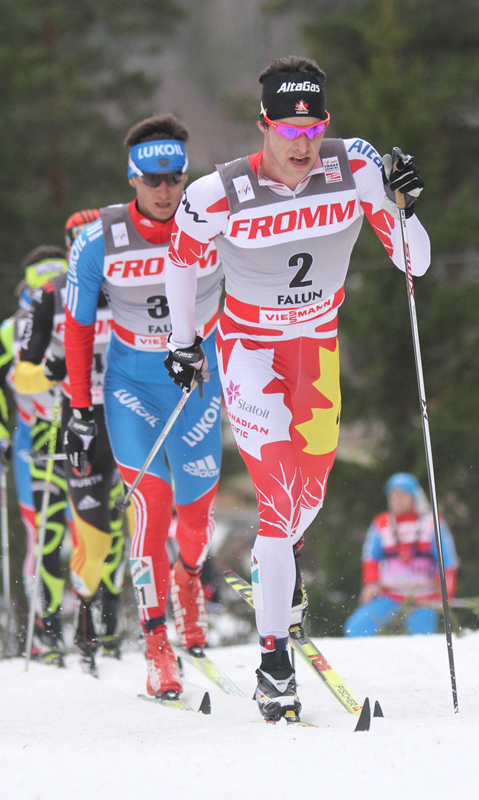
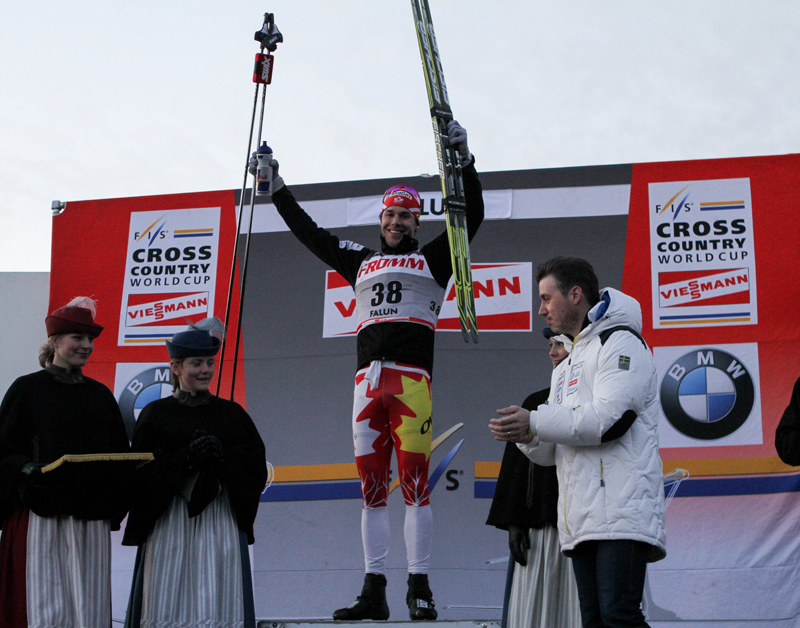
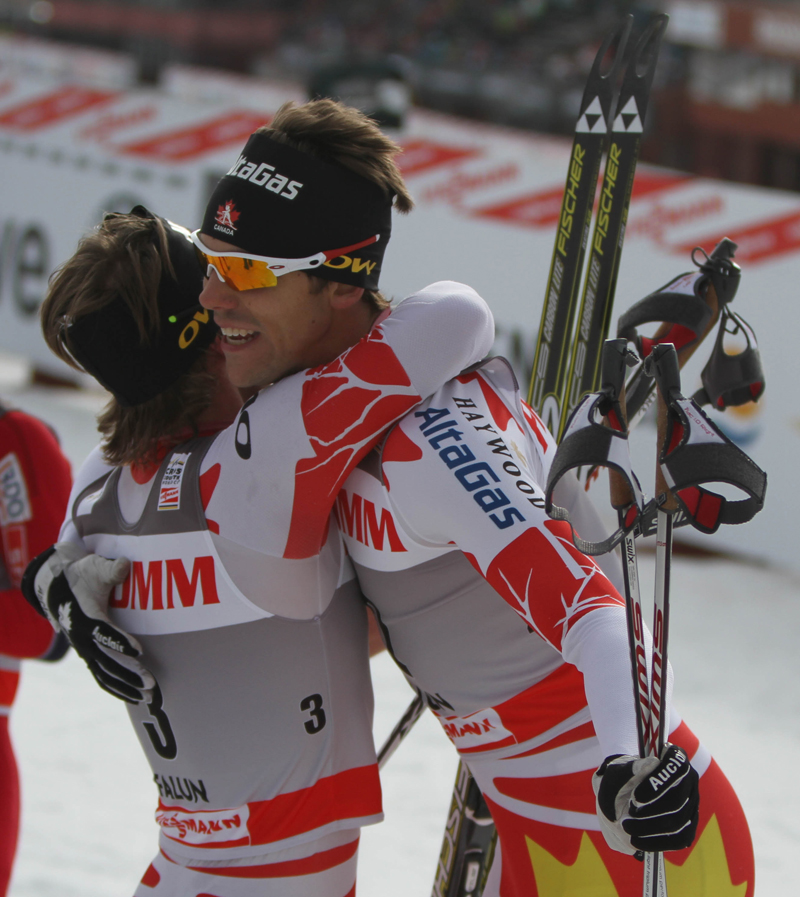
    Canadian World Cup Team member Devon Kershaw (l) hugs teammate Lenny Valjas at the end of last year’s World Cup season in Falun, Sweden. There, Kershaw captured second in the World Cup with the 10th-fastest time, Alex Harvey (not shown) skied second fastest for sixth overall, and Valjas posted the 33rd-best time for 28th.

    Sunday finally came.

    Seventeen weeks and 120 days after the World Cup season started in Gällivare, Sweden, it ended in the same country with final pursuits in Falun.

    While the big winners at World Cup Finals shed some tears and smiled for the cameras, the rest of some 50 men and 50 women clicked out of their race skis for the last time – for a while anyway.

    For the six Canadians in Sunday’s freestyle races, the moment couldn’t have come soon enough.

    “I felt like garbage warming up,” Kershaw said after finishing 4:27.4 minutes behind Norway’s Petter Northug, who won the 15-kilometer pursuit in 35:48.3 and wrapped up the overall World Cup title. “I was struggling with motivation, I’m not gonna lie.”

    A year ago, Kershaw stood atop the podium on the last day of the 2011/2012  season as the overall World Cup runner-up. It was both a career best and a historic achievement for Canada, and it came with heightened expectations in the year that followed.

    When Kershaw wasn’t winning, or at least living up to what he thought he was capable of, it made for some frustrating races.
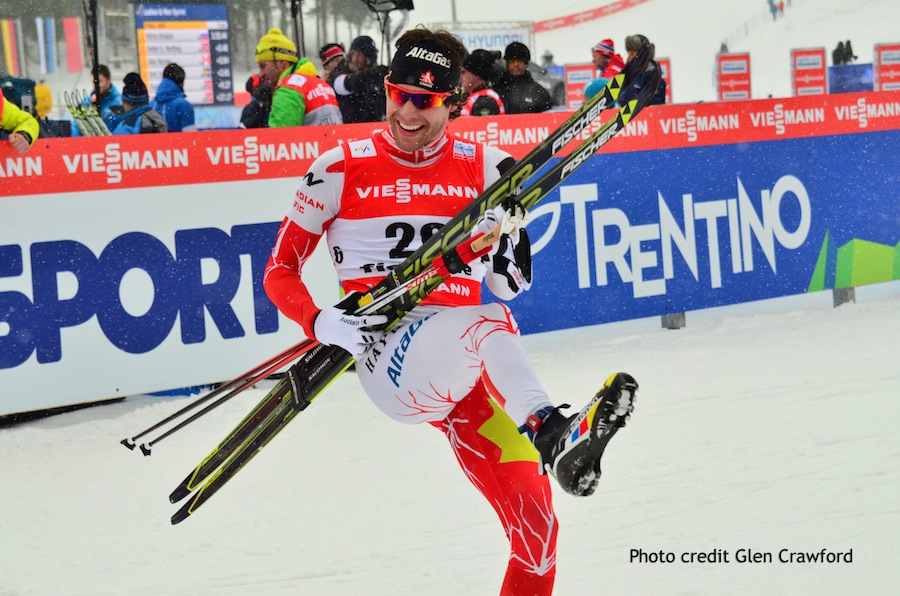
    Canadian Alex Harvey celebrates his bronze-medal performance in Thursday's 1.5 k classic sprint at the 2013 FIS Nordic World Ski Championships with his and teammate Devon Kershaw's signature move, two years after the two won the classic sprint at 2011 World Championships. (Photo: Glen Crawford)
    Canadian Alex Harvey celebrates his bronze medal in the 2013 World Championships 1.5 k classic sprint on Feb. 21 in Val di Fiemme, Italy, two years after he and Devon Kershaw won the classic team sprint at 2011 World Championships. (Photo: Glen Crawford)

    The 30-year-old wasn’t alone. A bronze medalist in the 2013 World Championships classic sprint, Alex Harvey seesawed between podiums and placing outside the top 30. Lenny Valjas came down with strep throat right before World Championships, and Ivan Babikov caught something similar not once, but twice, ultimately leaving him a “little flat,” as head coach Justin Wadsworth put it, at the end of the season.

    On the women’s side, three members dwindled to two in February when Chandra Crawford cut her season short to recover leading up to the 2014 Sochi Olympics. Just before she left Europe, Perianne Jones and Dasha Gaiazova teamed up for bronze in the classic team sprint at the pre-Olympic World Cup in Russia. The medal gave them energy, but the two struggled in the World Championships sprints that followed.

    At World Cup Finals last Wednesday through Sunday, Canada’s two Continental Cup leaders – Emily Nishikawa and Michael Somppi of the Alberta World Cup Academy –added some strength in numbers, but they were also feeling the wear of the season.

    Nishikawa, 23, had done most every race at World Championships and been in Europe for more than a month. Somppi, 24, had been there since early March and was still pushing for his first World Cup top 30.

    He didn’t achieve it Sunday in 47th (+9:28.6), but Somppi wrote in an email that he was getting close with the 37th fastest time.

    “I felt OK, though certainly not great, as it’s been a long season with a ton of racing and it’s wearing on me,” Somppi explained. “The pace with the pack I skied with didn’t feel unreasonable and I felt pretty strong climbing.”

    However, his best pair of skate skis – suited for cold weather – weren’t running well Sunday afternoon with temperatures above 6 degrees Celsius. That made him slow on the downhills.

    “Unfortunately on the 3rd lap I was dropped pretty badly on the downhill coming into the stadium and I didn’t have it in me to close the gap,” Somppi wrote. “It was a tough experience being on the World Cup. I’ve learned some valuable lessons and become more comfortable with the racing environment so the next time I have an opportunity to race on the World Cup I will be better prepared.”
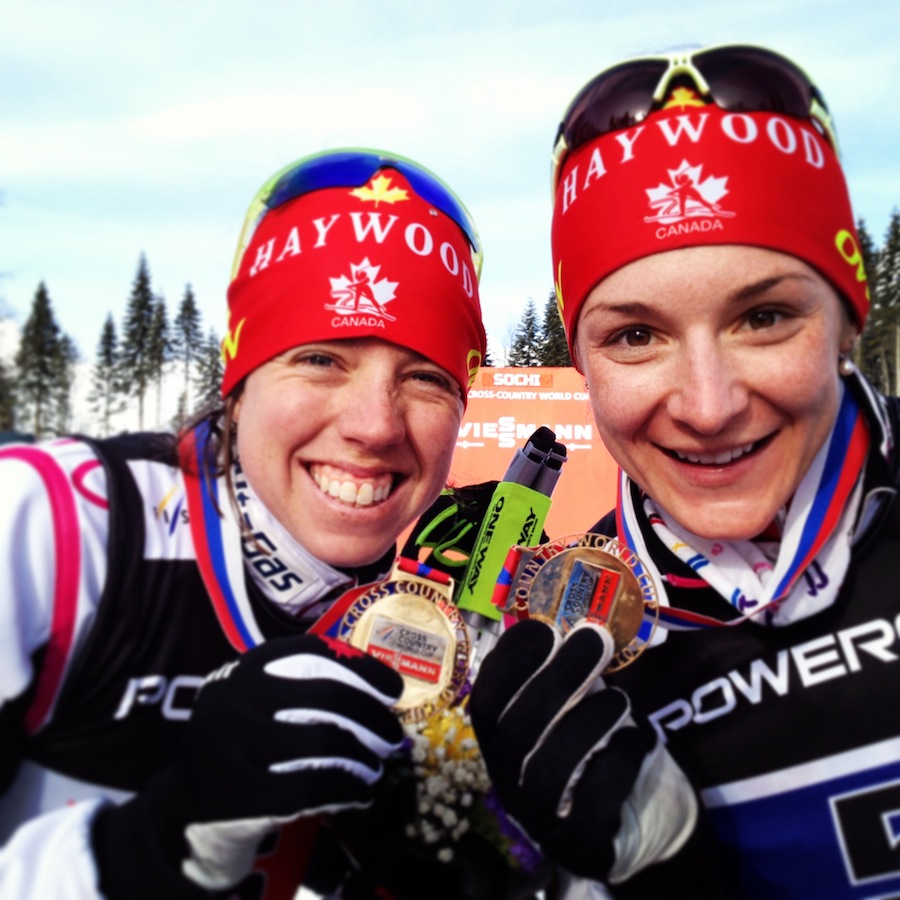
    Canadians Perianne Jones and Dasha Gaiazova celebrate their first bronze of the season, and together, in the Sochi World Cup classic team sprint. (Photo: Chandra Crawford)
    Canadians Perianne Jones and Dasha Gaiazova celebrate their first bronze of the season, and together, in the Sochi World Cup classic team sprint on Feb. 3. (Photo: Chandra Crawford)

    Somppi was the fourth-best Canadian in the 15 k pursuit after Harvey in 25th (+3:40.5), Kershaw in 31st, and Babikov in 41st (+5:39.9). Valjas finished last in 48th (+10.02.9). In the women’s 10 k, Nishikawa as the lone Canadian was 46th (9:56.4 behind Norwegian winner Marit Bjørgen). Gaiazova did not compete.

    “She felt like she couldn’t race,” Wadsworth explained. “That’s her decision.”

    As for the rest of his athletes: “They definitely went out there and skied hard,” he said. “Like I told them the last couple days, ‘I don’t care about the result, I just want to see you executing and focusing,’ and they did that and it was good.”

    Good, not great, and certainly not what the Canadian World Cup Team had dreamed about before the start of the season. Given their starting positions on Sunday, with Harvey going earliest in 32nd, 3:16 behind Northug, the team knew miracles weren’t quite within reach. But as Kershaw pointed out, anytime you put a bib on, you have to go out there with some gusto.

    “You’ve got to try to get yourself in the best possible frame of mind to give it your best shot,” Kershaw said. “Sometimes your best shot is 20 percent of what you’re capable of or what you’ve shown in the past.”

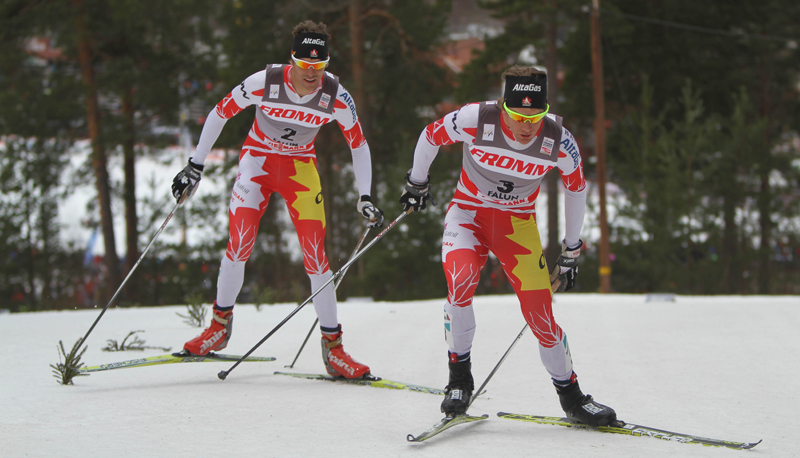
    Regardless of where you end up, whether it’s first or 31st, Kershaw said that’s what motivates you to improve. However, at this point in the season, it was a matter of finishing it out. To add some lightheartedness to Sunday’s race, the Canadian men wore casual sunglasses.

    “We still went hard, but we’re trying to find ways to still keep it fun,” Kershaw said. “It’s a beautiful life and ski racing is still a passion for everyone on the team, but it’s challenging. It’s not nearly as fun when you’re the one wiping the floor.”

    Wadsworth believes that feeling is what will drive them in the year to come. Coming off an outstanding 2011/2012 outing, in which Kershaw was second and Harvey placed sixth overall and Valjas notched two podiums at World Cup Finals, he thinks the team might have been too ambitious to raise the bar higher.

    “I think we came out of last year feeling like we could do anything, and that’s how we approached the whole training season and into the early part of race season,” Wadsworth said. “We were just like, hitting every World Cup and just plowing ahead. … We felt that we could train harder and do everything like more, more, more and we can’t.”
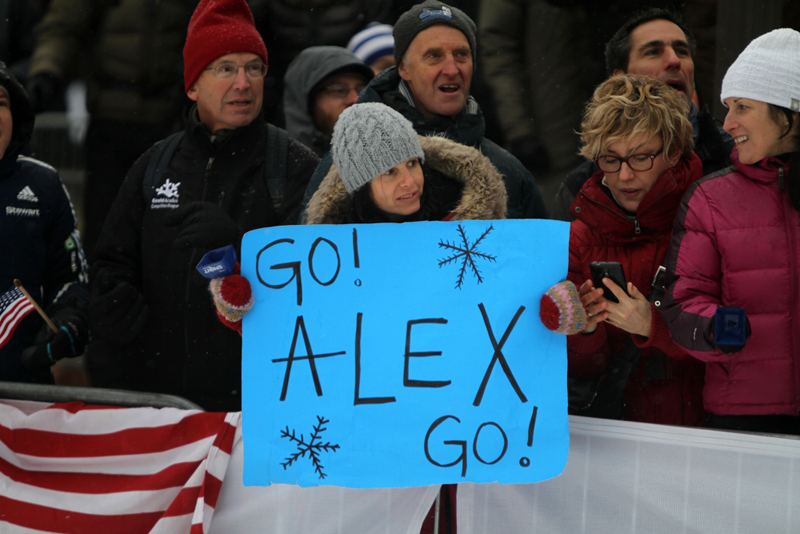
    One of many Alex Harvey cheering sections at the Canadian World Cup in Quebec City, which took place Dec. 7-8, 2012.
    One of many Alex Harvey cheering sections at the Canadian World Cup in Quebec City from Dec. 7-8, 2012.

    In the past, he said one of his program’s biggest strengths is its ability to carefully select races and get the most out of training camps and blocks throughout the year.

    “It’s my fault for not skipping Kuusamo and Gällivare and just staying in Canada and preparing for the Canadian World Cups and then going on,” Wadsworth said. “Even I got sucked into it. We tried to go and do every race and it was just too much.”

    In early December at the Quebec World Cup, Harvey was the only Canadian who qualified for the heats and ended up 21st in the individual freestyle sprint. The next week in Canmore, Alberta, Harvey and Kershaw placed outside the top 50 in the skate sprint qualifier and skipped the skiathlon the next day.

    “We’ll be better. Canada will be better next year,” Kershaw resolved. “Five podiums just wasn’t what we were looking for this year. I think we all learned a lot this year and at the end of the day, that’s what skiing’s about.

    “You’ve got to learn from your mistakes and move forward,” he continued. “We’re bummed that we’re not skiing well, but everyone is just so motivated to be better next year, and at the end of a long, tough season if everyone is still motivated, that’s a really good place to start.”

    While the team had yet to debrief and set new intentions in its season-ending meeting, Wadsworth said they would look to change a few things next year, including their approach to testing skis.

    Waxing woes were one reoccurring theme on the Canadian World Cup Team this year – with tough races at Holmenkollen and in the 15 k classic mass start in Falun last Saturday. Wadsworth said his small staff of five wax techs (eight at World Championships) shouldn’t bear the weight of the blame.

    “We need to review our race-day testing,” Wadsworth explained. “I think the athletes realize, too, they need to take a little more ownership. A lot of times skis get tested for them, especially on skate days, so they can just kind of show up and focus on their warmup and whatnot, but I think they need to start testing and feeling the skis a bit more on their own and having more input on that. That will be something we do differently next year.”

    Wadsworth would also like to hire another core technician, someone who could work more closely with his skiers and test right up until the start.

    “You have to be pretty fit to ski even their warm-up speed,” he said. “The athletes need to take responsibility and come out earlier and take more time. You see a lot of the other countries doing that with their athletes, they’re out like an hour and a half before the race.”

    After weathering a steep learning curve in 2013, Wadsworth’s confident it will bode well for the upcoming Olympic season.

    “I think it will be really good to be flying under the radar because I know one thing and that’s both the men and the women on this team can win medals at the Olympics,” he said.

    “We’re at such a high level that we feel like this year was kind of a failure, but at the same time, we got a medal at the World Championships and two fourth places, a near miss for another medal, as close as you can basically be and not get a medal,” he added, referring to Kershaw and Harvey’s fourth-place finish in the team sprint, three-hundredths of a second off the podium.

    Wadsworth also pointed out the team’s four Tour de Ski podiums and the women’s team-sprint bronze on the Olympic course in Sochi.

    “Those are solid and we need to remember those and remember the results from last year, too, and hold those in our pockets on the days when it gets hard training,” he said. “We learned a lot about the different athletes on the team and we’re going to use that to our advantage.”

    The Canadian World Cup Team flew home Monday and most of its athlete will compete at Canadian Nationals in Whistler, B.C., this week. Kershaw planned to attend, but in need of some time off the skis, said he wouldn’t race. Harvey will not be there as he rehabs a shoulder injury from earlier this season in Sochi.

    ***
    Sunday’s pursuit results: men | women

  • Ever-Stoic Bjørgen Ready to Party After World Cup Finals Victory

    Ever-Stoic Bjørgen Ready to Party After World Cup Finals Victory

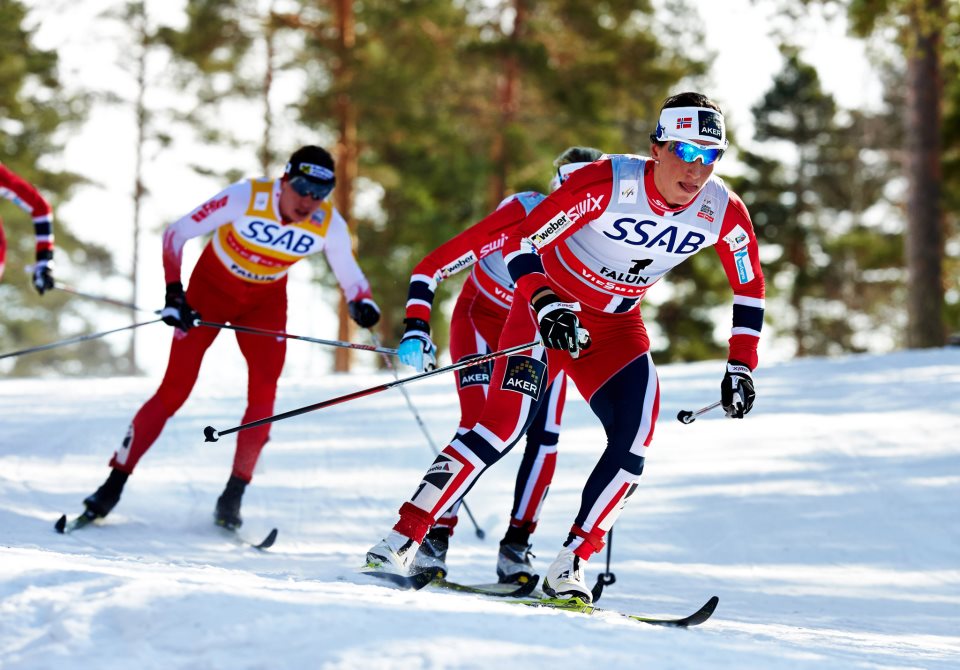
    Norway's Marit Bjørgen racing to her first victory of 2013 World Cup Finals in Friday's 2.5 k prologue in Falun, Sweden. Bjørgen went on to win two more stages, including Sunday's freestyle pursuit, to win the mini-tour title and finish fourth in the overall World Cup. (Photo: Fischer/Nordic Focus; facebook.com/FIS Cross Country)
    Norway’s Marit Bjørgen racing to her first victory of 2013 World Cup Finals in Friday’s 2.5 k prologue in Falun, Sweden. Bjørgen went on to win two more stages, including Sunday’s freestyle pursuit, to win the mini-tour title and finish fourth in the overall World Cup. (Photo: Fischer/Nordic Focus; facebook.com/FIS Cross Country)

    It wouldn’t quite be accurate to call Marit Bjørgen’s World Cup Finals pursuit performance on Sunday a formality. Sure, Norway’s 12-time World Champion started the 10-kilometer freestyle race a full minute and 20 seconds ahead of the field in Falun, Sweden, with teammate Therese Johaug being the only one that could potentially test her.

    And yes, chances were Johaug would never catch her, but there’s always several races within a race, and Bjørgen had one going from the start.

    Therese Johaug after finishing second to Norwegian teammate Marit Bjørgen in Saturday's 10 k classic mass start at 2013 World Cup Finals in Falun, Sweden. Johaug went on to place second to Bjørgen in the pursuit for the mini-tour silver. (Photo: Fischer/Nordic Focus; facebook.com/FIS Cross Country)
    Therese Johaug after finishing second to Norwegian teammate Marit Bjørgen in Saturday’s 10 k classic mass start at 2013 World Cup Finals in Falun, Sweden. Johaug went on to place second to Bjørgen in the pursuit for the mini-tour silver. (Photo: Fischer/Nordic Focus; facebook.com/FIS Cross Country)

    Sixth in the World Cup standings after missing more than a month of racing in December (Bjørgen sat out the Canadian World Cups to rest up for the Tour de Ski, then skipped the Tour because of a heart arrhythmia), the 33-year-old had the opportunity to capture 200 World Cup points on Sunday and rise to at least fourth overall.

    If American Kikkan Randall – the World Cup sprint champion – placed outside the top 15, Bjørgen could finish third in the overall standings. But Randall, too, was out to finish strong.

    Bjørgen did have several things going for her. Without Poland’s Justyna Kowalcyzk challenging her from what would’ve been a 46-second starting deficit (Kowalczyk skipped the last race of the season), Bjørgen enjoyed somewhat of a solo journey throughout the three-lap race to seal her 59th World Cup victory. Able to pick her head up, she soaked in the thousands of spectators lining the course.

    “I was in control,” she told NRK, according to a translation. “When one goes all alone in front, [it’s] not too full.”

    Meanwhile, Johaug charged from behind to fend off Sweden’s Charlotte Kalla, who started just 6 seconds behind her.

    With one lap remaining, Johaug was within 55 seconds of Bjørgen, but unless something dramatic happened – like a crash – Bjørgen was going to bring this one home. She finished first in 26:39.6, 49.3 seconds ahead of Johaug, who topped Kalla by 22.4 seconds.

    “I had a lot of time to enjoy the track and the people around the track,” Bjørgen told FIS. “It’s been a great season for me and to finish like this … I’m looking forward to some vacation and to a new season and Sochi. I’m really happy.”

    Repeating her bronze from last year’s World Cup Finals, Kalla finished 1:11.7 out of first for her first World Cup podium (outside of a stage top-three) this season. She was second to Bjørgen in Friday’s 2.5 k freestyle prologue.

    “It feels great to be on the podium again,” Kalla said. “I tried to keep the pace with Therese but she was too fast.”

    Sweden's Charlotte Kalla, who notched her first World Cup podium (outside of a stage top-three) on Sunday in the 10 k freestyle pursuit at 2013 World Cup Finals in Falun, Sweden. There, she was third behind Norwegian winner Marit Bjørgen and runner-up Therese Johaug. (Photo: Fischer/Nordic Focus; facebook.com/FIS Cross Country)
    Sweden’s Charlotte Kalla, shown finishing fifth on Saturday in the 10 k classic mass start. Kalla notched her first World Cup podium (outside of a stage top-three) on Sunday in the 10 k freestyle pursuit at 2013 World Cup Finals in Falun, Sweden. There, she was third behind Norwegian winner Marit Bjørgen and runner-up Therese Johaug. (Photo: Fischer/Nordic Focus; facebook.com/FIS Cross Country)

    On Sunday, the Swede initially responded to Johaug’s pace, coming within eight seconds of her 2.3 kilometers in. But by the second lap, the gap between Johaug and Kalla had grown to 11 seconds. The third time around, Kalla’s technique began to falter, yet she managed to keep it together for the final two kilometers.

    Kalla finished 40.1 seconds ahead of Heidi Weng, who for the second-straight race outlunged a competitor to the finish. A day after placing third in the 10 k classic mass start ahead of Kowalczyk and behind Bjørgen and Johaug, respectively, Weng placed fourth (+1:51.8), 0.3 seconds ahead of Finland’s Kerttu Niskanen.

    Norway’s fourth woman, Astrid Uhrenholdt Jacobsen took sixth (+2:09.3), and Randall outsprinted Finland’s Anne Kyllönen and Krista Lahteenmaki for seventh (+2:29.3) after starting 15th.

    With the second-fastest time after Johaug, Randall held onto third in the overall World Cup to become the first American woman to finish the season in the top three.

    Bjørgen finished fourth, behind Crystal Globe winner Kowalczyk and runner-up Johaug. But that respectable finish – and 24 consecutive podiums in as many races – weren’t what Bjørgen would remember most about this season: World Championships were.

    “Four gold and one silver is more than I hoped for,” she told FIS.

    Asked how she’d celebrate Sunday’s win and a triumphant season overall, she told NRK, “I do not know whether it is suitable to tell on TV.”

    Johaug, who notched more than a dozen podiums this season, said it would be an all-nighter.

    “We will [stay out] until tomorrow morning,” she told NRK.

    As for Kowalczyk, who called it quits before the end of World Cup Finals because of leg troubles: “It was a perfect season for me,” she told FIS. “If you take away the World Championships it was almost ideal. I won the Tour de Ski and my fourth Big Crystal Globe. … I will start training again in the first half of May. I think I will ski the same program as this year.”

    Results

  • Canadians Slip Farther Behind with Wrong Wax in World Cup Finals Mass Start

    Canadians Slip Farther Behind with Wrong Wax in World Cup Finals Mass Start

    Alex Harvey during the 2012 World Cup Finals 15 k classic mass start in Falun, Sweden, where he placed 18th behind teammates Lenny Valjas in third and Devon Kershaw in fifth.
    Alex Harvey during the 2012 World Cup Finals 15 k classic mass start in Falun, Sweden, where he placed 18th behind teammates Lenny Valjas in third and Devon Kershaw in fifth. On Saturday in the 2013 edition of the race, he led Canada in 30th.

    Sometimes a rough day at the races is as simple as missing the wax. The Canadian National Team has been there before, probably more often than it would like to recall this season, but the reality is, you still have to finish.

    That’s what stood out to head coach Justin Wadsworth on Saturday. As he watched his team, particularly his men, struggle in the five-lap, 15-kilometer classic mass start on the second-to-last stage of World Cup Finals, the three-time U.S. Olympian remembered what it was like to be in their position.

    It’s bad enough when you’re not feeling 100 percent, but if you’ve got no kick to work with, it’s going to be a long day.

    Wadsworth noticed the problem on the main hill of the men’s first lap.

    “You could see the sun really beating on it and the guys, for so early in the race, were having a little bit of a hard time climbing up it,” he recalled on the phone. “We had really bad grip on the skis so there was no chance for the guys. The women, the skis were OK.”

    The women’s 10 k classic mass starter took place earlier on the warming afternoon in Falun, Sweden. NorAm leader Emily Nishikawa of the Alberta World Cup Academy (AWCA) placed 46th, 3:36.3 behind Norway’s Marit Bjørgen, who won in 28.06.7. Canadian World Cup Team member Dasha Gaiazova finished last in 50th (+4:07.3).

    Gaiazova told Cross Country Canada she was simply “really tired,” according to a press release. “My energy tank needs a refill.”

    That’s how most of the Canadians – and many World Cup skiers on the five-month circuit were feeling these days, but Wadsworth was disappointed his five men didn’t have much of an opportunity to push their limits.

    Temperatures warmed from around 3 degrees Celsius (37 Fahrenheit) at the start of the women’s race to 6 degrees  (43 Fahrenheit) for the men’s 15 k.

    “It was one of the days I would say we missed the wax quite badly,” Wadsworth said. “That doesn’t help because the bodies aren’t perfect anyways, and that combination of not-perfect bodies and bad skis is not so much fun.”

    Alex Harvey turned out the team’s top result in 30th, tying Sweden’s Calle Halfvarsson in a photo finish 1:38.2 behind Norway’s Eldar Rønning, who won in 43:26. Harvey skied with teammate Devon Kershaw for much of the race, hovering in the mid-30s. The two stuck with the pack for the first half of the 15 k, skiing 35 seconds off the pace by 10 k. By 12.2 k, they were more than a minute back from the leaders.

    Kershaw ended up 36th (+2:09.3), and Ivan Babikov finished 41st (+2:47.7). Around 5 k, Babikov and Lenny Valjas were about 30 seconds back in the mid-40s. Michael Somppi (AWCA) was 50 seconds behind in 51st.

    Babikov passed a few places to finish slightly higher, but Valjas ended up 50th (+5:04.5) and Somppi was last in 51st (+6:14.5). A year ago, Valjas captured bronze in the same race on a different course in Falun, which has been altered for 2015 World Championships. Kershaw was fifth in the 15 k classic mass start.

    But that was then, and seeing how his athletes were feeling the wear-and-tear of the season, Wadsworth told them before the start he didn’t care where they finished, he just wanted them to work hard.

    “All the guys hung in there,” he said. “They went through a day that I can tell you, haven been there myself as a racer, was no fun at all. They knew early on in the race their skis weren’t going to be good and they kept fighting, and I’m really proud of those guys for that.”

    Asked what specifically went wrong, Wadsworth said something with the team’s lines of communication.

    “I think it was just not going and looking ahead enough, maybe the connection between the wax team and looking at how the weather was changing,” he said. “Everybody’s got to be aware of that and communicating and somewhere that broke down today.

    “I don’t think anyone was probably going to win the race today, but at the same time, you need to have good skis to be in the competition,” he added. “The kick wasn’t there for them.”

    With one race left, Harvey will be the first Canadian starter in the pursuit in 32nd, 3:15.7 back from Norwegian leader Petter Northug. Last year in the pursuit, Harvey started ninth and finished second.

    After Sunday, Harvey will take another look at his shoulder injury from earlier this year while most of the team heads to Canadian Nationals in Whistler, B.C.

    “They just really need to refocus again and fight,” Wadsworth said of his athletes in the last World Cup race of the season. “A bunch of them are in positions that aren’t a lot of fun to be in, but they still have to go out there and do their job and work hard.

    “It’s gonna be tough [Sunday], but we gotta go into every race and do our best,” he added “If they get there and they grit their teeth and they can see that they’re giving it everything they have, than that’s all I can ask, that’s all we can all ask.”

    Results: women | men

  • Bjørgen Ushers Norway into Top Three; Kowalczyk Done with World Cup Finals

    Bjørgen Ushers Norway into Top Three; Kowalczyk Done with World Cup Finals

    Marit Bjorgen leads Norwegian teammate Therese Johaug (c) and Poland's Justyna Kowaczyk (l) during Saturday's 10 k classic mass start at the 2013 World Cup Finals in Falun, Sweden. Bjørgen went on to win by 3.9 seconds, Johaug was second, and Kowalczyk took fourth, 0.1 seconds behind Norway's Heidi Weng (not shown) in third. (Photo: Fischer/Nordic Focus; facebook.com/FIS Cross Country)
    Marit Bjørgen leads Norwegian teammate Therese Johaug (c) and Poland’s Justyna Kowaczyk (l) during Saturday’s 10 k classic mass start at the 2013 World Cup Finals in Falun, Sweden. Bjørgen went on to win by 3.9 seconds, Johaug was second, and Kowalczyk took fourth, 0.1 seconds behind Norway’s Heidi Weng, who took third. (Photo: Fischer/Nordic Focus; facebook.com/FIS Cross Country)

    Marit Bjørgen had seen the scenario play out before. Poland’s World Cup leader, Justyna Kowalczyk would suddenly decide it’s time to ski faster, and off the 30-year-old would go.

    Come catch me, she’d beckon. Many would try; few ever did.

    But when you’re Bjørgen, Norway’s most decorated female with 12 World Championships golds and three Olympic titles, that’s not an act you readily follow. In Saturday’s 10-kilometer classic mass start at World Cup Finals, Bjørgen certainly wasn’t going to let it happen without a fight.

    The 33-year-old kept her head down as Kowalczyk opened a few-seconds lead at the start of the last lap. The Pole was pulling away from Bjørgen and two other Norwegians, Therese Johaug and Heidi Weng, but she still had some three kilometers to hold it. And in Falun, Sweden, that’s a tough task.

    The 3.3 k course is unforgiving, marked by the infamous Mörderbacken hill that requires a lengthy climb followed by a multiple-tiered descent. If you can lead through the high point, that’s one achievement, but the real test comes on the downhill.

    Bjørgen kept all this in mind as Kowalczyk strided away up the long climb. With about two kilometers to go, the Norwegian nearly reined her back in, trailing by just 2 seconds while Johaug followed 0.8 seconds back. Weng kept them all in sight with a 7.4-second deficit.

    The second chase group, led by Finland’s Kerttu Niskanen at 8 k, was more than 36 seconds back and six strong with Sweden’s Charlotte Kalla, Finland’s Anne Kyllönen, Yulia Tchekaleva of Russia, Norway’s Astrid Jacobsen, and Katrin Zeller of Germany.

    But with three Norwegians and a Polish favorite up front, all eyes were on the leaders. Bjørgen rode up alongside Kowalczyk during the descent, skiing on the outside of one curve and using her speed to take control up the next climb.

    With about a kilometer remaining, Bjørgen led into the final steep rise, and Kowalczyk suddenly slipped behind. Her kick had worn off on the klister day, with temperatures just above freezing. Kowalczyk would have to fight for bronze with Weng, while Bjørgen and Johaug cruised down into the stadium.

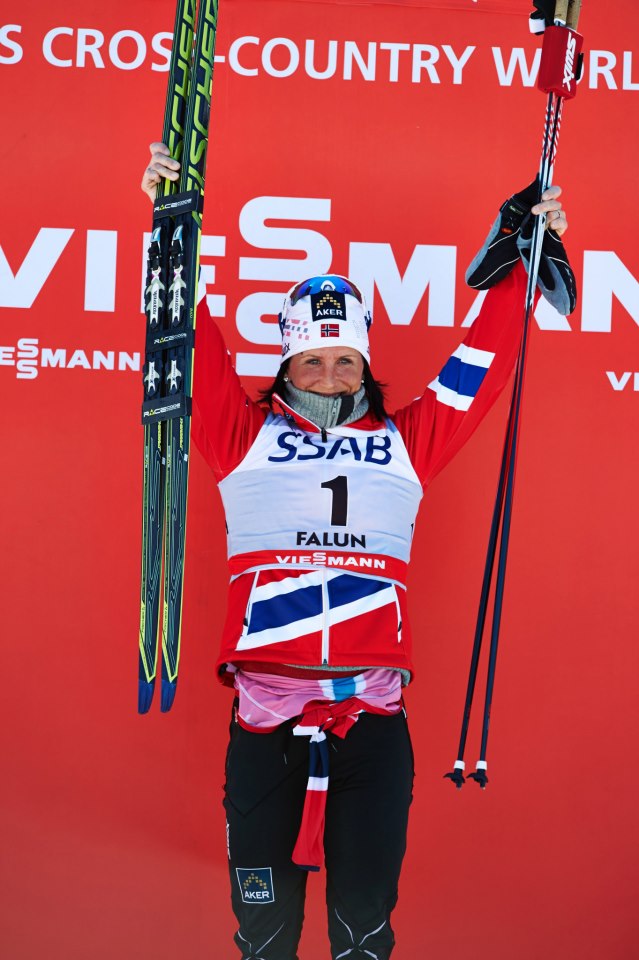
    Norway's Marit Bjørgen tops the podium for the second straight day at World Cup Finals in Falun, Sweden, after winning Saturday's 10 k classic mass start and leading a Norwegian top-three sweep. (Photo: Fischer/Nordic Focus; facebook.com/FIS Cross Country)
    Norway’s Marit Bjørgen tops the podium for the second straight day at World Cup Finals in Falun, Sweden, after winning Saturday’s 10 k classic mass start and leading a Norwegian top-three sweep. (Photo: Fischer/Nordic Focus; facebook.com/FIS Cross Country)

    There, Bjørgen continued to push the pace and won comfortably in 28:06.7 minutes, 3.9 seconds ahead of Johaug in second.

    The two looked back to see if Weng could pull off the Norwegian sweep as she entered the finishing straight with Kowalczyk. The 21-year-old did just that, outlunging Kowalczyk by one-tenth of a second, 11 seconds after Bjørgen crossed the line.

    “I just thought that I should have the third place,” Weng told NRK, according to a translation. “I stiffened bad when Kowalczyk caught, but when I saw that she struggled in the last hill I saw hope.”

    “She was nervous and fiddled with her porridge a lot at breakfast,” Bjørgen said at a post-race press conference. “But Heidi skied a fantastic lap and I’m very proud of what she did.”

    The 1-2-3 finish was about as good as Norway could have asked for, especially with Bjørgen leading the way with her second-straight victory of the Finals. With one race remaining in the mini tour, Bjørgen would enter Sunday’s freestyle pursuit with a 46-second lead on Kowalczyk. However, after the race, Kowalczyk announced she would not be competing.

    “I’ve decided not to go on Sunday,” she said a press conference, according to NRK. “I did not have the chance to win mini tour anyway.”

    Kowalczyk said she was past her best races of the season, and after competing in essentially every one possible, she needed a break.

    “I’ve only been home a few days throughout the year and long for a holiday,” she added.

    She’s also struggling with leg pains, and her personal doctor has suggested she might need surgery in the offseason.

    The news came as a surprise to Bjørgen, who was excited about the gap she’d built on her longtime rival.

    “I had expected her to be here and fight,” Bjørgen told NRK. “But it has been a long season for her and it’s a choice she has to make.”

    Kowalczyk is currently 674 points ahead of Johaug in the overall World Cup standings, which will be finalized Sunday. Bjørgen is more than 1,000 points behind in sixth after a heart arrhythmia in December led her to skip several World Cup races, including the entire Tour de Ski.

    Even so, Bjørgen has achieved an incredible statistic of making the podium in 23 out of 23 consecutive starts. The last time she didn’t make the top three was more than a year ago on March 18, when she was fifth in the 2012 World Cup Finals pursuit in Falun.

    “It is [rare] what she does and shows that she is the world’s best skier,” Johaug told NRK. “I’m terribly proud of her.”

    Alternatively, Kowalczyk has been as far back as 43rd this season, and Johaug once placed 49th. Women’s coach Egil Kristiansen believes that even with a health scare, Bjørgen’s season went about as well as the team could’ve asked for.

    “Disease breaks [out] involuntarily, but in general, it has been shown before that Marit [needs] a little break from skiing to rest and train,” Kristiansen told NRK. “We’ve realized that it’s a good recipe for success for her.”

    Looking ahead to Sunday’s pursuit, Bjørgen’s most concerned about Johaug starting 1:20 back in second.

    “Although I have a big gap on Therese, she is very fast and I have to stay focused and do my best,” she said at a press conference.

    After the three Norwegians and Kowalczyk took first through fourth on Saturday, Kalla placed fifth (+39.9) and will start third on Sunday, 1:26 behind Bjørgen.

    Finland had three in the top 10 with Kyllönen in sixth (+40.2), Niskanen in seventh (+40.6) and Krista Lahteenmaki in 10th (+58.3). Tchekaleva was eighth (+43.9) and Jacobsen finished ninth (+46.3).

    Niskanen and Weng will start fourth (+1:37) and fifth (+1:52), respectively, in the pursuit, and Kyllönen will be 1:53 back in sixth.

    Results

  • Short of a Repeat, Canadians Put Two in Top 30 in World Cup Finals Prologue

    Short of a Repeat, Canadians Put Two in Top 30 in World Cup Finals Prologue

    Alex Harvey (CAN) World Cup Finals, Falun, Sweden, Men's prologue, 2012
    Canadian World Cup Team member Alex Harvey celebrating his prologue victory at last year’s World Cup Finals in Falun, Sweden. Teammate Devon Kershaw joined Harvey on the podium, and the next day, Lenny Valjas placed third in the 15 k classic mass start.

    The Canadians had some supreme memories to live up to Friday at the World Cup Finals in Falun, Sweden.

    A year ago at the same venue, Alex Harvey and Devon Kershaw owned the 3.3-kilometer freestyle prologue, placing first and third, respectively. Kershaw went on to finish second overall in the World Cup and Harvey, at the age of 23, was sixth.

    Never ones to sugarcoat disappointing performances or a sub-par season overall, the Canadians weren’t exactly expecting to repeat those results on the renovated course (for 2015 World Championships) this year. But they wouldn’t be happy with much less, either.

    Facing a shortened 2.5 k freestyle prologue, modified because of safety concerns on the infamous Mörderbacken hill, the Canadian men set out to achieve some redemption.

    Harvey had already shined at World Championships, becoming the first Canadian male to medal at that level with bronze in the classic sprint; Lenny Valjas wrapped up the season with a career-best eighth in the World Cup sprint standings, and Kershaw notched a few season-best top 10s, but continuity and momentum were what they were looking for.

    That’s what they thrived off last year, and that’s why they hoped they could end the season with.

    Kershaw giving Valjas a ride up the mini-Mördarbacken 15km freestyle pursuit, 2012
    Kershaw leads Valjas up the mini-Mördarbacken in last year’s 15 k freestyle pursuit at 2012 World Cup Finals in Falun, Sweden. There, Kershaw placed 10th behind teammate Alex Harvey (not shown) in second.

    Two top 30s on Friday, with Valjas placing 27th and Harvey finishing 30th, didn’t quite cut it. Valjas finished 14.2 seconds behind Norway’s Petter Northug, who won in 5:20.7. Harvey was another 0.6 seconds back, and Kershaw placed 32nd (+15.3).

    NorAm leader Michael Somppi of the Alberta World Cup Academy (AWCA) came in 44th (+19.4), and World Cup veteran Ivan Babikov was last in 52nd (+30.2).

    In the women’s 2.5 k, Emily Nishikawa (AWCA) was 41st, 37.6 seconds behind Norwegian winner Marit Bjørgen (who finished in 6:03.2). The lone women’s World Cup Team member competing, Dasha Gaiazova was 43rd (+43.6).

    “It’s not the greatest day for our whole team,” Valjas said on the phone. “It’s hard when nobody’s really skiing to their potential. Usually when one guy’s doing well, he can help motivate the rest of us, but none of us are really having stellar days so we’re all just kind of bummed.”

    Don’t get them wrong; the results weren’t bad. Harvey, Kershaw and company have been outside the top 30 before, with Kershaw most recently returning to form at the Holmenkollen 50 k freestyle mass start last Saturday in Oslo, Norway. Despite waxing struggles there, he pulled off 29th. Again, not a podium, but an improvement.

    Heading into Friday’s prologue, the team tried to keep in mind that anything was possible.

    “This was such a good race for us last year and we were trying to get revved up thinking about that success,” Canadian head coach Justin Wadsworth told Cross Country Canada. “But the bodies just aren’t there right now.”

    Last year, they were. Plus the Canadians had one success story upon another to feed off. After Harvey and Kershaw topped the prologue podium, Valjas placed third in the 15 k classic mass start at 2012 World Cup Finals.

    “[Prologues] should be good for them, but it’s mostly about the shape, which for many reasons isn’t there now,” Wadsworth wrote in an email. “The guys tried hard, but just didn’t have it. Dasha didn’t have it from the get go…”

    The 31st of 53 starters, Valjas sped up on the second half of the course down Mörderbacken, improving from 29th at the high point to 27th overall. Harvey skied consistently in 30th, and Kershaw rose from 41st at 1.2 k to 32nd.

    “It felt more like a long sprint qualifier,” Valjas said. “Five and a half minutes? It ended pretty quick, but tomorrow’s [15 k classic mass start is] a good day for all of the guys so we’ll give it another shot and see where that leads us.”

    Harvey was eager to forget Friday after what he wrote off as one of his worst prologue results.

    “I just didn’t feel too good out there,” he wrote in an email. “When I wanted to open it a bit harder, near the top of the climb and on the last 500m at the bottom of the downhill, there was just nothing there … no extra power.”

    Somppi had perhaps one of the most notable Canadian performances of the day, starting sixth and leading through 1.2 k. He ended up having the 15th fastest time at that checkpoint, but was disappointed about dropping to 44th.

    “I think I skied the first climb well. I was certainly attacking, but was in control,” Somppi wrote. “It was when I received a split from Justin that I was leading out the few guys that started in front of me that I got excited. I just went for it up the big climb, hop skating as hard as I could.

    “When I crested the hill right after the time check my legs had nothing left,” he added. “Definitely should have kept it in control a little more on the climb to save something for the downhill/stadium finish loop. … Lesson learned.”

    Nishikawa was satisfied with her result. “I felt I skied well on the climbs, but my legs were super shaky on the downhills, so I skidded more than I would have liked,” she wrote.

    According to several athletes, the Friday-morning course alteration, which cut off the top of Mörderbacken, didn’t affect much.

    “I think the course change was good, although you still had a fair amount of speed at the big corner,” Nishikawa wrote. “It was fine for an individual race.”

    “It was a weird change, it just made it really short,” Valjas said. “But I don’t know if that really helped or hurt us, we just really didn’t have the best day out there.”

    On Friday night, the Canadians had a team meeting. There, Wadsworth asked his athletes “to stay focused and fight,” he explained.

    “As long as each of them tries 100% and crosses the finish line having laid it out, then we should all be able to walk away with our heads up,” Wadsworth wrote. “It’s hard to do this time of year, especially when the shape isn’t there, but really what other option do we have – To go home? I gave them that option, but they are still here, so I hope everyone really pushes hard and goes for the best effort they have.”

    Results: men | women

  • Northug Uses Brains and Brawn in World Cup Finals Prologue; Extends Overall Lead

    Northug Uses Brains and Brawn in World Cup Finals Prologue; Extends Overall Lead

    Norway's Petter Northug racing to his second-straight victory at 2013 World Cup Finals in Friday's 2.5 k freestyle prologue in Falun, Sweden. (Photo: Fischer/Nordic Focus and facebook.com/FIS Cross Country)
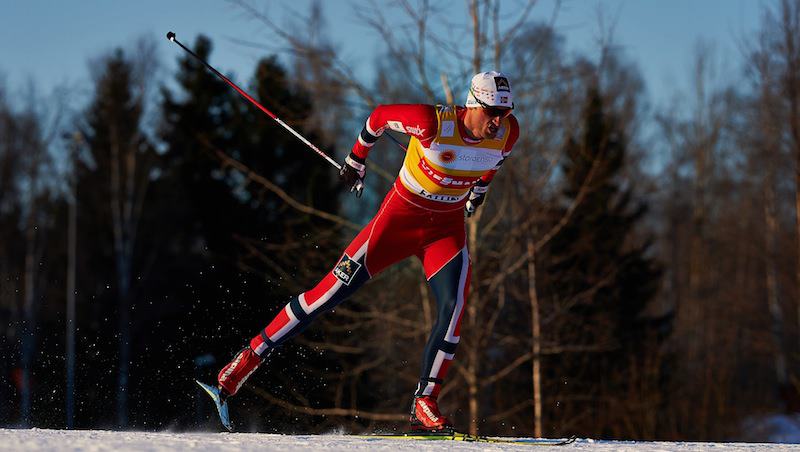
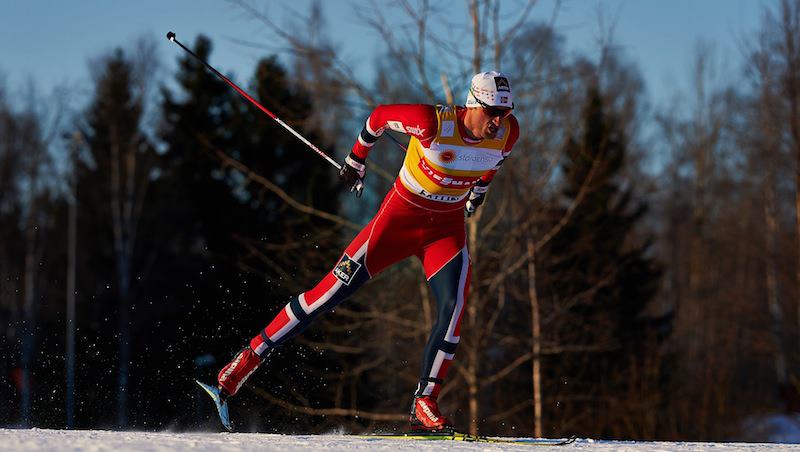
    Norway’s Petter Northug racing to his second-straight victory at 2013 World Cup Finals in Friday’s 2.5 k freestyle prologue in Falun, Sweden. (Photo: Fischer/Nordic Focus; facebook.com/FIS Cross Country)

    Petter Northug might not let others in on it all the time, but Norway’s favorite son is pretty calculated when it comes to racing.

    Friday’s prologue, the second stage of four in the World Cup Finals, was no different. Like everyone else, Northug hadn’t had a chance to preview the men’s shortened 2.5-kilometer course on Friday. There had been a lot of discussion about it the day before: organizers added some length to the already challenging Mörderbacken hill, and athletes wanted a safer descent.

    The two parties came to an understanding on Friday morning, removing the top part of the newly redesigned hill, which was altered for 2015 World Championships. Camera crews and organizers had to get out on course to make the changes, keeping competitors off it and essentially in question about how it would ski.

    The last of 53 starters, Northug let the men ahead of him test it out and quickly realized that going too hard too soon could lead to disaster. Northug had no way of knowing, but Russian Sergey Ustiugov, who started two minutes ahead of him, teetered over at the top of the infamous hill. The climb for the first half of the race was brutal, and if you didn’t have your legs in check, you might as well pray yourself to the bottom.

    “The plan was not to go out too hard in the first kilometer because people tend to pay at the end,” Northug told FIS after the race. “I wanted to carry high speed [in the] downhill into the finish.”

    Those were pretty wise words for the 27 year old, who often speaks without a filter. But with the last races of the season deciding whether he’ll be the 2012/2013 World Cup champion, Northug was all business.

    Sixth at near the height of the course at 1.2 k, Northug was 4.8 seconds down Finland’s Matti Heikkinen, the leader through that checkpoint. Just when it seemed the World Cup leader had erred in starting too conservatively, Northug hit the jets and soared down into the stadium.

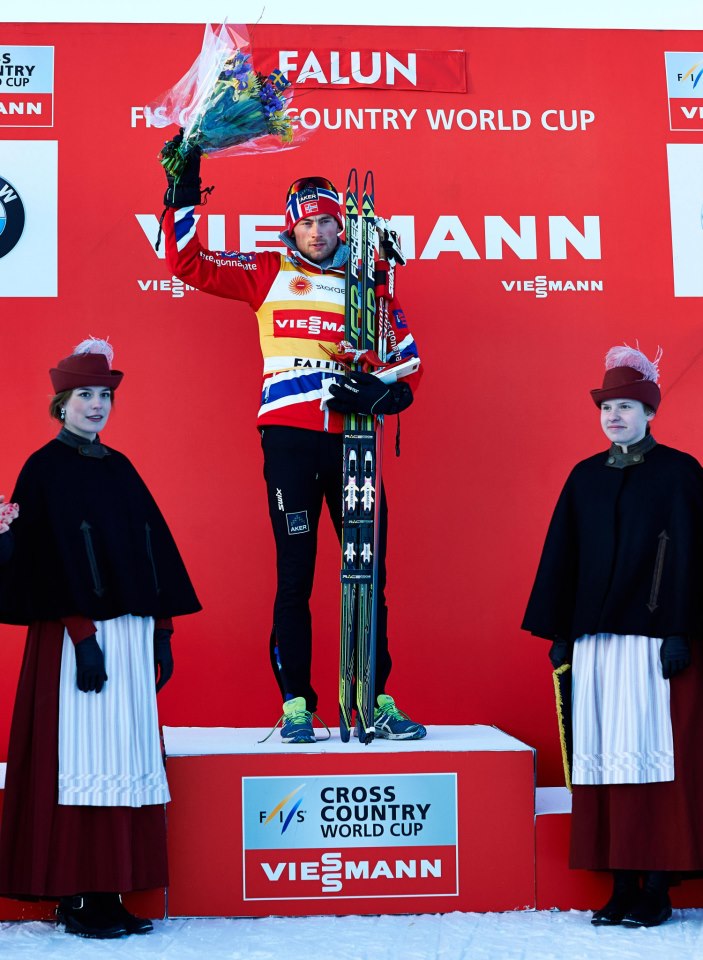
    Norway's Petter Northug tops the podium for the second time in as many races at 2013 World Cup Finals on Friday after winning the 2.5 k freestyle prologue by 2.1 seconds in Falun, Sweden. (Photo: Fischer/Nordic Focus; facebook.com/FIS Cross Country)
    Norway’s Petter Northug tops the podium for the second time in as many races at 2013 World Cup Finals on Friday after winning the 2.5 k freestyle prologue by 2.1 seconds in Falun, Sweden. (Photo: Fischer/Nordic Focus; facebook.com/FIS Cross Country)

    He finished with the fastest time of 5:20.7 minutes, bumping teammate Pål Golberg out of first by 2.1 seconds and another Norwegian Anders Gløersen down to third (+2.9).

    After Sweden’s Calle Halfvarsson in fourth (+3.4), Norway took six of the top seven. Martin Johnsrud Sundby placed fifth (+4.0), Finn Hågen Krogh was sixth (+5.7) and Eirik Brandsdal was seventh (+6.8).

    Sweden’s Marcus Hellner finished eighth (+8.3), Northug’s World Cup overall rival Alexander Legkov of Russia placed ninth (+8.8), and Alexey Poltoranin of Kazakhstan took 10th (+9.2).

    Switzerland’s Dario Cologna was 9.8 seconds off Northug’s winning time in 11th to remain in third in the overall World Cup standings. Northug increased his lead to 56 points over Legkov and 69 points ahead of Cologna, and is currently 27.3 seconds ahead of Brandsdal in the mini-tour standings.

    But he’s not comfortable yet.

    “I do not feel that the lead is big enough to relax,” Northug told NRK, according to a translation. “But it’s clear I have faith in victory. If I [didn’t I’d be] sitting at home on the couch.”

    Cologna, however, told reporters he was feeling a little deflated.

    “Petter is in good shape, and I’m in too poor shape to close the gap,” he told NRK.

    Northug didn’t buy it. If he were the underdog, he’d be saying the same thing.

    Last year, Cologna won the coveted Crystal Globe by 750 points over Canadian Devon Kershaw. Northug was third, more than 1,000 points behind Cologna.

    The season before that, Cologna beat the Norwegian by 330 points, but in 2010, Northug won the overall title ahead of Lukas Bauer (CZE) and Hellner, respectively. Back then, Cologna was fourth.

    “I do not believe anything that he [Cologna] says,” Northug told NRK. “It is only tactical game to take the pressure away from himself.”

    Looking ahead to Saturday’s 15 k classic mass start, Northug knows it’ll be important to ski both fast and stay upright on Mörderbacken hill.

    “I’ll be on guard and stay away from Legkov and Dario,” Northug told NRK. “I hope to keep the lead until Sunday.”

    He is 1:14.6 ahead of Cologna and 1:22.9 up on Legkov in the mini-tour standings. World Cup Finals wrap up Sunday with the women’s 10 k and men’s 15 k freestyle pursuits.

    Results

  • Canadians Deviate from the Norm in Stockholm Classic Sprint; Gaiazova Places 16th

    Canadians Deviate from the Norm in Stockholm Classic Sprint; Gaiazova Places 16th

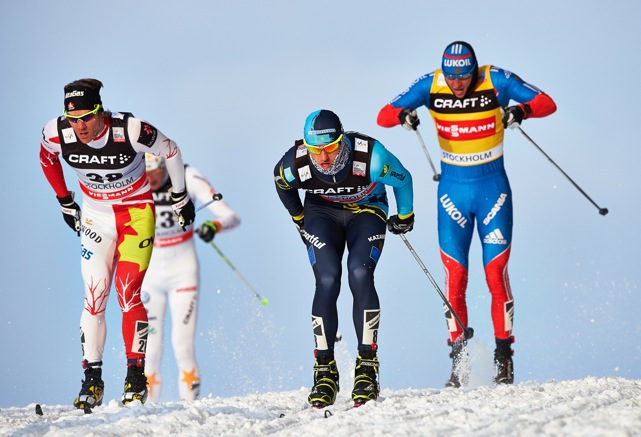
    Canadian Devon Kershaw leads Kazakhstan's Alexey Poltoranin (second from r), Russia's Alexander Legkov (r) and Sweden's Daniel Richardsson during Wednesday's 1.1 k classic sprint quarterfinal at the World Cup Finals in Stockholm. (Photo: Fischer/Nordic Focus)
    Canadian Devon Kershaw leads Kazakhstan’s Alexey Poltoranin (second from r), Russia’s Alexander Legkov (r) and Sweden’s Daniel Richardsson during Wednesday’s 1.1 k classic sprint quarterfinal at the World Cup Finals in Stockholm. (Photo: Fischer/Nordic Focus)

    For every Canadian qualifier except Dasha Gaiazova, the quarterfinals of Wednesday’s 1.1-kilometer classic sprint — the first race of the 2013 World Cup Finals — were a second chance, an opportunity to get it right.

    Gaiazova, 29, had qualified in a career-best fourth, 2.24 seconds behind Finnish winner Anne Kyllönen (who clocked 2:45.63) at the last city sprint of the season in Stockholm. It was a great feeling, and Gaiazova carried the momentum into her heat to end up 16th overall.

    Meanwhile, Canadian World Cup teammates Devon Kershaw and Lenny Valjas were scrambling for an edge – something that would make them faster than their 28th– and 30th-place qualifier finishes. Double poling the relatively flat 1.1 k course on skate skis, Kershaw made it through in 28th, 7.88 seconds off Norwegian Eldar Rønning’s top qualifying time of 2:21.52. Valjas opted to stride and tied Marcus Hellner for 30th (+9.63), advancing with a better sprint ranking.

    Canadian Lenny Valjas takes on American Andy Newell (r), Norway's Tomas Northug (c) and Italian Giorgio Di Centa in the quarterfinals of Wednesday's World Cup Finals 1.1 k classic sprint in Stockholm. The only one in his heat on classic skis, Valjas went did not advance in fourth and placed 20th overall. (Photo: Fischer/Nordic Focus)
    Canadian Lenny Valjas takes on American Andy Newell (r), Norway’s Tomas Northug (c) and Italian Giorgio Di Centa in the quarterfinals of Wednesday’s World Cup Finals 1.1 k classic sprint in Stockholm. The only one in his heat on classic skis, Valjas went did not advance in fourth and placed 20th overall. (Photo: Fischer/Nordic Focus)

    “It was pretty close,” Valjas recalled.

    But there wasn’t much he could do. A lean 6-foot-6, Valjas knew his strengths weren’t in double poling – even if everyone else was doing it. He tried it warming up, but could tell by the first climb grinding it out wasn’t going to work.

    “I don’t know if I was too heavy, my poles were sinking in, and it just didn’t feel good,” Valjas said. “For now, I’m not strong enough to double pole this course.”

    The 24-year-old went with the one option he had and stuck with the classic skis. He kicked off the first men’s quarterfinal of the afternoon in strong form, taking charge up the first hill against the likes of Norway’s Tomas Northug, American Andy Newell and Rønning.

    Up and over, Valjas continued to stride while everyone else double poled into the descent. Valjas held his own on the downhill, moving to third on the first technical corner, and strided alongside Northug to lead the following incline.

    But classic skis could only take him so far, and Valjas dropped toward the back on the final straightaway rise to the finish. Northug stayed in front, Newell surged past Valjas, and Rønning got back in the mix ahead of him. Valjas finished fourth, 1.73 seconds behind Northug in first.

    “I was hoping to be different and hoping it would work out, but this time it didn’t,” Valjas said . “But that was my only choice.”

    He did not advance and ended up 20th, good enough for eighth place in the overall sprint rankings, which were finalized Wednesday. Last year, Valjas was 12th in the Sprint Cup.

    With 10 days left until he’s surfing somewhere tropical, Valjas remained positive about his result.

    “I’m not too upset, it’s just the conditions didn’t suit me at all today,” he said.

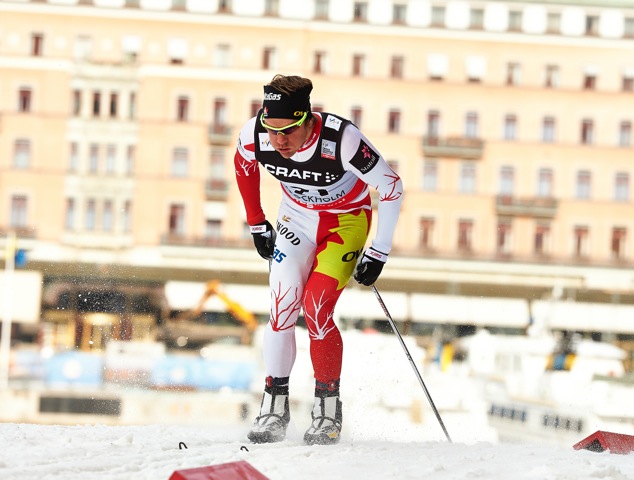
    Kershaw in Wednesday's 1.1 k classic sprint qualifier, where he advanced in 28th. (Photo: Fischer/Nordic Focus)
    Kershaw in Wednesday’s 1.1 k classic sprint qualifier, where he advanced in 28th. (Photo: Fischer/Nordic Focus)

    Kershaw faced a similar dilemma in the fifth quarterfinal. He recalled being up against the likes of this year’s World Cup sprint champion, Emil Jönsson of Sweden, Norway’s Eirik Brandsdal, and Alexey Poltoranin of Kazakhstan, and two distance skiers: Sweden’s Daniel Richardsson and then-overall World Cup leader Alexander Legkov of Russia (who was ultimately bumped to second by Stockholm sprint winner Petter Northug).

    Unsure whether the others would go for all-glide again, like most of the top men did in the qualifier, Kershaw focused on himself. He had narrowly qualified on skate skis so why not switch to classic? He had a feeling Brandsdal, Jönsson and Poltoranin would double pole, but wasn’t so sure about Richardsson and Legkov. When he saw everyone but him line up on freestyle boards, Kershaw was a bit surprised.

    “But I don’t regret making that choice,” Kershaw said. “I double poled in Drammen and ran out of gas hard in the last 100 meters and consequently ended up a very disappointing 49th so I was happy to make the heats, but I barely made it.”

    Kershaw used his second chance and good feelings from Saturday’s Holmenkollen 50 k – where he was 29th on a tough waxing day – as fuel, rising to fourth at the top of the first hill in the quarterfinal.

    He maintained his good positioning on the final downhill and into the headwind on the following straightaway. By the next descent, however, Kershaw said he didn’t have much of a chance. With significantly less glide, he dropped behind on the gradual downhill before the final corner into the stadium. He needed to be in contact, Kershaw said, and was left running from the back toward the finish.

    He picked off two places, passing Richardsson and Legkov to end up fourth, 1.79 seconds behind Brandsdal in first.

    “I was surprised at how fast the hill ended,” Kershaw recalled. “I’m like, ‘Oh, I’m making up ground, I’m making up ground, I might be able to catch third.’ Second might have been a stretch, but I was coming back on [Poltoranin in third] quite a bit.

    “All of a sudden, it flattened out a bit and I was at the finish line,” he added. “I’m like, ‘No! I’m not even tired and it’s over.’ ”

    Kershaw ended up 18th, his best result since placing eighth in mid-February at a World Cup classic sprint in Davos, Switzerland. While it was a good sign, the 30-year-old veteran and 2011/2012 overall World Cup runner-up thought it was a little too late.

    “I have three more races in my season,” Kershaw said. “I’m super motivated, I still want to ski race to the best of my abilities, but I’d be lying if I said I wasn’t already going through what I did wrong this year.

    Dasha Gaiazova (CAN) en route to finishing eighth in a World Cup classic sprint in Drammen, Norway, which tied her career best.
    Dasha Gaiazova at last year’s World Cup classic sprint in Drammen, Norway, where she was eighth to tie a career best. She notched another personal best on Wednesday in Stockholm, where she was fourth in the classic sprint qualifier.

    “I’m a far cry from second in the overall and second in the distance cup this year,” he added. “Two years ago, [Alex Harvey and I] were world champions and I was eighth in the overall. This year was the worst I’ve had in a long time. I feel OK for this weekend, but it doesn’t matter how good this weekend goes, this season was a disaster so I’ve got to go back to the drawing board.”

    Gaiazova, who was ultimately 16th after placing fourth in her quarterfinal, had a few thoughts about what she could’ve done differently. She started off in front with Finland’s Mona-Liisa Malvalehto and Russia’s Elena Soboleva, and stayed there when Marit Bjørgen charged up another lane toward the finish. Malvalehto snuck inside and ahead on the last corner, passing them both and skiing away to win the heat, 0.43 seconds over Bjørgen. Maiken Caspersen Falla of Norway was third, 0.99 seconds back, and Gaiazova finished fourth (+3.02).

    “If I could do it over again I would have attacked from the front and tried to break away,” Gaiazova told Cross Country Canada. “The body felt amazing. My skis were fast, but I went light on the kick wax.”

    That turned out to be a problem.

    “I had no kick for the uphill, but we thought I’d be much faster in the double poling section,” she added. “The other girls just had more kick and were stronger than me up the hill. I am happy, but want to come back here next year and get on the podium.”

    Just outside the top 30, Alex Harvey missed qualifying by 0.23 seconds. He was 32nd, 9.86 seconds back from Rønning.

    “I’m feeling good about the effort, just super frustrated about some pole issues I had 10 sec before the start!” Harvey wrote. “That’s when I realized that the basket on my right pole was on backwards.”

    Fortunately, Canadian head coach Justin Wadsworth was nearby and gave him a spare. Unfortunately, it wasn’t the right size and had a “pretty basic” unadjusted strap.

    Double poling on skate skis, Harvey felt strong up the first climb, but the pole became a factor in the more gradual sections.

    “I felt like I lost time on the high speed section because of the pole thing,” he wrote. “The track was in really poor conditions. It just never really settled … loose, cold, dry snow. Testing kick wax we could barely make it up the first hill. Guys on classic skis couldn’t really use it as an advantage up the hills today.”

    If you ask him, Wednesday’s sprint – which included high winds that blew out the tracks – “100%” depended on conditions, and they weren’t necessarily fun.

    For Michael Somppi of the Alberta World Cup Academy (AWCA), who earned World Cup Finals starts as the NorAm leader, the experience of his first World Cup city sprint was what he’d remember. Somppi finished 48th in the qualifier after double poling on skate skis as well.

    “The conditions were slow, but the first big climb on the course was so broken down that it was difficult to kick classic skis up it,” he wrote. “Although my result wasn’t anything amazing, I finally felt good pushing my body today. I think that’s a good sign leading into the prologue and distance races.”

    World Cup Finals continue with freestyle prologues on Friday, 10/15 k classic mass starts on Saturday, and 10/15 k freestyle pursuits on Sunday.

    “My goal is simply to have a race I am satisfied with in terms of how I felt,” Somppi added. “I still don’t feel I have had any really good performances in World Cup races to date and I hope to change that this weekend.”

    The women’s NorAm leader, Emily Nishikawa (AWCA) finished 47th, and Canadian World Cup distance specialist Ivan Babikov placed 50th.

    Results: women | men

  • Northug Jumps into World Cup Driver’s Seat After Dominating Stockholm

    Northug Jumps into World Cup Driver’s Seat After Dominating Stockholm

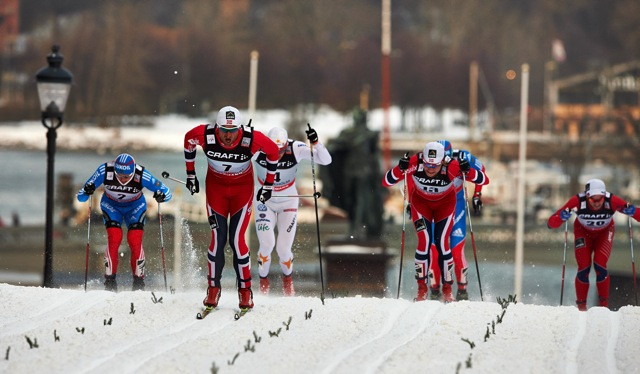
    Petter Northug (7) takes on Russia's Nikita Kriukov (l), Teodor Peterson of Sweden, Norway's Eirik Brandsdal (13) and Tomas Northug (r), and Russian Sergey Ustiugov. (Photo: Fischer/Nordic Focus)
    Petter Northug (7) takes on Russia’s Nikita Kriukov (l), Teodor Peterson of Sweden, Norway’s Eirik Brandsdal (13) and Tomas Northug (r), and Russian Sergey Ustiugov. (Photo: Fischer/Nordic Focus)

    It’s hard to look manly when you’re hiding behind dividers to get out of the wind, but most of the finalists were doing so at the start of Wednesday’s World Cup Finals 1.1-kilometer classic sprint in Stockholm.

    Petter Northug probably didn’t think much of it, nor the irony of seeking shelter behind an advertisement for a heating-systems manufacturer, Viessmann, also a World Cup sponsor.

    Like his five competitors, with two Norwegian teammates, Northug was cold. It was a few degrees below freezing with a wind chill that made standing in downtown Stockholm almost unbearable. They had to race in it.

    The six men, including Northug’s younger brother Tomas, teammate Eirik Brandsdal, Sweden’s Teodor Peterson and Russians Nikita Kriukov and Sergey Ustiugov, forged ahead into the blustery conditions just as they had done before. However, the wind had picked up and snow became more unsettled as the afternoon heats wore on.

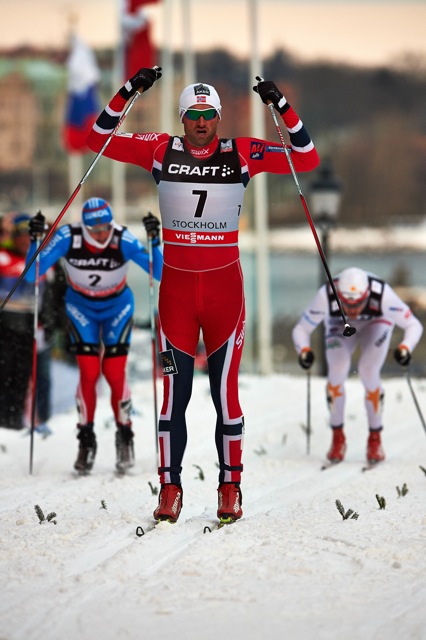
    Petter Northug celebrates his classic sprint victory in Stockholm on Wednesday.  (Photo: Fischer/Nordic Focus)
    Petter Northug celebrates his classic sprint victory in Stockholm on Wednesday. (Photo: Fischer/Nordic Focus)

    With the tracks blowing away with it, it gave the top men even more of a reason to go on skate skis, as many in the 53-man field did.

    Not caring much about the start, Northug let the others lead for the first half of the final. He stayed out of trouble in last on the first 180-degree turn at the bottom of a long descent. On the following gradual incline, Northug moved to third behind Kriukov and Peterson, who led from the start.

    The group remained tight, with Tomas slightly off the back in sixth. Heading into the final corner, his big brother picked up the pace, building steam gradually before punching it on the last turn.

    There, Peterson (who had been issued a warning after obstructing Petter Northug in the quarterfinals) held his ground in the middle, while the older Northug charged ahead.

    It didn’t matter what Northug looked like in the minutes or even hours before – this was the man people remembered. Exploding upward with every double pole, the 27-year-old leaped off the ground and increasingly farther ahead of his competitors with the powerful balancing act.

    Seemingly flying past the spectators on the last straightaway, Northug was accompanied by a string of fireworks on the other side of the track, which went off as he passed by. The Norwegian let them herald in his victory as he pushed to the line and pumped his arms at the finish.

    Northug turned around and smiled. The men closest to him, like runner-up Brandsdal 0.74 seconds back and Kriukov 1.14 seconds behind in third – smiled back. Kriukov tapped Northug with his pole after as if to gesture, ‘Come on, it wasn’t that easy.’

    But Northug had made it look that way, doing what he does best and winning in dominating fashion. Before the victory, his first in Stockholm, Northug had already moved to first in the overall World Cup standings; Russian Alexander Legkov in the leader’s bib and Swiss contender Dario Cologna set themselves back after failing to advance out of the quarterfinals.

    Petter Northug's double-pole snap on Wednesday in Stockholm. Yes, those are his legs coming off the ground.
    Petter Northug’s double-pole snap on Wednesday in Stockholm. Yes, those are his legs coming off the ground.

    Northug simply solidified the lead in his quest for the World Cup overall title, which he set out to capture after World Championships. Wednesday’s win put him 34 points ahead of Legkov (who was last in his quarterfinal for 27th) and 43 points up on Cologna (fifth in quarterfinal, 21st overall).

    And keeping cool was his plan all along. Seventh in the qualifier behind teammate Eldar Rønning, Northug went on to win his quarterfinal and semifinal by nearly half a second, letting others break the wind ahead of him for most of the race.

    In the quarterfinal, he came from behind to challenge Peterson in the last uphill stretch, and in the semi, he put himself in the top four around the final corner. Leading into the finish, he lunged casually for the win a sure-shot spot in the final.

    “I was a little slow in the start of every heat so I just tried to find the best position,” Northug told FIS. “It was not as windy being behind at the back. My goal in every heat was to have a good position before the last hill.”

    He executed as planned, while Peterson settled for fourth (+1:61) and Tomas Northug and Ustiugov duked it out for fifth. Tomas took it by 0.12 seconds and Ustiugov placed sixth, 2.68 seconds after Northug.

    The Swedish king presented the podium awards, but Northug told Expressen he was hoping Princess Victoria would do the honors like she recently did at World Championships.

    “It was a disappointment,” Northug said, according to a translation. “I’ll have a chat with her … Maybe she was a little nervous.”

    Cockiness aside, the stage win gave Northug 50 World Cup points and 60 bonus seconds heading into Friday’s freestyle prologue, the second of the four-race Finals. The remaining events, including the prologue will take place Friday through Sunday in Falun, Sweden. Northug will have 5.5-second advantage on Brandsdal, who is second in the standings, and 7 seconds on Kriukov in third.

    The top qualifier by 0.65 seconds over Kriukov, Rønning had a rough go in the quarterfinal after Russian Ilia Chernousov got caught up on the back of his skis on the first hill. Rønning couldn’t quite get back in the hunt and finished third, 1.26 seconds behind Tomas Northug and Andy Newell, respectively. He failed to advance and settled for 13th.

    The third-fastest qualifier and World Cup sprint king, Sweden’s Emil Jönsson started strong in his semifinal but fell behind after misjudging the last corner. He was third in the heat, 2.03 seconds behind Brandsdal and Kriukov, respectively, for seventh overall.

    Results