From the FasterSkier archive — posts syndicated from athletes’ and coaches’ own blogs between 2004 and 2012, kept online as published. Current coverage is at fasterskier.com.
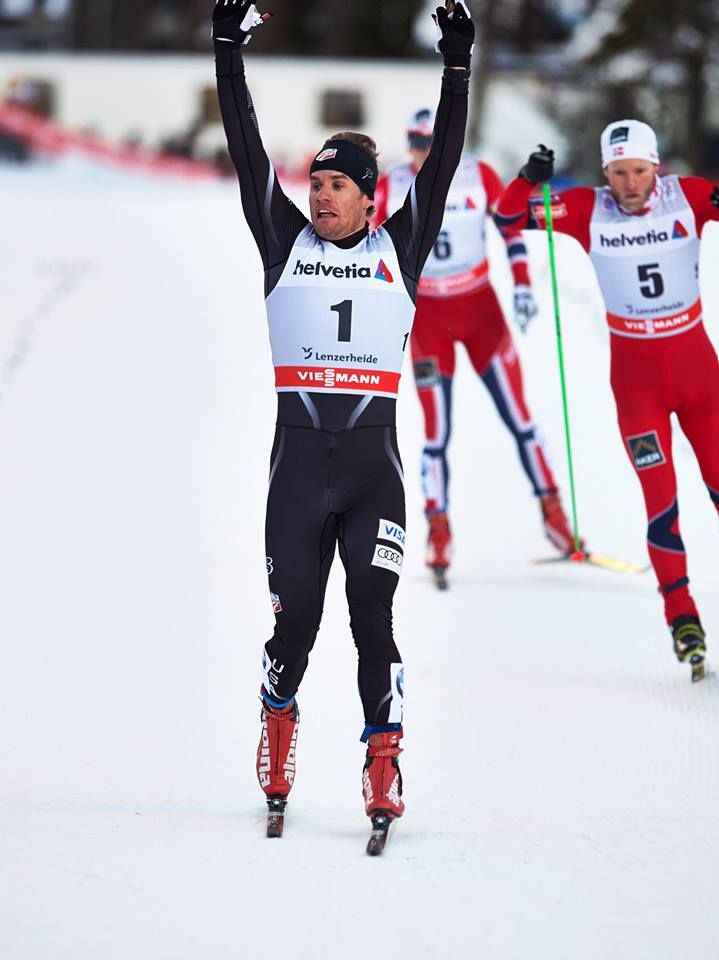
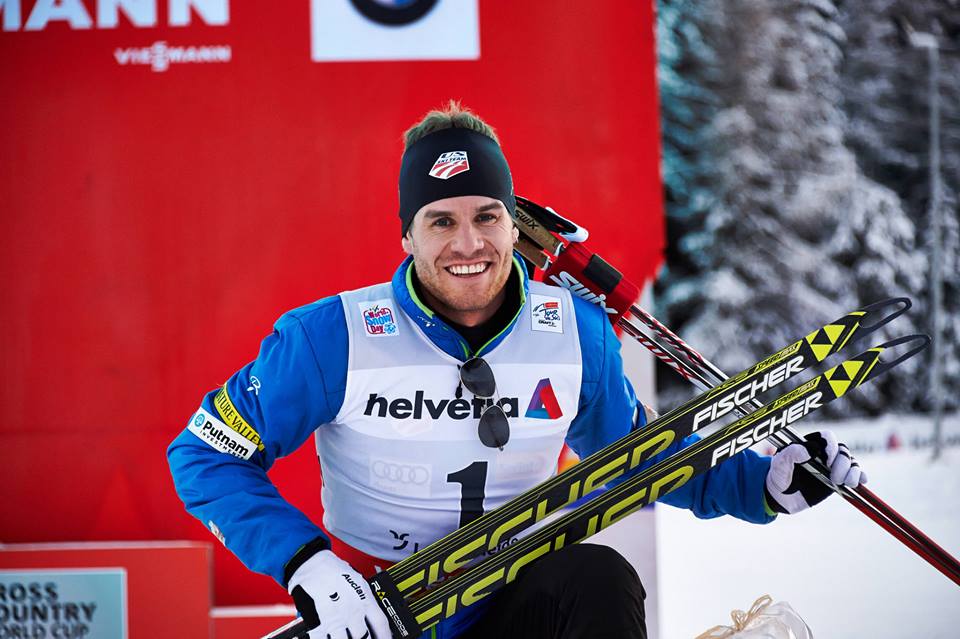
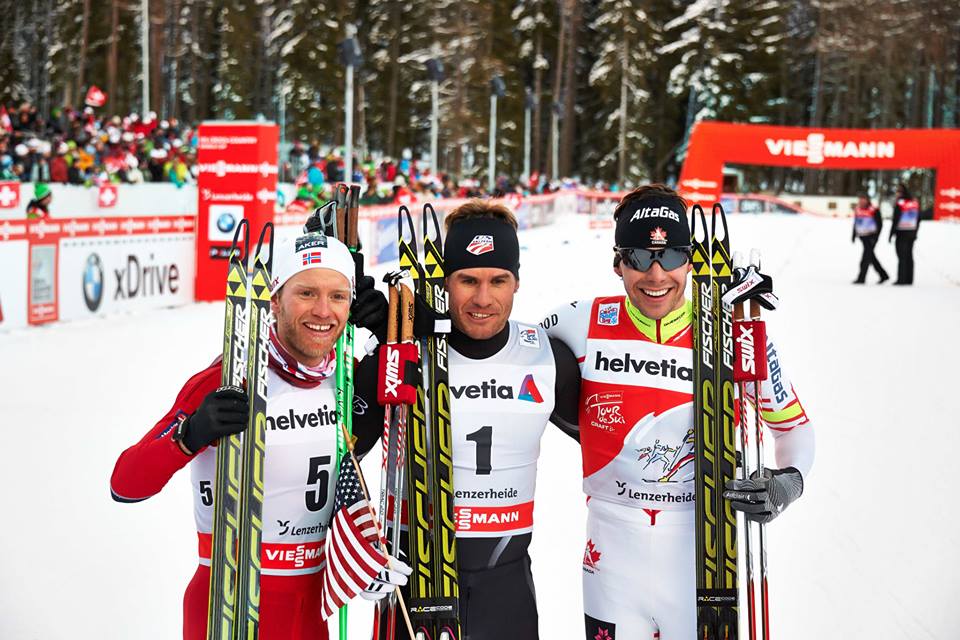
Simi Hamilton celebrates his first victory and podium in the third stage of the Tour de Ski on Dec. 31 in Lenzerheide, Switzerland. In the 1.5 k freestyle sprint final, Hamilton edged Canada’s Alex Harvey and Norway’s Martin Johnsrud Sundby, who placed second and third, respectively. (Photo: Fischer/Nordic Focus)
Simi Hamilton had never made a World Cup final, let alone won a stage World Cup. That all changed Dec. 31, 2013 with his momentous victory in the third stage of the 2014 Tour de Ski.
Hailed around the U.S. as part of a major shift towards improved American results, his win was the first by an American male since Bill Koch in 1983.
However, even after such a significant win, Hamilton said there hasn’t been much change to the 27-year-old’s training routine. Other than searching for potential sponsors to line his racing hats and headbands, Hamilton’s only adjustments for the 2014/2015 season come in the form of several small but effective “gear shifts.”
To understand these shifts it’s important to take a look back at Hamilton’s 2013/2014 season, which he considers his best to date. However, even a successful season can have its pitfalls.
“[The season] was still a little more inconsistent than I really would have liked it to be. With the Olympics it didn’t really pan out like I hoped they would and there was some funky stuff with conditions and breaking my pole. I felt like I could have skied better there,” Hamilton told FasterSkier.
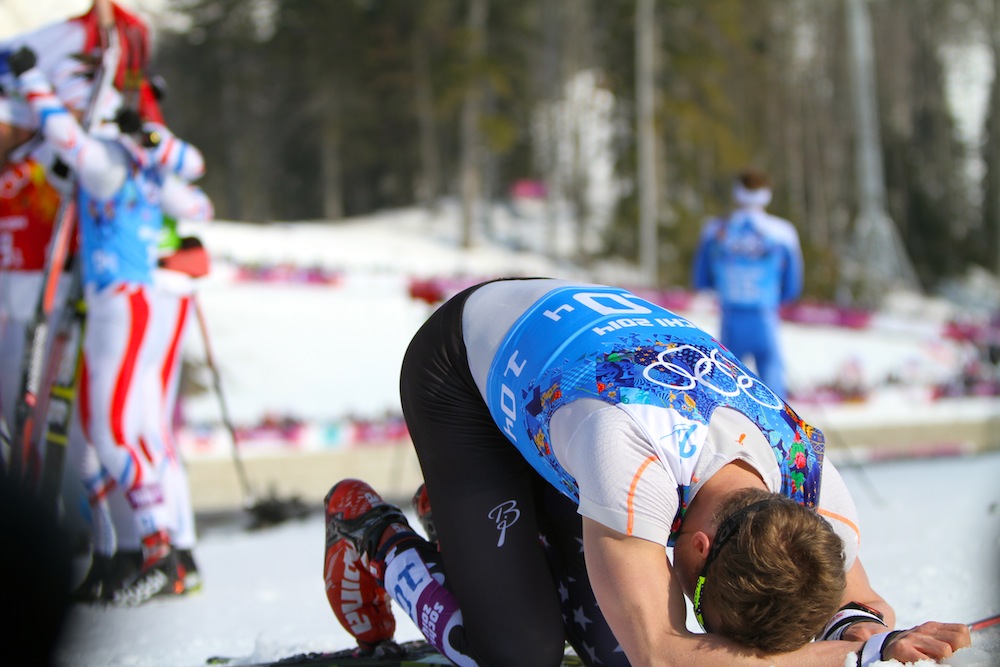
Simi Hamilton after anchoring the U.S. men to 11th in the 4 x 10 relay at the Sochi Olympics.
Heading into the post-Olympic year, Hamilton said that he doesn’t need to alter much in his training routine in order to maintain his results. He explained that past training plans had prepared him well for the racing season and said that he knew he was “doing the right stuff.”
“I’m really not changing too much around. In general my fitness on a year-to-year basis has improved. I’m confident that next year it will be even better and that I will be able to string together more consistent results,” he said.
Despite the consistency in his training routine, Hamilton has been working on building several key aspects of his skiing that aided him in achieving last year’s strong results.
One of the main focuses of his summer training has been to make a conscious effort to analyze the terrain of each course and make adjustments accordingly.
“Nothing is the same, so you are never going to keep the same V2 from a flat stretch into a climb. As I’ve been training this summer I’ve been trying to focus on that – all these little gear changes. Whether they are subtle or major, you are constantly having to adjust your tempo, stride, and power to match what the terrain does,” he explained.
The Aspen, Colo. native said that many of his best results came when he was focused on the terrain and its transitions. He pointed the Tour’s third stage, saying that his ability change tempo, power application, and glide throughout the varying course played a central role in his victory.
Now the goal is to apply that mentality and focus to every race – especially when it comes to classic skiing.
FasterSkier caught up with Hamilton as the U.S. Ski Team was wrapping up its Lake Placid camp in September. While Hamilton entered with ambitions of a consistent and productive camp, he was hindered with an ankle injury during an Aug. 28 run in the Adirondacks.
The World Cup stage winner, who has a history of ankle-related problems, said the injury was not serious. However, he was unable to fully participate in most of the camp’s trainings and double poled the 2014 Climb to the Castle to ease any pressure on his ankle.
Hamilton explained he wasn’t sure when he would be completely healed, but was confident that he would be back to full training in a couple weeks.
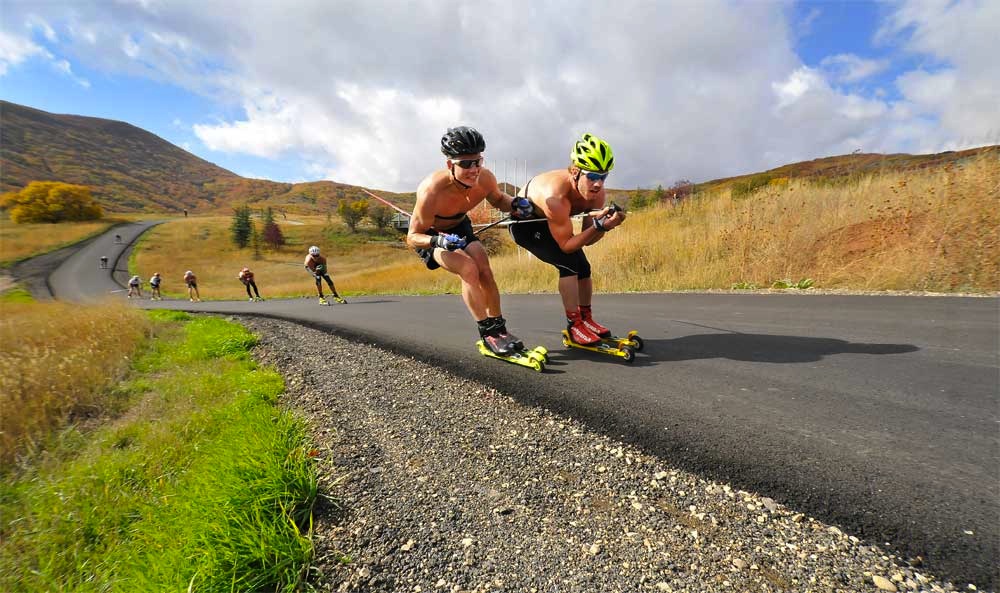
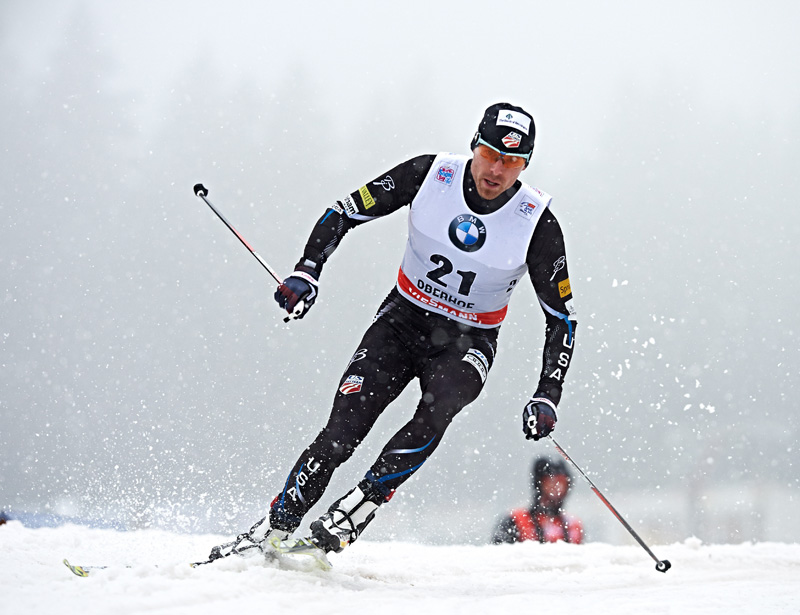
U.S. Ski Team member Simi Hamilton (r) works on corning during training at Soldier Hollow in Midway, Utah, during a 2013 U.S. Ski Team fall training camp. (Photo: Tom Kelly/USSA)
The 27-year-old is currently in his second year of training with the Stratton Mountain T2 team. A transplant from the Sun Valley Ski Education Foundation and alumnus of nearby Middlebury College, he said the team environment at Stratton has aided in his improvements and training throughout the year.
While Hamilton earned his World Cup stage win under the guidance of former Stratton coach Gus Kaeding, he said that the team’s new coach, Patrick O’Brien, has been a perfect fit for both him and his teammates.
“Pat O’Brien has been a great asset to the team this year. He really understands – having just come from the Craftsbury team – the whole infrastructure right now,” Hamilton said.
With the racing season drawing closer, Hamilton is both excited and hungry to be back on the familiar glide of snow and take his place alongside the his fellow competitors. For now, however, Hamilton is working with O’Brien and his USST coaches to make small adjustments to his skiing as he enters the intensity of the fall.
“It feels like the season is close – and it is – but you still have to remember that there are two full months before we are going to be in Europe. I think if you spend that time well it can be a really valuable time to gain what you need to gain and get your body ready for a winter of racing.”
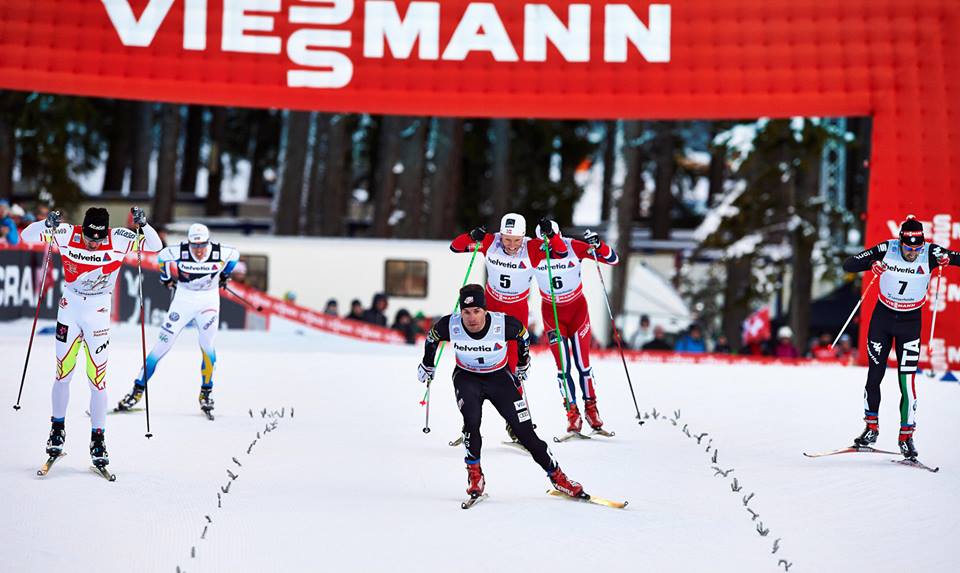
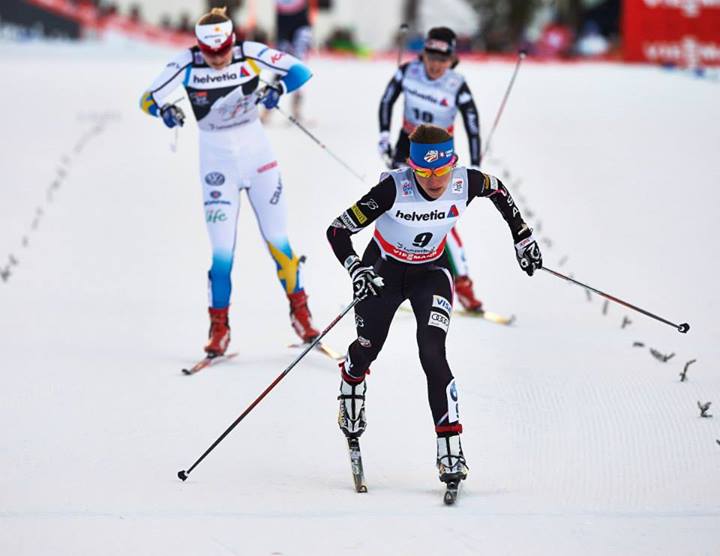
Simi Hamilton (c) races toward the finish of the 1.5 k freestyle sprint final at the Tour de Ski Stage 3 in Lenzerheide, Switzerland. Hamilton held off Canada’s Alex Harvey (l) and Norway’s Martin Sundby (5) as well as Italy’s Federico Pellegrino (r) for the win. (Photo: Fischer/Nordic Focus)
Gus Kaeding literally had one foot out the door and his vehicle running Tuesday morning, but he couldn’t draw himself away from what was unfolding some 3,700 miles away in Lenzerheide, Switzerland.
The Stratton Mountain School (SMS) T2 Team head coach almost missed his flight from Vermont to Utah because of the success four of his athletes — all on the U.S. Ski Team — were having in Stage 3 of the Tour de Ski. He didn’t, but said on the phone from his connection in Detroit that it would’ve been fine if he did.
Sophie Caldwell (U.S. Ski Team) winning her 1.5 k freestyle sprint semifinal on Tuesday at Stage 3 of the Tour de Ski in Lenzerheide, Switzerland. (Photo: Fischer/Nordic Focus)
To start the 1.5-kilometer freestyle sprints, Sophie Caldwell and Jessie Diggins qualified in ninth and 16th, respectively, 5.24 seconds and 6.93 seconds behind Norwegian qualifier winner Ingvlid Flugstad Østberg.
Their male counterparts from SMST2 in southern Vermont, Simi Hamilton and Andy Newell did the unthinkable and qualified first and second, with Hamilton putting down the fastest 1.5 k time of 2:35.01 and Newell ranking second, 0.31 seconds back.
Hamilton went on to win his quarterfinal then advance in third out of the semifinals to make his first final in his three years on the U.S. Ski Team (USST). Newell placed second in his quarterfinal and fourth in his semifinal to end up eighth overall, a season best for the USST veteran.
Diggins placed fifth in her quarterfinal, 1.74 seconds behind Germany’s Denise Herrmann, who won the heat in 2:58.47 and went on to place third overall. Diggins ultimately took 21st to put her 15th in the overall Tour standings.
“My body felt OK, and then as soon as I started trying to go hard, I couldn’t find that extra gear,” Diggins said on the phone. “In my quarters, I kind of let myself get screwed over in the first 100 meters, tried to get behind Denise Herrmann, but I started to get squeezed out.”
Stuck behind a skier who tripped, Diggins said she spent the rest of the two-lap race fighting her way back toward the lead pack.
“I didn’t have the energy to go really wide and pass and I just couldn’t find an open window,” she said. “The heat was not spectacular for sure and I wish I could have done the opening bit again and just tried to get a better start, but the Tour is a long thing and I just have to focus on recovery get ready for tomorrow and the day after that and the day after that.”
Caldwell placed second in her quarterfinal then relied on fast skis and finishing kick to carry her to her first win, which she took 0.25 seconds ahead of Herrmann in 3:01.93.
“I felt awesome in my semifinal, I don’t know what got into me there!” Caldwell wrote in an email. “I had talked a bunch of strategy with the coaches, especially about positioning with that final corner. I thought that I might be able to pick up a place or two by pushing not only over the top of the hill, but a little ways down the hill. I believe I was in 2nd over the top, and I pushed hard and my plan worked! I came into the corner first, so I was able to guard the inside and pick my lane into the finish.”
In her first year on the USST, Caldwell, 23, also advanced to her first final, where she finished sixth for a career best, 6.81 seconds behind Østberg, who won it in 2:58.00.
“I simply just got tired,” Caldwell wrote. “I actually had one pretty decent move that put me into a good position coming around the lap, but then it was downhill (figuratively) and uphill (literally) after that.”
The finish put her sixth overall in the Tour standings, which will put her up front for the start of Wednesday’s 10 k classic mass start. She’ll leave the Tour after that, resting up and spending some time with family in Europe before gearing back up for the World Cup that resumes in Jan. 11 and 12 in Nove Mesto, Czech Republic.
Simi Hamilton (U.S. Ski Team) after becoming the first American man to win a Tour de Ski stage at the third of seven races in the 2013/2014 Tour. Hamilton won the 1.5 k skate sprint in Lenzerheide, Switzerland. (Photo: Fischer/Nordic Focus)
As if watching all this unfold wasn’t enough, Kaeding remained glued to his live stream as Hamilton hung in the mix for the early part of the men’s final. Up the long climb, he rose from fourth to third, then third to first as he slingshot around the last corner.
“I literally had my bags all packed … and I was just standing there,” Kaeding recalled. “As soon as I saw Simi, I was like, ‘Come on Simi, come on Simi.’ ”
Hamilton flew past Italy’s Federico Pellegrino and held off Canadian Alex Harvey and Norway’s Martin Johnsrud Sundby, who also caught the downhill draft, for the victory in 2:37.02, three-tenths of a second faster than Harvey in second and 0.74 seconds ahead of Sundby in third.
For Hamilton, it bested his previous top result of seventh in a sprint, and although not technically a World Cup (Tour stages are worth half the World Cup points), Hamilton became the first man to win a Tour de Ski stage.
“I definitely had a smile on my face all day,” Kaeding said. “I’ve literally been traveling every moment since, but I sent everyone quick emails.”
For Stratton, having four skiers in the heats, three of them make the semifinals and two continue to the final, was huge for the Vermont ski academy. Caldwell’s father, Sverre, overseas the nordic program there, and two years ago he started Stratton’s first elite team with the title sponsorship of the T2 Foundation, a non-profit that financially supports American skiers.
On Tuesday, Eurosport commentators talked about Stratton, but as Kaeding pointed out, ironically failed to mention Newell as a part of the group — and he’s been a local staple for the last two decades.
“I thought it was pretty cool … We always joke about those announcers not even knowing the names of the Americans in the friggen heats,” Kaeding said. “But it’s good to get the school and a little [publicity] … It’s good to know all those athletes are from the same club, but they’re really part of Team USA and that’s the important thing.”
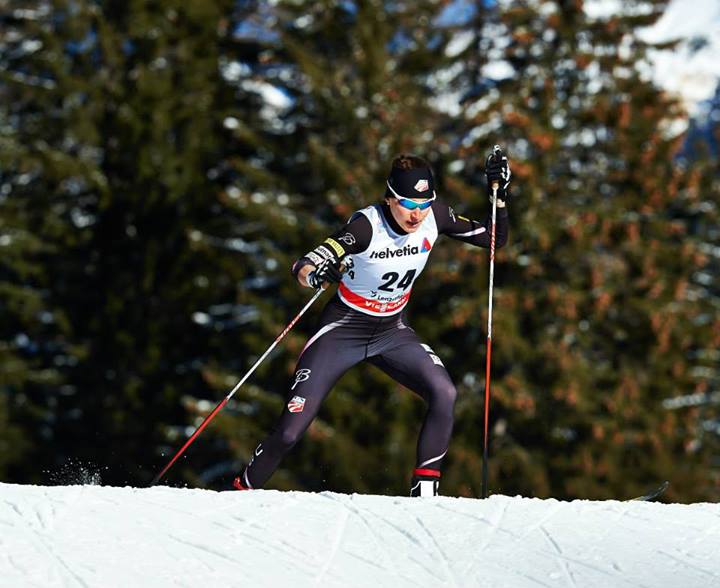
Sophie Caldwell (U.S. Ski Team) on her way to qualifying in ninth in Tuesday’s 1.5 k freestyle sprint at Stage 3 of the Tour de Ski in Lenzerheide, Switzerland. (Photo: Fischer/Nordic Focus)
Regardless of where they come from (Hamilton from Colorado, Diggins from Minnesota and both Caldwell and Newell from Vermont), the mental and physical training is what got them where they ended up Tuesday and in various other races this season.
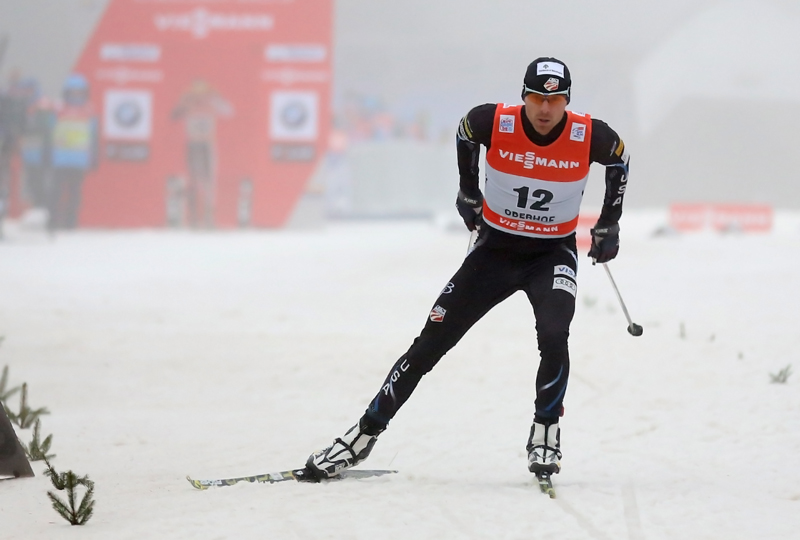
Kaeding said they don’t do anything special at Stratton, but it’s the mental capacity and natural talent of athletes like Hamilton that he was happy to see pay off. Two days earlier at Stage 2 in Oberhof, Germany, Hamilton as a late starter saw his qualifying time squashed by a snow squall and he missed the heats in 35th.
“Simi’s been on the verge of doing really well here for a couple days and has been really close to pushing something over the top,” Kaeding said. “To his credit, he kept pushing on. … We work on things like that.”
In terms of strategy, Kaeding said Newell and Hamilton are especially good tacticians out on course, and with teammates Skyler Davis and Eric Packer (also sprinters), they learn from one another each day in training throughout the summer.
“Andy, really a veteran, has been in the heats forever; Simi’s just a really a beautiful skier, can ski between cracks that nobody can get through … and those guys all really compliment each other really well,” Kaeding said. “When they train together every day, it’s basically like a World Cup sprint heat. I think it sets them up really well.”
In the last four (of five) sprints she’s raced this season, Caldwell has consecutively made the rounds in each. On Sunday, she qualified in a career-best fifth to finish 22nd and two weeks earlier in Davos, Switzerland, qualified in ninth and went on to place ninth in the freestyle sprint.
Kaeding said he chats with her remotely after races, and in the last two sprints, they discussed her strong finishing speed, but need to to get out front sooner and “see what happens, dictate the pace even if she lacks a little pop at the end,” Kaeding said. “So she tried that two days ago in Oberhof. She said it went pretty well, but maybe that would’ve been a better day to follow.”
Caldwell told him she’d check out Lenzerheide’s sprint course and base her strategy off that. With a boilerplate track, both agreed that sitting in and conserving might be best.
“She kind of hit it perfect and exploded into winning the heat, much like Simi did,” Kaeding said.
“She skied great all day, skied technically well [and] made smart moves out there,” USST Head Coach Chris Grover said on the phone. “She just ran out of gas in the final, and that’s just because she’s a little bit younger and still developing, but she’s going to be a big name for the future.”
Heading into the fourth of seven stages, the U.S. has two skiers in sixth (Caldwell and Newell) overall in the Tour, Hamilton ranks 11th and Diggins 15th, and Hamilton and Newell are currently seventh and eighth in the sprint standings, respectively, Caldwell 10th and Diggins 24th.
“The start of the Tour really favors sprinters … so their Tour standing is reflecting that,” Grover said. “But they’re able to get in there and stay healthy and execute.”
Caldwell, Newell, Hamilton and Holly Brooks (37th on Tuesday) plan to end their Tour after Lenzerheide, but Diggins, Liz Stephen (44th, 37th overall), and Noah Hoffmann (83rd, 89th overall) plan to complete all seven stages with the final races Friday through Sunday in Italy.
“I am so excited for Simi! He was incredible today,” Hoffman wrote in an email. “The course and conditions were perfect today. Racing in the Swiss Alps on a bluebird day is pretty fun, even if it is a sprint race. I felt good. I didn’t have many expectations for results today. I’m certainly looking forward to distance racing.
“[Wednesday] will be challenging starting in the back,” he added. “I’m going to be patient. It’s a good course for me, and I’m looking forward to moving up. … The energy on the team is very high. I’m sorry we’re splitting up tomorrow. It’ll be a very small group for the final three days of the Tour.”
— Lander Karath, Seth Adams and Pasha Kahn contributed reporting
Simi Hamilton celebrates his first victory and podium in the third stage of the Tour de Ski on Dec. 31 in Lenzerheide, Switzerland. In the 1.5 k freestyle sprint final, Hamilton edged Canada’s Alex Harvey and Norway’s Martin Johnsrud Sundby, who placed second and third, respectively. (Photo: Fischer/Nordic Focus)
Simi Hamilton had to look behind him inches before the finish to make sure it was actually happening. Yet the 26-year-old U.S. Ski Team (USST) member hadn’t fully realized what he’d accomplished two hours after his freestyle sprint victory on Tuesday in the third stage of the Tour de Ski.
In his three years on the national team, Hamilton had never made the finals of a sprint. Yes, he was a sprinter, but qualifying in the top 30 among the world’s best, then advancing in the top two or with one of the fastest times in the quarterfinals and semifinals on a given day wasn’t easy.
His best World Cup result of the season had been 14th in a 1.5-kilometer freestyle sprint in Davos, Switzerland, and two years ago he achieved seventh in a World Cup classic sprint in Drammen, Norway.
Just over two weeks ago in Davos, Hamilton nearly made it to the semifinals after placing third in the quarterfinals. On the first day of the Tour on Dec. 28, he placed 42nd in the 4.5 k freestyle prologue in Oberhof, Germany. A day later, he was 35th in the 1.5 k freestyle sprint at the same venue.
Simi Hamilton (c) races toward the finish of the 1.5 k freestyle sprint final at the Tour de Ski Stage 3 in Lenzerheide, Switzerland. Hamilton held off Canada’s Alex Harvey (l) and Norway’s Martin Sundby (5) as well as Italy’s Federico Pellegrino (r) for the win. (Photo: Fischer/Nordic Focus)
Not qualifying didn’t sit well with Hamilton, a guy who lives, breathes and trains for sprinting in southern Vermont with the Stratton Mountain School T2 Team.
“I didn’t have a very good day on Sunday, which I was pretty pissed about,” Hamilton said in a post-race phone interview. “I got a little shafted with some crazy intermittent weather that was going on and just didn’t do what I really wanted to do that day. I knew waking up this morning that all the stars were aligning and that I really wanted to go for it and it turned out well.”
Among the things he and 102 other male competitors had in their favor in Lenzerheide, Switzerland — the weather. It wasn’t snowing, raining, and there was an ample amount of landscape for them to work with on yet another 1.5 k freestyle course.
The race was two loops — unlike Oberhof’s single narrow-and-zigzagging lap — and Hamilton knew he could ski big, just the way he liked. Lenzerheide was also more than 5,000 feet above sea level, with altitude effects that might bother some but typically help the Aspen, Colo., native.
“I had a lot of really good things going for me today,” Hamilton said. “It was fast conditions, nice and sunny, hard-packed. And then a course that’s not super long, has some technical corners, and nothing like crazy steep. I’m a bigger skier, I’m better V2er, and I can kind of carry my speed up through the gradual climbs.”
Hamilton topped Newell by 0.31 seconds with the fastest time in 2:35.01. Sunday’s sprint winner, Calle Halfvarsson of Sweden ranked third, 0.73 seconds behind Hamilton.
“It felt good yesterday just doing some speeds around the course, and knew that it was going to be a good course and venue for me,” Hamilton said. “Just going into the qualifier, I definitely had a hunger for having a good day.”
A typical World-Cup qualifier, Newell wasn’t quite expecting his time to rank second.
“I felt like I didn’t have a super great run in qualification and I was surprised when I came across with the fastest time,” he said on the phone. “But I think it just goes to show that our wax techs obviously did a very good job.”
China’s Qinghai Sun qualified in fourth (+1.17), and the Tour leader, Harvey advanced in 24th (+4.25).
“I have three sprint podiums in my career and I have qualified in the 20’s every time so I know when you get into the heats, and the gun goes off, it is a fresh start,” Harvey said in a Cross Country Canada press release.
Hamilton went on to win the first quarterfinal by 0.29 seconds over Tim Tscharnke in 2:36.37. He had aimed to lead early and control the pace for both laps and did just that, topping Russia’s Ilia Chernousov, Martin Jaks of the Czech Republic, Sweden’s Carl Quicklund, and Ales Razym, respectively.
Hamilton’s quarterfinal was the second fastest and Chernousov ended up making the semifinals as a lucky loser. (Norway’s Finn Hågen Krogh won the third quarterfinal in 2:36.14 and advanced with Switzerland’s Eligius Tambornino, whom he beat in a photo finish for first, and fellow Norwegian Martin Johnsrud Sundby in third.)
Canada’s Alex Harvey still wearing the red leader’s bib through three stages of the Tour de Ski. (Photo: Fischer/Nordic Focus)
Harvey took second in the second quarterfinal, 0.12 seconds after Italy’s Federico Pellegrino, who qualified in seventh and won the heat in 3:27.97. Russia’s Andre Larkov was third in the heat (+0.23), Sun finish fourth (+1.44), and two Brits, Andrew Young and Andrew Musgrave placed fifth and sixth, respectively.
Newell also automatically qualified for the semifinals in placing second to Germany’s Josef Wenzl in the fourth quarterfinal. Hanging behind Wenzl and pushing him to the line, Newell was seven-hundredths off Wenzl’s win in 2:36.98, Poland’s Maciej Starega took third (+0.62), Germany’s Sebastian Eisenlauer was fourth (+0.79), and Kazakhstan’s Alexey Poltoranin fifth (+2.46). Finland’s Ville Nousiainen did not start after qualifying in 22nd.
Halfvarsson won the fifth quarterfinal in 2:38.75, the slowest of the day, after overtaking Norway’s Petter Northug, who advanced in second (+0.13), and Austria’s Bernhard Tritscher in third (+0.28). Italy’s David Hofer placed fourth (+0.8), Austria’s Harald Wurm was fifth (+0.97) and another Italian Enrico Nizzi sixth (+1.19).
Approaching his semifinal with a similar tactic as the quarters, Hamilton floated to the front early, creating space for himself and skiing big while staying low. Pellegrino tucked into second and hovered in fighting position around the inside corners, but Hamilton held is own and picked his line into the finishing stretch.
In fourth at the time, Harvey used a slingshot effect and some conserved energy to rocket to first while holding off both Pellegrino and Hamilton. Harvey won the semifinal in a three-way photo finish with Pellegrino and Hamilton, edging the Italian by four-hundredths of a second for the win in 2:37.94. Pellegrino automatically advanced in second and Hamilton placed third another 0.02 seconds behind. Sundby was fourth, 0.3 seconds after Harvey, and all four ultimately made the final with the fastest times.
In the second semi, notably slower, Krogh won it in 2:38.7, just one-hundredth of a second faster than Halfvarsson in second. Newell stood in the top three for essentially all of the race, getting into second early behind Wenzl. Tucked behind the 6-foot-2 German for most of the race, Newell maintained his position while Krogh attacked on the first significant climb.
While Krogh took the lead, Halfvarsson passed Newell on the second tier of the hill, and Newell trailed them both into the finish. On a sweeping lefthand turn into the stadium, Northug caught up with the pack and passed Newell, pushing down the stretch to contend with the top two. Northug ended up third (+0.11), Newell fourth (+0.34), Chernousov fifth (+0.89), and Wenzl lost steam to finish sixth (+1.59). That would be the end of the road for those four, as Northug placed seventh overall, Newell eighth for his best result of the season, and Chernousov ninth.
“I should have been just a tiny bit more aggressive to get into the top two but our skis were running so fast I thought I would have been able to get around people at the bottom,” Newell said. “I guess that’s what cost me from going into the final. I’m sure Northug and I were probably pretty close. I don’t know what the times were. I’m bummed not be in the final, but, oh well.”
Hamilton realized his plan of skiing one hill better than anyone else “in terms of being able to conserve energy and stay relaxed” backfired a bit in his semifinal, when he didn’t create enough of a gap over to the top of the hill. That allowed guys like Harvey to get into his slipstream.
“Going into the final I knew I was a little more tired than I had been earlier so I was focused on getting a good position within the pack, either second or third, and just kind of conserving energy, getting a good draft on the downhill, and then when I needed to make a move, put some pressure on,” Hamilton said.
He essentially did that, initially following Pellegrino — who leapt out to the front off the start — and Krogh, who quickly reined Pellegrino back in. Harvey put himself third around the first corner behind Krogh and Pellegrino, with Hamilton right there in fourth, along with Halfvarsson and Northug, respectively. On a downhill, Harvey dropped to fifth ahead of Northug, while Krogh and Pellegrino duked it out on the first part of the ensuing climb.
The two nearly tangled when Pellegrino nicked Krogh’s ski, but pushed on as Hamilton followed in third. With Pellegrino leading, Hamilton followed Krogh toward the second tier.
“Finn kind of died on that very last steep pitch up and over the bridge,” Hamilton recalled. “We came down on the first part of the downhill and I thought Federico Pellegrino had definitely just wrapped it up at that point. So I was focused on just what I could do to ski for second or third.”
Before he knew it, Hamilton said he and Krogh were back within striking distance after catching Pellegrino’s draft. Zooming around the last corner, Hamilton started coming up on Pellegrino quickly and searched for an opening to make a move.
“I just went for it, getting through without tripping on any poles or anything,” Hamilton said. “The last 100 meters I focused on skiing powerfully and quick tempo and smooth and good balance.”
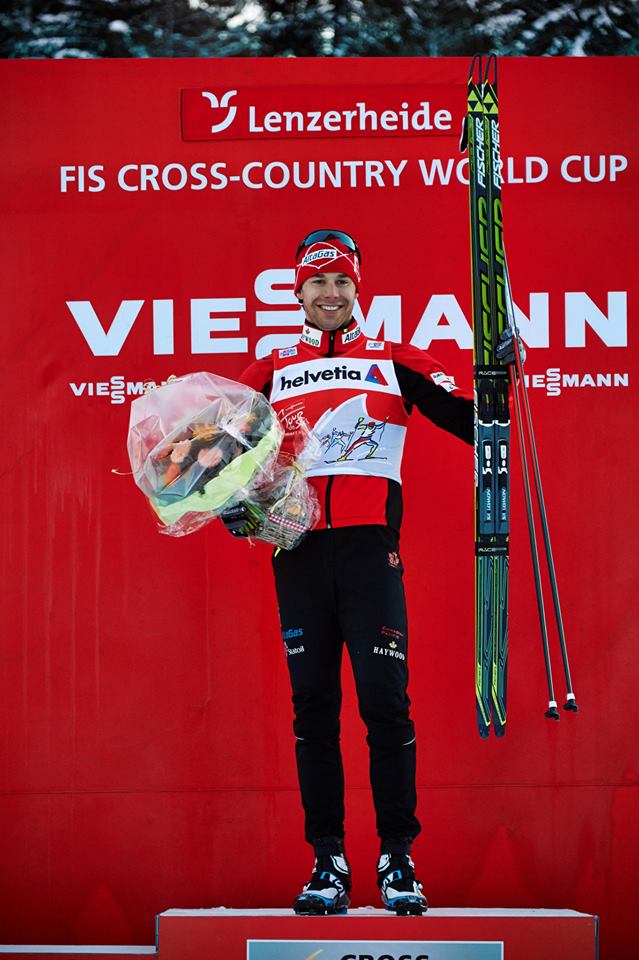
Simi Hamilton of the U.S. Ski Team (c) after winning Tuesday’s 1.5 k Tour de Ski freestyle sprint, ahead of Canada’s Alex Harvey (r) in second and Norway’s Martin Sundby (l) in third. (Photo: Fischer/Nordic Focus)
Seconds later, he had done it — winning his first World Cup event (technically a stage as its worth half the points, but an ample amount of cash around $3370 dollars) in 2:37.02 — and becoming the first American man to win a Tour de Ski stage in the eight years of its existence.
Right behind him, Harvey and Sundby had slingshot from behind to overtake both Pellegrino and Krogh, beating them both to the finish for second (+0.32) and third (+0.74), respectively. Pellegrino took fourth (+0.94), Krogh was fifth (+1.61), and Halfvarsson sixth (+2.96).
For Harvey, second place was exactly what he needed to keep the leader’s bib, putting him 22.7 seconds ahead of Halfvarsson and 27 seconds up on Sundby in third. Northug improved to fourth overall, Sweden’s Jens Eriksson is currently fifth, and Newell sits in sixth with one race left in his journey through the Tour. Krogh ranks seventh and Canadian Devon Kershaw slipped from third to eighth after failing to qualify in 56th on Tuesday.
“It is awesome to have the leaders bib,” Harvey said. “Every day I start with it on my shoulders is extra special. … Lots of people are fighting to grab the bib from me so it is special to keep putting it on. Who knows – maybe that even makes me go faster.
“Outside the World Championships and Olympics, the Tour de Ski is the next biggest thing for us,” Harvey added. ‘I can take a lot of confidence into the Olympics this year knowing that I have been able to get on the podium when the lights are shining and everyone is racing in their top form.”
“You start to realize what you’ve done. It’s a pretty amazing feeling.” — Simi Hamilton
Moments after the finish, Hamilton and Harvey grabbed hold of their respective nations’ flags and skied together backward down the final stretch. They smiled and hugged each other, living in the moment and soaking up the jovial atmosphere all around them. Hamilton almost looked starry eyed.
“It’s hard to put the feelings into words,” Hamilton said. “I’ve just had texts and emails and tweets pouring in from friends and family and supporters … You start to realize what you’ve done. It’s a pretty amazing feeling. I’m just so psyched right now.”
Kikkan Randall, who opted out of this year’s Tour to train in nearby Davos, has won two Tour de Ski stages, but remains the only American to have won a race in the multi-stage event.
“I’m in very good company for sure; Kikkan is a hero to us as U.S. skiers,” Hamilton told FIS.
“I felt really good waking up this morning and knew that it was going to be a good day and decided to kind of go for it with guns blazing from the very start,” he said. “It turned out pretty well and I’m pretty ecstatic for sure.”
Aside from Hamilton, four USST members made the rounds, all hailing from the SMST2 Team. Jessie Diggins finished fifth in her quarterfinal for 21st, Sophie Caldwell made her first final for a career-best sixth place, and Newell ended up eighth on the day.
“Both the guys were poised to have good races,” USST head coach Chris Grover said on the phone. “We definitely had an average day in the second day in Oberhof, so you saw that a little bit reflected in their stronger performance today. … Because a snow squall came in that really affected skiers with start numbers 30 through 60 [on Sunday] … he never had an chance to show what he could do in Oberhof.”
In terms of New Year’s celebrations, well, the Tour isn’t exactly designed for that with 10/15 k classic mass starts on Tuesday.
“There probably wont be too much celebrating in terms of the traditional New Year’s celebration, but we’ll save that for another night,” Hamilton said.
Wednesday’s classic races in Lenzerheide in Stage 4 mark the first of two classic events in this edition of the Tour. Hamilton planned to race, then head back to Davos (just 30 minutes away) after that to train for the next World Cup races Jan. 11-12 in Nove Mesto, Czech Republic.
— Lander Karath and Pasha Kahn contributed reporting
Andy Newell (U.S. Ski Team) racing in the qualification rounds of Sunday’s freestyle sprint. Newell ended the day in 10th after reaching the semifinals. (Photo: Fisher/Nordic Focus)
Note: This report has been updated to include quotes from Noah Hoffman.
Another American landed in the top 10 for the first time this season, this time with 30-year-old Andy Newell as the lone U.S. Ski Team member in the heats Sunday at the second stage of the Tour de Ski in Oberhof, Germany.
The wind was whipping and snow pouring down intermittently, yet Newell worked his way into the mix with the best of more than 100 men in the 1.5-kilometer freestyle sprint to finish 10th for 11th in the overall Tour standings.
“I was feeling fine but it started dumping snow, which made some sections of the course feel really sticky and slow,” Newell wrote in an email.
Much didn’t change for the heats and most everyone had a similar strategy: sit back and save up for attacking the headwind into the finish.
Newell found himself racing against Sweden’s Jens Eriksson, Germany’s Tim Tscharnke, Switzerland’s Eligius Tambornino and Finland’s Lari Lehtonen. After qualifying in 29th, Norwegian Chris Jespersen opted out of the quarterfinal to rest up for the rest of the Tour, in which he’s hoping for an overall podium finish.
With four men to contend with, and at least three to beat for an automatic semifinal bid, Newell tried to relax early and strike when the time was right. Trailing into the final hill, he accelerated up the outside corner to make gigantic leap to the front, right behind Tscharnke.
“With the headwind in the finishing 300 meters it really came down to having a strong finish,” Newell explained.
He passed Tscharnke and beat the German by five-hundredths of a second at the line while Eriksson edged them both for first in 2:53.45. Just 0.16 seconds back, Newell advanced in second.
“I was stoked to be able to pass the German and out-lunge him,” Newell wrote. “I was happy with my tactics in that heat.”
The semifinal proved more challenging with heavily falling snow at temperatures around freezing. Passing on the narrow-and-curvy course became even harder, but for most, the game plan remained the same.
“It was kind of funny because everyone was waiting until the end to try to make their move,” Newell wrote. “But the new snow and wind was making it very difficult to get around people and ski fast while breaking your own track.”
In the middle of the pack for most of the race, Newell slipped into last behind Ales Razym of the Czech Republic up the last hill. The Swedes were up front, led by Calle Halfvarsson, who went on to win the final. Halfvarsson attacked on the long climb, Italy’s Federico Pellegrino went with him, and Razym dropped from third to fifth as he crested the hill with Newell.
“Some athletes had great skis for the conditions and others didn’t which became very evident,” Newell wrote.
He ended up overtaking Razym along the straightaway and placed fifth, three-hundredths of a second behind Russia’s Evgeniy Belov in fourth. Halfvarsson won it in 3:02.01, Pellegrino was just 0.19 seconds behind in second, and Eriksson advanced to the final in third, another 0.38 seconds back.
Newell ended up 10th overall for his best result of the season in a race that gave him something to think about for the freestyle sprint Tuesday — the third stage of the Tour.
“I’ve never raced the sprint course [in Lenzerheide, Switzerland], but I’m excited to try to make it to the finals again,” Newell wrote. “I know my fitness and speed is at a world cup top 10 level I jut need to make smart decisions out there.”
Another U.S. Ski Team (USST) sprinter, Simi Hamilton placed 35th in the qualifier, missing out on the top 30 by 0.99 seconds.
“I was obviously hoping for a better result today, but there were some pretty wild things happening with the weather,” Hamilton wrote. “You just have to take a day like this in stride. I don’t like to make excuses, so I won’t, but one of the coolest/most frustrating things about ski racing is that things like conditions and wind and rain make for ever-interesting variables.”
Confident in his fitness and speed, the 26-year-old Hamilton added that he was excited to get another chance on Tuesday.
“Andy and Sophie and Jessie had great days and I’m looking forward to feeding off that momentum for Tuesday,” he wrote.
The third U.S. man in the Tour, Noah Hoffman placed 95th of 105.
“I am looking forward to the distance races to start in this Tour,” Hoffman wrote in an email. In terms of results, the sprint I did on Sunday was my worst World Cup Sprint ever. The race was highly effected by a snow storm that moved in as bib 30 was starting. I am certainly hoping for an improvement over that result today. I am glad to have three chances to practice my race execution and my high-speed skating cues before the important races (for me) start.”
“One of the coolest/most frustrating things about ski racing is that things like conditions and wind and rain make for ever-interesting variables.” — Simi Hamilton, 35th
Diggins, Caldwell Make Quarterfinals
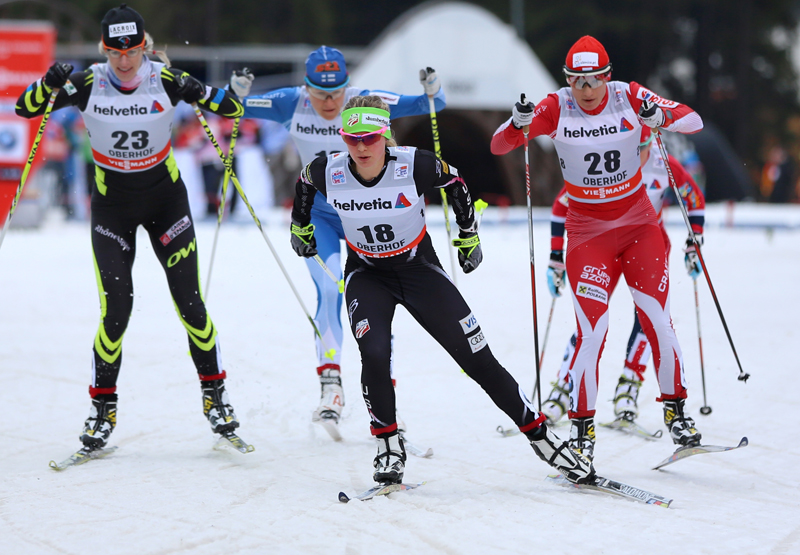
Jessie Diggins (U.S. Ski Team) racing in the quarterfinals of Sunday’s sprints. (Photo: Marcel Hilger)
In the women’s 1.5 k freestyle sprint, Sophie Caldwell qualified in a career-best fifth.
Starting right behind Germany’s Denise Herrmann, who went on to place second in the final, and just ahead of Norway’s Marit Bjørgen, who ultimately placed fifth to hold onto the overall Tour lead, helped.
“You just need to go as hard as possible and hope for the best,” the USST rookie wrote. “Marit didn’t catch me, so I thought that was a good sign!”
Caldwell clocked the fifth-fastest time after Norway’s Ingvlid Flugstad Østberg, who won the qualifier in 3:08.6. The American was 3.05 seconds back and Bjørgen 2.76 second behind in fourth.
With a tactic of staying relaxed early then “hammering the hills,” Caldwell squared off in the quarterfinal against five Germans (Herrmann, Lucia Anger, Katrin Zeller, Sandra Ringwald, and Claudia Nystad) on their home course.
“It was a little intimidating toeing the line against all Germans in a sprint heat in Germany, but I just pretended the crowd was cheering for me,” Caldwell wrote. “I tried to treat it like I would a sprint final with any other people … only two people from the heat move on, so there is only so much team tactics they could have done.”
The lone woman in black in a sea of yellow, red and black suits, Caldwell jumped to an early lead as the five Germans chased her around a tricky downhill corner. Caldwell let off for a moment to find her balance around the slick turn and immediately lost the lead.
“I probably stood up a little early from the downhill and the Germans were both in my draft and had great skis, so I found myself going from 1st to 4th or 5th pretty quickly,” she wrote. “Everything happens so fast that it’s hard to say it was one thing or another, but if I were to do it again, I would have changed a few things tactically.”
Sophie Caldwell leads five Germans early in her quarterfinal at the Tour de Ski 1.5 k freestyle sprint in Oberhof, Germany. (Photo: Marcel Hilger)
As Herrmann went off the front, Caldwell tried to stay within a few meters of her as she tucked in second down a gradual descent.
Herrmann attacked the climb and accelerated over the top, leaving her teammates and Caldwell behind. Caldwell led the chase group into the final stretch, but lost steam as she broke the wind for those behind her.
“[I] got pretty tired out by the final stretch,” Caldwell wrote. “Because of the wind and the long final stretch, you could conserve a lot of energy by following and I couldn’t get quite close enough to Denise to reap any of those benefits.”
Herrmann won the quarterfinal in 3:16.38. Anger came through in second, 1.55 seconds later, and Zeller was third, another 0.1 seconds back. Ringwald was fourth (+1.87) and Caldwell edged the last German, Nystad, in a photo finish for fifth (+2.7).
Ultimately, Caldwell placed 22nd, and after a ninth-place finish in Saturday’s prologue, that put her in 13th overall (with the added boost of bonus seconds for her qualifier result).
“I’m really happy with both days of the tour so far,” she wrote. “I’m still learning a lot from each sprint heat I do and have a lot of areas I can improve, but it’s also nice to come away with some confidence … There’s a big difference between being able to qualify in 5th and place 5th in the finals and I’m not there yet, but last year sneaking into the top 30 in qualification was an awesome day, so I keep reminding myself of that to put things into perspective!”
Caldwell plans to race Tuesday’s skate sprint, but may drop out of the Tour after the third or fourth stages.
One American who intends to do all seven races in nine days, Jessie Diggins placed 18th on Sunday to put her 14th in the Tour standings (Diggins was fifth in the prologue and qualified for the sprint heats in 18th.)
Like Caldwell, Diggins made sure she was in front early in her quarterfinal, getting low on the downhills and attacking around the technical corners. France’s Aurore Jean hung in second behind her, then attacked up the first major climb.
Diggins stayed with her, tucking behind on the downhill and resting up for the last ascent toward the stadium. But when she went to plant her poles, they sunk deep into the snow. Somehow, her pole basket flipped around 180 degrees, leaving her with little power to the top.
Norway’s Therese Johaug passed her on the way up, and Jean and Slovenia’s Alenka Cebasek pushed for the quarterfinal win up the finishing straight while Diggins chased in sixth.
Jean and Cebasek tangled just before the finish and went down on the left side, while Diggins pushed on to take fourth in the heat, 2.11 seconds behind Poland’s Sylwia Jaskowiec, who skied by the carnage to win in 3:19.35. Johaug placed second to advance and Finland’s Aino-Kaisa Saarinen was third (+0.87).
“I got a little tired near the end,” Diggins wrote. “It was a solid day but my body wasn’t feeling the way it was in the prologue. That’s the beauty of the Tour de Ski – it’s about the long run, not each individual day.”
Liz Stephen (U.S. Ski Team) on her way to 34th in Saturday’s 3 k freestyle prologue at the first stage of the Tour de Ski in Oberhof, Germany. (Photo: Marcel Hilger)
Two other U.S. women, Liz Stephen and Holly Brooks nearly made the heats in 33rd and 37th, respectively.
“I’m psyched for Andy’s top 10, Sophie’s amazing qualifier, and our team was SO close to having 3 more in the quarters – especially Liz!” Diggins wrote. “Watch out world, Liz is getting her skate sprint going, and it’s awesome.”
Stephen was 0.78 seconds away from qualifying, and 33rd remained her second-best sprint result and put her 37th in the Tour. Last year in the Tour skate sprint in Val Müstair, Switzerland, she qualified in 30th and placed 25th.
“I am super happy … and so stoked to get another shot at it in a day,” Stephen wrote.
The only time she works on sprinting is team camps, she explained, attributing Sunday’s results to an extra-long warmup.
“Newell told me what he does and I did that, and I really, really wanted to qualify,” Stephen said. “Got my head in gear and went as hard as I could.”
Canada’s Alex Harvey (l) in the Tour de Ski leader’s bib at the start of the 1.5 k skate sprint quarterfinals on Sunday in Oberhof, Germany. After winning the qualifier (for the first time), Harvey placed second in the heat and went on to finish 11th overall. (Photo: Fischer/Nordic Focus)
Alex Harvey missed the bus. The poor guy had to go to a press conference after Sunday’s 1.5-kilometer freestyle sprint in Oberhof, Germany, yet Canada’s tour bus left after the quarterfinals.
Darn red bib. The 25-year-old Canadian couldn’t help that he was still on top in the Tour de Ski overall standings after stage two of seven.
Harvey didn’t win in the same sense that he destroyed the men’s 4.5 k freestyle prologue field on Saturday in Oberhof. But he did surprise himself in Sunday’s qualifier, racing to the fastest time of 2:49.76 on the one-lap course. He was 2.34 seconds ahead of Sweden’s Jens Eriksson in second and 2.39 up on Ales Razym of the Czech Republic in third.
“It’s the best qualifier I’ve had in my career so far,” Harvey said on the phone from the bus on its way to Lenzerheide, Switzerland, for Stage 3 of the Tour on Tuesday. (Yep, he made it. Head coach Justin Wadsworth drove pretty fast in his BMW rental to catch up to the bus.)
His first “zero FIS point” in the books meant a lot in some ways, but in others, “qualifiers don’t mean much,” Harvey said. Either way, it put him in the same quarterfinal as teammate Devon Kershaw, who qualified in 10th. That wasn’t ideal, he said.
“It lowers your odds of having two [teammates] make the semi,” Harvey explained. “But it was a clean heat.”
After Germany’s Josef Wenzl jumped out to an early lead, Harvey quickly tucked behind in second as the whole six-man heat snowplowed around the first technical corner – technical in the sense that the trail was narrow and icy with temperatures right around freezing.
A bigger man than most World Cup skiers, the 6-foot-2 Wenzl eventually faded as Kershaw seized the opportunity to attack up the only offset (V1) climb in the whole 1.5 k loop.
Harvey described the speed of the heat as slow because of the narrow manmade course, which bottlenecked at every corner. Finally, Kershaw went for it, attacking up the definitive climb and putting somewhat of a gap on Wenzl.
Meanwhile, Harvey hovered in fifth. Moving into position on the final corner into the last climb into the stadium, he chose the outside lane and found space behind Kershaw, who was trying to keep his speed in spite of the resisting headwind.
Wenzl took advantage of the second-place position and accelerated past Kershaw to the finish, along with Harvey, who came up on the outside to finish second, 0.41 seconds off Wenzl’s winning time of 2:52.36.
“I moved into the lead then I didn’t have the skis that the Germans had,” Kershaw said on the phone. “Wenzl got ahead of me; he’s a big guy and kind of a dirty skier, and I couldn’t do anything to get around him … I didn’t have the sprint finish I was hoping for.”
Kershaw finished fourth in the quarterfinal, 0.84 seconds behind Wenzl and about three-hundredths of a second behind Poland’s Maciej Starega in third. Only Wenzl and Harvey advanced to the semifinals, and Kershaw ended up 18th overall.
Devon Kershaw racing in the qualification rounds of Sunday’s freestyle sprint. He ended the day in 18th and is ranked third overall in the Tour standings. (Photo: Fisher/Nordic Focus)
“It wasn’t feeling quite as good as yesterday in the qualification, but still miles better than I’ve seen out of myself this season,” said Kershaw, who finished second to Harvey in Saturday’s prologue for his first Tour de Ski podium in almost three years.
“Last year I had no podiums at all and that really stung,” Kershaw said of his 2012/2013 World Cup drought. “This year, I couldn’t understand why my shape wasn’t good so it’s nice to get confirmation. … I don’t think I’ve ever been so excited to be second [on Saturday].”
As he boarded the bus for the long drive to Lenzerheide, Harvey kept racing.
Pinned against two Germans (Wenzl and Sebastian Eisenlauer), two Norwegians (Petter Northug and Martin Johnsrud Sundby) and Russia’s Alexander Legkov, Harvey stuck in the top three early in the semifinal.
Trailing Eisenlauer and Sundby initially, then the two Germans by the main climb, Harvey listened as Eisenlauer and Wenzl spoke in German to each other. A Quebec native, Harvey doesn’t speak German, but guessed they were talking about slowing the pace up the hill. Slow all six men went as they ascended toward the stadium
“Legkov got antsy and tried to go around but there was no room,” Harvey recalled as they entered a tunnel beneath a bridge. “He kind of skied a bit over my skis and I fell. People thought I tried to grab his ankle … but he just kind of took me down and that was the end of the day for both of us.”
Legkov placed fifth in semifinal , 0.75 seconds back from Wenzl as the winner, and Harvey finished in sixth (+1.75).
“That was a bit unfortunate because I think I was in good position,” Harvey said. “You can’t lose sleep over it.”
Either way, he was pleased to end up 11th and keep the leader’s bib, feeling better physically than Saturday in doing so.
“Yesterday it took a long day to get the body going … today was automatic pilot,” Harvey said. ““Keeping the bib is a pretty solid day.”
“The overall standing is good; it’s funny how fast expectations change,” Kershaw said. “I was a little disappointed how I got bumped in the semifinals.”
On Monday, he’s off to a dentist to get a toothache checked out – one of his left molars has been hurting and giving him headaches.
“Hopefully it’s not terrible news about the tooth,” he said. “It’s obviously not affecting my racing so that’s fine.”
Also making the heats on Sunday, Canada’s Dasha Gaiazova qualified in 10th and Perianne Jones advanced in 14th. The two went on to fall off the pace in their quarterfinals, both finishing sixth for 27th and 28th overall, respectively.
Canada’s third man in the Tour, Ivan Babikov – a distance guy – placed 101st of 105.
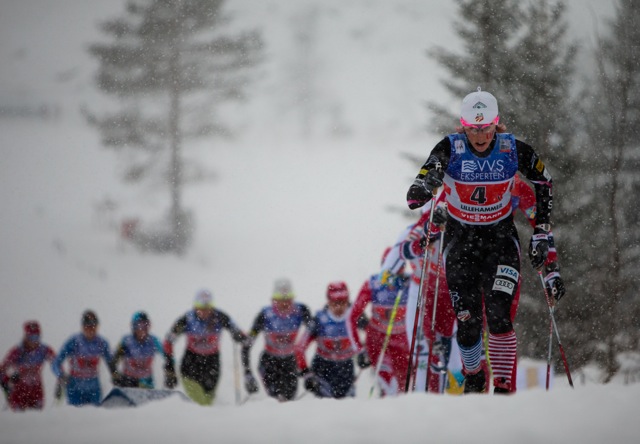
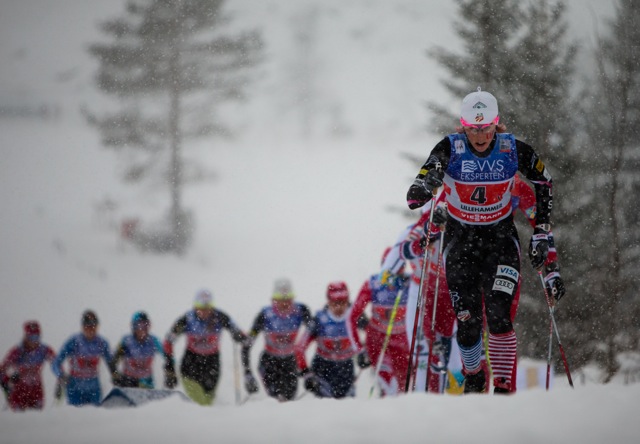
Kikkan Randall leads the pack in the first leg of the 4 x 5 k relay at the World Cup in Lillehammer, Norway, earlier this month. (Photo: Fischer/Nordic Focus)
Saturday’s news that Justyna Kowalczyk would skip the Tour de Ski and forgo her run for her fifth-straight title in the event came as a bit of a shock to the ski world.
What now? Why ever would she do that? Upon closer inspection, it became clear that the decision wasn’t unfounded – she and her coach were upset that five of seven of the stages were skate races – and they weren’t alone in the sentiment.
Ironically, the International Ski Federation (FIS) Athlete Representative Kikkan Randall didn’t field a single complaint about it. Granted, she was training in Davos, Switzerland, while more than 200 others were racing the eighth-annual Tour, which started Saturday in Oberhof, Germany.
“I even sent a message soliciting feedback,” Randall wrote in an email on Sunday.
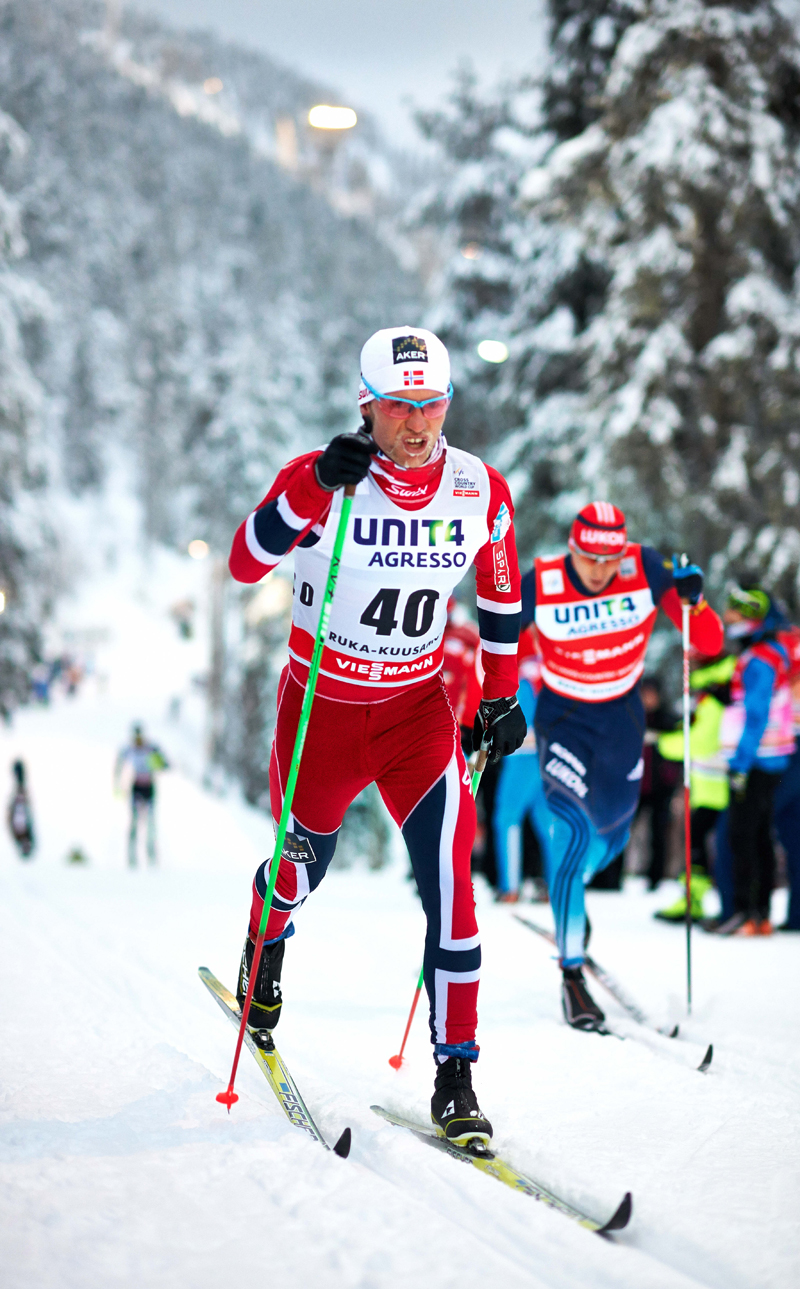
Norway’s Martin Johnsrud Sundby strides to an early lead in the season-opening World Cup in Kuusamo, Finland, on Nov. 30. (Photo: Fischer/Nordic Focus)
The day before, high-profile skiers like Norway’s Martin Johnsrud Sundby vented to media outlets like NRK about the lack of classic races and late changes to the Tour schedule, notably switching Sunday’s 9-kilometer classic pursuit to a freestyle sprint on a 1.5-kilometer track in Oberhof.
On Tuesday, the third stage of the Tour is another freestyle sprint in Lenzerheide, Switzerland, making the first three stages skate races and all less than 3 or 4.5 kilometers in length.
“This is a parody,” Sundby told NRK on Saturday. “This is not what we skiers trained for and are passionate about. Now we are here only to provide sponsors and TV viewers what they want and go a few rounds around the stadium. This is nonsense.”
Kowalczyk understood the decisions stemmed from weather woes, with little manmade snow to work with in Oberhof, but she said the athletes should have been part of the decision.
“FIS management practitioners do not treat us with respect,” she told Poland’s Gazeta.
Randall was concerned that athletes weren’t using the best channels to get their point across.
“It’s too bad because I have seen athlete feedback taken and reacted to positively by FIS when given the right way,” she wrote. “Athletes must engage in the process, not just complain about it!”
Kowalczyk indirectly reached out to Randall about the decision, saying she felt bad for the American since so many skate races would’ve actually catered to her strengths. But Randall decided a while ago to skip the Tour.
Randall wrote that the change in competition program was all-around “unfortunate,” but she was glad they didn’t have to cancel any races.
“It’s tough to hear so many athletes complaining about the changes as if FIS is out to get them.” — Kikkan Randall, FIS athlete representative and U.S. Ski Team member
“Of course it’s a little harder for me to be sitting out now with so many skate races, which are my favorite, but I still feel strongly that it was the right decision for me to be on track for my biggest goals of the season at the Olympics,” she wrote.
“It’s tough to hear so many athletes complaining about the changes as if FIS is out to get them. It was a tough situation with the weather and I think all the stakeholders involved (organizers, tv, fis) made the best decision they could to make sure the tour carried on,” Randall continued. “We are in a sport with so many different disciplines. Sometimes it will be balanced and sometimes it won’t. But we still race A to B don’t we?!”
Bottom line: every athlete has to strategically pick which races they will and won’t do, and factor that into their goals, she explained.
“Personally I hate skipping races,” she wrote. “But skipping the Tour is what I felt I needed to do for my biggest goals. For others, the Tour is their best preparation. … I’m sure the skate/classic balance will equalize in the universe eventually :)”
Jessie Diggins (U.S. Ski Team) racing to 23rd in the women’s 10 k freestyle at 2013 World Championships in Val di Fiemme, Italy. On Saturday, she started the Tour de Ski with her best-ever stage result of fifth in the 3 k freestyle prologue.
Note: This recap has been updated to include quotes from Andy Newell.
Whether the distance is 3 or 4 ½ kilometers, it’s all a blur when you’re pushing from start to finish. Prologues have no additional rounds, no time to hold back, yet a racer stands to lose everything if they go out too hard.
The first of seven stages in the Tour de Ski, Saturday’s freestyle prologue was no different. Jessie Diggins didn’t hear splits as she rounded the 1.5 k course twice in Oberhof, Germany; her U.S. Ski Team (USST) coaches had told the athletes beforehand that they wouldn’t call out information during the individual start. Even if they did, there was hardly time to think, let alone change a pacing strategy.
Diggins distinctively remembered two points of her 3 k race. First, she heard the Caldwells – her teammate Sophie Caldwell’s mother, father, sister and brother – cheering while hanging over the fence.
Sophie Caldwell (c) with her sister Isabel and brother Austin at the World Cup in Asiago, Italy. (Photo: Austin Caldwell)
“I’ve never heard Izzy so loud; it was awesome,” Diggins said of Caldwell’s sister. “The other person I heard was [coach Jason] Cork yelling at the top of one of the hills.”
His cues were exactly what the 22-year-old Minnesota native needed: push over the top, remember technique. Diggins was trying to get on top of her poles throughout the race and she was pretty sure it worked, even in the slushy snow on a rainy afternoon.
“I’m one of those girls that tries really hard, but isn’t always very efficient,” Diggins said.
She churned out a fifth-place performance, tying her career-best World Cup individual finish (from two seasons ago in the 10 k freestyle mass start in Rybinsk, Russia). Last year, Diggins opened the Tour with 62nd in the 3 k freestyle prologue in Oberhof. She went on to place 50th in the classic pursuit there, then 21st in the overall Tour.
This time around, she’s set a goal for a solid overall performance.
“I don’t need any ‘A’-plus days, but if I can get some ‘B’-plus days … it’ll be a really good Tour,” she said.
Saturday was a good start. Starting 33rd of 80, Diggins crossed the line with the fastest time by 1.5 seconds over Slovenia’s Alenka Cebasek, who ended up eighth behind Norwegian winner Marit Bjørgen. Her split through 0.8 k held up as the third-fastest overall and she ranked fourth through 2.3 k, finishing 9.2 seconds after Bjørgen in fifth.
“Every once in a while I would pop my head out to see if I had been knocked out of the top three and if so I could go and get pants.” — Jessie Diggins, fifth
But for about 15 minutes, Diggins was the top dog. Soaked and freezing in the 36-degree temperatures, she would’ve loved to warm up in a large blanket while sitting in the leader’s chair. However, there was no leader’s chair.
“This is probably the one time that I could make it … and they didn’t have a leader’s chair,” she said with a laugh.
Instead, Diggins waited in the finish-area changing tent – but she didn’t have any clothes to change into. FIS media coordinator Jeff Ellis told her to stick around in case she made the podium.
“Every once in a while I would pop my head out to see if I had been knocked out of the top three and if so I could go and get pants,” Diggins said. “It wasn’t until the end there that I realized I was fourth.”
The 65th starter, Bjørgen bumped Diggins to fourth behind Germany’s Denise Herrmann. Poland’s Sylwia Jaśkowiec in bib 67 bested Herrmann’s time by 1.4 seconds for third, Herrmann moved to fourth, and Diggins finally settled in fifth.
“I was psyched,” Diggins said after taking some time to celebrate, then refocus for Sunday’s freestyle sprint in Oberhof. “Since the Tour’s so long you don’t have time to dwell on any one race so it was like, ‘Sweet, that was awesome. It was a good race … and I learned some things for tomorrow, and now it’s time to eat and change and get ready.’ ”
Sophie Caldwell racing to a career-best ninth two weekends ago in the freestyle sprint in Davos, Switzerland. On Saturday, she tied the result in the Tour de Ski 3 k freestyle prologue. (Photo: Fischer/Nordic Focus)
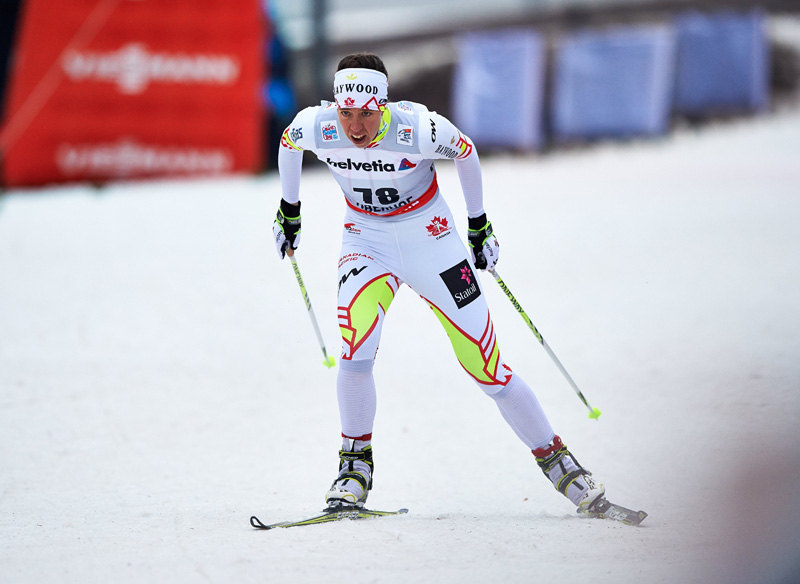
Her teammate, Caldwell also tied a personal best of ninth in her first Tour de Ski. The 54th starter, she ranked third through 0.8 k and was fifth at the finish, 2.6 seconds behind Diggins in first.
“We had really fast skis today,” Caldwell wrote in an email, a notable bonus on a course that broke down with every lap.
After opening hard, she felt fast and Cork confirmed that she was in third less than a kilometer in.
“I thought that was awesome, but it was also at .8k, so I knew times were probably tight and that it could shift around a lot after that,” wrote the 23-year-old Caldwell. “When I came around the 2nd lap, my dad cheered something along the lines of ‘you’re flying!!!’, so I thought I could be having a good race, but that could also just be my dad being nice.”
Through 2.3 k, she was 10th fastest overall, turning it up for the final 700 meters.
“I’m not sure exactly what about this distance, course, or conditions suited me, but I think it paid to relax and try not to be frantic out there,” she explained. “I had been fighting a little sickness since Davos and was really tired after Asiago. I took a few days really easy or off and just enjoyed time relaxing with my family over Christmas. I wanted to come into the tour recharged and healthy and I think I was able to accomplish that by taking the week really easy.”
As for the rest of the Tour, Caldwell plans to take it day by day. She’ll race Sunday in Oberhof and probably the following freestyle sprint on Tuesday in Lenzerheide, Switzerland, but she might drop out before or after the 10 k classic on Jan. 1.
“My goals are to focus on recovering well and getting in a lot of good racing,” she wrote.
Teammate Holly Brooks decided to start the Tour as well after what she described as “an abnormally slow start to the season.”
“I felt like I needed more racing to get up to speed,” Brooks wrote. “Besides the tour provides lots of race chances and that’s why I train so hard year round!”
Brooks finished 21st on Saturday, 21.4 seconds back from Bjørgen, after leading through 0.8 k as the 22nd starter. Her time there stood as the ninth fastest.
“I had a good split at .8k today so perhaps it will bode well for tomorrow’s one lap race!” Brooks wrote. “I feel like I’m headed in the right direction. While not ecstatic with my result today I have to be satisfied because it’s [my] best result this season to date. That said, last year in this race I was 11th and in the Falun skate prologue I was 7th so I was hoping for better.”
Above all, she was excited for Diggins and Caldwell and thankful that Oberhof race organizers were able to host the event with above-freezing temperatures and no natural snow.
“I just heard this evening that the base of our course came from crushed ice from a fish processing plant 500 [kilometers] away!” she wrote. “They are putting some serious resources into making this happen!”
The other U.S. woman who plans to race the entire Tour, Liz Stephen placed 34th (+25.1). With the 44th-ranked time through 0.8 k, she improved to 35th by 2.3 k.
“My goal was to build into the race,” Stephen wrote. “I had the goal of being in the top 30, but was just out, and I am happy with my performance today. The conditions were tough for everyone, but the organizers have worked some sort of magic to have been able to pull these races off at all. I am really impressed given the weather they have been given so far this winter.”
In the men’s 4.5 k prologue, Americans Andy Newell placed 20th, Simi Hamilton 42nd and Noah Hoffman 82nd out of 106 finishers.
“The team’s performance was amazing today,” Stephen wrote. “To have Jessie and Sophie both in the top 10, Holly and Newell in the points and Simi and I just out is a good day. Noah’s days are coming, but first we distance skiers need to channel our sprint gears!”
They’ll have a chance in Sunday’s 1.5 k freestyle sprints – the same one-lap race for the men and women.
“I am really excited to get my skate sprinting on,” Stephen wrote. “I have hopes of qualifying like I was able to do last year, but these are big fields here so far, so I will have to do everything just right, but really fun to get two chances in a row to try out some strategies.”
Newell Leads U.S. Men in 20th
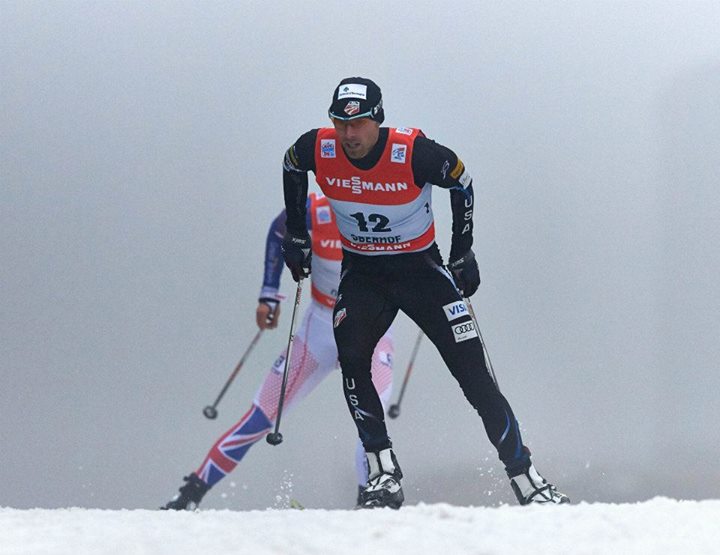
Newell was a strong early starter in bib 12, posting a top-10 time through 0.8 k. Skiing with Great Britain’s Andrew Musgrave for his first two laps, Newell went on to finish 20.4 seconds behind Canadian winner Alex Harvey and less than seven seconds off the podium. Musgrave tied two Russians, Evgeniy Belov and Alexander Legkov, for 17th, which put Newell as the next finisher in 20th.
“I felt pretty good out there and started right as Musgrave was lapping through,” Newell wrote. “I
Andy Newell (U.S. Ski Team) racing to 20th in the 4.5 k freestyle prologue, the first stage of the Tour de Ski. (Photo: Fischer/Nordic Focus)
thought about jumping in behind him because there were some points on the course where the wind was really ripping, so it would have helped to follow someone. Pacing is so important in a short distance race like this so I decided I just couldn’t chance skiing someone else’s pace, so ended up pulling him around for a lap or two.
“It was my goal to be in the top 15.. and it turns out I was .7 seconds from 15th,” he added.
Hamilton started last and hovered around the mid-40s throughout the race before finishing 3.5 seconds out of 30th.
“I’m happy with how today turned out, although being only 3 seconds from my first distance points is kind of a hard pill to swallow,” he wrote. “It was tough skiing out of the back as conditions were deteriorating a bit throughout the day, but that’s just something I’ll have to deal with for a bit as I recover from the fact that illness allowed me to only ski 3 distance races last year.”
With three laps to tackle, Hamilton reflected that he might have been too conservative the second time around.
“It was hard to find relaxation at any point in the course because of the terrain and the conditions, and I felt like I lost some valuable seconds because of that,” he added. “Tomorrow should be a good day. It’s a short course that should suit me well.”
Canadian Women Finish Strong
Two Canadian women plan to do the first few stages of the Tour, and Dasha Gaiazova led them in 37th, 1.8 seconds behind Stephen and 3 seconds out of 30th. Perianne Jones was 47th, another 1.9 seconds back.
“Both the ladies finished strong; they finished last half a k with quite good speed,” Canadian Head Coach Justin Wadsworth said. “That’s a good sign for fitness, a good sign that they’re coming back. I want them to do these first three stages and do the process, too. We’re still aiming for Sochi, so every race we’re aiming to be the best we can in all respects, but they both put in solid races today and I’m really happy with how they finished the last part of the race.”
Perianne Jones, who finished 47th, racing in her third international race of the season. (Photo: Fischer/Nordic Focus)
In an email, Jones explained she could’ve started harder, but was cautious in her third international race of the season.
“After not having done too much hard work longer than a few minutes in the recent months I was maybe a little bit apprehensive,” she wrote. “I was able to ski faster on the second lap, which came as a bit of a surprise. It’s a good sign that my fitness is coming.
“When I knew the finish line was around the corner I definitely dug deep and used every last bit of energy I had,” she added. “Tomorrow I’ll be doing that right from the start! … Although the result wasn’t great today it was a positive indicator for me that things are coming around, and I had much better feelings than last weekend, so I can’t wait for these next two races.”
Norway’s Marit Bjørgen racing to victory in the opening 3 k freestyle prologue of the 2013/2014 Tour de Ski in Oberhof, Germany. (Photo: Fischer/Nordic Focus)
Saturday morning was sunny in Oberhof, Germany. Jessie Diggins probably wasn’t the only one surprised to wake up to that, and she and the U.S. women’s team packed raincoats anyway.
“I’ve actually never seen the sun in Oberhof,” Diggins said on the phone later Saturday.
It started raining well before the 2 p.m. start of the women’s 3-kilometer freestyle prologue – the first of seven races in the Tour de Ski. Organizers emergency salted the course to keep the few precious uphills on the 1.5 k course in tact, and “there were apparently 300 dudes out shoveling the snow from the woods,” Diggins said.
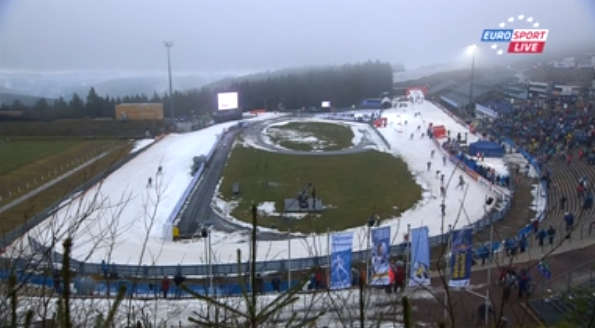
The track at Oberhof, Germany, the first of three venues in the 2013/2014 Tour de Ski.
She, for one, was impressed. Had they not added snow to the manmade track and re-salted the course, course times would’ve been 30 seconds slower – easily.
The 65th starter out of 80, Norway’s Marit Bjørgen quickly accelerated along the flat-and-twisting course. The rain stopped just before the women’s race, but it wasn’t pretty out there. The snow felt slow, even for Bjørgen, and without time or much use for splits in an all-out 3 k, it was hard to know how one was doing.
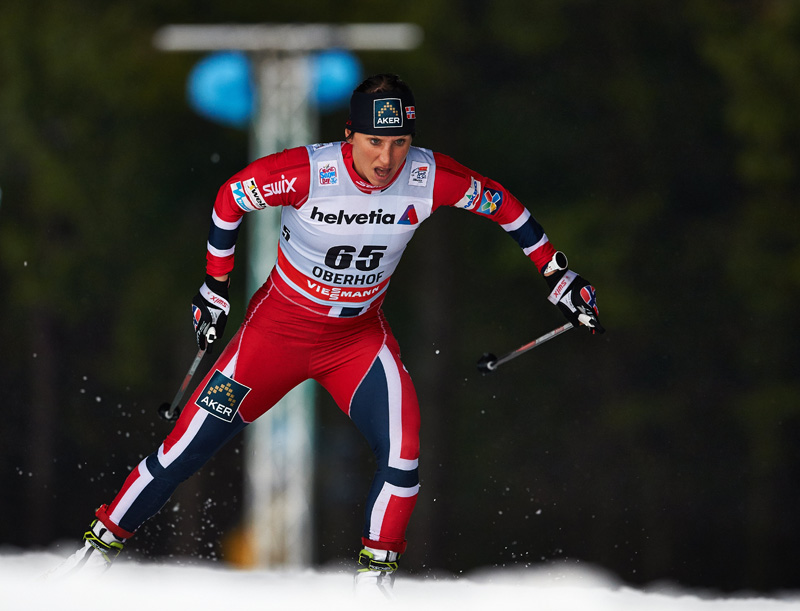
With each passing checkpoint, it became evident that Bjørgen was on her way to the podium. At 0.8 k, she was two-tenths of a second faster than 23-year-old teammate Ingvlid Flugstad Østberg (first at the time, she ended up 13th). By 2.3 k, Bjørgen, 33, had extended her lead by 2.5 seconds on another Norwegian at least seven years younger than her, Astrid Uhrenholdt Jacobsen.
“I found it difficult to find the right speed along the way,” Bjørgen told NRK, according to a translation. “I thought to myself, ‘This can not go fast. This does not go fast.’ ”
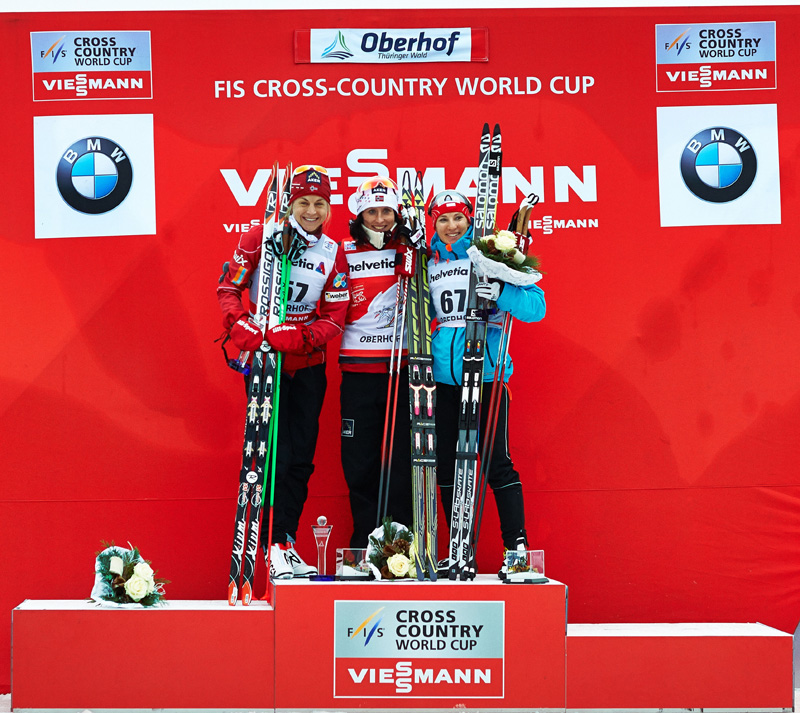
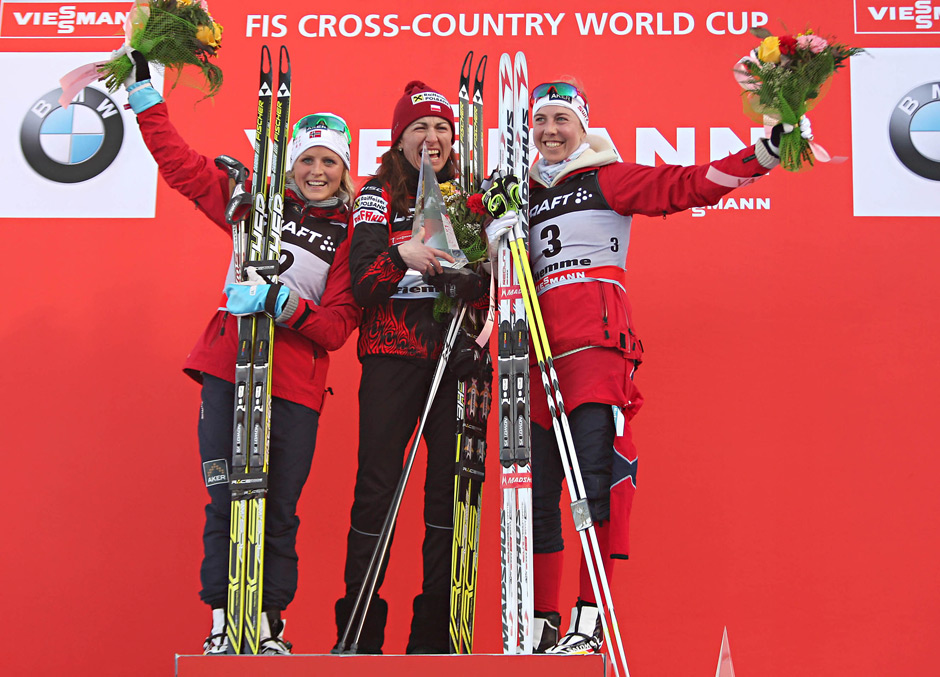
Norway’s Marit Bjørgen (c) in first, teammate Astrid Jacobsen (l) in second, and Poland’s Sylwia Jaskowiec in third at the 3 k freestyle prologue, the first stage of the 2013/2014 Tour de Ski. (Photo: Fischer/Nordic Focus)
But she willed her way to the finish and held her speed for the duration, winning in 6:34.4 minutes, bumping Jacobsen out of the non-existent leader’s chair by 1.9 seconds. The 57th starter, Jacobsen, 26, ultimately placed second.
Earlier in the race, Diggins in bib 33 finished with the fastest time of 6:43.6, besting Slovenia’s Alenka Cebasek by 1.5 seconds. Soaked to the core, Diggins said she kept poking her head out of the changing tent to see if she was still in the lead, or in the top three once Jacobsen came through 7.3 seconds faster. Two starters after Jacobsen, German Denise Herrmann edged Diggins by 0.8 seconds for second place at the time, then Bjørgen bumped Herrmann back and Diggins off the podium.
A Polish woman other than Justyna Kowalczyk made the podium in third, as 27-year-old Sylwia Jaśkowiec captured a career-best third, 7 seconds behind Bjørgen. The 67th starter, she moved Diggins to fifth, another 2.2 seconds back.
“This was a big surprise for me. I’m very happy,” Jaśkowiec said in a press conference.
Bjørgen congratulated her. “It’s great to have a new Polish girl on the podium,” she said at the press conference.
On Saturday morning, Kowalczyk, the overall winner of the last four Tour de Skis, announced on Facebook that she was withdrawing from this year’s eighth edition of the Tour. The decision came from her frustration with Tour organizers who changed several races due to low-snow restrictions – making five of seven races freestyle.
A perennial rival, Bjørgen wasn’t happy, either. Norway has yet to win the Tour, and with Bjørgen and teammate Therese Johaug as two strong favorites, this isn’t the way they wanted it.
“Possible victory, mine or Therese, has no taste or value without Justyna,” Bjørgen told NRK, according to a translation.
Johaug finished 11th on Saturday, 13.1 seconds behind Bjørgen, despite a fast start in which she clocked the sixth- and ninth-fastest intermediate checkpoint times. Bjørgen gained 15 bonus seconds for the win, putting her 28.1 seconds ahead of Johaug in the overall Tour.
With back-to-back freestyle sprints next – Bjørgen’s forte – that’s not necessarily the greatest start for Johaug.
“I’m not stopping,” Johaug told NRK. “I’ve been training for sprints, so it will be good.”
After Diggins, three Finns made the top 10 with Anne Kyllönen in sixth, Aino-Kaisa Saarinen in seventh and Kerttu Niskanen in 10th. Cebasek finished eighth and American Sophie Caldwell tied her individual World Cup best (like Diggins) in ninth, 11.8 seconds back from Bjørgen.
“It was a great way to start for sure,” Diggins said. “It was really sweet to see Sophie do so well and see the other girls start the Tour strong. Our skis were rocketing; it was amazingly fast.”
Poland’s Justyna Kowalczyk (c) celebrates her fourth-straight Tour de Ski victory last year in Val di Fiemme, Italy. She shared the 2012/2013 Tour de Ski podium with Norwegians Therese Johaug (l) in second and Kristin Størmer Steira in third (r). (Photo: Fiemme2013)
With the eighth-annual Tour de Ski starting 24 hours from 8 a.m. EST, we thought we’d give you a rundown of what’s happening when and who’s racing.
The short-and-simple: TdS
The stages: seven in nine days
The places: Oberhof, Germany (Dec. 28-29), Lenzerheide, Switzerland (Dec. 31 & Jan. 1), Cortina d’Ampezzo-Toblach, Italy (Jan. 3), Val di Fiemme, Italy (Jan. 4-5)
Dec. 28: 3/4.5 k freestyle prologue (women at 14:00/men at 15:15 CET), Oberhof. Start lists:women | men
Dec. 29: Freestyle sprint (heats start at 14:30 CET), Oberhof
Dec. 31: Freestyle sprint (heats at 14:45), Lenzerheide
Jan. 1: 10/15 k classic mass start (men at 13:00/women at 15:45 CET), Lenzerheide
Jan. 3: 15/35 k freestyle pursuit (women at 10:30/men at 12:15 CET), Cortina to Toblach
Jan. 4: 5/10 k classic individual start (men at 11:00/women at 15:45), Val di Fiemme
Jan. 5: 9 k freestyle pursuit/final climb (women at 13:30/men at 15:00 CET)
The players:
Poland’s Justyna Kowalczyk powers to the top of the Alpe Cermis and her fourth Tour de Ski victory last season. (Photo: Fimme2013)
221 athletes from 26 nations
Justyna Kowalczyk: four-time defending champ from Poland. She’s one of three women to have completed all seven Tours to date, with Finland’s Riitta-Liisa Roponen and Ukraine’s Valentina Shevchenko
Marit Bjørgen: the Norwegian powerhouse is back after skipping last season’s Tour because of a heart scare. The three-time Olympic gold medalist and 12-time world champion has yet to win the Tour, but finished second twice (in 2007 and 2012).
Petter Northug: the Norwegian runner-up in three straight Tours (2009-2011), who has yet to win overall andone of three men to finish all seven editions of Tour. Germany’s Jens Filbrich and Italy’s Giorgio Di Centa are the others.
(Not racing: Dario Cologna: Swiss skier who won three Tours in 2009, 2011 and 2012. Recently started skiing again after tearing an ankle ligament and having surgery in November. Hopes to race Alpen Cups Jan. 10-12 in Chamonix, France.)
The point: $$$, World Cup points (overall winners get 400 World Cup points and half of the regular World Cup points will be awarded per stage), and a tune-up for the Olympics in February
U.S./Canadian lineup (tentative):
Liz Stephen racing the final climb up the Alpe Cermis in the 2011/2012 Tour de Ski. Last year, she had the second-fastest time in the 9 k freestyle pursuit, and finished 15th in the overall Tour.